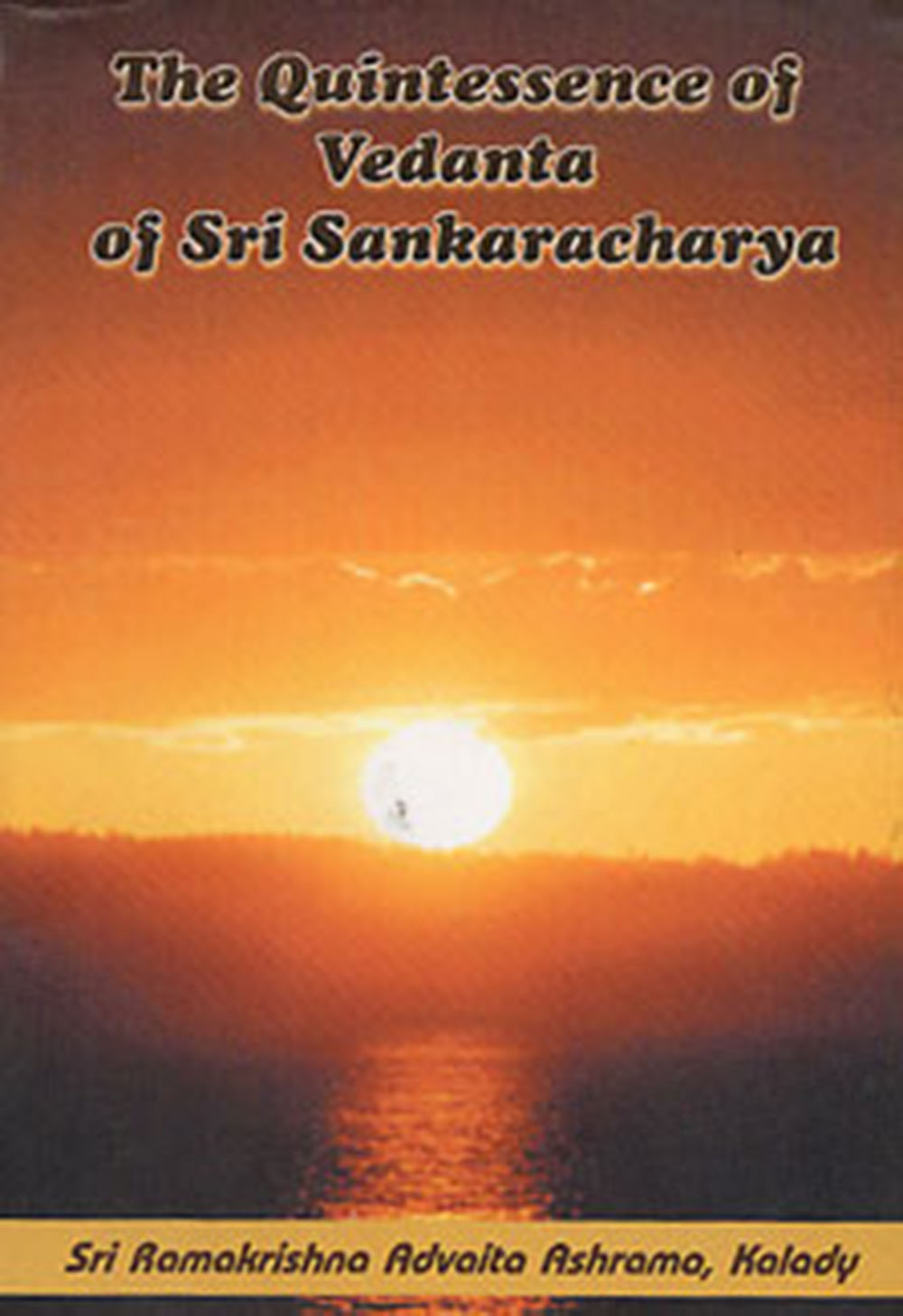
The Sarva Vedanta Siddhanta Sara Sangraha by Acharya Shankara is a compendium and a precise re-statement of all that has been thought of and set down about the Self from a purely philosophical viewpoint. A translation of this work originally planned and undertaken by Swami Tattwananda has since been revised by Swami Jagadananda of the Ramakrishna Mission with a view to make it simpler and easy of understand by the general public.
Many a writer has written the life of Sri Sankara, many a poet has sung his glory; and many an orator has spoken of the depth of his philosophy and the sublimity of his thought. It may be asked, why, then, should one more attempt be made today to place before you this lofty soul and to unfold to you his life and thought. I have two reasons for this. My first rea son has been aptly put in the form of a question by an ancient poet. He asks, "Do not people perform the Tarpanas of their forefathers with the water which Bhagiratha brought from heaven for the spiritual uplift of his ancestors?" In the same way, my spiritual craving can be satisfied only by my per sonal homage to the Master-mind whose light has illumined the world. In order to satisfy myself, to purify my own thoughts, to do my duty and to make myself blessed I should like to place before you my thoughts and reflections on the life and work of the great sage, Acharya Sankara.
I feel very much pained when I see the children of my country going and sitting at the feet of the prophets and sages of other countries, without caring to know what our own proph ets and sages have taught the world at large. Many a young man of the present day knows very little of the immortal Sankara, whom the great Swami Vivekananda considered to be the greatest intellect of the world. I should like to rouse the enthusiasm of our young men to study the works of Sankara; and that in the original, if possible. Sanskrit, the mother of allIndian languages, in which the thought of our forefathers finds embodiment, is not at all a difficult language if one has a mind to study it. Learn Sanskrit and read the works of Sankara. To be really proud of our country one must study Sankara. To know what India contributed to the regeneration of the world, one must study Sankara.
Sri Sankara's life is shrouded in mystery. Even the date of his birth and the place of his birth are left uncertain. The writers who have attempted his biography conceive of him as a mythical figure and are lacking in the historical outlook. Our original authorities on the life of the Acharya are the various Sankaravijayas written by Madhavacharya, Anandagiri, Chidvilasa, Swami Sadananda and Govindanatha. The Madhva-Vijaya and Manimanjari, both of them by Pandit Narayanacharya, a not too favourable Madhva writer, give us additional information. Finally we have the Skandapurana and the Vayupurana. Among recent writers special mention may be made of Wilson, Max Muller and Telang. Girish Chandra Ghose, the famous Bengali dramatist, has also written a drama on the life of Sankara. In reading these works the reader must be specially on guard, as there is little that is common between these works. A few words regarding the relative merit of these works will not be out of place.
Madhavacharya, whose work is placed first in the list is identified with the famous Vidyaranya. He was the minister of Hukka and Bukka, the founders of Vijayanagar. It is said that Vidyaranya later on became the head of the Sringeri Math. Some scholars are however of the opinion that the author of Sankaravijaya is not Vidyaranya, but some later writer. Granted that the original author was Vidyaranya himself, it would follow that the work could not be earlier than the four teenth century. This work is based to a large extent upon traditions and popular stories; nor does it redound to the criti cal outlook and historical insight of the author. In brief, it is more a Purana than a biography. All the other Sankaravijayas are of much later origin. Wilson however claims for Anandagiri's work age as well as authenticity. But a cursory glance at the book shows us that the writer was not the origi nal Anandagiri who was a disciple of Acharya Sankara, but some other person of the same name and of Tamil origin. Skandapurana is of comparatively recent origin and is not of much historical value. Vayupurana merely mentions the name of Sankara and gives us a list of his disciples. Madhva Vijaya and Manimanjari are polemical works animated by a spirit of sectarian controversy. Among other works special mention may be made of a still unpublished work, entitled Brihat Sankara Vijaya. It is attributed to a person called Chitsukhacharya, who is said to have been five years older than Acharya Sankara. He is also said to have been a fellow student, disciple and companion of the Acharya in his wan derings, and third in the line of succession at Dwaraka Pitha. Madhava, the author of Sankara Vijaya also refers to an ear lier work entitled Prachina Sankara Vijaya, of which however very little is known. The Math records would have been very valuable sources of information if they did not, unfortunately, contradict one another. The other works of Acharya Sankara do not afford us sufficient internal evidence which may be of value to the biographer; for, they are essentially lacking in the egoistic element which is so essential for an autobiography.
With the single exception of Anandagiri, the other writers on Sankara are unanimous in their view that Sankara was born at Kalady, a village about eight miles to the north east of Alwaye. Anandagiri is the only writer who says that Sankara was born at Chidambaram. Attempts have been made to rec oncile these to different points of view by a critic who points out that although the original Sankara was born at Kalady, there was another Sankara, not less famous, who was born at Chidambaram. In support of the view that Acharya Sankara was a Malayalee Brahmin we may note that in the temple of Narayana at Badari, which is said to have been founded by Sankara, the officiating priest has been a Nambudiri from Malabar and that this practice has come down from very an cient times.
The Agrahara at Kalady is said to have been founded by a neighbouring chief called Rajasekhara. As Kalady was at that time part of Cochin state, the founder of the Agrahara might have been a Maharaja of Cochin. This chief, we are told, had a dream that Lord Siva had become manifest in a Linga that had arisen spontaneously in the neighbourhood of his capital. It was in fulfilment of that dream that the king en dowed an Agrahara, so that the temple service might be continued. In that Agrahara there was a person called Vidyadhiraja. It may be that this was a title indicating his learn ing. He had an only son named Sivaguru. After having com pleted the usual courses of instruction open to Brahmin boys in those days, he settled down as a householder. His wife's name is said to have been Aryamba. For a long time they were childless; and both of them prayed to Siva at Vrishadri to bless them with a child. This Vrishadri might have been either Trichur or Pulliman-tulli near Kalady. We are told that Siva appeard to them in a vision, in the guise of a Brahmin, and asked Sivaguru if he would wish to have a large number of wicked sons, or an only son who would be wise but short lived. Sivaguru chose the latter alternative and Sankara was born as his son. The story points out that the birth of Sri Sankara was, as in the case of Sri Ramakrishna, attended with miraculous events.
The exact year of his birth is also open to dispute. Ac cording to the astrological data as given in the Brihatsankaravijaya, the year of his birth would be 2593 Kali Era or 509 B.C. But this is unacceptable, for, Acharya Sankara refers in his Brahmasutra-bhashya to the various schools of Buddhism, such as the Sauthrantika, Vaibhashika, Yogachara and Madhyamika, all of which he condemns. He must there fore have lived at a time when Buddhism was on the wane. According to a tradition that is current in Malabar, the Malabar Era is said to begin from the day of the final liberation of Sankara. According to another tradition, the date of his birth is assigned to 3889 Kali Era. If this were correct, Sri Sankara must have been born in the year 788 A.D. Mr. C.N. Krishnaswami lyer, a biographer, also holds this view. As he has pointed out, the Sringeri Math, undoubtedly of the Guru's founding, has a list of his successors. But unfortunately the list is imperfect, and it states that Sureswaracharya, the im mediate successor of the Guru was the head of the Math for a long period of 700 years or more. Be that as it may, the birth of Sureswaracharya is placed towards the close of the eighth century of the Vikrama Era. If we should make some allow ance for the carelessness of someone herein, it would be easy to reconcile small differences, and take 788 A-D. as the year of the Guru's birth. Max Muller also accepts this view. There are two additional reasons which also seem to sup port this point of view. Madhava's book located the Buddhists mainly in Kashmir, or more generally in the Himalayan re gions. In Sankara's days Magadha does not appear to have been a stronghold of Buddhism. Huen-Tsang tells us that in the seventh century Magadha was still a stronghold of Bud dhism. A period of a hundred and fifty years would not be too long a period for this change. Further, if the date assigned by the late Sundaram Pillai to the Tamil saint Tirujnanasambandar is correct, and if the allusion said to be found in one of Sankara's devotional hymns is a real refer ence to the Tamil saint, it would follow that the year we have accepted is in all probability the right one. Telang pleads that Sankara must have been born sometime towards the close of the sixth century, from a remarkable allusion in his Sutrabhashya to a Purnavarman who was a Buddhist king of Magadha at that time. To the present writer however it seems to require additional and more direct evidence before it could be accepted as authentic. For the present however we proceed on the assumption that Sankara was born in 788 A.D. i.e. Kali Era 3889.
Many are the miracles associated with the birth of Sankara. It is said that astrologers predicted from the horo scope of Sankara that he would become a Sarvajna, and that he would write books on Advaita philosophy and earn eternal fame. We are told that even from his early years he was noted for his extraordinary intelligence. Although his fa ther died when he was still young and before he could initiate him into the Gayatri Mantra, Sankara is said to have contin ued the study of the Vedas with their padas and angas and completed his studies when he was sixteen years of age.
The biographers of Sankara record two miracles that are said to have been worked by him when he was a Brahmachari.. On one occasion, when he was going for Bhiksha, as was the custom with Brahmacharis in those days, he happened to go to a poor Nambudiri house and asked for charity. But they had nothing to give. According to the sastras, a worthy person who comes for charity should not be sent away empty handed. The people in the house found, after much search ing, that they could spare a few Amalaki (Myrobalan) fruits. Sankara accepted the offering, and sang a song in praise of Lakshmi, the Goddess of wealth. There came then a shower of gold Amalakis and the donors were blessed beyond mea sure. A second miracle which is said to have been performed by Sankara was when he diverted the course of the river Poorna, which was flowing at a distance of about a mile from his house. Sankara prayed to the river-goddess and made her change her course, so that his aged mother might have her daily bath in the river. For those who might feel sceptical, it may be stated that such miracles are not uncommon even nowadays. We find a similar incident recorded in the life of Durgacharan Nag, a householder disciple of Sri Ramakrishna. On one day the father of Durgacharan scolded him for return ing too soon from West Bengal where the holy Ganges flows, without waiting for the holy Ardhodaya, when it is considered auspicious to take a bath in the Ganges. Durgacharan re plied that if the Lord willed the river would flow even through their own compound. On hearing the 'faithless' words of the son, his father was even more angry. But when the auspicious hour came, the Ganges flowed from a corner of the compound as a strong spring; and hundreds of villagers gathered there to see this strange phenomenon, and to derive spiritual ben efit from it. The present writer remembers to have seen some of those who had taken their bath there on that occasion. Might it not then be possible that Sankara also could have performed a similar miracle?
Madhava gives us a very interesting anecdote, which brings out the high spirit of renunciation, and strict adher ence to dharma, which characterised Sankara even during his Brahmachari period. On hearing a report of Sankara's extra ordinary intelligence, the king of the province wished to see him and to have a discussion with him on dhrama. He sent for Sankara; but Sankara excused himself. The king then sent him elephants and chariots and invited him to the pal ace. Sankara asked the messenger to inform the king that he should not tempt Brahmacharis with such rich gifts. The king was humbled. He went personally to Sankara, expressed re gret for his conduct, and after holding a discussion with Sankara on dharma, returned spiritually ennobled. By that time the fame of Sankara had spread all round. He was sought after by parents with marriageable daughters. Sankara's mother was for her part equally eager that her son should take upon himself the duties of a householder; for the Smritis declare that the offerings made by the grand children redound to the spiritual glory of the ancestors.
Sankara, who knew that he had quite a different mission in life, did not wish to be entangled in the bonds of Samsara. Moreover, the astrologers had predicted that he may not be spared for long. He had no time to waste. But it would have been morally wrong of him to take Sannyasa without his mother's permission. He found a way out of this dilemma. One day, when he went for a bath in the river with his mother he created by his yogic power a crocodile; and the crocodile began to drag him into the river. He then cried out to his mother that the crocodile was dragging him into the river, and he expressed his last wish to his mother that he should be per mitted to become a Sannyasin. He said that death and Sannyasa are equal, and that if he took Sannyasa the croco dile might perhaps spare him. The permission sought for was granted; and he escaped from the jaws of the crocodile. After having arranged for his mother's maintenance, Sankara de cided to leave the place. In order to assuage her sorrow Sankara told his mother that if she should think of him in her last moments, he would be with her. After taking leave of his kith and kin, he went out into the unknown world, with lan guages, customs and manners that were entirely different from those of his homeland. His first aim was to find out a spiritual teacher. He was then of about 16 years of age. The only son of a noble family, he had been brought up in luxury and comfort. He renounced everything and accepted volun tary poverty in the quest after truth.
We have little information as to how he fared in his wan derings. We do not know whether he suffered privation, or whether he was honoured for his scholarship and winning ways. At last he found his Guru in Govinda Bhagavatpada. Some say that he met his Guru at Benares; others say that he met him on the banks of the Narmada. The latter version may be nearer the truth. Govinda Guru was regarded by the local people as an incarnation of Anantha, on account of his scholarship and yogic powers. According to Madhava, the Guru was seated in a cave with a small hole in front of it. Sankara circumambulated the cave thrice, and addressed the Guru as Adisesha incarnate. To the Guru's question as to who he was he replied, "I am neither fire, nor air, nor earth nor water, nor Akasha, nor a combination of these, but the supreme spirit shining underneath all phenomena, the one without a second, a glimpse of which can be had in dreamless sleep." The Guru understood at once who the disciple was, and initiated him in the Mahavakya of the Upanishads. Govinda Guru was the disciple of Gaudapada who was himself the disciple of Sukadeva. In many of the minor works of Sankara, we find him offering his salutation to his Guru, Govinda. We do not know with certainty how long the instruction lasted. Sureswaracharya, one of the direct disciples of Sankara says in his Naishkarmya-siddhi that an Uttama Adhikari may gain the highest illumination even within a second of his contact with a proper Guru. It is said of Sri Ramakrishna that he at tained the highest goal of all spiritual Sadhana within an hour of his initiation. Sankara also must have had a similar expe rience. His biographers tell us that shortly afterwards he left for Benares, accepted pupils, wrote his works and propagated his philosophy. It was the wish of Govinda Acharya that Sankara should proceed to Benares and there assume the life of a peripatetic teacher of religion.
It was in obedience to the wish of the Guru that Sankara proceeded first of all to Benares. He distinguished himself there by his scholarship. It was at that time that a young man from the Chola country, named Sananda, approached him and requested that he might be initiated into Sannyasa. Govindanatha however gives us a different version. He tells us that Sananda was a native of Malabar, that his original name was Vishnu Sarma, that he was a merchant by profes sion and that he was initiated into Sannyasa at Badari. There is general agreement however in regarding him as the first disciple of Sankara. He came to be known later on by the title of Padmapada, which was conferred upon him on account of his abounding faith in the Guru which enabled him to walk on lotus flowers and across a sheet of water.
Many of the works of Sankara were probably written during his stay at Benares. According to Govindanatha, the first work to be written was also his greatest work the Sutra bhashya. He tells us further that the work was written while at Badari. Others are of the opinion that the minor works were the first to be written, and that the major works followed later on. But a careful study of the works will reveal to us that the minor works are in the nature of summaries of the conclu sions arrived at in the major works. Moreover it was only by writing original commentaries upon the Prasthanatraya and by maintaining that the Gita, the Upanishads and the Brah masutras supported one's point of view that one could estab lish one's claim to be a teacher of religion. In support of the opinion that the Sutrabhashya was the first to be written, we may state here that there are passages in the Gita-bhashya where he passes by with a brief comment, saying that he has already dealt with them elaborately in his Sutrabhashya.
Whatever be the order of writing, one very interesting incident associated with the Sutrabhashya deserves to be mentioned. We are told that Vyasa, tha famous author of the Vedanta Sutras, himself entered the arena as a disputant and that the discussion lasted a whole week. Finally Sananda intervened and he appealed to Vyasa as the incarnation of Vishnu and to Sankara as the incarnation of Siva to restore peace to the world. Vyasa then revealed his identity; blessed Sankara and took leave. This anecodote is of value; for it shows us that the views of Sankara had the support of the highest authority. In this connection it will not be out of place to mention that there is a book called 'Vyasa sammata sutrabhashyanirnaya' written by Swamy Chidghananandapuri which establishes that Sankara's Sutrabhashya is the most authoritative.
Chidvilasa tells us that the king of Benares wished that Sankara should stay with him and be his spiritual guide. Sankara however declined the offer as he wished to be the teacher to the whole of India. He was then probably about twentyfive years of age. From Benares he proceeded to Allahabad. Here he bathed in the Triveni, and prayed to God for the welfare of the world and of his mother. It was when he was resting under the shade of a tree near the bank of the river that he heard that the great Bhatta, the champion of the Purvamimamsa school of thought and the bitterest op ponent of Northern Buddhism, was about to commit himself to the flames. On hearing the news, Sankara hurried to the spot. We are told that Bhatta was at one time passing off as a Buddhist, so that he might study their esoteric teachings and be better able to controvert them later. Bhatta was an Assammese Brahmin. He had put many Buddhists to death. Among them was his own teacher of Buddhism. Bhatta up held the Purvamimamsa school of thought. According to that school, the Vedic syllables are themselves regarded as Di vine; and he who performs the prescribed rituals obtains all the purusharthas as the result of his meritorious deeds. Bhatta was a revivalist of this system, which had been largely sup planted by Buddhism. But he did not wish to have upon his conscience the sense of being guilty of the death of his own teacher and it was in order to atone for it that he wished to immolate himself. Sankara pleaded with him and said that all sins would be washed away in the sacred river of Jnana. But Bhatta did not wish to change his mind. He requested Sankara to approach his disciple Mandana Misra who was at Mahishmati in Magadha, and to have him converted to be lieve in Vedanta. According to Govindanatha, the disciple's original name was Viswarupa; the term 'Mandana' signifying 'an ornament' was a title that was conferred upon him. He too was firmly convinced that salvation lay only in and through Purvamimamsa.
Different versions are given as to how the controversy began. Govinda tells us that Sankara approached Viswarupa at the Atithi-vela and when Biksha was offered to him, would not accept it, unless Vada-biksha was also granted. The re quest was readily granted. It is stated that in the controversy that arose, Bharathi the hostess acted as the judge. Accord ing to Madhava however Sankara approached Mandana at the time of the performance of his father's annual ceremony. The gates were closed but Sankara entered by his yogic power. Then there arose a wordy warfare, for, the appear ance of a Sannyasin at such a time was considered to be highly inauspicious. The priests calmed down Mandana. He invited Sankara for Biksha, which he accepted on condition that Vada-biksha should also be added to it. From Govindanatha's account of the controversy that was in vogue at that time. They agreed upon the rules of procedure. They did not enter into discussion merely for the pleasure of hav ing their throats parched. They also agreed that whoever defeated should renounce his point of view and accept the was faith of the other. If Sankara were defeated, he should be come a householder; if Mandana were defeated, he should become a Sannyasin. Without relying upon texts, they should accept whatever reason approved and live up to it. The dis putation continued for six days. On the sixth day, Mandana's garland faded. Bharati who used to invite Mandana for dinner and Sankara for Biksha, invited both of them for Biksha, thus signifiying that Mandana was defeated in the argument. Mandana declared his willingness to accept Sannyasa. But Bharati declared that Sankara had defeated only half of Mandana, and that he had yet to defeat the other half of Mandana namely, herself. She impaled him upon the horns of a dilemma, but he successfully avoided it. In his disputa tion with this new 'Gargi', Sankara was again victorious. Mandana was then initiated into Sanyasa, and came to be known as Sureswara. When the entire wealth of the disicple was offered to Sankara as Gurudakshina, he declined to ac cept it. He requested that it might be distributed to the poor.
Sankara proceeded on his triumphal tour across the Deccan and came to South India. Wherever he went, he held discussions with the scholars of the various sects that were prevalent in those days and persuaded them by the force of logic to accept his point of view. Apart from the Saivaites, Bhagavatas, Vaishnavas and Saktas who have continued to this day, there were at that time a number of minor sects such as the Kapalikas who offered human sacrifices, and the Mallaris who worshipped dogs as the Vahana of the Lord. Even they claimed to follow the teaching of the Vedas. Sankara explained to them the real significance of the Sruti, pointed out the underlying absurdities in their fragmentary views of religion and converted them to Vedanta and to an integral view of religion. He did not compel them to give up their faith altogether. But he asked them to give up only those obser vances that were wicked and pernicious and which had crept into the life of religion to the detriment of the spirit of Vedanta. On one occasion, we are told, a Kapalika approached the Acharya and requested permission to cut off his head and offer it as an oblation. Although Sankara granted him the re quest it fared ill with the Kapalika, for Padmapada appeared on the scene and cut off at one stroke the head and the hand of the Kapalika.
Sankara next proceeded to Gokarna. On the way, while passing by a village called Sri Baligrama, a Brahmin named Prabhakara approached him with a request that the Acharya should cure his only son who had been a deaf mute from birth. Sankara asked the boy "Who are you? Whose son are you? Whence do you come and whither do you go?" The boy immediately responded. "I am neither a man, nor a Deva, nor a Yaksha; neither Brahmin, Kshatriya, Vaisya or Sudra; nei ther Brahmachari, Grahastha, Vanaprastha or Sannyasi. I am Bliss Absolute." On hearing this, Sankara realized that the boy was a Jnani of the highest order and that he was not meant to lead the life of a householder. With the permission of the father, the boy was accepted by the Acharya as one of his disciples. Later on he came to be known as Hastamalaka, for, to him the truth of religion lay revealed like the fruit of the myrobalan held in the hand. He became the third disciple of the Acharya. Anandagiri was his fourth and the last disciple.
In the course of their Parivrajaka life, the Acharya and his disciples arrived at the head water of the river Tunga. On the north bank of the river lay the old village of Sringeri. On the same bank he noticed one day that a snake with up raised hood was protecting a frog from the heat of the sun. It was here that he established his first Math, the famous Sringeri Math. It was here that he built a temple to the God dess Sarada. Sureswaracharya was appointed as the head of the Math. For ages it has been a radiating centre of Vedanta Dharma. It was with the same object in view that the Acharya established three more Maths in different parts of India. In order to impart the necessary training to his disciples, Sankara stayed for some time at Sringeri. He also wished that one of his disciples should write a gloss on his Brahma-sutra bhashya. As Sureswaracharya was the most learned of his disciples, the Guru preferred that he should write it. But the other disciples voted for Padmapada, and Padmapada him self wished that Hastmalaka should write it. Finally the opin ion of the disciples prevailed and the Master gave his gra cious consent to Padmapada to write the commentary. It was at Sringeri that by his composition in the Totaka metre Giri came to be known as Totaka.
After obtaining the Master's permission to proceed on a pilgrimage, Padmapada started for the South of India. He went straight to the native place of his Guru, for it was there that he wished to write his commentary. The local Nambudiris followed the Mimamsaka doctrine of Prabhakara. They were supporters of the Karmakanda of the Vedas. When Padmapada was about to leave the place, they requested him that they might be permitted to have a look at the manu script. Padmapada left it with them and proceeded to Rameswaram. On his return he was informed that the book was consigned to the flames for expressing views opposed to their own. The author felt grieved. He thought that such mishap would not have taken place if Sureswara had written the book. But the author had read the first five padas of the book to Sankara before leaving Sringeri. Sankara repeated the whole of it from memory and the author wrote it down again. That is why that work is now known as the Panchapadika. Sureswara wrote an independent work entitled Naishkarmyasiddhi and a Vartika on the Brihadaranyaka.
It was about this time, when the Master was at Sringeri that he had a premonition of the approaching end of his mother. She was anxious to see him. It is said that Sankara reached Kalady by resort to his yogic power of Akasagamana. Govindanatha says that Sankara's mother died shortly after he took Sannyasa, but he too agrees that Sankara was present during her last hours. He at first recited Sivastotras, but his mother could not concentrate her mind on Siva. He then recited Vishnu stotras. She attained Vishnu Sakshatkara and passed away.
Sankara then wished to perform the funeral rites of his mother according to his promise. It was against the injunc tions of the sastras and the relations would not co-operate. Perhaps because it was, as Macchiavelli has said, that where property is involved, people would rather lose their relations than give up property. Be that as it may, Sankara heaped fresh plantain stalks, produced fire by churning his right hand, and performed the cremation.
Sankara then returned to Sringeri almost immediately. After settling the affairs at Sringeri he started for Rameswaram. When he was on his way to Rameswaram the Acharya is said to have established a number of Maths, no tably those at Puri and Kanchi. He then reached Rameswaram, by way of Chidambram, Vaideeswarankoil and Srirangam. In every place he restored religious observances to their purity and he persuaded the Saktas, Ganapatyas and Kapalikas to give up those observances of religion which were loathsome. The non-conformist religions of Buddhism and Jainism also received a severe set-back.
After making the necessary arrangements for his work in the South, Sankara set out towards, the North of India. On his way he halted at Ujjain, converted the king to his point of ew, and persuaded the Bhairavas to abandon human sacrifices. He then proceeded to Dwaraka in Gujarat where also he established a Math. Continuing his journey along the Ganges, he met successively such noted personages as Dandin, Bhaskara and Mayura, defeated them in controversy and converted them to his faith. He then proceeded to Kamarupa, the modern Assam, and encountered in argu ment the noted Sakta commentator, Abhinava Gupta. Un able to meet the master in argument, the Sakta resorted to black magic. But thanks to Padmapada who too was an authority on black magic, the evil that he set in motion re coiled upon Abhinava Gupta himself.
Acharya Sankara then toured Kashmir, and after defeat ing in argument the Buddhists and Saktas There he ascended the seat of learning known as Sarvajnapeetha. We are told that it was at this time that he met his Paramaguru, Gaudapada. Some say that the meeting took place on the banks of the Ganges; others that it was somewhere in the Himalayas. From Kashmir Acharya Sankara went to Badari, and here again he established a Math and a temple. He felt that his work was done. Nothing is known definitely as to the place and to the manner of his giving up his body. The Bengali version says that Sankara proceeded from Badari to Kedarnath, and thence to Kailas, where he lost body con sciousness. Govindanatha says that Sankara attained Mahasamadhi at Vrishadri, the temple at Trichur. Some say that the spot where the conch and chakra are marked in Trichur temple indicates the place of his attaining Mahasamadhi.
2. The philosophy and religion of Sankara
What is the highest and truest interpretation that can be put by man upon the immense actuality that surrounds him and with which he has come into contact ever since he be came perceptional and conscious of his environment and of himself? Whence did he come and what is the aim of his life? What is the ultimate goal of existence? What is the nature of the relation that subsists between the parts of the world to one another, and between the parts and the whole? Such are the questions that man has endeavoured to answer accord ing to the measure of the light given him and thus arrive at truth by solving these problems to the best of his ability. Although the character of the solutions has varied according to time and the nature of the person attempting the solution, the basic truth has ever remained the same: viz., the infinite being that is involved in the problem of universal existence.
It is this sameness of spirit at the heart of all his speculations that has furnished man with a motive for all his actions a thoughts, and given them a unity that underlies the diversity of forms. It is this sameness of an ever abiding reality behind the enigma of existence that has stirred the consciousness of man to intellectual pursuits. The freedom and pleasure im plied in man's feeling of harmony and final union with what is infinite and eternal and a vague sense of the strength that has helped him to resist evil have alike given rise to religion. Philosophy, whose real function is to find out the true nature of this infinite pursuit, should take cognizance of the bliss of union with the infinite that religion offers before it can arrive at spiritual truth which is the common goal of religion and of philosophy. and
Just as there can be no painting without a canvas to paint upon, so also there can be no reasoning without some data to proceed upon. Upon what foundation has human reason reared its grand edifice of thought? A careful study of human nature will reveal to us that there is an underlying reality be hind the phenomenal universe, that it is true in character and consists of three distinct entities. In our day to day life we come into manifold contact with these entities. The universe of visible things, which we call matter, is what strikes us at first sight. Every one recognizes it easily. Higher and subtler than matter is the cognizing self which we call the ego. It is by the internal force of its consciousness acting upon the intellect and the senses that it becomes possible for us to cognize external objects. This cognizing principle is called Pratyagatman, or pure consciousness. Analysis and experi ence show us that just as our consciousness connects us with the external world, so also there is a supreme and uni versal consciousness higher than any known to us, which connects together the apparent plurality of individual con sciousness that is popularly known as God. The Vedantin calls it the Universal Self or Brahman. In the words of Sankara, "Atma vai Brahma." Thus the universal existence as typified in man resolves itself into three forms of existence, as pre sented to the common consciousness of man. They are, ex ternal nature, the conscious inner self and God. They form the fundamental postulates of all human belief. In what way people understand these postulates depends upon their in tellectual capacity and the stage of their spiritual develop ment. That is why there are so many different systems of philosophy.
All the Indian systems of philosophy may be roughly di vided into two classes - the Astika systems and the Nastika systems. As each one of them is the product of same kind of perception which its founder had, each system came to be called a Darsana. We have therefore two classes of Darsanas. the Astika darsanas and the Nastika darsanas. The Astika darsanas are those systems of philosophy that recognize the authority of the Vedas; the Nastika darsanas do not. Of these systems, Charvaka darsana, Buddha darsana and Jaina darsana form the "Everlasting Nay", while Nyaya, Vaiseshika, Sankhya, Yoga, Purvamimamsa and Uttaramimamsa or Vedanta form the "Everlasting Yea". Though each one of these systems had its day in India, at present, Vedanta alone stands supreme. After Sankara, all the other systems lost their fol lowing, and Vedanta gained ground.
According to the Nyaya and Vaiseshika schools of thought, God, the individual souls and the original substance out of which the universe is formed and which is called 'Parama-anu' are all eternal. According to them, God is an extra-cosmic Being who creates the world anew at every cycle, and invests each individual soul with a body so that it might work out its destiny and attain liberation through knowl edge. The Sankhya school of thought does not believe in God. It gives the primal place to Mulaprakriti, Primordial matter, as well as to the souls which are called Purushas. They hold the view that "for the perception of Nature by the Soul and for the isolation of the Soul there is union of both-like that of the lame and the blind-and from this union proceeds evolution or creation without the aid of any external agent but time." The Yogis also believe in the same doctrine. But according to them there is God who has nothing to do with the creation, pres ervation or the destruction of the universe. God acts as a teacher of truth to earnest aspirants at the beginning of every cycle. The followers of Purva Mimamsa believed however that the world is eternal, and that the individual souls go to heaven and enjoy eternal happiness as a result of the Adrishta or virtue that has accrued to them by virtue of the various rites and ceremonies performed on earth. All these schools of thought claim the Vedas as their authority. With the single exception of the Purva-mimamsa school, the other schools give importance to the Upanishads also. The Purvamimamsa school regards the Upanishads as subordinate to the Karmakanda, the ritualistic portion of the Vedas. In short, their views, are fractional. The Vedantist takes an integral view, and he regards the whole of the Vedas as a series of revela tions. But he also believes that the earlier Karmakanda part of the Vedas is meant for those who, spiritualy speaking, are yet in the adolescent stage, and who have yet to attain the maturity of wisdom that is necessary for understanding the higher idéas taught in the Upanishads. The Vedantist also believes that one great message runs through the Upanishads. They teach the One Eternal Reality and point out how to commune with that Reality. The Vedantin is a the ist. To him the Sruti is authority, and he does not think of questioning it.
There are many schools of Vedanta. Among the minor schools of thought mention may be made of the Srikara, Nimbarka, Vallabha, Chaitanya and the Neelakantha schools of thought. In fact any system of philosophy built upon the teaching of the Upanishads may be called a school of Vedanta. The Upanishads form the common stem from which all these schools of thought branch out. They may all be classified under three main groups: Advaita as represented by Sankara; Visishtadvaita as represented by Ramanuja, and Dvaita as represented by Madhva. Of these three Acharyas, Ramanuja and Madhva are realists. Their representation of Surti is in harmony with the realities and distinctions of every day life. Madhva supports pluralism. Ramanuja agrees with him sub stantially, but he invests his system with a monistic garb, by explaining that the souls and the material world are the body of God, so that there is only one Reality, God, of whom the rest are parts. Ramanuja's views may be summed up as fol lows:- There is one God, and He is a personal Being. He is the only Reality. He must be regarded as embodied in indi vidual souls and in inert matter which together constitute His body. As in common life where we see that the Soul is con nected with the body, so also in the Supreme Being, the individual Souls and matter form his body, He is all-powerful, all-knowing and all-merciful. He has infinite auspicious quali ties. He and his constituent body are, down to the atom, eter nal. By Himself, He is changeless, but His body undergoes periodic changes, growing with every cycle of creation and shrinking with every cycle of dissolution. He indulges in this process for His own sport. The Soul, as well as matter, is subject to this expansion and contraction. During the sion each soul becomes embodied and according to its in dividual Karma passes through birth and death until it real izes its relationship with God. Then, by the grace of God, the Soul attains release from Samsara or embodiment. Although God is all-pervading, His highest abode is Vaikuntha. When the released Soul gains admission to Vaikuntha, it may ei ther stay there or move freely through infinite worlds and enjoy the beatific vision of God. The Mukta participates in the power, wisdom and bliss of God, but does not have the power either to create or to control the world. To Ramanuja, what is en shrined in a temple is not a mere stone image. It is God Him self who has assumed that form for the benefit of His devo tees. At the inception of every cycle of creation, souls and material objects are invested with name and form. At disso lution, these names and forms cease to exist. While God is greater than the greatest, and smaller than the smallest, the Soul is regarded as atomic in size and is said to retain its individuality even in the sate of liberation or Mukti. One soul may differ from another in its special qualities, but not as soul. All souls are of identical nature. But each individual soul dif fers from the other, and this distinction is eternal. The Knowl edge which qualifies the soul for liberation is not purely negative in character. It is not a mere removal of ignorance. It is characteried by meditation upon the great qualities of God, by self-surrender and service to God. By such service one obtains the grace of God and attains salvation. According to Ramanuja, inanimate matter is distinct from the Soul and from God. Each object is real and distinct from every other object. In its attitude to Sruti, the Visishtadvaita school declares that the Vedas are the only source through which the existence of God and His nature as the creator, moral controller, sav iour and destroyer can be known. Sruti is also the source of our knowledge that the soul is eternal, that it is distinct from the body, that it goes through many births and finally attains liberation. The problem of evil is met by explaining that evil and suffering are the effects of one's own Karma. It therefore follows that it may be overcome only by devotion, prayer and meditation as well as by pious deeds performed in the ser vice of God. To Madhva as well as to Ramanuja, God and the individual soul are transcendent entities to be known and understood only from Sruti.
Although Madhva agrees with Ramanuja in regard to God, soul and matter as being equally real and distinct from one another, Madhva differs from Ramanuja in the following respects: According to Madhva, God does not wear the other two categories, souls and matter, as His body. God pervades them. He regards the souls as distinct from one another and this distinction is eternal. It is based upon their individual ca pacity or characteristics. It therefore follows that in the state of liberation, though each soul is filled with bliss, the degree of bliss may not be identical. Each released soul will have a natural conscious body and senses, which enable it to enjoy every kind of imperishable joy. The bliss of liberation depends entirely upon the soul's consciousness of its distinction from God and from matter. It also depends upon God for its sal vation. The moral freedom which the soul enjoys is also a gift of God. It comes out of God's mercy and grace.
Before turning to Sankara's philosophy in the light of this discussion, it is necessary that we should recall to our mind the agreement arrived at between Sankara and Mandana, when they were having their discussion. By following the path of reason, whatever is found to be right should be ac cepted wholeheartedly, and one should strive to put into prac tice. While Ramanuja and Madhva accept ordinary experi ence as the measuring rod of judgement, Sankara submits the nature of experience itself to a searching analysis. Unlike Ramanuja and Madhva after him, Sankara does not accept the reality of the external world. He points out that the term 'experience' should include in it all the levels of conscious ness, such as waking, dream and deep sleep. We would then realize that what seems to be real in one stage is unreal in the other two. It is essential that we should reduce them to a common denominator. Moreover, there is no guarantee that what we perceive is real. One, acquainted with the psychol ogy of illusion, knows very well how often we mistake ap pearance for reality. Whatever is perceived is not necessarily real. According to Sankara and according to the Upanishads, truth is defined as that which never denies itself. Only that which undergoes no change and which does not cease to exist in any other stage can be said to be real. To what extent the senses which merely serve as instruments of perception should also guarantee the reality of the objects presented, as well as their own reality, must be made to rest upon a philosophical principle which determines the nature of reality. The senses should not be saddled with the double function of aiding perception and at the same time testifying the reality of what is perceived. With reason and experience as our only guides to truth Sankara re-establishes the truth of the Upanishads that Brahman alone is real, that it is without a second, changeless, immutable and perfect. What is required is Drishtibheda. We should not regard our selves as the Pramatru but we should take our stand on the Sakshisvaroopa, the witnessing consciousness. We would then realize that our Atman is the Atman of all. We would then realize that in Brahman there is no idea of parts forming a whole, for Brahman is formless. While Sankara is opposed to pluralism on the one hand, he is also opposed to nihilism on the other. He upholds the presence of an ever-present reality. He condemns Sunya-vada. He preaches Brahma-vada. As against orthodox materialism, he maintains that the Atman as pure consciousness is Brahman. He says that the whole universe is made of one substance, which is intelligence, and that name and form are only superimpositions upon it. This superimposition is due to the ignorance and error of the per son concerned. Sankara says further that only such Sruti pas sages as are in harmony with one's Anubhava or experience should be taken into consideration. Whatever is contrary to it should be regarded as instruction given to aspirants at the earlier stages, when they are not yet fit to enter upon the higher stages of realization. It is only when a person is es tablished in Sattva-suddhi, when attachment and aversion. drop away, that one begins to perceive that this world is not eternal. It is only then that one becomes endowed with Sama, Dama and other qualities. Finally one approches a Guru who has realized his identity with the Absolute, meditates upon the truth of the Vedanta as taught by him and realizes one's own identity with Brahman. Then Avidya and all its products leave him once for all. Such in brief, is the teaching of Sankara.
We are not in a position to realize to what extent the thought of Sankara is in harmony with that of Ramanuja and of Madhva. Most of the Nastika schools and all the Astika schools agree that one should not be decoyed by sense pleasures. The Astika schools go further and accept the view that life on earth is full of woes; that freedom from birth and death is to be gained only by the control of the passions, by acts of devotion, of self-sacrifice and of renunciation; for they are the means of attaining true knowledge. All the Acharyas point out that Divine grace is the result of leading a holy life which is free from attachment. That is an essential condition of liberation.
It is not necessary to decry other systems of thought in order to exalt one's own. The philosopher is he who keeps an open mind. It is precisely for this reason that Sankara's sys tem of thought is found to be most congenial and acceptable to the modern mind. Sankara subjects both Nature and one's own intuitive experience to a rigid analysis. His system of Advaita-Vedanta harmonises experience with the teaching of the Sruti. Sankara points out that one is oneself responsible for one's sorrow, failure and misery in life. When we gain knowl edge, we realize that knowledge was all the time in us. It did not come in from outside. Hence it is that Sankara argues that all knowledge is in us though we do not know it.
Sankara points out that God is one undivided Reality, compact of knowledge and Bliss Absolute. He points out that the Self is also compact of knowledge which cannot be parted from it. He points out, "The Self is not contingent in the case of any person. It is self-evident. It cannot be established by proofs of the existence of the Self; nor is it possible to deny such a reality, for it is the very essence of him who denies it." (Brahmasutra -bhashya, II. 3.7) Sankara then proceeds to show us that this primary and self-evident intuition of the Self is the basis of all other kinds of knowledge, whether percep tive or inferential, direct or indirect. We cannot know any ob ject without knowing ourselves as the knower. That this is a self-evident proposition will become clear to any one who tries to think out to what extent the opposite of it is possible. It would then be found out that any such possibility is both untenable and self-contradictory.
Sankara then proceeds to show us the relationship be tween the world and the Absolute. In his commentary on the Prasnopanishad he says, "It cannot be said that there exists an object, but it cannot be known. It is like saying that a vis ible object is seen but that there is no eye". Where there is no knowledge, there is no knowable. The fact is that in think ing of objects all people, whether they be reflective or oth erwise, do think of a knowing Self. The only difference is that on account of their inability to analyse their thoughts, the people who do not reflect are unaware of this fundamental condition of all thought process.
Sankara then points out that even the distinction between subject and object is unreal. This distinction is based upon the idea of space and time. Analysis shows us that such distinctions are unreal. To take a familiar illustration, let us as sume that there are two pots. Both of them exist in space, But when the pots are broken, space continues to be space, and no alteration takes place in it. In reality space is a breakless continuity or continuum, as we might choose to call it, for it is not only outside, as well as inside but also permeats that which seems to divide it. In the same way, the physical body is also a limiting adjunct. It appears to be real when the Self identifies itself with the body. When this iden tification is destroyed by knowledge, the Self feels its pres ence everywhere.
Sruti confirms Sankara's point of view. It declares that the Self alone is below, above and behind, to the right and to the left, and that the Self is all this. The concept of space is an object of knowledge. It is comprehended in the knowing Self. It cannot be outside it. Therefore, such distinctions as here and there, or in and out, have no place as between the Self and what it perceives. There cannot be anything that is external to the Self. It therefore follows that notion of a ma terial or external world is purely conventional. It is what is called Vyavaharika, but it stands rejected by true knowledge. The concept of space as all-permeating, far from being a symbol of division, stands as the symbol of all-inclusive unity. It becomes a symbol of the indivisible Self. We cannot know the nature of time, space or causality as long as we are in it. It ceases to exist when we transcend it.
As far as the Vyavaharika state of existence is concerned, we should be more or less satisfied with the position taken by Ramanuja. We may logically say that we are one with the eternal Substance, and that we are of the same substance of which the sun and the moon are made. But such a con ception does not satisfy our present needs. To take a con crete example ice, water, and vapour are in reality the prod ucts of one element. But if we should be put into a room that is full of vapour without any apparatus to qench our thirst, we will find ourselves in a difficult position. It is true that everything is Brahman. God, man, dog, cat and tree are in reality one. But for all pragmatic purposes, we accept that God is God and man is man. This distinction lasts so long as we feel our identity with our body. That is why Hanuman, one of the greatest of philosophers and devotees of God says, "So long as I identify myself with a body I am Thy servant. O Lord! In my consciousness of my jivahood I am part of Thee. When I see that I am the Self, pure and absolute, You and I are one".
It is interesting to recall in this connection that in a lec ture delivered in Sanskrit in the Sanskrit college at Mysore, Swami Ramakrishnananda reconciled the points of view of the three Acharyas. He said that according to Sri Ramakrishna, Sankara is in the right from the point of view of a Jnani, Ramanuja from the point of view of a Bhakta, and Madhva as far as worldly affairs are concerned. Is it not il logical to say that I, in the sense of an embodied being, am the supreme God? Am I not an Alpajna whereas God is Sarvajna? Am I not Alpasakta whereas God is Sarvasakta? Am I not finite, whereas God, the Supreme spirit is all-per vading? But at the same time, when we examine this last statement, are we not forced to admit that we cannot be separate from the one all-pervading Reality? Can there be compartments in the Infinite? The sage Prahlada, in the Vishnu-purana, sang the glory of God. He began chanting the praise of God. At first he said, "Thou who art all-pervading, everything". As he began to reflect that at no time could he be separate from God, he chanted, "I am all-pervading. I am He, I am He." As long as we are embodied beings, we cannot but see God outside us. How absurd would it be to say that we are God, and at the same time find ourselves irritated or miserable at the least unexpected turn of events! It therefore follows that for all pragmatic purposes we should conduct our selves as ordinary men and worship the Supreme Intelligence that guides the universe. It does not guide us like a ploughman who yokes a pair of bulls, but it guides us like the rising Sun, whose very presence makes each one go about one's duty. At a higher stage we know that we are part of it. When we realize that the Supreme is not a compound of parts and whole, we realise that we are one with it in essence.
Vedanta is not built upon blind faith. Nor is it pessimistic in spirit. The goal of Vedanta is eternal happiness. When it draws our attention to the sorrows and sufferings of the world, it is only in order to turn the mind of the listener towards Bliss eternal, by which term the One Reality is designated. Vedanta thus brings a message of hope and consolation to a sorrow stricken world.
Sankara divides all Srutis into two parts: Karma-kanda, the ritualistic portion, and Jnana-kanda, the portion which deals with the knowledge of the Absolute. As far as rituals are concerned, Sruti is the only authority, and its injunctions should be strictly followed. The injunctions are meant for those who seek happiness in this world and in other regions after death. Wh have no experience of it. Therefore, it is primarily a question of faith.
The goal of the Jnana-kanda is the realization of the Ab solute here and now. Sankara is an Anubhavavadi. He bases his teachings on experience. He is not a mere Yukti-vadi. Of the three pramanas, he gives the first place to experience, the second place to sruti and only the third place to mere reasoning. Jarls toal ent ni
The Paul Deussen has pointed out in his Systems of Vedanta that there is a close similarity between Sankara and Plato. Sankara says that just as we are awaken from a dream into the waking stage, so also we are awaken from the dream of the senses to the waking stage of the knowledge of the Ab solute. Plato similarly in a famous simile, the simile of the cave, has compared mankind to the cavedwellers who being accustomed to see only shadows, mistake the shadows for reality. Shakspeare has made use of this idea when he speaks of the body as 'the muddy vesture of decay'. When Wordsworth says, 'trailing clouds of glory, we come from God who is our home' and continues, 'Nearer than hands and feet is He' or when Shelley says, 'The One remains, the many doth change and pass' we find echoes of Plato, which re mind us of Vedantic thought. Kant also has arrived at a simi lar conclusion when he points out that the phenomenal world has only a subjective reality, whereas ultimate reality is tran scendental. The only difference is that from the Indian point of view ultimate Reality is transcendent, though not transcen dental. It surpasses ordinary awareness but it is not impos sible to realize it. According to F.H. Bradely again, the finite being is only an appearance; the Absolute alone is Reality.
However laudable the attempt of the philosophers, in so far as they approach the region of the spirit with only reason for their guide, the ultimate truth which is beyond thought, word and speech, escapes analysis. nonphaccp no agrariosst
It now remains for us to review Sankara's thought in the light of the Darsanas. The difference between Sankara and Sankhya lies in the fact that Sankhya is realistic, and it is also a pluralistic system. It has been already stated that Sankara's thought came into conflict with Buddhism. But Buddhism does not seem to have been an atheistic Darsana from the begin ning. In Rock Edict VI of Asoka we read, "Among whosoever the name of God resteth, verily this is religion". The world 'Anattam'as used by the Buddha seems to have meant 'with out beginning' and not 'without Atma' as was interpreted later. The word 'Nibbana' originally meant 'what is born free'. It con noted 'holiness' and not 'annihilation'. The Buddha believed in the Devas and in Brahma, in Heaven and Hell. He advocated that householders should perform 'Pitru-sraddha' and 'Yajna'. He also believed in the possibility of 'Jivanmukti'. "When a learned, noble disciple turns away from body, sensation, per ception, the aggregate and consciousness, he becomes free from passion, and thus becomes released. In the released is the knowledge of his release. He comprehends that rebirth is destroyed. The religious life has been lived; done is what is to be done; there is nothing further for this world".
(Samyutta V. 217)
It is possible to establish a similar parallel between Sufism and Vedanta, as well as between Christian science and Vedanta. Vedanta is not a mere code of philosophy. It includes in its teaching all the other recognised religions of the world. The thought of Sankara sums up the goal of mankind. It is the goal which Jesus attained, which Mohamed preached, and which the Buddha pointed out. It is the goal which every living creature aspires to realize, where there is neither fear, nor jealousy, nor passion, but only love and the desire of pre fect beatitude.
Sankara lived without caring for his personality, and he preached a religion which involves no personality, though its personality is everywhere. That is why Sankara has a larger following than any other Acharya who succeeded him in In dia. May we have the faith to live as he lived, practise what he practised and realize what he realized. May the Almighty endow us with faith and strenght to realize the truth.
1. By salutation to whom one attains the consciousness of undivided bliss, to Govinda, the Guru, who is the embodi ment of pure consciousness and bliss, I offer my salutation[1].
अखण्डं सच्चिदानन्दमवाङ्मनसगोचरम् ।
आत्मानमखिलाधारमाश्रयेऽभीष्टसिद्धये ।।२
2. I take shelter in the infinite Atman, who is existence, knowledge and bliss absolute, who is beyond thought and expression, and who is the support of the universe, for the accomplishment of the desired object.
यदालम्बो दरं हन्ति सतां प्रत्यूहसंभवम्।
तदालम्बे दयालम्बं लम्बोदरपदाम्बुजम्।।३
3. I seek shelter at the lotus feet of Ganesha, the abode of kindness. If a virtuous person seeks shelter there, the fear that arises out of the obstacles is removed.
वेदान्तशास्त्रसिद्धान्तसारसंग्रह उच्यते।
प्रेक्षावतां मुमुक्षूणां सुखबोधोपपत्तये ।।४
4. This work is entitled, 'The Quintessence of Vedanta'. It is specially written in order that it might be easily compre hended by the wise seekers after liberation.
ⓘ [1] In some versions we have the following additional verse: My salutaion to guru Advayananda, who is in reality what his name signifies, who is beyond all duality, who is devoted to the Atman, and who is the embodiment of Siva. We do not know whether Sankara had another guru, in addition to guru Govinda. Some are of the view that in this verse, Sankara is saluting the same Guru, Govinda, for the second time.
5. Every Sastra must deal with the four following con stituents. This work which is in conformity with, and is based upon the Sastras, follows the same principle.
अधिकारी च विषयः संबन्धश्च प्रयोजनम्।
शास्त्रारम्भफलं प्राहुरनुबन्धचतुष्टयम् ।। ६
6. The preliminary considerations for the study of the Sastras are the fitness of the person, the nature of the sub ject matter, how far a particular text is relevant, and the ben efit to be derived from it.
चतुर्भिः साधनैः सम्यक्संपन्नो युक्तिदक्षिणः।
मेधावी पुरुषो विद्वानधिकार्यत्र संमतः ।। ७
7. Whoever is endowed in full measure with the 'four noble qualities,' who is dexterous in reasoning, who is gifted with mental power, and who is learned is eminently fit to study this Sastra.
विषयः शुद्धचैतन्यं जीवब्रह्मैक्यलक्षणम्।
यत्रैव दृश्यते सर्ववेदान्तानां समन्वयः ।। ८
8. The pure consciousness, that is marked by the unity that underlies Atman and Brahman, forms the subject mat ter. It is at this point and at this point alone that there is a synthesis of all the Vedantic texts.
एतदैक्यप्रमेयस्य प्रमाणस्यापि च श्रुतेः।
संबन्धः कथ्यतेः सद्भिर्बोध्यबोधकलक्षणः ।। ९
9. This unity has to be proved and the Sruti offers the proof of it. Therefore the unity to be proved stands in relation to the Sruti as what is taught in relation to that which teaches it.
ब्रह्मात्मैकत्वविज्ञानं सन्तः प्राहुः प्रयोजनम्।
येन निःशेषसंसारबन्धात्सद्यः प्रमुच्यते ।। १०
10. The utility of knowledge lies, according to the learned, in the realization of this unity, the unity of Atman and Brahman. By means of such realization one becomes freed immediately and once for all from the bonds of Samsara, the cycle of birth and death.
प्रयोजनं संप्रवृत्तेः कारणं फललक्षणम्।
प्रयोजनमनुद्दिश्य न मन्दोऽपि प्रवर्तते ।। ११
11. Some purpose in the form of fruit is the cause of action. No one, not even a fool, ever takes up anything with out thinking of the benefit to be derived from it.
साधनचतुष्टयसंपत्तिर्यस्यास्ति धीमतः पुंसः।
तस्यैवैतत्फलसिद्धिर्नान्यस्य किंचिदूनस्य ।। १२
12. This benefit is gained only by one who is wise and who is fully endowed with the 'four noble qualities;' but it can not be gained by one who is wanting in any one of them, however slight the flaw may be.
चत्वारि साधनान्यत्र वदन्ति परमर्षयः।
मुक्तिर्येषां तु सद्भावे नाभावे सिध्यति ध्रुवम् ।। १३
13. The great sages say that there are four means of realization. Where they are to be found in plenitude, libera tion is attained. It is certain that it cannot be attained other wise.
आद्यं नित्यानित्यवस्तुविवेकः साधनं मतम्।
इहामुत्रार्थफलभोगविरागो द्वितीयकम् ।। १४
शमादिषट्कसंपत्तिस्तृतीयं साधनं मतम्।
तुरीयं तु मुमुक्षुत्वं साधनं शास्त्रसंमतम् ।। १५
14&15. Of these, the first is discrimination between what is eternal and what is not eternal. The second constituent is the lack of attachment for such of the objects of enjoyment as may be gained either here or hereafter. The six noble quali ties, such as calmness of mind and the like, when taken to gether, form the third constituent. According to the Sastras the fourth and final constituent is the desire for liberation.
16. It is only Brahman, the Absolute, that is eternal; noth ing else is eternal. To be aware of this distinction between the eternal and the non-eternal is known as 'discrimination.'
मृदादिकारणं नित्यं त्रिषु कालेषु दर्शनात्।
घटाद्यनित्यं तत्कार्यं यतस्तन्नाश ईक्ष्यते ।।
तथैवैतज्जगत्सर्वमनित्यं ब्रह्मकार्यतः।
तत्कारणं परं ब्रह्म भवेन्नित्यं मृदादिवत् ।।१८
17-18. For instance, none of the objects that are made of clay, such as pots and jugs are eternal; for they perish and cease to be. But the clay out of which they are made remains at all times, and therefore it is said to be eternal. What the clay is to the pot, the Brahman is in relation to the world. That is why it is said that Brahman alone is eternal.1
सर्गं वक्त्यस्य तस्माद्वा एतस्मादित्यपि श्रुतिः।
सकाशाद्ब्रह्मणस्तस्मादनित्यत्वे न संशयः।।१९
19. According to the Sruti all that is manifest has pro ceeded from the Absolute, Brahman. Apart from Brahman they cease to be. That is the reason why they are not eternal.2
20. Whatever consists of parts and whole cannot be eter nal. This truth holds good even if it is Vaikuntha. Therefore, to consider any particular object to be eternal would be an error of the imagination.
अनित्यत्वं च नित्यत्वमेवं यच्छ्रुतियुक्तिभिः।
विवेचनं नित्यानित्यविवेक इति कथ्यते।।२१
21. To distinguish, in the light of what the Sruti says, and with the help of one's own power of reasoning between that which is eternal and that which is not eternal is therefore known as 'discrimination'.
ⓘ [1] 17-18: Just as by a single clod of clay all that is made of clay be comes known, all modifications being only a name based upon words, the truth being that all is clay; and just as by a single ingot of gold all that is made of gold becomes known, and just as by a single pair of nail scissors all that is made iron becomes known, thus is that instruction.Cha. VI, 1.4-6 [2] 19. From that verily, from this Self, is akasa born; from akasa the air; from the air fire; from fire water; from water earth from earth plants; from plants food, and from food man. Tai, II, 1, 1
22. Inasmuch as all possessions that may be gained either here or hereafter are by their very nature transient, and are of no lasting value, not to feel any yearing for them is known as 'non-attachment.
23. As the immediate consequence of practising discrimi nation between what is eternal and what is not, there arises an absence of desire; and this desirelessness is felt towards all transient objects, such as a garland, a paste of sandal wood, or a young woman and so on.
24. The culmination of desirelessness is attained when one turns away with disgust from all the objects of desire, as though they were as abominable as the excrement of a crow. The wise say that this feeling comes as a result of the per ception of the defects that are inherent in all the objects of enjoyment.
प्रदृश्यते वस्तुनि यत्र दोषो न तत्र पुंसोऽस्ति पुनः प्रवृत्तिः।
अन्तर्महारोगवतीं विजानन्को नाम वेश्यामपि रूपिणीं व्रजेत् ।।२५
25. No one would ever seek an object in which one per ceives inherent defects; for there is none who would ever seek that which may seem to be attractive, when one knows that it conceals hidden deformities.
अत्रापि चान्यत्र च विद्यमानपदार्थसंमर्शनमेव कार्यम्।
26. It therefore behoves us that we should investigate into the nature of all objects, whether they concern this world or the next world. It is only by means of investigation that we may perceive the inherent defects.
तदीयकौक्षेयकवह्निदाहं विचार्य को वा विरतिं न याति ।।२७
27. Who is there who does not feel a sense of revulsion at the contemplation of one's own existence in one's mother's womb, in the midst of ordure, bitten by germs, and roasted in the furnace heat of the body?
बालग्रहाद्याहतिभाक्च शैशवं विचार्य को वा विरतिं न याति ।।२८
28. Who is there who does not feel a sense of revulsion when contemplating one's ante-natal life, in the midst of one's own filth and urine, with one's feet up, or when one contem plates the stage of infancy, when one was subject to the dis eases caused by the influence of evil stars?
कुमारभावे प्रतिषिद्धवृतिं विचार्य को वा विरतिं न याति ।।२९
29. Who is there who does not feel a sense of revulsion when one recalls how as a child one was beaten by one's own relations and also by others, and how ignorant one was, how very fickle, addicted to evil ways and to forbidden con duct?
मदोद्धतिं मान्यतिरस्कृतिं च कामातुरत्वं समयातिलङ्घनम् तां
तां युवत्थोदितदुष्टचेष्टां विचार्य को वा विरतिं न याति ।।३०
30. Who is there who does not feel a sense of revulsion when one thinks over one's own arrogance during one's youth; and how disrespectful one was towards those worthy of honour; or how under the influence of lust one transgressed the established laws of conduct or was given to the vices of youth?
विरूपतां सर्वजनादवज्ञां सर्वत्र दैन्यं निजबुद्धिहैन्यम्।
वृद्धत्वसंभावितदुर्दशां तां विचार्य को वा विरतिं न याति ।।३१
31. Who is there who does not feel a sense of disgust at the contumely of others, it may be because one is not good looking, or because one has lost one's command over reason as old age advances?
दुर्गन्धमस्वास्थ्यमनूनचिन्तां विचार्य को वा विरतिं न याति ।।३२
32. Who is there who does not feel a sense of disgust when one sees how life is ever fraught with disease, such as fever, piles, phthisis, enlargment of spleen, colic, and cough? With the advance of old age, ill health sets in, causes the body to emit a bad smell, and troubles the mind with grief.
प्राणप्रयाणे परिदृश्यमानां विचार्य को वा विरतिं न याति ।।३३
33. Then there arises fear; trembling in the body, pain in the vital organs, and there is a gasping for breath, as Yama, the god of death approaches. There is also the experience of an agonizing sense of pain at the moment of death. Would not one who thinks over all this feel a sense of disgust with life?
अङ्गारनद्यां तपने च कुम्भीपाकेऽपि वीच्यामसिपत्रकानने।
दूतैर्यमस्य क्रियमाणबाधां विचार्य को वा विरतिं न याति ।। ३४
34. Who is there who does not feel a sense of revulsion when one contemplates how the departed suffer under the orders of Yama, it may be in the boiling waters of Angaranadi, or in Kumbhipaka where one is baked alive, or in Asipatrakanana where one is compelled to walk on the blades of swords?
नक्षत्ररूपेण दिवस्च्युतांस्तान्विचार्य को वा विरतिं न याति ।। ३५
35. Who is there who does not feel a sense of revulsion when, as a result of investigation one finds that whatever stock of merit one might have acquired might be exhausted, and then one would be hurled down from heaven, only to fall below with mangled limbs, like fallen stars which have lost their lustre?[1]
विपक्षलोकैः परिदूयमानान्विचार्य को वा विरतिं न याति ॥ ३६
36. Who is there who does not feel a sense of revulsion when one contemplates that not even the mighty Devas such as Vayu, Aditya, Agni and Indra are exempt either from the fear of the Lord, or from the fear of their enemies?[2]
औपाधिकं तत्तु न वास्तवं चेदालोच्य को वा विरतिं न याति ।। ३७
37. Who is there who does not feel a sense of revulsion when one contemplates that the graduated scale of happi ness beginning with Brahma and coming down to the mighty rulers of the earth, inasmuch as it is based upon the assump tion of a body must necessarily be transient, and therefore not real?
सालोक्यसामीप्यसरूपतादिभेदस्तु सत्कर्मविशेषसिद्धः।
न कर्मसिद्धस्य तु नित्यतेति विचार्य को वा विरतिं न याति ।। ३८
38. Who is there who does not feel a sense of revulsion when one realizes that nothing that has been acquired could be eternal, even if one should acquire as the reward of merit the privilege of living in the same region, in close proximity, with and invested in a rm similar to that of the Lord? [3]
यथेह तद्वत्खलु दुःखमस्तीत्यालोच्य को वा विरतिं न याति ।।३९
39. Who is there who does not feel a sense of revulsion when on examination one finds that wherever there is a gra dation of high and low, there must needs be misery also; for it is as true of those regions as here on earth?[4]
को नाम लोके पुरुषो विवेकी विनश्वरे तुच्छसुखे गृहादौ ।
40. Which person who is endowed with discrimination would ever seek happiness in such transient objects as one's abode when one sees day by day how those who are de luded and who pin their faith in these low pleasures pass away and cease to be?
सुखं किमस्त्यत्र विचार्यमाणे गृहेऽपि वा योषिति वा पदार्थे ।
मायातमोऽन्धीकृतचक्षुषो ये त एव मुह्यन्ति विवेकशून्याः ।। ४१
41. What pleasure is there in the possession of a home or in the company of a young woman? It is only those who are devoid of discrimination, and who become blinded on ac count of ignorance become deluded.
अविचारितरमणीयं सर्वमुदुम्बरफंलोपमं भोग्यम् ।
अज्ञानामुपभोग्यं न तु तज्ज्ञानां योषिति वा पदार्थ ।। ४२
42. The wild fig may seem attractive to look at, but it is only so long as it is not examined closely. It is the same with all other objects of enjoyment; they too seem attractive to the ignorant, though the wise know that they are worthless.
यथा तथा गेहसुखानुषक्तो विनाशमायाति नरो भ्रमेण ।। ४३
43. Like the crab that remains in its hole after the water in it has all evaporated, and out of a false sense of attach ment perishes, the man who is drawn by the pleasures of the home lingers there and meets his end.
कोशक्रिमिस्तन्तुभिरात्मदेहमावेष्ट्य चावेष्ट्य च गुप्तिमिच्छन्।
स्वयं विनिर्गन्तुमशक्त एव संस्ततस्तदन्ते म्रियते च लग्नः ।। ४४
यथा तथा पुत्रकलत्रमित्रस्नेहानुबन्धैर्ग्रथितो गृहस्थः ।
कदापि वा तान्परिमुच्य गेहाद्गन्तुं न शक्तो म्रियते मुधैव ।। ४५
44-45. The silk worm draws the filament from its body, and wraps itself again and again in order to protect itself. Unable to come out of it, it lingers there and dies. The house holder also fares in the same way. He becomes bound by the ties of affection, whether it is for his family, or his friends and relations. He then becomes unable to give them up, and per ishes in vain.
कारागृहस्यास्य च को विशेषः प्रदृश्यते साधु विचार्यमाणे।
46. If one should examine properly, what difference is there between one's home and a prison house? If one should be bound by one's desire, and if one should remain in one's home, out of attachment to it, even that is a kind of bondage and it becomes a hindrance to the attainment of liberation.
47. The ties which bind a man to his house are like the chains round his feet. The affection that he feels for his wife and children is like a halter round his neck. Inordinate desire for wealth is like the fall of a heavy thunderbolt that brings about one's death.
ⓘ [1] 35. Having dwelt there till the falling off, they return again by the same path as they came, to akasa, from akasa to air, and having become air they become smoke and having become smoke they become the mist.Cha. V, 10, 5. [2] 36. From fear of Him does the wind blow, from fear of Him does the sun rise, from fear of Him Agni and Indra act, Death the fifth does run.Tai, II, 8, 1 [3] 38. Those deluded men fancy sacrifices and charitable works to be the highest, and know naught better. Having reaped the fruits of their vir tuous deeds in the highest heavens, the seat of several enjoyments, they fall into their old human life or into what is lower still.Mun. 1, 2, 10. [4] 39. He who is perfect of body and prosperous among men, the ruler of others, supplied with all human enjoyments, represents the greatest joy among men. This human joy multiplied a hundred times is one unit for the celestial minstrels. A hundred times that is one unit for the gods of action. When that is multiplied a hundred times, it becomes one unit for the gods of birth. When that is multiplied a hundred times, it becomes one unit for Prajapati, This joy a hundred times makes one unit of the world of Brah man.Brih. IV. 3, 33.
48. If one should be bound by hundreds of false hopes as though they are so many fetters, and if one should be unable to stand, and if one should be always under the sur veillance of enemy soldiers, the representatives of lust, an ger and arrogance, and in addition to it if one should be the victim of the three kinds of desire, is it ever possible that such a person could ever come out a free man from the prison house of the world encircled and entrenched as it is by de lusion?
न ह्यन्धदृष्टेरसतः सतो वा सुखत्वदुःखत्वविचारणास्ति ।।४९
49. If one should become blinded by lust, even the pic ture of a woman, unreal as it is, is enough to cause delusion. One who is deprived of one's judgement beomes incapable of discrimination, and becomes unable to find out how far one's pleasure and pain are real, or are otherwise.
50. Is there any wise man who would ever feel attracted at the spectacle of one whose mouth, nose and eyes are exuding phlegm, filth and tears, whose body is full of perspi ration and hides many other shortcomings, too numerous to be mentioned, only because it happens to be a woman's body?
यथा तथा नष्टदृगेष सूक्ष्मं कथं निरीक्षेत विमुक्तिमार्गम् ।।५१
51. Just as moths are drawn from afar at the sight of a flame, and attracted by it they fall in it and perish, so also the man who is under the spell of delusion falls a victim to it; for he becomes incapable of perceiving the subtle path to sal vation.
मांसास्थिमज्जामलमूत्रपात्रं स्त्रियं स्वयं रम्यतयैव पश्यति ।।५२
52. Although woman's body is but an assemblage of flesh, fat and bones, that man who is lured by lust regards it as the abode of beauty. Such a man loses his insight and is de stroyed.
काम एव यमः साक्षात्कान्ता वैतरणी नदी।
विवेकिनां मुमुक्षूणां निलयस्तु यमालयः ।।५३
53. There is therefore no death other than lust; nor is there any river of hell, Vaitarani, other than woman. Let the wise aspirant after liberation look upon his home as though it were the receptacle of death.
54. No one can ever escape suffering pain as a result of the three-fold ills of life either in the abode of Yama, or in one's own home. The man who is deluded imagines that the brief interval between two successive periods of pain is full of bliss.
यमस्य कामस्य च तारतम्यं विचार्यमाणे महदस्ति लोके।
हितं करोत्यस्य यमोऽप्रियः सन्कामस्त्वनर्थं कुरुते प्रियः सन् ।।५५
55. If he should exercise right judgement, he will see how vast is the difference between Yama, the god of death, and lust, which is the death of life. Even though Yama is for bidding in appearance, he is beneficent; but lust lures man and destroys him utterly.
कामः सतामेव गतिं निरुन्धन्करोत्यनर्थं ह्यसतां नु का कथा ।।५६
56. Therefore only the wicked are afraid of Yama. In re ality he is the well wisher of the virtuous people, for he grants bliss to them. But lust blocks the path even for the wise, and it is obvious how the wicked fare.
57. Lust is but Nature's contraption for the perpetuation of the race. Human beings are drawn by the power of lust, just as the tide is urged forward when the moon is full.
58. But there is nothing more delusive than lust. It has its abode in the human heart, and there, by means of physi eal attraction, smiles and emotional allurement it brings about the union of man and woman in order that the world of creation might go on. Lust is real destroyer of Brahman, for it deludes man by the bonds of love.
सर्वस्य जन्तोर्ध्रुवमन्यथा चेदबोधितार्थेषु कथं प्रवृत्तिः।।५९
59. It is only because lust has its abode within oneself, that people go in quest of the various objects of enjoyment. If it were otherwise, would any one go in quest of that which he knows not?
तेनैव सर्वजन्तूनां कामना बलवत्तरा।
जीर्यत्यपि च देहेऽस्मिन्कामना नैव जीर्यते ॥६०
60. The physical body might decay with the advance of old-age, but lust decays not. Impetuous indeed are the pas sions.
अवेक्ष्य विषये दोषं बुद्धियुक्तो विचक्षणः।
कामपाशेन यो मुक्तः स मुक्तेः पथि गोचरः ।।६१
61. But that person who is intelligent and wise, and who knows what defects lie hidden in the objects of enjoyment knows how to free himself from the bonds of desire. Only Buch a person is fit to tread the path that leads to liberation.
कामस्य विजयोपायं सूक्ष्मं वक्ष्याम्यहं सताम् ।
संकल्पस्य परित्याग उपाय: सुलभो मतः ।।६२
62. Let me tell you what that subtle path is by means of which all those who are virtuous might conquer desire. The simplest means of conquering desire is to give up the idea that a particular object is attractive, and not to think of it at
श्रुते दृष्टेऽपि वा भोग्ये यस्मिन्कस्मिंश्च वस्तुनि |
समीचीनत्वधीत्यागात्कामो नोदेति कर्हिचित् ।।६३
63. Even when one hears of a particular object or sees it, no one ever desires to possess it, unless first of all there arises the idea that it is a desirable object.
कामस्य बीजं संकल्प: संकल्पादेव जायते।
बीजे नष्टेऽङ्कुर इव तस्मिन्नष्टे विनश्यति ।।६४
64. That mental concept that a particular object is at tractive is the source of all desires. Where no such thought arises, there can be no desire. For if the seed should be destroyed, how can it sprout?
न कोऽपि सम्यक्त्वधिया विनैव भोग्यं नरः कामयितुं समर्थः।
65. No one ever covets any object of enjoyment unless one thinks that it is desirable. Let him who is intent upon the conquest of desire first of all erase from his mind all ideas as to the desirability of any given object.
66. And let him who is intent upon the conquest of desire give up the feeling of pleasureableness which is associated with such objects for where there is the feeling of pleasur ableness, lust cannot be conquered.
संकल्पानुदये हेतुर्यथाभूतार्थदर्शनम्।
अनर्थचिन्तनं चाभ्यां नावकाशोऽस्य विद्यते ।।६७
67. But where, as a result of right knowledge in relation to things and as a result of reflection, one becomes aware of the harm that results, there does not arise the idea that a given object is attractive. Where both these factors are present, the very idea of attractiveness withers away for lack of op portunity.
रत्ने यदि शिलाबुद्धिर्जायते वा भयं ततः।
समीचीनत्वधीर्नैति नोपादेयत्वधीरपि ।।६८
68. Thus when one knows that a precious stone is only a piece of stone, or feels a sense of fear towards it, one would not wish to possess it or feel that it is worth naving.
यथार्थदर्शनं वस्तुन्यनर्थस्यापि चिन्तनम्।
संकल्पस्यापि कामस्य तद्वधोपाय इष्यते ।।६९
69. Therefore the conquest of desire becomes possible only when one becomes aware of the evil consequences that flow from the objects of desire as a result of right knowledge.
70. Fear, ever-increasing sorrow, self-glorificaltion, dis cord among friends-all these are the evil consequences that flow from wealth. It is also a hindrance to the practice of virture. Although the miser worships wealth, it is not conducive either to salvation or to self-purification.
राज्ञो भयं चोरभयं प्रमादाद्भयं तथा ज्ञातिभयं च वस्तुतः।
71. Wealth makes a person feel afraid of kings and thieves. It makes one suspicious of one's own kinsmen also. It makes one suspect oneself also, lest one should be careless. Inas much as wealth is ever attended with fear, it is always a source of discord. The virtuous never hope to find any happiness in it.
आर्जने रक्षणे दाने व्यये वापि च वस्तुतः।
दुःखमेव सदा नृणां न धनं सुखसाधनम् ।।७२
72. Wealth is ever a source of grief, both when it is being earned, and when it preserved: it is also a source of grief, whether it is spent or given as a gift. None has ever found it to be a source of bliss.
सतामपि पदार्थस्य लाभाल्लोभः प्रवर्धते।
विवेको लुप्यते लोभात्तस्मिल्लुप्ते विनश्यति ।।७३
73. Even the virtuous become greedy when they begin to acquire wealth. One who is greedy becomes incapable of discriminating between good and evil, and one who lacks discrimination is destroyed.
दहत्यलाभे निःस्वत्वं लाभे लोभो दहत्यमुम्।
तस्मात्संतापकं वित्तं कस्य सौख्यं प्रयच्छति ।।७४
74. The person who is not rich is victimised by poverty; but the rich is victimised by greed. In either case, as no one ever feels happy with it, wealth is always a source of sorrow.
भोगेन मत्तता जन्तोर्दानेन पुनरुद्भवः।
वृथैवोभयथा वित्तं नास्त्येव गतिरन्यथा ।।७५
75. There are some who become intoxicated with the pos session of wealth. Even if wealth should be given in charity, it is the cause of people being reborn. Therefore, there is no escape from pain.
धनेन मदवृद्धिः स्यान्मदेन स्मृतिनाशनम् ।
स्मृतिनाशाद्बुद्धिनाशो बुद्धिनाशात्प्रणश्यति ।।७६
76. With the growth of wealth pride increases; and the proud man forgets all that he has learnt. When a man forgets what he has learnt, his intellect decays; and finally the man himself perishes.
सुखयति धनमेवेत्यन्तराशापिशाच्या
दृढतरमुपगूढो मूढलोको जडात्मा।
निवसति तदुपान्ते संततं प्रेक्षमाणो
व्रजति तदपि पश्चात्प्राणमेतस्य हृत्वा ।।७७
77. As for the deluded man who is lured by the demon of greed from within he firmly persuades himself that wealth is ever a source of happiness. Lapped in wealth, he falls into deeper delusion. Finally after it is all spent, wealth departs, taking with it the man's life.
78. Wealth tends to narrow one's As he is sur rounded by flatterers, the rich man traverses a path which the wise have abandoned; and at every step he stumbles into hidden pitfalls. Where the vision becomes blurred, there is no remedy other than poverty.
लोभः क्रोधश्च दम्भश्च मदो मत्सर एव च।
वर्धते वित्तसंप्राप्त्या कथं तच्चित्तशोधनम् ।।७९
79. Greed, anger, pride, conceit and jealousy grow ever more with the acquisition of wealth. Can it ever become a means of attaining purity of mind?
अलाभाद्विगुणं दुःखं वित्तस्य व्ययसंभवे।
ततोऽपि त्रिगुणं दुःखं दुर्व्यये विदुषामपि ।।८०
80. Not to earn wealth is a source of sorrow; but when money is spent the sorrow that is felt is twice as great. When it is ill-spent, the sorrow felt by the wise is thrice as great.
नित्याहितेन वित्तेन भयचिन्तानपायिना।
चित्तस्वास्थ्यं कुतो जन्तोर्गृहस्थेनाहिना यथा।।८१
81. In as much as fear and anxiety ever wait upon wealth, and as wealth is as harmful as a snake in one's home, how can any one ever feel at ease in its presence?
82. He who has no wealth leads a happy life and is re spected by the people, whether he lives alone or in company. He may live in the midst of thieves, illnatured people, or kings. He lives a care-free life, whether it is in a lonely forest, or in a town, or in a village, or under a bridge, or in any other place that is free from trouble. But the rich are subject to nervous agitation, and are afraid of even their own children, and they meet with nothing except misery.
83. Wealth is ever attended with grief. None may attain by means of wealth the highest reward of life. The wise flee the world, and they give up the love of wealth; for it is an obstacle in the path. Thus they resort to a life of seclusion in a forest.
84. From what the Sruti says, and from what reason points out, the wise realize that all that they own, such as a good and devoted wife, learned and agreeable children, abun dant wealth and home made resplendent with it, and all other means of enjoyment are transient. The wise renounce them: but those who are not wise imagine that they lead to happi ness and wander about in the ocean of misery.
सुखमिति मलराशौ ये रमन्तेऽत्र गेहे
क्रिमय इव कलत्रक्षेत्रपुत्रानुषक्त्या।
सुरपद इव तेषां नैव मोक्षप्रसङ्ग-
स्त्वपि तु निरयगर्भावासदुःखप्रवाहः ।।८५
85. Those who rejoice in the possession of wife, home and children, as if they were heaven, are like unto worms that rejoice in filth. Such seek not the path of salvation: and their lot is hell, the cycle of rebirth, and trouble unending.
येषामाशा निराशा स्याद्दारापत्यधनादिषु ।
तेषां सिध्यति नान्येषां मोक्षाशाभिमुखी गतिः ।।८६
86. Only those who have their passions stilled, and who crave not for wife, children or wealth, proceed onward on the path of liberation. None else may achieve it.
87. To those blessed ones whose meritorious deeds have destroyed all sins, who study the Sruti, who make use of the power of reason to discriminate again and again between the eternal and the transient, who are endowed with detach ment of a high order as a result of such discrimination, and who are ever intent upon liberation, to those who are self possessed, and enlightened; it becomes easy to cut off with one stroke of dispassion all the bonds of life.
कान्ता च जिह्वा कनकं च तानि रुणद्धि यस्तस्य भयं न मृत्योः।। ८८
88. There are three big gateways which lead to the mighty city of samsara. They are lust, greed, and the palate: and all of them lead to death. But he who is not lured by them fears no death.
89. But there is another city, the sacred city of freedom absolute. The entrance to that city is closed by a mighty gate way; woman and wealth constitute the two panels of its doors; while lust is like a mighty crossbar which closes it from within. But the hero fights his way through them. He alone is fit to enjoy the bliss of ultimate liberation.
आरूढस्य विवेकाश्वं तीव्रवैराग्यखड्गिनः।
तितिक्षावर्मयुक्तस्य प्रतियोगी न दृश्यते।।९०
90. To such a hero, the wise person, discrimination is the steed, dispassion the sword, and fortitude an armour of proof; and he fears no enemy.
91-92. Out of discrimination comes dispassionateness and the wise say that dispassion is the root of liberation. The discriminating person who desires liberation should put forth all effort, and acquire dispassion first of all.
93. Where there is no dispassion home becomes a hell; it does not exempt even the learned from the threefold ills of life.
शमो दमस्तितिक्षोपरतिः श्रद्धा ततः परम्।
समाधानमिति प्रोक्तं षडेवैते शमादयः।।९४
94. Hence it is that tranquillity, the control of the senses, fortitude, renunciation, faith, and concentration of mind are regarded as the six cardinal virtues of life.
95. The wise, who are entitled to speak of it, say that tranquillity comes as a result of the mind being one-pointed, and being constantly directed to the object of meditation.
उत्तमो मध्यमश्चैव जघन्य इति च त्रिधा।
निरूपितो विपश्चिद्भिः तत्तल्लक्षणवेदिभिः।।९६
96. Those who are entitled to speak of it say that there are three kinds of tranquility. They classify it into three cat egories: the best, that which is middling, and that which is of poor quality.
स्वविकारं परित्यज्य वस्तुमात्रतया स्थितिः।
मनसः सोत्तमा शान्तिर्ब्रह्मनिर्वाणलक्षणा ।।९७
97. That state of mind which enjoys the nature of the supreme Reality, and which lies beyond the mind and its modi fications, is regarded as the highest form of tranquillity. It par takes of the nature of the bliss of Brahman.
प्रत्यक्प्रत्ययसंतानप्रवाहकरणं धियः।
यदेषा मध्यमा शान्तिः शुद्धसत्वैकलक्षणा ।।९८
98. The continuous series of the modifications of the mind, directed in spite of distractions towards the pure conscious ness of the Absolute is regarded as tranquillity of the mid dling order.
विषयव्यापृतिं त्यक्त्वा श्रवणैक मनःस्थितिः।
मनसश्चेतरा शान्तिर्मिश्रसत्त्वैकलक्षणा ।।९९
99. To the lowest category belongs that aspect of tran quillity, which consists of sattwa which is some what mixed with the other qualities. At that stage, the mind's inclination towards the objects of the senses is given up, and the mind is devoted to the learning of the Sruti.
प्राच्योदीच्याङ्गसद्भावे शमः सिध्यति नान्यथा।
तीव्रा विरक्ति: प्राच्याङ्गमुदीच्याङ्गं दमादयः।। १००
100. Tranquillity may be realized only when its auxiliaries are present. Its prior auxiliary is intense dispassion. Its pos terior auxiliary consists in the control of the senses and the like. In the absence of these, tranquillity connot be realized.
कामक्रोधश्च लोभश्च मदो मोहश्च मत्सरः।
न जिताः षडिमे येन तस्य शान्तिर्न सिध्यति।। १०१
101. Unless one conquers the six passions, such as lust, wrath, greed, pride, delusion and jealousy none can attain peace.
102. Unless one shuns like poison the pleasures of the senses, none can attain peace. It is not enough if there is merely an ardent desire for peace.
येन नाराधितो देवो यस्य नो गुर्वनुग्रहः।
न वश्यं हृदयं यस्य तस्य शान्तिर्न सिध्यति।। १०३
103. One who dose not participate in divine service, who does not have the grace of the Guru, and whose feelings are not under restraint, cannot attain peace.
104. Let him who is wise listen and understand what factors are essential in order to attain serenity of mind; how serenity is attained when these factors are present and how in their absence it is not attained.
ब्रह्मचर्यमहिंसा च दया भूतेष्ववक्रता।
विषयेष्वतिवैतृष्ण्यं शौचं दम्भविवर्जनम् ।।१०५
105. It is by the practice of Brahmacharya, noninjury, sym pathy, guilelessness, intense dispassion towards all the ob jects of sense-pleasure, and by the practice of purity and humility that serenity is attained.
सत्यं निर्ममता स्थैर्यमभिमानविसर्जनम्।
ईश्वरध्यानपरता ब्रह्मविद्भिः सहस्थितिः ।।१०६
106. Truthfulness, non-attachment, the cultivation of the steadiness of mind which is born as a result of conviction in the Sastras, the absence of egoism, faith in divine contem plation, and the love of holy company are also essential.
ज्ञानशास्त्रैकपरता समता सुखदुःखयोः।
मानानासक्तिरेकान्तशीलता च मुमुक्षुता ।।१०७
107. Add to it a devout study of the Jnana Sastras, the attitude of looking upon prosperity and adversity with equa nimity, the absence of the hankering after public honour, the love of solitude, and the intense desire for liberation.
यस्यैतद्विद्यते सर्वं तस्य चित्तं प्रसीदति।
न त्वेतद्धर्मशून्यस्य प्रकारान्तरकोटिभिः ।।१०८
108. One who is endowed in full measure with all these noble qualities attains peace. But where these essential quali ties are lacking, even millions of other qualities are of little value.
स्मरणं दर्शनं स्त्रीणां गुणकर्मानुकीर्तनम्।
समीचीनत्वधीस्तासु प्रीतिः संभाषणं मिथः ।।१०९
सहवासश्च संसर्गोऽष्टधा मैथुनं विदुः।
एतद्विलक्षणं ब्रह्मचर्यं चित्तप्रसादकम् ।।११०
109-110. At first a man begins to think of women. He then sees them, praises their qualities and deeds. He fancies them beautiful, loves them and talks to them in private. Thus he comes to live and move with them. In this way a man forges for himself the eightfold fetters of life. But it is only by shunning all this that Brahmacharya may be attained. It is only by this means that it is possible to attain tranquillity of mind.
अहिंसा वाङ्मनःकायैः प्राणिमात्राप्रपीडनम्।
स्वात्मवत्सर्वभूतेषु कायेन मनसा गिरा ।।१११
111. Next comes the quality of non-injury. It does not mean merely abstaining from inflicting pain upon other living beings, either in thought, expression or action; it also includes regarding all beings as oneself in thought, word, and deed.
अनुकम्पा दया सैव प्रोक्ता वेदान्तवेदिभिः।
करणत्रितयेष्वेकरूपताऽवक्रता मता ।।११२
112. Compassion means kindness, so say the knowers of Vedanta. Similarly the quality of straightforwardness im plies the co-ordination of thought, expression, and action, as revealed in one's day to day conduct.
ब्रह्मादिस्थावरान्तेषु वैराग्यं विषयेष्वनु।
यथैव काकविष्ठायां वैराग्यं तद्धि निर्मलम् ।।११३
113. Dispassion means the total absence of desire to wards all the objects of enjoyment. Where there is dispassion, even the office of Hiranyagarbha is considered to be of little worth.
114-115. Cleanliness is of two kinds, external and inter nal. External cleanliness is attained by the use of earth and water. Internal cleanliness or purity is attained only by means of the removal of ignorance. Where there is inner purity, mere external cleanliness becomes less significant.
ध्यानपूजादिकं लोके द्रष्टर्येव करोति यः।
पारमार्थिकधीहीनः स दम्भाचार उच्यते ।।१९६
116. To pray too much in public place, or to indulge in elaborate ritualistic worship where many are gathered, with out having true knowledge, is mere vanity and ostentation. The wise distinguish the absence of this to be humility.
पुंसस्तथानाचरणमदम्भित्वं विदुर्बुधाः।
यत्स्वेन दृष्टं सम्यक्च श्रुतं तस्यैव भाषणम्
सत्यमित्युच्यते ब्रह्म सत्यमित्यभिभाषणम् ।।११७
117. As for truthfulness, it implies nothing more than saying what has been clearly seen or correctly heard by one self. To say that Brahman is real is an example of truth speak ing.
देहादिषु स्वकीयत्वदृढबुद्धिविसर्जनम्।
निर्ममत्वं स्मृतं येन कैवल्यं लभते बुधः।।१९८
118. Next, one should give up the idea of 'I and mine' in relation to one's physical body and the like, for, that is the essence of non-attachment. That is why the wise regard non attachment as a means to liberation.
गुरुवेदान्तवचनैर्निश्चितार्थे दृढस्थितिः।
तदेकवृत्त्या तत्स्थैर्यं नैश्चल्यं न तु वर्ष्मणः।।११९
119. As to what it is that constitutes steadiness, it is said that it implies an unswerving devotion to what the Guru says and what the Vedanta teaches. It is the one-pointedness of the mind that is called steadiness: it does not mean remain ing motionless physically.
विद्यैश्वर्यतपोरूपकुलवर्णाश्रमादिभिः।
संजाताहंकृतित्यागस्त्वभिमानविसर्जनम् ।।१२०
120. The next quality is that one should give up all self conceit. The absence of egoism means the giving up of all pride, whether it be due to one's book learning, wealth, the practice of spiritual austerity or having good looks, a noble lineage and a high station in life.
त्रिभिश्च करणैः सम्यग्धित्वा वैषयिकी क्रियाम्।
स्वात्मैकचिन्तनं यत्तदीश्वरध्यानमीरितम्।।१२१
121. After abandoning all such egoism which is born of extraneous factors with the senses restrained from the pur suit of external objects, one should unify the faculties of body, mind and intellect. To direct one's co-ordinated faculties to the contemplation of the Atman, the Self within, is to contem plate on the Lord.
छायेव सर्वदा वासो ब्रह्मविद्भिः सह स्थितिः।।१२२
122. To seek the society of the knowers of Brahman, and to follow them constantly as a shadow is to seek the com pany of the holy.
यद्यदुक्तं ज्ञानशास्त्रे श्रवणादिकमेषु यः।
निरतः कर्मधीहीनः ज्ञाननिष्ठः स एव हि।।१२३
123. To give up the idea that one is oneself the doer, and to be ever engaged in pursuing the teaching of the jnana sastras is known as devotion to the knowledge of Brahman.
धनकान्ताज्वरादीनां प्राप्तकाले सुखादिभिः।
विकारहीनतैव स्यात्सुखदुःखसमानता।।१२४
124. Not to rejoice at acquiring wealth or woman and not to grieve when ill-helath such as fever afflicts a person, but to be ever constant and un-affected in mind is known as equa nimity.
श्रेष्ठं पूज्यं विदित्वा मां मानयन्तु जना भूवि।
इत्यासक्त्या विहीनत्वं मानानासक्तिरुच्यते।।१२५
125. To regard public opinion with indifference, and not to think too highly of oneself, either on account of one's birth, social status or public honour, is regarded as the absence of self-glorification.
सच्चिन्तनस्य संबाधो विघ्नोऽयं निर्जने ततः।
स्थेयमित्येक एवास्ति चेत्सैवैकान्तशीलता।।१२६
126. After having realized that a crowded place is the least conducive to the practice of contemplation, to resort to à sequestered place, in order to meditate upon the Lord is known as the love of solitude.
संसारबन्धनिर्मुक्तिः कदा झटिति मे भवेत्।
इति या सुदृढा बुद्धिरीरिता सा मुमुक्षुता।।१२७
127. The strong feeling to end as early as possible one's bondage to the world is the characteristic feature of one who desires liberation.
ब्रह्मचर्यादिभिर्धर्मैर्बुद्धेर्दोषनिवृत्तये।
दण्डनं दम इत्याहुर्दमशब्दार्थकोविदाः।।१२८
128. It is by the practice of continence and other virtues that the intellect becomes purified. That is why the wise say that 'dama' or the restraint of the senses is like a rod to check the erring.
तत्तद्वृत्तिनिरोधेन बाह्येन्द्रियविनिग्रहः।
योगिनो दम इत्याहुर्मनसः शान्तिसाधनम्।।१२९
129. The yogis say that 'dama' or the restraint of the senses is a means to the control of the mind. They consider that it is conducive to the attainment of tranquillity.
इन्द्रियेष्विन्द्रियार्थेषु प्रवृत्तेषु यदृच्छया।
अनुधावति तान्येव मनो वायुमिवानलः।।१३०
130. When the senses pursue the objects of desire how ever unintentionally, that pursuit acts upon the mind like a wind that fans a flame.
131. But where the senses are held under restraint, the mind ceases to be agitated. The mind then regains its pure nature and attains tranquillity. It is only when the mind is se rene that liberation may be attained. It cannot be attained otherwise.
132. Serenity comes only as a result of the control of the senses. Where self-control is firm-based, the desire for the objects of enjoyment does not arise.
133. In this way, the purified mind freed from all inherent defects attains step by step the peace supreme. Those who are entitled to speak of it say that moksha or liberation is nothing more than freeing the mind from all that sullies it.
दमं विना साधु मनः प्रसादहेतुं न विद्मः सुकरं मुमुक्षोः।
134. By no other means may the seeker after liberation attain peace of mind. When all the defects of the mind have been overcome by the practice of self-restraint, peace fol lows before long.
सम्यग्दृष्ट्या क्वचिदपि तया नो दमो हन्यते तत्कुर्याद्धीमान्दममनलसश्चित्तशान्त्यै प्रयत्नात् ।। १३५
135. This peace of mind is also attained by the practice of pranayama. But it should be practised in conformity with the sastras, and subject to time, place and causality. By means of it, not only are the senses held under restraint, but true insight is also attained. Under no circumstances is such in sight destroyed. Let the wise practise self-restraint untiringly and with zeal, in order to attain peace.
136. By checking the flow of the senses, by knowing the inherent defects in the objects of enjoyment, by the grace of Iswara and the guru, the mind attains serenity before long.
आध्यात्मिकादि यद्दुःखं प्राप्तं प्रारब्धवेगतः।
अचिन्तया तत्सहनं तितिक्षेति निगद्यते।।१३७
137. It is as the result of one's past actions now bearing fruit that one is called upon to suffer the threefold ills of life. To endure them uncomplainingly and without taking them to heart is indeed fortitude[1].
रक्षा तितिक्षासदृशी मुमुक्षोर्न विद्यतेऽसौ पविना न भिद्यते।
138. To the seeker after liberation there is no armour stronger than fortitude. No thunderbolt can cleave it. Like a well-armed hero who overcomes all obstacles, he who is pro tected by fortitude overcome maya, the veil that hides reality.
क्षमावतामेव हि योगसिद्धिः स्वाराज्यलक्ष्मीसुखभोगसिद्धिः।
139. Only those who are endowed with fortitude may attain the goal of yoga. They alone enjoy the freedom and joy of Self-realization. Others who lack fortitude are overpowered by obstacles; they drift about like withered leaves before the wind.[2]
140. Whether it be the practice of tapasya, the offering of gifts, the performance of sacrifices, or going on pilgrim ages to holy places and sacred streams, or the attainment of wealth, well-being and spiritual liberation, all that may be attained only by means of fortitude.
ब्रह्मचर्यमहिंसा च साधूनामप्यगर्हणम्।
पराक्षेपादिसहनं तितिक्षोरेव सिध्यति।।१४१
141. Only that person who is endowed with fortitude can be successful in the practice of brahmacharya and ahimsa. He alone knows how to honour those who are worthy of rev erence, and he alone knows how to endure the reproach of the others.
साधनेष्वपि सर्वेषु तितिक्षोत्तमसाधनम्।
यत्र विघ्नाः पलायन्ते दैविका अपि भौतिकाः।।१४२
142. Of all the means available for spiritual liberation for titude is the noblest. Where there is fortitude, all the obstacles both terrestrial and superterrestrial vanish before it.
तितिक्षोरेव विघ्नेभ्यस्त्वनिवर्तितचेतसः।
सिध्यन्ति सिद्धयः सर्वा अणिमाद्याः समृद्धयः।।१४३
143. It is only he who is endowed with fortitude and who does not turn away from life's supreme goal of liberation, whatever obstacles may intervene, that attains all the super natural powers such as anima and the like.[3]
तस्मान्मुमुक्षोरधिका तितिक्षा
संपादनीयेप्सितकार्यसिद्ध्यै।
तीव्रा मुमुक्षा च महत्युपेक्षा
चोभे तितिक्षा सहकारिकारणम्।।१४४
144. Therefore the aspirant after liberation should attain fortitude in full measure. This attainment is facilitated by the earnest desire for liberation and by intense dispassion.
145. Of what avail is it if a sannyasin should abandon his swadharma, that of harkening to the Vedas, and waste his time in worrying himself over the various ailments to which his body may be subject, and in gathering medicines to cure them? Such a person loses both here and hereafter.
योगमभ्यस्यतो भिक्षोर्योगाच्चलितचेतसः।
प्राप्य पुण्यकृतांल्लोकानित्यादि प्राह केशवः।।१४६
146. But the sannyasin who strives after communion with Brahman, even if he should deviate from his resolve attains the regions of the blessed, as the Lord Kesava proclaims.
न तु कृत्वैव संन्यासं तूष्णीमेव मृतस्य हि।
पुण्यलोकगतिं ब्रूते भगवान्न्यासमात्रतः।। १४७
147. But the Lord does not say that merely by virtue of one's formal sannyasa, any one who does nothing else might attain after his death those happy regions that are reserved for the blessed.[4]
न च संन्यसनादेव सिद्धिं समधिगच्छति।
इत्यनुष्ठेयसंत्यागात्सिद्ध्यभावमुवाच च।।१४८
148. In fact the Lord says, "By mere sannyasa he does not attain the goal of the ego" implying thereby that by aban doning one's duties, one misses the goal.[5]
तस्मात्तितिक्षया सोढ्वा तत्तद्दुःखमुपागतम् ।
कुर्याच्छक्त्यनुरूपेण श्रवणादि शनैः शनैः।। १४९
149. It is therefore imperative that by the practice of for titude one should conquer such sorrow as falls to one's lot. One should then step by step direct one's attention to such disciplines as listening to the Sruti according to the measure of one's ability.
प्रयोजनं तितिक्षायाः साधितायाः प्रयत्नतः।
प्राप्तदुःखासहिष्णुत्वे न किंचिदपि दृश्यते।।१५०
150. What is the use of acquiring fortitude with great ef fort, if one could not endure such affliction as falls to one's lot?
ⓘ [1] 137. The threefold ills of life are said to be 'adhyatmic' or those re lating to the body and mind; 'adhibhautic' or those relating to the evil in fluences of the lower animals such as snakes and the like, and 'adhidaivic' or those that are due to the supernatual forces such as wind and rain. [2] 139. The goal of yoga is stated as follows:'That alone is below, That above: That behind : That before: That to the right: That to the left. That is all this. Next follows the explanation. The 'T' is below: the 'T' is above the 'I' behind, the 'I' before; the 'I' to the right, : the 'I' to the left, the 'I' is this.Cha. VII. 25, 2 [3] 143. These supernatural powers are said to be eight in number. Anima is the power by means of which one could make oneself as small as an atom. Laghima is the power of making onself light of weight: prapti is that of attaining what one desires; prakamya is irresistible will power: mahima is the power of increasing in size at will: Isitvam is the feeling of superiority to others; vasitvam is subjugating others; and Kamavasyatwam is the power of suppressing at will all passions. [4]147. Arjuna :- He who strives not, but who is possessed of faith whose mind wanders away from yoga, what end does he meet? The Lord :- Having attained to the worlds of the righteous and having dwelt there for eternal years, he who failed in yoga is reborn in a house of the pure and wealthy. Gita, VI, 37. & 41 [5] 148. Not by abstaining from action does a man win actionlessness, nor by mere renunciation does he attain perfection.Gita. III 4.
151. In the opinion of the wise, renunciation means the abandonment in proper form of all actions, which are enjoined as a means to earthly and heavenly happiness.[1]
उपरमयति कर्माणीत्युपरतिशब्देन कथ्यते न्यासः।
न्यासेन हि सर्वेषां श्रुत्या प्रोक्तो विकर्मणां त्यागः।।१५२
152. The word 'uparati' means cessation of action. It sig nifies renunciation. By implication, this includes the renun ciation of evil actions also, according to the Sruti.
कर्मणा साध्यमानस्यानित्यत्वं श्रूयते यतः।
कर्मणानेन किं नित्यफलेप्सोः परमार्थिनः।।१५३
153. The Sruti points out that all things that are achieved by means of action are transitory. Such being the case, of what avail are actions to one who is devoted to the highest truth, and who seeks the eternal good?[2]
उत्पाद्यमाप्यं संस्कार्यं विकार्यं परिगण्यते।
चतुर्विधं कर्मसाध्यं फलं नान्यदितः परम्।।१५४
154. By means of action one might produce something new, perfect something already existing, change the shape of things, or reach a goal. There is nothing else that is possible.[3]
155. As for Brahman, it is self-existent. It is ever attained, eternally pure, devoid of taint, and subject to no modification. That is why Brahman cannot be realized by means of action.
156. The Agamasastras say that Brahman is selfexistent. 'It has no origin'. It is not caused by anything else; and there fore it cannot be the product of any kind of activity.[4]
आप्त्राप्ययोस्तु भेदश्चेदाप्त्रा चाप्यमवाप्यते।
आप्तृस्वरूपमेवैतद्ब्रह्म नाप्यं कदाचन ।।१५७
157. We may reach a goal only when the goal is outside us, and is other than ourselves. But Brahman is not other than ourselves. It is our inmost Self. Therefore Brahman is not something to be attained afresh.
158. An external object, such as a dust-laden mirror, lends itself to being cleansed. But Brahman is as pure as the sky. How can that which is perfect be made more perfect?
केन दुष्टेन युज्येत वस्तु निर्मलमक्रियम् ।
यद्योगादागतं दोषं संस्कारो विनिवर्तयेत् ।।१५९
159. Brahman is devoid of stain, and participates in no kind of activity. By what means can it come into contact with evil, be tainted by it, or become subject to purification by means of action?
निर्गुणस्य गुणाधानमपि नैवोपपद्यते।
केवलो निर्गुणश्चेति नैर्गुण्यं श्रूयते यतः।।१६०
160. In the words of the Sruti, Brahman is devoid of at tributes: 'Kevalo nirgunascha. Such being the case, it is not possible to confer upon it any new attributes.[5]
सावयवस्य क्षीरादेर्वस्तुनः परिणामिनः।
येन केन विकारित्वं स्यान्नो निष्कर्मवस्तुनः।।१६१
161. All objects which are compounds, such as milk for instance, may be acted upon by other objects and are liable to change. But Brahman is not a compound of parts and ac tion affects it not. What external object can modify its nature?
162. Brahman is ever tranquil, faultless, free from impu rity, devoid of parts, and actionless. The Sruti proclaims that such is the nature of the ultimate Reality, and reason approves it.
तस्मान्न कर्मसाध्यत्वं ब्रह्मणोऽस्ति कुतश्चन।
कर्मसाध्यं त्वनित्यं हि ब्रह्म नित्यं सनातनम् ।।१६३
163. It therefore follows that we cannot gain Brahman as the product of any kind of activity. Moreover, what is gained by action lasts only for a while, whereas Brahman is eternal and is self-existent.
देहादिः क्षीयते लोको यथैवं कर्मणा चितः।
तथैवामुष्मिको लोको संचितः पुण्यकर्मणा ।।१६४
164. Our physical bodies as well as the various objects of enjoyment are the outcome of whatever action we have performed in our previous lives; and the body falls according to the law of causation. Similarly in the world to come also, whatever may be achieved by means of meritorious action must necessarily come to an end.
कृतकत्वमनित्यत्वे हेतुर्जागतिं सर्वदा।
तस्मादनित्ये स्वर्गादौ पण्डितः को नु मुह्यति ।।१६५
165. That which is achieved by means of action cannot be eternal, for such is the law. Therefore even the happiness of swarga can last only for a while. Would any wise person covet it?
जगद्धेतोस्तु नित्यत्वं सर्वेषामपि संमतम्।
जगद्धेतुत्वमस्यैव वावदीति श्रुतिर्मुहुः।।१६६
166. But that which is the cause of the universe must needs be eternal; upon that all are agreed. And it is reiterated in the Sruti that Brahman is the cause of the universe.
167. The Sruti says, "All this is ensouled by Being. Being alone is real." The Sruti thus explicitly asserts that this ulti mate Being, the cause of the universe is eternal.[6]
न कर्मणा न प्रजया धनेनेति स्वयं श्रुतिः।
कर्मणो मोक्षहेतुत्वं साक्षादेव निषेधति ।।१६८
168. Consequently when the Sruti declares, 'nor by ac tion, nor by begetting children, nor by acquiring wealth' may Brahman be attained, it explicitly refutes the view that liberation may be attained by means of action.
प्रत्यग्ब्रह्मविचारपूर्वमुभयोरेकत्वबोधाद्विना
कैवल्यं पुरुषस्य सिध्यति परब्रह्मात्मतालक्षणम्।
न स्नानैरपि कीर्तनैरपि जपैर्नो कृच्छ्रचान्द्रायणै-
169. Liberation, consisting of the utter identity with Brah man, is unattainable except through the comprehension of the unity of the Atman and Brahman, through a process of rational enquiry into the two. It is not to be attained by bathing in sacred streams, chanting holy hymns, reciting sacred for mulas or by means of hard penances such as krichhra and chandrayana, or by means of sacrifices, charity, scriptures and sacred syllables, and other approved actions.[7]
170. This is why the Sruti says, 'By knowledge alone doth one attain liberation. By proclaiming the unique nature of knowledge the sruti negates all other means.
171. Is it ever possible that a man of discrimination who knows that Brahman is eternal, who desires to be Brahman, and is indifferent to all else, would have any longing for per ishable objects or seek the means to acquire them?
तस्मादनित्ये स्वर्गादौ साधनत्वेन चोदितम्।
नित्यं नैमित्तिकं चापि सर्व कर्म ससाधनम् ।।१७२
172. A seeker after liberation who is desirous of being Brahman must needs give up all rituals, both those that should be observed daily, and those that are performed on special occasions, as well as those that are performed in order to attain reward in heaven.
मुमुक्षुणा परित्याज्यं ब्रह्मभावमभीप्सुना।
मुमुक्षोरपि कर्मास्तु श्रवणं चापि साधनम् ।।१७३
173. There are some who opine that the earnest aspir ant after liberation should continue the performance of ac tion, and observe the prescribed rituals, while pursuing one's quest after Brahman as taught in the Vedas.
हस्तवद्द्वयमेतस्य स्वकार्यं साधयिष्यति।
यथा विजृम्भते दीपो ऋजूकरणकर्मणा ।।१७४
174. Such combination is compared to the complemen tary function of the two hands which are essential for action. They say that by such conjunction knowledge shines the brighter, like a lamp that has been trimmed.
तथा श्रवणजो बोधः पुंसो विहितकर्मणा।
अतः सापेक्षितं ज्ञानमथवापि समुच्चयम् ।।१७५
175. Some of the knowers of Brahman say that knowl edge forms an aspect of the performance of rituals; there are others who put them on a par and who consider that the com bination of knowledge and action constitutes the most effica cious means of attaining liberation.
मोक्षस्य साधनमिति वदन्ति ब्रह्मवादिनः।
मुमुक्षोर्युज्यते त्यागः कथं विहितकर्मणः।।१७६
176. Such Brahmavadins therefore ask the question : "How is it possible for an aspirant after liberation to abandon the prescribed rituals?"
इति शङ्का न कर्तव्या मूढवत्पण्डितोत्तमैः।
कर्मणः फलमन्यत्तु श्रवणस्य फलं पृथक् ।।१७७
वैलक्षण्यं च सामग्र्योश्चोभयत्राधिकारिणोः।
कामी कर्मण्यधिकृतो निष्कामी श्रवणे मतः।।१७८
177-178. Let not the wise entertain any such unwise doubts. The benefit to be gained by the performance of ritu als is one thing; the benefit to be attained by the study of Vedanta is altogether different. Both as regards the aim, and the means to be employed, there is considerable difference between them. One who has desires performs the prescribed rituals; but one who has no desires studies Vedanta.
अर्थी समर्थ इत्यादि लक्षणं कर्मिणो मतम्।
परीक्ष्य लोकानित्यादि लक्षणं मोक्षकाङ्क्षिणः।।१७९
179. A man who has the requisite qualification, such as physical strength and the desire for reward in heaven is free to perform the prescribed rituals. But he who is solely intent upon the pursuit of liberation gets disgusted after examining the benefits to be derived by the performance of rituals.
मोक्षाधिकारी संन्यासी गृहस्थः किल कर्मणि।
कर्मणः साधनं भायास्रुक्स्रुवादिपरिग्रहः।।१८०
180. It is the all-renouncing monk who seeks liberation. It is the householder with a wife and the requisite utensils for sacrifice that performs rituals.[8]
नैवान्यसाधनापेक्षा शुश्रूषोस्तु गुरुं विना।
उपर्युपर्यहंकारो वर्धते कर्मणा भृशम् ।।१८१
181. The only sadhana that the sannyasi performs is that of service to the guru; for, the sannyasi knows that the more rituals one performs the greater is one's sense of egoism.
182. But egoism is utterly effaced by harkening again and again to the sruti. The sastras which enjoin rituals bind a man to the world; but the sastras which impart knowledge lead to one's release from the world. 183. Therefore knowledge and rituals stand to each other in mutual opposition both as regards the means to be employed, and the agents entitled to them. At no time either of the two requires the support of the other.
इत्यादिवैपरीत्यं तत्साधने चाधिकारिणोः।
द्वयोः परस्परापेक्षा विद्यते न कदाचन ।।१८३
183. Knowledge independent of action causes liberation, though it may depend upon action for its birth. "Action cannot destroy ignorance, for it is not in conflict with ignorance. Knowledge alone destroys ignorance, as light destroys dense darkness".
सामग्र्योश्चोभयोस्तद्वदुभयत्राधिकारिणोः।
ऊध्वं नयति विज्ञानमधः प्रापयति क्रिया ।।१८४
184. They are incompatible both as regards the agent who performs them and the means to be employed. Knowl edge leads one upward to Brahman; but rituals drag one down ward, to the Earth.
कथमन्योन्यसापेक्षा कथं वापि समुच्चयः।
यथाग्नेस्तृणकूटस्य तेजसस्तिमिरस्य च ।।१८५
सहयोगो न घटते तथैव ज्ञानकर्मणोः।
किमूपकुर्याज्ज्ञानस्य कर्मस्वप्रतियोगिनः।।
यस्य संनिधिमात्रेण स्वयं न स्पूर्तिमृच्छति ।।१८६
185-186. What relation can there be between knowledge and rituals, other than that which is to be formed between a bundle of straw and a lighted match? Knowledge and rituals are as incompatible as light and darkness. Knowledge, there fore, cannot be combined with action. How can action aid knowledge, when one is opposed to the other? It destroys action by its very proximity to it.
यथा तथा कर्मसहस्रकोटिर्ज्ञानस्य किं नु स्वयमेव लीयते ।।१८७
187. Logs of wood may be heaped mountain high, and be ignited. The resulting fire cannot contribute to the light of the Sun. It is the same with rituals also: in the proximity of knowl edge, even a thousand crores of rituals would be of no avail.
एककर्ताश्रयौ हस्तौ कर्मण्यधिकृतावुभौ।
सहयोगस्तयोर्युक्तो न तथा ज्ञानकर्मणोः।।१८८
188. Inasmuch as the two hands obey the will of a single master, it is possible to co-ordinate them; but such is not the case as between knowledge and action.
कर्त्रा कर्तुमकर्तुं वाप्यन्यथा कर्म शक्यते।
न तथा वस्तुनो ज्ञानं कर्तृतन्त्रं कदाचन ।।१८९
189. As for rituals, one is free to perform them in a given manner, to alter the manner of performance, or to abstain from performing them; but knowledge depends upon what it is in itself, and it does not depend upon human agency.
यथा वस्तु तथा ज्ञानं प्रमाणेन विजायते।
नापेक्षते च यत्किंचित्कर्म वा युक्तिकौशलम् ।।१९०
190. Knowledge is the awareness of what a thing is in itself. It is gained by the help of the valid means of knowl edge. Neither logical acumen, nor ritualistic observances are of avail in acquiring knowledge.
ज्ञानस्य वस्तुतन्त्रत्वे संशयाद्युदयः कथम्।
अतो न वास्तवं ज्ञानमिति नो शङ्क्यतां बुधैः।।१९१
191. "If knowledge should depend upon the thing in it self, how can doubt arise? Because doubts arise, knowledge is not real." Let not the wise raise this objection.
प्रमाणासौष्ठववृतं संशयादि न वास्तवम्।
श्रुतिप्रमाणसुष्टुत्वे ज्ञानं भवति वास्तवम् ।।१९२
192. Doubts etc. are not real, for they are due to the im perfection of the way of knowing. As our knowledge of the Heal is well-based upon the surti, it is self-validated.[10]
वस्तु तावत्परं ब्रह्म नित्यं सत्यं ध्रुवं विभु।
श्रुतिप्रमाणे तज्ज्ञानं स्यादेव निरपेक्षकम् ।।१९३
193. Sruti declares that Brahman is eternal, true, and real. Brahman is not subject to any kind of change; and sruti in the proof of it. Therefore the knowledge of Brahman does not depend upon anything else.
रूपज्ञानं यथा सम्यग्दृष्टौ सत्यां भवेत्तथा।
श्रुतिप्रमाणे सत्येव ज्ञानं भवति वास्तवम् ।।१९४
194. Just as the eye that is devoid of defects compre hends the shape of things in their totality, so also the sruti, in asmuch as it is free from defects, comprehends the whole of Brahman. Therefore the Sruti is our sole means of knowl edge.
न कर्म यत्किंचिदपेक्षते हि रूपोपलब्धौ पुरुषस्य चक्षुः।
195. Just as the eye sees of its own accord the colour and form of things, and wants no compulsion, so also the light of knowledge which the sastras give us shines of its own accord. It does not depend upon any kind of external activity.
कर्तृतन्त्रं भवेत्कर्म कर्मतन्त्रं शुभाशुभम्।
प्रमाणतन्त्रं विज्ञानं मायातन्त्रमिदं जगत् ।।१९६
196. Action depends upon the doer; happiness and mis ery depend upon one's action; knowledge depends upon proof: and the world depends upon Maya the illusion of re ality.
विद्यां चाविद्यां चेति सहोक्तिरियमुपकृता सद्भिः।
सत्कर्मोपासनयोर्न त्वात्मज्ञानकर्मणोः क्वापि।।१९७
197. When the Sruti speaks of the combination of knowl edge and action' the wise should understand that it refers to the knowledge of the devas, and action as a means of gain ing their favour. Here the Sruti does not refer to the knowl edge of the Atman to be attained by means of action.
198. Rituals are for those who cannot distinguish between what is eternal and what is not eternal, who seek pleasure, either here or hereafter, and who are attached to the fruit of action. They are not meant for those who have conquered passion, who can analyse things wisely, who are intent upon liberation, and who are eager to attain the supreme bliss.
मोक्षेच्छया यदहरेव विरज्यतेऽसौ
न्यासस्तदैव विहितो विदुषो मुमुक्षोः।
श्रुत्या तयैव परया च ततः सुधीभिः
प्रामाणिकोऽयमिति चेतसि निश्चितव्यः।।१९९
199. When as a result of the internse desire for libera tion, one feels no interest whatever in worldly things, that very day the intelligent aspirant becomes fit for renunciation. To him sruti is the only means of valid knowledge for attaining the Absolute.
स्वापरोक्षस्य वेदादेः साधनत्वं निषेधति।
नाहं वेदैर्न तपसेत्यादिना भगवानपि ।।२००
200. The Lord says, 'I cannot be known by the Vedas, nor by austere penance'. Therefore the view that the study of the Vedas and the observance of religious formalities would help a person to realize the innermost Atman stands refuted.[10]
201. There are two paths, both of them sruti-ordained. The one is the path of acquisition and the other is the path of renunciation. The former binds: the latter liberates.
202. As no one desires to be bound, however dull one may be, it is befitting that the lover of liberation should re nounce his all and resort to sannyasa.
203. Along these opposite paths of karma and jnana no one may travel simultaneously. It is therefore essential that the seeker after liberation should renounce his all and resort to sannyasa.
204. Who is there who would consciously seek that which seems apparently to lead to that which is good, but which on examination is found to be of no value?
उपरतिशब्दार्थो ह्युपरमणं पूर्वदृष्टवृत्तिभ्यः।
सोऽयं मुख्यो गौणश्चेति च वृत्त्या द्विरूपतां धत्ते ।।२०५
205. The term 'renunciation' implies the giving up of all those actions which one had previously imagined to be a source of happiness. The term 'renunciation' is to be under stood in a twofold sense, the one direct and the other indi rect.
वृत्तेर्दृश्यपरित्यागो मुख्यार्थ इति कथ्यते।
गौणार्थः कर्मसंन्यासः श्रुतेरङ्गतया मतः।।२०६
206. In its primary meaning renunciation implies the giv ing up of the objects which influence the mind. According to the sruti its secondary meaning is the giving up of action such as rituals.
पुंसः प्रधानसिद्ध्यर्थमङ्गस्याश्रयणं ध्रुवम्।
कर्तव्यमङ्गहीनं चेत्प्रधानं नैव सिध्यति ।।२०७
207. It is essential that in order to attain the main objec live, one should make use of the requisite means to it, for in the absence of the means, the goal cannot be achieved.
संन्यसेत्सुविरक्तः सन्निहामुत्रार्थतः सुखात्।
अविरक्तस्य संन्यासो निष्फलोऽयाज्ययागवत् ।।२०८
208. The sannyasi should be completely indifferent to the good things of life both here and hereafter, and renounce all Vedic rituals. Renunciation without dispassion is of no avail. It may be compared to a sacrifice by one who is not entitled to perform it.
संन्यस्य तु यतिः कुर्यान्न पूर्वविषयस्मृतिम्।
तां तां तत्स्मरणे तस्य जुगुप्सा जायते यतः।।२०९
209. Hence too the injunction that a sannyasi should not even recall to his mind his past association with the world of sense-objects. To the true sannyasi even the memory of the past would evoke a sense of disgust.
ⓘ [1] 151. The rituals thus enjoined are of three kinds. They are 'nitya' or daily rituals, 'naimittika' or those that are performed on special occasions, and 'kamya' or those that are performed in order to attain some special objective. [2] 153. Verily, those who live in a forest, in solitude, leading a life of austerity and devout worship, peaceful and keeping the mendicant's rule, these stainless men go by the solar gate to where the immortal beings dwell. Mun 1. 2, 11. [3] 154. When one produces a jar out of clay, one produces something afresh; when one polishes a mirror by rubbing it, one perfects something existing; when one changes milk in to curds one alters the condition of things; and when one goes to a place which is at a distance, one reaches a goal [4] 156. The conscious subject, and the unconscious object, the matter and the dependent are both unborn. He too who is engaged in bringing about the relation of the enjoyer and the enjoyed, or between these two is unborn. When all these three are realized as Brahman, the Self becomes infinite, universal, and free from the state of agentship. Swet. 1, 9 [5] 160. God who is only one is hidden in all beings. He is all-pervading and is the inner Self of all. He presides over all actions and all beings reside in Him. He is the witness and He is the pure consciousness free from the three gunas of Nature. Swet. VI, 11. [6] 167. Now, That which is the subtle essence, That all this world has for its self, That is the true; That is the Self That thou art, O Swetaketu. Cha VI 8, 7 [7] 169. Krichhra is a kind of penance in which one subsists on the five products of the cow, alternating with fasting, or by living on water in which five kinds of leaves have been boiled. In the penance called chandryana one lives on food regulated by the phases of the moon, such as taking one mouthful on the first day of the new moon, and two on the next, up to a maximum of fifteen on the full moon. [8] 180. Having scrutinised the worlds gained by deeds, a man of spiri tual inclination should become indifferent to them; for deeds which are originated cannot win the Supreme who is unoriginated. Therefore to know that, let him become a pupil under a preceptor who is both learned in the scriptures and established in the spirit.Mun. 1, 2, 12. [9] 192. He who is aware of both vidya and avidya transcends death by avidya, and attains immortality by vidya. Isha. 11. [10] 200. Not by Vedas, nor by austerity, nor by gifts nor by sacrifice, can I be seen in this form as thou hast seen Me. Gita, XI. 53.
210. The aspirant after liberation ought to have absolute faith in what the guru says and what the Vendanta teaches. Such faith is known as sraddha. It is by means of such faith that one attains liberation.
श्रद्धावतामेव सतां पुमर्थः
समीरितः सिध्यति नेतरेषाम्।
उक्तं सुसूक्ष्मं परमार्थतत्त्वं
श्रद्धत्स्व सोम्येति च वक्ति वेदः।।२११
211. The sastras speak of liberation as the ultimate goal of life. Only those who have faith in the guru and in the Vedanta may attain it. It is not for the others. That is why the sruti says, "Subtle is the path; have faith, and listen earnestly to what is taught".[1]
श्रद्धाविहीनस्य तु न प्रवृत्तिः प्रवृत्तिशून्यस्य न साध्यसिद्धिः।
212. Without faith there is no exertion, and without ex wertion there is no achievement. Hence it is that those who are devoid of faith become lost in the ocean of samsara.
दैवे च वेदे च गुरौ च मन्त्रे
तीर्थे महात्मन्यपि भेषजे च।
श्रद्धा भवत्यस्य यथा यथान्त-
स्तथा तथा सिद्धिरुदेति पुंसाम् ।।२१३
213. Whether it be the gaining of divine grace, vedic in sight, knowledge of the mantras, communion with holy men, or association with holy places, or deriving benefit from medi cal treatment, all that may be achieved only in proportion to one's faith.
अस्तीत्येवोपलब्धव्यं वस्तुसद्भावनिश्चयात्।
सद्भावनिश्चयस्तस्य श्रद्धया शास्त्रसिद्धया ।।२१४
214. Brahman is That which is. One should ascertain the nature of Brahman by ascertaining the nature of existence. To ascertain Brahman requires faith in the sastras.[2]
तस्माच्छ्रद्धा सुसंपाद्या गुरुवेदान्तवाक्ययोः।
मुमुक्षोः श्रद्दधानस्य फलं सिध्यति नान्यथा ।।२१५
215. One should therefore cultivate supreme faith in the guru, and in what the Vedanta says. It is by faith alone and by no other means that the earnest seeker attains liberation.
यथार्थवादिता पुंसां श्रद्धाजननकारणम्।
वेदस्येश्वरवाक्यत्वाद्यथार्थत्वे न संशयः।।२१६
216. To the extent to which one speaks the truth, one inspires faith. The Vedas are to be trusted because they con stitute the word of God.[3]
217. Inasmuch as a liberated soul is one with God, the word of such a guru is also true. Hence it is that the wise should have faith in the words of both.
ⓘ [1] 211. He said to him, 'My child, the subtle essence which thou does not see, is from that subtle essence, that this large nyagrodha tree grows up. Believe me, my son'.Cha. VI, 12, 2. [2] 214. So Nachiketas, thou hast renounced all those pleasurable objects of love and those pleasant in appearance having pondered over them well. Thou hast not gone into the path of wealth in which many perish. The wise man relinquishes both joy and sorrow, having realized by means of meditation on the inner self that ancient effulgent One, hard to be seen, subtle, immanent seated in the heart, and residing within the body Ka, 1, 2. 3 & 12 [3] 216. Brahman is that omniscient, omnipresent, cause from which proceed the origin, sustenance, and dissolution of the world. The scrip tures alone being the means of the right knowledge of Brahman the above proposition is corroborated. Br. Su. 1, 1, 2 & 3
218. One should dive deep into what the sruti says. One should be completely absorbed in it, in order to attain the knowledge of the ultimate Reality. It is such total absorption that is called concentration.
चित्तस्य साध्यैकपरत्वमेव
पुमर्थसिद्धेर्नियमेन कारणम्।
नैवान्यथा सिध्यति साध्यमीष-
न्मनः प्रसादे विफलः प्रयत्नः।।२१९
219. It is only by virtue of concentration that it becomes possible for one to attain one's goal. Where the mind is dis tracted by wayward impulses, one's efforts are all in vain.
चित्तं च दृष्टिं करणं तथान्य-
देकत्र बघ्नाति हि लक्ष्यभेत्ता।
किंचित्प्रमादे सति लक्ष्यभेत्तु-
र्बाणप्रयोगो विफलो यथा तथा।।२२०
220. Like a marksman shooting at the bull's eye, by di recting his mind and ego, as well as his hand towards it, the spiritual aspirant should concentrate on his object. Even if there should be the slightest deviation, the marksman's shoot ing would be in vain.
सिद्धेश्चित्तसमाधानमसाधारणकारणम्।
यतस्ततो मुमुक्षूणां भवितव्यं सदामुना ।।२२१
221. As an aid to the attainment of the supreme peace, concentration stands unexcelled among the sadhanas. At no time could the aspirant after liberation afford to dispense with it.
अत्यन्ततीव्रवैराग्यं फललिप्सा महत्तरा।
तदेतदुभयं विद्यात्समाधानस्य कारणम् ।।२२२
222. Where there is the most intense form of dispassion, and where there is the supreme love of liberation, it is by virtue of their combined influence that one attains concentra tion of mind.
बहिरङ्गं श्रुतिः प्राह ब्रह्मचर्यादि मुक्तये।
शमादिषट्कमेवैतदन्तरङ्गं विदुर्बुधाः।।२२३
223. The sruti declares that Brahmacharya etc. are in the nature of external aids to liberation. The wise know that the six cardinal virtues such as self-restraint etc. are in the nature of internal aids to liberation.
अन्तरङ्गं हि बलवद्बहिरङ्गाद्यतस्ततः।
शमादिषट्कं जिज्ञासोरवश्यं भाव्यमान्तरम् ।।२२४
224. The internal qualities surpass the external ones in value. The six noble qualities beginning with self-restraint are therefore indispensable aids for the seeker after liberation.
अन्तरङ्गविहीनस्य कृतश्रवणकोटयः।
न फलन्ति यथा योद्धुरधीरस्यास्त्रसंपदः।।२२५
225. In the absence of these aids from within, no amount of formal listening to the sastras would be of any avail. To one who is devoid of courage, a well furnished armoury is of no use.
226. When one desires to snap in twain the fetters of life, through a realization of the oneness of Brahman and Atman, that state is called the desire for liberation.
227. Unless one has an intense love of liberation, and unless one makes the necessary effort to realize it, of what use is the study of the sastras? The love of liberation lies at the root of realization.
229. The feeling which impels one to go through the tra vail of the world here, and willingly renounce everything, be it pleasure or pain, is the characteristic feature of the most ardent type of the love of liberation.
तापत्रयं तीव्रमवेक्ष्य वस्तु
दृष्ट्वा कलत्रं तनयान्विहातुम्।
मध्ये द्वयोर्लोडनमात्मनो य-
त्सैषा मता माध्यमिकी मुमुक्षा।।२३०
230. Where there is a conflict of emotions arising out of a keen perception of the three-fold ills of life, and where there is an indirect knowledge of Brahman on the one hand, and on the other hand there is a desire to give up one's wife and children, that is deemed to be the characteristic feature of the second order of the love of liberation.
मोक्षस्य कालोऽस्ति किमद्य मे त्वरा
भुक्त्वैव भोगान्कृतसर्वकार्यः।
मुक्त्यै यतिष्येऽहमथेति बुद्धि-
रेषैव मन्दा कथिता मुमुक्षा।।२३१
231. 'There is a time for liberation. What is the use of being in a hurry? I shall think of liberation at leisure, some time in the distant future, after I have finished all my duties, and have had my fill of enjoyment'. Such an attitude of mind shows but a dull desire for liberation and belongs to the third category.
मार्गे प्रयातुर्मणिलाभवन्मे
लभेत मोक्षो यदि तर्हि धन्यः।
इत्याशया मूढधियां मतिर्या
सैषातिमन्दाभिमता मुमुक्षा।।२३२
232. 'Just as a lucky wayfarer might hit by chance upon a precious stone, if I can have liberation by a lucky accident, I shall feel happy'. Such is the attitude of mind of the dullest of aspirants, and that is classified as belonging to the fourth category.
जन्मानेकसहस्रेषु तपसाराधितेश्वरः।
तेन निःशेषनिर्धूतहृदयस्थितकल्मषः।।२३३
233. The fact is that it is only by prolonged austerity and by worshipping the Lord in life after life that one is at last established in perfect purity of heart.
शास्त्रविद्गुणदोषज्ञो भोग्यमात्रे विनिस्पृहः।
नित्यानित्यपदार्थज्ञो मुक्तिकामो दृढव्रतः।।२३४
234. One who is pure of heart becomes well versed in the sastras, and capable of discriminating between right and wrong. Such a person is devoid of the craving after sense pleasures is aware of the difference between what is eternal and what is not, and is ever intent upon final liberation.
निष्टप्तमग्निना पात्रमुद्वास्य त्वरया यथा।
जहाति गेहं तद्वच्च तीव्रमोक्षेच्छया द्विजः।।२३५
235. The twice-born abandons home and all; for he is firm in his resolve to attain liberation. Such a person may be compared to one who drops from one's hand a vessel that has become too hot to hold.
236. Thanks to the guru's grace, one transcends the cycle of birth and death, the wheel of samsara. One who is en dowed with this passion for liberation is indeed liberated even when alive.
जन्मान्तरे मध्यमस्तु तदन्यस्तु युगान्तरे।
चतुर्थः कल्पकोट्यां वा नैव बन्धाद्विमुच्यते।।२३७
237. But not the others. The aspirant of the second order might have to be reborn before he could realize his aim. The aspirant of the third order might have to wait for ages; as for the aspirant of the fourth order, he might be reborn any num ber of times, and yet fail to reach the goal.
नृजन्म जन्तोरतिदुर्लभं विदु-
स्ततोऽपि पुंस्त्वं च ततो विवेकः।
लब्ध्वा तदेतत् त्रितयं महात्मा
यतेत मुक्त्यै सहसा विरक्तः।।२३८
238. It is a rare privilege to be born a human being. Even more rare is it to be born man. Rarest of all is it that one is born endowed with discrimination. That great man, who is born with these three qualifications must strive after libera tion in a spirit of complete dispassionateness.
पुत्रमित्रकलत्रादिसुखं जन्मनि जन्मनि।
मर्त्यत्वं पुरुषत्वं च विवेकश्च न लभ्यते।।२३९
239. It is possible that one might have friends, wife, sons and daughters in birth after birth. But to be born a human being, a man, and a wise one, is indeed hard of attainment.
लब्ध्वा सुदुर्लभतरं नरजन्म जन्तु-
स्तत्रापि पौरुषमतः सदसद्विवेकम्।
संप्राप्य चैहिकसुखाभिरतो यदि स्या-
द्धिक्तस्य जन्म कुमतेः पुरुषाधमस्य।।२४०
240. He who is endowed with all these gifts, and who yet fails to avail himself of the opportunity to attain liberation must be deemed to be the most unfortunate. Such a person is lured by worldly preasures, and by being addicted to evil ways, becomes the most degraded of mankind.
खादते मोदते नित्यं शुनकः सूकरः खरः।
तेषामेषां विशेषः को वृत्तिर्येषां तु तैः समा।।२४१
241. Even the lower animals, such as dogs, pigs and mules, eat and enjoy the pleasures of the senses. Unless a man differs from them by his pre-eminence, he is no better than the lower animals.
यावन्नाश्रयते रोगो यावन्नाक्रमते जरा।
यावन्न धीविपर्येति यावन्मृत्युं न पश्यति।।२४२
तावदेव नरः स्वस्थः सारग्रहणतत्परः।
विवेकी प्रयतेताशु भवबन्धविमुक्तये।।२४३
242-243. Therefore before one is afflicted by illhealth, be fore one becomes weak with advanced age, before the mind becomes clouded and before death comes, that is the time for earnest striving. When a man is in good health, he who is bent upon what is essetial and who is discriminating should exert himself in time, and strive after liberation.
देवर्षिपितृमर्त्यर्णबन्धमुक्तास्तु कोटिशः।
भवबन्धविमुक्तस्तु यः कश्चिद्ब्रह्मवित्तमः।।२४४
244. There is no known limit to the number of those who have fulfilled their obligation in life to the gods, to the spirits of the departed, to the seers of truth, and to their fellow mor tals. But very few have known Brahman and gained mukti.
245. In the absence of inner freedom, what is the good of being released from external bonds? It is therefore essen tial that one should try repeatedly until one frees oneself from within.
कृतिपर्यवसानैव मता तीव्रमुमुक्षुता।
अन्या तु रञ्जनामात्रा यत्र नो दृश्यते कृतिः।।२४६
246. An intense love of liberation is the culmination of all spiritual discipline. The discipline that we often note in those lacking it, is merely for pleasing the public.
गेहादिसर्वमपहाय लघुत्वबुद्ध्या
सौख्येच्छया स्वपतिनानलमाविविक्षोः।
कान्ताजनस्य नियता सुदृढा त्वरा या
सैषा फलान्तगमने करणं मुमुक्षोः।।२४७
247. Just as a woman who is intent upon committing sati abandons with a light heart her home and all the good things of life, the seeker after liberation should be intent upon Self realization, and should hold in light esteem all the good things of this world and of the next.
नित्यानित्यविवेकश्च देहक्षणिकतामतिः।
मृत्योर्भीतिश्च तापश्च मुमुक्षावृद्धिकारणम्।।२४८
248. The desire for liberation grows in growing measure with discrimination between the eternal and the non-eternal, with the awareness of the transient nature of life, and with the fear of death, as well as with a knowledge of the ills of life.
249-250. Let us imagine a being whose head is discrimi nation; whose body is intense dispassion; whose limbs are the six cardinal virtues such as selfrestraint and the like; and whose life-breath is the love of liberation. Such is the ideal aspirant. If he should also be wise, and be endowed with a keen power of reasoning, he would be deemed a hero. With one stroke of knowledge, as with a sword, he would free him self from the bonds of death.
251. The ideal aspirant after liberation, who is virtuous and has taken the vow of sannyasa, who is equipped with all the requisite means, and who shines with spiritual lustre should approach a guru, samit in hand, and in all humility seek to be instructed upon the nature of the Atman.
श्रोत्रियो ब्रह्मनिष्ठो यः प्रशान्तः समदर्शनः।
निर्ममो निरहंकारो निर्द्वन्द्वो निष्परिग्रहः।।२५२
252. The Guru should be one who is well-versed in the sastras, and is intent upon the knowledge of Brahman. He should be calm of mind, equable, non-attached, devoid of egoism, beyond the pairs of opposites, and free from the crav ing after worldly possessions.[1]
अनपेक्षः शुचिर्दक्षः करुणामृतसागरः।
एवंलक्षणसंपन्नः स गुरुर्ब्रह्मवित्तमः।।
उपासाद्य प्रयत्नेन जिज्ञासो: स्वार्थसिद्धये।।२५३
253. He should be one who is not in need of anything from others. He should be pure of mind, skilful in action, and filled with boundless compassion, as wide as the ocean. He who is endowed in full with all these qualities is the ideal guru. Let him, who seeks liberation, approach such a guru with due humility, and seek enlightenment, so that he might attain his goal.
254. When the Lord is pleased with the continuous de votion and worship, as prescribed in the Vedas, He assumes the form of the guru. He is mercy incarnate, and He imparts the knowledge of reality, and takes the aspirant across a sea of trouble.
अविद्याहृदयग्रन्थिविमोक्षोऽपि भवेद्यतः।
तमेव गुरुरित्याहुर्गुरुशब्दार्थवेदिनः।।२५५
255. Only such a person who liberates the aspirant from the bonds of desire, when one is still ignorant and knows not the Atman, should be deemed, in the opinion of the wise, the guru.[2]
शिव एव गुरुः साक्षात् गुरुरेव शिवः स्वयम्।
उभयोरन्तर किंचिन्न द्रष्टव्यं मुमुक्षुभिः।।२५६
256. Siva himself takes the form of the guru. The guru in Siva incarnate. Therefore the seeker after liberation should not make any distinction between the two.
बन्धमुक्तं ब्रह्मनिष्ठं कृतकृत्यं भजेद्गुरुम्।
यस्य प्रसादात्संसारसागरो गोष्पदायते।।२५७
257. By meditating upon the guru who is free from bond age, who is ever absorbed in Brahman, who has achieved all that has to be achieved, the aspirant should gain the grace of the guru. Thanks to his grace, the vast ocean of misery shrinks to the size of a puddle that has been formed by the hoof-mark of a cow.
शुश्रूषया सदा भक्त्या प्रणामैर्विनयोक्तिभिः।
प्रसन्नं गुरुमासाद्य प्रष्टव्यं ज्ञेयमात्मनः।।२५८
258. He who desires the grace of the guru should render devoted service, with reverence, offer personal homage, speak with humility and seek to be enlightened.
On approaching his precepter, the disciple says:
भगवन्करुणासिन्धो भवसिन्धोर्भवांस्तरिः।
यमाश्रित्याश्रमेणैव परं पारं गता बुधाः।।२५९
259. "Bhagavan, you are the embodiment of grace. Have mercy upon me. Please ferry me across the ocean of misery, even as you have helped the many wise people who have sought shelter with you.
जन्मान्तरकृतानन्तपुण्यकर्मफलोदयः।
अद्य संनिहितो यस्मात्त्वत्कृपापात्रमस्म्यहम्।।२६०
260. It is only as the result of the fruition of meritorious deeds performed in previous lives that one becomes worthy as I have become today, of receiving your grace.
संप्रीतिमक्ष्णोर्वदनप्रसाद-
मानन्दमन्तःकरणस्य सद्यः।
विलोकनं ब्रह्मविदस्तनोति
छिनत्ति मोहं सुगतिं व्यनक्ति।।२६१
261. A single kind look from a knower of Brahman is sufficient to flood the eye with tears, illumine the face with serenity, and fill the heart with bliss. It removes all delusion and is a harbinger of well-being.
हुताशनानां शशिनामिनाना-
मप्यर्बुदं वापि न यन्निहन्तुम्।
शक्नोति तद्ध्वान्तमनन्तमान्तरं
हन्त्यात्मवेत्ता सकृदीक्षणेन।।२६२
262. The knower of Atman destroys at a glance all the abysmal darkness within, which neither a hundred million fires, nor as many suns and moons could ever destroy.
दुष्पारे भवसागरे जनिमृतिव्याध्यादिदुःखोत्कटे
घोरे पुत्रकलत्रमित्रबहुलग्राहाकरे भीकरे।
कर्मोत्तुङ्गतरङ्गभङ्गनिकरैराकृष्यमाणो मुहु-
र्यातायातगतिभ्रमेण शरणं किंचिन्न पश्याम्यहम्।।२६३
263. I am one who suffers in the sea of misery that is miscalled life. Birth and death come and go, alternating like the crest and the trough of the waves. Ill-helth comes regu larly like the tides. Friends and relations are like the sharks at sea. I am utterly lost, and do not know how to save myself.
केन वा पुण्यशेषेण तव पादाम्बुजद्वयम्।
दृष्टवानस्मि मामार्तं मृत्योस्त्राहि दयादृशा।।२६४
264. I do not know what meritorious deeds I have per formed in my pervious lives, that I should now be brought to your lotus feet. Save me from death, and be gracious unto me."
वदन्तमेवं तं शिष्यं दृष्ट्यैव दयया गुरुः।
दद्यादभयमेतस्मै मा भैष्टेति मुहुर्मुहुः।।२६५
265. With his eyes overflowing with mercy, the guru looks kindly upon the disciple, and says to him, 'Fear not'. In this way the guru holds out the assurance of protection.
मां त्राहीति हि सुप्तवत्प्रलपनं शून्यात्मकं ते मृषा।।२६६
266. "You are wise, give up this fear of death: for there is no such thing. You are the eternal Brahman; the one with out a second. You are of the nature of bliss. When you say that you are lost, you are merely talking out of delusion, as in a dream; and therefore it is not true.
267.Lost in dull sleep, a man dreams that he has been bitten by a snake; and he then cries out incoherently through fear and says, 'Oh! I am lost'. But if a friendly hand should shake him, and wake him and ask him what he meant, he merely replies, 'Oh! It is nothing.' How would you explain it?
रज्जोस्तु तत्त्वमनवेक्ष्य गृहीतसर्प-
भावः पुमानयमहिर्वसतीति मोहात्।
आक्रोशति प्रतिबिभेति च कम्पते त-
न्मिथ्यैव नात्र भूजगोऽस्ति विचार्यमाणे।।२६८
तद्वत्त्वयाप्यात्मन उक्तमेत-
ज्जन्माप्ययव्याधिजरादिदुःखम्।
मृषैव सर्वं भ्रमकल्पितं ते
सम्यग्विचार्यात्मनि मुञ्च भीतिम् ।।२६९
268-269. When one is not aware that a way-side rope is only rope one might imagine it to be a snake, feel fear, and tremble all over. All that is out of delusion; for on examination it is found that there is no snake at all. You say that you are subject to birth and death, sorrow and suffering, ill-health and old age. But really speaking, they are not inherent in your nature. They are but the figments of the mind. Seek your real nature as Atman and give up this delusion.
भवाननात्मनो धर्मानात्मन्यारोप्य शोचति।
तदज्ञानकृतं सर्वं भयं त्यक्त्वा सुखी भव।।२७०
270. What you have superimposed upon the Atman are not in reality the attributes of the Atman. All your grief is in vain; for it is the product of fear. Give up this error and be come calm of mind."
The disciple says:
शिष्यः
श्रीमद्भिरुक्तं सकलं मृषेति
दृष्टान्त एव ह्युपपद्यते तत्।
दार्ष्टाऽन्तिके नैव भवादिदुःखं
प्रत्यक्षतः सर्वजनप्रसिद्धम् ।।२७१
271. "Revered Sir, you say that all grief is in vain. It may hold good as far as the analogy is concerned, but it does not enlighten me, for sorrow is atonce real and universal. There is the evidence of the senses to prove it.
प्रत्यक्षेणानुभूतार्थः कथं मिथ्यात्वमर्हति।
चक्षुषो विषयं कुम्भं कथं मिथ्या करोम्यहम्।।२७२
272. How can anyone say that what is based upon the testimony of the senses is unreal? If I should see this jar before me, how can I maintain that it is all unreal?
273. Revered Sir, how can we deny that which exists, and which the senses prove to be real. Is not sense percep tion one of the valid means of knowledge?
मर्त्यस्य मम जन्मादिदुःखभाजोऽल्पजीविनः।
ब्रह्मत्वमपि नित्यत्वं परमानन्दता कथम्।।२७४
274. Mortal that I am, and subject to the ills of life, how can I say that I am the absolute eternal existence and bliss supreme?
क आत्मा कस्त्वनात्मा च किमु लक्षणमेतयोः।
आत्मन्यनात्मधर्माणामारोपः क्रियते कथम्।।२७५
275. What is the Atman; and what is that which is other than the Atman; and how do we distinguish between the two; and how does one superimpose upon the Atman all those attributes which are not inherent in the Atman?
किमज्ञानं तदुत्पन्नभयत्यागोऽपि वा कथम्।
किमु ज्ञानं तदुत्पन्नसुखप्राप्तिश्च वा कथम् ।।२७६
276. What is the nature of ignorance, and how do we overcome the fear arising from it? What is knowledge, and how does it help us to attain bliss eternal?
सर्वमेतद्यथापूर्वं करामलकवत्स्फुटम्।
प्रतिपादय मे स्वामिन् श्रीगुरो करुणानिधे।।२७७
277. I request you Revered Sir, out of your abounding mercy, to make all this clear to me as the proverbial my robalan in one's hand."
278. "Blessed you are. You have realised the object of life's quest. By the grace of the Lord, you have given up the path trodden by the common people. You are in quest of Brah man, the absolute."
शिवप्रसादेन विना न सिद्धिः
शिवप्रसादेन विना न बुद्धिः।
शिवप्रसादेन विना न युक्तिः
शिवप्रसादेन विना न मुक्तिः।।२७९
279. Unless the gracious Siva is pleased, there is no success. Without the grace of Siva, there is neither knowl edge nor reasoning: and without the grace of Siva, there is no liberation.[3]
यस्य प्रसादेन विमुक्तसङ्गाः
शुकादयः संसृतिबन्धमुक्ताः।
तस्य प्रसादो बहुजन्मलभ्यो
भक्त्यैकगम्यो भवमुक्तिहेतुः।।२८०
280. It is by the grace of Siva that Suka and others have attained liberation from the bonds of samsara. At the end of many lives, by his abounding grace, He grants freedom from bondage.
विवेको जन्तूनां प्रभवति जनिष्वेव बहुषु
प्रसादादेवैशाद्बहुसुकृतपाकोदयवशात्।
यतस्तस्मादेव त्वमपि परमार्थावगमने
कृतारम्भः पुंसामिदमिह विवेकस्य तु फलम् ।।२८१
281. By the grace of God, those who have performed meritorious deeds in their previous lives become capable of distinguishing between the real and the unreal. It is as the result of such acquired merit that you are now exerting your self, for it is only those who are worthy that are endowed with discrimination.
मर्त्यत्वसिद्धेरपि पुंस्त्वसिद्धे-
र्विप्रत्वसिद्धेश्च विवेकसिद्धेः।
वदन्ति मुख्यं फलमेव मोक्षं
व्यर्थं समस्तं यदि चेन्न मोक्षः।।२८२
282. The learned say that the principal benefit to be de rived by having a human body, by being born as a brahmin and by being endowed with discrimination is that one might attain liberation. If one should be endowed with all these; and yet fail to attain liberation, all that would be in vain.
283. You have raised a number of pertinent questions. I find that you are striving to know the truth of the Atman. I shall therefore explain to you in detail all that you have asked. Listen to me with an equable mind.
284. You have superimposed the idea of death upon the Atman; and out of delusion you imagine that you are subject to birth and death. But grieve not, for they are not natural to you. They are unreal. Would any one deem the pleasures and pains of the dream world to be real at the waking moment?
नाशेषलोकैरनुभूयमानः प्रत्यक्षतोऽयं सकलप्रपञ्चः।
कथं मृषा स्यादिति शङ्कनीयं विचारशून्येन विमुह्यता त्वया।।२८५
285. Having been overcome by delusion, you have lost your power of reflection. That is why you are asking how can that which all people consider to be real upon the basis of sense perception be deemed unreal.
दिवान्धदृष्टेस्तु दिवान्धकारः
प्रत्यक्षसिद्धोऽपि सः किं यथार्थः।
तद्वद्भ्रमेणावगतः पदार्थो
भ्रान्तस्य सत्यः सुमतेर्मृषैव।।२८६
286. To a blind man the day seems dark. Would you say that his senses reveal the truth to him? In the same manner, whatever is perceived in a state of delusion is real only as long as the delusion lasts.
घटोऽयमित्यत्र घटाभिधान:
प्रत्यक्षतः कश्चिदुदेति दृष्टेः।
विचार्यमाणे स तु नास्ति तत्र
मृदस्ति तद्भावविलक्षणा सा।।२८७
287. Upon the evidence of visual perception, people say, 'This is a jar'. But when we examine it, we find that there is no jar at all. There has been only clay; the jar is a form of it, it is not different from clay.
प्रादेशमात्रः परिदृश्यतेऽर्कः
शास्त्रेण संदर्शितलक्षयोजनः।
मानान्तरेण क्वचिदेति बाधां
प्रत्यक्षमप्यत्र हि न व्यवस्था।।२८८
288. By enclosing the forefinger and the thumb one says that it represents the dimension of the sun, but the sastras say that the dimension of the sun is of the order of a hundred thousand yojanas or miles. Thus what the senses perceive stands negated by a different kind of evidence. Consequently, what is perceived by the senses cannot be said to be final.
तस्मात्त्वयीदं भ्रमतः प्रतीतं
मृषैव नो सत्यमवेहि साक्षात्।
ब्रह्म त्वमेवासि सुखस्वरूपं
त्वतो न भिन्नं विचिनुष्व बुद्धौ।।२८९
289. In the same way, all that which you have said in a Hate of delusion is also unreal. It has no bearing, really speak g. You are none other than Brahman, and Brahman is of the hature of bliss. The wise know that they are in no way other han Brahman.[4]
लोकान्तरे वात्र गुहान्तरे वा
तीर्थान्तरे कर्मपरम्परान्तरे।
शास्त्रान्तरे नास्त्यनुपश्यतामिह
स्वयं परं ब्रह्म विचार्यमाणे।।२९०
290. The wise do not seek Brahman in some far off re glon, either here or in some future world. They do not seek Brahman in some cavern, or on the bank of some sacred ream, or in rituals or in the sastras. They seek Brahman and realize Him as the Atman within.
तत्वमात्मस्थमज्ञात्वा मूढः शास्त्रेषु पश्यति।
गोपः कक्षगतं छागं यथा कूपेषु दुर्मतिः।।२९१
291. As for those who are not wise, they fail to realize Him, and seek Him in the sastras, like the foolish goat-herd who in a fit of absent-mindedness, sought the goat that he Farried in his arms, in the reflection cast by it in a well.
स्वमात्मानं परं मत्वा परमात्मानमन्यथा।
विमृग्यते पुनः स्वात्मा बहिः कोशेषु पण्डितैः।।२९२
292. The so-called wise think that the Atman is some hing other than themselves, and that the Paramatman is something other than the Atman; and they go in quest of the Alman in the external sheaths.
विस्मृत्य वस्तुनस्तत्त्वमध्यारोप्य च वस्तुनि।
अवस्तुतां च तद्धर्मान्मुधा शोचति नान्यथा।।२९३
293. They forget the nature of that which is real. They superimpose upon the Atman all those attributes which are hot natural to the Atman. That is why they grieve in vain; though, really, there is no cause for grief.
आत्मानात्मविवेकं ते वक्ष्यामि श्रृणु सादरम्।
यस्य श्रवणमात्रेण मुच्यतेऽनात्मबन्धनात् ।।२९४
294. Listen earnestly, and I shall tell you how to distin quish between what the Atman is and what the Atman is not. by listening to it attentively, one would be liberated from bond
इत्युक्त्वाभिमुखीकृत्य शिष्यं करुणया गुरुः।
अध्यारोपापवादाभ्यां निष्प्रपञ्चं प्रपञ्चयन् ।।२९५
सम्यक्प्राबोधयत्तत्त्वं शास्त्रदृष्टेन वर्त्मना।
सर्वेषामुपकाराय तत्प्रकारोऽत्र दर्श्यते।।२९६
295-296. Thus, out of his abounding grace, the guru ex plained to his disciple the nature of Reality. He taught how Brahman is not tainted by contact with the world; how people superimpose the unreal upon the real, and how it should be negated. What he thus taught is in accordance with the known method of the sastras. It is now given exactly in the same order for the benefit of all.
ⓘ [1] 252. In a Brahmana endowed with wisdom and humility, in a cow, in an elephant, and also in a dog and in a dog-eater, the wise see the same Gita V. 18. [2] 255. When a person realizes Him in both the high and the low, the knots of his heart are loosened, his doubts dispelled, and his karmas, exhausted Mun. II, 2, 8 [3] 279. But, by meditation on the supreme Lord, that which is covered by ignorance, viz, the similarity of the Lord and the soul, becomes mani fest; for from Him the Lord, are its (the soul's) bondage, and freedom. Br. Su. III, 2,5. 'Ignorance of His nature causes bondage, and the Knowledge of it results in freedom' Sankara's commentary on the above. [4] 289. Now, That which is the subtle essence, in That has all this its That is the true; That is the Self; That thou art, O Swetaketu.Cha. Vi, 8, 7.
297. To attribute to that which is real the nature or the properties of unreal objects is known as superimposition. It is as though one imagines that a wayside rope is a snake.
वस्तु तावत्परं ब्रह्म सत्यज्ञानादिलक्षणम्।
इदमारोपितं यत्र भाति खे नीलतादिवत्।।२९८
298. The Supreme Brahman is characterised by truth, knowledge, and bliss; and that is the only Reality. The uni verse is perceived to be real, because it is superimposed upon Brahman, just as the blue colour is superimposed upon the sky.
299. Ignorance is the cause of the world seeming to be real. But ignorance is something other than Reality. As both ignorance and its effect are unreal, they are negated on the evidence of Vedanta. It is in this way that the wise eliminate both ignorance which is the cause and the world which is the effect.
अवस्तु तत्प्रमाणैर्यद्बाध्यते शुक्तिरौप्यवत्।
न बाध्यते यत्तद्वस्तु त्रिषु कालेषु शुक्तिवत्।।३००
300. Whatever is negated by means of proof, such as the seeming idea of silver upon the mother-of-pearl must needs be unreal. But what is not so disproved as for instance the mother-of-pearl itself, must needs be real, if it is true at all times.
शुक्तेर्बाधा न खल्वस्ति रजतस्य यथा तथा।
अवस्तुसंज्ञितं यत्तज्जगदध्यासकारणम्।।३०१
301. Although the presence of silver in the mother-of pearl is unreal, the mother-of-pearl as such is real. Ignorance, therefore, is the cause of all such unreal superimpositions; and that is why the universe seems to be real.
सदसद्भ्यामनिर्वाच्यमज्ञानं त्रिगुणात्मकम्।
वस्तु तत्त्वावबोधैकबाध्यं तद्भावलक्षणम्।।३०२
302. As ignorance is the product of the triune qualities, it is indescribable; and we cannot say of it that it either is, or is not, But such is its peculiar characteristic that it is negated in the light of the knowledge of the ultimate Reality, Brahman.[1]
मिथ्यासंबन्धतस्तत्र ब्रह्मण्याश्रित्य तिष्ठति।
मणौ शुक्तिर्यथा तद्वन्नैतदाश्रयदूषकम्।।३०३
303. Although it is unreal in itself, it has Brahman for its basis, and abides in Brahman. But Brahman is not tainted by contact with it; for Brahman is like a gem which nothing can defile.
सद्भावे लिङ्गमेतस्य कार्यमेतच्चराचरम्।
मानं श्रुतिः स्मृतिश्चाज्ञोऽहमित्यनुभवोऽपि च।।३०४
304. The animate and the inanimate, and all that are pro duced out of them, prove the existence of Brahman. Sruti and Smriti are the measure of it. Thus when one says, 'l donot know Brahman' even that should be taken as a proof of the existence of Brahman.
अज्ञानं प्रकृतिः शाक्तिरविद्येति निगद्यते।
तदेतत्सन्न भवति नासद्वा शुक्तिरौप्यवत् ।।३०५
305 One may call it by various names, such as ajnana or ignorance, prakriti or the material cause, sakti or the power that animates, and avidya or the absence of knowledge. By whatever name it is called, all that may be said of it is that like the proverbial silver in the mother-of-pearl, it neither is nor is not.
सतो भिन्नमभिन्नं वा न दीपस्य प्रभा यथा।
न सावयवमन्यद्वा बीजस्याङ्कुरवत्क्वचित्।।३०६
306. It is neither one with Brahman, nor even entirely other than Brhaman. Like a lamp and its light, it is in Brah man; but it is not itself Brahman. Like a sprout and the seed which gives birth to it, it is neither a part of Brahman, nor apart from it.
अत एतदनिर्वाच्यमित्येव कवयो विदुः।
समष्टिव्यष्टिरूपेण द्विधाज्ञानं निगद्यते।।३०७
307. The wise say that the nature of ajnana is inexpli cable. Yet they distinguish two aspects of it-the one, its ag gregate, characterised by collective pervasion; and the other, its aspect in relation to the individual.
नानात्वेन प्रतीतानामज्ञानानामभेदतः।
एकत्वेन समष्टिः स्याद्भूरुहाणां वनं यथा।।३०८
308. Thus, like a forest and the trees of which it is com posed, it has at once a collective and an individual aspect. The collective aspect is something more than the sum total of the units. It has a distinctive peculiarity.
इयं समष्टिरुत्कृष्टा सत्त्वांशोत्कर्षतः पुरा।
मायेति कथ्यते तज्ज्ञैः शुद्धसत्त्वैकलक्षणा।।३०९
309. In its collecitve aspect, it is dominated by the quality of sattwa or purity. It is then known as Maya, the cosmic il lusion, the veil that hides Reality.
ⓘ [1] 302. O mighty armed, these gunas, sattwa, rajas, and tamas, born of Prakriti, bind fast in the body the embodied, the indestructible. O Bharata, sattwa attaches to happiness, rajas to action, while tamas, enshrouding wisdom attaches to heedlessness.Gita, XIV-5&9
310. Pure consciousness has Maya for its adjunct and is reflected in and through it. It is then endowed with the qual ity of all-knowingness and with an abundance of sattwa. It is that which is the cause of the creation, preservation, and dis solution of the universe.
अव्याकृतं तदव्यक्तमीश इत्यपि गीयते।
सर्वशक्तिगुणोपेतः सर्वज्ञानावभासकः।।३११
311. It is then known as the Unmanifested, as the pri mordial element, and as Iswara. The Lord is then endowed with the quality of all-knowingness, and is regarded as the illuminator of knowledge.1
स्वतन्त्रः सत्यसंकल्पः सत्यकामः स ईश्वरः।
तस्यैतस्य महाविष्णोर्महाशाक्तेर्महीयसः।।३१२
312. Only the Supreme Lord, Iswara, is independent. His will alone is realised. His desire alone is fulfilled and he alone is all-pervading, omnipotent, omniscient.
सर्वज्ञत्वेश्वरत्वादिकारणत्वान्मनीषिणः।
कारणं वपुरित्याहुः समष्टिं सत्त्वबृंहितम् ।।३१३
313. On account of the dominance of sattwa in it, the sages regard avidya in its aggregate aspect as the causal body of Iswara. Hence it is that Iswara, the first cause of all is regarded as the ominiscient Lord.
आनन्दप्रचुरत्वेन साधकत्वेन कोशवत्।
सैषानन्दमयः कोश इतीशस्य निगद्यते ।।३१४
314. Like a cocoon that wraps a silk worm round and round this superabundance of bliss that is in the Lord envel ops this world, and marks itself manifest in and through the world. That is why the world is known, in its aggregate as pect, as the sheath of Iswara.
315. In as much as in the stage of deep sleep everything merges in its original cause, that stage is regarded as the dwelling place of it. As the sruti tells us repeatedly, in the same manner everything merges in Iswara, the orginal cause, at the time of the final dissolution.
अज्ञानं व्यष्ट्यभिप्रायादनेकत्वेन भिद्यते।
अज्ञानवृत्तयो नाना तत्तद्गुणविलक्षणाः।।३१६
316. Ajnana however takes diverse forms in its individual aspect. The reason for it is that individuals are constituted diversely out of the three gunas, or qualities.
वनस्य व्यष्ट्यभिप्रायाद्भूरुहा इत्यनेकता।
यथा तथैवाज्ञानस्य व्यष्टितः स्यादनेकता।।३१७
317. The forest is one, but the trees are many. In the same way, from the point of view of distributive pervasion, ajnana takes diverse forms.
ⓘ [1] 311. Primordial matter is the basis of the material, phenomenal world.The word'Iswara' means 'powerful'. It refers to the Lord of the universe.
318. On account of the predominance of rajas and tamas in the individual, the power of sattwa becomes weakened. Thus, within the individual, pure consciousness become stained by contact with the adjuncts. That is why the indi vidual aspect of ajnana is inferior to the collective aspect.[1]
319-320. When pure consciousness is revealed in and through the individual, in conjunction with avidya as its ad junct, it becomes particularised, and is known as the inner Self. When the innermost Self identifies itself with the indi vidual aspect of avidya, and becomes overpowered by the triune gunas or qualities, it feels as though its knowledge is circumscribed, that it is powerless, and subject to the law of transmigration. It is then that the inner self is known as the jiva.
321. In its individual aspect, it is this 'I' -consciousness, that constitutes the causal body of avidya. By identification with it the inner Self regards itself as the illuminator of it. The wise say that it is then known as 'Prajna'.
प्राज्ञत्वमस्यैकाज्ञानभासकत्वेन संमतम्।
व्यष्टेर्निकृष्टत्वेनास्य नानेकाज्ञानभासकम्।।३२२
322. It is known as 'Prajna' because it illumines the sheath of avidya in relation to each individual self. But Prajna is in capable of lifting the collective aspect of avidya.
स्वरूपाच्छादकत्वेनाप्यानन्दप्रचुरत्वतः।
कारणं वपुरानन्दमयः कोश इतीर्यते।।३२३
323.The causal body of Prajna is also known as the anandamayakosa for it envelops Prajna like a kosa or sheath,and at the same time it is also characterised by ananda or plenitude of bliss.
अस्यावस्था सुषुप्तिः स्याद्यत्रानन्दः प्रकृष्यते।
एषोऽहं सुखमस्वाप्सं न तु किंचिदवेदिषम् ।।३२४
324. The stage of deep sleep is its abode. It is in that stage that the blissful nature of Prajna is specially made manifest. That is why on waking up one is merely aware that one has slept well, and that one knew nothing.
इत्यानन्दसमुत्कर्षः प्रबुद्धेषु प्रदृश्यते।
समष्टेरपि च व्यष्टेरुभयोर्वनवृक्षवत् ।।३२५
अभेद एव नो भेदो जात्येकत्वेन वस्तुतः।
अभेद एव ज्ञातव्यस्तथेशप्राज्ञयोरपि।।३२६
325-326. Prajna is compact of bliss, for such is the im mediate experience of every one upon waking up. It has been said that what the trees are in relation to the forest, that the individual is in relation to the group. Therefore, in the stage of deep sleep, the individual aspect of avidya does not ma terially differ from its collective aspect. That is why Iswara and Prajna should not be regarded as altogether different; for, there is no real difference between them.
सत्युपाध्योरभिन्नत्वे क्व भेदस्तद्विशिष्टयोः।
एकीभावे तरङ्गाब्ध्योः को भेदः प्रतिबिम्बयोः।।३२७
327. Inasmuch as avidya in its collective aspect is not different from avidya in its individual aspect, what difference Can there be between Iswara and Prajna? When the waves and the sea are one, what difference can we find in their reflections?[2]
अज्ञानतदवच्छिन्नाभासयोरुभयोरपि।
आधारं शुद्धचैतन्यं यत्तत्तुर्यमितीर्यते।।३२८
328. Both avidya and its reflection have pure conscious ness as their basis. In relation to the other three levels of consciousness, that pure consciousness is known as the fourth or the transcendent.[3]
329. When Brahman is not regarded as being apart from its adjuncts and attributes, the mahavakya, 'All this is Brah man' directly reveals Brahman. When the upadhis or adjuncts are eliminated, the same mahavakya reveals Brahman indi rectly.[4]
ⓘ [1] 318. It is because of ignorance that the Self appears to be finite. When ignorance is destroyed, the Self which does not admit of any multiplicity whatever truly reveals Itself by Itself, like the sun when the cloud is re moved. [2] 327. The 'reflections' here refer to Iswara and the jiva, The jiva is regarded as the waves, and the Lord, Iswara, as the sea. [3] 328. That which has no parts, is incomprehensible, the cessation of all phenomena, all bliss, and non-dual, is the fourth and verily the same the Atman. He who knows this merges his self in the Self.Mandu. Upa. 12 It is called the fourth as it is devoid of waking, dreaming and deep sleep. [4] 329. "All this is Brahman begining, ending, and continuing in it. One Bught to meditate upon it camly. Now because man consists in his will, cording as his will is in this world, so will the man be after he has de parted hence. He ought to have this will.Cha. III, 14, 1
330. As Iswara is endowed with limitless power, the Lord projects, in conjunction with His adjunct, Maya, the whole uni verse comprising of both the sentient and the non-sentient.[1]
अद्वितीयस्वमात्रोऽसौ निरुपादान ईश्वरः।
स्वयमेव कथं सर्वं सृजतीति न शङ्क्यताम् ।।३३१
331. Let no one raise the question as to how the Lord, the one existent Reality, devoid of a second, and without any thing external to Himself, creates all this by Himself.
निमित्तमप्युपादानं स्वयमेव भवन्प्रभुः।
चराचरात्मकं विश्वं सृजत्यवति लुम्पति।।३३२
332. The Lord Himself is both the material and the effi elent cause; and He creates, preserves and destroys the uni verse which consists of the moving and the unmoving alike.
स्वप्राधान्येन जगतो निमित्तमपि कारणम्।
उपादानं ततोपाधिप्राधान्येन भवत्ययम् ।।३३३
333. As pure consciousness, where the characteristic of the Lord is predominent, He is the efficient cause of the uni verse. But when the adjunct of maya is predominant, the Lord is regarded as the material cause of the universe.
ⓘ [1] 330.Iksha' refers to the Lord's power of illumining the functioning of Maya.
334. When the spider weaves its web, inasmuch as it is endowed with consciousness, it is the efficient cause of the web. But inasmuch as it draws the filament from its own body, it is also the material cause of it. The same law holds good in relation to the Lord and the universe.
तमः प्रधानप्रकृतिविशिष्टात्परमात्मनः।
अभूत्सकाशादाकाशमाकाशाद्वायुरुच्यते।।३३५
335. Out of the interaction of the supreme Self with maya, when it is subject to the dominant influence of tamas there arose ether; and out of ether, the air emanated.
336-337. In due succession, out of the air, fire emanated; and out of fire, water emanated; and out of water, there arose the earth. From the non-sentient nature of the product, it is to be inferred that tamas played a dominant role in it, as the cause of it. The quality of a product, must necessarily be in herent in the cause which produced it. This law, and this se quence alike hold good in relation to the creation of the subtle elements.
338. Subtle bodies are similarly created out of subtle el ements. Out of the intermixture of the subtle elements, the grosser elements are produced.
अपञ्चीकृतभूतेभ्यो जातं सप्तदशाङ्गकम्।
संसारकारणं लिङ्गमात्मनो भोगसाधनम् ।।३३९
339. The subtle body which is the means of knowing one self and which is the cause of transmigration, consists of sev enteen parts. It emanates from the five subtle elements prior to their quintuplication.[1]
श्रोत्रादिपञ्चकं चैव वागादीनां च पञ्चकम्।
प्राणादिपञ्चकं बुद्धिमनसी लिङ्गमुच्यते।।३४०
340. The constituent elements of the lingasarira are the five jnanendriyas, the five karmendriyas, the pancha pranas, ahamkara and buddhi.[2]
341. The ear, the eye, and the organ of touch, of taste and of smell constitute the five organs of sense perception. They emanate from the sattwic aspect of the five primal el ements such as ether and the like.[3]
ⓘ [1] 339. As the Purusha is in conjunction with the Prakriti, the Purusha experiences the gunas of Prakriti. It is the attachment to Prakriti which is, the cause of his being born and enjoying happiness and misery alike.Gita, XIII. 21. [2] 340. The five jnanendriyas are the ear, skin, eye, tongne and nose. The five karmendriyas are the organ of speech, hands, feet, the anus and the organ of generation. The pancha pranas are prana which goes upward, apana which goes down, vyana which is diffused all over, udana which goes upward at the time of death, and samana which is essential for di gestion. The other two refer to the mind and the intellect. [3] 341. The ear is said to emanate from the sattwic aspect of ether, touch from the air, the eye from fire, taste from water and smell from the earth.
342. The antahkarana or the internal organ of cognition and reason is the cause of all that we perceive. It emanates from the interaction of the five sattwa parts which are present in the ether and the like.[1]
प्रकाशकत्वादेतेषां सात्त्विकांशत्वमिष्यते।
प्रकाशकत्वं सत्त्वस्य स्वच्छत्वेन यतस्ततः।।३४३
343. That which is pure, on account of its luminous na ture, at once comprehends and illumines all other objects. That is why the organs of understanding and of reason are said to emanate from the pure aspect of the primal elements.
तदन्तःकरणं वृत्तिभेदेन स्याच्चतुर्विधम्।
मनो बुद्धिरहंकारश्चित्तं चेति तदुच्यते।।३४४
344. The antahkarana has a four-fold function to dis charge. It undergoes various modifications according to the nature of the function which it discharges. From the functional point of view, it is known as the manas or mind, buddhi or intellect, ahamkara or egoism and chitta or consciousness.
संकल्पान्मन इत्याहुर्बुद्धिरर्थस्य निश्चयात्।
अभिमानादहंकारश्चित्तमर्थस्य चिन्तनात् ।।३४५
345. When engaged in reflection, it is known as the mind; when forming a resolution as the intellect; when permeated by self-love as the ego; and when recognizing known objects, it is known as consciousness.
मनस्यपि च बुद्धौ च चित्ताहंकारयोः क्रमात्।
अन्तर्भावोऽत्र बोद्धव्यो लिङ्गलक्षणसिद्धये ।।३४६
346. In order to know the subtle body, the lingasarira, it in necessary that the mind should merge in the ego, and the intellect in concsiousness.
चिन्तनं च मनोधर्मः संकल्पादिर्यथा तथा।
अन्तर्भावो मनस्येव सम्यक्चित्तस्य सिध्यति।।३४७
347. As reflecting upon and recognizing known objects together constitute the function of the mind, it is but natural that the mind should merge in consciousness.
देहादावहमित्येव भावो दृढतरो धियः।
दृश्यतेऽहंकृतेस्तस्मादन्तर्भावोऽत्र युज्यते ।।३४८
348. For it is only in the mind that there arises the firm conviction that one's own self is the physical body. It is from this fact that we deduce that the ahamkara or the ego merges in the buddhi.
349. From this it follows that the buddhi or intellect is the agent, and the manas or mind is the instrument of action. As a result of delusion, the Atman identifies itself with them, and it becomes subject to the bonds of samsara.
ⓘ [1] 342. The antahkarana is the cause of all that we perceive, because nothing exists when (as in the stage of deep sleep) the antahkarana does not exist, and everything exists (as during dreaming and waking) when it exists.
350. The buddhi and the jnanendriyas (the intellect and the organs of cognition), when taken together as one com posite unit, constitute the vijnanamaya kosa or the sheath of consciousness, because it is compact of consciousness, and veils the Atman.
विज्ञानमयकोशोऽयमिति विद्वद्भिरुच्यते।
अयं महानहंकारवृत्तिमान्कर्तृलक्षणः।।
सर्वसंसारनिर्वोढा विज्ञानमयशब्दभाक् ।।३५१
351. In its aggregate aspect, this sheath of conscious ness is known as the manifest aspect of the Absolute. It forms the sheath of pure consciousness. When it is endowed with consciousness, it is the agent of the creation of the cosmos. It is also the sustainer of the world of birth and death.1
अहं ममेत्येव सदाभिमानं
देहेन्द्रियादौ कुरुते गृहादौ।
जीवाभिमानः पुरुषोऽयमेव
कर्ता च भोक्ता च सुखी च दुःखी।।३५२
352. One who is conscious of one's physical body and the place in which one lives, and who refers to them as 'I' and 'mine' is said to be a jiva or an embodied being. One is then the agent of action, and the experiencer of the resultant plea sure and pain.
स्ववासनाप्रेरित एव नित्यं
करोति कर्मोभयलक्षणं च।
भुङ्क्ते तदुत्पन्नफलं विशिष्टं
सुखं च दुःखं च परत्र चात्र।।३५३
353. Impelled by one's own inherent tendencies, the em bodied being takes part in various kinds of activities. Some of these are wise, and the others are not. As a result one enjoys pleasure, or suffers pain both in this world and in the next.
नानायोनिसहस्रेषु जायमानो मुहुर्मुहुः।
म्रियमाणो भ्रमत्येष जीव संसारमण्डले।।३५४
354. It is in this way that the embodied being becomes lost in the cyclic changes of repeated births and deaths, and revolves within the narrow confines of samsara.
ⓘ [1] 351. Beyond the senses is the mind, beyond the mind is the intellect, beyond the intellect is the great soul Mahat. Superior to (the great soul Atman) is the unmanifested. Ka, II, 3, 7.
355. When the manas is considered in conjunction with the five jnanendriyas and is regarded as one unit, it is re garded as the manomaya kosa. The reason for it is that it is compact of, and permeated by, the qualities of the mind.
चिन्ताविषादहर्षाद्याः कामाद्या अस्य वृत्तयः।
मनुते मनसैवैष फलं कामयते बहिः।
यतते कुरुते भुङ्क्ते तन्मनः सर्वकारणम् ।।३५६
356. It is as a result of the functioning of the mind, that one feels anxiety and dejection, joy and desire. It is by the instrumental agency of the mind that one seeks in the exter nal world, the benefit of all that one strives for. The mind is therefore the cause of both work and enjoyment.
मनो ह्यमुष्य प्रवणस्य हेत-ु
रन्तर्बहिश्चार्थमनेन वेत्ति।
श्रृणोति जिघ्रत्यमुनैव चेक्षते
वक्ति स्पृशत्यत्ति करोति सर्वम् ।।३५७
357. It is by means of the mind that one is drawn towards the world of external objects, or knows all that take place either within oneself, or outside. It is by means of the mind that one smells, sees, speaks, touches, eats and acts.
बन्धश्च मोक्षो मनसैव पुंसा-
मर्थोऽप्यनर्थोऽप्यमुनैव सिध्यति।
शुद्धेन मोक्षो मलिनेन बन्धो
विवेकतोऽर्थोऽप्यविवेकतोऽन्यः।।३५८
358. Bondage and liberation are alike of the mind; so too are good and evil. A pure mind is the cause of liberation, but an impure mind is the cause of bondage. What is good comes out of discrimination, and out of the lack of discrimination comes evil.
रजस्तमोभ्यां मलिनं त्वशुद्ध-
मज्ञानजं सत्त्वगुणेन रिक्तम्।
मनस्तमोदोषसमन्वितत्वा-
ज्जडत्वमोहालसताप्रमादैः।
तिरस्कृतं सन्न तु वेत्ति वास्तवं
पदार्थतत्त्वं ह्युपलभ्यमानम् ।।३५९
359. The mind experiences objects, but if it were under the influence of rajas and of tamas, it may not comprehend them aright. That is because when the mind is deprived of sattwa; it becomes subject to dullness and delusion, as well as to idleness and carelessness.
रजोदोषैर्युक्तं यदि भवति विक्षेपकगुणैः
प्रतीपैः कामाद्यैरनिशमभिभूतं व्यथयति।
कथंचित्सूक्ष्मार्थावगतिमदपि भ्राम्यति भृशं
मनोदीपो यद्वत्प्रबलमरुता ध्वस्तमहिमा।।३६०
360. when it becomes tainted by the activities that are born of desire, the individual self loses its freedom, and be comes distracted and distressed. The self then becomes en feebled, like a lamp that is blown about by strong wind. When the self loses vigour, even though at times it is possessed of the power to comprehend what is subtle, it struggles cease lessly in vain.
ततो मुमुक्षुर्भवबन्धमुक्त्यै
रजस्तमोभ्यां च तदीयकार्यैः।
वियोज्य चित्तं परिशुद्धसत्त्वं
प्रियं प्रयत्नेन सदैव कुर्यात् ।।३६१
361. In order to attain liberation, a spiritual aspirant should free his mind from bondage to rajas and tamas and their evil consequences. Let the aspirant keep his mind pure, so that it may be favourable to the achievement of progress.
362. By cogitating over the various ills of life, beginning with the ante-natal stage down to old age and death, and by thinking how life is subject to disease here and to hell here after, he who is wise should renounce all desires. Let him be established in sattwa, so that he might cut in twain all the knots of heart.1
यमेषु निरतो यस्तु नियमेषु च यत्नतः।
विवेकिनस्तस्य चित्तं प्रसादमधिगच्छति।।३६३
363. Where the mind is endowed with discrimination, where there is the observance of yama and niyama, it is there that the mind attains tranquillity.2
आसुरीं संपदं त्यक्त्वा भजेद्यो दैवसंपदम्।
मोक्षैककाङ्क्षया नित्यं तस्य चित्तं प्रसीदति।।३६४
364. Where the divine virtues are practised, where the demoniac vices are eschewed, where the attainment of lib eration is the sole aim, it is there that the mind attains tran quillity.3
परद्रव्यपरद्रोहपरनिन्दापरस्त्रियः।
नालम्बते मनो यस्य तस्य चित्तं प्रसीदति।।३६५
365. Where there is no coveting of the wealth of others, where there is neither deception nor calumny, where all lust ful thoughts have been laid aside, it is there that the mind attains tranquility.
आत्मवत्सर्वभूतेषु यः समत्वेन पश्यति।
सुखं दुःखं विवेकेन तस्य चित्तं प्रसीदति।।३६६
366. Where there is discrimination, where the joys and the sorrows of other people are felt as though they were one's own, it is there that the mind attains tranquillity.4
अत्यन्तं श्रद्धया भक्त्या गुरुमीश्वरमात्मनि।
यो भजत्यनिशं क्षान्तस्तस्य चित्तं प्रसीदति।।३६७
367. That forgiving person who with supreme earnest ness and devotion meditates upon the guru and upon the Lord in his own heart attains tranquillity of mind.
शिष्टान्नमीशार्चनमार्यसेवां
तीर्थाटनं स्वाश्रमधर्मनिष्ठाम्।
यमानुषक्तिं नियमानुवृत्तिं
चित्तप्रसादाय वदन्ति तज्ज्ञाः।।३६८
368. By partaking of the food left over after a sacrifice has been performed, by worshipping Iswara and by serving the venerable, by going on pilgrimage to holy places, by per forming one's duties according to one's station in life, as well as by the prctice of self control and the obsevance of reli gious austerity, one attains traquillity of mind. In the opinion of those who are learned, all these qualities are said to cre ate a favourable environment.
कट्वम्ललवणात्युष्णतीक्ष्णरूक्षविधायिनाम्।
पूतिपर्युषितादीनां त्यागः सत्त्वाय कल्पते ।।३६९
369. That food which is too bitter, saltish or sour should be eschewed. So too food which is overpungent, hot, and ausing irritation, or has turned stale and became putrid. By avoiding such food purity is developed.
श्रुत्या सत्त्वपुराणानां सेवया सत्त्ववस्तुनः।
अनुवृत्त्या च साधूनां सत्त्ववृत्तिः प्रजायते।।३७०
370. By listening to such puranas as are of an elevating character, by making use of only those things that are pure, and by strict adherence to the path ordained by the wise, an evironment which is favourable to the attainment of purity is Greated.
यस्य चित्तं निर्विषयं हृदयं यस्य शीतलम्।
तस्य मित्रं जगत्सर्वं तस्य मुक्तिः करस्थिता।।३७१
371. That person who does not covet any external ob ject, and whose heart is free from all craving has the whole world as his friend. To him, ultimate liberation lies almost in the palm of his hand.
हितपरिमितभोजी नित्यमेकान्तसेवी
सकृदुचितहितोक्तिः स्वल्पनिद्राविहारः।
अनुनियमनशीलो यो भजत्युक्तकाले
स लभत इह शीघ्रं साधु चित्तप्रसादम् ।।३७२
372. He who takes food that is nutritious, and in moder ate quantity, who is ever fond of solitude, who speaks to the point and says only that which is beneficent, who is moderate in his sleep and in recreation, who is self-restrained, and is regular in the worship of the Lord soon attains tranquillity of mind.
चित्तप्रसादेन विनावगन्तुं बन्धं न शक्नोति परात्मतत्त्वम्।
373. Unless one attains tranquillity of mind, one cannot know either the nature of bondage or the nature of ultimate Iruth. And unless one realizes the truth, one cannot gain lib eration even though aeons pass and Hiranyagarbhas come and go.
374. Where there is turbulence of mind, there is nothing but bondage. But where there is tranquillity, liberation is at hand. He should be deemed wise who strives earnestly to attain tranquillity of mind by means of self-control.
ⓘ [1] 362. The knots of the heart refer to delusion, caused by the mental superimposition of the Anatman upon the Atman. "Neither agency, nor objects does the Lord create for the world, nor union with the fruits of action. But it is nature that acts" Gita - V,14. [2] 363. Yama means non-injury, truthfulness, non-stealing, continence, and non-acceptance of gifts. Niyma means cleanliness, contentment, the practice of austerity, the study of the Vedas and meditation upon God. [3] 364. Fearlessness, purity of heart, steadfastness in knowledge and yoga, alms-giving. self-restraint, worship, the study of one's scriptures, austerity, uprightness, harmlessness, truth, the absence of anger, renun ciation, serenity, the absence of calumny, compassion to creatures, uncovetousness, gentleness, modesty, the absence of fickleness, energy, forgiveness, fortitude, purity, the absence of hatred, and the absence of pride-these belong to one born for a divine lot, O Bharata!Gita, XVI, 1-4 [4] 366. He who judges of pleasure or pain every where by the same standard as he applies to himself, that yogi, O Arjuna, is regarded as the highest.Gita VI, 32.
375. The organ of speech, the hands, the feet, the anus, and the organ of generation, all these taken together, are known as the karmendriyas or the organs of action. They are said to have emanated, in regular sequence, from the rajasic of the active aspect of the five primal elements.
समस्तेभ्यो रजोंशेभ्यो व्योमादीनां क्रियात्मकः।
प्राणादयः समुत्पन्नाः पञ्चाप्यान्तरवायवः॥३७६
376. Out of the aspect of activity inherent in the akasa or ether, by conjunction with the other elements, the five vital breaths such as prana have emanated.
प्राणः प्राग्गमनेन स्यादपानोऽर्वाग्गमनेन च।
व्यानस्तु विष्वग्गमनादुत्क्रान्त्योदान इष्यते॥३७७
अशितान्नरसादीनां समीकरणधर्मतः।
समान इत्यभिप्रेतो वायुर्यस्तेषु पञ्चमः॥३७८
377-378. It is called prana, because it has a natural ten dency to move upward; apana tends to move downward; vyana permeates the entire system, and udana tends to move towards the head at the time of death. The fifth is samana. It is so called, because it absorbs the active principle in the food and drink which one partakes of.
क्रियैव दिश्यते प्रायः प्राणकर्मेन्द्रियेष्वलम्।
ततस्तेषां रजोंशेभ्यो जनिरङ्गीकृता बुधैः॥३७९
379. The pancha pranas and the karmendriyas are characterised by activity. The wise therefore deduce that they are derived from the active principle in the five elements.
राजसीं तु क्रियाशक्तिं तमः शक्तिं जडात्मिकाम्।
प्रकाशरूपिणीं सत्त्वशक्तिं प्राहुर्महर्षयः॥३८०
380. Activity if born of rajas, and inertia is born of tamas. By the same law, the wise deduce that it is from the sattwic or the pure aspect of the primal elements that the light of consciousness is derived.
एते प्राणादयः पञ्च पञ्चकर्मेन्द्रियैः सह।
भवेत्प्राणमयः कोशः स्थूलो येनैव चेष्टते॥३८१
381. The five vital airs and the organs of action taken together as a unit constitute and aggregate known as the pranamaya kosa, or the sheath of the vital airs. It is by this kosa that the physical body is animated.1
यद्यन्निष्पाद्यते कर्म पुण्यं वा पापमेव वा।
वागादिभिश्च वपुषा तत्प्राणमयकर्तृकम्॥३८२
382. Whatever action is performed, whether it is merito rious or sinful, whether it is done by the organ of speech or by any other organ, all that is done only because of the persence of the pranamaya kosa.
वायुनोच्चालितो वृक्षो नानारूपेण चेष्टते।
तस्मिन्विनिश्चले सोऽपि निश्चलः स्याद्यथा तथा॥३८३
383. Under the stress of a storm the trees become gal vanized into activity and are wind-tossed and they assume diverse shapes. But as soon as calm sets in, they become motionless. Such is the case with the physical body too.
प्राणाकर्मेन्द्रियैर्देहः प्रेर्यमाणः प्रवर्तते।
नानाक्रियासु सर्वत्र विहिताविहितादिषु॥३८४
384. The physical body acts and moves when animated by the prana or the karmendriyas. Then it is that the body takes part in various kinds of activities, that are enjoined and are prohibited.
कोशत्रयं मिलित्वैतद्वपुः स्यात्सूक्ष्ममात्मनः।
अतिसूक्ष्मतया लीनस्यात्मनो गमकत्वतः॥३८५
385. The subtle body permeates all the three sheaths. is therefore called the linga sarira, for it is a linga or a sign indicating that what is subtler than it, is the Atman within.[2]
386-387-388. The linga sarira is called the sublte body because it is subtler than the gross physical body. That is why all else become objects of cognition by the linga sarira. Just as the term 'forest' is a collective name for the trees when taken in the aggregate, the term 'subtle body' is a col lective name for the vital, the mental and the conscious sheaths when they are taken together as a unit. This subtle body in turn becomes the object of knowledge for Hiranyagarbha. When it is taken in the aggregate, and when it is endowed with the subtle body as its adjunct, the consciouness that animates it is known variously as Hiranyagarbha, sutratman and prana.
389. It is known as Hiranyagarbha, because in this form the light of knowledge like burnished gold, illumines the dark recesses of the mind. It is also known as sutratman because it forms a link between the various subtle bodies, and perme ates them and it runs through them all like a thread on which a row of gems is strung. It is also known as prana for in the form of the vital breath it animates and sustains all life.
नैकधीविषयत्वेन लिङ्गं व्यष्टिर्भवत्यथ।
यदेतद्व्यष्ट्युपहितं चिदाभाससमन्वितम्॥३९०
चैतन्यं तैजस इति निगदन्ति मनीषिणः।
तेजोमयान्तःकरणोपाधित्वेनैव तैजसः॥३९१
390-391. When the subtle bodies are considered as the objects of knowledge, they are regarded not as one but as many. The light of knowledge becomes refracted and becomes distorted when it makes itself manifest through the medium of the individual upadhis or adjuncts. The consciousness which is reflected through the medium of the individual subtle bod ies is known as taijasa. It has the antahkarana as its adjunct and it makes itself manifest through it, even though it does not make known any external object.
स्थूलात्सूक्ष्मतया व्यष्टिरस्य सूक्ष्मवपुर्मतम्।
अस्य जागरसंस्कारमयत्वाद्वपुरुच्यते॥३९२
392. Taijasa is regarded as the subtle body of the indi vidual. It is called subtle in relation to the gross body; but it is also called 'a body' inasmuch as it is compact of the im pressions of the waking moment.
393. It is this subtle body that experiences the dreams which the mind conjures out of the impressions of the waking state and in this way it creates the semblance of a world of living beings.
समष्टेरपि च व्यष्टेः सामान्येनैव पूर्ववत्।
अभेद एव ज्ञातव्यो जात्यैकत्वे कुतो भिदा॥३९४
394. As has been already stated, there is no distinction between the subtle bodies in their individual aspect and the collective aspect. They have identical traits and where there are common traits, what difference can be found between them?
द्वयोरुपाध्योरेकत्वे तयोरप्यभिमानिनोः।
सूत्रात्मनस्तैजसस्याप्यभेदःपूर्ववन्मतः॥३९५
395. Both the sutratman and taijasa have identical ad juncts. That is because both of them tend to identify them selves with their appropriate subtle bodies. That is why there is no difference between them.
एवं सूक्ष्मप्रपञ्चस्य प्रकारः शास्त्रसंमतः।
अथ स्थूलप्रपञ्चस्य प्रकारः कथ्यते श्रृणु॥३९६
396. The order in which the subtle world came to be mani fested, as explained here, is in conformity with the sastras. We shall now explain how the gross elements were made manifest.
तान्येव सूक्ष्मभूतानि व्योमादीनि परस्परम्।
पञ्चीकृतानि स्थूलानि भवन्ति श्रुणु तत्क्रमम्॥३९७
397. Out of the five subtle elements such as akasa or ether and the other elements, the gross world came to be made manifest. This order of manifestation is in conformity with the principle of quintuplication.
398. Each of the five elements, such as ether and the like, split at first into two equal halves, while one half of each element remained without undergoing further division, the other half of each element was divided into four equal parts.
चतुर्धा सुविभज्याथ तमेकैकं विनिक्षिपेत्।
चतुर्णां प्रथमे भागे क्रमेण स्वार्धमन्तरा॥३९९
399. Thus a fourth of each amalgamated with its corre sponding one fourth form the other elements. The compound thus formed combined with the primary half of each element, and became a unified whole.
400. The five gross divisions of the elements, such as ether and the like, came to be formed in this manner. Then they formed the gross elements by combining with a quarter of each one of the other four elements.
संयोज्य स्थूलतां यान्ति व्योमादीनि यथाक्रमम्।
अमुष्य पञ्चीकरणास्याप्रामाण्यं न शङ्क्यताम्॥४०१
401. Such is the process of the evolution of the gross elements. The law of quintuplication, being based on the au thority of the sruti does not lend itself to being doubted.
उपलक्षणमस्यापि तत्रिवृत्करणश्रुतिः।
पञ्चानामपि भूतानां श्रूयतेऽन्यत्र संभवः॥४०२
402. Where the sruti speaks of the tripartite nature of the subtle elements, it should be regarded as an extension of the law of quintuplication as has been explained. The sruti expressly refers to the creation of the five elements and not to the creation of the three elements only.[3]
ततः प्रामाणिकं पञ्चीकरणं मन्यतां बुधैः।
प्रत्यक्षादिविरोधः स्यादन्यथा क्रियते यदि ॥४०३
403. It would be wisdom if the learned accept the quintuplication of the elements as authoritative. Any other ex planation would be contrary to what is known through sense perception.
आकाशवाय्वोर्धर्मस्तु वह्न्यादावुपलभ्यते।
यथा तथाकाशवाय्वोर्नाग्न्यादेर्धर्म ईक्ष्यते॥४०४
अतोऽप्रामाणिकमिति न किंचिदपि चिन्त्यताम्
खांशव्याप्तिश्च खव्याप्तिर्विद्यते पावकादिषु ॥४०५
404-405. Among the five elements, ether and air merge in fire. In the absence of ether and air, fire as such cannot be sustained. Therefore let none presume that what is stated here is opposed to the pramanas, the valid means of knowl edge. There is always an element of ether, or akasa in fire as well as in the other elements. That is because everything exists in akasa or ether.
तेनोपलभ्यते शब्दः कारणस्यातिरेकतः।
तथा नभस्वतो धर्मोऽप्यग्न्यादावुपलभ्यते॥४०६
406. That is why though akasa is the cause of sound it is also perceived in the other elements. Similarly the guna or the quality of air is made manifest in fire and in the other elements.
न तथा विद्यते व्याप्तिर्वन्यादेः खनभस्वतोः।
सूक्ष्मत्वादंशकव्याप्तेस्तद्धर्मो नोपलभ्यते॥४०७
407. But the reverse order of manifestation does not hold good. Fire and the other elements are not to be found in ether and the air. As ether and air are very subtle, they pervade all the other elements even though they are not perceived.
कारणस्यानुरूपेण कार्यं सर्वत्र दृश्यते।
तस्मात्प्रामाण्यमेष्टव्यं बुधैः पञ्चीकृतेरपि॥४०८
408. As a rule the cause is deduced from the effect. This law operates, as has been seen, in all cases. That is why the law of quintuplication is in harmony with the means of valid reasoning. It would be wisdom if one accepts it.
ⓘ [1] 381. Whatever gods or men or animals exist all of them depend on prana for their life. Truly prana is the life duration of the animate world; and on that ground it is regarded as the universal life.Tai. II, 3.1 [2] 385. The three sheaths referred to are the vinjnanamaya, the manomaya and the pranamaya kosas or sheaths. [3] 402. There he designed for himself' means the mind, the organ of speech and the vital force. These he designed for himself, prana, apana, vyana, udana, samana - all these are but the vital force. This body is composed of these the organ of speech, the mind and the vital force.Brih, 1, 5, 3.
409. I shall now unfold the manner in which the elements came to be endowed with their gunas or qualities. Listen at tentively. The ether is endowed with only one quality, that of sound; air is endowed with two qualities, those of sound and touch.
तेजः शब्दस्पर्शरूपैर्गुणवत्कारणं क्रमात्।
आपश्चतुर्गुणः शब्दस्पर्शरूपरसैः क्रमात्॥४१०
410. Fire is endowed with three qualities, those of sound, touch and form. Water is endowed with four qualities, those of sound, touch, form and taste.
एतैश्चतुर्भिर्गन्धेन सह पञ्चगुणा मही।
आकाशांशतया श्रोत्रं शब्दं गृह्णाति तद्गुणम्॥४११
411. The earth is endowed with all the qualities. And in addition to these four qualities, it is also endowed with the quality of smell. As sound is the quality of ether, the ear per ceives sound because the ear is constituted of ether.
त्वङ्मारुतांशकतया स्पर्शं गृह्णाति तद्गुणम्।
तेजोंशकतया चक्षू रूपं गृह्णाति तद्गुणम्॥४१२
412. Out of the air, the skin is formed, and therefore it is endowed with the quality of touch. Similarly as the eye is constituted of fire, it has the capacity of perceiving form. That is because form is the quality of fire.
अबंशकतया जिह्वा रसं गृह्णाति तद्गुणम्।
भूम्यंशकतया घ्राणं गन्धं गृह्णाति तद्गुणम्॥४१३
413. As water enters the composition of the tongue, the tongue is naturally endowed with the characteristic guna of water, sapidity. As the earth is the constituent element of the nose, it is naturally invested with the quality of smell, which is an attribute of the earth.
करोति खांशकतया वाक्शब्दोच्चारणक्रियाम्।
वाय्वंशकतया पादौ गमनादिक्रियापरौ॥४१४
414. In the same way as the organ of speech is impelled by the guna of akasa, that of sound, it expresses itself in words; and impelled by air, of which they are constituted the feet move.
तेजोंशकतया पाणी वह्न्याद्यर्चनतत्परौ।
जलांशकतयोपस्थो रेतोमूत्रविसर्गकृत्॥४१५
415. As the hands are constituted of fire, they engage themselves in the worship of Agni and the other gods. As water is the constituent element of the organ of generation, it secrets the seminal fluid and passes urine.
417. Over the organ of taste Varuna presides, and over the organ of smell preside the twin Asvins. Over speech Agni presides, and over the hands Indra presides. The presiding deity of the feet is Vishnu, who as Trivikrama measured the whole universe in three paces.
पायोर्मृत्युरुपस्थस्य त्वधिदैवं प्रजापतिः।
मनसो दैवतं चन्द्रो बुद्धेर्दैवं बृहस्पतिः॥४१८
418. The presiding deity of the anus is Mrityu, Death. The presiding deity of organ of generation is Prajapati. Over the mind the Moon presides, and over the intellect presides Brihaspati, the spiritual guide of the shining ones.
रुद्रस्त्वहंकृतेर्दैवं क्षेत्रज्ञश्चित्तदैवतम्।
दिगाद्या देवताः सर्वाः खादिसत्त्वांशसंभवाः॥४१९
संमिता इन्द्रियस्थानेष्विन्द्रियाणां समन्ततः।
निगृह्हण्त्यनुगृहण्ति प्राणिकर्मानुरूपतः॥४२०
419-420. The deity who presides over the ego is Rudra, the god of destruction. He who presides over the chitta or the thinking principle is the Kshetrajna, the knower of the indi vidual self. Right down from Dik or space, the various presid ing deities represent the element of purity or sattwa present in the primal elements such as ether. These presiding deities avail themselves of the various sensory organs in order to hinder or to help one's progress. All that depends upon the nature of one's past actions.
शरीरकरणग्रामप्राणाहमधिदेवताः।
पञ्चैते हेतवः प्रोक्ता निष्पत्तौ सर्वकर्मणाम्॥४२१
421. Therefore, these five viz, the body, the senses, the vital breath, the ego, and the various presiding deities should all the regarded as the ultimate cause of all that is performed.[1]
422. It is according to the bent of one's past actions that the gunas make themselves manifest. The inclination of the mind in its turn, follows the gunas. That is how both the or gans of knowledge and those of action impel a person here on earth to perform various kinds of actions, both those that are meritorious and those that are sinful.
आत्मा तु साक्षी न करोति किंचिन्न कारयत्येव तटस्थवत्सदा॥४२३
423. The vijnanamaya kosa, becomes out of attachment to its particular sheath, a participant in action. But the Atman within remains as the eternal witness. It does not partake in any kind of activity, not does it cause anything to be done. It remains unattached, like one who is disinterested.[2]
द्रष्टा श्रोता वक्ता कर्ता भोक्ता भवत्यहंकारः।
स्वयमेतद्विकृतीनां साक्षी निर्लेप एवात्मा॥४२४
424. It is the ego that is the seer, the hearer, the speaker, the doer, and the experiencer of all. The Atman is the unaf fected witness of all the modifications that take place in the antahkarana.
आत्मनः साक्षिमात्रत्वं न कर्तृत्वं न भोक्तृता।
रविवत्प्राणिभिलके क्रियमाणेषु कर्मसु॥४२५
425. In reality, the Atman is the pure witnessing con sciousness. It is neither the doer of action nor is it the enjoyer of the fruits of action. In this respect, it is like the sun who, by his very persence, directs the activities of life.
न ह्यर्कः कुरुते कर्म न कारयति जन्तवः।
स्वस्वभावानुरोधेन वर्तन्ते स्वस्वकर्मसु॥४२६
426. The Sun does not do anything; nor does it cause anything to be done. But when the Sun shines all beings en gage themselves in various kinds of activities according to the bent of their nature.
तथैव प्रत्यगात्मापि रविवन्निष्क्रियात्मना।
उदासीनतयैवास्ते देहादीनां प्रवृत्तिषु॥४२७
427. Therefore, in relation to the various activities of life which are performed through the agency of the physical body, pure consciousness remains ever aloof and as unaffected as the Sun in the sky.
अज्ञात्वैवं परं तत्त्वं मायामोहितचेतसः।
स्वात्मन्यारोपयन्त्येतत्कर्तृत्वाद्यन्यगोचरम्॥४२८
428. Those who do not know the supreme Truth, whose minds are clouded by maya, tend to superimpose upon the supreme Atman the idea that it is the doer. But it is not the Atman that is the real doer; it is something else.
आत्मस्वरूपमविचार्य विमूढबुद्धि-
रारोपयत्यखिलमेतदनात्मकार्यम्।
स्वात्मन्यसङ्गचितिनिष्क्रिय एव चन्द्रे
दूरस्थमेघकृतधावनवद्भ्रमेण॥४२९
429. When the distant clouds are fleeting, it looks as though the moon is moving, and that is but the product of error. In the same way, where there is no right knowledge, when people do not realize that the Atman is pure conscious ness, ever unattached, they attribute to the Atman whatever actions are performed by means of that which is other than the Atman.
ⓘ [1] 421. The body and agent and the various organs and the several functions of various sorts and also the divinity which is the fifth among those, whatever action a man does by the body, speech and mind, whether it is right or the reverse, these five are its causes. Gita, XVIII, 14-15. [2] 423. Neither agency nor objects does the Lord create for the world, nor union with the fruits of action, but it is nature that acts.Gita V, 14
430. I shall now tell you, O learned one, what it is that distinguishes the Atman from all that which is other than the Atman. But before I do so, I shall explain to you the process by which this gross universe was formed.
पञ्चीकृतेभ्यः खादिभ्यो भूतेभ्यस्त्वीक्षयेशितुः।
समुत्पन्नमिदं स्थूलं ब्रह्माण्डं सचराचरम्॥४३१
431. Out of the quintuplication of the primary elements, this gross universe of the sentient and the non-sentient came to be made manifest. It was by the power and the presence of the witnessing consciouness that it came to be.
व्रीह्याद्योषधयः सर्वा वायुतेजोम्बुभूमयः।
सर्वेषामप्यभूदन्नं चतुर्विधशरीरिणाम्॥४३२
432. In this way there came into being earth, water, fire and air, as well as the various kinds of herbs. Similarly the various kinds of grains and rice were formed. All these have been the means of sustaining the four different categories of life.
केचिन्मारुतभोजनाः खलु परे चन्द्रार्कतेजोशनाः
केचित्तोयकणाशिनोऽपरिमिताः केचित्तु मृद्भक्षकाः।
केचित्पर्णशिलातृणादनपरा: केचित्तु मांसाशिनः
केचिद्व्रीहियवान्नभोजनपरा जीवन्त्यमी जन्तवः॥४३३
433. There are some that feed on air; others feed on moon-beams; and some feed on sunlight. There are yet oth ers that feed on earth, or on particles of water. Some live on leaves and grass, others live on flesh, and yet others on grains, barley, and rice.
434. Among such beings, some are born of the womb; others come out of eggs; some come out of sweat, and yet others from seeds and sprouts. The way in which life mani fests itself at a particular level depends upon the sum-total of the previous actions.
यत्र जाता जरायुभ्यस्ते नराद्या जरायुजाः।
अण्डजास्ते स्युरण्डेभ्यो जाता ये विहगादयः॥४३५
435. All mammals, such as human beings, are born of the womb. They are known as viviparous. Birds come out of eggs and they are known as oviparous.
स्वेदाज्जाताः स्वेदजास्ते यूका लक्षादयोऽपि च।
भूमिमुद्भिद्य ये जाता उद्भिज्जास्ते द्रुमादयः॥४३६
436. Germs, such as lice and others come out of sweat, and trees come from the earth, in the form of sprouts, which break their way through the clod.
इदं स्थूलवपुर्जातं भौतिकं च चतुर्विधम्।
सामान्येन समष्टिः स्यादेकधीविषयत्वतः॥४३७
437. Life is therefore subdivided under four main heads according to the nature of the gross body which it tenants. But life as such has certain common characteristics. In the first instance it is an object of knowledge for the one con sciousness that animates it.
एतत्समष्ट्यवच्छिन्नं चैतन्यं फलसंयुतम्।
प्राहुर्वैश्वानर इति विराडिति च वैदिकाः॥४३८
438. The wise therefore call that consciousness which is reflected in and through the aggregate of gross bodies by the name of Vaisvanara or Virat.
वैश्वानरो विश्वनरेष्वात्मत्वेनाभिमानतः।
विराट् स्याद्विविधत्वेन स्वयमेव विराजनात्॥४३९
439. It is called Vaisvanara because it symbolises uni versal consciousness. As universal consciousness it feels through all beings, for it identifies itself with them. It is also known as Virat, for it makes itself manifest in and through the diverse forms of life.
चतुर्विधं भूतजातं तत्तज्जातिविशेषतः।
नैकधीविषयत्वेन पूर्ववद्व्यष्टिरिष्यते॥४४०
440. The four kinds of beings, already referred to, are known as 'vyashtis' or individual entities, inasmuch as they form severally the objects of knowledge.
साभासं व्यष्ट्युपहितं तत्तादात्म्यमुपागतम्।
चैतन्यं विश्व इत्याहुर्वेदान्तनयकोविदाः॥४४१
441. The Vedantins refer to the one pure consciousness, when it is reflected in and through the various forms of life at the physical plane of existence and when considered along with its upadhis or adjuncts, by the name of Visva.
विश्वोऽस्मिन्स्थूलदेहेऽत्र स्वाभिमानेन तिष्ठति।
यतस्ततो विश्व इति नाम्ना सार्थो भवत्ययम्॥४४२
442. The term 'Visva' is very appropriate because it signifies that the universal Self becomes identified with the mul titudinous forms of existence and lives in them in all their mani fold variety.
व्यष्टिरेषास्य विश्वस्य भवति स्थूलविग्रहः।
उच्यतेऽन्नविकारित्वात्कोशोऽन्नमय इत्ययम्॥४४३
443. The gross body of 'Visva' is formed by the transfor mations that take place in a living being as a result of the food that is partaken. That is why it is known as the annamaya kosa or the sheath constituted out of the essence of food.
देहोऽयं पितृभुक्तान्नविकाराच्छुक्लशोणितात्।
जातः प्रवर्धतेऽन्नेन तदभावे विनश्यति॥४४४
444. The body is produced by the generative fluid and blood which are transformations of the food that is consumed by the parents. That is the reason why the gross body is sus tained by means of food, and when food is denied, it per ishes.1
तस्मादन्नविकारित्वेनायमन्नमयो मतः।
आच्छादकत्वादेतस्याप्यसेः कोशवदात्मनः॥४४५
445. In the phrase 'annamaya kosa' the word annamaya signifies that it is constituted out of the essence of the food that is partaken. It is referred to as a kosa inasmuch as the Atman lies encased in it like a sword that is hidden in its sheath.
446. The wise therefore regard the gross body as the abode of the Atman. It takes its seat in it and has its fill of enjoyment by means of the ear and the other senses, out of the various objects of sense perception.
बहिरात्मा ततः स्थूलभोगायतनमुच्यते।
इन्द्रियैरुपनीतानां शब्दादीनामयं स्वयम्।
देहेन्द्रियमनोयुक्तो भोक्तेत्याहुर्मनीषिणः॥४४७
447. Whatever is a means of enjoyment is other than the Atman; for it is external to it. It is by means of the senses that the mind and the understanding receive the impressions of the external world. Therefore the wise regard the Atman as the enjoyer of it all.
448. The Atman abides in all its adjuncts, and is served by the senses. It is like a great king in his palace. In relation to the Atman, the body is like a house with eleven doors. By means of the body, the Atman gains the impressions of the external world.2
ज्ञानेन्द्रियाणि निजदैवतचोदितानि
कर्मेन्द्रियाण्यपि तथा मन आदिकानि।
स्वस्वप्रयोजनविधौ नियतानि सन्ति
यत्नेन किंकरजना इव तं भजन्ते॥४४९
449. Under the influence of the various presiding deities, the senses are ever intent upon realizing their diverse aims. That is how, like a diligent servant who works with great care, the organs of knowledge and of action as well as the mind serve the Atman.
यत्रोपभुङ्क्ते विषयान्स्थूलानेष महामतिः।
अहं ममेति सैषास्यावस्था जाग्रदितीर्यते॥४५०
450. While the great Atman is in the enjoyment of the various objects that are presented to it and comes to think in relation to them, 'I am the enjoyer of all these; and these, in turn are the objects of my enjoyment', that constitutes the waking state of the Atman.
एतत्समष्टिव्यष्ट्योश्चोभयोरप्यभिमानिनोः।
तद्विश्ववैश्वानरयोरभेदः पूर्ववन्मतः॥४५१
451. It has been stated that there can be no difference between the group and the individuals constituting the group. Therefore there can be no difference between Vaisvanara under which aspect the Atman identifies itself with the group, and Viswa where the Atman identifes itself with the diverse individuals.
स्थूलसूक्ष्मकारणाख्याः प्रपञ्चा ये निरूपिताः।
ते सर्वेऽपि मिलित्वैकः प्रपञ्चोऽपि महान्भवेत् ॥४५२
452. We have thus far ascertained the nature of the gross world, the subtle world and the causal. When taken collec tively, it is this that constitutes this vast universe.
महाप्रपञ्चावच्छिन्नं विश्वप्राज्ञादिलक्षणम्।
विराडादीशपर्यन्तं चैतन्यं चैकमेव तत्॥४५३
453. The pure consciousness is one and indivisible. As immanent in the individuals who constitute this universe, the Atman is known as Viswa or Prajna. But when the same Atman is regarded as being present in the aggregate, it is referred to as Virat, and it is also called Isvara.
यदनाद्यन्तमव्यक्तं चैतन्यमजमक्षरम्।
महाप्रपञ्चेन सहाविविक्तं सदयोऽग्निवत्॥४५४
तत्सर्वं खल्विदं ब्रह्मेत्यस्य वाक्यस्य पण्डितैः।
वाच्यार्थ इति निर्णीतं विविक्तं लक्ष्य इत्यपि॥४५५
454-455. Just as fire permeates the entire body of a red hot ball of iron, so also the pure consciousness permeates the entire world of manifestation. But pure consciousness as such ever remains what it is, unborn and unmanifest, without beginning and without end. "All this verily is Brahman". The wise say that there is a direct reference here to Brahman as consciousness, when it is taken along with its adjuncts, viz the universe which it illumines. The same sentence refers to Brahman indirectly, when regarded as pure consciousness, and when considered apart from the universe.[3]
स्थूलाद्यज्ञानपर्यन्तं कार्यकारणलक्षणम्।
दृश्यं सर्वमनात्मेति विजानीहि विचक्षण॥ ४५६
456. Let the wise people therefore note that all the ob jects of knowledge are bound together as cause and effect. This law holds good at all levels-beginning with gross matter, and going on right up to maya. They all belong to the region of the Anatman i.e. that which is not Atman.
ⓘ [1] 444. Being left by the living Self, this body surely dies; but the living Self does not die. That being which is this subtle essence, even That all this world has for its Self; That is the true. That is the Atman. That thou art, O Swetaketu!Cha. VI, I5, 3. [2] 448. The senses, they say, are the horses; and their roads the sense objects. The wise call Him the enjoyer, when He is united with the body, senses and mind.Ka, 1.3.4 [3] 454-455. "All this is Brahman-beinnning, ending and continuing in it. One ought to meditate upon it calmly. Now because man consists in his will according as his will is in this world, so will man be after he has de parted from this world. He ought to have this will.Cha, III, 14,1.
457. As the Atman is pure consciousness, it undergoes no change. It remains as the eternal witness of all changes. In itself it is the knower. The intellect is the object of its knowl edge. The Atman as such is at no time an object of knowl edge.[1]
458. The Atman, which is the innermost Self of all is self effulgent, devoid of parts, unattached, pure and subject to no kind of modification. It is bliss eternal. It is this witnessing Atman that is this source of all consciousness. It is indivis ible, free from adjuncts, and devoid of all attributes.[2]
नैव प्रत्यग्जायते वर्धते नो
किंचिन्नापक्षीयते नैव नाशम्।
आत्मा नित्यः शाश्वतोऽयं पुराणो
नासौ हन्यो हन्यमाने शरीरे॥४५९
459. The Atman is not subject either to birth and growth, or to death and dissolution. It is our inmost nature. It is devoid of growth, decline, and death. The Atman is not killed when the body is destroyed.
जन्मास्तित्वविवृद्धयः परिणतिश्चापक्षतिर्नाशनं
दृश्यस्यैव भवन्ति षड्विकृतयो नानाविधा व्याधयः।
स्थूलत्वादि च नीलताद्यपि मितिर्वर्णाश्रमादिप्रथा
दृश्यन्ते वपुषो न चात्मन इमे तद्विक्रियासाक्षिणः॥४६०
460. It is only the objects of knowledge that undergo all the six-fold modifications, such as conception, birth, growth, change, decline and dissolution. It is only of them that we may predicate form such as grossness; colour such as blueness; size, rank and station and they alone are subject to disease. But they do not refer to the Atman who is the eternal witness of them all.
अस्मिन्नात्मन्यनात्मत्वमनात्मन्यात्मतां पुनः।
विपरीततयाध्यास्य संसरन्ति विमोहतः॥४६१
461. But people superimpose the Atman upon that which is not Atman, and conversely they superimpose that which is not Atman upon the Atman. That is why, out of erroneous knowledge, they become subject to the bonds of samsara.
भ्रान्त्या मनुष्योऽहमहं द्विजोऽहं
तज्ज्ञोऽहमज्ञोऽहमतीव पापी।
भ्रष्टोऽस्मि शिष्टोऽस्मि सुखी च दुःखी -
त्येवं विमुह्यात्मनि कल्पयन्ति॥४६२
462. It is as a result of such superimposition that wrong leas come to prevail. It is then that one thinks of oneself to be a human being, a twice-born, and as being wise or not wise. That is why again one considers onself to be learned and happy or to be a sinner and a fallen being.
463. It is only on account of the defect of the intellect that the wrongly superimposes the ideas of birth, old age and death; of those of thirst, fear, pleasure and pain upon the Alman. All these are the characteristics of what is not the Alman. As for the Atman, its nature is entirely different.[3]
भ्रान्त्या यत्र यदध्यासस्तत्कृतेन गुणेन वा।
दोषेणाप्यणुमात्रेण स न संबध्यते क्वचित्॥४६४
464. Inasmuch as all superimpoistion is due to delusion, these attributes, whether they be merits or shortcomings, no way affect the nature of the Atman, even though they may be superimposed upon the Atman.
किं मरुन्मृगतृष्णाम्बुपूरेणार्द्रत्वमृच्छति।
दृष्टिसंस्थितपीतेन शङ्खः पीतायते किमु॥४६५
465. The air, for instance, does not become humid as a result of the moisture which seems to emanate from a mi fage; nor does a white conch shell turn yellow when seen through a jaundiced vision; nor does the sky turn blue merely because a child imagines it to be true.
बालकल्पितनैल्येन व्योम किं मलिनायते।
शिष्यः -
प्रत्यगात्मन्यविषयेऽनात्माध्यासः कथं प्रभो॥४६६
The disciple asks:
466. "How is it possible, Revered Sir, for one to super impose upon the pure consciousness all these attributes which do not, in reality, appertain to it?
पुरो दृष्टे हि विषयेऽध्यस्यन्ति विषयान्तरम्।
तद्दृष्टं शुक्तिरज्ज्वादौ सादृश्याद्यनुबन्धतः॥४६७
467. It is only in the case of the direct objects of percep tion that people superimpose certain attributes upon other objects, by virture of their seeming similarity. When the mother of-pearl is mistaken for silver or the rope is mistaken for a nake, it is this principle that operates.
परत्र पूर्वदृष्टस्यावभासः स्मृतिलक्षणः।
अध्यासः स कथं स्वामिन् भवेदात्मन्यगोचरे॥४६८
468. Superimposition is nothing more than the qualities of a particular object being imagined as though they are present in something else. These qualities were perceived in different context and they have remembrance as their ba But the Atman is not an object of perception. How is it then possible to superimpose upon it the attributes which do hot appertain to it?
नानुभूतः कदाप्यात्माननुभूतस्य वस्तुनः।
सादृश्यं सिध्यति कथमनात्मनि विलक्षणे॥४६९
469. It has been said that the Atman cannot be perceived by the senses. If at no time can the Atman be an object of knowledge, what can it have in common with external ob ots all of which should be classified as not being the Atman and how can they have anything in common with the Atman?
अनात्मन्यात्मताध्यासः कथमेष समागतः।
निवृत्तिः कथमेतस्य केनोपायेन सिध्यति॥४७०
470. How did the superimposition of the Atman upon the Anatman come to take place? Can it be negated and if so, by what means?
उपाधियोग उभयोः सम एवेशजीवयोः॥
जीवस्यैव कथं बन्धो नेश्वरस्यास्ति तत्कथम्॥४७१
471. We have seen that both Iswara and the jiva have the same adjuncts in common. How does it then happen that the jiva alone becomes bound, but not Iswara?
एतत्सर्वं दयादृष्ट्या करामलकवत्स्फुटम्।
प्रतिपादय सर्वज्ञ श्रीगुरो करुणानिधे॥४७२
472. May it please you, Revered Sir, to make all this as clear to me as the myrobalan fruit that is placed in the palm of one's hand and, out of your abounding grace, to explain it to me fully."
श्रीगुरुः
न सावयव एकस्य नात्मा विषय इष्यते।
अस्यास्मत्प्रत्ययार्थत्वादपरोक्षाच्च सर्वशः॥४७३
The spiritual guide says:
473. "The Atman is not a compound of parts and whole. At no time does it become an object of knowledge, even though, evey one refers to it by the term 'I' or the self; for it is without a second and is known immediately within oneself.
प्रसिद्धिरात्मनोऽस्त्येव न कस्यापि च दृश्यते
प्रत्ययो नाहमस्मीति न ह्यास्ति प्रत्यगात्मनि॥४७४
474. The existence of the Atman is a fact of experience. No one ever thinks, 'I do not exist.' Therefore no one ever doubts the existence of the innermost Atman.
न कस्यापि स्वसद्भावे प्रमाणमभिकाङ्क्ष्यते।
प्रमाणानां च प्रामाण्यं यन्मूलं किं तु बोधयेत्॥४७५
475. That is why no one ever demands a proof for one's own existence. The existence of pure consciousness is there fore an axiom of knowledge; for upon that is based all other proofs.
मायाकार्यैस्तिरोभूतो नैष आत्मानुभूयते।
मेघवृन्दैर्यथा भानुस्तथायमहमादिभिः॥४७६
476. Like the sun that lies hidden behind a cluster of cloud formations, the Atman lies veiled by its own ego. All that is the effect of Maya. That is the reason why we do not know the Atman as an object of knowledge.4
पुरस्थ एव विषये वस्तुन्यध्यस्यतामिति।
नियमो न कृतः सद्भिर्भ्रन्तिरेवात्र कारणम्॥४७७
477. No, wise man has ever laid down a law that super imposition must necessarily deal only with known objects, which are perceptible to the senses. It is enough if there is delusive knowledge, or mistaken identity, for it to operate.
दृगाद्यविषये व्योम्नि नीलतादि यथाऽबुधाः।
अध्यस्यन्ति तथैवास्मिन्नात्मन्यपि मतिभ्रमात्॥४७८
478. The sky for example is not an object of perception, but people, out of their ignorance, imagine that the sky is blue. Such is the case with the Atman also. In both these instances, the delusion of the intellect is the only cause.
अनात्मन्यात्मताध्यासे न सादृश्यमपेक्षते।
पीतोऽयं शङ्ख इत्यादौ सादृश्यं किमपेक्षितम्॥४७९
479. It is not necessary to have identical attributes be tween any two given objects for the law of superimposition to operate, for what is there that is in common between a jaundiced vision and a conch shell that the latter should seem to be yellow in colour?
निरुपाधिभ्रमेष्वस्मिन्नैवापेक्षा प्रदृश्यते ।
सोपाधिष्वेव तद्दृष्टं रज्जुसर्पभ्रमादिषु॥४८०
480. In the absence of the limiting conditions, there is no need for similarity as a preliminary condition for the law of superimpostion to operate. It is only in those instances where there are limiting conditions, as in the case of the rope being mistaken for a snake, that there should be similarity in order that superimposition might take place.
तथापि किंचिद्वक्ष्यामि सादृश्यं श्रुणु तत्परः।
अत्यन्तनिर्मलः सूक्ष्म आत्मायमतिभास्वरः॥४८१
बुद्धिस्तथैव सत्त्वात्मा साभासा भास्वरामला।
सांनिध्यादात्मवद्भाति सूर्यवत्स्फटिको यथा॥४८२
481-482. But the absence of limiting conditions does not preclude the possibility of similarity. It has been already stated that the Atman is pure and is extremely subtle. The Atman shines by the light of its own consciousness. In as much as the intellect is extremely pure and transparent, it is akin to the Atman. By virtue of its proximity to the innermost Atman, if catches the light of the Atman just as a crystal set in sun light reflects light. [5]
आत्माभासं ततो बुद्धिर्बुद्ध्याभासं ततो मनः
अक्षाणि मनआभासान्यक्षाभासमिदं वपुः।
अत एवात्मताबुद्धिर्देहाक्षादावनात्मनि॥४८३
483. The intellect catches the light of the Atman. Simi larly again, the mind catches the light of the intellect, and the senses in their turn catch the light of the mind. Finally the physical body comes to feel what is comprehended by the sense organs. That is why one comes to think that the Atman is constituted out of a combination of the body and the sense organs although in reality such is not the case.[6]
मूढानां प्रतिबिम्बादी बालानामिव दृश्यते।
सादृश्यं विद्यते बुद्धावात्मनोऽध्यासकारणम्॥४८४
484. That is why ignorant people mistake the intellect for the Atman. They superimpose the reflection and the reflector upon that which is reflected. That is why in this respect such people are no better than children.[7]
अनात्मन्यहमित्येव योऽयमध्यास ईरितः।
स्यादुत्तरोत्तराध्यासे पूर्वपूर्वस्तु कारणम्॥४८५
485. The moment something which is other than the Atman is mistaken for the Atman, a chain reaction takes place. Every act of superimposition becomes in turn the cause of the next superimposition in the series.
सुप्तिमूर्छोत्थितेष्वेव दृष्टः संसारलक्षणः।
अनादिरेषाविद्यातः संस्कारोऽपि च तादृशः॥४८६
486. It is only when we wake up from the stage of deep sleep, or from a trance, that we perceive the characteristics of samsara. But it is all the outcome of avidya and avidya as such is almost beginningless, for it is without a cause.
अध्यासबाधागमनस्य कारणं
श्रृणु प्रवक्ष्यामि समाहितात्मा।
यस्मादिदं प्राप्तमनर्थजातं
जन्माप्ययव्याधिजरादिदुःखम्॥४८७
487. I shall now tell you what are the evil consequences that flow from superimposition. I shall also point out to you how superimposition comes to take place. Be calm of mind and listen to me patiently. You will perceive from what source it is that all the ills of life, such as birth, disease, old age and death come to be superimposed upon the Atman.
आत्मोपाधेरविद्याया अस्ति शक्तिद्वयं महत्।
विक्षेप आवृतिश्चेति याभ्यां संसार आत्मनः॥४८८
488. We have already stated that avidya is an adjunct of the Atman. That adjunct has a two-fold characteristic. It veils the Atman, and at the same time it projects the Atman upon what is not the Atman. That is why the Atman feels the bonds of mundane existence.
आवृतिस्तमसः शक्तिस्तद्ध्यावरणकारणम्।
मूलाविद्येति सा प्रोक्ता यया संमोहितं जगत्॥४८९
विवेकवानप्यतियौक्तिकोऽपि
श्रुतात्मतत्त्वोऽपि च पण्डितोऽपि।
शक्त्या यया संवृतबोधदृष्टि-
रात्मानमात्मस्थमिमं न वेद॥४९०
489-490. The term "mulavidya" or ignorance at the very root is used in order to designate the world-bewitching power of maya. By virtue of its inherent power of tamas, it veils the Atman from the ken of our minds. However clever one may be, learned in the sastras, acute in reasoning, and also hav ing some vague idea of the Atman, one may not yet be fully aware how deep-seated mulavidya is, and how it has its basis in the Atman.
491. By virtue of its inherent Rajas, or activity, Maya projects the semblance of the Atman upon that which is not the Atman. Thus the only reality, Atman, is projected upon a number of unreal objects. They include both the gross and the subtle bodies. It is on account of the presence of this rajasic quality that people exert themselves.
निद्रा यथा पुरुषमप्रमत्तं
समावृणोतीयमपि प्रतीचम्।
तथा वृणोत्यावृतिशक्तिरन्त-
र्विक्षेपशक्तिं परिजृम्भयन्ती॥४९२
492. Just as deep sleep envelops the intellect of one who is vigilant, so also the power of veiling hides the innermost Atman, who is made manifest in the antahkarana by the power of projection.
शक्त्या महत्यावरणाभिधानया
समावृते सत्यमलस्वरूपे।
पुमाननात्मन्यहमेष एवे-
त्यात्मत्वबुद्धिं विदधाति मोहात्॥४९३
493. When the pure nature of the Atman becomes hid den by the veiling power of Maya, out of the resultant delu sion people superimpose the idea of the one Atman upon all those things that are not the Atman. In this way everyone says to himself, 'I am all these, and nothing more'.
यथा प्रसुप्तिप्रतिभासदेहे स्वात्मत्वधीरेष तथा ह्यनात्मनः।
494. Just as one tends to superimpose the idea of the Atman upon the physical body, with which one is invested in a dream, in the same way, in the waking state also one su perimposes upon the Atman diverse concepts such as birth and death, hunger and fear, thirst and the capacity to take pains and strive, although in reality none of these attributes are inherent in the Atman.[8]
495. Thus it is that when one is impelled by the power of projection, one superimposes upon the Atman various kinds of activities and as a result of it experiences the consequences that flow from them such as good and evil. That is how people wander about lost in the sea of samsara.
496. On account of the evil consequences that flow from such superimposition, one imagines that the Atman is bound by earth-born ties such as birth and death, or hardship and hunger.
अध्यासो नाम खल्वेष वस्तुनो योऽन्यथाग्रहः।
स्वाभाविकभ्रान्तिमूलं संसृतेरादिकारणम्॥४९७
497. It is this mistaken notion of regarding that which is not the Atman as though it were the Atman that lies at the basis of all superimposition and it is the origin of all the de lusion to which all human beings are subject. It is also the cause of samsara, for it implies the idea of agency and of experiencing the consequence of it.
सर्वानर्थस्य तद्बीजं योऽन्यथाग्रह आत्मनः।
ततः संसारसंपातः संततक्लेशलक्षणः॥४९८
498. it is this superimposition of that which is not the Atman upon the Atman which is the cause of all mundane existence. If there were no such thing as superimposition, there would be no samsara.
अध्यासादेव संसारो नष्टेऽध्यासे न दृश्यते।
तदेतदुभयं स्पष्टं पश्य तत्वं बद्धमुक्तयोः॥४९९
499. The fact is, samsara is entirely dependent upon superimposition for its seeming existence and if there were no superimposition, there would be no samsara. it is this 'samsara' that makes all the difference between those who are bound, and those who are free.
500. Know for certain that action binds whereas renunclation liberates. The reason for it is that action is itself samsara. Therefore, the renunciation of action is liberation.
आत्मनः सोऽयमध्यासो मिथ्याज्ञानपुरःसरः ।
असत्कल्पोऽपि संसारं तनुते रज्जुसर्पवत् ॥ ५०१
501. As has been already said, ignorance is the cause of superimposition and ignorance as such has no being. It is therefore unreal. Even though it is nonexistent, it creates the illusion of samsara and that is the reason why the analogy of the rope that is mistaken for a snake is so appropriate.
उपाधियोगसाम्येऽपि जीववत्परमात्मनः।
उपाधिभेदान्नो बन्धस्तत्कार्यमपि किंचन॥५०२
502. The Paramatman and the Jivatman are alike en dowed with certain adjuncts. But the Paramatman is not bound and does not feel the effect of the adjuncts. The reason for is that the adjuncts of the Jiva are altogether different from those of the paramatman.
अस्योपाधिः शुद्धसत्त्वप्रधाना
माया यत्र त्वस्य नास्त्यल्पभावः।
सत्त्वस्यैवोत्कृष्टता तेन बन्धो
नो विक्षेपस्तत्कृतो लेशमात्रः॥५०३
503. Maya in which pure sattva is predominant consti lutes the adjunct of the Paramatman. That is the reason why the Paramatman is not bound, nor subject to the slightest limitation.
कुर्वन्क्रीडति तद्रजस्तम उभे संस्तभ्य शक्त्या स्वया॥५०४
504. As the universal Self is all-knowing, there is no bar to its consciousness. Therefore the Lord remains as the unmoving witness and is independent of all actions. He rests upon the power of His own Maya which has the qualities of activity and the power of veiling Reality. Thus by his mere will, the Lord enters into the play of creation, sustenance and dissolution.[9]
तस्मादावृतिविक्षेपौ किंचित्कर्तुं न शक्नुतः।
स्वयमेव स्वतन्त्रोऽसौ तत्प्रवृत्तिनिरोधयोः॥५०५
505. Neither the power of veiling the reality, nor that of projecting it upon the unreal can in any way affect the Lord. That is because the Lord is independent of both manifesta tion and annihilation.
तमेव सा धीकर्मेति श्रुतिर्वक्ति महेशितुः।
निग्रहानुग्रहे शक्तिरावृतिक्षेपयोर्यतः॥५०६
506. The sruti says the Lord is endowed with universal knowledge which constitutes the means of action. Veiling and projecting, creation and dissolution, alike rest in Him.[10]
रजसस्तमसश्चैव प्राबल्यं सत्त्वहानतः।
जीवोपाधौ तथा जीवो तत्कार्यं बलवत्तरम्॥५०७
507. In the case of the individual, the jivatman, the ele ment of purity is not so dominant and it becomes subordinate to rajas and tamas. That is why both the qualities of action and inertia are the characteristics of the jiva.
तेन बन्धोऽस्य जीवस्य संसारोऽपि च तत्कृतः।
संप्राप्तः सर्वदा यत्र दुःखं भूयः स ईक्षते॥५०८
508. Hence it is that the embodied being feels as though it were bound, and as if subject to the mundane life of samsara. As a result of it, the jiva becomes subject to sorrow and suf fering.
एतस्य संसृतेर्हेतुरध्यासोऽर्थविपर्ययः।
अध्यासमूलमज्ञानमाहुरावृतिलक्षणम्॥५०९
509. But that is no more than the product of delusion and delusion is caused by superimposition. Inasmuch as it is the product of wrong notion, delusion tends to veil from oneself one's own real nature.
ⓘ [1] 457. They who by the eye of wisdom perceive the distinction between Kshetra and Kshetrajna and the dissolution of the cause of beings, they go to the supreme.Gita: XIII. 34 [2] 458. Why do you not know yourself who are the embodiment of existence, knowledge, bliss., the witness of the internal organ and its modifications?Vak. 11 [3] 463. You cannot see that which is the witness of the vision. You cannot w that which is the knower of knowledge. This is your Self, which is in all. Everything else but this is perishable.Brih. III. 4,2 [4] 476. The self therefore is not provable. For it is things non-eternal and limited by one another that are provable, but not so the Self. Who would be the agent, in applying the proof if the Self were to depend on it to be proved! It is ascertained that the agent in applying the proof is the Self itself.Vak, IV, 10 [5] 481-482. Why is it stated that there is a contact of the Self with the intellect? A relation is possible for this reason, viz both of them are subtle, transparent and without parts. Both of them are thus capable of being connected with each other. As they are similar, it may be said that there is a relation of superimposition between the Self and the intellect which though of non-effulgent nature like a crystal, appears to be effulgent owing to the proximity of an effulgence, viz. the Self which is purely of an effulgent nature.Vak II 8-10 [6] 483. From that one who is all perceiving and all knowing whose tapas consists of wisdom, are born Brahma the creator, name, form and food.Mun. 1.1.9. He takes the form of mind, and becomes the ruler of the body and the senses. But being in the heart, He sustains the body by food. The wise who realize this, behold Him shining forth, immortal and blissful.Mun, II, 2, 7 [7] 484. The reflection here refers to the reflection of the jiva. The reflec for refers to the antahkarana: The reflected is the Atman. Those who do not distinguish between them are no better than children because they super impose upon the sun, the mirror, and the reflection of the Sun in the mirror. The pure consciousness which is the basis for the superimposition of the subtle body, the subtle body itself; and the reflection of pure consciousness in the subtle body all together constitute what is known as jiva or sentient soul.Panchadasi IV, 11 [8] 494. Swapna or dream is the wrong cognition of Reality. Nidra or sleep is the state in which one does not know what reality is. When the erroneous knowledge in these two disappears, turiya is realized.Mkg. 1, 15. [9] 504. The celebrated Bhrigu Varuni approached his father Varuna and equested him as follows:- 'Revered Sir, instruct me on Brahman. As a means to the knowledge of Brahman, Varuna taught him. "Food the vital airs, sight, hearing, mind and speech" and he added "Seek to know that om which all beings are born; having been born by which they live: and to which on departing they enter" Tai, III, 1.1. He who inhabits the earth, but is within it; whom the earth does not kw, whose body is the earth; and who controls the earth from within, is Internal ruler. He is your own immortal Self. rih, III 7, 3 [10] 506. From that One who is all-pervading and all-knowing, whose tapas consists of wisdom, are born Brahma the creator, name, form, and food Mun, I, 1,9
510. By knowledge alone may ignorance be destroyed. Ignorance cannot be destroyed by action for action is not op posed to ignorance.
कर्मणा जायते जन्तुः कर्मणैव प्रलीयते।
कर्मणः कार्यमेवैषा जन्ममृत्युपरम्परा॥५११
511. Thus as a result of action, beings come to be born and it is as a result of action again that they are destroyed. It is in this way that the vicious cycle of birth and death goes on.
नैतस्मात्कर्मणः कार्यमन्यदस्ति विलक्षणम्।
अज्ञानकार्य तत्कर्म यतोऽज्ञानेन वर्धते॥५१२
512. There is nothing else that may be achieved by means of action. Action is the product of ignorance and it flourishes by means of ignorance.[1]
यद्येन वर्धते तेन नाशस्तस्य न सिध्यति।
येन यस्य सहावस्था निरोधाय न कल्पते॥५१३
513. That by means of which anything flourishes can at no time be destroyed by it. Moreover as it is possible for them to co-exist, there need be no conflict between them.[2]
नाशकत्वं तदुभयोः को नु कल्पयितुं क्षमः।
सर्वं कर्माविरोध्येव सदाज्ञानस्य सर्वदा॥५१४
514. Neither of these two entities could destrory the other. Such is the relationship between action and ignorance. There fore, they are not incompatible.
ततोऽज्ञानस्य विच्छित्तिः कर्मणा नैव सिध्यति।
यस्य प्रध्वस्तजनको यत्संयोगोऽस्ति तत्क्षणे॥५१५
तयोरेव विरोधित्वं युक्तं भिन्नस्वभावयोः।
तमः प्रकाशयोर्यद्वत्परस्परविरोधिता॥५१६
515-516. It follows that ignorance cannot be destroyed by means of action. Let us therefore find out that, which by its very presence destroys everthing which is opposed to it. We find an instance of it in light and darkness which are antithetical and therefore the one destroys the other.
अज्ञानज्ञानयोस्तद्वदुभयोरेव दृश्यते।
न ज्ञानेन विना नाशस्तस्य केनापि सिध्यति॥५१७
517. In the same way, knowledge and ignorance are an tithetical and therefore it follows that it is only by means of knowledge that ignorance may be destroyed.
तस्मादज्ञानविच्छित्त्यै ज्ञानं संपादयेत्सुधीः।
आत्मानात्मविवेकेन ज्ञानं सिध्यति नान्यथा॥५१८
518. It is incumbent upon the wise person that he should acquire knowledge so that he might dispel all ignorance. It implies that without discrimination there can be no knowl edge: for discrimination is the only means of knowing the real nature of the Atman.
युक्त्यात्मानात्मनोस्तस्मात्करणीयं विवेचनम्।
अनात्मन्यात्मताबुद्धिग्रन्थिर्येन विदीर्यते॥५१९
519. We should therefore avail ourselves of the power of reason in order to distinguish the Atman from all that which is not the Atman. It is only by cutting asunder the knot of ignorance, that it is possible to separate the Atman from that which is not the Atman.[3]
ⓘ [1] 512. The term 'nothing else' here refers to the ultimate liberation or Moksha. [2] 513. Inasmuch as action flourishes by means of ignorance it is possible that both action and ignorance could exist side by side. [3] 519. He takes the form of the mind and becomes the ruler of the body and the senses. But being in the heart, He sustains the body by food. The wise who realize this, behold Him shining forth, immortal and bissful.Mun. II, 2.7
520. We shall now bring out, in the form of a discussion, the various conflicting views regarding the real nature of the Atman. In this way we shall point out how the Atman may be distinguished from all that which is not the Atman.
मूढा अश्रुतवेदान्ताः स्वयं पण्डितमानिनः।
ईशप्रसादरहिताः सद्गुरोश्च बहिर्मुखाः॥५२१
521.I shall now tell you how those ignorant persons, who have not studied the Vedas, who imagine that they are very learned, who are devoid of the grace of God, who are at the same time averse to being instructed in the Vedanta by the wise, keep on disputing about the nature of the Atman.
The doctrine that the son is the Self
विवदन्ति प्रकारं तं श्रृणु वक्ष्यामि सादरम्।
अत्यन्तपामरः कश्चित्पुत्र आत्मेति मन्यते॥५२२
522. Some of them indulge in vain disputation, without being any the wiser for it. The most foolish among them are those persons who identify the Atman with something exter nal to themselves. One such view is that one's own son is one's Atman.
523-524. It is out of the strength of one's parental affec tion that a man says, 'I am prosperous', when his son pros pers; and conversely cries out 'I am undone', when he hap pens to lose his son. In support of thier views they might draw arguments from reason and from sruti, and even quote the sruti which says that one's own son is verily one's Atman.
दीपाद्दीपो यथा तद्वत्पितुः पुत्रः प्रजायते।
पितुर्गुणानां तनये बीजाङ्कुरवदीक्षणात्॥५२५
525. Just as a sprout is but the seed continued, and just as a lighted lamp is but a continuation of the light that kindles it, so also, they say, the father and the son are one, for the qualities of the father are seen in the son.
अतोऽयं पुत्र आत्मेति मन्यते भ्रान्तिमत्तमः।
तन्मतं दूषयत्यन्यः पुत्र आत्मा कथं त्विति॥५२६
526. One who is ignorant might therefore regard one's own son as one's Atman. Some one else, who may be equally ignorant, might well dispute its validity and ask, 'How is it possible?'
प्रीतिमात्रात्कथं पुत्र आत्मा भवितुमर्हति।
अन्यत्रापीक्ष्यते प्रीतिः क्षेत्रपात्रधनादिषु॥५२७
527. The only link between father and son is the bond of love. But the bond of love unites us with many other things,such as the property we possess, the utensils we make use of, and the wealth that we own.
528. Instances are not wanting of people feeling greater attachment to their own physical body, than to the children begotten of themselves. Consequently, if a house should catch fire, a man might leave his children to perish in the flames, and try to save himself physically.
तं विक्रीणाति देहार्थं प्रतिकूलं निहन्ति च।
तस्मादात्मा तु तनयो न भवेच्च कदाचन॥५२९
529. There are instances of people selling their children in order that they might keep alive. There are also instances of parents killing children when the latter turn hostile. Some therefore say that it is not right that one should regard one's own son as verily one's Atman.
गुणरुपादिसादृश्यं दीपवन्न सुते पितुः।
अव्यङ्गाज्जायते व्यङ्गः सुगुणादपि दुर्गुणः॥५३०
530. There are certain physical characteristics and some mental traits that cannot be inherited; and to that extent, the analogy of the lighted lamp does not hold good. Beautiful parents might give birth to deformed children; and good par ents may have wicked sons.
आभासमात्रास्ताः सर्वा युक्तयोऽप्युक्तयोऽपि च।
पुत्रस्य पितृवद्गेहे सर्वकार्येषु वस्तुषु॥५३१
स्वामित्वद्योतनायास्मिन्नात्मत्वमुपचर्यते।
श्रुत्या तु मुख्यया वृत्त्या पुत्र आत्मेति नोच्यते॥५३२
531-532. It is therefore a fallacy to think that one's son is one's Atman. The father and the son are one, people say, only in relation to their looking after the affairs at home. In this context the expression is figurative, for it indicates the nature of delegated authority. Nowhere is it stated in the sruti, in the literal and direct sense of the term, that the son is the very Atman of the father.
औपचारिकमात्मत्वं पुत्रे तस्मान्न मुख्यतः।
अहंपदप्रत्ययार्थे देह एव न चेतरः॥५३३
533. When we say that the father and son are one, we mean it in an idirect and complimentary sense. Therefore say some, when one refers to oneself by the term 'I', it is always to one's physical body that one refers and to nothing more.
प्रत्यक्षः सर्वजन्तूनां देहोऽहमिति निश्चयः।
एष पुरुषोऽन्नरसमय इत्यपि च श्रुतिः॥५३४
534. It is upon the basis of one's own sense experience that every one is convinced of one's own existence and there fore when one says, 'I am', the reference is always to one's physical body. Such a view has the support of the sruti which says, 'This Being, the Purusha, is formed out of the essence of food.[1]
पुरुषत्वं वदत्यस्य स्वात्मा हि पुरुषस्ततः।
आत्मायं देह एवेति चार्वाकेण विनिश्चितम्॥५३५
535. Upon the authority of sruti therefore we may iden tify the Atman with the physical body. It is this view that has the support of the Charvakas who opine that there is no Atman other than the physical body.
The doctrine that the senses are the Self
तन्मतं दूषयत्वन्योऽसहमानः पृथग्जनः।
देह आत्मा कथं नु स्यात्परतन्त्रो ह्यचेतनः॥५३६
536. But those who are not willing to accept it, might ques tion its validity. Such person might say, 'Inasmuch as the physi cal body is devoid of free will, it cannot be said to be sentient. How then may we say that it is the Atman?'
इन्द्रियैश्चाल्यमानोऽयं चेष्टते न स्वतः क्वचित्।
आश्रयश्चक्षुरादीनां गृहवद्गृहमेधिनाम्॥५३७
537. The body acts only when it is impelled by the sense organs, and it does not act of its own accord. The body is in relation to the sense organs which animate it, what a house is to the dweller within it.
बाल्यादिनानावस्थावाञ्शुक्लशोणितसंभवः।
अतः कदापि देहस्य नात्मत्वमुपपद्यते॥५३८
538. The physical body is but the outcome of the sym biosis of the germ plasm. It is subject to disease, as well as to the various changes that take place from infancy to youth and on to old age. Therefore it cannot be reasonably main tained that the physical body is the Atman.
बधिरोऽहं च काणोऽहं मूक इत्यनुभूतितः।
इन्द्रियाणि भवन्त्यात्मा येषामस्त्यर्थवेदनम्॥५३९
539. A man says, 'I am deaf'; another says, 'I am blind'; and a third thinks that he is dumb. All that lies within the scope of sense experience. Inasmuch as such knowledge is based upon the power of cognition, some ask if we may not identify the Atman with the sense organs.
इन्द्रियाणां चेतनत्वं देहे प्राणाः प्रजापतिम्।
एतमेत्येत्यूचुरिति श्रुत्यैव प्रतिपाद्यते॥५४०
540. In the sruti it is said that the senses came to Prajapati and said thus and thus. Would it not imply that the senses are endowed with consciousness, and may we not identify the senses with the Atman?[2]
यतस्तस्मादिन्द्रियाणां युक्तमात्मत्वमित्यमुम्।
निश्चयं दूषयत्यन्योऽसहमानः पृथग्जनः॥५४१
541. Another person, perhaps no more learned than the others, might be unwilling to accept this conclusion, and might be prone to raise objections.
The doctrine that the vital force is the Self
इन्द्रियाणि कथं त्वात्मा करणानि कुठारवत्।
करणस्य कुठारादेश्चेतनत्वं न हीक्ष्यते॥५४२
542. Such a one might say, 'How are we justified in iden tifying the Atman with the sense organs? The sense organs are but the instruments of action. An axe, for instance, is an instrument: but no one says that it is endowed with consciousness.
श्रुत्याधिदेवतामेवेन्द्रियेषूपचर्यते।
न तु साक्षादिन्द्रियाणां चेतनत्वमुदीर्यते॥५४३
543. It is true that the sruti refers to the various deities as presiding over the function of the several organs of per ception and knowledge; but it is only an indirect reference. But the sruti does not state anywhere categorically that the sense organs are endowed with consciousness.[3]
अचेतनस्य दीपादेरर्थाभासकता यथा।
तथैव चक्षुरादीनां जडानामपि सिध्यति॥५४४
544. A lamp for instance sheds light, but it does not im ply that the lamp is conscious. May it not be that the senses also shed light upon the various objects of knowledge with out ceasing to be unconscious matter?
इन्द्रियाणां चेष्टयिता प्राणोऽयं पञ्चवृत्तिकः।
सर्वावस्थास्ववस्थावान्सोऽयमात्मत्वमर्हति।
अहं क्षुधावांस्तृष्णावानित्याद्यनुभवादपि॥५४५
545. As for the prana, it has a five-fold function. It makes the sense organs active, and is ever present in all the three stages of consciousness. The prana alone is fit to be called the Atman, and it is also in conformity with the experience of people; for one says, 'I am hungry, I am thirsty' and so on.
546. It has also the support of the sruit, which says, "There is something else, compact of prana, the inner Atman.' It therefore stands to reason that the prana is the Atman; but not the sense organs which are but the instruments of the Atman.[4]
The doctrine that the mind is the Self
इति निश्चयमेतस्य दूषयत्यपरो जडः।
भवत्यात्मा कथं प्राणो वायुरेवैष आन्तरः॥५४७
547. Another, not more learned, may reject such a con clusion as being unwarranted. He might raise the following odjections:- 'How can the prana be the Atman? What is prana, other than the air that is in our lungs?'
बहिर्यात्यन्तरायाति भस्त्रिकावायुवन्मुहुः।
न हितं वाऽहितं वा स्वमन्यद्वा वेद किंचन॥५४८
548. In this respect it is like the wind that plays in a pair of bellows; for it enters the lungs and comes out. Can prana discriminate between good and evil? Is it endowed with con sciousness? Does it know what is external to it?
जडस्वभावश्चपलः कर्मयुक्तश्च सर्वदा।
प्राणस्य भानं मनसि स्थिते सुप्ते न दृश्यते॥५४९
549. Prana is not sentient; it is unsteady, even though it is ever active. Moreover prana is perceived only in conjunc tion with the mind. That is why in the stage of deep sleep, the existence of prana is not perceived.
मनस्तु सर्वं जानाति सर्ववेदनकारणम्।
यत्तस्मान्मन एवात्मा प्राणास्तु न कदाचन॥५५०
550. But the mind is always conscious, and it understands everything. At the same time it is also capable of compre hending external objects. Would it not follow that it is not prana, but the mind that is the Atman?[5]
संकल्पवानहं चिन्तावानहं च विकल्पवान्।
इत्याद्यनुभवादन्योऽन्तर आत्मा मनोमयः॥५५१
551. We hear it said, 'I think', 'I doubt', 'I reflect' and so on. From all these expressions, one might reasonably pre sume that it is the mind alone that is the Atman. Moreover such a view has the support of the sruti which says, 'There is something else, which is compact of mind, the inner Atman'.
इत्यादिश्रुतिसद्भावाद्युक्ता मनस आत्मता।
इति निश्चयमेतस्य दूषयत्यपरो, जडः॥५५२
552. Even though this view has the support of the sruti and the backing of reason, it is also liable to be controverted. There are some disputants who are perhaps no wiser and yet advance a contrary opinion.
The doctrine that the intellect is the Self
कथं मनस आत्मत्वं करणस्य दृगादिवत्।
कर्तृप्रयोज्यं करणं न स्वयं तु प्रवर्तते॥५५३
553. Such persons might say. "The mind also is but a tool of the Atman. In this respect it is no better than the eye, and the other sense organs. As a rule, all things that have an instrumental value are for the sake of something else, other than their own sake. Consequently they have no indepen dent existence."
करणप्रयोक्ता यः कर्ता तस्यैवात्मत्वमर्हति।
आत्मा स्वतन्त्रः पुरुषो न प्रयोज्य: कदाचन॥५५४
554. Therefore only the wielder of the tool may be said to be a doer; in that sense, the Atman alone is the doer, for the Atman alone is independent. If it were otherwise, the Purusha woud become a mere agent.
अहं कर्तास्म्यहं भोक्ता सुखीत्यनुभवादपि।
बुद्धिरात्मा भवत्येव बुद्धिधर्मो ह्यहंकृतिः॥५५५
555. 'I am the doer', 'I am the enjoyer', 'I feel happy' - from such expressions which we hear frequently, we see that it is the buddhi or the intellect that should be identified with the Atman. It would then follow that this 'I' consciousness is a function of the buddhi or of the superior reason.
अन्योऽन्तर आत्मा विज्ञानमय इति वदति निगमः।
मनसोऽपि च भिन्नं विज्ञानमयं कर्तृरूपमात्मानम्॥५५६
556. It has also the support of the sruti, for it says, 'There is something else, which is compact of the intellect, and that is the inner Atman'. Some therefore say that we ought to iden tify the Atman with the vijnanamayakosa, for it is something other than the mind.[6]
557. It is by means of this vijnanmayakosa that all ac tions, as well as all sacrifices are performed. So says the sruti. Thus, they say, the sruti proves that it is the intellect that is the real doer, and therefore it would be reasonable to con clude that the intellect is the Atman. In support of it, they say that it has the approval of the Buddhists also.
The doctrine that ignorance is the Self
प्राभाकरस्तार्किकश्च तावुभावप्यमर्षया।
तन्निश्चयं दूषयतो बुद्धिरात्मा कथं न्विति॥५५८
बुद्धेरज्ञानकार्यत्वाद्विनाशित्वात्प्रतिक्षणम्।
बुद्ध्यादीनां च सर्वेषामज्ञाने लयदर्शनात्॥५५९
558-559. But such a view stands refuted by the mimamsakas and by the tarkikas. They vehemently oppose it, and question the validity of the conclusion which identifies the Atman with the buddhi. They say, 'The intellect is con scious of both knowledge and ignorance. It is but a ripple arising in the stream of consciousness, and has but a mo mentary existence. Moreover, where there is the negation of knowledge, as in deep sleep, the intellect does not function at all.'[7]
अज्ञोऽहमित्यनुभवादास्त्रीबालादिगोचरात्।
भवत्यज्ञानमेवात्मा न तु बुद्धिः कदाचन॥५६०
560. A woman might say, or even a child might say, 'I do not know; I am ignorant'. In all such expressions which lie within the range of common experience, we see how the intellect becomes merged in avidya, the negation of knowledge. Would it not imply that the Atman is not therefore compact of the buddhi, but of ajnana or ignorance?
विज्ञानमयादन्यं त्वानन्दमयं परं तथात्मानम्।
अन्योऽन्तर अत्मानन्दमय इति वदति वेदोऽपि॥५६१
561. Moreover, the Vedas categorically declare that there is something other than the sheath of consciousness, and that is the sheath of bliss, the anandamayakosa. Some say that it is with this sheath that the Vedas tend to identify the Atman.[8]
दुःखप्रत्ययशून्यत्वादानन्दमयता मता।
अज्ञाने सकलं सुप्तौ बुद्ध्यादि प्रविलीयते॥५६२
562. This sheath is called the anandamayakosa, for it is exempt from the burden of sorrow. We see how in the stage of deep sleep there is a complete cessation of pain. At this level of consciousness, the intellect lies submerged in maya and ceases to function.
दुःखिनोऽपि सुषुप्तौ त्वानन्दमयता ततः।
सुप्तौ किंचिन्न जानामीत्वनुभूतिश्च दृश्यते॥५६३
563. Even that person who is miserable has only to fall asleep and enter the stage of deep sleep, to feel that he is steeped in bliss. And when he emerges from the stage of deep sleep, he is conscious of the fact that he has slept well, and was not aware of anything: and this lies within the expe rience of all.
यत एवमतो युक्ता ह्यज्ञानस्यात्मता ध्रुवम्।
इति तन्निश्चयं भाट्टा दूषयन्ति स्वयुक्तिभिः॥५६४
564. Even this view stands refuted by the followers of Kumarila Bhatta. They point out that if bliss were merely the absence of sorrow, it would follow that ignorance is the at tribute of the Atman; but any such conclusion would be un warranted either by logic or by reason.
The doctrine that knowledge and ignorance are the Self
कथमज्ञानमेवात्मा ज्ञानं चाप्युपलभ्यते।
ज्ञानाभावे कथं विद्युरज्ञोऽहमिति चाज्ञताम्।
अस्वाप्सं सुखमेवाहं न जानाम्यत्र किंचन॥५६५
565. They therefore ask, "How can we say that ignorance is an attribute of the Atman, and how does the Atman come to know that it is ignorant? Again by what agency does one come to recognize, soon after waking up, that one knew noth ing, and had only the awareness of sound sleep?'
इत्यज्ञानमपि ज्ञानं प्रबुद्धेषु प्रदृश्यते।
प्रज्ञानघन एवानन्दमय इत्यपि श्रुतिः॥५६६
566. Without granting the presence of consciousness at all the levels, it is not possible to say, when emerging out of deep sleep that one had slept well, and was not aware of anything. That is why, they say, the sruti asserts that the Atman is compact of knowledge and of bliss.[9]
प्रब्रवीत्युभयात्मत्वमात्मनः स्वयमेव सा।
आत्मातश्चिज्जडतनुः खद्योत इव संमतः॥५६७
567. In the opinion of some, knowledge and ignorance are both the characteristics of the Atman; the Atman, they say, is like a fire-fly, sometimes shedding light, and at other times hiding itself in darkness.
The doctrine that the void is the Self
न न केवलाज्ञानमयो घटकुड्यादिवज्जडः।
इति निश्चयमेतेषां दूषयत्यपरो जडः॥५६८
568. Another ignorant person, who too may be in the dark, might possibly refute even this view. He might say, 'Sucha conclusion reduces the Atman to the level of what is not sentient, and brings it on a level with such objects as pots and pans'.
ज्ञानाज्ञानमयस्त्वात्मा कथं भवितुमर्हति।
परस्परविरुद्धत्वात्तेजस्तिमिरवत्तयोः॥५६९
569. It is not possible to give a satisfactory explanation as to how both knowledge and ignorance could co-exist, inasmuch as the one is the very negation of the other.
सामानाधिकरण्यं वा संयोगो वा समाश्रयः।
तमः प्रकाशवज्ज्ञानयोर्न हि सिध्यति॥५७०
570. In the absence of a common ground, there can be no union between them. Nor is there anything other than these, upon which both of them may be dependent. Just as we can not have light and darkness simultaneously, so also we can not have knowledge and ignorance at the same time.
अज्ञानमपि विज्ञानं बुद्धिर्वापि च तद्गुणाः।
सुषुप्तौ नोपलभ्यन्ते यत्किंचिदपि वापरम्॥५७१
571. In the stage of deep sleep we do not perceive any thing whatever. At that level of consciouness, there is neither ignorance nor knowledge; there is neither the intellect nor any of its characteristics; there is neither the knower nor the known.
मात्रादिलक्षणं किं नु शून्यमेवोपलभ्यते।
सुषुप्तौ नान्यदस्त्येव नाहमप्यासमित्यनु॥५७२
572. The only characteristic of deep sleep is the con sciousness of the void. "Neither I, nor any of these things ever existed" that is all that persists, and is remembered af terwards.
सुप्तोत्थितजनैः सर्वैः शून्यमेवानुस्मर्यते।
यत्ततः शून्यमेवात्मा न ज्ञानाज्ञानलक्षणः॥५७३
573. Such being the experience of all, when waking up from the stage of deep sleep, might it not follow that there is nothing else other than the void, or sunya, with which to identify the Atman? If that were true, it would follow that the Atman is not a compound of knowledge and ignorance as has been stated.
वेदेनाप्यसदेवेदमग्र आसीदिति स्फुटम्।
निरुच्यते यतस्तस्माच्छून्यस्यैवात्मता मता॥५७४
574. The Vedanta states explicitly, 'In the beginning, all this was non-sentient. Would it not imply that in the opinion of the sruti, the Atman is sunya?'[10]
असन्नेव घट: पूर्व जायमानः प्रदृश्यते।
न हि कुम्भः पुरैवान्तः स्थित्वोदेति बहिर्मुखः॥५७५
575. For instance, let us take a jar. In the beginning it was non-existent. It came into existence, as soon as it was made. We cannot say that the jar was there potentially in the beginning, and later on it merely became manifest; for any such view is contrary to experience.
यत्तस्मादसतः सर्वं सदिदं समजायत।
ततः सर्वात्मना शून्यस्यैवात्मत्वं समर्हति॥५७६
576. Some therefore say that existence came out of non existence, and consequently, from whatever point of view we might look at it, we must necessarily accept the view that it is only the void or sunya that should be called the Atman.
इत्येवं पण्डितंमन्यैः परस्परविरोधिभिः।
तत्तन्मतानुरूपाल्पश्रुतियुक्त्यनुभूतिभिः॥५७७
577. So far, we have seen how the self-styled scholars have been mutually contradicting one another. We also see how every school of thought selects a particular statement from the sruti, and draws support by appealing to a fragmen tary experience.
निर्णीतमतजातानि खण्डितान्येव पण्डितैः।
श्रुतिभिश्चाप्यनुभवैर्बाधकैः प्रतिवादिनाम्॥५७८
578. The opinion advanced by any one school of thought is in turn rejected by all the other schools. They too appeal to the sruti, and lean for support upon other aspects of ex perience.
यतस्तस्मात्तु पुत्रादेः शून्यान्तस्य विशेषतः।
सुसाधितमनात्मत्वं श्रुतियुक्त्यनुभूतिभिः॥५७९
579. In this way, many different views have been ad vanced. But not one of them has stood the test of criticism. All these views, beginning with one's son as one's Atman, and ending with sunya as the Atman, have been controverted, one after the other. They do not have the support of the sruti, er of reason, or of experience.[11]
न हि प्रमाणान्तरबाधितस्य
याथार्थ्यमङ्गीक्रियते महद्भिः।
पुत्रादिशून्यान्तमनात्मतत्त्व-
मित्येव विस्पष्टमतः सुजातम्॥५८०
580. The wise and the learned do not accept any con lusion except those that have the support of the means of valid knowledge. That is why all these views beginning with ene's son and ending with sunya have been rejected as not being the Atman.
The disciple asks:
शिष्यः -
सुषुप्तिकाले सकले विलीने
शून्यं विना नान्यदिहोपलभ्यते।
शुन्यं त्वनात्मा न ततः परः कोऽ-
प्यात्माभिधानस्त्वनुभूयतेऽर्थः॥५८१
581. Let us take the stage of deep sleep in which every thing merges in its original cause. As a matter of experience, we do not find here anything except the void. You say that the Alman in not sunya. But we have no experience of the Atman such apart from sunya.
यद्यस्ति चात्मा किमु नोपलभ्यते
सुप्तौ यथा तिष्ठति किं प्रमाणम्।
किंलक्षणोऽसौ स कथं न बाध्यते
प्रबाध्यमानेष्वहमादिषु स्वयम्॥५८२
582. If the Atman is real, why is it that we do not know as such? Where is the proof that the Atman exists in deep sleep? What is the real nature of the Atman? How can we prove that the Atman remains unaffected when the ego has eased to function?
एतत्संशयजातं मे हृदयग्रन्थिलक्षणम्।
छिन्धि युक्तिमहाखड्गधारया कृपया गुरो॥५८३
583. May it please you, revered sir, to clarify all this, for my faith is sorely assailed by many doubts, and I would fain put to flight all these errors of the mind, with the help of rea son as with a sharp sword.
584. Subtle indeed are your questions, and they argue the existence of a subtle mind. Only those who are endowed with a subtle intellect can put such questions.
श्रृणु वक्ष्यामि सकलं यद्यत्पृष्टं त्वयाधुना।
रहस्यं परमं सूक्ष्मं ज्ञातव्यं च मुमुक्षुभिः॥५८५
585. I shall explain to you in detail all that you have asked; listen patiently, so that other seekers after liberation may also know what the truth is, subtle and secret as it is.
The refutation of the doctrine of the void by Vedanta
बुद्ध्यादि सकलं सुप्तावनुलीनं स्वकारणे।
अव्यक्ते वटवद्बीजे तिष्ठत्यविकृतात्मना॥५८६
586. In the stage of deep sleep the intellect and all that it comprehends merge in their material cause. They are thus re-absorbed into the unmanifest. There they lie in maya, with out undergoing any change whatsoever, like a banyan tree in its seed.[12]
तिष्ठत्येव स्वरूपेण न तु शून्यायते जगत्।
क्वचिदङ्कुररूपेण क्वचिद्बीजात्मना वटः।
कार्यकारणरूपेण यथा तिष्ठत्यदस्तथा॥५८७
587. The universe thus undoubtedly exists in its own real nature. At no time it is sunya or the void. Just as a banyan tree is at first a seed and then a sprout, so also this whole universe unfolds itself as the effect of manifestation from that which was the cause of it.
अव्याकृतात्मनावस्थां जगतो वदति श्रुतिः।
सुषुप्त्यादिषु तद्भेदं तर्ह्यव्याकृतमित्यसौ॥५८८
588. The sruti says that the world of manifestation is iden tical with the unmanifest, that it came out of the unmanifest and merges again in the unmanifest. It was one with the unmanifest and in the stage of deep sleep it again becomes one with the unmanifest.[13]
इममर्थमविज्ञाय निर्णीतं श्रुतियुक्तिभिः।
जगतो दर्शनं शून्यमिति प्राहुरतद्विदः॥ ५८९
589. It is only those who do not realize the truth of what the sruti says and reason approves, that misinterpret it. Such persons imagine that the sruti ascribes the origin of the uni verse to the void.[14]
नासतः सत उत्पत्तिः श्रूयते न च दृश्यते।
उदेति नरश्रृङ्गात्किं खपुष्पात्किं भविष्यति॥५९०
590. Existence cannot come out of non-existence. We have neither seen any such instance, nor heard of it. Does anything emerge from the flower growing in the sky or the horn on the human head?
प्रभवति न हि कुम्भोऽविद्यमानो मृदश्चे-
त्प्रभवतु सिकताया वाथवा वारिणो वा।
न हि भवति च ताभ्यां सर्वथा क्वापि तस्मा-
द्यत उदयति योऽर्थोऽस्त्यत्र तस्य स्वभावः॥५११
591. If there were no clay, one cannot produce a jar out of nothing. If that were possible, let one produce a jar out of sand, or out of water. Any given object can merge and be come one with that object only from which it has emanated.
अन्यथा विपरीतं स्यात्कार्यकारणलक्षणम्।
नियतं सर्वशास्त्रेषु सर्वलोकेषु सर्वतः॥५९२
592. If the product did not finally merge and become one with that which caused if, there would be no law of causation in the universe. In such a contingency, the characteristics of cause and effect as ascertained by all the sastras, and ac cepted by all people, would be nullified.
कथमसतः सज्जायेतेति श्रुत्या निषिध्यते तस्मात्।
असतः सज्जननं नो घटते मिथ्यैव शून्यशब्दार्थः॥५९३
593. When the sruti asks, 'How can existence come out of non-existence?', it points out that such a thing never hap pens. In the maxim, 'In the beginning was non-existence', the word 'non-existence' merely means the unmanifest. It does not mean the void or sunya.[15]
अव्यक्तशब्दिते प्राज्ञे सत्यात्मन्यत्र जाग्रति।
कथं सिध्यति शून्यत्वं तस्य भ्रान्तशिरोमणे॥५९४
594. In the stage of deep sleep, the Atman is known as 'prajna'. It then becomes merged in its original cause, the unmanifest. But prajna does not mean the unconscious. Only the supremely stupid would identify consciousness with the void.
सुषुप्तौ शून्यमेवेति केन पुंसा तवेरितम्।
हेतुनानुमितं केन कथं ज्ञातं त्वयोच्यताम्॥५९५
595. Let us suppose that a man says, 'In deep sleep the void alone exists; there is nothing else'. But who is the per son who says it? By what logical process did he arrive at his inference? And you who repeat it, by what means of knowl edge did you come to know it?
इति पृष्ठो मूढतमो वदिष्यति किमुत्तरम्।
नैवानुरूपकं लिङ्गं वक्ता वा नास्ति कश्चन।
सुषुप्तिस्थितशून्यस्य बोद्धा कोऽन्वात्मनः परः॥५९६
596. When the deluded person is confronted with such questions, what answer could he give? Such an attitude is illogical, for there is no one to bear witness to it. If in the stage of deep sleep there were no Atman, the knower of all, who else is there to bear witness to the existence of the void? [16]
597. When one recalls to memory one's sleep experience, during the waking stage that follows it, one cannot even speak of the unmanifested, for in deep sleep the Atman is one with it. That is why that stage is apparently mistaken for the void.
बुद्ध्याद्यभावस्य च योऽत्र बोद्धा स एव आत्मा खलु निर्विकारः॥५९८
598. No one could regard the Atman as an object of knowl edge. The Atman however perceives directly the peculiar nature of sleep experience. Atman knows that at the level of deep sleep the intellect does not function. Only the Atman remains, devoid of change.
यस्येदं सकलं विभाति महसा तस्य स्वयंज्योतिषः
सूर्यस्येव किमस्ति भासकमिह प्रज्ञादि सर्वं जडम्।
न ह्यर्कस्य विभासकं क्षितितले दृष्टं तथैवात्मनो
नान्यः कोऽप्यनुभासकोऽनुभविता नातः परः कश्चन॥५९९
599. Who is there who can illumine this self effulgent Atman, by whose light all this universe is illumined, as if by the light of the Sun? All things, including the intellect, are devoid of self-consciousness. There is no need for any other agency to make the Atman known to us, just as there is no need for a second Sun to illumine the Sun who reveals all things under it. Consequently, there is no knower, other than the Atman.[17]
येनानुभूयते सर्वं जाग्रत्स्वप्नसुषुप्तिषु।
विज्ञातारमिमं को नु कथं वेदितुमर्हति॥६००
600. How can any one know the knower, by whom all else is known, whether it be during waking, or dreaming, or deep sleep?[18]
सर्वस्य दाहको वह्निर्वह्मेर्नान्योऽस्ति दाहकः।
यथा तथात्मनो ज्ञातुर्ज्ञाता कोऽपि न दृश्यते॥६०१
601. Fire consumes everything, by there is nothing that can cosume fire itself. Such too is the case with the Atman. It remains for ever as the eternal knower; and at no time does it become an object of knowledge for others.
उपलभ्येत केनायं ह्युपलब्धा स्वयं ततः।
उपलब्ध्यन्तराभावान्नायमात्मोपलभ्यते॥६०२
602. How can the knower become that which is to be known? At no time is the Atman an object of knowledge. It is ever the conscious subject, the knower. Nor is there any other knowledge by means of which it can be made known.[19]
बुद्ध्यादिवेद्यविलयादयमेक एव
सुप्तौ न पश्यति श्रृणोति न वेत्ति किंचित्।
सौषुप्तिकस्य तमसः स्वयमेव साक्षी
भूत्वात्र तिष्ठति सुखेन च निर्विकल्पः॥६०३
603. There is but one Atman. In the stage of deep sleep, when the intellect becomes merged and becomes one with all that it comprehends, the Atman sees not, hears not, and knows not. It remains as knowledge absolute, and testifies to the ignorance that envelops deep sleep; but it is always the Atman and is bliss absolute.
सुषुप्तावात्मसद्भावे प्रमाणं पण्डितोत्तमाः।
विदुः स्वप्रत्यभिज्ञानमाबालवृद्धसंमतम्॥६०४
604. There is no proof required for the existence of the Atman. All people, both young and old have an instinctive conviction of their continued existence during deep sleep, and that is the reason why the wise say that self-recognition is the characteristic feature of the Atman.
प्रत्यभिज्ञायमानत्वाल्लिङ्गमात्रानुमापकम्।
स्मर्यमाणस्य सद्भावः सुखमस्वाप्समित्ययम्॥६०५
605. 'It was I who had slept happily' - such is the first thought that comes to the mind of every one immediately on waking up. That is itself a recognition of the Atman; it forms the inferential ground of the continued existence of the Atman during deep sleep, as well of the subsequent remembrance of it during the waking that follows it.
पुरानुभूतो नो चेत्तु स्मृतेरनुदयो भवेत्।
इत्यादितर्कयुक्तिश्च सद्भावे मानमात्मनः॥६०६
606. Reason tells us that the memory of a thing does not arise unless there is a previous experience to fall back upon. Such is the nature of the evidence, which testifies to the con tinued existence of the Atman during deep sleep.
यत्रात्मनोऽकामयितृत्वबुद्धिः
स्वप्नानपेक्षापि च तत्सुषुप्तम्।
इत्यात्मसद्भाव उदीर्यतेऽत्र
श्रुत्यापि तस्माच्छ्रतिरत्र मानम्॥६०७
607. The sruti tells us that the stage of deep sleep is devoid of desires, and is free from dreams. In this passage, the sruti proclaims the continued existence of the Atman. The sruti is therefore the standard of truth, and a means of knowledge.
अकामयितृता स्वप्नाद्दर्शनं घटते कथम्।
अविद्यमानस्य तत आत्मास्तित्वं प्रतीयते॥६०८
608. How can desirelessnes and dreamlessness be pos sible, if there were no Atman at all? Therefore the existence of the Atman should be taken for granted.
एतैः प्रमाणैरस्तीति ज्ञातः साक्षितया बुधैः।
आत्मायं केवलः शुद्धः सच्चिदानन्दलक्षणः॥६०९
609. It is on the basis of such means of valid knowledge that the wise conclude that the Atman is the witnessing con sciousness. It is without a second, pure, existence-conscious ness-bliss, Sat-chit-ananda.
सत्त्वचित्त्वानन्दतादिलक्षणं प्रत्यगात्मनः।
कालत्रयेऽप्यबाध्यत्वं सत्यं नित्यस्वरूपतः॥६१०
610. Sat-chit-ananda is also known as 'Pratyagatman' or 'Pure consciousness'. It is at once 'sat' or the true, and nitya or the eternal; for its existence is not negated during any one of the three levels of consciousness.
शुद्धचैतन्यरूपत्वं चित्त्वं ज्ञानस्वरूपतः।
अखण्डसुखरूपत्वादानन्दत्वमितीर्यते॥६११
611. It is also called 'chit' or consciousness, inasmuch as it is of the nature of knowledge itself. Similarly the term 'ananda' indicates that it is bliss eternal and knows no in terim.
ⓘ [1] 534. Surely food is the first and pre-eminent among all that is created. Living beings are born from food; food is called 'annam', because creatures both consume it and are consumed by it.Tai, II, 2. 2 & 3 [2] 540. Now the five senses quarrelled together, as to who was the best. The senses having gone to Prajapati, their father, said to him, 'Sir, who is the best among us?' He said to them, 'He on whose departure the body looks the worst, that among you is the best. Cha. V. 1, 6-7 [3] 543. "We do not hold the intelligent deities of fire and the like to be the inner enjoyers but as a matter of fact, we admit a god only as super vising over the senses and this god is without organs as declared in such texts as without hands and feet He runs and holds. He sees without eyes, and hears without ears'.Sankara's commentary on Cha. V. 1. 15. [4] 546. Prana is greater than hope. Just as the spokes of the wheel are fastened to the nave, so is everything fastened to the prana. Cha. VII 15, 1.That which breathes through the prana is your Self. That is within Brih. III. 4, 1 [5] 550. He takes the form of the mind and becomes the ruler of the body and the senses. Mun. II, 2, 7. [6] 556. That from which all speech recoil along with manas being unable to reach, who knows the bliss of that Brahman sheds fear completely for all time.Tai. II, 4.1 [7] 558-559. If it should be said that the formation of the aggregate is possible because of the successive causality (nescience etc.., in the Bauddha series)we say, 'No' because they are merely the efficient cause of the origin of the immediately subsequent thing in the series, and not of the aggregation.Br. Su. II, 2, 19. [8] 561. Within this vijanamaya Self, and apart from it is the Self consist ing of bliss by which the former is filled. Tai. II, 4. [9] 566 That is the third state of deep sleep where in the sleeper does not desire any objects, nor does he see any dream. The third quarter is the prajna whose sphere is deep sleep, in which all experiences become unified or undifferentiated. Who is verily a mass of consciousness entire, who is full of bliss, and who experiences bliss and who is the path leading to the knowledge of the other two states Mandu. Upa 5. [10] 574. In the beginning there was pure Being one without a second. Some say that in the beginning this was non-being alone, one without a second and from that asat, the sat was born.Cha. Vi, 2, 1. [11] 579. Beyond the senses is the mind; beyond the mind is the intellect; beyond the intellect is the Mahat (great Atman); superior to the Mahat (great Aman) is the unmanifested. Ka, II, 3,7 [12] 586 This universe was then undifferentiated. It differentiated only into name and form so to this day it is differentiated only into name and form.Brih, I, 4, 7 [13] 588. In the beginning this was indeed non-being. From that verily being sprang up. That of itself assumed a self. Therefore it is called self-made or well made. Who indeed would breathe, who would remain alive, if this bliss were not there?Tai II : 7.1. [14] 589. But how can it be so? He said; How could Being be born from non-being? In fact it was Being alone that existed in the beginning, the One without a second.Cha. VI, 2,2. [15] 593. Its non-difference from the cause results from words like 'origin' etc.Br, Su, II, 1, 14. [16] 596. To bear witness in the waking stage, which follows the stage of deep sleep. [17] 599. That the Sun illumines not, nor the moon, nor fire: That is my supreme abode, going thither they return not.Gita XV 6 [18] 600. You cannot see that which is the witness of the vision; You cannot know that which is the knower of knowledge. This is your Self that is within all. Everything else but this is perishable.Brih III. 4.2 [19] 602. You cannot see that which is the witness of the vision? You cannot know that which is the knower of knowledge. This is your self that is within all.Brih III,4,2.
612. The existence of the Atman is thus woven inextri cably with the idea, 'I exist'; and this concept persists at all the levels of consciousness. That is why it is said that the Atman knows no change and is eternal.
सर्वदाप्यासमित्येवाभिन्नप्रत्यय ईक्ष्यते।
कदापि नासमित्यस्मादात्मनो नित्यता मता॥६१३
613. Every one thinks that he has continued to exist, and says, 'I have always existed'. This idea knows no let or hin drance. No one ever entertains the notion, 'I do not exist'. That is itself proof positive that the Atman is eternal.
स्तिष्ठत्येव सदा स्थिराहमहमित्येकात्मता साक्षिणः॥६१४
614. Infancy and childhood, youth and old age come and go. Waking gives place to dreaming, and dreaming gives place to deep sleep. Good and evil rise and fade away like ripples on the Ganges; but the stream of consciousness goes on for ever. It is in this sense that the Atman is the witnessing con sciousness. It is the eternal "I am'.
प्रतिपदमहमादयो विभिन्नाः
क्षणपरिणामितया विकारिणस्ते।
न परिणतिरमुष्य निष्कलत्वा-
दयमविकार्यत एव नित्य आत्मा॥६१५
615. The ego and the other factors that constitute the body undergo transformations minute by minute; for they are subject to change. As for the Atman, it is not a compound of parts. Therefore it is not subject to any kind of change; and that is why it is deemed to be eternal.
यः स्वप्नमद्राक्षमहं सुखं योऽ-
स्वाप्सं स एवास्म्यथ जागरूकः।
इत्येवमच्छिन्नतयानुभूयते
सत्तात्मनो नास्ति हि संशयोऽत्र॥६१६
616. Who have had dreams and then fell asleep hap pily, am now wide awake' - such is the experience of every one. It is in this way that the continuity of the Atman is ex perienced. There can therefore be no doubt as to the existence of the Atman.
श्रुत्युक्ताः षोडशकलाश्चिदाभासस्य नात्मनः।
निष्कलत्वान्नास्य लयस्तस्मान्नित्यत्वमात्मनः॥६१७
617. The sixteen parts or kalas of the Atman which are referred to in the sruti relate to the reflection of the Atman as revealed by its adjuncts: they do not refer to the Atman as such. Inasmuch as the Atman is not constituted of parts, it is not subject to destruction. Therefore, the Atman is eternal.[1]
ⓘ [1] 617. Everything else but this is perishable.Brih. III. 4.2
618. By virtue of its radiant light the Sun illumines all objects under it; but inert matter as such does not illumine the Sun. Such too is the case with the Atman. Inasmuch as it is constituted of pure consciousness, it illumines the intel lect as well as all that which the intellect surveys.
कुड्यादेस्तु जडस्य नैव घटते भानं स्वतः सर्वदा
सूर्यादिप्रभया विना क्वचिदपि प्रत्यक्षमेतत्तथा।
बुद्ध्यादेरपि न स्वतोऽस्त्यणुरपि स्फूर्तिर्विनैवात्मना
सोऽयं केवलचिन्मयश्रुतिमतो भानुर्यथा रुङ्मयः॥६१९
619. It is well known that material objects such as a wall can never become manifested by their own nature, if there were no light whether it be the light of the Sun or of some thing else. In the same way the intellect and the mind cannot be made manifest by their own nature, if there were no Atman. According to the sruti, the Atman is compact of conscious ness, just as the Sun is compact of light.[1]
स्वभासने वान्यपदार्थभासने
नार्कः प्रकाशान्तरमीषदिच्छति।
स्वबोधने वाप्यहमादिबोधने
तथैव चिद्धातुरयं परात्मा॥६२०
620. Just as the Sun is not is need of any other light, either to make itself known or to reveal other objects, so also the consciousness that is inherent in the Atman makes itself known as the 'I'consciousness in individuals; and it also makes manifest the world of the ego.
अन्यप्रकाशं न किमप्यपेक्ष्य
यतोऽयमाभाति निजात्मनैव।
ततः स्वयंज्योतिरयं चिदात्मा
न ह्यात्मभाने परदीप्त्यपेक्षा॥६२१
621. This luminous consciousness is not in need of any external aid in order to perceive objects. At the same time it is self-effulgent, and is not in need of any external aid in or der to make itself manifest.
यं न प्रकाशयति किंचिदिनोऽपि चन्द्रः
नो विद्युतः किमुत वह्निरयं मिताभः।
यं भान्तमेतमनुभाति जगत्समस्तं
सोऽयं स्वयं स्फुरति सर्वदशासु चात्मा॥६२२
622. It is not the light of the Sun, nor of the moon, nor the flash of lightning, nor the dull blaze of fire that illumines this world entire. It is by the reflex light of consciousness that the world is made manifest. That light which illumines this world entire is the light of the Atman.[2]
ⓘ [1] 619. This Atman hidden in all beings does not shine forth, but it is teen by the subtle seers through keen and subtle understanding.Ka, 1, 3, 12. [2] 622. That stainless invisible Brahman, Pure, light of lights dwells in the innermost golden sheath, the core of the heart. Thus do the knowers of the Self know Him.Mun. II, 2, 9.
623. As the Atman is the object of supreme love it fol lows that happiness is inherent in the Atman. Bliss is not only natural to the Atman; it is also its distinctive feature.
625. Even though a person has fallen ill, and his facul ties have dwindled, and though he should be afflicted by old age and be on the verge of death he is too fond of life and desires to live; and so, one's own Atman is the dearest.
आत्मातः परमप्रेमास्पदः सर्वशरीरिणाम्।
यस्य शेषतया सर्वमुपादेयत्वमृच्छति॥६२६
626. That is why the Atman is the dearest of all to every embodied being. All other things have only an instrumental value; for they are all desired only for the sake of the Atman.[1]
एष एव प्रियतमः पुत्रादपि धनादपि।
अन्यस्मादपि सर्वस्मादात्मायं परमान्तरः॥६२७
627. The Atman is the most cherished of all. All other desirable objects such as children and the treasures of the earth are external to oneself, whereas the Atman is one's very own.[2]
प्रियत्वेन मतं यत्तु तत्सदा नाप्रियं नृणाम्।
विपत्तावपि संपत्तौ यथात्मा न तथापरः॥६२८
628. That which is loved for its own sake absolutely, can at no time become an object of aversion. Whether it is in pros perity or in adversity, there is nothing that is dearer than the Atman.[3]
आत्मा खलु प्रियतमोऽसुभृतां यदर्था
भार्यात्मजाप्तगृहवित्तमुखाः पदार्थाः।
वाणिज्यकर्षणगवावनराजसेवा
भैषज्यकप्रभृतयो विविधाः क्रियाश॥च ६२९
629. Whether it is one's home, or wife or children, or re lations or wealth, all these are desired only because the Atman is even more desired than all these. It is only for the sake of the Atman that one engages in trade, or practises a profes sion, tills the soil, maintains cows, takes medical treatment, or serves the king.
प्रवृत्तिश्च निवृत्तिश्च यच्च यावच्च चेष्टितम्।
आत्मार्थमेव नान्यार्थं नातः प्रियतमः परः॥६३०
630. Whether one travels along the path of action or along the path of renunciation, all that is only for the sake of the Atman. Everything else, other than the Atman, has only an instrumental value; as for the Atman, it is an end in itself.
तस्मादात्मा केवलानन्दरूपो
यः सर्वस्माद्वस्तुनः प्रेष्ठ उक्तः।
यो वा अस्मान्मन्यतेऽन्यं प्रियं यं
सोऽयं तस्माच्छोकमेवानुभुङ्क्ते॥६३१
631. Supreme bliss is inherent in the Atman, for it is said to be the dearest of all. Whoever substitutes for the Atman anything else as the object of his quest after happiness merely pursues pain.
The discipe says:
शिष्यः
अपरः क्रियते प्रश्नो मयायं क्षम्यतां प्रभो।
अज्ञवागपराधाय कल्पते न महात्मनाम्॥६३२
632. Excuse me, Revered Sir, for interrupting you. Allow me to put you a question. I am sure the great ones do not become vexed with the questions that are put to them by those who are not wise.
आत्मान्यः सुखमन्यच्च नात्मनः सुखरूपता।
आत्मनः सुखमाशास्यं यतते सकलो जनः॥६३३
633. The Atman is one entity; but happiness is some thing that is entirely different from it. We see how people strive after the particular kind of happiness that they seek. Does this not indicate that happiness is not really inherent in the Atman?
आत्मनः सुखरूपत्वे प्रयत्नः किमु देहिनाम्।
एष मे संशयः स्वामिन् कृपयैव निरस्यताम्॥६३४
634. Gracious Sir, why should people strive after happi ness, if it be really inherent in the Atman? May I request you to be good enough to enlighten me on this point?
ⓘ [1] 626. It is not for the sake of the beings that they are loved, but it is for one's own sake that they are loved. By the realization of the Self through hearing, reflection, and meditation, all this is known.Brih II, 4,5. [2] 627. This Self is dearer than son, dearer than wealth, dearer than everything else, and is innermost. One shoud meditate on the Self alone as dear.Brih 1, 4, 8 [3] 628. Do ascertain the fact that you are one with the seer, the dearest of all, for whose sake persons and things such as children and wealth are dear, and with regard to which there is the earnest desire. "May I, the object of supeme love, always be and never cease to exist".Vak 24
THE REFUTATION OF THE VIEW THAT WHAT IS NOT ATMAN CAN BRING HAPPINESS
The spiritual guide says:
श्रीगुरुः
आनन्दरूपमात्मानमज्ञात्वैव पृथग्जनः।
बहि:सुखाय यतते न तु कश्चिद्विदन्बुधः॥६३५
635. That is because people do not know that happiness is inherent in the Atman. They do not know its real nature. That is why they fondly pursue external objects. But such is not the way of the wise who know what the Atman is.
अज्ञात्वैव हि निक्षेपं भिक्षामटति दुर्मतिः।
स्ववेश्मनि निधिं ज्ञात्वा को नु भिक्षामटेत्सुधीः॥६३६
636. A foolish person might wander about in a beggar's garb, unaware of the treasure below which lies hidden. But will he who is wise also go about begging, if he knows that treasure lies buried beneath?
स्थूलं च सूक्ष्मं च वपुः स्वभावतो
दुःखात्मकं स्वात्मतया गृहीत्वा॥
विस्मृत्य च स्वं सुखरूपमात्मनः
दुःखप्रदेभ्यः सुखमज्ञ इच्छति॥६३७
637. It is natural that people should, out of mistake, iden tify the Atman with the various gross and subtle bodies. People do not know that all these objects are really the sources of misery. The reason for it is that they have forgotten the bliss ful nature of the Atman. It is as a result of their ignorance that they pursue pleasure, and go in quest of external objects. Such persons merely seek pain.
न हि दुःखप्रदं वस्तु सुखं दातुं समर्हति।
किं विषं पिबतो जन्तोरमृतत्वं प्रयच्छति॥६३८
638. One might as well expect poison to confer immor tality, and seek to find happiness in that which is only a source of misery. No wise person would ever seek it.
आत्मान्यः सुखमन्यच्चेत्येवं निश्चित्य पामरः।
बहि:सुखाय यतते सत्यमेव न संशयः॥६३९
639. It is only the foolish who imagine that the Atman and happiness are incompatible, and that they are entirely opposed in nature. Such persons tend to seek happiness in things external.
इष्टस्य वस्तुनो ध्यानदर्शनाद्युपभुक्तिषु।
प्रतीयते य आनन्दः सर्वेषामिह देहिनाम्॥६४०
640. All those who identify themselves with their physi cal bodies tend to seek happiness in things external. They think about them, go in quest of them, and wish to have them, for they imagine that happiness is really inherent in external objects.
स वस्तुधर्मो नो यस्मान्मनस्येवोपलभ्यते।
वस्तुधर्मस्य मनसि कथं स्यादुपलम्भनम्॥६४१
641. But if happiness were really inherent in external ob jects, and constitutes their property, how is it that the mind comes to feel it when it is certain that happiness is a mental feeling?
अन्यत्र त्वन्यधर्माणामुपलम्भो न दृश्यते।
तस्मान्न वस्तुधर्मोऽयमानन्दस्तु कदाचन॥६४२
642. There are no instances of the property of any one object being found in some other objects other than itself. Happiness therefore cannot be the inherent quality of exter nal objects.
नाप्येष धर्मो मनसोऽसत्यर्थे तददर्शनात्।
असति व्यञ्जके व्यङ्ग्यं नोदेतीति न मन्यताम्॥६४३
643. Nor can it be said that happiness is an attribute of the mind, because, in the absence of the given object, hap piness is not perceived by the mind. Nor would it be right to say that happiness is not perceived by the mind only because there is no object to make it manifest.
सत्यर्थेऽपि च नोदेति ह्यानन्दस्तूक्तलक्षणः।
सत्यपि व्यञ्जके व्यङ्ग्यानुदयो नैव संमतः॥६४४
644. It may so happen that even though the desired ob ject is present, its presence may not yield happiness. There fore we cannot accept the view that even though there is a manifester, that which is to be made manifest by it may be found wanting.
दुरदृष्टादिकं नात्र प्रतिबन्धः प्रकल्प्यताम्।
प्रियस्य वस्तुनो लाभे दुरदृष्टं न सिध्यति॥६४५
645. Nor is it necessary to presume that as the result of some misfortune or as the result of past evil deeds, happi ness is wanting. When the desired object is already in one's possession no such obstacles could arise.
तस्मान्न मानसो धर्मो निर्गुणत्वान्न चात्मनः।
किं तु पुण्यस्य सांनिध्यादिष्टस्यापि च वस्तुनः॥६४६
646. It therefore follows that happiness is not a property of the mind. Nor can we say that happiness is a property of the Atman, for it is said that the Atman is nirguna, or devoid of all attributes. It is as the result of past meritorious deeds that people obtain the particular objects of their desire.
647. Through that particular object, the pure mind catches the reflex of the happiness that is inherent, that which con stitutes the Atman. It is perceived by the mind, like the moon light that is seen in a calm sheet of water.
सोऽयमाभास आनन्दश्चित्ते यः प्रतिबिम्बितः।
पुण्योत्कर्षापकर्षाभ्यां भवत्युच्चावचः स्वयम्॥६४८
648. That reflex happiness which the mind perceives has also its gradations. If there should be an abundance of merit, the resultant happiness is of a high order; but if the merit should be meagre, the happiness that follows is also meagre.
सार्वभौमादिब्रह्मान्तं श्रुत्या यः प्रतिपादितः।
स क्षयिष्णुः सातिशयः प्रक्षीणे कारणे लयम्॥६४९
649. There are gradations of happiness, beginning with that which is felt by the great rulers of the earth, and ending with that which is felt by Hiranyagarbha. That is what the sruti says. But all such happiness is liable to decay. Moreover there are other kinds of happiness which excel them by far.
यात्येष विषयानन्दो यस्तु पुण्यैकसाधनः।
ये तु वैषयिकानन्दं भुञ्जते पुण्यकारिणः॥६५०
650. Whatever happiness is felt by the possession of ex ternal objects comes as the result of merit acquired. With the enjoyment of such happiness the merit that produced it also becomes exhausted, the quantum of happiness becomes less, and finally comes to an end.
दुःखं च भोगकालेऽपि तेषामन्ते महत्तरम्।
सुखं विषयसंपृक्तं विषसंपृक्तभक्तवत्॥६५१
651. The happiness that is thus felt is always mingled with sorrow. There is sorrow at the time of enjoyment, and there is greater sorrow when the enjoyment comes to an end. All such external happiness might be aptly compared to food mingled with a little poison.
भोगकालेऽपि भोगान्ते दुःखमेव प्रयच्छति।
सुखमुच्चावचत्वेन क्षयिष्णुत्वभयेन च॥६५२
652. The happiness that is derived from external objects is always coupled with pain, both at the time of enjoyment and when the happiness comes to an end. That is due, in part to the fact that some one is happier still, and in part due to the fact that all such happiness would one day finally come to an end.
भोगकाले भवेन्नृणां ब्रह्मादिपदभाजिनाम्।
राजस्थानप्रविष्ठानां तारतम्यं मतं यथा॥६५३
653. Just as there are grades of happiness among those who are allowed to enter the presence of a king, so also there are degrees of happiness right up to the position of Hiranyagarbha, even during the period of enjoyment.
तथैव दुःखं जन्तूनां ब्रह्मादिपदभाजिनाम्।
न काङ्क्षणीयं विदुषा तस्माद्वैषयिकं सुखम्॥६५४
654. The same law holds good in relation to human sor row also. The wise man would do well to desist from the pur suit of external happiness, even though it be as Hiranyagarbha, or in any other high position.
यो बिम्बभूत आनन्दः स आत्मानन्दलक्षणः।
शाश्वतो निर्द्वयः पूर्णो नित्य एकोऽपि निर्भयः॥६५५
655. The happiness which the mind seems to feel in the possession of external objects is really the inherent happi ness of the Atman. The Atman is bliss itself and the bliss of the Atman lasts for ever. There is nothing like unto it because it is full, eternal, unique, and free from fear.
लक्ष्यते प्रतिबिम्बेनाभासानन्देन बिम्बवत्।
प्रतिबिम्बो बिम्बमूलो विना बिम्बं न सिध्यति॥६५६
656. In the absence of the original, there can be no re flection. The reflex happiness that the mind perceives has its original in the happiness of the Atman. All that the mind does is to make it manifest.
यत्ततो बिम्ब आनन्दः प्रतिबिम्बेन लक्ष्यते।
युक्त्यैव पण्डितजनैर्न कदाप्यनुभूयते॥६५७
657. That original happiness whose reflex is caught by the mind does not come within the ken of sense experience, or of inferential logic, or of book learning.[1]
अविद्याकार्यकरणसंघातेषु पुरोदितः।
आत्मा जाग्रत्यपि स्वप्ने न भवत्येष गोचरः॥६५८
658. The Atman is known immediately, and is ever present. It is prior to everybody. And yet, on account of our ignorance, and on account of the combination of the body and the senses, we do not know it either in the waking stage or in the dream stage.
स्थूलस्यापि च सूक्ष्मस्य दुःखरूपस्य वर्ष्मणः।
लये सुषुप्तौ स्फुरति प्रत्यगानन्दलक्षणः॥६५९
659. When in the stage of deep sleep the body conscious ness becomes lost, the sorrow that is felt either in the gross world while awake, or in the subtle world while dreaming alike ceases to be; and it is then that the bliss which is inherent in pure consciousness reveals itself.
न ह्यत्र विषयः कश्चिन्नापि बुद्ध्यादि किंचन।
आत्मैव केवलानन्दमात्रस्तिष्ठति निर्द्वयः॥६६०
660. That is why in the stage of deep sleep there are no objects of knowledge and there is no mind to comprehend them. All that remains then is the one Atman, non-dual, com pact of bliss, pure and undiluted.
प्रत्यभिज्ञायते सर्वैरेष सुप्तोत्थितैर्जनैः।
सुखमात्रतया नात्र संशयं कर्तुमर्हसि॥६६१
661. As soon as they wake up from the experience of deep sleep, all people have a direct experience of the blissful nature of the Atman. And you too need not have any doubt upon this point.
त्वयापि प्रत्यभिज्ञातं सुखमात्रत्वमात्मनः।
सुषुप्तादुत्थितवता सुखमस्वाप्समित्यनु॥६६२
662. For, as soon as you wake up from the experience of deep sleep, and when you say to yourself, 'I have had a happy sleep', you also have the same experience of the blissful nature of the Atman.
दुःखाभावः सुखमिति यदुक्तं पूर्ववादिना।
अनाघ्रातोपनिषदा तदसारं मृषा वचः॥६६३
663. There are some who may ask if the happiness that is experienced in deep sleep is not in reality due to the ab sence of sorrow. But all such vain speculations are devoid of content, and they are the pastime of only those who do not understand the Upanishad properly.
दुःखाभावस्तु लोष्टादौ विद्यते नानुभूयते।
सुखलेशोऽपि सर्वेषां प्रत्यक्षं तदिदं खलु॥६६४
664. If it is merely a question of the absence of sorrow, then even stocks and stones share it, but it does not follow that they have any experience of happiness. But all people have a direct experience of happiness, even though it be to a very limited extent.
सदयं ह्येष एवेति प्रस्तुत्य वदति श्रुतिः।
सद्धनोऽयं चिद्धनोऽयमानन्दघन इत्यपि॥६६५
665. The sruti which proclaims the existence of the Atman goes on to say that Atman is pure being, and pure conscious ness, and also compact of bliss.[2]
666. If pure consciousness is compact of bliss, it is be cause bliss is its inherent nature. Such is the conclusion ar rived at by the knowers of Brahman, who are the selectest of the wise.[3]
अपरोक्षतयैवात्मा समाधावनुभूयते।
केवलानन्दमात्रत्वेनैवमत्र न संशयः॥६६७
667. The good and the wise who know Brahman attain the direct experience of the Atman in the state of samadhi or deep concentration. In that state they realize beyond the shadow of a doubt that the Atman is compact of bliss.[4]
स्वस्वोपाध्यनुरूपेण ब्रह्माद्याः सर्वजन्तवः।
उपजीवन्त्यमुष्येव मात्रामानन्दलक्षणाम्॥६६८
668. All beings from Brahma, the creator, downwards are sustained according to the measure of their limiting ad juncts by a fragment of the bliss that is inherent in the Atman.[5]
आस्वाद्यते यो भक्ष्येषु सुखकृन्मधुरो रसः।
स गुडस्यैव नो तेषां माधुर्यं विद्यते क्वचित्॥६६९
669. To take an instance, when one says that a particu lar article of food tastes sweet, it does not mean that the food itself tastes sweet. All that it means is that there is treacle which permeates the whole of it.
तद्वद्विषयसांनिध्यादानन्दो यः प्रतीयते।
बिम्बानन्दांशविस्फूर्तिरेवासौ न जडात्मनाम्॥६७०
670. In the same way, whatever may be the nature of the happiness which may be conferred by any material object, all that happiness is in reality nothing more than the reflex happiness of the mind. The insentient objects by themselves Cannot confer any happiness.
यस्य कस्यापि योगेन यत्र कुत्रापि दृश्यते।
आनन्दः स परस्यैव ब्रह्मणः स्फूर्तिलक्षणः॥६७१
671. Whoever be the person and whatever be the cir umstance, any happiness that is experienced must neces Barily be the happiness that is inherent in Brahman. There is no other source from which it may be derived.
यथा कुवलयोल्लासश्चन्द्रस्यैव प्रसादतः।
तथानन्दोदयोऽप्येषां स्फुरणादेव वस्तुनः॥६७२
672. Just as the brilliancy of the water lily is due to no Bause other than the brilliant light of the moon, so also our experience of happiness derives its origin solely from the fact that it is but a partial manifestation of the Supreme Bliss and the Supreme Reality, viz. the Atman.
ⓘ [1] 657. O dearest! This Atman cannot be attained by argument, for it is truly known only when taught by another. O Nachiketa! Thou hast attained Thou art fixed in truth. May we ever find a questioner like thee.Ka 1, 2, 9. [2] 665. It becomes transparent like water. It is the One, the witness and without a second. This is the supreme attainment; the supreme glory; the Highest world; and its bliss supreme. Brih IV, 3,32. [3] 666. Yama replied. "This goal which all the Vedas glorify, which all usterities proclaim, desiring which people practise Brahmacharya, that al I tell thee briefly. It is Om" [4] 667. All this verily is Brahman. This Atman is Brahman.Ka. 1.2 15.Mandu. Upa. 2. [5] 668. That which breathes through the prana is your Self that is within Brih. III. 4, 1.
673. It is this Supreme Atman that is referred to as Sat hitananda: existence-consciousness-bliss. These terms do not indicate the quality of the Atman, inasmuch as the Atman transcends all qualities.[1]
विशेषणं तु व्यावृत्त्यै भवेद्द्रव्यान्तरे सति।
परमात्माद्वितीयोऽयं प्रपञ्चस्य मृषात्वतः॥६७४
674. Every attribute is of value only in so far as it distin guishes any one object from another. But the Atman is the One without a second, and unique in nature. Moreover the Atman is the only reality; for the world is unreal.[2]
वस्त्वन्तरस्याभावेन न व्यावृत्त्यः कदाचन।
केवलो निर्गुणश्चेति निर्गुणत्वं निरुच्यते॥६७५
675. Inasmuch as there is nothing else other than the Atman, the Atman should not be excluded from all other things. That is why the sruti reiterates that the Atman is pure and devoid of qualities, and that it is 'nirguna'.[3]
श्रुत्यैव न ततस्तेषां गुणत्वमुपपद्यते।
उष्णत्वं च प्रकाशश्च यथा वह्नेस्तथात्मनः॥६७६
676. Therefore when the sruti says that the Atman is ex istence - knowledge-bliss, we should not regard these terms as the qualities of the Atman. They indicate, 'The Thing in Itself', just as heat and light indicate the real nature of fire.
सत्त्वचित्त्वानन्दतादि स्वरूपमिति निश्चितम्।
अत एव सजातीयविजातीयादिलक्षणः॥६७७
677. The Atman is in itself existence-consciousness-bliss. They are not either the attributes or the qualities which the Atman shares in common with other objects of a like nature, or with dissimilar objects.[4]
भेदो न विद्यते वस्तुन्यद्वितीये परात्मनि।
प्रपञ्चस्यापवादेन विजातीयकृता भिदा॥६७८
678. The Supreme Atman is unique. There is nothing else like unto it. It is non-dual, advaya. That is why there cannot be any qualities which differentiate the Atman from all other objects. The unreality of the world would render all such dif ferentiation invalid.[5]
नेष्यते तत्प्रकारं ते वक्ष्यामि श्रृणु सादरम्।
अहेर्गुणविवर्तस्य गुणमात्रस्य वस्तुतः॥६७९
679. Listen attentively, and I shall tell you why the knowers of Brahman declare that the world is unreal. Just as rope alone is, when the illusion of the snake in it has been negated, so also when the world comes to be regarded as unreal and has been negated, all that remains is the non-dual Brahman.
विवर्तस्यास्य जगतः सन्मात्रत्वेन दर्शनम्।
अपवाद इति प्राहुरद्वैतब्रह्मदर्शिनः॥६८०
680. When once the apparent reality of the world has been set aside all that remains is pure Being. The seers of Brah man realize that non-dual Reality, by a process of apavada, or the negation of negation.[6]
681. Let those who are endowed with a subtle intellect, by inverting the order of manifestation arrive at the realiza tion of pure existence as the sole substratum of the universe.[7]
682. The gross world entire, the food that sustains the four types of animate existence, the abodes they live in, - all these should be reduced to the primal elements, made quintipartite.[8]
683. That which is the product of something else is in reality nothing other than that from which it has emanated. All objects made of clay, such as jars and the like are in re ality only diverse forms of the clay from which they came.
अन्तर्बहिश्चापि मृदेव दृश्यते मृदो न भिन्नं कलशादि किंचन।
ग्रीवादिमद्यत्कलशं तदित्थं न वाच्यमेतच्च मृदेव नान्यत्॥६८४
684. In and out, they have nothing else other than clay, for their being. Apart from the clay they have no being. We may speak of the neck of a jar, but even that is in reality but a form of clay and nothing else.
स्वरूपतस्तत्कलशादिनाम्ना मृदेव मूढैरभिधीयते ततः।
नाम्नो हि भेदो न तु वस्तुभेदः प्रदृश्यते तत्र विचार्यमाणे॥६८५
685. It is only those who are not wise who imagine that a kalasa or jar is real; but in reality it is the clay out of which it is made that is real. On careful examination we find that the difference lies only in the name, and not in the thing itself.
तस्माद्धि कार्यं न कदापि भिन्नं
स्वकारणादस्ति यतस्ततोऽङ्ग।
यद्भौतिकं सर्वमिदं तथैव
तद्भूतमात्रं न ततोऽपि भिन्नम्॥६८६
686. The effect is not something other than the cause, and apart from the cause which produced it. In this way, the whole of the material universe around us might be reduced finally to the elements from which it has emanated.
तच्चापि पञ्चीकृतभूतजातं
शब्दादिभिः स्वस्वगुणैश्च सार्धम् ।
वपूंषि सूक्ष्माणि च सर्वमेत-
द्भवत्यपञ्चीकृतभूतमात्रम्॥६८७
687. This process of quintuplication that takes place at the level of the material body depends upon the subtle body,and that in turn depends upon the primary elements in their pure state.
अव्यक्तमात्रं भवति स्वरूपतः साभासमव्यक्तमिदं स्वयं च॥६८८
688. Before their quintuplication, the elements with their triune qualities of sattwa, rajas and tamas rested in the unmanifest. And the unmanifest is but a reflex of pure con sciousness.[9]
689. The one Supreme Brahman has existed before all else. Without undergoing any change in itself, it is the abode of all that changes. In itself, Brahman is pure Being. It would be an error to imagine that there should be something behind Brahman also.
एकश्चन्द्रः सद्वितीयो यथा स्या-
द्दृष्टेर्दोषादेव पुंसस्तथैकम्।
ब्रह्मास्त्येतद्बुद्धिदोषेण नाना
दोषे नष्टे भाति वस्त्वेकमेव॥६९०
690. Just as, as the result of defective vision, the one moon seems to be double so also as a result of the defective comprehension of the intellect, the One Reality seems to be multifarious. When once the illusion of the intellect is con quered, the one Reality, Brahman, reasserts itself and make itself manifest.
रज्जोः स्वरूपाधिगमे न सर्पधी
रज्ज्वां विलीना तु यथा तथैव।
ब्रह्मावगत्या तु जगत्प्रतीति-
स्तत्रैव लीना तु सह भ्रमेण॥६९१
691. No one would imagine a rope to be a snake when one knows that it is no more than a rope. The snake which the imagination conjured up becomes one with the real ob ject, the rope. In the same way, when Brahman is realized, the idea of the world, and the delusion which caused that idea, both merge in Brahman.
भ्रान्त्योदितद्वैतमतिप्रशान्त्या
सदैकमेवास्ति सदाद्वितीयम्।
ततो विजातीयकृतोऽत्र भेदो
न विद्यते ब्रह्मणि निर्विकल्पे॥६९२
692. There is nothing like unto Brahman. When the delu sion is past, the seeming reality which the delusion conjured up also comes to an end. With the vanishing of all distinc tions, all that remains is Brahman, and Brahman is devoid of attributes.
यदास्त्युपाधिस्तदभिन्न आत्मा
तदा सजातीय इवावभाति ।
स्वप्नार्थतस्तस्य मृषात्मकत्वा-
त्तदप्रतीतौ स्वयमेष आत्मा।
ब्रह्मैक्यतामेति पृथङ् न भाति
ततः सजातीयकृतो न भेदः॥६९३
693. The Atman seems to be one with the adjuncts, only as long as the adjuncts are real. But when the adjuncts fade away just as the unreal objects fade away at waking, all that remains is the Atman; and the Atman is not other than Brah man. There can be no internal differentiation within the Atman.[10]
घटाभावे घटाकाशो महाकाशो यथा तथा।
उपाध्यभावे त्वात्मैष स्वयं ब्रह्मैव केवलम्॥६९४
694. If a pot, for example, cannot be said to have any real existence as such, it follows that the space which is ap parently enclosed by the pot is in reality one with space uni versal. In the same way, if the adjuncts have no real being, the Atman which is revealed in them is not other than Brah man, pure and eternal.
पूर्ण एव सदाकाशो घटे सत्यप्यसत्यपि।
नित्यपूर्णस्य नभसो विच्छेदः केन सिध्यति॥६९५
695. Space is ever the same, irrespective of the pres ence or the absence of the pot which seems to divide it. Even so is it with the Supreme Reality; for how can that which is full and indivisible be divided into parts?
अच्छिन्नश्छिन्नवद्भाति पामराणां घटादिना।
ग्रामक्षेत्राद्यवधिभिभिन्नेव वसुधा यथा॥६९६
696. It is only in the imagination of the foolish that uni versal space seems to be cut into fragments, and it is only such persons who think that this wide earth is cut up into fragments, such as village and fields.
तथैव परमं ब्रह्म महतां च महत्तमम्।
परिच्छिन्नमिवाभाति भ्रान्त्या कल्पितवस्तुना॥६९७
697. It is the same with the Supreme Brahman also. The infinite Brahman includes, and transcends all that which is finite; but to our deluded vision it looks as though Brahman is constituted out of the fine parts that we have superimposed upon it.
तस्माद्ब्रह्मात्मनोर्भेदः कल्पितो न तु वास्तवः।
अत एव मुहुः श्रुत्याप्येकत्वं प्रतिपाद्यते॥६९८
698. In reality, there is no difference between Atman and Brahman. The difference that we seem to perceive lies but in our imagination. It has no being. It is for this reason that the sruti proclaims again and again the oneness of the Atman with Brahman.[11]
ब्रह्मात्मनोस्तत्त्वमसीत्यद्वयत्वोपपत्तये।
प्रत्यक्षादिविरोधेन वाच्ययोर्नोपयुज्यते।
तत्त्वंपदार्थयोरैक्यं लक्ष्ययोरेव सिध्यति ॥ ६९९
699. The maxim 'Tattwamasi' which means 'That thou art', proclaims the non-dual nature of Atman as Brahman. The literal meaning of it contradicts sense perception and other means of knowledge, and therefore is not appropriate. It is only when we understand the indirect meaning of the two words, 'Tat' and 'Twam' properly, that we understand the sruti maxim aright.[12]
The disciple says:
शिष्यः
स्यात्तत्वंपदयोः स्वामिन्नर्थः कतिविधो मतः।
पदयोः को नु वाच्यार्थो लक्ष्यार्थ उभयोश्च कः॥७००
700. 'Revered Sir, what are the various accepted inter pretations of the words 'That' and 'thou'? Please tell me what the literal interpretation is, and how it differs from the figura tive.
वाच्यैकत्वविवक्षायां विरोधः कः प्रतीयते।
लक्ष्यार्थयोरभिन्नत्वे स कथं विनिवर्तते॥७०१
701. Why is it that the literal interpretation goes contrary to the concept of the unity of the Atman with Brahman? And how does the figurative interpretation solve this contradic tion?
एकत्वकथने का वा लक्षणात्रोररीकृता ।
एतत्सर्वं करुणया सम्यक्त्वं प्रतिपादय॥७०२
702. And again, what is the implied meaning of these two terms, and how does the implied meaning substantiate the unity of the Atman and Brahman? Be gracious to me, Revered Sir, and explain all this clearly to me".
ⓘ [1] 673. Now the description of Brahman, 'Not this', 'Not this', because ere is no other and more appropriate description than this 'Not this. Now name: 'The truth'. The vital force is Truth, and it is the Truth of ThatBrih. II, 3, 6. [2] 674. God, who is only one is hidden in all beings. He is all pervading, and is the inner Self of all creatures. He presides over all actions, and al! beings reside in him. He is the witness and He is the pure consciousness, free from the three gunas of Nature.Swet. VI, 11 [3] 675. Though the duality of Iswara's creation is not destroyed the non dualist, convinced of the falsity of this duality can obtain the knowledge of the secondless one.Panch. IV, 40. [4] 677. This Self was indeed Brahman in the beginning it knew only Itself as 'I am Brahman'. Therefore it became all, and whoever among the gods knows it also becomes That, and the same with sages and men.Brih. 1, 4, 10. [5] 678. Because, where there is duality as it were, one sees something, one hears something, one knows something, one thinks something. But when to the knower of Brahman everything has become the Self, then what should one see and through what? Through what should one know that, owing to which all this is known? Through what should one know the knower? Brih, II, 4, 14 [6] 680. It is because of our ignorance that the Self appears to be finite. When this ignorance is destroyed, the Self which does not admit of any multiplicity whatsoever truly reveals itself by itself, like the sun when the cloud is removed. Atma. 4. [7] 681. By inverting the order, one comes to realize that earth is water only, water is fire only, fire is air only, air is ether only and ether is Brahman only. [8] 682. Brahman when associated with maya, in which tamas and sattva predominate becomes the material and instrumental cause respectively of the universe.Panch, I 44. [9] 688. This universe was then undifferentiated. It differentiated only into name and form. So to this day it is differentiated only into name and form.Brih. 1:4.7. [10] 693. All this verily is Brahman. This Atman is Brahman. This Atman has four quarters. Mandu. Upa. 2. [11] 698. That Being which is this subtle essence, even That all this world has for its Self; That is the Truth; That is the Atman. That thou art, O Swetaketu.Cha. VI, 8.7.That which is this subtle essence - even that all this has for its Self, That is the true: That thou art, O Swetaketu.Cha. VI. 10, 3. [12] 699. Brahman when associated with maya in which tamas and sattva predominate becomes the material and instrumental cause respectively of the universe, is what is indicated by the term 'That' in the text 'That thou art Panch. 1, 44.
703. O learned one, listen attentively; your tapasya has now borne fruit. You will attain the immediate and integral knowledge of Brahman, only when you realize the import of what the sruti says.
यावन्न तत्त्वंपदयोरर्थः सम्यग्विचार्यते।
तावदेव नृणां बन्धो मृत्युसंसारलक्षणः॥७०४
704. It is only as long as people do not arrive at the cor rect knowledge of these two terms that they are bound by the bonds of samsara, and until that time they keep on revolving within the cycle of birth and death.
अवस्था सच्चिदानन्दाखण्डैकरसरूपिणी।
मोक्षः सिध्यति वाक्यार्थापरोक्षज्ञानतः सताम्॥७०५
705. But the virtuous attain the direct realization of what the sruti says and attain the direct knowledge of Brahman. by the realization of Satchidananda, they attain the ultimate beration which knows no break or interim.
वाक्यार्थ एव ज्ञातव्यो मुमुक्षोर्भवमुक्तये।
तस्मादवहितो भूत्वा श्रृणु वक्ष्ये समासतः॥७०६
706. Let every aspirant after liberation attain the direct knowledge of the axiom 'Tattwamasi', and by that means shake off once for all the bondage of the world. I shall now briefly explain it; listen attentively.[1]
अर्था बहुविधाः प्रोक्ता वाक्यानां पण्डितोत्तमैः।
वाच्यलक्ष्यादिभेदेन प्रस्तुतं श्रूयतां त्वया॥७०७
707. Scholars interpret a given word in diverse ways; but all of them may be divided under two main heads. One is the literal meaning of a given word, and the other is the figurative meaning, which brings out its implied significance.
वाक्ये तत्त्वमसीत्यत्र विद्यते यत्पदत्रयम्।
तत्रादौ विद्यमानस्य तत्पदस्य निेगद्यते॥७०८
708. The three words that constitute the sentence Tattwamasi' stand for 'That thou art'. Now let us examine the significance of the initial term 'Tat' which means 'That'.
ⓘ [1] 706. As a lump of salt dropped into water dissolves in water and no he is able to pick it up but whence-so-ever one takes it, it tastes salt, even to this great endless infinite Reality is but pure intelligence. The Self comes ut as a separate entity from these elements and this separateness is de royed with them. After attaining this one-ness, it has no more conscious Brih. II 4, 12.
709. The knowers of the sastras interpret the term 'tat' in one of the following two ways:- One is the literal meaning of the word, and the other is its implied meaning. Let us first of all see what the literal meaning of the term is.
समष्टिरूपमज्ञानं साभासं सत्त्वबृंहितम्।
वियदादिविराडन्तं स्वकार्येण समन्वितम्॥७१०
710. There is a veil of ignorance that envelops all sen lient beings. This veil of ignorance, in its aggregate aspect, is dominated by sattwa. It gives us only a reflex of pure con iciousness. It pervads all, from ether to the aggregate of gross bodies, together with their effects.
चैतन्यं तदवच्छिन्नं सत्यज्ञानादिलक्षणम्।
सर्वज्ञत्वेश्वरत्वान्तर्यामित्वादिगुणैर्युतम्॥७११
711. We see how pure consciousness is characterised only by truth and knowledge. But when it is taken with avidya in its aggregate, the same consciousness comes to be re garded as Iswara, or the Lord of manifestation. We then refer to the Lord as the sarvajna, and as the antaryamin.
जगत्स्रष्टृत्वपातृत्वसंहर्तृत्वादिधर्मकम्।
सर्वात्मना भासमानं यदमेयं गुणैश्च तत्॥७१२
712. We then come to regard Iswara as the creator, sustainer and dissolver of this entire universe. The Lord is then invested with power limitless, and is regarded as mani festing Himself in all.
अव्यक्तमपरं ब्रह्म वाच्यार्थ इति कथ्यते।
नीलमुत्पलमित्यत्र यथा वाक्यार्थसंगतिः॥७१३
713. In Himself, He is ever the unmanifest, transcendent, changeless Brahman. Such is the direct or the literal mean ing of the word 'tat' which means 'that'. The sruti should not be taken here literally. It should not be interpreted as if it were analogous with a sentence like 'This is a blue lotus'.
तथा तत्त्वमसीत्यत्र नास्ति वाक्यार्थसंगतिः।
पटाद्व्यावर्तते नील उत्पलेन विशेषितः॥७१४
714. "Tattwamasi", "That Thou art'. This axiom does not lend itself to a literal interpretation. In the analogous sentence This is a blue lotus', we see how the substantive 'lotus' ex cludes all other objects: and how the adjective 'blue' excludes all other qualities. Thus the lotus is not a piece of cloth; nor is the colour blue identical with white.
शौक्ल्याद्व्यावर्तते नीलेनोत्पलं विशेषितम्।
इत्थमन्योन्यभेदस्य व्यावर्तकतया तयोः॥७१५
715. Thus the attribute 'blue' excludes all other qualities. Between them, they help to distinguish a given object, and separate it from all the rest.
विशेषणविशेष्यत्वं संसर्गस्येतरस्य वा।
वाक्यार्थत्वे प्रमाणान्तरविरोधो न विद्यते॥७१६
716. Therefore, in the sentence 'This is a blue lotus' there is no internal contradiction between the meaning of the two words, 'blue' and 'lotus'. The meaning of the sentence as a whole does not therefore contradict what we infer from other sources of knowledge.
अतः संगच्छते सम्यग्वाक्यार्थो बाधवर्जितः।
एवं तत्त्वमसीत्यत्र वाक्यार्थो न समञ्जसः॥७१७
717. The entire significance of a sentence rests upon the absence of self-contradiction between the words which con stitute the sentence. In the case of the axiom 'Tattwamasi' such a literal interpretation becomes impossible of accep tance.
तदर्थस्य परोक्षत्वादिविशिष्टचितेरपि।
त्वमर्थस्यापरोक्षत्वादिविशिष्टचितेरपि॥७१८
718. We comprehed the term 'tat' as meaning pure con sciousness, indirectly. But the term 'twam' or 'thou' is the sub ject, who comprehends himself directly.
तथैवान्योन्यभेदस्य व्यावर्तकतया तयोः।
विशेषणविशेष्यस्य संसर्गस्येतरस्य वा॥७१९
719. But it is also possible to interpret the axiom 'That thou art' in such a way as to avoid all internal conflict. We may regard the two terms as being mutually interdependent, and regard them as being bound together as the qualifier and the qualified.
वाक्यार्थत्वे विराधोऽस्ति प्रत्यक्षादिकृतस्ततः।
संगच्छते न वाक्यार्थस्तद्विरोधं च वच्मि ते॥७२०
720. Even then a literal interpretation would go contrary to all that we know. I shall now explain to you the nature of the contradiction involved here, and I shall point out to you why a literal interpretation is inconsistent.
सर्वेशत्वस्वतन्त्रत्वसर्वज्ञत्वादिभिर्गुणैः।
सर्वोत्तमः सत्यकामः सत्यसंकल्प ईश्वरः॥७२१
721. That is because the term 'Iswara' connotes supreme lordship, supreme freedom, omniscience, and other exalted qualities, and also supreme mastery over everything. The desire of Iswara is ever fulfilled; His resolve is ever realized; for such is the literal meaning of the word, 'That'.
तत्पदार्थस्त्वमर्थस्तु किंचिज्ज्ञो दुःखजीवनः।
संसार्ययं तद्गतिको जीवः प्राकृतलक्षणः॥७२२
722. But the meaning of the word 'twam' or 'thou', when it is interpreted literally, is altogether different. It refers to one whose knowledge is limited, who is subject to sorrow, and is bound by samsara; for such is the destiny of the jiva, and that is what the word 'twam' indicates.
कथमेकत्वमनयोर्घटते विपरीतयोः।
प्रत्यक्षेण विरोधोऽयमुभयोरुपलभ्यते॥७२३
723. Is it ever possible that there can be any unity be tween two such mutually exclusive entities? The contradic tion between them is too patent to be reconciled.
विरुद्धधर्माक्रान्तत्वात्परस्परविलक्षणौ।
जीवेशौ वह्नितुहिनाविव शब्दार्थतोऽपि च॥७२४
724. On account of the inherent diversities of their nature, the attributes of Iswara are entirely different from those of the jiva. They are as antithetical in nature as fire and ice.
725. Any literal interpretation would contradict the accepted meaning of both these terms. But we would do violence to the spirit of the sruti and the smriti alike, if we should on that ground reject the underlying unity that is implied.
श्रुत्याप्येकत्वमनयोस्तात्पर्येण निगद्यते।
मुहुस्तत्त्वमसीत्यस्मादङ्गीकार्यं श्रुतेर्वचः॥७२६
726. The aim of the sruti is to inculcate the unity that binds the Atman with Brahman. That is why the sruti says repeatedly, 'Tattwamasi' and what the sruti says must needs be accepted.
वाक्यार्थत्वे विशिष्टस्य संसर्गस्य च वा पुनः।
अयथार्थतया सोऽयं वाक्यार्थो न मतः श्रुतेः॥७२७
727. It is possible to interpret the terms literally, and at the same time establish a mutual interdependence between these two terms by eliminating what is incompatible. But that is not what the sruti inculcates; and any such interpretation would be at variance with the spirit of the sruti.
अखण्डैकरसत्वेन वाक्यार्थः श्रुतिसंमतः।
स्थूलसूक्ष्मप्रपञ्चस्य सन्मात्रत्वं पुनः पुनः॥७२८
728. What the sruti has in mind is a breakless continuum, homogeneous in nature and compact of bliss. That is why the sruti repeats again and again that apart from pure existence, or 'sat', the gross and the subtle worlds have no independent existence.
दर्शयित्वा सुषुप्तौ तद्ब्रह्माभिन्नत्वमात्मनः।
उपपाद्य सदैकत्वं प्रदर्शयितुमिच्छया॥७२९
729. The sruti points out how in the stage of deep sleep, that Atman is none other than Brahman. That is how the sruti demonstrates the one-ness of all existence.[1]
ऐतदात्म्यमिदं सर्वमित्युक्त्यैव सदात्मनोः।
ब्रवीति श्रुतिरेकत्वं ब्रह्मणोऽद्वैतसिद्धये॥७३०
730. "All this is of the nature of 'existence'. Here, by de claring the underlying unity of all existence, the sruti proves the non-dual nature of Brahman. In this way, the sruti points out the path to Advaitasiddhi.
सति प्रपञ्चे जीवे वाद्वैतत्वं ब्रह्मणः कुतः।
अतस्तयोरखण्डत्वमेकत्वं श्रुतिसंमतम्॥७३१
731. If indeed the jivas and the world around were to be unreal, how are we to realize the non-dual nature of Brah man? That is why the sruti teaches the indivisibility of the two, or in other words, it teaches their unity.
विरुद्धांशपरित्यागात्प्रत्यक्षादिर्न बाधते।
अविरुद्धांशग्रहणान्न श्रुत्यापि विरुध्यते॥७३२
732. We eliminate all conflict with pratyaksha or that which is well known by avoiding all internal conflict in the meaning of what the sruti says. At the same time we avoid the pos sibility of going against the spirit of the sruti by accepting that much of the meaning of what the sruti says, insofar as it is not in conflict with reason.[2]
ⓘ [1] 729. That which is the subtle essence-even That all this has for its Self. That is the true: That thou art, O Swetaketu.Cha. VI. 8, 7 [2] 732. He transformed Himself in accordance with each form: that form of his was for the sake of making him known. The Lord on account of maya, notions superimposed by ignorance, is perceived as manifold. This Self the perceiver of everything, is Brahman.
733-734. If the literal meaning should be rejected on the ground of its being contrary to reason, we must of necessity resort to the figurative interpretation of a given sentence. To take an instance, the expression, 'The cowherd village in the Ganges' is a classic example of the literal interpretation be ing rejected. This is an example of 'Jahal-lakshana.'[1]
न सा तत्त्वमसीत्यत्र वाक्य एषा प्रवर्तते।
गङ्गाया अपि घोषस्याधाराधेयत्वलक्षणम्॥७३५
735. The reason for it is that the village and the river Ganges stand to each other as the sustained and the sustainer. But such is not the case between 'That' and 'thou' in the expression 'That thou art'. Therefore it is not a case of Jahal-lakshana.
सर्वो विरुद्धवाक्यार्थस्तत्र प्रत्यक्षतस्ततः।
गङ्गासंबन्धवत्तीरे लक्षणा संप्रवर्तते॥७३६
736. When interpreted literally, the expression 'The cow herd village in the Ganges' is devoid of content, all that it means is that it refers to a particular village on the bank of the river Ganges. That is why here a literal interpretation is unacceptable.
तथा तत्त्वमसीत्यत्र चैतन्यैकत्वलक्षणे।
विवक्षिते तु वाक्यार्थेऽपरोक्षत्वादिलक्षणः॥७३७
737. Now, the axiom 'Tattwamasi' enunciates the unity of pure consciousness. No explanation is acceptable which interprets the word 'That' in exactly the same sense in which we interpret the word 'thou', by taking both these terms in their direct meaning.
विरुध्यते भागमात्रो न तु सर्वो विरुध्यते।
तस्माज्जहल्लक्षणायाः प्रवृत्तिर्नात्र युज्यते॥७३८
738. We cannot say that it is totally inconsistent and self contradictory; yet we see that there is a partial contradiction. Therefore it does not come under Jahal-lakshana, where only the implied meaning is valid.
वाच्यार्थस्य तु सर्वस्य त्यागे न फलमीक्ष्यते।
नालिकेरफलस्येव कठिनत्वधिया नृणाम्॥७३९
739. The direct meaning of the axiom may be hard to find. It may be as difficult to get at as the kernel of a coconut: but we would not be justified on that account in discarding the whole coconut.
740. Just as in the expression 'The cow-herd village in the Ganges', the expression 'in' is interpreted as the equiva lent of 'on the bank of', so also in the axiom 'That thou art', the literal meaning of 'That' and 'thou' should be so under stood, that the sentence as a whole makes meaning.
तदर्थं वा त्वमर्थं वा यदि लक्षयति स्वयम्।
तदा जहल्लक्षणायाः प्रवृत्तिरुपपद्यते॥७४१
741. If the full meaning of the word 'That' or of the word 'Thou' could be brought out by accepting its implied mean ing, and by discarding its direct meaning, there would be no objection to our accepting it is a case of 'Jahal-lakshana', or the rejection of the literal meaning.
न शङ्कनीयमित्यायैर्ज्ञातार्थे न हि लक्षणा।
तत्पदं त्वंपदं वापि श्रूयते च प्रतीयते॥७४२
742. If indeed the literal meaning should be unaccept able, no one, however learned, need object to such a proce dure. Therefore the right meaning of the words 'That' and 'thou' should be found out, from their repeated occurrence in the context of the sruti.
तदर्थे च कथं तत्र संप्रवर्तेत लक्षणा।
अत्र शोणो धावतीति वाक्यवन्न प्रवर्तते॥७४३
743. It may be asked, why should a well-known meaning be discarded and why should any implied meaning be ac cepted? Let us take a different example. We say, for instance, 'a piebald is running'.
अजहल्लक्षणा वापि सा जहल्लक्षणा यथा।
गुणस्य गमनं लोके विरुद्धं द्रव्यमन्तरा॥७४४
744. In this instance the literal meaning is not discarded, but it is supplemented, inasmuch as it is not the colour 'pie bald' as such that is running, leaving behind the animal whose skin has that double colour.[2]
अतस्तमपरित्यज्य तद्गुणाश्रयलक्षणः।
लक्ष्यादिर्लक्ष्यते तत्र लक्षणासौ प्रवर्तते॥७४५
745. In the above example, the quality that is described is added to the object in which that quality is inherent. In this way, without rejecting literalism, and explanation by implica tion is accepted.
वाक्ये तत्त्वमसीत्यत्र ब्रह्मात्मैकत्वबोधके।
परोक्षत्वापरोक्षत्वादिविशिष्टचितोर्द्वयोः॥७४६
746. Now, the axiom 'Tattwamasi' inculcates the unity of Atman and Brahman. Although both these terms 'That' and 'thou' refer to the same consciousness, the word 'That' is un derstood mediately, and the word 'thou' is understood imme diately.
एकत्वरूपवाक्यार्थो विरुद्धांशविवर्जनात्।
न सिध्यति यतस्तस्मान्नाजहल्लक्षणा मता॥७४७
747. That is why we are unable to reconcile them, and arrive at the concept of unity, in such a way as to avoid all contradiction, by treating it as though it were a case of a Jahal lakshana, where we are free to add to the literal meaning, by the addition of a particualr object to the quality described.
तत्पदं त्वंपदं चापि स्वकीयार्थविरोधिनम्।
अंशं सम्यक्परित्यज्य स्वाविरुद्धांशसंयुतम्॥७४८
748. We have only to give up that much of the direct meaning of each of these two words 'That' and 'thou' in so far as they are incompatible, in order to arrive at the full signifi cance of the sentence as a whole. Each of the two words would then throw light upon the other, and also the sentence as a whole would be free from self-contradiction.
तदर्थं वा त्वमर्थं वा सम्यग्लक्षयतः स्वयम्।
भागलक्षणया साध्यं किमस्तीति न शङ्क्यताम्॥७४९
749. No doubt need be entertained as to the purpose of arriving at an explanation by implication, in which the direct meaning is retained in part, and also rejected in part. Such an explanation is known as bhaga-lakshana, or the rejection of the incongruous.
अविरुद्धं पदार्थान्तरांशं स्वांशं च तत्कथम्।
एकं पदं लक्षणया संलक्षयितुमर्हति॥७५०
750. One may wish to know how any given word, when explained by what it implies, brings out the direct meaning of some other word, and at the same time retains its own direct meaning also, insofar as it is not self-contradictory.
पदान्तरेण सिद्धायां पदार्थप्रमितौ स्वतः।
तदर्थप्रत्ययापेक्षा पुनर्लक्षणया कुतः॥७५१
751. One may also wish to know, if the meaning of any one of the two words, 'Thou' for instance, should be madeuse of to explain the meaning of the other word 'That', what guarantee is there that the implied meaning that was taken for granted when we explain 'thou' was really the correct one?
तस्मात्तत्त्वमसीत्यत्र लक्षणा भागलक्षणा।
वाक्यार्थसत्त्वाखण्डैकरसतासिद्धये मता॥७५२
752. It is only by rejecting the incongruous, that the im plied meaning of the axiom 'That thou art' may be brought out. A part of the direct meaning of each word is discarded, but the remaining part of it is retained, and it is therefore held that the sentence as a whole brings out the nature of the one Reality which is at once existence and bliss.
भागं विरुद्धं संत्यज्याविरोधो लक्ष्यते यदा।
सा भागलक्षणेत्याहुर्लक्षणज्ञा विचक्षणाः॥७५३
753. When that part of the direct meaning of each of the two words which is contradictory has been eliminated, that much of it which is left over must necessarily be devoid of contradiction. In this way, the total meaning of the sentence is brought out by implication. This figure of speech is known as bhaga-lakshna, or the rejection of the incongruous.
सोऽयं देवदत्त इति वाक्यं वाक्यार्थ एव वा।
देवदत्तैक्यरूपस्ववाक्यार्थानवबोधकम्॥७५४
754. For instance, when we say, 'This is that one Devadatta'we look to the meaning of the sentence as a whole, and we come to understand that the person mentioned is one and the same.
देशकालादिवैशिष्ट्यं विरुद्धांशं निरस्य च।
अविरुद्धं देवदत्तदेहमात्रं स्वलक्षणम्॥७५५
755. In this way, we establish the identity of the individual called Devadatta, as also the peculiar traits by which he is distinguished. That is done by eliminating whatever is contra dictory in time and space in the two words, 'this' and 'that'.
भागलक्षणया सम्यग्लक्षयत्यनया यथा।
तथा तत्त्वमसीत्यत्र वाक्यं वाक्यार्थ एव वा॥७५६
756. In the above illustration, it is by rejecting the incon gruous that we arrive at the identity of the person referred to. We should apply the same principle in reference to the axiom, Tattwamasi', 'That thou art', for it is also a case of the rejec tion of the incogruous.
परोक्षत्वापरोक्षत्वादिविशिष्टचितोर्द्वयोः।
एकत्वरूपवाक्यार्थविरुद्धांशमुपस्थितम्॥७५७
757. Let us then discard from the sentence, 'That thou art' whatever is contradictory. That self-contradiction arises only because the word 'That' is understood mediately, and the word 'thou' is understood immediately.
परोक्षत्वापरोक्षत्वसर्वज्ञत्वादिलक्षणम्।
बुद्ध्यादिस्थूलपर्यन्तमाविद्यकमनात्मकम्॥७५८
758. Whatever is an object of knowledge, whether it is omniscience, or the intellect, or the gross world around us, whether it is understood mediately or immediately, must nec essarily be classified as being other than the Atman. They have their basis in ignorance, and have no existence apart from it.
परित्यज्य विरुद्धाशं शुद्धचैतन्यलक्षणम्।
वस्तु केवलसन्मात्रं निर्विकल्पं निरञ्जनम्॥७५९
759. Ignorance is the cause of all contradiction. When ignorance is given up, it is seen that the sruti clearly points out that the Thing in Itself ever remains absolutely taintless, as pure existence, and that it is also of the nature of pure consciousness. This is brought out by means of the explana tion by implication, called bhaga-lakshana.
ⓘ [1] 733-734.Jahal-lakshana means as explanation by implication in which the direct meaning is discarded. Thus in the above instance it means that the village is not situated in the mid-stream, but that it is established on the bank of the river. [2] 744. This is an example of a jahal-lakshana, for it means explanation by implication in which a word, instead of discarding its own meaning, impliessomething else, together with itself.
760. Therefore it is only by resorting to this figure of speech that the entire significance of the axiom as a whole stands revealed. As Brahman is free from the upadhis or ad juncts, It is attributeless, non-dual, without reflection, and of the nature of Satchidananda; and not of the nature of 'this' or 'that'.
निर्विशेषं निराभासमतादृशमनीदृशम्।
अनिर्देश्यमनाद्यन्तमनन्तं शान्तमच्युतम्।
अप्रतर्क्यमविज्ञेयं निर्गुणं ब्रह्म शिष्यते॥७६१
761. Inasmuch as Brahman is not an object of thought, It is devoid of all attributes, and transcends all verbal defini tion. Tranquil in itself, It is without beginning or end; It is in finite in nature, subject to no modification, incomprehensible by means of reasoning, transcending thought and beyond the reach of sense-knowledge.
उपाधिवैशिष्ट्यकृतो विरोधो
ब्रह्मात्मनोरेकतयाधिगत्या।
उपाधिवैशिष्ट्य उदस्यमाने
न कश्चिदप्यस्ति विरोध एतयोः॥७६२
762. As long as the limiting adjuncts intervene, there re mains the hindrance to the perception of the unity of Atman and Brahman. But when once the intervening adjuncts are discarded as unreal, all contradictions are resolved and the ultimate unity is established.
तयोरुपाधिश्च विशिष्टता च
तद्धर्मभाक्त्वं च विलक्षणत्वम् ।
भ्रान्त्या कृतं सर्वमिदं मृषैव
स्वप्नार्थवज्जाग्रति नैव सत्यम्॥७६३
763. Examination therefore reveals to us that all these adjuncts or upadhis and their characteristics, which alone are the source of all separateness, are entirely unreal. They are but the products of the delusion of the intellect. They have no being; and they do fade away like the objects of the dream world when waking intervenes.
निद्रासूतशरीरधर्मसुखदुःखादिप्रपञ्चोऽपि वा
जीवेशादिभिदापि वा न च ऋतं कर्तुं क्वचिच्छक्यते।
मायाकल्पितदेशकालजगदीशादिभ्रमस्तादृशः
को भेदोऽस्त्यनयोर्द्वयोस्तु कतमः सत्योऽन्यतः को भवेत्॥७६४
764. In the midst of a dream one feels as though one were invested with a dream body. One seems to have dream children, and experiences peculiar pleasures and pains. One may even perceive that there is a difference between the in dividual and Iswara. But none of these can make the dream real. In the same way, the delusion of time and space, of the universe and Iswara which are the products of maya, should be deemed to be unreal. Inasmuch as waking and dreaming are correlative, if one of them is unreal, what is the guarantee that the other also is not unreal?
न स्वप्नजागरणयोरुभयोर्विशेषः
संदृश्यते क्वचिदपि भ्रमजैर्विकल्पैः।
यद्दृष्टदर्शनमुखैरत एव मिथ्या
स्वप्नो यथा ननु तथैव हि जागरोऽपि॥७६५
765. Both waking and dreaming are subject to the illu sion which the intellect imposes upon us. In this respect, there is no difference between them. In both these levels of con sciousness, there is the triune distinction among the knower,the known and the means of knowledge. Therefore the wak ing moment is also as unreal as a dream.
अविद्याकार्यतस्तुल्यौ द्वावपि स्वप्नजागरी।
दृष्टदर्शनदृश्यादिकल्पनोभयतः समा॥७६६
766. Inasmuch as both these levels of consciousness are the products of our ignorance, in this respect also they are on a par. That is why, in both these states of awareness, the triple distinction among the seer, the seen, and the pro cess of seeing should be regarded as being unreal.
अभाव उभयोः सुप्तौ सर्वैरप्यनुभूयते।
न कश्चिदनयोर्भेदस्तस्मान्मिथ्यात्वमर्हतः॥७६७
767. Every one knows how in deep sleep, both waking and dreaming cease to exist. In this respect also there is a similarity between the two. Therefore both these levels of con sciousness should be regarded as being unreal.
भ्रान्त्या ब्रह्मणि भेदोऽयं सजातीयादिलक्षणः।
कालत्रयेऽपि हे विद्वन् वस्तुतो नैव कश्चन॥७६८
768. Whether these seeming distinctions that are per ceived are among the objects of the same class or whether they are among objects of different categories they should all be regarded as unreal; they have no being in Brahman. They are the outcome of illusion. O learned one, in the ultimate Reality there can be no difference either, in the past, or the present or the future.
यत्र नान्यत्पश्यतीति श्रुतिर्द्वैतं निषेधति।
कल्पितस्य भ्रमाद्भूम्नि मिथ्यात्वावगमाय तत्॥७६९
769. Therefore, when the sruti refers to That in which one perceives any difference whatsoever, it discountenances all such concepts of duality. In this way it removes all that is unreal and which has been superimpsed through ignorance upon what is the allpervading principle.[1]
यतस्ततो ब्रह्म सदाद्वितीयं
विकल्पशून्यं निरुपाधि निर्मलम्।
निरन्तरानन्दघनं निरीहं
निरास्पदं केवलमेकमेव॥७७०
770. The absolute Brahman is ever-existent, non-dual, and subject to no kind of change. It is devoid of adjuncts, is not affected by anything, and is not subject to anything. Brah man is pure and is of the nature of bliss. As there is nothing lacking for Brahman, there is nothing to be achieved which would fill the want. Therefore Brahman is not a means to an end; it is ever the one non-dual Reality.
नैवास्ति काचन भिदा न गुणप्रतीति-
र्नो वाक्प्रवृत्तिरपि वा न मनःप्रवृत्तिः।
यत्केवलं परमशान्तमनन्तमाद्य-
मानन्दमात्रमवभाति सदद्वितीयम्॥७७१
771. Brahman knows no distinction within itself, and is beyond the triune qualities of sattva, rajas and tamas. Nei ther by means of the mind, nor by means of words could Brahman be comprehended. Brahman is pure, supremely tranquil, infinite, primal, resplendent in bliss, and is ever the One without a second.
यदिदं परमं सत्यं तत्त्वं सच्चित्सुखात्मकम्।
अजरामरणं नित्यं सत्यमेतद्वचो मम॥७७२
772. That Supreme Truth, the One Ultimate Reality, is That which is of the nature of existence, consciousness, and bliss. As Brahman knows neither old age nor death, That alone is the eternal truth, and these words of mine, which proclaim it, are true.
न हि त्वं देहोऽसावसुरपि च वाप्यक्षनिकरो
मनो वा बुद्धिर्वा क्वचिदपि तथाहंकृतिरपि।
न चैषां संघातस्त्वमु भवति विद्वन् श्रृणु परं
यदेतेषां साक्षी स्फुरणममलं तत्त्वमसि हि॥७७३
773. Thou art not the physical body, nor the vital force, nor the sense-organs, nor the mind, nor the intellect, nor the ego. Thou art not any of these, either individually or collec tively. O wise one, That supreme witnessing consciousness, that pure resplendent Being, That is none other than thee. Tattwamasi; That thou art.
यज्जायते वस्तु तदेव वर्धते
तदेव मृत्युं समुपैति काले।
जन्मैव ते नास्ति तथैव मृत्यु
र्नास्त्येव नित्यस्य विभोरजस्य॥७७४
774. Only that which is born could in succession undergo the process of growth and decay, and also come to an end in the course of time. But that which is devoid of birth is also devoid of death. That eternal unborn Atman, That thou art.
775. It is only the physical body which is liable to be born, and that alone is also subject to death. Hence it is that the physical body is dissolved when the fruit of karma is ex hausted. As for you, you are the witnessing consciousness, which continues to survive in and through all these modifica tions. The Atman ever remains what it is and is not subject to any kind of change.
यत्स्वप्रकाशमखिलात्मकमासुषुप्ते-
रेकात्मनाहमहमित्यवभाति नित्यम्।
बुद्धेः समस्तविकृतेरविकारी बोद्धृ
यद्ब्रह्म तत्त्वमसि केवलबोधमात्रम्॥७७६
776. It is this absolute pure consciousness which illu mines all things both when we are awake and when we are dreaming. The Atman makes itself manifest in every individual as the ego-conciousness: and remains unchanged through every modification of the intellect. That absolute pure con sciousness, That thou art.
स्वात्मन्यनस्तमयसंविदि कल्पितस्य
व्योमादिसर्वजगतः प्रददाति सत्ताम्।
स्फूर्तिं स्वकीयमहसा वितनोति साक्षात्
यद्ब्रह्म तत्त्वमसि केवलबोधमात्रम्॥७७७
777. It is by the light of Brahman that this whole universe is made manifest by direct perception, as the immediate ob ject of knowledge. It is by its all-pervading existence, in the whole universe, including in it the ether and the like, that what ever is imagined to be has its being. That pure conscious ness in which all sentient beings have thier existence, That thou art.
सम्यक्समाधिनिरतैर्विमलान्तरङ्गे
साक्षादवेक्ष्य निजतत्वमपारसौख्यम्।
संतुष्यते परमहंसकुलैरजस्रं
यद्ब्रह्म तत्त्वमसि केवलबोधमात्रम्॥७७८
778. The Absolute Brahman is ever present in the pure hearts of those who are absorbed in samadhi. Such persons are ever awake to the reality of the witnessing conscious ness, and they are always absorbed in the transcendent bliss of that Reality. That unborn pure consciousness, in which the paramahamsas rejoice, That thou art.[2]
अन्तर्बहिः स्वयमखण्डितमेकरूप-
मारोपितार्थवदुदञ्चति मूढबुद्धेः।
मृत्स्नादिवद्विगतविक्रियमात्मवेद्यं यद्ब्रह्म
तत्त्वमसि केवलबोधमात्रम्॥७७९
779. As it rests upon its own nature, it permeates all objects both from within and from without. In itself, it remains unborn and homogeneous. It is only the delusion of the in tellect that superimposes various objects upon it. Just as clay constitutes the fundamental basis of all the objects that are made of clay, so also this unchanging reality constitutes the fundamental basis of all that is perceived. That absolute pure consciousness, That thou art.
श्रुत्युक्तमव्ययमनन्तमनादिमध्य-
मव्यक्तमक्षरमनाश्रयमप्रमेयम्।
आनन्दसद्धनमनामयमद्वितीयं
यद्ब्रह्म तत्त्वमसि केवलबोधमात्रम्॥७८०
780. The sruti refers to it as That which knows no decay, which has no finitude, which has neither beginning nor middle, and which is devoid of all other distinguishing traits. That alone is imperishable. It does not depend upon anything other than itself; it is not an object of knowledge; it is free from defects; it is compact of bliss, and is non-dual in nature. That absolute pure consciousness, That thou art.[3]
शरीरतद्योगतदीयधर्मा-
द्यारोपणं भ्रान्तिवशात्त्वयीदम्।
न वस्तुतः किंचिदतस्त्वजस्त्वं
मृत्योर्भयं क्वास्ति तवासि पूर्णः॥७८१
781. By superimposing upon pure consciousness the atributes of a jiva, you imagine that you have become a jiva, an embodied being. But such is not the case; you are in re ality the unborn Atman, You are the ever perfect; what need is there for you to fear death?
यद्यद्दृष्टं भ्रान्तिमत्या स्वदृष्ट्या
तत्तत्सम्यग्वस्तुदृष्ट्या त्वमेव।
त्वत्तो नान्यद्वस्तु किंचित्तु लोके
कस्माद्भीतिस्ते भवेदद्वयस्य॥७८२
782. With the dawning of right knowledge, even that whichwas perceived in a state of delusion would be found to be none other than the Atman. In all this wide world there is nothing real other than the Atman and you are that non-dual Atman. Why should you be afraid of anything?
पश्यतस्त्वहमेवेदं सर्वमित्यात्मनाखिलम्।
भयं स्याद्विदुषः कस्मात्स्वस्मान्न भयमिष्यते॥७८३
783. Why should there be any fear at all for one who knows Brahman? To one who considers the whole universe as one's Atman, and who also knows, 'I am all these', it is most unreasonable that one should be afraid of anything.
784. You are therefore none other than Brahman; and Brahman is devoid of fear, is eternal and of the nature of bliss. It is also devoid of parts, is actionless, and ever tranquil; for it is ever the One without a second.
785. All those distinctions, such as the knower the means of knowledge and that which is the object of knowledge have no place in Brahman. That is because Brahman is compact of bliss and is the eternal seer. Therefore it is not an object of knowledge; while it is at the same time not unknowable, Thou art that pure consciousness.
786. That whose nature is not stained by any of the lev els of consciousness, whose nature is pure knowledge and pure existence, who is homogeneous in nature, ever free and ever awake, That thou art.
787.That which is the Atman of us all permeates all the forms of life, itself remaining formless. It is the substratum of all, in which all the diversities of name and form have ceased to be. That infinite truth, that eternal pure consciousness, That thou art.
788. That eternal bliss knows no division within itself, for it is homogeneous in nature. It is not a product of action; for it ever remains unmodified by action. That is the Atman of us all. That supreme, unmanifest, pure consciousness, That thou art.
789. That which permeates all, which nothing transcends, and which like the universal space around us fills everthing completely, from within and from without, that supreme non dual Brahman, That thou art.
790. 'Brahman is my Atman; my Atman is Brahman.' To know that, is to transcend the gunas, and be beyond all that change. Be thou ever absorbed in meditating upon that which never changes, which is eternal, and which lies beyond all creative activity.
अखण्डामेवैतां घटितपरमानन्दलहरीं
परिध्वस्तद्वैतप्रमितिममलां वृत्तिमनिशम्।
अमुञ्चानः स्वात्मन्यनुपमसुखे ब्रह्मणि परे
रमस्व प्रारब्धं क्षपय सुखवृत्त्या त्वमनया॥७९१
791. By continuous and uninterrupted meditation upon that out of which arise the waves of bliss which inundate all duality, not only do you attain the supreme bliss, but you also check the force of prarabdha, the subtle effect of past ac tions, and weaken its sway in the present.
ब्रह्मानन्दरसास्वादतत्परेणैव चेतसा।
समाधिनिष्ठितो भूत्वा तिष्ठ विद्वन्सदा मुने॥७९२
792. O thou learned sage! Be thou ever absorbed in deep concentration and enjoy the bliss of Brahman.[4]
The disciple asks:
शिष्यः
अखण्डाख्या वृत्तिरेषा वाक्यार्थश्रुतिमातः।
श्रोतुः संजायते किं वा क्रियान्तरमपेक्षते॥७९३
793. "Revered Sir, in order to realize that supreme bliss,would merely listening to a sentence like 'That thou art' be enough? Can one attain by it that indivisible reality which lies beyond all the modifications of the mind? Or is it essential that one should de something in order to realize it?
समाधिः कः कतिविधस्तत्सिद्धेः किमु साधनम्।
समाधेरन्तरायाः के सर्वमेतन्निरूप्यताम्॥७९४
794. What is meant by 'samadhi'? In how many ways may we realize samadhi? What are the various means of re alization? What are the hindrances in the path? Be gracious enough to explain all this to me"
ⓘ [1] 769. Where one sees nothing else, hears nothing else, understands nothing else-that is the infinite. Where however one sees something else, hears something else, understands something else... that is the finite. That which is infinite is immortal; that which is finite is mortal Cha. VII. 24, 1. [2] 778. The paramahamsas are those who have renounced all worldly action and who know fully well that they are not other than Brahman, and that the universe is unreal. The purusha, of the size of a thumb, resides in the middle of the body, as the Lord of the past and the future: who knows Him fears no more. This is verily That'.Ka. II. 1, 13. [3] 780. Through the mind alone it is to be realised. There is no difference whatsoever in it. He goes from death to death, who sees difference, as it were, in it. Brih. IV.4,19. [4] 792. This is the turiya or the transcendent stage. Turiya is not that which is conscious of the external world, nor that which is conscious of the internal world, nor that which is conscious of both, nor that which is a mass all sentiency, nor that which is simple consciousness, nor that which is insentient. It is unseen by any sense organ, not related to anything, incom prehensible by the mind, uninferable, unthinkable, indestructible, essen tially of the nature of consciousness, constituting the Self alone, the ne gation of all phenomena, the peaceful, all bliss, and the non-dual. That is what is known as the fourth. This is the Atman and has to be realized. Mandu. Upa. 7
795. There are two types of aspirants: both of them are fit to receive this knowledge. They have been classed as those who are pre-eminently qualified, and those who are only moderately qualified. It depends upon their capacity for real ization; thus it is that there rises in them a corresponding mental modification.
796. The twice-born who has pleased God by perform ing with faith and devotion all the rituals enjoined by the Vedas, who by the grace of God has earned merit in his previous birth, and as a result of it has now become fit and has been endowed with the requisite means to attain liberation, such as discrimination, renunciation and dispassion, it is such a person who becomes fit to comprehend what the Vedanta teaches. Such is the opinion of the good and wise.
797. No sooner is the meaning of the sentence 'That thou art' made known to the aspirant by the teacher of Vedanta, who follows the method of superimposition and of negation then there arises in the man of pure intellect that supreme mental modification which knows no change, and he real izes, 'I am that Brahman who is of the nature of eternal bliss, whithout a second, incomprehensible, untainted, the One Supreme Reality.
अखण्डाकारवृत्तिः सा चिदाभाससमन्विता।
आत्माभिन्नं परं ब्रह्म विषयीकृत्य केवलम्॥७९८
798. The indivisible pure consciousness makes itself manifest in all that it reflects upon. It pervades everything. Inasmuch as Brahman is not other than the Atman, it follows that it is only by means of Brahman that the veil of avidya may be lifted.
बाधते तद्गताज्ञानं यदावरणलक्षणम्।
अखण्डाकारया वृत्त्या त्वज्ञाने बाधिते सति॥७९९
799. As a result of the dawning of the supreme knowl edge, when the veil of avidya is rent asunder, in all the levels of consciousness, that power veiling the Supreme Being which was but the product of ignorance, also ceases to function.
तत्कार्यं सकलं तेन समं भवति बाधितम्।
तन्तुदाहे तु तत्कार्यपटदाहो यथा तथा॥८००
800. When once ignorance is removed along with it, that sense of separateness which was the effect of ignorance is also removed. If every fibre of the veil should be set on fire, would not the whole fabric become burnt? In the same way, that which was the effect of ignorance, viz. the state of the individual self, also becomes negated.
तस्य कार्यतया जीववृत्तिर्भवति बाधिता।
उपप्रभा यथा सूर्यं प्रकाशयितुमक्षमा ॥ ८०१
801. Like a pale lamp that fades into insignificance be fore the bright blaze of the mid-day sun, the flickering light of limited consciousness, which is all that avidya allows, be comes insignificant in the presence of the knowledge of the infinite, self-effulgent Brahman.[1]
तद्वदेव चिदाभासचैतन्यं वृत्तिसंस्थितम्।
स्वप्रकाशं परं ब्रह्म प्रकाशयितुमक्षमम्॥८०२
802. That reflected light of individual consciousness which is all that is revealed by the intellect does not in any way add to the light of the supreme consciousness.
प्रचण्डातपमध्यस्थदीपवन्नष्टदीधितिः।
तत्तेजसाभिभूतं सल्लीनोपाधितया ततः॥८०३
803. It is as though one should hold a tiny lamp in order to throw light upon the mid-day sun. When the light of the supreme consciousness shines, one's limited individual knowl edge is of little avail. That is because the adjuncts then be come merged in pure consciousness.
बिम्बभूतपरब्रह्ममात्रं भवति केवलम्।
यथापनीते त्वादर्श प्रतिबिम्बमुखं स्वयम्॥८०४
804. When the adjuncts merge in the Supreme Brah man, which is reflected in them, what remains finally is the light of pure consciousness. That is the light of the supreme Brahman, which alone had been reflected in all of them.
मुखमात्रं भवेत्तद्वदेतच्चोपाधिसंक्षयात्।
घटाज्ञाने यथा वृत्त्या व्याप्तया बाधिते सति॥८०५
805. It is only as long as a mirror is there that it reflects the face. But when once the mirror is removed, the reflection becomes one with the face. In the same way, when the lim iting adjuncts have ceased to function, all that remains is the one pure consciousness.
घटं विस्फुरयत्येषः चिदाभासः स्वतेजसा।
न तथा स्वप्रभे ब्रह्मण्याभास उपयुज्यते॥८०६
806. A pot, for instance, is made known through the mental modifications, as long as one is in a state of igno rance. But when one has attained knowledge, the same pot is made manifest by the light of consciousness. But the anal ogy does not hold good in regard to the self-effulgent Brah man, because Brahman cannot be made manifest by its re flection.
अत एव मतं वृत्तिव्याप्यत्वं वस्तुतः सताम्।
न फलव्याप्यता तेन न विरोध: परस्परम्॥८०७
807. That is why the learned hold that Reality, or Brah man, is capable of pervading all the mental modifications; but it does not follow that the reflection of pure consciousness can make Brahman an object of manifestation. Consequently, there is no self-contradiction in what the sruti says.[2]
प्रज्ञामान्द्यं भवेद्येषां तेषां न श्रुतिमात्रतः॥८०८
808. Brahman should therefore be known by the subtle intellect. But those persons whose understanding is limited cannot directly attain that mental attitude merely by listening to what the sruti says. Such persons should recollect in mind what the sruti says and meditate upon it.
स्यादखण्डाकारवृत्तिर्विना तु मननादिना।
श्रवणान्मननाद्ध्यानात्तात्पर्येण निरन्तरम्॥८०९
809. It is only by constantly hearing and thinking as well as by meditating upon what the sruti says, that the intellect becomes endowed with the power of ascertaining that which is subtle. It is only then, and not till then, that the Reality is known.
बुद्धेः सूक्ष्मत्वमायाति ततो वस्तूपलभ्यते।
मन्दप्रज्ञावतां तस्मात्करणीयं पुनः पुनः॥८१०
810. That supreme reality is attained only by means of the subtle intellect. Those who are lacking in intellectual sharp ness should therefore repeatedly hear and meditate over what the sruti says, in order to attain the right knowledge.[3]
श्रवणं मननं ध्यानं सम्यग्वस्तूपलब्धये।
सर्ववेदान्तवाक्यानां षड्भिर्लिङ्गैः सदद्वये॥८११
811. The expression 'hearing what the sruti says' is ex plained by the learned in the following way. It means the as certainment of the meaning of what the sruti says, by availing oneself of the six valid means of knowledge, until one attains the knowledge of the Supreme Being, the One without a second.[4]
परे ब्रह्मणि तात्पर्यनिश्चयं श्रवणं विदुः।
श्रुतस्यैवाद्वितीयस्य वस्तुनः प्रत्यगात्मनः॥८१२
812. By resorting to all these aids, the aspirant finds out the meaning of the sruti, until he comes to realize the Su preme Being, Brahman as pure existence, the One without a second. Sucn is the meaning of the word 'hearing'.
वेदान्तवाक्यानुगुणयुक्तिभिस्त्वनुचिन्तनम्।
मननं तच्छ्रुतार्थस्य साक्षात्करणकारणम्॥८१३
813. Similarly the word 'thinking' means pondering over the content of what the sruti says and trying to understand the nature of the inmost Atman. With the help of reason one should try to know that non-dual Reality, in so far as reason is not opposed to Vedanta. It is in this way that the Atman is realized, and the Supreme Reality is attained.
विजातीयशरीरादिप्रत्ययत्यागपूर्वकम्।
सजातीयात्मवृत्तीनां प्रवाहकरणं यथा॥८१४
814. Likewise the word 'meditation' implies that the cur rent of thought should flow steadily like a jet of oil, to the exclusion of all other ideas, such as the consciousness of one's physical body and the like. It is in this way that the mind should be wholly absorbed in the consciousness of the Atman and be permeated by it.
तैलधारावदच्छिन्नवृत्त्या तद्ध्यानमिष्यते।
तावत्कालं प्रयत्नेन कर्तव्यं श्रवणं सदा॥८१५
815. Therefore, let the aspirant listen diligently to what the Vedanta says, until all doubts are removed, and until there comes the awareness that sruti is the only valid means of knowledge.
प्रमाणसंशयो यावत्स्वबुद्धेर्न निवर्तते।
प्रमेयसंशयो यावत्तावत्तु श्रुतियुक्तिभिः॥८१६
816. One should turn to the sruti with the help of reason and ascertain the truth of the Atman. One should have all one's doubts cleared by means of continuous thinking, until one realizes the nature of that which is to be proved.
आत्मयाथार्थ्यनिश्चित्त्यै कर्तव्यं मननं मुहुः
विपरीतात्मधीर्यावन्न विनश्यति चेतसि।
तावन्निरन्तरं ध्यानं कर्तव्यं मोक्षमिच्छता॥८१७
817. One who desires to attain liberation should there fore practise meditation unceasingly, until all the wrong ideas that arise in the mind as to the nature of the Atman are com pletely eradicated.[5]
818. A man of renunciation should therefore resort to intense meditation and also avail himself of the other means of knowledge. Then, the world of external objects which have been proved formally to be unreal would no longer interfere with one's thought; and the immediate knowledge of the Atman will be attained.
ⓘ [1] 801. Which is the Self? This infinite entity that is identified with the intellect, and is in the midst of the organs, is the self-effulgent light within the heart. Assuming the likeness of the intellect, it moves between the two worlds. rih. IV. 3.7 [2] 807. That which comprehends the mind, but which the mind cannot comprehend. This verily is That.Kena. Il. 3. [3] 810. By the mind alone it can be known.Brih IV. 4.19. [4] 811. Here are the six means of valid knowledge:- repetition of an idea, illustrative stories, the context, the appeal to reason, the benefit to be derived, and the extent to which is helpful in knowing what is un known. [5] 817. 'I am a man', 'I think', 'I hear' and so on may be regarded asinstances of such wrong ideas.
819. There are two kinds of samadhi. Of them, one is known as the savikalpa samadhi. It represents deep concen tration at the relative plane. The other is the nirvikalpa samadhi which is at the absolute plane of consciousness, We shall now describe the nature of savikalpa samadhi; listen atten tively.
ज्ञात्राद्यविलयेनैव ज्ञेये ब्रह्मणि केवले।
तदाकाराकारितया चित्तवृत्तेरवस्थितिः॥८२०
820. In the relative plane of consciousness, one is aware of Brahman as permeating the whole of one's field of con sciousness. Inasmuch as one has yet to establish complete identity with that which one contemplates, it is called 'relative'.
सद्भिः स एव विज्ञेयः समाधिः सविकल्पकः।
मृद एवावभानेऽपि मृण्मयद्विपभानवत्॥८२१
821. A clay elephant reminds us of a living one, even though it is only clay. In the same way, the apparent distinc tion of the knower, the known and the knowledge of it, al though unreal, yet helps one to realize the ultimate Truth; and such is the nature of savikalpa samadhi.
सन्मात्रवस्तुभानेऽपि त्रिपुटी भाति सन्मयी।
समाधिरत एवायं सविकल्प इतीर्यते॥८२२
822. It is called 'samadhi' because it is helpful in leading to the transcendent Reality. It is called 'savikalpa' which means 'subject to modification,' because there still linger the three fold modifications of the knower, knowing and the known.
ज्ञात्रादिभावमुत्सृज्य ज्ञेयमात्रस्थितिर्दृढा।
मनसो निर्विकल्पः स्यात्समाधिर्योगसंज्ञितः॥८२३
823. That stage of awareness is known as the nirvikalpa samadhi, in which, after having cast off the idea that one is he knower, one is firmly established in that on which one
जले निक्षिप्तलवणं जलमात्रतया स्थितम्।
पृथङ् न भाति किं त्वम्भ एकमेवावभासते॥८२४
824. It is as though the salt that has been thrown into water has lost its separateness, and remains in the form of water only.
यथा तथैव सा वृत्तिर्ब्रह्ममात्रतया स्थिता।
पृथङ् न भाति ब्रह्मैवाद्वितीयमवभासते॥८२५
825. When our individuality merges in the absolute Brah man, from which it has emerged, it loses its sense of sepa rateness, and all that remains is the one non-dual Brahman.[1]
ज्ञात्रादिकल्पनाभावान्मतोऽयं निर्विकल्पकः।
वृत्तेः सद्भावबाधाभ्यामुभयोर्भेद इष्यते॥८२६
826. On account of the absence of the knowledge of the knower and the like, this type of deep concentration is re erred to as the 'absolute'. It is the presence or the absence of the mental modifications that distinguishes the savikalpa from the nirvikalpa samadhi.
ⓘ [1] 825. Individuality depends upon the modifications of the mind such as the idea 'I am Brahman'.
827. In relative concentration, there is the knowledge of Brahman. In deep sleep there is the ignorance of Brahman. But deep concentration at the absolute plane differs from both these levels of conciousness.[1]
मुमुक्षोर्यत्नतः कार्यौ विपरीतनिवृत्तये।
कृतेऽस्मिन्विपरीताया भावनाया निवर्तनम्॥८२८
828. An aspirant after liberation should therefore prac tise in mind both these aspects of samadhi, the savikalpa and the nirvikalpa, and he should continue the practice until all wrong ideas have been utterly effaced.
ज्ञानस्याप्रतिबद्धत्वं सदानन्दश्च सिद्ध्यति।
दृश्यानुविद्धः शब्दानुविद्धश्चेति द्विधा मतः॥८२९
829. When all the wrong ideas have come to an end, there are no more obstacles to the attainment of the highest knowledge. In this way it is that bliss eternal is realized.
सविकल्पस्तयोर्यत्तल्लक्षणं वच्मि तच्छृणु।
कामादिप्रत्ययैर्दृश्यैः संसर्गो यत्र दृश्यते॥८३०
830. There are two varieties of savikalpa samadhi. One type of it is in association with the consciousness of the body. The other is in association with the maxims of the sruti. I shall now explain them to you in this order; listen attentively.
सोऽयं दृश्यानुविद्धः स्यात्समाधिः सविकल्पकः।
अहंममेदमित्यादिकामक्रोधादिवृत्तयः॥८३१
831. The first type of savikalpa samadhi is that which is blended with the objects of knowledge. There are faint traces of one's ego consciousness, such as the ideas of 'I and mine', as also the impression of one's likes and dislikes.
दृश्यन्ते येन संदृष्टा दृश्याः स्युरहमादयः।
कामादिसर्ववृत्तीनां द्रष्टारमविकारिणम्॥८३२
832. There is at the same time a realization of the Atman as the unchanging witness, who alone is the seer, and the perceiver of the 'me' consciousness, and of one's likes and dislikes.
साक्षिणं स्वं विजानीयाद्यस्ताः पश्यति निष्क्रियः।
कामादीनामहं साक्षी दृश्यन्ते ते मया ततः॥८३३
833. One should identify oneself with the Atman, the seer, who does not take part in any kind of activity, by thinking, 'I am the witness of the likes and dislikes; they are the objects of my knowledge'.
इति साक्षितयात्मानं जानात्यात्मनि साक्षिणम्।
दृश्यं कामादि सकलं स्वात्मन्येव विलापयेत्॥८३४
834. It is in this way that one comes to identify oneself with the witnessing consciousness, and merge in that con sciousness all that which one conceives within oneself, such as one's likes and dislikes.
835. One knows oneself thus: "I am neither the body, nor the vital force, nor the sense organs, nor the ego, nor the mind, nor the intellect, for I am within all these; I am the eter nal inmost witnessing consciousness, who is the seer of the changing phenomena, and I am other than all of them."
चक्षुःश्रोत्रादीन्द्रियाणां च साक्षी साक्षी नित्यः प्रत्यगेवाहमस्मि॥८३६
836. "I am the eternal inmost withness of the functioning of the organ of speech, the vital force, and the intellect. I am the seer of all the modifications that take place in the intel lect, as well as of all that which the eye sees and the ear hears".
नाहं स्थूलो नापि सूक्ष्मो न दीर्घो नाहं बालो नो युवा नापि वृद्धः।
नाहं काणो नापि मूको न षण्ड: साक्षी नित्यः प्रत्यगेवाहमस्मि॥८३७
837."I am neither fat nor lean, neither a child, nor a youth nor an old person, I am neither a one-eyed person, nor a dumb one, nor am I a eunuch. The inmost witnessing con sciousness that I am".
नास्म्यागन्ता नापि गन्ता न हन्ता नाहं कर्ता न प्रयोक्ता न वक्ता।
838. "I neither come nor go; I do not kill any one; nor do I cause any one to be killed. I am neither a doer, nor an em ployer, nor a speaker, nor an experiencer. I am neither happy, nor miserable; for I am none other than the eternal, inmost witnessing consciousness".[2]
नाहं योगी नो वियोगी न रागी नाहं कोधी नैव कामी न लोभी।
नाहं बद्धो नापि युक्तो न मुक्तः साक्षी नित्यः प्रत्यगेवाहमस्मि॥८३९
839. "I am neither a yogi, nor the reverse of it; I am nei ther angry, nor lustful, nor greedy; I am not bound by any thing, nor am I free of anything. I am none other than the eternal, innermost witnessing consciousness."
नान्तःप्रज्ञो नो बहिःप्रज्ञको वा नैव प्रज्ञो नापि चाप्रज्ञ एषः।
नाहं श्रोता नापि मन्ता न बोद्धा साक्षी नित्यः प्रत्यगेवाहमस्मि॥८४०
840. The fact is that the Atman is not conscious of any thing either within it or outside of it, either one at a time or both simultaneously, nor is the Atman nonconsciousness. Therefore I am neither a hearer nor a thinker; nor a knower of anything; I am the eternal, inmost witnessing consciousness.
न मेऽस्ति देहेन्द्रियबुद्धियोगो न पुण्यलेशोऽपि न पापलेश:।
क्षुधापिपासादिषडूर्मिदूर: सदा विमुक्तोऽस्मि चिदेव केवलः॥८४१
841. I am not limited either by the body, or the sense organs, or the intellect. Virtue and sin affect me not in the least. Old age and death, hunger and thirst, grief and delu sion - all these are far from me. I am none other than pure consciousness, the ever-free.
842. I am neither the hands nor the feet, neither the or gan of speech nor the eyes, neither the vital force nor the mind, nor the intellect. Like unto the universal space, I am that which is all pervading, the unchanging pure conscious ness.
843. The knower of Brahman who knows the Atman in this manner merges all the objects of knowledge that are ex perienced by him in the consciousness of the Atman. It is in this way that he frees himself from all wrong ideas for they are but the products of delusion.[3]
विपरीतात्मतास्फूर्तिरेव मुक्तिरितीर्यते।
सदा समाहितस्यैव सैषा सिद्ध्यति नान्यथा॥८४४
844. Therefore the word 'mukti' comes to mean freedom from the bondage of ignorance. In itself it means the awareness of the Atman: and this may be realized only by means. of samadhi, or deep concentration.
न वेषभाषाभिरमुष्य मुक्ति-
र्या केवलाखण्डचिदात्मना स्थितिः।
तत्सिद्धये स्वात्मनि सर्वदा स्थितो
जह्यादहंतां ममतामुपाधौ॥८४५
845. It is neither by the dress that a person wears, nor by the language that he speaks, that any one can attain lib eration. Liberation lies in being established in the Atman, which is at once indivisibe and conscious. It is only by giving up all ideas of 'I and mine' inasmuch as they belong to the adjuncts or the upadhis, and by being established in the Atman, that one might realize it.
स्वात्मतत्त्वं समालम्ब्य कुर्यात्प्रकृतिनाशनम्।
तेनैव मुक्तो भवति नान्यथा कर्मकोटिभिः॥८४६
846. It is only knowledge that destroys ignorance; and knowledge alone confers liberation. That is why liberation cannot be attained by the mere performance of rituals, even though they should be repeated crores of times.
क्षीणैः क्लेशैर्जन्ममृत्यप्रहानिः
इत्येवैषा वैदिकी वाग्ब्रवीति।
ज्ञात्वा देवं सर्वपाशापहानिः
क्लेशक्षत्यां जन्ममृत्युप्रहानिम्॥८४७
847. It is only the knowledge of the self-effulgent Brah man that can destroy all the bonds. When all the klesas are destroyed, the cycle of birth and death comes to an end. That is what the sruti says.[4]
भूयो जन्माद्यप्रसक्तिर्विमुक्तिः
क्लेशक्षत्यां भाति जन्माद्यभावः।
क्लेशक्षत्या हेतुरात्मैकनिष्ठा
तस्मात्कार्या ह्यात्मनिष्ठा मुमुक्षोः॥८४८
848. It is the absence of the possibility of rebirth that constitutes liberation; and by the destruction of the klesas, all such possibilities are put an end to. That is why the aspirant after liberation should be ever devoted to the Atman..
क्लेशाः स्युवासना एव जन्तोर्जन्मादिकारणम्।
ज्ञाननिष्ठाग्निना दाहे तासां नो जन्महेतुता॥८४९
849. The klesas constitute the sources of rebirth: for they are the subtle forms of desire. When the klesas become parched in the fire of the knowledge of the Atman, they can no longer be a source of rebirth.
बीजान्यग्निप्रदग्धानि न रोहन्ति यथा पुनः।
ज्ञानदग्धैस्तथा क्लेशैर्नात्मा संपद्यते पुनः॥८५०
850. Just as the seeds that have been parched in fire lose their power of germination, so also the klesas which have their origin in thought lose all their potency when once the knowledge of the Atman has been attained.
तस्मान्मुमुक्षोः कर्तव्या ज्ञाननिष्ठा प्रयत्नतः।
निःशेषवासनाक्षत्यै विपरीतनिवृत्तये॥८५१
851. Therefore, let the aspirant after knowledge pursue it with devotion and diligence, so that he might be able to overcome all desires, and dispel all wrong ideas as to the nature of the Atman.
ज्ञाननिष्ठातत्परस्य नैव कर्मोपयुज्यते।
कर्मणो ज्ञाननिष्ठाया न सिद्ध्यति सहस्थितिः॥८५२
852. To one who is devoted to the pursuit of knowledge, the observance of rituals is of no use. The reason for it is that the observance of rituals and the devotion to knowledge can not co-exist.
परस्परविरुद्धत्वात्तयोर्भिन्नस्वभावयोः।
कर्तृत्वभावनापूर्वं कर्म ज्ञानं विलक्षणम्॥ ८५३
853. There is considerable incompatibility between knowl edge and rituals inasmuch as their natures are entirely an tithetical. It is only he who regards himself as the agent of action that can perform the rituals. But the nature of knowl edge is altogether different and it dispels all such ideas.
854. All the wrong ideas beginning with the idea of re garding one's physical body as the Atman are eradicated by knowledge. It is only as long as one is ignorant of the Atman that rituals have a place. But the knowledge of the Atman destroys both ignorance and the love of rituals.
ज्ञानेन कर्मणो योगः कथं सिद्ध्यति वैरिणा।
सहयोगो न घटते यथा तिमिरतेजसोः॥८५५
855. How is it possible for one to perform the prescribed rituals while engaged in the pursuit of knowledge, inasmuch as they are incompatible? It is as impossible as that light and darkness should co-exist.
निमेषोन्मेषयोर्वापि तथैव ज्ञानकर्मणोः।
प्रतीचीं पश्यतः पुंसां कुतः प्राचीविलोकनम्।
प्रत्यक्प्रवणचित्तस्य कुतः कर्मणि योग्यता॥८५६
856. No one can keep one's eyes open and closed at the same time. It is equally impossible to combine knowledge and rituals. Can one who is looking eastwards see what is in the west? Is it ever possible for one whose mind is directed towards the innermost Atman to take part in external activi ties?
ज्ञानैकनिष्ठानिरतस्य भिक्षो नैवावकाशोऽस्ति हि कर्मतन्त्रे।
तदेव कर्मास्य तदेव संध्या तदेव सर्वं न ततोऽन्यदस्ति॥८५७
857. A man of renunciation, who is solely intent upon the pursuit of knowledge, has nothing to gain from the sastras which enjoin the observance of rituals. He observes no ritual other than the pursuit of knowledge; that alone is his 'Sandhya'; but alone is his all in all and there is nothing else.
बुद्धिकल्पितमालिन्यक्षालनं स्नानमात्मनः।
तेनैव शुद्धिरेतस्य न मृदा न जलेन च॥८५८
858. The removal of all the impurities which the intellect has deposited upon the Atman constitutes his bath. It is only in this way that he may purify himself, and not by resorting to the use of earth and water.
स्वस्वरूपे मनःस्थानमनुष्ठानं तदिष्यते।
करणत्रयसाध्यं यत्तन्मृषा तदसत्यतः॥८५९
859. By putting his mind in its real nature, he performs all the vedic duties that are enjoined upon him. When the instruments of knowledge and action, such as the karmendriyas and the jnanendriyas as well as the mind are all unreal, anything that may be achieved by means of them must be equally unreal.
विनिषिध्याखिलं दृश्यं स्वस्वरूपेण या स्थितिः।
सा संध्या तदनुष्ठानं तद्दानं तद्धि भोजनम्॥८६०
860. When one is established in one's real nature and has excluded from one's mind the phenomena of the world,that constitutes the performance of 'Sandhya', the observance of religious duties, the offering of gifts, and even the taking of one's food.
विज्ञातपरमार्थानां शुद्धसत्त्वात्मनां सताम्।
यतीनां किमनुष्ठानं स्वान्नुसंधिं विनाऽपरम्॥८६१
861. To one whose heart is pure and who has renounced one's all, there is no other spiritual discipline necessary. It would be enough if one should seek and realize the nature of the Supreme Reality.
तस्मात्क्रियान्तरं त्यक्त्वा ज्ञाननिष्ठापरो यतिः।
सदात्मनिष्ठया तिष्ठेन्निश्चलस्तत्परायणः॥८६२
862. Therefore, let the man of renunciatlon who is de voted to knowledge give up all other actions and rituals. Let him be ever absorbed and be established in the Supreme Atman.
कर्तव्यं स्वोचितं कर्म योगमारोढुमिच्छता।
आरोहणं कुर्वतस्तु कर्म नारोहणं मतम्॥८६३
863. He who desires to attain the goal of yoga, and has not yet attained it, must necessarily perform his obligatory duties. The learned however are of the opinion that such a course is not incumbent upon him who has attained the goal.[5]
योगं समारोहति यो मुमुक्षुः
क्रियान्तरं तस्य न युक्तमीषत्।
क्रियान्तरासक्तमनाः पतत्यसौ
तालद्रुमारोहणकर्तृवद्ध्रुवम्॥८६४
864. The aspirant after liberation who has attained the goal of yoga becomes unfit to perform the rituals, even though they happen to be of a minor nature. He is as sure to fall as one who tries to climb up a palm tree while his mind is wan dering elsewhere.
योगरूढस्य सिद्धस्य कृतकृत्यस्य धीमतः।
नास्त्येव हि बहिर्दृष्टि का कथा तत्र कर्मणाम्।
दृश्यानुविद्धः कथितः समाधिः सविकल्पकः॥८६५
865. The perfected person is the wise one who has at tained the goal of yoga. He has achieved all that which has to be achieved. His mind is not turned towards external objects, nor can he perform actions in the external world. Such is the nature of savikalpa samadhi, considered in association with the objects of knowledge.
ⓘ [1] 827. In the relative concentration; there is the knowledge that on is a knower of Brahman, and it is mixed with the ego consciousness. In deep sleep, however, there is no ego consciousness, and therefore there is no 827. In the relative concentration: there i knowledge. That is why absolute concentration differs from both these levels of consciousness. the knowledge that one is [2] 838. He who is free from the notion of egoism, whose intellingence is not affected by good or evil, though he kills the people, he kills not, nor is he bound by action.Gita. XVIII. 17 [3] 843. When the spiritual aspirant realizes the allpervading Brahman as his own Self, his ignorance is destroyed, his doubts vanish, and the results of his actions become inoperative.Mun. II. 2.7 [4] 847. The klesas are ignorance, egoism, attachment, jealousy, ardent expectation and the like. All of them are sources of discord. 'With the knowledge of God, all fetters fall off. With the waning of ignorance, birth and death cease. Going beyond the consciousness of the body by medi tating on Him, one reaches the third stage viz. the universal lordship. All his desires are satisfied; and he becomes one without a second. Swet.1.11 [5] 863. For a devotee who wishes to attain to yoga, action is said to be the means. For the same devotee when he has attained to yoga, quies cence is said to be the means.Gita. VI. 3.
866. Speaking of the Atman, the sruti says, 'I am the pure, inmost Atman, untouched by ignorance, and ever ex istent. I am at once tranquil and limitless. I am an ocean of eternal bliss.
आद्योऽहमनाद्योऽहं वाङ्मनसा साध्यवस्तुमात्रोऽहम्।
निगमवचोवेद्योऽहमनवद्याखण्डबोधरूपोऽहम्॥८६७
867. I have existed prior to all else. I am without a be ginning. All which may be comprehended by means of words and by the mind, that I am. I am comprehended only by the sruti. Pure knowledge, perfect and indivisible - such is my nature.[1]
विदिताविदितान्योऽहं मायातत्कार्यलेशशून्योऽहम्।
केवलदृगात्मकोऽहं संविन्मात्रः समृद्विभातोऽहम्॥८६८
868. I differ from the known and I am other than the un known. I am free from maya and all its effects. I am the wit nessing consciousness; I am pure knowledge, ever effulgent.
अपरोऽहमनपरोऽहं बहिरन्तश्चापि पूर्ण एवाहम्।
अजरोऽहमक्षरोऽहं नित्यानन्दोऽहमद्वितीयोऽहम्॥८६९
869. I am neither the effect nor the cause of anything. Within me and around me there is nothing other than the infinite Atman. Old age, decay and death are not for me. I am imperishable, for I am Bliss Eternal; I am the one without a second.[2]
प्रत्यगभिन्नमखण्डं सत्यज्ञानादिलक्षणं शुद्धम्।
श्रुत्यवगम्यं तथ्यं ब्रह्मैवाहं परं ज्योतिः॥८७०
870. I am Brahman which is at once the supreme light, and the supreme reality, and which is in no way other than the innermost Atman, which is indivisible, and ever pure, which is of the nature of satchidananda and which is comprehended only by what the sruti says.
एवं सन्मात्रगाहिन्या वृत्त्या तन्मात्रगाहकैः।
शब्दः समर्पितं वस्तु भावयेन्निश्चलो यतिः॥८७१
871. It is in this way that the man of renunciation should meditate through all the diverse modifications of the mind, upon the nature of pure existence as the sole object of thought, in so far as it is indirectly presented through the words of the sruti.
कामादिदृश्यप्रविलापपूर्वकं
शुद्धोऽहमित्यादिकशब्दमिश्रः।
दृश्येव निष्ठस्य य एष भावः
शब्दानुविद्धः कथितः समाधिः॥८७२
872. In the first instance, one begins with the following concept: 'I am the witness of the desires that arise in me'. Then step by step, one comes to realize, as pointed out by the sruti. 'I am pure'. It is in this way that one should meditate upon the Atman with entire devotion. Such is the process by which one attains savikalpa samadhi, in association with the words of the sruti.
दृश्यस्यापि च साक्षित्वात्समुल्लेखनमात्मनि।
निवर्तकमनोवस्था निर्विकल्प इतीर्यते॥८७३
873. Where the mind functions no longer, where there are no objects of knowledge, and where the Atman, the wit nessing consciousness, is the sole reality, there arises the experience of nirvikalpa samadhi.
874. One who has practised savikalpa samadhi for a long me becomes at long last fit to attain nirvikalpa samadhi, by virtue of the residual impression of what he has practised previously, at an earlier stage.
निर्विकल्पकसमाधिनिष्ठया
तिष्ठतो भवति नित्यता ध्रुवम्।
उद्भावाद्यपगातिर्निरर्गला
नित्यनिश्चलनिरन्तनिर्वृतिः॥८७५
875. It is certain that one who is solely intent upon the realization of Brahman in nirvikalpa samadhi becomes the eternal Brahman. For such the vicious cycle of birth and death has come to and end. Such a person attains the bliss that knows no obstacles, but which is eternal in nature, change less and continuous.
विद्वानहमिदमिति वा किंचि-
द्वाह्याभ्यन्तरवेदनशून्यः।
स्वानन्दामृतसिन्धुनिमग्न -
स्तूष्णीमास्ते कश्चिदनन्यः॥८७६
876. Rare indeed are the knowers of Brahman; for they are not other than Brahman. They are not conscious of any thing within them such as the idea of 'I and mine'; nor are they conscious of anything outside them such as 'this or that'. They are lost, as it were, in the infinite ocean of bliss, which is the bliss of the inmost Atman, and they remain for ever absorbed in a grand silence.
निर्विकल्पं परं ब्रह्म यत्तस्मिन्नेव निष्ठिताः।
एते धन्या एव मुक्ता जीवन्तोऽपि बहिर्दृशाम्॥८७७
877. They are indeed the most fortunate who have lost their individuality in that Supreme Being. They alone are lib erated, even though they might seem to be embodied beings as far as the others are concerned.
यथा समाधित्रितयं यत्नेन क्रियते हृदि।
तथैव बाह्यदेशेऽपि कार्यं द्वैतनिवृत्तये॥८७८
878. All these three types of samadhi, the savikalpa ei ther in association with the objects of knowledge, or with the sruti, and the nirvikalpa should be practised diligently. By such diligent observance, all that is within oneself, and all that which is without become negated; and it is only then that all duality comes to an end.
तत्प्रकारं प्रवक्ष्यामि निशामय समासतः।
अधिष्ठानं परं ब्रह्म सच्चिदानन्दलक्षणम्॥८७९
879. I shall now recapitulate briefly the nature of samadhi. Listen with attention. The Supreme Brahman is of the nature of existence-knowledge-bliss and is the substratum of all.
880. The universe of name and form seems to exist only in so far as it is superimposed upon Brahman. In reality, it is upon the triune nature of Brahman as satchidananda that they have their being.
अध्यस्तजगतो रूपं नामरूपमिदं द्वयम्।
एतानि सच्चिदानन्दनामरूपाणि पञ्च च॥८८१
881. In addition to these three, two different attributes are added from the world of phenomena viz. name and form. All these five entities become blended together. Thus name, form, existence, consciousness and bliss become inter mingled.
एकीकृत्योच्यते मूर्खरिदं विश्वमिति भ्रमात्।
शैत्यं श्वेतं रसं द्राव्यं तरङ्ग इति नाम च॥८८२
882. Those who are unenlightened, mix together the real and the unreal: and they refer to the combination of the two as 'this universe'. It is as though one should put together the diverse factors such as coldness, whiteness, taste, liquidity, and the name 'wave' and describe it all together and say, 'This is a wave'.
एकीकृत्य तरङ्गोऽयमिति निर्दिश्यते यथा।
आरोपिते नामरूपे उपेक्ष्य ब्रह्मणः सतः॥८८३
883. It is only by superimposing the name and the form that people say, 'This is a wave'. It is in the same way that people superimpose name and form upon Brahman also. But when these superimpositions are taken away, what remains is Braman alone.
स्वरूपमात्रग्रहणं समाधिर्बाह्य आदिमः।
सच्चिदानन्दरूपस्य सकाशाद्ब्रह्मणो यतिः॥८८४
884. Therefore, a man of renunciation should separate name and form from Brahman, in order to realize Brahman which is of the nature of existence-consciousness-bliss by means of concentration.
नामरूपे पृथक्कृत्वा ब्रह्मण्येव विलापयन् ।
अधिष्ठानं परं ब्रह्म सच्चिदानन्दमद्वयम्।
यत्तदेवाहमित्येव निश्चितात्मा भवेद्ध्रुवम्॥८८५
885. It is in this way that by merging everything in Brah man that the man of renunciation becomes convinced, and knows for certain. 'I am undoubtedly the Supreme Brahman, non-dual, of the nature of existence-knowledge-bliss, and that which constitutes the substratum of all names and forms.
इयं भूर्न सन्नापि तोयं न तेजो
न वायुर्न खं नापि तत्कार्यजातम्।
यदेषामधिष्ठानभूतं विशुद्धं
सदेकं परं सत्तदेवाहमस्मि॥८८६
886. Neither earth, nor water, nor fire, nor air, nor space, nor their products constitute Brahman. As for me, I am none other than the non-dual Brahman, who is pure existence, and the substratum of all.
न शब्दो न रूपं न च स्पर्शको वा तथा नो रसो नापि गन्धो न चान्यः।
887. I am neither sound, nor form, nor touch, nor smell, nor taste, nor even anything other than these. I am none other than the supreme non-dual Brahman, who is pure existence and the substratum of all.
न सद्द्रव्यजातं गुणा न क्रिया वा न जातिर्विशेषो न चान्यः कदापि।
888. Neither the dravyas, nor the gunas, nor the kriyas, nor jati, nor visesha, nor anything else constitute Brahman. Therefore I am none other than the supreme non-dual Brah man who is pure existence and the substratum of all.[3]
न देहो न चाक्षाणि न प्राणवायुर्मनो नापि बुद्धिर्न चित्तं ह्यहंधीः।
889. I am neither the body, nor the senses, nor the vital force, nor the mind, nor the intellect, nor the thinking faculty, nor the ego. I am none other than the non-dual Brahman who is pure existence and the substratum of all.
न देशो न कालो न दिग्वापि सत्स्यान्न वस्त्वन्तरं स्थूलसूक्ष्मादिरूपम्।
890. Neither space, nor time, nor the directions, nor other things, nor the gross world, nor the subtle constitute Brah man. I am none other than the non-dual Brahman, who is pure existence, and is the substratum of all.
891. The wise man who is ever absorbed in the practice of concentration, and to whom the whole of the external world of knowledge becomes blended in the consciousness of Brah man, knows at all times, whether he is walking, or standing or lying down, that in reality the universe of name and form is none other than Brahman, who alone exists and is the sub stratum of all.
अध्यस्तनामरूपादिप्रविलापेन निर्मलम्।
अद्वैतं परमानन्दं ब्रह्मैवास्मीति भावयेत्॥८९२
892. One should therefore meditate in the following man ner; 'I am Brahman, the non-dual Supreme Bliss'. One should merge in Brahman all name and form, for they are superim posed on Brahman.
निर्विकारं निराकारं निरञ्जनमनामयम्।
आद्यन्तरहितं पूर्ण बह्मैवाहं न संशयः॥८९३
893. That unchanging, formless, untainted Brahman, who knows no sorrow and who is without a beginning and an end, and is all-pervading, That I am; and there is no doubt about it.
निष्कलङ्कं निरातङ्कं त्रिविधच्छेदवर्जितम्।
आनन्दमक्षरं मुक्तं ब्रह्मैवास्मीति भावयेत्॥८९४
894. One should meditate in the following manner: 'I am Brahman, who is taintless, who is free from fear: and also free from the three kinds of limitations imposed by time, space and the nature of things, and who is ever blissful, imperish able and free.'
निर्विशेषं निराभासं नित्युमुक्तमविक्रियम्।
प्रज्ञानैकरसं सत्यं ब्रह्मैवास्मीति भावयेत्॥८९५
895. One should therefore meditate in the following manner: "I am Brahman who is free from all attributes, whose nature is not reflected in anything else, who is ever free, who undergoes no change, and who is of the nature of pure knowl edge, and of nothing else, and who is ever existing.'
शुद्धं बुद्धं तत्त्वसिद्धं परं प्रत्यगखण्डितम्।
स्वप्रकाशं पराकाशं ब्रह्मैवास्मीति भावयेत्॥८९६
896. One should therefore meditate thus: "I am Brah man, who is ever pure, who is untainted by ignorance; who is realizable only by means of the right knowledge of Brah man, who is the supreme, the inmost and indivisible, the self effulgent.'
सुसूक्ष्ममस्तितामात्रं निर्विकल्पं महत्तमम्।
केवलं परमाद्वैतं ब्रह्मैवास्मीति भावयेत्॥८९७
897. One should therefore meditate in the following man ner: 'I am the supreme non-dual Brahman, whose nature is very subtle, who is pure existence, the absolute, the greatest of the great and ever pure.'
इत्येवं निर्विकारादिशब्दमात्रसमर्पितम्।
ध्यायतः केवलं वस्तु लक्ष्ये चित्तं प्रतिष्ठति॥८९८
898. One who thus meditates upon that pure reality, whose nature is indicated by such expressions as being de void of change and the like, has one's mind established in Brahman, the goal.
ⓘ [1] 867. That which speech does not illumine, but which illumines speech,know that alone to be Brahman: not this which people worship here.Kena. I, 5. [2] 869. He transformed Himself in accordance with each form: that form of his was for the sake of making him known. The Lord on account of maya, notions superimposed by ignorance, is perceived as manifold. This self, the perceiver of everything is Brahman Brih. II. 5.19. [3] 888. Dravyas or substances, according to vaiseshikas are nine in number. They are earth, water, light, air, ether, time, space, soul and mind. Gunas or qualities are twentyfour in number. They are colour, taste, smell, touch, sound, number, magnitude, distinctness, conjunction; disjunction, remoteness, fluidity, viscosity, tendency, merit and demerit. Kriyas or ac tions are five. They are throwing upward, throwing down-ward, contraction, expansion and locomotion. Jati or class distinguishes one object from an other object; Visesha is the eternal distinction or the inherent nature of each of the nine dravyas.
NIRVIKALPA SAMADHI OR DEEP CONCENTRATION AT THE ABSOLUTE PLANE
ब्रह्मान्दरसावेशादेकीभूय तदात्मना।
वृत्तेर्या निश्चलावस्था स समाधिरकल्पकः॥८९९
899. That firm state in which the intellect is absorbed in the bliss of Brahman and has become identical with the real nature of Brahman is known as nirvikalpa samadhi. It is called ecstasy, or deep concentration at the absolute plane.
उत्थाने वाप्यनुत्थानेऽप्यप्रमत्तो जितेन्द्रियः।
समाधिषट्कं कुर्वीत सर्वदा प्रयतो यतिः॥९००
900. A man of renunciation should therefore give up all carelessness; he should have firm control over his senses, and practise with diligence the six types of concentration, whether he is standing or lying down.[1]
विपरीतार्थधीर्यावन्न निःशेषं निवर्तते।
स्वरूपस्फुरणं यावन्न प्रसिध्यत्यनिर्गलम् ।
तावत्समाधिषट्केन नयेत्कालं निरन्तरम्॥९०१
901. One should therefore spend all one's time in the unceasing practice of all these six varieties of concentration, until all the wrong ideas as to the nature of the Atman have been eliminated, and until there is an uninterrupted realiza tion of one's ultimate nature.
न प्रमादोऽत्र कर्तव्यो विदुषा मोक्षमिच्छता।
प्रमादे जृम्भते माया सूर्यापाये तमो यथा॥९०२
902. While engaged in the practice of concentration, the learned aspirant after liberation should be on guard against being careless. The reason is that when one is careless, maya settles down like the onset of darkness at nightfall.
स्वानुभूतिं परित्यज्य न तिष्ठन्ति क्षणं बुधाः।
स्वानुभूतो प्रमादो यः स मृत्युर्न यमः सताम्॥९०३
903. The wise one should not therefore rest even for a moment or abstain from the pursuit of the knowledge of the Atman. To a good man, Yama is not the cause of death, but it is indifference regarding the knowledge of the Atman that brings about his death.
904. But if one should endeavour to practise concentra tion in the prescribed manner, none of the doubts can assail him. It is only in this way that one could attain sarvatma-bhava, and realize the unity of the Atman which underlies all beings. To be aware of this oneness is indeed the culmination of spiri tual realization.
सर्वात्मभावो विदुषो ब्रह्मविद्याफलं विदुः।
जीवन्मुक्तस्य तस्यैव स्वानन्दानुभवः फलम्॥९०५
905. The knowledge of Brahman brings with it the real ization of the unity of the Atman that underlies all beings; so say the learned. One who has attained Brahman ramains a jivan-mukta, liberated in life, and such a person realizes as a result of it the bliss of the Atman.
योऽहं ममेत्याद्यसदात्मगाहको
ग्रन्थिर्लयं याति स वासनामयः।
समाधिना नश्यति कर्मबन्धो
ब्रह्मात्मबोधोऽप्रतिबन्ध इष्यते॥९०६
906. It is in the stage of samadhi that all the knots of the heart are cut asunder. These so-called knots of the heart are only compact forms of desire, and are of the nature of the ideas of 'I and mine'. They are the sources of unreal knowl edge. When they are cut asunder, one's bondage to the past comes to an end. At the same time all the obstacles that lie in the path of the unity of the Atman and Brahman come to an end.[2]
एष निष्कण्टकः पन्था मुक्तेर्ब्रह्मात्मना स्थितेः।
शुद्धात्मनां मुमुक्षूणां यत्सदेकत्वदर्शनम्॥९०७
907. Only that path by travelling along which one comes to realize that the Atman is identical with Brahman, is free from the thorns of life. By no other path could the aspirant reach the goal, the realization of pure consciousness.
तस्मात्त्वं चाप्यप्रमत्तः समाधी-
न्कृत्वा ग्रन्थिं साधु निर्दह्य युक्तः।
नित्यं ब्रह्मान्दपीयूषसिन्धौ
मज्जन्क्रीडन्मोदमानो रमस्व॥९०८
908. Be thou ever more intent upon practising the deep concentration of samadhi. Burn up once for all the obstacles that are caused by delusion. Take your fill of delight in the bliss of the eternal which is the nectar of immortality.
ⓘ [1] 900. The six types are saguna and nirguna. blended with objects of knowledge, the sruti, and the absolute. [2] 906. Thus does this serene being, rising above this body, and having reached the highest light, appear in its own form. That is the highest per son; there he moves about, laughing and playing and rejoicing. Cha. VIII. 12,3.
909. It is only in the state of nirvikalpa samadhi that all the ripples of thought that arise in the mind are stilled and there reigns complete tranquillity. Such is the state of yoga or union with Brahman, according to those who are well versed in the yoga sastra.[1]
अष्टावङ्गानि योगस्य यमो नियम आसनम्।
प्राणायामस्तथा प्रत्याहारश्चापि च धारणा।
ध्यानं समाधिरित्येव निगदन्ति मनीषिणः॥९१०
910. There are eight constituent aspects of yoga. They are respectively known as yama, niyama, asana, pranayama, pratyahara, dharana, dhyana and samadhi.[2]
सर्व ब्रह्मेति विज्ञानादिन्द्रियग्रामसंयमः।
यमोऽयमिति संप्रोक्तोऽभ्यसनीयो मुहुर्मुहुः॥९११
911. The wise say that the control of the senses that follows from the konwledge that all is Brahman is indeed yama, or sell-restrant and they say that it should be practised per sistently.
सजातीयप्रवाहश्च विजातीयतिरस्कृतिः।
नियमो हि परानन्दो नियमात्क्रियते बुधैः॥९१२
912. When the current of thought flows constantly in one direction, when it is seen that all are forms of the one Atman, and when all other thoughts are excluded that state is known as niyama. It is in this way that the learned derive supreme bliss.
सुखेनैव भवेद्यस्मिन्नजस्रं ब्रह्मचिन्तनम्।
आसनं तद्विजानीयादितरत्सुखनाशनम्॥९१३
913. That state of mind in which there is a continuous stream of meditation upon Brahman is known as asana, and it is this that leads to the destruction of all other pleasures.
चित्तादिसर्वभावेषु ब्रह्मत्वेनैव भावनात्।
निरोधः सर्ववृत्तीनां प्राणायामः स उच्यते॥९१४
914. When all the thoughts that arise in the mind are held under restraint by the one idea that all other factors such as the mind and the like are nothing but Brahman, that in deed is known as pranayama.
निषेधनं प्रपञ्चस्य रेचकाख्यः समीरणः।
ब्रह्मैवास्मीति या वृत्तिः पूरको वायुरीरितः॥९१५
915. In such pranayama, the negation of the universe is to be regarded as the equivalent of rechaka or the exhaling of the breath. When the idea 'I am Brahman' permeates all the modifications of the mind it is the equivalent of puraka or the inhaling of breath.
ततस्तद्वृत्तिनैश्चल्यं कुम्भकः प्राणसंयम:।
अयं चापि प्रबुद्धानामज्ञानां प्राणपीडनम्॥९१६
916. When all the modifications of the mind are stilled, that is the state of kumbhaka, or the equivalent of the reten tion of the breath. The enlightened make use of kumbhaka in order to retain the vital force, whereas the ignorant merely inflict pain upon themselves by resorting to it.
विषयेष्वात्मतां त्यक्त्वा मनसश्चितिमज्जनम्।
प्रत्याहारः स विज्ञेयोऽभ्यसनीयो मुमुक्षुभिः॥९१७
917. To withdraw the mind from all the objects of knowl edge, and to cease to identify oneself with them by making the mind merge in pure conciousness is known as pratyahara. Every aspirant after liberation should diligently practise it.
यत्र यत्र मनो याति ब्रह्मणस्तत्र दर्शनात्।
मनसो धारणं चैव धारणा सा परा मता॥९१८
918. To hold the mind under restraint and to look upon all that the mind conceives as Brahman is to be deemed as the highest type of dharana.
ब्रह्मैवास्मीति सद्वृत्त्या निरालम्बतया स्थितिः।
ध्यानशब्देन विख्याता परमानन्ददायिनी॥९१९
919. To remain in the highest stage of awareness, un supported by any external agency, through which there runs the one idea, 'I am Brahman' which permeates the whole mind should be regarded as dhyana, and this is known to all. Dhyana is also the giver of the highest type of biss.
निर्विकारतया वृत्त्या ब्रह्माकारतया पुनः।
वृत्तिविस्मरणं सम्यक्समाधिर्ध्यानसंज्ञिकः॥९२०
920. When all the modifications that take place in the mind have been competely effaced, and when the mind is filled with an unchanging awareness of the form of Brahman, that indeed is the stage of samadhi, the fulfilment of medi tation.
ⓘ [1] 909. He takes the form of the mind and becomes the ruler of the body and the senses. Being in the heart, He sustains the body by food. The wise who realize this behold Him shining forth, immortal and all-blissful. Mun, II, 2,7. [2] 910. The yogic interpretation follows. We now give the ordinary meaning of these terms. Yama constitutes noninjury, truth, non-stealing, brahmacharya, sinlessness, for all these are the five means of self-con trol. Niyama means purity, sacrifice, penance, gifts, the study of the Vedas, the control of the generative organ, taking vows, observing silence, fast ing, and bath in holy places - these are the ten means of restraining the mind. Asana is a particular pose in yogic practice. Pranayama is restrain ing the mind by inhaling, exhaling and retaining breath. Pratyahara is the restraining of the organs. Dharana is the faculty of restraining the mind. Dhyana is meditation; and samadhi is deep concentration or perfect absorption in the subject of meditation. These are the eight limbs of yoga according to Patanjali.
एवं यद्विघ्नबाहुल्यं त्याज्यं तद्ब्रह्मविज्जनैः॥९२२
921-922. As is well-known, there are many obstacles in the path of yoga. The lack of enquiry into the nature of Brah man, laziness, the desire for enjoyment, fear, ignorance, dis traction, a sense of trembling felt all over the body, and a feeling of the void or sunya, all these constitute some of the obstacles which intervene during the practice of yoga.
विघ्नानेतान्परित्यक्त्वा प्रमादरहितो वशी।
समाधिनिष्ठया ब्रह्म साक्षाद् भवितुमर्हसि॥९२३
923. Every aspirant after the knowledge of Brahman should overcome all these obstacles. He should avoid them by ceasing to be careless, by the restraint of the senses, and by the exclusive devotion to the practice of concentration in samadhi. In this way, may you become fit to be Brahman it self.
DIRECT EXPERIENCE GAINED BY MEANS OF RIGHT KNOWLEDGE
इति गुरुवचनाच्छुतिप्रमाणा-
त्परमवगम्य स्वतत्त्वमात्मयुक्त्या।
प्रशमितकरणः समाहितात्मा
क्वचिदचलाकृतिरात्मनिष्ठितोऽभूत्॥९२४
924. With his senses made tranquil, with his mind con trolled and body motionless, the disciple sat somewhere, and devoted himself exclusively to the pursuit of the Atman. In the light of what the teacher said, and supported by the evidence of the sruti he came to realize the supreme truth of the Atman as himself.
बहुकालं समाधाय स्वस्वरूपे तु मानसम्।
उत्थाय परमानन्दाद्गुरुमेत्य पुनर्मुदा।
प्रमाणपूर्वकं धीमान्सगद्गदमुवाच ह॥९२५
925. After having spent a long time in such ecstasy, and after having attained self-realization, the disciple came down to the normal plane of consciousness. He approached his guru, radiant in ineffable bliss, and spoke to him thus in a voice chocked with emotion.
नमो नमस्ते गुरवे नित्यानन्दस्वरूपिणे।
मुक्तसङ्गाय शान्ताय त्यक्ताहंताय ते नमः॥९२६
दयाधाम्ने नमो भूम्ने महिम्नः पारमस्य ते।
नैवास्ति यत्कटाक्षेण ब्रह्मैवाभवमद्वयम्॥९२७.
926-27. "O Revered Sir, guided by you, I have known that which may be realized only by means of the sruti. O my preceptor! you are the embodiment of bliss eternal. Deign to accept this, my salutation to you. To you who are devoid of all attachment, who are tranquil, who have transcended the ego-conciousness, and who are the abode of grace, I offer my salutation. Your glory envelops the world. There is nothing that is greater than that. One gracious look from you is enough to make me one with the non-dual Brahman.
किं करोमि क्व गच्छामि किं गृह्णामि त्यजामि किम्।
यन्मया पूरितं विश्वं महाकल्पाम्बुना यथा॥९२८
928. What is there for me to do? Whither shall I go? What is there for me either to accept or to reject? I find that the whole universe is like an infinite expanse of water at the end of great cycles, and that is enveloped by the Atman within me.
मयि सुखबोधपयोधौ महति ब्रह्माण्डबुद्बुदसहस्रम्।
मायामयेन मरुता भूत्वा भूत्वा पुनस्तिरोधत्ते॥९२९
929. In that ocean of immortality, in that sea of conscious ness, mightly worlds rise and roll away due to maya, like the scudding foam drifting before the wind.
नित्यानन्दस्वरूपोऽहमात्माहं त्वदनुग्रहात्।
पूर्णोऽहमनवद्योऽहं केवलोऽहं च सद्गुरो॥९३०
930. Thanks to the grace that has been bestowed by you, I have realized the Atman. I have realized bliss eternal. I am the infinite, innermost Atman, which is all-pervading, taintless and pure.
अकर्ताहमभोक्ताहमविकारोऽहमक्रियः।
आनन्दघन एवाहमसङ्गोऽहं सदाशिवः॥९३१
931. I am neither the doer, nor the enjoyer of the fruits of action. I know no change. I am not the product of any kind of creative activity. I am compact of bliss. I am the Atman, the one without a second, and the ever-auspicious.
932. Like a weary traveller tramping under the midday sun, I have been wandering through the cyclic changes of birth and death; and your benignant glance has been to me as refreshing as moonlight to the weary. I have attained in an instant the knowledge of the imperishable Atman, and real ized its inherent glory and bliss indivisible.
छायया स्पृष्टमुष्णं वा शीतं वा दृष्टु सुष्ठु वा।
न स्पृशत्येव यत्किंचित्पुरुषं तद्विलक्षणम्॥९३३
933. None of these things which are external, such as heat and cold, or good and bad, ever affect me; for, they are but reflex forms of pure consciousness, whereas the nature of the Atman is altogether different from all of them.
न साक्षिणं साक्ष्यधर्मा न स्पृशन्ति विलक्षणम्।
अविकारमुदासीनं गृहधर्माः प्रदीपवत्॥९३४
934. I am one with that witnessing consciousness whose nature is not stained by what it perceives. It is like a lamp that throws its light indifferently on the diverse objects in a home, itself remaining unaffected by that which it illumines.
935. Like unto the sun who is the sole witness of all that takes place under his light or like a red-hot ball of iron as it burns its way, although it is not the iron as such that burns, and like unto a rope which out of superimposition is mistaken to be something else, I am that pure consciousness which is untainted and which remains unchanged, although what ever is manifest is superimposed upon it."
इत्युक्त्वा स गुरुं स्तुत्वा प्रश्रयेण कृतानतिः।
मुमुक्षोरुपकाराय प्रष्टव्यांशमपृच्छत॥९३६
936. After having offered to the guru his meed of praise as a token of his abounding grace, the disciple bowed low and offered his salutation to his master. He then requested his preceptor to enlighten him further on the various types of liberation, for the benefit of all spiritual aspirants.
जीवन्मुक्तस्य भगवन्ननुभूतेश्च लक्षणम्।
विदेहमुक्तस्य च मे कृपया ब्रूहि तत्त्वतः॥९३७
937. "Be pleased to enlighten me, Revered Sir, and give me the right kind of knowledge as to the nature of the expe rience attained in jivan-mukti, or liberation in life, and how it differes from videha-mukti or liberation that endures when the body has been shuffled off."
938."At the outset, I shall define for you the various levels of consciousness, which lead ultimately to the right knowl edge. By knowing it, whatever you have asked will also be known.
ज्ञानभूमिः शुभेच्छा स्यात्प्रथमा समुदीरिता।
विचारणा द्वितीया तु तृतीया तनुमानसी॥९३९
939. The first step to right knowledge is the desire to know, and it is known as the good intention. The second step is reflection, and the third is the diminution of all attachment felt by the mind toward external objects.
सत्त्वापत्तिश्चतुर्थी स्यात्ततोऽसंसक्तिनामिका।
पदार्थभावना षष्ठी सप्तमी तुर्यगा स्मृता॥९४०
940. The realization of sattvaguna is the fourth step. The next, the fifth, is non-attachment, and the sixth is the ab sence of the consciousness of all external objects. The sev enth and the last step is that which leads to the stage of the turiya, or the transcendent.
941. As soon as there is an awakening of vairagya, one feels, 'How ignorant I am, whereas the wise and good are well versed in the sastras'. That is the beginning of the desire to learn, and it is called the good intention.
शास्त्रसज्जनसंपर्कवैराग्याभ्यासपूर्वकम्।
सदाचारप्रवृत्तिर्या प्रोच्यते सा विचारणा॥९४२
942. When as a result of being dispassionate one tends to practise good conduct, resorts to holy company and studies the sastras, it constitutes the second step and it is known as the stage of reflection.
विचारणाशुभेच्छाभ्यामिन्द्रियार्थेष्वरक्तता।
यत्र सा तनुतामेति प्रोच्यते तनुमानसी॥९४३
943. That plane in which all attachment to external objects drops off, where sense pleasure diminishes, as a result of the ripening of good intention and reflection, is known as the plane of diminished mental attachment.
944. In the fourth plane the mind attains purity and turns away from all objects of desire. There arises a sense of in difference as a cumulative result of the virtues practised in the three earlier stages. The fourth stage is therefore known as the plane of the realization of sattva.
दशाचतुष्टयाभ्यासादसंसर्गफला तु या।
रूढसत्त्वचमत्कारा प्रोक्ता संसक्तिनामिका॥९४५
945. The fifth plane is that in which sattva is unusally predominant. This comes as a result of the virtues practised in the earlier stages, and it leads to vairagya. It is known as the plane of non-attachment.
भूमिकापञ्चकाभ्यासात्स्वात्मारामतया भृशम्।
आभ्यन्तराणां बाह्यानां पदार्थानामभावनात्॥९४६
946. The sixth is the plane of padartha-bhavana. In that stage there is a total absence of the consciousness of exter nal objects. This stage is arrived at when the earlier stages become perfected, and when one is so deeply absorbed in the bliss of the Atman that one does not feel that there is anything either within or without.
परप्रयुक्तेन चिरप्रयत्नेनावबोधनम्।
पदार्थभावना नाम पष्ठी भवति भूमिका॥९४७
947. When one is at that stage of consciousness, it is only as the result of prolonged effort on the part of others that one may be brought down, with great difficulty, to the normal plane of conscionsness.
षड्भूमिकाचिराभ्यासाद्भेदस्यानुपलम्भनात्।
यत्स्वभावैकनिष्ठत्वं सा ज्ञेया तुर्यगा गतिः॥९४८
948. In this way we come to the seventh plane in which one is finally established in one's own ultimate nature. This stage is the resultant of sustained effort maintained through all the earlier stages. Here, all consciousness of difference is totally lost. This leads to turiya, which transcends waking, dreaming and deep sleep.
949. To the mahatma, who is the best of the knowers of Brahman, all such ideas as 'this' or 'mine' do not arise; for there is a total absence of the consciousness of external objects. It is the waking aspect of waking consciousness.
विदित्वा सच्चिदानन्दे मयि दृश्यपरम्पराम्।
नामरूपपरित्यागो जाग्रत्स्वप्नः समीर्यते॥९५०
950. When one rejects all name and form after coming to know that all objects of knowledge are but superimposi tions upon one's own Atman, whose nature is existence-con sciousness-bliss, that is the dream aspect of waking con sciousness.
परिपूर्णचिदाकाशे मयि बोधात्मतां विना।
न किंचिदन्यदस्तीति जाग्रत्सुप्तिः समीर्यते॥९५१
951. When one comes to know that nothing exists ex cept pure consciousness, which permeates every thing as the paripurna - chidakasa, as the all-permeating conscious ness, infinite as space, that is the deep-sleep aspect of waking consciousness.
मूलाज्ञानविनाशेन कारणाभासचेष्टितैः।
बन्धो न मेऽतिस्वल्पोऽपि स्वप्नजाग्रदितीर्यते॥९५२
952. With the destruction of mulavidya or primordial ig norance, one comes to know that all actions are but the prod uct of causes that are unreal, and which are only apparent. At that stage, when one is no longer bound even to the slight est extent, it is to be regarded as the waking aspect of dream consciousness.
कारणाज्ञाननाशाद्यद्द्रष्टृदर्शनदृश्यता।
न कार्यमस्ति तज्ज्ञानं स्वप्नस्वप्नः समीर्यते॥९५३
953. The distinction between the seer, the process of seeing and the seen is all due to ignorance. When ingnorance is destroyed, knowledge destroys the effects of ignorance. That is the dream aspect of dream consciousness.
अतिसूक्ष्मविमर्शेन स्वधीवृत्तिरचञ्चला।
विलीयते यदा बोधे स्वप्नसुप्तिरितीर्यते॥९५४
954. When the intellect becomes calm and motionless, and as a result of subtle reflection it becomes merged in pure consciousness, it is to be regarded as the deep sleep aspect of dream consciousness.
चिन्मयाकारमतयो धीवृत्तिप्रसरैर्गतः।
आनन्दानुभवो विद्वन् सुप्तिजाग्रदितीर्यते॥९५५
955. O Learned one, when as a result of the expanding of the mind the individual intellect becomes one with pure intelligence, the bliss of the Atman is attained. The realization of that bliss is the waking aspect of deep sleep.
वृत्तौ चिरानुभूतान्तरानन्दानुभवस्थितौ।
समात्मतां यो यात्येष सुप्तिस्वप्न इतीर्यते॥९५६
956. When as a result of the prolonged experience of the bliss within, the mind ceases to function and all its modifica tions are no longer perceived, one comes to realize a state which is similar to that of the Atman. That is to be regarded as the dream aspect of deep sleep.
दृश्यधीवृत्तिरेतस्य केवलीभावभावना।
परं बोधैकतावाप्तिः सुप्तिसुप्तिरितीर्यते॥९५७
957. When the object of knowledge, Brahman, whose nature is one of supremely pure consciousness, pervades the whole field of the intellect and all that takes place in it, there is nothing left except the concept of one-ness. That is the deep sleep aspect of deep sleep.
परब्रह्मवदाभाति निर्विकारैकरूपिणी।
सर्वावस्थासु धारैका तुर्याख्या परिकीर्तिता॥९५८
958. When the modifications of the mind remain ever the same, and when the flow of awareness remains unchanged through all the levels of consciousness, and when it assumes one unchanging pattern, the pattern of the supreme Brahman, that is the turiya or the transcendent. It is called the fourth in relation to the other three.
इत्यवस्थासमुल्लासं विमृशन्मुच्यते सुखी।
शुभेच्छादित्रयं भूमिभेदाभेदयुतं स्मृतम्।
यथावद्भेदबुद्ध्येदं जगज्जाग्रदितीर्यते॥९५९
959. Those who become liberated by virtue of the splendour that animates the various stages of awareness are indeed happy. Beginning with the good intention in the first three of the seven steps in yoga, there is a sense of differ ence, as well as of nondifference. The first three steps of yoga may together be compared to the waking stage of conscious ness. Just as people are aware of the sense of difference in the world, the yogi also has a proper knowledge of differ ence, though he is firmly convinced of non difference.
अद्वैते स्थैर्यमायाते द्वैते च प्रशमं गते।
पश्यन्ति स्वप्नवल्लोकं तुर्यभूमिसुयोगतः॥९६०
960. Where there is an unshaken perception of the sense of one-ness and where all duality has come to an end, the yogi rises to the fourth plane of consciousness. It may be likened to the dream stage.
पञ्चमीं भूमिमारुह्य सुषुप्तिपदनामिकाम्।
शान्ताशेषविशेषांशस्तिष्ठेदद्वैतमात्रके॥९६१
961. When the yogi rises to the fifth plane of conscious ness it is as though he has entered the stage of deep sleep. All the special traits of the yogi vanish, and he remains ab sorbed in non-duality.
अन्तर्मुखतया नित्यं षष्ठीं भूमिमुपाश्रितः।
परिश्रान्ततया गाढनिद्रालुरिव लक्ष्यते॥९६२
962. On rising to the sixth plane of consciousness the mind of the yogi is ever turned inward, and to all appearance it looks as though out of fatigue he has fallen into the stage of deep sleep.
963. As a result of constant practice in the sixth plane, the best among the yogis becomes completely freed from all desires, and he gradually ascends to the seventh plane of consciousness. This is the turiya or the transcendent.
विदेहमुक्तिरेवात्र तुर्यातीतदशोच्यते ॥ ९६४
964. Even beyond the state of turiya is the state of videhamukti.
यत्र नासन्न सच्चापि नाहं नाप्यनहंकृतिः।
केवलं क्षीणमन्न आस्तेऽद्वैतेऽतिनिर्भयः॥९६५
965. In that state there is neither existence nor non-ex istence. There is neither the ego nor the non-ego. The yogi then becomes totally devoid of fear, and rising free of all in tellectual ideations, remains in absolute non-duality.
अन्तः शून्यः बहिः शून्यः शून्यकुम्भ इवाम्बरे।
अन्तः पूर्णो बहि: पूर्ण: पूर्णकुम्भ इवार्णवे॥९६६
966. His state may be likened to that of an empty pot set in empty space, so that there is nothing but emptiness within and without: or to a full vessel set in the full ocean, so that there is nothing but fulness inside and out.
यथास्थितमिदं सर्वं व्यवहारवतोऽपि च।
अस्तं गतं स्थितं व्योम स जीवन्मुक्त उच्यते॥९६७
967. Although the jivanmukta is apparently engaged in the various activities of life as usual he is not affected by them. In his view the vast space around and the universe with it have ceased to be. Of such a person it is said that he is lib erated in life.
नोदेति नास्तमायाति सुख:दुखे मनः प्रभा।
यथाप्राप्तस्थितिर्यस्य स जीवन्मुक्त उच्यते॥९६८
968. That person in whose mind the feelings of pleasure and pain neither well up into a crest nor fall into a trough, and whose life is in harmony with circumstances, is indeed liber ated in life.
यो जागर्ति सुषुप्तिस्थो यस्य जाग्रन्न विद्यते।
यस्य निर्वासनो बोधः स जीवन्मुक्त उच्यते॥९६९
969. That person who is awake in the spirit, even when he is laid asleep in the flesh and who has no other waking state as such, and who is free from all residual desires, is indeed said to be liberated in life.
रागद्वेषभयादीनामनुरूपं चरन्नपि।
योऽन्तर्व्यामवदत्यच्छः स जीवन्मुक्त उच्यते॥९७०
970. That person whose heart is as pure as space, even though his actions seem to be in conformity with the ordinary feelings of likes and dislikes, as well as, of fear and the like, is indeed liberated in life.
यस्य नाहंकृतो भावो बुद्धिर्यस्य न लिप्यते।
कुर्वतोऽकुर्वतो वापि स जीवन्मुक्त उच्यते॥९७१
971. That person whose mind is free from egosim, and from attachment, whether at work or at rest, is said to be liberated in life.
यः समस्तार्थजालेषु व्यवहार्यपि शीतलः।
परार्थेष्विव पूर्णात्मा स जीवन्मुक्त उच्यते॥९७२
972. That person whose nature is as all-pervading as Brahman, and who even though he is engaged in the various activities of life remains free of all attachment as though they were the affairs of other people, is indeed liberated in life.
द्वैतवर्जितचिन्मात्रे पदे परमपावने।
अक्षुब्धचित्तविश्रान्तः स जीवन्मुक्त उच्यते॥९७३
973. That person who is endowed with an unperturbed mind, and who is at ease, after having attained the goal, Brahman, who is the greatest of purifiers, and who finds peace in the pure consciousness which is devoid of all duality, is indeed liberated in life.
इदं जगदयं सोऽयं दृश्यजातमवास्तवम्।
यस्य चित्ते न स्फुरति स जीवन्मुक्त उच्यते॥९७४
974. That person in whose mind all concepts such as 'this world' or 'this person', or 'he is such' have completely vanished, for they relate to unreal objects, is indeed said to be liberated in life.
चिदात्माहं परात्माहं निर्गुणोऽहं परात्परः।
आत्ममात्रेण यस्तिष्ठेत्स जीवन्मुक्त उच्यते॥९७५
975. That person who lives as the pure Atman, and who knows 'I am the Atman, whose nature is pure consciousness,' 'I am the supreme Atman' and 'I am superior to the superi ors', is said to be liberated in life.
देहत्रयातिरिक्तोऽहं शुद्धचैतन्यमस्म्यहम्।
ब्रह्माहमिति यस्यान्तः स जीवन्मुक्त उच्यते॥९७६
976. That person who knows at heart 'I am beyond the three bodies-the gross, the subtle and the causal-and who knows 'I am pure consciousness; I am Brahman' is indeed said to be liberated in life.
यस्य देहादिकं नास्ति यस्य ब्रह्मेति निश्चयः।
परमानन्दपूर्णा यः स जीवन्मुक्त उच्यते॥९७७
977. That person who is devoid of the consciousness of the body or the mind, and who has the firm conviction thatall this is Brahman, and who is full of Supreme Bliss, is said to be liberated in life.
979. In the course of time, when the person who has attained liberation in life gives up his physical body, he enters videhamukti, and is devoid of the consciousness of the body. His state may be compared to the wind becoming calm.
ततस्तत्संबभूवासौ यद्गिरामप्यगोचरम्।
यच्छून्यवादिनां शून्यं ब्रह्म ब्रह्मविदां च यत्॥९८०
980. One then entres that state which is beyond thought and expression. It is referred to as the void by those who believe in the void, and as Brahman by the knowers of Brah man.
विज्ञानं विज्ञानविदां मलानां च मलात्मकम्।
पुरुषः सांख्यदृष्टीनामीश्वरो योगवादिनाम्॥९८१
981. It is knowledge, for the upholders of the doctrine of knowledge, is dirt no bigger than the body for some Jaina mendicants, it is the purusha for the Sankhya school and it is Iswara, for the followers of Yoga doctrine.
शिवः शैवागमस्थानां कालः कालैकवादिनाम्।
यत्सर्वशास्त्रसिद्धान्तं यत्सर्वहृदयानुगम्।
यत्सर्वं सर्वगं वस्तु तत्तत्त्वं तदसौ स्थितः॥९८२
982. It is Siva for the followers of Saiva agama. It is Kala or time for the astrologers who consider time to be supreme. But all the sastras agree upon this that it is the Supreme Truth, which enters the heart of all, is all in all and all-pervading. It is in that Supreme Reality that the liberated one is estab lished.
ब्रह्मैवाहं चिदेवाहमेवं वापि न चिन्त्यते।
चिन्मात्रेव यस्तिष्ठेद्विदेहो मुक्त एव सः॥९८३
983. One who is free from such thoughts as 'I am Brah man' and 'I am knowledge alone' is established in pure con sciousness only and is undoubtedly liberated in life.
यस्य प्रपञ्चभानं न ब्रह्माकारमपीह न।
अतीतातीतभावो यो विदेहो मुक्त एव सः॥९८४
984. One who has gone beyond the reach of the mind, to whom the world does not exist, to whom Brahman is not an object of knowledge, and who has cast off all the vasanas or past impressions is liberated, and is undoubtedly free from body consciousness.
चित्तवृत्तेरतीतो यश्चित्तवृत्तवृत्त्यावभासकः।
चित्तवृत्तिविहीनो यो विदेहो मुक्त एव सः॥९८५
985. One who has gone even beyond the reach of thought, to whom the reflex ideas that thought presents are no longer valid, and who has gained knowledge by direct intution is indeed liberated, and is free from the conscious ness of the body.
जीवात्मेति परात्मेति सर्वचिन्ताविवर्जितः।
सर्वसंकल्पहीनात्मा विदेहो मुक्त एव सः॥९८६
986. One who no longer thinks of the individual, the jivatman as distinct from the Supreme, the Paramatman and who has lost in the conscioussness of the Atman all sankalpas or mental resolves, such a one is indeed liberated and is free of the consciousness of the body.
ओंकारवाच्यहीनात्मा सर्ववाच्यविवर्जितः।
अवस्थात्रयहीनात्मा विदेहो मुक्त एव सः॥९८७
987. One who has transcended the three levels of con sciousness, who has gone beyond all that is connoted by means of words, and who has gone even beyond what is indicated directly by the sacred symbol 'Om' is indeed liber ated, and is free of the consciousness of the body.
अहिनिर्ल्ववयनीसर्पनिर्मोको जीववर्जितः।
वल्मीके पतितस्तिष्ठेत्तं सर्पा नाभिमन्यते॥९८८
988. Just as a snake does not regard as its own the slough which it has cast off, and which lies mouldering on an ant-hill, so also the liberated one does not identfy himself with either the gross body or the subtle body.
एवं स्थूलं च सूक्ष्मं च शरीरं नाभिमन्यते।
प्रत्यग्ज्ञानशिखिध्वस्ते मिथ्याज्ञाने सहेतुके॥९८९
989. All false ideas have become burnt up in the fire of knowledge. What remains is pure consciousness alone, and the sruti points it out by the expression 'Not Such'; 'Nor such'.
नेति नेतीत्यरूपत्वादशरीरो भवत्ययम्।
विश्वश्च तेजसश्चैव प्राज्ञश्चेति च ते त्रयम्॥९९०
990. The Atman has neither form nor shape. To know that and to identify oneself with the Atman is to go beyond the state of an embodied being. Thus the attributes of Visva, Taijasa, and Prajna, along with their adjuncts drop off.
991. The knower of the Atman goes beyond the con cepts of Virat, Hiranyagarbha and Iswara, for they too are aspects of the Atman when taken along with the adjuncts only. To the knower of the Atman the whole world and its adjuncts merge in the Atman.
स्वस्वोपाधिलयादेव लीयन्ते प्रत्यगात्मनि।
तूष्णीमेव ततस्तूष्णीं तूष्णीं सत्यं न किंचन॥९९२
992. In this way, when the adjuncts of the Pindanda and the Brahmanda, the microcosm and the macrocosm, merge in the Atman; all that remains is a grand silence. That silence alone is real; and there is nothing else so real as that.
कालभेदं वस्तुभेदं देशभेदं स्वभेदकम्।
किंचिद्भेदं न तस्यास्ति किंचद्वापि न विद्यते॥९९३
993. All distinctions of time, space, and the nature of things have ceased. Similarly all the distinctions within one self have also ceased. Where there are no distinctions at all, in reality, there are none to be perceived.
जीवेश्वरेति वाक्ये च वेदशास्त्रेष्वहं त्विति।
इदं चैतन्यमेवेत्यहं चैतन्यमित्यपि॥९९४
994. It is true that the Sruti speaks of the Jiva and the Iswara, but the knower of Brahman goes beyond what isindicated by the mere words of the Sruti. To him even the idea "I am the pure consciouness', 'The pure consciousness is myself' does not arise.
इति निश्चयशून्यो यो विदेहो मुक्त एव सः।
ब्रह्मैव विद्यते साक्षाद्वस्तुतोऽवस्तुतोऽपि च॥९९५
995. When the 'I' consciousness does not at all arise, the liberated one is undoubtedly devoid of body consciousness. Such a one exists as Brahman, and also otherwise.
तद्विद्याविषयं ब्रह्म सत्यज्ञानसुखात्मकम्।
शान्तं च तदतीतं च परं ब्रह्म तदुच्यते॥९९६
996. Brahman is an object of knowledge when Brahman is endowed with the attributes of existence -knowledge-bliss. But the Supreme Brahman is not an object of knowledge, and transcends knowledge.
सिद्धान्तोऽध्यात्मशास्त्राणां सर्वापह्नव एव हि।
नाविद्यास्तीह नो माया शान्तं ब्रह्मैव तद्विना॥९९७
997. The siddhanta or the sifted truth in relation to the Adhyatma sastra, the knowledge relating to the Atman, is that Brahman is not an object of knowledge. Consequently, avidya and maya, which are also objects of knowledge have no being. All that is, is the supreme tranquil Brahman.
प्रियेषु स्वेषु सुकृतमप्रियेषु च दुष्कृतम्।
विसृज्य ध्यानयोगेन ब्रह्माप्येति सनातनम्॥९९८
998. The knower of Brahman thus leaves a legacy of good deeds to those who befriend him, while his evil deeds go to those who think ill. After having realized the eternal Brahman, he becomes one with Brahman in profound medi tation.
०यावद्यावच्च सद्बुद्धे स्वयं संत्यज्यतेऽखिलम्।
तावत्तावत्परानन्दः परमात्मैव शिष्यते॥९९९
999. O wise one! know that it is by giving up all that which is unreal, that one attains what is real. In this way, one real izes the Supreme Being, and attains the Supreme Bliss. That is what is left over, that is the residual value.
यत्र यत्र मृतो ज्ञानी परमाक्षरवित्सदा।
परे ब्रह्मणि लीयेत न तस्योत्क्रान्तिरिष्यते॥१०००
1000. At whatever place the knower of the Supreme Brahman may cast off his body, he invariably merges in Brahman. To him there is no going, and no return, in order to assume a fresh body.
यद्यत्स्वाभिमतं वस्तु तत्त्यजन्मोक्षमश्नुते।
असंकल्पेन शस्त्रेण छिन्नं चित्तमिदं यदा॥१००१
1001. By giving up all things that are held dear one attains liberation. Desirelessness is therefore the greatest weapon.
1002. It is with that weapon that one cuts asunder all the knots of the heart. One then realizes Brahman, all in all, all pervading, and tranquil.
ज्ञातज्ञेयः संप्रणम्य सद्गुरोश्चरणाम्बुजम्।
स तेन समनुज्ञातो ययौ निर्मुक्तबन्धनः॥१००३
1003. After having heard all that the Guru had to say, the disciple came to know what he should do. All his doubts were dispelled. He had become free of bondage. He prostrated himself at the lotus feet of the good preceptor. With his per mission, he took leave of him.
गुरुरेष सदानन्दसिन्धौ निर्मग्नमानसः।
पावयन्वसुधां सर्वं विचचार निरुत्तरः॥१००४
1004. As for the Guru, he whose mind, was steeped in the bliss of the divine consciousness, he too left the place, in order to roam over the Earth and purify it by his silence.
इत्याचार्यस्य शिष्यस्य संवादेनात्मलक्षणम्।
निरूपितं मुमुक्षूणां सुखबोधोपपत्तये॥१००५
1005. In this discourse between the Guru and the dis ciple the real nature of the Atman has been brought out. It has been set down in order that it might be easily understood by other aspirants after liberation.
1006. This work entitled 'The Quintessence of Vedanta' has been specially composed in order that it might help other aspirants after wisdom in dispelling the doubts that might arise in their hearts.
Here ends 'The Quintessence of Vedanta' composed by the All-knowing Sankara, the great teacher and wandering Paramahamsa and a direct disciple of the Revered Govinda