WHEN THE RAMAKRISHNA MATH WAS AT A CROSSROADS
As one looks back a hundred years, one cannot but be amazed at the most unexpected swing from quiescence to the throbbing life of the Alambazar Math. Its source shone in the flame of austerity burning under the cauldron that was the Baranagore Math, whose closing turned out to be the springboard for the great leap forward of the Movement the monks were about to spearhead under the leadership of Swami Vivekananda. Whereas the first two years of the Alambazar Math witnessed every hermit’s zeal for spiritual realization at its fervent height, the Math in the last leg of its six years of existence did a reversal, as it were, on its outlook and programme, although its members’ faith did not flag, nor did their level of endeavour toward the goal of God-realization. Accustomed to the traditional life of austerity and contemplation, several senior members felt the impending change rather too much to bear, while others, particularly those who had joined the monastery in the then recent past, welcomed the change; they unhesitatingly opened themselves to the charming influence of the great Swami. They offered themselves to be tempered in fire, as it were, at Swamiji’s hand.
The Fire of Renunciation Glowed in the Minds of the Hermits
Embers of the fire of renunciation Sri Ramakrishna had lit glowed in the mind of every hermit. In the meantime, the seed of a monastic organisation Sri Ramakrishna had implanted in the Cossipore garden already germinated in the collective psyche of the brotherhood. Consequently, the group was welded together by their common goal, their association with the Master and their unselfish love for one another, into a band that could survive all manner of obstacles. The dreadful state of dilapidation of the two-storied house at Baranagore, its owner’s insistence on their vacating the house, and also the gradual increase in the number of inhabitants had forced the brotherhood to shift the monastery to a bigger house at a lower rent. Believed to be infested by ghosts, the house at Alambazar was avoided by the local people. In this large but desolate and spooky house, the young monks lived. Here they worshipped, sang, studied scriptures, talked of their Master and of God. Soon it became a vibrant traditional monastery popularly known as the Alambazar Math. It acquired the name ‘Ramakrishna Math’ more than a decade later, some years after the passing away of Swami Vivekananda.
Nevertheless, this was the crucial phase when the brotherhood had to suffer bitter pangs as it passed through the ordeal of the routinization of the charisma of the Ramakrishna Ideal. In the case of the routinization of ideals, uncertainty, contrary to popular beliefs and expectations, dominates the process; and the final shape it takes can be attributed partly to the cumulative effects of historical contingencies. The antebashis*[1] however, believed that the Divine Will was behind them. In fact, if we go back to the origin of the organization and re-run the cassette of history, there might emerge, as it is often seen, an impression entirely different from the common notion. The local people were apathetic, some even antagonistic. No doubt, some stiff opposition was nothing more than the expected spell of inclement weather. Many of the Master’s householder devotees had rejected outright the idea of a monastery. Worse still, during the transformation, several members of the brotherhood felt disturbed at the alleged drifting away from the lofty ideal their Master had placed before them. In the midst of this confusion there were, however, two lights of hope and encouragement. One was Narendranath (later Swami Vivekananda), who bore the brunt of enunciating, explaining and implementing the task his Master had entrusted him with. The other was Sri Sarada Devi, who shared the responsibility of carrying on the mission of her illustrious husband.
Galvanized by the rich experience of the renunciation and austerity of the Baranagore Math and endowed with the inspiration as well as the blessings of the Master, the young monks shifted their quarters quietly from Baranagore to Alambazar. There was no public reception, nor were there any blazoning by newspapers. The young ones lived the life. More than their talk, their deeds made the Math life vibrant with purity, holiness and peace.
Though saddled with the responsibility of fulfilling the ‘great mission’ commissioned by his Master, Swami Vivekananda, as well as his brother disciples, were occasionally seized with the desire to go out—the traditional itinerant life of a monk lured many—but they never deviated from their prime pursuit of the full awakening of their spiritual consciousness. Besides, the Swami was occasionally haunted by his old desire to remain merged in nirvikalpa samadhi; but the Divine wished otherwise. He was forced to admit, ‘Whenever I plan to practise disciplines, the Master puts some obstacle in my way.’ Thereafter he reconciled himself to the pursuit of his mission. In the last week of January 1891, almost six months after his leaving the Baranagore Math for good, he decided to keep himself separate from his brother monks. Leaving Meerut behind, he travelled the length and breadth of India for three years and round the globe for another three and a half years. This helped him discover the hidden treasures of his motherland and assess their relative worth in the context of the world at large; he also explored the possibility of rejuvenating his motherland. His remarkable success at the World’s Parliament of Religions in Chicago helped his countrymen restore their self-confidence and resolve their identity crisis. And his triumphal reappearance at the Alambazar Math on 19 February 1897 was like a tidal wave ushering in revolutionary changes in Math life.
The Alambazar Math
Five years earlier, Swami Ramakrishnananda, the self-appointed Kothari (Manager) of the monastery, in consultation with other residents had moved the monastery to Alambazar, half a mile[2]from the Dakshineswar temple. Unlike other brother monks, he never set out to wander. He worshipped the sacred remains of the Master with as much zeal and sincerity as he had served the Master during his lifetime. In fact, his long, loving service in the shrine became a landmark in the history of the Order.
Not far from the junction of four roads at Alambazar, to the east of Lochan Ghosh[3] Ghat Road, this impressive two-storied building stood on Deshbandhu Road, facing the mansion belonging to the late Jaikrishna Chattopadhyay. This house, the major part of which is in ruins, is associated with Sri Ramakrishna during his period of severe austerities. Sri Ramakrishna was to later observe at Dakshineswar, ‘Oh, what a state I passed through! At that time I did not eat my meals here... Now and then I would go, uninvited of course, to Ram Chatterjee’s house at Alambazar[4]. Ram Chatterjee’s eldest son, Jaikrishna, became so popular that the house came to be known by his name. Besides this house, Kaviraj Ishan Mazumdar’s house, Bhagavat Pandit’s house, the erstwhile oil mill of Natabar Panja, and Sambhucharan Mallick’s house[5]. of this locality were some of the places sanctified by the visits of Sri Ramakrishna.
The Math was housed in this fairly large, quadrangular, two-storeyed building comprised of two sections, outer and inner. The double suicides committed in a room on the ground floor instigated the house’s reputation as being haunted. None dared live there. However, the members of the Math, who called themselves danas, knew no fear. They were happy to occupy this house at a monthly rent of only ten rupees. Its earlier postal address, 59 Ramachandra Bagchi Lane, under the Baranagore Post Office, has since been changed to 60/I Ramachandra Bagchi Lane, under the Alambazar Post Office. Nevertheless, it continued to be within the jurisdiction of Baranagore Municipality.
The changeover from Baranagore to Alambazar did not take place in October or November 1891 as has been mentioned in several books. The Math came to stay here sometime in February, before Sri Ramakrishna’s birthday in 1892,[6].which took place on Monday, 28 February, i.e. 8 Falguna 1298 Bengali year. Even after this change, members of the Math were in touch with the library of Atmonnati Vidhayini Sabha as also with a few friends and admirers of the Baranagore Math.
Sri Ramakrishna’s sacred remains, kept in an urn, his slippers and other personal effects, articles for the shrine, utensils used in the kitchen, a few books, etc. were brought from Baranagore. With the permission of Swami Ramakrishnananda, Kanai (later Swami Nirbhayananda) carried on his shoulder along the two and a half mile road a thirty foot long bamboo pole used for drying clothes in the sun[7].
Situated on a plot of land measuring 2 bighas 5 cottahs 7 chhataks and 22 sq. ft. adorned with a pond, several country wells and an orchard, the house was owned by Dasarathi De of 18 Shyamacharan Maitra Lane. He sold the property to several vendors. Now the southern part of the house is in the possession of Sri Ramakrishna Satyananda Alambazar Math,[8]a branch of Sri Sri Ramakrishna Ashrama, Seuri, Birbhum. The other part belongs to Hiralal Agarwal. And the orchard, pond, open land, etc. are occupied by others.
The Monastery Building[9]
Overlooking the present Deshbandhu Road, the facade of the building was quite impressive, with verandas on both the ground floor and first floor, resting on rows of round pillars. Similar verandas and pillars could be seen on the western side of the outer part of the building. As mentioned earlier, the main entrance, in the Ramchandra Bagchi Lane, opened onto a spacious courtyard and a chandi mandap (a hall for worship of the Goddess Durga). There were two flights of stairs to reach the first floor, one for the outer section and the other for the inner. To the right of the first were two dark rooms, on the ground floor; the larger one, alleged to have been the scene of the two suicides, was used by Swami Trigunatitananda and later by Brahmachari Kalikrishna for meditation. As one went up along the stairs, one could find two verandas, one lying south-north and the other east-west. A few steps along the former would lead to the entrance of a long hall, used as a parlour in the daytime, and at night eight or ten persons spreading carpets and mats on the floor used to sleep side by side. Moving along the veranda extending east-west, one passed a bathroom to enter the inner section of the house. To the left there was the shrine; and to the right were three bedrooms used by Swami Nirmalananda, Swami Abhedananda and Swami Ramakrishnananda. To the north of the shrine lay the stairs to the ground floor; and next to it was the shrine store, with verandas on all three sides. Next to the shrine store was the terrace in the southern corner of which was a lavatory.
Among the rooms downstairs, the big one on the eastern side was used as a kitchen; in front of the kitchen and the kitchen-store was an open veranda where the monks would have their meals. There were also two storerooms, one of which was for storing Ganga water for cooking and drinking purposes. There was a vacant room in which Gopaler Ma and sometimes Gauri-Ma would stay for a few days at a time.
Just outside the backdoor was a lane leading to a pond used for washing clothes and vessels, and also to a latrine at a distance. Every member of the Math used to take his bath in the Ganga, which was only two furlongs away. On summer evenings, some members used to go to the terrace on the first floor and rest on mats and sometimes reminisce about incidents in the life of the Master.
The place was true to its reputation as a haunted house. Some residents and some outsiders as well had experiences of ghosts to narrate. One day at sunset, Swami Turiyananda and Mahendranath Dutta were going out for a walk. No sooner had they crossed the threshold to the entrance of the house than Swami Turiyananda turned back sharply. An astonished Mahendra, on enquiry, learnt that the Swami had seen some ‘unknown person’ entering the house. This prompted Mahendra to make a thorough search, but he could not find the ‘person’ anywhere. They concluded that it was certainly a haunted house.
One evening, a white cloth, which Mahendranath Dutta had spread out to dry, appeared, in the moonlight, to many to be a ghost. One of the witnesses, an old man who lived in the neighbourhood, came to report his direct experience. After unburdening himself of his worries, he was returning home. As it was dusk, Swami Sadananda accompanied him with a lantern; but midway he put out the light and vanished. Terribly frightened, thinking that the ghost had extinguished the light, the old man sat with a thud on the stair and cried aloud for help. Finding no help forthcoming, he summoned enough courage to go out onto the street. Swami Virajananda mentioned that Swami Turiyananda and Swami Nirmalananda also had some direct experience of the working of evil spirits in that house.
But there were times when the belief in the haunting was challenged. In the early days of the Alambazar Math, Swami Yogananda and Swami Premananda, who were coming from Calcutta, once stayed in Swami Ramakrishnananda’s room with him. Swami Sadananda, Swami Saradananda and a few others slept in the hall of the outer section of the house. In the dead of night, the visiting Swamis were awakened by a rumbling sound on the roof. Visibly nervous, they drawled out, ‘Oh, Ramakrishnananda! Is it for showing us a game with balls that you brought us here?’ Swami Premananda cried, ‘Oh, brother! Oh, Jogen!’ and so on. Without losing time, Swami Ramakrishnananda rushed out, carrying a stout club and muttering, ‘Here I am going to send the ghost to perdition!’ To his surprise, he found no one; but there were a pair of dumbbells and a burning hurricane lantern on the roof. He smelled foul play. He went to the room shared by Saradananda and Sadananda. A simple enquiry helped him to identify the culprits. He returned to his room to narrate his findings to the visiting Swamis. Swami Premananda, Swami Shivananda, Swami Turiyananda and others felt ashamed for they had become frightened for nothing. Thus fooled by Swami Saradananda and Swami Sadananda, they burst into a fit of laughter. Even if the evil spirit had been present, this would have driven it away. On his return to Alambazar, Swami Akhandananda noticed that Swami Adbhutananda, in spite of the detection, always kept a lantern burning in his room all night to keep himself safe from spooks.
The Locality and Historical Situation
To have an understanding of the historical situation in which the Math was placed as well as the local circumstances then obtaining, one should note that the area up to Dakshineswar mouza was part of Baranagore Municipality till 1 October 1949, when Dakshineswar mouza was transferred to Kamarhatty Municipality. Much older than Calcutta, Baranagore was settled in the latter part of the fifteenth century or the first part of the sixteenth. Traders from Europe appeared on the shore of the Ganga. It became a Portuguese port first. With the advent of Dutch traders, several workshops sprang up; and Baranagore prospered in no time. The bafta cloth of this locality was in great demand. Soon after the founding of the East India Company of England, competition between groups became stiff, ultimately inviting political interference. Consequently, Baranagore came under the direct control of the British government by 1795 and its face quickly changed.
After the Sepoy Mutiny, George Henderson came to Calcutta, purchased land in Baranagore, and started a jute factory on behalf of the Borneo Jute Company. The machine-operated loom was introduced here for the first time. But the cyclone of Calcutta on 5 October 1864 wrought serious damage to the port and the factories. Before the Borneo Company came into existence, there was a sugar factory[10] at Baranagore under the Dutch government. The two units of the Borneo Company were finally amalgamated to give birth to the Baranagore Jute Factory, which, in 1911, employed 6184[11]daily wage earners on the average. A good number of European officials employed by these institutions lived in the locality. Besides these, there were about 60 mills of castor seeds oil and 20 factories which manufactured rope[12]. Alambazar Math was not far from the above-mentioned Jute Factory.
Baranagore, including Alambazar, is dotted with Hindu temples; of them, the number of Shiva temples is by far the largest.12 Besides the several mosques and dargas, names of places and roads, such as Alambazar, Masjid Bari Lane, Hatem Munshi Lane, Nainan Musalmanpara Lane, Shahiban Bagicha, etc. give clear evidence of Muslim influence. It is believed that the name Alambazar had its origin in the name of a muslim saint, Fakir Shah Alam, who lived there.
Incidentally, Hedgar Road, named after a Mr. Hedgar, a rich wine merchant, was renamed Deshbandhu Road. The earlier name of Surya Sen Road was Hastie Road, named after one Mr. Hastie, District Magistrate, 24-Parganas, and a manager of the Jute Mill. Macferson Road named after a Mr. Macferson, an official of the Jute Mill and Chairman of Baranagore Municipality, was renamed Amritalal Dawn Road; and Victoria Road became Maharaj Nandakumar Road.
During the period under review, the general population of Dakshineswar and Alambazar were proud of having the residences, garden houses, etc. of several rich people. Of them, we may mention Chatterjee House of Alambazar; Benodelal Ghosh’s house and Bagchi House, both in Ramachandra Bagchi Lane; Paramanik house; and the garden houses of Shambhu Mallick, Sourin Tagore, Jadulal Mallick and Prasanna Banerjee.
A popular cultural centre came into existence on the Ramachandra Bagchi Lane. Kedarnath, one of the two sons of Ramachandra Bagchi, had set up a theatrical stage and auditorium in the family campus. Set up probably between 1885 and 1890, this became a popular forum for staging theatrical and musical performances for several decades. Benodelal Ghose, a high official of Borneo Company, had purchased the house on the Ramachandra Bagchi Lane from his relation Jadunath Brahma. Durgapuja festival held by him on a fairly large scale enhanced his reputation. The family of the late Joykrishna Chatterjee too patronized classical music and arranged for musical performances occasionally[13].
Public transportation from Calcutta to Alambazar was less than insufficient. Steamer ferry service was introduced in 1909-10, bus service still later. One could share a boat trip along the Ganga with others or travel by horse-drawn carriage from Shobhabazar to Baranagore at 4 paise per head and then walk to Alambazar. Beni Pal’s stable at Alambazar, which used to provide second-class carriages for Sri Ramakrishna’s trips to Calcutta, had, it seems, closed down about that time.
Evidently, during its first two years of its existence, the Alambazar Math, although housed in a prosperous locality, had hardly any worthwhile interaction with local institutions or families. But the situation changed, and it changed rather quickly.
Three Phases of the Math
Initially, the Math at Alambazar seemed to be a carryover from the earlier Math at Baranagore; but the transformation it underwent in the next few years was nothing short of a revolution. The picture was to become even clearer in the next two stages when the Math was moved to Nilambar Mukherjee’s garden house and finally to its own plot of land in Belur.
The six-year Alambazar period, from February 1892 to February 1898, was the most significant phase in the process of the routinization of the charisma of the Ramakrishna Ideal, and also rather turbulent and challenging. We can see three distinct, albeit overlapping, phases in this six-year period. The first lasted from a few days before the birthday of Sri Ramakrishna in 1892 to April 1894, when the residents of the Alambazar Math received the first letter from Swami Vivekananda, dated 19 March 1894, addressed to them. In the meantime, Swami Vivekananda had created a stir in the world forum, which in turn had repercussions all over India. In reading newspaper reports—as for example, the Indian Mirror, which in its[14]December 1893 edition announced, ‘Among those who created the greatest stir at Chicago was Swami Vivekananda’—the monks were filled with pride and excitement. The first eight years of the brotherhood, characterized by a solitary lifestyle, wanderings, the reading of scriptures, and practising intense spiritual disciplines, were overshadowed by the lightning achievements of its leader.
The second phase, April 1894 to 19 February 1897, was dominated by the bombardment made on the psyches of the brotherhood by Swami Vivekananda via his epistles. Through them, he laid bare an outline of the great mission he had envisioned. Most of his brother monks were amazed at the leader’s breadth of vision. Some of them dreamt of a golden future; but others felt ill at ease. One or two were even apprehensive as to whether their leader was going off on a tangent.
This needs a little elaboration. Some brother monks carefully observed that Swami Vivekananda had preached Advaita Vedanta in the West, but they felt that their Master had never recommended Advaita Vedanta for the general public. Secondly, they were disturbed to find practically no mention of Sri Ramakrishna in his speeches although his letters addressed to them were replete with eulogies to their Master as well as to Holy Mother. Thirdly, they noticed a new concept emerging through his letters written from mid-1894. Much against the traditional creed of monasticism, Swamiji persistently emphasized that the ideal of seeking the salvation of others was superior to endeavouring for salvation for oneself, that the education of the lower classes and the advancement of women should become their top priorities, that service of man was service to God and all monks should put these ideals into practice. As expected, his brother disciples became alarmed. To resolve their doubts, some of them approached a senior devotee, Girish Chandra Ghosh. The latter wrote Swamiji a letter raising these points. Being fully satisfied with Swamiji’s reply, Girishchandra assured the doubting Thomases that their Narendra had remained as pure as ever[15]. In the meantime, Swamiji’s new role had catapulted him from an unknown Indian monk to the status of a world teacher with a grand vision.
The third phase covered the period from 19 February 1897 to 13 February 1898, when the Math was transferred to Nilambar Mukherjee’s garden house in the village of Belur on the western bank of the Ganga. Swamiji had wished to burst like a bomb to awaken the sleeping leviathan that was India. The Indian masses took time to understand, appreciate and respond to Swamiji’s clarion call; but the brotherhood at Alambazar could not escape the tremendous impact of Swamiji’s ideas as well as his will. Swamiji moved forward to translate into action the ideas that he had articulated in the last few years, mowing down the opposition raised from various quarters. He intended to convert the Math into a university for the training of teachers who would dedicate themselves to the rejuvenation of the Motherland. Relief service for the famine-stricken or flood-ravaged was taken up; Math life was systematized; and a programme for the training of novices was chalked out. Conflicts and problems that were perhaps inevitable in the life of a growing organization began to make themselves felt. The gravitational pull of traditional monasticism failed to thwart the implementation of Swamiji’s novel vision of monasticism. However, doubts continued to occasionally surface. One day, a bright novice, who later became Swami Swarupananda, directly confronted the simmering doubt regarding the goal of monasticism, and asked Swamiji a question. Swamiji’s blunt reply was, ‘Baranagore life was absolutely necessary during that early phase of the movement; the new programme is equally necessary under the present circumstances; those old ideas cannot survive[16]. Forceful as his will seemed to be to other brother disciples, Swamiji himself saw only the Master’s will, not his own. He was but an instrument in the hand of the Master. Consequently, the monastic brothers rallied round Swamiji to meet the challenge of realizing the task presented by their leader.
A Critical Look at the Growth of the Monastery
None should fail to see that the three phases mentioned above, drawn up in chronological sequence, bear some distinct characteristics functionally but are, in fact, interwoven. Moreover, through each of them, a sociologist would observe the evolution of a grand concept; he would perceive the sociological processes operative in these phases in actualizing the ideas and ideals at which the emerging organization was aiming. A historian would notice the extraordinary charisma developed around the ideas and ideals of Sri Ramakrishna. He would look in amazement at the glowing halo people saw framing the personality of Sri Ramakrishna. The attraction and influence of this charisma had inspired a group of bright young men to gather round Sri Ramakrishna and accept him as their Master. The different incidents and episodes involving the interpersonal relationships between the Master and his disciples that took place at Dakshineswar, Shyampukur and Cossipore successfully knit them closely together. In innumerable ways, the strong core of the monastic organization was forged. The young disciples, and to a lesser degree the householder disciples, of the Master were aware of this. Their faith in the Master’s unerringly wise counsel as well as their unstinting confidence in their leader helped them to traverse the road, which was difficult and uphill. The core of the monastic organization grew with the passage of time, leading to the formation of the Ramakrishna Order of monks, the hub of the Ramakrishna movement. Thus the charismatic phenomena surrounding Sri Ramakrishna, though spontaneous and creative ‘in a fundamental sociological sense’ but unstable and temporary, became routinized and prolonged[17]. We shall see that this routinization developed not in a traditional direction but by breaking new ground in the tradition-bound monasticism of Hinduism.
The evolution of an already founded religion is a complex social process that involves two important aspects, the routinization of charisma and the continuation in altered form of the original religious experience[18]. Although these two factors are interrelated, we shall confine our attention to the second for the present. During the Alambazar period, the Math witnessed the progression of these two aspects and their interaction. The despair following the passing away of the Master on 16 August 1886 was dispelled by the moving religious experiences of Sri Sarada Devi, Swami Vivekananda and several other direct disciples, particularly in their hours of travail. They felt assured that the spirit of Sri Ramakrishna was with them, protecting them and guiding them. Their strong motivation to continue as far as possible the original religious experience of their charismatic Master and extend its beneficial influence in changed circumstances stood them in good stead subsequently. But sociologists are keener to study how Swami Vivekananda’s interpretation of the Ramakrishna Ideal addressed itself to the then prevailing social circumstances and was internalized by his brother disciples and followers.
Like any other organization, a religious body, as it grows, has constantly to interpret and apply its goals, norms and rules in different situations although the ’focus of its goals may be different, the specific set of norms may be different, the combination of norms into particular roles may be unique[19]. Naturally, the aspirations, hopes and goals of individuals as well as of a religious body remain distinct and different to the extent that their worldview is characteristically incomparable with other social groups confined to mundane affairs. As expected, these changes came about in the different phases of the Alambazar Math; but the monastics remained sincerely committed to the original ideals. Consequently, changed circumstances and waves of new thoughts that came down from the leader shook them to the core at the thought of deviating from their mode of life. Some went as far as to question if they were not digressing from the ideal given by their Master. The blast of the leader’s novel thoughts threatened the cherished continuance of their peaceful way of life; but before they found the time to address themselves to the new challenge, a severe earthquake caused immeasurable damage to most of the buildings in Calcutta and its suburbs. The house occupied by the Alambazar monastery was also badly affected. The transfer of the monastery to either another rented house or moving it to some newly constructed building on its own land became imperative.
After several attempts, the final choice was a plot of land on the opposite bank of the Ganga. It was decided that they acquire the plot and construct houses thereon and, pending completion of the project, to hire a suitable house close to the chosen plot of land where the monastery could be housed and the project could be supervised. Thus, circumstances prompted the monks to leave behind the places associated with the loving memories of their beloved Master and with the rich experience of their ascetic lives of more than a decade. Now, the brotherhood set about to implement the new ideas of Swami Vivekananda under his direct supervision.
To understand the trends set in the three phases at Alambazar as revealed in certain incidents, we shall take a closer look at the significant ones. But before we do that, we shall make a cursory study of the situation obtaining there.
Members of the Alambazar Math
Members of a monastery, the quality of their daily lives, and special features of their ideal, if any, contribute to establishing the image of the monastery. The all-renouncing disciples of Sri Ramakrishna constituted the core group of the monasteries at Baranagore and Alambazar. Of them, Swami Ramakrishnananda deserves special mention because until he left for Madras to organise a centre there in March 1897, he clung to the monastery almost without a break. He spent himself in the constant service of the Master and avoided visiting even Calcutta lest the worship of the Master should be disturbed. He was revered and loved by all the members.
Narendranath had left the Baranagore Math some time in the middle of July 1890. On his return to Calcutta on 19 February 1897, he turned his attention fully to the task of giving shape to his ideas. At about this time, he had to travel to Darjeeling, Almora, Srinagar, Lucknow, etc. Consequently, the duration of his stay in the Alambazar Math was at most fifty days.
After several years of austere spiritual discipline in Vrindaban and Kankhal, Swami Brahmananda came back to the Alambazar Math in January 1895. At Swamiji’s behest, he looked after the funds and accounts of the Math; but, for reasons of health, spent much of his time at Balaram Bhavan in Calcutta.
Swamis Turiyananda and Shivananda had returned to the Math together in December 1894. Except for a short visit to Nag Mahasaya in East Bengal and a visit to Munger, Mithila, etc., Swami Turiyananda spent his days quietly at the Alambazar Math. Swami Shivananda travelled to the South and received the homecoming Swamiji at Madurai and accompanied him to Calcutta. Some months later, Swami Sivananda went to Almora. Swamiji persuaded him to pay a visit to Sri Lanka to preach Vedanta there. He returned to the Math in February 1898.[20]
Vrindaban was Swami Premananda’s favourite place. He spent several years at a stretch there for the performance of intense spiritual exercises. He and his companion, Brahmachari Kalikrishna, came back to Alambazar four or five days after Swami Vivekananda’s return to Calcutta. Swami Niranjanananda had made a good impression in Sri Lanka[21] and a few cities in south India and returned to the Alambazar Math before the birth anniversary of Sri Ramakrishna in 1895.
In 1892, the brotherhood was alarmed to see Swami Yogananda in shattered health owing to his having practised severe austerities at Allahabad and Varanasi. Since he engaged himself as an attendant of Holy Mother during her stay in Calcutta and Howrah, his participation in the corporate life of the Alambazar monastery was short lived. Even in the midst of the uncertainties regarding the future of the monastery, he believed that a glorious future was awaiting them; he knew for certain that the all-renouncing disciples of the Master would one day revolutionize the world.
Travels to various holy places in north India and the practice of austerities had told on Swami Saradananda’s robust health. Repeated attacks of malaria and dysentery forced him to return to the Baranagore Math in September 1891. Therefore, he was a permanent resident of the Alambazar Math from its beginning. Except for a two-month trip to Kailwar, Bihar, in the company of Holy Mother and a short visit to a few holy places in Gujarat and Rajputana in 1894, he spent his time in studies and spiritual practices. In February 1895, he left for Europe to assist Swami Vivekananda. But he returned to the Alambazar Math at the insistence of Swamiji when the Math was moved to Nilambar Mukherjee’s garden house.
Swami Abhedananda also travelled widely before he settled in the Alambazar Math in October 1892[22]. But soon after Sri Ramakrishna’s birth anniversary of 1895, he left Alambazar in order to visit a few places of pilgrimage. He then left for England in the middle of 1896 and did not return till the Math was finally settled at Belur.
Available records show that Swami Advaitananda’s stay at the Alambazar Math was also of short duration. In 1894 or still earlier, he was seen spending time in prayer and meditation at the garden house of Banshidhar Dutta[23].Swamiji lovingly called him back to the Alambazar Math in 1897. Though 69 years of age, he, at Swamiji’s suggestion, began studying Laghu Kaumudi, a treatise on Sanskrit grammar. He left on pilgrimage to Rameswaram in the company of Nabai Chaitanya Mitra on 25 November 1897.
Swami Akhandananda was the first among the direct disciples to wander as an itinerant Hindu monk. After visiting Tibet, his wanderlust was satisfied; and he introduced educational service for poor people at Jamnagar and Kathiawar in Gujarat and then at Khetri in Rajasthan. Needless to say, it was Swamiji who provided him with inspiration and encouragement. At Swami Abhedananda’s importunity, he came back to the Math to attend the celebration of the birth anniversary of the Master in 1895. At that time, he explored the possibility of introducing Vedic studies in Bengal but did not succeed.
With his experience of long travels, Swami Trigunatitananda stayed at the Alambazar Math from 2 April 1892 until he left for Kailas in 1894[24]. During his stay at the Math and at Balaram Bose’s house in Calcutta, he began taking classes on the Upanishads and the Gita in several places and also established three Brahmacharya Ashramas for young people. His own account of his journey to Tibet from 22 December 1895 through 30 May 1897, serialized in the Indian Mirror in nine parts, excited interest among some of the Calcuttans.
Swami Subodhananda’s stay at the Alambazar Math was for a short period. After his travels and spiritual practices in solitude for several years, he allowed himself some respite on his return to the Math at Nilambar Mukherjee’s garden house on 23 March 1898.
Hariprasanna Chattopadhyay (later Swami Vijnanananda), District Engineer of Etawah in Northwestern Province, gave up his job soon after Swami Vivekananda’s return and joined the Alambazar Math in April 1897[25].He took the formal vow of sannyasa on 9 August 1898. During 1897, Brahmachari Suddhananda and he visited several places in northern India in the company of Swamiji.
It is evident that Swami Bodhananda’s observation that with the exception of Swami Vivekananda, Swami Brahmananda and Swami Turiyananda[26], he had seen all the monastic disciples of the Master in the Math need not be taken literally.
The direct disciples of the Master who constituted the core group of the monastery had already established a worthy tradition. Each disciple was unique; but all were in harmony with one another, bound together by the Master’s ideal and love. Initiated into a life of renunciation and trained by the Master himself, every one of them was a distinguished spiritual seeker. Swami Adbhutananda’s remarks throw some light on their diversity. He said, ‘I came to realize that the Master made every one of them grasp his teaching in accordance with his capacity and attitude[27]. All in the first genus of monks were endowed with ‘purity, living the life, in one word, anubhuti, realization[28]. In explaining their background, Swamiji expressed the legacy left them by Sri Ramakrishna as the powerful drive to live the life rather than just pay lip service to spirituality. Consequently, every one of them had become a source of power and strength, although most of them were not aware of it. And to drive this truth home in the minds of his brother disciples, Swamiji wrote in a letter, ‘And how can Sri Ramakrishna’s words prove false? -You have got wonderful spirit in you[29]. These firebrand monks tried to infuse among the novices who joined the monastery later the ideals, traditions and practices of the group. This was made possible because the senior ones made the young ones inseparable parts of the group by the bond of sincere love. The sociological term is socialization. Swamiji advised his brother disciples [30]to teach the new entrants to cast their characters in the mould of Sri Ramakrishna. Nevertheless, the training of novices was informal in nature until Swamiji took it over in 1897.
Among the other members who joined the Math at Baranagore, Tulsi (Swami Nirmalananda), [31]Gupta (Swami Sadananda), Kalikrishna (Swami Virajananda), Kanai the elder (Swami Nirbhayananda), and Dinanath or Dinu (Swami Satchidananda) deserve special mention. And among those who kept touch with the Math but joined at Alambazar after Swamiji’s return from the West were Sushil (Swami Prakashananda), Sudhir (Swami Suddhananda), Yogendra (Swami Nityananda),[32]Khagendranath (Swami Vimalananda), et al. Prior to these, Govindaprasad Sukul (Swami Atmananda) had joined. Additionally, several other young men felt attracted towards the monastic ideal and began visiting the Swamis, particularly Swami Vivekananda.
A clearer picture of the residents of the Alambazar Math emerges from a few sources. Swamiji’s letter dated 5 May 1897 to Margaret Noble showed that approximately twenty-four young men were living in the dilapidated house. Swami Brahmananda’s report dated 17 September 1897 mentions, ‘In the beginning they were eleven. Their number has now increased to twenty-three besides six young men who have not formally accepted the vow of a sannyasin but are leading a life of physical, intellectual, moral, and religious discipline.’ A more detailed report comes from the pen of Swami Trigunatitananda. He wrote on 22 January 1898 to Pramadadas Mitra: ‘The monastery has the following inmates now: Swami Brahmananda, Swami Turiyananda, Swami Premananda, Swami Adbhutananda, Swami Sadananda, Swami Satchidananda, Swami Virajananda, Swami Prakashananda, Swami Nirbhayananda, Brahmachari Vimalachaitanya (Govinda Sukul), Sriman Nandalal Mukhopadhyay. And Swami Vivekananda, Swami Yogananda, Swami Nityananda, Sriman Krishnalal Mukhopadhyay (later Swami Dhirananda), who are staying in Calcutta, are expected to return here in a day or two. Besides them, the Math hosts several guests now and then. Several other monks live in faraway lands; some of them are well known to you. There also lives another person who is a servant of all these great ones; you know him well. There is also a Brahmin who prepares food for them, and another non-Brahmin who attends to various domestic chores of the monastery.’ Those who were away from the monastery were engaged in doing pioneering work. In America, Swami Abhedananda was preaching Vedanta; whereas Swami Saradananda set sail for India at Swamiji’s behest. The newly established monastery at Madras was headed by Swami Ramakrishnananda, who was assisted by Swami Subodhananda and Swami Nirmalananda. The orphanage at Mahula (Murshidabad) was managed by Swami Akhandananda with the help of Brahmachari Sureswarananda and another Brahmachari. Swami Shivananda was engaged in preaching work in Colombo; and Swami Niranjanananda was moving from place to place. Beside these, there was Brahmachari Amarendra at Alambazar. One Brahmachari Hariharananda deserted monastic life and left the monastery on 29 October 1897.
In addition to these permanent residents, the Math received many persons who used to visit the Math to have the benefit of the holy company of monks. Some of them were longtime devotees. Manomohan Mitra, Harish Kundu, Suresh Chandra Dutta, M. (Mahendranath Gupta), Nag Mahasaya, Mahendranath Dutta, the junior Gopal, and Haramohan Mitra frequented the Math, whereas Girishchandra, Atul Ghosh, Nabagopal Ghosh, Netai Doctor, et al were irregular visitors. Satishchandra Mukhopadhyay of the Dawn Society used to spend some two or three days at a stretch whenever he visited the Math.
One feature of the monastic life of those days seems to be quite different from those of today. Many of the new entrants received sannyasa names and used them liberally, for example, Brahmachari Suddhananda (Sudhir), and Brahmachari Vijnanananda (Hariprasanna). Likewise, some new entrants used Brahmacharya names from the beginning, e.g. Suddha-chaitanya (Bimal).
Distinguished Visitors
During this period, Nag Mahasaya, also known as Durgacharan Nag, was a highly respected visitor. An eyewitness, Sarat Chakraberty writes, ‘Accompanying Nag Mahasaya to the Math was a joyous experience. In ecstasy he would fall here and there and the monks would take all possible care of him. It is really difficult to describe the flow of joy Sashi Maharaj experienced at the sight of Nag Mahasaya. They used to sit face to face, uttering all the while “Jai Guru, Jai Guru,” with tears rolling down their cheeks and their voices choked. They did not find words to express their deep feeling. Uttering the name of the Master would make them mad with excitement[33].
As the news of Swami Vivekananda’s tremendous success spread like a wildfire, distinguished persons started visiting the monastery. One of them was Haridas Viharidas Desai, Dewan of Junagadh, who had come to Calcutta as a member of the Opium Commission in the last part of 1893. On that occasion, he visited Swamiji’s mother, Bhubaneswari Devi, and also the residents of the Alambazar Math. He gave a feast for the monks there. Besides him, Pandit Panchanan Tarkaratna and Bahuvallabh Shastri, Editor of Sophia of Sindh Province, visited the Math[34].
A few weeks prior to Swamiji’s triumphal return to Calcutta, Dr. Colston Turnbull of Chicago visited the Math several times. Himself a staunch admirer of Swamiji, he furnished detailed information about Swamiji’s life in the West. Dr. Turnbull made himself a friend to the residents[35].
Among the devotees, friends and admirers who accompanied Swamiji, Capt. James Henry Sevier and his wife, Mrs. Charlotte Elizabeth Sevier; Miss Henrietta Muller; Mr. J.J. Goodwin; Sri Lankan Buddhist leader, Mr. Harrison; Alasinga Perumal; Kidi (Singaravelu Mudaliar); and G.G. Narasimhachariar were prominent. Goodwin’s devoted service to Swamiji and his cordial relations with the residents of the Math made him quite popular[36].Almost two and a half years earlier, Anagarika Dharmapala, who represented Buddhism at the Chicago Parliament of Religions, visited Calcutta and the Alambazar Math[37] as did the Raja of Khetri, Ajit Singh, editor of the Indian Mirror, Narendranath Sen. Members of the Salvation Army and other philanthropic institutions like the Brahmo Samaj and Mahabodhi Society got in touch with the Math. Consequently, this haunted house shed its bad reputation. It still stands as a mute witness of those glorious days.
The Pecuniary State of the Math
The financial circumstances of the Alambazar Math, particularly in its first phase, remained almost the same as those of the last days of the Baranagore Math. A few days after the Math’s move to Alambazar, Saratchandra Chakraborty (later a disciple of Swamiji) visited the Math for the first time. He recorded his firsthand knowledge in the following words: ‘There was no cook or other helping hand in the Math. Sashi Maharaj used to cook for offerings to be made to the Master. Kanai Maharaj (later Swami Anantananda) was entrusted with the responsibility of purchasing provisions and cleaning vessels, etc. Yogin Maharaj, Hari Maharaj, Sushil Maharaj (later Swami Prakashananda) and a few others used to clean the rooms, veranda, etc., dress vegetables, paste spices, and so forth. I frequented the Math and made short stays there. During my stay I could relieve Sashi Maharaj from the kitchen duties. At times I would accompany Kanai Maharaj to the market and also assist him in cleaning the dinner plates used by the monks[38].
One can form an idea of the financial status of the early days of the Alambazar Math from the reminiscences of Swami Akhandananda. He recorded what he had heard from Swami Ramakrishnananda on his joining the Alambazar Math. He wrote, ‘...the financial condition of the Math was so bad on some days that they were without even a few pice to purchase sugar-candy to make a syrup to be offered to the Master. There were two drawers in a table in which the meagre amount of money they had used to he kept…Once when Swami Ramakrishnananda, faced by dire penury, happened to be in a fix as to what he should offer to the Master, there arrived at the Math miraculously a big bundle of sugar-candy, a pot of Nabin’s rosgolla and other articles, sent as an offering to the Master by the wife of the late Mahendranath Mukhopadhyay[39]. Many a time, such a thing happened. Ramakrishnananda said that none else had saved him from worry at such critical times as she did, sending articles for the service of the Master[40].
Mahendranath Dutta, who visited the Math many a time, left behind a report that does not seem to be objective. However, his main thrust deserves our attention. He wrote, ‘The penury of the early days of Baranagore Math…almost continued in the Alambazar Math too, but after about a year’[41] a lot of articles began to pour in. By that time most of the inmates had returned from their holy wanderings…It was their austerities or the merit earned by them which brought various kinds of articles to the Math. This sudden improvement gladdened all concerned[42].
He goes on, however, to narrate an incident which distinctly reflects the spirit of renunciation dominating the Math; it also hints at the ideological conflict the brotherhood faced in their dire, difficult days. At Jaipur, Swami Vivekananda took leave of Ajit Singh, the Rajah of Khetri. Then, accompanied by Munshi Jagmohanlal, Swamiji proceeded to Bombay to board a ship for the United States of America. At Abu Road station, he met Swami Brahmananda and Swami Turiyananda. Referring to the incident, Swamiji was later to observe in London: ‘Then I told Rakhal to accept the monthly contribution of Rs. 100 for the Math, offered by the Rajah of Khetri; but Rakhal, imbued with a keen spirit of renunciation, refused the offer. The Math continued to be impoverished. I was annoyed with Rakhal[43]. Though he was displeased at Swami Brahmananda’s stubbornness, the value of the monastic spirit upheld by his brother monks undoubtedly pleased him.
In the first half of 1894, we find Swami Vivekananda inquiring of the Math residents, ‘Who meets the cost of maintenance of Holy Mother?’ ‘How do you defray the expenses of the Math? Who meets your pecuniary needs?’ At times, Swamiji sent some money to mitigate the stringent financial conditions of the Math. For quite some time past, madhukari, the practice of begging alms of others, was discontinued for various reasons. Finding no other effective solution, Swamiji, in his letter written before the birth anniversary of Sri Ramakrishna in 1895, advised Swami Ramakrishnananda, ‘You ask those numerous people who are now paying heed to Sri Ramakrishna’s teachings to help you pecuniarily to a certain extent. How can the Math be maintained unless they help you? You must not be shy of making this plain to all[44]. In the same letter he also wrote, ‘Sannyal wrote about the Math’s pecuniary hardship, so wrote Tarakdada (Swami Shivananda) too. How is it that so large a number of people revere the Master, and a Math cannot be maintained?’[45] However, the indifference of householder devotees and the public in general had subsided to a certain extent; people began to take casual interest in the affairs of the Math. Occasional assistance by M. (Mahendranath Gupta), Mahendranath Mukhopadhyay and his wife, Girish Chandra Ghosh, Jogendranath Chattopadhyay, and others, as well as articles offered by the devotees and friends for the worship of the Master eased the hardship to a certain extent. About this time, somebody gifted a new durrie, a reading lamp and a few other articles[46].
Nevertheless, the beginning of 1895 or the last part of 1894, to be precise, brought about some overall improvement in the situation. Swami Akhandananda reminisced about this: ‘In the Math we usually had only rice, pulses and a vegetable curry to eat. On days slices of the core of dried coconut with pulse served the purpose of a side dish. At night we had bread without any trace of ghee. One day a gentleman sent us some milk to offer to the Master. For us it was like a windfall. Before we sat for dinner our talk was that there was the milk prasadam (consecrated food) and that milk is nutritious. Scarcely had a spoonful of milk been served when the monks jokingly asked one another, “Hallo, have you gained strength, have you?” That joyous shouting resounded through the whole Math house. Words fail to give a true picture of our joyous life at that time[47].
Swami Abhedananda’s description relates to the same period, but his is a comparatively brighter picture. He wrote, ‘I found that the day-to-day condition of the Math had become much better than before. Food was more plentiful too. The devotees would bring foodstuff to the Math according to their respective ability. The tattered carpet had been replaced by new carpets brought by devotees, who also contributed a table. A small bedstead and a reading lamp had been obtained. On the whole every monk had a piece of wearing cloth and a chaddar. In short, the Goddess of Fortune seemed to have gradually opened the gate of her treasure in Alambazar Math[48].Such impressions were created by casual incidents, one of which is mentioned here by way of illustration. Some months before Swamiji’s triumphal return to Calcutta, Dr. Netaicharan Halder, a noted homeopathic doctor, began visiting the Math regularly in the afternoons, carrying with him a basket of the best sweets. It was Dr. Halder who donated the Math’s first harmonium[49].
The probable factors responsible for removing the financial constraints of the Math to a certain extent are the following: Sometime in the first half of 1895, Swami Subodhananda visited Hariprasanna Chattopadhyay (later Swami Vijnanananda), District Engineer, at Etawah and explained the hardships of the monastery to him. Thereafter, the latter began remitting Rs. 60 per month to the Alambazar Math. Second, as hinted earlier, Swamiji used to occasionally send his contributions, in cash or kind. As regards the latter, we cite an interesting illustration. In a letter addressed to the Math, Swamiji wrote, ‘As requested by Ramdayal Babu [Chakraborty] I shall send 100 photographs of mine. He wants to sell them. He need not send the sale-proceeds to me. He may give them to Math. I have enough[50]. Another illustration: From Swamiji’s letter dated 11 April 1885 addressed to Swami Ramakrishnananda we learn that Swami sent a bill of exchange worth Rs. 2500 to meet expenses of the Math. He also wrote, ‘I know you are always busy so also Dharmadas. How is he? Kindly see if the editorial work can be completed in about a week’s time.’ Third, as the news of the tremendous success of Swami Vivekananda created a stir in the country, people in general, devotees in particular, turned their attention to the Math and its residents. Their occasional contributions in cash or kind helped the Math, but it was far short of the need. Most of the wandering monks had returned to the Alambazar Math in response to the repeated calls given by Swamiji, thereby increasing the total expenses of the Math. All said and done, the financial difficulty was eased to a certain extent for more than two years followed by a temporary prosperity during Swamiji’s short stay after his return from the West; but that well-being too disappeared soon after Swamiji and his European disciples left for Almora and Kashmir. We shall discuss this in depth later.
The Worship Room
For more than the first five years, the worship room continued to be the hub of Math life, as it had been in the Baranagore phase of the Math. It was Swami Ramakrishnananda who regularly served the Master, feeling the Master’s living presence in his picture. There were only a few short breaks when he was incapacitated by illness or when he ventured on a wanderer’s life for a while. For example, in the last part of 1895, Swami Turiyananda replaced him[51] for some days, as he was ill. Following in the footsteps of other brother monks, Swami Ramakrishnananda once left the monastery to taste the life of a wandering monk; but before he reached Mankundu in Burdwan district, he felt indisposed. He was brought back to the Math. Also, on another occasion, he remained absent for a few days. Some years after the Master had left the body, he, in the company of Swami Shivananda and another Swami, had gone to see Holy Mother in Jayrambati[52]. Other monastic brothers performed puja on special occasions. For example, Swami Adbhutananda did the worship of Lord Siva on the Sivaratri in 1892. The next morning, Swami Abhedananda said, ‘Have you seen how nicely Latu performed the Sivapuja?’[53] Swami Brahmananda too performed worship in the shrine one day when Swami Premananda had fallen ill[54]. Hardworking as he always was, Swami Ramakrishnananda would personally attend to all the paraphernalia of the worship room except when Swami Shivananda, Swami Nirmalananda, Brahmachari Kalikrishna or somebody else would extend a helping hand.
During this period, Swami Niranjanananda took the initiative in getting a beautiful wooden seat for the Master carved by a skilled craftsman at Shyambazar in Calcutta. He also got a wooden cot and bedding for the Master’s bedroom. The addition of a gong, procured by him, made the morning and evening aratrika more attractive[55].
Staunch in his belief that the Master had not left them and was receiving their loving service as he used to in his physical body, Swami Ramakrishnananda served the living presence of the Master heart and soul. Day and night, he had no other thought but that of his Master. In the dead of night, if he felt hot, he would get up and fan the Master. His services were very simple, but everybody felt the holiness that dominated the atmosphere of the shrine. His unswerving devotion to the Master impressed one and all. Eye witness Sarat Chandra Chakraborty writes, ‘It was Sashi Maharaj who kept the Math atmosphere vibrant. His sincerity, single-mindedness and loving service of the Master amazed me; at times I thought him a little crazy, for he used to hold for half an hour a burning chillum of tobacco in front of the Master’s picture after his dinner…Intoxicated with devotion when the young sannyasins’ melodiously repeated crescendo of “Jai Guru Dev! Jai Guru Dev!” filled the air of the Math as well as of the neighbourhood, people present thought them to be gods in human form; their company, sight and touch truly created a Godward flow of thoughts and feelings, filled one’s mind with yearning for God-realization’[56]. Those attending the evening aratrika would become surcharged with an exalted devotion not expressible in words.
Another vivid picture has been obtained from Brahmachari Kalikrishna (later Swami Virajananda), who lived with Swami Ramakrishnananda in the early as well as the last part of the Alambazar phase. One of his daily duties was to pick jasmine blossoms from the Dakshineswar temple-garden and make a thick garland for the worship of the Master. A portion of his reminiscences related to the early part of 1897 reads as follows: ‘I used to do all the work in the shrine and its storeroom. Sashi Maharaj used to do the worship as usual…As was his wont, Sashi Maharaj was unusually quick and efficient in his work in the shrine as well as in the administration of the monastery. He worked like a demon but was always filled with an ecstatic mood. His sincerity, devotedness and frenzy during worship were such that one cannot form an idea unless he himself had seen it. He was intolerant of even minor deviations or delays in activities. He demanded promptness and perfection in every work. I tried heart and soul to do every work of the shrine-store as satisfactorily as possible; yet not a single day passed without his taking me to task or my leaving the work incomplete, either turning my head and shedding tears or wiping my eyes with my cloth. Although I hastened to work swiftly I was a little slow. And he was quite intelligent and could do a large amount of work in a trice. He was, however, as loving as he was tough. As soon as the offering came out of the shrine, he would himself put into my mouth the sweet pieces with one hand, and with the other, affectionately pass his fingers over my face or pat my back’[57].
One day, Swami Ramakrishnananda was scolded and badly humiliated when he tried to pluck flowers for the Master’s worship from a local garden. On his return to the Math, he prayed to Sri Thakur, shedding tears, for a plot of land for the Math so that he could plant flowering trees thereon[58].
It was a harmonious community. Every member’s one-pointed devotion to the Master and their love for one another were apparent in all their thoughts and deeds. Let us narrate an episode as an interesting illustration. Knowing that the Master was fond of Nageswar Champak (a flower), Swami Ramakrishnananda one day requested Swami Akhandananda to procure the flowers for the shrine. One morning, Swami Akhandananda, accompanied by Swami Subodhananda, visited D.Gupta’s garden on the Barrackpore Trunk Road only to learn that the flowers might be available at Satpukur garden, owned by Shyam Mallick, on the road leading to Ghughudanga station. Swami Akhandananda went there alone. The gardener informed him that the flowers were expected to blossom seventeen or eighteen days later. Determined not to go back to the Math without the flowers, Akhandananda toured some villages of the Barasat subdivision. On the eighteenth day, he revisited Satpukur garden, merrily collected a good quantity of fresh Champaks and hastened back to the Math. Filled with joy and surprise, Swami Ramakrishnananda offered the flowers to the Master at the altar[59].
Another of Sashi Maharaj’s characteristics surfaced on festival days. He would distribute the excess consecrated food to the local people and get the storeroom washed clean before dusk[60].
Ceremonials and Rituals
Apparently, Swamiji and Sashi Maharaj stood at opposite poles in their outlook towards ceremonials and rituals. Swamiji’s apprehension on this subject found expression in several letters. In one of them he wrote, ‘What I am most afraid of is the worship room. It is not bad in itself, but there is a tendency in some to make this all in all and set up that old-fashioned nonsense over again, this is what makes me nervous’[61]. He wrote in another letter, ‘Disciples pay their whole attention to the preservation of their Master’s name and throw overboard his teachings; and sectarianism is the result’[62]. ‘Try to give up ceremonials. They are not meant for sannyasins…Now I see that based on these ceremonials the disciples of Sri Ramakrishna will form a sect and throw overboard his teachings. If you can give up ceremonials well and good, otherwise I cannot join you. I have nothing to do with sectarianism or forming a party and playing the frog in the well, whatever else I may do…It is impossible to preach the catholic ideas of Ramakrishna Paramahamsa and form sects at the same time. The seed of sectarianism lies in the ceremonials’[63]. Later he warned the members of the Math, saying, ‘this Math should on no account be reduced to a Babaji’s Thakurbari. A Thakurbari does some amount of good to a few; it satisfies the curiosity of a small number of people. But through this Math the welfare of the whole world will be effected.’ However, he assuaged Sashi Maharaj’s feelings by writing that he believed that the latter was free of dogmatism. This was substantiated by the great work Swami Ramakrishnananda did in South India in general and Madras in particular for fourteen years[64].
Though Swami Ramakrishnananda followed the rites and ceremonies meticulously, his love and reverence dominated all his acts of service. Distinguished from ordinary worship, all his activities pertaining to worship and service were informal and intimate. On a summer noon when he himself felt uncomfortably hot, he would go to the shrine and fan the Master for quite some time. That he felt the living presence of the Master was palpable. All this helped his soul to become transformed into what he believed, that Thakur was living. Collating information from the scriptures, he prepared a manual for worship of the Master. Thus, his more than eleven years of unique worship and service created a lively tradition for the future guidance of the Math.
Swami Premananda succeeded Swami Ramakrishnananda when the latter left for Madras in March 1897. A few days later, the new incumbent wrote to his predecessor, ‘After taking bath in the early morning I do the worship. Brother, I find worship of the Master a difficult job.’ Eight months later, Swami Brahmananda wrote to Swami Ramakrishnananda on 3 December 1897: ‘The Swami who succeeded you is doing seva of the Master quite efficiently, but his rather delicate body does not permit him to discharge his duties as energetically as you used to do.’ Nevertheless, Swami Premananda’s worship of the Master was of a high order, inspiring solemn ideas. No less a person than Swami Turiyananda testifies in a letter dated 20 November 1915 how deeply engrossed Swami Premananda had become in the loving service of the Master. He wrote, ‘You are so full of the Master that there is no room within you for anything else. This reminds me of an incident that took place at the Alambazar monastery. As you spoke that day, you invoked the memory of the Master in all visible things. At that time, I observed in you the truth of the saying, “Wherever the eyes fall, there the Lord manifests.” You did not see anything that did not remind you of the Master. …That day I realized what it is to be merged in God. The Master, through his grace, showed me that’[65].
Nevertheless, Swami Ramakrishnananda’s absence was felt in different facets of Math life. The annual Kalipuja, which used to be performed all night long, was replaced by a special puja offered to the Master[66]. Swami Premananda performed the puja and homa. Group singing, fireworks and the partaking of prasada by about 50 devotees made the event festive.
As in the past, the Goddess Durga was worshipped by Swami Prakashananda; Swami Suddhananda served as the tantradharaka. Swami Turiyananda ceremoniously read the Chandi aloud for nine days. The Mahashtami day, with about 50 devotees participating, became a celebration of joy.
Nevertheless, rites and rituals were reduced during this period. About this, Swamiji himself wrote to his dear brother monk, Swami Ramakrishnananda: ‘We have curtailed the puja[67] work a good deal and the amount of pruning your kling and phats and svahas have undergone would make you faint. The puja occupied only the day and they slept soundly all night’[68]. Swamiji made his ideas on this subject clear when he wrote to his brother disciples, ‘Ceremonials are for householders; your work is the distribution and propagation of thought currents’[69]. On another occasion he wrote, ‘What I mean is this: let there be as little materialism as possible, with the maximum of spirituality’[70]
Even as Swamiji was trying to reduce the rituals and ceremonials, a new ceremony was introduced. On 16 December 1897 the birthday of Holy Mother, Sri Sarada Devi was celebrated for the first time by offering special puja. While Prakashananda did the puja and homa, Brahmachari Bimal served as tantradharaka. It seems the puja was instituted at Swami Yogananda’s initiative, and Swamiji approved of this. Ten householder devotees participated on this joyous occasion.
One feels tempted to enquire if Swami Vivekananda himself performed formal worship, and if he did, what were its characteristics. Swamiji did formal worship on several occasions. One such episode has been described by Haripada (later Swami Bodhananda), Swamiji’s disciple. One day at about ten in the morning, Swamiji, to honour the repeated requests of Swami Premananda, went to the shrine to perform formal worship. Soon after he occupied the seat of the priest, he plunged into deep meditation. A long time passed. The atmosphere of the room became surcharged, as it were; and those present found it easy to hold their thoughts on God. After the meditation, Swamiji sprinkled sandal paste on the flowers and bilva leaves placed on a tray and offered them in folded palm on the Master’s slippers on the pedestal as also on the urn containing the Master’s sacred remains. Next he decorated the Master’s picture with different kinds of flowers. The leftover flowers he threw on the heads of his brother disciples and his own disciples sitting there; all felt their spiritual sensibilities deepen. The narrator of this episode had the impression that Swamiji threw flowers on their heads because he perceived the living presence of the Master in every one of them. After the worship, the monks and brahmacharins present made obeisances to Swamiji[71].
Swamiji’s own style of doing formal worship was clearly described by another eyewitness, Swami Shivananda. He said, ‘He [Swamiji] would enter the shrine, take his seat and meditate for a long time. It would be deep meditation. After meditating for an hour and a half, he would begin the worship. Meditation was very important in his worship. He would then bathe the Master and, applying sandalwood paste on the entire tray of flowers, offer those flowers with both hands at the Master’s blessed feet again and again. His worship was indeed a sight to see. Finally he would prostrate himself, get up and leave the room. Someone else would go and offer the food. In his worship, meditation was the major feature’[72].
His own practice is a typical illustration of the precept he had given the members of the Order. It read as follows: ‘Everyone should particularly remember that whoever gives up meditation, Bhajan, etc. and remains busy only with image-worship, offering of food, etc. is disregarding the method of sadhana shown by the Master.’
Viewed in the light of the features which go into the development of the monastery, the worship room had a special appeal to the public. Amidst the sandy, barren landscape of worldly life, many strange and dejected persons found there not only a delightful escape but a nest of peace and joy. In this way, the Math developed the image of being a vital, pulsating centre for spiritual seekers.
The Birth Anniversary of Sri Ramakrishna
The daily worship and seva of the Master in the monastery culminated, as it were, in the Master’s birth anniversary held in two phases, the celebration on the birthday according to the lunar calendar, which was held at the Math and the public celebration on the following Sunday, which was held at the Dakshineswar temple. On the first occasion, both monks and householder devotees participated. There were reading from scriptures, group singing and dancing, and worship (which Swami Ramakrishnananda would perform for twenty-four hours at a stretch)[73]. On the following Sunday, the monks and other devotees jointly organized the ‘public celebration’ at Dakshineswar, which had a humble beginning in 1881 on the initiative of Manomohan Mitra, Sureshchandra Mitra, Ramchandra Dutta and a few others. But during the six years of the Alambazar monastery, the monks participated actively in the public celebration at Dakshineswar, for this was a natural and inevitable adjunct to the aspiration of the monastic group.
We have a brief sketch of the public celebration held on 6 March 1892 from the pen of Swami Shivananda. He wrote: ‘The Master’s birth anniversary was celebrated with éclat. About 1500 educated men of Calcutta participated with great enthusiasm, and from among them five or six groups of people sang devotional songs. His life story, read aloud by one such group, enchanted almost all the listeners. People in general and the singing groups in particular visited his room as well as the places sanctified by the Master’s practices of austerities; they made prostrations there and sang devotional songs. It is certainly by divine blessings that the English-educated men of Bengal are being attracted to God’[74]. Practitioners of religion returned home with sweet memories of the festival.
About the next birth anniversary held on Sunday, 26 February 1893, at Dakshineswar, Swami Saradananda wrote in a letter dated 28 February 1893: ‘The great festival was held the day before yesterday. About five to seven thousand people participated. Their faces beamed with enthusiasm, devotion and joy.’
Reminiscences of Brahmachari Kalikrishna, who joined in the celebrations these two years, provide some details. He wrote, ‘The birth anniversary was celebrated in collaboration with the householder devotees on a small scale; there was no big crowd. In the backyard of the Kuthi[75]the kitchen and its front courtyard were used for cooking the large quantity of food which was offered to the lord. Khichuri (food made of rice and pulses), curry and chutney were stored in big bowls in one room of the Kuthi and luchi (thin bread fried in butter), halua (pudding made of farina), curd, sweets, etc in another. Taking their seats on the veranda, devotees and guests used to partake of consecrated food in several batches. Devotional songs were sung by two or three parties. Their feverish excitement reached a high pitch when they entered the room in which Sri Ramakrishna had lived. Then they would go round the Panchavati, bilva tree and the different temples in the campus. Taking their seats on carpets spread on the northern veranda, the intimate devotees of the Master would recapitulate the memories associated with the Master. Some would spend hours in meditation under the Panchavati or the bilva tree. Everybody was served with a big spoonful of halua and two pieces of luchis at about 9 or 10 in the morning. Afterwards in the noontime they partook of the khichuri prasada offered to the Master’[76].
As the news of Swami Vivekananda’s unique success at the World Parliament of Religions blazed in the daily papers, the scenario changed. People became interested in knowing more about Sri Ramakrishna, the great Swami’s Master. As expected, the next public celebration held on Sunday, 11 March 1894, drew a larger crowd. The joint dance by Vijaykrishna Goswami and Swami Adbhutananda, both charged with spiritual emotion, charmed the gathering. Swami Ramakrishnananda, chanting the holy name of Sri Ramakrishna, danced in ecstasy and thereafter embraced every devotee present. This created an atmosphere very much sought after by the devotees.
Swamiji’s directive as well as inspiration contained in his letters to his monastic brothers served as incentives to the organizers to manage the next year’s celebration on a grand scale. He wrote to Swami Brahmananda: ‘Celebrate this year’s Sri Ramakrishna festival with such éclat as to make it a record…I am going to write a very short sketch of Sri Ramakrishna’s life in English, which I shall send you. Have it printed and translated into Bengali and sell it at the festival…Have the festival done with great pomp’[77]. Congratulating Swami Abhedananda for successfully organizing a public meeting in the Town Hall of Calcutta, Swamiji wrote to him: ‘All of you have shown great organizing ability. Brother, celebrate Sri Ramakrishna’s birth anniversary with similar vigour. Let there be a loud uproar. Wah Bahadur! Bravo!’[78]. Swamiji wanted to make use of the occasion for the wider propagation of Sri Ramakrishna’s ideal and also to collect funds to establish a permanent monastery. He strongly recommended: ‘Try to give less material food in the anniversary celebrations, and give some food for the brain instead’[79].
Besides being a forum for greater participation by many old devotees and a public gathering, the annual celebration held on Sunday, 3 March 1895 had a special feature—a reading from Sri Sri Ramakrishna Punthi (Bengali)[80] by the author himself. But the report of the festival could not satisfy Swamiji. An aggrieved Swamiji wrote on 11 April 1897: ‘In the great festival you distributed liberally luchi and sweets and a few groups of idlers sang songs…But I could not gather what spiritual food you gave them’[81].
Swamiji’s ideas of organizing the birth anniversaries of the Master were of a high order. We get a glimpse of his mind when he wrote: ‘Not only this mahotsava (great festival) will be his memorial, but the central union of an intense propagation of his doctrines’[82]. Over and above these, he wanted to make use of the festivals for preparing the ground for his future plans and programmes. With this end in view, he enthused his highly energetic brother disciple Swami Trigunatitananda with these words: ‘Let the commotion of festival that you make be such as to resound to the world’s end. There are people who are ready to pick holes in everything, but when it comes to the question of work, not a scent of them can be had! To work!—as far as in you lies! Then I shall go to India and move the whole country’[83].
Swamiji’s impact on the next anniversary festival could be felt. The birthday was celebrated on Saturday, 15 February at the Math and the ‘public celebration’ on Sunday, 23 February 1896 at Dakshineswar. In the past few years, the initiative for organising the ‘public celebration’ had been passed on to the monks. Addressing Swami Ramakrishnananda, Swamiji had advised the monks: ‘Let this year’s Sri Ramakrishna festival be celebrated with great pomp. Let the food be quite ordinary—the prasada being distributed in earthen plates among the assembled. That will do. There should be readings from Sri Ramakrishna’s life. Place books like the Vedas and the Vedanta together and perform arati before them. Avoid issuing invitation cards of the old style’[84]. Swamiji himself sent a draft for the same. He further instructed: ‘If you get more than enough money, spend only a little of it and keep the surplus as a reserve fund to defray your expenses’[85]. The cable Swamiji sent on the occasion of the festival undoubtedly gave additional incentive to the organizers.
This year’s festival witnessed two interesting incidents. In the presence of Swami Brahmananda and Swami Yogananda at Balaram Bhavan, senior devotees like Priyanath Mukhopadhyay had discussed and took the decision to distribute two kinds of khichuri prasada, a plain one for the general public and a special one for the gentry. This decision was sternly opposed by other monks for they believed that there should be no invidious distinction between people. Some monks, led by the enthusiastic democrat, Swami Akhandananda, made a representation to Swami Brahmananda. The decision was annulled and only the special kind of khichudi prasad was distributed to all.
The second occasion turned out to be very lively. There was already a murmur of protest against the presence of women of questionable character on the festival grounds. As a remedial measure, Swami Trigunatitananda and his band of young volunteers hung up banners of red cloth across roads all the way to Jorasanko, forbidding women to attend the anniversary celebrations at Dakshineswar. Similar notices on large placards were pasted on the walls. However, the prohibitors were surprised to see women coming by foot from early morning. At Swami Trigunatitananda’s instance, the volunteers closed the main entrance. But large numbers of women came down by the steamer of Hore Miller Co. Ltd., which plied between Hatkhola and Dakshineswar. At the intervention of a senior devotee, Girish Chandra Ghosh, the main gate was flung open. Except for one or two, all the members of the Math had gone to Dakshineswar. Of them, an amused Swami Akhandananda wrote, ‘Many were of the opinion that the obstruction had swollen to a very great extent the number of women visitors that year’[86].Ramdayal Chakraborty, one of those protesters, lodged a complaint with Swami Vivekananda. In his letter dated 23 August 1896 addressed to Swami Ramakrishnananda, Swamiji pronounced his decision on the subject: ‘If public women are not allowed to go to such a great place of pilgrimage as Dakshineswar, where else shall they go? It is for the sinful that the Lord manifests Himself specially, not so much for the virtuous. Let distinction of sex, caste, wealth, learning and the whole host of them, which are so many gateways to hell, be confined to the world alone. If such distinctions persist in holy places of pilgrimage, where then lies the difference between them and hell itself.’ He further advised the organizers: ‘Create such a huge tidal wave of spirituality that whatever people come near will be swept away’[87].This illustrates Swamiji’s profound awareness of the problem as also his wide vision.
A brief yet comprehensive report of that year’s festival can be had from the Swami Turiyananda’s letter: ‘At least 30 thousand men and women participated. They sang devotional songs enthusiastically and shouted the Master’s glories and thereby flooded throughout the day the precincts of the temple with waves of joy. This year’s festival excelled in all respects and beat the previous records’[88].
Swami Vivekananda’s Presence at the Festival
Nonetheless, the festival of the next year (1897) overwhelmingly surpassed this record. Never before or after that year was there a more colourful festival at Dakshineswar. The prime cause of the exuberance was the participation of Swami Vivekananda[89].on his triumphal return from the West, and also the participation of his foreign disciples and other celebrities. Incidentally, one should note that this was to be the last time that Swamiji would participate in Sri Ramakrishna’s birth festival at Dakshineswar.
Placards and banners announcing Swami Vivekananda’s expected participation in the ‘public celebration’ to be held on Sunday, 7 March 1897 at Dakshineswar had created a stir. People started streaming in from early morning. A large number of musical parties sang devotional songs to the accompaniment of instruments and dance at selected holy spots. Throngs of people filled every nook and corner of the campus, eagerly waiting to see the world-famous Vivekananda. The great multitude surpassed the estimates of the organizers; but no one bothered about inconveniences for these were more than compensated for by their joy as soon as they had a glimpse of Swamiji.
Swamiji, who was residing in the garden-house of Gopal Lal Seal, and his party went in three hired carriages to the Alambazar Math. His party consisted of Swami Shivananda, G. G. Narasimhacharya, Singaravelu Mudaliar, T. G. Harrison (an English Buddhist), Sarat Chakraborty, and Haripada (later Swami Bodhananda). There, Swamiji gave Harrison spiritual initiation. After bhog was offered to the Master, Swamiji and others partook of the consecrated food[90].
Accompanied by some of his brother monks, Swamiji reached the festival site at about 9 in the morning. Catching sight of Swamiji, who was walking barefoot, wearing an alkhalla and ochre-coloured turban, the huge assemblage of people shouted the names of the Master and his celebrated disciple Swamiji. Everyone was eager to take the dust of his feet; and the swarming crowd followed him wherever he went. After some time, he went inside the courtyard of the temple and prostrated before the image of Mother Kali. An upsurge of deep emotions was visible on his face. He went to other temples and spots associated with the Master in the company of his European disciples. As his eyes fell on Girish Chandra Ghosh, Swamiji said, ‘Well, what a difference between those days and these!’ ‘I know,’ replied Girish, ‘but I have the desire to see more.’
In deference to the repeated requests from the crowd, Swamiji made several attempts to speak; but his voice was drowned in the melee; and he finally gave up the attempt. After spending some more time among the crowd, he became tired and returned to the Math in a hired carriage.
On the way, Swamiji told his companions, Swami Niranjanananda and Saratchandra Chakraborty, ‘It won’t do to live on abstract ideas merely. These festivals and the like are also necessary for then only will these ideas gradually spread among the masses… There are those who cannot at all understand in the abstract what “religion” is or what the “Self” is, and they try to realize spirituality gradually through these festivals and ceremonies’[91].
Some days after the festival of 1897, Trailokyanath Biswas, on behalf of the Trustees of the Dakshineswar temple, prohibited Swami Vivekananda’s admission to the Kali temple on the plea that he had transgressed the bounds of the Hindu code of conduct[92]. As anticipated, this created a furore in the newspapers. The next year, the ‘public celebration’ was scheduled to be held on 27 February 1898. Two weeks earlier, the Math had been moved to Nilambar Mukherjee’s garden-house on the western bank of the Ganga. The Math also entered into an agreement to purchase a big plot of land close to the garden-house. But as the land was quite uneven, it was decided to hold the ‘public celebration’ in the courtyard of a nearby temple owned by the Dawns.
The Festival and the Movement
These annual festivals gained in strength from year to year, but there were other, and often divergent, forces that affected the course of the Math’s history. Though introduced in 1881 with the consent of the Master, the annual festival became prominent as well as popular in 1894. From that time onward, members of the monastery took upon themselves a greater responsibility in organizing the festival more efficiently. It was probably in 1887 that the Master’s birthday (according to the lunar calendar) was celebrated for the first time with formal worship at the Baranagore Math. Secondly, when the Math was shifted to Alambazar, the annual public celebration became a joint venture of the monastics and householder devotees, with the latter sharing the financial responsibility, the former lending their hands in organizing the festivals. Thirdly, from far-off lands, Swami Vivekananda kept a guiding hand on the affairs of the annual festivals; and its impact became perceptible in the festivals held from 1895 onward. Burning ideas carried in the letters of Swamiji inflamed the enthusiasm of the monks and devotees. As a result, the annual festival to honour Sri Ramakrishna’s advent on earth contributed much to popularizing and strengthening the young Ramakrishna movement and brightening the image of the monastery and its members in the public mind.
Translating the Ideas and Ideals into Action
In this section, we have discussed some topics of general interest with regard to the Alambazar phase of the Math. Now, we shall take up the chain of significant events. But to appreciate the significance of the events, we should draw our attention to some well-accepted sociological findings. It has been observed that in the process of realizing the ideal of an organization, some modification, large or small, of the charismatic ideal is unavoidable. But the purity and freshness of the organization’s ideal and its life depend on a balanced and stable transformation of the ‘charismatic ideal’ at the level of thinking, practising and consolidating the same. Aware of this, every religious organization pays attention to maintaining cohesiveness among like-minded people and provides suitable training for internalizing the ideas and ideals by the novices. Systematic training aside, the novices informally learn a lot by living in the company of senior monks. While the relative weight of traditions, monastic orientation and cultural makeup have a definite bearing upon the growth and development of an emerging organization, a clear perception of aims and objects and the strong social volition of the group reinforce the process of transformation. Thus an organization consolidates its position and grows from strength to strength. During this process, sociologist Ronald L. Johnstone observed, ‘Thus, although psychological processes are involved, what we observe is not something internal to the individual that “comes out,” so to speak. Rather, we see something created and induced “from without” through socialization’[93].But so far as the Ramakrishna Order of monks, or any stable Hindu or Buddhist organization in India, is concerned, Johnstone’s conclusion seems to be at best partly true. In India, realization of the Self, or God-realization, is the essence of religion in practice. Swami Vivekananda pointed out that man is potentially divine and manifestation of this innate divinity should be the prime concern of every religion. From this standpoint, internalization of the ideas and ideals by the existing members as also socialization of the novices must become closely bound up with the commitment of the process of manifesting the innate divinity of individual members; otherwise the organization is likely to lose its identity. This is of vital importance so far as the Ramakrishna Order of monks is concerned.
This outlook did not go unquestioned. It has been alleged that the brotherhood’s dream, like those of other Hindu monks’, is focused primarily on the bliss of self-liberation. Their relief service to suffering humanity notwithstanding, they are pathetically indifferent to society: their coldness to social issues is well known. One Christian scholar writes, ‘And whatever may be seen in the Ramakrishna-Vivekananda movement to indicate a great awareness of social welfare as a legitimate part of Hindu aspirations, there is also evidence that the higher councils of the movement have sought to ensure the pre-eminence of individual spiritual nature in the movement’s work’[94]. Coloured by the Western outlook towards human life, this allegation has, however, hinted at a dominant feature of the Ramakrishna movement. The movement aims at the endeavour for the liberation of the individual self as well as for the good of the world. Evidently, it is committed to society’s total well being. Followers of the Ramakrishna-Vivekananda ideal strongly uphold the view that society’s welfare does not depend on the fulfillment of its socio-economic aspirations alone; it has to cater to man’s spiritual needs as well.
We may keep another point on the subject in view. Studies of the role of Swami Vivekananda as leader remain an important aspect of historical interpretation, but these need to be viewed in the light of other features that contributed to the evolution of the Math.
The First Phase of the Alambazar Math
Against this backdrop, one should see the drama enacted on the stage that was the Alambazar Math. Of its three phases, delineated previously, the first one stretches from February 1892 to April 1894, when the brotherhood of the Alambazar Math received the first of Swamiji’s letters from America.
Narendra and several of his brother disciples had lived in one Sethji’s garden-house at Meerut for a few weeks. There, one day he announced his intention to lead the life of a solitary monk. He sternly asked them not to follow him. When his brother disciples, particularly Swami Akhandananda, pleaded that they be allowed to accompany him, he rejected the plea on the ground that the maya (bondage) of the brother disciples was a great hindrance. One morning in late January of 1891, he left Meerut and moved on alone.
Thus resolved to free himself from his association with his old acquaintances, including his brother monks, the Swami went forth from place to place, sometimes changing his name. Whereas others decided to honour the wish of their dear Narendra, Gangadhar (Swami Akhandananda) chose to seek him out and succeeded in finding him after a long chase. He met the Swami at Mandvi and Porbandar. Swami Vivekananda also encountered other brother monks. These casual interactions apart, some news of the Swami trickled to the Alambazar Math from various sources. Once in a while, the Swami himself wrote letters. For example, Swami Saradananda, in his letter of 26 October 1892 addressed to Pramadadas Mitra of Varanasi, mentioned, ‘We received the news of Swami Narendranath some days back. He wrote a letter from Bombay…He will leave for some place soon, but he has not mentioned his destination.’ Again, Swami Shivananda wrote to Pramadadas Mitra on 17 February 1893 that he had learnt of Narendranath visiting Rameswaram. Later Swami Shivananda would write in his introduction to the book Vivekananda Charit[95]. ‘We received at Alambazar Math scant news about him from the Kathiawar region. One day Swamiji’s long letter of ten to twelve pages, written in French, reached us. We understood that he was learning French.’ It is also on record that Swami Adbhutananda told others, ‘I heard from the Holy Mother that Loren Bhai [Narendra] had gone to foreign lands. My mind longed to hear more about Loren Bhai.’ These examples and other such evidence indicate that the brotherhood came to understand that their Narendranath was wandering with a definite purpose, which must be a noble one, though none of them could understand it. He had already told some of them, ‘You see, I have a mission; and if you remain with me I shall not be able to fulfill it’[96]. But nobody had an inkling of what that mission was.
Swami Ramakrishnananda, the Self-appointed Caretaker
In the absence of Swamiji and Brahmanandaji, Swami Ramakrishnananda took on the responsibility of administering the Math on his own. An idea of life at the Math at that time can be had from the writing of Haripada Chattopadhyay (later Swami Bodhananda). He writes: ‘He [Swami Ramakrishnananda] used to do all the domestic chores himself. There was a brahmin cook, yet he would prepare some dishes himself. He used to do his work with clockwork precision. Opening the doors of the shrine, offerings in the morning, noon, afternoon, and evening were characterized by his punctilious observance of rites. His services would invoke a spirit of devotion even in the mind of a most atheistic person. Everyone could not but feel the living presence of the Master…He was so energetic, skilled and independent that he would not ask or wait for anybody’s help. If needed, he would respectfully prepare tobacco for other monks, although he himself did not smoke’[97]. However, a few young devotees and novices who joined the Math were available. He would train them and share some of the chores with them. Himself an ideal and methodical worker, devoted to duties and prompt in discharging his responsibilities, Swami Ramakrishnananda was a living source of inspiration to the young members. The Swami gave to them all without stint from his own abundance.
The residents of the Math used to wash their dishes and clothes in the pond in the backyard, as well as clean the Math veranda and courtyard. They also carried water from the pond themselves for washing purposes and for the toilets. A hired water-carrier used to bring water from the Ganga for the shrine as well as for the kitchen.
Every resident of the monastery would quietly devote himself to spiritual practice for some hours in the early morning, evening and after his bath. Some of them used to do japa and meditation at the dead of night; the spirit of austerity was clearly visible in their words and deeds. They hated publicity; they considered lecturing in public an abominable deed[98]. Ramchandra Dutta’s lecture entitled Was Ramakrishna Paramahamsa God-incarnate? was delivered on Good Friday, 1893, in the Star Theatre; and his other lectures annoyed them very much.
Study of scriptures and discussion thereon were also popular among the residents. Though burdened with heavy responsibilities, Swami Ramakrishnananda used his free time to study Sanskrit literature. Solving mathematical problems was his hobby. Swami Abhedananda and Swami Saradananda evinced special interest in studies. The former reminisced later: ‘At that time the only aim of my life was to study Advaita Vedanta and discriminate in the light of its teachings and build my life on its ideals. I would study the Gita with the commentaries of Sankara. I would meditate till I could grasp the inner meaning of each sloka [verse], and then I would proceed to read and meditate on the next sloka. I would come out only at meal times; otherwise, I would remain either engaged in study of scriptures and discrimination or absorbed in meditation. I would not be aware of the passage of time. Occasionally we would have discussions on scriptures among the spiritual brethren, but all of us had one aim at all times—to build our life according to the teachings and instructions of our extraordinary preceptor, Sri Ramakrishna’[99]. On summer evenings some of them went to the terrace on the first floor to rest, discuss religious topics, and sometime indulge in fun, telling stories or singing.
The interpersonal relationships between the members of the brotherhood were ideal. Here is the observation of an eyewitness: ‘In the Alambazar Math the inmates bore love and deep respect for one another. Whereas somebody was engaged in self-study in his living room, somebody else was doing japa or meditation, everyone else moved about cautiously so as not to disturb others. Viewed in totality, everybody seemed to regard everybody else as a small replica or a reflection of the Master and accordingly showed respect and rendered service to them’[100]. The high standard of moral life the members maintained as well as the love and respect they had for one another constituted a wealth every community would aspire toward.
The Health of the Antebashis
Generally speaking, the monastic disciples of the Master had well-developed physiques. But long and strenuous holy wanderings, the practice of hard austerities, neglect of basic healthcare, etc. had left the health of some of them in ruins. Swami Yogananda, a practitioner of extreme hardships, had become chronically ill and died when he was only thirty-eight. Severe austerities also told on Swami Saradananda’s robust health. Six months of continuous suffering from dysentery forced him to return to the Math, but he had repeated attacks of malaria for more than a year. Infected by guinea worms, Swami Abhedananda had become immobilized. Seven surgical interventions and careful nursing for more than four months brought him back to normal. The monks and novices endured all sorts of privation and hardship and practised austerities of various kinds. But Sri Sarada Devi, a source of unfailing inspiration to the members of the Order, did not approve of such austerities. At a later date, she observed, ‘My children are practising too much hardship in the Math; they have neither enough to eat nor enough to wear; they lack bare necessities. I do not like this. Yogin [Swami Yogananda] practised severe austerities which broke down his constitution, and he finally succumbed’[101].
Apart from serious setbacks in terms of bodily fitness, a few monks sometimes suffered from depression over unsatisfactory progress in spiritual life. Such despondency, not uncommon among spiritual seekers, was but a temporary phase; and every such victim overcame it in a short time.
The Indomitable Spirits of the Monks
Privations with regard to food, dress, bedding, and the like, progress in spiritual life much below their expectations, unhealthy living conditions at the Math, the indifference of the socially elite, and so forth could not dampen the indomitable spirits of the antebashis, who were specially blessed and trained by the ever-joyous Sri Ramakrishna. As genuine lovers of God, the monks felt they were the Children of Bliss. About such a lover of God, Sri Ramakrishna said, ‘His feeling does not flow in only one direction. He feels both the ebb tide and the flood tide of divine emotion. He laughs and weeps and dances and sings in the ecstasy of God. The lover of God likes to sport with Him. In the ocean of God-consciousness he will sometimes swim, sometimes sink, and sometimes rise to the surface, like pieces of ice in the water[102]. Sometimes in daily life, their joy spontaneously spilled out in their words and deeds. Let us cite some episodes.
Local gossips lent the monastery building considerable notoriety as a haunted house; it served as an ideal springboard for both fun and fear. Spooks and ghosts favoured both residents of the house and outsiders with their appearance. Several such incidents have already been mentioned.
Apart from spooks and ghosts, the residents of the Math had many other sources of fun, jokes, witticisms, and merry-making in their daily lives. Sometimes casual visitors contributed their share to the amusement of the residents. One such episode, as recorded by Mahendranath Dutta, an eyewitness, is presented briefly: One day at about three in the afternoon, an unknown gentleman appeared in front of the room of ‘Kali Vedanti’ where Swami Shivananda, Swami Sadananda and a few others were sitting on the floor, having a chat. The unknown visitor was dressed in an alpaca coat, had a pocket watch with a chain, wore eyeglasses, and carried a leather handbag. He began talking with those present. All on a sudden, the gentleman stood up and, addressing Swami Sadananda, said, ‘Gupta, please hold my coat. I am going to have samadhi.’ Obliging him, Swami Sadananda took the coat, leather bag, etc. and stood behind him, taking the posture of Hriday Mukherjee, who had stood behind Sri Ramakrishna when the latter used to go into samadhi. Those present heard him muttering ‘Brer, brer.’ Struck dumb by what was taking place before them, the monks waited patiently till he appeared to come round to a normal state. Saying, ‘Gupta, give me my glasses, watch and bag,’ he opened his bag to make sure that the things inside were in order. Stating that he had urgent business elsewhere, the visitor left in a huff. Those present burst into laughter. For some days thereafter, they now and then joked, saying, ‘Gupta, take hold of my glasses, my bag-I am going to have samadhi’[103].
The Math residents, however, experienced a different kind of joy when Hriday Mukherjee called on them. One such occasion may be briefly reproduced here. One morning at about ten, Hriday Mukherjee appeared. After an exchange of pleasantries, he took the hookah from the hand of Swami Sivananda without it being offered and enjoyed a few puffs. At the request of Swami Shivananda, he began describing a meeting between the Master and Keshab Chandra Sen. One day Sri Ramakrishna, accompanied by Hriday, had gone to Keshab’s house in a hackney carriage. Following the introductory exchange of greetings and conversation, Keshab politely asked Sri Ramakrishna, ‘What has brought you here today?’ The reply came promptly, ‘I am here as an emissary, to win Keshab’s heart.’ So saying, the Master dressed himself as Sri Krishna’s emissary by partly covering his head with the end of his red-bordered dhoti. He then recounted through melodious songs the dialogue between Sri Krishna’s emissary and the gopis, accompanied by significant movements of his hands in front of Keshab’s face. It stirred the latter’s heart. A delighted Keshab took a khol [a type of drum] and began playing it. This inspired the Master to dance rhythmically in time to his song. The description of the Master’s interesting encounter with Keshab brought the monks great joy. Finishing his narration, Hriday now covered his head with the end of his dhoti as the Master had done and began dancing, incorporating movements of his hands and fingers in time with the same song. Proficiently mimicking his maternal uncle’s voice and gestures, Hriday gave a beautiful demonstration of the grand encounter. The monks were elated with joy[104].
Another element of their entertainment was storytelling, in which some of the monks were proficient artists. Dinu [Swami Satchidananda]105] had a good stock of stories. One of them concerned a typical opium addict. In his early days, Dinu used to stay at Entally in Calcutta. One evening, he was playing cards in the parlour of a friend who was a lawyer. He felt the urge to have a smoke. An opium addict was sitting in front of the door. Dinu requested him to prepare a chillum of tobacco, but no tobacco was brought. Dinu forgot about it. He returned home and went to bed after dinner. At midnight someone banged on his door repeatedly till he opened it. He was surprised to find the opium addict blowing the fire in the chillum. Explaining his delay, the addict said that he could not find fire (although there were several castor oil lamps burning in the parlour). He thought of using the fire from the gas lamp on the street but could not as he had no ladder with him. Then it struck him that fire was easily available at the Nimtala burning ghat. He went there, got fire and walked back to Entally. To honour the hard labour of the opium addict, if for nothing else, Dinu had to smoke from the chillum[106].
Service Rendered by the Monks
During this period, another feature of Math life was the service some monks rendered to the seriously ill. Infected by guinea worms, Swami Abhedananda developed wounds on his feet. He remained confined to bed for four months and had to undergo surgery. Swami Saradananda, assisted by Swami Niranjanananda and Swami Adbhutananda, nursed him back to normal life. Acknowledging this loving service, Swami Abhedananda wrote in his memoirs, ‘Sarat served me devotedly, like my own mother’[107]. Experiencing the sting of blood dysentery for six months at Varanasi, Swami Saradananda had returned to Calcutta and thereafter he suffered repeatedly from malaria. He was served by Brahmachari Kalikrishna and one or two other residents.
The monks also nursed the devotee Phatik, also known as Yajneswar Bhattacharya (who was later to succumb to galloping tuberculosis), a smallpox patient from Narendranath’s family, Narendra’s grandmother, and a few others. Additionally, the monks were, in general, ready to stand by the poor and hapless. Here is one such episode. It was hot summer. One day, while returning from bathing in the Ganga at Lochan Ghosh’s Ghat, Swami Shivananda, Swami Turiyananda and Swami Akhandananda found an old woman lying unconscious at the Alambazar crossing. The woman was a victim of cholera, which was raging in the adjoining locality. Swami Akhandananda procured a clean cloth, made her wear it, and took her to the local police station in a bullock cart. Only when she had been sent to Campbell Hospital did Swami Akhandananda return to the Math. Swami Shivananda, who was waiting for him at the door, said, ‘You must be fumigated first,’ and made him change his clothes[108].
Another responsibility had fallen on the brotherhood. It opened up a new vista for the smooth development of the Math. They had to take up the duty as caretaker of Sri Sarada Devi whenever she lived in a house not far from the monastery. In the beginning, the penury of the Math did not permit them to do anything beyond offering some manual services. One or two monks used to station themselves as caretakers, keeping a close watch on her needs. When she lived at Jayrambati, they used to keep in touch with her through letters or by short visits to Jayrambati. In April 1892, Swami Ramakrishnananda, Swami Saradananda and a few others visited Kamarpukur and then Jayrambati for a few days. In April 1893, Mother sent her blessings to Narendranath before he proceeded on 31 May 1893 on his bold adventure to the West. From the second half of July 1893, Mother lived in the rented garden-house belonging to Nilambar Mukherjee at Belur. Swami Yogananda and Swami Trigunatita attended on her. Here she performed the Panchatapa, or ‘Austerity of Five Fires.’ Some days later, on a moonlit night, seated on a step leading to the Ganga, Holy Mother had a vision of profound significance. She saw Sri Ramakrishna come from behind her and swiftly walk down the steps. When he reached the river, his body dissolved in the Ganga. Immediately thereafter, Narendra appeared and began to sprinkle water upon the men and women gathered around. Later she reminisced, ‘After this vision,[109]. I could not get into the water for several days… Thereafter I resolved to give up this body. Immediately the words of the Master came to my mind—“You cannot die; you have to continue. How many are they who have been looked after by me! Many more will approach you, their responsibility lies on you.” All such memories crowded my mind and I could not sleep for the whole night’[110].
During the first phase of the Alambazar Math, the most sensational event was Swami Vivekananda’s appearance at the World Parliament of Religions, held in Chicago in September 1893. Acclaimed as a world teacher, Swami Vivekananda’s triumph made slumbering India awake; it sent waves of wonder and awe through the members of the Math. The speculation that the brotherhood was in the dark about Swami Vivekananda’s going out to the West and further that the monks, when they learnt of a Swami Vivekananda in a signed article by Merwin-Marie Snell, took him to be a gentleman from South India seems to be an exaggeration[111]. From the research done by Professor Sankari Prasad Basu, we learn that Mr. Snell’s write-up appeared in the Anglo-Indian daily Pioneer on 8 March 1894. Earlier than this, The Statesman and The Indian Mirror on 9 November and 11 November 1893 respectively published the story of the grand achievement of Swami Vivekananda in the world forum held at Chicago. The Swami Vivekananda ‘cyclone’ blew across the land of America, and its blasts and gusts agitated the minds of the brethren of the Alambazar Math. It never died down; it manifested itself rather vigorously in various forms in the Math’s next two phases.
The Second Phase of the Alambazar Math
Extending from the third week of April 1894 to 19 February 1897, the second phase of the Alambazar Math partly encountered the Vivekananda phenomenon. It was something extraordinary and somewhat mysterious, but its reality no one could deny. Announced first toward the last part of the first phase, it aggressively impinged on the brotherhood during the second phase; but its full blast was experienced by them only in the third phase.
The Antebashis’ Immediate Response to the Vivekananda Phenomenon
Even as all the members of the brotherhood felt proud of Narendranath’s grand achievement, they could hardly explain the riddle of why he avoided contact with them although he was in correspondence with several persons in Madras, Junagadh, Belgaum, etc. Nevertheless, before it snowballed into a serious misunderstanding, it was resolved. A long letter from Narendranath dated 19 March 1894[112]cleared their minds of doubts and confusion. They were happy and assured and proud of their leader’s unique achievement. The letter created tremendous excitement. They read and reread it and discussed it among themselves. It was followed by a series of letters, most of them addressed to Swami Ramakrishnananda,[113]although meant for all his brother disciples as well. He collected information about the Math, its constituents, friends and devotees. His letters were, however, more than simple means of communication; they were like guided missiles that hit the monastery and exploded, throwing off sparks, spreading a fire of ideas. They inspired some monks while they rattled others; some felt elated while a few others became apprehensive, particularly when they read in his letters, ‘Let character be formed, and then I shall be in your midst. Do you see?’ [114]or ‘We must electrify society, electrify the world…Ceremonials are meant for householders; your work is the distribution and propagation of thought-currents’[115]. They could not grasp his motive. They could hardly fathom the depth of his thoughts. Nevertheless, the brotherhood felt jubilant and, at times, awed.
Who could but not feel a thrill to read: ’Move the world to its foundations! Send one to China, another to Japan! What will the poor householders do, with their little bits of life? It is for the sannyasins, Siva’s demons, to rend the skies with their shouts of “Hara! Hara! Shambho!”’[116] Who would not be filled with amazement to read: ‘To work with undaunted energy! What fear! Who is powerful enough to thwart you! …We shall crush the stars to atoms, and unhinge the universe. Don’t you know who we are? We are the servants of Sri Ramakrishna. Fear! Whom to fear, forsooth!?’[117] Along with such fireballs of inspiration, he occasionally gave his brother monks glimpses of his future plans and programmes; but finding no suitable response from them, he would threaten, ‘I will wash my hands off forever.’ At another time he would write, ’You may perhaps think what Utopian nonsense all this is! You little know what is in me. If any of you help me in my plans, all right, or Gurudev will show me the way out’[118].
While Swamiji’s letters held the monks in thrall, continual exposure to such exciting thoughts puzzled some of them. One or two of them gave vent to their feelings by hurling some uncharitable remarks. As it happened, about this time the monastery received a letter, a part of which read, ‘Receiving all news. And brother, there are eyes that can see at a distance of fourteen thousand miles. It is quite true’[119].This made those critics nervous; they thought that Narendra must have developed special power, sparks of which were emitted through his writings.
His activities in the foreign land, as reported in the press as well as his epistles addressed to the brotherhood, led the latter to believe that their leader, Narendra, being commissioned by the Master’s divine power, was on an apostolic campaign, sowing the seeds of the Vedantic wisdom in the soil of America and England. This was also corroborated by Narendra’s own admissio[120]. His brother disciples palpably felt the glory of the Master manifesting itself in Narendra’s activities. Holy Mother’s observations, mentioned earlier, further consolidated their faith in the Master. Evidently, Narendra stood head and shoulders above everyone else in the brotherhood. His powerful words electrified them; they were lifted to a higher level of awareness of the greatness of their Master’s life and message. For his part, Narendra was as appreciative, if not more so, of his brother monks as they were of him, lovingly standing solidly behind him. Narendra wrote about them in his letter of 29 January 1894 to Haridas Beharidas Desai: ‘They have done a great amount of good to India, especially to Bengal, and this is only the beginning. With the Lord’s help they will do things for which the whole world will bless them for ages’[121].
Wonderstruck, they read in Narendra’s[122]letters heart-stirring expressions like: ‘Hence, when you call Sri Ramakrishna as Incarnation, and in the same breath, plead your ignorance unhesitatingly I say, “You are false to the backbone!” If Ramakrishna Paramahamsa be true, you also are true. But you must show it…In you all there is tremendous power.’ ‘Stamp out the negative spirit as if it were a pestilence…No negative, all positive, affirmative. I am; God is; everything is in me. I will manifest health, purity, knowledge, whatever I want. Well, those foreign people could grasp my teachings, and you are suffering from illness owing to your negative spirit! Who says you are ill—what is disease to you? Brush it aside’[123]. These inspirational weapons, flung like sparks of fire, created an unprecedented stirring in their minds. Their impact on their personal lives was too deep to be ignored. Many of them, as well as some devotees, began to address their ‘Narendra’ as ‘Swamiji.’
Incidentally, Swamiji sometimes made requisitions on the Math for supplies of various religious texts and their commentaries. Once in a while, he requested them to send provisions of pulses, greens and ripe mangoes, spices, chutney, and so forth. Haramohan Mitra, Ramdayal Chakraborty, Swami Yogananda, Swami Saradananda and others considered themselves fortunate in doing this much service for their leader.
Before the brotherhood could reconcile itself with the new developments, a heavy responsibility was thrust upon them all on a sudden. They were to organize a large public meeting in honour of Swami Vivekananda although they lacked experience, adequate manpower and the money necessary to perform such a task. Nevertheless, some of the dauntless among them came forward and took up the challenging job.
A Challenge Squarely Met
Swamiji’s outspokenness had aroused the bitter enmity of certain Christian missionaries. They began to vilify him both in private and openly. Jealous of Swamiji’s popularity and fame, some Indian delegates to the Parliament joined in the vilification. Unperturbed by such opposition, Swamiji went on preaching the eternal truths of religion, highlighting the divine nature of man. Simultaneously, to counter the critics, he wrote Alasinga Perumal on 9 April 1894 directing him to organize public meetings in Madras and Calcutta and pass a resolution thanking him, Swami Vivekananda,[124] and the American people. But before this letter reached Alasinga Perumal, the citizens of Madras organized a big public meeting under the presidency of Sir Subrahmanya Iyer, in Pachaiyappa Hall on 28 April 1894. News of the proceedings were published in some of America’s leading newspapers. In Kumbakonam and Bangalore too, similar public meetings were held.
H. Dharmapala, who had been a delegate to the Parliament, delivered a lecture on 14 May 1894 entitled Hinduism in America and Swami Vivekananda in Calcutta. Earlier, The Indian Mirror of 12 April reported Mr. Dharmapala holding the view that the Parliament’s success was, to a great extent, due to Swami Vivekananda.
On receiving Swamiji’s hint in a letter[125]addressed to them and in another written to Alasinga Perumal, some monks as well as some friends and admirers sprang into action. They set about to organize a public meeting in Calcutta. Hearing of this, Swamiji energized them, writing on 25 September 1895: ‘It gives me great pleasure to learn that Sashi and others are making a stir. You must create a stir, nothing short of this will do…It is these obstacles which knock and shape great characters.’ Several weeks before they received this letter, the brotherhood, assisted by their friends and admirers, successfully organized a public meeting in the Town Hall on 5 September. Attended by 4,000 people and presided over by Raja Peary Mohan Mookerjee, the proceedings of this meeting greatly pleased Swamiji for they contained many ideas close to his heart. These public meetings[126] silenced the calumny of his detractors.
There was another reason for Swamiji’s being delighted at the grand success of the Calcutta meeting. He was happy to find his brother disciples, as well as friends and admirers of the nascent movement, shedding their earlier hesitation, weakness, feelings of inferiority, etc. and awakening to their innate strength. The cheerful leader, taking full advantage of the situation, immediately wrote back to Swami Ramakrishnananda on 22 October 1894: ‘The main purpose of these public meetings and addresses was intended not for this country, but for the benefit of India. Now you have come to know of your powers. Strike while the iron is hot. Come onto the working field with tremendous energy. Idleness won’t do. Throw overboard all idea of jealousy and egotism and set to work with indomitable zeal. As to the rest, the Lord will show the path. The whole world will be deluged by a great tidal wave.’ He wrote to Swami Abhedananda: ‘You have worked very hard. What words of thankfulness can justify it? You have shown a wonderful capacity for work. Can the words of the Master be untrue? Every one of you has tremendous power…For the work of the Master this tumult of activities was necessary, and it is over…So long as all of you stand united behind me, there will be nothing to fear even if the whole world stands against us’[127]. Besides inspiring his brother monks to further action, Swamiji made a prophetic statement in the same letter. He wrote: ‘As a result of all these, I have come to realize that I shall have to occupy a very top position.’ Conscious of the new demands on him, Swamiji addressed himself to the reorganization of the brotherhood.
In order to organize the public meeting for the felicitation of Swamiji, the monks had to engage in activities like collecting funds, contacting the press as well as influential people, corresponding with like-minded people, etc., thus experiencing situations previously unknown to them. This experience, in keeping with the proverbial saying, ‘nothing succeeds like success,’ strengthened their self-confidence and increased their faith in the Master. Contact with people of different strata of society awakened them to the significance of Swamiji’s role. The resultant broadening of experience, training and exposure, no doubt, gave them some of the orientation Swami Vivekananda was seeking for them.
Sri Sarada Devi and the Math
The holy Ganga, flowing by half a mile to the west of the monastery, was an integral part of Math life as was the hidden stream of the motherly love and concern of Sri Sarada Devi. In the Cossipore garden-house, her contact with the would-be monks was rather slight; but during the monastery’s continued development at Alambazar, her influence on the monks, particularly on certain of them, was quite apparent. She did not visit the Math at Alambazar, but several times during this period, she stayed in various houses not far from the Math. On such occasions, as also during her travels to various places, one or more of the monks attended on her.
Apart from the occasions we have already mentioned, she attended the Durga Puja festival in October 1894 in Matangini Devi’s house at Antpur. Swami Saradananda attended on her.
Accompanied by her mother, brothers and some other relations, Sarada Devi went to Varanasi en route to Vrindaban in February 1895. Swami Yogananda attended on them. She returned to Calcutta in April and then went on to Jayrambati on 13 May 1895.
During her stay with a devotee, Sarat Sarkar, for about a month in 1896, Swami Yogananda and Swami Trigunatitananda were her attendants. One day, the latter read her a letter of Swamiji’s addressed to the brotherhood. She responded by observing, ‘Naren is an instrument in the hands of the Master. The Master made him write these so that his children as well as the devotees can work out his mission for the well being of the world. Whatever Naren has written is correct, it will be materialized in the future’[128].
Thereafter, she lived in a house on Sarkarbari Lane. Swami Brahmananda, Swami Yogananda and a few others attended on her. She went back to Jayrambati after Kali puja (1896) and continued there, even when Swamiji returned to Calcutta in February 1897. A careful study of Mother’s life during this period shows that she took deeper interest in the affairs of the Math than ever before.
Swamiji’s Resolve to Reorganize Math Life
Impressed by the efficacy and power of organization in the West, Swamiji intended to give a new shape to Math life. Besides being wedded to the Master’s ideal, he wanted every monk to be imbued with the idea of prompt obedience to leaders, the absence of jealousy, indomitable perseverance and undying faith in himself[129]. He took several steps with this end in view.
Swamiji first directed his attention to improving the overall quality of life at the Math. The health of the residents and hygienic condition of the Math were the top priorities of this agenda. Anxious on learning that most of the inhabitants had fallen victims to malaria, he strongly suggested several measures. He wrote Swami Ramakrishnananda: ‘You write that you have recovered from your illness; but you must henceforth be very careful. Late dinners or unwholesome food or living in a stinking place may bring on a relapse and make it hard to escape the clutches of malaria. First of all, you should hire a small garden house…Secondly, see that cooking and drinking water be filtered…water is the cause of all sorts of disease.’ He wrote in the same letter: ‘You must all pay attention to your health first. A cook, a servant, clean beds, and timely meals—these are absolutely necessary. Please see that all these suggestions are carried out in toto’[130]. In another letter he wrote: ‘A commodious building is needed. That is to say, you need not huddle together in one room. If possible, not more than two should live in the same room’[131]. In still another letter, Swamiji wrote: ‘Keep a strict eye on everybody’s health. If you can give up lying on the floor-in other words, if you can get the money to do it, it will be excellent indeed. Dirty clothes are the chief cause of disease. All these need money. Let Sarada write to his friends. You all try likewise. I am also trying at this end’[132]. In reality, however, till the end of 1894, the monks did not even have enough to eat, not to mention other comforts.
Swamiji also recommended some tips for the mental healing of patients. For example, he wrote Swami Saradananda on 20 May 1894: ’Whenever one of you is sick, let him himself or any one of you visualize him in your mind, and mentally say and strongly imagine that he is all right. That will cure him quickly’[133]. Another example is Swamiji’s advice to Swami Ramakrishnananda, ‘The ceremony of steadying the seat (asana pratistha) that you perform every day when you sit down to worship the Lord-atmanam acchidram bhavayet, “one must think of oneself as strong and invulnerable” and so forth-what does it all mean? ...Repeat to yourself that such and such are Atman, that they are infinite and how can they have any disease? Repeat this an hour or so, on a few successive days, and all disease and trouble will vanish into nought’[134]. Funds permitting, some of these suggestions were given a fair trial. But it is not known if mental healing was ever attempted on any monk or its result.
Next on the list of priorities was systematizing the daily life of the monastery and streamlining its activities. Asking the brotherhood to shift to a commodious building with a hall, Swamiji advised them to introduce a new programme. He wrote in 1895: ‘Every morning there should be a little reading from the scriptures, which Kali and others may superintend by turns. In the evening there should be another class with a little practice in meditation, sankirtan, etc. You may divide the work, and set apart one day for Yoga, one for Bhakti, another for Jnana, and so forth. It will be excellent if you fix a routine like this so that outside people may also join in the evening classes. And every Sunday, from ten in the morning till nighttime, there should be a continuous succession of classes and sankirtans, and so forth. That is for the public. If you take the trouble to continue this kind of routine work for some time, it will gradually make itself easy and smooth. There should be no smoking in that hall…’[135].Evidently, Swamiji was bent upon recasting the brotherhood in a new mould.
Surpassed only by japa, meditation and worship of the Master, the study of the holy texts of various religions received the monks’ attention. This was particularly true of a few of them. Swami Ramakrishnananda devoted whatever little time he could snatch from his busy schedule to the study of Sanskrit scriptures. He translated some of the Master’s sayings into Sanskrit verse. They were serialized in the Sanskrit monthly journal Vidyodaya, edited by Hrishikesh Shastri. The Bhagavata was his favourite scripture. During this period, Swami Saradananda made an in-depth study of some of the holy texts of Christianity as well as those of the Tantra. He wrote an English article on the Tantra that was published in the Brahmavadin. Swami Abhedananda spent his time in meditation and the study of Vedanta. He had studied Sankara’s commentary on the Vedanta Sutras with Swami Dhanraj Giri of Rishikesh. Now he helped Swami Shivananda and Swami Akhandananda read the commentary on the Vedanta Sutras every afternoon for about two hours[136].Well-known for his mastery of scriptures, Swami Turiyananda was the most sought-after acharya by the novices. Himself an ardent Sanskrit scholar, Swami Nirmalananda helped young novices learn holy text.
Scriptures were studied in the light of the life and teachings of Sri Ramakrishna. There were some directives from Swamiji as well. For example, Swamiji wrote Swami Shivananda: ‘Without studying Ramakrishna Paramahamsa first, one can never understand the real import of the Vedas, the Vedanta, the Bhagavata and the other Puranas. His life is a searchlight of infinite power thrown upon the whole mass of Indian religious thought. He was the living commentary on the Vedas and on their aim’[137]. The brotherhood’s desire to study scriptures was keen indeed. Once Pramadadas Mitra of Varanasi informed them of the availability of a Vedic scholar living in Ayodhya at a monthly salary of Rs. 40 and free board and lodging. Although they were passing through economic hardship, the monks readily agreed. However the programme finally fell through because the Vedic scholar did not turn up.
On his return from his trip to Kailash and Manas Sarovar in September/October 1895, Swami Trigunatitananda wrote a serial on his travel that appeared in the English daily Indian Mirror in nine instalments.
No doubt, Swamiji’s fiery letters provided strong incentives. One such letter dated 11 April 1895, addressed to Sashi Maharaj read: ‘You must pay special attention to study. Do you understand? You must not huddle together too many fools. I shall be glad if you bring together a few real men. Why, I don’t hear even a single one opening his lips.’ In another letter, Swamiji advised him: ‘Well, you just patiently do one thing: set about collecting everything that books, beginning with Rig-Veda down to the most insignificant Puranas and Tantras, have got to say about creation, annihilation of the universe, about race, heaven, and hell, the soul, consciousness, and intellect, etc., the sense organs, Mukti, transmigration and such like things. No child’s play will do; I want real scholarly work. The most important thing is to collect the materials’[138].To understand their general impact on the brotherhood, let us refer to an illustrative episode. Swami Shivananda later reminisced: ‘Swamiji had written to Sashi Maharaj at Alambazar Math, “You see Sashi, now I understand it is all His deeds: now it is clear as daylight why He loved us so dearly, why He told us as He did.” Never before had we dreamt of taking up service programmes, I myself did not have any leanings towards work. That letter of Swamiji made me think seriously: Well, we shall have to do something. Then I felt an urge for studying. We did not have money to buy books; but a devotee from Bombay came about that time, he gave some money and we purchased from Calcutta two volumes of Webster’s Dictionary. Gradually, we did have an almirah, also some desks. Then only I felt a little urge for activities’[139].
Along with these developments, the visionary organizer who was Swamiji had more ideas to offer. He wrote to Swami Brahmananda in 1895, ‘For the sake of the work I have in mind it is essential that some of you are taken round Europe and America. One round of such travel will broaden their heart; and then they will be able to appreciate my ideas and work on them. But I have no money in hand, what to do? I have faith, the Lord will clear the path soon’[140]. However, such educational tours could not be organized.
Externally, Math life was characterized by regular worship of ‘Sriji’*[141] in the shrine, spiritual practices, and studies of scriptures by the monks, various celebrations, especially the one held to commemorate Sri Ramakrishna’s birth anniversary, public relations, and so forth. Internally, it was endowed with the splendour of the growth of the inner lives of its members. Their strength of character, the community’s commitment to the ideal upheld by the Master and their dedication to realize the goal, their selfless love for one another as well as for others, and their spiritual experiences were the real wealth of the Math. As expected, the senior members served as role models for the juniors. The way that the younger monks cherished the senior monks provides a window on the internal life of the Math itself. Here are two examples:
(a) Haripada’s impression of Swami Brahmananda: ‘Maharaj’s nature was like a child. His body was as soft as butter…Of Sri Guru Maharaj, he used to talk very little. In fact, Maharaj incorporated into his life much of what Sri Guru Maharaj actually was. His feelings were so deep and intense that he could not say anything about him. To him it mattered not if people looked upon Sri Guru Maharaj as a Siddha Purusha or Avatara. To him it was enough if people came into contact with Him…Swamiji had an unbounded regard for the personality of Sri Maharaj’[142].
(b) Kalikrishna’s (later Swami Virajananda) impression of Swami Turiyananda: ‘On his return to the Alambazar Math, Hari Maharaj, in the beginning, mostly remained self-absorbed. After his wanderings, before he arrived at the Math, Sashi Maharaj one day told me, “Hari Maharaj is coming back. You will see what a realized soul he is.” That is why we used to look up to him with awe, respect and hesitation, but he bestowed abundantly his affection upon me and drew me close to him in such a way that during my leisure hours I intimately associated with him, doing his personal service, conversing and discussing. He gave his helping hand to us when we were engaged in jobs like dressing of vegetables, making arrangements for worship in the shrine, and all the while he transmitted, as it were, spiritual vibrations into our hearts by his inspiring talks and songs or chanting of sacred verses in a melodious and forceful voice. He instructed us to do our community meditation in the morning and evening, helped us learn by heart the stotras with a melodious intonation. He was also the teacher in our scripture class’[143].
The Manifestation of Spiritual Wealth
Charged with spiritual fervour, the austere Math naturally induced its members to deeper contemplation, leading to valuable experiences. Primarily engaged in spiritual pursuits, every member of the Math was making progress towards the goal supreme, although marked by ‘individual differences’ in quality as well as in the rate of progress. Only highly experienced persons could discern their worth. However, their experiences remained a secret, except when some of them chose to divulge the whole or a part of the same.
We have discussed earlier how people felt the abiding presence of the Supreme Spirit invoked through daily worship by Swami Ramakrishnananda. To him, the Master was a living personality who could be seen, felt and served. That his successor, Swami Premananda, experienced the presence of Sri Ramakrishna in all things around him was testified to by Swami Turiyananda[144].When a spiritual giant like Swami Vivekananda performed worship in the shrine, that was a sight to see. Swami Bodhananda, an eye witness, said: ‘To him Sri Guru Maharaj was a living person…Swamiji saw the presence of Sri Guru Maharaj in his disciples also. So he worshipped them too’[145].
Swami Adbhutananda, a very austere monk, dedicated himself heart and soul to the realization of the goal. During the period under discussion, he made a pilgrimage to Puri. There, he prayed intensely to lord Jagannath to grant him His vision, seeing which Sri Caitanya would become overwhelmed. His prayer was granted. He himself described another vision of this period. He said, ‘While sitting on the bank of Ganga one day I saw a divine light rising from the Ganga. It went on expanding itself till it engulfed the earth. Therein I saw innumerable points of light. I lost my external consciousness…But when I returned from that divine land I felt great joy’[146].
Swami Akhandananda reminisced about two significant spiritual visions he had in the Alambazar monastery. The first took place one night as he cogitated at length on the five modes of bhavas and concluded that these bhavas are nothing but Maya in a chastened form, and also that the Atman is I, that is, ‘So’ham.’ Thus absorbed in deep thought, he had scarcely closed his eyes at daybreak when there appeared before him a living Narugopal*[147]with an enchanting smile on his lips, chiselled, as it were, from a large sapphire. Mother Yashoda held out food to Gopal and called him, saying, ‘Come, my darling Gopal.’ When Gopal crawled towards her, she was delighted; but as he receded, she felt disappointment. While Mother Yashoda and Gopal were thus at play, Sri Ramakrishna appeared, with the end of his red-bordered dhoti on his shoulder. Pointing to the charming scene, the Master said, ‘Look here, what a sublime idea!’ Overwhelmed with wonder and joy, Swami Akhandananda spoke aloud, ‘I care not for Nirvana, my Lord. Oh, what joy! I would feign have hundreds of birth with this attitude in me.’ As he was about to clasp the Master, Gopal and Mother Yashoda in his arms, he returned to ordinary consciousness[148] The memory of this vivid experience remained ever fresh with him.
The second experience occurred on a summer noon in 1896. Swami Akhandananda and others lay on the floor in the outer hall of the monastery. It was too sultry for him to sleep. As he found that others were sweating profusely, he got up, took a large fan and began waving it over the bodies of those lying down. With the sweat almost dried, they all slept peacefully. Wonder of wonders, he felt his body cool down after about half an hour’s fanning. It dawned on him that the power to share others’ joy and sorrow had grown in him[149].These episodes just give us a glimpse of many such experiences that the monks had, although the knowledge of most such experiences died with them.
Preaching in Foreign Lands
The vigorous preaching of Vedanta by Swami Vivekananda gained a firm foothold in America and England, the impact of which was felt by the intelligentsia in India in general, and the brotherhood of Alambazar in particular. The American press describing Vivekananda as ‘a cyclonic Hindu’ was partially correct, for a cyclone hits an area, causing disaster and destruction to human habitation but then moves away. But the Vivekananda cyclone lingered for several years, therewith creating the whirlwind of a movement. Secondly, it sowed the seeds for ushering in beneficial societal changes. In his letter dated 25 September 1894 addressed to his brother monks, he remarked, ‘Well, the torch has been applied and the conflagration that has set in through the grace of the Guru will not be put out. In the course of time, the bigots will have their breath knocked out of them’[150].
Aware that ‘one blow struck outside of India is equal to a hundred thousand struck within,’[151] Swamiji was careful in consolidating the work he had already done in the West. Lest his absence from the scene harm the progress he had achieved, Swamiji brought two monastic brother disciples. The first one, Swami Saradananda, reached London on 1 April 1896. On receiving some basic training in public speaking from Swamiji, he left London in the company of J.J. Goodwin*[152] and reached New York on 27 June 1896. In a short time, he established himself as an acclaimed successor of Swami Vivekananda. The second one was Swami Abhedananda, who arrived in New York on 9 August 1896 and continued as a successful preacher of Vedanta for more than two decades.
Swamiji’s successful preaching in the West reaped a harvest surpassing his expectations. It had widespread beneficial impact. Mr. C. H. Tawney, Principal, Presidency College, and later Director of Public Instruction, wrote an article entitled A Modern Saint[153]that clearly pointed out that the teachings of the saint Sri Ramakrishna ‘has profoundly influenced his educated fellow countrymen.’ The article was reprinted in the 15 February issue of The Indian Mirror. It was followed by an article entitled A Real Mahatman by the renowned Indologist, F. Max Muller, published in the August 1896 edition of The Nineteenth Century. Therein he wrote that Ramakrishna Paramahamsa ‘seems to have been, not only a high-souled man, a real Mahatman, but a man of original thought.’ To appreciate the importance of this write-up, we may refer to the perceptive remark of Professor Sankari Prasad Basu. According to him, there was no contemporary newspaper or journal which dealt with Sri Ramakrishna without referring to Max Muller’s article[154]. Evidently, Swami Vivekananda’s valuable work prepared the ground for worldwide propagation of the words of Sri Ramakrishna in a short time.
The Preaching Work in India
It was Swami Vivekananda’s desire to light a torch that would shed a lustre over all of India. He inspired his disciple Alasinga Perumal with the fervent words, ‘We must rouse India and the whole world…Electrify the people’[155]. But to achieve this, it was necessary to have centres as well as preachers. The number of qualified preachers was limited. As regards the starting of new centres, Swamiji had some specific guidance. Explaining his standpoint, he advised Swami Brahmananda, ‘It is indeed a great thing to discover a new path, but it is as difficult a task to cleanse that path and make it spacious and nice. If you live for some time in places where I have sown the seeds of our Masters’ ideals and succeed in developing the seeds into plants, you will be doing much greater work than I did’[156]. Also, Swamiji advised the monastics as well as his followers in Madras to work in harmony. He instructed his householder disciple, Alasinga, ‘Without giving up your freedom in work you must show utter regard and devotion to the brotherhood at Calcutta, for they are sannyasins’[157]. To create a band of dynamic preachers, he wanted a college to be started in Madras[158] and to have two journals, one in English and another in the vernacular. Consequently, an English fortnightly, Brahmavadin and an English monthly, Prabuddha Bharata were published in Madras. Similarly, Swamiji very much desired to start a journal in Bengali and repeatedly wrote to several brother monks, particularly Swami Trigunatitananda and some householder devotees. Earlier, several biographies of the Master, in prose and verse, had been published in Bengali. A senior devotee, Ramchandra Dutta, much to the monks’ annoyance gave as many as eighteen public lectures on Sri Ramakrishna, claiming that he was an incarnation of God[159].
Additionally, Swami Niranjanananda did some preaching work about which Swamiji opined, ‘Niranjan has done much work in Ceylon and elsewhere’[160].Again he wrote, ‘He [Niranjan] is now doing the most marvelous work. I am keeping myself well-posted’[161]. Swami Shivananda during his peregrinations also did some preaching work in his humble way. Learning of this, Swamiji wrote, ‘I have heard everything about Brother Tarak from Madras. They are highly pleased with him’[162]. Swami Akhandananda organized some educational programmes among the poor of Gujarat and Rajputana, whereas Swami Trigunatitananda began giving classes on the Gita in some localities of Calcutta.
Like his Master, Swamiji believed that the best means of preaching was to live the ideal life. A case in point was his special advice to Swami Ramakrishnananda. Swamiji wrote him: ‘A bird, in the course of its flight, reaches a spot whence it looks on the ground below with supreme calmness. Have you reached the spot? He who has not reached there has no right to teach others. Relax your limbs and float with the current, and you are sure to reach your destination’[163]. History shows that every one of Swamiji’s monastic brothers reached this height of perfection in time and did remarkable preaching work.
Preaching work necessitated public contact, and preaching also helped expand public support. Correspondence with people in different parts of the country and abroad further enlarged their circle of associations. It should also be noted that it was during the third phase of the Alambazar Math that relief of the poor and distressed became a popular means of spreading the ideal of service upheld by Swamiji and his Master. More people began visiting the monastery. Swamiji very correctly pointed out: ‘Always bear this in mind that we are now standing before the gaze of the world, and that people are watching every one of our actions and utterances’[164]. Consequently, the earlier quiet atmosphere of the Math vanished. Solitude became a scarce commodity.
Land for the Math
Not only to augment the preaching work but also to place the Ramakrishna movement on a firm footing, Swamiji was eager to establish two permanent centres, one in Calcutta and another in Madras. Accordingly, he asked Alasinga Perumal to procure a piece of land in Madras. Almost simultaneously, he advised Swami Brahmananda, ‘For the present don’t forget to be on the lookout for a site. We want a big plot, of about ten to twenty thousand rupees; it must be right on the Ganga. Though my capital is small, I am exceedingly bold. Have an eye on securing the land’[165]. He wanted two plots of land in Calcutta in order to host two Maths, one for men, the other for women. He described his plan more elaborately to Swami Ramakrishnananda, ‘Hence it is that my first endeavour is to start a Math for women…Purchase the plot of land as soon as you receive the money and purchase it in my name for the time being. Then be on the lookout for a site for our Math. They should be close to each other, that is, see that the two sites are very near to each other. If it be at some little distance from Calcutta, no harm. Wherever we shall build our Math, there we shall have a stir made’[166].
In reality, however, a plot of land for the men’s Math was procured in Belur village in March 1898. Holy Mother’s house in Calcutta was built in 1908. The women’s Math, called Sri Sarada Math, was set up near the Dakshineswar temple in 1954.
The Administration of the Math and the Training of Monastics
Swamiji’s policy statement ‘I never make plans. Plans grow and work themselves’[167]notwithstanding, his role in reorganizing the Math, streamlining its activities, bringing the dissenting monks around to his point of view, providing training of the novices, etc. clearly shows his well thought-out plan of action. Moreover, his pragmatism stood him in good stead in implementing them.
To Swamiji, organization meant the division of labour among members of a corporate body. Everyone would have to discharge his allotted duty so that a grand cohesiveness could be maintained in the Math. Drawing the monks’ focused attention to the weaknesses of their countrymen, Swamiji observed, ‘People of this country [America] organize and work, while our undertakings all come to dust clashing against laziness, miscalled ‘renunciation’, and jealousy, etc’[168]. Swamiji exhorted them to give up these weaknesses on the one hand, and on the other, demanded of them obedience and ‘plodding industry and perseverance’ as well as the will and skill to serve people selflessly. But these were not enough. Swamiji made them aware that no great work could be done without the centralization of individual forces.
The Math, in Swamiji’s vision, was to be a ‘purity drilling machine.’ The real worth of the Math lay in the quality of the life of its members. Swamiji advised the antebashis, ‘Have faith in yourself first…Have faith in yourself, all power is in you—be conscious and bring it out’[169]. The objective of the Math was to preach the life and teachings of the Master for the good of the world. He repeatedly harped on this point. For example, he wrote: ‘Always remember that Sri Rama-krishna came for the good of the world, not for name or fame. Spread only what he came to teach. Never mind his name, it will spread of itsel’[170].
Swamiji’s two letters[171] in Bengali, written in 1895 and on 27 April 1896, are historic documents. Introducing the topic in the last letter, Swamiji wrote: ‘Let me write something for you all. It is not for gaining personal authority that I do this, but for your good and for fulfilling the purpose for which the Lord came. He gave me the charge of you all, and you shall contribute to the great well-being of the world, though most of you are not yet aware of it; this is the special reason of my writing to you’[172].With these introductory remarks, he laid bare a blueprint of his plan for the management of the Math. And he concluded by observing: ‘Obedience is the first duty. Well, just do with alacrity what I ask you to do. Let me see how you carry out these few small things. Then gradually great things will come to pass.’
Even before writing these letters, Swamiji took the trouble of distributing the duties and responsibilities of the Math among the antebashis. For example, he advised in his letter of 25 September 1894: ‘Well, Sashi, you take care of internal management, that will suit you. Kali’s business acumen is quite mature. Let Kali be the business manager…Sarada, Sarat and Kali, they should not all be absent from the Math at the same time. One of them must be there. Those who are absent from the Math should introduce people who are sympathetic to our cause to the Math. Kali will correspond with them’[173].On his return from his holy wanderings, Swami Brahmananda received Swamiji’s letter, which partly read: ‘Let Sashi look to the household management, Sanyal take charge of money matters and marketing, and Sarat act as Secretary, that is, carry on correspondence, etc’[174]. In his letter to Sashi Maharaj, Swamiji directed, ‘Rakhal should take entire responsibility for the expenditure of money, no one must say anything about this. Niranjan will be held responsible for keeping rooms, bedding, etc. tidy and cleaning the filter regularly’[175].Another of his decisions deserves our attention. He had appointed M., Mr. Sturdy and Alasinga Perumal to be his agents in Calcutta, London and Madras respectively.
Public contact plays an important role in making an organization dynamic; and towards this end, Swamiji directed the Math to observe the two following principles: (a) ‘We have to mix with all, we must not hurt anybody’s feelings. Our principle is—all the powers of good against all the powers of evil’[176] and (b) ‘There is no need for quarrel or dispute with anybody. Give your message and leave others to their own thoughts. Satyam eva jayate, na anrtam. Truth alone triumphs, not falsehood, tada kim vivadena, why then fight?’[177].
Not satisfied with simply imparting advice, he monitored the brotherhood’s progress; he also sorted out their difficulties, if any, in implementing them; and at times he also took some of them to task. A typical illustration of this may be quoted from Swamiji’s letter addressed to Swami Trigunatitananda. He wrote: ‘Why do you jump into action before reading my letters attentively? How could you lose my letter? When you reply you must keep the previous letter in front of you. You need a little business acumen. I ask certain things and you often do not reply to them. You write nonsense…How are the letters lost? Why do you not file them? How could there be such childishness in everything?’[178] However, truth be known, Swamiji held the reins of the brotherhood more by his unfathomable love for them than by admonitions and the like. He had absolute trust in the brethren, and his expectation of every one of them was high.
To a discerning mind it will be evident that during this period, Swamiji shared his dream of a golden future as well as his plan to give it a practical shape with the brotherhood. His fiery ideas helped them shed their traditional, narrow outlook to some extent and motivated many of them to follow him with unflinching loyalty. In the process, Swamiji provided an effective orientation for the monks, no doubt. Explaining his stand, he wrote in his letter dated 14 April 1896, ‘I am determined to make you decent workers, thoroughly organized.’
The orientation programme was meant for the entire brotherhood, but there were particular instructions for certain persons at other times. We cite Swamiji’s letter[179] addressed to Swami Ramakrishnananda in 1895 as a typical example: ‘This letter is meant for you. Please go through these instructions once a day and act upon them…There is an organizing power in you; the Lord has made this known to me, but it is not yet fully developed. Through His blessings it will soon be.’ Therein, Swamiji pointed out the significance of Sri Ramakrishna’s advent and also its relevance to the welfare of mankind. Additionally, Swamiji gave him some practical hints. He wrote: ‘First, whenever you write me or someone a letter, you should first read the earlier letter and reply covering all the points. Do not furnish any irrelevant news. You have to preserve solemnity. Combine seriousness with childlike naiveté. Live in harmony with all. Give up all idea of egotism, and entertain no sectarian views. Useless wrangling is a great sin’[180].
Thus, the second phase of the Alambazar Math saw Swami Vivekananda exercising his full authority remotely. He placed their ideal before the brotherhood in a new and wider perspective. With dogged determination, he tried to give shape to his ideas. With every step, he progressed toward the need and goal as he saw them. Thus, the Vivekananda phenomenon continued to impinge irresistibly on the consciousness of the brotherhood; some of his burning ideas sank into their consciousness, others did not. Be that as it may, all the monks eagerly waited for the return of their leader.
The Third Phase of the Alambazar Math
The third phase of the Alambazar Math, though of short duration, was of great consequence. This phase witnessed the interplay of several historical forces determining the Math’s future course. Waves and ripples of change, some at an ideational and others at a concrete level, agitated the minds of the monks, who had perforce been satisfied with the contemplative life. The immediate cause of changes as well as improvements, immediately recognized by all, was the great presence of Swami Vivekananda, who on his return from the West had set out to give shape to some of his ideas as quickly as possible. A charmed and awed Swami Turiyananda heard Swami Vivekananda say in Darjeeling, ‘I shall revolutionize the monastic Order’[181].
Soon after the Parliament of Religions, which made Swami Vivekananda literally world-famous overnight, the Swami vigorously propagated his Master’s message, in the garb of Vedanta, along the length and breadth of America. His vivacious personality as well as the vitality of his message electrified his audiences. Rumours swept through town after town that he was a ‘cyclonic Hindu.’ Indeed, the impact of his preaching reminded people of gales of cyclonic force. The gale crossed half the globe before it struck the shore of British India in the beginning of 1897. The gale was still strong; its influence was historic. A close look at the events of this exciting period as well as those on the heels of this period show how prophetic Swami Vivekananda’s two statements were. The first one, written to Alasinga Perumal, read as follows: ’One blow struck outside of India is equal to a hundred thousand struck within[182]. The sensational news of the Swami’s phenomenal success in foreign lands restored the long subjugated Indian Hindus’ self-confidence in their own culture and civilization. The second statement refers to what the Swami told Pramadadas Mitra during their last meeting at Varanasi. His words were, ‘When I return I shall burst upon society like a bomb, and the society shall follow me like a dog’[183].To appreciate the tremendous impact of Swamiji’s triumphal return and its repercussions, we may quote Jawaharlal Nehru. He observed, ‘Swami Vivekananda shook the soul of India and moulded Indians’ mind and thought’[184].
Swami Vivekananda Welcomed as a National Hero
From the moment Swamiji landed at Colombo, the entire nation rose as one to extend to him a jubilant reception such as had not been seen before. He moved from place to place as a resplendent light and prepared the ground for his Indian work. The people saw in him a new Vivekananda. He appeared larger than life. They saw in him a great flame of spirituality. His near and dear ones were charmed by the pure love that permeated his being. Thrilled by the vision of his mission, they felt in their heart of hearts the import of the significant statement he made in 1894, ‘Arise! Arise! A tidal wave is coming’ and were moved to act. Accepting the honour afforded to a national hero, the Swami reminded the people of their glorious past and inspired them to work for a still more glorious future.
A boat called the SS Mombasa brought the Swami and his entourage to Budge Budge on 18 February. Early the next morning, they travelled by a special train to Sealdah. Over twenty thousand people bristling with excitement welcomed the Swami to his native city. Accompanied by Swamis Sivananada and Niranjanananda, Mr. and Mrs. Sevier, Mr. Goodwin, Mr. Harrison, and four or five disciples from Madras, the Swami moved in a horse carriage through a sea of humanity. Passing through several triumphal arches with, ‘Hail, Swamiji,’ ‘Jai Ramakrishna,’ ‘Welcome,’ written on them, the Swami’s phaeton, drawn by young men, reached Ripon College, where an informal reception was held. Thereafter, the party attended a banquet at Pashupati Bose’s house in Baghbazar. In the afternoon, the Swami and his Western disciples were driven to the garden-house of Gopal Lal Seal in Cossipore.
While most of the Math residents had gone to participate in the grand reception, the likes of which the Calcuttans had not seen before, Swamis Ramakrishnananda and Akhandananda stayed behind at the Math. Following traditional practice, a plantain tree and a pitcher full of water with a mango stem and leaves on top were placed at the entrance. An arch was also erected. Swamiji arrived there in the evening and was given the most touching welcome. This was his first visit to the Alambazar Math.
On 28 February, the citizens presented an address of welcome to Swamiji in the courtyard of the palatial residence of the Raja Radhakanta Deb Bahadur at Shovabazar before a crowd of about four thousand people. The Swami’s befitting reply was a masterpiece of oratory. Though he introduced himself as ‘the same Calcutta boy’ that his friends and admirers knew, the Swami appeared as the ‘Prophet of Modern India’ when he announced, ’If the nation wants to rise, take my word for it, it will have to rally enthusiastically round this name of Sri Ramakrishna...’
Besides meeting a large number of visitors coming from different strata of society, as well as devotees and friends, delivering a public lecture at the Star Theatre entitled The Vedanta in All Its Phases on 4 March, and joining in Sri Ramakrishna’s birth anniversary celebration on 7 March at Dakshineswar, described earlier, the Swami gave particular attention to the educated, unmarried young men who had been visiting him or living in the monastery. He wanted to infuse in their hearts some of his own vigour and fire. Nevertheless, in the midst of his busy schedule, the plan to reorganize Math life seemed to have been at the top of his agenda. But the overall situation obtaining there was far from encouraging. Swamiji was to write Mrs. Bull on 5 May 1897: ‘Things are not looking very hopeful here…though the whole nation has risen as one man to honour me and people went almost mad over me! The practical part cannot be had in India.’ This did not dissuade him from seriously trying to materialize his golden ideas. His credo, in his own words, was ‘the more the opposition, the more is the demon in me roused.’ He went ahead, undaunted by adverse reactions from certain quarters, a lack of motivation among some of the monastics, and other such constraints.
Swamiji at Alambazar Math
Before Swamiji’s arrival in Calcutta, most of the monastics of the Alambazar Math had rushed to Alambazar or Ceylon or Madras to meet their dear leader. However, Swami Premananda and Brahmachari Kalikrishna, who returned from Vrindaban via Jayrambati a few days later, were exceptions.
Swamiji used to spend the daytime at Seal’s garden-house. But in the evening, he would return, unless he was very tired, to the Alambazar Math, a walk of two and a half miles, conversing with his companions on the way. Once on the Math campus, he was a different man altogether. With shaven head and gerua cloths, Swamiji shone like a blazing fire—a fire providing light and warmth to the community there. Brahmachari KaIikrishna’s recorded impression of the Swami reads: ‘His face seemed filled with a wonderful unworldliness and looked radiant and flushed…When immersed in his own thoughts, he paced to and fro, like a lion, on the terrace of the house. Though he was clad only in his loin cloth, he seemed a veritable Napoleon of the spiritual world’[185]. At times, Swamiji entertained his brother disciples and other monastics by recalling his wandering life in India and his varied experiences in the West or by singing or joking with them. He would often lose himself while humming in his melodious voice the songs of Gitagovinda[186]. At times, he would hang a hammock near the windows and read books while singing[187]. As there was no cot, his bed was placed on the floor. All said and done, his brother disciples palpably felt the power of Sri Ramakrishna manifest itself in him. At about this time, Swami Premananda wrote, ‘It is His spirit that is working through Narendra. Don’t you see it is gamboling noisily, as it were, all over the earth’[188]. Everybody found in him a colossal personality who was simply to be obeyed and not questioned. In brief, Swamiji’s great presence loomed large in everyone’s mind.
Regarding Swamiji’s companions—Captain and Mrs. Sevier, and Mr. Harrison from Ceylon stayed in Gopal Lal Seal’s garden-house. Mr. Goodwin served Swamiji, remaining with him like a shadow. Mrs. Sevier also served Swamiji when he was at the garden-house. About them, Swami Akhandananda reminisced: ‘The three Madrasi devotees[189] and Goodwin mostly stayed at the Math. The Madrasis would cook separately… Goodwin and Kidi used to eat with us. Goodwin would dance and sing like a small child. It was very sweet to hear him sing Shankara Shiva Vyom Vyom Bhola.’ To this we may add from Swami Virajananda’s narration. He wrote, ‘Kidi would prepare Rasam and Kuzhambu with chillies and tamarind. Kidi was a simple and delightful person; therefore everyone had great fun with him as well as with Mr. Goodwin.’[190].
To Swamiji’s delight, several young men had joined the Order before his return from the West. Observing them for some days, Swamiji decided to initiate four of them into Sannyasa. Some of the senior monks expressed their reservations about one of them, citing some incidents from his past. Swamiji ignored this objection, saying, ‘What is this! If we shrink from sinners, who else will save them? Besides, the very fact that one has taken refuge in the Math in his desire to lead a better life, shows that his intentions are good and we must help him.’ One day, between Swamiji’s arrival in Calcutta in February and the second part of March when Swami Ramakrishnananda left for Madras,[191]. Swamiji invested Kalikrishna, Sushil, Kanai, and the elderly Jogen Chatterjee with sannyasa. They came to be known as Virajananda, Prakashananda, Nirbhayananda, and Nityananda respectively. The ceremony was a very impressive one. Swamiji too was overcome with joy. Swami Virajananda reminisced, ‘Oh, what a joy it was for Swamiji after investing us with sannyasa.’
Swamiji’s enchanting personality and inspiring words hastened Khagen, Sudhir, Haripada and Shukul’s joining the Order[192]. It may be recalled that Swamiji gave spiritual initiation to Sarat Chandra Chakravarty, T. G. Harrison and Sudhir. He granted Sudhir brahmacharya diksha on 1 May 1897.
Another of Swamiji’s noteworthy triumphs was in deputing Swami Ramakrishnananda to Madras to start a centre there. Thus he fulfilled the promise he had made before his disciples at Madras that he would send them a brother disciple who was more orthodox than the most orthodox among them and endowed with high spiritual qualities. Swami Ramakrishnananda left for Madras in the second half of March 1897. In no time, he organized a centre there with the monthly contribution of Rs. 100 from the Raja of Ramnad and the cooperation of local householder devotees.
Swamiji’s Health Broken Down
As for Swamiji, strenuous and hectic activities over a long period and the humid climate of Calcutta soon told upon his health. He wrote to Mrs. Bull on 26 March 1897, ‘...my health broke down completely. The result of this steady work in the West and the tremendous work of a month in India upon the Bengali constitution is “diabetes.” It is a hereditary foe and is destined to carry me off at best in a few years’ time.’ On the advice of his physicians and the insistence of his brother disciples, Swamiji went for a short change to Darjeeling on 8 March. However, before he could have sufficient rest there, he returned to Calcutta on a hurried visit and met his disciple Ajit Singh, the Raja of Khetri, and also the Nawab Sahib of Loharu. One day the Maharaja, in the company of Swamiji, visited the Kali temple at Dakshineswar and then the Alambazar Math. Special offerings were made to Sri Ramakrishna in the shrine and the Raja was sumptuously fed. The monks presented a welcome address to the Maharaja[193].Swamiji returned to Darjeeling around 28 March and stayed there till his return to Calcutta on 28 April.
Swamiji Saw Holy Mother
Before his second visit to Darjeeling, Swamiji met with Holy Mother,+[194]who was staying in a rented house near the Ganga in Baghbazar. It was a memorable occasion, this being his first visit after his return from the West. Prostrating himself before Mother but not touching her feet, Swamiji advised his companions to do the same. Mother was meeting her beloved Narendra after about seven years. Making preliminary enquiries about Swamiji’s health, Golap-Ma, on behalf of Mother, said, ‘Mother says that Thakur is always with you. You have still many more things to do for the good of the world.’ Swamiji submitted, ‘I realize that I am a mere instrument of Thakur…I went to America with the blessings of Mother and when I succeeded in moving the people there through my speeches and received tremendous ovation from them I remembered at once the power of Mother’s blessings which had worked such a miracle. When I rested in silence, I could clearly perceive that the same divine Power whom Thakur called the “Divine Mother” was guiding me there.’ Communicating Mother’s response, Golap-Ma said: ‘Thakur is not separate or different from the Divine Mother. Thakur is doing all these great things through you.’ Swamiji, speaking with great emotion, said, ‘Mother, I want to spread the Master’s message and establish a worthy and enduring organization for the purpose as early as possible. But I feel distressed that I cannot do things as speedily as I wish.’ Now Mother herself spoke in a soft voice, ‘Rest assured that Thakur will very soon fulfill your desire. You will before long find that your ideas are taking practical shape’[195].
Swami Yogananda, assisted by Din Maharaj (Swami Satchidananda) and Brahmachari Krishnalal (later Swami Dhirananda), attended on Holy Mother. After a short stay in Calcutta, Holy Mother went back to Jayrambati and did not revisit Calcutta before 7 March 1898, when the Math was relocated in Nilambar Mukherjee’s garden-house.
It was during the Alambazar phase of the Math that the greatness of Holy Mother as well as her significant role in fulfilling the Master’s mission had begun to dawn on the residents of the Math. No doubt, Swamiji’s letter and his behaviour towards Mother served as boosters. Meanwhile, the Math members came in closer contact with Holy Mother than ever before. We have mentioned earlier that special puja and homa were performed at the Math to observe the birth anniversary of Holy Mother for the first time.
Reorganization of the Math’s Life-style
Though as busy as a bee, the focus of Swami Vivekananda’s endeavors was on the training of young monastics, particularly the educated young men who had recently joined the Math. To create an environment conducive to the transmittal of new ideas, Swamiji systematized the daily routine of the Math,[196]. introduced some new activities, and established rules and regulations for the guidance of the antebashis. Swami Premananda’s letter, dated 9 May 1897, addressed to Swami Ramakrishnananda, gives a graphic picture of the life-style of the reorganized Alambazar monastery. He wrote: ‘The day begins with meditation in the morning from six to seven. Then chanting of the praises of the Lord. The boys take turns chanting. Afterwards some physical exercises according to Delsarte. Then halwa for breakfast. I take my bath early in the morning and perform the ritualistic worship in the shrine…Brother Hari takes the Gita class from five to six in the afternoon…After vesper service, there is meditation for an hour and then a question and answer class. Often disciples tell their memories of our Lord. Singing is held one evening a week.’ The Gita class in the afternoon from five to six was primarily meant for the local people who visited the Math. Further details are available from the reminiscences of Swami Suddhananda. The monastics used to devote morning and evening to japa and meditation. After some rest, the afternoon was spent for self-guided study of scriptures. In the evening, some religious texts were read aloud and expounded upon. Additionally, members used to do physical exercise according to Delsarte every morning and evening[197]. The Madras Math also introduced a similar daily routine.
Even when Swamiji lived away from the Alambazar Math, he kept tabs on Math activities. A weekly report[198]culled from the Math diary was sent to him regularly. Among other things, the report covered spiritual practice, physical exercise, the private study of individual members, the comings and goings of monastics, a list of visitors and a summary of the question-answer sessions. Not much is on record about Swamiji’s response to these reports. Nevertheless, we can form an idea of the same from the following excerpt of Swamiji’s letter to Brahmachari Suddhananda dated 11 July 1897. Swamiji wrote, ‘I was very glad to receive your last letter...I am quite satisfied with the work done so far, but it must be pushed forward. I have not learnt as yet of the suggestion I made before as to getting a set of chemical and physical apparatus and starting classes in elementary and experimental chemistry and physics, especially in physiology. What about the other suggestion of buying sets of all the scientific books that have been translated into Bengali?’[199]
Deviations from the rigid routine, innovated to cope with the changing circumstances, made Math life colourful. For example, on the occasion of Kali Puja, Durga Puja, Holy Mother’s birthday, etc., the daily routine was disturbed. When the rooms of the Math building were whitewashed, private study was dropped. Several activities remained suspended for some days owing to the demise of Brahmachari Amarendra.
Provoked by some of the novices’ suggestions, Swamiji readily agreed to frame a set of rules to guide the monks, particularly the novices. The residents assembled in the hall. In his introductory remarks, Swamiji observed, ‘Look here, we are going to make rules, no doubt; but we must remember the main object thereof. Our main object is to transcend all rules and regulations.’ Thereafter, he dictated a short set of rules, which Brahmachari Suddhananda wrote down. These, along with some elaborate rules that Swamiji was to formulate when the Math was at Nilambar Mukherjee’s garden house, came to be known as ’Belur Math Rules.’
Whenever he lived in the Math, Swamiji directed as much time and energy as possible to the training of the monastics, particularly the young ones. In addition to an exercise regimen, he gave them instruction in hygiene. He ensured that water was boiled and filtered before drinking. Swamiji held question-answer sessions; some days he talked on the Gita or the Upanishads in the morning before nine o’clock. He was particular that every young member attend his class. One day he went so far as to reprimand Swami Ramakrishnananda because his assistant, Brahmachari Kalikrishna, could not finish his allotted duties and failed to attend the class[200]. Another day, Swami Premananda, too, suffered a similar fate when he had advised some novices to leave Swamiji’s class on Vedanta and attend the evening Aratrika[201]. During these lessons, Swamiji infused his burning spirit into the listeners’ hearts.
One day Swamiji conducted a guided meditation in the shrine for the monastics. He instructed, ‘First, be seated in a squatting posture. Think “my seat is steady, firm and immovable; by the aid of this I shall cross the ocean of worldly life.”’ After the pupils practised this lesson for some time, Swamiji next directed, ‘Think “my body is free from diseases and healthy, as strong as a bolt. I shall cross the ocean of life with the aid of this body.”’ They meditated on this thought for some time. Next, Swamiji advised, ‘Now think that the current of love, emanating from you, is moving to the north, to the south, to the east, to the west. Feel that you have in the core of your heart goodwill for the whole world. Let there be the good of all, let everybody be free from disease and be healthy. Following such meditation, do pranayama for a while; three sets of pranayama will do. Thereafter meditate on the form of your Istha on the lotus seat of your heart and repeat the mantra. This you should do for half an hour.’ Thereafter, this type of community spiritual practice continued under the guidance of Swami Turiyananda for quite some time[202].
Swamiji’s was ‘man-making religion.’ His prime emphasis was on character building. The young ones heard him, in awe, say, ‘Is there a greater strength than that of Brahmacharya—purity, my boy?’[203]. Besides being a model for others, Swamiji, extraordinary teacher that he was, could transmit spirituality to his trainees and did this whenever necessary. Moreover, he gave them a new vision of life, the harmonization of the yearning for the realization of the Truth with an appeal to alleviate the suffering of humanity. He set before them a covetable goal. He wrote, ‘I want each one of my children to be a hundred times greater than I could ever be. Every one of you must be a giant—must, that is my word!’[204].
The Ideal of Neo-monasticism
Driven by his commitment to pursue the mission of his Master, by the profound spiritual experiences of his Master as also his own, by his heartfelt awareness of the suffering and poverty of the masses of India and by his earnest conviction that education was the key to the awakening of the Indian masses, Swami Vivekananda tried to find a comprehensive but radical solution to the problems facing Mother India. He had written Mary Hale a few months before his return to India, ‘I have become horribly radical. I am just going to India to see what I can do in that awful mass of conservative jellyfish, and start a new thing, entirely new—simple, strong, new and fresh as the first born baby’[205]. He wanted root and branch reform, radical but sustainable changes having their roots in the nation’s cultural tradition.
Being aware that his fellow monks of the Alambazar Math would serve as the fittest instruments to implement his ideas, Swamiji decided to give a new shape to the traditional Order of Hindu monks to address the challenges of his motherland and also to carry on his Master’s mission. What he did was nothing short of a revolution.
Although confined to a solitary mode of life, meditation, prayer, scriptural study, pilgrimage, etc. popular among traditional Hindu monks, the monks of the Alambazar Math had developed several distinctive features. A typical scriptural injunction to guide Hindu monks is contained in the following statement made by Narada to Yudhisthira. There Narada says, ‘Desirous of gaining control over his mind an aspirant must take to the life of a sannyasi, live in seclusion, alone, having no possession, and eat a limited quantity of food obtained by begging’[206]. Likewise, Sri Krishna says in the Gita, ‘Let the Yogin try constantly to keep the mind steady, remaining in seclusion, alone, with the mind and body controlled, free from desire, and having no possessions’[207]. A Hindu monk lives all by himself, free from social obligations and entirely dependant on God. But the renouncing disciples of the Master had lived together directly under his loving care and guidance at Cossipore. Their subsequent lifestyles at Baranagore and Alambazar were characterized by a strong bond of fraternity, a trait that amazed traditional monks at Hardwar and the like. Besides, they had imbibed their Master’s liberality of spirit. Their emphasis was always on the unity of words and deeds, on practice rather than prattle.
They were naturally startled to hear their leader say, ‘Remember, for the salvation of his own soul, and for the goodness and happiness of the many, the sannyasi is born in the world.’ and also, ‘Arise, awake, and arouse and awaken others; fulfill your mission in life, and you will reach the highest goal!’[208]. However noble the idea may seem to be, it was too novel for the members of the Alambazar Math to appreciate. It created reactions of varying degrees among them. To understand the situation in proper perspective, we may depend on the writing of a young Math resident, Swami Virajananda. He wrote, ‘the Baranagore Math and the Alambazar Math were places for the training and spiritual practice of monks and probationers, under the guidance of the direct monastic disciples of Sri Ramakrishna. The principal aim of the Math was to help young men build character and realize God through worship, study of scriptures, serving the senior monks, meditation, singing devotional songs, and so forth. Keeping in view Sri Ramakrishna as their ideal, the householders were not allowed to interfere in the affairs of the Math, they could, however, serve the monks. Many of the Master’s householder disciples used to visit the Baranagore Math, considering it an abode of peace, finding satisfaction by serving the monks, supplying them occasionally with some food and money as far as their means permitted. The monks did not pay heed to the worldly life outside the monastery, did not even discuss the topic. Not being governed by a set of rules, the monks used to live in the monastery or at times, prompted by a surge of the spirit of renunciation, would go to far off lonely places or places of pilgrimage. Depending on alms for food they used to spend days and months doing spiritual practices. "Emancipation of the Self" was their ideal.
‘Coming back from the West Swamiji added to this ideal the clause “and also doing good to the world.” The inmates shuddered: “What a great danger! Sri Ramakrishna did not leave behind any such instruction.” The idea was, however, not entirely new. But this time Swamiji was firm. He was determined to implement the idea. Earlier when Swamiji had lived in Baranagore Math he used to inspire in vigorous words, his brother monks to uplift the illiterate, downtrodden and poor people of the lower castes, and also untouchables and help them become true men. If opposed, he would retort excitedly, “If you do not listen to my words I shall leave you to take residence in the slum of the lower caste people and work among them.” From the United States, too, he used to incite other monks through his letters. He wanted them to spread among the common people the Master’s ideas and teachings, and education. He emphasized that ringing of bells and waving of five lamps before the picture of the Master or performing his worship or other rituals did not constitute religion, that he was not born to add one more deity to the Hindu pantheon of gods and goddesses. He wrote them, “Throw them to the Ganga and spread his message. Propagate his principles and not the person. Give up the desire for your own salvation and dedicate yourself.” He used to inspire the monks to devote their lives to doing good to the world. Soon after his return there used to be hot exchanges between him and fellow monks at times. Simply elucidating scriptures and preaching that they had been revealed in the life and activities of the Master, would not do. They have to spread adequate education among the hapless people, help them in starting industries and new means of livelihood for their physical and mental development as also for welfare in their worldly life. ‘Another important work was to serve God in the hungry, the poor and the suffering people. Maths were to be established in the motherland and abroad to teach and propagate religious ideas. Likewise homes of service were to be set up for unfortunate suffering people; and relief centres were to be organized on a large scale in different places for serving people affected by natural calamities, famine, epidemics, etc.; such work ought to be done by collecting money from the public. Such programmes will have to be launched jointly by family men and monks. The family men should contribute labour and money as much as they can’[209].The junior monks and novices were charmed by Swamiji’s magnetic personality and his immeasurable selfless love. The ideal of neo-monasticism Swamiji propounded touched their hearts.
Many senior monks became apprehensive of the future of the monastic Order created by their Master. They now recalled the ideas that Swamiji had inflicted on them from foreign countries. Here are some of them: Swamiji had written, ‘We are Sanyasins, who have given up everything—Bhakti, and Mukti, and enjoyment, and all. To do the highest good to the world, everyone down to the lowest—this is our vow. Welcome Mukti or hell, whichever comes of it’[210]. ’I do not care for liberation, or for devotion, I would rather go to a hundred thousand hells, vasantavallokahitam carantah—“doing good to others like the spring”—this is my religion’[211]. ‘Only one kind of work I understand, and that is doing good to others; all else is doing evil. I therefore prostrate myself before the Lord Buddha’[212]. The leader’s intention now became clearer than ever before to them. Nevertheless, it is doubtful if either the senior or the junior monks could grasp the import of Swamiji’s revolutionary move in the larger context or their future significance in Math life. The resentment that had piled up in the minds of the senior monks found expression through the lips of Swami Yogananda, who alleged soon after the formation of the Ramakrishna Mission Association that Swamiji had adopted Western methods. He doubted if they could be supported by the instructions left by their Master. A few days later, Swami Adbhutananda pleaded before him, ‘Brother, why do you invite these problems? They will turn the minds of the monks outward; they will certainly impede their spiritual practices.’ As expected, all such protests and resistance subsided in a short time. Though perhaps not every one of them was convinced, they all stood solidly behind their leader. To have an idea of what actually happened, we quote Swami Yogananda again. He submitted to Swamiji, saying, ‘Whatever you will shall come about. We are always ready to follow your lead. I clearly see that the Master is working through you. Still, I confess, doubts do sometimes arise in the mind.’
The motto ‘Atmano mokshartham jagaddhitaya ca’ advocated by Swamiji envisages harmony between two apparently contradictory concepts. Reconciliation of these two concepts helps a spiritual aspirant to advance quickly towards the goal. Service in a spirit of consecration, emphasizing effacement of the ego, purifies the mind of an aspirant; it facilitates meditation and such other disciplines. Unless one strikes a balance between the two concepts, he is likely to have a lopsided development, causing an impediment to his normal progress. Warning those who neglect the second concept, doing good for others, Swamiji wrote in a letter, ’Liberation is only for him who gives up everything for others, whereas others who tax their brains day and night harping on “my salvation, my salvation,” wander about with their true well-being ruined, both present and prospective; and this I have seen many a time with my own eyes’[213]. On the other hand, those who lean towards the other extreme should remember Sri Ramakrishna’s warning, ‘Coming to the Kalighat temple, some, perhaps, spend their whole time in giving alms to the poor. They have no time to see the Mother in the inner shrine’[214]. To harmonize these two aspects, Swamiji gave some practical hints to one of his disciples, Swami Kalyanananda. The latter wrote in a letter, ‘One cannot be sure of spiritual progress through work only. Along with work one must practise worship, too. Swamiji told this many a time’[215]. Thus Swamiji’s idea was to create a new order of monks who would renounce the world but would not thereby opt out of it; as part of their spiritual discipline, they would rather try to relieve the distress of the hapless people who suffer in the world. Attempted over a period of one hundred years, the ideal enshrined in the motto ‘Atmano mokshartham jagaddhaitaya ca’ enjoys an appeal of which most of the Alambazar monks could not have dreamt. Nevertheless, the wind of change brought in by this ideal swept over the Math. The life of the Math took an unavoidable turn. To indicate its immediate impact on members of the Math, we quote Swami Premananda. He wrote on 9 May 1897 to Swami Ramakrishnananda, ‘On the whole the working of the Math here is quite satisfactory these days.’
The Founding of the Ramakrishna Mission
No doubt, Swamiji’s genius scored a real hit with the disciples of Sri Ramakrishna, monastic and lay, when he succeeded in giving practical shape to one of his plans. He creditably infused social concerns into their religious conceptions. He called a meeting of the disciples and other followers of Sri Ramakrishna on 1 May 1897 at Balaram Bose’s house in north Calcutta. He addressed a gathering of about 40 persons. Part of his address, as recorded in the book of proceedings of the meetings reads: ‘In view of the increasing interest and expansion of the movement to diffuse Paramahamsa Deva’s ideas, teachings and principles, it was thought desirable to form an Organisation to carry on the work methodically. A local centre in Calcutta was thought to be essential, where all could meet regularly to exchange their ideas, to adopt means for diffusing the knowledge of those principles and teachings to the masses and to keep themselves with other sister bodies in different parts of India, America and England by the interchange of views for the furtherance of the cause.’ This forms the synopsis of a fairly long talk given by Swamiji. Sarat Chandra Chakravarty, a disciple of Swami Vivekananda’s who attended the meeting has written that Swamiji closed his talk with the remarks: ‘Let this association be named after him, in whose name, indeed, we have embraced the monastic life, with whom as your ideal in life you all toil on the field of work from your station in family life, within twenty years of whose passing away a wonderful diffusion of his holy name and extraordinary life has taken place both in the East and the West. We are the servants of the Lord. Be you all helpers in this cause’[216].
In the next meeting, held on 5 May 1897, with Swami Vivekananda in the chair, the objective and method of work in India as well as in foreign lands and rules for its guidance were determined. The Association was named ‘Ramakrishna Mission.’ It was decided that ‘Anybody who believed in the mission of Sri Ramakrishna was ready to cooperate for the spread of that mission and endeavoured to lead a moral life, would be eligible for the membership of the association, provided other members did not object.’
Swami Vivekananda had been elected the General President of the Association. And for the Calcutta centre of the Mission, Swami Brahmananda and Swami Yogananda had been elected President and Vice President respectively, Narendranath Sen Secretary, and Dr. Sashibhusan Ghosh and Saratchandra Sarkar two undersecretaries. Thus the ‘Ramakrishna Mission’ geared up to partly implement the task initiated by Sri Ramakrishna, both in its ideological pronouncement and its programmes for actualizing the same.
An analytical review of the proceedings of the two meetings mentioned above and the subsequent functioning of the Mission Association show that it had formed the basis from which sprang the different institutions called Math, Mission, Advaita Ashrama, Vedanta Society, etc. that have spread over India and abroad. Taking cognizance of this fact, Swami Gambhirananda has justifiably taken the word ‘Association’ to mean ‘Sangha’[217]. Four years later, the Ramakrishna Math attained legal status through the execution of a Trust Deed by Swami Vivekananda; and another eight years later, the Ramakrishna Mission was registered under the Society’s Act of 1860. In August 1910, the authorities, the same persons serving as trustees of the Math and members of the Governing Body of the Mission, decided to place all the institutions and the principal activities under either the Math or the Mission.
Established by Swami Vivekananda, the Mission is a joint venture of the householder devotees and monks. In the practical field, however, the monks bore the brunt of managing the centres and their activities. We are not going to discuss the reasons here. The Ramakrishna Mission does not proselytize; it promotes fellowship among practitioners of different faiths. It does not dabble in politics. It is non-sectarian, catholic and universal in character. In fact, the ‘Ramakrishna Mission’ is but an extension of the mission of Sri Ramakrishna. Some have tried to find traces of the influence of Christianity and the book Imitation of Christ or of Buddhistic organization and management principles in vogue in Western society in the Ramakrishna Mission. But none denies the fact that it is a spiritual movement deeply rooted in the Upanishadic culture. Despite some apparent similarities, the service programmes of the Mission are different from social service, philanthropy or charity; here the members of the Mission offer humanitarian service as a part of their spiritual discipline. Swamiji told Saratchandra Chakravarty, ‘Thus it is that doing good to others constitutes a way, a means of revealing one’s own Self or Atman. Know this also to be one of the spiritual practices, a discipline for God-realization. Its aim also is Self-realization’[218]. The blending of these characteristics have made the Ramakrishna Mission unique in modern Indian history.
Although the decline in his health forced him to be away from the hub of the Mission’s activities at the Alambazar Math, he kept a close watch over its growth. We find a very brief report from the pen of Swamiji, written about three months after its inception. On 23 July 1897, he wrote ‘The work has already begun and at present famine relief is the thing to hand. Several centres have been opened and the work goes on: famine relief, preaching and a little teaching. As yet of course it is very, very insignificant, the boys in training are being taken out as opportunity is offering itself’[219]. To meet the harsh exigencies obtaining in northeastern India at that time, several more famine relief operations were taken up. From a report sent by Swami Brahmananda to Miss Margaret Noble, it is learnt that at the Alambazar Math, there were twenty-three monks and six other young men intending to embrace the life of renunciation. J.J. Goodwin was sent to Madras to assist Swami Ramakrishnananda. While Swami Shivananda was giving classes on Rajayoga and the Gita at Colombo, Swami Akhandananda and Swami Trigunatitananda were busy with relief service at Kandi in Murshidabad and at Birol in Dinajpur respectively.
In Swamiji’s perception, the Ramakrishna Mission was ‘a machine for elevating the Indian masses’[220].It was his firm belief that the future belonged to the masses and the urgent and desirable task before the educated middle class in India was to make them aware of their inherent possibilities and help them to manifest the same through education. Satisfied with the initial progress it made, he wanted to ensure its smooth functioning. Perennial source of inspiration that he was, he wrote to Swami Brahmananda, the President of the Calcutta branch of the Mission, ‘Let the Ramakrishna Society be fully established. The secret of the whole thing is to agitate and agitate without respite’[221]. Along with inspiration, he provided valuable guidance. For example, he wrote a young monastic, ‘Our work should be mainly educational, both moral and spiritual…Now you see you must try to think out original ideas; else, as soon as I die, the whole thing will tumble to pieces. For example, you hold a meeting to consider, “how we can reap the best permanent results out of the small means at our disposal.” Let all have notice a few days before and let each suggest something and discuss all the suggestions, criticizing them, and then send me a report’[222]. He became worried when he considered his deteriorating health. He took all necessary steps to keep the ‘machine’ functioning smoothly. In the meantime, his letter dated 5 May 1897 disclosed his idea of starting three centres in Calcutta, Madras and Bombay from which he wanted to invade India[223].
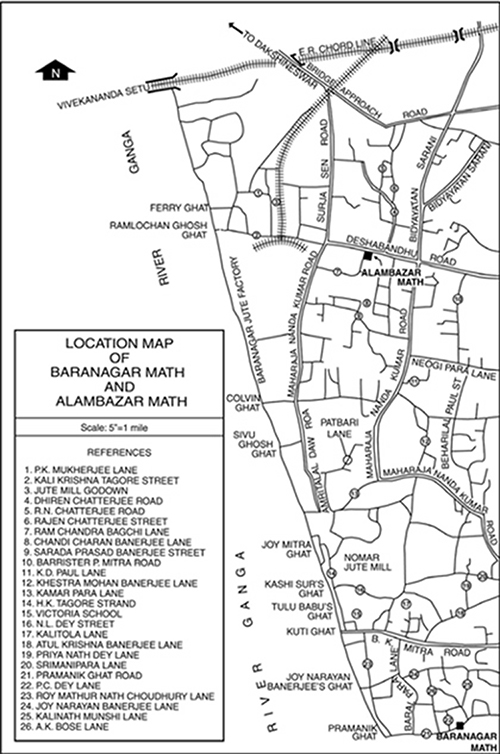
Baranagore Math and Alambazar Math Location Map
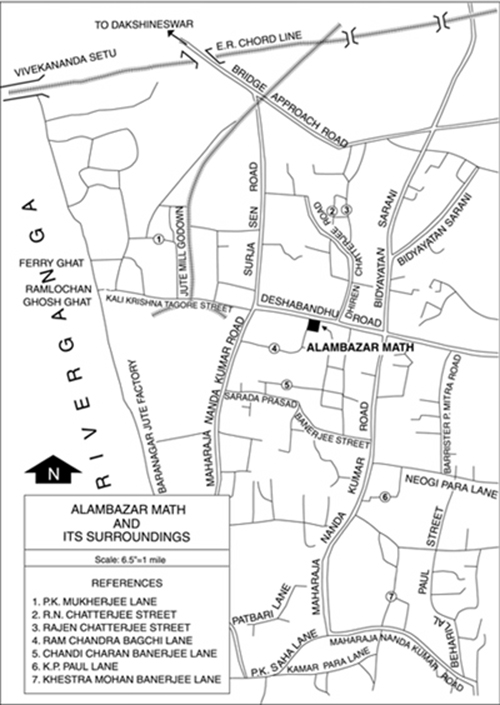
Alambazar Math and its surroundings -- Map
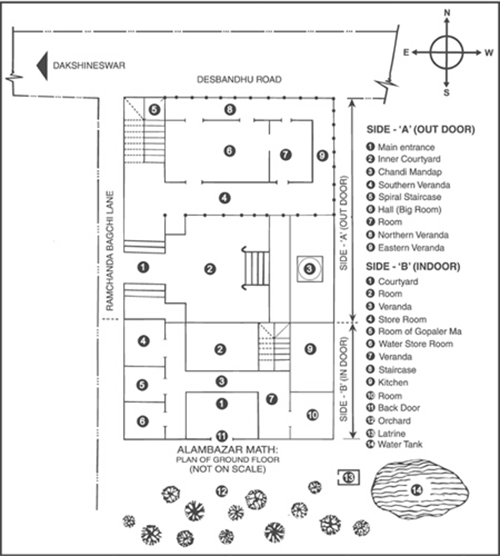
Alambazar Math -- Plan of Ground Floor
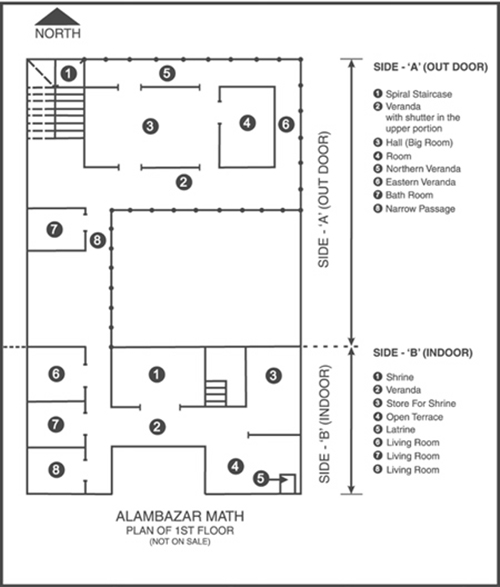
Alambazar Math -- Plan of First Floor
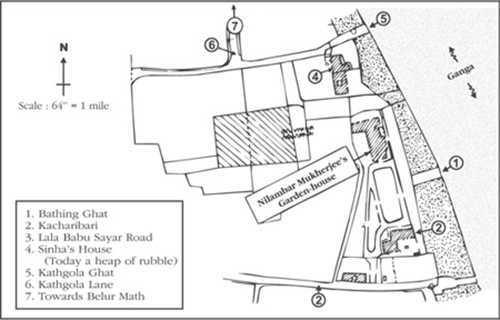
Nilambar Mukherjee’s Garden House -- Map
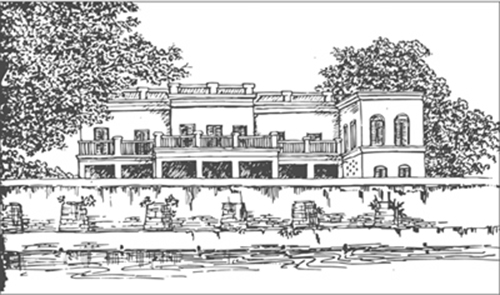
Nilambar Mukherjee’s Garden House Front View Sketch
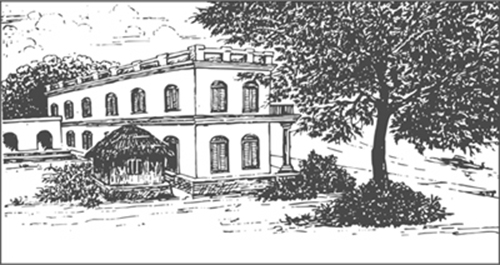
Nilambar Mukherjee’s Garden House -- Sketch of the probable location of the thatched cottage used
as Shrine
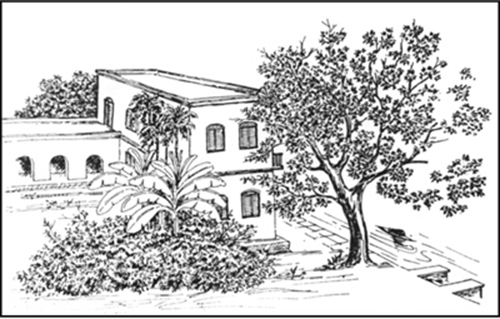
Nilambar Mukherjee’s Garden House as it probably looked in 1893 when the Holy Mother stayed --
Sketch
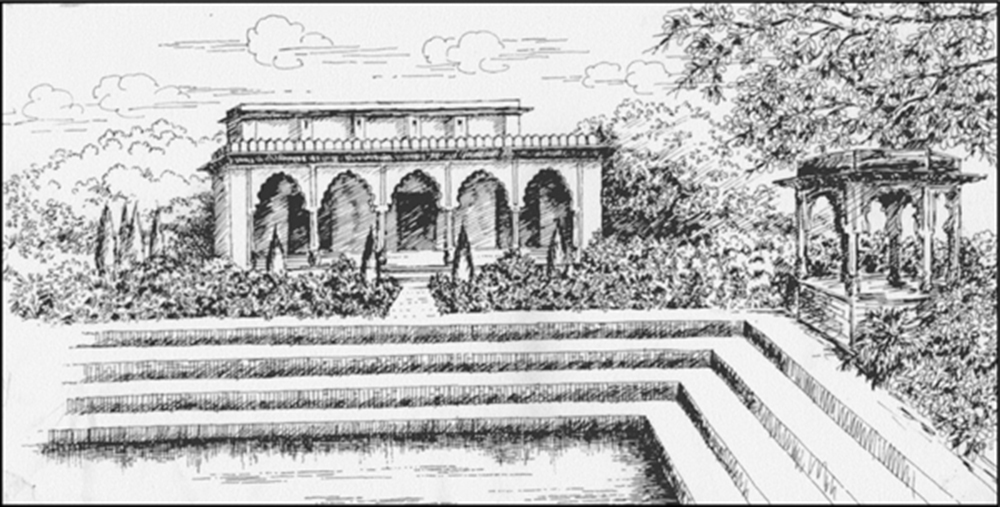
Sethji’s Garden House at Meerut with Pond -- Sketch
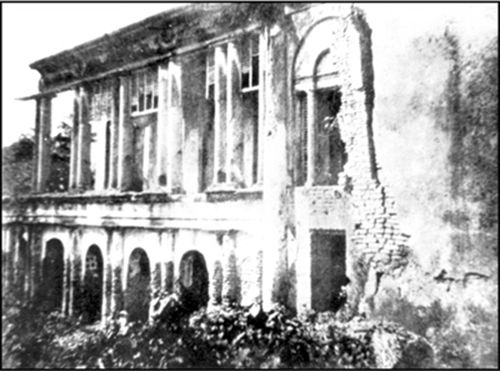
Baranagore Monastery
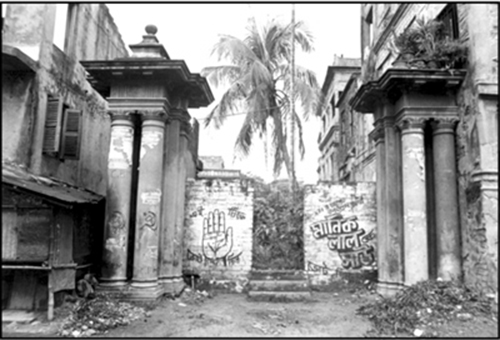
Baranagore Monastery Gate—only physical remnants—the Pillars
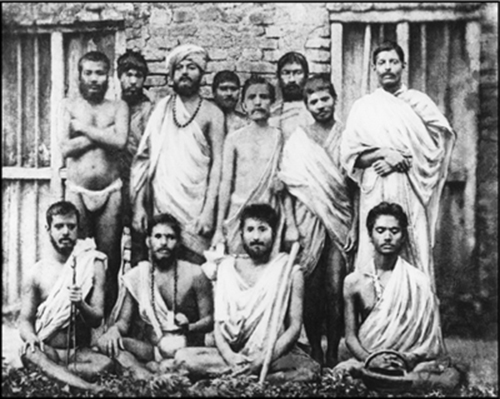
Baranagore Math -- Group Photo
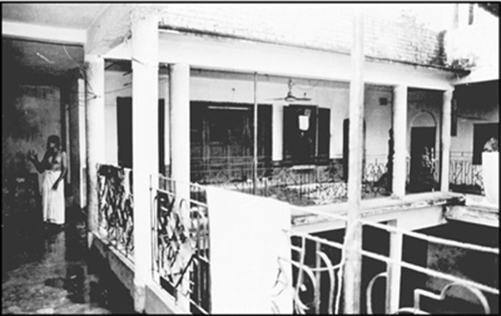
Alambazar Math—Shrine on First Floor
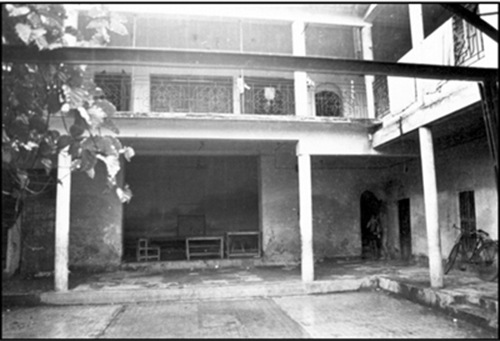
Alambazar Math -- Inside the Inner Courtyard
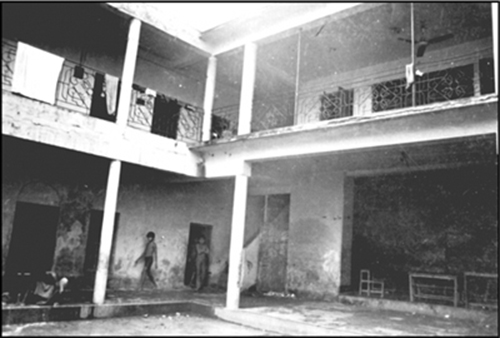
Alambazar Math—First Floor left side westernmost room used by Swami Ramakrishnananda
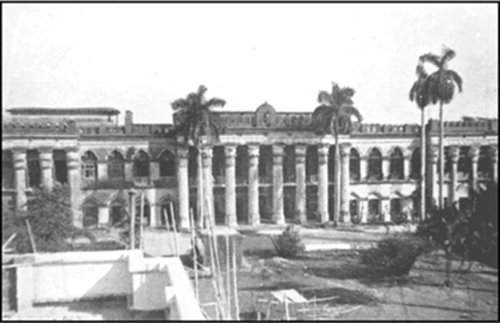
Pashupati Bose’s House
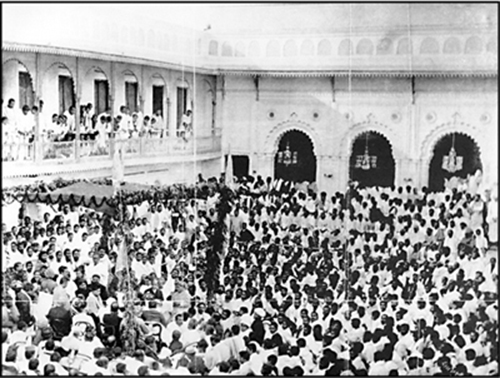
Shobhabazar Rajbati.. Swamiji’s Reception view
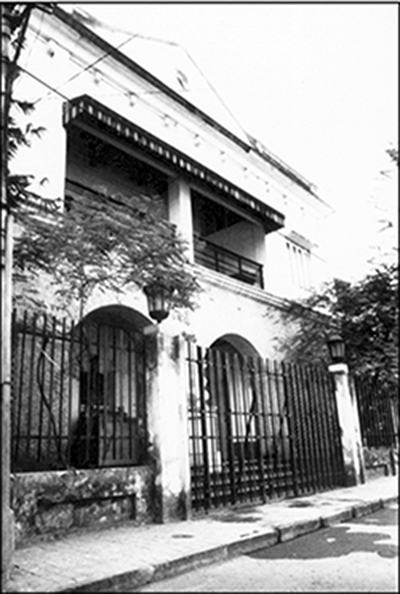
Gopal lal Seal’s House -- present view
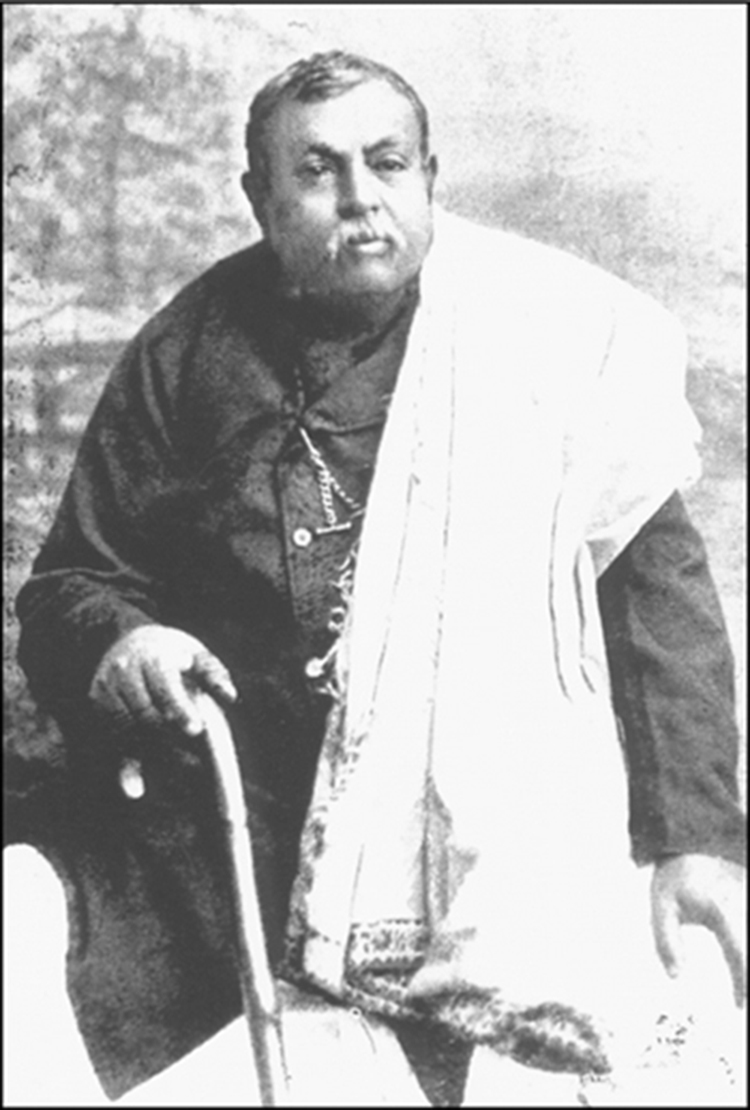
Dr Trailokyanath Ghosh
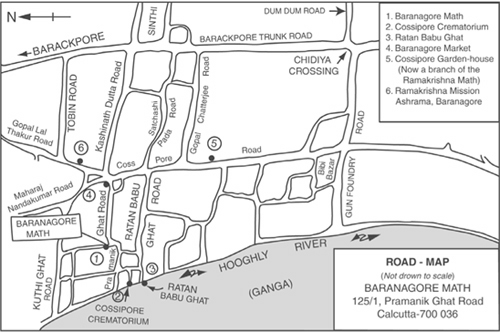
Baranagore Math -- Road Map
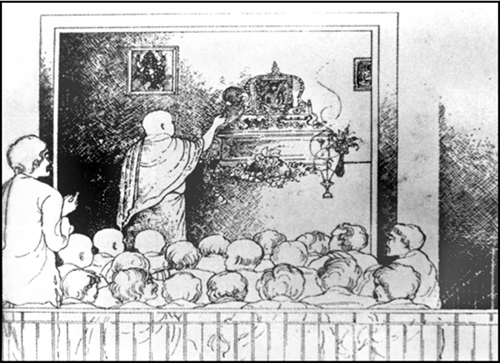
Alambazar Math: Aratrikam by Swami Ramakrishnananda --- Sketch
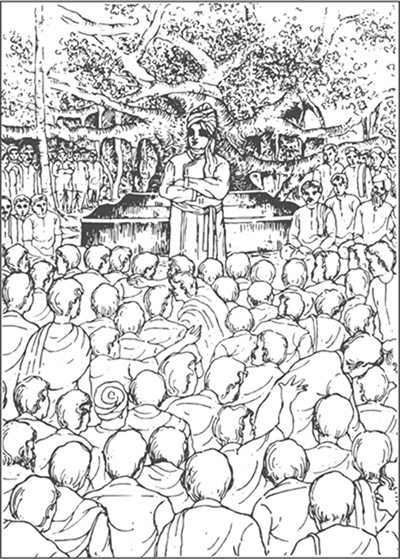
Swamiji Speaking on SRK Janmotsava at Dakshineswar --- Sketch
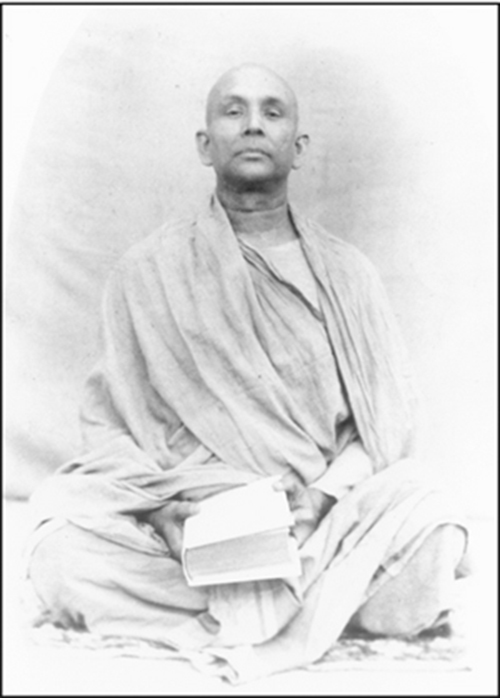
Swamiji Speaking on SRK Janmotsava at Dakshineswar --- Sketch
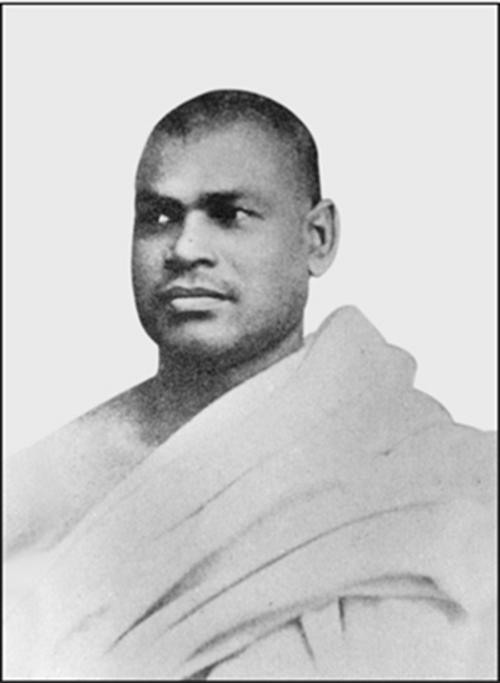
Swami Ramkrishnananda The first Priest of Alambazar Math
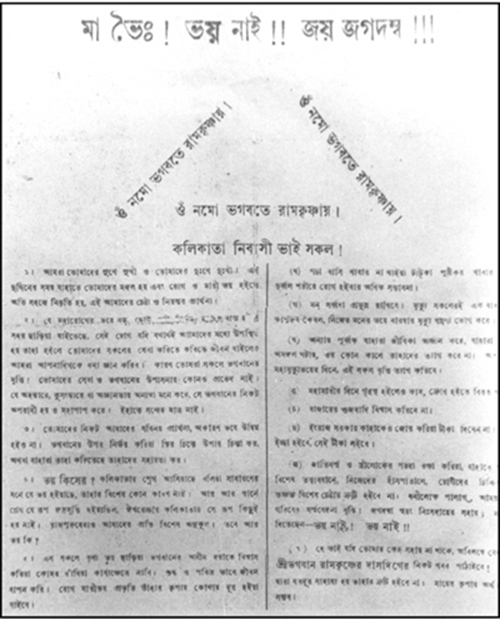
First Campaign Leaflet of Ramakrishna Mission of Plague Relief Work
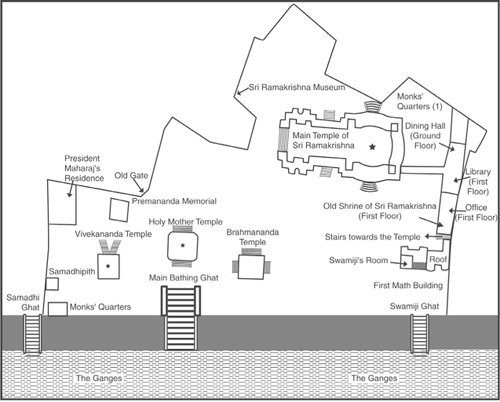
Map of Belur Math campus
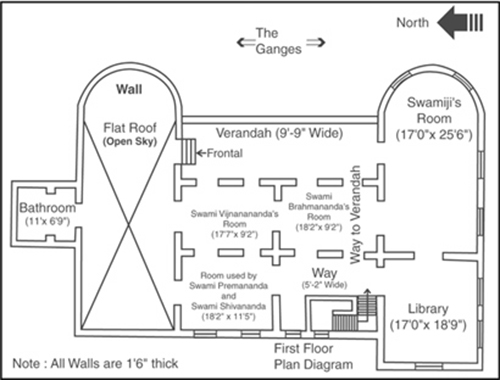
Sketch Diagram of First Floor of Belur Math Building (1899)
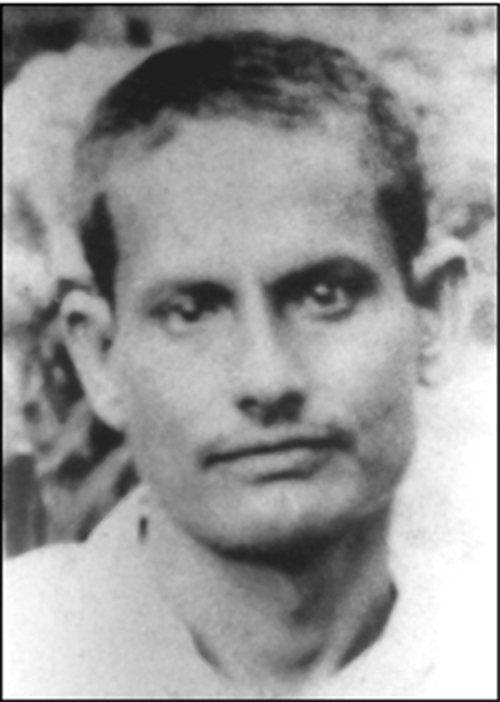
Swami Premananda -- the second Priest of Alambazar Math
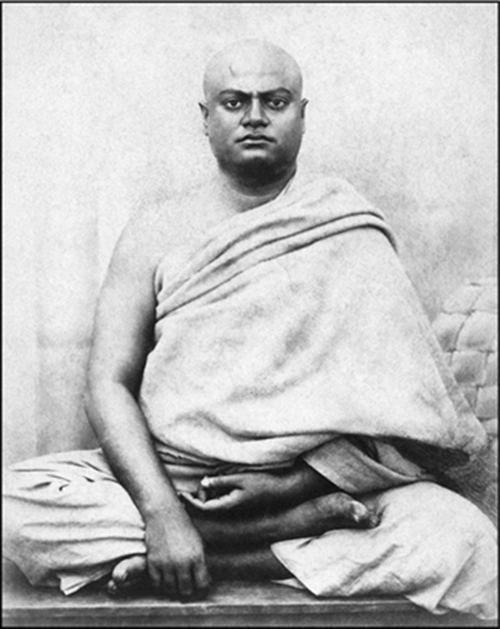
Swami Vivekananda at Alambazar Math (1897)
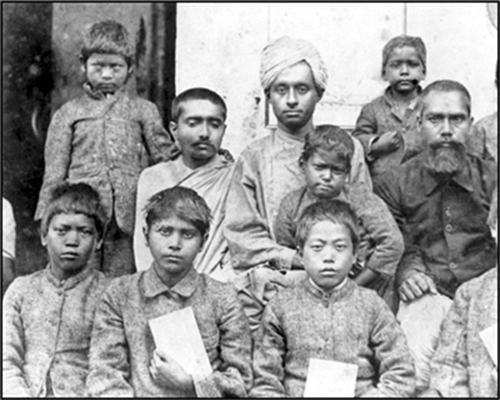
Swami Akhandananda with Orphan Boys at Sargachhi Ashrama
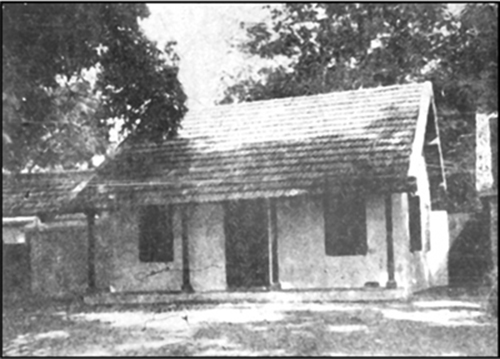
Madras Students’ Home at Keshab Perumal Koil Street
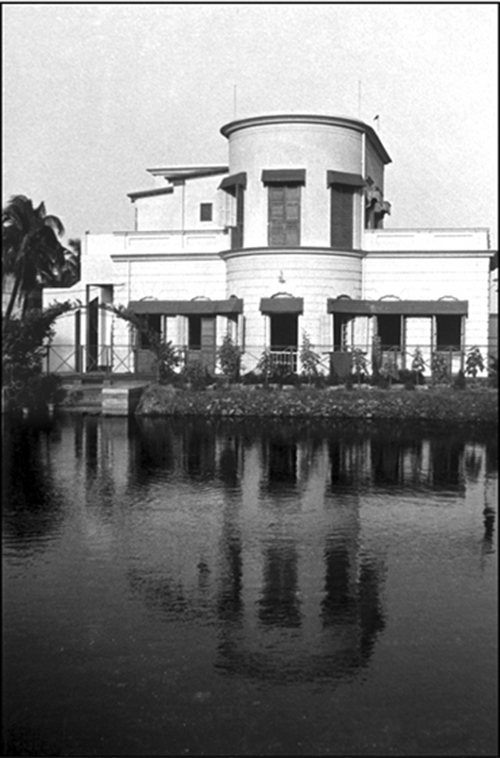
Cossipore Udyanbati
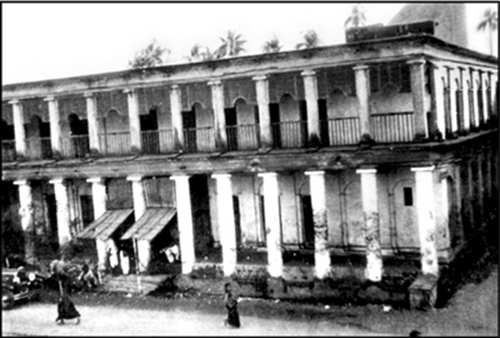
Alambazar Math (Old View)
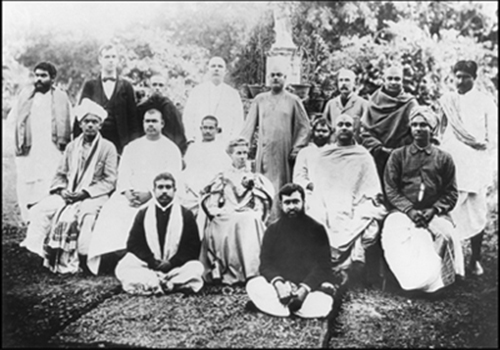
Group Photo at Gopal Lal Seal’s Garden House with Swamiji and some of his brother-monks and others
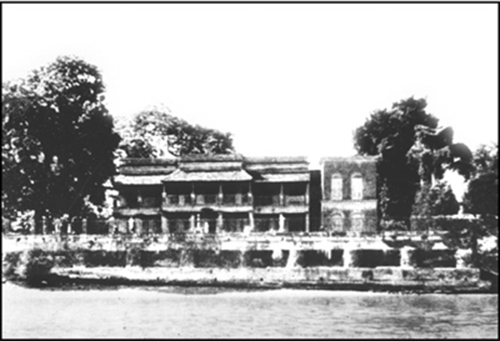
A 1940 Photograph of Nilambar Mukherjee’s Garden House
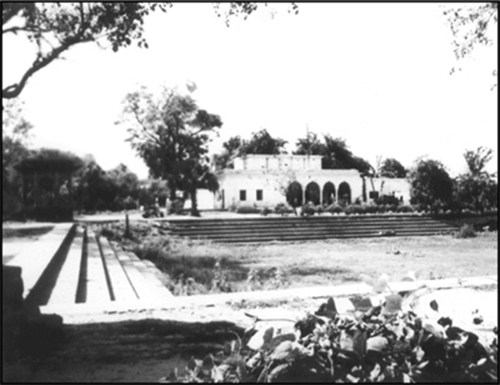
Sethji’s Garden House at Meerut with Pond
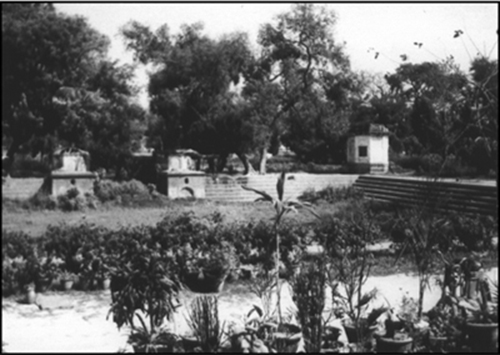
View of Pond adjoining Sethji’s Garden House at Meerut
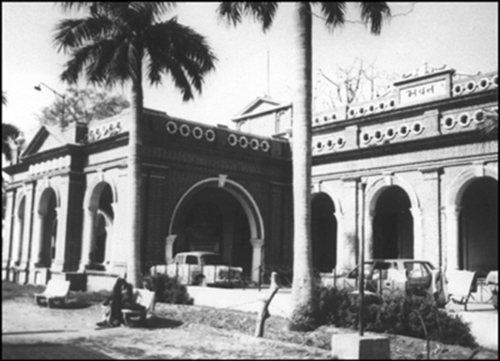
Layola Library at Meerut
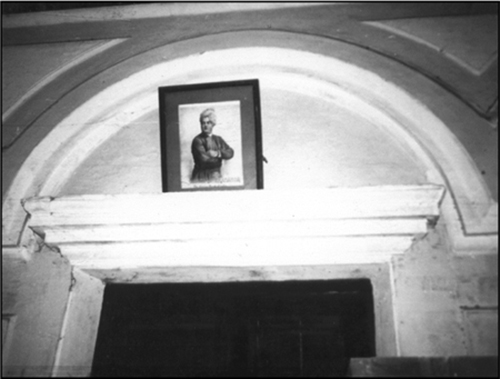
Present view of Layola Library at Meerut showing a photograph of Swami Vivekananda
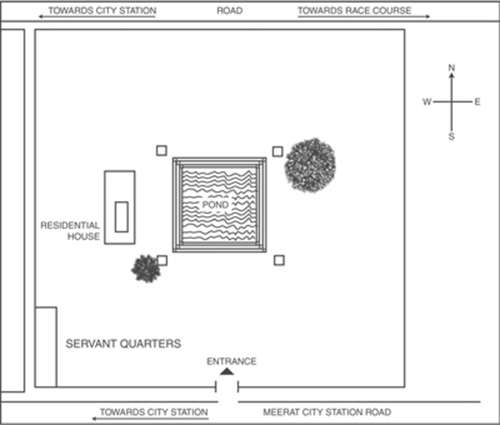
Site sketch of Sethji’s Garden House at Meerut
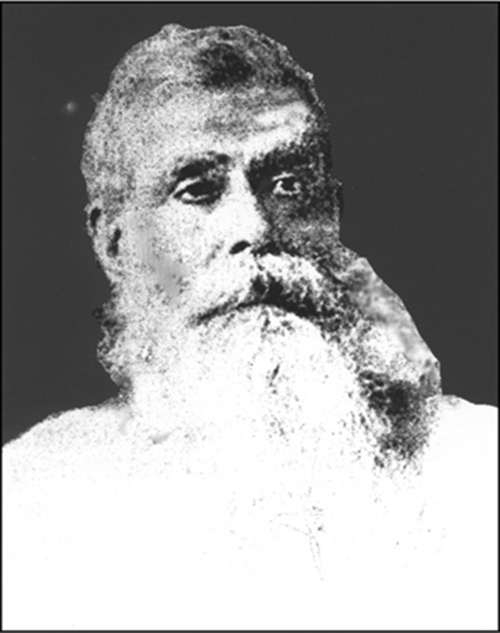
Portrait of Nilambar Mukherjee
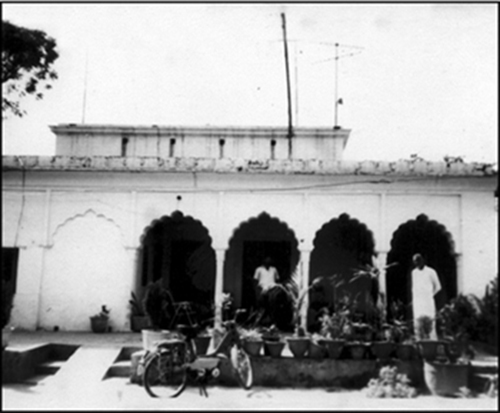
Front View of the building in Sethji’s Garden House (Meerut) where Swamiji and his brother disciples
lived
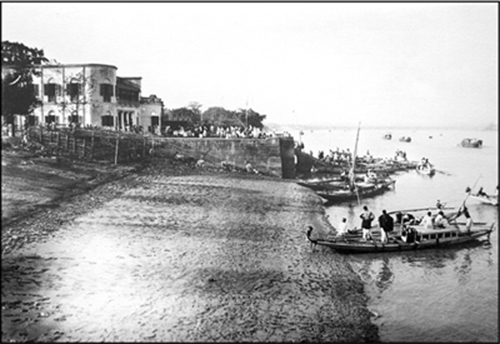
Swamiji’s House at Belur Math Courtesy: Swami Chetanananda
The Beginning of Organized Service
From the perspective of one hundred years as one looks back at the beginning of the organized humanitarian service under the banner of the Ramakrishna Mission, one is amazed at the dramatic elements associated with a matter-of-fact incident. Quite unaware of the founding of the Ramakrishna Mission on 1 May 1897, the wandering monk, Swami Akhandananda, staff in hand was roaming from village to village in the district of Murshidabad but became arrested by the sight of the appalling misery of the famine stricken people there. He sought the advice of his fellow sannyasins. All but Swami Vivekananda tried to dissuade him from venturing into any project to help the large number of famished people. But the moment Swami Vivekananda heard of his fellow sannyasin’s dilemma, he inspired him to initiate a service programme. Strengthened by two monastic hands, a small purse and the letter Swamiji sent him, Swami Akhandananda started famine relief work on 15 May 1897. Thus, for the first time since Buddha, organised monasticism was in the field of performing various works fired by the tradition of selfless service. As a collateral result of the relief operations, Swami Akhandananda organized an orphanage in November 1897.
Meanwhile, Swami Trigunatitananda had organized a famine relief center at Birole in Dinajpur on 15 August. Swami Virajananda had gone to Deoghar in Bihar to distribute powdered maize and salt among the famine-stricken and Swami Prakashananda doled out rice to the starving people of Dakshineswar for three months. The District Magistrate of Murshidabad, Mr. Levinge, the District Magistrate of Dinajpur, Mr. Bonham Caster, Deputy Commissioner of Baidyanath and the local people praised the Mission in public meetings. A happy Swami Vivekananda observed in his letter dated 15 June 1897, ‘This is indeed worship, worship of the Lord in the human tabernacle. Nedam Yadidamupasate—“not this that people worship.” This is the beginning, and unless we spread over the whole of India, nay, the whole earth, in that way, where lies the greatness of our Lord!’ and ‘You will see that the work will gradually become permanent, and the spread of religion and education will follow as a matter of course.’ In a short time, the Mission’s relief service drew the attention of people from various strata. True to Swamiji’s words, the monks of the Mission ‘no longer had to argue to the people that “Ramakrishna is God.”’[224].
Preaching Work
Despite his poor health and the resulting medical advice that ‘he must have six months’ brain-rest and strict dieting,’[225].Swamiji paid as much attention to preaching work as to organizing administrative activities and spiritual ministration. Before he left for Almora on 6 May 1897, he lectured at the Star Theatre on The Vedanta in All Its Aspects on 4 March. After resting at Almora, he gave two lectures there. Thereafter, he visited Amritsar, Dharmasala, Rawalpindi, Mussourie, Baramula, Srinagar, Jammu, Sialkot, Dehradun, Delhi, Alwar, Khetri, Ajmer, Jodhpur, Indore and Khandwa and finally reached Calcutta. In most of these places, responding to public receptions, he gave public lectures in English and Hindi and spent hours in informal parlour talks. He gave as many as three important lectures at Lahore. Interestingly, in this second phase of his lecture campaign, his lectures were more numerous than those in the first phase. This whirlwind tour turned out to be virtually the end of his lecture campaign in India. Though to some, his lecture on Vedanta at Lahore was considered his best of the tour. ‘Swamiji’s knowledge is not reflected so truly in lectures as in his conversations’[226].Though his plan of starting centres at Dehradun and Almora, and in Punjab and Kashmir did not materialize at that time, the Vedantic thoughts he spread there were not in vain. These lectures and group conversations apart, Swamiji went on inspiring people through his letters, articles published in journals, and so forth. Swami Saradananda and Swami Abhedananda were engaged in preaching work in America and Europe; Swami Ramakrishnananda and Swami Shivananda were preaching at Madras and Colombo respectively. However, the response to his fund drive for his projects was rather disappointing.
Land for the Hub of the Ramakrishna Movement
Till he reached Calcutta, he wrote to his fellow monks persistently urging them to procure two plots of land, one for a monastery and another for a convent; but nothing materialized. On his return, procurement of a suitable plot of land received topmost priority on his agenda. Swamiji’s choice was a site on the Eastern bank of the Ganga, not far from Dakshineswar. We have previously discussed the strenuous efforts of Swami Brahmananda, Swami Yogananda and others. No suitable site could be located. By way of illustration, we mention here one interesting attempt: Swami Yogananda’s choice fell on the two-storied house of Balaram Bose at Baghbazar, said to have been sanctified by approximately one hundred visits by Sri Ramakrishna. On 2 September 1891, Swamiji wrote Swami Brahmananda, ‘Yogen tells me in a letter to buy the house of Hariballavbabu at Bhaghbazar[227]. which is going to be sold at Rs.20,000/-. Even if we buy that house, there are still a lot of difficulties; for example, we shall have to break it down in part and make the drawing room into a big hall, and similar alterations and repairs. Moreover the house is very old and ramshackle. However, consult Girish Babu and Atul and do what you decide to be best’[228].For several reasons, this attempt, too, proved to be abortive.
The need to procure a house on a suitable plot of land became compelling for several reasons. First, the number of residents of the Alambazar Math had increased considerably; and the Math authorities were already searching for a house with larger accommodations. Second, the English and American devotees had offered money for land and building costs for a central math on a permanent footing. Third, worry for Swamiji’s ill health strongly suggested that land and a building should be procured as early as possible. The fourth and deciding reason was the terrible earthquake on 12 June l897, which damaged a part of the Math building. The upper part of the building in front of the Math collapsed. Almost every house in Calcutta was damaged to some extent[229]. A portion of the recorded experiences of one of the Math residents reads: ‘On a similar occasion[230]. at the Alambazar Math, when Swami Subodhananda began to speak, a frightening earthquake occurred, which devastated Bengal and Assam. All the monastics ran out to the street, except some who rushed to help Rakhal Maharaj, who at that time was violently tottering, move to the street. On all sides it appeared as if things were oscillating and falling, and that underfoot the ground was giving way. The upper part of the stout pillars of the big house across the street began crumbling to pieces. When all had gone out it was Tulsi Maharaj who emerged, holding firmly against his chest the photograph of Sri Ramakrishna which was daily worshipped and the casket containing his relics, he began rocking back and forth in the inner rectangular courtyard of the building, chanting, “Jaya Ramakrishna.” When the tremors stopped, we returned to find him in that position. After this incident, we would tease Swami Subodhananda, saying, “Maharaj, how powerful was your speech! The moment you stood up to talk, the entire earth began to quiver!” He would simply laugh’[231].Consequently, relocating the Math to a safer place became unavoidable.
Since no suitable site could be found on the eastern bank of the Ganga, the choice finally fell on the site at Belur, on the western bank of the Ganga. The Math authorities entered into an agreement with the owner of the land, Bhagavat Narain Singh of Patna. It was executed on 3 February 1898 by paying Rs.l001/-. In those days, the land belonged to Krishnachandrapur mouza in the district of Hooghly. Earlier, in the middle of December 1897, Swami Premananda had written his brother disciple Hariprasanna Chattopadhyay (later Swami Vijnanananda), ‘Soon an agreement is going to be executed for purchasing a plot of land on the other bank of the Ganga…We wish that you come here soon’[232]. To develop this uneven plot of land and to construct houses for the monastery, it became imperative to rent Nilambar Mukherjee’s garden house close to the site. Between this garden house and the new Math site, there were several other garden houses and one ravine, crossed by a dubious plank made out of half of the stem of a palm tree[233]. The Math was moved to Nilambar Mukherjee’s garden house on 13 February 1898.
The Math’s Financial Worries
The respite from financial hardship during Swamiji’s stay at Calcutta and Alambazar, although short-lived, is worth mentioning. As Swamiji left for Almora on 6 May, the temporary flow of financial contributions dried up. On the other hand, the number of monks had increased considerably during this period. Hariprasanna Chattopadhyay (then Brahmachari Vijnanananda) had joined the Alambazar Math in the early part of May 1897[234]and his monthly remittance of Rs. 60/- was no longer available. For more than a decade, the Math had just scraped along on what Swami Ramakrishnananda could procure, particularly after the passing away of Balaram Bose and Surendranath Mitra. Now, the Swami was not there to lend his experience. As a result, the overall situation became one of hardship and uncertainty. The Math authorities’ predicament can be inferred from Swami Premananda’s letter dated 9 May 1897 addressed to Swami Ramakrishnananda. He wrote, ‘Received an order [of Swamiji] from Almora yesterday that the Math is to be run by begging.’
As he became aware of the Math’s financial stringency, Swamiji himself tried to extend a helping hand. Let us cite a few illustrations. He wrote Swami Brahmananda on 15 November I897 from Lahore, ‘Babu Nagendranath Gupta will collect subscriptions and donations from here and send them to the Math to meet expenses. Send him regular receipts. Let me know if you have received something from Murree, Rawalpindi, and Sialkot.’ In the same letter he wrote, ‘Pay attention to the economical use of money. Expenses for pilgrimage should be borne by individuals, and expenses in connection with preaching work will be the Math’s share’[235]. Another time, Swamiji sent Rs. 3,000/-, which he had received just before he left Khetri, to the Math through Swami Satchidananda and Swami Sadananda. It is evident that till Swamiji came to their rescue, the residents suffered during the interim period of a few months.
While the Alambazar Math was experiencing financial hardship, the Madras centre, with Swami Ramakrishnananda at its head, and Swami Sadananda, Swami Atmananda and Goodwin residing there,[236]was managing with the financial contribution of Rs. 100/-granted by Bhaskar Setupati (1873-1902), Raja of Ramnad.
Inexperienced in handling public money, the monks faced a strenuous task. Nevertheless, Swamiji’s guidance got them over several hurdles. With regard to the surplus in the famine relief fund, he advised, ‘Keep as a fund for some permanent work the balance of the money for any other purpose, and after giving the full accounts of the famine work, note down thus, “So much balance is left for some other good work.”’[237]
Swamiji had become anxious, sometimes impatient, to procure a suitable plot of land and a fund for a permanent Math. For instance, he wrote Swami Brahmananda on 30 November 1897, ‘Now, you must see to it that a Math and a centre in Calcutta are steadily established before everything else’[238]. Keeping the help for this project promised by several generous persons from America and England in view, a cautious Swamiji tried to relieve Swami Brahmananda of his mental tension when he wrote: ‘Even now money is floating on the waters, as it were...but it will surely come. When it comes, buildings, land, and a permanent fund—everything will come all right. But one can never rest assured until the chickens are hatched...After that I shall make a tour and shall certainly secure some money’[239]. How particular Swamiji was about the management of funds will be evident from the following excerpt of his letter addressed to Swami Brahmananda: ‘Be very careful about money matters; keep detailed accounts, and regarding money know for certain that one cannot rely even on one’s own father’[240].
True to the words of the Master, Swami Brahmananda efficiently managed the affairs of the Math in those difficult days. Recognizing his proficiency in the administration of the Math, Swamiji remarked, ‘You have shown great pluck; the work you have done these last eight or nine months does you great credit’[241].
Festivals during This Period
The most significant festival held during this period was the public celebration of Sri Ramakrishna’s birth anniversary, held at Dakshineswar with Swami Vivekananda as the cynosure of all eyes. We have discussed this event previously. Next in importance was Durgapuja. The Mother Goddess was worshipped in a picture by Swami Prakashananda and assisted by Brahmachari Suddhananda. Devotional music was an additional attraction. Swami Turiyananda read out the Candi for nine days, honouring scriptural injunctions. On the Mahastami day, fifty devotees partook of prasada.
Kalipuja was fixed for Sunday, 25 October 1897. On this occasion, instead of worshipping the Mother Goddess, Sri Ramakrishna was worshipped[242]. Swami Premananda performed the worship and Homa, attended by about thirty devotees. Devotional songs and fireworks were the special features of this festival.
The most striking festival was, however, the formal worship and Homa done in remembrance of the birthday of Holy Mother[243]. In the presence of ten householder devotees and Swami Yogananda, Swami Prakashananda performed the puja and Homa assisted by Brahmachari Bimal. It is not known, however, when the news of this ritualistic worship reached Holy Mother or what her reaction was.
A Mart of Joy
The residents of the Math were a distinguished lot in the sense that in the midst of hard austerities, serious spiritual practices, and the scarcity of bare necessities, they would, at times, indulge in merriment, fun, joking, witticisms, mimicry, storytelling, and so on. This joyousness was a characteristic they had inherited from their great Master. No doubt, as in many other fields, Narendranath captivated others by his talents. Goodwin and Kidi, two of Swamiji’s disciples, were simple and delightful and were full of fun. The monks, both seniors and juniors, used to joke with them; and they warmly responded.
Towards the end of 1897, Swami Virajananda had been sent to Deoghar to serve the famished there, where he organized a relief centre and distributed maize flour and salt among the starving people. After three months of hard labour, he returned to the Alambazar Math. The loving care of his host and the salubrity of Deoghar helped Swami Virajananda to add a few pounds to his own body. Most of the monks, individually or severally, greeted him with the words, ‘Gracious! Is this the look of a famine relief worker!’[244].
Now we mention an episode related to a senior member. Swami Premananda had succeeded Swami Ramakrishnananda as manager of the Math. The antebashis decided to celebrate the Swami’s birthday. Here is a brief description of the same from the pen of Swami Brahmananda, the President of the Calcutta branch of the Ramakrishna Mission. He wrote to Swami Ramakrishnananda on 3 December 1897, ‘Yesterday the birthday of the new Mohant (abbot) was celebrated with great eclat. He was persuaded to put on a silken cloth and cover the upper part of his body with a piece of velvet surge. In front a big woolen sitting carpet, a fairly large piece of plantain leaf with a heap of boiled rice and various kinds of curries thereupon was placed. Incense sticks were burning. As soon as he took his seat he was greeted by blowing a conch. When he was taking food some inmates began singing devotional songs to the accompaniment of khol and cymbals.’ Swamiji was on a tour to Rajasthan. Needless to say, this episode did not find a place in the Math’s weekly report sent to Swamiji.
The Installation of Sri Ramakrishna’s Portrait
Swami Vivekananda installed a portrait of Sri Ramakrishna attended with rituals only once; and it took place during this period. A disciple of Sri Ramakrishna, Nabagopal Ghosh, and his devoted wife had approached Swami Vivekananda to install a portrait of Sri Ramakrishna in their newly built shrine. Swami Vivekananda agreed. On the 6th of February in the morning, Swamiji and almost all the residents of the Alambazar Math left in three boats carrying with them two khols and a few pairs of cymbals. On their arrival at Ramakrishnapur Ghat, they found a carriage waiting. Swamiji did not ride in the carriage. Dressed in ochre Alkhalla, barefoot, and with turban on his head, he went walking singing the song, ‘Who art Thou laid on the lap of a poor Brahmin mother…’ playing on a khol. The devotees assembled there followed him, joining in the chorus. The procession advanced along the road with a large number of people standing on both sides, shouting ‘Victory to Ramakrishna!’ It was a remarkable sight indeed.
The procession was greeted at the entrance of Nabagopal’s house by the blowing of a conch, the ringing of bells and the clashing of cymbals. After resting for a while in the parlour, Swamiji went upstairs to see the small, newly constructed chapel with marble flooring. Swamiji was pleased to see a beautiful porcelain image of Sri Ramakrishna on a throne placed in the centre of the chapel and various materials for worship nicely arranged. On hearing Swamiji speaking highly of every arrangement, Nabagopal Babu’s wife, who was fanning Swamiji, observed, ‘What have we got to entitle us the privilege of worshipping Thakur (the Master) on a grand scale? What means and abilities have we?’ Swamiji replied jocosely, ‘Your Thakur never had in his fourteen generations such a marble-floored house to live in! He had his birth in a rural thatched cottage. He lived his days on different means. And if he does not live here so excellently served where else should he live?’ Everybody laughed heartily.
Now with his body besmeared with holy ashes, Swamiji took the priest’s seat. After meditating for some time, he began performing the ritualistic worship with Swami Prakashananda assisting him. Towards the end, Swami Prakashananda performed the Aratrika[245]. Worship over, Swamiji spontaneously composed extempore this mantra offering prostration before Bhagavan Sri Ramakrishna:
Sthapakaya ca dharmasya sarvadharma swarupine Avatara Varisthaya Ramakrishnaya te namah
(‘I bow down to Ramakrishna, who established the religion, embodying in himself the essence of all religions and being thus the foremost of divine Incarnations.’) All prostrated before Sri Ramakrishna with this mantra. Thereafter, Saratchandra, Swamiji’s disciple, recited a hymn[246].
Swamiji partook of the offerings and rested for some time. Later, he answered the ladies’ questions relating to their spiritual practices. Before he finally took leave, Swamiji, standing on the street, bowed to Nabagopal. ‘What do you do?’ cried out the latter and fell prostrate at Swamiji’s feet[247]. Swamiji returned to Balaram Bose’s house in a carriage,[248]leaving an indelible impression behind on the minds of the local people, particularly the members of Nabagopal Ghosh’s family.
The Site for a Permanent Math
As discussed, the severe tremors of the earthquake of 12 June 1897 forced the Math authorities to find a solution, preferably a permanent one, for housing the Math, which had already been declared the principal Math. The following portion of Swami Turiyananda’s letter dated 15 June 1897 addressed to Swami Akhandananda partly explains the urgency. He wrote, ‘Although no portion of the Math building has been razed to the ground several parts of the building have shown such bad cracks as to make it almost uninhabitable.’ Even before this, the monks, at Swamiji’s behest, were in search of a plot of land. The Gospel of the Holy Mother Sri Sarada Devi records a significant episode. Holy Mother said, ‘One day Naren came and said, “Mother, just now I offered one hundred and eight bel leaves to the Master, so that we could have a piece of land for the Math. That karma can never go without its fruit. One day it will certainly happen that way.”’[249]It came to pass some time in the last part of March[250]. Swamiji’s prayer was answered. A suitable site was finally selected on the western bank of the Ganga sometime in November 1897. [251].To facilitate the development of the uneven land and the construction of a building for a permanent Math, the establishment was moved from Alambazar to a rented two-storied garden house belonging to Nilambar Mukherjee on 13 February 1898 for about ten and a half months. Here, Math life was vibrant, vigorous and vivacious, in striking contrast to the quiescent and secluded life at the Baranagore Math. Nevertheless, it acted as a buffer between the Alambazar Math and the Belur Math, which was inaugurated on 2 January 1899.
Conclusion
When one looks back on the Alambazar period in the context of the more than one hundred year history of the Ramakrishna Movement, one cannot but be amazed. Further, if one analyses what took place during the six years of the Math’s existence at Alambazar, one finds that toward the end of the first five years, clouds had accumulated which blanketed the Math members’ mental firmament, attended, at times, with lightning and thunder. But during the last year, their hearts striving for self-emancipation, the clouds melted into rain, drenching the dry earth. The ground became fertile, as it were. Thereby, the Math got a new lease on life; development, like a few patches of green, sprouted.
Nonetheless, during this period the quiet flow of Math life as it had been for eleven years took a sudden turn. It became a fast moving current that threatened to carry away some of the monks’ cherished values and traditions. While some senior monks became alarmed and others faced baptism by fire, the young ones, in general, welcomed the turn, visualizing a golden future. In fact, the Alambazar Math, standing at the turning point of Math life, appears romantic.
In a year’s time, in answer to a question by a bright young monastic, Swamiji would be saying that the austerity of the Baranagore Math was a necessity and the vibrant, fast-moving Math life at Nilambar Mukherjee’s garden house too was unavoidable in carrying out the robust mission of Sri Ramakrishna. Consequently, several changes in the Math’s life style came about in format as well as content during the years at Alambazar. The following among them deserve our attention.
(a) Circumstances forced the monastic brotherhood to experiment with a change of leadership in the topmost rung. Swami Brahmananda, whose administrative ability was reckoned by no less a person than Sri Ramakrishna himself, had now to function temporarily as the executive head of the Alambazar Math. At that time, Swamiji had stayed away from Alambazar for reasons of health and preaching work. Swami Ramakrishnananda, who had fostered the Math for about eleven years at a stretch, had gone to Madras to organize a new centre there. Swami Saradananda, who would serve as the executive head of the Math and Mission for about thirty years, had gone to America to preach Vedanta. Under the circumstances, Swami Brahmananda had to hold the reins of the Math. Swamiji was quite happy to see his brother disciple, Swami Brahmananda, coming up.
(b) Public contributions, used for maintaining and developing the Math as well as for conducting relief operations, started pouring in. Maintaining the accounts properly and presenting them to the donors and the public in general gave the budding establishment valuable experience, which, in turn, helped to consolidate the strength of the Math.
(c) New centres were emerging here and there. The Alambazar Math, and subsequently the Belur Math, had to play the role of principal Math and later of headquarters of the Math and Mission branches. Daily routines and rules for streamlining Math life proven successful at the Alambazar Math were introduced in the branch centres. Thus, the branch centres effectively came under the control of one central authority.
(d) The monks had so far scrupulously kept themselves aloof from social issues. Now that they had taken up humanitarian services, interaction with society at large became inevitable which, in turn, had an impact on Math life.
(e) The ideal of neo-monasticism highlighting the service of ‘God in man,’ introduced by Swami Vivekananda, provoked various responses from the brotherhood. Most of the squabbling, however, died down, particularly after a series of successful relief operations in several places. Thereafter, the ‘Service of God in man’ was accepted as a wholesome spiritual discipline and became a characteristic of the Ramakrishna Order.
Thus, the last year of the Alambazar Math portended the new pattern that the monastics’ lives were going to adapt themselves to at Nilambar Mukherjee’s garden house as well as at the Belur Math in the early years.
The Ramakrishna Movement emanated from Dakshineswar, passed through Baghbazar (Balaram Bose’s house), Shyampukur, Cossipore, and Baranagore till it reached Alambazar. It continued there for about six years. During the last year, however, the movement went through a transition. Additionally, circumstances prompted the authorities to move the Math to the village of Belur on the other bank of the Ganga. A powerful vortex was created when Swami Vivekananda formally installed Sri Ramakrishna on Math land. This vortex gradually developed into the hub of the Ramakrishna movement. Belur Math became the Gangotri of the Ramakrishna Bhavaganga.
ⓘ
[1]*Those who dwell in the proximity of the source of inspiration and spiritual wisdom
[2]Swami Shraddhananda, The Story of an Epoch, 1982, p. 36. As one walks along the public road today, the distance is more than 1.5 kms.
[3]Ramlochan Ghosh had purchased the big house belonging to Warren Hastings, which was almost in ruins. By its side, Ramlochan constructed twelve Siva temples and a large bathing ghat leading to the Ganga. The road from this point is popularly known as Lochan Ghosh Ghat Road. (Ajit Sen, Anchalik Itihas, Baranagore, Part III, p. 52.)
[4]M., The Gospel of Sri Ramakrishna, (tr. Swami Nikhilananda), New York Edition, p. 235.
[5]The present addresses of these houses are: House of Kaviraj Ishan Mazumdar: 123, Rajkumar Mukherjee Road, Calcutta 35, house of Bhagavat Pandit: 6/I Deshabandhu Road, Calcutta-35. Oil Mill belonging to Natabar Panja (not in existence now): 113, Surya Sen Road, Calcutta-35. Garden house of Sambhucharan Mallick: 96 Surya Sen Road, Calcutta-35.
[6]Swami Shivananda’s letter dated 6 May 1892 addressed to Sri Pramadadas Mitra of Varanasi.
[7]Udbodhan (Bengali), Vol. 52, No. 9, p. 454.
[8]It was established in 1968.
[9]This description is based on the reminiscences of Swami Abhedananda, Swami Akhandananda, Swami Virajananda and Sri Mahendranath Dutta and also on spot inspection by the author. The author is grateful to Swami Bhadreshananda, head of Sri Ramakrishna Satyananda Alambazar Math, for his help.
[10]Ajit Sen, Anchalik Itihas, Baranagore, Part Ill (Bengali) 1990, pp. 37-39.
[11]L. S. S. O’Malley, District Gazette, 24-Parganas, p. 215.
[12]Dr. Prajnananda Banerjee, Calcutta and Its Hinterland (1833-1900), 1875, p. 78.
[13]Samiksha Parishad, Baranagore Itihas O Samiksha (Bengali), pp. 87-93.
[14]Anchalik Itihas, Baranagore (Bengali), Part III, p. 58.
[15]Swami Ashokananda, Swami Premananda, 1970, p. 17.
[16]Swami Purnatmananda (ed.), Smritir Aloy Swamiji, (Bengali), 1990, p. 63.
[17]Thomas F. O’Dea & Janet O’Dea, The Sociology of Religion, 2nd edition, p. 25.
[18]Thomas F. O’Dea & Janet O’Dea, The Sociology of Religion, 2nd edition,p. 39.
[19]Ronald L. Johnstone, Religion in Society, 3rd edition, p. 57.
[20]In his letter dated 14 February 1898, he wrote to P. D. Mitra, ‘Swami Vivekananda sent me to Sri Lanka for propagating Vedanta. There I stayed for seven months and I returned here three or four days back.’
[21]Swamiji wrote in a letter, ‘Niranjan has done much work in Ceylon and elsewhere.’ (The Complete Works of Swami Vivekananda, Vol. VI, p. 325).
[22]Swami Saradananda’s letter dated 26.10.1892 may be referred to.
[23]Banshidhar Dutta (1210-1286 B.S.) was born at Baranagore. He worked very hard in selling spices on a large scale. He utilised his surplus income in establishing temples in different holy places and in purchasing a house in Sonapura in Varanasi wherein he installed Lord Siva.
[24]See Swami Akhandananda’s letter dated 9.7.1894.
[25]See Swami Premananda’s letter of May 1897 to Swami Ramakrishnananda. Swamiji in his letter dated 20.6.1897 wrote, ‘One of my boys in training has been an executive engineer, in charge of a district. That means a big position here. He gave it up like a straw.’ (The Complete Works of Swami Vivekananda, Vol. VIII, p. 406).
[26]Udbodhan (Bengali), Vol. 52, No. II, p. 576.
[27]Sri Sri Latu Maharajer Smritikatha (Bengali), p. 286.
[28]The Complete Works of Swami Vivekananda, Vol. VIII, p. 348.
[29]The Complete Works of Swami Vivekananda, Vol. VII, pp. 477-78.
[30]cf. Advised Jesus Christ, ‘Go therefore and make disciples of all nations...teaching them to observe all things whatsoever I have commanded you.’ (Matthew 28: 19-20).
[31]Tulsi (Swami Nirmalananda) joined the Baranagore Math probably sometime in the summer of 1887. (The Life of Swami Vivekananda, His Eastern and Western Disciples, Vol. I, 6th ed., p.197) whereas Gupta (Swami Sadananda) joined the Math in the last part of 1888 or early 1889. (Swami Gambhirananda, Yuganayak Vivekananda, (Bengali), Vol. 1, 2nd ed., p. 242.)
[32]The widower Yogendranath Chattopadhyay was of great help to the monastery. The brotherhood objected to his accepting the life of sannyasa. However, Swamiji overruled them.
[33]Udbodhan (Bengali), Vol.29, No.7, pp. 392-93.
[34]Swami Akhandananda, Smritikatha (Bengali), p. 169.
[35]Reserving a seat in a hotel at Calcutta, Dr. Turnbull used to visit the Alambazar Math for 3 to 4 hours daily. As he wanted to live in a place close to the Math, he was admitted as a guest of Raibahadur Prasanna Banerjee of Ariadaha. Thereafter he used to visit the Math from 10 a.m. to the end of evening prayer. He sailed for America a few months after Swamiji’s return to Calcutta.
[36]Swami Virajananda observed, ‘Goodwin attended on Swamiji throughout the day like a shadow. His service was exemplary. A young man of childlike simplicity, he had endeared himself to all by his jovial nature, jokes, laughter, games, and childish activities.’
[37]On 14.5.1894, Anagarika Dharmapala’s public address on Hinduism in America and Swami Vivekananda created a stir among Swamiji’s admirers and friends.
[38].Udbodhan. Vol. 29. No.7, p. 391.
[39]A resident of Rajballavpara, he and his brother Priyanath Mukhopadhyay owned a flourmill and an oil mill. Mahendra would sometimes send provisions to the Math. After his passing away, his widow would send offerings to the Master.
[40]Swami Akhandananda, From Holy Wanderings to Service of God in Man, 1979, p. 85.
[41]The financial condition of the Math showed some improvement from the beginning of 1895 and not earlier, as has been claimed by the author.
[42]Srimat Vivekananda Swamijir Jivaner Ghatanabali, (Bengali), Vol. III, 1384 B.Y., p. 32.
[43]Srimat Vivekananda Swamijir Jivaner Ghatanabali, (Bengali),, Vol. II, 1384 B. Y., p. 145.
[44]The Complete Works of Swami Vivekananda, Vol. VI, p. 333.
[45]Swami Vivekananda, Patrabali, (Bengali), 4th ed., p. 416.
[46]Mahendranath Dutta, Mahapurush Srimat Swami Shivananda Maharajer Anudhyan, (Bengali), 1374 B.Y., p. 85.
[47]Service of God in Man, 1979, p. 85-86.
[48]Swami Avedananda, My Life Story, 1970, p. 174.
[49]Service of God in Man, 1979, p.132.
[50]Patrabali, p. 194.
[51]Swami Turiyananda’s letter dated 4 January 1896, addressed to Harimohan.
[51].Swami Vividishananda, For Seekers of God, (1975), p. 206.
[52].Sri Sri Latu Maharajer Smritikatha, (Bengali), 2nd ed., p. 299.
[53].The Vedanta Kesari, August 1924, p. 131.
[55]Mahendranath Dutta, Vivekananda Swamijir Jivaner Ghatanabali, (Bengali), Vol. II, 4th ed., pp. 6-7.
[56]Udbodhan, Vol. XXIX, no. 7, p. 392.
[57]Partly from unpublished writings of Swami Virajananda and partly from a portion already published in Atiter Smriti (Bengali), pp. 82-83.
[58]Swami Jagadiswarananda, Sri Ramakrishnananda, 1355 B.Y., pp. 80-81.
[59].The Service of God in Man, pp. 101-104.
[60].Mahendraruith Dutta, Srimat Shivananda Maharajer Anudhyan, (Bengali), 1374 B.S., p. 86.
[61].The Complete Works of Swami Vivekananda, Vol. VI, p. 289.
[62]The Complete Works of Swami Vivekananda, Vol. VI, p. 312.
[63] Swami Vivekanander Patrabali (Bengali) (henceforth Patrabali) (Letters of Swami Vivekanana), p. 340.
[64].Once during his visit to Madras, Swami Brahmananda observed, ‘Sashi Maharaj’s influence in the South is like that of the world-conquering Sankara.’
[65]Swami Chetanananda (tr.), Spiritual Treasures, p. 126.
[66]Swami Turiyananda’s letter dated 24.10.1990.
[67]This refers to the special worship on the occasion of Sri Ramakrishna’s birthday. Sashi Maharaj used to perform it for about 24 hours on this occasion.
[68]The letter dated 25 February 1898 (The Complete Works of Swami Vivekananda, Vol. VIII, p. 444).
[69]The letter dated 25 February 1898 (The Complete Works of Swami Vivekananda, Vol. VI, p. 293.
[70]The letter dated 25 February 1898 (The Complete Works of Swami Vivekananda, Vol. VI, p. 335.
[71]Swami Abjajananda, Swamijir Padaprante, (Bengali), 4th ed., p. 168. A similar touching episode was narrated by an eyewitness, Swami Adbhutananda. He said, ‘Once Loren Bhai (Narendranath) while offering worship on the birthday of the Master took four to five hours in one sitting. Sashi Bhai (Swami Ramakrishnananda) was amazed. I learnt that Loren Bhai performed mental worship followed by meditation.’ (Sri Sri Latu Maharajer Smritikatha, p. 287).
[72]Swami Vividishananda, For Seekers of God, 1975, p. 143.
[73]Sudhir (later Swami Suddhananda) reminisced, ‘Once I spent the night of the Master’s birthday at the Math. Starting in the early morning, Swami Ramakrishnananda performed the worship for twenty-four hours.’ (see Swami Ramakrishnananda, p. 197).
[74]Swami Shivananda’s letter dated 6.5.1892 addressed to Pramadadas Mitra. (translated).
[75].Kuthi: The bungalow in the temple garden, where the proprietors and their guests stayed while visiting Dakshineswar.
[76]Swami Virajananda, My Life and Reminiscences, pp. 38 and 91.
[77]The Complete Works of Swami Vivekananda, Vol. VI, p. 318.
[78]Patrabali, p. 251.
[79]Patrabali, p. 205-6. (The Complete Works of Swami Vivekananda, Vol. VI, p. 279)
[80]In appreciation of the book, Swamiji wrote, ‘I cannot tell in words the joy I experienced by reading his book…I tell you Akshay’s book and Akshay himself must electrify the masses.’ (The Complete Works of Swami Vivekananda, Vol. VI, p. 336).
[81]Patrabali, p. 310.
[82]Patrabali, p. 311.
[83]Patrabali, p. 424 (The Complete Works of Swami Vivekananda, Vol. VI, pp. 357-58).
[84]Patrabali, p. 417 (The Complete Works of Swami Vivekananda, Vol. VI, p. 334).
[85]The Complete Works of Swami Vivekananda, Vol. VI, p. 334.
[86]Service of God in Man, p.106.
[87]The Complete Works of Swami Vivekananda, Vol. VI, p. 369.
[88]Swami Turiyananda’s letter dated 18.2.1896 addressed to Harimohan (translated).
[89]The Indian Mirror dated 7 March 1897 predicted: ’This year the celebration is likely to be on a grander scale than ever, in honour of Vivekananda.’
[90]The Vedanta Kesari, August 1924, p. 132.
[91]The Complete Works of Swami Vivekananda, Vol. VI, p. 467.
[92]The authorities of the Dakshineswar Kali temple were silent about Swami Vivekananda’s visit to the Kali temple on 7 February 1897. On 21 March 1897, Swamiji in the company of Raja Ajit Singh of Khetri, the Buddhist, Mr. Harrison, and several other monks visited the temple. Bholanath Mukherjee, cashier of the temple, took the visitors round the temples. One monk of the Alambazar Math and Mr. Harrison had gone earlier to see Trailokyanath Biswas at his residence at Janbazar. Curiously enough, Sri Biswas after Swamiji’s second visit announced in the newspaper that the temple authorities did not approve of the Swami’s visit to the temple.
[93]Ronald L. Johnstone, Religion in Society, 3rd ed., 1988, p. 54.
[94]Dr. Gerald B. Cooke, A Neo-Hindu Ashrama in South India, 1966, p. 47.
[95]Swami Shivananda’s introduction to Vivekananda Charit (Bengali) by Mahendranath Chowdhury was dated 10 Kartick 1326 B. Y.
[96]Life of Swami Vivekananda, Vol. I, p. 299.
[97]Free translation of a Bengali article by Swami Bodhananda (Udbodhan, Vol. 52, No. II, p. 575).
[98]Swami Virajananda’s notebook, p. 28.
[99]Swami Abhedananda, My Life Story, 1970, p.175.
[100]Mahendranath Dutta Srimat Shivananda Maharajer Anudhyan, (Bengali), 1375 B. Y., p. 97-98.
[101]The Gospel of Sri Ramakrishna, p. 279.
[102]Sri Sri Latu Maharajer Smritikatha (Bengali), 2nd ed., p. 300.
[103]Srimat Vivekananda Swamijir Jivaner Ghatanabali, Vol. III, 1384 B. Y., p. 28-29.
[104]Sri Ramakrishna’s nephew, who served him as his attendant for more than two decades. He was expelled from the temple garden at Dakshineswar by the temple authorities in June 1881.
[105].Srimat Vivekananda Swamijir Jivaner Ghatanabali, Vol. II, 1384 B. Y., pp. 45-46.
[106]Dinu was ordained a monk by Swami Saradananda in 1891 and named Swami Satchidananda. Except for Swami Advaitananda, he was, age-wise, the seniormost in the monastery.
[107]Mahendranath Dutta, Dinu Maharaj, (Bengali), 1362 B.Y., pp. 36-37.
[108]Swami Abhedananda, Amar Jivan Katha, (Bengali), pp. 173-74.
[109]Service of God in Man, pp. 96-97.
[110]Swami Gambhirananda observed, ‘This to her mind symbolized the future of the Ramakrishna Order. It was to save the world with the Master’s message.’ (History of Ramakrishna Math and Ramakrishna Mission, 3rd ed., p. 49).
[111]Sri Sri Mayer Padaprantey, Swami Purnatmananda (Bengali), Vol. II, pp. 276-77.
[112]Several letters of Swamiji of this period bear his signature as Bibekananda, Vivekananda, etc.
[113]According to Swami Bodhananda, Swamiji’s first letter addressed to Swami Ramakrishnananda was from Japan. It was received at the Math in August 1893. (The Vedanta Kesari, August 1924, p. 131).
[114]Swamiji in his letter dated 25 February 1898 wrote to Swami Ramakrishnananda: ‘I learn that you complain about my silence, is it? I have written you more letters, however, than you ever wrote me, from Europe and America even.’ (The Complete Works of Swami Vivekananda, Vol. VIII, p. 443).
[115]The Complete Works of Swami Vivekananda, Vol. VI, p. 293.
[116]The Complete Works of Swami Vivekananda, Vol. VI, p. 293.
[117]The Complete Works of Swami Vivekananda,Vol. VI, p. 358.
[118]The Complete Works of Swami Vivekananda,Vol. VI, p. 275.
[119]The Complete Works of Swami Vivekananda,Vol. VI, p. 256.
[120]The Complete Works of Swami Vivekananda, Vol. VI, p. 234.
[121]In 1894, Swamiji wrote, ‘I am an instrument, and He is the operator. Through this instrument He is rousing the religious instinct in the thousands of hearts in this far off country… I am amazed at His grace…Remember it is His will, I am a voice without a form.’ (The Complete Works of Swami Vivekananda, Vol. VI, p. 283).
[122]The Complete Works of Swami Vivekananda, Vol. VIII, p. 298.
[123]The Complete Works of Swami Vivekananda, Vol. VI, p. 276.
[124]He wrote: ‘The resolution would be of such a nature that the Hindu community of Madras, who sent me over, expressing its entire satisfaction in my works here, etc… We must stop their mouths as fast as we can.’ (The Complete Works of Swami Vivekananda, Vol. V, p. 32)
[125]Swamiji wrote them, ‘…and the Hindus of India too did nothing for me. I mean, if the Hindus of Calcutta or Madras had held a meeting and passed a resolution recognizing me as their representative, and thanking the American people for receiving me with kindness, things would have progressed appreciably. But it is over a year, and nothing done.’ (The Complete Works of Swami Vivekananda, Vol. VI, p. 264)
[126]Swami Akhandananda in his letter dated 4 November 1894 addressed to Pramadadas Mitra mentioned that a public meeting in Bombay was in the offing. He requested Mr. Mitra to send a letter of thanks in Sanskrit, to be signed by a host of Sanskrit scholars of Varanasi.
[127]Patrabali, p. 251. (translated)
[128]Swami Purnatmananda (Ed.), Sri Sri Mayer Padaprantey, (Bengali), Vol. I, p. 189.
[129]The Complete Works of Swami Vivekananda, Vol. V, p. 216.
[130]The Complete Works of Swami Vivekananda, Vol. VI, p. 306.
[131]The Complete Works of Swami Vivekananda, Vol. VI, p. 325.
[132]The Complete Works of Swami Vivekananda Vol. VI, p. 335 and Patrabali, p. 418.
[133]The Complete Works of Swami Vivekananda, Vol. V, p. 93.
[134]The Complete Works of Swami Vivekananda, Vol. VI, p. 277.
[135]The Complete Works of Swami Vivekananda,Vol. VI, pp. 325-26.
[136]The Service of God in Man, 1979, p. 87.
[137]The Complete Works of Swami Vivekananda, Vol. VII, p. 483.
[138]The Complete Works of Swami Vivekananda,Vol. VI, pp. 339-40.
[139]Swami Apurvananda, Mahapurush Shivananda (Bengali), 2nd. ed., p. 103.
[140]Patrabali, p. 275
[141]*The sacred remains of the Master, kept in a copper casket, were popularly referred to as ‘Sriji’ or ‘Atmaramer Kouta’ by the brotherhood.
[142]Vedanta Kesari, 1924, pp. 130-31 and p. 183.
[143]Swami Virajananda’s notebook, p. 97.
[144]Swami Turiyananda’s letter dated 20 November 1915 addressed to Swami Premananda.
[145]Vedanta Kesari, August 1924, p. 131.
[146]Sri Sri Latu Maharajer Smritikatha (Bengali), pp. 330, 305, and 336.
[147]*The baby Krishna with a hand stretched out for a sweet.
[148]Service of God in Man. pp. 109-10.
[149]Service of God in Man, p. 111.
[150]The Complete Works of Swami Vivekananda, Vol. VI, pp. 272-73.
[151]The Complete Works of Swami Vivekananda, Vol. V, p. 117.
[152]*J.J. Goodwin, Swamiji’s English disciple and stenographer
[153]Published in the January 1896 issue of The Imperial and Asiatic Quarterly Review and Oriental and Colonial Record.
[154]Sankari Prasad Basu, Vivekananda O Samakalin Bharatbarsa (Bengali), Vol. II, p. 118.
[155]The Complete Works of Swami Vivekananda, Vol. V, pp. 61-66.
[156]The Complete Works of Swami Vivekananda, Vol. VI, p. 341.
[157]Patrabali, 4th ed., p. 242.
[158]Swamiji had written to Justice Sir Subramanya Iyer: ‘Madras just now is following the golden mean by appreciating both the ancient and modern phases of life.’ (The Complete Works of Swami Vivekananda, Vol. IV, p. 370 and Patrabali, p. 271)
[159]Ramachandrer Vaktritavali (Bengali) published in two volumes.
[160]The Complete Works of Swami Vivekananda, Vol. VI, p. 325.
[161].The Complete Works of Swami Vivekananda, Vol. VII, p. 475.
[162]The Complete Works of Swami Vivekananda, Vol. VI, p. 290.
[163]The Complete Works of Swami Vivekananda, Vol. VI, p. 286.
[164]The Complete Works of Swami Vivekananda,Vol. VI, pp. 331-32.
[165]The Complete Works of Swami Vivekananda,Vol. VI, p. 340. In the same letter, the Swami wrote that he wanted to have three centers at New York, Calcutta and Madras to begin with.
[166]The Complete Works of Swami Vivekananda, Vol. VI, pp. 330-32 and Patrabali, pp. 413-15.
[167]The Complete Works of Swami Vivekananda,Vol. VII, p. 490.
[168]The Complete Works of Swami Vivekananda,Vol. VI, p. 316.
[169]The Complete Works of Swami Vivekananda, Vol. VI, p. 274.
[170]The Complete Works of Swami Vivekananda, Vol. VI, p. 274.
[171]Letters bearing Nos. 253 and 256 published in Patrabali, 4th ed..
[172]The Complete Works of Swami Vivekananda, Vol. VII, p. 479.
[173]Patrabali, p. 195.
[174]The Complete Works of Swami Vivekananda, Vol. VI, p. 318.
[175]Patrabali, p. 310.
[176]Patrabali, p. 195.
[177]The Complete Works of Swami Vivekananda, Vol. VI, p. 330.
[178]Patrabali, p. 449.
[179]The Complete Works of Swami Vivekananda, Vol. VI, p. 328.
[180]The Complete Works of Swami Vivekananda, Vol. VI, p. 330 and Patrabali, p. 413.
[181]The Life of Swami Vivekananda by His Eastern and Western Disciples, Vol.2, 1989, p. 242.
[182]The Complete Works of Swami Vivekananda, Vol. V, p.117.
[183]Swami Gambhirananda, Yuganayak Vivekananda, (Bengali), Vol. I, 2nd ed., p. 273.
[184]His address at the Ramakrishna Mission, New Delhi, reported in the Amrita Bazar Patrika of 26 November 1952.
[185]The Story of an Epoch, p. 61.
[186]Service of God in Man, p. 140.
[187]Service of God in Man, p. 143
[188]Letter (Bengali) dated May 1887 addressed to Swami Ramakrishnananda.
[189]Alasinga Perumal, G. G. Narsimhachariar (G.G.), P. Singarvelu Mudaliar (Kidi)
[190]The Story of an Epoch, p. 64
[191]Not in April as mentioned by Sarat Chandra Chakravarty. Swami Ramakrisbnananda was present on the occasion.
[192]Later they came to be known as Vimalananda, Suddhananda, Bodhananda and Atmananda, respectively
[193]Indian Mirror dated 23 March 1897 announced, ‘From the temple they came to Alambazar Math, where the Maharaja was presented with a welcome address by the friends of Swami Vivekananda.’
[194]Kumud Bandhu Sen claims it was the month of April 1897, but considering the recorded meeting of Swamiji with the Raja of Khetri at Calcutta, it should be March 1897.
[195]Prabuddha Bharata, October 1952, pp. 409-10.
[196]The Math diary shows that the new routine was introduced 7 May 1897.
[197]Swami Vivekananda Bani O Ranchana, (Bengali), Vol. IX, p. 343.
[198]The following is a typical Alambazar Math weekly report dispatched by Brahmachari Suddhananda on 25 July 1897:
“Om” 25th July, 1897, Alambazar Math
Revered and beloved Swamiji,
The following is the report of the last week
Reading for the public: Adyatma Ramayana (5 days) - Readers (a) Swami Turiyananda (4 days) and Swami Prakashananda (1 day).
Caitanya Caritamrita (1 day) Reader: Br. Suddhananda.
Private Study:
(a) Swami Virajananda - Raja Yoga with the help of Swami Turiyananda; also your Madras and other lectures and Caitanya Caritamrita.
(b) Swami Prakashananda - prepared his lecture on ‘Brahrnacharya’ and as a help to its preparation, read some portion of Manusamhita. He delivered it on Saturday last for about three quarters of an hour. He also read Adyatma Ramayana one day, also a part of Brahmavadin.
(c) Swami Nirbhayananda - read portions of the Bengal translation of Hitopadesha, also the Bengali translation of Upanishads (Isha, Kena, Katha, Prasna, Mundaka, Mandukya), also some of your lectures.
(d) Brahmachari Nanda - commited to mernory some words with declination from Vyakaran Kaumudi, and also read a little from Imitation of Christ and Bhagvata Gita, also some of your lectures (the lectures were explained to them).
(e) Brahmachari Bignanananda is studying Vedanta Sutra and has read up to the 5th Sutra.
(f) Brahmachari Suddhananda read Raja Yoga with the help of Swami Turiyananda. He also read as an aid a portion of Patanjala Darshana from Sarva Darshana Samgraha. He has done a rough Bengali translation of your lectures on Raja Yoga and will soon begin a Bengali translation of the Sutras and their commentaries.
Swami Virajananda finished reading Vicar of Wakefield in his leisure time.
Babu M. N. Gupta came on Saturday morning and the same evening read from his Gospel of Ramakrishna (Meeting with Babu Ishan Ch. Mukherjee).
The question class was held for two days as usual. The topics discussed were Bhakti: its nature, its division and sadhana; Jnana-its nature and sadhana, etc.
No visitor worthy of mention came. Those who came were either friends or acquaintances, including some young men.
Brahmachari Bimalananda had an attack of fever last week. He went to his house for a change after recovery on Sunday last and has not returned yet. He will return here soon. Br. Suddhananda and Br. Virajananda both went home on Sunday evening and returned the next evening.
I went to the Bagbazar meeting with Swamis Turiyananda and Nirmalananda. I showed your letter to Swami Brahmananda. He said that he would do as would seem necessary after going to the Math. He has not returned to the Math yet. Br. Suddhachaitanya has reached Madras. Swami Nityananda has returned from Mahula on Wednesday noon. He went to Baghbazar on Thursday morning to see Swami Brahmananda and returned next morning. The work at Mahula is going on as before. Swami Subodhananda went to Calcutta on Monday and returned on Thursday. From Wednesday last Brahrnachari Bignanananda is going to Dakshineswar every evening for meditation.
We had an excursion to Dakshineswar last Tuesday. We received a letter, some copies of Greenacre Voice and some programmes from Mrs. Elenor Hiscock of Greenacre, America and replied. From the programme we learn that Swami Saradananda will deliver 10 lectures on Vedanta, Samkhya and Yoga from August 2nd to Sept. 1st. He will also deliver a lecture on Indian Drama.*
We are all well. Our loving and reverential pranams to you and all there. ...
* Later included in his book Stray Thoughts on the Literature and Religion of India.
[199]The Complete Works of Swami Vivekananda, Vol. VII, p. 507.
[200]The Story of an Epoch, p. 64.
[201]Swami Vivekanander Bani O Rachana (Bengali), Vol. IX, p. 356.
[202]Swami Purnatmananda (Ed.), Smritir Aloy Swamiji (Bengali), pp. 46-47.
[203]The Complete Works of Swami Vivekananda, Vol. VI, p. 271.
[204]The Complete Works of Swami Vivekananda,Vol. VII, p. 509.
[205]The Complete Works of Swami Vivekananda, Vol. VII, p. 499.
[206]Mahabharata, 7·15·30.
[207]Gita, 6/10
[208]Life, Vol. II, p.243.
[209]Swami Virajananda’s notebook, pp. 92-93.
[210]The Complete Works of Swami Vivekananda, Vol. VI, p. 266.
[211]The Complete Works of Swami Vivekananda, Vol. VII, pp. 486-87.
[212]The Complete Works of Swami Vivekananda,Vol. VI, pp. 310-11.
[213]The Complete Works of Swami Vivekananda, Vol. VI, p. 395.
[214]Gospel, pp. 143-44.
[215]Swami Kalyanananda’s letter dated 17.10.1927, addressed to Swami Devananda.
[216]The Complete Works of Swami Vivekananda, Vol. VI, p. 477.
[217]History of the Ramakrishna Math and Ramakrishna Mission, Third Revised Edition, p. 95.
[218]The Complete Works of Swami Vivekananda, Vol. VII, p. 112.
[219]Letter addressed to Miss Margaret Noble.
[220]The Complete Works of Swami Vivekananda, Vol. V, p. 135.
[221]The Complete Works of Swami Vivekananda,Vol. VIII p. 420.
[222]The Complete Works of Swami Vivekananda, Vol. VII, pp. 495-9
[223]The Complete Works of Swami Vivekananda,Vol. VII, p. 492.
[224]The Complete Works of Swami Vivekananda, Vol. VI, p. 403.
[225]J.J. Goodwin’s letter dated 16.3.1897, addressed to Swami Saradananda.
[226]Prof. Tirtha Ram’s letter dated 16 November 1897 to Pandit Din Dayal Vyakhyara Vachaspati.
[227]The house at 57 Ramkanto Bose Street, originally purchased by Hariballav Bose, came to be known as ‘Balaram Bose’s house’ or ‘Balaram Mandir.’
[228]The Complete Works of Swami Vivekananda, Vol. VIII, p. 418, Patrabali, 4th edition, p. 592 and some restored unpublished portions.
[229]Swami Turiyananda’s letter dated 15.6.1897 addressed to Swami Akhandananda.
[230].Following Swamiji’s advice, every monastic member used to speak or read aloud on Sundays before others, each preparing his subject.
[231]Swami Virajananda’s notebook, pp. 98-99.
There is a humorous corollary to this story: ‘Vivekananda… decided that his brother monks ought all to be accustomed to speak in public. So he persuaded them to give weekly lectures in turn. When Subodhananda’s turn came, he tried his best to be excused, but Vivekananda was firm. The other monks thought this very funny, and gathered in the hall to watch Khoka make a fool of himself. Poor Khoka mounted the platform, miserable and unwilling, and opened his mouth to speak. But before he could say a word, the building began to vibrate and rock, and trees crashed down outside. This was a major eathquake. Vivekananda said later, when the confusion was over, “Well, Khoka, you made an earth-shaking speech!”’ Christopher Isherwood, Ramakrishna and His Disciples, pp. 234-235.
[232]From Swami Premananda’s letter dated May 1897 it is seen that Hariprasanna had joined the Alambazar Math in May 1897. After some months, he left for Ambala and other places.
[233]The Complete Works of Swami Vivekananda, Vol. VII, p. 116.
[234]On 13 October 1897 Brahmachari Vijnanananda and Brahmachari Suddhananda left for Ambala.
[235]Patrabali, 4th ed., p. 612.
[236]Swami Ramakrishnananda’s letter dated 26 July 1897 addressed to Swami Brahmananda.
[237]The Complete Works of Swami Vivekananda, Vol. VIII, p. 439.
[238]The Complete Works of Swami Vivekananda,Vol. VIII, p. 438.
[239]The Complete Works of Swami Vivekananda, Vol. VIII, p. 401.
[240]The Complete Works of Swami Vivekananda,Vol. VIII, p. 439.
[241]The Complete Works of Swami Vivekananda,Vol. VIII, p. 438.
[242]Swami Turiyananda, in his letter dated 24 October 1897, wrote, ‘Tomorrow is Kalipuja. As formal ritualistic Kalipuja will not be practicable, it has been decided to offer special puja to Sri Ramakrishna at night.’
[243]The weekly report of the Math dated 19 December 1897 sent to Swamiji by Brahmachari Suddhananda partly read: ‘The birthday of our Divine Mother was celebrated on Thursday.’
[244]The Story of an Epoch, pp. 68-69.
[245]Swami Virajananda’s notebook, p. 90.
[246]The Complete Works of Swami Vivekananda, Vol. VI, pp. 512-13.
[247]Smritir Aloy Swamiji (Bengali), p. 264.
[248]This is according to Swami Virajananda. Saratchandra Chakraborty opined that a carriage took Swamiji to the bathing ghat at Ramakrishnapur. Therefrom he went by boat to Baghbazar.
[249]The Gospel of the Holy Mother Sri Sarada Devi, 1984, p. 95.
[250]According to the reminiscences of Kumud Sandhu Sen, Swamiji met Holy Mother first at Calcutta, when he had come down from Darjeeling in the last week of March 1897. However, Swami Premananda’s letter dated 9 May 1897 mentions ‘Revered Holy Mother is doing well at Kamarpukur.’
[251]Swami Premananda’s letter dated December 1897 to Swami Vijnanananda and Swamiji’s letter dated 30 November 1897 to Swami Brahmananda.
↑ Contents