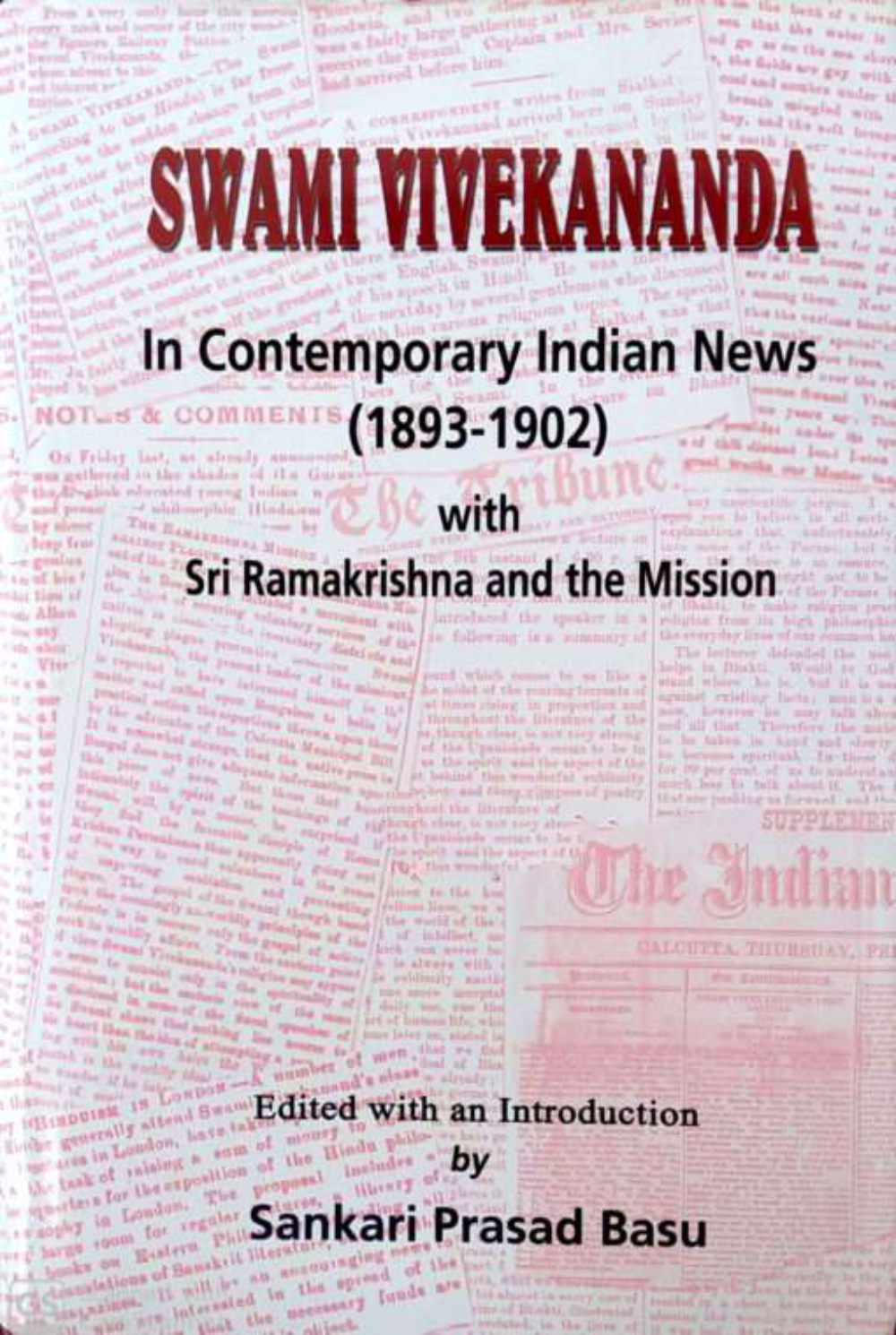
Swami Vivekananda In Contemporary Indian News (1893-1902)

Vol 1 - 3

Cover


Title

Swami Vivekananda In Contemporary Indian News

Author

Shankari Prasad Basu

Publisher

Ramakrishna Mission, Golpark

Description

The author, well known for his study and research on Swami Vivekananda, for years collected information on Swamiji from contemporary Indian newspapers and journals. This book will give the reader a firsthand account of the great impact Swamiji made on contemporary India through his words and deeds.

Digital Publication Date

Dec 2023


Volume 1


SWAMI VIVEKANANDA

IN CONTEMPORARY INDIAN NEWS

(1893-1902)-Volume : I

CHAPTER I

1.1.1 INTRODUCTION (SWAMI VIVEKANANDA IN THE HINDU OF MADRAS)

In his reminiscences of Swami Vivekananda Prof. K. Sundararama Iyer vividly described the tumultuous welcome accorded to Swamiji in Madras after his triumphal return from the West. He especially mentioned an inspiring editorial of the Hindu which had set the tone of that historic moment. ‘The Hindu published a leader’, K. S. Iyer wrote, ‘extolling Swami’s work in the West in terms of the highest enthusiasm leading up towards its close to a white heat of passionate outburst. Indeed one still remembers vividly how among its educated leaders many here and there quoted its concluding sentences, asking who there could be who would not associate himself with the Swami’s great work for humanity and advance it in all possible ways ?'[1]

The two parts of Prof. Iyer’s reminiscences of Swamiji have now been compiled in the Reminiscences of Swami Vivekananda[2]. They afford valuable information about Vivekananda’s stay in Madras, prior to his journey to America and also after his return to Madras in 1897. K. S. Iyer was then well-known in the intellectual circles of Madras. He was attached to the Madras Government education department, and at that time was deputed to the Travancore State Service to serve as private tutor to Martanda Varma, the First Prince of Travancore. Here, in late December 1892, he first met Swami Vivekananda. Dr Bimanbehari Majumdar, political scientist and historian, wrote highly of K. S. Iyer’s standing in the field of political science. He was ‘the first Indian writer belonging to the academic world to write on a topic relating to Political Science, questioned the appropriateness of the name of the “Indian National Congress”, the greatest of all the political associations organised during the last fifteen years of nineteenth century.’ The reasons behind Iyer’s objections were, ‘Though it calls itself national, its methods are not truly such. Our study of the progress of national movements in European countries shows that they had invariably been initiated for the overthrow of foreign supremacy and the substitution in its place by an independent government.... The Indian National Congress had no such aim.’ Lord Lansdowne, the then Viceroy of India, paid handsome tributes to the perfectly loyal and constitutional nature of Congress movements. Some of the leaders of the Congress were Englishmen who ‘held high office in India’. Iyer scorned at the idea that these men were ‘aiming at the dismemberment of the British Empire,’ and those who thought like that, according to him, were ‘idiots and deserve no notice whatever’. A stern critic of the earlier Congress, Iyer was himself a Congress sympathiser and attended and even addressed the first session of the Congress in Bombay in 1885. He certainly knew of Swami Vivekananda’s uncompromising attitude towards British Imperialism. He dedicated his book, Four Political Essays (Madras, Natesan, 1903) to Swamiji. To him, Swami Vivekananda was ‘the greatest teacher of modern times’.[3]

The first part of Prof. Iyer’s reminiscences of Swamiji contains important information about Swamiji’s views on social questions expressed prior to his journey to America. That the unknown wandering monk had a most powerful and kingly personality, endowed with majestic bearing, musical voice, sparkling wit, power to win over his opponents in disputations and had great love, sympathy and spirituality, are evident in a number of other contemporary accounts. After his return to India, Swamiji threw some fiery and revolutionary ideas relating to the society. Some writers attributed these to his experiences in the West. Without minimising the value of his Western experience, it may be firmly stated that everything was not the result of his Western visit. Besides Iyer’s reminiscences a report of Swamiji’s speech at the Triplicane Literary Society, Madras in late 1892, will bear this out[4]. Iyer’s reminiscences clearly indicated that Vivekananda was dead against casteism, untouchability and social taboos related to interaction with Muslims. During conversations, Vivekananda ‘occasionally burst out into spirited denunciation of the observance of mere deshachara or local usage.’ Swamiji refuted Iyer’s views about the racial purity of blood of the Brahmins. He maintained that the Brahmins were ‘as much a mixed race as the rest of mankind.’ He supported the sea-voyage movement, emphatically stressed the need for highest education of women and the common people, so that they could have ‘enlightened perception of their own needs and requirements’. The Swami sternly opined against any shastric (scriptural) injunctions regarding status of Indian women in the society and their marriage rites.[5]

II

The Hindu, particularly its editor G. Subramaniya Aiyer, was much concerned about society and social issues. Subramaniya Aiyer was an aggressive social reformer and the Hindu was his mouthpiece. Whenever congratulating Vivekananda on his successful mission in the West, the paper mentioned his progressive social thinking. Prof. K. S. Iyer writes that the editor of the Hindu ‘had once been very orthodox Hindu, and rigidly addicted to Vedic rituals and sadachara (observances). He changed to the opposite extreme of a social revolutionary after the virgin widowhood of his young daughter had given him a rude and painful shock and made him realise the penalties and pains inevitably associated with Hindu orthodoxy.’ From other sources we come to know that Subramaniya Aiyer had his daughter remarried ignoring social wrath. Prof. Iyer’s reminiscences narrate how once Subramaniya Aiyer reacted while listening to one of Swamiji’s speeches in Madras.

‘The next day, Saturday, the 13th of February, 1897, the Swami delivered his lecture on “Vedanta in Indian Life” at the Pacheyappya’s Hall. The Hall was packed to its utmost capacity. I was on the platform and just by my side sat Mr G. Subramaniya Aiyer, ... editor of the Hindu. At one point of his speech, the Swami addressing the students assembled before him said something to the following effect : Don’t be constantly crying out Gita, Gita, Gita. The Gita teaching cannot be truly understood or put into practice by those who, like you, are weak in frame and whose vigour is decaying prematurely by the cramming of text books for examinations. Go and play football and develop your biceps’ muscles and get strong, and you will then be fit to understand the Gita (teachings). Here was the opportunity for Mr G. Subramaniya Aiyer and he exclaimed in Tamil to those who were near him, even while the Swami was on his legs, “I have said the same thing often, but none would give ear. The Swami says it now, and you will cheer”... Mr Subramaniya Aiyer was in a mood of ecstasy as the Swami went on with his deliverances in this occasion on the topics of “strength” and “fearlessness”, and said, without them no spiritual perfection was possible. His words came on the audience with telling effect. “Believe”, he said, “that you are not the body or mind, but the soul, the atman ; and that is the first step in gaining of strength and to uphold and realise the teachings of the Upanishads.” ’

But Subramaniya Aiyer’s enthusiasm did not last till the end of this lecture. When Swamiji dwelt on the organisational basis and value of caste, and states that ‘caste was not only found in India, but everywhere and in every country he had seen.... Mr G. Subramaniya Aiyer’s enthusiasm and ecstasies had somewhat cooled down.'[6]

This record of G. Aiyer’s diverse reactions throws light on his social attitude of that time.

III

The Hindu was started by ‘Six Angry Youths’. Foremost among them was G. Subramaniya Aiyer and next to him was M. Veeraraghavacharier. The other four were T. T. Rangacharier, P. V. Rangacharier, D. Keshava Rao and N. Subba Rao Pantulu. All of them had been connected with the Triplicane Literary Society, an organisation meant for promoting social thinking[7]. These ‘Angry Youths,’ were also ‘adventurous’. They started the paper to articulate their protesting voices. Anglo Indian papers were then strongly criticising the decision of the government to appoint T. Muthuswami Iyer a Judge of the Madras High Court. To counteract this unseemingly propaganda against the appointment of an Indian Judge, these young men decided to publish a paper, took loans, printed 80 copies, priced 4 annas each, and named it, The Hindu, to be published every Wednesday evening. Their inexperience was compensated by their enthusiasm and highly pitched voice. The demise of some native English newspapers (Native Public Opinion, People’s Friends, Madrasee) did not deter them. After some time, four of the founder members severed their connections with the paper being engaged in their respective professional lives. The remaining two were teachers, who became the proprietors of the paper. The first one, G. Subramaniya Aiyer had indomitable courage, high spirit and a powerful pen. The second one, M. Veeraraghavacharier, had organising power and business acumen[8]. The Hindu created history by showing how to struggle, survive and progress. With practically no financial support from outside and negligible number of subscribers, it had to compete for survival with the firmly established Anglo Indian newspapers, such as the Madras Times, the Madras Mail. ‘The Anglo-Indian journals are certainly more powerful, [G. Subramaniya Aiyer wrote], more prosperous and more influential than Indian journals. They knew their trade and they have got facilities which we have not... Journalism to Englishman here is more or less a trade, a means of livelihood but to Indians journalism is something more earnest, something more nearly touching the interests of their country.'[9]

Yet the Hindu not only survived but also progressed. In 1883, it became tri-weekly and from 1 April 1889 an evening daily of 12 pages[10]. In the meantime the paper could manage to secure support from some influential men and, also, active participation of some able working journalists like K. Subba Rao, G. Karunakaran Menon and K. Natarajan (long time editor of the Indian Social Reformer)[11].

As the editor, G. Subramaniya Aiyer had to work hard and incessantly. Besides writing almost all the editorials, he had to do huge office work. Editorials of that time in Indian newspapers usually took considerable lengths, because they threw ‘more views than news’[12]. The Hindu, in a short time, became the most influential native paper in Southern India having the largest circulation. From the beginning, it tried to assume the national and international characteristics. It carried ‘profuse extracts from Indian and English newspapers both at home and abroad, [with] Letters to the Editor, News Letters from North Indian Centres like Calcutta and Bombay and from mofussil centres,... London Letters,... Indo-British Topics’. (Bepin Chandra Pal, when in England, used to write London Letter)[13]. N. C. Kelkar, a close associate of Bal Gangadhar Tilak and an editor of the English weekly The Mahratta of Poona, paid high tributes to the Hindu in his article ‘Indian Journalism in the Nineteenth Century’, first published in the Indian Review, and then quoted in the Mahratta of 27 January, 1901. ‘The success of the Hindu’, Kelkar wrote, ‘is simply an object lesson of what a couple of young educated gentlemen without money, but with brain and perseverance, can accomplish in the line of journalism. It is a daily paper which Indians may hold up as a fair example of their journalistic respectability and ability.’ When the Hindu became “Limited”, the Mahratta congratulated it in its editorial of 16 June, 1901[14].Ramananda Chatterjee, editor of the Prabasi (Bengali Monthly) and the Modern Review (English Monthly) and a Father Figure in the realm of Indian journalism, wrote in the Modern Review of March 1909, ‘It is not generally known that Babu Bepin Chandra Pal, Mr (now Sir) Pherozeshah Mehta and Messers Eardly Norton and William Digby were among the contributors in the Hindu under the editorship of Mr Aiyer... Subramaniya Aiyer has rightly been styled the father of Madras journalism.’ G. A. Natesan, editor of the Indian Review, assessing the total contribution of Aiyer wrote, ‘The people hold him in high esteem as the hero of a hundred battles and no name is more honoured in Madras than that of G. Subramaniya Aiyer, publicist, journalist and Social Reformer. For well nigh a quarter of century, he was the leader of public life in this part of India.’ (February 1914)[15].

IV

With a political purpose the Hindu started its career. Subramaniya Aiyer was himself a political man. ‘One of the founders of the [Indian] National Congress, he moved the first resolution in the first Congress at Bombay in 1885.... A founder of the Madras Mahajana Sabha, he was unanimously chosen to give evidence before the Welby Commission in 1897. During the Diamond Jubilee of Empress Victoria, he was in England with Messrs Banerjee, Gokhale and Wacha lecturing on behalf of the British Congress Committee[16].’ Moderate in political views, he did not profess complete independence and openly acknowledged the superiority of Western civilization with reverence which he declared at the first editorial of the Hindu[17]. It stressed that its quarrel was not with the British rule, but it was against the misdeeds of the bureaucratic machinery[18].

Christian missionaries received warm appreciation from the Hindu. Explaining its attitude to the missionaries it wrote in the said first editorial, ‘In religion though there have been of late occasions to look with unpleasant feelings and suspicion with the conduct of a particular sect of missionaries, we shall observe the strictest neutrality and sectarian disputes we shall never allow in our columns[19].’

Also social reforms received much importance in the paperInitially, it did not advocate government interference in social matters, but gradually this attitude changed. It pleaded for prohibiton of childmarriage and legal measure for widow-re-marriage. It lent support to movements against polygamy and Nautch girls in temples. It constantly propagated in favour of the sea-voyage movement. Since 1892, Aiyer was becoming increasingly scathing in his criticism of Hindu Society. In January 1893, he wrote, ‘The Hindu nation cannot produce a great man, a man that can stand in comparison with any of the glorious group of heroes, men of great originalities and moral power, of undaunted enterprise, who have made Europe mistress of the globe[20].’ The same year he wrote with a sense of dejection that as the Hindus could do nothing to improve the lot of the pariahs [untouchables], it was better to hand them over to the missionaries for their benefit. He added, ‘No amount of admiration for our religion will bring social salvation to these poor people. It is Christian missionaries alone that will and can educate them and advance their well-being in all ways[21].’ It remained undaunted by the resultant commotion in Hindu orthodox circles[22].

It may be interesting to probe whether the Hindu’s attitude to social issues underwent a change between 1893 and 1902. Surprisingly, scholars writing on the history of the Hindu have failed to notice Vivekananda’s powerful influence on it regarding social questions. They have either focussed on political matters or on only the contemporary westernised social reformers. The virtual omission of the reports and editorials of the Hindu on Vivekananda in their writings, to say the least, is baffling.

Reverend Dr John Henry Miller, a highly esteemed educationist of Madras, drew attention to the Parliament of Religions in Chicago in a letter to the Hindu that appeared in the middle of 1892. Referring to this letter, the editor of the paper, though himself a member of the Advisory Council of the Parliament, commented disparagingly, ‘The religion of the Brahmans cannot throw much light on the practical problems of modern communities.’ Subsequently, the Hindu published a number of letters on the subject. A correspondent of the reformist school felt it his duty to write that ‘revival of Hinduism... [is] an utter impossibility. The life of it is gone..., its course is run ; its last word has long been said... Hindu Society is verily a whited sepulchre containing beneath it all the evils that human flesh is heir to[23]’ Naturally it drew sharp Hindu reactions. Satis Chandra Mukherjee of the Dawn Society, was shocked to find the editor of the Hindu ‘recognised as the representative of the Madras Presidency by the Chicago Exhibition.’ ‘Possibly’, he wrote, ‘the name of the journal has thrown dust into the eyes of the promoters[24].’

Subramaniya Aiyer severed his connection with the Hindu after 1898. But it would be interesting to note how he assessed Swami Vivekananda in the preceding years (1894-1897), and also whether Swamiji brought about any change in Aiyer’s own attitude about Hinduism. It may be mentioned here that Aiyer’s extreme views on social issues harmed the paper’s business side. This was one of the reasons for his parting of ways with the Hindu. Besides, Aiyer wished to devote his time and energy to the Tamil paper, Swadeshamitram, which he himself edited.

V

Vivekananda’ s sudden emergence as a world figure, his expositions of Vedantic ideals and the unprecedented enthusiasm in India for his exploits in the West, deeply stirred Subramaniya Aiyer’s mind. He began to feel that everything was not lost in Hindu Society. His views on social questions became more realistic. This change in Aiyer’s perception and attitude to social issues can be traced in his own writings.

As stated earlier, in 1892 and early 1893, the Hindu strongly believed that regeneration of Hinduism had been an impossibility for its having been degenerated into a veritable storehouse of all possible sins. The same Hindu, a few months later, proclaimed exuberantly that Hinduism had been re-born. The credit for it was given to Vivekananda and, in a lesser degree, to the Theosophical Society (1 May 1894). Earlier it had published extracts from various foreign newspapers eulogising Vivekananda, such as from Boston Evening Transcript (17 November 1893) and London Spectator (28 February 1894). It brought to the fore (6 March 1894) a letter of Marwin Marie Snell, the President of the Scientific Section of the Parliament of Religions, in which he had paid glowing tributes to the spiritual stature and greatness of the Swami. Ostensibly noncommittal, it also reprinted an enthusiastic editorial of the Indian Mirror about Vivekananda. It reported at length on 30 April 1894, the Thanks Giving ceremony held at Pachaippa’s Hall, Madras, in which eminent personalities of Madras had voiced their appreciation of Vivekananda’s deeds in America. Among them were Rajah Sir Savalay Ramaswami, Dewan Bahadur Subramania Iyer, M. Venkatarama Chetty, P. R. Sundararam Aiyer, T. V. Seshagiri Iyer, M. O. Parthasarathy Iyengar, M. A. Rangacharya, V. Krishnaswami Iyer and Dewan Bahadur Ragoonatha Rao. These speakers pronounced that India at last ‘was able to send so able a representative of her ancient religion.’ The Chairman of the meeting Dewan Bahadur Subramania Iyer recognised in Vivekananda ‘one of the noblest souls of India that could be enthused with such a task.’ V. Krishnaswami Iyer recalled how ‘the Swami... fascinated all those who came in contact with him while at Madras’. Recounting his personal encounter with Vivekananda, Gopala Krishna Mudaliar, Head Master, Pachaippa’s High School said that though he had travelled far and wide he had never met one like Swamiji who had marked not only learned in the Hindu religion but also had studied Buddhism, the Bible and the Koran. Parthasarathy Iyengar, an erudite scholar, felt that the Parliament of Religions had marked a ‘great epoch in the history of the world—an epoch the like of which could never be seen in the vast expanse of the past.’ He added that ‘it was left for Swami Vivekananda...to make many people realise the fact that Hinduism is able to hold its own against any religion.’

It was a strange phenomenon indeed ! Who could have believed that such a young Indian Fakir could do such wonders ! The editor of the Indian Mirror referred especially to Vivekananda’s great courage in crossing the seas ignoring social taboos against sea voyage. This issue also touched the heart of the editor of the Hindu, as was evident from the reproduction of the entire editorial of the Mirror in the Hindu. It is pertinent to point out that only a few months ago, the same paper had reproduced comments of Madras Christian College Magazine (August 1892) which wrote : ‘It will be interesting to see whether any orthodox pandit will brave the ocean and his fellow castemen to expound Hinduism in the Parliament of Religions or whether by their absence Hindus will confer that they have no message to the rest of the world.’ The answer came from Vivekananda’ s visit to America and his stupendous success there. The turn of events profoundly affected the Hindu. Sharply responding to a few press criticisms of Vivekananda’s foreign visit, it wrote : ‘What indeed has the Swami done that so much noise should be made about him ?... As the Chicago Exhibition is an epoch in the World’s history, the Swami’s mission to America is an epoch in the religious history of India.’ The editorial wrote with deep passion, ‘When the Swami stepped into the cabin of his steamer at Bombay some months ago, he bruised the head of the superstition which put a ban on sea voyage... Few could understand the deep significance of a sannyasi’s undertaking a sea voyage who are not aware of the responsibilities which tradition ascribes to sannyasis as guardians of Hindu religion... That a sannyasi should have risen so high above the cramping superstitions of the country...is a fact, the abundant significance of which will be realised only by the austere observer now and the generations to come in the future.’ The editorial concluded with a prick to the conscience of the Bengalees ! ‘Madras may well thank herself, if not for the generosity, at least for insight, which prompted the ready help that was given to the Swami. Calcutta claims him now that he is great. Madras learned to appreciate him even before that. No man is a prophet in his own country.’

Another lengthy editorial on Vivekananda appeared in the Hindu on 23 December 1895. Besides, there were a number of news items on Vivekananda. In its coverage on him the paper was second only to the Indian Mirror. Excerpts from American newspapers like the Brooklyn Standard (23 February 1895), Boston Evening Transcript (28 June), Detroit Evening News (27 August), Inter Ocean (14 November), and British papers, such as, the Sunday Times, Pall Mall Gazette, Echo, India, were common features of the paper. British papers mostly reported Swamiji’s activities in England. Similar excerpts from the Indian papers were taken in. Among these were reports of the Thanks Giving meeting at Kumbhakonam and Bangalore (27 August 1894), Thanks Giving meeting at Calcutta (13 September 1894), Vivekananda’s reply to the Madras Address (12 and 15 November 1894) and to the Khetri Address (28 August 1895). Editorials of this paper made respectful mention of Swamiji as did some correspondents. The editorial of 23 December 1895, though overflowing with deep emotion and exuberance did not lack in sound and positive thinking. It said, ‘This great and holy man, who has suddenly sprung into eminence and claims the world’s homage for himself and for the nobly catholic religion we profess, needs no introduction to our readers, as before proceeding to Chicago to attend the now famous Parliament of Religions, the Swami made a brief tour through this Presidency and sojourned a while in the Presidency town, when several of our countrymen had the rare opportunity of making his personal acquaintance.’ Recalling Swamiji’s zeal and perseverance in propagating Vedantic ideas to the West, the editor added, ‘We need hardly say how pleased and surprised our countrymen have been to know that the life of Hindu nationality is not yet extinct, and that, if only we were true to ourselves, we might still hope to rise from our present degradation and slavery.’ With a great passion the editorial stressed that at a time when the people and religion of India were being treated as orphans or vermins infecting world’s atmosphere, appeared the wonder-monk, raising hope that ‘The long night of painful self-effacement and humiliation is evidently soon to run out its inglorious course, faint sparks of the silvery dawn of the coming glorious days are already commencing to be seen above the horizon. And, as it always has happened in the history of the world, with the hour are also coming up the men who are to found the new era and realise the hopes and ideals of our race.’

Recounting the names of Swamiji’s precursors, such as Ram Mohan Roy, Debendra Nath Tagore, Keshub Chunder Sen, Dayananda Saraswati, Mahadeva Gobinda Ranade, Sir T. Madhava Rao, Kashinath Telang, the editorial stressed that amongst them Vivekananda was unique. For, ‘Never before has an Oriental succeeded in producing in so short a time so powerful, so deep and so abiding an impression among Western communities. This is not only due to the Swamiji’s noble and stirring eloquence and almost unrivalled mastery over our sacred lore, but also to the charming simplicity and sweetness of his nature. The personal knowledge of him which some of our readers possess will doubtless enable them to confirm our opinion that there is no nobler, no worthier, no truer representative of his sacred calling than Swami Vivekananda.’ It wasunderlined that the Swami’s training had been under Sri Ramakrishna and he had wandered for years with a begging bowl. ‘Who shall ever know what trials, what privations, what discomforts he has undergone—all for his love of our great prophets and sages, and for his sympathy with the sufferings and sorrows of the poor and the lowly in India.’ The editor concluded, ‘A keen American observer, analysing his [Swamiji’s] features has remarked, how closely they resembled the classic face of the immortal prophet of Buddhism ; and we venture to say that the resemblance by no means ends here, but extends to the Swami’s mental, moral and spiritual characteristics and he reveals to the world anew in his person somewhat of the ideal charm and power of Shakyamoni and Shankara Chariar.’

The Hindu editorial on Swamiji (18 December 1896), titled ‘Swami Vivekananda’s International Mission’, suddenly sounded a new critical tone. In a letter sent to India Swamiji wrote that his mission was not only national but also international. To train up workers for Vedantic preaching in foreign lands, he wanted to establish at first one centre in Calcutta and one in Madras. The Hindu agreed that Swamiji’s mission was laudable. But Indians needed education more than the Westerners. With somewhat unusual sharpness it wrote that they were not fascinated by the idea of his international mission. ‘To some minds cosmopolitanism or the idea of universal brotherhood is more attractive than patriotism... and examples are not wanting of truly humane and far-seeing men, who, ... dreamed of emancipation of the human race instead of directing their wisdom and talent in a practical channel to uplift their fallen countrymen.’ The editorial, apparently, did not take into account numerous instances of Swamiji’s unbounded love for his motherland, India. It missed the crucial fact that Swamiji’s mission had two purposes. One was to disseminate the eternal Vedantic message (which was also that of his Master) for the world at large. Secondly, for the uplift of India’s poverty, both the knowledge of science and technology be brought from West. Time and again he asserted the necessity of exchanges between the East and the West. Moreover, if the West recognised India’s spiritual glory then that would bring dignity and self-confidence into the minds to the degenerated, dejected people of India, crushed under the wheel of foreign domination. Self-confidence and self-assertion were pre-conditions for beginning the process of nation-building. He informed Alasinga Perumal in a letter (23 March 1896) that while returning he would be accompanied by some European disciples because, ‘these “white” faces would have more influence in India than the Hindus. Moreover, they are vigorous, the Hindus are dead. The only hope of India is from the masses. The upper classes are physically and morally dead.’ In another letter he wrote, ‘Madras will then awake when at least one hundred of its very hearts’ blood, in the form of its educated men will stand aside from the world, gird their loins and be ready to fight the battle of truth, marching on from country to country. One blow struck outside of India is equal to a hundred thousand struck within.’ Swamiji’s knowledge of his countrymen was second to none. He knew where lay the real strength of his Madras disciples. They could devote themselves to propagation work, run papers and presses, but just then they were not ready to jump in all-out social work.

Striking a reversal of its tone, the Hindu came out with an editorial on 3 February 1897, welcoming Vivekananda in Madras. It wrote,

‘We shall soon have the pleasure of welcoming in our midst this great and holy man who singly has done for India and the world a service which we believe to be fraught with most momentous consequences for their future. Even in this degenerated age, India has produced many men of culture and some also of genius, whose names will be inscribed in the call-role of the world’s worthies. But the ground which Swami Vivekananda has occupied is entirely his own discovery and no flag has ever floated there but his.’

The magic of Swamiji’s voice and his captivating wisdom which had won many sceptic and intellectual minds in the West ; the Indian spirituality that he had unveiled there ; and also the threats and malice of his envious enemies—all these were referred to in the editorial. The readers were reminded that being a genuine ‘Paramhansa’ his nature has assumed such a charming and genuine serenity, sweetness and simplicity that it has a magnetic attraction for all who came within the sphere of its influence. ‘It is from one like Swami Vivekananda that we can form an idea of what ancient ascetics like Shankaracharya were like.’ As if to do away with its view expressed in the previous editorial (18 December 1896) it wrote, ‘We believe that in the midst of all his labours in foreign lands, his heart has never ceased to feel for the toiling millions of India... [and] he has also before him plans for the amelioration of the hard lot of our care-worn and poverty-stricken millions.’ It concluded with an impassioned call for rallying round the great man.

Some glimpses of the triumphal arrival of Vivekananda in Madras amidst unprecedented scene of joy, excitement and unbounded enthusiasm could be found in some of the pages of the Hindu. Unfortunately, many important portions are missing. Only a Rabindranath Tagore could give a scene of such ecstatic joy a poetic expression :

‘দলে দলে নরনারী ছুটে এল গৃহদ্বার খুলি / লয়ে বীণা বেণু 

মাতিয়া পাগল নৃত্যে হাসিয়া করিল হানাহানি / ছুঁড়ি পুষ্পরেণু'।

(In plain prose: Men and women had come out opening their doors with flute and harps in their hands, laughed and danced mad with joy, and threw pollens against each other in a mood of deep ecstasy.)[25]

In Madras Swamiji delivered some of his memorable speeches. They included his ‘Plan of Campaign’, outlining his plan for social and political emancipation of India. The Hindu published his lectures with enthusiastic comments. Only a portion of its editorial (10 February 1897) on his Plan of Campaign speech could be recovered. It wrote that besides being a ‘very fine display of oratorical power’, it was ... ‘instructive, ... full of matter of serious reflection and ... thoroughly saturated with the speaker’s personality .... His voice possesses richness, rhythm and melody’ though ‘it lacks pitch’. For its beauty of language, ‘solemnity and earnestness’ the speech left nothing to be desired.

From the Hindu we could gather only some more information of one of his speeches, and fragments of an editorial. Swamiji was in a combative mood in his Plan of Campaign speech. He said unpleasant truths about the Theosophical Society and its leader Colonel Olcott, bigoted Christian missionaries of the States, the editor of the Sadharan Brahmo Samaj journal and Pratap Chandra Mazoomdar. He had some plain words for the social reformers of the time. A section of the audience, while listening with bated breath, felt dismayed and shaken. Swamiji had emphasized the need for education for the masses, reform on national lines, upheaval of the people, awakening of youth power, rousing of self-confidence, courage, renunciation and relentless struggle for achieving the goal. Every word of his speech radiated his intense love for his motherland. While commenting on another speech of Swamiji, ‘The Sages of India’, the Hindu wrote (12.2.97) that if the previous speech had brought out ‘fire and fervour of his internal nature’, and scorn for everything that ‘enslave, enfeeble, degrade human nature’, in this one ‘the Swami really surpassed himself.’ It ‘exhibited him in a new light, as a man of noble culture, lifted with exalted powers of historical perspective, possessing in an eminent degree the faculty of picturesque delineation and lighted up with that glow of generous sympathy which can alone endow with the “vision and faculty divine” needed for unlocking and exposing the treasures of the past.’ There was wide acknowledgement that he had proved himself the ‘greatest orator Madras has witnessed within the memory of living men.... Last night the wand of the magician was indeed upon the Swami’s audience and such a masterly exhibition of bearing imagination, insight, sympathy, picture-making power has rarely or never been witnessed within living memory.’

VI

The ‘fire’ of his Plan of Campaign had upset many, specially the Theosophists. Madras was then the centre of the Theosophy movement in India. It was also its international headquarters. The movement elicited considerable support from some other Indian cities too. The strange life-story of its originator, Madame Blavatsky, her mysterious books, Isis Unveiled and Secret Doctrine, fascinating ‘news’ of miracles about ‘Mahatmas’ sleeping in an unknown region of Tibet only to awake for supplying letters of instruction to some chosen few, had created sensation and unbridled curiosity in the minds of many people. Though it was later proved beyond doubt that the ‘Mahatma Letters’ had been a concoction, a good number of educated Indians still stood firm in their former belief. They went on hoping that the Mahatmas by their miraculous power would rescue the nation from abysmal depths of degradation.

The arrival of Annie Besant in India in 1894, and her lecture tours all over India, created considerable enthusiasm. This gifted Irish lady,

once a rebel against pervading moral and religious degradation and beliefs, was an extraordinary orator. She suddenly fell into the spell of Madame Blavatsky and turned a Theosophist. She adopted Hinduism and became such a devout Hindu that even the Hindu superstitions were acceptable to her. Listening to her spirited defence of everything Hindu, flowing out from her silvery voice and in a language of exceeding beauty, many Hindus were overwhelmed. This fascinating and absorbing story is related elsewhere[26].

But Swami Vivekananda found all these totally unacceptable. Moreover, in his Plan of Campaign speech, he forcefully blasted the claim of the Theosophists, particularly of its leader Colonel Olcott, that they had paved the way for his success in America. It was just the opposite. They had put all sorts of obstacles to deter him. They had instructed their followers not to attend his meetings and help him in any way. They even joined the missionaries in slander campaign against his character. His only fault was, before going to America, an unknown wandering monk as he was, he had approached Colonel Olcott for a letter of introduction. He who claimed himself to be a friend of India, turned down the request because the Swami had the audacity to turn down his request to join his Society, as he did not believe in their tenets. The Colonel became extremely angry and bitter. After a few months stay in America, Swamiji found himself in a difficult situation, without having money and proper warm clothings in the midst of a bitterly cold American climate. Reluctantly he wrote to his friends in Madras for help. Somehow coming to know of Swamiji’s predicament in the States, Colonel Olcott wrote gleefully to one of his Theosophist friends in America, ‘Now the devil is going to die. God bless us all.’ Recounting this in the Plan of Campaign-speech, the Swami said, ‘Thus they prepared the way for me in America.’ The Swami had other reasons also for his assault on the Theosophists. He was concerned that Theosophy, solely dependent on occultism, and would prove disastrous for India. He repeatedly warned that occultism, mystery-mongering etc. were nothing but dark shadows cast on the radiant splendour of spirituality. It was self-reliance only that could regenerate India. The tenets of Theosophy were great obstacles in the way of achieving it. If in their frustrations the Indians thought that they would be rescued by the Tibetan Mahatmas through their earthly agents in the incarnation of Russian, American and English adepts, they were to remain doomed for ever. Swamiji fervently believed that notwithstanding her present position, India still retained her spiritual supremacy and heritage. If India accepted as her Guru or Gurus some foreigners, who had no spirit of austerity, renunciation and spiritual sadhana, that would be only suicidal.

Besides the die-hards of the Theosophical Society, Swamiji’s hard-hitting speech upset some of his simple-minded listeners who had expected only sweet and soothing words about all from him. This had two effects. Firstly, it did affect his soaring image and popularity in the minds of some. Secondly, it stemmed the tide of the Theosophic movement in Madras. What a great influence Theosophical Society exerted in Madras, could be seen from the attitude of even a pro-reform paper like the Hindu, which hereafter became cautious about writing on Vivekananda. Whatever be his personal opinion, the editor had to concede to the pressure of public opinion. A number of letters condemning Vivekananda were published along with some defending him.

One correspondent using the pseudonym ‘Madhava Doss’, wrote (Hindu, 10 February 1897), ‘I came here as many others on a pilgrimage to see the Swami, hear his voice and feel his presence.’ But unfortunately for him, at the end of his journey he could only see the fierce and the terrible in the presiding deity of the temple. Evidently, an ardent Theosophist, he paid high-flowing compliments to Madame Blavatsky, Col. Olcott and Mrs Besant and failed to find any new idea in Swamiji’s speeches. He still insisted that the Theosophists paved the path of Swamiji in America. There were greater sannyasins than Vivekananda in India, but they remained unnoticed and unrecognised. The Swami was sceptical about Mrs Besant’s knowledge of Sanskrit and interpretation of Hindu scriptures. Did he not know that a number of important persons recognised ‘her capability as a great teacher of Hindu religion’? How could the existence of the Mahatmas be questioned ? What greater proof could be there than that Mrs Besant herself admitted it !! The Swami denounced occultism and mysticism in religion. If that be so, the Hinduism that Vivekananda preached was certainly not the Hinduism of the sages. ‘Madhava Doss’ warned Swamiji that he would not be able to harm the Theosophical Society, but would ‘only forfeit the allegiance of a great number of his real Hindu admirers.’

There were similar letters from ‘A Brahmin Buddhist’ and C. R. Srinivasa, a member of the Theosophical Society. On 12 March Colonel Olcott’s letter was published. It was a cautious and a clever one. He stated that the Swami had misreported their previous meeting at Adyar due to nervous excitement. He could not remember having been asked by the Swami for a letter of introduction. But then, in apparent self-contradiction, he wrote that at the time of their encounter, the Swami had been so hostile about the Theosophical Society, Madame Blavatsky and the Mahatmas that a refusal to accede to his request, if there be any, was only natural. Olcott did not admit to have ever written to his American colleagues slighting the Swami or asking them to obstruct or vilify him. Underlining his own generosity in enthusiastically joining Vivekananda’s reception, he skillfully tried to draw the sympathy of his Indian readers by showing how ungracious was the Swami’s remark about Mrs Besant’s knowledge of Hinduism, and how unbelievable was his report of Mrs Besant’s ‘scornful behaviour towards him at Chicago’. To Olcott, Mrs Besant was the nearest to his ‘conception of what an angel must be.’ Throughout his letter, Olcott maintained a patronising tone and a gracious compassion for the Swami’s ‘youthful passion and indiscretion’.

‘A Hindu’ in his letter (22 February) wondered why the Swami was so anxious to establish his own institutions. There was the Theosophical Society with its branches all over India and abroad. Also, so many Maths were there in India. He should join hands and work with them.

We could trace two letters written in favour of Swamiji in the Hindu (2 and 12 March, 1897). T. S. Seshaiyar, in his lengthy letter (2 March) sought to refute all the accusations made by ‘Madhava Doss’. He argued that Swamiji’s thoughts, compared with Mrs Besant’s, were really original in many respects. He asked, why the Theosophical Society, which for the last twenty years or so, had been preaching Gita, Upanishads and Mahatma cult in the West, had failed to make much headway there and why in such a short time, Swamiji’s preachings had gained so much popularity in the West. Obviously, the Western people were disgusted with the Mahatmas who seemed to give gracious interviews only to Colonel Olcott and Mrs Besant ! How fantastic was Colonel Olcott’s claim, made at a public meeting, that Bhagavan Vishnu appeared before him waving a silk handkerchief. The Colonel even waved a handkerchief before the audience to prove Lord Vishnu’s appearance. The Swami had prudently disassociated himself from the Theosophical Society in the West as that would have proved disastrous for his own work. The correspondent wondered, what remained of Col. Olcott of this much vaunted ‘Universal Brotherhood’ when he could write about Swamiji when he was in great difficulties in the States that ‘the devil is going to die and our cause is safe’ ? The letter also pointed out that according to the Theosophists, Yoga was mysterious. But that was not true. The practice of Yoga gives light, not mist. Theosophical magic was mysterious no doubt. The Theosophists asked for humility on the part of the Swami. But they themselves were threatening him. ‘Madhava Doss’ referred to so many cave-dwelling Mahatmas who were greater than the Swami. But where exactly did they live ? Alas, the people could not get their darshanas. But for the people Vivekananda was present with his ‘simplicity of life, unassuming manners, ... versatility of genius, indomitable courage and unflinching perseverance.’ At so early an age, he had become ‘a model of the world’.

Another correspondent, using the pseudonym ‘Brahmin’, in his letter (Hindu 12 March) strongly defended Swamiji and felt that he had done nothing improper by exposing the Theosophists. He did not indulge in personal attacks. The Theosophical Society, ‘stated to be under the direct guidance of the Mahatmas,’ and receiving ‘orders from people who profess to follow unknown and unknowable personages is surely a species of slavery.’ Every thinking man would regard them as most revolting. As regards the suggestion that the Swami could work in collaboration with the Maths, the correspondent reminded that Swamiji wanted ‘the Brahmins, the Sudras and the Pariahs’ to have ‘equal opportunities of knowing the great truths of the Vedanta.’ But would the Maths accept this radical idea ? He pointed out, ‘Till the Mutts are reformed there can be no conjoint working of the Swami’s institution with the Mutts... The suggestions put forth by your correspondent are impracticable as well as impossible until at least a small portion of the Indian mass are initiated into the secrets of the Vedanta and the now prevailing sectarianism is effaced.’

Swamiji remained unperturbed by the Theosophic onslaught. He wrote to his dear and respected brother-disciple, Swami Brahmananda from Madras on 12 February 1897, ‘The Theosophical Society and others wanted to intimidate me. Therefore I had to give them a bit of mind. You know they persecuted me all the time in America because I did not join them. They wanted to begin it here. So I had to clear my position. If that displeases any of my Calcutta friends, ‘God help them.’ You need not be afraid, I do not work alone, He is always with me. What could I do otherwise ?'[27] In response to an anxious question from one of his disciples he firmly reiterated that he would do the same thing again if opportunity came[28]. Only one thing did hurt him—the sacred name of Sri Ramakrishna was being dragged into this ... controversy. ‘A Brahmin Buddhist’, in his letter (15 February) wrote sarcastically that Swamiji had been lauding his Guru. But was ‘his Guru alone the Alpha and the Omega of Mahatmaship ?’ Such irreverent mention of Ramakrishna deeply pained him. Lest his Guru be made responsible for any misdeed ascribed to him, he said in his reply to the Calcutta Reception, ‘If there has been anything achieved by me, by thoughts and words or deeds, if from my lips has ever fallen one word that has helped any one in the world, I lay no claim to it, it was his. But if there have been curses falling from my lips, if there have been hatred coming out of me, it is all mine and not his[29].’ These words were taken as an apology by Olcott and others for his earlier denunciations on the Theosophists in his Plan of Campaign speech. But certainly it was not so. Swamiji’s only concern was to ensure that the hallowed name of his Guru did not get mixed with the unsavoury controversy. Otherwise Swamiji’s conscience was clear and he did not budge an inch from his previous statement. His tremendous courage and strength drew admiration from the great scientist Dr J. C. Bose, then living in England[30].

Swamiji’ s remarks about Pratap Chandra Mozoomdar offended only a few belonging to the latter’s circle. One of them was Bepin Chandra Pal, who referred to this in his Calcutta Letters to the Hindu of 13 March. Pal said that Vivekananda in his early youth had visited Mozoomdar for instruction. Hence his harsh words against the latter had displeased many. It is doubtful whether Vivekananda had ever approached Mozoomdar for an instruction. He did go to Kesub Chunder Sen, but was soon disillusioned and joined the Sadharan Brahmo Samaj. In any case, Pal failed to mention that Mazoomdar had spread false and malicious reports about Vivekananda. Hence, the latter’s adverse comments on Mazoomdar were not incomprehensible.

VII

Christian missionaries figured prominently in the Hindu coverage of Vivekananda. Earlier, we have referred to the paper’s zeal for social reform which led to its fulsome praise for missionary activities and condemnation of Hindu socio-religious practices. The arrival of Vivekananda changed the situation and the attitude of the Hindu to such questions.

The Hindu editorial of 9 January 1894 came down heavily on Dr Penticost for his fantastic claims. In America Swamiji had to listen to such orchestral refrain from the missionaries as the European Empires were great because these were founded and ruled by the Christians. Swamiji reminded them that the same Christians brought Bayonet, Brandy and other vices along with their Bible to the heathen land. Dr Penticost had presented a novel theory. A man might be a Hindu, a Buddhist or a Mussalman by birth. His good and bad deeds did not alter his position. But if any Christian had become a drunkard, liar, thief, whoremonger or murderer, he ceased to be a Christian ! What a ‘comfortable conclusion’—the Hindu exclaimed, and ridiculed the double standard of judging other religions.

In another editorial (19 February, 1894), the paper exposed the partisan nature of missionary criticism of Hinduism. After some group-clashes in Sri Rangam Temple, governmental mediation was sought. Using the incident as a pretext, a missionary paper maligned the Hindu religion and wrote, ‘The invocation of such aid is a clear demonstration of the fact that the Hindu faith is effete...After all the empty brag of Vivekananda and the like of him, it is rather humiliating to the Hindus to find themselves in such predicaments.’ The Hindu was astounded that a trivial sectarian clash, necessitating police intervention could be cited as a sign of the imminent fall of Hinduism. The paper reminded that while the Hindus did not ask for financial support from the Government for maintaining their temples, it was ‘a standing injustice and shame and disgrace that an establishment of Christian prelates (Church of England) should be maintained mostly at the expense of the Hindu and Mohammedan tax-payer.’ It added bitingly, ‘the arm of the State has been raised for the propagation of no other religion more systematically and more frequently than the propagation of Christianity... The action of the Tengalis and Vedagalais in breaking each others’ heads’—a purely imaginary breach—is at any rate somewhat less heinous than the action of certain Christian sects, not so very very long ago, in burning one another for their religious opinion.’

The nature and extent of the great change brought about by Vivekananda in India were assessed in a thoughtful editorial titled ‘Neo Hinduism’ in the Hindu of 31 October 1894. Missionary journals such as the Methodist Times had been finding it inexplicable that educated Indians nourished by Western thoughts and culture, instead of rejecting their own religion with scorn and disgust, clung to that with renewed energy. Worse still was the fact that they were taking up their religion rationally after shedding off superstitions. All this, the paper regretted, were happening after ‘half a century of education by Christian missionaries and Christian Government in the language of a Christian people.’ The Hindu pointed out that in earlier years of English education, scepticism crept in some Hindu minds, which the missionaries mistook as a sign of their leaning towards Christianity. But in fact, Western education paved the way for the Indian National Congress in the field of politics and Neo Hinduism in the domain of religion. The editor called on the disappointed and angry missionaries to ponder, ‘Why should not the Hindus examine their religion and adhere to it if they find it to be good ; and why not various means be devised to purify and simplify it, to uphold it, and preach its truths ?’ Whatever the foreign missionary papers like the Methodist Times might feel, it was most heartening to see a noted Indian Christian missionary, Rev. Kali Charan Banerjee, welcoming Hindu communities efforts for selfpurification which led to a resolution of the vexed Sea-voyage question. Undoubtedly, Vivekananda was largely instrumental in the happy solution. However, Rev. Banerjee, being a missionary, could not but help thinking that this process of purification would lead the Hindus to Christian life and light.

Rev. J. Hudson in a lengthy article (Hindu, 29 November 1894) sought to refute Vedantic tenets. This article, first published in the missionary journal Harvest Field, was reproduced in the Statesman. The Rev. J. Hudson contended that the Hindu exuberance over Vivekananda’s success in America was actually like dancing on quicksand. He drew attention to the fact that most Indians had never visited America or Europe. If they had, they would have known what such ovation really meant. These were a clappings for curious thing. To prove his point he cited two letters from his friend Holdsworth, written from Harrogate. The latter, in one of his letters, described ‘how Princess Allix and Mrs Holdsworth’s Indian ayah’ were chief objects of curiosity. In another letter he described the ‘extreme difficulty’ that he had in speaking at a large public meeting after a native of West Africa had spoken. Rev. Hudson contended that a coloured man, whether he be a Hindu or a Negro, was sure to draw a large audience at any provincial town in America, especially, if he appeared in his native costume. Moreover, ‘the speaker from Calcutta [i.e., Vivekananda] knew exactly how to pose with the greatest effect.’ Hudson, who was the editor of the Harvest Field also attributed the ‘Babu’s success’ to his suavity in manners, fluency in English and his efficiency in making his religion ‘attractive’. For the benefit of his readers, the Rev. Hudson served some jucy anecdotes culled from dirty Hindu lives. But his long vituperatives against Hindu Theology were more than matched by a powerful rejoinder from one ‘T. R.’, published in the Hindu on 7 December 1894, and an another from K. Narayanaswamy (10 December).

The missionary circle in India received an unexpected boost from Dr John Henry Barrows of Chicago fame. Known as a liberal Christian he reached India in late 1897 and surprisingly joined hands with the missionaries to defend Christian theological stand and, the process, in denigrating Vivekananda. It bewildered the Indians who had a different image of Barrows. It was widely believed that by braving all opposition, Barrows had made the Religious Parliament a reality. Being the prime organiser of that great assembly, the first of its kind in the world, he was esteemed in India as an ideal man, who had worked to make the Chicago Parliament a forum for meeting of representatives of all religions and spread the message of brotherly love and cooperation. But behind his pretentious liberalism, lay his inner-most desire to use the platform of the Chicago Parliament for showing to the world the superiority of the Christian faith over all non-Christian religions. But his dream did not materialise primarily because of Vivekananda. It was totally unthinkable and unacceptable to Barrows and his likes that a young monk from subjugated India, whom Barrows had initially patronised, could effectively challenge the claim of superiority of the Christianity in all respects. This offered an opportunity to the critics of Barrows and the idea of the Parliament to launch an attack on him with renewed vengeance. Mortified and dejected, Barrows decided to fight his adversary in his own arena. He was confident that given the opportunity to address the Indians, he would drive home his point. His opportunity came when C. E. Haskell, a benevolent American lady, made a generous donation to the Chicago University for creating a lectureship for lectures on Christianity in Eastern lands. Dr Barrows became the first incumbent. He visited Calcutta, Bombay, Madras and other important cities, delivered lectures and received applause from missionary and Brahmo circles. But he was severely criticised in Hindu papers that found in his address only uncompromising bigotry instead of liberalism. Barrows was outraged. He then decided, in company with other missionaries, that the only way to demolish Hinduism and its chief exponent Vivekananda, was not theological reasoning but unbridled campaign of vilification. It was, indeed, a sad spectacle[31].

The Hindu, like other leading papers of Calcutta and Bombay, was very critical of Barrows’ speeches. In fact, it was more ruthless in its tone than others. Though it was not possible to go through all the brittle files of the Hindu, the following editorial deserve special mention—‘Dr Barrows on the Claims of Christianity : The Argument from Numbers’ (7 January 1897) ; ‘Dr Barrows on the Claims of Christianity and the Necessity for the Man of Historical Christianity’ (11 January) ; ‘Dr Barrows’ lecture’ (29 January) ; ‘Dr Barrows’ Last Lecture’ (28 February). There are also newsitems on Dr Barrows’s visit to India. On 10 March 1897, the Hindu reproduced an interview about his impression of India and Vivekananda. On 15 February, the Hindu had an editorial welcoming Dr Barrows which stressed that ancient Indian religion speaks of universal tolerance, Dr Barrows would receive his due welcome, and his sympathy would be reciprocated. As one of the chief organisers of the Parliament of Religions, and also for his gentle behaviour with the Indian representatives, he earned India’s gratitude. There was a veiled warning behind these comments that bigotry would not be tolerated. There should be an exchange of good feelings. Dr Barrows’ extremely biased speeches in Bombay and Calcutta had already been publicised. Indians knew him only in relation to Vivekananda. Swamiji had appealed for according to him a fitting welcome which produced the desired effects. Yet, when Dr Barrows did not even mention Vivekananda in his speech at Palamooth in Southern India, the audience felt surprised (Hindu, 8 March). When Barrows pointed out the numerical strength of the Christians to prove superiority of Christianity to other religions, the Hindu laughed at his infantile display of vanity. The paper exposed the nefarious activities which lay behind the spread of Christianity, citing historical data (7 January). Vivekananda claimed that Hinduism was eternal as it was solely based on eternal truth, and not on any particular man. No man founded it. It did not bear any particular person’s name as its founder as did Christianity or Buddhism. Ramas and Krishnas were but great teachers of the Hindu religion. Dr Barrows, in contesting this argument, said that as Christianity depended on a historical person, Jesus Christ, its infallibility was a proven fact. The Hindu challenged this claim of the historical basis of Christianity (11 January). Dr Barrow’s claim of universality of Christianity was questioned in a letter by S. Ramaswamy Iyer. Buddhism and Vedanta as propounded by Swami Vivekananda, he pointed out, stood for wide universal acceptance. (21 January). In a concluding editorial on the issue (29 January) (only a fragment of which could be found), the Hindu wrote, ‘We may go on further writing in this fashion but there is no need. We trust we have made it clear that Christianity, dogmatic or “historic” can never find a congenial soil in the Hindu mind.’ As regards social institutions, India could learn from the West and the necessity of such learning Swami Vivekananda himself had asserted. Dr Barrows would have a respectful hearing in this matter, ‘but the Christianity he brings with him, is, for India at least an unsuitable creed. Its militant self-assertion, its unsatisfying structure of dogma, its total silence on the speculative points which trouble “and fascinate the Hindu mind, its association” with comforts and its rejection of asceticism,’ the Hindu emphasised, would not suit India.

A frustrated, disillusioned and bitter Dr Barrows on returning to America, wrote a book on his Indian experiences. From this ‘staggering’ work of the Reverend Doctor, the Hindu (11 October 1898) came to know that ‘the most evident fact in India was the human leg’. Gifted with a keen power of observation, Barrows had described in detail varieties of Indian legs which were ‘bare almost to the hips.’ With great wisdom he had predicted that ‘If India should be suddenly converted to Christianity, the demand for pantaloons would enrich hundreds of wholesale clothiers in New York and London.’ !! The Hindu wrote sarcastically, ‘The last sentence is perhaps a delicate hint to wholesale clothiers in New York and London to subscribe largely to funds for Missions to convert the heathen of India to Christ and to pantaloons.... If Christ came to Chicago, ... Dr Barrows would, we have no doubt, first give him an introduction to a “wholesale clothier” to be provided with pantaloons.’

Dr Barrows was followed by Dr Fairbairn, a noted Christian Theologian of Oxford, as the next Haskell Lecturer. The literary and philosophic qualities of his lectures touched a higher level than that of Barrows. His attitude was also more liberal, though not entirely free from theocratic rigidness. Unfortunately for him, he became involved in an unnecessary controversy. After having delivered one of his lectures in Madras, he suddenly left the meeting when Prof. Rangacharya, a much respected scholar, stood for proposing vote of thanks. This seeming discourtesy drew sharp criticisms from many quarters. But Dr Fairbairn was not Dr Barrows. He immediately wrote a letter of apology to Prof. Rangacharya, explaining that it was his practice not to accept thanks at the end of a meeting. He did not know that the Professor was there to propose a vote of thanks. Had he been aware of that he would surely be present, no matter whether he liked it or not. Prof. Rangacharya published this letter in the Hindu (11 February 1899) along with his own version of the incident. He made it clear that a false notion had been circulated that he wanted to criticise Dr Fairbairn’s views under the pretext of proposing vote of thanks. But he had no such intention. But at the same time, he did mention his disapproval of Dr Fairbairn’s philosophic stand. He wrote, ‘His [Dr Fairbairn’s] comparative presentation of Hinduism, Buddhism, Christianity and Mohammedanism is not really all that it ought to have been and his religious philosophy was frequently enough made to appear dogmatic than philosophical.’

The Hindu contained many more missionary newsitems including Rev. John Murdoch’s calumnious writings against Hinduism and Vivekananda. This would be dealt with in a later volume. But an editorial of the Hindu (12 April 1899) may be mentioned here to point out how bitter its attitude was to the proselytising efforts of the missionaries and the missionary claim that the heathens wilfully embraced ‘Kindly Light’. In the same issue it published a letter by ‘A Missionary’, stating that conversion was not a pre-condition for distributing reliefs at the time of famines. Commenting on the letter the Hindu wrote that the correspondent was either ignorant, or satisfied with his being ignorant of actual facts and drew attention to a series of letters written by no less a person than Rev. W. W. Holdsworth in the Harvest Field, justifying the conduct of the missionaries in making famine-stricken people Christians before rendering them any help. Other instances were also cited, including a sensational letter written by a missionary lady, working in the Central Provinces during a recent famine. She offered thanks to God for the ‘spiritual harvest’ yielded by the famine. The Hindu added, ‘There are whole villages of Christians in Southern India. But in no case was the wholesale conversion a matter of choice, so far as our information goes.... With them [the villagers] it was a choice between Christianity and horrible death by starvation. And no wonder they accepted the first alternative.’ (21 April 1899).

VIII

To channelize the enthusiasm generated in India by the Parliament of Religions to active work, a Young Men’s Hindu Association was formed in Madras in the model of the Young Men’s Christian Association. Seeking help for the newly set up organisation ‘A Young Hindu Graduate’ wrote a letter to the Hindu (3 September 1894), in which he regretted that the Hindu students did not get any chance of knowing the tenets of their own religion through any educational institution. On the other hand, the Christian colleges regularly imparted partisan Christian religious instructions to their students. Consequently, the correspondent lamented, the large number of Hindu students admitted in these institutions, having no knowledge of their own religion, fell prey ‘to the selfish admonitions of professional proselytising missionaries.’ The Young Men’s Hindu Association was founded not for offending other religions but for defending their own religion.

Hindu editorial (6 October 1894) warmly welcomed the move for the new Association. It stressed the social need for such an organisation for the ever-growing student-community in Madras which required facilities for hostel accommodation, physical exercises and cultural activities. The main difficulty for such Hindu organisations was inadequate financial support from the Hindus. But ‘Christian charity flows in the direction of enlightened Christian organisations.’ The editorial pleaded, ‘The spirit of Hindu revival and recent conversions have disclosed the great need that exists for acquainting our youths with the best part of the Hindu literature.’ Sounding a note of warning it said, ‘If ... internal discord, innate love of immobility and habitual disregard of everything that does not pertain to one’s immediate comfort or vanity should still be ascendant, and if the so-called love of Hindu religion in its higher and nobler aspects is only a passing dream, then the prospect of the new Association is not bright.’ The editor himself agreed to become a member of the Provincial Committee of the Association[32]. Later, the Hindu periodically published news of its activities. Swami Ramakrishnananda addressed its members for more than once.

The Hindu (21 October 1895) noted with satisfaction ‘a feeling of revived admiration’ for the old religious literature of the Hindus ‘that was passing over the country.’ It named several treatises and translations of some scriptures in different Indian languages. Earlier, on 3 January 1894, it had referred to considerable changes in religious ideas in some quarters of the Christian world. It quoted a portion of an article of B. O. Fowler in the October issue of Arena, in which the writer, who was also the editor of the journal, prophesied the inevitable change in the scientific thinking regarding God. It resembled Vivekananda’s thoughts published in the meantime[33]. The Hindu had also noticed ‘Sequel to the Parliament of Religions’ in the form of new-born ideas. ‘A New York newspaper announces another new religion. It was fabricated, it seems, at Chicago, during recent attempt to suppress division and arrive at unity.’ (15 March 1894). Another sequel was the proposal for holding of a Parliament of Religions at Benaras, or Bodh Gaya in India, and Paris in Europe. The idea of Paris Parliament gained momentum because a great exhibition was going to be held there. The Parliament of Religions was to form a part of that Exhibition. This news attracted attention and aroused much interest in India. There were expectations of a repeated performance by Vivekananda or some other Indian religious leaders. But that was not to be for a number of historical reasons. We shall deal with this topic in a later volume. For the present only the following excerpt from the Hindu of 20 February 1899 would be relevant :

‘Cardinal Richard, Archbishop of Paris, is at present in Rome for the purpose of laying before Leo XIII a new project for organising at the Paris Exposition in 1900, a display of ecclesiastical art, history and relics, illustrative of all forms of religions, the Catholic faith holding, of course, the principal place. A scheme of this kind was suggested before, when the Exposition was first mooted. The Pope, at the outset, seemed to sanction the ideal, and in speaking with the Cardinal Gibbons, he displayed what might even be called enthusiasm, but when he became more fully acquainted of the details and it was found that a discussion of the different religions were projected, the Vatican retired into its shell and refused to take part in the scheme. Of course, without the adhesion of the Church of Rome, both because of the importance of the Catholic religion, and it is because the faith of the country where the Exhibition is to be held, the idea had to be abandoned.’

IX

‘Vivekananda on Social Reform’ would be discussed in a later volume that will contain material gleaned from the Indian Social Reformer. Yet this topic cannot altogether be left out here as the promoters of the Hindu were also social thinkers and took much interest in social reform. And the Hindu echoed Swamiji’s views on many occasions, as in its editorial of 23 May 1894, in which it conceded that by Vivekananda’s instance the problem of sea-voyage had practically been solved. On August 1895, was published a lengthy letter of Vivekananda, written in reply to Raja Ajit Singh’s congratulatory address. The Raja of Khetri, Rajputana, had turned into a liberal by Swamiji’s influence, and devoted himself to science and religion and welfare of his subjects. He had extended financial help for Swamiji’s journey to America. What Swamiji wrote him could be considered as his first manifesto about social problems, which took final shape in his treatise, Bartaman Bharat (in translation, Modern India). In his letter Vivekananda referred to caste conflict between the early Brahmins and the Kshatriyas, periods of conciliation, later degradation and, also, signs of regeneration. While mentioning the spiritual eminence of the Brahmins, he sternly criticized Brahmanism that had turned into a degraded priestcraft. The Kshatriyas, at times extremely oppressive, nevertheless had light of freedom. The two great Kshatriyas, Krishna and Buddha, opened the door of knowledge to all classes of people. The Kshatriyas were the ‘supporters of science and liberty’, and fought against superstition and priestly tyranny. Swamiji did not stop there. According to him, ultimately, all upper classes became oppressors of the people. The salvation of India depended on the liberty of the masses. Vedanta had brought that message of liberty, ‘the great doctrine of sameness of all things’. He wrote with deep anguish, ‘ignorance, inequality and desire are the three causes of human misery.... Why should a man think himself above any other man ?’ He ended with bold optimism, ‘Once more the doors have opened, Enter ye into the realms of light.’

The editor of the Hindu was very happy to publish this letter as it gave credence and powerful support to many of his own ideas voiced earlier. He wrote (26 March 1896) that the isolation of India was coming to an end. The labouring classes were going abroad for promoting their material interests. The upper classes were also moving to outer world as traders, engineers and medical men. And, last but not least, was that in the field of religion no less a person than Vivekananda went to the West to propagate Vedantic truths. This, the editor hoped, would promote an exchange of spiritual and material knowledge between the East and the West, leading to the emergence of a new civilization. In a similar vein, an editorial of 8 June 1896, writing on the progress of the Parsee community in the fields of science and industry through their commercial enterprises overseas, referred to the Parliament of Religions as the ‘grandest, brightest and most magnificent spectacle the world had ever witnessed,’ which demonstrated the possibility of realising ‘the poetic ideal—the Parliament of Man and the Federation of the World’, of which ‘Swami Vivekananda was the soul.’

Sceptics were not wanting even when the nation was hailing the triumph of Vivekananda. One such person was S. Sivanath Shastri. In a letter (Hindu, 20 January 1897) he asked whether the Brahmin members of the Vivekananda Reception Committee (1897, Madras) were ready to dine at a public dinner with Vivekananda who had returned from America. He wished to expose the dubious character of the so-called admirers of Vivekananda. Admittedly, Vivekananda was a great sannyasin, nevertheless he was a Kayastha by birth and had crossed Kalapani ignoring shastric restrictions. However, the extensive Hindu coverage of Vivekananda’s Madras lectures made his views widely known in South India regarding India’s history, culture, glorious tradition and heritage, as well as, her present degradation and the ways and means of a future regeneration. A new message was delivered—the salvation of India depended not on a few upper class men but on the common masses. That was a real reform—not imposing something from outside but a growth from within.

Swamiji attended a reception arranged by the Madras Social Reform Association. He expressed his appreciation and sympathy for the Association’s activities (Hindu, 2 February 1897). On 15 March, the Hindu published a report of a lecture delivered by Kamakshi Natarajan, editor of the Indian Social Reformer, at a meeting of a reform association, in which he acknowledged that Swamiji had brought a great change in the rather slow social reform movement. R. Sundararaman, the Chairman of the meeting, said that the success of a movement depended on two things—a principle and a leader. As a leader of the movement ‘they cannot have a greater man than Vivekananda.’

In the meantime, orthodox onslaught against Vivekananda was getting intensified. His swelling number of critics now included the Missionaries, the Brahmos, the Theosophists and the aggressive conservatives. He had offended the latter group by mercilessly attacking casteism and untouchability, dubbing priestcraft as den of vices, taking sannyasa being a Kayastha by birth, crossing Kalapani and preaching Hindu religion to the Mlecchas. Worse still was giving sannyasa to them and openly taking food with them. Vivekananda’s great achievements in the West were not enough to cover up such wrong doings. In the Hindu of 27 February 1897, a correspondent, Govinda Das, questioned Vivekananda’s rights to be a sannyasi, because he was not even a Kshatriya but only a Kayastha, i.e. Sudra, who had no right to sannyasa. Even his Guru was a householder, not a sannyasi. Thus he had no right to confer sannyasa on him. From the Hindu of 4 December 1897, we find, when Vivekananda was lecturing in Punjab, the Arya Samajists, believers in Vedic Karma Marga, challenged Swamiji’s version of Vedanta. Their contention was that his Neo-Vedanta was actually Buddhistic Vedantism, which could only find its place in America and not in India. The Arya Samajists were not known admirers of either Sankaracharya or Ramanujacharya. But now being worried by the popularity of Vivekananda’s Vedanta, Pundit Arya Muni of the Arya Samaj, with his newly acquired reverence for those Acharyas, asserted that Vivekananda’s interpretation of Vedanta did not follow Brahma Sutra of Maharshi Vedavyasa or Sariraka Bhashya of Sankara or Vedanta Bhashyas of Bodhayana or of Ramanuja. Vivekananda, according to him, was actually engaged in reestablishing Buddhism which Sankara had banished from India. Bepin Chandra Pal, then an ardent Brahmo and preacher of the Samaj, in his ‘Calcutta Letters’ to the Hindu (5 March 1897) wrote that though thousands thronged at Sealdah Station to receive Vivekananda, ‘Hindu Calcutta’, in fact, did not join ‘the movement heartily and enthusiastically as Hindu Madras seems to have done.’ Following this, he referred to the persistent criticisms of Vivekananda in the extremely conservative but popular Bengali paper, Bangabasi, for his donning the garb of a sannyasin being a Kayastha, denunciation of prevalent rituals and untouchability. Acknowledging that the crowd assembled to welcome him was ‘really large’, Pal also mentioned that a Kirtan party headed the procession, adding, ‘Hindus in Bengal look upon the Kirtan parties as symbolising ... the very presence of God’, thus it had hurt the feelings of the devout persons. In his despatch of 13 March, describing the events of the ‘Vivekananda Week’, he corrected himself by saying that he had faulted by only mentioning wrath of the Hindu revivalists and not the antagonism of the Theosophists and the admirers of Mozoomdar. He had some praise for Vivekananda’s speech at the Calcutta Reception, only because there he had addressed himself as an ‘Old Calcutta boy’. But Pal criticised his speech on Vedanta at the Star Theatre. According to him, it did not please Upanishad-knowing people including himself perhaps, because Swamiji’s attempt at synthesizing dualistic and non-dualistic doctrines seemed ‘confusing’. But in support of his view he depended directly not on any original Sanskrit shastras but on the authority of Dr Thebant and his English translation of Vedanta Sutra and Shariraka Bhashya. Acknowledging that the public reception of Vivekananda at the Sovabazar Rajbati premises was very well-attended, he added that the attendance was much thinner at the Star Theatre meeting because admission there was restricted to ticket holders and ‘Bengal wants to have everything free of cost.’ He was, however, very eulogistic about Ramakrishna Birthday Fair at Dakshineswar, which had ‘already come to be one of our popular institutions’, where disciples of Ramakrishna ‘play the hosts right royally,’ and where ‘Brahmins and Kayasthas and Vaidyas, and low-caste men, seated down to dinner under cover of one large piece of canvas, on the same row.’ This report was a positive indication of a social reform that was being ushered in the Ramakrishna Movement.

After 1898, when G. Subramaniya Iyer parted company with the Hindu, the paper gradually lost interest in conventional social reforms. Consequently, there was no question of focussing Vivekananada’s views on the issue. Swamiji devoted himself to the remaining few years of his life in organising the Ramakrishna Math and Mission and engaging the Mission to the service of the people. He virtually withdrew himself from limelight of public life in India. He revisited Europe and America, first to recover his failing health, and also for delivering his final message for the world at large. But India remained his basic concern all through.

X

The Hindu also focussed its attention on the Ramakrishna Movement. Vivekananda named the organisation, he had established, after his Guru Sri Ramakrishna. He knew that he was but an instrument in the hands of his great Guru. He said about him, ‘Thy servant am I through birth after birth... Thou art my Master. Thou my soul’s real mate... Thou art within my speech. Within my throat art thou, as Vinapani[34].’ Though he started the great ‘machine’ in his Guru’s name, and gave it a foundation to work on, his brotherdisciples took up the institution and developed it. Amongst his brother-disciples, names of Swamis Saradananda, Abhedananda, Ramakrishnananda and Akhandananda, were more or less known to wider circles. Swami Brahmananda remained behind as the guiding force. Amongst Swamiji’s own disciples, foremost was Sister Nivedita. Another disciple of his was Abhayananda (Marie Louise) rebel and vainglorious. She visited India and created a short-lived sensation. J. J. Goodwin, an young Englishman, efficient stenographer, to whom the world owed its debt for getting in print Swamiji’s extempore lectures, which comprise bulk of his Works. This dear and devoted child of Swamiji died in India in 1898. Swamiji’s disciples, Captain and Mrs Sevier founded the Advaita Ashrama at Mayavati, Himalayas, fulfilling one of Swamiji’s cherished dreams. Captain Sevier breathed his last at Mayavati on 8 October 1900. Mrs Sevier spent decades of her widowed life at the same place nurturing the Ashrama as its loving mother. Sister Christine, another devoted disciple, spent the best years of her life in India for promoting women’s education. The Hindu published news and reports about some of them. It may be mentioned here that Swamiji’s most devoted disciple in Madras, Alasinga Perumal, editor of Brahmavadin, was well-known to the Hindu. It is only logical to presume that he was responsible for supplying necessary information about the movement to the paper. And there was the great Swami Ramakrishnananda, who adopted Madras as his centre of work under Swamiji’s instructions. His erudition, sacrifice, strength of character and spiritual eminence attracted a large number of educated men in Madras. The Hindu files provide useful information about the early years of the Ramakrishna Movement.

The Hindu highly reverenced Sri Ramakrishna. When news about Vivekananda had just begun to appear in Indian newspapers, and Ramakrishna was still not widely known as his Guru, the Hindu reprinted on 21 November 1893, Protap Chandra Mozoomdar’s marvellous sketch of Ramakrishna from the Theistic Quarterly Review. Max Muller first came to know about Ramakrishna from that article. As a great Indologist, compiler and editor of the Vedas, he was a highly respected world-figure. In India he was venerated as a Rishi, though born in a Mlechcha land. When he wrote about Ramakrishna ‘A Real Mahatma’ in the Nineteenth Century, the Hindu wrote in an editorial (21 September 1896), ‘Professor Max Muller has laid the entire Hindu community under an immense debt of obligation and gratitude by bringing to the notice of the Western world the life, character and teachings of one of the greatest Vedantic teachers of modern times.’ It stressed that there was no dearth of great teachers in India. But in course of time, their disciples ignored the essence of their teachings and took chaff for wheat. Degeneration had set in. But time had changed. In this new age, university students were no longer willing to sit at the feet of their teachers of traditional lines. New messengers such as Dayananda Saraswati and Ramakrishna Paramahansa appeared. The latter was ‘more remarkable’. The greatness of his message touched the hearts of men ‘living in the blaze and din of American and European city life... Even so great a man and so earnest reformer, Keshub Chunder Sen was influenced in his later years by the personality of Sri Ramakrishna.’ Drawing one’s attention to the richness of Ramakrishna’s teachings, Max Muller had described them as ‘spontaneous outbursts of profound wisdom clothed in beautiful poetical language,’ and compared Ramakrishna’ s mind to a Kaleidoscope in which ‘pearls, diamonds and sapphires shaken together at random, but always producing precious thoughts in regular beautiful outlines.’ The editor, in conclusion, wrote with emotion, ‘Let us follow the light lit by Sri Ramakrishna.’

A Fuller account of Ramakrisha’ s life of Max Muller (Ramakrishna and His Sayings) was editorially reviewed in the Hindu on 23 January 1899. This longish editorial had lost much of the earlier enthusiasm displayed on 21 September 1896. That was not because the paper had lost its fervour for Ramakrishna, but because Max Muller himself was less inspiring than what he had been in his former article on Ramakrishna in the Nineteenth Century. The review of Ramakrishna and His Sayings recognised Max Muller as a great Orientalist, and his role as ‘one of the greatest living interpreters between the East and the West.’ It was also mentioned with gratitude that the invaluable collection of a considerable number of memorable sayings of Ramakrishna in the book, many of which published earlier in the pages of the Brahmavadin, did not get the desired world-wide publicity. Max Muller’s book, it was hoped, would serve the purpose. Secondly, the book would articulate the ‘religious aspirations of the teaming millions of India’ to their arrogant rulers who, ‘dozing in their armchairs at home, [remain] entirely oblivious of the life and manners of their Indian brethren.’ (That the book really created commotion in British circles could be seen from lengthy editorials or reviews in Anglo-Indian newspapers such as the Statesman, the Times of India, the Madras Mail and the Pioneer). The Hindu editorial also mentioned the shortcomings of this book. The reviewer felt that Muller’s observations about Indian asceticism, Samadhi, Yogasiddhi and Sannyasins had not altogether been very creditable to his high reputation as a great Oriental scholar.’ On Max Muller’s assurance to his Western readers that the sannyasins of India will never find ‘followers or imitators in Europe’, the review commented, ‘Yes, that might be true for the present, as Europe had just now started knowing the spiritual culture of India.’ Thus, it would take centuries to assimilate Indian thought currents. ‘But we have every hope that Hinduism, which alone can become the universal religion, will some day, however distant, claim devout followers in Europe and give the world true European sannyasins.’

The Hindu’s criticism of some portions of Max Muller’s book rested on valid grounds. Vivekananda himself pointed it out in an article ‘Ramakrishna : His life and sayings’. He said, ‘... those sparks of fire, which are seen here and there to shoot forth in the article, “A Real Mahatman” are this time held in with greatest care.’ The reason behind Max Muller’s cautious approach was that his ‘The Real Mahatman’ had upset the missionaries and the Brahmos. For that reason Max Muller had to say, as Vivekananda had said, ‘between the Scilla of the Christian missionaries and Charybdis of the tumultuous Brahmos on the other.’ Thus, ‘every word of the wary historian is weighed, as it were, before being put on paper.’

The Hindu published (18 March 1894) a short report of a speech on Ramakrishna by its editor, G. Subramaniya Aiyer. He said that a man like Ramakrishna only could create history. ‘These great men are not the men of science, poets or statesmen, or the inventors of mechanical contrivances, but are those who, by the momentum of their lofty character and sublime deeds, by the burning enthusiasm they arose in the great masses of men, sweep away many centuries of abuse and falsehood, ... open new path and establish new ideals for the elevation and advancement of human race.’ They were ‘condensed summary of Universal History’. The Hindu also published reports of speeches on Ramakrishna by Justice Subramania Iyer and Swami Ramakrishnananda (17 January 1898). Ramakrishna Birthday Celebrations in Calcutta, Madras and other cities were also reported (9 March 1894, 6 February 1896, 26 February 1898, 1 March 1899). News about persons connected with the Ramakrishna Movement such as Dr Ram Chandra Dutta (21 February 1899), Swami Yogananda (10 April 1899), Swami Saradananda (29 February 1896), Swami Ramakrishnananda (17 January, 13 February, 27 May, 28 October in 1899 and 18 February in 1902), Singaravelu Mudalier (3 October 1901), Biligiri Aiyengar (4 February 1902) were also published. There were also news about the activities of the Ramakrishna Mission (16 April 1901), Madras Ramakrishna Mission. (18 February 1902) and Calcutta Ramakrishna Samaj (23 November 1899). It published a letter of Swami Sadananda (28 June 1898) about the re-appearance of the journal Prabuddha Bharata, under the direct control of the Ramakrishna Mission. Swamiji’s disciples of Madras started this paper. But the untimely death of Rajan Aiyer, its first editor, compelled them to discontinue its publication.

XI

The Hindu editorial of 8 July 1902 on the passing away of Swami Vivekananda, was remarkable. Subsequently, it published obituary notes culled from various Indian newspapers and also reports of the condolence meetings held at different parts of the country. Apart from the Indian Mirror of Calcutta, the Hindu of Madras became the largest mine of such information. The whole of Southern India viewed Swamiji’s death as a national calamity. Innumerable meetings were held to condole his death and to pay homage to the departed soul. Library and Assembly Halls were named after him. A number of Vivekananda Societies were founded. Not long after, Sister Nivedita, at the beginning of her article, ‘Suggestions for the Indian Vivekananda Societies’ wrote, ‘Throughout the length and breadth of India, and especially perhaps in the Southern Presidency, one comes upon towns and villages, possessing Vivekananda Society[35].’ The depth of the sense of loss that gripped the whole of Southern India was not visible even in Bengal. Indeed Madras felt that Vivekananda belonged, especially, to them.

The Hindu obituary admitted that it was impossible to measure the contributions of this extraordinary man so soon after his demise. Yet something had to be said about this ‘cosmopolitan Hindu sannyasin’, so that the people could learn from the ‘nobility, selfsacrifice and enthusiastic patriotism of his life and transmit those qualities to posterity.’

Significantly, in the Hindu editorial on Swamiji’s death, Sri Ramakrishna received no less attention. It particularly mentioned the great influence Sri Ramakrishna exerted on the ‘agitated’ minds of the Young Bengal, and inspired Keshub Chandur Sen. The editorial underlined that Ramakrishna did not indulge in absurd eclecticism that strove to pick up wheat from the chaff from different religions, but taught men to follow their own religion, and recognise at the same time basic truths of other religions. Vivekananda had the genius to grasp Ramakrishna’s universal ideals. It concluded, ‘Swami Vivekananda was a sannyasin and the serenely calm death that has come to him at the conclusion of a life of such usefulness and divinely human service, is an event in relation to which nobody has any right to complain .... Today we feel proud that India produced him and that her title to honour in the pages of history has been considerably enhanced by him whose memory deserves to be cherished with reverence and love along with that of some of the greatest men known to the annals of humanity.’


[1] K. Sundarama Iyer, Reminiscences of Swami Vivekananda, by His Eastern and Western Admirers, pp. 79-80, Advaita Ashrama, Calcutta (1961).
[2] Prof. Iyer’s Reminiscences had first been published in The Life of Swami Vivekananda, Vol. IV, Mayavati, Almora, 1918 and Vedanta Kesari, January and February 1930.
[3] Bimanbehari Majumdar, Militant Nationalism in India, pp.1-2, Calcutta (1966).
[4] This report had been examined in my Bengali book, Vivekananda O Samakalin Bharatbarsha, Vol 1, pp. 102-07, Calcutta (1975).
[5] K. Sundarama Iyer,This report had been examined in my Bengali book, Vivekananda O Samakalin Bharatbarsha, Vol 1, pp. 104-05.
[6] K. Sundarama Iyer,This report had been examined in my Bengali book, Vivekananda O Samakalin Bharatbarsha, Vol 1,  p. 105.
[7] Triplicane Literary Society, Madras, had an important role in Swamiji’s life in his wandering days. Here, through its enlightened members, he first attracted the attention of the progressive section of the Madras Society. Many of his Madras associates were more or less connected with the Society.
Through P. S. Mani, a notable researcher on the Ramakrishna Movement in Madras, I could collect the following information about the Society :
The Society was founded on 1868 by some English educated men for literary discussions. It was re-organised in 1874. A report of 1884 mentioned its address as 8, Khulsing Perumal Koyal Street, Triplicane. By that time the Society had started taking interest in political matters as well and was sending its representatives to Mofussil towns along with the members of the Madras Native Association, for lecturing on local selfgovernment. They took keen interest in educational reforms from the beginning. The following were executive members of the Society in 1884 :
President—Dewan Bahadur R. Raghunath Row. Vice-President—V. Krishnamacharlu and P. Anantacharlu, B.L., Secretary—A. Rajah Bahadur Moodallyar, B.A., Treasurer—V. M. Parthasarathy Iyenger, Members—S. Swaminath Iyer, B.A., G. Subramania Iyer, B.A., M. Veeraraghavachari, B.A., T. Varada Row, B.A. B.L., T. S. Sadasiva Iyer, B.A.B.L., T. V. Seshagiri Iyer, B.A., C. Gopal Row, T. R. Venkataswamy Naidu, B.A., Dasa Krishna Row.
[8] Rangaswami Parthasarathy, A Hundred Years of the Hindu, pp. 1 and 6, Kasturi & Sons Ltd., Madras 2.
[9] Rangaswami Parthasarathy, Journalism in India p. 58, New Delhi (1991).
[10] S Muthiah, Madras Discovered, p 68, Madras (1987)
[11] Rangaswami Parthasarathy, Op Cit, pp 5-6
[12] S Muthiah, Op Cit, p 68
[13] Rangaswami Parthasarathy, Op Cit, p 5
[14] After G Subramania Ayer had retired from the Hindu in 1898, Veeraraghava-charier became its editor and proprietor. In June 1901, he ‘succeeded in including some of the leading public spirited men of Madras to start a joint stock company for putting the newspaper on a permanent and business footing ’ The Board of Directors consisted of P Rungiah Naidoor, R Raghunath Rao, P Ananda Charloo, C Jambulingum Mudaliyer, C Sankaran Nayar, T V Seshagiri Iyer and M Trimolachariar (The Mahratta, 16 June, 1901)
[15] Indian Review, (Supplement), February 1914, ‘Mr G Subramania Iyer’
[16] Rangaswami Parthasarathy,Indian Review, (Supplement), February 1914, ‘Mr G Subramania Iyer’ , p 3
[17] S Muthiah,Rangaswami Parthasarathy,Indian Review, (Supplement),p 67 Also, Rangaswami Parthasarathy, pp 3-4
[18] Rangaswami Parthasarathy,S Muthiah,Rangaswami Parthasarathy,Indian Review, (Supplement),p 67 Also, pp 3-4
[19] Rangaswami Parthasarathy,S Muthiah,Rangaswami Parthasarathy,Indian Review, (Supplement),Rangaswami Parthasarathy, p4
[20] Rangaswami Parthasarathy,S Muthiah,Rangaswami Parthasarathy,Indian Review, (Supplement),Rangaswami Parthasarathy, p73
[21] Rangaswami Parthasarathy,S Muthiah,Rangaswami Parthasarathy,Indian Review, (Supplement),Rangaswami Parthasarathy, p76
[22] Karnataka Prakasika criticised the editor of the Hindu on this count On August 3, 1896 it wrote, ‘Mr G Subramania Iyer is reported to have expressed his opinion at a public meeting that “the conversion to Christianity of any section of his countrymen would not be any worse for them” Holding such an opinion, “the eternal fitness of things” requires that he should either change the designation of his paper or resign its Editorship, unless he prefers to continue to sail under false colour ’
[23] Quoted in the Harvest Field, June 1892.
[24] The Light of the East, June 1893
[25] Taken from Rabindranath Tagore’s poem, Basanta, in the book, Kalpana
[26] For detailed discussion, vide the Vivekananda O Samakalin Bharatbarsha Vol 3, Ch 18
[27] Complete Works of Swami Vivekananda Vol VIII, pp 396-97, Mayavati, Almora (1959)
[28] Vivekananda O Samakalin Bharatbarsha, Vol 3, p 111
[29] Complete Works of Swami Vivekananda, Vol III, p 312 (1960)
[30] Letters of Sister Nivedita, Vol I, p 103 (ed , Sankari Prasad Basu, Calcutta, 1982)
[31] For an account of this episode see the author’ s Vivekananda O Samakalin Bharatbarsha , Vol 2, pp 309-42
[32] The Association was limited to the Hindus and its declared objects were, ‘ to impart instruction in Hinduism and to promote among its members moral advancement in addition to affording facilities for physical recreation, intellectual culture and social intercourse ’ In a meeting, presided over by G Gopalakrishna Mudalliar, a provisional committee was formed with the following members : Venkataranga Row (Secretary), Lakshinarayan Naidu (Treasurer), C B Rama Row, G Subramania Iyer, V Rangacharier, K G Venkatasubhah, N C Alasinga Perumal, A Subba Row, P Subba Row, Balaji Sing, Kurathalwar Chettiar and V L Sesha Chariar (Hindu, 6 October 1894) Almost all the members of the Association were well-known persons of Madras and were admirers of Swami Vivekananda.
[33] B. O. Fowler wrote in the October issue of Arena, ‘To them [the earnest thinkers] the Creator is no longer the God of a peculiar people, with an ear for ages deaf to the earth’s teeming millions, but in him they behold the love and life-essence of the universe. Instead of greatly magnified man, they see a wise, order-loving conscious Energy which through the tireless ages, step by step, leads life from the lowest forms on to heaven-aspiring man... It will mark a higher altitude in religious development of the world.’ (Quoted in the Hindu, 3 January 1894).
[34] Complete Works of Swami Vivekananda, ‘A Song I Sing to Thee’ (translated from Bengali), Vol. IV, pp. 511-12 (1955).
[35] Complete Works of Sister Nivedita, Vol. IV, p. 380, Calcutta (1968).

CHAPTER II

1.2.1 VIVEKANANDA, THE LAHORE TRIBUNE AND ITS EDITOR NAGENDRA NATH GUPTA (46-78)

I

In Pre-independence days, the Tribune of Lahore, the most influential Indian newspaper in North Western India, started its career on 1 February 1881[1], as a weekly. From 16 October 1886 it became a bi-weekly ; from January 1898 a tri-weekly and, from 1906 a daily. Unfortunately, all the files of 1898 are missing.

The founder-proprietor of the Tribune was Sirdar Dayal Singh Majeetia, a well-known personality of Punjab. But Bengal had an important role from the very beginning[2]. The paper earned its popularity and prominence from its three editors—Sitala Kanta Chatterjee, Nagendra Nath Gupta and Kali Nath Roy, all of whom were Bengalis. Surendra Nath Banerjee, the great national leader of the Swadeshi days, was associated with it since its inception. This has been mentioned by Surendra Nath himself.

Surendra Nath Banerjee, along with Ananda Mohan Bose and others, took the initiative in founding the Indian Association on 26 July 1876. The first notable agitation started by the Association was against ‘reduction of the maximum limit of age for the open competitive examination for the Indian Civil Service, from twenty-one to nineteen years’. It created, a widespread resentment among the educated Indians providing an opportunity for the ‘awakening of a spirit of unity and solidarity among the people of India’. Surendra Nath took up an all India tour as a special delegate of the Association. In the meantime, he had earned recognition as a powerful speaker by his speeches on the life of Mazzini, Italy’s struggle for freedom and other topics. Narendranath Dutta, in his college days, attended his lectures, though it is doubtful whether, a fiery young man as he was, he was much inspired by Surendra Nath’s innocuous interpretation of the life and activities of that great Italian revolutionary[3]. During his successful all-India tour, Surendra Nath visited Punjab and founded the ‘Lahore Indian Association’.

Surendra Nath wrote,

‘There for the time I met Sirdar Dayal Sing Majeetia. Our acquaintances soon ripened into warm personal friendship. He was one of the truest and noblest men whom I have ever come across... He threw himself actively into the work for which I had been deputed. I persuaded him to start a newspaper at Lahore. I purchased for him at Calcutta the first press for the Tribune and to me he entrusted the duty of selecting the first editor. I recommended the late Sitala Kanta Chatterjee of Dacca for the post, and his successful career as the first editor amply justified my choice.... The Tribune became a powerful organ of public opinion[4].’

Some more information about the first phase of the Tribune is given in A History of the Tribune. These have direct and indirect bearings on this paper’s assessment of Vivekananda.

Sirdar Dayal Singh came under the influence of Brahmo Samaj, but was free from sectarianism. In Punjab, the Brahmo Samaj and the Arya Samaj had prolonged rivalry. Yet Dayal Singh maintained balanced neutrality in his relations with them. His paper supported Dayananda Saraswaty’s reformist and progressive activities. He advocated Sikh interest. But he opposed the tendentious moves of some Sikhs to alienate the Sikh community from the Hindus[5]. However, gradually he leaned more towards Brahmo Samaj, particularly when the Arya Samaj started publishing its own English organ, Arya Patrika. In 1891 was started an English journal, Punjab Patriot, which was very critical of the Tribune and its Bengali editor, insinuating that the Tribune was actually a Bengali paper, serving not Punjab’s but Bengal’s interests. On 30 January 1895, the Tribune in its editorial, ‘A Reptile Press,’ wrote, ‘Whether the Tribune is a Bengali paper, whether it has rendered any service to the Punjab and the Punjabis and whether it correctly voices Punjab public opinion, it is for the readers of the Tribune to judge... [But] the Punjab Patriot has not deprived the Tribune of a single subscriber and the financial position of the paper has somewhat improved by the appearance of the Punjab Patriot. It is time, the real character of the Punjab Patriot... should be made known. Is there any doubt about the Punjab Patriot being an Anglo-Indian paper ? It is brought in an Indian garb and palmed off as an Indian paper[6].’

We find from Prakash Anand’s history that the Tribune ardently admired Vivekananda. But we notice that in 1900-01, it also criticised him at length. Earlier, in an ‘Europeans and the Natives Under Their Control,’ editorial, it made bitter and sarcastic remarks against the Bengalees[7]. The life-sketch of Nagendra Nath Gupta by Brojendra Nath Bandyopadhyay showed that he accepted the editorship of the Tribune by the middle of 1891 and left the job in early 1899. He rejoined the paper in 1910. It could be noticed that most of the writings favourable to Vivekananda and his Movement were published during Nagendra Gupta’s tenure. After his departure, the Tribune indulged in vilification of the Bengalis.

A well-known newspaper of Allahabad, the Leader, commented on (20 December 1940) Nagendra Gupta’s contribution to the Tribune, after his death. Gupta had also edited the Indian People of Allahabad. Appreciating his role, the Leader wrote,

‘Mr Gupta was a distinguished journalist. He first came to be known to the public as the editor of the Phoenix of Karachi. But he rose to fame as an editor of the Tribune at Lahore, whose proprietor Sirdar Dayal Singh Majeetia, gave him his full confidence. The Tribune became so influential under Mr Gupta’s editorship that once the local Anglo-Indian Paper, the Civil and Military Gazette, asked whether the province was being governed by Sir Dennis Fitzpatric or by the editor of the Tribune.... Mr Gupta had command of a fine literary style and wrote still better on literary topics than on political. He was also a story-writer, poet and artist. Altogether, he was one of the most cultured of men[8].’

Nagendra Gupta, as indicated above, was a distinguished writer in Bengali. In Bengal he was known more as a literateur than a journalist. He edited the Bengali monthly, Pradip and the weekly, Prabhat. He wrote a number of books of verse and also novels. He was also recognised as a notable story writer. A prolific essayist in Bengali and English, he rendered into English some of Rabindranath Tagore’s poems. He earned appreciation of both Bankimchandra and Tagore. Nagendra Nath Gupta was distantly related to Keshab Chunder Sen[9].

II

Nagendra Gupta came in contact with many eminent men of his time. But he had the highest veneration for Sri Ramakrishna. He also esteemed Vivekananda. Besides compiling and translating Ramakrishna’s teachings, he published Sayings of Paramhansa Ramakrishna (1936), with an excellent introduction. In his Reflections and Reminiscences (1947), Noble Lives (1950) and Place of Man and Other Essays, he wrote extensively on Ramakrishna’s life and message, and also on Vivekananda. A collection of some of his writings on Ramakrishna and Vivekananda (Ramakrishna and Vivekananda) was published by the Ramakrishna Mission, Bombay (1933). Undoubtedly, Nagendra Gupta was one of the best admiring critics of Ramakrishna’s Gospel.

Once Keshub Chunder Sen arranged a steamer trip on the Ganges for Ramakrishna. Amongst those present besides Keshub, were his associates, Rev. Cooke, Mahendra Nath Gupta (better known as ‘M’, the famous recorder of Ramakrishna Gospel) and Nagendra Gupta. On this experience Nagendra Gupta wrote :

‘Ramakrishna and Keshub sat on deck on the bare board, crosslegged and facing each other. They sat close to each other and as Ramakrishna grew animated and earnest, he drew closer to Keshub until his knees and thighs rested on Keshub’s lap. I sat next to them, almost touching Keshub. The Paramahansa stayed in the boat about eight hours and except for the few minutes during which he remained in samadhi, he never ceased speaking, and from that day to this I have never heard another man speak as he spoke. There was no conversation at all. During all these eight hours Keshub, the brilliant orator and the accomplished scholar, scarcely spoke a dozen of sentences. All that he did was to put a question at long intervals or to ask for an explanation. The only speaker was Ramakrishna and his words flowed in a steady stream even as the Ganga rippled and flowed underneath us. We heard nothing but gentle, earnest voice, we saw nothing but the ascetic lean figure before us, with the half-closed eyes and the hands folded on the lap. The moving lips uttered the simplest words but what could soar higher or plumb deeper than the thoughts. Every thought was a revelation, every parable, every imagery, every simile, was a marvel. He spoke of the human face and its various indications of character, he spoke of his own experiences of many forms of devotions, he described the perennial ecstasy of the communion of the spirit and when he spoke of the formless (Nirakar) Brahman, he passed into samadhi, a trance, in which his face radiated beatific ecstasy[10].’

‘We intently watched Ramakrishna Paramahansa in samadhi. The whole body relaxed and then became slightly rigid. There was no twitching of the muscles or nerves, no movement of any limb. Both his hands lay in his lap with the fingers lightly interlocked. The sitting posture of the body was easy, but absolutely motionless. The face was slightly tilted up, and in repose. The eyes were not turned up or otherwise deflected, but they were fixed and conveyed no message of outer objects to the brain. The lips were parted in a beatific and indescribable smile, disclosing the gleam of white teeth. There was something in that wonderful smile that no photograph was ever able to reproduce[11].’

Continuing his account, Nagendra Gupta wrote with a prophetic vision :

‘How time adjusts its own place and perspective.... Among the men who came in contact with Paramhansa Ramakrishna, there is not one who will hold the same place in the history of religions or high spiritual manifestations. Of the wealthy men who visited him or to whose houses he went, not one will be remembered except for the accident of his name having been mentioned in the Gospel of Paramhansa Ramakrishna. Most of them are already forgotten and their titles and wealth are dust. Some regarded him as an eccentric man, others looked upon him as a curiosity. All these men have passed into oblivion while Time has definitely fixed Ramakrishna’s place among the great Teachers of humanity. The few young men who gathered around him, all attained great spiritual eminence, while Vivekananda, his most beloved and belauded disciple, has won imperishable fame as prophet, patriot, teacher and heroic champion of his people and his ancient faith[12].’

And he concluded, ‘Ramakrishna Paramhansa’ s place is secured among the avatars. He is recognised and worshipped as such by members of other communities in India and a number of men and women in Far West. Blessed are the eyes that saw him, blessed are the ears that heard him[13].'

III

From 1893 onwards news about Vivekananda appeared in the Tribune. On 20 September 1893, it published a short account of the Parliament of Religions which referred to on ‘Vurkananda’. This news, apparently, had been taken from the Brahmo journal, the Unity and the Minister. Generally the Tribune culled news from the Indian Mirror. On 6 December 1893, it published news about Vivekananda from the Chicago Tribune ; and on 7 February 1894, the comments of the Review of Reviews, which had described the Parliament of Religions as the beginning of ‘a new era in the history of mankind’. In the same issue, the paper corrected an impression given by some American newspapers that Vivekananda was a Brahmin. On 21 March 1894, it published Marwin Marie Snell’s well-known letter about Vivekananda. On 13 April, it wrote on Vivekananda’s success in influencing a number of persons in America. On 21 July, it reported with satisfaction that through Vivekananda’s preaching, people in America were gradually becoming disillusioned about Christian missionaries, who had been seeking to spread Christianity in India by taking advantage of famines. On 8 and 15 September was published news about Calcutta Thanks giving meeting. On 10 November, Vivekananda’s reply to Madras Thanks giving resolution appeared in this paper. News items of the year 1895 included Vivekananda baiting in a missionary tract (15 May), an inspiring letter of Vivekananda to the Raja of Khetri Ajit Singh (8 September), activities of Vivekananda (19 October) and his success in London (6 and 20 November). The news of the Tribune (9 March 1895) about the Ramakrishna Birthday Festival indicated the editor’s personal knowledge about Ramakrishna. Ramakrishna again figured in this paper (25 July 1896). In that issue the paper reproduced a part of Vivekananda’s article on Max Müller, published in the Brahmavadin. The selection, presumably by Nagendra Gupta himself, included Vivekananda’s reference to Ramakrishna’s influence on Keshub Chunder Sen, which was also admitted by Max Muller. That was resented by the followers of Keshub. But Nagendra Gupta personally knew this to be true. He felt happy that the great savant Max Muller of Oxford held the same view. Moreover, the latter agreed that Ramakrishna was worthy of being worshipped.

News about Vivekananda continued to appear in the Tribune throughout 1896. Among these were Swamiji’s successful preaching in London (1 and 12 August), his brother-disciples Saradananda and Abhedananda’s mission to the West (4 and 14 November), publication of Swamiji’s Raja Yoga (26 September) and his inspiring letter to the Maharaja of Mysore (9 September). Special mention may be made of two extracts published in this paper on 1 January 1896, from the editorial of the Hindu, and from the Indian Nation on 23 July 1896. The latter had written,

‘Ramakrishna Paramhansa is hardly even a name to hundreds of our educated men, but he is a living object of veneration to the German Professor at Oxford. And this is possible only today; anything like it would have been impossible fifty years ago. Here then is an instance what is meant by Hindu Revival.’

IV

Swamiji reached Lahore on his lecture tour in November 1897 and accepted Nagendra Nath Gupta’s invitation to stay at his house as a guest. Earlier, he had delivered a number of lectures in different parts of Madras. The Tribune continued to publicise Vivekananda’s movements throughout 1897. These were reports on Vivekananda’s farewell meeting in London (16 January 1897), his return to India and unprecedented ovation at Madras (30 January and 3, 10, 13 and 17 February), the Hindu's comment on his unequalled oratory (20 February), his return to Calcutta (27 February) and reception at Almora in the Himalayas (22 May). In his Madras interview, Vivekananda dwelt on the prospect of his preachings in America and England ; malicious propaganda of the missionaries against him ; influence of Vedantic ideas on Western intellectuals like Herbert Spencer, Max Muller and others. On 6 November, the Tribune quoted a remark of the Bombay Correspondent of the Hindu who had unlined the remarkable ability of Vivekananda who could get a Rajput Prince (Ajit Singh) interested in such subjects as Physics and Astronomy.

Around this time, Phrenology was a subject that was drawing the interest of some educated Indians[14]. In America, Vivekananda was examined with much interest by a Phrenologist. His finding was first published in the Phrenological Journal and subsequently, in the Indian Mirror and other Indian newspapers. It offered interesting and useful information for Vivekananda’s biographers, such as about his weight, height, measurement of head, contour of his figure etc. In Punjab also he was similarly examined and the finding was reported in the Tribune on 6 November 1897. The study suggested that he was a ‘man among men,’ possessing, ‘beauty or grandeur ... beyond words, the figure of a ‘born ruler of men, but of the pure Arya type.’ The editor of the Tribune himself, fascinated by the majestic bearing and physical beauty of Vivekananda, had earlier published (17 February 1897) an excellent description of him, indicating that he had ‘stature commanding, chest lionlike,...limbs gigantic but shapely, ... eyes large, soft and introspective, like a lotus floating on still water,’ etc. Now one can question the soundness of the Phrenological studies and findings, specially, to what extent these can be related to the internal nature of man. But this student of Phrenology from Punjab at least recorded a vivid description of Swamiji’s splendid physical features for which, till then one had to depend mostly on American press reports.

The first Tribune editorial on Vivekananda was on 13 February 1897. The editor was moved by the magnificence of Swamiji’s Madras ovation, and wrote, ‘Vivekananda deserves this, and more, at the hands of his countrymen, for he has done what no one attempted before.’ Vivekananda did not, like other eminent Indians who visited Western lands before, (purposely their names were not mentioned), receive applause by eulogising ‘Occidental ideals in matters of religious and social’, but stood firm on his own ground. He showed that Vedanta was not, as some Western Sceptics thought it to be, a ‘grotesque flight of fancy,’ or an interesting example of mental ingenuity.’ In fact, it is the only system of philosophy ‘which could satisfy the enlightened few.’ Quoting Victor Hugo, he concluded that Vivekananda was a ‘true son of his country’, who by his exertions, had succeeded in making foreigners look with greater respect at his motherland.

Vivekananda reached Lahore in early November after completing his lectures at Rawalpindi and Sialkot. He spoke there not only in English but also in Hindi. That was a novel thing in those days. The Tribune reported on 6 November that in Sialkot ‘not only men but women also flocked in numbers for the darshana of the revered and far famed Swami.’

About Lahore’s overwhelming response to Swamiji, the Tribune wrote (10 November), ‘to say that Swami Vivekananda has been warmly welcomed to Lahore would be giving only a faint idea of the enthusiasm in the city.’ The lectures were overcrowded, many had to go back disappointed being unable to enter the hall. Overcrowding caused some disturbances at the beginning of the first two lectures.... But for the last lecture, the local college students made excellent arrangements and everything went smoothly. In this lecture, the Tribune (17 November) commented, ‘he may almost be said to have surpassed himself.’ Those who had followed him throughout his lecture-tour, considered this ‘the finest exposition’ of the Advaita system he had given since he landed at Colombo in January 1897.

V

In concluding the 10 November editorial of the Tribune, the editor stated that those who had seen or known Vivekananda from close quarters were aware that his ‘great power as an orator’ was among the ‘least of his powers’. The ‘extraordinary man’ that he was, was made possible by ‘years of patient meditation and earnest self-searching, ... self-imposed privations and hardships’ and by his ‘strenuous adherence to the teachings of his great master, Ramakrishna Paramhansa.’ All these were behind the ‘marvellous magnetism of his personality and the spiritual and intellectual power.’

Nagendra Gupta saw and knew him from close quarters. While Swamiji was staying as guest at Gupta’s residence, a two had long intimate talks. In his reminiscences, Gupta briefly mentions the discussions they had. He wanted ‘to strike a personal and reminiscent note, and to recall... some small details of large significance and the traits of character and the bearing that distinguished him from the people around him.’ He continued, ‘I knew him when he was an unknown and ordinary lad, for I was at college with him and knew him when he returned from America in the full blaze of fame and glory. He stayed with me for several days and told me without reserve everything that happened in the years that we had lost sight of each other. Finally, I met him at the monastery at Belur near Calcutta shortly before his death. In whatever relates to him I shall write of what I heard from himself and not from others[15].'

In an article in the Modern Review (March 1930), Gupta repeated the claim and added that a disciple of Swamiji, Swami Suddhananda, was already staying at Gupta’s house, and Sadananda, another disciple accompanied him there. In Lahore Swamiji stayed only at Gupta’s residence. With a great feeling Gupta wrote, :

‘Day after day, whenever I was free from work and again late into the night, we talked and I wondered how the somewhat silent and by no means a brilliant boy I had known at college had grown into a dynamic personality with marvellous powers of conversation and a magnetism which drew all people to him. He could hold his own anywhere in any company. His enthusiasm glowed like a white flame...

‘Then there were other moods when he laughed and jested over with good humour. He was a fine singer, and good musician. He told me with the utmost frankness of all his experiences since he had come under the influence of Ramakrishna Paramhansa[16].’

It is quite doubtful and open to question whether Narendra Nath in his college days, as told by Gupta, was ‘somewhat silent and by no means brilliant.’ There is, however, much evidence to the contrary[17]. Anyway, let us proceed with Gupta’s reminiscences. He wrote in the Modern Review,

‘At Lahore, a public demonstration had been organised. There were a number of people at the Railway station to meet him and to take him in procession to a large house at the city. I was also there.’

Gupta narrated an interesting incident at the Railway station, in his book, Ramakrishna Vivekananda :

‘When the train came in, I noticed an English military officer alighting from a first class compartment and holding the door respectfully open for someone else, and the next second outstepped Swami Vivekananda on the platform. The officer was about to move away after bowing to the Swami but Vivekananda cordially shook hands with him and spoke one or two parting words. On enquiry, Vivekananda told me that he did not know the officer personally. After entering the compartment he informed Swami Vivekananda that he had heard some of the Swami’s discourses in England and that he was Colonel in the Indian army. Vivekananda had travelled first class because the people at Jammu had brought him a first class ticket.[18]'

A serving British Colonel publicly making obeisance to an Indian sannyasin at a railway station was, indeed, a novel sight in those days.

Nagendra Gupta narrates another incident which throws light on Swamiji’s attitude to inhibitions of caste and creed :

‘One evening, Vivekananda and myself were invited to dinner by a Punjabi gentleman (the late Bakshi Jaishi Ram) who had met Vivekananda at Dharamsala, a hill station in Punjab. Vivekananda was offered a new and handsome hookah to smoke. Before doing so he told his host, “If you have any prejudices of caste you should not offer me your hookah, because if a sweeper were to offer me his hookah tomorrow, I would smoke it with pleasure, for I am outside the pale of caste.” His host courteously replied that he would feel honoured if Swamiji would smoke his hookah. The problem of untouchability had been solved for Swami Vivekananda during his wanderings in India. He had eaten the food of the poorest and humblest people whom no casteman would condescend to touch, and he had accepted their hospitality with thankfulness[19].'

From Nagendra Gupta’s reminiscences one gets another image of Swamiji’s personality. He writes :

‘In the course of his lecture on Vedanta at Lahore, one of the loftiest of his utterances, he declared with head uplifted and nostrils dilated, “I am one of the proudest man living.” It was not the pride of the usual variety but the noble pride of the consciousness of a great heritage, a revulsion of feeling against the false humility that had brought his country and his people so low[20].'

Another incident narrated by Gupta may be mentioned here. He writes :

‘During his stay at Lahore, there was a remarkable incident which may be recalled here. The citizens of Lahore gave a garden party to Swami Vivekananda in the grounds of the Town Hall in the Gol Bagh. There was a Parsi gentleman, whom I knew well, living opposite to Gol Bagh. He was standing near the grounds watching the crowd when Swami Vivekananda came up to him and asked him whether he was a Parsi and whether he came from Bombay or Calcutta. The Parsi gentleman replied, he came from Bombay. A few more words were exchanged and then Vivekananda strolled back to the grounds. The Parsi gentleman did not know him and never saw him again though he heard his name afterwards. A year or two later, this gentleman, who is still one of my valued friends, returned to Bombay and settled in business. Some more years passed and he began to have dreams and see visions of strange nature which disturbed him and which he could not account for. He used to see a black image with some figures around it and in his dreams he fancied he was always walking in a northern direction. I have had an account from his own lips and there can be no doubt that he was greatly disturbed by these vivid and recurrent dreams. Four or five years ago [this reminiscences of Gupta was published in Madras in March 1930] while passing along a street in Bombay he saw the works of Swami Vivekananda displayed at a shop window. He at once went in, brought the books, read them and became a devout admirer of Ramakrishna Paramhansa and Vivekananda. The whole tenor of his life has been changed, he has paid several thousand rupees to the Ramakrishna Mission in Bombay, but he refuses absolutely to disclose his identity or to permit his name to be published[21].'

Nagendra Gupta’s narratives about his personal encounters with Ramakrishna and Vivekananda were, mostly, incorporated in their biographies. We need to mention here only a few incidents which had a different dimension. Young Narendra Nath was very anxious to have the experience of samadhi. One day, ‘as soon as the boy [Narendra] entered the room, the Paramhansa left his seat,... approached the lad and tapped him lightly on the chest with a finger. On the instant—these were Vivekananda’s own words—the lad [Narendra] saw a flash of dazzling light and felt himself swept off his feet, and he cried out in alarm, “What are you doing to me ? I have my mother and brothers.” The Paramhansa patted him on his back and soothed him, saying, “There, there that will do”[23].'

Vivekananda narrated to Gupta instances of police atrocities from which wandering sadhus used to suffer in those days. Such atrocities were committed specially because the Government was apprehending another Mutiny. Vivekananda faced such troubles with presence of mind and ready wit. On one occasion, he had to show physical powers to deter a cunning police officer. He told Gupta some incidents of his Himalayan journey. Unfortunately Gupta did not record them excepting the following observation : ‘In the remote regions of the Himalayas, Vivekananda met with some perilous adventures, but nothing daunted him and he went through the treadmill of discipline with high courage and tireless energy. The vows imposed upon him entailed prolonged trials of endurance, and unbroken courage of self-discipline, meditation and communion[23].'

Even though he was an experienced, intelligent and reputed writer and journalist, Nagendra Gupta mainly focussed on Vivekananda as a spiritual man. He stressed, ‘When he arrived in America, without friends, without funds, he had nothing beyond his intellectual and spiritual equipment and his indomitable courage and will that he had acquired in the course of his purposeful wanderings in India[24].'

Gupta heard from Vivekananda the fascinating story of his sudden rise to unprecedented celebrity and amusing incident in that aversion, such as, dentist’s eagerness to cleanse his teeth, manicure’s presentation of sets of dainty instruments and even ‘sheaf of romantic letters from gushing and impressionable young women[25].’ Swamiji had a hearty laugh while recalling such encounters in America. But whenever India of his love, adoration, dream and aspiration came up for discussion,

Vivekananda was a different man. Gupta writes on this mood of Swamiji :

‘What struck me most was the intensity of Vivekananda’s feelings and his passionate devotion to the cause of his country. There was a perfect blending of spiritual fervour with his intellectual keenness. He had grappled with many problems and had found solution for most of them, and he had an unusual degree of prophetic vision. “The middle class of India”, he said, “are spent force. They have not got the stamina for a resolute and sustained endeavour. The future of India rests with the masses.” One afternoon he slowly came up to me with a thoughtful expression of his face, and said, “If it would help the country in any way I am prepared to go to prison.” I looked at him and wondered. Instead of making the remotest reference to the laurels still green upon his brow, he was wistfully thinking of life in prison as a consummation to be wished, a service whereby his country might win some small profit. He was bidding for the martyr’s crown, for any sort of pose was utterly foreign to his nature, but his thoughts were undoubtedly tending towards finding redemption for his country through suffering.'[26]

And again,

‘His visit to Japan had filled him with enthusiastic admiration for the patriotism of the Japanese nation. “Their country is their religion,” he would declare, his face aglow with enthusiasm. “The national cry is Dai Nippon Banzai. Live long, great Japan. The country before and above everything else.” No sacrifice is too great for maintaining the honour and integrity of the country.'[27]

One finds the same Vivekananda in Sister Nivedita’s accounts. She writes,

‘There was one thing, however, deep in the Master’s nature that he himself never knew how to adjust. This was his love of his country and his resentment of her suffering. Throughout those years in which I saw him almost daily, the thought of India was to him like the air he breathed... He was born a lover, and the queen of his adoration was his Motherland....Not a sob was heard within her shores that did not find in him a responsive echo. There was no cry of fear, no tremor of weakness, no shrinking from motification, that he had not known and understood. He was hard on her sins, unsparing of her want of worldly wisdom, but only because he felt these faults to be his own. And none, on the contrary, was ever so possessed by the vision of her greatness. To him, she appeared as the giver of English civilization. For what, he would ask, had been the England of Elizabeth in comparison with the India of Akbar ? Nay, what would the England of Victoria have been without the wealth of India behind her ? Where would have been her refinement ? Where would have been her experience ? His country’s religion, history, geography, ethnology poured from his lips in an inexhaustible stream.'[28]

Needless to say, Sister Nivedita had the ability and insight to truly comprehend the real significance of his views and visions of social and cultural life of India. Nagendra Nath Gupta heard from Swamiji himself how he esteemed and appreciated Nivedita’s rare qualities of head and heart. Gupta writes,

‘It was at Srinagar, Kashmir, that I first met her [Sister Nivedita]. I was living in a house-boat close to a donga occupied by Swami Vivekananda and we used to pass much of our time together. Our boats were moored close to the guest-house of the Maharaja. Some way up the river Jhelum beyond the Residency, was a boat in which there were three lady disciples of Swami Vivekananda, Nivedita being one of them. One morning as I came back from a stroll, I stepped into Vivekananda’s boat and found three ladies there and introductions followed. Nivedita looked quite young and handsome. She had a full figure and a high colour and though her eyes were very bright and vivacious, she did not appear like a blue-stocking or a very intellectual woman. But first appearances are frequently deceptive.[29]

‘Jhelum was flowing rippling below the keel of the boat. A cool, fresh morning breeze stirred the water into little wavelets flocked with fleeting foam. Over away in the distance towered Takht Suleimn with the pillar on the top. On the bank were poplars and chinars with apple and pear trees laden with fruit. And so, halfobservant and half-oblivious of the glorious nature outside, we fell into an animated conversation. Sister Nivedita had a musical voice and spoke with her earnestness of an enthusiast. She wanted information on a hundred subjects. Swami Vivekananda pointed his finger towards me and smiled, ‘Yes, yes pick his brains. He will give you all the information you want.’ When leaving, one of the elderly ladies asked me to come and have tea with them the following afternoon.

‘After they had gone, Swami Vivekananda told me a great deal about Sister Nivedita, her great accomplishment and the range of knowledge, her passionate devotion to India. Then he told me a little story. They had just returned from Amarnath, the famous shrine among the snows in Kashmir. Vivekananda had walked with other pilgrims. As a young ascetic he had tramped over a great part of India. Sister Nivedita had a dandy. When they had proceeded only a few stages she noticed that an old woman among the pilgrims and saw that she was walking painfully and laboriously with the help of a stick. Nivedita promptly got out of the dandy, put the old woman into it and walked all the way out and back from the shrine. When I asked her afterwards about it she said she had two blankets, slept on the ground and never felt better in her life.'[30]

Sister Nivedita came to India with the mission of imparting proper education to Indian girls in conformity with Indian values. She cherished the hope that a reconciliation between Indian aspirations and British governance was possible through Swamiji’s personality and great international fame. But within a short time her dreams were shattered. She saw for herself the inhuman nature of British rule in India. From Gupta’s account we may reproduce here one shocking experience of the Sister Nivedita through which one can get a glimpse of the indignities suffered by Indians in their everyday life.

‘A few days later I met her [Nivedita] at Lahore... She wanted me to show her the city. Would she like to drive through the main streets, as the lanes were too narrow for carriages to pass ? No, she preferred to walk. A little slumming, I suggested and she smilingly assented. So one fine morning we entered the city by the Lohari Gate, and tramped for about two hours, passing through every street and lane in the city. She was greatly interested in everything she saw—the children stared at her open-mouthed, the women veiled and unveiled, the men who lounged at street corners, the Brahminy bulls lapping the rock salt exposed for their use on the market stalls, the crowded houses. She took in everything and asked questions about everything. On coming out of the city we took a carriage and I drove her to the hotel.

‘There were other experiences. The Ram Lila [festival] was going on. We drove out to see it. The other ladies stayed in the carriage, but Sister Nivedita got down and wanted to go into the crowd. As I accompanied her, a policeman on duty, seeing an English woman, began hustling the people and thrusting them aside to make a passage for her.

In an instant Sister Nivedita’s smiling demeanour changed. The blood rushed to her face and her eyes flashed indignant fire ; going into the policeman she exclaimed, “What right have you to push these people ? You should be run in for assault.” She spoke in English, because she did not know the language of the country. The policeman did not understand her words, but there was no mistaking her gesture and look. The man turned to me helplessly for an explanation, and when he got it, he shrank away, looking sheepish and crest-fallen. When we came out of the crowd, I burst out laughing. Sister Nivedita turned to me saying, “Why are you laughing at me ?” I explained to her that the sight of a policeman pushing people or even assaulting them was not a rare thing in India. She would not believe it at first and became very indignant when I told her a few facts.'[31]

Swamiji narrated to Gupta his meeting with Annie Besant in Almora in 1898. From Swamiji’s letter of 20 May 1898, we came to know that, accepting Mrs Besant’s invitation, he went to G. N. Chakravarty’s residence to meet her. The latter was the representative of the Theosophical Society at the Parliament of Religions. Swamiji agreed to meet Mrs Besant only at the entreaties of Mrs Chakravarti (later she became well known as Jashoda Mata) whom he knew and loved as a little daughter of Gagan Chandra Roy of Gazipur, in whose house he stayed for some time during his wandering days. Swamiji, it may be recalled here that in his ‘My Plan of Campaign’ speech, had exposed the dubious character of some of the Theosophists and the nature of their movement. That had created a tremendous excitement. But, at the same time, Swamiji did believe that Mrs Besant was a noble lady. The meeting took place in this background. Swamiji, writing (20 May) briefly about this meeting, said,

‘Annie Besant told me entreatingly, ‘‘See that your and mine societies maintain friendship throughout the world etc. etc,’’ ’ We get a little more information about this meeting from Gupta’s account :

‘Once at Almora he [Swamiji] was visited by [this was a return visit] a distinguished and famous English woman [Annie Besant] whom he had criticized for her appearance in the role of a teacher of the Hindu religion. She wanted to know wherein she had given cause for offence. “You English people,” replied Swami Vivekananda, “have taken our land. You have taken away our liberty and reduced us to a state of servility in our own homes. You are draining the country of its material resources. Not content with all this, you want to take our religion, which is all that we have left in your keeping and to set up as teachers of our religion.” Her visitor earnestly explained that she was only a learner and did not presume to be a teacher. Vivekananda was mollified and afterwards presided at a meeting delivered by this lady.'[32]

We do not know which ‘meeting’ Gupta referred to, but it needs to be mentioned here that months before this ‘meeting’, Swamiji had paid tributes to Annie Besant for her love for India, at a meeting at the Star Theatre, on 11 March 1898, organised for introducing Sister Nivedita to the Calcutta public. Swamiji said in his introductory speech, ‘Every one of you is familiar with the name of that noble and distinguished English woman who has also given her whole life to work for the good of India and India’s regeneration—I mean Mrs Besant.'[33]

Another incident of a personal nature may be mentioned here. It is found in Nagendra Gupta’s travel account published in the famous Bengali monthly Prabasi of Asad 1308 (June-July 1901). A free English translation of the position related to Vivekananda is given below:

‘Kashmir was known for many things including quarrels amongst its inhabitants. Usually, these did not reach the stage of hand to hand fight. But for variety and free use of abuses such quarrels were unparalleled. These were suggestive and allegorical. I would close this short article with a description of one of such quarrel...

‘One day, sometime after dawn, I came out from my boat hearing a tumultuous noise coming from the other side of the river. The river was not wide, thus noises from either side could be easily heard across the other. I saw a grey-haired but stout-looking man grounding stones. A woman, along with two or three men, had surrounded him and seemed to be threatening him with loud shouts. All of them were Muslims. I called one of the boatmen and came to know from him what exactly was going on. The woman was the wife of the old man and others were her brothers. On one side was the stone-grinding old man and against him on the other side were the woman and her brothers. But it was not fair to call the man ‘old’, as his bare body showed enough of physical strength. Apparently, the man was unmindful of what was going on around him, and went on with his work of breaking stones with an iron hammer. Suddenly, the woman rushed to their boat which was their only living place and brought soiled and worn-out clothings and put these before her husband. This pantomime signified that at the time of their marriage, the man lived in such pitiable condition that he had practically nothing to wear. But now he could cover himself. Immediately the scene changed. As a bull becomes furious seeing a red rug before it, the man became inflamed seeing the dirty linen. He jumped up, threw away his hammer, shouted all sorts of abuses and went on jumping and circling in a rage.

‘The celebrated Swami Vivekananda’s boat was moored by the side of my boat, I looked at him. He came out of his boat and came over to mine. We now saw that the old man was grinding stones as before. His wife again went back to their boat and brought some cooking pots. This meant that before marriage the man possessed only these pots but could not get two square meals a day, which he was now getting because of her. This pantomime battle went on for some time. After that, one of his brothers-in-law went closer to the man, dangling his hand near the face of the man, and pouring all sorts of abuses and invectives. It was too much for the old man and he slapped his brother-in-law. Instantly, the husband, the wife and the two brothers-in-law got into a scuffle and fell on the broken stones. There were quite a number of persons witnessing the scene, but none intervened. The old man was so powerful that after roundly beating his wife and two brothers-in-law, he stood apart. The other three went on crying in their different tones.

‘Swami Vivekananda and myself crossed the river with a dinghy and reached the battlefield. One of the brothers-in-law was bleeding being struck with stones. Swami Vivekananda sternly rebuked the old man saying, “You scoundrel, you have the audacity to beat a woman.” Every one present was frightened by the wrath of the sannyasin. Through the help of the boatman I could gather from the woman what had actually happened. The woman immediately picked up the iron hammer and complained that she had been beaten by that. She was certainly exaggerating. But still we asked her husband to come over to our boat to be handed over to the police.

‘Instantly the man’s anger for his wife vanished. The brothers-in-law also entreated us not to take the culprit to police custody. We did not pay heed to their pleadings. The wife then went back to their boat, brought out her little child and put the little one on her husband’s lap, as if to let him have a last look at his wife and child. After bidding adieu to all of them, the old man came over to our boat. But no one asked us what right we had to enforce such an order. One of us was a sannyasin, the other a traveller. They could have easily asked, “Who are you ? Go away and leave us.” But they said nothing of the sort, nor did they try to free the man from us. Any way, we returned to our boat, detained the old man there for some time, scolded him, and then asked him to go away.’

This story illustrates how stern Vivekananda could be in case of insults or torments to women. A fun-loving man as he was, he felt amused by the quarrels of the Kashmiri couple when they were on equal grounds. But the moment he found the husband beating his wife, his attitude changed and he became enraged. He was extremely sensitive to the dignity of women in society.

One point may be made here. Nagendra Nath Gupta, really, had no reason to be surprised to see quarrelling Kashmiris accepting their authoritative intervention. Swamiji was not an anonymous sannyasin at that time. In 1898, he was a well-known and respected person in Kashmir, even amongst the boatmen. In the preceding year, when Swamiji first came to Kashmir, he could not meet the Maharaja, as he was residing in Jammu. But his brother and Commander-in-Chief of the State accorded Swamiji an enthusiastic welcome at the Srinagar Durbar. Many of the ministers and high officials became his ardent admirers. At first he had been the guest of the Chief Justice of the State, Rishibar Mukherjee, before he moved elsewhere. He wrote on 15 September 1897, ‘The State has lent me one of its barges and it is fine and quite comfortable. They have also sent orders to the Tahsildars of different districts. The people here are crowding in bands to see us and are doing everything they can do to make us comfortable.'[34]

When Swamiji again visited Kashmir in 1898, there was an added dimension. He was accompanied by white ‘mem-sahibs’, who were extremely feared by the local people. Swamiji took them to different sites, showing them architectural structures and beauty of local art objects. Mrs Ole Bull occasionally arranged tea-parties, joined by Europeans. Besides State dignitaries, the Consul-General of America in India, General Patterson and his wife were regular visitors. But Vivekananda was always a man of the people. Sister Nivedita wrote from her personal experience, ‘Amongst his own, the ignorant loved him as much as scholars and statesmen. The boatmen watched the river, in his absence, for his return, and the servants disputed with guests to do him service. And through it all, the veil of playfulness was never dropped.'[35]

Gupta’s Ramakrishna Vivekananda illumines another aspect of Swamiji’s personality. He writes,

‘Except those who saw it, few can realise the ascendency and influence of Swami Vivekananda over his American and English disciples. Even a simple Mahomedan cook who served Sister Nivedita and the other lady disciples at Almora was struck by it. He told me at Lahore, “The respect and devotion which these Memsahebs show the Swamiji are far greater than any murid (disciple) shows to his murshid (religious preceptor) among us.” At the sight of this Indian monk wearing a simple robe and pair of rough Indian shoes, his disciples from the West, among whom the Consul General for the United States living in Calcutta and his wife, would rise with every mark of respect and when he spoke he was listened to with closest and most respectful attention. His slightest wish was a command and was carried out forthwith. And Vivekananda was always his simple and great self, unassuming, straightforward, earnest and grave'.[36]

With a tinge of sadness Gupta wrote,

‘On his way back to Calcutta, he was my guest for a few days at Lahore. At this time he had a prescience of early death. “I have three years more to live,” he told me with perfect unconcern, “and my only thought that disturbs me whether I shall be able to give effect to all my ideals within this period.” He died exactly three years later.'[37]

VI

As mentioned earlier, we could not get hold of the Tribune files of 1898, till when Nagendra Nath Gupta was its editor. From 1899, we find some adverse editorials on Vivekananda. It cannot be ascertained who was the editor at that time. But it is pertinent to note that the proprietor belonged to Brahmo Samaj and the Arya Samaj did have much influence in the region. None of the two Samajs was favourably disposed to Swamiji. Moreover, Nagendra Nath Gupta was no longer the editor. Special mention may be made of two editorials, one criticising Vivekananda’s views about non-vegetarian food. It quite evidently reflected the views of the Arya Samaj. The other was related to an article in the Ramakrishna Mission the Prabuddha Bharata, to which the Tribune attributed undue political implication.

There were, of course, some articles on Vivekananda’s views and activities not related to controversial issues. Some of these appeared on different dates of the Bengali journal, Udbodhan by the Ramakrishna Mission (28 January 1899) ; Ramakrishna Birthday Celebration (14 March) ; Ramakrishna Sayings (27 June) ; Ramakrishna Birthday Celebration at Madras, where the Hindus of all castes and creeds, and some Mahommedans and Christians participated in the festive (20 January 1900) ; Swamiji’s failing health and his second journey to the West, accompanied by Swami Turiyananda, Sister Nivedita and others (8 July 1899) ; Nivedita on Indian Women, Swamiji’s poem, Angels Unaw (9 September 1899) ; Appeal in favour of the Advaita Ashrama, Himalayas, by Capt. and Mrs Sevier and Swami Swarupananda (12 November 1899); Appreciation of Ramakrishna Mission Plague service by the Mahratta of Poona (11 November 1899) ; Famine relief by Ramakrishna Mission at Kissengarh (26 May 1900) ; Famine relief in Bengal by the Ramakrishna Mission and its appreciation by the Famine Commissioner, Major Dunlop Smith (29 May 1900) ; Interview of Vivekananda by the representative of the Prabuddha Bharata (17 June 1899) ; Tributes to Vivekananda in the American paper, Unity (5 July 1900) ; Vivekananda’s French-American lady disciple, formerly a radical socialist Marie Louise’s [Abhayananda] visit to India and her interview (9 and 16 March 1899). The Tribune also reproduced from the Prabuddha Bharata the entire article on ‘Some Needs of Hindusim’, by R. Aramuthoo Iyenger on 27 July 1899. After pointing out the unmistakable signs of a Hindu regeneration and world-wide interest in it, the writer regretted that no practical programme had been undertaken to channel this enthusiasm. His primary concern was that nothing had been done to counteract the challenge of the two powerful proselytizing religions, Christianity and Islam. On the other hand, the Hindu’s social obscurantism and tendency to outcaste any one who defied willingly or unwillingly any age-worn and regressive social laws, had weakened its foundation. He quoted Lord Norfolk’s account about the Protestant Mission’s growth in India under covert official patronage. On 5 October, the Tribune published a long article, sent from England, by Bimal Chandra Ghosh, in which he stressed the need for Kathakatha, lantern lectures etc., for the propagation of Hinduism among the masses. He also suggested for opening village pathsalas, (village school) creation of funds for propaganda and appointment of paid preachers.

The main thrusts of the criticisms against the said article in the Prabuddha Bharata, by ‘Thirty-five Years’ Wanderer,’ could be seen in the Tribune editorial of 17 July 1900, Rubbing Oil on the Annointed Head. It was full of sarcasm. In the same vein was written the editorial of 31 July 1900, Latter-day Sannyasins. The editorial of 17 July conveniently rearranged the purport of ‘Wanderer’s in article to imply that the sannyasins support the European theory of the Survival of the Fittest and it also bitterly wrote that even those who had ‘formally renounced the world’ were ‘sometimes found to be anxious to serve the strong at the expense of the weak.’ The reason behind this attack was that the ‘Wanderer’ in the Prabuddha Bharata had urged the religious persons of the West to come to Kumaon Hills and stay there for practising Vedantic teaching. For their sustenance they could, if needed, start cultivation in the region. The article in question was first published in the Udbodhan. It had stressed the need for scientific method of cultivation which the new settlers could introduce to the benefit of the Indian cultivators. The editor of the Tribune found it dangerous and he detected a political overtone. He dubbed the suggestion as ‘digging a trench from a flooded river into one’s compound.’ The Western people had taken India’s best cultivated lands, killed Indian industries and yet, alas, the editorial regretted, for them flowed the ‘compassion of the hermit of the Himalayas.’

The Tribune published on 31 July ‘an excited communication’ from Mayavati, Almora. It was a rejoinder to its editorial of 17 July. The correspondent complained that the Tribune had lost its former ‘soberness’. It had twisted the ‘Wanderer’s contention in a motivated manner. The invitation was extended only to those Western people who were already saturated with Indian thought and culture by listening to the teachings of Swami Vivekananda and Swami Abhedananda. They would lovingly impart all sorts of education, including the scientific one, to the unlettered people of the region. The rejoinder assured the editor of the Tribune that they were ‘as much well-wishers of their own sacred Motherland as anybody else.’

However, the correspondent in his rejoinder, made a rather indiscreet remark. He suggested that the editor of the Tribune should have enquired privately from them (i.e., the Sannyasins) about the real intention behind that writing. The Tribune editor, setting aside other issues, pin-pointed this remark and asked what was meant by ‘enquire privately’. These people should be more cautious in their writings. The fact remained that the Advaita Ashrama people were seducing the Europeans to colonize in the Himalayas. Their heart cried for the Western people. But did the ‘Wanderer’ even think that his proposal meant disaster for the poor peasants of the region ? The Tribune editor caustically remarked, “Our apprehension is that these latter-day Sannyasins allow themselves to be mixed up too much with things mundane to be able to keep the serenity of their minds.” Since the persons attached to Prabuddha Bharata were not experienced, they did not take adequate caution in advocating their ideals in print. So they made themselves vulnerable to attack.

Now direct criticisms of Vivekananda himself followed. The Brahmavadin of Madras was at that time publishing English translations of Swamiji’s Parivrajaka and Prachya O Paschatya, in which the Swami advocated the need for non-vegetarian food for the common people in India. The Tribune picked up this issue in an editorial, Animal Vs Vegetable Diet (1 August 1901). It is necessary to know the background of this controversy. Swamiji’s views about meat-eating was widely known, and he was strongly criticised for the same in many quarters. But he remained firm in his view. He never concealed that he himself was a non-vegetarian. For this he came in for criticism not only of the orthodox people but also of the reformers. When, after his demise, Bal Gangadhar Tilak in his paper Kesari, compared his role with that of Sankaracharya, the mouthpiece of the reformers in Maharastra, Sudharaka, ridiculed such comparison as preposterous ! The Arya Samaj was also very critical on the same issue. Now the Tribune took up the cue. Swamiji had not recommended meat-eating for everyone and for all time. Everything depended on environment, profession, physical condition and mental attitude. The Tribune had no objection to these ideas. But Swamiji did not stop there. He said that the common working people of India should take meat, if possible. For, without high-protein food like meat they would become weak in body and spirit. They would never be able to keep pace with the competitive world if they did not change their food habits. He cited examples of the meat-eating Western nations in support of his argument. He categorically stated that so long as the strong would oppress the weak in society, the latter should take such food as would make them physically strong. The Tribune took strong exception to Swamiji’s prescription. But this was an on-going debate and disagreement with Swamiji’s view on the issue was not unnatural. But the editor of the paper transgressed the limits when he started talking about the desired role of a religious preacher. ‘There is a higher life of spirituality’, the editor proclaimed, ‘and a lower life of animality or worldiness, and it is the religious man’s business to help the growth of the former both in individuals and in the community... The preparation of a state of things in which the strong must triumph over the weak should not be the ideal of the Sadhu or Sannyasi who wears the garb of renunciation.’

Vivekananda remained firm in his conviction. He was forthright in expressing what he believed to be true. Thus, he could boldly tell his disciples, ‘Yes, yes, take to meat. If that is sinful, the sin is mine, not yours.’ He used to remind them of a Hindi couplet, ‘a cow eats grass and leaves but remains a cow, a monkey eats fruits etc. but remains a monkey.’ He wrote in his Prachya O Paschatya that India was overdoing her adherence to non-violence by trying to give up meat-eating. She did not follow the teachings of Krishna who had upheld the common man’s having recourse to violence for just causes. Vivekananda’s views on non-vegetarianism are found in his Bengali letter (24 April 1897) to Sarala Devi. She was the editor of the Bengali journal, the Bharati and a well-known nationalist in her later life. Swamiji wrote :

‘Killing of animals is undoubtedly sinful. But so long as vegetable food does not fulfil all the requirements of human constitution through progress of Chemistry, there is no other alternative to meat-eating. So long as man shall have to live a Rajasika (active) life under circumstances like the present, there is no other way except taking to meat-eating. Yes, Emperor Asoka saved the lives of millions of animals by the threat of sword. But is not slavery of a thousand years more dreadful than that ? Killing of a few goats as against the inability to protect the honour of one’s wife and daughter, and to save the morsels for one’s children from robbing hands—which of these is more sinful ? Rather, those belonging to the upper ten, who do not earn their livelihood by manual labour, let not take meat. But by forcing vegetarianism upon those who have to earn their bread by labouring day and night is one of the causes of the loss of our national freedom.'[38]

Most of his critics failed to understand the role of Vivekananda. He was for all and not for a few sadhus and spiritual aspirants. He wanted an all-round national development—physical, moral and spiritual. His prime concern was the masses. Unless they acquired physical strength and were able to face the powerful oppressors, the nation’s liberation was a far cry. His views on food habits have to be understood in this context. Regrettably, the then editor of the Tribune failed to recognize it.

VII

Swami Vivekananda passed away in July 1902. In a generally balanced editorial (10 July 1902) the Tribune analysed and acknowledged Vivekananda’s historic role in its proper perspective. But it also indicated some limitations and lack of understanding. It appreciated that this ‘young Indian monk and preacher of philosophic Hinduism’, rose to renown from obscurity in ‘one leap,’ by dint of his ‘sheer force of individuality.’ He was a truly ‘remarkable man,’ of ‘brilliant culture,’ who had earned for his forefathers much maligned religion a high place of honour in the intellectual circles of the West. Vivekananda gave shape to the Ramakrishna cult and started a movement of practical benevolence, which created a band of sannyasins who went about the land preaching and practising the gospel of service to humanity. This ‘unique’ movement created ‘a new school of monks in modern times’. They had been serving quietly in areas affected by plague and famine. The remarkable sayings of the ‘revered guru’ Ramakrishna, which for their brevity and wisdom had become proverbs in Bengali language, and the organising capacity of Vivekananda lay behind the success of the movement. The editorial admitted that ‘not his severest critic could deny that Vivekananda was a remarkable personality and a heroic character the best of whose aspiration and energies were devoted not to the aggrandisement of self, but to the uplifting of his fallen countrymen.’

That was a significant appreciation of the Ramakrishna Movement in its early days when its founder Swami Vivekananda himself was assailed by different groups of critics and detractors. In the last few months of his life, Vivekananda withdrew himself from public life for his failing health. His greater concern was for ‘making’ men who would carry on his unfinished work. His end came suddenly. But as Sister Nivedita wrote,

‘When the Master has passed away from the midst of his disciples, when the murmurs of his critics are all hushed at the burning-ghat, then the great voice that spoke of Freedom rings out unchallenged and whole nations answer as one man.'[39]

The Tribune, apparently, was responding to his call. But who was the editor at that time ? It was not Nagendra Nath Gupta, though the editorial bore his stamps. Could it be that he was requested to write the obituary, and it was published with little alterations and additions ? But if the writer was really Nagendra Gupta, some changes must have been made in its draft. For the editorial did contain certain critical remarks which were not in tune with the general tenor of the editorial. This is clear from the following excerpts from the editorial :

‘With a larger experience of life and a deeper initiation into the realm of spirituality, [he] might have worked wonders in a way of rousing his countrymen from their comatose in matters, religious and social, if his life had been longer. It is indeed a case of a most promising career cut short of the spark of life burning out before it reached its fulfilment...

‘Judged by conventional standards he might be found failing here and there.’

It is pertinent to point out that the Tribune itself in 1900-1901 was one of his ‘detractors’.

Another detractor was Bhai Protap Chandra Mazoomdar. Nagendra Gupta, who knew Mazoomdar well, wrote afterwards :

‘It has never happened that a large measure of praise has come to any man unflavoured with blame or abuse. The greatest and holiest of men had bitter malignant enemies and these were usually found among the people around them. This was also the experience of Vivekananda... Of the insidious campaign of calumny carried on against Swami Vivekananda there [in America] is only one accusation that calls for a word of notice. It was alleged that he belonged to a party of vagabonds in India. Taking the word vagabond to mean a homeless wanderer,... the very greatest men, who looked upon and worshipped by millions as incarnations of the deity, were vagabonds. What was he who cast aside a kingdom and a throne for a begger’s bowl and wandering life of a vagabond ? How else is to be classified another. The Son of Man, who said that the foxes had holes and the birds had nests, but he had not where to lay his head ? It may appear extravagant to speak of this Indian monk in the same breath with the Buddha and the Christ, and yet this is what they did in the West... It was a London paper, the London Daily Chronicle, which wrote that the physiognomy of Vivekananda “bore the most striking resemblance of the classic face of Buddha,” and it was an Englishwoman, Margaret Noble, afterwards the Sister Nivedita, who noted “the look of mingled gentleness and loftiness on the Hindu monk’s face in moods of abstraction,” and compared to that look that Raphael has painted for us on the brow of the Sistine Child.'[40]

Nagendra Gupta pointed out that no contemporary image of Buddha and Christ were available. The innumberable paintings and sculptures that had been made of them were imaginary and idealised. They were ‘the finest ideals of the Aryan and the Semitic types,’ whereas Vivekananda’s actual figure resembled one of the idealised forms. What that extra-ordinary physical form bore within, Nagendra Gupta explained,

‘If his profound learning impressed his hearers, his keen insight into modern problems astonished them. Here was no Eastern dreamer, no unpractical mystic, but a man intensely alive to his surroundings, tingling with vitality to his finger tips, a shrewd observer, a fearless critic.'[41]

On Vivekananda’s personality, Gupta wrote,

‘Stronger and more compelling than Vivekananda’s teachings was his rare personality—dynamic, magnetic, unconventional, forceful, enthusiastic, irrestibly attractive.'[42]

Nagendra Gupta was the editor of the Tribune when the reports on Vivekananda at the Parliament of Religions in American newspapers reached India. Later, he himself witnessed at Lahore and Kashmir the splendour of the Vivekananda phenomenon. Recalling those moments of ‘breathless romance’ at the Parliament of Religions, Gupta wrote,

‘When at length he stood up to speak there was a tense moment of waiting and expectation. All eyes turned to the radiant vision standing before the Assembly, the striking handsome figure of a splendid manhood robed in the flowing, orange-coloured garments of the most ancient order of Indian monks. As the larger, brilliant eyes ranged over the vast audience, streams of subtle magnetism passed over the assembly and thrilled it with unconscious tremors. Then came the first utterance, the simple and intimate address, “Sisters and Brothers of America”,—and the hypnosis was complete. The Hall rang with rounds upon rounds of applause.'[43]

Gupta went on,

‘When his voice rang out as a clarion in the Parliament of Religions, slow pulses quickened and thoughtful eyes brightened for through him voices that had long been silent but never stilled, and which awake again to rosant life. Who in that assembly of the wise held higher credentials than this youthful monk from India with his commanding figure, strong handsome face, large flashing eyes and the full voice with deep cadences ? In his was manifested the rejuvenescence of the wisdom and strength of ancient India, and the wide tolerance and sympathy characteristic of the ancient Aryans. The force and fire in him flashed out at every turn and dominated and filled with amazement the people around him.[44]

An emotionally surcharged Nagendra Nath Gupta concluded,

‘The hand of Asia has ever rocked the cradle of the Children of Wisdom. Swami Vivekananda was the challenge of the East to the West, the re-affirmation of the ancient right of the East to be the teacher of the world. He went to the far West as a nameless and obscure stranger, and he remained to be one of the most distinguished and authoritative teachers of the modern times... Assimilating all the learning and wisdom of the ancient Aryan Sages of India he was still modern with large and quick sympathies, appreciating and reacting to the new forces at work throughout the world. His nature was so finely strung that it was like an Aeoline harp upon which the breath of human thought, East and West, made music.'[45]

And he ended with the question,

‘Who was this young wanderer—shall we say—vagabond ?'[46]

In the obituary of Vivekananda, the Tribune deeply regretting his untimely death, wondered how much greater contribution he could have made to Indian life and religion if he had lived longer. But Vivekananda himself only a few months before his death, told Miss MacLeod at Belur, ‘I shall not see forty.’ Extremely shocked, and being aware of Vivekananda’s power to foresee the future, she asked him with humility. ‘But Swami, Buddha did not do his great work until between forty and eighty.’ The Swami simply replied, ‘I delivered my message and I must go,’ and added, ‘the shadow of a big tree will not let the smaller trees go up. I must go to make room[47]. Still, Miss MacLeod felt depressed, for, she knew she would miss the ennobling presence of this great man. Otherwise she knew fully well that a man of God could never be measured in terms of calender years. Even when he was only thirty it was said of him in America, ‘About thirty years old in time, ages in civilization.'[48]

Echoing this feeling, Nagendra Nath Gupta wrote,

Vivekananda lived and died youngLength of years could not have added to his knowledge or wisdom, it could not have added a word to his teaching. It is not only by the number of years but by the measure of achievement that we judge of the fulfilment of the purpose of life and from this standpoint Vivekananda’s short life reaped a rich harvest of fulfilment... He preached two or three years only and his teachings are embodied in his books. These give a clear idea of his immense learning, his keen intellect, the power of luminous exposition, the closeness of argument and his vigour of expression. Above all, the reader is impressed by his strength and virility of his personality. His hold over the younger generation of India is growing stronger with passing years. All over India, Swami Vivekananda represents the ideal of spiritual force, patriotism and strength. Throughout all his teachings there is one insistent commandment—“Be strong. Be free."[49]


[1] According to Prakash Anand, the paper was started on 2 February 1881. (A History of the Tribune, published by The Tribune Trust, 1986).
[2] Prakash Anand, A History of the Tribune, published by The Tribune Trust. M. Chalapathi Rau, The Press (National Book Trust, India, 1974). Rangaswami Parthasarathy, Journalism in India (Sterling Publishers Private Limited, 1991). Prem Narayan, Press and Politics in India (Munshiram Monaharlal, 1970).
[3] Surendranath Banerjea wrote,
“Upon my mind the writings of Mazzini had created a profound impression. The purity of his patriotism, the loftiness of his ideals and his all embracing love for humanity...moved me as I had never been moved. But I discarded his revolutionary teachings as unsuited to the circumstances of India and as fatal to its moral development, along with lines of peaceful and orderly progress... I lectured upon Mazzini but took care to tell the young men to objure his revolutionary ideas.’’ (Italics mine).
He also wrote,
‘Between the students and myself there grew up an attachment which I regarded as one of my valued possessions. Amongst those who regularly attended the meetings in those days were Mr B. Chakravarti, Swami Vivekananda, Mr Nanda Kishore Bose, Mr S. K. Agasti and others.’ (Surendranath Banerjea, A Nation in Making, Humphrey Milford, 1927, pp. 35, 43)
[4] Surendranath Banerjea, A Nation in Making, Humphrey Milford, 1927, pp. 46-47.
[5] For a detailed study of the Hindu-Sikh controversy, see the present writer’s Bengali book, Vivekananda O Samakalin Bharatbarsha, Vol. V, pp. 37275.
[6] Prakash Anand,For a detailed study of the Hindu-Sikh controversy, see the present writer’s Bengali book, Vivekananda O Samakalin Bharatbarsha, Vol. V, pp. 37-38.
[7] To quote from the said editorial of the Tribune of 14 March 1899, ‘The quaking, salaaming, fawning [Bengali] Babu, with his broken English, flowing robes, patiently submissive gestures and repeated protestations of loyalty to “Your Honour” was a perennial source of amusement and therefore a constant recipient of favours.’ ‘Now the educated Babu is in existence everywhere, keeps Herbert Spencer in his desk, discusses politics, amuses himself with a course of theology after office hours, lauds regulations and precedents at the heads of European superiors and sometimes dresses and comports himself as a “gentleman”.’ (Prakash Anand, p. 40).
[8] Quoted in the book, Nagendranath Gupta (in Bengali) by Brajendra Nath Bandyopadhyay included in ‘Sahitya Sadhaka Charitamala,’ Vol. VI, p.72.
[9] Quoted in the book, Nagendranath Gupta (in Bengali) by Brajendra Nath Bandyopadhyay included in ‘Sahitya Sadhaka Charitamala,’ Vol. VI, pp. 67-75, 79-80.
[10] Nagendra Nath Gupta, Ramakrishna-Vivekananda, pp. 4-5, (Bombay, 1933).
[11] Quoted in Sri Ramakrishna Paramhansa : Samasamayik Dristite (in Bengali 1952), pp. 136-37, by Brajendra Nath Bandyopadhyay and Sajani Kanta Das, from Nagendra Nath Gupta’s Reflections and Reminiscences.
[12] Nagendra Nath Gupta, Sayings of Paramhansa Ramakrishna, quoted in Sri Ramakrishna Paramhansa : Samasamayik Dristite, pp. 172-73.
[13] Nagendra Nath Gupta, Ramakrishna-Vivekananda, p. 23.
[14] Brajendra Nath Bandyopadhyay in his book, Jyotirindranath Thakur (Sahitya Sadhaka Charitamala, Vol. VI) gives some information about Phrenological study circles in Calcutta. Jyotirindranath himself studied it extensively and wrote articles on it in Bengali in 1885 and afterwards. Much earlier in 1845, was founded the Phrenological Society in Calcutta. Radhaballava Das published in 1850 a Bengali book, ‘Manastatva Sar Sangraha’, collecting data from Western sources.
[15] Nagendra Nath Gupta, Brajendra Nath Bandyopadhyay in his book, Jyotirindranath Thakur (Sahitya Sadhaka Charitamala, Vol. VI) gives some information about Phrenological study circles in Calcutta. Jyotirindranath himself studied it extensively and wrote articles on it in Bengali in 1885 and afterwards. Much earlier in 1845, was founded the Phrenological Society in Calcutta. Radhaballava Das published in 1850 a Bengali book, ‘Manastatva Sar Sangraha’, collecting data from Western sources, pp. 54-55.
[16] Nagendra Nath Gupta, Reminiscences of Swami Vivekananda and Sister Nivedita, Modern Review, March 1930, p. 329.
[17] Contrary to Nagendra Gupta’s comment, Narendra Nath Dutta was undoubtedly brilliant, though not in conventional academic sense. He never cared for university results. Being endowed with remarkable knowledge of Eastern and Western philosophy, history and literature, he drew admiring attention of the erudite Principal of the General Assembly’s Institution, Rev. William Hastie. An accomplished singer as he was, he led choir at the Brahmo Samaj. A good sportsman of striking personality, a witty and sparkling conversationalist, he was always at the centre of social gatherings. He was zestful, full of life and vitality. Such a young man could not but be brilliant. Though Nagendra Gupta was with him at the same college and at the same time, they were not classmates. The two did not come in close contact in college. We learn from Brajendra
Bandyopadhyay’s short life of Negendra Nath Gupta that the latter came to Calcutta in early 1878. He joined the General Assembly’s Institution. The same year he passed the Entrance examination and was placed in the first division. He could not proceed for higher education as his family condition was not congenial for the same. Jnanendra Nath Gupta (J. N. Gupta, I.C.S.) in his memoirs wrote about his elder cousin, Nagendra Nath that ‘he was a student of the General Assembly’s Institution, and Vivekananda, the Light of the World, was either his classmate or read at the same time.’ (quoted in the Samasamayik, p. 66).
Thus we find that according to Brajendranath, Nagendra Gupta was a student of the General Assembly’s Institution only in 1878 and at the Entrance class. But Vivekananda, we know from his authoritative English biography [The Life of Swami Vivekananda by His Eastern and Western Disciples, Vol. 1 (1979), p. 46], passed the Entrance examination in 1879 from the Metropolitan Institution, and took admission in the Presidency College. He had to leave the college on health grounds and joined the General Assembly. From there he passed the F. A. examination. Thus quite clearly, Nagendra Gupta and Vivekananda were only fellow-students of the same institution. For that matter, Gupta’s acquaintance with Vivekananda was at the time only superficial. Quite possibly, he met Vivekananda in Ramakrishna’s company, and saw the young searching soul, inwardly drawn and mostly pensive.
[18] Nagendra Nath Gupta, Ramakrishna-Vivekananda, p. 74.
[19] Nagendra Nath Gupta, Ramakrishna-Vivekananda, p. 76.
[20] Nagendra Nath Gupta, Ramakrishna-Vivekananda, pp. 76-77.
[21] Nagendra Nath Gupta, Modern Review, March 1930, p. 330.
[22] Nagendra Nath Gupta, Ramakrishna-Vivekananda, p. 58.
[23] Nagendra Nath Gupta, Ramakrishna-Vivekananda, pp. 67-68.
[24] Nagendra Nath Gupta, Ramakrishna-Vivekananda, p. 68.
[25] Nagendra Nath Gupta, Ramakrishna-Vivekananda, p. 71.
[26] Nagendra Nath Gupta, Ramakrishna-Vivekananda, p. 75
[27] Nagendra Nath Gupta, Ramakrishna-Vivekananda, pp. 75-76.
[28] Sister Nivedita, The Master as I Saw Him, (Calcutta, 1954), pp. 47-48.
[29] Nagendra Nath Gupta, Modern Review, March 1930, p. 331.
However, there are evidences that to many others the Sister’s intellectual brilliance flashed at the very first sight.
[30] Nagendra Nath Gupta, Modern Review, March 1930, p. 331.
[31] Nagendra Nath Gupta, Modern Review, March 1930, pp. 331-32.
[32] Nagendra Nath Gupta, Ramakrishna-Vivekananda, pp. 78-79.
[33] Complete Works of Swami Vivekananda, Vol. III, p. 442.
[34] Complete Works of Swami Vivekananda, Vol. VIII. p. 422.
[35] Complete Works of Sister Nivedita, Vol. 1, p. 279 (Calcutta, 1967).
[36] Nagendra Nath Gupta, Complete Works of Sister Nivedita, Vol. 1, p. 78.
[37] Nagendra Nath Gupta, Complete Works of Sister Nivedita, Vol. 1, p. 79.
[38] Complete Works of Swami Vivekananda, Vol. IV, pp. 486-87.
[39] Nivedita, Complete Works of Swami Vivekananda, Vol. I, p. 375.
[40] Nagendra Nath Gupta, Complete Works of Swami Vivekananda,Vol. I, pp. 34-36.
[41] Complete Works of Swami Vivekananda,Vol. I, p. 38.
[42] Complete Works of Swami Vivekananda,Vol. I, p. 39.
[43] Complete Works of Swami Vivekananda,Vol. I, p. 29.
[44] Complete Works of Swami Vivekananda,Vol. I, p. 70.
[45] Complete Works of Swami Vivekananda,Vol. I, pp. 39-40.
[46] Complete Works of Swami Vivekananda,Vol. I, p. 40
[47] Reminiscences of Swami Vivekananda, by His Eastern and Western Admirers, pp. 250-51 (Calcutta, 1961).
[48] This observation was made by Mrs Wright, wife of Prof. John Henry Wright, in a letter of 29 August 1893. Quoted in, Swami Vivekananda in America : New Discoveries, p. 20 (Calcutta, 1958), by Marie Louise Burke.
[49] Nagendra Nath Gupta, This observation was made by Mrs Wright, wife of Prof. John Henry Wright, in a letter of 29 August 1893. Quoted in, Swami Vivekananda in America : New Discoveries, p. 20 (Calcutta, 1958), by Marie Louise Burke, pp. 51-53.

CHAPTER III

1.3.1 SWAMI VIVEKANANDA AND THE RAMAKRISHNA MOVEMENT IN G. A. NATESAN'S INDIAN REVIEW

I

After the demise of Swami Vivekananda, three eminent citizens of Madras appealed for taking suitable steps to perpetuate his memory. Among the signatories were G. A. Natesan, editor of the Indian Review, V. Krishnaswami Aiyer and G. Venkataranga Rau, Secretary of the Pachaiappa’s Trustees, Madras. The appeal was issued in accordance with a resolution passed at a mammoth memorial meeting held on 25 July 1902, at the Pachaiappa’s Hall, Madras. It was attended by well-known personalities such as P. Ananda Charlu, T. V. Seshagiri Iyer, C. V. Krishnaswami Sastri, A. C. Parthasarathy Naidu, V. C. Seshachari, Prof. Rangachari, Prof. Sundararama Iyer and V. V. Srinivasa Iyengar. The said appeal was issued ‘to found an institution in the City of Madras where the sannyasins who do not know whence the meal for the morrow comes will be housed and fed. Men will be trained to preach the Vedanta... Pandits and scholars will be invited to assemblies periodically held for the discussion and elucidation of Vedantic truths. Agencies for relief of the destitute and the instruction of the masses would be organised under the control of the institution.’ The scheme was ambitious but it had with it the ‘great name of Swami Vivekananda.’ The appeal emphasised that in the Ramakrishna Mission, founded by Swami Vivekananda, the disciples of the ‘great saint Ramakrishna Paramhansa’ were working. They were the ‘noblest in the world for the work of philanthropy untainted with any consideration for the promotion of selfish ends.’ One of them, ‘The revered Swami Ramakrishnananda had been working in our midst for the last eight years [actually six years] instructing young men in the truths of the Vedanta and feeding the destitute.'[1]

The ambitious scheme did materialise because of the pioneering work of Swami Ramakrishnananda in Madras, later taken up by a host of noble sannyasins of the Ramakrishna Order. They were able over the years to spread a vast network of educational and philanthropic institutions in the South. G. A. Natesan was an ardent supporter of this movement.

II

G. A. Natesan (1873-1949) was the founder of the Indian Review. His was an illustrious name in the annals of Indian journalism. M. Chalapathi Rau wrote, ‘Among the periodicals of the first half of the century were Sachchidananda’s Hindustan Review, G. A. Natesan’s Indian Review and Ramananda Chatterjee’s Modern Revie'’[2]Promoters of these journals had, of course, reasonable business interests. But at the same time, they were men of great patriotic sentiments. They made it their sacred duty to expose the oppressive character of the alien government and give vent to the social and political aspirations of the people. They became acknowledged mouthpieces of the national movement and leaders of the society.

G. A. Natesan’s eminence as a social and political leader was recognised by no less a person than Sir C. P. Ramaswami Aiyer. The latter was a politician, an educationist, writer, administrator and also an one-time member of the Governor-General’s Council. Natesan, graduated from the Madras Presidency College, took up journalism as his profession, and began his career under Glyn Barlow, an Irishman and well-known editor of the Madras Times. He eventually started publication and went on publishing, ‘pamphlets, books, biographies of eminent Indians and friends of India, their speeches and writings, Indian National Congress addresses and works of world teachers of religion, commentaries on Indian religious books and epics.’ His independent journalistic career began when, with the help of his brother, he started the monthly Indian Politics. He became more well-known after starting the Indian Review. It was modelled on the Review of Reviews of England, edited by the doyen of English journalism, William Stead.[3]

Natesan’s energy flowed in a number of social and political channels. As an editor he came in contact with all the important personalities of that time. Many of them remained his warm friends. He was instrumental in introducing Mahatma Gandhi in 1916 to the Madras public. He remained an admirer of Mrs Annie Besant, though, himself being a Moderate and the first General Secretary of the Indian Liberal Federation, he could not support Besant’s aggressive Home Rule Movement or, for that matter, Gandhi’s Civil Disobedience Movement.

He was a nominated a member of the Council of State, Councillor of Madras Corporation, Fellow of Madras University, Sheriff of Madras, member of Indian Tariff Board at different periods of life. ‘Steeped in Sanskrit literature’, he was also a ‘finished product of English education’. ‘He was an orthodox Hindu but he worked for the uplift of the Harijans and eradication of social inequalities.'[4]

On the title page of the first issue of the Indian Review were printed these words :

The Indian Review/A Monthly Journal/Edited by G. A. Natesan, B.A./ S. A. Natesan & Co., Printers, Esplanade Row/Madras.

The Indian Review had a long lease of life for nearly 50 years. But its influence waned in the thirties when Natesan propagated only constitutional means for achieving self-determination for India. In the first decade and a half, it remained at the peak of its popularity. That was the period when Swami Vivekananda and his movement exercised the greatest influence all over India, especially in Madras and Bengal.

Sir C. P. Ramaswami Aiyer’s Biographical Vistas had an excellent sketch of G. A. Natesan. Describing him as a ‘self-made man’ of strong convictions, who made no compromises where principles were concerned, Sir C. P. stated that because of the warmth and ability to convince others, Natesan could persuade even the strong-willed personalities holding dissimilar view-points, for making regular contributions to his paper. Among them were Annie Besant, C. Rajagopalachari, Sir Phirozeshah Mehta, C. Y. Chintamoni and even Mahatma Gandhi. Among his friends and contributors, special mention should be made of two persons who knew Vivekananda before he went to America. One was G. Venkataranga Rao (one of the signatories to the Appeal mentioned earlier), ‘a critically discerning student of history and public affairs,’ and the other was ‘tempestuous but most generous lawyer and public benefactor,’ V. Krishnaswami Aiyer. According to Sir C. P., ‘Mr Krishnaswami was not only the leader of a very competitive Bar but was one of the formative figures of Madras politics in the early days of the Congress ; and he and Natesan formed a kind of political partnership... Mr Krishnaswami Aiyer, side by side with his legal acumen and his rhetorical gifts, also possessed a quick temper and a faculty of righteous indignation which made him somewhat inaccessible and contributed to a misjudgement of his undeniable conspicuous and very human qualities.’5 Dr D. V. Gundappa, a major literary and cultural figure of Karnataka, had also testified to the same characteristics of V.

Krishnaswami Iyer when we met him at his residence in early 1972. ‘V. Krishnaswami Aiyer had a very caustic tongue,’ Dr Gundappa said, “Every one felt uneasy at his presence, rather feared him, but when he happened to speak about Swami Vivekananda, his tongue became soft and eyes moistened.’

C. P. Ramaswami Aiyer’s final assessement of G. A. Natesan was : “He served the country manfully in several capacities in India and outside... With him, there was no half measures. He was a doughty and uncompromising opponent and a fierce adherent and champion of causes and men he believed in... All in all, it may be asserted that Natesan was a man who made a real mark on his generation by his personality and his many-sided enterprises."[6]

III

The Indian Review, modelled on the Review of Reviews, compiled Indian and foreign news items and articles in condensed form. It also carried one or two original articles. The editor being liberal, compiled news and views of all shades. ‘Physical science to social science came under his area of interest. He hailed the advent of Jagadish Chandra Bose in the world of science and prominently highlighted his contributions (July 1901, May 1902, November 1902, May 1903). Reviewing Bose’s first book, Response in the Living and Non-Living, (in which Sister Nivedita had worked as ‘literary Secretary’), M. Srinivasa Rao wrote in the Indian Review (May 1903), “Though we cannot endorse all his view, we are second to none in our appreciation of the value of Prof. Bose’s researches in a field of work hitherto lying almost fallow. The work is not only as learned and comprehensive as the reputation of the author would lead us to expect but it is also admiringly written and affords pleasant reading in many places.” The paper also commended the role of Dr Mahendra Lal Sircar in establishing the Science Association in Calcutta, and providing through it facilities for original researches. It also appreciated Mahendra Lal’s interests in social welfare activities. (April 1904). It published (June 1901) a long informative article, Industrial Regeneration of India, by G. Subramania Aiyer. There were also articles on world politics and on social and political ideas. Among such articles were, W. Howard Cambell’s Progress of Socialism (October 1902) and Le Kirwan’s The Revolutionary Outbreak in Russia (October 1902). Bal Gangadhar Tilak’s Artic Home of the Vedas was reviewed in December 1903, (Swami Vivekananda showed interest in this book), and also Romesh Chandra Dutta’s Decline of Buddhism in India (October 1907). Natesan was greatly interested in the contemporary Art Movement. He published a number of news items and articles on Ravi Verma, such as, Ravi Verma The Indian Artist by H. Venkata Rao (April 1903), Ravi Verma : The Indian Artist (February 1905), The Late Ravi Verma (October 1906), A Great Indian Artist : Ravi Verma (November-December 1911). Ravi Verma was the first Indian artist to arouse wide-spread sensation and interest in fine arts in India by selecting Indian subjects, mythological and contemporary, for his paintings, using European methods and style. After him and against his trends, a new art movement was started in Bengal, its most creative artist being Abanindranath Tagore. Among his disciples was the great Nandalal Bose. The inspirers and patrons of this new art movement included E. B. Havell, Principal, Government Art School, Calcutta, Sister Nivedita, Ramananda Chatterjee, editor of the Modern Review, and A. K. Coomaraswamy. Natesan was an enthusiastic supporter of this movement, possibly inspired by Sister Nivedita. Some of the important articles published in his journal were : The New Indian School of Painting (August 1908) ; National Literature and Art by C. F. Andrews (November 1908) ; Indian Sculpture and Painting (Review of Havell’s book, April 1909) ; Indian Administration and Art by E. B. Havell (April 1909) ; A Modern School of Indian Painting by J. Woodroffe (May 1909) ; and, The Revival of Indian Architecture and Fine Arts (October 1909).

Natesan thought it his duty to spread through his paper the message of nationalism and make the people aware of political movements. The Swadeshi Movement in Bengal had by then assumed momentous proportions. Gradually, this movement spread over different parts of India and had an all-India character. Behind this movement lay the spirit of Vivekananda and it was inflamed by the nationalistic writings of Sister Nivedita, Aurobindo and others. The Indian Review, despite its outwardly moderate attitude (on its cover page was printed a portrait of Queen Victoria), gave ample publicity to the nationalist ideology and even to extremist philosophy. The influence of Sister Nivedita was obvious. The Indian Review had also given prominence to the struggle of the Indians in South Africa under the leadership of Gandhiji. How the wave of Swadeshi Movement touched the shores of distant Madras and created excitement there, was evident in numerous writings in the paper. Among these were :

Lord Curzon on Indian Character (February 1905) ; The Swadeshi Movement (September 1905) ; Mr A. M. Bose on the Bengal Federation (October 1905) ; Bande Mataram (English translation of the immortal song of Bankimchandra Chatterjee ; December 1905) ; The Empire and the New Slavery by Frederic Harrison (July 1906) ; The Ideal of Swaraj (Translation of extracts from the vernacular papers of Bengal ; March 1907) ; Rishi Bankimchandra (From Bande Mataram : May 1907) ; Unrest (a poem ; June 1907) ; Religion and Swadeshi (October 1909) ; and The Indian Renaissance (From the Leader, December 1909).

IV

Of course, understandably, the largest number of articles published were those of Sister Nivedita. Her pen and voice were the most powerful and articulate. Swami Vivekananda had brought about the moral and spiritual regeneration which was the pre-condition for the freedom movement. Sister Nivedita was instrumental in disseminating the spirit of Vivekananda in that movement. There were, of course, great leaders who also got direct inspiration from Swamiji himself or from his writings. Some of the writings of Nivedita on Swadeshi Movement, compiled or communicated, published in this paper were : The Swadeshi Movement (March 1906) ; The Task of National Movement (From Mysore Review ; July 1906) and Indian Nationality (November 1909). Nivedita believed that she had been following Swamiji’s basic ideas and doing Swamiji’s work. Some such writings published in this paper were : The Eastern Mother (From the East and West ; June 1903) ; The Ideals of Indian Women (From Prabuddha Bharata ; Novemebr 1903) ; Aggressive Hinduism (serialised in this paper from February 1905) ; What Books to Read (September 1905).

This paper reviewed some of the Sister’s books. The first to be reviewed was her Kali the Mother (January 1901). “This remarkable book,” the reviewer wrote, “bears an unmistakable testimony to the slow and silent influence which the East is exercising on the West in the domain of religious thought... Her interpretation of Kali is indeed profound, ... and nothing we have read of Ramaprasad and Ramakrishna has stirred us so deeply as Sister Nivedita’s brief sketch.” Other reviews of her books recognised her as an interpreter of Indian society and culture. In appreciation of her Cradle Tales of Hinduism it was observed,

‘Sister Nivedita attracts us more than any other writer on Indian Topics. Her sympathy is so great and her kindness of heart towards her Indian sisters is so evident that one feels that India has in this excellent lady one of the truest friends she ever had. Her first attempt at explaining Hindu ideals to outside world was in that remarkable book known as The Web of Indian Life. It was remarkable for its lucidity of expression, clearness of style and for the intense kindliness which animated every single sentence in it.” (February 1902).

A similar review of Nivedita’s Studies From an Eastern Home was made by T. V. Seshagiri Aiyer (December 1913). After Nivedita’s demise, he wrote two long articles (Nov.-Dec. 1911 and June 1912). Two appreciations of the late Sister’s life and activities were reprinted, one from the Modern Review, written by the late editor of the Statesman, S. K. Ratcliffe, and the other from the Positivist Review, written by the noted sociologist, S. H. Swinny (January 1912). Seshagiri Aiyer in an article (December 1913) made a perceptive analysis of Nivedita’s mind and personality. He wrote, ‘Intellectually, the late Sister was cast in the mould of giants. None can read her books, her writings, without feeling that he is face to face with a singularly original, rich and profound mind. But her splendid intellectual gifts were the least part of her greatness. It was not the encyclopaedic learning, not even the surprising literary skill, nor the glow of the rich poetic fancy that irradiates her writings, which gives them their peculiar and haunting power. What is it then that so profoundly stirs us in her writings, wherein doth their inspiration consist ? The inspiration lies in their soul-elements.’ Endowed with this, Nivedita became ‘a patriot among patriots and a messenger among messengers of the Indian people.’ But who has inflamed the soul-force in her ? Aiyer had this answer, ‘She had the unique advantage of being the disciple of a Master who was, as many think, the very head and front of India’s resurgence.’

Nivedita’s immortal book, The Master as I Saw Him (considered by Sri Aurobindo as the best on Swamiji), was reviewed in this paper in September 1910. Unfortunately, the review was lacking in depth. The book failed to satisfy the reviewer’s expectation, for, he found a ‘lack of personal element,’ which ‘a writer of Sister’s experience can impart to sketches of this character.’ He felt that stylistically, when writing ‘Indian stories’, Nivedita clothed them in such language of exquisite beauty that the ‘translations [seemed] more attractive than the original.’ But in this book, ‘some of these elements are wanting,’ though, he found in it ‘a fine taste for the beauties of nature and landscape which the Himalayan home and wanderings of her teacher enabled her to witness.’ He added, ‘The admirers of Swami Vivekananda will find in these pages how much the Ramakrishna brotherhood owed its impetus for good work to the initiative of one of the masterminds of the last century.’ The reviewer concluded, ‘The unbounded admiration of the disciple makes the Swami live in these pages as one of the truest patriots of India and as one whose chief object in life was to raise the country to the foremost place in the scale of nations.’ It may be noted that extracts of the same book were reproduced in this paper with appreciation when it was serialised in the Prabuddha Bharata.

V

A study of the old files of the Indian Review of the period 1893-1902 and beyond, clearly indicates how the educated South Indians visualised a resurgent India and its prophet Vivekananda. The Indian Review had an important role in popularising Vivekananda’s life and teachings and drawing attention of some of the important personalities to the first phase of the Ramakrishna Movement. Reference has already been made to the wide appreciation in the South of Swami Ramakrishnananda’s work in Madras. The latter’s Sri KrishnaThe Pastoral and the King Maker was favourably reviewed with extensive quotations from the book. It was praised for being ‘full of suggestive thought’ (June 1909). Swami Abhedananda earned appreciation in America as a preacher of Vedanta. His proficiency in philosophic learning and his power of expression made him an effective exponent of the Vedanta. He got a good press in America and also in India. The

Indian Review published many of his speeches among which were : Womens Place in Hindu Religion (September 1901, from the Brahmavadin) ; What is Vedanta (May 1902, from the Prabuddha Bharata) ; Vedanta, the Divine Heritage of Man ( May 1904) . The latter was actually a review of eight speeches of Abhedananda, given in America. Appreciating the speeches, the paper wrote, ‘As the successor of Vivekananda in the noble task of expounding the East and the West, Swami Abhedananda worthily fulfils the object of the Ramakrishna Mission in the West.’ Comparing the exploits of the two brotherdisciples, the review commented, ‘It is true that the Sannyasi [Abhedananda] has not the same poetic fervour and philosophic imagination of the great man whose mantle has fallen upon him.’ But ‘in the clearness of his conception and the perspicacity of his presentation of his theme he leaves nothing to be desired. He has acquired a mastery over Christian doctrines and what little there is in the Christian philosophy to qualify himself thoroughly for lecturing to audiences consisting mainly of the professors of a foreign faith.’ The review concluded with the happy note, ‘We trust that the Movement inaugurated by Vivekananda will have vitality enough to bring more and more men under its banner and to permeate the ranks of thoughtful men in India and the countries of the West so that generations yet unborn may bless the name of the saint of Dakshineswar as the Prophet of a creed suited to the intellectual and emotional need of civilized humanity.’

Abhedananda returned to India in 1906 for some time. The Indian Review of July 1906, welcoming him published an illustrated account of Abhedananda’s exploits in America and, also, a short history of Vedanta Movement in the preceding years. It referred to the Belur Math, the Advaita Asharma at Mayavati, two journals of high quality, the Brahmavadin and the Prabuddha Bharata, Vedantic preachings of the Swamis Trigunatita and Bodhananda, in San Francisco. Boston, Brooklyn and New York, founding of a beautiful temple at San Francisco and the possibility of having its own building at New York in a near future. ‘This glorious work, it is well-known, was inaugurated by Swami Vivekananda and, since his day, men and talents have not been wanting both to maintain and augment his achievement.’ At the time of his departure from America for India, Abhedananda was felicitated by his devotees and admirers. In an ‘Address’ presented to

him they wrote, ‘For nine years you have laboured tirelessly among us enduring hardship, opposition, even enmity, yet pushing on your course undaunted and unchecked.’ Through the hard labour of the sannyasins of the Ramakrishna Order, ‘From the Texas to the Northern-most borders of Canada, from the Atlantic to the Pacific, there is not a State or Province from which the Society [Vedanta Society of New York] has not received orders for its literature or enquiries concerning its teachings.’ Abhedananda’s India and Her People upset the British administration in India because it had exposed its oppressive and exploiting character. On this book, the Indian Review wrote, ‘To those who have heard the learned sannyasin and who have been charmed by the eloquence and simplicity of his speeches, these collections in book form will be very welcome.’ Pointing out Abhedananda’s spirited arguments on the greatness of Indian philosophies, the paper observed, ‘Swami Abhedananda has shown that the philosophies of this country, which are being followed slowly in the West, had become established centuries before the Westerns had emerged from their savage state. The learned Swami showed that the Materialists can copy their dogmas from the Vaiseshika Philosophy of this country’ (July 1907).

The Indian Review brought to the notice of the educated people the development and importance of the Ramakrishna Movement. Vivekananda’s Works brought out the diversities and comprehensiveness of Vedantic literature. Coverage was given to the inauguration of the Bangalore Math, an important centre of the Ramakrishna Math and Mission, in the holy presence of its President Swami Brahmananda. The meeting was addressed by the Dewan of Mysore State, V. P. Madhva Rao, Sister Devamata and Swami Ramakrishnananda. The Vedas were chanted by some of Mysore’s most orthodox of Pandits when a large painting of Sri Ramakrishna was unveiled by the President. M. A. Narayana Ayangar’s (later Swami Sribasananda) active and generous help largely contributed to the founding of this new Math. (February 1909).

VI

A very important article of Swami Brahmananda was published in the Indian Review in March 1910. In this article, Ramakrishna Mission : The Scope and Method of its Work, he clearly enunciated the character, aims and objects of the Math and Mission. He stressed that Sri Ramakrishna’s teachings were ‘for the moral and spiritual elevation of humanity’, and Swami Vivekananda was the first to bring these to the attention of the world at large. Brahmananda stressed that Swamiji’s exposition of the teachings of his Master, who was the living embodiment of the Eternal and Universal Religion as revealed in the Vedas, had given “a turn to the methods of religious propagandism in the world ”. This was attested by the fact that “fanaticism, bigotry and narrow-mindedness are gradually being out by all thoughtful votaries of every religion ”. Vivekananda had worthy successors who were ‘looked upon as true teachers of religion all over the world’.

Swami Brahmananda’s article elucidated what the Ramakrishna Mission meant by religion. That was an excellent synoptic version of Vivekananda’s religious preachings, central themes of which were ‘Divinity in Man’ and ‘Harmony of Religions’. By Harmony of Religions, Vivekananda did not mean, as some other religious preachers meant, compilation of good points of different religions. He recognised the importance of every religion and believed that following any religious path ardently and sincerely, one could reach the desired goal. This had been demonstrated by the realizations of Sri Ramakrishna. ‘Hence proselytism is what it [the Mission] denounces.’ At the same time, the Ramakrishna Mission was opposed to esoterism in religion, and firmly denounced it. Brahmananda explained,

‘It [the Mission] advocates no mysticism which is apt to make a fool of a man by making him believe in all sorts of absurdities, and thus instead of giving him religion makes him an irreligious mystic absolutely ignorant of truth.’

The Mission based its religious ideas on Vedanta.

‘It [the Mission] shows the Vedanta [the Upanishads] is the common basis of all religions of the past, the present and the future, and regards modern science as helpful to a certain extent in understanding truths imbedded therein.’

For these and other characteristics, the Ramakrishna Mission claimed itself different from other religious Missions.

Thus Sri Ramakrishna Mission is distinct from all other religious missions of the past and the present as it only had discovered the harmony, the common basis, and the necessity of all the various religions, whereas each of the other religious missions of the world asserts its infallibility, perfection and supremacy over all the rest.’

In the lives and teachings of Ramakrishna and Vivekananda, at times, seemingly opposite ideas were assimilated. Thus the Ramakrishna Mission thought it necessary to clarify and pronounce its own ideals. That was the purpose of Swami Brahmananda. As a Prophet of the new age, Vivekananda had his messages for both the sannyasins and the householders. Ramakrishna Math and Mission being a sannyasin organization needed a clear enunciation of its objectives. Swami Brahmananda’s article served this purpose. It was, effectively, the manifesto of the Ramakrishna Order.

VII

The Indian Review published a number of articles between 1902 and 1914 on Sri Ramakrishna’s life and teachings. In April 1902, it culled an excellent sketch of Ramakrishna’s life (A Modern Saint) from the Theosophical Review, written by Eric Hammond. In its July 1902 issue, we get the news of Telegu rendering of Max Muller’s The Life and Sayings of Ramakrishna, and in March 1903, a report of G. Venkataranga Rao’s speech at the Ramakrishna Birthday festival. In October 1905, The Sayings of Ramakrishna Paramhansa, published by the Brahmavadin Press was reviewed. The reviewer, among other things, said : ‘These pages will give the reader a better idea of our religion than any learned treatise on the subject. It is a practical religion that we find in these pages, simple in language but breathing lofty ideals.’ In January 1908, it published a short biography of Ramakrishna (Sri Ramakrishna Paramhansa), which started with the assertion that Ramakrishna’s advent ‘was to achieve the spiritual regeneration of the world’. The concluding lines were :

‘Such is the great life and such were the wonderful teachings of Sri Ramakrishna Paramahansa. He is now a living force in this historic land of ours, and his influence is bound to spread over the whole world. He was the last of our sages, and has restored to India her proud position as the spiritual leader of humanity.’

VIII

As the Indian Review was started in January 1900, it did not have much opportunities to cover the activities of Vivekananda who died in July 1902. Moreover, he had practically withdrawn himself from public life and had, as is said earlier, engaged himself in organising the newly founded Ramakrishna Mission. The editor was taken aback by the shocking news of Swamiji’s demise. He felt that it was impossible at that moment to make a proper evaluation of the great departed soul. It needed a distance of time. For the next ten to twelve years many writings on Swamiji were published in the paper.

After Swamiji’s demise, Sister Nivedita in her article The National Significance of the Life and Work of the Swami Vivekananda had written with great emotion that ‘the murmers of his critics’ were all ‘hushed at the burning ghat’. But her words proved only partially true. Even a serious writer like Prof. J. Nelson Fraser of the Deccan College, Poona, fell for the temptation of criticizing Vivekananda, with his shallow knowledge of Swamiji. In his article in the Kayastha Samachar of Allahabad (January 1903), he made adverse comments on Swamiji’s social views in particular. Swami Swarupananda, editor of the Prabuddha Bharata wrote a rejoinder in the next issue of the journal. The editor of the Indian Review, himself being no less hurt at the unseemingly attack on Swamiji, wrote (March 1903) : ‘Swami Swarupananda ... proves, in our opinion, very satisfactorily and convincingly that Prof. Fraser’s adverse criticism of Vivekananda is unsound. Swami Swarupananda has done well in quoting largely chapter and verse from the many speeches and writings of Vivekananda and thus strengthens his contention that the late Swami Vivekananda advocated social reform, was a warm and generous friend of the poor, and was not an advocate of inaction as people misunderstood.’ But Prof. Fraser was a true intellectual and a man of honesty. Confronted with actual facts, hitherto unknown to him, he admitted his mistake. In a letter to the Hindustan Review of March 1903 (in this paper too, Prof. Fraser’s article was published and Swarupananda sent his rejoinder) he admitted that he was misled by a short book (of 81 pages) on Vivekananda, ‘written by a professed admirer of the Swami’. He further acknowledged ‘the force of the rejoinder’ of Swami Swarupananda, and wrote, ‘It is clear that I did not do him [Vivekananda] justice... I might make this letter longer by dealing with various points in which I ought to correct myself. But the reader would probably find it tedious and no doubt Swami Swarupananda will be satisfied with what I have said.’ (The Prabuddha Bharata, May 1903).

K. Sudarsana Rao in an article (May 1903), Hindu Social Reform, compared the role of Mahadeva Govinda Ranade and Swami Vivekananda in the sphere of social reform. According to him, ‘‘both were men of keen intellectual perception, broad universal sympathies and strong iron purposes.... Both had unbounded love for their motherland... To both, India was the ‘Holy Land’ and the ‘Land of Promise’... To both, social reform meant social advancement on national lines without prejudice to those essential virtues for which the people have been justly famous from time immemorial.’’ Justice Ranade took upon himself ‘the task of making the Social Conference his own pet child which he brought up with the care and prudence of a father’. He was a man of strong common sense, worked patiently and carried on sustained propaganda. Swami Vivekananda on the other hand, ‘a prophet by divine right,... accomplished in a decade what other would have done in a century.’ According to Rao, Swamiji had ‘shown us the road by which we have to travel, the spirit in which the work has to be approached contenting himself only with drawing out lines in clear and unmistakable language and leaving the details to be worked out by each individual and the nation as a whole as best as they can.’

Kali Nath Roy was a nationally reputed journalist. He was the fearless and uncompromising editor of the Tribune for two decades. He suffered imprisonment for protesting against the Jalianwalla Bag massacre. He wrote an article on Vivekananda in the Indian Review of July 1903. At that time he was serving in the Bengalee of Surendranath Banerjee. Kali Nath was a serious student of philosophy, especially, European political philosophy, and he could ‘copiously quote Burke, Bradlaugh, Lincoln, Gladstone and others’.Roy’s article on Vivekananda was thoughtful. Considering the time

when ‘the country knew so little of his [Vivekananda’s] active life’ it was but natural that Roy described Vivekananda’s life ‘more as a promise which he did not live to fulfil’. Roy pointed out the great role Swami Vivekananda had played in the Indian scene which was evident even at that time. In his view, ‘Vivekananda was foremost a spiritual man and apostle.’ His life was one close endeavour to know God and to realise the spirit within himself. He had besides that apostolic ardour which would not permit its possessor to sit complacently at home but would goad him on to far-off lands in quest of fresh fields and pastures new and propagate in the name of the Lord the truth he himself apprehends.’ In this role, Vivekananda deviated from the traditional ways of the Hindus. Secondly, his Vedanta was not merely theoretical but immensely practical. Also, ‘Swami Vivekananda was a living protest against the charge which is too often brought against the Vedantic Philosophy that it gives us no concrete reality which we may endeavour to understand and initiate—but merely deals with abstraction. His life shows us that he did apprehend a reality behind this concretion of phenomena, the world of our experience, and that he did not regard the objective world as a subjective delusion but as a manifestation of reality. To him the country and nation were...but stages and moments in the life of the Eternal and in the Infinite Spirit.’ Thirdly, Kali Nath emphasised Vivekananda’s role as a patriot. He was, according to Roy, a great patriot in the true sense of the term. ‘To us, however, he was always more than a mere Vedantic preacher. He was a patriot and patriot of the right type. He loved his country with a devotion which, if we are to live in violent times, would have marked him out as a Wallace or a Bruce, a Hampden or a Cromwell, or a Mazzini... He loved India but he did not hate England or America. He would have possibly fought the world for India when India was in the right. But no persuasion, no consideration would have made him stir a step for India in an unrighteous struggle.’ Fourthly, Vivekananda was a man of many facet personality. ‘He was at once a devotee and an actor, a patriot and a philanthropic, a man of the world and a man who had in a very important sense renounced the world.’ Lastly, Vivekananda possessed such essential qualities of character that he became the man to lead a nation during the period of transition. ‘One of the very few men in this as well as in preceding generation who were fitted by natural gifts as well as by education and habits to be leader of young India was Swami Vivekananda. He was so thoroughly a representative of the transition period through which India is now passing... His natural intelligence, his general and philosophical training, the self-abnegation that was the practice of his life, his deep religiosity—all pointed the stuff of which leaders and guides of men are made.’

G. A. Chandravarkar compared Swami Dayananda and Swami Vivekananda in the Vedic Magazine. The Indian Review of July 1914, quoted some salient points of that article. ‘Swami Dayananda and Swami Vivekananda,’ according to Chandravarkar, ‘were both pioneers of the Hindu Protestant movement and patriot sannyasins in the true sense of the word.’ They had their differences, but there were greater similarities. Dayananda taught the world that ‘the religion of the Vedas was the sublimest,’ and Vivekananda showed that ‘the system of ethics of the Vedanta was the highest and noblest that the human mind could have ever conceived.’ To them, the Veda or the Vedanta was not the ‘philosophy of quietism and inaction. To them, the Dharma appeared to be universal and full of potentialities for the betterment of humanity.’ They both ‘believed in the efficacy of missionary work.’

The Indian Review quoted (May 1914) extracts from Nagendra Nath Gupta’s speech on Vivekananda, reported in the Bengalee. Gupta recalled Ramakrishna’s prophecy about Vivekananda. ‘While Narendra Nath Dutta was yet an obscure young student, Ramakrishna Paramhansa used to point him out to other people sitting around him saying, ‘Mark him well. He is a hundred-petalled lotus—satadal padma—perfect in his incarnation with a message to deliver.’ Later, Paramhansa used to say that Vivekananda had work to do, and he would be most heard in the West. People listened and wondered but never was a prophecy truer or more unerring.’

In June 1904, this journal reproduced Sketch of Swami Vivekanandas Life from the Brahmavadin. In April 1912, it reproduced from the Prabuddha Bharata important portions of an article on Vivekananda’s teachings by R. N. Bandyopadhaya.

The Indian Review published its own Swami Vivekananda : His Life and Teachings in May 1907. This excellent study was done evidently by someone who had seen and heard Swamiji. Most probably, he was the editor, G. A. Natesan himself. The sub-chapter, Vivekananda, the Man, started with the remark, ‘About his extraordinary influence over men... [that] brought him at one bound to the front rank of teachers and kept under a lasting spell the minds of

those who had the rare good fortune of meeting him and learning from him the truths that lie hidden in Hindu scriptures.’ After pointing out a number of traits of his personality, the writer concluded with a remark indicated his direct contact with Swamiji. He wrote, ‘When to these characteristics he added a striking presence, a face lit up by a pair of shining eyes and a voice that had a richness and musical quality seldom seen among men, we can understand in some measure the wonderful charm of his personality.’

This life-sketch began with a reverential recognition of Vivekananda’s role as a Saviour :

‘Great souls that lead us out of ‘the encircling gloom’ into the promised land, are not accidentally born. They come at a time when the world is waiting for them in eager and anxious expectation. At the time when Vivekananda was born, India was waiting in utter agony of spirit for a prophet of his eminence.’

Books on or by Vivekananda were reviewed by this paper with much care and respect. The Brahmavadin Press of Madras published translations of Swamiji’s Bengali book, Prachya O Paschyatya (The East and the West). The reviewer (April 1904) mistook it as translations of Swamiji’s lectures. But his understanding and assessment were commendable. He wrote that the book was ‘particularly readable’, “full of fiery eloquence”, possessing “shrewd and sound remarks”. It gave “a rare insight into the difference of circumstances of India and the West, in their religious ideals, moral purposes, social manners and popular temperaments,...habits and customs of various peoples, ancient and modern, in matters of dress, food etc.” Swamiji’s book, Inspired Talks, was a collection of his discourses in the Thousand Islands Park. These were taken down by Ellen Waldo, a relation of the American philosopher, Ralph Waldo Emerson. ‘A Western Disciple’ reviewed this book in this journal (February 1909). In his opinion, by any standard it was a great work in which “the fire of inspiration burns bright on every page”. Talking about divine incarnation, Swamiji had said, ‘The Absolute cannot be worshipped, so we must worship a manifestation, such a man in our nature.’ He showed the difference between Incarnations and Prophets. ‘Prophets preach but Incarnations like Jesus, Buddha, Ramakrishna, can give religion ; one glance, one touch is enough.’ The reviewer, nurtured in Christian ideas since his boyhood, was particularly impressed by Swamiji’s views on the Jesus Christ and

the Bible. He wrote, ‘Many passages from the Bible are explained [by the Swami] in an exceptionally original and enlightening manner.’ But, ‘‘The Swami shows little sympathy with mere ‘book worship... It is the most horrible tyranny, the tyranny of the Protestant Bible.... Every man in Christian countries has a huge cathedral on his head, and on the top of that a book’.’’ Swamiji’s focus was on ‘growth’. Man must grow to godhead, to become Christ or Buddha. Emphasising this point the reviewer quoted Vivekananda extensively. ‘Christs and Buddhas are simply occasions upon which to objectify our own inner powers... The greatest sin is to think yourself weak. No one is greater... Stand up and say, I am the master, the master of all. We forge the chain and we alone can break it... We enter into creation, and then for us it becomes living. Things are dead in themselves, only we give them life, and then like fools, we turn around and afraid of them or enjoy them.’ The review concluded, ‘So on from page to page does he carry man higher and higher until even most hopeless is given hope, and the weakest is made strong by reading it... That Inspired Talks is the legacy of a great soul to struggling humanity none can deny—and the world must ever be richer for its publication.’

G. A. Natesan published the book, Swami Vivekananda—An Exhaustive Collection of His Speeches and Writings (672 pages). K. S. Ramaswami Sastri reviewed the book in the Indian Review (December 1905). Discussing the “Works of enduring beauty of one of the greatest sons of India”, he said, “there was a time when the brilliance of his personality so dazzled men’s eyes that it was impossible to assign to him his proper place. It was difficult to appreciate one whom everybody was inclined to worship ; sane criticism was out of place when no one talked about him except in superlatives. But this period of blind admiration has gone by. People are asking themselves, ‘who is this man that kept us spell-bound by the witchery of his words ? How was he able to excercise such a fascination over the minds of the people ? What was his contribution to the world of thought ?’ However, the review itself was one of profound admirations for Swamiji’s greatness. It was, in effect, a draft for a fuller account of Vivekananda, the intellectual man. It referred to Swamiji’s magnetic personality, distinctive traits of his character, his intense love for India : ‘The very mention of that beloved name [India] would bring new light into his eyes and lend new animation to his mobile and handsome features.”

Swamiji’s fearlessness, his wonderful versatility, gift of eloquence, style of expression, knowledge of Sanskrit and a few other languages, proficiency in music, marvellous voice, contribution to Bengali literature, flashing wit, grasp over the conclusions of science and philosophy, affection for disciples, towering eminence, power to lift himself over nature, greatness of soul, Himalayan purity and shining spirituality, came out in his life, works and teachings. The review acknowledged Swamiji as belonging to the great succession of Teachers ; an exponent of ancient religious ideas given in most beautiful language and bringing in ancient knowledge to the results of modern thoughts. All the greatest and most beautiful ideals which India has given to the world are to be found in his writings “with a beauty unborrowed from anywhere presented in a manner which will be felt convincing by the most scientific thinkers of to-day.” He was the bearer of the immortal message of the great saint Bhagavan Sri Ramakrishna Paramhansa, who proclaims, all religions are but so many golden gateways to the temple of Truth ; God should be best realised as Mother ; Religion is realisation. Swamiji preached that each nation has a distinctive genius of his own and no nation should give up its ideals. India’s function in the world was to be the centre of spirituality for the universe, and India’s salvation lay in religion. Among some other lasting contributions of Vivekananda, Ramaswami Sastri specially recalled his originality in explaining the doctrine of Maya, spiritual oneness of the whole world, the Vedantic basis of true morality, emphasis on renunciation, his message that absolute destruction of evil is not possible, because all progressions take the form of waves and every rise is attended by a fall in the next. Swamiji underlined that evolution pre-supposes involution and perfect freedom must be given in religious matters. He said, “Let men have the light of Liberty—that is the only condition of growth,” and that truth was above all other things. “Society has to pay homage to truth or die.” Vivekananda emphasised the absolute necessity for levelling up of the masses and education for all people. The country needed constructive and not a destructive reform. Finally, he preached the need for realization of the innate nature of man that all are children of immortal bliss and not of sin.

Above all, Ramaswami Sastri stressed in his remarkable review,

Vivekananda is a living embodiment of the total ideal Man. He said, “We shall first consider Vivekananda the man. No man who had the rare privilege of his acquaintance can ever forget the wonderful charm of his personality. Days in his presence would pass swiftly like hours, and hours like minutes. He had a magnificent presence and striking features ; and his eyes shone with extraordinary brightness. The first and foremost characteristic of his nature which exercised such a compelling influence in his hearers was his sincerity of soul. He could never have patience with shams. He refused to allow himself to be cheated by mere phrases and sophistries. He saw through the surface of things, and denounced in deathless words that miserable clinging to forms—mere corpses of beautiful things long ago departed—which he saw everywhere around him.”

IX

Swami Vivekananda had been a fountain source of inspiration behind the Swadeshi Movement. Bal Gangadhar Tilak’s Mahratta (edited by his life-long friend and associate, N. C. Kelkar) wrote on 14 January 1912, ‘Swami Vivekananda is the real father of Indian nationalism.’ He had also been called the “Father of modern India,” by the Mahratta. Bepin Chandra Pal wrote in Annie Besant’s paper the Commonweal (18 August 1916), “Vivekananda can well claim to be the greatest preacher and prophet of our modern nationalism. He was the first to strike the note that burning passion for our country and culture—that keenly sensitive patriotism which found such prominent expression in the nationalistic propaganda of the last decade.” Annie Besant also recognised that ‘Vivekananda roused the strongest feeling of nationality.’8 Aurobindo Ghose (later Sri Aurobindo), in his pamphlet the Bhawani Mandir (printed in 1904 ; proscribed by the Government), placed Ramakrishna and Vivekananda at the centre of the Mandir. He said, “What was the message that radiated from the personality of Bhagwan Ramakrishna Paramhansa ? What was that formed the kernal of the eloquence with which the lion-like heart of Vivekananda sought to strike the world ?... India cannot perish, our race cannot become extinct, because of all divisions of mankind it is to India that is reserved the highest and most splendid destiny.... It is she who must send forth from herself the future religion of the entire world, the Eastern religion, which is to harmonise all religions, science and philosophies, and make mankind one soul.... It is to initiate this great work, the greatest and most wonderful work ever given to a race, that Bhagwan Ramakrishna came and Vivekananda preached.’

Tilak and Aurobindo belonged to the Extremist groups with a leaning towards revolutionary methods. On the other hand, the Indian Review believed only in constitutional means to achieve self-government for India. Yet, when the Swadeshi Movement was at its peak the paper reproduced an editorial of the Bal Bharata of Madras, edited by a known revolutionary, Tirumalacharya, Vivekananda, the Real Pioneer of the New Movement, in its January 1908 issue. This editorial started with these words : ‘‘The New Movement had its genesis in the utterances of Swami Vivekananda, who urged his countrymen to “revive the whole of India,’ by ‘entering into the life of every race inside India and outside India.’ The Bal Bharata concluded : ‘The ideas initiated by him [Vivekananda] on the thought-plane ten years ago crystallised themselves in the New Movement which swept over the whole of Northern India, attracting adherents everywhere and having for its best exponents, Babu Bepin Chandra Pal of the Brahmo Samaj, Lala Lajpat Rai of the Arya Samaj and Srijut Bal Gangadhar Tilak of the Orthodox Party.”

X

In its obituary of Swami Vivekananda, the Indian Review promised to make a proper assessment of Swamiji’s contribution later in more suitable times. The editor kept his promise in the following decade or more. Between 1902 and 1912, no other Indian journal of a general nature did more to propagate the life and thoughts of Vivekananda than this paper. Two other periodicals engaged in this endeavour were the Brahmavadin and the Prabuddha Bharata. The first was started by the disciples and admirers of Swamiji in Madras, and the other one was an organ of the Ramakrishna Mission. These two journals were religious and philosophical in nature. The Indian Review, on the other hand, had social, political and other varied interests, hence reaching a wider section of educated people. Considering all this, we find it a bit surprising that in some biographies of G. A. Natesan (as in the Dictionary of National Biography) Vivekananda is mentioned just as one of his friends. This is an understatement. To Natesan, Vivekananda was unique, a divine man, who had appeared as the saviour of his country and its sacred religion. This is amply borne out by the numerous writings on him in his paper.

After the passing away of Swamiji the Indian Review wrote in an article (July 1902), The Passing of a Great Hindu Monk. It started thus :

‘A Glorious light is extinguished and a terrible gloom has been cast over the land. The brightest star that for the ten years and more proclaimed in all its splendour and grandeur the glory of God and the divinity of man has vanished from mortal view. He that came of Lord has gone into the Lord. The noble soul that early in life cast off all that mortal man holds near and dear, donned the simple yellow robe of the ascetic, took the beggars’ bowl in hand and wandered from one corner of the country to the another, aye ! crossed the distant seas to proclaim the glory of Vedanta, is no more.’

With a deep sense of sorrow which was both personal and collective, Natesan wrote,

‘We shall no longer see his majestic figure, nor hear his magnetic eloquence that kept under a spell all that came under his influence.’

The great man was not all sweetness. He was a stern critic of the deficiencies of the people of his country that caused them age-old degradation. But for all he did, the prime motive was ‘his sincere but elightened love for the land of his birth’.

With a passionate reverence for the dear departed, Natesan concluded,

‘His religion knew no caste, no creed, his philosophy knew no systems and sophistries, his sympathy was boundless, and he recognised a brother and sister in every man and woman he met. With the same breath and same spirit he praised the glory of the Brahma of the Hindus, the Ahura Mazda of the Zorastrians, the Buddha of the Buddhists, the Jehova of the Jews, and the Father in Heaven of the Christians. He despised no religion, no form of worship.’

It was a touching tribute coming from the depth of the mind of a seasoned journalist, eminent public figure and a man of foresight. He made no mistake in recognising the true greatness of Swami Vivekananda and his manifold contributions to the world in general and India in particular.


[1] For the Appeal, Vide the Hindu, 17 September, 1902.
[2] M. Chalapathi Rau, The Press, pp. 155-56, National Book Trust, India, New Delhi (1974).
[3] A. Ramaswami, Natesan, G. A., in the Dictionary of National Biography, edited by S. P. Sen, Vol. III, pp. 245-46.
[4] A. Ramaswami, Natesan, G. A., in the Dictionary of National Biography, edited by S. P. Sen, Vol. III, p. 246.
[5] Sir C. P. Ramaswami Aiyer, Biographical Vistas pp. 240-44, (1968), Asia Publishing House.
[6] Sir C. P. Ramaswami Aiyer, Biographical Vistas pp. 240-44, (1968), Asia Publishing House, p. 244. C. P. Ramaswami Aiyer, in his sketch of Swami Vivekananda, in the same book (p. 68), presented this personal account of Swamiji :
“During his stay in Madras, Swamiji conducted Gita classes regularly and it was my privilege, along with C. Ramaswami Aiyangar who was, later on, instrumental in starting the Sri Ramakrishna Students’ Home in Maylapore, to attend those classes. No one who was present at those discourses could fail to be impressed not only by his magnetic personality and by his compelling voice but by the easy mastery over his subject and his inspiring exposition, in an easily comprehensible language, of the main teachings of the Gita and of the essentials of the Vedantic doctrine and their applicability to everyday life.”
[7] Amitabha Mukherjee, Roy, Kalinath (1878-1945), in the Dictionary of National Biography, Vol.III, pp. 541-43.
[8] Annie Besant, India : A Plea for Indian Self-Government (1915).

CHAPTER IV

1.4.1 SWAMI VIVEKANANDA IN SATIS CHANDRA MUKERJEE’S JOURNALS

‘THE LIGHT OF THE EAST’ AND ‘THE DAWN’

I

Satis Chandra Mukhopadhyaya (Mukherjee) (1864-1948) was a well-known name in Bengal, for his association with Dawn Magazine and Dawn Society, in the first decade of the twentieth century. Even earlier, he was actively engaged in organizing youths for social and religious endeavours and in publishing a socio-religious Journal.

Born in a Brahmin family of Banipur, Hooghly, Satis Mukerjee in his early life, felt attracted to positivism of August Comte through the influence of his father, Krishna Nath Mukerjee. As an atheistic philosophy, Positivism believed in the ‘Religion of Humanity’. Satis spent his school and college days in Calcutta, graduated from the Presidency College and passed M.A. in English in 1886. He got his B.L. in 1890. He first served at the Metropolitan School, as a teacher and then at the Behrampore College as a Lecturer in History and Economics in 1887[1]. Ultimately he decided that Calcutta should be his centre of work. He gave up teaching and adopted the legal profession in the metropolis.

He came in close contact with many of the eminent personalities of his time and made it his mission to open up the mind and hearts of the younger generation to knowledge and noble life. Satis Mukerjee did not remain a positivist all his life. He changed from Positivism to the traditional Hindu view of life, when in 1893 he became a disciple of Vijay Krishna Goswami.

In the first phase of transformation his energy itself channelled through a monthly journal, Light of the East, which he himself edited. It was started in September 1892.

II

It is interesting to note that even before he became a disciple of Vijay Krishna Goswami, his attitude towards religion and philosophy had changed. In this Ramakrishna’s disciples had an important role. It was not known whether he had any direct contact with Ramakrishna. But he had great veneration for the great prophet. He knew Vivekananda in his younger days. He wrote :

“In 1879, I had my first glance of Narendra Nath, an youngman of 16, at Booth Saheb’s Mathematics class in the Presidency College. I was introduced to him by my friend Sasi Bhusan Bose, a student of the same College, who was strong in mathematics and duly loved by the Professor. Besides, Sasi practised music. That made him dear to Narendra. Mr Booth, a Wrangler of Cambridge, was well known at that time as a mathematician. He was a large hearted man, allowed students of other colleges to his classes and helped them. That is why, though I was a student of the Metropolitan College, yet almost every day I went there after two in the afternoon. Narendra was a first year student of the Presidency College. He left this College to join the General Assembly’s Institution. Yet, he attended Prof. Booth’s classes... Narendra used to come to Sasi’s Bhawanipur residence where I frequently met him. Sasi’s father loved us. Coming to College Street areas, we used to go to Gol Dighi and spent long hours there, till nine or ten p.m., in gossiping and singing. Though I myself was not a singer, I loved music. Eventually, Narendra moved towards Brahmoism and myself to Swadeshism. Thus we parted.’’

“After the demise of the Paramahansa Deva, I started visiting the Baranagore Math. Swamiji was then leading a Parivrajaka life. He was not present there. I found utmost satisfaction in serving the sadhus by joining them in their work of sweeping the rooms, carrying water and other necessary works. After some time, Mahendra Master Mahashaya (M) and Daksha Maharaj brought me to Prabhupada Vijay Krishna Goswamiji. Goswamiji brought my mind to the path of religion which erstwhile was channelled to different types of work. Any way, when at the next time I met Swami Vivekananda at the same Cossipore locality, at the garden house of Moti Sil, he was a different man. He had returned from the West being revered as a great teacher of worldwide renown. He was sitting in a spacious hall. About hundred people were assembled there. Some Western devotees were also present. Religious discussions were going on. Seeing me entering the place, Swamiji left his chair, came forward to the front door and embraced me dearly. Then he took my hand and drew me to a chair near him and started talking as like my old friend in boyhood, Narendra. He was so simple and friendly that it seemed nothing had happened in the intervening years. Seeing so many people present there, I naturally started talking respectfully, but he brushed aside everything and simply said, “leave that, don’t pay attention to what others might say.” Afterwards when I said, I want to introduce to him a meritorious student known to me, (that student is now a retired wellknown Judge), Swamiji unhesitatingly said with a laugh, ‘Is he a fanatic ?’ I said, “no”. “Then I have no need of him.” By “fanatic” he meant a vigorous young man, who could be ready to sacrifice everything for his country or religion. Swamiji wanted to send me to America or Japan but I was reluctant. So, that did not materialise."[2]

Other accounts corroborate what have been said at the last part of the quoted extract[3].

(Swamiji wanted that Indians proficient in Eastern and Western religion and philosophy, and also men of character, should go to America and Japan for propagation of Indian thoughts. Satis Mukerjee’s personal religious attitude prevented him from accepting the offer. Sarala Ghosal, editor of the Bengali monthly journal Bharati, an educated and enlightened woman, though willing to accept Swamiji’s proposal, could not undertake the journey as her relatives in the Tagore family of Jorasanko did not like the idea.)[3]

The above extract shows that Satis came to know Mahendra Nath Gupta (M) around 1890. He also had made the acquaintance with the disciples of Ramakrishna in Baranagore Math or Alambazar Math. (Baranagore Math period was from 19 October 1886 to October 1891 and Alambazar Math from November 1891 to February 1898)[5]. Thus contrary to what has been said in the Dictionary of National Biography, (referred to before), it can be surmised that before his contact with Vijay Krishna Goswami, Satis Mukerjee’s Positivist attitude changed, otherwise he could not have sought the company of the disciples of Ramakrishna. That he was a great admirer of Mahendra Nath Gupta is evident from his own writings which we would refer to later.

Fortunately for us, we have a vivid picture of Satis Mukerjee in Alambazar Math from the reminiscences of Mahendra Nath Dutta :

“Satischandra Mukhopadhyay lived in Bhawanipore. He was not a classmate of Narendra Nath but a contemporary student. In 1891, he was a practising lawyer at the Calcutta High Court. On Saturdays and Sundays, and even on his none-too-busy days at the High Court, he used to come with choga and chapkan (lawyer’s dresses) to the Alambazar Math. For nearly two years he regularly visited Alambazar Math. He was very close to Tulsi Maharaj (Swami Nirmalananda) and Sashi Maharaj (Swami Ramakrishnananda). At times he could be seen preparing the garlands for Thakur [Sri Ramakrishna], or the sandalpaste or engaged in similar work, with great devotion, sitting in a room in the northern corner of the Math. The things of Puja were kept in that room. When staying at the Math he took his bath at the Ganges in the early morning, arranged puja materials for the Thakurghar [Shrine], and then engaged himself in Japam. At night he slept at the small room inside the outer hall. Occasionally, Tulsi Maharaj used to lie down by his side stretching his rug there. At that time Satis Mukhopadhyay performed Japam till late at night. Tulsi Maharaj said at times, ‘O Satis, it is very late at night, now go for sleep. When will you sleep if you continue your Japam all the night ?’ Satis Mukhopadhyay lived on light food. In a bowl containing some mixed soup, he added some boiled rice and that was all for his day meal. As he would not take boiled rice twice under the same sun (i.e. day time), he would take at night a little boiled rice with milk, using the same bowl as before. A lean figure, bright complexion, a bit longish face with some curled beard and with a slight stammer, he when walking tilted from right to left and vice versa. In the afternoon, with one end of his loin cloth tied around his waist, but otherwise bare bodied, he stretched himself on the roof of the kitchen room. That room was at the corner of the house. With eyes fixed, he then thought about something in a deeply absorbed mood. He talked mostly about topics related to sadhana.

“One day Girish Babu (Girish Chandra Ghose, the great dramatist regarded as ‘Father of the Bengal stage’) had come to the Math. It was a Sunday in summer time. After meal, Girish Babu wanted to take some rest. As the upper rooms were hot, Tulsi Maharaj cleansed the small unused room below the upper hall and laid out a mat there and kept there a large palm leaf fan. The room was comparatively cool, and some others were also lying down there for rest. Talks related to Sri Ramakrishna Deva were going on. Satis Mukerjee, in the meantime had got up and started fanning all those present there with the fan. Thinking that it was toilsome, Tulsi Maharaj wanted to dissuade him but Mukerjee said with humility, ‘I do not know what more I can do. But can I not serve even by fanning ?’ He spoke with such a modest submission that everyone kept silent. Girish Babu said, ‘Satis, you go on fanning. Tulsi, please do not interfere with his work of devotion.’ After a few years Satis Mukerjee started a monthly journal Dawn and since then did not maintain connections with the Sri Sri Ramakrishna Sangha."[6]

Satis Mukerjee at that period, ardently believed in scriptural injunctions, Brahmanic sacramental ritualism, and in the tranquil way of Sadhana. On the other hand, those fiery young sannyasins of the Alambazar Math cared not for social restrictions, and followed their own path, on the basis of what they had received from Sri Ramakrishna. Though Satis had deep regards for these young sannyasins, mostly belonging to his age group, their path was not his own. A newcomer to the religious life, he wanted someone with supernatural powers to whom he could surrender immediately. ‘M’, realising his heart’s longing, took him to Vijay Krishna Goswami, whom Satis accepted as his Guru.

Vijay Krishna Goswami had been a powerful preacher of the Sadharan Brahmo Samaj, but later he returned to Vaishnavism, which was his family faith. He was a descendant of the great Vaishnava saint Advaita Acharya, a senior disciple of Sri Chaitanya. He was intimately known to Sri Ramakrishna and he received his love and blessings. The Brahmos, generally believed that the influence of Sri Ramakrishna was responsible for the changes in Vijay Krishna Goswami along with Keshub Chunder Sen. Swami Saradananda, himself a follower of Brahmo Samaj in his younger days before he came to Sri Ramakrishna, presented an eyewitness account in this regard.

“After the separation of the two parties over the Coochbihar marriage, Vijay Krishna Goswami and Sivanath Sastri became the Acharyas of the General Brahmo Samaj. Vijay was very dear to Keshub on account of his truthfulness and love for Sadhana. Vijaykrishna’s eagerness for Sadhana, like that of Acharaya Keshub, increased to a great extent after he had got the privilege of meeting the Master (Sri Ramakrishna). As he was going forward on that path, he attained various new spiritual visions in a short time and acquired faith in the manifestation with forms. When Vijay first came to Calcutta for study in the Sanskrit College, he was an orthodox Brahmana with a long tuft on his head, the sacred thread and various kinds of amulets. On becoming a Brahmo, Vijay gave up all these one day out of respect for truth as conceived by the followers of Brahmo Samaj. He boycotted Keshub, who was to him like a Guru, out of the same respect for truth, after the Coochbihar marriage issue. Again, out of the respect for the same truth he found it impossible to conceal his faith in God having forms and was obliged to separate himself from the Brahmo Samaj. As he lost the means of his livelihood on account of this he had to undergo much suffering for some time for want of money. But he was not at all depressed. On many occasions Vijay clearly told us, he had received spiritual help from the Master, and that sometimes he had got his visions in a mysterious way. But we do not know whether he loved and respected him as a subsidiary Guru or in some other manner ; for we heard from him that in the Akasaganga hill in Gaya, a monk had mercifully made him suddenly enter into ecstasy with the help of his Yogic power and had also become his Guru. But there is no doubt that Vijay had a very high opinion of the Master... We heard about it from Vijay himself.

“After his separation from the Brahmo Samaj, the spiritual life of Vijay became deeper and deeper as days passed. People were charmed to see joyous, unrestrained dance and frequent ecstasy under the influence of inspiration during Kirtan. We were told thus by the Master of his spiritual condition : ‘Vijay has reached the room just adjacent to the innermost chamber, the acme of spiritual realisation, and is knocking at the door.’ Vijay initiated many people in Mantras after he had attained spiritual depth...

“When Vijay left the General [Sadharan] Brahmo Samaj because of his own direct spiritual experiences, those also who had absolute faith in him left that Samaj, which consequently was shorn much of its glory. It was Acharya Sivanath Sastri who became the leader of the party then and saved the Samaj. He had, before that time, come several times to the Master and had great love and respect for him. The Master also was very affectionate towards Sivanath. But Sivanath was in a great difficulty after Vijay had left the Samaj. He now stopped visiting the Master, thinking that Vijay’s religious opinion had been changed under the influence of the Master’s instruction and that was why Vijay had left the Samaj. Swami Vivekananda had joined the General Samaj. The Swami used from time to time to go to Keshub and the Master at Dakshineswar. The Swami said, ‘questioned at that time about the reason why he had discontinued going to the Master, Acharya Sivanath said, ‘if I go there frequently all the others of the Brahmo Samaj will do following me. As a result, the Samaj will collapse.’ The Swami said further that under that impression Sivanath advised him at that time to abstain from going to Dakshineswar."[7]

The Brahmo Samajists became sharply critical at seeing Vijaykrishna’s growing interest in image worship. Vijaykrishna answered, ‘What else can I do if I can realise Brahman in the presence of Gods and Godesses ?'[8] About his disciple Satis Chandra it could be said, though he believed in supernatural visions, yet on philosophical ground he was a follower of Sankaracharya and he also spoke in favour of the synthesis of Jnana-Karma-Bhakti, as propounded by Ramakrishna and Vivekananda. At least that was true for the period between 1893 and 1900. But again, despite his support for some modern trends in religion, he often showed rigid orthodoxy.

III

We have gone through Satis Chandra Mukerjee’s monthly journal the Light of the East (henceforth it would be referred to as Light) from September 1892 to September 1900. Its new series had begun from 1902. But it soon became defunct. The journal maintained its intellectual standard for the first five or six years, but after that it declined. Surprisingly, even those who wrote about Satis Mukerjee failed to recognise the importance of this journal[9].

Presumably when Satis Mukerjee became more and more absorbed in the work of the Dawn magazine and the Dawn Society, he could not carry on the work of the Light.

IV

The Dawn and the Dawn Society exerted considerable influence on the minds of a number of educated young men in the Swadeshi era. During the Movement, the question of National Education came up prominently. In that sphere, the Dawn Society did commendable work. Along with training in character building, the students were encouraged to cultivate a number of disciplines including Religion, Philosophy, History, Sociology, Archaeology, Fine Arts and Science. Special lectures were arranged and delivered by eminent intellectuals for the student members.

The Dawn was started in March 1897. Frontispiece of the first issue bore a picture of Baba Madhavadasa. On the first page, a saying of Sankaracharya was printed. After that was given the paper’s objective and policy[10].

The journal had at that time two editors (it was printed in the paper not ‘ed’ but ‘eds’.) They were Satis Chandra Mukhopadhyay and Ajoyhari Bandyopadhyay. The journal being the mouthpiece of Bhagabata Chatuspathi, its sale proceeds went to that organisation. Ajoyhari remained its editor for more or less a year. He left the organisation and became a disciple of Swami Vivekananda. He got his vow of sannyas from Swamiji on 29 March 1898 and was named Swami Swarupananda.

After Swami Swarupananda’s demise, Swami Saradananda wrote an article (Swami Swarupananda, Prabasi, Phalgun 1313 BS.; February-March 1906), which provides us with the necessary information about Ajoyhari’s distinctive role in the Bhagabata Chatuspathi and the Dawn Magazine. Here is an extract from the article in translation :

“It happened nine years before His Holiness the mighty Swami Vivekananda had returned after creating sensation in the Eastern and Western countries by emanating extraordinary power he received from his revered Guru [Sri Ramakrishna] and was staying at a garden house of Srijukta Nilambar Mukhopadhyay at the village Belur on the Ganges with his brother disciples and his own disciples, and engaged in disseminating teachings for the benefit and happiness of one and many. Construction of the present Math building [which is now called old Thakurbati] was not started then, only the land had been just bought...

It was an afternoon in the month of Baishakh or Jyaistha [April-May-June]. Swamiji, donning his saffron cloth and dominating the scene with his luminous presence, was seated in a room on the ground floor. A number of people came from Calcutta. They sat around him, raised intricate questions regarding religion and got amazed having been rewarded with precise and convincing answers. They thought, ‘we have not heard before and elsewhere such wonderful words of wisdom, such lofty ideas, expressed in such a burning language, which penetrates our inner depths’... After some hours of talks like this...most of them left ... But there was amongst the audience one Brahmin young man of 26, lean and fair—who did not follow others. He waited. When he got his chance of meeting Swamiji alone, he introduced himself and prayed for initiation in sannyasa. His bright intent and steadfast eyes showed his sharp intellect; his talks revealed clearly his erudition, humility, amiability, self-possessed mind and unflinching determination to follow religious life in its true sense. Swamiji was extremely pleased. He allowed him to stay at the Math.

“Later we came to know that this young man was Ajoyhari Bandyopadhyay. He lived in Bhawanipore. In that locality, he, with our friend Babu Satis Chandra Mukhopadhyay, was performing welfare activities. We learnt that through their earnest efforts a Sanskrit Pundit had been engaged in the Bhawanipore Chatuspathi to teach the learners Sanskrit grammar and religious texts. To defray the expenses, regular subscriptions were collected. He had been editing the monthly journal Dawn, for a few years [no, for one year only] and that had earned high praise. The profits gained from this journal had been used to pay the salary of the pundit, also for purchase of scriptures and other related things. Apart from disseminating sastric knowledge, character building and uplift of the local students were the objectives of the Society. For that, regular assemblages were organised where useful lectures, reading from books of high quality, dialogues, and discourses were held. Moreover, I learnt that though Ajoyhari possessed wonderful mental strength, enterprise and perseverance, he could not do hard physical labour as his constitution had been shattered by long-time dyspepsia. At times he even suffered from heart diseases."[11]

It is evident that the Dawn and the Bhagabata Chatuspathi were joint ventures of Ajoyhari and Satischandra. If we accept Saradananda’s account literally, at the first stage, Ajoyhari was the de facto editor of the Dawn. Satis Mukerjee being a practising lawyer and bearing the burden of editing the Light of the East, could not afford much time for the Dawn. The question naturally arises, : Did Satis Mukerjee approve of Ajoyhari’s decision to join the Ramakrishna Order, leaving his former work of the Bhagabata Chatuspathi and the Dawn ? We do not know. But it is true that both the organisations suffered. Mukerjee had to shoulder the entire responsibility. Unfortunately, he fell ill at that time. According to Haridas Mukhopadhyay, this necessitated suspension of the journal’s publication for some time. Ajoyhari got his initiation in Sannyasa on 29 March 1898. Haridas Mukerjee informed us that after the 22nd issue (December 1898) of the journal, publication of later issues was delayed by five months[12]. From June 1899, the paper started publication under the sole editorship of Satis Mukerjee.

The Light shortly ceased publishing. Also, Satis Mukerjee somewhat changed his course of action. The Dawn Society came to be his primary concern. There was a perceptible change in its aims and objects. Instead of the earlier declaration that the magazine was “Dedicated to Religion, Philosophy and Science,” the third Volume stated that it intended “to be organ of Higher Education and Western Thought.” Mukerjee, as stated earlier, played an important role in organising national education in the Swadeshi days. He became the Principal of the National College after Aurobindo Ghose had left (1907-08)[13]. But one point needs to be stressed. He never indulged in politics nor was directly involved in the freedom movement. Hence, when political movement entered the area of national education, he gradually distanced himself away from the scene. From 1914, he started living at Varanasi. He felt some attraction to Gandhi’s non-violent movement and, occasionally, lived at his Ashramas and even helped to bring out Gandhiji’s journal during his absence. But all these were for a short time. Varanasi was his the place where he lived, absorbed in his spiritual sadhana, till the end of his life in 1948. From a life of a great educationist, he turned back to his earlier ideals, and lived a life of ancient rishis.

Mukerjee personally knew Swami Vivekananda. He was aware of his great role as the preacher and prophet of Indian thought and culture. At one phase he himself took great pains to propagate India’s age-old religio-philosophical ideals. Yet, Vivekananda was not the man of his heart. It seems strange but true that in the Dawn nothing was written about Vivekananda after his demise. Whereas, after M. G. Ranade’s death, a lengthy article was published assessing his role (The Late Mr. Justice Ranade in one aspect of His Character), written by Prof. N. N. Ghose. A serialised article on Mr Justice Ramesh Chandra Mitra, a patron of the Dawn Socieity, was also published.Why nothing was written on Vivekananda is a matter of conjecture. But it should be mentioned that Vivekananda and Mukerjee differed on many counts. Certainly Vivekananda’s open advocacy for meat-eating or criticism against senseless adherence to non-violence by the house-holders, was not to Mukerjee’s liking. Vivekananda did not propagate ‘loyalty’ to the British Raj. The idea that the Britishers ruled India through ‘Divine Dispensation, drew sarcastic remarks from him. In 1897, during the Jubilee Celebration of the reign of Queen Victoria, when educated Indians vied with each other to express their loyalty to the Queen Empress, Swami Vivekananda was requested by Charu Chandra Mitra through Swami Brahmananda to send an Address of Honour on behalf of the Ramakrishna Mission. Swamiji consented but cautioned Swami Brahmananda on one point in his letter of 14 June 1897 : “It must be free from exaggeration like ‘Oh Queen. You rule by God’s command’ etc. Such nonsense, as is common to us, natives, should be avoided[14].” But Satis Mukerjee’s attitude was different. He wrote a lengthy poem in the Dawn (January 1901) on Queen Victoria, expressing his loyalty to the British rule : “Loved Mother. God’s elect to reign on Earth” etc. Later, during the Swadeshi movement, when seditious propagandas and revolutionary activities were in full swing, he remained firm in his viewpoint. After the death of Edward VII, he wrote in the Dawn Society’s Magazine (June 1910), “The Hindus, notwithstanding the process of denationalising that they are undergoing, still believe that a Sovereign is no mere secular institution and the essence of their loyalty consequently rests on no mere secular basis. The idea of Divine Government on earth is still with the vast majority of them, not a remnant of a bygone age, but constitutes an essential part of their creed.” Sister Nivedita had a connection with the Dawn Society for some time. But she gradually became disgusted as could be seen from her letter of 25 November 1904, to the Ratcliffes : “The National College is abandoned to forces of reaction. The thing was founded in a blaze of excitement—and its nationalism was a word, not a thing—not an idea.... It is bound to fall back upon a narrow orthodoxy."[15]

V

Sri Ramakrishna received unwavering reverence from Satischandra. In the Dawn, from December 1897 to December 1902, was published in six issues Leaves from the Gospel of Lord Sri Ramakrishna, by Mahendra Nath Gupta (M). Expressing his gratitude to M., the editor wrote [December 1897] : [He is] “an unassuming gentleman of high spiritual attainments,” (December 1897), and added, the “Modern Gospel” breathed “throughout a deep catholicity in reference to all forms of religious disciplines.” He vouched for the authenticity of the Ramakrishna Gospel which was based on notes taken “on the very day of the event.” In a lengthy article (On the Value of Sri Ramakrishna’s Gospel) in the same issue he discussed at length the inner contradictions of the scientists’ views about religion, and promised to place the “blessed Gospel” against those in a future issue. This however did not materialise. Of course, after the first volume of the original Bengali version of the Gospel, Sri Sri Ramakrishna Kathamrita, was published, he himself translated and published a portion of it, expressing his apprehension at the same time that it was not possible to do justice to the “originality of the Master’s discourses” in translation. Ramakrishna Gospel, according to him, was “the most popular, interesting and masterly presentation of the basal truths of Hindu Religious Philosophy and Practice.” In the “pages of this most delightful and instructive book,” Satis Mukerjee asserted, one could find “the light of the actual Revelations of Truth.”

The Light of the East also published portions of The Gospel of Ramakrishna and Ramakrishna Sayings, mostly culled from the Brahmavadin (March-June, 1898). After quoting some of the Ramakrishna Sayings on Ego (January 1901), the editor commented, “The passage is highly significant in the spiritual sense and in it is concealed a world of thought.” Mukerjee, however, did not consider Ramakrishna as an Avatara (Incarnation of God). Dr Ramchandra Dutt was then lecturing at the Star Theatre on the Avatarhood of Ramakrishna. According to Mukerjee, not only Ramakrishna, but Buddha also was not an Avatara (July 1893). But he conceded that Ramakrishna was the greatest Acharya of the age, “a truly great saint” who embodied “true pantheism, which is the basis of Hinduism,” and a “perfect embodiment of the poetry of religion.” He reproduced in full a remarkable article on Ramakrishna (March 1893) written by Protap Chandra Mazoomdar, first published in the Theistic Quarterly Review. Mukerjee tried to make a comparative assessment of Ramakrishna and Vivekananda in the Light’ (October 1895). According to him, Ramakrishna and Vivekananda were in many respects “quite dissimilar, if not antagonistic.” While Vivekananda was an ardent follower of Advaita doctrine, Ramakrishna on his part adopted “Bhakti Marga” to reach that state. “And if he believed in Advaita, he only regarded that as the final resting place.” Vivekananda was a “strict follower of Sankaracharya”. Ramakrishna’s “religious career” on the other hand, “more resembled Sri Ramanuja And Sri Chaitanya.” This assessment of Mukerjee was accepted in later times by a number of philosophers and was also contradicted by many. This issue is still being debated. In general, Sannyasins of the Ramakrishna Order accepted Vivekananda’s view-point that Ramakrishna was an Advaitin, which had been fully endorsed by the Holy Mother Sarada Devi. But Mukerjee had his own view : “If we try to form an idea of Ramakrishna Paramhansa from the speeches of Vivekananda, our attempt will be almost hopeless.”

VI

In the period of transition of his religious life, Satis Mukerjee suffered from contradictions. This was reflected in his evaluation of Vivekananda. He developed inclinations for believing in miracles on the one hand and on the other, his philosophical bend of mind tended him to accept Sankarite Advaitism as the most logical stand. As a well-read man, he could not but be affected by Western scientific ideas, but at the same time, he had struck to the age-old Indian customs and practices.

In the Light for the first two or three years, Mukerjee showed great interest in Theosophy, and went on publishing Col. Olcott’s extremely miracle-oriented writings. The Social Reformer commented (31 January 1897), “The Light of the East is a monthly journal issued from Calcutta and devoted to the dissemination of cock-and-bull stories of every hue, under the plea of reviving the Hindu Religion and helping on the cultivation and spread of occultism.” Mukerjee gradually lost faith in the Olcott-type of occultism and became disgusted with the Theosophical Society leaders when their bluffs were exposed. But strangely he retained his faith in Madame Blavatsky’s miraculous power and tried to ratify them through Indian Shastric laws. Also he had unabated reverence for Annie Besant, the Theosophist. He believed that Theosophical Society and Besant had played an important role in the Hindu Revival movement. But as Theosophy originated in the Western world and mainly relied on esoteric Buddhism, it could not be “strictly speaking a Hindu movement,” (September 1894). He elaborately discussed the Theosophical controversy and “strongly suspected” the “honesty of Mr Judge”, the leader of the American section, regarding his claim for receiving Mahatma Letters. He had to concede, “Three moving spirits of the Theosophical Society, viz. Col. Olcott, Mrs Besant, and Judge, of having connection with the Mahatmas, have at least come to an end.” He was happy in assuming that the “last Theosophical Convention at Adyar...tried to extinguish the last embers of the mystical element.. which dominated the Society.” But inspite of this wishful thinking, Col. Olcott went on publishing his Old Diary Leaves in the Theosophist, “which read more like a tale of Arabian Nights than a real narrative.” His motive was not “Pure”. (February 1895). Despite all these, Mahatamas did really exist in Mukerjee’s mind and heart. In the aforesaid editorial, he searched for Hindu scriptures and discovered traces of them. “In the Shastras these Mahatmas are called aptas... Evolution demands the existence of a chain of beings connecting man and God. This should be our best reason for believing in the existence of Mahatmas or the great souls,”and “Madame Blavatsky was one of such persons.” Mukerjee asserted that he himself was “personally acquainted with at least three persons” who at this moment had “objective connection with astral immortal Gurus.” Though Madame Blavatsky married for more than once and “sometimes spoke one or two grave falsehood”, yet, because of her apta-hood, she was able to write “such great spiritual book as the Secret Doctrine.”

A devout admirer of Annie Besant, Mukerjee gave considerable publicity to her activities with fulsome praises. When it was made known that Mrs Besant partook “prasad of an idol at Allahabad,” and bathed “in the sacred Ganges during the Kumbha Mela,” Brajendranath Seal of the Sadharan Brahmo Samaj characterised the “notions of Mrs Besant as ill-digested crudities,” in the journal of the Samaj, the Indian Messenger. He went so far as to say that the Hindu race was full of nothing but “half-educated people just emerging from a mediaeval condition of collapse and prostration.” It was impossible for Mukerjee to tolerate this type of “contemptuous and un-manly tone” of writing. With commendable erudition and logic he argued whether Indian civilization could be called “the source of the Chaldean, Babylon, Egyptian and Grecial civilzation.” He continued “Greek philosophy had been borrowed from the Indian Darsanas.” Seal had raised doubts about Mrs Besant’s authority to speak on physical science. “Mr Seal characterises [Scientists like] Prof. Crookes, Wallace and Zollner as the Theosophical triad because they endorse the views of Mrs Besant.” Mukerjee sarcastically commented “the Principal of the Behrampore College [Mr Seal] can sit for years at the feet of Prof. Crookes as a disciple of science.” (March 1894).

Mukerjee had at this period of his life no patience with the Brahmo Samaj. So far as we have seen, he, for once only, took up the challenge in defending the honour of his guru, Vijay Krishna Goswami. As we have seen, Goswami left the company of Keshub Chunder Sen during the period of Coochbihar marriage controversy and joined Sadharana Brahmo Samaj. Later, he left it to adopt traditional Bhakti Marga. Here the Keshabites got their chance. They attacked him with bitter contempt and the Light (June 1894) quoted excerpt of some such writings from Pratap Chandra Mazoomdar’s journal Interpreter.

“It is a notorious fact that many of our fellow religionists have begun to show a strange fancy for Sannyasins, Fakirs, Sadhus and religious mountebanks of all sorts. This is largely owing to the defection of a well-known Brahmo missionary, one of the earliest and best followers of Keshab Chunder Sen in times gone by. This gentleman, the lineal descendant of a Vaishnava saint, took to the Hindu devotee ways after he got entangled from his leader and found no satisfaction elsewhere. His examples led away a good many at first, and since then a regular epidemic has grown in the direction of superstitious reverence for the theatricals of Hindu devoteeism. The disease is most prevalent in the Sadharan Brahmo Samaj, but it is slowly infecting every other section of the community.”

Mukerjee was not ready to swallow this sort of upbraiding of his guru. Sternly he wrote,

“The well-known Brahmo missionary mentioned in the above passage is no other than Bijoy Krishna Goswami of this city. He is far superior to his master Keshub Chunder Sen. His present life is a series of ecstasies spiritual visions. Most of the sincere members of the Brahmo Samaj are his devoted followers. Example is better than precept. So these men have left behind them the lifeless dogmas of Brahmoism and have clung to this spiritual figure. It is no fault of theirs. Peace of mind must be found out at any cost.”

VII

Enthused by the “Hindu revival,” Mukerjee had taken up the challenge of the Christian missionaries. In the process, though he was fully conscious of the “Theosophy hoax,” he nevertheless tried to defend it against Missionary attacks. Referring to the pamphlet, Theosophy Exposed, published by the Madras Christian Literary Society, he wrote in the Light (February 1895). “We know that the greatest enemy which the Christian Missionaries have recently encountered in India as well as elsewhere is the Theosophical Society. The educated Hindus to whom the above pamphlet is directed are intelligent enough to read through the motive of the writers and to be aware of the mess of fables and absurdities known as modern Christianity.” After claiming that the Theosophical Society was “the most literary body” and “an important element for the Hindu Revival,” he bitterly wrote, “the culminators of Mrs Besant are not even worthy to unloose the latches of her shoes.”

Assuming the role of a crusader for Hinduism and himself really being a past master in religious and philosophical disputation, Mukerjee knew how to pay others by their own coins. The Light (1895) reported a debate between Bishop Thogurn and Virchand R. Gandhi, the Jain representative at the Parliament of Religions. It quoted the following portion from V. Gandhi’s speech : “Under the king of Oudh, there was not a liquor shop in all Lucknow; now under the rule of the Christian Government there are more than a hundred. In the year 1890-91, the English Government derived 4,947,780 rupees from the liquor traffic— a revenue three or four times larger than that derived from customs or assessed taxes, or forests, or registrations or Post Offices, and seven times as large as telegraphs, eight times as large from law and justice. The income is increasing every year by five thousand dollars ... Drinking is, in fact, an inseparable feature of Christianity .. You will be startled when I tell you that even the missionaries have administered intoxicants to make conversion more easy and sure. Perversion always precedes conversion ... Even the street sweeper is frequently more profoundly versed in subtle metaphysics and divine wisdom than the missionary sent to convert them.” In its August 1895 issue, the Light referred to the comments of Dr Clerk, Secretary of the American Board of Foreign Missions, about the “decline of popular interest in foreign missions at the present time.” Dr Clerk admitted that the argument put forward by Christian missionaries regarding the “moral degradation and wretchedness of the great masses of non-Christian nations seem to have lost its power.” The Light also quoted the remark of the Nation : “Travel and World’s Fairs and Parliament of Religions and the going to and fro of the newspaper correspondents have revealed unsuspected heathen virtues, some of which we might copy to advantage.” After stating that Missionary service had become like well-paid Government service and thereby dulled the spirit of the Missionaries, Mukerjee vehemently protested against the Missionary sneers towards great religious leaders like Krishna, Buddha, Mahammad, Sankaracharya, Chaitanya, who were, according to them “mystical maniacs,” and “the entire Heathen world before the birth of Christ had no chance of Salvation for thousands of years.” It drew this caustic remark from Mukerjee, (the other side of the Macaulay coin) : “The truth which is contained in the whole Bible is contained in one page of the Mahabharata or quarter of the page of the Dharmapada.” Earlier, it may be recalled Macaulay had said... Mukerjee possessed the necessary erudition to go for lengthy debate about theological and philosophical controversies which he did in the pages of the Light (August 1895), contradicting Bhabani Charan Banerjee’s (later Brahmabandhaba Upadhyaya) criticism against Vedantic Advaita. After a few years he engaged himself in lengthy religious and philosophical disputations with Rev. Dr Macdonald and Rev. Kali Charan Banerjee in the pages of the Bengalee. Rev. Macdonald indulged himself in not so much to logical arguments than expressing patronising slight at the impudence of the Bengali Babu. Avoiding such flippancy, Mukerjee tried to show with substantive arguments where lies the superiority of Hindu religious and philosophical systems. He also dealt with the history of the Missionary activities in India and quoted authoritative evidences[16].

VIII

Mukerjee’s writings on Vivekananda suffered from contradictions. He had personal knowledge about Swamiji in his younger days, and was also aware of his unimpeachable character, high thoughts and shining brilliance. Yet, after a few years of parting, he was startled by Vivekananda’s sudden and glorious appearance at the world stage. Swamiji’s success, undoubtedly, enthused him. At the same time, his inherent Brahminical orthodoxy reacted against Swamiji’s life-style and some of his sayings. For some time, he criticised Vivekananda, or lent his support to such criticisms. Nevertheless, being an intellectual, well-versed in modern thoughts, he could not but appreciate the great sannysin. In all, though at this period he could not comprehend fully the historic significance of Vivekananda’s advent, he still placed him at the top amongst the leaders of the contemporary religious movements.

After quoting Albert Doughty’s account of Vivekananda (November 1893), and going through some subsequent newspaper reports, Satis Mukerjee felt that Swami Vivekananda and Mr Nara Sinha had made a “profound impression on the Western mind.” He readily concluded that even if these two gentlemen might appear to European audience as specimens of “true types of Eastern Yogi,” they actually were “civilised Yogis of the nineteenth century, trained up in the Western School of thoughts.” True Yogis would not venture to enter the busy and boisterous city of Chicago. They seldom come “in touch of the world, and avoid the concourse of men,” full of “foul stench.” This attitude was reflected in a lengthy article “Hindus at the World’s Fair” (January 1894) written by Zero. In it, Vivekananda not only lost his Yogiship but also his identity as sannyasin, in arguments based on latter-day Hindu Smriti (law books). Historically, this interesting article is important. It unmistakably indicated the nature of contemporary orthodoxy and prejudice that Vivekananda had to encounter. But strangely, this writer knew Vivekananda personally. Testifying to his high character, “purity and talent,” the writer said, “He is a worthy disciple of the great Ramakrishna Paramhansa in many ways.” Despite that, being a Kayastha, Vivekananda’s donning Sannyasin’s garb, taking sea voyage, contact with the mlechchhas in foreign lands, eating with them, could not be condoned. The writer not only refused to accept Vivekananda as a yogi or sannyasin but even as a Hindu. For, a sannyasin cannot take food indiscriminately from everyone’s hand ; only a Paramahansa can do that. But they live in the caves of the Himalayas or in a particular area in Vridanban—and Vivekananda was not a Paramhansa. The writer went thus far to say that if Hindu ever “rests his feet upon Mlechcha land... his spirituality must evaporate...he is lost for his people for ever,...no amount of prayaschitta can purge away the sins.” Vivekananda had committed another grave sin. He had preached Hinduism outside India. Hindus’ homeland is India and India alone. A true Hindu “never feels inclined to even enquire into the tenets of any other religion of the world.” To be a Hindu one must, after cultivating “highest spirituality of his own religion,” go through “thousand rebirths’’ etc.

This was blatant orthodoxy, though not violent in nature, because that did not suit the ‘mild Hindus’ of that age. Also at the background remained the age-old liberal Vaishnava movement of Sri Chaitanya and Nityananda and the nineteenth century Reform movement, added with the benign influence of Ramakrishna, the Avatara of the Harmony of Religions. Anyway, the writer claimed himself to be personally an admirer of Vivekananda. He loved him, because he was “worthy of being loved by everybody.” “A fine tall and broad man of very handsome intellectual features, large lustrous eyes that beam upon you with a quiet love and kindness, his intelligance lighting upon his countenance—he is really a lovable man.” This was a description of young Vivekananda, who reached unimaginable greatness, becoming a shining colossus. Perhaps, realising the futility of his own judgement, he concluded in an apologetic tone : “And I, who to-day has sat in judgement over him, may some day think myself fortunate to exchange a word with him.” How right he was.

The paper soon changed its stand. It submitted that the article of the ‘Zero’ had created misunderstanding among some of the Hindus of Madras. They had sent a number of letters “roundly questioning it.” But “the Light of the East being a Hindu magazine in its widest sense, the editor was duty bound to publish most orthodox Hindu view.” The editor “most emphatically said that as Vivekananda called himself a sannyasin and believed that no man’s purity could be polluted simply by going to foreign lands, for him there was “no blame whatever.” (May 1894).[17]

Hereafter, the Light hailed “the great Hindu revival... convulsing the whole of India from one end of the country to the other,” instrumented by Vivekananda , the Theosophical Society, the Arya Samaj, and the Bharat Dharma Mahamondal. It added that the Theosophical Society was not “strictly speaking a purely Hindu movement,” and it contributed mainly as a “literary body.” The influence of the Bharat Dharma Mahamondal had been “confined to the pundits of the North Western Provinces” and though the Arya Samaj had spread its branches in many parts of India and was more or less suited to the spirit of the modern age, it had not found an able successor to Dayananda Saraswati. In this background, only in the preachings of Vivekananda one could have the “true exposition of the higher philosophy of the Upanishads as expounded by Sankaracharya.” (September 1894). An article, ‘Bivekananda’, elaborated why Vivekananda was a true exponent of the Arya Dharma. Swamiji was immediately popular in America because he preached “the highest form of Hinduism as represented by the Advaita school of Sankaracharya,” which had “within itself the germs of that tremendous power which can shake materialism in its very foundation.” Vivekananda took his stand on the eternal reality of transcendental consciousness, whereas modern Christianity, was endowed only with a few moral tenets, like “childish... arbitrary nature of Divine Will,” or “Eternal Heaven and Eternal Hell.” All these resulted in “impenetrable gloom of moral and religious atmosphere.” Suddenly, “the sublime teachings of the Upanishads fell upon the darkened moral chaos of America like a flash of lightning,” and the bearer of that “strange light” was but a “young man of thirty-two whose sole aspiration” was “not only to preach but to live Upanishads.” The article stressed that the Parliament of Religions was without doubt “the greatest event in the closing decades of the nineteenth century.” It quoted (January 1895) Max Muller’s comment in the Arena : “ Let theologians pile up volume upon volume of what they call theology; religion is a very simple matter ... Kernel of religion, can be found, I believe in almost every creed, however the husk may vary. And think what that means : it means that above and beneath and behind all religions there is one eternal and universal religion to which every man, whether black or white, yellow or red, belongs or may belong.” It was this sentiment that was expressed earlier by Vivekananda in the Parliament of Religions in words of unsurpassable authority, inspiration and music. “The people who assembled at the Parliament of Religions saw before them,” the paper continued, “a living, moving and breathing example of the noble and ancient philosophy which in ancient times produced men like Vyasadeva and Sankaracharya.”

For the next year and a half, the Light maintained this attitude of high appreciation for Vivekananda. It praised the monthly Brahmavadin, sponsored by Vivekananda, for its being an excellent Vedantic journal (October 1895). It also appreciated E. T. Sturdy’s article on the Vedanta which was nothing but an echo of Vivekananda’s thought (December 1895). Shortly afterwards that the editor’s ingrained orthodoxy received a rude shock when Vivekananda conferred sannyasa on a Western woman (Marie Louise) and a Western man (Dr Street), who became Swami Abhayananda and Swami Yogananda respectively. In the successive issues, the paper wrote with bitter sarcasm against this type of “free distribution of the sacred title of high spirituality.” (January, April and June 1896). Yet it could not entirely ignore Vivekananda, as the Vivekananda-wind was then blowing strongly across India. It commented on Vivekananda’s Bhakti Yoga, as the best exposition of the subject in English. Vivekananda’s The Ideal of Universal Religion,” the paper believed, had “succeeded in taking the true stand-point in this intricate matter.” (November 1896). The easy and fluent style of Swamiji’s Karma Yoga, was praised and it was believed to be of “great value” not only to the Western people but even to modern Hindus (March 1897).

After Swamiji’s return the paper wrote several notes which indicated a mixed reaction. It was conceded, “Never within the memory of the oldest inhabitant of India was a single religious man welcomed back to his native land with more enthusiasm than Vivekananda. Neither Ram Mohun Roy, nor Keshub Chunder Sen, nor even Mrs Besant could create half the interest.. as this homeless, wondering missionary disciple of Ramakrishna Paramhansa.” But the editor also expressed the view that in India even then there were “men who towered far above Swami Vivekananda in spiritual greatness.” Unfortunately, those great Mahatmas, living in unknown regions, could not stand “vulgar crowd.” Thus it needed a Vivekananda, who was a “man of the people,” a “typical Karma-yogi,” in whom there had been a “wonderful admixture of the East and West,” without whose advent the “West would have lost a brilliant and most eloquent teacher of Hindu philosophy.” The paper in continuation quoted an address given to Vivekananda by his London admirers, which was eloquent about the genius of Vivekananda and the importance of Vedanta for the Western mind. The same issue of the paper published a translation of comments of the popular orthodox Bengali weekly, the Bangabasi. The Bangabasi said, it did not mind Vivekananda being welcomed as “the hero,” but not as sanyasin or Dandi or Swami or Paramhansa. The editor of the Bangabasi, Panchkowri Banerjee, gladly conceded that he knew Narendranath Dutta personally. He was a remarkable man who in younger days not only created sensation amongst the friends by speaking a lot against Hinduism but also used to take forbidden food for the Hindus (relishing fowl curry in a Muslim hotel) also insisted on his friends’ following him. Yet, he was loved no less than others because of his “keen intellect,” “vivacity and moral courage,” “thorough knowledge of world religions,” extraordinary power for “unravelling the tangled knot of subtle metaphysical discussions,” and for his “possessing appearance and winning voice.” Thus Bangabasi welcomed him as “Narendra Nath” and wished him to “adorn the lap of [his] motherland decorated with golden crown ,” and to sit “on the diamond-studded throne offered by [his] admirers.”

Satis Mukerjee more or less towed the same line. Vivekananda had no compulsion to be Mukerjee’s man. The latter used to send the Light to Vivekananda in America. Swamiji, just before his return to India sent an explosive letter against Theosophy. (Light, December 1896). (This letter will be discussed in a later chapter). Mukerjee, though disillusioned in the meantime by Theosophical miracle-mongering, still maintained his firm belief in supernatural phenomenon. It is doubtful whether he appreciated Vivekananda’s attempt to expose Theosophical Society and Col. Olcott. He also did not like Vivekananda’s outburst against Protap Chandra Mazoomdar, ignoring Mazoomdar’s calumnious propaganda against Vivekananda. Vivekananda also exposed the double role of the editor of the Sadharan Brahmo Samaj, who leaving aside his reformist zeal against the caste system for the time being, reminded the readers, with an eye to Hindu and European admirers of Vivekananda inside and outside India, that he was not a Brahmin, as had been written in the American journals, but a Kayastha, i.e. a Sudra. This playing of caste card by a ‘reformist’ journal seemed detestable to Vivekananda. Here also Mukerjee did not relish Vivekananda’s attitude. Vivekananda replied to the Brahmo Samaj paper’s (Indian Messenger) charge by saying, firstly, he was not a Sudra but a Kshatriya, (Raghunandan the medieval Hindu law maker demoted the Kayasthas to Sudras ; afterwards there had been a long drawn debate on the issue), from which clan great Prophets had come. Swamiji placed facts against facts to contradict the malicious propaganda. Mukerjee thought that Vivekananda in this respect showed “extreme sensitiveness.” But he, for reasons best known to him, did not pay heed to Vivekananda’s real and sublime answer : “But I am not at all hurt if they call me a Sudra. It will be a little reparation for the tyranny of my ancestors over the poor. If I am a Pariah I will be all the more glad, for I am the disciple of a man, the Brahmin of Brahmins, ...[who] cleansed the latrine [of a Pariah] and with his long hair wiped the place, ...in order that he might make himself the servant of all. That hero’s life I will try to imitate.”

In the same editorial Mukerjee approvingly mentioned Vivekananda’s ideas of Universal Religion based on Vedanta, on which “all religions stand.” But he had his grave doubt whether Vivekananda’s call for applying Vedanta “to the minutest details of daily life” could be put to practice. “Sankaracharya never intended to make Vedanta the property of the masses.” Mukerjee failed to recognise that this conception of Practical Vedanta was Vivekananda’s new and great contribution to Indian thought current. On the basis of Practical Vedanta he conceived of his plan of India’s moral, social and economic regeneration. Here he stood as a great connecting link between the past and the present and the prophet of a glorious future. Mukerjee’s conservative mind could not comprehend the glory of this sublime conception.

IX

In a way, disassociating himself from the heat generated by after Vivekananda’s exposure of Theosophy, Satis Mukerjee wrote an article (March 1897) ‘Vivekananda and Mrs Besant’. He called both of them the ‘great religious reformers’ who had influenced countless people. Taught in Western materialistic education, they had gone forward to reach their goal, assimilating varied experiences at the expense of extreme privations. Mukerjee compared the two personalities from different stand points. He did not totally discard Theosophist Mahatmas, and considered them Videha-muktas (Vyasa, Patanjali, Kapila, Sankaracharya were Videha-muktas). Yet in conclusion, he tilted towards Vivekananda, who did not “trace his teachings to a spiritual being like a Morya or Kuthumi,” but drew his inspiration from the “ever-lasting fountain of the Upanishads ... that invulnerable rock of truth from which all other Indian systems [had] taken their rise.” Despite ups and downs, Mukerjee’s attraction towards Theosophy did not altogether diminish. Thus he joyously commented on Prabuddha Bharata’s appreciation of Besant’s scheme of a Central Hindu College. He thought that Vivekananda had by then changed his attitude about the Theosophical Society (September 1899). Here he was absolutely mistaken. Vivekananda’s attitude to this issue became harder and harder. His paper supported Besant’s Central Hindu College scheme because it proposed to teach “highest standard [of education] attainable in any Indian University;” and it would be “national.” When India was in dire need of unity, and “provincial patriotism must give place to Pan-Indianism,” this institution had intended to build that sense of unity in educational fields, which the Indian National Congress tried to achieve in the political field.” “Nothing sort of national unity can ensure our salvation,” the Prabuddha Bharata had stressed.

X

Since the Hindu revival on the basis of Vedanta being the Light’s main concern at this period, it praised the exponents of Vedanta in foreign lands such as Swami Saradananda and Swami Abhedananda (April and August 1897). Mukerjee, in his editorial “Hindu Revival”, (April 1897), somewhat detached himself from his former orthodox views and marked the revival as a world-wide phenomena. He wrote, “All round the globe the signs of a great revival are visible. The ocean of thought is deeply agitated and men have lifted up their heads above the level of materialism to catch the stray glimpse of something grand, new and spiritual. The Hindu Revival of to-day is altogether a novel agitation whose centre is India and whose circumference comprises all civilized countries of the globe.” As an aftermath of the clash between religion and science, religions were cleansed of their many non-essential elements. As a result, the basic unity of the core ideas of Religion and Science became evident. This Revival was “religio-scientific,” led by the “spiritual forces of the Upanishads.” He went further. “The modern Hindu Revival will never tread the track of the religious revivals which took place in the days of Sankaracharya, Ramanuja.” In spite of all efforts, it would not be possible to change this “new order of things.” Vivekananda was the prophet of this new age. True, “Conflicting opinions” had been passed about Vivekananda in different parts of India. The orthodox community had not taken him “so favourably as other classes of Hindus.” But Mukerjee concluded, “Those who aspire to change the new order of things are struggling against the spirit of the time. The Hinduism of to-day is Neo-Hinduism with all the characteristics of a new civilization which place it in prominent contrast with the past ages.” In October 1897, he again referred to the worldwide spiritual renaissance. But here his fervour about the new order in religious fields was not seen on earlier occasion. He wrote with a sense of sadness that if the Indians did not return to their sadhana of Moksha, they would not get their emancipation. The same attitude was reflected in a different form in his review on Vivekananda’s ‘Lectures from Colombo to Almora’, (August 1897). There, while appreciating the “clear and able exposition” of the philosophical and religious content of the lectures he failed to mention the burning social problems referred to by Vivekananda and the remedial measures suggested by him. The editor paid no heed to Vivekananda’s passionate patriotism, his crusade for the oppressed and depressed classes, which brought out Vivekananda not as a revivalist, but the prophet-philosopher of a renascent India. The paper, however, expressed unhappiness over the public apathy to the work started by Vivekananda. It was regretted that the people were interested in Mrs Besant’s ‘superficial’ exhortions. But Vivekananda could go deeper, because he was a “born Hindu, well-versed in Vedanta lore...[had] renounced the world...followed the footsteps of the ancient Rishis.” Bitterly critical of the people of Bengal, the editor wrote, they “will spend thousand of rupees ... on theatre and nautches but nothing to help a noble purpose.” Such unsympathetic people were nothing but “barren sands of burning Sahara, a blast of which scorches away the plant of genius.” Perhaps, this had “paralyzed his [Vivekananda’s] activities.” (January 1898). The editor did not fail to acknowledge Vivekananda’s role as world-teacher. Hinduism had never been a missionary religion, but Vivekananda made it so. “Without the labours of the Swami, America could never have received the spiritual light of the Advaita philosophy,” (April 1893). Strangely, the same editor sarcastically commented on Vivekananda’s famous utterance on Universal Religion. Swamiji had said, “We want to lead mankind to the place where there is neither the Vedas, nor the Bible, nor the Koran” (December 1898). But along with that the paper published an article (“What is Ideal Religion,” by a Hindu) which adopted Vivekananda’s stand. The writer said, “Narrow is indeed the Vedantism which is limited to Hinduism,” because, “whatever is great, noble, lofty, sublime, pure in every religion, is what I call Vedantism ... Ramakrishna Paramhansa was... a most prominent exponent of this liberal Vedantism.”

Thus we see, Satis Mukerjee was somewhat perplexed and undecided about what he called the “Hindu revival.” At times he held it high, at other, criticised it in no uncertain terms. When the wave of revival somewhat diminished, Mukerjee in a despondent mood searched for the reasons of the decline (‘Hindu Ideal’ January 1898). His surmise was that Vivekananda and Besant could not bring back the ancient ideal which was “essentially opposed to materialism,” which would loathe to confine itself to the “cobweb of earthly existence,” and that pleasures were “transient and happiness a mere dream.” It is pertinent to stress that Swamiji never tried to bring back the ancient ideal as visualised by Mukerjee. He did care for the material prosperity for the people. Vivekananda and Besant’s preachings were according to Mukerjee, “for the most part, if not wholly, devoid of practical side of Religion, that is Karma Kanda ... Without Karma Kanda what is Jnan Kanda, if not a theory and philosophical system ?” Bisuddhanandas and Bhaskaranandas were the Rishis of Mukerjee’s ideal India. Both of them passed away within a short time. “Providence is taking away one by one all our greatest spiritual giants.” (July 1899). One of the “greatest Vedic scholars of Benaras,” Swami Bisuddhananda was also “one of the last in the great line of Hindu religious teachers, ...in whom we feel a just pride as an invincible bulwark of our religion.” Strangely, in this article, Mukerjee, as if forgetting everything what he had written in appreciation of the leaders of the ‘Hindu Revival’, roundly criticised them. He wrote, “A new order of sanyasins is rising, fostered by modern education and environment, and of this new order we are really afraid. Barnasrama Dharma is about to fly into pieces.” Castigating this trend as really ominous, he lamented over the “fall of spiritual supremacy of the Brahmans,” and pointed out the persons responsible for this sad affairs . “The various schools which have arisen, that of Dayananda Saraswati, that of Vivekananda, and that of Madam Blavatsky... are replete with dangerous dynamite which in no distant future is destined to blow up primeval Hinduism into atoms.”

Responding to the trends of time, Satis Mukerjee for a decade or so, engaged himself in social and educational activities, tried to educate and inspire young generation through Dawn Society and Dawn Magazine, but ultimately he felt that all these were nothing but transient. He left for Varanasi to lead a spiritual life. He believed in Varnashrama Dharma, could not accept Vivekananda’s offer to go to the West for religious mission, though, formally at least, he appreciated Vivekananda’s endeavours in this respect. In short, he had a basic difference of perception with Vivekananda regarding the ideal model of India’s regeneration.

Here we find where Vivekananda and Mukerjee stood apart. While Satis Mukerjee, despite his Western education and social consciousness, ultimately decided to stick devoutly to old Indian spiritual values and practices, Vivekananda’s mission on the other hand was to bring spiritual wealth of India’s past to the modern times, and with new acquisitions from the changed world, push forward mankind to the newer horizons.


[1] Dictionary of National Biography, Edited by S. P. Sen. Vol.III, pp. 16970.
[2] Swami Nirlepananda, Swamijir Smriti Sanchayan (in Bengali), Calcutta, 1374 BS, pp. 134-36.
[3] Haridas Mukhopadhyay, in his Bengali book, Benoy Sarkarer Baithake, has given amongst other things, an account of Satis Chandra Mukerjee’s relations with Vivekananda. He collected information interviewing Prof. Benoy Sarkar, an eminent educationist, sociologist and writer. What Prof. Sarkar told him, is given here in free translation :
“Satis Mukhopadhyay is still (in 14 November, 1942) living. He now resides in Kashi. I met him at Kashi, not long ago, about a month or so. After the Gandhi era of 1921-22, he was not seen in public activities... He is nearly eighty now, more or less of the same age of the great intellectuals like Vivekananda and Brajendranath Seal. They were friends... I first met Satis Babu in 1902, when I was a student of the Presidency College in the second year classes, then staying at the Hindu Hostel. There I noticed a bearded man often visiting Radha Kumud Mukhopadhyay in his room. This man, it seemed, was forty then. I came to know that his activities centred on mixing with meritorious students of schools and colleges. He used to teach them of his own accord, by going to their homes, messes and hostels.... With some he discussed the condition of the country .... I had not till then (1902) heard things like, ‘problems of the country’, ‘sacrifice for the country,’ etc. I became conscious of those things through Satis Mukerjee. I was then fifteen.... To this was added the idea of remaining a bachelor all through life. Satis Babu himself was a bachelor. But by an outward appearance he could not be marked as a Sannyasin, or a Fakir or a Sadhu. Apparently, he was indistinguishable from other educated Bengalis a practising lawyer as he was of the Calcutta High Court, wearing gentleman’s usual clothings, taking usual food, indulging in funs and laughters—no difference. Though it may seem strange, the truth was that I had not heard of Vivekananda before I met Satis Babu .... Certainly these were ignorance and foolishness on my part.... Even then Vivekananda was but only a name to me and I knew nothing of his achievements.... It was Satis Babu who made us aware of Vivekananda. About Vivekananda of 1893-97, he said, ‘News poured in from America about Vivekananda and I used to read out all those news to friend-circles here and there.... Satis babu used to say, ‘Vivekananda only wanted Inspired Fanatics. According to him those who are not mad after something, they cannot do anything worthwhile’.... Listening to all these I understood that, Vivekananda must be something tremendous. Very rightly Vivekananda had said, I want stubborn fanatics. It seemed to me a new philosophy of life. Commonplace people cannot do anything great. Immediately I entered into a new world.... But I cannot remember that I had heard then of Vivekananda’s Harmony of Religions from Satis Babu.... It is doubtful whether in Satis Babu’s thoughts religious movements had much importance. Of course, I heard that he was a disciple of Vijay Krishna Goswami. Thus, Bepin Chandra Paul, Manoranjan Guha-Thakurtha and Aswini Duttas were his brother-disciples. But to my perception, he was not over-enthusiastic about religion .... Any way, whatever be his topics of discussion, whether Spencer, Mill or Carlyle, Satis Babu, in one way or another, came to the same point—love and dedication to the Motherland. Every day after treading many a path, he reached the same destination— Philosophy of Sacrifice ... It was evident to us, Satis Babu was the living example of Vivekananda’s Inspired Fanatics.” (Sri Haridas Mukhopadhyay, Benoy Sarkarer Baithake, Calcutta, 1942, pp. 251-62).
[4] Quoted in Vivekananda O Samakalin Bharatbarsha, Vol. IV, p. 235, from Sarala Devi’s autobiography, Jibaner Jharapata.
[5] Information received from Swami Bimalatmananda.
[6] Mahendra Nath Dutta, Srimat Vivekananda Swamijir Jibaner Ghatanabali, (in Bengali), 2nd Volume, 2nd Edition, 1366 BS (1st edition 1332 BS), pp. 44-46.
[7] Swami Saradananda, Sri Ramakrishna : The Great Master (originally in Bengali, Sri Sri Ramakrishna Lilaprasanga, rendered into English by Swami Jagadananda Vol. II pp. 743-94
[8] Girijashankar Roychoudhury, Swami Vivekananda O Banglay Unabinsha Satabdi, (1963 Ed.) p. 89.
[9] In my Vivekananda O Samakalin Bharatbarsha, I have profusely used this paper. The title page of the first issue is missing. The following is from the first issue of the second volume :
The Light of the East./A Hindu Monthly Review/Edited by S. C. Mukhopadhyaya, M. A./ Calcutta. / Published by the Proprietor and Printed by J. N. Mullic./ Newton Press, 79-3, Cornwallis Street/ Rates of Yearly Subscription, Ordinary—Rs. 5-0-0 ; College Students or whose pay is below Rs. 100—4-0-0./Single Copy 0-8-0. Later, the place of publication was changed to 11, Sikdarbagan Street, Calcutta.
[10] The title of the first volume : The Dawn./A Monthly Magazine/Dedicated to Religion, Philosophy and Science/Office - 44, Lansdowne Road, Bhowanipore, Calcutta.
[11] Prabasi, B. S. Falgun 1313.  
[12] Haridas Mukherjee, Satis Chandra Mukerjee and Dawn Magazine (18971913).
[13] S. P. Sen Op cit pp. 169-70.
[14] Swami Vivekanander Bani O Rachana, Vol. VII, p.353.
[15] Letters of Sister Nivedita, Vol. II, p. 1033, Edited by Sankari Prasad Basu Nababharat Publishers, Calcutta (1982).
[16] Here is an account of Satis Mukerjee’s debates with K. S. Macdonald and Kali Charan Banerjee in the pages of the Bengalee. Mukerjee’s Letters : 3 August 1901 (Open Letters on Christianity : Addressed to Educated Hindus, by Satis Chandra Mukerjee, M. A., B. L., Editor The Dawn) ; 4 August ; 11 August ; 15 August ; 25 August ; 1 September ; 8 September ; 15 September; 8 October (Dr Macdonald on Christian Toleration) : 15 October ; 20 October (Dr Macdonald on Modern Christianity) ; 2 November ; 3 November ; 11 January 1902 (An Open letter to Rev. Kali Charan Banerjee, M.A., B.L.) : 22 February (God’s Ambassadors) Rev. Macdonald’s Letters : 16 August 1901 (Christian Missionaries on Hinduism) ; 29 August ; 12 September ; 18 September ; 5 October (Hindu and Christian Toleration) ; 11 October ; 5 November (Modern Christianity).
Without going we may say of the stand taken by two sides, it can safely be said that regarding force of arguments and depth of philosophic knowledge, Mukerjee stood far above his opponent.
[17] Who was this writer—‘Zero’ ?, The word ‘Zero’ points to the editor himself. But the editor marked him as a representative of the most orthodox school. Even if he was not the editor, his writings resembled editor’s on many points. This ‘Zero’ wrote a lengthy article, Annie Besant, (February and March 1894), in which he presented a short account of the changing attitude of the nineteenth century Bengali Hindus on religion. After imbibing Western education and being intoxicated thereby, the Hindus had imitated Western habit of eating and drinking, and became brutalised in the process. Abhorring their own religion, they leaned towards Christianity. But that trend had somewhat been halted by Raja Ram Mohun Roy and Keshub Chunder Sen’s Brahmoism. Then in a short time, inner schisms grew among the followers of Keshub, resulting in gradual decay in the Samaj. According to Zero, Keshub’s religion was “Christianity without Christ,” and his reformistic efforts tended to cut the very roots of Hinduism. For all these, the Brahmos became objects of hatred amongst the Hindus. “The Hindu Society placed the Brahmos in same class as domes and chandals, when a few intermarriages between Brahman women and Sudra men were celebrated.” Again reaction started and the educated Hindu minds felt the necessity of studying their own shastras. At this juncture appeared at the scene Madame Blavatsky, Col. Olcott and their Theosophical Society. They declared that the Hindus had the greatest religion on earth. A number of Hindus adopted their tenets. They “kept long hair, long nails, long beard, and became yogees in spite of their Mlechcha habits and without a day’s Brahmacharya and even without a proper Guru.” The writer’s main objection against Theosophy was that it originated from Buddhistic influence. Moreover, it relied on hidden mystries, best expression of which could be found in Blavatsky’s Secret Doctrine, which was to them greater than the Vedas. A Theosophist Brethren, Bertram Keightly, went a step forward to declare that Theosophy was not a religion in the usual sense of the term but it was undiluted Brahma Vidya, and its main shastra was Blavatsky’s book. This was too much for Zero. He took pains to enunciate what had been real Brahma Vidya, known only to some selected few. The Buddhists made a great ‘mischief’ by exposing this very sacred thing to the people at large. For that sin they were driven out of India. On this background, Annie Besant had come to India, adopted Hinduism and by her ‘concentration’ and ‘sincerity’, she immediately moved into the hearts of Hinduism and propounded it in her lectures. Enamoured of her exposition of the significance of mantra, the writer exuberantly declared that Mrs Besant had accepted the greatness of the Varnasharama Dharma. According to him, “The caste and 33 crores of Hindu Gods and Goddesses are the great strength of Hinduism. They constitute the superiority over all other religions which are nothing but its corruptions. The castes and Gods contribute to its scientific perfections.” On some such issues, the Zero and the editor of the Light could have similar views but they might not be the same person (as I wrongly surmised elsewhere). The Light, had published in September 1892, an article, ‘The Sea Voyage Question.’ This unsigned article, in all probability, was written by the editor himself. Though not flinching an inch from his conservative stance, the editor conceded that the necessity of time made it also imperative to change older shastric injunctions. “It is a mistake to suppose that any particular individual can change the destiny of a nation ; every great man is the unconscious product of his age, and it is the national mind through which Nature speaks.” The editor reached this inevitable conclusion, “According to the Shastras, the Kali age is sure to bring about the disintegration of the Hindu race.” Here it is ‘ridiculous’ to ask for shastric support of sea voyage. “Shastras are not for the majority of this age but for the mircroscopic minority.” Instead of the rishis and munis (sages) of old, now could be seen “half-Hindu, half-Anglicised pundits,” who had sold conscience to the “English gold.” They had become the interpreters of shastras. Thus, it is meaningless to drag shastric laws for or against sea voyage. Apart from that, it was a problem of the few, not a national one. Certainly, voyage to England had its benefits. “The rulers and the ruled will learn to understand each other better ; young men will receive more freely the benefits of technical education.” Also, it was not possible for a Hindu how best he could try to maintain “Hindu mode of living” when in England. But the editor confidently declared that the persons who had returned from England would not be taken back in the Hindu society, because, “custom, in this country, has a strong binding force which is not inferior to the Shastras themselves.” Hindus, returning from foreign lands, would become in Hindu eyes “Hindu Eurasians.” And “as the Eurasians are looked down upon by the majority of Englishmen, so these people are held in high contempt by the great masses of the Hindus.” Hindu Society, bound in head to foot by social laws, moves very slowly. Even if seavoyage had got shastric sanction, it would lead to a comic state of affair. “The very Brahmins who seem to sanction sea-voyage will be the first to outcaste England-returned Hindus. They have sanctioned sea-voyage but they can never practically sanction residence in England.” Who then were the leaders of Hindu society ? “They are men like Krishna Prosunno Sen and Sasadhara Tarkachuramani. The agitators of sea-voyage question should apply to the men of the above type for the sanction which they so urgently want. Without sanction of such true leaders of Hindu community, the England-returned Hindus will be in a false position as regards the great mass of their countrymen.” This was Satis Chandra Mukerjee in September 1892. It is important to remember that Sasadhar Tarkachuramani got immense popularity for some years by presenting pseudo-scientific and queer interpretations of Hindu superstitions, and by agitating against the Age of Consent Bill. To Vivekananda, all these efforts of Sasadhara were simply barbarous. How Vivekananda became the chief force for accelerating the Sea Voyage Movement and made it successful, has been described elsewhere.

THE HINDU

November 17, 1893

HINDUS AT THE WORLD’S FAIR

Francis Albert Doughty, writing to the ‘Boston Evening Transcript’ from Chicago, says:

There is a room at the left of the entrance to the Art Palace marked ‘No. I—keep out.’ To this the speakers at the Congress of Religions all repair sooner or later, either to talk with one another or with President Bonney, whose private office is in one corner of the apartment. The folding doors are jealously guarded from the general public usually standing far enough apart to allow peeping in. Only delegates are supposed to penetrate the sacred precincts, but it is not impossible to obtain an ‘open sesame’, and thus to enjoy a brief opportunity of closer relations with the distinguished guests than the platform in the Hall of Columbus affords.

The most striking figure one meets in this ante-room is Swami Vivekananda, the Brahmin monk. He is a large well-built man, with the superb carriage of the Hindustanies, his face clean shaven, squarely moulded, regular features, white teeth, and with well-chiselled lips, that are usually parted in a benevolent smile while he is conversing. His finely poised head is crowned with either a lemon-coloured or a red turban, and his cassock (not the technical name for this garment)1 belted in at the waist and falling below the knees, alternates in a bright orange and a rich crimson. He speaks excellent English and replies readily to any questions asked in sincerity.

Along with his simplicity of manner, there is a touch of personal reserve when speaking to ladies, which suggests his chosen vocation. When questioned about the laws of his order, he has said, ‘I can do as I please. I am independent. Sometimes I live in the Himalaya Mountains, and sometimes in the streets of cities. I never know where I will get my next meal. I never keep money with me. I come here by subscription.’

Then, looking round at one or two of his fellow-countrymen who chanced to be standing near, he added, ‘They will take care of me’; giving the inference that his board bill in Chicago is attended to by others. When asked if he was wearing his usual monk’s costume, he said, ‘This is a good dress; when I am at home I am in rags, and I go barefooted. Do I believe in caste ? Caste is a social custom; religion has nothing to do with it; all castes will associate with me.’

It is quite apparent, however, from the deportment, the general appearance of Mr. Vivekananda that he was born among high castes— years of voluntary poverty and homeless wanderings have not robbed him of his birth-right of gentleman; even his family name is unknown; he took that of Vivekananda in embracing a religious career, and ‘Swami’ is merely the title of reverend accorded to him. He cannot be far along in the thirties, and looks as if made for this life and its fruition, as well as for meditation on the life beyond. One cannot help wondering what could have been the turning-point with him.

‘Why should I marry,’ was his abrupt response to a comment on all he had renounced in becoming a monk, ‘when I see in every woman only the divine Mother ? Why do I make all these sacrifices ? To emancipate myself from earthly ties and attachments so that there will be no re-birth for me. When I die I want to become at once absorbed in the divine one with God. I would be a Buddha.’

Vivekananda does not mean by this that he is a Buddhist. No name or sect can label him. He is an outcome of the Higher Brahminism, a product of the Hindu spirit, which is vast, dreamy, self-extinguishing, a Sanyasi or holy man.

He has some pamphlets that he distributes, relating to his master, Paramhansa Ramkrishna, a Hindu devotee, who so impressed his hearers and pupils that many of them became ascetics after his death. Mozumdar also looked upon this saint as his master, but Mozumdar works for holiness in the world, in it but not of it, as Jesus taught.

Vivekananda’s address before the Parliament was broad as the heavens above us, embracing the best in all religions, as the ultimate universal religion—charity to all mankind, good works for the love of God, not for fear of punishment or hope of reward. He is a great favourite at the Parliament, from the grandeur of his sentiments and his appearance as well. If he merely crosses the platform he is applauded, and this marked approval of thousands he accepts in a child-like spirit of gratification without a trace of conceit. It must be a strange experience’ too, for this humble young Brahmin monk, this sudden transition from poverty and self-effacement to affluence and aggrandizement. When asked if he knew anything of those brothers in the Himalayas so firmly believed in by the Theosophists, he answered with the simple statement, ‘I have never met one of them,’ as much as to imply, ‘there may be such persons, but though I am at home in the Himalayas, I have yet to come across them.’

Another Brahmin at the Parliament, representing a younger school of Hinduism, the Vaishnava, is often seen in the ante-room, leaning with graceful abandon on the table in the centre of the room, his bright boyish face lighting up as he freely airs his opinions upon the Indian civilisation and ours. His costume is usually all white topped with a voluminous turban. This is Nara Sima Chari of Madras, ‘an itinerant Hindu,’ as he laughingly styles himself.

I had a very entertaining conversation with Mr. Nara Sima one day lately, Mr. Lakshmi Narain, a Barrister from Lahore, India and Professor Merwin Snell of Washington, D. C., being also in the group.

‘I am tired of everything,’ said Nara Sima frankly, ‘no new sensation is possible to me; I am heartily disgusted with the life I have led in the world, I long now to try exactly to reverse of what I have done before, and go out into the woods alone. I must conquer myself, subdue the senses; it will be hard I know, that is the trouble. You say I will give it up in a week—perhaps so; but I can try again afterwards. I want to be a holy man, to give up everything.’

‘What good will it do anyone?’ ‘That is not the question. Each man must elevate himself; nobody else can elevate him. It is not good or evil, but indifference to all earthly things that I am seeking.’

When it was suggested that active benevolence and work for others might have a diverting effect, cure his ennui, he repelled action with the Hindu ideal of total detachment as the highest aim.

‘1 would go out into the woods from here’, he went on to say, ‘but the climate near Chicago would be too cold. I think I will try it farther south, somewhere in Central America.’

‘You may encounter wild beasts in your solitude.’

‘I will take my rifle.’

‘Then you do kill animals?’

‘Yes, if they come at me I should not hesitate, in self-defence; not to eat—bah! I have eaten meat sometimes since I came here. The first time I tried it, it made me positively sick, actually I ruined a good suit of clothes. Have I lost caste since I came? Oh yes! but I can easily get it back, and I shall do it at once if I return. There is no fun in being without it. When I came to America I had the castemark on my forehead, and I wore the chord of the Brahmins; but it got worn out and I did not know where to find some more like it. You have caste, too, and it is worse than ours, the caste of wealth. I have never been in a place where there was not caste of some kind.’

Mr. Nara Sima’s manners were naive and pleasing, but his views on the subject of Hindu widows were the antipodes of Pundita Ramabai’s. ‘Why shouldn’t they burn themselves if they want to? For my part I wish the English hadn’t stopped them. Why? Because then there wouldn’t be so many widows. I don’t see why a woman should be prevented from burning herself with the body of her husband if she thinks it will make both herself and him happy for ever in another world.’

Mr. Lakshmi Narain of Lahore, and Professor Snell of Washington, claiming to be impartial students of comparative religion, both subscribed to this startling theory that it was an injury to human rights to prevent a person from inflicting an injury upon him or herself for conscience’s sake.

‘Of course, a widow ought not to be forced to do such a thing.’ continued Mr. Nara Sima, ‘and she never was. The act was purely voluntary. She was not persecuted if she refused to burn herself, unless she was a coward, and drew back after she offered to do it at the first touch of the flames. It didn’t hurt her long; she was soon suffocated; the pain was only for a few moments.’ He shrugged his shoulders nonchalantly, as if alluding to a mere trifle like vaccination. ‘No, I wouldn’t pull anybody out of the fire here or anywhere else who wanted to be burned.’

‘How would you like to be burned with your dead wife!’ was a question naturally put next.

‘The rule holds good both ways. The right of the man and the woman is equal, but the men don’t want to burn themselves and the women do. That is all the difference.’

On being asked if it was true that widows in India were allowed only one cooked meal a day, he said that he had known hundreds of widows, and they could eat not only three, four or five meals a day if they chose, that such a law existed; but foreigners were apt to catch at a rule without reporting, often not knowing, the counteracting customs which operate to make it a dead letter. On appealing for confirmation to the gentleman from Lahore, the latter differed with him, and declared gravely that in the North of India, where he lived, the rule of one meal a day for cooked food for widows was much more rigidly adhered to.

‘We hear a great deal about the condition of woman in India,’ Mr. Nara Sima went on to say, ‘It is all nonsense. I have seen as many henpecked husbands in India as anywhere else.’

We all laughed at the Universality of this acme of civilization, the henpecked husband; and one remark leading to another, some one ventured to suggest to the balse young Hindu that to form a serious attachment for a woman might be the very best remedy for his present state of mind, and prevent the catastrophe of his betaking himself to the woods.

‘Ah, that would spoil everything!’ he protested, with another vehement gesture.

An entirely different personality is the Secretary of the Jain Association, the only representative at the Parliament of that historic faith, which is the oldest in India. Mr. Virchand M. Gandhi wears the European dress, with only the national turban in distinction from the hideous hat of our predilection. He has a refined and intellectual countenance, a bright eye, and something in his manner that suggests cosmopolitan influences, or it may be because the Jain have less restrictive social customs than other Hindus. Mr. Gandhi says that Jain women are free to go about as they wish. ‘My wife goes everywhere with me,’ he added, ‘when I am at home; but freedom may extend too far when it comes to female suffrage, as with you.’

This gentleman, too, is a vegetarian. ‘I have never tasted meat in my life!’ he remarked, ‘and cannot bear even to sit at table with those who eat meat. On the steamer coming over I ate only fruit. I am staying with Dr. Barrows (the Chairman of the Congress), and he gives me vegetable food. Since I have been in America I have been able to see that no one diet will answer for universal use, and I think it will be sometime yet before man can have a universal religion.’

On being asked if, according to the Jain religion which teaches the law of cause and effect, but cannot find a reason for the existence of a God, he could hope for future reunion with the beloved dead, his face became very thoughtful as he replied to this query of all peoples in all ages.

‘We may meet them,’ he answered after pondering a moment, ‘but we must look beyond the personal love and satisfaction.’

These Orientals are all repelled by the idea of a salaried clergy. It may be stated of the Hindus, the Japanese also as a rule, that they will concede nothing to us in the conception of a religion of a Supreme Being, a moral order of cause and effect; they are persuaded that they have plenty of religion at home already. What they do credit us with is a greater power of organization, more system, better developed schemes and ideas of labour, practical achievements, and they are glad to learn these things from us.

November 21, 1893

PARAMAHANSA SREEMAT RAMAKRISHNA by P. C. Mozumdar

(For the article vide The Light of the East, March 1893)

January 9, 1894

DR PENTECOST ON CHRISTIANITY AND OTHER RELIGIONS

The assurance of some of these Christian Missionaries is simply prodigious. Dr. Pentecost is one of these. Here is a specimen. Replying to the criticisms of Swami Vivekananda at the Parliament of Religions that Christianity brought with it various evils of which India was free heretofore, Dr. Pentecost enunciates the following principles as to what is and what is not Christianity:

‘A man born of Hindu, Buddhist or Mahomedan, parents and inducted into the rates of these faiths is Hindu, Buddhist or Mahomedan, whatever his life or character may be. The answer to this is there are good Hindus and bad Hindus. It is not so with Christians. There may be good and better Christians but there are no bad Christians. No drunkard, no liar, no whoremonger, no thief, no murderer, can be at the same time a Christian. So that the criticism of Orientals upon the wickedness of wicked people in Christian countries falls to the ground.’

A most comfortable conclusion, to be sure. But does Dr. Pentecost really mean there are no drunkards, no liars, no whoremongers, no thieves, no murderers in Christian countries? Evidently not. He only means to say that a person who comes under any of these categories— or all?—ceases for the time being to be a Christian, Christian in some peculiar esoteric sense of Dr. Pentecost’s own invention, though, for all the world, they may call themselves Christians. But the Hindus, Mahomedans and Buddhists are Hindus, Mahomedans, Buddhists whatever sin they may commit. Now, this is not clear to our heathen eyes. Does Dr. Pentecost really mean to say that the Christian Churches at the present moment harbour none of the peccant individuals whom he has so exhaustively classified in the sentence quoted above? Is Europe—With the exception of Turkey of course—an Utopia without sin or crime or selfishness? If the sinners in Europe are excluded from the name of Christians, how many will remain to answer to the name? What prevents the Hindus, Mahomedans and Buddhists from similarly disowning their black sheep, and why does that privilege extend only to men of Dr. Pentecost’s faith? Swami Vivekananda was no doubt unjust when he attributed the evils introduced into modern India to Christianity. Dr. Pentecost is equally at fault in supposing that people can be any more Hindus or Mahomedans or Buddhists than Christians according to the ideals enunciated by any of these religions when they are guilty of any shameful conduct. Nominal Hindus there are, nominal Mahomedans and nominal Buddhists, just as there are nominal Christians. But the real Hindu or Mahomedan or Buddhist is as far from these as the real Christian is from the nominal Christian. Christianity must judge other religions by the same standards by which it would be judged. If it would be judged by its ideals, it must judge other religions also by theirs. If it is willing to be judged by the example of the mass of those who profess to follow it, then it may do the same for other religions. To judge itself by its ideals, and other religions by their actual condition among the people is unjust and should not be allowed.

January 16, 1894

(NOTES)

In the course of one of his speeches before the Parliament of Religions, Swami Vivekananda made the following observations:

‘The Christian is not to become a Hindu or a Buddhist, nor a Hindu or a Buddhist to become a Christian. But each must assimilate the spirit of others and yet preserve his individuality and grow according to his own law of growth. If the Parliament of Religions has shown any thing to the world is this. It has proved to the world that holiness, purity and charity are not the exclusive possession of any church in the world, and that every system has produced men and women of the most exalted character.’

February 19, 1894

CHRISTIAN CRITICISM

Writing on the Srirangam Temple case, a local Christian paper, gives vent to its feeling towards Hinduism in the following terms:

‘To our minds it is a standing disgrace to any religious body that it should seek Government assistance for carrying on its religious discipline. The invocation of such aid is a clear demonstration of the fact that the Hindu faith is effete and that it commands no respect from its votaries. After all the empty brag of Vivekananda and the like of him, it is rather humiliating to the Hindus to find themselves in such predicaments. In the face of such utter imbecility, our countrymen are not alive to the weakness of their religion. When Vadagalais and Tenkalais keep breaking each others’ heads, then, of course, the Government must needs interfere, even to the extent of managing the Temple affairs, and yet there is not a single Hindu paper which does not keep reminding the Government, in season and out of season, of the necessity of its being neutral in regard to religious matters.’

It would be difficult to match the above in the amount of fallacious and extremely [...] criticism compressed in such short compass. We cannot conceive anything more fallacious than the inference that the Hindu faith is effete because a few people belonging to two sects of that religion quarrelled with each other out of motives which it would be too much charity to assign to religious fanaticism. Everything transpiring among Hindus is, to our contemporary and others of his species, a sure portent of the coming fall of the ancient religion of the Hindus. If we were enamoured of the tu quoque argument as much as our contemporary is of his own imaginations with regard to Hinduism, we may ask, is not the Church of England supported—not as the Hindu temples, in their rights alone—but even in funds, by the State? Is it not a standing injustice, and shame and disgrace that an establishment of Christian prelates should be maintained mostly at the expense of the Hindu and the Mahomedan tax-payer, and is it not still more disgraceful that that Church should accept such help from a Government which is steeped in debt, which taxes the very last necessaries of life in this country, which, till recently, maintained the system of C.D. Acts in defiance of Parliament and public opinion, which is involved in the doubtful ethics of the Opium Revenue, and which, at the gate of bankruptcy, lays on the back of its broken revenues an additional burden in the way of compensating its well-fed officials for losses from natural causes? Nor is this all. From the earliest times the Christian Church has owed its spread to its association with the State. The arm of the State has been raised for the propagation of no other religion more systematically and more flagrantly than for the propagation of Christianity. And yet this Christian Journal pronounces it a standing disgrace to Hinduism because a few scheming fanatics, more out of worldly than out of any spiritual motives, carry on a silly litigation in the Queen’s law courts. The Temple of Srirangam may claim at any rate that it asks for no support from those who are not of its faith, and that no Christian or Mahomedan is fleeced to find funds for it. The ‘empty brag’ of Vivekananda was as nothing to the hollow reverberations of Pentecostal nonsense; and the action of the Tengalais and Vadagalais in ‘breaking each others’ heads’—a purely imaginary breach—is, at any rate, somewhat less heinous than the action of certain Christian sects not so very, very long ago, in burning one another for their religious opinions. It is simple brag and nothing else for the Native Christians to

assume the [...] God and [...] to criticise the institutions of the Hindus, not in a sympathetic, but in a supercilious fashion. The Hindu religious organization needs considerable improving. But the Hindu faith is a living faith, and if educated Hindus speak less outrageously of Christianity than some Native Christians do of Hinduism, it is not because they believe that Christianity is superior to Hinduism, but because they feel with a depth of conviction which Hindus alone can realise, that every religion, in so far as it is reverently looked up to by a section of their fellowbeings, ought to be dealt with in a spirit of respectful toleration....Truly religious men must respect one another’s beliefs, and it gives us considerable pain to see some native Christian journals setting the example of a hateful religious ill-feeling. We only ask that religious controversy should be carried on in a devout and sympathetic spirit, and we have not the slightest hesitation in saying that the paragraph quoted at the beginning of this article is such as ought not to have disfigured our excellent contemporary’s columns.

(Editorial)

February 28, 1894

BUDDHISM AND HINDUISM IN THE PARLIAMENT OF RELIGIONS

A correspondent writes to the Spectator: The representation of Buddhism was much stronger than you say. There were five Buddhist priests from Japan, instead of four, and two laymen, while H. Dharmapala, general secretary of the Maha-Bodhi Society of India, was present as the official representative of the Southern Buddhist Church. Several papers were also sent among these being one from H.R.H. Prince Chandrat Chudhadharan, a brother of the present King of Siam, upon ‘Siamese Buddhism’. Islam was not represented in the sense of active participation by Mahomedans from India. There was one present on the platform on the opening day, but the argument on the faith of Islam was essayed by an American convert to that faith, Mohammed Russel Alexander Webb. You are again wrong in saying that there was no representative of Hinduism. Swami Vivekananda, a Hindu monk, made the journey to Chicago to present the tenets of Hinduism; besides which several voluminous papers were sent, notably one from the well-known Manilal N. Dvivedi, of Nadiad, a scholar well known to Sir Edwin Arnold.

March 6, 1894

HINDUISM IN AMERICA

SWAMI VIVEKANANDA AT CHICAGO

World’s Parliament of Religions, held in the city of Chicago last September, may well be considered, for many reasons, as marking an event in the history of religions. One of its chief advantages has been in the great lesson which it has taught the Christian world, and especially the people of the United States, namely, that there are other religions, more venerable than Christianity, which surpass it in philosophical depth, in spiritual intensity, in independent vigour of thought, and in breadth and sincerity of human sympathy, while not yielding to it a single hair’s-breadth in ethical beauty and efficiency. Eight great non-Christian religious groups were represented in its deliberations—Hinduism, Jainism, Buddhism, Judaism, Confucianism, Shintoism, Mahomedanism and Mazdeism.

Mazdeism had no personal delegate, being represented only by a couple of papers, sent by prominent Parsis of the Bombay Presidency. Shintoism, Confucianism and Mahomedanism had but one representative apiece, and took a relatively small part in the proceedings. Judaism sent a large corps of delegates, who read many papers, furnished the presiding officers of several sessions, and in general took a conspicuous part, but its influence was unquestionably less than that of the three great religions, indigenous to India—Hinduism, Buddhism and Jainism.

The Jaina community was very ably represented by Mr. Virchand N. Gandhi, of Bombay, who made an exceedingly favourable impression and continues to do so in the lecture courses which he is still delivering in various parts of the country. The numerous Buddhist delegates from Ceylon and Japan also took a very prominent part, presenting a number of papers, and holding classes in Buddhist doctrine to which hundreds of persons were attracted daily. But no religious body made so profound an impression upon the Parliament, and the American people at large as did Hinduism. Among the Hindus of various schools who took part personally in the Parliament, were Prof. Chakravarti of Allahabad, and Messrs. Narasimhachari of Madras, and Lakshmi Narain of Lahore. Manilal N. Dvivedi, though not present in person furnished several papers which were read and discussed, as was also a treatise on the Tengalai Sri Vaishnava theology sent by S. Parthasarthy Aayngar of Madras. The Brabmo Samaj was represented by Messrs. Mazumdar and Nagarkar, who were particularly welcomed by the American Unitarians, with whom they are in close doctrinal accord.

But by far the most important and typical representative of Hinduism was Swami Vivekananda, who, in fact, was beyond question the most popular and influential man in the Parliament. He frequently spoke, both on the floor of the Parliament itself and in the meetings of the Scientific Section, over which I had the honour to preside, and on all occasions he was received with greater enthusiasm than any other speaker, Christian or ‘Pagan’. The people thronged him wherever he went and hung with eagerness on his every word. Since the Parliament he has been lecturing before large audiences in the principal cities of the United States and has received an ovation wherever he went. He has often been invited to preach in Christian pulpits and has by all who have heard him on any occasion, and still more by those who have made his personal acquaintance, been always spoken of in terms of the highest admiration. The most rigid or orthodox Christians say of him, ‘He is indeed a prince among men,’ even when they find it necessary, for the sake of their time-honoured prejudices, to add, ‘but he must be altogether an exception: of course there are no other Hindus like him.’

As intense is the astonished admiration which the personal presence and bearing and language of Paramahansa Vivekananda have wrung from a public accustomed to think of Hindus—thanks to the fables and half-truths of the missionaries—as ignorant and degraded ‘heathen’; there is no doubt that the continued interest is largely due to a genuine hunger for the spiritual truths which India through him has offered to the American people.

America is starving for spiritual nourishment in spite of its absorption in material things, in spite of the ignorance and provincialism of its upper classes and the savagery of its lower, there are many souls scattered everywhere throughout its great population who are thirsting for higher things. Europe has always been indebted to India for its spiritual inspirations. There is little, very little of high thought and aspiration in Christendom which cannot be traced to one or another of the successive influxes of Hindu ideas: either to the Hinduised Hellenism of Pythagoras and Plato, to the Hinduised Mazdeism of the Gnostics, to the Hinduised Judaism of the Kabbalists, or to the Hinduised Mahomedanism of the Moorish philosophers; to say nothing of the Hinduised Occultism of the Theosophists, the Hinduised Socialism of the new England Transcendentalists and the many other new streams of Orientalising influence which are fertilising the soil of contemporary Christendom.

The most illuminated men and women therefore in Europe and America have a natural drawing towards Hinduism, the chief historic source of their light and life as soon as they are brought into close contact with it under circumstances at all favourable to its just appreciation. In the United States particularly there are several widespread and influential movements which are distinctly Hindu in their character and tendencies. Not only is all the scientific and liberal thought monistic in its trend, but the so-called ‘Christian Science’ movement (most egregiously misnamed), is admittedly based upon the Vedanta philosophy. America is well-sprinkled with Advaitins, of all three schools, even though they would not always, in the absence of any direct knowledge of Hindu thought, know how to define their position. Even the Christian mythology is not so very different from the Hindu, and the latter is gradually becoming familiar to the American people, through the medium of translations, books and articles by scientists and dilettanti, and the writings and personal labours of Theosophists and some other liberal sects.

All the Hinduising forces hitherto at work have received a notable impulse from the labours of Swami Vivekananda. Never before has so authoritative a representative of genuine Hinduism—as opposed to the emasculated and Anglicised versions of it so common in these days—been accessible to American inquirers; and it is certain, beyond peradventure, that the American people at large will, when he is gone, look forward with eagerness to his return, or the advent of some of his confreres of the institute of Sankaracharya.

A few, and only a few, representatives of the extreme orthodox wing of the Protestant Christian community have been provoked into hostile criticism by jealousy of his successes. But this has come exclusively from religionists of an abnormal and obsolescent type, and, as a rule, jealousy and a sectarian animosity even from this quarter have been silenced by the uniform kindliness and goodwill, as well as the learning and dignity and personal charm, of the orange-robed monk from the Land of the Bharatas.

America thanks India for sending him, and begs her to send many more like him; if such there are, to teach by their example those of her own children who have not yet learned the lessons of universal fraternity and openness of mind and heart; and, by their precepts those who have not yet come to see Divinity in all things and a Oneness transcending all.

MERWIN-MARIE SMELL

(President of the Scientific Section of the Parliament of Religions, Chicago)

Chicago, III. U.S.A., 

January 30th.

March 9, 1894

SWAMI VIVEKANANDA IN AMERICA

(An editorial of The Indian Mirror. For the Editorial vide The Indian Mirror, Feb. 21, 1894)

(NOTES)

Preparations on a grand scale are being made to celebrate the sixtieth birthday festival of Shrimath Pararnhamsa Ramkrishna Deb on Sunday, the 28th Falgun (11th March, 1894) in the premises of the late Rani Rashmani’s Kalibati Garden at Dukshineshwar near Calcutta. A very large gathering is expected from various parts of Bengal on the occasion. The whole day will be spent in singing and Sankirtanam. Owing to the expected arrival of a large number of visitors from Calcutta, two steamers will ply between that station and Dukshshineshwar from early morning on that day.

April 30, 1894

SWAMI VIVEKANANDA

A well-attended public meeting was held at Pachaiyappa’s Hall on Saturday evening last, at 5-30 O’clock to thank Swami Vivekananda for having represented the Hindu Religion at the Chicago Parliament of Religions. There were present on the occasion Rajah Sir Savalay Ramaswamy Moodelliar, Kt, C.I.E., M. Venkatrama Chetty, B.A., B.L., P. R. Sundaram Iyer, B.A., B.L., T. V. Seshagiri Iyer, B.A., B.L., M. A. Sriranga Chariar, B.A., B.L., Dewan Bahadur R. Ragoonatha Row and many others.

Rajah Sir Savalay Ramaswamy Moodelliar proposed Dewan Bahadur Subramania Iyer, C.I.E., to the chair.

The Chairman in opening the proceedings remarked that he was much obliged to them for the honour they had done in asking him to preside on that occasion. He would not detain them with any lengthy remarks, but would observe that the purpose for which they met that evening was an extremely important one; it was not for a social or a political purpose. He had no doubt that for a long time to come they must simply be learners and students, and endeavour to assimilate what was good and what was excellent in the civilization of the West. He was not certainly one of those who wished to rely upon the former greatness of the Indian people. He thought every reflecting man would admit that in all those things connected with the Government, with social organisation, they were behind the Western nations, that for a long time they had simply to learn and study what was good in their institutions and adopt and assimilate what seemed to be suited to their past history, present positions and condition. But, he believed there was so much in their own literature, so much to be found in this country itself, which would preclude their having to go to the West for information. He referred to the supremely important topic of philosophy and religion. However much they might have to learn from the great civilized races of the West in other matters, their country had not much to learn from them in regard to that great question of philosophy and religion. He thought there might perhaps be some difference of opinion on that matter, he would only say that a man who has paid attention to the subject and studied the matter, would come to the conclusion that upon that subject of philosophy and religion, the Eastern philosophy had practically done all that could under the existing circumstances be done. As he was not himself a Sanskrit scholar, his information upon that point was second hand, but such information as he had been able to gather on that subject for many years, convinced him that that statement was well-founded. They had the testimony of very learned men as Professor Max Muller who had recently delivered several lectures in Europe on Vedanta. Professor Max Muller was indeed an extremely cautious man and made his statements with great reserve; but it seemed to him that he was coming round to the view that all that could be done in regard to that matter had been discovered by the Oriental philosophy, and that the researches and discoveries of that philosophy was coming to be recognised by several scholars in the West.... He would therefore repeat his conviction that if in other matters they had to learn from the West, in that supreme matter of philosophy, they had not to learn from them. If, therefore, the position he had taken be agreed to, he thought they would also agree with him in saying that the visit of Swami Vivekananda to America and his work and success there was of the utmost importance to the Americans and to themselves. The importance he attached to it was that it had become possible for an Indian to go to foreign country and to preach the truth of the Vedanta, not for the purpose of conversion, but simply to place it before the great Americans. One great advantage in placing such truths before the Western races was that they examined the matter with that great ability and energy characteristic of them, and once they were convinced that they were well-founded, they endeavoured to communicate it to all under their sway and influence. In that view Vivekananda himself was one of the noblest souls of India that could be entrusted with such a task.

The Chairman then called on Mr Ramachandra Row Saib to move the following resolution: ‘That this meeting tenders its thanks to Swami Vivekananda, for having represented India at the Parliament of Religions at Chicago, and for his lucid exposition of Hinduism before the same.’

In doing so, he said that it was a matter of congratulations that India was able to send so able a representative of her ancient religion. It was possible to find men as learned in the religion as the Swami, but it was difficult to find one who would rise above the superstitions of the present age. He then read some extracts from the Chicago papers about the Swami.

Mr Gopal Krishna Mudaliar, Head Master, Pachaiyappa’s High School, supported this resolution. He said he had a hankering for philosophy from his younger days, and had travelled far and wide, but never before had he met one like the Swami to answer his purpose. The only other man that satisfied his ideas was the Mutadhipathi of Thiruvanamalai. The Swami, he said, was not only learned in the Hindu religion but also had studied well Buddhism, and the Bible and the Koran.

The next proposition was moved by Mr M. O. Parthasarathy Iyengar, which runs thus:

‘That this meeting tenders its thanks to the American people for the cordial and sympathetic reception they have accorded to Swami Vivekananda’

He said:

Mr Chairman and Gentlemen,_In moving the proposition I shall presently read to you, I am conscious I am only giving expression to the unanimous feelings of the hearts here assembled. The Chicago Parliament of Religions marks a great epoch in the history of the world—an epoch the like of which could never be seen in the vast expanse of the past. The English Toleration Act of 1689 in clear terms renounced the principle that mere theological error should never be punished as a crime. None of the severities of the old laws was to any perceptible extent relaxed. Not the smallest indulgence was shown to the Papist or to any one who did not believe in the doctrine of Trinity as expounded by the Church of England. While such a measure open to so many objections—objections grounded on principles recognized as sound in all and in all places is hailed by the historian as the great Charter of Religious Liberty. With what poetic rapture will the future historians record the noble act of the generous hearts that cordially welcomed nationalities of every creed—made it possible for all Religions to meet on common grounds as friends and brethren and to bear with kindly patience the friendly criticisms of co-religionists. Hinduism is mostly criticised without a sufficient preparatory knowledge of its principles. Nobody takes the trouble to study the religion he would gladly scoff at. Few like to give even an opportunity to Hinduism to express itself. Just as in the days of the Great Copernican controversy, the opponents of Copernicus argued that a ball let fall from the top of the mast-head of a ship in full sail did not fall exactly at the foot of the mast but a little nearer the stern, while as a matter of fact none tried the experiment which, if tried, would have silenced all opposition, so also are the opponents of Hinduism eloquent in criticising it without even attempting to make an effort to understand its principles. It was left for Swami Vivekananda, the Americans, the gentlemen assembled at Chicago to make many people realize the fact that Hinduism is well able to hold its own against any religion and to proclaim once more the poet’s ideas:

‘Truth has such a face and such a mien

As to be lov’d needs only to be seen.’

With these remarks I commend the resolution for your consideration.

Mr V. Krishnaswami Iyer in supporting the motion said that the Swami had risen to sudden fame and that he fascinated all that came in contact with him while at Madras.

The last proposition was proposed by Mr Kothanda Rama Iyer, and seconded by Mr D. R. Balaji Row, which stood as follows: ‘That this meeting requests the Chairman to forward copies of the above resolution to Swami Vivekananda and Dr. Barrows, President of the Parliament of Religions held at Chicago, 1893.’

The Chairman in concluding said that the religion of Swami Vivekananda may be seen in his words as to the use of a religion— ’Help and not fight, assimilation and not destruction, harmony and peace and not dissension.’

A vote of thanks to the Chairman and Trustees of the Pachaiyappa’s Charities for the loan of the Hall to hold the meeting, proposed by Mr Bhattacharia, the Dy. Accountant General, brought the proceedings to a close.

May 1, 1894

SWAMI VIVEKANANDA

No two opinions could possibly prevail among right-thinking Hindu regarding the meeting which was held on Saturday last in Pachaiyappa’s Hall to thank Swami Vivekananda for his work in the Parliament of Religions. Calcutta, the place of his birth, will shortly honour him by publicly thanking him for his services, and Madras, the birthplace of his idea to be present at the Parliament of Religions, should not have been silent. It was here, if we are rightly informed, that the Swami first divulged if not conceived his religious mission to America; and found the wherewithal to realise his ambition. Madras may well thank herself, if not for her generosity, at least for her insight which prompted the ready help that was given. Calcutta claims him now that he is great. Madras learned to appreciate him even before that. No man is a prophet in his own country.

Swami Vivekananda has very well earned the thanks which on Saturday last some of our men of light and leading assembled to give, with characteristic Hindu gratitude. The feeling evinced by some of the speakers was one of deep reverence for the Swami and the audience seemed also swayed by a similar emotion. Viewed from the standpoint of the Swami, this thanks-giving was a merely unmeaning conventionality and therefore unnecessary. But in the felicitous language of Mr V. Krishnaswami Iyer, we, of the world, are bound by conventions, and it is the privilege of genius to break through them. One may ask what indeed has the Swami done that so much noise should be made about him? The answer comes readily. As the Chicago Exhibition is an epoch in the world’s history, the Swami’s mission to America is an epoch in the religious history of India. When the Swami stepped into the cabin of his steamer at Bombay some months ago, he bruised the head of the superstition which puts a ban on sea voyage. Few could understand the deep significance of a sannyasi’s undertaking a sea voyage who are not aware of the responsibilities which tradition ascribes to sannyasis as guardians of the Hindu religion. Besides, what is it that he preached before the Parliament of Religions? Is it the religion of hate and discord which believing to be the privileged custodian of all truth has set man against man? No. Read his exposition of Hinduism before the Parliament. The religion there presented is a religion of Love and Peace—a religion whose end is reaching and being God himself, and whose aim is to knit mankind to bonds of brotherhood. That a sannyasi should have risen so high above the cramping superstitions of his country as to have gone across the waters not only to preach but also to show by practice what real Hinduism is—is a fact, the abundant significance of which will be realised only by the astute observer now and the generations to come in the future. The way the Swami passed to America lies a trail of glory which will serve as a guide to his successors; and it is in this view that the Swami has done high service to his country by forging one more link in the golden chain that binds India to the white races, by making smoother the way East and West shall travel towards each other and meeting half way unite in eternal love ;—and it is therefore that his work deserves recognition and approval.

(Editorial)

May 23, 1894

COIMBATORE AND THE SEA VOYAGE QUESTION

Our Coimbatore Correspondent is naturally jubilant over the very satisfactory conclusion at which his fellow-countrymen arrived in the socio religious problem that was placed before them for solution. Indeed, there was hardly any one reform which is destined to exercise a more lasting influence on the Hindu community as a whole than unrestricted and free voyage to other countries, and especially Europe and America. Many of the superstitions that oppress the Hindu society are the result of its isolation, and of the prejudice which this isolation has created in the course of centuries. And it can be logically proved that if the prohibition on foreign travel is abolished and a large number of men of the higher castes reside for a time in foreign countries, the impression which Western civilization will make upon them and the changes which has as a consequence they will suggest to their countrymen will facilitate the progress of the Hindus.... Those who are enthusiastic about Hindu religion—and almost all Hindus are—cannot do it a better service than to make it possible for those belonging to it to go to foreign countries and yet remain within the fold of their religion. Nor is it intelligible to us how we can praise Swami Vivekananda in going for Chicago or Mrs. Annie Basant for coming to India, two famous apostles of Indian revival, and in the same breath condemn sea-voyage as unshaistraic and sinful. In the name of religion and progress then, it is essential that the Brahman Community must cease to object to sea-voyages. Religion is a great factor in unifying the people and we hope the new spirit of nationality will slowly utilise the religious instinct of the [...] in diverse ways by coming into personal contact with all that is best in the arts, civilization and literature of the West....

[Editorial]

June 28, 1894

ADDRESS BY SWAMI VIVEKANANDA

The Boston Transcript says: There was a large gathering of ladies in Association Hall, on the 14th ultimo, to listen to Swami Vivekananda, the Brahmin monk, describing the religion of India. The lecture was given for the benefit of the Tylerstreet Day Nursery. He said, in beginning, that the Hindu nation is not given to marriage because they are taught to see in every woman an object of worship, to be married only as a help-mate to religion. ‘In Europe or America,’ he said, ‘a man can marry a woman for money, and, after capturing her dollars, can kick her out. In India, on the contrary, when a woman marries for money, her children are considered slaves, according to our teaching, and when a rich man marries, his money passes into the hand of his wife, so that he would be scarcely likely to turn the keeper of his money out of doors.

‘You say we are heathen, we are uneducated, uncultivated; but we laugh at your want of refinement in telling us such things. With us, quality and birth make caste, not money. No amount of money can do anything for you in India. In caste the poorest is as good as the richest. Money has made warfare in the world and caused Christians to trample on each other’s neck.’

Mr Vivekananda described the universities and colleges of India, both ancient and modern, notably the one at Beneras, that has twenty thousand students and professors. ‘When you judge my religion,’ he continued, ‘you take it that yours is perfect and mine wrong; and when you criticize the society of India you suppose it to be uncultured just so far as it does not conform to your standard. That is nonsense.’

August 27, 1894

THANKS TO SWAMI VIVEKANANDA (From A correspondent)

A MEETING of the public of Kumbakonam was held in the Porter Town Hall on Wednesday, the 22nd instant, to convey to Paramahamsa Swami Vivekananda their grateful appreciation of his valuable services in America on behalf of Hinduism, and of his spirited defence of Hinduism in the Parliament of Religions at Chicago. There was a large number of students who marked by their presence their sympathy with the objects of the meeting. Dewan Bahadur R. Ragonatha Rao was proposed to the chair.

In a lengthy and interesting speech he pointed out that, at present, when Hinduism is daily being assailed by hostile criticism, the work of such a great, learned and noble Sannyasi seemed to him to be a providential decree, and that he should have been able to defend successfully the case of Hinduism single-handed and alone, argued the real strength and superiority of that pure religion. He also humorously described the arts used by Missionaries who attempt to make student converts to Christianity by pointing out to them who have never received any instruction in their own religion, that the Hindu religion countenances idolatry, consists solely and simply in the observance of useless ceremonials, that it contains no high principles or ideals, and as such— could give no salvation to these who profess it, while, they assert, that Christ alone could save them. He concluded by reminding the audience of the duty incumbent upon them of conveying their thanks to Swami Vivekananda. Then he called upon Rao Bahadur S. Seshayya to propose the first Resolution.

Mr Seshayya expressed his regret to see Hinduism, that noble and pure religion, which has boldly and successfully faced for many centuries all persecution, and survived all opposition, neglected and forsaken by the sons of India, and he assured the audience that it will have a bright future if only educated Hindus of light and leading should organise Societies in various places to preach and teach its high principles and noble ideals to young men who are being led astray by the materialistic instruction imparted in the colleges, and by the Missionary efforts; and it was with very great pleasure that he proposed the Resolution that stood in his name—‘That the public of Kumbakonam conveys its hearty thanks to Paramahamsa Swami Vivekananda for his able defence of Hinduism in the Parliament of Religions’.

Mr M. Rungacharya, M. A., of the College, seconded the proposition in an eloquent and enthusiastic speech. He said that he had the privilege of a personal conversation with the gifted Bengali Brahmin who, he told the audience, considered it the object of his life to preach to warring religionists the great truth of the harmony of Religions which is recognised by Hinduism alone of the many universal religions. He said he had always believed many of the principles of Christianity such as the fatherhood of God and the brotherhood of man, to have been borrowed from Hinduism. The recent discovery of a Buddhistic life of Isa, which by internal evidence, appears to be the life of Jesus by a Russian traveller in a Tibetan monastery, has mentioned the Isa, that is, Jesus, was in Scind in his early years. This, he said, explains the close agreement of the two religions. He contended that Hinduism yields the palm to none in its saintly morality. The meeting was brought to a close with a vote of thanks to the chair.

BANGALORE NEWS

(From The Bangalore Papers)

A Public Meeting was held at the Central College Hall, on the 26th instant at 8 a.m., for the purpose of thanking the American public for the kind enthusiastic reception accorded by them to the Hindu Representative Swami Vivekananda, and the Swami for his successful representation of Hinduism at the Parliament of Religions, Chicago, and for his subsequent lectures in various parts of America. Sir K. Seshadri Iyer, K.C.S.I., presided.

An editorial in the Detroit Evening News says: ‘Most people will be inclined to think that Swami Vivekananda did better last night in his opera house lecture than in any of his former lectures in this city. The merit of the Brahmin’s utterances last night lay in their clearness. He drew a sharp line of distinction between Christians and Christianity, and told his audience plainly wherein he himself is a Christian in one sense, and not a Christian in another sense. He also drew a sharp line between Hinduism and Hinduism, carrying the implication that he desired to be classed as a Brahmin only in its better sense. Swami Vivekananda stands superior to all Christians, when he says:

“We want missionaries of Christ. Let such come to India by the hundreds and thousands and bring Christ’s life to us, and let it permeate the very core of society. Let Him be preached in every village and corner of India”.’

August 28, 1894

A PUBLIC MEETING

(From The Daily Post)

Last evening, a public meeting was held at the Central College Hall, for the purpose of thanking the American public for the kind and enthusiastic reception accorded by them to the Hindu representative, Swami Vivekananda, for his successful representation of Hinduism at the Parliament of Religions at Chicago, and for his subsequent lectures in various parts of America. Punctual to time, Sir K. Seshadri Iyer, K.C.S.I., accompanied by all the high officers of the State, arrived at the College. When the Dewan entered the Hall all rose from their seats as a mark of respect to the distinguished gentleman. Among those present were Sir K. Seshadri Iyer, Dewan; Messrs. P. Chentsal Row, Councillor to His Highness; A.Ramachandra Iyer, and P. N. Krishnamurthy, Judges of the Chief Court; T. Ananda Rao, Chief Secretary to the Dewan; U. P. Madhava Rao, Inspector General of Police; C. Meenachaiya, Legislative Secretary; Sreenivasacharlu, Muzarai Superintendent; Mir Shujayet Ali Khan, Deputy Commissioner of Bangalore; R. Ragunatha Rao, 1st Judicial Assistant Commissioner;

L. Anantaswamy Rao, Under Secretary to the Dewan; V. Nanjundaiya, Sub-Judge; P. Singarachar, Munsiff of Bangalore; K.P. Puttana Chetty, Head Quarter Superintendent of Police; A. Gopala Charlu, Founder, Sreenivasa Mandiram; C. Sreecunteswara Iyer, Dewan’s office; P. S. Krishna Rao, District Judge, C and M Station; S. Vydianatha Iyer, City Magistrate; S. Narrain Rao, Amildar; S. Ramaswamy Iyer, Assistant Government Advocate; S. Subba Rao, Advocate; N. Chelviengar, Advocate; T. Jayaram Iyer, Judicial Probationer, Dewan’s office; and others too numerous to mention. In short, the Hall was crowded to suffocation. Mr P. Chentsal Rao proposed that Sir K. Seshadri Iyer take the chair. The motion was carried by acclamation. The Chairman opened the proceedings with some very appropriate remarks in praise of the services rendered in America by the famous Hindu representative, Swami Vivekananda, touching the religion of the Hindus as based upon the sacred Vedas and explained the object of the meeting. Mr Narasimhachar read a succinct, but interesting history of the Swami and the services he had been rendering in the cause of religion—Hinduism. From the accounts as narrated by Mr Narasimhachar, Swami Vivekananda seems to be a man of extraordinary attainments. He, we are told, is a graduate of the Calcutta University, and has renounced the world in favour of spiritualism. As regards the doings and utterings of the Swami, it is unnecessary for us to enter into. Mr Ramachandra Iyer moved a resolution expressing the thanks of the Hindu community at large to their English, American brethren, who received the representative with open arms, and accorded him a hearty reception. From what fell from Mr Justice Ramachandra Iyer, we gather that the Swami undertook to represent Hinduism in its true and unalloyed colour in the Parliament of Religions, apparently through the instrumentality of His Highness the Maharajah of Mysore. Mr A. Gopala Charlu while desiring to second the proposition, submitted to the chair that a proposition of the kind had better be left to be seconded by an orthodox Hindu Pundit, as such a cause would enhance the importance of the resolution, and accordingly prayed for permission to allow a learned and aged Sanskrit Pundit who was close to him to do so. Sir K. Seshadri Iyer, with his usual kindness and affability, asked the ancient gentleman referred to, to second the same. The aged Pundit said a few words in Sanskrit and Tamil, appreciating the work that is being done by the Swami Vivekananda. The Pundit was followed by Messrs. Meenachaiya and Krishnamurthy, who also dwelt at some length on the invaluable services which the Swami had rendered in the other hemisphere bringing before the enlightened and liberal minded public of America the true essence of Hindu religious philosophy as distinguished from popular acceptations, thereby proving that the Hindu religion is not such as has been misconceived and misinterpreted. Mr A. Sreenivasacharlu moved a resolution conveying the heartfelt thanks of the Hindus to the Swami for the self-sacrifice he had made in the cause of Hinduism in a strange land and among strange people. This resolution was seconded by Mr Ramakrishna Rao of the Dewan’s office. Before the termination of the proceedings a vote of thanks to the chair was proposed by Mr Gopalacharlu, which was enthusiastically seconded, supported and carried by acclamation. Before the Chairman rose from his seat, Mr Ramakrishna Rao proposed the thanks of the audience to Mr J. Cook, Principal of the Central College, for having kindly lent the use of the Hall for the purpose, which was carried nem con.

September 4, 1894

SWAMI VIVEKANANDA IN AMERICA AND THE NEXT PARLIAMENT OF RELIGIONS AT BENARES

(A letter by Mr Merwin Marie Snell. For the Letter vide The Indian Mirror, August 31, 1894)

September 13, 1894

HINDUISM AT CHICAGO

MEETING IN THE CALCUTTA TOWN HALL

(Reprinted from The Statesman of September 6, 1894)

September 14, 1894

(NOTES)

SOME RECENT EXPOUNDERS OF HINDUISM

The Rev. R. E. Slater of Bangalore, delivered a lecture yesterday afternoon at the Christian College Hall on ‘Some recent expounders of Hinduism’ when the Hon’ble and Rev. Dr Miller, C.I.E., presided. The following is a short summary of his lecture:

‘The recent expounders of Hinduism he referred to were Mrs Besant and Swami Vivekananda. Mrs Besant was not altogether consistent in her teaching. She had a liking for caste whereas Buddha, the greatest of her Mahatmas, rejected it and in the Vedas it had no place. She had recently declared that she had been a Hindu in a former birth but how did she know it and how could she prove it? The constitution of Hindu female society was with her an ideal and she urged the Hindus to retain their idols and their caste marks whereas in Vedic times there was no caste, no idolatry, no seclusion of woman, no infant marriage, no transmigration of souls. As a matter of fact, true Hinduism had long ago become extinct. So, far from standing the test of ages, the ages had disintegrated it. According to Mrs Besant and Swami Vivekananda, India’s greatness was to be found, not in going forward, but in going back to a glorious past. To be true Brahmins, the young men of India would have to become warlike as of old; they would have to engage in agricultural pursuit, to offer Vedic sacrifices to forsake the world and to spend a great part of their lives in contemplation. Are they prepared to do all this? Man lived now in a busy, bread-winning age, in an intensely practical world and the religion to be adopted must be profitable and helpful in the life that now is; but the Hinduism of old was hardly this. The lecturer quite agreed with Mrs Besant that Hinduism had never been fulfilled. Mrs Besant had no admiration for modern Hindus and had nothing but censure for Brahmins; but she would recall India to the glory of its ancient knowledge and of its ancient worship. If the ancient spirituality of India was so lofty, why had it not been able to stand its ground. Why was it not a mighty conserving power? What had Mrs Besant’s Theosophy done for the world, for the ryot, for the pariah, for the struggling, for the weak? Theosophy was not a regenerating power, it was a religion in which God was no essence and was practically a religion without God, a religion without prayer, and therefore, a religion without hope.’

With the usual votes of thanks to the Chairman and to the lecturer, the proceedings terminated.

HINDU CIVILIZATION UNDER BRITISH RULE—II.

Mr P. N. Bose has no fresh theory about our caste-system. It originally arose in the distinction of Brahman and Kshatriya based on the differences in their occupations. The rest of the community was called the Vaisyas. The Sudra caste consisted of the Aryanised aboriginal population which was content to remain in menial service to the Aryans without seeking refuge, like the rest of it, in hills and forests. Centuries of political vicissitudes introduced disintegration in the several castes, and now we have not four castes but several thousands of them, based on ethical, functional, geographical and other distinctions. The influence of British rules is manifested in this hoary and mountain-based institution of the Hindus as in others. Says Mr P.N.Bose: ‘The slow and imperceptible, but continuous and incessant denudation effected by such agencies as rain, water, wind, and forest destroys and levels down land more efficiently than violent but occasional floods and storms. And the slow but the continuous operation of the educational agencies set to work by the British in India has done more to weaken the foundation of caste within the last half century than the occasional outbursts of reformative energy within the last 25 centuries.’ Nor is this progressive disintegration of caste a menace to the stability and purity of Hindu religion; because, our author thinks, and in his opinion all that have studied Hinduism intelligently will agree that ‘Hinduism is based on too firm a foundation to be easily shaken; the removal of the thick jungle-growth of superstition and prejudice will ensure rather than weaken its existence.’ It is notorious that non-Brahmins are prohibited from reading Vedas and severe penalties are prescribed for a Brahmin that may teach his Sudra fellow-countrymen any of the revealed books. This is the orthodox theory. But at present in practice orthodox Hinduism has learnt to acquiesce in the violation of this rule, so much so that the Veda is included in the curriculam of University studies, and the great apostle of Hinduism, at the present moment, SWAMI VIVEKANANDA, who has excited his countrymen’s admiration and gratitude for his service to Hinduism, is a non-Brahmin....

September 28, 1894

AUM, AN ODE ON ‘HINDUISM’

Hail, sacred Muse! our joy now sing,

Sublimest theme invokes thy string;

Inherent love for sp’ritual cream,

Is rousing us from hazy dream:

No more we yield to dark influ’nce around.

Viewing the rays of light from reason sound,

Do we descry a hand—the religion of our land.

A solemn grandeur fills the mind,

Unbounded joy our soul doth find;

Since glorious is thy name serene,

Religion great, proud we have been.

At length on all thy noble truths we dwell;

Eternal praise we offer thee right well:

Now grant us heavenly bliss, and save us from abyss.

Let patriots work for India’s weal,

Knights bravely guard her mounts and seas;

Invincible is her sp’ritual keel:

Almighty hand from storms it frees,

Gloriously and well doth make it reach

Regions unknown, whose children loud beseech

It to save them from harm, and show them mercy

warm.

A Darius and Alexander great,

Oppressive raids by Ghazni’s pate,

Proud Moslem’s persecutions dread,

Uprooters of our lotus bed,

And cross-grained bedlamites and bigots pale,

Sought vain to wreck it, which proudly now doth sail;

Night’s barking dreads are o’er, fair sun regains our

shore.

A thousand rocks obstruct thy course,

Dear faith, but lo! thy truths divine

Split them asunder with Vajra’s force,

Yes, teach us well and make us shine;

Steadily standest thou like a beacon bright

Announcing dangers dire and courses right.

Of all thou art most high, above this luring sky.

Judge we our present strength and state,

Cannot we guard our creed so great?

Is there a thing beyond our might,

If th’ end is good and means are right?

But, truth eternal gives us strength and hope,

And oh! enables us with vice to cope;

A fane of Aryan lore, now brightens India’s shore.

To sectarian strife now bid adieu,

Friends of our faith, so old and true,

In joy live like Rishis sedate;

Thank well our Empress wise and great.

O Ind, thou art well lov’d by Besant hold,

Sustain’d by sage Vivekananda’s hold;

Now dost thou brightly shine, by Siva’s aid benigh.

N. B. :— The above ode was composed by C. R. Sundaram and read at the inaugural meeting of the Hindu Religious Association

when Brahmo Sri Sivashankara Pandyaji, B.A. F.T.S., presided.

October 3, 1894

HINDUISM

(Correspondence)

Sir,—Swami Vivekananda, in his paper on Hinduism read before the Parliament of Religions says: ‘Through the whole order of Sanskrit Philosophy I challenge anybody to find any such expression as is intended to declare that Hindus alone will be saved and not others.’ With due deference to the Swami, may I ask,

(1)    whether the learned fathers of Sanskrit Philosophy ever knew that the world extended far beyond the boundaries of India, and if they did,

(2)    whether they cared to possess a critical knowledge of foreign scriptures. Historical proof is required.

A. Chakrabarti

October 13, 1894

HINDUISM

(Correspondence)

Sir,

As Swami Vivekananda himself says, that Hinduism is a religion that has come down to us from prehistoric times we must have got some of the facts, which we know about the ancient Hindus, from their ancient Sanskrit Works. So relying on these words I may safely answer the question No 1 in the affirmative. For, when the ancient Hindus said that God created the world, they did not mean that He created only that portion of the world bounded by the Himalayas and the Cape Camorin and the Bay of Bengal and the Arabian Sea; but we understand from Skandha (chapters treating about creation) that the world, as conceived by the ancients extended beyond the limits of India. In the Ramayana, it is said, that Rama went to Lanka and conquered her king. Certainly Lanka is beyond the limits of India. The modern Amarapura corresponds with the Amaravathy of the ancients who thought that it was the capital of Indra, whose kingdom, they believed, was in the East. Further we know from various evidences that Varahamchera, one of the ancient Hindu astronomers, went to Greece and learned Greek astronomy. It is said in one of the Sanskrit works that there was a city named Romapure,—certainly the modern Rome—which the ancients believed to be the centre of the world, which belief might have been quite consistent with their conception of the world. (I do not for the present remember the work in which the last statement is made.) But it is true that they did not understand by the word ‘world’ what we now understand, and they might not have also known the exact geographical position of the various places; from these it does not follow that their conception of the world was confined to India alone. Therefore, I dare say, that the world, as known to ‘the learned fathers of Sanskrit philosophy’, extended ‘far beyond the boundaries of India’.

As for the question No.2, I have not got sufficient information to form a decisive opinion.

K.N.V.

October 31, 1894

NEO-HINDUISM

As Anglo-Indian officials are sometimes confounded at the growth of political spirit among the people of India, so are the Christian Missionaries perplexed at the phenomenon, hardly expected before by anybody, of the Hindus, educated in the Western Christian literature, showing and cherishing an ardent faith in their ancient religion instead of discarding it with contempt and embracing the alien religion preached by them. The effect of half a century of education by Christian Missionaries and Christian Government in the language of a Christian people has not been to turn the Hindus from the religion of their ancestors, but to make them cling to it with unabated reverence and devotion, governed however by a spirit of rational and patriotic inquiry instead of blind and superstitious beliefs. The educated Hindu no longer believes in the mythology of his country, but tries to explain away its stories and teachings and is satisfied that apart from the allegories, exaggerations, and perverse teachings of the Puranas, the more ancient works of his religion afford him the highest solace possible from any religion. The educated Hindus have most sorely disappointed the Christian Missionaries, who mistook the scepticism visible in the earlier years of English education as the indication of a distinct leaning towards Christianity and who even now believe that when a Hindu professes disbelief in Puranic stories he has lost faith in his religion itself. The fact is, British rule and its liberal institutions have produced and are nourishing a feeling of nationality among the Indian people, and while in political matters this feeling manifests itself in the great Congress movement, in the matter of the national religion a spirit of revival, is visible throughout and is working towards a closer knitting of the bonds of union among the different denominations, if not towards an organised union of a grand Hindu Church like the Christian Church which has played so great and memorable a part in the growth of Christian nations. The researches of oriental scholars like MAX MULLER and WILSON, and following them, the writings of Hindus like RAJENDRALAL MITTER and ROMESH CHUNDER DUTT, have made the sacred books no longer mysteries to the people but intelligible and accessible to them. The example of Europeans themselves has stimulated, among Hindu students, the study of their sacred books, for, every European who has studied these books with an unprejudiced mind has expressed his admiration of the sublimity of the truths they teach, and the educated Hindu naturally is induced to study the works which are admired by alien scholars, and which embody the best thoughts of their ancestors. And such is the breadth and cosmopolitan nature of the Hindu religious system, that every one, if he is not an absolute atheist, can profit by teachings agreeable to his convictions. ‘There is probably no religion in the world’, says Mr P.N. BOSE in his book on Hindu civilisation, ‘which allows so much freedom of religious conviction and the literature of which is so many-sided as Hinduism. Educated Hindus, whether they be pantheists, monotheists, agnostics, or positivists, whether they seek salvation in the path of Knowledge, of Faith, or of Love, can find light and guidance in some part or other of the rich literature of their ancestors which has now been placed within their reach by the labours of Sanskrit Scholars.’ It is no wonder, therefore, that the Christian Missionary is perplexed.

The Methodist Times writes:

‘Many of the more optimistic friends of India are mistaken at this. They assume that because violence is no more heard in her borders, India is on the verge of professing the Christian faith. But alas! there is no probability at present of anything so glorious however devoutly desired it may be. Multitudes of educated Indians generously trained in Mission Colleges and Schools, and regarded as very largely, at all events, the friends and allies of the Missionary, have suddenly, under the inspiration of the New Hinduism as it is called, discarded all philo-Christian sentiments, and adopting the tenets of the new cult, seek, while profusely patronising what they are pleased to call the excellencies of Christianity, to disparage and condenm it in every conceivable manner. Formerly Indian opponents to Christianity were obliged to act alone, but now, under the influence of the new movement, they can act in concert with each other. They form, in point of fact, a National League for purposes of mutual defence and aggression, wherever Christianity is concerned. They are supported by the various Sabhas in North India, the Hindu Tract Society in Madras, by some of the best and most ably conducted Indian newspapers, which, by-the-bye, are chiefly in the hands of the Brahmins, and by hosts of native Government officials—on the Bench, at the Bar, in the Councils, in University, College, and School.’

Why should not all this be so? Why should not the Hindus examine their religion and adhere to it if they find it to be good; and why should not various means be devised to purify and simplify it, to uphold it, and preach its truths? Why should it not be given the benefit of a vast and powerful organization such as the Christian religion has? No well-wisher of the Hindus would insist on their giving up their ancestral religion, for, truth may be found in one as well as in another religion. That the Christian Missionaries who come here from Europe should feel somewhat vexed at this disappointment may be looked upon as natural. But our Christian fellow-countrymen should not regard this revival with any other feeling than approval and satisfaction. And we are glad that our distinguished Christian brother of Bengal, BABU KALICHARAN BANNERJI, spoke as follows at the recent Bengal Christian Conference:

‘By all means let our countrymen have lofty aims and high ideals, for that will help them to realise God’s idea of man’s redemption. I tell these men to go on in their earnest study, and God will reward them if they are sincere. When educated Indians have undertaken to defend their own

religion, it is to be presumed that many an anxious problem, such as caste and cognate subjects, will be faced and adequately solved. If the conservation of Hinduism, rested with the Brahmin priests alone, the outlook would not be very bright. But that is not the case at present. As an instance, see how the sea-voyage question has been happily solved. I maintain, therefore, that the way in which Hinduism is studied and propagated is not a real hindrance to the progress of Christianity. The signs that I see daily around me fill me with hope and encouragement. Let the knowledge of Hinduism spread by all means, so that men may accept what is good and reject what is bad in it. Let both Hinduism and Christianity be preached, and let us be assured that truth will prevail at last.’

The Hindus themselves will never be aggressive and will not regard with jealousy the material or spiritual progress of their Christian countrymen. Their religion does not decree damnation to the followers of other religions, to the worshippers of other deities, and while they will claim the right of protecting their own religion, by all possible means, they will show the utmost toleration to other religionists. SWAMI VIVEKANANDA spoke in the language of the Greatest Teacher of Hindu religion when he said in Chicago: ‘Holiness, purity, and charity are not the exclusive possessions of any church in the world and every system has produced men and women of the most exalted character. In the face of this evidence, if anybody dreams of the exclusive survival of his own and the destruction of the others, I pity him from the bottom of my heart, and point out to him that upon the banner of every religion would soon be written, in spite of resistance, Help and not Fight, Assimilation and not Destruction, Harmony and Peace, and not Dissension.’

(Editorial)

November 12 and November 15, 1894

SWAMI VIVEKANANDA’S REPLY TO THE ADDRESS OF THE MADRAS HINDUS

(For the ‘Reply’ vide The Complete Works of Swami Viveka.nanda, Vol. 4., 7th impression, 1955, pp. 331-53)

November 13, 1894

SWAMI VIVEKANANDA

(Editorial Note by The Hindoo Patriot. For the Editorial Note vide The Hindoo Patriot, November 7, 1894)

November 14, 1894

VIVEKANANDA AND THE HINDUS

(From the Inter Ocean)

There was no delegate to the Parliament of Religions who attracted more courteous attention in Chicago by his winning ways, his ability, and his fearless discussion of all questions relating to his religion than Swami Vivekananda, who represented the Hindus of South India. This distinguished Hindu was enthusiastic in his admiration of the greatness of the Western World and its material development, eager in his efforts to learn of those things that might be beneficial to his people, earnest in his desire to recognize the religions of all related to each other, and all sincere efforts in behalf of virtue and holiness, but at the same time he defended the Hindu religion and philosophy with an eloquence and power that not only won admiration for himself but consideration for his own teachings. Vivekananda lingered in Chicago for several months after the great Parliament of Religions closed, studying many questions relating to schools and the material advancement of civilization in order to carry back to his own people as convincing arguments regarding America as he brought to this country concerning the morality and spirituality of his own people.

It is pleasant to note that this Hindu teacher is not a prophet without honour in his own country, and that, at a public meeting, recently held in Madras, the Hindu community endorsed all his efforts in America, and sent their thanks to America for the manner in which he was received. The Hindus of Madras have sent to the Inter Ocean a communication, expressing their thanks and admiration for ‘the gracious hospitality and large-hearted philanthropy which characterizes your great and powerful community. The generous favor with which your great people have received and listened to the holy man, who undertook to convey to them the message to mankind of our Hindu sages and prophets, has proved to us how false and foul are the charges which we have every now and then seen levelled against America, that she is the motherland of unblushing dollar worship, that her sons are absorbed in gross materialism, and that there is no love among them for the things of the spirit.’

The Parliament of Religions has begun to show its fruits far off in India. The people are correcting their impressions of America since they have seen it through eyes in which they have confidence as representing themselves, and India through the reports of Swami Vivekananda the great Hindu teacher, will learn to admire the Western World and learn from it many things that will improve her material welfare, as Americans learned of the spiritual beauties of Hindu Philosophy as taught by one of the great Hindu priests. The World’s Congress had for its motto ‘Not things but men’, but that concern things as well as men, when the seed, sown by the delegates to these great Congresses, take firm root in the soil of the Orient.

November 24, 1894

(NOTES)

Rev. John Henry Barrows, President of the Parliament of Religions at Chicago World’s Fair, thus writes to Raja Peary Mohun Mukherjee, C.S.I., Chairman of the meeting held in the Calcutta Town Hall, to thank Vivekananda Swami and the American people.

RAJAH PEARY MOHUN MUKERJI, C.S.I.

2957, INDIANA AVENUE,

Chicago, 12th October,1894

My Dear Sir,—I have just received your kind letter of September 10th, enclosing the Resolutions, passed at your great meeting in the Town Hall of Calcutta. I am much honoured by the kindness of your letter, and of the Resolutions. Your friend, Vivekananda Swami, was received with great favour at the Parliament of Religions and is a man of magnetic eloquence and great personal attraction. He has aroused much interest wherever he has spoken. There has been in America during the last year, a revival of intelligent interest in the study of religion.

Lectureships and Professorships are being founded in our chief Universities. The people of America cherish for India a deep and grateful love. We believe that we have much to receive from your ancient, sacred literature, and we devoutly believe that we have much to give in the civilization which has sprung from the Gospel of Christ. Asking you to extend my thanks to those who proposed, seconded and supported the Resolutions, carried at your great meeting, I remain, with the hope of visiting your wonderful country in the near future.

Yours most faithfully,

(SD.) JOHN HENRY BARROWS

November 29, 1894

SWAMI VIVEKANANDA

By the Rev. J. Hudson, B.A.

We extract the following from the Harvest field, as it is, but just that. We should publish criticisms on Swami Vivekananda as we gave full publicity to the Swami’s criticism of other religions.

No speaker at the Parliament. of Religions at Chicago seems to have made such an impression on the American public as the Swami Vivekananda, or Baboo N. N. Dutta, B.A., from Calcutta. The flattering reception accorded to him has naturally been most gratifying to his fellow-countrymen, some of whom have, however, formed a most exaggerated conception of the nature and extent of the influence he has exerted. Recently Mr H. Dharampala, General Secretary of the Mahabodhi Society of Ceylon, addressed a crowded meeting in the Minerva Theatre, Calcutta, on ‘Hindooism in America’. A number of University Fellows and other leading men were present. We are told that the one great fact on which the lecturer insisted was that the sixty millions of the United States were so favourably impressed by Hindoo philosophy as taught by Swami Vivekananda that the movement he had inaugurated required only to be followed up by sending other four or five Indians of like ability to convert the whole sixty millions to Hindoo philosophic thinking, and the whole audience cheered the speaker as if they believed it all. A few days ago a public meeting was held at Bangalore under the auspices of the chief officers of state for the purpose of sending to the Swami a letter of thanks for the eminent service he had rendered to his country.

We can scarcely expect that Hindoos will realise to what an extent the interest excited by Vivekananda is due to mere curiosity. Except in a few localities Hindoos are rarely seen in England, and in America they are almost unknown. Our friend Mr Holdsworth, of Mysore, writing lately from Harrogate describes how the Princess Allix and Mrs Holds worth’s Indian ayah seemed to be the chief objects of curiosity, and in another letter he tells of the extreme difficulty he had in speaking after a native of West Africa at a large public meeting. A man of colour, whether he be a Hindoo or a Negro, is sure to secure a large audience at any provincial town, especially if he appears in native costume. Then the speaker from Calcutta knew exactly how to pose with the greatest effect. Swami Vivekananda, the Hindoo sage, in his flowing robes was a far more impressive personage than Mr N. N. Dutta, B.A., in coat and trousers. He seems, moreover, to have made a most favourable impression on the Americans by his suavity of manners and his fluency in English.

The paper which has raised the Swami to sudden fame contains the slightest possible sketch of Hindooism. The writer’s one subject is to make his religion as attractive as possible. With this end he describes the ideal Hindooism of philosophy and throws the popular Hindooism of to-day entirely into the background.

It is impossible to accept the representation of Hindooism contained in the paper. Of what is said little will bear careful examination, while what is left unsaid would change the picture entirely. Those who had no previous knowledge of Hindooism would certainly not gain any intelligent conception of it. There is such a jumble of Christian and Pantheistic language that many would not know what it was attempting to describe.

The paper opens with a plea for Hindooism on the ground that alone of the great pre-historic religions it has maintained its ground. As Judaism has been fulfilled in Christianity and Zoroastrianism was almost exterminated by the Mussulman sword, it does not seem that much is gained by this comparison, but, apart from this, no one will contend that the Hindooism of former ages has survived. Judaism probably survives to a larger extent in Christianity than the Vedic religion does in popular Hindooism, for Christians accept fully the sacred book of the Jews. It is true that Brahmanism did in the end conquer Buddhism, but it was at the cost of utter self-degradation. The Brahmans had to find a place in their system for the Gods of the aborigines and to debase their worship in order to make it acceptable to the masses of the people. Defeat would have been better than victory with dishonour.

Hindooism is full of contradictions. Seeming contradictions the speaker calls them, we should call them real. Pantheistic philosophy, the atheism of the Jains, low ideas of idolatry, multifarious mythologies, all these, he confesses, have a place in Hindooism. What is their common basis and bond of union? The Swami says it is the Vedas. Surely only a Hindoo would regard this as a recommendation of the Vedas. If it is true, so much the worse for those sacred books. But in fact while most of the Hindoo sects profess to derive their authority from the Vedas, they often contradict them, and it has been one of the chief aims of recent Hindoo reformers to show that most of the evils of the present day find no support in the oldest and most revered of their sacred books.

The eternity of matter and of the soul are taught in the Vedas, but the latter has also scientific support. The Swami argues as follows:

‘Science has proved to us that the sum total of the cosmic energy is the same throughout all time. Then, if there was a time when nothing existed, where was all this manifested energy? Some say it was in a potential form in God. Then God was sometimes potential and sometimes kinetic, which would make him mutable, and everything mutable is a compound and everything compound must undergo that change which is called destruction. And thus God would die. Therefore, there never was a time when there was no creation.’

Such reasoning will have no weight with those who believe in a personal God of infinite power and intelligence.

The subject of the eternity of soul naturally leads to an exposition of the most distinctive and universal of the doctrines of Hindooisrn—the two-fold doctrine of the deeds by which the soul determines its own destiny; and the successive births in which it undergoes it, the first producing the second through Adrishta or Fate. The usual argument based on the inequalities of the present life is fairly stated. ‘There must have been causes to make a man miserable or happy before his birth, and these are his past actions.’ Only those Europeans who have studied the subject do justice to the Hindoo doctrine of transmigration. The idea of souls passing from brutes to human bodies has made the whole doctrine grotesque and repellent, and it has appeared worthy only of being treated with derision after the fashion of Addison in the Spectator. But to those who believe in the pre-existence of souls, the doctrine affords a simple and natural solution of the strange differences observable in man’s lot. Even as theory it is not really satisfactory, as the difficulty is only thrown further back; but our chief objection to it is that it is absolutely without support. We have not the slightest remembrance of any past life. Contrary to all sound philosophy one hypothesis is supported by another. We are at present under the power of Illusion and, therefore, cannot recall our past life. But even if we grant this—which of course we do not—there is another fatal objection to the doctrine. If we are rewarded and punished for acts of which we can have no remembrance, we are surely under a most immoral and unjust system of government. It really makes very little matter whether I am punished for my own sins or for those of another man, if I have no consciousness of having committed the sins.

Vivekananda boldly cuts the knot altogether. There is no mystery in the case—no difficulty to be surmounted. We may remember all the past, and if we do not it is our own fault. He asks the question, How is it that I do not remember anything of my past life? and he replies:

‘This can be easily explained. I am now speaking English. It is not my mother tongue; in fact not a word of my mother tongue is present in my consciousness. But let me try to bring such words up. They rush into my consciousness. That shows that consciousness is the name only of the surface of the mental ocean, and within its depths are stored up all our experiences. Try and struggle, and they will come up, and you will be conscious even of the experiences of a past life. This is direct and demonstrative evidence. Verification is the perfect proof of a theory, and here is the challenge thrown to the world by our Rishis.’

The Swami is logical enough, for when by meditation the absolute unity of the human and divine soul is realised, illusion should disappear, and there are probably legends of ancient Rishis gaining the consciousness of a past existence. But is the Swami simple enough to believe that his hearers will believe a word of such tales? How is deliverance to be obtained from this succession of births and deaths? The passage in which Vivekananda describes the misery of the present states and the way of release from it is worth quoting at length: ‘The present is determined by our past actions, and the future will be by the present. The soul will go on evolving up or reverting back from birth to birth and from death to death. It is like a tiny boat in a tempest, raised one moment on the foaming crest of a billow and dashed down into a yawning chasm, the next, rolling to and fro at the mercy of good and bad actions—a powerless, helpless wreck in an ever-raging, ever rushing, uncompromising current of cause and effect: a little moth placed under the wheel of causation which rolls on, crushing everything in its way, and waits not for the widow’s tears or the orphan’s cry.

‘The heart sinks at this idea. Yet such is the law of nature. Is there no hope? The cry that went up from the bottom of the heart of despair reached the throne of mercy, and words of hope and consolation came down and inspired a Vedic sage, and he stood up before the world, and in trumpet voice proclaimed the glad tidings to the world: “Hear ye children of immortal bliss, even ye that reside in higher spheres, I have found the way out. I have found the ancient one who is beyond all darkness, all delusion, and knowing Him alone you shall be saved from death again. ‘Children of immortal bliss!’ What a sweet, what a hopeful name. Allow me to call you brethren by that sweet name, heirs of immortal bliss; yea, the Hindoos refuse to call you sinners. Ye are the children of God, the sharers of immortal bliss. Ye, divinities on earth, sinners? It is a sin to call a man so. It is a standing libel on human nature. Come up, O lions, and shake off the delusion that you are sheep—you are souls immortal, spirits free and blest and eternal. Ye are not matter, ye are not bodies. Matter is your servant, not you the servant of matter”.’

This passage reflects perfectly the sadness of tone which characterises the Upanishads. The Hindoos of former days yearned for release from the misery of life. It also represents the universal belief that the only release was by the loss of life itself. Misery was the result of the soul being in fetters to the body. The will was not about the burden of sin, but the burden of existence. The Christian notion of sin was practically unknown. There is really no place for sin in Pantheism. Imagine a Christian preacher saying to his hearers, ‘Ye, divinities on earth, sinners? It is a sin to call you so.’ The Hindoos can find no place in their service for the Litany of the English church, or the Penitential Psalms. The members of the Brahmo Samaj acknowledge that they have derived their sense of sin from Christian teaching. They certainly could not have got it from Hindooism. According to the Swami the soul is already perfectly blessed, but it fails to recognise it as so.

Does the Swami really think that he will thus commend his teaching to men who have learnt the Christian doctrine of sin and whose consciences tell them that they are sinners? He might as well go to a convict prison and tell the inmates it is a sin to call them criminals.

There is but one way of release from the misery of existence. We are to see and know God. Some of the Swami’s language is very misleading as it is such as the Christian would use with quite a different meaning. ‘So the whole struggle in their system is a constant struggle to become perfect, to become divine, to reach God and see God, and in thus reaching God, seeing God, and becoming perfect even as the Father in Heaven is perfect consists the religion of the Hindoos.’ And what is this knowledge which will confer perfect bliss? It is the knowledge immediate and certain which the human soul acquires of its identity with the Supreme Soul. The soul must realise that it is God.

To explain his meaning the Swami should have quoted some such passage as the following which occurs in one of the Upanishads, and which describes how we are to see and know God.

‘Fixing his body immovably with the three upper portions erect, and fixing his senses with the inward sense upon the heart, let the sage cross over all the fear-bringing streams of metapsychosis in the spiritual boat, the mystic Om.

‘He must check his breath, and stop every movement, and breathe only through the nose with his inward sense repressed.

‘Let him pursue the ecstatic vision in a level spot, free from fire, from pebbles and from sand, amidst sweet sounds and water and leafy bowers, in a place that soothes the mind and does not pain the eyes.

‘First a frost, then a smoke, then the sun, then a fire, then a hot wind, then a swarm of fireflies, then lightning, then a crystal moon,—such are the shapes that precede and usher in the manifestation of the self in the ecstatic vision.

‘As soon as the visionary sage has seen the spiritual reality with his own soul as a lamp to light him he knows the divine self that is not born and never fails and he is loosed from every tie.’

This is to become perfect as the Father in heaven is perfect! By this process also we may become conscious of a previous existence.

The goal is now attained. The human soul is absorbed into the Divine. The Swami knows that this doctrine of absorption has no attraction for Christians, as to them it appears nothing less than a complete cessation of conscious existence; but his courage does not fail him, and he boldly attacks this position.

‘We have’, he says, ‘often and often read about this being called the losing of individuality. I tell you it is nothing of the kind. If it is happiness to enjoy the consciousness of this small body, it must be more happiness to enjoy the consciousness of two bodies or three, four, or five, and the ultimate of happiness would be reached when this sense of enjoyment would become a universal consciousness. Therefore, to gain such infinite universal individuality, this miserable little individuality must go.’

It is impossible to follow this reasoning. What meaning is there in universal individuality? If as my soul expands into the universal soul I could retain my individual consciousness there would be force in the reasoning, but surely the consciousness is absorbed like everything else. And the supreme being into which we are absorbed is unconscious of his own existence.

Vivekananda teaches us what a vast gulf separates Eastern and Western thought. Hindus having given up the personality of God seem to care little about their own. They would bid fair to their consciousness. According to their own illustration a dream is to be preferred to waking consciousness, and dreamless sleep is better than a dream. Absorption seems to convey the idea of absolute repose and rest, and has a charm for them which the Western mind fails to comprehend.

About the popular Hinduism of the present day Vivekananda says as little as possible. He is content with broadly denying Polytheism and briefly defending idolatry. His denial of Polytheism is much too sweeping. Pantheism may be the radical religion of India, but Polytheism co-exists with it. Both gods and men are parts of the supreme spirit and we may as well deny plurality of one as of the other. There is no essential difference between them. The gods are under the power of illusion just as men are, the only difference being that of the three qualities belonging to illusion the gods have more of goodness and men more of passion and darkness. Vivekananda says that the worshippers apply all the attributes of God to the images. But, to say nothing of moral qualities, do they regard their gods as omnipotent? If they do so it is in spite of the Puranas, which represent the gods not merely as subject to one another but sometimes as subject to men.

The saddest part of the address is the defence of idolatry. In this the lecturer adopts the usual mode followed by educated Hindoos. ‘Idolatry is a help to spiritual worship necessary for the many though not for all. It is the attempt of undeveloped mind, to grasp high spiritual truths.’ If he had said it was a hindrance he would have been much nearer the truth, for idols re-act on the imagination and degrade all conceptions of God. He should have exhibited to the audience some of the grotesque and hideous images which Hindoos worship e.g., Kali, Ganesha, Hanumana; he should have read from the Puranas the history of those idols; and then he should have shown by what process they help men to grasp high spiritual truths. ‘Idolatry in India does not mean anything horrible. It is not the mother of harlots.’ And the Swami says this with the fullest knowledge of the Puranas and Tantras, the service of the dancing-girls and the disgusting pictures of vice that ornament the temple-walls and the idol-cars.

‘The tree’, says Vivekananda, ‘is known by its fruits, and when I have seen amongst them that are called idolaters, men like of whose morality and spirituality and love, I have never seen anywhere, I stop and ask myself, “can sin beget holiness”?’

This is certainly not a description of idolaters generally. If the Swami has really found such men we can only say that the fruits he has seen are not the fruits of idolatry. Many Hindus are far better than their gods. God in his mercy has not left them entirely to the teaching of their religion. He has spoken direct to their hearts and consciences.

Vivekananda would also defend idolatry against the charge of cruelty. ‘The Hindus have their faults, but mark this—they are always ready for punishing their own bodies and never for cutting the throats of their neighbours. If he burns himself on the pyre, he does not light the fire of inquisition.’

The Swami cannot be allowed to get off so easily as this. The Hindus are not a cruel race, and Vishnuvite worship generally is immoral rather than cruel, but all kinds of barbarous rites are connected with the worship of Shiva. When we see a poor wretch inflicting self-torture we may pity him, but we blame his religion. It is moreover impossible for the devotee of a cruel religion to be content with self-torture. What is good for himself is good for others. Could widows easily escape from the austerities their religion obliges them to practise? Would their friends give them a drink of water on the day of the fortnightly fast? It is fair to say that many of the Hindoo leaders would not whitewash the Hindooism of the present day in this fashion. When speaking to their own countrymen they frankly confess that there is very much to deplore. If they defend idolatry at all they mourn over the immorality connected with idol worship, and some are honestly endeavouring to purify it. As might be expected, dishonesty and fraud exist on a stupendous scale. There are unceasing complaints of speculation in the administration of temple funds. The most remarkable of these is one contained in a recent memorial to Government from the Hindoo inhabitants of Tirupati where there exists one of the most celebrated temples in South India. Pilgrims flock to it all the year round from all parts of India and every year contribute in offerings two hundred thousand rupees. The memorial pleads for fresh legislation to prevent the waste of temple funds, and shows that for fifty years there has been continuous misappropriation of the vast revenues of the shrine, the trustee of this temple recognised by Government is the hereditary priest called the Mohant. The second Mohant was sued in the District Court for Rs. 92,000 misappropriated by the first, and was afterwards himself convicted by the High Court for misappropriating Rs.2,28,000. The third Mohant was convicted by the High Court of misappropriating Rs. 2,28,000. The fourth and present Mohant has been sued in the District Court for misappropriating Es. 1,30,000—and there is at present a suit pending to recover Rs. 14,82,000. The total for the fifty years seems to amount to about two millions of rupees.

In all ages every kind of vice has been associated with idolatry. What a contrast there is between the enervating air breathed by the Hindoo pundit and the bracing atmosphere of the Hebrew prophets! When Elijah and Isaiah attacked idols and their worshippers with words of bitter scorn and derision they spoke with conviction gained by sad experience. There can scarcely be found in history a more perfect specimen of the idol-worshipper than Queen Jezebel. If Hindoos wish to study the contrast between pure worship and idolatry in its effect on a nation, let them study the Old Testament.

At the conclusion of his paper the Swami extols the wide charity of Hindooism. No where in Sanskrit philosophy it is said that Hindoos only can be saved. All religions are only a travelling of different men and women through various conditions and circumstances to the same goal. After such an enthusiastic defence of his religion one would have expected the expression of an earnest hope that all men would embrace it. But it is nothing of the kind. On taking his leave he says, ‘Do I wish the Christian should become the Hindoo ? God forbid’. All that the Hindoos want for their religion from foreigners is appreciation. This feeling is not the same as Christian charity. It springs from a proud exclusiveness mixed with a kindly contempt for other people. We think the Swami would better have represented orthodox Hindooism if he had concluded as follows: ‘I have briefly sketched for your admiration a noble religious system; but do not for a moment imagine I wish you to accept it. I fear I must candidly tell you that we have no place for you. Were you to come to India we could not admit you to our caste. If through curiosity you strayed into our temples, we should make you pay heavily for defiling them. You would not be welcome to our houses, though you might sit on our verandahs. We would rather die than take food with you. No extremity of thirst would make us drink water polluted by your touch. We would not let you draw from our wells. We would prefer, not to shake hands with you as additional ablutions must follow. We cannot let you join us on our path to bliss. But you need not despair. As I said, religions are merely different modes of travelling. There is a way for you as for the lower castes of India. We have had a road laid entirely for ourselves, and we speed on our journey by special express. But never mind. You will find a devious track through the jungle. There are no roads and no bridges, and your lumbering bullock-carts will often come to grief. But it will be well in the end, and you will arrive at the end of your journey only a few thousand years after us.’

December 7, 1894

‘THE HARVEST FIELD’ ON SWAMI VIVEKANANDA (Correspondence)

Sir,

I have to say a few words about your extract from the Harvest Field respecting Swami Vivekananda. The article you extract deals chiefly with the address of Swami Vivekananda at the Parliament of Religions. This has not been published in the Hindu. The Hindu published the letter of the Swami to the gentlemen that met at the Pachaiyappa’s Hall for thanking him for his work in America. In that letter, there appeared no criticism of other religions, in the strict sense of the word. The Swami spoke only of the superiority of his religion and of the methods pursued by Missionaries in America for collecting subscriptions for carrying on their work in this country. You might have, therefore, extracted the article in question without any idea of being just to the Christian Missionaries.

For convenience sake, I would number the paragraphs in the said extract. It is stated in paras Nos. 1 and 2, that the Swami created an impression on the American public not so much, by his worth, as by his costume and color. I have nothing to say about this opinion of Mr. Hudson. Paras 3 to 6 contain attacks on the Swami’s views of Hinduism, and they are unsupported by arguments. Everyone of these assertions is faulty in the extreme.

An extract from the Swami’s address is quoted in para 7, and no scientific man would gainsay the Swami’s opinion. Mr. Hudson remarks: ‘Such reasoning will have no weight with those who believe in personal God of infinite power and intelligence.’

Such a personal God is admitted by several Indian sects. But they cannot conceive that any God can make two and two five, that he can create things out of nothing, and that he can without justice create men in sin for no fault of theirs and demand from them a surrender of their reason for being ‘saved from such a sin.

Para 9 shows that Mr. Hudson does not believe in the pre-existence of souls. Apparently, Mr. Hudson is not prepared to admit that beasts have souls, but every thinker in these days will admit that there are beasts whose intelligence may exceed that of many idiots who must have souls. If it is once conceded that expressive intelligence of beings depends upon the development of the organs of perception and reasoning, which they inherit, the so-called difference, between man and the other animals, must gradually vanish. Even conceding that the souls of human beings could never have been in the bodies of other animals at any time, Mr. Hudson has another objection to the doctrine of imigration of souls. He states, ‘If we are rewarded and punished for acts of which we can have no remembrance we are surely under a most immoral and unjust system of Government.’ Is this a sensible view?

Does fact follow the cause for the remembrance of the cause? Is remembrance of the cause a necessary adjunct for the suffering of the result? The reasons given by the Swami for our non-recollection of our past actions don’t satisfy Mr. Hudson. He states that the Swami’s hearers at America would not believe a word of Swami’s tales. Yes, savages of New Guinea would not believe a word of your applied mathematics. Every one who would treat the explanation of the Swami as a tale and as unworthy of serious consideration, should stand religiously as far below the Swami’s plane, as the Papuans are below the scholars of modern material science.

How can Mr. Hudson reconcile the moral and past government of his personal God, with the fall of Adam for eating the fruit of a tree and the consequent sin of millions and millions of human beings from their very birth, for no fault of theirs. At any rate between the two theories, the one which holds that a man’s present birth and surroundings are determined by his actions in a previous incarnation, and the other which lays down that because Adam ate a fruit which he was told not to eat, every man who was afterwards created by God along with his soul is born in sin, which is the theory that will satisfy a reasonable being? How does Mr. Hudson account for the inequalities of birth and position among men?

In para 12, Mr Hudson quotes from the Swami’s address, about the path of Salvation according to the Hindu religion. In para 13, he criticises this view. But there is no sense in what he says. The present life was described as miserable in the Upanishads, if this life was devoted for the end of this life alone. Apparently Mr. Hudson believes that Christ gives a different account of this life. According to him, this life must commence for every man with a load of sin for which he is not responsible. How many passages does he want to be quoted from the Gospels, shewing that Christ condemned all enjoyment of a material nature as much as any passage in the Upanishads? A life of altruism, a life of continued love of God is the hope of this life, according to Christ or according to any other religion. The argument which an agnostic can urge against all religions generally, are used by Mr. Hudson against our religion. This is the characteristic of Missionaries. They are scientific men when they attack other faiths. But science is left behind when Christianity is the topic of their conversation.

‘A Christian’s conscience tells him that he is born a sinner,’ says Mr Hudson in para 14. Why? Is it because that a Christian is incapable of excercising his reasoning faculty ?

From para 15 to 20, Mr. Hudson, in his own sarcastic way describes the Hindu idea (adwaitee’s view) of emancipation or states that his doctrine has no attraction for Christians and that the Western mind fails to comprehend the same. Yes, the Western minds must fail to comprehend this, if they are either under the influence of Missionaries or cannot rise above the dogma-ridden Christianity of Missionaries. But I refer to Professor Max Muller’s lectures on the Vedanta philosophy (according to Sankara) to shew that Western minds can welcome such ideas. There were Western philosophers who were greatly charmed with this idea. I refer to the articles about Sankaracharya that have appeared recently in the Madras Mail from the pen of Mr Johnson, B.C.S., to show how much European thinkers appreciate the philosophy of Sankara. If Sankara cannot satisfy Mr. Hudson and his class, it is no fault of Sankara.

In para 21, the so-called Hindu Polytheism is attacked. I would like to ask Mr. Hudson about the angels and archangels and fallen angels of his God. From the Bible, they appear to be a legion. What are they now doing? Are they invested with any controlling authority on any portion of the Universe or Heaven, or are they simply idling away their time? Perhaps they are all God’s Couriers to take messages to different places. But we have no proof of their having received any such employment during the last 1800 years and more. Hindus are not Polytheists at all. They believe in the existence of beings called Devas who are no worse than angels, but are more usefully employed in the formation and continuance of the universe, not because that God wants such agents for administering his duties, but because they deserve such high positions and places, on account of the superior merit they had acquired in their previous incarnations. They are nearest to God and always befriend man in his difficulties.

In para 22, Mr Hudson attacks the Swami for his defence of what is called idolatry. He states that some Hindus are far better than their Gods in para 23. In paras 24 and 25, he attacks Vishnuvite worship as immoral and Siva worship as barbarous and cruel. In para 26, he refers to the misappropriation of the funds of the Tirupati temple which is the direct result of Missionary agitation against the management of our temples by the Government. I cannot but characterise Mr. Hudson’s remarks about the Hindu Gods and about the Vaishnava and Siva worship, as gratuitous insults offered to an unoffending people. This is mere abuse and is not supported by facts or arguments. I must now simply reject these charges as false. I maintain that Vaishnava and Siva religions are not only as pure as Christianity, but they also contain doctrines which are much less objectionable than Christian doctrines. The worship of God through images practised by Hindus is quite unobjectionable. The Protestant Christians practise a great deal of idolatry although they do not openly avow it. From a religious point of view, the ordinary Hindu is a much better man on account of his idolatry than an ordinary Christian is without it.

Sarcastic articles will do no good. Let any Missionary try to create any impression on the minds of the orthodox Hindus, and compare the same with the impression created in the minds of orthodox Christians, by Swami Vivekananda. The appreciation of the lectures of Christian Missionaries by boys and young men, brought up under their influence is nothing. These young men do not know the other side of the picture, and it is for their benefit that the Harvest Field is mainly edited. The Hindu public cannot appreciate such effusions and the spirit underlying the same is nothing but concealed jealousy to a man, whose greatness, scarcely any Indian Missionary can attain to.

Facts and arguments are wanted and if these are applied, we are prepared to meet any Christian Missionary. But they must take care to place before us only such facts and such arguments against our religion as cannot be applied with equal force against their own religion. We have no quarrel now with agnostics and materialists, but only with those who residing in glass-houses throw stones at those that pass by the road. Swami Vivekananda did not invite Americans to enter Indian castes and Indian temples, for the same reason for which Christ and Saul did not ask the Gentiles to enter the caste of Pharisees and the Jewish synagogues. The religion of the Jews could be separated from the Jewish nation and presented to the world at large, without enforcing on its recipient, the adoption of the clan and caste-rules of the Jewish nationality. Then why not permit this liberty to Swami Vivekananda? He may perhaps become the founder of the Aryan religion for those who are Gentiles to the Aryan nation and this fact probably unsettles the brain of many an Indian Missionary.

— T.R.

December 10, 1894

SWAMI VIVEKANANDA AND REV. J. HUDSON, B.A.

(Correspondence)

Sir,

After the recent utterances of Swami Vivekananda in America, none of his opponents came forward to openly oppose his doctrines; and it is only of late a Missionary by the name of Rev. J. Hudson, B.A., has come forward with his contributions in Harvest Field’ which has been reproduced in ‘The Hindu.’ Studying the article critically over and over again, I find there are no cogent arguments adduced to controvert the position taken by the Swami. In almost all places, the arguments are substituted by appeals to mere bias or feeling. Now the Swami’s position is this: if a religion is entitled to be called a perfect one, it is only so when it is able to stand the test of both science and philosophy. As it is, we find but a divorce of science and philosophy in the Christian religion. The many recent attempts of giant intellects in the West to reconcile the Christian religion with science and philosophy and their failures to do so, are sufficient proofs of my statement. The Swami urges that Hinduism is able to stand this test. He says, physical science proves without doubt that matter is indestructible and hence eternal. Hinduism endorses this theory and states that the universe of matter is ever alternating between the two periods of activity and repose and hence that there never was a period when the universe was not in a latent or patent condition. It holds as absurd and non-scientific the doctrine of the orthodox Christians that universe sprang out of nothing miraculously, some 5000 or 6000 years ago. And how is this objection met by our Reverend gentleman? Only with this remark—‘Such reasoning will have no weight with those who believe in a personal God of infinite power and intelligence.’ The Swami never preached his religion to those who are content with beliefs merely, however opposed to reason they may be. How can personality and infiniteness co-exist? Personality implies form; and form implies limitation or conditionedness as opposed to that which is infinite or unconditioned. If the Reverend will have these two contradictory conceptions of God, who is to blame, the Swami or the Reverend? Moreover, why should an omniscient and omnipotent God be curtailed in its attributes by not being omnipresent? If He is omnipresent also, is it not manifest that no restriction should be superimposed upon Him, however much the Christian Theologians will fetter his province?

Again, going into the subject of reincarnation, the Reverend gentleman is unable to gainsay the logic of the Swami; but when the latter goes to enumerate the cases of Rishis who remembered their past lives, this apostle of Christianity exclaims ‘But is the Swami simple enough that his hearers will believe a word of such tales?’ The Reverend gentleman shuts his eyes to the fact that this is meant as a corroborative proof only. Again and again does he exclaim in this fashion without adducing any arguments contra to what the Swami says. For when the Swami states that there is no place for the original sin, his opponent asks his readers whether it will be believed by those who believe in the original sin and whose conscience tells them they are sinners. What does this amount to? When the Swami says that when the theories of the miraculous upheaval of the universe out of nothing, of God being personal and yet being infinite, of vicarious atonement, &c., are thrown over-board by science and philosophy, Hinduism posits before mankind a system of religion which is at once scientific and phi1osophical, a critic rises up and asks—will this latter system be accepted by those who believe in the former? And what will people think of such a critic? It is certainly this kind of appeals that the Reverend gentleman resorts to and not arguments against the theories put forward by the Swami. If the Reverend gentleman and others of his following do not like to budge an inch from those positions and beliefs which of late clash with science and philosophy, by all means let them cling tenaciously to them. But it should be remembered that such beliefs and appeals are fit for closets only where the immature minds of young boys have to be worked upon by Missionary teachers, etc., with the seemingly kind words, ‘my boy, are you convinced of the Christian truths?’

Leaving aside these sentimental objections as well as others of the same nature, such as the embezzlement of Mahants, etc., which are not arguments, I will proceed to the main points about which many misconceptions exist amongst the people at large and about which criticisms are offered by the Reverend gentleman. But before going into those points, I shall ask the Reverend gentleman, in return, is the Christian religion responsible for the growth of those innumerable dissolute and reckess characters, males and females, roving about in London and other places? I can well understand the real feelings of the Reverend gentleman when he wrote, in his closing article, all about Mahants, &c.; for, when he quotes the Swami’s utterances that Hinduism does not light the fire of inquisition in spite of its lighting the funeral pyre, he is pricked to the quick and unconsciously gives himself out by exclaiming: The Swami cannot be allowed to get off so easily as this. This rather savors of the exclamation of one who has been brought to the ground.

The points upon which I wish to deal here are: (1) God and universal individuality, (2) Idolatry, (3) and the means to get at God. But in this article, all that I can do here is to put forth the salient points only. The word Pantheism has been grossly misunderstood. Its derivative sense has been the cause of the misconception. Pan is nature and Theos is God and hence pantheists are supposed to be nature worshippers. The word nature is applied by them to the uncreate and eternal nature which is at the root of the perishable nature or universe which always changes. According to the Hindu philosophers, there are two states of God or Brahma, Amurthi and Murthi, the one without form and the other with form. The former is the noumenal Brahman and the latter, the phenomenal. The former is that which is above all speech and mind and hence unthinkable and unutterable by man in his present stage. In its latter state, it is the universe. So that the universe is itself nothing but the phenomenal or manifested aspect of God.

Even the universe included, according to them, not only the physical universe that we see now but also higher universe. Suffice it for our present purpose to take into consideration, two universes both coexisting in space and one mere subtle than the other which we shall denominate, the higher and the lower. Just as man has a physical body animated by mind or the intelligence within, so the Hindus hold that the universes also have their intelligential and material aspects; the difference between the intelligence of man and that of the universe being that the former is but a unit of the latter. Each ego of man is but a ray of the intelligence of the universe which can be compared to the sun. This sun is stated to be the universal individual whereas each ray or ego is stated to be the individuality of man. According to the Hindu doctrine, the egos of the Reverend as well as myself are but rays of the one universal Individuality which is but the goal of all humanity. This universal Individuality is no other than the intelligence of the higher universe, man having a similar ray therein. It is this sun that is called Eswara or Logos. Even Logos is conditioned as it has the conception of Individuality and is the creator of the universe, subtle and physical. Beyond it, is the unconditioned and formless Brahman so that the Hindus have also a personal God which they call Eswara but of only finite power and intelligence. The Hindus therefore say that the term God can truly be applied to that only which is above all universes and which is the noumenal, whereas the phenomenal universes are perishable only. Besides the God presiding over the universe called before Logos or Eswara, there are minor Gods or hierarchies of angels who are denominated by Milton as Thrones, dominations, &c. According to the above theory, the universe, considered from its intelligental standpoint, ever bristling with intelligence; hence all nature, be they plants or atoms, having their varying grades of intelligence. All these are but the manifestations in an intelligent state of the one God just as plants, trees, &c., are its manifestations in a material state. So that, it will be found that Pantheism may embrace within its folds Polytheism or Monotheism and is truly philosophic and scientific.

IDOLATRY

From the foregoing, it will be evident that all the universe is but a manifestation of the one God and that it is replete with varying grades of intelligence from Logos down to the intelligence pervading an atom. It was also stated before that God per se is above all thought and speech and hence cannot be worshipped in his true state by man in his present conditioned stage. All that one can do is to worship him in his manifested aspect of this universe. And this universe can be looked upon from the standpoint of the intelligent and the material; these two can again be sub-divided into the universal and segregate or human. In other words there are the Cosmic and human intelligence as well as the Cosmic and human or segregate matter. Now the question is how is the worship of God to be made? As it is impossible to worship Him in His true state, we can worship Him in his manifested stage only. Even this manifested stage differs with the mental calibre of different individuals. Just as in education, we have different degrees suited to the capabilities of each individual, so in the manifested stage, there are different grades of worship of God, according to the mental development of each individual. A man can worship, if he is of a low mental vigour, the material aspect of the universe; if he rises higher, in his mind, he. can take up mental forms; if he rises still higher, he can worship forms in a spiritual state till he reaches the Absolute devoid of all forms. Now I ask what do the Protestants worship? They picture to themselves some mental image which is no other than mental idolatry or the worship of an image evoked by themselves.

In the case of Hindus, objections are raised to the effect that they have the grotesque forms of Ganesa, &c. Now, apart from the symbolical significance they disclose, I ask what is the best way of training the mind to the worship of God in higher and higher states; for it should be remembered that we have to rise to higher and higher conception till we rise to the Absolute. It is by placing, before an individual, the concept of a high human or personal being or some symbolical figure which will excite the attention of an enquiring mind and lead it to higher and higher stages and not make it cling obstinately to the form it portrays to itself. Any reasonable being will certainly adopt the latter course, and it is this which Hinduism has adopted.

Not only is idol-worship serviceable to one for the worship of God but also for the control of the mind itself. The mind never stops at any subject for any length of time but flits away like a monkey from one subject to another. How is it to be controlled so that it may enable one to think well? This problem has been solved by the Hindus in a certain manner. It will take a good deal of space, were I to dilate upon it here. All that I have to say here is that they subjected the mind to a regular excercise just as the body is subjected to a regular course of gymnastics. They controlled the mind every morning and evening through a series of excercises by contemplation upon God in his physical or mental state. From the standpoint of the control of the mind, it should not be supposed that physical images are meant for the ignorant only. Even in the case of an enlightened person who is convinced of the fact that God is above all thought and speech, contemplation served the purpose of stilling the mind. How few of even the greatest of minds are able to be engrossed in a particular topic for days together?

THE MEANS TO GET AT GOD

In order to acquire this control of the mind leading to the last goal, the Hindu Rishis of old have prescribed some means in order to facilitate the progress of the ego or mind. According to the authority quoted by the Reverend gentleman, the chief means are proper diet, a good place, mental freedom from worldly worries, a comfortable posture, the utterance of some Mantras or holy words, the control of Vaba, &c. These are vast subjects and I shall deal with them briefly here. In order to still the mind and render it capable of cogitating upon momentous things and reaching God, it will be conceded at all events that the first three are quite essential. Where the body is overgorged or gorged with things unsuitable, there is no doubt that it will be out of gear for it. To think well and analyse one’s thoughts it is better that one is in a secluded and handsome retreat without his mind worrying over things. Postures are things, the true value of which cannot be estimated by a nation which is ever moving in trousers and which is not able to bend its knees properly. The Mystic Om is the most potent of all Mantras amongst the Hindus, its grand potency lying in its Swara or rhythmic vibrations. It is according to them, able to keep at bay all [...] violent influences subtle in nature. A very few of our modern day educated Hindus know its real efficacy. It is the Mystic Word. Will our friend of a Missionary explain the Word in the opening line found in his Sacred Book: ‘In the beginning was the Word, and the Word was with God and the Word was God.’ Just as this Word has been lost sight of, by the modern-day Christians, so the real significance of the Mystic Om has been forgotten by almost all the modern Hindus. Of course, the real pronunciation of this Mystic Word, as in all religions, is a secret confined to a select few. Then, as regards the control of Prana or breath, all that I have to here hint at is that there is an intimate connection between the mind and the breath or heart. Supposing a person begins to plunge himself into deep thought, his breath begins involuntarily to subside; but with the gasping of breath one cannot properly think. Moreover, modern physiologists have discovered that there are synchronous beatings between the head and heart. These and others are recorded in the Hindu books as mere helps to the control of the mind, and if one has reached that stage where he no longer requires these crutches, he can dispense with them and control the mind directly and lead it up to the true worship of God for ever and ever, for salvation can be wrought by the control of the mind alone. Thus it will be found that the above means, though they may seem anomalous in the eyes of our friend, are really based upon substantial grounds.

In condusion, I would state that the Hindu religion does not want other religionists to embrace it bodily but only mentally if they are convinced; inasmuch as it holds to the doctrine that the body is of no moment as compared to the mind and is merely the envelopes or garments, which the mind doffs in each incarnation. When a man is convinced of a doctrine as in philosophy, &c., it is not necessary that he should throw up all his former bodily marks &c., get himself shaved or wear a cross on his breast. Though the body is of no moment as compared to the mind, yet the body has its own natural distinctions which have to be kept up according to each clime, society &c. In the bodily conversion, Hinduism knows well that it will have to invade the hearth of persons and bring desolation and grief amongst families instead of the balsam it is expected to afford them.

Kumbakonam, 6th December 

K. NARAYANASWAMI IYER.

December 12, 1894

LIVING AND DOING

[From a speech by G. Subramania Aiyer]

...The men that were moved by and were moving this new power were not distinguished by their great intellect, but by an enthusiastic devotion to the welfare of their causes.... Some of the more recent reformers of Hindu religion were men that had no sort of book education, and as an instance I shall mention the late Ramakrishna Paramhansa, the Guru of Swami Vivekananda, who inspired such men as Babu Keshub Chunder Sen and Babu Protap Chandra Mazumdar, with fervent admiration and who has left behind a small cult of Hindu reformers with great potentiality for reform activity, if they are all like the Hindu hero of the World’s Religious Parliament of Chicago. I am inclined to think that Carlyle’s theory explains more accurately the secret of human progress than the theories of Spencer, Guizot or Buckle and others that may be referred to. His theory is, the world owes everything it values to those Great Men whose lives constitute the condensed summary of Universal History, as being the patterns, and in a sense the creators of all that the mass of mankind contrive to do or to attain—men of whose inner thoughts all that we see accomplished in the world is but the embodiment and outward national result. These great men are not the men of Science, Poets or Statesmen or the inventors of mechanical contrivances, but are those who, by the momentum of their lofty character and sublime deeds, by the burning enthusiasm they arouse in the great masses of men, sweep away centuries of abuse and falsehood, stamp out hoary and reversed superstitions and open new paths and establish new ideals for the elevation and advancement of the human race....

January 29, 1895

(NOTES)

THE VISIT OF SWAMI VIVEKANANDA and other Hindu preachers to America, says the Indian Mirror, appears to have awakened in the people to that land so great a veneration for Hindu religion and Sanskrit literature that some Americans, we notice, have just started an organisation, under the style of ‘The American, Asiatic and Sanskrit Revival Society.’ The chief object of this Society is to collect old Sanskrit manuscripts in India, and to get them translated into English. The Society has accordingly appointed agents in India who have already collected, and sent to it thirty-two Sanskrit manuscripts which now await translation. The Society also proposes ‘to employ Pandits as translators and teachers’ in America. The enthusiasm of the body for Hindu religion and Sanskrit literature has our heartiest sympathy, but we think the institution should put itself under the guidance of some competent Sanskrit scholar in order to successfully carry out its laudable objects.

February 23, 1895

THE ANCIENT VEDAS DEFENDED BY SWAMI VIVEKANANDA

AN ANCIENT RELIGION OF LOVE

(From The Brooklyn Standard)

It was the voice of the ancient Rishis of the Vedas speaking sweet words of love and toleration through the Hindoo monk Paramhamsa Swami Vivekananda, that held spellbound last evening every one of those many hundreds who had accepted the invitation of the Brooklyn Ethical Society and packed the large lecture hall and the adjoining rooms of the Pouch Gallery on Clinton avenue to overflowing.

The fame of the Oriental ascetic, who came to this Western world as the emissary and representative of the most ancient form of philosophical religious worship, Buddhism, had preceded him, and as a result men of all professions and callings—doctors and lawyers and judges and teachers—together with many ladies, had come from all parts of the city to listen to his strangely beautiful and eloquent defense of the ‘Religions of India.’ They had heard of him as the delegate of the worshippers of Krishna and Brahma and Buddha to the ‘Parliament of Religions’ at the World’s fair in Chicago, where he had been the most honored of all pagan representatives; they had read of him as the philosopher who, for the sake of his religion, had given up what promised to be a most brilliant career, who, by years of ardent and patient study, had taken the scientific culture of the West and had transplanted it to the mystic soil of the ancient tradition of the Hindus; they had heard of his culture and his learning, of his wit and his eloquence, of his purity and sincerity and holiness, and hence they expected great things.

And they were not disappointed. ‘Swami’ i.e., Master or Rabbi or Teacher Vivekananda is even greater than his fame. As he stood, last night, upon the dais in the picturesque Kafftan of bright red, a stray curl of jet-black hair creeping from under the many folds of his orange turban, his swarthy face reflecting the brilliancy of his thoughts, his large, expressive eyes, bright with the enthusiasm of a prophet and his mobile mouth uttering, in deep melodious tones and in almost perfect English, only words of love and sympathy and toleration, he was a splendid type of the famous sages of the Himalayas, a prophet of a new religion, combining the morality of the Christians with the philosophy of the Buddhists, and his hearers understood why, on Sept. 4, 1894, a crowded mass meeting at Calcutta was held for the sole purpose of ‘publicly recording the grateful appreciation of his countrymen for his great services rendered to the cause of Hinduism.’

Whatever else may be said of the Swami’s lecture or address (for it was spoken extemporaneously), it was certainly intensely interesting. After thanking the audience cordially for the hearty reception it had given him after his introduction by Dr Janes, the President of the Ethical Association, Swami Vivekananda said in part: [Here follows the report of Swamiji’s lecture for which vide The Complete Works, Vol. 1, 10th ed. 1957, pp. 329-32. The article ended with the following paragraph:]

The speaker was frequently and heartily applauded. At the end of his lecture he devoted some fifteen minutes to answering questions, after which he held an informal reception.

March 2, 1895

Contemporary opinion

VISIT TO AMERICA

The Indian Mirror: It is time, therefore, that more Hindus should go to America and further disabuse the people there regarding the Hindu race and the Hindu religion. Hindu visitors will receive a royal reception from the people in the United States. And not only do we require Hindus to proceed to America for the above stated purpose, but also for the more ordinary pursuits of everyday life. America is a rich field, and intelligent Hindus could easily amass fortunes by industry and integrity. But let only such Hindus go as would not in any way disgrace their country or in any manner undo the impression, made by such men as Swami Vivekananda and Mr P. R. Telang. Then follows the necessity of establishing in New York an organisation, like that of Miss Manning in England. There ought to be formed a Committee of American gentlemen who would receive young Hindus on their arrival, and make them ‘at home’ in a foreign and distant land. We have, no doubt, that our suggestion will be readily taken up by the American people.

August 28, 1895

SWAMI VIVEKANANDA’S REPLY TO THE ADDRESS OF THE RAJAH OF KHETRI

INDIA THE LAND OF RELIGION

The following is the Swami Vivekananda’s reply to the address, sent to him in America by the Chief of Khetri (Rajputana).

(For the Reply vide The Complete Works of Swami Vivekananda, Vol. 4, 7th ed., pp. 321-30.)

September 16, 1895

(NOTES)

The Brahmavadin, which, as the name implies, is to be devoted to an exposition of the principles and teachings of the Indian Vedantic Philosophy, has made its appearance, and the first number is very good. Hindus and those that have any acquaintance with the philosophic literature of the Hindus will find in it much interesting matter.

October 26, 1895

(Notes From London)

SWAMI VIVEKANANDA

The famous Hindu monk is now in England. He came here from America a week ago. The Swami is now the guest of Mr E. T. Sturdy, sometime back a Theosophist, but now a true ‘Adwiti’. Arrangements are being made to enable the Swamiji to deliver a series of lectures on the Hindu religion and its philosophy. I am told that Swami Vivekananda has had a splendid time of it in America. He has, I am told, established several branches in America, and has actually converted a good many of the Yankee men and women to Hinduism, and given ‘Sannyasinism’ or monk-hood to not a few.

November 12, 1895

(NOTES)

Considerable interest centred round the appearance at the Prince’s Hall, says the Pall Mall Gazette, of the disciple of a school of religious thought, in the person of Swami Vivekananda, who, clad in the picturesque garb of a Buddhist priest, discoursed, in perfect English, for over an hour, on the doctrines to which his life is devoted. He worked out the pantheistic conception of the personal identity of man and God with Great comprehensiveness and an ample wealth of illustration, and in passage after passage of great beauty, solemnity and earnestness. ‘There is only one soul in the Universe,’ he said, ‘There is no “you” or “me”; all variety is merged into the absolute unity, the one infinite existence—God.’ From this, of course, followed the immortality of the soul, and something like the Transmigration of souls towards higher manifestations of perfection.

November 20, 1895

THE PROSPECTS OF MISSION WORK IN INDIA

We are happy to note the pessimistic tone that pervades the writings of thoughtful missionaries who have realized the vast obstacles that lie in their way in India. A number of causes contribute to a more correct appreciation by foreigners of the qualities that mark the people of this land, and the most distinguishing feature of the closing years of this eventful century is undoubtedly the spread of a spirit of toleration among the diverse religious creeds that are struggling for ascendency. The missionary has like others benefited by his closer contacts with the peoples of this country, and as a result of his contact with them is in a position to form some idea of the prospects of the success of his mission. No work can be more difficult than the one of converting India, and in a paper published in England a gentleman apparently connected with Mission work in northern India refers to the causes that impeded his progress. According to this writer, the marvel is that so much has been accomplished, for Christianity has to face ‘the most powerful religions of the non-Christian world’. He recognises ‘the breadth of sympathy and power of compromise’ of Hinduism and the simplicity and the spirit of devotion of Mahomedanism. Of the forces which oppose the efforts of the missionaries, mentioned by him, the following are the most important: (I) Oriental prejudice and growth of a national or race spirit which makes the people consider that they are superior to every other people; (2) The reverence that prevails among the Hindus for what is ancient and the respect in which they hold their elders; (3) A keen sense of disgrace which the adoption of a new religion subjects the family of the convert; (4) The sway that custom exercises on the people; (5) The rules of caste in regard to food and drink and the seclusion of women, all of which are in direct conflict with the Christian faith; (6) The power of assimilation which gives ‘Hinduism a lease of life which has been the wonder of the world in the past and which will be its wonder for all time to come;’ (7) The slow absorption of Christian thought into the sacred writings of the East. There is a considerable force in the observations of this writer and each of the factors mentioned above, no doubt, tells against the spread of Christianity in its own way. But has he not in northern India come across Hindus who have broken the rules of caste, who have given their women all the freedom enjoyed by their Western sisters, who educate their sons in England, who have risen far above the rule of the priestcraft of their country, but who still are not Christians, who take a genuine pride in being within the fold of Hindu religion? The fact which missionaries often ignore is, that it is possible to rise above caste and to refrain from adopting Christianity. In short, there is nothing in the Christian religion which an enquiring Hindu mind cannot find in Hinduism, and the stride of Western literature and the growing weakness of popular superstition does not mean the necessity of finding consolation in an alien faith. What strange extremes Hinduism can combine within its folds, is evidenced by the fact of Swami Vivekananda preaching in the halls of London the religion of the Gita and Sri Sankara Chariar and his followers carrying on a wearisome dispute in Mysore regarding the rituals of a temple in Seringapatam. To the highest flights of human thoughts, to the noblest of sacrifices, the Hindu religion as readily lends itself as to the most absurd of superstitions. The duty of the thoughtful and patriotic Hindus lies solely in the directions of making the more altruistic ideals of the Hindu sages their own, and changing the present day customs so as to suit modern requirements. This work has already commenced and is destined to create a revolution in the thoughts and actions of the Hindus. The new scientific rule of thought which leads the Hindu to question the rationality of his customs, makes him abhor equally the dogmas of the West. If he is sceptical of the value of the rituals of his home life, he is equally unconvinced of the necessity of those prevailing in the Christian church. If he dislikes his numerous schisms, he finds something equally inexplicable in the different systems which hate each other in Europe; if he dislikes the intolerance of the Brahmin, he hates the superciliousness with which the white races regard the black ones. The emancipated intellect craves for unrestricted scope, while the unemancipated refuse to change its present chains for those of the West.... So it seems to us that this attempt at evangelisation of so large a country is a hopeless task. But we have no desire to withhold from the missionaries the praise due to their philanthropic work, to deny the obligations they have laid the people under by their network of schools, and the efforts they make for the amelioration of lower classes. But a clear apprehension of the issues involved will make the labour more valuable.... We look upon that creed or faith as a mere dogma which insists on all the human beings, being dubbed Christian, or Hindu or Mahomedan and denies salvation to all those who do not subscribe to certain beliefs. The study of comparative religions which is gaining ground is sure to deal a death-blow to the undue glorification of mere names, and God’s work is best done by each doing his utmost to leave the world better than he found it.... We trust more in the efficacy of the Congress of Religions of Chicago than in the endeavour made to convert people from one religion to another as if it were a particular merit to be a Christian and a particular demerit to be a Hindu from a religious point of view. To those who have faith in the superior intelligence that rules the world, all are equal, the most virtuous being the most high.

(Editorial)

November 26, 1895

SWAMI VIVEKANANDA IN ENGLAND

(A letter by E. T. Sturdy. For the letter vide The Indian Mirror, November 21, 1895)


December 7, 1895

NOTES FROM LONDON

SWAMI VIVEKANANDA: This Hindu Yogi whose advent to England I mentioned in my last letter, is attracting a distinguished company of ladies and gentlemen. The classes that he holds in Hindu philosophy and Yoga are enthusiastically and devoutly attended. It is indeed a rare sight to see some of the most fashionable ladies in London seated on the floor cross-legged, of course, for want of chairs, listenjng with all the bhakti of an Indian chela towards his guru. The Swamiji has been well received and honourably mentioned by such distinguished Divines as Canons Wilberforce, Hayes, etc. At the former’s residence there was a levee in honour of the Swami at which some of the most distinguished ladies and gentlemen in London were invited. The Swami is going next week to America to the regret of his many admirers here, but he is expected back in the spring to establish a permanent hold in London. I wish your contemporary of the Christian Patriot were here to see for himself that Swami Vivekananda is a living force for the good of humanity and that his all-embracing religion of love is the very one thing wanted in this church-going, but grossly materialistic people. As the Ancient Mariner puts it:

‘He prayeth well, who loveth well

Both man and bird and beast

He prayeth best, who loveth best

All things both great and small’.

The love and sympathy for India that the Swamiji is creating in the minds of the English speaking race is sure to be a tower of strength for the progress of India.

December 23, 1895

SWAMI VIVEKANANDA

This great and holy man, who has suddenly sprung into prominence and claims the world’s homage for himself and for the ancient and nobly catholic religion we profess, needs no introduction to our readers, as before proceeding to Chicago to attend the now famous Parliament of Religions, the Swami made a brief tour through this Presidency and sojourned a while in the Presidency town, when several of our countrymen had the rare opportunity of making his personal acquaintance. Since he left Bombay in March or April, 1893, he has been prosecuting his mission with remarkable zeal, perseverance and success. His work has already taken root in America where numbers of men and women have accepted his Vedantic teachings as authoritative; and he has since crossed over to England for the purpose of initiating a similar movement there. From time to time we have received glowing accounts of the Swami’s work in the West, and we need hardly say how pleased and surprised our country-men have been to know that the life of Hindu nationality is not yet extinct and that, if only we were true to ourselves, we might still hope to rise from our present degradation and slavery.

India’s races and India’s religions have long been content and even pleased to be treated like the uninherited or orphan and vagrant children, without visible means of subsistence and content to be spat upon like vermin, are at best tolerated like necessary evils biding their time and destined soon to die without infecting the world’s atmosphere. The long night of painful self-effacement and humiliation is evidently soon to run out its inglorious course, and faint sparks of the silvery dawn of the coming glorious days are already commencing to be seen above the horizon. And, as it always has happened in the history of the world, with the hour are also coming up the men who are to found the new era and realise the hopes and ideals of our race. If a nation has suffered eclipse, it is because it produces no great men, no inspiring leaders, to give it life and light; and no renewal of its usefulness can take place until once again great men rise and give it the impulse needed to revive, gather up and focus the slumbering energies of men. Under the crushing yoke of past misrule, indigenous and foreign, India and the Hindu races became an inert mass of mediaevalism and mediocratic; and for centuries no great men rose to alter the conditions of our social and national life and stir the people again to noble thoughts and noble deeds. So, India—the cradle of the world civilisation, the source and home of man’s spiritual life, the chosen religious preacher of the world—underwent a steady decline, until at last her sons have no country and no name and they truly deserve the ignominy of being called, as we have been, ‘three hundred millions of earth-worms’.

But of late there had been unmistakable signs of a better time coming. Amidst all the self-degradation, self-seeking, and intrigue with which our centuries of subjection and lifelessness had left us immeasurably tainted, we see some who are among the very salt of the earth coming now and then into prominence; and Swami Vivekananda is among the most prominent of them all, and takes rank with our best and noblest, with Ram Mohan Roi, Devendra Nath Tagore, Keshub Chunder Sen, Dayananda Saraswathy, Kristodas Pal, Madava Govinda Ranade, Sir T. Madhava Rao, Sir T. Muthuswamy Iyer, Kashinath Teleng, and others, living and dead, too numerous to mention here. Swami Vivekananda’s sojourn among the Americans has been marvellously successful; and everywhere his life, his learning and his eloquence have evoked unbounded admiration and enthusiasm. Never before has an oriental succeeded in producing in so short a time so powerful, so deep and so abiding an impression among Western communities This is not only due to the Swami’s noble and stirring eloquence and almost unrivalled mastery of our sacred lore, but also to the charming simplicity and sweetness of his nature. The personal knowledge of him which some of our readers possess will doubtless enable them to confirm our opinion that there is no nobler, no worthier, no truer representative of his sacred calling than Swami Vivekananda. The Hindu Sanyasins with whom we had hitherto come into contact in our own Presidency have mostly been unworthy of the name in its true import, and doubtless most of our readers have had a similar experience. But Swami Vivekananda is a true specimen of a Hindu Paramahamsa, and so also, we dare say, his comrades who, like him, came under the teachings and inspiration of the late Bengali Guru Ramakrisha Paramahamsa. From Swami Vivekananda we can form an idea of what the great Hindu ascetics of the olden time were like, never taking thought for the morrow, ever contemplating high and holy truths, and practising true devotion and austerity of life. Swami Vivekananda has now spent more than a dozen years in his present Asramum, ever on the move, ever teaching, ever preaching, practising the most rigid forms of self-denial and constantly devoting his waste energies to the task of inspiring men with thoughts of the good, the true and the holy. Who shall ever know what trials, what privations, what discomforts he has undergone,—all for his love of our great prophets and sages, and for his sympathy with the sufferings and sorrows of the poor and the lowly in India. And now he has crossed oceans and continents in the pursuit of his heaven-send mission. A keen American observer, analysing his features, has remarked how closely they resembled the classic face of the immortal prophet of Buddhism; and we venture to say that the resemblance by no means ends here, but extends to the Swami’s mental, moral and spiritual characteristics, and he reveals to the world anew in his person somewhat of the ideal charm and power of Shakyamoni and Sankara Charyar.

When, on behalf of the people of the Madras Presidency, the Swami undertook to represent India at the Chicago Parliament of Religions and to convey to the American people the message to mankind of our ancient sages and prophets, men little dreamt with what wisdom, eloquence, enthusiasm and effect that message was going to be delivered; and there were men who felt confident that, as Hinduism was a decaying and decrepit religion which had not long to live, any attempt to represent it at the Chicago Convention was foredoomed to failure. But our gifted representative fulfilled with conspicuous power and success his mission to the great and free American Nation; and his authoritative expositions of the teachings of the Rishis have stirred to their in most depths the thoughts of the American people of all ranks and both sexes. To us, Hindus, who, amid all our trials and tribulations in the past have remained faithful to those teachings and never for one moment halted in our allegiance to their authors, it was a surprise and a sorrow that America—the fabled land of freedom, justice, equality and toleration, with her mighty constitution combining harmoniously and permanently the necessary elements of order and progress, with the mighty genius of her people for work of all kinds, and their transcendent triumphs in art and industry—was also the chosen home of dollar worship and materialism, pure and simple. But the gracious hospitality and the generous fervour with which she has received and heard Swami Vivekananda and the message he bears with him have clearly demonstrated to us that these foul accusations have been falsely paid at her door and that the great American people share equally with the rest of mankind their birthright of faith in things holy and divine. It has also demonstrated to us that India and her sons are not without a mission and a place among the nations of the earth. That the world is indebted to India for much that is great, worthy and holy in its past history, that both Hinduism and its daughter, Buddhism, have influenced the creed of Christiandom and that our philosophy and religion are now carrying inspiration and solace to several of the great minds of Europe and America,—all this is generally conceded. It is also conceded that there is much in our philosophy and religion which is imperfectly understood by the world at large and inaccessible to masses of men and which if properly presented and rightly understood as well as observed in the practice of nations, will lead more and more to the triumph of peace and righteousness among men. Shall we not be worthy of the precious legacy of the knowledge which has descended to us from the past?

Let us, then, cast off our social trammels and recover our national consciousness. Let the leaders of thought among us shake off their restlessness and restore to the nation its lost individuality. Under England’s practised guidance, a brighter age is dawning upon us. Whether the full delight of freedom shall shine upon us, whether we shall achieve our national resurrection, and whether we shall utilise it, as we are bound to do, for the evolution of spirituality [and] humanity—all this rests entirely with ourselves. We cannot help viewing in this light the success of Swami Vivekananda’s mission in Western lands and the kindly reception which the American community, in its great centres of freedom and might, has been pleased to accord to his exposition of the teachings of our sages and prophets.

(Editorial)

January 23, 1896

(NOTES)

SWAMI VIVEKANANDA has been attracting in London the attention of a distinguished company of ladies and gentlemen. The classes that he holds on Hindu philosophy and yoga are said to be enthusiastically and devoutly attended. ‘It is indeed a rare sight’, says a London correspondent, ‘to see some of the most fashionable ladies in London seated on the floor cross-legged, of course for want of chairs, listening with all the bhakti of an Indian chela towards his guru.’ The Swami, we are told, has been well received and honourably mentioned by such distinguished divines as Canons Wilberforce, Hayes, & c. At the former’s residence, there was a levee in honour of the Swami to which some of the distinguished ladies and gentlemen in London were invited. The Swami has by this time gone back to America, but he is expected to return in the spring to establish a permanent home in London.

February 6, 1896

(NOTES)

The Birthday Anniversary of Paramahamsa Ramakrishna will take place on Sunday, the 16th February, at Rani Rash Mony’s famous Temple at Dakshineswar. Grand preparations are being made to celebrate the present anniversary on a greater scale. There will be numerous Sankirtan parties, and a large assembly of Sadhus and Sanyasins is expected on the occasion. There will be other entertainments of a highly religious nature. Members of every community are most cordially invited to attend. For the convenience of the public three special steamers will ply the whole day from Calcutta.

February 29, 1896

(NOTES)

The Indian Mirror writes :-Swami Saradananda, a Sannyasi-disciple of Paramahamsa Ramakrishna, who was compelled to defer his departure to England all these times, for various reasons, starts today (Tuesday) for London by the B.I.S.N. Co.’s steamer the Rewa. Swami Vivekananda’s work being too heavy, his English friends requested him to take another gentleman from India to help him. So under instructions from Swami Vivekananda, Swami Saradananda leaves for England. This young Swami is well-versed in English and Sanskrit philosophy; by his character and learning he is well qualified for the noble mission which he undertakes.

March 26, 1896

MARCH OF EVENTS IN INDIA

...India is no longer a congeries of isolated races and communities, each in a measure confined within its narrow boundaries and regarded with jealousy by its neighbours.... The masses of the pupil, the labouring classes everywhere, are throwing off all superstitious restrictions and seeking to push on their material interests by accepting work and wages in Burma, Africa, the West Indies, South America, Australia and elsewhere. What is true of the working class is also in a measure true of the representatives of the higher classes who possess enterprise and seek to get on in the world as traders, as engineers, as medical men, etc., by securing the advantages of residence and educations in Europe and America. Even religious men are unable to resist the impulse to propagate among foreigners the truths of philosophy and religion bequeathed to us by our ancient sages and prophets; and our reactionaries would do well to study the character of the work which has been attempted in America by no less a man than SWAMI VIVEKANANDA. And is it possible to keep out of India the influence of the response which the religious conciousness of Western people is calculated to yield as the result of any wide-spread attempt at propagating among them Indian religious truth?...

(Editorial)

May 9 and 11, 1896

THE IDEAL OF A UNIVERSAL RELIGION

How It Must Embrace Different Minds and Methods

(For the lecture vide The Complete Works of Swami Vivekananda, Vol. 2, edition 9, pp. 375-96)

June 8, 1896

PRESENT SOCIAL OUTLOOK

...How long, we ask in all sincerity and earnestness, will it take our countrymen to realise practically the important truth that a visit to Europe and America either for pleasure or on business and a free friendly social intercourse with the people of other countries, is, in itself, a great educative force ? Its enormous educative force it is not possible to overestimate. The wonderful manner in which our countrymen, the Parsis, travel and establish business relations with the people of other countries, the noble examples of men like the Honourable Dadabhai Naoroji, Mr Malabari, Mr Framji Pestonji Bhumgara and others are certainly worthy of imitation and education. Why should not Brahmin gentlemen of Madras take a leaf out of the book of the Parsis ? Why should they for ever and ever in their own villages spend all their ingenuity in finding esoteric or spiritual justifications for all Indian usages? For fear of incurring the displeasure of a few relations and greedy priests they will not cross the Kala pani They will not undertake a sea-voyage, no, not even to Ceylon or Burma. It was this accursed caste-system that discouraged many a Madrassee gentleman from taking part in or even witnessing the World’s Fair which is believed all the world over, to have been the greatest and the grandest event that has ever been brought about by human endeavours in this world. The most marvellous machinery of Europe and America, the great Ferris Wheel, the wonderful Waterbury Clock which costs about 800,000 dollars and illustrated even the most intricate industries of the world, unrivalled agricultural products, manufactures, art ware, electrical appliances, search lights, types of aboriginal tribes etc., were all exhibited there, and explained. There many hundreds and thousands of visitors met like brothers on a common platform and gave up entirely their prejudices, narrowmindedness, low and ignoble thoughts. There women competed on equal terms with men in all branches of mundane activity from the simplest to the most complex showed her own department of unrivalled workmanship, her own wonderful energy and activity, her own strength of moral character, her own part in promoting the national welfare of the American people, and lastly, her own enormous power, to mould the destinies of the nations of the world.

Again reflect for a moment on that Parliament of Religions of which our Swami Vivekananda was the soul. The very conception of such a thing must have been transcendental. Its realisation is the grandest, brightest and the most magnificent spectacle that the world had ever witnessed. How marvelously did this movement bring together, the Christian and the Heathen, the Chinese priest and the Buddhist priest, Swami Vivekananda and Amir Ali! How clearly did it demonstrate the possibility of the practical realisation of the poetic ideal—‘The Parliament of Man and the Federation of the World!’

(Editorial)

July 2 1896

(NOTES)

‘AWAKENED INDIA’

‘The Probuddha Bharata’ or ‘Awakened India’ is the title of a new journal which has just been started by some graduates of this city. It is a spiritual journal and will be a sort of supplement to the Brahmavadin, seeking to do for the younger and the less enlightened amongst our countrymen what the other journal is doing for the older and the more enlightened. The projections are actuated purely by benevolent motives, because their object is to save the erring soul, the victim to modern materialism. Though they themselves are the products of modern education and though they by no means lack spiritual cravings—otherwise they would not have taken upon themselves the burden of carrying salvation to millions of their fellow-beings—yet they are pained by the materialism of the one-sided education of these days and are determined to devote themselves to its eradication. What indications there are of this abnormal growth of materialism in this country we are unable to point out; but the graduates that have disinterestedly come forward as the bearers of the torch-light of truth are apparently of the opinion that every man conscious of his own intelligence should be absorbed in the study of his spiritual nature and turn away altogether from his material wants and material pleasures. ‘The ideal society, according to the Vedantas,’ we are told, ‘is not a millenium on earth, nor a reign of angels, where there will be nothing but thorough equality of men, and peace and joy—the Vedanta indulges in no such chimeras—but one, where, religious toleration, neighbourly charity, and kindness even to animals, form the leading features, where the fleeting concerns of life are subordinated to the eternal, where man strives not to externalise, but to internalise, himself more and more, and the whole social organism moves, as it were, with a sure instinct towards God,’ it is this ideal that will be set up by the ‘Awakened India’ for the India that is still in the sleep of ignorance; and the ideal individual is not so much one who does good as one who is good; the ideal is really worthy of the awakened India not yet awakened enough to be up and doing! Whether any other ideal than this one of ceaseless self-internationalisation (il venia verbo) is worthy of pursuit is not stated, but we suppose that an ideal which will establish a reign of angels, redress all social inequalities, increase material comforts, will realize human perfection both in the body and the mind, will be condenmed and will be put down as unworthy of human nature. We do not know that after all there is much excess of materialism and such lack of spirituality in India as to vex good souls and induce graduates, nursed in the material literature of the West and actually in pursuit of worldly avocations, to turn away from the more direct and more pressing grosser wants of their fellow-countrymen and apply themselves to the culture of the instinct towards God amongst them. We are told that ‘the marriage of the East and the West is to come off at no distant date, and it will be one of the most romantic and the most fruitful marriages known to history.’ The officiating priest at this marriage is to be Swami Vivekananda, and the offspring is to be the permeation of the spirit of Upanishads throughout the world. In other words there is hereafter little chance of Europe producing statesmen, warriors, merchants, bankers, travellers, empire-makers, and so forth. Her best men will be prototypes of Vyasa, Parasara or Dharmaputra. And our own countrymen too, by a vigorous process of self-internationalisation, will immerse themselves deeper in that pessimistic dreaminess which during centuries has brought a manly, cheerful and progressive race to the present deplorable state. Perhaps we have misunderstood these apostles of the Probuddha Bharata; if we have, we beg their pardon and shall thank them for enlightenment.

July 6, 1896

SWAMI VIVEKANANDA

(A letter from the American disciples of Swami Vivekananda. For the letter vide The Indian Mirror, June 27, 1896.)

August 12, 1896

LONDON HINDOO ASSOCIATION

On Saturday, July 18th, a social conference of Indian residents in Great Britain and Ireland was held under the auspices of the above named association, at Montague Mansions, Museum Street, W.C., when Swami Vivekananda, M.A., the representative of Hindooism at the Parliament of Religions at Chicago, presided. A number of English ladies and gentlemen attended, the others present being composed of Hindoos, Parsees, and Mahomedans. After a brief opening by the Chairman, Mr. Ram Mohan Ray, Barrister, delivered an address on ‘Hindoos and their Needs.’

August 19, 1896

SWAMI VIVEKANANDA IN LONDON

(From India)

During the London season, Swami Vivekananda has been teaching and lecturing to considerable numbers of people who have been attracted by his doctrine and philosophy. Most English people fancy that England has a practical monopoly of missionary enterprise, almost unbroken save for a small effort on the part of France. I therefore sought the Swami in his temporary home in South Belgravia to enquire what message India could possibly send to England, apart from the remonstrances she has too often had to make on the subject of home charges, judicial and executive functions combined in one person, the settlement of expenses connected with Sudanese and other expeditions.

‘It is no new thing,’ said the Swami composedly, ‘that India should send forth missionaries. She used to do so under the Emperor Asoka, in days when the Buddhist faith was younger, when she had something to teach surrounding nations.’

‘Well, might one ask why she ever ceased doing so, and why she has now begun again?’

‘She ceased because she grew selfish, forgot the principle that nations and individuals alike subsist and prosper by a system of give and take. Her mission to the world has always been the same. It is spiritual, the realm of introspective thought has been hers, through all the ages; abstract science, metaphysics, logic, are her special domain. In reality my mission to England is an outcome of England’s to India. It has been hers to conquer, to govern, to use her knowledge of physical science to her advantage and ours. In trying to sum up Indias contribution to the world, I am reminded of a Sanskrit and an English idiom. When you say a man dies, your phrase is, “He gave up the ghost,” whereas we say, “He gave up the body.” Similarly, you more than imply that the body is the chief part of man by saying it possesses a soul. Whereas we say a man is a soul and possesses a body. These are but small ripples on the surface, yet they show the current of your national thought. I should like to remind you how Schopenhauer predicted that the influence of Indian Philosophy upon Europe would be as momentous when it became well known, as was the revival of Greek and Latin learning at the close of the Dark Ages. Oriental research is making great progress; a new world of ideas is opening to the seeker after truth.’

‘And is India finally to conquer her conquerors?’

‘Yes, in the world of ideas. England has the sword, the material world, as our Mohammedan conquerors had before her. Yet Akbar the Great became practically a Hindu; educated Mohammedans, the Sufis, are hardly to be distinguished from the Hindus; they do not eat cow and in other ways conform to our usage. Their thought has become permeated by ours.’

‘So, that is the fate you foresee for the lordly sahib.? Just at this moment he seems to be a long way off it.’

‘No, it is not so remote as you imply. In the world of religious ideas, the Hindu and the Englishman have much in common, and there is proof of the same thing among other religious communities. Where the English ruler of civil servant has had any knowledge of India’s literature, especially her philosophy, there exists the ground of a common sympathy, a territory constantly widening. It is not too much to say that only ignorance is the cause of that exclusive—sometimes even contemptuous—attitude assumed by some.’

‘Yes, it is the measure of folly. Will you say why you went to America rather than to England on your mission?’

‘That was a mere accident—a result of the World’s Parliament of Religions being held in Chicago at the time of the World’s Fair, instead of in London, as it ought to have been. The Raja of Mysore and some other friends sent me to America as the Hindu representative. I stayed there three years, with the exception of last summer and this summer, when I came to lecture in London. The Americans are a great people, with a great future before them. I admire them very much, and found many kind friends among them. They are less prejudiced than the English, more ready to weigh and examine a new idea, to value it in spite of its newness. They are most hospitable too; far less time is lost in showing one’s credentials, as it were. You travel in America, as I did, from city to city, always lecturing among friends. I saw Boston, New York, Philadelphia, Baltimore, Washington, Dosmoines, Memphis and numbers of other places.’

‘And leaving disciples, in each of them?’

‘Yes, disciples, but not organisations. That is not part of my work. Of these there are enough in all conscience. Organisations need men to manage them; they must seek power, money, influence. Often they struggle for domination, and even fight.’

‘Could the gist of this mission of yours be summed up in a few words? Is it comparative religion you want to teach?’

‘It is really the philosophy of religion, the kernel of all its outward forms. All forms of religion have an essential and a nonessential part. If we strip from them the latter, there remains the real basis of all religion, which all forms of religion possess in common. Unity is behind them all. We may call it God, Allah, Jehovah, the Spirit. Love, it is the same unity that animates all life, from its lowest form to its noblest manifestation in man. It is on this unity that we need to lay stress, whereas in the West, and indeed everywhere, it is on the non-essential that men are apt to lay stress. They will fight and kill each other for these forms, to make their fellows conform. Seeing that the essential is love of God and love of man, this is curious, to say the least.’

‘I suppose a Hindu could never persecute.’

‘He never yet has done so; he is the most tolerant of all the races of men. Considering how profoundly religious he is, one might have thought that he would persecute those who believe in no God. The Jains regard such belief as sheer delusion, yet no Jain has ever been persecuted. In India the Mohammedans were the first who ever took the sword.’

‘What progress does the doctrine of essential unity make in England? Here we have a thousand sects.’

‘They must gradually disappear as liberty and knowledge increase. They are founded on the non-essential, which by the nature of things cannot survive. The sects have served their purpose, which was that of an exclusive brotherhood on lines comprehended by those within it. Gradually we reach the idea of universal brotherhood by flinging down the walls of partition which separate such aggregations of individuals. In England the work proceeds slowly because the time is not more than ripe for it; but all the same, it makes progress. Let me call your attention to the similar work that England is engaged upon in India. Modern caste distinction is a barrier to India’s progress. It narrows, restricts, separates. It will crumble before the advance of ideas.’

‘Yet some Englishmen, and they are not the least sympathetic to India nor the most ignorant of her history, regard caste as in the main beneficent. One may easily be too much Europeanised. You yourself condemn many of our ideals as materialistic.’

‘True. No reasonable person aims at assimilating India to England; the body is made by the thought that lies behind it. The body politic is thus the expression of national thought, and in India, of thousands of years of thought. To Europeanise India is therefore an impossible and foolish task; the elements of progress were always actively present in India. As soon as a peaceful government was there, these have always shown themselves. From the time of the Upanishads down to the present day, nearly all our great teachers have wanted to break through the barriers of caste, i.e., caste in its degenerate state, not the original system. What little good you see in the present caste clings to it from the original caste, which was the most glorious social institution. Buddha tried to re-establish caste in its original form. At every period of India’s awakening, there have always been great efforts made to break down caste. But it must always be we who build up a new India as an effect and continuation of her past, assimilating helpful foreign ideas wherever they be found. Never can it be they; growth must proceed from within. All that England can do is to help India to work out her own salvation. All progress at the dictation of another, whose hand is at India’s throat, is valueless, in my opinion. The highest work can only degenerate when slave-labour produces it.’

‘Have you given any attention to the Indian National Congress movement?’

‘I cannot claim to have given much; my work is in another part of the field. But I regard the movement as significant, and heartily wish it success. A nation is being made out of India’s different races. I sometimes think they are no less various than the different peoples of Europe. In the past, Europe has struggled for India’s trade, a trade which has played a tremendous part in the civiisation of the world; its acquisition might almost be called a turning-point in the history of humanity. We see the Dutch, the Portuguese, the French and the English contending for it in succession. The discovery of America may be traced to the indemnification the Venetians sought in the far distant West for the loss they suffered in the East.’

‘Where will it end?’

‘It will certainly end in the working out of India’s homogeneity, in her acquiring what we may call, democratic ideas. Intelligence must not remain the monopoly of the cultured few; it will be disseminated from higher to lower classes. Education is coming, and compulsory education will follow. The immense power of our people for work must be utilised. India’s potentialities are great, and will be called forth.’

‘Has any nation ever been great without being a great military power?’

‘Yes’, said the Swami without a moment’s hesitation, ‘China has. Amongst other countries, I have travelled in China and Japan. To-day, China is like a disorgarnised mob; but in the heyday of her greatness she possessed the most admirable organisation any nation has yet known. Many of the devices and methods we term modern, were practised by the Chinese for hundreds and even thousands of years. Take competitive examinations as an illustration.’

‘Why did she become disorganized?’

‘Because, she could not produce men equal to the system. You have the saying that men cannot be made virtuous by an Act of Parliament; the Chinese experienced it before you. And that is why religion is of deeper importance than politics, since it goes to the root, and deals with the essentials of conduct.’

‘Is India conscious of the awakening that you allude to?’

‘Perfectly conscious. The world perhaps sees it chiefly in the Congress movement and in the field of social reform; but the awakening is quite as real in religion, though it works more silently.’

‘The West and East have such different ideals of life. Ours seem to be the perfecting of the social state. Whilst we are busy seeing to these matters, Orientals are meditating on abstractions. Here has Parliament been discussing the payment of the Indian army in the Soudan. All the respectable section of the Conservative press has made a loud outcry against the unjust decision of the government, whereas you probably think the whole affair not worthy of the attention.’

‘But you are quite wrong,’ said the Swami, taking the paper and running his eyes over extracts from the Conservative journal. ‘My sympathies in this matter are naturally with my country. Yet it reminds one of the old Sanskrit proverbs: “You have sold the elephant, why quarrel over the goad ?” India always pays. The quarrels of politicians are very curious. It will take ages to bring religion into politics.’

‘One ought to make the effort very soon all the same.’

‘Yes, it is worth one’s while to plant an idea in the heart of this great London, surely the greatest governing machine that has ever been set in motion. I often watch it working, the power and perfection with which the minutest vein is reached, its wonderful system of circulation and distribution. It helps one to realise how great is the Empire, and how great its task. And with all the rest, it distributes thought. It would be worth a man’s while to place some ideas in the heart of this great machine, so that they might circulate to the remotest part.’

The Swami is a man of distinguished appearance. Tall, broad, with fine features enhanced by his picturesque Eastern dress, his personality is very striking. Swami is a title, meaning master; Vivekananda is an assumed name implying the bliss of discrimination. By birth, he is a Bengali and by education, a graduate of the Calcutta University. The Swami has taken the vow of Sanyasa, renunciation of all property, position and name. His gifts as an orator are high. He can speak for an hour and a-half without a note, or the slightest pause for a word. Towards the end of September his lectures at St. George’s Road will be resumed for a few weeks before his departure for Calcutta.

C.S.B.

August 26, 1896

AN INDIAN MISSIONARY TO ENGLAND

(From Sunday Times)

English people are well acquainted with the fact that they send missionaries to India’s ‘coral strand’; indeed, so thoroughly do they obey the behest: ‘Go ye forth into all the world and preach the Gospel,’ that none of the chief British sects are behindhand in obedience to the call to spread Christ’s teaching. People are not so well aware that India also sends missionaries to England.

By accident, if the term may be allowed, I fell across the Swami Vivekananda in his temporary home at 63, St. George’s Road, S. W. and as he did not object to discuss the nature of his work and visit to England, I sought him there, and began our talk with an expression of surprise at his assent to my request.

‘I got thoroughly used to the interviewer in America. Because it is not the fashion in my country, that is no reason why I should not use means existing in any country I visit for spreading what I desire to be known!

‘There I was representative of the Hindu religion at the World’s Parliament of Religions at Chicago in 1893. The Raja of Mysore and some other friends sent me there. I think I may lay claim to having had some success in America. I had many invitations to other great American cities besides Chicago; my visit was a very long one for with the exception of a visit to England last summer, repeated as you see this year, I remained about three years in America. The American civilisation is in my opinion a very great one. I find the American mind peculiarly susceptible to new ideas; nothing is rejected because it is new. It is examined on its own merits and stands or falls by these alone.’

‘Whereas in England—you mean to imply something?’

‘Yes, in England civilisation is older, it has gathered many accretions as the centuries have rolled on. In particular, you have many prejudices that need to be broken through, and whoever deals with you in ideas must lay this to his account.’

‘So they say. I gather that you did not found anything like a church or a new religion in America.’

‘That is true. It is contrary to our principles to multiply organisations, since, in all conscience, there are enough of these. And when organisations are created, they need individuals to look after them. Now, those who have made Sanyas—that is, renunciation of all worldly position, property, and name—whose aim is to seek spiritual knowledge cannot undertake this work, which is, besides, in other hands.’

‘Is your teaching a system of comparative religion?’

‘It might convey a more definite idea to call it the kernel of all forms of religion, stripping from them the non-essential, and laying stress on that which is the real basis. I am a disciple of Sanyasi Ramakrishna Paramahansa, whose influence and ideas I fell under. The Sanyasi never assumed the negative or critical attitude towards other religions, but showed their positive side, how they could be carried into life and practised. To fight, to assume the antagonistic attitude, is the exact contrary of his teaching which dwells on the truth that the world is moved by love.

‘You know that the Hindu religion never persecutes. It is the land where all sects may live in peace and amity. The Mahomedans brought murder and slaughter in their train, but, until their arrival peace prevailed. Thus the Jains, who do not believe in a God, and who regard such belief as a delusion, were tolerated, and still are to-day. India sets the example of real strength, that is meekness. Dash, pluck, fight, all these things are weakness.’

‘It sounds very like Tolstoi’s doctrine; it may do for individuals, though, personally, I doubt it. But how will it answer for nations?’

‘Admirably for them also. It was India’s Karma, her fate to be conquered, and in her turn, to conquer her conqueror. She has already done so with her Mahomedan victors: educated Mahomedans are sufis, scarcely to be distinguished from Hindus. Hindu thought has permeated their civilisation; they assumed the position of learners. The Great Akbar, the Moghul Emperor, was practically a Hindu. And England will be conquered in her turn. To-day she has the sword, but it is worse than useless in the world of ideas. You know what Schopenhauer said of Indian thought. He foretold that its influence would be as momentous in Europe, when it became well known as the revival of Greek and Latin culture after the Dark Ages.’

‘Excuse me saying that there do not seem many signs of it just now.’

‘Perhaps not,’ said the Swami, gravely. ‘I dare say a good many people saw no signs of the old Renaissance, and did not know it was there even after it had come. But there is a great movement, which can be discerned by those who know the signs of the times. Oriental research has of recent years made great progress. At present it is in the hands of scholars, and it seems dry and heavy in the work they have achieved. But gradually the light of comprehension will break.’

‘And India is to be the great conqueror of the future. Yet she does not send out many missionaries to preach her ideas. I presume she will wait until the world comes to her feet.’

‘India was once a great missionary power. Hundreds of years before England was converted to Christianity, Buddha sent out missionaries to convert the world of Asia to his doctrine. The world of thought is being converted. We are only at the beginning as yet. The number of those who decline to adopt any special form of religion is greatly increasing, and this movement is among the educated classes. In a recent American census a large number of persons declined to class themselves as belonging to any form of religion. All religions are different expressions of the same truth; all march on or die out. They are the radii of the same truth, the expression that variety of minds requires.’

‘Now we are getting near it. What is that central truth?’

‘The Divine within; every being, however degraded, is the expression of the Divine. The divinity becomes covered, hidden from view. I call to mind an incident of the Indian Mutiny. A Swami, who for years had fulfilled a vow of eternal silence, was stabbed by a Mahomedan. They dragged the murderer before his victim and cried out. ‘Speak the word, Swami, and he shall die.’ After many years of silence, he broke it to say with his last breath: ‘My children, you are all mistaken. That man is God himself.’ The great lesson is that unity is behind all. Call it God, Love, Spirit, Allah, Jehovah, it is the same unity that animates all life from the lowest animal to the noblest man. Picture to yourself an infinite ocean icebound, pierced with many different holes. Each of these is a soul, a man, emancipated according to his degree of intelligence, essaying to break through the ice.’

‘I think I see one difference between the wisdom of the East and that of the West. You aim at producing very perfect individuals by Sanyasa, concentration, and so forth. Now the ideal of the West seems to be perfecting of the social state; and so we work at political and social questions, since we think that the permanence of our civilisation depends upon the well-being of the people.’

‘But the basis of all systems social or political,’ said the Swami with great earnestness, ‘rests upon the goodness of man. No nation is great or good because Parliament enacts this or that but because its men are great and good. I have visited China which has the most admirable organisation of all nations. Yet to-day China is like a disorganised mob because her men are not equal to the system contrived in the olden days. Religion goes to the root of the matter. If it is right all is right.’

‘It sounds just a little vague and remote from practical life that the Divine is within everything but covered. One can’t be looking for it all the time.’

‘People often work for the same ends and fail to recognise the fact. One must admit that, law, government, politics are phases not final in any way. There is a goal beyond them where law is not needed. And by the way the very word Sanyasin means the divine outlaw one might say divine Nihilist, but that miscomprehension pursues those that use such a word. All great masters teach the same thing. Christ saw that the basis is not law, that morality and purity are the only strength.’

‘As for your statement that the East aims at higher self -development, the West at the perfecting of the social state, you do not of course forget that there is an apparent self and a real self.’

‘The inference, of course, being that we work for the apparent, you for the real.’

‘The mind works through various stages to attain its fuller development. First, it lays hold of the concrete, and only gradually deals with abstractions. Look, too, how the idea of universal brotherhood is reached. First it is grasped as brotherhood within a sect—hard, narrow, and exclusive. Step by step we reach broad generalisations and the world of abstract ideas.’

‘So you think that these sects, of which we English are so fond, will die out. You know what the Frenchmen said, “England, the land of a thousand sects and one sauce.”

‘I am sure that they are bound to disappear. Their existence is founded on non-essentials; the essential part of them will remain, and be built up in another edifice. You know the old saying that it is good to be born in a church, but not to die in it.’

‘Perhaps you will say how your work is progressing in England?’

‘Slowly, for the reasons I have already named. When you deal with roots and foundations, all real progress must be slow. Of course, I need not say that these ideas are bound to spread by one means or another, and to many of us the right moment for their dissemination seems now to have come.’

Then I listened to an explanation of how the work is carried on. Like many an old doctrine, this new one is offered without money and without price, depending entirely upon the voluntary efforts of those who embrace it.

The Swami is a picturesque figure in his Eastern dress. His simple and cordial manner, savouring of anything but the popular idea of asceticism, an unusual command of English and great conversational powers add not a little to an interesting personality. The Swami explained to me that this title means master, and that Vivekananda is an assumed name, implying the bliss of discrimination. His vow of Sanyasa implies renunciation of position, property, and name, as well as the persistent search for spiritual knowledge.

September 2, 1896

THE ‘NEW LIGHT’ OF THE YOGA PHILOSOPHY

(An editorial of The Times of India. For the Editorial vide The Times of India, August 25, 1896)

September 7, 1896

THE LATEST CASE OF SUTTEE

(From The Civil and Military Gazette)

‘Few attentive observers of Indian history,’ wrote the late Sir Henry Maine, ‘can fail to see that the morality of modern indigenous literature tends to become Christian morality, which has penetrated further than Christian belief.’ In other words Sir Henry Maine believed that, while the forms of Hinduism were preserved, its ethics were gradually being penetrated and metamorphosed by contact with ethical ideals of the West. In a similar strain a more recent writer, Mr William Lecky, in summing up the results of the educational policy of the British Government in India, remarks: ‘It is not probable that it is preparing the way for Christian theology, but it is tending to undermine or eliminate old beliefs and to introduce Western type of thought and morals.’ The theory is one which harmonises with the Occidental’s preconceived notions of the obvious superiority of his civilisation, and no doubt the facts in its support are likely to come more prominently into the view of the West than others which crop out occasionally in obstinate irreconcilability. The Hindu sect leaders who have made most noise in the world within the last quarter of a century—such as Keshub Chunder Sen, the founder of the Brahmo Samaj, or Dayananda Saraswathy, the founder of the Arya Samaj, borrowed almost as much from Christianity as they had inherited from Hinduism. Or to take a current illustration, the eloquent Swami Vivekananda, who a year or two ago fascinated the audiences at the Chicago Parliament of Religions, and is now enthralling a certain section of the English public, delivers sermons which might, with little modification, be uttered from a Christian pulpit. When an evangelical Englishman reads Professor Max Muller’s article in the current Nineteenth Century on Rama Krishna, the Bengal devotee, of whom the Swami Vivekananda is the chief disciple he will most likely be impressed with the idea how close the East is coming to the West in matters alike of faith and practice. When we come to look more closely, however, ugly facts spring into view which stubbornly refuse to square with this pleasant optimism. We might theorise away the fact that the Hindu shrines were never more popular or more crowded than they are now, with the comfortable suggestion that a new spirit was abroad working under old forms; but it is not so easy to explain away the persistence or revival of practices which are repugnant to the most elementary notions of Western ethics. Not to speak of violations of morality in its conventional sense—though many of the most flourishing sects of today have developed the obscene side of Puranic Hinduism almost to the exclusion of everything else—it is an open secret that infanticide is still widely practised in many districts, and has in some parts actually increased of late years: and now the vernacular press of the North-West Provinces and Oudh is ringing with enthusiastic accounts of a case of suttee which is alleged to have taken place quite recently at Meerut. It is close on seventy years since Lord William Bentinck issued his famous edict, which has for many years back been cited as the most signal illustration history affords that, where ordinary considerations of humanity and injustice enjoin such a course, the law may, and ought, to anticipate the customs of a people...

September 14, 1896

THE YOGIC RELIGION

(An editorial of The Times of India. For the Editorial vide The Times of India, September 9, 1896)

September 21, 1896

SRI RAMAKRISHNA PARAMAHAMSA

Professor Max Muller has laid the entire Hindu community under an immense debt of obligation and gratitude by bringing to the notice of the Western World the life, character and teachings of one of the greatest Vedantic teachers of modern times. This country has never been without such teachers; but, for centuries past, the people of India have largely ignored many of the genuine teachings of the scriptures, and much error has been accepted as truth, and this has grievously demoralised society in certain vital matters and tended to crush out the nation’s individuality and its power of expansions. Times have now changed; and, with the development of our modern educational system, the Hindus are recovering from the delusions which degraded them in the past. New light has been thrown on the real significance of past events in Indian history, and we have learned to discriminate between what is true and what is not, so that in these days we are no longer liable to be led astray by interested men. Besides, the days of fanaticism and foreign tyranny are past; and a civilised and tolerant nation is in power which, though it is wanting very much in the power of sympathising with fallen communities and is apt to look at many things with the lucrative[?} mercantile instincts of a people whose civilisation is essentially material and commercial, is always apt to care for justice and fair dealing. The true interpretations of Hindu literature, secular and sacred, by learned scholars, European and Indian, are becoming increasingly accessible to all, and a new race of teachers and leaders are springing up everywhere. A recent writer has remarked: ‘Hinduism has ever been reflective and has, with the stimulus of European example, commenced in this century a renaissance of the ancient culture which bids fair to assume proportions which will carry it beyond the bounds of India.’ This stimulus has been felt not only by those who come under the influence of our Universities but is indirectly acting on others; and that this is a reality is proved by the fact that many of the cultured products of our University system are able to sit at the feet of those who have been trained in the traditional culture of the land, and that the latter are able to adjust themselves and their methods to the new conditions in which they are placed. We have had one memorable illustration of this feature of modern India in the remarkable influence wielded in Western and Upper India by Swami Dayananda Saraswathi; and Sri Ramakrishna Paramahamsa is another example of the same phenomenon even more remarkable than the former, and his influence promises to be in many ways of a striking character. In India, no doubt it may be assumed that the character and teachings of a saint like Sri Ramakrishna would always command sympathetic and admiring recognition and even a large amount of enthusiastic following, as his religion is orthodox though an advanced form of orthodoxy. But it has come upon us as something of a surprise that the disciples of the great saint should be able to impress men in the West, especially men living in the blaze and din of American and European city life, with the spirituality of the man and the elevating and saving character of the teachings he gave to the world. To some extent this was to be expected, as even so great a man and so earnest a reformer as Keshub Chunder Sen came to be dominated in his later years by the personality of Sri Ramakrishna. And now Professor Max Muller comes forward and exploits the pages of so advanced an exponent of modern thought as the Nineteenth Century magazine, to call the attention of the Western world to the life and teachings of one whom he calls ‘A real Mahatman’, that is, a high-souled and noble-minded man, whose life is a beacon of salvation to mankind and whose teachings inspire men to noble deeds. Professor Max Muller speaks of Sri Ramakrishna’s sayings and teachings in enthusiastic terms as the ‘spontaneous outburst of profound wisdom clothed in beautiful poetical language.’ And again :‘His mind seems like a kaleidoscope of pearls, diamonds and sapphires, shaken together at random, but always producing precious thoughts in regular beautiful outlines.’ What is more than all else, ‘he showed how it was possible to unify all the religions of the world by seeing only what is good in every one of them, and showing sincere reverence to every one who has suffered for the truth for their faith in God, and for their love of men.’ It is this catholicity that promises to Sri Ramakrishna’s teachings a bearing and a following in the Western world. The conflict of religions, sects and creeds has deluged the world with misery and strife; and the time has arrived when peace should be proclaimed throughout the world in the matter of religious beliefs, and a mod us vivendi should be found which should enable men everywhere to live at peace without thwarting each other and without attempting to destroy the truth which each finds consoling to him in the circumstances in which he is placed. If ever this becomes an accomplished fact, it must be in consequence of the life and influence of men like Sri Ramakrishna. It is said that ‘he accepted all the doctrines, the embodiments, the usages, and devotional practices of every religious cult. Each in turn was infallible to him.’ In holding and inculcating this view, this great saint showed himself to be a man of far-reaching wisdom and insight. This seems to be the only means now available of proclaiming a lasting truce among the sons of men and their warring creeds; and often Sri Ramakrishna is stated to have illustrated in a practical manner the depth and sincerity of his convictions. Indeed, in this country Hindus of all castes can be seen to show the greatest practical reverence even for the saints of an alien creed like the Mahommedan religion. Professor Max Muller says of Sri Ramakrishna :— ‘His religion was not confined to the worship of Hindu deities and the purification of Hindu customs. For long days he subjected himself to various kinds of discipline to realise the Mohammedan idea of an allpowerful Allah. He let his beard grow, he fed himself on Moslem diet, he continually repeated verses from the Koran. For Christ his reverence was deep and genuine. He bowed his head at the name of Jesus, honoured the doctrine of his sonship, and once or twice attended Christian places of worship.’ Certainly, God has not left Himself without witness anywhere in this world, and Sri Ramakrishna was a true teacher in that he realised and taught to men that which is well calculated to be fruitful of beneficent results to the world in future. Professor Max Muller assures us that his noble teachings are essentially Vedantic, and we feel glad and proud that that should be the same. The Professor writes :— ‘He was certainly thoroughly imbued with the spirit of the Vedanta philosophy. His utterances which have been published breathe the spirit of that philosophy, in fact, are only intelligible as products of a Vedanta soil.’ That this noble product of the Indian mind should inspire teachings so well calculated to convince and elevate the modern world, speaks volumes on behalf of the national life and civilisation of India in the age in which the Vedanta was given to the world. Let us by all means follow the light of the Vedanta and lead the life of true Vedantins without surrendering ourselves to spiritual thraldom. Let us follow the light lit by Sri Ramakrishna. His disciples are abroad; and we too, though not coming directly under the influence of the master, feel the magic of his great personality. Let us shake ourselves free from indolence and narrowness, and let us sit, too, at the holy man’s feet and learn to practise the spiritual freedom he taught and to labour for the advancement and emancipation of our race. Then, and not till then, shall we have made it clear to the world that saints and teachers like Sri Ramakrishna are not thrown away on us; then, and not till then, shall we have established our claim to the precious legacy of Vedantic wisdom of which Sri Ramakrishna and others like him are the noble, but withal rare, products.

(Editorial)

November 23, 1896

A LETTER FROM SWAMI VIVEKANANDA

(For the Letter vide The Indian Mirror, November 19, 1896)

December 15, 1896

DINNER TO RANJITSINHJI SPEECH BY SWAMI VIVEKANANDA

Cambridge, 26th November, 1896.

On the 21st of this month, the Cambridge ‘Indian Majlis’ gave a complimentary dinner at the University Arms Hotel to Prince Ranjitsinhji and Mr Atul Chandra Chatterjee. Mr Hafiz G. Sarwir of St. John’s College, took the chair. There were about fifty Indians present and a few Englishmen, amongst them being Mr Moriarty of Balliol College, Oxford and Lecturer in Real Modern History to Indian Civil Service Students and in Indian History of this University; Mr R. S. Goodchild, M.A., Fellow, Sidney Sussex College, Cambridge; Mr J. E. Purvis, St. John’s College, Cambridge; Messrs, S. P. Dastur, B.A.; A. K. Came, B.A.; B. C. Ghosh, J. N. Paul, H. R. Mehta, P. Paranjpay of St. John’s; M. J. Mody, N. H. N. Mody, P. P. Ginwala, A. K. Ghosha-Muller, Trinity Hall; Zooladur Jung, Ali Khan, M. Saddiq, Christ’s; H. K. Basu, Peterhouse M. M. Doshi, Sidney; S. N. Sen, King’s; C. Mitra, J. Baptista, S. K. Sen, Swami Vivekananda, J. N. Ray, R. C. Sen, and several others.

After the toast of the Queen and the Royal family was drunk, the President rose amidst most enthusiastic cheers to propose the health of the guests. He began by saying that the year 1896, the 60th year of her Majesty’s most gracious reign (cheers) was unique also in the history of India (cheers) for it had witnessed the successes of Ranjitsirihji on the one hand and Atul C. Chatterjee on the other. Ranjitsinhji had broken records in one of the most difficult of sports and Atul Chatterjee had done the same in the most difficult of examinations (cheers). The brilliant successes of the guests of the evening as far as India was concerned were to be considered epochmaking. One marked feature of their successes was that they both had attained them in a marvellously short period of time. It was scarcely eight years since Ranjitsinhji first arrived in this country, and it was a little over three years since Atul Chatterjee left home. Yet they had both been able to stand easily first in their respective ordeals. Under these circumstances it was only natural that they should all be very delighted at their success (cheers). He was happy to be able to say that Mr Chatterjee was going to continue his historical studies and correct the mistakes of the past (laughter), he meant the mistakes of the historians of the past (laughter) which was not too much to expect of him who obtained the highest marks on record in historical subjects. He also said that in the Indian Civil Service, Indians had to labour under various disadvantages; subject to the maximum of 2900 marks they are totally debarred from taking—Greek and Latin, Greek and Roman History and Roman Law. Even with this disadvantage, serious though it had been Mr Chatterjee ‘got the first place with ease.’ One thing, he thought all of them must have noticed, he meant the characteristic modesty of the guests they had come to honour that evening. In conclusion he hoped still greater success would attend the future efforts of the heroes of the evening (cheers). The health of the guests was drunk amidst frantic applause.

Prince Ranjitsinhji rising to respond received quite an ovation. He said that he was very grateful to the Majlis for the honour done to Mr Chatterjee and himself. He would consider that evening as one of the proudest and happiest of his life. He had not much to say, but he would like to point out that but for England all these successes would have been impossible (cheers) and he hoped that his countrymen would learn to look upon themselves as gloriously linked to the British Empire. It was desirable that both Englishmen and Indians should come to regard Imperial interests first and their individual interests second (cheers). Some allusion had been made to the characteristic modesty of Indians, but he wanted to say that while modesty in moderation was an excellent virtue, modesty carried to an extreme became a vice. He was particularly glad that the Majlis had recognised his success as that meant that they, Indians, were beginning to take an interest in manly sports and he could assure them, with their pluck and perseverance, there was no sports in which they could not excel (cheers). Finally, he trusted that their successes, that of Mr Chatterjee which he thought was greater than his own (because as he said Mr Chatterjee starting with minus 2900 ‘got the first place with ease’ and if he started with minus 2900 he would ‘get the last place with ease’ and that of himself, would act as a fillip to others of his countrymen [continued cheers]).

Mr Atul C. Chatterjee on rising received an equally great ovation. He began by saying that he had heard of a great tragedian who always felt very uncomfortable before the curtain rose, but once before the foothghts he thoroughly forgot his individual self. He did not know whether his distinguished countrymen opposite (cheers) had ever the same experience on the cricket field, but the sensation had been quite familiar to him during the time of the Indian Civil Service Examination. But that evening he had a converse feeling. He found it difficult to screw up his courage to the speaking point, specially as he did not possess the faculty of a nice derangement of epitaphs (laughter). He had a keen sense of the honor done to him and he was proud to have his name associated with that of Prince Ranjitsinhji, whose achievements had raised all through the world the estimation of Indian character (cheers). Expression of good will from the Indian Majlis were peculiarly gratifying to him, because he considered the Majlis to be a miniature model of his own country, and he felt convinced that in whatever part of India he may be called upon to serve, he would meet with unfailing sympathy. As regards his own success, Mr Chatterjee said, good luck combined with a moderate amount of hard work, and the care bestowed on him by his teachers in India and in this country, were mainly responsible. In that connection he desired to make special mention of Mr Moriarty, whom he was happy to see present, and to whom he was under great obligations. Thanking the Majlis once again, Mr Chatterjee, amidst cheers and cries of ‘good old Chatterjee and good old Ranji’ resumed his seat.

The toast of ‘The Land we have in’ was next proposed by Mr N. H. N. Mody of Trinity Hall, who laid great stress on the fact of the good which England had done to India. He trusted that they were all very grateful; they all know what a charming and fascinating life they had in this country, and it was no wonder that Indians on their return home longed for this country with all its associations of sympathy, love and tenderness (laughter) received during their stay here. It would be a proud day when India will be completely made one with England, one whole, one heart, one soul and one throne (cheers).

Mr J. E. Purvis, of St. John’s College, responded in an eloquent speech. He said he was proud to be fellow-citizens with such men as he saw present there (cheers). Ranjitsinhji was the hero of the English boy, and he knew instances where school boys spent their last six pence on seeing the lithe and athletic form of Ranji on the cricket field. He hoped that all success would attend Mr Chatterjee and for his part, he would be proud to see Mr Chatteijee occupying that princely position of Viceroy and Governor General of India (laughter and cheers).

Mr Moriarty, also rising to respond, said that he was very thankful for the grateful reference Mr Chatterjee had made to himself. He was proud to have worked with such a man, and while he congratulated Mr Chatterjee he would also like to associate with him the names of Mr Cama and Mr Mallik (cheers). In synthetic faculty, logical grasp, and power of application, these gentlemen would prove equal to the best among the most brilliant administrative corps in the world. During the last two centuries it had been England’s privilege to create a nation in America and begin the revival of another in India. He had no doubt a great future awaited India (loud cheers).

The toast of ‘India’ was proposed by Mr Baptists, Secretary to the Majlis. He said festive as the occasion was he could not refrain from making a passing reference to the great trouble that was passing through India at the present moment. He hoped both the Governors and the governed would prove equal to the situation. The fate of India was in the hand of England. They were all grateful to England; he could also say that they loved England but above all and before all they loved their own country (cheers). England was an adopted mother to them, but sometimes a naughty mother (laughter) and it was their own interests to see that she did not go wrong (laughter and cheers). He was glad to be able to speak on behalf of India. He hoped that England and India would know each other better as time went on. Ranjitsinhji’s success had made India almost a household word in England. The other day he asked an Englishman whether he knew Mr Dadabhoy Naoroji, to which the reply came ‘O yes, Isn’t he the man that plays Cricket.’ (Laughter). He believed in India and he was convinced that India would produce many Ranjis and Chatterjees (loud and prolonged cheers). England was a great model for India, and he hoped that as a nation they would be able to emulate the great example of England (cheers).

Swami Vivekananda rose next to respond amidst loud and deafening cheers. The Swami began by saying that he did not know exactly why he should be chosen to respond to the toast unless it be for the reason that he in physical bulk bore a striking resemblance to the national animal of India (laughter). He desired to congratulate the guests of the evening and he took the statement which the Chairman had made that Mr Chatterjee was going to correct the mistakes of past historians of India, to be literally true. For out of the past the future must come and he knew no greater and more permanent foundation for the future than a true knowledge of what had preceded before. The present is the effect of the infinity of causes which represent the past. They had many things to learn from the Europeans but their past, the glory of India which had passed away, should constitute even a still greater source of inspiration and instruction. Things rise and things decay, there is rise and fall everywhere in the world. And though India is fallen to-day she will assuredly rise again (loud cheers). There was a time when India produced great philosophers and still greater prophets and preachers. The memory of those days ought to fill them with hope and confidence. This was not the first time in the history of India that they were so low. Periods of depression and degradation had occurred before this but India has always triumphed in the long run and so would she once again in the future.

Mr J. N. Ray next rose (amidst cheers) to respond to the toast. He began by congratulating the guests of the evening on the brilliant successes which they had achieved for themselves and for their country (cheers). He hoped that it would not be long before Indians would have the proud privilege of seeing Prince Ranjitsinhji at the head of an Indian team playing for India (cheers) and playing against all the world (renewed cheers). He was happy to be able to speak about Mr Chatterjee more intimately. Mr Chatteriee combined eminent qualities of heart with eminent qualities of head. He was confident that the best of Mr Chatteriee’s life was yet to come. Turning to the subject of the toast he remarked that India was passing through a state of transition and it was necessary to be extremely cautious.

Next the toast of ‘Our University’ was proposed by Mr Ginwala of Trinity Hall, and responded to by Mr Yhazan Far Ali Khan of Christ’s College.

Mr M. M. Doshi of Sidney proposed ‘The Indian Majlis’ and the Secretary responded.

Mr M. J. Mody of Trinity Hall proposed the health of the President which was responded to by him in fitting terms.

A little before midnight the party dispersed with three cheers for ‘Ranji’ and three cheers for ‘Chatterjee’.

December 16 1896

SWAMI VIVEKANANDA’S RETRUN

A preliminary meeting of those interested in the work of Swami Vivekananda was held yesterday evening at the Castle Kernan to concert measures to organise a fitting reception to Swami Vivekananda on his return to Madras after his prolonged tour in America and Europe. The meeting was well attended, and among those present were:

The Hon’ble Mr N. Subba Row, BA., B.L; Mr M. R. Ramakrishna Iyer, B.A., B.L.; Mr Lod Govind Doss, Mr M. O. Parthasarathi Iyengar, M.A., B.L.; Mr T. V. Seshagiri Iyer, B.A., B.L.; Yogi Parthasarathi Iyengar, B.A., B.L.; Mr Krishnaswami Iyer, BA., B.L; Mr P. R. Sundram Iyer, BA., B.L.; Mr V. C. Sesha Chariar, BA., B.L.; Dr Nunjunda Row, M.B. and C.M..; Mr Subramania Iyer, Attorney-at-Law; Mr K. Srinivasa Iyengar, B.A., B.L.; and Mr P. Iyasawamy Mudaliar, BA., B.L.

On the motion of Mr M. O. Parthasarathi Iyengar, M.A., B.L., the Hon’ble Mr N. Subba Row Pantulu was called to the Chair. The Chairman explained that the object of the meeting was to give a fitting reception to Swami Vivekananda who had carried to the Western world the important religious teachings of the East.

Dr M. C. Nunjunda Row read a letter received from Swami Vivekananda from which the following passages are taken: ‘I leave England on the 16th December after seeing few places in Italy and catch German Lloyd Steamer Trings Regent Leth Pold at Naples. The steamer is expected at Colombo on the 14th January next. I intend to see a little of Ceylon and then leave for Madras. I am being accompanied by three English friends, Captain and Mrs. Serier, [sic] [Sevier] and Mr Goodwin. The Captain and his wife are going to build a place near Almora, in the Himalayas which I intend to make my Himalayan Centre as well as a place for Western disciples to come and live whenever they like. Goodwin is an unmarried youngman who is going to travel and live with me. He is like a Sanyasi. I am very desirous to reach Calcutta during the birth day festivities of Sri Ramakrishna. Therefore, you must get acquainted with the exact date of the festival to tell me in Madras. My present work is to start two centres, one in Calcutta and the other in Madras, to train up young preachers. I have funds enough to start the one in Calcutta which, being the scene of Sri Ramakrishna’s life’s work, demands first attention. As for the Madras one, I expect to get funds in India. We will begin work with these three centres later on. We will get to Bombay and Allahabad, and from these three, if the Lord is pleased, we will invade not only India but send our bands of preachers in the world. Work on with a heart and you must not forget that my interests are international not Indian alone.

‘I am in good health and so is Ahadananda [sic][Abhedananda].

With all love and blessings.’

Speeches were then made dwelling upon the amiable qualities of the Swami, who taught Indian Philosophy and did hard work in the West for the Indian religion. It was said that he ought to be given a full reception, and not only honour him but the great God who gave him the unfailing heart and mind to do so. It was then proposed that not only should the Swami receive a reception but an address for his labour in the Far West.

On the motion of Mr M. P. R. Sundram Iyer, seconded by Mr M. Rangacharry, a committee was constituted to organise the details of the reception. The following gentlemen are the members of the committee: the Hon’ble Mr Justice Subramania Iyer, the Hon’ble Dewan Bahadur P. Rajarathna Mudeliar, Mr Lod Govin Doss, Mr C. Ramachandra Rao Sahib, Mr T. V. Sehagiri Iyer, Mr T. P. Kothanda Rama Iyer, Mr D. Nangunda Row, Mr M. Rangachary, Mr P. R. Sundram Iyer, Mr Kalyansundram Chetty, Mr Biligiri Iyengar, Mr Yogi Parthasarathi Iyengar, Mr M. O. Parthasarathi Iyengar, the Hon’ble Mr P. Rungiah Naidu, Mr Jotish Chander Mitra, M.A., B.L, Mr K. P. Sankara Menon, Mr P. V. Ramasamy Raju, Mr M. C. Alasingaperumal, Mr V. C. Seshachary, Mr N.Viythianatha Iyer and Mr G. Venkatarangam Panthulu were selected as Secretaries. The meeting then terminated with a vote of thanks to the Chairman.

December 18, 1896

SWAMI V1VEKANANDA’S INTERNATIONAL MISSION

SWAMI VIVEKANANDA is reported to have written to a friend in Madras that ‘his interests are international and not Indian alone.’ To advance these international interests it is the intention of the Swami to establish two centres of missionary training in India, one in Calcutta and the other in Madras, first Calcutta being the scene of SRI RAMAKRISHNA’s work, and Madras afterwards. The funds necessary to start the first centre are ready, and what may be required to start the second centre the Swami expects to be able to collect in India. At these, and other centres that may be established in course of time, it is proposed to train Hindu Missionaries and send them to different parts of the world to preach the truths of Hindu religion. ‘From these two points,’ the Swami says, ‘we will invade not only India but (the first duty) send our bands of preachers to every country in the world.’ This is a noble mission and this will appeal with telling force to the national pride of the Hindus. As true and faithful Hindus ourselves, we wish every success to the movement and shall most heartily join any appeal that may be made to the Hindu public for support on behalf of this undertaking. Swami VIVEKANANDA has done memorable service to the religion of his people by opening the eyes of the Western world to the sublime truths and philosophy of that religion, and we have no desire to write of him except with the greatest respect possible. But we must say that we do not feel quite fascinated with the idea of the international mission he proposes to establish. To some minds cosmopolitanism or the idea of universal brotherhood is more attractive than patriotism or the brotherhood of one’s own fellow-countrymen, and examples are not wanting of truly human and farseeing men, who, at a time when their own countrymen were in a most critical condition, degraded and downcast, dreamed of the emancipation of the human race instead of directing their wisdom and talent in a practical channel to uplift their fallen countrymen. Swami VIVEKANANDA’s visit to America and England, where his preachings have roused a profound interest in the religious thoughts of India and he himself has been received with singular kindness and admiration, has apparently diverted his mind from the wants of his own countrymen to those of people living in distant countries, people who are no more likely to be influenced by the labours of Hindu Missionaries than the Hindus are by those of the ministers of Christian religion. The Hindu religion is not a proselytizing religion; it has no organization such as the Christian religion has, and employs no professional Missionaries to propagate its truths among the nations of the world. It calls, on the other hand, on every individual to follow its tenets and realize its saving truths in his own life, in his works or in his contemplation, and in that way it extends its influence indirectly and makes converts. Still, if Swami VIVEKANANDA succeeds in establishing the organization he contemplates, his success would not be the first instance, in the religious history of India, of preachers being sent to foreign countries to scatter abroad the seeds of truth. Buddhist missionaries went forth from India to countries in the east and west and north and south, carrying the light of knowledge and wisdom to dispel the darkness and superstition in which the whole human race was then sunk. But in those times the condition of India was unique. She was the one country in the whole world which was powerful and civilized and possessed abundant vitality to practise its aggressive benevolence on the neighbouring nations. But India is not in that state now; nor are other nations of the world in a state which will render an offer of spiritual help from India acceptable to them. An international mission of the kind proposed by Swami VIVEKANANDA is, in the present state of the civilized world, bound to end in quick failure. We cannot imagine the faintest shadow of a chance of the people of Europe and America renouncing their faith in the religion of their forefathers and avowing their belief in the truths presented by the Hindu religion. A few enlightened and highly educated men like Professor MAX MULLER or Dr BARROWS of Chicago may openly profess their admiration of the Hindu Vedantism, but that is a different matter from the mass of these people declaring themselves to be converts to the faith expounded with such abstruse wisdom and subtle logic by SANKARA. There is an unlimited field in India itself for the preachers that the Swami proposes to train in Calcutta and Madras. We all talk with quite justifiable pride of the greatness of Hindu theosophy and religion; but let us calmly inquire how many there are among us who have studied this theosophy and religion with earnestness and realized the fruit of their study in their own practical life? Cannot their number be counted almost literally on one’s fingers? The great truths of Hindu religion are open only to the Brahmins to study and contemplate on them, but not only are the Brahmins an exceedingly small fraction of the Indian population, but as a fact only an infinitesimal fraction of this fraction comprehend these truths and are able to mould their conduct in harmony with their spirit. Nobody knows and nobody is more painfully conscious of the manifold errors and evils into which the modern Hindus have swerved from the teachings of their ancient faith, than the learned and philanthropic Swami who has been these four years propagating Hindu Vedantism in America and England. Millions and millions of his countrymen are at the present moment immersed deep in the mire of ignorance and superstition and are in need of every help that their own countrymen like Swami VIVEKANANDA can render them. We do not understand the Swami saying that to enlighten England and America is his first duty.

(Editorial)

December 23, 1896

INDIAN MISSIONARY’S MISSION TO ENGLAND

(From The Echo, 3rd December)

English people as a rule fancy that the missionary spirit is peculiar, or very nearly so, to themselves and the Americans. I could not help a feeling of surprise when I first learned, during the summer of the present year that Swami Vivekananda, a Bengali, of Calcutta University, had come to England on an errand that can only be described as missionary. I presume that in his own country the Swami would live under a tree, or at most in the precincts of a temple, his head shaved, dressed in the costume of his country. But these things are not done in London, so that I found the Swami located much like other people, and save that he wears a long coat of a dark orange shade, dressed like other mortals likewise. He laughingly related that his dress, especially when he wears a turban, does not commend itself to the London street arab, whose observations are scarcely worth repeating. I began by asking the Indian yogi to spell his name very slowly. This he did, observing ‘It is an assumed name. Swami means master, and is thus only a title, Vivekananda signifies the bliss of discrimination. He who is a Sannyasi, who has made renunciation, gives up worldly position, property, and even name.’

‘I am told that you attended the World’s Congress of Religions in 1893 as the representative of India ?’

‘That is true. I was sent there by the Rajah of Mysore, and some other friends. My visit was a very long one, for with the exception of the summers of 1895, and 1896, I remained there three years, delivering the message I was deputed to carry. I find the Americans very susceptible to new ideas. They don’t reject anything because it is fresh, but, rather give it, on that account, a more respectful and attentive hearing. The English, on the other hand, are more conservative. Their wonderful balance of mind and character induces hesitation, causes them to weigh carefully all that a newcomer may advance. Here you must be constantly showing credentials; in America I was passed on from one group of friends to another, making the tour of their great cities, and preaching to them. They lose no time over the preliminaries, have scarcely any prejudices, and at once listened to my message.’

‘And what may your message be, Swamiji, is it comparative religion you want to teach us ?’

‘It is really the philosophy of all religions. There is no religion which has not an essential and a non-essential part. If we strip all forms of religion of their outer husk, that non-essential part on which men usually lay great stress, we shall find remaining what they all possess in common, and what is their real basis. Call this essential unity God, Spirit, Love, Jehovah, still it is the same unity. Only the mists that beset men’s minds prevent them perceiving this, and cause them to lay such immense stress on the non-essential part of religion. They will fight and kill each other for the non-essential, and calmly disregard the essential, the core of religion. Seeing that the essential is love of God and love of man, this is, to say the least, very curious.’

‘But do you think that now-a-days people are laying such stress on the non-essential ?’

‘I think so, among the backward nations, and among the less cultured portion of the civilised people of the West. Your question implies that among the cultured and the wealthy matters are on a different footing. So they are ; the wealthy are either immersed in the enjoyment of wealth, or grubbing for more. They, and a large section of the busy people, say of religion that it is rot stuff, nonsense, and they honestly think so. The only religion that is fashionable is patriotism and Mrs. Grundy. People merely go to church when they are marrying or burying somebody.’

‘Will your message take them oftener to church ?’

‘I scarcely think it will. Since I have nothing whatever to do with ritual or dogma, my mission is to show that religion is everything and in everything. All our systems, social or political, rest upon one sole basis—the goodness of man. No nation is great or good because parliament enacts this or that, but because its men are great and good. When I visited China I was struck by the admirable organisation it once enjoyed. To-day it is like a disorganised mob, because the people are not equal to the system devised in olden days. And what can we say of the system here in England ? Everything goes to show that Socialism or some form of rule by the people, call it what you will, is coming on the boards. The people will certainly want the satisfaction of their material needs, less work, no oppression, no war—food. What guarantee have we that this, or any civilisation will last, unless it is based on religion, on the goodness of men ? Depend on it, religion goes to the root of the matter. If it is right, all is right.’

‘It must be difficult to get the essential, the metaphysical part of the religion into minds of people. It is remote from their thoughts and manner or life.’

‘In all religions we travel from a lesser to a higher truth, never from error to truth. There is a Oneness behind all creation, but minds are very various.’

‘That which exists is One, sages call it variously. What I mean is that one progresses from a smaller truth. The worst religions are only bad readings of the truth. One gets to understand bit by bit. Even devil worship is but a perverted reading of the ever-true and immutable Brahman. Other phases have more or less of the truth in them. No form of religion possesses it entirely.’

‘May one ask if you originated this religion you have come to preach to England ?’

‘Certainly not. I am a pupil of a great Indian sage, Ramakrishna Paramahansa. He was not what one might call a very learned man, as some of our sages are, but a very bold [holy ?] one, deeply imbued with the spirit of Vedanta philosophy. When I say philosophy I hardly know whether I ought not to say religion, for it is really both. You must read professor Max Muller’s account of my master in a recent number of the Nineteenth Century. Ramakrishna was born in a Hooghly province in 1835 [1836] and died in 1886. He produced a deep effect on the life of Keshub Chunder Sen and others. By discipline of the body and subduing of the mind he obtained a wonderful insight into the spiritual world. His face was distinguished by a childlike tenderness, profound humility, and remarkable sweetness of expression. No one could look upon it unmoved.’

‘Then your teaching is derived from the Vedas ?’

‘Yes, Vedanta means the end of the Vedas, the third section of Upanishads, containing the ripened ideas which we find more as germs in the earlier portion. The most ancient portion of the Vedas is the Samhita, which is in very archaic Sanskrit, only to be understood by the aid of a very old dictionary, the Nirukta of Yaska.’

‘I am told that though you lecture here, you do not intend to found a new sect.’

‘That is true. Of sects you have enough, in all conscience. What I desire to do is to lay stress on the unity of all religions, and those who grasp what I wish to teach will carry this lesson of essential unity into their denominations. If we were to found an organisation, we should want money, men, power, and should need to struggle for these things.’

‘It strikes me as a very strange thing that India should send a missionary to England.’

‘India’s great contribution to the world has been the spiritual life, introspective thought. In abstract science, metaphysics, logic, she has her special domain, England is great in physical science. It has been hers to conquer, to govern, to use her knowledge of physical science to vivify and I may say to unify the Indian Empire. My mission to England is thus an outcome of England’s to India. Without it mine would have been impossible.’

‘I fear that we English have rather the idea that India has much to learn from us, the average man is pretty ignorant as to what may be learned from India.’

‘That is so, but the world of scholars know well how much is to be learned and how important the lesson. You would not find Max Muller, Monier Williams, Sir William Hunter, or German Oriental scholars making light of Indian abstract science. Schopenhauer foretold many years ago that the influence of Indian philosophy on European thought would be as momentous and far-reaching as was the revival of the Greek and Latin learning at the close of the Dark Ages. It will be another Renaissance.’

‘You mean that India will end by conquering her conquerors ?’

‘Yes, and that will not be the first time for already she has conquered her Mohamedan conquerors. They brought the sword, slaughter, and religious persecution, till then unknown in India. But the Mohamedans ended by becoming Hindu, as did Akbar the Great. They conform to our usage, do not eat cow, have adopted caste ; indeed, their thought has been permeated with ours. You spoke of missionary effort a moment ago. In the days when the Buddhist faith was young—

the time of Emperor Asoke, for instance—India used to be a great missionary power. She grew selfish and inert, forgetting the great principle by which nations live—that of passing on benefits to others.’

The Swami gives his lecture at 39, Victoria Street. All are made welcome, and, as in ancient apostolic times, the new teaching is without money and without price. The Indian missionary is a man of exceptionally fine physique ; his command of English can only be described as perfect. He remains in England until after Christmas, when he sails for Calcutta.

—C. S. B.

December 29, 1896

THE THEOSOPHICAL SOCIETY

The 21st Anniversary of the Theosophical Society was celebrated yesterday at 5-30 p.m. at the Victoria Public Hall....

Mrs. Annie Besant...said...21 years had gone on in the life of the Society and much had been done during the time—how much they only could tell who knew that one and twenty years ago in India things had been different from what they are in the present day, who knew at that time there had been scarcely any one to stem the tide of materialism and men had been turning aside from scriptures, gods, and faiths and growing deeper and deeper into materialism. We know at the present day that a change has taken place ; the current was setting in the other direction and in the whole of India a revival of religion has taken place, and there is a distinct change in the tendency of the thoughts of the people. What is true of India is also true of other lands. Mrs. Besant then traced the growth of religious thought in the West so far as Eastern religions were concerned referring in particular to the utterances of the late Archbishop of Canterbury, Dr Benson and Canon Wilberforce, all of whom had been fascinated by the Eastern philosophy. Continuing she says : Wilberforce had declared a few months ago in favour of the doctrines of re-incarnation as an integral portion of a reasonable faith, and that only the acceptance of reincarnation should explain and justify the justice of the God and unrid the tangles of human life. For 15 hundred years no such declaration had come from the mouth of a Christian preacher. If the Theosophical Society had not been found, had not worked, struggled and laboured, we would have had no such acceptance of wider views at the present day and no such admissions from the mouth of Christian teachers. You could scarcely take off a work of literature or fiction at the present day of the most popular type, where they would not find a recurrence to some occult fact, some allusion to the invisible world....There was another circumstance indicative of the signs of the times. Swami Vivekananda, (cheers) went to the first Parliament of Religions and worked in America, came to London where he had been teaching Indian philosophy and held well-attended classes at which much of the Indian philosophy was given out carefully to students deeply interested in, and fascinated by, the ancient learning. The press had not one word to say against him ; his teachings of re-incarnation and Karma has been listened to respectfully. Would that have been possible but for the propaganda which had taken blows that had come on all pioneers and made gradually familiar in England raising above the possibility of ridicule, the ancient teachings of the East. I am glad to know that that fact was recognised by the Swami himself. We had the pleasure of welcoming him to our own Theosophical Lodge in England to speak to Theosophists of their common belief and to help with his presence and eloquence the work we are carrying on in England....

January 4, 1897

(LOCAL AND PROVINCIAL)

SWAMI VIVEKANANDA’ S MOVEMENT : Swami Vivekananda is expected to reach Colombo on the 14th instant and after a short stay in the Island returns to [...]. As stated in his letter, the Swami is accompanied by three European disciples—One of whom [...] and proposes to live in [...]

(Correspondence)

SWAMI VIVEKANANDA

Sir,—To cry down any project that Swami Vivekananda has in view will be as ungrateful as it would have been to speak ill of the regime of Lord Ripon at the time when ribbona and calomel pills were called after him. Vivekananda is the hero of the day. By his enterprising endeavours to enlighten the people of Europe and America on the principles of pure Hinduism the Swami has acquired a claim to the gratitude of all who have the interest of Hinduism at heart. In these days when Hinduism is associated in the minds of Anglicised Hindus and other nations of the world only with human sacrifices, hideous idols and obscene cars, the necessity of placing before them the Vedic religion in its true colours can never be over-estimated and the success that crowned Vivekananda’s attempts in this direction is so brilliant that it can hardly be adulation on our part to strike up ‘See our conquering hero comes’ when he comes back amidst us.

Before Vivekananda, the light of India had been carried to the shores of the Thames and Ohio by Keshub and Pratap, by Blavatsky and Olcott. But the disciples of Christ are disposed to look upon Brahmicism as the outcome of the influence of Christianity on the Hindu mind, that in fact it is a cross-breed between the Bible and the Bhagavatgita, while in the motley religion of the Russian madam the yellow robe is strongly marked. So Hinduism pure and simple had not hitherto crossed the Arabian Sea, and it is no wonder that people in America and England hung on the lips of the devout Swami. So far Vivekananda has succeeded well, and I think it is better that he should rest on his laurels. He however hopes to achieve better results in the future. He is reluctant to furl the Standard of Hinduism unless Brahma, Vishnu and Rudra take the place of the Father, Son and Holy Ghost and Rahim becomes actually Rama. But Vivekananda will have forgiveness for those who cannot be so sanguine as himself.

Hinduism has indeed interested the people in the West, but I doubt if it has interested them more than the [...] or the relics of Pompei. With the exception of an infinitesimal few the men of England and America look upon Hinduism with no other emotion than that of an antiquarian coming upon a curious find. They listen to an eloquent Hindu discoursing upon his religion in faultless periods, learn with surprise that the Hindus were at one time high on the ladder or civilization, that Hinduism survived so many shocks that shattered the Society in India ; cordially shake hands with him, buttonbite [?] him in the streets, felicitate themselves on the fact that it is to the enlightened policy of Great Britain that the Hindu should be indebted for the facilities that he enjoys for preaching his religion in New York and London, see him off at the railway station and go home to bed reading their Bible as devoutly as before. It cannot therefore be earlier than Greek calends that we can hope to see the people of the whole world going after Ganesh and Mahadev.

Swami Vivekananda’s scheme of opening homes at Calcutta and Madras to train missionaries for the propagation of Hinduism from China to Peru has an Utopian air about it. I am the last man to make light of the idea. But, in the way of carrying it out, there are inherent difficulties. The objects of proselytising are, as far as I have been able to see two, one egotistic and the other altruistic. The first only tickles the vanity of a religion, it enables a religion to pride itself on being able to count its followers by millions to proclaim from house tops that it has made conquests in four quarters of the globe. I am far from meaning that the great men who did not shrink from shedding their blood at the altar of their religion were actuated by no higher motive than to add more people to their parties. But it is impossible to divest one’s self of the belief that a good deal of proselytising is carried on in the world only for the sake of proselytising. There is however a higher and sacred object in conversion which consists in pointing out the way to Heaven to those that go astray. Looking at it from either point of view we see that Hinduism cannot be a proselytising religion. It cannot take into its fold sheep other than those that are born in it. Hinduism may be admired and appreciated in England and America, but Englishmen or Americans cannot be converted to Hinduism, be it only to swell the flock or to lead them straight on to Heaven. In this respect Hinduism is the most conservative of religions. But in fact it is the most liberal religion in the world in that it is the only religion that has thrown the way to Heaven open to the whole mankind to whatever religion one may belong, while every other religion professes to have the monopoly of salvation. While Catholics and Calvinists contend that Christianity is the only avenue to Heaven, while Siyas and Sunnies reserve the ‘howris’ of the paradise only for the believers of the prophet, it was Shri Krishna who preached that religion which inculcates that the Summum bonum of life is to be attained not by becoming Christians or Mahomedans but by following faithfully the principles of one’s own religion.

It is foreign to my present purpose to discuss the soundness of this advice. But those who have perused the Bhagavatgita will agree with me in thinking that if there are people requiring instructions on Hinduism they are not Christians or Mahomedans but Hindus themselves. Christians and Mahomedans have their own ways of achieving beatitude. It must therefore be the sacred duty of the Hindu preacher now to open the eyes of his blind brethren in India to the lore of wisdom and truth that is in the religion of their forefathers. It is notorious that a great number of Hindu youths without trying to know even the ABC of their sublime religion seek for spiritual guidance in the Bible or the Koran. It is therefore incumbent on every Hindus who can consecrate his life to the work of God, not to beat up for converts in America or Europe, but to save the souls that are foolishly sacrificed on the Cross and Crescent in Hindustan. The zeal and activity of Swami Vivekananda that will run to waste in the West will bear better fruit here. Verily, his charity should begin at home.

Coondapoor, 

27th December, 1896                 

ALPHA

January 13, 1897

SWAMI VIVEKANANDA’S DEPARTURE FROM LONDON

(For the news vide The Indian Mirror, January 7, 1897)

NOTES FROM MYSORE

(From Our Own Correspondent)

Swami Vivekananda : There was a public meeting a few days ago in Mysore to invite Swami Vivekananda to Mysore. A resolution to invite him was carried with enthusiasm. A Reception Committee was formed and the resolution with a request to favour Mysore with his visit was sent to the Swami.

January 18, 1897

ARRIVAL OF SWAMI VIVEKANANDA IN COLOMBO (From Mr Somunathan)

Colombo, January 16

Swami Vivekananda landed yesterday at 6 p.m. He was accorded a magnificent reception. His future movements will be wired when decided.

ADDRESS TO SRIMAT VIVEKANANDA SWAMI AT COLOMBO

Revered Sir,

In pursuance of a resolution passed at a public meeting of the Hindus of the city of Colombo, we beg to offer you a hearty welcome to this Island. We deem it a privilege to be the first to welcome you on your return home from your great mission in the West.

We have watched with joy and thankfulness the success with which the mission has, under God’s blessing, been crowned. You have proclaimed to the nations of Europe and America the Hindu ideal of a universal religion, harmonising all creeds, providing spiritual food for each soul according to its needs, and lovingly drawing it unto God. You have preached the Truth and the Way, taught from remote ages by a succession of Masters whose blessed feet have walked and sanctified the soil of India, and whose gracious presence and inspiration have made her, through all her vicissitudes, the Light of the World.

To the inspiration of such a Master, Sri Ramakrishna Paramahansa Deva, and to your self-sacrificing zeal, Western nations owe the priceless boon of being placed in living contact with the spiritual genius of India, while to many of our own countrymen, delivered from the glamour of Western civilisation, the value of our glorious heritage has been brought home.

By your noble work and example you have laid humanity under an obligation difficult to repay, and you have shed fresh lustre upon our Motherland. We pray that the grace of God may continue to prosper you and your work, and

We remain, Revered Sir,

Yours Faithfully,

For and on behalf of the Hindus of Colombo,

P. COOMARA SWAMY,

Member of the Legislative Council of Ceylon,

Chairman of the Meeting.

A. KULAVEERASINGHAM

Secretary.

SWAMI VIVEKANANDA’S VISIT TO RAMNAD

(From a Correspondent)

Ramnad, January 17

Just after Kannapar guru poojah yesterday, the Raja of Ramnad got unexpectedly a telegram from the Honorable Coomaraswamy, of Swami Vivekananda’s visit to Ramnad on the 27th January. The Raja is overwhelmed with joy. The Swami was telegraphed to, not to abandon his intended visit to Ramnad. The Swami wired back that he is coming under any circumstances. A thousand poor were fed, excessive rejoicing prevails in palace and town. The Rajah is starting shortly to Pamban to welcome the Swami.

January 20, 1897

SWAMI VIVEKANANDA

Sir,—Will you kindly ascertain and enlighten the Brahmanical world in Southern India, through your columns in the earliest issue whether a public dinner is also one of the items in the programme for the reception of the illustrious Swami, and which of the Brahman advisers in the Reception Committee at Madras are prepared to dine with His Holiness on the public occasion. If there are any a list of their names may at once be published and subscription may be invited by the Secretaries as there may be many in the Mufussil towns who will readily respond to the call.

Perambur, 16th January.             

S. SIVANATH SASTRY

January 21, 1897

(Correspondence)

DR. BARROWS ON THE UNIVERSALISM OF CHRISTIANITY

Sir,—A strong point which Dr Barrows urges in favour of Christianity as a world religion is its sending Missionaries to all the world for its propagation and supremacy. The charge preferred by him against Confucianism, Buddhism and Hinduism and Zorastrianism, is that they do not send out Missionaries to all the world for world-wide supremacy. This charge is so far as it concerns Hinduism, will be considered separately further on. Notwithstanding the number of Missionaries which Christianity sends out to the various parts of the world, its convincing power is nil. The convincing power of Hinduism and Buddhism is simply marvellous. Dr Barrows himself admits that ‘the Buddhist Philosophy is doubtless accordant with some strong tendencies now prevailing in Western thought’. Why so ? Simply because its principles are scientific in nature capable of verification by actual experimentation by individual efforts. Within the last 20 years Theosophy which is nothing but the Jnanakhanda of Hinduism and Buddhism has made permanent impressions in American, European, Australian, African and Asiatic peoples. A single lecture of Swami Vivekananda was able to produce such lasting impression on all lands that the effects of Christian teaching for the last so many years by myriads of Christian Missionaries and churches have been considerably shakened and Swami Vivekananda has now converted thousands of Americans and Europeans to Hinduism within the last 3 years. Swami Vivekananda has not made converts of mere illiterate working classes, lowest of the low, incapable of reflection and thought, but he has made converts of master minds with considerable powers of thought and expression much advanced in science and philosophy, deep-read in comparative theologies and acquainted with the strongest points of the religion in which they were born. Swami Vivekananda was not backed in his effort by the power of money, by the prestige of a ruling class, by the influence of an organised band or by the attraction of charming young ladies or by affectations of sympathies put on by false [...] of dress, etc. And yet his few lectures have been crowned with a result which no Christian history discloses, under similar circumstances. Dr Barrows himself bore evidence to the vast impressions produced on American minds by Swami Vivekananda. Saradananda who has gone to America in the wake of Vivekananda, produces equal impressions in America. The convincing power of Hinduism does not require the extraneous circumstance of personal charm and eloquence for its effects, but it can produce its effect by its own intrinsic merit. Theosophic and Vedantic journals have been started in America and England, Vedantic classes and lectures have been opened there, and a vigorous push of Vedantism is made in all intelligent quarters. [Portion torn]. Americans interested in Christianity did a great mistake in convening the Parliament of Religions in America, which in fact, paved the way for the spread of Hinduism throughout the world. Americans interested in truth could not have done better than convene the Parliament. Till the date the Parliament met, Hinduism was reckoned by the Christian world as one on the side of [...] disappearance and extinction. After the date of the Parliament Dr Barrows could himself bear testimony to the fact that ‘the voyager around the world meets to religious missionaries in character and seeking to become universal. One of those is Hinduism’. To my mind one thing is certain, that modern Christianity will in the nearer [future] totally disappear, and the Gospels will be interpreted on the lines of the Hindu Upanishads. Christian missionaries themselves now admit that the chances of Christianity in India are almost nil, and it was only 10 days ago, the Hindu published the opinion of an M.P. that Christian missionaries are simply wasting their money in India, which they could very well utilise for the amelioration of the poor in Britain. Even Dr Barrows is not prepared for a controversy on the merit of Christianity but he wants to urge its claim for universal reception on the extraneous ground of material prosperity and political power due to other causes than Christian faith and also the ground of numerical majority of its adherents. There is no doubt that Christians have made some converts in India. But as the French Missionary whose work and life was published and recently lectured upon by the editor of the Madras Mail, these conversions were due to secular motives rather than religious conviction except perhaps one in a thousand instances. The M.P. whom we referred to above candidly admits the truth that Christian Missionaries are not able to hold their own before educated Hindus, and he himself draws testimony to a Christian Missionary broken down in his presence by a Buddhistic youth. The convincing power of Christian Missionaries was at no time reckoned high even in their own countries. When an absurd argument is urged by any party to refute it is to say that to his lay mind, the argument urged is perfectly unintelligible. Now the term lay is used as opposed to clerical. This usual way of refutation itself shows that the clerical mind can easily take in any argument, however absurd it may be. A mind which can easily take in an absurd argument or an illogical conclusion can easily put forward an absurd argument or an illogical conclusion itself. The Christian Missionaries who set foot on India are no exception to the rule and it is surprising that Dr Barrows who has come to us with a tremendous flourish of trumpets in advance has brought himself under the rule. Europeans are not inferior to us in science, philosophy, and literature, and why, in the words of Mr Ernest Beckett, M.P. should Missionaries (Christian) be so ‘often unable to hold their own with educated Hindus ?’ Not because that they are wanting in intelligence and learning, but because they are in charge of a wreck cause which no manner of human ingenuity can afford to support. A London Correspondent of the Hindu, 23rd December 1896, writes as follows—‘All our consular reports collected by Mr Joe Chamberlin, like our Old Testament, [are] wrong when confronted with figures and facts.’ This is indeed a true index to the nature of impressions produced by the teaching of the Christian Missionaries in Great Britain for centuries together. The Old Testament, which, according to Dr Barrows is the historic background of Christianity is, according to the London Correspondent, wrong when confronted with facts and figures. The Christian teaching in India is by no means consistent. Mr Ernest Beckett himself admits that the success of Missionary effort is much hampered because Christian Missionaries do not teach and preach the same thing. This inconsistency in teaching and preaching is inevitable in supporting a cause which is intrinsically weak and hollow. Why blame the Missionary from omitting to do the impossible ?

The effect of Christian teaching is little or nothing and I shall discuss this question in full in my next contribution.

S. RAMASWAMI IYER, B.A.B.L.

January 23, 1897

SWAMI VIVEKANANDA

The Ceylon Independent says : Swami Vivekananda is expected to arrive (Colombo) here on the 15th instant by Prince Henry Leopold on his way to India, and will most probably stay for three days. Arrangements are being made by other communities besides the Hindus, to give the Swami a cordial reception. Lectures will be delivered by him in Colombo, and perhaps, in Kandy, too. This typical Hindu whose name and fame has travelled all over the world, was originally reading for the Bar, and hearing of the late Sri Ramakrishna Paramhansa Deva, whose erudition, intimate aquaintance with Vedantic writings and high character place him on a level with the ‘Genius’ of Ancient India, forsook the toga for the orange-coloured robe. Since the death of his teacher, the Swami had been working in India till he went, at the request of his co-religionists, to represent Hinduism at the World’s Parliament of Religions.

Leaving America, after a successful work of two years he crossed once to London, where, too, he met with the same success. It was at the urgent invitation of his co-religionists in India that he had to leave the work he had commenced, for a short trip to his native land. We learn that the Swami will avail himself of this opportunity to establish at present two centres of religious study whence teachers will spread the truths, contained in the Vedas, in India, and other parts of the world.

A very large number of Hindu assembled at Tamvya Mudalyar Chutram, on New Year’s day to consider what steps should be taken to give Swami Vivekananda a fitting reception. Mr Cumaraswami who presided, having explained the object of the meeting, called upon Mr Ramalingam to move the first resolution, which was to the effect that a cordial reception be given to the Swami on his arrival here. A reception committee, consisting of leading gentlemen from the various sections of the Hindu Community, was then appointed. It was also resolved that a working committee, consisting of nine members, with Mr T. Choekanadan as a Treasurer, be appointed to carry out the first resolution, and to make other arrangements. To meet the expenses, a subscription paper was started, and a sum of about Rs.800/- was collected on the spot, some of the gentlemen putting down Rs. 50/-each. It is expected that at least an equal amount will be collected outside. The Chairman having intimated that the money should be paid on or before the 6th instant, adjourned the meeting for further consideration to that date at 6 p.m.

(NOTES)

Dr C. Turnbull, an American gentleman who is now in Calcutta delivering lectures expressive of his admiration of Hinduism, refers to Swami Vivekananda as ‘The Prince Among Men’, and ‘The Star of the First Magnitude’ etc.

DR. TURNBULL, PH.D., OF CHICAGO IN KAMBULIATOLA READING ROOMS

Mr C. TurnbuIl Doe, PhD., paid a visit to the above institution at the request of the Executive Committee on Saturday last, the 9th instant. The following is the brief address, which he delivered there, and which was listened to with rapt attention. Dr Turnbull was proud to call himself a Hindu. He had come to India as one of the disciples of Swami Vivekananda....


January 25, 1897

SWAMY V1VEKANANDA AT THE FLORAL HALL

Swamy Vivekananda, the distinguished Hindu scholar, who arrived from Europe, delivered an eloquent and impressive lecture at the Floral Hall. A large gathering assembled at the Floral Hall and by far the majority consisted of Hindus. Punctual to time the lecturer was conducted to the stage by the Hon. P. Coomaraswamy and all the Hindus present made obeisance to the Swamy.

The Hon. P. Coomaraswamy offered a few remarks in introducing the lecturer. He said the highest privilege of a human soul was to be near God, next was the privilege of being in the presence of a servant of God. The sacred books taught that by devotion their duty was to reach the presence of a servant of God in order to attain to the other presence. The thing had to be accomplished by an enormous amount of difficulty. Now a servant of God was brought to their very threshold, although many were not entitled to such a mercy ; and they felt that a high privilege. They received him first after his visit to the West. In him India had sent one of her highest devotees to America and England to preach the universal law of God. He referred to the enormous success the Swamy had achieved, and felt certain that the seed which he had sown during his travels would grow into an enormous tree. He entreated the assembly to listen attentively and in no carping spirit, to the words that were to be uttered, and he felt sure that a little quiet reflection on those words will lead to good results.

The Swamy, on rising was greeted with applause. He said:

[For the lecture vide The Complete Works, Vol. 3, 8th Enl. Ed. pp. 104-15]

Mr P. Ramanathan said he had been asked by the President to move a vote of thanks to the Swamy, and he acceded to that request with great pleasure as he considered himself peculiarly fortunate to have his name associated with that meeting. He spoke of the Swamy’s high reputation, and said that India’s feeling was that they should rise to do honour to the great personage. At the Parliament of Religions in Chicago great and distinguished men were summoned from all parts of the world. To India’s honour must it be said that the Swamy who went to America was one of the most respected persons. By his spirited expression he was able to electrify some of the most powerful intellects to a great extent. From there his reputation went abroad and was carried across the Atlantic Ocean to England, where the Swamy was able even to magnetise the proud Englishman—proud of his purse, his power, and his intellect—who lay down before him and worshipped him. He had out of pure love preached a sermon which for genuine earnestness and enthusiasm was not known to have its equal before. Many words were not required to support the vote of thanks from that inspired assembly. Mr Ramanathan then conveyed to the lecturer the vote of thanks which was seconded by Mr N. Tyagarajah.

The Swamy remarked that he would always bear in mind the kindness shown to him, and the assembly thereafter dispersed, the Swamy being enthusiastically cheered by the crowd as he entered his carriage and left the scene.

Last (Monday) evening the Swamy lectured at the Public Hall.

January 26, 1897

THE SWAMY IN KANDY

(From Ceylon Independent)

The famous Hindu sage Vivekananda Swamy came into Kandy on Tuesday by the train arriving at 11-20 A.M. At the railway station a large crowd of Jaffna Tamils and Chetties assembled to welcome the Swamijee and an elaborately got up address was then read to him by Tittayampalam Muhandiram as the representative of the Hindus in Kandy. The Swamy listened with great attention and his face was often seen to light up with gladness at the many warm and respectful greetings extended to him.

The following is the address :

TO SRIMAD VIVEKANANDA SWAMY

REVERED SIR,—On behalf of the Hindu community we beg to offer you a very hearty welcome to Kandy and express our sincere hope that your visit to our Mountain Capital will be as pleasant to you as it is bound to be profitable to us.

We cannot allow this occasion to pass without giving expression to the sentiments of esteem and admiration, which your single-hearted devotion to the cause of Truth and brilliant ability with which you have expounded its principles in lands other than India, have made us entertain towards you.

Since your first visit to America as the Representative of our Faith at the Parliament of Religions, we have watched your missionary career with keenest interest, and it is with feeling with deep thankfulness that we hear of the unexpectedly large measures of success that has attended it in the Western World. The seeds of Eternal Truth which you and your fellow-workers are sowing with such self-denying perseverance are destined to yield a future. That you may be long spared in health and strength to continue and consummate the Labour of Love you have undertaken is the fervent prayers

Of your humble

Co-religionists.

SWAMI VIVEKANANDA IN JAFFNA

(From a Conespondent)

Jaffna, January 25th

Swami Vivekananda arrived here yesterday by land. The elite of Hindus met him ten miles from the town and escorted him in twenty carriages. The Swami was taken last night in a grand procession from the town to the Hindu College, a distance of two miles, the whole route being illuminated and decorated. The scene was unprecedentedly imposing. Fifteen thousand took part, all on foot except the Swami and party. At the College pandal the Swami was conducted to the dais and garlanded by Mr Chellappa Pillai, the retired Chief Justice of Travancore. A welcome address was presented. The Swami replied in an eloquent and stirring speech. He leaves for Pamban on Wednesday en route to Ramnad.

January 27, 1897

In many places in India grand preparations are being made to receive Swami Vivekananda, and his tour to Calcutta and from there to his retreat on the Himalayas will be marked by a series of ovations seldom falling to the lot of even Rulers and Viceroys. Jaffna and Ramnad have already honoured themselves by honouring the Swami. Even Calcutta, which has of late betrayed peculiar blindness to the claims of its own great men, is making preparations to receive this great Hindu sage. The Swami comes to Madras next Sunday and will remain here for about a month. A Reception Committee has been formed with Mr Justice Subramania Iyer as President. Grand preparations are being made at ‘Castle Kernan’ on the beach for the Swami’s entertainment.

January 29, 1897

(Indian Telegrams)

ARRIVAL OF SWAMI VIVEKANANDA

To-morrow there will be a public meeting to give a fitting reception to Swami Vivekananda who is expected here next Monday. The Union Club passed a resolution to invite him in Madura.

ARRIVAL OF SWAMI VIVEKANANDA

Swami Vivekananda arrived in Ramnad and after a stay of two days will proceed to Madura. From Ramnad Swami’s march was really a regal triumphal progress. At Madura a Committee has been formed to give the Swami a fitting welcome. The Swami arrived in Madura on Wednesday [torn here]

(Local & Provincial)

SWAMI VIVEKANANDA

A message has been sent to the Swami by the people of Kodomuddi to halt there a few hours on his way to Madras. A deputation starts for Madura.

[ON DR BARROWS’ LECTURE ON CHRISTIANITY]

...We may go on writing in this fashion but there is no need. We trust we have made it clear that Christianity, dogmatic or ‘historic’ can never find a congenial soil in the Hindu mind. Our own religion has a special charm for us on account of its elasticity and on account of the satisfying answers it has to give for the speculative questions which trouble the Indian mind in regard to the relation between God, man and universe. Our ethics too, are most rational and consoling. Where we feel the want of light is in regard to the social institutions now needed in India. What the social institutions of the future India will be, we cannot say. But there have been social changes in the past, and they will be in the future. Our own Dharma Shastras testify to the fact that society has changed from time to time. Swami Vivekananda says in his own effective manner in his lecture at Colombo : ‘Customs of one age, of one yuga, have not been the customs of another, and as yuga comes after yuga they will still have to change ; great changes will appear and lead us into manners and customs that are suited to new environments.’ If Dr. Barrows has any message regarding these points, we shall [be glad] to give him a respectful hearing. But the Christianity that he brings with him is, for India at least, an unsuitable creed. Its militant self-assertion, its unsatisfying structure of dogma, its total silence on the speculative points which trouble and fascinate the Hindu mind, its association with comfort and its rejection of asceticism....

(Only this portion could be recovered from an editorial)

January 30, 1897

(Indian Telegrams)

SWAMI VIVEKANANDA IN MADURA

MADURA, January 29

At a public meeting this evening it was resolved to give a fitting reception and address of welcome to Swami Vivekananda. A SubCommittee was formed to do the needful. The Swami is expected to arrive in Sivaganga on Monday, and Madura on Tuesday.

THE SWAMI VIVEKANANDA’S ARRIVAL

As there is an impression that Swami Vivekananda is expected at Madras tomorrow morning we are requested to state that he is not coming here tomorrow, and that the date of his arrival will be definitely made known to the public in due time.

(Indian Telegrams)

VIVEKANANDA RECEPTION COMMITTEE

At a well attended preliminary meeting held at the residence of Rajah Benoy Krishna Bahadur on the 24 instant, an influential Reception Committee was organised to accord a fitting reception to Swami Vivekananda on his return to Calcutta and to present him with an address of welcome. It was resolved to hold a public meeting at a place to be determined hereafter and to open a subscription list to meet the necessary expenses of the reception. His highness the Maharajah of Durbhanga has kindly consented to be the President of the Reception Committee and Rajah Benoy Krishna Bahadur to act as its Honorary

Secretary and Treasurer and Baboo Hirendranath Datta M.A. B.L., as Assistant Secretary of the Committee.

(Correspondence)

MISSIONARY ATTACKS ON SWAMI VIVEKANANDA

Sir,

Many times many uncharitable things, characterised by different shades of perverted religious enthusiasm, have been written against Swami Vivekananda and Hinduism by some of the Christian Missionaries. The perusal of such spiteful writings has always pained me a great deal. It is these unguarded writings that show up the pagan traits that still lurk in the heart of the Christian teachers. Indeed, pagan Rome was more charitable towards these nations that chose to differ widely from her religious view. To what depth the present Christian nations of Europe are steeped in paganism, the evils that exist to this day in the various Christian Churches and the misconceptions of the teachings of Jesus by Christian expounders, all these are graphically described by a great Russian writer of our times.

It is really astonishing to observe that some of the Missionaries are always on the alert to cry down Hinduism, especially at a time when the awful and responsible duty of mending their own sheep-fold, stares them in the face. The Indian Missionary’s deeply implanted prejudice against Hinduism would still persist in sending forth off-shoots, as the world persisted, in the days of the early Christians, in not coming to speedy end.

It is a well-known fact that our learned Swami lecturing to the public, proceeds on line distinctly constructive in its aims. Why the Swami should draw upon himself the unmerited contempt and ill-will of the Christian brethren is a mystery which we cannot fathom. A few days ago, it fell to my lot to read Swami Vivekananda’s splendid lecture on ‘Indian Philosophy’ side by side with a copy of No. 98 short paper for educated Hindus, entitled ‘Swami Vivekananda as a Religious Guru’. This paper, admirably short and [...] with the aid of an infallible search light [...] to lay bare before the public gaze the motives and the career past and present of our beloved Swami.

The misguided gentleman who penned the short paper which is intended to edify educated Hindus, would have done infinitely better and would have served Christ truly had he tried to show towards his brethren, any the least bit of Christian charity and forbearance. It is high time for us not to be any more befogged by the cart-loads of ever prolific and unending Missionary writings professing to throw light on the path of the benighted Hindu. The Christian Missionaries presume that Christianity is the one thing sorely needed by the famishing Hindu souls. The Hindus think that the materialistic West need Hinduism to quicken into life its true spiritual activity. The teachers of ‘Do unto others as you would be done by’ are too often unwilling to allow their neighbours fair play. In fact more cases of true love and charity are found without the pale of the Christian Church than within it. A celebrated British Novelist sums up her own experience in the following noble lines about the one thing needful:

‘After all, love is the one thing needful for us poor mortals in our earthly pilgrimage—the one star to guide us through earth’s dark labyrinth—and loving one another we learn to love our God, who has told us that he is love.’ Compare the words of ThiruMoolar, a Saiva saint :

‘The ignorant think God and Love are different. None knows that God and Love are the same. Did all men know that God and Love are the same, they would repose in God and Love.’

I do most respectfully entreat my Hindu brethren to study carefully the following able and interesting publications as they throw a flood of uncoloured light on various points connected with the Christian religion.

(1)    ‘Jesus of Nazareth’ by Edward Clodd. (2) ‘Life of Jesus’ by Ernest Renan. (3) ‘The Kingdom of God is Within You’ by Count Lyof N. Tolstoi. (4) ‘Analysis of Religious Belief’ by Viscount Amberley.

It is my earnest hope that abler men who have traversed more leisurely the delightful fields of the ‘Histories of Religion’ will knidly suggest some more books to the thoughtful Hindu students whose faith in the Religion of his ancestors may change to waver.

E. C. Mathayya

February 3, 1897

(Indian Telegrams)

THE SWAMI VIVEKANANDA IN MADURA

Madura, February 3

The Swami Vivekananda and party arrived at half past ten yesterday. They were received by the public with temple stalangam. In the afternoon the Swami Vivekananda answered questions on Hindu Philosophy. He visited the temple whence he drove to the college where he received a public address and replied to it. The audience numbered upwards of two thousands. The Swami said, India has a Mission, namely, that of spreading spirituality through the world. It is impossible for Hindus to caste aside cores of centuries of spiritual training as for the Europeans to leave their few centuries of growth. When its Europeanisation was complete India will die as a Nation. The Swami did not mean that every superstition of every village ought to be supported. The essentials ought to be distinguished from non-essentials ; the essentials of Hinduism found in the Vedas, nonessentials in Smritis etc. The essentials are eternal, therefore the Vedas are eternal and non-essentials suitable according to time, place and circumstances. Manu was intended for Satya, and Parasara for Kali yuga, so in the later times they will be discarded for rules more suitable. For instance, in ancient India Aryans partook of cow’s flesh. The Rishis saw kine slaughter split ruin to agricultural people. So wisely prohibited it. Distinguish the permanent in Hinduism from the accidental, then India’s mission in the world will be fulfilled. The Swami left at night. He stays at Kumbakonam to-day.

(Local & Provincial)

SWAMI VIVEKANANDA

According to the latest information Swami Vivekananda is expected to arrive here on Saturday.

SWAMI VIVEKANANDA

We shall soon have the pleasure of welcoming in our midst this great and holy man who singly has done for India and the world a service which we believe to be fraught with most momentous consequences for their future. Even in this degenerate age, India has produced many men of culture, character and courage and some also of genius, whose names will be inscribed in the call-roll of the world’s worthies. But the ground which Swami Vivekananda has occupied is entirely of his own discovery, and no flag has ever floated there but his. It is chiefly on this ground that he claims not only our love and homage but even our reverential contemplation of his career and its aims. The magic of his voice and his wisdom has charmed and riveted the attention of large numbers of thinking men in the Western world, and his work there has been the means of unveiling to the active and aggressive races of two continents the treasures of ancient Indian wisdom and spirituality. For four years he has been hard at work amid the most disheartening and uncongenial surroundings, but without ever losing sight of his aims or being swayed this side or that by praise or blame, by approbation or expostulation by the blandishment of interested tempters or the threats and persecution of unscrupulous enemies ; and we see him to-day a vast and distinct intellectual force in the world, the reward of years of silent suffering, of untiring preparation for his great mission to humanity, and of really stupendous activity spent in prosecuting that mission.

Under the crushing yoke of past misrule, domestic and foreign, India and the Hindu races were reduced during a thousand years into an inert mass of medievalism and mediocrity, and the foundation and growth of the Mahratta Empire, so soon fated to go to pieces under British attack, was the one bright spot in the long night of painful humiliation and selfeffacement we have had to pass through. But under all our vicissitudes and sorrows, we have remained faithful to the teachings of the ancient Rishis, though it must be confessed that much degradation and folly have been allowed to creep into and pervert them. Still, the higher teachings of the Vedanta—that ‘most sublime Philosophy and most satisfying religion,’ in the language of Professor Max Muller—have never been completely forgotten, and that is why in the midst of all our social degeneracy and superstitions we retain [...] of the old national vitality, while the Mahomedans have so rapidly degenerated owing to their exclusive reliance on fanaticism and militarism and their complete abjuration of rationalism in all concerns of interest and importance to man.

Still, the destructive efforts of proselytising agencies and the strict adherence of Government to its policy of religious neutrality in conducting the education of the youth, of the land, together with the effect produced on men’s minds by the writings of modern rationalistic and sceptical schools of thought, had begun to undermine the faith of educated men not only in the dogmas and rituals of popular Hinduism, but even in the sublime spiritual philosophy of the ancient seers of the Upanishads. This was the reason for the springing up of movements like those headed by Keshub Chunder Sen in Bengal, and of the Prarthana Samajes of Bombay and elsewhere. But suddenly through the labours of Oriental scholars and through the efforts of the Theosophical Society, too, in some measure, our slumbering faith in the ancient wisdom has been roused, and now the great American and European successes of Swami Vivekananda have resulted in throwing new light on that wisdom in such a rational and satisfying manner as to bear with them the promise of an early and fruitful harvest of rational, moral and spiritual progress. We are sure that the Karma Kanda will recede more and more into the background and the Gnana Kanda will come into greater prominence in the life of the Hindu people and that the resulting adjustment will prove a source of permanent advance. Viewed in this light, we think the Swami’s work is one which has to be done and we have always joined our co-religionists in advancing the cause to the best of our power, ignoring all minor differences of view and method of work.

We have on a former occasion dwelt on the personality of the Swami, and there is no need to picture it out again in these columns. But one thing we must dwell on and that is to inquire what it is that has contributed to the marvellous success of his mission to America and Europe. Never before has an Oriental succeeded in producing in so short a time so powerful, so deep and so abiding an impression among Western communities. We know how largely this is due to the Swami’s noble eloquence—for as one of his Western admirers has called him, ‘he is an orator by divine right,—and also to the Swami’s unrivalled knowledge of the ancient Indian wisdom. But there is also the fact that, being a genuine Paramhamsa, never taking thought for the morrow, ever contemplating high and holy truths and practising true devotion and austerity of life, his nature has assumed such a charming and genuine serenity, sweetness and simplicity, as to have a magnetic attraction for all who come within the sphere of its influence. It is from one like Swami Vivekananda that we can form an idea of what ancient Indian ascetics like Sankaracharya were like. For more than a dozen years he has lived this life of renunciation and love for humanity, ever on the move, ever teaching, ever preaching, practising the most rigid forms of self-denial and constantly devoting his best energies to the task of inspiring men with thoughts of holiness and purity. We know he has an unbounded love of the sages of old, and we at the same time know that equally unbounded is his sympathy for the sorrows and trials of the poor and the lowly of India. We believe, that, in the midst of all his labours in foreign lands, his heart has never ceased to feel for the toiling millions of India, and that he has enlisted the sympathy of many men there in their behalf. The Swami has come back to found a great international mission in this country with several centres of work for the propagation of the Vedanta Philosophy and religion here and throughout the world. But he has also before him plans for the amelioration of the hard lot of our care-worn and poverty-stricken millions, and great indeed will be his claims on India’s future generations if he is able to put into practical shape the outflow of Western sympathy which he has secured for India and her people.

Having seen and known all this of the Swami Vivekananda, who is there among his co-religionists, who will not offer him the adoration of his heart? Who will not feel proud to offer him the obeisance due to the holy order of Monks to which he belongs ? Who will not esteem it a pleasure to associate himself with the great work to which his genius, energy and renunciation are devoted ? Who will not court the privilege of enlisting under his banner, in however small a capacity, and advancing the cause of the great sages from whom we are proud to derive our descendant ?

(Editorial)

February [—], 1897

SWAMI VIVEKANANDA AT MADURA

Madura, 3rd February

The Swami delivered a splendid address at the College (Madura) yesterday and answered many questions. At 5 P.M., the College and compound were densely packed. The address (printed in another column) was read. The Swami’s lecture was most interesting. He said for three weeks the exertion of a long journey made it difficult for him to deliver a long speech. He reserved a fuller and longer speech for a future occasion. The Swami declared that the Rajah of Ramnad put the idea of the visit to Chicago into his head. India was an intensely spiritual country—more spiritual in one part than in other; and thus the balance was kept. He went on to say that Indian spirituality will deluge the West. The highest goal was not conflict but the harmony of nations. A tremendous religious revival was witnessed in the West, and they looked to India as the fountainhead of all faith. It was a mistake to suppose that religion was at the bottom of all social customs. The Swami proceeded to characterise as a mistake also the tendency to disregard the Vedas when brought into conflict with the Puranas. The Indian people have been discarding their customs. Thus in the olden days, the Brahman was not Brahman without beef. The Swami referred to the question of Cow Protection and said that the Brahman gave up beef because the killing of cows entailed loss agriculturally. The Swami concluded by saying that in early society, the leaders were not kings, not generals, but Rishis. He exhorted his audience to realise the ideal of a Rishi. The Swami left by the evening train for Kumbakonam, where he halted two or three days.

(Culled from The Indian Mirror of February 11, 1897, as the specific issue of The Hindu is not available)

February [ ], 1897

THE SWAMI INTERVIEWED AT MADURA

QUESTIONS AND ANSWERS

Q.—The theory that the universe is false seems to be understood in the following senses : (a) the sense in which the duration of perishing forms and names is infinitesimally small with reference to eternity ; (b) the sense in which the period between any two Pralayas (involution of the universe) is infinitesimally small with reference to eternity -; (c) the sense in which the universe is ultimately false though it has an apparent reality at present, depending upon one sort of consciousness, in the same way as the idea of silver superimposed on a shell, or that of a serpent on a rope, is true for the time being in effect, and is dependent upon a particular condition of mind; (d) the sense in which the universe is a phantom just like the son of a barren woman, or like the horns of a hare.

In which of these senses is the theory understood in the Advaita philosophy?

A.—There are many classes of Advaitists and each has understood the theory in one or the other sense. Sankara taught the theory in the sense (c), and it is his teaching that the universe, as it appears, is real for all purposes for every one in his present consciousness, but it vanishes when the consciousness assumes a higher form. You see the trunk of a tree standing before you, and you mistake it for a ghost. The idea of a ghost is for the time being real, for it works on your mind and produces the same result upon it as if it were a ghost. As soon as you discover it to be a stump, the idea of the ghost disappears. The idea of a stump and that of the ghost cannot co-exist, and when one is present, the other is absent.

Q.—Is not the sense (d) also adopted in some of the writings of Sankara?

A.—No. Some other men who, by mistake, carried Sankara’s notion to an extreme, have adopted the sense (d) in their writings. The senses (a) and (b) are peculiar to the writings of some other classes of Advaita philosophers but never received Sankara’s sanction.

Q.—What is the cause of the apparent reality?

A.—What is the cause of your mistaking a stump for a ghost? The universe is the same, in fact, but it is your mind that creates various conditions for it.

Q.—What is the true meaning of the statement that the Vedas are beginningless and eternal? Does it refer to the Vedic utterances or the statements contained in the Vedas? If it refers to the truth involved in such statements, are not the sciences, such as Logic, Geometry, Chemistry, etc., equally beginningless and eternal, for they contain an everlasting truth?

A.—There was a time when the Vedas themselves were considered eternal in the sense in which the divine truths contained therein were changeless and permanents and were only revealed to man. At a subsequent time, it appears that the utterance of the Vedic hymns with the knowledge of its meaning was important and it was held that the hymns themselves must have had a divine origin. At a still later period the meaning of the hymns showed that many of them could not be of divine origin, because they inculcated upon mankind performance of various unholy acts, such as torturing animals, and we can also find many ridiculous stories in the Vedas. The correct meaning of the statement, ‘The Vedas are beginningless and eternal’ is that the law or truth revealed by them to man is permanent and changeless. Logic, Geometry, Chemistry, etc., reveal also a law or truth which is permanent and changeless, and in that sense they are also beginningless and eternal. But no truth or law is absent from the Vedas, and I ask any one of you to point out to me any truth which is not treated of in them.

Q.—What is the notion of Mukti, according to the Advaita philosophy, or in other words, is it a conscious stage? Is there any difference between the Mukti of the Advaitism and the Buddhistic Nirvana?

A.—There is a consciousness in Mukti, which we call superconsciousness. It differs from your present consciousness. It is illogical to say that there is no consciousness in Mukti. The consciousness is of three sorts, the dull, mediocre and intense, as is the case of light. When vibration is intense, the brilliancy is so very powerful as to dazzle the sight itself and in effect is as ineffectual as the dullest of lights. The Buddhistic Nirvana must have the same degree of consciousness whatever the Buddhists may say. Our definition of Mukti is affirmative in its nature, while the Buddhistic Nirvana has a negative definition.

Q.—Why should the unconditioned Brahman choose to assume a condition for the purpose of manifestation of the world’s creation?

A.—The question itself is most illogical. Brahman is Avangmanasagocamm, meaning that which is incapable of being grasped by word and mind. Whatever lies beyond the region of space, time, and causation cannot be conceived by the human mind, and the function of logic and enquiry lies only within the region of space, time, and causation. While that is so, it is a vain attempt to question about what lies beyond the possibilities of human conception.

Q.—Here and there attempts are made to import into the Puranas hidden ideas which are said to have been allegorically represented. Sometimes it is said that the Puranas need not contain any historical truth, but are mere representations of the highest ideals illustrated with fictitious characters. Take for instance, Vishnupurana, Ramayana, or Bharata. Do they contain historical veracity, or are they mere allegorical representations of metaphysical truths or are they representations of the highest ideals for the conduct of humanity, or are they mere epic poems such as those of Homer?

A.—Some historical truth is the nucleus of every Purana. The object of the Puranas is to teach mankind the sublime truth in various forms; and even if they do not contain any historical truth, they form a great authority for us in respect of the highest truth which they inculcate. Take the Ramayana, for illustration, and for viewing it as an authority of binding character, it is not even necessary that one like Rama should have ever lived. The sublimity of the law propounded by Ramayana or Mahabharata does not depend upon the truth of any personality like Rama or Krishna, and one can even hold that such personages never lived, and at the same time take those writings as high authorities in respect of the grand ideas which they place before mankind. Our philosophy does not depend upon any personality for its truth. Thus Krishna did not teach anything new or original to the world, nor does Ramayana profess anything which is not contained in the Scriptures. It is to be noted that Christianity cannot stand without Christ, Mohammedanism without Mohammed, and Buddhism without Buddha, but Hinduism stands independent of any man, and for the purpose of estimating the philosophical truth contained in any Purana, we need not consider the question whether the personages treated of therein were really material men or were fictitious characters. The object of the Puranas was the education of mankind, and the sages who constructed them contrived to find some historical personages and to superimpose upon them all the best or worst qualities just as they wanted to, and laid down the rules of morals for the conduct of mankind. Is it necessary that a demon with ten heads (Dashamukha) should have actually lived as stated in the Ramayana? It is the representation of some truth which deserves to be studied, apart from the question whether Dashamukha was a real or fictitious character. You can now depict Krishna in a still more attractive manner, and the description depends upon the sublimity of your ideal, but there stands the grand philosophy contained in the Purana.

Q.—Is it possible for a man, if he were an adept, to remember the events connected with his past incarnations? The physiological brain, which he owned in his previous incarnation, and in which the impressions of his experience were stored, is no longer present. In this birth he is endowed with a new physiological brain, and while that is so, how is it possible for the present brain to get at the impressions received by another apparatus which is not in existence at present?

Swami—What do you mean by an adept?

Correspondent-One that has developed the hidden powers of his nature.

Swami—I cannot understand how the hidden powers can be developed. I know what you mean, but I should always desire that the expressions used are precise and accurate. You may say that the powers hidden are uncovered. It is possible for those that have uncovered the hidden powers of their nature to remember the incidents connected with their past incarnations, for their present brain had its Beeja (seed) in the Sukshma man after death.

Q.—Does the spirit of Hinduism permit the proselytism of strangers into it? And can a Brahmin listen to the exposition of philosophy made by a Chandala?

A.—Proselytism is tolerated by Hinduism. Any man, whether he be a Shudra or Chandala, can expound philosophy even to a Brahmin. The truth can be learnt from the lowest individual, no matter to what caste or creed he belongs.

Here the Swami quoted Sanskrit verses of high authority in support of his position.

The discourse ended, as the time appointed in the programme for his visiting the Temple had already arrived. He accordingly took leave of the gentlemen present and proceeded to visit the Temple.

At 5 P.M. he delivered a very learned and interesting lecture at the Native College, and for want of space, I think it is better to publish the same in another letter solely devoted to it.

(Culled from The Indian Mirror of February 18, 1897, as the specific issue of The Hindu is not available.)

February [ ]. 1897

ADDRESSES TO SWAMI VIVEKANANDA

The following addresses were presented to the Swami this morning:

AT CHINDADRIPETT

REVERED SWAMIJI,—It is with feelings of the deepest reverence, gratitude and love that we, the inhabitants of Chindadripett, Madras, beg to approach and welcome your Holiness into our midst. We take this opportunity to thank you most cordially and sincerely for the invaluable service you have rendered to the cause of religion and truth by widening the empire of our beautiful philosophy and spreading its priceless blessing among the nations of the West.

The noble task, which with a rare spirit of self sacrifice and love you set yourself to do has been attended with such remarkable success and has even in so short a space of time resulted in consequences of such momentous nature that we are encouraged to hope in an unprecedentedly grand futures for our poor beloved motherland.

That the same Almighty Being, who out of his infinite mercy has chosen you for the glorious mission of cementing together the leading religions of the world and inspiring all men irrespective of caste, creed and nationality with a sense of slumbering Divinity within, will grant you long life and sufficient strength to carry on that mission to a successful termination is the humble prayer of

Yours affectionate

Countrymen and others

On The Mount Road

MAY IT PLEASE YOUR HOLINESS,—In behalf of the Telugu-knowing population of this town and the Telugu Districts of this Presidency, with profound feelings of respect and regard, we beg to accord to your Holiness a most hearty right reverential welcome to the capital city of Southern India after your unprecedented and marvellous success in your laudable mission namely, the spreading of the religion, and the philosophy of India in America and Europe. Your arrival amidst us on this auspicious Vasantha Panchami day is very peculiar. You are aware that this day is dedicated to Munmatha, who, according to our Puranas co-existing in spirit in all beings, enamours one and all. While your Holiness, with a spirit in a visible frame by the diffusion of ancient Hindu wisdom and spirituality, does likewise endear to and enshrine in the hearts of thinking men of the East and West. Madan’s conquest is with the aid of his arrow; while your Holiness is with the aid of the divine afflatus of an orator the magic of your voice and eloquence—and with this your Holiness has conquered the hearts of many in the Western world, and enlisted not only their sympathetic adoration and admiration but also sincere love and homage, a result quite unparalleled even in the histories of the Founders of the three great schools of Hindu philosophy.

With our fervent prayer to the Almighty that he may grant you a healthy longevity to enable your Holiness to carry out successfully your spiritual campaign and with our best regards,

Your Holiness’ most obedient servants, The Conductors of Andhraprakasika

AT THE CASTLE KERNAN

MAY IT PLEASE YOUR HOLINESS,—We, the Members of the Madras Vidvan Mano Ranjani, an Institution organised for the purpose of enacting standard dramas like those of Kalidasa and others, in Sanskrit, English, Tamil, and Telugu, greatly rejoiced to hear the success that your Holiness has achieved in all the quarters of the world, most cordially welcome you with your friends and disciples who have come again to this our capital, as it were, by the good deeds that we have done in our former birth. We deem that we are at this moment blessed by the Great Almighty God, the Ocean of Exalted Mercy, for we whose souls are darkened have fortunately now met your Holiness who, born in the town of Calcutta, and having learnt the nature and philosophy of the soul from your great preceptor, and knowing that the world is only a bundle of illusions, has abandoned everything in the world, and assumed the guise of an Holy Ascetic, under the charming name of ‘Sri Swami Vivekananda.’ By removing the darkness of ignorance, the whole world is, as it were, by a second Sun, purified by your Holiness, who brought again into the manifestation of the world the Moon-shine of Advaita Religion by removing the dark clouds of bad faiths just like Viveka (True Knowledge) which brings Prabodha (the Knowledge of the Oneness of the soul with the God) into manifestation by destroying Moha (Delusion) and others. No doubt there are innumerable persons who have retired to lead a secluded life and quiet as many Heads of Mutts with all their pomp and splendour, but who cannot open their mouths in the way of enlightening the people. Of what use are they to men here? It is very rare to meet a person like Your Holiness who having abandoned all his worldly pleasures, travels round the whole globe to enlighten the ignorant people and devotes his whole life to bring light to the world which is enveloped in the darkness of ignorance.

We often heard and read in the papers with great interest, how Your Holiness got a seat in the Great Parliament of Religions held at Chicago, that renowned city in the continent of America, and how by that wonderful shower of Advaitamrita (the divine nectar of the Advaita Religion) which flowed from your charming face as from that of the Great Sankaracharya, the people of that continent have been purified by washing away the dirt of ignorance from their hearts and implanting in them the seeds of True Knowledge of the Soul. When we are delighted to the highest extent even by simply reading those lectures that your Holiness has delivered there, we cannot describe the extent of the delight that must have been felt by those Western Nations who actually heard them as they came out from your charming face. How can we describe the fortune of those blessed American people who were immersed, as it were in that flood of supreme happiness that flowed from your lotus-like face? Great indeed is our fortune! This is the most happy day for us, now only has been fulfilled the object of our birth in this world, and we have all become freed from the bonds of worldly cares; for we have now seen One equal to Yajnavalkya and other holy sages, of pure life, and worthy to be adored by all the worlds.

We now beg to approach your Holiness, and knowing fully well that all those things which give delight to the ordinary people are quite insufficient to delight Your Most Holiness, we have thought ourselves that the play of Prabodha Chandrodaya written by that great poet Sri Krishna Misra, whose predominating sentiment is Santa (Tranquillity) and which clearly explains the principles of Advaita Philosophy, which Your Holiness is so warmly and successfully advocating, will give Your Holiness some delight, and we accordingly wish to enact this Play on the [...] instant, at the Victoria Public Hall in honour of your Holiness. We, therefore, earnestly pray that your Holiness will kindly accept this our humble request, and honour us on that night with your friends and disciples by witnessing the performance. May the Advaita Religion prosper for ever, and may the works pertaining to that Religion thrive as well: May Swami Vivekananda be victorious, and may all the people continue to prosper for ever strengthened by the True Knowledge imparted by His Holiness.

(Culled from The Indian Mirror of February 17, 1897, as the specific issue of The Hindu is not available.)

February 10, 1897

SWAMY VIVEKANANDA ON HIS ‘PLAN OF CAMPAIGN’ LECTURE AT THE VICTORIA PUBLIC HALL

It has been really given to us to enjoy the privilege of listening to an address so eloquent, so instructive, so full of matter for serious reflection and so thoroughly saturated with the speaker’s personality as that which was delivered last evening at the Victoria Public Hall by Swami Vivekananda. As this is the first time Madras has been able to witness an effort of the Swamiji’s oratory, we may be permitted to say a word on his qualities as a speaker. His voice possesses richness, rhythm and melody, but it lacks pitch, and this [...] the speaker rather inaudible at a distance. Besides, the upper story of the Hall is not remarkable for its acoustic properties, and we are of opinion that the lower Hall would suit the Swami’s voice better perhaps. For beauty of language and for solemnity and earnestness of manner, however, the speech on the last evening left nothing to be desired; and, if we remember the fact that the Swami never made an English speech before his appearance at the Chicago Parliament of Religions and had till then lived a secluded and contemplative life and had never had a training in the art of eloquence, we must say that the [...] speech was a very fine display of oratorical power [...] evinced throughout the delivery [...] was so great that [...] every one listened with rapt attention for fear of losing even a syllable of the [...]. Swami’s position in Hindu society [...] and the holy associations which have gathered round him during these years [...] as an authoritative expounder of ancient Indian wisdom... [Pages missing]

(Editorial)

(Correspondence)

SWAMI VIVEKANANDA AND MRS BESANT

(A Criticism)

I came here as many others on a pilgrimage to see the Swami, hear his voice and feel his holy presence. It is not because that he is the only Swami, or the only ideal Sannyasi we have in the country that Hindus flocked to hear the Swami; but because he is the first Swami that made an impression in the Western world. The English-educated Hindu is peculiarly sensitive to Western opinion; and in the earlier part of this century eclectic creeds of religion such as the Brahma Samaj came into existence and yet the smouldering faith in the hearts of the majority of English-educated Hindus in their ancient religion required a breath from the West to blaze it forth. Some praise and more ridicule of the Oriental Scholars and the Asiatic Society did a little in keeping the faith in a flickering condition and the great labours and systematic efforts of that much-abused woman, Madame Blavatsky and Col. Olcott, fanned the dying fire of faith in Hinduism. This was acknowledged by the Hindus all over the country in the fervent addresses. The tours of Madame Blavatsky and Colonel Olcott throughout the land were as grand if not grander than the one we now witness, and by their sustained advocacy, the Hindu Doctrines of Karma and Reincarnation, the Doctrines of the Gita, spread wide and far in the world, resulting in the starting of many organs advocating the same in many languages and in many lands, in the establishments of Sanskrit Schools and in founding some philanthropical movements. Above all, a revival of Hinduism was apparent on all sides in this country. Ignorant and foolish men who have not known Madame Blavatsky and who have much less studied her stupendous and soulelevating teachings have had nothing but gibes and quibs for her, while the outraged bigotry of the paid missionaries of a ‘sapless’ and infantile faith, never lost an opportunity to traduce her on account of her alleged tricks. Mrs. Besant joined the Society in her own time and pleaded the cause of Madame Blavatsky’s movement and of Hinduism with a fervour and insight that called forth from the President of the Vivekananda Reception Committee, i.e., Mr. Justice Subramania Iyer the eulogium that she was a ‘rishi’ and the epithet of ‘Saraswati’ from no less a personage than the Dewan of Mysore, Sir K. Seshadri Iyer. Pamphlet after pamphlet have been given out to the world by Mrs. Besant and speeches after speeches have been delivered by her, the foremost woman orator of the day, as Mr. Stead said, and we find nothing new, not a single new idea to learn from the Swamijee. Long before the Swami spoke, Mrs. Besant pleaded that the hope of spirituality for the world was through India whose special function lay in keeping up her spiritual idea. In less strong and more decorous language she has been telling the social reformers that she could not countenance their attempt to destroy the spiritual ideal of the Rishis, i.e., of Hindu marriages and caste system. Of course, she had been condemning the over-doing of caste and the corruptions and accretions that have got into our system. The learned Editor of the Light of the East, one of our best Hindu religious organs, truly said that for nearly twenty years before Swami Vivekananda spoke of Universal religion, the Theosophical Society had been inculcating the idea to the world: the basis of this religion being re-incarnation and Karma. But for the efforts of that body the visit of the Swami to the West could not have evoked the enthusiasm we observe in this country or the ready reception of his ideas in the West. As I told you, the English-educated Hindu is peculiarly sensitive to Western criticism. Ungenerous men have held that the Hindu race has been played out and that the Hindu people are destined to be hewers of wood and drawers of water for their Western masters, while salaried ignoramuses have been divining that we have no spiritual life, and that we would only regenerate by adopting the most unspiritual religion of the world as it is taught; and some of our friends also despaired if the present-day Hindus could ever rise to the level of their ancestors. And the advent of the Swami till then unrecognized and unknown to the Parliament of Religions, was a remarkable event. A Hindu Sannyasi of our own flesh and blood, had gone over to an assembly of advocates of many jarring creeds to speak as a Hindu Sannyasi; and his splendid performance to the admiration of the Westerns sent a thrill of pleasure and hope in the heart of every English-educated Hindu. Hindus of every sect, and of every shade of opinion rejoiced at the victory of the Sannyasi, at the practical demonstration to the world that India could still produce a Hindu who could single-handed hold his own in a foreign land and amidst adverse conditions. The homage the Western people paid to the Swami stimulated a feeling among Hindus to try their hands to teach the peoples. But after all the Swami has yet to command the allegiance of the really sterling orthodox among our people. Reader, you may know that we have great Sannyasis in the orthodox fold here and there, who preach and practise as much universal religion as anybody else, nay, practise yoga, and self-restraint in food as well as in other concerns of life, but they are unrecognized and unnoticed by the English-educated Hindu for whom the confounding of a Christian Missionary and the good opinion of the Western savant have naturally a peculiar fascination. But the Swami who has done yeoman service in the way best calculated to elevate Hindu intellect in the estimation of Westerns, has roused the Hindus to recognize and welcome him with unprecedented enthusiasm and reverence.

LAST EVENING’S MEETING

(Here follows a description of the meeting)

MR. SWAMIJEE’S ATTITUDE TOWARDS THEOSOPHY

His opinion of the Theosophical Society and his patronising reference to Mrs. Besant is not what an earnest Hindu, who has known the Society and Mrs. Besant, was prepared to hear. He is reported by the local Times to have said that ‘I lectured to her (Mrs. Besant) in London for some time.’ We heard that he lectured at the London Blavatsky Lodge once or twice; but that she was lectured to by him must be news to many and to Mrs. Besant more than to anybody else. Mrs. Besant had been a Theosophist and recognized preacher even to the leading Theosophists, who had studied Hindu religion before the Swami ever went to London. Mrs. Besant is not credited by the Swami with much insight into Hindu philosophy or much knowledge of Hindu religion. The Swami had the candor to say that his knowledge of Mrs. Besant was very limited. Men like Mr. Justice Subramania Iyer, Sir K. Seshadri Iyer, Justice Mr. Ramchandra Iyer, and a host of others who have labored hard in translating Sanskrit religious works, and who have studied with devotion Brahma Sutras, Upanishads, and Gita with commentaries by Sankara and Ramanuja, have acknowledged her capability as a great teacher on Hindu religion. And if their words mean anything, surely Vivekananda’s estimate of her knowledge, is grossly absurd. This does not speak well of the Swami’s fairness of judgement or of his humility. As to his belief in Mahatmas, etc., he would have done well if he had refrained from hazarding an opinion instead of venturing to discredit a ‘most sincere’ woman as he calls Mrs. Besant, as well as those of her respectable and intelligent following who have pledged their beliefs in the Mahatmas. The Swami believes in the greatness of his Guru, Yoga, Samadhi, Initiation, Meditation, and all that. What does that lead to but to Occultism and Mysticism? If he thinks they do not, then it is not Hinduism of our sages he preaches. He should have hesitated before insinuating that wisdom and Mahatmism begins and ends with his revered Guru.

He would be alienating the sympathy of all sincere men, of course, including a large number of Hindu Theosophists, who are his warm admirers, by his ill-judged pronouncement against the Theosophical Society and Mrs. Besant. A ‘sincere’ woman like Mrs. Besant is not likely to thank the Swami for his gratuitous and presumptuous advice that she would do well to forsake the ranks of the Theosophical Society. Mrs. Besant in true humility spoke of the Swami in her last Town Hall speech with respect and admiration, and the Swami assumes that he is the Guru and guide to Mrs. Besant. I am sincerely sorry for the Swami. I feel sure that he will hardly succeed in harming the Society, which deserved so well of the Hindu race; but I am afraid he would only forfeit the allegiance of a great number of his real Hindu admirers.

‘MADHAVA DOSS’

(Culled from Old Diary Leaves, Sixth Series, Appendix 13, pp. 128-36, by Col. Olcott.)

February 11, 1897

(Local and Provincial)

THE SWAMI VIVEKANANDA AT THE SOCIAL REFORM ASSOCIATION

The Swami was present at a social gathering given yesterday in his honour by the members of the Hindu Social Reform Association at their room at 5 Erratation Chetty Street, Black Town. After refreshments were served the Swami replied to the several questions put to him in clear and sympathetic manner. He expressed [...] his sympathy with the objects of the Association and incidentally referred to the plan of work which is of a far more revolutionary character than that of the Association. All present were much impressed with the Swami’s simplicity of manner and kindness of heart.

February 12, 1897

SWAMI VIVEKANANDA ON ‘THE SAGES OF INDIA’

If the Swami’s lecture of Tuesday last brought out the fire and fervour of his internal nature and his healthy and robust scepticism of everything which by avoiding the light of day is calculated to enslave, enfeeble and distort and degrade human nature, his effort of last evening in which the Swami really surpassed himself, exhibited him in a new light, as a man of noble culture, lifted with exalted powers of historical perspective, possessing in an eminent degree the faculty of picturesque delineation and lighted up with that glow of generous sympathy which can alone endow with ‘the vision and faculty divine’ needed for unlocking and exposing the treasures of the past. We know, as a matter of fact, that the Swami’s health is far from good now owing to the sudden change from the English mid-winter to these regions of tropical sunshine, and that, after four years of incessant toil and trouble, he feels, as he has himself frequently said during these last few days, as though his nerves are shattered to pieces. The Swami’s life is most precious to us and his native land requires for many many years the gracious continuance of those noble services which have already borne such priceless fruit, so that his ‘Plan of Campaign’ may be started and brought into effective working order under his own guidance and instruction. We should think that the Swami should soon betake himself to those Himalayan retreats where he hopes to recoup his lost store of physical energy; and from what we may know of him, he would no doubt burst like a bomb-shell on the world and carry out his proposed lecturing tour in the coming autumn. But, in spite of the exhaustion which was clearly discernible especially during the earlier portion of the last night’s lecture, we consider it a magnificent performance; and the feeling was universal that the Swami had fairly proved himself the greatest orator Madras has witnessed within the memory of living men. We expressed ourselves with necessary caution and hesitancy in giving our opinion upon the Swami’s performances of Tuesday evening, but last night the wand of the magician was indeed upon the Swami’s audience and such a masterly exhibition of learning, imagination, insight, sympathy, picture-making power, has rarely or never been witnessed within living memory.

We now propose to present to our readers an outline of some of the important matters treated in the lecture, but so comprehensive was the range of the Swami’s topics and so profound and so poignant with wisdom were his observations that we despair of doing justice to the Swami’s great discourses. Still some attempt has to be made.

[Here follows a summary of the speech. For the speech vide The Complete Works of Swami Vivekananda, Vol.3, 8th edition, pp. 248-68]

We have given a necessarily meagre and brief review of the Swami’s grand oration of last evening. The fullest report of it cannot reproduce a hundredth part of the Swami’s marvellous powers, and his hold upon his audience was maintained to the full from start to finish. It was a great theme which the Swami had undertaken to expound to his cultured audience, and the task was fulfilled in a manner which commanded universal admiration and which would live always within the memory of those who were privileged to witness the performance. We are sure that the Swami and his cause have found a place in the hearts of men. We feel confident that the leaders of the Hindu community as well as the rank and file will not fail to profit by the charm and power of the Swami’s inspiring and elevating influence and to associate themselves with the plans which he has for the emancipation of his countrymen. We entertain the sure hope that enthusiastic efforts will be made to further the Swami’s cause and give it a practical shape so that the nation may receive in full measure the benefit of the Swami’s presence among us and that his noble mission to humanity may be advanced and fulfilled.

THE SAGES OF INDIA

Few people who were present at the eloquent address delivered yesterday by the Swami Vivekananda, can have failed to be inspired by the enthusiasm of the speaker. We do not know if to many of those present there was anything new which the Swami said. It is rather in the man and the manner that the secret lies of the great impression that has been produced in the imagination of the entire Hindu Community. A scholarly and philosophic consideration of the influences exerted on the country by the various epoch-making heroes that have from time to time risen in this land, has been given in two most remarkable addresses delivered by the Hon’ble Mr. Justice Ranade, to the first of which that veteran Indian scholar Dr. Bhandarkar, has added a supplement in the form of author’s address. The first address of Mr. Ranade was delivered nearly two years ago. In the course of that most remarkable address, that illustrious leader of Indian thought and efforts at the present day, spoke of ‘Protestant Hinduism,’ tracing the growth in the Western Presidency and illustrating it from the lives of the saints and bhaktas that had flourished there from time to time. Mr. Ranade seemed in that address to locate the origin of Protestant Hinduism somewhere in the middle ages of India. Dr. Bhandarkar in an address delivered at the Prarthana Samaj at Poona subsequently insisted that the beginning of a Protestant frame of mind were to be traced in the Upanisads and at some length and with great erudition went on to prove that the greatest movement of Protestant Hinduism was that headed by Buddha. Mr. Ranade seems to accept this view; and in his address on the ‘Philosophy of Theism’ delivered quite recently at the Wilson College of Bombay, he synthesized all the various influences which at various times have moulded the religion of the Hindus. The ‘Philosophy of Theism’ was reproduced in this journal. But we had deferred noting its length for a suitable occasion and the present seems to be eminently such an occasion. Mr. Ranade is the fortunate possessor of an inimitable diction which is the obedient and loyal handmaid of a mind attuned to a generous tenderness not given to many even of those who have an [...] to life. In the address of the ‘Philosophy of Theism’ we have portions which surpass in beauty and [...] of style anything even written in the English language. Here is a passage which expresses one of the most striking ideas to something similar to which Swami Vivekananda gave expression yesterday. ‘Alone in all the countries of the world,’ says Mr. Ranade, ‘India has had the privilege of witnessing the convergence of historical faiths actively at work without losing its own individual characteristics, while her revelation has not ceased at any point of time. The [...] has flowed and still continues to flow in the lives and teachings of every monk and prophet of this or other lands. From the worship of the elements....

[Pages missing]

(Editorial)

February 15, 1897

SRI SWAMI VIVEKANANDA

AT THE HINDU THEOLOGICAL HIGH SCHOOL, MADRAS

A Correspondent writes: ‘Our widely known and much respected Swami honoured this institution with his visit on Friday evening, the 12th instant. He arrived with his friends at about 4-30 P.M., and was conducted to his seat by the Honorary Secretary Ramakrishna Pautula Guru and the President-founder Brahmasri R. Sivasankara Pandiyaji, B.A., F.T.S., amidst cheers and shouts of the boys who kept standing till the Swami took his seat. First there was held a dialogue in Sanskrit on Arya Dharma between two boys of the institution. Then another little boy of the school was brought forward and questioned on our religion, to which he answered much to the satisfaction of the Swami. Afterwards Brahmasri Sivasankara Pandiyaji read an address on behalf of the school and its trustees, teachers, and boys, in which he showed a high appreciation of Swami’s merit and work. This was followed by another address from the members of the Hindu Moral Association. Then the Swami rose and congratulated the President-founder on his noble endeavours, saying that he deserved all the more credit since he took up his cause at a very difficult time when all such attempts were considered by the Europeans as superstitious. He further exhorted the public to encourage the school in every way, and wished that similar institutions should crop up all over India in large numbers.

SWAMI VIVEKANANDA ON THE VEDANTA AS A GUIDE TO THE PRACTICAL PROBLEMS OF INDIAN LIFE

Another lecture truly practical if rightly understood E...] serve the ends of Indias progress. [...] Pages missing]

(Editorial)

THE SWAMI’S DEPARTURE

This morning Swami Vivekananda left Madras by the B.I.S.N.Co., Steamer Mombassa after a stay here of ten days. The beach was crowded with thousands of spectators and there was a very large gathering of friends present on the pier. The Swami arrived at the shore end of the pier at 8 A.M. and immediately entered one of the Pier carriages and was pushed along to the T-end where he was met by the Reception Committee and other friends. On alighting the Swami was garlanded after which the Hon’ble Mr. Subba Raw on behalf of Mr. Ramaswamy Naidu, the Dubach of Messers Binny and Co, and others present, wished the Swami God-speed and a safe voyage. The Swami replied that his silence would best express his feelings and proceeded to enter the boat amidst deafening cheers from those assembled on the pier and the crowds on the beach.

(NOTES)

We give Dr. Barrows who arrived in Madras on Saturday evening a hearty welcome to our City. Toleration, universal toleration, is the key-note of our ancient religion, and we are sure that in Madras Dr. Barrows will find that in whatever else we may have deteriorated from our ancient ideals, we still retain this one ancestral virtue of tolerance. Sympathy begets sympathy, and the sympathy Dr. Barrows will be able to evoke among our people will be exactly proportionate to the sympathy which he will evince for them. For the rest, Dr. Barrows has a great claim on us, as being the man who did the most and did it successfully, to make our countrymen at home in the great Parliament of Religions. We are sorry to see a contemporary twitting Dr. Barrows with being the head of that Parliament which, according to that paper, is the cause of Swami Vivekananda’s great influence in our midst, the demonstration in whose honour in this city is gall and wormwood to our contemporary. Dr. Barrows, we have no doubt, feels quite differently, and is not ashamed of his connection with the Parliament of Religions or of the Parliament itself. Gamallel’s attitude in regard to Christianity is only the right attitude to take in regard to all religious movements, all of which depend more or less on truths that can never be proved and are under the guardianship of

‘The shadow cloaked from head to foot

That keeps the keys of all the creeds.’

February [...], 1897

SWAMI VIVEKANANDA ON THE THEOSOPHISTS

Sir,—The Swami, in his Victoria Hall speech after referring to the severe troubles he had undergone at the hands of some persons, some of whom were Theosophists, commented upon the statement of the Theosophists, namely, that their labours had paved the way for him in America, with sneer and contempt. Evidently the Swami has misunderstood the statement or taken it too literally. I beg, therefore, you will allow me to say that nobody ever said that the way to America had been paved for his person by the Theosophists. What the Theosophists said and have always pointed out, was, that the way for the reception of Hindu religious and philosophical ideas had been prepared by the hard labour of Theosophists, like Mr. Judge, whom the Swami praised as a great and energetic man, as well as by men like Alexander Fullerton, etc., for nearly two decades. Mr. Judge had published his own translation of the ‘Gita’, and hundreds of Branch Societies to study the Gita had been established long, long ago; and the names of these Branches would indicate that the Aryan religious ideas were very familiar and widespread in the Continent.

Again, why should the Swami be at pains to make a distinction without a difference, in trying to make out that the Theosophists are bad people. The Swami imagines that the Europeans alone are called Theosophists, while the Theosophists of India are denied that privilege. This distinction serves the Swami in good stead now.

He can now consistently exalt Justice Subramanya Ayer and a few others, and freely pass over a host of respectable Theosophists who have labored a great deal in the cause of the Swami. If Justice Subramanya Ayer and a few others have spent hundreds and thousands of rupees for the Swami, and have undergone in other ways much trouble and inconvenience, the Swami praises them in very high terms not as Theosophists but as his countrymen, who have done well for him, while a host of Theosophists, who have worked themselves to ecstasy in the cause of the Swami have nothing but abuse and contempt, simply because the Swami cannot see his way to rise above a personal feud or private quarrel.

The Swami directs his worst weapons against occultism, mysticism, esotericism, etc. Unfortunately for the Swami, these things are unmistakably sanctioned in, and enjoined by our Hindu religious and philosophical books, and they come so much near the commonsense perception of some, that one should hesitate before he takes up the Swami’s pronouncement as infallible and final. Besides, great men and women, at least quite as high as the Swami, hold opinions different from his, and they may not thank the Swami for this violent attack of what they hold sacred, nor are they likely to change their convictions, even upon the Swami’s authority. Will not, therefore, the Swami show at least a portion of that consideration to the Theosophists, which he wants to claim for himself? While the Swami holds to his guru, why should he disturb or damage the quiet, sacred, and pious beliefs of others and that on purpose? Is his guru alone the Alpha and Omega of Mahatmaship? The Swami must have a little more patience with those around him, who may be imperfect and who have yet to rise to his level of knowledge. In the name of India, in the name of all that is sacred and good, we implore the Swami to spare us such sweeping denunciations and judgement of men and things, as usually adorn his lips in every meeting now.

A BRAHMAN BUDDHIST

(Culled from The Indian Mirror of February 21, 1897, as the specific issue of The Hindu is not available)

February [...], 1897

SWAMI VIVEKANANDA AND THE THEOSOPHISTS

MR C. R. SRINIVASA IYENGAR, B.A., F.T.S., writes: I have just come from a talk with Colonel Olcott about Swami Vivekananda’s statements in connection with the attitude of the Theosophical Society towards his mission, and here is the substance of the Colonel’s reply to the Swami’s assertions of the other day in the Victoria Town Hall.

1. The Theosophical Society has paved the way for the Swami and all other Eastern teachers, not only in the East but also in the West, by its constant and enthusiastic labour since 1875, to make the Eastern Philosophies, Religions, Rishis, Mahatmas, Munis etc., appreciated. No one can deny that it was the chief if not the only agency to get the ideas of Karma and Reincarnation consistent and to a large extent accepted by Western people.

2. The leaders of the T.S., have throughout been loyal to the cause of Eastern religions, explaining and defending them in the Press and on the platform in the four quarters of the world. They have braved every enemy, sacrificed their popularity among their own caste and made their personal interests subordinate to the performance of duty.

3. They began this work while the Swami was a school-boy, and the ‘Hindu revival’ was an accomplished fact when he came on the scene.

4. Before he visited Adyar, in 1893, the Swami had shown himself, unbelieving as to the teachers of the T.S., in as strong terms as he does now, and gave no indication in his interview with the President-Founder, that in America he would act or speak as the friend of the Society, but to the contrary. If the Colonel was then asked to give him a letter of credence to the American branches of the Society, was it natural or the contrary, that he should refuse to accredit, as a friend, a person who seemed anything but that? But the Colonel has no recollection whatever of either being asked for or refusing such a letter of credence.

5. As for the letter which he is alleged to have written to an American friend in which he is said to have remarked, that ‘the Swami would soon have been done with, and that they were safe,’ the Colonel has no recollection of ever using words that could be construed to that effect and would like that portion of the alleged letter published.

6. If Mrs. Besant treated the Swami with indifference and were hostile, it must have been because he was known to have unfriendly feelings towards the Society and to have spoken disparagingly of its work in India, and disrespectfully and sarcastically about the Masters whom the majority of the Theosophists and Mrs. Besant to an especial degree hold in reverence for what they have taught them.

7. It is false that any candidate for membership in the T.S. was ever expected to ‘take orders’ from any leader of the Society; and this irrespective of the question as to the existence of the Mahatmas. The ‘Esoteric section’ spoken of, is not an organic part of the T.S., nor is there the least obligation to join it.

8. Knowing the Swami’s often-expressed views and his general lack of friendliness towards the leaders of the Society, the Colonel nevertheless seeing in him ‘a son of India’ who had done splendid service for India in foreign lands, and feeling bound by his own love for India to put aside all personal questions, has done what little he could to help make to the return of the Swami to Madras a general welcome. Before he arrived, the Colonel offered the Committee, a bungalow for him, free of charge, and on the day of the reception was to have made one of the welcoming speeches, if the programme of the Committee had not been broken through by the enthusiastic crowd.

(Culled from The Indian Mirror of February 21, 1897, as the specific issue of The Hindu is not available.)

February 22, 1897

SWAMI VIVEKANANDA’S PLAN OF CAMPAIGN

Sir, Swami Vivekananda of the American and European fame has come and gone; and the enthusiastic and admiring audience, who listened to the Swami’s lectures are, I fancy, now considering and maturing the plans the Swami has laid before them. I would therefore take this opportunity to make the following observations for the kind consideration of the Swami and the leaders of Society in Madras.

The Swami’s plan of campaign, as far as I can gather from his lectures, is to start a non-sectarian Hindu Institution in which to train preachers and teachers to preach Hinduism or the Vedanta inside and outside India.

Now, there is already in India a non-sectarian institution, with branches all over the world, having for its object the upheaval of the Hindu Philosophy. The Theosophical Society, for that is the Institution I mean, has been in existence for over 20 years, and the amount of good it has done to India and its religion is immense and is not denied even by the Swami. It is true that the Theosophical Society is not a purely Hindu Institution inasmuch as it admits men of all creeds and colours. But its strength is the study of the Hindu Philosophy and [...] propagation in the world. Most of the members (at any) rate, of the Indian Section of it, are Hindus. (This) Institution is to my mind, just the kind of [missing]to succeed in the spread of our Vedanta [missing] nations, which the Swami lays so [missing]. For if our religion is to be preached [more than 60 lines are missing here]. Most of these are wealthy and commanded a good deal of influence among the Shyas. These heads of Mutts go on grand tours now and then and make lots of money, but not a single lecture or discourse on religion is made [...]. But the blame is not all theirs. For the constituents to whom they are responsible never called them to a sense of their duty. Sometime ago I read in the papers that his Holiness Sri Sankarachariar of Sringeri Mutt made it a part of his programme of tour to deliver religious lectures. This is as it should be. If only the popular opinion would sound the note of warning, the other Muttadhipathies might also be made to follow the plan of Sringeri Guru.

Again, the several Mutts and athanasius of India occupy the position of the several Missions of the West, and preachers of religions going forth from them will have sanction and the support of the religious heads of the land and may be able to do much effective work. I would therefore suggest the following plan for consideration:

Swami Vivekananda and as many of the leaders of society as possible, should call a Council at Madras, of all the Muttadhipathies and pundits well versed in our philosophy. This Council should consider the ways of maintaining our religion in India and in all its pristine prestige and of propagating the same in other lands, of starting a Sanskrit College in Madras and of opening branch Sanskrit schools in as many centres as possible in the interior of the country. It is no obstacle to this plan that heads of Mutts and pundits are not English educated. It is on the other hand an advantage. They have spent their whole lifetime in learning our philosophy and their knowledge is wanted for us. The English educated leaders of the Society and the Swami, who would also sit in the Council, might bring their influence and their Western knowledge to bear upon the Council and its methods. The decisions of such a Council, bearing the stamp of the acknowledged spiritual secular leaders of the land, will carry weight with them such as no others can. May I request you, therefore, Mr. Editor, to invite a free discussion of the question in your valuable columns as it is a vital question of national interest.

A HINDU

[From Dr. Barrows’ article]

...India can only be preserved and raised by faith in her own higher Vedantic truths. The Mission of Swami Vivekananda is to enable Hindus to realise the higher forms of their ancient religion and relegate to the subordinate place all which has no place in the Sanatana Dharma....

February 24, 1897

(Indian Teiegrams)

SWAMI VIVEKANANDA IN CALCUTTA

Swami Vivekananda was received here on Friday morning with right royal honours. 20,000 thousand men attended the station. His carriage was drawn by the people. The excitement has now abated and his Madras speeches are being critisized by the local press. The Theosophists are in a rage.

DR. BARROWS’ LAST LECTURE

On behalf of the Barrows’ Reception Committee, Col. H.S.Olcott tendered his warm thanks to the lecturer for his scholarly and brilliant discourses. He did this not only on behalf of the Committee, which was composed of representatives of several sects, but also on behalf of his colleagues and on behalf of the Theosophical Society; which was nonsectarian in principles. Thanks were due chiefly to Dr. Barrows in connection with the Parliament of Religions, which was a unique feature in the history of the world, and through which the learned lecturer had won the gratitude of those of the Orient, and through him alone eminent leaders of thought such as [...], Vivekananda, Keshub Chandar Sen [Pratap Chunder Mozoomdar?] Dharmapala and others were given the scope to expound the religion of the East in lands of the West....

February 25, 1897

SWAMI VIVEKANANDA

(A PHRENOGRAPH FROM A PERSONAL EXAMINATION) BY EDGAR C. BEALL, M.D.)

(For the report vide The Indian Mirror,    October 5, 1895)

February 26, 1897

(Indian Telegrams)

SWAMI VIVEKANANDA

Calcutta gives an address of welcome to Swami Vivekananda on Sunday next. Private receptions are being given here and there.

The Indian Nation does not like carriage pulling, especially for a man like Swami Vivekananda. ‘Vivekananda,’ writes our contemporary, ‘deserves honour at the hands of his countrymen, specially of his townsmen; but carriage-pulling is a European demonstration, and however much it might suit a political hero, it is scarcely the sort of thing that we expect to see done to a Sannyasi or a pundit or a guru of any kind. It is a prank that Mr. Surendra Nath Baneijee has possibly taught our boys and they might well reserve it for him and others such as he. The Hindu style of doing honour is a profound obeisance, the head touching the ground and taking on to the head the dust of the feet of the revered person. We hope the young gentlemen who have learnt to pull carriages will not think it beneath their dignity to take the dust of the feet of their parents, of their gurus, of pundits, and of their elders generally. We hope they will deem it no sacrifice of independence to be courteous and humble, to be religious at heart and moral in life like Vivekananda.’ Is it impossible to express respect for a teacher but by pulling his carriage or the licking the dust of his feet? We hope there is, for, otherwise, many self-respecting people would have no means of respect to others.

(Editorial Note)

SWAMI VIVEKANANDA

(From an editorial note of The Indian Nation. For the Ed. Note vide The Indian Nation, February 22, 1897)

February 27, 1897

VIVEKANANDA’S MADRAS ADDRESS

Sir, I hope you will kindly give this brief note of mine a corner in your valuable paper. In this note I wish to take up two points only from among the many that were raised in the fine speech delivered recently at Madras, a full report of which has only recently come up to my mind by Mr. Vivekananda.

He touches upon his own caste and calls himself a Kshattriya.

Now, I think that is a rather untenable position, and it was scarcely right for him to meet it in the way in which it has been met by him. For, to begin with, the lecturer is by caste a Kayastha, and it is well-known that they are regarded as Sudras, and not as Kshattriyas. This has not only been affirmed in a most positive manner in a judgement of that eminent Judge, Sir Romesh Chandra Mitter, himself a Kayastha and which has never yet been overruled—delivered while he was a judge of the Calcutta High Court, but is also believed in, and acted upon by every Brahman in Bengal, for no Kayastha has ever the ceremony of Upanayana performed upon him, nor is he allowed to observe impurity for death among relations for ten days only. He has to observe it for one full month. Well, if these facts cannot be gainsaid then Mr. Vivekananda is not a Kshattriya but a Sudra.

I further question his right to arrogate to himself the title of Swami and of bestowing it upon foreigners whether males or females. He is a disciple of Ramakrishna who was not a Sannyasin but a grihastha, and I do not understand how a layman can ordain a priest.

I do not by these question his ability or title to preach Vedanta for I verily believe that he is a very brilliant product of Modern India though he most unfortunately and illogically derides it very much—but simply his right to travesty things and practices regarded as most holy by us Indians.

Govinda Dasa

(Advertisement)

PORTRAITS OF SWAMI VIVEKANANDA

Cabinet size Pr V.P.P. 1 Rupee.


March 2, 1897

(Indian Telegrams)

SWAMI VIVEKANANDA

The Vivekananda welcome meeting was held at Sovabazar Rajbati Natmandir yesterday afternoon at four O’clock. The audience was very large. Among others there were Raja Rajendranarayan Deb, Mr. Justice Chander Madhub Ghose, Raja Pearymohan Mukerjee, Raja Binaykrishna, and the Hon’ble Guruprasad Sen. The Maharaja of Durbhanga was unavoidably absent. Rajah Binaykrishna took the chair. He read the address after a few suitable remarks. The Swami rose amidst loud applause. The Swami said he was glad to be again amongst his countrymen. He asked them to take him as the same Calcutta boy that he was before he went. Referring to the Chicago Parliament of Religions he said it gave him the opportunity for commencing his American career. It only made an opening for him. The Parliament was originally meant as a heathen show. It subsequently turned out to be a Christian show. The American people treated him very kindly. The Swami was very grateful to them. More substantial work was done in England. The English people had a rough exterior but a fine heart within. Englishmen had given many things to India. The Swami would urge his countrymen to give something in return to them, viz., the treasure they had inherited from their ancestors. The meeting then dispersed with the usual thanks to the Chair.

SWAMY VIVEKANANDA AND THEOSOPHISTS

(A Reply)

Sir, Since the landing of Swamy Vivekananda on these shores, after his successful mission in Europe and America, there have appeared three criticisms from the pen of Mr. Madhava Doss a Mofussilite who, to tell it in his own words, ‘came to Madras as many others on a pilgrimage to see the Swamy, hear his voice, and feel his holy presence,’ and who had the misfortune to return home bitterly disappointed. What is it, then, one would be curious to enquire, that has led up to search an unlooked for and undesirable result? Briefly stated, it is the weakness which this Swamy displayed in refusing to throw in his lot with the mighty head of the Theosophical Society, and the splenetic words of the Swamy in inveighing against the Theosophists. Adverting to the services done to us by the Theosophists, Mr. Doss writes, ‘Mrs. Besant joined the Society in her own time and pleaded the cause of Madame Blavatsky’s movement and of Hinduism with a fervour and insight that called forth from Mr. Justice Subramania Aiyar, the eulogium that she was a Rishi and the epithet of Saraswati from no less a personage than the Dewan of Mysore. Pamphlets after pamphlets have been given out to the world and speeches after speeches have been delivered by her, the foremost woman orator of the day, as Mr. Stead said, and we find nothing new, not a single new idea to learn from the Swamijee. The italics are mine. Now, I may clear my ground at the very outset by pointing out, what I sincerely believe, that Mrs. Besant highly deserved these encomiums, and I yield to none in my admiration for her. No sane man will ever dream of doubting that in powers of eloquence and keenness of perception she will be second to none of the foremost persons of the day. Nor will any one deny that she, in common with the leaders of the Theosophical Society, has done yeoman service to this land. But one would readily concede that the eulogiums of Mr. Justice Subramania Aiyer and Dewan of Mysore are intended more to indicate their appreciation of her undoubted sterling qualities than they are meant to be understood literally. There can hardly be much weight in the argument that the Swamijee does not ventilate any new ideas. Does he not indeed! A perusal of the interview not to mention his public utterances and writings which your Madura correspondent had with the Swamy and published in this journal, is alone enough to convince anyone how original some of the Swamy’s opinion are in respect of the Vedas, the Puranas, and Vedantism and their application to practical life. His ‘Plan of Campaign’ in the West in the way best calculated to bring conviction home to the minds of the Westerns is eminently his own. And due credit should be given to one who, instead of bolstering up unknown dogmas, endeavours to bring his theoretical knowledge to bear upon the practical life of himself and his fellow beings. Moreover, it is not unknown to my fellow correspondent that in sublimity of thought and largeness of ground traversed, the Vedas, the Upanishads, and other sacred books of the East have nothing to be desired. And it is not in the power of any one, no, not even of the President of the Theosophical Society himself, to suggest any amendment to these sacred hymns. The modern generation could have acquitted itself with credit had it set before itself to explain and expose the ideas handed down to it. Mr. Doss is scarcely justified in coming down upon the Swamy if, after familiarising himself more or less with our sacred literature, he finds no new ideas in the Swamy’s lectures delivered to a non-technical audience. Further what is not new to one may not be so to another. If the Swamy’s ideas are old, Mrs. Besant’s ideas are no less so, as she does nothing but present in a clear light what is contained in our sacred books. What the Swamy’s power of exposition is we are yet to see, since all that he did during his sojourn in Madras was to deliver a few lectures on general subjects pointing out incidentally the way we should work to [...] India upto the level from whence she has fallen. It is admitted on all hands that, for nearly twenty years before the advent of Swamy Vivekananda, the Theosophical Society have been inculcating the truths of the Hindu Scriptures to the world. But the position that, but for the efforts of that body, the Swamy’s ideas would not have found a ready reception in the West is untenable. In the first place, it must be avowed to the interest of truth that these societies owing mainly to the attempt of some of their members to persuade the sceptic Westerns into a belief that they were under the immediate guidance of certain Mahatmas have never been very popular in any place outside India. Lecturing to us in Palghat, Col. Olcott told us that God Vishnu appeared to him in a vision, and he waived a silk handkerchief which he represented to be given by the God to convince him of the reality of the interview From her place in St. James’ Hall, Mrs. Besant, after describing in glowing terms the handsomeness of the angelic beings that used to visit her and the fragrance they emitted, proclaimed to the world, at the close of the nineteenth century the fact of the receipt by her of several letters in the handwriting of Madame Blavatsky since her death. At the risk of being called superstitious I, for one, am quite willing to believe these statements But I frankly avow that to a Western mind they balk far too hugely to find warrant in actualities Had the Swamy allied himself with the Theosophists there would be but one opinion that all his labours in the West would have ended in inferno. If the Swamy said nothing but what the Theosophists have been preaching all these years, how to account for the popularity of the one and the unpopularity of the other? If the Swamy had only repeated to the Westerns what they have been accustomed to hear, is that not, I ask, one reason why his views should be stigmatised as hackneyed and insipid? How, then, to account for all the great ovation of which we all have heard so much of late as having been accorded to the Swamy in Europe and America? Secondly, the attitude of the Theosophists towards the Swamy from the beginning was aught but desirable. When the Swamy first came to Madras four years ago, he called upon Col. Olcott with a view to procure a letter of introduction to his friends in America. In the course of the conversation the Col. asked him if he would join his Society and the Swamy had to bear the brunt of the Col.’s anger when, for reasons of his own, he felt constrained to decline the offer. Nor satisfied with this, the Col. wrote very disparagingly of the Swamy in consequence whereof the members of the American and European Theosophical Societies were forbidden to attend the Swamy’s lecture on pain of dismissal. ‘The Devil is going to die’, he wrote, ‘and our cause is safe.’ Is this the treatment which the Hindus would expect to be meted out to their representative at the Parliament of Religions, at the hands of the Theosophists, the loudest braggers in the world of ‘Toleration’, and ‘Universal Brotherhood?’ Surely, Universal Brotherhood means something more than printing the expression in big characters on the walls of the Theosophical premises. Perhaps, the Revered Col. is not to be brought to book, for what he does under the inspiration of the Mahatmas! In the face of these facts is the Swamy to be found fault with for telling his constituents how wide of the mark was the suggestion that the Theosophists paved the way for him? Is it not highly indispensable that a misunderstanding which was gaining ground should be removed? If after all this, the Swamy is to be taken to task for losing his temper a little, when narrating, out of necessity these painful incidents why, we may ask by way of retort, may we not censure the Col. who preaches as much Universal Brotherhood as any body else, practised Yoga and self-denial in all the concerns of life, for losing his at the Swamy’s innocent refusal to join his Society? Humourously enough, when the Col. found that their maneuvers had fallen through and that the Swamy was proof against all machinations, he cooly offers to place at the disposals of the Reception Committee a commodious Bungalow for the convenience of the Swamy free of charge. Is this not playing the ostrich which buries its head beneath the sand in order to elude the pursuit of the hunter and thinks all is safe? The Swamy spoke highly of Mrs. Besant, and I dare say had she been at the helm of the Theosophical Society she would have hesitated long before playing the dangerous game of running with the hare and hunting with the hound. And because the Swamy said that he lectured to her—and she was one of the audience in London—and confessed his ignorance of the existence of the Mahatmas, your correspondent writes that it does not speak well of his fairness of judgement, and he calls him a self-sufficient fanatic. Mr. Doss has not a word to say against the Col. for behaving in the way he did but he is enraged at the very proper remonstrances of the Swamy. How does this speak of his fairness of judgement? Have we not all read of Bisvamitra and other great sages of yore being thrown out of temper and even cursing at times? Of course it would have been better had the Swamy not given vent to his passion at all. But that is scarcely any reason why that should be so prominently pointed out as a great blemish in him. The Swamy with all his erudition is after all human. One should rather be surprised not that he said so much but that he said so little. ‘The Swamy believes,’ he writes, ‘in the greatness of his Guru, Yoga, Samadhi, and all that. And what does that had to but occultism and mysticism?’ It is news to many that Yoga, etc, lead to occultism and mysticism. On the other hand in proportion with progress made in these branches of study one’s psychic vision is opened, darkness is dispelled, more and more light comes to him and in fine, it is the cause of the very opposite of that which your correspondent thinks it leads to. Mertin, the magician’s feats, may be called occult. The powers which one acquires by the practice of Yoga can hardly be called occult. The power of holding communion with Mahatmas may be mystic but the powers acquired by the practice of Yoga can hardly be called mystic. In the case of Yoga etc, the modus operandi can be expressed with all the accuracy of scientific formulae. The Swamy never insinuated as Mr. Doss represents or rather misrepresents him to have done, that wisdom and Mahatmism begins and ends with his Guru. All that he said was that so far as we can see with Ramakrishna Paramahamsa Deva ends the list of humanitarians who may be ranked with Sree Sankara Charya, Ramanuja etc. That he deserved all the panegeric showered upon him is borne out by the testimony of the most highly cultured persons of our day. Professor Max Muller is reported to have said in a recent interview, referring to Ramakrishna Paramahamsa, ‘To whom else is worship due if not to him.’ And there are a thousand other testimonials in the same strain too numerous to be noticed in this place. Mr. Doss after threatening Vivekananda that he would be alienating his sympathy and the sympathy of those that think with him if he inveighed against the Theosophists as a body, does not fail to point out that Mrs. Besant in ‘true humility’ spoke of the Swamy in her last ‘Town Hall meeting with respect and admiration.’ But where was this ‘true humility’ when she turned a cold shoulder to the Swamy from America where he was friendless and penniless? When the Swamy wanted to speak to her she turned a scornful look at him, so much as to say that she would turn a deaf ear to him if he ventured to address her. If she now eulogises him at all it is first because she is a wise, sagacious and politic lady, secondly, she now feels how credulous she was in attaching underweight to second hand reports. If, as Mr. Doss thinks, Mrs. Besant will not be thankful to the Swamy for his ‘gratuitous and presumptuous’ advice to her to forsake the rank of the Theosophical Society, the Swamy will nevertheless be thankful to him for his wholesome gain of an advice to the Swamy to go and perform Thapas on the summit of the Himalayas, although when, in the early part of his life, he was led into taking holy orders, he missed the benefit of Mr. Madhava Doss’s wisdom. It is, I am afraid, more than doubtless whether, Mr. Doss’s warning is calculated to bear any practical fruit. For, a man, who being in a foreign land, friendless and penniless, exposed to the most malign aspersions of a whole body of influential Christian Missionaries and Theosophists, cheerfully adopting himself to circumstances, brought home the truths of the Vedanta to a people born and brought up in a hostile faith with minds steeped in prejudices, must be pronounced to be something more than ordinary and will hardly be bowed down by the petty persecution of this or that man. Glory and honour to the wise and the brave! Moreover, in fairness to Vivekananda, I must not omit to add, that what he said about the Theosophists can not in strictness, be construed to apply to every member of the Theosophical Society since the Swamy knew well and acknowledged that there were men within the rank of the Theosophists who rendered him material help. If he has exposed the tactics of a handful of people it must be strictly restricted to those who attempted to put an impervious barrier in his way. It is too much to expect any one to specify the exceptions everytime he has to refer to a body of men in the course of a public address. One word more and I have done. Mr. Doss in his anxiety to defend Colonel Olcott has not shown equal eagerness to be consistent with himself. ‘The tours of Madame Blavatsky and Colonel Olcott throughout the land’, he writes, ‘were as grand, if not grander’ than the ‘one we now witness.’ Lower down he says ‘the Swamy who has done yeoman service in the way best calculated to elevate Hindu intellect in the estimation of the Westerns, has roused the Hindu to recognise and welcome him with Unprecedented enthusiasm and reverence.’ The italics are mine. If the Mr. Doss rejoices in the thought that there are great sanyasins in the orthodox fold unnoticed by the educated Hindus, I, have only to tell him that the existence of a great sanyasin in some of the unknown caves of the Himalayas doing penance for his own salvation taking no heed whatever of the teeming millions lower down in the planes has nothing to do with the homage we pay to the great, revered and useful member of the society who being an embodiment of all that is best in the culture of the East and the West, is by far the most qualified to command the confidence alike of the orthodox and the heterodox, who has above all a higher and better conception of duty and of whom Ramakrishna Paramhamsa has prophesied that he is destined to shake the world to its very foundations by the wealth of his spirituality. If the adoration which has been paid to Swamj Vivekananda is more than his due, where are India’s greater Sons who, single-handed have achieved a world-wide celebrity in so short a time? Let not, therefore, Mr. Doss take to the easy task of fulminating petulant diatribes upon one who, even according to him, has done yeoman service to this land, and who no less for simplicity of life and unassuming manners than for versatility of genius, indomitable courage and unflinching perseverance has, at so early an age, become a model to the world.

T.S.Seshaiyar, B.A.

Tattamangalam

26 February, 1897

March 3, 1897

THE VISIT OF REV. DR. J. H. BARROWS, D.D.

A Committee of Hindus, Parsi, Mahomedan Brahmo and Protestant Christian gentlemen, European and Native, was formed to welcome Dr. Barrows to Madras and arrange for his course of six lectures on the Haskell Foundation, as a deserved recognition of the obligation under which he had placed all alike by his kind courtesy and broad-minded eclecticism at the Chicago Parliament of Religions in 1893. Colonel Olcott, as a Buddhist and as President of the Theosophical Society, gladly accepted an invitation to join the Committee and showed Dr. Barrows all possible politeness throughout the visit.... The Reception Committee was composed of the following gentlemen:

Rev. J. Cooling, Weslyan Mission; Cowasji Edulji, Parsi; Rev. J. Gnanaolivn, S.P.G. Mission; W. E. Hoare, Principal, Doveton College; Rev. F. W. Kellet, Professor, Christian College; Rev. J. Lazarus, Danish Mission; S. Mangesha Row, Presidency College; P. Manickavelu, Secretary, South Indian Brahmo Samaj; Rev. Dr. J. Murdoch, Christian Literature Society; K. Natarajan, Editor, ‘Social Reformer’; H. S. Olcott, President, T.S.; S. Parthasarathy Iyengar, Yogi; Rev. Maurice Philips, London Missionary Society; Rev. G. Pittendrigh, Professor, Christian College; Dr. S. Pulrey Andy, National Church of India; Rev. Henry Rice, Church of Scotland Mission;The Hon. C. Sankaran Nair; S. Satthianadhan, Secretary, Madras Native Christian Association; V. C. Sesharchari; P. M. Sivagnanar (Brahmo); P. S. Sivaswamy Iyer; G. Subramania Iyer (Editor of the ‘Hindu’); Hon. S. Subramanian (Justice of the High Court); P. R. Sundara Iyer; M. Viraraghavachari, (Manager of the ‘Hindu’) and Swami Vivekananda.

At the close of the sixth and last lecture, the vote of thanks and words of farewell were offered by our President-founder, who said: ...To Him [Dr. Barrows] the Orientals owed it that the representatives of Buddhism, Brahmanism, Jainism, Zorastrianism, Islam, Brahmoism, etc., were able to explain and expound their several views to the world; to him that Chakravarti, Vivekananda, Dharmapala, Gandhi, Mozumdar and Nagarkar and the Japanese Buddhists were enabled to speak on behalf of different nations and cults, and that they were able to travel throughout the United States, as some of them were still doing....

March 5, 1897

SWAMI VIVEKANANDA IN CALCUTTA

(From Our Own Correspondent)

The opening event of the past week in Calcutta was the arrival and reception of Swamy VIVEKANANDA. The Reception Committee, no doubt, made the necessary arrangements for welcoming him to the city of his birth, and the disciples of the late Paramahansa Ramkrishna had helped them materially in organising a grand ovation in honour of their friend and brother, and the general public also were attracted in very large numbers together at the Sealdah Station and along the roadside, by which Vivekananda was expected to pass, but truth to tell, despite all these, Hindu Calcutta did not seem to have joined the movement as heartily and enthusiastically as Hindu Madras seemed to have done. Perhaps it is only another proof of the truth of the old adage:

A PROPHET IS NOT HONOURED IN HIS OWN COUNTRY.

Perhaps it is due to the bold attack made by Vivekananda upon the sanctified superstitions of his people, but whatever may be the cause of it, the fact is there that Hindu Calcutta has practically shown the cold shoulder to the Swamy. Indeed even before he gave any cause of offence, the Bangabasi, the most widely circulated and influential organ of Hindu Revival in these parts had distinctly said, that Bengali Hindus were thankful to the Swamy for all that he had said and done in England and America, and they would be very glad to welcome him back to his home with all affection and love, but cannot and will not accept or recognise him as a Sannyasi or a Swamy.

Creman Narendranath Dutt would be received with open arms, but they would not recognise or receive him as Swamy Vivekananda. The Bangabasi is the spokesman of the new fangled orthodoxy in Bengal, and as such its protest against the assumption of

THE ROLE AND TITLE OF SUNYASIN

by a Kayastha, was thoroughly consistent. In Bengal there is hardly that distinction between Kayastha and a Sudra that we find in upper India. In the North-West and Behar even the Kayasthas are not put in the same category as Kshatriyas; though the modern Kayastha has been trying to assert his claims to Kshatriya blood by an organised attempt to introduce the use of sacred thread among them. But whether originally the Kayasthas were Kshatriyas or not there is no doubt of it that they are nowhere recognised as such now. And though ethnologically or from an antiquarian point of view, the Kayasthas might be accepted as Kshatriyas, socially they are not regarded as such. And their claims to the rights of the twice-born classes being sometimes totally denied and always strongly disputed, the Sannyasa, in the case of Swamy Vivekananda, is looked upon by orthodox Bengal as selfimposed and unauthorized. This had already estranged the sympathy of many people from him even before he opened his lips at Madras. But when the report reached Calcutta that Vivekananda had spoken against the popular religion of his countrymen,—that while the Christian padre hated them as idolaters, he the exponent of Hinduism in the West,—the expounder of the Vedanta, characterized their religion as worship of pots and pans and called them

KITCHENOLATERS.

Orthodox Bengal would no longer hold its peace or patience, and the gates of Hell have been opened upon the great Swamy, through the pages of the Bengali papers, and more particularly through the correspondence columns of the Indian Mirror, who, though himself willing and anxious to be friendly towards the Swamy, has with characteristic honesty, allowed the opponents and critics of Vivekananda to have their say through his correspondence columns. But despite all these,

THE CROWD WAS REALLY LARGE

that gathered to receive Vivekananda. I only wish it was equally, intelligent and earnest. The collection of a crowd is about the easiest thing that can be done in Calcutta. And the efforts put forth by the organisers was by no means easy. They had put up posters, printed in various colours, and arranged in different types, announcing the expected arrival of the great Swamy. But posters and handbills would only reach and appeal to the educated. And the erection of the triumphal arches, and the play of tom-tom and flute, and the procession of sankirtan or sacred songs, all contributed very materially to the success of the demonstration. Babu Narendra Nath Sen and others received the Swamy at the Railway Station, and conducted him to the carriage which was waiting for him. On the way, the horses were unyoked, and a large number of our school-boys and collegians drew it up from the Railway compound to the Ripon College, where a halt was made and a public reception given by the members of the Reception Committee; with which the day’s proceedings ended. This reception itself has given cause of offence and matter for criticism in many quarters. The conduct of the Swamy in driving in a carriage while there were kirtan parties in the procession has formed the subject of severe criticism and comment. Hindus in Bengal look upon the kirtan parties as symbolising as it were the very presence of God. It has been distinctly said in the Vaishnava scriptures also that there is no difference between God and his name, and wherever any devout persons sing the name of the Lord there the Lord is ever present. It is, therefore, a very common sight in this country to see men and women prostrate themselves before these kirtan processions, even when they carry no idol with them. As a saint and a sannyasin, people expected that Vivekananda would also treat these processions with due respect. Either he was not made aware of the fact that there were kirtan parties in the procession which followed his carriage, or he did not mind them. Whichever of these be true, the public have not pardoned him for this exhibition of what may be called his

ANGLICISM

on the very day of his arrival in Calcutta. The suppressed sentiment has found expression even through the columns of friendly journals. The Indian Nation, for instance, thus noticed Vivekananda’s arrival and reception:

‘Vivekananda Swami reached Calcutta on Friday morning by rail at the Sealdah Station. He met with an enthusiastic reception from an immense crowd and had his carriage drawn by a number of boys who insisted on doing the service. Vivekananda deserves honour at the hands of his countrymen, specially of his townsmen; but carriage-pulling is a European demonstration, and however much it might suit a political hero it is scarcely the sort of thing that we expect to see done to a Sannyasi or a pundit or a Guru of any kind. It is a prank that Mr. Surendra Nath Banerjee has possibly taught our boys, and they might well reserve it for him and others such as he. The Hindu style of doing honour is a profound obeisance, the head touching the ground, and taking on to the head the dust of the feet of the revered persons. We hope the young gentlemen who have learnt to pull carriages will not think it beneath their dignity to take the dust of the feet of their parents, of their gurus, of pundits, and of their elders generally. We hope they will deem it no sacrifice of independence to be courteous and humble, to be religious at heart and moral in life like Vivekananda. The Swami has done signal services to this country. He has explained to European audiences the alphabet of the Vedanta Philosophy which in its characteristic principles had its origin in this country. He has rescued Hinduism, in the minds of many people of the West, from the low, spurious ideas which had been associated with it. He is the first Hindu traveller to the West who has dared to defend the religion of the Hindu in the presence of the fiercest of its antagonists and who has had the ability to expound it in a way that could command attention. His country must do him justice and will not be satisfied till it has done him honour. Let it freely pour out its feelings. But the Swami cannot be permitted to rest on his laurels. His real work is here. He has to teach Hinduism to Hindus; for while he is making conquests in other lands he cannot allow his dear mother-land to quietly pass into strange hands. Many a Hindu does not know his own religion. No one is better fitted to teach it to him than Vivekananda, for no one knows so truly the prejudices begotten of Western lore, and no one can address with more effect Englishspeaking Hindus. But Vivekananda has here even a more serious duty to perform. He has not only to teach but to learn. For where is Hinduism better learnt than in the land of Hindus? It is here then that he must add to his learning, enlarge his thought, perfect his wisdom. It is here that he has to face the stiffest problems of life.’

(Indian Telegrams)

SWAMI VIVEKANANDA

Calcutta, March 4  

Swami Vivekananda lectures on Vedantism in all its phases this evening at the Star Theatre. Admission will be by tickets, at Rs.2/-, 1/- and as—8 /-.

HINDU RESEARCHES IN THIBET

Babu Sarat Chandra Das has done what no Englishman has been able to achieve, and this is surely a matter for pride and joy to the entire Hindu Community. For over a century attempts had been made to open up communications with Thibet, and every one of them had failed, and miserably failed too. Thibet has remained a land of mystery, and the authorities there had resolutely made up their minds that no white man should cross their border and penetrate into their unexplored hills and dales. It is all well to say that this is due to the want of ‘enlightenment’ of the people of Thibet, but we, Asiatics, stand in a peculiar position. All Asia had from primeval antiquity made religion and morality its peculiar province and abandoned all thoughts of aggressive militarism. The result is that whenever Europeans find entrance into Asiatic countries, they perceive their military weakness and at once set about to bring them under subjection to Europe. The independence of Indian sovereignties was sacrificed by the ‘enlightened’ Hindu Kings who freely admitted European traders and Missionaries into this unhappy country. Burmah and some other countries in the Far East have similarly fallen a prey to European aggression; China is now fairly embarked on a policy of ‘enlightened’ concession; and Siam occupies the very enviable position of being between two fires, and all on account of her ‘enlightenment’. It is no wonder therefore, that the Thibetans have refused to be enlightened and resolved to gladly bear the reproach of being a barbarous people. That is why they have preserved their independence. When once Europeans have free access into that ancient and mysterious land, we are sure it will be converted into a European colony, as its climate is suited for Europeans; and thence they will try to spread in all directions and to deprive Asiatics of their primeval inheritance so as to realise Dr. Barrows’ dream.

But whatever the future may be, one thing is certain that in the past every effort made by Europeans to get free access into Thibet failed, and at least it was given to Babu Sarat Chandra Das to achieve success where all others had failed and the result is that we have a large amount of information about the country and its people, and he has also brought back with him a whole cartload of Thibetan manuscripts which he is publishing and expounding through the medium of the journal of the Buddhistic Text Society of Calcutta. Sir Alfred Croft claims some credit for training Babu Sarat Chandra for the work he has done. We have always been grateful for service and help done to us, and certainly we are glad to acknowledge the debt we owe to Sir Alfred in this matter. But Babu Sarat Chandra is entitled to the great credit of showing the possession of qualities which have rarely been displayed. He not only acquired a perfect command of the Thibetan language, but he showed himself to be gifted with the greatest physical endurance in crossing stupendous mountain ranges on the levels of eternal snow. ‘The Rai Bahadur’, Sir Griffith Evans said of Babu Sarat Chandra Das, ‘had a delight in hardship and adventure which was quite European. Besides, the Hindu explorer showed a great deal of tact and address in his intercourse with the people and gained their confidence. Otherwise they would not willingly have parted with the rich literary treasures which he has brought back with him. Besides bringing his load of manuscripts, the Babu has also made sketches of scenes and monasteries and temples in Thibet, and he has studied the manners and institutions of the land.

Some points may be noted with advantage and commented upon here. Thibet is the land of monasteries and temples. India under Buddhism was equally a land of monasteries and temples. It is to Buddhism that India owes the magnitude which temple worship has assumed. Swami Vivekananda is perfectly justified when he says that Buddhism replaced the Hindu sacrifices with ‘gorgeous temples, gorgeous ceremonies and gorgeous priests and all that you see in India in modern times.’ He continues :—‘I smile when I read books written by some modern people who ought to have known better that Buddha was the destroyer of Brahminical idolatry. Little do they know that Buddhism created Brahminism and idolatry in India.’ We say that Babu Sarat Chunder’ s Thibetan researches fully confirm Swami Vivekananda’s views. We are now informed that nearly one-sixth of the Thibetan population consists of priests and monks, and that all monasteries are State endowments. Well, we can easily imagine what must have become of the monks when Buddhism decayed in India in consequence of Hindu revival and reform. Besides, the temple worship of the Buddhists was adopted into Hinduism. Thus we find our own great religion is not responsible for these excrescences. Turning to social institutions, we find that the new information now available enables us to minimise the horrors of Thibetan polyandry. Though in theory, all the brothers in a family own only one wife, yet it seems to be a fact that ‘the junior husbands do not generally find it convenient to share the conjugal comforts with their elder brothers and so they leave their property and home in disgust.’ ‘They often take separate wives, relinquishing thereby claims to their ancestral property.’ Human nature is almost always better than human institutions and laws. Still, marriage is regarded with aversion, and people largely take to monastic vows. But often they also find monasticism a burden and then they abjure it. In this way, there is engendered a frightful condition of morals among the Thibetan people. In India, also, under the influence of Buddhism, the institution of the four Ashramas or stages of life fell into desuetude, and men largely accepted monastic vows, and women too. The Vanaprastha and the Sannyasa were invested with supreme importance in society, and all men were induced, in fact, to look upon existence as a misery and to resort to mendicancy and monasticism as the sole refuge from the evils of life and to show the utmost deference to the Bhiksus and Sramanas and the Brahmins. This was the great social and spiritual evolution which Buddhism worked throughout the country. According to Hinduism, ‘each is great in his own place’, the Grihasta and the Sannyasi; and all must equally work in the world, but without attachment and selfish clinging to the fruits of work.

We thus find that Babu Sarat Chandra’s researches in Thibet throw ample light on the origin of the present evils in Hindu society and the causes of the great overthrow of Buddhism in this country partly by the efforts of Sankara Charya and other Hindu revivalists, and partly by internal decay. We trust, that the efforts of the Calcutta Buddhistic Society will come to be better organized and better known throughout the country. In the coming national evolution of India, nothing is better calculated to influence our people for good than to have it scientifically demonstrated that the evils in Hindu Society are excrescences forced on us from without, and that they must be removed in order to regain the pristine purity of our ancient faith. We welcome in the heartiest manner efforts like those of Babu Sarat Chunder Das, which are well calculated to produce this desirable result. The Bangalee race has many defects of character, but it has produced and continues to produce men of high endowments and energy who are fitted to lead social elevation of India. Babu Sarat Chandra is certainly entitled to honour for the work which he has been able to do in an entirely novel field of activity, and we trust that the success he has gained will stimulate others to follow his honourable example.

March 6, 1897

ADDRESS PRESENTED TO SWAMI V1VEKANANDA AT A PUBLIC MEETING AT CALCUTTA

(For the ‘Address’ vide The Indian Mirror, March 3, 1897)

(Indian Telegrams)

==================================================================================================

SWAMI VIVEKANANDA’S LECTURE

(From Our Own Correspondent)

Calcutta, March 5

At Swami Vivekananda’s lecture last evening the audience was small, there being 400 at most. Among others there were present Mr. Justice Gurudas Bannerjee, the Hon’ble P. Ananda Charlu, the Hon’ble A. M. Bose, the Hon’ble Guruprasad Sen, Rajah Binay Krishna, Mr. J. Ghosal, and Mr. N. N. Ghosh. Mr. Narendra Nath Sen was voted to the chair. The Chairman introduced the Swami as one whose mission in life was to bring the East and the West into closer ties of friendship and brotherhood. The Swami commenced by saying that it was an anomaly to address Bengalee audience on Vedantism yet it was necessary to prominently lay before his countrymen that the principle of Vedantism lay at the root of all Hindu religious sects in India. After giving an elaborate history of the various offshoots of Vedantism in the country the Swami said there is the same divinity in everything on earth, and that it required only to be manifested to be realised. The means of bringing about this manifestation is the soul’s renunciation. The Swami finished at 8 O’clock when the meeting dispersed after suitable words from the Chair.

March 8, 1897

SWAMI VIVEKANANDA

PRESENTATION OF AN ADDRESS OF WELCOME TO THE SWAMI

(For the news vide The Indian Mirror, March 3, 1897)

======================================================================================================

DR BARROWS AT PALAMOOTTAH

(From Our Hindu Correspondent)

I also feel it incumbent on me to point out another important omission made by the lecturer [Dr. Barrows] in his tour through this country. The omission is very significant when it is borne in mind that he could not be expected to have forgotten so soon a Swami who moved with him in terms of Fraternal equality during the seventeen days occupied by the sittings of the Parliament of Religions. The absence of all references to Swami Vivekananda and his able lectures in America in the lectures of Dr. Barrows is a matter of considerable surprise for the Hindu.

March 9, 1897

SWAMI VIVEKANANDA’S REPLY TO THE ADDRESS OF THE HINDU COMMUNITY OF CALCUTTA

(For the ‘Reply’ vide The Indian Mirror, March 4, 1897)

In another page, we print a letter from Colonel Olcott with reference to Swami Vivekananda’s criticism of himself and the Theosophical Society. The letter is addressed to the Indian Mirror and explains Colonel’s relations with the Swami.

(Editorial note)


(Correspondence)

COLONEL OLCOTT AND VIVEKANANDA

The Indian Mirror’s leading article of the 4th instant has drawn from Colonel Olcott the following letter:

Sir,—I fully share your admiration for the noble speech, delivered by Swami Vivekananda, in reply to the address, presented to him at the house of Rajah Radhakanta Deb. It was, in fact, a most remarkable forensic effort, and the sentiments, expressed by the speaker, disarm all hostile feeling, even in those whom he had wronged in his earlier Madras addresses. He now speaks like a true sanyasin, and gives me the desired chance to say a few words, which have been hitherto kept back by his tone of savage bitterness towards us of the Theosophical Society. He has, through lapse of memory or artificially excited present nervous excitement, perhaps, misreported the conversation between us at Adyar before his departure for America. I never uttered one word, capable of being understood, as he explained my reply to his alleged demand for a circular letter and introduction for America, nor have I the least recollection of his having asked me for any such letter. I am so convinced of this that nothing short of documentary evidence in my own handwriting would make me alter my belief. The Swami was hostile to our Society in Calcutta before coming here, his tone, when speaking about Madame Blavatsky, our Theosophical ideas, and our revered, personally known Gurudevas, was so cold and unsympathetic as to give me the impression of his being our enemy. This filled my heart with sorrow, because he, a Hindu ascetic and Vedantin, was going to America, and if he freely discredited us and our cause, it would play into the hands of the sects hostile to Indian philosophies, and do us harm among our friends, whom for so many years, we had been teaching to love the Indian wisdom and revere the Indian Rishis. Possibly, I told him that, if he went there as a member of our Society, he would find a home in every Theosophist’s house, and a place in his heart: nothing would be more natural than that, because nothing would be more true. But, that I ever met his refusal—if he did refuse—with such rude words as he has ascribed to me, must appear false to every Hindu, who ever passed a half hour in my company.

Nor is there the least truth in the theory, that I passed word to my American colleagues to obstruct or persecute him, nor do I believe that one of them ever lifted a finger against him, unless he might have behaved in such a way as to deserve the reprehension of virtuous and honest people. That he did anything of the kind, I am not aware of, for his name is not even mentioned in the letters of 1893 from Mr. Judge and other then leading colleagues. To satisfy myself on this point, I have just overhauled my docketed correspondence. If he was persecuted, it was by bigoted Christians, perhaps; and, in fact, nothing would be more likely: certainly it was not by my order nor with my connivance or even knowledge. Whatever letters I may have written about him, will speak for themselves, if anybody should care to print them. Whatever I have ever written or spoken about anybody or anything, I am willing to stand by.

The last question to notice is Mrs. Besant’s ignorance of Hinduism, and her alleged scornful behaviour towards him at Chicago. Now, in my opinion, Mrs. Besant is so near my conception of what an angel must be, that I feel as if the Swami made his most fatal mistake, when he tried to belittle her in the eyes of the public. Not only in her heart all love, her self-estimate, all humility, her attitude towards even the lowliest visitor all sisterly gentleness and patience, but I challenge the world to produce one mind that can give the equals of the four Adyar lectures of last December on ‘Four Great Religions.’ They will be out of the Press in a few days, and then you may judge for yourselves. As to her ‘scorn’—her look, which he interprets as meaning, ‘What business has he to be here among the gods, the worm’? (Vide verbatim report of his Madras speech)—I wrote and asked Mrs. Besant for her explanation. She replied from Aden that she certainly had not treated him scornfully, since she did not ever know him nor distinguish him amid the crowd of strangers of all nationalities. At that time, you know, the name Vivekananda was not one to conjure by, as it has since then become.

The absence of all hostile feeling in myself towards the Swami is shown (a) in my having offered his agents the free use of a bungalow for him with the Convention Hall for his receptions; (b) in my accepting a place on his Committee, (c) in the fact that the Chairman of the Committee, Hon. Justice S. Subramania, and the active Secretary, Mr. Seshacharia, were both Theosophists; (d) in my having accepted the Committee’s invitation to make an address of welcome at the public reception, and having been present to make it, although his insulting attack on us was made at Madura, three days before that. I attributed his angry speech to youthful passion and indiscretion, and felt most grateful for what he had done to make India respected at the West.

This closes the case so far as I am concerned. The Swami has spoken, and this is my reply—the first and only one. If he keeps his feet on the golden carpet of love that he spread in his superb Calcutta address, he will have the goodwill and help of every Theosophist, that is of every line in the chain of brotherhood, that we have stretched around the globe.

Yours, &c.,

H. S. OLCOTT

Adyar, 

7th March, 1897


March 10, 1897

AN INTERVIEW WITH DR. BARROWS

THE PRESIDENT OF THE PARLIAMENT OF RELIGIONS

(Indirect but sure references were made to Swami Vivekananda in this interview. For the interview vide The Harvest Field, March 1897)

March 11, 1897

SWAMI VIVEKANANDA IN CALCUTTA

(An Editorial of The Indian Nation. For the Editorial vide The Indian Nation, March 8, 1897)

March 12, 1897

SWAMI VIVEKANANDA’S PLAN OF CAMPAIGN

(Correspondent)

Sir,—In reply to a letter that appeared under the above name in your columns on the 22nd ultimo, I have to say a few words.

Your correspondent is quite right in saying that the Swami’s Plan of Campaign is ‘to start a non-sectarian and Hindu Institution... and that the Theosophical Society is already such an institution though, as he himself admits, it is not purely Hindu.’ But in making his first suggestion he does not seem to have correctly understood the circumstances under which the Swami ‘declared in unmistakable terms his non-sympathy with the Theosophical Society’ and very much regrets that ‘The Swami who preaches renunciation of passions and pleasures has not yet mastered his passions and risen above personalities.’ The Swami was not a whit wrong in thus inveighing against a few of the members of the Theosophical Society inasmuch as his Western mission was much impeded by them who profess to preach to the world Toleration and Universal Brotherhood. And this does not in any way show that the Swami has not ‘risen above personalities.’ In the Town Hall, the Swami was describing to the audience what he did in America, how he did it, how he was obstructed in his work by some of the Theosophists and how he outwitted them all. In describing these he could not but dwell on the part played by some of the members of the Theosophical Society. The occasion demanded these words. As such, the remarks of your correspondent that the Swami has ‘not yet mastered his passions and risen above personalities’ are entirely ungrounded and out of place.

No doubt, the Theosophical Society has done good work in India for the propagation of the truths of Hindu Philosophy. But the fact that makes the grafting of the new institution of the Swami on the already existing Theosophical Society impossible is that the leaders of the latter are guided by something which the would-be followers of the former quite abhor. As the Swami himself says, the leaders of the Theosophical Society are ‘stated to be under the direct guidance of Mahatmas’ and ‘the idea of taking orders from people who profess to follow unknown and unknowable personages is surely a species of slavery,’ which not only the Swami but every thinking man will regard as most revolting. The teachings of the Swami deny the existence of these Mahatmas. Consequently the mixture of an institution guided by Mahatmas with one denying the very existence of those Mahatmas is simply incongruous. As such your correspondent’s first suggestion is quite impracticable under the present condition of the Theosophical Society.

As to his second suggestion, a careful survey of the Swami’s plan will repudiate what your correspondent suggests.

The mutts in this Presidency are, as every one knows or is expected to know, quite sectarian and very exclusive. Moreover these mutts are not such as will improve themselves when importuned to do so by their leading sishyas. As such they are not fit to work conjointly with an institution which the Swami wants to be non-sectarian and Catholic. In the Swami’s words the plans of his institution are to be as follows:

‘The Brahmin and the Sudra and the Pariah must have equal opportunities of knowing the great truths of the Vedanta...’ Whereas the mutts, I am sure, will not try to lay open the secrets of the Vedas to Brahmin and Pariah alike. Thus the second suggestion also seems for the present impracticable.

As for the inclusion of Pundits within these institutions, it is a thing which will be done when the institution is started. No doubt, there will be, I expect a Sanskrit College started along with it and Pundits taught, and made to teach in their turn the elements of the Vedanta Philosophy.

For the present till these mutts are reformed there can be no conjoint working of the Swami’s institution with the mutts.

Therefore I conclude that the suggestions put forth by your correspondent are impracticable as well as impossible until at least a small portion of the Indian mass are initiated into the secrets of the Vedanta and the now prevailing sectarianism is effaced.

3rd March

Brahmin

March 13, 1897

OUR CALCUTTA LETTER

Calcutta, 9th March

We are still passing in Calcutta, through what I may call the

VIVEKANANDA WEEK.

I told you last week that orthodox Bengal had already begun to look upon Vivekananda with considerable disfavor. The heterodox also, I should have added, commenced to criticise his Madras utterances rather unfavorably. A gentleman holding a very high position in Bengal society, a respectable Hindu gentleman, held in honor by the Government, was heard to say the other day that the Swami would have done better if he had not been so hard upon those whom he called or considered his opponents. His attack on the Theosophists, his irreverent reference to Babu Pratap Chunder Mozumdar, at whose feet he had, as a Brahmo, in his early days, received some of his earliest lessons in theology and religion, his abuse of the Brahmos, who had written in their papers that he was not a Brahmin but a Sudra or a Kayastha which popularly and in the lexicon of Orthodox Bengal, are really convertible terms—and whom in return he called ‘Pariahs’,—all contributed to lower him in the estimation of educated and thoughtful Bengalis. Dr. Barrows, too, had injured the Swami’s reputation by retailing anecdotes regarding his life and movement in America. The Bangabasi newspaper, as I told you last week also tried its level best to belittle the Swami, and it is rumoured that it was this paper and the party which it represents which, bringing their influence to bear upon the Maharajah of Durbhanga, kept him away from the demonstration in honor of Vivekananda. But whatever may have been the feeling of distrust or opposition before Vivekananda’s public appearance at Rajah Sir Radhakanta’s house on Sunday last (the 28th February) the candour and humility which, unlike his Madras speeches, characterised his

FIRST CALCUTTA SPEECH

dispelled the distrust and disarmed the opposition of many people. In Madras, he was naturally honored more than in Calcutta. While your people addressed him as

YOUR HOLINESS

and gave him the honors and the obedience which the successor of the great Sankaracharya himself might envy1 our people here addressed him as simple

DEAR SIR AND BROTHER.

It did honor to the addressers, because it was exactly what they could in all sincerity say. And it did greater honor to the addressee,—he who having been dubbed your Holiness by his countrymen in the South felt no less honored by being received and talked to as dear brother by his own people in Calcutta. And as between Vivekananda’s reply to the Madras addresses and the Calcutta addresses, I must say that

THE CALCUTTA PERFORMANCE WAS THE HEARTIER OF THE TWO.

Here he was no longer His Holiness but the old Calcutta boy. Indeed, that one expression has won for him many a friend and admirer, whom he could never expect to gain by his persuasive eloquence or his learned disquisitions on the Vedanta. We could not forgive all the hard things and for a man who claims the honors and position of a Sannyasin, the unworthy things that he had spoken at Madras, unless he came lisping to us as

OUR OLD CALCUTTA BOY.

Boyhood like age, has its peculiar privileges and the most commonly granted of these privileges is the privilege of abusing his elders which everybody forgives in a boy, but nobody would forgive in a man of mature thought or years, even if that man be His Holiness. So we have forgiven our Calcutta boy his past transgressions; and have embraced him, and kissed him, mind not his feet,—despite his Holiness—as our dear ‘Old Calcutta Boy.’ But though Calcutta was prepared and anxious to hear him speak of his experiences in the West, and turned out in full numbers on Sunday to have a look at the ‘hero’ or catch a note of his voice, at Raja Sir Radha Kanta Deb’s place, they did not feel inclined to profit by listening to his

DISQUISITION ON VEDANTA

which he delivered on Thursday last, at the Star Theatre; and while the crowd at the Rajah’s palace on Sunday was more ‘monstrous’ than the greatest monster meeting we have on our records, the audience at the Star Theatre was barely four or five hundred, according to a newspaper man’s estimate, and you know what that means. If admission to the lecture had been free a few more people would have no doubt attended it, but for all our admiration for the Swamy, we would sooner run the risk of being crushed to death by trying to catch a glimpse of the hero from a crowd, than attend his lecture by paying any fee however moderate it may be. The fact is

BENGAL WANTS TO HAVE EVERYTHING  FREE OF COST.

It is prepared to be a patriot, provided you do not ask for any pecuniary help. It is ready to subscribe to your paper and accept it is as the highest exponents of public opinion in the country and as the ablest conducted of all journals, provided you don’t send in a bill of costs. It will do everything that is good and noble, provided always it can be done free of charge. Young Bengal will talk all manner of good things about the Vedas, but Mr R. C. Dutta’s Rigveda printed for Bengali readers in Bengali character, and furnished with Bengali translations, has not yet passed through its first edition—though it was published more than ten years ago. Nothing like ‘Vedanta,’ he will cry loud and long, but lay out money in buying a copy of Upanishads, or making any little sacrifice for the realisation of the lowest truths they teach, is more than what his reverence for these sacred scriptures will suffer him to do. So Vivekananda’s lecture on Vedantism was poorly attended. So will all his teachings fall here on all but absolutely barren soil in Bengal. Indeed his lecture on Vedanta has not, it seems created much impression here. It was perhaps too high for the popular mind. It is decidedly too discursive for those who are acquainted in any degree with the Upanishads and the Brahma Sutras. It was good neither as a popular exposition, nor as a learned disquisition. His division of Hindu Theology into dualistic and monistic was for instance misleading and confusing. For there is no dualism in Hindu Theology. There lies the excellence, from a philosophical point of view, of Hindu Theism. Both Sankara and Ramanuja are essentially monistic. For both the schools regard Brahman as the efficient and the material cause of the universe. To quote Dr. Thebaut, the Translator of the Vedanta Sutras and the Shariraka Bhashya, and I quote him because I have the book handy just now, the copy of Sri Bhashya being out, ‘Both systems teach advaita, i.e., nonduality or monism. There exists not several fundamentally distinct principles, such as the Prakriti and the Purushas of the Sankhyas, but there only one all-embracing being. While, however the advaita taught by Sankara is a rigorous, absolute one, Ramanuja’s doctrine has to be characterised as Visishta advaita i.e., qualified non-duality, non-duality with a difference. According to Sankara, whatever is, is Brahman and Brahman itself is absolutely homogeneous, so that all difference and plurality must be illusory. According to Ramanuja also, whatever is, is Brahman, but Brahman is not of a homogeneous nature, but contains with itself elements of plurality owing to which it truly manifests itself in a diversified world.’ So whatever difference there may exist between Sankara and Ramanuja, they both agree in becoming teachers of advaita theology—both are monistic. And yet Swami Vivekananda knowing all these, divided them into two absolutely opposing schools, and called the one a monist and the other dualist. Having thus conjured up a contradiction between the two

GREAT SCHOOLS OF VEDANTA,

namely that of Sankara and that of the Vaishnavas, he sought to set up his Guru Paramahansa Ram Krishna, as the great man who overcame

THESE CONTRADICTIONS,

after the most rational of modern methods—by assigning its rightful place to each. But though his lecture on Vedantism may have brought out his great love for his Master most prominently—it has failed to impress the thoughtful as either giving expression to any deep thought or based on any wide and proper understanding of the Vedanta system in its various phases. But I must not allow the whole of my present letter,

like my last one, to be taken up by the great Swami—and I must finish this subject here, by telling you that the Swami left Calcutta for Darjeeling yesterday. But before leaving he attended the

ANNUAL FAIR HELD IN HONOR OF HIS GURU LAST SUNDAY

at the extensive garden and Temple house of Rani Rashmani, at Dakshineswar, north of Calcutta. The followers of the late Ram Krishna Paramahamsa have been organising this fair since the last four or five years, and it has already come to be one of our most popular Calcutta institutions. It is held about the middle of March every year, and the gathering of middle class and educated men numbering between ten and twelve thousand persons, is the largest ever held in recent times. The disciples of Paramahamsa play the hosts right royally, entertaining this immense crowd with Kirtans and Bhajans of sorts, brought out in parties, from all quarters of the neighbourhood, and representing almost every Hindu sect. While administering thus, to the spirit of their guests, they are no less attentive to their inner man, and a hearty repast forms a part and by no means an uninteresting or unimportant part of the day’s gathering which was as large and varied as those of previous years. I did not go to the Mela this year. But what struck me most in previous years, was

THE BREAKING DOWN OF CASTE RESTRICTIONS

which this Paramahamsa fair or utsab is helping in Calcutta. I have personally witnessed Brahmins and Kayasthas and Vaidyas, and low caste men seated down to dinner under cover of one large piece of canvas, on the same row, at these gatherings. That the number of those who attended the utsab this year was not larger than those that attended last year, though Vivekananda himself must have formed an important attraction, was perhaps, due to the fact that the F.A. and B.A. examinations of our University commenced yesterday, and this must have kept away many who otherwise would have been most glad to go and join the utsab.

March 15, 1897

HINDU SOCIAL REFORM ASSOCIATION

On Saturday evening at a public meeting held by the above Association at the Anderson Memorial Hall, Mr R. Sundararaman M.A., presiding, Mr K. Natarajan B.A., read a paper on ‘Some thoughts on the present situation.’ He said the Social Reform movements has never attained popularity such as the Cowprotection movement or the Theosophic movement. But neither has it experienced fluctuations in enthusiasm or numbers. The number of practical workers is steadily growing, and in Social Reform there has been no reaction. A great change has come over the critics of the Social Reform. They once called the reformers, root and branch reformers, red-hot radicals and so on, but now their leader ridiculed the bit-by-bit reforms of the Social Reformers and declared that he was a root-and-branch reformer amidst the applause of his supporters. The lecturer did not agree with Swami Vivekananda in thinking that his being a greater reformer than the Social Reformers did away with the necessity of the latter. The sun is a greater fire than any hearth, but you cannot cook your meals at it. There was a time, and that not many years ago, when some of our educated countrymen looked upon proselytising as almost immoral. They used to say that the great glory of Hinduism was that it did not proselytise. Thanks to Swami Vivekananda this ignoble superstition has been swept away, or is believed at the present day only by old ‘women’ of both sexes. That being the case even with religion, those who objected to the spread of Social Reform ideas before, as calculated to upset the existing order of things, cannot oppose their propagation hereafter.

The lecturer went on at length to show that it was the duty of him who had an idea to propagate it as widely as possible. Truth, he said, may or may not triumph in the long run according as the men who possessed it did or did not preach and live it boldly. The Social Reformers, being the base of operations, must themselves be firm, and that alone would attract people to them. He narrated an incident where a street preacher attracted a large audience by simply standing in a particular attitude in the middle of the street. The man who stands firm is a miracle in modern India. The Social Reform movement more than other movements, felt the force and suffered the consequences of that ‘organic malediction’ of the caste system with its peculiar notions of right and wrong which had descended on the Hindu community, growing with its growth and strengthening with its strength. it was said of old and many people believed in the saying today that he who did not beget a son would go to a particular hell. The lecturer did not believe in this saying literally. But it was eternally true in a far higher sense. A man’s noblest outcome and offspring were his thoughts. They were his immortal sons. The beings of the mind are not of clay. And the saying was true in this sense, that the person who died without contributing a single actively beneficent idea to the world’s thought-resources, deserved a punishment adequate to his enormous guilt. The Social Reform movement no doubt aimed at bringing about social reforms. But it also aimed at being a school for the formation and development of national character, and the lecturer hoped this fact will never be lost sight of by the critics of the reformers. In conclusion the lecturer expressed his pleasure at the kindness with which his respected and beloved teacher, Mr K. Sundararaman had, at some inconvenience to himself, kindly consented to preside on the occasion.

The Chairman Mr K. Sundararaman M.A., who was warmly greeted on rising, made a long, earnest and eloquent speech. He said, in all countries there were two parties which were known to each other as the party of reaction and the party of revolution. The difference between these two parties was, the one was for adjustment, the other for action. He would refer to these parties as the party of the past and the party of the future. The party of the future was represented in India first and foremost by the Christian Missionaries. They were revolutionaries. They had done good service to India, but they had taught our young men to attack religious beliefs, and as a result they were themselves being now attacked. The most uncompromising critics and greatest enemies of Christianity in India, the learned Chairman said, were those who were educated in Christian Colleges. Then there was the new party represented by two gentlemen—the Agnostics (whose journal the A wakener of India was handed to the Chairman as well as to others at the entrance). He would tell these gentlemen that their doctrines had absolutely no chance of acceptance in India. Agnostic philosophy even when preached with all the advantages conferred on it by the beautiful life and noble self-renunciation of Buddha, and supported by great States, failed to convince the people in India. Hinduism believed in nothing supernatural. The Diving Being was according to it rather ultra-natural than supernatural. Coming to the social reform movement, the lecturer said that the movement had a great bond of sympathy with the Hindus in that it did not dispense with religion or the rishis. The great objection to the movement was it was opposed to the sentiment of the people, especially of women. The Chairman said that he had occasion to study closely the widow-remarriage movement in Rajamundry. He would not go into details which were horrible to mention. The marriages performed there were most disgusting failures. Nobody would associate with the parties, nobody would take care of their children. The result was these people were driven to desperation and were lost. The Chairman declared that the Shastras sanctioned widow re-marriages but since public sentiment was against it we should first educate the people and the reforms will come of themselves. He said he was in favour of giving the highest possible education to women and then they would solve their own problems. It was not the Chairman’s wish to discourage, but he felt bound to point out what it is that prevented men who thought like him from joining the movement.

Two, things were wanted to make a cause prosper—a principle and a leader. That principle in India is contained in the Vedanta and for the leader they cannot have a greater man than Vivekananda whom, the Chairman said, he had intimately known long before the world knew of him and whose great qualities of head and heart, he described with great fervour and eloquence....

August 3, 1897

THE YOUNG MEN’S HINDU ASSOCIATION

At a meeting of this Association, held last week, the Swami Ramakrishnananda pictured the character of Chaitanya, the Bengalee reformer, bringing out into strong relief impressive characteristics of a life first devoted to the concern of the world, but afterwards diverted into religious channels. Chaitanya, he pointed out, preached Bhakti or devotion to a Personal God, and did much missionary work among the Advaitists or followers of Sankara Charya, who were numerous in Northern India at that time. Chaitanya, as depicted by the Swami, was an object lesson of earnestness and intense devotion, and his remarkable success as preacher best evidence to the value of those characteristics.

November 17, 1897

COMMON BASES OF HINDUISM

The opening lecture of Sriman Swami Vivekananda was given in Raja Dhian Sing’s palace in Lahore on Saturday evening. People had come from far and near to see and hear the Swami. Long before the time appointed the big hall of the historic building was full to overflowing. The crowd was so great that it was thought advisable to adjourn to the courtyard adjoining. But during the move unfortunately, everyone seemed to rush for the front seats and the confusion was so great that it took about half-an-hour to reduce the assembled thousands to order.

The appearance of the Swami was the signal for prolonged and enthusiastic cheering, as the noble services rendered by him to the cause of spiritual progress of humanity are known and universally appreciated here. Mr Justice Chatterjee took the chair and made a short speech suited to the occasion. His Holiness then spoke as follows.

[For the Lecture vide The Complete Works of Swami Vivekananda, Vol.3, 8th edition, pp.366-84]

November 22, 1897

SWAMI VIVEKANANDA

A CORRESPONDENT WRITES FROM SIALKOT

(For the news vide The Tribune, November 6, 1897)

December 4, 1897

(NOTES)

SWAMI VIVEKANANDA’S VEDANTISM is meeting with opposition from the Orthodox followers of that religio-philosophic system. The Lahore correspondent of the Indian Mirror voices a widely felt sentiment in his last letter. He says: ‘The basis of his (The Swami’s) New Vedantism is, more properly speaking, the Buddhistic-Vedantism, was not the Brahma Sutras of Maharishi Vyasa nor the Shariraka Bhashya of Swami Sankara Chariya, nor the philosophic commentaries of Bodhayana on the Brahma Sutras, nor those of Ramanuja, and his attempt to open a new road was futile. India is sick of Vedaless Vedantism. Buddhistic Vedantism may be acceptable to American savants of the modern age, but India, through Sankara, had once discarded it, and shall never have it back through the English speaking apostle, Vivekananda. This was exposed by Pundit Arya Muni of the Arya Samaj, before a large gathering, in the local Arya Samaj premises on Sunday last, the 14th instant. The Pundit had spent several years of his life in the study of the Vedanta Darshana.’

January 17, 1898

THE YOUNG MEN’S HINDU ASSOCIATION

The fourth anniversary of the Young Men’s Hindu Association was held on Saturday evening at its premises in Linghi Chetty Street.The Hon’ble Mr Justice Subramania Iyer presided....

Swami Ramakrishnananda read a paper on ‘Bhagavan Sri Ramakrishna Paramahamsa,’ of which the following is an abridgement:

The present state of affairs in the Modern Hindu Society clearly showed that a change in the religious belief of the men of the modern times was inevitable, and that consequently a new system of religion was springing up for the acceptance of all liberal-minded people;...To meet the demand of the time, a new prophet was necessary, and Sri Ramakrishna was found to fulfil the demand. The subject of the paper was born on Wednesday, the 20th February, 1835, in a village, south of Burdwan, of poor but respectable and very pious parents. The chief plays of Ramakrishna’s boyhood consisted in acting the parts of Puranic characters, such as Sri Krishna, the Shepherd boys and girls of Sri Brindhabana, & c., in the pasture grounds of his village with his playmates; and such was the fervour of his temperament and the intensity of the interest which he felt in his plays that in the course of such performances he often used to forget they were mere plays and lost himself in the idea of a real Brindhabana. The Swami Ramakrishna had great aptitudes for drawing and moulding, although he never cultivated those arts afterwards. The time arrived when he was to be invested with the holy thread, and the Swami being, unlike the other members of his family, not of an orthodox character, wanted to make a Sudra widow his god-mother! His father then died, and he was under the guardianship of his elder brother who taught him Sanskrit literature and Scriptures. In the mean time some incident turned up which made him think that all the grammar and rhetoric only gave food to the body and not the soul. He therefore made up his mind to acquire that knowledge which could take a man to God. He was then initiated into the order of Sanyasins, and three days after this he attained the highest state of seedless samadhi He began to test the validity of all the different creeds which constitute Hinduism, and found at last that all those faiths were true and led to the highest goal, God. He thus discovered that the same Truth was realised in every other religion, such as Mahomedanism and Christianity.

Because the Swami discovered that all the religions lead to the same goal, he did not want every man to profess all the religions in his life for the attainment of that goal. He thought that if any one wanted to reap any benefit from religion, he must stick to his, and his religion alone. Many people used to go to the Swami and learn his teachings, and he then went on a pilgrimage to the holy places in the north and visited great men. Keshub Chunder Sen, knowing of Ramakrishna’s real worth, always used to go to him, and it was he who published his name in his organ called the New Dispensation. The students of the Calcutta Colleges, then came to know of Ramakrishna and became so attached to him that they forgot their studies and their homes in his company. Swami Vivekananda was one of such students.

The Chairman, after conveying the thanks of the meeting to the Rev. Swami for the very interesting lecture he had delivered to them, said that his respect and reverence for Sri Ramakrishna Paramahamsa was not in any way less than that of his disciples. His sayings and teachings have, from time to time, appeared in Brahma Vadhin and he believed they had all read them and derived instruction from them. They were worth being republished in a collective form; and when that was done, that would be one of the valuable publications of this century. His similes and imageries were full of instruction, some of which the lecturer gave them that day. His life was full of lessons for them; and to two among the more prominent of them, he desired to call their attention. It seemed to him that he lived and worked and taught, not merely for his community and country, but for humanity at large. The story told by the lecturer of the man who went about digging wells without any water oozing in them showed that he was proceeding in a misguided fashion; but he was sure to profit by his experience. But they were in a worse position than he. They never dug at all. So far as religion was concerned, they thought that it was a thing not worthy at being pursued, a matter the study of which was a waste of one’s energy which had better be employed in the pursuit of more imperious and important concerns. To a certain extent some justification, it would seem, was afforded by the degeneration to which their religion and religious institutions had been reduced; the reason and rational of many of their observances failed to satisfy enquiring minds; and the result was they were in danger of being given up as unworthy of further support. That kind of investigation and argument, they owed to the Western education and their contact with Western civilization. Of that kind of intellectuality, they were sadly in want until the arrival of the British Government under which they had passed as if under a Divine ordinance, as if by an invisible direction of God. Thus they were free to proclaim that the spirit of questioning and reasoning not only in religion, but in other spheres, was due to the quick intellectual shock communicated to them by the education they had received under the British Government; and in these days when so much was being heard of the injurious effects of education in this country, they were grateful to acknowledge that they had received from the British people their education and their intellectuality which constituted the greatness of the Western nations and which in the case of the Indians roused them to enquiry and thought, without which all progress was impossible. But education, and the spirit of enquiry which it produced, should be kept within certain limits, in order that it might serve as inefficacious instrument in their hands. It was merely a fence, hedging the growth of the intellect, but when it outgrew that, it became a noxious growth, it became an evil. It merely helped to acquire an intellectual spirituality, but as it doubted and questioned that higher spirituality itself, it went beyond its limits and produced evil consequences. The life of Sri Ramakrishna Paramahamsa furnished the strongest possible protest against irreligion. There was a higher spirituality, a fourth consciousness, which, if attained, would deride a Teardom or even the Throne of Her Majesty the Queen. The value of the teachings of Sri Ramakrishna or of our saints of the past, was the Catholicity of religion. To the Orthodox community, these teachings said that they should give up their narrowness of views and tolerate differences. They taught them that there were outward forms—so many different paths leading to one goal....

February 16, 1898

(Local)

SWAMI VIVEKANANDA AND HIS GURU

The Christian Literature Society for India have issued a pamphlet devoted to an examination of the claims of Swami Vivekananda and his Guru to be regarded as leaders of religious thoughts in India. The pamphlet contains several letters from prominent Americans denying that the Swami has made much of an impression in the United States. What surprises us in this pamphlet issued by a Christian Missionary agency is the anxiety displayed to prove that the Swami’s life and teachings are not in accord with the dictates of ancient Hindu law-givers, or with present-day notions of Hinduism. We shall give an instance taken at random. At pp. 22 and 23 an effort is made to prove that the Swami in certain respects had contravened the laws of Manu. What is that to a Christian Missionary we ask. We are not indiscriminate admirers of the Swami or believers in all that he teaches, but it seems to us to be as absurd for Christian Missionaries to endeavour to upset his position by trying to show that he does not follow the laws of Manu—which few people follow in their entirety in these days—as it would be for some of the Swami’s partisans to attack Christian Missions on the ground that few Missionaries have left all and followed Christ, or sold their all and distributed the proceeds to the poor, as Christ has enjoined. And after all, we seriously ask, is it not a misdirection of energy for estimable people like our Missionary friends, to take so much trouble about questions which turn round the personality of anybody? Can we not discuss truth without being personal?

February 26, 1898

(Local)

Ramakrishna Paramahansa—The 65th Birthday Anniversary of Bhagavan Sri Ramakrishna Deva will be celebrated tomorrow, at the Math, Ice House Road, Triplicane, Madras.

March 1, 1898

(Madras & Mofussil,)

The anniversary of the birth of Swami Ramakrishna Paramahansa, the Guru of Swami Vivekananda, was celebrated in many places of India. In Calcutta, the celebration must of course have been on a grand scale, and several disciples of the Swami Vivekananda from England and America having come for the purpose. In Madras, the day was celebrated in a modest but none the less enthusiastic manner, at the residence of Mr Biligire Iyengar, known as ‘Kastle Kernan,’ South Beach, Triplicane. The day was solely devoted to religious exercises. Among these were Sankirtan, Puja, and Hari Katha Kalakshepam. A large number of poor people were fed. A few disciples of the Great Guru were also present and took part in the ceremonies.

April 9, 1898

...No religious book of any age or nation has had more attraction to the Theologian than the Upanishads....Thanks to the labours of the Swami Vivekananda and the awakening of the soul which the eloquence and enthusiasm of Mrs Besant is slowly bringing about all over the civilised world, the desire for a closer acquaintance with the teachings of the master minds of India is everywhere present....

(Editorial)

April 11, 1898

MISS NOBLE’S FIRST LECTURE IN CALCUTTA

The following is a lecture delivered by Miss Margaret Noble, on Friday the 11th March, at the Calcutta Star Theatre, under the presidentship of Swami Vivekananda.

Swami Vivekananda in rising to introduce Miss Noble was loudly cheered and he said—

Ladies and Gentlemen, When I was travelling through the Eastern parts of Asia, one thing especially struck me—that is the prevalence of Indian spiritual thought in Eastern Asiatic countries. You may imagine the surprise with which I noticed written on the walls of Chinese and Japanese temples some well-known Sanskrit Mantras, and possibly it will please you all the more to know that they were all in old Bengali characters, standing even in the present day, as a monument of missionary energy and zeal displayed by our forefathers of Bengal.

Apart from these Asiatic countries, the work of India’s spiritual thought is so widespread and unmistakable that even in Western countries, going deep below the surface, I found traces of the same influence still present. It has now become an historical fact that the spiritual ideas of the Indian people travelled towards both the East and the West in days gone by. Everybody knows now how much the world owes to India’s spirituality and what a potent factor in the present and the past of humanity have been the spiritual powers of India. These are things of the past. I find another most remarkable phenomenon, and that is that the most stupendous powers of civilisation and progress, towards humanity and social progress, have been effected by that wonderful race—I mean the Anglo-Saxon. I may go further and tell you that had it not been for the power of the Anglo-Saxons we should not have met here today to discuss, as we are doing, the influence of our Indian spiritual thought. And coming back to our own country, coming from the West to the East, I see the same Anglo-Saxon powers working here with all their defects, but retaining their peculiarly characteristic good features, and I believe that at last the grand result is achieved. The British idea of expansion and progress is forcing us up, and let us remember that the civilisation of the West has been drawn from the fountain of the Greeks, and that the great idea of Greek civilisation is that of expression. In India we think—but unfortunately sometimes we think so deeply that there is no power left for expression. Gradually, therefore, it came to pass that our force of expression did not manifest itself before the world, and what is the result of that? The result is this—we worked to hide everything we had. It began first with individuals as a faculty of hiding, and it ended by becoming a national habit of hiding—there is such a lack of power of expression with us that we are now considered a dead nation. Without expression, how can we live? The backbone of Western civilisation is—expansion and expression. This side of the work of the Anglo-Saxon race in India, to which I draw your attention, is calculated to rouse our nation once more to express itself—and is inciting it to bring out its hidden treasures before the world by using the means of communication provided by the same mighty race. The Anglo-Saxons have created a future for India, and the space through which our ancestral ideas are now ranging is simply phenomenal. Ay, what great facilities had our forefathers when they delivered their message of truth and salvation? Ay, how did the great Buddha preach the noble doctrine of universal brotherhood? There were even then great facilities here, in our beloved India, for the attainment of real happiness, and we could easily send our ideas from one end of the world to the other. Now we have reached even the Anglo-Saxon race. This is the kind of interaction now going on, and we find that our message is heard, and not only heard but is being responded to. Already England has given us some of her great intellects to help us in our mission. Every one has heard and is perhaps familiar with my friend Miss Muller, who is now here on this platform. This lady, born of a very good family and well educated, has given her whole life to us out of love for India, and has made India her home and her family. Every one of you is familiar with the name of that noble and distinguished English woman who has also given her whole life to work for the good of India and India’s regeneration—I mean Mrs. Besant. Today, we meet on this platform two ladies from America who have the same mission in their hearts; and I can assure you that they also are willing to devote their lives to do the least good to our poor country. I take this opportunity of reminding you of the name of one of our countrymen—one who has seen England and America, one in whom I have great confidence, and whom I respect and love, and who would have been present here but for an engagement elsewhere—a man working steadily and silently for the good of our country, a man of great spirituality—I mean Mr Mohini Mohan Chatterji. And now England has sent us another gift in Miss Margaret Noble, from whom we expect much. Without any more words of mine I introduce to you Miss Noble, who will now address you.

Miss Margaret Noble, who was received with repeated cheers on rising, said : I am here to-night to sound a note of no doubt, no fear, no weakness, no failure, and no hesitation whatever. I am here to-night to sound a note of infinite joy and victory.

The name of the Inaugural Meeting of the Ramkrishna Mission is wrongly applied to this assembly. That Mission held its true inaugural meeting, I think, one day long years ago, in the shadowy gardens up there at Dakshineswar, when the Master sent his disciples forth to all the world, as the greatest teachers have always done, to preach the gospel to every creature. (Cheers). And perhaps some of you may consider that the inaugural meeting of the Ramkrishna Mission took place on that other day, not long ago, when his friends went to say God-speed to a wandering Sannyasin, going friendless and ill-provided, to a rich and powerful country in the West. This Mission is to the national life of India, as a great symphony of many movements. One movement is already over, and the first chord of the second is struck. In the passage that is ended there have been discords, there have been moments of great anxiety and doubt, perhaps even of fear and sadness. But all that is gone, and at this moment, I say with all sincerity, there is no doubt, no fear, and no discord; it is all hope and strength. We know that we will win and shall not fail. (Cheers). I am not afraid of over estimating or exaggerating the importance of this movement to Indian national life, it would be easier, I think, to make too little of it than too much. Great are these doings we are living through, and great is the Ramkrishna Mission, and I say that this Mission is bound to be a success after all. (Cheers).

I am here to tell you something definite about the work done in England about a year and a half ago in spreading your spiritual thoughts among us. I am not here to give you the details that newspapers have given you. I am not here to lavish personal praise upon one who is present with us here on this platform. But I am here to try in a few words to tell you something of the significance to us in England of the message you sent to us through him. (Cheers). You in India have deep and subtle and profound views on destiny. You know that no success like that of Swami Vivekananda is ever achieved unless there are souls waiting whose destiny it is to hear the message and to use it. These waiting souls in the West number thousands and tens of thousands. Some few have heard but many have not yet heard the message. I may just try for one moment to say some of the reasons why this message of India to the world is so really needed by us. For the last fifty years, in the West of Europe, we have been religiously and spiritually the most intellectual men and women of the day. For some years, however it has been the position indeed of overwhelming and complete despair. I do not mean to tell you in India how there comes moment in the life of any man, who has been brought up according to the method of mythology, when that man will find his life a life of complete rapture from all the associations of his childhood, when his intellect is growing and expanding day by day as he progresses towards the higher life of wisdom. That moment comes to every man. In that moment a terrible struggle begins within the soul. Doubt and negation take possession of the soul with all their peculiar consequences. What a terrible moment it is indeed. The reason why such a moment is universally visible in the lives of Western peoples is, of course in the scientific movements. You all know Darwin’s Origin of Species came to England only to enforce scientific precision in connection with things known to philosophers centuries and centuries ago. It did more. It made the idea of evolution popular. People had carelessly accepted the inspired sayings of our Bible, ‘God is Love’; here was nature ‘red in tooth and claw’, and how can the two things be’ true? So doubt and agnosticism became common property. At the same time, there was growing over the religious life of England a great wave of longing for that old personal, picturesque, and symbolical worship which was known to our forefathers and, to yours. That was a great movement which preceded the agnostic one and they have borne combined fruit in the fact that man to-day stands longing for catholic reality, yet unable to find his message in dogmas by reason of his passion for, and faculty of judging of the truth. The scientific movement has done that. It has given us a power of discrimination and tremendous passion for the truth. But in the last ten years or so, a change seems to have been manifested. You all know the names of Professor Huxley and Professor Tyndall as the exponents of Agnosticism. Perhaps some of you also remember an essay that appeared in some of the Reviews after the death of Professor Huxley, showing that his latest conviction was that Humanity was unlike the rest of the animal kingdom in being dominated by something higher than mere physical evolution. Long before this Herbert Spencer had abandoned the position of complete negation and had devoted four chapters of his well-known ‘First Principles’ to the theorem that a first cause existed, and of it we can know nothing intellectually. And so, gentlemen, you see that there has been a turn in the tide. For those who have once left the narrow channels of belief in a personal God who controls the weather, no re-ascent of the river bed is easily possible. They are out in the great ocean of truth, bathing with stony waves; yet as in orthodoxy they begin to suspect that their view is but partial after all and not complete and perfect. It may be that some great personal emotion strikes its note of Love and Sacrifice across their lives by means of words like ‘Thou will keep him in perfect peace whose mind is stayed on Thee;’ or that great utterance that stayed the giant soul of Martin Luther, ‘A strong mountain is our God’. At such a juncture the gospel of your great truth, ‘God is one without a Second’, brings infinite enlightenment to the soul of man.

We in Europe have known for a hundred years that India’s name is bound up for you with the doctrine of the Real and the Apparent. But to realise all that this means, the voice of the living preachers was needed. ‘God is one without a Second’. If this is so, then misery and sin, evil and fear, are mere illusions. The truth had only to put clearly and vigorously before us by your great Swami Vivekananda (Cheers), to be grasped at once by some, and sooner or later by many. But the great aim of the Ramakrishna Mission is to preach the true relation of all the religions of the world to each other. (Cheers). And this is a doctrine which no doubt commends itself with peculiar strength to some of those who have come under the influence of your thought. It formulates and harmonizes what we already know of the doctrine of development, and let me, gentlemen, tell you that, when a principle finds experience ready, it takes far deeper root than if it had come as a mere theory to be proved. I cannot tell you in detail of the personal energy that has been shown by people, whom I could name, in consequence of their intense realisation of the world as the manifestation of God, and of themselves as identical with God; and for whom, therefore, errors, sins and impossibilities cannot exist.

It is indeed a new light. It is a new light to the mother in dealing with her children. Because, if sin does not exist, if sin is only ignorance, how changed, how different is our position towards wrong and towards weakness and towards fear, instead of the old position of condemnation? The old notion, the old conception of any sort, which has at the bottom hatred, goes away, and instead there is love—all love. But I think there is one thing that we in the West did possess. That was the great passion for service. Twenty years ago, when the doctrine of agnosticism was the burden of all teachings, you find that one reservation was purposely made. There is one thing left for us, and that is ‘service’, and ‘fellowship.’ The more the minds of men were driven back from orthodoxy, the more positively and the more intensely they grasped the thought of mutual Brotherhood. Even here your Eastern wisdom brought the light of non-attachment. (Cheers).

We had yet to realize that the love of self, the love of friends and relations, the love of country are nothing at all, if that love did not simply mean love of the whole world. That if it is a matter of the least consequence to us, whom we serve, then, our service is as nothing. But all society is reflexible society; as our friend Swami Vivekananda said, there is a great power of progress and expansion in it. In India it would be a great drawback, indeed, to introduce any such theory of national exhaustion, because in India flexibility and easy expansion are impossible. You have the ingenuity of 6,000 years of conservatism. But yours is the conservatism of a people who have through that long period been able to preserve the greatest spiritual treasures for the World, and it is for this that I have come to India to serve here with our burning passion for service. In coming to serve India, one must know the innumerable difficulties, the needs, the failures and the defects of India. I need not trouble you any more as our chairman will no doubt address you with greater knowledge and greater wisdom than I am in a position to do. Before I sit down allow me to utter those three words which are in your own language,

‘Sri Sri Ramkrishna Jayati’. (Cheers).

Roy Yatindra Nath, M.A., B.L, proposed a vote of thanks to the learned lady lecturer. After this at the kind request of Swami Vivekananda Mrs Ole Bull spoke a few words. She said that she considered herself greatly honored in getting this privilege of saying a few words. She could not refrain from thanking the Swami for the opportunity offered to her to say how much the Eastern people are doing for them in America. She said that the literature of India had become a living one to them, and specially those of Swami Vivekananda which have become the house-hold books of the Americans. (Loud applause).

Miss Muller addressed the meeting as follows: My dear friends, and I hope you will allow me to call you in one sense my fellow-countrymen, for, I think all of us here upon this platform, though born in the West, have come to your country not with the feeling of a stranger or an exile, but with the feeling that we have come to our home—home not only of spiritual enlightenment and religious wisdom, but the dwelling place of our own kindred; and I feel that I am speaking for all Western people who have come to you with that aim in their heart. We feel that it must be a source of great pleasure and satisfaction to know how very preciously and how very dearly we value those wonderful and transcendental and spiritual truths which even now have become the common property of us all, and which were not accessible to the people outside India owing to the Books being written in Sanskrit, but the progress of the time has placed before us, at all events in a literary form, the old wisdom and truths of India; and, therefore, I say that the time has now come when we of the West are made rich and happy by hearing and reading these truths of India’s spirituality voiced forth in a living voice, and they are presented to us in a form which makes them not only acceptable and practicable, but they have already given new life and spirit to the dead bones of the Western nations. (Cheers). Swami Vivekananda has told you little about the work that he has done in the West; he himself can measure in a very small degree how great is the reformation, how tremendous is the change and modification, which he has instituted in public and social life in the West. And he has also carried that great change of ideas, that great change of spirituality and religion right into the very homes and hearts of those people who have been fortunate enough to hear him. (Cheers). It is not only that we have heard his voice, it is not only that we have learned those noble doctrines which till now were unknown to us, it is also that we have received them into our hearts, we have carried them into our homes to our fathers, mothers, daughters, and children who are all trying to put the great spiritual wisdom of India into practice—the wisdom that has been yours since time immemorial. (Loud applause).

Dr. Salzar made a few remarks and said that Miss Noble had, to a certain extent misrepresented Christ. Dr. Salzar was of opinion that the personal God was the only Para Brahman. He also observed that modern Christianity was not the Christianity of Christ. Christ also had taught those high principles which Hinduism in its philosophy has revealed to us. He was sorry that he should have to say something against the lecturer.

Miss Noble again rose to reply to what had been just spoken by the learned Doctor. She said that she did not mean Monotheism when she spoke of God being One without a Second; on which Dr. Salzar said that he did not mean that there was only one God, but that he meant to say that everything was God.

SWAMI VIVEKANANDA’S SPEECH

The Swami rose amidst loud and continued cheers and said—

I have only a few words to say. We have an idea, that we Indians can do something, and amongst the Indians we Bengalis may laugh at this idea; but I do not. My mission in life is to rouse a struggle in you. Whether you are an Advaitin, whether you are a qualified monist or dualist, it does not matter much. But let me draw your attention to one thing which unfortunately we always forget; that is—’O man, have faith

in yourself.’ That is the way by which we can have faith in God. Whether you are an Advaitist or a dualist, whether you are a believer in the system of Yoga or a believer in Shankaracharya, whether you are a follower of Vyasa or Vishvamitra, it does not matter much. But the thing is that on this point Indian thought differs from that of all the rest of the world. Let us remember for a moment that, whereas in every other religion and in every other country, the power of the soul is entirely ignored—the soul is thought of as almost powerless, weak, and inert— we in India consider the soul to be eternal, and hold that it will remain perfect through all eternity. We should always bear in mind the teachings of the Upanishads.

Remember your great mission in life. We Indians, and especially those of Bengal, have been invaded by a vast amount of foreign ideas that are eating into the very vitals of our national religion. Why are we so backward nowadays?

Why are ninety-nine per cent of us made up of entirely foreign ideas and elements? This has to be thrown out if we want to rise in the scale of nations. If we want to rise, we must also remember that we have many things to learn from the West. We should learn from the West her arts and her sciences. From the West we have to learn the sciences of physical nature, while on the other hand the West has to come to us to learn and assimilate religion and spiritual knowledge. We Hindus must believe that we are the teachers of the world. We have been clamouring here for getting political rights and many other such things. Very well. Rights and privileges and other things can only come through friendship, and friendship can only be expected between two equals. When one of the parties is a beggar, what friendship can there be? It is all very well to speak so, but I say that without mutual co-operation we can never make ourselves strong men. So, I must call upon you to go out to England and America, not as beggars but as teachers of religion. The law of exchange must be applied to the best of our power. If we have to learn from them the ways and methods of making ourselves happy in this life, why, in return, should we not give them the methods and ways that would make them happy for all eternity? Above all, work for the good of humanity. Give up the so-called boast of your narrow orthodox life. Death is waiting for every one, and mark you this—the most marvellous historical fact—that all the nations of the world have to sit down patiently at the feet of India to learn the eternal truths embodied in her literature. India dies not. China dies not. Japan dies not.

Therefore, we must always remember that our backbone is spirituality, and to do that we must have a guide who will show the path to us, that path about which I am talking just now. If any of you do not believe it, if there be a Hindu boy amongst us who is not ready to believe that his religion is pure spirituality, I do not call him a Hindu. I remember in one of the villages of Kashmir, while talking to an old Mohammedan lady, I asked her in a mild voice, ‘What religion is yours?’ She replied in her own language, ‘Praise the Lord! By the mercy of God, I am a Mussulman.’ And then I asked a Hindu, ‘What is your religion?’ He plainly replied, ‘I am a Hindu.’ I remember that grand word of the Katha Upanishad—Shraddha, or marvellous faith. An instance of Shraddha can be found in the life of Nachiketa. To preach the doctrine of Shraddha or genuine faith is the mission of my life. Let me repeat to you that this faith is one of the potent factors of humanity, and of all religions. First, have faith in yourselves. Know that though one may be a little bubble and another may be a mountain-high wave, yet behind both the bubble and the wave there is the infinite ocean. Therefore, there is hope for every one. There is salvation for every one. Every one must sooner or later get rid of the bonds of Maya. This is the first thing to do. Infinite hope begets infinite aspiration. If that faith comes to us, it will bring back our national life as it was in the days of Vyasa and Arjuna— the days when all our sublime doctrines of humanity were preached. Today we are far behindhand in spiritual insight and spiritual thoughts. India had plenty of spirituality, so much so that her spiritual greatness made India the greatest nation of the then existing races of the world; and if traditions and hopes are to be believed, those days will come back once more to us, and that depends upon you. You, young men of Bengal, do not look up to the rich and great men who have money. The poor did all the great and gigantic work of the world. You, poor men of Bengal, come up, you can do everything, and you must do everything. Many will follow your example, poor though you are. Be steady, and, above all, be pure and sincere to the backbone. Have faith in your destiny. You, young men of Bengal, are to work out the salvation of India. Mark that, whether you believe it or not, do not think that it will be done today or tomorrow. I believe in it as I believe in my own body and my own soul. Therefore, my heart goes to you—young men of Bengal. It depends upon you who have no money; because you are poor, therefore you will work. Because you have nothing, therefore you will be sincere. Because you are sincere, you will be ready to renounce all. That is what I am just now telling you. Once more I repeat this to you. This is your mission in life, this is my mission in life. I do not care what philosophy you take up; only I am ready to prove here that throughout the whole of India, there runs a mutual and cordial string of eternal faith in the perfection of humanity, and I believe in it myself. And let that faith be spread over the whole land.

May 13, 1898

‘WHITE LOTUS DAY’ AT ADYAR

(From a Correspondent)

...In New Zealand the increased interest (about Religion) was noticeable for the past 10 or 15 years....Performing ceremonies and studying the Vedanta Philosophy were well indeed, but those who really wanted religion must have some power in the lives corresponding to what was known as Bhakti. One effect of a real study of religion was the acquisition of the spirit of toleration. Swami Vivekananda somewhere complained that in the far West he did not find any tolerance in religion. If he had visited the colonies he would have found it different. In Australia or New Zealand there was ‘ten times as much tolerance as in any other country....

(Extract from a lecture by Miss Lilian Elgerma)

June 28, 1898

(Correspondence)

‘THE AWAKENED INDIA’

To the Editor of the ‘Hindoo’

Sir,

May I request the favor of your kindly allowing me, through the medium of your widely read paper, to announce the fact that Prabuddha Bharata or The Awakened India will not be discontinued as stated in its last issue, but will henceforth be published in an improved form from the Ramakrishna Math, Almora, Kumaon, N.W.P., under a new management of which the head is the illustrious Swami Vivekananda, who will be one of the regular contributors to its pages.

The first issue is expected to appear on or about the 1st August next.

Almora, 19th June                         

SADANANDA

October 22 1898

THE PUNJAB

(From Our Own Correspondent)

Punjab, October 17

SWAMI VIVEKANANDA

Swami Vivekananda is now in our midst. We welcome his advent here, but would expect something better than what he gave us last year. He is a man of remarkable power and his oratorical flights are certainly of a very high order. He is a man amongst men. Last year he delivered two very powerful lectures here. They produced a great effect upon the people and his power of speech was the object of universal admiration. Many people who did not at all share in his views spoke of him in eulogistic terms. He is also a brilliant conversationalist, but in his interviews he failed to impress upon the minds of the people. The soundness of his mission, and some of his views were much criticised by them. Lately, i.e., a day before his departure, he announced a lecture on Shradah. But before he could deliver it he fell out with his hosts— the Sanatanists—departed for Calcutta quite unceremoniously. This unhappy incident, it is alleged, was due to the Arya Samaj. The Arya Samaj movement is very powerful in this Province and none who speaks against the doctrines of the Samaj can escape criticism and condemnation. The Swami was warned and made aware of this result. So he declined to lecture on Shradah. But the Smartas wanted him to deliver one in order to strengthen their position by his weighty opinion and hence the quarrel. This year, one hopes, the things will not take such an unhappy course and it will fare better with the Swami.

December 3, 1898

THE STORY OF MISS MULLER’S REVERSION TO CHRISTIANITY

A Calcutta contemporary gives a succinct account of Miss Muller’s reversion to Christianity which some people are disposed to make much of. We should not be surprised to find, says our contemporary, there is substantial truth in the editorial statement in yesterday’s Statesman, that Miss Henrietta Muller has returned ‘with joy to the faith of Christ.’ Miss Muller can easily skip from change to change. We do not know what her original faith was. But at one time she was a leader of the ‘New Woman’ movement, and spent much more of her wealth and breath in the advocacy of the rights of her sex. She was next heard of as a convert to Theosophy, and it was as a member of the Theosophical Society, that she first came to India. Having plenty of money, leisure, and curiosity, Miss Muller travelled over the greater part of this country, and in the course of her peregrinations, she came across a young Bengali whom she forth-with adopted as a son, and took with her to England for education with the idea, we believe, of ultimately finding him a seat in Parliament. Next we hear of Miss Muller among the English followers of Swami Vivekananda and finally she has relapsed into Christianity. We with her ‘joy’ !!!

January 7, 1899

OUR BENGAL LETTER

(From Our Own Correspondent)

2nd January

MISS MULLER AND HER BENGALEE ADOPTED SON

Miss Henrietta Muller, formerly an enthusiastic Theosophist, and lately an ardent follower of Swami Vivekananda, has at last decanted and gone to the faith of her fathers. It seems to me, one ‘born and bred up as a Christian finds it next to impossible to stick to any philosophical religion. The cause perhaps is to be found in the incapacity of the average human mind to take its stand about religious matter upon reason to any great extent. Book revelation and blind faith which are the basis of Christianity are very comforting to the person who has lulled his reasons to sleep purposely to save himself from the pressure it puts upon his mind when it is active. But whatever may have led to the return of Miss Muller to the old fold of her ancestral religion, she can not renounce her Bengalee adopted son, Akshay Kumar Ghosh. This poor young man will either have to embrace Christianity or to separate himself from his Christian step-mother. I pity Akshay, whose position will be such as to excite the sympathy of all his brethren by race or by faith.

January 11, 1899

(Correspondence)

‘NUNGUAM’ REVERTER

(Written by K.G.N.)

...India is gradually passing through a change. In the matter of religion and morality too a change, an unhappy change, is taking place. It is proven on many occasions, that the religious morality of the young men of India is not all that can be desired.... The Hindu Central College is only the beginning of such remedies. The new religious awakening was caused by the brilliant achievements of Vivekananda in the West.... Let it be understood that there is nothing dangerous in these movements to the cause of the Congress and the Social Reform Movement. Let it not be understood that when a Besant or a Vivekananda condemns the morality of a society they are not making wholesale slaughter but speak of the tendencies of the times. Shallow thinkers have been associating so many hobgoblins with the social and religious institutions of the Hindus! The purest Hindoo Religion has not forbidden sea-voyage, foreign travel, has never sanctioned widowhood and has never left out in the cold matters of material prosperity and advancement....

January 23, 1899

‘RAMAKRISHNA—HIS LIFE AND SAYINGS’

We are glad to welcome on behalf of the Indian public the book recently published by the Right Hon. Professor Max Muller on ‘Ramakrishna—his life and sayings.’ The reputation of the Right Hon. author as a great Oriental scholar and therefore as one of the greatest living interpreters between the East and the West, added to the peculiar charm of his writings, affords a sufficient guarantee for the book being read with considerable interest by the reading public of the West and the East. Whatever results this publication may fail to accomplish, it must necessarily confer on the Indian nation two inestimable benefits entitling the Right Hon. author to the lasting gratitude of India. The disciples and admirers of the late Paramahamsa have not been able to give as wide a publicity as they could desire in the interest of humanity to the many memorable sayings of Sri Ramakrishna containing in them the very quintessence of Vedanta philosophy of which they are, and have reason to be proud. Published by instalments at some intervals in the columns of the Bramhavadin and other journals of the kind not very widely circulated among the nations of the West and quoted but off and on by his distinguished disciples in the course of long lectures delivered in America and the countries of Europe, the sayings of Ramakrishna presenting as they do, in a readily assimilable form free from all verbiage and mere literary paraphernalia, the abstruse truths hidden in voluminous productions of the mighty intellects of the East, have received but a meagre circulation and have achieved, if at all, but a little of the results that a wider circulation of them cannot fail to achieve. The publication before us, whether so intended or not, must cure the defect; and as the reputation of the author is a certain guarantee of its extensive circulation we have a right to indulge in the hope that the sayings of Ramakrishna will be sown broadcast in all countries where his book is read, and will become a living power of moral and religious enlightenment in countries separated from India by thousands of leagues of sea and land. The second but none the less important benefit which we prophesy, will be achieved from the circulation of this book is the promotion of a good understanding between the East and the West. Englishmen dozing in their armchairs at home, entirely oblivious of the life and manners of their Indian brethren, will learn from this book something, if not all that may be desired, of the moral and religious aspirations of the teeming millions of India whose faith and hope are revealed in the utterances of Ramakrishna. The young and raw Civilian sent out from England year after year to hold sway over a portion, large or small as the case may be, of the subject Indian population, with little or no information worth the name about the Indians and their condition and equipped with the only qualification of a supercilious contempt, inherited or acquired, for all that is Indian in name, form, or character, will learn something about the moral and intellectual development shown by the people over whom he comes to rule and allow a portion of his ill-founded contempt to wear away in the course of his voyage to India, during which to satisfy his inquisitiveness or just to drive off his ennui he would gladly glance through the pages of this book of India: ‘What can it teach us?’ The opinions expressed and the observations made by the Rt. Hon. author, specially invited even about 20 years ago by the Board of Historical Studies at Cambridge to deliver a number of lectures for the benefit of the candidates for the Indian Civil Service, have an indefeasible claim on the respect of young Civilians sent out to India and must exercise a wholesome influence in promoting a more respectful feeling for the Indian and in bringing about a kindlier relation between the rulers and the ruled. The book before us and the others we have named cannot fail to teach the honest and the ill-informed Englishman, that, although he may rightly claim superiority over the Indian in certain respects, there are points which he can to his advantage learn from the Indian. These are the two most important uses which the circulation of this book must serve, and in this light, Professor Max Muller has by this publication become entitled to be named and remembered among the friends of India.

It may, indeed, be pointed out that the Rt. Hon. author has here and there in the course of the book indulged in observations not very palatable to the Hindu reader, and not altogether very creditable to his high reputation as a great Oriental scholar. It may, for instance, be urged that his remarks on asceticism and on Sanyasins, on Samadhis and on Yogasiddhis and Sankara’s postulate of Avidya or Nescience as the cause of the appearance of the phenomenal world are hardly tenable in the light of Hindu philosophy thoroughly studied and properly understood. It may also be noted that the Right Hon. author is hard of belief about matters which have ceased to be miracles for a good student of Indian philosophy. True; but these are all matters for regret but none for wonder. To us, indeed, nursed in the cradle of Vedanta philosophy, familiar with the doctrines of Karma and of the Reincarnation of the soul, and with numerous corollaries necessarily following our acceptance of the two doctrines, the most marvellous incidents have nothing of miracle about them. What to the nations of the West may seem miraculous and what they may consequently refuse to believe are perfectly explicable by the light of these doctrines. Another noticeable feature in connection with this point easily discernible in the pages of this book is the author’s honest, though not always successful, endeavour to divest himself altogether of those prejudices which have inclined the most large-hearted of Western thinkers and writers to stint their measure of praise due to anything Indian. In his preface to the book after observing that the disciples of Ramakrishna are spreading his doctrines even in England, he says: ‘We need not fear that the Sannyasins of India will ever find followers or imitators in Europe.’ While we know more of the Sannyasins of India than the Rt. Hon. author could ever know, we must concede that he knows more of the people of Europe than we can know, and we are bound to admit that there is some truth in the observation above quoted. It was only through Sir William Jones that European countries came to know that India had a literature of its own, and it was only about 20 years ago that the sacred literature of the East, the Vedas and the Upanishads were rendered into European languages for the benefit of the nations of Europe, and it was only a few years ago after the able advocacy and exposition of Hinduism by Swami Vivekananda at the Parliament of Religions, and subsequently before appreciative audiences in European countries, that the nations of the West began to waste a thought upon Hinduism and the Vedanta philosophy. Nations, sunk in the grossest depths of materialism for centuries, cannot certainly be reclaimed within the space of a decade or two by superficial study of some of the sacred books of the East in unsatisfactory translations and by listening for a few days to an exposition, however able, of the abstruse philosophy of the East. Ages and centuries must therefore elapse before the nations of the West shake off the bonds of materialism, approach the philosophy of the East and the ideals of Hinduism in a reverent, appreciative and sympathetic attitude, and learn to practise that renunciation which marks the Sannyasin of India. There is therefore no fear, as Mr Max Muller would say, of the Indian Sannyasin finding a follower or imitator among the people of Europe; but we have every hope that Hinduism, which alone can become the universal religion, will some day, however distant, claim devout followers in Europe and give the world true European Sannyasins.

(Editorial)

January 30, 1899

(NOTES)

SWAMI VIVEKANANDA returned to Calcutta on the 22nd instant, after staying for about a month in Baidyanath, Deoghur, a town looked upon as a sanitarium. The Swami, however, did not improve by his stay there. It now appears that the ailment which is troubling the Swami is Asthma, which is attributed to his having caught a cold in the snowy regions of the Himalayas to which he paid a short visit after leaving Lahore some months ago. Everything is being done to enable the Swami to shake off the disease, before it takes a firm hold on his system. But even if his complaint became chronic with him, it will not interfere much with his work, though he may be compelled to speak less often in public than hitherto. The Swami will now stay for sometime in the Math at Belur, a suburb of the Metropolis. He then embarks for America where, we are told his presence is immediately and urgently solicited.

============================================================================================

(Local)

THE YOUNG MENS HINDU ASSOCIATION

Swami Ramakrishnananda will continue his interesting course of lectures on Sankhya philosophy at 5-30 P.M.

February 10, 1899

(Correspondence)

DR FAIRBAIRN

To the Editor of the ‘Hindu’,

Sir,

What after all is the aim of the Haskell lectures? What is the ultimate object of Missionary work in India? The answer is simple. Conversion of the Indian heathens to the religion of Christ. The apostles of Christ have been doing their very best to bring about this end. The Haskell lectures are an additional machinery brought into operation. They are an offshoot of the brilliant achievements of Swami Vivekananda at and after the Worlds’ Parliament of Religions held at Chicago. The whole Western world was struck with wonder and admiration at the high ideal of a Universal Religion, presented to them by that Indian sage who was till then not known at all by the Westerns. The Western world was flooded with a light. One result of the World’s Parliament of Religions was that the Christians were brought to a full sense of their understanding, that the religion and philosophy of the Hindus were not to be so easily swallowed up, as Christianity; that Hinduism had one of the best ideals of a Universal Religion and that every man and woman without distinction of colour or creed, might satisfy his or her religious instincts at its fountains. Before the Worlds’ Parliament of Religions met at Chicago this fact of the sterling merit of Hinduism was hardly known to the West, excepting of course to the few who learned Sanskrit for some purpose or other. After his long stay in America and Europe Swami Vivekananda returned to India where he was accorded a cordial reception by his co-religionists, full of enthusiasm and earnestness. Dr Barrows, the first of the Haskell lecturers visited India about the same time. He was given a kind reception. If Christian missionaries that come to India give up their aggressive character and proselytising tendency then they are welcome to every Hindu. If they do not why then there is no welcome. The Committee of arrangements for the reception of the second lecturer, it is very much regretted to observe, was not able to find a Chairman. A burnt cat always dreads the fire. The lectures were all delivered with grace and caution. One of the local journals—is it the Christ in Patriot?—was saying that Dr Fairbairn was wrong in thinking that his audience in the Anderson Hall was capable of appreciating the highly metaphysical subjects on which he was lecturing, that his Indian audience should not be mistaken for an Oxford assembly. This is the height of impertinence and nothing short of it....

K.G.N.

=======================================================================================

OUR BENGAL LETTER

(From Our Own Correspondent)

February 4

...You reviewed the other day Prof. Max Muller’s recent work entitled ‘Ramakrishna: His Life and Sayings,’ and you must remember the few pages which the author devotes to a cursory notice of the life and career of Debendranath Tagore. Him the Professor recognises as one of the Indian Saints who were the predecessors of Ramakrishna....

February 13, 1899

OUR LONDON LETFER

(From Our Own Correspondent)

LONDON, January, 27

RELIGIOUS LIFE

When one looks into the current tone and temper of religious life in England, one can well understand, from what source the late Mathew Arnold drew his definition of religion, which sounds so curiously incomprehensive and mean to Indian ear. The fault is surely not of Mathew Arnold, who was one of the acutest thinkers of his times, but of the unfortunate experiences that he gained from his surroundings, regarding the religious consciousness of humanity in the vast majority of Protestant Englishmen and English women. Religion really means nothing more than morality lit up by emotion. The pulpits here do not touch even the outer fringes of true spiritual life. Semitic religions are by nature exceedingly legalistic; and this legalism of the Semitic mind has not been altogether without its influence upon Christianity, which even to this day considers the mere keeping of the commandments as the highest and perhaps the only practical religion. If you talk of anything deeper or higher, you are branded as a mystic,—a sentimentalist,—a false teacher. Popular religion here shuns these deeper springs of life. It cannot stand even the higher teachings of Jesus. It is really very much of the mind of Sir Revered Thompson, a late Lieutenant-Governor of Bengal, who once publicly declared some of the highest teachings of Christ’s sermon on the Mount as not meant for practical people. The preponderance of this ‘practical,’ this sordid, this material element in the Churches here, has been driving the more earnest and spiritual-minded either to Romanism or to Theosophy.

THEOSOPHIC INFLUENCE

Before coming here, and indeed, before going out to the country even after my arrival here, I had no notion that Theosophy had such an influence among large classes of the truly religious-minded people here. The class of people who seem to come most largely under Theosophic influence seems to be those who have too much spirituality to be satisfied with the dry bones of Christian life, generally found in the Churches of the Protestant persuasion, and too much rationalism to be able to accept the Romanish dogmas. Theosophy allures them by its presentation of spiritual truths in perfect harmony, as it avers, with science and reason. I am not a Theosophist myself. I do not accept much of its teachings, and I may frankly say that I object strongly to some of the methods, both spiritual and philosophical, of its prominent preachers. But I must admit in truth and justice that this movement is really helping the cause of real religion among the most interesting and promising sections of the English religious people, more than any other movement of our times. It is never safe to prophesy, but whatever forecast one may form of the future of religious life in England seems to be surely such as will be largely permeated by Theosophy, and probably also higher and deeper Indian thought. Our Christian Missionary friends may laugh at the attempts of Indian reformers to try to influence Christianity by propagation in Christian countries of the higher truths of Hinduism, but to an impartial student of modern Christian life and thought it appears almost necessary for the spiritual progress of the Western world, and the solution of the most pressing religious problems of the day here that the experience and spiritual treasures of higher Hinduism should be preached and interpreted in the West more systematically and by better and abler Indians than what has hitherto been done. So far, strictly speaking, Hinduism has been interpreted to Western nations by European scholars. The scholars have done excellent and most valuable pioneering work. They have to a certain extent prepared the ground. But spiritual truths need saintly preachers to be correctly interpreted and preached. We want persons who can speak with some, if not absolute, authority of the things they preach— who shall truly be able to speak of things that they really know—to carry on the great work of which the foundations have been so well and widely laid by men like Professor Max Muller and others. Indeed the time is ripe for any propagandist work, from the side of the higher religion of the Hindus, that may be undertaken in England. There are eager people everywhere, who would receive an Indian preacher with sincere joy and deep earnest enthusiasm.

CHRISTIANITY AND HINDUISM

But I should not be misunderstood to mean that Englishmen will become in any sense of the term Hindus. That is as much out of the question as the Hindus becoming Christians wholly or largely. Each people will always retain their racial peculiarities in food and drink and [...] as much in the matter of religious symbols and ideals. But while the symbols and the scriptures and the mode and methods of religious culture will vary, the spiritual ideals may come closer than now. The spiritual teachings of higher Hinduism will help to deepen, enlarge, strengthen Christianity, lead to a better understanding of the higher teachings of Christ—a correct apprehension of the experiences of that great Master—and not result in destroying them. And Christendom needs this Hindu influence, quite as much perhaps, as the present Hindu life and thought need some Christian influence. India lacks what England has, England lacks what India has. What is needed is a mutual barter, and exchange of the special gifts and graces possessed by each.

GROWTH OF SUPERNATURALISM IN ENGLAND

One needn’t come to England to find out that there is just now a growing a strong tendency towards supernaturalism in the public mind here at the present moment. One has simply to watch the run of English publications from day-to-day to find sure and ample evidence of it. The largest number by far of English novelists deal now always with occultism, mesmerism, hypnotism, thought-reading and other cognate matters. One comes across numberless tales in the periodical literature of the country which deal in some shape or other with these supernatural phenomena. While it is impossible to deny that even among the learned, the results of the labours of the Society for Biblical Research, are gradually generating some strong ground work of faith in the supernatural. Indeed, this much is absolutely certain that the public mind is becoming fully convinced of the existence—the reality of, to quote an ecclesiastical writer—‘that growing class of inconvenient phenomena, which do not seem willing either to explain themselves or make themselves scarce in obedience to the orders of Huxley, Herbert Spencer, Lecky, and other such sincere and potent infallibilities.’ This supernaturalism is also fairly helping the appreciation of deeper and higher spiritual truths. It has its bad side I know. In many cases it is only the effect of a reaction against the prevailing and unreasonable materialism of the age; and is equally irrational and injurious itself. ‘It saves trouble to be credulous’, says Rev. Mr Hawies, in his ‘Dead Pulpit’ ;—and it is true that in many cases, this belief in the supernatural is only credulity—held by men and women upon absolutely insufficient grounds. It is developing many superstitions, and much charlatancy, and it will gradually pass away. But there is a very vital question involved in all these—the question of the existence of soul, and its necessary corollary—of life after death. And ‘the special thing which this age requires to know is whether there is any scientific proof of a life after death for any of us. Philosophy, which seeks only to make this life tolerable, can do without an answer to this question, but religion, the essence of which is to bind men to an Above and a Beyond, must know or die.’ Faith supplied this assurance in the past, but in this age, men cannot accept anything, except only provisionally, upon faith. It wants to place, so far as may be, men’s beliefs upon facts, just as—in another sphere—in the domain of matter, men have learnt to base their opinions upon verified and verifiable facts. Supernaturalism in its various forms of hypnotism, spiritualism, second sight, etc.—professes to do this. It is for this that it is prized here so much.

VIVEKANANDA

There is an impression in certain circles in India that the influence of Vivekananda’s teachings in England and America has been immensely exaggerated by his friends. I can’t say anything about America, but here in England he seems to have had a fairly large, I don’t say following— but sympathisers. I have met people in different places who hold him in very high esteem. I am not a member, as you know, of his sect, and there are points of theological disagreement between him and myself. But I must say that he has done some real work in opening people’s eyes and hearts here to the existence of high spiritual ideals in ancient Indian scriptures. He has forged some golden links between England and India. You must have seen from the quotation which I sent you some time ago from Mr Hawie’s book, ‘The Dead Pulpit,’ which refers to Vivekanandism as one of the movements which are drawing people away from the Church, that his work has borne some perceptible results. I had a pleasant evidence of it only yesterday, in London. I was in the south of London last evening where I had to go to see a friend. I lost my way, and was looking about, standing in a corner of a big street, as to which way I should go. A young woman with a little boy saw me and began to talk to her boy, wanting very much to help me in finding my way. I could not ask my way of a woman, and just then there was no male pedestrians on the part of the road where I was. I was, however, moving to the opposite foot path when this person approached me and said, ‘May I help you Sir—you seem to be looking out for your way.’ I thank her very much for her kindness and told her where I wanted to go. She directed me to the road, which I had to take and said, ‘I read in the papers, you were coming to London, and as soon as I saw you, I said to my boy, I knew you, you were Vivekananda. Didn’t I my boy, see here he is.’ I was already moving away as I had to catch a train, before she finished her remarks, and so would not set her aright about my poor personality. But I was struck with the kind regard with which she looked upon me, thinking I was Vivekananda. I was grateful for this experience, and thanked my orange-coloured head-dress for the honour that I had vicariously received through it. I can bear also personal testimony to the eagerness with which educated and liberal-minded Englishmen listen to anything that may be told them about the spiritual and religious ideals of India. And England needs these ideals very, very badly. In the adoption of spiritual ideals similar to those which obtained in the higher Hindu culture, lies the salvation of modern Western civilization.

=========================================================================================

(LOCAL)

A lecture on Sankhya.—Swami Ramkrishnananda will continue his lecture on the Sankhya Philosophy tomorrow at 5.30 P.M. in the Hall of the Young Mens Hindu Association.

February 21, 1899

NEWS FROM CALCUTTA

(From Our Own Correspondent)

Next to Swami Vivekananda, the disciple of the Late Ramkrishna Paramhansa, who was very widely known in the province was Ram Chander Dutt. This gentleman occupied the position of Chemical Analyst to the Govt. of Bengal, and was a lecturer on Chemistry in the Science Association of Dr Sircir. But that which made his name familiar to the public was his lectures and sermons on the religious precepts of his late spiritual-master—Ramkrishna. He was an enthusiastic devotee, and as his spiritual indebtedness to his Guru was immense, few would be inclined to blame him much for his belief that Ramkrishna was an Avatar—an incarnation of the Deity. Ever since he became a chela of Ramkrishna, the sphere of his charity began to extend, till it became commensurate with his income, which ordinarily reached the large sum of one thousand rupees per month....

February 27 1899

(Indian Telegrams)

ARRIVAL OF A LADY DISCIPLE OF SWAMI VIVEKANANDA

Bombay, Feb. 25

Madame Marie Louise, the lady disciple of Swami Vivekananda, arrived here this morning by mail steamer Carthage. The Hon’ble Mr Khare and others received her at the Ballard Pier. She is the guest of Tribhovan Das Mangal Das, and goes to Madras after lecturing on Monday evening on Vedanta.

=======================================================================================

SWAMI ABHAYANANDA

(For the news vide The Times of India, February 24, 1899)

February 28, 1899

(Indian Telegrams)

ABHAYANANDA AT BOMBAY

Bombay, February 28

Abhayananda (Marie Louise) lectured yesterday at the Gaiety Theatre on the prospects of Vedanta in the West. Mr Justice Ranade presided over the meeting. At the end of the lecture, a silver box, containing a copy of the Gita, was presented to her. She left for Madras last night.

March 1, 1899

(Our Bengal Letter)

(From Our Own Conespondent)

24th February

MISS NOBLE

Miss Muller’s return to Christianity after a decade or so of discipleship to the Theosophic leaders and Swami Vivekananda must make one to look with not much confidence upon English lady Hindus. So the Hindu community of Calcutta should beware of making much of Miss Noble who wears a necklace of Rudraksha beads like a devout Hindu, and discoursed on Kali-Worship the other day to a Calcutta audience, consisting of Europeans and Indians of culture and social position. Those who know history should not look upon Miss Noble as a ninth wonder, as many Hindus in Calcutta seem to do. Many there were who had expatiated before her on the allegory and the spiritual meaning of Kali and Kali-Worship, and as to European professing Hinduism and wearing necklaces of beads, there were several whom history records, and whose conversion was not due to the influence of others, but to conviction generated in them by the observation and study of Hindu idolatry. I do not, however, depreciate Miss Noble, but admire her courage, and her strength of mind, and I readily recognize the service she is doing by demonstrating to the Christian Missionaries in this country the underlying philosophy of Hindu idolatry.

March 4, 1899

(Local)

WELCOME TO SWAMI ABHAYANANDA

A public meeting of the Bhagavat Gita Class, Komaleswaren Petta, will be held in the premises of the late Mr Sriman Pillai, of Madras, on the 6th instant, at 7 A.M. precisely, when an address of welcome will be presented to Swami Abhayananda, who has recently come down from America. Swami Ramakrishnananda will take the chair on the occasion.

WELCOME TO SWAMI ABHAYANANDA

Tomorrow at 6.30 P.M. at the residence of Mr Varadiah Naidu, the Durmakarta of the Chintadripet Temple, Mungapathy Naicken Street, Chintadripet, a public meeting will be held with His Highness the Swami Ramakrishnananda in the Chair, when an address of welcome will be presented to Her Holiness the Swami Abhayananda, the American lady sannyasin disciple of His Holiness the Swami Vivekananda, by the Chintadripet students of the Madras Branch of the Ramakrishna Mission.

March 6, 1899

AN AMERICAN SWAMI

(For the news vide The Times of India, March 2, 1899)

March 8, 1899

WELCOME TO SWAMIN ABHAYANANDA

The following address of welcome was presented to Swamin Abhayananda on Monday morning at 7 A.M., in the bungalow of the late Mr Sriman Pillai, by the Komaleswaren Petta Bhagvat Gita class of the Ramakrishna Mission :

RESPECTED SWAMIN,—We, the students of the Bhagvat Gita class attached to the Komaleswar Temple, Komaleswaren Petta, deem it a great privilege to be permitted to approach you with our hearty welcome on this auspicious occasion of your visit to our class which being still in its infancy is a tender plant under the fostering care of His Holiness the Swami Ramakrishnananda.

It is with immense pleasure that we take this opportunity of paying our humble homage to you for having devoted your life for preaching the gospel of truth contained in the Vedanta Philosophy which by the able exposition of His Holiness the Swami Vivekananda has stirred the minds of intelligent people all over the world.

We have no doubt that your disinterested services to your country, nay, to the whole world, will bear a rich harvest of which the people of your own and of other lands will be partakers.

In conclusion, we fervently pray to God that He may bless you with a long and happy life so that the noble end for which you have renounced the world may be realized.

In replying to the above address, the Swamin said that she could not adequately thank the members for the kind reception accorded to her there and elsewhere during her 10 days’ sojourn in Madras. Regarding the reference made in the welcome address that the class was yet a tender plant, she said that if the Indians should call themselves young in the spiritual atmosphere when the highest flights of philosophical lore treasured up for ages and ages past were theirs. There is much more reason the Americans have for calling themselves babies in the realm of Philosophy. The Americans had been slumbering for the past 200 years, their ideas had become so materialised and they looked more to their material interests than to spiritual welfare. It was true that the Indians had also slumbered for about 200 years, but though slumbering, they had held fast to the Vedanta Philosophy. The Americans could not sufficiently repay their debt of gratitude to the Hindus for having sent to their country His Holiness the Swami Vivekananda to preach the Gospel of the Vedanta Philosophy at the Parliament of Religions held at Chicago. It was the Swami who roused the Americans from their slumber by his able exposition of the highest truths contained in the Vedanta Philosophy. It was then that the Americans came to know that the Swami’s teachings were those of the Jesus of Nazareth. The Americans had the light but they had forgotten it for over 200 years owing to the fact that they had been ruled by material ideas and interests. So the Americans owed the Hindus a deep debt of gratitude for having sent the Swami to dispel their ignorance and thus rekindle in them the light that was already there in the teachings of the Jesus of Nazareth. From that day forwards, the Vedanta Philosophy was preached in the pulpits everywhere in America. The Americans looked anxiously to the East for nobler thoughts and sentiments treasured up in the Adwaita Philosophy and they wished that the Hindus would send many more of their worthy sons to disseminate to them such noble truths and lofty ideals.

Then the Swamis Ramkrishnananda and Abhayananda were garlanded and the meeting terminated with a vote of thanks to the Swamin proposed by Mr T. Aiyakannu Nayakar, B.A., sub-Assistant Inspector of Schools.

A LECTURE BY ABHAYANANDA

The Ethics of the Vedanta

Swami Abhayananda delivered an address last evening at the Pachaiyappa’s Hall, on behalf of the Triplicane Literary Society, the subject being ‘Ethics of the Vedanta.’ Mr V. Krishnaswamy Iyer, High Court Vakil, presided. The Chairman introduced the lecturer of the evening to the audience in a few chosen words. The lecturer dealing with the subject, ... explained what was meant by the ‘brotherhood of man’ and said that the Vedanta philosophy taught ethics transcendental. The brother was himself, the animal was himself, and in fact the stone was himself. The Vedanta philosophy was woven in every tissue of their body and was absolutely ethical. The Hindus were the chosen teachers of the world and Swami Vivekananda went to her land illumined with that philosophy, which was the purest and grandest conception of religion that they had heard....

March 9, 1899

AN ENGLISH LADY ON KALI AND HER WORSHIP

The following is the substance of a lecture delivered by Sister Nivedita (Miss M. E. Noble) on Monday, the 13th February, 1899, at the Albert Hall, Calcutta.

(For the lecture vide The Complete Works of Sister Nivedita, Vol.11, 1st edition, pp.429-43)

AN INTERVIEW WITH SWAMI ABHAYANANDA

(For the interview vide The Madras Mail March 8, 1899)

March 10, 1899

SEARCH FOR TRUTH

Under the auspices of the Young Men Hindu Association, Sister Abhayananda delivered a lecture to a crowded audience last evening at Pachaiyappah’s Hall with the Hon. Mr Justice Subranna Iyer C.I.E. in the chair....

March 13, 1899

(Local)

SWAMI ABHAYANANDA AT EGMORE

A public meeting of the residents of Egmore was held at the Reading Room when an address of welcome was presented to Sister Abhayananda to which she replied in suitable terms. Mr S. Biligiri Ayengar presided on the occasion.


(Local)

AN ADDRESS OF WELCOME

Yesterday evening an address of welcome was presented to Sister Abhayananda by the students of Swami Ramakrishnananda’s Bhagavat Gita Class, attached to the Harikatha Vinodnine Sabha of Puraewalkam. Mr T. Ramakrishnan Pillai, B.A., F.R.H.S., was voted to the Chair. The Swami delivered an interesting lecture on ‘Vedantism.’

March 14, 1899

A CHAT WITH SWAMI ABHAYANANDA

It was not without some hesitation and trepidation that I made up my mind to see the Swami Abhayananda. My experience of seeing—you may call it interviewing, if you like—lady propagandists or preachers had been—I would not say unfortunate, but forbidding. I am not, and do not remember a time when I ever was, a carper or scoffer of any religion or line of thought. But, somehow, each time I sought to glean wisdom, sitting at the feet of lady expounders of it, I came back knowing as little as I had known before, and also with a sense of irritation that I had ever hankered for light at their hands. I remember distinctly one interview. It took place years ago, and I was far more enthusiastic about religions and things than I can claim to be today. But my sincerity and anxiety to learn counted for little. I go about generally dressed in English style. I neither sport it nor mean it as a condemnation of the simple Hindu costume. I simply like it, and don’t feel, in the least, conscious of having degraded or degenerated hereby. Is that wrong? I don’t know—but I never felt so absolutely criminal as I did when the lady celebrity I went to interview, not on the subject of dress, mind, but on the subject-matter of her public lectures—looked at me, up and down, and bestowed on me a smile which seemed to say, I was a disgrace to my community. That flurried me unnecessarily. And I could only spell out my questions slowly and with effort. Nor could I make out how it was, but she seemed to take every query of mine as an insult and an impertinence. It was no doubt her intellectual and spiritual superiority that made her do that. But it led to my resolving to keep at a respectful distance from such superior beings in future. A recollection of this scene troubled me sorely as I picked my way up to the third storey of the ‘Castle Kernan’ where Swami Abhayananda is putting up. But an agreeable surprise awaited me. I had been hardly seated in the hail for five minutes, when she entered it with a smile and an apology for keeping .me waiting. It was in the true oriental manner. It put me perfectly at ease. And, while she was talking, I had my wits about me to realize how she was talking and who was talking. She is a tall, well-made woman and one could not read her age in the continuous play of her features and the quick kindling fire of her eyes. Her hair is cropped close, and brushed away from the forehead, it reveals a face containing energy and will in a remarkable degree. And she wears a sort of cloak of the orthodox ascetic colour. But I must not prolong my introduction. Nor did I waste any time this morning introducing myself to the Swami. The introduction had been done for me by a kind friend in my absence. And I got under way with a question about her intended journey to Calcutta.

‘I believe you are leaving for Calcutta tomorrow.’

‘Yes.’

‘Will you come back to Madras again?’

‘I wish to. But I can’t say anything for certain.’

‘Your plan of work has not been made up, I suppose. But can you in a general way tell me what brought you to India?’

‘I have come here to study the Vedanta.’

‘I suppose you could have done it just as well in America.’

‘Yes, in a sense. But there are many books in India on the subject which I could not get in America.’

‘How do you like Madras?’

‘It is a very nice place. I have seen something of Hindu women and their way of living. And I like them very much.’

‘I hope the men also have deserved the honour. But speaking of women, I suppose they do not strike you as being very ignorant and tyranised over?’

‘Certainly not. Book learning is not necessarily culture. And the good points of the Hindu nation seem to be emphasized in its women.’

‘So then our women are not as black they are painted to be sometimes by Missionaries. But what drew your attention to the Vedanta first? It could not surely have been Swami Vivekananda’s appearance before the Parliament of Religions. Your mind in some way have been prepared for the reception of the religious philosophy he preached?’

‘Certainly. Some of our own men have taught the Vedanta without knowing it. Hegel was a Vedantist, so was Emerson, so was Walt Whitman, so were many others. We have had their teaching for about two centuries?’

‘What was your exact faith before you became a Vedantist?’

‘I was a Philosopher at 12 years of age. I refused to think and believe in the orthodox way. Hegel was my first teacher of the Vedanta, Swami Vivekananda the second.’

‘I suppose Swami Vivekananda was the first to bring our religion and philosophy prominently before the American world.’

‘Prominently? Yes. We have had a succession of Indian preachers working for it, Mr Dharmapala, Mr Ghandi and others. Swami Vivekananda the most brilliant of them, and his exposition of Indian religious philosophy the most lucid.’

‘What are the prospects of Vedantism in the West?’

‘You may as well ask me, what are the prospects of Eternal Truth?’

This was turning the tables on me in all seriousness. And it was some time before I could recover from the confusion it threw me into.

‘I admit the pertinence of your question. But Eternal Truth is not the same to every one. And what chance is there, I ask, of the line of thought represented by the Vedanta being accepted in America to the exclusion of other lines of thought?’

This evoked no answer. And thinking I had not made myself clearly understood, I ventured to add: ‘Are people in the West likely to give up Christianity in favour of Vedantism?’

‘What do you mean by Christianity? If you mean the Church, Christ is dead there.’

‘You admit a universal dissatisfaction with the teachings of the Church.’

‘Yes.’

‘Have the Americans time to think about their spiritual concerns? I thought they were too busy making money to think of anything else.’

‘That is not true of the women. They have 24 hours in the day to think of the higher things in.’

‘I must return to my question about the prospects of Vedantism in the West. In introducing Eastern thought to the Western world, Schopenhauer said that in 50 years it would cause a revolution there. Is that prediction likely to be realized?’

‘No, if he thought we would all become Hindus.’

‘It matters not if you do not call yourselves Hindus. I want to know

if Vedantic thought is ever likely to influence the Western world in any large measure.’

‘The fact that I have come all the way to Madras to preach it shows its influence.’

‘So it is not all moonshine that the teaching of the Vedanta as presented by Swami Vivekananda exerted considerable influence?’

‘You see it throughout the length and breadth of the country. I have gone about lecturing on the Vedanta a great deal, and held large, eager classes or congregations frequently.’

‘In what does the superiority of the Vedanta lie? How would you define it to one like me who has not to any extent studied it?’

‘It teaches the oneness of God, the non-existence of all differentiation.’

‘That, I suppose, is the religious part of it. But, I believe, it has a complex philosophy tacked on to it. I have read some of Swami Vivekananda’s lectures. And one philosophy they seem to preach is that of Do-nothing-ism. “Don’t you delude yourself with the idea,” he seems to say, “that your individual action counts for anything in this world. Nothing that you do can alter the sum-total of good and evil in life. Your efforts to reform are like those of a man to straighten a dog’s tail.” This may be true, and it may be very good philosophy, but is - it good practical advice? Man’s belief in being able to do good or evil to others may be a delusion. But without it he is without a motive power for any action. Father Damien could not have sacrificed himself in the way he did if he had not believed that thereby he was doing a service to the lepers. Would you destroy this belief?’

Swami Abhayananda talks fast, and thinks faster than she talks. And I could not quite follow her in her reply. But she seemed simply to hold that we had no right to think that by any single act of ours we could do good to others.

It was time I changed the subject. And, so, I wished to know what she thought of America politically. She had been a journalist before she became a Vedantist and she ought to know.

‘Politically it is very corrupt,’ said she, ‘but we have some very great men and women.’

‘We generally judge a nation’, I put in, ‘by its best men and women. If America can produce such men and women to-day it could surely not have lost its vitality. Besides, America is young and with youth we generally associate virtue.’

Swami Abhayananda assented to my proposition in a way but said that the truly great and good were in a minority. The masses for instance, who were unthinking and brutal, were glad of the recent conquest of the Philipines, because they saw therein fresh fields for the employment of their physical and commercial energies.

‘What do you think will happen,’ I asked, ‘if America goes on waging war for conquest as “she has began”?’

‘You know what happens when a nation becomes insolent. Insolence presages ruin.’

Thus concluded one of the most pleasant and edifying chats I have ever had. And my thanks are due to the Swami for the kindly courtesy with which she answered all my questions and the good spirit in which she took all my suggestions and objections.

12th March, 1899

March 15, 1899

(Local)

SWAMI ABHAYANANDA

Sister Abhayananda paid a visit to the Madras Annadana Samajum at 4 P.M., on Monday last and was received by Mr Lod Govindas and other Directors of the Samajum. She expressed her greatest pleasure at the existence of so benevolent an institution and made the following remarks in the Visitors’ Book ‘The bliss of him who gives far exceeds the bliss of him who receives. Hail to this beneficent Institution!’

March 17, 1899

Our Bombay letter

(From Our Own Correspondent)

Bombay, March 13

SWAMI ABHAYANANDA

It has given great pleasure to her numerous friends that Swami Abhayananda made during her short stay here to learn from the accounts that have from time to time appeared in the Hindu, that she has made on your people the same good impression she did here....

March 18, 1899

(Local)

SRI RAMAKRISHNA PARAMAHANSA

The 66th Birthday of Bhagavan Sri Ramakrishna Paramahansa will be celebrated in the Ice House, Triplicane, to-morrow. The following is the programme of the Mahotsava: 6 AM to 8 A.M. Puja; 8 A.M. to 10 A.M. Sankirtana; 10 A.M. to 3-30 P.M. Feeding of the poor; 330 P.M. to 5-30 P.M. Harikatha; 5-30 P.M. to 6-30 P.M. a Discourse; 6-30 P.M. to 8 P.M. Arati and distribution of pan supari.

April 7, 1899

(NOTES)

The bust of the much-lamented Pundit Iswara Chandra Vidyasagar, unveiled the other day, at the Calcutta Sanskrit College by Sir John Woodburn, is described by the Indian Nation to be ‘a melancholy mass of misshapen marble.’ And it is a pity it should be so.... He found his appreciation among all men—from the rulers of the country to a saintly being like Ramakrishna Paramahansa....

(NOTES)

BEWARE OF LADY CONVERTS TO HINDUISM!

Few of our readers could be unfamiliar with the name of Miss Muller. She was a Theosophist once, a Vedantist next, but a Hindu for many years. And to hear her spout on the beauties and excellences of our faith, who would ever have dreamt that she would at any time forswear it? But she had not only done that, but authorised the Bombay Guardian to say, in her behalf, that after wearisome personal study and enquiry she has come to be of the opinion that Hinduism is ‘utterly rotten and corrupt from beginning to end and full of danger to the unhappy people who place their faith in it.’ It is a wonder Miss Muller has survived the ‘danger’.

April 10, 1899

(News)

A prominent disciple of Ramakrishna Paramahansa and a co-adjutor of Swami Vivekananda breathed his last the other day. He was known under the name of Swami Joganandmoy [Jogananda]. He was one of the chief favourites of Ramakrishna. It is said he renounced the world only ten days after the celebration of his marriage. He was one of the leading spirits of the movement to hold an annual religious festival on the birthday of the late Paramahansa.

April 17, 1899

NOTES FROM CALCUTTA

(From Our Own Correspondent)

10th April

...Swami Abhayananda has been lecturing in Calcutta, and in a few days she will proceed to Dacca, the Capital of East Bengal.

Sister Nivedita (Miss Margaret Noble) has taken upon herself the good work of preventing the spread of the plague into the bustees or the portions of the town where the poor reside in huts, tiled or thatched. These bustees of Calcutta are the hot-bed of disease, epidemic and endemic. The plague is now raging in the bustees in the Northern Quarters of the city. The poor inhabitants are helpless and the Municipality is doing but little. So Miss Noble has made an appeal for funds to both Europeans and Natives, to enable to improve the sanitation of the affected bustees with the special object of warding off the plague. The appeal is being responded to by members of the Hindu Community. But I doubt very much if she will receive any sympathetic response from Europeans. The members of this latter community in the Metropolis are so bigotted that I can not expect that any very large number of them will contribute anything to a fund started by an English lady who publicly avows herself to be a Hindu, and a devout worshipper of goddess Kali to boot.

The plague in Calcutta is on the increase....

April 27, 1899

PLAGUE IN BENGAL

(An Appeal To The Students)

SWAMI VIVEKANANDA PRESIDING

A lecture was delivered on Saturday evening by Sister Nivedita (Miss Noble) at the Classic Theatre in Beadon Street. Swami Vivekananda presided, and there was a very large attendance of University students. Some European ladies and gentlemen and a number of professors from the various colleges were also present. In opening the proceedings, Swami Vivekananda impressed upon the students the necessity of immediate and decisive action. There had been any amount of talk and theorising, but no practical work done by the Bengalis themselves tending towards the checking of the plague. He remarked that the Bengalis were getting crazy, because of the severe strictures and criticism lately passed on them by an English correspondent, but unless they now threw aside their lethargy and proved themselves to be men, by actual practical action, and not mere puppets shut up in a glass-case for show, they would not be able to dissipate the aspersions cast on them, nor wipe out the disgrace attaching to the country.

Miss Margaret Noble in the course of her address said,—We, of the Ram Krishna Mission, felt that even if nothing could be done we could not stand by without sharing the dangers and carrying the banners of a forlorn hope against the enemy. We thought of many things, among them of turning a house in our possession into a women’s hospital. And I mention this in order to tell you that there are women in Bengal who are not slow to sacrifice themselves in the most terrible service. Although we only reached the preliminary stage of preparation, one Brahmo lady and one orthodox zenana lady volunteered to help us, and there were others on whom we knew that we could count. Surely men will not be slow to do what women have already dared. Surely is something done when the voice of pity cries to you that your mothers and your sisters have shown you how to answer? But there were obstacles, chief among them that there were now about two hospitals in Calcutta, and withal but four patients in them! Another difficulty presented itself worth mentioning. The patients must be accompanied by their husbands, brothers and sons. For this reason no zenana woman could remain in charge of a ward, and so we were forced to the conclusion that if the man once ill was doomed, we should do best by facing the conditions that had made plague possible and do what might lie in us to better them. Whatever those conditions were we felt sure that they must in large part spring from ignorance, and we therefore determined to make any work that we might do, understood by the people and try and secure their co-operation. To this end we printed certain leaflets on sanitation for the use of the women and provided ourselves with disinfectants to be supplied to all who might apply. On the 31st of March Swami Sudanand and his gang of scavengers began

BUSTEE CLEANING.

It was worse than we imagined. Drains were neglected and indescribably dirty. In some places they were out of repair, and pools of black sodden earth, long rotting before the doors where the children played. In one large bustee, which is a disgrace to those rich men who own it and to the city that allows them to go unpunished, we found a tank so foul that the fishes in it were dying of contamination. No drains whatever were provided, and in one corner eight or ten horrible channels had made themselves and two houses rose out of a swamp of sewage that are for 30 yards between. Can you wonder that this bustee was early visited by plague and that it is not yet clean? We have cleaned this place so far as we have been able without making permanent works, but when we began the conservancy heap stood in one place to a height of many feet, the accumulating of months or years. And close up amidst a cluster of houses stood a group of more dreadful buildings that are supposed to answer to the sanitary needs of the very poor. The effluvium was indescribable. We were told that the only sweeper who ever visited this large bustee, once in several days, was one girl, and that she had to be specially paid to do the little that was possible in a few hours. Everywhere we found all kinds of refuse thrown in front of the clean door-sills, and more frequently than not, the passage between two houses was the common dustbin. When we began I was told that we had everything against us. ‘You can’t clean natives’, said a gentleman with a sneer. I have not found that sneer justified. In every case we found the people eager and longing for decency. No one who has noted the cleanliness of a Hindu but inside will take it that the dirt outside is willfully produced. I attribute the bad habit of throwing refuse on the roads, or into out of the way corners, to the zenana system, which prevents women realising the state of their surroundings, or the bearing of private cleanliness on the public wealth—and also to ignorance of the first principles of health and comfort. We must remember that in cases like that of this large bustee whatever effort a woman might make she could never take the household refuse far enough from a remote house to be placed on the line of the conservancy cart, and it is only natural that, under these circumstances, she should allow it to accumulate in some place where its presence is not a perpetual aggression. We have been able to make it clean for once, and by kind words and patient explanations we have certainly won the co-operation of our friends who live there, to a certain extent. But do you expect, that people who have all their lives grownup with these habits are going to

PERFORM ALL AT ONCE ?

or that the cleaning is more than a temporary make-shift? While I am touching on this subject I will just turn aside for a moment from the duty of our students to the question of the great permanent nuisances of the town. The unsanitary structures and the condition of the tanks merit such an epithet, and I am told that the responsibility of setting them right lies with the owners of huts. I am amazed that such a statement can be made. Are men who owe two rents already—one to the landowners and one to the money lenders—are these men, starved as they are out of sheer poverty to be made the treasurers of the health of one of the greatest cities and most important ports of the world? And until they can afford to set things right are we to sit with folded hands and submit to the ravages of plague? I am told that it would cost three crores of rupees to deal with these two questions. I answer that I do not believe anyone has seriously computed the sum required, but if it cost fifty thousand more it is none the less the duty of the community to see it done. In order to make whatever plague measures are undertaken a permanent benefit, we want the help of every man who calls himself a man throughout the city. We want this one thing, the education of the people by practical example. Let us with our own hands perform the necessary service. Let us glory in the shame of such service before the people. And in that way and that alone can they be made strong to grapple with those facts of life in which they see its degradation. We are in the midst of a religious revival. Belief and love are vivid within us, and asceticism or selfsacrifice is calling to the most intense consecration. Belief is not faith. Faith is ours at the moment when we do and dare and renounce. How many of you, the students of Calcutta, dare make your faith a burning reality, in face of the calamity that has fallen on our brethren to-day? To some of us here it is a proud thought that in the utmost that we could do, we should not yet emulate the example of the Master, who being himself a Brahmin, went by night and cleaned the house of a Pariah, and wiped it with the hairs of his head. Service such as this is not asceticism, but the crown of all asceticism. How many of you will volunteer to come forward and help in the labour of cleansing huts and bustees? In such matters we all stand or fall together, and the man who abandons his brother is taken by despair himself. The cause of the poor is the cause of all to-day—let us assert it by practical action.

At the close of the meeting a large number of students came up and enrolled themselves as volunteers in the work proposed.

(Selection)

May 27, 1899

BHAGAVAN BUDDHA’S MAHA PARI NIRVANA ANNIVERSARY

The meeting that was held last night in the spacious pandal erected in the Beach side near the ‘Castle Kernan’ to celebrate the Nirvana Anniversary of Goutama Sakya Muni was unique in the history of Southern India. Among those that were present were Swami Ramakrishnananda, Prof. M. Rangachariar M.A., Prof. P. Lakshminarasu Naidu B.A., Mr Venkataranga Rao M.A., Mr D. Balaji Rao B.A., B.L., Mr Narayan Rao B.A., B.L., Mr M. A. Thirumarayana Aiyangar B.A., B.L., Mr V. Vinayaga Mudaliar, Mr M. A. Srinivasa Charriar B.A., Mr Alasinga Perumal BA, Pandit Ayodya Doss, and many others.

Swami Ramakrishnananda opened the proceedings with an exposition of Buddha’s great position among mankind, in the course of which he touched upon the various points of similarity that exist between Vedantism and Buddhism and explained the terms Buddha, Dharma and Sangha and concluded his address by entreating the assembly to join in his praise of Buddha and his sublime precepts....

June 12, 1899

SWAMI VIVEKANANDA

Swami Vivekananda accompanied by Miss Noble and Puriananda [Turiananda] leaves Calcutta on the 20th instant, per S. S. Golconda, and is expected at Madras on the 24th instant en route to England.

NOTES FROM CALCUTTA

(From Our Own Correspondent)

June 6

...Swami Abhayananda has come back from Dacca to Calcutta. She was given a cordial reception at the capital of East Bengal. Hindus of position and influence delighted to honour her, and crowds thronged to hear her speech. In Calcutta, she has been interchanging courtesies and thoughts with Mr Dharmapala, who leads the present Buddhistic movement in India. The Swami proposes, I believe, to stay in Calcutta for some time....

June 15, 1899

SWAMI VIVEKANANDA’S FORTHCOMING TOUR

Swami Vivekananda leaves Calcutta on the 20th instant, and will pass through Madras en route to Europe.

June 22 1899

SWAMI VIVEKANANDA

A public meeting of the friends and admirers of Swami Vivekananda was held last evening at ‘Castle Kernan’ to adopt measures for welcoming the Swami in a fitting manner, on his arrival here on Saturday next. The Hon’ble Rai Bahadur P. Ananda Charlu C.I.E. occupied the chair. A Reception Committee was formed consisting of the following members: Mr P. Ananda Charlu, (President), Swami Ramakrishnananda, Messrs. V. C. Seshachaviar, M. C. Alasingaperumal, S. Biligiri Iyengar, Munisawmy Naidu, Sabbrau, M. C. Nanjunda Rau, G. Venkataranga Rau, V. V. Sreenivasan, Desik Chariar, Singaravelu Mudaliar, and Professor Rangachariar. The Committee was asked to write to the Local Government at Ootacamund to get exemption for the Swami and his party from obtaining passports etc, according to plague regulations as he is coming from Calcutta, a plague-infected port. It was resolved to receive the Swami on the Pier and to present to him an address of welcome. The meeting closed with a vote of thanks to the chair.

June 23, 1899

(Correspondence)

A CURIOUS DEPARTURE

To the Editor of the ‘Hindu’

Sir, While the times are becoming ripe for the revival of the Hindu philosophy and its propagandism in all civilised parts of the world by such eminent, saintlike, and scholarly persons, as Swami Vivekananda, Col. Olcott, Mrs Annie Besant, it is strange that a few members of the Hindu Community, holding high social positions in this city, as the trustees of a purely Hindu institution, the Pachaiyappah’s College, should venture to stop the progress of religious reform among a certain class of their community by putting obstacles in their way. The Trustees placed the Govinda Naidu Middle School Hall at the disposal of the members of the Vithvath Vithella Katha Prasanga Sabah, for the last year and a half, to assemble there every alternate Sunday between 3 P.M. and 8 P.M., for the hearing of Gita lectures and Harikathas, with full permission to use lights in that hall. All on a sudden they changed their mind, assembled together, and passed a resolution that lights should not be used in the hall by the members of the above Sabah. The roof of the Hall is 14 or 15 feet high, and the lights used by the Sabah, though few in number, are hung more than a yard and a half below the roof. Have not the Trustees of the Christian College placed the Evangelical Hall at the disposal of Dr Fairburn and others who delivered their lectures in that Hall?

—Pro Bono Publico

June 26, 1899

SWAMI VIVEKANANDA

The B.I.S.N. S.S. ‘Golconda’ steamed into the Madras roads with Swami Vivekananda as one of her passengers, in the early hours of yesterday. A large number of his friends and admirers were in boats on the sides of the vessel, to accord to the Swami a hearty welcome. As the vessel was put under Quarantine they could not cherish their desire except by a chat with the Swami who stood on the deck. The Swami is going to England accompanied by an American [English] lady Sannyasini Nivedita and another Indian lady [?] ascetic Turiananda, [and] a relation of Swami Saradananda.

June 27, 1899

PLAGUE REGULATIONS AND SWAMI VIVEKANANDA

On Sunday morning, the pier was crowded with an eager throng, the spectators anxious to see Swami Vivekananda who was on his way to England by the SS. Golconda. But to their great disappointment they were told that the vessel having arrived from Calcutta, an infected port, was under quarantine, and that the Swami would not be allowed to land. The numerous people who had gathered together, of all ranks and ages, had therefore to go away considerably vexed.

Some there were who were determined to have a glimpse at least of the Swami, and with that view they went in boats alongside the vessel, from whose deck the Swami was accorded a distant but cheerful welcome by his friends and admirers. Some days ago, a public meeting was held at Castle Kernan under the presidency of the Hon’ble Mr P. Ananda Charlu, when it was resolved to address Government praying that Swami Vivekananda be permitted to land at Madras and stop there for a few hours before embarking again. Message after message was despatched to the Blue Heights, but the Swami’s friends and admirers got some vague replies, but no sanction was wired to the Port Health Officer and the result was that the Health Officer would not allow him to land. After reading through the plague regulations carefully, I am not sure if they can absolutely restrain a healthy passenger from halting a few hours in a non-infected port before resuming his voyage. If a passenger arrives from Calcutta by the East Coast Railway and wishes to embark the same evening for London, we think there is nothing to prevent him from doing so, provided of course, he is healthy and passes a good examination before the Port Health Officer. Swami Vivekananda was not allowed by the Port Health Officer to land at Madras on Sunday last. It is said, however, that the Captain of the vessel was permitted to come ashore, and that he was seen in several places of the city. If this is true, I would like to know if the Captain had undergone any singular process of immunization from infecting other people. It is hoped Government would call for a report from the Port Surgeon as to why the Captain was allowed to go about the town and under whose authority.

October 11, 1899

‘MODERN INDIA AND BUDDHIST EXAMPLES’ II

(From A. Dharmapriya)

...I shall just add a few words about Max Muller, Deussen, Schopenhauer and Vivekananda. Prof. Max Muller with his special possession of the faculty for the infinite may find beauties in the philosophy of the Vedanta, but I am not sure he accepts it in the form which is valuable to the Hindus. At least from his recent open letter to the leader of the Brahmo Samaj in Bengal, one is likely to infer that the Oxford Professor’s (Max Muller) predilections are more for an ethical Christianity than for a practical or philosophical Vedanta. Prof. Deussen may be an admirer of the Vedanta, and may even ask the Hindus to stick to it as a support for morality, but I am sure in his practical life he is very little of a Vedantin and would not avow himself as such; and from his writings it is evident that he does not regard the Vedanta as a rationalistic system of thought. He plainly says in his Syestem des Vedanta that the so-called knowledge (jnanam) of the Vedantins is nothing more than the faith of the Christians. Schopenhauer was much more of an avowed Buddhist than a Vedantin. Though he says that the Upanishads have been the solace of his life and that they will be the solace of his death, yet he regards Buddhist philosophy as the completion of the philosophical beginnings found in the Upanishads. He not only called himself a Buddhist in his works but it is a well-known fact that he always had an image of Buddha before him in his study.

And lastly Vivekananda who is the greatest prop of the modern South Indian Vedantins, preaches a kind of Vedanta which is not very different from Buddhism. In a lecture of his he says: ‘We worship Gautama Sakya Muni as God incarnate, the greatest, the boldest preacher of morality the world ever saw.’ In another place he says: ‘He (Buddha) was absolutely without motive power and what man worked more than he? Show me in history one character who went so high above all; the whole human race has produced but one such character; such high philosophy; such sympathy; this great philosopher, preaching the highest philosophy, having sympathy for the lowest animals and never making any claims.’ Then, again, we read that ‘he (Buddha) showed that even the man who does not believe in anything, has no metaphysics, does not go to any church or sect or temples, is an openly confessed materialist—can attain to the highest.’ Elsewhere Vivekananda says—‘this humanity is what you call God.’...

October 28, 1899

RELIGION : ITS NECESSITY

(From Our Own Correspondent)

Conjeeveram, Oct. 27th.—The anniversary of the Pachaiyappa’s Students’ Library Societies was held yesterday when Swami Ramakrishnananda delivered a very instructive lecture on ‘The Necessity For Religion.’ In the absence of Prof. Rangachariar M.A., the chair was taken by Mr C. R. Chinnaswamy Aiyangar, B.C.E., Sub-Engineer. The Chairman in introdudng the lecturer observed that the necessity for a lecture on a subject of the kind chosen for the occasion had arisen from the activity of foreign missionary bodies and from the gross neglect of Hindu parents in withholding from their children even the semblance of Religious instruction having become unduly tainted, by an inordinate desire for early English education.

The following is a gist of the Swami’s remarks: The whole human life is one of struggles, and wants in diverse forms predominate. The utter inability of man to satisfy these wants marks them out as unnatural, and restlessness in every shade of God’s creations is the result. This state of things must for ever cloud the destinies of human existence so long as the knowledge of man is confined to the objective study of the phenomenal world without any attempt at seeking after the changeless factor in man which is no other than the eternal Self which is all perfect and which is all happiness. To know this is the province of Religion, which thus goes far beyond the range of morality in that it lays down a righteous course of conduct eternally without, like morality confining itself to the mundane existence of man which must necessarily be brought to an end sooner or later. The Swami would lecture on Sunday morning on ‘Love’ under the auspices of the Students’ Religious Association and again at 4 p.m. on ‘Atman’ under the auspices of the Reading Room.

November 23, 1899

Notes from Calcutta

(From Our Own Correspondent)

18th November

THE WORK OF THE RAMKRISHNA SAMAJ

Young members of the fraternity of Ramkrishna Samaj are not idle. We hear some of them often to speak on the religious subjects to large gatherings. The latest lecture was on the subject of the ‘Religion of the Age,’ and the speaker was Baboo Monomohan Mitra, not a Sannyasi, but a lay member of the Ramkrishna Samaj. I happen to differ on diverse points from the average Ram Krishnite, but I rejoice to see that the effect of their teachings is to carry the popular mind away from the religion of ceremonialism to the religion of the heart, from Idolatry to spiritual religion.

November 5, 1900

ANGLO-INDIAN AND INDO-ENGLISH TOPICS

(From Our Own London Correspondent)

London, October 12

‘THE ORDER OF RAMAKRISIHNA’

I must confess that I had never heard until yesterday of the ‘Order of Ramakrishna, which has its headquarters in Calcutta.’ What now brought it to my knowledge was the following paragraph to which editorial prominence was given in the Daily News. To-morrow afternoon, from four to six, at 7, Westbournce Street, and next Monday evening at the Sesame Club, Dover Street, lectures on the new philanthropic and native movement in India, originated by the ‘Order of Ramakrishna’ will be delivered by Sister Nivedita, a member or the Order. Sister Nivedita is an English woman (Miss Margaret Noble, of Wimbledon) She is the only European woman who has been admitted to a Hindu monastic Order. The Order is monastic only in a partial sense of the word. It devotes itself to charitable relief, to organized social service, irrespective of race or creed or colour, either among the relieved or in the monastic community itself. No confession of faith is required for initiation into the Order. The Order, which had its headquarters in Calcutta, has devoted itself to famine relief, and the care of boy and girl orphans whom the famine has robbed of their parents. As I intend to be present at the meetings of this afternoon and of Monday, you may expect to hear next week what Sister Nivedita has to say of her philanthropic Order.

November 12, 1900

ANGLO-INDIAN AND INDO-ENGLISH TOPICS 

(From Our London Correspondent)

London, October 26

LADY CHAMPIONS FOR INDIA

In days of old, say the stories of Western Chivalry (the East did differently, its women not being given to roaming), a distressed maiden was merely always reduced to the last extremity of despair, was face to face with shame or death before her champion appeared, but that he did appear, and just at the nick of time too, we are assured by all such stories from Perseus to Lohengrin. English people would hardly like to think that things have come to so sad a condition with regard to India, though there is much to be said for such a theory when the country is chronologically famine-stricken. However this may be, there has arisen a champion for India from an unexpected quarter as was the way with Champions of old. Not from a far country, however, nor from a strange people, nor from masculine ranks has this new champion come. She is a lady, belonging to the Ruling Power in India, a lady of exceptional ability, who has given up a promising career in England to devote herself to the service of women in India. Miss Margaret Noble is her name, and though she has been only eighteen months in India, she has learned more of lndian life during that time than have others who have passed as many years there. She was, sometime ago, at the head of a flourishing school for girls in London, but impelled by the feeling that service might be rendered to India by sound, general education on national lines—Indian national lines, mark—she left her English pupils to the care of other teachers and went to India to study the life of Indians as it is today. She is convinced that good work for the people must be based upon a thorough knowledge of their life, their philosophy and their customs, not by riding rough-shod over their prejudices but by educating and developing their particular characteristics. Miss Noble took a house in one of the lanes in Calcutta, lived the life of an Indian lady, was received by Indian ladies as a friend and student and gathered around her some children for teaching. She has been admitted a member of the Order of Ramakrishna and as ‘Sister Nivedita’ is now in England addressing audiences in various places on the subject of Indian life and philosophy. She is a striking figure to English people, garbed in a gown of white flannel, graceful in cut but of extreme simplicity; the beads round her neck suggest a rosary, whether it be a symbol of penitence to ‘Sister Nivedita’ I know not, but to an outsider the beads seem to be one of the most use to her when she is speaking particularly earnestly, by affording her fingers something to toy with, as is a custom of modern Greeks.

Her eloquence is striking, she speaks without notes, animated simply by an intense sympathy for the people of India and the desire to breakdown some of the false ideas which have been associated with Indian ladies by English people. ‘Women,’ said Miss Noble at the Sesame Club last Monday evening, ‘is much the same all the world over. Her little tricks and deceptions differ very slightly whether practised in the East or in the West, but in India, woman, especially the motherhood of woman—is accorded the deepest and holiest reverence.’ I need not give you here further quotations from her addresses; a summary of one of them will, I am sure, be published by you.

November 26, 1900

AN ADDRESS BY SISTER NIVEDITA

(Miss Margaret E. Noble)

(From Our London Correspondent)

The following are notes of an address delivered by Sister Nivedita (Miss Margaret E. Noble) at Dr Wylde’s, Westbournce Street, Hyde Park, W., on October 19:

The question: ‘Has British Rule been beneficial to India or not?’ is one which is constantly being discussed. One point seems to be conceded generally, namely, that whatever Great Britain has done, she has brought about the unification of India; that now the many and varied nations which dwell on the Peninsula may really be called one nation under one common head. We say we have civilized them. That depends upon our definition of the word. If civilization means Europeanising them, then we have had some measure of success. If it has the meaning I prefer to give the word—the permeating of a great mass of human beings with an idea—we have hardly so much to lay to our credit. Perhaps the movement which appears on the surface to be a direct outcome of British influence is the National Congress whereat representatives of every part of India, of every shade of thought, of every variety of physique, meet to discuss the problems of their country. The dress of many of the delegates is European, the language used is English, but the idea is one, that of the benefit and prosperity of their country; it seems to some extent the permeating of a mass of people with one idea. But beneath the surface is a unity, which we did not implant. The Hindu mind is naturally disposed to looking at life judicially weighing problems, to sifting evidence, and worked along these lines before we in England could lay claim to a vigorous national life. The Congress represents all that there is of political life in India. If India had a voice, would she have anything to say? It is in the Congress that we hear her voice. The economic conditions of the country are discussed in no rebellious spirit, but with the one aim of bringing all the facts possible together and judging accordingly. India may not have much power in the government of her country, but she is not uninterested in her economical problems. The Roman Empire tended to unification. The Roman Empire fell. We are now that Empire. The units have become nations.

A simple example of how one idea may permeate a vast community is to be found in the Hindu customs of not eating beef. That the cat is not eaten in Europe is no parallel, the cat was never ordinary human food. There was a time, however, in India when the people did kill the cow and eat it. That they refrain from so doing to-day is an example of how the one idea has spread through the community. The cow is part of the life of Hindus—necessary for ploughing; also if the cow be slaughtered, how is the next harvest to be prepared? This, above and beyond the spiritual ideas with regard to it.

If then this be the true aim of civilization, the one idea should be of genius, of greatness. The foundation of all religions, whatever be the fairy story with which each is clothed, is the striving of the human soul after the great—not material greatness—of which it feels itself a part. The Hindu mind grasps this philosophy—has always preached it. It looks upon mankind as practically divided into two parts—there was strive after comfort, happiness, their own well-being, who have the one idea day by day, to make life as liveable as possible, to get the utmost of comfort and enjoyment out of it, taking the sadness with the gladness, ‘the harvesters’; and those who do not feel themselves to be isolated fragments of greatness but part of a great whole, channels through which greatness may flow, serving something higher, something beyond their own personality, beyond the usual domestic life. In all ages, in all countries, such souls are from time to time born into the world. This idea probably has some influence on the rise of monastic Orders, and, however, much we may deplore some of the ways of those Orders, we must, in justice, give credit to those who felt deeply that by means of monastic Orders they could satisfy their longing to devote themselves to the service of the great, which pervades all things.

A valley in the mountains of Kashmir, where I had the privilege of seeing a camp of some thousands of Indian pilgrims stands out in my memory as the setting for this ideal of life. The valley itself was exceedingly grand, high mountains rose on each side, snow-capped peaks were visible and a great glacier shone white in the brilliant sunshine or clear moonlight. The variety of colours in the dress of the pilgrims was charming. They had come from all parts of India, from Cape Comorine, from Bengal, from Bombay, from Central India; many were unable to find any other pilgrims who understood their language. Some had no knowledge of English, but knew Sanskrit. They represented a civilization older by hundreds of years than ours. Then, women and children were in the company, all dominated with the one idea of worship on at the Shrine. Before the tent of each household smoke curled into the clear air, for each household had its own food prepared separately. And herein lies a very different ideal from ours; we consider the preparation of our food to be the work of servants, a drudgery to a certain extent. The Hindu woman finds in it service of the greatest, importance; to prepare food for the family with the utmost cleanliness, she considers an honour, because of the wonderful function of the food. The cleanliness of the people is also very striking, the bathing places are part of their life. The camp was a scene of great activity all day long, the bazar was in full swing, within half an hour of the arrival of the pilgrims, and in the very early morning hours they began to move towards the Shrine. Differing as widely from each other as a Norwegian differs from a Spaniard, they were limited in the same religious worship. What has the West to teach this people whose philosophy of life is so far above material greatness and yet whose needs are so appalling, and whose problems are so vast?

A lady visitor who had lived 25 years in India remarked that at the foundation of the Theosophical movement some years ago, very many Hindus had lost their heritage of noble philosophy and were as ignorant as could well be imagined, needing to be taught anew. She also remarked that she was quite familiar with the origin of the Congress movement. It was begun by a gentleman who was animated more by hatred of the Government than by love of the people (Mr Digby, who has read these Notes, thinks this passage should not appear, save with the absolute contradiction that the gentleman referred to was not animated by the hatred of the Government, and that it was love of the people which controlled his action. I gladly record this view: A.A.S.). She admitted it was now a reasonable body. She also said that Miss Noble had evidently had great opportunities for becoming well-acquainted with the people. She had no idea that a European lady would be admitted to one of their Orders. She herself had found the greatest difficulty in getting to know Indian ladies. She was glad to find progress in this way has been made.

Miss Noble drew a distinction between the philosophy which could be compressed between the covers of a book of which the people might be ignorant, and the philosophy of mind, which guided their actions and which was the real test.

Referring to the invention of steam-machinery as the one invention during the last hundred years which had played the most important part in affecting the destiny of nations, Miss Noble drew a picture of what England was when girls did their own weaving, when fairs in country town were the important means of transacting business, when hand labour was the only kind of labour employed. If the introduction of machinery has tended to the growth of large cities—plague-spots, in England—and the problem of the poor is a most serious and difficult one here, it is many times worse in India. Machinery has been introduced by us and has absolutely killed the Indian industries. What we might do is to educate the Indian people technically and teach them the new way of earning a living as compensation for the old way of which they have been robbed. The old skilled labour is gone. The beautiful dyes for which India was so celebrated are only to be found in places scarcely touched by British influence. Miss Noble spoke of a visit she paid to a little town far away from any of the present day great centres of population, and finding only a native vehicle to ride in a very fine outward appearance, but most trying in actual use, she nevertheless felt that the beauty of the colours of the cushions compensated her entirely for aching bones. The cushions were merely covered with coarse canvas cloth, but dyed with such perfect colours as to afford a European the greatest delight. Wishing to furnish a room in Calcutta according to Eastern and not Western ideas Miss Noble felt she would be perfectly satisfied with a few cushions in these exquisite colours. She, however, postponed her purchases till she arrived in Calcutta, but, to her great disappointment, she found that none were to be had in the city, absolutely none, only the crudest colours obtained from aniline dyes. She brought some cloth eventually and gave it to an Indian dyer who promised great things,—everything she wished she should have—still failure, the result, she said, was most disastrous.

With regard to the teaching received by some of the children in the schools, she spoke of the daughter of a Hindu gentleman in Allahabad, who had been taught to speak of Ram and Krishna in a way calculated to do violence to the feelings of a Hindu. ‘I admire: the Indian women who refused to let their children to talk in this way, I look upon Indians human beings, capable of working out their own reforms. India has produced great men in the past, she has thousands more of such men to day if we will only recognize them’

Mr R. C. Dutt spoke of the pleasure he had experienced in listening to Miss Noble, who, in her short stay of. 18 months in India, had grasped the fact, so rarely grasped by European ladies, that sympathy is a key which unlocks all hearts in India. He spoke of the Congress movement as being in no way seditious, but animated by a desire to help the Government, by laying before it the true economic facts of the life of the people. He urged also that to govern India successfully, it would be necessary to make use of the educated people of the country of whom there were many worthy, and capable of filling posts of responsibility.

An Australian lady spoke of the amazing ignorance of Colonial life exhibited by an English lady of some social standing, who asked her, ‘Do you live in houses out in Australia?’ If Australia were so little known and understood, how was it likely that India would fare better? The note of brotherhood was what she felt had been so ably struck by Miss Noble, and on this grand basis all help rendered by England to India must rest.

Mr Bain, the Chairman, thanked Miss Noble for her address, and hoped to hear her again. Speaking of the genius of the Hindu race, he said how greatly he had been impressed by the perusal of ‘Lord Gauranga’ written by the Senior Editor of the Amrita Bazar Patrika, Babu Shishir Kumar Ghose.

Miss Noble replied that no thanks were needed, where it was a privilege to speak and that everything that concerned India and its people was a question of the highest importance—the question of the day.

November 26, 1900

ANGLO-INDIAN AND INDO-ENGLISH TOPICS

(From Our London Correspondent)

London, November 9

INTERESTING ITEMS OF VARIOUS KINDS

...The English lady of whom I have already written, whose devotion to Hindus and to Hinduism is fervid and beyond all praise is still ‘spreading the light’ among English people. I have seldom witnessed more fervour in anyone than she exhibits, and I do not doubt that she will be a great element and a potent force for good in India during the rest of her life. She leaves England for Bombay early in January. The Daily Chronide’a few days ago, contained an appreciative paragraph in its leading columns concerning her. It was in these terms: ‘Sister Nivedita, of the Order of Ramakrishna, is at present in London on a lecturing mission. She appears in lecture halls and drawing-rooms wearing the garb of her Order—a society of wandering Friars, men and women, who devote themselves to the interests of the very poor. Her object is to remove misconception as to the religious thought of India, and she addresses herself especially to vindicating the Hindu character from the charge of untruthfulness made against it. The appearance of untruthfulness, she points out, is really only the Oriental counterpart of the “conventional falsehood” of the European social life, having exactly the same object—to make the wheels of everyday life [turn] more and more smoothly. On the other hand she maintains that the pursuit of truth in all its great and essential aspects is revered and practised among the Indian peoples. The so-called idolatry, she explains, is an innocent and even a helpful symbolism. Sister Nivedita has on several occasions had the advantage of having as Chairman the scholarly Professor Romesh Chunder Dutt, now lecturing upon questions of Indian philosophy at University College. Sister Nivedita is known to her English friends as Miss Noble. I doubt if Miss Noble is fairly reported in the remarks attributed to her concerning the ‘appearance of untruthfulness.’

April 5, 1901

OUR BOMBAY LETTER

(From Our Own Correspondent)

Bombay, April 2

LEADERS OF THOUGHT

The Times of India in reviewing a book on some of the LieutenantGovernors of Bengal, has drawn attention to a significant fact which the Hindu readers would do well to note. The writer pointed that Bengal which had long been regarded ‘as the nursery of Indian political movements,’ has of late fallen off in public activity. There is no doubt some exaggeration in this. For, the supposition that the Province has not produced any great leaders after Kesub Chunder Sen and Pandit Iswarachandra Vidyasagar we know is erroneous. Swami Vivekananda is yet flourishing and he is certainly not inferior to either of them. Of course, the sort of work he is engaged in is different from what Keshub Chunder Sen and Vidyasagara did. But, nevertheless, he has left a permanent mark not only in his own Province but even in foreign countries. Making full allowance for this, it can not be gainsaid that there is much truth in the statement above referred to. This is true not only of Bengal but also of Bombay. Since Ranade’s death, the thought uppermost in every reflective mind is that we have no rising man among us who could be expected to be our leader in future.

June 7, 1901

THE PROJECT OF THE RAMAKRISHNA SCHOOL FOR GIRLS

The changes that have made Hindu education a Western problem completed themselves on the day when the declaration of the English Empire constituted India one of the countries of the modern world.

Till then, from a remote antiquity, the, geographical isolation of the peninsula had been the opportunity for the evolution of a singularly perfect form of society. And the education of the individual, in adaptation to the structure of the community, was well understood.

There was full scope for all classes in competition with each other, a reasonable standard of comfort was attainable, and its definition generally accepted; and the training which was to enable each man and woman to distribute the life-effort in due proportion between self and the social organism, had stood the test of time.

To-day, all this is changed. Ever since 1833—when the East India Company’s Charter was renewed, on condition that it ceased to carry on trade or manufacture, i.e., ceased to foster and develop the industries and exports of that country as against home—India has stood out in the full current of world-commerce. And, like some ancient treasure that could not bear contact with the air, her own arts and wealth have crumbled to dust and been carried away by that stream. Her mysteriously lovely cottons are still to be bought in the land of Venice and Genoa, but they are ‘Old, very, old,’ nowadays. The one foreigner—Shah Jehan—who ever had the genius to see what might be done with the humble native crafts of mosaic and stone-cutting, and the munificence to do it, has had no successor. Aniline dyes are displacing the brilliant beauty of Oriental colors by the same sequence which is substituting English for Hindustani, and is tending to supplant the national treasures of Sanskrit, Hindi and the Dravidian tongues with the ephemeral literature of the nineteenth century of Europe.

Change is inevitable, even desirable; but change need not mean decay. It is easy to see that India is still in the first shock of the modern catastrophe, not having yet realized even the elements of the new problem, much less having had time to evolve methods of solution. It is also plain that if the present pause in the national life is to prelude a process of restoration and development, rather than of disintegration, this can only be determined by some scheme of education which shall enable the people to conserve all that they have already achieved, while at the same time they adapt themselves to the needs of the new era.

The weaver’s brain is not idle, as his shuttle flies to and fro on the loom, nor can he be set to this task without the co-operation of every part of his society. So, wherever characteristic industries exist, characteristic schemes of philosophy and cosmology, national epic cycles, bodies of speculation on abstruse subjects, and other accumulations of heightened individuality, must also occur. This is pre-eminently the case in India, where contributions to mathematics, astronomy and other sciences have been of the greatest importance in the past, and are likely to be so again. Any education, therefore, that shall effectually meet the Indian need of self-adaptation must produce amongst other results, at least in the higher castes, an increased national self-consciousness, a sentiment of the vigour and responsibility of a young people, and an attitude of friendship and promise towards the other peoples of the world. To produce an Oriental in whom Orientalism has been intensified, while to it had been added the Western conception of the Cause of Humanity, of the Country, of the People, as a whole, Western power of initiative and organization, Western energy and practicality—such an ideal should inspire our energy of culture in the East.

(It will be noted that this ‘conservation of national achievement’ is not in any sense that of the antiquarian or the pedant who would strive, with a kind of refined selfishness, to retain the picturesqueness of things as they were).

Towards such ends, the steps that have already been taken by the Government and others, where not actually misguided, have been merely preliminary. But all have been eagerly welcomed by the natives of the country. Their indebtedness to the educational missionary is something that the Indian people never forget, and from the Himalayas to Cape Comorin the names of great members of this profession, whether Protestant or Roman Catholic are held in loving and grateful memory. To this day, every Hindu student at the University of Calcutta is required, by the tradition of his own people, to make a pilgrimage to the tomb of David Hare, the Scotsman, who, a hundred years ago, founded the school that has since developed into the university; died of cholera, caught in nursing a pupil through the illness; was refused burial in Christian ground, for his rationalistic tendencies; and was finally carried on the heads of his own boys, and lovingly interred in a spot that stands to-day within the college railings. Every act of that little closing ceremony is eloquent to him who understands Hindu expression of passionate devotion and gratitude. It is the etiquette of India to entertain a guest according to his customs, whatever the trouble and cost; and this delicate honor shines through the fact that burial—a thing abhorrent to the Hindu and not cremation, was the fate of David Hare. Then, again, actual contact with the dead was not deputed to those hirelings, who are amongst the lowest of the low, but was borne by high-caste youths themselves, at considerable personal risk. It is an inhuman thing to analyse an act of love, but we need to know the associations that lie behind this, in order to appreciate the demonstration at its true value. And further, reverence for tombs and relics being excessively Mahommedan, nothing could be more significant than this present habit of paying visits to Hare’s tomb, of the depth of the impression made on the municipal imagination by this apostle of secular education.

Yet the days of David Hare, and many a great schoolmaster, were long over before the preliminary dispute—must the new code be dominated by the Eastern or Western classics?—could be decided by statesmen in the interests of a national form of instruction. It was settled at least, by Lord Dalhousie’s adoption of Sir Charles Wood’s scheme in 1854, by which existing native schools were recognized, inspected, and aided, while an acquaintance with the Vernacular in the first place, and English in the second, was made the great purpose of study. At the time, this was felt to be a wonderful solution of the question. But in the years since 1854 it has dawned upon all of us that education is not altogether a matter of words, nor even of information, and actual experience of its results has led the majority of English officials to be entirely dissatisfied with things as they are being done.

Yet in what direction changes are to be made is not clear either. The cost of teaching in Bengal is kept down rigorously to something like twenty-nine cents (or one shilling and two pence half-penny) per head per annum. Obviously, there is no margin here for expenditure on scientific laboratories, or manual training-schools.

On the other hand, in a population so large as three hundred millions, the course once entered on can never be retracted, though it may be modified in direction, and results have to be reckoned with, however unexpected, in kind. The Unification of India, as Sir William Hunter pointed out, through the half-penny post, cheap railway travel and the popularity of English education, is one of the least fore-seen of these. It will readily be understood how dangerous in many ways to the best interests, alike of rulers and ruled, is such unification, reached, as it is apt to be through the cheap and vapid Europeanism of mere reading.

Thus far, all that has been said applies to boys equally with girls. When we come to consider the latter, however, as a separate problem, we are met by new considerations.

Oriental women are much more tenacious of custom, and of the old form of training, than the men. Like women of the old regime in other countries, they are all required to marry—without, in their case, the alternative of the protection of the Church—and that early. Economic causes have postponed the usual age of this solemn betrothal nowadays, to as late as twelve years. The period between the ceremony and the day of entering the mother-in-law’s house-hold, at about the age of fourteen, is supposed to be divided by the little bride in visits alternately to the old home and the new.

Should the husband die during these years, the girl is as much a widow as if she had already taken up her abode with him, and social honor makes re-marriage equally impossible. Cases of this kind constitute the class known as ‘child widows.’ Their lives henceforth become those of nuns. They are expected to embody a specially high ideal of austerity and devotion. But in return for this they meet with the approval and respect of all about them, and not—as has so mistakenly been supposed—with hatred and contempt.

If all goes happily, however, the bride at twelve becomes a wife at fourteen, and passes into a position of duty and responsibility in the home of her husband’s mother. Up to this time she has been a petted and indulged child. (The over-tenderness of the Hindu family for the little daughters who are to leave them so early, is a fruitful source of difficulty in the schoolroom). At this period, all that might strictly be called education begins for her, and the wonderful dignity and savoir-faire of the Hindu woman’s bearing is a sure witness to the training of the careful mother-in-law.

Translated into terms of deeper simplicity and poverty, we have the Bower of the old Feudal castle represented in the women’s apartments of a Hindu home to-day. It is not tapestries and embroideries that employ our maidens, indeed, but the more homely matters of housecleaning and cooking, the milking of the family cow, and the bringing-up of children. There are likely to be many girls of an age, in the household, as wives of brothers and cousins, and their relationship to the older ladies of the family culminates in the deference paid to ‘the mother,’ who is in her turn mother or wife of the chief of kin. Certainly no old poem or romance was ever perused more eagerly by the fair dames of the days of chivalry than are the Indian Epics and Puranas within the Zenana. Even the parties of strolling minstrels who sang and acted in the Castle hall have their parallel, for in the spring evenings it often happens that a Ramayana-party is given, and seated behind screens on the courtyard verandah, where they can see without being seen, the ladies listen to the ever-old and ever-new story of the wanderings of Sita and Rama in the forest.

Such innocent pleasures, however, are growing less frequent, for the modest means that were necessary to secure them are yearly diminishing. The men of the Indian higher classes are sinking into a race of cheap English clerks, and are becoming more and more incapable of supporting their numerous dependents. New activities, calling for enterprise and power of combination will have to be opened up by them, if this state of things is to be retrieved. And in such an epoch of reconstruction, the sympathy and co-operation of the women will be absolutely necessary as a social force.

It is obvious that their present education is largely a discipline rather than a development. Yet it has not altogether precluded the appearance of great individuals. Witness, amongst many others, that widowed Rani of Jhansi, who emerged from her seclusion in the days of the Mutiny, to make proclamations, issue a new coinage, cast cannon, and finally to die in battle with us, at the head of her own troops.

Sporadic instances of this kind nevertheless, serve rather to show the virility of a race than to prove the rightness of a system of training. It is undeniable that if we could add to the present lives of Indian women, larger scope for individuality, a larger social potentiality and some power of economic redress, without adverse criticism, direct or indirect, of present institutions, we should achieve something of which there is dire necessity.

Now, thanks to the efforts of Christian missionaries and others, two kinds of education are within reach of some-the three R’s as taught in the primary school and a university degree. As the orthodox usually seclude their daughters after marriage, the school-course in their case, has to end at ten or twelve. In the case of Christians, the Brahmo Somaj and Parsis degrees are quite commonly carried off by women. But taking these, and all similar instances into consideration, the total number of girls in Bengal who receive formal instruction is only six and a half per cent, of the population. And Bengal is said to be in this respect the most advanced province.

There is, therefore, a great need. We are also agreed in some measure as to the character of the answer. The question that remains is, How and where can we make a beginning in offering to Indian women an education that shall mean development adapted to the actual needs of their actual lives?

It is after careful study and consideration of such facts as these that the project of the Ramakrishna School for girls has been formed.

We intend, if we succeed in acquiring means, to buy a house and a piece of land on the banks of the Ganges, near Calcutta, and there to take in some twenty widows and twenty orphan girls—the whole community to be under the guidance and authority of that SARADA DEVI, whose name has been lately introduced to the world by Professor Max Muller in his ‘Life and Sayings of Ramakrishna.’

It is further proposed to add to this establishment a scholastic institution in which the best manual training can be given.

The school course is to be founded on the Kindergarten, and is to include the English and Bengali languages and literature, elementary mathematics very thoroughly taught, some elementary science very thoroughly taught and handicrafts, with a special bearing on the revival of the old Indian industries. The immediate justification of the last subject would lie in enabling every pupil to earn her own living, without leaving-her home, by a pursuit which should be wholly ennobling.

But the school is to have a second function.. The widows-whom we may reckon as from eighteen to twenty years of age—are not only to be useful in giving the true Hindu background and home-life, but amongst them we look to organize two or three industries for which promising markets can be opened up in England, India, and America.

Amongst these, the making of native jams, pickles and chutneys, is to be included.

Supposing our effort to be in every way successful—supposing, above all, that it approves itself to Hindu society as in no sense denationalizing—it will probably be possible slightly to defer the day on which we ask each child to choose for herself the life of marriage or of consecrated national service. For those who choose the first, we shall hope to provide ways and means that are entirely creditable. With any who may prefer to devote their lives to unremitting toil on behalf of their country and her womanhood, we shall expect, after an extended education, and using the older women as guards and protectors to start new Ramakrishna schools in other centres.

Such in brief is the scheme.

To carry it out, making proper provision at the same time for the health and salaries of skilled western teachers, will require $30,000, with an income in addition of something over $3,000 a year. Of this sum, less than $1,500 are already collected, $1,000 being the gift of Francis H. Leggett, of New York.

It is not necessary to say that any additions to this amount, large or small, as donations or subscriptions, will be most acceptable and useful. The Bankers’ Trust Company, of 10 Wall Street, New York, have kindly undertaken to receive the same, and to place them to my credit. I hope to keep all subscribers in touch with our community, as years go on, by sending receipts, accounts, and literary work, direct to them.

Very special thanks will be due to those persons who may undertake to form groups of our society in one place or another, for purposes of subscription. In their case money would be transmitted through them to the Banker’s Trust and Co., but receipts and accounts would reach subscribers direct from myself. Thus the duties of local secretaries are threefold—(1) to collect sums promised; (2) to lodge them with the Bankers’ Trust and Co., of New York; and (3) to send all names and addresses of subscribers straight to the Ramakrishna school, Calcutta, India—or, till that is established, to Miss Noble, care of Francis H. Legget, Esq., 21, West 34th Street, New York.

Let me say, in conclusion, that I trust I am seeking to divert no energy or gift from the near duty to the far. In these days of international commerce and finance, we are surely realizing that only World-Service is true Home-Service. Already, we seem to be answering Walt Whitman’s sublime question in the affirmative—

‘Are all nations communing? Is there going to be but one heart to the globe?’

MARGARET E NOBLE
(Sister Nivedita of the Order of Rarnakrishna, Calcutta, India).
C.O. Francis H. Leggett, Esq.,
New York City, N.Y.


June 18, 1901

OUR LONDON LETTER

(From Our Own Correspondent)

London, May 31

CHRISTIAN CONVERTS TO HINDUISM

Only two or three days ago did my eye catch an observation in the Amrita Bazar Patrika of the 11th of February last. It has relation to the inauguration of the Order of Gauranga in America, and the initiation into that Order of ‘Miss Mary L. Lord, a devoted student and follower of our Lord Krishna-Chaitanya (Gauranga).’ An editorial comment runs: ‘This is a first instance of a Christian being converted to pure Hinduisim’. Surely the editorial mind, when the sentence was penned, was a shade less than omniscient; for Sister Nivedita, of the Order of Rama Krishna, whose addresses and work in England during the past winter have been prominently brought to the notice of readers of this paper, is a Hindu. Certainly, the many conversations I have had with Miss Margaret Noble (‘Sister Nivedita’) have left the impression on my mind that she is a Hindu. And, if I were doubtful on this point, her dainty little book, ‘Kali the Mother,’ would dispel all uncertainty. The booklet is divided into eight sections, thus:


Concerning symbols

The vision of Siva

The Two Saints of Kali

The Voice of the Mother

A Visit to Dukineshwar

An Intercession

The Story of Kali For a Western Baby Kali the Mother


Surely the woman who wrote this is a Hindu in faith, belief, and conduct ‘The soul that worships becomes always a little child: The soul that becomes a child finds God oftenest as mother. In a meditation before the Blessed Sacrament, some pen has written the exquisite assurance, ‘‘My Child, you need not know much in order to please Me, only love Me dearly. Speak to Me as you would talk to your Mother, if She had taken you in her arms”.

‘But it is in India that this thought of the mother has been realized in its completeness. In that country, where the image of Kali is one of the most popular symbols of deity, it is quite customary to speak of God as “she”, and the direct address then offered is “Mother”.

‘But under what strange guise! In the West, art and poetry have been exhausted to associate all that is tender and precious with this thought of Woman-worship. The Mother plays with the little one or caresses or nurses him. Sometimes She even makes Her arm a throne, whereon He sits to bless the world.

‘In the East, the accepted symbol is of a woman nude, with flowing hair, so dark a blue that she seems in colour to be black, four-handed—two hands in the act of blessing, and two holding a knife and bleeding head respectively,—garlanded with skulls, and dancing with protruding tongue, on the prostrate figure of a man all white with ashes.

‘A terrible, and extraordinary figure! Those who call it horrible will be forgiven. They pass only through the outer court of the Temple. They are not arrived where ‘the Mother’s voice can reach them. This, in its own way, is well.

‘Yet, this image, so fearful to the Western mind, is perhaps dearer than any other to the heart of India. It is not, indeed, the only form in which the Divine Energy presents Herself to Her worshippers. To the Sikh, She is absorbed, embodied in his sword; all women, specially as children, are Her incarnations; glorious Sita carries a great reality to many.

‘But Kali comes closer to us than these. Others we admire; others we love; to Her we belong. Whether we know it or not we are Her children playing round Her knees. Life is but a game of hide-and-seek with Her, and if, in its course we chance to touch Her feet, who can measure the shock of the Divine energies that enter into us? Who can utter the rapture of our cry of Mother”?’

Miss Noble’s book is a most devout and beautiful emanation from an earnest, believing soul. No religious persons, whether Christian or non-Christian,—can fail to derive great profit from reading it. One feature of this Hindu’s character is that her faith in the Hindu Triad has not made her intolerant towards others’ religions: this is specially characteristic of Hinduism always and everywhere—save when an ignorant Moslem wantonly desecrates a Temple or a God. ‘A visit to Dukneshwar’ is prefaced by Miss Noble with a citation from the Jewish prophet, Isiah:

‘Thou will keep him in perfect peace whose mind is stayed on Thee.’

Miss Noble’s booklet was published long before Miss Lord took up the cross of Lord Gouranga!

July 13, 1901

PANDITA RAMABHAI

Pandita Ramabhai though a convert to Christianity appears to be a very bigoted woman.

In her latest work the Fruits of Christian Science in India she says that ‘with all the advancement of the nineteenth century, I am surprised and shocked to find that ancient philosophers are making their appearance in the United States under the guise of Christian names. It is a sad ride to one who is acquainted with the results of heathen philosophy and superstition to see educated people who enjoy the privilege of a Christian Civilization being deceived by the glamour of a new name.’

It was in the World’s Parliament of Religions held at Chicago, that Swami Vivekananda created a stir by expounding the Vedanta. Since then some Americans have opened their eyes and they are not as the Pandita thinks deceived by the ‘glamour of a new name.’ When she reached New York in 1898 she was surprised to see these women ‘who are not deceived by the name of Christian Science but are confessedly studying and adopting the philosophy of Hindus.’ When she was told that they found ‘grand things’ in Hinduism, she retorted by saying that ‘it is all very nice to read pretty translations where much that is base and degrading is expurgated but the original is quite another thing.’ This remark is to say the least most impertinent one, for it casts a reflection on Sanskrit scholars who have translated at great pains Sanskrit works into English....

August 16, 1901

RAMAKRISHNA SCHEME OF SERVICE AN APPEAL

TO THE EDITOR OF THE ‘HINDU’

Sir,—While it is a fact that in our Tirthas, Sadhus do not usually suffer much for want of food, it is none the less true that in very few of our holy places, particularly in those situated in out-of-the-way mountainous regions, there are no arrangements to look after them when they are ailing and sick. Sadhus, as a rule, live apart from one another, each in his own little hut. It can, therefore, be easily imagined, how much suffering—which a little loving service and care may alleviate—they undergo in their seclusion, when laid up with sickness. They become so helpless that it is not improbable that many of them suffer the most intense agony for want of a drop of water and that some die weakened by disease, thirst and hunger.

Realising the extreme necessity, the Sannyasin Brotherhood of which the Swami Vivekananda is the head, has as a beginning started a home, at Kankhal, near Hardwar, early in July 1901, for the relief of the extremely sick and helpless Sadhus and pilgrims, and from where too, medicines and food for the sick are distributed.

One of the highest products of human development is the increasing capacity of realizing the helplessness and distress of others and a loving solicitude to remove them so far as possible. The succour of those, in their moments of suffering, who keep the spiritual atmosphere of India from losing its ancient power and potency, who sacrifice their lives to the sustenance of the highest force that makes for good in the universe and thus contribute to the maintenance of the spiritual equilibrium of the whole world—which, as we venture to think, is the only condition of ensuring a steady, harmonious, ever progressing evolution and thus perform the highest possible service that could be done by man is therefore the supremest act of useful charity, as well as the best value that money can give. It is earnestly hoped none will hesitate to contribute his share to the up-rearing of an institution of such palpable practical good and spiritual promise.

All donations and subscriptions will be thankfully received and acknowledged by the undersigned in Prabuddha Bharata, the monthly English organ of the Brotherhood, published at Mayavati, Almora, Kumaon.

Yours, &c.

VIMALANANDA

Joint Editor, Prabuddha Bharata


Advaita Ashrama, 

Mayavati, Kumaon

October 3, 1901

THE LATE MR P. SINGARAVELU MUDALIAR, B.A.

A Correspondent writes: I regret very much to inform you of the death of Mr P. Singaravelu Mudaliar, B.A., who might be well remembered as an old student of the X’ian College, Madras, and later on an Assistant Professor of Science in that very College. He was one of Dr Miller’s pets. From the beginning he was bred up, so to say, to a life of sincere convictions. Living a ‘Life of truth’ unmixed with religion and continually learning things, as he did, from healthy environments, he began to think some seven years ago that his happiness consisted more in renouncing what little he had than upon the gains a man in his position would have calculated. And this thought took firm root in him and ultimately led him to sever his connection with the College to the sincere regret of his employers. He had a strong affinity to the movement of Swami Vivekananda. He ever afterwards looked like a Sannyasi and was really more so than he appeared. As the Manager of the Prabuddha Bharata Journal in the two years of its first regime, he in conjunction with the late Mr Rajam Aiyer, B.A., worked it up to advantage. He was in good health till only a week ago when he suffered from a complicated disease and which assuming an acute form affected the respiratory apparatus and claimed him as its victim after a severe illness of only 2 days. To his numerous friends who never knew of his illness his death will come up as a surprise. Feeling for some days that his end was near, he cheerfully and completely disengaged himself from his little concerns and was quite prepared to meet with his death in the old Prabuddha Bharata office on the 27th ultimo, with a calm and cheerful bearing quite characteristics of a happy euthanasia.

In him the Ramakrishna Mission has lost a sincere worker. He leaves behind him his wife and children and a large circle of friends to bemoan his loss.

December 26, 1901

HINDU IDEALS IN LONDON

(By a Madrasee)

London, 3rd December

Returning from Paris to spend a few days in London, I was glad to have an opportunity of chronicling for myself the views of enlightened, cultured and conscientious Anglo-Indians on the present and future of India. Last. Saturday, Miss Margaret Noble, better known in Bengal as Sister Nivedita, representing the East at a gathering promoted by the Foreign Press Association at the School of Arts, London, spoke on ‘the education of

HINDU WOMAN

and their ideals.’ Her address was mainly a justification of the position occupied by our Hindu sisters, and, by implication, a condemnation of any attempt to educate them out of their traditions. She sought to show that the Western ideals of the education of women was to a large extent inapplicable to Hindu life. In Western life and literature the heroine was the woman of action, but the Hindu woman, Miss Noble said, was measured by the standard Westerners applied to Saints. Therefore, not activity but passivity is the measure of the regard in which she is held, and her title to reverence lies only in the renunciation and yielding graciousness and devotion of her womanhood. The homelife of the Hindus rested on the sacredness of family ties and the devotion of the wife and mother from which these ties derived their character. Nothing could be more at variance with the European tendency of female emancipation than the picture Miss Noble drew of the perfect acceptance by the Hindu woman of her position— which was indeed her pride and glory—and apparently in her view not only was it admirable in itself but an essential and integral part of the Hindu ethical system. She therefore pleaded that no attempt should be made to educate Hindu women out of their accepted ideals, as to do so would strike at the root conceptions of the Hindu social and moral philosophy. She would not contend that the mere virtue of renunciation satisfied all the needs of a Hindu woman. She was as anxious as any one to give modern practicability to the education of Hindu women but she was far more anxious to eliminate from the womanhood of Hindu [...] an element implanted by the [...] own Hindu people.

January 27, 1902

ANGLO INDIAN TOPICS

SOME PASSENGERS FOR INDIA

Today the British Indian steamer Mombassa, leaves Marseilles for Colombo, Madras, and Calcutta. Among the passengers for Calcutta are Mr Romesh Dutt, C.I.E., Mrs Ole Bull, and Miss Noble. The last named lady is one of the most eloquent of living English women.

If the Mahajana Sabha Committee are alive to their own interests, and wish to give the Madrasis a treat, they will wire to Mr Dutt and Miss Noble to Colombo, and arrange for a meeting and addresses during the time Mombassa lies in the harbour. Mr Dutt can tell his Madrassi friends what’s-a-doing in England in Indian matter, and Miss Noble can charm them with a pure idyll on the ideals of Hindu life as revealed in the Ramayana and other national epics. This is a word to the wise—that is, Madras reformers will be wise if they act upon the hint. Mr Dutt left London with the steamer, Mrs Bull and Miss Noble travel via Paris and join the Mombassa at Marseilles. The ladies departed from this city (London) on Tuesday night, and the Daily Chronicle, on Wednesday morning, contained this paragraph:

‘A small band of friends assembled at Charing Cross station last night to bid farewell to Miss Margaret Noble, who left for Calcutta to rejoin the native Order of Ramakrishna, of which she has been a member for about three years. This Order, which somewhat corresponds to an English University Settlement, consists of highly educated Hindus, and it was with the object of imparting Western learning from the standpoint of the native that Miss Noble joined the Order, believing that modern missions often failed in their object by approaching the natives solely from a foreign standpoint of religion and manners. Miss Noble has lately been travelling in this country and America, lecturing on the work of the Order.’

I have no doubt that in Calcutta Mrs Ole Bull’s short stay of two or three months will be fruitful in good to the many people she may meet. She is the widow of the renowned Dr Ole Bull, of Norway and the United States, to whose memory a statue was unveiled in his native town in Norway during the past summer.

February 4, 1902

OUR DISTINGUISHED VISITORS

Mr R. C. Dutt C.I.E. and Miss Noble (Sister Nivedita) who are passengers by the S. S. Mombassa from England to Calcutta arrived here this morning. They were met by the members of the Madras Mahajana Sabha on board the steamer and welcomed on behalf of the public. At the Hall of the Sabha, on the Mount Road, to which the visitors were conducted, there was a select gathering of citizens. Mr G. Subramania Aiyer was proposed to the chair, introduced the visitors to the audience and requested the former to say a few words to those assembled on the occasion....

THE LATE MR S. BILIGIRI AIYANGAR

We very much regret to announce the death at Tiruvellore, yesterday, of Mr S. Biligiri Aiyangar, the well-known Madras Solicitor. The deceased was one of the oldest native Solicitors and carried on an extensive business. He was the first of the Hebbar Aiyangar community to settle down in Madras from Mysore; and during the last 24 years he had been practising as a Solicitor in Madras. He was always conspicuous for his great energy and enterprise which were by no means confined to his practice of the profession. Of a rather religious turn of mind he devoted himself to establishing and maintaining several charitable public institutions for the benefit of his community. His Students’ Home in Triplicane for the young men of Mysore is an instance of his generosity and self sacrifice. The Yadugiri Narayana Mandira is such an institution and was started by him. Sometime back, he left a large part of his property in trust for other religious and charitable objects. He organized an Arbitration Court in his palatial ‘Kernan Castle,’ and the name which he had put up by the side of the building in memory of the late Justice Kernan, of the Madras High Court, was an instance of his original ideas. His death will be a great loss to the Mysore Hebbar community in particular and will be widely regretted in Madras.

February 5, 1902

(NOTES)

The Daily Chronicle of the 8th ultimo contained the following paragraph: ‘A small band of friends assembled at Charing Cross station last night to bid farewell to Miss Margaret Noble, who left for Calcutta to rejoin the native Order of Rama Krishna, of which she has been a member for about three years. This Order, which somewhat corresponds to an English University Settlement, consists of highly educated Hindus, and it was with the object of imparting Western learning from the standpoint of the native that Miss Noble joined the Order believing that Modern Missions often failed in their object by approaching the natives solely from a foreign standpoint of religion and manners. Miss Noble has lately been travelling in this country and America, lecturing on the work of the Order.

February 18, 1902

GENERAL NEWS

Swami Vivekananda is on a visit to Beneras on his way to Japan. ‘Our countrymen,’ says the Indian Mirror, ‘will feel it a pride and pleasure to think that one of their own kith and kin should be so far honoured by foreign countries as to be requested to pay them a visit. We hear two Japanese gentlemen have been taking Swami Vivekananda to their country in order that it may have the advantage and benefit of being edified by discourses on the Vedanta from the Swami. We have many times spoken of the common ties that bind India and Japan. And this invitation of Swami Vivekananda once more illustrates the mutual sympathy and the desire to be benefited by each other which are common to both. We wish the Swami every success in his mission.


(Local)

THE RAMAKRISHNA MISSION, MADRAS

After an absence from Madras, of about a month, Swami Ramakrishnananda has returned from Calcutta to be in time to make arrangements for the celebration of the birthday of Sri Ramakrishna Paramahansa on the 16th of March, and has resumed his classes at Castle Kernan and other parts of Madras.

July 8, 1902

THE LATE SWAMI VIVEKANANDA

The news that Swami Vivekananda breathed his last at Calcutta, on Friday, the 4th instant, has come upon us with a shock. Although it was known for a year or two that the heavy and tireless work he did in America and the Western World as an expounder of the ancient Hindu thought had considerably shattered his constitution, still it was believed recently that his health was improving and that he would soon be able to resume his work with his normal energy and enthusiasm. But the will of the divine Providence seems to have ordained otherwise, and now that he is no more, the least that we can do is to appraise justly the value of the work he did in his life and to learn for ourselves, as well as to arrange to transmit to posterity, all those lessons of nobility, self-sacrifice and enthusiastic patriotism which have so largely abounded in his career as a cosmopolitan Hindu Sanyasin. Born in the year 1863 of a respectable Kayastha family in Calcutta, he went by the name of Narendranath Dutt. He was a Bachelor of Arts of the Calcutta University and was preparing to become a lawyer, his own father having been an Attorney-at-Law of the Calcutta High Court. Before this could be carried out, his father died, and the son who had already come under the influence of the now well-known Ramakrishna Paramahamsa of the Dakshineswar Kali Temple, became more and more closely attached to his Guru and took upon himself the life of asceticism and renunciation. In the days when English educated ‘Young Bengal’ was being agitated by the new eclecticism of Brahmo thought, and when the late Keshub Chunder Sen was captivating all impressive hearts by his magnificent eloquence and broad sympathies, Ramakrishna Paramahamsa was silently operating in a corner of the great city of Calcutta so as to draw to himself a few select spirits from among the young men, the restlessness of whose mind must have appeared to him to be a sure sign of their earnestness. It has now become a fact of history that Keshub Chunder Sen himself drew much inspiration from the great Ramakrishna Paramahamsa.

Of the young men who thus came under the inspiring influence of this great Brahmin Sanyasini and Vedantic teacher in modern Calcutta, the late Swami Vivekananda seems to have been possessed of the greatest and the most comprehensive capacity to understand the true meaning of the life and teachings of his venerable master. And it is no wonder that he was that master’s dearest disciple. In time the master also died, leaving the little band of devoted and admiring disciples to take care of themselves and to so work on and live in the world as to spread his ideas of religious truth and purity over as wide an area as possible. The influence which proceeded from Ramakrishna Paramahamsa is nothing new in the history of India like Brahmoism or Christianity or Islam. What flowed from him was simply the old stream of Vedantic light and illumination: only the stream in its flow was more all-embracing than it ever seems to have been in the past in practice. And the great lesson that he wanted apparently to impress upon the mind of humanity was the lesson of the harmony of religions. How very largely the world stands today in need of learning that lesson can be well enough made out by all those who are able to perceive the clash and the turmoil that is even now noticeable in the conflict between creeds and religions. The absurdity of the conviction that all truth is contained in some one particular religion, or that any one religion is wholely true while others are partially so, or again, that man by his ingenuity can pick up the wheat from the chaff in all religions and thus eclectically arrive at a religious composition which is altogether free from all kinds of defects and deficiencies does not require any detailed demonstration. And in India, it was long ago recognized that religion is the necessary element in the institutions of civilization, that it grows and improves in character with the growth in the capacity of human communities to adopt higher modes of life and thought, and that in the naturalness of this growth is to be seen the fitness of all religions to enlighten and to sanctify those who follow them as a means of satisfying their deep-seated religious cravings. The Indian Vedanta is both a religion and a philosophy and in its philosophic aspect it deals not merely with the problems which relate to the fundamental varieties of existence but also in the way in which man is gradually enabled to adjust his life and conduct, so as to be more and more in accord and harmony with those philosophic varieties. It is a religion which, after reaching the highest pinnacle of religious realisation and philosophic thought, finds it impossible to discard the lower stages in the progress so as to say, ‘it is all here religion and truth and philosophy at the top of this pinnacle. Nowhere else is there anything that is worth having. Oh, ye, men and women, come up here, all of you, or perdition is your doom.’ Looked at in this way, the Vedanta is a philosophy of religion also.

Swami Vivekananda’s great work in life has been to endeavour to make the world realise this threefold character of the teachings contained in the ancient Vedanta of India, to fight against the war of creeds and religions and to make all men, and particularly his own countrymen, realise that the soul of men is fundamentally divine in character, and that the divinity which is so found within each man and woman requires that the life which is lived by him or her should be divine in character and divine in all its motives. Even before he began his public career as a teacher, commencing it by his ringing exposition of Hinduism in the Chicago Parliament of Religions, his earnestness and power were known to almost everyone who had come in contact with him. But it is the Parliament of Religions in Chicago that revealed him even to his mother country. With that revelation came to him the great scope that he has had to work out the mission of his master and when, after his tireless toil in America and in England, he returned to India, the reception that Madras gave him was so grand and enthusiastic that we still see the events connected with that reception pictured before our minds eye. Indeed he deserved such a reception, and as he himself is known to have put it, it all went to the glorification of his master and of the Indian Vedanta which made his master great. We feel that we are too near the sorrow that has been caused by the announcement of his death to judge adequately the worth and meaning of his career. There is no doubt that he has filled a wide area and sown therein seeds of an inestimable value to man. It is in human nature as exhibited in human history to judge the work of the sower in the light of the harvest that is reaped. Now that the sower had sowed the seed and finished his work, the harvest to a great extent depends upon those whose duty it is to water the fields and to tend the young plants; and we have no doubt that there is still force and vitality enough in the ancient civilization of India to produce the men from time to time who are needed to serve that civilisation in all that constitutes its peculiar essence and claim to divine glory. Swami Vivekananda was a sanyasin and the serenely calm death that has come to him, at the conclusion of a life of such usefulness and divinely human service, is an event in relation to which nobody has any right to complain. He has done in a most admirable manner the work in life for which he prepared himself and paid his debt to nature. Today we feel proud that India produced him and that her title to honour in the pages of history has been considerably enhanced by him whose memory deserves to be cherished with reverence and love along with that of some of the greatest men known to the annals of humanity.

(Editorial)


(Local)

THE LATE SWAMI VIVEKANANDA

The Pachaiyappayas High School and Gobinda Naidus Middle School were closed this afternoon in memory of the late Swami Vivekananda. Mr T. C. Appavoo Mudaliar, the well known artist and photographer of Triplicane, has sent us to-day a photograph of the late Swami Vivekananda in his sannyasini garb, on hearing of his death. The photograph is an exact likeness of the late Swami. Copies can be had of Mr Appavoo Mudaliar at one Rupee each.

July 9, 1902

(Local)

IN MEMORIAM

The free Reading Room and library attached to the Kamaleswaranpetta Progressive Union, was closed this evening in memory of the late Swami Vivekananda.

July 10, 1902

THE LATE SWAMI VIVEKANANDA

A Cocanada Correspondent Telegraphs: The Cocanada Literary Association, at a special urgent meeting, expresses its deep regret for the sudden death of Swami Vivekananda and feels it a national calamity.

=========================================================================

A Correspondent from Trichinopoly telegraphs: The members of the Young Men’s Mutual Improvement Association, National High School, Trichinopoly, place on record their deep sense of sorrow at the sudden, premature death of the revered Swami Vivekananda. The sincere lamentation for our true patriot is inexpressible.

=========================================================================

The Indian Mirror writes: ‘The Swami had been suffering...and Swami Turiananda.’

(From an Editorial of The Indian Mirror. For the Editorial vide The Indian Mirror, July 6, 1902)

=========================================================================

The Amrita Bazar Patrika writes: ‘At the Chicago Exposition Swami Vivekananda...his adopted daughter Sister Nivedita.’

(From an Editorial of The Amrita Bazar Patrika. For the Editorial vide The Amrita Bazar Patrika, July 7, 1902)

=========================================================================

The Bengalee writes: ‘The orange monk of Chicago fame...the good die first.’

(From an Editorial of The Bengalee. For the Editorial vide The Bengalee, July 6, 1902)

=========================================================================

The Indian Nation writes : ‘As we go to the press...the fellow workers he leaves behind.’

(From an Editorial of The Indian Nation. For the Editorial vide The Indian Nation, July 7, 1902)

=========================================================================

Writes The Englishman: ‘A very remarkable religious reformer...the warrior than the priest.’

(From an obituary note of The Englishman. For the Obituary note vide The Englishman, July 7, 1902)

July 11, 1902

THE LATE SWAMI VIVEKANANDA

A Trichinopoly Correspondent writes: The National High School, Trichinopoly will be closed today in memory of the late revered Swami Vivekananda.

A Correspondent writes: The members of the Ram Krishna Mission, Black Town, will express their heart-felt regret for the sudden disappearance of Swami Vivekananda. The admirers are requested to join the meeting this evening at 6 P.M. in the Hindu Theological High School Hall, Mint Street, and show their deep sense of condolence and gratitude by reviving Hinduism all through the length and breadth of India by doing something to perpetuate his memory.

A Correspondent writes from Thirupatur, yesterday: A public meeting was held last evening to consider measures to express our regret for the great loss we sustained in the death of Swami Vivekananda. Mr P. Narayana Charyar M.A., B.L., District Muncif,presided. The Chairman pointed out the great loss the pupil of India have suffered at the death of the Swami. Messrs V. Subramania Iyer M.A., P. Poonu Krishnaswami Pillai B.A., T. Rangatharam Pillai, and others spoke on the occasion in terms of high admiration and respect for the Swami. Resolution to the effect that a message of condolence be forwarded to Swami Ramakrishnananda of Madras and that about a hundred of the poor should be fed were passed unanimously. Rupees twenty was subscribed on the spot. Mr G. Ranganatha Mudaliar has consented to make the arrangements for feeding the poor.

The Statesman writes:

‘There passed away at Belur ... the sages of ancient India.’

(From an Editorial of The Statesman. For the Editorial vide The Statesman, July 9, 1902)

The Indian Mirror:

‘To us the death of Swami Vivekananda ... Servant of God, well done.’

(From an Editorial of The Indian Mirror. For the Editorial vide The Indian Mirror, July 8, 1902)

July 12, 1902

THE LATE SWAMI VIVEKANANDA

A public meeting was held yesterday evening at the Hindu Theological School Hall, convened by the members of the Ramakrishna Mission, Black Town, Madras, to show their deep sense of condolence and gratitude for the late Sreemath Swami Vivekananda under the Presidency of Bhattari Balasaraswathi Pundit, Narayanasundaresan Shastriar of Kumbakonam. The following resolutions were passed: (1) Proposed by Mr B. Muthukumaraswamy Mudaliar, Avergal B.A., seconded by Mr Chilakala Rajagopal Chetty Garu, ‘That this meeting records its deep sense of sorrow by this country and the world at large in the Moha Shamadhi of Sreemath Swami Vivekananda.’ (2) Proposed by Mr A. Alasinga Perumal Iyengar B.A., and seconded by S.

Ramaswami Naidu Garu, ‘That the Ramakrishna Mission, Black Town, Madras, co-operates with other similar movements in Madras in the matter of suitably perpetuating the memory of the late revered Swamijee.’ (3) Proposed by Mr A. Condiah Chetty Garu, and seconded by C. Munuswamy Naidu Garu, ‘That copies of this resolutions be communicated to Sreemath Swami Brahmananda, President of the Ramakrishna Mission, Belur, Howrah District and to the local papers.’

July 14, 1902

(Local)

THE LATE SWAMI VIVEKANANDA

At a special meeting of the Hindu Moral Association, the members expressed their sincere sorrow and deep regret for the death of Swami Vivekananda, who was a loving and beloved disciple of Sri Ramakrishna.

July 15, 1902

THE LATE SWAMI VIVEKANANDA

(From an Editorial of The Mahratta. For the Editorial vide The Mahiatta, July 13, 1902)

THE LATE SWAMI VIVEKANANDA HIS VISIT TO MADRAS

(A Letter from S. S. Setlur. For the Letter vide The Madras Mail July 14, 1902)

July 16, 1902

LIFE AND TEACHINGS OF SRI RAMAKRISHNA PARAMAHAMSA

Since the advent of the late lamented Swami Vivekananda on the platform of World’s Parliament of Religions at Chicago, the exemplary life and teachings of his Guru Sri Ramakrishna Paramahamsa have come into great prominence. Professor Max Muller issued a book containing a life sketch and sayings of the great yogin of Northern India, and it attracted much attention. The fact that he was a Guru, capable of converting the best cultured intellects of the modern day to his school of thought and endowing them with the required grasp and capability to expound abstruse metaphysical problems to the world, that he was a yogin of the highest order who could accomplish all this in quite unostentatious manner and train a number of intelligent disciples for disinterested religious work was soon recognised. The Brahmavadin published the Paramahamsa’s sayings month after month from notes taken by his disciples during his life time. These sayings were so pithy, convincing and practical that a collection of them in a book form, was in great demand. These sayings form a very good addition to the current Vedantic literature. Sri K.R V. Krishna Rao Bahadur, B.A., Zamindar of Polavaram, who is an ardent worker in the cause of Telugu literature, has now brought out a Telugu edition of the life and sayings of the revered Paramahamsa. We trust that the book will be widely read and made use of by the Telugu public. It is written in a chaste style and deserves encouragement. We can recommend it to every student of Vedanta.

July 17, 1902

(Local)

THE LATE SWAMI VIVEKANANDA

A Preliminary meeting of the friends and admirers of the late Swami Vivekananda will be held to-morrow evening at the premises of the Hindu High School, Triplicane, to concert measures to convene a public meeting in memory of the late Swami.

=============================================================================

THE LATE SWAMI VIVEKANANDA

(From Our Own Correspondent)

CONJEEVERAM, July 14: The following are the proceedings of a public meeting of the citizens of Conjeeveram held on the 14th instant in the hall of Pachaiyappa’s High School with Mr S. V. Kallapiran Pillai B.A., Sub-Magistrate, in the chair.

The following resolutions were passed:

(1)    That this meeting of the public of Conjeeveram does place on record its sincere and deep-felt sorrow at the sudden and premature death of Sreemath Swami Vivekananda at Calcutta on Friday, the 4th instant.

(2)    That steps be taken to perpetuate the memory of the deceased Swami by ordering for a good sized photo of his to be hung up in the hall of Pachaiyappa’s High School and by founding a scholarship or medal to be awarded annually to a student of that school who shows proficiency in religious essays.

(3)    That the following gentlemen with power to add to their number be appointed to carry out the above resolutions :-Messrs P. B. Vijairaghavachariar B.A., T. E. Kumaravenkatachari, M. Venkatramanjlu Naidu Garu, D. V. Narasimhachari, B.A., P. Ramachandra Sastri, D. A. Raghavachar, S. Raghava Chari, A. Venkatasubbier, N. B. Bhashyam Aiyangar and V. Venkata Chari.

(4)    That the above resolutions be communicated to the Head of the Mutt at Belur and to Swami Ramakrishnananda at Madras.

=============================================================================

A Correspondent writes: A largely attended meeting of the Narasapatam public was held last evening (13th instant) to express their heartfelt sorrow at the sudden death of Swami Vivekananda. Mr P. Mahadevam Pantulu presided. Mr B. Appadu Pantulu gave a brief account of the Swami’s life. He dwelt at length on the many difficulties which the Swami had experienced in his mission to spread the ‘Vedanta’ throughout the world and on the splendid reception accorded to him at Madras and Calcutta on his return from the West. The speaker recited also a few Sanskrit and Telugu verses composed by him to suit the occasion. Mr P. Narasimham Sastri addressed the meeting in terms of high admiration for the late Swami. The Chairman pointed out the irreparable loss the people of India sustained in the death of the Swami. Resolutions were passed to the effect that the Proceedings of the meeting and the Sanskrit verses composed by Mr B. Appadu Pantulu be forwarded to the ‘Ramakrishna Mission’.

July 18, 1902

THE PROPOSED ORIENTAL RELIGIOUS CONGRESS, JAPAN

We are very pleased to learn of the proposal to hold an Oriental Religious Congress at Tokio, in Japan, in October next, because it appears to us that such a Congress will be of immense advantage to Japan and to the Asiatic Continent. Japan is now the land of the rising sun and in religious matters, so far as the world is concerned all light has proceeded from the East.... The teachers of the greatest religious opinions of the world are all of Asiatic origin and in Asia religion is a more vital force than it is today either in America or in Europe. Therefore, this Oriental Religious Congress in Japan will not be partial and onesided, either like the famous Parliament of Religions in Chicago or like the later Conference of Students of Comparative Religions in connection with the last Paris Exhibition. In the Parliament of Religions the desire at the bottom was to establish the great superiority of Christianity to all other religions of the world, and the organizers of that Parliament were thoroughly confident with the way in which their own civilisation has now asserted itself as the most powerful in the world. The religion to which they owe allegiance under the name of Christianity would also prove itself to be by far the most effective agent in supporting truth and offering salvation to mankind. The self-confidence of the aggressive Christians received rather a rude disappointment at Chicago, and certainly a great part of the force of that shock of disappointment was contributed by the late Swami Vivekananda. At Paris, it was not possible to organize a similar Parliament of Religions in which all the famous religions of the world could be brought to speak to humanity from the same platform. The already shocked mind of Christianity, as represented by the Roman Catholic Clergy of France, would not think of courting another opportunity in which Christianity was to be brought in fair comparison with the other famous religions of the world. Whatever may be felt of the ethical teachings of Christianity, its dogmas are arbitrary and unphilosophical and unconvincing; and so far as the ethical teachings of Christianity are concerned, it cannot claim any peculiar excellence, which is not possessed even by a religion like Buddhism in the constitution of which there is no room for God and for Divine worship and love. In Japan, the spirit in which the Religious Congress will be conducted, will be so entirely different from what it was at Chicago and from even purely external and anthropological standpoint in study of religion, which was conducted in France....

It is no wonder that Japan invites the representatives of the great systems of Indian religious thought and life to be present at that Congress. Japan is aware that her literature and art and all the higher flights of civilisation, began with the advent of Buddhism into that country....

To Japan India is necessarily the holy land of Pilgrimage; and it may be that from the standpoint of her Buddhism she is not yet fully in a position to understand those pre-Buddhistic streams of religious and Philosophic thought in India, so as to do complete justice in the way of appreciation to non-Buddhistic religions that have prevailed and are still prevailing in India and which also historically trace themselves to the same source from which Buddhism has come into existence. Nevertheless, the spirit of Buddhism is one of complete toleration; is one which is altogether unlike that of Islam and Christianity, in being free from any proud isolation and aggressiveness. We are hopeful that the representatives of the Indian religions will receive a very honourable treatment at the hands of organisers of the Japanese Religious Congress.

It may be, that the Indian Vedanta will find in Japan a new field for illumination and conquest. It is not that we mean that the spirit of Buddhism has not embodied that ethical results of Vedantic thought.... Although it may be right to say that Buddha’s religion is atheistic, still it is certain that he was emphatically of opinion that what man requires here on earth as a support to right conduct is not convictions in regard to the existence or otherwise of God, as in regard to his character, qualities, nobility, and so on.... To the Indian mind, that is not too much inclined on the side of Buddhism, this view does not appear to be perfectly sound. It is from this standpoint that the Indian Vedanta may still make Japan know the beauty and rationality of the ontology that is expounded in that system of philosophy, pointing out at the same time that the loveliness of Vedantic ethics is in no way inferior to that of Buddhistic ethics. Even European students of Buddhistic literature are now coming to the conclusion that Buddhistic ethics are in essence the same as those of Vedantic ethics. As children, therefore, of the same original parental religious inspiration, Indian religions are bound to shake hands with Buddhism and Japan; and their friendly meeting in that land which is in many respects today the wonder of the world cannot also fail to have the stimulating effect upon the modern civilisation of India, making her people to realise more largely than they do now the great value of patriotism and public spirit and of self-sacrifice in the cause of the country and religion. And in India if by this means we succeed in adding to our ranks of genuine patriots and public men, a few more honest and earnest spirits who in their love of light, liberty and truth will dare to risk all that commoner of their kind cannot risk, even then India will be amply rewarded for her spirit of friendliness towards this new religious enterprise in Japan. We are only sorry that October comes too soon for the representatives of Indian religions to get ready to take part in the proposed Congress. Nevertheless we hope that the matter will be seriously taken up by all important religious representatives in all the parts of the country.

July 22, 1902

THE LATE SWAMI VIVEKANANDA

A meeting of some of the members of the Madras Hindu Theistic Mission was held on Sunday at 4 P.M., at the Unity Hall, when Messrs A. S. Mudaliar, V. M. Swamy, Mohamed Abbas Hussain, C. W. Mackenzie, R. Masilamony Mudaly and T. Krishnaswamy Naidu took part in the proceedings. The following resolutions were proposed and adopted:

I.    That this meeting records its deep-felt grief at the news of Sreemat Swami Vivekananda’s sudden demise in Calcutta on the 4th instant.

II.    That it is desired that the Hindu Theistic Mission should therefore be known as the Vivekananda Mission.

III.    That in consultation with similar movements something be done to perpetuate the memory of the late Swami in Madras.

IV.    That copies of these resolutions be communicated to Swami Brahmanand, President of the Belur Mutt, Calcutta, and the local papers.

July 24, 1902

THE LATE SWAMI VIVEKANANDA

A public meeting of the Hindu community of Madras will be held tomorrow at 5-30 P.M., at Pachaiyappa’s Hall to give expressions to their deep sense of loss which the country has sustained by the departure from this life of Swami Vivekananda and to concert measures to establish a mutt in this city to commemorate his sacred memory. The Hon’ble Mr P. Ananda Charlu, C.I.E., Vidya Vinoda, will preside on the occasion.

(From Correspondents)

The following is the copy of a letter addressed by the students of the Zamorin’s College to Swami Vivekananda’s disciple at Madras:

Your Holiness, we, the students of the Zamorin’s College, Calicut, in meeting assembled, regretfully convey to your Holiness our deep regret in common with the whole of India at the sad and untimely demise of our late Swami and offer you our sincere condolence.

Under the auspices of the Hindu Mata Samaj Masulipatnam, on Sunday, the 20th instant, a public meeting was held, when Mr K. Chidambaram Rao, B.A., a Vakil of the place, addressed a large audience on the Sanyasin preacher’s life and teachings. Mr Ramaswami Iyer, B.A., B.L., the District Munsiff, closed the proceedings with an exhortation to all true adherents of the Swami to follow his footsteps.

July 26, 1902

At a largely attended public meeting held at the Pachaiyappa’s Hall last night in memory of the late Swami Vivekananda, our sense of the great loss which this country has sustained by the early departure from this life of the revered Swami was recorded with profound regret. The meeting was held under the presidency of Rai Bahadur P. Ananda Charlu who opened the proceedings with an introductory speech in which he extolled the greatness and personality of the Swami in terms that were amply deserved. Mr V. Krishnaswami Aiyar who moved the first Resolution gave a glowing sketch of the Swami’s brilliant career and eloquently referred to his very high worth. The business part of the meeting was the adoption of a Resolution to perpetuate the memory, and continue the work of the late Swami Vivekananda by establishing an institution in the City of Madras for the study and propagation of Hindu religion and philosophy. A small Committee, quite unlike the usual unmanageable Madras Committees, has been appointed to take the necessary steps to carry out this object. We hope the efforts of the Committee will meet with success. An attempt to revive the popular interest in our religion and philosophy deserves encouragement at the hands of every intelligent Hindu, and such an attempt on the part of the public of Madras especially when it is coupled with the name and work of one like Swami Vivekananda has a peculiar claim on our attention and support.

(Editorial Note)

THE LATE SWAMI VIVEKANANDA

THE MEMORIAL MEETING

Yesterday evening in the Pachaiyappa’s Hall was held a crowded meeting to mourn the loss which the country has sustained in the untimely death of Swami Vivekananda and to commemorate his memory by establishing a Mutt or a College of Sanyasis for continuing the work of the great Swami.

On the motion of Mr T. V. Seshagiri Iyer, the Hon’ble Mr P. Ananda Charlu was voted to the chair. Among those present were Messrs V. Krishnaswamy Iyer, P. R. Sundaram Iyer, T. V. Seshagiri Iyer, C. V. Krishnaswami Sastri, Dr Nanjunda Row, A. C. Parthasarathi Naidu, V. C. Seshachari, P. Ramasami, Professor M. Ranga Chariar, and Swami Ramakrishnananda and others.

The Chairman called upon the Secretary to read to the meeting letters and telegrams received from gentlemen who were unable to attend the meeting. Accordingly Mr V. C. Seshachari read a letter from Mr M. O. Parthasarathi Iyengar sympathising with the objects of the meeting and regretting his inability to attend it. Telegram from the Rajah of Ramnad stating ‘as one of the earliest humble devotees of Swami Vivekananda I beg to convey my respectful sympathy with the objects of the meeting to commemorate the memory of the religious leader whose death we mourn.’ Another telegram from Mr P. Venkatrangam from Bangalore was also read.

The Chairman, in opening the proceedings, said that the occasion that had brought them together that evening, was one that called for profound feeling, and not for words. The City of Madras had known the great Swami at his best who came here as a conquering hero. They had assembled there not only to lament over a loss which he hoped would not be reparable, but it was also their duty to have him in some tangible form in their midst so that the influence he had inaugurated might not fade, but might continue to operate as it did operate during his short existence on this imperfect earth. The great Swami carried a solid intellect in his face, a keen critical power in his eyes, eloquence in his voice and personal magnetism all over, so that it was impossible to sit next to him, near him, or stand within reasonable distance of him, without being strongly influenced by his presence. The Chairman spoke eloquently on the self-possession of the great Swami and his sense of responsibility and his childlike simplicity. The Chairman was not sure whether he was glad at or sorry for not having met the Swami, while he was at Calcutta last year. He was sorry that he did not meet him but at the same time was glad that he was able to enshrine the memory of the Swamy at his best. He was glad to remember the Swami not in a poor and broken state of health but as a great personality as one who had raised them in the scale of nations, as one who by the mission he performed, had made even the most stupid mind to think that the Hindu nation was not composed of savages and that the people knew the religion he preached, were far above the savage state. The Chairman observed that he was anxious to speak that evening for the great personal love he bore for him. He hoped that others who knew him better and more intimately, who knew much about his teaching would enlighten the audience so that the speakers might stimulate in them a desire of generous recognition which the Swami of all men after the great Chaitanya deserved in the hands of the people.

The Chairman concluded his speech by reading the following letter from the Private Secretary to H. H. the Maharajah Gaekwar of Baroda, now at Ooty, regretting the Maharajah’s inability to preside on the occasion, owing to ill-health:

‘I have to thank you for very kind and interesting note of the 20th instant. The letter was read over to His Highness the Maharajah of Gaekwar who has asked me to convey his sincere thanks to you and your friends for the very kind sentiments embodied therein. His Highness would have been indeed very happy to take part in a function with which he cordially sympathises, had his health permitted him. The Doctor insists upon his taking complete rest and abjure all kinds of excitement or mental effort at this time and he is sorry to have to deny himself the pleasure of seeing you all and to disappoint you. He however wishes to convey his best thanks to the organisers of the laudable meeting, and through them, his sympathy with the objects of the meeting, to the citizens of Madras.’

Mr V. Krishnaswami who was called upon by the Chairman to move the first resolution which ran in the following words: ‘That this meeting records with profound regret its sense of the great loss which this country has sustained by the early departure from this life of the revered Swami Vivekananda.’ He addressed eloquently for more than a quarter of an hour, in the course of which he observed that he rose to perform a melancholy task that had been assigned to him to move the above proposition at that meeting. He did not think that any words of his would add to the splendid tribute which their distinguished Chairman had paid to the memory of the Swami Vivekananda. He believed that although the Swami was dead, he was not gone for ever. The speaker did not mean the customary platitude that the influence would live though the man was gone. He believed that he (Swami) would come to them again and would come to them in another form to do the work nobler than the work of the life that had just closed. A star of the first magnitude had set on the Indian firmament and as Hindus they believed that the star would rise again in the East and will rise again to shed more lustre on this land. The speaker then gave a brief outline of the life of the late Swami, and in doing so he said that Swami Vivekananda when he first came to Madras was unknown. He then stayed in Madras for a short time and a number of young men gathered from various parts of the city to the place of his sojourn, to listen to his brilliant discourses every morning, and at the close of a month the Swami expressed his desire to be present at the Parliament of Religions at the World’s Fair at Chicago. A number of persons came forward to subscribe, foremost among whom was Sir S. Subramania Iyer. He went. Some months after his departure from India, they received the news of the Parliament of Religions and they learned that the most conspicuous figure there that had made the deepest impression, not by his splendid figure and striking personality, but by the brilliance of his discourse and eloquence of his thoughts and argumentation was Swami Vivekananda. It was he who proved that the Hindu faith was at least as noble and as great as the other faiths of the world. But it was said that work of the great Swami was left unfinished. It was not new to this country to find their great religious teachers, pass away in the plentitude of their wisdom and power without finishing their work. The great Sankara Charya also died like that. In order that his (Swami’s) work may be continued, it was necessary to start a mutt where a number of young men might be trained as Sanyasis to carry on the work of the great Swami and try to lift the masses of this country. In conclusion the speaker made an appeal to the audience for funds for the purpose and he expressed his hope that people would come forward willingly and cheerfully with their mite.

Mr V. C. Sesha Chariar in seconding the proposition said that he was impelled by a strong sense of duty to come forward on that occasion to second the proposition as he was an ardent admirer of the great Swami. He implored in the name of everything that was old and sacred to make a common cause and send out their thoughts, and thoughts were forces—forces impregnable which could accomplish everything in this world.

The motion on being supported eloquently in Telugu by Mr A. C. Parthasarathi Naidu was carried unanimously, the audience standing in profound silence.

Mr P. R. Sundaram Iyer next moved the following resolution: ‘That this meeting resolves to perpetuate the memory and continue the work of the late Swami Vivekananda by establishing an institution in this City for the study and propagation of Hindu religion and philosophy,’ and in doing so he observed that the proposition before them was a sequel to the last proposition. They had been already informed of the great work done by the late Swami and they had been also told how necessary it was that they should not lose the result of his work and on the other hand they should do everything in their power to continue and complete the work. The late Swami preached to them on the necessity of the working out of the spiritual regeneration of their country. The Swami was known as a great teacher, but it was doubtful whether he was known as a great patriot. His life’s work was devoted to see the religious greatness of this country restored. The Swami knew that the people of this country were slow and inert and were concerned too much in the affairs of the world and were travelling in a direction from which it was not easy for any one to turn them and the scheme he had in view required money to carry out successfully. He knew also that the people of the West were of an appreciative turn and if they appreciated the religious thought and philosophy of this country, then at least the people of this country would feel ashamed of their inertness and try to work out the regeneration of their country. He had already succeeded in making the West to recognise the religion of India and made the West recognise the greatness of the East and made them ready to help the East. The Swami wanted his own people to see the importance of beginning at once. Unfortunately the health of the Swami did not permit him to pursue his work; he required rest and he could not subsequently unfold the details of his programme. The Swami had great faith in this Presidency for taking any initiative in working out his scheme, this Presidency being the birthplace of the great Acharyas of modern times. The speaker then dwelt on the greater influence of learned men in religion than that of book, for in the former case they saw the teacher, the life he led, and his enthusiasm. It would be admitted on all hands that it was of greater importance that they should have a number of men who will by their perseverance and by their readiness to sacrifice everything else in life for the propagation of the religion and philosophy of this country than to have any number of books. Hence their object was to have a succession of a considerable number of men who would be able to devote themselves to the imparting of instruction in Philosophy. The speaker then referred to the silent good work that Swami Ramakrishnananda a [Brother] disciple of the late Swami, was doing in their midst by way of holding classes of religious instructions in various parts of the city. The speaker in conclusion said that he could not say what form the Memorial for the Swami might take, but he suggested the starting of an institution which would be able to keep up a succession of learned and holy men who could devote themselves to the propagation of Hindu religion and Philosophy and also to find means to keep such people in comfort.

The proposition on being seconded by Mr P. Ramsam, and supported in Tamil by Mr Narayana Sastri, the Chairman called upon Swami Ramakrishnananda to give the audience some advice.

Swami Ramakrishnananda read an appeal for founding a mutt to perpetuate the memory of the deceased Swami.

In the course of his appeal to the audience, he said that they should render such help as was in their power to embody the great life-work of Swami Vivekananda in a local, religious and educational institution, in accordance with his desire and the desire of many who had appreciated and admired the great Swami’s personality and teachings. For the last five years the speaker had been doing in his own humble way, under the late Swami’s guidance, the work of expounding the higher truths of Hinduism to young and earnest students in more than one part of Madras. It was in Madras, by the intelligent and earnest citizens of this City of Madras, that Swami Vivekananda’s great intellectual and moral worth was first recognised openly, and it is from here that he derived the support which sent him on to America to the Parliament of Religions held at Chicago. Again it was here that he received the grandest public ovation on his return from America, after doing there the most signal and even memorable service in behalf of the ancient Philosophic religion of their ancient and holy country. There were reasons to believe that the loss sustained by the country in consequence of his departure from this life was very keenly felt in almost every part of India; and to the people of Madras, who loved him so well and honoured and appreciated him so much, it surely must be a source of great pleasure and satisfaction to render help in respect of the organisation of an institution which would, in their midst, carry on the great Vedantic missionary work which he started, and for which he so heroically laboured during nearly the last ten years. What shape the contemplated institution might take was dependent upon the nature of the response to his appeal for help. It was a great cause—the cause of spreading and propagating the spiritual wisdom of India and her famous religious teachers. The world outside needed the light of their wisdom quite as much as they did in India, and he was hence anxious to see an Anandamandir rise somewhere in a conspicuous part of Madras, from whence the light be made to radiate in an ever-increasing profusion to all near as well as distant regions, so as to take away the over-shadowing darkness of ignorance which was indeed responsible for all the weaknesses and miseries of man.

Mr C. V. Kumaraswami Sastri next moved the last resolution which ran as follows: ‘That a Committee consisting of the following gentlemen with power to add to their number, be formed to collect subscriptions and to take the necessary steps to carry out the object of the above resolution.’ He said that the Committee which was to be appointed would be a representative one with power to add to its number, and that it included persons. who would materially contribute to the success of the scheme. He said that the late Swami was a seeker after God, not in the restricted sense of a particular sect or community but as understood in the sense of an All-Pervading Being that guided the destinies of mankind. In the history of religion there was one watchword and that was ‘progress’, one eternal thought that was in the minds of the sages, that was ‘hope’. He hoped that as time progressed, they should be emancipated from their petty quarrels, when they might be able to show to the world what glowing light and truth underlay the musty pages of our religious books. They were in need of a scheme whereby the Swami’s life-work might be commemorated, whereby those who came after him might follow those who came before. The work of a solitary man was like a plant springing up in a wilderness, drooped and forgotten. They wanted a progressive stream of thinkers who could sacrifice their ambition in the world of the well-being of humanity and who would lead step by step mankind to the realization of higher aims and ideals to the fountain-head of that Truth and Happiness wherein rested perfect peace and contentment. The work of the Swami was of a cosmopolitan character and the list of names that would propose for their adoption was likewise so. He then read the following list of names:

The Hon’ble Sir S. Subramania Iyer, the Hon. Mr P. Ananda Charlu, Mr P. Theaggaraja Chetty, the Hon. Dewan Bahadur P. Rajarathna Mudaliar, Messrs V. Krishnaswami Iyer, P. R. Sundara Iyer, T. V. Seshagiri Iyer, P. Ramachandara Iyer, M. A. Singarachariar, T. Venkatasubbha Iyer, S. Gopalaswami Iyer, V. C. Seshachariar, M. R. Ramakrishna Iyer, G. A. Natesan, C. V. Munuswami Iyer, B. Devarajulu Naidu, C. V. Kumaraswami Sastriar, P. Subramania Iyer, G. Venkatra-ngam, M. Alasingaperumal Iyengar and Dr Nanjunda Row.

The motion on being seconded by Mr V. V. Srinivasa Iyengar was put and carried. The proceedings were brought to a close with a vote of thanks to the Chairman for presiding and to the Trustees for allowing the use of the Hall.

An announcement of some significance is made by Sister Nivedita through the Indian Mirror. It is, that at the conclusion of the days of mourning for the Swami Vivekananda it has been decided between the members of the Order at Bellur Mutt and herself that her work shall henceforth be regarded as free, and entirely independent of their sanction and authority. Sister Nivedita is perhaps the most talented of the disciples of Vivekananda, and her individuality and force of will account for the determination to work on independent lines.

July 30, 1902

THE LATE SWAMI VIVEKANANDA

(From Correspondents)

MEETING AT VANIYAMBADI

VANIYAMBADY, July 28: At a meeting of the Swami Vivekananda Society held at Pudur, on the 27th instant, the following resolution was passed: This meeting records with deep regret its sense of the great loss which this country has sustained by the early departure of the revered Swami Vivekananda from this world.

Resolved also that the President of the Society be requested to send a copy of this resolution to Swami Brahmananda, Belur Mutt, Howrah, Bengal, and Swami Ramakrishnananda, Madras.

MEETING AT VELLORE

VELLORE, July 27: A meeting was held in the premises of the Sri Mahant’s Hindu High School to concert measures to commemorate the memory of the late Swami Vivekananda. Mr Nadamuni Mudaliar, the retired Sub-Assistant Inspector of Schools and Municipal Councillor, was voted to the chair. A paper was read on the life of the great Swami and a poem sung in his name. Then the following resolutions were passed: (1) to send a message of condolence to the Ramakrishna Mission Mutt at Calcutta, expressing deep regret felt by the Vellore town people at the demise of the illustrious Sri Swami Vivekananda (2) to found prizes in the Sri Mahant’s High School in the name of the Swami and to be awarded to students standing high in Hindu religious subjects taught in that school; (3) to open a section library also in his name and attach the same to the Vedanta Vichara Library already in existence here and (4) to formulate such other measures as the funds that might be collected would permit. A subscription list was opened and a sum of Rs.250 was subscribed on the spot, Mr Gopala Iyer, the Executive Engineer, subscribing Rs. 100. An Executive Committee was appointed to collect subscriptions and to give practical shape to the resolutions passed.

MEETING AT NANDYAL

NANDYAL, July 27: At a meeting held on Saturday evening, the following resolutions were passed: ‘This meeting records its profound regret at the irreparable loss sustained by the country by reason of the demise of Swami Vivekananda. It was also resolved that the Secretary be requested to communicate this resolution to the Mutt at Calcutta.’

August 2, 1902

THE RAMAKRISHNA MISSION THE MADRAS BRANCH

We take the following from the report that has been sent to us: It was in the year 1897, that Swami Vivekananda came to Madras, after spreading the Gospel of Sree Ramakrishna Paramahamsa and creating an enquiring spirit in the minds of the Western savants. Since then his exposition of our religion has led many people to take a keen interest in religious matters and this revivalism has begun to spread and gain followers from all classes of people. The late Swami Vivekananda recognised the importance of fostering the movement, and as soon as he went to Calcutta, he sent Swami Ramakrishnananda to live among us and to preach to us the great truths of our religion. Swami Ramakrishnananda lived for a time in the old premises of the Brahmavadin Office on the Ice House Road. Soon a group of sincere workers gathered round him and attended regularly his expositions of our religion and philosophy. The first beginning was made in Mylapore, followed by various classes in the different centres of this city. Classes are now held regularly in the evenings and mornings, so as to suit the convenience of the students, who are mostly Government Officers. There are ten classes, at least one in each suburban division of Madras; besides these, at the request of a few gentlemen of Saidapet, a Gita class was also opened there. There are now over 300 students on the rolls in the various centres. No fee is charged and free instruction is imparted. The subjects taught are—(1) The Upanishads, (2) The Gita, (3) Srimat Bhagavatham, (4) Sankhya Philosophy. Public lectures were also delivered, and during the course of the last few years over 30 lectures were delivered on religious subjects in Madras and certain Mofussil towns to audiences consisting of all classes of people. At the request of ‘Maha Raja Raja Sri’ Venkataswamy Naidu, Swami Ramakrishananda opened the new Vivekananda Hall in Vaniambadi, Dharmapuri, and Arasampatti in the Salem District. This movement is spreading very fast in that part of the district. A free school was also opened at the same time, and arrangements have been made to feed the poor in large numbers on holy occasions.

SWAMI VIVEKANANDA’S WORKS

Gnana Yoga comprising the following Lectures delivered mostly in England:

1.    The Necessity of Religion.

2.    The Ideal of a Universal Religion.

3.    The Real and the Apparent Man. (A London lecture).

4.    Maya and Illusion.

5.    Maya and the Evolution of the Conception of God.

6.    Maya and Freedom.

7.    The Absolute and Manifestation.

8.    Cosmos—Macrocosm and Microcosm.

9.    Reincarnation. An article of the Swami from the Metaphysical Magazine together with a lecture by Miss S. E. Waldo.

10.    Immortality. (Together with an artide from the Swami’s pen).

11.    Unity in Diversity.

12.    God In Everything.

13.    Freedom of the Soul.

14.    Realization.

15,    16, 17, & 18. Practical Vedanta, Parts I, II, III and IV.

19.    Vedanta (A Lahore lecture). Price Rs. 2-8-0.

HINDUISM, comprising (i) The paper on Hinduism read by SWAMI VIVEKANANDA at the World’s Parliament of Religions (together with his Response to Welcome and Address at Final Session); (ii) The Swami’s Reply to the Madras Address (A stirring epistle); and (iii) Common Bases of Hinduism. (A Lahore lecture). Price As. 5. Postage extra.

BhaktiYoga

100

KarmaYoga

100

Hinduism

050

Atman

020

The Real and the Apparent Man

026

The Ideal of a Universal Religion

026

Bhakti or Devotion

020

Lectures, Literary and Religious

by Swami Saradananda 

080

Vedanta: its Theory and Practice 

by Swami Saradananda 

010

The Pastoral Sri Krishna

by Swami Ramakrishnananda

040

Sri Krishna, the King Maker by Swami Ramakrishnananda

040


G. A. NATESAN & Co., Printers & Booksellers, Esplanade, Madras.

(Advertisement)

August 5, 1902

THE LATE SWAMI VIVEKANANDA

(From a Correspondent)

Cocanada, August 3: The students of the Pittapur Raja’s College and members of the Hindu Matha Bala Samaj, Cocanada, held a meeting in the college hall on the 28th ultimo, and passed the following resolution: ‘The students of the P.R. College and members of the Hindu Matha Bala Samaj, Cocanada, in meeting assembled, beg to express their deep sense of sorrow at the sudden and premature death of Sri Swami Vivekananda in whom the country has lost her wisest son and sage, and Hinduism its noblest and truest exponent.

Mr K. Sudarsana Row B.A., L.T., a teacher of the college and an ardent admirer of the Swami, gave a sketch of the Swami’s life and exhorted the students to lay to heart the noble teachings of the Swami.

The Arya Matha Bodhini Sabha of Jagannaikpur held another meeting on the 28th ultimo which was largely attended by the townsmen of Cocanada and Jagannaikpur. Mr V. Venkatagudu Sastri, First Grade Pleader and Secretary of the local Gautama Theosophical Society, presided on the occasion. Several speeches were made expatiating on the merits of the Swami and on the great work done by him in the cause of Hindu philosophy and religion. The following resolutions were then passed:

‘That this meeting expressed its deepfelt sorrow at the sudden departure of Sri Vivekananda Swami from this world at a time when his services were sorely needed in the cause of religion and humanity.’

‘That a library be started in memory of the Swami’, to be called ‘The Swami Vivekananda Library.’

The members were able to raise about Rs. 40/- on the spot. The proceedings were brought to a close with a vote of thanks to the chair.

August 22 1902

THE GITA SOCIETY AND SWAMI VIVEKANANDA

(Letters of Norendra Nath Sen and Swami Brahmananda. For the ‘Letters’ vide The Brahmavadin, July 1902)

August 28, 1902

DELEGATES TO THE RELIGIOUS CONFERENCE AT KYATO

The Indu Prakash of Bombay Writes: At a meeting of prominent Hindus held last week at the residence of the Honourable Sir Bhalchandra Krishna it was settled to depute Swami Nityananda and Messrs G. M. Ripathi and Mr R. Bodas, as delegates from this Presidency to the Religious Conference to be shortly held at Kyato in Japan.... Swami Nityananda, who is at present engaging the attention’ of the Bombay public by a series of interesting and instructive lectures ... will no doubt be able to secure an attentive hearing in Japan.... Though not so gifted and vigorous a preacher as the late Swami Vivekananda whose lamentable death is keenly felt in this time still the more, and though lacking any special knowledge of English, he will prove a tolerable specimen of a modern Indian Swami....

September 1, 1902

THE NATIONAL SIGNIFICANCE OF THE SWAMI VIVEKANANDA’S LIFE AND WORK

BY SISTER NIVED1TA

Of the bodily presence of him who was known to the world as Vivekananda, all that remains today is a bowl of ashes. The light that has burned in seclusion during the last five years by our river-side has gone out now. The great voice that rang out across the nations is hushed in death.

Life had come often to this mighty soul as storm and pain. But the end was peace. Silently, at the close of evensong, on a dark night of Kali, came the benediction of death. The weary and the tortured body was laid down gently, and the triumphant spirit was restored to the eternal Samadhi.

He passed, when the laurels of his first achievements were yet green. He passed, when new and greater calls were ringing in his ears. Quietly, in the beautiful home of his illness, the intervening years with some few breaks, went by amongst plants and animals, unostentatiously training the disciples who gathered round him, silently ignoring the great fame that had shone upon his name. Man-making was his own stern brief summary of the work that was worth doing. And laboriously, unflaggingly, day after day, he set himself to man-making, playing the part of Guru, of father, even of school master, by turns. The very afternoon of the day he left us, had he not spent three hours in giving a Sanskrit lesson on the Vedant [Vedas]?

External success and leadership were nothing to such a man. During his years in the West he made rich and powerful friends, who would gladly have retained him in their midst. But, for him, the Occident, with all its luxuries, had no charms. To him, the garb of a beggar, the lanes of Calcutta, and the disabilities of his own people, were more dear than all the glory of the foreigner, and detaining hands had to loose their hold of one who passed ever onward toward the East.

What was it that the West heard in him, leading so many to hail and cherish his name as that of one of the great religious teachers of the World? He made no personal claim. He told no personal story. One whom he knew and trusted long had never heard that he held any position of distinction amongst his Gurubhais. He made no attempt to popularise with strangers any single form or creed, whether of God or Guru. Rather, through him the mighty torrent of Hinduism poured forth its cooling waters upon the intellectual and spiritual worlds, fresh from its secret sources in Himalayan snows. A witness to the vast religious culture of Indian homes and holy men he could never cease to be. Yet he quoted nothing but the Upanishads. He taught nothing but the Vedanta. And men trembled, for they heard the voice for the first time of the religious teacher who feared not truth.

Do we not all know the song that tells of Siva as he passes along the roadside, ‘Some say He is mad. Some say He is the Devil. Some say—don’t you know? He is the Lord Himself?’ Even so India is familiar with the thought that every great personality is the meeting place and reconciliation of opposing ideals. To his disciples, Vivekananda will ever remain an archetype of the sannyasin. Burning renunciation was chief of all the inspirations that spoke to us through him. ‘Let me die a true sannyasin as my Master did,’ he exclaimed once, passionately, ‘heedless of money, of women, and of fame! And of these the most insidious is the love of fame.’ Yet ‘the self-same destiny that filled him with this burning thirst of intense vairagyam embodied in him also the ideal householder, full of the yearning to protect and save, eager to learn and teach the use of materials, reaching out towards the reorganisation and re-ordering of life. In this respect, indeed, he belonged to the race of Benedict and Bernard, of Robert de Citcaux and Loyola. It may be said that just as in St. Francis of Assissi, the yellow robe of the Indian Sannyasin gleams for a moment in the history of the Catholic Church, so in Vivekananda the great saint-abbots of Western monasticism are born anew in the East.

Similarly, he was at once a sublime expression of superconscious religion and one of the greatest patriots ever born. He lived at a moment of national disintegration, and he was fearless of the new. He lived when men were abandoning their inheritance, and he was an ardent worshipper of the old. In him the national destiny fulfilled itself—that a new wave of consciousness should be inaugurated always in the leaders of the Faith. In such a man it may be that we possess the whole Veda of the future. We must remember, however, that the moment has not come for gauging the religious significance of Vivekananda. Religion is living seed, and his sowing is but over. The time of his harvest is not yet.

But death actually gives the patriot to his country. When the Master has passed away from the midst of his disciples, when the murmurs of his critics are all hushed at the burning-ghat, then the great voice that spoke of Freedom rings out unchallenged and whole nations answer as one man. Here was a mind that had had unique opportunities of observing the people of many countries intimately. East and West he had seen and been received by the high and low alike. His brilliant intellect had never failed to gauge what it saw, ‘America will solve the problems of the Sudra, but through what awful turmoil!’ he said many times. On a second visit, however, he felt tempted to change his mind, seeing the greed of wealth and the lust of oppression in the West and comparing these with the calm dignity and ethical stability of the old Asiatic solutions formulated by China many centuries ago. His great acumen was yoked to a marvellous humanity.

Never had we dreamt of such a gospel of hope for the Negro as that with which he rounded on an American gentleman who spoke of the African races with contempt.

And when, in the Southern States he was occasionally taken for ‘a coloured man’ and turned away from some door as such (a mistake that was always atoned for as soon as discovered, by the lavish hospitality of the most responsible families of the place), he was never known to deny the imputation. ‘Would it not have been refusing my brother ?,‘ he said simply, when he was asked the reason of this silence.

To him each race had its own greatness, and shone in the light of that central quality. There was no Europe without the Turk, no Egypt without the development of the people of the soil. England had grasped the secret of obedience with self-respect. To speak of any patriotism in the same breath with Japan’s was sacrilege.

What then was the prophecy that Vivekananda left to his own people? With what national significance has he filled that gerrua mantle that he dropped behind him in his passing? Is it for us perhaps to lift the yellow rags upon our flagpole, and carry them forward as our banner?

Assuredly. For here was a man who never dreamt of failure. Here was a man who spoke of naught but strength. Supremely free from sentimentality, supremely defiant of all authority—(are not missionary slanders still ringing in our ears? Are not some of them to be accepted with fresh accessions of pride ?)—he refused to meet any foreigner save as the Master. ‘The Swami’s great genius lies in his dignity,’ said an Englishman who knew him well, ‘it is nothing short of royal! He had grasped the great fact that the East must come to the West, not as a sycophant, not as a servant,, but as Guru and teacher, and never did he lower the flag of his personal ascendancy.’ ‘Let Europeans lead us in Religion!’ he would say, with a scorn too deep to be anything but merry.

‘I have never spoken of revenge,’ he said once. ‘I have always spoken of strength. Do we dream of revenging ourselves on this drop of sea-spray? But it is a great thing to a mosquito.’

To him nothing Indian required apology. Did anything seem, to the pseudo-refinement of the alien, barbarous or crude? Without denying, without minimising anything, his colossal energy was immediately concentrated on the vindication of that particular point, and the unfortunate critic was tossed backwards and forwards on the horns of his own argument. One such instance occurred when an Englishman on boardship asked him some sneering question about the Puranas, and never can any, who were present, forget how he was pulverised by a reply that made the Hindu Puranas not only compared favourably with the Christian Gospel, but planted the Vedas and Upanishads high up beyond the reach of any rival.

There was no friend that he would not sacrifice without mercy at such a moment in the name of national defence. Such an attitude was not, perhaps, always reasonable. It was often indeed frankly unpleasant. But it was superb in the manliness that even enemies must admire. To Vivekananda again, everything Indian was absolutely and equally sacred—‘Of this land to which must come all souls wending their way Godwards!’ his religious consciousness tenderly phrased it.

At Chicago, any Indian man attending the Great World Bazar, rich or poor, high or low, Hindu, Mohamedan, Parsi, what not, might at any moment be brought by him to his hosts for hospitality and entertainment, and they well knew that any failure of kindness on their part to the least of these would immediately have cost them his presence.

He was himself the exponent of Hinduism, but finding another Indian religionist struggling with the difficulty of putting his case, he sat down and wrote his speech for him, making a better story for his friend’s faith than its own adherent could have done!

He took infinite pains to teach European disciples to eat with their fingers, and perform the ordinary simple acts of Hindu life. ‘Remember! If you love India at all, you must love her as she is, not as you might wish her to become!’ he used to say. And it was this great firmness of his, standing like a rock for what actually was, that did more than any other single fact, perhaps, to open the eyes of those aliens who loved him to the beauty and strength of that ancient poem—the common life of the common Indian people. For his own part, he was too free from the desire for approbation to make a single concession to new fangless-ways. The best of every land had been offered him, but it left him still the simple Hindu of the old style, too proud of his simplicity to find any need of change. ‘After Ramakrishna, I follow Vidyasagar!’ he exclaimed only two days before his death, and out came the oft-repeated story of the wooden sandals coming pitter-patter with the chudder and dhoti into the Viceregal Council Chamber and the surprised ‘But if you didn’t want me, why did you ask me to come?’ of the old Pundit when they remonstrated.

Such points, however, are only interesting as personal characteristics. Of a deeper importance is the question as to the conviction that spoke through them. What was this? Whither did it tend? His whole life was a search for the common basis of Hinduism. To his sound judgment the idea that two pice postage, cheap travel, and common language of affairs could create a national unity, was obviously childish and superficial. These things could only be made to serve India’s turn if she already possessed a deep organic unity of which they might conveniently become an expression. Was such a unity existent or not? For something like eight years he wandered about the land changing his name at every village, learning of every one he met, gaining a vision as accurate and minute, as it was profound and general. It was this great quest that overshadowed him with its certainty when, at the Parliament of Religions, he stood before the West and proved that Hinduism converged upon a single imperative of perfect freedom so completely as to be fully capable of intellectual aggression as any other faith.

It never occurred to him that his own people were in any respect less than the equals of any other nation whatsoever. Being well aware that Religion was their national expression, he was also aware that the strength which they might display in that sphere, would be followed before long, by every other conceivable form of strength.

As a profound student of caste—his conversation teemed with its unexpected particulars and paradoxes !—he found the key to Indian unity in its exclusiveness.

Mohamedans were but a single caste of the nation, Christians another, Parsis another, and so on. It was true that of all these (with the partial exception of the last) non-belief in caste was a caste distinction. But then, the same was true of the Brahmo Samaj, and other modern sects of Hinduism. Behind all alike stood the great common facts of one soil, one beautiful old routine of ancestral civilization, and the overwhelming necessities that must inevitably lead at last to common loves and common hates.

But he had learnt, not only the hopes and ideals of every sect and group of the Indian people, but their memories also. A child of the Hindu quarter of Calcutta, returned to live by the Ganges-side, one would have supposed from his enthusiasm that he had been born, now in the Punjab, again in the Himalayas, at a third moment in Rajputana, or elsewhere. The songs of Guru Nanak alternated with those of Meera Bai and Tanasena on his lips. Stories of PrithivRaj and Delhi jostled against those of Cheetore and Protap Sing, Siva and Uma, Radha and Krishna, Sita-Ram and Buddha. Each mighty drama lived in a marvelous actuality, when he was the player. His whole heart and soul was a burning epic of the country, touched to an overflow of mystic passion by her very name.

Seated in his retreat at Bellur, Vivekananda received visits and communications from all quarters. The vast surface might be silent, but deep in the heart of India, the Swami was never forgotten. None could afford, still fewer wished, to ignore him. No hope but was spoken into his ear, no woe but he knew it, and strove to comfort or to rouse.

Thus as always in the case of a religious leader, the India, that he saw, presented a spectacle strangely unlike that visible to any other eye. For he held in his hands the thread of all that was fundamental, organic, vital; he knew the secret springs of life; he understood with what word to touch the heart of millions. And he had gathered from all this knowledge a clear and certain hope.

Let others blunder as they might. To him, the country was young, the Indian vernaculars still un-formed, flexible, the national energy unexploited. The India of his dreams was in the future. The new phase of consciousness initiated to-day through pain and suffering was to be but the first step in a long evolution. To him, his country’s hope was in herself. Never in the alien. True, his great heart embraced the alien’s need, sounding a universal promise to the world. But he never sought for help, or begged for assistance. He never leaned on any. What might be done, it was the doer’s privilege to do, not the recipient’s to accept. He had neither fears nor hopes from without. To re-assert that which was India’s essential self, and leave the great stream of the national life, strong in a fresh self-confidence and vigour, to find its own way to the ocean, this was the meaning of his Sannyasa. For his was pre-eminently the Sannyasa of the great service. To him, India was Hinduistic, Aryan, Asiatic. Her youth might make their own experiments in modern luxury. Had they not the right? Would they not return? But the great deeps of her being were moral, austere and spiritual. A people who could embrace death by the Ganges-side were not long to be distracted by the glamour of mere mechanical power.

Buddha had preached renunciation, and in two centuries India had become an Empire. Let her but once more feel the great pulse through all her veins, and no power on earth would stand before her newly-awakened energy. Only, it would be in her own life that she would find life, not in imitation; from her own proper past and environment that she would draw inspiration, not from the foreigner.

For he who thinks himself weak is weak; he who believes that he is strong is already invincible. And so, for his nation, as for every individual, Vivekananda had but one word—one constantly reiterated message:

‘Awake! Arise! Struggle on!

And stop not till the

Goal is reached!’

[Referring to this article, Sister Nivedita wrote to Miss MacLeod on November 9, 1902: ‘About the article in The Hindu. It was written to comfort you, and you are the only one who understands how bad it is! Oh, the irony of fate! Meanwhile, even Nigu (Kakasu Okakura) ‘loved it’, he said—and it made the possibility of the great meetings in Bombay. So it has served its turn.’] [Letters of Sister Nivedita, Vol.1, p.518].

[According to the ‘Chronological Table’ in the ‘Complete Works of Sister Nivedita’ Vol.1, (Edited by Pravrajika Atmaprana), the article was written on July 27, 1902. But it was possibly published in The Hindu at a later date. As the particular issue of The Hlindu is not available, and as The Bengalee reprinted this article on September 10, 1902, also the ‘Bombay meetings’ were started from September 26, we place the article here in early September.—Ed.]

September 11, 1902

VIVEKANANDA

Mr T. SADASIVIER, F.T.S., writes to us from Coimbatore, under date the 8th instant: After the tribute, glowing, admirable and well deserved (if I may be permitted respectfully to say so) of Sister Nivedita to the great Sannyasi, intellectual giant and patriot Swami Vivekananda, I need hardly tell my countrymen that they should dearly cherish his memory and generally follow his brilliant example.

But it usually happens after a great man’s death that some of his utterances are misunderstood and some of his actions are misrepresented and ordinary people like us are sometimes led astray. Even the actions and words of the Perfect Lord Sri Krishna have been misunderstood. Even the actions and words of the Perfected Lord Gautama Buddha have been misunderstood. Even the Great Teacher Sankarachariya (who though an Avesa Avatar of Lord Mahadeva Himself was not perfectly free from a slight very occasional imperfection, owing to the exigencies of controversy) has been misunderstood. Similarly that great modern teacher and messenger of the Himalayan Brotherhood, Helena Patrovna Blavatsky with her very major human imperfections as shown in Col. Olcott’s ‘Diary Leaves’ has been sadly misunderstood. Similarly the great Teacher Swami Vivekananda was not free from some human imperfections. And if I refer to them at all even as a matter of general observation, it is to guard ourselves from being misled by the outer appearances and actions of such great men in trivial matters.

As Sister Nivedita puts it, Swami Vivekananda was ‘supremely free from sentimentality.’ But this freedom sometimes led to some practices and exhortations in the matter of food and diet, which might have led weak minds astray in some respects. Again he was (to use again Sister Nivedita’s words) ‘supremely defiant of all authority’ and ‘refused to meet any foreigner save as the master’ and he spoke ‘with scorn too deep to be anything but merry’ of letting ‘Europeans lead us in Religion’ and his ‘attitude’ in controversy ‘was not perhaps always reasonable.’ It was indeed ‘often frankly unpleasant.’ In short there was the Kshatriya fire and valour in some of the Swami’s acts and utterances as in Lord Parasurama’s (to compare small things with great). But might not the Swami himself have been a European in his former birth born, now ‘to lead’ many of us ‘in Religion’? Secondly, may not in a similar way some others who were Hindus in former birth have been born now as Europeans to lead us on? Why should there be scorn of such Europeans (in dark, or white or brown skin) trying to lead us? Of course as a reaction against the sycophancy of many of us which tries to get political or other favours from the ruling race by abusing our own people and by exaggerated (and hence false) praise of our rulers, Swami Vivekananda’s acts have done much good. His magnificent patriotism also must have led him occasionally to defend things not defensible and to talk too slightingly of the inhabitants and customs of other countries. His magnificent and sharp intellect also must have sometimes led to too hasty conclusions and utterances just as a too sharp knife sometimes travels away from the fold of the paper when cutting. Brother Bhagvandas says: ‘When we meet with Pride and Disdain we shall not respond with Fear as will the common weak nature or with greater pride and scorn as will the common strong nature but with humility and so transmute the other’s Pride into Benevolence; or at the least we can add love to the consciousness of our own superiority and transfuse the whole into a quiet Pity and Benevolence for the other’s Ignorance and Pride.’ (‘Science of the Emotions’ pages 174 and 175).

I hope, dear Mr Editor, that I will not be misunderstood. My admiration for the great Swami is very profound indeed. But as stray incidents and speeches in a great man’s life are usually exaggerated by little men after his death and our own miserable weaknesses are attempted to be justified by a great man’s acts and speeches divorced from their setting and surrounding circumstances, I have ventured to write this letter in . order that the memory of our great Swami might be preserved as free as possible from such after effects.

September 17, 1902

SWAMI VIVEKANANDA MEMORIAL

We invite the attention of our readers to the following appeal which has been sent to us for publication:

At a Public Meeting held in Pachiappa’s Hall on Friday, the 25th July, which was largely attended by the citizens of Madras it was unanimously resolved:

That this meeting resolves to perpetuate the memory and continue the work of the late Swami Vivekananda by establishing an institution in this city for the study and propagation of Hindu Religion and Philosophy.

Swami Vivekananda was one of the noble band of disciples of the great saint Ramakrishna Paramahamsa now known throughout India and even in the West by his sayings and teachings which have been published from time to time. The Ramakrislma Mission founded by his disciples has been carrying on the noble work that was initiated by Swami Vivekananda in America after the Parliament of Religions of instructing the West in the teachings of the Vedanta and of awakening the East to a sense of its ancient greatness. The order of Sanyasins to which these disciples of Rarnakrishna Paramahamsa belong is the noblest in the world for the work of philanthropy untainted with any consideration for the promotion of selfish ends. The great [...] Maharshi Bhagavan Vyasa of the Vedas and the Mahabharata stands at the head of that order and the succession of great names immortalised in the history and religious tradition of India is unparalleled in any other country of the world. Sri Sankara, Sri Ramanuja and Sri Madhva the great teachers of the several systems of philosophy belong to this order. Every man that has taken the orange robe of this order has renounced the world and all ties of wife and family and wealth and dedicated himself to the service of God and the service of humanity. The band of Sanyasins that constitute the Ramakrishna Mission is doing the work of charity and love in various parts of this country and the West. It was a dream of Swami Vivekananda’s life that an organisation should be formed with ramifications throughout the country to advance the spiritual and material needs of the people. Swami Vivekananda did not live to realise it in this life but he has bequeathed a legacy to his countrymen of noble work to be nobly performed. Shall we realise the magnitude of the task before us?

The ancient learning of the Shastras preserved through all the vicissitudes of the fortune through which the country has passed, through centuries of foreign invasion and misrule shows signs of expiring on every side under the siren influence of modem material prosperity. The class of Pandits who carried forward the torch of knowledge from generation to generation shows signs of languishing for want of material support. Customs and forms which gave a meaning to spiritual truths and helped to preserve them have degenerated into empty and unmeaning symbols which are beginning to lose their hold upon the country. Missionaries of alien faiths taking advantage of the neglect into which Indian spirituality has fallen and of the periodical visitations of scarcity and famine have disseminated their doctrines and dogmas of exclusive salvation for the faithful. Is it not time for us to awaken and to be up and doing? In the great name of Swami Vivekananda, it has been resolved to found an institution in the City of Madras where Sanyasins who do not know whence the meal for the morrow comes will be housed and fed. Men will be trained to preach the Vedanta not for a salary or other remuneration but for the love of humanity. Pandits and scholars will be invited to assemblies periodically held for the discussion and elucidation of Vedantic truths. Agencies for the relief of the destitute poor and the instruction of the masses would be organized under the control of this institution. The scheme is large but it was the one dream and ambition of the Swami’s life. His countrymen must take up the task. Whatever the measure of success we achieve, it will be a noble work for the inheritors of the ancient Vedanta. In the words of the Gita ‘The doer of noble work, my child, perishes not’. Funds will be needed for carrying out this noble undertaking. Shall we lack them in this land of a thousand charities? Devotion to duty, singleness of purpose and a faithful discharge of duty voluntarily undertaken must convince the people that their contributions will be well and nobly spent. An influential committee in whom it is believed the public will have entire confidence has been formed for starting and working the organization. Already Sanyasini of the Ramakrishna Mission like the revered Swami Ramakrishnananda who has been working in our midst for the last 8 years instructing young men in the truths of the Vedanta and feeding the destitute from time to time are ready for the work that lies before them. The reproach will be great if the opportunity is neglected. We trust our countrymen will rise to an adequate sense of the greatness and utility of the task before them. Under the blessing of God and of the immortal sages of this ancient land success shall be ours!

Subscriptions may be sent to any one of the undersigned. Receipts duly stamped will be sent to the contributors.

V. KRISHNASAMI AIYAR, B.A., B.L., High Court Vakil, Mylapore.

G. A. NATESAN, B.A.,

Editor, ‘The Indian Review~ Esplanade, Madras.

G. VENKATARANGA RAU, M.A.,

Secretary to the Pachiappa’s Trustees, Madras.

September 23, 1902

SWAMI VIVEKANANDA

(From Our Own Correspondent)

TRICHINOPOLY, Sept. 22—At the ninth anniversary meeting of the Young Men’s Mutual Improvement Association, National High School, Trichinopoly, held on the morning of the 21st instant, under the presidency of Mr K. Sundararama Iyer, M.A., Professor, Government College Kumbakonam, Mr G. Venkatranga Rao, M.A., of the Pachiyappa’s College Madras, delivered an interesting and impressive address on the life of Swami Vivekananda. In the course of his speech, the lecturer said that Vivekananda belonged to the class of heroic souls who appear on this earthly scene from time to time to help on by precept and example the evolution of humanity to its divine goal. It was an article of faith with the Hindu that men who renounced the fleeting pleasures of material power and prosperity and dedicated themselves to the service of man and the glorifications of God were our Acharyas worthy of veneration and allegiance. They were men with a divine mission, and their life was one continued act of self-sacrifice and selfsurrender in the cause of truth and humanity. The speaker claimed for the Swami a place in that noble array of world’s teachers and benefactors. Vivekananda was born in the year 1868 [18631 of a respectable Kayastha family of Calcutta, and went under the name of Norendra Nath Dutta. He graduated in the year 1884 at the Calcutta University and soon after came under the spiritual influence of Ramakrishna Paramahamsa. With pride of intellect so common among men fresh from University, the Swami at first fought shy of the saint and looked upon him as a religious maniac. But he was destined for great things and could not long continue in this unhealthy frame of mind. As he saw more of the saint and breathed the holy atmosphere of the saint’s Asramam at Dakshineswara, on the banks of the sacred Bhagirati, the scales fell off his eyes and he felt that he was in the presence of a mighty and most marvellous manifestation of spiritual force which stirred him to the depths of his being and effected a complete and radical transformation in his soul. He henceforth resolved to renounce his worldly career for which he was preparing himself and devote all his powers and energies to realise the sublime ideal embodied in the life of his Master and proclaim its glory throughout the world. He then seriously studied Vedanta and practised yoga and got himself equipped for the task of spreading the gospel of peace, harmony and love which he received as a living doctrine from his Guru. He had the most intense faith in his Guru, and almost looked upon him as an incarnation of God himself. Armed with the intense faith, Swami stepped into the arena of active work, wearing in all humility the mantle that had fallen on him from his Master. He began his mission by travelling through the length and breadth of the land visiting sacred shrines, and Teerthas. It was in one of these travels that Swami chanced to come to Madras. His brilliant intellect and his infinitely expansive heart drew round him a circle of admiring friends and devotees. His personality was felt all round, and everybody who came under his magnetic influence felt himself elevated to a higher region of life. When it was announced that a great Parliament of Religions was to be held at Chicago, Swami was marked as the man best fitted to represent in that great assembly the ancient religions of India. He acquitted himself there with signal success and thus raised India, its people and its religion in the estimation of Western nations. The American Parliament of Religions was one of the most important events in the history of the 19th century and marked the commencement of that long-wished-for era when in the words of Lord Tennyson

‘Creed and race

Shall bear false witness each of each, no more

But find their limits in that large light

And overstep them, moving easily

Thro’ after ages in the love of truth, The truth of love.’

It was peculiar glory of Swami that he should have taken a leading part in that epoch-making event and contributed in no small degree towards the realization of that high ideal of which that event was an historical expression. He preached to the Western nations that the religions of the world were essentially identical in aim and principle, and that there were so many roads leading to the same goal. He said that men passed not from error to truth but from a lower truth to a higher truth. Fanaticism and sectarian bigotry were the offsprings of ignorance. After achieving a most marvellous work in the West he returned to India in 1897 to carry on the work of spiritual regeneration which his fellow-countrymen so sorely needed. He was an ardent patriot and felt that the salvation of India lay in awakening its innate but dormant spiritual force. The lecturer concluded in the following words: ‘The Swami travelled from place to place spreading the gospel of light and peace, of harmony and brotherhood. But this could not continue long. Man proposes, God disposes. Verily, the ways of Providence are mysterious. India is in a death-struggle as it were with the powers of darkness and of material and civilisation. She needs thousands of heroes to bless her with wisdom and strength in this conflict between the spirit and the flesh. But alas! the one such hero which she had, perhaps, as the reward of centuries of silent suffering, had been taken away from her. On the 4th of July last, Swami Vivekananda was taken away from the sphere of human activity with all his plans unfinished and his dreams unrealised. He who calls the weary and way-worn pilgrim of life to eternal rest, hath been pleased to remove him from our eyes.

‘Now is the stately column broke,

The beacon light is quenched in smoke,

The trumpet’s silver voice is still The warder silent on the Hill.’

But there is no use complaining against the inevitable. Irreparable as the loss has been to the nation, Swami Vivekananda has left behind him a great and noble example of self-devotion and self-sacrifice. ‘The sower has sown the seed and gone to his rest. And it remains with us, the inheritors of his example, whether the great work which he had so nobly begun is consummated in its fullness and integrity.’

The Chairman, in the course of his speech, said he had had the privilege of knowing Swami Vivekananda on his way to Madras before going to Chicago. The Swami stayed in his house for several days, and the speaker had many opportunities of learning much about the grand and noble qualities which combined to shed a lustre on his impressive personality. He mentioned incidents which occurred in his personal intercourse to illustrate the happy combination in the Swami’s character of self-effacement and self-assertion, of his power to impress men with his greatness in a lasting manner in the course of a few minutes conversation and of his singular capacity to instruct and raise all with whom he came into contact, according to the measure of each one’s own spiritual and intellectual advancement. The Swami was also a born sanyasini, as the great Vedantic Acharya Sankara had been in times past. He. was not a sanyasin by merely taking the Asrama, but a true witness to the reality and possibility of karma-sanyasa, as defined in our Shastras. His mission in the world had been to again place before men the Vedantic ideal of Ekam Sat—the one existence, and he aspired to unite East and West in a grand and un resting spiritual effort to realize that lofty goal of man’s spiritual endeavour. In all his work of Vedantic propagandism and in influencing social revival among his countrymen he never went counter to the great inheritance of the sages of the past of Aryavarta in her period of ancient glory as the spiritual leader of humanity, and therein lay the supreme lesson and inspiration of the Swami’s noble, useful, memorable and immortal career on earth.

The usual votes of thanks brought the proceedings to a close.


VIVEKANANDA MEMORIAL MEETING IN CALCUTFA

(For the report of the meeting vide The Indian Mirror, September 20,1902)

September 26, 1902

TRIBUTE TO THE MEMORY OF SWAMI VIVEKANANDA

The Pacific Vedantin, a neatly got up monthly journal, issued by the Vedanta Society of San Francisco, has the following:

From the San Francisco Class of Vedanta Philosophy to His Brother Sannyasins at the Math in India.

The sad news has just reached us by way of New York of the sudden taking off of the most worshipful Master Swami Vivekananda who after a long and painful illness of Bright’s disease, peacefully passed into the arms of the Infinite Mother on July the Fourth. Our beloved has followed Him for whom his favourite theme was ‘My Master.’ Never has man written sweeter things of one he loved. As he loved and revered his Master, so we will love and cherish his sacred memory. He was one of the greatest souls that has visited the earth for many centuries. An incarnation of his Master, of Krishna, Buddha, Christ and all other great souls, he came fitted to fill the needs of the times as they are now. His was a twin soul to that of his Master who represented the whole philosophy of all religions, be they ancient or modern. Vivekananda has shaken the whole world with his sublime thoughts and they will echo down through the halls of time until time shall be no more. To him all people and all creeds were one. He had the patience of Christ and the generosity of the sun that shines and the air of heaven. To him a child could talk, a beggar, a prince, a slave or a harlot. He said: ‘They are all of one family. I can see myself in all of them and they in me. The world is one family, and its parent an Infinite Ocean of Reality, Brahman.’

Nature had given him a physique beautiful to look upon with features of an Apollo. But nature had not woven the warp and woof of his mortal frame so that it might withstand the wear and tear of a tremendous will within and the urgent calls from without. For he gave himself to a waiting world. Coming to this country as he did, a young man, a stranger in a foreign land, and meeting with the modern world’s choicest divines, and holding those great and critical audiences of the World’s Congress of Religions in reverential awe, with his high spiritual philosophy and sublime oratory, was an unusual strain for one so young. No other person stood out with such magnificent individuality; no creed or dogma could so stand. No other one had a message of such magnitude. Professors of our great universities listened with profound respect. ‘Compared to whose gigantic intellect these were as mere children’, ‘This great Hindu-Cyclone has shaken the world’, this was said after he passed through Detroit Mich. No tongue was foreign to him, no people and no clime were strange. The whole world was his field of labour. His reward is now a season of rest in the Infinite Mother’s arms then to return to a waiting world. When he comes again then may we appreciate the fullness of his great spirit. And may we who knew him latest be in the flesh at that time.

While on a visit to this far Pacific Coast, many of us had unusual opportunities of knowing him. The sad news of his untimely death comes to us with all the profound mystery of mortal death, intensified to a profound degree. He is to us what Jesus Christ is to many devout Christians. Although no more with us in the flesh having been relieved of an insidious disease the result of overstrain, yet he is with us more than before. We consider that we were exceedingly fortunate to have known him in the flesh, to have communed with him in person and to have felt the sweet influence of his Divine presence.

May our Mantram ever be
Infinite, eternal Bliss to Thee,
Our dearly beloved Swamijee,
All the days and nights of eternity.

In the death of the Swamiji, our cause at large has suffered the loss of a great and beloved leader, whose genial smile, pleasant words and affable address made his presence ever welcome. His was a pronounced personality with the noblest of attributes, both human and divine, he gave himself to the world. He lived up to the highest standard of spirituality, so that his name, character and memory are an inspiration and benediction to his followers.

‘There is no death’. An Angel form
Walks o’er the earth in silent tread.

He bears our best loved things away—
And then we call them ‘dead’,

‘But ever near us, though unseen,
The dear immortal spirits tread

For all the boundless universe;
Is life—there are no dead.’

Brother, Companion, Master—peace and farewell. In view of the foregoing be it Resolved,

That while we may not perfectly understand why our Great Leader has been so suddenly called from our midst, we reverently bow to the will of the Supreme Mother, Who is too wise to err and too good to be unkind.

Resolved, that although we cannot satisfactorily philosophize over the death of our honoured Master, our confidence remains unshaken in the Infinite Spirit, and we firmly believe that his companion Sannyasins will be sweetly and adequately comforted and receive the consolation of the Divine Spirit according to the measure of their need.

Resolved, that this expression of our love and affection for our dear departed Master be spread upon the records of the Class, and that copies thereof be forwarded to his fellow Sannyasins at the Math in India and elsewhere.

Reverently submitted,
San Francisco Class of Vedanta Philosophy,
M. H. Logan, President.
C. F. Peterson, Vice-President.
A. S. Wollberg, Secretary.

October 15, 1902

SISTER NIVEDITA’S STORY OF HER LIFE THE LECTURE ON INDIAN WOMANHOOD

(From The Advocate of India)

Whatever may be the opinion of the adherents to the Christian religion with regard to Miss Margaret Noble’s (better known in India perhaps as Sister Nivedita) abjuration of her early Faith and subsequent conversion to Hinduism, there can be no doubt that her recent lectures in Bombay on subjects of religious and philosophical as well as social interest have attracted a considerable amount of public attention particularly of course, among the Hindu classes. Her address at the Hindoo Ladies Social Club on Monday last, on the subject of ‘Indian Womanhood’ in the course of which she briefly related the circumstances which led to her embracing the Hindoo religion after meeting the Late Swami Vivekananda, is in many respects, one of the remarkable characters, and will doubtless be read with general interest. Owing to Sister Nivedita being unable to speak. in the vernacular her discourse had to be translated into Mahratti, sentence by sentence, as she delivered it, and we are indebted to a Lady member of the Hindoo Ladies Social Club for the following account:

The visit to Bombay of an English lady, who had abandoned Christianity, who had wandered for years in the Himalayas to study religion, and whose lecture this week on the sublimity of the Hindu religion and the simplicity of the Hindu customs has created quite a sensation amongst Hindoo Society and naturally inspired an eager curiosity to see and hear her personally on the subject of ‘the Womanhood of India’. On her arrival at the Hindoo Ladies’ Social Club she was received by Mrs N. N. Kothare, the President and Mrs Harrischundra Pitali, the Honorary Secretary. They escorted her to a small dais reserved for her, and having been formally introduced to the company present, Sister Nivedita said: ‘Indian Womanhood’ is a subject not chosen by myself but was fixed upon for me by my friends. However, at the sight of this large assemblage of Hindoo ladies I feel it would be presumption on my part to speak to you on this subject, because Indian Womanhood is understood and practised by each and every one of you than by me. Consequently I would rather answer questions put to me or discourse on any other subject chosen by the audience.

The first suggestion did not find favour; but in compliance with the second she was requested to speak on what induced her to change her religion and how she accomplished it. Accordingly she said:

SEEKING THE TRUTH

I am a born and bred Englishwoman and up to the age of 18, I was trained and educated as English girls are. Christian religious doctrines were of course early instilled into me. I was even from my girlhood inclined to venerate all religious teaching and I devotedly worshipped the child Jesus and loved him with my whole heart for the self-sacrifices he always willingly underwent, while I felt I could not worship him enough for his crucifying himself to bestow salvation on the human race. But after the age of 18 I began to harbour doubts as to the truth of the Christian doctrines. Many of them began to seem to me false and incompatible with truth. These doubts grew stronger and at the same time my faith in Christianity tottered more and more. For seven years I was in the wavering state of mind very unhappy and yet very very eager to seek the truth, I shunned going to the Church and yet sometimes my longing to bring restfulness to my spirit, impelled me to rush into a church and be absorbed in the service to feel at peace within, as I had hitherto done and as others around me were doing. But, alas! no peace, no rest was there for my troubled soul, all eager to know the truth.

IMPRESSED BY THE LIFE OF BUDDHA

During these seven years of wavering it occurred to me that in the study of natural science I should surely find the truth I was seeking. So, ardently I began to study how this world was created and all things in it; and I discovered that in the laws of nature at least, there was consistency, but it made the doctrines of Christian religion seem all the more inconsistent. Just then I happened to get a life of Buddah and in it I found that here, alas, also was there a child who lived ever so many centuries before the Child Christ; but whose sacrifices were no less self abnegating than those of the other. This dear child Gokul [Gautama] took a stronghold on me and for three more years I plunged myself into the study of the religion of Buddah and I became more and more convinced that the salvation he preached was decidedly more consistent with the truth than the preachings of the Christian religion.

THE TURNING POINT OF HER FAITH

And now came the turning point for my faith. A cousin of your great Viceroy, Lord Ripon, invited me to have tea with him, and meet there a great Swami from India who, he said, might perhaps help the search my soul was longing for. The Swami I met here was none other than Swami Vivekananda, who afterwards became my Guru and whose teachings have given the relief my doubting spirit had been longing for so long. Yet it was not during one visit, or two, that my doubts were dispelled. Oh, no! I had several warm discussions with him and I pondered on his teaching for more than a year. Then he asked me to visit India to see the Yogis and to study the subject in the very country of its birth; and I found at last a faith I could lean upon and obtain my mookti through the uplifting of the spirit till it is merged into ananda! Now I have told you how and why I have adopted this religion of yours. If you care to hear more I would gladly go on. On being urged to do so she said:

WHY SHE LOVED INDIA

I love India as the birth place of the highest and best of all religions, as the country that has the grandest mountains—the Himalayas—as the place where sublimest of mountainous and other scenery of nature and works of art are located. The country where the homes are simple, where domestic happiness is most to be found; where the woman unselfishly and unobtrusively, un grudgingly serves her dear ones from early morn to dewy eve. Where the mother and grandmother studies, foresees and contributes to the comfort of her belongings regardless of her own happiness and in that unselfishness raises womanhood to its highest eminence. You my sisters each of whom I dearly love for being the daughter of this lovely land of India, each of you I urge to study the grand literature of your East, in preference to the literature of the West. Your literature will uplift you; cling to it; cling to the simplicity and sobriety of your domestic lives; keep its purity as it was in the ancient times and as it is still existing in your simple homes.

THE EVILS OF THE WEST

Do not let the modern fashions and extravagances of the West and its modern English education spoil your reverential humility; your lovable domestic ties consisting in the loving forethought the elders display for the beloved one depending on them, and the resulting respectful difference, filial and dutifully accorded by the young to the aged. I make this appeal not to my Hindoo sisters only but also to Mahomedan and other sisters of mine too. All are my sisters for being the. daughters of my land of adoption, and where I hope to continue the work of my revered Guru Vivekananda.

October 21, 1902

A DOUGHTY CHAMPION OF THE INDIAN PEOPLE

A Lady Correspondent writes from London: The word ‘champion’ conjures up to the mind the strong, alert figure of a man encased in armour, his lance in rest or his sword unsheathed to do battle for the weak, and more especially to protect and fight for suffering womanhood. We are very fond of quoting now-a-days—when the champion of medieval times is unknown and only a few men are capable of wielding a formidable weapon such as men in armour were wont to use—that ‘the pen is mightier than the sword.’ It is of a champion skilled in the wielding of the pen, and a woman into the bargain, that I wish to write today. This is not the first time that I have made references to that very charming and intellectual English lady who has devoted herself to the service of India, and who is now known as Sister Nivedita, of the Order of Ramakrishna. For nearly two years Sister Nivedita has given herself up to lecturing in America and in the British Isles, on the subject of the Indian people, and especially of Indian women. No one could listen to her brilliant and poetical discourses, fired as they were by the deepest devotion to, and sympathy with her subject, without feeling that here was a woman in downright earnest, a woman who aimed at setting forth the facts of life in India as she had come to know them, and who used her best endeavours and powerful intellect to the straightening of the distorted ideas of Indian home life which obtain in England. Sister Nivedita is once again in Calcutta, living the life of an Indian woman, and studying with earnestness the lives of her sisters in the East. She is not too occupied, however, in the East to be silenced in the West, and this month’s Westminister Review contains a long article from her pen, which runs to fifteen pages of the magazine, and is devoted to a championship of Indian domestic life against the representations of it made by most English missionaries, and especially by certain missionary ladies in Edinburgh. The article is the substance of a speech delivered by Miss Noble in a controversy last year, and its contents so troubled the other parties to the dispute that they refused to carry out an agreement whereby all that was said on both sides was to be taken down by a shorthand writer, and distributed by the members of the important club under whose auspices the discussion took place. However Miss Noble has found an avenue for the publication of her remarks. The article is divided into three parts, and is quite fascinating in its reasoning, eloquence, picturesqueness, and devotion. Sister Nivedita sees in the Indian manners and customs to which missionaries have taken exception, beauty and common sense, abundantly apparent to an Eastern mind but which become stumbling-blocks to a Western observer unless animated by the desire to discern the underlying meaning of outward observances. It is with no untrained reasoning faculty that Sister Nivedita approaches her subject; years of useful experience in England have disciplined and developed her splendid natural gifts, and on reaching the conclusion of her article one is tempted to regret the misfortune of birth which made one English and not Indian, and therefore to be deprived of the honour of being championed by Sister Nivedita. To come, however, to particulars, for the benefit of those who may not see what the gifted lady has written in its entirety, I may say that the first section is taken up with the working out of the beginning of the argument, namely, that the critic of human nature should put himself, as Shakespeare did, with ‘an abundant kindliness such as we call love, behind each man’s nature so as to swim with the current of his life and not against it.’ ‘No gift receives homage of the East,’ says Sister Nivedita, ‘like the power of seeing transcendent oneness, where the senses tell only diversity. The man who can do this in any great degree is called a rishi or soul of perfect insight. Such perfect insight it was that distinguished Shakespeare. He had the gifts to have been, had he lived in the wider opportunity of today, the rishi of humanity, even as he is in our eyes, of human nature. For to him custom and circumstances and manner of thought were no more than a vast web through which the essential manhood of all men displayed itself in differing garb.’ Lamenting the dead level of uniformity which modern education is apt to produce, and the sweeping away of the old poetry and folklore, the writer says: ‘We have organized the national character till it is as monotonous as its prototypes the yard of calico and the daily paper.’ In the second division, Sister Nivedita comes to closer grips with the missionaries; she does not fail to honour them for their good intentions towards the people of India, but she believes that in a great measure they are responsible for the distance that is maintained between the English and Indians and for our deepening contempt for them as a race. She draws a comparison between the lives lived by the missionaries now and the lives lived by the Founder of Christianity when He came as an exponent of an Eastern religion to an Eastern people. The usual comments and opinions expressed by educational missionaries, lady doctors and modern occultists are passed in review, and then thirteen definite charges against the Indian social economy as stated and discussed. I cannot quote them all, but I give one which will show you how your champion deals with these statements. It is said that ‘women are deliberately kept in ignorance in India.’ To this charge the following reply is made: ‘It is clear that illiteracy is the form of ignorance referred to. It is not true that women are deliberately kept so; but if they were, is their knowledge of house-keeping and cooking of no value? Is their trained common sense worthless? Can a woman even be called illiterate when it is merely true that she cannot read or write though at the same time she is saturated with literary culture of the great Epics and Puranas? It is interesting to note that the best managed estates in Bengal are in the hands of widows. Lawyers invariably respect their opinions. Ahalya Bai Rani was an instance of the same kind in the Maharatta country.’ Admitting the need for reform in various respects in India, Sister Nivedita deplores the omission on the part of the missionaries to say that Indians themselves are dealing in their own way with such reforms, and remarks: ‘to gather together the exceptional vices and crimes of every people and province within her (India’s) borders and to urge them against “India” or “Hinduism” is about as fair as to charge a Norfolk farmer with practising Corsican vendetta, on the strength of the latter being a “European” custom’. This is not the first time that the devoted lady has presented to English people a different aspect of the life of child-widows in India from that which usually finds acceptance here. I take over a paragraph on this point: ‘As to the misery of Indian widows, it is not too much to say that every statement yet made by a Protestant missionary, has been made in complete ignorance of the bearing of the facts. Hindus are a people amongst whom the monastic ideal is intensely living. In their eyes the widow, by the fact of her widowhood, is vowed to celibacy, and therefore to poverty, austerity, and prayer. Hence her life becomes that of a nun; and if she is a child, her training must lead to the nun’s life. It is not true that she is regarded by society with aversion and contempt. The reverse is the case. She takes precedence of married women, as one who is holier. We may regret the severity of the ideal, but we have to recognise here, as in the case of monogamy, that it indicates intensity of moral development, and not its lack. It may bear hard upon the individual, but redress cannot lie in lowering of standard, it must rather consist in a new direction being given to the moral force which it has evolved.’ The fact that professional etiquette so strictly observed amongst doctors and clergymen has been altogether dispensed with in regard of India is a very sore point with Sister Nivedita. ‘In all lands doctors and clergymen see the misfortunes of the home, and professional honour keeps their lips sealed. But here all has been put upon the market.’ The section closes with a reiteration of the words of praise bestowed upon Mrs Steel and Mr Fielding (mentioned with affectionate regard earlier in the artide) for their work in the sphere of literature in setting forth the soul of the people. The condusion of the article deals with the position of the missionary: ‘The whole raison d’ etre of the missionary’s position is a passionate impulse of human brotherhood. The idea that the souls of men are in eternal peril if they do not hear a certain tabulated historical statement may be true or false. It is sure that as long as such an idea appeals to conscientious people they are bound to make some missionary efforts. And the intention must approve itself as noble. But that sustained integrity which constitutes nobility of action is a vastly more difficult matter than this. And it is at this point that the missionary is hampered by the traditions of his class.’ The ideal missionary should preach an Eastern religion in Eastern fashion; he should be without money, without two coats, without shoes and staff, as his Master was before him. He poses as an educator; but an educator should deeply understand the problems of the people he tries to teach. He should foster love between two races rather than stir up animosity; and, above all, he should be strictly just when he writes or speaks of the people to whom he has been sent, their virtues should not be entirely omitted in the narration of their vices. The gem, perhaps, of the whole article bears upon this point, and is contained in a paragraph which I quote without comment. To remark upon it would be to spoil its exquisiteness. Sister Nivedita says: ‘To say that to any people gratitude, or honesty, or modesty is unknown is simply to state an absurdity and to prove oneself an incompetent witness. What is perfectly credible is that their way of expressing these instincts is unlike ours, and follows a divergent line of intention. A trifling illustration occurs to me. As Indian languages contain no words for “please” and “thanks”, it is very commonly held by English people that the courtesy for gratitude for little things has no place in Indian life, and I had felt, as others do, the irritation of apparent negligence on such points. I learnt my lesson, however, one day, when a Hindu friend undertook to do something for me that involved a sacrifice, and I offered him warm thanks. I can never forget how startling was their effect. “You gave me something back!” he said evidently deeply pained, as he left the room. Today, if any Hindu says “please” or “thanks” to me, I should share the sensations of a mother whose children presented their compliments to her. The instance is small, but it represents hundreds of cases in which a little patience and faith in human nature would add unspeakably to our wealth of expression and sympathy.’ This article is bound to raise a strong protest from Missionary Societies and from many devoted men and women who spend their lives in carrying the ‘good tidings’ to those who otherwise would not have heard them; but although Sister Nivedita writes with force and enthusiasm from her view of the question—a view entirely favorable to the Eastern ideal which, unfortunately in India (as ideals are apt to do everywhere) often falls short in practice—her presentment of the situation cannot fail to appeal to reasoning people. One can only hope that it will do something towards inducing the British nation to regard with more sympathy and understanding the customs of India, and to believe that, strange as they appear to the Western mind, they yet are in many ways admirably adapted to the people among whom they are life and religion.

November 7, 1902

LAMBS AMONG WOLVES

MISSIONARIES IN INDIA

The following article from the pen of Sister Nivedita of the Order of Ramakrishna’s appears in The Westminister Gazette.

(For the article vide The Complete Works of Sister Nivedita, Vol. IV, 1st edition, pp. 507-32)

November 29, 1902

AT LEISURE

Sister Nivedita’s article in the Westminster Review must strike the sober minded as being quite one-sided, it is true the unscrupulous reviler of everything Indian will have a very uncomfortable hour in reading it. But the whitewashing of some of the features of Hindu social life is overdone. The foreign admirers of Eastern ideals often present too exaggerated pictures of what they admire. If they emphasise both the good and the bad points of Eastern life, they will do great service to the Indian people. They do not do this and the result is many of our educated men are growing more and more unable to see the evils. This is a positive dis-service to us....

The word spirituality is impressed to do all kinds of service in lectures and discussions. It ought to be defined; that is, the various elements in its connotation must be clearly exhibited. What is a spiritual civilization, and what is a material civilization? As I have observed once, man is matter and spirit, a physico-psychic entity. His civilization is the expression of his life. It must therefore be both material and spiritual. Nursing homes, Booth’s social scheme, Christian Missions planted among the most uncivilized and brutal human races all over the world, national systems of education, schools for the dumb and the deaf, hospitals, homes for lepers and a hundred other Philanthropic institutions—are these not concretised spiritual elements in Western civilizations? What have we corresponding to these in our Eastern civilization? The Brahmin and the Sanyasin are said to be the ideal types of the Indian life in the article referred to already. I do not understand how the Brahmin and the Sanyasin can represent Indian life. I see nothing even in the Brahmin life untainted by Western Culture which is inspiring or worthy of imitation. The Nambudri of Malabar, and the Brahmin living very very far away from the Railway whistle may be considered typical Brahmins as we now see them. They bathe early, go through certain set prayers, knowing or not knowing their meaning, and perhaps read ancient books till evening when the morning ablutions and prayers are repeated on a smaller scale before retiring to bed. A sort of an exclusive life is led without any thought for [...1 or any desire to spread the light within. This is a life of self-sufficient narrow parochialism. I would rather like to be affected by the spirituality of a Father Dimien, a Booth or a Bradlaugh, whose essence is work for others based on love for humanity. Where is the spirituality in the life of a typical Brahmin or a Sanyasin as we see him. Both have no truth to find outside certain books. Swami Vivekananda was not a typical Hindu Sanyasin. He had his schemes of Propagandism, and of philanthropic movements....

(Idler)


MR PAL ON THE VEDANTA RELIGION

(Communicated)

MR BEPIN CHANDER PAL has come all the way from Bengal to expound to us our religion and show up its errors. When so great a man as Professor Max Muller has declared that the Vedanta is ‘the most sublime philosophy and the most satisfying religion’, when the greatest or modern European philosophers said of the Vedanta that ‘it has been the solace of my life, it will be my solace in death,’ and the great German Scholar Dr Deussen has avowed that ‘it is the strongest support of pure morality’, and, lastly, when Schiegel has expressed his infinite feeling of worshipful reverence towards Sri Krishna, when both in America and in Europe the advent of the greatest Vedantic teacher of modern times Swami Vivekananda has opened the minds of modern men to the soul-elevating character of Indian thought, and when Professors James and Royce have openly acknowledged their faith in the Vedantic teachings—here is a cultured Indian—a sad irony of fate, indeed !—openly condemning the Vedanta religion as mediaevalism and as holding no fit place in modern society. If Mr Pal showed a proper understanding of the Vedanta and gave us a reliable account of it, then we may be in a position to regard him as a new prophet who has come up to raise his countrymen and the world from error and ignorance. But if we are to judge from the account given of his sermon in the Hindu of November, 27, we can safely condude that he has no knowledge whatever of the Vedanta philosophy as expounded by the great teachers of India, and especially by Sri Sankarachariyar, of whose philosophy and religion he seems to have the greatest contempt. It is impossible, within the limits of an article in a daily newspaper, to completely expose his errors and to offer all the proofs needed. One or two illustrations may be given, and that will suffice for our present purpose....

[Here follows arguments refuting Mr Pal’s charges]

December 24, 1902

SISTER NIVEDITA’S LECTURE

AN OPEN LETTER TO HINDU LADIES

We are asked to announce that in view of the regrettable incident which delayed the proceedings at the Tondamandalam High School Hall, yesterday afternoon, Sister Nivedita will again address a meeting of Ladies only, at the same place on Saturday afternoon, the 27th instant at 3 P.M. It is hoped that many Hindu ladies will make it convenient to be present. Meanwhile, Sister Nivedita has requested us to publish the following letter to the ladies whom she failed yesterday to meet.

Dear and honored Ladies,—It is impossible for me to express my sorrow at the accident which has deprived me of the opportunity of seeing you this afternoon and has at the same time brought so many of you so far for nothing.

I understand that it was your love and reverence for my great Guru that led you to gather in such large numbers at the Tondamandalam High School Hall. It would have been an unspeakable pleasure to me, could I have seen you face to face and talked with you of all that his coming meant to us in the West, and of all his burning hopes for the people of his own land. It was his conviction that the future of India depended even more on Indian women than on Indian men. And his faith in us all was immense. It was Indian women who went gladly to the burning pyre, in days of old, to burn beside the dead bodies of their husbands, and no hand was strong enough to turn them back. Sita was an Indian woman. So was Savitri. Uma, performing austerities to draw Mahadeva to her side, was the picture of an Indian woman. Was there any task, he argued, to which women such as these could prove unequal?

In all lands, holiness and strength are the treasures which the race places in the hands of woman to preserve, rather than in those of man. A few men here and there become great teachers, but most have to spend their days in toil for the winning of bread. It is in the home that these renew their inspiration and their faith and insight, and the greatness of the home lies in the tapasya of the women. You, Indian wives and mothers, do not need to be reminded of how much Rama, Sri Krishna, and Sankaracharya owed to their mothers. The quiet silent lives of women living in their homes like tapasvinis, proud only to be faithful, ambitious only to be perfect, have done more to preserve the Dharma and cause it to flourish, than any battles that have been fought outside.

To-day our country and her Dharma are in a sore plight, and in a special manner she calls on her daughters at this moment to come forward, as those in the ages before, to aid her with a great Sraddha. How shall this be done? We are all asking. In the first place let Hindu mothers renew in their sons the thrust for Brahmacharya. Without this our nation is shorn of her ancient strength. No country in the world has an ideal of the student’s life so high as this, and if it be allowed to die out of India, where shall the world look to restore it? In Brahmacharya is this secret of all strength, all greatness. Let every mother determine that her Sons shall be great. And secondly, can we not cultivate in our children and ourselves a vast compassion. This compassion will make us eager to know the sorrows of all men, the griefs of our land and the dangers to which in these modern days the religion is exposed; and this growing knowledge will produce strong workers, working for work’s sake, ready to die, if only they may serve their country and fellow-men.

Let us realise all that our country has done for us, how she has given us birth and food and friends, our beloved ones, and our faith itself. Is She not indeed our Mother? Do we not long to see her once more Mahavaharata? Such are a few of the things, beloved mothers and sisters, that I think my Guruji would have said to you in so much better words than I have been able to find.

I thank you once more for the reverence you have shown him in the honour done to me, so unworthy self. I beg of you always,— for his sake, who made me his daughter, and therefore your country-woman,—to think of me and pray for me as your little sister, who loves this beautiful and holy land, and who longs only to be shown how to serve you more and more effectively. And may I remind you also of him who stood behind the Swami Vivekananda, his Guru Ramakrishna Paramahamsa, and Kali, the Great Mother, whose power worked through both of these great souls, and will yet work doubtless in any of us who will but lend ourselves to Her influence?

In their name, and in the love of that Great Mother, I commend myself to you as, Ladies,

Ever your most loving Sister,
N I V E D I T A
of Ramakrishna-Vivekananda Mission,
Castle Kernan,
Triplicane, December 23, 1902

THE TRIBUNE

September 20, 1893

(News and Gleanings)

INDIANS IN CHICAGO : The following telegram dated the 11th instant, was received in Calcutta from Dr Bhrroughs [Barrows], Chairman of the Committee, Parliament of Religions, Chicago— ‘Religious Parliament opened with great success. Noble addresses by Mazumdar, Dharmapale, Nejarkar, Chakrabarti, Vurkenanda [VIVEKANANDA], Ganthi and Sorabji.’

November 22 1893

(News and Gleanings)

‘Vivekananda Swami, the Hindu Yogi, who, from all accounts, appears to have created a profound sensation...is the Son of (Biswanath Dutta) a late Attorney of the Calcutta High Court.’

(For the news vide The Indian Mirror, of November 15, 1893)

December 6, 1893

A BENGALI SWAMI AT CHICAGO

Of Swami Vivekananda of Calcutta our Chicago namesake writes :

One of the most interesting personages to the multitude, is Professor Swami Vivekananda, a Hindu Theologian of great learning. Professor Vivekananda, who is of a pleasing appearance, and young though he be, is well filled with ancient lore of India, made an address which captured the Congress, so to speak. There were bishops and ministers of nearly every Christian Church present, and they were all taken by storm. The eloquence of the man with intellect beaming from his yellow face, his splendid English in describing the beauties of his time-honoured faith, all conspired to make a deep impression on the audience. From the day the wonderful Professor delivered that speech which was followed by other addresses, he was followed by a crowd wherever he went. In going in and coming out of the building, he was daily beset by hundreds of women who almost fought with each other for a chance to get near him, and shake his hand. It may safely be set down that there were women of every denomination among his worshippers. Some of them were votaries of fashion who did not care what became of their fine toilets in the struggle, while others were the ‘mothers in Israel’ of the various Churches of Chicago and elsewhere. The Professor seemed surprised at this homage, but he received it graciously enough until it became tiresome from repetition and then he made his entries and exists at times when there were no crowds of women in the vestibule and corridors.

February 7, 1894

(COMMENTS)

In the January number of the Review of Reviews ‘the story of the World’s Parliament of Religions’ is accorded the place of honour as the book of the month. ‘The Parliament of Religions marks a new era in the history of mankind’, and the book which tells its story must be regarded, by unanimous consent, as a remarkable book. But in the wilderness of different nationalities and different churches some very curious errors have crept into the book. Swami Vivekananda is described as ‘a high-caste Brahman and representative of orthodox Hinduism’. Whether orthodox Hindus will recognise him as a representative we cannot say but a high caste Brahman he certainly is not. Unless his identity has been mistaken by the Calcutta papers he is not a Brahman at all but a Sudra. Babu Protap Chandra Mozoomdar ‘of Bombay’ would have been better described as ‘of India’ but since his exact locality has been mentioned it should have been Calcutta. Similar errors may have been made in the case of other representatives but they cannot be detected without the assistance of local knowledge.

March 21, 1894

HINDUISM IN AMERICA

Merwin-Marie Snell

‘Sir,—The World’s Parliament of Religions held in the city of Chicago last September. ..to see Divinity in all things and a Oneness transcending all.’

(For the letter of Merwin-Marie Snell vide The Pioneer of March 8,1894)

April 18, 1894

(News and Gleanings)

We (The Indian Mirror) understand that Swami Vivekananda has succeeded, by the eloquent lectures and sermons on the doctrines and principles of Hinduism, in setting a large number of people in America athinking on the subject of Hindu religion, and that a number of persons have so completely accepted his teachings as true that they are already being regarded as converts to the Hindu faith, as preached by the Swami.

May 19, 1894

(News and Gleanings)

HINDUS IN AMERICA—A contemporary says that the Hindu visitors to the Chicago fair made such an impression on the people in America, that in many places, the Custom House officials refused to examine the goods of a Hindu. ‘Are you a Hindu ?’ enquired a Custom House official of a Hindu. ‘Yea’, was the reply. Thereupon the American remarked, ‘Well, you go without examination. You are a religious people, and you don’t drink liquor.’ Another American assured this Hindu sojourner that if the Hindus had sent only a few missionaries, they could have converted the whole continent, so much impression have the Hindus, who have come, made here : Door da Dhol & C.

July 21, 1894

(News and Gleanings)

SWAMI VIVEKANANDA—is still actively engaged in preaching Hinduism to the American people. In one of his recent speeches, with reference to Christianity, he observed : ‘What shall we think of a religion whose Missionaries distribute food in a famine to the starving people on the condition of conversion ?’ This just remark has awakened many Christians in America to the sense of the utter unworthiness of the method of proselytism, followed by Christian Missionaries in India, and we fancy in other Asiatic countries. The Rev. K. C. Hume referring to the Swami’s remarks quoted above writes ‘We are willing to [...].’

This is quite in accord with the Christian spirit, and Missionaries out here aught to profit by it.

September 8, 1894

(News and Gleanings)

SWAMI VIVEKANANDA AND THE HINDUS OF CALCUTTA—A meeting of the Hindu inhabitants of Calcutta and the suburbs was to be held on Wednesday in the Town Hall to express the thankfulness of the Hindu community to Vivekananda for his representation of Hinduism at the Parliament of Religions, and to the Association and individual gentlemen in America who have received him kindly and encouraged him in his work.

September 15, 1894

(News and Gleanings)

SWAMI VIVEKANANDA : A great public meeting was held at the Town Hall (Calcutta) on Wednesday to express the gratitude of the Hindu community to Swami Vivekananda and to the American people for the cordial reception they have given him. Raja Pyari Mohun Mukherjee, C.S.I., was in the chair and the following resolutions were unanimously passed :

I. That this meeting desires to record its faithful appreciation of the great services rendered to the cause of Hinduism by Srimat Vivekananda at the Parliament of Religions at Chicago, and of the subsequent work in America.

II. That this meeting renders its best thanks to Dr J. H. Barrows, the Chairman, and Mr Merwin Marie Snell, the Secretary, of the Parliament of Religions at Chicago and the American people for the cordial and sympathetic reception they have accorded to Srimat Vivekananda.

III. That this meeting requests the Chairman to forward to Srimat Vivekananda and Dr Barrows copies of the foregoing resolutions together with the following letter addressed to Vivekananda.

[But we could not find the letter in The Tribune of September 15, 1894]

November 10, 1894

(News and Gleanings)

THE INTEGRITY OF HINDUISM

Vivekananda writes :

‘Either one hears the Advaita-Kesari roaring in peals of thunder ... are different manifestations.’

[For the Swami’s writing vide The Complete Works of Swami Vivekananda, Vol. IV, pp. 334-35]

February 2, 1895

(News and Gleanings)

SANSKRIT IN AMERICA: The visit of Swami Vivekananda and other Hindu preachers to America appears to have awakened in the people of that land so great an interest for Hindu religion and Sanskrit literature that some Americans, we notice, have just started an organization, under the style of ‘The American, Asiatic and Sanskrit Revival Society.’ The chief object of this Society is to collect old Sanskrit manuscripts in India, and to get them translated into English. The society has accordingly appointed agents in India who have already collected and sent to it thirtytwo Sanskrit manuscripts which now await translation. The Society also proposes ‘to employ Pandits as translators and teachers’ in America.

February 6, 1895

(News and Gleanings)

SWAMI VIVEKANANDA IN AMERICA : ‘We learn that an organization named “Temple Universal” has been started by Swami Vivekananda in America ... will shed a great light on the West and will lead many to a more perfect knowledge of God, and a closer communion with him.’

(For the news vide The Indian Mirror, January 31, 1895)

March 9, 1895

(News and Gleanings)

THE RAM KRISHNA ANNIVERSARY : The Birthday Anniversary of the late Ram Krishna Paramhansa was celebrated on Sunday, the 3rd March, at Rani Rashmoney’s famous temple at Dakshineswar, near Calcutta. This saintly Hindu devotee succeeded in making believers of hundreds of educated doubters. Keshub held him in great veneration. Vivekananda is a disciple of his.

May 15, 1895

(COMMENTS)

We have had occasion before this to refer to some publications of the Christian Literature Society of Madras. The Society publishes educational books and religious tracts. The former are compilations of little merit, and the latter controversial writings of scarcely any literary merit but full of narrow bigotry. It was this Society that published some tracts about Mrs Annie Besant when she first visited India and also attacked [her] philosophy. This was one phase of the Christian propaganda carried out by the Society. The latest tract issued by the Society is on Swami Vivekananda, and professes to be an examination of his address at the Chicago Parliament of Religions. The method followed in the examination of his speech is novel. The secret of the Swami attracting such huge audiences in America is explained thus : ‘Any great novelty attracts attention. Crowds would flock to see a tattooed New Zealander, with stone hatched in his hand, going through the war dance. The Swami was the first Indian who visited America in the dress of a sannyasi.’ In another place we read : ‘The Swami availed himself of the accommodation of first class hotels. Did he eschew their delicacies and remain a vegetarian ? Chicago is noted for its pork ; did he leave the city without once tasting it ? Was he not tempted by the savoury roast beef ? Did he abstain from wine ? What does the Swami think of the quality of Havannah cigars ?’ This is the spirit in which the Swami’s speech examined. Is it necessary to say that writings of this mind, while doing Swami Vivekananda and the views he represents no harm, may injure the cause of Christianity in India ?

September 4, 1895

(News and Gleanings)

VIVEKANANDA : In a letter to the Rajah of Khetri, Swami Vivekananda gives a full description of his work in America. Swami Vivekananda, it is stated, will be unable to return to India in December next. He is now engaged in some practical work in connection with the spread of Hinduism in the West.

October 19, 1895

(News and Gleanings)

VIVEKANANDA : The Brahmavadin of Madras says : ‘We are glad to learn that Swami Vivekananda is still actively in the propagation of the Vedanta religion in the West. Both he and Dr Paul Caurus are said to have recently addressed a large audience in New York in connection with the Parliament of Religions extension. May the work of spreading the truth prosper everywhere !

October 23, 1895

(News and Gleanings)

‘SWAMI VIVEKANANDA has so greatly influenced the religious thoughts and tendencies of a section of the American people that ... the very name of “Swami” and the particular kind of turban which the Swami wears, and both of these have been adopted by at least two of his followers.’

(For the note, vide The Indian Mirror of October 15,. 1895)

November 6, 1895

(News and Gleanings)

SWAMI VIVEKANANDA : This famous Hindu monk is now in England. He came here from America a week ago. The Swami is now the guest of Mr T. Sturdy, some time back a Theosophist but now a true ‘Adwitt’. Arrangements are being made to enable the Swamiji to deliver a series of lectures on the Hindu religion and its philosophy. I am told that Swami Vivekananda has had a splendid time of in America. He has, I am told, established several branches in America and has actually converted a good many of the Yankee men and women to Hinduism, and given ‘Sanniyasin’, or monkhood, to not a few.—London Correspondent of the Hindu.

November 20, 1895

(News and Gleanings)

SWAMI VIVEKANANDA IN ENGLAND

‘Since the days of Ram Mohun Roy’, says the Standard, ‘with the single exception of Keshub Chunder Sen, there has not appeared on an English platform a more interesting Indian figure than the Brahmin who lectured in Prince’s Hall on October 22. Clothed in the long orangecoloured robe of the Buddhist priest, with a monk-like girdle round his waist instead of the usual Indian cummurband, and wearing the massive turban of Northern India on his head, the Swami Vivekananda discoursed for an hour and a quarter in the most faultless English, on the cardinal doctrines of the School of religious philosophy to which he is devoting his life.’

It seems in England every Indian is regarded as a Brahmin. The late Raja Rajendralal Mitra was also called a Brahmin by his European admirers.

January 1, 1896

(News and Gleanings)

SWAMI VIVEKANANDA : In the course of a stirring article on the Swami and his work the Hindu writes—‘The Long night of painful self-effacement and humiliation ... no truer representative of his sacred calling than Swami Vivekananda.’

(For the entire Editorial of The Hindu, vide The Hindu, 23 December 1895)

March 4, 1896

(News and Gleanings)

SWAMI SARADANANDA : a sannyasi disciple of Paramhansa Ramkrishna, who was compelled to defer his departure to England for various reasons, starts to-day (25th ultimo) for London by the B.I.S.N. Co.’s steamer the REWA. Swami Vivekananda’s work being too heavy, his English friends requested him to take another gentleman from India to help him. So under instructions from Swami Vivekananda, Swami Saradananda leaves for England. This young Swami is well-versed in English and Sanskrit philosophy. By his character and learning he is well qualified for this noble mission which he undertakes. We heartily wish him success. —Indian Mirror

June 27, 1896

(News and Gleanings)

A LITTLE SERMON BY THE ‘AMRITA BAZAR’.—The latest account from Swami Vivekananda is, that he has been able to convert to Hinduism about four thousand Americans. This is not bad for a beginning, says our contemporary, especially when it is considered that if Jesus Christ is really a guide to Heaven (which he most undoubtedly is), there is very little hope for any of the Westerns to find his place there. Jesus Christ is very particular on this point, this great Avatar would have no selfishness for his disciples. But the entire civilization of Europe is based upon the principle of ‘beggar thy neighbour’. We congratulate the Swami for having been able to give an impetus to a higher life to four thousand men of the West. All these men have been converted to Hinduism, which means they have been taught to believe that the greatest hero is he who has been able to bring his passions under subjugation ; the freest citizen is he who has learnt only to live for others ; the wealthiest man is he who has no thought for the morrow, and the most beautiful personage is that being who has virtue. The highest objects of ambition of the Westerns are freedom, beauty, wealth and power. We have shown above how all the four blessings could be acquired under the Hindu system.

July 25, 1896

RAMKRISHNA AND PROFESSOR MAX MULLER

Swami Vivekananda writes to Brahmavadin about a visit to Professor Max Muller :

Do you know that Professor Max Muller has already written an article on Sri Ramkrishna in the Nineteenth Century, and will be very glad to write a bigger and fuller account of his life and teachings, if sufficient materials are forthcoming ? What an extraordinary man is Professor Max Muller ! I paid a visit to him a few days ago. I should say, that I went to pay my respects to him, for whosoever loves Sri Ramkrishna, whatever be his or her sect or creed or nationality, my visit to that person I hold as a pilgrimage. The Professor was first induced to inquire about the power behind, which led to sudden and momentous changes in the life of the late Keshub Chunder Sen ; and since then he has been an earnest student and admirer of the life and teachings of Sri Ramkrishna. ‘Ramkrishna is worshipped by thousands to-day, Professor’, I said. ‘To whom else shall worship be accorded if not to such ?’ was the answer. The Professor was kindness itself ; he asked Mr Sturdy and myself to lunch with him, and showed us several colleges in Oxford and the Bodleian Library. He also accompanied us to the Railway station ; and all this he did because, as he said, ‘it is not every day one meets a disciple of Ramkrishna Paramhansa.’

Ramkrishna Paramhansa is, the Indian Nation observes, hardly even a name to hundreds of our educated men, but he is a living object of veneration to the German Professor (Max Muller) at Oxford. And this is possible only to-day ; anything like it would have been impossible fifty years ago. Here then is an instance of what is meant by the Hindu Revival.

August 1, 1896

VIVEKANAND.—The London Daily Chronicle writes :

The gentleman, known as the Swami Vivekanand who was one of the most striking figures at the Chicago Parliament of Religions, and who went there to expound the ancient teachings of India to the newest of Western nations, is at present in England returning to his own land in September. The Swami is one of the greatest living exponents of the Vedantic Philosophy ; his calm manner, distinguished appearance, the ease with which he expounds a profound philosophy, his mastery of the English tongue, explain the great cordiality with which the Americans received him, and the fact that they almost compelled him to remain a year or two among them. The Swami has taken the vow of complete renunciation of worldly position, property and name. He cannot be said to belong to any religion, since his life is one of independent thought which draws from all religions. Those who desire that his teaching may be made known, arrange the entire business part of the work, and the lectures are, so far, made free. They may be heard at 63, St. George’s Road, on Tuesday and Thursday, at half-past eleven A.M., and halfpast eight P.M., up to the end of July.

August 12, 1896

(News and Gleanings)

HINDU PHILOSOPHY IN LONDON : ‘We are sure, every Hindu will be glad to learn that a number of men, who generally attend Swami Vivekananda’s class lectures in London ... are interested in the spread of the Hindu religion that the necessary funds are already forthcoming for this object.’

(For the news vide The Indian Mirror of August 4, 1896)

September 2, 1896

(News and Gleanings)

HINDUISM IN LONDON

(This news is identical with the news published in this paper of August 12, 1896)

THE PLACE WHERE VIVEKANANDA WORKED in America is thus described by a lady bhakta—who has taken the name of Hari Dassi—in a Calcutta paper :

This place is one of our peaceful New England villages. It is on the bank of a lovely placid river, so near the sea that the water is salt and the tides come and go as on the sea shore. It is green and fresh here, the fields are gay with wild flowers, and the woods cool and sombre under the pine trees. Their fragrant breath mingled with the scent of the new mown hay and the soft breezes waft this incense of mother earth in our windows. It is such restful place, away from the turmoil of the world, and like your wild forests, seems to naturally incline the heart to meditation and to love of the Giver of all this beauty. Such is the location. A hotel provides accommodation for many guests, while others find homes in the houses of the kindly residents here. They are all such nice people, it is a real pleasure to live among them. Near the hotel is a large tent, and in this the various teachers speak to the students, while the smaller special classes are taught in the open air, under the pine trees. There is one noble pine which is known all over the village as the ‘Swami’s Pine,’ because Swami Vivekananda taught his classes there two years ago. This year Swami Saradananda presides under its spreading branches and we of this distant land listen to the distant and the great truths our Master taught.

September 9, 1896

(News and Gleanings)

THE LATE MAHARAJA OF MYSORE AND V1VEKANANDA’S MISSION : It is the late Maharaja of Mysore, who was chiefly instrumental in finding the wherewithal for Swami Vivekananda to make his voyage to America. His Highness evidently had a glimpse of the fire of religious enthusiasm and earnestness, that glowed in the Swami’s breast, and how happy would he have felt at the glorious success of Vivekananda’s mission to the West, had he been alive to this day. The Late Maharajah, Chama Rajendra Wodeyar, distinguished himself by many great acts, not the least of which will be reckoned his support and countenance to the propagation of Hinduism in the West through the agency of a man whom he was sagacious enough to think to be eminently fitted for that great work. Had His Highness been still spared to us, we doubt not, he would have done much more in furtherance of that object. But is it to be said, that there are now no other Hindu feudatory Prince in the land, who can follow in the footsteps of Chama Rajendra Wodeyar in this respect ? — Indian Mirror

September 26, 1896

(News and Gleanings)

V1VEKANANDA’S LECTURES : Swami Vivekananda’s lectures (delivered in New York in 1895), on Raja Yoga or Conquering the Internal Nature, have been published by Longman Green and Co. at 3s-6d. The Swami, it will be remembered, is a graduate of the Calcutta University.

November 14, 1896

(News and Gleanings)

VEDANTISM IN THE WEST : Swami Abhedananda, who has reached London, writes to say that he met two of the greatest European Vedantists, Prof. Max Muller and Prof. Duessen, and had an interesting conversation with the latter in Sanskrit. Swami Abhedananda is now working with Swami Vivekananda, who is holding his classes on Vedanta at Wimbledon, London, which are attained by a large number of influential ladies and gentlemen. Swami Saradananda is reported to be doing yeoman’s service in the field of the propagation of the truths of Hindu philosophy in America. He is talked of as an interesting figure, and is much liked by the American people. People expect to hear much from him in New York this winter. We also learn that Mr Edward Day and Miss Mary Phillips have an interesting programme before them this season, for the spreading of the Vedanta in the higher circles of America.

December 23, 1896

(News and Gleanings)

SWAMI VIVEKANANDA will reach Madras by the middle of January. Arrangements are in progress to give him a suitable reception.

January 16, 1897

SWAMI VIVEKANANDA’S DEPARTURE FROM LONDON

The last lecture on the Adwaita, or nondualistic aspect of the Vedanta Philosophy, was given by the Swami Vivekananda to a crowded audience, which was anxious not to lose this last opportunity of hearing him for some time to come, on Tuesday, December 10th. The regularity, with which these thoughtful people have attended the Swami’s lectures in London, is an indication of the serious attention, which they have given to the whole of the present Vedanta exposition. A farewell reception, the outcome of the warm admiration of some of the Swami’s friends and disciples, was given in one of the handsomest picture galleries in London. The Institute of Painters in Water Colors, Piccadilly—where, with some admirable instrumental and vocal music, the sad ceremony of leave-taking was gone through, and an illumined address presented to the Swami amidst universal acclamation. A large audience was gathered together, and there is little doubt that, where at present hundreds have benefited by the personal presence of Swami Vivekananda and his Gurubhais, and the philosophy they expound here and in America, that in the future, thousands are destined to be so benefited, and perhaps, for everything has a beginning, the opinions and thoughts of whole communities very materially modified. A deep spiritual teaching is not likely to move rapidly at first, but steadily the Eastern thought is being more and more understood through an army of conscientious and industrious translators, and a teacher, like Swami Vivekananda, comes and gives a living fire to this lore, wrapped up in books, and also adjusts discrepancies. If the Swami Vivekananda’s work here may be called a missionary effort, it may be contrasted with most of the other missionary efforts of the day by its not having produced any bitterness, by its not having given rise to a single instance of ill-feeling or sectarianism. The following is an extract from the address presented to the Swami :

‘We feel the very deepest regret that you are so soon to leave England, but we should not be true students of the very beautiful philosophy you have taught us to regard so highly, if we did not recognize that there are claims upon your work from our brothers and sisters in India. That you may prosper very greatly in that work is the united prayer of all, who have come under the elevating influence of your teaching, and no less of your personal attributes, which, as a living example of the Vedanta, we recognize as the most helpful engagement to us, one and all to become real lovers of God, in practice as well as in theory.

‘We look forward with great interest and keen anticipation to your speedy return to this country, but at the same time we feel real pleasure that India, which you have taught us to regard in an altogether new light, and we, should like to add to love, is to share with us the generous service, which you are giving to the World.

‘In conclusion, we would specially beg of you to convey our loving sympathy to the Indian people, and to accept from us our assurance that we regard their cause as ours, realizing, as we do from you, that we are all one in God.’

January 30, 1897

(News and Gleanings)

SWAMI VIVEKANANDA reached Colombo on the 15th instant where a grand reception was accorded to him by other communities besides the Hindus.

February 3, 1897

(News and Gleanings)

SWAMI VIVEKANANDA : Just after Kannappar guru poojah on the 16th ultimo, the Raja of Ramnad got unexpectedly a telegram....The Rajah is starting shortly to Pamban to welcome the Swami.

(For the news vide The Hindu of February 18, 1897)

February 10, 1897

(News and Gleanings)

SWAMI VIVEKANANDA landed at Pamban on the 26th ultimo. The Raja of Ramnad received the Swami in his boat and brought him ashore, the landing stage being well decorated and crowded with a large number of gentlemen. An address in English was read by Mr Nagalingam Pillay. Mr S. K. Nair and the Rajah made short speeches. The Swami gave an eloquent reply. He was then conducted to the Rajah’s bungalow in the state carriage hauled by a large number of people. The Swami observed that as the Rajah was the first to encourage him to go to Chicago, he had desired the most to meet him first on Indian soil.

February 13, 1897

(News and Gleanings)

SWAMI VIVEKANANDA : The Swami arrived at Madras on the 6th. The Madras Standard writes : ‘Madras in the memory of this generation has never witnessed scenes of enthusiasm similar to those enacted this morning (6th February) at the Egmore Railway Station Platform and environments, and we may also add all along the route to Kernan Castle, where Swami Vivekananda is lodged. That Madras is not alone in the feeling which impels it to acclaim Vivekananda as a national favourite is evidenced by the unexampled enthusiasm which marked his progress from Colombo to Madras.’

(COMMENTS)

Swami Vivekananda arrived at Madras on the 6th instant and was accorded a reception unique for its enthusiasm and magnificence. The roads through which he passed on his way to the Kernan Castle where he was put up were profusely decorated, and triumphal arches with suitable mottoes were errected at intervals. Bands of music were stationed here and there all along the route, thunderous shouts of joy and welcome being raised by the massed populace at sight of him. At one point the horses drawing his carriage were unyoked and numbers of enthusiasts hauled the vehicle, in spite of the protests of the Swami, a long distance to the castle. Addresses of welcome and solicitations for a visit poured in from all parts of the Presidency, and it was with difficulty that the thousands that had assembled to do him honour were prevailed over to disperse for a few hours only to give him time to rest. Such popular demonstration with such an object in view had never been witnessed before not only in the South but in the whole country.

VIVEKANANDA deserves all this, and more, at the hands of his countrymen, for he has done what no one attempted before—inspired a respect for the religious and philosophical teachings of their ancestors in the hearts of a number of select people belonging to cultured circles in England and America. He had been preceded by one or two Indians in the field of work he chose in the West ; but they had excited admiration by their flights of eloquence or by the aptitude they displayed for taking to Occidental ways of thought and understanding, Occidental ideals in matters religious and social. But Vivekananda, although he could not dispense with the aid of a foreign tongue, and foreign methods of inculcating his doctrines, discoursed on the essence of the ancient Arya philosophy to scholarly audiences in the centres of thought in the countries aforesaid, and not only extorted their wondering admiration but secured in many cases their thorough appreciation of it. He showed that true Vedantism—on which the incomprehensibly-grand structure of the principles and practice, so to say, of Hindu religion was based—was not a grotesque flight of fancy, as described by some Western scholars, or an interesting example of mental ingenuity, as explained by a few of them, but the only system of philosophy which could satisfy the enlightened few who go below the surface in quest of spiritual truths. ‘Any one who by his exertions succeeds in making foreigners look with greater respect at his motherland’ is, according to Victor Hugo, ‘a true son of his country and worthy of every honour that his fellow countrymen can do him.’ For this alone, if for nothing else, the young Bengali Sanyasi is, as we have said, deserving of the universal enthusiasm his home-coming has awakened throughout the country.

February 17, 1897

ARRIVAL OF SWAMI VIVEKANANDA A SPLENDID RECEPTION

‘From a very early hour ... the great crowd gradually melted away.’

(Here was a lengthy report of Swami Vivekananda’s reception at Madras, culled from the Madras Standard. For the report vide The Indian Minor of February 16, 1897)

(News and Gleanings)

CASTLE KERNAN, where Swami Vivekananda was lodged at Madras, presented a picturesque scene. ‘Two magnificent Pandals have been put up, one at the entrance, which is intended to serve a purely ornamental purpose, and another in the compound, which serves the purpose of a meeting hall where the Swami patiently undergoes the severe examination to which he is subjected on the technicalities and subtleties of the Vedanta.’

(News and Gleanings)

SWAMI VIVEKANANDA is a model of manly beauty. Here is a pen portrait of him : Stature commanding, chest lion-like, broad and deep, limbs gigantic but shapely, and carriage easy and elegant. Forehead expansive and bulging out ; eyes large, soft and introspective (like lotus floating on still water), nose large but not out of proportion to other features, lips beautifully curved, the chin massive and the whole face soft but grand. The voice is sweet, but rich and sonorous. Altogether a majestic figure—a born leader of men.

VIVEKANAND INTERVIEWED.—The following sentences we pick out of a long report of an interview in a Madras paper :

‘My idea as to the key-note of our national downfall is that we do not mix with other nations—that is the one and the sole cause. We never had opportunity to compare notes. We were Kupa Mandukas. I believe the Indian nation is by far the most moral and religious nation in the whole world and it would be a blasphemy to compare the Hindus with any other nation. In England, social status is stricter than caste is in India. A great number of people sympathised with me in America— much more than in England. Vituperation by the low-caste missionaries made my cause succeed better. I had no money, the people of India having given me my bare passage money, which was spent in a very short time. I had to live, just as here, on the charity of individuals. The Americans are very hospitable people. In America, one-third of the people are Christians ; but the rest have no religion, that is, they do not belong to any of the sects, but amongst them are to be found the most “spiritual” persons. I think the work in England is sound. If I die tomorrow, and cannot send any more sanyasis, still the English work will go on. The Englishman is a very good man. American people are too young to understand renunciation. England has enjoyed wealth and luxury for ages. Many people there are ready for renunciation. The religion of India at present is “Don’t Touchism”—that is a religion which the English people will never accept. The thoughts of our forefathers and the wonderful life-giving principle that they had discovered, every nation will take. The biggest guns of the English Church told me that I was putting Vedantism into the Bible. The present Hinduism is a degradation. There is no book on philosophy written to-day in which something of our Vedantism is not touched upon—even the work of Herbert Spencer contains it. The philosophy of the age is Adwaitism, everybody is harping ; but only in Europe, they try to be original. They talk of Hindus with contempt, at the same time swallowing the vomited truths of the Hindus. Professor Max Muller is a perfect Vedantist, and has done splendid work in Vedantism. He believes in incarnation.’

February 20, 1897

SWAMI VIVEKANANDA

Says the Hindu : The Swami’s effort of last evening (the 11th) in which the Swami really surpassed himself, exhibited him in a new light, as a man of noble culture, gifted with exalted powers of historical perspective, possessing in an eminent degree of faculty of picturesque delineation, and lighted up with that glow of generous sympathy which can alone endow with ‘the vision and the faculty divine’ needed for unlocking and exposing treasures of the past.

SWAMI VIVEKANANDA

The Swami’s health (according to the Hindu) is far from good now owing to the sudden change from the English mid-winter to these regions of tropical sunshine and that, after four years of incessant toil and trouble, he feels, as he has himself frequently said during these last few days as though his nerves are shattered to pieces. But, in spite of the exhaustion which was clearly discernible, especially during the earlier portion of last night’s (the 11th) lecture, we consider it a magnificent performance ; and the feeling was universal that the Swami had fairly proved himself the greatest orator Madras has witnessed within the memory of living men.

February 27 1897

(News and Gleanings)

HOME COMING OF SWAMI VIVEKANANDA

Swami Vivekananda arrived in Calcutta on Friday morning from Madras by Steamer. He came by special train from Budge Budge to Sealdah. The Amrita Bazar Patrika thus describes the reception :

‘Long before the appointed hour people began to pour into the station, and by 7-30 the Eastern platform of the station was thronged by a large number of people.... The Swami then went to Baranagore where he will stay during his sojourn in Calcutta.’

(For the report vide The Amrita Bazar Patrika of February 20, 1897)

March 10, 1897

(News and Gleanings)

Swami Vivekananda is being taunted for being a Kayastha by some (orthodox) Hindu papers of Calcutta.

May 12, 1897

(News and Gleanings)

Swami Vivekananda will stay a few weeks at Almorah for the benefit of his health.

May 19, 1897

(News and Gleanings)

Swami Vivekananda reached Almorah on Wednesday last when he received a splendid ovation from the Joshees. The Swami stays on the hills till the rains. — Advocate.

May 22, 1897

SWAMI VIVEKANANDA ARRIVES AT ALMORA

Here is one of the incidents of the journey :

At Lodea, close to Almora, on the 11th instant, there was a large crowd of citizens waiting to accompany him in the final part of the journey. At their request the Swami mounted a horse in handsome trappings and headed a procession into the town. As the bazar was reached, it seemed every one in the place joined the throng. So dense was the crowd that some difficulty was experienced in leading the Swami’s horse through ; thousands of Hindu ladies from tops of the houses and windows showered flowers and rice on the Swamiji as he passed along. In the centre of the town a section of the interesting old-fashioned bazar had been turned into a pandal capable of holding three thousand people, a splendid awning stretched across from side to side of the street forming the roof, the ends being decorated with festoons of flowers, banners &c. In addition, as night fell every house displayed lights till the town appeared to be ablaze, and the native music with the constant cheers of the crowd, made the scene most striking, even to those who had accompanied Swamiji through the whole of his journey from Colombo. Naturally with from four to five thousand people crowding inside and outside of the pandal, all of them full of enthusiasm and excitement, the proceedings of the formal welcome were very brief. Pandit Jwala Dut Joshi read first a Hindi Address of welcome on behalf of the Reception Committee. Pundit Hari Ram Pandie followed with a second address from the Swami’s host, Lala Badri Shah.

June 5, 1897

(News and Gleanings)

Climate of Almorah has done much good of Vivekananda who is now staying at the Deuldhar tea and fruit gardens.

October 23, 1897

(Provincial and Local)

SWAMI VIVEKANANDA came down to Rawalpindi from Srinagar on Saturday last. He is staying with Lala Hansaraj Sawhney, Pleader, Chief Court. The Swami delivered a lecture on ‘Hinduism’ on the evening of Sunday last in the spacious canopy placed at the disposal of the organisers of the lecture by Sardar Sujan Singh, Rai Bahadur, who presided on the occasion.

November 6, 1897

SWAMI VIVEKANANDA AND THE RAJA OF KHETRI

In his reply to the address presented him by the citizens of Bombay, for his help to the Swami in carrying the gospel of Vedanta to the West, the Raja of Khetri acknowledged the deep debt of obligation he owes to Vivekanand. Vivekanand’s society he said was an inspiration to him. He made the Raja to take interest in astronomy and physics ; and it seems that the Chief is cultivating that taste ever since.

This instance shows (says the Bombay Correspondent of the Hindu) that the Swami is a wonderful man indeed. To create a taste for physics and astronomy in a Rajput Prince is no small credit, when it is known that Vivekanand himself is not a master of either science. Of course, he must be knowing the subjects well. But his speciality is religion and theology. It therefore shows a remarkable gift of observing the latent tendencies in others and getting them to develop those faculties. That explains, to a certain extent, the great influence he exercised over Americans and Englishmen. To enter into another person’s feelings, to appreciate them and then to drive the current into channels suitable for their growth requires uncommon ability of a particular kind. And I was gratified to see that he has made an indelible impression on the Chief.

(Provincial and Local)

SWAMI VIVEKANANDA arrived here on Thursday evening accompanied by Mr Goodwin, and two other disciples. There was a fairly large gathering at the station to receive the Swami. Captain and Mrs Sevier had arrived before him.

A CORRESPONDENT writes from Sialkot :

Swami Vivekanand arrived here on Sunday morning. He was warmly welcomed by the citizens. He took up his lodgings in the house of Lala Mool Chand, M.A., LL.B., Pleader. The same evening he lectured on Religion. The lecture was delivered in English but since there was also a number of men who did not know English, Swamiji gave a concise account of his speech in Hindi. He was interviewed the next day by several gentlemen who discussed with him various religious topics. The special feature of Swamiji’s stay at Sialkot was that not only men but women also flocked in numbers for the darshana of the revered and far-famed Swami. In the evening again Swamiji delivered a lecture on Bhakti in Hindi.

A ‘STUDENT of Physiognomy’ writes : The face of Swami Vivekananda affords striking indication of the wonderful powers possessed by him. A glance at his features convinced me that he is a man among men. The first impression produced by his whole pose is that of grand repose, akin to the indescribable passive ‘content’ produced by the contemplation of, say, beauty or grandeur which is beyond word, almost beyond physical sense. The soft ‘lotus’ eyes indicate at once ‘comprehensive observation’ and introspection, the last in a much greater degree than the first. The ‘crescent’ below the eyes is a sure sign of the gift of eloquence. In Ram Mohan, Ram Gopal and Keshub this sign was very well-marked. The prominent broad-tipped nose and the massive, square jaws are indicative of extraordinary resolution, strength and ‘manliness’. The cranium is cast in the most perfect mould : showing the highest type of development even to a dabbler in phrenology. The beautifully rounded temporal arch should show a keen sense of humour and the fine chiselling of the ‘strongly curved’ lips, great persuasiveness and determination. Then the massive and the solid build of the body is also significant ; but there is a ‘heaviness’ in the movements which does not correspond with the evident strength of the muscles. Altogether, the figure is of a born ruler of men ; but of the purely Arya type. I mean to say that the display of energy and vigour ; the restless longing for strife and struggle ; the chafing against obstacles, and the alert combativeness that characterises the highest type of humanity in the western branch of the Aryan family are absent in him. He is, as he once laughingly said of himself, like the animal that is taken to be typical of India, viz., the elephant. Quite so, though not in the sense he meant it. The strongest and mightiest among living things, the great pachyderm is self-contained, unaggressive and restful. Of all his great gifts that of capacity of repose in the midst of turmoil is the greatest in my humble opinion.

November 10, 1897

(Provincial and Local)

An Open Air Party was given in honour of Swami Vivekananda on the lawn of the Lahore Town Hall on Sunday evening. Almost all local notables were present.

(COMMENTS)

To say that Swami Vivekananda has been warmly welcomed to Lahore would be giving only a faint idea of the enthusiasm in the city. At his first lecture more than four thousand people were present and many had to go away for want of standing room. Those who have seen him and known him are satisfied that his great power as an orator is among the least of his powers. The reverence in which he is held by his English and American. disciples is well illustrated by the example of Mr Goodwin whose devotion has excited the warmest admiration and even astonishment in the city. The story of Swami Vivekanand’s life, the training and discipline that have made him the extraordinary man he is, has yet to be written. But it will be found to be an eminently Indian story—a history of years of patient meditation and earnest selfsearching, a life of self-imposed privations, and hardships known to the Indian faquir alone. Years of stern self-discipline, and strenuous adherence to the teachings of his great master, Ramkrishna Paramhansa, are the secret of the marvellous magnetism of his personality and the spiritual and intellectual power that has extorted the wonder and admiration of Europe and America.

COMMON BASES OF HINDUISM

THE opening lecture of Sriman Swami Vivekananda was given in Raja Dhian Singh’s palace on Saturday evening. People had come from far and near to see and hear the Swami. Long before the time appointed the big hall of the historic building was full to overflowing. The crowd was so great that it was thought advisable to adjourn to the courtyard adjoining. But during the move, unfortunately, every one seemed to rush for the front seats and the confusion was so great that it took about half an hour to reduce the assembled thousands to order.

The appearance of the Swami was the signal for prolonged and enthusiastic cheering, as the noble services rendered by him to the cause of spiritual progress of humanity are known and universally appreciated here. Mr Justice Chatterjee took the chair and made a short speech suited to the occasion. His holiness then spoke as follows :

(Here follows the lecture in full. For the lecture vide The Complete Works of Swami Vivekananda, Vol. III, pp. 366-84, 8th edition)

November 13, 1897

(Provincial and Local)

LAST evening Swami Vivekananda lectured at Raja Dhyan Singh’s haveli on Adwaitism. This evening there will be a Kirtan procession from the Haveli to the Sanatan Sabha buildings where Swamiji will speak on Shraddha.

WE have received issues of Volume III of the Brahmavadin (Triplicane, Madras), and are very pleased to find that the paper has been altered to the orthodox magazine form to suit modern requirements. The Brahmavadin was started expressly to mirror the views of the Swami Vivekananda, and, in its new shape, contains an interesting new feature in its regular notes on his own work and that of his Gurubhais and disciples both in India and the West.

FAMINE Relief work by Sanyasis : For some months past two Guru-Bhais of the Swami Vivekananda (Swami Akhandananda and Trigunatitananda) and one of his disciples (Swami Viragananda) have been carrying on a famine relief work in three of the most affected districts in Bengal, in the Dinajpore, Berhampore and Vaidyanath districts, between them supplying the needs of many hundred people daily. Their work has throughout been so excellent as to earn the special and public commendation of the Magistrate of the Berhampore District, Mr Levinge, and now that the necessity for feeding people is over, this gentleman has asked Swami Akhandananda to remain in the district. Accordingly an orphanage is being opened by him, which will probably be called the Levinge Orphanage. The other Swamis are still working, but are particularly in need of funds to provide clothing for their charges, the cold being much felt by them. This is almost the first time that Government officials have openly worked hand in hand with Sanyasis, and may very probably suggest itself to Bengalis and others in Lahore as a fitting object for such support as they are able to give. We shall be glad to receive and forward subscriptions to help this excellent work.

SWAMI VIVEKANANDA ON ‘BHAKTI’

SWAMI Vivekananda delivered a lecture on ‘Bhakti’ on the 9th instant at 6-30 P.M. in the pavilion of the Great Bengal Circus, kindly lent by the Company. Lala Balmokand presided, and introduced the speaker in a few words. The following is a summary of the lecture :

(For the lecture vide The Complete Works of Swami Vivekananda, Vol. III, pp. 385-92, (8th edition)

November 17, 1897

SWAMI VIVEKANANDA ON VEDANTA

In the third lecture given by Swami Vivekananda during his short visit to Lahore on ‘Vedanta’ at Raja Dhyan Singh’s Palace, last Friday evening, he may almost be said to have surpassed himself, and those who have read, and some who have heard, each of his lectures in India, are of opinion that it is the finest exposition of the Advaita system he has given since he landed at Colombo in January last.

When the Swami rose to address the gathering the spacious courtyard was quite filled, and the arrangements (made by a number of students) were such that every word of the two hours’ lecture was heard with ease, and under thoroughly comfortable conditions.

The Swami said:

(For the lecture vide The Complete Works of Swami Vivekananda, Vol. III, pp. 393-433, (8th edition)

(Provincial and Local)

SWAMI VIVEKANAND left Lahore for Dehra Doon on Monday morning.

January 24, 1899

(News and Gleanings)

SWAMI VIVEKANANDA is far from being in good health. Yet, in conjunction with other followers of Ram Krishna Paramhansa, he is about to bring out a Bengali magazine, under the name of Udbodhan, which will be dovoted to all manner of subjects from religion and ethics down to politics and the industrial arts, and will surely prove to be a valuable acquisition to the periodical Press of Bengal.

March 9, 1899

A LADY SUNNYASI

(From The Pioneer)

In the light of a subject of deep interest to the populace, religion in India bears the same relation to the native that politics do to English rustics. Thus it is not surprising that whereas very few ryots know or cared to know who may be the present Viceroy, there are very few who are not cognisant of the fact that a European lady has come to India as a Sunnyasi. She is at present staying as the guest of an influential and wealthy member of the Parsi community in Bombay, and was met on her landing from the P. and O. S. S. Carthage by a fairly well-attended deputation that included some Sunnyasis from the Madras Presidency. The step that she has taken opens before us a new era of possibilities which it is difficult to contemplate, for it exhibits not only the first instance of a European being converted to Hinduism, but shows us that Hinduism possesses qualities that have though only in rare instances, made it more palatable to Christians than their own religion The Swami Abhayananda, as she calls herself, was the first person to be converted in America. She came under the influence of a young Bengali, Swami Vivekananda, who was sent to the Congress of Religions at New York [Chicago] as the representative of the Hindus of India. His teachings resulted in her becoming his chila or disciple and finally in her being made a priestess of the puri order of Sunnyasis, which is a position of high eminence in the ritual. In Vivekananda’s return to India, he appointed her his delegate and gave her full power and authority to admit persons to the Hindu faith and, if necessary, to ordain them to the priesthood. And it was under this authority that the lady Swami subsequently admitted other American ladies and gentlemen to the ranks of Hinduism, and in three instances ordained them to the priesthood. Swami Abhayananda is a widow lady of French birth who has made her home in the States for the last thirty-five years. Though she must, from her appearance, be close on 55 years of age, she exhibits signs of possessing a remarkably strong constitution, and if one may say so she is not only in full possession of her senses, but is a well read and decidedly clever woman. Otherwise one might better understand taking such a curious departure from the ordinary ways of Western life and becoming a religious mendicant. Those who have conversed with her, if they possess the slightest knowledge of philosophy, would at once admit that her mastery of the subject was complete ; and as Sivaism, the sect of Hinduism which she has adopted, is based entirely upon the philosophy of the Upanishads, it is not surprising to find her an enthusiastic believer in the merits of her newly adopted creed. Swami Abhayananda is undoubtedly genuine in her professions, for she has given up house, home, family, name and wealth, to become a pauper Hindu devotee, and she has travelled the whole way from New York to come and see the birth-place of her religion. Whether her project is a wise one or not is a matter entirely concerning herself, and she will probably take but a few weeks to discover that the theory and the practice of Sivaism are two very different things. She will then go back to America perhaps still a Sunnyasi, but a sadder and a wiser woman. In theory there is no idolatry in Sivaism, but in practice it is often a fetish, and some of the celebrations at the temples will prove to be revelation to her mind. Her original intention was to beg her way through India. She has a basket for the purpose instead of the customary bowl. But she has been persuaded to relinquish this intention. She wears a high-necked dress of the plainest possible cut and of a yellow colour. Possibly she heard of ‘the yellow robe of the Sunnyasi’, but it was unkind of her guru not to have informed her of the diminutive proportions of this customary garb of the fakir. She will find herself quite unorthodox with her dress, and she will find a pith hat regarded as rather out of place by her fellow Sunnyasi. Theoretically it sounds beautiful to journey along the high roads of India, resting at times under the cool shade of giant trees, while the cooling brook gargles over the pebbles at her feet, but she will find alas that the beauties attending a pilgrimage on foot exist only in the lively imaginations of untravelled newspaper reporters. The Swami Abhayananda hopes that the whole world will be converted to Hinduism, and regards herself as an apostle. It is therefore sad to think she did not remain in America.

Every student will admit that India is the home of philosophy and that Democritus and Epictetus in their works only covered ground that had been well-worn in India two thousand years before their day. And without doubt the ethics of Sivaism—the theoretical ethics are sublimely beautiful in many of their aspects. But that a lady of education should have been so misled as to think she was engaged in noble work in coming out to India to play the native is a fact to sadden the white man in the country.—Pioneer.

[We reprint the above for the sake of the news not the views of the writer. — Ed., Tribune.]

March 14, 1899

(News and Gleanings)

The sixty-sixth Birth-day Anniversary of Sri Rama Krishna Deva will be held at Bellore Math on Sunday next. The newly acquired lands on the river side near Bali are being nicely laid out and extensive preparations made by the disciples for entertainment at the vast concourse of people who would attend the festival. There will be hundreds of Sankirtans and other musical parties to enliven the occasion.

Indian Mirror

March 16, 1899

AN INTERVIEW WITH SWAMI ABHAYANANDA

(From Madras Mail)

‘The occasion of the meeting of the World’s Parliament of Religions...our representative took leave of the American Swami.’

(For the Interview vide The Madras Mail of March 8, 1899)

May 11, 1899

THE RAMAKRISHNA MISSION AND THE WORK AGAINST PLAGUE

‘It is reported by a Correspondent of the Times of India, the Ramakrishna Mission in Bengal...in the improvement of sanitation and prevention of plague more than any secular city father.’—Maharatta

(For the editorial note of the Maharatta, vide The Maharatta of April 30, 1899)

June 17, 1899

INTERVIEW WITH SWAMI VIVEKANANDA ON THE BOUNDS OF HINDUISM

(From the Prabuddha Bharata)

‘Having been directed by the Editor...made the best of my way back to my Calcutta home.’

(For the Interview vide The Prabuddha Bharata, April 1899)

Tuesday, June 27, 1899

(News and Gleanings)

SAYINGS OF RAMKRISHNA

‘When water is poured into an empty vessel a bubbling noise ensues, but when the vessel is full no such noise is heard. Similarly, the man who has not found God is full of vain disputations. But when he has seen Him, all vanities disappear and he silently enjoys the Bliss Divine.’

‘A man wanted to cross a river. A sage gave him an amulet and said, “This will carry thee across.” The man, taking it in his hand began to walk over the water. When he reached the middle of the river curiosity entered into his heart and he opened the amulet to see what was in it. Therein he found, written on a bit of paper, the sacred name of Rama. The man at this said deprecatingly, “Is this the only secret ?” No sooner had he said this than he sank down. It is faith in the name of the Lord that works miracles; for faith is life, and doubt is death.’

So, too:

‘Fans should be discarded when the wind blows. Prayers and penances should be discarded when the grace of God descends.’

July 8, 1899

(News and Gleanings)

‘Swami Vivekananda’s Health’ says the Madras Times, ‘is somewhat enfeebled, but it is hoped that the present voyage and his stay in England will do him good. He is accompanied by an American lady Sanyasi called “Nivedita” and another Indian ascetic of the name of Turiyananda, [and] a cousin of Swami Saradananda [who] is proceeding to England with the party to study medicine in an English University.’

July 27, 1899

SOME NEEDS OF HINDUISM

(From The Prabuddha Bharata)

1. ONE great sign of the times is the genuine interest which is growing in and outside India concerning Hinduism. Open almost any book we may, we find allusion to Indian ideas. Unknown friends stand up for it. Within India itself, there is a better knowledge about it than at any previous period in recent history. The national self-abasement which became painfully manifest during the commencement of English education in India is gradually dying out and a healthy patriotism and love for our own country and religion is growing, whose activity if only directed to proper channels will be most beneficial to the whole nation as well as to the world at large. The Revival of Hinduism is a positive fact and the enthusiasm it has created is enormous. I propose in this short paper to point out certain courses of religious activity, which will convert this enthusiasm into a great conserving principle fruitful at all times and supply certain very serious needs in the present condition of our religion.

2. A prominent feature of this Revival is its academic character. It is mostly confined to lecture rooms and religious journals and consequently influence only a fringe of the educated minority. The great mass of the people ignorant of English has been left out of its ennobling influence. Cannot some means be adopted which will make this Revival bear upon the practical life of the people and tend for their social and religious amelioration? Great as is the sublimity and ethical nature of Hinduism, its influence on the minds and morals of the mass of the people falls considerably short of the degree we should expect. Even many of the popular works of Hinduism are sealed books to the mass of the people. There are few to expound the religion. The old institutions such as chanting the Ramayana, etc., which to some extent supplied this defect are fast dropping one by one. There is an amount of barbarism and brutality among the lower classes which is a disgrace to our religion. There are tribes and castes whose criminal proclivities have been allowed free play for several centuries unchecked by the refining influence of religion. The little that is done is due to individual initiative and consequently spasmodic and ineffectual.

3. While we are thus showing a culpable indifference to the spiritual welfare of the people at large, India has become the scene of warring religions and Hinduism has to confront two of the most formidable and aggressive religions of the world. Islam what with its unsurpassed capacity for proselytisation and the enormous power it had for hundreds of years in wielding the destinies of India, has succeeded in appropriating one-third of the Hindu population to itself. Even now when it is shorn of all political power, it is, by the peculiar fascination which it possesses for the lower classes, making progress, though secretly. Christianity now in the zenith of its power politically and numerically is even more formidable. The strength it derives from its ubiquitous organization, its political advantages and most of all from its vast financial resources and the enterprising character of its large number of workers, is marvellous and it bids fair to undermine the foundations of Hinduism unless the latter takes, betimes, the necessary defensive measures. Missionary schools and colleges are dotted over the land. Hindu youths at their most impressionable period of life come in contact with missionary teachers with the result that young men who have been induced to leave their parental roofs and all the steadying influence of home have become painfully numerous. Vigorous pamphleteering agencies are at work and Christian tracts full of the worst of religious venom flood the land. The people of the lower classes such as the Pariahs who form the back-bone of the Indian Society, are becoming in large numbers converts to Christianity. Not only no steps are being taken for keeping these people within the fold of our religion, but every facility is given for their secession to the ranks of other religions. The exclusive and patrician tendencies of the higher castes so alienated the people in the past that the lower classes were driven in large number to seek Muhammadanism, as the only way of raising their position in Indian Society. While going out of Hinduism, owing to the existence of the system of outcasting, is the easiest thing in the world, the coming back to it is most difficult, nay almost impossible ; and the Amrita Bazar Patrika, the most conservative journal in India in social matters, had to denounce the policy as suicidal. Do the Hindus consider these facts ? No they do not, they delude themselves into the belief that all the religions of the world will adopt their principles of toleration, forgetting that semitic religions will require centuries of culture and enlightenment to cast off from them the spirit of intolerance and that the vigorous propagandism of a religion like Christianity is not the outcome solely of the spirit of altruism, but also of shrewd calculations of political and economical advantages. Of course nobody need fear that Hinduism will become extinct at any time in the land of its birth. But conversions from Hinduism to other religions will grow on apace, till a time will be reached, when the, Hindus will be considerably less numerous and weak as a body and utterly unfit to cope with the powerful Muhammadan and Christian communities in the keen struggle for existence. This forecast is not wild fancy taking its rise from the depths of pessimism, but is based upon facts. In the centenary celebration of the Christian Missions, lately held in England, Lord Northbrook gave the following account in describing the progress of the Protestant Missions in India. ‘Between 1851 and 1890 the native Indian clergy had increased from 20 to 800, native lay agents from 500 to 3,500, Christian congregations from 250 to 5000, and individual Christians from 70000 to 670000.’ He again said, ‘though the increase in actual converts might be slow, yet Christian feeling was pervading the Hindu population and Christian books of devotion were habitually used among them.’ The fIgures quoted above apply only to Protestant Missions. If to these be added the progress of the Roman Catholic Missions which are reported to be decidedly more skilled in the work of conversion and if we take into consideration the success that must have been achieved by all the Missions during the decade that will be completed in 5 or 6 months more, we may well be staggered. On the whole it will not be surprising if the coming census contain certain painful disclosures, regarding the progress of Christianity in India and the continuous drain from the ranks of Hinduism. If Hindus be in the future as they were in the past, their degradation is a foregone conclusion.

4. The great problem before us is not to increase the ranks of the Hindus, but to preserve the present numerical strength unimpaired and to make conversion to other religions as little as possible and to convince those aggressive religions which are too sanguine of undermining ours of the impracticability of their fond notions.

R. ARAMUTHOO IYENGER

September 9, 1899

THE INDIAN WOMAN

(By Sister Nivedita)

As one looks at modern India, one feels that in the womanly touch on the individual and on homelife lies the pivotal points of its being. There can be no doubt that to this is due that saturation of the people with their own folklore to which I referred in my first letter and the exact consonance of religious custom from age to age must surely be traced to the same source. A man may be constant visitor in a Hindu house without even knowing where the rooms are in which the ladies live. Strength, it has been said, lies in reserve, and those who are here so strictly concealed are perhaps all the more potent for that fact.

It is to women, then,—who have wielded with such power those great impulses of purity, renunciation, and spirituality upon which the India of today is built—it is to these that must be committed those other ideas of strength, freedom and humanity, which are to prove the legacy of this age to the world.

Without the underlying development, strength would be a word of mockery; it is not to the denationalised that this inspiration can come in its vigour. All the tremendous discipline of the Hindu woman will be taxed to its utmost, to win and use that expanded education which she will need for this task. But she will be found equal to it all, for she answering will be the cry of her own children—and is she not an Indian mother ?

‘ANGELS UNAWARES’ IS THE POEM BY SWAMI VIVEKANANDA

One drunk with wine of wealth and power

And health to enjoy them both, whirled on

His maddening course,—till the earth, he thought,

Was made for him, his pleasure garden, and man,

The crawling worm, was made to find him sport,

Till the thousand lights of joy,—with pleasure fed,

That flickered day and night before his eyes,

With constant change of colours,—began to blur

His sight, and cloy his senses; till selfishness,

Like a horny growth, had spread all ov’r his heart,

And pleasure meant to him no more than pain,— Bereft of feeling ; and life in the sense,

So joyful, precious once, a rotting corpse between his arms,

(Which he forsooth would shun, but more he tried the more, It clung to him; and wished, with frenzied brain, A thousand forms of death, but quailed before the charm)

Then sorrow came—and Wealth of Power went— And made him kinship find with all the human race

In groans and tears, and though his friends w’d laugh His lips would speak in grateful accents,

‘O Blessed Misery !’

October 5, 1899

(Correspondence)

SOME NEEDS OF HINDUISM

Sir,—I have read with great interest the article with the above heading written by Mr M. Aramuthoo Iyengar and quoted by you from the Prabuddha Bharata. To all patriotic souls the rising consciousness of our duties to our fatherland is the source of an unspeakable happiness. The very fact that Hindus have been awakened to the sense of a need to safeguard the interests of Hinduism should be a cause of rejoicing throughout the country. Religious reformers in various parts of our dear fatherland have been trying for more than half a century to direct our attentions to such a need and it seems we have at last hearkened unto their voice and are ready to bestir ourselves to do something towards the desired end. But before giving ourselves up at the first gush of enthusiasm to any random and disorganised activity it is well ‘to pause and ponder’ and discuss what our needs exactly are. Recently we have seen how ignorant and unjust criticism has been trying to attribute all manner of evil and pernicious results to the somewhat sporadic religious activity which holds at present in our country. It is well, therefore, to discuss and to invite discussion on the methods of religious activity that should obtain in Hindu society, both for the guidance of ourselves and for the edification of certain ‘guardians of the earth.’

I speak of the methods of religious activity. For, activity we must at once assume to be the fundamental need in every scheme of work. I must urge once for all that it is time to be up and doing, it is time to gird up our loins and be ready to spare no amount of pains and trouble to bring about the result we are aiming at. The one thing needful then is to ascertain along what channels is our activity to flow. It is proposed here to indicate a few such lines of activity as have from time to time suggested themselves to your correspondent.

I am glad to find that Mr Iyengar notices and deplores the decay of some of our excellent institutions—e.g., the Satya Narayan ki Katha. I consider it as one of the most important institutions whereby the revival of Hinduism may be safeguarded. A little reflection will show that popular preaching in every religion consists of reciting the deeds of saints, heroes and martyrs which are calculated to excite the admiration and reverence of the common people. The preservation of the practice of reciting the venerable traditions of our country is therefore of the utmost importance. For this purpose the very first thing to do is to form a band of preachers who will take up their residence in appointed districts and organise such recitals. Existing Mandirs, Dharmsalas, Maths and Thakurdwaras can be utilised for such purpose and I am sure the proprietors of such premises will be only too happy to lend them for such use. Regular recitation of such episodes of the Mahabharata as the tales of Nala and Damayanti, Sabitri and Satyavan and innumerable other traditions in which the Shastras are peculiarly rich cannot fail to keep up the glories of Hinduism before the eyes of our youths and our easily impressionable masses. Assistance of the magic lantern may very profitably be taken in such recitals and numerous other means of making them attractive can easily be discovered by an ingenious preacher. If the educated Hindus in every district town in the three presidencies organise a Hindu Prachar Fund and take up the responsibility of sending out preachers in every village in the district and of superintending their work, I am sure the scheme will meet with success. Let such bodies confine their activities to their own district and they shall not be found wanting in strength to undertake the task. The preachers ought, of course, to be paid so that they may be expected to devote their whole time to their calling. As however they will very likely have ample leisure to take up other work, their services may be utilised in secular educational work. It is high time that the people of the country begin to take education in their own hands and nothing will facilitate the cause of primary education in Indian villages as an extensive network of pathsalas (on the modern principle) throughout the land. From an economical point of view such a scheme will be extremely beneficial as it will provide hundreds of our graduates with not only a living but a noble and patriotic career inasmuch as they will have the responsibility of perpetuating the ancient and glorious civilization of their Aryan ancestors in the thrice blessed land of Bharata. If the scheme prove a financial success there is not the slightest doubt that it will attract the best intellects of the land and create such a highly intellectual atmosphere in the country as the world has seldom seen.

This is a mere skeleton of a scheme which requires dressing up in every detail. There are serious difficulties in the way of its success and the writer can anticipate some of the objections that are sure to be raised. How to make the scheme purely unsectarian? How to ensure the selection of proper men for preaching ? Whether youths educated in our secular universities will be found equal to and capable of the work ? How to obtain the co-operation of all sects and panths? Should the Pracharaks be purely Brahmins or should they be derived from all castes ? Such are some of the difficulties that will at once suggest themselves to us if we care to give the scheme a careful consideration. In the opinion of the writer such difficulties can only be dealt with locally. They are, however, all capable of solution and the writer will be glad if a discussion be started in the press dealing with such problems individually. The point he wants to urge is that let a few patriotic Hindu gentlemen with means try the scheme as an experiment in any of the large towns in the country. Let them get hold of a few deserving young men from the nearest College or High School and enable them with pecuniary assistance to spend their evenings in reciting katha in as many Mohallas of the town as possible. Once a week in a Mohalla will be enough to start with. The young pracharaks may be allowed to spend the day in their own proper work—study or employment—but they must spend the evening in such prachar work. During vacations these young men may be sent to the villages in the district and carry on the same useful work there. In this matter the students in our Schools and Colleges may well imitate the practice of Oxford and Cambridge undergraduates in what are called College Missions and University socialistic work. I dare say scores of such young men can be found among our rising generation.

In a scheme like this co-operation from the Brahmo and the Arya Samajes can be confidently looked for and profitably utilised. I am sure there are large numbers of tolerant Brahmos and Arya Samajists who will do their best to further the cause of such prachar. In the English Universities’ missions all sectarianism is carefully avoided and co-operation is sought for from every sect and congregation.

Again these katha congregations can be profitably used to promote good feeling between Hindus and Mahomedans. If meetings be convened in Dharmsalas or such other places where our Moslem fellow-countrymen can have no objections to go to, they could be invited to attend the gatherings and listen to the traditions of ancient Hindustan. Nay, why should not we Hindus—who have been tolerant for centuries, ask able Moslem preachers or teachers to tell us at such meetings something about their own Pirs and saints ? Surely intelligent and educated men can easily avoid matters of difference in such gatherings. The writer can say from personal knowledge that in a very large section of the Islam community in India such a proposal will be hailed with delight. Do not both Hindus and Mahomedans at Lucknow look upon the peculiar sight of Hindus keeping taziyas and making vows to Pirs, with great satisfaction and feel drawn to each other with an affection arising out of sympathy ? No Hindu in Lucknow ever dreams of outcasting such of his brothers in faith as to keep taziyas and make vows to Mahomedan saints. Again the writer well remembers to have seen Mahomedan parosis (neighbours) sitting at a private family katha and listening to the Pandit with delight and admiration. Let Hindus make an advance in toleration and you will see Mahomedans will not be far behind. Let educated Hindus, Brahmos or Aryas or any other Samajists, feel convinced that in such a work of preserving our own ancient civilisation we want not only the co-operation of one another but an advance in toleration towards Islam and Christianity and the task will be immensely facilitated. I believe there is not a single educated Hindu throughout the length and breadth of the land who does not think that Islam and Christianity have elements of truth and goodness as well as his own faith, superior though it might be to the others. Next it ought to be remembered that in order to widen the sphere of Hindus we must make an approach towards Islam and Christianity and show them sympathy. An ‘aggressive’ attitude towards Islam and Christianity must be taken in our measures to keep them from spreading, but at the same time every toleration consistent with our object should be shown towards individual members of those communities. Nay more, in many points we shall do well to imitate those communities and adopt their methods of working wherever advisable.

Swami Vivekananda has well conceived the plan of preaching Hinduism to the Mlechha world. If we have to mould our civilization under the influence of the modern Western civilization, why should not we try to extend the influence of our civilization to the modern Western world ? That is certainly an important problem. But to my mind it is of far greater consequence to the welfare, both political and religious, of the country that a complete fusion should take place between the Ancient Aryan civilization of Hindustan and the semitic civilization which is flourishing in the modern Moslem world. The Christian civilization of to-day is the result of the influence of the same semitic civilization on the ancient pagan civilization of Southern Europe. And the prosperity of Christendom today is nothing but the result of the fusion that took place between those civilizations during the first millennium of the Christian era. Hinduism and Islam have influenced one another for the last thousand years. Let Hindus and Mussulmans extend the right hand of friendship and unite to evolve out a civilization greater than their own and far greater than any other the world has ever seen. Let the philosophy of the Darsanas and the simple monotheism of the Koran combine indissolubly and we shall have a religion which shall enshrine the purest truth and pervade all human thought, and which shall verily be the New Dispensation for all future ages.

In conclusion, I beg to apologise for the digression from the original theme on which I wanted to address you. I shall think myself amply rewarded if this paper be successful in inviting discussion on this all important subject.


Yours &c.,
BIMAL CHANDRA GHOSH
(Cantab)

Bournemouth, England
Sept. 15

December 12, 1899

THE ADVAITA ASHRAMA, HIMALAYAS

We are asked to make room for the following :

‘In Whom is the Universe,—Who is the Universe...(Mrs) C. F. Sevier, J. H. Sevier, Swarupananda.’

(For news vide The Brahmavadin, November, 1899)

March 20, 1900

(News and Gleanings)

The birth-day anniversary of the great Bengali Guru Sri Ramakrishna Paramahamsa was celebrated at ‘Castle Kernan’, South Beach Road, Madras. A large number of the followers and admirers of the Swami were present. From ten in the morning till four in the evening over five thousand poor of all castes and creeds were sumptuously fed, and amongst them there were some Moslems and Native Christians.

May 26, 1900

(News and Gleanings)

THE RAMAKRISHNA MISSION — The Ramkrishna Mission has started a relief-centre at Kissengarh, Rajputana. The object of Swami Kalyanananda, of Howrah, the originator, is to supplement the work of the local authorities by helping destitute children. Eighty-five helpless children are at present being cared for at Kissengarh of whom fifty-five are boys and the rest girls. Ten of the boys have been working at the carpet factory, and six boys and seven girls in the neighbouring cotton mills. The Durbar of Kissengarh has given the Mission the free use of two houses, besides a servant, fuel for cooking, and a grant of quilts for the orphans.

May 29, 1900

THE FAMINE RELIEF WORK OF THE RAMKRISHNA MISSION

THE report of the work done by the Mission from November 1899 to March 1900 shows how a willing heart can make a little go a long way. A relief centre was started by the Swami Kalyanananda of the Belur Math, in December 1899, at Kissengarh, Rajputana. The Swami determined to work along the line of supplementing the work of local authorities, by helping only the destitute children, either real orphans or deserted by their parents. Eighty [...] children are there [...] fifty-five of such helpless [...] at Kissengarh at present, of whom [...] five are boys and the rest (thirty) girls. Ten of the boys have been working at the Carpet Factory, and six boys and seven girls in the neighbouring cottonmills. The Durbar of Kissengarh have given two houses free of charge for the use of the relief works, besides the employment of a servant, the supply of almost all the fuel for cooking, and the grant of quilts for the orphans during the chill of December last. Promise has been given also through the Dewan, Rao Bahadur Sham Sundar Lall, of allowing the Mission to remove the real orphans and the destitute children to some favourable quarters, for the establishment of an Orphanage on a permanent footing, after the hard times of the famine were over.

We earnestly hope that the following appeal of the Mission will not be in vain :

‘The time is not yet, when we can close the works. It will have to be continued till the end of June next, or a [...] too longer, if possible. We are grateful to the general public for the help rendered us up to this time for this noble cause, and we are sure to have their help and sympathy, till the hard times are over, by the grace of God.’

Major Dunlop Smith, Famine Commissioner, who visited Kissengarh by the end of February last, wrote as follows in his report:

‘An Orphanage was opened in the city by the Durbar on the 28th December. It is now managed entirely by the Ram Krishna Mission of Bengal under the supervision of the Diwan. These missionaries are Vedantists. The head of the mission is Swami Vivekanand and the two chief centres are in Calcutta, and Mayawati near Almora. One of the two missionaries does the clerical work. There is a resident compounder. There are two sweepers and two water-carriers. A Brahmin and his wife do all the cooking and an old woman looks after the girls. There are now in the Orphanage 54 boys and 23 girls who are housed in two separate buildings. They have a meal of khicheri in the morning and of bread and pulse in the evening. They generally get a handful of parched gram in the middle of the day. I checked the store register for three consecutive days and found that each child consumes about 81/4 imperial chittaks a day. The children are in excellent condition and appear to receive every attention. They are all very happy. Five boys and five girls work in the cotton-mills and ten boys are employed in the carpet-factory. The girls grind all the flour that is used.’

July 5, 1900

(News and Gleanings)

PORTRAIT OF SWAMI VIVEKANANDA

BY AN ADMIRER

The Unity for February writes:

‘There is combined in the Swami Vivekananda the learning of a university President...rather than stretch forth to kill.’

(For the extract of the Unity, vide The Indian Mirror of June 24, 1900)

July 17, 1900

RUBBING OIL ON THE ANOINTED HEAD

HUMANE people think that the Law of Compensation is Nature’ s counterpoise of the cruel law of Survival of the Fittest. That the weak must go to the wall is true, but the weak may console themselves with the reflection that every normal condition—even weakness—has its compensating advantages. It may be so, but in life we see that the law of compensation has a different meaning altogether. It means that over and above their natural advantages, the strong must be compensated for the trouble and inconvenience they suffer in consequence of the proximity of the weak. Any number of illustrations may be given, showing the working of this doctrine under various conditions and circumstances, and among various forms of animal life. It is, perhaps, in obedience to such a law that even those who have formally renounced the world and taken the vow of self-renunciation and poverty are sometimes found to be anxious to serve the strong at the expense of the weak. A ‘Thirty-five Years’ Wanderer,’ presumably a venerable Faqir, seems to be bent on turning to account his wanderings in the Himalayas in a manner that cannot but be startling to all natives of India. In the columns of the Prabuddha Bharata journal published under the auspices of the Swami Vivekananda’s followers— earnestly appeals to ‘Western people’, on the look out for a likely home, to come and settle in the Himalayas. His first invitation to Western people originally appeared in the Udbodhan—a Bengali organ of the cult—but fearing that it may not ‘come under the notice of any Western people’ he has put it in an English garb. The Editor of the journal is evidently very much taken up with the idea, for he not only requests the foreign exchanges and contemporaries to notice the communication, but will be pleased to furnish any information required on the subject. The following extract from the letter will show what the nature of the information he undertakes to supply will be:

In the West there are many to whom the home climate is trying, whose incomes are limited, and others who have not as yet found their proper vocation in the world. Now in many parts of the Himalayas, but especially in the Kumaon district, the climate is, for a continued residence, almost perfect. Spring commences in March and dear, bright days last to the middle of June, with occasional storms of thunder and rain, just enough to refresh thirsty nature. Then the rainy season sets in and lasts to the middle of September, but we seldom get more than six hours’ rain at a time and there are many intervals of fine days. From thence to the middle of December, the weather is dry, dear and bracing, with slight frosts from the middle of October. During these months the snowy range stands out in all its grandeur. January and February are colder, with rain and snow at times, but the temperature seldom falls below 28°. Sunshine is the characteristic of the Himalayas the greater part of the year.

Then the necessaries of life are so moderate in price that a very small income will suffice for all reasonable needs. Pounds 25 per annum is ample for all except travelling expenses.

A small bungalow capable of accommodating four or five can be built for pounds 50 or less.

For those interested and knowing something of agriculture, the above cost of living could be considerably reduced, besides giving a healthy and pleasant occupation; for the raising of crops here has none of the risks and losses it has in the West, owing to the uniformity of the weather and the fertility of the soil. Most of the peasants live, with the exception of a few shillings they earn as coolies, on the proceeds of an acre or less of land, which they cultivate in the most meagre fashion and with the most antedeluvian of implements. With more knowledge and greater skill, the yield of crops could be considerably increased. Wheat, barley, maize, potato, rice, sugarcane, a variety of vegetables and fruits yield good crops, besides which, tobacco, turmeric, ginger, chillies, etc. can be grown to advantage and for sale.

WHAT the holy man proposes is akin to, in the words of the native saying, digging a trench from a flooded river into one’s own compound. The whole world is open to the Occidentals. In fact, they have already taken possession of the choicest bits in every quarter of the globe. Strong exploration parties and scientific missions are ransacking the earth in all directions in search of fresh fields and pastures new for the benefit of the Western nations. Let there be anything to attract anywhere—in the freezing cold of the Frigid or the boiling heat of the Torrid zone—the sons of the West are sure to swoop down there in their hundreds and thousands. In India itself they have but to wish it to have the best of everything—of the land, or its produce. They have by competition killed all our trades and industries. Aye, even in the Himalayas, the especial domain of the ‘Wanderer’, their tea-plantations, their pleasure resorts, their settlements, their sanatoriums bid fair to occupy the most salubrious and picturesque sites. Our countrymen live somehow by forcing with immense labour the stony terraces to yield a little food grain. But it seems even they are not safe from the encroachment of the masterful Westerns. The bowels of compassion of the hermit of the Himalayas—modern descendant of the ancient rishies, who dwelt in those very hills—yearn for the poor westerns and he invites them to come and take away the lands from the natives. Need it be pointed out in so many words that if Europeans and Americans begin to settle down as agriculturists, the native cultivators would simply be nowhere. It is to be hoped that the westerns would either find the climate unsuitable and the living too poor, or would be scared away by the fear of plague which is endemic not far from place where the Thirty-five years’ wanderer invites them to settle. The Editor ought to have added this fact about the plague, to his footnote. We wish our holy men would be equally anxious to find out suitable localities for poor homeless Indians to settle in, and would earnestly endeavour to induce them to remove from the congested tracts.

July 31, 1900

LATTER-DAY SANYASINS

We have received the following rather excited communication from Mayavati, Almora, with reference to the leaderette headed ‘Rubbing Oil on the Anointed Head’ which appeared in our issue of the 17th instant:

SIR,—I am pained to see that while reflecting upon the law of compensation in the beginning of your above-named Editorial in your issue of the 17th instant, you should be unconsciously subjecting yourself to the action of the same law in a strange manner. It is very rare to find in your columns anything that does not bespeak soberness and circumspection, but in the paper referred to there is a curious departure from your usual habit. I deeply regret to have to point out the erroneous statements made by you, but I am compelled to do so as they are mischievous. You have written: ‘His first invitation to Western people originally appeared in the Udvodhana— a Bengali organ of the cult— but fearing that it may not ‘come under the notice of any Western people he has put it in an English garb.’ Evidently you never read the paper in the Udvodhana you refer to, or you could not have made this utterly baseless statement. There have been published two papers on the colonisation of the Himalayas in that journal (Vol. II, Nos. 2 and 10), and in both of them Indians only have been exhorted to come up and settle in the Himalayas. If you would have even done so much as cursorily glance through those two papers, you would have found that there was not the slightest mention about the coming of Europeans, and that your wish that ‘our holy men would be equally anxious to find out suitable localities for poor homeless Indians to settle in, and would earnestly endeavour to induce them to remove from the congested tracts,’ was that had exactly been anticipated in them.

As the rest of your paper is the outcome of this baseless misconception I shall not deal with it at length. I can also dearly see that prejudiced by this idea you have misread the letter of ‘Thirty five Years’ Wanderer’ in the June Prabuddha Bharata, only a part of which you have quoted to lend support to your criticism. As this is unfair to the writer, I give below the rest of his letter, which, as I doubt not, you will now see, contains the most important object of his inviting Europeans to settle in the Himalayas. It is as follows:

‘But to those having the desire to do some real and permanent good to their less fortunate Indian brethren, as well as to enjoy a life of health and happiness, there is one great field of useful work. In many out-of-the-way districts there are few, if any, schools, and in these only a very elementary vernacular education is given. People of these parts are eagerly desirous to give their children a better education but they are unable to bear the cost of sending them to schools sixty or seventy miles distant. Institutions giving a more advanced, liberal, and practical education is the crying need of these mountain districts and could be started by the hundred to the advantage of all. Each such school could be maintained for from pounds 50 per annum upwards, with one good master and one or more assistants, including rent and all other expenses. In some districts a portion of this amount can be collected from fees, etc. Technical classes to give a better knowledge of the various simpler handicrafts would also be of the greatest service.

‘There must be many of our Western brothers and sisters who long to get away from the daily drudgery of so-called civilized life, with its many binding, useless and foolish restrictions ; to cut loose from the bondage of “Society” with its inane and lowering amusements; to be free to think and act as they desire. And there must also be some, especially amongst those who have had the inestimable advantage of listening to the teachings of the Swamis Vivekananda, Abhedananda and others, and of hearing, through the various publications on the subject, the great and ennobling truths of the Eastern Philosophy, who are anxious to learn more of this wisdom on its own soil and from its own teachers; as others also there may be who would be glad to prepare themselves for absolute renunciation. To such, Mayavati, with its Advaita Ashrama, will have a strong fascination, for here they can pursue their studies under the willing and careful guidance of the Sanyasins in charge, and to such, the Himalayas will be a heaven of rest and peace, where their souls will have the power to expand and thus gain Eternal wisdom.’

Aum-tat—sat

One word more in conclusion. You may rest assured that the Sannyasins are as much well-wishers of their own sacred motherland as anybody else, and when you have occasion to criticise their conduct on this score next, I implore you not to rush into print before getting your ground firm by ascertaining all the facts about it—and what will be better still—not before enquiring privately from them and learning what they have got to say for themselves.

Yours &c.,
A SANYASIN

WE confess we have seldom come across such queer notions as these of our friend the ‘Sanyasin’. His expectation that an Editor should ‘enquire privately’ and learn ‘what they have to say about themselves’ wherever he may have occasion to comment upon any published writings of Sanyasins, is about on a par with his desire to colonise the abodes of the Rishis with settlers from the West. Both are equally without rhyme or reason. Evidently these Sanyasins themselves stand in greater need than ourselves of the advice to be careful of their ground before ‘rushing into print,’ if their plainest statements are susceptible of hidden meanings and strange interpretations by reference to what they think within their minds and may have said elsewhere. Our comment was based upon one of these plain statements, and we had absolutely no reason to go anywhere else for their interpretation, of which from the words themselves there could be only one—that given by us. Indeed, the passage to which the writer takes objection, and upon the alleged baselessness of which he seeks to invalidate the rest of our remarks, was almost a reproduction of the words used by ‘Thirty-five Years’ Wanderer’ himself in the June number of Prabuddha Bharata. This is how the ‘Wanderer’ begins his communication to that journal which has been the subject of our comment: ‘I understand that some interesting letters on “Colonisation on the Himalayas” have appeared in the pages of Udvodhana above the signature of “Sananda”. As this paper is published in Bengali, it will not come under the notice of any Western people. I should be glad, therefore, if you would kindly grant me space in your columns to specify some of the advantages which Western people might gain by coming over to live in the Himalayas.’ The italics are ours, and they clearly show what the writer was driving at. Whatever the writer of the articles in Udvodhana may have said or meant, that is altogether beside the mark, for we were concerned in our leaderette in question with the letter of ‘Thirty-five Years’ Wanderer’ in Prabuddha Bharata. The writer’s undoubted and specific object, in his own words, was to invite people from the West to come and settle in the Himalayas—to make up, in fact, for the shortcoming of the Udvodhana in this respect. The subsequent arguments used by him bear up the same plain meaning, and so also does the footnote added by the Editor to his communication. Says the ‘Wanderer’, his heart almost visibly throbbing with the impulse of sympathy for the poor white: ‘In the West there are many to whom the home climate is trying, whose incomes are limited, and others who have not yet found their proper vocation in the world.’ All these dear, weak creatures to whom the West has proved unkind are invited by the writer to come and make themselves comfortable in the Himalayas, especially in the district of Kumaun. That one result of such a devoutly-to-be-deprecated migration would be to make the poor natives of the districts concerned highly uncomfortable, if not to drive them away from their ancestral homes, we have our own reasons for believing, and we dare say the majority of our readers are inclined to be of the same opinion. But as our contention on this point has not been challenged by ‘Sanyasin’, there is no need of pushing this line of argument any further.

ACTING on the principle of our correspondent, we might have thought it unnecessary to deal with the rest of his letter, as being ‘the outcome of a baseless misconception’, but there are some points in the methods of latter-day Sanyasins as shewn in the letter and extracts quoted above which call for comment. There might be excuse for an Editor sometimes mixing up things under the heat and pressure of his work room, but one would have hardly expected such a confusion of ideas, not to say impatience of spirit, from a Sanyasin enjoying his calm upon the serene heights of the Himalayas. Our apprehension is that these latter-day Sanyasins allow themselves to be mixed up too much with things mundane to be able to keep the even serenity of their minds. The practice of ‘absolute renunciation’ is hardly compatible with schemes for colonization, and the sneaking regard for white devotees, male and female, is a factor in the modern propaganda of the cult of the Rishis which is likely to make more for delusion than for realisation of the Absolute Truth. There is a large field for altruistic and self-denying work on the part of our Sadhus and Sanyasins in helping the distressed among their own countrymen, relieving the sick, educating the poor—and above all in keeping untarnished the banner of Renunciation from the dirt of ambition and the pettiness of worldly belongings. The practice of this renunciation the wants and misfortunes of the people of India afford endless opportunities for, without leaving room for giving hints to needy Westerns, who cannot make a living at home, how to take the bread out of the mouth of the poor hill-men who have not yet felt the pressure of the white man’s elbow. [?] The anxiety of the Editor of Prabuddha Bharata to have the precious article noticed in his foreign exchanges, while it goes to support the validity of our comments to which exception is taken by ‘Sanyasin’, is a peculiar feeling for a denizen of the blissful abode where he expects Western people with their materialistic instincts to find ‘A heaven of rest and peace’. He evidently overlooks the fact that his offer to open an Intelligence Bureau for intending colonists at Mayavati may soon spoil all its attractions as a place for the realisation of the spirit of tatwamasi and aum-tat-sat We are no extremists, but we claim to having some notions of propriety. And with the old-fashioned Indian’s veneration for the Himalayas and their holy associations of the highest spiritual culture, we cannot appreciate the vandalism of colonists from the West being invited to settle there for cultivating corn and breeding chickens, under the plea of taking lessons in ‘renunciation’ from the holy ‘Sanyasins in charge,’ any more than we can admire the beauty of having the Brahma Sutras discussed over tea and toast and soft-boiled eggs.

August 1, 1901

ANIMAL VS. VEGETABLE DIET

IN the monthly magazine Brahmavadin Swami Vivekananda has given utterance to some views on the relative merits of a vegetable and a mixed diet that cannot but lay him open to criticism. Most people will follow him when he endorses the generally accepted Hindu view, which is supported by ordinary Hindu usage, namely, that the character of food must vary according to difference of birth and profession—and one might add climatic conditions. People in cold climates not favoured with an abundance of fruits and farinacea must resort to a more or less mixed diet ; while the inhabitants of warm countries, where vegetables are plentiful, can maintain perfect health, and rise to the performance of the highest intellectual functions, without putting themselves under the necessity of killing their fellow-creatures. Under the same conditions of climate also food may and does vary according to occupations: those engaged in active pursuits calling for rapid dissipation of energy feel a craving for, and generally do better under a mixed than under a pure vegetable diet. Englishmen in India have found by experience that a lesser proportion of meat in their dietary suits them better in this country than in England. It is also a well-known fact that men of sedentary habits and occupations suffer from the effects of a meat diet, while those who follow active occupations sometimes cannot do without it. This is the ordinary state of things, in which there are exceptions in cases of individuals, families, and even castes, with whom generations of habit is the determining factor that has completely subjugated the influences of climate and occupation. Like the Mahratta and other Brahmins of the Deccan there are whole castes and tribes in India which have abstained for generations from animal food without in the least suffering, from it, when compared with other tribes and castes which observe a more or less mixed diet under similar conditions of climate and occupation.

The learned Swamiji, however, comes on doubtful ground when he shows his leaning in favour of meat-eating by declaring that ‘the nations which take an animal food are, as a rule, brave, heroic, and most thoughtful.’ Of course, the modern nations of the West are meant. But the claim which the Swamiji here makes on behalf of animal food has been preferred for several other things, among others the following: (i) Christianity; (ii) female emancipation ; (iii) principles of selfgovernment ; (iv) indulgence in alcoholic drinks. The Missionary will put in his claim for Christianity as the sole power making for European. preponderance in modern times. There are others who say that it is the recognition of female liberty in the West that has contributed so much to its progress. Radicals and Republicans are inclined to denounce Christianity as a factor which has impeded rather than forwarded progress, which they attribute solely to the development of the idea of individual liberty, and its necessary accompaniment of representative institutions, among the Western nations. And lastly, it is not topers and bremers alone, but distinguished representatives of science also who have seriously held the view that a moderate indulgence in alcoholic drinks is essential to the maintenance of vitality on a high level, and has been an important factor in achieving the triumphs which have given the front rank to the European nations. Now, which of those views are we to accept as the true one? Swami Vivekananda, for aught we know, might wish to include the drinking habit also among the ingredients of the factor that produces greatness in nations; but most thoughtful people, if they were called upon to make a choice, would give their preference to such moral and social causes as Christianity and representative institutions rather than to material causes like meat and drink. Indeed, to say that meat-eating has contributed in any way to the worldly success of the modern civilized nations would appear to many to be as superficial a view as that the white complexion has something to do with it, that being also claimed to be a mark of their superiority.

Coming to a closer analysis, so far as bravery and heroism is an element of greatness, can it be said that a meat diet specially helps true courage, which is more a moral virtue (or vice when it degenerates into ferocity) rather than a physical qualification? Without proceeding into any deep enquiry, are there not some patent facts subversive of such a theory? The Irish make the best soldiers in the British Army, and in bravery of the dare-devil kind they have no superior or perhaps equal. Yet the Irish peasantry which supply these soldiers are practically vegetarians, it being one of their standing grievances against British landlordism that it has made meat too costly a luxury for them. The same may be said of the Scotch Highlanders, whose staple food is oatmeal, as well as of the Jats and Sikhs of India, who for all the meat they eat from year’s end to year’s end might well be regarded as vegetarians. It is probable that certain habits and associations of life which are connected with meat-eating, such as hunting, slaughtering, &c., have an effect of encouraging the brutal and ferocious side of human nature by deadening the finer instincts, but so far as the development of true courage is concerned, there is not much evidence to prove that the mere eating part has any considerable share in it.

As religious preacher, however, Swami Vivekananda lays himself open to the most serious objection in the following passage : ‘So long as there will be in human society such a thing as the triumph of the strong over the weak there ought to be animal food or some other suitable substitute for it, otherwise the weak will be crushed under the feet of the strong.’ If the Swamiji means by this that the weak, in order to protect themselves from the encroachments of the strong, must go on taking more and more animal food, he makes his position as a religious teacher illogical and absurd. The absurdity will be plain when the converse of the above mentioned proposition is stated, namely, that ‘so long as there will be meat-eating in the world, the strong must go on domineering over the weak.’ Thus the strongest condemnation of meat-eating as a gospel is furnished from the Swamiji’s own point of view. We use the words italicised advisedly. For it is to preaching meat-eating as a gospel that we object. Society is so constituted at the present day, and the requirements of life are so different under different climes and social conditions, that it would be an absurd attempt to lay down a uniform rule of diet for all races and circumstances. The religious preacher is, however, expected to advocate just such conditions of life and habits of thought as should ensure the triumph of the spirit over matter, the subjugation of the brutal by the divine instincts of man. All the religions of the world have been directed towards this end. The truth is, there is a higher life of spirituality and a lower life of animality or worldliness, and it is the religious man’s business to help in the growth of the former both in individuals and in the community. Swami Vivekananda himself admits that to ‘eat flesh is barbarous’, and that vegetable food is for those whose end is solely to lead a spiritual life. The perpetuation of a state of things in which the strong must triumph over the weak should not be the ideal of the Sadhu or Sanyasi who wears the garb of renunciation. We have heard of ‘Muscular Christianity’. Let us hope that our brilliant friend Vivekananda is not [...].

January 23, 1902

(NOTES AND COMMENTS)

The Americans with a leaning for the bizrarre, whose interest in some aspects of Hinduism has been roused by the preachings of Swami Vivekananda, must have become somewhat confused by now, as to the identity of the ‘Lord’. The eloquent Swami preached the gospel of Vedantism in a way all his own. By the ‘Lord’ he meant Ramakrishna, the latest of the avatars. Swami Abhayananda, once one of Vivekananda’s lady disciples we believe, has, it seems, takes to an earlier Incarnation. With an energy truly American she is working in California for the ‘Lord’. But her lord is not now Ramakrishna but Gauranga. The Hindus believe that one thread of Divine unity runs through the diversity of creation—animate or inanimate. So the Hindu members of the cult think nothing of merging one Divinity into the others, and regarding Ramakrishna as simply a latter manifestation of Gauranga, and the latter of Krishna and so on. But the American, with his extrospective turn of mind, may be expected to be somewhat mixed up in his notions of the true ‘Lord’ after hearing now of one proclaimed as one and then of another.

May 17, 1902

(News and Gleanings)

SISTER NIVEDITA WINNING A PRIZE

‘Some time ago Babu Jadunath Mozoomder ... will be published in the Brahmacharin and the Hindu Patrika.’

(For the news vide The Indian Mirror, May 8, 1902)

July 8, 1902

(TOPICS OF THE DAY)

News just reaches us of the death at Howrah, on Friday last, of Swami Vivekananda, the renowned disciple of Sri Ram Krishna Paramhansa. Not merely the sect to which he belonged but all India is looser by the untimely death of this remarkable man.

July 10, 1902

(NOTES & COMMENTS)

ON Friday last, as already announced, was gathered to the shades of the Gurus the English educated young Indian monk and preacher of philosophic Hinduism who by sheer force of individuality rose by one leap from obscurity to renown, and whose genius secured to the much maligned faith of his fathers a high place in the estimation of thoughtful people in the West. Allowing for all that his detractors might say about failings in his character or shortcomings in his teachings, Swami Vivekananda was a truly remarkable man, a man of wonderful powers of persuasion and strength of will, who, with a larger experience of life and a deeper initiation into the realm of spirituality, might have worked wonders in the way of rousing his countrymen from their comatose condition in matters religious and social if his life had been spared longer. It is indeed a case of a most promising career cut short, of the spark of life burning out before it reached its fulfilment. What the Swami, however, achieved during his short term of public life was no small thing. He it was who more than any other scholar or preacher contributed to establish the claim of philosophic Hinduism to respectful attention and careful study among the peoples of the West by standing forth in their midst as a concrete and brilliant example of the culture produced by it. In his own country his genius, besides giving form and shape to the cult which deifies his revered Guru, Sri Ramakrishna Paramhansa, as the last of the Incarnations, has brought into being a movement of practical benevolence which reminds one of the monks of old who went about preaching and practising the gospel of service to humanity. The Ramakrishna Mission is now a well-organised institution in the country whose members are seen working quietly in famine tracts or plague infected areas bringing relief to the needy and succour to the distressed according to their humble means. The monasteries established by the Swamiji at Belur, Mayavati, and other places are centres for the cultivation, by educated men who have renounced the world, of the practical religion preached by their Master of service to humanity and devotion (bhakti) to the Lord through the Guru. It was Vivekananda’s genius that gave shape to this new and unique movement of a new school of monks in modern times, though perhaps the force of his revered master’s spirit was behind. Ramakrishna was remarkable for his sayings, which have now passed into current proverbs in the Bengali language ; Vivekananda was great in action and organising capacity. And as men of action have to come into contact and friction with the world, Vivekananda had his critics and detractors. But although the universal love and admiration that followed his Guru was not his lot, and although judged by conventional standards he might be found failing here and there, not his severest critic could deny that Vivekananda was a remarkable personality and a heroic character the best of whose aspirations and energies were devoted not to the aggrandisement of self, but to the uplifting of his fallen countrymen. He was a little over 39 at death.

July 12, 1902

(CONTEMPORARY OPINION)

THE LATE SWAMI VIVEKANANDA

‘We deeply regret to announce...it has established several orphanages.’—Indian Mirror.

(For the editorial vide The Indian Mirror, July 6, 1902)

July 15, 1902

THE LATE SWAMI VIVEKANANDA

‘It is with deepest regret ...the good die first.’—Bengalee. (For the editorial vide The Bengalee, July 6, 1902)

‘We are extremely sorry to announce ...rest in peace.’— Native Opinion.

(For the obituary note vide The Native Opinion, July 9, 1902)

‘To return to the worth and work of Swami Vivekananda ...gratitude of the entire Hindu race.’—Indian Mirror.

(For the editorial vide The Indian Mirror, July 9, 1902)

All the different Provinces of India equally mourn the irreparable loss the country has suffered by the sudden and untimely death of Swami Vivekananda. The Madras Presidency, where the late Swami was most popular and where one comes across Vivekananda Societies and Vivekananda Town Halls, naturally mourns the most. Public meetings are being held all over the Presidency to mourn the sad event which the Madrasis consider as a national calamity, and it is remarkable that even the Mahomedans and Christians are coming forward with words of sympathy and sorrow.

Notes of grief are pouring in from almost all parts of the Presidency in prose and verse. The following is from Trichinopoly :

Immortal son of Ind. Thy land today,
From snowy peaks of Northern Him to low
Red strand of Comorin, with grief is low ;
And loud with wail resounds from sea to bay.
Nor Ind alone thy early loss thus bewail ;
Climes far off where thine words did spread the light
Of Love and Faith and Truth and changed to bright
The minds in which did doubt and shadow prevail.

The Cocanada Literary Association at a special urgent meeting recorded its deep regret for the sudden death of Swami Vivekananda and feels it a national calamity.

July 17, 1902

(CONTEMPORARY OPINION)

THE LATE SWAMI VIVEKANANDA

‘Swami Vivekanànda’s great work in life...some of the greatest men in the annals of humanity.’—Hindu.

(For the editorial vide The Hindu, July 8, 1902)

July 22, 1902

(CONTEMPORARY OPINION)

SWAMI VIVEKANANDA

‘Can the death of such a man...his example, we trust, remain long behind him.’—Mahratta.

(For the editorial vide The Mahratta, July 13, 1902)

July 26, 1902

(TOPICS OF THE DAY)

SISTER NIVEDITA (Miss Margaret Noble) informs the public through the Indian Mirror, that at the condusion of the days of mourning for the Swami Vivekananda, it has been decided between the members of the Order at Bellur Math and herself, that her work shall, henceforth, be regarded as free and entirely independent of their sanction and authority.

July 31, 1902

(News and Gleanings)

THE LATE SWAMI VIVEKANANDA. The following letter was addressed by the students of the Zamorin’s College to Swami Vivekananda’s disciple at Madras : We the students of the Zamorin’s College, Callicut, in meeting assembled regretfully to convey to your holiness our deep regard, in common with the whole of India, at the sad and untimely demise of our late Swami and offer you our sincere condolence.

(CONTEMPORARY OPINION)

THE LATE SWAMI VIVEKANANDA

‘The death of Swami Vivekananda...gifted and devoted religious teacher.’—Indian Messenger.

(For the Obituary note vide the Indian Messenger of July 13, 1902)

August 5, 1902

(News and Gleanings)

THE LATE SWAMI VIVEKANANDA MOURNING IN MADRAS

(For the news vide The Hindu, July 17, 1902)

A CORRESPONDENT WRITES: A largely attended meeting of the Narèshpatam public was held last evening (13th instant) to express their heartfelt sorrow at the sudden death of Swami Vivekananda. Mr P. Mahadevan Pantaula presided. Mr B. Appadu Pantala gave a brief account of the Swami’s life. He dwelt at length on the many difficulties which the Swami had experienced in his mission to spread the ‘Vedanta’ throughout the world and on the splendid reception accorded to him at Madras and Calcutta on his return from the West. The speaker recited also a few Sanskrit and Telegu [...] to suit the occasion. Mr P. Mahadevan Pantaula addressed the meeting in terms of high admiration for the late Swami. The Chairman pointed out irreparable loss the people of India envisaged in the death of the Swami. Resolutions were passed to the effect that the proceedings of the meetings and Sanskrit verses composed by Mr B. Appadu Pantala be forwarded to the ‘Ramakrishna Mission’.

The Karnataka Prakasika (Bangalore)

January 22 1894

(SELECT NEWS AND NOTES)

In the course of one of his speeches before the Parliament of Religions, Swami Vivekananda made the following observation: ‘The Christian is not to become a Hindu or a Buddhist, nor a Hindu or a Buddhist to become a Christian. But each must assimilate the others, and yet preserve its individuality and grow according to its own law of growth. If the Parliament of Religions has shown anything to the world, it is this that it has proved that holiness, purity and charity are not the exclusive possessions of any Church in the world, and that every system has produced men and women of the most exalted character.’

April 30, 1894

(SELECT NEWS AND NOTES)

THE BHARATA makes the following remarks on Swami Vivekananda’s lecture on ‘Hinduism’ at the Parliament of Religions.— ’The BROCHURE is really worth more than its weight in gold. It contains in a very little compass the fundamental principle of Hinduism, and is written in a lucid and forcible style. It amply repays perusal, and we wish that every educated Hindu will obtain a copy of it and go through it carefully.’

August 27 1894

(NEWS AND NOTES)

Swami Vivekananda, in the course of a recent discourse, delivered in America, thus expressed himself on the root-idea of the Hindu religion: ‘I humbly beg to differ from those who see in Monotheism, in the recognition of a personal God apart from nature, the acme of intellectual development. I believe, it is only a kind of anthropomorphism which the human mind stumbles upon, in the first efforts to understand the unknown. The ultimate satisfaction of human reason and emotion lies in the realization of that universal essence which is the All. And I hold an irrefragable evidence that this idea is present in the Veda, the numerous gods and their invocations notwithstanding. This idea of the formless All, the SAT, i.e., ESSE, or the Being called Atman and Brahman in the Upanishads, and further explained in the Darshanas, is the central idea of the Veda, the root-idea of the Hindu religion in general.’

February 4, 1895

(NEWS AND NOTES)

‘The visit of Swami Vivekanand and other Hindu preachers to America; says the INDIAN MIRROR, appears to have awakened in the people of that land so great a veneration for Hindu religion and Sanskrit literature...the institution should put itself under the guidance of some competent Sanskrit scholar in order to successfully carry out its laudable objects.’

(For the news vide The Tribune, February 2, 1895)

March 4, 1895

(EXTRACTS)

VISIT TO AMERICA

THE INDIAN MIRROR : It is time, therefore, that more Hindus should go to America, and further disabuse the people there regarding the Hindu race and the Hindu religion. Hindu visitors will receive a royal reception from the people in the United States. And not only do we require Hindus to proceed to America for the above-mentioned purpose, but also for the more ordinary pursuits of every-day life. America is a rich field, and intelligent Hindus could easily amass fortunes by industry and integrity. But let only such Hindus go as would not in any way disgrace their country or in any manner undo the impression made by such men as Swami Vivekanand and Mr P. R. Telang. Then follows the necessity of establishing in New York an organisation, like that of Miss Manning, in England. There ought to be formed a Committee of American gentlemen who would receive young Hindus on their arrival, and make them ‘at home’ in a foreign and distant land. We have, no doubt, that our suggestion will be readily taken up by the American people.

November 11, 1895

(NEWS AND NOTES)

Swami Vivekananda, the famous Hindu monk, is now in England. He came, there from America a week ago. The Swami is now the guest of Mr T. Sturdy, sometime back a Theosophist, but now a true ‘Adwaiti’. Arrangements are being made to enable the Swami to deliver a series of lectures on the Hindu religion and its philosophy. It is said that Swami Vivekananda has had a splendid time of it in America. He has established several branches there and has actually converted a good many of the Yankee men and women to Hinduism, and given ‘Sanyasum’, or monkhood, to not a few.

November 18, 1895

(NEWS AND NOTES)

Considerable interest centred round the appearance at the Prince’s Hall, says the Pall Mall Gazette, of the disciple of a school of religious thought, in the person of Swami Vivekananda, who, clad in the picturesque garb of a Buddhist priest, discussed in perfect English, for over an hour, on the doctrines to which his life is devoted. He worked out the pantheistic conception of the personal identity of man and God with great comprehensiveness and an ample wealth of illustration, and in passage after passage of great beauty, solemnity, and earnestness.

‘There is only one Soul in the Universe,’ he said: ‘there is no “you” or “me”; all variety is merged into the absolute unity, the one infinite existence—God.’ From this, of course, followed the immortality of the soul, and something like the transmigration of souls towards higher manifestation of perfection.

January 6, 1896

(NEWS AND NOTES)

It is gratifying to learn, says the INDIAN MIRROR, that another disciple of the late Ram Krishna Paramahamsa has proceeded to England to join Swami Vivekanand with the object of assisting him in his good work of the propagation of Hindu philosophy and religion in the Western world. This gentleman, Swami Ram Krishnanandji, though not so brilliant as his elder brother in faith Swami Vivekanand, is well versed in the Hindu religious lore and in the English language.

June 1, 1896

(NEWS AND NOTES)

The Indian Mirror learns that an article on the life and teachings of Sri Ramkrishna Paramhansa will soon appear in the pages of the Nineteenth Century from the pen of Professor Max Muller. A similar article is shortly expected from Mr C. H. Tawney in the pages of the Asiatic Quarterly Review.

July 6, 1896

(NEWS AND VIEWS)

The DAILY CHRONICLE of the 10th instant has the following about Swami Vivekananda. The gentleman known as the Swami Vivekananda, who was one of the most striking figures at the Chicago Parliament of Religions, and who went there to expound the ancient teachings of India to the newest of Western nations, is at present in England, returning to his own land in September. The Swami is one of the greatest living exponents of the Vedantic philosophy; his calm manner, distinguished appearance, the ease with which he expounds a profound philosophy, his mastery of the English tongue, explain the great cordiality with which the Americans received him, and the fact that they almost compelled him to remain a year or two among them. The Swami has taken the vow of complete renunciation of worldly position, property and name. He cannot be said to belong to any religion, since his life is one of independent thought which draws from all religions. Those who desire that his teaching may be made known, arrange the entire business part of the work, and the lectures are, so far, made free. They may be heard at 63, St. George’s Road, on Tuesday and Thursday at half-past eleven a.m. and half past eight p.m. up to the end of July. It is also announced that the Swami will lecture in one of the rooms of the Royal Institute of Water Colours, 191, Piccadilly, at halfpast three p.m. on Sunday.

July 20, 1896

(NEWS AND NOTES)

Information reaches us that the American followers of Swami Vivekananda are going to start a monthly magazine from 168, Brottle Street, Cambridge, Mass. U.S.A., in order to keep up the work, which the Swami has begun there. It will treat chiefly on BHAKTI and KARMA YOGAS.

November 16, 1896

(NEWS AND NOTES)

Swami. Avedananda, who has reached London, writes to say that he met two of the greatest European Vedantins Prof. Max Muller and Prof. Duessen, and had an interesting conversation with the latter in Sanskrit. Swami Avedananda is now working with Swami Vivekananda who is holding his classes on Vedanta at Wimbledon, London, which are attended by a number of influential ladies and gentlemen.

(NEWS AND NOTES)

Swami Saradananda is reported to be doing yeoman’s service in the field of the propagation of the truths of Hindu Philosophy in America. He is talked of as an interesting figure, and is much liked by the American people. People expect to hear much from him in New York this winter. We also learn that Mr Edward Day and Miss Mary Phillips have an interesting programme before them this season, for the spreading of the Vedanta in the higher circles of America.

January 11, 1897

(NEWS AND NOTES)

Swami Vivekananda is expected to reach Colombo on the 14th instant, and after a short stay in the Island returns to Madras. As stated in his letter, the Swami is accompanied by three European disciples— one of whom has embraced SANYASAM, and proposes to live in India.

January 25. 1897

(NEWS AND NOTES)

On Swami Vivekananda’s arrival in Ceylon, on the 15th instant, the Secretary to the Madras Reception Committee addressed the following telegram of welcome: ‘Motherland rejoices to welcome you back to India.’ In reply, the following telegram was received from the Swamiji: ‘My love and gratitude to my countrymen.’ During his stay in Madras Swami Vivekananda will be received and lodged at the Castle Kernan on the South Beach.

‘Just after Kannappar guru poojah on the 17th, the Raja of Ramnad got unexpectedly a telegram from Honorable Cumaraswamy, of Swami Vivekananda’s visit to Ramnad on the 27th January. The Rajah is overwhelmed with joy. The Swami was telegraphed to, not to abandon his intended visit to Ramnad. The Swami wired back that he is coming under any circumstances. A thousand poor were fed, excessive rejoicing prevails in palace and town. The Rajah is starting shortly to Paumben to welcome the Swami.’

February 1, 1897

(NEWS AND NOTES)

A PRELIMINARY meeting was held at Calcutta on the 26th ultimo to make the necessary arrangements for according a suitable reception to Swami Vivekananda at Calcutta. An influential Reception Committee has been formed with the H. H. the Maharajah of Durbanga as President.

March 1, 1897

(NEWS AND NOTES)

Swami Vivekananda was received in Calcutta on Friday morning with right royal honours. 20,000 men attended the station. His carriage was drawn by the people. The excitement has now abated and his Madras speeches are being criticised by the local press. The Theosophists are in a rage.

March 8, 1897

(NEWS AND NOTES)

The Vivekananda welcome meeting was held at Sovabazar Rajbati Natmandir on the 28th ultimo at four P.M. The audience was very large. Among others there were Raja Rajendranarayan Deb, Mr Justice Chunder Madhub Ghose, Raja Pearymohan Mukerjee, Raja Binaykrishna, and the Hon’ble Guruprasad Sen. The Maharaja of Darbhanga was unavoidably absent. Rajah Binaykrishna took the chair. He read the address after a few suitable remarks. The Swami rose amid loud applause. The Swami said he was glad to be again amongst his countrymen. He asked them to take him as the same Calcutta boy that he was before he went. Referring to the Chicago Parliament of Religions he said it gave him the opportunity for commencing his American career. It only made an opening for him. The Parliament was originally meant as a heathen show. The American people treated him very kindly. The Swami was very grateful to them. More substantial work was done in England. The English people had a rough exterior but a fine heart within. Englishmen had given many things to India. The Swami would urge his countrymen to give something in return to them, viz., the treasure they had inherited from their ancestors. The meeting then dispersed with the usual thanks to the Chair.

(NEWS AND NOTES)

The THEOSOPHIST received to-day has a fairly good summary of Dr Barrows’ visit to Madras, but we have searched in vain from cover to cover for even a casual mention of Swami Vivekananda’s doings in our midst. The Editor evidently thought it best to leave the Swami severely alone.

July 12, 1897

(NEWS AND NOTES)

The society of ladies founded by Swami Vivekananda in London for the encouragement of female education in India on Aryan lines has, through its President, Miss F.. Henrietta Muller, promised a yearly grant of Rs. 1,000, tenable for three years, in aid of the funds of the Mahakali Phathasala of Calcutta.

January 31, 1898

(NEWS AND NOTES)

A competent Committee of Graduates has been formed under the auspices of the Aryan Association, Black Town, Madras, to translate the lectures of Swami Vivekananda in the Vernaculars, as the first step towards meeting the desire of the Swami that religion should be taught in the Vernaculars, and that the masses ought to be made acquainted with ‘the practical principles of the Vedanta.’ It is proposed to sell the translations at a very cheap price, agreeably to the object of the translators.

The S. S. MOMBASA, which arrived in Madras on the 24th ultimo left on the next morning for Calcutta. Among the passengers on board is Miss Margaret Noble, of Wimbledon. She has come out to India to assist Swami Vivekananda in his work. While in London, she employed herself in the work of higher education in connection with which she is credited with possessing some highly original ideas. Since the Swami’s visit to London, she had taken charge of his work there and held many meetings. She now goes to Calcutta to help the Swami in his educational work. Swami Vivekananda will arrive in Calcutta about the 28th of February, on which date the anniversary of Sri Ramakrishna Paramahamsa will take place.

The Madura Mail

January 28, 1893

A BENGALEE SADHU ON HINDU RELIGION AND SOCIOLOGY

A young Bengalee Sanyasi of about thirty-two years of age, and a Master of Arts of the Calcutta University, was last week interviewed at the Tnplicane Literary Society by about a hundred educated Indians, among whom was Dewan Bahadur Raghunatha Rao. A summary of what was stated by the Sadhu is published by the Indian Social Reformer, from which we make the following extracts:

(For the ‘Extracts’ vide The Indian Social Reformer)

May 11, 1895

CASTE SYSTEM IN TRAVANCORE

(Communicated)

The question of caste has been discussed from diverse points of view from time to time. In his recent speech Mr Webb, the President of the present Indian National Congress, remarks that caste stands in the way of our progress. In a letter recently written by Swami Vivekananda, he tells us that he is thoroughly convinced ‘that no individual or nation can live by holding itself apart from the community of others and where such an attempt has been made under false ideas of greatness or policy on holiness—the result has always been disastrous to the secluding one.’ These observations from such men as Mr Webb and Swami Vivekananda are entitled to great weight. But we do not think that caste is such a great impediment to national elevation and progress as is supposed by some. If there is any portion of India where the ties of caste are loose and the chances of intermingling and amalgamation are great, it is Travancore. In this country, caste Brahmins entitled to the study of the Vedas and to the practice of Vedic Karmas as well as other Brahmins who are not so entitled heartily take meals in the presence and also in the company of Kshatrias. Some Namboori Brahmins even employ Kshatrias, cooks and take meals prepared by them. Brahmins and Kshatrias take the pickles prepared by the Sudras. It is the Sudras that wash and cleanse the kitchen of the Brahmins’ houses there. Sudra servants are present in the kitchen and assist in the cooking. They approach the Brahmins while engaged in meals and come within the distance of a cubit from them and supply buttermilk....The caste system in India is highly elastic. The Apath Dharmas prescribed in Hindu Sastras allow the widest scope for intermingling with any caste and taking meals any where. Let anybody silently and quietly intermingle with any caste or nationality and do anything with them on the ground of national danger, there will be done no harm to them. At the worst some forms of expiation may have to be gone through, and that is all. We have known the instance of a Mahratta Brahmin who has gone to America freely taking meals in public choultries with the Brahmins in Travancore without objection from any source whatsoever. His explanation that he was taking a tour round the world (Bhooprathakhanam) was sufficient to satisfy any hesitating Brahmin. After all, interdining and intermarriages are not so important for social progress or national elevation. Our Apath Dharmas and expiatory rules are quite sufficient to meet all contingencies and emergencies for national co-operation for all public and social purposes. Caste system has not brought about the present low condition of India. It is the spiritual degeneracy of the Brahmins that has been the cause of the downfall of India. The social polity which was instituted by the Rishis of old upon the national divisions of human kind—has become disturbed and interfered with by the successive waves of foreign invasions. The Hindu race has maintained its individuality, through all their vicissitudes mainly owing to the caste institution, which has absorbed all such antagonistic elements into the elastic embrace and assimilated them to its own body.

May 25, 1895

SWAMI VIVEKANANDA ON THE PRESENT SITUATION IN INDIA

‘I am thoroughly convinced that no individual or nation can live. by holding itself apart from the community of others ... May Shankar always keep us steady in purity and perseverance.’

(The above extract was culled from a letter of Swami Vivekananda written in reply to the Thanksgiving Resolution passed at a Calcutta meeting. For the letter vide The Indian Mirror of April 18, 1895).

August 10, 1895

A NEW WEEKLY PHILOSOPHIC JOURNAL

We circulate with today’s issue a prospectus of a weekly to be named the Brahma Vadin to be published at Madras under the auspices of Swami Vivekananda. We learn that a distinguished citizen of ours at Madras has generously consented to finance the undertaking. The first issue of the journal will be out on or before the 1st September. We think that an organ of the kind is becoming to be felt as a want of the times. After the stir created in the Western countries by the lectures of Swami Vivekananda, the yearnings towards Indian philosophy—i.e., especially that aspect of it propounded by Srimat Sri Sankaracharyar, is becoming greater and greater. We gladly await the advent of this new companion in the journalistic field.

November 23, 1895

THE SWAMI VIVEKANANDA

‘Since the days of Ram Mohan Ray, says the Standard, with the single exception of Keshub Chunder Sen ... delivered in a pleasing voice, free from any kind of hesitation.’

(For the report of Swami Vivekananda’s lecture published in The Standard, vide The Indian Mirror of November 15, 1895).

Indian Review

April 1900

BRAHMAVADIN (February)

It is sometimes thought that Vedanta is but a system of speculative metaphysics with little or no practical bearing on politics and society. Many even go so far as to attribute our present national degradation to the influence of the Vedanta. To such as [who] entertain the erroneous view with regard to this noble system of philosophy, we recommended the careful study of an excellent article on ‘Vedanta and politics’ by Mr K. Sundara Raman, which appeared in the February issue of the Brahmavadin. Starting with the view that the ideal of state should include not only the maintenance of the state organisation and political life of the community but also the development and the perfection of the national life consistently with the ultimate destiny of humanity, he rightly contends that the modern states ‘which are the organised results of the working of the spirit of human self-assertion’ could not lead to that harmony, peace and goodwill among nations from which alone can spring a co-ordinate universal empire of which the different nations and states are to be members. To activate this ultimate end he says that ‘the human political society must be built on the adamantine basis of principles which India, through the voice of her ancient seers, was the first to proclaim to the races of humanity.’ They are: (1) Progress towards spiritual peace and perfection [which] is the law and end of the universal organism; (2) the essential ideas which ought to form the basis of political organisation are the Omnipresence of God and the essential solidarity of the whole human race. This lengthy contribution of Mr Sundara Rama Iyer deserves to be read and pondered over by every student of Vedanta. The editorial of this month discusses the essential characteristics of a universal religion and how far Vedanta satisfies the conditions of universality.

January 1901

THE WORLD OF BOOKS

KALI, THE MOTHER

BY THE SISTER NIVEDITA OF THE ORDER OF RAMAKRISHNA, CALCUTTA

[PUBLISHED BY SWAN SONNENSCHEIN & CO., LONDON, 1900]

This remarkable little book from the pen of an English Lady, nurtured in the traditions of Christian faith, bears an unmistakable testimony to the slow and silent influence which the East is exercising on the West in the domain of religious thought. Thanks to the labours of the Theosophical Society and the Ramakrishna Mission, Vedantic ideas have of late years spread far and wide in Europe and America and received a sympathetic treatment at the hands of not a few of their savants. What were once looked upon as crass superstition and meaningless dogma are now regarded as more or less adequate symbols of deep religious truths. This new spirit—full of promise for the harmonious development of religion in the future—has found an eloquent expression in the thoughts of Sister Nivedita. Her interpretation of Kali as the divine mother, just, yet merciful, breathing the consuming fire, yet filled with the tender love of the mother that passeth knowledge, is indeed profound and will evoke a sympathetic thrill of joy in the hearts of the Hindus. The appreciations of Ramaprasad and Ramakrishna Paramahamsa, two typical saints of Kali, reveal a masterly insight into the deep significance of their inner life and the abiding value of the ideals which they embody. Nothing we have read of Ramaprasad and Ramakrishna has stirred us so deeply as Sister Nivedita’s brief sketch, and we heartily recommend it to all who entertain doubts as to the living and life-giving character of the Vedantic religion. Religion, as has been well said, is not thinking and theorizing, but being and becoming, and this truly genuine side of religion is best studied in the lives of Ramaprasad and Ramakrishna who flourished in the nineteenth century and left behind them an imperishable record of songs and sayings pregnant with wisdom, inspiration and practical guidance to the aspirants after truth. We offer our best thanks to the Sister Nivedita for her very instructive and inspiring volume and hope she will continue this work of interpretation to the benefit alike of the East and of the West.

May 1901

THE UPANISHADS

By M. Krishnam Chari

At a time when spirit of research in the West has extended to the philosophy of the East, when in the Parliament of Religions in Chicago a Hindu Sanyasi lecturing on the Vedanta was listened to with rapt attention and when the old spirit of regarding Hindu institutions and systems of thought as the relics of a superstitious age is gradually superseded even in go-ahead of enquiry into their underlying principles, any publication must be welcome in India that would help Indians, Europeans and Americans alike to a correct understanding of the text of the Upanishads, which are the basis of Vedanta. The five numbers before us of their text in Devanagari and an English translation of the text and the learned commentary of the Great Sankaracharya would be useful adjuncts to any student of the Vedanta philosophy. To the Sanskrit scholar it would be a disappointment to miss the Original Sanskrit commententary itself, but perhaps it was considered the books would grow bulky by its inclusion. The translations, however, are close without at the same time losing the spirit of the original. That difficult task has been well accomplished.

July 1901

TOPICS FROM PERIODICALS

KANTISM AND THE VEDANTA

The Brahmavadin for June contains an interesting article on Kantism and the Vedanta, comparing and contrasting the metaphysics of Kant, the great German philosopher, with the speculations of the Vedantic philosophers of ancient India. It is pointed out that the one essential difference between the Vedanta and every other system of philosophical speculation, whether ancient or modem, monistic or dualistic, is the difference of standpoints from which the totality of existence is viewed for purpose of philosophical enquiry. From the nature of things there are two points of view and only two on which metaphysical enquiries can be based. They are the standpoints of being and knowing, of the noumenon and the phenomenon, of the permanent and the changing, or in the language of the Hindu philosophers, the Paramarthika and Vyavaharika standpoints. Both of them are based on the intrinsic constitution of things and are equally real. Nor do they exclude each other, being the natural and complementary aspects of the same reality. They have their verification in the one reality which results from a synthesis of both of them. Any attempt of their unification by getting rid of either or both, or by regarding one of them as unreal and illusory and other as real is absurd and illogical. All the different systems of philosophy have risen from such futile attempts. Kant’s metaphysical speculations set up an impassable gulf between the noumenon and the phenomenon. He agrees with Locke and Hume that our knowledge is confined to the sphere of the phenomena and that whatever is beyond the limits of experience is unknowable. He overthrows all the fundamental positions of rational theology by reducing to nought all the time-honoured proofs for the existence of God and arrives at the conclusion that the noumenon or the thing-in-itself is absolutely unknowable by the speculative reason. This divorce of the noumenon from the phenomenon lands him in a scepticism which sees no objective significance in the three rational ideas of the Ego, of the Universe, and God, being only the regulative rather than constituent principles of knowledge. The Vedanta, on the other hand, recognises the necessity as well as the inseparability of the two standpoints of knowing and being, the Parmarthika and Vyavaharika, and declares that the actual or the real is in the synthesis of what flows from both these standpoints. The chief defect of the Kantian system is the unnatural separation of the thing-in-itself completely from the plane of actual experience. On the contrary, the Vedanta, accepting the Kantian thing-in-itself under the name of Nirguna Brahman brings it within the plane of experience and recognises in it the conception of Sat (pure existence), which has all other things as its attributes or relations. The Brahman and the world are the substantive and attributive sides of Being which together form the totality of things known as the Universe, so that the essence of the Universe is the Brahman. The speculative philosophy of the Vedanta is not opposed to its religion. The speculative aspect thereof looks at things from the standpoint of being and regards the Universe as an essential unity. On the other hand Vedantic religion looks at the Universe from the standpoint of actual and concludes that it is constituted of three permanent realities which exist together as a unity. The article is on the whole very thoughtful and well worth perusal. The writer has dealt with the subject from the standpoint of Ramanuja’s qualified dualism and has not sufficiently brought out the deep affinities subsisting between Kant’s philosophy and the higher forms of the monistic Vedanta as developed by Sankara.

January 1902

A UNIQUE OFFER: PRABUDDHA BHARATA

A monthly journal devoted to the advanced and liberal thought, Old and New, conducted from their Ashrama on the Himalayas, by the Brotherhood of which the Swami Vivekananda is the head.

Contents: (1) Notes on current, social and religious subjects; (2) Sri Ramakrishna’s teachings; (3) Serial stories illustrative of contemporary, social and religious life; (4) Elucidation of the truths and principles of Hindu philosophy and religion in a simple, rational, and scientific manner chiefly from the pen of Sannyasins; (5) Translation of episodes from the Shastras, anecdotes, lives of Saints &C.; (6) Report of lectures and work by Members of the Ramakrishna Mission at home and abroad; (7) Review of the New Thought movement in the West &C.

Though the cost of publication of Prabuddha Bharata is great owing to its printing and publishing office being situated on a range of about 6800 feet above sea level at a distance of about 65 miles from the nearest Railway Station, it is offered at an annual subscription of Re. 1/8 only including postage.

It has been the cheapest journal of its kind because its conductors are more anxious to reach a large body of readers than to make a profit.

Sixth volume began with the January number. For sample copy and advertisement rates apply to—THE MANAGER, MAYAVATI, ALMORA, KUMAON.

(Advertisement)

April 1902

(Topics from Periodicals)

A MODERN HINDU SAINT

The Theosophical Review for March contains a very readable article from the pen of Mr Eric Hammond on the life and teachings of Ramakrishna Paramahansa, the greatest Hindu saint and mystic of modern times. He was born of poor Brahmin parents in the year 1833 [1836] in the village of Kamarpukur in the District of Hooghly. He was brought up in ‘chill penury,’ but in the strict accord with the rules of life prescribed for his caste. While he was quite young, his father died. The boy was then sent to school, but after a short time he became convinced that the aim of all secular learning was mere material advancement, and he resolved to give up study and devote himself to the pursuit of spiritual knowledge. He was animated by an earnest spirit of enquiry and found it impossible to rest satisfied with the dry bones of the traditional lore. At the age of twelve he was invested with sacred thread. An interesting story connected with this ceremony reveals the broad cosmopolitan spirit that stirred in his youthful heart and burst out in such splendour in his later years.

(l)’Discipline obliges the newly-invested with the sacred thread to beg his food at the hands of the women of the neighbouring houses. Among the women who offer rice to the begging boy, the first from whom he begs is considered to hold him from that moment a position of peculiar relationship to him. She is supposed to take the place of the mother of the boy during the period of his studentship. We are reminded that this village of Ramakrishna’s birth contained very poor folk for the most part; among them dwelt one of the carpenter (in fact blacksmith) caste, whose wife, Dhani, loved young Ramakrishna so greatly that she urged him to beg first from her, and despite the disapproval of his parents, he carried the point. Thus a woman of the carpenter caste became, as it were, the Godmother of a Brahmin boy. Apparently the inner humanity in the heart of the boy could not understand the narrowness of caste restriction. To him the lovable nature of Dhani did not appear marred in any way by reason of her belonging to the carpenter caste.’

We hear of him as priest of a temple of the Goddess Kali near Calcutta. Here in the temple, he thought and thought, and prayed and prayed. Here he gazed daily upon the image of Her who represented the female principle of the Godhead. Before Her he would lie prostrate, murmuring: ‘Mother! Mother! Art thou the Mother to whom men may come for hope, for love, for salvation, for all?’ Here in this temple he became possessed by a conviction that in the motherhood of God lay a great and glorious factor in faith. He was married by his people to a girl-bride in the hope that by her beauty and grace he might be weaned from too absorbing religious abstraction. But the hope proved vain. He never associated with his wife and looked upon her as he looked upon women generally as the incarnation of the Divine Mother. One day, his wife, wondering at his continued absence, wandered from the home of her own people, with whom after the manner of the land, she still dwelt, to the shrine of his deity.

Quaintly, naively, he tells her that he now sees how the Mother exists in every woman, for him—even to her, his wife. ‘You are to me, as an incarnation of Her, whom I adore ... I would be as I am. I would worship always, I would learn more and more deeply of divine things. Yet, if you will, I am yours. Then, I must be as other men, of and for this lower life.’

She bade him worship God in his own way, declaring that she would be no hindrance to that worship. Her desire for her husband should never stand between him and his God. She herself became one of his most devoted disciples always revering him as a divine being. Thus through his wife’s consent the last barrier was removed and he was left free to lead the life he had chosen.

The next desire that seized upon the soul of this man was to know the truth about the various religions. In his determination to understand the inner meaning of the great creeds, their religious motives, their forms and regulations, he acquired and assimilated the good in each by actually conforming to and fulfilling the law of each. By indomitable perseverence he comprehended the essence of Divinity, the eternal Unity, alike in the Vedas, the Talmud, the Koran and the Bible. The conviction of the fundamental unity and harmony of all religions was the key-note of his teaching. Says Swami Vivekananda, one of his foremost disciples:

‘To proclaim and make clear the fundamental unity underlying all religions was the mission of my master. Other teachers have taught special religions which bear their names, but this great teacher of the nineteenth century made no claim for himself; he left every religion undisturbed, because he had realised that in reality they are all part and parcel of the one Eternal Religion.’

Ramakrishna Paramahansa died in 1886 and left behind him a rich legacy of religious thought and example which are gradually spreading far and wide, in the West as well as in the East, softening the religious animosities and breaking down barriers of caste and creed. His noble teaching is summed in one of his discourses which Mr Hammond has turned into verse as follows:

‘Wouldst thou see God? Is it thy heart’s desire
To gaze with eyes of thine
Into his holy eyes, nor fear their fire?
To brook the light divine
That falls and flashes from his faultless face
Searching the inmost nook
Of all thy being, with all-seeing look?
Then, learn of me how thou may’st gain that grace.
Wouldst thou, indeed, see God? Could’st thou endure
To stand, unrobed and bare, body and soul,
In His pure presence, sure and unashamed?
There where knowledge dwells of deeds that thou hast done
And where thine every thought
Into the radiance of His light is brought?
Then, lo! my lips point out the way:
‘Tis one, one and one only. Lo! the path is plain:
Love not the love of life!
Love not the world nor any worthy gain;
Play small party in the strife for fame or high estate,
But these disdain and hold them of light worth;
Then shall thou learn the lesson of new birth
And, in His beauty, see the King-and reign.
Thus, while within thee, one desire shall stay of lesser, lower sort
Than God Himself, thou can’st not trace the way.
Awake! Be not sport
Of petty passions, little lusts or great,
Lift up thy heart, and take control
Of all they senses, that they make.
No slave of thee their head! Then fear no fate.

THE PASSING OF A GREAT HINDU MONK

A glorious light is extinguished and a terrible gloom has been cast over the land. The brightest star that for ten years and more proclaimed in all its splendour and grandeur the glory of God and the divinity of man, has vanished from mortal view. He that came of the Lord has gone unto the Lord. The noble soul that early in life cast off all that mortal man holds near and dear, donned the simple yellow robe of the ascetic, took the beggar’s bowl in hand and wandered from one corner of the country to another, aye! crossed the distant seas to proclaim the glory of the Vedanta, is no more. We shall no longer see his majestic figure, nor hear his magnetic eloquence that kept under a spell all that came under its influence. On the 4th of this month, Swami Vivekananda, who had been out for a walk in the evening, feeling ill, returned to the Mutt, at Howrah, assembled all his brother Sannyasins, announced that his Master’s call had come and in a few minutes passed in peace. It is impossible to adequately give expression to the feelings of genuine and profound sorrow which the news of the premature demise of this great Sannyasin has caused throughout the land and the sorrow with which the sad tidings will be received in America, the land where he built his worldwide fame. It is equally impossible within the short space of a note, written hastily under the influence of great sorrow, even to describe in brief the glory of his mission and the greatness of his achievements. To that we shall have to refer often in future. For the present we content ourselves with answering the question, what is the reason of the extraordinary sorrow which his death has called forth? To say that he pandered to the vulgar patriotism of the people by speaking of the glory of the past would be a cruel lie. No, on the other hand, there was no more scathing critic of the present degeneracy of the Hindus than Swami Vivekananda. Those that have not had the fortune of listening to his many private discourses have simply to read his many lectures, and in particular the one on the Vedanta delivered at Lahore on the 12th November, 1897. Therein they will find the Swami’s sledge-hammer blows on the excrescences that have crept into our religion and life. The secret of his success lay in his sincere but enlightened love for the land of his birth and the religion of his Rishis. His religion knew no caste, no creed, no colour; his philosophy knew no systems and sophistries, his sympathy was boundless, and he recognised a brother and a sister in every man and woman he met. With the same breath and the same spirit he praised the glory of the Brahman of the Hindus, the Ahura Mazda of the Zoroastrians, the Buddha of the Buddhists, the Jehova of the Jews and the Father in Heaven of the Christians. He despised no religion, no form of worship. Read his favourite song:

‘As the different streams, having their sources in different places, all mingle their water in the sea, so, O Lord! the different paths which men take through different tendencies, various though they appear, crooked or straight, all lead to Thee.’

If often he laid stress on the glory of the Vedanta, it was because he felt that in ideal it proclaimed the great lesson which he incessantly voiced forth, the lesson of the harmony of all religions.

Remember the motto which he proclaimed from the platform of the great Parliament of Religions! ‘Help and not Fight, Assimilation and not Destruction, Harmony and Peace and not Dissension.’

The death of such a man leaves a void that will long remain unfilled. This is the great misfortune of India at present. Worthy and capable leaders are few and far between, and when they go, they leave no successors to carry on their work. Swami Vivekananda, however, was a teacher of rare personal charm and power. May we hope that his blessed mantle has descended on some worthy pupil of his?

THE WORLD OF BOOKS

LIFE AND SAYINGS OF PARAMAHAMSA RAMAKRISHNA

TRANSLATED INTO TELUGU BY SRI K. R V. KRISHNA ROW BAHADUR, B.A., ZEMINDAR OF POLAVARAM. (PRICE 5 ANNAS)

‘The life and sayings of Ramakrishna’ has had the honour of being written in the English language by the celebrated Sanskrit Professor F. Max Muller and the Telugu version of it has now the equal privilege of being given to the public by an enlightened Zemindar. The Telugu rendering of it is so happy that it does not betray even the least sign of a translation. There is no doubt that the book will be well appreciated by those for whom it is intended.

September 1902

THE HYMN OF CREATION

Rendered from a Bengali song, composed by Swami Vivekananda.

(Vide The Prabuddha Bharata of August 1902)

November 1902

SWAMI VIVEKANANDA’S CALL TO INDIA

First comes the vision, then follows the fulfilment. Swami Vivekananda as a prophet of his teacher foreshadowed a new awakening for India, a quickening of her pulse, a new light. He holds aloft the banner of Truth and Action, and the battle cry of his life was given out in unfaltering tones. Work! It was an inciting call, and his enthusiasm was, and still should be, a source of strength to us all, encouraging us to bring about great results. From the seed sown by him, is springing up a plant, which the youth of India should vigilantly foster, and endeavour carefully to mature. Let us show ourselves to be in accord with his leadings, and help to continue the work bequeathed by him to us, being quick to recognise the needs of our beloved India, and ever ready to lend a helping hand. We must see that no ground is lost by his death: that we in nothing go back; we must feel that religious freedom broadens and not narrows, and strive to maintain the highest ideals of the Indian race.

The Swami came in the great line of march of many heroic souls, in the foot-prints of Rishis and Saints. Every age brings forth philosophers with new attempts to explain the problems of existence, and be embodied the spirit of his age.

These are the opening words of a stirring little article in the latest number of the Prabuddha Bharata from the pen of a ‘Western Disciple’ of the late Swami Vivekananda. The Writer thus states the real message of the late Swami to young India.

The Swami particularly addressed himself to the youth of India. He urged them to extricate themselves from the meshes of indolence, in which so many of them were entangled; to find out the meaning and significance of life; to arouse themselves to the realisation of their great possibilities, and see that a progressive future lay before them. He warned them that the world was an enchantress ever seeking to charm them into forgetfulness of the spiritual and eternal realities. As time passes, the pace of progress quickens; everywhere in India new ideas are fermenting.

The Hindu Heritage

November 1899

OURSELVES

The Hindus believe that towards the close of a sub-cycle as well as in the beginning of a new one, great events will happen—events which are calculated to promote the spiritual welfare of the nation. A sub-cycle has recently come to a close and a new one has begun. The life of Paramahamsa Ramakrishna has already marked an epoch in the religious history of the Hindus. His simple but magnificent and spontaneous utterances were the outbursts of the highest spiritual truths. They contained the substance of the divine teachings of Rama and Krishna as if both of them were incarnate in him. He taught both by precept and example and his disciples are spreading his valuable teachings throughout the length and breadth of the world, for the regeneration of India and the Hindus.

There are some among us who think that the views of Swami Vivekananda or in other words the views of Ramakrishna Paramahansa, his teacher, are not quite orthodox and that they are in certain respects opposed to the views of Sankara and other religious reformers whose teachings are, now-a-days, more respected than even those of our ancient Rishis. These men are sadly mistaken and they may, in the long run, find out their own mistake.

While Paramahamsa Ramakrishna’s disciples will be thundering forth their oration and thus convincing the reasoning minds here and abroad, we will, for our part, be publishing and placing before the public such of our published and unpublished works—wherein the views of our ancient sages are clearly set forth—as will prove beyond a shadow of doubt that Ramakrishna’s teachings are purely orthodox and that they have the hearty support of the Rishis whose teachings have only been once more given out through the world at large and specially to the modern Hindus who have almost forgotten the world-wide range of their heritage, owing to adverse influences.

Our heritage, as everyone knows consists chiefly of Srutis, Smritis, Itihasas, Puranas, and several other works handed down to us by ancient sages. Many of these works are still unpublished. The earnest student who would, with the aid of his learned guru, study and digest all his ancient authorities, acting at the same time according to the directions laid down therein, is not generally considered orthodox. But on the other hand, he who blindly and superficially follows the directions contained in certain particular religious works for which he may have a fancy is, now-a-days, considered orthodox.

When such is the deplorable state of our religious orthodoxy, it is no wonder that the so-called orthodox should find fault with the unostentatious teachings of a modern sage who, though he was termed illiterate, was, in truth, an ocean of spiritual learning. Southern India is strong spiritually and intellectually, if not physically, and should therefore be ever ready to help on the present religious movement. We see THE DAWN of day and the spiritual, LIGHT OF THE EAST. We also see the AWAKENED INDIA and THE BRAHMAVADIN working in the field. We now invite the attention of the public to THE HINDU HERITAGE. It is our sincere belief that the Hindus will become more and more spiritually strong when they completely own their heritage whose important portion have been partly neglected and partly disowned by them....

The Light Of The East

March 1893

(KEYNOTES)

The birthday ceremony of a truly great Hindu Saint Paramahamsa Ramakrishna—was celebrated with great enthusiasm on Sunday, the 26th February last, in the famous Temple at Dakshineswar a few miles up the Ganges from Calcutta. Thousands of Hindus of all castes, creed and rank came in to witness the ceremonies ; the great concourse of people male and female being estimated at about 8 thousands. From morning till dusk Sankirtan parties in 50 different batches or more streamed in to sing glory unto God and unto the Saint. People laid aside their caste distinctions and religious differences for the time and took part in the ceremonies and partook of the feast that the followers of the saint got ready for the visitors. What an ennobling sight it was to see stream of men of all ranks, barefooted with hearts full of reverential piety following to hear the sweet name of Hari that fell from the Sankirtan parties. The songs were very sweet and impressive. Intense religious fervour pervaded the whole atmosphere ; and there was a glow of pleasure and fraternal sympathy observable on almost every countenance. Some were dancing in religious frenzy, others were enjoying divine ecstasy, while the more advanced persons sometimes fell into trances, their faces beaming with heavenly radiance. In Paramahamsa Ramakrishna we see true Pantheism, Pantheism which is the basis of Hinduism. His life was most simple and exquisitely beautiful. He was a perfect embodiment of the poetry of religion, an appreciation of his greatness might be had by reading an extract to be found elsewhere. Lastly we may say that the gatherings of this nature are calculated to rouse an unity of devotion, that may lead to the harmony of Yoga, Bhakti and Gnan. This unity is the eclecticism of Hinduism.

PARAMAHANSA RAMKRISHNA[1]

By P. C. Mazoomdar

(Reprint)

My mind is still floating in the luminous atmosphere which that wonderful man diffuses around him whenever and wherever he goes. My mind is not yet disenchanted of the mysterious and indefinable pathos which he pours into it whenever he meets me. What is there common between him and me ? I, a Europeanized, civilized, selfcentred, semi-sceptical, so-called educated reasoner, and he, a poor, illiterate, shrunken, unpolished, diseased, half-idolatrous friendless Hindu devotee ? Why should I sit long hours to attend to him, I who have listened to Desraeli and Fawcett, Stanley and Max Muller, and a whole host of European scholars and divines. I who am an ardent disciple and follower of Christ, a friend and admirer of liberal-minded Christian missionaries and preachers, a devoted adherent and worker of the rationalistic Brahmo Somaj,—why should I be spell-bound to hear him ? And it is not I only, but dozens like me who do the same[2]. He has been interviewed and examined by many, crowds pour in to visit and talk with him. Some of our clever intellectual fools have found nothing in him, some of the contemptuous Christian missionaries would call him an impostor, or a self-deluded enthusiast. I have weighed their objections well, and what I write now, I write deliberately.

The Hindu saint is a man much under forty. He is a Brahmin by caste, he is well-formed in body naturally, but the dreadful austerities through which his character has developed appear to have permanently disordered his system, and inflicted a debility, paleness, and shrunkenness upon his form and features that excite compassion. Yet in the midst of this emaciation his face retains a fullness, a childlike tenderness, a profound visible humbleness, an unspeakable sweetness of expression and smile that I have seen in no other face that I can remember. A Hindu saint is always particular about his externals. He wears the garua cloth, eats according to strict norms, refuses to have intercourse with women, and is a rigid observer of caste. He is always proud and professes secret wisdom. He is always a guruji, a universal counsellor and a dispenser of charms. This man is singularly devoid of such claims. His dress and diet don’t differ from those of other men except in the general negligence he shows towards both, and as to caste, he openly breaks it every day. He most vehemently repudiates the title of a teacher or guru, he shows impatient displeasure at any exceptional honor which people try to pay to him, and he emphatically disclaims the knowledge of secrets and mysteries. He protests against being lionized, and openly shows his strong dislike to be visited and praised by the curious. The society of the worldly-minded, and carnally-inclined he shuns carefully. He has nothing extraordinary about him. Religion is his only recommendation. And what is his religion ? It is orthodox Hinduism, but Hinduism of a strange type. Ramkrishna Paramhansa, for that is the saint’s name, is the worshipper of no particular Hindu God. He is not a Shivaite, he is not a Shakta, he is not a Vaishnava, he is not a Vedantist. Yet he is all these. He worships Shiva, he worships Kali, he worships Rama, he worships Krishna, and is a confirmed advocate of Vedantist doctrines. He accepts all the doctrines, all the embodiments, usages, and devotional practices of every religious cult. Each in turn is infallible to him. He is an idolater, and is yet a faithful and most devoted meditator of the perfections of the one formless, infinite Deity whom he terms Akhanda Sach-chidananda. His religion, unlike the religion of ordinary Hindu sadhus, does not mean too much dogma, or controversial proficiency, or the outward worship with flower and sandal, incense and offering. His religion means ecstasy, his worship means transcendental insight, his whole nature burns day and night with the permanent fire and fever of a strange faith and feeling. His conversation is a ceaseless breaking forth of this inward fire and lasts for long hours. While his interlocutors are weary, he, though outwardly feeble, is as fresh as ever. He merges into rapturous ecstasy and outward unconsciousness often during the day, oftenest in conversation when he speaks of his favorite spiritual experiences, or hears any striking response to them. But how is it possible that he has such a fervent regard for all the Hindu deities together ? What is the secret of his singular eclecticism ? To him each of these deities is a force, an incarnated principle tending to reveal the supreme relation of the soul to that eternal and formless Being who is unchangeable in his blessedness and light of wisdom.

Take for instance Shiva. The saint views and realizes Shiva as the incarnation of contemplativeness and Yoga. Forgetful of all worldly care and concern, merged and absorbed in Samadhi in the meditation of the ineffable perfections of the Supreme Brahma, insensible to pain and privation, poverty, toil and loneliness, ever joyful in the blessedness of Divine Communion, calm, silent, sincere, immovable like the Himalayas where his abode is, Mahadeo is the ideal of all contemplative and selfabsorbed men. The venomous serpents of evil and worldliness coil round his beautified form, but cannot hurt him ; the presence of death surrounds him in various forms of dread and danger, but cannot daunt him, Shiva takes upon himself the burdens and cares of other men, swallows the deadliest poison to confer immortality on others. Shiva renounces all wealth and enjoyment for others’ benefit, makes his faithful wife the companion of his austerities and solitude, and takes the ashes and tiger-skin as his only ornaments. Shiva is the God of Yogees. And the good man, while expatiating on the attributes of Shiva, would be immersed in the sublimity of his ideal, and become entranced, and remain unconscious for a long time.

Then, perhaps, he would come to talk of Krishna whom he realizes as the incarnation of love. Behold, he says, the countenance of Krishna as represented popularly. Does it resemble a man’s face, or a women’s ? Is there a shadow of sensuality in it, is there a hair of masculine coarseness? It is a tender female face that Krishna has, in it there is the fullne of boyish delicacy, and girlish grace. By his affectionateness, many-sided and multiform, he won the hearts of men and women to the religion of Bhakti. That Divine love can take the shape of every sanctified human relation is the great mission of Krishna to prove. As a loving child monopolizing all the fondness of the hearts of aged parents ; as a loving companion and friend attracting the profoundest loyalty and affection of men and brethren ; as an admired and adored master, the sweetness and tenderness of whose teaching, and whose affectionate persuasions converted girls and women to the self-consecration of a heart-felt piety, Krishna, the beauty and depth of whose character remain still beyond the reach of men’s appreciation, introduced the religion of love into Hindustan. Then the good man would say how, for long years he dressed himself as a cow-herd, or a milkmaid to be able to realize the experiences of that form of piety in which the human soul was like a faithful wife, and a loyal friend to the loving Spirit who is our Lord and our only friend. Krishna is the incarnation of Bhakti. Then, in the intensity of that burning love of God which is in his simple heart, the poor devotee’s form and features suddenly grow stiff and motionless, unconsciousness overtakes him, his eyes lose their sight, and tears trickle down his fixed, pale, but smiling face. There is a transcendent sense and meaning in that unconsciousness. What he perceives and enjoys in his soul when he has lost all outward perception who can say ? Who will fathom the depth of that insensibility which the love of God produces. But that he sees something, hears and enjoys when he is dead to the outward world there is no doubt. Or, why should he, in the midst of that unconsciousness, burst into floods of tears, and break out into prayers, songs and utterances the force and pathos of which pierce through the hardest heart, and bring tears to eyes that never wept before by the influence of religion.

Anon he would begin to talk of Kali, whom he addresses as his mother. She is the incarnation of the Shakti, or power of God, as displayed in the character and influence of women. Kali is the female principle in the nature of the deity. She tyrannizes over all tyrants. She brings down her husband low upon the ground, and places her foot upon his bosom. She charms and conquers all beings. Yet she is the mother of the creation. Her tremendous power is a guarantee that she can save and protect her children those that come to her as their mother and ask the shelter of her feet. Her motherly solicitude excites the tenderest filial affection in the hearts of her devotees, and the inspiration of Ramprosad Sen which expressed itself in the most wonderful songs of filial piety ever sung, bears strange testimony to the reality and effectiveness of the worship of Kali. The adoration of Shakti (which literally means Force) is according to our saint, a childlike whole-souled, rapturous self-consecration to the motherhood of God as represented by the power and influence of women. women, therefore, has been long renounced by our friend in every material and carnal relation. He has a wife, but never associated with her. Women, he says, is unconquerable by man except by him who looks up to her as her son. women fascinates, and keeps the whole world from the love of God. The highest and holiest saints .have been brought back to carnality and sin by the nameless power of women. The absolute conquest of lust has been his lifelong ambition. For long years, therefore, he says, he made the utmost efforts to be delivered from the influence of women. His heart-rending supplications and prayers for such deliverance, sometimes uttered aloud in his retreat on the river-side, brought crowds of people who bitterly cried when he cried, and could not help blessing him, and wishing him success with their whole hearts. He has successfully escaped the evil of carnality which he dreaded. His mother to whom he prayed, that is the Goddess Kali, made him recognize every women as her incarnation, so that he now honors each member of the other sex as his mother. He bows his head to the ground before women, and before little girls, he has insisted upon worshipping not a few of them as a son might worship his mother. The purity of his thoughts and relations towards women is most unique and instructive. It is the opposite of European idea. It is an attitude essentially, gloriously national. Yes, a Hindu can honor women.

‘My father’, says the Paramhansa, ‘was a worshipper of Rama. I too have accepted the Ramayat covenant. When I think of the piety of my father, the flowers with which he used to worship his favorite God bloom again in my heart and fill it with Divine fragrance.’ Rama the truthful, the dutiful son, the good and faithful husband, the just and fatherly king, the staunch and affectionate friend, is regarded by him with the love and profound loyalty of a devoted servant. As a master, the privilege of whose service is sufficient reward to the favoured faithful servant, as a master in whose dear and matchless service the laying down of life is a delightful duty, as a master who has wholly enslaved the body and soul of his adoring slave, the contemplation of whose holy and glorious worth transcends every thought of remuneration and return, is Rama viewed by Ramkrishna. Hanuman, the renowned follower of Rama, is to him the model of a faithful servitor, a being who was devoted to his master’s cause inspired by such unworldly love and honour, such superhuman faithfullness as scorned alike death and danger, or hope of other reward. So the other sin which he has spent his life to be free from, is the love of money. The sight of money fills him with strange dread. His avoidance of women and wealth is the whole secret of his matchless moral character. For a long time he practised a singular discipline. He took in one hand a piece of gold and in the other a lump of earth. He would then look at both, repeatedly call the gold earth, and the earth gold, and then shuffling the contents of each hand into the other, he would keep on his process till he lost all sense of the difference of the gold from the earth. His ideal of service is absolute unworldliness and freedom from the desire of gain. He loves and serves Rama, because Rama is the best and most loving master. The service of the true saint is the service of the purest affection and most unselfish loyalty. Some of the songs he sings expressive of this touching devotedness are exceedingly pathetic, and shows how very negligent and mercenary we often are.

Nor is his reverence confined within Hinduism. For long days he subjected himself to various disciplines to realize the Mahomedan idea of an all-powerful Alla. He let his beard grow, he fed himself on Moslem diet, continually repeated sentences from the Koran. His reverence for Christ is also deep and genuine. He bows his head at the name of Jesus, honors the doctrine of his sonship and we believe he once or twice attended Christian places of worship. These ideas at all events show the catholic religious culture of this great Hindu saint.

Each form of worship which we have tried to indicate above is to the Paramahansa a living and most enthusiastic principle of personal religion, and the accounts of discipline and exercise through which he has arrived at his present state of devotional eclecticism are most wonderful, though they cannot be published. He never writes anything, seldom argues, he never attempts to instruct, he is continually pouring his soul out in a rhapsody of spiritual utterances, he sings wonderfully, and makes observations of singular wisdom. He unconsciously throws a flood of marvellous light upon the obscurest corners of the Puranic Shastras, and brings out the fundamental principles of the popular Hindu faith with a philosophical dearness which strangely contrasts itself with his simple and illiterate life. These incarnations, he says, are but the forces (Sakti) and dispensations (Lila) of the eternally wise and blessed (Akhanda Sach-chidananda) who never can be changed or formulated, who is one endless and everlasting ocean of light, truth, and joy. When this singular man is with us, he would sometimes say the incarnations forsook him, his mother the Vidyashakti Kali, stood at a distance, Krishna could not be realized by him either as Gopal the child, or as Swami the lord of the heart, and neither Rama, nor Mahadeo would offer him much help. The Nirakar Brahma would swallow everything, and he would be lost in speechless devotion and rapture. If all his utterances could be recorded, they would form a volume of strange and wonderful wisdom. If all his observations on men and things could be reproduced, people might think that the days of prophecy, or primeval unlearned wisdom have returned. But it is most difficult to render his sayings into English. We here try to give some stray bits :

1. So long as the bee is outside the petals of the lily, it buzzes and emits sounds. But when it is inside the flower, the sweetness hath silenced the bee. It drinks the nectar, and forgets sounds, and forgets itself. So the man of devotion.

2. Put your ghara (earthen pot) inside the brook of clear water. There is bubbling, there is noise, as long as the vessel is empty. When it is full, the bubbling ceases, the disturbance ceases. In the silence and fullness the vessel lies in the depth of the element. So the heart in devotion.

3. Boil your sugar well in a living and active fire. As long as there is earth and impurity in it, the sweet infusion will smoke and simmer. But when all impurity is cast out, there is neither smoke nor sound, but the delicious crystalline fluid heaves itself in its unmixed worth, and whether liquid or solid, is the delight of men and Gods. Such is the character of the man of faith.

4. Through the stream of troublous world I float a frail half-sunk log of wood. If men come to hold by me to save their lives, the result will be this : they will drown me without being able to save themselves. Beware of gurus.

5. Unshod, and with bare feet who will venture to walk upon thorns and sharp stones ? Shod with faith in Hari, what thorn or sharp stone can harm you ?

6. Hold the post well driven into the ground with your hand, and then you can quickly revolve round and round without falling. Have faith in a fixed and strong principle, and then though your movements may be many and rapid, no harm will ever befall you. Without principle every movement is a step towards fall.

7. Churn your pure milk before the sun rises, and the butter that is thrown up, gather, and put in clear water. There is another kind of butter that is obtained by churning whey after sun-rise, and that is allowed to float in the whey out of which it is churned. The latter kind of butter represents the religion of the Brahmo Samaj while the former is pure Hinduism.

8. women and wealth have drowned the whole world in sin. women is disarmed when you view her as the manifestation of the divine Vidya Shakti, power of pure wisdom as the mother of the human race.

9. Mother Divine, I want no honor from men, I want no pleasure of the flesh, only let my soul flow into Thee as the permanent confluence of the Gunga and Jamuna. Mother, I am without Bhakti, without Yoga,

I am poor and friendless. I want no one’s praise, only let my mind always dwell in the lotus of Thy feet.

10. God alone is true, all else is false.

A living evidence of the sweetness and depth of Hindu religion is this holy and good man. He has wholly controlled, and nearly killed his flesh. it is full of soul, full of the reality of religion, full of joy, full of blessed purity ; as a Siddha Hindu ascetic he is a witness of the falsehood and emptiness of the world. His witness appeals to the profoundest heart of every Hindu. He has no other thought no other occupation, no other relation, no other friend in his humble life than his God. That God is more than sufficient for him. His spotless holiness, his deep unspeakable blessedness, his unstudied endless wisdom, his childlike peacefullness and affection towards all men, his consuming all-absorbing love for his God are his only reward. And may he long continue to enjoy that reward. Our ideal of religious life is different. But so long as he is spared to us, gladly shall we sit at his feet to learn from him the sublime precepts of purity, unworldliness, spirituality and inebriation in the love of God!

N.B.—Reprinted from The Theistic Quarterly Review, October, 1879 and The Aids to Moral Culture 1890.


[1] Place of Birth—Village Kamarpukur near Jahanabad, District Hooghly (20th February 1835 [1836]). Place of Residence—at the celebrated Rani Rashmoni’s Temple of Kali on the bank of the Bhagirathi at Dakshineswar, North Suburb of Calcutta. Here his birthday anniversary is celebrated every year on Sunday following the day of his birth. Place of Departure—Kashipur garden, two miles north of Calcutta (16th August 1886). Place of Cremation—Baranagore Burning Ghat northwest corner. A Bel tree now marks the spot. Place where his ashes are interred— Temple of Kakurgachee garden, a mile east of Manicktola Bridge, Calcutta. Here the Temple anniversary is celebrated every year on the Jonmastami day.
[2] Including the great Brahmo leader Keshub Chandra Sen and a great number of intelligent and well educated young men. Eighteen of these young men, who were greatly attached to him have become ascetics on his departure from this world and are practising devotion in Baranagore most very near to the place where his body was cremated and on the Himalayas and in holy and solitary places all over India.

July 1893

(KEYNOTES)

We hear much of avatars now-a-days especially in Bengal. Only the other day a public lecture was delivered in the Star Theatre in which an attempt was made to prove that the late Ramakrishna Paramahamsa was an avatar of Vishnu. This is a startling proposition and contrary to the spirit of the Hindu Shastras. We can never allow this proposition to go uncontradicted.

If Ramakrishna Paramahamsa be an avatar, then every Rishi of ancient India should be regarded as such. There is no special reason which can lift Paramahamsa Deva above the host of Jivunmukta Rishis. Byas Deb came to teach mankind and wrote out almost all the Shastras of the Kali Yuga. Even he, the mouthpiece of Krishna, is not regarded as an avatar. For an ordinary man the assertion that he can distinguish an avatar from a saint is the height of presumption. We admit that it is the duty of a chela to regard his Guru as an avatar ; but does it not at all follow that the same should be held up as an avatar before the public.

An avatar is he who descends from the highest plane of consciousness in order to teach mankind ; like the Jibunmukta he has not behind him a series of births and rebirths. Even the great Buddha, to whom more than a third of mankind owe their spiritual allegiance, had a long series of births before him? Who will believe that Ramkrishna Paramahamsa displayed higher spiritual qualities than even Buddha himself ? The assumption is ridiculous.

November 1893

THE HINDUS AT THE WORLD’S FAIR

Francis Albert Doughty, writing to the Boston Evening Transcript from Chicago, says :

‘There is a room at the left of the entrance ... practical achievements and they are glad to learn these things from us.’

(For the news vide The Hindu of November 17, 1893)

(KEYNOTES)

Recently at the World’s Fair at Chicago the Hindu Yogis Swami Vivekananda and Mr Nara Sinha have made a profound impression on the Western mind. The tenets they preached were regarded by all present as the loftiest and noblest of which any system of religion or philosophy may be proud of. To the European audience these two gentlemen appeared to be the true type of the Eastern Yogi. But to us the thing appears in a different light. The Yogis in question appear to be the civilized Yogis of the nineteenth century and trained up in the Western School of thought. The fun at Chicago did not fail to attract their notice, nor did they shrink from unburdening their minds in glowing language before an audience most of whose members no doubt failed to fathom the heart of a real Yogi. The true Yogi is seldom in touch with the world and avoids the concourse of men as we do foul stench. He is naturally forgetful of the world and its interests and like an eagle loves complete solitude and retirement. He looks with an equal eye upon the assembly of emperors and the gathering of peasants. Such is the real type of the Indian Yogi.

January 1894

HINDUS AT THE WORLD’S FAIR

I have read with interest the accounts, published in the American Journals and reproduced in the Indian newspapers, of the two Sannyasis who were present at the World’s Fair at Chicago to attend the Parliament of Religions. The names of these two Sannyasis are Vivekanand Swami and Nara Sima or more correctly, I suppose, Nara Singha. It is not explained in the accounts as to what sect of Hindu ascetics does this latter gentleman belong. But I have almost no curiosity to know anything more about him. The man who styles himself a Hindu Sannyasi, and yet when asked whether he would not be afraid of wild beasts in the jungles to which he wished so much to repair and settle down replied that he would take his gun to defend himself against their attacks is not worthy of any body’s regard or attention. This Nara Sima seems to be nothing more than an English educated young Hindu, denationalized both in heart and mind, and who has gone to Chicago out of a sort of curiosity which is common in almost all Anglicized Hindus, the curiosity to see the grand West. This being the case, his yellow robe has invested him with an importance out of the Far West which he could never hope to secure for himself had he gone there as an independent Hindu gentleman clad in his national clothes however attractive. He, therefore, hardly deserves any more notice.

As we read in the accounts, the most striking figure among the assembly of Indian delegates to the Parliament of Religions was Vivekanand Swami. He has been called the ‘Brahmin monk’, whatever that may mean. His appearance, gestures, dress, and even distinctive features of outward behaviour and movements have been graphically described. In reply to questions of an interviewer he has said many things which form his opinions on various subjects.

One answer made by him to a question put by the interviewer I will single out, for it should not be allowed to pass unchallenged. I have no mind to criticize the opinions of Mr Vivekananda Swami, for the simple reason that criticism is not in my line. Besides, I know Vivekanand Swami personally, and I have a very high regard for his personal character, his purity and talents. He is a worthy disciple of the great Ram Krishna Paramahansa in many ways. What I object to is his saying that he would not lose caste if he took food out of any body’s hands to be Hindu or Mlechha. He means thereby that he being a Sannyasi, is above all castes. This is a grievous error. Even as a Sannyasi he cannot take food out of anybody’s hands who is not born within the four castes. If he had been a Brahmin, which he was not, and became a dandi—only Brahmins having the privilege of becoming dandi—he could not take food cooked by any other than a Brahmin until he had reached a very advanced stage of Sannyas. But even if we class Vivekanand among Sannyasis, he does not seem to have just yet reached that advanced stage of Sannyas in which he can be regarded as above all caste considerations. It is only at the Paramhansa stage of Sannyas, which is the fourth stage, that a Sannyasi can be regarded as beyond all social restrictions. But even a Sannyasi is a rare spirit in these days, and rare still is a Paramhansa. There may be seen hundreds of Dandis and thousands of yellowrobed Sadhoos walking about in Bharatvarsa at the present day, but there is no knowing if any of them has attained true Sannyas. And yet I do not say that true Sannyasis cannot be found anywhere in this only land of spirituality. Why, they can be found here and there, now and then, appearing like a sudden flashing light and disappearing as suddenly. They can also be found even among Grihastas, seemingly devoted to enjoying domestic felicity and engaged in mundane affairs and yet they are entirely free from the least taint of the temporal. They are real Sannyasis under the disguise of domestic life. Few, very few, however, are Paramhansas whose visit to us are strictly few and far between. But rarely do they walk in Bengal of densely populated places. Their favourite haunts are the Himalayas, and other hills, the woods and the sacred eighty four cosses of Sri Brindabun. In Bengal. the only Paramhansa we had was Paramhansa Ramkrishna. Ramkrishna was a Pararnhansa of a novel style, but he was a genuine specimen of the order. I would rather say there are very few like him among those rare beings who can still be found in Varatvarsa. Vivekananda is not then a Paramhansa, and if I may be permitted to be more candid, he is not even a Sannyasi. I say this for two chief reasons among many. I will enumerate these two.

A Sannyasi is the produce of the Arya Dharma, or as is now popularly understood, the Hindu Religion. Now, a man who has entered even a little into the spirit of the Hindu religion will not think of going to a mlechha land. The question now is—what is a mlechha land or more properly, what is the meaning of the word mlechha ? This word mlechha has of late been greatly misunderstood. The present day Hindu, especially of the English-educated class, understands it in such a general vague way that it is impossible for him to explain what it all signifies. The Pundits will offer such a round about explanation of the term that it will only thicken the cloud which already surrounds the innocent questioner in regard to the import of the word. Not that they do not understand it at heart, but that they have no genius to make it clearly ‘understandable’ to the Anglisized Hindu or a foreigner. To add to his difficulties, his ill-understood slokas muddle his power of expression. The European unknowingly takes offence at the term when it is applied to him thinking it is a piece of the worst abuse. But rightly understood the word is harmless enough for an ‘enlightened’ mlechha. I will not at all attempt to give its derivative or literal meaning but will only explain what the spirit of the word signifies. It signifies simply—a man or a woman who is always only mindful of The Pleasures of the lower senses, a man or a woman whose chief thought is centered upon satisfying the stomach and the carnal and sensual appetites. This is a mlechha. Now, look at ‘civilized’ Europe or America—what do you see ? You see there nothing but a vast number of human beings all mad after the pleasures of the palate and sensuality. The chief thing which sways the mind of the entire West and Far West is how best to satisfy the palate and the other lower senses. Such a desire is only worthy of the beast and is the worst hindrance to spiritual cultivation. The Aryans in olden times used to send away such a man or a woman out of all Hindu Land lest one black sheep would infect the flock. A man whose predominant desire is eating, carnality, and making himself merry is found to be unmindful of following the injunctions of the Shastras in practice in his every-day life, and an Aryan king would never allow such a man to live among his subjects lest his example would spoil others and the cause of Sanatan Dharma would suffer. These were the rules of the Satya, Treta and Dwapara Yugas. With the advent of Kali Yuga, or the materialistic age, the Yavans and Mlechhas have swelled in number and we find it mentioned in the Mahabharat that Lord Krishna himself had to fight with many Yavans and Mlechhas in this sacred land itself. The English and Europeans themselves deplore the gross materialistic character of their people and civilization and what I have tried to convey by the meaning of the word Mlechha is nothing but a man who is grossly materialistic. If we are to judge our own men, Hindus, of the present day, by the old Aryan standard of judgment, a large portion of them are to be called Mlechhas, and this sad result is only attributable to the influence of the glorious British or Mlechha education, ‘Civilization’, and above all, Mlechha contact. This country is still pure, however, because the majority of the Hindu people are still Hindu in spirit and practice and because it is still instinct, every atom of its soil is still instinct, with the holy spirit of the ancient Rishis who have lived and blessed it for innumerable ages. The Hindus used formerly to go to Java and Sumatra, as has recently been shown by the promoters of the Hindu Sea-Voyage question, but they crossed the Kalapani not to go to a Mlechha but to a Hindu land because Java and Sumatra were then populated chiefly by Hindus. The promoters of Hindu Sea-Voyage only missed this point. Sea-Voyage for Hindus is not objectionable on the score of the Voyage over the sea at all but on account of the destination of the Voyage. The objection is mainly founded upon living upon Mlechha soil—a soil contaminated by the gross materialistic thoughts and habits of its people breathing an atmosphere surcharged with the grossly materialistic thoughts which pervade the soil and eating the products of a grossly materialistic soil and cultivation. As an instance in point in regard to the last named reason, it can be pointed out that most of the pure Hindus, Pundits and Widows still do not eat potato because its seed has been brought out from America. The Hindu fear is—and the fear is founded upon pure reason and science—that no sooner the Hindu rest his foot upon Mlechha land, than at the touch of the grossly materialistic soil and atmosphere all his spirituality must evaporate. He becomes, in fact, a Mlechha at once, and a few day’s residence there and eating and mixing with its people will give the finishing touch to his Mlechhaship. He can therefore be never again taken into the bosom of Hinduism. He is lost to his people for ever.

This I speak of in the case of a Hindu, who goes to England sticking to his caste rules or religious injunctions and eats there his Hindu food cooking the same with his own hands. Fancy then what treatment the England-returned Barristers-at-law, Military Surgeons and M.B’s and others of the class can expect at the hands of his caste people—the Baboo Sahibs who, during their stay upon English soil, not only infringe all Hindu rules of living but live there like a pucca Mlechha, eating all English foods cooked by English hands and conducting themselves in right royal English style. These men make the Hindu society gape in wonder when on their return here they demand to be taken back into its fold, and mighty is the indignation they give vent to when their demand is treated with contempt. This rigid attitude of Hindu Society towards such ‘black sheep’ has still managed to keep alive the little fire of vitality of the Hindu religion. May this rigidity never relax, but recover its former strength day by day. No amount of Prayaschitta can purge away the sins of the England-returned piece of Hindu humanity—that centre of selfishness, self-conceit, and unspeakable swagger.

It is difficult to conjecture what can have attracted Mr Vivekananda Swami to the Mlechha soil of America. Had he been at heart a Hindu, he could never have entertained the idea. Had he been a real Sannyasi he would never have thought of anything else but Brahma [and] have remained immersed. The man who has realized the least idea of the sublime and the beautiful in Brahma can never think of finding even the millionth part of its sublimity and beauty in any other thing of the earth or the heaven. The man who has attained even a little of genuine Aryan purity will shrink from the thought of Mlechha touch. I know of several Sadhus who find it difficult to breathe the air of the White Town of Calcutta, and I once found one such who felt choked and was about swooning away while passing through one of the streets of the European quarters of this city. If even a higher standard of purity is claimed on behalf of Mr Vivekananda—a state which is above or beyond the influence of bad or good magnetism, I say that state is the creation of a Mlechha-used brain. What then did induce Mr Vivekananda to go to Mlechha land. But he seems to have infringed Hindu rules not only by going to Mlechha land and mixing with its people but he has set at defiance all Hindu ideas by taking Mlechha food cooked by Mlechha hand as can be understood by the declaration of Mr Nara Sima that meat did not suit him though he tried it on first arriving in America. This is one reason why I say Mr Vivekananda Swami has no idea of Sannyas. A man who goes to Mlechha land and mixed with the Mlechhas and eats Mlechha food can never claim to be considered a Sannyasi.

Another reason which leads me to put him outside the pale of holy Sannyas is his evident pleasure in finding himself appointed a delegate to the Parliament of Religions at Chicago. The Hindu who is imbued with the spirit of the Arya Dharma which means the Chief Religion of the World, will never feel inclined to even enquire into the tenets of any other religion in the world. Arya Dharma is nothing but the product of the most perfect science and anybody who understands the science of Arya Dharma, must know that any other religion is but a upa-dharma, or corruption of the Arya Dharma, or a religion found upon defective science. A Parliament of Religions such as the one which assembled at Chicago will therefore be beneath his notice. Of course he will not despise any other religion, but should, on the other hand, feel and show his good will towards it. But he will never find it in his heart to have to do anything with any other religion, much less a Parliament of Religions. All other religions are ready to take any and everybody into their bosoms as a member after making him go through their respective initiatory ceremony. But nobody can become a Hindu by any means whatsoever. One can become a Christian, a Bautha [sic], a Jain, or a Mahomedan at his will. But one cannot become a Hindu though he is ready to sacrifice his life to become one. A Hindu is ever born, never made. To become a Hindu one must cultivate the highest spirituality in his own religion so that through thousands of rebirths and incessant cultivation in every such birth he may chance to be born a Hindu thousands of years after. A Hindu who knows it would never care to go to Mlechha land even for the crown of the Czar of all the Russians. What did then induce Vivekananda Swami to go to Mlechha land and join the Parliament of Religions? He can never possess the mind, the heart or the intellect of the Hindu, much, oh how much less—of a Sannyasi. Nay, nay, it is blasphemy to call him a Sannyasi or even a Hindu. What is he then? Well, what—d’ye-call-it!

The fact is, these very clever men have not yet been able to shake off the denationalizing influence of their English education. They had drunk the poison of English philosophy to their fill and, in spite of the reaction which has set in within them—a reaction set in motion by a worthy Guru—they have not yet been able to disgorge the whole of this poison. But until the whole of this poison is disgorged, they have no chance whatever to enter into the spirit of the Arya Dharma. As they are now, they are anything—Buddha, Jain, Christian—will [be], anything but a Hindu.

But had not Mr Vivekananda posed as a Hindu Sannyasi and had he not taken Hindu food at Chicago, he might have been able to do some good to our society—very little good perhaps. I say this out of my love for Mr Vivekananda—yes, I love him. And if I have within, so much prejudicial to his present professions at Chicago, I have done so because I love my Dharma more. But I love him because he is worthy of being loved by everybody. A fine tall and broad man of very handsome intellectual features, large lustrous eyes that beam upon you with a quiet love and kindness, his intelligence lighting up his countenance, he is really a loveable man—Vivekanand ! He is destined to play a very important part in modern history. His large and tender heart, his firmness, his self-sacrifice, his love for all men, and, above all, his purity and intelligence of a high order mark him out as one amongst thousands in whatever assembly he may be placed. If you try to look through his lustrous eyes as they beam upon you, you may find within him a volcano of strength of purpose which, once rightly directed, must work wonders in his native land, which needs the services of men like him at present moment to help the religious revival which has already been brought about in it. And I, who to-day has sat in judgment over him, may someday think myself fortunate to exchange a word with him.—Z E R O

April 1894

(KEYNOTES)

It seems that Swami Vivekananda has revolutionized the American world. After his lectures and speeches before the Parliament of Religions at Chicago, he is travelling over the whole of the United States as a Hindu missionary teaching the western people the tenets of the Aryan Religion. An American paper draws a sketch of Swami Vivekananda in the following terms :

‘But no religion made so profound an impression upon the Parliament and the American people at large as did Hinduism. Among the Hindus of various schools who personally took part in the Parliament were Prof. Chakravarti of Allahabad, Mr Narasimachari of Madras and Lakshmi Narain of Lahore. Manilal N. Dvivedi, though not present in person, furnished several papers which were read and discussed, as was also a treatise on the Tengalai Sri Vaishnava theology sent by S. Parthsarathy Aiyangar of Madras. The Brahmo Somaj was represented by Messrs. Mazoomdar and Nagarkar, who were particularly welcomed by the American Unitarians, with whom they are in close doctrinal accord.

‘But by far the most important and typical representative of Hinduism was Swami Vivekananda, who in fact was beyond question the most popular and influential man in the Parliament. He frequently spoke, both on the floor of the Parliament itself and in the meetings of the Scientific Section, over which I had the honor to preside, and on all occasions he was received with greater enthusiasm than any other speaker, Christian or “Pagan”. The people thronged him wherever he went, and hung with eagerness on his every word. Since the Parliament he has been lecturing before large audience in the principal cities of the United States, and has received an ovation wherever he went. He has often been invited to preach in Christian pulpits and has by all who have heard him on any occasion, and still more by those who have made his personal acquaintance, been always spoken of in terms of the highest admiration. The most rigid of orthodox Christians say of him : “He is indeed a prince among men”, even when they find it necessary, for the sake of their time-honored prejudices, to add, “but he must be altogether an exception ; of course there are no other Hindus like him”.’

‘As intense is the astonished admiration which the personal presence and bearing and language of Paramahansa Vivekananda have wrung from a public accustomed to think of Hindus, thanks to the fables and half-truths of the missionaries, as ignorant and degraded “heathen”. There is no doubt that the continued interest is largely due to a genuine hunger for the spiritual truths which India through him has professed to the American people.’

***

Again : ‘All the Hinduising forces hitherto at work have received a notable impulse from the labors of Swami Vivekananda. Never before has so authoritative a representative of genuine Hinduism, as opposed to the emasculated and Anglicised versions of it so common in these days, been accessible to American inquirers and it is certain beyond peradventure that the American people at large will, when he is gone, look forward with eagerness to his return, or to the advent of some of his confreres of the institute of Sankaracharya.’

May 1894

(KEYNOTES)

It is very remarkable that not a single Theosophical Journal of India took any note of the labours of Swami Vivekananda in the Parliament of Religions at Chicago. Vivekananda was the representative of Hinduism and in point of intellectual greatness, he overshadowed the representatives of all other faiths. The Theosophical journals considered him to be beneath their notice ; hence we found no mention of him in the organs of the Society. It was represented that Mr G. N. Chakurburty of Allahabad was the most prominent Hindu at the Parliament of Religions. The statement is wholly untrue for the neutral witnesses of the World’s Fair gave a quite different account. The eclecticism of the Theosophical leaders did not allow them even to notice the great services which Vivekananda did for Hinduism.

Some misunderstanding has arisen among some of the Hindus of the Madras Presidency regarding the article entitled the ‘Hindus at the World’s Fair’ which appeared in the Light of the East for January. We have several letters in which the views of the writer of that article are roundly questioned. In reply we should state that the Light of the East is a Hindu Magazine in its widest sense. The orthodox view of Hinduism will find as much place in its columns as the more liberal view. Every shade of Hindu opinion will always be welcome in its columns. But this does not mean that the editor is responsible for the opinions of a contributor. We are not responsible at all for any signed article which may appear in the magazine. Hindu Orthodoxy is one of the most important elements in Hinduism. Its leader is the greatest thinker the world has ever seen, Viz, the renowned Sankaracharya. For this simple reason, Hindu Orthodoxy should find a place in the columns of this magazine.

It is be asked whether any blame should be attached to Vivekananda going to Chicago, we should most emphatically say, ‘No blame whatever ; for Swami Vivekananda calls himself a Paramhansa and nothing can soil the purity of Paramhansas even from the standpoint of Orthodox Hinduism.’

September 1894

(KEYNOTES)

It is now just two years since the first issue of the ‘Light of the East’ appeared before the public. As regards the great Hindu Revival which is at the present moment convulsing the whole of India from one end of the country to the other, this short span of two years was pregnant with events of surpassing interest. While the Hindu monk Vivekananda was preaching to the American people the sublime doctrines of Adwaitabad, the call of Mrs Besant asking the Hindus to stand by their own religion and philosophy stirred the very depths of the Hindu Society. Other movements also are showing signs of increasing activity. The Arya Somaj and the Bharat Dharma Mahamandal have done some earnest work ; and the Theosophical Society as a literary body has done much to spread the salient features of Hinduism in the Far West.

It must not be regarded that all these contending forces which are fighting for the advancement of Hinduism are characterized by an unity of action and by the spirit of harmony, though they all have a common goal. The Theosophical Society has received its first impetus from two Western minds ; hence a very large part of its followers believe in doctrines which resemble more nearly the Niriswara Sankhya philosophy than anything else. The organs of the society as well as its leaders (with the exception of Mrs Besant) are strongly opposed to the caste system which is the very basis of the Hindu Society. As the Theosophical Society is composed of a number of individual units, and as each individual cannot but have a creed of his own, it is useless to argue that the Society is without any creed. The vast majority of its members follow the Secret Doctrine, and in their religious practice they resemble more the Buddhas than the Hindus. Even the most Hinduized of its leaders, Mrs Besant holds that it is a pollution for her to bathe in the Ganges, vitiated as the river is by the bad magnetism of the people who daily bathe in it ! Certainly this sentiment is not palatable to a descendant of the Rishis ! The Theosophical Society is not therefore, strictly speaking, a purely Hindu movement, in spite of the great service it has done to Europe by placing our sacred lore within easy reach of our Western brethren.

***

Passing on to the other movement which is represented by the Dharma Mahamandal, we find that it is bent upon the revival of the social and religious institutions of the time of Sree Krishna among Hindus who are more or less influenced by the advent of a new cycle and by the contact of a material civilization. An impossible task ! Each cycle has its own peculiar characteristics and the man of the Kali age in which we live is altogether different from the type of humanity which existed in the former Yugas. The movement is confined to the Pundits of the North Western Provinces and has hardly penetrated the stratum of the educated public. We fully appreciate the noble intentions of the leaders of the movement, but we do not think that it will spread far and wide against the current of the modern Hindu Society.

* * *

The movement most suited to the spirit of the modern age is the Arya Somaj of Swami Doyanand Saraswati. It is already an established movement having a capital of a few lacs of rupees and several institutions of its own. It follows the golden mean between extreme orthodoxy and heterodoxy. The Arya Somaj has its branches everywhere in India except in Bengal where the religious life of the people is in its lowest ebb. On the other hand, the speeches of Swami Vivekananda in America may be regarded as the true exposition of the higher philosophy of the Upanishads as expounded by Sankaracharya. Both of these movements are suited to the spirit of the modern age, but it is a pity that Swami Doyananda left no able successor behind him to carry on the movement which he set on foot.

November 1894

Swami Vivekananda in his speech in the Parliament of Religions, said, ‘How the Perfect (Brahm) becomes the quasi-perfect; how can the pure, the absolute, change even a microscopic particle of its nature ?’ In answer to the above he says, ‘The Hindu is sincere. He does not want to take shelter under, sophistry. He is brave enough to face the question in a manly fashion. And his answer is, “I do not know”.’ We must confess that we do not understand Mr Vivekananda. The Perfect never becomes encased in a body of flesh according to the Vedanta. Jiva is not Brahm per Se. It is only the reflection of Brahm-in Prakriti. Prakriti again is not distinct from Brahm, but it is the Sakti, the universal mental force which depends upon Brahm as its attribute. The infinite changes which this Sakti undergoes and its attribute to reflect the pure consciousness never affect the Perfect at all. The moon is never affected by the motion of its reflection on the waves.

***

The Absolute is within our body as well as outside it. It is within our body as a reflection; it is outside it as consciousness per se. The moon is within the lake as a reflection, it is outside of it as the real moon in the sky. The reflection returns to its source when the functions of the Upadhi are suppressed. If it be asked how can Prakriti take the reflection of the Absolute, the answer is that Prakriti is the sum of every conceivable attribute, and one of its attributes is to bear the reflection of the pure consciousness.

January 1895

BIVEKANANDA

If we enquire into the cause of the immense popularity which Swami Bivekananda enjoys in America, if we dive deep into the reasons which have made his religious speeches a power among a nation which stands in the front rank of civilization, we come to the inevitable conclusion that the highest form of Hinduism as represented by the Advaita school of Sankaracharya has within itself the germs of that tremendous power which can shake materialism to its very foundation. Bivekananda is simply the bearer of the spiritual light which lies concealed in wornout palm-leaf manuscripts of the ancient Brahmans. We must not seek for the immense influence of Bivekananda in the glowing sentiments of an orator but in the intrinsic merits of a system which can stand the overpowering attacks of the ever advancing strides of modern science. The nineteenth century, which is about to close has brought about a unique revolution in the history of human thought. Though its main field of action is Europe and America, yet it cannot be denied that the old world including India has felt its influence through its contact with the European races. The sole aim of the great leaders of modern thought who lived and moved in this century was to be rational in the strict sense of the term. Reason and experience were the two wings, as it were, by which their intellect soared high in order to discover untrodden fields of knowledge. Everything which lies beyond the province of reason, everything which is beyond the ken of ordinary experience they discarded as unreal. And what was the result of this rationality, of this minute observation, in all departments of nature ? The conquest of matter and the utilization of force is to serve the interest of man. It is needless to multiply instances citing the triumph of modern science over matter. We have made some of the forces of nature our obedient slaves and in no distant date science is destined to achieve still more glorious results.

But there are things which lie beyond the scope of the five senses and above human experience. We all know that the range of our senses is very limited and there is a boundary which reason cannot cross. Still beyond the province of reason and the senses there are real existences, as real, nay even more substantial than those with which we are familiar ; and one of such things is our self-consciousness, the very centre of our being. The knowledge of our self-consciousness is not attained by means of the senses, but by self-consciousness itself. It is invisible, intangible, but nevertheless a real entity. It is self-luminous for it knows itself by itself. No light but its own can illumine this fontal reality. It illumines the suns, the moons, and the stars, for by and through it we become conscious of their existence. The glory of this transcendental consciousness is described by the Rishi in the following rapturous stanza in the Mandukopanisad [Mundakopanisad] :

न तत्र सूर्यो भाति न चन्द्रतारका

नेमा विद्युतो भान्ति कुतग्निऽयमग्रिः । 

तमेव भान्तमनुभाति सर्वं

तस्य भासा सर्वमिदं विभाति ।।

There (in the atman) the sun, the moon, the stars, the lightning or the fire cannot shine. It shines by its own light. Everything else in the universe becomes manifest or is lighted by the light of consciousness.

Bivekananda took his stand upon this eternal reality. What he preaches is the infinite glory of this all-pervading self among a people who used to regard unconscious Matter and brute Force as the ultimate reality of the universe. At the Parliament of Religions at Chicago, he said : ‘Science is nothing but the finding of unity, and as any science can reach the perfect unity, it would stop from further progress, because it would reach the goal ; thus chemistry cannot progress further, when it would discover one element out of which all others could be made. Physics would stop when it would be able to fulfil its services in discovering one energy of which all the others are but the manifestations, and the science of religion become perfect when it discovered Him who is the one life in a universe of death ; Him who is the constant basis of an everchanging world ; One who is the only soul of which all souls are but delusive manifestations. Thus was it through multiplicity and duality, the ultimate unity was reached and religion can go no further, and this is the goal of all, again and again, science after science, again and again.’ The ultimate principle of the universe as described above, Bivekananda identifies with the human soul. For he says : ‘So then the Hindu believes that he is a spirit. Him the sword can not pierce—him the fire can not burn—him the water can not melt—him the air can not dry.... The human soul is eternal and immortal, the perfect and infinite, and death means only a change of centre from one body to another.’

What is the standpoint of materialism as opposed to the uncompromising spiritualism as preached by Bivekananda ? In the first place, the God of materialism is unconscious matter rolling in space as chance may direct; in the second place, the combination of this terrible matter in certain proportions produces consciousness ; and in the third place, the dissolution of material combinations at death produces the cessation of individual consciousness. These were the mean and vicious doctrines with which the American people were familiarised by the leaders of materialism. And what is the moral which they drew from the above doctrines in order to guide their lives ? ‘Eat and drink for tomorrow we shall die’ was their motto, the enemy alike of religion and morality. The universe to the materialist, is the universe of death. Life, being short and confined between the boundaries of birth and death, is considered simply as the field to satisfy one’s sensual appetites and to gratify one’s selfish instincts. And the universe is regarded as a chaos in the beginning, a cosmos in the middle, and chaos again in the end.

On the other hand, modern Christianity did not satisfy the religious instincts of the more advanced thinkers of America. The kernel of Christ’s teachings may be summed up in two short sentences, ‘Love to God’ and ‘Love to Man’—of course, these noble moral doctrines are acceptable to everybody. But the metaphysical part of the teachings of Christianity as distorted by the Church, was weighed in the balance and was found wanting. The age of the world (only five thousand years), the arbitrary nature of the Divine will in creating an unequal world, an eternal heaven and an eternal hell as the reward and punishment for the acts of a single life,—these childish theological conceptions are too much for a civilized man standing in the border land between the closing and the opening centuries, and well-versed in the cosmological conceptions of a Darwin, a Huxley and a Spencer.

Such was the impenetrable gloom in the moral and religious atmosphere of a great nation, when the sublime teachings of the Upanishads fell upon the darkened moral chaos of America like a flash of lightning. The bearer of this strange light is a young man of thirty-two whose sole aspiration is not only to preach but to live the Upanishads. To a transcendental imagination glowing with religious fervour, to an acute reasoning sharpened by western culture. Bivekananda adds the self -abnegation of a voluntary homeless poverty which places him in a strange contrast with all other delegates in the Parliament of Religions. In the orange-robed monk of India, the American people could not detect the extreme luxury and worldliness of their own bishops and archbishops. It is said that example is better than precept, and here lies the secret of the popularity of the Swami. We do not want so much theological doctrines and metaphysical theories for the realisation of your spiritual aspirations as we do the noble example of self-denial and self-abnegation. The people who assembled at the Parliament of Religions saw before them a living, moving and breathing example of that noble and ancient philosophy which in ancient times produced men like Vyas Deva and Sankaracharya. It is for this reason that Bivekananda conquered the Parliament of Religions in a moment. Theories, without the living example of a noble life, are merely life-less dogmas.

The Parliament of Religions is, without doubt, the greatest event in the closing decade of the Nineteenth Century. Here only did we see the unique spectacle of the representatives of different religions of the old and the new world shaking hands with one another in mutual admiration and forgetful of the religious animosities of a barbarous age. Here only we find, sitting side by side, on the same platform, the Hindu, the Buddhist, the Jain and the Christian. The Parliament has taught an important lesson to the representatives of the Christian Church. It has taught them, in unmistakable language, that Christianity is not the only religion and Christ not the only saviour. It has also taught, that beyond the narrow circle of modern Christianity there exists, in the so-called ‘Pagan’ world a system of theology and transcendental metaphysics which is destined, in no distant date to make its way even in the land of beef and cake, materialism and divorce.

When we turn to the works of modern thinkers, like Spencer and Emerson, and examine their philosophical systems we fail to detect their slightest resemblance with the Christianity of to-day; on the other hand in the ‘Absolute’ of Spencer and the ‘One Life’ of Emerson we do not fail to detect the Parambrahm of the Vedas. Turn to Carlyle, to Spinoza, to Kant, to Hegel, to Fichte, to Schelling, to Schopenhaur, to Goethe, and to a host of other intellectual stars of this century, and let the Christian missionary tell me plainly whether he detects in their works any trace of dogmatic Christianity or the transcendental idealism of the Upanishads. Let us at least be honest.

Of these recent triumphs of Hinduism, we Hindus should be justly proud. The inevitable law of cycles has reduced us into a subject nation, and the only treasure, which India possesses to-day, is her spiritual lore. And is it not enough ? What is this short life of three-score-and-ten compared with the eternal life beyond ? What matters it whether we decorate this short span of existence with the flowers of sensual enjoyment or lead a life of poverty and suffering ? We Hindus are taught by our noble ancestors to look upon this fleeting mortal existence with contempt. When Alexander the Great tried to examine the sincerity of some Indian Sannyasis during his campaign in India, they flung themselves into the burning flames and reduced their bodies into ashes in order to show their contempt of life. This may be folly, but it shows an utter contempt for mundane existence which even the grand cynicism of Buddhism can not surpass. Bivekananda has embraced a tiny spark of this unearthly self-abnegation of our Aryan ancestors, hence the series of his unparalleled triumph in America.

February 1895

(KEYNOTES)

In his letter to the Hindus of Madras, Swami Vivekananda says :

‘As absolute Brahman alone is true, so relatively true are all the different sects, standing upon different manifestations of the same Brahman, whether in India or elsewhere. Only some are higher than others. Suppose a man starts towards the Sun. At every step of his journey he sees newer and newer visions of the Sun—the size, the view, and the light will every moment be new, until he reaches the real Sun. He sees the Sun at first like a big ball, and then it begins to increase in size. The Sun is neither small like a ball, nor even like all the succession of Suns seen in the journey. Still, is it not true that our traveller always sees the Sun, and nothing but the Sun ? Similarly, all these various sects are true—some nearer, some farther off from the real Sun—which is Ekamevaditiyam.’

August 1895

(KEYNOTES)

According to Dr Clark, Secretary of the American Board of Foreign Missions, there is a ‘decline of popular interest in foreign missions at the present time.’ The American people have begun to know their padres at last. Unceasing misrepresentation of the Hindu religion, philosophy and morals was the chief pillar which supported so long the funds of the Foreign missions. Dr Clark says, judging from the response to appeals for money, that ‘the argument from the moral degradation and wretchedness of the great masses of the nonChristian nations seems to have lost its power. Money can be raised for other religious and charitable works without difficulty in spite of the hard times, but to the missionary’s appeal there is increasing indifference.’

One reason, the secretary thinks, is that the Christian world has come to know the heathen better. No doubt. Better knowledge of the heathen people corrects the false idea that they are all densely ignorant, all bad and all sure to be damned, if not converted to Christianity. As the Nation remarks : ‘Travel and World’s Fairs and Parliament of Religions and the going to and fro of the newspaper correspondents have revealed unsuspected heathen virtues, some of which we might copy to advantage.’ This is enough to take the edge off the ordinary missionary appeal.

The Nation thinks that the decline of interest in missions is due to the passing of the movement from its romantic and heroic into its prosaic and business-like aspect. System and organization, though necessary, have had a deadening effect. ‘Missionary service is as well established as the Indian service, as a regular means of livelihood, and missionaries come and go in shoals, with motives doubtless as excellent as ever, but with an inevitable loss of the old-time distinction and influence. This dulling of the interest and imagination that used to attach to their office necessarily affects their cause also in the popular mind.’

It is suggested also that what has been said from nearly all Christian pulpits and before thousands of missionary gatherings, that the heathen was in a critical condition ; that the millions of India were swaying in the balance to be won or lost for Christianity in the few years ; that Japan would, if the missions were supported, soon acknowledge Christ ; that in China Christianity would accomplish wonders and the conversion of that empire was not far distant. Intellectual people are tired of this kind of talk. They are coming to understand that whatever is done for heathens, whether at home or abroad, to be of any lasting value, must be through schools and training the industrial arts and that the improvement must necessarily be gradual and slow. The tendency will in the future probably be more and, more to make appeals for missionary support with such an understanding all round as that indicated.

The reaction against the missionaries is partly due to the labours of Swami Vivekananda and Virchand Gandi and partly to the American Section of the Theosophical Society. There is a strange contrast between the narrow dogmas of conservative Christianity which restricts salvation to a handful of missionaries and the liberal doctrines of Hinduism which recognise the claims of every pious man, of whatever age and nation, to salvation. It is the rule with the missionaries to denounce every other great Teacher of religion except Christ. Such an attitude of mind is the reverse of ‘religious’ according to the Hindu conception.

Buddha, Krishna, Mahomed, Sankarachariya, Chaitanya, all they are mystical maniacs according to the omniscient missionaries—only Christ is the Saviour ! The entire Heathen world before the birth of Christ had no chance of salvation for thousands of years ! Who will believe this ? Only the half-educated and the half-starved who become converts either on account of their complete ignorance of the Hindu Scriptures or for the insufferable pinching of their belly. The truth which is contained in the whole Bible is contained in one page of the Mahabharat or in the quarter of a page of the Dhammapada. How then can the missionaries expect to convert the Heathens ? Abuse, misrepresentation and slander are not the fit weapons for conversion.

Referring to the union of the Buddhists and Hindus Swami Vivekananda says :

‘We cannot live without you, nor you without us. Then believe what the separation has shown to us, that you cannot stand without the brain and philosophy of the Brahman, nor we without your heart. This separation between the Buddhist and the Brahman is the cause of the downfall of India. That is why India has been the slave of conquerors for the past 1,000 years. Let us then join the wonderful intellect of the Brahman with the heart, the noble soul, the wonderful humanising power of the Great Master.’

We cannot understand why the Swami characterises Hinduism as a religion ‘without heart’. Why on the other hand Buddhism has been characterised as a religion ‘without brain’. If Bhakti be the function of the heart then the different phases of Vaishnavism current in India can beat all religions of the world hollow in this respect. If Gnan be the function of the brain then what other intellectual systems can be compared with the Vedanta and the Sankhya philosophies ? Hinduism is complete in itself and it does not want Buddhism as its complement to make it perfect. But the Swami had to address an American audience so he was obliged to have recourse to parliamentary tactics.

In the second place, ‘we fail to understand why the separation of the Buddhist and Brahman is the cause of the political downfall of India. Surely neither the Buddhists nor the Brahmans were fit persons to stand the charge of bullets and bayonets. The spheres of religion and of politics are quite distinct spheres and every attempt to amalgamate them must prove abortive. It is the sword of the Khatrias and not the austerity of the Brahmans which maintained the political independence of ancient India.

September 1895

(OUR EXCHANGES)

Swami Vivekananda : A Phrenograph from a Personal Examination. By Edgar C. Beau, M.D.

(For the news vide The Indian Mirror of October 5, 1895)

October 1895

(KEYNOTES)

Paramhansa Ram Krishna about whom we are hearing so much now-a-days through his illustrious disciple Swami Vivekananda had many points in his character quite dissimilar, if not antagonistic, to that of his disciple. We may almost say that though both of them hold the Advait doctrine, the master tried to reach the goal through the Bhakti Marga, and the disciple is an ardent follower of Gnan Marga. Ram-Krishna, up to the close of his earthly life, led the life of a humble devotee every hour of which was filled with the glorious visions of Divinity whom he was fond of calling by the appellation, Mother. During the whole course of his religious life he stood as an obedient son in relation to his Divine Mother—a son who had sacrificed every earthly longing for Her sake. In one word, he was a Bhakta, in the true sense of the word and if he believed in Advaita, he only regarded it as the final resting place in which the Bhakti Marga will land him.

The spiritual inspiration of the Gnani which consists in the realization of the Vedantic formula Aham Brahmasmi (I am Brahman) was foreign to him though it forms a special feature of the path followed by his disciple. If we try to form some idea of Ram Krishna Paramhansa from the speeches of Swami Vivekananda, our attempt will be almost hopeless. For Ram Krishna in the practical aspect of his religious career more resembled Sree Ramanuja and Sree Chaitanya, while his disciple is a strict follower of Sankaracharya.

* * *

The first two issues of the Brahmavadin, a new Advaita Journal, published in Madras are before us. Whether there is a real want of such a journal in spite of the various publications which have come into existence during the last five years, time alone can decide. The specimen before us is ably edited and is animated by a true Hindu spirit. We wish every success to this new publication which is started in a country where the Vedanta is more appreciated than in any other presidency.

December 1895

(KEYNOTES)

Mr STURDY, probably a Theosophist, contributes an excellent article entitled ‘The Prospect for Vedanta in the West’ in one of the Madras religious magazines in which he argues that in its strictest sense Vedanta includes the Dvaita, Bishistadvaita, and the Advaita systems and that hitherto only the last aspect of this great religio-philosophical system has been preached to the Western people. According to him this does not cover the whole field and is the main cause why Vedanta cannot be as popular in the west as it should be. He defines Vedanta as ‘that system of Philosophy and Religion combined which including the primitive, mounts to the most abstract of conceptions and thus covers the whole field of human thought. It is expressed partially in all religions and for the most part potentially, but unrecognised, in all’. The above is an excellent definition and we are exceedingly gratified to hear such a definition from an Englishman. It shows that all non-Hindus do not merely study Vedanta as an intellectual system but that there is in the minds of some of its sincere students a longing to realize its conclusions. Mr Sturdy goes on to say, ‘The western effort (to realize Vedanta) does not cover the whole ground ; soaring to the skies it ignores the weak, who cannot rise to the perception of its conclusions and therefore gathers to itself only those clear and keen minds which persistently give themselves to thought.’ All these are very true and (as Mr Sturdy says) the Dvaita and the Bishistadvaita systems are the steps which enable one to mount the heights of Advaita. Mr Sturdy concludes : ‘So, for the West, we need men who can demonstrate this three-fold wisdom, not those who can only speak the final word, like the German philosopher and the advaitan, nor like our sectarians, who can only expound the first lesson, or at most the second. And such men must live as they teach, that is the method of the practical East. They must, in short, be Yogis. Now it is aid.’

* * *

The burden of our past Karma has naturally placed the vast majority of mankind in a position which compels them to take a dualistic view of the universe ; long spiritual training dissipates this false view and establishes a closer bond between our self and its surroundings; and lastly, the total breaking as under of the bonds of Karma reveals to us the Advaita aspect of the universe. Dvaita and Advaita are the extremes and Bishistadvaita is the golden mean which connects them.

January 1896

(KEYNOTES)

It is said that Mr Vivekananda has conferred the title of a ‘Swami’ upon an Englishman. We do not say that the fact of the above gentleman being an Englishman does not entitle him to enter the Gnan Marga and to become a Swami internally, but what we hold is that such a free distribution of the sacred titles of high spirituality is quite un-called for and unnecessary. Outward titles have nothing to do with the measure of the spirituality of the soul and to confer the title of a Sannyasi to an Englishman living in London, after, perhaps, the short acquaintance of a month or so is, to say the least of it, to degrade the Hindu ideal. The Hindus hold that the true Sannyasi is an aspect of the Brahman itself, and the less we meet with this high embodiment of the Hindu ideal of spirituality in such places as the Parliament of Religions the better.

AN INDIAN YOGI IN LONDON

(An interview of Swami Vivekananda, published in The Westminister Gazette of October 23, 1895)

(For the Interview vide The Indian Mirror of November 5, 1895)

April 1896

(KEYNOTES)

It is extremely difficult for a stranger, who is not brought up in the traditions of Hinduism to enter into its spirit. The well-known Dr J. H. Barrows of the Parliament of Religions after attending throughout the whole of the sessions to the able lectures of Swami Vivekananda has formed a very meagre opinion of Hinduism. In an address on ‘Christianity and Hinduism’ which he delivered in the Kent Theatre, the conception of God given in the Upanishad seems to him not only lower than the Christian but even the Mahomedan conception of the deity. He says : ‘It (Hinduism) has a conception of God which is very penetrating and deep, although it lacked the simple, sublime, personal monotheism embraced by the 50,000,000 of Hindu Moslems, and the full-robed conception of God as Father, Son and Holy Spirit, which is the disclosure of Christianity !’ There is a story among us that a person after reading the whole of Ramayana asked somebody to tell him the name of the husband of Sita ! Similar is the plight of this overlearned doctor who is so very anxious to speak out his valuable thoughts on Hinduism ! We also hear that he is coming to India to enlighten us on the problems of Hinduism.

*      *       *

Swami Vivekananda has for the third time given the title of a Sannyasi to another European, Dr Stret [Street], who is henceforth to be called Yogananda, that is, one constantly enjoying the bliss of Samadhi. So Dr Stret has become Swami Jogananda within the short space, perhaps of two months ! This is truly wonderful. This sudden transformation of an Englishman into a full-fledged Yogi is even more wonderful than even the Theosophical imagination which can transform a school-boy, residing in London, into an astral Mahatma within a space of seven years ! We are living in strange times. More wonderful things are in store for us in future.

June 1896

(KEYNOTES)

The Theosophical Thinker of Madras has changed its name and styles itself Thinker, perhaps to shew that it will in future deal with all religions from an impartial point of view and not from its old theosophical way of looking at things. But it appears that though the title is changed the spirit is the same. Everything outside the charmed theosophical circle, is according to this thoughtful critic ‘Oracular ignorance and illiberal criticism’. The Thinker defends Swami Vivekananda’s liberal method of showering the titles ‘Sannyasi’, ‘Swami’, and ‘Sannyasini’ on foreigners and says that everyone who works for Humanity is a Sannyasi. The phrase ‘working for Humanity’ is very current now-a-days especially among those Hindus who have received lessons at the feet of European ladies. We do not mean the European ladies who preside over the Zennana Missions but our own familiar madame Blavatsky and Mrs Besant. It is true that a being who has lost all sense of self and has devoted his whole life to the cause of Humanity is a true Sannyasi ; but after all, it remains to be seen whether such a class of beings is so cheap as to be picked up anywhere and by anybody. Mere renunciation of all family ties and the ordinary pursuit after wealth do not constitute a Sannyasi. There are other springs of action such as Honor, Celebrity, Fame and a world-wide Reputation. Who can prove that the above are not the springs of action of a great number of the so-called Sannyasis of the present day ? Is not a true Sannyasi as rare as a Phoenix who being consumed by the fire of wisdom wakes up to a new and higher spiritual life ? Here is the specimen of a recently converted French lady upon whom Vivekananda has affixed the label ‘Swami’. Here is a full-fledged lady Swami, of course, full of ananda with which Vivekananda has filled her. A contemporary writes : ‘The other day an address was announced to be given by “An Oriental Nun”, Swami Abhyananda, a nun of the Order of Sannyasini of India. Attired in a long straight snuff-colored robe with silken sash and necktie, and wearing a piccadilly collar and white cuffs the lecturer turned out to be a French woman, who professed to be a convert to the teachings of Buddha !’

We should remark that the new class of Karma-yogis who have arisen of late must have ‘silken, sash and necktie’ and French shoes attached to their yellow robes ! The New Sannyasi like the New Woman should live in splendid hotels and (instead of being Mouni) should deliver as many speeches as his breath will allow him to do. If you ask him, what do all these mean ? He will promptly answer :

‘I am working for Humanity.’

The world has become richer no doubt by the sudden appearance of a multitude of workers for humanity at the expense, of course, of the highest ideal of the Hindoos ! Take a homeless, friendless, wandering Paramhansa, the product of ancient Hinduism and place at his side the so-called ‘worker for Humanity’ of the present day and you will find how meagre the latter (with all his professions) looks! The difference is as great as between the centurian oak which has braved a thousand tempests and the tiny shrub which trembles at every gale!

* * *

We are told very gravely that the matted lock, the yellow robe and the austerity of the Hindu Sannyasi are externals with which the soul has no connection whatever. Whether a person clothes himself with purple, robes or with beggarly rags, whether he eats on a golden dish or begs from door to door are matters of no moment. The real Sannyasi is a mental being within the cover of the physical body. If the mind is pure what need is there of paying attention to the externals ?

The above remarks are no doubt very wise. But it is based on a wrong conception of the nature of man.

To the mankind of the present day overwhelmed with the affections of the physical body the absence of all forms is a great hindrance to his spiritual progress. The yellow robe and the matted hair create a spiritual surrounding by attracting the spiritual nature of every person who comes in contact with them. On the other hand, a luxurious style often creates a worldly atmosphere in the majority of cases. There may be exceptions to the above rule, but the exceptions are few and far between. The moral teacher should give directions for the guidance of the mass and not for the guidance of a few exceptional natures. He should not regard every man as an embodied Buddha. It is essential that the average man in order to scale the spiritual ladder should be made to go through forms again and again in order to reach his goal. Form is the great moulder of a man’s character, the architect of a great spiritual future. Spiritual surroundings remind us again and again of the invisible world into which we shall have to enter after leaving the mortal coil. The sound of the bell, the awful serenity of the temple, the fragrance of the incense are so many incentives to the spiritual ambition of man. A religion devoid of all forms is suited to a microscopic minority and not to the vast masses of the human race. Even our thoughts are formal and we cannot think anything beyond the universal forms, Space and Time. Let our critics realize this fully.

October 1896

THE VEDANTA

(By Swami Vivekananda)

Before going into the subject of my speech this afternoon, will you allow me to say a few words of gratitude now that I am allowed an opportunity to speak. I have lived three years amongst you. I have travelled over nearly the whole of this country, and as I am going back from here to my own country, it is meet that I should take advantage of this opportunity for expressing my gratitude to you all in this Athens of America. When I first came to this country, in a few days, I thought I would be able to write a book on the nation. But after three years’ stay here, I find I am not able to write even a page of worthy interest. I have found in travelling in various countries that, beneath the surface differences of dress and food and little details of manners, man is man all the world over ; the same wonderful human nature is everywhere represented. Yet there are certain peculiar characteristics about particular people, and in one line I would like to sum up all my experiences here. Here alone, in this climate, in this land of America, no question is asked about a man’s peculiarities. If a man is a man, that is enough, and the Americans take him into their hearts ; and that is the one thing I have not seen in any other country in the world.

I came to represent here a philosophy of India which is called the Vedanta. This philosophy is very, very ancient ; it is the outcome of that mass of ancient Aryan literature known by the name of the Vedas. It is, as it were, the very flower of all the speculations and experiences and analysis embodied in that mass of literature,—collected and culled through centuries. This Vedanta philosophy has certain peculiarities. In the first place, it is perfectly impersonal; it does not build itself around any one man as a centre. Yet it has nothing to say against philosophies which do build themselves around certain persons. In latter days in India, other philosophies and systems arose, built around certain persons,—such as Buddhism, and many of our modern Hindu sects. They have certain leaders to whom they owe allegiance, just as Christians and Mohamedans have. But the Vedanta philosophy stands as the background of all these various sects, and there is really no fight and no antagonism between the Vedanta and any other system of philosophy and religion in the world.

One principle it lays down—and that, the Vedanta claims, is to be found in all the religions of the world—that man is divine, and that all that we see around us is the outcome of that consciousness of the divine. Everything that is strong, and good, and powerful in human nature is the outcome of that divinity, and though it is potential in many, there is no difference between man and man essentially all being alike divine. There is an infinite ocean behind all, and you and I are so many waves coming out of that infinite ocean ; and each one of us is trying our best to manifest outside that infinity which is within. So, potentially that infinite ocean of Existence, Knowledge, and Bliss is ours by birthright, by our real nature ; and the difference between us is caused by the greater or less power in us to manifest that divine essence. Therefore the Vedanta lays down that each man should be treated not as what he appears, but as what he stands for. Each human being stands for the divine, and therefore every teacher should try to be helpful, not by condemning man, but by helping him to call forth the divinity that is within him.

It also teaches that all the vast mass of energy that we see displayed in society, and in every plane of action, really comes from within ; therefore what is called inspiration by other sects, the Vedantist begs the liberty to call, permit me to say so, the expiration of man. At the same time the Vedanta has no quarrel with those who do not understand this divinity of man. Consciously or unconsciously every man is in reality trying to unfold that divinity.

Man is like an infinite spring, coiled up and put into a small box, and that spring trying to unfold itself ; all the social phenomena that we see around us are the result of this tendency of the spring to get unwound ; and all the competitions and struggles and evils that we see around us are either the causes of these unwindings or their effects. As one of our great philosophers, says, in the case of the irrigation of a field, the tank is somewhere up on a higher level and the water is trying to rush into the field, but is barred by some gate. As soon as the gate is opened, the water rushes in by its own nature even if there is dust and dirt. But dust and dirt are neither the result nor the cause of this out-flowing of the divine nature of man. They are co-existent circumstances, and therefore can be remedied or avoided.

Now this idea, claims the Vedanta, is to be found in every religion either in India or outside of it ; only in some of them the idea is expressed through mythology, and in others through symbology. They claim that there has not been one religious inspiration, one manifestation of the divine man, however great, but has not been the expression of that infinite oneness in human nature ; and that all that we call ethics and morality, and doing good to others, is also but the manifestation of this oneness. There are moments when every man feels that he is one with the universe, and rushes forth to express that oneness, whether he knows it or not. This expression of the oneness is what we call love and

sympathy, and it is the basis of all our ethics and morality. This is summed up in the Vedanta philosophy by the celebrated aphorism, Tattvamasi, ‘Thou art That’.

To every man this is taught : Thou art one with the universal Being, and, as such, every soul that exists is your soul ; and every body that exists is your body ; and in hurting any one you hurt yourself, in loving any one you love yourself. As soon as a current of hatred is thrown outside, it hurts yourself, whomsoever else it hurts ; and if love comes out from you, it is bound to come back to you. For I am the universe ; this universe is my body ; I am the Infinite, only I am not conscious of it now ; but I am struggling to get this consciousness of the Infinite in me, and perfection will be reached when full consciousness of this Infinite is reached.

Another peculiar idea of the Vedanta is that we must allow this Infinite variation in religious thought, and must not try to bring everybody to the same opinion, because the goal of all religious paths is the same; as the Vedantist says in his poetical language : ‘As so many rivers, having their source in different mountains, roll down, crooked or straight, and at last come into the ocean,—so all these various creeds and religions, taking their start from different standpoints running through crooked or straight courses, at last come unto THEE.’

And as a manifestation of that, we find that this philosophy, though the most ancient that our world has, though its influence has been more than that of any system the world has ever produced—for it has directly inspired Buddhism, the first missionary religion of the world—and indirectly, I would beg the liberty to say that it has also influenced Christianity, through the Alexandrians, the Gnostics, the European philosophers of the middle ages, and later, influencing German thought, has produced almost a revolution in the religions of philosophy—yet all this mass of influence has been given to the world almost unperceived. As the gentle falling of the dew in the night brings support to vegetable life, so, slowly and unheard, this divine philosophy has been spread through the world for the good of man. No march of armies has been used to preach this religion. Even in Buddhism, the most forwardly missionary religion of all the religions of the world—we find inscriptions remaining of the great Emperor Asoka recording how missionaries were sent to Alexandria, to Antioch, to Persia, to China, and to various countries of the then civilized world, three hundred years before Christ—instructions were given not to revile other religions : ‘The basis of all religions is the same wherever they are ; try to help them in all the ways you can, teach them all you can, but do not try to injure them.’

The most wonderful effect of this has been, I am glad to tell you, that in India there has not been any great religious persecution by the Hindus, and that Hindus have wonderful reverence for all the religions of the world. They gave shelter to a portion of the Hebrews, when they were driven out of their own country ; and that Malabar Jews remain today as the result. They received at another time the remnant of the Persians when they were almost annihilated in their own country; and these remain to this day as a part of us and are loved by us, and form the modern Parsees of Bombay. There are Christians who claim to have come with St. Thomas, the disciple of Jesus Christ and they were allowed of old to settle in India and to bring up their own opinions ; and a colony of them is even now in existence in India. And this spirit of toleration has not died out in India ; it will not and cannot die there.

This is one of the great lessons that the Vedanta has to teach. Knowing that consciously or unconsciously we are all struggling to reach the same goal, why should we be impatient ? If one man is slower than another, we need not be impatient ; we need not curse others, or revile others. When our eyes are cleansed and the heart is purified—the work of the same divine influence, the unfolding of the same divinity in every human heart, will become manifest ; and then alone can we be in a position to lay claim to the brotherhood of man.

When a man has reached the highest, when he sees no distinctions, neither man nor woman, neither sex, nor creed, nor color, nor birth, nor any one of these differentiations, but goes beyond all of them and find the divinity which is the real man behind every human being—then alone has he reached universal brotherhood, and that man alone is a true VEDANTIST.

This Vedantic spirit of religious liberality has very much affected even Mohammedanism. Mohammedanism in India is quite a different thing from what it is in any other country. It is only when Mohammedans come from other countries and preach to them about living with men who are not of their faith, that a Mohammedan mob rises and fights in India.

The caste system is opposed to this religion of the Vedanta. Caste is a social custom, and all our great preachers have tried to break it down. From Buddhism downwards, every sect has tried to preach against caste, and every time it has only strongly rivetted the links of its chain. Caste is simply the outgrowth of the political institutions of India ; it is all hereditary trade guild. Trade competition with Europe has broken caste more than any religious teaching.

One peculiarity of the Vedas is that they are the only scriptures which again and again declare that you must go beyond them. The Vedas say that they were given out just for the child-mind ; and when you have grown, you must go beyond them.

Re-incarnation is the evolution of nature and the manifestation of the God within.

The individuality of the soul consists of memory and thought ; how can that be real?

Buddhism did not really decline in India ; it was mainly a gigantic social movement. Before Buddha, great numbers of animals were killed for sacrifices and other purposes and people ate meat largely and drank. Since Buddha’s teaching, drunkenness has almost disappeared, and the killing of animals has almost gone. Such are some of the practical historical results of the Vedanta.

November 1896

(KEYNOTES)

Two pamphlets, Bhakti-Yoga and The Ideal of Universal Religion by Swami Vivekananda are before us. ‘The Ideal of Universal Religion is an abstract of the scheme of Swami Vivekananda as a religious preacher. The idea is not altogether new. About 20 years ago, the Theosophical Society placed before the world the same ideal borrowing it of course, from the Hindu Scriptures. Though even the exact details of the scheme are very old, the way in which our Swami puts it is certainly novel. There is much truth in his assertion that ‘if by the idea of universal religion it is meant that one set of doctrines should be believed in by all mankind, it is wholly impossible ; it can never be, there can never be a time when all faces will be the same. Again if we expect that there will be one universal mythology, that is also impossible ; it cannot be. Neither can there be one universal ritual’. The Swami further says that variety amidst unity is the very principle of life. What then does he mean by the ideal of universal religion ? He does not mean any one universal philosophy, or any one universal mythology, or any one universal ritual held alike by all. The world must go on working with its wheels within wheels, this intricate mass of complex machinery, most intricate and wonderful. ‘What can we do then. We may make it run smoothly, we may lessen the friction, we may grease the wheels, as it were. How ? By recognizing the natural necessity of variation. Just as we have recognized unity by our very nature, so we must also recognize variation. We must learn that truth may be expressed in a hundred thousand ways and that each of these ways is true as far as it goes. We must learn that the same thing can be viewed from a hundred different standpoints and yet be the same.’

Such is the pith and substance of Swami Vivekananda’s Ideal of Universal Religion. We are very glad to notice that his mind has succeeded in taking the true standpoint in this intricate matter. This is also the view of the ancient Hindu sages who looked upon all religions with the same impartial eye. The other pamphlet. Bhakti-Yoga contains a thorough exposition of the philosophy and practice of Bhakti. It is best exposition of Bhakti-Yoga in English which we have got. We recommend these two books of our western exponent of Hinduism to our countrymen.

December 1896

WRITING FROM LONDON

SWAMI VIVEKANANDA SAYS

Dear Sir,

Many many thanks for your kindly sending me several copies the ‘Light of the East’. I wish the paper all success.

As you have asked for my suggestion I can make towards improving the paper—I must frankly state that, in my life-long experience in the work, I have always found ‘occultism’ injurious and weakening to humanity. What we want is strength. We Indians more than any other race want strong and vigorous thought. We have enough of the superfine in all concerns. For centuries we have been stuffed with the mysterious, the result is that our intellectual and spiritual digestion is almost hopelessly impaired and the race has been dragged down to the depths of hopeless imbecility never before or since experienced by any other civilised community. There must be freshness and vigour of thought behind to make a virile race. More than enough to strengthen the whole world exists in the ‘Upanishads’. The Advaita is the eternal mine of strength. But it requires to be ‘applied’. It must first be cleared of the incrustation of scholasticism, and then in all its simplicity, beauty and sublimity be taught over the length and breadth of the land as applied even to the minutest detail of daily life. ‘This is a very large order’, but we must work towards it nevertheless as if it would be accomplished tomorrow. Of one thing I am sure that whoever wants to help his fellow beings through genuine love and unselfishness will work wonders.

Yours truly,

VIVEKANANDA

February 1897

(KEYNOTES)

The arrival of Swami Vivekanand in India after his wonderfully successful missionary labour in America and England has created a sensation throughout the length and breadth of the country. The sensation is wide-spread as the Swami is regarded by the Hindu community as their representative exponent of the national religious thought. Never within the memory of the oldest living inhabitant of India was a single religious man welcomed back to his native land with more enthusiasm than Vivekanand. Religious India has stood up like one man to do honor to the Bengali Sannyasi whose life and eloquence have raised the Hindu nation in the estimation of the civilized world. Neither Ram Mohan Roy, nor Keshub Chunder Sen, nor even Mrs Besant could create even half the interest in the religious India of today as this homeless, wandering, missionary disciple of Ramkrishna Paramhansa.

***

True it is that in India even to-day there are men who tower far above Swami Vivekanand in spiritual greatness. In the caves of mountains, in the lonely recesses of forests, in the banks of solitary rivers untrodden by man there are men who are face to face with the grand mysteries of nature, and realize even in flesh the ideal of the Upanishad—the characterless Brahman. But with these monuments of spiritual greatness the mass of mankind has nothing to do. They are not in touch with the average man like the supreme Brahman which shines brightly in the lotus of their heart. They are spiritually too high to be the exponent of a religion or to mingle physically with the vulgar crowd. Whatever influence they exert on humanity they do so from the solitude of their spiritual plane.

* * *

Swami Vivekanand is essentially a man of the people in religious sense of the term. His appearance as a religious teacher is not one day too soon. He is the product of the new forces which are slowly changing the spiritual ideal of the world at the present time. A typical Karma-Yogi like Swami Vivekanand is the most fitting person to satisfy the spiritual need of the western people. There is a wonderful admixture of the east and the west in Swami Vivekanand. Had it been otherwise the west would have lost a brilliant and most eloquent teacher of Hindu Philosophy in the person of the distinguished Swami.

* * *

The address presented to Swami Vivekanand by his friends and sympathizers in London clearly shows that his teachings have exerted the most beneficial interest in the west. The address runs thus :

‘The students of the Vedanta Philosophy in London, under your remarkably able instruction, feel that they would be lacking in their duty and privilege if they failed to record their warm and heartfelt appreciation of the noble and unselfish work you have set yourself to do, and of the great help you have been to them in their study of Religion.

‘We feel the very deepest regret that you are so soon to leave England, but we should not be true students of the very beautiful philosophy you have taught us to regard so highly, if we did not recognize, that there are claims upon your work from our brothers and sisters in India. That you may prosper very greatly in that work is the united prayer of all who have come under the elevating influence of your teaching, and no less of your personal attributes, which, as a living example of the Vedanta, we recognize as the most helpful encouragement to us, one and all, to become real lovers of God, in practice as well as in theory.

‘We look forward with great interest and keen anticipation to your speedy return to this country, but at the same time we feel real pleasure that India, which you have taught us to regard in an altogether new light, and we should like to add, to love, is to share with us the generous service, which you are giving to the world.

‘In conclusion, we would specially beg of you to convey our loving sympathy to the Indian people, and to accept from us our assurance that we regard their cause as ours, realizing, as we do from you, that we are all one in God.’

* * *

That a prophet is not honored in his own country is a saying whose truth is verified by long experience. The Bangabasi, the leading vernacular paper of Bengal, having at least a lac of readers, in a leader on Swami Vivekanand says :

‘Vivekanand has come back to India. The Indian Mirror is writing long articles about him. The Amrita Bazar and the Hindu Patriot are welcoming him loudly and several vernacular papers are following their suit. Kumar Benoy Krishna is eager to worship him with flowers and incense and Pandit Mohesh Chunder Nayratna will probably be the high-priest of this hero-worship. Let these people enjoy the company, sing the praise, and dance in ecstasy in honor of Vivekananda ; let them embrace him and hold him to their breasts and decorate him with all the insignia of royalty : To all such manifestations we have no objection. On the other hand, we fully sympathize with him. The admirers of Vivekananda should honor the hero who has proclaimed the truths of Hinduism to the American people. It is their duty and if they failed in that duty we shall be rather sorry. To the above we agree, but we differ from them in other points. When it is claimed that Vivekananda is the saviour of Hinduism, that he is a Sannyasi, Dandi, Swami, Yogi or Paramhansa, we should enter our firm protest to these statements. If Vivekananda be presented to us as Babu Norendro Natha, which was his old familiar name, we shall be very glad to receive him with all due honor. Vivekananda has become a remarkable man and we should not be lacking in the honor due to him. We expressed joy at the arrival in India of the prince of Russia, of Mr Bradlaugh, of the Duke of Connaught, and why should we remain silent as regards Vivekananda ? He has returned after his religious conquest of the Western world crowned with the laurels of victory.

‘In truth, we love Vivekananda from a very long time. Even before his assuming the name Vivekananda we had certain regard for him. When after taking the B.A. degree he used to discuss about Hinduism we used to love him even then. When he entered the Metropolitan Institution as a teacher and tried to prove the shallowness of Hinduism by various arguments, we used to love him even then though his views greatly affected us. After that when he began to take food not sanctioned by the Hindu Shastras and tried to induce others to do so, even then we did not altogether cease to love him. Afterwards he became the disciple of Ramakrishna Paramhansa. We used to love him because his intellect was keen, because he had vivacity and moral courage, because he had the capacity of unravelling the tangled knot of subtle metaphysical discussions, because he had a thorough knowledge of the various religions of the world, because he possessed a prepossessing appearance and winning voice. If we could love him then, how can it be possible for us not to love him now that he has come out of a foreign land as a victorious moral hero whose exposition of Hinduism has captivated the hearts of the men and women of England and America. Should we fail to give Caesar his due ? Should we fail to shower benediction upon our hero ? Should we fail to sympathise with his aspirations ? Welcome, then, Norendra Nath, come and adorn the lap of your mother-land and decorated with the golden crown and seated on the diamond-studded throne offered by your admirers fill up to the brim the cup of their joy.’

We have taken the trouble to quote the above from Bangabasi in order to give our readers an idea of the orthodox opinion of Bengal regarding Swami Vivekananda.

March 1897

VIVEKANANDA AND MRS BESANT

At the present moment two great religious reformers have devoted their lives as well as their brilliant intellect in preaching to the world the underlying principles of Hinduism. Both have made a mark in the world as staunch advocates of the cause they represent and both have succeeded in converting a vast number of people to their own views. The one had crossed the wide expanse of the sea from the land of his birth in order to plant his spiritual flag in the land of materialism ; the other has done the same to remind the Hindus of the glories of their spiritual past and to explain to them the thousand noble traditions of their ancestors. Both have strange experiences before them ; both felt in the early part of their lives the influence of the materialistic education of the west; circumstances compelled both of them to face poverty and starvation at some period of their lives ; both have risen again by the force of their genius to the proud position which they occupy in the world. Both have genius, talent, and eloquence in a remarkable degree ; and both have in them talent, power and enthusiasm to move the world. We need not tell our readers that the one is Swami Vivekananda and the other Mrs Besant.

SOURCES OF THEIR TEACHINGS

The source from which Mrs Besant draws her inspiration is mysterious. She does not lay claim so much to the infallibility of the current books on revelation as the source of her teachings as to the authority of the mysterious personages who are said to inspire her writings. And from such source she claims to have inherited a grand philosophy of the universe the like of which the world has never witnessed before. As the reader turns the leaves of such books as Esoteric Buddhism, one after the other, he feels astonished at the grandness of the cosmic processes disclosed in them and half suspects that they must be the revelation of a higher being. But what is the guarantee that the theosophic teachings regarding the Planetary Chain and the Evolution of Man are not the outcome of a highly intellectual brain which has woven such fabrics from hints scattered throughout the Shastras. The theosophical teachers say that from the grandeur of the theories you must infer that they are inspired by the Mahatmas. This contention is not true, for mankind know by practical experience that some of the grandest theories have been exploded by the later discoveries of science. The weak point of theosophy is this that it cannot prove the truth of its doctrines either by revelation or by the facts of experience. It is true that without Mahatmas there can be no Hinduism, for the existence of Mahatmas and Mukta Purushas is the very backbone of our religion. But this does not prove that the teachings of the theosophists are inspired by Bideha Mukta Mahatmas.

Swami Vivekananda, on the other hand, takes his stand on the Upanishads as the basis of his teaching. He has discarded every trace of mysticism from his speeches to such an extent that he has asserted that Mahatmas have no existence at all. This is a puerile assertion, for the very aim of Swami Vivekananda’s life is to reach the spiritual height of a Mahatma either in this life or in some other life to come. If we deny the existence of Bideha Mukta Mahatmas, what becomes of the great sages of Aryavarta from whose brains have emanated the ancient spiritual lore of the Hindus ? What becomes of Byas, Patanjali, Kapila and Sankaracharya ? All that Swami Vivekananda can say is that he does not trace his teachings to a spiritual being like Morya or Kuthumi, but draws his inspiration from the ever-living fountain of the Upanishads. And herein lies the strength of the Swami as a religious preacher. He has taken his stand upon that invulnerable rock of truth from which all other Indian systems have taken their rise.

THE IDEA OF UNIVERSAL BROTHERHOOD

The leading idea of the theosophists is the idea of universal brotherhood and the central point of the doctrines of Swami Vivekananda is the idea of universal religion. Theosophy has for the last twenty years sought to realize its ideal by teaching that all religions are the same. Whether it be the religion of the Parsis or of the Hindus, whether it be the religion of the Christians or of the Buddhists, there is always a never-changing factor which is common to all religions of the world. And this constant factor is called Secret Doctrine by the theosophists.

The idea of Universal Religion as preached by Swami Vivekananda is simply a complement of the idea of Universal Brotherhood. But there is an important difference. While preaching the idea of the universality of religion, theosophy has drawn most of its inspirations from Buddhism or more properly from what it calls Esoteric Buddhism. The ultimate principle of the cosmos according to the founder of theosophy is ‘Absolute Unconsciousness’ whatever that term may mean. It has been also described as the ‘Eternal Breath which knows itself not.’ The Upanishads in some places describe Brahman by negative terms and in other places by the significant epithet ‘Satchidananda’. The theosophists have recognized the negative aspect of Brahman and have discarded the positive aspect. To say that the Supreme Being is Absolute Unconsciousness which ‘knows itself not’ is a contradiction of thought for as far as human consciousness is concerned there can be no such thing as absolute unconsciousness.

Such a doctrine can never furnish the basis of universal religion. Whatever be the secret meaning of the Absolute of the theosophists it is certain that their doctrine lacks in precision at least in its metaphysical side. Even ninety percent of the theosophists are not aware whether the Secret Doctrine teaches Absolute Monism or Absolute Dualism, or whether it is a compromise of the above two doctrines. If you tell them that the Hindu sages realized Brahman in the same manner as one realizes a small nut within the palms of his hand, they will laugh at you. They will tell you that even the Dhyan Chohans (planetary spirits) are far from realizing Brahman not to speak of mortals clothed in flesh. There is another fact which gives theosophy a tinge of Buddhism. It has borrowed its terminology wholesale from the Buddhists scriptures. ‘Dhyan Chohan’, ‘Devachan’, ‘Arhat’,—all these are purely Buddhistic terms.

THE IDEA OF UNIVERSAL RELIGION

Swami Vivekananda had no necessity to bring to light a Secret Doctrine in order to form an Idea of Universal Religion. The Upanishads appeared to him more than sufficient to form the basis of universal religion. What need is there of a Secret Doctrine when there is before the world such a store-house of spirituality as the Upanishads ? What need is there of borrowing Buddhistic terminology when we have among us the terminology of the Upanishads handed down from a teacher to his disciple in an unbroken succession ? What need is there of the doctrine of the ‘Arhats’ when we have among us the doctrines of our ‘Rishis’ ? It is good to be a Theosophist and to follow Madame Blavatsky and Mrs Besant but is it not better to follow the foot-steps of our Rishis ? Theosophy has a grand mission no doubt, but that mission is for the West and not for the East. What true Hindu can admit even for a moment that the Secret Doctrine is of more weight than the Upanishads and Madame Blavatsky or Mrs Besant of more importance than Byas or Sankaracharya ? In such a thing of vital importance as religion let us discard the theory of all mystical teachers not accessible to the public. There may be a Morya or a Kuthumi, but what proof have you that they undoubtedly exist ? Let us turn away from mystical teachers whose existence is beyond the reach of our senses and let us follow in all earnest the foot-steps of our immortal sages.

Such is the difference between the methods of the theosophists and Swami Vivekananda though their ideal is the same. There is very little difference if, at all, between the Idea of Universal Brotherhood, and the Idea of Universal Religion, especially when we remember that the Theosophists tried to realize their ideal by preaching that all religions have a common basis. The Idea of Universal Religion is a necessity of this enlightened and scientific age. It is being preached to the world since the very foundation of the Theosophical Society. Swami Vivekananda has given it a Hindu turn. He has tried to replace mystical teachers by the Upanishads and Buddhism by Hinduism. His idea seems to be that the Vedanta will serve as the basis of a Universal Religion.

IS THE IDEA PRACTICABLE

How far is it possible to carry the idea of Universal Brotherhood or of Universal Religion into practice ? Swami Vivekananda is not himself so hopeful about the success of his great ideal. He says, ‘If by the idea of universal religion it is meant that one set of doctrines should be believed in by all mankind, it is wholly impossible.... The world must go on working with its wheel within wheel, this intricate mass of complex machinery, most intricate and wonderful. We may make it run smoothly, we may lessen the friction, we may grease the wheels, as it were. How ? By recognizing the natural necessity of variation.’ Universal Religion is an impossibility considering the present state of humanity ; there is a limit which these great ideals can never cross. All that the earnest efforts of a religious reformer can do is to lessen the friction and to grease the wheels, so to speak. A few leading minds in every nation are able to grasp the ideal of universal religion but the mass will always remain beyond its influence. The idea of Universal Brotherhood or of Universal Religion is suited to a microscopic minority ; and if Swami Vivekananda succeeds in converting the leading minds of this century to his doctrines after a life-long labor, humanity will lay under great obligation to him. The plan of the Swami to establish a number of Ashrams in India, England and America for the purpose of propagating the Vedanta philosophy is calculated to further his object a good deal. May the Swami live long to carry out his great mission !

(KEYNOTES)

It will not be out of place to take a short review of Swami Vivekananda’s religious propaganda as set forth before his countrymen just after his arrival in India. Much misconception prevails as to what he calls his ‘idea of universal religion’. This idea forms the very nucleus, as it were, of all his plans as a religious teacher. Whatever he has spoken at the heat of the moment against the Theosophists, the go-a-head Brahmos, and the ‘boy’ reformers is only of passing interest to us. The public opinion has already taken him to task for some of his bitter utterances against a particular society or a particular person and the influence of this public criticism is clearly discernible in his opening speech in Calcutta. There is a noticeable change of tone in his Calcutta speech which stands in thorough contrast with the ‘few bold words’ which escaped his lips in Madras in the first flush of success. Time and experience will teach him that in religious matters India is neither England nor America and the mother-land whose soil he treads is replete with the holy atoms which formed the bodies of millions of saints who have entered the supreme rest of Nirvana.

*      *      *

Nor should the dispute over the claims of a Sudra Sanayasi to become a religious teacher arrest our attention. The Swami has defended himself against his opponents in this point by tracing his descent from Chitra-gupta and by pleading that the kshatriya blood flows in his veins. There was no need of such defence at all if we take into account the exalted spiritual position of a Sannyasi which the Swami occupies. According to the Tantras, in the Kali age Sannyasin is open not only to the Brahmin but also to the Sudra and even to the Pariah. A Sannyasi is above a Brahmin, a kshatriya or a Sudra. Such being the case, the vituperation of Swami Vivekananda against his opponents and his extreme sensitiveness displayed in being called a Sudra were not worthy of the exalted position which he occupies. To err is human and to forgive divine. We are sure that the Swami will be guided in future more by the dictates of reason than by the sudden outbursts of feeling.

Does the Swami wish to call himself a kshatriya ? Does he wish to give up his Sannyasism and enter a particular caste ? Does he not know that the Sannyasi even changes his family name (as the Swami has himself done) to be free from all sorts of worldly relation and temporal ties ? If this is true what need was there of the elaborate defence put forth by the Swami with regard to his caste and descent ? Does he not know that according to the Shastras it is a sin for a Sannyasi even to remember his caste, his name, his descent and his family ? Has not our Swami styled himself ‘Vivekananda’—the bliss of pure knowledge ? What business has he then to weave the tangled web of name and form around his holy person ?

* * *

But the above, as we have remarked before, are questions of passing interest : The main point with which we are concerned to-day is Swami Vivekananda’s idea of universal religion. At the very first sight the term is likely to mislead us. We are apt to ask in wonder, can there be such a thing as a single religion for the whole of mankind ? But Swami Vivekananda’s view is more humble and practical. Let us hear what the author says in his ‘Idea of Universal Religion’. ‘If by the idea of the universal religion it is meant that one set of doctrines should be believed in by all mankind it is wholly impossible, it can never be ; there can never be a time when all faces will be the same. Again if we expect that there will be one universal mythology, that is also impossible ; it can not be. Neither can there be one ritual.’ The author goes to say : ‘What can we do then. We may make it run smoothly, we may lessen the friction, we may grease the wheels, as it were. How ? By recognising the natural necessity of variation. Just as we have recognised unity by our very nature, so we must learn that truth may be expressed in a hundred thousand ways and each of these ways is true as far as it goes. We must learn that the same thing may be viewed from a hundred different stand-points and yet be the same.’

According to Swami Vivekananda Vedanta is the basis on which all religions stand. Vedanta should be preached to the masses in every country and this spiritual education when perfected will naturally lessen the friction which is caused by the opposing views of different sects. The Vedanta, hitherto, was the property of the Brahmans, it should be made the property of the masses. In a letter to us the Swami writes, ‘The Advaita is the eternal mine of strength. But it requires to be supplied.’ ‘It must first be cleaned of the incrustation of scholasticism, and then in all its beauty and simplicity be taught over the length and breadth of the land and applied to the minutest details of daily life.’ How far is the view practicable time alone can show. If our Swami achieves half the success which crowned the efforts of Sankaracharya in this direction, humanity will be laid under great obligations to him. But there is one difference between his plan and that of Sankaracharya and that is this : Sankaracharya never intended to make Vedanta the property of the masses.

* * *

‘Karma-Yoga’ by Swami Vivekananda which has been sent to us for review is a nice pamphlet containing eight New York lectures of the Swami. Like other lectures of Swami Vivekananda the style of this pamphlet is easy and fluent and the exposition of Karma-Yoga very lucid. We do not doubt in the least that everything which comes from the pen of the Swami will be highly appreciated in England and America as the West is entirely devoid of Aryan spiritual literature. To the modern Hindu also who has no access to original Sanskrit works these lectures are of great value. Though we do not admit that the way pointed out in these lectures is the only way to salvation, yet we must admit that practical unselfish work is suited to most people who find it difficult the [to ?] scale the heights of Sankhya Gnan.

April 1897

(KEYNOTES)

Swami Saradananda has taken up the work of Swami Vivekananda in America. No doubt he is an able exponent of the philosophy of the Vedanta and a worthy successor of the Swami. The Journal of Practical Metaphysics (Boston) has given an account of one of his recent discourses at the Metaphysical Club. The paper read there by Saradananda is very able and lucid and is best suited to meet the intellectual requirements of the Western people. There is much truth in what the Swami says : ‘The goal which this philosophy (Vedanta) teaches is the goal to which all humanity are hastening, either consciously or unconsciously, through the process of evolution. This philosophy is not built around one person or prophet. It teaches man to find in himself the centre of all knowledge and power. It took the Hindu mind ages to develop this philosophy. Religion and philosophy always went hand in hand appealing to both intellect and heart. Man is a compound being, a combination of reason, emotion and will. Can any religion satisfy him which does not satisfy him in all these fields?’

THE HINDU REVIVAL

ALL round the globe the signs of a great revival are visible. The ocean of thought is deeply agitated and men have lifted up their heads above the level of materialism to catch the stray glimpse of something grand, new and spiritual. The Hindu Revival of to-day is altogether a novel agitation whose centre is India and whose circumference comprises all civilized countries of the globe. A man of deeper insight will find that the character of this agitation is so unique that it bears no resemblance at all to all other past movements of a similar nature. The wheels of this movement are running altogether in a new groove and its destination is, undoubtedly, towards a higher goal. The religion of the Nineteenth Century presents a strange blending of religion and science, it is a compromise between religion and science, so to speak. The goal of science is to bring the unknown within the ken of our knowledge and to grasp the root and origin of all things. Science tries to lift the veil of nature and to probe her deepest mysteries. In its arduous search for the origin of things, who knows that science will not some day lift up the veil that shrouds the mystery of all mysteries—God? Already something immaterial, intangible, all-pervading and infinite has dawned upon the horizon of scientific thought. Already the recent psychological researches are half willing to give consciousness an existence entirely independent of matter. Already the leaders of modern thought have plainly declared their inability to ascribe a material origin to consciousness. It, therefore, seems almost certain that when science has reached a riper stage, the veil which shrouds the origin of all things will be rent as under and the mystery of existence will be revealed.

The religious revival of the present age should properly be termed ‘religio-scientific’ revival. It starts more from reason than from heart. It builds its superstructure upon the firm rock of facts and draws its conclusions from data furnished by experience. It discards the idea of an anthropomorphic God and regards Him as the indwelling spirit of nature who acts according to fixed and invariable laws. The tendency of science is towards monism, that is towards the ascription of all phenomena of nature to a single source, single law or single power. It traces all phenomena back to their source, duality and multiplicity disappear from the point of view of the man of science. In the place of the many it sees the one, in the place of diversity it sees unity. At the origin of all things, it places the single undivided principle from which every thing proceeds and to which everything returns by the processes of evolution and involution. But science has not attained that stage in which it can decide whether the origin of all things is a conscious or an unconscious entity.

The goal of true religion is akin to that of true science. By religion is not meant here the religion of priest-craft, the religion of fanaticism and the religion of ignorant mass. The religion of the truly enlightened is the religion of science, the desire to know the truth, to love the truth and to enjoy the truth. But religion goes a step further than science. It clothes the unknown First Cause of science with consciousness. It regards the first cause as a living reality—a presence which permeates everything in the cosmos whether a grain of sand or a mighty sun. The Power which moves the starry host in never-ending circles, the mighty whirlwinds of force which sometimes shake nature to its very foundation, the beauty of the various manifestations of matter all then are from Him. Through Him the wind blows, through Him the flowers blow, through Him life wears all its varied aspects of joy and beauty ! The Unknown Infinite of science is transformed into a living entity by the magic touch of Religion ! The religious man bows before the great mystery of mysteries with a heaving heart and a beating pulse ! A relation is established between God and Man, a deep living intercourse takes place in which the soul being freed from the trammels of matter is wafted into a higher atmosphere in which everything is life and no death.

Such is the general feature of the revival which is visible everywhere in the modern world. The spiritual force which is spreading all over the world just now has taken its start from the fountain-head of the Upanishads, and its lovely beams are chasing away the darkness of ignorance from all places penetrated by them. Above all reason is its ruling principle. All rank outgrowths of feeling are being carefully pruned off as abundant and unnecessary. The typical religious man of the century wants to understand everything by the light of reason and experience only. But this does not exclude the sway of feeling altogether. Feeling steps in as an ornament to reason but not as a guide in the arduous search of truth. Wherever feeling predominates, reason is clouded and instead of religion we have ignorant fanaticism. The excessive play of imagination lands us in cloudy dream-land where like the blind we stumble at every step and cannot properly feel our way. All is mysticism where feeling unguided by reason prevails ; all is light where marches the shining reason clothed in its glory. Feeling is neither inspiration nor spiritual intuition. It is like an unbroken colt which rushes blindly here and there to satisfy its unreasonable craving. It builds a fabric of dream which falls away like a house of cards as soon as one tries to realize it. It wants to drink water out of a mirage where nothingness shines in all the glory of reality.

We have remarked before that the Hindu Revival of the present time is a sign of the times. Like the laws which regulate the ebb and flow of the ocean, like the law which rules the course of the wind, like the law which keeps the heavenly bodies in their appointed course, Time has its own laws and its own cyclic waves. The vast immensity of the universe is permeated by its wonderful laws ! Who is there or what is there which does not bow before the sway of its omnipotent laws? The rhythm of evolution and dissolution which we meet with everywhere in the universe, the grand geological upheavals which sometimes change the whole feature of the earth, the astronomical changes which affect the course of the suns and the stars, the sociological changes which often shake society to its very foundation and in the place of the old and rotten give birth to a new humanity with new characteristics-what are all these but different aspects of Time? Very truly an American editor has written that the end of all corruption is death and destruction ; there is no exception to this law. The end of a corrupt civilization is the same as that of a decaying tree. That the old order is corrupt through and through (from the standpoint of the New) is everywhere evident in church and state and society. The world cleansing storm has commenced, and it will not cease until all the corrupt systems of the old order, that breed the selfishness, the crimes, the cruelties of mankind are swept away. Viewed from the standpoint of New all is well. These old systems have out-lived their usefulness, and become corrupt, to continue to follow them can only bring destruction to the body politic. Humanity must now ascend another round on the ladder of eternal progress ; the old is breaking away, and they who do not get on to the new will go down with the old, and live in the ever increasing misery and hopelessness that a life of selfishness and greed engenders.

The italics in the above passage is ours. What the above passage means is• not that the old is corrupt per se but that it is useless from the stand-point of the New, having out-lived their usefulness. The modern Hindu Revival will never tread the track of the religious revivals which took place in the days of Sankaracharya, Ramanuja, or Chaitanya. The men of the present time are different from the men who lived in those times, the surroundings are different, not to speak of the tendency of the modern age. To suit the present state of things the modern Hindu Revival has taken an altogether new turn. The modern revival is an evolution of the modern times. Who can check its course and make it run in its old groove? Who can check the periodical manifestations of time? Each Yuga has its own peculiar characteristics which are the result of previous causes? Has man any control over the cause? What man can turn the tide of Time?

The tendency of the orthodox portion of the Hindu Community is to check this new order of things and to make the current of the revival flow in its old channel. But this cannot be for the old has passed away and the new has taken its place. The past is old from the standpoint of the present and the present is old from the standpoint of the future. What is new now will be old from the standpoint of the distant future and what is fresh will be rotten in times to come. It is the decree of nature, and he who stands up against the new order of things, stands up against nature itself. Does not even the Shastra say in so many plain words that the characteristics of the Kali Yuga will be entirely different from the characteristics of all former Yugas? Is it not apparent that the Satya Yuga develops one faculty of the mind, and the other Yugas the other faculties? Who can say that even the Kali is an absolute evil? Who can say that nature is leading us towards absolute evil? Are not the justice and beneficence of nature visible on all sides? Have not all men of present age passed through all the former Yugas? Have not our readers, according to the theory of re-incarnation, passed successively through the different yugas living and dying many times in a single yuga? Kali Yuga, then, has a peculiar mission of its own—a mission which no doubt, guides man in the eternal round of progress. All the great revolutions of the world together with the men and women who played their part in them are the out-come of time. The reformers who raise their heads now and then above the crowd to teach mankind and lift them to a higher level are only the messengers of time ; they are the product of the national thoughts and sentiments. They are simply the outcome of the causes generated by the nation. Their lives are not independent of and separate from the national life for they are the product of the agitation of the national thought. Great they are no doubt but their greatness is not distinct from the greatness of the nation which has given birth to them. As a plant draws its vitality from the soil upon which it grows, so these great men, these messengers of thought draw the central principle of their vitality from the nation. If they are successful it is because their surroundings are favorable and their aspiration similar to the aspirations of the nation.

The above facts have an important bearing on some of the events of our time. Conflicting opinions have been passed on the preaching of Swami Vivekananda from various parts of India. The orthodox community have not taken him so favourably as other classes of Hindus and on the whole, he has made a more favourable impression on the people of Madras than on the people of Bengal. His prestige in England and America is greater than his prestige in India. While he has been regarded as a prophet in the West, Indian opinion is conflicting as to the exact place which he should occupy in the galaxy of India’s great men. Whether Vivekananda is the product of the age can only be best decided by the measure of success with which his efforts will be crowned. No doubt he has a great mission in the West, but whether the influence of his preaching will be felt in India can only be decided by the degree of success which will attend his efforts. Whether Vivekananda is a product of the time, the future alone can show and the decision of the problem that whether he is destined to influence the spiritual destiny of India is also a question of time. A great man thinks the national thoughts and speaks out the sentiment of the nation. This being the case his success is certain and the depth and measure of his success is the criterion of his greatness.

From the dawn of the Kali Yuga thousands of years have passed away. Nations have risen and fallen and empires having reached the climax of glory have gone to decay. Over the smouldering ashes of decayed civilizations new nations have sprung up with their characteristic ideas. Amidst all these changes how can we expect the golden age of the Vedic times? How can we expect that the old cycle will take the place of the new? It is as idle and hopeless to expect the dawn of the Satya Yuga in the present age as to expect the return of the glacial period. Those who aspire to change the new order of things are struggling against the spirit of the time. The Hinduism of to-day is neoHinduism with all the characteristics of a new civilization which places it in prominent contrast with the past ages.

July 1897

(KEYNOTES)

The religious agitation which attended Swami Vivekananda’s arrival in India is well-nigh hushed. The talk about the Swami and his plans seem to be buried in oblivion and the religious pulse of India is beating as weakly as ever. For a few days Calcutta talked about the Vedanta and the Upanishads to plunge again in the tumult of materialism.

August 1897

(KEYNOTES)

Swami Saradananda has taken up the work of Swami Vivekananda in America and is successfully preaching the doctrine of universal toleration before the Cambridge Conference and other Societies in America and England. His admirably friendly spirit in treating of the various religions and his power of explanation have made him no unworthy successor of Swami Vivekananda. Another fair disciple of the Swami, Miss Waldo, is propagating Vedantic teachings in his absence in New York. The Swami himself after taking a well-earned rest in Darjeeling and Almora is preparing for a tour through the Northern and Central India.

*      *      *

‘From Colombo to Almora’ is another book of two hundred and seventy six pages containing seventeen lectures of Swami Vivekananda delivered during his tour from Colombo to Almora. The lectures are clear and able expositions of the subjects they contain and impart a good deal of information regarding philosophical and religious subjects. Vyjayanti Press, Madras.

October 1897

(KEYNOTES)

After passing through the first five years of its opening life, The Light of the East has just entered the sixth year of its existence. During this period great events have taken place in the world of spiritual thought. A deep and permanent reaction has taken place in America, a reaction from the materialism of the West to the spiritualism of the East. The study of Sanskrit, the spiritual wealth of the Vedas and the Upanishads, the wisdom of the ancient sages of India,—all these are now-a-days the theme of attraction of all thoughtful Western minds. A great change has come over the world, a spiritual renaissance, the like of which the world has not witnessed before. The Parliament of Religions by gathering together representative religious men of all places into one centre and by publishing their views far and wide have been the cause of arousing the attention of the intellectual world to the spiritual treasure of India. Through its means Swami Vivekananda has won a world-wide fame, through its means religious men of different nationalities could sit and discuss religious matters in the same platform in a Christian country, and through its means the world has learnt the great lessons of universal toleration. No doubt the Parliament of Religions has worked wonders in changing the tone of a purely material civilization.

In India, the religious upheaval stirred up by Swami Vivekananda and Mrs Besant has to a great extent subsided and only a few students can be found here and there who care to study the intricacies of the Sankhya and the Vedanta. While the West is being spiritualised by the East, the East is slowly losing its spiritual vitality by coming in contact with the material civilization of the West. The lifeblood of the Hindu nation is ebbing away and a cold stream has taken the place of the bounding tide of spiritual vitality which once flowed through Hindu views. The Hindus have lost their political independenee and the vestige of spirituality which still remains as their glorious heritage is going to be shrouded in the gloom of materialism at no distant future. It is yet time to recover our glorious heritage which the ancient Rishis have bequeathed to us, so that it may lead not only to our national but also to our individual prosperity. For no goal is higher than emancipation and no bliss more permanent than that of Moksha.

November 1897

(KEYNOTES)

Dr. Barrows in the course of an article in the ‘Outlook’ an American Unitarian Journal, says one or two amusing things about Swami Vivekananda. ‘Vivekananda’s Hinduism was laughed at by the Pandits of Benares. He cannot teach, he never has learned.’ Ram Krishna Paramhansa was called by some of his disciples the greatest man of the nineteenth century. He was the religious teacher, the Guru, of Vivekananda. Max Muller dubs him ‘a true Mahatma’. The learned Oxford Professor told me that he asked Vivekananda if Ram Krishna knew Sanskrit. The answer was at first evasive, but finally he said, ‘When Ram Krishna was in the jungle, an ascetic, a beautiful woman, came down from heaven and taught him the language.’ Max Muller’s very natural reply was ‘Nonsense ! The only way to learn Sanskrit is to get a grammar, and a dictionary and go to work.’ Dr Barrows was invited to a religious discussion to the Triplicane Hindu Club of Madras and he describes the discussion as follows :

‘I spoke of my distress in witnessing the debasing forms of idolatry prevalent in Benares and elsewhere. One lawyer rose and quoted a recent apology for idolatry furnished in one of the addresses of Vivekananda. The idol was a symbol of a God, and brought the divine nearer. “But”, I said, “You do not think it elevating for human beings to crawl through the filth of a temple and to kiss the tail of a cow, as I have seen them do ?” The quick-witted lawyer was on his feet instantly, and said : “I think it is a great deal better to kiss the tail of a cow than to kill the cow and eat her !” There was a burst of laughter at this sally, in which Mr Kehott and I joined. I did not say in reply that the killing and eating of cows to give nourishment to the human body did not appear to me any worse than the Hindu’s killing a goat before the black and hideous stone image of Kali ; I simply replied : The eating of cow’s flesh is not confined to Christians. After the first session of the Parliament of Religions I went with Vivekananda to the restaurant in the basement of the Art Institute, and I said to him, “What shall I get you to eat ?” His reply was “Give me beef !” This little story had the effect of a thunderbolt, and the consternation and silence were profound. My friends did not sail any further up that creek !’—The Interpreter.

* * *

The charge of eating beef which Dr Barrows lays at the door of Swami Vivekananda does not appear to us so shocking as the killing of such a useful animal as the cow in order to propitiate one’s belly-god.

It is not very easy for an outsider to say what circumstances compelled the Swami to take beef in America. The Shastras allow a great latitude to the Sannyasin. A Sannyasi may take any kind of food whatever provided it is offered to him. But he is strictly prohibited to ask for any particular kind of food.

January 1898

(KEYNOTES)

We have very little to notice this month of the movement of the Hindu revivalists who as time goes on seem to lose the energy and enthusiasm with which they started. We expected much from the arrival of Swami Vivekananda in India. Mrs Besant who worked hard for several years in support of Hindu religion is a foreigner and the texts through which she drew her inspiration were mystical and in some respects unfamiliar to the Hindu mind. The impression she created was, therefore, superficial. But quite different is the case with Swami Vivekananda. He is a born Hindu, well-versed in Vedantic lore. He has renounced the world and has followed the footsteps of the ancient Rishis. Much was expected from his example and influence. But nothing is heard of his activities at present. As far as Bengal is concerned he seems to have retired from public life. Is it want of public sympathy which has driven him from the stage ?

It may be. For the people of Bengal are as unsympathetic to religious matters as can be imagined. Thousands of rupees they will spend on Theatre and Nautches but nothing to help a noble purpose. Public sympathy is the soil in which a genius can grow. An unsympathetic public is like the barren sands of burning Shahara a blast of which scorches away the plant of genius, root and branch. This is the cause of the decline of the vitality of the Hindu nation. The want of cooperation, want of public sympathy, suppression of the higher feelings of the human mind for worldly, sensual motive, these are the causes of the downfall of the Hindu nation. Swami Vivekananda had to face all these untoward circumstances. From his own native land, he received no sympathy whatever. This is the probable cause which paralyzed his activity.

THE HINDU IDEAL

Very truly Schopenhauer says that the world is an idea. It is idea which governs the world and all its departments. Every nation is trying to realize its own ideal and similar is the case with each individual. A nation whose ideal is worldly prosperity must make the pursuit of wealth and power the sole object of its ambition. The great European nations who have made wealth and power the be-all and end-all of their existence are running a mad race after their own ideal. From their mind’s eye has entirely disappeared the uncontrovertible truth that the short span of life between the cradle and the grave is a mere point in eternity and that the goal of existence should be somewhere beyond human life.

Quite different is the case with the ideal which our Hindu ancestors followed for thousands of years. Shut up on the northern side by the lofty peaks of the Himalaya and surrounded on all other sides by the sea, the Aryans remained free from molestation from outsiders and had ample opportunity to satisfy their spiritual ambition. The peaceful associations with which they were surrounded induced them to look beyond the circumscribed limit of earthly existence. The Hindu ideal was essentially opposed to materialism. Our ancestors turned their eyes to transcendental happiness, to the life beyond, to the spiritual heights illuminated by the rosy gleams of eternity. They loathed to confine themselves to the cobweb of earthly existence full of pain, full of struggle, full of neverending despair. Is not one earthly existence a point in the limitless expanse of eternity ? Are not our pleasures transient and our happiness a mere dream ? Is not the life of every man a series of unrealized hopes full of the broken fragments of castles-in-the-air built by him during youthful inexperience ?

These considerations and many more of a similar nature led our forefathers to cut off all the bonds of attachment, all the fetters of earthyly concern, which are likely to retard the upward flight of the soul. Experience had taught them, as experience had taught Plato thousands of years afterwards that real happiness is not attainable here on earth and that the goal of existence is somewhere beyond the span of human life.

The above was the ancient Hindu ideal, an ideal which has lost its attraction in the eyes of the modern Hindu simply because he has failed to understand its true import. Great changes also have taken place in the constitution of the Hindu Society. The contact with the foreigners, the inroads of the Mahomedan and Hindu conquerors have broken down to a great extent the Hindu ideal. Materialism by coming in contact with spiritualism has succeeded in robbing it of its transcendental glory. In the present state of evolution the demand of the senses is more imperative than the demand of the spirit. The modern man inclines more to the appeal made through the senses than through the spirit. The alluring objects of attraction with which he is surrounded make the voice of conscience dim and the cry of the spirit faint. The great ideal which our forefathers placed before their eyes has grown dimmer and dimmer with the advance of the Kaliyuga. Both internal and external circumstances also contributed to the deterioration of the ancient ideal—an ideal whose very watchword was spirit.

But the important question which now confronts us is how to revive that ideal ? Various attempts have been made to place the venerable figure of the Aryan Rishi before the world, all of which have more or less failed. The reason of their failure lies partly in the fact that all these movements aimed at the revival of the theoretical aspect of religion without taking care of its practical side. The teachings which the public hear now-a-days from the Theosophical Society, Swami Vivekananda, or from Mrs Besant are for the most part, if not wholly, devoid of the practical side of religion, that is Karma Kanda. These teachings no doubt give us a comprehensive idea of the theoretical aspect of the Vedanta, Sankhya and other ancient systems but they give us no clue whatever as to the practical side of our moral upbuilding. To be more plain, these teachings appeal more to the heart and they are devoid of the clue which may enable one to guide one’s life according to a fixed spiritual motive. The Karma Kanda of Hinduism is the basis over which rests the magnificent structure of Gnan Kanda.

Without Karma Kanda what is Gnan Kanda if not a theory and a philosophical system ? The Karma Kanda and the Gnan Kanda are the two aspects which make up Hinduism. Gnan Kanda (ज्ञानकाण्ड) without Karma Kanda (कर्मकाण्ड) is a system of speculative philosophy.

Karma Kanda without Gnan Kanda is an anomaly and a string of meaningless rites and ceremonies. The harmonius blending of the two is Hinduism.

March 1898

LEAVES FROM THE GOSPEL OF LORD SRI RAMKRISHNA

(According to M, a Son of the Lord and servant)

Visit to Pandit Iswara Chandra Vidyasagar

Place : Badur-bagan, Calcutta

Date : 21st Sraban : The Seventh Lunar Day

(Dark Fortnight of Sraban) 5th August, 1882

Saturday, 4-30 p.m. to 8 p.m. Present—Bhavanath, M., Hazra and many others

[Report of this interview and exchanges between Sri Ramakrishna and Vidyasagar was serially published in this journal in Nos. March, April, and May 1898. All these were reproduced from Brahmavadin, and later published in book form, The Condensed Gospel of Sri Ramakrishna]

April 1898

(KEYNOTES)

It gives us much satisfaction to learn that the Vedantic impulse imparted to the Americans by Swami Vivekananda is gradually becoming a fruitful movement. It is true that Hinduism was never a missionary religion but it is nevertheless true that without the Parliament of Religions and without the labours of the Swami, America would never have received the spiritual light of the Advaita Philosophy. Swami Abhedananda who continues the work of Swami Vivekananda in America is a worthy disciple of the master and has a thorough insight into the Philosophy of the Upanishad. The New York Sun publishes one of his lectures about Christ, throughout every sentence of which is discernible the liberal spirit which characterizes every disciple of Ram Krishna Paramahamsa. Though Gnan devoid of Karma is not suited to the spiritual instincts of the Hindu people, yet it is no doubt a great boon to the average westerner to grasp intellectually the fundamental problems of life and death as presented by the Hindu Rishis. The missionary fraternity will be surprised to hear the following explanation of Swami Abhedananda with regard to the source of inspiration of Jesus Christ.

‘Schopenhauer says the New Testament must be traced in a certain way to Indian sources, and the connection can be shown. Asoka, the Buddhist Emperor of India, about 260 B.C., sent Buddhist missionaries to every part of the known world, as stone tablets still testify. These missionaries preached in Palestine down till near the birth of Christ. They left their impress upon the country.

‘It is most improbable that Jesus got His inspiration to begin with from this source. We know but little of Him until He was 30 years of age. Not till then did He realize His own true nature, else He would have been heard of sooner. He was doubtless born with every mental and physical quality of the perfect yogi and either by accident or from Buddhistic methods learned how to realise the God within Himself. Some of His chosen disciples had learned how to realize the same truth. At the Transfiguration they, as well as He, saw Moses and the prophets.

‘The New Testament is full of suggestions of practices by which Hindus have become sages. Witness the long meditations of Christ, His prayers, His long fasts, and those of His disciples. His sufferings and resignation at His death are conclusive testimony that He was a human being with a soul, as you and I are, but whose soul was labouring and succeeded in throwing off His mind and body and joining itself to that larger Soul that is manifesting itself so grandly throughout the universe.

‘In the last hours of His life He retired and prayed three times : “If it be thy will, Father, remove this cup.” He saw with all the terrors His approaching ignominious death, to be inflicted in the most cruel manner. From His first prayer He could not summon the courage to face such painful death. Why? Because He could not control His mind. He could not entirely withdraw the senses from the body. He could not detach His soul from His mind. In the second prayer He failed. But after the third prayer He became resigned. “It is thy will”. He had now reached the state of mind known to Hindus as Samadhi or super-consciousness and there was no pain for Him on the Cross. The nails driven into His hands and feet excited no more sensibility than they would if driven into so much wood. Painters have sometimes painted His face on the Cross as showing great anguish, but the life and resignation of the Man deny this idea.’

June 1898

LEAVES FROM THE GOSPEL OF THE LORD SRI RAM KRISHNA

(According to M, a Son of the Lord and servant)

Place — Dakshineswar Thakur badi.

Date : 3rd August, 1884, 2 p.m. to 9½ p.m.

Present : Balaram, M., Rakhal; Bauls from Sibpur, and visitors from Bhowanipur; Hazra, Ram Chatterjee, etc., etc.

[Reproduced from The Brahmavadin. Report of the same day’s ‘Gospel’ continued in July 1898 also].

July 1898

(KEYNOTES)

The ‘Light of Truth’ of Madras (no doubt a very able and learned periodical) says: Asks Swami Abhedananda ‘Yet they will make God finite (Personal) and Infinite (Impersonal) at the same time. Can there be anything more contradictory, than a Finite-Infinite GodWhat thing can be finite and Infinite at the same time? (Brahmavadin, p.619).

Answers Swami Vivekananda, ‘So the whole is the Absolute, but within it every particle is in a constant state of flux and change, unchangeable and changeable at the same time, Impersonal and Personal is one. (Do. p.157).

Answers their Guru, ‘Brahman and Sakti (The Impersonal God and the Personal are one (Abheda ).’ (Prabuddha Bharata, p.103).

Says the First Swami, ‘We commit another error when we say God created this Universe.’ (Brahmavadin, p. 621).

Says Brahmavadin (p.588), ‘We have seen that God is directly concerned with creation. He it is that creates.’

*      *      *

In the above Swami Abhedananda makes a mistake by introducing the Standard of time in grasping a Being from whose stand-point there is no time at all. Brahman should be judged from the stand-point of Brahman only and not from the stand-point of Jiva. In Susupti (deep-sleeping state) the universe melts into the consciousness of the Jiva and from the stand-point of the sleeping man there is no duality. But as soon as the sleep is transformed into dream the deepsleeping State of consciousness splits up into subject and object. Similarly the absolute Brahman appears as God on the one hand and universe on the other without losing its own nature ; for the appearance of Brahman as a plurality of existence is fictitious and not real. ‘Can anything be more contradictory than a finite-infinite God’ asks Abhedananda. The answer is that the finite aspect of God is fictitious aid the infinite aspect real and for this reason a finite-infinite god is not contradictory. A rope may be a rope and a serpent at the same time provided the serpent aspect of the rope be fictitious.

*      *      *

This doctrine of Maya or fictitious emanation is the central point of the Vedanta philosophy and without it the Advaita philosophy is incomprehensible. The student of the Advaita should never lose sight of this central point in explaining the Vedanta. Give reality to matter and Jiva and at once the Brahman of the Adwaita philosophy becomes a material substance.

September 1898

(KEYNOTES)

‘The Awakened India’ has appeared in a new garb under the auspices of Swami Vivekananda from Almora. The first number which is before us contains the following subjects, True Vairagyam, The Debt of Hypocrisy, the Outlook of Indian Monism, and the Legend of Dame Care. The get-up does not appear to be what it should have been and we hope that the manager will mind this defect in the future issues.

GNANA YOGA

A Lecture by Swami Vivekananda.

October 1898

(KEYNOTES)

Another year has rolled away, another wave in the ocean of eternity. The Light of the East has entered the seventh year of its existence after witnessing tremendous changes in the religious thought of the world during the above period. They are fresh in the memory of the people and so need not be enumerated. The Parliament of Religions, Annie Besant, Vivekananda, the Buddhist Revival are things of today and yesterday. We need not recapitulate them. All that we should try is to keep burning within us the fire of energy with which we started seven years ago—to reach the goal.

December 1898

(KEYNOTES)

Says ‘Prabuddha Bharat’, ‘We want to lead mankind to the place where there is neither the Vedas, nor the Bible, nor the Koran. Mankind ought to be taught that religions are but the varied expression of The Religion, which is oneness, so that each may choose the path that suits him best.’

Nobly said but it is impossible to lead mankind to the place where there is neither the Vedas, nor the Bible, nor the Koran, and we may add, neither the sun, the moon, nor the stars. These theories are very fine, indeed, in theory but in practice they are as brittle as glass : To lead the mankind to the place where there is neither the Vedas, the Koran, nor the Bible : Buddha, Sankaracharya, Jesus, and Mahomet combined can not bring about such a state of things in the Kali yuga.

A very small fraction of the Kali yuga has passed and yet its characteristic features are being revealed one by one.

WHAT IS AN IDEAL RELIGION ?

By a Hindu

It [the Vedanta] is the back-ground of all religions—a philosophy of all of them. Whatever is great, noble, lofty, sublime, pure, in every religion, is of what I call Vedantism. Narrow is indeed the Vedantism which is limited to Hinduism. A Plato, a Socrates, a Pythogoras, a Plotinus, a Zeno—a Hafiz, a Kabir, a Nanak, a Christ, a Buddha, a Zoroaster, an Arhat, a Mohamed, a Krishna, etc., are only the representatives of this universal religion with such differentiating circumstances as are unavoidable where personalities are concerned. To pull down Vedanta from its universal heights to the low level of a particular sect is indeed puffing down the heights of the Himalayas to level them with the plain below. I do not think that any sect can appropriate it to itself. Ram Krishna Paramhansa was in our own times, a most prominent exponent of this liberal Vedantism, and it is the duty of all his disciples and followers to propagate his universal views before the world, which no doubt they are doing but at the same time, to take care to see that they do not, like the followers of other great men, such as Christ, Kabir etc., lose the solid gold for the few glitterings of the personality of the teacher.

May 1899

(KEYNOTES)

SWAMI BISHUDDHANANDA, the greatest Vedic Scholar of Benares, one of the last of the great line of Hindu religious teachers, is no more. He was a Sannyasi in the true sense of the word, one of that race of spiritual giants in whom we feel a just pride as an invincible bulwark of our religion....

We feel his loss, for with the extinction of the old order of Sannyasis we are afraid of a retrograde move in the present spiritual condition of India. A new order of Sannyasis is rising fostered by modern education and environment and of this new order we are really afraid. The Barnasrama Dharma is about to fly into pieces and a new Hinduism is about to spring into existence. The darkness of Kali Yuga is growing deeper and deeper and the inky pall which is about to fall on the Sanatan Dharma is really ominous.

With the fall of spiritual supremacy of the Brahmans must also fall the mighty fabric of Hinduism reared up by the Rishis and fostered by the great Sankaracharya. The various schools which have arisen, that of Dayananda Saraswati, that of Vivekananda and that of Madame Blavatsky—all struggling with one another with their individual views and all of them departing from the central point of Hinduism viz., its form, are replete with dangerous dynamite which in no distant future is destined to blow up primeval Hinduism into atoms. We say that form is the central point of Hinduism and the above movements have all departed from form more or less. If you doubt it, look closely at the life of their leaders and say whether all of them have not departed from the regime of an orthodox Hindu, a Hindu of the stamp of Sankaracharya.

Hitherto the ascetic order had always been guided by fixed rules laid down by the Shastras. There is the Dandee, the Hansa, and the Paramahansa in the ascending order of spirituality. There is again the Brahmachari, the Banaprasta and the Vikshu. The actions of all these religious orders are controlled by the injunctions of the Shastras, and every detail of their life is guided by some fixed principles. The aim of this system of religious austerities [is] being the evolution of a spiritual being.

But all these injunctions have been broken at present by a class of English-educated religious reformers who have risen at present. The lower stages of religion which consist chiefly of forms are entirely overlooked by them. Without any systematic course of spiritual training they wish to reach the state of a Paramahansa at one leap. These self-styled Yogis and Sannyasis are bringing about the ruin of the holy super-structure of Aryan religion.

September 1899

THE CENTRAL HINDU COLLEGE

The September Prabuddha Bharata has a characteristic article on the Central Hindu College which shows a change of the attitude of the Swami towards the Theosophical Society :

The Central Hindu College scheme would be regarded as epoch-making from three points of view. Firstly, educational. It will supply a want which is more and more being felt in the present system of education, namely the absence of any provision for imparting religious instruction. No doubt, there has been an enormous amount of intellectual and moral awakening even through the purely secular education imparted in our schools and colleges. But can the greatest optimist of the present system of education assert that it will be all the worse, if associated with something like occasional religious instruction ? The Central Hindu College professes to teach the highest standard attainable in any Indian University, nay to reproduce some of the best features of English universities in the matter of endowments for scholarships, fellowships, etc. If it attains the development which its founders seek and expect, it will become the largest institution of its kind in India. Whether it will solve the many educational questions which have of late cropped up, such as the evils of cram and the absence of originality, cannot be theorised now, but must be left to time to decide. But there can be no denying that, even if it be not a panacea for all the maladies of the present system of education, through it a means will be found to make the ethical ideals of Hinduism mould the life of the coming generations of Hindus and thus make them doubly better. Even if it be a single college and no more, it will be entitled to our support. But it is more. Its advantages lie not so much in its actualities as in its possibilities in the future. It professes to be only the heart of an educational agency, which, it is hoped, will ramify throughout India, giving to the Hindus the control of their own education, than which there is no more glorious prospect. The anomaly of Hindu students studying in mission colleges whose avowed and prime object, with some honourable exceptions, is the conversion of the heathen, must be put an end to. That the influence of the proposed Hindu College cannot but be of great use in this direction is evinced from the fact, that already one of the largest of mission colleges in Calcutta is said to contemplate a change of attitude towards its Hindu students. So much for the educational aspect of the question which is the least in importance. Now going to the social aspect, we think it is fraught with greater power for good. Any institution which professes to be anything, like national, is bound to become what may be called, for want of a better expression, a greater social idea. What is the social idea which the Central Hindu College will foster ? If there be one thing which the Hindus should seek to realize, it is the idea of the unification of our race, which is dimly taking a form, corresponding to the idea of Federation and Anglo-American Union, among the people of the United Kingdom. We can no longer remain congeries of people erecting great social barriers between the people of one province and another. Social exigencies require the unity of the Hindus so far as is practicable. ‘Provincial patriotism’ must give place to Pan-Indianism. The nation must become organic, the whole participating in the experiences, good and bad of the part. The Indian National Congress has already marked one stage in the unification of India, by facilitating the assemblage of the people from all parts of India, for the purpose of discussing common political questions. The Central Hindu College will build another arch in the edifice of Hindu unity, by enlisting the sympathy of all Hindus for a common educational object. The above ideas may appear utopian and ultra-sentimental. But a survey of the conditions of life of modern India, irresistibly points to the conclusion that nothing short of national unity can ensure our salvation and that a striving for the game cannot be too early begun. This is an aspect of the question which unfortunately has not been dwelt upon in the Indian papers with the prominence its importance requires, and it is this aspect of the question which gives Annie Besant’s scheme its ever-enduring interest for Hindus.

Now to the religious aspect of the question. It is unnecessary for us to refer to the Revival of Hinduism which for good or evil is a positive fact and must be reckoned with all the speculations on the future of Hindu Society. The Hindus have seriously begun to study and admire their Scriptures. The conviction is growing upon them that it is the only religion which is in harmony with the facts of human ilk and the main conclusions of modern science. If it only begins to prosecute a strong proselytising career, armed with all the resources of wealth and organization, its success in the world of thought is assured. Already without any extrinsic aids, it is penetrating the minds of thinking foreigners. The Central Hindu College may be easily made, among its other functions to subserve the purposes of a theological seminary, capable of training and sending Hindu missionaries like Swami Vivekananda, to all parts of the world, with infinite good, spiritual and political, for India and other countries.

October 1899

SAYINGS OF SRI RAMAKRISHNA PARAMAHAMSA

(Gleams of Light)

1. That knowledge which purifies the intellect is the true knowledge, everything else is non-knowledge.

2. Do not allow worldly thoughts or anxieties to disturb your mind. Do everything that is necessary in its proper time and let your mind be always fixed in God.

3. Water passes under a bridge but never stagnates ; so money passes through the hands of the free but it is never hoarded by them.

4. Is it possible for a human soul to obtain the condition of absolute union with God when he is able to say ‘He is I ?’ If so, how ? This is just like the case of an old servant of a house who in course of time comes to be counted as one of the members of the family. When the master of the house becomes pleased very much with the servant’s works, he one day takes into his fancy and gives him his own seat of honour saying to all the members of the house—’Henceforth there shall be no difference between him and me. He and I are one. Obey his commands as ye do mine, and he who fails to do so, disobeys my orders and will be punished for it’. Even though the servant may hesitate through modesty to occupy the seat, yet the master compels him to the seat of honour. Similar to this is the condition of souls who reach the state of ‘He and I’. When they serve the Lord for a long time He graciously endows some of them with all his glory and attributes and raises them to His own seat of Universal Sovereignty.

5. An Avatar is a messenger of God. He is like the viceroy of a mighty monarch. When there is any disturbance in some far off province, the king sends his viceroy to quell it. So whenever there is any waning of religion in any part of the world God sends His Avatar there.

6. It is One Being that, having plunged into the ocean of life, rises at one point and is known as the Avatar of Krishna, and diving again it rises at another point and is known as Christ.

7. It is Maya that reveals the Brahman. Without Maya who could have known the Brahman ? Without Sakti or force there is no means of knowing the Brahman.

8. Hari (God) means He who steals our hearts, and Haribal means Hari is our strength.

9. What is the nature of Brahman ? The Brahman is without attributes, without change, immovable and firm like the mount Meru.

10. The men of the present generation seek for the essence of things. They want not the fish with its useless head and tail but only its soft middle portion. So the ancient rules and commandments of the scriptures must be pruned and purged of their excrescences to suit the wants of the modern time.

ADVAITAVADA

By Swami Abhedananda

December 1899

THE ADVAITA ASHRAMA (HIMALAYAS)

(KEYNOTES)

A prospectus of the Advaita Ashrama has been sent to us for review by Mrs Sevier, J. H. Sevier Esq. and Swami Swarupananda. The object of the prospectus, it is stated, is to establish a centre of Advaita in the Himalayas in which both Hindu and European preachers of both sexes of the Advaita will be trained in order to spread the light of Advaita by preaching as well as by publications.

January 1900

VEDANTA PHILOSOPHY

The Science of Soul Explained as Held in the Orient by Swami Abhedananda

The word Vedanta means literally ‘end of all wisdom’, and this philosophy teaches what that end of wisdom is and how it can be attained. Some people may misunderstand the meaning of the above phrase, and may think that, like all sectarian philosophies, it limits the scope of human knowledge by asserting that there is an ‘end’, and that no one can go beyond it. This philosophy never means that; it tells us rather to realize the eternal Truth of the universe and to become one therewith. It teaches that revelation is not given once and then left to stand for all time, but that it wells eternally in the heart of man, being ever from within, never from without. It teaches that science, philosophy, and logic must not be separated from religion ; that that which is unscientific, unphilosophic or illogical cannot be truly religious.

Vedanta says that religion does not mean a belief in this creed or that dogma, in this book or that person, but that it is the science of the soul. It gives a scientific and philosophic basis to religion. It teaches that every soul is divine and a child of immortal bliss ; that we must become conscious of our divine nature and become perfect in this life, manifesting divinity in and through all the actions of our every-day life. It points out the various methods by which we can unfold our higher nature and mould our conduct of life in the highest form. It teaches the secret of work, the secret of devotion, the secrets of concentration and meditation, as well as the secret of the highest wisdom. The Vedanta philosophy explains the purpose of life and how it can be fulfilled. It is based upon the doctrine of evolution and teaches that through the natural process of evolution each soul is bound to attain to the highest stage of spiritual development and become perfect sooner or later. It recognizes the different stages of the evolution of the individual soul as spiritual childhood, youth and maturity, and explains scientifically the immortality of the individual soul. It teaches that the soul of man existed in the past, exists in the present and will exist in the future, continuing to exist after death, manifesting again according to its desire, tendency and powers, either on this earth or on some other planet. The Vedanta holds that our present is the resultant of our past, and that our future will be the result of our present. It maintains that we ourselves are responsible for all the pleasure and pain, happiness and misery, of our present life ; that we make our own destiny and shape our future by our thoughts and deeds. It teaches that we are at present bound by the law of action and reaction—of cause and sequence. The Vedanta says that God does not reward the virtuous, nor does he punish the wicked ; but that reward and punishment are the reactions of our own actions.

Vedanta philosophy has three divisions—first, the Dualistic ; second the Qualified non-dualistic ; and third the non-dualistic. By these three it includes within its all-embracing arms the various systems of religion that exist in the world, together with all their creeds, sects and denominations. It has no quarrel with any system of philosophy or religion. It believes in an intra-cosmic eternal Being, who is personal as well as impersonal. The personal aspect of that Being is called ‘Iswara’, the Creator (i.e., Projector) of the universe, who is worshipped by all nations under different names—by some as a Father in Heaven ; by others as Divine Mother ; by some as God ; by others as Jehovah, Allah, Brahma, Han, Buddha or Lord. The impersonal aspect is called ‘Brahman’ by the Hindus, ‘Will’ by Schopenhauer, ‘The Unknown and Unknowable’ by Herbert Spencer, ‘Substantia’ by Spinoza, ‘The Good’ by Plato, and ‘The Absolute’ and ‘The Noumenon’ by others.

Vedanta is not pessimistic, like Buddhism. It does not teach that the whole visible universe is an illusion, as some people misunderstand the spirit of this philosophy though not knowing the real meaning of the word Maya. Its true meaning is relative, conditional or phenomenal existence, and not ‘illusion’. Professor Max Muller understood this when he said:

‘For all practical purposes, the Vedantist would hold that the whole phenomenal world, both in its subjective character, should be accepted as real. It is as real as anything can be to the ordinary mind. It is not mere emptiness, as the Buddhists maintain. And thus the Vedanta philosophy leaves to every man a wide sphere of real usefulness and places him under a law as strict and binding as anything can be in this transitory life. It leaves him a Deity to worship as omnipotent and majestic as the deities of any other religions. It has room for almost every religion—nay, it embraces them all.’

The Vedanta philosophy does not recognize caste, creed or sex in the soul of man. It teaches the equality and sameness of the true nature of all human beings. The one peculiarity of the teachings of Vedanta lies in their universal toleration for, active co-operation with, and acceptance of all the various phases of religious thought in the world. It says that there is one universal religion in the world which cannot be confined by any name or authority—nor by any personality or book. Christianity, Judaism, Mohammedanism, Buddhism, Zoroastrianism, Jainism, Hinduism, and all other ‘isms’ are but partial expressions of that underlying, universal Religion. It teaches that all such ‘isms’ are but so many paths leading to the same Goal. It says: ‘As rivers rising from different mountains run, crooked or straight, toward one ocean, so all these various creeds, sects and religions, starting from different points of view, run crooked or straight toward one Infinite Ocean of Truth which we call “God”.’

The Vedanta philosophy is not confined to any particular book or scripture—it embraces all the scriptures of the world. It is not built around any particular person or special revelation. Its ethics includes all the ethical laws discovered by all the great prophets and religious teachers of the world—Christ, Confucius, Zoroaster, Buddha and others. Moreover, it gives a rational explanation of the moral or ethical nature of man, as distinguished from his true spiritual nature, and it explains the moral and spiritual laws that govern the destiny of each individual soul.

July & August 1900

A HINDOO’S COMMENT ON CHRISTIANITY

Under the above heading the New York Journal of May 13th, 1900, publishes the following, from the pen of Swami Abhedananda, together with a portrait of the Swami :

The Christian will say that his religion is true because it was revealed by God, while others are not so. As the Koran is a revealed scripture of the Mohammedans, so is the Bible of the Christians, the Talmud of the Jews, the Zendavesta of the Parsees, and the Vedas of the Hindus. Each of these scriptures is held to be the sacred word of God, and is considered to be true by its followers. The Mohammedans do not recognize other scriptures, so they quarrel with their followers and try to convert them by force. The Christians do not recognise other scriptures, consequently they feel it a bounden duty to save others by adopting various means, fair or foul.

The followers of every religion will say that there cannot be higher doctrines than what exist in their scriptures. The ideal which they have is the height of all.

But if we can get such a religion which would include all the different religions that are now existing on this earth, or that may exist in future, which would embrace all sects and creeds, with all the peculiarities which each of them has got, and which would recognize them all and allow them full scope to play their full parts, then there is hope of finding peace and harmony in the religious world.

That religion must not be limited by any particular book or dogma or by the life of any particular prophet. It will not denounce any sect or creed, but will recognize all the great prophets, and religious teachers, such as Christ, Buddha, Mahomet, Krishna and all those that came in the past or will come in future with equal reverence, and accept the teachings of each as equally true and leading to one goal. That religion must be based on the common principles of all religions.

That religion must give infinite scope for growth to all the various branches of the dualistic, qualified non-dualistic and monistic systems and their followers. It will pass through various sects and creeds of different religions as a thread in a garland passes through the beautiful and ugly flowers of different colour and size and combines them together.

Above all that religion should be based upon the doctrine of evolution and harmonize with the ultimate conclusions of modern science.

If such a religion of religions be discovered, then there will be no quarrel between sect and sect, between creed and creed, between religion and religion.

Is such a religion possible?

Yes. It is possible. It is not only possible but practicable.

Now the time has come when, as many people are seeking it, it will be discovered. That will be the outcome of these great battles over creeds.

Unity in variety is the law of nature.

The spiritual nature of each individual is peculiar to himself. Each must have a religion which suits his spiritual nature. If we force all men and women to follow one doctrine we shall act against the law of nature and the result will be disorder and disharmony.

This grand truth of unity in variety in religion has been discovered by the Vedantic sages in India. Therefore, their religion is built not around a particular prophet, and on universal principles it does not depend on a particular book, but on the spiritual laws of nature.

Hundreds of sects exist in India, but a student of Vedanta never interferes with any of them. He says that each individual has perfect liberty to follow any creed or denomination which he sincerely wants to follow. The religion of Vedanta embraces all religions, sects and creeds. (The word Vedanta means the end of all wisdom and knowledge).

January 1901

(KEYNOTES)

One of the sayings of the Ramkrishna Paramhansa quoted in the Brahmavadin runs thus: ‘The sun can give light and heat to the whole world, but it can do nothing when the clouds cover the earth and shut out its rays, similarly, so long as egoism covers the soul, God can do nothing.’ The passage is highly significant in the spiritual sense and in it is concealed a world of thought. To the practical student of spiritualism, it is of vital importance to realize the truth concealed in it.

But what is meant by the terms ‘egoism’ referred to in the above passage. If it means the ‘I-hood,’ the sense of ‘I’, then we should bid fair to Moksha altogether, for to leave it is to forego the very basis of our waking consciousness, the fulcrum of all our actions, so to speak. In the state of deep sleep as well as in the state of Samadhi, the sense of egoism, no doubt, dwindles away, but then in those states, our mind can not perform any action whatever. The question is how can a man work in those states devoid of the sense of egoism ? If so, is there nothing practical in the above passage?

What the Vedantins urge when they speak of renouncing the self is that the individual should forget the sense of ‘I-hood’ when performing everyday actions. He should work unselfishly for the sake of others and even for his own sake as a matter of duty.

In short we should forget self even when immersed in our daily occupation acting simply like a machine and as a matter of duty.

We should, when acting thus, learn to regard ourselves as the vehicle of God, the medium through [whom] the Divinity finds expression in all His works. This atttitude of our mind if persisted on for a length of time will place the soul in rapport with the God-head.

The Dawn

December 1897

LEAVES FROM THE GOSPEL OF LORD SRI RAMKRISHNA

(According to ‘M’, a Son of the Lord and servant)

Visit to A Hindu Pandit and Preacher
Place—College Street, Calcutta
Date: Ratha-Jatra; 25th June, 1884, 4 P.M. to 6.30 P.M.

The Second Lunar Day of Ashadh (Light side)
The Master in Samadhi (That blessed and serene mood)

When our Lord had got into the carriage which was to take him to the house in which Pandit Sasadhar was putting up, He was again in Samadhi, that ‘blessed and serene mood’ in which place all sense-consciousness is taken by pure God-consciousness—a mood which He called his abes, and in which the Yogi is carried away into the supersensual world.

It was about 4 P.M. It was drizzling a little when he set out from Isan’s house. The roads were covered with mud. The disciples followed the carriage on foot. They were eager to observe what promised to be an interesting meeting. It being the blessed day of the Rathajatra, they could find on their way children playing about and blowing their pipes made of palm-leaves. The Master’s carriage drew up before the door and He was warmly received by the host and his people.

THE MEETING

Coming upstairs the Master met Sasadhar advancing towards him. He appeared to be a middle-aged man with a fair complexion and had a rosary of Rudraksha thrown round his neck. He came forward with a reverential air, saluted the Master, and led Him into the parlour which was intended for His reception. The disciples and others all went after the Master and seated themselves as near Him, and as comfortably as they could.

Among the many disciples present were Narendra and M. Master (smiling in the midst of his abes and approvingly):

‘Very well, very well! Well, what kind of lectures are you in the habit of giving?’

Sasadhar: ‘Sir, I try to bring out the truths taught by the Sastras.’

BHAKTI-YOGA FOR KALIYUGA—NOT KARMA-YOGA

Master : ‘For Kaliyuga, it is Naradiya Bhakti (Communion with God by love, devotion and self-surrender, as practised by the Rishi Narada that is enjoined). There is hardly time for Karma-Yoga i.e., for doing the various Karma (works) laid upon man by the Sastras.

‘Don’t you see that the well-known decoction of the ten medicj~ roots.—dasamupacan—is not the medicament for fevers of the present day? The patient runs the risk of being carried off, before the medicine has time to take effect. “Fever mixture” is therefore, the order of the day.’

THE MASTER ON VARNASRAM-ACARA IN KALI-YUGA

‘Look here. Teach them Karma, if you like. But do so, weighing the fish minus the head and the tail. I tell people not to trouble themselves with “apodhanyanya” (sandhya) and the rest of it, but to say only the Gayatri. Karmis (workers) like Isan are exceptions. You are welcome to talk of Karma to such people if you must, and of conduct (acara enjoined by the Sastras).’

THE VALUE OF LECTURES TO WORLDLY MEN

‘Your lecture cannot possibly make any impression upon those that are immersed in worldliness’

(a) The Nature of Worldly Men.

‘Is it possible to drive nails into a stone? Should you make an attempt to do so, the chances are that the nails would sooner have their heads broken than make any impression on the stone.

‘The crocodile will in vain be struck with the sword or spear.

‘The mendicant’s bowl (Kamandalu) may have been to the four dhama (the four places of pilgrimage which a sadhu—a holy man—is required to visit) and may still remain as bitter in taste as ever.

‘Therefore I say unto you, to such men your lectures shall prove useless. They are sure to remain as worldly as ever in spite of your lectures.’

(b) Experience for a religious Teacher.

‘But I dare say you will get wiser with added experience. The calf is not able to stand upon its legs all at once. It drops down at first as it tries to do so. But it is precisely in this way that it at last learns to walk.

(c) The effect of First Love (anuraga) on the Power of Discrimination.

‘It is not your fault that you cannot know the godly from the worldly-minded. When a strong wind blows it raises the dust and makes it difficult for one to know one kind of tree from another, for instance, the mangoe from the tamarind. So in you is blowing, for the first time, the strong wind of Anuraga (first love). You cannot know the godly from the worldly-minded They are the same to you.

KARMA-TYAGA (GIVING UP OF WORKS) AND REALIZATION

‘It is possible for him alone to give up all works (Karma) who has seen, who has realised, God.

(a) Karma-Yoga (work without attachment) cut short by Realization of God (Samadhi) through Bhakti.

(BHABA-SAMADHI IN BHAKTI-Y0GA)

‘The question is, how long should Sandhya (the usual religious exercises laid by the Holy Books upon the twice-born pious Hindu three times a day) and other Karma last? The answer is, the term of these Karma is over as soon as there are (1) tears visible in the eyes and (2) pulaka (horripilation) at the sacred name of God. When you say, “Om Rama,” and when immediately tears stand in the eyes, then know it for certain that the term of your Karma is over. Then you are at liberty to give up Sandhya and other routine exercises. You are placed above Karma.

‘When the fruit appears the blossoms drop off. The Bhakti which realizes God is the fruit’ Karma is the blossom.

‘When the daughter-in-law of the house is found to be with child the mother-in-law takes care that her household duties become less every day. When she comes up to the tenth month of her pregnancy, she has almost ceased to work at all.

(b) Karma~Yoga cut short by Realization of God (Samadhi) through Jnan (True Knowledge).

(Samadhi in Jnana-Yoga)

‘Sandhya loses herself in Gayatri. Gayatri loses herself in Pranava (i.e., Om, the sacred symbol in the Vedas for Brahman, God Absolute and Unconditioned) The Pranava in the end loses itself in Samadhi (pure God-consciousness)

‘The sound of the bell is symbolical of this state of things. Tong (or the sound of the bell) gradually loses itself in infinity. This symbolises Nadaveda (pure soul penetrating the anahata sabda—the incessant sound perceived by the Yogin as proceeding from Brahman and being then lost in the Absolute).

‘In the same way Karma (Sandhya or the like) in the end loses itself in Samadhi (pure God-consciousness)

‘Thus Jnan (Realization of Brahman) cuts short Karma.’

THE MASTER IN SAMADHI

The master Was talking of Samadhi, and once more His mood went through a remarkable change. A strange heavenly expression came over His sweet radiant face. He lost all sense-consciousness. Remaining speechless in this state for a time, He said, as was his wont, ‘Give me a little water.’

The call for water was, as a general rule, a sure sign for the Master coming down to the plane of sense-consciousness.

He then went on saying ‘Oh Mother! it did not please Thee to show me Isvara Vidyasagara. This time again I said to Thee, Mother! I desire to see a Pandit, and Thou hast heard my prayer.’

THE NECESSITY OF PRACTICE (OR SADHAN) AN APPEAL TO THE PANDIT

Turning to Sasadhar the Lord said, ‘My son, do add to your strength a little. Go through the religious exercises (Sadhan) a little longer. You have hardly got upon the tree and you expect to lay hold on a cluster of its big fruits!

THE WISH TO DO GOOD

‘The redeeming feature of your conduct is that it comes of a laudable desire to do good to others.’ Saying this the Master bowed to Sasadhar.

LEARNING WITHOUT VIVEKA

Continuing He said ‘when I heard your name first mentioned I asked people whether the Pandit was a mere pandit or a person who had attained Viveka (i.e. discrimination between the Real, i.e. God, and the unreal; in other words, a sense of the vanity of the world).

‘A Pandit without Viveka is a Pandit of no worth whatever.

THE DOCTRINE OF ADESA. (COMMANDMENT FROM GOD)

‘Preaching does no harm if there has been any Adesa—if one has received a commission from the Lord to preach the Truths of Religion.

(A) THE COMMISSIONED TEACHER IS INVINCIBLE.

‘Made strong by such a commission the preacher becomes one whom nobody can beat.

‘One ray of light coming from the Goddess of Wisdom, my Divine Mother has the power to turn Pandits (men of the vastest booklearning) into the veriest worms that crawl upon the earth.

(B) THE COMMISSIONED TEACHER AND HIS PERFECT INDIFFERENCE TO ORGANIZATIONS AND HIS CONTEMPT FOR GOT-UP MEETINGS AND POPULAR APPLAUSE.

‘When the lamp is lighted the insects that appear in numbers in cloudy weather wait not till they are called in. They are sure to rush upon the flame of the lamp without anybody bidding them come.

‘A man with a divine commission does not look out for an audience. it is the audience that looks out for him. Such a person does not care to get up lecture-meetings and the rest of them. People all must come to him of their own accord. His magnetic influence none can resist.’

(C) OUR LORD THE IDEAL TYAGI (OR SANYASIN) AND TEACHER

‘Then Princes and Baboos all flock to him and ask, “Lord, what Would you take? Would you like to take these mangoes, these sweetmeats, these sandes, gold, jewels, shawls ?” and so on. I say to such people, “Away with you! No! Excuse me, I don’t want any thing.”

‘Surely it is not for the magnet to invite pieces of iron to be drawn on to it. These latter run to the magnet because they must.

(D) THE COMMISSIONED TEACHER AND THE WISDOM OF LIFE.

‘Do you fear because such a teacher does not seem too learned— does not seem to be well up in the truths taught by the Sastras and other books? Do you fear because he is not a Pandit (book-learned)? No! No! He never falls short of the Wisdom of life. He has a never-failing supply of Divine Wisdom truths directly revealed which rise superior to the wisdom taught by the books.

‘In that part of the country* you may often find people measuring paddy lying in a heap. One man goes on measuring with a standard measure. Another man pushes the paddy on to him as soon as he has done measuring the portion of the heap that is within his reach. Much in the same way the Divine Teacher receives his supply of truths from the Fountain of all Wisdom, the Divine Mother. That supply is never used up.

* i.e. where the Lord was brought up.

‘Should it be the rare good fortune of a person to be favoured with one side-glance of love from the Lord, such a person becomes blessed at once with Divine Wisdom (jnan) enough and to spare.

‘Therefore I ask whether you have received any Adesa (Commandment) from the Lord?’

Hazra (to the Pandit) :— Oh! I dare say there must have been some Adesa or other. Is it not?

Pandit :-.— ‘No. I am afraid there has been no such thing.’

S’s Host :— ‘No Adesa. He is lecturing only from a sense of duty.’

THE MASTER ON THE VALUE OF LECTURES WHERE THE LECTURER HAS HAD NO DIVINE COMMISSION (ADESA).

The Master went on. He said:

‘What are lectures worth, if the lecturer has not a good record—a sufficient force of character derived from a Divine Commission?

‘A, said in the course of a lecture, “Brethren, I used formerly to drink” and so forth. This revelation only made the position of the lecturer worse, for, some of the people said to themselves “Look at the fellow. What does he, my wife’s brother, mean by saying ‘I used to drink’ ?”

‘A retired Sub-judge from Barisal once said to me, “Sir do you go about lecturing? In that event I shall be glad to follow suit and gird up my loins.” I said, “My dear sir, listen to a story. There is a tank called Haldarpookur in the village of Kamarpookur. Once upon a time people used to commit nuisance about the edge of the tank-water. Every morning abuses were showered upon the devoted heads of those that offended. But it was all in vain. The nuisance was repeated the following morning and went on as ever. At last there was a notice put up by a peon attached to the Municipality forbidding people to commit the nuisance. The effect of this authoritative notice was miraculous. There was no more any repetition of the nuisance.”

‘Therefore I say, your lecturer must not be an ordinary man. He must be a person armed with credentials—clothed with authority from the Most High. He must be one who has received his Commission from Him.

‘A teacher of mankind must possess sufficient spiritual power (Sakti). In Calcutta there are many Hanuman Puris (Veteran Wrestlers—Paloans). You have got to try your strength on such men— not on these patthas (novices in wrestling).

LORD CHAITANYA DEVA AND HIS WORK.

‘Chaitanya Deva was, as we all know, an Avatar (Incarnation of God). Well, what remains of His work now? How infinitely less valuable must be the work of him who is weak in spirit and has received no commission from the Lord?

HOW TO RECEIVE A COMMANDMENT (ADESA) FROM THE LORD.

‘Therefore I say (and the Master sang intoxicated with the wine of Divine Love).

(Song) Dive Deep.

1. Dive deep, Dive deep, O my mind! into the Sea of Beauty.

Make a search in the regions (tala, atala, and Patala) lower and lower down under the sea; you will come by the jewel, the wealth of

Prema (intense love of God).

2. Within thy heart is Vrindavana (the abode of the God of Love). Go about searching, go about searching, go about searching. You will find it.

Then shall burn without ceasing the Lamp of Divine Wisdom.

3. Who is that Being that doth steer a boat on land—on land, on solid ground?

Says Kuvir, “Listen, Listen, Listen; meditate on the hallowed feet of the Lord Gurudeva (the Divine Preceptor.)”

“Fear, not” continued the Lord at the end of the hymn, ‘because I ask you to plunge, to dive deep into the Sea. Fear not. It is the Sea of Immortality.”

NARENDRA AND THE SEA OF IMMORTALITY.

‘I once said to Narendra, who is here present, ‘God is like a sea of liquid sweet. Would you not dive into this Sea? Just think of a vessel with a wide mouth containing the rasa (syrup) of sugar and suppose you were a fly anxious to drink of the sweet liquid. Where should you sit and drink? Narendra said that he should like to drink from the edge of the vessel, for if he came to a point beyond his depth he was sure to be drowned. Thereupon I said to him, ‘You forget, my son, that diving deep into the Divine Sea you need not be afraid of death. Remember Sachchidananda Sea (the Divine Sea) is the Sea of Immortality. The water of this sea never causes death but, is Water of Everlasting life. Be not afraid like some foolish persons that you may “run to excess” in your love of God.

‘From this Sea of Immortality drink the Cidananda Rasa—the nectar of Absolute, Everlasting Knowledge and Joy.

‘Yes, first see Him, realise Him, in this way. Then shall you hear His Voice. He will talk to you and, if He so wishes, will entrust you with His Commission.

THE WAY TO THE SEA OF IMMORTALITY.

(A hope held out to all Religious Cults and Dispensations.)

‘Infinite is the number of ways leading to the Sea of Immortality. ‘It is immaterial how you get into the Sea.

‘Suppose there is a reservoir (Kunda) of nectar. It is open to you

to walk slowly down the sloping bank from any point, get to the amrita (nectar) and have a drink. You get immortal in any case. Again, what does it signify if you throw yourself into the Kunda or are pushed into it by somebody? The result in either case is the same. You taste Nectar—Water of life—in either case. You become immortal.

THE MASTER ON YOGA OR COMMUNION.

‘The ways being numberless, Jnana, Karma, Bhakti all lead to God, other things remaining the same.

‘Yoga (communion with the Lord) is of three kinds :—1. Jnana Yoga. 2. Karma Yoga 3. Bhakti Yoga.

‘1. Jnana Yoga.

‘This is communion with God by means of Jnana (Knowledge in its highest sense). The Jnani’s object is to realise Brahman, the Absolute. He says “Not this,” “Not this,” and thus leaves out of account one unreal thing after another until he gets to a point where all Vicara (discrimination) between the Real (i.e. God) and the unreal ceases, and Brahman is realised in Samadhi.

‘2. Karma Yoga.

‘This is communion with God by means of work. It is what you are teaching.

‘Ashtang-Yoga,* if practised without attachment.

* Ashtanga-Yoga (of Patanjali) means Yoga with eight members viz. Yama (control over thought, word, deed), Niyama (rules for conduct), Asana (control over the posture), Pranayama (control over prana or the breath of Life) etc.

‘The doing of duties by householders—the doing them without attachment to the end that God may be glorified—is Karma Yoga.

‘Again Puja (worship according to the Sastras). Japa (silent repetition of the name of God), and other Karma of the kind is KarmaYoga if done without attachment for the glorification of God.

‘The end of Karma Yoga is the same, viz, the Realization of God, impersonal or Personal (Nirguna or Saguna Brahman) or both.

‘3. Bhakti-Yoga.

‘This is communion by means of Bhakti (love, devotion, and selfsurrender). It is specially adapted to Kali-Yuga.

‘This is the Yugadharma—Law for the present age.

DIFFICULTY OF KARMA-YOGA AND JNANA-YOGA

Difficulty of Karma-Yoga.

Pure Karma-Yoga (work without attachment), as I have already said, is exceedingly difficult in this Kali-Yuga.

‘In the first place, there is, as I have already pointed out, hardly time in this Yuga (age) for doing the various Karma (works) laid upon us by the Sastras (the Holy Books).

‘In the. second place, you may form a resolution to work unattached without expectation of any reward or fear of any punishment in this world or the next. But the chances are that knowingly or unknowingly you get attached to the fruit of your works, unless indeed you are already a perfect man.

Difficulty of Jnana-Yoga

‘Jnana-Yoga (Communion by Absolute Knowledge) is also exceedingly difficult in this Kali-Yuga.

‘In the first place, our life in this Yuga resides, so to speak in food (Annagata-Prana).

‘Secondly, the term of human life in this age (Yuga) is much too short for this purpose.

‘Thirdly, it is almost impossible in this Yuga to get rid of Dehabuddhi (the conviction that the self is the same as the body) which clings to us. Now, what is the conclusion which the Jnani must come to? It is this : “I am not the body, gross or subtle, I am one with the Universal Soul, the Being Absolute and Unconditioned. Being not the body, I am not subject to the necessities of the body—e.g. hunger, thirst, birth, death, disease, grief, pleasure, pain etc.”

‘One subject to these necessities of the body, and calling oneself a Jnani is like a person suffering from intense pain caused by a thorny plant. It scratches and tears his hand and causes it to bleed. But he nevertheless says, “Why, my hand is not at all scratched or torn. It is alright.”

BHAKTI-YOGA, THE YUGADHARMA AND NOT JNANA-YOGA OR KARMA-YOGA

‘Hence Bhakti-Yoga—communion by (Bhakti) love, devotion and self-surrender to God, is as a general rule, laid down for the present day. It brings Karma (work) to a minimum. It teaches the necessity of Prayer without ceasing. It is, in this Yuga, the shortest cut leading to God.

(DIFFERENT WAYS BUT THE SAME GOAL.)

‘The meaning of this is that (1) Jnana Vicara (discrimination between God, the only Reality, and the unreal phenomenal universe) or (2) Karma, doing of works, is far more difficult in this age than Bhakti as a method or way leading to God.

‘It is not meant that the goal is different.

‘The Jnana-Yogi, indeed, wants to realize God impersonal (Brahma nirgunam). What is meant is that such a person would, in this age (Yuga) do better to follow the method of the Bhakti-yogi. Let him love, pray, surrender himself entirely to God. The Lord (Bhakta-batsal) loves his devotee and will vouchsafe unto him even Brahma-Jnan, if he hungers and thirsts after it.

‘The Jnana-Yogi will thus realise God, both Personal and Impersonal; only let him, in this Yuga, follow the method of the Bhakta.

THE BHAKTA AS RELATED TO JNAN. CAN THE BHAKTA ATTAIN BRAHMA-JNAN ?

‘The Bhakti-Yogi on the other hand, would be generally quite content with seeing, realising, the Personal God (the Saguna Brahman). The Lord would, however, make him heir of his Infinite Glories—grant unto him knowledge of both Saguna and Nirguna Brahman. Both Jnana and Bhakti shall be his.

‘For does not a person who manages to reach Calcutta succeed in finding his way to the Maidan, the Ochterlony Monument, the Museum and other places, and know which is which?

‘The important thing is to be able to come to Calcutta at all.

‘Do but come to my Divine Mother and you will get not only Bhakti but also Jnan, not only Jnan but also Bhakti—not only see Her in Bhaba-Samadhi manifesting Herself in forms Divine (Sakara Rupa) but also realise Her as Brahma nirgunam (the absolute in Nirvikalpa Samadhi) in which all self in the devotee is effaced by my Mother and there is no manifestation of Divine Forms.

THE BHAKTA’S ATTITUDE TOWARDS KARMA: HIS PRAYER

‘The true Bhakta says: “Lord! Karma (work) with attachment I see is dangerous, for, just as a man shall sow, so must he reap. I see, again, that Karma without attachment is exceedingly difficult. Save me from the first, Lord, for else I shall forget Thee. Deign to make less and less what work (Karma) I have, until by Thy Grace I see Thee and no work remains to be done. Till then, may it please Thee to grant that I may be blessed with Bhakti, that love, devotion and self-surrender to Thee which is the one thing needful. As for the little work that is left for my share, grown less and less by Thy Grace, do Thou grant that I may have strength to do it without attachment. But until I am blessed with the Vision Divine and thus realise the true end of life, grant that my soul may not be disposed to look about for fresh work—unattachment though it be—unless indeed I receive from Thee Thy Commandment (Adesa) to do Thy Work.” ’

THE VALUE OF PILGRIMAGE

Justification not by Works (Karma) but by Non-attachment to the World

(Bairagya) and Love of God (Bhakti)

Pandit: ‘Please, Sir, how far did you go abroad on Pilgrimage ?’

Master: ‘Oh! I did go to some places. Hazra went farther, and higher up to Hrishikesa on the Himalayas. I did not go so far or so high up.

‘The vulture and the Kite do, indeed, soar very high, but all the while their looks are directed to the Bhagad—a place where the carcases of dead cows and other animals are thrown.

‘What is the good of visiting places of pilgrimage once you are able to cultivate Bhakti (devotion to God)?

‘When on my pilgrimage I visited Kasi (Benares) I was surprised to see that the grass there was the same grass as here, and that there were the same tamarind leaves.

‘Pilgrimage without Bhakti carries no reward.

‘With Bhakti within your heart, it is not absolutely necessary that you must visit the holy places. You are very well where you are.

‘Bhakti is the one thing needful.

‘The Bhagad is the world—which is another name for woman (Carnality) and Gold (riches, honours, work with attachment etc.).

‘The Vulture and Kite are they that talk big and try to justify themselves by the doing of works (Karma) enjoined by the Holy Books

(Sastras). All the while their mind is attached to things of the world— riches, honours, sensual pleasures etc.’

Pandit: ‘Yes, sir, such pilgrimage is like setting at naught the Kaustuva mani (Jewel worn suspended on the breast of Vishnu) and going about searching for other Jewels.’

RELIGIOUS AWAKENING AND THE TIME FACTOR

Master: ‘In order that your teaching should take effect you should take into account the Time Factor. Unless, in the case of each individual, you allowed a certain space of time to go by no teaching would bear fruit. Thus those that you teach would not, as a general rule, be able at once to profit by what you say.

‘A child which was going to bed said to its mother, “Mamma, wake me up when I shall have a call of nature.” Mamma said in reply, “My child, the call of nature shall itself wake you up. So you need not be anxious on that account.”

‘Spiritual awakening is very much a question of time. The teacher is a mere help.

THREE CLASSES OF RELIGIOUS TEACHERS

‘Doctors are three classes.

‘There is one class of doctors who when they are called in, look at the patient, feel his pulse, prescribe the necessary medicines, and then ask the patient to take them. If the patient declines to do so, the doctor goes away without any further troubling himself about the matter. This is the lowest class of doctors.

‘In the same way there are religious teachers who do not much care whether or not their teachings are valued or acted up to.

‘The second class of doctors not only ask the patient to take the medicine, but they go further. They reason with him in case he does not take it.

‘In the same way, those religious teachers who leave no stone unturned to make other people walk in the ways of Righteousness and of Truth by means of the arts of gentle persuasion must be said to belong to the next higher class.

‘The third and highest class of doctors would go on to use force on the patient in case their kind words failed. They would go to the length of putting their knee on the chest of the patient and forcing the medicine through his gullet.

‘In the same way, there are some religious teachers who would use force, if necessary, on their disciples, with a view to make them walk in the way of the Lord. These belong to the highest class.’

Pandit: ‘So there are religious teachers, like doctors, of the highest class. Then, sir, why do you say the time factor must be taken into account?’

Master: ‘Yes. There are doctors of the highest class. But suppose the medicine does not get to the stomach. The doctors, then, with all their zeal, are quite helpless.

FIT VESSELS TO RECEIVE THE TRUTH

Master: ‘It is necessary to choose fit vessels (Patra) for the reception of Spiritual Truths. I ask those that come to me “Have you got any guardian to take care of you? For suppose the father has left any debts. Suppose the would-be disciple has no one in the world to look after him. Then it would be next to impossible for such a person to fix his mind upon God. Dost thou hear my child (Bapu)?” ’

Pandit: ‘Yes, sir, all, I am all ears.’

THE LORD IS OUR OWN FATHER: GRACIOUS IS THE LORD

The conversation then turned on ‘Daya’, the Grace of God.

The Master said: ‘Once a number of Sikh soldiers came to the Thakur Badi. They had a meeting with me just before the temple of Mother Kali. They said “God is very Kind.” I asked, “Is it indeed so”? They replied, “Why, sir, does not the Lord take care of His creatures, provide for their wants etc., etc. ?” I said “The lord is the Father of all. He must take care of His children—His own creatures. If He does not, who else is to take care of them? Surely it is not the duty of the people of the other Pada (quarter of the town or village) to come and feed God’s own creatures!”

Narendra: ‘Then the Lord should not be called Dayamaya (Kind or Gracious)?’

Master: ‘I don’t forbid you to call Him so. You are at liberty to call Him by that name. I only meant to say that the Lord is our own.’

Pandit: ‘Priceless are these words.’

SONGS FOR WORLDLY OBJECTS. (A WARNING)

Master (Aside to a Disciple): ‘You were singing. But your songs, this day, were to me insipid as if from want of salt. I could not enjoy them. Yours was the condition of a person looking for a situation through the recommendations of the master of a family. Hence I could not keep listening to the songs, but left the place.’

The Disciple blushed.

PURITY

The Master then asked for a fresh glass of water. The one already offered was therefore taken away. The Master, it appeared, looked upon it as unfit to be offered to the God in him—being made impure by the ‘Feverish’ touch of some very worldly men.

THE PARTING

Pandit (to Hazra): ‘You gentlemen, the Master’s constant associates must always be in the midst of exceeding joy!’

Master (smiling): ‘This day I have had the rare pleasure of looking at the Moon of the Second (lunar day). I say Moon of the Second (lunar day) advisedly.

‘Sita said to Ravana, “Thou art the full moon and my Rama Candra is the moon of the second (lunar day).” Ravana was highly pleased until the sense was explained to him. Sita meant to say that the fortune of Ravana had reached its climax, and that now it must be on the wane like the full moon. Not so the fortune of Rama Candra which had reached only the second (lunar day). His fortune like the moon of the second lunar day was not on the wane but must ever grow day by day. Rama Candra must increase, but Ravana must decrease.’

Here the Master rising to depart, the Pandit and his friends bowed down before him. He then left the place, followed by his disciples.

(Editorial Comment)

We are extremely thankful to our friend M., whom we may introduce to the reader as an unassuming gentleman of high spiritual attainments, and a devoted servant of his Lord and Master, Sri Ramakrishna, for having given us an opportunity of presenting to our readers what we may most appropriately call, ‘A Modern Gospel’— which breathes throughout a deep catholicity in reference to all forms of religious discipline and is therefore at war with not one of them; but which also recognises the conditions of existence in an age of materialism, and recognising them—leads and directs, when such direction has become imperative. The ‘Gospel’ by M. will be continued in these pages; and we do this, the more gladly, because it is based on original records in the shape of notes taken of the Master’s deliverances in his presence. The deliverances were reduced to writing by M. on the very day of the event and purport to give the Master’s own words as far as possible. The records were kept in Bengali and the present translation is made by M. himself and follow the original as closely as the English language would permit—Eds.

ON THE VALUE OF SRI RAMAKRISHNA’S GOSPEL

The value of Sri Ramakrishna’s Gospel to the lay public at large might be viewed and appreciated from a number of standpoints. But before we should be able to deal directly with the subject, it is, we think, extremely necessary, to clear the ground by explaining the general attitude of science or scientific philosophy towards that world of spirituality (as distinguished from materialism, or more properly naturalism) with which Sri Ramakrishna’s Gospel is, above everything else, so supremely concerned. When that ground has been cleared, when that attitude has been analysed and appreciated, it would appear that the veil which separated us from the world of spiritual forces of which the Sastras speak and which Sri Ramakrishna’s Gospel doubly emphasizes has been visibly rent a sunder (from the intellectual standpoint of course),—and we are the more prepared, the more willing to receive and walk by the light of the blessed gospel of Sri Ramakrishna.

Since the dawn of existence, as far as science or imagination can carry us, the mystery of life and death, of here and hereafter, of a God or of gods, has ever been a source of painful intellectual thrill, of anxious enquiry, of unsatisfied longings; sometimes, of loving aspirations, yearnings, hopes and joys; sometimes, of fears, despairs and deaths. Scientific materialism, at every step of scientific advance, is cutting at its own root, and the riddle of mind and matter is asserting itself with more and more painful sway, in the intellect and imagination of the most orthodox of scientists. The limitations and paradoxes of official science are being daily understood, and materialism has begun to hide itself under agnosticism, or, the position that asserts that, exist what may, absolutely, there is not the least possibility of our obtaining any knowledge beyond our own consciousness; forgetting however, to ask or inquire, whether in the process of evolution of consciousness itself, we might not arrive at a state of higher consciousness, the stage of what may be called spirit-consciousness, which, by hypothesis, transcends sense or mind-consciousness, and of which saints and prophets speak, or are supposed to speak in the sacred books of many peoples. The self-contradictions of agnosticism itself, however, are being slowly detected, and the most ardent exponents of the various scientific schools of philosophic thought are retracing their steps little by little and intrenching themselves round the position that science and religion are reciprocally independent; that each is sovereign in its own sphere; that, as two of the most famous of our continental scientists Du Bois Raymond and Virchow put it, the natural sciences have no right to make excursions out of their own domain and to settle questions like those of the origin of life or of man, which is specially the problem of religion. The position of Herbert Spencer, one of the greatest of modern English philosophers, on the same question is unique and probably marks a farther step in advance. He traces all phenomena, physical and metaphysical, to the unceasing action or operation of an Unknown Power or Energy, which is nevertheless a ‘Reality, co-extensive with all orders of phenomena and of which Matter, Motion and Force (that give rise to all knowable relations called truths or laws) are but symbols[1];’ so that, according to him, the Reality is neither matter nor mind, but a higher entity, which is for ever inscrutable. His reasonings, he explains (p.558, First Principles) afford no support to either of the antagonist hypotheses respecting the ultimate nature of things, for the Reality he posits, transcends, and therefore includes, both, and is necessarily incapable of knowledge. And he accordingly concludes his monumental work,—the First Principles, by saying ‘that though the relation of subject and object renders necessary to us these antithetical conceptions of spirit and matter, the one is no less than the other to be regarded as but a sign of the Unknown Reality which underlies both.’ Even so far back as 1868, he saw in the theory of (organic) evolution, which he has elaborated and expounded with so much force of thought and wealth of illustration in his later writings, no solution of the problem of existence but only a process which showed not the origin of things, of Matter, Motion, and Force, but only a wider or more generalised conception of how these acted and reacted upon each other producing an organised system, an endless chain of phenomena. For writing in the Westminster Review, xx (1868), he pointed out, with special reference, however, to the great nebular theory which sought to explain the causation of world-life through a process of (organic) evolution, that ‘the problem of existence was not resolved by it;’ that it ‘threw no light upon the origin of diffused matter which were supposed to be the elements of creation;’ and that ‘that hypothesis implied a First Cause.’ The idea has gone abroad, at least in India, that material science, the special achievement of the West has dug down into the foundations of life and naught is left but follow it up with breathless zeal into its various and labyrinthine paths of outer observation and experiment. But if Huxley started and expounded with remarkable ability the doctrine of physical basis of life, and thus resolved all existence into a function of cold, material laws, it was himself alone who was to undo himself in his later writings and to admit a process of ‘ethical evolution’ (as opposed to the ‘cosmical’ or the competitive) which made for righteousness and progress; and also an ‘intelligence that pervaded the universe[2].’ Slowly but surely, again, is it being recognised by biologists and physiologists that the old explanation of adaptation to environment is insufficient to explain the origin and growth of life. For as a distinguished President of the British Association a distinguished physiologist himself[3], said in his Presidential Address at an annual meeting (1893) at Nottingham—‘that if on the one hand protoplasm is the basis of life, life is the basis of protoplasm The relations to each other are reciprocal. We think of the visible structure only in connection with the invisible process;’ and he referred to the fact as the fundamental distinction between living and nonliving; vital and physical processes. If biologists and physiologists have failed to account for the origin of life, and even been compelled to admit the existence of an ‘invisible process;’ a ‘life’—process as aforesaid (Saunderson); and also a ‘pervading intelligence’ and a process of ‘ethical evolution’ (Huxley the physicists themselves), we mean the more distinguished of them, have not been slow in detecting the weakness of their position on this subject of subjects, the origin of life, or the ultimate constitution of matter. Thus where Kelvin and Helmholtz, the two great physicists of Europe have confessed to their inability to account for the same except upon the basis of a directing intelligence working in and through the laws, the cause of a physical explanation of things must be regarded as well-nigh lost. Says Lord Kelvin, with reference to the vortex-ring theory of matter, ‘If we consider with Helmholtz—that these atoms are vortex rings produced by same creative act in the ether,’ &c. ‘According to Helmholtz’s theory, when a vortex-ring is formed in a perfect fluid like the ether, it ceases to be ether, and becomes a particle of matter, which is indestructible so far as our experience goes. It can never be destroyed except by the same creative act which first called it into being. Matter may by the application of heat, cold or chemical action, be changed into apparently various forms, solid, liquid or gaseous; but it can never by any process with which we are acquainted be annihilated or resolved back into the ether from which it was originally evolved.’ So the ‘vortex rings’ which are supposed to build up the atoms must have had a principle of intelligence to bring them into life; and this view, Lord Kelvin has emphasised in many another [other?] place. Huxley and Helmholtz have even in some of their well-known writings doubted the independent existence of matter upon which view, the entire base of modern material science as affording an ultimate clue to the origin of life or matter, must be found to have veritably toppled down. The things which we see or perceive, the things of the outer world, Huxley says, cannot be things as they are, but only ‘symbols in consciousness.’ Helmholtz also is, if possible, even more emphatic, ‘Our sensations are as regards their quality, only signs of external objects, and in no sense images of any degree of resemblance.... They are signs which we have learned to decipher.’ After this confession of faith on the part of three such distinguished votaries of science, as Huxley, Helmholtz and Kelvin, there seems to be no need to trouble ourselves over the materialistic theories of Tyndall, to account for the mysteries of thought and life. But even Tyndall, the arch-defender of the mechanical theory of the universe is yet in places quite inconsistent with himself, as when he says:— ‘Take your dead hydrogen atoms, your dead carbon atoms, your dead nitrogen atoms, and all the other atoms as dead as rains of shot of which the brain is formed. Imagine them separate and sensation less; observe them running together and forming all imaginable combinations. But can you see, can you dream, or in any way imagine how—from these individually dead atoms, thoughts and emotions are to arise. You cannot satisfy the human understanding in its demand for logical continuity between molecular process and the phenomena of consciousness. This is a rock on which materialism must inevitably split whenever it pretends to be a complete philosophy of life.’ Passing now from physiology, biology, and evolution, and physics, we find the stronghold of chemistry with its basic conception of seventy odd chemical elements, each of them represented by innumerably individual atoms attacked in its strongest point and its weakness exposed by no less distinguished a man than Prof. Crookes, F.R.S., first and foremost among English Chemists. The materialistic conception of the universe receives strength and force from the idea that the genesis of the world began with a number of eternal or primordial elements or material substances which refuse to break up into matter more primitive still. Now it is remarkable that in his Presidential Address delivered before the Chemical Section of the British Association at Birmingham (1887) and again in the year following, the President of the Chemical Society, conclusively demonstrated that the barrier between element and element is not an impassable one—that ‘it is impossible to erect a definite boundary between any two adjacent (chemical) bodies and to say that the body on this side of the line is an element, while the one on the other side is non-elementary or merely something which simulates or approximates to an element.’ After thus breaking down the hitherto impartible barrier between element and element, he adduces proof to show that the atoms have their birth like everything else; and so what is now recognised as matter was originally something else—what Crookes designates as ‘primordial matter’ out of which our so-called elements have been evolved. So the mystery of matter is removed one step further, and the materialistic basis of life, as of everything else, is underlined in one of its least vulnerable (as was supposed) points. Says Prof. Crookes: ‘Our commonly received elements are not simple and primordial, that they have not arisen by chance or have not been created in a desultory and mechanical manner, but have been evolved from simpler matters—or perhaps indeed, from one sole kind of matter. Chemists, physicists, philosophers of the highest merit declare explicitly their belief that the seventy (or thereabouts) elements of our text-books are not the pillars of Hercules which we must never hope to pass.’ Thus Prof. Crookes traces the genesis of the elements to some original primal matter to which he gives the name of protyle. Says he, ‘Let us start at the moment when the first element came into existence. Before this time, matter, as we know it, was not. It is equally impossible to conceive of matter without energy, as of energy, without matter; from one point of view both are convertible terms. Before the birth of atoms, all those forms of energy which become evident when matter acts upon matter could not have existed; they were locked up in the protyle as potentialities only. Coincident with the creation of atoms, all those attributes and properties, which form the means of discriminating one chemical element from another, start into existence fully endowed with energy.’ (Presidential Address). The term protyle, if we have understood it rightly, might be taken to correspond to the name Tan-matras, or the five original substances of Hindu spiritual science, whence all the elements have taken their rise. Turning now to another conception of matter—that of Faraday’s, of Boscovitch’s, we find the same repudiation of the purely materialistic conception of existence. For those distinguished scientists, with many another, declare that the atoms and molecules, are ultimately not material entities, but ‘centres of force,’ i.e., points without dimensions which attract and repel each other in specific ways; and also that the corresponding element, force, is an entity by itself. For, Faraday’s confession of faith as stated by Tyndall[4], runs thus:— ‘What do you know of the atom apart from its force? You imagine a nucleus which may be called a, and surround it by forces which may be called m; to my mind the a or nucleus vanishes, and the substance consists of the power of m. And, indeed, what notion can we form of the nucleus independent of its powers? What thought remains on which to hang the imagination of an a, independent of the acknowledged forces.’ The ‘centres of force,’ with force, as an original independent entity, the conception of a primordial protyle as different from matter as we see it now, as could possibly be, all resolve themselves more or less into the action of an intelligence called by whatever name, directing creative or evolutionary, for they are but different aspects of the one principle about which we are all agreed. Valuable testimony from a practical electrician, the celebrated Thomas Alva Edison of the United States also adds weight and volume to the preceding hypothesis. ‘I tell you that no person can be brought into close contact with the mysteries of Nature; or make a study of Chemistry without being convinced that behind it all there is supreme intelligence. I am convinced of that, and I think that I could, perhaps I may sometime, demonstrate the existence of such intelligence through the operation of those mysterious laws with the certainty of a demonstration in mathematics[5].’

Step by step, then, has it been shown that materialism, or that view of life and the universe which ultimately traces everything to dead matter has had to give way with scientific advance, till at last the very conception of matter itself has so far undergone a complete change that scientists have been compelled to admit that they really knew very little of matter indeed; step by step has it been shown that the position has been surrendered that science could explain all; step by step has it been understood and appreciated that beyond the ken of the experimental inquirer, there is a whole world of facts or entities out of which the world as we see it to-day has evolved; and that those facts, principles or entities are of a nature that transcends the limitations of the highest of human faculties such as we have known of. If, then, physicists, biologists, physiologists, chemists and philosophers who argue upon scientific data have had to acknowledge two worlds, one of visible evolved matter, and another of something which is not matter, but to which sense-perceived matter owes allegiance as the source of life itself, the position of the agnostic that there is not the least possibility of our obtaining any knowledge of the second, the higher world, because it transcends our present consciousness becomes extremely untenable, because it presupposes the impossibility of our present consciousness itself undergoing a process of higher and higher evolution, which is certainly highly unscientific, because dogmatic. As the late Prof. George J. Romances F.R.S., himself a scientist of reputation declares, ‘Scientific men, as a class, are quite as dogmatic, as the strictest sect of theologians. They profess to be agnostics at the very time they were eggregiously violating that philosophy by their conduct[6].’ And he goes on to remark that if science has failed to unravel the origin of things, ‘no one is entitled to deny the possibility of what may be termed an organ of spiritual discernment (which might let us into their secrets. In fact to do so would be to vacate the position of pure agnosticism in toto, and this even if there were no objection of a strictly scientific evidence in favour of such an organ, such as we have in the lives of the saints, and in a lower degree, in the universality of the religious sentiment.)’ The great agnostic philosopher, Herbert Spencer, while he posits (and makes good his position) ‘a Reality of which Matter, Motion and Force are symbols’ declares also that It is also the unknown and ever-unknowable, because it cannot be affirmatively grasped or reached by the mind, because it refuses to be represented in terms of thought, because it is, in a word, unthinkable. So exactly the Reality which underlies thought and matter is hidden away from thought, from the mind; but if our present consciousness is only one of mindconsciousness, and if there is a whole world of transcendent realities, such as material science itself in its higher flights affirms, surely those realities could be realised only by something higher than the mind, by what may be designated as transcendent organs.. And it is of such organs that Professor Romances speaks in the passage we have quoted. To the same effect is the declaration of Prof. Crookes F.R.S., before the British Association at Birmingham (1887):— ‘That which is not the Absolute and the One is, in virtue of that very differentiation, however far removed from the physical senses always accessible to the spiritual human mind.’ We have elsewhere attempted to show the futility[7] of attacking the higher problems of science by the method of induction, and have indirectly endeavoured to establish the necessity of an organ of spiritual discernment as Prof. Romances terms it for entering into the world of invisible forces and energies. What scientists call their scientific imagination without which no inductive reasoning could proceed is, we also attempted to shew[8] the germ of a higher organ, and is in no way to be confounded with the processes of deductive reasoning in which alone our mind-intellect is concerned. For we must always remember that the ‘inductive’ method is always the inverse deductive method; and the major-premiss is always supplied by intuition, or the more acceptable name of scientific imagination.

Thus, then, by slow degrees, have we arrived at the conclusion, on the testimony of official science—(1) that there is a world of something which is other than matter, but which explains matter, and also accounts for the origin of the living world itself. (2) That this world which is always unknown and unknowable by the mind might be revealed by ‘organs of spiritual discernment’ (Romances), or ‘the spiritual human mind’ (Crookes); (3) that it is highly unscientific, i.e., dogmatic to deny the possibility of such an organ, on mere priority grounds; (4) and lastly, that the ‘scientific imagination’ of the inductive inquirer is one such undeveloped higher organ, which brings him, as it were, face to face with the truth of a thing, and is not a mere process of reasoning from premiss to premiss. These propositions having been laid down, we invite the reader to follow us in our further discussion of this subject which we propose to carry out in the next issue of this journal and which will bring out with greater directness of bearing the value of Sri Ramakrshna’s Gospel which is the subject-matter of the present paper.


[1] Herbert Spencer’s First Principles, pp. 556-58.
[2] Huxley’s Evolution and Ethics.
[3] J. S. Burdon Saunderson M.A., M.D., L.L.D., F.R.S., D.C.L.
[4] Faraday as a discoverer.
[5] Thomas Alva Edison by E. C. Kenyon. (London: W. and R. Chambers Ld.,1896).
[6] ‘A Candid Examination of Religion’ by G. J. Romances.
[7] Side Lights on Modern Science, No. llpp.l41-46 of this Journal.
[8] Read Jevons’ Principles of Science—a well-known work.

January 1898

LEAVES FROM THE GOSPEL OF LORD SRI RAMAKRISHNA-II

(Report of talks of Sri Ramakrishria with Protap Chunder Moozumdar and other devotees on June 16, 1884.

For the report vide The Condensed Gospel of Sri Ramakrishna, ‘According to M., a son of the Lord and disciple,’ published by Sri Ramakrishna Math, Madras)

February 1898

LEAVES FROM THE GOSPEL OF LORD SRI RAMAKRISHNA-III

Place : Badurbagan, Calcutta.
Date : 21st Sraban: The Seventh Lunar Day. (Dark Fortnight of Sraban)
5th August 1882, Saturday, 4-30 p.m. to 8 p.m.
Present : Bhavanath, M., Hazra and many others.
(Report of Sri Ramakrishna’s talks with Pandit Isvara Chandra Vidyasagara. This report was continued in March and April 1898 issues.

For the report vide The Condensed Gospel of Sri Ramakrishna)

May 1898

THE GOSPEL OF LORD SRI RAMAKRISHNA-VI

Place : Dakshineswar Thakurbati.
Date : 3rd August, 1884; 2 p.m. to 9.30 p.m.
Present : Balarama, M., Rakhal, Bauls from Shibpur and visitors from Bhowanipur; Hazra; Ram Chatterjee etc., etc.

(Report of talks of this day was continued in the June 1898 issue.

For the report vide The Condensed Gospel of Sri Ramakrishna).

October 1900

GOSPEL OF SRI RAMAKRISHNA

(According to M., a son of the Lord and servant)

Sri Ramakrishna with Vivekananda and other Disciples; His Illness At Shampukur, Calcutta, and Treatment by Dr. Sircar And others.

Tuesday, 27th October, 1885

(Report of talks of this day was continued in the November 1900 issue.

For the report Vide The Condensed Gospel of Sri Ramakrishna).

December 1902

A POPULAR EXPOSITION OF THE FUNDAMENTALS OF HINDU RELIGION AND PHILOSOPHY

[Sri-Sri—Ramakrishna Katha-Mrita (in Bengali). Part I by M., one of Sri-Ramakrishna’s devoted disciples: Pages 394. Price Rupee one only.]

We have been long looking out for a book of this description. The fundamental truths of Hindu Religion and Philosophy have been able and learnedly dealt with by many Indian scholars here and also in other parts of India; but it remained for M., one of the devoted disciples of the late Sri Rama-Krishna to present his Master’s teachings on the basal truths of Hindu Religious Philosophy and Practice in a way that is least open to objection and which is also highly popular, interesting and accurate. We say highly accurate because the teachings are presented in the Master’s own words. Sri-Rama-Krishna Kathamrita in Bengali, for that is the book to which we refer, is wholly based upon original records in the shape of notes taken of the Master’s deliverances in the disciple’s presence. The deliverances were reduced to writing by M. on the very day of the event and purport to give the Master’s own words in Bengalee as far as possible. The work of the disciple has only been to arrange these notes, present them in proper order, and under proper headings and in a general manner to weave the whole into a systematic work with such descriptions from the pen of the disciple of the circumstances under which the deliverances were uttered as were deemed necessary.

As to the popular and interesting character of the work, it is enough to say that it is only given to a saint speaking to a body of hearers drawn from all classes of the people young and old, educated and halfeducated, men of differing creeds, sects and persuasions, men with the weight of worldly cares upon their shoulders and men upon whom such cares sit lightly,—we say it is only given to a saint discoursing upon the high topics of religion—and especially upon the abstruse questions of the Vedanta—of Bhakti—of Jnana, of Karma, of Yoga, on the Immortality of the soul—on God-vision—on Rebirth and Reincarnation—on God and Evil—on Revelation—on God in His Sakara and His Nirakara aspects (topics which are all dealt with in the work under review) to make His speech interesting as well as convincing to a compositte audience. As an illustration of the manner on which the most abstruse truths of our religion have been expounded, we present to the reader the following exposition of the Master on the Vedantic Doctrine of Mission or Advaitabad. We have made a translation of the extracts, and although a great deal must necessarily be lost in the process of translation, of the impression and originality of the Master’s discourse, still we are convinced enough would be left to the reader to enable him to judge of the unique value of the book as a most popular, interesting and masterly presentation of the basal truths of Hindu Religious Philosophy and Practice. In this connection it is as well to remember that the saint who expands and enforces the truths of Advaitabad with such zest, clearness and power was also a devoted worshipper of Kali, that is, of God as the Mother of the Universe. The perpetual conflict between the Nirakar-vadin and the Sakar-vadin or God-the-Formless and God-the-Formful ought to cease in the light of the actual Revelations of Truth from the lips of a saint—which comes to us through the unique pages of this most delightful and instructive book.

(A) MASTER: “WELL, I WAS TALKING OF VIDYA.

“But Brahman is above and beyond Vidya (the Knowledge leading God-ward) as well as Avidya (that which keeps all beings away from the Knowledge of God).

“Vidya is the last topmost step of the stairs leading to the roof Brahman is the road.

“Maya is either Vidya or Avidya. Thus Brahman is above and beyond Maya.”

(B) THE ADVAITA POSITION: BRAHMAN IS NIRLIPTA (PERFECTLY UNATTACHED): THE PROBLEM OF GOOD AND EVIL SOLVED,

“Brahman is unattached to Good or Evil. Brahman is like the flame of a lamp. You may read the Bhagavatam (the Holy Scriptures) in the light of the lamp. It is equally open to you to forge a document with criminal intent in the same light.

“Again, Brahman is like the serpent. What does it signify if the serpent has poison in its fangs? The serpent is none the worse for it. The poison does not cause its death. It is poisonous to other creatures whom it may happen to bite.

“Much in the same way what misery, what sin, whatever evil we find in this world is misery, sin and evil only relatively to us. Brahman— God Absolute—is above and beyond all these things.

“Evil in creation is not evil to Brahman (the unconditioned) any more than the venom in the fangs of the serpent is venom to the serpent. Brahman is above and beyond Good and Evil.

“Yes, that Being is perfectly unattached. He is not to be judged by any human standard of Good and Evil. His sun sheds light equally on the evil and the good.”

(C) THE ADVAITA POSITION: BRAHMAN IS UNSPEAKABLE (AVYAPADERYAN).

“Everything—the Sastras—even the Vedas, the Puranas, the Tantras—all Holy Books—have, with one sole exception, become more Ucchishta (like leavings of food) having been given expression to by the mouth and having thus got defiled. That One Exception is Brahman. For whom you read the Vedas and Holy Books you must use the vocal organs and thus cause them (the Sastras, etc.) to be in touch with the mouth, so to speak. Thus they have all been defiled (Ucchishta) like leavings of food. But there has been as yet, in this world, no created being who has been able to give proper and adequate expression to Brahman.

He is not only not capable of being expressed by word of mouth but also not conceivable by any stretch of the intellect. Thus Brahman alone is not Ucchishta (defiled by the mouth), so to speak.”

Vidyasagara: “I must say, here is indeed, something that I learned to-day. ‘Brahman is the One Substance that has not been made Ucchishta’!”

Master: “Yes, that is so. Brahman is not a Being conditioned by anything—time (Kala), space (Desa), the law of ‘causation (nimitta) etc. How can you give expression to Him by any word of mouth ?”

BRAHMAN BEYOND ALL PREDICTION: THE VEDAS AND BRAHMAN: SUKA DEVA AND BRAHMA JNANA.

“Brahman is again like the Unfathomable Ocean. Nothing can be predicted of Him—the Being beyond the bounds of relativity— Unconditioned and Absolute! The last feeble attempt at describing this Being—the attempt made in the Vedas—is to call Him by the name of Anandam (Bliss Everlasting)!

“If you are asked to describe the ocean, you stand with your mouth wide open, and can only stammer out, ‘Oh, what a lot of waves, what a thundering sound incessant and eternal!’ That is all!

“The utmost that Suka Deva and Mahapurushas like him could do was to see and to touch the water of this Immortal Sea, and taste a bit! Had he gone down into that Sea, he would have been merged in it never to have come back into this world !”

(D) THE ADVAITA POSITION: THE GREAT MYSTERY UNFATHOMABLE BY CONDITIONED KNOWLEDGE:

THE PRIDE OF KNOWLEDGE CONDEMNED:

PARABLE OF THE ANTS AND THE MOUNTAIN OF SUGAR.

‘‘Once upon a time some ants came to a mountain entirely made of sugar. The ants, of course, had no idea that it was such a big mountain. They ate up a few particles of the sugar and were filled. Then they took—each a particle or two—which they wanted to carry home. As they went their way, they thought that next time they would be able to remove the whole thing, meaning the whole mountain, to their place of habitation!

“Such, alas! is the condition of man. It is given to some few, indeed, to realise the Supreme Being. But, unfortunately, it very often comes about that many run away with the idea that they have fully known, fully enjoyed communion with, fully realised that Being!

“The sugar mountain seems to be all but carried home by the ant; for is it not filled and satisfied with its meal? Thus too the self-deluded Rationalist! He is satisfied with his ounce of Reason. Ergo, he comprehends Brahman!

“People talk glibly of the Infinite, the Absolute, the Unconditioned, as if they had any conception of It at all!

“Suka Deva and others like him were at best ants of the larger sort. If we say that they were able to eat up eight or ten particles of the sugar, we have said enough in their favour.

“It is as much absurd to say that Brahman (God Absolute) has been known and comprehended by anybody as it is absurd to say that a mountain of sugar, as big as the Himalayas, has been carried home by some ants to be eaten up.

(E) THE ADVA1TA POSITION: THE GOAL OF THE VEDANTIN: (NIRVIKALPA-SAMADHI: THE PARABLE OF THE SALT DOLL.)

“Once upon a time a Doll made of salt went up to the sea with a view to measure its depth. The Salt Doll had a sounding line and lead in its hand. It came to the edge of the water and looked on at the Mighty Ocean that was before it. Up to this point it went on to be the Salt Doll that it actually was, keeping an individuality of its own. But not sooner did it take one step forward, put its foot in the water than it became one with the Ocean—lost—-entirely lost to view! Every particle of the saltdoll now melted away in the sea-water. The salt, of which it was made, had come from the ocean, and, behold it went back once more to get re-united to the original salt of the ocean.

“The Differentiated once more became One with the Undifferentiated.

“The human soul is the Salt Doll—the Differentiated Individualised Ego. Brahman the Absolute and the Unconditioned is the Infinite Salt Ocean—the Undifferentiated Ego.

“The Salt Doll could not come back and speak of the depth of the Mighty Ocean.

“This is he who is fortunate enough to realise Brahman in the unfathomable depth of Nirvikalpa Sarnadhi. Undifferentiated as He is, He comes not back out of that depth to tell the World the nature of Brahman—God Absolute and Unconditioned

‘‘For if it be ever possible, my Mother willing, for the Salt-Doll to come back differentiated again, it must speak in terms of the finite.— in the language of the differentiated It must behave as an inhabitant of the relative, phenomenal world.

“ This is why the Great Mystery defies all attempts at explanation The Absolute and Unconditioned cannot be stated in terms of the Relative and the Conditioned. The Infinite cannot be expressed in the terms of the Finite.”

BRAHMAN BEYOND ALL PREDICTION: PARABLE OF THE VEDIC FATHER AND HIS TWO SONS.

The sign of True Brahma-Jnana :— cessation of Vichara: Vichara after Jnana.

“A certain father had two sons. When they were of age he wished to put them into the first stage of life—that of the Brahmacharin. To this end they were placed under the care of an acharya (preceptor) and with him made to go through the Vedas and other Holy Books.

“In this way, there passed some days. The father was now anxious to see how the young men were getting on with their studies. He sent for them and asked whether they had read the Vedanta (or Upanishads) which purport to teach the Highest Knowledge to the aspirant. The sons replied that they had.

“Father :— So, my boys, you have read up the Vedanta! Well, do tell me what sort of a Being is Brahman?

“Eldest son (quoting the Vedas and other Sastras) :—O Father Brahman I know, is not capable of being expressed by words or known by the mind [Avak manasa gocharam] O He is so and so I know it all. (Here quotes texts from the Vedanta)

Father :— Very well, that will do. So you have known Brahman. You may go about your business. Now, my boy, let me hear what you have got to say. What sort of a Being is Brahman?

“The second son to whom this question was put, hung down his head and sat quite mute. Not a word fell from his lips. Nor did he make any attempt to speak.

“He continued in this state for a long time.

“The father thereupon said, ‘Yes my boy, you are, after all, right. Nothing can be predicated of Brahman, the Absolute and the Unconditioned. No sooner do you talk of Him one way or the other, you state the Infinite in terms of the Finite, the Absolute in terms of the Relative, the Unconditioned in terms of the Conditioned! Your silence is more eloquent than the recitation of a hundred slokas (texts) and the quoting of a hundred authorities.”

(F) THE ADVAITA POSITION: REALISATION: BRAHMAN IS THE ONE SUBSTANCE TO BE REALIZED—NOT DESCRIBED OR KNOWN.

PARABLE OF THE KANCHA GHI AND THE PAKA GHI.

“Yes the purna jnani (he who is full of Brahma-Jnana) ceases to have anything to do with vichara, i.e., talking for the purpose of realising Brahman by discrimination of the Real from the Unreal.

“How long does the ghi (clarified butter) in a pan set over a hot oven go on making a noise? Why so long as it does not get to the right degrees of heat, so as not to have any trace of water left. When the kancha ghi (not sufficiently hot) it gives those well-known sounds (kal kal).

“The paka ghi (ghi melted to the right degree of heat) not making any noise is he who has got Brahma-Jnana—that is, who habitually realizes Brahman.

“The Kancha Ghi is the aspirant of knowledge. The water with which it has got mixed must go off by its being set over the fire. This is the ahamkara—the ego or self which gets very clamorous in the process of being got rid of. As soon as this ahamkara is shaken off, it is Paka Ghi. No noise, no clamour.

“At the same time the impurities all settle down at the bottom of the pan. Worldliness or attachment to Kamini (or carnality) and kanchan (gold) and their attendant evils (sensuality, work with attachment, etc.) are the impurities.

“Again, the purna jnani (perfect or true jnani) is like the pitcher of water filled to the brim. When the pitcher is being filled in, it gives a gurgling sound (bhak-bhak). As soon as it is filled up, the sound ceases altogether. The sound is Vichara leading up, my Mother willing, to Brahma-Jnana. The sound tells us that the pitcher has not been filled up. Vichara too proves that the Goal has not been reached.

The bee buzzes so long as it does not settle down on the flower, and begin to drink of the honey. As soon as it tastes the honey all buzzing is at an end.”

Is Vichara possible after Brahma-Jnana?

“The question now arises, how do you explain the relation between a Siddha (perfect) Guru (preceptor) and his disciples? The Guru must talk with a view to drive away the ignorance of the disciple. This is Vichara. This Vichara, however, does no harm.

“The Ghi in a pan set over the fire when melted to the right degree of heat has no doubt ceased to give any sound. But throw in a Kancha luchi (i.e, a luchi or a flour-cake not fried in the hot melted ghi), the result is that the Paka Ghi in contact with the water in the Kancha luchi, once more begins to give off sounds. The sound goes on, so long as the luchi is not paka (i.e., not sufficiently fried and made ready for eating).

“The Kancha luchi is the disciple. The sound which the Paka Ghi (the Guru) gives the second time, is the Vichara which the Guru is called upon to make in order that the disciple might be brought into light. The cessation of the sounds tell us that the Guru has stopped Vichara as soon as the disciple has been illumined. For he (the Siddha Guru) is already placed far above all Vichara.”

(G) THE ADVAITA POSITION: THE HIGHER SELF (ATMAN) ALONE KNOWS THE HIGHER SELF (ATMAN). TRUE MEANING OF GOD UNKNOWN AND UN-KNOWABLE.

“The result of the foregoing position (e) is that the Higher Self (Atman) alone knows the Higher Self (Atman). The Vodha Svarupa (He, the Knowledge Absolute) is capable of being realised by Vodha (Him, the Knowledge Absolute) alone.

“Chaitanya alone can know (realise) Chaitanya.

“The ‘differentiated’ Soul (jiva) so long as it goes on to be differentiated and work on the lower plane cannot as such realise Brahman.

“The Undifferentiated (Brahman or the Suddha Atman) alone realises the Undifferentiated.

“This is the true meaning of the expression ‘God Unknown and Unknowable.’ Brahman is known to the Suddha Atman or, what is the same thing, to Brahman the Undifferentiated.”

(H) THE ADVAITA POSITION: MAYA IS UNREAL.

VEDANTA PHILOSOPHY AS INTERPRETED BY THE SCHOOL OF SANKARA.

“All differentiation takes place in the domain of Maya. In other words, Maya causes the differentiation. It ends with the cessation of Maya.

“All the facts of the Universe—every object, every phenomenon that comes under Creation, Preservation and Destruction, under Body, Mind and Soul; under waking, dreaming, having dreamless sleep; even under meditation (Dhyan) etc., etc., all come under Maya.

“All these are looked upon as Mithya (unreal) by those that interpret the Vedanta philosophy after Sankara and the like. These interpreters are Jnanis.

According to these, Brahman is Satya (real); Jagat (the universe) is Mithya (unreal).

“Mithya means, unreal, i.e., when looked at from the point of view of the Absolute. To the Absolute or the Undifferentiated, the Jagat (universe) and Jiva (man and other creatures) are unreal, for the only Reality is the Absolute.

“When Maya is realised as unreal, the Aham (the differentiated ego) has been completely shaken off or effaced, so to speak. There is no trace of that Aham left behind. It is perfect Samadhi.

“It is absurd to say ‘That Jagat (world) is unreal’ so long as we remain convinced that we ourselves (our Aham) are real. A person who has not realized Brahman cannot realise that the world is unreal.

“On the other hand, a Mahapurusha (Saint) returning from Samadhi to a lower spiritual plane gets back, My Mother willing, his Aham—his differentiated attenuated, though purified, ego.

“Getting back his ego, the Saint is thrown once more upon the world of relativity. So long as his ego is real to him (real relatively), the world is real too, and Brahman is unreal (relatively).

“He with his differentiated ego, restored to him, perceives Maya as real. Only the ego being purified by God-Vision, he sees the Jagat of Maya (phenomena of the universe) as manifestations, to sense, of Brahman the Absolute.

“He also sees Maya as either Vidya or Avidya “Vidya-Maya leads Godward. To this belongs Viveka (discrimination), Vairagya (non-attachment), Bhakti Prema, (Love of God) etc. Avidya leads away from God. To this belong Kamini, (carnality), Kanchan (riches, honours, work with attachment, etc.).

—EDITOR

December 1902

A STUDY OF INDIAN CASTE
(By Sister Nivedita)

[This article was published in The Dawn on December 1902 and January 1903. Later it was included in Sister Nivedita’s The Web of Indian Life, under the title Noblesse Oblige: A Study of Indian Caste. It is now included in The Complete Works of Sister Nivedita, Vol.II, P.P. 105-23, First edition, 1967.

In the said Complete Works the article was not divided into subtitles, as we find in The Dawn, nor some of the sentences were printed in bold types as in The Dawn.

We mention below only the sub-titles.]

Part I

1. CASTE OR HONOUR? 2. THE TRUE CASTE VICTIM. 3. SUPREME PURPOSE OF HINDU EVOLUTION IN THE PAST: PRESERVATION OF THE ARYAN RACETREASURE: OF SANSKRIT LITERATURE. 4. WHAT IS CASTE? 5. THE SECRET OF RIGID OR HEREDITARY CASTES. 6. HISTORIC PICTURE OF THE RISE OF INDIAN CASTE: ELEMENTS OF THE PROBLEM: 7. FUNCTIONAL GROUPING OF CASTES: THE AUTONOMY OF CASTES. 8. THE BRAHMAN IS NOT THE PRIVILEGED MONOPOLIST OF RELIGION: HE IS THE COMMON CHANNEL OF RELIGIOUS LORE.

Part II

1. INDIAN RELIGIOUS LIFE GIVES PRECEDENCE TO SAINTHOOD OVER ALL OTHER FORMS OF GREATNESS. 2. THE GREAT SPIRITUAL BEYOND—CASTES OF INDIA: OR THE CASTE OF THE SPIRIT. 3. THE SPIRITUAL CASTES AND THE CASTES OF THE PRIESTS IN INDIA HOW RELATED. 4. THE GREAT SPIRITUAL CASTES AS AFFECTING THE OTHER CASTES: OR THE MEANS OF CASTE— REFORMATION, 5. PROGRESS IN CASTE REFORMATION, TAKING THE HISTORY OF HINDUISM AS A WHOLE. 6 THE TRUE CASTE IS NOT THE NECESSARY ANTITHESIS OF DEMOCRACY: IT IS THE SOCIAL FORMULATION OF DEFENCE MINUS ALL ELEMENTS OF AGGRESSION. 7. LOSSES SUFFERED BY MODERN HINDU SOCIETY ON ACCOUNT OF CASTE REGULATIONS. 8. PROS AND CONS IN THE ESTIMATION OF SUCH LOSSES. 9. THE RULE OF DOUBLE EFFECT IN THE CASE OF ALL FORMS OF SOCIAL PRIDE (CASTE-PRIDE INCLUDED): G R E A T BENEFITS AS WELL AS GREAT EVILS. 10. THE RULE OF DOUBLE EFFORT ILLUSTRATED: GREAT BENEFITS. 11. THE RULE OF DOUBLE EFFECT ILLUSTRATED: GREAT EVILS. 12. HOW THE EVIL IS TO BE COMBATED : THE CRY OF HONOUR, OF COUNTRY, OF RACE HAS YET TO BE HEARD. 13. THE HINDU PEOPLE HAVE ALWAYS POSSESSED SUFFICIENT SENSE OF AFFAIRS: BUT THEY ARE HESITATING BEFORE FRESH DEVELOPMENTS. BEING PREOCCUPIED WITH THE PROBLEM OF THE PAST.

Volume 2


SWAMI VIVEKANANDA

IN CONTEMPORARY INDIAN NEWS

(1893-1902)-Volume : II

CHAPTER I

2.1.1 ANGLO-INDIAN NEWSPAPERS : GENERAL CHARACTERISTICS

The term ‘Anglo-Indian newspapers’ will appear somewhat misleading at the present time, though before Independence of India it was a common use. Anglo-Indian now means member of a community originated by blood-mixing of Anglicans and Indians. But Anglo-Indian newspaper has a different connotation, meaning, newspapers owned and conducted by Britishers in India. Be that as it may, the general term ‘Anglo-Indian’ once stirred controversy, on which the Bengalee commented on 25 March 1900 : ‘That the Eurasian is ashamed of his kinship with the Indian, is shown by the name he has given to his Association. He calls it the Imperial Anglo-Indian Association.’ This controversy exposes the ugly form of racism added with cold and heartless attitude towards Indian aspirations on the part of the Anglo-Indians. It also laid bare mental crises of a community which had not been allowed to be a member of the British community and on the other hand, they themselves hated to call themselves a citizen of the land of their birth. Indeed, they exposed themselves as a very pathetic figure, torn with unfulfilled aspirations and resulting humiliation. Bengalee, in the said writing, related how the Eurasians hated the Indian community, and explained in contemporary context what was meant by the term Anglo-Indian :

The word Anglo-Indian does not mean at present a mixture of England and India. It means an Englishman who has spent most of his life in India but who looks upon England as the home of his old age, who looks upon his residence in India merely as a temporary sojourn, who is unwilling to identify himself with the native India except when by such an identification he can secure to himself some advantage in life.[1]This comment explained the very nature of the Anglo-Indian newspapers.

We need not enter here into the history of the inception and development of the Anglo-Indian papers in general. We will be presenting some short accounts of those such papers started by the middle of the nineteenth century and had been in circulation during the time of Vivekananda’s advent and which published Vivekananda news more or less with occasional comments.

The imperial British domination of India was certainly not for India’s interest. The extremely greedy Britishers who had spent the better part of their lives in India had not in their love-list the word ‘India’. (Exceptions were there no doubt.) England reigned supreme in their minds. Their only obligation was to protect the interest of England, militarily, administratively and commercially. Assuming this responsibility, they to their delight, got a good number of Indian slaves of all ranks in whose submissive eyes not even silent contempt could be traced. On the other hand, there were men who had the audacity to feel hatred against the alien rulers and had the guts to offer passive or active resistance. Whips and bayonets being not sufficient to counter their offensives, propaganda machinery of all sorts had to be activated for counter blasts in favour of Imperial interest, Anglo-Indian newspapers being the main machinery for this purpose. Along with that, scores of made-to-order books were printed, trumpeting the greatness of Imperialism and voicing disdain for the natives in no uncertain terms. The Christian missionaries joined the fray. They established educational institutions, distributed doles and cherished in their minds which, if expressed, was : As the colour of the Nigger’s could not be changed, at least colour of their minds had got to be changed, so that they would be inspired to enter from darkness into the Land of Light at the far end of which resided the God in Heaven, and in proximity, Victoria the Queen Empress of India, reigning a beneficial Christian Empire ordained by Divine Dispensation.

All these signify what the native Indians could expect from the Anglo-Indian newspapers. After the Sepoy War of 1857, outward coating of erstwhile benevolence for the Indians evaporated and the ‘English journalists with one voice began to cry blood for blood and evidenced bitter racial prejudice.'[2]Later, when Ilbert Bill was introduced, it was an open case of confrontation. To lessen the racial discrimination between the Europeans and the Indians, Sir Courteney Ilbert, the Law Member, ‘introduced a Bill (1883) to confer on Indian District Judges the powers as were enjoyed by their British colleagues’. Till then, the I.C.S.-passed Indians, posted in the judicial branch, were denied that right. The Europeans, especially the planters, had become furious. They raised all sorts of false charges against the Indians, insinuating their moral character, and at the same time reserving for themselves holier than holy status. ‘The Europeans raised the cry of danger to European Women’, the C.I.D. Chief reported to the Private Secretary of the Viceroy, Lord Ripon. A sample of such European reaction as expressed in the comment of The Friend of India is : ‘Would you like to live in a country where at any moment your wife would be liable to be sentenced on a false charge, the magistrate being a copper-coloured pagan?'[3]So bitter and severe was the attack by the European community that the Government had to withdraw the Bill.[4]Naturally, the Indians felt that discrimination between the rulers and the ruled, even in judicial arena, had come to stay. ‘The Hindus could not be trusted’, The Times of India sought approval to this contention from Mr Justice M. G. Ranade, the leader of the Reform Movement and wanted support for the view that the ‘people of this country set no value upon truth for its own sake. Indeed the average Hindu lies by preference.... The mass of the people are brought up in an atmosphere of lies. From the cradle to the grave, they are showered by the habits of lying and servility’.[5]The Anglo-Indian newspapers exclaimed: How audacious! The Indians - claiming equal rights! The sole responsibility lay with the Government’s misplaced preference for giving English education to the native Indians, which fortified the Indians to clamour for higher posts in the administrative machinery. These corrupt Indians were asking for the right of punishing such an exalted person, as Mr Crawford, a senior I.C.S., the commissioner of the Central Division! What of that if he be a bribe-grabber from his subordinates!!

Unfortunately for the Anglo-Indian Press, the Governor Lord Reay was a strong man and ordered prosecution. ‘When Crawford’s guilt was proved, his friends launched a smear campaign not only against the mamladars (junior officials by whose witness Crawford’s guilt was proved) but also against Lord Reay in which the Anglo-Indian papers joined.’ Rangaswami had quoted G. K. Gokhale’s relevant comment :

If you have Anglo-Indian misconduct to defend or their sympathisers to abuse you, you may rely on The Times of India. From the Crawford case The Times of India had drawn its own inference about the lack of integrity in educated Indians and their unfitness for higher responsibilities. It is not for these persons who are themselves living in glass houses to throw stones at us.[6]

Yet they went on throwing stones. An advertisement appeared at the racist Anglo-Indian daily, The Englishman : ‘Wanted Sweepers, Punkah coolies and Bhistis for the residents of Saidpur. None but educated Bengali Babus who had passed the Entrance examination need apply. Ex-deputy magistrates (Bengali) preferred.’ As such, The Englishman felt the moral responsibility of defending an Englishman ‘who shot dead two Indians in a Bengali village following a quarrel at the marriage party in 1901 (and) was acquitted by the trial judge’. The paper commented, ‘Although there will be shriek from the native press, we cannot help thinking that possibly some such occurrence was necessary to teach the villagers a lesson which is too much lost sight of elsewhere, namely, that it is and ought to be dangerous to assault a European.'[7]

Yes, ‘the only people who have any right in India are the British; the so-called Indians have no right whatever’, wrote a correspondent, ‘Britannicus’, in the opening paragraph of his despatch.[8]

Indian-owned English papers (hereafter Indo-English papers) could not swallow without counter-attacks all the dirty insults and venomous criticisms thrown by the Anglo-Indian papers. Anglo-Indian papers were motivated not only by racial hatred but by other and deeper reasons. These papers played the role of ‘watchful dogs’ of the Imperial interest. Pat Lovett, one-time editor of The Times of India and later well-known ‘Ditcher’ in the journal Capital, an ardent supporter of the Irish Home Rule Movement, explained the situation thus :

The Indian Press has always been and is to-day, what the late Sir Surendra Nath Banerjee called, a ‘great instrument of propagandism’; hence the vigilant antipathy of the Bureaucracy in marked contrast to the tolerance shown to the British-edited section. Professor Rushbrook Williams in India in 1919 indicates the reason for this difference when he writes, ‘Now, as a rule, if at any given moment the administration of India is seriously attacked in the Indian-edited Press, it can rely upon a certain measure of support from the English-edited Press.’ This is putting it very mildly, for the order to-day (1926) is that if anadministrative measure is attacked by the Indian-edited Press it is the duty of the British-edited Press to defend it with all its ordinance.[9]

Lovett’s observation on the part played by the Anglo-Indian Press in the twenties of the twentieth century was the same or more aggressive in the late nineteenth century. Mr Labouchere’s remarks in The Truth not only substantiated Lovett’s contention but had been more critical about the Anglo-Indian Press, which several Indo-English papers quoted with obvious relish. The Bengalee of Surendra Nath Banerjee thus summarised Mr Labouchere’s remarks :

As a class they [The Anglo-Indian Press] are not a medium for news, but for the suppression of facts and fabrication of falsehoods. They will do anything to please officialdom, they will erase sentences and whole paragraphs out of narratives, law and other reports, and the like, even in the destruction of the sense, rather than bring embarrassment or unpleasantness to the household of any official in an exalted position. They convey little news regarding any of the important political, financial and other questions of the day, but are invariably used by the various Members of the Council and heads of the departments as mediums for the promulgation of the official version of any abuse or scandal that may be exposed by a less favoured, and therefore ‘scurrilous’ paper.[10]

The Bengalee, on their part, simply presented the version of Mr Labouchere. But The Amrita Bazar Patrika was not that guileless. It gleefully availed itself of the chance, using bitter and sarcastic remarks of the Truth. Its editorial of 16 November 1896, analysed in parts the Truth’s comments and then added salt to the injury.[11]

So these leading Anglo-Indian papers, or ‘the pandering organs’, as Truth calls them, exist because the Indian Administration is not honest and needs their services. And these leading Anglo-Indian newspapers ‘fabricate falsehoods for the purpose of helping their patrons’. They do more; they try to bully the independent papers into submission by calling them scurrilous.

Amrita Bazar Patrika was ever generous in showering invectives. The Anglo-Indian papers were ‘reptiles’, ‘traitors’, ‘pests of society’ etc. It concluded :

The pompous and offensive manner in which these leading Anglo-Indian newspapers, with collars round their necks, bark at the free native papers, has a humorous side. But it is not a poor native newspaper, which is independent and a more worthy member of society than a leading Anglo-Indian newspaper which has a collar round his neck.

Again, but for a ‘poor’ native English newspaper like The Amrita Bazar Patrika, it was difficult to maintain the same strain of writing and ignoring official wrath. So in its issue of 18 May 1897, the paper suddenly became respectful about the Press in England, which the Indians read with reverence. The Patrika had many good words for ‘high-born Englishmen who are always courteous to the Indians’. In contrast, the Anglo-Indian papers ‘betrays his ill-nature and good breeding’. The Amrita Bazar Patrika knew well what to achieve at whose cost. So they pointed to an unpalatable fact that ‘the rulers have no respect for them (Anglo-Indian Press) on account of their subservience. Assured of their invariable support, the rulers are led to treat the Anglo-Indian Press as if it is subordinate to and dependent on them’. Strangely, this view had been corroborated by Pat Lovett, a man deeply attached to the Anglo-Indian Press of that time.[12]

Shortly after, the Amrita Bazar as usual changed itself, and became critical about the British Press in England. In its editorial of 18 May 1899, it discovered that in Lord Curzon’s sympathetic regime, the four Anglo-Indian papers of Calcutta had suddenly become liberal.

The Englishman is in the hands of one who is thoroughly liberal at heart, and from him we Indians expect a great deal. The Statesman has all along advocated liberal principles. The Indian Daily News, under the present regime, seems to be all that one can desire. Capital is in charge of an Englishman who is almost a Hindu at heart.

Looking back, the paper wrote,

Thirty years ago, an Anglo-Indian paper would not have felt any scruple in calling Indians liars....Mr Clift compiled a geography for the benefit of Bengali youths. In this book he describes the people thus : ‘The Bengalis are intelligent, gentle and submissive, but they are avaricious, treacherous, ungrateful and liars.’

While writing this, the editor of the Amrita Bazar Patrika of course forgot to remember what he wrote three years before, in November 1896, which we have quoted earlier. Anyway, the British Press in England had suddenly fallen from their exalted position in the eyes of this paper :

This, however, is certain that it is impossible [now] for the Anglo-Indian papers to deal with the people of India in that brutal manner which characterises some English papers in England. The latter yet labour under the impression that ‘Indians are blacks, whom the English are charitably giving an education and leading towards civilization, but the natives, naturally ungrateful, turn round their benefactors and abuse them through a viper press which an over-generous Government has allowed to create and develop.’... They do not feel any scruple in speaking of them as they would do of the Negroes and savages.

It took only three days for the Amrita Bazar to change its tone. It seems that they had faced a volley of criticisms from the Indian side. Was Amrita Bazar now a turncoat? Facing this situation, the paper on 22 May 1899, wrote an editorial, full of contradictions, with an eye to balancing and evading judicial contempt. But the nutshell of what it meant, though said in a roundabout way, was this : ‘Anglo-Indian papers have, generally speaking, until now, frequently prostituted their sacred function.’

In India Anglo-Indian Editors think that they are Englishmen in a foreign country, where they have come to make money. As Englishmen their paramount duty is to support British interests at all hazards. But suppose, British Judges also think ... they are Englishmen, who are here to make money and uphold the interest of their countrymen, and therefore, have no business to side with a native, though justice may be on his side and not on that of his opponent, who is an Englishman, will not every honest Englishman in this country in shame condemn such a judge, though so patriotic in his sentiment? In this manner why should not an English Editor consider it a degradation to uphold wrong against right, simply because by doing so he will help a countryman or an administration controlled by his own countrymen?

In the concluding portion, the Patrika wrote :

The Anglo-Indian papers are here in the midst of three hundred millions of people but like the Jews in Calcutta, they remain aloof from the inhabitants of the country. A question, affecting the vital interest of the Indians, may throw them into convulsions, while they will describe a Shimla tamasha in an exhaustive manner.

Amrita Bazar reproduced on 31 July 1900, an editorial of the Indian Empire, ‘Indian Journalism’, in which was exposed the pitiable financial condition of the Indo-English papers and in contrast the enviable condition of the profiteering Anglo-Indian papers, pampered by the administration with all sorts of assistance. The said editorial, runs thus in parts,

The Indian journalist is an eyesore to the average Anglo-Indians. Independence of thought and action in an Indian is utterly distasteful to them. They would fain banish the Indian journalists of the country; for it is the latter that are considered by them to poison the people’s mind with silly ideas of justice and equality.

Naturally, for the Anglo-Indian Press ‘titles and medals are reserved’, while for the Indian papers, ‘heavy iron chains’. The Indian Empire wanted ‘healthy political education’ in the country, but ill-conceived notion of religion made the people apathetic towards national growth and only relentless struggle could achieve that. ‘Men have a duty to their country and their brethren. And the performance of this duty is undoubtedly a part of their religion.'[13]

Here is echoed what Vivekananda asserted in his Indian lectures.

It is true, as Pat Lovett observed, ‘Journalism in India derives from journalism in England, and in spite of faults and shortcomings is a credit to the parent stock.’ Lovett further remarked that the Western type of journalism dates in India from the birth of the Indian National Congress in 1885. Before that, the bulk of newspapers in India discussed English politics in relation to its various interests in home and abroad. But with the establishment of the Congress, its ‘proceedings ... gave editors, British and Indian, topics more germane to dwell upon’.[14]Opening of the Suez Canal, telegraph line in Calcutta (1851), appearance of railways, organised postal system—all these accelerated the pace of modernism in journalism in India. At the same time, Lovett commented, that before Rotary machine was introduced in the English Press (in the eighties it was unknown in India) the papers took more time to get ready for printing but had more ‘leisure to attend to its literary merit’. Rotary Press made possible publishing the report of an important speech the following day but by that the ‘fullness’ of speech and ‘accuracy’ were ‘sacrificed’.[15]

The high standard of printing, using better type of paper, excellent English, orderly arrangement of news items and good editing—all these qualities of the Anglo-Indian papers were recognized by the Europeans and Indians alike. N. C. Kelkar, editor of the weekly Mahratta of Poona, and a long-time political associate of Bal Gangadhar Tilak, wrote an excellent article in the Indian Review (reproduced in the Mahratta of 27 January 1901), acquiesced, ‘Journalism is as much an exotic in India as the Railway, the Telegraph or the Representative Government.’ It was a useless speculation, he thought, if the British had not prevailed in India, journalism of the present type would be possible or not. He pointed out that the Native States of India did not encourage newspapers, but added, by that it should not be surmised that the people there are less happy than the British Indian subjects. ‘The England of Elizabeth without the Railways was certainly not more glorious than the Maharashtra of the Peshwas without newspapers.’ But as India willingly or unwillingly accepted the British norm of politics, it had to accept journalism in the British sense, the very soul of which is politics.[16] ‘Even the most advanced Western countries where journalism has reached perfection, what percentage of newspapers are there which are devoted to purely religious or scientific, or industrial education?’—Kelkar questioned. He went on focussing various issues relating to Indo-English newspapers. Importance of such newspapers was two-fold. Firstly, they were the mediums for attracting Government’s attention and extending appeals for redressing public grievances; secondly, they create public opinion by imparting political education. Educated Indians ‘shamefully neglect’ vernaculars. ‘But however we may improve and be able to command our vernaculars, the great need for writing in English would never disappear.’ Here Kelkar quoted portion of a letter of Sambhu Chandra Mukherjee, renowned editor of the Reis and Ryyat, written to Meredith Townsend, which we think is relevant still today in India, even after more than five decades of its independence. Mukherjee wrote :

We might have created one of the finest literatures in the world without making any impression in the camp of our British rulers and of course without advancing our political or even social status. Nay, the truth is, we have created a literature and very respectable literature it is. All that copiousness and all that wealth, however, has not helped us one whit or rescued us from degradation. Hence, we are compelled to journalism and authorship in a foreign tongue, to make English a kind of second vernacular to us if possible. You have no idea of the enormous personal sacrifice involved in this. English does not offer us an earnest future. It is those that cultivate Bengali that will be remembered by their countrymen. But we who write in English have to make this sacrifice for the fatherland.

Kelkar emphasised the need for ‘professional journalism’ amongst Indian journalists. That was necessary against the Government-patronised highly professional Anglo-Indian papers, to whose eyes Indian papers were ‘a brood of vipers hatched out on the Congress dunghill by the rattle-snakes in the form of sedition-mongers’.[17]

Pat Lovett, a lifelong professional journalist, serving a number of papers, offered us an opportunity to peep into the inside situation of the Anglo-Indian papers. Outwardly, it seemed to be a rosy picture. G. Subramaniya Aiyer[18], a celebrated journalist and publicist, about whom we have written at length in the ‘Introduction’ of the first volume of this series, commented :

The Anglo-Indian journals are certainly more powerful, more prosperous and more influential than Indian journals. They know their trade and they have got facilities which we have not.... Journalism to Englishmen here is more or less a trade, a means of livelihood, but to Indians, journalism is something more earnest, something more nearly touching the interests of their country.[19]

But all the same, the workers attached to the Anglo-Indian papers did not feel they were walking on rose-path. Lovett wrote :

The literary staff of The Times of India consisted of an Editor, an Assistant Editor, a Sub-editor, a Chief Reporter (all imported from England) and four reporters recruited locally, two of whom were Parsees. The menage of The Bombay Gazette was similar.... There was a nondescript mob of press-readers of all sorts and conditions.... The indifference of the average newspaper proprietor to the quality of proof-correctors is a puzzle of Indian journalism.... The average Indian compositor of the Old Law understood little, in most cases nothing, of the sense of the copy he was hand-setting, but he was wonderfully accurate in his combination of types to print a word he had deciphered with uncanny wizardry.[20]

About reporters, editorial writers, special correspondents etc., we hear from Lovett :

In lines other than verbatim note-taking, reporters were encouraged to specialize. Politics were above their sphere, and beyond an editorial note on some lawsuit or public meeting they were not expected to ruffle the tenor of the leader page. That was the mysterious demesne of the Editor and the Assistant Editor, helped by regular or irregular contributors who belonged mostly to the Indian Education Service, with odd Indian Civil Servants and Military Officers thrown in. The idea of an Associated Press had not then been conceived, so there were many openings for Special Correspondence, the Editors being liberal in that direction....I mourn the passing from Indian journalism of special correspondents like Kipling, Ratray, Arnold Wright and most brilliant of all, poor Frank White....

I have mentioned the association of the Indian Education Service with journalism. At Bombay it was intimate. The Elphinstone College, the counterpart of the Presidency College in Calcutta, was the workshop in which were forged countless leaders that appeared in The Times of India and The Bombay Gazette, each of which had its partisans....On the whole, the ‘Educational’ connection was to the good; it imparted to the columns given to the guidance of public opinion a literary excellence and a sense of history and logic which are certainly not salient qualities of the commercialised journalism of to-day.[21]

Even in Anglo-Indian newspapers the salary for the staff was not satisfactory, at least to the staff’s contentment. But there was job-satisfaction, and how was that, Lovett explained, quoting a few lines from Kipling : ‘When only the Master shall praise us, and only the Master shall blame;/And no one shall work for money, and no one shall work for fame;/But each for the joy of working, and each, in his separate star,/Shall draw the Thing as he sees it, for the God of Things as They Are.'[22]

For the Imperial British interest and to the delight of the Anglo-Indian papers in general, the Government resorted to a number of oppressive Press Acts, mostly against the vernacular Press and also to a degree against the Indo-English newspapers. Before Sepoy rebellion of 1857 as said earlier, the Press in India had enjoyed enough freedom of expression. But after that the Government became apprehensive about the ‘seditious’ writings in the Indian Press.[23]Sir George Campbell, Lieutenant Governor of Bengal in 1873, wrote afterwards in his memoirs :

A Government whose position largely depends on the strength of moral force due to a belief in its unassailable power, can hardly afford to be constantly held up to the contempt of its subjects. Then as always we were a good deal troubled by the abusive and sometimes seditious attacks on the governing powers.[24]

Ultimately, during the time of Lord Lytton, the then GovernorGeneral, Vernacular Press Act was promulgated in 1878. A Press Commissioner was appointed, ‘who should openly and avowedly represent the Government with the Press both English and Vernacular ....He was to be the “Whipping-boy” for the Government with the Press’.[25] The Press Commissioner was regularly presented with not only the Indo-English papers but also with translated passages from those Vernacular newspapers which were considered detrimental to the interest of the Government. Fortified with this Act, the Government imposed harsh punitive measures against those Vernacular papers which, according to its thinking, were ‘seditious’. Protests against this Act were so loud and large that after three years the Governor-General Lord Ripon repealed it.

In the words of one writer, ‘the protests against the Vernacular Press Act during the three years it was in force brought the Indians together in a way they had never been united before. The fight for Indian freedom by the educated masses can really be said to date from the Vernacular Press Act’.[26]

Surendra Nath Banerjee in his autobiography gave an account of deputations, memorials and protest meetings. Unfortunately, some distinguished Indian citizens were so loyal to the Raj that they not only refrained from protesting but actually supported the Act.[27]

Lord Lytton’s another contribution was the Arms Act, aiming at disarming the people of India.

Even after the Vernacular Press Act was repealed, the allpowerful British Indian Government had enough number of weapons in their armoury. During the devastating plague epidemic in Maharastra in the nineties, the brutish British soldiers resorted to all sorts of uncivilized acts against the Indians in the pretext of plague-control measures. In retaliation the Chapekar brothers of Maharastra murdered the Plague Officer Rand and Lt. Aiyerst. Then followed a sustained reign of terror. Bal Gangadhar Tilak was arrested along with some other distinguished persons. A sham trial was arranged, followed by rigorous imprisonment, deportations etc. Having with them ‘committed’ Judges and ‘patriotic’ European Juries, the bureaucracy got what they wanted. In agony and dismay, Swami Vivekananda wrote to Mary Hale on 30 October 1899 :

No good can be done when the main idea is blood-sucking.... Education will no more be permitted to spread; freedom of the press stopped already (of course we have been disarmed long ago), the bit of self-government granted to them for some years is being quickly taken off ....For writing a few words of innocent criticism, men are being hurried to transportation for life, others imprisoned without trial; and nobody knows when his head will be off.

There has been a reign of terror in India for some years. English soldiers are killing our men and outraging our women—only to be sent home with passage and pension at our expense....

Suppose, you simply publish this letter—the law just passed in India will allow the English Government in India to drag me from here to India [the Swami was then staying in America] and kill me without trial. And I know all your Christian Governments will only rejoice because we are heathens ....They don’t think it worth while to write these terrible things as news items even! If necessary the news agent of Reuter gives the exactly opposite news fabricated to order! Heathen-murdering is only a legitimate pastime for the Christians![28]

On the situation, Vivekananda had perhaps uttered the last words.


[1] Bengalee, 25 March 1900.
[2] Prem Narayan, Press and Politics in India, 1885-1905, p.4, Munshiram Manoharlal, 1970.
[3] Rangaswami Parthasarathy, Journalism in India, p.72, Sterling Publishers Private Limited, New Delhi, 1991. Hereafter, Rangaswami.
[4] Margarita Barn, Indian Press, p.302, George Allen & Unwin Ltd. (1940). Hereafter, Margarita.
[5] Rangaswami, p.234.
[6] Rangaswami,., pp.60-61.
[7] Rangaswami,., p.60.
[8] Rangaswami,., p.72.
[9] Pat Lovett, Journalism in India, p. 49, The Banna Publishing Company, Calcutta (Year of publication is not mentioned). Hereafter, Lovett.
[10] Bengalee, 5 December 1896.
[11] The Amrita Bazar Patrika, 16 December 1896.
[12] Lovett gave instances how the bureaucrats at Shimla commented disparagingly about Rudyard Kipling’s brilliant writings in the Pioneer.‘There was a time, not to say very long ago, when a Civil Servant, who acted as the Census Commissioner, in his official report, bracketed journalists with soothsayers and circumcisers; that was the exact measure of esteem in which the average journalist was held by the Higher Bureaucracy.’ (p.39) ‘The only journalist the Bureaucracy has any use for is the sycophantic fugleman of its own brave deeds and shining virtues.’ (p. 51)
[13] The Amrita Bazar Patrika, 31 July 1900.
[14] Lovett, pp. 8-9.
[15] Lovett., pp. 18-19.
[16] As an accompaniment of the British rule to which we are subjected and of the entirely new order of things brought in its train, it is impossible not to appreciate the usefulness of journalism — the new agency of political education.’ (N. C. Kelker, ‘Indian Journalism in the Nineteenth Century’, The Mahratta, 27 January 1901.)
[17] As an accompaniment of the British rule to which we are subjected and of the entirely new order of things brought in its train, it is impossible not to appreciate the usefulness of journalism — the new agency of political education.’ (N. C. Kelker, ‘Indian Journalism in the Nineteenth Century’, The Mahratta, 27 January 1901.)
[18] G. Subramania Aiyer was one of the founders of The Hindu from its inception, worked as editor, and continued as such for twenty years (1878-98). Then he became the editor of the Tamil newspaper, Swadeshamitram. He was also one of the founder-members of the Indian National Congress. For more information about him please see the Introduction of the first volume.
[19] Mahratta, 27 January 1901.
[20] Lovett, pp. 17-18.
[21] Lovett, pp. 22-24.
[22] Lovett, p. 26.
[23] ‘The Rev. Long had said in his 1859 report that if the newspapers of the North West Provinces had been studied carefully in 1856-57, the Great Rebellion could have been foreseen.’ (M. Chalapati Rau, The Press, p. 81, National Book Trust, India, New Delhi, 1974.)
[24] Rangaswami, p. 49.
[25] Mr (later Sir) Roper Lethbridge, the first Press Commissioner, made the said comment in an article in 1914. Quoted by Margarita, p.290.
[26] Rangaswami, p. 74.
[27] When the Vernacular Press Bill was placed in the Council Chamber, ‘not a single dissentient voice was raised’. Maharaja Sir Jotindra Mohan Tagore, a member of the Imperial Legislative Council, voted with the Government. Expected protests did not come from the British Indian Association. A Brahmo leader (Surendra Nath did not name him.) refused to join in the protest movement organised by the Indian Association under Banerjee’s leadership. The said Brahmo gentleman said, ‘I have a responsible position to maintain; I cannot join you.’ Some other of the same ilk followed him. Astonishing and at the same time satisfying wasthe support of two important Christian personalities to the Anti-Act movement, Rev. Krishna Mohan Banerjee and Rev. Dr K. S. McDonald, which gave the movement ‘a non-sectarian and cosmopolitan character’. Ignoring all sorts of misgivings and apprehensions, a great protest meeting was held at the Town Hall, the success of which, Banerjee claimed, ‘sounded the death knell of the Vernacular Press Act’. He added, ‘What is even more important, it disclosed the growing power of the middle-class, who could act with effect for the protection of their interests, even though the wealthier classes were lukewarm, and official influence was openly arrayed against them.’ (Surendra Nath Banerjee, A Nation in Making, pp. 58-62.)
[28] The Complete Works of Swami Vivekananda, Vol.VIII, Advaita Ashrama, Calcutta, 1959, pp. 475-77. Hereafter, C.W.


CHAPTER II

2.2.1THE STORY OF MADRAS TIMES AND MADRAS MAIL

The Madras Times, oldest of the Madras dailies, had initiated the journalistic trends of the region. Bearing the same name there had been a biweekly paper in 1835-36. Even in 1858, mention of the same name could be found concerning a paper. ‘But the paper which established Madras journalism was the Madras Times, started by Gantz brothers, bookselling rivals to Higginbotham’s. They established their paper in Pophams Broadway in 1860, the year of the cable-link with England’, wrote S. Muthia in his Madras Discovered. He proceeded, ‘So the Madras Times got off to a good start, with quicker news from England, a stick with which to beat the Government and a dedicated effort to bring India and British closer after the horrors of 1857. Under Charles Lawson the Madras Times thrived.'[1]

But the paper’s rapid growth got a jolt when Charles Lawson and Henry Cornish, joint-editors of the paper, parted company with the proprietor, Van Agnew, after their disagreement over political policy. Lawson and Cornish established on 15 December 1868 the evening daily, the Madras Mail, its first office having been on First Line Beach.[2] At the initial stage, this paper faced many a difficulty but surmounting those it became a powerful organ for the interests it represented. S. Muthia had made a comparison between the two papers: ‘There also commenced an intense rivalry between the two papers: The Mail, the voice of the Establishment - the Government and the British Merchant Princes; The Times, a humbler but stormier paper, the voice of the European trader, planter and employee. The Times was more sympathetic to its Indian readers, The Mail very pukka sahib.[3] Lawson was succeeded in the Madras Times by H. K. Beauchamp, who had been credited for translating from French Abbe Dubois’s Hindu Manners and Customs and Ceremonies.

As a paper the Madras Mail was well managed and well financed. For offering unstinted support to the British rule in India, it ‘received good deal of support from the Government but also,  a result, support from an Indian clientele’.[4]But the Madras Times because of its centrist stance did not get the desired backing from the bureaucracy and the European business community. At the same time, the Indian readership had been captured by the flourishing Hindu. As a result, the Madras Times’ influence and circulation gradually decreased. Ultimately it was merged with the Madras Mail in 1921. The Mail also ceased publication on 31 December 1981, after a long tenure of 131 years.


[1] S. Mutiah, Madras Discovered, p. 43, Madras, 1987. Hereafter, Discovered.
[2] Madras Mail Centenary Supplement (1968), p.5.
[3] Discovered, p. 43.
[4] Madras Mail Centenary Supplement, p. 7.


CHAPTER III

2.3.1 PARLIAMENT OF RELIGIONS IN MADRAS MAIL AND MADRAS TIMES

A convention in a distant land beyond many seas, the Parliament of Religions at Chicago, which made possible the advent of Swami Vivekananda on the world stage with his universal message of Vedanta, consequently causing Indian regeneration to a great extent, is a known part of contemporary Indian history. We have offered supporting evidences for it in the Introductory chapter of the first volume. The Religious Parliament, as we know, was only a part of the Columbian exposition, supposed to be a marvel having huge exhibitions of scientific and artistic productions. In the Indo-English and Anglo-Indian papers, the Exhibition got ample coverage. But complaints were made in some quarters that India was not properly represented at the Fair. The Madras Times’ editorial of 25 March 1893 quoted extract from a Trade paper which complained about indifference of the Government of India in this regard. Tea industry was somehow represented at the Fair, but the Trade paper pointed to ‘the tardy and inadequate action’ on the part of the officialdom regarding representation of the Art Industry of India had caused ‘no little surprise and dissatisfaction in both Anglo-Indian and native circles’. Not only that, where no Indian concern was given Governmental support, favour was bestowed ‘upon a firm of foreign nationality’. ‘Are Indian affairs and interests really attended to?’ The Madras Times admitted that ‘India is likely to be insufficiently represented at Chicago’, but reminded at the same time that Government should not be the target of attack here. ‘The fact is there has been but little public interest manifested in India with reference to the great show on the shore of Michigan.'[1]

Thanks to Dr John Henry Barrows’ organisational skill, the proposed Religious Parliament was sufficiently publicised in India. Plans and programmes were sent to different religious sects of India. In Madras, ‘the veteran and popular educationist’ Dr Miller made the news of the Religious Parliament well circulated through different newspapers. Many were ready to take up the voyage to America but excluding the orthodox Hindus, then shackled with blind superstitions, remained callous and apathetic. C. P. Sreehurry Naidu wrote a distressed letter in the Madras Times (27 January 1893) on this issue :

In response to such an invitation, the Brahmos of Bengal have elected Mr P. C. Mozoomdar to represent the theistic movement of the Brahmo Samaj, and another a Mohomedan was elected from the Punjab to represent Mohomedanism; but we have not heard of anybody coming forward from this benighted Presidency up to this day to represent the Hindu religion as it is taught and observed by the pandits and shastras of this part of India. The repugnance to cross the Kalapani on board an English vessel and the impossibility of observing caste rules and religious precepts might have deterred many of them from coming forward to represent the Hindu religion at the said Exhibition.

To counter orthodox misgivings, a Parsee firm, Messrs Cursetjee Sorabji & Co., made helpful arrangements. They chartered a special steamer for Chicago ‘fitted up in a purely orthodox style, so as to enable the orthodox Hindu passengers to closely observe their caste rules and religious precepts’. Naidu pointedly asked, ‘It now remains to be seen how many of our countrymen will avail themselves of this rare opportunity?’ Then what he wrote in mortification, had turned to be an invocation of a man who would appear fulfilling the earnest desires of Naidu and many others :

While all other religions in the world are represented, it would be a disgrace if the Hindu religion is not represented by anybody from this part of India. There are several religious reformers in the Presidency who, in season and out of season, spare no pains to bring to light the magnificent and noble traits of the Hindu religion to contrast with the other religions of the world. There cannot be a better opportunity for these religious reformers to establish the superiority of the Hindu religion to other religions than the present one, in as such as the Parliament of World’s Religions at Chicago which will be composed of men of the highest intellectual attainments. If in such a grand and learned assembly, the doctrines inculcated by the Hindu religion are proved to be a superior to those of other religions, and if their superiority is established by the fierce test of Western science, then they would enlighten many Americans and the English people who now dispute them.[2]

Vivekananda was the waiting star behind the pervading darkness.

The Madras Times printed an appeal (26 September 1893) issued by the General Committee to all devout persons of the world to arrange for universal prayer at a suitable place ‘on one day in September’. After reminding the uniqueness of this Religious Parliament, the Committee asserted :

For the first time in history, a Congress of Universal Religion will be assembled. We recognise with devout thanks giving the gracious divine Providence which is bringing men into closer and more fraternal relationships and which, at the end of nineteenth century, makes such an assembly possible.[3]

The first signatory of the Appeal was Dr John Henry Barrows.

We have seen (in the Introduction of the 1st Volume) that the catholicity breathed in this Appeal would evaporate when the Parliament of Religions would be ended.

Soon after the termination of the ‘Parliament’, the office of the Review of Reviews had issued an ‘Illustrated and Popular Story of the World’s First Parliament of Religions’, in two bulky volumes, each containing 800 pages, edited by Dr Barrows. The Madras Times summarised the contents of these volumes in its report of 10 February 1894. It mentioned names of the representatives of different religions and quoted Herbert Stead’s comment nullifying some Christian dignitaries’ claim that as far as religion was concerned, the Christianity had prevailed upon all other religions. ‘The Parliament of Religions simply recognises the fact which is undisputable [Madras Times wrote] that there are in this planet a number of Religions, among which Christianity numerically comes one. It tries to epitomise that fact in a single room.’ In this report, viewpoints of different religions were presented in a nutshell. The Parsee representative in his paper contradicted the erroneous idea ‘that a Parsee really believes fire to be God’. Nothing of the sort. The Parsee regards fire ‘as an emblem of refulgence, glory and light. Its brightness, activity, purity and incorruptibility bear the most perfect resemblance to the nature and perfection of the Deity’. Professor Monilal Dvivedi’s paper was on orthodox Hinduism.

Justice Ameer Ali in his paper on Islam stated that he reveres Mohammed and also Christ, ‘but denies that there was anything supernatural in the inspiration or lives of either and claims that Hanife and other Imams corrupted Islam, as he thinks Paul the Apostle did Christianity’.

This report was rather incomplete. Anyway, one interesting issue was raised by the Confucian representative, the Hon. Pang Kwang Yu of China. He exposed the dubious methods adopted by the Christian missionaries for proselytising the people of China. ‘These missionaries screen fugitives from justice under the protection from their flag and make their friendship among the “scum” of population.’ He complained about the low intellectual standard of the missionaries sent to China. If Christian authorities really want to confer lasting benefit upon the people of China then they should send such men who ‘shall combine with their religious qualifications a proficiency in other branches of human knowledge, such as sociology, philosophy, political economy, natural science, chemistry, international law, astronomy, geology, mathematics and the like’.[4]

A tall demand indeed from the proselytising paid missionaries!!

The Madras Mail on 6 February 1894 reviewed with appreciation and enthusiasm the said two-volume History. It wrote at the outset :

Whatever may have been the impression created by the original announcement of this great gathering, there can be no doubt whatever that it has left its mark upon the history of the world. And though in some respects of it, serious exceptions were taken by men whose views are not to be ignored, the sum of its results will undoubtedly make for the peace and betterment of religious communities and the benefit of mankind.

It has been said by a somewhat cynical critic of modern date that there is not enough religious devotion left in the world to erect a cathedral, lent it scarcely time to despair yet, now that the greatest of living representatives of the world’s religions have thus publicly assembled for acts of united worships and devotion and in order to discover some modus operandi which will bring all nearer to each other and nearer to truth.

The editorial then presented a gorgeous picture of the Assembly full with representatives of various Faiths. It made a gist of their religious tenets. Then it said: ‘as a review of the religious condition of mankind in the nineteenth century, it [the History] will be of paramount value for ages to come’.

A sizeable portion of this lengthy editorial referred to the criticisms made against the Christian missionaries by the representatives of other Faiths. ‘The Hon. Pang Kwang Yu of Pekin made trenchant criticisms of Christianity and of missionaries and their methods.’ The editorial commented:

For once, however, Christians have heard with no uncertain sound, what the representatives of other religions think of them and the result is not flattering. It will doubtless cause some heart-searching and reflection. If it should lead to widespread revision and improvement of Missionary methods in various parts of the world, no one will be inclined to complain. For clearly there must be something wrong somewhere.


[1] Madras Times, 25 March 1893, ‘Indian Representation at Chicago’.
[2] Madras Times, 25 March 1893, ‘Indian Representation at Chicago’.., 27 January 1893, ‘The Parliament of Religions at Chicago’. A letter to the Editor by C. P. Sreehurry Naidu.
[3] Madras Times, 25 March 1893, ‘Indian Representation at Chicago’., 26 September 1893, ‘A Request for Universal Prayer’.
[4] Madras Times, 10 February 1894, ‘Parliament of Religions : Extracts from Some of the Principal Papers’.


CHAPTER IV

2.4.1 VIVEKANANDA IN MADRAS TIMES AND MADRAS MAIL

The Madras Times, as an Anglo-Indian newspaper, though never challenged the Heaven Ordained right of the British to rule India and offered necessary support to European groups it represented, nevertheless, expressed genuine concern for Indian causes, and in some cases valiantly fought against the bureaucratic misrule which had inflicted insufferable misery to the subject people. One such case was the callous British policy during severe famine in Madras in the seventies of the nineteenth century. William Digby, editor of this paper at that time, went on attacking the heartless bureaucracy in this matter and that led to change of policy of the government. Digby openly challenged the GovernorGeneral Lord Lytton’s highhanded famine policy. Digby served this paper as editor for more than a decade after assuming charges in 1877, and made a mission of exposing British exploitation in economic fields. Even after leaving the editorship of this paper and then after returning to England, he still maintained active relation with this paper. In 1901, he wrote the book Prosperous India, which became a legend in the days of Indian freedom struggle. Digby in that book exposed the sorry state of one-time prosperous India becoming a bled-white state under British rule. He wrote more on similar subjects,[1]became the Secretary of the British Committee of the Indian National Congress in England, and edited the Committee’s organ India (1890-92).[2] Dr V. Shanmugasundaram, Professor of Economics, Madras University, rightly said in his article in the Centenary Supplement of the Madras Mail that William Digby should have a place of honour in the economic history of India.

Digby started the trend. But even that does not explain the astonishing coverage Swami Vivekananda got in the Madras Times. Relying on information received from USA and England on the exploits of Swami Vivekananda, this paper hailed him as a Prophet and wrote such enthusiastic editorials which had not been done by any other Anglo-Indian journals. Strangeness of this phenomenon could only be understood by persons having reasonable knowledge about Indian affairs of this period. It seems that Digby’s influence persisted in the paper’s policy.

Digby was a deeply religious man, a ‘most trusted member of the religious Committees presided over by the Lord Bishop of Madras’, and a personal friend of Dr Duncan, the Professor of Logic and Moral Philosophy.[3]The India in which Digby lived was poor in all respects except only in the area of ‘spiritual things’. In the Prosperous India, he asserted that even in the nineteenth century, fallen though India might be, it could produce men like Keshub Chunder Sen and Ramakrishna, ‘who are honoured as amongst humanity’s noblest spiritual teachers’. He even proceeded to make this bold statement that India was ‘a land which contains more real spirituality than, may be, all the rest of the world put together’. At the time when Europe produced a religious reformer like Martin Luther, India at the same period ‘produced her religious hero, .. an Avatar of the Eternal ... [who] is today worshipped by vast numbers of devout men and women as the Lord Gauranga’. William Digby then specially mentioned in this respect a phenomenon of his time :

During the last century, the finest fruit of British intellectual eminence was, probably to be found in Robert Browning and John Ruskin. Yet they are mere gropers in the dark compared with the uncultured and illiterate Rama Krishna of Bengal, who knowing naught of what we term ‘learning’, spoke as no other man of his age spoke, and revealed God to weary mortals.

Despite all these immense treasures of spirituality, why India had been denied proper recognition and thereby was deprived of the advantage which was due to her—Digby answered with cutting remarks :

... chiefly, I think, because of the existence of the Societies for the conversion of the Heathen to Christianity. While Christian Missions are sent by all Churches to India, it will be impossible for more than a select few to realise that Indian spirituality may assuredly be an expression of the Divine Essence as are the faith and good works of pious men in the West who believe that the Holy Spirit of God is an abiding and helpful influence to them in all their thought and action. As a hindrance to their proper recognition as men of character and often noble life, the Christian Missionary Societies of England interested in India have done the Indian people almost irremediable mischief.[4]

Against this backdrop, it would be easier to understand the nature of response this paper made to Vivekananda.

Still it is remarkable that before Vivekananda’s return to India in early 1897, the Madras Times wrote not less than eight editorials—leader editorials and editorial Notes—on the sudden emergence of a young sannyasin, and his remarkable performance, published in the American and English papers! It also reprinted lengthy reports culled from American and English newspapers. Grateful Indians arranged big scale Thanks-Giving meetings in different parts of India and those were given adequate coverage here. Vivekananda’s return to India was an event of national rejoicing. Southern India became mad after him. Triumphal arches, illuminations, public receptions, crowded meetings, and in there Swamiji’s electrifying speeches—the people were stirred to their very depths. They were aroused to a thrilling consciousness about India’s great past and greater future. Subsequent events concerning Vivekananda’s latter-day activities also received due recognition in this paper.

But, if we turn a little back, the initial response of this paper to Vivekananda’s utterances as published in some American paper, was not in any way sympathetic, and that was natural. Who was this unknown man from India speaking with great assurance and dared criticising the British Government and the Christian Missionaries ! Obviously, a self-seeking man, hankering for publicity. That was the image the Missionaries tried to project about him. The first editorial of the Madras Times on Vivekananda (18 November 1893) emphasised Rev. T. H. Whitemore’s (formerly of Madras and then of Wolverhampton) rejoinder to Vivekananda’s scathing criticism against the British imperialism and Missionary slander-mongering. According to Vivekananda, ‘The Bible and the Sword’ were the two weapons for perpetuating India’s servitude. Whitemore tried to hit back by mentioning what arduous task had been taken up by the rulers and the missionaries for educating and civilizing Indian men and women. But these were known claims and clamours on the part of the Missionaries for their ‘wonderful works’ in India. The Madras Times, though not altogether happy with the manner of Whitemore’s rejoinder to Vivekananda, nevertheless felt that the Missionary here only followed ‘the example set by the ascetic’. Knowing not much till then about the ascetic, this paper sweepingly concluded, ‘This particular ascetic must be looked upon as a sort of Congresswallah.’ But here also, the Madras Times followed its policy of not joining Missionary chorus about the superiority of their religion above all other religions. Of course, it had no sympathy for the ‘orgies and bestiality’ that prevailed in some Hindu sects (those delightful objects for Missionary handling !), but with certainty it declared, ‘Between true Hinduism and true Christianity there is no such difference as is visible between the religious practices of the average Hindu and the average Englishman.’

But the Madras Times had to change. In a year’s time, coming to know about Vivekananda’s glorious doings in America, it became exuberant in its praise for Vivekananda, expressed in its editorial of 9 November 1894. The immediate reason for its effusion was Vivekananda’s Reply to the Madras Address, sent from America. Signifying this Reply as an epistle, this paper wrote with assurance : ‘The great Hindu Missionary’s words are likely to be received with almost full reverence with which the Corrinthians and Ephesians and the Galations pored over the parchment epistles of the great Christian missionary who wrote to them from far lands.’ The Editor explained at length why Vivekananda’s Reply would be received with more reverence than the Epistle of St. Paul. Vivekananda did not stand for a new-born religion, struggling to get foothold among the aborigines. He stood for ‘one of the most venerable religions of the world, struggling after years of derision and oppression to a new lease of purified vigour’. The Editor analysed with appreciation some of the revealing characteristics of the Vedantic Hinduism which Vivekananda raised in his Reply. The Editor was charmed at the ‘exceeding beauty of the language’,

which, he thought was nothing short of a ‘marvel’, possessing ‘a wonderful charm in the straightforward eloquence’. Then he smilingly peeped into the early stage of a Bengali boy’s learning process of the English language. ‘It is possible that the author of this epistle was once upon a time a murderer of the fair Saxion tongue’, but ‘now the murderer has himself raised the victim to life again, adorned with one more beauty, with which his own originality has endowed her’. The concluding lines of this editorial are : ‘The epistle stands on its own merits, and will be variously received. As a literary production, it is undoubtedly striking, and the Swami’s “Friends, Fellow-countrymen and Co-religionists of Madras” will be sure to pore over its every word.’

Madras Times’ growing enthusiasm for Vivekananda again expressed itself in the editorial of 23 February 1895, Among the Prophets. Wise men from the East once upon a time proclaimed the advent of the Son of God in Earth, and now in changed circumstances the Western people came forward to receive such a person as Prophet. ‘Independently of religion, the Swami is an extraordinary man, and undoubtedly he is one of those amongst us whom men of a future age will look back to as to a prophet.’ Time had so changed in European world that none from there could be given that status. But in India tradition lives. After Shankaracharya of the ninth century and Sri Chaitanya of the fifteenth century, now had appeared Vivekananda.

Even now there are stories of mystery growing round his name._ His Guru Ramakrishna’s prophecy about him which had already been materialised in a way, his journey to America on charity, yet in a few months’ time making his name ring through the world, and his religion, which hitherto had been mocked at as an absurdity, [now] an object of pious study among tens of thousands of the scorners— certainly in that story there are for future ages the makings of a Hindu saint who shall indeed appear to have been an incarnation of God.

After going through the Swami’s epistle to the Raja of Khetri, sent from America, this paper prophesied that in near future he ‘might probably play the part of a new Buddha’. (27 August 1895) We refrain from referring to other editorials of the same vein, but cannot leave out the interesting leader of 19 October 1895, The Swami as a Poet, written after the Swami’s poem, The Song of the Sannyasin, published in the Brahmavadin. The editor tried to cut jokes at first about the Sannyasin’s new venture, which could very easily turn into misadventure as had been the case with General Garibaldi’s poetic efforts. ‘There was Garibaldi, ... a great General, but, unfortunately . he took to literature when he had laid down the sword, and tried to an exceedingly uncouth and unsympathetic muse.’ Naturally, the Swami’s admirers became apprehensive in seeing him in his newly assumed literary role. But the English editor of the Madras Times assured its readers that, There is no reason for such alarm. The Swami’s poetry is of the genuine ring, and he will have added to his reputation rather than diminished it. Looking at the poem—a composition of thirteen verses—as a literary specimen, and from the Swami’s religious standpoint, the reader can scarcely fail to be convinced that there is exceeding grandeur in some of the lines.

‘He is a power in his own way, and is a man worth studying’, the editor added.

But it was not that the paper pointed only to the benefits gained by India and the Indians through Vivekananda; the people of the West would also be benefited to a marked degree. The wide response to his lectures as evinced from extensive press coverage, personal accounts of his abiding influence, and meaningful philosophic nature of his books had laid a steady foundation for better understanding between diverging religious denominations.

On this point, the Madras Times on 17 April 1896, wrote an editorial, The Swami and the Lady, based on a letter from Helen Huntington, published in the Brahmavadin. The lady described the Swami as ‘a man of extraordinary power and purity’. The Swami’s influence on the women of America must not be seen with squint eyes, the usual Missionary practice, it was profound amongst the ‘most intellectual people and advanced thinkers’. This paper responded by commenting : ‘The Swami has come, no doubt, as a very decided tonic to the minds of many Americans who have been surfeited with dime novels, overhead railways and pennies-in-the-slot.’ In its editorial of 5 November 1896, The Prophet Abroad, this paper favourably reviewed Vivekananda’s Bhakti Yoga. It quoted significant lines from the book and concluded : ‘It would be by no means surprising if the Swami himself was discerned by a good many of our American cousins as the destined guru of their souls !’

After Vivekananda’s arrival in Madras, the Madras Times of 5 February 1897, published lengthy reports of enthusiastic receptions and the Swami’s brilliant orations in response. Considering the contemporary social perspective, the news of Ramnad reception was really thrilling. When the Swami reached Ramnad in the evening,

Fog signals were fired, rocket filled the evening air with brightness, a band played ‘See the Conquering Hero Comes’ ... the Raja’s bodyguard forming a Guard-of-Honour, and the torches innumerable enlivening the otherwise inspiring scene. .. The people cheered and the air rang with ‘Hara Hara Maha Deva’.

In The Life’s earlier editions, and other accounts of Swamiji’s Public Reception at the Madras Victoria Hall, we get that he left the Hall responding to the thunderous cry of the multitude assembled outside, and made a short speech there standing on a open horse coach. But excepting the report of the Madras Times, discovered later, nowhere could be found the following remarkable utterance signifying the true nature of the man and his mission. The Swami pronounced :

I am of the people, I am a preacher for the people, I am a worker among the masses, and my heart calls me there.

We need not go into all the comments of this paper, but should mention a detailed and interesting report, A Prophet’s Welcome : An Interview With The Swami, published on 3 February 1897; and also on 5 February a Correspondent’s report, The Swami ‘En Voyage’, which was introduced as an ‘interesting account of Swami Vivekananda’s doings in America and England . from the pen of a gentleman . who has known him intimately, and who has been an eyewitness to the work done by him in the West’. (Presumably this account was written by J. J. Goodwin.)

On Vivekananda’s most explosive speech at Madras, My Plan of Campaign, this paper commented, ‘His utterances fell like a thunderbolt on the spell-bound audience.’ (10 February). Despite the Swami’s devastating criticism about the methods of the Christian Missionaries, the Brahmos, and the Theosophists, followed by vociferous outcries of those circles, the people’s enthusiasm for him remained undiminished to the last. He never recanted from what he had said, but only was deeply pained when the holy name of Sri Ramakrishna was dragged in the controversy. He took the entire responsibility of the controversial portion of the said speech in his lecture, The Sages of India. After expounding the life and sayings of great sages like Buddha, Shankara, Ramanuja, Chaitanya, ‘the Swami, in a preroration most eloquent, most effectively and most touchingly referred to Sri Ramakrishna Paramahansa’. Swamiji concluded by saying :

If in my whole life I have told you one word of truth, it was his and his alone, and if I have told you many things which were not true, correct and beneficial to human race, it was all mine and on me is the responsibility.

The Swami expressed similar sentiments in his Calcutta speech also.

The Madras Mail had also favourably reacted to Vivekananda’s doings but not to the extent of the Madras Times, at least before he reached India. That would seem natural from the nature of the paper as presented before. Of course it took notice of him within a month when the Religious Parliament was in session, and wrote an editorial on 18 November 1893, referring to Vivekananda’s ‘furious’ attack against the Christian onslaughts in India. Such criticism was not new, the paper wrote, but this time it created tremendous impact amongst the audience of the Parliament of Religions and outside. The editor admitted that, ‘It is well sometimes to see ourselves as others see us. It may not be always flattering to our pride, but it saves us at all events from the danger of taking refuge in a fool’s paradise.’ Anyway, the editor mostly did not subscribe to the bitter words of the not-in-any-way ‘mild Hindu’. He pointed out to many reformative acts perpetuated by the British Rule in India, which had been gratefully acknowledged by well-known loyal Indians like Keshub Chunder Sen, Protap Chunder Mozoomdar, Madhava Rao and others. At the same time, he appreciated Vivekananda’s obeisance to Jesus Christ and admitted in no uncertain terms the happy outcome of the Religious Parliament, echoing ‘an illustrious dignitary of the English Church’ (who, we know, only resounded Vivekananda’s great utterances) :

Beneath the great diversity of Religions in the world there is one religion; and the important work for all to do is not to persuade men to accept this or that religion, but embrace the religious spirit in a broad and liberal sense of the world.. ..This great gathering ... we may hope . has rung out the death knell of religious bigotry and persecution forever.

With this beginning, the Mail continued publishing detailed reports of Thanks-Giving meetings in India, organised for expressing gratitude and moral support to Vivekananda and his expositions in the West. It also published lengthy American and English press reports on the Swami, such as : ‘Indian Yogi in London’ (Westminster Gazette, 16 November 1895), ‘Swami Vivekananda in America’ (New York Herald, 12 March 1896), ‘The Hindu Swami Lectures Before Societies’ (Boston Transcript, 27 May 1896), ‘A Real Mahatma in London’ (Daily Telegraph, 30 November 1896).

But the Mail’s attention extended to no less an important thing—the subsequent reaction in India, followed by efforts to channel in active works the enthusiasm generated by Vivekananda’s achievements. The Brahmavadin, a monthly journal, started by Vivekananda’s disciples in Madras, the formation of the Young Men’s Hindu Association, were two of such activities. The Mail felt happy that the Brahmavadin though not subscribing to orthodoxy, did not at the same time, preach destructive methods in social matters. The Brahmavadin had been an ‘excellent contribution to the Vedantic literature in English’, the Mail wrote.

E.T. Sturdy, an English admirer of Vivekananda, prepared and published a little book, Narada Sutra. The book was dedicated to Swamiji, whose sustained help made the work possible. The Mail reviewed it editorially on 25 August 1896. Welcoming the ‘little book, Narada SutraAn Enquiry Into Love, a careful translation of a small Sanskrit treatise on the subject’, the paper considered the publication as the resulting effect of Vivekananda’s advent in the West. The Mail also editorially reviewed Vivekananda’s most stimulating and popular book, Raja Yoga on 19 September 1896. After ably presenting the central theme of the book and referring appreciatively to Swamiji’s activities in the West, it remarked :

The Swami devotes seven lucidly written chapters, full of illustrations drawn from various departments of modern science .. The Swami’s lectures and writings are characterised by a broad and generous spirit of fairness; he does not attempt to make capital out of the defects in other religious systems, but points out the excellencies of his own.

The editorial concluded saying, Raja Yoga would be ‘useful to the students of comparative religions as indicating the growth and development of one phase of religion in the East’.[5]In the same strain, the Mail again editorially reviewed the Swami’s Bhakti Yoga on 18 November 1896.

The Mail published a number of colourful reports of the Swami’s ovations in different parts of Madras Presidency. Its correspondent’s account how the Raja of Ramnad received Swamiji at the time when he [the Swami] stepped on the shores of Indian soil, was really startling.

The Swami was received with every mark of respect by the Sethupathi, who prostrated himself before him.... Putting sandals at the feet of the Swami, the Sethupathi expressed that he deemed it a higher honour and privilege to have been in a position to do this than to wear the richest diadem on his head.. In Pamban the carriage in which the Swami took his seat was drawn by the Sethupathi and his staff from the landing place to the Raja’s bungalow, a distance of nearly a mile. (4 February 1897)  The paper published admiringly Swamiji’s thoughtful and provoking speeches in Madras, along with an interesting interview covering his philosophical, and more, his social views. (6 February 1897). On the eve of Swamiji’s arrival at the Madras City, this paper extended its heartfelt welcome to the illustrious man in an editorial of 1 February 1897, with an account of his previous life in India and then, his exploits in the West. Madras then was flooded with upsurging emotion and enthusiasm, expecting the Messiah’s arrival. Even the meeting of the Organizing Committee for according Reception to the Swami was crowded by almost all the notables of the City. Hon’ble Mr Subba Rao ‘claimed’ that as Madras was instrumental in sending Vivekananda to the Religious Parliament, naturally it had the ‘right’ to ‘welcome [him] back to the shores’. He continued, Swami Vivekananda’s name evoked in their hearts an enthusiasm which had not been elicited by the action of any other persons who had visited the West. More than any other he had carried home to the hearts of the Western world the importance of the teachings of the East and thus had done an immense service to this Country. (16 December 1896) As said earlier, the Mail ably summarised Swamiji’s speeches and reported about the tremendous response of the audience. ‘Swami Vivekananda addressed a crowded house last evening at the Victoria Public Hall on his Plan of Campaign. The address was frequently interrupted by loud cheers.’ (10 February). ‘Swami Vivekanand addressed another large and crowded house at the Victoria Hall on the Sages of India.... The Swami lectured for an hour.’ (12 February). ‘On Saturday evening Swami Vivekananda addressed a very large audience in Pachaippa’s Hall on Vedanta and Its Practical Application to Indian Life.’ (15 February). ‘Last evening over three thousand people were assembled in the Harmstone Circus Pavilion to listen to Swami Vivekananda’s address on the Future of India.. Great enthusiasm prevailed throughout the meeting and the announcement that the Swami would visit Madras every year was welcome with loud cheers.’ (15 February).

Readers are reminded that microphone aids were not available at that time and the speaker’s success depended on the range of his voice. Vivekananda’s voice was not high-pitched but melodious and vibrant, flowed from his inner depths like fountain streams, gradually submerging the whole audience.

Regarding the public reception meeting referred to before, which ended in great confusion, nevertheless gave the Swami deep satisfaction. The reason for that had been explained in the Mail’s report of 8 February 1897, of which few lines are now quoted :

Over ten thousand people were, it is estimated, assembled in and around Victoria Public Hall last evening on the occasion of the public reception and the presentation of address by various Hindu public bodies in Madras to Swami Vivekananda. Long before the Swami arrived at the Hall it was crowded literally to overflowing, and it was with great difficulty that the Swami himself made his way to the platform.

After presentation of the Address, which echoed the admiration and appreciation of the Swami’s work in the West, the Swami’s turn of responding came. ‘[But] seeing that it was impossible to address the meeting with thousands of people kept out of hall for want of space, the Swami proposed to address them in the open. The audience then rushed out of the Hall in great confusion, and the Swami subsequently addressed the meeting from an open carriage.’ The Swami felt, he was speaking from the ‘chariot in the Gita fashion’. He could make only a short speech, drawing attention to India’s vital force—religion, on the bedrock of which only the country could stand and survive. The crowd then became ‘unmanageable’, but the Swami, instead of being annoyed, expressed his satisfaction saying, ‘Do not think that I am displeased with you at all. I am on the other hand intensely pleased at the show of enthusiasm. This is what is required—tremendous enthusiasm. Only make it permanent, keep it up .... We want to work great things in India. For that I require your help.’ The Swami then said goodbye, and the audience ‘dispersed disappointed at the sudden termination of the Swami’s address ...but satisfied with having seen the Swami’.

Not only the magnetic and fascinating personality of the Swami attracted this paper but also his invigorating thoughts carried conviction. Some of the Swami’s Indian lectures were published from the Brahmavadin office. In a lengthy editorial (2 August) the Mail discussed the matter and viewpoints of the Swami with due respect, mostly expressing appreciation and approval. According to the Editor, the Swami’s views could be divided in three categories namely about (i) Neo-Hinduism, (ii) Hinduism, in comparison to other religions, (iii) Indian social system with its strengths and drawbacks. We need not go in here for assessing the Paper’s entire value-judgements but would only like to mention this comment : ‘If the Swami is anything, he is unorthodox; orthodoxy represents to him stagnation and destruction of process.. He is evidently no friend of priestcraft and indeed, it does not need his outspoken denunciation of priestly intolerance to make this clear.’ The Swami did not believe that reformation meant merely ‘the process of breaking down’. Caste was one subject about which the Paper appreciated the Swami’s viewpoint. Swamiji preferred to go back to the original conception of the caste system which ‘intended to be a regulation of duty for the benefit of national machine at large’. It continued : ‘Indeed his idea of the caste system corresponds very closely with the raison d’etre of the trade unions, regulation of work for the good of the whole and for the better performance of the whole and for the better performance of the work itself in its various departments.’ To Vivekananda the only cure for eradicating class distinctions was only education and education for all, specially the backward classes. His preference for Sanskrit as the national language was the only point not acceptable to the Editor. But he was all praise for his suggestion of combining the spirituality of the East with the practicality of the West, which would lead to a balanced development of the future human society.

The Mail maintained its journalistic ethos by publishing a letter ‘From a Brahmin Correspondent’, in which a number of questions were raised about the nature of regeneration the Swami wanted to usher in. (18 February 1897)


[1] Some of William Digby’s books : (i) Famine Campaign in Southern India (2 Vols.). (ii) Indian for Indians—and For England. (iii) Indian Problems. (iv) Dark Side of British Rule in India. (v) Open Letter to Lord Curzon. (vi) India and the British Ballot Box.
[2] Dictionary of National Biography, Edited by S. P. Sen.
[3] Dr D. V. Shanmugasundaram, ‘A British Editor Who Championed Indian Causes’, The Madras Mail, Centenary Supplement, 1868-1968, pp. 45, 47.
[4] William Digby, Prosperous India.
[5] Vivekananda was informed about this favourable review of the Raja Yoga by the Madras Mail. He made some comments about this in a letter to Alasinga Perumal, written sometime in 1896 (the exact date has not been determined) :‘Mr Satyanathan whom I met in London the other day, said that there has been a friendly review of my Raja Yoga book in the Madras Mail, the Chief Anglo-Indian paper in Madras.’About appreciations and also criticisms of some scientific persons in the West, Swamiji wrote :‘The leading physiologist in America, I hear, has been charmed with my speculations. At the same time, there have been some in England, who ridiculed my ideas. Good ! My speculations of course are awfully bold; a good deal of them will ever remain meaningless; but there are hints in it which the physiologists had taken up earlier. Nevertheless, I am quite satisfied with the result. “Let them talk badly of me if they please, but let them talk”, is my motto.’ (C.W., Vol.V, 1959, p.118.)We do not know whether the Swami had known that the great writer Leo Tolstoy was enamoured with this book, and was influenced, traces of which could be found in his remarkable novel, Resurrection. I have dealt with it in detail in my Bengali book, Vivekananda Smarane Videshini.

CHAPTER V

2.5.1 ADVENT OF REGENERATION—RENAISSANCE

Call it by any name—Revival, Regeneration, or Renaissance— men of different ideas or ideologies would like to prefer any of the epithets—the fact remains that there had then been widespread commotion in the Indian mind, mostly amongst the educated classes. Vivekananda’s claim—the sleeping leviathan was at last opening its eyes—was absolutely true. In the pages of the Madras Mail and the Madras Times we could find ample evidences of this resurgence in different fields of life.

(1)

ARTISTIC ENDEAVOURS

Religion was of course at the centre. But the Mail and the Times being run by Britishers, having a background of wider Western conception, gave due importance to newly taken activities of the Indians in the fields of Science, Art, and Literature. Publicised was Ravi Varma’s oil colour paintings, based on RamayanaMahabharata and other mythological themes, which created tremendous stir at that time. Consequently, he was held as the father of the Indian art in modern times. ‘Raja Ravi Varma has wrought a revolution in the ordinary Indian’s ideas of pictorial art.'[1]The artist had enough of business acumen to establish ‘Fine Arts Lithographic Press; the first of its kind in India’ - for painting huge number of his pictures and cards at low price.[2]His pictures were exhibited at the Chicago Exhibition of 1893 and won a number of prizes.[3] Ravi Varma’s paintings and G. K. Mahtre’s sculptures, exhibited at the Bombay Art Exhibition, evoked such adulation from the Madras Mail : ‘[they] dispose at once and for ever the superstitious contention that natives of India are essentially incapable of rising to the standard of artistic excellence recognised in Europe’.[4]Amongst other Indian artists who drew admiration was Sashi Kumar Hesh. He, in a meeting narrated his European experiences gathered while in training.[5]Sashi, hailing from Bengal, was mainly a portrait painter; as such, he diligently followed European technique. The Madras Times cautioned him in an editorial, saying, though portrait-painting ‘pay best’, yet ‘it is not the sort of art that will do India good. We want an artist who will idealise life’.[6]

It is striking to note that the Madras Times disfavoured blind imitation of Italian or other European schools of painting, and asked for originality in Indian artists. A Society was formed (Society for the Encouragement and Preservation of Indian Art ) whose aims and objectives got enthusiastic support from this paper. ‘A nation’s Art must be National, or ceases to have a Music of its own.'[7] Endowed with this idea, this paper naturally extended support to the said Society which aimed at safeguarding ‘the indigenous and traditional arts of India against the evil influence of Western civilization’. The Paper further wrote : ‘We have destroyed the originality of the nation’s scholarship and then think ourselves entitled to laugh at their limitations of English; we have ridiculed in our ignorance the originality of their music, and then think ourselves entitled to laugh when a native band says, “God save the Queen”, and now we are for destroying the originality of their Art with a touch of the British wand.'[8]

The man who fought most for Indianising the Indian art efforts of the day was Earnest Binfield Havell, who himself had been no mean an artist, whose oil-painting presented at exhibitions were highly praised,[9] was in his official career firstly, the Principal of the Madras School of Arts, and then the Principal of the Calcutta School of Arts. Havell at that time aired his views in different journals about art and industry, and his ideas were debated in circles concerned. His point was, Technical Institutes do not create industries; enterprising capitalists at first should find workshops and then depute their workers for necessary technical training. In the Madras School of Arts Havell brought traditionally skilled artisans as instructors to his students. Opposing him the Madras Times wrote : ‘the capital and enterprise are certainly of prime necessity, but the enterprising capitalists will be unprepared to risk the capital where workers are behind the rest of the world in workmanship’.[10]Undoubtedly a sane criticism!

Havell’s revolt against the existing practice of the Art School students for only copying from European models, mostly being second grade Kennington specimens, is a known part of art history of modern India. The Madras Mail in its 26 January 1900 issue quoted extensively from the Statesman’s report of a ‘particularly interesting exhibition by the students of the Government School of Art’, in which, contrary to previous practice of presenting mere copies, original art works were displayed. The students were taught under the careful guidance of the School’s Superintendent, E. B. Havell. Havell introduced stage-wise training methods, which had produced happy results. ‘The revival of this latter work [of Indian fresco painting] is due entirely to Mr Havell.’ The then Bengali art students had an extraordinary capacity for exact copying but had no inclination for creating original works. The students under the tutelage of Mr Havell came to know ‘that copying is only the means to an end’. And ‘Mr Havell’s idea has been to develop latent capacity for original works.'[11]

In November 1902 issue of the Studio, an art journal published from England, appeared Havell’s now-famous article on Indian Pictorial Art, sounding the advent of Indian Art Movement. On this article the Madras Mail commented on 14 November 1902 : ‘He [Mr Havell] endeavours to show that the notion that fine art is foreign to India is mistaken and culled instances for pictorial work in the caves of Ajanta. Mr Havell alludes to the revival in India of pictorial art after a lapse of about nine centuries by the Moghuls in the frescoes and then goes on to give an appreciation of the pictures of Mr Abanindro Nath Tagore.’ The Mail then quoted Havell’s claim for starting the Indianising process in the Art School : ‘For some years past, in the Calcutta School of Art, I have been attempting to revive the old Indian process of fresco which was in immediate danger of becoming a lost art, but it is now being practised successfully by many of the students.'[12]

Still not this Indianising endeavours had got the desired momentum to make it a real movement. For that was required Abanindra Nath Tagore’s participation as Vice-Principal of the Art School and Nandalal Bose and others like him as students. No less important was Sister Nivedita’s active support to this movement and her determining effort to present the true ideals of Indian art as enunciated by Swami Vivekananda. On basic issues, not only Nivedita but also Ananda Coomaraswamy and Sri Aurobindo followed Vivekananda’s views about the ideals of Indian art. Nivedita had her training in Indian art under Swami Vivekananda. In early 1902, she met Havell and discussed about the problems facing the students. Havell ruefully said, ‘I can teach a man to draw and paint, but I cannot make him an artist.’ Nivedita reacted and muttered :

How is it that they do not see? Love of Country - love of Fellows - Pride of birth—Hope for the Future - dauntless passion for INDIA—and there will be such a tide of Art, of Science, of Religion, of Energy, as no man can keep back. Instead of dolts - heroes— instead of copyist - original geniuses .... The soil - the soil - and all that grows upon the soil. This . Sainthood of the Forests - this Cosmic intellect - this mirth and sweetness and severe reserved dignity of enjoyment that you see in the decoration of a shawl, in the shape of a pot - are these not things to be kept - to be treasured -to make men strong?[13]

Here Nivedita only echoed the thoughts of Swami Vivekananda.

Here, we can refer to Vivekananda’s immense influence on the eminent literatures of different regional languages of the period, though it was not likely that Anglo-Indian papers like the Madras Mail or the Madras Times would make reference to that fact. Of course, Bengali language and literature had been highly developed before Vivekananda’s advent, thanks to the genius of the poet Michael Madhusudan Dutta and the novelist Bankim Chandra Chatterjee. Vivekananda himself had made significant contribution to Bengali literature in some of its branches. He greatly influenced celebrated regional writers like Mahakabi Kumaran Asan (Malayalam), Subramaniya Bharati (Tamil), Mama Warekar (Marathi), Nirala (Hindi). We need not add more names here. They are in good numbers and important too.

(2)

SCIENTIFIC ENDEAVOURS

Scientific achievement of Dr J.C.Bose, the Indian Man of Science, drew more attention of the Madras Mail and the Madras Times than that the artistic creation of the then Indians. Dr Bose, with his sensational discoveries, had become the pioneer in the realm of scientific advancement in Modern India. On 30 June 1896, the Madras Times quoted the editorial comment of the Englishman regarding Dr Bose’s electrical discovery. Dr Bose was then working on physical science. The said editorial started with this eulogising comment : ‘The very important series of scientific researches that are being carried out at the Presidency College have been duly notified by us. We are glad to announce that Professor Bose has recently succeeded in carrying a most important and difficult electric investigation to a successful conclusion.’ Where Hertz and other eminent Continental physicists failed to determine the nature of ‘invisible electrical waves’, their efforts being ‘entirely vitiated owing to the disturbing effect of the receiver’, Professor Bose had succeeded ‘in solving this problem by a new method and his results possess extraordinary accuracy’. After enumerating the extent of Dr Bose’s achievements, the paper commented, ‘the electrical apparatus at the Presidency College is found to produce 50,000 millions of vibrations in one second’. Prof. Bose’s successful researches got due recognition from the University of London which conferred on him the degree of Doctor in Science, ‘the biggest distinction at the disposal of the University’. The University in his case even waved the usual procedure of asking him to appear at the stipulated examination. ‘The special recognition shown in this case is unique in the history of London University.'[14]The Madras Mail of 14 May 1896, referred to with satisfaction the congratulatory letter of Lord Kelvin, doyen of the physicists of England, who, after receiving Professor Bose’s pamphlet describing ‘speculations on polarisation of light’, had written to Bose : ‘I have seen enough [from your pamphlet] to fill me literally with wonder and admiration.'[15]The Madras Times in a hard-hitting editorial of 15 October 1896, roundly criticised the clerk-producing educational system introduced in India. The paper wrote : ‘At present there is no field in India for the man of research, and no students, unless he has means of his own, can possibly devote himself to a researchful life.’ The net result : ‘Indian scholarship was void of anything like originality.’ With ‘retentive memory and dogged fondness for loading it with facts’ the Indian students went on passing, say, B.A. examination. This paper caustically depicted a picture how those B.A.s appeared before the wider intellectual world:

An ‘Indian B.A.’ was a conventional phrase for something very much like a fool, and was taken to imply an individual who, instead of becoming a useful carpenter or a useful peon, had acquired confused and miscellaneous store of grammatical rules and mathematical formulae with which he hoped to juggle himself into a clerkly Government post.[16]

Prof. Bose changed the scene. This paper pointed to a most significant fact that Prof. Bose was not an inventor like Edison, but an acclaimed scientific discoverer:

The Professor’s discoveries have not been of an Edisonian kind; and it is scientists alone that are able so much as to understand thoroughly what he has achieved. His researches have been in the ‘depths’ of science, and he deserves all the more credit in as much as his work has been done in India with nothing but the scanty apparatus that the dawning of science in India brought to its hand.[17]

In its editorial note of 23 March 1897, the Madras Times referred to an ‘interesting lecture’ of Prof. Bose which he delivered before the National Indian Association. After listening to him, Sir Henry Roscoe observed : ‘The work Dr Bose had done has been of the highest order and of a kind which shows that eastern people are equally capable of making great scientific discoveries.’ This plainspeaking scientist could not but say that ‘it almost gave one feelings of shame to think that in India there is at present moment no perfect physical laboratory in which researches of this kind can be perfectly carried on’. Lord Reay, intimately connected with the Indian administration, was present at the meeting. It was difficult for him to swallow that type of adverse comment. To make light of the thing, Lord Reay sermonised : ‘There is no such thing as English science or Indian science. Science is absolutely international - is absolutely cosmopolitan.'[18] On 16 April 1897, this paper reported about the enthusiastic reception given to Dr Bose by the scientific men of France. Dr Bose lectured and exhibited experiments at the ‘Sorbonne before the Facultodus Sciences and at the Sociolo de Physique’. The scientists assembled there considered Dr Bose’s achievements as ‘of the highest scientific interest’. M. Cornu (late President of the Academic des Sciences) ‘eulogised the great importance of Professor Bose’s researches and the extraordinary perfection of his apparatus’, and added that they were anxious to possess duplications of those things. Dr Bose was naturally happy with the outcome but reminded his hearers in a dignified manner that science was not a new thing in India. ‘He [Dr Bose] also made an eloquent reference to the great contribution to knowledge made by India in ancient times and from the recent intellectual activity he foresaw a great future for India worthy of her past.'[19]

In 1902, we find a number of reports and editorial comments in the Madras Times and the Madras Mail, on Bose’s international recognition as scientist. It was emphasised in those writings that, Dr Bose offered right answers to scornful remarks made against the Bengali Babus by the alien ruling class; that Bose’s success was unique considering the meagre availability of equipment in Calcutta laboratories; that the nature of his discoveries was more theoretical and speculative than offering direct material comforts to mankind, though they were immensely valuable for enriching human thought world.[20] Reference was made here to Indian pantheistic philosophy [Advaitavada] as providing basis for Bose’s mindset. Below are quoted some such comments made by Bose.

After quoting Bose’s words, the paper wrote on 20 August 1902 (Dr J. C. Bose’s Latest Discoveries):

It is necessary to state ^ that one of the postulates of the monistic philosophers of India is that throughout the universe perpetual vibration of the pulsation of the Divine life streaming out from centres of accumulation and reaching all world, and all the particles composing them.

And on 6 November the same paper wrote :

The doctrine propounded by Mr Bose is doubly interesting from the fact of its having been propounded by a Hindu .... The discovery ratifies the old Hindu idea regarding the essential oneness of all forms of life .. His doctrine means simply, stripped of all jargon of ‘stress and strain’, ‘resistance and reaction’ and other phrases that science insists upon is one and the same in all matter, living and nonliving, and that a steel ribbon, a tree, a man, a bull calf, or a stone are essentially the same and live alike. The electric pulse that measures the livingness of a tissue, and the pulse of electric response is regarded as the criterion between the living and the lifeless, the one responding and the other not responding, for long this characteristic of irritability was supposed to have been criterion of life. Now Dr Bose has proved that if it be accepted as of old, then it must be accepted that metal is a living thing and stones, for as regards response the gulf that yawned between vital and non-vital has been bridged and metals, animals, plants, all respond in precisely the same way as human beings. Dr Bose concludes his book (The Response of Matter) in the same words with which he concluded his lecture, and fine words they are. ‘It was’, says he, ‘when I came upon the mute witness of these self-made records, and perceived in them one phase of a pervading unity that bears within it all things, ... it was then that I understand for the first time a little of that message proclaimed by my ancestors on the banks of the Ganges thirty centuries ago : They who see but One in all the changing manifoldness of this universe, unto them belongs Eternal Truth, unto none else, unto none else.'[21]

Dr Bose attended the ‘Paris Congress’ of 1900 and there his discoveries, substantiated by experiments, drew unprecedented applause from the scientific community. After that his first notable book, Response of Matter was published and caught immediate attention and appreciation. Swami Vivekananda, then in Paris, was an eye-witness to the glorious achievements of an Indian man of science. Overwhelmed with joy, he congratulated Dr Bose in writing in his Bengali travel-account, at that time it had been serially published in the Ramakrishna Mission’s monthly Bengali journal, Udbodhan. He wrote:

The master-minds of all countries have met today in Paris to spread the glory of their respective countries by means of their genius .... And where art thou, my Motherland, Bengal, in the great capital city swarming with German, French, English, Italian and other scholars? Who is there to utter thy name? Who is there to proclaim thy existence?

From among that white galaxy of geniuses there stepped forth one distinguished youthful hero to proclaim the name of our Motherland, Bengal - it was the world-renowned scientist, Dr J. C. Bose! Alone, the youthful Bengali physicist, with galvanic quickness, charmed the Western audience today with his splendid genius; that electric charge infused pulsations of new life into the half-dead body of the Motherland ! At the top of all physicists today is - Jagadish Chandra Bose, an Indian, a Bengali ! Well done, hero! Whichever countries Dr Bose and his accomplished ideal wife may visit, everywhere they glorify India - add fresh laurels to the crown of Bengal. Blessed pair![22]

Vivekananda and Bose became great friends. To Bose, Vivekananda appeared to be the Greatest amongst the Greats. After the Swami’s demise he wrote :

What great things were accomplished in these few years! How one man could have done it all !! .. I seem to see him just as I saw him in Paris two years ago - the strong man with large hopes, everything large about him.

And again :

That great soul is released, his heroic deeds on earth are over. Can we realise what that work has been - how one man did all this? . His deeds and teachings will walk the earth and waken and strengthen.[23]

Vivekananda’s brilliant disciple Sister Nivedita, an inspired angel, took upon herself the noble task of helping Dr Bose by assisting him in his scientific writings, collecting funds for his researches, defending and inspiring him against obstacles put before him by the malicious Anglo-Indian bureaucrats and some envious British scientists. Nivedita went on pubilicizing Bose’s works through her speeches and writings. She diligently edited the first four books of Dr Bose. Regarding her own efforts, she was happy in thinking that (she wrote to Miss MacLeod on 21 September 1904), ‘India’s contribution to Modern Science will not have the slightest defect in expression any more than in itself. In this way we may hope that it will stand as a classic to all time.'[24]She had explained why she was attracted to Dr Bose’s science and did everything possible to his cause. On 6 December 1905, she wrote to Miss MacLeod :

When I was quite young—growing out of childhood - I thought, and I think, I still think, that the only passion I would ever know would be the passion for Truth. And the conflict between that and medievalism [Nivedita referred her to love for Catholicism] made the anguish of life. But Swamiji took all the pain out of it - and lo, it is a new world. And all the old world is included within it ! ... Do you know ... when I heard Him talk of the Absolute and of all Knowledge being within, I said, ‘Well, the only proof of this would have to be given in Science ! I accept it as a working-theory!’ And for 5 years now [while working with Dr Bose] I have been watching and cooperating in the scientific proof ! For of course the reason why the Indian worker succeeds where others fail, lies mainly in his method of vision. We yesterday wrote the concluding words of the new book.[25]

(3)

JAMSETJI TATA’S POSTGRADUATE RESEARCH INSTITUTE

Another incident of the period gave momentum to scientific studies in India. ‘The Captain of Indian Industires’, Jamsetji Nusserwanji Tata of Bombay, offered munificent donation for establishing a Post-Graduate Research Institute in India to be controlled mainly by Indians. The Indian circle was naturally jubilant, but again for the same reason the British bureaucrats felt disturbed, as the proposal did not suit their imperialistic design. Lord Curzon, the then Viceroy of India, a hard-core imperialist, forwarded all sorts of obstacles against its implementation. Tata wrote an earnest letter to Vivekananda entreating him to extend his support for the Scheme. Swamiji warmly responded. Sister Nivedita threw herself in the concerned conflict perpetuated by Curzon and his ilk.[26] In a number of issues the Madras Times and the Madras Mail published reports of it, along with editorial comments. When the Government dragged its feet by way of appointing a Commission which went on through prolonged discussions with the objective of discovering loopholes in the Scheme, the Madras Mail could not but write a caustic editorial on 28 October 1899. The Government arranged for a Conference at Shimla, where the assembled pundits offered a number of suggestions with pleasure. ‘Everyone considers his own chicken the most important’, the paper wrote. For balanced development of mind and character of the students, the Scheme included teaching of Ethics, Psychology, Archaeology etc. which the Madras Mail thought could be postponed for the present, but scientific training should not be withheld from the higher grade students which would enable them to explore mineral resources of the country. ‘Let us, if possible, have trained mineralogists and geologists who can localise and appraise our mineral wealth; let us have trained mechanical engineers who can erect and supervise the working of machinery and who would be able to instruct Companies of native capitalists in the matter of machinery. They should adopt for mining or manufacturing purposes. Let us have experts in manufactures of glass, paper, iron, china and storeware.’ The paper asserted that India needed trained geologists, civil engineers, miners and mechanical engineers. It cited Japan’s example, a country ‘weakened from a torpor of exclusiveness and semibarbarism only thirty years back, has in a single generation entered the markets of the world as a large producer’. ‘Thus, what we would urge is [the paper opined] that the present needs of India demand not only that it should have the Teaching university or Institute of Tata’s scheme, but that, linked to this, there should be scholarships that would entail the practical training of selected Indian students sent to Europe in such technical Sciences and Art which would lead to the development of her resources.'[27]

Be it a teaching university or be it combined with technical instruction, the Government was not interested and opted for delaying tactics. The Madras Times openly criticised this antipeople policy of the Government. ‘The decision of the Government [the paper wrote] regarding Mr Tata’s scheme is very much condemned. There are few Indian gentlemen who come forward with such munificent offers, and it is really annoying to find that Government stands on its rules and regulations and points out technical objections.'[28]

During this period, Sister Nivedita in her all-out effort to push the Scheme to its desired ends, convinced a number of international notables to its favour, including Patrick Geddes, the scientist and sociologist and William James, the philosopher. Professor Geddes wrote a number of articles on this University Scheme.[29]Mrs Ole Bull, a gifted American lady of social eminence and a great devotee of Swami Vivekananda, arranged for a luncheon party in London under Nivedita’s insistence, in which was invited a top-order Anglo-Indian official of the Education department, Sir George Birdwood, with the aim of convincing him about utility of the Scheme. Nivedita tried her best but Birdwood remained unperturbed. Needless to say, that all these activities of Nivedita had the ready approval of Vivekananda, at whose instance the mouthpiece of the Ramakrishna Mission, the Prabuddha Bharata editorially commented in its issue of April 1899, which started with the sentence—‘We are not aware of any project, at once so opportune and so far-reaching in its beneficent effects that was ever mooted in India as that of the Post-Graduate Research University of Mr Tata’—and ended with—‘No idea more potent for the good of the whole nation therefore, forgetful of class or sect interests, join in making it a success.’ In between these two sentences, Vivekananda’s journal forwarded reason for its unequivocal support of the Scheme.


(4)


YOUNG MEN’S HINDU ASSOCIATION


In the Introduction of the first volume we have pointed to the background on which the Young Men’s Hindu Association was formed. A correspondent, who named himself ‘A Hindu’, wrote in the Madras Mail of 2 November 1894, a letter criticising the motive behind the establishment of this organisation. An ardent admirer of the Christian missionary activities, the correspondent expressed his apprehension about one of the objectives of the newly-formed Hindu Association, which he thought was to thwart missionary efforts of proselytisation.[30] Swami Ramakrishnananda took an active interest in the well-being of the Association and regularly lectured at its premises on different aspects of Hindu religion and also on Sri Ramakrishna. One such lecture on Sri Ramakrishna in which Mr Justice Subramaniya Aiyer presided, had been extensively reported in the Madras Times of 17 January 1898, naming it A Modern Buddha. During this period, another organisation, ‘Hindu Moral Association’ was formed. Swami Somananda, a disciple of Swami Vivekananda, took an active part in organising it. (Madras Times, 2 February 1899).[31]Annadana Samajam, formed previously, at this time responded to public needs with added enthusiasm. (Madras Mail, 10 May 1902)


(5)

SOME NOTED CONTEMPORARY BOOKS

As a fall out of the Parliament of Religions, Indian scholars had been roused to various intellectual efforts. The Madras Mail of 18 January 1899, quoted some appreciative observations made by ‘Principal Grant, D.D., of Queens University, Canada’, in the introduction of his book, The Religions of the World. In passing, the Rev. Principal said that if one approaches someone of other religious faith with a highbrow attitude showing that he is the custodian of all the truths of the world, then with this type of superiority complex and ‘scarcely concealed contempts’, he can ‘never be a God’s prophet’. The people of other religions who were addressed expected from the speaker that:

He must speak our language, understand our music, sing our best songs, study our highest literature, honour our past, comprehend our philosophy, sympathise with our ideals and appreciate the deepest element in our lives. He must respect and love us.... Proselytism detaches individuals who as a rule are worth little, but it arrests internal development. Prophetism gains individuals, who became centres of force, and it thus initiates movements which may be delayed or defeated but cannot be destroyed.[32]

A laudable idea indeed, forwarded to the Christian missionaries! They were requested to differentiate between proselytism and prophetism and opt for the latter. It is needless to say that the advice was honoured by dishonouring it. But the glorious idea had struck the editor of the Madras Mail as worthy of consideration.

At the concluding portion of the said editorial, the editor mentioned names of some ‘recent publications expounding Hindu religion and philosophy and translations of the works of some of their law-givers and philosophers’. He said more:

Such books in recent years have been published in numbers in Calcutta, Madras, Bombay, Benaras, Allahabad and other places .... In Madras, several of these works on Hindu religion and philosophy have from time to time been forwarded to us, the latest of such being some additions to Vedantic literature.

The editor named translations of Katha Upanishad and Prashna Upanishad in English by V.C. Sesha Charrior.

Here two more books deserve special mention which had received wide appreciation in newspaper reviews. One such was the Introduction to the Study of Hinduism, by Guruprasad Sen. Sen, as a writer, was ‘well known to the reader of the Calcutta Review’. The Madras Times of 4 July 1894, while reviewing this book pointed to the remarkable change amongst the Europeans about Hinduism. ‘To our grandparents or even to our parents [the paper wrote] an “Introduction to the Study of Hinduism” would have seemed almost as ridiculous as an “Introduction to the Study of Cat’s cradle” or the “Study of Topes”. But Hinduism has come to the front ....People have begun to realise that there is such a thing as a philosophic Hinduism apart from the vulgar creed; and the great Vivekananda in the great Parliament of Religions showed to a wondering world that Hinduism was really a subject of study.’ Guruprasad Sen, ‘an advanced Hindu’, emphasised that, ‘Hinduism is not, and has never been, a religious organisation; it is a pure social system... [A Hindu] may be an atheist, a deist, a monotheist, or a polytheist and his position as a Hindu cannot be questioned by anybody as long as he conforms to the social rules.’ The editor, however, did not confirm this view though he mentioned a number of European scholars who previously expressed the same view, as taken by Sen. Anyway, one thing appeared interesting to the reviewer that ‘enforced widowhood is the exception and not the rule, save in Bengal proper’. Sen had said : ‘Bengal excepted, we have widow-marriage among six-sevenths of the people, and enforced widowhood among a seventh only.'[33]

Pramatha Nath Bose’s book, A History of Hindu Civilization During British Rule, received more attention and acclamation from different quarters. The Madras Times editorially reviewed it on 31 October 1894, starting with ‘[This book] has given the proof that there are exceptions to the rule that Hindus are incapable of turning out original work.’ The editor continued praising the author for his laborious and painstaking research, ‘to drag truth up from the bottom of a very deep and dark well’, and ‘freely quoted authorities’ in his book. ‘Moderate and temperate’ was his views about social and political aspirations. ‘The writer is a Hindu and yields none of his Hinduism’ but was free from sectarian bias, whose candid opinion was : ‘The progress, as well as the backwardness of the Hindu, his virtue as well as his vices, all that is bad in him and his society, are in a great measure attributed to the sovereignty of religion over him.’ According to P.N. Bose, ‘public spirit or patriotism never existed among the Hindus’, and for that, caste system was more or less responsible. But the scientist and sociologist in Bose [Bose was a renowned geologist, on whose survey report Jamsetji Tata started his first steel company at Durg] enabled him to see both sides of the coin. Placing caste system on historical perspective, he opined:

Caste is neither wholly bad nor wholly good. Caste has prevented the Hindus from sinking, but it has also prevented them from rising. Caste has preserved order, but at the same time hindered progress. If this be borne in mind, the student of Hindu civilization will realise that to demolish caste utterly and entirely is scarcely desirable. It is with caste as with religion, it needs reforming, not eliminating.

The editor of the Madras Times seemed to think that most of the viewpoints of the writer were ‘in agreement ... with most enlightened European opinion’. The question of the efficacy of English education in India was raised. The first generation of the English-educated Bengalis became terribly antagonistic to Hinduism; after some time they leaned towards orthodoxy and then again moved to reformed Hinduism making conversion difficult for the missionaries. P. N. Bose’s opinion was sharp on one point of English contact:

One of the first effects of contact of English industrialism under British rule was the ruin of indigenous industries in India. The remedy lay, according to Bose, and which had been supported by the editor, was technical education, along with general education. ‘Mr Bose closes his review with a forcible plea for Technical Education and joint stock organisation. These, he says, are the principal means by which industrial development, under present conditions, may be effected.’

It should be mentioned here that P. N. Bose was well known to Vivekananda and his friends.[34]


(6)


ENGLISH EDUCATION IN INDIA AND ITS LIMITATIONS

The Madras Times was relentless in criticising the destructive nature of English education in India. In a remarkable editorial of 20 January 1896 (An Indian Renaissance) written at the time when Vivekananda’s influence was paramount in India, the editor asserted that if the Indian students had shown lack of originality, the responsibility rested with the form of education they received. He questioned : ‘Have we ever conceived the idea that the responsibility is a good deal our own, and that guidance into sweet pastures of original thought is all that the native student requires.’ He then referred to a speech made by Mr Crole on the Truth in course of which he suggested that the duty of the students would be to ‘produce original work ... [in] various departments of science and historical research’. Mr Crole even hinted that after retirement he would come out of the unscientific idea of Christian Revelation. The editor assumed that probably Mr Crole had a ‘private regard for Advaitism’.

Turning to the pages of history, the editor severely criticised the vandalism of the Moslem invaders, and wondered how still the Indians kept within themselves the spirit of original thinking. Firstly, the editor’s views on the effect of Moslem invasion on Hindu scholarship:

In the matter of original thought it is little to be wondered at that the Hindu should have been otherwise than original; and the wonder, rather, is that he should have retained such power of thought that he has. In the olden times, when Hinduism was supreme in land, its thinkers produced their great works; but with the Mohamedan invasion, when their priests were slain round the altars, and every effort was made to compel the people of India to trounce their religion, it would have been a wonder if Indian scholarship, which was so much bound up with the Hindu religion, has remained in its former strength. When Indian scholars became objects of contempt to Moslem officials and Hindu scholarship was derided away; and the wonder, rather, is that so much of it as remained was left. Even in 1702, at the very end of the Mohamedan power, Sir W. W. Hunter records that an Indian astronomer the Raja Jai Sing, was able to correct the list of stars published by the celebrated French astronomer De La Hire.

The editor was no less severe on the system of education the British introduced in India:

... came the English, setting up their schools, and teaching the whole country according to novel lines. In the matter of education the English system in the old days was about as wooden a system as could well be conceived; and the deadening effect of endeavouring to foist an English public school education upon Indian students can best be imagined. Latin names, Greek particles, Saxon roots for lads to whom English was a foreign tongue were the best possible medium for blunting anything like originality that had remained in Indian students after the stormy years through which Indian scholarship had passed. The Universities are our own creation, and yet we are wont to sneer at the anxiety of candidates to pass. We have forced the study of English upon the natives of India, and yet when they have the courage to write or to speak we ridicule their attempts. Give the native of India time to look round him in his new position, time to adapt himself to his altered circumstances, and it is possible that the want of originality will prove to have been a very empty charge.

Looking at the contemporary India, the editor conceded that, In India we are probably on the eve of a renaissance. For many years now the ‘mind of India’ as it were has been asleep. But there are signs now of an awakening and it may be taken that the mind of India will be all the more vigorous when once the awakening has really come about. On every side on which we can look we shall see signs that the people of India have begun to think and act for themselves.

The editor then referred to signs of vigorous efforts in contemporary India in the fields of commerce, politics, journalism and science. Regarding science, naturally the exploits of Dr J. C. Bose had come in focus. The attitude of the Government was severely criticised for their calculated indifference to promote science education in India. Despite that, the paper wrote : ‘Professor Bose ... has developed such originality of scientific research, that he has drawn to himself the eyes of the scientific

world’, though the British bureaucrats in the Education Department were not only unsympathetic but they were even hostile. ‘The prophet has found favour in another country, and Germany has set to enquire after the scientific prophet that has risen in Bengal.’ The British editor then echoed the sentiments of the patriotic Indians :

The wonderful power of originality that filled the Indians of the old is doubtless in the Indians still. It has been under stunned conquest and has been asleep under the prosy teachings of a new dispensation; but it is latent still; and when the awakening has taken place, it will unfold itself all the more vigorous, no doubt, than ever for its long sleep.[35]

How strange, all these ideas were akin to Vivekananda’s! We shall now coin few excerpts from his large number of similar utterances :

A few hundred, modernised, half-educated, and denationalised men are all the show of modern English India—nothing else...even education will no more be permitted to spread.... All property and lands granted by the previous governments for supporting education have been swallowed up, and the present Government spends even less than [Czarist] Russia in education. And what education? The least show of originality is throttled....We have started a new India— a growth—waiting to see what comes. We believe in new ideas only when the nation wants them, and what will be true for us, ... what the Indian reasoning and experience approves. The struggle has begun....[36]

The longest night seems to be passing away, the sorest trouble seems to be coming to an end at last, the seeming corpse appears to be awaking, and a voice is coming to us... gentle, firm, and yet unmistakable in its utterances....Like a breeze from the Himalayas, it is bringing life into the almost dead bones and muscles, the lethargy is passing away, and only the blind cannot see, or the perverted will not see, that she is awakening, this motherland of ours, from her deep long sleep. None can resist her any more; never is she going to sleep any more; no outward powers can hold her back any more; for the infinite giant is rising to her feet.[37]

...one vision I see clear as life before me, that the ancient Mother has awakened once more, sitting on Her throne— rejuvenated, more glorious than ever. Proclaim Her to all the world with the voice of peace and benediction.[38]


(7)

INFLUENCE OF VEDANTA

The new interpretation of Vedanta loomed large at that time on the mental horizon of the educated. The Madras Times of 17 August 1895, in its editorial, The Vedanta, commented on the embarrassing situation the Missionaries faced at the sudden popularity of Vedanta and went on with their efforts to explain away the reasons for emergence of that disturbing occurrence. The editor himself did not nod assent to all the Vedantic tenets but was fair enough to address the philosophical depth of this system which attracted from very ancient times the thoughtful Greeks, and even Germans. He accepted that amongst the six schools of Hindu philosophical system, Vedanta, founded by Vyasa or Badarayana, was the most popular.

Regarded independently of the truth or falsehood, the Vedantic teaching [the editor wrote] is a poetic form of philosophic pantheism, full of beauty and strong contradistinction to that gross pantheistic fetishism which sets up the stock or the stone for worship on the ground that as part of the all-pervading being called god, this stock or stone is divine.

Here came the question of Transmigration of Souls, which found acceptance amongst the Greeks. Next came the question of morality about which the common charge of the Missionaries was : ‘The doctrine of pantheism contradicts man’s moral consciousness, nullifies morality altogether.’ Without directly entering into this vexed question and keeping it open for deliberations, the editor quoted two German philosophers, one of them was Schopenhauer who had said, ‘The Vedanta Philosophy has been the solace of my life, and it will be the solace of my death’,[39] the other was Professor Deussen, who declared : ‘The Vedanta in its unfalsified form is the strongest support of pure morality, is the greatest consolation in the sufferings of life and death.’ We may here mention about the same claim that had been made by Vivekananda for a number of times with unrefutable logic, specially in one of his speeches on Vedanta, delivered at Lahore in 1897.[40]

Be that what it may, Rev. S. Daniel, in his article in the Indian Church Quarterly Review, tried to explain away the phenomenon why the German philosophers felt attracted to Vedanta, by saying : ‘The mind of the typical German is purely speculative and not practical [a strange assessment of the sturdy German character indeed!], and therein it concerns with the ideas of ancient Hindu philosophers, who were exactly of the same unpractical turn.’ Anyway, leaving aside the question of preference to this or that philosophy, the editor of the Madras Times could not swallow blackening of everything Hindu by the Europeans. ‘For hundreds of years [the editor wrote] the Western world has looked upon [Hinduism] as one of the crudest forms of Heathen belief, on par with the fetish-worship of the Hottentots. The hideous idol of Puri, the monkeys of Benares, the cruel hook-swinging, the naked yogis, the Brahman bull, were our ideas of Hinduism, and we laughed sadly at the ignorance of the poor Hindus.’ But the tide had changed. What wonder then [the editor concluded] when one of our most learned men pronounced the Hindu system to be most attractive and when finally a Hindu monk stood up before a crowd of men and women and put Hinduism before them in its fairest light, divested of all its gross appendages—what wonder that a number of astonished people accepted the new idea with greedy ears.

The same paper, we find, had warmly appreciated the tolerant nature of Hinduism as against the intolerance of Islam or Christianity. It dealt on this aspect of Hinduism in its editorial of 21 June 1894—The Adaptiveness of Hinduism. And again raised this topic in its editorial of 11 February 1896—The Times’ Correspondent on the Congress. The correspondent of the London Times in India telegraphed home about the changing character of the Indian National Congress under the influence of religion, which would ‘assuredly affect its political action’. His anxiety was for the reason that as ‘very truly orthodox Hinduism was reviving throughout the country’, the work of the Congress leaders would be more difficult. He apprehended that henceforth ‘the more resolute provinces would seek their own interest’. The Madras Times did not approve of such misgivings of the said correspondent. ‘It is difficult to say why the religious influence should really change the character of the Congress, which from the beginning has been a purely political body.’ Here we might remember the stand taken by the so-called orthodox Congress leader Bal Gangadhar Tilak on the issue. Tilak stubbornly opposed the holding of the Annual Social Reform Conference at the Congress pandal, as the ‘Conference’ was meant for the Hindus only, whereas the Congress was a political body, devoted to the political interest of all the creeds and communities of India. On this issue the Madras Times after pointing to the ‘exceedingly tolerant nature of Hinduism’, suggested that there was ‘little likelihood that the orthodox Hindu in the present age would allow anything in the Hindu revivalism to militate against political advancement’.[41]This paper had happily noted that in the International Congress of Orientalists ‘India was well represented’ and ‘India had swallowed up everything in the way of Orientalism at the gathering, and it might almost have been called an “Indian International Congress”.’ ‘Babu Brajendra Nath Seal, Principal of the Victoria College at Calcutta’, was one of the delegates. He ‘read an exposition of Hindu logic’, and also contributed a paper on the ‘Comparative Study of Vaishnavism and Christianity’.

On 18 November 1897, the Madras Mail had published an article The Ethical Teachings of the Vedas, written by ‘An English Vedantic Student’, who started by saying that a nation should be judged by its best and not the worst. As for example, he argued, Christianity ought to be judged not by the criminal court records of the Christian nations but by its Thomas a Kempis, St. Paul, St. Augustine, so was Vedanta be judged by its products like Buddha, Shankaracharya, Ramanuja, Chaitanya and others of the similar type. The writer refuted a number of charges raised against Vedantic system, one of which was, Vedanta had the ‘tendency to destroy practicality, to make dreamers and not men’. In answer to this charge, the writer referred to the story of Nachiketa in Katha Upanishad, the boy ‘who became possessed of the desire to know the secret of death’, met all hazards and made all sacrifices, to ‘make the idea practical’. ‘Can anything exceed in practicality this determination to make even the solution of the question of life and death a thing of actual knowledge?’ —the writer asked. But what bearing had this story on the ethics of the Vedas? The writer’s contention was : ‘Vedantists say that they work best who understand not only their work but the philosophy of work itself.’

The Hindus’ sense of practicality went deeper than the Western ethics which just stopped directing some ethical principles. ‘The Western ideal of ethics’, the writer continued, ‘is contained in the injunction to love one another as ourselves; but the Vedanta goes even further and tells us to love others because they are, in reality, ourselves, that we are all one, appearing as many, and that the more we approach this feeling of universal love the closer we are to the manifestation of our real nature, our individuality.... Vedanta claims that herein lies a real and unmistakable reason why we should be ethical, altruistic, that in not injuring others we do good to ourselves.’ The writer concluded:

Just as Vedanta as the religion of the Vedas comprehends within itself the multitudinous sects and conflicting systems of Hindu Religion, so Vedanta, in its broadest meaning, is a religion of Principles and not of persons or sects, embraces, and is willing to embrace, what are usually regarded as alien religion.[42]

Such appreciative enunciation of Vedanta in a paper like the Madras Mail and that by an Englishman, refuting age-long Christian missionary charges against Vedanta, could not go unchallenged, when there were scores of missionaries working in India for propagation of their proselytising religion and at the same time earning their livelihood. J. A. Sharroc of S. P. G. Mission, Trichinopoly, wrote a letter to the Madras Mail (20 November 1897), in which he vehemently protested against the content of the above-mentioned article, discarding all that was claimed for Vedanta, and placed Christianity over every other religious system. The conclusion he deduced from the English Vedantist’s article was that ‘the Vedantist will embrace all religions, all agnosticism and all vice’. Rev. Sharrock’s Christian charity went further : ‘Yes, the Christian says that though all streams may run down a mountain into the same ocean, this is not a conclusive proof that the followers of God and the followers of Devil will all ultimately meet in the same heaven.’ He said more: ‘Gordon Highlandars and Afrids have a common humanity, but they fight under different banners, just as saints and sinners fight for God and Devil.’ After calumnious references to some Hindu rituals, the charged Reverend asked bitterly: ‘How do we know that St. Augustine and Chaithanya were equal as saints? Who gave us the power of judging them like God?’ The Reverend’s resounding conclusion : ‘I repeat that Vedantism is in no sense a religion, it is merely a mystic system of philosophy on a pantheistic basis; and moreover, it offers a serpent to those who ask for fish and so is, indirectly at least, responsible for the present degraded state of India.’ And : ‘When India is calling for bread, why should “English Student” try to persuade it to stick to its barren stones?'[43]

More about Missionary reaction to the Vedanta movement would be forwarded later.


(8)


A VEDANTIC SAINT : SWAMI BHASKARANANDA

The Madras Mail and the Madras Times showed ample reverence to the Hindu saint Swami Bhaskarananda of Benares and that was but a sign of the time. After the Swami’s demise, the Madras Mail, in its obituary note (15 July 1899) referred to the high regard of some of the Europeans for him. ‘This ascetic of ascetics’ was ‘far above considerations of caste’ and, ‘a man of high intellectual powers who took a keen interest not only in the affairs of India, but in the politics of Europe and from whom an English visitor always received most cordial welcome. The Swami received utmost veneration from men of all walks of life, from the low-caste people to the Rajas and Maharajas’. The Madras Mail collected all these information from the obituary notice of the Pioneer of Allahabad. The Madras Times of 17 July 1899 quoted the said comments of the Pioneer. On the same day, this paper forwarded information about the last rites of the saint. ‘Swami Bhaskarananda, commonly known as “The Holy Man of Benaras” died of cholera.’ He wanted that his body should be placed ‘in a machan to be preyed on by birds’. But the devotees thought and did otherwise. He was buried in a sitting posture in his garden at Durga Kund, where a monument would be raised over his grave. Dr Fairbairn, a Christian divine, recently met this Swami, and opined in the Contemporary Review of June 1899 : ‘It was the spiritual aspect of the ascetic’s face, delicate and refined’, which impressed him.[44]

In the Appendix is given the obituary article on Ramakrishna, written by ‘A Hindu’ and published in this paper on 20 August 1886. This well-written article faithfully depicted Ramakrishna’s life and sadhana. Charged with deep reverence and feelings of spiritual fervour, this article was undoubtedly one of the best written just after the demise of the Master. We would like to quote a few lines about Ramakrishna’s trance, the nature of which came under critical scrutiny and offering contradictory views. This writer, we can see, differentiated the Ramakrishna-type trance with that of ordinary one.

The religious trance or Samadhi, as it is called, is very different. In this state Paramahansha never lost consciousness, but could speak and sing, was privileged to enjoy the highest spiritual felicities. The ancients called it ecstasy or absence, a getting out of the bodies to think. Plotinus called it ‘the flight of the alone to the alone’. Socrates, Plotinus, Porphyry, Bunyan, Fox, Pascal, Behmen and Swedenborg were all subject to similar trances.


[1] Madras Mail, 3 April 1902. (Note)The paper commented more :‘This Rajah has now found a competitor in a Bengali painter, a product of the Calcutta Government School of Arts, whose mythological pictures are coming to be liked in lower Bengal.’If the said Bengali painter was Abanindra Nath Tagore, then he could not have belonged to the Calcutta Government School of Arts, though he had already been acquainted with the Superintendent of the School, Mr E. B. Havell, and had been influenced by him. Even before that, Abanindra Nath had started painting on Indian mythological subjects like Krishnalila, though those were of uncertain qualities, and it is also doubtful whether those pictures were liked ‘in lower Bengal’. After he took up Buddhist subjects, then his creativity had got new touches. Havell in his illustrated article in the Studio of London (Some Notes On Indian Pictorial Art, 15 October 1902) highly praised Abanindra Nath’s paintings. (Sankari Prasad Basu, Nivedita Lokamata, Vol. IV, pp. 56-63)
[2] Madras Mail, 3 April 1902. (Note)The paper commented more :‘This Rajah has now found a competitor in a Bengali painter, a product of the Calcutta Government School of Arts, whose mythological pictures are coming to be liked in lower Bengal.’If the said Bengali painter was Abanindra Nath Tagore, then he could not have belonged to the Calcutta Government School of Arts, though he had already been acquainted with the Superintendent of the School, Mr E. B. Havell, and had been influenced by him. Even before that, Abanindra Nath had started painting on Indian mythological subjects like Krishnalila, though those were of uncertain qualities, and it is also doubtful whether those pictures were liked ‘in lower Bengal’. After he took up Buddhist subjects, then his creativity had got new touches. Havell in his illustrated article in the Studio of London (Some Notes On Indian Pictorial Art, 15 October 1902) highly praised Abanindra Nath’s paintings. (Sankari Prasad Basu, Nivedita Lokamata, Vol. IV,, 16 July 1894 : ‘The Ravi Varma Fine Arts Lithographic Press—An oleographic press, under the above name has been opened in Girgaum, Bombay, the first of its kind in India, for the printing and publication of pictures illustrative of Indian mythology.’
[3] Madras Mail, 3 April 1902. (Note)The paper commented more :‘This Rajah has now found a competitor in a Bengali painter, a product of the Calcutta Government School of Arts, whose mythological pictures are coming to be liked in lower Bengal.’If the said Bengali painter was Abanindra Nath Tagore, then he could not have belonged to the Calcutta Government School of Arts, though he had already been acquainted with the Superintendent of the School, Mr E. B. Havell, and had been influenced by him. Even before that, Abanindra Nath had started painting on Indian mythological subjects like Krishnalila, though those were of uncertain qualities, and it is also doubtful whether those pictures were liked ‘in lower Bengal’. After he took up Buddhist subjects, then his creativity had got new touches. Havell in his illustrated article in the Studio of London (Some Notes On Indian Pictorial Art, 15 October 1902) highly praised Abanindra Nath’s paintings. (Sankari Prasad Basu, Nivedita Lokamata, Vol. IV,, 16 July 1894 : ‘The Ravi Varma Fine Arts Lithographic Press—An oleographic press, under the above name has been opened in Girgaum, Bombay, the first of its kind in India, for the printing and publication of pictures illustrative of Indian mythology., 20 May 1894.
[4] Madras Mail, 3 April 1902. (Note)The paper commented more :‘This Rajah has now found a competitor in a Bengali painter, a product of the Calcutta Government School of Arts, whose mythological pictures are coming to be liked in lower Bengal.’If the said Bengali painter was Abanindra Nath Tagore, then he could not have belonged to the Calcutta Government School of Arts, though he had already been acquainted with the Superintendent of the School, Mr E. B. Havell, and had been influenced by him. Even before that, Abanindra Nath had started painting on Indian mythological subjects like Krishnalila, though those were of uncertain qualities, and it is also doubtful whether those pictures were liked ‘in lower Bengal’. After he took up Buddhist subjects, then his creativity had got new touches. Havell in his illustrated article in the Studio of London (Some Notes On Indian Pictorial Art, 15 October 1902) highly praised Abanindra Nath’s paintings. (Sankari Prasad Basu, Nivedita Lokamata, Vol. IV,, 16 July 1894 : ‘The Ravi Varma Fine Arts Lithographic Press—An oleographic press, under the above name has been opened in Girgaum, Bombay, the first of its kind in India, for the printing and publication of pictures illustrative of Indian mythology, 17 February 1896, The Bombay Art Exhibition : Native Artists.
[5] Madras Times, 27 November 1899, An Indian on Art (Editorial).
[6] Madras Times, 19 December 1899, An Indian Artist (Editorial). Sashi Hesh had gone to Rome for art training. He published a few letters in the Indian Mirror, describing his experiences there. The Madras Times of 3 August 1899, commented : ‘The Bengalees’ love for “Certificate hunting” has apparently followed him to Rome, for in another letter [to the Mirror] he speaks of “some certificates that have been granted to him” by some noted artists of Rome. If painting from Rome models under professional direction for nine hours a day will make an artist, the young Bengalee should no doubt come back an artist, and if in the artistic grandeur of the eternal city he catches a spirit of Art that shall make mere portrait-painting seem beneath him, he may possibly do good things for India when he comes back.’
[7] Madras Times,., 1 August 1894, Indian Art (Editorial).
[8] Madras Times,., 13 August 1895, Indian Art (Editorial).
[9] Times of India of 24 March 1896, while reviewing the Art Exhibition of the Bombay Asiatic Society, commented on Mr Havell’s paintings : ‘The principal attraction in this [oil colour] room is the set of paintings sent by Mr Havell, the Superintendent of the Calcutta School of Art. Mr Havell’s work is of professional character, and is distinguished by the truth of tone, satisfactory balance and composition, certainty of drawing and handling, and fresh untroubled colour. The work may be more attractive to persons of some artistic training than to ordinary visitor, but scarcely anyone, standing a little away from them, can fail to be struck by the bright open-air off-effect in the fine landscapes— “Kinchinjunga and the Snowy Range of Sunrise”, and the river scene called “Tallay’s Nullah, Early Morning”. Among the pictures round them these look not unlike windows opening out to sky and distance. The Kinchinjunga picture is very fine. Across the shades of slopes of Darjeeling which are partly obscured also by the morning smoke, you see in the limpid sky that ethereal vision—the glorious snowy range tinged with the first light of the sun. There is no work in the room which occupies the same plane in respect of either pictorial or poetic quality. Whether we shall see much more of Mr Havell’s work is doubtful. “It all depends.” He does not paint altogether for his own amusement or the entertainment of Bombay people, and it is to be hoped, for the sake of the future exhibitions, that some who can afford to buy a good painting will take a liking to Kinchinjunga.’ (Times of India, 24 March 1896, The Art Exhibition)
[10] Madras Times, 6 April 1897, Indian Industries.
[11] Madras Mail, 26 January 1900, The Calcutta School of Art. (Quoted from the Statesman)
[12] Madras Mai., 14 November 1902 (Note)
[13] Letters of Sister Nivedita, Vol. I, Nababharat Publishers, 1982, pp.456-57. Nivedita to Miss MacLeod, 28 February [1902], Edited by Sankari Prasad Basu.
[14] Madras Times, 30 June 1896. (Quoted from the Englishman.)
[15] Madras Mail, 14 May 1896. (Note)
[16] Madras Times, Overland Edition, 15 October, 1896. Scientific Research in India.
[17] Madras Times., Overland Edition.
[18] Madras Times, 23 March 1897. (Note) Dr Bose Again.
[19] Madras Times,16 April 1897. (Note)
[20] Madras Mail, 20 November 1902.We are quoting some more extract from the editorial of the same paper on date :‘Perhaps the world has scoffed long enough at the highly educated Bengali. Macaulay first made the scoff classical. Kipling did much to crystallise the charges against the Bengali by his story, “The Head of the District”, though he subsequently made amends by the singularly genial picture of Hurree Babu in Kim. G.W. Steevens, though dead in his youth, is not yet forgiven in certain quarters for some scathing pages condemning the Bengali for his “merely verbal cleverness”. Meanwhile, in many walks of life, Bengalis have pushed steadily onwards, giving proofs of verbal, and of many other kinds, of cleverness. Sir William Hunter, during his Indian years, was an assiduous cultivator of the best Bengali Society.... It has happened to one and another of us to meet at Oxford or Cambridge Young Indian students of high scientific attainments. They belong to a race in which mental discipline, though hitherto employed upon futilities, is yet an immortal heritage. Science is generally supposed to be an un-Indian thing as possible. Yet the latest discovery in science, just now occupying the trained intellects of England, and of the Continent, hails from Calcutta. With peculiar and poetic appropriateness, it also comes as a reinforcement of the old Hindu doctrine of Pantheism.’On the backdrop of Bose’s discovery, what about the practical success of Marcony in the line? The Madras Mail had commented on this point on 6 November 1902 :‘What can be more obviously useless than invisible light? One may be inclined to ask in one’s haste. Yet it is practically identical with wireless telegraphy, the big scientific sensation of our day. All light, it seems, is a sort of electric vibration, to all but a single octave of which the human eye is blind, and it is along the incredibly swift and mighty billows of this invisible light, for ever sweeping through space, that wireless messages are now sent. Leaving Marcony to carry on its subject to practical ends and success, Mr Bose turned aside to more abstract considerations.’—A Great Bengali Scientist. (Editorial)
[21] Madras Times, 20 August 1902, Dr Bose’s Latest Discoveries.
[22] Complete Works of Swami Vivekananda, Vol. VII, 1958, pp. 379-80.
[23] The Life of Swami Vivekananda, by His Eastern and Western Disciples, Vol. IV, Advaita Ashrama, Calcutta, 1918, pp. 260-61.
[24] Letters of Sister Nivedita, Vol. II, 1982, p. 682. Letter to Miss MacLeod, 21 September 1904.We can quote here a portion of Sister Nivedita’s letter to G. K. Gokhale, written sometime in 1906. Gokhale was then a member of the Viceroy’s Council. Nivedita requested Gokhale to exert his influence on the Education Department so that they would confer responsibility on Dr Bose to direct the working of a Research Institute. Dr Bose was a man endowed with original thinking. Nivedita wrote :‘She [India] has a right ... to participate in the scientific movement of the world. The fact that she is fully capable of doing so is abundantly proved. The only [question] is what will the Government undertake, to secure to her the further opportunities she needs? And here it may be said that high scientific enquiry ... is not a thing which can be imported, or produced mechanically....‘The work already done by my countryman Dr J. C. Bose is before the world. Yet this is only the beginning of an investigation that can with difficulty be finished in his life-time....Is it not time to place in his hands the responsibility for the organisation of higher research in one great centre, as already recommended indeed by prominent scientific men in England? ... It must be pointed out here that even the establishment of technical school would be no adequate reply to the demand of the country for scientific opportunity : for second-hand information is apt to fall out of date, and is never life-giving. Unless a people have established amongst them the spirit of science, the habit of original thought, and the ability to advance human knowledge itself, their very application of [other] people’s scientific discoveries will become increasingly inefficient.’ (Letters of Sister Nivedita, Vol. II, 1982, pp. 839-40)
[25] Letters of Sister Nivedita, Vol. II, 1982., p.767. To Miss MacLeod, 6 December 1905.
[26] For detailed records, see the present writer’s Economic and Political Ideas : Vivekananda, Gandhi, Subhas Bose, Sterling Publishers, New Delhi (2000), Chapter : Vivekananda And Jamsetji N. Tata, pp. 22-38.
[27] Madras Mail, 28 October 1899, Mr Tata’s Scheme. (Editorial)
[28] Madras Times, 24 August 1899, The Tata Scheme. (Note)The Madras Times on the same date, while roundly condemning the Government’s dilly-dallying attitude, had quoted the comment of Mr B. M. Malafari’s journal, the Indian Spectator, within its editorial :‘The Indian Spectator rightly observes : “The Government of India’s decision regarding according of legislative sanction to Mr Tata’s scheme of Research Institute is one more illustration of the incapacity of a bureaucratic administration to bring large principles to bear on subjects, whose importance is not confined to one generation only, but extends to many yet to be born”.’
[29] The Madras Mail of 16 August 1901, referred to a ‘remarkable letter written by Prof. Patrick Geddes, apropos of the subject for a new Institute or University of Research in India’, and sent to ‘An Indian Friend’. The Indian friend is obviously Sister Nivedita, who had sent a letter to Professor Patrick Geddes, for commenting on the Tata Scheme.Geddes had sent another letter to the ‘Indian Friend’. In course of commenting on this second letter the Madras Mail of 17 August 1901 forwarded academic attainments of the Professor. Patrick Geddes was acquainted with Swami Vivekananda and was influenced by him. (See the present writer’s Vivekananda O Samakalin Bharatbarsha, Vol. V, Ch. Vivekananda O Patrick Geddes, pp. 311-14. Also Philip Boardman’s, a biographer of Patrick Geddes, writing on this count, excerpts of which had been quoted in the Prabuddha Bharata, May 1948, Patrick Geddes and Swami Vivekananda.) Geddes’ association with Sister ivedita is a significant chapter of her life. For some time she worked as Secretary to the Professor at the Paris Science Congress, 1900. Nivedita’s letters are full with Geddes’ references. In one of her letters to Swami Vivekananda she most eloquently described Geddes’ high position in the scientific and sociological circles. Geddes, we may recall, was the chief biographer of Dr J.C. Bose. He was also acquainted with Rabindra Nath Tagore. For one time he served at the Bombay University as a Professor. And everything was started with his contact with Swami Vivekananda. Now we can quote a major portion of the Madras Mail’s editorial of 17 August 1901, which had borne a stamp of Geddes’ acquaintance with Vivekananda and Nivedita : ‘Professor Patrick Geddes… is Professor of Botany, at University College, Dundee. He was educated at Perth Academi, the Royal School of Mines, University College, London, the Sorbonne in Paris, and the Universities of Edinburgh and Montopellier; so that it may be said that his experience as a University student was “extensive and peculiar”. His career as a Professor and teacher has been no less remarkable, for he has been successively Demonstrator of practical Physiology at University College, London, of Natural History in the Aberdeen University, of Botany at Edinburah University, of Natural History in the Edinburg School of Medicine. In the intervals, too, he has travelled widely, visiting many of the Universities on the Continent and in the United States, exploring in Mexico, and touring in the Far East. He has also some considerable share in the University-making, for he founded and organised University Hall in Edinburgh, “as a beginning of Collegiate life”. He is, besides, a prolific writer on Botany, Biology, Evolution etc. His claim to speak on the type of University best suited to India is therefore not to be lightly set aside. His knowledge of, and sympathy with, Oriental character are plainly discernible in the second letter. It will be seen that in his opinion “the best university for India” is not the one that will completely Westernise the Indian mind and character, but the one that will, in the Professor’s botanical metaphor, teach the Indian “to fertilise his ancient world, e.g., his lotus-seedlet, without far-blown and strangely active Western pollen”.
‘Utilise all that is best in Europe; but do so by help of all that is bestin India, not by abandoning it. Your new school of science would thus acquire an individuality and in interest of its own, as indeed here and there an isolated Indian investigator has personally proved already; and in half a generation it might be your turn to stimulate Western thought, and so richly repay the substantial draft on us with which you will begin. Here will be the real gain to our European learning.... In such ideal interchange lies the highest gain; the real world significance of the British-Indian empire; not a mere externally imposed order, however just, but the kindling of new current by the junction of the two remotest poles of the Indo-European family.’ (Madras Mail, 17 August 1901, Professor Geddes on Indian Universities)
[30] The said correspondent of the Madras Mail thought that behind the ‘sudden creation’ of the Association was a ‘momentary ecstasy caused Madras society by the recent noted conversion’. After vehemently criticising the Hindu Association and profusely praising the missionaries, who, according to him were ‘noble bands of men and women, with a bravery and perseverance unmatched in history, have for ages been taking the light of knowledge and civilization to the uttermost ends of the earth’. Naturally the correspondent could not tolerate the audacity of the Hindu Association to cast doubts about the very noble intention of the missionaries. The letter ended with the following caustic remark : ‘In this connection it would be interesting to know what is to be the Hinduism of the YMHA? Is it the Hinduism of gross fetish-worship or slightly better anthropomorphism which taboos the Parish and delights in the Nautch girl, or does it intend espousing the Neo-Hinduism of the Parliament of Religions?’ (Madras Mail, 2 November 1894)
[31] ‘The Hindu Moral Association : A public meeting of the above Association will be held tomorrow, at 6 p.m. in the Madras Progressive Union School (No. 96, Authiappa Naik Street) where Swami Somananda, a disciple of Swami Vivekananda, will deliver a lecture on “What Constitutes a God Man.” Mr M. Venkatramiah Chetty will preside on the occasion.’ (Madras Times, 2 February 1899)
[32] The Madras Mail, in its issue of 18 January 1899, commented at the beginning of its editorial, Vedantic Literature : ‘Whatever may be the difference of opinion as to the other achievements of the World’s Parliament of Religions, in this all are agreed, viz., that it has created in all religionists a desire to make a deeper study of their own religion and a more sympathetic study of the other great religions of the world. And the religious literature that has come into existence in various parts of the world since that memorable gathering has in the main been animated by this laudable feeling, which has on behalf of Christians been admirably, expressed as follows by Principal Grant D. D. of Queens University Canada, in the introduction to his book on The Religions of the World.’
[33] Madras Times, 4 July 1894, Introduction to the Study of Hinduism.
[34] Madhu Bose, an one-time well-known figure in the Bengali cinema (actor and producer), and son of Pramatha Nath Bose, made some references to Swami Vivekananda’s acquaintance with his father and the family, in his autobiographical work Smritikatha.
[35] Madras Times, 11 February 1896, An Indian Renaissance.
[36] C.W., Vol. VIII, pp. 476-77, Swami Vivekananda to Miss Mary Hale, 30 October 1899.
[37] C.W.,., Vol. III, pp. 145-46, Swami Vivekananda’s Reply to the Address of Welcome at Ramnad.
[38] C.W.,., Vol. IV, p. 353.
[39] A Correspondent Lakshmi Narasu, in the Madras Mail (30 May 1899) questioned whether Schopenhauer was a Vedantist or a Buddhist? Narasu categorically stated that ‘notwithstanding the high praise Schopenhauer bestowed on the philosophy of the Upanishads, nowhere in his works he professes to be a follower of the Vedanta system’. The wrong notion about his philosophical stance amongst the educated Hindus was created by the ‘writings of Messrs Max Muller, Deussen, Charles Johnston and others’. He quoted Schopenhauer’s views showing the philosopher’s adherence to Buddhism instead of Vedanta. ‘If I were to take the results of my philosophy as the standard of truth, I would be obliged to concede to Buddhism the pre-eminence over the rest’, said Schopenhauer. The correspondent further said that the affinity between the Advaita form of Vedanta and the Buddhist religion was ‘wholly superficial’. He proceeded : ‘The idea of an affinity between them has its origin in the free use which Sankara has made of the arguments of the idealistic Buddhist against his realistic Sankhya opponents rather than in any resemblance either in the method or the results of the two philosophies.’ The correspondent concluded by pointing to the ‘eightfold noble path’ which was the bedrock of Buddhism aiming at ‘the harmonious training of both sides of human nature, Intellect and Will’. (Madras Mail, 30 May, 1899, Schopenhauer and the Vedanta, a letter by P.Lakshmi Narasu)After returning from the West, Swamiji was staying at the Castle Kernan and there on 8 February 1897, the said Professor P. Lakshmi Narasu came to meet him along with a companion to meet the Swami and drag him in philosophical disputations but Swamiji knew well enough that these deliberations would be endless and fruitless. So he smilingly passed him to Prof. K. Sundararama Iyer, to utter dismay of Prof. Narasu and his friend. In his reminiscences, Prof. Iyer had narrated this incident.‘At about noon, Prof. P. Lakshmi Narasu whom I have esteemed as a gentleman of great learning and high character—came to the Castle, accompanied by the late Mr N. K. Ramaswami Iyer. Mr Lakshmi was a student of science and an avowed Buddhist, but I did not know who his companion was. The latter gentleman I learnt was the publisher, and the former the editor and the leading (or even the sole) contributor to a journal which was appearing somewhat irregularly and abandoned after a few issues had been published, called The Awakener of India. It was so named in order to deny (or dispute) the impression or implication conveyed by the title of another journal, a monthly, which had been started at Madras some time previously with the support or at the suggestion of the Swami, viz., The Awakened India (or Prabuddha Bharata).... These two visitors of the Swami were evidently of opinion that his mission and labours in Americaand the propaganda work started in Madras at his instance by the publication of the Brahmavadin and Prabuddha Bharata, had yet had no effect in imparting a new impulse of activity, and India still remained sunk as deep as ever in her lethargic slumber of ages. Their own Awakener of India, however, was, on the whole a bright and rousing performance while it lasted.... On entering the side-room upstairs, I saw the Swami’s two visitors and others seated, and the Swami in front of them but close to one of the walls, though not leaning against it and sitting in his used usual vyakhyasana posture appropriate to an expounder of the shastras (scriptures). Mr Lakshmi Narasu sat calm and silent like one confident of his own invincible position of strength. As I entered the room, his companion, whom all knew during his subsequent career, was saying, “We want, Swami, to have a free talk on various problems of philosophy and religion, especially on the Vedanta to which we have strong objections. When will you be able to find the time for us?” I took my seat, when the Swami called me to his side. Soon he said, with his usual smile lighting up his face, “Here is my friend, Sundararama; he has been a Vedantist all his life, and he will meet all your arguments. You can refer to him.” This greatly enraged N. K. Ramaswami Iyer who turned to me with eyes betokening scorn, if not contempt, and then turned once more to the Swami, “We have come here to meet you, and not any other person.” The Swami did not reply, of course. Meanwhile, other persons and topic turned up. The Swami remained where he was for some time longer. I left the room and do not know what passed afterwards.’ (K. Sundararama Iyer, Vedanta Keshari, January-February 1923, Reminiscences of Swami Vivekananda, Advaita Ashrama, Calcutta, 1961)
[40] In his Lahore speech on Vedanta, Swamiji raised the question whether Vedantic teachings do away with man’s moral sense. He dealt rather extensively on the relevance of morality in Dualistic and Non-Dualistic systems, and categorically stated that it was absolutely a false notion that the Dualists are more moral than the Non-Dualists. Then he spoke straight and sharp :‘Something more has to be told about the moral relation. Our boys blithely talk now-a-days, they learn from somebody - the Lord knows from whom - that Advaita makes people immoral, because if we are all one and all God, what need of morality will there be at all! In the first place, that is the argument of the brute, who can only be kept down by the whip.. In the second place, Advaita and Advaita alone explains morality. Every religion preaches that the essence of all morality is to do good to others. And why? Be unselfish. And why should I ? Some God has said it? He is not far from me. Some texts have declared it? Let them; that is nothing to me; let them all tell it. And if they do, what is it to me? Each one for himself, and somebody take the hindermost; that is all morality in the world, at least with many. What is the reason that I should be moral? You cannot explain it except when you come to know the truth as given in the Gita : “He who sees everyone in himself, and himself in everyone, thusseeing the same God living in all, he, the sage, no more kills the Self by the self.” Know through Advaita that whosoever you hurt, you hurt yourself; they are all you. Whether you know it or not, through all hands you work, through all feet you move, you are the king enjoying in the palace, you are the beggar leading that miserable existence in the street; you are in the ignorant as well as in the learned; you are in the man who is weak, and you are in the strong; know this and be sympathetic. And that is why we must not hurt others. That is why I do not even care whether I have to starve, because there will be millions of mouths eating at the same time, and they are all mine. Therefore, I should not care what becomes of me and mine, for the whole universe is mine, I am enjoying all the bliss at the same time; and who can kill me or the universe? Herein is morality. Here, in Advaita alone, is morality explained. The others teach it, but cannot give you its reason.’ (C.W., Vol. III, 1960, pp. 424-25, Vedanta, delivered at Lahore on 12 November 1897)
[41] Madras Times, 20 January 1896, The Times’ Correspondent on the Congress.
[42] Madras Mail, 18 November 1897, The Ethical Teachings of the Vedas. (By an English Vedantic Student.)
[43] Madras Mail, 20 November 1897, The Ethical Teachings of the Vedas. A rejoinder letter by J.A. Sharrock, of S. P. G. Mission, Trichinopoly.
[44] Madras Times, 17 July 1899 and 19 July 1899.

CHAPTER VI

2.6.1 SOME STRIKING LETTERS OF SWAMI VIVEKANANDA

HARIDAS VIHARIDAS DESAI

In the Appendix are included some entry on Haridas Viharidas Desai and Raja Ajit Singh of Khetri. Questions may be raised against inclusion of Haridas Viharidas in the Appendix as Swami Vivekananda had not been mentioned therein. But the readers of Vivekananda’s Life know very well the reason behind. Haridas played a significant role not only in Swamiji’s itinerary days in India prior to his journey to the U.S.A. but even after in 18941895. In 1891, Parivrajaka Vivekananda met Haridas at Junagadh, the then Dewan (Prime Minister) of that Princely State. He was taken as a guest by the Dewan, stayed there for some time and discoursed on many things ranging from religion to politics. Of course, their main topic of discussion was religion and philosophy. During discussion of Christianity, Swamiji specially pointed to the great life of Christ in forming a genuine Christian movement, creating Saints and memorable artists, including painters and sculptors of the Renaissance period. Swamiji described also how Christianity had spread its wings in Asia and Europe. Haridas knew very well his own religion, Hinduism, and naturally Hinduism in all its phases and aspects came in their deliberation, in course of which Swamiji enumerated the uniqueness of Ramakrishna, placing his life and teachings to be the last great manifestation of the Sanatana Dharma.

The Dewan was charmed with the stirring eloquence, wide knowledge, musical capability, greatness of soul and magnetic personality of this young sannyasin. A warm friendship developed between them. They met in the deep region of spirituality. Vivekananda wrote a number of letters from India and abroad to this noble man which expressed his understanding of the realities of contemporary Indian people, of Western ways of life, his future plans for uplifting the oppressed and depressed Indians, and the basis of future world civilization based on the eternal truths of the Sanatana Dharma.[1]

Before passing on to some other aspect of their relationship, we can have a glance at the high social position then held by Haridas in contemporary Western India. A lengthy obituary note on Haridas in the Times of India (included in the Appendix) enumerated him as an able administrator in municipal affairs, an efficient sitting judge, a revenue executive, on the whole a real statesman who served with distinction different native states of Kathiwar. Specially mentioned was his role as Dewan of the Premier Kathiwar State (now included in the State of Gujrat), which became under him ‘the best administered of the Kathiwar States’. Lastly, was mentioned his commendable service as the member of the Royal Commission on Opium. This Paper paid glowing tributes to his ‘high character, devotion to duty, kindliness of disposition and old fashioned simplicity of life’. At the same time, this very man, possessing scientific attitude, introduced scientific agriculture in his region and also other reformative measures when and where possible.

The Bombay Gazette regularly published news of Haridas’ activities. On 22 October 1895, the Gazette while reporting a meeting of his friends and admirers, held in Bombay, mentioned the high tributes paid to his ‘many qualities of heart and mind’. The paper wrote in passing, ‘Mr Haridas was one of those rare men who earned not only the respect but also the affection of all with whom he came in contact.’ It quoted a few lines from the letters of two ex-Governors of Bombay, Lord Reay and Lord Harris, paying handsome tributes to this worthy man.

Now turning to the former topic, we see that Swamiji when in America, was once deeply moved by a letter of Haridas, which he wrote after visiting Swamiji’s mother and brothers in their ancestral house. Swamiji never had forgotten his ‘most beloved’ mother Bhubaneshwari Devi all his life. In a remarkable letter of 29 January 1894, written to ‘Dear Diwanji Saheb’, Swamiji unburdened his heart on a number of things :

You had been to see my poor mother and brothers [ Swamiji wrote ]. I am glad you did. But you have touched the only soft place in my heart. You ought to know, Diwanji, that I am no hard-hearted brute. If there is any being I love in the whole world, it is my mother.

Swamiji had to tear himself off from his dearest mother, but why? Then follows a passage written in words, as if, dipped with his life-blood.

Yet I believed and still believe that without my giving up the world, the great mission which Ramakrishna Paramhamsa, my great Master came to preach, would not see the light, and where would those young men be who have stood as bulwarks against the surging waves of materialism and luxury of the day? ...So on the one hand, my vision of the future of Indian religion and that of the whole world, my love for the millions of beings sinking down and down for ages with nobody to help them, nay, nobody with even a thought for them; on the other hand, making those who are nearest and dearest to me miserable; I choose the former.Lord will do the rest.

But Swamiji could not swallow the accusation made against his brother disciples who in Baranagore Math performed arati to Sri Ramakrishna, worshipping Him as an avatar. Though Haridas had heard from Swamiji the uniqueness of Sri Ramakrishna’s life and teachings, yet it was too much for him to see a person recently passed away being worshipped as God in a shrine. Naturally, he objected. It should be remembered that then Ramakrishna Mission was a distant dream and in wider India only Vivekananda’s name and fame reached the people through the news of his triumph in Chicago Religious Parliament and his subsequent preaching in America. Vivekananda greatly respected Dewanji, so he tried to meet his objection logically and point by point. Firstly, he referred to India’s traditional views :

About the Arati as well as other things you speak of, it is the form in every one of the monasteries in all parts of India, and the worshipping of Guru is the first duty inculcated in the Vedas.

Vivekananda conceded that this Guru-worship had its bad and good sides. Then he argued that Ramakrishna’s disciples had been a ‘unique company’ in which no idea is forced on others and even in that company many do not even believe in any form of idolatry. But, he continued :

God can only be known in and through man. Vibrations of light are everywhere, even in the darkest corners; but it is only in the lamp that it becomes visible to man. Similarly God, though everywhere, we can only conceive Him as a big man.... Man cannot go beyond his nature, no more than you can jump out of your body.

Then Swamiji flared up :

What harm is there in some people worshipping their Guru when that Guru was a hundred times more holy than even your historical prophets all taken together? If there is no harm in worshipping Christ, Krishna or Buddha, why should there be any in worshipping this man who never did or thought anything unholy, whose intellect only through intuition stands head and shoulders above all the other prophets, because they were all one-sided? It was he that brought first to the world this idea of truth, not in but of every religion, which is gaining ground all over the world, and that without the help of science or philosophy or any other acquirement.

Concluding the issue Vivekananda remarked :

But even this is not compulsory, none of the brethren has told you that all must worship his Guru. No, no, no. But again none of us has a right to object when another worships. Why? Because that would overthrow this most unique society the world has ever seen, ten men of ten different notions and ideas living in perfect harmony. Wait, Diwanji, the Lord is great and merciful, you will see more.

And :

We do not only tolerate but accept every religion, and with the Lord’s help I am trying to preach it to the whole world.

At the end Swamiji moved to a different topic. He bitterly mentioned one of the main drawbacks of the Hindus which had made them losing the high place they once adorned—the jealousy. Jealousy is the bane of the Hindu society and for that,

...its wonderful intelligence and other things have gone to pieces? ...Never were there people more wretchedly jealous of one another, more envious of one another’s fame and name than this wretched Hindu race.. Spite, caste-feeling, old boobyism and jealousy which are the heritage of this nation of slaves.[2]

Vivekananda suffered terribly at this time from vicious jealousy, specially coming forth from one of his countrymen who played this part first in America and afterwards in India.

Antagonism was natural on the part of the Christian missionaries, as Vivekananda had been then a stumbling block to their Hindu basing, the vile propaganda they carried in America against the Hindu nation for raising money for the holy purpose of their heathen proselytizing mission. They were joined by Protap Chunder Mozoomdar, a man well known in the American Christian circles. They acclaimed him as their dear comrade. Mozoomdar of course had not openly indulged in theocratic disputations but extended his efforts to supplying false and malicious information against the Swami. He told the interested Americans that Vivekananda was not a proper sannyasin, he donned his gerua garb only after coming to America, and he was merely a vagabond in India and possessed no authority to represent Hinduism in any way. Not content with this, he added slanderous gossips relating to Vivekananda’s immoral life in America.

Being attacked on all sides in a foreign land and receiving not any supporting credential, which he anxiously sought from his friends in Madras and Calcutta, his torment had become terrible. This ‘dark period’ of his life had been ably dealt with in several chapters of Marie Louise Burke’s great book, Swami Vivekananda in the West : New Discoveries.

This lone fighter, one would be happy to know, had received sympathetic consideration from an American newspaper, Detroit Tribune, which wrote with other things :

The natural man can hardly perceive why a dozen or score of talented and orthodox divines, brightest examples of Christian learning and culture, should consider it needful to pound the dust all out of their pulpits, cushions, in declaiming against one poor pagan who stands alone to defend his ancestral religion where he is surrounded by millions upon millions of Christians, and where the fixed habits and customs and social and religious life of the people have moulded by generations of Christians and Christian teachers. Swamiji, as we have said already, could withstand the Christian onslaught thinking those to be natural reaction of orthodoxy seeing their apple-cart upturned but Mozoomdar’s detestable role had made him sick. He wrote to Prof. John Henry Wright (written prior to May 1894) : ‘I do not care for the attempts of the old missionary but the fever of jealousy which attacked Mozoomdar gave me a terrible shock.’ He wrote to a Madras disciple on 29 June :

Indian Hindu papers may laud me to skies, but not a word of that ever came to America, so that many people in this country think me a fraud.... I came here without credentials. How else to show that I am not a fraud in the face of the missionaries and the Brahmo Samaj?[3]

To Haridas Viharidas on 20 June 1894 :

Had our people sent some words thanking the American people for their kindness to me and stating that I was representing them? On the other hand, Mazoomdar, Bombay’s Nagarkar, and a Christian woman named Sorabji, have been telling the American people that I have donned the Sannyasin’s garb only in America and that I was a cheat, pure and simple.[4]

His heart bled. On 28 June 1894 he wrote to one of his Madras disciples :

Every moment I expected something from India. No, it never came. Last two months especially I was in torture every moment. No, not even a newspaper from India! My friends waited - waited month after month; nothing came, not a voice. Many consequently grew cold and at last gave me up.[5]

Still everything he could endure but false vilification of his character - highest treasure in a sannyasin’s life - and that reaching his beloved mother, left alone and helpless in the world of sharks and there bearing in her heart the pride of sacrificing his dearest son to a great cause - Oh God! he cried.

Now I do not care what they even of my own people say about me [He wrote on 26 April to Isabelle McKindley of the Hale family, his host in Chicago.] - except for one thing. I have an old mother. She has suffered much all her life and in the midst of all she could bear to give me up for the service of God and man - but to have given up the most beloved of her children - her hope - to live a beastly immoral life in a far distant country - as Mazoomdar was telling in Calcutta, would have simply killed her.[6]

Of course, cloud could not overcast the sky forever. Scores of newspapers from India reached him, full with fulsome praises for his unique achievement in America. A number of important meetings were held in this country, in towns and cities, attended by notable citizens of the provinces, appreciating him for his noble deeds in upholding the greatness of India and its religion and culture. A huge meeting held at the Town Hall of Calcutta, the then capital of India, presided over by Rajah Peary Mohun Mukherjee, C.S.I., had passed several resolutions, supported by animated lectures of eminent personalities of the city. The first resolution was to thank Swami Vivekananda for what he has done for the Arya Dharma as ‘God’s chosen man’; the second was to thank the Chairman of the Religious Parliament, J.H. Barrows, and the Secretary of the Scientific Section, Mr Merwin Marie Snell, and also the American people ‘for the cordial and sympathetic reception they have accorded Swami Vivekananda’; and the third was for extending ‘the Chairman to forward to Swami Vivekananda and Dr Barrows, copies of the resolutions together... with a forwarding letter’. In response to this ‘Thanks Giving’ meeting the Swami had sent a remarkable letter, giving clarion call to the Hindus to discard orthodox injunction against sea-voyage and spread out to the wide world to see for themselves how the world was marching on for newer creativity. (This letter will be discussed in a later volume.) In Pachaiappa Hall, Madras, most known citizens of the city assembled to pass a resolution acclaiming the Swami as the ‘able representative’ of the ancient religion of India. (Discussed in the Introduction of the first volume.) The well-known personalities of Kumbokonam, the then seat of learning in Madras Presidency, adopted a resolution of the same sort. Similar ‘Thanks Giving’ meeting was organized at the main city of Mysore State, Bangalore, being presided over by the Dewan of the State, Sir K. Seshadri Iyer, K.C.S.I., who was ‘accompanied by all the high officers of the State’. Such resolutions were passed in different meetings all over India, eulogizing the Swami in overflowing language.

Plunged in with all these waves of ‘floods’, Swamiji cried, this time not in pain but with blissful joy. Then the Divine Mother had not deserted him! And Thakur was always with him, he felt.

Content and happy, Vivekananda wrote to Prof. Wright (‘prior to 24 May 1894’) : ‘If you like I would send you over from Chicago some letters from Indian Princes and ministers - one of these ministers was one of the Commissioners of the late opium commission—that sat under Royal Commission in India.'[7]Again on 24 May 1894, he wrote to the same Professor : ‘Herewith I forward to you a letter from one of our ruling princes of Rajputana, His Highness the Maharaja of Khetri. And another from the opium commissioner, late minister of Junagad, one of the largest states in India and a man who is called the Gladstone of India.'[8]

Haridas Viharidas had sent a letter written on 2 August 1894, to George Hale, in whose Chicago house, we have seen earlier, Vivekananda lived for a considerable time. Swamiji was ‘son’ to Mr and Mrs Hale and ‘brother’ to the Hale daughters.

The letter of Haridas is quoted below :

Sir, I hope you will excuse me troubling you with this letter.

I learn with regret that some people have given out in America that Swami Shri Vivekanandaji is not what he appears to be in public there.

Allow me to tell you as a friend of his that the Swami is known to me for some years. I respect and revere him very much. He is sincere to the avocation he has disinterestedly taken up for the good of the people at large. He has given up his family and social connections since about 12 years and has devoted himself entirely to the good of his own soul and that of others. He went to Chicago only with the avowed object of enlightening the American nation with the true religion of the Hindus, the knowledge of which he has acquired so much as to win the admiration of those who are in a position to appreciate it. He is a true friend of the Hindus and a staunch advocate of their religion. I saw his house, mother and brothers in Calcutta where I was in November and December last, to serve as a member of the Royal Commission on Opium. He does not keep any connection with his relations &c, because he has long renounced the worldly connections and become a Sannyasi. I send you by Book Post a small pamphlet, the perusal of which will introduce my humble self to you.

You are welcome to make use of this letter in any way you think proper for the sake of truth and fair play.

I remain, Yours very Faithfully, Haridas Viharidas[9]

Swamiji expressed his gratitude to Haridas in a short letter of September 1894. Then again he had sent him two lengthy letters, written on 15 November and also one in November (date is not mentioned). In the former letter he expressed his gratitude in exuberant language to the American people, specially their womenfolk, for their open-heartedness and hospitality, and assured the Dewanji that he had not lost ‘a bit of his Sannyasaship’, even when moving in American circles. He urged the necessity for sending Sannyasis to America. ‘Good specimens of our religious men are required to be sent abroad to give other nations an idea that India is not dead.’ Before this, Swamiji did not put forward to Haridas the high acclamation he received from American newspapers, his self-respect prevented him, but now when the clouds were cleared, he presented some newspaper comments, like the New York Critique, and the (Chicago) Herald, two most influential American papers. In the said second letter, he again bitterly condemned the jealousy of his countrymen, cited examples of Virchand Gandhi, who a thoroughly vegetarian, braved the terribly cold climate in America, and fought tooth and nail to defend his country, but alas his community in Bombay tried to outcast him. Swamiji was most bitter against the Bengalis. ‘You have been so long in Calcutta, [in the expunged portion we find] where even in India is this most horrible sin of jealousy more prevalent amongst the Bengalees. And why? Because they are the most cowardly mean slaves even in India.’ He compared the subjugated Indians with the American Negroes.

The nearest approach to our people are the freed slaves of the United States. Why, in the South they are about twenty millions and are now free. The Whites are a handful, still the Whites hold them down all the same. Why? Even when they have every right by law, a bloody war between the brothers has been fought to free these slaves. The same defect - jealousy - not one of these Negroes would bear to see his brother-Negro would bear praised or pushed on. Immediately they would join the Whites to crush him down!!! [Swamiji unfolded the opposite side of the coin, we would see soon.]

Swamiji did not accept the prevalent notion that the Muslims and the Christians are converted Hindus done by force or coercion. He termed it as the vengeance of fate. The beastly treated underdogs in Hindu society embraced Islam or Christianity to be relieved of the clutches of tyranny. Then flowed words of burning fire against the privileged classes :

I call him a traitor who, having been educated, nursed in luxury by the heart’s blood of the downtrodden millions of toiling poor, never even thought for them. Where, in what period of history your rich men, noblemen, your priests and potentates took any thought for the poor—the grinding of whose faces is the very life-blood of their power. A few thousand graduates do not make a nation. A few rich men do not make a nation.... Ninety per cent of our people are without education—who thinks of that? These babus, the so-called patriots?[10]


1.The Life of Swami Vivekananda, Vol. I, by His Eastern and Western Disciples, Advaita Ashrama, Calcutta, 1979, pp. 290-91. Hereafter, The Life.
2.C.W., Vol. VIII, 1959, pp. 297-300. Letter written to Haridas Viharidas Desai on 29 January 1894, from 541 Dearborn Avenue, Chicago.
3.Marie Louise Burke, Swami Vivekananda in America : New Discoveries, Advaita Ashrama, Calcutta, 1958, pp. 394-95.
4.Marie Louise Burke, Swami Vivekananda in America : New Discoveries, Advaita Ashrama, Calcutta,., p. 395.
5.Marie Louise Burke, Swami Vivekananda in America : New Discoveries, Advaita Ashrama, Calcutta,, p. 404.
6.Marie Louise Burke, Swami Vivekananda in America : New Discoveries, Advaita Ashrama, Calcutta,., p. 398.
7.Marie Louise Burke, Swami Vivekananda in America : New Discoveries, Advaita Ashrama, Calcutta,., p. 404.
8.Marie Louise Burke, Swami Vivekananda in America : New Discoveries, Advaita Ashrama, Calcutta,., p. 406.
9. Marie Louise Burke, Swami Vivekananda in the West : New Discoveries, Part Two, Advaita Ashrama, Calcutta, 1984, pp. 111-12.
10.C.W., Vol. VIII, p. 330.


( 2 )


MAHARAJA CHAMARJENDRA WADIYAR OF MYSORE

Swamiji wrote two very important letters, one to the Maharaja of Mysore (Sri Chamarjendra Wadiyar Bahadur, G.C.S.I.) and the other to Raja of Khetri (Ajit Singh). These two native princes wrote to the American authorities concerned asserting in no uncertain terms the Swami’s genuine authority to represent Hinduism. In reply Swamiji wrote those letters. Unfortunately, what the Maharaja of Mysore communicated had not as yet been ‘discovered’. Only a reference to it is available in a letter of the Swami. He wrote to Mrs Hale (5 September 1894) : ‘an autograph letter of H. H. the Maharaja of Mysore, the chief Hindu King in India’ arrived.[11] In his interviews in the newspapers of England, Swamiji for more than once acknowledged his indebtedness to this Maharaja for sending him over to America, along with other enthusiasts.[12]

Swamiji in his parivrajaka days had mixed with all sorts of people, from sweepers to Rajas and Maharajas. But why, a mendicant sannyasin mixing with the native Princes? Critics are now posing this question. In this respect Dr Bhupendra Nath Dutta, Swamiji’s Marxist brother, had recalled a conversation with Sister Christine, one of Swamiji’s devoted disciples, who dedicated most of her life in educating little girls and widows in Sister Nivedita Girls’ School. Swamiji once confided to her : ‘I had the idea of forming a combination of Indian princes for the overthrow of the foreign rule.’ But he had to abandon the idea as he found that the princes of the time were so very content under the British Raj that they were in no way ready to revolt against it. ‘I got no response from the country [Swamiji said] .. India is in putrefaction’, and added, ‘what I want is a band of selfless young workers who will educate and uplift the people’.[13]

Readers are at liberty to accept or reject Dr Dutta’s contention, but here we can mention an event. After Swamiji’s demise, Sister Nivedita, when in tour, reached Baroda and there in a tea party, arranged for her by the Maharaja of Baroda, requested her to help the secret revolutionary movement. Aurobindo Ghosh, later Sri Aurobindo, was present there. According to him, Nivedita further said, if necessary, the Maharaja could make contact with her through Aurobindo. Sri Aurobindo added, Sayajirao [the Maharaja] was clever enough not to jump in this dangerous game and he never mentioned about this to him.[14]From Pravrajika Atmaprana’s Sister Nivedita of Ramakrishna-Vivekananda we get this information : ‘The Gaekwar [the Maharaja] invited Nivedita to tea once. From her diary we come to know that she received a letter on the 23rd [October 1902] about which she was quite upset. Next day she saw the Gaekwar again.'[15]

Anyway, if not provoking the Princes in rebellion against the Raj, Swamiji did influence them in adopting some benevolent measures for their subjects. On this background we are to read his two letters referred to before.

Southern India was at that time a bastion of orthodoxy. There prevailed a vile system of untouchability, practised by the highborn Hindus against the low-born pariahs, along with other social abuses. In his Mysore letter, Swamiji at first had mentioned America’s machine age and ensuing luxuries, mass education, high social position of women in society, clashes between the capitalists and the labourers, and also the pitiable condition of the Negroes. Swamiji, who was sharply critical about degeneration of the caste system in his own country, could not at the same time spare others having the same type of social abuse. One should not, he said, target others while themselves living in glass houses. He wrote to Mysore Maharaja :

With all the criticism of the Westerners against our caste [system], they [the Americans] have a worse one - that of money. The almighty dollar, as the Americans say, can do anything here. The poor have no money. As to their treatment of Negroes, who mostly live in South, it is simply brutal. For the least offence they are flayed alive without judgment.[16]

Not only in a private letter, Swamiji in open meetings too criticized the heinous torture of the Negroes by the white Americans. In a lecture at Saginaw, in USA, a short account of what he said was published in Saginaw Evening News, which runs thus :

He [Vivekananda] instanced the condition of the Negro in the South, who is not allowed in hotels nor to ride in the same cars with white men, and is a being to whom no decent man will speak. He said that he had been in the South, and spoke from his knowledge and observation.[17]

Now, turning to the Indian scenario Swamiji thus wrote in the same letter to Maharaja of Mysore :

The one thing that is at the root of all evils in India is the condition of the poor. The poor in the West are devils [ of course in morality] and ours are angels, and it is therefore so much the easier to raise our poor. The only thing is to be done for our lower classes is to give them education, to develop their lost individuality. This is the great task between our people and princes. Up to date nothing has been done in that direction. Priest power and foreign conquest have trodden them for centuries under their feet and at last the poor in India have forgotten that they are human beings. They are to be given ideas. Their eyes are to be opened to see what is going on in the world around them and then they will work their own salvation.

Swamiji then suggested what the sannyasins could do in spreading knowledge and light to remote villages. His special appeal to the powerful Maharaja was :

My noble Prince, this life is short, the vanities of the world are transient, but they alone live who live for others, the rest are more dead than alive. One such high, noble-minded and royal son of India as your highness, can put it on its feet again and thus leave a name to posterity which shall be worshipped as God. May the Lord make your noble heart feel intensely for the sufferings of millions of India sunk in ignorance, is the prayer of Vivekananda.

Swamiji’s visit to Mysore and his encounter with the Maharaja, his Dewan and other notables, has adequately been covered in the Life of Swami Vivekananda, Vol. I. In a book, Mysore and The Ramakrishna-Vivekananda Movement, Bangalore (Sri Ramakrishna Centenary Number, 1936-37), we get a condensed account of the same, which is quoted below :

After finishing up the Northern Tirthas, the Swami passed through the Mysore State about the middle of October 1892 and was the guest of His Highness the late Sri Chamarjendra Wadiyar Bahadur, G.C.S.I., the Maharaja of Mysore, and that of his illustrious Prime Minister the late Sir K. Seshadri Iyer, K.C.S.I., at Bangalore. Soon, he became the centre of attraction, so much so that he was sought after not only by all classes of his co-religionists but by other faiths and creeds.

During his stay at the Palace he was introduced to a celebrated Austrian musician with whom a learned discussion on European music was held. It was a surprise to all to see Swamiji possessed such a wonderful knowledge of the European as well as the Indian systems of music.

An electrician of national repute who was engaged for lighting the palace with electricity talked with Swamiji who proved himself to be more than a match for the man who was a specialist in that subject.

Under the Presidentship of the Dewan, the Swamiji was invited to speak before a great assembly of Pandits who discussed severally in Sanskrit the various theories of Vedanta on its many complex aspects without coming to any agreement. The Swamiji, in a telling language, reconciled the various ideas of the Vedanta and its practical side, discarding the book-worn methods in the explanation.

The Pandits with one voice acclaimed him as a remarkable Vedic scholar of Supreme realization. The Dewan spoke of him as gifted beyond description and said he must have been a born Brahma-jnani (Knower of Brahman), for such a comparatively young age, how could he have gained all this knowledge and insight even with his mastery of the Vedas and Vedanta ?

Such brilliancy of thought, such charm of personality, such wide learning, and such penetrating religious insight won the admiration of His Highness for the Swamiji that when he spoke of departing, His Highness was so distressed, that for a remembrance of his personality, he took a phonographic record of his voice, which is still [i.e. in 1936-37] preserved in the palace. [ It is said in the forties that it was out of order and presently it could not be traced in the palace.]

About the ‘phonograph’ we find the following from a report of the Brahmavadin of February 1906.

Swami Bodhananda, on behalf of the Sri Ramakrishna Mission, thanked His Highness the Maharaja of Mysore for his very

graciously lending the phonographic recorder of the voice of Swamiji, which was taken in the beginning of that memorable year 1893, when the Swamiji was living as a guest of his illustrious father, the late lamented Maharaja of Mysore [Sri Chamarjendra Wadiyar], and has since been preserved in the palace; and also the venerable President for the prominent part he has taken in the ceremony and Mr Arcot Narainswamy Moodaliar for his kindly allowing the use of his specious school hall and ground for the celebration purposes [for Ramakrishna Vivekananda Jayanti celebration, Bangalore].

At a meeting held on 25 January 1914, to celebrate the birthday of Swami Vivekananda, organized by the Sri Ramakrishna Ashrama Bangalore, the Yuvaraja of Mysore in his speech feelingly recalled his family ‘attachment’ to Swami Vivekananda. He said : ‘...we have an almost inherited attachment and reverence. Perhaps many of you may be aware that my father of revered memory was personally acquainted with the Swamiji and always entertained a high regard for him and was of some use to him when the Swami went to America.’

The Yuvaraja dwelt at length on the influence Swamiji exerted in different fields of Indian life. He stressed the rationality of the great sannyasin’s religion, which if taken in its proper sense would be the basis for future progress. ‘The Swami advocated a practical Vedanta, a Vedanta making for a new National Spirit, a spirit of public service, wherein the subjective vision of the One should be transformed into the objective service for the many.’ After forcefully presenting Swamiji’s many-sided ideas and his deep concern for the amelioration of distress of the depressed classes, the Yuvaraja said :

He gave the greatest impetus for the raising of the depressed classes calling them Children of God and preached the Vedas to them holding that their Atma was as good as that of the Brahmana. So did Sankara, Ramanuja and Madhva, the great Acharyas of Southern India, but their present-day disciples appear to scout the notion. The Swami stood out for sea voyage, calling his Madras friends boobies for their opposition to foreign travel. He laughed to scorn their ‘don’t-touchism’. He insisted on equal education and equal opportunities for women as for men in India. He abhorred the imbecile practice of child marriage and the multiplication of babies by babies, reducing the race to lifeless pigmies. Like Sri Krishna of old in the Bhagavadgita, he preached every kind of service to men, as of the very essence of religion, apart from retirement into solitude.... He tried to fuse the Hindu and the Moslem into a common love for the motherland, to whose glorious past they had contributed with equal valour and heroism.[18]

All these were said by a man holding authority and power who presented Swamiji as a social revolutionary, instrumental in reforming to a great extent the conservative and immobile Southern India. This is an important historical evidence.

In fine, we can refer to Mysore Maharaja’s social welfare measures adopted in his State. He died in December 1894, within six months of his said letter to Swamiji. The Madras Mail in its editorial of 28 December, The Death of the Maharaja of Mysore, paid high tributes to the departed soul. Colonel Malleson, Maharaja’s tutor before he ascended the gaddi, spoke in no uncertain terms about his intelligence, studious nature and hunger for knowledge. After referring to the Colonel’s comment, the editorial mentioned the Maharaja’s ‘noble bearing and blameless character.’ ‘The life of the late Maharaja was one of which any Prince might feel proud’. Doubt was there how he would fare as the ruler after his ascendancy. He was thus under the ‘Keenest scrutiny’ by the British Government. ‘It was not long, however, before the Maharaja’s rule abundantly justified the belief in his character and capabilities, and the history of Mysore during the last 13 years has been a source of continued and ever increasing satisfaction to the British Government.’ The editorial had quoted from Times [London] a portion from a ‘laudatory tribute’ paid to him by the writer on Indian affairs, which was in parts : ‘The Maharaja of Mysore has by his high qualities and care for his subjects, justified the experiment. His principality is not only one of the model States of India as regards administration, but he and his minister, Sir Sheshadri Iyer, have attempted the solution of political problems at which we still look askance in British India.’

And more : ‘His English sympathies were in many respects very marked; yet he never forgot that he was a Hindu, and he rigorously observed the claim which his nationality and religion imposed upon him.'[19]

These comments amply show the reason behind mutual attraction and respect, of two unlike persons, one an unknown mendicant monk and the other a most powerful and renowned Maharaja. The Maharaja’s reverence for the monk reached even to the point of intending padapuja (worshipping of the feet with flowers, incense etc.), but Swamiji stoutly disagreed.[20]


11.New Discoveries, Part Two, p. 111.
12.Vivekananda in Indian Newspapers, p. 289, 18 July 1896 (Interview with the representative of the Sunday Times, London); p. 293, 28 December 1896 (Interview with the representative of The Echo, London).
13.Bhupendranath Dutta, Swami Vivekananda : Patriot-Prophet, Nababharat Publishers, Calcutta, 1954, pp. VII-IX.
14.Sankari Prasad Basu, Nivedita Lokamata, Vol. II, p. 184.
15.Pravrajika Atmaprana, Sister Nivedita of Ramakrishna-Vivekananda, Sister Nivedita Girls’ School, Calcutta,1967, p. 147.
16.C.W., Vol. IV, 1955, p. 361; Vani O Rachana, Vol. VI, 1993, pp. 344, 345.
17.Burke, New Discoveries, p. 353.
18.Prabuddha Bharata, Feb.-March 1914.
19.Madras Mail, 28 December 1894 (editorial), The Death of the Maharajah of Mysore.
20.During Vivekananda Anniversary at the Bangalore Math, Dewan Bahadur of Mysore State, K.P. Puttana Chettiyar, described at length the manifold greatness of Swami Vivekananda’s character and achievements, and then focussed on Swamiji’s relation with the late Maharajah of Mysore in presence of the Yuvaraja. He said among other things : ‘So great was the admiration of the Maharajah for the Swami that he proposed to make Padapuja to him; but the Swami did not allow him to do.’ (The Karnataka, 31 January 1914, Vivekanandas Anniversary, Bangalore City)


(3)

RAJA AJIT SINGH OF KHETRI

Swamiji first met Ajit Singh, the Raja of Khetri, a native state in Rajputana, on 4 June 1891. The Raja had immediately been struck by the personality of the young sannyasin, who possessed, he found, immeasurable spiritual depth, vast knowledge of Indian religious Shastras and other literatures, proficiency in Western history and philosophy, a dynamic will to reach the goal, a large heart and many other human qualities. Swamiji’s melodious voice and exceptional ability for singing enthralled him and his courtiers. Inspired and enthused, the Raja prayed for initiation from him. After some hesitation the Raja’s prayer was granted. Khetri helped his Guru in many ways including his first journey to the West, then during his residence in America, and then again in India, after Swamiji’s return. The Swami had met Ajit Singh for a number of times at Khetri and for once in Calcutta. The Raja’s untimely death on 18 January 1901 was a great blow to Swamiji.

Vivekananda and Khetri had been dealt with extensively by Pundit Jhabarmal Sharma in two of his Hindi books, Adarsha Naresh and Khetri Naresh wor Vivekananda. Then in 1963 was published Beni Shankar Sharma’s Swami Vivekananda : A Forgotten Chapter of His Life. Here Beni Shankar had quoted from contemporary Durbar record (Waquat Register) concerning Vivekananda and Khetri meetings. He, in the process, discovered a number of unpublished letters of Vivekananda and his brother Mahendra Nath Dutta, also of Swamis Brahmananda, Ramakrishnananda, Shibananda and others. These letters had explained the reason behind Swamiji’s open-hearted gratitude expressed publicly at the memorable ovation Swamiji received in Khetri after his return from the West.

It is better to quote a few lines from the reported speech of Swamiji delivered at Khetri on 17 December 1897, at the celebration assembly :

... that what little he [Swamiji] had done for the improvement of India would not have been done if he did not meet him [the Raja].[21] It is said earlier what a terrible pang of conscience Swamiji suffered for leaving his mother and brothers to fate, at the time of his renouncing the world. At the same time, he felt, without sacrificing his family interest he could not devote whole-heartedly to the great mission his Guru Ramakrishna bequeathed him. Still, the heart throbbed, remembering the wretched condition of his poor helpless mother. When the Raja of Khetri promised to send Rs.100/- per month to his family, he felt relieved. His last bondage to this world was his mother. Now he was free to serve India and the world.

Swamiji inspired the Raja to take interest in Western science and adopt beneficial public service scheme. (Swami Akhandananda, who stayed at Khetri for some time, had also enthused the Raja to do the same.) That Swamiji had changed the mindset of the Raja was referred to in the leading papers of Western India.

The Raja went to England to participate in the ‘banquet to the Queen’s Diamond Jubilee celebrations’. In Bombay Gazette that was editorially noted on 11 June 1896. The Raja was also ‘described as a very enlightened ruler’. Khetri, though a potentate of Jeypore, in some respect, the paper remarked, ‘from the very beginning of the British rule in India has enjoyed the privileges of direct communication with the Governor-General’. On 25 October 1897, both the Times of India and the Bombay Gazette reported of the ‘Address to the Raja of Khetri’, given by the citizens of Bombay when he returned there after joining the Diamond Jubilee Celebration of Queen Victoria’s reign. The Hon’ble Mr M. G. Ranade, CIE, presided over the meeting. The Address noted the splendid receptions given to the Raja in all parts of England and he had been accorded special favour by the Queen in taking him as her Guest in her Palace at Windsor and decorating him with a gold medal. (See the Text.) The same report was published in the Bombay Gazette on the same day.

The Times of India and the Bombay Gazette omitted the portion in which the Raja mentioned his indebtedness to Swamiji, which on the other hand had enthused the famous social reformer and publicist B.M. Malabari to comment in his paper the Indian Spectator on 31 October 1897, referring to Swami Vivekananda’s role in moulding the Raja’s character and also the great risk the Raja had undertaken to cross the forbidden Kalapani. It wrote :

Here was a Raja of unsullied Kshatriya lineage who had dared to cross the Kalapani and who has already been given notice of untold trouble to come to him on that account in the whole of Rajaputana .... The Prince is further, a disciple of Swami Vivekananda .... The Maharaja owned that he owed much to the Swami Vivekananda, not only as a spiritual guide but as one who inspired him with love of the practical western lore too, as well as with the desire for travel, for self-reform and for the regeneration of the community to which he belonged.[22]

The Bombay correspondent of the Hindu observed with admiration on the Swamiji’s unique characteristics :

This instance shows that the Swami is a wonderful man indeed. To create a taste for physics and astronomy in a Rajput Prince is no small credit, when it is known that Vivekananda himself is not a master of either science. Of course, he must be knowing the subjects well. But his speciality is religion and theology. It therefore shows a remarkable gift of observing the latent tendencies in others and getting them to develop those faculties. This explains to a certain extent the great influence he exercised over Americans and Englishmen.

In the Waquat Register of the Khetri Court some entries were made supplying information how Swamiji created interest in the mind of the Raja on science and use of scientific appliances. Inspired by Swamiji, the Raja took up certain benevolent measures for his subjects. (It might also be that the Raja himself was bent on doing such things and Swamiji and Swami Akhandananda fanned the fire within.) The Times of India on 10 November 1893 referred to some such deeds of Khetri who remitted more than one lakh of rupees due from his subjects at the time of his son’s birthday. (The Raja believed that due to Swamiji’s blessings the son was born.) He had planned to build up an orphanage and sought the services of a mining engineer from the Government of India ‘for the purpose of examining and prospecting the Khetri mines’.

The Raja came to know about the crisis period of Swamiji’s life in America. He wrote a letter to his ‘Dear Guru’ on 7 April 1894. The letter in parts :

I see, there is no need of advising one who is far more wiser, but still I dare say that you ought not to feel disgusted by the backbiting of our countrymen for you should see ‘Kraya-vikraya-velayam kacha-kacha mani manih.’ (At the time of buying and selling, that is, true appraisal, glass is only glass, a jewel is a jewel.) If a man like you would give up your long cherished design for bettering your mother country by getting some help from the noble civilized people of West, who else could ever attempt to fulfil it? Although I would always like to have you with me, for who knows how long one can live, but still I must not be selfish and should ask you to try your best for the poor and wretched condition of our dear India....[23]

The Khetri Durbar had passed a resolution on 4 March 1895 and it was addressed to Swamiji, which is quoted below :

As a head of this Durbar (a formal Stately Assemblage) held to-day for this special purpose, I have much pleasure in conveying to you, in my own name and that of my subjects, the heart-felt thanks of this State for your worthy representation of Hinduism at the Parliament of Religions, held at Chicago, in America.

I do not think the general principles of Hinduism could be expressed more accurately and clearly in English than what you have done, with all the restrictions imposed by the very natural shortcomings of language itself.

The influence of your speech and behaviour in foreign land, is not only spread with a sense of admiration among men of countries and religions different, but has also served to familiarize you with them, to help in the furtherance of your unselfish cause. This is very highly and inexpressibly appreciated by us all, and we should feel to be failing in our duty, were I not write to you formally at least these few lines, expressing our sincere gratitude for all the trouble you have taken in going to foreign countries, and to expound in the American Parliament the Truths of our ancient religion, which we ever since hold so dear. It is certainly applicable to the pride of India that it has been fortunate in possessing the privilege of having secured so able a representative as yourself.

Thanks are also due to those noble souls, whose efforts succeeded in organizing the Parliament of Religions, and who accorded you a very enthusiastic reception. As you were quite a foreigner in that continent, their kind treatment to you is due to their love of the several qualifications you possess, and this speaks highly of their noble nature.[24]

Swamiji warmly responded to this letter (and also the Raja’s personal letter) and inspired the Raja once again to the noble role the Kshatriyas played in olden times. He enunciated the rule of four castes in India in different ages. Caste rules of the Brahmins (priests), the Kshatriyas (warriors), and the Vaishyas (capitalists) had already played their parts. The fourth rule will be of the Sudras (labourers). Here he made a precis of his famous thesis which he presented logically with necessary data in his magnum opus of sociological studies, the Bartaman Bharata. (Modern India in English rendering, included in the Complete Works of Swami Vivekananda.) To the Raja, he specially emphasized the progressive role of the Kshatriyas who when in control, fought against the conservative dicta of the Brahmanas. Swamiji urged the Raja to follow his noble ancestors in ruling his State. He wrote (May 1895) :

The Kshatriyas have always been the backbone of India, so also they had been the supporters of science and liberty, and their voices had rung out again and again the clear the land from superstitions .. to Follow this great doctrine of sameness in all things, seeing the same God in all. This is the way to freedom; inequality the way to bondage. No man or no nation can attempt to gain physical freedom without physical equality, nor mental freedom without mental equality .. Why should a man think himself above any other man, or even an animal .. And you, my beloved Prince - you the scion of a race, . the descendants of Rama and Krishna, will you remain outside?. When I think of you, Raja Ajit Singh, one in whom the well-known scientific attainments of your house have been joined to a purity of character, . to an unbounded love for humanity, I cannot help believing in the glorious renaissance of the religion, when such hands are willing to rebuild a nation.

No one can avoid the irony of fate - neither the Guru nor the disciple.

The Maharaja of Jeypore did not look favourably to his potentate the Raja of Khetri. On a number of matters they were in friction. The situation aggravated after the Raja of Khetri received special attention from Queen Victoria during her Jubilee. Jeypore tried to regulate administrative measures adopted by Khetri. The situation became unbearable for the proud Rajput king. Swamiji was aware of the situation and it was left for the sannyasin to infuse soul-force in his disciple’s mind. He offered his benediction to the Raja in a power-transmitting poem of which few lines are quoted below :

If the sun by the cloud is hidden a bit, /If the welkin shows but gloom, /Still hold on yet a while, brave heart,/The victory is sure to come./... The duties of life are sore indeed, /And its pleasures fleeting, vain, /The goal so shadowy seems and dim, /Yet plod on through the dark, brave heart, /With all thy might and main. /Not a work will be lost, no struggle vain, /Though hopes be blighted, powers gone; /Of thy loins shall come the heirs to all, /Then hold on yet a while, brave soul, /No good is e’er undone.[25]

This poem was first published in the Brahmavadin on 6.1.1898, when Swamiji was in India.


[1] The Life of Swami Vivekananda, Vol. I, by His Eastern and Western Disciples, Advaita Ashrama, Calcutta, 1979, pp. 290-91. Hereafter, The Life.
[2] C.W., Vol. VIII, 1959, pp. 297-300. Letter written to Haridas Viharidas Desai on 29 January 1894, from 541 Dearborn Avenue, Chicago.
[3] Marie Louise Burke, Swami Vivekananda in America : New Discoveries, Advaita Ashrama, Calcutta, 1958, pp. 394-95.
[4] Marie Louise Burke, Swami Vivekananda in America : New Discoveries, Advaita Ashrama, Calcutta,., p. 395.
[5] Marie Louise Burke, Swami Vivekananda in America : New Discoveries, Advaita Ashrama, Calcutta,, p. 404.
[6] Marie Louise Burke, Swami Vivekananda in America : New Discoveries, Advaita Ashrama, Calcutta,., p. 398.
[7] Marie Louise Burke, Swami Vivekananda in America : New Discoveries, Advaita Ashrama, Calcutta,., p. 404.
[8] Marie Louise Burke, Swami Vivekananda in America : New Discoveries, Advaita Ashrama, Calcutta,., p. 406.
[9] Marie Louise Burke, Swami Vivekananda in the West : New Discoveries, Part Two, Advaita Ashrama, Calcutta, 1984, pp. 111-12.
[10] C.W., Vol. VIII, p. 330.
[11] New Discoveries, Part Two, p. 111.
[12] Vivekananda in Indian Newspapers, p. 289, 18 July 1896 (Interview with the representative of the Sunday Times, London); p. 293, 28 December 1896 (Interview with the representative of The Echo, London).
[13] Bhupendranath Dutta, Swami Vivekananda : Patriot-Prophet, Nababharat Publishers, Calcutta, 1954, pp. VII-IX.
[14] Sankari Prasad Basu, Nivedita Lokamata, Vol. II, p. 184.
[15] Pravrajika Atmaprana, Sister Nivedita of Ramakrishna-Vivekananda, Sister Nivedita Girls’ School, Calcutta,1967, p. 147.
[16] C.W., Vol. IV, 1955, p. 361; Vani O Rachana, Vol. VI, 1993, pp. 344, 345.
[17] Burke, New Discoveries, p. 353.
[18] Prabuddha Bharata, Feb.-March 1914.
[19] Madras Mail, 28 December 1894 (editorial), The Death of the Maharajah of Mysore.
[20] During Vivekananda Anniversary at the Bangalore Math, Dewan Bahadur of Mysore State, K.P. Puttana Chettiyar, described at length the manifold greatness of Swami Vivekananda’s character and achievements, and then focussed on Swamiji’s relation with the late Maharajah of Mysore in presence of the Yuvaraja. He said among other things : ‘So great was the admiration of the Maharajah for the Swami that he proposed to make Padapuja to him; but the Swami did not allow him to do.’ (The Karnataka, 31 January 1914, Vivekanandas Anniversary, Bangalore City)
[21] Vivekananda in Indian Newspapers, p. 526, The Brahmavadin, 1 January 1898.
[22] Vivekananda in Indian Newspapers,., Indian Spectator, 31 October 1897, pp. 413-14.
[23] Burke, New Discoveries, pp. 407-08.
[24] Vivekananda in Indian Newspapers, pp. 241-42.
[25] Brahmavadin, 6 January 1898, Vivekananda in Indian Newspapers, p. 526; C.W., Vol. IV, pp. 389-90.

CHAPTER VII

2.7.1 MAX MULLER, VEDANTA, RAMAKRISHNA, VIVEKANANDA AND THE MOVEMENT

MAX MULLER ON VEDANTA

The Vedanta Movement had got a fillip in India due to Professor Friedrich Max Muller’s writings on Ramakrishna along with his forceful expositions on the cardinal points of Vedantic teachings. The Indologists had played a significant role in uncovering and enumerating India’s cultural heritage, resting on art, architecture and ancient literature. This process started long before Max Muller had tried his hand, but it must be admitted that Max Muller played the pivotal role. He was the rishi, who in Kaliyuga rescued the Vedas from oblivion. Such was the widespread feelings amongst the contemporary Indians. Not only Rig-Veda (6 Vols.), Max Muller compiled, edited and published 50 volumes of texts of the Sacred Books of the East, containing a great many numbers of ancient Indian literature. His entire active life had been engaged, nay, dedicated to this superhuman task.

What had been the motive behind Max Muller’s works on Sanskrit literature? Scholars have debated on this point. Was it only a part of his academic pursuit? Or did he play the part of a devout Christian, as he really was, wanting to help the Christian missionaries in their propaganda against the low morals of the Hindu heathens, by publishing selective and distasteful passages from the Hindu Shastras? He might have been pressurized by the British rulers (the East India Company financed the publication of the voluminous Vedas) who wanted to know the intellectual background of the race they were ruling. The rulers at the same time intended to impose cultural domination on the subject people by projecting their superior culture as against that of the ‘debasing’ Hindu culture. Whatever romantic love Max Muller had felt for the ancient mysterious India, he in his earlier days, sided with the Christian missionaries for their proselytising policy. Other compulsions were there too. But he changed with time. The linguist in him subsequently became a philosopher, then gradually a liberal humanist, who could grasp the essential ideas of every religion, and he at that role had been greatly helped by his study of Vedanta. Dr Rabindra Kumar DasGupta, in his excellent paper, Max Muller on Ramakrishna and Vivekananda, traced the way to the Professor’s developing ideas, and observed that Max Muller in his early years, as in August 1859, when he published his A History of Sanskrit Literature, So Far as it Illustrates the Primitive Religion of the Brahmans, was ‘too full of his Greco-Roman-Judaic Christianity to enter deeply into Indian mind.... To the Greek, existence [he considered at that time] is full of life and reality, to the Hindu it is a dream, an illusion’. But when the Professor in the late seventies of the nineteenth century worked on the Upanishads, had come to realize that they were ‘among the most outstanding production of the human mind in any age and in any country’. But even then, in 1879, he was a bit critical of Schopenhauer’s ecstatic exaltation of the Upanishads. Still, he was not at the journey’s end. Within three years he came to accept Schopenhauer’s exuberance as a statement of truth when in 1882 he published his Cambridge lectures, entitled, India : What Can It Teach Us?[1]

Next come the years of our concern - 1894 to 1899.

On 4 April 1894, was published in Madras Times a lengthy editorial, Max Muller and Philosophic Hinduism, depending on the Professor’s discourse at the Royal Institution of London. The editor paid glowing tributes to the ‘great Oxford Professor’,saying :

There is no scholar of the present day whose teaching commands more respect and attention than that of Professor Max Muller. No man probably had widespread an influence in his way, or so select a following; and Hindu literature and philosophy have been the main studies of his life. The lecture to which we refer to is, therefore, the outcome of a life-time conviction, experience and research. Already he has made known his views to mankind in the shape of learned essays and luminous hints .. Never obscure, indeed, the Professor has on this occasion excelled himself; and the sentences in which he sums up the results of the teaching of the ancient Hindu philosophers are as generous a tribute on the part of a front-rank philosopher of the West to Oriental learning and research, as has ever been paid, it has of course never been excelled.

Before a ‘large and brilliant audience assembled in the busiest city in the world’, Max Muller declared that the Vedanta system ‘summed up the ultimate in philosophical speculation’. He sufficiently showed ‘that the philosophy of the Upanishads represented some of the best and ripest thought of the race’. ‘The lecture as a whole is a remarkable defence of an apology for the Vedanta system of philosophy’ - the editor of the Madras Times asserted. In this lecture Max Muller had made this submission that

(I) the learned philosophers of India have taught us more about human soul than all other schools put together, and (II) Schopenhauer’s declaration that ‘in the world there is no study so elevating as that of the Upanishads’, a conclusion which I, as the first translator of them, can wholly endorse.

Admitting that Max Muller reached this final assessment through evolutionary process of his well-considered thinking, still the influence of contemporary time factor and perspective could not be ignored. That was the peak hour of religious liberalism, generated by the deliberations at the Parliament of Religions and wonderful expositions of Vedantic thought there by Swami Vivekananda. Taking that point into consideration, the editor concluded that it was quite possible that the general Hindu pundits would not possibly accept all the rationalistic interpretations of Upanishadic teachings and ... a strict Hindu will probably say they belong to that which has been revealed. The point, however, insisted upon in this lecture is that they are the end of the Vedas, the ‘Sum of the ultimate in philosophical speculation’, that they represent the religion of maturity, that they therefore regard all rules for worship and sacrifice as superstitions, and enjoin reflection and meditation, austerities and prayer upon all who seek a higher life. We presume, however, that no one, nor Hindu, nor Christian, nor Buddhist, will hesitate to admit with the Professor the wisdom of casting away non-essentials in religion. The Parliament of Religions showed recently that it was the tendency of the times. Great Principles are to be retained. Dogmas of secondary importance will be discarded, and neither posture nor attire will be held essential by the future religious leaders of the race.... He [Max Muller] has made out such a claim for the Upanishads as will place them for ever above the rank of mere literary curiosities, and give them a high place among the sacred classics of the race.

In the said lecture, Max Muller forwarded ‘plea for monasticism or a solitary life, such as they passed by some of the ancient Indian sages and rishis’. This type of life of seclusion were still prevalent in India, Max Muller had said. Commenting on this, the editor wrote, ‘Students of Kepler and Kant will remember how closely they follow the same drift of thought, and this, says Max Muller, is the ultimate in philosophical speculation.’

Swami Vivekananda, then in America, became jubilant in reading Prof. Max Muller’s latest exposition of Vedanta. He wrote to the Hale Sisters on 5 May 1895 :

What I expected has come. I always thought that although Prof. Max Muller in all his writings on the Hindu religion adds in the last a derogatory remark, he must see the whole truth in the long run. As soon as you can, get a copy of his last book, Vedantism; there you will find him swallowing the whole of it - reincarnation and all.

Of course, you will not find it difficult at all to understand, as it is only a part of what I have been telling you all this time. Many points you will find smack of my paper [on Hinduism] in Chicago.

I am glad now the old man has seen the truth, because that is the only way to have religion in the face of modern research and science.[2]

Again on 26 June 1895, Swamiji wrote to Mary Hale :

You are enjoying by this time, I hope, the articles by Prof. Max Muller on the Immortality of the Soul which I sent to Mother Church [Mrs Hale]. The old man [Max Muller] has taken in Vedanta, bones and all, and has boldly come out.[3]

In the said editorial of the Madras Times (14 April 1894) the editor mentioned Max Muller’s advocacy of the life of seclusion and meditation at the last stage of one’s life. Max Muller himself led such a life of Vanaprastha. Swami Prabhananda has quoted from Max Muller’s letter to Renan written in 1877: ‘Only it is not enough to translate them [the Upanishads and the Vedanta], they require the shoulder of a Christophorous to carry them over the channel of two thousand years that runs between the old Vanaprasthis and us.'[4]

Swami Vivekananda offered us an excellent portrayal of Prof. Max Muller living his last days. He visited the Professor at his Oxford residence. About his experience Swamiji wrote in the Brahmavadin of 6 June 1896 :

The visit was really a revelation to me. That nice little house in its setting of a beautiful garden, the silver-headed sage, with a face calm and benign, and forehead smooth as a child’s in spite of seventy winters and every line in that face speaking of a deep-seated mine of spirituality somewhere behind; that noble wife, the helpmate of his life through his long and arduous task of exciting interest, overriding opposition and contempt, and at last creating a respect for the thoughts of the sages of ancient India - the trees, the flowers, the calmness, and the clear sky - all these sent me back in imagination to the glorious days of Ancient India, the days of our Brahmarshis and Rajarshis, the days of great Vanaprastha, the days of Arundhatis and Vasisthas.[5]

Vivekananda of course was not unaware of the early motives behind Max Muller’s works concerning India, his allegiance to Christianity, to British imperialism and to missionary efforts. His letter of 5 May 1895 to Mary Hale, referred to before, pointed out the ‘derogatory remarks’ the Professor had made in all his writings on Hindu religion. Taking into account the superhuman performance of Max Muller which bestowed great glory on the ancient Indian civilization, Vivekananda was considerate in his judgement about him, who had to be cautious in not saying everything he believed. He wrote :

As a worldly man, whoever he may be, he has to look to all sides and conduct himself accordingly. When, after a complete surrender of all worldly interests, even the Sannyasin, when performing any practice which he knows to be purest in themselves, is seen to shiver in fear of public opinion, simply because they are held with disapproval by the people among whom he lives; when the consideration of gaining name and fame and high position, and the fear of losing them, regulate the actions of even the greatest ascetic, though he may verbally denounce such considerations as most filthy and detestable - what wonder then that the man of the world who is universally honoured, and is ever anxious not to incur the displeasure of the society, will have to be very cautious in ventilating his views which he personally cherishes.[6]

But when came the question of defending India, Vivekananda never minced words, if required. He sharply contradicted Max Muller’s views about the influence of the Greeks on Indian civilization at the Congress of the History of Religions in Paris in 1900, just one year after he wrote the above article on Max Muller.[7]

The Madras Mail’s editorial of 24 October 1894 (Max Muller on Higher Hinduism) examined, ‘Max Muller’s recent confessions to a special representative of the Christian Commonwealth.’ The editor went thus far to say that the admission of Max Muller furnished ‘as generous an apology for the Higher Hinduism as could either be conceived or directed by Swami Vivekananda himself’. He was exuberant about this ‘most interesting pronouncement’ of the Professor, which solicited ‘deepest interest, not only for its entertaining and instructive character, but for the light it throws upon certain questions of the deepest moment at the present stage of the controversy between the old Hinduism and the new, and between Hinduism as a whole on the one hand and Christianity and Mohamedanism on the other’. Max Muller’s earlier Gifford Lectures were referred to here in which the savant discussed the important questions of Natural, Physical, Anthropological and Psychological religions. Those lectures cleared up a lot of misconceptions regarding the people of India and her religion. And now the said interview went further to throw desired light on the subject. The Professor’s main contention was to present ‘Hinduism as a system of religion’. The editor admitted that the Professor’s opinions were open to debate. The Christian teachers would not approve of the Professor’s ‘Evolutionary’ or ‘Historical Growth’ theory. Or the ‘Monotheistic idea of God’. The Theosophists would not also relish the Professor’s dig at their miracle mongering. Any way, Max Muller showed that the physical nature gods gave way to one god above all gods (a kind of Jupitar), then to one and only God. During discussion arose the question about the immortality of the Tantras. The Professor answered : ‘It is true that some Sacred Books of India contain passages which would be considered obscene in this country and it would be against the law to publish them. But it is quite wrong to describe these passages as immoral; they are simply enumerations of every crime possible to humanity.’ He said more : ‘Immorality is not enjoined in the Indian books; on the contrary, it is forbidden.’

The editor of course did not subscribe to all the views of Max Muller, but one interesting comment he made regarding what the West owed to the East :

Professor Max Muller speaks what many feel and cannot utter. He is at once the teacher and the mouthpiece of his generation in his particular field of study. And to some extent he may be claimed as the product of the East, for the greater portion of his working life has been given to the study of Oriental literature. The East owes much to the West, but the obligation is mutual, and we shall be very much mistaken indeed if the Professor’s article on the Impudent Hoax [of the Theosophical Society] in the Nineteenth Century and remarkable lessons of this latest deliverance of his do not tend very largely to arouse increased interest in India and its affairs among the people of England and so tend to increase the cohesion and solidarity of the Empire.

( 2 )

MAX MULLER’S ARTICLE AND BOOK ON

RAMAKRISHNA : WIDESPREAD REACTION

The deliberations at the Parliament of Religions, including Vivekananda’s epoch-making speeches and his ‘Paper on Hinduism’, and of course added with other reasons, stirred Prof. Max Muller, we surmise, to deliver those above-mentioned speeches and respond to interviews on the subject. But, did the Vedanta still flow in the Indian lives, or just ended its course with having one or two Vivekananda-like preachers for it? Was there no one who could be called Vedanta personified? Max Muller got for himself a very positive answer and he exuberantly broadcast his ‘discovery’ and by that created extraordinary sensation in large circles, specially in India.

Max Muller got Ramakrishna. He felt it was his binding duty to present the phenomenon in wider world.

The Professor was first attracted to Ramakrishna by reading Pratap Chunder Mozoomdar’s illuminating article on the saint published in The Theistic Quarterly Review of October 1879. The first ‘foreign’ recognition in writing on Ramakrishna came from C.H.Tawney, the then Principal of Presidency College, Calcutta (later Prof. Tawney had become the Librarian of the Indian Office Library, London). The Principal wrote in the Imperial and Asiatic Quarterly Review of January 1896, A Modern Hindu Saint. The article created such favourable impression as to provoke The Times of India, the most important Anglo-Indian newspaper of Western India, to write a leader on it on 22 February 1896. Here to add, Ramakrishna’s life of course attracted some Europeans during the great saint’s life-time, the most notable among them was the celebrated Reverend Principal Hastie of the General Assembly’s Institution (later renamed Scottish Church College, Calcutta), who once addressed the students saying, ‘If you want to see Wordsworth-like trance (Samadhi) visit Ramakrishna Paramhansa of Dakshineswar Kali Temple.’ Curious and critical Christian missionary like Reverend Cooke also met Ramakrishna in company with Keshub Chandra Sen. On this visit the Indian Mirror, then a Keshubite paper, reported on 10 September 1886 : ‘Mr Cooke, the American evangelist, who came to this country a few years ago, once witnessed Ramakrishna’s divine exercises and he expressed his great surprise at it and remarked that he was not aware before that a man could become so much immersed in divine spirit as to lose all perception of the external world.'[8](It is doubtful whether Rev. Cooke maintained the same reverence for the Indian yogi due to his missionary compulsion as he expressed it in his speech during the Parliament of Religions.)[9]

All said and done, it was Max Muller who created a widespread commotion in different quarters by his article on Ramakrishna, A Real Mahatman, published in the August 1896 issue of the Nineteenth Century. But before that, contact had been established between him and Vivekananda’s friends and disciples in Calcutta and Madras. Obviously being interested about Vivekananda after the Parliament of Religions, he started observing the growth and development of the Vedanta Movement created by Vivekananda. He became so very attracted by the writings published in the Brahmavadin, the Madras journal, conducted by the Swami’s disciples in Madras, that he even wrote an introduction to a proposed collection of Vedantic articles published in the journal. He had written to the editor of the paper, Alasinga Perumal, a letter of appreciation which had been published in the same paper of 7 December 1895 issue, stating : ‘I spend many happiest hours in reading Vedantic books. They are to me like the light of the morning, like the pure air of the mountains, so simple, so true, if once understood.’

Max Muller had sent a book as gift to the Alambazar Math in 1895. Vivekananda instructed his brother disciples of the Math to acknowledge the gift, and in that to mention that the Professor was a great benefactor of India. The book Max Muller had sent was no doubt on Vedanta. ‘There could be found echo of my ideas’, Vivekananda added. It has not been established as yet whether there had been any communication between Vivekananda and Max Muller when the Swami first visited England in 1895. It is of course quite possible that Max Muller was aware of Vivekananda’s presence in England at that time, because the Swami had got a good press coverage. After that, the Swami, when in America, received a letter from the Professor. This information we gather from a note of Sister Haridasi (Miss Ellan Waldo) written on 16 April from New York and published in the Indian Mirror of 23 May 1896 : ‘Professor Max Muller wrote recently to Swamiji, congratulating him on his work in the West and specially that he was a disciple of Sri Ramakrishna, for whom he had greatest respect.'[10]

Few months later, on August 1896, Max Muller’s said article on Ramakrishna, A Real Mahatman, was published. Before that, Vivekananda, accompanied by E. T. Sturdy, visited Max Muller at his Oxford residence on 28 May 1896. The Swamiji’s letter to Alasinga, dated 8 August 1896, indicates that the Real Mahatman article was written and given to press before their meeting. He wrote : ‘I have read Max Muller’s article, which is a good one, considering that when he wrote it, six months ago, he had no material except Mazoomdar’s leaflet.'[11] Max Muller being anxious to know the reaction of the foremost disciple of Ramakrishna about the said article, wrote to him on 2 August 1896 : ‘I am glad that my article on Ramakrishna Paramahansa has appeared at last in the August number of the XIX Century. I should be glad to know whether on the whole you agree with what I have said. I hope, anyhow, that it may produce a good effect in England, and in other countries, too, for the XIX Century is very widely read.'[12] In the meantime, Vivekananda after meeting the Professor, had written an illuminating account of their encounter, and it was duly published in the Brahmavadin of 4 July 1896. It was among the best written on the savant. Though emotionally charged, dignity had not suffered, with an innate sanctity and an air of purity pervading the article throughout.

A few extracts from the writing :

The visit was really a revelation to me. That nice little house in its setting of a beautiful garden, the silver-headed sage, with a face calm and benign, and forehead smooth as a child’s in spite of seventy winters, and every line in that face speaking of a deep-seated mine of spirituality somewhere behind; that noble wife, the helpmate of his life through his long and arduous task of exciting interest, overriding opposition and contempt, and at last creating a respect for the thoughts of the sages of Ancient India - the trees, the flowers, the calmness, and the clear sky - all these sent me back in imagination to the glorious days of Ancient India, the days of our Brahmarshis and Rajarshis, the days of the great Vanaprasthas, the days of Arundhatis and Vasishthas.

It was neither the philologist nor the scholar that I saw, but a soul that is every day realising its oneness with the Brahman, a heart that in every moment expanding to reach oneness with the Universal. Where others lose themselves in the desert of dry details, he has struck the well-spring of life. Indeed his heartbeats have caught the rhythm of the Upanishads ... - ‘Know the Atman alone, and leave off all other talk.’...

And what love he bears towards India! I wish I had a hundredth part of that love for my own motherland! Endued with an extraordinary, and, at the same time, intensely active mind, he has lived and moved in the world of Indian thought for fifty years or more, and watched the sharp interchange of light and shade in the interminable forest of Sanskrit literature with deep interest and heartfelt love, till they have all sunk into his very soul and coloured his whole being.

With deep feelings Vivekananda asked :

When are you coming to India? Every heart there would welcome one who has done so much to place the thoughts of their ancestors in the true light....The face of the aged sage brightened up - there was almost a tear in his eyes, a gentle nodding of the head, and slowly the words came out : ‘I would not return then; you would have to cremate me there.’ Further questions seemed an unwarrantable intrusion into realms wherein are stored the holy secrets of man’s heart....

His life has been a blessing to the world; and may it be many, many years more, before he changes the present plane of his existence!

Vivekananda was stirred to his very depths while writing the article, certainly for the Professor’s love of India, of Vedanta, and specially for his deep reverence for Ramakrishna. Vivekananda in the article offered his readers a news seemingly unthinkable at that time :

Who ever could have thought that the life and teachings of a boy born of poor Brahmin parents in a wayside Bengal village would, in a few years, reach such distant lands as our ancestors never even dreamed of? I refer to Bhagavan Ramakrishna. Do you know that Prof. Max Muller has already written an article on Shri Ramakrishna for the Nineteenth Century [Swamiji’s article was published before Max Muller’s], and will be very glad to write a larger and fuller account of his life and teachings, if sufficient materials are forthcoming? ... I paid a visit to him a few days ago. I should say, that I went to pay my respects to him, for whosoever loves Shri Ramakrishna, whatever be his or her sect, or creed, or nationality, my visit to that person I hold as a pilgrimage..

The Professor was first induced to inquire about the power behind, which led to sudden and momentous changes in the life of the late Keshab Chandra Sen, the great Brahmo leader; and since then, he has been an earnest student and admirer of the life and teachings of Shri Ramakrishna. ‘Ramakrishna is worshipped by thousands today, Professor’, I said. ‘To whom else shall worship be accorded, if not to such’, was the answer. The Professor was kindness itself, and asked Mr Sturdy and myself to lunch with him. He showed us several colleges in Oxford and the Bodleian library. He also accompanied us to the railway station; and all this he did because, as he said, ‘It is not every day one meets a disciple of Ramakrishna Paramahamsa’..

Vivekananda continued :

Max Muller is a Vedantist of Vedantists. He has, indeed, caught the real soul of the melody of the Vedanta, in the midst of all its settings of harmonies and discords - the one light that lightens the sects and creeds of the world, ... the one principle of which all religions are only applications. And what was Ramakrishna Paramahamsa? The practical demonstration of this ancient principle, the embodiment of India that is past, and a foreshadowing of the India that is to be, the bearer of spiritual light unto nations. The jeweller alone can understand the worth of jewels; this is an old proverb. Is it a wonder that this Western sage does study and appreciate every new star in the firmament of Indian thought, before even the Indians themselves realise its magnitude?[13]

Max Muller had read Vivekananda’s article and wrote to the Swami on 2 August 1896, conveying his sentiments. He then discussed Mr Sturdy’s plan of publishing a Vedanta journal from India.

It needs mentioning that the Professor did not object to anything that Vivekananda wrote about his veneration for Ramakrishna, bordering on worship. Max Muller wrote :

It seems to me but yesterday that I saw you at Oxford, and today I see an account of your visit, sent from England to Madras, printed there, and now returned to England. Who would have believed that possible a hundred years ago. Thanks for all the kind words you say of me - I only wish I were younger and better able to help you.

The Professor then went on relating how difficult it was fifty years ago to learn Sanskrit and work on the text.

( 3 )


REACTION TO MAX MULLER AND VIVEKANANDA

The Real Mahatman created sensation in different circles in and outside India, with corollary reactions. The Indian papers were jubilant (their reactions would be dealt with in a later volume) but sectarians vomited venom. Amongst them were the Christian missionaries, who hitherto prospered in vilifying India, its religion and culture, and the Brahmos, particularly Keshubite Nababidhan Brahmo Samajists, who vehemently protested against the Professor’s remark that Keshub Chunder Sen changed in his religious approach through Ramakrishna’s influence. Max Muller in the said article had written :

Protap Chunder Mozoomdar, the leader of the Brahmo Samaj, and well known to many people in England, tells me the extraordinary influence which the Mahatman exercised on Keshub Chunder Sen, on himself, and on a large number of highly educated men in Calcutta. A score of young men who were more closely attached to him have become ascetics after his death. They follow his teaching by giving up the enjoyment of wealth and carnal pleasure, living together in a neighbouring Matha (college) and retiring at times to holy and solitary places all over India even as far as the Himalayan mountains.... But what is most interesting is the fact that it was the Mahatman who exercised the greatest influence on Keshub Chunder Sen during the last phase of his career. It was a surprise to many of Keshub Chunder’s friends and admirers to observe the sudden change of the sober reformer into the mystic and ascetic saint, that took place towards the end of his life. But although this later development of the New Dispensation, and more particularly the doctrine of the motherhood of God, may have alienated many of Keshub Chunder Sen’s European friends, it seems to have considerably increased his popularity with Hindu society. At all events we are now enabled to understand the hidden influences which caused so sudden a change, and produced so marked a deviation in the career of the famous founder of the Brahmo Samaj which has sometimes been ascribed to the breakdown of an overexcited brain.

It was too much for the Keshubites to swallow such an assessment about their leader, especially after Keshub’s death. The judgement came from no less a person than the world-renowned Professor Max Muller, a friend and admirer of Keshub whose appreciation of him had always been publicized by his followers.

We do not want to enter into the ensuing controversy, derogatory comments and counter-comments. That is a long story, which has been dealt with elsewhere by this writer.[14]

During this period there had been exchange of letters between Max Muller, Vivekananda and E.T.Sturdy. As we have seen earlier, Max Muller showed interest in publication of a Vedanta journal from England. Max Muller also requested to supply him with necessary details about Ramakrishna’s life and teachings.[15]Consequently Vivekananda instructed his brother-disciples of the Alambazar Math to comply with the Professor’s request, for helping him to write a book on Ramakrishna.

The book, Ramakrishna : His Life and Sayings, appeared in 1898 and immediately got wide acclamation. Not to say of the Indo-English newspapers like the Hindu, the Mahratta, the Indian Social Reformer, but the Anglo-Indian newspapers also like the Madras Mail, the Times of India, the Pioneer, wrote leader editorials. The Statesman reviewed the book in its leader page. On the other hand, the Christian missionary journals and the Brahmo papers reacted viciously, which would be treated in a later volume.

Considering the general apathy and disregard of the Anglo-Indian papers regarding Indian religion and culture, their response was unexpected and wonderful. While reviewing the book, Vivekananda in a Bengali article commented on the general discourteous attitude of the Anglo-Indians about things Indian :

As the Professor’s feet never touched these shores, many Anglo-Indians here show an unmixed contempt for his opinions on the customs, manners and codes of morality of the Indian people. But they ought to know that, even after their lifelong stay, or even if they were born and brought up in this country, except any particular information they may obtain about the stratum of society with which they come in direct contact, the Anglo-Indian authorities have to remain quite ignorant in respect of other classes of people; and the more so, when of this vast society divided into so many castes, it is very hard even among ourselves for one caste to properly know the manners and peculiarities of another.[16]

On the backdrop of ‘unmixed contempt’ of the Anglo-Indians about native Indians, the high appreciation of the Anglo-Indian papers about a native religious personality was undoubtedly astonishing. That the book was written by none but Max Muller, did not explain everything. The atmosphere of regeneration in India created by Vivekananda’s success in the West, and also other conducive factors, were behind the newly awakened interest about Indian culture amongst the ruling class. Mrs Max Muller in her book, The Life and Letters of the Right Honourable Friedrich Max Muller, written after the savant’s demise, testified to the ready response the book received.[17]

The Madras Times published on 28 February 1898, a communication, A Modern Hindu Saint, by ‘An English Visitor’, which mentioned Professor Tawney’s and Professor Max Muller’s articles on Ramakrishna and that Max Muller was collecting materials for writing a fuller account of the saint. Then he went on describing some salient features of the life of the Mahatman along with some information about his notable followers, both sannyasins and householders.

The Madras Mail on 28 May 1899 wrote enthusiastically a leader, Great Guru, on Max Muller’s book on Ramakrishna. This competently written editorial focussed on some important aspects of the book. The editor felt deep obligation to Max Muller for getting the life-story of an extraordinary man, ‘whose name has lately been so often mentioned in Indian, American and English newspapers’, specially due to Vivekananda’s travels and speeches. After presenting a sketch of Ramakrishna’s life, the editor quoted some of the saint’s sayings, which were nothing but ‘a rich storehouse of pious wisdom’. He concluded by saying, ‘No person whatever his creed may be, can fail to profit something from a perusal of this logia, instilled as they one and all are with the consciousness of the Divine in man.’

The same paper with its awakened interest in Max Muller and Ramakrishna had published on 8 September 1898 an editorial, Max Muller’s Indian Friends, in which it quoted the concluding portion from the Professor’s article, ‘Indian Friends’, published in the Cosmopolis. There Max Muller defended the Vedanta philosophy against illogical and motivated attacks. He discussed the historical development of Indian religious concepts, culminating in the Advaitic idea of Brahman, and gratefully admitted that the idea of absolute Brahman contains ‘a wonderful amount of wisdom’. Referring to ‘some Vedantic missionaries such as Vivekananda, Abhedananda, Saradananda’, who were lecturing ‘before large audiences’ and ‘actually made some converts’, Max Muller had accepted their claim that ‘they had not only to learn from us but had something also to teach us’.

Why so much enthusiasm in an Anglo-India newspaper about Max Muller and his concern for India, needed some explanation and that was extensively given in the same paper’s editorial of 1 October 1898, Max Muller and the Hindus. It stated that not only the magazine Cosmopolis was ‘very little read, in this country’, but more importantly, the people of this country should know what opinion the learned Professor held ‘at the close of his long and honourable career of the people to whose history and literature he had devoted the whole of his life’. Max Muller would not come to India because of his apprehension that the glorious vision of the ideal India he cherished in his heart, would be mutilated by stark reality of the present day. ‘I was quite satisfied with that ideal India [Max Muller wrote] which I had built up for myself, whether from their books or from those who had come to see me at Oxford. If my India, as I am often told, is an ideal India, is it more so than Greece as seen through the poems of Homer, or Italy as seen through the verses of Virgil? What is ideal is not necessarily unreal; it is only like a landscape seen in sunshine.’ Of course, the Professor was aware of the darker side of the then Indian life. He was not always satisfied with the Indian students reading in English universities. They had in them ‘want of straightforwardness arising from want of moral courage, want of truthfulness arising from a desire to please’ etc. But he was reluctant to emphasize these dark spots. The editor concluded by saying : ‘If there is a despondent note in this part of the article, however, there is no lack of hopeful and triumphant notes in other parts of it.’

The Madras Mail in its editorial of 10 August 1899 commented on Max Muller’s recent publication, The Six Systems of Indian Philosophy, expressing awe and admiration. ‘Nearly half a century has passed since Professor Max Muller published his first contribution to the study of Indian Philosophy [the paper wrote] and yet we find him today, at the age of 76, as prolific and informing as ever he has been, as full of enthusiastic zeal and as keen of insight as if he were in the middle instead of near the end of his life-work.’ The paper highly appreciated ‘his marvellous style, which combines the precision of his native German with the flexibility of his adopted English’. The said book was really a ‘monumental work’, of 600 pages, containing ‘cream of Professor Max Muller’s note books’. The savant in his own way had tried to provide answer to ‘why India should have been the centre of rich development of philosophical thought as such as had been found in other country of the world’. There was no ‘severe struggle for life’, as nature abundantly provided necessities of livelihood. Sustained under such favourable condition the ‘highly gifted race of the Hindus’ had no attraction other than single-minded search for truth. The Professor asserted, thus grew up the ‘perfectly independent and honest character of most of their philosophy’. Then after pointing to some basic differences in Indian and Western philosophical approach, he happily mentioned that ‘the Vedanta and its branches practically held the field at present’. In this respect he heartily appreciated the ‘most valuable service’ rendered by the Brahmavadin. Max Muller, though he devoted his entire life to the study of Sanskrit literature, was at the same time conscious about the importance of the Dravidian languages and literatures, which contained ‘indigenous elements of great beauty’. He felt sorry that comprehensive study of the Dravidian languages had not been taken. The same sentiment had been expressed by Dr G. U. Pope in a ‘recent number of Royal Asiatic Society’s Journal’.

How Vivekananda reacted to this eagerly awaited book on Ramakrishna? Of course he did not get that satisfaction he expected. In a lengthy review of the book, written in Bengali, to which we have referred to before, he showed remarkable sense of reality, added with biting sarcasm against the heart-burning and bitter attacks coming from interested quarters, especially the Christian missionaries and the Keshubite Brahmos. Reasons for their attack against the book were the same as that what they felt regarding the Real Mahatman article. About this book, the Swami admitted that ‘sparks of fire’, as seen in the article, were ‘held in with greatest care’. The reason was apparent. ‘The Professor’s boat is here plying between the Scylla of the Christian missionaries on the one hand and the Charybdis of the tumultuous Brahmos on the other.’ Vivekananda praised the high dignity and poise the Professor showed in the midst of malignant attacks. He carefully presented the background on which the Professor had to work; the great influence the book exerted everywhere; the mean and mischievous nature of the biased criticisms; the great fortitude with which the Professor faced these and when necessary had cut them short by sober but severe strokes; and so on.

But - Vivekananda was not too happy with the calculated restraint the Professor showed about the central figure of the book-Ramakrishna. He tried to defend the Professor for his over-caution, but could not wholly conceal the pity he felt. Vivekananda wrote :

As a worldly man, whoever he may be, he has to look to all sides and conduct himself accordingly. When, after a complete surrender of all worldly interests, even the Sannyasins, when performing any practice which he knows to be purest in themselves, is seen to shiver in fear of public opinion; ...when the consideration of gaining name and fame and high position, and the fear of losing them, regulate the actions of even the greatest ascetic; . what wonder then that the man of the world who is universally honoured, and is ever anxious not to incur the displeasure of society, will have to be very cautious in ventilating the views he personally cherishes.

Here the Professor Max Muller was no more the Rishi in Vanaprastha of Vivekananda’s earlier writing, but an honourable world-renowned scholar who could not openly express his personal beliefs about the mysterious psychic power of the yogis like Ramakrishna. Compromise he made facing vicious attacks of the Christian missionaries and the Nababidhan Brahmos. He compromised more. From 1894 onwards, his statements clearly showed, as we have already seen, that he considered Vedanta to be not only a philosophy but also a practising religion, not entangled to any particular set of rituals. After the controversy raised about the Ramakrishna book, Max Muller changed his stance, stigmatized Vedanta as merely a form of philosophy and not a religion. Marie Louise Burke [Sister Gargi] referred to Max Muller’s autobiography, Auld Lang Syne, published in 1899, in which he strangely discovered in Vivekananda’s preaching ‘old Blavatsky leaven’. Max Muller wrote :

When I see well-intentioned men like Vivekananda preaching the doctrine of the Upanishads, of Badarayana and Sankara in America and gaining, as I read, numerous converts, I still seem to perceive now and then something of the old Blavatsky leaven that has not yet been entirely thrown off. Vedantism requires no bush, no trappings, no tricks. What we want is a historical and critical treatment, just the same as that which has been applied to Plato and Aristotle.[18]

The Professor had to swallow many things, not only criticism for writing about Ramakrishna, but also his own prior admission about the saint as an embodiment of Vedanta. He wrote more :

From what I have seen and read of Vivekananda and his colleagues, they seem to be honestly bent on doing good work .. Vivekananda and the other followers of Ramakrishna ought, however, to teach their followers how to distinguish between the perfervid utterances of their teacher, Ramakrishna, an enthusiastic Bhakta (devotee), and the clear and dry style of the Sutras of Badarayana. The Vedanta spirit is there, but the form often becomes too vague and exaggerated to give us an idea of what the true Gnanin (knower) ought to be.[19] To show the Professor’s contradiction, Burke just quoted few lines from what Max Muller wrote to Vivekananda and was published in the Indian Mirror of 23 May 1896 :

... As for your beloved master of blessed memory, Bhagwan Sri Ram Krishna, [Max Muller stated] how can I ever tell you what he is to me. I love and worship him with my whole heart. To think of him makes my eyes fill with tears of gladness that I was permitted to hear of him. His sayings, published in the Brahmavadin, are my greatest delight. How wonderful that his teachings should have ever borne to this far-off land where we had never ever known of his experience! If I might only have known him, while he was yet with us! My greatest desire is to one day visit the spot which [was] sanctified by his presence while he lived, and I may be so fortunate as to fulfil the wish.

( 4 )


MAX MULLER’S LAST ADVICE TO THE

NABABIDHAN BRAHMOS

Max Muller, though a devout Christian, had been for a period of his life liberal enough to pronounce his faith in the deep spirituality of Vedanta. But his opinions proved irksome and inconvenient to the conversionist missionaries. Their vociferous protests and behind-the-scene pressures pushed back the Professor to his former conservative Christian belief which emerged with renewed vigour. At the fag end of his life he, in self-defence, marked Vedanta only as one of the philosophical systems, and Christianity as only The Religion, the redeemer of mankind. This attitude could be seen in his Open Letter to Protap Chunder Mozoomdar, inviting him to do away with self-deception and embrace Christianity. The Madras Mail wrote an editorial on this Open Letter on 11 September 1899. Marking the Letter as ‘one of the most remarkable and interesting appeals ever addressed to Hindus on the subject of religion’, this Paper went on narrating the growth, development and dissensions of the Brahmo Samaj. It quoted at length what Max Muller had written :

You [the Brahmo Samajists] have given up [Max Muller wrote] a great deal, polytheism, idolatry and your elaborate sacrificial worship. You have surrendered also, as far as I can judge, the claim of divine revelation which had been so carefully formulated by your ancient theologians in support of the truth of the Vedas. These were great sacrifices, for whatever may be thought of your ancient traditions, to give up what we have been taught by our fathers and mothers, requires a very strong conviction, a very strong will. But though this surrender has brought you much nearer to us, there still remain minor points on which you differ among yourselves in your various Samajes and congregations. Allow me to say that these differences seem to me to have little to do with religion; still they must be removed because they prevent united action. Settle your differences among yourselves. Think what you have already achieved. You have surrendered polytheism, idolatry and your belief in the divine inspiration of the Vedas. What are your remaining differences compared with what you have already given up? ^ Take then the New Testament and read it for yourselves, and judge for yourselves whether the words of Christ as contained in it satisfy you or not?

Max Muller congratulated the Brahmos for discarding the ‘Divine revelation’ of the Vedas but provoked them to accept the Divine revelation of Jesus Christ and to follow the ‘Sermon on the Mount’! Anyway, though the Professor wholeheartedly appreciated ‘the excellent work that the Missionaries have done among uncivilized and half-civilized races’, he could not support the number game played by the proselytising missionaries, specially among the ‘civilized races like yours [the Brahmos] and more particularly the higher and philosophically far-advanced classes of Indian society’. At the same time, he thought that the Brahmos, especially the Keshubite Brahmos, were open to Christianity, as they were in a disorderly state and their influence dwindling. He continued :

Christ comes to you as He comes to us in the only trustworthy records preserved of Him in the Gospels. We have not even the right to dictate our interpretation of these Gospels to you, particularly if we consider how differently we interpret them ourselves. If you accept His teachings as there recorded, you are a Christian .... I have told you already that Keshub Chunder Sen in our intimate conversation told me that to all intents and purposes he was a disciple of Christ, and when I write to you, and when I think of you, I cannot resist the feeling that you too are a true follower of Christ. Max Muller was perhaps not aware of the true position of P. C. Mozoomdar in the Bengali society in general and the Nababidhan Samaj in particular. Mozoomdar was no more the undisputed leader of the Nababidhan Samaj. An old and lonely man, he was then not in a position to respond to the Appeal, at a time when change of religion would only give him unnecessary trouble. So he declined the offer, saying, ‘ “Disciples of Christ” we certainly are but we would not call ourselves “Christians”, because we decline to add another petty sect which “Christians” have split themselves into.’

The Madras Mail, with all its admiration for Vedanta, was yet conducted by the Christians. Thus it concluded the said editorial by saying : ‘Whatever may be the result of this earnest appeal of Professor Max Muller to his Brahmo friends, there can be no doubt of the fact that the views on religion expressed in this remarkable “Open Letter” will have the effect of stimulating thought among educated Indians as to the future of religion in India.'[20]

Though Max Muller supplied the missionaries with enough material through his Sacred Books to belittle and abuse Hinduism, those were not enough for the conversionists. The Bombay Gazette of 13 March 1894 quoted extensively from the Dawn of India, the organ of the Christian Literature Society, in which sharp criticism was made against Max Muller for omitting some obscene passages from the Sacred Books, without indication. For this irresponsibility on the part of the Professor, the paper complained that the NeoHindus had got a very wrong notion about their religious books, thinking those to possess high moral tones. This missionary journal in the process poured profuse hatred on the hapless heathens who, if viewed with anxious eyes, were showing signs of regeneration.[21]

( 5 )


MAX MULLER AND VIVEKANANDA ON THE UNKNOWN

LIFE OF JESUS CHRIST BY M. NOTOVITCH

During this period, the so-called discovery of the Unknown Life of Christ by the Russian traveller M. Notovitch from a Tibetan monastery, created tremendous sensation. Notovitch published the English version of this Life, which, it was claimed, threw new light on the unknown period of Christ’s life ‘from his 13 to 28 years of age’. According to Notovitch’s discovered text, Christ spent those years in different parts of India. The book naturally created deep interest and sharp reaction not only among the scholars but also general public. Max Muller and Vivekananda expressed their critical opinions in private and in public utterances.

Max Muller criticized the book in no uncertain manner. The Madras Mail of 17 October 1894 reported that Professor Max Muller ‘will deal with the Alleged Sojourn of Christ in India’ in the ‘following number of the Nineteenth Century’. The same paper on 23 October 1894 reported that the Nineteenth Century had published the expected article of the Professor which was a ‘smashing critique of M. Notovitch’s impudent forgery La Vie Inconnue de Jesus Christ’.[22]

Max Muller went on attacking that ‘discovered’ Life. The Madras Mail editorially discussed the Professor’s view in its issue of 22 April 1895. Emboldened by Professor A. J. Douglas’ article which included his interviews with the Lamas at the Monastery, Max Muller severely condemned this ‘literary forgery’ of Notovitch.

After complete refutation [Max Muller stated], I should rather say, annihilation of M. Notovitch by Professor A. Douglas, there does not seem to be any further necessity, nay, any excuse, for trying to spare the feelings of that venturesome Russian traveller. He was not hoaxed, but he tried to hoax us. Mr Douglas has sent me the original papers, containing the dispositions of the Chief Priest of the Monastery of Himis, and of his interpreter, and I gladly testify that they entirely agree with the extracts given in the article, and are signed by the Chief Lama and by Mr Joldan, formerly Postmaster of Ladakh, who acted as interpreter between the priests and Professor A. Douglas. The papers are dated Himis Monastery, little Tibet, 3 June 1894. I cannot claim any particular merit in having proved the Vie Inconnue de Jesus Christ - that is - the life of Christ taken from MSS, in the monasteries of Tibet - to be mere fiction. I doubt whether any Sanskrit or Pali scholar, in fact any serious student of Buddhism, was taken by M. Notovitch. One might as well look for the waters of Jordan in the Brahmaputra as for a life of Christ in Thibet.

The Madras Mail then referred to the reasons which proved why Notovitch played false. It was simply allurement of money. ‘The French version [of his book] alone is said to have gone through eleven editions.’ The Mail’s report went on to say, ‘... the indignation of the Chief Lama when he learned the manner in which he had been travestied by the ingenious author was great, and he asked Professor Douglas if in Europe there existed no means of punishing a person who told such untruths’.

The furious Chief Lama flared up saying, ‘It was lies, lies, nothing but lies.’

To the devout Christians, nurtured on the Gospel and its apostolic interpretations, it was certainly a seeming serious crime to write something about Jesus Christ which alters their age-old beliefs. Professor Max Muller, and also the editor of the Madras Mail, were undoubtedly devout Christians. Behind their love for truth peeped their holy faith. The Madras Mail of the same date wrote :

It [Notovitch’s work] contains two very striking departures from Christian revelation, as accepted by the vast majority of those who confess the faith of Christ. It practically denies the working of miracles, and it also gives a definite denial to the resurrection of Jesus. To the first of these denials is given no less authority than the words of our Lord, while the second more important article of faith is explained away very much to the discredit of the Apostles of the early church. M. Notovitch must remain therefore, under the burden of what will be in the eyes of many people a more serious charge than literary forgery, and persistent untruthfulness. He has attempted wilfully to prevent Christian truth and has endeavoured to invest that perversion with a shield of Divine authority.[23]

Behind Max Muller’s persistent attacks against the Notovitch’s book lay, we presume, not only his love for truth, but also his ingrained Christian belief of Divine revelation in Christ along with His occasional display of miracles. Strangely, just the opposite attitude could be seen in Max Muller’s denunciation of Theosophic miracles, and the claim of the Theosophists for supernatural powers. Max Muller with his co-religionists thought that miraculous power rested only with the Son of God.

Swami Vivekananda also denounced both the Notovitch’s book and the Theosophical miracle-mongering, but for different reasons. He considered miracles to be the greatest hindrance in the path of attaining pure spirituality. He went on thus far as to say that Jesus would have been greater if he could have avoided his miraculous acts. Here Buddha was unsurpassed in greatness. His was absolute denunciation of miracle-mongering in religion.

In a Bengali letter of 2 March 1896, Vivekananda chastised his brother-disciple Trigunatita for his naive belief in the Notovitch’s findings. He wrote :

On perusal of your letter on Tibet, I came to lose all regard for your common sense. In the first place, it is nonsense to say that Notovitch’s book is genuine. Did you see any original copy, or bring it to India? Secondly, you say you saw in the Kailas Math the portrait of Jesus and the Samaritan Woman. How do you know that it was Jesus’ portrait, and not that of some Fesus-Tisus? Even taking it for granted, how do you know that it was not put up in the said Math by someone who was a Christian?[24]

Vivekananda did not change his opinion about the Notovitch’s book even afterwards. In his speech, The Sages of India, delivered in Madras on 11 February 1897, he presented in glowing terms the great life and teachings of Gautama Buddha, then came down heavily on the degraded condition of the later-day Buddhism, to which Dharmapala sharply reacted.

Vivekananda in the same lecture raised the Notovitch’s book issue :

There was a book written a year or two ago by a Russian gentleman, who claimed to have found out a very curious life of Jesus Christ, and in one part of the book he says that Christ went to the temple of Jagannath to study with the Brahmins, but he came disgusted with their exclusiveness and their idols, and so he went to the Lamas of Tibet instead, became perfect, and went home. To any man who knows anything about Indian history, that very statement proves that the whole thing was a fraud, because the temple of Jagannath is an old Buddhistic temple. We took this and others over and re-Hinduised them .... That is Jagannath, and there was not one Brahmin there then, and yet we are told that Jesus Christ came to study with the Brahmins there. So says our great Russian archaeologist.


( 6 )


SWAMI ABHEDANANDA ON THE NOTOVITCH’S BOOK

One of Swami Vivekananda’s erudite brother-disciples, who successfully preached Vedanta in USA for more than two decades, took great interest in Nicholas Notovitch’s Christ-book. After returning to India, the Swami at the age of 60, took painstaking journey to Tibet to see for himself the manuscript of the Unknown Life of Jesus Christ (Life of Saint Issa), kept at the Himis Monastery at Ladak. He got the chance of seeing it and ‘with the help of a local Lama interpreter, had the same text translated in parts’. That translated portion, along with his travel account had been published in Journey into Kashmir and Tibet: With the Life of Jesus by Nicholas Notovitch (Publisher, Ramakrishna Vedanta Math, Calcutta, 1987). Abhedananda’s collected account corroborated with that which had been presented in the Notovitch’s book.

In the Notovitch’s book we find accounts of Christ’s early life more or less same with the Biblical account. We get reference to the worship of ‘hand-made God’ by the Israelites; and the then oppressive rule of the pagan Romans; and to undo the evils God appeared in human form—‘the divine child Issa’. Then from where the Bible account stopped, the Notovitch’s account progressed. Issa, at the age of 13, decided to leave his country, proceeded to Sindh in India, then moved to Rajputana and approached the Jains there. The Jains saw in him divine glory, made prayers to him but could not enjoy his company for long as he found the Jains to be ‘erring worshippers’. He then ‘went to Juggernaut in the country of Orissa, where reposed the mortal remains of Vyasa-Krishna’. There the ‘white priests of Brahma made him a joyous welcome’. Issa spent six years in places like Juggernaut, Rajagriha, Benares and in other holy cities. He took lessons from the ‘priests of Brahma’. ‘They taught him to read and understand the Vedas, to cure by aid of prayer, to teach, to explain the holy scriptures to the people and to drive out evil spirits from the bodies of men, restoring unto them their sanity.’

Issa could not be satisfied, as he had to become a new Buddha!

Issa lived in peace with the Vaisyas and the Sudras, whom he instructed in the holy scriptures. But the Brahmanas and the Kshatriyas told him that they were forbidden by the great Para-Brahma to come near to those whom he had created from his side and his feet; that the Vaisyas were only authorised to hear the reading of the Vedas; ... that the Sudras were forbidden not only to assist at the reading of the Vedas, but also from contemplating them; for their condition was to serve in perpetuity as slaves to the Brahmans, the Kshatriyas, and even the Vaisyas.

Of course, Issa could not obey this dictate as ‘God the Father makes no difference between his children.’ Issa started preaching against idolatry. ‘Issa denied the Trimurti and the incarnation of Para Brahma in Vishnu, Siva and other gods....The Great Creator has not shared his power with any living being, still less with inanimate objects as they have taught to you.’ Issa warned his hearers about impending Holy wrath. ‘The anger of God will soon be let loose against man; for he has forgotten his Creator, he has filled his temples with abominations, and he worships a crowd of creatures which God has made subordinate to him. For to do honour to stones and metals, he [man] sacrifices human beings, in whom dwells a part of the spirit of the Most High.’ Issa was acutely pained to see the pitiable condition of the Sudras and assured them of a glorious future if they only listened to his words.

For he humiliates those who work by the sweat of their brow to acquire the favour of an idler seated at his sumptuous board. Those who deprive their brethren of divine happiness shall be deprived of it themselves. The Brahmanas and the Kshatriyas shall become the Sudras, and with the Sudras the Eternal shall dwell everlastingly. Because in the day of the Last Judgement the Sudras and the Vaisyas will be forgiven much because of their ignorance, while God, on the contrary, will punish with his wrath those who have arrogated to themselves his rights.. Worship not the idols, for they hear you not. Listen not to the Vedas, for their truth is counterfeit. Never put yourself in the first place and never humiliate your neighbour. Help the poor, support the weak, do ill to no one and covet not that which thou hast not and which thou seest belongeth to another.

The priests and the warriors could naturally not tolerate this type of preaching. Warned by the Sudras, Issa ‘left the neighbourhood of Juggernut by night’, and reached and ‘established himself in the country of Gautamides, the birthplace of the great Buddha Sakyamuni, in the midst of a people worshipping the one and sublime Brahma’. He had learned Pali and studied the sacred teachings therein. Then the desired thing happened. ‘Six years after, Issa, whom the Buddha had elected to spread his holy word, had become a perfect expositor of the sacred writings.’

Issa left Nepal for his own country, preached on the way his acquired knowledge, and after that to his own place. Those were mostly Biblical teachings. He made conversions, had been charged with blasphemy and met his end at the Cross.

Interestingly, Swami Abhedananda did not make any critical comment on the text of the Notovitch’s book, as was done earlier by Max Muller, Swami Vivekananda and others. From the report forwarded to us we see that to both Notovitch and Abhedananda only the Tibetan version of the so-called Christ-life was shown (these Tibetan versions could be found in other Buddhist monasteries too), but not the original Pali work, kept at the Lassa monastery. It would have been better if Abhedananda could examine that original Pali work. Being a Sanskrit scholar he could easily go through that. And there was no dearth of Pali scholar in India and abroad. Then why was not the original Pali manuscript made available to them for study? Here lies the suspicion.

From the Abhedananda-book (p.121) we find how the so-called Life of Jesus was first made. ‘The original manuscript in Pali was prepared three or four years after Christ’s demise on the basis of reports given by Tibetans who actually saw him at this time of his life and the accounts received from wandering merchants who had witnessed his crucifixion.’ (p.121)

So we are to believe that the Pali manuscript was nearly two thousand years old! And the accounts of the Tibetans and wandering merchants could be so vivid as to produce a second Bible! Naturally we are to extend our believing faculty too far!

To sum up :

For a number of reasons, it is quite possible that the said Life was a clever doing by some Buddhist scholars, a polemic, prepared as a part of religious disputation with the Brahmanical opponent, showing the validity of Buddhistic revolt against BrahminKshatriya supremacy, following Gautama Buddha’s example. And also to show that Christianity originated from Buddhism.

The Notovitch’s book stated that Issa at first accepted the discipleship of the Brahmins, studied Vedas and other scriptures, but was not satisfied, left Puri, moved to Gautamides, the birthplace of Buddha in Nepal, took lessons in Buddhism, got illumination, then left the place, went to his own land travelling through various countries, all the time preaching against idolatry and pronouncing the glory of the supreme God. He continuously warned his hearers about God’s terrible anger to befall on those who would not listen to his teachings. In the process, we could see, that he assumed the role of a humanist, social reformer and even a later-day Christian Socialist.


[1] Dr Rabindra Kumar DasGupta’s paper in Max Muller and His Contemporaries, Ramakrishna Mission Institute of Culture, Gol Park, Kolkata (August 2001).
[2] C.W., Vol. VIII, Advaita Ashrama, Calcutta, 1959, p.337.
[3] C.W., Vol. VIII, Advaita Ashrama, Calcutta, 1959., p.342.
[4] Swami Prabhananda, ‘Welcome Address’, Max Muller and His Contemporaries, p.3.
[5] C.W., Vol. IV, 1955, p.280.
[6] C.W., Vol. IV, pp.412-13.
[7] Contemporary European scholars were enamoured with the idea that ancient India was indebted to Greece for most of her artistic and scientific attainments. At the same time, they had rejected the proposition that Greece also might have been influenced by India. Max Muller had some such idea. Vivekananda had said at the Paris Conference, ‘Professor Max Muller says in one of his books that whatever similarities there may be, unless it is contradicted that some one Greek knew Sanskrit, it cannot be concluded that ancient India helped Greece in any way. But it is curious to observe that some Western savants, finding several terms of Indian astronomy similar to those of the Greek astronomy, and coming to know that the Greeks founded a small kingdom on the borders of India, can clearly read the help of Greece on everything Indian, on Indian literature, Indian astronomy, Indian arithmetic. Not only so, one has been bold enough to go so far as to declare that all Indian sciences as a rule are but echoes of the Greek.’Within the allotted time-limit, Vivekananda tried to refute such sweeping and biased generalization, with counter arguments. He lastlysaid, ‘Turning Professor Max Muller’s own premises against him, it may be said as well that until it is demonstrated that some one Hindu knew Greek some time, one ought not talk to even of Greek influence.’ (C.W., Vol. IV, pp. 426-28)
[8] Vivekananda O Samakalin Bharatbarsha, Vol. II, pp.119-20.
[9] Marie Louise Burke in her Discovery had exposed the real nature of Reverend Joseph Cook, who was hitherto been considered by the Nababidhanists as a liberal Christian. On the fourth day at the Parliament of Religions, ‘a doughty man with fuzzy sideburns, gave a talk on Strategic Certainties of Comparative Religion’. Reverend Cook was a popular lecturer, and he claimed that he belonged to no particular Christian denomination, belonging to ‘the far right of Christian evangelism’. So he delivered his speech with the most bigoted type of Christian pronouncement which embarrassed the Parliament authorities. The Weekly Journal, The Open Court, in its editorial expressed utter displeasure : ‘It was a humiliating fact to the liberal and tolerant Christians to find that the first discordant note sounded at the Parliament of Religions - the first manifestation of bigotry and ill-will—was made, not by a Pagan, Mahommadan, or Jew, but by a Christian. All were courteous, tolerant, and charitable in their utterance and demeanour till the Rev. Joseph Cook, of Boston, took the Platform.’ Burke went on providing evidences of the ‘undisguised bigotry’ of Reverend J. Cook, who ‘made the platform tremble with the weight of three hundred pounds of orthodoxy’ and ‘thundered and tramped to and fro upon the stage pouring out a torrent of denunciations with face red with the vehemence of his utterances’. The Reverend had his obsession with sin, which made him an antagonist to Swami Vivekananda, who stood erect and declared, ‘Ye divinities on earth- sinners? It is a sin to call a man so. It is a standing libel on human nature.’ The missionaries shouted in rage : ‘The Swami by his denial of sin shows that he knows nothing of true religion, and that he is a teacher of deadly error. Woe! woe! to those who follow a blind guide to their own destruction.’ They could not tolerate the huge acclaim the Swami received in the Parliament. Burke had quoted reports of the Dubuque (Iowa) Times of 29 September 1899: ‘WORLD’S FAIR, Sept. 28. (Special) - The Parliament of Religions reached a point where sharp acridities develop. The thin veil of courtesy was maintained, of course, but behind it was ill feeling. Rev. Joseph Cook criticized the Hindoos sharply and was more sharply criticized in turn. He said that to speak of a universe that was not created is almost unpardonable nonsense, and the Asiatics retorted that a universe which had a beginning is a self-evident absurdity. Bishop J.P. Newman, firing at long range from the banks of Ohio, declared that the Orientals have insulted all the Christians of the United States by their misrepresentations of the missionaries, and the Orientals, with their provoking calm and supercilious smile, replied that this was the bishop’s ignorance...’ How Swami Vivekananda gave fitting replies, specially while describing the Christian nations, destruction and plunder perpetuated against ancient civilizations of Asia along with their comrades the missionaries, is a story not to be told here. One feels immense gratitude to Marie Louise Burke for uncovering this story. (Marie Louise Burke, Swami Vivekananda in the West : New Discoveries, Vol. I, pp.107-13, 1983 edition, Advaita Ashrama, Calcutta)
[10] Vivekananda O Samakalin Bharatbarsha, Vol. II, p.132.
[11] Vivekananda’s letter to Alasinga Perumal on 8 August 1896. C.W., Vol.V, p.111 (1959 edition).
[12] Samakalin, Vol.II, pp.135-36.
[13] C.W., Vol. IV, pp.279-82, On Professor Max Muller (The article was written by Swamiji for the Brahmavadin from London, 6 June 1896).
[14] For detailed account of Ramakrishna-Max Muller-Keshab-Vivekananda-Brahmo Samaj, please consult the present writer’s Bengali book, Samakalin, Vol.II, pp.118-244.
[15] Samakalin, Vol. II, pp.135-39.
[16] An English translation of Vivekananda’s Bengali article, Ramakrishna O Tanhar Ukti, C.W., Vol. IV, p.410.
[17] Mrs Max Muller had written : ‘In November [1898] Max Muller brought out Ramakrishna : His Life and Teachings, which had a rapid sale, the third edition coming out the following month. The Indian Saint, who died in 1886, had many devoted followers, and from them and from various journals Max Muller collected his sayings and materials for his life, feeling that attention ought to be drawn in this country to the utterances of men like Ramakrishna, who gather large multitudes round them, and who exercise a powerful influence, not only on philosophers but on large masses of people. (Samakalin, Vol.II, p.142).
[18] Marie Louise Burke, Discoveries, Vol.IV, p. 303.
[19] Marie Louise Burke, Discoveries, Vol.IV, p. 303.
[20] Madras Mail, 11 September, 1899, Max Muller on Brahmoism & Christianity (Editorial).
[21] The Vedanta rishi in Max Muller was eulogised in India by the Hindus, but the social reformer in him drew mixed response. Max Muller wrote an Open Letter in October 1894, ‘On the subject of the sufferings of the Hindu widows.’ The Bombay Gazette, in its editorial of 9 October 1894, had mentioned the contradictory views of ‘native newspapers’ on the issue. Naturally, the Brahmo journals offered wholesome praise for the Professor’s views, forwarding their usual arguments. We need not present those here. We are here presenting the comment of the Reis and Rayyat, a Calcutta journal, which had been quoted in the said editorial of the Bombay Gazette. Reis and Rayyats’ comment focussed the other side of the picture. It wrote : ‘Well might the old Pandit [Max Muller] have spared himself the task of enlightening us on a subject on which his information is evidently and necessarily second-hand. Some of his statements of fact are astounding in all conscience.... A Hindu widow isin fact treated with every respect, consideration and tenderness, and if her condition of widowhood makes any difference in her condition, the difference is all in her favour. We do not deny that she subjects herself to some austerities and privations more or less painful. For ourselves, we would be glad if they were relaxed. But they are self-imposed and voluntary according to her ideas of moral duty, and, nobody has any business to interfere with her own choice, and her conduct.’‘The editor of the Bombay Gazette forwarded counter arguments offered by the Indu Prakash, Dnyan Prakash, with appreciation and support.Max Muller claimed that his Sacred Books got wide readership in England and in India. Challenging the statement of the Dawn of India, he said that it was not true about English readers but not so with English-knowing Indians, mostly being not proficient in Sanskrit, who devoured those books believing their authenticity. There lay the danger. With a habitual patronizing tone the missionary journal wrote, ‘No one could object to the heathen reading their own sacred books, or the publication of them in English, tending to their being more studied by natives of countries which look to our country with respect, and copy our habits.’ Actual objection was against deleting the obscene passages. ‘What we object to is, that Prof. Max Muller has given to those who read them in the English version a false idea of the real character of some of them, especially to their moral character, and of the tendency of their teaching.’ Max Muller’s defence was, if he had translated the omitted portions, ‘he would have been prosecuted for publishing obscene literature’. On the other hand, the missionaries only circulate abridged Bible, excluding the Old Testament having gross obscenity. They on their part did not know the difference of purpose of Sruti, Smrity and Puranas of the Hindus, and placed everything in the same category, and then poured forth moral wrath against Yayur Veda, ‘passages of which are described by scholars as abominable, filthy, obscene; and Weber refers to its most sacred sacrifice as a revolting ceremony’, and, ‘it has been declared by the highest legal authority in Bombay to be a criminal offence to translate it into any living language in India’. This missionary paper made clearer where the shoe pinches :‘Few of the natives in India can read these Sacred Books in Sanskrit, thousands can read them in English.... It is as unjust as it is injurious to derive these enquirers, by giving them the idea that these so-called Sacred Books are pure in their moral tone. It confirms them in their old and impure faith, and leads them to reject the pure and saving teachings of Christ.. The natives of India are deceived by supposing they are reading the complete classics of their country, which it is only an edition emasculated under the influence of Christian morality and modern taste.’The crusader journal then pointed to the real foe :‘Neo-Hinduism is now a characteristic of Young India. It is based on a false idea of the ancient teaching of the founders of the system inprimitive times, and those Sacred Books of the East, as edited by Max Muller are doing much to foster the fatal illusion. The illusion cannot last; but it now prolongs a state of error and delusion, and retards the progress of truth and righteousness. Not a pleasant reflection to Christian editor and the Christian University of Oxford, which employed him to do an honest piece of work.’ (Bombay Gazette, 13 March 1894, The Sacred Books of the East: Max Muller’s Translation Criticised)
22.Madras Mail, Oct. 17 and Oct. 23, 1894.
23.Madras Mail., 22 April 1896, The Unknown Life of Jesus Christ.
24.C.W., Vol. VI, 1994, pp. 359-60

CHAPTER VIII

2.8.1 RAMAKRISHNA MISSION NEWS

MANIFOLD ACTIVITIES OF THE MISSION

The Madras Times and the Madras Mail showed interest in the Ramakrishna Mission activities, especially in its Madras centre of which Swami Ramakrishnananda was the leader. A brother-disciple of Swami Vivekananda, Ramakrishnananda was a powerful man both in body and in mind. Endowed with erudition and spirituality, he in a short time, made his mark in the Madras society and was revered widely. He took regular religious classes in different parts of the city and addressed well-attended meetings on special occasions. His book, Sri Krishna the King-Maker, was appreciatively referred to the Madras Mail of 22 September 1900. Much importance was given to his lecture on Sri Ramakrishna delivered at the anniversary meeting of the Madras Young Men’s Hindu Association. The meeting was presided over by Mr Justice S. Subramania Iyer, C.I.E., and his and Ramakrishnananda’s lectures were reported at length in the Madras Times (17 January 1898) and the Madras Mail (17 January 1898). Both these papers prominently reported Ramakrishna Birthday celebration held at Castle Kernan, Madras, under the leadership of Ramakrishnananda. ‘An important feature of the day’s proceedings was the feeding of nearly 3500 poor of all castes, creeds and communities, among whom were nearly 600 poor Mohamedan women and children.’ (Madras Mail, 20 March 1899). Of the next year’s celebration, the Madras Mail (12 March 1900) went on to mention that in it enthusiastically participated not only college students but also a good number of ‘clerks in Public Offices and Vakils of the High Court’. In the conservative Madras again ‘the Mohamedan poor of Triplicane and also a number of native Christian poor’ were fed, the food items being served by the undergraduate students. (Madras Mail, 12 March 1900). Two reports of the ‘Voluntary Sanitation Work’ in the plague-stricken bustees in Calcutta by the Ramakrishna Mission workers, were published in the Madras Mail. (26 April and 29 June 1900). The reports mentioned appreciation and interest showed by the Health Officer and Chairman of the Calcutta Municipality. Sister Nivedita’s appeal for supporting a ‘Girls’ School started in Calcutta’ was published on 13 June 1901. She, in her appeal, lamented over the fact that the ‘men of the Indian higher classes’ were ‘sinking into a race of cheap English clerks’. The training they received was not sufficient to adequately support their dependants. In the circumstances, Nivedita wanted to mobilize women power. ‘In an epoch of reconstruction, the sympathy and co-operation of the women will be absolutely necessary as a social force’, she wrote.


( 2 )


REACTION TO M. MARIE LOUISE’ INDIAN TOUR

Appearance of two Western lady disciples of Vivekananda, one Margaret Elizabeth Noble, later Sister Nivedita of England, and the other M. Marie Louise (Swami Abhayananda) of America, had been sensational and accelerated the motion of the Movement. Swami Abhayananda first came in India in early 1899 and got good press coverage. A number of reports had been published about her in the Madras Times and the Madras Mail. Those included her life story, interviews, speeches, and were followed by editorials. Interesting was Madras Times’ report and comments of 7 March 1899. After landing in Bombay, Abhayananda came to Madras. Over fifty years of age, she claimed herself to be a Saivaite priest, who ‘renounced all ties that bound her with the past and who, in her words, has no “nationality, no relations, no home, no care for the morrow”, and has taken the vows of poverty and homelessness’. Here she obviously paraphrased the supreme ideal of sannyasa, as expressed in Vivekananda’s The Song of the Sannyasin. The report continued: ‘Swami Abhayananda is the first fruit of the work of the celebrated Swami Vivekananda in America; she is the first of the several Americans who have become Hindus as the result of his mission in America, and she has come to India to see her Guru Vivekananda, and to learn her future work.’ After describing her physical features, attire and style of speaking, the reporter, though not doubting her apparent sincerity, nevertheless questioned, was she not ‘deceiving herself ’? The lady appeared to the reporter as ‘peculiar’. With relish he quoted Abhayananda’s description of Swami Vivekananda and the story of her ‘conversion’ (though she objected to the word conversion, as Vedanta embraces all the spiritual ideas). ‘For years, she says, she had taken an interest in the philosophy of the East and she read Vivekananda’s speech at the Parliament of Religions and appreciated it. New York went crazy over the Swami. Such a handsome fellow with large lustrous eyes! He was only twenty-five—a stranger by colour and tongue. Every other religion was represented, but their delegates had not a look-in with the Swami when it came to talking. Well, at first I just went with the crowd to hear him; then I attended his lectures and finally became acquainted with him. We went right through the Upanishads together and he explained the philosophical portions of the Hindu Vedas or Bible in quite a new light. And I saw that he was right when he said we might call our various religions what we liked and worship in whatever form we pleased but in reality we were all Vedantists.'[1]

Abhayananda said more or less the same thing in her interview with the representative of the Madras Mail (8 March 1899), about Swami Vivekananda and his influence in America. She said also about her acceptance of the Swami’s doctrines and thereby taking the vow of Sannyasa. That Vivekananda lectured for three years in different parts of America before ‘large, influential and enlightened audiences, ... organized classes, trained pupils, initiated disciples and then left a body of earnest and zealous workers behind him in America’. Abhayananda had said to the representative of the Mail, who had seen her ‘seated in front of a table on which was placed prominently two photographs of Ramakrishna Paramahansa and Swami Vivekananda, decorated with wreaths of flowers’. She informed that she was a student of philosophy from her school days, was inspired first by the writings of Walt Whitman and Emerson, after that attracted to agnosticism of Spencer and Darwin, and went on writing and speaking fiercely on advanced social thoughts. Swami Vivekananda gave a new turn to her mind with his ‘rational views of religion’.[2]

The editor of the Madras Times (7 March 1899), without questioning Abhayananda’s sincerity, doubted whether she would stick to Vedanta for all her life. There was the example of Miss Muller’s defection from Vivekananda’s group. But, the editor added: ‘Whether the American Swami will be a sannyasi to the last, ... or whether she will follow Miss Muller’s example, but ... it is a remarkable testimony to the still living force of Hinduism that even a young and good-looking Swami should have been able to bring an up-to-date woman in America to the idea of a beggingbowl and the Sivaite mendicant garb.'[3]

And yes, Abhayananda defected. Vedanta was one of the scenes in her revolving stage of life, with her constant love for power and money running though all the scenes. She did not get any of these in the Vivekananda circle. Soon she got her desired refuge in the influential and rich circle of the Calcutta Vaishnavas. Endowed with their hospitality and patronage, she threw away Advaitism and started lecturing on Sri Krishna. She got wide converge in the Amrita Bazar Patrika and the Indian Mirror, but soon faded into nothingness, enjoying the common fate of a deserter.[4]

( 3 )

...AND ABOUT MARGARET E. NOBLE’S

ARRIVAL IN INDIA

Sister Nivedita, great and glorious, belonged to a different category. After initiation, Margaret E. Noble of England became Sister Nivedita of India, dedicating her all to her adopted motherland. She risked her life doing Plague service in the Calcutta slums (reported in the Madras Mail of 26 April 1900), started a School in Baghbazar, Calcutta for poor and lower middle class girls and widows, in which students would not be taught to produce a ‘race of cheap English clerks’, but would be induced to have genuine self-reliance for creating a ‘real soul force’. (Madras Mail, 13 June 1901)[5]

She then toured America to raise funds for her school. At the same time she addressed there a number of gatherings and vehemently defended the much-maligned Hindu people and their religion and customs. In these meetings Sister Nivedita appeared ‘wearing the garb of her Order—a society of wandering Friars’. (Madras Times, 8 December 1900)[6] She returned to India accompanied by Romesh C. Dutta, I.C.S., formerly Commissioner of a district in India (till then a very high post held by an Indian), and a noted writer on the Indian economic history; and Mrs Ole Bull, previously referred to. The company was given a warm welcome in Madras. The Madras Mail of 30 January 1902 quoted from London Daily Chronicle an account of Sister Nivedita, which now would seem significant to readers interested in her life.

The Order [the report stated] which somewhat corresponds to an English University Settlement, consists of highly educated Hindus, and it was with the object of imparting Western learning from the standpoint of the native that Miss Noble joined the Order, believing that modern Missions often failed in their object by approaching the natives solely from a foreign standpoint of Religion and manners.[7]The Madras Mail reported speeches delivered by Romesh C. Dutta, Sister Nivedita and Mrs Ole Bull, at the Madras Mahajana Sabha reception meeting. Dutta in his speech dealt with India’s degraded social, economic and political conditions under the British rule. At the outset, he turned focus on to Sister Nivedita, showing great respect for the gifted and dedicated young lady. He explained why he had agreed to address this public meeting at Madras :

I felt an unspeakable joy that you should have thus accorded your hearty greetings to a lady who is now one of us, who lives our life, shares our joys and sorrows, partakes of our trials and trouble and labours with us in the cause of our motherland.

R. C. Dutta was quite dramatic when he said :

You have also lighted my task; for in appearing before you on the platform today, I feel that I am like the door-keeper of the Sanskrit drama, who comes on the stage, opens the palace door, introduces the Princes and then retires. I will take care, therefore, not to detain you long.[8]

Nivedita in an impassioned speech called for rousing a sense of nationality amongst the despondent Indians. ‘Set the standard high for the man who would be held worthy of the Indian birth.’ Such a man in the field of science was Dr J. C. Bose. ‘Dr Bose’s life’s work was but an invitation to the men and women of India, to cease, as Professor Geddes said, for taking mere snippets and parings of Western culture, and to enter the arena of modern thought and knowledge as masters, prepared to vindicate, not the intellectual equality, but the intellectual supremacy of their country in honourable combat in the world.'[9]


[1] Madras Times, 7 March 1899, A Lady from America.
[2] Madras Mail, 8 March 1899, Ethics of Vedanta (a speech of Abhayananda) and her Interview.
[3] Madras Times, 7 March 1899, A Lady From America.
[4] If the readers are interested in knowing what Abhayananda had been before her acceptance of Vedanta, her role as a Vedantist, and then as a preacher of Vaishnavism being provoked by the powerful authorities of the Amrita Bazar Patrika and their wealthy friends, and lastly her pitiable final days, please read the present writer’s Vivekananda O Samakalin Bharatbarsha, Vol. IV, pp. 298-327.Before coming to India, Abhayananda started preaching Vedanta in America with much fanfare but could not make any headway, at the same time creating troubles to others connected with the movement. But Swamiji always had a soft corner for this turbulent disciple and advised others for ‘forgive and forget’, himself forgiving her all the time. Please consult Burke’s Discovery volumes III, IV and VI, for necessary information.
[5] Madras Mail, 13 June 1901, Occasional Notes.
[6] Madras Times, 8 December 1900, Sister Nivedita.
[7] Madras Mail, 30 January 1902, Some Passengers for India : Mr Dutt, C.I.E., and Miss Noble.
[8] Madras Mail., 4 February 1902, Mr R.C.Dutt in Madras.
[9] Madras Mail., 4 February 1902, Mr R.C.Dutt in Madras

CHAPTER IX

2.9.1 ANAGARIK DHARMAPALA AND HIS BUDDHIST MOVEMENT

Indian regeneration had mostly been centred around the Hindus for educational, social and political reasons, and this caused heartburning among some other sects, Indian and alien, but, at the same time it had created in them a sense of identity and enthused them for self-assertion, which unfortunately resulted in arousing communal tension. These factors could be seen in the efforts of a Ceylonese Buddhist, Anagarik Dharmapala, in challenging the authority of the Shaiva Mahanta of Bodh Gaya Buddha Temple for managing the Temple affairs, in which place Buddha is said to have attained Enlightenment. Dharmapala gained name and fame for his popular lectures at the Chicago Parliament of Religions. Before that, when in India, he tried to gain control of the Temple, which was for a long time been managed by the Shaiva Mahanta. Dharmapala thought that with his newly gained fame and his friendship with Vivekananda, he would be able in his mission of capturing the Temple right. The matter did not prove easy for him. The age-old right of the Mahanta could not be taken away with a sweep of wishful thinking. Besides, it was taken as a symbol of religious harmony, a Shaiva Mahanta managing a Buddhist Temple, maintaining all the ethical edicts. Over-zealous Dharmapala became involved in even communal clashes by way of forcibly capturing the Temple.

Dharmapala had been deeply agonized in seeing the sad plight of Buddhism in his homeland Ceylon (now Sri Lanka) by the onslaught of Christianity and Western culture. He then shifted his front of action to India where Buddhism originated, flourished and gradually decayed to become practically non-existent. The Madras Times of 17 February 1899, commented on a letter of Dharmapala, published in a Ceylonese paper, in which he admitted that ‘he is rather disheartened by Buddhist apathy in Ceylon’. About his subsequent intention and activities, the Madras Times, depending on Dharmapala’s admission, wrote :

^ and that he [Dharmapala] looks to India as a more promising field for Buddhist missionary labours. Not long ago, Mr Dharmapala brought a ‘big order’ from America to Ceylon for establishing Buddhist convents, colleges and all manner of reformatories in the little island; but one at least of the institutions namely ‘Ragagiriya’, a Buddhist college, is now to be given up; for Mr Dharmapala writes: ‘Ragagiriya was purchased to further the study of psychology among the Buddhist priests. Not one came there, as I wanted them to learn. It is now my wish, therefore, to abandon the place and apply the proceeds of its sale to work for Buddhism in India.’ Mr Dharmapala goes on to say, in somewhat more sanguine fashion than we fancy facts warrant : ‘The time is now opportune to re-establish Buddhism in India. All over here [in India] the people are eagerly wanting to hear the gospel of Buddhism preached.'[1]

One of Dharmapala’s admirers, ‘Countess Cannavarro, the American widow of a Spanish Count’, worked in Ceylon for preaching Buddhism, but being disappointed, decided to shift her place of activity to India, where, Dharmapala thought, she would be able ‘to help the spread of Buddhism in India’.[2]

Dharmapala again in a letter to the Madras Times (21 February 1899) lamented over his disappointment regarding his failure to rouse Buddhistic waves in Ceylon, though his prior thought was that ‘the time was ripe in Ceylon to educate young priests to send them out to foreign countries to overthrow non-Buddhistic faiths. But... Ceylon Buddhists do not care to learn about their own Buddhism .... They love to celebrate their marriages in Christian churches and enjoy themselves in the sin rather than to be educated in Buddhism to propagate it’.[3]

Having been convinced that India was a very fertile land for replanting Buddhism here, Dharmapala, founder of the Mahabodhi Society in Calcutta, went to Madras to establish there another such institution. The Madras Times of 30 September 1899 published a report of his speech delivered at Madras, in which he said that his intention was propagation of Buddhism in South India through various activities of the proposed society. He claimed that ‘Buddhism was once upon a time the religion of South India; and the pariahs of South India under the system of the caste laws of Hinduism have so long been a depressed body.’ He urged the pariahs to ‘call to mind that their forefathers were Buddhists and to return therefore to the ancient religion of their race’. The Madras Times after citing various epigraphical data opined that Buddhism was not a great force in South India. Its oblique comment was: ‘... the fact of a Buddhistic origin of the Pariah is not much reason for a conversion. On the same ground, the modern Roman should feel himself inspired to a regard for the worship of Jupiter and Venus; the modern Englishman should venerate the memory of Woden and Thor, and the modern Welshman should join a religious brotherhood of ancient Druids and worship the mistletoe and the oak’. The paper was rather apprehensive of a ‘new communal movement of South India where Buddhism had come to be a practically unknown thing and remained unknown for years’.[4]

Dharmapala went on propagating for his cause and tried to dissipate the suspicion that he was hostile to Hindu society as had been written in an article in the Hindu. He took the name of Swami Vivekananda in support of his cause. ‘Swami Vivekananda had said to him [Dharmapala asserted] that the Hindus and the Buddhists had too long been separated and that it was time that they reunited together, for in their union and amity lay the peace and happiness of the country.’ Of course, Dharmapala’s proselytizing energy could not contain itself only in sweet words, and in no time bitter words poured forth from his lips about the Hindu society. Those attacks betrayed his seemingly sweet exterior.

We quote below some extracts from one of Dharmapala’s many outpourings from the Madras Mail of 30 September 1899 :

Speaking next about the faults of the Indian society, the lecturer [Dharmapala] pointed out that prominent among them was want of affection and kindness and fellow-feeling. There was too intense poverty and suffering in the land; caste divided the people and estranged them. A man should be judged as esteemed not by his caste but by his conduct. The religious leaders of the Hindu society were themselves impure in mind and dirty in body. They indulged in sensualism, and their priesthood were base and mercenary. What progress could be achieved under their leadership? Young men of India, instead of looking up for blessing from above by the recitation of Bhagavat Gita, should strive to do good to the society and humanity nearer at hand. Their men also lacked nobility and stability of character as also the courage of their convictions .. They should give up their hankerings after their mythological past and apply all their education and intelligence for the improvement of their race.

It is interesting to note that the lecture was delivered ‘at the request of the Hindu Social Reform Association’. Dharmapala practically echoed all the criticisms against the Hindu society usually made by the Hindu social reformers and (their mentor Christian missionaries) barring of course provocation for change of religion.

Dharmapala with unabated zeal went on vilifying the Hindu religion and society, taking cue from the Christian missionaries, as sure method for conversion. In a short time, his love and admiration for Vivekananda evaporated, because he saw to his dismay that Vivekananda was not ready to support his communal design. Even more, the Swami, depending on historical evidences declared in his Madras lectures that in later period Buddhism degenerated for adopting horrible Tibetan Tantric practices and Buddhist Tantricism was also responsible for abominable practices in some section of the Hindus, against whom Dharmapala was brandishing his sword.[5] Dharmapala stooped so low as to use dirty words against the great Sankaracharya, who, he thought, was mainly responsible for ousting Buddhism from India.[6]

Dharmapala was disappointed. He could not make large number of converts. His disciple Countess Cannavarro, after receiving ‘glowing reception’, soon found those to be short-lived and she in her dismay severed her connection with the project which was started with much fanfare. The Madras Times on 21 October 1899 pointed to the inevitable fate of the European converts, citing the case of Vivekananda’s disciple Miss Muller, who had returned to her former fold, Christianity. The paper discussed the psychological problem of these European enthusiasts, who came to know about Eastern religion through lectures of some able exponents, and then,

.. after emigrating to the East, the novelty of Orientalism has worn away, when the novelty of herself too has ceased to impress the Orientals, and when amongst squabbles and disappointments, she sinks to the level of an every-day woman doing work, the world ceases to talk about as one of its sensa.[7]


[1] Madras Times, 17 February 1899, ‘Buddhism in Ceylon, Not a Great Success’.
[2] Madras Times., 21 February 1899.
[3] Madras Times., 21 February 1899.
[4] Madras Mail, 30 September 1899, ‘Buddhism in Madras’.
[5] What Vivekananda said at his lecture on ‘The Sages of India’, given in Madras on 11 February 1897, is quoted below.‘No blame attaches to Lord [Buddha]. He is pure and glorious, but unfortunately such high ideals [of his] could not be well assimilated by the different uncivilised and uncultured races of mankind who flocked within the fold of the Aryans. These races, with varieties of superstition and hideous worship, rushed within the fold of the Aryans and for a time appeared as if they had become civilised, but before a century had passed they brought out their snakes, their ghosts, and all other things their ancestors used to worship, and thus the whole of India became one degraded mass of superstition. The earlier Buddhists in their rage against the killing of animals had denounced the sacrifices of the Vedas; and these sacrifices used to be held in every house. There was a fire burning, and that was all the paraphernalia of worship. These sacrifices were obliterated, and in their place came gorgeous temples, gorgeous ceremonies, and gorgeous priests, and all that you see in India in modern times. I smile when I read books written by some modern people who ought to have known better, that the Buddha was the destroyer of Brahmanical idolatry. Little do they know that Buddhism created Brahmanism and idolatry in India... The most hideous ceremonies, the most horrible, the most obscene books that human hands ever wrote, or the human brain ever conceived, the most bestial forms that ever passed under the name of religion, have all been the creation of degraded Buddhism.’At this stage, when the whole of the national life in India ‘became a huge page of the most. bestial customs’ [the Swami went on to say], God incarnated in the form of Shankaracharya, who ‘wanted to bring back the Indian world to its pristine purity’. His achievement was ‘a reconquest of this Buddhistic degradation by the Vedanta’. He ‘showed that the real essence of Buddhism and that of the Vedanta are not very different.. That was what Shankara showed, and all the Buddhists began to come back to the old religion’. (C.W., Vol. III, 1994, pp.263-65)
[6] Dharmapala thought that with his Parliament of Religions fame, he will be greeted with applause for whatever he might have said. But there he was disappointed. The critical article in the Hindu perturbed him much, and he in his speeches tried to refute charges put against degenerate Buddhists in different lands. In a lecture, delivered on 11 October 1899(reported in Madras Times of 12 October 1899), he contradicted some assertions made in the Hindu article. He said that Buddhism in Japan ‘was not skin-deep’; women in Buddhist Burma were not treated with contempt; Buddhist ‘China was not such a rotten carcase as the Hindu writer depicted it to be’. On the other hand, he claimed, ‘whatever India now possesses to justify its boast as a nation, its art, its literature, and sculpture, were all acquired during the Buddhist period, which was the proudest day in the history of India’.
[7] Madras Times, 21 October 1899, ‘A Countess in the East’. (Editorial)


CHAPTER X

2.10.1 THEOSOPHY AND THEOSOPHICAL SOCIETY IN MADRAS TIMES AND MADRAS MAIL

Previously in the Introduction of the first volume of this book, the background of the topic, Vivekananda’s exposure of Colonel Olcott’s cruel behaviour against him, and thereby arousing wide reactions, had been discussed at length, while referring to the Hindu’s coverage of the issue. The strange occult doctrine of Madame Blavatsky, formation of the Theosophy movement based on that, role of Col. Olcott as an organizer, Annie Besant’s conversion to the doctrine and her thrilling speeches all over India, came into focus in the said Introduction. Antagonism of the Theosophists against Vivekananda had also been referred to. Here we would confine ourselves to the attitude of the two Anglo-Indian dailies of Madras about the Theosophical Society, which was, in short, in no way sympathetic. They gleefully published reports of the peculiar preachings of the leaders of the Society, thereby amply exposing the ludicrousness of the whole thing. The readers will see for themselves what exactly they preached and to what unbelievable extent the educated Indians could go in believing all the strangest things under cover of hidden mystery. This is a part of Indian history and a part of Vivekananda’s heroic defiance against injurious things given in the name of spirituality.

First of all, let us present a note about the High Priest of Theosophy, Madame Blavatsky, published in the Madras Times of 24 May 1895. Mr Arthur Lile had written a book, Madame Blavatsky and Her Theosophy, wherein he described ‘graphically from American sources the “substantial figure”, the “piercing eyes and esoteric garb” of the first prophetess of Theosophy’. More we know from the book the ‘Shrine’, the ‘Egyptian-hall arrangements of the house at Adyar’. About the tenets of Theosophy, the Saturday Review commented, added with the Vedic teachings, there were a ‘confusion of ideas, the misconceptions of Hindu teaching derived from translations and (fanning) the general tendency of the age to mediums and spirit-tapping, and we get the genesis of the Blavatsky Philosophy.[1] We come to know about Shashadhar Tarkachuramani-like (Shashadhar, an orthodox Brahmin Pandit of Bengal who was always after discovering scientific basis behind some Hindu practices.) Theosophical claims that, ‘the Rontgen X-Ray is nothing but their astral light and subtler than physical light. It is by means of this that many Occult Phenomena are performed. Genuine clairvoyants by means of astral light can see through physical matter’. The Madras Times commented : ‘Some persons say they can see through clairvoyants’ tricks by only the light of reason, but that is astral light, is it not?'[2]

Madame Blavatsky went on throwing Mahatma Letters to godly or god-forsaken places. ‘Madame Blavatsky or one of the Mahatmas has been “letter dropping” in a pagoda at Mandalay. A letter has “fallen from the breast of Buddha”, enjoying religious observances to ward off the plague. The Chinese community of Rangoon have forthwith sent for Chinese priests from China to do the thing in style.'[3]

Vivekananda’s attacks against the Theosophical gibberish and exposure of the cruel and malicious backbiting of some of the T.S. leaders, sharply declined the Society’s popularity, specially among the younger section. Some students distributed a few pamphlets having some uncomfortable questions during the Theosophical Convention at Madras. At this, Col. Olcott, being extremely angry, charged the Madras students for gross misconduct. ‘The Wise Colonel in the course of his Mahatmic speech went on to suggest that year after year “the boys of Madras” crowd the Hall during Convention, inconveniencing the Members and Fellows therein assembled. So much so, he was determined to fence the area in front of the speaker’s dais for the ensuing convention that he might keep out the boys, thereby, effectually to the speaker’s back.’ V. V. Ramanan in his letter to the Madras Mail of 21 December 1897 questioned the veracity of the Colonel’s statement saying that the students never ‘crowded’ or never had shown discourtesy to the elders. He issued a friendly warning to the Colonel asserting that no movement could flourish without the enthusiastic support of the young people. ‘On purely “advertisement considerations” [Ramanan wrote] the plaudits of students are the best medium to bring in name and fame to the Society, because as he may well know, nearly three-fourths of the associations and societies in Madras owe their existence and progress to the direct and indirect efforts of the students, to their making an audience for every new speaker, to their not discount enhancing any novel movement. When once students take no interest in a meeting or venture, it is gone ....It is the element of students that bulks huge in every public meeting worth the name ....The lean fraction of the “elders” and “Fellows” alone will not be enough to fill even the “Occult room”.’ If in future, the students be pushed back behind the speakers dais, then the result would be, the correspondent prophesied with bitter remarks, studded with Theosophic occult vocabulary. One or two lines from it will suffice : ‘It is neither proper, nor in keeping with the Theosophic ideal of universal charity and brotherhood, that they [the students] should be kept behind the speaker, and thus be refused an opportunity of “psychic illumination”. But perhaps Colonel Olcott has already found out that the souls occupying the bodies of the Madras boys have by a curious fiat of “Karma” or “Reincarnation”, not progressed fairly high in “Evolution”. With the help of his spectacled “Manasic vision” or that their “Auric eggs” have not hatched by means of his “Devachanic powers” and so does not like to bring the boys in the midst of “the few”, lest their spirituality should be contaminated.'[4]

There were sufficient reasons for the Colonel’s discomfiture. His movement got a new jolt. In the said Convention, Olcott felt aggrieved ‘at the lack of enthusiasm shown in India towards the work of the Society’. The Madras Mail editorial of 29 December 1897 commented that it was bound to be as the people of the East and the West did not know ‘exactly what the Theosophical Society wishes them to accept ... [they] would be glad to know which is real Theosophy, whether the dissertations (?) on Astral bodies and Mahatmas, and innumerable spheres, or the common sense, if not altogether original, reflections [of] Miss Edgar [an eminent Theosophist from New Zealand, who delivered the convention oration] on social questions’. In the Convention, Mahatmas were not mentioned. This ‘noticeable’ and ‘refreshing’ feature of the conference led the editor of the Madras Mail to believe ‘that there was some truth in the assertion of another leading Theosophist [Mr Claude Falls Wright] in New York, some time ago, that Kulthumi and Moriar, the two worthy patron-saints of the Society, worried at the attention of their admirers in India, had left Thibet, and were domiciled one in the Rocky Mountains and one at the North Pole’.[5] Thus, at the cost of India, Americans were profited and rejoiced at their fortune!!

But alas, the American Theosophical Societies had slipped out of the hands of the wise Colonel. He found enemies everywhere. One of the chief antagonists had been none other than the famous Orientalist Prof. F. Max Muller. Greatly irritated, the Colonel published a lengthy letter in the Madras Mail of 4 October 1898, pouring venom upon the venerable savant in every line of his letter. His initial remark was :

There are men whose mental clocks stopped at a certain age; the main spring is relaxed, and no amount of winding will make the hands point to any hour further on. The Bourbons are types of that class who learn nothing and forget nothing. Dominated by fixed prejudice they advance not; they only mark time. I am afraid that Professor Max Muller is one of this sort. He is a stubborn hater, and wielding one of the most graceful pens among our literary contemporaries, he employs it persistently to wound and belittle the objects of his aversion.

Such ‘objects of his aversions’ were, Olcott continued, Madame Blavatsky, with her school of students. Even after the death of Blavatsky, personal attacks against her did not stop. ‘Feeling secure in his own position in the literary and social world, he descends to the low level of using coarse stories about pigs and groundlings to provoke a passing laugh at our expense.’ Of course the Professor expressed admiration at the Society’s efforts to popularize Sanskrit literature in the West. ‘But his animosity to us (Olcott went on) is provoked by our appeal to the Gupta Vidya or Rahasya—the esoteric science—as the only master key to unlock the marked doors of Sanskrit writings. He passionately denies that this is so, and that these writings bear any other interpretation than that which can be learnt by the help of grammars and lexicon.’ Olcott in this rejoinder pointed ‘rancorous quarrels’ with Orientalists like Professor Whitney, Monier Williams and others. Olcott, understanding that he was no match with Professor Max Muller in intellectual deliberations, resorted to his usual tricks. He posed himself as a genuine sympathizer of the great Sanskritist, offered him monetary help ‘to continue the publication of the Sacred Books of the East series’ which had been ‘stopped for lack of funds’. In conclusion, Olcott mentioned Sir William Crookes’ belief in the existence of occult forces, thinking that the certificate of a British scientist in favour of his esoteric faith would be the right answer to the scholar of the Bourbonic stock, Professor Friedrich Max Muller.[6]

Mrs Annie Besant’s sensational Indian tour in 1893-94 naturally drew attention of these two Anglo-Indian newspapers. She received tumultuous welcome in different parts of Madras Presidency. Even ‘torch-light processions, the burning of camphor, the recitation of texts from the Upanishads, songs and dances in the streets by the Devadasis’, formed parts of his ovation. Hindus became charmed seeing ‘her complete mastery of Hindu philosophy and familiarity with Hindu writings which she quoted freely in her addresses’.[7]memsahib embracing their much-abused religion and preaching its glory—what a great news! And for the memsahib it was also a happy occasion as in her new avatar she was receiving such unbelievable ovation. The Madras Times reported on 3 February 1894 :

Mrs Annie Besant has apparently been deeply impressed by the tamasha which accompanies demonstrations in this country. Writing home to her friends she talks grandly of having walked under triumphant arches, being sprinkled with rose water, greeted by elephants and had “twisting twirling dances” before her. More, she had her fortune told, and it was prophesied that she would be a great religious leader.

All these things nevertheless appeared hollow to the Madras Times. Sarcastically it wrote : ‘Poor Annie Besant. When she begins to understand the real worth of all these things she will be a sadder if a wiser woman. It is evident the days of her mental tribulation are not yet over. If she does not leave India a better Christian than she has ever been a heathen, it will not be the fault of her own co-religionists.'[8]

One or two more interesting points can be referred to from the Madras Times’ reports and notes. The paper did not consider Mrs Besant to be an orator, even after heaps of praises showered on her on this account from all quarters. One gentleman communicated to the reporter of the Madras Mail (23 November 1893) : ‘He had heard Mr Bradlaugh at Bombay [but] she is a better orator than he.’ Still, the Madras Times differed. It wrote :

Mrs Besant is undoubtedly a study. She is in no way an orator; her voice is not musical and knows but very low tones, and her address sounds as if it were being read from a book rather than being delivered from the heart. Nevertheless there is a ring of earnestness in the voice that makes the words tell, better perhaps than the fiery eloquence that often astonishes but often fails to convince. One is inclined to wonder when he hears her talking about Karma and Nirvana, about the glories of Hinduism and the seriousness of transmigration and the greatness of Madam Blavatsky, whether she really and truly believes what she is saying or whether she only imagines herself believing in her own ideas. With regard to Mrs Besant the phlegmatic listener invariably wonders, along with Mrs Besant herself, what her next birth will really be.[9]

All was not too well for Mrs Besant. Carried by enthusiasm she did something or allowed to publish some news in the Indian papers about her, that would eventually entangle her in a disturbing controversy. Did she embrace Hinduism? Did she bathe in the Ganges during Khumbhamela? These uncomfortable questions were asked when she returned to England after her Indian tour.

The Madras Mail in a lengthy leader (2 May 1894) covered different aspects of Hindu enthusiasm generated by Max Muller’s lecture on Vedantic Philosophy at the London Institution, visit of different eminent speakers in India, Besant’s speeches, ovations, and resulting commotion in the Indian community. Added to these, sensational news flicked to India of Vivekananda’s tremendous success in America.

And in this connection we may call to mind [the paper wrote] the remarkable speech delivered by Dewan Bahadur S. Subramania Aiyer at the Swami Vivekananda [Thanks-giving] meeting on Sunday last ....Perhaps the chief outcome of the efforts of modern reformers of all classes at present is the separation to some extent of the wheat of Hinduism from the chaff. Non-essential and redundant elements are being put away.

Then those provoking questions came out. Facing them, Besant stoutly defended herself against ‘amusing rumours concerning herself ’. She said:

There is no truth in the statement that I embraced Hinduism. I regard Hinduism as the most ancient of all religions and as containing more fully than any other of the spiritual truths named Theosophy in modern times. Theosophy indeed is neither more or less than the ancient Brahma Vidya of India. Esoterically, therefore, I am a Hindu in my religion and in my philosophy and this was as true when I went to India as it is now.

About other rumours, the Madras Mail’s observation was :

The dramatic touch given to the report by the story of the Brahmin dinner at Patna is more or less apocryphal, as is also the account of the bathing in the Ganges on the occasion of great festival at Allahabad. ‘It is perfectly true’, says Mrs Besant in reference to this subject, ‘that I visited Allahabad with a party of friends, but I took no kind of part in any of the ceremonies that were going on, nor did I, while in India, bathe anywhere out of my own bathroom.’

The next provoking question, what was the ‘Name of the “Master, the Great Eastern Teacher” to whom Mrs Besant was “led by Madame Blavatsky”?’ Having received no answer and realizing that by compulsion the answer had got to lay in hidden ‘secret knowledge’, the Editor wrote in dismay, ‘of all people in the world one would have thought Mrs Besant would have been the last to have taken to mystery-mongering’. Besant’s balanced views about caste and education of women were admiringly mentioned; also her ‘familiarity with the sacred books of Hinduism’, which appeared in direct contrast with the shallow knowledge of the European Christian missionaries working in India. The British Editor’s admission here is important as there ensued a controversy on this count between Swami Vivekananda and Rev. Hume. Vivekananda wrote to Hume on 29 March 1894, ‘I will stick to my statement that few, if any of them [the missionaries] pay any attention to Sanskrit.’ On the background of Mrs Besant’s knowledge of Hindu scriptures, [though based on translations] the editor wrote :

This is all the more striking because it stands out in such bold contrast to what is admittedly one of the weak points of Christian Missionary-life in India. The great reason that the force of the Missionary impact upon Hinduism is so small, comparatively, is because few missionaries understand Hinduism. There has, in fact, been but one Abbe Dubois during the whole course of Missionary history. As a distinguished and experienced South Indian Missionary observes in Work and Workers for April, ‘It is astonishing how few missionaries have really an intelligent grasp of what is included in the term Hinduism. It has not made upon them the impression that so great a system ought to have made. They do not understand its attractions, nor have they solemnly and conscientiously looked at all it has to say against Christianity and for its own superiority.'[10]

In no time, Mrs Besant had been involved in a virulent controversy—the Besant-Judge controversy—which shook the very foundation of the T.S. movement. Behind their exchanges lay a bitter power struggle between the leaders of the Society. Madame Blavatsky, the Russian, was the originator and undisputed prophetess of it. Colonel Olcott, an American self-seeker, started the movement in association with Blavatsky. He positioned himself as the all-time Founder-President of the Society. W. Judge was with him mainly organizing its American section. He was the VicePresident of the organization. Living in there in America, Olcott took up India as his citadel where blind faith could be found in abundance. Mr Judge was rather a liberal, good-natured, popular man. Things went on smoothly till Blavatsky’s death, but after that crisis developed. Who would succeed her? Suddenly a new claimant appeared in the form of Annie Besant. Undoubtedly she was a gifted lady but at the same time well known for her frequent change of boats. She was firstly a devout Christian, married a Christian clergy, had borne children by him, then left him to join radical free-thinkers, became an atheist, a rebel against God and religion, whose free-thoughts included denunciation of the institution of marriage and sanctity of morals in private life, became a Fabian Socialist and with her superb power of oratory exclaiming all her revolutionary thoughts from open-air meetings and became a most-known woman in England. But ‘rest’ was not in her life’s vocabulary. All of a sudden this votary of materialism entered the realm of occult mysticism of Madame Blavatsky, and became her disciple. Besant stoutly stood behind her Guru when the Madame’s occult powers were exposed as cunning tricks by her former associate M. Colomb. In the circumstances, Mrs Besant was the right person to adorn the Blavatsky mantle. So decided Colonel Olcott. With her already acquired prestige, though controversial, and colourful personality, careful study of Hinduism [through translations], and power of oratory, she was undoubtedly the most fit person to be placed on the helm, instead of the not-dependable W. C. Judge. Keeping her as titular head, the shrewd Colonel well knew that he would be able to have full control of the Society and the purse. But to be fair to the Colonel, it has to be stated that Mrs Besant also was in need of him. She could not think of herself as not been in the topmost position anywhere. Previously she quarrelled with her husband when her freedom was curtailed. She parted company with Mr Bradlaugh, the leader of the free-thinkers, because with him she was only a comrade-in-arms but not the supreme leader. She could not remain a Socialist because others were there to adorn the top. Olcott offered her the coveted chance to get the throne and the crown of the Society-empire. For a time she leagued with Mr Judge but soon realized that Judge was a leaky boat, specially after the Mahatma letter hoax. The letters supplied to her by Judge as Mahatma letters were actually written by Judge himself. Though after Colomb Solviof exposure, Besant stood by Madame Blavatsky, here she realized that Judge was not such a profitable concern to be defended and thereby risking her career. She wanted the American Societies to also be under her command but Judge was in her way. He would not leave the ground which he had prepared with his might and money.

Bitter power-struggle ensued. The Madras Mail note for 4 May 1894 presented the substance of the matter :

Colonel Olcott has issued a circular with reference to Mr Judge and the Mahatmas....It appears, Mr Judge is charged by Mrs Besant with having told lies about his connection with the Mahatmas and used false writing, purporting to emanate from them ....It is remarkable that until quite recently Mrs Besant was at one with Mr Judge in all Theosophical Society questions and she reposed the blindest confidence in his truthfulness. Mr Judge is the creator of the American Section of the Society founded in 1885.[11]

This paper in its editorial of 26 December 1894 reported further development of the issue. Mr Judge was summoned to present himself before an Enquiry Committee gathered in London but he escaped it by saying, the Committee had no jurisdiction over him. ‘This empty result did not please some of the members of the Society and one of them Mr Garret, commenced an exposure of what he called “The Great Mahatma Hoax” in the Westminster Gazette, in his series of articles headed Isis Very Much Unveiled [Isis Unveiled was the name of Madame Blavatsky’s famous occult book.].’ Mr Edmund Garret proposed to show, and he did show in his articles,

... that Mrs Besant has been bamboozled for years by bogus ‘communications’ of the most childish kind in so ludicrous a fashion as to deprive of all value any further evidence of hers on any question calling for the smallest exercise of observation and common sense ....That the bamboozling in question has been practised widely and systematically, ever since Madame Blavatsky’s death, pretty much as it used to be during her life time. The official acts of the Society, as well as those of individual members, have been guided by these messages from Mahatmas .... That Mrs Besant has taken a leading part in hushing up the facts of this exposure, and so securing the person whom she believes to have written the bogus documents in his tenure of the highest office but one in the Society. And that therefore, Mrs Besant herself and all her colleagues as in so far in the position of condoning the hoax and are benefiting in one sense or another by the popular delusion which they have helped to propagate.[12]

The Westminster Gazette-exposures created huge furore and the Madras Times could not refrain from having recourse to critical comments. Not only Mr Judge, even Madame Blavatsky’s credibility had again been put to scrutiny. This paper was surprised to see that (6 December 1894). ‘In the eyes of many nonTheosophists it was remarkable that Madame Blavatsky should have continued to enjoy the confidence of many followers after the Colomb expose.'[13]

Mr Judge could not keep mum for long and came out with a letter protesting against ‘slanderous articles against the Theosophical Society’. The content of this letter was messed up with the usual Theosophical mystery-fog. The Madras Times of 7 January 1895 had noted :

He [Mr Judge] will neither explain nor keep silent .... Were he to explain in full, no one would believe him, ‘save those students of the psychical and who know psychic law and fact’. Mr Judge proudly claimed that he got no financial benefit from the Society, rather he extended financial assistance to it. He admitted that he supplied Mrs Besant with Mahatma letters but those he received in fact were from the Mahatmas. Naturally he denied all the charges made by the Westminster Gazette articles. Here Mrs Besant was in a quandary. Yes, she said, Mr Judge did supply her with false letters, but that did not prove the ‘Mahatmas were non-existent’.

Now, enjoying the funny part of Mr Judge’s defence, the Madras Times sarcastically wrote :

In effect he [Mr Judge] says—‘I, the Judge, the accused, I also the sole witness who can prove the truth, the untruth, of the charge brought against me, the accused. I, the witness say that the charge is false. Therefore, I the judge, acquit myself the accused; henceforth, let no man raise a word against me. My present acquittal clears me for all time.'[14]

Confronted with this critical situation, Mrs Besant with the intention of saving herself and the Mahatmas, had declared that she herself did really see the Mahatmas. Not only that, during her encounter with them she came to know that the Judge letters were false. An interesting story now awaits us. The Madras Times of ... January 1895 presented an account of Mrs Besant’s Mahatma darshan.

She said :

One evening as I was alone, concentrating my mind on this longing [‘to attain some direct evidence of the existence of the soul and the super-physical world’], I heard the Master’s voice—but know not what it was—and after some questions asked by him and answered by me, came the promise that I should soon find the light—a promise quickly verified. It was in the summer of 1889 that I gained my first direct evidence. I was at Fontainebleau and was sleeping in a small room by myself. I was wakened suddenly, and sat up in bed startled, to find the air of the room thrown into pulsing electrical waves, and then appeared the astral figure of the Master visible to my physical eyes. Between the summer and my meeting Mr Judge in 1891, I had a considerable number of such first-hand experiences, appealing to sight, hearing and touch, to say nothing of the exquisite fragrance generally accompanying such manifestation, and the statements made to me on some of these occasions were of such a nature that they were verified by subsequent events.

Mrs Besant claimed that what the Mahatmas had said to her regarding Judge-letters had been proved to be true. Responding to her entreaties the Mahatmas again appeared to her and instructed her what action she should take against Mr Judge’s deception. She was assured of ‘strength’ given to her for this difficult task. Besant naturally had submitted to the Mahatma’s will. ‘How could I, who believed in Him, disobey?’ The editor of the Madras Times enthusiastically responded : ‘How indeed! And how could we remain so long in ignorance that a mysterious He (with a capital H) had been so near to us actually to issue orders to Mrs Besant at the Adyar!'[15]

The Madras Mail of 31 May 1895 presented more or less the same account as above. Mrs Besant in her address at the St. James Hall narrated, ‘What is a Mahatma’. ‘He is a man who has come perfect, who has reached union with divine, who by slow degrees has developed the possibilities of the spiritual nature and stands triumphant while others struggle. The theory of their existence was one which was founded on the lines of natural evolution. They had existed in the past. Zoroaster was one, Buddha another, Christ another.’ Mrs Besant in support of her theory advanced Indian legend of the Sat Guru and quoted the common belief that ‘there were in India itself men who have developed within themselves certain powers which in the West would be deemed impossible’.

Certainly Mrs Besant was not a mean person! So scientific and quasi-scientific enquiries started examining her viewpoints. ‘Learned Professors at Cambridge, Edinburg, Leipzig, Halle and Boston have thrown all their energies and resources into the investigation of Zollner’s theory of Transcendental Physics and of Professor Crookes’ suggestion of a New in Nature which he describes as Psychic Forces.’ All these started before Mrs Besant’s Mahatma darshan. Now emerged two opposite sides. Against her stood M. Ernest Renan who declared that the supernatural ‘was impossible’, also Theodore Parker, who said, ‘a Theological Miracle was impossible as a round triangle’. Hume, Strauss, Charsles Bradlaugh and many others expressed their views against miracle-mongering. On the other hand, she had in her side not only Crookes but also ‘Wallace of Evolutionary fame, with Fitchte of Stuttgart, Ulrice of Halle and above all, Zollner of Leipzig with his fourth dimension.’ At the end of the St. James Hall meeting, distinguished listeners cried : ‘Where is the evidence as to the existence of these Mahatmas? Where is it? We have had eloquence but no arguments or facts.'[16]

Undaunted by such angry outbursts of the uninitiated, and goaded by the necessity of self-preservation, Annie Besant went on describing her Mahatma-encounter all over the world. In the Sydney Opera House, in 28 September 1894, she presented thus the Mahatmas :

... a man living in a human body, who, in the course of evolution by means of repeated incarnations had reached the highest possible point of human perfection—physically, intellectually and morally; a man who had acquired all the powers of human soul and had acquired all the knowledge to be found on earth—literally a Divine man. Mahatmas had always possessed superhuman powers. They were able, indeed, to control the powers of nature.

Fantastic, but not to Annie Besant. What were the evidences of their existence? Mrs Besant said, Why, there were testimonials of honourable persons like Madame Blavatsky, Col. Olcott and of course she herself. ‘If anyone challenged the existence of these teachers, it was just as if they challenged the existence of some intimate friend of hers in London.’

Mrs Besant then revealed the secret process how to become a Mahatma for the benefit of the mankind :

[A man] must study for twelve, twenty-four or thirty-six years, and then he had to pass into the life of a householder and rear a family.... Having attained as near normal perfection as he could by the practice of virtues, the next step for the disciple (i.e., the aspirant) was to die and be incarnated again and again without any prolonged rest in the Paradise between the incarnations. All this time, the Mahatmas would be teaching and guiding him until he reached perfection and the infinite bliss of Paradise lay before him. Then came the great renunciation made by all Mahatmas. Instead of entering Paradise, he would turn back and say he would never cross the threshold till all men crossed it with him and all sorrow was at an end. He would turn back to be one of the helpers of humanity, one of the bearers of the burden of the world, and that was the Mahatma.

Lastly, she said that only those whose souls were awakened could recognize a Mahatma because in outward appearance they

were like ordinary persons. But the Mahatmas were reluctant to come to mundane world regularly, because that would result in ‘a great waste of spiritual force for them’, having been in contact with ‘befouled magnetism of men in Western civilization’. The Sydney people, before whom Mrs Besant was delivering her message, had little chance of seeing a Mahatma. ‘If a Mahatma came to Sydney he would be poisoned by the mere exhalations of the foulness through which he would have to pass, unless he exercised a great power of flinging from him all his foul matter and so preserved his own magnetism pure, no matter how foul the surroundings.’

Certainly Mrs Besant could not request any Mahatma to take risky journey to Sydney only to give proof of his existence to the curiosities of some sceptics![17]

Another factor greatly inconvenienced Mrs Besant. The Christian missionaries were up against the Theosophists as their preaching of the glory of Hindu Shastras went against their scheme of conversion. They drew the notice of the Government, directly or indirectly, pointing out that Hindu regeneration would cause the weakening of the Empire. Vivekananda’s increasing influence was another menace. Besant took the cue and presented her case with a loud ‘Oh No’—and declared, ‘my Hinduism was destined to enhance loyalty to the Raj.’ In 1897, after Vivekananda’s return to India, when the country was boiling with enthusiasm, H. H. The Rajah of Bobbili issued a statement (Madras Mail, 23 November 1897) proclaiming why ‘Hindus are most loyal’, helping himself with arguments similar to the Besant logic. The Rajah said :

The loyalty of the Hindus as a race has been proverbial from very ancient times.... India has, from the beginning of history, been a purely monarchical country, unlike some European and American countries. The Hindus are enjoined by their religion to look upon their kings as divine incarnations.... [Manu and other Smritis and Puranas were quoted in favour of the statement.] As in this country no democratic form of Government has ever existed, there has been no possibility for Hindus to interfere in political matters, and the voice of the people in politics has, therefore, till now, never been heard. The natural consequence of this state of things has been that neither oratory nor public criticism has ever been cultivated in India, India has never been, in the accepted sense of the word, a free country .... They [the Indians] have never attempted to make and unmake kings as European people have done .... But a change has commenced with the diffusion of Western learning. It has imparted to the Hindu youths vague notions of Positivism and Liberty ....And as these political notions are altogether alien to the Hindu mind, their application is beset with numerous pitfalls .... A democratic Government is only possible in England ....The machinery of such a Government might be put up in India to-morrow, but the national spirit required to work it is only to be obtained, as England has obtained it, by centuries of training.[18]

The Rajah of course appeased his British overlords. The same thing Mrs Besant had done. She went on issuing statements in Anglo-Indian newspapers over the matter. In the Pioneer she wrote that though the spread of modern Western ideas sowed the seeds of democratic ideals but that was a passing phase. The Liberalism and Radicalism in Europe in the fifties were slowly giving way to monarchism. In India, the Hindu revival movement, of which she was one of the sponsors, would help to foster monarchic ideals. Behind her Beneras Hindu College project an important purpose was to promote loyalty. That was why the Governor of Madras had agreed to be one of her supporters. Her own words are quoted below :

The great outburst of loyalty from every part of the Empire on the celebration of the sixtieth year of the reign of the Queen-Empress bore eloquent testimony to the depth and warmth of the feeling that enshrines the monarchy. Now this loyalty can find no better soil within the limits of the empire than that which is cultivated by Hindu teachings, for from time immemorial the Hindu has been taught to be as loyal to his sovereign as he is faithful to his God. The rightful relationship between the ruler and the ruled is very fully dealt within the Hindu Scriptures, and it is easy to see that boys and young men, trained up in the knowledge of their scriptures ... would make the best citizens that is possible to conceive. Restless discontent and suspicious carpings would be replaced by cordial co-operation and ungrudging assistance, and the heavy burden of Government would be made easier to carry by the loyal spirit in which all efforts for the public good would be met. One of the services that present movement for religious education will render to India will be the revival of that splendid loyalty that distinguished her sons in the past, the remnants of which still make her people the easiest to govern in the world.

Witnessing large and applauding audiences at her lectures, Besant, the erstwhile rebel reformer and in turn a Fabian Socialist, now vehemently was speaking not only against ‘Anarchy’ but also against representative Government for India.

An absolute monarch ... can readily be made to a appeal to the heart of the people, as never can appeal an exotic system aiming at popular ‘constitutional’ Government and ‘delegates’, alien from all their habits and in antagonism to all their past.[19]

Political circles in India loudly criticized Mrs Besant for her notorious statement. Those educated Indians who vied with one another for loyally serving the Raj, became angry, because they thought that the lady had cast aspersions on their avowed loyalty; on the other hand, constitutional agitators considered Besant’s views opposing their rightful aspirations. Besant in a statement (Madras Mail, 1 April 1899) tried to assure the educated people that she did not charge ‘all educated Indians with disloyalty’. Her intention was to remove the wrong notion that the ‘effect of the movement for religious education was merely a cover for political undermining of Indian loyalty’. Besant tried at length to show how religious teaching enhances devotion to the King. Then she let the cat out of the bag. She warned the educated Indians for clamouring to get representative Government as that would bring rule of the uneducated mass over the worthy educated few. She said :

My view that democratic methods are ill-fitted to bring about good results .... I believe them to be alien for the spirit of the Indian people, and that the comparatively small class of educated Indians would be first to suffer from their successful introduction here, since they would be swamped by the uneducated.[20]

Besant, we see, at that time took every opportunity to support the Government when it was in trouble. Deadly Plague epidemic ravaged many parts of Maharastra and the Government measures being inadequate, at times offensive, caused widespread discontent. Besant, while being very keen on preaching pure-light theory of the Mahatmas, chastised the Poona people for their immoral life, resulting in the Plague epidemic. [One is reminded here of Mahatma Gandhi’s comment on the devastating Bihar earthquake of 1934, when the Mahatma said that because of the vice of untouchability the people of Bihar suffered in such a way.]

Mrs Besant is of the opinion [Madras Times of 9 February 1897 reported] that the plague is due to ‘Bombay being thronged with men who live in a very immoral and vile life physically, and to the accumulated Karma of a large, sexually degraded, intemperate and voracious population.’

But really, Mrs Besant held no responsibility for this remark. The report of the Madras Times continued :

Mrs Besant, it is remarked, has no intimate personal knowledge of Bombay. She is only setting forth the view of those invisible higher intelligences who watch and guard the city and its people.[21]

Close students of Mrs Besant’s Indian life know that she never advocated complete independence of India. Dominion status was the highest goal, she had determined for the Indians, even when she with Bal Gangadhar Tilak led the Home Rule Movement (1916-17) and was interned for a few months. She supported repressive Government measures against the extremists and the revolutionaries. Her allegiance to the Indian cause was even questioned by no less a person than Ramananda Chatterjee, the doyen of Indian journalism, and well known for his balanced political comments in the Prabasi (a Bengali monthly) and the Modern Review (an English monthly) edited by him.

Over the question of loyalty, Vivekananda stood just on the other side of Mrs Besant. While Besant thought that her Theosophical efforts would strengthen the sense of loyalty in the Indian mind to the Raj, Vivekananda cried for patriotism and sacrifice of the Indians for their Motherland. Eradicating some misconception about his attitude towards imperialism and loyalty, he wrote on 30 October 1899 to Mary Hale :

We have started a new India—a growth waiting to see what comes. We believe in new ideas only when the nation wants them and what will be true for us. The test for truth for these Brahmo Samaj is, ‘what our masters approve’, with us, what the Indian reasoning and experience approves. The struggle has begun—not between Brahmo Samaj and us ... but a harder, deeper and more terrible one.[22] Vivekananda, in short, was terribly antagonistic to British imperialism. In his wandering days, he saw in his own eyes what the cruel and ruthless British rule meant. The Britishers in India had appeared to him as Satan incarnate. He expressed such views when he first opened his mouth reaching America, before the Chicago Religions’ Parliament. Even on the Parliament platform he sternly criticized the European Christian rule in India and other colonies. Of course, he recognized nobility and greatness of some Britishers, but they, according to him, belonged to humanity and not to the community of blood-suckers. After returning to India he found the country facing the most terrible famine of the century and also ravaged by the vicious plague epidemic. Still the brutal repressive measures of the Raj went unabated. That made him red with anger. Bal Gangadhar Tilak met him at Belur Math in early 1902, just after the annual Congress session held in Calcutta. During their talks, Vivekananda said to Tilak :

We are under foreign sway. Nature of our political activities must be self-dependent. Our methods must be destructive in their nature and our ways must be such as to compel our rulers to submit to our will.[23] Vivekananda was deadly against the Keshubite Brahmos’ and other Reform School intellectuals’ declaration that we were loyal to the Queen Empress of India and we believe that the British ruled India by Divine Dispensation. During the time of the Jubilee celebration of Queen Victoria’s long-standing rule, Vivekananda was asked to convey his decision whether or not the Ramakrishna Mission would send an Address to the Queen Empress like other religious organizations. Swamiji agreed and directed Swami Brahmananda what to write in a letter of 14 June 1897. He said, in the Address gratitude should only be expressed for the Queen’s personal kindness shown to the Indian poor during famine and also for freedom ‘to preach our Vedantic doctrines both in India and in England’. But there should be ‘nothing of the habitual exaggerated nonsense of the natives that “you are God’s representative” etc’.[24]

To return again to the Theosophical Society issue.

In the Introduction of the first volume we have dealt with the malicious acts of Col. Olcott against Vivekananda. How the Swami was attacked by the Theosophist, has also been discussed. Swamiji’s distaste about the cock-and-bull stories of the Theosophists had been expressed on many occasions. He did not bother about the Judge-Besant controversy regarding miracle-mongering—they stood at the same level. He liked Judge’s gentlemanliness, without supporting his doctrine. On that issue he was uncompromising from first to last. But knowing about the vitriolic attack by the Theosophists against him, some of his foreign friends had become disturbed. But Vivekananda was happy with the outcome. He wrote to Mrs Ole Bull from the Alambazar Math on 5 May 1897 :

I was one man in America and another here. Here the whole nation is looking upon me as their authority—there [in America] I was a much reviled preacher ....My utterances here, therefore, must be for the good of the race, my people—however unpleasant they might appear to a few. Acceptance, love, toleration for everything sincere and honest—but never for hypocrisy. The Theosophists tried to fawn upon and flatter me as I am the authority now in India, and therefore it was necessary for me to stop my work giving any sanction to their humbugs, by a few bold, decisive words; and the thing is done. I am very glad. If my health had permitted, I would have cleared India by this time of these upstart humbugs, at least tried my best.[25]


[1] Madras Times, 24 May 1895, Madame Blavatsky Again.
[2] Madras Times., 20 June 1896.
[3] Madras Times., 27 July 1894 (Note).
[4] Madras Mail, 21 December 1897, Students and Theosophy (A letter by V. V. Ramanan.).
[5] Madras Mail,., 29 December 1897, The Theosophical Society (Editorial).
[6] Madras Mail,., 4 October 1898, Professor Max Muller and Theosophy (A letter by H.S. Olcott.).
[7] Madras Mail,., 23 November 1893, Mrs Besant in South India (Report). Also 20 December 1893, Arrival of Mrs Besant.
[8] Madras Times, 3 February 1894 (Report).
[9] Madras Times., 31 December 1895, The Prophetess (Note).
[10] Madras Times, 2 May 1894, Mrs Besant and Brahma Vidya (Editorial).
[11] Madras Times., 4 May 1894 (Dawk News).
[12] Madras Times., 26 December 1894, Mrs Besant on Her Defence (Editorial).
[13] Madras Times, 6 December 1894, A Nut For Theosophists.
[14] Madras Times., 7 January 1895, Isis Very Much Unveiled. A letter from Mr Judge.If Mrs Besant had her Mahatmas, Mr Judge had also his own. If Mrs Besant’s Mahatmas could be active in support of her cause, so would beMr Judge’s Mahatmas. Endowed by Mahatma support, the Enquiry Committee sat at Adyar, Madras and decided that Mr Judge did really communicate false letters to Mrs Besant. For that crime he was expelled from the Society. But the American Centres of the Society stood firm in their support for Mr Judge. As a result they parted company with the T.S. headquarters at Adyar, Madras. But why had the American Centres sided with Mr Judge? Mr Judge had organized all the American Centres, sustained them all these years with his money, and he was a generous and likeable man. Not only these but a more forceful reason had been there. The Mahatmas themselves had canvassed for Mr Judge! Below is quoted a part of an editorial comment of the Madras Times of 30 July 1895, saturated with sarcasm.‘The American section of the Theosophical Society has declared its independence.... Henceforth, there is to be Theosophy of the West and the Theosophy of the East.. Mr Judge has been appointed President for the life of the Theosophical Society of the West, with power to appoint his own successor. That is to say, a complete vote of confidence in him has been recorded by his American followers, which means a nasty smack in her face for Mrs Besant. But when the Mahatmas fight for the man, what chance can the woman have? Koot Hoomi and Morya have been having quite a busy time of it. To judge from the profusion with which communication is said to have come from them, they must have almost fancied themselves in the throes of a general election, framing posters :-“Vote for Judge, and facilitate direct communication with the Unknown”, or : “Down with Annie Besant and all Unbelievers”. It is said, at any rate, that the Mahatmas canvassed for Mr Judge right earnestly, and there must have been quite an Adyar-like appearance about the States....It is reported that members who had opposed Mr Judge found messages in their desks and on their tables, or in their pockets, urging them to vote for him.. We may just add that an impression is said to prevail in some parts of the World that he [Mr Judge] has induced the Mahatmas to forsake forever their oasis in the desert of Gobi, and that they are now in the United States, stowed away in some place where he has them under his control ! The next news will probably be that the virtuous New York police are on the scent of the “President for Life” on a charge of kidnapping and Extortion of a Mahatma or two, if not Bribery and Corruption, or obtaining votes by false pretence.’ (Madras Times, 30 July 1895, The Theosophical Split)
[15] Madras Times., 4 June 1895, How Mrs Besant Saw Mahatmas.
[16] Madras Mail, 31 May 1895, Mrs Besant on the Real Mahatma (Editorial).
[17] Madras Mail., 8 December 1894, What a Mahatma is Like (From Westminster Budget).
[18] Madras Mail, 23 November 1897, Why the Hindus Are Most Loyal (A communication from the Rajah of Bobbili).
[19] Madras Times, 22 February 1899, Hinduism and Loyalty (A letter from Mrs Besant to the Pioneer).
[20] Madras Mail, 1 April 1899, Hinduism and Loyalty.
[21] Madras Times, 9 February 1897 (Note).
[22] C.W., Vol. VIII, 1994, pp. 477-78 (Letter to Miss Mary Hale).
[23] Sankari Prasad Basu, Economic and Political Ideas : Vivekananda, Gandhi, Subhas Bose, p.77.
[24] C.W., Vol. VI, 1994, p. 399; Vani O Rachana, Vol. VII, 2001, p.272 (Letter to Swami Brahmananda).
[25] C.W., Vol. VII, 1994, p.506 (Letter to Mrs Ole Bull).


CHAPTER XI

2.11.1 MISSIONARY ONSLAUGHT ON VIVEKANANDA IN INDIA

COMMOTION IN CHRISTIAN CIRCLES IN INDIA

Marie Louise Burke (Sister Gargi)—in her monumental work Swami Vivekananda in the West : New Discoveries (a six-volume book)—had detailed account of sustained Christian missionary onslaught on Vivekananda in the West (and in a lesser degree Asim Choudhury had done the same in his admirable book, Swami Vivekananda in Chicago : New Findings), and discussed the reasons behind. The missionaries in their very many decades’ enterprise for proselytizing the heathens in Asia and Africa went on sending emissaries to the far lands, and worked there supported by handsome funds and ready gun-power. The imperialists and their comrades-in-arms, the missionaries, had thrust in the God-forsaken heathen lands for the sway of imperialism and spread of Christianity. That story had already been told more or less. The missionaries, we can see, had possessed enough religious fanaticism for dogged perseverance and more than that, bitter hatred for the unbelievers. They also had no less love for money, necessary for their religious adventures and personal service allowances. Of course, they were doing their God-ordained duties. They, in the process, had published innumerable books, pamphlets and journals to blacken the people of India, its societies and culture, they came to save. The darker the picture of the fallen, the more flow of money to the heathen-saving fund. And now a disturbing factor suddenly came out as a stumbling block against their motivated propaganda—Vivekananda. Yes, shortcomings were there in Indian society as also in other societies, and they might be to a degree more for their centuries of subjugation, but at the same time, the country possessed unparalleled greatness in the domain of philosophy and religion. The result of Vivekananda’s preaching caused considerable fallout in the missionary fund and rethinking started in a section of serious minds in America about their hitherto cherished beliefs regarding the low standard of Indian philosophy and religion. Some of them questioned the propriety of sending missionaries to foreign lands, particularly India. The missionaries saw red and cried foul. What followed in America, we come to know of that from Burke’s book, and what happened in India I have dealt rather extensively in my Bengali book Vivekananda O Samakalin Bharatbarsha (Vol. I, pages 226-237, 286-385; Vol. II, pages 309-342). In a subsequent volume of this series we expect to offer more information about missionary reactions against Vivekananda in India. In the Introduction of the first volume we have given some accounts of Indian newspapers’ versions on this issue. Here we shall limit ourselves to the views of the MTimes and the M. Mail.

Both M. Times and M. Mail maintained more or less balanced attitude over the matter. Undoubtedly they were sympathetic to the philanthropic activities of the missionaries but at the same time they did not share calumnious outpourings of the missionaries against the Indian society in general and Vivekananda in particular. Here the M. Times was more outspoken than the M. Mail.

From the very beginning, a section of the missionaries were up against holding of the Chicago Parliament of Religions where representatives of all the religions would sit on the same platform, side by side, with the exalted Christian dignitaries. Christian divines were, so to say, belonged to a higher caste in the universal religious society! The Archbishop of Canterbury, the high priest of the Imperial Britain, objected to holding such Parliament and ‘His Grace declined to allow the English Church to be represented at the Exhibition.’ The M. Times of 17 August 1895 reported this news with comments which exposed the nature of sectarianism within the Christian fold. It quoted the statement of the Archbishop of Canterbury; the following is a part of that :

The difficulties which I feel myself (for not joining the convention) are not questions of distance and convenience, but rest on the fact that the Christian religion is the one religion. I do not understand how that religion can be regarded as a member of a Parliament of Religions without assuming the equality of the other intended members, and the parity of their position and claims.[1]

The unexpected outcome of the Parliament resulting in widespread enthusiasm in India had thrown the missionaries in abyss of dismay. Their anger and eventual outbursts in Press and platform had been reported and editorially commented upon in these two papers. The missionaries cried hoarse at the sign of Hindu regeneration. The MTimes wrote an editorial on 2 March 1895 (Signs of Dissolution) referring to the outburst of one ‘enthusiastic young missionary’, whose words were charged with ‘conviction and enthusiasm’. Following is the scene which provoked the enthusiast’s outpourings :

The scene at the moment was a striking one. The missionary was one of a large crowd of Europeans in the gallery of the rambling palace of Mysore. Close at hand was the young Maharajah in State on his throne; and in the square below, where the darkness was lit by a blaze of torches and enlivened by a blare of music, a party of Oriental horsemen were gyrating in an equestrian show. Priests and priest-craft had had a lengthy innings throughout the day, and the Vedic blessings had run up a lengthy score.

The young missionary, endowed with his very special intelligence, considered the ‘usual pomp and grandeur’ and valiantly declared : ‘It is the revival that precedes dissolution.’ The editor of the M. Times explained at length what prompted the missionary’s flare-up. It was to him, like a sudden revival of strength of a long-time patient before his final departure. From recent history, the said missionary witnessed how the attempt of the Irish people failed to revive their old Irish language. In no time ‘the Irish language was doomed’. In olden times Roman paganism waged war with Christianity, then slowly retreated but suddenly ‘in the fourth century, renewed its strength like an eagle of the Caesars and lived again with a fresh lease of its ancient aristocratic sway’. Leader of this revival was Julian Caesar who succeeded Constantius, son of Constantine. Constantine was responsible to make Christianity the State religion of Rome. Julian Caesar was fond of philosophy and ‘loved to talk with the Brahmans of the Roman idolatry’. After throwing out Christianity, he became ‘Julian the Apostle’. But the ‘grand triumph of paganism’ under him did not last long. Just after his death, the Roman army elected Jovian, a Christian, as Emperor, and the nation again became Christianized.

All these ‘historical’ facts goaded the young missionary to think and say that the revival of Hinduism would be followed by inevitable dissolution. But the editor of the M. Times could not pat his over-enthusiasm. He then made the following comment endowed with keen observation and deep sense of reality :

It is well to remember that a revival is by no means an implication that dissolution will necessarily follow. In the old Jewish days there were but seven thousand left who had not bowed the knee to Baal, but the prophet Eliah preached a revival, and Judaism revived and lived. In the history of the early Church there was but a remnant left that had not gone over to the Arian heresy; but Athanasius preached a revival, and Trinitarianism revived and lived. And so too in ancient India, when Buddhism had prevailed over Brahmanism, the Brahmanism that followed was not a mere spasm of life, but was a victory over death. Is the present revival of Hinduism then, likely to last, or is it a mere flicker of a dying flame? To one who looks calmly on from outside it can hardly appear to be other than a national uprising. It is not, as in the case of Julian’s revival, being forced on the people by royal letters, nor even being encouraged with approval in high places. Flaming caste-marks are not a passport to Government service, nor a prototype of a Birthday decoration. The movement has grown almost of itself. Suddenly, when Hinduism seemed all but dead, a new graft of life has become visible, and the body has risen up from the bed of sickness with all the signs of lasting health. In its sickness it has been renewed and old diseases that festered in the nation and impeded its well-being have been thrown off. Everywhere there are signs that the movement is indeed a national fact. North, South, East and West, it is occurring and a crowded audience can everywhere be electrified to enthusiasm with the name of a national missionary or a national saint. Sanskrit phrases, Sanskrit schools, religious preachers and religious students are coming into existence on every side, without suspicion that the inspiration lies in the hope of reward. Now, ‘a man’s religion’, says Carlyle, ‘is the chief fact with regard to him’. The thing that a man believes, he says, determines all the rest, and to know what a nation believes is the first thing it is needful to know. On this principle, therefore, this subject of the revival of Hinduism is of most serious importance, and it will make a great difference to India, for better or for worse, according as the revival is a critical prelude to life or to dissolution.[2] (Italics mine)

Missionaries in India were so very disturbed that their papers and conferences indulged in all sorts of campaigns against the Hindu preachers, their Shastras and their societies. Not everything was reported in the M. Times and M. Mail. We come to know from various sources that they resorted to two types of propagandism, one, vilifying the Hindu exponents, two, vilifying the Hindu religious customs, and/or claiming superiority of the Christian scriptures over the Hindus. Monier Williams, a well-known Sanskritist, and thus revered by the Indian, was basically an orthodox Christian who believed in proselytization of the heathens as a rightful religious mission. But a learned man as he was, he prescribed caution and cunning. The M. Mail of 20 June 1894 reported of a ‘Missionary Conference of the Anglican Communion, promoted by the Provinces of Canterbury of York’, held at St. James’ Hall, London, in which ‘papers were read on a variety of subjects connected with foreign Missions’. Here Sir Monier Williams read a paper on the duty of Church in connection with missionary efforts in India. What he said was in short :

That of the 300,000,000 subjects of the Queen, not 50,000,000 were really Christians, while at least 200,000,000 professed Hinduism. He questioned whether many people really understand what Hinduism, the religion of three out of four people in India, really meant. This Hinduism, which acknowledged Brahma as its God, claimed to embrace all the religions of the world, even Christianity, in its arms, holding that Christianity was simply a form of Hinduism suited to Western ideas. While strongly repudiating this notion, he urged that missionaries should carefully avoid speaking in a condemnatory style of the religion of those whom they desired to convert. They should endeavour to penetrate the inner meaning of Hinduism, and so approach it with a view to substitution of the Gospel of Christ.[3]

Deliberation held on ‘The Place of Hinduism and Christianity in the Story of the World’, between Mrs Annie Besant and Dr Lunn, at the St. James Hall, in London, in 1894, drew much attention in concerned circles in England and India. A London correspondent of the M. Mail reported with comments on this issue and that was published in this paper on 5 June 1894. ‘The claim urged by Mrs Besant on her return from India that the great religions of the East were equal to, if not superior, to Christianity, appeared to have stirred up righteous wrath of Dr Lunn, who almost immediately appeared on the same platform ... and criticised somewhat severely Mrs Besant’s address.’ With holy indignation Dr Lunn said : ‘To admit the claim advanced by Mrs Besant would be recreant to their own faith and treason in regard to its Founder.’ Then he resorted to usual vilification tirade against Hindu religion and society, saying, in short, ‘It consisted of the worship of the incarnation of the worst vices of mankind.’ Against this ‘blunt indictment’, Mrs Besant moderately and judiciously offered her arguments supported by relevant facts. In it she echoed Vivekananda’s message at the Parliament of Religions, saying : ‘I do not ask Christians to forsake Christ’s teachings for that of the Vedas, or of the Buddhist writing. I only ask them to give to Hindus and Buddhists the same respect they claim for themselves.’ Mrs Besant stoutly defended the Indian women against all sorts of aspersions on their domestic life. She said :

I have met in India with some of the noblest types of womanhood that I have ever seen, woman, full of spiritual wisdom and tenderest insight, and of a generous dignity and modesty rarely combined. And to say that in India the wife is the puppet and plaything of her husband, is a misrepresentation only to be excused on the ground of ignorance.

The said London correspondent was markedly sympathetic to the liberal views of Mrs Besant in contrast to the dogmatism of the Christian cleric Dr Lunn, though he admitted of some indecent things that had crept in Tantric rituals, ‘lasciviousness of the Holi festival’, and ‘terrible superstition of Vallabacharis’. But he was more critical about the ‘calculated hatred and sectarian bigotry’ of Dr Lunn. He suggested that the Rev. Doctor should revise his already written manuscript on the Hindu idolatry, proposed to be read at the forthcoming Grindewald Conference in the light he received during his controversy with Mrs Besant.[4] Dr Lunn’s fitter aversion ‘Hindu immorality’ had been challenged by a correspondent, R. Sivasankar Pandiyaji, in the M. Times of 12 November 1894.[5] (See the Text.)

Rev. J. E. Slater of the London Mission, despite posing as a balanced critic of the Hindu society, nevertheless did not miss any opportunity to oppose Vivekananda and Besant’s views on religion. A correspondent wrote in the M. Times of 17 September 1894 firstly showing some appreciation for Mr Slater’s ‘unbiased and unprejudiced’ attitude in theological controversy, made it clear in a short time how untenable would be the Christian theological position if the same type of reasoning as forwarded by Mr Slater be applied against it.[6] (See the Text.) This letter was written in connection with Rev. Slater’s speech at the Madras Christian College Lecture Hall, in which Rev. Dr Miller presided. Rev. Slater attacked Mrs Besant more than Swami Vivekananda, because she became easy prey to the Theosophical Mahatma cult. Rev. Dr Miller took a sober stance in his remarks as the Chairperson. ‘In his remarks (M. Times of 14 September 1894 reported) the Chairman observed that a good deal was being said about the revival of Hinduism. He would call it a revival of religion; and he was glad that such a revival was taking place.'[7](See the Text.)

Again, we are informed of a Christian Convention, this time the general meeting of the Madras Native Christian Association, held at Madras, in which Dr Barrows, then in India, as the Haskell Lecturer, made a speech which enlivened the falling spirit of the Native Christians.[8] (Reported in the M. Times, 19 February 1897. See the Text.)

Missionaries, in their India-baiting always had been helped by the Anglo-Indian officials. Mr Lee Warner, formerly the Chief Commissioner of Coorg, then attached to the India Office, forwarded mouthful claim at a meeting at London that the reign of Queen Victoria had enhanced the moral standard of the Europeans. Mr C. Krishna Menon, then a resident of London, opposed him with relevant facts. He asserted that the Britishers in India never knew the Real India. M. Times of 17 February 1897 heartily endorsed his view stating that it had been proved by the different types of receptions given to the national hero Swami Vivekananda and the bigoted padree Dr Barrows. About the indifference and apathy of the Britishers in India, this paper forcefully supported the views of Krishna Menon and had said among other things : ‘An Englishman may live his lifetime in India and return to England with the most utter and erroneous impressions concerning the people amongst whom he has been.[9] (See the Text.)


( 2 )


DR BARROWS AND HIS PREACHINGS IN INDIA

Dismayed and somewhat frustrated, the Christian missionaries got encouraging relief at the appearance of Dr Barrows in India in 1897 as the first Haskell lecturer, to preach the greatness of Christianity. His appearance in India coincided with Vivekananda’s return to his motherland. What effect Dr Barrows created in the Hindu mind, how their hitherto belief about Dr Barrows as a liberal Christian was belied by the Doctor’s bigotry, has been presented in the Introduction of the first volume. In 1897, MTimes and M. Mail extensively reported Barrows’ lectures. That Dr Barrows was present at the general meeting of the Madras Native Christian Association had already been mentioned. In that meeting Barrows regretted that there was no representation of the native Christians at the Chicago Parliament. Defending the propriety of holding the Parliament he said, that through it the non-Christians got the opportunity of knowing what real Christianity is. His hearers felt relieved in knowing that the Eastern delegates ‘never made a ripple in the oceanic life of the American people’. (M. Times, 19 February 1897. See the Text.)[10]

But Dr Barrows’ experience was not that sweet as he expected. The Indian newspapers openly stated that because of Swami Vivekananda’s prior appeal, the Indians accorded him a warm welcome. The M. Times of 6 February 1897 editorially said that it was a happy occasion to have two liberal religious personalities at the same time. (See the Text.)[11]The same paper on 15 February 1897 reported Dr Barrows’ lecture delivered at Vellore in which he said that he introduced Vivekananda at the Parliament. When he just uttered the name of Vivekananda, it was greeted by ‘deafening applause’. The Doctor again in his defence made known to his hearers that the amount of success the oriental delegates got was due to the amount of Christian truths they expressed while presenting their own religions. (See the Text.)[12] Having seen similar scenes of people’s enthusiasm about Vivekananda and lack of their response to the things he delivered, Barrows became furious and made vile comments about Vivekananda and the Indian people. That is a story which will be told in a later volume.


(3)


DR FAIRBAIRN’S INDIAN LECTURES

After Barrows, Dr Fairbairn of the Mansfield College, Oxford, appeared in India as the next Haskell lecturer. He was more balanced in his deliberations but unfortunately could not avoid controversy. He was charged with showing discourtesy to the Chairman of the meeting, the renowned savant Prof. Rangacharya. When the Professor stood up to offer vote of thanks, Dr Fairbairn left the Hall without listening to the Professor’s views. After that, voices of protest were raised. Dr Fairbairn apologized saying that it was his principle not to be present at the time of thanksgiving. Responding to his regret Prof. Rangacharya had said, it was not true that he had any intention of criticizing the Rev. Doctor as was assumed in certain quarters. He of course made it clear what he really thought about the Rev. Doctor’s views. The Professor wrote :

I do not know how the idea has got abroad that I wanted to criticise Dr Fairbairn in undertaking to offer thanks to him. There are, of course, many things in what he said with all of which we in India do not and cannot agree. His comparative presentation of Hinduism, Buddhism, Christianity and Mohamedanism was not really all that it ought to have been, and his religious philosophy was frequently enough made to appear more dogmatic than philosophical. In spite of much uncritical history and dogmatic philosophy, his Indian audience was patiently attentive and scrupulously decorous and well-behaved. We in India have long known what it is to agree, to differ, and differences do not generally make us blind to the value of the services rendered to us by those who differ from us in race, religion and philosophy.[13]

After returning to England, Dr Fairbairn wrote an article on religious India, in the June 1899 number of the Contemporary Review, which was reproduced in the MMail of 26 June 1899. It exposed the length to which Dr Fairbairn could go in belittling other Faiths. It was full of patronizing attitude of the Rev. Doctor who passionately believed that the Hindus and the Mahommedans were destined to be converted to Christianity. Said he :

Here [in India] the English Raj may be neutral, but the English people are not; they would convert the Hindu and the Mahommedan to their religion, though by a very different process from that which their state has followed in politics; for in the one case the conversion has been effected by force, in the other case it is being attempted by persuasion. The force which cannot be resisted must be obeyed, but the force which seeks to persuade can be contradicted.

The Rev. Doctor’s wishful thinking was that ultimately the Hindus would bow down to the gentle force of persuasion initiated by the Christians. But why? Having posed this question, the Rev. Doctor revealed a great discovery. The Hindus resisted Christianity not for love of their own religion but for patriotism :

The Hindu reaction is thus a real force, moved by reasons we cannot but respect. Patriotism lives behind and within it; in it the Orient stands up against the Occident, defies its challenges, its right to come East and impose itself on what is older, more congenial to the Oriental nature, and too deeply rooted to be plucked up by alien hands.

Dr Fairbairn then resorted to much-repeated arguments against the Hindu religious regeneration. The Hindu preachers were presenting their religious beliefs based on higher truths culled from their Shastras, and in the process clothed them with some occidental ideas. He went further. Cleverly he focussed the differences of language and culture of the Northern Indian Hindus with that of the Southern Indian Hindus and took up the contemporary imperialistic design of differentiating Aryan and Tamilian races, opposing which Swami Vivekananda would write his brilliant article, Aryans and Tamilians, at the fag end of his life.

Having reached the happy conclusion that ‘Hinduism was not a single religion’, and advantageously ignoring the existence of a number of conflicting Christian sects for which anyone, not a devout Christian could say, Christianity was in no way a single religion. The Rev. Doctor opined :

The Hinduism is ... but a huge encyclopaedia of distinct and independent worships; it is not a unity either of thought or custom, but an immense multiplicity of sects and their observances. It may be described as the amalgam of all the religious ideas and usages of all the Indian peoples through all their past. To no two classes in two no places is it exactly the same thing. Its one permanent and distinctive feature is its social order where caste is Hinduism.

Behind the seemingly liberal analysis of the diversity of the Hindu sects, the Rev. Doctor’s real intention was to show the divisiveness of the Hindu religious communities. As an exponent of individualism prevailing within the European social order, he commented on the much-abused caste system of the Hindus where ‘the individuals have no place’. But then, as conversionist he needed individual attention to his professed religion. With holy wrath he wrote :

Hinduism is neither a philosophy nor a particular worship, nor a belief, nor any specific theology but simply caste. Of course, caste may carry with it most of these other things, but not in any uniform or authoritative shape ....The one thing inviolable and universal is caste; it fixes the lines, within which a man must walk, and customs he must observe, the social laws he must obey ....Its omnipotence lies in its power to isolate the individual and reduce him to a condition of more absolute helplessness than could ever be experienced ... in a teeming world which has no place for him and where he is known of no man.

The Rev. Doctor placed Hinduism and Islam just in opposition to their theoretical basis. ‘Islam is almost in every respect the antithesis of Hinduism. In it man is everything, and the family only in and through the man. By it the subordination and isolation of women was introduced in India.’

This is over-simplification of Islamic tenets, ignoring the fundamental dictates of the Koran with additional later-day scriptural laws, which the Mahommedan society faithfully adhere to. But in the later phase of the Moslem rule in India, there had been some adjustments between the Hindus and the Mahommedans in social and religious life, which posed a danger signal to the subsequent British ruler’s ‘divide and rule’ policy. In garb of sociological analysis, Dr Fairbairn, in fact, forwarded a warning to the Moslem community :

The Hindu has conquered the Mussalman before Britain had sent a single soldier against him; and Hindu customs had made grievous inroads into the simplicity and the severity of Moslem observances. Caste had established itself in certain section of their societies, and the curious phenomenon had begun to make its appearance in communities, Mahommedan in belief, but Hindu in social law and usages.

The sociologist in Fairbairn, and a provoking agent of fundamentalism in the Moslem community, failed to mention here that most of the Mahommedans were converted Hindus who maintained involuntarily some of their former customs in their new avatar.

We have discussed at length the viewpoint of the learned divine Rev. Doctor Fairbairn, to show how the liberalism of his and his fellow-workers’ concealed within it their calculated design. But Dr Barrows had no inhibition for concealment. Missionaries of his ilk unabashedly circulated false information about Swami Abhedananda, a brother-disciple of Swami Vivekananda, who successfully preached Vedantic doctrines in USA under inspiration of Swami Vivekananda. For supplying false and malicious information about the Swami, Rev. K. C. Macdonald was roundly criticized by the editor of the M. Times.[14](5 October 1898. See the Text.) Again, after quoting the Hindoo Patriot’s condemnation against Dr Macdonald, this paper slashed him cuttingly. (6 October. See the Text.0[15] The missionaries, to salvage their prestige, frantically tried to convert someone from the upper caste Hindu society and initially succeeded in converting one Ramanujam Chetty. The Christian journals were full with this victory news. The M. Mail of 21 August 1894 quoted Chetty’s statement from the Indian Christian Herald explaining why he accepted Christianity leaving his ancestral religion. He belonged to an orthodox Hindu Brahmin family, was a restless soul, had been at first attracted to Christianity, but then fascinated by listening to lectures of Mrs Annie Besant and reading Swami Vivekananda’s paper read at the Chicago Parliament, had recovered his faith in Hinduism. ‘But after considerable thought [Chetty said] I satisfied myself of the hollowness of the assertions made by Swami Vivekananda and Annie Besant. I witnessed the exemplary lives lived by our Principal [Dr Miller] and Professors of the [Madras Christian] College, and my faith in the religion they taught me was gradually confirmed and my convictions strengthened.’ Thus inspired, Chetty embraced Christianity.[16] But Dr Miller in no time contradicted the notion that he had any role in Chetty’s conversion. Chetty secretly moved to Calcutta and there he was baptized, which fact, Dr Miller considered most objectionable. Ramanujam Chetty, a fickle man, had again been reconverted to Hinduism, to utter dismay of the missionaries.


( 4 )


MISSIONARIES IN CHINA : REACTION AND

RETRIBUTION

All was not going on well with the Western missionaries working in the East. The incident of the sensational murder of a number of missionaries in China occurred at this time. For this, all the European countries were up in arms against the Chinese Government. The mob killed ten missionaries.

Great Britain had brought great pressure to bear on the authorities at Pekin [wrote M. Mail of 30 August 1895], and France, Germany and the United States have been insistent on full and adequate justice being executed. All the powers are equally interested in this matter for each has missionary-subjects in the land and if China fails in her duty, she will alienate the sympathy of the civilized world in a way she has never done before.

The paper in this editorial portrayed the missionary activities in China as innocuous as possible. One Miss Newcomb had started an institution there and entrusted it with the work for preaching Christianity in China covering more than 300 miles.

The usual plan was for missionaries to travel in pairs, accompanied by a Bible-woman and Christian servant, and to put up at Chapels where a married catechist was stationed ....The idea was to gather a class of women from neighbouring villages and to keep them for three months at a time in her house, and assisted by a well-instructed Bible-woman, to teach them, day by day, the fundamental truths of Christianity and the chief incidents of the Bible, and send them back to their homes to be voluntary workers among the people.

These lady missionaries carried enough light of Christianity so that ‘the latest statistics of the Kucheng Mission showed that there were 30 native teachers and 2,212 native Christians, 505 of whom were communicants. There were 121 baptisms last year’. The spread of Christianity, as we know, were in most cases, integrally related to the spread of imperialism and vice versa.

The history of missionary work in the province of Fo-kien ... began in 1850, six years after the Treaty of Nankin, which closed the first Chinese War, gave England the possession of Hongkong, and opened five leading ports to European residents. Foochow was the first city occupied by European missionaries ....Up till 1864, the work was confined to Foochow but in that and the following year other large cities were occupied by native evangelists ....Fu-ning was occupied by European missionaries in 1882 and Kucheng, the scene of massacre, in 1887.

It was learnt that a Buddhist organization, titled Tsai-li, was responsible for the massacre. Given the background, certainly it was impossible for the European powers to tolerate any such counter-offence against their holy enterprise. So they cried vengeance.

The Daily News, which of all the big London dailies, wrote in the strongest terms, went so far as to say—‘the time is coming when Europe as a whole will have to consider whether a Government which is unwilling or unable to perform the ordinary duties which are expected from the Governments of even semi-civilized States can be allowed any longer to remain free from a permanent European control.’

Really, a most convenient plea for extending imperial domination! Opportune time was there also. ‘With Lord Salisbury at the Foreign Offices, we may rest assured that nothing will be left undone which will tend to gain in the future for the European missionary greater security of property, person and life.'[17]

Another provocative editorial was written in the M. Mail of 2 November 1895, China and the Foreign Devils, in which it

conceded that the missionaries had found the ‘heathen China’ as an ‘open door’. Alas, it became not that ‘open’ with the tremendous increase of ‘anti-foreigner’ agitation throughout China. The editorial forwarded substantial information about the nature of agitation going on. Inflammatory pamphlets were written, circulated and widely read by hosts of Chinese people. China was a very big country. Beyond its port-cities, militarily dominated by foreign powers, lay vast conservative provinces ‘convulsed by the anti-foreign movement’. One Chouhan was a major writer of those ‘inflammatory’ pamphlets, who claimed himself to be ‘a disciple of Confucius and a minister of the Great Pure Dynasty’. He was put to house arrest and his printing material and the press was destroyed by the British authorities, but that did not prevent the circulation of it. In different provinces the pamphlets took different names, one such was, Death to the Devil’s Religion.

The book is said to be most popular of all anti-foreign publications [the said editorial stated] and it has been distributed gratuitously by the hundreds and thousands of copies, and is, says Dr [Griffiths] John [in the North China News] being read by millions of readers in Hunan and in all the provinces. As regards to its contents, Dr John remarks : ‘...of all the human publications I do not know one more violent, more abusive, more foul or more inflammatory than this. It finishes up with a song, to be committed to memory by the reader .... [The song exhorted] “Why fear because the demons [foreigners] are many? We are firmly resolved to exterminate them utterly.” All the charges brought against foreigners are given in this book in full detail. The use of the eyes and brains, and other parts of the human body, for medicinal and other purposes, are minutely described. Dr John believes it highly probable that every province has its edition of this book, for “it is everywhere”, and “its abominable libels are believed by everyone”. As the Doctor rightly asks : “Is it a thing to be surprised at that the people have got to fear us and hate us? Is it not a wonder that riots and massacres are not more numerous”?’

What was the way out? The usual demonstration and application of ‘gun-boats or ball-cartridges’ by the European powers would result in hanging a number of persons by the Chinese authorities, but alas, in China, the M. Mail wrote in the same editorial endowed with the habitual disdain of the Europeans :

‘Coolies are cheap, and a score or two of executions more or less make no impression on the popular mind in China, whereas every traveller testifies that the people have been perfectly familiar with executions en masse for generations.’ And of course there was the most venerable British sense of justice. So the suggestion was for the time being, let the interior China be a ‘closed country’ for the missionaries. ‘If these massacres go on, England will find herself compelled to begin a war which would be useless and cruel; and the only way to stop the massacres is to stop Englishmen from going where they will be murdered, and above all to stop them from taking their wives and children into danger.’ Until the whole of China came under European control, the paper’s suggestion was: ‘As the recent wants seem to show that the “open door” has been slammed to with considerable violence, it would be far wiser for missionaries to work round and in the Treaty Ports for the time being.'[18]

The Anglo-Indian papers for understandable reasons presented only one side of the picture. On the other side rested the feelings of the Chinese people. They were deeply hurt because of the proselytizing Christian missionary activities in the ‘open heathen field’ of China. We find a glimpse of that other side in Swami Vivekananda’s sharp comment. In his Bengali book, Prachya O Pashchatya (East and West in English rendering), he wrote thus while making observation on different dress habits of different classes of people in different nationalities :

The Chinese of both sexes are always fully covered from head to foot. The Chinese are the disciples of Confucius, are the disciples of Buddha, and their morality is quite strict and refined. Obscene language, obscene books or pictures, any conduct the least obscene—and the offender is punished then and there. The Christian padrees going over to China, translated the Bible into the Chinese tongue. Now, in the Bible there are some passages so obscene as to put to shame some of the Puranas of the Hindus. The Chinese, reading all those scandalous affairs between the men and gods became furious, said, this book should not be allowed to be circulated in this country, this is a terribly indecent book. Over and above that, the lady missionaries came out wearing open-breast evening dress and invited the Chinese to attend parties. The simple minded Chinese raised a cry, saying, Oh horror! This is the religion that has come to us to ruin our young boys by giving this bad book to read and enticing them by showing the semi-naked bodies of these wily women! This is why the Chinese are so very indignant with the Christians. Otherwise, the Chinese are very tolerant towards other religions. I hear that the missionaries have now printed an edition, leaving out the objectionable passages, but this step has made the Chinese more suspicious than before.[19]


( 5 )


BRAHMABANDHAV UPADHYAY AS CHRISTIAN

MISSIONARY

A ray of light the missionaries could see with the conversion of Brahmabandhav Upadhyay to Catholicism, though not abandoning the Gerua cloth of the Hindu sannyasins, he used to wear before. Bhabanicharan Bandyopadhyay, as he was in his former life, was a restless man in relation to his religious beliefs. A born orthodox Brahmin, austere to a degree till his youth, he became a Brahmo, then a Catholic Christian, adopting the name Brahmabandhav. In the last phase of his life he ‘of course’ returned to his old faith of Brahminism by going through purification rites. But at the period of our concern, he was touring all over India preaching Christianity in his sadhu attire. When in Madras, he got good publicity specially in the Anglo-Indian press. The M. Mail published an appreciative account about him on 23 March 1897, A Modern De Nobili, written by a correspondent. In it the writer forwarded information about the original De Nobili and his method, which had been adopted by Brahmabandhav. Usual criticism against the foreign Christian missionaries was that they do not know the language, the custom and the religious tenets of the people they came to bring to light. They remained foreigner from beginning to end. Addressing the special merit of Brahmabandhav, the correspondent wrote :

He has another merit, in that he brings to bear on controversy a combination which has ever been the ideal and dream of the Indian Missionary, the combination of perfect familiarity and touch with Vedic and Post-Vedic literature with an accurate and thorough knowledge of Christian theology.

Then about the original De Nobili :

The first man who realised this ideal was Rober de Nobili, an Italian Jesuit of the Seventeenth century. Fired with the ambition of placing the Christian flag on the very strongholds of Brahminism, he cast off his garb of a Jesuit Missionary and donned the orange-coloured robes, the sandals, and even the sacred thread of a Brahmin Guru. What was more difficult then any of these transformations, he entered upon the study, at all times arduous, but in those times absolutely so, of Sanskrit, and by dint of application became an adept in Indian dialectics. He had the satisfaction of making not a few Brahmin converts whose descendants call upon his name to this day. De Nobili’s plan of campaign was much criticised in his day.

But De Nobili’s method had found favour with many in later times, and not the least with Brahmabandhav.

A genuine De Nobili is a rare visitant on Indian missionary field, and gifted son of India like Upadhyay Brahmabandhav, who combines the Indian with the Aristotelian dialectics, must prove a welcome accession to the rank of Christian preachers in India.

In the said report of the M. Mail we get more information. ‘He [Brahmabandhav] as a school-boy sat on the same forms with Swami Vivekananda; he was a devoted follower of the famous Brahmo, Mr Mozoomdar for years, until he came under the influence of the Jesuit Fathers at Bombay, from whose tuition he emerged a Sannyasin.’ He started preaching and his lectures were appreciated. ‘To any one who listens for a few minutes to one of his lectures or who turns over a few pages of his monthly journal, the Sophia, published at Karachi, it will be evident that he combines with a ready command of homely English, a singular mastery over a singular art—the dialectics of the school ....It was only his dialectical skill that enabled him to sustain the interest of his hearers for over an hour in such a theme, as the relation of the creator and His creatures to the theistic systems.’ Brahmabandhav, as was reported, lectured at the Anderson Memorial Hall, Madras, on the subject, ‘Advaitavad and Man’s Relation with God’, adopting antagonistic stance against Shankarite Advaitavad.[20]

More about Brahmabandhav, his paper Sophia, his relation with Sri Ramakrishna and Swami Vivekananda, and his ultimate change to Vedanta and radical nationalism, will be dealt in a later volume.


( 6 )

REV. DR MILLER : FROM CONSERVATIVE CHRISTIANITY

TO LIBERAL THEOLOGICAL STANCE

The missionaries were mostly perturbed by the sudden change of the venerated Principal of the Madras Christian College, Rev. Dr Miller, whose influence on the whole of Madras Presidency, specially on the student community, was immense. As an educationist and a man of noble character, he was ever reckoned in wide areas. The students took pride to be tutored by him.

But Dr Miller was not the same man when he entered India. While commenting on his sensational speech, The Place of Hinduism in the Story of the World, the M. Times of 12 April 1895 presented some interesting story regarding the experience the missionaries underwent during their early sojourn in India. Here is some extract of the same editorial :

To the average untravelled Englishman the non-Christian is a pitiable individual. The Mahommedan is blinded by fanaticism, and the Hindu is blinded by ignorance; and amongst the devout the missionary-boxes circulate for the despatch of teachers who shall turn fanaticism into faith and dispel blind ignorance with Gospel light. The young missionary came out for his work in the belief that he has only to put the truths of Christianity before the people, and they will immediately forsake their false prophets and their false gods, whom, like St. Paul’s ‘Men of Athens’ they ‘ignorantly worship’, and will come over in batches to flee from the wrath to come.

About the experience of one such believing missionary :

The Rev. Josiah Johnson arrives, but before he has picked up enough of the language to preach in bad Tamil to the benighted crowds, he has learned that neither Hindu nor Mahommedan is an absolute fool. The fine-looking English-speaking Native, with flaming caste-marks on his forehead, whom, in his eagerness to begin his work, Josiah tackles on the seat on the marina, is a graduate of the University, a man of culture, well primed in philosophy and history, and able to hold his own against conversion. It is an awakening, and several such awakenings follow, till eventually the Rev. Josiah Johnson, returning home on furlough, feels somewhat uncomfortable at the village missionary society at which he has been asked to speak. The local pastor who acts as the chairman and the prayer man, is so very ultra-enthusiastic over the darkness of ignorance of the poor Hindus that the Rev. Josiah feels himself something of a fraud in not getting up and telling his missionarycollection hearers that Hinduism is not half so stupid a thing as they imagine. By the time that the Rev. Josiah’s missionary life in India has reached its closing year, his missionary spirit has been very much tamed down, and it is with something like a pitying feeling of a sad experience that he hears the enthusiastic intentions of the newly-arrived young missionary from home.

Coming down to the story of Dr Miller the Paper wrote :

Now whether this change of sentiment has, or has not, come over the feeling of our esteemed fellow-townsman, the Rev. Dr Miller, C. I. E., it is impossible to say; but it may at least be expected that if the Mr William Miller—given to street-preaching—who arrived in Madras at the age of 24 on the 9th of December 1882, could have then and there read an address on Hinduism that was to be delivered by the Honourable the Rev. Dr Miller, C. I. E., in 1895, he would have been very much shocked. But Dr Miller expects to shock a good many all round, and he is confident that unkind things and fierce things will be spoken against him ‘from the Hindu side, from the Christian side, from the anti-all-religion side and every side’.

This paper then made its own observation :

His [Dr Miller’s] recent lecture on The Place of Hinduism in the Story of the World, published in the last number of the magazine issued by the Madras Christian College, is somewhat a remarkable one on its own merits, but still more remarkable as being the production of a Christian minister. Now, ‘the gods of the heathen are devils’, says the Scripture and the only world in which most Christians would give Hinduism a place is the world below, and the only place that most Christians would give Hinduism in the Story of the World, meaning the present world, is the story in which ‘the devil is let loose for a season’ to play his tricks on earth. Dr Miller, however, is more charitable, and, in defiance of Exeter Hall, he maintains that Hinduism has in it an ideal of which the world has need. There is in Hinduism, he tells us, the thought that God is not merely over all but in all, that the whole being of the world and those who dwell in it is the expression of divinity; there is in Hinduism the thought that all men, or all men within the Hindu pale, are inseparably linked, are responsible for one another, and must in no circumstances part from one another; and the practical result of Hinduism has to give an intensity to the corporate life of the community, such as been never exemplified elsewhere. Just as Hinduism has its ideal, so likewise Judaism, Greek Paganism, and Roman Paganism had also their ideals, each with an element of good in itself, but one and all narrow and imperfect. With the Israelite the central thought was that of a nation protected by God, and bound therefore to be God’s servants, and to learn the lessons which from age to age he taught them; the Greek idea was the training of the human intellect; and the Roman idea was to make order and law allpowerful, whereby they awakened an idea of right and justice to which the Greeks, in common with the rest of the world, were strangers. In after times came the founder of Christianity, with the new ideal, that not only for a nation or a people, but for each individual man the living God has care, and that each man should see God for himself, and be taught, strengthened and guided in personal intercourse with the Almighty. The Christian ideal is a perfect one for individuals and in the matter of an ideal for nations which is perfect too, as all other ideals are centred therein. The Hindu ideal is a high ideal as far as it goes; but, says Dr Miller, it is a narrow ideal in itself, and he calls upon his hearers to examine the ‘Christian ideal’ and mingle it with their own.

Naturally, as a devout Christian and long-time preacher for his religion, Dr Miller would place Christianity over all other Faiths, but what he said in appreciation of Hinduism (we have got a very brief summary here of his views about Hinduism) was enough to draw vociferous protests from the Christian clerics. Not only that, his presentation of Jesus Christ seemed objectionable to them. The M. Times of the date wrote thus :

Some of Dr Miller’s sentences certainly read strangely. Speaking of the founder of Christianity, he says that ‘He stands apart, seeking to found no sect and to upset none’, and the reverend gentleman’s assertion that he himself ‘has no quarrel’ with institutions that make it their own over-mastering to bring men over from other schemes of life and to place them within the Christian fold, comes with a certain oddity. His assertion that there is moral work to be done ‘within Hinduism’, an assertion backed up by no other injunction than that his hearers should make the ‘ideal of Christ’ their own, is a recommendation of an ‘improved Hinduism’ and nothing more. Dr Miller, perhaps, hopes that in borrowing the Christian ideal his hearers will eventually become Christians, but we are not justified in going beyond his literal words. Whether Dr Miller is veering round to Theosophy or to Brahmo-Samajum, we are unable to say, but some among his Christian friends will assuredly say that he is veering away from Christian directness.

The M. Times assumed that Dr Miller’s lecture would probably go down well with Hindus, they will be well pleased, no doubt, to find a venerated Christian missionary abstaining from the usual prophecies of fire and brimstone for their creed, and seeing in it ‘a high ideal’, but ‘to the majority of the missionary people at home, Dr Miller will appear to have enacted the story of Jonah, declining to fulfil his mission of threatening the destruction of Nineveh’. Dr Miller, we have already seen, apprehended that he would be attacked both by the Hindus, as they would not find unstinted support for their religion, and by his Christian brothers, as he not being enough bigot expected of him.[21] About jubilation of the Hindu fold, the M. Times of 11 May 1895 reported :

Dr William Miller’s lecture on The Place of Hinduism in the Story of the World is looked upon in some native quarters as pointing to an instance of the converted missionary, which is expected to become more common as Hinduism is more understood. The great Doctor is spoken of as a modern prophet blessing where he came to curse![22]

But Dr Miller’s worst apprehension about his comrades’ hostile reaction was more than fulfilled. We have a lot of such vilification in our collection and those would be presented in a later volume, but now some from the M. Mail and the M. Times.

How Dr Miller had shocked his Christian friends, the M. Times in its issue of 19 August 1895 expressed jestingly in a series of similes.

No home-for-the holidays schoolboy who suddenly pulls out his cigarette case and lights up could shock the serenity of the prime domestic peace more surely than Dr Miller has shocked the missionary world. No American demoiselle who suddenly rests her tired feet on the table could shock her lordly fiance’s maiden aunt more thoroughly than Dr Miller has shocked the prime majority of his brethren. A swine’s head in a mosque, or a cow’s tail in a Hindu temple could scarcely cause a greater uproar than Dr Miller’s lecture stirred up among the missionaries.

‘Numerous tirades and criticisms’ were not unexpected to the vastly experienced Dr Miller, but what shocked him was that some such attacks crossed the limits of civility. ‘Dr Miller, [M. Times of the date wrote] according to his various critics was a sheep in wolf’s clothing, a Hindu or Theosophist at heart, who might be expected at any time to join the ranks of Anna Bai [Annie Besant]; and, to use Dr Miller’s own words, some of the coarser of his critics, told him in language which he wonders that a newspaper with any self-respect should have put in type.’

Dr Miller explained his stance by saying that he had been misunderstood and also misrepresented. He declared with dignity that he was ready to resign if his employers did want it. The M. Times felt sad at the outcome and commented :

Dr Miller is undoubtedly popular, and it was a thunder of applause that greeted his portrait at a magic lantern exhibition not long ago. He has been a worthy educationist in our midst, and Madras in particular owes him a big debt of gratitude for all that he has done. It would be a pity, indeed, if through fierce opposition—the result of a lecture that was perhaps indiscreet—so admirable and public-spirited a citizen should be induced to sever his connection with Madras.[23]

Dr Miller in his lecture had merely showed some understanding about Hinduism and not without pointing to its limitations. If that provoked unprecedented vile abuses against him from his fellow missionaries, then one could imagine what spiteful notion the missionaries in general had borne in their minds about Hindu religion and society and about Swami Vivekananda when he with all the grace and glory proclaimed the greatness of Vedanta and Indian religious culture, repudiating all sorts of black lies.

Some of the Christian clerics tried to meet Dr Miller on Theological points, which today would seem how funny bigoted religious culture could be of the emissaries of religion under the protection of imperialistic rule. T. A. Sharrock of Trichinopoly published a letter in the M. Mail of 22 April 1896, in which he protested against an ‘utterly misleading presentation of the Christian religion’. Mr Sharrock could not tolerate Mr Miller’s attempt to place ‘the Hindu and the Christian on a common platform of friendliness’. What a great mistake, exclaimed the offended missionary! He discovered ‘great danger’ in Dr Miller’s contention which had created such impression that the Hindus and the Christians ‘are equally the children of a common Father, differing, if at all, only in degree not in kind; that the Christian has just as much to learn from the Hindus as the Hindu from the Christian; that the Hindu may pick out what he likes from Christianity while remaining a staunch Hindu, and that it is the height of bigotry, intolerance and uncharitableness for any Christian to deny that such a man stands in his relation to God in any way different from himself ’. Mr Sharrock quoted Jesus Christ’s words in his support. Christ had said : ‘Whoever shall deny me before men, him will I also deny before my Father who is in heaven ... and he that talketh not his cross and followeth after me, is not worthy of me.’ Having been lighted by this sermon, Mr Sharrock visualized ominous future for Christians if they show tolerance towards Hinduism, because Hinduism had great power of swallowing. ‘Hinduism is just as ready now to swallow up Christianity [an alarmed Sharrock wrote] as it was centuries ago to swallow up Buddhism and scores of other religious systems. Buddha was cunningly made the ninth incarnation of Vishnu; is Christ to be made the tenth?’ He quoted Bishop Barry, who ‘entirely and very eloquently repudiates the idea that Christianity is merely one of several great religions, perhaps the best, yet differing from others, not in kind but in degree’. In his defence, Bishop Barry forwarded St. Paul’s assertion : ‘We must hold Christianity to be the absolute religion.’ The same Bishop urged for the ‘narrowest and most intolerant exhibition of our faith if it be living and powerful’. Faithfully following the ‘intolerant’ Bishop, Mr Sharrock had no hesitation in declaring :

This conception, at once thoughtful and enthusiastic can only come ... from the faith in the Lord Jesus Christ—not as a teacher, somewhat more enlightened than Gautama—not as a master in morality, somewhat more living and less formal than Confucius—not as a prophet, somewhat wiser and more spiritual than Muhammed— not even as one, perhaps the greatest of many incarnations of Deity—but in the light in which He is set forth in Holy Scripture and the Catholic creeds, as the eternal Son of God, the one incarnation of Deity in true humanity, living, dying, rising again and ascending into Heaven, in order that He might draw all men to himself and the Godhead in Him.[24]

But there were Christians and Christians. Not all Christians were Mr Sharrock and his likes. The editor of the Anglo-Indian daily, the M. Mail, (28 December 1895) wholeheartedly praised Dr Miller’s liberal religious attitude. The thoughtful editorial (included in the Text) supported Dr Miller in his effort for preparing the ground for the ‘union of the East and West’. For fourteen hundred years or more, Christianity has been introduced in India but the ‘great outposts of Hinduism’ had not fallen. The editorial was full of Vivekananda, whose Western preaching had created there ‘entirely new impulses’. Enumerating the reasons behind the success of Vivekananda, the paper happily conceded that if the West had much to teach India, India had also ‘much to teach them’. After appreciating the Yoga philosophy, popularized by Vivekananda in the West, and his other noble exertions, the editor wrote : ‘It is almost certain that if the moderate and sensible councils of Vivekananda Swami were universally accepted in this country, much common ground would be established on which Hindus and Christians could work together.'[25]

The Miller-sensation did not cease immediately. Barring the bigoted Christian missionaries, the Doctor’s image remained untarnished. The M. Times of 2 February 1899 (included in the Text) spoke highly of the Doctor. The editor referred to a memorable Convocation Address of Dr Miller in which he expressed his longing for :

‘Some community of race, some city or institution, something in which men’s thoughts will find noble utterances and from which their energies will flame nobly forth, something that will make India a leader in the march of mind towards its appointed goal.’

Dr Miller, the paper continued, ‘a good Christian’, directly living in the ideals of Jesus Christ worked long in India. ‘His broad and catholic heart has endeared itself to India, and he has predicted something great and everlasting to the name and fame of this ancient land.'[26]

( 7 )

VIVEKANANDA ON THE ISSUE

Swami Vivekananda was happy in knowing that the Vedantic ideas and the grand conception, ‘Help and not Fight, Assimilation and not Destruction, Harmony and Peace and not Dissension’, and also his visualized world in which the Christians would not have to be Hindus, Hindus and Buddhists would not so be Christians, had changed the inner religious conception of such a notable Christian, Dr William Miller. The news reached him when he was resting at the Thousand Island Park in America from where he wrote to Miss Mary Hale on 26 June 1895 :

You fussed so much over my reply to Madras [Thanks-giving meeting resolution], but it has produced a tremendous effect there. A late speech by the President of the Madras Christian College, Mr Miller, embodies a large amount of my ideas and declares that the West is in need of Hindu ideas of God and man and calls upon the young men to go and preach to the West. This has created quite a furore of course amongst the Missions.[27]

Swamiji in this letter only mentioned about his Reply to Madras Address. But we believe, Dr Miller was more influenced by his speeches delivered at the Chicago Parliament and his Paper on Hinduism, submitted and read there. It is not possible to say how many closed hearts his ideas penetrated. But here we can mention the case of an eminent Christian missionary, the Principal of the General Assembly’s Institution (now Scottish Church College), Rev. William Hastie. Rev. Hastie started his career in India as a rather fanatic missionary and his famous deliberation with Bankim Chandra Chatterjee, the great Bengali novelist, over the tenets of Hinduism is, at least, an important sub-chapter in the socioreligious history of Bengal. In passing, we can say, Rev. Hastie was one of the greatest Christian theologians of his time. Despite all his religious dogmatism, his inner self did also recognize the true religious revelation amongst men of other religions. It was thus, he, once in his classroom, while explaining Wordsworth’s poem Excursion, in which trance-like physical mental condition was depicted, he informed his students that ‘I have seen only one person who has experienced that blessed state of mind and he is Ramakrishna Paramahansa of Dakshineshwar.’ But still then, maintaining his old philosophical base, he hotly debated during conversation with one of his favourite students, the brilliant Narendra Nath Dutta, later Swami Vivekananda. But change was there to come through his discussion with his pupil Narendra Nath and that happened before 1885. Sister Nivedita heard of it from the Swami himself. At Almora, during his morning talk in May 1898, Vivekananda referred to the great reformer and humanist, Ishwarchandra Vidyasagar, and the great educator, David Hare, and after that, Nivedita recorded :

On this day we took advantage of the natural turn of conversation to cross-question the Swami as to the possible influence that Christianity might have exerted over himself. He was much amused to hear that such a statement had been hazarded, and told us with much pride of his only contact with missionary influences, in the person of his old Scotch master, Mr Hastie. This hot-headed old man lived on nothing, and regarded his room as his boys’ home as much as his own. It was he who first sent the Swami to Sri Ramakrishna, and towards the end of his stay in India he used to say,Yes my boy, you were right, you were right! It is true that all is God.’ ‘I am proud of him!’ cried the Swami, ‘but I don’t think you could say that he had Christianised me much.'[28] (Italics mine)


[1] Madras Times (Overland Edition), 12 November 1896, Platform Reformers.
[2] Madras Times (Overland Edition)., 11 April 1895, The Madras Social Reformers : A Character Sketch and Study.Some extracts from the sketch :‘So many character sketches of different types of men have appeared in social reform papers that I [the writer, Jehu, Senior] feel tempted to offer you an ideal of the reformer as others see him.. It may be permitted to lesser mortals also to record their impressions of these greatpurists who feel disgusted with the world because it is so very thickheaded as not to see in them the ideal of perfection and the glory of all mankind.... The social reformers would be simply laughing at the audacious attempt to translate their ideas in columns of the [Madras] Times, but I am told that the social reformers never laugh.. He is nothing if not sombre.. Others might have laughed at the ways and doings of Don Quixote, but did that great knight and the prototype of our modern reformer ever act otherwise than seriously in warring against windmills and in challenging for combat herds of goats and oxen?‘One cardinal creed of our friend is that he is infallible, and one great soul-disturbing factor in his life that the world does not regard him as such. Why, what more does the world want? He eats (and that is cream of the whole reform) in the company of select friends. Is not that enough to stamp him as the greatest of modern benefactors ? Is not inter-messing the crowning point of social evolution? He has no religion .. He thinks that Hinduism is a solemn farce, and that our ancient rishis were the greatest impostors.. He misquotes the illustrative portion of an Upanishad and wants the world to believe that the Upanishad is nothing but the silliest twaddle and a medley of nauseus incidents. Is not this the index of his great intelligence? . He prints conversations between mother and son in which the Hindu father is given the enviable position of the greatest scoundrel upon the face of the earth. Another conversation between father and son, in which the mother is the worst type of womanhood; a third between two pupils, in which the teacher is the greatest of blackguards; and a fourth, in which all the social reformers join [to say that they belong among] the greatest of mankind; the remarried widow the ideal of womanhood and the paragon of virtue, and the rest of the world is a medley of immoral women, licentious men, thieves and rogues. Can anything be more impartial.?‘The social reformer. practises a little self-introspection. He honestly enough wants to see wherein the defect lies in him that the world will not rank him with the Luthers, the Hampdens and the Washingtons. He takes up a looking-glass. His hair is cropped. Why, that is all right. He wears pantaloons. There is nothing wrong there. He tries to force a smile upon his face. No, that grim visage will not move a muscle. He has a card at his table inviting him to dine with select friends - what more does the world want ?. He sees before him crumpled up notes in which he has paraphrased in 97 different paragraphs the fact that a few sinners have heard a dancing girl sing. Why, here is the crux of the whole thing. An uncharitable world may say that the moment that a dinner is eaten and pantaloons are worn, the social reformer wishes to take rank with the great men of the past. That is just the point. The world is idiotic enough not to see that therein is the social reformer greater than Luther and Knof. These great men are not sufficiently self-assertive. They calmly did their work as they were laughed at for their pains..The social reformers say,. “We are aggressive, we have a paper of our own which can printanything and everything that we say and do.... The world is bound down by old-fashioned notions. Logic must be cast to the winds and common sense to the waves. Moderation is the shibboleth of fools, and toleration the index of weak mind.. We shall eat and eat (Some of us may drink and drink too, and yet be numbered among the leaders of the Temperance movement) and eat ourselves into recognition as the greatest of world’s denizens”.. To make the world respect us, we shall call a meeting of our members and pass a resolution to that effect. If necessary we shall deliver a lecture or two and have it printed in our paper.. Then we shall have statues for each of us. Fools they are that think that an upright and honest judge, the greatest legal luminary in this part of the world, the most unassuming citizen, the kindliest-hearted friend should have posthumous honours done to him by a statue being erected to his memory. Did he eat? That is the question - to eat or not to eat?’
[3] Madras Mail, 12 September 1885, Women and a New India : An Interview with Miss Henrietta Muller.
[4] Madras Mail., 21 March 1899, An Indian Reformer.
[5] C.W., Vol. IV, p.479.
[6] Madras Mail, 2 March 1895, Mr Sasipada Banerjee.
[7] Vivekananda O Samakalin Bharatbarsha, Vol. III, pp.240-41.
[8] Vedanta Kesari, February 1947.
[9] Samakalin, Vol. III, p.240.
[10] Madras Times, 4 June 1895, The Swami Vivekananda and Social Reform.
[11] Madras Times., 8 March 1895, Widows.
[12] C.W., Vol.IV, pp.490-91. (Slight changes are made after consulting the original Bengali version.)
[13] C.W, Vol. V, p.5. Letter to Pandit Shankarlal of Khetri.
[14] C.W., p. 25. A Bengali letter to Haripada Mitra and rendered into English.
[15] C.W., Vol. VIII, p.330. Letter written to Haridas Veharidas Desai.
[16] C.W, Vol. III, p.167, Reply to Manmadura Address.
[17] C.W., pp.294-95, The Future of India.
[18] C.W., Vol.I, pp.417-36, Vedanta and Privilege, and Privilege.
[19] Madras Mail, 24 March 1896, A Lecture on ‘Caste’.
[20] Madras Mail., 17 November 1894, Pariahs and Pariahs.
[21] Madras Mail., 14 August 1900, A Religious Question Among Tier. A letter to the Editor by C.K.
[22] Madras Mail, 15 May 1897, Points in Hindu Social Reform.
[23] Vivekananda in Indian Newspapers, pp.68-9.
[24] Madras Mail, 28 February 1902, Practical Social Reform Among Brahmins. A letter to the Editor by Cocoanut Stalk.25.    Madras Times (Overland Edition), 21 July 1897, Caste, East and West.
[26] C.W., Vol.VI, pp.304-05. Letter to Mrs Ole Bull, written on 11 April 1895.
[27] Lizelle Reymond had written in the biography of Sister Nivedita :‘One evening [ in 1895] Prince Kropotkin came to speak to the “Free Ireland” circle, and Margaret, who had long been eager to meet the famous revolutionary exile, seemed to recognize in him the voice of her father, who had died too young to complete his own work and whose task she now sought to accomplish. She felt in him, too, the characteristics of the real leader. Remaining personally humble and unaffected, he laid down a series of precepts which required the absolute belief of those who obeyed them, and he was able to inspire in each of his followers the complete confidence without which the ideal itself is destroyed by individual ambitions and the leader is trampled down by his own partisans. Later, she used to go frequently to Ealing, that industrial suburb of London, where Prince Kropotkin and his wife lived, and talk with him. His remark “Revolution is only a period of accelerated evolution”, found a theme she liked to discuss with her Irish friends.’ [Lizelle Reymond, The Dedicated: A Biography of Nivedita, pp.28-9, The John Day Company, New York, 1953]
[28] Sister Nivedita, Review of Mutual Aid, By Peter Prince Kropotkin. Sister Nivedita’s Lectures and Writings, pp. 299-301, Sister Nivedita Girls’ School, Calcutta, 1975.

CHAPTER XII

2.12.1 ‘SOCIAL REFORM’ IN MADRAS TIMES AND MADRAS MAIL

ON SOCIAL REFORMERS

Vivekananda on Social reform in India has already been discussed in the Introduction of the first volume. In this volume, we shall limit ourselves to what was written in the Times and the Mail of this period regarding social reform in general and Vivekananda’s views about it in particular. More details would be given in the Introduction of the next volume.

It is noteworthy that all the reform activities were concerned with the Hindu society. The reformers did not try to address the closed Muslim community for prudence sake. Their one-sided effort profited one community only, but having either not the energy or courage to approach other communities, their efforts did not enhance national integration in the social milieu. That is a pointer to the later-day radical politicians or intellectuals of India who have only fulsome praise for the Hindu social reformers and in the process vehemently criticize the Hindu nationalists for not being able to draw Muslim population in the Freedom Struggle. Strangely, did the modern progressive thinkers consider the Indian Muslims to be non-Indians, otherwise they should question why the majority of the Muslims as Indians did not join the Indian Freedom Struggle out of their own accord?

In the late nineteenth century, the Indian National Congress used to hold their annual sessions in late December for a few days. After their resolution-making deliberations were over, the Social Reform Conference used the same pandal and platform for their business. Bal Gangadhar Tilak, though castigated by some zealous writers as Hindu revisionist, had raised the voice of protest against this contradiction, saying, the National Congress stood for political freedom of all religious communities of India, thus the Hindu Social Conference should not be allowed to use the venue of a secular political assembly. Indian newspapers eagerly published different viewpoints on this issue; Anglo-Indian papers did not lag behind.

The M. Times in its editorial of 12 November 1896 (Overland edition) conceded that the National Congress ‘is a power undeniable’. The question arose, ‘whether social reformers of the National Congress are wise in inserting that the causes of social and political advancement ought to go hand in hand’? This newspaper opined: ‘For ourselves, in the interests both of social reform and of political development, we should be glad to see the two kept thoroughly apart.’ On this point, this newspaper wrote further :

Questions of reform in India are intimately bound up with the question of religion, and now-a-days when every man is his own pope, it is altogether destructive of political success to insist upon combining the two.... The social reforms would only be delaying the political advancement of their country if they were so determined to thrust their opinions down other men’s throats as to make social and political advancement a common cause.

The M.Times, not always holding high opinion about talkative reformers, reminded them : ‘The real work is nevertheless done silently, and by example more, than by platform eloquence.’ The gulf between words and deeds of the reformers provoked critical comments from this paper. ‘Social reform is one of those causes in which example is better than precept, and if our information is right, even the most ardent social reformers, at least of Southern India, do but very little by way of brave example to wage the cause that they profess to have at heart.’ These reformers always stigmatized the Indian social system as ‘rotten’, or ‘glorious old ruin, ready to crumble with a push’. They pushed indeed, only by words, so the glorious old ruin remained intact. This paper judiciously wrote : ‘Through all history, ancient and modern, we shall find the history of political developments mixed up with the history of orators and speakers; but social reform have always grown, as it were, and have been, the development of time.’ It cautioned the ‘hastily-reformed specimen of Young Indians’ not to adopt philistine approach towards age-old Indian societies. Better would have been ‘gradual reforms’, in which Indian women should take up necessary roles and as a result : ‘The social reform will come out of itself.'[1]

This paper did not feel itself duty-bound to always malign Indian society and offer full-mouth praises for vocal reformers. At times, these reformers’ shrill voice and expressive body-language seemed utterly funny. They were modern Don Quixote, whose whole energy centred around the questions, with whom to dine and what dress to wear. Social reform papers were full of sarcastic portrayal of the orthodox, but how would they enjoy if their own pictures painted. Such a pen-picture, for instance, had been presented in the M. Times for 11 April 1895, named, The Madras Social Reformers, A Character Sketch and Study.[2]


( 2 )


AN INTERVIEW WITH MISS HENRIETTA MULLER

Social reform in India mainly took up the cause of women’s sufferings in a men-dominated society. The caste system had also been one of the targets for attack. The M. Mail for 12 September 1895, quoted from The Womens Signal, an ‘Interview with Miss Henrietta Muller’, in which she expressed her views on different issues, relating to, say, Temperance (she was an active worker of the Temperance Movement) or even politics, but mainly on the plight of the Indian women, suggesting means for improvement. Miss Muller was by birth a Christian and for many years remained a devout Christian. Then she shifted her allegiance to Theosophy. Then again, under the influence of Swami Vivekananda she opted for Hinduism and Vedanta. But as was her wont, she, after sometime, became disillusioned with Hinduism and reverted to her old faith Christianity with vehemence. When she was a Vedantist, she extended financial help to Vivekananda for purchase of the land of the Belur Math. Before that, she had taken the Swami as guest to her English home in September 1895. She might have seen Swami in 1893 at the Parliament of Religions which she attended as a Theosophical Society delegate. Vivekananda’s philosophy attracted her and she adopted one of the Swami’s disciples, Akshay Kumar Ghosh. Akshay Kumar, on her behalf, had sent an invitation to Vivekananda to come to England from America and preach Vedanta Philosophy there. For a few years she remained an ardent Vedantist. Then all of a sudden, as we have said, she deserted Hinduism expressing bitterness and disgust for Vivekananda and his mission. What and why of that story would be discussed in the next volume. Here we shall see her in her transition stage when she had been attracted to Vedantism, but yet to host the Swami in her English home.

The said interview was taken after ‘impressions about New India and the Social Reform movement there’. In answer she said that she had gained ‘rich harvest of personal experience’ about India and her religion and acquired ‘insight in the character of the people’. She felt deep sympathy for India which resulted in the bold step she had taken.

I have shown my feeling for them in a very practical form by adopting a young Hindu as my son. It is a bold and unusual step, but I only took it after careful consideration. His name is Akshay Kumar Ghosh-Muller; he is being educated at Cambridge, and prepared for the Bar. I wish him to identify himself with the party of New India, and to devote himself to promoting education of Indian women.

Miss Muller talked politics also. She was interested in the activities of the Indian National Congress, through which the legitimate expressions of Indian grievances could be heard in England. ‘The Indian should be as free to say what he feels and thinks, to be listened to with respect, to render effective his views by agitation through the Congress by the vote, and by representation in the English Parliament.’ She praised the Christian missionaries, but with reservations. Of course ‘they set an example of practical altruism’, but their efforts should not aim at conversion. On the question why the missionaries had failed, she offered two reasons, one, the life the missionaries leading was not simple, austere and ascetic-like, without which respect of the Hindus could not be commanded. Secondly, most of the missionaries had not had ‘an intelligent and sympathetic perception of the sublime side of the ancient Hindu religion’. Hindu religion had a symbolic mystic side. Having acquired some knowledge of that aspect of Hinduism she came to know more of the ‘hidden mysteries of the Bible to which Christ referred to’. Here we find still traces of her former Theosophical adherence. And for that she strongly supported vegetarianism. On these two counts she would later find Vivekananda failing. She said: ‘My impression, as a vegetarian of many years standing, ... [who] studied the close connection which undoubtedly exists between our food and our mental and spiritual condition can estimate the strength of conviction of the Hindu on this subject.’

Miss Muller was all support for the social reformers and she cited instances how the reformers suffered at the cruel hands of the orthodox. She slashed priesthood right and left, of course with words. ‘Is there in the history of the world a priesthood that had put its yoke upon the people and drained them of their humanity, as the Brahmin priesthood had drained and sucked dry the 30 millions of Indian people? I doubt it.’ (Thank God, she ‘doubted’, leaving space for historical data contradicting her absolute assertion!)

The major portion of Miss Muller’s interview covered women questions. She was convinced that without emancipation of women India had no future. ‘In my opinion the salvation of India lies in the women of India, and not in the men. There are two panaceas for India—education for Indian women [and] representation [in the Parliament] for Indian men.’ She had drawn a pen-picture of the Indian women, visibly sympathetic, but not without a patronizing colour wash :

They are generally small, delicate, even fragile; they never look joyous or happy [!]. Some are very pretty and sweet-looking, but lack of education makes their mind vapid and their expression suffers in consequence. It is difficult even for those who speak their language to keep up conversation with them. A few learn their own language; they very rarely indeed learn English; still fewer learn Sanskrit. But they are very gentle and loving and winning in their ways when refined. I think them most sweet and attractive, in spite of their disadvantages. As to their capacity for their development, the few Indian women who have had any chance seized it with avidity and proved themselves to be worthy daughters of India, dignified, high-souled, noble women. If ever Indian women got opportunities for education, I think they may shoot ahead of their Western sisters.

They have powers of institution which surpass ours, but which are purposely and systematically stunted by the priests through early marriage, subjection, etc.

She said more :

She [A New Woman] will be the same but diverse. I hope she will be the natural outcome of the past history of India, the flower of her civilization, possessing all the individuality which is characteristic of the nation—a noble daughter of a glorious mother.[3]

From the above we get a glimpse of the mental picture of Miss Muller before she came under the spell of Swami Vivekananda. She was a rich, old, spinster woman, always sure of herself. She had made herself prominent in press and platform, emphatically voicing her social and political views (she was a woman suffragist), prone to influences, and missed no chance to dominate in her new association, and irritable and sharp-tongued when resisted. This lady supported Vivekananda’s work for sometime, but frugal as she was and having peculiar ideas about ideal food habits and behaviour, parted company and then for justifying her decision resorted to clamorous insinuations against the Swami to whom the other day she paid high tributes. The latter part of the story will be dealt with in a future volume.


( 3 )

B. M. MALABARI—PUBLICIST AND SOCIAL REFORMER

A great crusader for women emancipation, B. M. Malabari, the Parsee reformer, got profuse encomiums from the editor of the Madras Mail [21 March 1899], who without reservations wrote: ‘No Indian of the century, or indeed of any other century, can be said to have acquired that world-wide fame which the Parsee reformer of Bombay has acquired.’ Might be, at least according to the editor’s judgement. The immediate reason for this acclamation was two biographies of Malabari, one ‘written by one of the ablest Native civilians in India, Mr Dayaram Gidumal and had been published in 1888, about which Florence Nightingale had written an Introduction, and the second one was the French adaptation of it, with added materials, done by Mile D. Menant, author of the History of the Parsees in French’. Her father, a noted scholar and Indophile, M. Menant in the Introduction of the book, placed ‘Mr Malabari at the head of contemporary workers, side by side with Raman [Ram] Mohan Ray.’ Doubtful comment indeed but pardonable, as he had no knowledge of the great Vidyasagar, who had not edited any English journal in excellent English like the Malabari. Be that as it may, the French biographer focussed ‘Mr Malabari’s many-sided career, as poet, publicist, philosopher and lover of her race.’ While writing about the many-faceted career of Malabari, the French biographer took advantage of personal testimony of some renowned Englishmen, Gladstone, Lecky, Laing, Tennyson, Max Muller, Lords Ripon, Reayand Cromer and Dr Wilson, and of French notables like James Darmestelet, M. Filson, M. Valbert and also ‘other literary stars’. Up to this point it was all right for the Madras Mail, but Mile Menant went further to say: ‘The British Government in India provides no scope for realization of the hopes of her best sons.’ This was a most unfortunate comment for the English editor to swallow. When the Indians were made responsible for all their ills, that was all right for Englishmen in India, and Mr Malabari was to be applauded for his fight against all those social evils, but finding fault of the British Government could not be taken for granted. The editor had sharply forwarded this question :

We may ask how many Malabaris have been produced by the country under its new regime, and what Malabari himself would have been under the old order of things; very likely a Nanak or a Kabir, with his effort confined to one province. Mr Malabari of the present day is possible only under the influence of the Anglo-Saxon rule and the Anglo-Saxon speech that has given him the power of appealing to nation on behalf of a decrepit civilization.

Strangely, even a knowledgeable person like the editor of the Madras Mail failed to determine what higher place history has ascertained for Nanak and Kabir in comparison with a publicist-cum-reformer of the nineteenth century, Mr B.M. Malabari. Full of pride for the British rule in India, the editor asked : ‘When our French critic finds fault with the Constitution of the British Government in India, does it occur to her to ask what her own Republican Constitution has done for the aliens under its sway?’

But when the issue of Malabari’s efforts for civilizing Hindu society had come for discussion, the editor naturally had only sweet words. He quoted with appreciation a portion from the Introduction of the book where M. Menant suggested that Malabari, after having spent half of his life for the uplift of the Hindu community, should now take up the leadership of his own community, which then had been passing through a period of transition. The stench of Divide and Rule policy of the Imperialists could be smelt in what he wrote: ‘The Parasees are a glorious race, standing almost distinct from the sister community of India, in individual and united effort for progress.'[4]Malabari might not have taken the cue, but others were there in his community who had been motivated before or after. Referring to such secessionist tendencies among a section of the Parasee community, Vivekananda wrote in his Bengali book, Bartaman Bharat :

All drift towards the strong. That the light of glory which shines in the glorious may anyhow fall and reflect on one’s own body, i.e. to shine in the borrowed light of the great, is the one desire of the weak.... Nourished by the blood of the Hindu for the last fourteen centuries, the Paresee is no longer a native!![5]


( 4 )


SASIPADA BANERJEE : HIS ‘WIDOWS’ HOME’

AND HIS ROLE IN LABOUR MOVEMENT

A Bengali reformer, Sasipada Banerjee, received high appreciation from the M. Times and the M. Mail, for his commendable service in the labourers’ front at Baranagore, a suburb of Calcutta, and his efforts for women’s education and widow re-marriage. Though a Brahmo, he had no sectarian bias. Inspired by the ideals of Ramakrishna, he arranged for an All Faith Platform, where men of any religion could come to offer their own prayers. Early in 1895, Sasipada visited Madras for the purpose of establishing there ‘a bath for the cure of Hydrophobia by Bussion process; the other to secure money and sympathy for his Widow Home’ (M. Mail, 2 March 1895). Sasipada had reservations about the Pasteur treatment in the case. So by his own initiative he had already established cure-baths at Allahabad, Beneras, Lucknow, Dinajpore, Dacca and some other places. But not as a Hydrophobia doctor Sasipada was taken into consideration but as a worker for Hindu Widows’ cause. The M. Mail on the aforesaid date had made a summary of his career (as had been done in the Hindu on 31 March 1894, under the title, Baranagore Female Boarding School and Hindu Widows Home). From that we collect the following :

Mr Sasipada Banerjee ... is a Bengali gentleman, well known in Calcutta for the interest he takes in native female education. He is the founder of the Baranagore Female Boarding School and the Hindu Widows’ Home. Besides being an advocate and exponent of the advantage of female education, he professed to be an advanced social reformer, as he becomes a member of the Brahmo Samaj. In this capacity he has taken a great interest and has achieved much good work as a temperance advocate among his countrymen in Bengal .... His career ... as an advocate of female education ... dated from the year 1861 when he commenced in a small way by teaching his wife .. The education of his wife led to the education of the other members of his household, and then to the daughters of the neighbours, till finally it developed into the Baranagore Female Boarding School which was started in 1865 .. His conversion and public adherence to the doctrines of the Samaj [Sasipada fell under the spell of Keshub Chunder Sen and joined his section of the Samaj] nearly resulted in the ruin of the School. He was a man of resource however, and before leaving for England with his wife in 1871, he had managed to get the School into a comparatively flourishing state again. In 1876, he lost his wife; but the following year he found a helpmate trained and educated, as had been his first wife, by himself....The lady was a pupil of the Baranagore Boarding School, and it speaks volumes for his consistency as a reformer that although she was a widow he married her. In her he found an able seconder of his large-hearted views with regard to female education and the welfare of the widows, and she is today the superintendent of both Baranagore School and the Widows’ Home.

This paper quoted Sasipada’s admission about the reasons for founding the Widows’ Home. Sasipada had enumerated the sociological background of his endeavour :

With the advance of the Western education and a knowledge of the customs and manners of the West, and the severity among us of the competition for a livelihood, the family system breaking up and the widows are the greatest sufferers. Young Bengal wishes now to strike out for himself and be independent, and with this end in view he cannot tolerate the incubus of sisters and widows that according to the joint family system are partly dependent on him. As I have said, the widow suffers and often would prefer to be a menial in the family of a stranger than occupy the position she does in her own home. In justice to our youth, I must say, these changes are inevitable, and it is the duty of the leaders of thoughts and action among us to recognize this and try to adopt the changes and existing circumstances as that the change from the old order to the new should not be too sudden and disastrous.

Thus was established the Widows’ Home to protect the unprotected and equip them with such education as to sustain themselves by their own effort. But Sasipada was a balanced man. Though advanced in thought, he still did not believe in conversion like Ramabai, whose aim was to convert the hapless widows in her shelter to Christianity. The editor of the Madras Mail continued his story :

Mr Sasipada Banerjee lays great stress on the fact that the Home is an orthodox institution in which caste widows will find their religious usages and customs respected. As he has said, he is an advanced reformer himself, but his personal views have no influence whatever on the inmates of the Home, and nothing would be made erroneous than to suppose the Home has any connection with the widow re-marriage movement. In it Hindu widows, besides finding a home, are trained and educated and very frequently become teachers. It is superintended by Mrs Sasipada Banerjee, assisted by a staff of native female teachers. Pundits also attend and instruct the pupils in Sanskrit out of those old world classics the Mahabharata and the Ramayana.[6]

A real modern man as he was, Sasipada, progressive as well as liberal, wanted to serve but that not to pamper his own beliefs and impose those on the people who came to him for his assistance. From a Bengali book written by Kuladaprasada Mullic on the life and activities of Sasipada, Navayuger Sadhana, we come to know that around 1876, an institution was founded mainly by Sasipada at Baranagore, and named Atmonnati Bidhayini Sabha, where, Bhagaban Ramakrishna Deva, Brahmananda Keshub Chunder Sen, Bhakta Protap Chunder Mazoomdar, Swami Vivekananda (then Dutta-Maharaj), Sevabrata Sasipada used to come and discoursed with the students on ideas of morality. On every Sunday such classes were held thrice .... ‘We have tasted [Kuladaprasada had quoted from the reminiscences of Nagendranath Bandopadhyaya in his narrative] Kachuri of Fagu’s shop as prasadam of (Ramakrishna) Paramahansa Deva. We had sung and danced with Paramahansa Deva, accompanied by Khol and Kartal. During the kirtana, Paramahansa Deva used to pass into the state of Samadhi, we have seen that with our own eyes.’

The very building where Atmonnati Bidhayini Sabha was situated, the disciples of Ramakrishna established their Math, the now-famous Baranagore Math, in 1886, after Ramakrishna’s demise. Kuladaprasada himself offered some information about Sasipada’s acquaintance with Ramakrishna and Vivekananda. According to him, when Paramahansa Deva, having the ‘flood of nectar-like love within and outwardly, went on smiling, dancing and clapping, having been maddened with joy, at that time Sambhuchandra Mullic recognized his true self before other educated persons could do’. Sambhuchandra used to help Sasipada in his benevolent activities.

Kuladaprasada had also written :

In the house of Sambhuchandra Mullic, Paramahansa Deva first came to know Sasipada. After that, Paramahansa Deva frequently visited Sasipada’s place. During the Labour movement [organized by Sasipada], meetings were held at Sasipada’s place, there too Paramahansa Deva used to come and joined the devotional chorus songs, danced and went into Samadhi. Some such spiritual ecstasies had happened many times in Sasipada’s residence.

Swami Vivekananda was one of the workers of the Atmonnati Bidhayini Sabha. He had deep sympathy for Sasipada Babu’s lifelong dedicated service. When in Brooklyn, America, he delivered a lecture on the condition of Hindu widows, and had sent the money he received from the lecture to the Baranagore Widows’ Home out of his own accord. After returning from the West, Swamiji in company visited Baranagore Institute where he attentively examined the interesting objects collected by Sasipada, particularly a big illustrated Bible which had been presented to Sasipada along with an Address of Honour by Luins Mid Domestic Mission of England.[7]

Sir Albion Banerjee, son of Sasipada, recounted his association with Ramakrishna and Vivekananda at a meeting in France, in 1947. Following is the report :

The audience was deeply moved when he [Sir Albion] recalled to memory of those days when as a boy of ten he had the good fortune of his life of meeting Sri Ramakrishna in his own home where his father used to invite him frequently. If there was anything worthy and noble in him, the speaker said, it was all due to the inspiration of those contacts with Sri Ramakrishna and Swami Vivekananda, who was his neighbour.[8]

Swami Akhandananda, one of Vivekananda’s brother-disciples, also gave some information about Sasipada’s connections with Vivekananda and his associates :

Sasipada Banerjee, founder of Baranagore Widows’ Home occasionally came to visit the [Alambazar] Math. He talked about Swamiji and got from us necessary information about him. [Swamiji was then in America.] I myself used to go to his Ashrama, where a number of widows lived, was taught and took part in domestic works. A female school was there also in the Ashrama, the widows serving as teachers. Swamiji, large-hearted as he was, used to send from America monetary help to the poor and afflicted families he had known ....He did not fail to extend helping hand to Sasipada Babu’s Widows’ Home. Sasipada Babu exuberantly expressed his happiness and joy whenever he talked about Swamiji’s generous and unsectarian nature of assistance.[9]

The M. Times in its editorial of 4 June 1895, The Swami Vivekananda and Social Reform, obliquely commented on the clever tactics of the conservatives in attempting to keep Vivekananda in their fold, forwarded excuses for the Swami’s unorthodox behaviour - his crossing of Kalapani, eating food cooked by the non-Brahmins and so on. But the Swami couldn’t care less. He openly declared his principles by ‘lecturing in behalf of Babu Sasipada Banerjee’s Boarding School for Hindu Widows at Baranagore’. The paper added: ‘To the best of our beliefs, Babu Sasipada Banerjee’s Home is not altogether in favour of orthodox Hindus and the Babu is by no means a Saul in the matter of Manu’s Law.’ It was also mentioned, Vivekananda was not provoked but voluntarily gave the benefit lecture for the Home.[10]

In another editorial (8 March 1895) the M. Times raised the question of Hindu widows’ plight in the society. This paper did not favour clamorous outpourings day in and day out by the reformers about the ‘terrible sufferings and cruel wrongs’. It conceded : ‘We are by no means inclined to encourage unnecessary meddling with other people’s affairs, and we have argued before and now that the violent agitation that is occasionally roused against widow system in India is absurd. We have never expressed a belief that wholesale persecution of widows prevails.’ It presented both sides of the picture, tender care and unfriendly behaviour, which they receive. At the same time the paper raised this question—even if ‘nine hundred and ninety-nine widows may be living fairly content and the thousandth may be subjected to really unkind treatment’, why should that one per cent suffer? For them, say, the Home of Sasipada Banerjee was founded though not favoured by the orthodox people. ‘Mr Sasipada Banerjee professes that his Home is conducted strictly on orthodox lines, but inasmuch as Mr Banerjee is not an orthodox Hindu himself, a section of the community exclaim against his institution ... [Then] why should not our orthodox friends start a Widows’ Home of their own, where ill-treated widows might be consoled?’ The basic question was of women’s rights as part of human beings.

Whatever we may say, the widows’ lot is a hard one; and even if in the house of her own people she is treated with the kindest consideration, she is none the less a sort of black sheep among the rest of her sex, an ugly duckling, a blackveiled nun, not by choice but by compulsion of some evil fate. There is a certain grandeur, no doubt, in the Hindu idea of the eternity of the sacrament of marriage, but the born widow herself must find it somewhat difficult at times to live upon grand ideas and to make the most of a dead memory as a substitute for present love.[11]

Let’s have a glance here of Vivekananda’s views about ideal marriage, widowhood, downgradation of ideals, unjustified nature of male-domination etc. I would like to quote here a few lines from the translated version of a Bengali letter written by him to Mrs Mrinalini Basu, on 23 December 1900, just one and half years before his demise. There, after discussing doctrinal stand of socialism and individualism, good and bad points of both the systems, the Swami sternly castigated the Shastric injunctions put on individual life in India :

Our motherland is a glowing example of the results and consequence of the eternal subjection of the individual to society and forced self-sacrifice by dint of institution and discipline. In this country men are born according to Shastric injunctions, they eat and drink by prescribed rules throughout life, they go through marriage and kindred functions in the same way; in sort, they even die according to Shastric injunctions.

Caustic were his remarks :

If living by rule alone ensures excellence, if it be virtue strictly to follow the rules and customs handed down through generations, say then, who is more virtuous than a tree, who is a greater devotee, a holier saint, than a railway train? Who has ever seen a piece of stone transgress a natural law? Who has known a cattle to commit sin?

He continued :

It is more blessed, in my opinion, even to go wrong impelled by one’s free will and intelligence than to be good as an automaton. ... As the Bengali adage goes, ‘can beauty be manufactured by rubbing and scrubbing? Can love be generated by effort and compulsion’? What glory is there in the renunciation of an eternal beggar? What virtue is there in the sense-control of one devoid of sense-power? .. Does devotion to husband is developed by forcing a widow to commit Sati? Why try to make people virtuous by teaching them superstitions? . Can dirt be cleaned by dirt? Can bondage be removed by bondage? . ‘Oh, what an example of self-denial are our widows! Oh, how sweet is child-marriage!! Is another such custom possible? Can there be any thing but love between husband and wife in such a marriage!!!’ - such is the whine going round nowadays. But for men, who has the whipping rod in their hands have no need for self-denial! . The truth is, in this country parents and relatives can ruthlessly sacrifice the best interests of their children and others, for their own selfish ends. They do it to save themselves by compromising with the dictates of the society. Such prevailing customs make their minds so callous that they accept inhuman things as usual matter.[12]

(5 )


NOTES ON CASTE, UNTOUCHABILITY AND SPECIAL

PRIVILEGE : VIVEKANANDA’S CONCERNING VIEWS

To Vivekananda, more important was the Caste question, which degenerated in inhuman system of untouchability imposed upon a large section of the people. Witnessing what ‘man has made of man’ in Southern India, specially in the Malabar region, he dubbed it as a made house. In his letters speeches and conversations he made scathing criticism of this barbarous system. When in his wandering days in India, he in a letter (20 September 1892), written to Pandit Sundarlal, firstly made severe condemnation of ostracism of the orthodox Hindu upper class and then pointed to the resulting decadence of the Hindu society. He wrote :

To what a ludicrous state are we brought! If a Bhangi comes to anybody as a Bhangi, he would be shunned as the plague; but no sooner does he get a cupful of water poured upon his head with some mutterings of prayers by a Padri, and get a coat on his back, no matter how threadbare, and come into the room of the most orthodox Hindu - I don’t see the man who then dare refuse him a chair and a hearty shake of the hands! Irony can go no further. And come and see what they, the Padris, are doing here in Dakshin [South]. They are converting the lower classes by lakhs; and in Travancore, the most priest-ridden country in India - where every bit of land is owned by the Brahmins, and the females, even of the royal family, hold it as high a honour to live in concubinage with the Brahmins - nearly one-fourth has become Christians! And I cannot blame them; what part have they in David and what is Jesse? When, when, O Lord, shall man be brother to man?[13]

From USA, the Swami again wrote bitterly to Haripada Mitra on 28 December 1893, against the Don’t-touchism of the Brahmins: ‘Don’t touch! Don’t touch! —is the only phrase that plays upon their lips! How mean and degraded has our own eternal religion become at their hands!'[14]The same sentiment he expressed in a letter written some time in 1894 to Swami Brahmananda. Again he raised the question of conversion to Islam, a natural result of the tyranny perpetrated by the Brahmins and the Zemindars against the lower classes, in a letter to Haridas Beharidas, written in November 1894: ‘Why amongst the poor of India so many are Mohammedans? It is nonsense to say, they were converted by the sword. It was to gain their liberty from the devilish Zemindars and from the demonical priest, and as a consequence you find in Bengal there are more Mohammedans than Hindus amongst the cultivators, because there were so many Zemindars there.’ The Swami continued: ‘Who thinks of raising these sunken downtrodden millions? A few thousand graduates do not make a nation, a few rich men do not make a nation. .. Ninety per cent of our people are without education - who thinks of that? - these Babus, these so-called patriots?'[15]

Not only in private letters or informal talks, Vivekananda had burst out against the inhuman condition of the untouchables in open meetings in India. In reply to Manmadura Address in February 1897, he said: ‘We are neither Vedantists most of us now, nor Pauranics, nor Tantrics. We are just “Don’t touchiest”. Our religion is in the Kitchen. Our God is the cooking-pot, and our religion is “Don’t touch me, I am holy.” If this goes on for another century every one of us will be in a lunatic asylum.'[16]He was more outspoken in one of his Madras lectures, the Future of India, delivered on 14 February 1897. What he wrote before to Haridas Beharidas, had here been expressed with more vehemence and in a sharpened language :

The days of exclusive privileges and exclusive claims are gone, . and it is one of the great blessings of the British rule in India. Even to the Mohammedan rule we owe that great blessing, the destruction of exclusive privilege. That rule was, after all, not all bad; nothing is all bad, and nothing is all good. The Mohammedan conquest of India came as a salvation to the downtrodden, to the poor. That is why one-fifth of our population have become Mohammedans. It is not the sword that did it all. It would be the height of madness to think it was all the work of sword and fire. And one-fifth—one-half—of your Madras people will become Christians if you do not take care. Was there ever a sillier thing before in the world that what I saw in Malabar country? The poor pariah is not allowed to pass through the same street as the high-caste man, but if he changes his name to a hodge-podge English name, it is all right; or to a Mohammedan name, it is all right. What inference would you draw except that these Malabaris are all lunatics, their homes so many lunatic asylums, and that they are to be treated with derision by every race in India until they mend their manners and know better. Shame upon them that such wicked and diabolical customs are allowed.

The solution of the problem, as the Swami thought, was. not by bringing down the higher, but raising the lower up to the level of the higher .. The ideal at one end is the Brahmin, and the ideal at the other end is the Chandala, and the whole work is to raise the Chandala up to the Brahmin .. There are books where you read such fierce words as these : ‘If the Shudra hears the Vedas, fill his ears with molten lead and if he remembers a line, cut his tongue out. If he says to the Brahmin, “You Brahmin”—cut his tongue out.’ This is diabolical old barbarism.[17]

Few months earlier, the Swami in late 1896, delivered two lectures in London, titled Vedanta and Privilege and Privilege. A tremendous assertion he made while suggesting application of the Vedantic ideas in practical life. According to him, ‘Two forces seem to be working throughout nature, ... one constantly differentiating and the other constantly unifying, .. one making for caste, and the other breaking it down; one making for classes and privileges, and the other destroying them.’ The Brahmins in India and their ilk elsewhere, tried their best to uphold the diversive castes, whereas, said Vivekananda,

. from the days of the Upanishads, the Buddhas and Christs, and all other great preachers of religion, down to our present day, in the new political aspirations, and in the claims of the oppressed and the downtrodden, and of all those who find themselves bereft of privileges - comes out the one assertion of this unity and sameness.. The idea of privilege is the bane of human life. Two forces, as it were, are constantly at work, one making caste, the other breaking caste; in other words, one making for privilege, the other breaking down privilege. And whenever privilege is broken down, more and more light and progress come to a race .. There is first the brutal idea of privilege, that of the strong over the weak. There is the privilege of wealth .. There is still subtle and more powerful privilege of intellect .. And last of all, and the worst, because the most tyrannical, is the privilege of spirituality.

How prophetic was he when he came down heavily on the modern type of privileged manufacturers :

Tremendous power is being acquired by the manufacture of machines and other appliances, and privilege is claimed today as it never has been claimed in the history of the world.

On the role of Vedanta in the world of ideas, the Swami said:

Vedanta wants . to break down this tyrannising over the souls of men. None can be a Vedantist and at the same time admit of privilege to any one, mental, physical or spiritual; absolutely no privilege to anyone. The same power is in to every man, the one manifesting more, the other less; the same potentiality is in everyone. Where is the claim for privilege?[18]

The Anglo-Indian papers, the M. Mail and the M. Times, being located in Madras, could not remain inattentive to the burning Caste problem of the region. The M. Mail reported on 24 March 1896, a speech on Caste delivered by G. Subramaniya Iyer. A social reformer by choice, Subramaniya Iyer, then editor of the Hindu, denounced Castism with a strong language. ‘The lecture said that the religion of the Hindus in modern days was the Caste system. Caste was the principle of guidance in the social and private conduct of the Hindus and not any abstract principle of right or wrong.’ He conceded that Caste was not what it had been in the days of its origin and Caste was not confined to only the Hindu community. But, In India the Caste system had become stereotyped and fossilised. In other countries, the masses rebelled against the Caste system, but in India the masses submitted to the privileged classes. The development of the Caste system led to the deterioration of the community [because of the] self-aggrandisement of the Brahmins. The sense of isolation and the spirit of exclusiveness produced by the Caste system led to serious consequences. The Caste System, village community system and joint family system had made Hindus utterly devoid of individuality. The Caste system did not contribute to the advancement of arts, trade or commerce .... Hindus had really suffered more from Caste than they had benefited by it.

Iyer, a strong supporter of Western type of individualism, decided not to see any good in the social community system of the traditional Hindu society. His speech was followed by the speech of the Chairman of the meeting, the Hon’ble Mr C. Sankaran Nair, who raised a point against the said ills of the system about which Swami Vivekananda also discussed sociologically in his Bengali treatise, Bartaman Bharat (Modern India in English rendering). Sankaran Nair had said:

It was only the Kshatriyas who fought against the Mohammedans, and when resistance could no longer be offered by them, the country submitted to the conquerors, and there was nothing like a national resistance .... If there was one lesson which the history of India taught, it was that if the people did not work together they would never succeed in any attempt. If the benefits which might be derived by such joint action were to be appropriated by any one class, they might as well give up their struggle as hopeless; it would be far better to remain disunited than that one Caste should be enabled to tyrannise over the others. Unless the Caste system was so reformed that all the various Castes could get equal rights and privileges there was no hope for the country.[19]

Lower Castes of the Hindu society had a number of divisions and sub-divisions. Pariahs belonged to the lowest strata. In an editorial of 17 November 1894, the M. Mail dealt with the nature and progress of the Pariah movement which was ‘not likely soon to die’. The M. Mail was sympathetic to the movement but did not support everything the spokesmen of it said or did. The paper differentiated the village Pariahs with those of the town Pariahs. The lot of the town Pariahs had so improved that they, according to this paper, might ‘live in thoroughly respectable streets’, and if there be any change of their employers there was no threat of ejectment from their homestead; he could hope for regular employment with wages paid in money; he would face no compulsion to send their children to work; schools, colleges and hospitals were accessible to them, etc.

The Pariah in Madras is a free man and is using his freedom....He is handicapped in the race is true, but is not excluded from competition. However humble his employment may be, he is everywhere a servant and not a serf. The whole labour market is open to him and when one occupation does not suit him he is free to enter on any other living within his capacity. He may fall now and again into the hands of a bad master ^ [but] if he is beaten for insolence, ... [he] straightaway seeks the protection of the penal code, securing in a number of cases a judgement without difficulty .... The problems [of employment for the town Pariahs] are, we hold, simply those of the working condition of the lower classes in every country, and have little nor nothing to do with those special forms of social grievances and disability by which the Pariah race are harassed and oppressed in almost every village of this Presidency.

This Anglo-Indian paper naturally lauded the Christian missionary efforts for improving the lots of the Pariah community in the Madras Town, but when G. Subramaniya Iyer had said that there was no Pariah problem, it contradicted him by saying that, that was true only about the town Pariahs but not about the village Pariahs, who lived in a pitiable condition. It then castigated Mr Pandian for spending money collected from Europe for the benefit of the town Pariahs only, and after that presented a horrifying picture of the village Pariahs :

The wrongs of the Pariah published by the trumpet tongue of his friends during the past three years, are a part of the inherited hardship of ancient village life and the Pariah Problem as it is know today is essentially a village problem .. The village Pariah ^ is not free to change employers at will and may suffer many grievous injuries without the shadow of a hope of obtaining redress in the Courts .. [He is] huddled together in paracheries, and made to live in constant terror of instant removal from the homestead of their fathers should they fail to render implicit obedience to the stern law of the village community .. The law of the village paracherry is, ‘he that worketh not, neither shall he eat’, and the little ones are hardly well able to work before they are included in its operation. . During the last two years, Government has opened here and there [in the villages] special schools for Pariahs; but upto that time we are not aware that a single Pariah was ever admitted to a Talaq Board school. Indeed the admission of a single Pariah would have meant the emptying of every class and the closing of the institution. . [In hospitals] the village Pariah is to this day seen on the verandah at the dispensary, and by the majority of Hospital Assistants is examined with great reluctance, if at all.[20]

Vivekananda’s thunderous call to raise the level of the masses by giving them life-giving education and providing them with means of livelihood, was too much to swallow for the Christian missionaries and their supporters, as that was, they thought, undesirable intrusion on their reserved constituency. Letters were published in papers challenging Vivekananda to do something positive, not considering the fact that he had just returned from the West where he had gone as an unknown sannyasin and till then he had no organization of his own. When that organization, the Ramakrishna Mission, was established, what his followers did for the afflicted masses, is a golden chapter in the history of modern India. Any way, the missionaries being not ready to give way, challenged him, and in the M. Times of 6 February 1897, W. Raju, Pastor, M. E. Mission published a letter in which he said that high-sounding Vedantic principles would not help the lower classes who were ‘crushed’ by the ‘most repulsive tyrannies the world has ever seen’. He felt assured that the Swami and his adoring followers ‘could do anything near so much as the missionaries has done for restoring our lower orders to their place as men in our complicated sociology’. (Please see the Text.)

Again a correspondent in the M. Times (11 February 1897) lamented over the fact that a man like Vivekananda could speak disparagingly against the social reformers. (See the Text.) K. Natarajan, the editor of the Indian Social Reformer, had in a letter to the M. Times (3 August 1897) objected to this paper’s attitude of lending its ‘weight of approval to the utterly unfounded aspersion of the Swami’, namely, that the social reformers were mere destroyers, whereas he [the Swami] was the ‘constructive workman’. (See the Text.)

The burning Caste question came into consideration many a times in both of these two Anglo-Indian newspapers. One C.K. wrote in the M. Mail of 14 August 1900, about the Religious Question Among Tier, in which his contention was that the Tier community had been benefited by the British rule and that they had made ‘some progress in society in point of education and wealth’. The correspondent cited several instances showing some Tier persons holding high Government posts. But in Malabar till then remained many social disadvantages causing hardship to this Caste. He referred to Vivekananda’s scathing criticism of the Malabaris in this regard who characterised them as ‘a set of lunatics’. That the stringent Caste system had led to widespread conversion to Christianity was agreed upon by this correspondent and he, echoing Vivekananda, said that with the change of religion a Tier could get more respect and official support. Referring to the debate concerning advantages and disadvantages of changing religion, he pointed to the grievances of the non-converted Tiers. Bitterly they complained against their co-religionists standing on their way to progress, thereby forcing ‘upon their mind the advantages of seeking the protection of a powerful foreign religion’. But what was the ideal religion to be embraced - the Brahmo religion or Christianity? A small band of Brahmo Samajists were then eagerly trying to spread their religion in Malabar, and were trying to build a Mandir on a plot of land gifted by an influential local man. But the Brahmos were not so powerful as to make a significant impact, whereas in comparison the Christians would supply the converted persons with profuse remunerations. With a sigh of distress perhaps, the correspondent remarked at the end of his letter :

I have no doubt that there will be thousands to follow [the path of accepting Christianity] and that Malabar will be most Christian District in the whole Presidency, not excepting Tirunevelly, which, if I am not mistaken now stands first in this respect. To see what Caste tyranny can do towards the spread of foreign religion we have simply to turn our eyes to the two neighbouring Caste-ridden Native States, in one of which one-fourth of the whole population are already Christians. My firm belief is that Hindus have made more Christians than Christians themselves.[21]


( 6 )


SEA-VOYAGE MOVEMENT AND MORE ON CASTE

After a lapse of nearly three years [in the meantime Vivekananda had appeared on the Indian scene], the M. Mail in its editorial of 15 May 1897, expressed satisfaction noticing that native journals in general had taken up seriously the question of social reform, though ‘private belief of some Editor’ might be otherwise. Any way, educated persons felt the need for changing obstructive social laws. But there was a gulf between their awakened belief and their actual behaviour. ‘Unfortunately, many of the men who by education see where ancient customs are rotten and can be amended [the paper wrote] are by temperament quite unfitted to fight the battle that must be fought before the ban of the gurus against sea-voyages, the intermarriage of persons of different sub-castes of the principal castes, and the re-marriage of widows is done away with.’ The Editor had marked such educated Indians as ‘opportunists’ and ‘opportunists of a not very enterprising kind’. Contradictions galore in their actions.

They have gladly availed themselves of that knowledge of her own sacred books for which the East is indebted to the West, and strive to keep up the authority of the Shastras on their side by the rigid and detailed Caste system of modern India to the freer, truer and simple Aryan life of which there are traces in the Mahabharata and glimpses of which are to be found in a still more primitive stage in some of the verses of the Rig-Veda.

The Editor of course did not advocate for recreating the customs that prevailed in the Mahabharata or the Rig-Veda. He preferred to stand on the rational approach of the radicals and presented a list of the essential reform items. He particularly mentioned the urgent need of female education and prohibition of child-marriage. Easy and healthy marriage in the Hindu society had become a difficult task because of innumerable divisions and sub-divisions in the community. It might seem strange, but a reality that [the Editor stated], ‘There are more than three hundred divisions among the Pariahs. The divisions of the Shudras are infinite, and the Chetties, though numerically a small caste, are divided into almost as many isolated sub-castes as they have families.’

Regarding the sea-voyage question, the Editor commented that even a Vivekananda had been expelled from the Dakshineshwar Temple for crossing Kalapani. Nevertheless, because of Vivekananda the sea-voyage question drew ‘most attention’. The orthodox gurus were panicked at the startling example of the Swami. The Editor judiciously suggested the reasons behind :

No swami can be quite sure that even his most trusted disciples has observed in a foreign land all the rites he ought to observe, and he is quite certain that however punctilious his far-travelled disciple may have been, he will come back to India with such a new view of the world and the things in it that swamis and gurus will get little more respect from him.[22]

Vivekananda’s personal example and dictum shook the base of orthodox injunction against sea-voyage. In the Introduction of the first volume we have pointed to what the Hindu wrote on this matter - that a new dawn was ushered in when the Swami stepped in the sea-going vessel destined for a foreign land. Here we could not but quote a few lines from Vivekananda’s letter to the Chairman of the Reception Committee, Raja Peary Mohun Mukherjee. The Swami had written to him on 18 November 1894, in response to the Thanks-giving resolution adopted at a mammoth meeting in Calcutta and sent to him in America. The Swami wrote :

Give and receive is the law; and if India wants to raise herself once more, it is absolutely necessary that she brings out her treasures and throws them broadcast among the nations of the earth, and be ready to receive what others have to give her in return. Expansion is life, contraction is death. Love is life and hatred is death. We began to die the day we began to contract—to hate other races; and nothing can prevent our death until we come back to life to expansion. We must mix, therefore, with all the races of the earth. And every Hindu that goes out to travel in foreign parts does more benefit to his country than hundreds of those bundles of superstition and selfishness whose one aim in life is to be the dog in the manger. Those wonderful structures of national life which the Western nations have raised, are supported by the pillars of character, and until we can produce such by hundreds, it is useless to fret and fume against this or that power.[23]

An open challenge indeed against the self-coiled orthodoxy! Vivekananda’s words created stir and was acclaimed in the progressive circles as ‘a very candid letter’. Indian as well as Anglo-Indian newspapers paid glowing tributes to him for this open declaration.

In a letter to the M.Mail of 28 February 1902, the writer ‘Cocoanut Stalk’ wanted to know how many Brahmins had been ex-communicated for sea-voyage and other offensive reform activities. Having realized that ‘in the present state of feeling in Hindu society, it was hopeless to lift the masses into the level of small educated and reforming minority’, the correspondent made a suggestion for forming of a community of ex-communicated Brahmins, naming it Naba Nagalike Sangha. This sub-caste should be ‘essentially Brahmanical in spirit’, retaining Caste-marks and worshipping deities they prefer, etc. This Sangha should consult gurus of different Mutts for determining its structural pattern and could ‘request Swami Vivekananda or some other learned Brahmin leader of progress to become its Guru or President’. The correspondent advocated some major reform items for adoption, like prohibition of compulsory marriage, prohibition of marriage of girls under sixteen, permitting remarriage of widows and seavoyage. He cautioned at the end of his letter that if such measures were not taken, the aggrieved ex-communicated Brahmins would become open to conversion to other religions.[24]

A balanced editorial on the social question appeared in the M.Times of 21 July 1897, which resembled Vivekananda’s views in many respects. It started with - ‘there is one subject on which the Englishman in India is never tired of dilating _ and that subject is Caste’ - and then summarized their insinuations against the system which ‘in short, the great obstacle to social union and intercourse between Europeans and Natives’. After admitting that - ‘there is good deal of truth in what he contends’ - the editor reminded that Caste in some form or other was prevalent in European societies as well.

Here is an excerpt of the editorial :

[The Englishman] forgets that he is in a way as much bound by social trammels as the veriest Hindu whom he pities. The great difference, between Caste in the East and Caste in the West is that while the former arises from a foundation laid by religion and is rigid, the latter is based on historic development and is flexible. The advance of modern civilization with its levelling tendencies and the increasing respect paid to the possessors of large sums of money has done a good deal in both the East and West to relax the strict bonds of Caste; but pride of Caste is still strong, and by no means always harmful. In this country [India] there is no getting out of one Caste and [enter] into another. Where persons are born they must remain. In the West, birth is often but a secondary matter in determining the position in society that a man or woman may eventually occupy; although a well-born ‘high Caste’ man usually spends his life in the circle in which he is born; he marries into it and eventually dies in it, without reference to his pecuniary position, so long as that not fall to too low a standard. It is the middle and lower classes, or Castes, that are for ever attempting to rise into the highest Caste and enrol themselves among the upper ten million. The task is not a difficult one, but, in spite of the frequent recruiting, Caste lines remain, for the time being, as absolute as ever. Caste, it might be supposed, is ingrained in nations that have set the priesthood, royalty, the court and the army in the front rank of their social system, and it might be imagined that in a Republic possessing a free people, there would have been a different state of affairs and nonexistence of Caste. In reality, however, the system of Caste is declared to be more elaborate in the Republic of the United States than it is even in Europe.[25]

The above is an interesting and instructive assessment of the Caste system of India and USA. The irony is, the much defiled Indian Caste system prevailed even in England and in Europe, though in a different form, with their Lords, Dukes and Royalties, adored but not castigated like the Indian Caste system. In the most democratic America, with mixture of so many races in it, Caste had such pronounced existence, is a startling exposure coming from a British source. But Vivekananda had expressed the same views before. In his Bengali book, Prachya O Pashchatya (in English rendering, East and West), he explained how in the British rule the native Indian society was fast losing its firm grip over the Caste system in which everyone had been trampled under the crushing roller of its domination. He, elsewhere, drew attention to the prevailing powerful Caste system in America, based not on birth, but on the all-mighty dollar. When the Swami, preaching in America, decided to hold regular religious classes for all sorts of people without charging anything and also changed his residence from the locality of the aristocrats to the locality of humble ones, his erstwhile wealthy admirers objected, saying, the ‘right sort of people’ would not go there as that would undermine their social prestige. But in no time they did flock and attended his classes. On this count, the Swami wrote to Mrs Ole Bull on 11 April 1895:

Miss Hamlin has been helping me a good deal. I am very grateful to her ... She wants me to be introduced to the ‘right kind of people’. This is the second edition of the ‘Hold yourself steady’ business, I am afraid. The only ‘right sort of people’ are those whom the Lord sends - that is what I understand in my life’s experience.... Every one of my friends thought it would end in nothing, this my getting up quarters all by myself, and that no ladies would ever come here. Miss Hamlin especially thought that ‘she’ and ‘her right sort of people’ were way up from such things as to go and listen to a man who lives by himself in a poor lodging. But the ‘right kind’ came for all that, day and night, and she too. Lord! How hard it is for man to believe in Thee and Thy mercies! Shiva! Shiva![26]

Now let us see what the aforesaid editorial of the M.Times had to say about the Caste of the selected few in the USA. It took notice of an article in the Nineteenth Century of July 1897, written by Mr Jeseph Edgar Chamberlin, which discussed the Caste Growth in the United States. The editor of the M. Times commented :

It is amusing to note how the very features that are condemned in the East, amidst a people whose Caste traditions date back for hundreds upon hundreds of years, have reproduced themselves in the free and enlightened republic of the United States of America. Where, however, we can distinctly trace the good intentions of those ancient religious men who in India divided the people into four natural divisions of society—priests of religion and men learned in books, kings and warriors, agriculturists and servile labourers—it is impossible to trace anything of the sort in the origin of Caste in the United States. Pride appears to have been the foundation on which the system was erected, and pride seems to be at the present day the mainstay of its existence. Americans have no aristocracy, save what is created in their own imagination, and the aristocracy of one district can lay no claim to a similar distinction in another part of the country. Society - the magic circle which claims that nomenclature - differs in Washington, New York and Boston. A commission in the army, navy, or church, affords no entree into society, not in it a sine qua non that a member of the service or learned professions is an eligible member of the Society .... Even the President of the United States is not necessarily admitted within the magic circle .. As in England, so in America, it appears to be the great ambition of all to gain admittance into high-caste society, and we are told that whilst parents may try in vain to accomplish this end for themselves, they may yet be able to do so for their children, and that whilst it is not uncommon to find a second generation holding high-caste positions in society, the parents, who have placed them there, are tabooed. The existence of Caste, however, in a land like America proves most conclusively that it is a necessity existence, a natural arrangement of society for its own regulation, and whether it is better or worse for being founded on a distinct and comprehensible system, as in India, or on no system whatever, as in America, is a question that appears hardly open to question.


( 7 )


MUTUAL AID : KROPOTKIN AND VIVEKANANDA

Here we could refer to an editorial of the Bombay Gazette of 30 June 1896, On Prince Kropotkin’s Ideas, which began with - ‘The Caste system is not so peculiar to India as is commonly supposed.’ Then the editor went on to say that the Caste system prevailed in other countries as well, but they did not claim divine origin of it as in India. ‘The raison d’etre of the Caste system, namely mutual aid in the exigencies of life, is ... generally differed amongst mankind than is commonly supposed.’ This fact was asserted by the great Anarchist Prince Kropotkin. He wrote a series of Mutual Aid papers, the first of which appeared in the Nineteenth Century in September 1890. The Prince completed his study in 1896. He tried to prove that : ‘Associations for mutual aid and support, which is connoted in India by the Portuguese word Caste, prevails amongst barbarians, amongst savages, and even amongst animals.’ He strongly condemned the efforts of the Modern Military States to ‘suppress and ruin’ the mutual aid practised by the peoples of the Mediaeval City, which fortunately for India, the successive conquerors spared to the country’s village community system.

But despite the ironhand policy of the modern rulers in Europe, they could not stamp out the village community and ‘the lives of the peasants remained permeated with habits and customs of mutual help and support’. Kropotkin in support of his theory cited very many examples culled from different countries of Europe. But, as repressive measures had been so severe against mutual dependence of the villagers, it was doubtful how long could the system withstand the attack :

The author [Kropotkin] laments, not without reason, the success of the modern state in destroying the guilds of the mediaeval cities under which every artisan was also an artist and master, and men were more on an equality in their craft than they have ever been since. The cities and the guilds alike were deprived of selfgovernment and jurisdiction. The properties of the guilds were confiscated, as the village lands had been. In England, this was accomplished by Henry VIII, his son Edward VI making a clean sweep of whatever had been overlooked. The state undertakes to regulate trade, to fix the number of apprentices in each calling. Draconian laws that endured nearly to our own day prohibited any combination of workmen. The result was a general decay of trade and caused great poverty. Under Elizabeth, out-of-works were directed by Act of Parliament to be grievously whipped and burned through the gristle of the right ear, unless some credible persons took them in service. A second offence was punished by hanging. Industry did not recover the suppression of guilds and the ruin of the mediaeval cities until introduction of steam gave rise to the factory system.

But, according to Kropotkin, faculty of mutual aid amongst people did survive in a different shape in the industrial era. Trade Union was the new name taken :

When the laws were relaxed, Trade Unions became general, not withstanding the heavy burden imposed by relative large subscriptions paid out of low wages, with the certainty that the subscriptions would be doubled whenever it became a question of supporting men in other trades who were locked out on strike. The principle of mutual aid was familiar to them as it is to all the poor in every land.

Though help did not usually come from the well-to-do persons in the cities,

in the districts where the poor congregate in the lanes and alleys, there is common bound of property, and the poorest help each other habitually and as a matter of course.

Sister Nivedita, before coming to India, was acquainted with Kropotkin and his family, when she was working in some slums in the suburbs of London, besides her educational and cultural activities.[27] The Kropotkins were then living in exile in London. They had much affection for the then Margaret E. Noble [later Sister Nivedita]. Kropotkin, we see from the said editorial of the Bombay Gazette of 30 June 1896, referred to a letter of a lady worker who testified to the faculty of mutual aid amongst the poor labourers. That lady worker could have been Miss Noble. The Bombay Gazette wrote :

The writer [Kropotkin] quotes the letter of a lady working for years in the East End of London who testifies to this as a matter of daily experiences :—Nursing neighbours in case of illness without any shade of remuneration, is quite general among the workers. Also, when a woman has little children, and goes out for work, another mother always takes care of them. If in the working classes they would not help each other they could not exist. I know families which continuously help each other with money, with food, with fuel, for bringing up the little children in case of illness, in case of death.

Kropotkin also mentioned that ‘mutual help was even common among the well-to-do’. In support of Kropotkin’s challenge to some prevalent social theories and capitalistic centralization, the Editor of the Bombay Gazette wrote :

It will be seen that neither the pressure of the state centralization, nor the teachings of the political economists that everything in this world is regulated by competition, and the law of supply and demand have succeeded in obliterating instinctive recognition of the claim of common humanity. The thesis that Prince Kropotkin set himself five years ago to establish, is that mutual aid is far more potent and were widely operative factor in human progress than self-assertion of the individual, intent only to self-aggrandisement.

To Nivedita, Kropotkin was one of the two greatest humanists of Europe, the other being Count Tolstoy. She made reverential references to Kropotkin in her letters a number of times; had presented the Bengal revolutionaries with Kropotkin’s Memoirs of a Revolutionist; published an interview account with him in the Modern Review of February 1908 (A Chat with a Russian About Russia); and reviewed his Mutual Aid in the Prabuddha Bharata of December 1907. In this Review, Nivedita remarked that the Prince had taken one step forward from the Darwin’s Origin of Species and Herbert Spencer’s Survival of the Fit theory. Europeans had used the survival of the fit theory for their own aggrandisement, against which Swami Vivekananda thundered in his Indian lectures. Nivedita also, encouraged by Kropotkin’s mutual aid theory, observed: ‘The influence of [Darwinian and Spencerian] doctrine has been felt in disastrous ways in the field of social ethics and economics.’ Men are animals but not always wolf-animals, they have got their own higher life and instinct. Here, we could quote a few lines from the Review of Kropotkin’s book made by Sister Nivedita :

In the hands of Kropotkin, then, the doctrine of evolution has been carried a step onwards. The survival of the fit is no longer to be seen as dependent on the unmitigated severity of the struggle for existence, divided by the hereditary accumulation of the means with which to combat it. On the contrary, it is now shown that a great— possibly the supreme—factor in the struggle, within any given species, is the development of systems of mutual aid. ^ Struggle and bloodshed and mutual conflict .. have not played nearly so large a part in the progress of the races, as co-operation and fraternity and mutual aid . Kropotkin’s book must be read for themselves, by all who would deeply understand the rightness of his demonstrations, or the way in which it embraces each phase of the historic development of man. But the fact proclaimed by religion stands also attested here by science, that true civilization is not to be advanced by rapine, that might is not right, that brutality between communities or individuals is not only not excusable, it is not even expedient. It does not contribute to the survival of the aggressor.[28] (Italics mine.)

Here Nivedita echoed to a great degree Vivekananda’s voice. For time and again the Swami asserted that it was not the civilization of the conquerors that survived in a distant time-span but that of the conquered if they had possessed a civilization endowed with a noble culture that believed in assimilation and harmony.

Nivedita in her book on Vivekananda commented on the similarity of Vivekananda’s ideas with that of Kropotkin’s regarding cooperation in human society. She claimed that Vivekananda’s relevant ideas had been expressed before Kropotkin’s doctrine was widely known and his book Mutual Aid was published. That Vivekananda met Kropotkin in Paris during the Paris Exhibition in late 1900, had been reported by Dr Bhupendra Nath Dutta.[29]What Nivedita had heard from the Swami had been written in her book :

From the beginning of the voyage [in June 1899] to the end, the flow of thought and story went on. One never knew what moment would see the flash of intuition, and hears the ringing utterance of some truth....

I cannot forget his [Swamiji’s] indignation when he heard some European reference to cannibalism, as if it were a normal part of life in some societies. ‘That is not true!’ he said, when he had heard to the end. ‘No nation ever ate human flesh, save as a religious sacrifice, or in war, out of revenge. Don’t you see? That’s not the way of gregarious animals! It would cut at the roots of social life!’ Kropotkin’s great work on ‘Mutual Aid’ had not yet appeared, when these words were said. It was his love of Humanity, and his instinct on behalf of each in his own place, that gave to the Swami so clear an insight.[30]


[1] Madras Times (Overland Edition), 12 November 1896, Platform Reformers.
[2] Madras Times (Overland Edition),., 11 April 1895, The Madras Social Reformers : A Character Sketch and Study.Some extracts from the sketch :‘So many character sketches of different types of men have appeared in social reform papers that I [the writer, Jehu, Senior] feel tempted to offer you an ideal of the reformer as others see him.. It may be permitted to lesser mortals also to record their impressions of these greatpurists who feel disgusted with the world because it is so very thickheaded as not to see in them the ideal of perfection and the glory of all mankind.... The social reformers would be simply laughing at the audacious attempt to translate their ideas in columns of the [Madras] Times, but I am told that the social reformers never laugh.. He is nothing if not sombre.. Others might have laughed at the ways and doings of Don Quixote, but did that great knight and the prototype of our modern reformer ever act otherwise than seriously in warring against windmills and in challenging for combat herds of goats and oxen?One cardinal creed of our friend is that he is infallible, and one great soul-disturbing factor in his life that the world does not regard him as such. Why, what more does the world want? He eats (and that is cream of the whole reform) in the company of select friends. Is not that enough to stamp him as the greatest of modern benefactors ? Is not inter-messing the crowning point of social evolution? He has no religion .. He thinks that Hinduism is a solemn farce, and that our ancient rishis were the greatest impostors.. He misquotes the illustrative portion of an Upanishad and wants the world to believe that the Upanishad is nothing but the silliest twaddle and a medley of nauseus incidents. Is not this the index of his great intelligence? . He prints conversations between mother and son in which the Hindu father is given the enviable position of the greatest scoundrel upon the face of the earth. Another conversation between father and son, in which the mother is the worst type of womanhood; a third between two pupils, in which the teacher is the greatest of blackguards; and a fourth, in which all the social reformers join [to say that they belong among] the greatest of mankind; the remarried widow the ideal of womanhood and the paragon of virtue, and the rest of the world is a medley of immoral women, licentious men, thieves and rogues. Can anything be more impartial.?‘The social reformer. practises a little self-introspection. He honestly enough wants to see wherein the defect lies in him that the world will not rank him with the Luthers, the Hampdens and the Washingtons. He takes up a looking-glass. His hair is cropped. Why, that is all right. He wears pantaloons. There is nothing wrong there. He tries to force a smile upon his face. No, that grim visage will not move a muscle. He has a card at his table inviting him to dine with select friends - what more does the world want ?. He sees before him crumpled up notes in which he has paraphrased in 97 different paragraphs the fact that a few sinners have heard a dancing girl sing. Why, here is the crux of the whole thing. An uncharitable world may say that the moment that a dinner is eaten and pantaloons are worn, the social reformer wishes to take rank with the great men of the past. That is just the point. The world is idiotic enough not to see that therein is the social reformer greater than Luther and Knof. These great men are not sufficiently self-assertive. They calmly did their work as they were laughed at for their pains..The social reformers say,. “We are aggressive, we have a paper of our own which can printanything and everything that we say and do.... The world is bound down by old-fashioned notions. Logic must be cast to the winds and common sense to the waves. Moderation is the shibboleth of fools, and toleration the index of weak mind.. We shall eat and eat (Some of us may drink and drink too, and yet be numbered among the leaders of the Temperance movement) and eat ourselves into recognition as the greatest of world’s denizens”.. To make the world respect us, we shall call a meeting of our members and pass a resolution to that effect. If necessary we shall deliver a lecture or two and have it printed in our paper.. Then we shall have statues for each of us. Fools they are that think that an upright and honest judge, the greatest legal luminary in this part of the world, the most unassuming citizen, the kindliest-hearted friend should have posthumous honours done to him by a statue being erected to his memory. Did he eat? That is the question - to eat or not to eat?’
[3] Madras Mail, 12 September 1885, Women and a New India : An Interview with Miss Henrietta Muller
[4] Madras Mail., 21 March 1899, An Indian Reformer.
[5] C.W., Vol. IV, p.479.
[6] Madras Mail, 2 March 1895, Mr Sasipada Banerjee.
[7] Vivekananda O Samakalin Bharatbarsha, Vol. III, pp.240-41.
[8] Vedanta Kesari, February 1947.
[9] Samakalin, Vol. III, p.240.
[10] Madras Times, 4 June 1895, The Swami Vivekananda and Social Reform.
[11] Madras Times, 8 March 1895, Widows.
[12] C.W., Vol.IV, pp.490-91. (Slight changes are made after consulting the original Bengali version.)
[13] C.W., Vol. V, p.5. Letter to Pandit Shankarlal of Khetri.
[14] C.W, p. 25. A Bengali letter to Haripada Mitra and rendered into English.
[15] C.W, Vol. VIII, p.330. Letter written to Haridas Veharidas Desai.
[16] C.W., Vol. III, p.167, Reply to Manmadura Address.
[17] C.W., pp.294-95, The Future of India.
[18] C.W, Vol.I, pp.417-36, Vedanta and Privilege, and Privilege.
[19] Madras Mail, 24 March 1896, A Lecture on ‘Caste’.
[20] Madras Mail., 17 November 1894, Pariahs and Pariahs.
[21] Madras Mail., 14 August 1900, A Religious Question Among Tier. A letter to the Editor by C.K.
[22] Madras Mail, 15 May 1897, Points in Hindu Social Reform.
[23] Vivekananda in Indian Newspapers, pp.68-9.
[22]  Madras Mail., 15 May 1897, Points in Hindu Social Reform.
[23] Vivekananda in Indian Newspapers, pp.68-9.
[24] Madras Mail, 28 February 1902, Practical Social Reform Among Brahmins. A letter to the Editor by Cocoanut Stalk.
[25] Madras Times (Overland Edition), 21 July 1897, Caste, East and West.
[26] C.W., Vol.VI, pp.304-05. Letter to Mrs Ole Bull, written on 11 April 1895.
[27] Lizelle Reymond had written in the biography of Sister Nivedita :‘One evening [ in 1895] Prince Kropotkin came to speak to the “Free Ireland” circle, and Margaret, who had long been eager to meet the famous revolutionary exile, seemed to recognize in him the voice of her father, who had died too young to complete his own work and whose task she now sought to accomplish. She felt in him, too, the characteristics of the real leader. Remaining personally humble and unaffected, he laid down a series of precepts which required the absolute belief of those who obeyed them, and he was able to inspire in each of his followers the complete confidence without which the ideal itself is destroyed by individual ambitions and the leader is trampled down by his own partisans. Later, she used to go frequently to Ealing, that industrial suburb of London, where Prince Kropotkin and his wife lived, and talk with him. His remark “Revolution is only a period of accelerated evolution”, found a theme she liked to discuss with her Irish friends.’ [Lizelle Reymond, The Dedicated: A Biography of Nivedita, pp.28-9, The John Day Company, New York, 1953]
[28] Sister Nivedita, Review of Mutual Aid, By Peter Prince Kropotkin. Sister Nivedita’s Lectures and Writings, pp. 299-301, Sister Nivedita Girls’ School, Calcutta, 1975.
[29] ‘During the Paris Exhibition, Swamiji was introduced to Kropotkin.... What transpired between them no one knew. They met for only once. But some of Swamiji’s Western friends were great admirers and friends of Kropotkin. They very often spoke about him to me. But it cannot be said that Swamiji was influenced by him in any way. Swamiji travelled extensively in civilized countries and became acquainted with persons holding different ideologies. That he was conscious of different world problems and judged Indian issues in that light, these can easily be said.’ [Bhupendranath Dutta, Swami Vivekananda (in Bengali), p.4, Nababharat Publishers, Calcutta, 1986]
[30] Sister Nivedita, The Master as I Saw Him, chapter, ‘Half-way Across the World’. The Complete Works of Sister Nivedita, Vol. 1, pp. 122-23, Sister Nivedita Girls’ School, Calcutta, 1967.

CHAPTER XIII

2.13.1 SOCIALISM, ANARCHISM, LABOUR MOVEMENT : VIEWS OF VIVEKANANDA AND TOLSTOY

A NOTE ON VIVEKANANDA’S SOCIO-ECONOMIC THINKING

After returning to India, Swami Vivekananda in his lectures, letters, writings and conversations made repeated references to the European Socialism, Anarchism, Nihilism, along with labour movements in Europe and in India. He gained direct knowledge of those phenomena when residing in the West, but even in India labour movements were not totally non-existent, as could be seen from contemporary newspapers. The M. Mail and the M. Times focused on those industrial unrests and their philosophical basis. We would like to present some details of those news-items and analytical editorials which would help to understand why the Swami wanted his hearers to be conscious of the extremely serious nature of contemporary happenings and their possible outcome.

On 16 January 1897, the Swami in his ‘first public lecture in East’, delivered at the Floral Hall, Colombo, emphasized with other things, difference of national aspirations between Western countries and India. For India, it was religion and for Western countries, politics. He said in passing : ‘...there are tremendous political movements and socialistic movements trying to transform Western society, how many of you know/'[1] In his Rammad Address, delivered on 25 January 1897, he again raised the issue :

There have been immense political changes within the last four or five years. Gigantic organizations undertaking to subvert the whole of existing institutions in different countries and meeting with a certain amount of success have been working all over the Western world.[2]

While dealing with the vital question of what should be the basis of individual and social ethics, Swamiji forwarded the Vedantic principles as the right answer in his famous lecture at Kumbakonam, delivered on 4 February 1897. He said :

The infinite oneness of the Soul is the eternal sanction of all morality, that you and I are not only brothers - every literature voicing man’s struggle towards freedom has preached that for you -but that you and I are really one. This is the dictate of Indian philosophy ....Europe wants it today just as much as our downtrodden masses do, and this great principle is even now unconsciously forming the basis of all the latest political and social aspirations that are coming up in England, in Germany, in France and in America.[3]

On 7 February 1897, in his reply to the Madras Address, the Swami again raised that issue :

Landing in Colombo I found not one of them had heard of the political upheavals going on in Europe....Not one of them had heard of what is meant by socialism and anarchism, and of this and that change in the political atmosphere of Europe.[4]

Oppression and exploitation of the common people had been the world order for long. In Europe protesting voice had been raised, added with open revolt at times, but not so in India. According to the Swami, oppression and revolt come in cycle, and also the force of spirituality and that of materialism in succession. Materialism was necessary for the physical benefits of the people, he admitted, and also was spirituality for uplift of their minds. Being against all sorts of exclusive powers and privileges, Swamiji showed in no uncertain terms the evils of spiritual predominance in a society, because that would bring ‘a class of men who lay exclusive claim to the special powers of the world’, including ‘material powers and privileges’. Then he said, ‘materialism comes to the rescue’. Then materialism trapped the world in the same way. It resulted in centralization of power, bringing disaster to millions and millions of men :

...the political systems that we are struggling for in India have been in Europe for ages, have been tried for centuries, and have been found wanting. One after another, the institutions, systems, and everything connected with political government have been condemned as useless; and Europe is restless, does not know where to turn. The material tyranny is tremendous. The wealth and power of a country are in the hands of a few men who do not work but manipulate the work of millions of human beings. By this power they can deluge the whole earth with blood. Religion and all things are under their feet.... The Western world is governed by a handful of Shylocks. All those things that you hear about - constitutional government, freedom, liberty and parliaments - are but jokes.[5]

Vivekananda’s moral values revolted against some of the socio-scientific theories advanced by the European intellectuals, which were nothing but excuses for their wrongdoings, like the theories of the Survival of the Fittest and the Hereditary Transmission. Of the former, he said in his Kumbakonam speech : ‘They talk a great deal of the new theories about the survival of the fittest, and they think that it is the strength of the muscles which is the fittest to survive.'[6]In the same speech he used sterner language while attacking :

...I also find that all sorts of most demoniacal and brutal arguments, culled from the crude ideas of hereditary transmission and other such gibberish from the Western world, are brought forward in order to brutalise and tyrannise over the poor all the more.[7]

Vivekananda even advocated ‘reservation’ for the underprivileged for a given time. Rather sarcastically he addressed the privileged class of that period, the Brahmins :

...if the Brahmin has more aptitude for learning on the ground of heredity than the Pariah, spend no more money on the Brahmin’s education, but spend all on the Pariah. Give to the weak, for there all the gift is needed. If the Brahmin is born clever, he can educate himself without help. If the others are not born clever, let them have all the teaching and the teachers they want. This is justice and reason as I understand it.[8]

Swamiji again and again exposed the merciless brutality of the European imperial rule in Asia and in Africa :

There never was a time in the world’s history when there was so much robbery, and high-handedness, and tyranny of the strong over the weak, as at this latter end of the nineteenth century.[9]

Swamiji did not mince words when pointing to the Indian perspective :

Our aristocratic ancestors went on treading the common masses of our country underfoot, till they became helpless, till under this torment the poor, poor people nearly forgot that they were human beings. They have been compelled to be merely hewers of wood of wood and drawers of water for centuries, so much so, that they are made to believe that they are born as slaves, born as hewers of wood and drawers of water. With all our boasted education of modern times, if anybody says a kind word for them, I often find our men shrink at once from the duty of lifting them up, these poor downtrodden people.[10]

Swamiji found no redress for the toiling masses of India through the much glorified ‘Parliamentary Democracy’ system :

I have seen your Parliament, your Senate, your vote, majority, ballotit is the same thing everywhere, my friend. The powerful men in every country are moving society whatever way they like, and the rest are only like a flock of sheep.... If you ever saw, my friend, that shocking sight behind the scene of acting of these politicians - that revelry of bribery, that robbery in broad daylight, that dance of the Devil in man, which are practised on such occasions...[11]

Thus, the cry of Vivekananda was - ‘Women and the People’, uplift of them was the need of the hour and on that rested the regeneration of India. At the same time, he did not believe in imposing something from above; instead he wanted growth from within. Facing the clamorous social reformers, he posed this question, where are those who want reform for themselves? Dreadful was the tyranny of the minority, who prescribe certain things as means for removal of certain social evils. Vivekananda asserted :

First educate the nation, create your legislative body, and then the law will be forthcoming. First create the power, the sanction from which the law will spring. The kings are gone; where is the new sanction, the new power of the people? . You must go down to the basis of the thing, to the very root of the matter. That is what I call radical reform. Put the fire there and let it burn upwards and make an Indian nation.[12]

Education was Vivekananda’s only answer—a Man-making, ennobling education. He wrote to the talented editor of the Bengali journal, Bharati, Sm. Sarala Ghosal, on 24 April 1897: ‘The chief cause of India’s ruin has been the monopolizing of the whole education and intelligence of the land, by dint of pride and royal authority, among a handful of men. If we are to rise again, we shall have to do it in the same way, i.e., by spreading education among the masses.'[13]‘...Europe began to advance from the date [Vivekananda wrote] that learning and power began to flow in among the poor lower classes.... It matters little whether rich men and scholars listen to you, ... they are merely the ornaments, the decorations of the country! It is the millions of poor lower class people who are its life.'[14] In an interview with the representative of the India, a journal published from London, the Swami being asked about the role of the Indian National Congress, said, ‘A nation is being made out of India’s different races. I sometimes think they are no less various than the different peoples of Europe.’ India would work out for the ‘homogeneity’ of her peoples by ‘acquiring... democratic ideas. Intelligence must not remain the monopoly of the cultured few; it will be disseminated from higher to lower classes’.[15] Swamiji had often cited the example of the immigrant Irishmen in America :

While no sooner had he [the Irishman] landed in America than he heard the sound going up on all sides, ‘Pat, you are a man as we are, it is man who has done all, a man like you and me can do everything: have courage!’ Pat raised his head and saw that it was so, the Brahman within woke up.[16]

‘Men can never be united unless there is a bond of common interest’, the Swami reiterated in his talks with Sharat Chandra Chakravarti, and the desired common interest could be felt by the people if their necessities were given due recognition. That was done in Punjab by the Sikh Guru Gobind Singh, and ‘so both Hindus and Mussalmans followed him’.[17]

Here I would not venture to forward all the economic and political ideas of Swami Vivekananda, which I have dealt with elsewhere,[18]but only try to address things which had bearings on the labour movements in subjugated India. For economic regeneration, the Swami concluded, India should not depend only on agriculture but should switch over to commerce and industry, more to productive industry, than only commission-based commercial transactions. Sharply critical of that ‘ruinous’ policy, he said, ‘If the money that they lay out in their business and with which they make only a small percentage of profit were utilized in conducting a few factories and workshops, instead of filling the pockets of Europeans by letting them reap the benefit of most of the transactions, then it would not only conduce to the well-being of the country but bring by far the greater amount of profit to them, as well.'[19] Swamiji instigated his ‘Disciple’ Sharat Chandra Chakravarti to go for business instead of hankering after clerical jobs. Then he cautioned the upper and middle class people asking them to mend their ways, pointing to the rising power of the lower order. I would like to quote here rather extensively from Vivekananda’s prophetic words heralding the new age :

The peasant, the shoemaker, the sweeper, and such other lower classes of India have much greater capacity for work and selfreliance than you. They have been silently working through long ages and producing the entire wealth of the land, without a word of complaint. Very soon they will get above you in position. Gradually capital is drifting into their hands, and they are not so much troubled with wants as you are.... You have so long oppressed these forbearing masses; now is the time for their retribution. And you will become extinct in your vain search for employment, making it the be-all and end-all of your life.. If these lower classes stop work, from where will you get your food and clothing? If the sweepers of Calcutta stop work for a day, it creates a panic; and if they strike for three days, the whole town will be depopulated by the outbreak of epidemics..And you regard them as low-class people and vaunt your own culture!

Engrossed in the struggle for existence, they had not the opportunity for the awakening of knowledge. They have worked so long uniformly like machines guided by human intelligence, and the clever educated section have taken the substantial part of the fruits of their labour. In every country this has been the case. But times have changed. The lower classes are gradually awakening to this fact and making a united front against this, determined to exact their legitimate dues. The masses of Europe and America have been the first to awaken and have already begun the fight. Signs of this awakening have shown themselves in India, too, as is evident from the number of strikes among the lower classes nowadays. The upper classes will no longer be able to repress the lower, try they ever so much. The well-being of the higher classes now lies in helping the lower to get their legitimate rights.

Therefore, I say, set yourselves to the task of spreading education among the masses. Tell them and make them understand, ‘you are our brothers - a part and parcel of our bodies, and we love you and never hate you’.... Kindle their knowledge with the help of modern science. Teach them history, geography, science, literature, and along with these the profound truths of religion..By mutual exchange both parties will become friendly to each other.

Swamiji even predicted caste war and class war, if the upper classes did not mend their oppressing and exploiting activities. He said during the same talk :

...without that there is no well-being for your upper classes. You will be destroyed by internecine quarrels and fights.. When the masses will wake up, they will come to understand your oppression of them, and by a puff of their mouth you will be entirely blown away! It is they who have introduced civilisation amongst you; and it is they who will then pull it down.[20]

Immense had been the contribution of the Indian labouring classes to the cause of world civilization, Vivekananda claimed. Said he : ‘Of all the causes which have worked for the present state of human civilization from ancient times, the commerce of India is perhaps the most important.’ India supplied to different nations the commodities necessary for making a civilization meaningful and colourful. And all those commodities were produced by the toiling masses of India. Paying tributes to those people, the Swami wrote :

Ye labouring classes of India, as a result of your silent, constant labours Babylon, Persia, Alexandria, Greece, Rome, Venice, Genoa, Baghdad, Samarqand, Spain, Portugal, France, Denmark, Holland, and England have successively attained supremacy and eminence! .Where nobody looks, no one gives a word of encouragement, where everybody hates - that living amid such circumstances and displaying boundless patience, infinite love, and dauntless practicality, our proletariate are doing their duty in their homes day and night, without the slightest murmur... blessed indeed is he who manifests the same unselfishness and devotion to duty in the smallest of acts, unnoticed by all ... ye, ever-trampled labouring classes of India! I bow to you.[21]

Here naturally comes Vivekananda’s amazing prophecy about the proletarian revolution which would ‘usher in Russia and perhaps also in China’. This he made in 1896, ‘when China was still under the autocratic rule of Manchu emperors, from which there was no prospect of release for centuries to come, and when Czarist Russia was sending the noblest of her people to the Siberian mines’.[22]

Not only Sister Christine communicated about the Swami’s prophecy but Miss MacLeod also did the same. Father Loyson of France, a Protestant missionary (formerly a Catholic priest, Pere Hyacinthe), accompanied Swamiji in his Eastern Europe and Middle East tour. He wrote in his diary about Swamiji’s vision of the proletariat revolution. In his highly acclaimed treatise in Bengali Bartaman Bharat [in English translation Modern India], Vivekananda had dealt with the historical evaluation of power centres in different ages. He foretold :

Yet, a time will come when there will be the rising of the Shudra (worker) class with their Shudra-hood, that is to say, not like that at present, when the Shudras are becoming great by acquiring the characteristic qualities of the Vaishya or the Kshatriya, but a time will come, when the Shudras of every country will gain absolute supremacy in every society. The first glow of the dawn of this new power has already begun to break slowly upon the Western world. ... Socialism, Anarchism, Nihilism and other like sects are the vanguard of the social revolution that is to follow.[23]

On a number of occasions, Vivekananda analysed the relative role and conflict of interest between the individual and the society. In a letter to Mary Hale, written on 1 November 1896, he made a summary of what he wrote elaborately in the Bartaman Bharat. According to him, human society is governed in turn by four castes—the priests (Brahmins), the soldiers (Kshatriyas), the traders (Vaishyas) and the labourers (Shudras). He ascertained the respective good and bad qualities of different castes, and then said, ‘If it is possible to form a state in which the knowledge of the priest period, the culture of the military, the distributive spirit of the commercial and the ideal of equality of the last (labouring class) can all be kept intact, minus their evils, it will be an ideal state. But is it possible?’ Any way, he hailed the forthcoming Labour Rule and declared (the first great Indian to declare so) :

I am a Socialist, not because I think it is a perfect system, but half a loaf is better than no bread.[24]

The Swami when using the word Socialism did not always follow European Socio-political terminology. In a letter to

Sm. Mrinalini Basu, dated 23 December 1898, Swamiji explained the role of Vyashti (a part) and Samashti (the whole) in human society:

Whether or not Vyashti has individual freedom, and if it has, what should be its measure, whether or not Vyashti should completely sacrifice its own will, its own happiness for Samashti - are the perennial problems before every society. Society everywhere is busy finding the solution of these problems. These, like big waves, are agitating modern Western society. The doctrine which demands the sacrifice of individual freedom to social supremacy is called Socialism, while that which advocates the cause of the individual is called Individualism.[25]

The example he cited about the application of Socialism in the individual life had been drawn from traditional Indian society. In the same letter he wrote :

Our motherland is a glowing example of the results and consequence of the eternal subjection of the individual to society and forced selfsacrifice by dint of institution and discipline. In this country men are born according to Shastric injunctions, they eat and drink by prescribed rules throughout life, they go through marriage and kindred functions in the same way; in short, they even die according to Shastric injunctions.

After discussing the good and bad side of both the systems, the Swami sharply criticized the suffocating Indian social system which takes away light and freedom from individual life. In another letter (3 January 1899) to the same lady, he raised the issue of vicious individual authority which forcibly deprives millions of persons who actually form the society. Passionately he wrote :

For the luxury of a handful of the rich, let millions of men and women remain submerged in the hell of want and abysmal depth of ignorance, for if they get wealth and education, society will be upset!! Who constitute society? The millions - or you, I, and a few others of the upper classes?

He said straight :

To advance oneself towards freedom, physical, mental and spiritual, and help others to do so, is the supreme prize of man. Those social rules which stand in the way of unfoldment of this freedom are injurious and steps should be taken to destroy them speedily. Those institutions should be encouraged by which men advance in the path of freedom.[26]

The Swami’s concern for the people had led him to advocate social equality. Constantly he did that. To the representative of The Echo of London, he said :

Everything goes to show that Socialism or some form of rule by the people, call it what you will, is coming on the boards. The people will certainly want the satisfaction of their material needs, less work, no oppression, no war, more food.[27]

The Swami firmly believed that only by the application of Vedantic doctrine in social life, the ideal type of equality could come.

...follow this great doctrine of sameness in all things [Vivekananda wrote to the Raja of Khetri from USA], through all beings, seeing the same God in all. This is the way to freedom; inequality, the way to bondage. No man and no nation can attempt to gain physical freedom without physical equality, nor mental freedom without mental equality.[28]

And now a most aggressive and startling pronouncement from a man who stands by real religion :

There [runs] an economic struggle through every religious struggle. This animal called man has some religious influence, but he is guided by economy. Individuals are guided by something else, but the mass of mankind never made a move unless economy was [involved]. You may [preach a religion that may not be perfect in every detail], but if there is an economic background [to it], and you have the most [ardent champions] to preach it, you may convince a whole country .. Whenever any religion succeeds, it must have a economic value. Thousands of similar sects will be struggling for power, but only those who meet the real economic problem will have it. Man is guided by the stomach.[29]

The Swami thus determined the aims and objectives of the Ramakrishna Mission. On 21 February 1900, he wrote to Swami Akhandananda :

Our mission is for the destitute, the poor, and the illiterate peasantry and labouring classes, and if after everything has been done for them first, there is spare time, then only for the gentry.[30]

Lastly, the great words of the great Prophet of awakened India, has ever to be remembered :

Let new India arise.... Let her arise—out of the peasants’ cottage, grasping the plough; out of the huts of the fisherman, the cobbler,

and the sweeper. Let her spring from the grocer’s shop, from beside the oven of the fritter-seller. Let her emanate from the factory, from marts, and from markets. Let her emerge from groves and forests, from hills and mountains....They have suffered eternal misery, which has given them unflinching vitality. Living on a handful of grain, they can convulse the world.. Such peacefulness, such contentment, such love, such power of silent and incessant work, and such manifestation of lion’s strength in times of action - where else will you find these! Skeletons of the Past [Ye, upper class people], there, before you, are your successors, the India that is to be. Throw those treasure-chests of yours and those jewelled rings among them, as soon as you can; and you vanish into the air,. only keep your ears open. No sooner will you disappear than you will hear the inaugural shout of Renaissant India, ringing with the voice of a million thunders and reverberating throughout the universe, ‘Wah Guru Ki Fateh’ - Victory to the Guru![31]


( 2 )


MADRAS MAIL AND MADRAS TIMES ON LABOUR

MOVEMENTS IN EUROPE AND IN INDIA

To substantiate Vivekananda’s reference to the labour movements and strikes in Europe and India, we can offer a sizeable amount of material gleaned from the M. Mail and M. Times of the day.

The Madras Times reported ‘A Great Strike’ in London on 11th August 1897, which ‘threatened to be one of the greatest in modern times, . and likely to be a protracted struggle.’ It wrote more, ‘The strike broke out amongst the members of the Amalgamated Society of Engineers and the allied trades unions, and was in reference to the demand of the strikers for an eight-hours’ day.’ Till then, the workers had to work for nine hours a day. The strikers demanded that if the working hours were extended those should be considered as over-time and be paid accordingly. On the pitiable condition of the strikers in previous years the paper wrote : ‘Once upon a time a strike was a miserable thing. The husbands looked forward grimly to the unequal struggle, wondering how the time was to be got through; the wives heard the announcement with horror, wondering how the wolf was to be kept away from the door. The workmen hung gloomily about the streets, waiting probably, until starvation drove them to give bonds and the bonds were made more galling than ever.’ But the scene had changed with the formation of the strike funds from which ‘strike-pay at the rate of 18 shillings per man per week’ was given. The result had been ‘a considerable number of firms, recognising the power of their workmen, gave away forthwith, and conceded to the demands’. Still, all the owners did not follow suit. But they had to run their workshops as they received increasing number of orders. They tried to ‘employ nonunionist workmen—“black-legs” as the unionists call them’, and also ‘import workmen from abroad’. In the case of foreign labourers joining the firms there would very likely be ‘disturbance’. The consequence of the strike would be, this paper predicted, ‘some of the smaller firms will disappear and the larger firms will swallow them up’. In conclusion the Editor of the M.Times surmised :

The modern mechanic needs high degree of skill and education, and in the headman’s own words [said in an interview], he would find it ‘intolerable to live as his fathers lived’. It is an impressive truth, namely, that as we make our workmen more and more technically educated craftsmen, we naturally raise their standard of living, and must expect that when they do better work, they will demand better pay. If technical education is an advantage to the country, it is at least an advantage to the workmen too, and must raise him in the social scale.[32]

In India, as Swami Vivekananda had said, strikes were not an unknown occurrence. Just for instance, we can refer to the ‘Serious strike and affray at Nagapatam Railway workshop’. The workers of the said workshop went on strike but failed and had to withdraw. All the same, they were smarting under injustice specially when it was known that ‘yearly free railway passes’ would not be given to them as before. Also, noon-day meal whistle would be blown at 11.10 a.m. instead of 11.30 a.m. That was done, following being the result :

At 11.10 a.m., the foreman, Mr Horrocks asked the ‘buzzer’ to give the ‘buzz’, but the man seemed afraid of the workmen and refused to do so. Hereupon Mr Horrocks threw a hammer at the ‘buzzer’s’ head and caused a wound which bled profusely. This, added to the already exciting discontent, caused the workmen to break out. It would appear that they flung bricks and lumps of coal at Horrocks, some pieces of which struck Mr Creighton, the Loco-Superintendent....The workmen...damaged the Railway Station furniture, entered the Parcel Office and set fire to parcels and tickets, destroyed telegraph communication and the level crossing-gate and removed the rails on the Oopanar bridge, situated about half-a-mile from the station platform. The evening mail train was stopped. The Collector, who attempted to dissuade the men from rooting up rails, had also, we understand, been rudely handled. The Police had to fire on the mob, and killed two and wounded several. Of the wounded men we hear that three have since died, which makes the total number killed 5. Police assistance was telegraphed for. The Superintendent of Police and the Head Assistant Magistrate are in Nagapatam. A body of reserve men have arrived at Nagapatam, as also a Company of the Pioneers from Trichinopoly..Mr Bruce (the acting LocoSuperintendent) had to leave Nagapatam stealthily by a steamer and his family been sent away to Cuddalore.[33]

M. Mail, serving the interest of the European capitalists in India, sermonized about the uselessness of labour unrest and strikes in this land. In an editorial, Strikes in India, dated 23 April 1895, it stated: ‘One of the first and strongest symptoms that manufacturing industries are taking hold of a country is the occurrence of strikes among the workmen. However abortive such strikes may be, and however nuisance they may temporarily be to the employers of labour, they have a certain value of their own, in that, they show that the people begin to realise the value of their industry.’ It then differentiated the condition of old and young manufacturing countries. India being a country ‘young in manufacturing industries’, which was ‘slowly waking from its old lethargy’, labourers here should not go on strikes, the paper advised. ‘The recent strikes in the Railway workshops at Lahore and Madras, with minor strikes and lockouts at other places, show that the workmen are beginning, in an aimless sort of way, to “feel their feet”.’ ‘But strikes are never likely to make much headway in India as far as the men are concerned, because the supply of labour is greater than the demand, and the workmen are, as a body, so poor and so improvident that they cannot hold out as long as the employers.’ This paper then discussed the mental make-up of the Madras workmen who did not feel the necessity of earning more than was necessary for their daily needs, thus having no savings, they could not sustain themselves during the strike period. M. Mail, of course, expressed lip-deep sympathy to ‘occasional strikes’, but generally it ‘cannot but regard with grave distrust the rising tendency to strike for all and every reason’. It showed instances how strikes caused damage to industries in England. The capital had become shy there and production fell. ‘But the world requires more manufactured goods than ever, and it will be the simplest wisdom for India to foster every kind of industry, so as to catch the demand which England now fails to supply, and which will, if India does not grasp it, pass into the hands of Japan and other foreign Powers.’ This paper also prescribed how India could attain that happy state in prosperity. It should and must be earned at the cost of the labourers and not at the cost of the employers, who would go on usurping all the projects. The M. Mail conveniently forgot to mention that most of the factory owners were Europeans and their profit money were drained out of India to flow towards their homeland. M. Mail’s advice and warning run thus :

Indian workmen should remember that India is yet in her infancy as a manufacturing country, and it rests with them in a great measure whether she is to grow into one of the greatest manufacturing countries in the world .. India has many advantages in the struggle. The quantity and the cheapness of her labour will be the greatest help in the advance, as has been the case with Belgium. For the present, until the great iron fields have been opened out, and iron and steel works established, the cost of importing plant and a good deal of material will make it necessary to the workmen, if the various industries are to live, to work fairly long hours for low wages.... If however, the workmen try by striking, to force their wages up unduly, it will become unprofitable to manufacture in India. Our firms will be undersold, and the industries will die out, and the last state of those workmen will be worse than the first.[34]

Assuming the role of an ardent well-wisher of Indian industries and its workmen, M. Mail, as if stealthily, supplied a news that, ‘Oh my beloved workmen, do you know that Manchester was clamouring against the low wages of the Indian labourers by which Indian industrial production cost was lower than that of Manchester and thereby throwing them into uneven competition?'[35]

( 3 )


ROMESH CHUNDER DUTT’S EPOCH-MAKING BOOK

Before proceeding to other related issues of Trade unionism, we can have a glance at a most disturbing book for the European capitalists in India, The Economic History of British India, in two volumes, by Romesh Chunder Dutt, retired Civilian, a great nationalist, and one-time President of the Indian National Congress. About this book Aurobindo Ghosh (later Sri Aurobindo) commented that it was not only a book of history but it created history. Despite previous writings on the subject by Dadabhai Naoroji and others, Dutt’s book made the most impact on the Indian nationalists, because it was substantiated with necessary data about the ominous nature of Drain of Wealth from India to England. Vivekananda had respect for him and Sister Nivedita was like his adopted daughter. She made a number of references to Dutt’s book in her letters and articles. Dutt in February 1902, on his return journey from England, landed at Madras, accompanied by Sister Nivedita and Mrs Ole Bull, where he was accorded warm welcome by the eminent socio-political organization, the Mahajana Sabha. Dutt in his speech made a severe attack on the ‘repressive and retrograde acts of the Government of India, specially in reference to the contemporary famines in the land’. Sternly he said :

Never in India’s history were the mass of the people more resourceless, more crippled as manufacturers, more indebted as agriculturists. Never were greater misfortunes and deaths crowded together within so brief a space; never did a civilised, fertile and industrious country present a scene of more widespread poverty and desolation.[36]

These remarks could not go unnoticed or unchallenged from the mouthpieces of the imperialism. At another time Dutt made another discomforting remark when he hailed the French electioneering process and wishfully thought that the ‘British Empire itself will pass away in the fullness of time’, and that there would be elected Government in India. Sarcastically the M. Mail of 20 May 1902, wrote: ‘Mr Dutt may look forward to a time when his grandson or great-grandson may be President of the Republic of Bengal.’ It then described the ‘abuses’, ‘vituperations’ and many other ignoble deals made during French elections. Against that, the elections in British colonies were of golden nature. But Dutt was not a man to be dismissed easily. ‘He has been a successful and honoured member of the administration and he rose to be a Commissioner in his native Province. His experience, undoubted patriotism and his zeal for his poorer fellow countrymen would make him a valuable critic of British administration in India’, the M. Mail admitted, but unfortunately ‘he lacks a saving sense of humour; he spoils his case by writing like a partisan, like the [“abusive”] authors of French electioneering Addresses’. ‘Our administration is not perfect’, the paper conceded. ‘But Mr Dutt who has had an important share in it, must know that it is honest, laborious and benevolent. The history of famine administration, for instance, may be regarded as a catalogue of blunders. But the blunders have been recognised and remedied’, M. Mail claimed.[37]

Thus far, Mr R. C. Dutt was tolerable but not that far as to swallow the findings and comments made by Dutt in his voluminous book, The Economic History of British India. In a lengthy editorial, the M. Mail (15 July 1902) roundly condemned this book with a flow of angry words. ‘In the first place it cannot really claim to be a History, far less an Economic History, at all, more justly it be entitled a polemic against British administration in India.’ ‘In Mr Dutt’s well-known way, quotations suitable to his own view are lugged in from far and near. From a paid agitator such a method of treatment was to be expected, but in a historian— and Mr Dutt, we presume, claims to be one—it is unbecoming, not to say unfair. It is the same all through.’ Mr Dutt knew not ‘what he was talking about.... He is not a sympathetic historian ....He loses a correct historical perspective.’

‘Perspective’ was a convenient word and it had been used in defence of the cruel exploitation of the East India Company which destroyed the very roots of prosperous Indian home industries :

It is no doubt true that the East India Company bent its energies to develop the export trade of India with little regard to the ultimate effect on the inhabitants, and that its policy resulted in the partial disappearance of native industries; but Mr Dutta must know that, as such, the Company was a Trading Corporation bound to do the best it could for its shareholders, and that over and over again it protested against the administrative functions thrust upon it. It was the product of its time and must be judged by the political economy of its day.

How naive a comment and a reflection on the intelligence of the readers of the M.Mail ! The paper preferred not to mention that the East India Company was not only a business organization but also the ruler of a large portion of India on behalf of the British Government and by that unlawful ‘right’ they ruthlessly sucked the blood of India. This was excused by this paper with the help of the words ‘perspective’ or ‘contemporary circumstances’. The same economic policy was followed when the Company rule was ended and direct British Government rule imposed. That also had been condoned with the logic—what else the British Government could do in the circumstances when the abolition of Company’s monopoly coincided with ‘an unprecedented revolution in industrial methods’ in England.

The huge productions made by the mechanised British factories had to be sold and where could the entrepreneurs find a ready market other than the fertile India? Commercial exploitation of India was a national necessity for the British people and a national interest was of course—sacred! ‘Economic Drain’ was the most irritating issue on which Dutt focussed. The M. Mail did not have enough logic to undo Dutt’s contention. It could only write : ‘Closely connected with this subject is the inevitable polemic against our old friend which Mr Dutt calls the Economic Drain, viz., the payment which India, in common with many other countries, has annually to make to England in return for services rendered. It was to be expected in a historian that the pros and cons of the question might at least be indicated. But we are vouchsafed nothing but a tirade against the “drain” without so much as its nature or component parts being explained.’ Dutt complained in his book about limited scope for higher jobs for the Indians in the administration. M. Mail favoured him with the answer that the Government of the country ‘believes that the native character has not yet sufficiently shown itself free from the taint of incompetence and corruption, to enable more confidence to be placed in it’. Then, according to M. Mail’s sweeping conclusion: ‘The book is not a “History”, economic or otherwise. It is a book, written by a partisan, to prove a case.'[38]


( 4 )


VIVEKANANDA ON THE ECONOMIC EXPLOITATION

OF INDIA BY THE BRITISH

We have already referred to some of Vivekananda’s utterances regarding British exploitation in India which made this one-timeprosperous country a wreck. While in America, he spoke severely on several occasions about drain of wealth from India to England. The Christian missionaries boastfully declared that Christianity was behind the prosperity of different Christian nations. Paying them with their own coin, Vivekananda, standing on the Platform of the Parliament of Religions, said:

We look about us, and see England the most prosperous Christian nation in the world, with her feet on the neck of 250,000,000 Asiatics. We look back into history, and see that the prosperity of Christian Europe began with Spain. Spain’s prosperity began with invasion of Mexico. Christianity wins its prosperity by cutting the throats of its fellowmen.[39]

Even before appearing at the Parliament of Religions, Vivekananda drew attention to the pitiable condition of the Indians at a meeting at Salem. The following is a part of the report published in the Salem Evening News of 29 August 1893:

The poverty of the majority of the masses was strongly dwelt upon. ...‘India ... contains twenty-three hundred millions [sic] of people, and of these, there hundred millions [sic] earn wages, averaging less than fifty cents per month. In some instances the people in whole districts of the country subsist for months and even years, wholly upon flowers, produced by a certain tree, which when boiled are edible. In other districts the men eat rice only, the women and children must satisfy their hunger with the water in which the rice is cooked. A failure of rice crop means famine. Half the people live upon one meal a day, the other half know not whence the next meal will come.'[40]

More such extracts can be culled from Vivekananda’s speeches and writings.


( 5 )


REVOLUTIONARY SOCIAL MOVEMENTS IN EUROPE

In M. Mail and M. Times we find a lot of news about current social revolutionary movements in the West.

The M. Times of 5 August 1896 reported on the International Labour Congress meeting at London, in which a good number of

resolutions were discussed, rejected or passed. These resolutions, M. Times considered, as ‘weathercocks, showing which way the wind of the Trade unions blows’.

Here is the Paper’s report on some of the deliberations :

The ‘Independent, Tailors’ and Mechanists’ Union [wished that] they would recognise the absolute right of those working-class organisations called Anarchists, as well as those Socialist organisations who do not believe in parliamentary action as being the only remedy for existing evils to participate in the deliberations of the Congress together with the workers of the whole world.

Another one :

The French General Revolutionary Committee ... sets out that the object of the proletariat should be to capture political power, as the best means of realising the emancipation of the workers and the establishment of the workers and the establishment of the International Socialist Republic - whatever they may be.

Yet another resolution :

The Social Democratic Federation ‘goes one better’ than even this, putting forward the following : ‘That the workers, being a political party by themselves, hereby resolve to use political means (as all others) to gain their social and economic emancipation, holding themselves aloof and independent in every country from all bourgeois political parties.’

There were some innocuous resolutions also, say as moved by the Fabian Socialists, ‘in favour of the socialisation of the means of production, distribution and exchange, to be controlled by a democratic state in the interests of the community’. And lastly we get :

The Congress resolves to call upon the International Workers party to hold themselves in readiness on a declaration of war by Government to immediately reply by a general strike of the workers in all branches of industry, of trade and commerce, wherever the workers are able to exercise influence on the war, and in the countries affected to answer the declaration of war by refusing military service.[41]

M. Times in another editorial (26 August 1896) reported about the tumultuous meeting of the ‘International Workers’ Congress’. The Congress was represented not only by ‘every socialist, trade- union and labour organisation in London’ but also joined by hundreds of ‘delegates from every country in Europe as from Australia and the United States’. The opening session became so stormy that it had to be adjourned. The point of dispute was ‘whether professed Anarchists were to be admitted to the Trade Union Congress’. On this question ‘the Anarchists had proved anarchical indeed’. Again, a disputed question was raised, whether Socialism should be mixed up with the labour movement. The M. Times opined : ‘Labour, of course, occupies the most important place in the scheme of Socialism, in which all men will be slaves of the State, but such a panacea for the social evils under which the world now lies will at least take a long time to compound for use, and meanwhile there is no doubt that the cause of labour suffers by being mixed up with a programme to which so many would take exception.’

On Indian labour question, reflections of the paper necessitate our attention :

With mills and factories spreading throughout the land, ‘labour’ in India will assuredly be soon set upon an organised base. European workmen are now numerous, and native workmen are gathering into intelligent bodies, and they have learned the value of strike .... We may take it that before very long the skilled labourers in India will have gathered themselves into trade unions ....They have yet to begin, and they may learn a lesson from the great Congress that has been setting at home [England], namely, the labour and politics are better apart .. Labourers are wise if they combine from the point of view of labourers alone. If they believe in Socialism or in any other modern political gospel they may be apostles of such gospels as they will, but as labourers they are wise to attend to their own especial concerns.[42]

One should remember here Vivekananda’s prediction about the growing labour movements in India.


( 6 )


ON CHRISTIAN SOCIALISM

It is here to note that Socialism, moderate or radical, had disturbed the mindset of even the liberals, like the editor of the M. Times. Europe was then full of radical socio-political ideas. In the circumstances, religionists thought it prudent to link religion with socialism and thus was evolved the theory of Christian Socialism. We find a correspondent, A Christian Socialist, writing to the M. Mail of 20 November 1894, explaining the tenets of the said Socialism. He conceded that like other Christian conservatives, ‘Christian Socialism certainly does not condemn the possession of riches as an evil, nor does it feel any rancour against landlords.’ So it became possible for many landlords to join this movement. For the labourers, it wanted decent, moral and healthy life. ‘The poverty which it regards as a “deadly curse” is not the poverty which our Lord speaks of as blessed, but the awful grinding poverty which still renders such a life almost an impossibility to a large proportion of the population in many of the big towns of England.’ The correspondent said in a nutshell: ‘The tenets of the Christian Socialists are simple. They seek to promote the study of social problems, to apply to their solutions Christian principles, to claim for Christianity the ultimate authority in matters of social practice. Believing that the religion of Christ has a message for every age, and a remedy for every evil, they are convinced that a solution of the present social problems may be found in Christianity.'[43]


( 7 )


TOLSTOY AND HIS SPIRITUAL AND

SOCIAL PHILOSOPHY

Despite all their noble ideas, the Christian socialists till then could not claim a large following. ‘The Christian Social Union, is not a body which has largely advertised itself or sought for a large membership.'[44] But at the same period a man appeared on the scene, a genius in the literary field, now taken to unadulterated messages of Jesus Christ, preaching and applying those in his personal life, whose influence in the world of thought in this regard was immense and far-reaching. Count Tolstoy was the man. The M. Mail in several editorials of that time forwarded and explained Tolstoy’s philosophy of life and possible bearings of it on the social life then and in future. In a lengthy editorial (4 February 1895), this paper at the outset appreciatively quoted Herr Stadling’s remark: ‘Tolstoi is the greatest force in Europe at the present time.’ The editor then narrated the moving and dramatic life of Tolstoy. A member of one of the oldest Russian families, a great favourite of the Czar, despite his revolutionary ideas, greatly being admired for his epoch-making novels, like the War and Peace, and the Anna Karenina, Tolstoy became the idol of the people but for reasons other than just mentioned. ‘It is his stern, unbending integrity, his humility and sincerity, and his fearless Carlylean denunciation of unrighteousness that make him the idol of numerous sections of his countrymen.’ A rich aristocrat, possessing huge landed property, a soldier leading a life of reckless debauchery, Tolstoy suddenly changed at the age of fifty to become a living example of his new message of renunciation and non-violence. ‘A strict vegetarian and abstainer, Tolstoi [now] lives like a Russian peasant, habited in coat and breeches of sheepskin, coarse woollen socks and felt boots.’ One of the best read men in Europe whose ‘knowledge of European literature’ was said to be ‘almost complete’, and in Asiatic lore he was ‘equally erudite’, Tolstoy diligently studied Hebrew in order to know for himself what exactly existed in Old Testament. His literary career nevertheless did not cease despite his previous huge productions. ‘His greatest book, not yet published, is to be a monumental work, culled from the libraries and literatures of all nations, and will be published under the name of The Peoples Library. To carry out this herculean task Tolstoi has, it is said, ransacked all that is choicest and best in Chinese, Sanskrit, Hindi, Greek, Roman and other languages.’ Attraction for Tolstoy’s literature was such that even stringent Press Censor could not prevent their circulation, some of them being circulated in manuscript form. Tolstoy prepared himself to become a follower of his own philosophy. ‘Believing in the dignity of labour and holding the theory that every man, rich and poor, should earn his own livelihood by manual labour, he apprenticed himself to learn the art and craft of shoe-making and devoted as much time daily to this pursuit as circumstances will allow.'[45]

Regarding his political philosophy, Tolstoy had been ‘accused of the extremist anarchy in wishing to destroy the State’. Denying

the allegation Tolstoy had said that ‘he never proposed to abolish anything, nor to change any human organisation whatever’. His ‘great purpose’ was ‘to set up such a lofty ideal of individual life, and to inspire in every man such a supreme purpose in regard thereto, that fleets and armies, prisons and workhouses, taxes and courts of law shall become unnecessary and more or less an anachronism’. But on point of abolition of the State, suspicion lingered about his ultimate intention. At least it was found that the Nihilists took up his philosophy in an indirect form. Tolstoy as a philanthropist was placed in the ranks of Saint Simon, Dr Dollinger, Baron Von Kettler, Bishop of Mayonce and other influential preachers. ‘His influence on the minds of the foremost preachers and thinkers of Europe at this moment is certainly very marked’, wrote the editor, but added, ‘the great mistake that Tolstoy appears to be making is, that he expects mankind to accept his opinions without controversy, even though they have taken years to formulate themselves in his own mind’.[46]

In the very next month the M. Mail again wrote extensively on Tolstoy’s life and teaching. It enunciated how the teachings of the great saints and prophets had been ignored by their adherents in later times, replacing their original simple rules of conduct by ‘creeds and formulas, dogmas and rituals, ... elaborate doctrinal and hierarchical systems’. Such had also been done in the case of Christ’s religion. To do away with these obscuring dogmas, a number of movements had originated in Christianity. Tolstoy was one such originator. ‘Count Leon Tolstoy [the M. Mail wrote] is as firmly convinced as any Socialist, Nihilist, or Esoteric Buddhist of the necessity for a social revolution in the inadequacy of existing religious creeds as standards of life and conduct; but the means he would adopt to remedy existing evils are as simple as the Prophet’s prescription to Naaman the Syrian, when he came to him to be healed of his leprosy. Count Tolstoy says to the groaning world: ‘Follow the teaching of Christ, and all will be well; take no thought for the morrow: having food and raiment be therewith content; resist no evil; love thy neighbour as thyself. Every man should content himself with a bare subsistence, and should earn that subsistence himself; and any surplus he should share with others.’ Tolstoy’s preaching influenced some of the religious leaders of Europe, who in some way or other propounded the tenets of Christian Socialism. But the Christian Socialists differed on many counts with Tolstoy. His ideas sprang up from philosophic and rationalistic source rather than purely Christian theological order. ‘Creeds and Churches are as hateful to him as to the most pronounced Positivist or the most advanced Anarchist.’ He did not believe that Jesus Christ was an ‘Incarnation of the Deity’ or that he performed miracles. The Editor of the M. Mail, after reading signs of time, considered Tolstoyian doctrine as the other side of the materialistic social movements. ‘Tolstoy, in short, expresses the doctrine of the Russian Nihilists in its noblest and purest form; and no doubt his conversion from a literary man of the world to an ascetic of the early Christian type is one more indication of the growth of that great movement which is called Socialism in Western Europe and Nihilism in the Russian Empire, and which may be perhaps destined hereafter to effect a mighty revolution in the present conditions of social and national life.’

Naturally, Tolstoy had his adversaries. The National Church in Russia fiercely opposed his ideas and he was branded ‘with the epithets of Atheist and Anarchist’. His propaganda against militarism had no impact on the professional soldiers. He, of course, had not suffered from ‘imprisonment, punishment and confiscation’, which was surprising. His genius saved him.[47]

Next year, the M. Mail in an editorial [27 November 1896], while discussing the latest utterances of Tolstoy, obliquely commented on his Master and Man, and made fun of his passion for shoe-making. ‘Then again, he makes boots. But, whether he knows it or not, those boots are not destined to protect or oppress mortal feet. They are bought up by speculators, and traded to fashionable Mocow dames, who set them on a bracket with a little patronising air as who should say—“Dear Count Tolstoy made these, my dear; isn’t he sweet”?’

But the real issue which cropped up was - war or no war? Could anyone remain a Christian having recourse to violence and bloodshed in the name of patriotism? Tolstoy said, No. Said he :

Being Christians, we could not approve of war, because war requires the slaughter of men, whereas Christianity not only forbids all murder, but actually demands the exercise of benevolence towards all men, who are brethren, without regard to nationality. A Christian Government in undertaking a war, in order to be consistent, ought not only to remove the Crosses from its churches, dedicate its temples to other purposes, give the clergy a different occupation, and forbid the circulation of the New Testament—but it should also renounce all the precepts of morality that follow from the Christian doctrines ... To draw people into a war, before Christianity had been stamped out of existence, would be a deceit and a fraud, but one which, nevertheless, is practised everywhere. For our own part, we had seen into that deceit and could not submit to it.

M. Mail, a mouthpiece of the imperialistic capitalism, naturally could not extend support to Tolstoy’s no-war policy. In defence of war, this Christian paper even supported Lord Krishna’s dictum expressed in the Gita. It wrote :

The whole matter was thrashed out ages ago, between Krishna and Arjuna on the battlefield of Kurukshetra. Arjuna took up the same attitude as Tolstoy .... Krishna answers him from the heroic standpoint, ‘with a half smile’: ‘Thou grievest for those who deserve no grief, and speakest words of wisdom .. The spirit of man is born not, not dies, but is immortal. If the slayer thinks to slay it, if the slain thinks it slain, they err ..Fire burns it not, winds parch it not, water wets it not, steel cleaves it not.'[48]

Interesting indeed! An ever-confident and proud organ of the ruling race now seeking support from the message of the God of the subject-nation, leaving aside their own Prophet’s message, in defence of war efforts, mostly raised against the very subject people! Swami Vivekananda enjoyed the irony of the situation and made some caustic remarks with touches of pathos in his Bengali book Prachya O Pashchatya :

First see the irony of it. Jesus Christ, the God of the Europeans, has taught: ‘Have no enemy, bless them that curse you; whosoever shall smite thee on thy right cheek, turn to him the other also; stop all your work and be ready for the next world; the end of the world is near at hand.’ And Lord in the Gita is saying: ‘Always work with great enthusiasm, destroy your enemies and enjoy the world.’ But, after all, it turned out to be exactly the reverse of what Christ or Krishna implied. The Europeans never took the words of Jesus Christ seriously. Always of active habits, being possessed of a tremendous Rajasika nature, they are gathering with great enterprise and youthful ardour the comforts and luxuries of the different countries of the world, and enjoying them to their hearts’ content. And we are sitting in a corner, with our bag and baggage, pondering day and night on death,... with the result that .. our blood run cold and our flesh creep with the fear of Yama, the god of death .. Who are following the teachings of the Gita? - The Europeans! And who are acting according to the will of Jesus Christ? - The descendants of Sri Krishna![49]

Let us quote some more comments of the M. Mail who had interested themselves in the teachings of Sri Krishna, solely for the interest of their own country when engaged in imperialistic war efforts. The paper wrote :

It may well be that the spirit never shines forth so brightly as when facing inevitable death; that is the assertion of immortal valour against all material odds .. If life is the spirit’s game, played out in the grand manner, then war is a part of the game, the purpose of which may well be that even in voluntary death the spirit should know itself inviolable .. Pacific reasonings [of Tolstoy] seem pitched in too low a key; they are discordant, and ignore a more vigorous and adventurous part in us, which is not less essential to any true balance than a gentle charity.. So with patriotism: under much froth and foolishness lies a heart of truth, the peculiar destiny of each race and people; the one peculiar gift they have, and they alone; this must come forth to the light at all hazards, whether in peace and war, but it must come forth. That alone, and not the wellbeing of never so many good peasants makes the health of our humanity.[50]

M. Mail then went on criticising Tolstoy’s philosophy of life relying on the socio-political history of different races.

(8)


VIEWS OF VIVEKANANDA AND TOLSTOY

To some, Tolstoy’s ideas seemed akin to Vivekananda’s, at least to the representative of the Sunday Times, London, who interviewed him in 1896. In course of the interview, the Swami said :

I am a disciple of Ramakrishna Paramahansa, a perfect Sannyasin whose influence and ideas I fell under. This great Sannyasin never assumed the negative or critical attitude towards other religions, but showed their positive side - how they could be carried into life and practised. To fight, to assume the antagonistic attitude, is the exact contrary of his teaching, which dwells on the truth that the world is moved by love. You know that the Hindu religion never persecutes. It is the land where all sects may live in peace and amity. The Mohammedans brought murder and slaughter in their train, but until their arrival peace prevailed. Thus the Jains, who do not believe in a God and who regard such belief as a delusion, were tolerated, and still are there today. India sets the example of real strength, that is meekness. Dash, pluck, fight, all these things are weakness.

Listening to such presentation of the Ramakrishna-propounded Indian religion, the representative of the paper commented, ‘it sounds very like Tolstoy’s doctrine’, but being unable to suppress his doubts, added, ‘it may do for individuals, but how will it answer for nations’? Vivekananda offered answer in many words to this complex question. He referred to Schopenhauer’s prophecy that in future Indian Vedantism would prevail over the world of thoughts. He also cited examples how India had conquered the conqueror in the realm of ideas: ‘She had already done so with her Mohammedan victors; educated Mohammedans are Sufis, scarcely to be distinguished from Hindus. Hindu thought had permeated their civilization; they assumed the position of learners. The great Akbar, the Mugal Emperor, was practically a Hindu. And England will be conquered in her turn.’ The English representative could not swallow this high hope of the Swami and said that there had not been many signs of that. Besides, India was not a missionarysending country. Replying, the Swami referred to the ancient historical phenomenon, the Buddhist missionaries going and preaching all over Asia. He asserted that the cardinal principle of the Vedanta was such that it would surely create impact on the universal ideological level. The Swami explained :

[The central truth is] The Divine within; every being, however degraded, is the expression of the Divine. The Divinity becomes covered, hidden from view. I call to mind an incident of the Indian Mutiny. A Swami, who for years had fulfilled a vow of eternal silence, was stabbed by a Mohammedan. They dragged the murderer before his victim and cried out, ‘Speak the word, Swami, and he shall die.’ After many years of silence, he broke it to say with his last breath: ‘My children, you are all mistaken. That man is God Himself.’ The great lesson is, that unity is behind all. Call it God, Love, Spirit, Allah, Jehovah - it is the same unity that animates all life from the lowest animal to the noblest man. Picture to yourself an ocean ice-bound, pierced with many different holes. Each of these is a soul, a man, emancipated according to his degree of intelligence, essaying to break through the ice.

And then the Swami used startling words to connote a real Sannyasin;

...the very word Sannyasin means the divine outlaw, one might say, divine nihilist.[51] [italics mine]

Vivekananda’s exposition naturally reminded the interviewer about Tolstoy’s newly-adopted philosophy but at the same time it should be remembered that the Swami expressed such ideas in America and from 1893 onwards. Interestingly, Tolstoy himself had read Vivekananda’s Raja Yoga in 1896. Being deeply moved, the Russian sage wrote :

The book is most remarkable and I have received much instruction from it....

So far humanity has frequently gone backwards from this true and lofty and clear conception of the principle of life but never surpassed it.[52] [italics mine] Not only Raja Yoga, Tolstoy had studied Vivekananda’s other works also. To him, Vivekananda was the greatest Indian intellectual of modern times and an all-time great.[53]

Tolstoy had differences with Vivekananda on many counts, specially vegetarianism and adherence to non-violence for all men at all times, but on the point of ‘divinity in man’, we find Tolstoy’s ideas resembled Vivekananda’s, so much so, that there had been even similarity of language. When in 1901, Tolstoy wrote stating the central idea of all the religions : ‘The consciousness of the divine essence of human soul and respects for its manifestation -human life’ - he obviously echoed Vivekananda’s ideas.54 The Swami wrote in the preamble of the Raja Yoga :

Each soul is potentially divine. The goal is to manifest this divine within, by controlling nature, external and internal.

Do this either by work or worship, or psychic control or philosophy - by one or more, or all of these - and be free.

This is the whole of religion. Doctrines, or dogmas, or rituals, or books, or temples or forms, are but secondary details.55 [italics mine]

Dr Sudip Basu had drawn my attention to the resembling ideas expressed in Tolstoy’s remarkable spiritual novel, Resurrection, with that of Vivekananda’s Raja Yoga and also his letters and speeches.

It took ten years (1889-1899) for Tolstoy to write Resurrection. It got world-wide acclamation just after its publication. A good number of translations were out within a year or two, in English, French, German and also in other European languages. In the middle of the ten-year period when Tolstoy was writing the book, he had read Vivekananda’s Raja Yoga in 1896. What his reaction was, we have mentioned earlier.

Vivekananda had also read Resurrection, we assume, in 1900. He appreciated it, but not Father Loyson, whom we have already referred to. Loyson, though he changed his allegiance to Protestantism from Catholicism, because of his love for a widowed American lady whom he eventually married, and had been bent on destroying the claim of Catholic edicts, yet could not totally disregard Christian injunctions as propounded by Tolstoy in his novel. On the other hand, Vivekananda, a stern critic of priestcraft and always for direct perception of God-consciousness, could appreciate Tolstoy warmly. Father Loyson said, ‘Tolstoy’s religion had no foundation.’ Swamiji with a sweet smile asked, ‘Do we have necessary foundation to speak about Tolstoy’s religion?’

Resurrection in this novel was of course not the Resurrection of Jesus Christ, as we find in the Christian mythology. Here the Resurrection was of a man - a fallen man - who did a great mischief to a woman - then repented and dedicated himself to the well-being of mankind. We can at best say, it was the resurrection of Christ in man - the man who had previously crucified Christ within himself.

This novel also depicted the inhuman exploitation of the Czar regime, incarceration, banishment, torture - with that, hypocrisy of the Christian priests in the name of religion, using that tool to lend support to the cruel state of affairs. Revolt had begun against oppression and tyranny. Through all these strifes and struggles, there had been a sustained effort to reach Christ’s basic teachings.

One could see words of Jesus everywhere in this novel. But at the same time, Vivekananda’s ideas, as expressed in the Raja Yoga, could be traced in many places. We can forward a good number of such ideas by way of comparison, but here only a few would do.

Firstly, the picture of an old man in the novel, a man of free religion, who, with little changes could appear to be a picture of a homeless Vedantist Sannyasin or a Baul saint, leaving outside the pale of organised ritualistic religion.

Nekhlyudov stood at the edge of the boat, looking at the broad river....

The vibrating sounds of a big brass bell reached them from the town. Nekhlyudov’s driver, who stood by his side, and the other men on the boat, raised their caps and crossed themselves - all except a short, dishevelled old man who stood close to the railings and whom Nekhlyudov had not noticed before. He did not cross himself, but raised his head and looked at Nekhlyudov. The old man wore a patched coat, cloth trousers, and worn and patched shoes. He had a small wallet on his back and a high cap of much-worn fur on his head.

‘Why don’t you pray, old chap?’ Asked Nekhlyudov’s driver, as he replaced and straightened his cap. ‘Aren’t you baptized?’

‘Who’s one to pray to?’ asked the tattered old man quickly in a determinedly aggressive tone, pronouncing each syllable.

‘To whom? To God of course’, said the driver witheringly.

‘And you just show me where He is - this God?’

There was something so serious and firm in the old man’s expression that the driver felt he had to do with a strong-minded man and was somewhat abashed; but, trying not to show it, and not to be silenced and put to shame before the crowd that was observing them, he answered quickly :

‘Where? In the heaven of course.’

‘And have you been up there?’

‘Whether I’ve been or not, everyone knows that one must pray to God.’ ‘No man has ever seen God at any time. The only begotten Son, who is in the bosom of the Father, He hath declared Him’, said the old man in the same rapid manner, and with a stern frown.

‘It’s clear you are not a Christian, but a hole-worshipper. You pray to a hole’, said the driver, pushing the handle of his whip into his girdle, and straightening the harness on one of the horses.

Someone laughed.

‘What is your faith, old man?’ asked a middle-aged man, who stood by his cart on the same side of the ferry-boat.

‘I have no kind of faith, because I believe no one - no one but myself’, said the old man, as quickly and decidedly as before.

‘How can you believe yourself?’ Nekhlyudov asked, entering into conversation with him. ‘you might make a mistake.’

‘Never in my life’, the old man said decidedly, with a shake of his head.

‘Then why are there different faiths?’ Nekhlyudov asked.

‘It’s just because men believe others, and do not believe themselves, that there are different faiths. I also believed others, and lost myself as in a swamp - lost myself so that I had no hope of finding my way out. Old-Believers and New-Believers, and Judaizers and Khlysty, and Popovsty and Bezpopovtsy and Avstriaks and Molokans and Skoptsy - every sect praises itself only, and so they all creep about like blind puppies. There are many faiths, but the spirit is one - in me, and in you, and in him. So that if every one believes himself, all will be united; everyone be himself and all will be as one.’

The old man spoke loudly, and often looked round, evidently wishing that as many as possible should hear him.

‘And have you long held this faith?’

‘I ? A long time. This is the twenty-third year that they persecute me.’ ‘Persecute you! How?’

‘As they persecuted Christ so they persecute me. They seize me and take me before the courts, and before the priests, the Scribes, and the Pharisees. Once they put me into a mad-house; but they can do nothing, because I am free. They say, “what is your name?” Thinking I shall name myself. But I do not give myself a name. I have given up everything; I have no name, no place, no country, not anything. I am just myself. “What is your name?” “Man”. “How old are you?” I say, “I do not count my years, and cannot count them, because I always was, I always shall be.” “Who are your parents?” “I have no parents, except God and Mother Earth. God is my father.” “And the Tsar? Do you recognise the Tsar”, they say. I say, “Why not? He is his own Tsar, and I am my own Tsar.” “Where’s the good of talking to him?” say they: and I say “I do not ask you to talk to me.” And that’s how they torment me.’

‘And where are you going now?’ asked Nekhlyudov.

‘Where God may lead me. I work when I can find work, and when I can’t, I beg.’

The old man noticed that the boat was approaching the bank, and stopped, turning round to the bystanders with a look of triumph.

The ferry reached the opposite bank. Nekhlyudov got out his purse, and offered some money to the old man, but he refused, saying :

‘I do not accept that sort of thing: Only bread.’

‘I beg your pardon.’

‘There is nothing to pardon, you have not offended me, and it is not possible to offend me’, and the old man replaced on his back the wallet he had taken off.

Meanwhile the post-cart had been landed and the horses harnessed.

‘I wonder you should care to take to him, Sir’, said the driver, when Nekhlyudov, having tipped the brawny ferrymen, got into the cart again. ‘He is just a worthless tramp.'[56]

In Raja Yoga, and in Swamiji’s letters written between 18951899, there are passages resembling Tolstoy’s thoughts as expressed in the Resurrection. But differences are there too. Tolstoy, in greater part of his life, was a novelist and a man of the world. After 50, he took up religious life and followed the Gospel of Christ. Vivekananda, on the other hand, was a dedicated sannyasin from his very youth and had behind him Indian spiritual experiences of thousands of years, and his guru Ramakrishna, who symbolized the whole of it. Thus, Vivekananda’s utterances on religion bore much more life and light. It had the assurance of a prophet.

I have already placed the great preamble of Raja Yoga. Now, some more lines from the preface of the book :

It [Raja Yoga] declares that each man is only a conduit for the infinite ocean of knowledge and power that lies behind mankind. It teaches that desires and wants are in man, that the power of supply is also in man; and that wherever and whenever a desire, a want, a prayer has been fulfilled, it was out of this infinite magazine that the supply came, and not from supernatural being. The idea of supernatural beings may rouse to a certain extent the power of action in man, but it also brings spiritual decay. It brings dependence; it brings fear; it brings superstition. It degenerates into a horrible belief in the natural weakness of man. There is no supernatural, says the Yogi, but there are in nature gross manifestations and subtle manifestations.

Religion is realization, Vivekananda declared: the realized persons of all the religions are citizens of a common land :

Thus it is clear that all the religions of the world have been built upon that one universal and adamantine foundation of all our knowledge - direct experience. The teachers all saw God; they all saw their own souls .. and what they saw they preached. Only there is this difference, that by most of these religions, especially in modern times, a peculiar claim is made, namely, that these experiences are impossible at the present day; they were only possible with a few men, who were the first founders of the religions that subsequently bore their names ... This I entirely deny. If there has been one experience in this world in any particular branch of knowledge, it absolutely follows that that experience has been possible millions of times before, and will be repeated eternally.. What right has a man to say he has a soul if he does not feel it, or that there is a God if he does not see Him? If there is a God we must see Him, if there is a soul we must perceive it; otherwise it is better not to believe. It is better to be an outspoken atheist than a hypocrite. The Swami says, as direct experience is the basis of Raja Yoga, and unfolding of knowledge is the aim, ‘knowledge itself is the highest reward of knowledge’, and mind is the instrument, ‘mind studying mind’, this system puts no bar against anyone for its practice.

It, therefore, never asks the question what our religion is, whether we are Deists or Atheists, whether Christians, Jews, or Buddhists. We are human beings; that is sufficient.

Vivekananda claimed this Yoga to be scientific, as it depends on reason and experience :

We must take up the study of super-consciousness state just as any other science. On reason we must have to lay our foundation, we must follow reason as far as it leads, and when reason fails, reason itself will show us the way to the highest plane. When you hear a man say, ‘I am inspired’, and then talk irrationally, reject it.

Raja Yoga proclaims the absolute glory of Man. Elsewhere he said, ‘Never forget the glory of human nature! We are the greatest God..Christs and Buddhas are but waves on the boundless Ocean which I Am.’ In Raja Yoga he said :

This human body is the greatest body in the universe, and a human being the greatest being. Man is higher than all animals, than all angels; none is greater than man. Even the Devas (gods) will have to come down again and attain to salvation through a human body. Man alone attains to perfection, not even the Devas. According to the Jews and Mohammedans, God created man after creating the angels and everything else, and after creating man He asked the angels to come and salute him, and all did so except Iblis; so God cursed him and he became Satan. Behind this allegory is the great truth that this human birth is the greatest birth we can have.

Tolstoy was a rebel, fighting for truth. To Vivekananda Truth was the be-all and end-all. In Raja Yoga we find, ‘Through truth everything is attained. In truth everything is established.’ Vivekananda was the great adventurer carrying the supreme treasure of truth, and wandering to the Temple of Truth to dedicate himself there. In his letters of this period we find proclamation of burning Truth.

Truth is my God, the universe my country .... I have a truth to teach, I, the child of God. And He that gave me the truth will send me fellow-workers from the earth’s bravest and best.[57]

Vivekananda fought and fought for truth and with a bleeding heart he raised high the banner of truth. I shall quote at length extracts from a letter written to Mary Hale on 1 February 1895:

I know full well how good it is for one’s worldly prospects to be sweet. I do everything to be sweet, but when it comes to a horrible compromise with the truth within, then I stop .... The duty of the ordinary man is to obey the commands of his ‘God’, society; but the children of light never do so .. But the worshippers of ‘Vox populi’ go to annihilation in a moment; the children of truth live for ever ..I am so, so sorry, Sister, that I cannot make myself sweet and accommodating to every black falsehood....I have suffered for it all my life. But I cannot. I have essayed and essayed. But I cannot.. The Lord is great. He will not allow me to become a hypocrite..I cannot but be what I am, true to my own self. ‘Youth and beauty vanish, life and wealth vanish, name and fame vanish, even the mountains crumble into dust..Truth alone abides.’ God of Truth, be Thou alone my guide!. ‘Without fear - without shop-keeping, caring neither for friend nor foe, do thou hold on to Truth, Sannyasin....’ I am not afraid. Fear is the greatest sin, my religion teaches.. ‘Live alone, walk alone.’ ... the Lord is with you.. Fear not, my soul! Be alone. the way is long, the time is short, evening is approaching.. I have a message to give, I have no time to be sweet to the world.. I will die a thousand deaths rather than lead a jelly-fish existence and yield to every requirement of this foolish world, no matter whether it be my own country or a foreign country.. Liberty, Mukti, is all my religion..

I hate this world, this dream, this horrible nightmare, with its churches and chicaneries, its books and blackguardisms, its fair faces and false hearts, its howling righteousness on the surface and utter hollowness beneath, and, above all, its sanctified shopkeeping. What! measure my soul according to what the bond-slaves of the world say? - Pooh! Sister, you do not know the Sannyasin. ‘He stands on the heads of the Vedas!’ say the Vedas, because he is free from churches and sects and religions and prophets and books and all of that ilk! Missionary or no missionary, let them howl and attack me with all they can, I take them as Bhartrihari says, ‘Go thou thy ways, Sannyasin! Some will say, “who is this mad man?” Others, “who is this Chandala?” Others will know thee to be a sage. Be glad at the prattle of the worldlings.’ But when they attack, know that “the elephant passing through the market-place is always beset by curs, but he cares not. He goes straight on his own way. So it is always, when a great soul appears there will be numbers to bark after him”.'[58]

‘A divine Nihilist’, an ‘inspired tramp’, as he was, Vivekananda was against superstition and bigotry, blind belief in miracles, as those were stumbling blocks to the way of realizing the eternally true religion. All those were to be driven away for making life clean and transparent. He said in a letter of November 1896 :

People have been cajoled through various stories or superstitions of Heavens and Hells and Rulers above the sky, towards this one end of self-surrender.... An objective Heaven or Millennium therefore has existence only in the fancy - but a subjective one is already in existence. The musk-deer after vain search for the cause of the scent of the musk at last will have to find it in himself.

And in a letter of May 1896 :

All the foggy forms are mere superstitions. Now, why struggle to keep them alive? Why give thirsty people ditch-water to drink whilst the river of life and truth flows on?


( 9 )


CHINESE SOCIALISM

It is but natural that organs of British capitalism in India would perceive the socialistic system as peril to their monopoly. We have culled some news items of socialistic disturbances in the West from the M. Mail and M. Times. The Times of India, the most influential Anglo-Indian newspaper of Bombay, had offered an interesting editorial, Socialism in China, on 23 August 1897. Socialism, we learn from the editorial, was experimented in China nearly a thousand years before. While placing historical facts, the main objective of the paper was to show the dangerous nature of the Chinese experiment, which ultimately failed. That should teach a lesson to those who aspired for it, the paper hoped.

The editor relied on an article published in a contemporary paper, which showed that ‘the Chinese seem to have anticipated centuries ago the most marvellous discoveries of Europe’, i.e. State Socialism. He went on to say: ‘the Chinese ran through almost the whole gamut of human experiment, at a time when Europe was still plunged in medieval barbarism.... [They] in their energetic prime tried an experiment in State Socialism which put into practice all the modern theories of Lassalle and Marx and Henry George. The very doctrines which are now expounded on the Socialist platform in Europe were enacted in the most complete fashion’. We are informed that in the eleventh century China was in a state of social and political ferment, so much so that the ‘ordinary business of life was neglected, commerce, handicrafts and even agriculture were abandoned for political agitation’, the nation was divided into two furious parties, and then ‘arose a great Socialist, named Wang-nan-che, [who] even anticipated Bentham’s famous doctrine of the greatest good of the greatest number’, who urged ‘that the first and most essential duty of a government was to love the people and to procure them the real advantages of life’, and to accomplish this objective everyone would have to practice rectitude, and in case of disobedience the State would enforce obedience by enacting laws. For preventing oppression, ‘the State should become the sole master and employer’, also, ‘the State should take the entire management of commerce, industry and agriculture into its own hands, with the view of succouring the working classes and preventing their being ground to the dust by the rich’. Fortunately for the Chinese apostle of Socialism, the Emperor took up the philosophy and adopted measures to implement that. The State became the sole proprietor of the soil, distributed the seed for sowing, imposed heavy taxes on the rich, and money thus procured were distributed among aged paupers and workmen out of employment. ‘In many other ways, the system adopted approximated closely to modern schemes of collectivism.’ Rejecting all protests and petitions, ‘the Emperor and his Socialist Minister went their foolish way’. The result was disastrous. ‘China was reduced to a state of muddle and anarchy. The people were discontented and impoverished and clamoured for the abolition of State Socialism.’ The Emperor died and the hated Wang-nan-Che was hurled from power. ‘From that day to this day’, the editor of the Times of India concluded happily, ‘nothing more has been heard of Socialism in China; the Chinese have learned their lesson and profited by it’.'[59]

Before the publication of the said editorial of 23 August 1897, Swami Vivekananda observed about the advanced social order of olden China, but he added, the people were not so advanced as to put the system in actual practice. While interviewing him, the representative of the India, London, (1896) had asked him, ‘Has any nation ever been great without being a great military power?’

Yes, said the Swami without a moment’s hesitation. ‘China has. Amongst other countries, I have travelled in China and Japan. Today, China is like a disorganised mob; but in the heyday of her greatness she possessed the most admirable organisation any nation has yet known. Many of the devices and methods we term modern, were practised by the Chinese for hundreds and thousands of years. Take competitive examination as an illustration.

‘Why did she become disorganised?’

Because she could not produce men equal to the system. You have the saying that man cannot be made virtuous by an Act of Parliament; the Chinese experienced it before you. And that is why religion is of deeper importance than politics, since it goes to the root, and deals with the essential of conduct.[60]


( 10 )


SOCIALISM, ANARCHISM, NIHILISM AND THEIR

EXPONENTS

In the M. Times and the M. Mail we find a number of editorials enunciating the basic ideas of Socialism, Anarchism and Nihilism. On 25 April 1894, M. Times in its editorial, Anarchism and Socialism, tried to correct the contention of the Paris correspondent of the Globe, London that Anarchism was akin to Socialism. It conceded that ‘Anarchism sprang from Socialism’, but Anarchism ‘assumed a very different appearance from that of its parent’. The editor presented Bakounine’s programme of Socialistic Democracy, referred to Karl Marx’s differences with Bakounine’s philosophical stance, and explained Prince Kropotkin’s philosophy of Anarchism, quoting a French writing which showed the difference between the programmes of the Socialists and the Anarchists.[61]

On 29 November 1894, M. Times in its editorial, Socialistic Revolution, referred to and commented on Mr Goldwin Smith’s book, Essays on Questions of the Day. Goldwin Smith ‘as yet unconverted to State Socialism’, detested ‘violence or revolution’. With dismay he found that in England the ‘Liberal Party was becoming the party of State Socialism’; America, ‘though invaded by State Socialism, was still a land of liberty, regulated and protected by law, in which every man was free to do his best for himself’. The contemporary political scene of England perturbed Mr Goldwin Smith so much that he thought ‘the nation was drifting towards socialistic revolution’. He shuddered at the possibility that the House of Lords would be abolished. ‘If the second Chamber falls, there will be apparently nothing between the nation and revolution.'[62]

M. Times, with all its liberal views, gradually grew apprehensive about the socialistic turmoil. Referring to the ‘scenes that took place in the German Reichstag on 6th December’, causing great excitement in Berlin, which instigated the German Emperor to adopt coercive measures against the Socialists, M. Times supported the contemplated ruthless actions. One of the causes of the severe Bill was : ‘Where persons, with the intention of working together for the violent overthrowal of the existing order of the State, have agreed upon the carrying out of a crime, or have united for the commission of crimes even not yet specified, they shall be punished with the hard labour, even if their criminal intention has not yet been manifested by deeds involving the commencement of the criminal act.’ Even when the ‘intention alone was made punishable’, M. Times lent its support. ‘The German Government has to prove to German Socialists that the iron hand is ready for its work, and that the brain that guides it is willing to let that hand to its work should there be any repetition of the recent scenes in the Reichstag, or any breach of the new law.'[63]

M.Times had somewhat changed its stance is to be seen in its editorial of 1 October, 1895. The German Emperor repeatedly sought loyalty from his subjects against the ‘unpatriotic enemies of the Divine systems of order in the world’, and intended to take strong actions against them. The Berlin correspondent of the Times stating the serious situation of Germany at that time, opined,

...if the State turns its hand against the Socialists in Germany there will be sad scenes, for it cannot be doubted that the Socialists will not show flight, and will resort to all manner of means of defence, defiance and resistance. Socialism would have to yield in the long run [wishfully the correspondent thought], but the very process of stamping it out would give a spacious popularity to the doctrine among men who so far escaped the Socialistic contagion.

The German Emperor’s intention of using ‘force, judicial or muscular’, seemed dangerous to M.Times and it advised caution while dealing with ‘Socialism and Socialists’.[64]

M. Mail did not lag behind in interesting itself to the burning political issues of the day, Socialism and its offshoots. On 24 December 1894, while dealing with the ‘new theory for the regeneration of mankind’ as propounded by Count Tolstoy, this paper took note of the nature and types of socialistic ideas. It dealt with how the Tolstoyian theory grew up, what was its content, what part labour had played in socialistic contentions, who were the chief exponents of those theories (Brissot, Morelli, Joseph Baboeuf, Rousseau, Hegel, Ferdinand, Lasalle and Karl Marx, the exponent of ‘scientific socialism’), the role of individual in society etc. Of course, this paper bearing its accredited nature did not support Socialism or revolution, had stressed on the importance of individual in the society, and sternly criticised Tolstoy for his impracticable ideas.[65]

Despite all the criticisms, Tolstoy’s place in history’s high pedestal was already assured, so was of Karl Marx, wrote the M. Mail of 4 February 1895. ‘Dr Aveling declares [M. Mail reported] in reference to the great work of Marx on Capital, that “what Darwin has done for biology, Marx has done for economics”. And further, that “the two names by which the nineteenth century will be known are those of Charles Darwin and Karl Marx”.’ The M. Mail commented, ‘we venture to think, that Tolstoy will divide the honour with the last named philosopher, for with him Social Reform is purged entirely of all atheism, antitheism, materialism, all State revolutionary elements, and seditious agitations; and shows itself to be the work of a born philanthropist’.[66]

The same paper on 6 October 1896 made a thoughtful study of the German brand of socialism, comparing it with the Russian brand. The Russian type of Socialism did not find favour with this paper. ‘It was an exotic, a parasitic growth from without, at no time a natural product of Russian life.’ The paper condemned Alexander II as the father of Nihilism, who became the victim of the dangerous philosophy. Of course his intention was good. ‘The Governing class in Russia, under his leadership was fervid with high ideals and golden dreams of liberty and enlightenment. The schools and universities were opened on perfectly equal terms to the sons of the newly emancipated serfs not less than to the children of the old nobility.’ But universal education became a menace, according to this paper, as that had bred hundreds of unemployed youngsters of the lower classes who found to their dismay resulting in consequent anger that all the jobs were given to the sons of the wealthy aristocrats.[67]

Another factor enhanced the ‘element of instability’. The newly free serf parents had no education; their lack of culture was looked down even by their sons, not to say of the upper class people. To cover all these deficiencies these educated youths cried hoarse and, they allowed the unhappiness of their situation to form itself into a world-theory, a new gospel; and they set about proclaiming their injustices and wrongs. It was natural that they should believe themselves the messengers of a new gospel.

With these were added the ‘element of fatalism and fanaticism in the Russian character’, which ‘soon formed a highly excited, nervously unstable and dangerous state of mind.... Thus germinated the Russian movement of revolutionary socialism; its origin was the lack of wisdom, of graduated change in the emancipation of the serfs, and the consequent sudden creation of a class of men for whom the State could find no place, and who would be avenged on the state for their sufferings’.

German Socialism had contrasted with that of the Russian. Germany, a land of enlightenment and culture, possessing a philosophical bend of mind, took up the movement in evolutionary process. It exhibited ‘the manifestation of the old German gift of culture and analysis’, at least thus was felt by the learned editor of the M. Mail.[68]

Tolstoy was not the only one to cry for simple ethics of Jesus Christ. Mr John Kennworthy in his book, The Anatomy of Misery, expressed the same view. He advised there to follow moral laws as propounded by Jesus Christ. In short, ‘charity and good will are the sheet anchors of Mr Kennworthy’s creed’. He was against any ‘force-law’ and therefore considered the ‘State as the Evil’, which employed forces to implement its laws. In the process, it incurred huge costs for protection of private property and for providing ‘judges, magistrates, policemen, soldiers, jailers, hangmen’ etc. The ruling classes need all these for their own safety. So, Kennworthy wanted abolition of Statehood, and appealed to the higher feelings of the masses. It was not possible for the M. Times with all its liberality to say yes to Kennworthy’s dream theory. Of course, this paper had faith in moral values, but, it candidly wrote in its editorial of 7 December 1900: ‘We have not however his [Kennworthy’s] faith in men. We do not believe that the masses will ever voluntarily return to these [moral] principles.'[69]

As the finale of this lengthy discussion on the contemporary socio-revolutionary ideas and movements, we would better listen to the great voice of the great humanist, which came out from his surging and moving ocean-heart. Vivekananda had said :

May I be born again and again, and suffer thousands of miseries, so that I may worship the only God that exists, the only God I believe in, the sum total of all souls—and above all, my God the wicked, my God the miserable, my God the poor of all races, of all species.[70]


[1] C.W., Vol. III, p.107 (1960 edition), First Public Lecture in the East.
[2] C.W., Vol. III,., p.147, Reply to the Address at Ramnad.
[3] C.W., Vol. III,, p.189, The Mission of the Vedanta.
[4] C.W., Vol. III,., p.204, Reply to the Address at Madras.
[5] C.W., Vol. III,, p.158, Reply to the Address at Paramakudi.
[6] C.W., Vol. III,, p.181, The Mission of the Vedanta.
[7] C.W., Vol. III,., p.192.
[8] C.W., Vol. III,., p.193.
[9] C.W., Vol. III,, pp.138-39, Reply to the Address at Pamban.
[10] C.W., Vol. III,, p.192, The Mission of the Vedanta.
[11] C.W., Vol. III,, Vol.V, pp.461-62, The East and the West. (Translated from Swamiji’s Bengali book, Prachya O Pashchatya)
[12] C.W., Vol. III,., Vol. III, p. 216, My Plan of Campaign.
[13] C.W., Vol. III,., Vol. IV, p. 482 (A Bengali letter to Sm. Sarala Ghosal).
[14] C.W., Vol. III,, Vol.VII, p.372, Memoirs of European Travel. (A translation of Swamiji’s Bengali book, Parivrajaka)
[15] C.W., Vol. III,., Vol. V, p.199.
[16] C.W., Vol. III,, Vol. IV, p.483 (Letter to Sm. Sarala Ghosal).
[17] C.W., Vol. III,., Vol. VI, pp.514-15.
[18] Sankari Prasad Basu, Economic & Political Ideas : Vivekananda, Gandhi, Subhas Bose, 2000.
[19] C.W., Vol. V, p.367.
[20] C.W., Vol.VII, pp.148-50.
[21] C.W., Vol.VII,, pp.358-59 (Memoirs of European Travel).
[22] Sister Christine, Reminiscences of Swami Vivekananda, p. 203; Reminiscences of Swami Vivekananda by His Eastern and Western Admirers, Advaita Ashrama, Calcutta, 1961.
[23] C.W., Vol. IV, p. 468, Modern India.
[24] C.W.,, Vol. VI, p.381 (Letter to Mary Hale, written on 1.11.1896, from London).
[25] C.W.,, Vol. IV, p. 488 (A Bengali letter to Sm. Mrinalini Basu, written on 23.12. 1898).
[26] C.W.,, Vol.V, p. 142 (Letter to Sm. Mrinalini Basu, written on 3.1.1898, from Deoghar).
[27] C.W.,, Vol. V, p. 202, Indian Missionary’s Mission to England (Interview by the representative of The Echo, London, 1896).
[28] C.W.,, Vol. IV, p.328, Reply to the address of the Maharaja of Khetri.
[29] C.W.,., Vol. I, p.454, Gita-I (Delivered in San Francisco,on 26 May 1900).
[30] C.W.,, Vol. VI, p. 427 (Letter to Swami Akhandananda, written on 21 February, 1900).
[31] C.W.,, Vol. VII, pp.327-28, Memoirs of European Travel.
[32] Madras Times, Overland Edition, 11 August 1897, A Great Strike.
[33] Madras Times, Overland Edition., 29 October 1896, Serious Strike and Affray at Nagpatam : Five Men Killed.
[34] Madras Mail, 23 April 1895, Strikes in India (Editorial).
[35] Madras Mail, 23 April 1895, Strikes in India (Editorial).‘Not only does Manchester cry out against the hours and methods of work in our cotton mills, but Dundee is just urgent and more brutally frank and outspoken about our jute mills. But Manchester wraps up her efforts in platitudes about the ‘‘poor’’ and ‘‘Oppressed Hindu’’, while the Dundeeopenly speaks of the harm done to its own trade by the success of the Indian mills. And every strike will strengthen the hands of those enemies by giving them a pretext to say that the very workman in India join in the protest.’ (Strikes in India)
[36] Madras Mail,., 4 February 1902 (A report).
[37] Madras Mail,., 20 May 1902, The French Elections—and Mr. Dutt.
[38] Madras Mail,, 15 July 1902, Mr. R. C. Dutt’s ‘Economic History’.
[39] Indian Mirror, 7 December 1893, Vivekananda in Indian Newspapers, p.5 (1969).
[40] Burke, Swami Vivekananda in the West : New Discoveries, pp.46-47.
[41] Madras Times, Overland Edition, 5 August 1896, Trade Unionism.
[42] Madras Times, Overland Edition., 26 August 1896, A Labourers’ Meeting.
[43] Madras Mail, 20 November 1894, Christian Socialism, letter to the Editor by ‘A Christian Socialist’.
[44] Madras Mail, 20 November 1894, Christian Socialism, letter to the Editor by ‘A Christian Socialist’.
[45] Madras Mail, 20 November 1894, Christian Socialism, letter to the Editor by ‘A Christian Socialist’
[46] Madras Mail., 4 February 1895, Count Tolstoy and His Critics.
[47] Madras Mail., 4 February 1895, Count Tolstoy and His Critics.‘Many of the Nihilists themselves have adopted the modified ideas by which he would substitute a lofty and rigorous form of Self-Government for Government by the State, even to the extent of showing “no resistance to evil”.’
[48] Madras Mail., 23 March 1895, A Russian Prophet.
[49] Madras Mail., 27 November 1896, Count Tolstoy’s Politics.
[50] C.W., Vol.V, pp.453-54.
[51] Madras Mail, 27 November 1896, Count Tolstoy’s Politics.Here we would like to quote an extract from M. Paul Hyacintherloyson, as published in the Indian Review (Madras), naming it Tolstoy’s Influence :‘... Tolstoy is a typical Slav, exalted but calm, Conscience and Will and Sincerity over all....He is an anarchist since he ... formally denies legitimacy of any human law and recognise only the primordial, absolute, irrefragable law of conscience. That the logical following out of his theory may ruin civilisation causes him no qualms of conscience ....‘An anarchist, Tolstoy is no believer in patriotism. It is a matter of notoriety that it is in the name of purest patriotism the worst atrocities have been perpetrated in China and Transvaal. If men are earnest about universal peace ... refuse all compromise with the makers of massacre, refuse military service, stop all apprenticeship to the profession of blood....‘When after the first period of literary activity Tolstoy betook himself to the plough, Turgeniev with his dying breath wished him to return to the art which he glorified. In his last work Resurrection, Tolstoy shows that it is possible to unite the function of the artist and the apostle.’
[52] C.W., Vol.V, pp.190-93, India’s Mission, an interview with the Swami by the representative of the Sunday Times, London, and published therein in 1896.
[53] Samakalin, Vol. II, p.37.
[54] Samakalin., Vol. VII, p. 31.
[55] Samakalin., Vol. II, p.35.
[56] C.W., Vol. I, p.124.
[57] Leo Tolstoy, Resurrection, Raduga Publishers, Moscow (1985), pp.549-52.
[58] C.W., Vol.V, p.93.
[59] C.W., Vol.V,., pp.70-73.
[60] Times of India, 23 August 1897, Socialism in China.
[61] C.W., Vol.V, pp.199-200.
[62] We shall quote here at length from the M. Times’ editorial of 25 April 1894, Anarchism and Socialism.On Bakounin’s programme of the ‘Alliance of Socialistic Democracy’, it culled the following from Globe’s correspondent :‘The Alliance declares itself atheist. It demands the complete abolition of classes, and the political, economical and social equality of both sexes. It demands that the soil and the instruments of labour, like every other species of capital, shall become the property of society, collective and entire, and shall be utilised only by the labourers - that is to say, by industrial and agricultural association. All the political and absolute States at present existing must disappear and make way for universal union of free associations.’On Karl Marx and Kropotkin’s ideas: ‘The Paris writer says that in 1892, a rupture took place between the disciples of Karl Marx, who were collectivists, and those of Bakounine, who were communists. He then refers to the trial of some certain Anarchists in France so recently in January last year as “the starting point of practical Anarchy”. Finally he asserts that the only expose of the Anarchist doctrine which has yet appeared is that of Prince Kropotkin, and that its main features are as follows : “The enfranchisement of the producer from the yoke of the capitalist. Production in common and free consumption of all the products of labour. Enfranchisement from the yoke of the Government. Free development of individuals in groups and the groups in federation. Free organisation according to mutual wants and tendencies. Enfranchisement from the tyranny of religion. Free morals without obligation or sanction developing by themselves the life of Society and passing into a state of custom which becomes law”.’Not content with the characteristics shown above, the learned editor of the M. Times took help from other authorities to present the distinguishing traits which differentiated Anarchism from Socialism :‘The distinctive characteristic of the veritable anarchist is [says M. Bourdeau] “a state of permanent revolt against the established order of things”. This might be said of Socialism also, but there is a difference noticeable not only in the objects in view but in the means adopted by the two classes to attain their respective objects. Socialism, feeling that it is not powerful enough to attain its object, yet, seeks to organize itself forthe purpose of obtaining the power it deserves by means of universal suffrage. Thanks to this, the ever-increasing number of the proletariat will, it is believed, make the masses masters of the parliamentary situation. Socialist leaders are content to wait, therefore; and they deprecate unsuccessful insurrection as likely to lead to nothing except a sanguinary reprisal on the part of the governing classes. Anarchism does not profess this patience. The Socialists would assist evolution to bring about revolution; and Anarchists would utilize revolutionary methods to accelerate evolution. Anarchism will have nothing to do with politics or parliamentary institutions which, to quote Prince Kropotkin again, “are nothing but a cannon-ball attached to the foot of the social revolution”. “The essential trait of Anarchism”, says M. Bourdeau, “is, in fact, to be absolutely anti-parliamentary”. To the argument that, since in a democracy, the people vote and are at liberty to choose their representatives, the people are therefore the real rulers, Ellisee Reclus replies that “one might as well say that the ox is free if it is allowed to choose its butcher. To delegate one’s power is to loose it”. The same philosophic Anarchist goes on to say that “politics are only the stepping stone to raise the representative of the proletariat to the level of the bourgeoise”. Again, the declaration of the Anarchists who were tried at Lyons in 1883, sums up the creed in these words: “The people must be taught to do without Government as they have been taught to do without God.” From all this it appears that whereas the Socialist desires to establish absolute equality by means of a despotic majority, the Anarchist will recognize no organized Government of any sort of kind.’But absolute differentiation was not possible between Socialism and Anarchism. Admitting this the editor of M. times offered thoughts of some more social thinkers including Karl Marx, Kropotkin, Bakounine and others.‘Karl Marx, the author of Capital, the Bible of Socialism, proclaims his hostility to capital, but not to the capitalist. The founder of Anarchism, too, Russian revolutionary Bakounine, was opposed to assassination. Kropotkin marked an advance towards popular reprisals, with which he sympathised. But the International Anarchist Congress held in London in July 1881, declared that it is legitimate to use any means to annihilate the representatives of the existing social order, such as kings, priests, policemen and capitalists. When it was remarked that there are good employers and rich men who use their wealth for the amelioration of the conditions of the poor, one—Tennevin—declared that these were precisely the ones he would like to shoot first, because while the bad employer fosters hatred in the hearts of the masses, the benevolent rich man only to serve excuse the existence of his class in the eyes of fools. And even these views are behind the advanced opinions of Anarchists in 1894. The indiscriminate murder of innocent persons which is the peculiarly revolting feature of the recent outrages, is thus deliberately defended on philosophical grounds, in one of the Anarchistpublications:—“From this point of view of pure morality, only those beings and things are innocent the existence of which is not injurious to the harmonious development of a race or a species.” Hence it is argued [in case] the Proletariat resigns—in other words the working men who do not believe in the salvation of their race or species by anarchism—are noxious creatures. Through their inaction they help to perpetuate the existing state of society and give the governing classes the moral support of the resignation. Therefore they must be exterminated for the benefit of the more enlightened and courageous.’ (M. Times, 25 April 1894, Anarchism and Socialism)
[63] We shall quote here at length from the M. Times’ editorial of, 29 November 1894, Mr Goldwin Smith : Socialism Revolution.
[64] We shall quote here at length from the M. Times’ editorial of, 4 January 1895, Socialism in Germany.
[65] We shall quote here at length from the M. Times’ editorial of., 4 October 1895, The German Emperor and Socialism.
[66] M. Mail of 24 December 1894 editorially discussed Tolstoy’s ideas and also different types of Socialism. Tolstoy was enthused by the book of a Siberian peasant, Timothy Michaelovitch Bondareff, who rejected the writing of the New Testament while accepting the teachings of the Old. He emphasized the importance of bread-earning labour in human life and society. ‘The socialistic trend of all this may be gathered easily enough from Bondareff’s remark that bread-labour will “level all men, will clip the wings of luxury and sensuality, give intelligence to those who have lost it by a withdrawal from the natural life of mankind and bring happiness and content to people who whatever their present condition may be, were intended by nature to be useful and joyous”.’ M. Mail then went on tracing former similar ideas in European contexts, which culminated in a number of revolutionary social philosophies :‘Nor is the Russia the only country which has had the honour to produce prophets of this order. Following the French Revolution of 1789 when “oppression had reached a point which makes a wise man mad” and life was not worth living at the price that had to be paid for it, when the multitude toiled and gained but a meagre subsistence for it, and the few revelled in licentiousness and luxury, and filled up the measure of their inequality by insolence and cruelty; and when, as Carlyle said, “Faith had gone out and Scepticism had come in’, Josheph Baboeuf caught up the floating theories of men like Brissot and Morelli and Rousseau and formulated them into a system out of which almost all the many forms of modern socialism, Tolstoi’s included, have sprung. Under his system of social order, or rather anarchy, the possession of property was a crime. All property was to come into the hands of the State for periodic division among the citizens. There were to be neither rich nor poor, nor high nor low... [As a result] thoughtful people said that civilization, art, science and literature would perish. Never mind, said Baboeuf, all these institutions are on their trial, let them be confounded. Let everything turn to chaos, and from chaos there will rise a new and regulated world.’The M. Mail had mentioned other and more radical exponents of Socialism :‘Two of Hegel’s most famous disciples, Ferdinand Lasallie and Karl Marx, both of Hebrew origin and both journalists by profession, took up the advocacy of Babeuff’s ideals, the one advancing in the direction of social democracy, and the other founding a school of scientific socialism which led on to that later development, the Christian Socialism of the French nobleman Saint Simon, Dr Dillinger and others among whom Prince Bismark may be reckoned if we are to take his memorable speech on State Socialism delivered in the Reichstag in 1882.’The M. Mail then went on severely criticising Tolstoy’s philosophy:‘The ideas of the Siberian peasant [who inspired Tolstoi] as well as his language suggests that he is a depressed, disappointed, as well as an eccentric man.... Philanthrophy is admirable but his philosophy is a curious medley of beautiful idealism and impossible cranks.. His writings appear to assume that the world is utterly and irremediably wrong.. The remedy for the present state of affairs lies neither in extreme individualism not in exclusive collectivism.. Count Tolstoi is an extremist of the collectivist type. And his social theories of reform are apt to be one-sided as the old notions, and are more shallow.’ [Count Tolstoy’s Latest Utterances]
[67] Madras Mail, 4 February 1895, Count Tolstoi and His Critics.
[68] ‘They [the sons of the peasants and artisans] had largely filled their minds with many facts and theories; they had read too much and seen too little of life to think wisely or well; they had failed to gain practical mastery over the manual work which had supported their fathers for generation’s back. They were highly educated; but the state had no room for them, could not possibly enlarge the bounds of professional employment to include them all, or find any work for the mental aptitudes which had been so laboriously trained with all the zeal of the low-born boy to equal, if possible to eclipse, the proficiency of his high-born comrades. Hence these University graduates found themselves endowed with large aptitudes for which they could find no use, while deficient even in small practical skill as could gain for them an artisan’s wages.’ (M. Mail, 6 October 1896, A Study of Socialism)
[69] More about German Socialism from the said editorial of the M. Mail : ‘Altogether different is the movement of the German Socialists; it has its origin in the life of the German peoples, as a natural growth, and no parasite, and we are tempted to assign to it a very distinguished source.. In old days, Germany suggested culture, enlightenment, thought, philosophy, science. Today .it suggests rather truculent militarism and self-sufficient commercialism. Yet the old German capacity for abstract thought has not disappeared, it has only sought new subjects..And this abstract thought and analytic power have found very much that is quite unsatisfactory in the workings of financial law, under which well-being and success by no means follow excellence of character and intelligence, but rather take a very contrary direction. Now we must remember that the Germans are, in the depths of their nature, idealists and lovers of ideas;more than this, they are firm believers in spiritual things, inclined to see as much illusion in life as Kant, Goethe and Schopenhauer did. Hence with their transcendental idealism and analytic power, the Germans, applying themselves to the problem of financial injustice, will never dream of setting this injustice right by mere violent grasping after restitution. They will not seek salvation, as practical Englishmen would, in strikes for short hours, high pay and the like means; they will rather treat the matter in a philosophic spirit, and propose to abolish the financial relation altogether.... Up to the present, the German Socialists have used no weapons at all except analytic thought, and whatever victories they have gained have been won by persuasion and superior statement of fact.’Fine analysis indeed, and convenient for the anti-revolution intellectuals! Its prophecy refuted the prophecy of Karl Marx that proletariat revolution would first usher in Germany, as the country had been the most industrial nation of the world. (M. Mail, 6 October 1896, A Study of Socialism)
[70] M. Times in the said editorial further wrote :‘We cannot unmake the world and revert to chaos in the hope of reconstructing the world..Perfection is unattainable in this world.. Men who hold otherwise are idealists and dreamers, but too often they, with the best of intentions, do incalculable harm through proceeding upon unpractical lines in search of a goal that is not to be reached until this life has passed away. “The State is the Evil”, perhaps it is. It is however a necessary evil; it is a lesser evil than a chaotic republicanism, which professed equality, freedom and brotherhood for all.’ (M. Times, 7 December 1900, The State is the Evil)
[71] C.W., Vol. V, p. 136

CHAPTER XIV

2.14.1 BOMBAY GAZETTE AND TIMES OF INDIA

ON BOMBAY GAZETTE AND TIMES OF INDIA

Mr Bomanji Byramjee Patel, ‘the author of Parsee Prakash’, had delivered a series of lectures on The Origin and History of the English and Gujarati Newspapers of Bombay. One of his lectures had been reported in the Madras Times of 15 April 1895, from which we gather that the first English press of Bombay was established in 1778 and the first English newspaper in 1789, under the title Bombay Herald, followed by Bombay Courier in 1790. In 1791 Bombay Herald’s name was changed into Bombay Gazette. It continued till 1840. A paper bearing the same name appeared in 1849. Its proprietor was John Cannon who then owned Indian Gentleman’s Gazette and Bombay Daily Newspaper. Mr Patel had given names of a number of newspapers published from Bombay during this period and shortly after. He made known this revealing fact that the Anglo-Indian papers before the Sepoy Rebellion were subjected to various Governmental restrictions which were relaxed after that.[1]

Drawing attention to the Bombay Gazette’s strong religious bias in the thirties and forties of the nineteenth century, Mr Patel had said : ‘In 1839, on the occasion of the conversion to Christianity of two Parsee lads, the journal strongly advocated the cause of the Missionaries and passed strictures to the Parsee community.’ It so much enraged the Parsee community that the Parsee subscribers of the paper withdrew their support from it. The paper apologized.[2]

Margarita Barn in her The India Press had referred to some troubles the Bombay Gazette faced at this early stage. The paper commented on some irregularities in the Police department and for that it came under Government surveillance. The paper then requested the Government to make it a ‘Government Paper’ and that was accepted. In 1792 the Bombay Herald and the Bombay Gazette were amalgamated.

From Pat Lovett, who joined the Times of India in 1883, we gather some interesting information and reflection on the Bombay Gazette. ‘Grattan Geary, who owned and edited The Bombay Gazette, was an Irishman and Home Ruler at heart, but he had to be very circumspect in his comments on the burning question of the hour. His tepidity was exasperating and it was vain; it did not save him from the hatred and malice of European Society .... He had, it was dishonestly alleged, shown sympathy with the Fenians, which was enough to damn him in the eyes of every British patriot.'[3]Lovett, himself an Irishman, having had sympathy for the Home Rule cause, suffered at the hands of those British patriots.[4]

The other contemporary newspaper, Times of India, now not defunct like the Bombay Gazette, but still going and growing, was founded by Robert Knight, a legendary figure in the history of Anglo-Indian journalism in the last three decades of the nineteenth century. B. B. Patel, mentioned earlier, had stated that in January 1858, Dr Buist started Bombay Standard which was amalgamated with the Bombay Times (started in November 1838, then named Bombay Times and Journal of Commerce). Robert Knight purchased Bombay Times in 1860,[5] which he was editing since 1858.[6]As editor of the Bombay Times, Knight made good impression by his moderation and balanced writing. ‘In 1861, he was successful in bringing about a merger of the Bombay Times and the two other Bombay papers, the Standard and the Telegraph and renamed it the Times of India.[7] But Robert Knight soon shifted his journalistic activities to Calcutta. In the few years he stayed in Bombay, he had won the hearts of the educated Indian people. He was given warm welcome by the citizens who had ‘introduced wholesome liberality’ in his newspaper, ‘made it an organ of enlightenment’ and ‘an arbiter in nearly all the great questions of public policy that had been controverted for some years past’.[8]

But the liberality of the Times of India soon evaporated. It then became ‘a bulwark of colonial rule and had nothing but contempt for Indians and their aspirations for freedom’. R. Parthasarathy in his said book quoted remarks of the Hindu made in 1900 that ‘The Englishman, the Pioneer and the Times of India are three well-known organs of Anglo-Indian opinion which most violently oppose the advancement of the Indian people.’ ‘They were watchdogs of the British Government in this country.’ Vicious were the Times of India’s attacks against the Hindu community. It remarked in 1900 : ‘The average Hindu lies by preference. Sentiments, however lofty and ennobling, are thrown away upon people who are dead to the rudiments of virtue. Widow re-marriage, sati, polygamy, child marriage, all these are surface blemishes, symptoms and signs of the profoundly deep-seated canker at the heart of Indian life - its hopeless want of honesty, its unexplained mendacity. The mass of the people is brought up in an atmosphere of lies. From cradle to grave, they are shadowed by the habits of lying and servility.'[9]

Lord Curzon, the die-hard imperialist and perpetrator of Bengal Partition, was the natural hero of the Times of India. The paper’s vicious attacks against Bal Gangadhar Tilak during his trial in 1897 and also afterwards, are known facts of history.[10]Even for a mild-tempered Moderate like Gopal Krishna Gokhale, the arrogance and racial hatred of the Anglo-Indian papers crying foul against the Indians proved too much to endure.[11]

Pat Lovett, who served the Times of India for five years, had given us glimpses of the other side of the story. During his service time (1883-87), the paper was appreciated for its tone of moderation, on assumption that the British rule in India was a standing fact. But soon after that period, the paper changed its political tone altogether. Henry Curwen was the editor from 18801892. Under his guidance the paper’s liberality was so much appreciated that it was compared to the Manchester Guardian of England. But, Curwen was true to type in business. He was a representative of the British Plantation with very little use for Indian political aspirations. Lord Reay, the advanced Dutchman, who governed the Bombay Presidency, from 1885 to 1890, was Curwen’s bete noire. The editor could see nothing good in the Gladstonian who gave to the Municipal corporation of the city of Bombay a liberal constitution which for long years was the envy of every other city in India. He concentrated in a farewell leader the bitterness of soul which for five weary years had been nursed by the British Plantation against the statesman (Lord Reay) who was among the earliest of the foreign satraps to perceive and admit that, in the famous phrase of Parnell, it was not possible to put bounds to the march of a nation, and in accordance with this conviction, to give reality to Lord Ripon’s solemn promise of self-Government .... He (Curwen) left it (his imperialistic policy) to his successor as his last will and testament.[12]Lovett made some comparison between these two Anglo-Indian dailies, The Times and The Gazette, who in 1883 ‘divided the support of the English-reading public’ :

There was not much to choose between The Times of India and The Bombay Gazette in news mongering; neither was out for ‘scoops’; the only real rivalry was in the manufacture of opinion. Every politician and critic wished to read the leaders in both papers, so they bought both in order to compare blast with counterblast. There was no love lost between the editors who were in a high degree antithetical. Mr Grattan Geary, who owned and edited The Gazette, had previously edited The Times and for a while had Mr Curwen as an assistant. They disagreed in every particular. Mr. Geary purchased The Gazette from Mr. J. M. Maclean, who, by his outspoken criticism of the bureaucracy, had made it a power in the land. It stood for progressive liberalism with a marked sympathy for Indian aspirations. The new editor added a proclivity for Parnellism.^ The Times under Mr Curwen became ultra conservative, and out-and-out supporter of the bureaucracy and an exponent of that extreme Anglo-Indianism which regarded any concession to Indian claims as treason to its own domination.[13]

But gradually The Times prevailed upon The Gazette, with its shrewd commercial instinct which owned for it increasing Governmental support and also its modernizing policy of managing the paper. It was The Times who first subscribed Reauter News Service. All these resulted in increasing The Times’ circulation. The Gazette became moribund with the passage of time.

( 2 )


VIVEKANANDA IN TIMES OF INDIA AND

BOMBAY GAZETTE

It is worthy to note that amongst the major newspapers of India, The Times of India was the first to publish a Parliament of Religions news (culled from the Boston Evening Transcript) in which Vivekananda’s role was prominently focussed. That news of 4 November 1893 was reproduced soon after in various newspapers of India, creating a sensation amongst the people. A new star has arisen, they felt. Of course sectarian papers like the Minister of the Nababidhan Brahmo Samaj did their duty in only mentioning the name of Vivekananda (spelled Vurkananda) on 17 September 1893. Indian Messenger of the Sadharan Brahmo Samaj, being more charitable, devoted three or four lines to Vivekananda on dates 22 October, 27 October and 5 November 1893.

The said news in the Times of India, based on an interview with Swami Vivekananda, depicted him as the ‘most striking figure’, who was ‘a well-built man, with superb carriage of the Hindustanies, his face clean shaven, squarely moulded, having white teeth and well-chiselled lips that are usually parted in a benevolent smile while he is conversing’. This was written about an Indian sadhu whose identity as Swami Vivekananda was hardly known. Of course, Bombay newspapers were not that enthusiastic about Swami Vivekananda like the papers of Calcutta, the Swami’s birthplace and Madras, enthusiasts of which region were mainly responsible for sending him to Chicago. After that we find in The Times of India (11 November 1895) reproduction of a report about Vivekananda’s lecture published in the influential London newspaper, Standard, with appreciating comments.

But to the contemporary Indians who knew the character and attitude of the Anglo-Indian newspapers and their disdain about the achievements of the Indians, it seemed astonishing that The Times of India would write three lengthy editorials (6 and 25 August, and 9 September 1896) on the Swami’s speech on Universal Religion and books of Yoga. These editorials profusely quoted from the Swami’s writings, acknowledging that they threw ‘a new light’ on the topic. The editor at the beginning of the first editorial (The Yoga Philosophy in a New Light) forwarded his own ideas about Universal Religion. He quoted a simile of Herbert Spencer which resembled Ramakrishna’s simile. Men are different in nature but they gather water from the same source. The editor then lucidly presented Vivekananda’s ideas and analysed them properly, showing the basis of understanding that leads to the Universal Religion. He mentioned how Vivekananda ably refuted the absolute claims of Revelation on behalf of any particular religion and showed that Revelation was an unending occurrence in all ages and in all countries, dawning on men who strive to attain it. In the second instalment (The ‘New Light’ on the Yoga Philosophy) the editor happily accepted Vivekananda’s views on four Yogas, Karma, Bhakti, Jnana and Raja, and then named persons from different religions, placing them in different Yogic divisions. The list included contemporary religious personalities also. In the third instalment (The Yogic Religion), the editor differentiated between the types of the Yogas and mentioned some disciplines (pranayama etc.), and by following a path or paths a Yogi could attain his desired goal. Discussing judiciously Vivekananda’s enunciation of Yogas in these three lengthy editorials, the editor concluded :

Religion, the Swami well says, is realization, not talk, nor doctrines, nor theories, however beautiful these may be. Religion is being and becoming, not hearing or acknowledging. It is not an intellectual assent; but one’s whole nature becoming changed into it. Such is religion. By an intellectual assent we can come to a hundred sorts of foolish things, and change the next day, but this being and becoming is what is Religion. We can only say that it is noble teaching.

An Anglo-Indian paper like The Times, publishing such editorials, proved so very striking that its political adversary, Tilak’s paper, Mahratta, could not but suppress its astonishment and had written on 13 September 1896 :

He [Vivekananda] has not worked in vain when we find our Bombay contemporary of the Times of India devoting three leaders for the preachings and doings of the Swami in the Far West. To minds moulded in narrow groove of Christian religious thought, the bright colours of Indian religious wares exhibited by a master hand like vivacious Swami are, we can easily say, from the Swami’s experiment at once attractive and interesting.

The Anglo-Indian papers could not resist the attraction of Vivekananda’s Yoga philosophy. Some specimens of that response we have already seen in the Madras Mail and Madras Times’ editorial comments. The other Bombay daily, the Bombay Gazette, had also written on Swamiji’s Yogas on 5 September 1896, presenting a fair though short account of the Yoga philosophy and at the beginning quoted the famous preamble of the Raja Yoga :

‘Each soul is potentially Divine’ etc. These appreciative responses to the writings of a heathen native perturbed many a bigoted Christians and one of them had written a protest letter in this paper on 30 September 1896. The correspondent reminded the clamorous Babu that Christianity possesses all the elements ‘in their purest and exalted form’, which he claims for his Yoga system. How strange, the Bombay Gazette’s contemporary (the Times of India) in pursuance of Vivekananda’s preaching, eulogized Buddha as ‘the highest type of spiritual perfection’, whereas in actual terms, ‘Buddha ... was a gloomy pessimist and Krishna was but a libidinous cowherd that he employed his energies of mind and body. in the glorification of the grossest lust.’ After pouring all this holy wrath, the Christian correspondent sighed in dismay :

It is a matter of profound regret that (when) some Anglo-Indian journals . are eloquent in dilating upon the glories of pagan error, what wonder is that then, the face of Christ is hid and the voice of his apologists unheard by the people of this country!

Resurgence in India at the time created fear psychosis in the minds of the proselytizing Christian missionary agencies in India and abroad. Earlier we have discussed this issue. In the Times of India missionaries expressed their frustration but tried to explain the causes behind the new phenomena. This paper commented on 3 August 1898 about a ‘scholarly’, ‘interesting and suggestive article’ by Revered C. S. Remington, who analysed the causes which prevented mass conversion in India. The reasons he furnished included : the ‘bad lives of the Christians’, natural antipathy to a foreign religion, garbed with ‘English dress’, spread of secular education; and advent of various religious movements, ‘hostile to Christianity’.[14]

The Bombay Gazette could not also avoid the issue. On 28 April 1894, it reported the speech of A. Goldwear Lewis, Archdeacon of Bombay, who presided at the Annual Conference of the ‘Society for Promoting Christian Knowledge’. At that time Mrs Annie Besant’s lectures in India, glorifying Hinduism, posed a threat to the Christian missionary objectives. Reverend Lewis called for a total fight ‘by the rank-and-file of the Church’, because, ‘at this very moment a battle was being waged against them’.[15]On the same day, The Bombay Gazette published a summarized version of the annual report of the American Maharathy Mission and then caustically commented : ‘We have the old story that whilst the harvest is plentiful, labourers are few.’ The American Maharathy Mission covered in Western India six districts having a population of four millions. But due to economic depression in America, enough monetary support was not available, ‘so that instead of enlargement, retrenchment was necessary’. The report only mentioned economic depression as the cause of donation crunch and failed to mention the effect of Vivekananda’s forceful preaching of the Vedantic Hinduism there. Any way, we quote below the Bombay Gazette’s expository presentation :

Christianity, he [Reverend Pandian of Madras] says, has made very little progress in India, and, not withstanding the efforts of missionary enterprise during the term of the British occupation, the Indian Church is not in a position to support itself, as the converts are drawn mostly from the poor classes. As these lower orders can only be reached through the agency of the upper classes, he argues that it is time that the missionary societies turned their attention to ‘the aristocracy’ of the country, who are ever ready to spend millions of rupees on heathen temples, and in the support of Brahmin priests. On these grounds he suggests to the Archbishop the desirability of securing the services of European missionaries of high intellectual power, to be stationed in the different cities and towns. These men should be well-versed in the social and political questions of the moment, and avoid even the appearance of sectarian partisanship.[16]

Within two years the dejected missionaries of India saw a ray of light when it was announced that Dr John Henry Barrows would visit India as Haskell lecturer to preach the greatness of Christianity in relation to other religions. It was absolutely a boon for the missionaries as the whole nation was then emotionally charged to welcome its glorious son Vivekananda. It was widely known that Dr Barrows was the Chairman of the Chicago Religious Parliament which paved the way for Vivekananda and other Indian delegates’ appearance on the world stage. But the outcome was disastrous from the missionary point of view.

Before Dr Barrows’ appearance on the Indian scene, prior propaganda had been made about the man and his deeds. Reverend R. A. Hume, an American missionary, working in Ahmednagore, took charge of organizing Barrows’ lecturers in Western India. He issued letters, reports and appeals to different news agencies.[17]Bombay Gazette of 2 November 1896 reprinted an interview of Dr Barrows given to the Christian Commonwealth, when the Doctor was in England on his way to India. Barrows in that interview narrated the background of the Haskell Lecture. Mrs Caroline E. Haskell provided for a lectureship in the University of Chicago ‘On the Relation of Christianity and Other Faiths’. Pratap Chunder Mazoomdar, much enthused, ‘expressed a hope that some benevolent person would do such a good thing for India’. Mrs Haskell immediately responded and a similar lectureship was established and Dr Barrows was offered the assignment. Accepting it, Dr Barrows toured extensively in Europe, met Christian scholars and prepared himself to speak in India ‘on Christianity and its fitness to be the world religion’.[18]

Readers of Marie Louise Burke’s Swami Vivekananda in the West : New Discoveries knew well how Reverend Hume tried to drag Swamiji in religious disputation and what Swamiji wrote in a magnanimous letter in reply. Reverend Hume knew very well that Dr Barrows’ bigoted Christianity would not find wide acceptance in India. So in his statement, the Reverend appealed to India’s gratitude in a conciliatory tone. He said :

Though Dr Barrows comes with a pronounced Christian conviction and purpose, we are confident that the non-Christian will give him a most cordial welcome. He gave Indian delegates at the Parliament of Religions a most generous hospitality of every kind and an unrivalled opportunity for setting forth what they had to say about their own religions. India is emphatically a religious and courteous land .... To Dr Barrows they will, we anticipate, accord an unusually hearty welcome and will give to his addresses a sympathetic and thoughtful hearing .... This visit will also give Dr Barrows an opportunity to observe for himself what is the actual religious conviction of the peoples of India.[19]

How Dr Barrows’ bigoted Christianity was sharply criticised in Indian national newspapers, had been dealt with in the Introduction of the first volume.

Now to turn again to The Times’ highly appreciative leader editorials on Vivekananda’s Yoga philosophy, the mystery behind could be explained, by Pat Lovett’s account :

The Times was then ^ a leading Anglo Indian daily and maintained a high tradition of literary achievement .... It was tradition established by Dr George Buist, a Scotch scholar, scientist of eminence, and consolidated by Colonel Nassan, a famous Orientalist .. The latter was sole proprietor when I joined the staff (in 1893) .. Although at that time he had definitely retired from India and lived in England, he still kept a hold on the policy and conduct of the paper; to his example and bent was due a scholarly elan which distinguished The Times of India among dailies of the country.[20]

Though ruthlessly antagonistic to India’s political aspirations, The Times at the same time used to write sensible editorials on contemporary India’s cultural regeneration and its leaders. We can mention some such in The Morning Star of Hindu Reformation (23 October 1897), mostly on the Brahmo Movement and the achievement of Raja Rammohun Roy and Keshub Chunder Sen; Swami Dayananda Sarasvati (30 October 1897); Swami Narayan (20 April 1895); Representative Indians (5 February 1898). About the Brahmo Movement and Swami Dayananda Sarasvati, the editor took help from Max Muller’s sketches on them, adding personal reflections. The editor, by his religious belief, had no sympathy for image worship and paid tributes to Rammohun and his followers for their determined denunciation of ‘idolatry’. To him, the Theistic movement, inaugurated by Rammohun during his time, was ‘probably the most advanced religious movement in India’. Three religious reformers, the editor preferred to name them, had been, besides Rammohun, Keshub Chunder Sen and Dayananda Sarasvati. He however acquiesced that before Rammohun the Theistic movement originated by the efforts of Kabir in Upper India and Nanak in Western India. He said more. Kabir and Nanak went ahead of the ‘householder’ reformer Rammohun in their successful attempt ‘to weld the Hindoos and the Mussalmans into one community’. Guru Nanak’s preaching created such an atmosphere in Punjab that there one could find ‘the least caste-ridden and the most catholic Hindoos in the whole of India’. In this regard, the editor paid glowing tributes to the great Sri Chaitanya (1486-1533) of Bengal :

The last spiritual awakening of India - that on the largest scale -was inaugurated by Chaitanya, in Bengal. The great apostle of pure Vaishnavism discarded caste restrictions, and freely admitted Mahomedan converts to his Religion of Love. But though the dynamic quality of Chaitanya’s preachings was so tremendous that the efforts of all other religious reformers of India pale before them; even if Kabir, Nanak, Ramanand, Ramanuja or the great Shankaracharya himself are concerned - yet the inertia of Bengal prevailed. In spite of the colossal moral fervour of Chaitanya, Bengal sank back into listlessness, some time after his ascension.

The later-day religious reformers, like Rammohun, Keshub Chunder, Dayananda, appealed not to emotions but to intellect clearly ‘showed the first clear impress of Western civilization’. Rammohun and Dayananda had two points of similarity—rejection of idolatry and also their stand on the Vedas. Difference had there been in their education and training. Dayananda, apart from his mother tongue and some native Indian languages, was a thorough Sanskritist, whereas Rammohun knew Persian, Arabic, Hebrew, Sanskrit, English, other than his mother tongue Bengali. The editor in this leader mainly dealt with the career of Rammohun : his crusade against idolatry, his social reform activities; foundation of a ‘Prayer Hall in Calcutta’ : ‘that meeting place was virtually the beginning of the Brahmo Samaj in India’; he crossed Kalapani (‘the first noble Native of India who crossed Kalapani’) for going to England as an envoy of the Emperor of Delhi; his meeting there with contemporary famous dignitaries including intellectual giants; and his death there. William Bentham, ‘the Utilitarian philosopher’, called on the Raja and afterwards complimented him who had ‘cast off the three hundred and thirty millions of gods’, but the editor could not refrain from some self-glorification, saying, ‘he [Rammohun] has learnt from us to embrace reason in the allimportant field of religion’. Regarding Rammohun’s reliance on the Vedas, the editor suggested that ‘he probably meant by them (the Vedas) the Upanishads i.e., the Vedanta; for the hymn portion of the Vedas is more polytheistic than monotheistic; and the Brahmana portion of the Vedas is ritualistic’. The editor also referred to Rammohun’s disputations with the Christian missionaries. His work The Precepts of Jesus, the Guide to Peace and Happiness created sharp reaction amongst the Christian missionaries who objected to his selected gleanings from the New Testament, leaving out ‘most of the so-called miracles’. The editor concluded, ‘If unselfishness and honesty and boldness are the three great virtues that constitute true manly greatness, Raja Rammohun Roy was really a great man.’

In the editorial, Swami Dayananda Sarasvati (30 October 1897), the editor gave a life-sketch of Swami Dayananda, emphasizing his mental evolution which culminated in his final belief in monotheism based on the Vedas, and mentioned his allIndia tour for preaching his religious views, public disputations with learned pundits and overpowering them with ‘wonderful oratorical power’ and ‘personal magnetism’. Dayananda adopted Yogic methods for personal religious practices. He was stern on one point. He never claimed deification for himself. In the hundreds of Arya Samaj centres founded by him, he had been regarded as ‘only a Teacher, a most revered teacher, but still only a Teacher’.

The editor compared the position of the Arya Samaj to that of the Brahmo Samaj. Though he was fond of the Europeanized Brahmo religion, but on historical grounds he recognized the great strength the Arya Samaj exhibited which far exceeded the influence and vitality of the Brahmo Samaj. He also pointed to where the Brahmoism failed as a religion. Here we find a knowledgeable person of the day forwarding his judgment regarding relative position of the contemporary religious movements in India. We quote at length from the editorial :

The religious movement which he [Dayananda] inaugurated - the revival, that is to say, of ancient Vedic religion - has apparently more vitality in it today than any similar movement in India. Whether, however, a spiritual movement in which the polytheistic Vedas are considered to be a divine revelation will, for any great length of time, resist the rationalizing influence of European thought on the intellectual classes of India, is questionable. The Brahmo Samaj movement need not fear the West. A religious movement in which all that is best in Christianity and all that is best in Science are considered to be guiding lights, can always take care of itself. But the Arya Samaj is, in one sense, an orthodox movement .... Its apparent vitality immensely greater as it is than that of the more advanced Brahmo Samaj - is intelligible on the hypothesis that the genius of Hindoo civilization favours it more for the time being. A love for the Vedas is ingrained in the Hindoo mind. And it is natural that a movement in which the Vedas have been dethroned, the sacred thread is cast off, the caste system is ignored, and widows are remarried - the Brahmo movement, that is to say - should command less respect than the one professed to offer for acceptance only that which is sanctioned by the Vedas .... Perhaps the Brahmos representing ... Eastern and Western civilization combined, will always remain few in number. It’s possible indeed that the peculiar emotional character of the most Orientals may never make the adoption of a thoroughly rational basis of religion practicable.

The editor thus concluded :

Apart from his [Dayananda’s] adventures, however, his life is full of very earnest work for the religious awakening of India. His followers today number several lakhs. They are conducting schools, colleges, orphanages; they are all believers in one God; and they have shaken themselves free from most of the superstitions of Hinduism. With the single exception of Keshab Chunder Sen, there has been no notable Native of India in our generation whose personality as a religious reformer stands higher than that of Dayananda Sarasvati Swami.

The Times wrote a leader on 5 February 1898 (Representative Indians) in which was reviewed G. P. Pallai’s book containing biographical sketches of ‘representative’ Indians. The editor criticized unjustifiable omissions of some worthy persons in the book. He named the poetic genius of Taru Dutta, ‘gracious, charming little Hindoo muse’, Keshub Chunder Sen, in whom ‘the fusion of the spirits of India and Europe produced a mind of singular originality and brilliance’, Rajendra Lal Mitra, who, according to Max Muller, was ‘freed from erroneous views of history and literature of India in which every Brahman is brought up and thoroughly imbedded with those principles of criticism which men like Colebrook, Lessen and Eugene Burnouf had followed in their researches’; and Ishwar Chandra Vidyasagar, ‘a life-long champion of Indian child-widow and of all other helpless people’. The editor then compared the role of Vidyasagar with that of Bankim Chandra Chatterjee in creating Bengali literature :

Before he took the Indian widow under his special protection, Ishwar Chandra had paid court to literature. And even when the child-widow claimed his principal attention, literature was not entirely neglected. Ishwar Chandra Vidyasagar was the pioneer creator of Bengali literature. His fame rests upon his essays, in which he is said to have wielded an unequalled mastership. A man in India whose income from his books averaged Rs.5,000 monthly must have been a highly successful craftsman. But the remarkable flexibility of the Bengali language, which became such a potent instrument in the hands of Ishwar Chandra, was displayed in its utmost perfection by Bankim Chandra Chatterjee. No one before, we are told, dreamt of the possibilities that lay hidden in this offshoot of Sanskrit before this ‘Walter Scott’ of Bengal, as he was called, came upon the scene.[21]

( 3 )


ON RAMAKRISHNA ‘MOVEMENT

The term ‘Ramakrishna Movement’ now used easily and candidly, was at the said period a distant dream. Vivekananda of course considerably stirred India up with his exploits, but the future of his plans and programmes appeared uncertain to the people at large and did not find place in historical assessment of the time. Of course, as a remarkable figure he had appeared before the wondering eyes of his countrymen. His Guru Ramakrishna was respected in Bengal in his life time, and after Vivekananda’s advent he had been mentioned and discussed in wider India, at least after Max Muller’s article and book on him. In the already mentioned editorial of 23 October 1897, The Times of India, while discussing the role of Keshub Chunder Sen in moulding the Theistic Movement, admitted that by the ‘eclectic form [of the Theistic Movement] he [Keshub] made it the religion of the most advanced native of India’, but had to mention that This idea of eclecticism of catholicity was however not entirely formulated by Keshub Chunder Sen, it was first put into shape by Paramahansa Ramkrishna, one of whose other disciples is Swami Vivekananda of the Vedanta fame.[22]

Some months earlier, this newspaper in an editorial (Some Modern Hindu Saints, 22 February 1896) appreciatively mentioned Professor Tawney’s ‘a very readable critique’ on ‘A modern Hindu Saint Paramahansa Ram Krishna of Bengal’, whose ‘teachings greatly influenced the minds of the leaders of the Brahmo movement in India, Babu Keshub Chunder Sen and Babu Protap Chunder Mozoomdar’. The Times also referred to the catholic ideas of Ramakrishna which were developed by Keshub Chunder in imparting some newer elements in it; thus ‘it became what may be called the Religion of humanity in the East’.

At that time, it was no doubt a thing of glory to be recognized as the inspirer of the widely famed religious leader Keshub Chunder Sen in the field of catholicity and eclecticism, by an esteemed Anglo-Indian newspaper, The Times of India. But it needs mentioning that the Eclecticism of Keshub Chunder was basically different from the Harmony of Religions of Ramakrishna, and that had been differentiated by no less a person than the venerated philosopher Sir Brojendranath Seal. Himself belonging to Keshubite Nababidhan Brahmo Samaj, Sir Brojendranath still acknowledged the superiority of the Ramakrishna doctrine. As President of the opening session of Ramakrishna Birth Centenary celebration in Calcutta, held on 1 March 1937, he in his thoughtful and brilliant Address, discussed among other things essential differences of Keshub and Ramakrishna’s basic religious views. After presenting Keshub’s ideas, Sir Brojendranath said, ‘the New Dispensation [of Keshub] would select the distinctive essence of each religion....Keshub’s creed was eclectic’.

Here it was that Ramakrishna differed from Keshub Chunder. Indeed he differed from his predecessor in two essential respects :

(1)    He maintained that the practices of each religion with its rituals and disciplines give its essence more reality and vitality than its theoretical dogmas or creeds and

(2)    It is not by selective eclecticism but syncretism and the wholehearted acceptance of religion that its full value and worth could be realized and experienced.

Ramakrishna held that selective extracts would kill the vital element in each religion. He would be a Hindu with the Hindu, a Moslem with the Moslem and a Christian with the Christian, in order to experience the whole truth and efficiency of each of these religions.

Brojendranath termed Ramakrishna’s path as syncretic and expressed his preference for it :

Articles of faiths, creeds and dogmas divide man from man. But we seek in religion a meeting ground of Humanity. What we want is not merely Universal Religion in its quintessence, as Rammohun sought it in his earlier days,—not merely an eclectic religion by compounding the distinctive essences, theoretical as well as practical of the different religions, as Keshub Chunder sought it, but experience as a whole as it has unfolded itself in the history of man, and this can be realized by us, as Ramakrishna taught, by syncretic practice of Religion by being a Hindu with the Hindu, a Moslem with the Moslem, a Christian with the Christian and a Universalist with the Universalist, and all this as a stepping-stone to the Ultimate Realisation of God-in-Man and Man-in-God.[23]

After Brojendranath’s elucidation, it has become quite clear that Ramakrishna’s religious experiments essentially differed from Keshub Chunder’s. This subtle but basic difference was not comprehensible to the English editor of The Times of India. Be that as it may, in contemporary context recognition of the eclectic value of Brahmoism is but natural.[24] Then the editor touched the real chord of India’s religious life when he editorially reviewed Prof. Max Muller’s Ramakrishna, His Life and Sayings, on 28 January 1899. He complimented the Professor for giving an ‘interesting sketch of a real Indian Saint’. Ramakrishna came in the long line of spiritual luminaries of India from Buddha down to Nanak and Kabir. He named some contemporary eminent spiritual personalities, sannyasins and householders. Placing Ramakrishna among them, the editor asserted, Ramakrishna preached no new religion but led a ‘pure and saintly life’, while revealing the old religion of India, based on the Upanishad. He attracted numerous people, and his life and gospel gave him wide fame. The editor, a great admirer of Keshub Chunder, made marked reference to Ramakrishna’s influence on Keshub, following Max Muller’s instance. ‘The most famous of his disciples was Keshub Chunder Sen, the founder of the Brahmo Samaj, who had the highest respect and love for his [Ramakrishna’s] character as well as his teaching.’ Keshub would sit for hours and hours at his feet and take in eagerly his pregnant thoughts about religion. ‘The New Dispensation which he proclaimed as the essence of a new religion was nothing but a practical representation, as Max Muller says here, of the truths which Ramakrishna had taught for a long time.’ The editor specially stressed Ramakrishna’s sadhana of Christianity and his vision of Jesus Christ. He somewhat drew away from his earlier view of bracketing the ‘eclecticism’ of Keshub and Ramakrishna. ‘Each of these different religions seemed to him [Ramakrishna] a way to arrive at that One. This unusually eclectic view of all human creeds is the cardinal part of his teaching.’ On pursuing Ramakrishna’s sayings, the editor opined that ‘Old Vedanta has by no means suffered by coming in contact with other systems of thought and belief.’ The Christian missionaries and the Europeanized intellectuals in India habitually condemn Vedanta as having no moral injunction. But the editor acknowledged that Ramakrishna’s sayings are rich on the ethical side, and show, what needs to be shown, that the Vedanta also possesses a morality of its own, which though it may seem too high and too spiritual for ordinary mortals, has done good in India, is doing good, and may continue to do good for centuries to come.

Naturally, the editor complimented Prof. Max Muller for publishing this valuable book which showed that,

When materialistic and agnostic tendencies from the West are supposed to have influenced Indians so much, representatives of the old Indian mode of thought and discipline of life are not wanting when lives like Ramakrishna’s are led in our midst.[25]

A common mind, possessing some common sense, feel confused by some strange historical judgement pronounced in the name of progressiveness, as we find in modern historical writings. One of them is castigating Hindu personalities who by their words and deeds created in the minds of their fellow religionists consciousness about the glory that was India and aroused in them a sense of self-confidence to stand erect and fight against obstacles, accumulated in centuries past. Strangely, these greats are dubbed as revisionists and condemned for thwarting the trend of progress initiated by social reformers like Rammohun and his followers. Those so-called revisionists, according to these self-proclaimed ‘scientific’ historians, were solely responsible for non-inclusion of the Moslem community into the national mainstream, social and political. But one question they would prefer not to raise, nor answer : why those hallowed Hindu social reformers did not try to reform Moslem society? What prevented them to do so, when they cry hoarse to proclaim the ills and abuses of the Hindu social order? Was it that their hands were full with Hindu problems, or they did not dare to extend their cleansing hands to the closed and stern society of the Moslems? Or did they think that the Moslem society had no ills to cleanse? Without multiplying number of questions, we take indulgence to state that all the great and small social reformers were no less responsible for not bringing the Moslem community to join the Hindus in the march for social or political progress. And more, should we acknowledge here that the Moslem leaders themselves had no responsibility to join the main social stream?

Vivekananda and his Guru Ramakrishna till then were not acclaimed for starting a new movement, but their names were often mentioned as personalities responsible for ushering in revivalism or regeneration in India. That we have already seen. The Times in an editorial of 6 May 1895 (Revival of Hinduism) opposed Max Muller’s derogatory comment which he made in his Western Abbey Lecture that ‘Brahmanism was...a dead religion which only reposed on its past laurels, being content to preserve its numbers undiminished and not aspiring to be aggressive and send forth missionaries to bring within its pale.’ The Times of India, after repudiating Max Muller statement, pointed to a ‘remarkable essay of Sir Alfred Layall’ :

In his [Layall’s] review article, as well as in the Rede Lecture delivered at Cambridge some years ago, this singularly philosophical observer of the religious phenomena of India, made it amply clear that Hinduism is a missionary religion, full of vitality and activity, contemptuously receiving occasions to its ranks from outlying forest and mountain tribes who are proud to be received by its missionaries. Sir Alfred Layall had made the religious and other beliefs of the people under his charge in Central India and elsewhere his special study, and here he was on sure grounds. Brahmanism is far from being dead or moribund. Many signs of revival can be distinctly observed. Orthodox scholars utilize their learning and research to defend the old faith, not by the traditional and obsolete arguments of a former age, but by the new weapons put into their hands by Western science.

It is interesting to note that during this period Swami Vivekananda had referred to another high English official who suddenly changed his attitude towards Hinduism. In a letter to Isabella Mckindley written on 26 April 1894, Swamiji wrote :

If you have got the Review of Reviews of last month - read to mother [Mrs Hale] the testimony about Hindus in connection with the opium question in India by one of the highest officials of the English in India. He compares the English with the Hindus and lauds the Hindu to the sky. Sir Lepel Griffin was one of the bitterest enemies of our race. What made this change of front?[26]

To resume to The Times of India’s opinion on the inner strength of Hinduism, the paper went on in the said editorial supplying evidences of Hindu ‘revival’ ; establishment of new Hindu Samajes to defend and preach their religion; publication of books and journals with the same purpose; having recourse to arguments endowed with the strength of Western learning.[27]

Within a short time, Max Muller had changed his views regarding self-contained non-missionary attitude of the Hindus. In his Ramakrishna : His Life and Sayings, he wrote :

When some of the Sannyasins, however, devote their thoughts and meditations to philosophical and religious problems, their utterances which sway large multitudes that gather round them in their own country, cannot fail to engage our attention and sympathy, particularly if, as in the case of Ramakrishna, their doctrines are being spread by zealous advocates not only in India, but in America also, nay even in England.

Again :

Such a man was Ramakrishna, who has lately obtained considerable celebrity both in India and in America, where his disciples have been actively engaged in preaching his gospel and winning converts to his doctrines, even among Christian audiences.

At the initial stage, the Ramakrishna Movement (I am using this term for convenience sake) had made its presence felt through different channels, mostly through the Ramakrishna Mission, founded by Vivekananda on 1 May 1897. The devotees celebrated Ramakrishna Birthday Celebrations with great enthusiasm in different parts of India. One such was the Bombay celebration, reported in the Bombay Gazette of 21 August 1895. Two things drew admiring attention in the public mind, firstly, the devoted relief works of the Ramakrishna Mission sannyasins in different parts of India and secondly, some Western disciples joining the Mission work in India.

On 24 April 1899, The Times of India published a report on the relief activities of the Ramakrishna Mission in Calcutta, the heading (obviously with pin-prick at the nature of the Bengalis): The Plague in India: Bengalis Roused to Activity. At the beginning, the word movement was used : ‘The movement initiated by Mr Ram Krishna Mission with the object of securing voluntary services of natives in cleansing the unsanitary districts’ etc. One G. B. Vaidya promptly corrected the use of the word ‘Mr’ before Ramakrishna, stating that the movement was organized by a Society founded by Swami Vivekananda. Mr Vaidya commented : ‘The Mission was very little known then in the Bombay side of India.’ Vaidya’s version was promptly contradicted by S.S. Setlur, a well-known solicitor, a friend of B.G. Tilak and an ardent admirer of Swami Vivekananda. He said that ‘no intelligent man’ was unaware of ‘what Vivekananda had done in the West and in India. Enough publicity had been given in The Times to make his Mission known here enough’.[28]

Swami Abhayananda, formerly Mme. Marie Louise, a French-American woman and a disciple of Vivekananda, arrived in India in February 1899. Her antecedents and information of her fighting activities had been given earlier while discussing the Madras Mail and the Madras Times’ reports and editorials. The Times of India also reported about her arrival in Bombay. It had informed, obviously helped by the person concerned: ‘The Madame is now at the head of the Swami Vivekananda Vedantic movement in America.’ The Times then wrote an editorial of substantial size on her on 2 March 1899, with the express surprise observing the turn of events. She was the ‘first European... to be actually and practically converted to Hinduism’. The editor here referred to Schopenhauer’s oft-quoted prophecy about future world-wide Vedanta Movement. It then made a competent summary of Vivekananda’s exploits in the Western world and accounted how Abhayananda had become interested and initiated into Vivekananda’s philosophy, and converting Americans to her newly adopted faith. All these were stated by her with always a big ‘I’ therein. Really a ‘romance’, the editor thought. Abhayananda’s masculine personality was dominating and her knowledge of the doctrines was impressive, it seemed to him. How she would be received in India with her ‘saffron gown’ and ‘quaint views’ was a matter of speculation, the editor wrote in conclusion.

After the demise of Swami Vivekananda, Sister Nivedita extensively toured in India and spoke for a number of times in and around Bombay City. She got good press coverage at that time. At the Gaiety Theatre in Bombay she delivered a lecture on the ‘Hindu Mind in Western Science’, presided over by Mr Justice N. G. Chandravarkar, and it was reported at length in The Times of India of 1 October 1902. Her lecture was truly impressive and Professor Valinkar, while proposing a vote of thanks, congratulated her for ‘the suggestive, thoughtful and stimulating address’, which had ‘sent a thrill into Aryan hearts’. The President, a well-known social reformer, concluded that though ‘he himself was not one who admired everything Hindoo but one thing which distinguished the Hindoo from others was the spiritual sense which has now become stagnant and which sorely required to be revived. When that was done they would again become the great nation they once were’. He was ‘inspired’ to say all these after listening to Sister Nivedita. ‘A country which was capable of producing men like Pandit Vivekananda, or even men like Dr [J.C.] Bose has proved that the Hindoo was not mild but strong’, Mr Justice N.G. Chandravarkar ended his speech with this note of hopefulness.[29]

The Bombay Gazette took notice practically of all the public appearances of Sister Nivedita in Bombay. In its report of her lecture on ‘Asiatic Modes’ (30 September 1902) the paper took note of the introductory comments of the meeting : ‘She had already shown her sympathy to the poor by what she had done in regard to slums in England.’ Her meeting and talks with the ladies of the Hindu Union Club were reported on 3 October, in which Hon. Sir Balchandra Krishna was present. He introduced her to the assembled ladies. At another time Nivedita spoke in an open-air meeting at Girgaum before a large audience. There her remarks were being literally translated [in Marathi] by Principal Deodhar (7 October). She spoke at the Gaiety Theatre on Indian Womanhood, presided over by Hon. Goculdas Kabandas Parekh (7 October). From a letter of ‘S’ (S. S. Setlur) we gather that the students of Bombay were inspired by the Sister’s lectures and they ‘desire not to allow the enthusiasm roused by the Sister Nivedita...to evaporate’. Mr Setlur suggested starting of a Vivekananda Society the like of which had been recently inaugurated in Calcutta (11 October 1902).

News of the death of ‘a very remarkable religious teacher’ was published in both The Times of India (7 July 1902) and the Bombay Gazette (10 July 1902). In it, The Times of India, after narrating shortly the Swamiji’s career, commented, ‘there are indications that his system of religious philosophy will not disappear with his death’. In conclusion it said :

He was not without his caluminators, but no man ever set a better example in the way of plain living and high thinking. He was big and burly in appearance, very different from the ordinary conception of an Eastern philosopher, and his movements and actions recalled rather the warrior than the priest.

On 12 July The Times published a lengthy letter written by S.S. Setlur, in which he, after suggesting corrections of a few errors in the said obituary note, presented a faithful account of the Swami’s life. We gather from this letter that the Swami, in his wandering days, visited Bombay. He was then the guest of the ‘well-known citizen Mr Chabildas’. The Swami at that time paid a visit to Mahamahopadhyaya Rajaram Sastri. How the Swami, during his stay at different places of South India, stirred deep feelings in the hearts of the people assembled for his company, and how being inspired they did their utmost to send him to Chicago Religions Parliament, was narrated by Setlur. His acquaintance with the wandering Swami started from the time he met him at Belgaum. From that memorable moment of his life, down to the time of Swami’s demise, he noticed remarkable catholicity and also broadness of heart and mind in the sannyasin. In another letter to the same paper (29 July1902) Setlur made known the Swami’s plan ‘to open a training college for lady preachers’, which would be located in Poona. Because of his illness the plan could not be materialized, but he had great faith in the grit of the Mahratta people for performing things they intend to do. Soma Bapuji Chirvatkar in his letter to The Times (2 August 1902) focussed the non-sectarian religious views of the Swami : ‘He was not a sectarian as many of our Hindu preachers are. He preached alike to the Hindu and the Mahomedan, the Christian and the Jew, the Parsee and the Buddhist.’ To this correspondent the sacred memory of ‘such a great and good man was ever to be treasured’.

After his return from the West, Vivekananda could not pay a visit to Bombay for unavoidable reasons, still the Bombay people revered him so much as to organize a mammoth meeting at the Gaiety Theatre in which luminaries of the region assembled to pay homage to his memory. Hon’ble Sir Balchandra Krishna presided. Giving a resume of his career, the Chairman said, ‘The Swami was a great preceptor, a staunch patriot and a high-thinking philosopher, who understood the secret of the deep Yoga philosophy.... He proved himself the most influential Missionary of the Hindu religious system.’

Sister Nivedita, who addressed herself as ‘a daughter or pupil of the Swami’, spoke at the request of the Chairman and her expositions were received with frequent plaudits. She objected at one point. ‘She asked the meeting to allow her to repudiate the statement some one had made of her being a foreigner, and requested that she should be considered one of them.'[30]


[1] Extract of B. B. Patel’s lecture :‘In those days newspapers were subjected to various restrictions. In 1799, the Government of the Marquis Wellesley passed a special Act in that behalf which was strictly enforced. No article was allowed to be published unless had previously been read and approved by the Chief Secretary to Government who was appointed to the Censor of the Press. In Bombay this office was for the first time held by Mr Francis Warden, the Chief Secretary to Government, who continued to hold it for about 15 years. His duty was to read the proof-sheets and to expunge therefrom all matters if any was prejudicial to the Government. Care was also taken to see that naval shipping intelligence did not in any way prejudicially affect the interests of East India Company. It was in consequence of the Act that several editors were deported from Bombay and several others were obliged to tender apologies. The Act continued to be in force in India for about twenty years. It was in 1818, that the Marquis of Hastings abandoned it from Calcutta, and it was during the regime of Mount Stuart Elphinstone that some of its restrictions were removed from Bombay.’ (Madras Times, 15 April 1895, Lectures on the Newspapers of Bombay)
[2] Extract of B. B. Patel’s lecture :‘In those days newspapers were subjected to various restrictions. In 1799, the Government of the Marquis Wellesley passed a special Act in that behalf which was strictly enforced. No article was allowed to be published unless had previously been read and approved by the Chief Secretary to Government who was appointed to the Censor of the Press. In Bombay this office was for the first time held by Mr Francis Warden, the Chief Secretary to Government, who continued to hold it for about 15 years. His duty was to read the proof-sheets and to expunge therefrom all matters if any was prejudicial to the Government. Care was also taken to see that naval shipping intelligence did not in any way prejudicially affect the interests of East India Company. It was in consequence of the Act that several editors were deported from Bombay and several others were obliged to tender apologies. The Act continued to be in force in India for about twenty years. It was in 1818, that the Marquis of Hastings abandoned it from Calcutta, and it was during the regime of Mount Stuart Elphinstone that some of its restrictions were removed from Bombay.’ (Madras Times, 15 April 1895, Lectures on the Newspapers of Bombay)
[3] Lovett, p.15.
[4] Lord Reay was a liberal and a supporter of Gladstone’s of Irish Home Rule. But to the British officials ‘Parnell was a dirty dog, odious and infamous.’ In the General Election of 1885 in England, 86 Irish Nationalists were returned. Lovett was then living at a hotel whose customers were mostly military officers and Government officials. Lovett ‘rushed’ into the dining room to proclaim the happy tidings of the success of the Irish nationalists in the Election. And then, Lovett wrote : ‘There was an ominous silence, broken after a few tense moments by the vicious snarl of a senior civilian : “You want a few more Phoenix Park murders, I suppose.” I became a social pariah from that moment.’ (ibid., pp.1415)
[5] Madras Times, 15 April 1895, Lecture on the Newspapers of Bombay.
[6] Margarita Barn, p.261.
[7] R. Parthasarathy, p.52.
[8] R. Parthasarathy,, p.53.
[9] R. Parthasarathy,., p.234.
[10] Cruel and vicious, the Times of India was beyond itself in rage when in 1897, the Government on sympathetic ground decided to decrease Tilak’s incarceration period by some months. The paper wrote on 8 September1898 : ‘Mr Tilak. We do not hesitate to express our complete disagreement with the mistaken clemency which has prompted the Bombay Government to release Mr Tilak from confinement when one-third of his sentence remained unexpired. It will be interpreted - and we fear, we must add, not unjustly interpreted — as a sign of weakness and irresolution, and as an indication of the disinclination of the authorities to accept the full responsibility of their own acts.... The release of Mr Tilak was doubtless intended as an exhibition of generosity but amongst the native community it will be regarded as a proof of repentance. Had Mr Justice Strachey inflicted upon Mr Tilak a severe exemplary sentence, we should not have been inclined to quarrel with the remission of a portion of his punishment.. But considering the gravity of the offence of which he was convicted, the sentence was surprisingly light, and no good reason appears to have existed for reducing it..We fear that this ill-addressed leniency will not strengthen the cause of loyalty and good citizenship.’
[11] Gokhale wrote : ‘The terms of race arrogance and contempt in which some of these newspapers constantly speak of Indians and especially of educated Indians, cut into the mind more than the lash can do into flesh.. I would like to see the official who would dare to arrest and march to the police thana the editor of an Anglo-Indian newspaper. But so far as Indian editors are concerned, there are, I fear, officers of this country who would not be sorry to march whole battalions of them to the police thana.’ (Rangaswami Parthasarathy, p.236)
[12] Lovett, pp. 12-13.
[13] Despite Pat Lovett’s claim for The Gazette’s liberalism and support to Indian aspirations, the real picture, as it seemed to the progressive political persons of the day, was not all that glittering. A sharp exposure could be found in the Editorial comments of The Mahratta of 27 January 1895 : ‘Our contemporary of the Bombay Gazette has for the last six months been discharging the self-imposed task of criticizing the Native Press’, the editorial started with this sentence. The Editor questioned the propriety of undertaking this thankless job. It advised The Gazette not to throw stones at others while himself living in glass houses. Maharatta of course gave credit what was due to be given as credit. The criticisms of The Gazette were ‘as a rule conspicuous by their moderation, good sense and such degree of sincerity’ as to convince the readers of its ‘desire to do justice’. The Gazette at the same time recognized the unavoidable limitations of the native press.
Be that as it may, The Mahratta was apprehensive about the real intention of The Gazette. Sharply exposing the outward benevolent pose, The Mahratta wrote : ‘If they candidly profess that their mission in India consists entirely in supplying the Anglo-Indian officials and non-official communities with daily news and in the advocacy of their interests and of the Government, of whose views and policy they are the authorized exponents, we can understand their position better than what they do in the absence of such rank admission.’ Thus it was easy to place properly the known antagonist The Times of India, but a bit difficult to visualize the face behind the mask, who claimed that they support the native Indian’s cause and even expose misdeeds of the Government officials. This was clear a case of insincerity. ‘Our acquaintance with English journalism is sufficiently close to enable us to judge of the Anglo-Indian journals by its standard.... They borrow their politics from the parties whose interests they advocate, and each party being represented by numerically strong bodies of readers, the patronage of the latter to their party journals is assured.’ Other reasons were also cited for these newspapers’ policy frame. ‘They are obliged to count amongst their supporters the Anglo-Indian officials whose uncompromising conservative attitude towards most of the Indian questions they cannot ignore, without running the risk of endangering their financial and social position.’ The big question to these journals was who holds the power, the conservatives or the liberals! Change of power-structure caused change of policy of the papers. ‘In the course of the last 25 years The Times of India and the Bombay Gazette changed their policies for reasons very well understood by the native public.’ But what about the vital interests of the hapless millions of Indians? The native press in their limited capacity had tried to serve their cause. Here the attitude of the Indians and the Anglo-Indian newspapers were poles apart. ‘Anglo-Indian journals are constrained to look after the interests of the British rule.’ Naturally their points of views were antagonistic to the native journals. The editorial of The Mahratta ended with a sarcastic note :‘The Bombay Gazette may go on for criticizing the Indian Press, but it will we think, fail to convince it that all our progressive movements are seditious; that the Anglo-Indian is entirely interested in the good of the people and that he has no interests of his own to serve; that the Supreme and the Provincial Government always act to ensure the good of Indian to the exclusion of the good of the Government at Home; that many of the individual officers who in their dealings with the natives of the soil so act as to hostile criticism of their conduct in the native press are as innocent as babies.’ (The Mahratta, 27 January 1895, Anglo-Indian journalism)
[14] Times of India, 3 August 1898, The Present State of Mission Work amongst Hindoos.
[15] Bombay Gazette, 28 April 1894, Society for Promoting Christian Knowledge.
[16] Bombay Gazette., 28 April 1894, Ed. Note.
[17] Bombay Gazette., 24 September 1896, Lectures on Comparative Religion.
[18] Bombay Gazette., 2 November 1896, A New Campaign.
[19] Bombay Gazette., 16 December 1896, The Parliament of Religions: The President in Bombay.It is to be noted that on behalf of the Jain Community of Bombay an Address was presented to Dr Barrows.
[20] Lovett, pp. 10-11.
[21] Times of India, 5 February 1888, Representative Indians.
[22] Times of India., 23 October 1897, The Morning Star of Hindu Reformation.
[23] Dr Sir Brojendra Nath Seal, Kt., M.A., Ph.D., D.Sc., Presidential Address, The Religions of the World, Vol. I, pp. 107-15, The Ramakrishna Mission Institute of Culture, Calcutta, 1938.
[24] This eclecticism is, in fact, the keynote of the Brahmo Movement; all the scriptures of the world are laid under contribution; all the prophets are reverenced. One may almost call it the Religion of Humanity in India. Where it differs from the “Catholicism minus Christianity” of Auguste Comte is, that whereas in the religion of Positivism—“Catholicism plus Science”, as the believers proudly call it—the dry light of reason alone is admitted; in the Brahmo Samaj movement the dewy light of the emotions finds considerable place. The Brahmo Samaj recognizes the Bhakti Yoga—a Union with the Higher Soul by Love—and Bhakti Yoga is inseparable from spiritual fervours.’ (Times of India, 23 October 1897)
[25] Times of India, 28 January 1899, A Modern Indian Saint.
[26] C.W., Vol. VII, 1994, p.463.
[27] Times of India, 6 May 1895, Revival of Hinduism.
[28] Times of India., 3 May 1899.
[29] Times of India., 10 October 1902, Hindoo Mind.
[30] Times of India., 27 September 1902, The Late Swami Vivekananda : Tribute to his Memory. And Bombay Gazette had also published the same news on the same date.

CHAPTER XV

2.15.1 THE PIONEER

The Pioneer of Allahabad was started in 1865, by George Allen and its editor was Key Robinson.[1]The immediate purpose for founding this paper had been the consistent demand of the officials who required media support against virulent attacks made by the Indian Press. The Pioneer successfully played that role extending unstinted support to officialdom. In return, it received substantial benefit from the Governmental sources. ‘The Pioneer prided itself on being always the first with official news and boasted of its close ties with top officials.'[2] It earned thereby the dubious title of being the ‘Government Paper’. The brilliant litterateur Rudyard Kipling, famous for his contempt for things Indian, joined this paper as an assistant editor in 1887, after leaving the Civil and Military Gazette of Lahore.[3] Exhibiting unlimited hatred against the growing political aspirations of the Indians, specially educated Bengalis, Kipling targeted the spread of Western education which produced such unwanted result. He wrote :

Western education is an exotic plant ... We brought it out from England exactly as we brought out the ink bottles and the patterns for the chairs. We planted it and it grew—monstrous as a banyan. Now we are choked by the roots of it spreading so thickly in this fat soil of Bengal .... Bit by bit we built this dome, visible and invisible, the crown of Western buildings ..That torrent of verbiage is ours. We taught him what was constitutional and what was unconstitutional in the days when Calcutta smelt. Calcutta smells still but we must listen to all that he has to say about the plurality of votes and the threshing of wind and the weaving of ropes of sand.[4]

As if duty bound, this paper supported the suppression of Indian National Congress ‘in the interest of the safety of the Empire’. It was ever ready to invite anti-Congress writings in its columns, and the natives who grabbed the opportunity had surely been rewarded by the Government.[5] Considering English education to be the root cause for instigating disaffection amongst the natives, the paper advocated ‘abolition of English history even in the Entrance curriculum’, as that would encourage Indian students to follow the path the Englishmen traversed in their journey from royal aristocracy to Parliamentary democracy.[6]

But when the Press Act was enacted by Lord Lytton and a Press Commissioner appointed, whose duty was to supply ‘the press with early and accurate information in regard to public measures’, the exclusive right of the Pioneer for supplying first the Governmental news was lost, and the paper felt denied. Not only prestige but it lost much of its power.[7]


(2)

Any way, considering the background and the perspective, the Pioneer’s first bemused reaction to the amazing letter it published on 8 March 1894, written by no less a person than the Chairman of the Scientific Section of the Parliament of Religions, Mr Merwin-Marie Snell, which eulogized in no uncertain terms a completely unknown Indian Babu, now adorning a sannyasin’s garb, Swami Vivekananda, was quite natural. After referring to the said letter, the paper opened up in its editorial of 9 March with a few versified lines, certainly not with suspended but expressed disbelief—‘Do I sleep? Do I dream?’ etc. Merwin-Marie Snell’s letter contained enough material for attracting the paper’s ‘disbelief’. After moderately appreciating performances of other Indian delegates, Mr Snell placed Vivekananda high above all others. Vivekananda was ‘beyond question the most popular and influential man in the Parliament’; he was ‘received with greater enthusiasm than any other speaker, Christian or Pagan’; he was considered as ‘a prince among men’ by even the most rigid orthodox Christians; ‘the people thronged for him wherever he went and hung with eagerness on his every word’; through him ‘India proffered spiritual truths’ to the ‘American people starving for spiritual nourishment’.

All these were too much for the Pioneer, and it responded in the said editorial with enough of caustic remarks. It cautioned Mr Snell saying that there was a big gulf between the philosophic grandeur of the Hinduism, which perhaps Vivekananda preached, with that of the practising religion in India. The editorial, pedantic and sarcastic, reminded its readers that when old faiths were rapidly losing ground in America, in that void would enter not only a ‘new reformer’ but also persons adapted in ‘spiritual quackery and selfdeception’.

But that was not the end of woe. Suddenly appeared on the scene the great Orientalist, Professor Friedrich Max Muller, bestowing high tributes to the Vedanta [please see the Appendix] and one of its genuine modern exponent, Ramakrishna, Guru of Vivekananda. After Max Muller’s Ramakrishna: His Life and Sayings was published, the Pioneer, being wonder-struck, editorially reviewed it on 28 January 1899 (An Indian Saint). That the Professor had been at pains to collect material about the Indian Saint, and that the Saint’s disciple Vivekananda (‘Who has been very conspicuous in London during the last years where he has been lecturing to fashionable audiences on Indian philosophy with great eclat’—wrote Max Muller.) had supplied him much of it; and that the Professor, endowed with the things, wrote the said book, ‘the interest of which will be recognized by everyone who cares to gain even a moderate comprehension of the undercurrents of the Indian mind’. All these were mentioned in the editorial. It also referred to earlier works on Indian religion and culture by a number of Western Orientalists. Ramakrishna’s life reminded the editor of a young austere French mendicant, Vinney. The editor also referred to various sadhanas of Ramakrishna. On the saint’s sayings, he wrote, those were ‘strange indeed, if a good many were not commonplace and trivial, but on the whole those which are pungent and forcible are wonderfully in the majority’. After some caustic remarks against the ‘Anglo-Oriental enthusiasts’, the editor had to concede : ‘It would be a great mistake for the modern European to ignore the wisdom of the East, and the best Europeans are freely confessing that they find a great deal worth study in such Oriental lives and doctrines as those of Ramakrishna.’

In no time, the editor had to face another startling occurrence— an American lady, converted to Hinduism, named Abhayananda, reached India to visit the perennial source of spirituality, India, and the birthplace of her Guru, Vivekananda. Conversion on the other side!—from Christianity to Hinduism—strange indeed!! That attitude was reflected to a great extent in a report in the Pioneer of 6 March 1899 and also in a letter by ‘X’, published on 11 March 1899. In the Pioneer’s report we find this acknowledgement : ‘That India is the home of philosophy and that Democritus and Epictetus in their works only covered ground that had been well known in India two thousand years before their day.’ And also, ‘The step she [Abhayananda] has taken opens before us a new era of possibilities, ... for it exhibits not only the first instance of a European being converted to Hinduism, but shows us that Hinduism possesses qualities that have, though only in rare instances, made it more palatable to Christians than their own religion.’


(3)

The obituary of Vivekananda, written by a ‘A Bengali’, published in this paper on 14 July 1902, offered some interesting points. The writer was undoubtedly an admirer of Vivekananda but in his own way. He took up a rationalistic attitude and rightly wrote : ‘The nineteenth century in Bengal produced two great religious teachers, one in its first and the other in its last quarter. The one was Ram Mohun Roy and the other was Ramakrishna Paramahansa.’ He paid high tributes to these two great religious personalities. According to him, the essence of Ramakrishna’s religious teaching ‘was in a manner a harmony of Pantheism, Positivism and Universalism’. Vivekananda’s Vedantism was based on such Ramakrishna philosophy, which though it impressed the American mind, was not the thing the conservative India would swallow. The writer then dubbed Vivekananda as a ‘great social reformer’, and not in any way a ‘Hindu revivalist’. In support of his contention he referred to the Swami’s advocacy for meat-eating for the common people, denunciation of the caste system, ridiculing of religious emotionalism and miracle-mongering. Unequivocally he declared Vivekananda to be a ‘great Bengali’, possessing ‘extraordinary qualities’, which were ‘not only intellectual but moral and spiritual'.


(4)

The Pioneer, despite its absorbing political pre-occupation, did at times interested itself into social problems of the Hindus. On 31 December 1897, it reported with comments on G. Subramania Ayer’s paper, ‘Principles of Social Reform’, read at the annual meeting of the Madras Social Reform Association. A portion of this report has been given in the Text. In the deleted portion we find that Ayer thoroughly opposed vegetarianism in India which had been imposed on the people by the sages. ‘No community any more than an individual had right to vegetate; if it did, deterioration must set in. Their sages proposed a condition of absolute quietude for individuals, starvation of the external as well as internal senses, their severance from their respective objective relations, selfcontemplation, quietude and nirvana. He did not know if similar stages of evolution were proposed for communities as well; at all events no community had yet reached that higher plane where nirvana was the goal. They had preserved many of the softer and passive elements of their character but had degenerated in their rougher, and more active and more manly elements.’ Ayer’s views, we find, were similar to that of Vivekananda’s on this issue. Ayer in his social reformer’s role advocated abolition of the caste system and also of restriction against sea-voyage amongst the Hindus. According to him, the joint family system worked well amongst the Hindus so long they were an independent and self-contained community, but now in a changed social context it had become a degrading institution. He emphasized the importance of women in society. ‘From the experience of Western countries it was evident there was almost an unlimited scope for benevolent exercise of the peculiar charm and grace with which feminine nature was endowed.’ All these views of Subramania Ayer mostly reflected Vivekananda’s ideas and that is why he proposed to instal a spiritual hero like Vivekananda as the high priest of social reform.

On 12 November 1897, the Pioneer referred to ‘a well-known Calcutta missionary’, Dr Macdonald’s paper, ‘The Decline of Hinduism’, read before the Calcutta Missionary Conference. Amrita Bazar Patrika agreed with the Missionary Dr Macdonald that the Hindu Social system was no doubt decaying, yet that was not due to the influence of Christianity as claimed, but for the influences of Western literature and science.

The Pioneer published a letter, The Modern Revival of Hinduism, on 22 August 1900, written by ‘Truth’, which was, in short, a tirade against Brahmanism. The writer raised the question, whether Hinduism would be able to adjust itself with the demands of time. It was true that some changes had taken place in the Hindu society, but that was not enough. ‘Hinduism, through the selfishness of individuals, had become a confused mass of religious, social, moral and political teachings, and it is by no means easy to separate the chaff from the wheat.’ The writer felt pessimistic in knowing that all the past endeavours of the Charvakas, Jains, Pashupatas, the Buddhists and in the later times by the followers of Kabir, Nanak and many others failed ‘to throw the yoke of Brahmanism’. Not only that, ‘most of these sects had been swallowed up by Brahmanism’. The tirade went on unabated: Whenever India had been a slave to Brahmanism, she had suffered unimaginable humiliation; the Rajput and Sikhs having had least regard for Brahmanism acquired glories; India was unified to the maximum in the era of the Buddhist King Asoka; the Brahmin Shankaracharya was so cruel as to throw Buddhist and other nonbelievers of Brahminism ‘into large cauldron of boiling oil’. Though Shankaracharya preached Advaita, restricted the practice of that only within the sannyasins, and only the Brahmins could adorn the sannyasins’ cloak; the Brahmins did not pursue those Vedic injunctions which were against their selfish ends. After all said and done, the correspondent prescribed cultivation of Mill and Spencer rather than that of Manu Smriti. Lastly, in support of his views, he quoted the authority of the Bhagavad Gita in which Krishna ‘boldly expressed himself thus—“The universe delighting in the declarations of the Vedas, O Partha, and asserting that there is nothing else, to speak in a flowery speech”.’

Here for a balanced historical and sociological standpoint, we can refer to Swami Vivekananda’s remarkable treatise, Bartaman Bharat (English rendering—Modern India), in which the Swami with rare sense of historical objectivity, analysed the role of the Brahmins, Kshatriyas, Vaishyas and Shudras in different stages of history, and the reasons behind their strifes and struggles evolving newer caste rules. After mentioning the good and bad qualities of different castes, he pointed to what direction the current of history would flow on. On one point however he was uncompromising, i.e., on the question of privilege. What he said about caste privileges in his speech in London in 1896 (Vedanta and Privilege) has been quoted earlier.


[1] Margarita Barn, p.269; Prem Narayan, Press and Politics in India 1885—1905, p.6.
[2] Margarita Barn., p. 269.
[3] Margarita Barn., p. 278.
[4] Rangaswami, p. 58.
[5] Rangaswami,., p. 62.
[6] Rangaswami,., p. 62.
[7] Margarita, p. 291.

CHAPTER XVI

2.16.1 THE ENGLISHMAN

From an article, History of the Native and Anglo-Indian Journalism in Bengal, written by ‘An Old Journalist’, published in the National Magazine of April 1896, we gather some information about the early history of The Englishman. Mr Stocqueler, a regiment commander posted in Bombay in 1879, joined the Secretariat after serving the Army for several years, left it and secured the ownership of the Bengal Herald, and then the John Bull. The nature of the John Bull, according to the ‘Old Journalist’, was ‘_ a daily paper, which professed Toryism and was read with pleasure by ancient Civilians who abhorred Liberalism in its most moderate and diluted form’. The John Bull became The Englishman. Dwarakanath Tagore helped it financially. The ‘Old Journalist’ supplied some more information of this paper ‘during his (Mr Stocqueler’s) nine years’ ownership’, which we can leave aside as of little value to our present purpose.

Before proceeding further, we could see that, in 1894, the Englishman was an eight-page daily, published and printed by S. N. Banerjee, ‘for the proprietors at the Englishman Office, No. 9 Hare Street’. It then mainly covered activities relating to Administration, Commerce, Sports, Weather, British Parliamentary affairs and concerning Imperial British politics and also Indian Council and Court news. ‘Real India’ did not exist for this paper; only some news bits could find places, say, about Bengali literature and Bengali dramatic performances. Under the column, ‘Bengal Presidency’, were given short spaces for local news. But if the Viceroy or the Lieutenant-Governor of the Bengal Presidency happened to grace any function, specially those organized by the Christian Missionaries, its columns overflowed with enthusiastic accounts.

The Englishman inherited its deep blue colour from the John Bull. Margarita Barn had compared attitude of this paper in the early twentieth century period, with two other contemporary Anglo- Indian dailies : ‘At this time the leading organs of public opinion in Calcutta were the Englishman which represented the ultraconservative Europeans, the Indian Daily News (then practically owned by Mr David Yule) which pursued a via media, and the Statesman, which was in those days almost radical in its views.'[1] Pat Lovett was direct and revealing in his comment on this point. On the nature and role of this paper in 1897, just when Vivekananda returned to India creating wide-spread enthusiasm, Lovett wrote :

The Englishman was admittedly leading Anglo-Indian paper with probably the largest, but certainly ‘the most influential’ circulation in Bengal. It sturdily proclaimed without reservation the sentiments of the Europeans to whom Lord Ripon was the Devil Incarnate. Its style was downright - what the poet Blake might have called, ‘naked beauty displayed’ - exactly what its clientele demanded. It was still in the sole possession of the Saunders family, and the most able of the J.O.B’s rode in the whirlwind and directed the storm. His editor, Macdonald, was a man after his own heart.[2]

The Mahratta in its issue of 1 May 1898 exposed the acrimonious nature of the Englishman about Indian national sentiments. Lokamanya Tilak started an annual celebration, Shivaji Utsab, in the name of Shivaji, the great Maratha hero during Mughal rule, to rouse patriotic sentiments amongst the Indians. The Anglo-Indians became suspicious and viciously attacked the organizers, some moderate Indians joining them, but nationalist Indians in general got enthused to a degree. The poet Rabindranath Tagore wrote a memorable poem, Shivaji Utsab in 1894, in which he painted Shivaji as a great visionary, whose dream was to bind together the people of India, as to create an unified Indian nation. In an editorial note of the Mahratta (1 May 1898) we notice that though Shivaji Utsab was celebrated enthusiastically in many towns and villages throughout the Deccan, the Anglo-Indian papers of Western India decided to black-out the news of such events, but not so the Englishman of Calcutta, which went for character assassination of Shivaji in a big way. Below is quoted the Mahratta’s comment on it, a tit for tat answer.

The Englishman of Calcutta .. appears to have felt unable to contain itself any longer and satisfied its conscience by abusing Shivaji and his countrymen the Maharattas. It calls the latter ‘free-booters’ and falls foul of Shivaji and styles him as ‘the very prince of swashbucklers and free-booters’. The Englishman even runs into historical proposition : ‘By a life of black treachery and assassination (says the Englishman) he gained for himself the practical supremacy of Western India and gorged his people with the wealth of the Peninsula.’ We suppose this writer had an ancestor who was caught hold of by Shivaji in the sack of Surat; otherwise there is no reason why he should be furious against a hero born and dead two hundred years ago. As to charges of black treachery and assassinations against Shivaji, they are already stale and threadbare; & what if they are true; they only prove that a nation of soldiers like the Mahrattas killed some persons just as a nation of shop-keepers will practise forgery and false swearing in order to win an empire. The free-booting of the ancient Mahrattas so far as morality goes was certainly less culpable than the practices now fashionable in Africa or the present diplomatic negotiations on the Chinese coast. Surely the passage in the Englishman is just the sort of thing the Hon. Mr Chalmers had in his mind when framing the new Section 153-A of the recent Penal Code Amendment Act. The Government of India might profitably test the efficacy of the new law by calling our Calcutta contemporary to give security. Our contemporary of the Dnyana Prakasha has done well in taking the Englishman severely to task and in telling him plainly that ‘a whole community worships Shivaji’. It is high time that foreigners like Englishman are given to understand that however we Mahrattas of the present day quarrel among ourselves about parochial matters, we are unanimous in our reverence for our national hero. We might differ as to the best methods of celebrating his memory, and some might even totally abstain from the movement for a time, because everything is not to their taste; but as the Dnyana Prakasha says, ‘there is no difference about the principle’. When this fact is clearly brought out, even a rabid writer like the Englishman will think twice before insulting a large community like the Mahrattas.[3]

According to Mahendra Nath Dutta, Swami Vivekananda was also enthusiastic about the Shivaji Utsab. In 1901, when some eminent Bengalis declined to chair the celebration meeting at Calcutta for fear of bureaucratic displeasure, Swamiji was so very anguished at their cowardice that he offered to preside over the meeting despite his extremely poor health.

True to its nature, the Englishman went on vilifying the Indians, particularly the Bengalis. The editor of the paper was pleased to find some known Bengalis join him in his holy duty of slandering the Bengalis. Strangely, one of them was no other than Dwijendra Lal Roy, who would in a few years become a notable poet of Indian nationalism. But at the time he was a Deputy Magistrate and a bitter critic of the orthodox Bengali Hindu society, which excommunicated him for his journey to England crossing the Kalapani (sea). He went there for higher education. The Englishman took chance of the well-intentioned criticism of Dwijendra Lal about his countrymen for their ordained purpose. It wrote on 9 March 1896 (The Latter-day Babu and His Critic): ‘It is no doubt rather a shock to the feelings of one’s compatriots to describe them as those “curious commodities, human oddities, denorninated [denominated?] Babus”, and we shall not be surprised to hear that they are highly indignant at the lamentable want of patriotism thus exhibited by Mr Dwijendra Lal Roy.’ (Of course, we can assume that the editor did not know about the brilliant satire of the Babus made by the messiah of nationalism, Bankim Chandra Chatterjee.) In the same editorial, the Englishman introduced another Anglofile Bengali, a brilliant scholar and poet, Monomohan Ghose, in whom it found a real comrade of ideas. Babu Monomohan, after his sojourn in England, delivered a speech on the ‘Progress of Bengal during the last thirty years’. In this, he expressed deep anguish seeing the rise of Hindu revivalism, which, he felt, ‘can only have the effect of further embittering the unhappy relations now existing in India between the rulers and the ruled’. To Monomohan Ghose, ‘still worse’ a thing was, ‘that a section of his countrymen ... listen with delight to all tirades against the English people, who think that they can bring about the regeneration of India by steadfastly abjuring everything English’. Having Monomohan in their side, the Englishman enthusiastically referred to the shameless ingratitude of the educated Bengalis who owe their light and learning only through English education. Such an educated Bengali, Amrita Lal Roy, editor of the journal Hope, and himself a sea-voyager, nevertheless attacked Monomohan thus : ‘Mr Ghose’s observations are as worthless in almost all respects as their spirit is shamelessly cringing to English vanity, which is the towering defect in the English character.’ Another critic was the editor of the Indian Nation, to whose judgement Monomohan Ghose had ‘spat upon religion and castigated truth’. A sad spectacle for the Englishman to see this Bengali gentleman who (the paper wrote) ‘has himself crossed the black water in order to taste the forbidden fruits of Western education and who is apparently now expiating his sins in sackcloth and ashes at the shrine of Swami Vivekananda and Mrs Besant’.

After some years we find one G. W. Steevens, said to be then ‘a young man of growing reputation’ and having ‘academical distinction’, had been referred to in the Englishman in connection with his two letters published in a London daily newspaper. In those letters Steevens had made some very derogatory comment about Bengali character, so much so, that even this paper considered those to be ‘sweeping and light-hearted condemnation’. Steevens’ letters drew angry protests from one side and cheerful support from the other. W. B. Oldham, ‘a member of the Board of Revenue’, in a letter to the Englishman (14 March 1899) stated that those comments were ‘the grossest slander of a whole nation’. Oldham mentioned some of the calumnious comments of Steevens, such as : ‘utter incapacity [on the part of the Bengalis] for any sort of chivalry’, their ‘dishonesty’, ‘suspiciousness’, ‘cowardice’ etc. Oldham contradicted those charges one by one. About ‘chivalry’, he referred to Sir William Sleeman’s remarks : ‘If by chivalry is meant a tender reverence and solicitude for womanhood and readiness to suffer and even die in its defence, then India has nothing to learn from the West in respect of chivalry.’ Oldham, having behind him his service experience in Bengal, said, ‘I believe, Colonel Sleeman’s opinion to be as true for the Bengalis as for the people of Central India.’ As regards ‘dishonesty’ and ‘suspiciousness’, Oldham rejected these charges being product of little or no experience. He took more space to counter Macaulayian slander against Bengali character, as that had been a ‘legend’. Macaulay gathered his experience perhaps from his association ‘the clerks’ and other such Bengalis of the time. Oldham gleefully mentioned the caricature of English clerks and their lack of manhood as portrayed by Charles Dickens in his novels. Lack of physical strength of the Bengalis was due to ‘prevalence of Malaria throughout Bengal’. Also was there the ‘marked individualism’ among the ‘keen-witted Bengali race’ which made them disinclined to ‘wear uniform and to submit to discipline’, but, Mr Oldham continued, ‘[If] were it possible to give them anything like independent commands, Bengali youth in abundance would be found ready to face death in war’, as they used to do as medical officers and clerks during war-time. Macaulayians were reminded that in the battle of Plassey, Clive had to fight mostly against Bengali soldiers. He also referred to instances of cowardice of the English soldiers in a number of cases. Lastly, Mr Oldham expressed hope, rather hope against hope, that Mr Steevens would ‘apologize for the folly as publicly as he has uttered it’.

In the heyday of British empire, Mr Oldham could not expect to go unchallenged. ‘A Non-Official’ came out with a letter to the Englishman (15 March), chastising Mr Oldham for his over-zealous admiration for the Bengali character. Subscribing to Steevens’ contention, he wrote, ‘Few Englishmen who know the Bengali will deny that he has managed to nail on the head.’ He, of course, graciously conceded that ‘the Bengali makes an excellent servant, with the aid of constant correction’. On the same date, another correspondent, an ‘Anglo-Indian’, in a supercilious tone remarked that ‘in spite of generation of education, most Bengalis apparently have not yet learned that spontaneous social and domestic reforms under moral impulses which must precede any true political progress’, for which the Bengalis were clamouring. It was indicated in these letters that Mr Oldham showered panegyrics on the Bengalis just to please his subordinates and keep his fort intact.

It is interesting to note that Vivekananda did not play the same tune with his offended countrymen when reacting to Steevens’ or his likes’ Bengali baiting. Ideal attitude would be—how dare that man!—and that had to be proved by positive actions. Vivekananda was all for strength and vigorous activities. The ruling race would often and on indulge in such scurrilous and venomous abuses, that was their ‘gift’ to the servile nation, but if those were not faced with real and forceful resistance, then the things would pour in unabated. Instead, the Indians should first look to their own follies and correct those to prove their real manhood. For that, Vivekananda rebuked not the spiteful Anglo-Indian critics but the shouting protesters of his own race at a meeting.

The background needs explaining.

From 1895 onwards, Western India was ravaged by bubonic plague. Official records show that in Maharashtra for the period 1896-98, nearly two lacs of people died of plague. In the whole of India the death toll for the period 1896-1907 was fifty-four lacs. How the people of Maharashtra reacted to this dire calamity would be dealt with in a later volume. Now for the Calcutta scene—the plague stretched its deadly hand first in 1898, and then with vehemence in 1899. There was social disturbance on a huge scale against Government measures, with ensuing plague riots. The people had been so very panic-stricken that they fled the City by lacs. Even Zenana ladies could be seen running in open roads in fright and frenzy. It was a scene never witnessed before in Calcutta. Vivekananda at that time was resting at Darjeeling and trying to recover his broken health after his arduous journey from Ceylon to Calcutta via Madras, delivering lengthy lectures before thousands (without the aid of microphone), receiving ovations, meeting people of all sorts for hours, continuously conversing with them and all in that horrible hot and humid weather of Southern India. Still, when the lamentable news of the plague epidemic in his dear city of Calcutta, his birthplace, had reached him, he immediately came down to the affected place in a ‘do or die’ mission. Under his instructions the Ramakrishna Mission started plague service in May 1898. Swami Akhandananda volunteered to distribute the Plague Pamphlets on behalf of the Mission and was nearly mobbed by apprehensive hooligans. The plague attack for a time subsided that year to return with virulence in the next. The people were dying like flies—Nivedita cried. At Vivekananda’s instance, volunteers of the Ramakrishna Mission started plague service under Nivedita and Sadananda in such a way as to create history. Ramakrishna Mission was the first non-official organization to do sanitary work in the city in days of dire calamity. Sister Nivedita’s letters to the Englishman and the Statesman, published on 6 April 1899 in both the papers, vividly described the pitiable condition of the north Calcutta bustees. She charged both the Municipal authorities and the bustee-owners for their unpardonable negligence in discharging civic responsibilities, turning those bustees to veritable hell. Bustee-cleansing work had already achieved success ‘beyond expectation’. But the service could not be extended to wider areas due to shortage of funds. She appealed to the European community, who were living in the ideally situated part of the city, to help the poor hapless bustee people, living in inhuman condition and dying in scores. In this letter she purposely did not mention Ramakrishna Mission as the organizer, but only said the work was undertaken in ‘private responsibility’, with the financial help of a ‘generous friend’, (no other than Swami Vivekananda) with which, she hoped, two months’ service could be carried. Referring to her letter, A Ratepayer in his letter (7 April) conceded that in the prevailing state of things, private enterprise would do better work for cleansing the bustees, but questioned, ‘Will the Municipality, in consideration of our taking matters to our own hands, and doing their work for them, remit any portion of our taxes?’

But the name of the Ramakrishna Mission could not be withheld for long. The Mission organized a meeting at the Classic Theatre on 22 April. Nivedita was thrilled to write to Mrs Ole Bull on 19 April 1899 : ‘On Saturday 22nd Swami has arranged that I am to lecture to Calcutta students about it—with him in the Chair!!! “They are to catch death-fever”, he says.'[4]The Englishman published a comprehensive report of the meeting on 24 April 1899. Nivedita started her speech saying, ‘We of the Ram Krishna Mission, felt that even if nothing could be done we could not stand by without sharing the dangers and carrying the banners of forlorn hope against the enemy.’ She described in detail the abominable condition of the bustees, the nature of sanitation work the Mission had done in the meantime and plans for future work. With fire and tears in her words, she cried : ‘How many of you, the students of Calcutta, dare make your faith a burning reality, in face of calamity that has fallen on our brethren today?’ She referred to the highest example of asceticism shown by the Master (Ramakrishna) ‘who being himself a Brahmin, went by night and cleaned the house of a Pariah, and wiped with the hairs of his head’. ‘How many of you will volunteer to come forward and help in the labour of cleansing huts and bustees? In such matters we all stand or fall together, and the man who abandons his brother is taken by despair himself. The cause of the poor is the cause of all today.’

But Swami Vivekananda, in his address did not indulge in emotional appeal. He made frontal attack against the apathy of the Bengalis for not going for daring deeds. Without clamouring against the said Steevens’ abuses, he sternly said: ‘There had been any amount of talk and theorizing but no practical work done by the Bengalis themselves tending towards the checking of the plague. Bengalis are getting crazy, because of the several strictures and criticism lately passed on them by an English correspondent, but unless they threw aside their lethargy and proved themselves to be men by actual action, and not mere puppets shut up in glass-case for show, they would not be able to dissipate the aspersions cast on them, nor wipe out the disgrace attaching to the country.’

After finishing the first stage of work, Nivedita published another letter in the Statesman (24 May), thanking all who extended helping hands. In this letter her signature was, ‘Margaret E. Noble, Nivedita of the Ramakrishna Mission’.

Against the conservative Anglo-Indian background presented shortly before, the Englishman could naturally be not enthusiastic about Vivekananda to open up its columns glorifying him. But at the same time, it did not indulge in vilifying him and attacking his activities. It candidly reported on 17 May 1894, about a largely attended meeting at Minerva Theatre, where a good number of important Indian personalities were present. There, Anagarika Dharmapal, the Buddhist representative to the Chicago Parliament of Religions, narrated his striking experience at the Parliament and unhesitatingly placed the performance and presence of Vivekananda at the top. ‘Before the illustrious Swami Vivekund [sic] went to America [Dharmapal said], Hinduism was known as preached by a few missionaries, as a religion of Polytheism only. It was owing to Swami’s expression of Hinduism that the most learned men of America began to think highly of it. The Swami’s addresses in America were listened with the deepest attention by thousands in the Halls of the great cities. There was not a person in the Parliament of Religions at Chicago more honoured and admired than the Swami Vivekund.’ This admission, coming from a popular co-representative, had real importance, because antagonists like the Christian missionaries tried their best to cast shadows on the achievement of the Swami.

The Englishman again extensively reported on 6 September 1894, a mammoth ‘Thanks-giving meeting’ held at the Town Hall,

Calcutta, in which eminent personalities of the country joined to pay glowing tributes to the Swami for what he had done for the country and its religion. Vivekananda’s demise was reported (7 July 1902) with the title, ‘The Religious Reformer Dead: A Remarkable Career’, which was the same with that of the obituary note of the Times of India. On that we have already commented. In its report of the Vivekananda Memorial Meeting (20 September 1902), the Englishman recorded the reaction of a Mohammedan student who had listened to Sister Nivedita’s inspiring speech. ‘After she had resumed her seat, a young Mahomedan student stirred by Miss Noble’s convincing eloquence, spoke expressing his regret, that there was not more Mahomedans present to hear of the saintly Swami.’

Short notices and reports of the ‘Ram Krishna Janmoutsob’ held at the Dakshineshwar Kalibari (6 March 1895, 15 February 1896), appeared occasionally in this paper. In these reports Girish Chandra Ghose was mentioned as one who ‘looked after the arrangements’. That might or might not be wholly true, others were there with him to manage those huge congregations. All the same, where Girish Ghose was present he would catch immediate attention. Girish Ghose, the greatest actor of the age, the celebrated dramatist, the unparalleled drama teacher to a whole host of eminent Bengali actors, the producer and director of many an outstanding dramas, the founder of theatres, in short, reverentially called ‘The Father of the Bengali Stage’—was known to this paper in all the said roles.[5]Girish was a rebel with tremendous power of belief and disbelief. A bohemian as he was, he resisted Ramakrishna’s influence as long as possible, but when compelled to submit, his submission was total to the wonder of all. Through Girish, Ramakrishna entered the region which was despised by the supercilious social and religious reformers, the region of the public stage where fallen women and men took part. Ramakrishna, with his blessing, ‘Let you all have spiritual consciousness’, came to be regarded by these people as the Saviour of the sinners.

Girish with his towering personality could not but attract eager attention even where thousands were assembled. For this reason, the reporter of the Englishman thought of him to be the sole conductor of the Ramakrishna Janmotsab at Dakshineshwar. Any way, what the presence of Girish Ghose meant could be understood, though partially, from the reminiscences of an American lady, Mrs Gray Hallock. She met Girish for many a time and wrote an interesting account of their meetings from which we shall present a few passages.

Gray Hallock first had a glimpse of Girish at the Ramakrishna Birthday Celebration at Belur, shortly after Vivekananda’s demise.

From her narration—firstly the scene at Belur :

The great yellow river was alive with small craft almost half across its width. Ghats and white buildings gleamed between palm trees on the opposite shore against deep blue of India’s clear warm winter sky. It was a day of religious festival. In the grounds of the Math or Hindu Monastery, founded by Vivekananda, the scent of blossoming mango trees was almost overpowering. Marigolds in the grass were trodden underfoot (as we tread daisies) by the great crowd of babus who had come from Calcutta by river, and garlands of these flowers stung like beads by their heads, without stems or foliage, festooned by portraits of Ramakrishna, the Master, and of Vivekananda the disciple here venerated, set out like shrines under a large shamiana or tent. The garden was so crowded with visitors that the mass of humanity even surged in and out of the monastery, changing the usual peacefulness of this spot to the semblance of a fair.

The poor from surrounding villages squatting in rows on the grass, were being fed up by Vivekananda’s Sannyasins (monks), their salmon-coloured robes or chuddars distinguishing them from the bare-headed, white-dhoti-clad, umbrella-carrying babu visitors. These were mostly Bengali gentlemen, but here and there were men from the South or from the Hills, whose sympathies have drawn them to this annual festival. Here and there, under awnings, were groups of religious singers known as Sankirtan parties. In another place an improvising musician with matted hair, ash-strewn, was dancing and reciting in a frenzy of devotion, or what he intended to appear as such. Elsewhere were pictures of Hindu gods, goddesses, and saints, and pious books were for sale. Everywhere heat and dust and the raucous voices of chattering, gesticulating Bengalis.

Her first impression of Girish :

In this environment, so utter a contrast to the quiet upper room with which I came to associate him, I first saw Girish Chunder Ghose. A friend conducted me through this chaos of sights and sounds. Among a group, a little distance away, stood an elderly man of commanding appearance and bearing. He had a Roman type of face, and was the very evident centre of attraction in this little group under the trees. There must have been some witty repartee that raised a laugh from the others. With a smile, throwing his silk chudder or shawl togafashion across one shoulder, the Roman figure strode away from the others.

‘Who is that?’ I asked.

‘That is Girish Chunder Ghose, poet, dramatist, disciple of Sri Ramakrishna. I brought you to this part of the grounds to show him to you, but you have picked him out yourself. Shall I introduce you?’ asked my guide, an American doctor.

‘I would prefer not to meet him in this noisy place. Can you not take me to see him some day at his own house?’ For I knew that my escort was persona grata there.

‘Perhaps it can be arranged. You are quite right, this is no time or place for any real talk.’

The tall figure was lost in the press, but there remained an impression of a physique and dignity seldom seen in India, and of a face Roman rather than Hindu, with keen grey eyes, iron-grey hair, and extraordinarily large ears. I knew nothing about him at this time except that he was called ‘the Bengali Shakespeare’, and that he was a Bhakta (mystic) devoted to his Master and his memory.

Mrs Hallock went to meet Girish at his house at Baghbazar, Calcutta :

A few weeks later I was taken to see this Indian poet in his own setting. Girish had consented to receive me, and through the northern quarter of crowded Calcutta bazaars we turn from a narrow lane into a short blind alley .... The upper room we entered was long and narrow, with windows on both its sides, looking into the courtyard of the house, and on to the little alley that led to the entrance to the house. At one end, a door led to the roof we had traversed, another at the opposite end led to an inner chamber - G.C.’s bedroom. The floor of the larger room was covered with a drugget, and bolsters were strewn about for guests to lean against. Bookcases lined the walls. At G.C.’s elbow was a pile of magazines and papers. Near him stood a medicine-chest and some small brass bowls containing spices which were handed round among the visitors at intervals. A native punkah of matting hung across the ceiling, and a boy sat on the balcony overlooking the courtyard of the house, working the cord it swung by. There is something infinitely soothing and hypnotic in that slow, monotonous creaking; no electric fan can compare with it for soporific influence .... I had a sense of feeling at home with Girish at once. His smile was very winning, his English perfect, his voice capable of conveying many shades of feeling. It is twenty years and more since I last saw him, but the personality is sharp and clear to me as when I saw him often, reclining at one end of this upper room. Strength, physical, mental and spiritual, was the keynote of the impression he made. The term ‘mild Hindu’ did not in the least apply to him, for it conveys effeminacy characteristic of most Hindu men. Yet Girish never used his powers destructively. Sentimentality, patriotic or artistic, had no appeal to him.

Girish, it seemed to Mrs Hallock, was literally an extraordinary man in comparison with other Hindus she came to know :

India has many saints, soi-disant, but it has few men. And here was a man of whom in his closing years I could feel the manliness and strength, the sweetness and tolerance and devotion of spirit. If you heard rumours of a wild youth, it was merely, as you looked at the fine old Roman face, to think how handsome he must have been. What a magnificent lover he must have been—fierce, delicate, poetic, tenderly masterful, as a woman would have the man of her choice; taking her and her love as his birthright; assertive, not deliberate, yet humble by the strength of his love; aggressive in affection yet not in ownership! My respect went out to this old man who had had something to renounce, whose very strength sent him first to the devil and, with equal impetus, to God. My reverence went out to him at once, as to the saint I had been looking for in a land of saints. There is so much mawkish sweetness among religious devotees in India. All mystics stand in danger of sentimentality. But here was one who had genius and fire, who was not half dead nor atrophied, one who had renounced the world, the flesh, and the devil, knowing their charm, and yet lived actively and beneficently in the midst of life; who used his genius for his time and his people, yet knew that fame is a bubble and laid his work at the feet of his God. A saint, this, who meditated and had realized God—yet had time and compassion enough to help the small troubles of his world, who went to Calcutta slums with righteous indignation and medicines, who scolded and annihilated evil, but loved the sinner and gave spiritual, mental and physical comfort in a brotherly way. A saint, this, with a love of God that does not crowd out God’s children; his heart set on God yet his brain its servant, inspired to write great dramas and poems.

Something more about the ‘mystic’ Girish and ‘his God’:

He was to me a living exponent of that saying of the mediaeval mystic, Meister Eckhart, that ‘what a man takes in by contemplation, he must give out in love’. He was that rare ‘mystic who can be practical’. Those who sought him regarded him as a master of mysticism before they thought of him as a master of rhetoric, yet they came to him, also, for advice in matters frankly worldly. He led that busy life which can always find leisure....

A thing that struck me was an action that I afterwards found to be a habit with G.C. As the short twilight deepened into the blue tropical night, a servant came to light a hanging lamp. No matter if he was talking at the moment, Girish would stop, raise folded hands to his forehead in a gesture of worship, and murmur a salutation to Ramakrishna. It was the same if a bell were rung somewhere. I came to know that he set himself the time of candlelight and the sound of a bell as sentinels for a momentary remembrance of God. Perhaps this was not original, but he was the only Hindu in whom I ever observed it. It greatly impressed me as a simple and genuine application of the teaching of his Master, that ‘worship is constant remembrance’.

Along with the ‘mystic’, the ‘man’, was ever-present before Mrs Hallock:

A sense of humour was his; keen, delicate wit, and repartee. It was a delight to hear him tell a story. It brought out his dramatic instinct and his beautiful English; for he told me many legends and often illustrated some point in our conversation with a mythological tale. He was a born actor.

She concluded :

What most impressed me in India was Girish Chunder Ghose, the biggest soul I have met. It was he who taught me and helped me to realize that what happens to us matters little, but that our attitude towards what happens to us is of immense importance.[6]

The life story of Girish Chandra Ghose provided us with an instance of significance how the Ramakrishna Movement began spreading to areas hitherto regarded as impossible.

In the appendix is given the obituary article on Ramakrishna, written by ‘A Hindu’ and published in this paper on 20 August 1886. This well-written article faithfully depicted Ramakrishna’s life and sadhana. Charged with deep reverence and feelings of spiritual fervour, this article was undoubtedly one of the best written just after the demise of the Master. We would like to quote a few lines about Ramakrishna’s trance, the nature of which came under critical scrutiny and offering contradictory views. This writer, we can see, differentiated the Ramakrishna-type trance from that of the ordinary one. ‘The religious trance or Shamadhi, as it is called, is very different. In this state Paramahansha never lost consciousness, but could speak and sing, was privileged to enjoy the highest spiritual felicities. The ancients called it ecstasy or absence, a getting out of the bodies to think. Plotinus called it “the flight of the alone to the alone”. Socrates, Plotinus, Porphyry, Bunyan, Fox, Pascal, Behmen and Swedenborg were all subject to similar trances.’


[1] Margarita Barn, The Indian Press, p. 320, published by George Allen & Unwin Ltd. (1940).
[2] Pat Lovett, Journalism in India, pp. 31-32, The Banna Publishing Company, Calcutta.
[3] The Mahratta, 1 May 1898, The Englishman is un-English (Ed. Note).
[4] Letters of Sister Nivedita, Vol. I, p.120.
[5] The Englishman occasionally published reviews of Girish Ghose’s dramatic performances with due appreciations. For instance, on 30 November 1894, was published ‘Chandrasekhar, at the Star Theatre’; on 23 February 1895, Pandaver Ajnatabas at the Minerva Theatre, etc.
[6] Mrs Gray Hallock, ‘Reminiscences of Girish Chunder Ghose’, Prabuddha Bharata, October 1936.


CHAPTER XVII

2.17.1 THE STATESMAN

THE STORY OF THE STATESMAN

Started by Robert Knight, the first issue of The Statesman appeared in Calcutta on 15 January 1875. The Friend of India was amalgamated with it in December 1876. (The date of amalgamation has been debated.) From its inception the Statesman showed high degree of independent thinking. William Riach, who edited this paper during Robert Knight’s absence (1878-1883), ‘strongly opposed the passing of Lord Lytton’s Gagging Act and ridiculed C.E. Buckland, the then Press Commissioner, in an article written on 5 July 1879’. On his departure, Riach was felicitated at a dinner party, hosted by some eminent public men on 1883, for his sympathetic treatment of Indian causes.

After returning from London in 1883, Robert Knight (he went there to edit the London Statesman) faced libel charges for exposing ‘misuse of state treasury’ by Thomas De Burge Miller and others, which made him popular as an upholder of morality in public affairs. He died in 1890. After him Paul Knight and Robert Knight (Junior) took charge of the paper. Besides The Friend of IndiaThe Indian Economist and The Indian Observer were also incorporated in this paper. From its office several newspapers appeared, of which The Indian Agriculturist (started in 1876) had a long tenure.[1]

In the field of journalism, especially Anglo-Indian journalism, Robert Knight was a name to conjure with. About his career in India, we gathered the following information from the Centenary number of the paper (100 Years of The Statesman1975).

By the time he came to Calcutta in 1872, Robert Knight had already had years of experience in journalism in Bombay. He edited two dailies there and was mainly responsible for the merger that led to the foundation of The Times of India in 1863. When he resigned the editorship of The Bombay Gazette, the people of the western metropolis held a public meeting at which they presented him with a purse of one lakh of rupees. He came to Calcutta and started The Indian Economist. He ran this monthly magazine so ably that the Government of Bengal appointed him Assistant Secretary in the Department of Agriculture. One of his tasks was to edit an official magazine, the Agricultural Gazette of India. Robert Knight did not let his official position deter him from criticizing the Government’s famine relief measures. His trenchant views were published in the Agricultural Gazette and The Indian Economist. Mr Knight was looking round for avenues for other journalistic ventures when he came upon The Friend of India, founded by the famous missionary, William Carey, in 1817. The newspaper had truly been a friend of India espousing such causes as the abolition of suttee. But about 1875 it had after years of decline, became very feeble. It was at this time that Robert Knight began making his efforts to buy it. There were delays in the purchase. Meanwhile, an opportunity to start The Indian Statesman came Robert Knight’s way. He managed to persuade 24 merchants to help him by buying shares in his experiment. Later in 1875, Robert Knight bought The Friend of India for Rs.30,000 and brought it from Serampore to Calcutta. Some historians wrongly say that he at once amalgamated it with The Indian StatesmanThe Friend of India was continued till 1883 as an independent weekly with which the weekly overseas edition of the Statesman was incorporated. After that it was the Friend of India which was incorporated with the Statesman and for some decades the paper was headed simply The Statesman and Friend of India.[2]

On the occasion of publication of the Statesman’s weekly edition, Unity and the Minister, a Keshubite Brahmo journal, in its issue of 1894, expressed its happiness and recalled its glorious career under the editorship of Robert Knight, ‘leader of journalism in this country’. ‘The Statesman is a first class daily. Its reputation of representing liberal views— political, social and even religious—is well known.’ It also recalled old history relating to The Friend of India, which was incorporated in the Statesman. ‘The title Friend of India, which is associated with the famous names of Marshman, George Smith and others, is now a historic one.’ This Brahmo journal was delighted to see that even after Robert Knight’s demise, his ‘two worthy sons’ (Paul Knight and Robert Knight Jr.) went on running the paper with ‘ability and perseverance’.[3]But this liberality was not everlasting.

The great national leader Surendra Nath Banerjee, himself by nature a liberal and a great admirer of Lord Ripon, paid glowing tributes to the Statesman in his autobiography, A Nation in Making. He expressed his deep gratitude for what Robert Knight did for him during his Contempt of Court case. Mr Justice Norris of the Calcutta High Court, while conducting a case, ordered to produce Saligram (a stone idol of Lord Vishnu) at the Court for identification. This audacious order had deeply hurt the religious sensibility of the Hindus. Surendra Nath Banerjee, though an England-returned ‘modern’ Hindu, criticized the Judge in a harsh language, quite unusual for him. Mr Justice Norris was, he wrote in the Bengalee of 2 April 1893, ‘unworthy of his high office’, ‘a raw dispenser of Justice’, a ‘youngman having wild eccentricities’, and was ‘so ignorant of the feelings of the people and so disrespectful of their most cherished conviction’ that he dared to do a most heinous ‘act of sacrilege’. A Full Bench of the Calcutta High Court, consisting of five judges, convicted him for two months’ simple imprisonment. (One of the Judges, Sir Romesh Chunder Mitra ‘insisted upon a fair play’ and recorded his dissenting judgment.) Considering the period of the case, and the political scenario, wide-spread agitation against this judgment was unprecedented. On the day of imprisonment the Government stationed military force in the Cantonment of Barrackpore, in case of eventuality. At that time, among the Britishers who raised most of his voice against the Judgment, was Robert Knight. Surendra Nath had written :

My wife once came to see me [in the prison] escorted by the venerable Robert Knight, editor of the Statesman. The Statesman wrote a series of articles condemning the sentence of imprisonment passed on me. The Statesman valiantly championed the cause of right and justice, and the Indian public showed their appreciation of Mr Robert Knight’s services by holding a public meeting and raising a fund to help him when involved in a defamation case brought against him by the Burdwan Raj.[4]

The Statesman maintained its liberality more or less till 1902. It moved further, becoming more and more pro-Indian when S. K. Ratcliffe took charge as acting editor in 1903 and holding the post till 1906. Ratcliffe had then been deeply influenced by Sister Nivedita (Nivedita regularly contributed to this paper and even wrote editorials for it), which resulted in his pro-Indian attitude. Pat Lovett had written, we have already mentioned, that the Statesman became more Indian than the Indians themselves. That was too much for the proprietors. Ratcliffe’s continuous attack against Lord Curzon and his policy irritated the bureaucrats so much that they even refused to supply any Governmental news to the Statesman, while supplying those to other newspapers as well. Not content with that, the Government filed a defamatory case against this paper for publishing some secret Government papers. The Government lost the case in the Court, but the proprietors were alarmed. They changed the policy of the paper hitherto adopted and published an editorial without the editor Ratcliffe’s knowledge, in which the Government act of deporting Lala Lajpat Rai without trial was supported. Ratcliffe was enraged and resigned with full knowledge of his friend Sister Nivedita.[5]

In a lengthy review of the English Press in India in 1909, published in the Hindustan Review, the Statesman’s overall role was acknowledged and commended, for their presentation and manifold improvements in the format of the paper, which have made it the best-got-up daily in India. That it should enjoy a large circulation among all classes of public is nothing surprising....At its price of one anna a copy it is the cheapest and the best purveyor of news in India.

The reviewer continued,

In regard to its views, however, the Indian Press in Bengal is emphatic in its declaration that since the departure of Mr Ratcliffe, the policy of the Statesman has undergone a marked change and that it has become much less liberal, in fact, reactionary.

That Indian regeneration in its political arena had the inspiring but hidden leadership of Sister Nivedita, Swami Vivekananda’s foremost disciple, is a historical fact to reckon with.


( 2 )


VIVEKANANDA IN THE STATESMAN

The Statesman did not of course overlook Vivekananda’s advent at the world scene. It reprinted on 9 November 1893 Francis

Albert Doughty’s account published in the Boston Evening Transcript, specially eulogizing Vivekananda amongst the Indian representatives in the Parliament of Religions. About Vivekananda’s presence the Transcript wrote, ‘The most striking figure in this ante-room [reserved for the delegates] is Swami Vivekananda, the Brahmin monk. He is a large well-built man, with superb carriage of the Hindustanis, his face clean shaven, squarely moulded, regular features, white teeth, and with well-chiseled lips, that are usually parted in a benevolent smile while he is conversing.’

The Transcript account proceeded more with the information that Vivekananda distributed some pamphlets about his Guru Ramakrishna, whose life and teaching made him with some other youngmen to renounce the world and become sannyasins. Even well-known Protap Chunder Mozumdar ‘looked upon this saint as his master’, but, Vivekananda added, ‘Mozumdar works for holiness in the world, in it but not of it, as Jesus taught’. The Transcript representative was deeply moved by the greatness of Vivekananda’s address, which was as ‘broad as the heavens, ... embracing the best in all religions, as the ultimate universal religion - charity to all mankind, good works for the love of God, not for fear of punishment or hope or reward.’ The reason why Vivekananda was so very sought after, the Transcript reporter summarized :

He is a great favourite of the Parliament, from the grandeur of his sentiments and his appearance as well. If he merely crosses the platform he is applauded and this marked approval of thousands he accepts in a child-like spirit of gratification, without a trace of conceit. It must be a strange experience, too, for this humble young Brahmin monk, this sudden transmission from poverty and selfeffacement to affluence and aggrandizement.

On 16 May 1894, the Statesman published a short report of Anagarika Dharmapala’s speech at Minerva Theatre ‘before a very large audience’ , dealing with Swami Vivekananda’s success at the Parliament of Religions. Maharaja Narendra Krishna presided, and a good number of dignitaries attended, including Raja Peary Mohun Mookerjee, Dr Mahendra Lal Sircar and the High-Priest of Japan, His Holiness Utoki. Dharmapala, a Buddhist-cum-

Theosophist delegate at the Parliament and himself being a popular speaker, his testimony to the Swami’s ‘wonderful influence’ upon the listeners, and his ‘liberal ideas of Hindooism’ and also his ‘high character’, indeed was of great importance.

The report of another Anglo-Indian newspaper, the Indian Daily News (16 May), was a bit lengthy and provided with more numbers of important persons present. (For the list, see the Text.) After discussing the nature of Brahmanism and Buddhism, Dharmapala said that much ill-conceived notion about Buddhism had been removed by Swami Vivekananda. On the unique success of Vivekananda, he had said :

When day after day, his brother lectured to a vast concourse of people in the Parliament of Religions at Chicago, who listened to him with rapt attention, the papers were filled with description of the ‘Magnetic Presence’ of the ‘handsome Hindoo Monk’, whose ‘life-seized picture had been placed in one of the public places’.

The Indian paper, The Indian Mirror, firstly made known Dharmapala’s opinion about Vivekananda on 12 April 1894, which tallies more or less with his comment at the Minerva Theatre meeting. On 6 July 1894, The Mirror published a fuller report of the meeting. Being a Buddhist-cum-Theosophist, Dharmapala naturally mentioned the good works of the Theosophists in popularizing Hindu philosophy in the West, but Vivekananda was the hero of the day of whom Dharmapala spoke with open heart :

In the Parliament of Religions, day after day, thousands of intelligent American people listened for seventeen days, to the able expositions that were made by the distinguished representatives of the different religions. And I can unhesitatingly say that, there was no figure that attracted more attention than that great and good Hindu monk, Vivekananda.... Our good brother.. .has done a great and inestimable service not only in bringing forward the pure doctrines of Hindu Philosophy, but has succeeded in convincing the intelligent and enlightened portion of the American public of the fact that India is the mother and seat of all true philosophy and metaphysics. I would tell you, when Swami Vivekananda was advertised to speak, there would always be a rush for seats. The picture of Swami Vivekananda was placarded all over the city of Chicago, with the advertisement announcing that he was to deliver lectures at such and such place on such and such a subject. Wherever he went, the people thronged round him, and great was the interest shown by them in everything he said .. Of all representatives that were present there, he occupied the most conspicuous place in that great assembly.[6]

The same testimony was given by Dr C. Turnbull of Chicago at a ‘largely attended meeting’ on 13 January 1897, held at the Emerald Theatre, organized by the National Reading Society and presided over by Narendra Nath Sen. The Statesman’s report was published on 14 January, in which we find that the speaker on behalf of the American people thanked that ‘bright mind’, Vivekananda, who had aroused the educated portion of the American community from their ‘spiritual lethargy’. Dr Turnbull referred to ‘that prince of men - one of the world’s great teachers,...who appeared at the great Parliament of Religions... like a star of the first magnitude, in the midst of a galaxy of stars, beaming with light and truth’. The speaker then went on enunciating the noble preachings of Swamiji.

Of Swamiji’s unsurpassing popularity and pervading influence upon the audience of the Religious Parliament, these two testimonies, coming out from two different persons should, we think, provide the right answer for those detractors who tried to cast shadows on this point.

The Statesman (6 September 1894) reported at length of a ‘crowded meeting’ at the Town Hall, Calcutta, held for thanking Vivekananda for his achievement at the Religious Parliament and his host the American people. Speeches were made by the Chairman of the meeting, Raja Peary Mohun Mookerjee, and other important personalities of the land when they moved the resolutions. Important was the letter sent to Vivekananda on behalf of the meeting, bearing sentiments which included this sentence : ‘No exposition of the general principles of the Hindoo religion could, within the limits of a lecture, be more accurate and lucid than what you gave in your speech to the Parliament of Religions on Tuesday, the 19th September 1893.’ This was really something coming out from the high-brow Calcutta elite.

The Statesman for its cultural pedigree was naturally more interested in Vivekananda’s reception at London. It reprinted interview accounts of the Standard on 14 November 1895, and of the Daily Graphic on 26 November 1896. The last named paper noted that the Swami had a ‘considerable following in London’, and, ‘who shall deny the Swami’s fame when it is added that he is to occupy the pulpit of Mr Page Hopps, and that he had already been the subject one of Mr Haweis’ sermons’? The ‘stalwart, good-humoured-looking man, with long black hair and cleanshaven face’ had in the usual Christian sense ‘nothing of the ascetic about him’, and possessing ‘musical voice’, and speaking English ‘fluent and free’.

Curious, or say natural, was the Statesman’s report (18 December 1896) of Cambridge Indian Majlis’ complimentary dinner given to Prince Ranjitsinghji and Mr Atul Chatterjee for their respective achievement in the field of sports and learning. Ranjitsinghi had topped the cricket average that year and Chatterjee had topped the list of successful candidates in the I.C.S. examination. Vivekananda was a guest of honour at that dinner. But what he said was not reported in the Statesman, which one could find in other Anglo-Indian and Indian papers. When everyone was mouthful with praises for British Imperial domination and emphasized that everything good and beneficial in India was due to the British regime, and they expressed unalloyed loyalty to the Raj, Vivekananda was the only exception, as the reports say so. After congratulating Mr Chatterjee and mentioning his proficiency in history, the Swami, in that assembly of loyalty-addicted Indians and pampered Britishers, had been the lone voice, saying, Out of the past the future must come and... no greater and more permanent foundation for the future [could be] than a true knowledge of what had preceded before. The present is the effect of the infinity of causes which represent the past. They had many things to learn from the Europeans, but their past, the glory of India which had passed away, should constitute even a still greater source of inspiration and instruction. Things rise and things decay, there is rise and fall everywhere in the world. And though India is fallen to-day, she will assuredly rise again. There was a time when India produced great philosophers and still greater prophets and preachers. The memory of those days ought to fill them with hope and confidence. This is not the first time in the history of India that they were so low. Periods of depression and degradation had occurred before this but India has always triumphed in the long run and so would she once again in the future.[7]

News of Swami Vivekananda Reception Committee was published in the Statesman of 26 January 1897. It was reported here that the Maharaja of Durbhanga had consented to be the president of the Committee and Raja Benoy Krishna Deb Bahadur the secretary, though afterwards, we know from other sources, that ultimately the Durbhanga Maharaja withdrew his name under pressure from the orthodoxy, against whose ignorance, exploitation and injurious social restrictions the Swami thundered. The Swami’s arrival in Calcutta was reported in this paper on 20 February 1897. We come to know that ‘thousand or more native gentlemen’ were present at the Sealdah Railways Station to receive him. A mile-long procession followed and the route through which he went ‘was decorated on both sides with festoons of coloured paper cut out in the shape of banners’. A ‘triumphal arch, having a nahabatkhana on top, was erected in Circular Road having the words Hail Swamiji, and two more on the Harrison Road, with words ‘Jai Ramakrishna’ and ‘Welcome’. A band of young men unyoked the horses of the Swami’s carriage and drew. First reception for the Swami en route was given at the Ripon College, but there the crowd was so great that a near-stampede occurred etc.

Strangely, the Statesman did not cover (or it did but was overlooked by us) the great Calcutta reception meeting at the Sobhabazar Rajbari, Baghbazar precints, held on 28 February 1897. Here he was presented with an ‘Address of Welcome’. In this very crowded meeting, a good number of notables were present. The Chairman of the meeting, Raja Benoy Krishna Deb Bahadur (a champion of Sea-Voyage Movement) presided. What he said, we are quoting in parts :

We are here... to present an address of welcome to Swami Vivekananda - a man in a million, verily, a Prince among men. We all know.what valuable service he has rendered to his countrymen in foreign lands, quite unaided and alone and contending against insuperable difficulties.... [He] has done far more than anything else to quicken the national instinct in us.. The Swami’s missionary expedition has raised us in the estimation of foreign people,.he has recovered some lost ground for us—and like a conquering hero, he is returning to us after a glorious campaign.

‘The Prophet of Modern India’, as was stated in the Address of Welcome, made some remarkable pronouncements of great significance, which could not be to the Statesman’s liking. One such was on Sri Ramakrishna. Stating Ramakrishna’s high stature in the lineage of the spiritual giants of the world, the Swami added by saying that Ramakrishna was the only luminous star at present to follow, if India wanted to reach the desired goal of regenerated life and liberty.

The second was his call to the Youths of Bengal. In an assembly where Maharajas, Rajas and aristocrats were present, the Swami addressed only the insignificant youths of the day to respond to his call. They and they only could rise up to make necessary sacrifices at the altar of the motherland. A strange message indeed in Calcutta, the then capital of India, and the hub of loyal citizens, who in their public activities always had one eye to their alien masters, and the other to the people expecting vociferous applaud from them.

On Ramakrishna, the Swami said :

Ay, this boy [Ramakrishna] born of poor Brahmin parents in an out-of-the-way village, of which very few of you have even heard, is literally being worshipped in lands which have been fulminating against heathen worship for centuries. Whose power is it? Is it mine, or yours? It is none else than the power which was manifested here as Ramakrishna Paramahansa.. ..Here has been a manifestation of an immense power, just the very beginning of whose workings we are seeing, and before this generation passes away, you will see more wonderful workings of that power. It has come just in time for the regeneration of India, for we forget from time to time the vital power that must always work in India..

Ay, long before ideas of universal religion and brotherly feeling between different sects were mooted and discussed in any country of the world, here, in sight of this city, had been living a man whose whole life was a Parliament of Religions, as it should be..

We want spiritual ideas before us, we want enthusiastically to gather round grand spiritual names. Our heroes must be spiritual. Such a hero has been given to us in the person of Ramakrishna Paramahansa. If this nation wants to rise, take my word for it, it will have to rally enthusiastically round this name.’

To the Youths of Bengal, the Swami’s call was such as that can arouse a dead from his grave. He said :

We Bengalis have been credited with imagination, and I believe we have it. We have been ridiculed as an imaginative race, as man with a good deal of feeling. Let me tell you, my friends, intellect is great indeed, but it stops within certain bounds. It is through the heart, and the heart alone, that inspiration comes. It is through the feelings that the highest secrets are reached; and therefore, it is the Bengali, the man of feeling, that has to do this work ....Arise, awake, for your country needs this tremendous sacrifice. It is the young men that will do it. ‘The young, the energetic, the strong, the well-built, the intellectual’—for them is the task. And we have hundreds and thousands of such young men in Calcutta ..

Think not that you are poor, that you have no friends. Ay, who ever saw money make the man? It is man that always makes money. The whole world has been made by the energy of man, by the power of enthusiasm, by the power of faith.. I have faith in my country, and especially in the youth of my country. The youth of Bengal have the greatest of all tasks that has ever been placed on the shoulders of young men ..

Be not afraid, for all great power, throughout the history of humanity, has been with the people. From out of their ranks have come all the greatest geniuses of the world, and history can only repeat itself. Be not afraid of anything..It is fearlessness that brings heaven even in a moment. Therefore Arise, awake, and stop not till the goal is reached.

In its report of 5 March 1897, the Statesman covered the Swami’s lecture on Vedantism at the Star Theatre, declaring it as ‘his first public lecture’ delivered before a ‘large gathering’. Norendra Nath Sen was in Chair and the dignitaries present included ‘Hon. Rai Ananda Charlu, the Hon. Mr A.M.Bose, the Hon. Babu Guru Prasad Sen, Mr Justice Guru Das Banerjee, Raja Benoy Krishna, Mr J. Ghosal and Mr N. Ghose.’ A summary of the Swami’s speech followed in the report.

This paper opened up its columns liberally at the passing away of Swami Vivekananda, for that we would come later.


( 3 )


GLIMPSES OF CHRISTIAN MISSIONARY

COMMOTION IN THE STATESMAN

Missionary onslaught against Vivekananda in India started publicly with a lengthy paper written by Rev. J. Hudson B.A., first published in a prominent Christian missionary journal, The Harvest Field. The writer himself had sent the article to different important newspapers of India, and one of these was the Statesman. On 9 November 1894, the Statesman published it and on 29 November the Hindu. Rev. Hudson not only criticized Vivekananda’s philosophical tenets but also extended his efforts to belittle him using similes full of bad tastes, which were unbecoming of a gentleman. This issue had been discussed in the Introduction of the first volume of this series.

But real missionary efforts to curb Vivekananda’s popularity and influence started with Rev. Dr John Henry Barrows’ Indian tour as Haskell Lecturer. We have discussed at length Dr Barrows’ intention for touring Indian cities and reaction to his lectures on Christianity in the Introduction of the first volume. The Hindu of Madras met all his Madras lectures point by point, and scathing was their criticism.

The Statesman amply covered Barrows’ Calcutta lectures. The paper, with all its liberality, was conducted by Christians and that community was its support base. At the same time, it perhaps wanted to show the other side of the coin. Vivekananda was then the man of the hour. Both the missionaries and the bureaucrats were apprehensive of the man and his intentions. Vivekananda created that awareness which became a stumbling block against missionary conversion drive. And the bureaucrats felt perturbed seeing the newly awakened national consciousness which might be injurious to imperial domination. The missionaries knew very well the nature of Dr Barrows’ orthodox Christianity and he, they expected, would make the Vivekananda balloon burst. Barrows was a well-known figure being the organizer of the Chicago Religious Parliament and he knew the inside story. So he was the man to show to the Indians what was real Christianity, the one and only religion to lead mankind to Redemption.

Rev. Dr John Barrows received warm welcome in Calcutta from the Brahmo Community, headed by Rev. Protap Chunder Mozoomdar. They organized a reception meeting, held on 27 December 1897, at the Albert Hall, presided over by Rev. Mozoomdar, of the Nababidhan Brahmo Samaj. After his introductory words, the leader of the Sadharan Brahmo Samaj, Hon’ble Mr A.M. Bose, along with Pandit Shiva Nath Shastri, Rev. Mahendra Nath Bose, Prof. Binayendra Nath Sen ‘spoke most feelingly about the great American preacher’, by whose visit ‘the bonds of fellowship has been strengthened’. In reply, Dr Barrows referred specially to the devotional work of Mozoomdar, those being ‘heartbeats of the whole world’.(Statesman, 3 January 1897)

At Rev. Mozoomdar’s residence, Peace Cottage, a tea-party was arranged in honour of Dr and Mrs Barrows, where Rev. Mr Harwood of the Unitarian Association and also ‘a number of Brahmo ladies were present’. (Statesman, 3 January 1897)

On 31 December 1897, in the Calcutta University Institute, Dr Barrows ‘delivered a lecture on the Parliament of Religions at Chicago’, in which he gave ‘an account of that famous Congress’. Dr Barrows informed his hearers that he attended the sittings of Indian National Congress. Being impressed, he patronizingly said, India had a glorious past and has a glorious future. Rev. Protap Chunder Mozoomdar presided over at the meeting. (Statesman, 3 January 1897)

The Statesman had published a communicated report of Dr Barrows’ first lecture on 24 December and then on different dates six more lectures. Those were, according to this paper, ‘singularly eloquent and powerful’. Further, ‘the nature of the topics dealt with... ought to be of profound interest to the lovers of the race’. ‘There are salient points in them which deserve more than a passing notice. [Those were] pregnant with .original judgements of religious question, weighty, yet so fresh and stimulating.’ As the Chicago Parliament had been a ‘Congress of Creeds’,.so speakers of other faiths were allowed to express their tenets of creeds there. But Rev. Barrows made no secret of the fact that he himself was an uncompromising ‘believer in Christian revelation’. This uncompromising attitude disturbed the educated Indians. They expected him to make ‘compromises’. As that had not been done ‘it was doomed to meet with signal disappointment’. Dr Barrows vehemently defended the ‘Divine Origin of Christianity’; ‘Gospel of miracles’; (‘A religion without miracle was a religion without God’); ‘Day of Judgement’; and other Christian dogmas. He stoutly opposed the ‘Higher Criticism’ of Christianity. The Statesman reported his lectures with fulsome praise but could not hide some sort of disappointment. The lectures were not ‘more charged with emotional elements’. ‘A character is described with dazzling splendour, yet not sufficiently reflecting the meekness and gentleness of the lowly Man of Nazareth, or His sympathy with human weakness.... He stands forth in Dr Barrows’ lecture rather perhaps as the embodiment of an excellence that is superhuman than as a type of perfect humanity.’

How the Indian English papers roundly criticized Dr Barrows’ extremely bigoted Christianity had been dealt with in the Introduction to the first volume, the Hindu newspaper chapter.

The Statesman on 15 May 1897 quoted from Chicago Record a detailed report of Dr Barrows’ view about the Hindu society in which the Rev. Doctor gleefully offered his impression of visiting the Kali Temple at Kalighat. ‘The shrine is not a cleanly one and very far from attractive [Barrows wrote]. We did not see the famous image of Kali, as the doors were not yet open, but in another temple we saw one almost equally fine, that is, equally horrible.’ But the Reverend had some sweet words for the Jain temple, for its garden, statues, etc. About the future of Jainism, he wrote with dismay, ‘They are said to be surely becoming Hinduized and are likely to be absorbed by the most omnivorous [thanks, the word used was not carnivorous] of religions.’

On the topic of ‘Indian manners and customs’, Dr Barrows, after praising the British imperialists for their ‘immeasurable service’ to Indians, added, as an American of course, that he found ‘the Indians are not pleased with the ordinary ways of Englishmen, who are often needlessly domineering, brusque and discourteous .. They have not gained their hearts’. Readily, the Rev. Doctor made amends, ‘I do not forget, however, that many noble Christian missionaries, men and women, have won the deepest affection of their Indian converts and friends.’ The Rev. Doctor had some praise for the Indian audience who very patiently listened to his lecture, though many things were unpalatable to them, still they showed ‘intelligent insight into the best utterances’. We know from the report that Dr Barrows was felicitated mostly by the Christian missionary institutions, excepting his reception at the palace of the Maharaja Bahadur Sir J.M. Tagore, ‘an orthodox Hindoo in belief and practice’. Dr Barrows was stuck by the splendour of the palace and array of well-dressed soldier guards and also an ‘army of servants’. Two hundred guests assembled there, including Mr Justice Amir Ali and his wife, Justice G.D. Banerjee, Mr R.D. Mehta, Hon. Surendra Nath Banerjee, Prof. and Mrs Tomory, Mr P.C. Mozoomdar, Raja Jotindra Nath Chowdhuri, T.J. Scott. More or less fifty ladies were present belongingly mostly to European, American, converted Christians and Brahmo communities. The Doctor was a bit disappointed at not seeing any Hindoo household lady. He came to learn that in the Reception, which lasted for three hours, no Hindoo nobleman took any food. Of course, he felt entertained listening to ‘Hindoo music skill and wonderful Hindoo Jugglery’.

Dr Barrows could not and did not rest here. After his return to America, he poured venom on Hindu social behaviour, religious customs and gods and goddesses, specially the Hindu protagonist Swami Vivekananda. The whole episode had been detailed in my Bengali book, Vivekananda O Samakalin Bharatbarsha, Vol. II, pp. 309-42, Ch. ‘Dr John Henry Barrows’.

On 28 February 1897, Rev. H. Whitehead of the Oxford Mission House delivered a lecture on ‘Swami Vivekananda and Neo-Hinduism’. The Statesman had published a lengthy report of it on 7 March 1897. Before that the Reverend delivered a lecture on the same topic at the Brahmo Samaj on 21 February. In his speech Rev. Whitehead tried to contradict Vivekananda’s Vedantic exposition, many of which stand directly opposite to Christian theology. It is not a place to argue for or against the validity of those philosophical disputations. I would rather mention the subtitles of the topics in which Whitehead divided his lecture :

The Doctrine That All Religions Are True. The Law of Contradiction Abolished. The Doctrine An Exaggeration of A Truth. The Christian Position. Is Soul Sinless? The Moral Result Of The Swami’s Doctrine - No Moral Responsibility. Salvation Impossible. Bondage To Matter The Only Evil. According To Swami Vivekananda, God is Eternally in Bondage to Matter.

Those types of arguments were not new things. They had been offered time and again in America and in England. In favour of Rev. Whitehead it should be said that he was much more civil than Rev. Hudson. Rather, he praised Vivekananda at the outset expressing ‘his admiration for the eloquence, earnestness and courage ... in his advocacy of Hindooism’. Whitehead’s seeming courteousness was expressed in his letter of 8 March (Statesman, 9 March), in which he tried to correct one correspondent W.S.G., for his harsh words condemning unruly behaviour of some hearers. W.S.G., in his letter expressed dismay over the fact that University education to Indians did not teach them to learn ‘gentle and polite manners’. The correspondent was tremendously angry for what one hearers had said at the end of the meeting, ‘missionaries as a body . ignorant, selfish, and prejudiced persons, who preached different Christ form the one in the Bible, who . was of the same rank as Ramakrishna and other incarnations of Divinity’. He severely condemned the behaviour of some young men, who were ‘banging the doors, kicking the benches and causing wildest tumult’. Whereas the speaker treated his subject with ‘moderation, coolness and clearness of argument’.

Rev. Whitehead in his letter contradicted the correspondent by saying that ‘such was not the case’. As he ‘condemned Swami Vivekananda’s principles’ in strong terms, but those people ‘listened with great patience and forbearance’.

(4)

RAMAKRISHNA AND HIS MISSION NEWS

From Sri Ramakrishna’s own admission and from his authentic biographies we come to know that before Keshub Chunder Sen came in his contact eminent siddha sadhakas and pundits had recognized him to be an avatar. In 1879, Dr Ram Chandra Dutta, a confessed atheist, after meeting him was so deeply impressed, that he not only became a disciple but decided to preach his avatarhood in print and public lectures. This householder devotee hailed from a Vaishnava family had considered Ramakrishna to be an incarnation of God, after Sri Chaitanya.

We see that the Statesman had notified one or two of his lectures, as on 23 March 1894. On 12 June 1894, a short report of the paper stated, ‘Baboo Ram Chandra Dutta, F.C.S.,’ in this lecture at the City Theatre ‘“told his audience that Ramakrishna was an avatar” and “Salvation would be easy to him who accepted Ramakrishna either as a spiritual teacher or as a god incarnate”.’

But mass recognition of Ramakrishna as a great saint or an avatar came not through Keshub Chunder Sen’s publications but through public celebration of the Master’s Birthday. At the initial stage the devotees observed the occasion amongst themselves even during the life-time of the Master. Afterwards, when the success stories of one of his disciples in the West, Swami Vivekananda, reached India, the enthused devotees started organizing the festival in a large scale. The Statesman reported one of such celebrations at the Dakshineshwar Kali Temple precincts on 14 March 1894, in which ‘about 20,000 persons from Calcutta assembled at Dakshineshwar’. On 28 February 1895, this paper had given prior notice to the celebration; and on 22 February 1896, had published an account of the gathering, in which it was said that the annual festival had grown into a ‘living religious institution of the country’. People of all communities gathered at a large number in the ‘magnificent temple’, where ‘the venerable Paramhansa lived, whose wonderful renunciation, extreme purity, childlike simplicity, and a life of unparalleled devotion and strange eclecticism made a permanent impression in the minds of all who visited him’. ‘A vast sea of human heads ... laid aside every distinction of caste and religious difference for the time.’ ‘The place was transformed into a second temple of Pooree.’

It needs no saying that the Birthday gathering increased in volume and enthusiasm in the years to come.

We have already referred to the Nivedita-news as published in the Western Indian newspapers. Here it may be mentioned that, Sister Nivedita was not only an educationist or social activist but also a journalist who regularly contributed to different journals when in England.

Nivedita came to Calcutta in early 1898, and in a short time had made acquaintance with some Anglo-Indian newspapers and journals. We find her contributing several interesting articles to the Anglo-Indian pictorial magazine, The Empress, edited by A.F.J. Blair, who after the Sister’s demise had written a striking article on her.

The following articles of Nivedita were published in the Empress during Swamiji’s life-time, in some of which she took a pseudonym, ‘An Englishwoman’.

Life in the Native Quarter, by An Englishwoman, March 1899.

Life in the Native Quarter, by An Englishwoman II, The Plague, May 1899.

The Mohurrum, by Sister Nivedita of the Ramakrishna Mission, May 1899.

The Wheel of Birth and Death, by Sister Nivedita of the Ramakrishna Mission, April 1902.

Nivedita also made contacts with the Statesman and the Englishman. In both the papers her appeal for Plague Relief Fund was published.[8]

On 18 January 1899, The Statesman had published an unsigned review of Max Muller’s Ramakrishna : His Life and Sayings. The reviewer quoted at length from Max Muller’s book, specially emphasizing the sayings of Ramakrishna. In Calcutta, the then capital of India, citadel of British commercial enterprise and the centre of political and cultural activities, the review certainly created stir among both the communities, British and Indian. In the review there was no trace that it was written by anybody who is an Indian or a pronounced Western Orientalist but by one who though not anti-Indian certainly belongs to the ruling race :

The ruling community should not ignore this book, pleaded the reviewer, because of their own imperial interest.

We are familiar with the yellow-robed and ashen-clad forms of Sannyasies and Yogis who pass along Chowringhee daily, on their way from one native town to another. Whatever else they are, the very appearance of these men is a witness to the Hindoo worship of asceticism and it is to be expected that here and there in the mysterious community that dwells on the other side of Bow Bazar, a sincere and unselfish ascetic will be found with something to tell out of an intense religious experience. Such a case seems to have been this of Ramakrishna.

The reviewer quoted Max Muller here :

A better knowledge seems desirable ... whether for the statesman who have to deal with the various classes of Indian society, or for the missionaries who are anxious to understand and to influence the inhabitants of that country.

The reviewer with a master stroke pointed to the inner contradiction of Max Muller’s judgement of Ramakrishna. Max Muller had made cutting remarks against the miraculous incidents narrated in Ramakrishna’s life, but at the same time mentioned some such phenomena in a Yogi’s life, saying that unimpeachable evidences were there to authenticate them. After placing side by side Max Muller’s criticism of miracles related to Ramakrishna’s life, and his belief of some miracles performed by the Yogis, the reviewer commented, ‘The things which the professor accepts seem quite as difficult as those which he refuses.’

It was a brilliant piece of journalistic exercise. (Ramananda Chatterjee, the doyen of Indian journalism, had said about her, ‘She was a born journalist.’) The Statesman being an imperialist paper, she did not disturb them by her writing but at the same time exposed the missionary and Brahmo criticisms against the book. After quoting the best portion of Max Muller’s book, the reviewer commented :

An obscure Kali priest in the neighbourhood of Calcutta reached, some twenty or thirty years ago, a theological generalization which is certainly worthy of attention of all earnest critics and theologians at the present day.

Who was this reviewer? Fortunately, we find from Sister Nivedita’s letters the answer. She wrote to Miss MacLeod in 9 January 1899 : ‘Did I tell you that I went to the Statesman Office yesterday and got permission to review M.M’s [Max Muller’s] Life of S.R.K. [Sri Ramakrishna] for them. Of course, they are not bound to publish.’ On 21 Feb. 1899, she wrote to the same person : ‘My review of Max Muller’s book came out in the Statesman on Saturday - 2 columns - leader page. I think that fine.’

But not everyone got it as ‘fine’ as she thought. Strangely, perhaps under pressure, the Statesman on June 1899, published another short review of the book, a bit cold, though the reviewer had some praise to offer to the Kali priest. ‘No great or original thinker, no discoverer of new ideas which might take the world off its dolorous hinges, not deeply read in the religious literature of his people, .. .he yet exercised a deep influence on multitudes of people both learned and unlearned.’ The reviewer went on dealing with Ramakrishna’s ‘numerous trances’,‘utter renunciation’, ‘self-imposed discipline’, etc. We are happy that the reviewer did not extend his fact-finding research to Jesus Christ, who obviously did not offer world-shaking new ideas and had to be contented only with delivering his Sermon on the Mount.

It is not widely known how Sister Nivedita expressed herself in private meetings just at this period. By 1902, she was an utter nonconformist against British rule in India and its supporters, both English and ‘enlightened’ Indians. S.K. Ratcliffe narrated his first encounter with her in a revealing reminiscence.

I recall with a curious feeling [Ratcliffe wrote] the first occasion on which I met her. It was at the house of a European lady in Loudon Street, in July 1902, a few days only after the death of Vivekananda. A number of English people, and Indians, the latter mostly members of the Brahmo Samaj, had been invited to meet Sister Nivedita, who seemed to me singularly out of her element. She was asked to speak, and I recall her address as a deeply earnest tribute to the customs and ideas of Indian womanhood, such as her friends constantly heard from her, combined with a trenchant attack upon the ruling race for its complete failure to understand the essentials of the society which its institutions were destroying. No one who knows the circumstances will be surprised to hear that the address was anything but a success as an adjunct to an Indo-European tea-party in the fashionable quarter of Calcutta; but upon one auditor at least the personality and the message made a deep impression. I was then a new-comer, having joined the staff of The Statesman hardly two months before. The whole affair was strange - the afternoon gathering, the meeting of East and West, and this Western voice speaking to Europeanised Indians of the greatness and enduring beauty of the customs and ideals from which they had cut themselves adrift.

In no time, Ratcliffe got personally acquainted with Sister Nivedita, their friendship grew, which, Ratcliffe had said, ‘the most valuable and revealing of all personal experiences’, to him and to his wife.[9]

What their friendship meant to India and her cause, I have discussed earlier. In the Swadeshi days, Ratcliffe became strikingly pro-Indian.

Girish Chandra Ghose, ‘the father of the Bengali stage’, was admired by the Anglo-Indian Press for his talents as dramatist, actor, instructor and stage manager. They did not fail to publish their appreciation of his performances in the stages. In the period we have covered, Girish had already been a great devotee of Sri Ramakrishna and many of his latter-day dramas reflected Ramakrishna’s life and ideas. We come across two appreciative comment on Girish drama at the Star Theatre, one on 5 July 1896 and the other on 3 October 1896. Certainly other such reviews were there before.

The revival of Nashiram at the Star ‘was a great success „. the house was crowded. The piece is of a high order of merit’. After summarizing the plot and praising everything of the performances, the review of course did not mention that the main character echoed many of Ramakrishna’s sayings and in parts imitating the Mater’s expressions. (5 July 1896)

The drama Kalapahar, staged at the Star Theatre, was stated to have attracted large viewers, and ‘the plot is a curious medley of history and philosophy’. The review directly mentioned that Kalapahar had uttered words akin to the ‘philosophical teachings of Ramakrishna Paramahansa’.

( 5 )

NOTES ON M. K. GANDHI

Just when Swami Vivekananda was receiving unprecedented ovation in India, and it seemed that his life of hard struggle for years were over (apparently, at least for the time being), a great son of India, Mohandas Karamchand Gandhi, escaped near-lynch by attacks of the racist South African whites. The Statesman reported on 4 March 1897 (Indians in South Africa : Mr Gandhi Mobbed) the details of the incident. We quote here only the first part of the report.

Mr Gandhi, the Bombay barrister, who in November last toured in India with the object of enlisting sympathy for Indians in South Africa, narrowly escaped being lynched on landing on his return to Natal. Mr Gandhi travelled from Bombay to Natal by the Steamer Courland. As Reuter’s telegram stated that time the steamers Courland and Naderi arrived at Natal with about six hundred Indians on board for Natal, Delagoa Bay, Mauritius, Bourbon and Transvaal.

Mr Gandhi has spent seven years in South Africa, and on his return to India last year he published a pamphlet, the object being, to quote his own words ‘to place the entire facts regarding the position of the Indians in South Africa before the Indian public. The people in Natal believe that India does not know exactly how many Indians were outside the country, and what their status are and the object was to draw their attention with the subject, and it was with that view that the pamphlet was published. My subject was to have the status of the Indians decided to our satisfaction; that is to say, in terms with the Proclamation of 1858. I hope that, with the help of the Indian public in India, we shall achieve the end very quickly’. When the Courland and Naderi arrived in Natal Harbour, the Colonists determined that the Indians should not be permitted to land.

After landing, when Gandhiji was proceeding to his destination, some boys who were fishing, recognized him and started ‘hooting’. Soon their number increased and their cry became louder and more forceful —Gandhi-Boo-oo. ‘Every moment the yelling crowd ... became more excited, inflamed and dangerous.’ The assembled European boys began throwing mud at him. Some of the adults ‘attempted to strike Mr Gandhi’. The Police protected him as far as possible and with their help Gandhiji could enter Parsee Rustomjee’s store. There the mob gathered in hundreds and shouted, if Gandhi had not been given to their hands they would set fire to the house. The Police, apprehending imminent danger, advised Gandhiji to leave the house in disguise. Gandhiji, accordingly, reappeared ‘with his face blackened and looking like an Othello’. With the help of the Police he could leave the place while the crowd singing ‘We’ll hang old Gandhi on a sour apple tree.’ Gandhiji however escaped.

Gandhiji’s non-violent movement in South Africa is a known fact of history. But it seems that to achieve success, outside help was necessary to reach an understanding with the colonial Europeans. Here, he thought, Swami Vivekananda, with his influence among the Europeans, could help him, if he did pay a visit to South Africa. A letter of significance had been discovered by Marie Louise Burke and included in her monumental work Swami Vivekananda in the West : New Discoveries, Vol. IV, pp. 508-09. The letter Gandhiji wrote to B.N. Bhajekar on 23 February 1898 is quoted below.

Dear Mr Bhajekar,

I have your very interesting & important letter. Let there be no haste in sending out a religious preacher. A religious preacher working on the European lines will not succeed here or for that matter anywhere amongst the orthodox Indians. And the Indians here although they have broken through the caste barriers are still old fashioned & simple minded. I use both the expressions in a good sense. A religious preacher is very badly wanted here but he must tower above all the priests here. He must be absolutely pure minded and unselfish & must not require money to support him. Such a man would extort reverence & wipe out the miserable false priests here who suck the lifeblood out of the people & work all sorts of mischief. I wonder what Mr Goodwin would or could do here—does he speak Hindustani or Tamil? Does he know the Hindoo scriptures & great epics? He may come & perhaps he will be able to form a different opinion to mine. [“He has misunderstood our proposal”, a marginal note in another hand read. “We said we wd send a Swamy and to help him that Mr Goodwin would accompany him if necessary. Poor Goodwin is gone away from us once for all.”] Though I yield to no one in the intensity of belief [,] my work lies in another department & therefore I may not be a sure guide in religious matters. A religious priest for Natal must know Tamil, Telegu and Hindi.

If we are to be self-governing at any stage of our national life we would send out doctors to look after the health of our people outside India [,] lawyers to give them legal advice but more particularly to find out their grievances and voice them and priests to keep up the national religions. Our travellers go to Europe to be dazzled by the Western splendour but they would not go to the colonies & other parts of the world where they might not be welcomed & where they might have to rough it.

How can we ask the British Government to send out a priest or two with immigrants? They do not interfere in religious matters. And have they the capacity to make the selection?

Could not Swami himself be induced to pay us a visit? I shall do everything I can to make his mission a success. He can work both among Indians & Europeans. I take it he moves freely among the Indians the highest as well as the lowest. He is sure to do one thing if he comes. He will electrify the Europeans by his eloquence & possibly hipnotise [sic] them into liking the ‘Coolies’ in spite of themselves. Though the Europeans here are very obstinate they are not so as never to listen to reason.

I very rarely write unreservedly but I thought this was one of those occasions when it is allowed to & even obligatory on a man to throw off his reserve.

You may place this letter before the Swami if you so wish it.

I am yrs truly,
M. K. Gandhi

Marie Louise Burke had commented on the background of these exchanges. We know from Swamiji’s letter written to Swami Shivananda written on 27 December 1897, few months before Gandhiji’s letter to Mr Bhajekar, a High Court pleader of Bombay. S. S. Setlur, a Barrister and a devoted admirer of Swamiji, having been interested in South African Indians’ problems, made contacts with Swamiji and requested him to send some sannyasin there. Responding to his request, Swamiji had written the said letter to Swami Shivananda. The letter is as follows :

Jaipur,
27th December, 1897

My dear Shivananda,

Mr Setlur of Girgaon, Bombay, whom you know very well from Madras, writes to me to send somebody to Africa to look after the religious needs of the Indian emigrants in Africa. He will of course send the man and bear all expenses.

The work will not be very congenial at present, I am afraid, but it is really the work for a perfect man. You know the emigrants are not liked at all by the white people there. To look after the Indians, and at the same time maintain cool-headedness so as not to create more strife—is the work there. No immediate result can be expected, but in the long run it will prove a more beneficial work for India than yet attempted. I wish you to try your luck in this. If you agree, please write to Setlur about your willingness and ask for more information, mentioning this letter. And Godspeed to you! I am not very well, but I am going to Calcutta in a few days and will be all right.

Yours in the Lord, Vivekananda

I have discussed this issue in my Bengali book, Vivekananda O Samakalin Bharatbarsha, Vol. VII. It is evident from Swamiji’s letter to Swami Shivananda that he was conscious of the problems of the Indians in South Africa and most probably of the leader of the protest movement, M. K. Gandhi, and the means adopted by him. It is to be noted that Swamiji was in favour of ‘cool-headedness’ and for avoiding strife when working there. But that was not his attitude for movements against the rulers in India because India was subjugated in her own land by a foreign power. The movement here could be violent if necessary. On the other hand, the Indians were ‘foreigners’ in South Africa. Thus he perhaps approved of the Gandhian methods adopted there. And more significant and extraordinary was his prophecy, that the work, to be taken up by Swami Shivananda, if it did not produce immediate good results, would in future ‘prove a more beneficial work for India than any yet attempted’. It is another strange and inexplicable prophecy of Swami Vivekananda.

Being conscious of the greatness of Swamiji, Gandhiji, while he was in Calcutta for joining the Calcutta Congress of 1901, one day went to the Belur Mutt to meet Swamiji but he was disappointed in knowing that Swamiji went to Calcutta due to illness, and for treatment. Round about that time Gandhiji met Sister Nivedita in Calcutta and his encounter with her did not make him happy. That was only natural, because Nivedita was a firebrand ‘Indian’ nationalist having deep hatred for British imperialism, whereas Gandhiji was still a loyal subject of the Crown, and used to teach his siblings how to sing ‘God Save the King’, and so on. He made some uncharitable and unfounded remark about Nivedita in his autobiography which drew loud protests from knowledgeable persons.

Any way, Gandhiji’s admiration for Vivekananda and his message was deep and abiding and he gave expression to that for a number of times when visiting Ramakrishna Mission centres in India and Ceylon, including once in Belur Math in 1921, at Vivekananda Birthday Celebration. (All these and more are discussed in detail in my Bengali books Vivekananda O Samakalin Bharatbarsha, Vol. VII, and Nivedita Lokamata, Vol. II.)

(6)

RETURN OF JAGADISH CHANDRA BOSE

The Statesman reported of a happy news (21 April 1897), about Professor Jagadish Chandra Bose’s return to Calcutta, accompanied by his wife Mrs Abala Bose, after his successful tour in Europe and the Continent, displaying his scientific discoveries. Prof. Bose was greeted at the Howrah Station by ‘a very large gathering of the leading Bengalee gentlemen of Calcutta and a number of ladies, mostly belonging to the Brahmo community’. ‘Among those present were Baboo Narendra Nath Sen, Secretary of the Reception Committee ; Mr Prithves Chandra Roy ; Dr Nilratan Sircar ; Mr Abdur Rahman ; Baboo Nolin Behari Sircar ; the Hon. A. M. Bose; Mr. Charu Chander Mitter; Mr J. Ghosal, Baboo Jotendra Nath Tagore; Dr P. C. Roy; Dr P. K. Roy; Professor Herumba Chunder Maitra; Baboo Sitanath Roy; Pandit Siva Nath Shastri; Baboo Krishna Kumar Mittra; Baboo Chunder Nath Bose and others.’ The students of Calcutta colleges, Presidency, City, Ripon and others gathered there. ‘Professor Bose stated to a reporter that he met with an enthusiastic reception from native gentlemen all along the line from Sutna to Howrah.’

Readers are already informed that Prof. Bose was a good friend of Swami Vivekananda, whose enthusiasm for Prof. Bose’s science knew no bounds. Later, the Swami’s talented disciple Sister Nivedita helped Prof. Bose for more than a decade in his scientific works and secured substantial monetary help from Mrs Ole Bull, another disciple of Swami Vivekananda, for Bose’s science. Nivedita fought valiantly with the bureaucracy against all their efforts to hinder Bose’s researches. Nivedita termed this fight with the bureaucracy as the ‘Bose War’.

Students of Bose’s life and works might have known that Bose himself had confided to the French savant Romain Rolland that Vivekananda, after noticing Bose’s nationalistic tendencies (which might lead him to direct political activities) felt disturbed and earnestly requested him to work only for recognition of scientific values in Indian minds and expressing his nationalism through his scientific works. Bose also said of Vivekananda’s charisma which he unfolded through his personality and intellect. Rolland had put down this communication in his Indian Diary.[10]

When Swamiji made that devastating speech at Madras, My Plan of Campaign, on 9 February 1897, denouncing the Theosophists’ double-speaking, it diminished his popularity amongst educated Indians who believed that India will get back its lost glory through the intervention of the Mahatmas living in Tibet. Vivekananda fought against this frustrated fatalism and raised his voice upholding the utter necessity of self-help. Bose, then at England, was thrilled reading this speech. Afterwards, he expressed his feelings to Sister Nivedita and the Sister wrote about this to Miss MacLeod in her letter of 5. 4. 99, from 16 Bose Para Lane, Calcutta. Bose, after objecting to the preaching of Ramakrishna’s avatarhood, said :

He [Bose] spoke of the great thrill with which he heard Swami say that his mission was to bring manliness to his people, and with which still in England he read his Calcutta lectures and saw him contemptuously tear his great popularity to tatters for the real good of truth and man.[11]

I fear, Nivedita has misquoted Bose here. Instead of ‘Calcutta lectures’, it would be ‘Madras lectures’. In Calcutta, Swamiji at that time delivered only two lectures, one, that in response to his public reception at the Sobhabazar Rajbati precincts, and the other at the Star Theatre, on 4 March 1897, sub. ‘The Vedanta in All Its Phases’. Only in his Reception speech he inspired the youths of Bengal to rise up and dedicate themselves to the altar of Motherland. But there was nothing which could ‘tear his great popularity’. That was done when he denounced the Theosophical occultism etc. Not only in the ‘My Plan of Campaign’ speech but in other speeches too at Madras, he spoke of his ideas of manmaking education needed for the Indians. Below is quoted some extracts from one or two of such speeches :

Strength, strength is what the Upanishads speak to me from every page .... O man, be not weak.... Ay, it is the only literature in the world where you find the word ‘Abhih’, fearless, used again and again .. Freedom, physical freedom, mental freedom and spiritual freedom are the watchwords of the Upanishads. Ay, this is the one scripture in the world, of all others, that does not talk of salvation, but of freedom .. Be strong, my young friends .. you will be nearer to Heaven through football than through the study of Gita .. You will understand the Gita better with your biceps, your muscles, a little stronger. You will understand the mighty genius and the mighty strength of Krishna better with a little of strong blood in you. (Vedanta in Its Application to Indian Life, 13 February 1897)

What we want is vigour in the blood, strength in the nerves, iron muscles and nerves of steel, not softening namby-pamby ideas. Avoid all these. Avoid all mystery. There is no mystery in religion .... Mystery-mongering and superstition are always signs of weakness.. .of degradation and of death. Therefore, beware of them; be strong and stand on your own feet .. All power is within you; you can do anything and everything .. Do not believe.. that you are half-crazy lunatics .. Stand up and express the divinity within you. (The Work Before Us, 13 February 1897)

The education that you are getting now has some good points, but it has a tremendous disadvantage which is so great that the good things are all weighed down. In the first place, it is not a man-making education. It is merely and entirely a negative education .. We must have life-building, man-making, character-making, assimilation of ideas .. Young men of Madras, my hope is in you .. Each one of you has a glorious future if you dare believe me. Have a tremendous faith in yourselves .. Give up being a slave. For the next fifty years this alone shall be our keynote - this, our great Mother India. Let all other vain gods disappear for the time from our minds. This is the only god that is awake, our own race, everywhere his hands, everywhere his feet, everywhere his ears, he covers everything. All other gods are sleeping. What vain gods shall we go after and yet cannot worship the god that we see us, the Virat. (The Future of India, 14 February 1897)

Here I would like to quote a news from the Statesman of 5 February 1897, to show what type of superstitious ideas the Theosophists injected into the veins of the Indians :

The Theosophical View, Bombay, February 4 : Mr David Gostling, in a letter to the Bombay papers to-day says that Mrs Besant is of opinion that the plague is due to the city, being thronged with men who live a very immoral and vile life physically, and who have accumulated the Karma on a large, sexually degraded, intemperate and voracious population. Mrs Besant has no intimate personal knowledge of Bombay. She is only setting forth the view of those invisible higher intelligence, who watch over and guard our city and its people. In stating this there is no necessity to suppose that Bombay is morally worse than Calcutta, Madras or any other great Indian city, but pestilence comes as a warning to one city at a time.

Bose was so very impressed by Swamiji and the Ramakrishna Mission activities that he became a regular visitor to the Mission’s Mayavati Advaita Ashrama in the Himalayas. Not only that, he even brought his wife Sm. Abala to Udbodhana to offer pranams to the Holy Mother Sarada Devi. And we know that Prof. Bose belonged to Brahmo Samaj and maintained his loyalty to the Samaj to the last.

After Swamiji’s demise, Prof. Bose wrote two short but remarkable letters, one to Mrs Ole Bull and the other to Sister Nivedita. In these two letters he expressed his own bereavement along with his assessment of Swamiji’s historical role. Following are the two letters :

To Mrs Ole Bull, 8 July 1902.

It seems to me that nothing is lost and all the great thoughts and work and service and hope remain embodied in and about the place which gave them birth. All our life is but an echo of a few great moments, an echo which reverberates through all time .... That great soul is released; his heroic deeds on this earth are over. Can we realize what that work has been—how one man did all this? When one is tired, it is best that he should sleep, but his deeds and teachings will walk the earth and waken and strengthen.

To Sister Nivedita, 9 July 1902, from London :

What a void this makes! What great things were accomplished in these few years! How one man could have done it all ! And how all is stilled now. And yet, when one is tired and weary, it is best that he should rest. I seem to see him just as I saw him in Paris two years ago - the strong man with large hope, everything large about him.

I cannot tell you what a great sadness has come. I wish we could see beyond it. Our thoughts are in India with those who are suffering.[12]

( 7 )


DEMISE OF VIVEKANANDA AND

THE STATESMAN’S REACTION

The Statesman’s homage to Vivekananda, by its standard, was ample and noteworthy.

On 6 July 1902, it had given news of Swami’s demise with some comments. Then it wrote two editorials, 8 July and 9 July, assessing his contribution to national life, with a brief sketch of his activities.

Then was published the news of condolence meetings in the Calcutta Gita Society (10 July), public meetings at Madras, Bombay, and Calcutta Town Hall (20 September).

In the first announcement the paper commented, ‘He [Vivekananda] was a robust, youngish looking man of striking appearance’, and ‘highly esteemed by a number of his own countrymen’. About Vivekananda’s role in the Parliament of Religions, the first editorial stated, ‘His address attracted immense attention .. He had drunk deep of the Vedanta philosophy .... His earnestness, combined with a complete mastery of his subject, ... impressed his hearers, who, it is said, voted his speech the best of those delivered before that august and learned assemblage .... Wise Man from the East was not only much sought after, but himself surrounded by many converts.’ The editorial referred to the Swami’s triumphant return and ‘unprecedented ovation in different parts of India’. It also mentioned about the ‘much good’ relief work done by the Ramakrishna Mission during the plague havoc.

But in this excellent editorial some factual errors had crept in. It said, Vivekananda only passed the Entrance examination; he mastered the mysteries of Vedanta Philosophy ‘evidently from the English translations’. M. [the immortal chronicler of Ramakrishna’s life and sayings, Ramakrishna Kathamrita] in his letter to the Editor readily corrected the mistakes by saying that Vivekananda was a graduate of the Calcutta University and that his entry into the ancient Shastras was not through English translations but through original Sanskrit, as such, he could talk ‘fluently in Sanskrit with the pundits of Benares, Madras and other centres of Sanskrit learning’.

In the second editorial, the Swami was referred to as ‘one of the notable figures of the neo-Hindu movement’. His ‘superb appearance’ and personality was again mentioned. ‘A remarkable man’, he possessed ‘a personality of considerable attraction’. On his message it stated : ‘fluently, impressably, with unvarying solemnity, he delivered his message that the goal of all the Indian religions is one of the liberation of the soul through perfection; that every soul is potentially divine.’ In the other editorial, it referred to the Swami’s open declaration ‘that only by taking to animal food the Hindu people will work out their salvation among the nations of the world’, which was disapproved by the conservatives and that minimized his popularity, still, the editor stated, ‘he had a large following in Bengal and Madras’. Though the Swami had larger following in America than in England, yet in England ‘he was admired by numbers of more or less thoughtful people, who for all kinds of reasons, had ceased to find satisfaction in the religion of their fathers’. The editorial concluded thus :

There can be no question that the increased interest in the ancient thought and creeds of India, which is so noticeable a feature of Western life to-day, is largely due to the influence of the Swami Vivekananda.


[1] An old Journalist, History of the Native and Anglo-Indian Journalism in Bengal, published in the National Magazine.
[2] 100 Years of the Statesman (Hereafter 100 Years): The Condition of Calcutta : The Needed Reform, p.19.
[3] The Unity and the Minister, 15 July 1894.
[4] Sir Surendranath Banerjea, A Nation in Making, pp. 74-79 (Third impression, 1927), Humphrey Milford, London, etc.
[5] Sankari Prasad Basu, Swadeshi Movement in Bengal and Freedom Struggle of India, Ch. Swadeshi Movement and The Statesman : Some Inside Story, pp.201-10.
[6] Vivekananda in Indian Newspapers, Ed. Sankari Prasad Basu & Sunil Behari Ghosh, p.28. Hereafter VIN.
[7] Indian Mirror, 16 December 1896; Amrita Bazar Patrika, 8 January 1897; VIN, pp. 310-11.
[8] The Bengali weekly, Basumati, had published on 12 May 1899, the ‘Plague Pamphlet’ issued by the ‘followers of Ramkrishna Paramhansa’. Its English translation was published in the Bengali Native Newspapers Report, for official use. Chandra Nath Bose had been the Government appointed translator. Following is the translated Pamphlet :(1)    The followers of Ramakrishna will do all in their power to help the citizens of Calcutta in battling with the Plague. (2) They will, if necessary,sacrifice even their lives in nursing the plague-stricken, if plague really breaks out in Calcutta. (3) The people should not get uneasy or anxious. They should rely on heaven (in original Bengali the word was not heaven but ‘Bhagavan’, i.e., God) and help those who are trying to help them. (4) There is no particular ground for the panic that has seized upon the people. The disease has not appeared in Calcutta in as virulent form as it did elsewhere. (5) All should therefore combine to work and lead pure lives. (6-a) Everything should be kept clean. (6-b) Nourishing and fresh diet only should be taken. (6-c) Everyone should keep himself in good humour; for death comes but once, and it is only the cowards who die many times before their death. (6-d) Fear never leaves the evil-minded; no one should therefore commit wrong in this crisis. (6-e) Even householders should live ascetic lives. (6-f) No one should believe in canards or bazaar gossip. (6-g) The English Government will never introduce compulsory inoculation; those like may, however, submit to the operation. (6-h) A hospital will be created by the followers of Ramakrishna, who are not rich and who will not, therefore, seek safety in flight. Patients will be treated with every regard for caste, religion and sex. (7) If one has no other friends to apply to or no other shelter to seek, he should inform the followers of Ramakrishna, who will at once do the needful.
The translated version had not the depth and intensity of feeling of the original Bengali. Some portions were also omitted. Some of them are : ‘Let the rich people run away from the City for their safety, but we, as you, are poor, so we can feel your heart-burning.’ ‘We consider you to be the veritable embodiment of God. We will be fortunate, if when serving you, we face death. There is no difference between service to God and service to you. Those who think otherwise, they do that due to vanity, or ignorance or superstition. They are evil persons in the eyes of God.’
We beg to remind the readers that the Ramakrishna Mission was the first unofficial organization to undertake relief work in the plague-infected bustees and that in a large scale. In what dangerous circumstances they did the work and what part Sister Nivedita and Swami Sadananda played, if narrated, would show how they have added a glorious page in the history of Calcutta.
[9] S.K. Ratcliffe, Sister Nivedita : An English Tribute, published in the Modern Review, December 1911.
[10] Romain Rolland, Bharatbarsha, Dinapanji (1915-1943), p. 213. Translated from the original French, Inde, by Abantikumar Sanyal, Radical Book Club, Calcutta.
[11] Letters of Sister Nivedita, Vol. I, p.103, Edited by Sankari Prasad Basu.
[12] The Life of The Swami Vivekananda, By His Eastern and Western Disciples, pp. 260-61, The Advaita Ashrama, Mayavati, Himalayas, 1918.

CHAPTER XVIII

2.18.1 INDIAN DAILY NEWS

(1)

An Old Journalist’, in the National Magazine of April 1896, supplied some information about the Indian Daily News, from which we gather that this paper was started in August 1864 and ‘placed under the editorial care of Capt. G. R. Fenwick’. Soon after its beginning, dispute started between the editor and the directors, for which the editor parted company. After some changes, Mr Wilson had taken charge in May 1866. ‘The success of the Indian Daily News under Mr Wilson’s editorship proved fatal to the old Hurkara, the copyright of which had been purchased by Mr Wilson.’

In the period under review, the Statesman was the mostly circulated English paper in Calcutta, for its very low price, one anna only, while the Englishman and the Indian Daily News charged four annas a copy.[1] In the early part of the twentieth century ‘the leading organs of public opinion in Calcutta were the Englishman, which represented the ultra-conservative Europeans, the Indian Daily News (then practically owned by Mr David Yule) which pursued a via media, and the Statesman, which was in those days almost radical in its views.'[2] In the same period, the Indian Daily News ‘completely metamorphosed itself as the first half-anna English daily in India’. The Hindustan Review article, The English Press in India in 190910, No.1, went on opining, It has fully maintained its position as one of the leading Anglo-Indian dailies of the country. Except for the few months when its talented editor, Mr Digby, was in England as the representative of the Anglo-Indian Press in Bengal, at the Imperial Press Conference held in London last year, the paper has been under his control and he has conducted it with...striking ability, fairness, broadmindedness and moderation. By reason of its truly liberal policy, which is marked by the deepest sympathy for the reasonable and legitimate aspirations of the educated classes, the Indian Daily News has come to acquire great influence amongst the educated Indians and its views are regarded in the Indian Press and the public as entitled to consideration. ... A note of sincerity is the main characteristic of its writings and you may feel sure that it is a sincere friend and can be only, it ever, an honest opponent. Mr Digby’s efforts has been ably seconded by his accomplished and experienced Assistant, Mr S. A. Raja.


(2)

The very nature of the paper has been reflected in its comments, as for example, its views on the vexed question of Hindu seavoyage movement :

The Hindoo sea-voyage movement is one which commands our entire sympathy. We are glad to see that our Indian brothers are waking up, and while we respect their attachment to the instruction laid down in their venerable scriptures, it is well to keep in mind that we must advance with the spirit of the times. This can be done without any violation of the Shastras, which really never contemplated distant journeys by steam-ship or railway, unknown in their day. The movement then is a healthy step in the right direction. We hold that on matters of religion and social customs, the people, especially the advanced Indians, should decide these matters for themselves, and that any English interference may be a liability. But we applaud the few leading spirits among the Indian community who make a step forward, and invite their people to follow. What we want is to know more of each other. An Englishman will invite an Indian to his house, introduce him to his family, and treat him as an equal; but if any Indian invites an Englishman to his house, the female portion of his household do not appear. We do not question the propriety of this conduct. The Indian habit may be the better of the two - that question we are not going to discuss. But any fair-minded man must see that the Indian has the advantage. So long as this continues we cannot have term of perfect equality. So it is useless for the Indian to complain. It is a very difficult question, and we do not dare to take it upon us even to offer advice on the subject. It must be worked out among Indians, and it is for them to decide whether it is necessary to keep up old barriers.[3]

(3)

The very nature of the paper has been reflected in its comments, as for example, its views on the vexed question of Hindu seavoyage movement :

The Hindoo sea-voyage movement is one which commands our entire sympathy. We are glad to see that our Indian brothers are waking up, and while we respect their attachment to the instruction laid down in their venerable scriptures, it is well to keep in mind that we must advance with the spirit of the times. This can be done without any violation of the Shastras, which really never contemplated distant journeys by steam-ship or railway, unknown in their day. The movement then is a healthy step in the right direction. We hold that on matters of religion and social customs, the people, especially the advanced Indians, should decide these matters for themselves, and that any English interference may be a liability. But we applaud the few leading spirits among the Indian community who make a step forward, and invite their people to follow. What we want is to know more of each other. An Englishman will invite an Indian to his house, introduce him to his family, and treat him as an equal; but if any Indian invites an Englishman to his house, the female portion of his household do not appear. We do not question the propriety of this conduct. The Indian habit may be the better of the two - that question we are not going to discuss. But any fair-minded man must see that the Indian has the advantage. So long as this continues we cannot have term of perfect equality. So it is useless for the Indian to complain. It is a very difficult question, and we do not dare to take it upon us even to offer advice on the subject. It must be worked out among Indians, and it is for them to decide whether it is necessary to keep up old barriers.[4]


[1] Prem Narayan, Press and Politics in India, 1885-1905, p.6.
[2] Margarita Barn, The Indian Press : A History of the Growth of Public Opinion in India, George Allen & Unwin Ltd. (1940).
[3] Indian Daily News, 6 September 1894, Editorial Note.
[4] Indian Daily News, 6 September 1894, Editorial Note.

The Madras Times

November 18, 1893

THE WORLD’S PARLIAMENT OF RELIGIONS

The Rev. T. H. Whitamore, formerly of Madras and now of Wolverhampton, has written an interesting letter to a London daily. He rejoices at the thought of many devout men being brought practically to an agreement on the great questions of ‘The Fatherhood of God’ and ‘The Brotherhood of Man’; but he says, ‘it would be a sad outcome of this magnificent gathering if misunderstanding were to arise on the question of England’s influence in India, and as to the results of decades of political and philanthropic work’. It is to the words of a Hindu ascetic, Vivekananda, that he specially takes exception; and he denies the statements made. The manner of his denial is not of the happiest, as for instance, when he refers to the ‘cheap gibe’ about ‘The Bible and the Sword’ and asks, ‘how can these questions of the sword be said to affect the men who traverse Indian jungles, and plod over sweltering Indian plains, and toil along the great rivers in open boats subsisting on scanty fare, encountering dangers which would deter these dilettante ascetics a hundred times over?’. But, after all, these forcible remarks only follow the example set by the ascetic. ‘You trample on us’, says Vivekananda, ‘and treat us like the dust beneath your feet.’ The accusation comes strangely from an ascetic; and Mr Whitamore turns the tables on him by asking, ‘Who is it that have trampled the pariahs in the dust for ages, who have ground all the manhood, independence, and wealth out of the people?’ And then he says: ‘Vivekananda knows. At the same time have I not, have not hundreds of missionaries rejoiced in being associated with our Hindu friends? Have we not played games with them, dined with them, travelled with them, visited them, and what not? And have we not been delighted with their refinement, their courtesy, their education, and their philanthropic spirit? Is this trampling them in the dust?’ But the charge proceeds: ‘You degrade them with drink, and you insult Indian women.’ This too, Mr Whitamore denies, and then, again, he questions, ‘Who have championed the cause of Indian women as it never was championed before? Who is it that is spending crores of thousands of pounds per annum in teaching the women of India, in providing them with medical assistance and drugs and sisterly help and sympathy—and this for the women whose lords treat them like ‘dumb driven cattle’ and refuse them medical help at the time of Nature’s greatest need? And then who is it, pray, who when civilization and Christianity lead the women in Southern India to attempt to rise above the primitive customs of savagery, and to seek to cover their bodies with some modest attire, deny them the right to do so, and seek to force them back by political enactments to nakedness and shame?’ As to ‘scorning the Hindu religion’, Mr Whitamore enquires: ‘What does the speaker mean—the current religion of the day as taught in temples and enjoined by Tantras and Puranas, or the lofty Theism of the early Vedas?’ ‘If’, he says, ‘we are to understand that he means the first, with its orgies and bestiality, we have no sympathy for it, and he is nearly right; but if he includes the latter he is entirely wrong. We revere the old prophets of Hinduism, and admire their deep insight into truth.’ The long and the short of it is that this particular ascetic must be looked upon as a sort of Congresswallah. It is almost a pity that he is not in England so that the truth might be thrashed out without delay. The truth, we feel convinced, could show that the ascetic is wrong, and that between true Hinduism and true Christianity there is no such difference as is visible between the religious practices of the average Hindu and the average Englishman.

(Editorial)

April 4, 1894

MAX MULLER ON PHILOSOPHIC HINDUISM

The Royal Institution of London was the scene of much curious animation the other day when the great Oxford Professor discoursed on the later Brahmanical Philosophy, not that of the Eclectic School as expounded in the Bhagavad-Gita, but that of the Upanishads, or as he said, the Vedanta system which ‘summed up the ultimate in philosophical speculation’. Perhaps it was a great a tribute to Professor MAX MULLER’S genius as it was remarkable in another sense, that a large and brilliant audience assembled in the busiest city in the world to hear this lecture, for though the great bulk of mankind may be sadly out of touch with the Higher Criticism, whether in relation to Christianity or to Hinduism, the crowd that pressed to hear this remarkable deliverence represented a very influential section of the public. It is not greatly to be wondered at, however, that the speaker rebuked (as a greater teacher did upon a certain historic occasion) the fashion of the day in seeking for a sign. Modern audiences, he complained, looked for exciting experiments, pregnant facts, tangible results. Their beloved TYNDALL was of another type. ‘Thank God’, he had once said of a new discovery, ‘that cannot produce any practical results. No one will take out a patent or make money out of it.’ After light preliminary banter, however, the lecturer proceeded to take his audience with him in an easy hand, gallop over the fascinating fields of the Vedantic philosophy, nor pausing to examine its wondrous labyrinth of thought and speculation, nor to explore its caverns and abysses of penetration and research, but showing sufficiently that the philosophy of the Upanishads represented some of the best and ripest thought of the race. It is almost appalling to think of the effect which this great lecture will necessarily produce upon a certain class of stereotyped minds. For when at a large public gathering of missionaries and their friends held in London a few years since, a missionary student of Hinduism, not unknown in Southern India, ventured to suggest that the Shastras contained such a deposit of Sacred Truth as demanded for them the attention and respect of mankind, the attitude of his co-workers towards him was anything but cordial. ‘Alas for the rarity of Christian charity under the sun.’ What these reverend divines will say to the latest champion of the Shastras, it is sad to think. The lecture, as a whole, is a remarkable defence of and apology for the Vedanta system of philosophy, and it is striking that the lecturer views it simply as a philosophic system. Probably, however, the two points which will be most in evidence among critics will be (1) the statement that ‘the learned philosophers of India have taught us more about the human soul than all other schools put together’, and (2) SCHOPENHAUER’S declaration that in the world there is no study so elevating as that of the Upanishads; ‘a conclusion which I, as the first translator of them’, said the Professor, ‘can wholly endorse’. This is unequivocal, and the Exeter Hall champion of a few years since need feel no shame now that he stands side by side in this particular matter, at all events with SCHLEGEL and SCHOPENHAUER, MAX MULLER, and Sir W. JONES. It is too late for even learned Doctors to sniff at the Heathen philosophy which is of so elevating a character, or to assume an attitude of horror at the idea of anything good coming out of the Nazareth of Hinduism.

There is no scholar of the present day whose teaching commands more respect and attention than that of Professor MAX MULLER. No man probably has so widespread an influence in his way, or so select a following; and Hindu literature and philosophy have been the main studies of his life. The lecture to which we refer is, therefore, the outcome of a lifetime of conviction, experience and research. Already he has made known his views to mankind in the shape of learned essays and luminous hints, rather than indirect statements, succinct, concise, and unequivocal as we have them now. Never obscure, indeed, the Professor has on this occasion excelled himself; and the sentences in which he sums up the results of the teaching of the ancient Indian philosophers are as generous a tribute on the part of a front rank philosopher of the West to Oriental learning and research, as has ever been paid; it has of course, never been excelled. Whether the Professor’s view of the Upanishads will meet with the approval of the learned pundits and sastris of this country, is of course, another question. The position they occupy in the Hindu canon as a sort of connecting link between Sruti and Smriti, may seem to warrant to some extent his rationalistic interpretation of them, but a strict Hindu will probably say they belong to that which has been revealed. The point, however, insisted upon in this lecture is that they are the end of the Vedas, the ‘Sum of the ultimate in philosophical speculation’, that they represent the religion of maturity, that they, therefore, regard all rules for worship and sacrifice as superstitious, and enjoin reflection and meditation, austerities and prayer upon all who seek a higher life. We presume, however, that no one, nor Hindu, nor Christian, nor Buddhist, will hesitate to admit with the Professor the wisdom of casting away non-essentials in religion. The Parliament of Religions showed recently that this was the tendency of the times. Great principles are to be retained. Dogmas of secondary importance will be discarded, and neither posture nor attire will be held essential by the future religious leaders of the race. This must be so indeed if, as seems likely, a platform is to be erected broad enough to include the race. With regard to the general impression conveyed by this great lecture, we seem shut up to one of two conclusions. Either Professor MAX MULLER has become so fascinated by the study of his life, that his love of the subject blinds him to the requirements of the law of proportion; or we must admit that Philosophic Hinduism, at all events, has placed all students of the science of the Religion under overwhelming obligations. Happily the Professor is still in the full strength of his intellectual prime, so there is no fear of his venturing in his infatuation beyond the bounds of caution or control. On the other hand, he has made out such a claim for the Upanishads as will place them for ever above the rank of mere literary curiosities, and give them a high place among the sacred classics of the race.

The Professor’s plea for monasticism or a solitary life, such as that passed by some of the ancient Indian sages and rishis, must be taken for what it is worth. If it is so fruitful in results as we are led to suppose, there is nothing that we know of to prevent it; and yet, strange to say, the days of the ‘ultimate in philosophic speculation’ remain deep in the dim past. Certain ‘Well learned’ men in India do still betake themselves to dens and caves, and lives of solitude and reflection, practising austerities like the ‘grand old saints of other days’. Yet nothing is added to the teaching of the Darsanas of six schools. The starting point of all Hindu philosophy is as of old ‘Ex Nihilo Nihil fit,’ and its goal Nirvana. Even cave-life, however, or forest-life in the absence of Mrs GRUNDY would, we freely admit, at least possess one great charm. Following the Professor still further along the line of research, our feet appear to touch at length common ground; and here the practical value of it all begins to appear. This may be summed up in a sentence from another ancient book much revered by thoughtful men: ‘as a man thinketh in his heart so is he’. This, according to Mrs BESANT, is the true drift of the Upanishads. ‘Man is a creature of reflection. As he thinks in one life he shall become in another.’ The secret of life and the great law of KARMA hang on this thread. Desire dooms him to suffer. When desire ceases he rests in the supreme. This is Nirvana. Students of KEPLER and KANT will remember how closely they follow the same drift of thought, and this, says MAX MULLER, is the ultimate in philosophic speculation. Whether on that philosophic basis further enlightenment is possible as to the origin, the nature, the purification, and the destiny of the soul, the Professor does not say. Most of his disciples, probably, in the East as in the West, will agree that it is. In that case the last word has not yet been spoken. But enough has been said, at all events, to show that there is left but little excuse for prolonging feuds and jealousies which have already lasted far too long, and which so long as they continue must inevitably hinder progress, promote strife, and embitter human hearts.

April 30, 1894

SWAMI VIVEKANANDA

A meeting was held at Pachaiyappa’s hall on Saturday evening at 5-30 p.m. to thank Swami Vivekananda for having represented India at the Chicago Parliament of Religions; Dewan Bahadur S. Subramani Iyer had occupied the chair. The Chairman, before calling on the various speakers to submit the resolutions on the programme for the consideration of the meeting, remarked that he was much obliged to them for the honour they had done in asking him to preside on that occasion. He would not detain them with any lengthy remarks but would observe that the purpose for which they met that evening was an extremely important one; it was not for a social or a political purpose. He had no doubt that for a long time to come they must simply be learners and students, and endeavour to assimilate what was good and what was excellent in the civilisation of the West. He was not certainly one of those who wished to rely upon the former greatness of the Indian people. He thought every reflecting man would admit that in all those things connected with Government, with social organisation, they were behind the Western nations; that for a long time, they had simply to learn and study what was good in their institutions and adopt and assimilate what seemed to be suited to their past history, present position and condition. But he believed there was one matter in which there was so much in their own literature, so much to be found in this country itself, which would preclude their having to go to the West for information. He referred to the supremely important topic of philosophy and religion. However much they might have to learn from the great civilised races of the West, in other matters their country had not much to learn from them in regard to that great question of philosophy and religion. He thought there might perhaps be some difference of opinion on that matter, he would only say that a man who had paid attention to the subject and studied the matter would come to the conclusion that upon that subject of philosophy and religion, the Eastern philosophy had practically done all that could under the existing circumstances be done. As he was not himself a Sanskrit scholar, his information upon that point was second-hand, but such information as he had been able to gather on the subject for many years, convinced him that, that statement was well founded. They had the testimony of very learned man as Professor Max Muller, who had recently delivered several lectures in Europe on Vedanta. Prof. Max Muller was indeed an extremely cautious man and made his statements with great reserve. But it seemed to him that he was coming round to the view that all that could be done in regard to that matter has been discovered by the Oriental philosophy and that the researches and discoveries of that philosophy was coming to be recognised by several scholars in the West. He wished to cite such testimonies as, at present situated, they were more willing to accept the testimony of the West, than that of the East, for the Western scholars had approached the subject with an independent mind, and decided as independent thinkers. When they arrived at any conclusion their testimony had considerable weight. He would, therefore, repeat his conviction that if in other matters they had to learn from the West, in that supreme matter of philosophy, they had not to learn from them. If, therefore, the position he had taken be agreed to be thought they would also agree with him in saying that the visit of Swami Vivekananda to America and his work and success there was of the utmost importance to Americans and to themselves. The importance he attached to it was that it had become possible for an Indian to go to a foreign country and to preach the truth of the Vedanta not for the purpose of conversion, but simply to place it before the great Americans. One great advantage in placing such truths before the Western races was that they examined the matter with that great ability and energy characteristic of them, and once they were convinced that they were well founded, they endeavoured to communicate it to all under their sway and influence. In that view Vivekananda himself was one of the noblest souls of India that could be entrusted with such a task.

The following propositions were then submitted by various speakers and carried unanimously:

It was proposed by Mr C. Ramachandra Row Saheb, seconded by Mr C. Gopalkistna Mudliar and carried: That this meeting tenders its thanks to Swami Vivekananda for having represented India at the Parliament of Religions at Chicago and for his lucid exposition of Hinduism before the same.

It was proposed by Mr M. O. Parthasarathy Iyenger, seconded by Mr V. Krishnaswamy Iyer, and carried: That this meeting tenders its thanks to the American people for the cordial and sympathetic reception they have accorded to Swami Vivekananda.

It was proposed by Mr T. P. Kothandarama Iyer, seconded by Mr Balajee Row and carried: That this meeting requests the Chairman to forward copies of the above resolutions to Swami Vivekananda and Dr Barrows, President of the Parliament of Religions held at Chicago in 1893.

The several speakers dwelt upon the eminent qualifications of Swami Vivekananda for the mission he undertook. Besides being a Sanskrit scholar, he was a graduate in Arts, and had been the disciple of Ramakrishna Paramhamsa.

Before the proceedings closed the Chairman said that the mission of Hindu philosophy, was ‘Help, not fight, Assimilation, not destruction, Peace, harmony, and goodwill, not dissension.’ With a vote of thanks to the Chairman and to the trustees of the Pachaiyappa’s Charities, the proceedings were brought to a close.

June 21, 1894

THE RELIGION OF INDIA

Association Hall, Boston, crowded with ladies on May 16 to hear Swami Vivekananda, the Brahman monk, talk about ‘The religion of India’ for the benefit of the ward 16 day nursery. The Brahman monk has become a fad in Boston, as he was in Chicago last year, and his earnest, honest, cultured manner has won many friends for him.

The Hindoo nation is not given to marriage, he said, not because we are women haters, but because our religion teaches us to worship woman. The Hindu is taught to see in every woman his mother, and no man wants to marry his mother. God is mother to us. We don’t care anything about God in Heaven. It is mother to us. We consider marriage a low vulgar state, and if a man does marry it is because he needs a helpmate for religion.

You say we ill-treat our women. What nation in the world has not ill-treated its women? In Europe or America a man can marry a woman for money, and after capturing her dollars can kick her out. In India, on the contrary, when a woman marries for money, her children are considered slaves, according to our teaching and when a rich man marries, his money passes into the hands of his wife, so that he would be scarcely likely to turn the keeper of his money out of doors.

You say we are heathens, we are uneducated, uncultivated, but we laugh in our sleeves at your want of refinement in telling us such things. With us, quality and birth make caste, not money. No amount of money can do anything for you in India. In caste the poorest is as good as the richest, and that is one of the most beautiful things about it.

Money has made warfare in the world, and caused Christians to trample on each other’s necks. Jealousy, hatred and avariciousness are born of money-getters. Here it is all work, hustle and bustle. Caste saves a man from all this. It makes it possible for a man to live with less money and it brings work to all. The man of caste has time to think of his soul, and that is what we want in the society of India.

The Brahman is born to worship God, and the higher his caste, the greater his social restrictions are. Caste has kept us alive as a nation, and while it has many defects, it has many more advantages. Mr Vivekananda described the universities and colleges of India both ancient and modern notably the one at Benares, that has 20,000 students and professors. When you judge my religion, he continued, you take it that yours is perfect and mine wrong; and when you criticise the society of India you suppose it to be uncultured just so far as it does not conform to your standard. That is nonsense. In reference to the matter of education, the speaker said that the educated men of India became professors while the less educated people became priests.

July 4, 1894

(Review)

INTRODUCTION TO THE STUDY OF HINDUISM

There is a certain amount of history contained in the title of this book; to our grandparents or even to our parents an ‘Introduction to the Study of Hinduism’ would have sounded almost as ridiculous as an ‘Introduction to the Study of Cat’s Cradle’ or the Study of Tops. But Hinduism has come to the front; people have found out that the wild ideas of the Ayah or the Bearer are no more an expository of Brahmanical teaching than is a Spanish peasant’s exposition of Catholicity, a true summary of the teachings of the Council of Trent. People have begun to realise that there is such a thing as a philosophic Hinduism apart from the vulgar creed; and Vivekananda in the great Parliament of Religions showed to a wondering world that Hinduism was really a subject to study. Guru Prosad Sen, author of the volume is an advanced Hindu, a man who would keep Hinduism abreast with the times, who would like his widows to remarry and his hopefuls to go the ‘grand tour’ without having to submit to expiatory indignities on their return, and who would tolerate everything on his table except ham and beef....

July 10, 1894

SWAMI VIVEKANANDA evidently finds America in harmony with his missionary tastes. A large hall at Boston was crowded to hear him on the ‘Religion of India’. Speaking of caste, he said that it kept down a greed for money, as in caste the poorest man was as good as the richest; furthermore, it brought work to all.

July 16, 1894

A ‘MADRAS GENTLEMAN’, seemingly smitten with the primrose disease wants to know what Vivekananda has really done for Hinduism that the papers should be making so much of him. A Native contemporary replies that he has filled the Americans with respect for the Hindu religion, and has exposed the questionable methods of conversion on the part of Christian missionaries.

August 17, 1894

THE VEDANTA

Fashions in thought are as changeable as fashions in bonnets or gowns, and we can no more account for a change in the one than for a change in the other. A peculiarly tiny bonnet that courts the sun may adorn every fair head in the Bois de Boulogne or Rotton Row during a season perhaps, that is the hottest, within living man’s memory. No one can say who introduced the style; no exigencies of climate, no ideas of comfort recommended it, yet there it is and the very wearers themselves, out of due respect to their complexion, are indignant at the unaccountable mode which has mysteriously arisen. So, too, with fashionable changes of thought, as with the wind, which bloweth where it listeth, so that no man can say whence it cometh or whither it goeth, so a sudden change of thought comes upon a people and it would be idle to attempt to analyse its precise origin. In the last number, however, of the Indian Church Quarterly Review there is an interesting paper in which the author, the Rev. S. DANIEL, B.A., would show the precise why and wherefore the Hindu religion, as represented in the Vedantic philosophy, has succeeded in recommending itself to the European and the American mind; and here, in view of this ‘rage’ that has set in both in England and in America for Hindu lore, a short account of Vedantic teaching will not be uninteresting. Just as amongst the schoolmen of the middle ages, the Catholic Religion was variously represented by Thomists, who followed the philosophical teachings of THOMAS AQUINAS; by Scotists, who followed the teachings of DUNS SCOTUS; and by other Catholic sections who followed other philosophical leaders; so the philosophical teachings of the Hindu religion is divided into six schools, of which, as with the Thomists for catholicity, the Vedantists may be regarded as the most popular exponents of the Hindu creed. The Vedantic philosophy is said to have been founded by a rishi named VYASA, or BADARAYANA, the supposed author of the Mahabharata, and its name is derived from the Sanskrit Veda and Anta—end, implying that its teachings are ‘the end or ultimate aim of the Vedas’. Regarded independently of its truth or falsehood, the Vedantic teaching is a poetic form of philosophic Pantheism, full of beauty and in strong contradistinction, to that gross Pantheistic fetishism which sets up the stock or the stone for worship on the ground that as part of the all-pervading being called God, the stock or the stone is divine. The Vedantic philosophy teaches its disciple that the human soul is identical in origin with Brahman, and that its worldly existence is merely the result of its ignorance of this sameness between itself and the supreme spirit, and that its Nirvana or final deliverance from the bonds of the flesh is attained by the grasping of the truth that God and man are one—that God is man, and man is God.

‘The sun, the moon, the stars, the seas, the 
hills and the plains—

Are not these, O Soul, the Vision of Him, 
Who reigns?’...

‘Speak to him thou, for He hears, and
Sprit with Sprit can meet—

Closer is He than breathing, and nearer 
than hands and feet.’

The Vedantic philosophy, with its theory of the transmigration of souls, made itself felt in olden times, over a large part of the world. The Greeks were touched with it, and there are those who would tell us that that questions of the disciples, ‘Who did sin, this man or his parents, that he was born blind?’ is a proof that even the Jews themselves were not altogether free from the general infection. In a missionary tract on ‘Philosophic Hinduism’, published at Madras in 1887, the first objection brought against Hindu Philosophy is that ‘its doctrines are contradictory’; but Mr DANIEL in quoting from this same tract in 1894, omits this charge; it is to be hoped, from a Christian standpoint, that the statement has not given up as untenable as the yielding of ground has always an appearance of weakness. The doctrine of Pantheism contradict’s man’s moral consciousness, and nullifies morality altogether. It is not our intention, however, to discuss the doctrine of pantheism or the credibility of the Vedantic philosophy; we are considering Mr Daniel’s inquiry into the causes of the recent acceptance of the Vedantic system by certain Europeans. ‘The Vedanta philosophy has been the solace of my life, and it will be the solace of my death’, is a statement attributed to the GERMAN SCHOPENHAUER. ‘The Vedanta’, said Professor DEUSSEN, ‘in its unfalsified form is the strongest support of pure morality, is the greatest consolation in the sufferings of life and death. Indians kept to it.’ Mr Daniel tells us that the mind of the typical German is purely speculative, and not practical, and therein it concurs with the ideas of the ancient Hindu philosopher, who was exactly of the same practical turn; he tells us, moreover, that many reflecting minds find it difficult to believe in a personal God, and find the still greater difficulties of Pantheism less hard to accept.

In the case of a few hard-headed deep-thinking Germans Mr Daniel may have been right in seeking a philosophical reason for their acceptance of a deeply philosophical creed, but in the case of the majority of the good people who have accepted the truth as it is in Hinduism there is probably scant cause except mental freak. Salvationism and ritualism, Catholicism and even Mohamedanism are pulling the minds of our friends at home in various directions; what wonder if, when Hinduism comes in, even Hinduism itself should find with their ears open to its tenets. For hundreds of years the Western world has looked upon as one of the crudest forms of Heathen belief, on a par with the fetish-worship of the Hottentots. The hideous idol of Puri, the monkeys of Baneres, the cruel hook-swinging, the naked jogis, and the Brahman bull were our ideas of Hinduism, and we laughed sadly at the ignorance of the poor Hindus. What wonder that when one of our most learned men pronounced the Hindu System to be most attractive, and when finally a Hindu monk stood up before a crowd of men and women and put Hinduism before them in its fairest light, divested of all its gross appendages—what wonder that a number of astonished people accepted the new ideas with greedy ears. A fashion has set in, and noveltyled people have followed it.

(Editorial)

August 27, 1894

(Correspondence) HINDUISM
(By Mr S. Parthasarathy Aiyangar)

... Our Contemporary Buddhist leader Dharmapala’s speeches expressing his reverence for the Hindu ascetic—Swami Vivekananda....

August 29, 1894

SWAMI VIVEKANANDA

The Bangalore Spectator of 27th instant, says: There was held in the Lecture Hall of the Central College, commencing at 8 o’clock yesterday morning, a public meeting of Hindu gentlemen, with Sir K. Seshadri Iyer, K.C.S.I., Dewan of Mysore, in the chair, to resolve upon tendering its thanks to Swami Vivekananda for having so ably and successfully represented India at the Parliament of Religions assembled at Chicago, and for his subsequent disinterested work in America in the cause of the Hindu Religion.

There was a very crowded, representative and enthusiastic attendance. On the dais with the Chairman were the Hon’ble Chentsal Rao Pantalu, Councillor to H. H. the Maharajah of Mysore; Messrs Ramachendra Iyer and Krishna Murti, Judges of the Chief Court of Mysore; C. Minacshy Iyer, Legislative Secretary; V. N. Nursim Iyengar, Census Commissioner; V. P. Mahadeva Rao, Inspector-General of Police; and A. Srinivasa Charlu, Superintendent, Muzarrajai Department.

Preceded by an interesting introductory address on the subject before the meeting from the chair, was the following sketch of the life of Swami Vivekananda, read by Mr G. G. Narasimachariar, B.A.:

Your Excellency and Gentlemen,—The duty of narrating shortly and succinctly the little that I know of Swami Vivekananda is no doubt a pleasant one. But considering the person himself, his many-sided culture, his qualities of the heart, and his spiritual advancement, even chapters of enthusiastic writing will not suffice. A Sanskrit adage is ‘virtues and wealth adorn exceptional personalities’. Much has been said about his physical personality in American and Indian papers; so I need not say anything about it. But I may add one thing. The first thing that strikes you when you look at his calm and pleasant face is his eyes, which are large and brilliant, and whenever he gets enthusiastic over anything, they roll and shed a peculiar lustre. He would not say anything about himself, and all that I am able to tell you now about his early life is what I gleaned from respectable persons that knew him from his infancy. He is a man of about 32 or 33 years of age. He belongs to a respectable family in Bengal and is a Graduate of the Calcutta University. His secular name was Norendra Nath Dutta. In his younger days, unlike other youths of his age, he showed a strong inclination for spiritual things. He would never pass the Salvation Army marching in the streets of Calcutta or a Brahmo Samaj congregation without joining them and chanting their chorus. He was very fond of frequenting holy places and talking to holy personages. His 20th year marks an epoch of his life, when on the death of his father he became a sannyasi under the illustrious Sri Ramakrishna Paramahamsa. He lived with the Paramahamsa for a period, and after his death he took to travelling. He lived on the Himalayas for some time, and after travelling on foot to Thibet and other places, he returned to India. He used to speak occasionally of the sublime scenery and the eternal snow regions of the Himalayas, and say that while there he first acquired calmness of mind. After 10 or 12 years of such a life, he took a vow to travel the whole of India and not to touch metal. It was during this trip of his that many of us became acquainted with him. It was by fortuitous concurrence of circumstances that we met him. We met him at a time when many of our young men at Madras were absorbed in their fashionable thoughts of the day, at a time when they had no proper idea of their own selves and their mission in this world. It was a God-send to many of them that they met one so full of spirituality that even a short contact with him made them turn over a new leaf in their lives. They found in him a wonderful combination of religious orthodoxy and social radicalism, Western scholarship and Eastern spiritual wisdom. He claimed equal rank both with the Pandits and with the Professors. His discourses on any subject were interesting, but on a religious question nonpareil. Sri Paramahamsa Ramakrishna is said to have once observed that Norendra Nath had in him both the spirit of divine knowledge and the spirit of divine love highly developed. Nobody who came in contact with him escaped the magic influence of his heart. The happiness which one felt in his company was not a mere gratification of the intellect, but it transcended all the emotions of the heart. I am not competent enough, gentlemen, to pass an opinion on his knowledge. But this much I can say, that his eloquent course on the teaching of Krishna turned many a man into statues. He preached a wonderful religion of harmony. He taught that the Vedas should be studied through the spectacle of evolution, that they contain the whole history of the progress of religion until religion has reached its perfection in unity—Advaitism; and that no new religious idea is preached anywhere which is not found in the Vedas, which teach from Ogmunde to Satsat. His profound knowledge of the various religions made him see in Christianity an offshoot of Hinduism, and in Buddhism but a rebelled child. To him the seemingly contradictions and conflicting teachings of the Vedas are all true as describing portions of the one Infinite Reality: and Hinduism, where one passes from truth to truth and not from error to truth as in other religions, was the religion of religions. He defined God as the apex of the triangle of creation, and drew sharp line of distinction between God and Brahman. I need not here try to analyse his Vedanta philosophy, but I may tell you one peculiarity in his teaching. His replies came readily, and there was always a pithiness and novelty about them in being given in the form of a metaphor or simile when asked why was Krishna painted blue? He replied that it was a law of nature that anything sublime and beautiful is associated with the blue colour. ‘Take a handful of seawater, it is colourless, but look at the sea it is blue’; ‘examine the space near you it is colourless, but look at the infinite expanse, sky, it is blue.’ When asked how it is that life is miserable, his reply was, ‘Yes, life and misery are the same. How do we ascertain whether a newborn baby is at all living, is it not by its crying?’ Again, why do these religious reformers fight with each other? The answer is ‘They are like the bulls tied to the oil mill “purposely” blindfolded.’ We will be able to understand better the workings of Vivekananda’s mind when we go to consider the work he is at present doing in America. It is no wonder that this man of high intellectual capacities should have roused new feelings in those that were near him, and opened their eyes to the fact that they too had a mission in the Parliament of Religions—the mission of sending Vivekananda to America to represent India. America has been a source of great help to us. She always welcomed a Hindu visitor with open hands, and impressed him with her cordial reception and hospitality. We can find our co-religionists among her sons, who can appreciate the grand doctrines of Hindu philosophy and religion. Mr Judge, the President of the American section of Theosophist, is a Hindu. How much he did for us in presenting Hinduism before the Americans. Their Parliament of Religions has been a source of special interest to the Hindus, for it gave an opportunity for our gifted representative to distinguish himself and thereby bring credit to his country—one ‘who may be said to have set the Missisippi on fire’. How did he achieve so much greatness and how is he treated? He had only to put in his presence and speak for a few minutes along with others at the Parliament of Religions, enough! his was the hit of the day, and he was known throughout the length and breadth of the Land. ‘Veni, Vidi, Vici’; such was the wonderful success which attended the Hindu representative’s mission. His princely presence, his charming eloquence and his deep spiritual insight have won the loving hearts of the Americans.

They like very much his broad views on Hinduism, but him more on account of his purity, sincerity, and holiness—his simplicity and learning beyond all comparison with any of their own savants. He has electrified the whole of America, and the excitement he created at Chicago still continues. Since then he is wanted everywhere in every city, in every town, and in every village. Even high-minded Catholic Missionary Doctors have accorded him the honour of addressing their congregations from their pulpits. From Chicago as centre he is made to travel and be back every week 1,000 miles. Dharmapala, the Buddhist and representative of Ceylon, said, in one of the meetings held at Calcutta, that life-size portraits of Vivekananda will be found hung up in the streets of Chicago with the words ‘Monk Vivekananda’ beneath them and thousands of passers-by, comprising men of all classes, were observed to do obeisance to these portraits in the most reverential way. The Indian Mirror, in an editorial about Swami Vivekananda, points out: ‘The influence that this gifted Hindu youth is exercising is something wonderful, his teaching has been so tolerant, unsectarian, lucid, logical, free from resentful invective and so truly representative of the higher ideals of ancient Hinduism, that his audiences have bowed down before him in astonished gratitude. The American journals are full of descriptions of his personal appearance, of his talk, of his visits from place to place, of interviews between him and local men of note, and of his public homilies.’ Every Hindu who reads extracts from some of these journals will find a flow of delight and pride at his heart, and cry out across the seas to the Swami—Well done, thou good and faithful servant. Such is Swami Vivekananda, who now works in America to raise the Hindu race and their religion so high in the estimation of so large a section of Christendom, and such the treatment accorded to him by the Americans. Every true Hindu should be proud of their representative, and every home should send its good wishes and blessings to him.

The first Resolution, tendering the thanks to the Swami, as alluded to above, was moved by Mr A. Ramachendra Iyer, in an appropriate and concise speech. He was seconded by a Sanskrit Pandit who spoke in Sanskrit as well as in Tamil, and the motion, being supported by Mr S. Narrain Rao, was unanimously carried.

Mr C. Minacshy Iyer then delivered a short speech, commending the second Resolution, viz., ‘That this meeting tenders its thanks to the American public for the cordial reception and hospitality accorded to Swami Vivekananda, the Hindu representative.’ This was seconded by Mr P. N. Krishna Murty, who spoke in warm terms of the Swami’s work in the United States. Mr P. Subramania Iyer supported him in a few well-chosen words. The third and last Resolution came at the instance of Mr A. Srinivasacharlu, who proposed ‘That letters be written, one to Dr Barrows, the President of the Parliament of Religions at Chicago, and another to Swami Vivekananda embodying the spirit of the above Resolutions, and sent to them signed by the chairman of this meeting.’ Seconded by Mr B. Ramakrishna Rao, and carried unanimously.

Among the other speakers was Mr A. Gopala Charlu, Founder of the Srinivasa Mandiram and Charities, who dwelt at some length in a very sincere spirit on the vast interest taken by the Chairman in placing upon a more improved basis the Muzarrai (Religious) Institutions throughout the Province, and then proceeded to define ‘the Temple’ as it is ordinarily understood, and as it ought to be understood. One or two over-ambitious students of the Senior Classes also tried their throats at speechifying in public.

The meeting rose at 10 a.m. with a vote of thanks to the Chairman and to the Principal of the College for the use of the Hall.

September 14, 1894

SOME RECENT EXPOUNDERS OF HINDUISM

The benches in the big lecture hall, of the Christian College yesterday evening were well nigh full long before six o’clock, the hour announced for a lecture to ‘educated Hindus’ on the subject of ‘Some Recent Expounders of Hinduism’. The audience were lively set and whiled away the time by vigorously applauding each individual in coat and trousers that entered the room, playfully pretending that they had mistaken him for the lecturer. Some of those who came in looked a bit sheepish at their undeserved honours, and eventually an indignant gentleman in a flaming turban stood up and rated the merrymakers soundly for their pranks. At last the Rev. Dr Miller, the Chairman for the evening, followed by the lecturer came in, and after a short prayer the chairman in a few well-chosen words introduced the lecturer to the audience, the Rev. J. E. Slater of Bangalore. In his remarks the Chairman observed that a good deal was being said about the revival of Hinduism. He would rather call it a revival of religion; and he was glad that such a revival was taking place; he begged to the audience to take the words of the lecturer into their hearts as well as into their ears. The lecture was a powerful composition, and all castes and creeds of educated Aryans, Christians and Hindus alike must have found it a treat. There were some among the audience whose fiery caste-marks showed them up as Hindus in earnest, and there was occasionally a mocking laugh, duly represented, but distinct enough to show that here and there the spirit of opposition was rife....The eloquent lecturer, however, carried the very great majority of his hearers with him, and from one and all the well-merited applause at the end was long and loud. It is to be hoped that Mr Slater will think it well to publish the lecture in pamphlet-form; a short summary is given herewith.

The ‘recent expounders of Hinduism’ with whom the lecturer dealt were Mrs Besant and Swami Vivekananda—and of the two, with the lady in particular. Mrs Besant was not altogether consistent in her teaching; she had a liking for caste, whereas Buddha, the greatest of her Mahatmas, rejected it, and in the Vedas, her spiritual books, it had no place. She had recently declared that she had been a Hindu in a former birth, but how did she know it and how could she prove it? The constitution of Hindu female society was with her an ideal, and she urged Hindus to retain their idols and their castemarks whereas in Vedic times there was no caste, no idolatry, no seclusion of woman, no infant marriage, no transmigration of souls. As a matter of fact true Hinduism had long ago become extinct, so far from the standing test of ages, the ages had disintegrated it. According both to Mrs Besant and to the Swami Vivekananda, India’s greatness was to be found not in going forward, but in going back to a glorious past. To be true Brahmins the lecturer remarked that the young men in front of him would have to become warlike as of old, they would have to engage in agricultural pursuits, to offer Vedic sacrifices, to forsake worldly callings and the amassing of wealth and to spend a great part of their lives in contemplating the tip of their nose! Were they prepared to do all this! Man lived now in a busy, bread-winning age and in an intensely practical world, and the religion adopted must be profitable and helpful in the life that now is; but the Hinduism of old was hardly this.... If the ancient spirituality of India was so lofty why had it not been able to stand its ground ? Why was not it a mighty conserving power? The great error in it was that Hindu thought started with Nature-worship and developed into a pantheistic idea of a God. Whereas the Christianity, as shown in the first verse of the Bible, started with God, and then accounted for nature. What had Mrs Besant’s Theosophy done for the world? It had talked a great deal, and was no doubt an intellectual pastime. But what could it do for the ryot or the pariah, for the struggling or the weak? Theosophy was not a regenerating power; it was a religion in which God was an essence and was practically a religion without god, a religion without prayer and, therefore, a religion without hope. The right way and the sure way was—not to go back to the past, but to become spiritual there and then, through Faith in a living God....

September 17, 1894

(Correspondence)
MR SLATER’S LECTURE

TO THE EDITOR OF THE ‘MADRAS TIMES’

Sir,—Mr Slater’s lecture yesterday was awaited with more than ordinary interest by students and their friends.... The Chairman’s introductory remarks were all that could be desired. Dr Millar said that Mr Slater’s words were to be carefully thought out and calmly pondered over. As was expected the subjects of the lecturer’s criticism were Mrs Annie Besant and Swami Vivekananda. I am not a partizan of either and was therefore enabled to view the position of Mr Slater unbiased and unprejudiced. Mr Slater’s opening sentences denoted a sound principle at bottom, and were full of vigour. They disclosed a very wholesome spirit of scientific inquiry. Referring to certain of Mrs Besant’s statements he asked, ‘How did she know it? How can she prove it?’ This is a plain and simple way of approaching the subject in right earnest scientific method. This is a matter for congratulation, for with this single exception no missionary, as far as I know, has ever taken up such a determined praiseworthy definite attitudes towards any great momentous problem. If the lecturer consciously took up this attitude, as I believe he has, I would in my own humble way, request him to approach everything, nearest and dearest, and most cherished beliefs downwards, with the same spirit, the spirit that underlies the questions, ‘How did she know it? How could she prove it?’ If he is afraid to do this, having on view the probable consequences, he is playing false to himself and will have the least title to be called a conscientious right-minded man. Except as a comparison between Christianity and Modern Hinduism, I mean the revivalist Hinduism, and as an argument in favour of the first, his lecture is totally uncalled for and quite out of place. Mrs Besant bases her statements on the authority of her guru, perhaps, one of those Mahatmas on the sublime heights of the Himalayas. But is that proof ? Mr Slater suggested it is not, and he was right. Anything simply based on authority is dogma. Dogmatism does not and cannot bear the scientific investigation which is thoroughly indicated in the questions, ‘How did she know it ? How could she prove it?’ So that these questions of Mr Slater must remain and unanswered if Mrs Annie Besant has nothing to base her statements upon better than the authority of her guru. This is plain enough.

But latterly comes the most important portion of the lecture. Mr Slater dismisses Mrs Besant and Swami Vivekananda, having exposed their weak points, and on these and these alone, perhaps, he advances an argument in favour of Christianity and pleads for it, heart and soul. It is here that the inconsistency comes in, and fearlessly he presses forward this inconsistency, whether consciously or unconsciously, I am not prepared to say. It is here that it is strikingly evident that his method of investigation is suicidal to him and to his beliefs....How did he come to know the divinity of Christ? How could he prove it? Is it because Christ said it, and Matthew and Mark, Luke and John wrote it? Is it because Isaiah said it and a host of Hebrew prophets proclaimed it? Or, is it because people for eighteen hundred years believed it? Is it because of these that Mr Slater believes in the divinity of Christ? Does he hold thereby that he has sufficiently proved his belief? If he does, he is dogmatic....If it is impossible for a sensible man to believe in Mrs Besant’s Hinduism, it is as difficult for him to believe in Mr Slater’s Christianity. How could a sane man, a sensible man, a rational man, exchange the former for the latter? It is irrational, it is extremely so, to exchange bad Hinduism for Christianity as bad, or any religion for any other religion....For all sensible men the question will remain ‘Dogma or Reason?’ ... The Question will seek answer unceasingly with every educated man, ‘Am I going to be dogmatic, crushing thereby myself, belying myself and becoming illogical, unscientific, lose my individuality, or, what is grander, give unrestrained play to my powers of thought and judgement and follow unbiased and unprejudiced wherever my reason leads me?’

—C.K.

October 10, 1894

THE PARLIAMENT OF RELIGIONS IN A FRENCHMAN’S EYES

A review of the published account of the Parliament of Religions at Chicago forms an interesting paper, the work of the well-known French writer, Mons. G. BONET-MAURY,—in the Revue-des Duex Mondes. In the author’s eyes the Congress at Chicago, in which various religions were banded together against atheism, was a modern American copy of the ancient league in which, at the summons of PETER the Hermit, or of ST. BERNARD of Citeaux, Christian nations banded themselves together against the infidel Turk; or of the Council of Florence, in 1439, to which deputies came to work for the reunion of the hostile Greek and Latin communions. Socialism, anarchy and atheism are represented as the modern Saracens to be repelled by the united forces of religion, and the most of broadly essential principles of Christianity are the holy places of Jerusalem that are to be rescued....

Passing to Chicago, Mons. BONET-MAURY dilates on the advantages of Chicago as a place for a world’s Parliament of Religions. Not forgetting the accessibility of the world’s great meat-market, the French reviewer, with thoughts of old-world inquisitions and autosda-fe running in his mind, declares with delightful disingenuousness that the ‘religious atmosphere of Chicago is more free, and more disengaged from the storm clouds that often hover so threateningly on the horizon of the Old World’. Discussing the proceedings of the Congress itself, he devotes a whole chapter to the ‘Pagans’—the bronzes of China and Japan, the Brahmans and the Brahmos and the Fireworshippers of India. It is strange, however, and yet true that the SWAMI VIVEKANANDA is altogether ignored by the reviewer. As far as the article is concerned, the Swami was not present at the assembly, and his stirring words were not said.... Passing on to the final consideration of the religious Congresswallahs as to where the next Congress should be held, the reviewer discusses the proposal that it should be at Benaras. Benaras would be well, but Agra, in Mons. BONET-MAURY’S mind, would be more suitable still. Agra was the residence of the immortal AKBAR, who, though a Mahommedan by birth, had parliaments of religion of his own. At Fatehpur Sikri, not far from the great City, he built the Ibadat Khan, an edifice in which representatives of various religions and sects were summoned regularly every Thursday evening to discuss the tenets of their respective creeds. Sayids and Sheiks, learned Moullahs and fanatic dervishes represented the Prophet of Mecca; pandits were there, and yellow-clad jogis supporting the lore of the Rishis and the authority of the Brahmans; and Jesuit missionaries from Goa supported the cause of the Nazarine....

As for the actual reunion of religions, the reviewer is sanguine enough to think that it may be actually brought about in a second parliament—provided that the basis of union is not dogmatic or sacramental, but merely includes the two broad principles, ‘the paternity of God, and the fraternity of Man!’ Certainly! But a unity based on such ultrabroad principles as those would, as religions go now, be no unity at all. The theology of the Vedas and the Bible and the Koran are somewhat more dogmatic than this, and there is no likelihood that the authority of these volumes will be discarded wholesale for a good many years to come....

(Editorial)

November 9, 1894

SWAMI VIVEKANANDA

The Swami Vivekananda has replied to the congratulatory letter sent to him by the Hindus of this benighted city with an epistle addressed to his ‘Friends, Fellow-countrymen, and Co-religionists of Madras’; and the great Hindu missionary’s words are likely to be received with almost the full reverence with which the Corinthians, the Ephesians, and the Galatians pored over the parchment epistles of the great Christian missionary who wrote to them from far lands. Not to distinguish the comparative strength of the bonds of fellowship between fellow-Christians and fellow-Hindus we might almost expect indeed, that the Swami’s epistle will be hailed with even more reverence by the citizens of Madras than St. Paul’s epistles by the citizens of Corinth or Ephesus. St. Paul was a stranger to his hearers, and had no fellowship with them save the bonds of a new faith that was struggling into life. The Swami, on the other hand, is of India and Indian, united to his hearers by the ties both of religion and of blood, the religion moreover, being not a new religion struggling into life, but one of the most venerable religions of the world, struggling, after years of derision and oppression, to a new lease of purified vigour. Enthusiasm for the restoration of what is old is more vigorous than enthusiasm for the foundation of aught that is new. The spirit of an ancient people struggling against oppression for the renewal of national freedom is stronger than the spirit of a band of colonists struggling against aborigines to build up a new race; and it is the same thing with creeds. We may expect, therefore,—spiritual reality apart—that the citizens of Madras will verily overflow with enthusiasm when they read a letter from one of themselves, from the great Hindu missionary who in a far country, is working wonders in the restoration of their hoary creed. That the Madrassis can, as a people, be as enthusiastic as the hearers of St. Paul, we have no doubt. The Ephesians, indeed, showed themselves particularly enthusiastic over their ancient creed on that occasion when, with the religious war cry of ‘great is Diana of the Ephesians!’ they raised an uproar against the foreign missionary who dared to preach a foreign religion in their streets. But, after all, it was the silversmiths of Ephesus who were the ringleaders in the riot, working on the feelings of the people, in the fear that their craft of shrine-making was likely to be set at naught as the result of the foreign preacher’s words!

Two things strike us on reading the Swami’s epistle. The first is the exceeding beauty of his language, which, a residence in the land of Western wit and wisdom has by no means impaired. If the Swami’s language is capable of development—a possibility which Mr Oscar Wilde thinks is a mark of mediocrity—the raciness of American thought and expression has added new grace to his style. Letting the numerous Sanskrit references and quotations mean what they may, we find a wonderful charm in the simple straightforward eloquence of the Swami’s English, such as makes us marvel when we realise that the language flows from one whose baby tongue lipsed Bengali, and by whom English was learned, not in child-like simplicity from the ‘Bible’ or the ‘Peep of Day’ at a rosy-faced mother’s knee, but laboriously and hideously from a school-reader amid a class of sing-song Bengali boys. It is possible that the author of this epistle was once upon a time a murderer of the fair Saxon tongue, and that now the murderer has raised his victim to life again, adorned with one more beauty, with which his own originality has endowed her! The other thing that strikes us as we read the epistle is the author’s apparent conviction that Hinduism is infallibly true. We are not surprised that a residence in the rushing busy cities of America has not made the Swami a Christian. To a quiet Hindu, given to contemplation and meditation, Christianity, as presented in its numerous American forms—many of them as crude as the crudities of popular Hinduism itself—must appear a bewildering thing. But the Swami has discussed religion with learned divines, who, by sound argument have brought forward all their theological weapons to knock the Swami’s Hinduism down; and yet in spite of it all, in spite of advanced civilisation such as laughs at Rishis and their lore, in spite of flattery, in spite of preachers, and in spite of tracts, the Swami is as much a believer in his gods as ever. The Swami begins his epistle by thanking the Madrassis for their letter, and reminding them that the South of India has the glory of having been the repository of Vedic learning. Discussing the beauty of the different Sruti writings, he tells his hearers that ‘Either one hears the “Advaita Keshari” roaring in peals of thunder,—the “Ashti Bhati” and “Priya” amidst the heart-stopping solemnities of the Himalayan forests, mixing with the solemn cadence of the river of heaven, or listens to the cooing of the “Piya Pitan” in the beautiful bowers of the grove of Vrinda. Either one mingles with the sedate meditations of the monasteries of Benares, or the ecstatic dances of the followers of the prophet of “Nadiya”.’ On the beauty of the Vedas he dilates with zeal: ‘Work hundreds of lives out, search every corner of your mind for ages,—and still you will not find one noble religious idea that is not already imbedded in that infinite mine of spirituality.’ Passing on to a review of modern Hinduism, the Swami brings a new light to bear on the naked padres of his creed when in contradistinction to our ordinary ideas of their reverences, he canonises into saints. On the so-called ‘Hindu idolatry’ he lays a light hand; the ‘idolaters’ are worshipping the thing signified and not the sign; they are not really worshipping the image in the stone temple, but the real God that lives in the temple for their own bodies, and he ventures to tell his ‘co-religionists of Madras’ that ‘a Hindu peasant has more religious education than many a gentleman in other countries’. Next, the Swami reviews the missionaries and their ways which he denounces as unfair. The pictures that they draw of Hindu life are as grim exaggerations of the truth as the picture of the ‘living skeleton’ outside the rustic booth. The assertions of missionaries are—to put it plainly— untrue, and he denounces certain of their methods of raising money in America. The Hindu, on the other hand, has found, says the Swami, that he has neither to torture text nor commit any other form of intellectual dishonesty to save his religion; he has the truth of ages before him, and has no need to go seeking it with itching ears.

The epistle stands on its own merits, and will be variously received. As a literary production, it is undoubtedly striking, and the Swami’s ‘Friends, Fellow-countrymen, and Co-religionists of Madras’ will be sure to pore over its every word.

(Editorial)

November 12, 1894

SWAMI VIVEKANANDA is likely to proceed from the United States to Europe. He is said to be engaged in writing a monumental work on Hinduism.

THE IMMORALITY OF HINDUISM

Mr R. Sivasankara Pandiyaji, of the Hindu Religious Association, throws down the gauntlet to Dr Lunn. Dr Lunn is going to stump America to prove ‘The Immorality of Hinduism’ and our Hindu townsman declares himself not a little insulted by the announcement. Mr Sivasankara Pandiyaji will not cross the Kala Pani to meet Dr Lunn in the far West, but if Dr Lunn will only come over to India with his view on the ‘immorality of Hinduism’, Mr Sivasankara Pandiyaji and others will give him a theological ‘what for’. However, while Dr Lunn is stumping America, the President of the Hindu Religious Association is prepared to stump India, provided his countrymen will put ‘ample funds’ at his disposal, to put before the various nations of the land, ‘the eternal truths and the “sublime morality” of Hinduism. Sarwe jona sukhino bhavantu; God be praised’. Mr Sivasankara Pandiyaji need, we fancy, be under no concern; there is an apostle to Hinduism already in America who is undoubtedly on the lookout for Dr Lunn; and if the Doctor gets romancing on practical Hinduism, the Swami will be down on him like a Waziri on the war-path.

November 14, 1894

YOUNG MEN’S HINDU ASSOCIATION

A public meeting was held on Monday evening, under the auspices of the above Association, at the Association’s premises when Mr Bertram Keightly delivered a lecture on ‘Hinduism and its influence upon Western thought’. There was a very large audience of educated Hindu gentlemen. On a motion made by Mr Ramakrishna Iyer, Dewan Bahadur S. Subramania Iyer was voted to the chair.

The lecturer speaking of the spread of Theosophic ideas in the West, referred to their gradual permeation through Schopenhauer, Schelling, Fichte, to the establishment of lectures such as Gifford, and to the works published, such as Max Muller’s Theosophy or Psychological Religion, Drummond’s Natural Law in the Spiritual World, and Huxley’s Evolution and Ethics. Rev. Stopford Brooke, the greatest preacher of the day in England, actually preached Reincarnation and Spiritual Evolution. Besides, the above, there were the press and magazine articles and recent philosophical works. The spread of those ideas was very marked in America, where growing tendencies showed themselves most quickly. He then touched upon the Chicago Parliament of Religions and the efforts of Swami Vivekananda and pointed out that the Theosophical Society Convention was the most successful and most crowded of all, as testified to by the press....

November 26, 1894

THE SWAMI REVIEWED

Imagine a nude premier addressing a nude House of Lords!’ These words, or words to their effect—verifications are as odious as comparisons!—were written by the sage of Chelsea in his immortal work on the philosophy of clothes. The idea is verily excruciating, and until we obey the sage’s injunction to ‘Imagine it’, it is hard to realise how much Lord ROSEBERY’s eloquence is indebted to his tailor. There is a point, however, in the philosophy of dress which the sage—under correction left untouched. It is not grandeur of dress so much as oddity of dress that attracts the attention of a crowd. St. JOHN THE BAPTIST, in his odd, but poverty-stricken raiment of ‘Camels hair, with a leathern girdle, about his loins’ was more effectively clad for his success in his mission than if he had been robed in the gorgeous but ordinary ‘purple and fine linen’ of the Jewish millionaire, so too the fairfaced Hallelujah lassie, oddly draped in the squalid, yellowish robes of the mendicant Hindu nun, poses more successfully as a preacher in the Hackney Hall than if dressed like a duchess in a seal skin jacket and a Worth gown. SWAMI VIVEKANANDA created a veritable sensation at Chicago, and an impious Christian has dared to hint that a good deal of his success was due to his clothes.

The Christian in question is the Rev. J. Hudson, who apparently has an idea that the Swami has had too long an innings, and means to bowl him out. The Swami, according to Mr Hudson, is something of a mountebank who has posed before a gaping world with religious and intellectual nostrums that the crowd have accepted with gaping credulity. We have seen the Swami from one side, and Mr Hudson photographs or caricatures him from another. Most people indeed have two sides to their picture. The British philanthropist who perspires on the platform in behalf of the downtrodden Indian woman goes home, perhaps, to play the pretty tyrant over his long suffering wife; and likewise the public spirited Brahman who glibly on the Congress platform incites his hearers to generous patriotism calculates, perhaps, within himself what least possible sum he can contribute to Congress funds with consistency and credit. That it was in accordance with his worldly wisdom and his shrewd knowledge of the ways of the men that the Hindu Spokesmen attended the Chicago Congress in the character of the SWAMI VIVEKANANDA in flowing robes rather than as Mr N. N. Dutta, B.A., of Calcutta, in coat and trousers, there is but little reason to doubt, and Mr Hudson, is no doubt right so far in his representation of this ‘other side’. There is but little doubt, indeed, that the admiration of the Swami’s philosophy was in a great measure an implicit admiration of his clothes. There was another point in the Swami’s favour, out of which Mr Hudson might have made a good deal, namely, the curiousness of his creed. The differences between Roman Catholics and Protestants have been hammered at since the days of Luther and the differences between Anglicanism and Dissent have been thrashed out since the days of Calvin and Knox. Religious men love to get hold of religious novelties for discussion as much as the world loves a new bit of scandal or a new play. Here was a religion that the missionaries had taught us to treat with contempt; we had imagined it as much out of date as Druidism, and as philosophic as an old wives’ fable; and it came upon us as a wonder to find that there was real life in what we had looked upon as a corpse, and brilliant light where we had imagined that there was Egyptian darkness. This, then is the other side, of the picture of the Swami at Chicago, and it is a satisfaction to find that Mr Hudson is charitable enough not to hint that the Swami is an actual-fraud. He is a mountebank, if you like, who fools the crowd into buying his nostrums, but who at the same time honestly believes that his quackery is genuine medicine.

Apparently, however, the Rev. J. Hudson, B.A., was not the man to play the St. George against the dragon of the Swami’s Hinduism. The Swami at least knows something of philosophy, and in arguing for the eternity of matter against the Christian idea of the Creation, the Swami gives a philosophic reason for the belief that is in him. The philosophy is not his own; there is very little room, indeed for fresh arguments in a discussion on which the sages of classic Asia and the sages of classic Europe expended very many centuries ago the gigantic force of their philosophic brains. But just as the artist of today can paint in fresh colours the same old sun that has set behind the everlasting hills for thousands and thousands of years, so it is possible to put old philosophy in fresh light before a reader’s eyes. The Swami has the knack of throwing new life into every ancient thing that he touches, and those who in ancient tongues have laboured through heathen arguments for the eternity of matter find a pleasure in seeing the whole thing in a nutshell in the Swami’s forcible words. ‘Science’, says the Swami, ‘has proved to us that the sum total of the cosmic energy is the same throughout all time. Then, if there was a time when nothing existed, where was all this manifested energy? Some say it was in a potential form in God. Then God was sometimes potential and sometimes kinetic which would make him mutable, and everything mutable is a compound, and everything compound must undergo that change which is called destruction. And thus God would die. Therefore, there never was a time when there was no creation.’ The argument is a sophism but is at least scientific in form, and demands a scientific reply. A Christian is likely, therefore, to be somewhat indignant to find that Mr Hudson dismisses it with nothing more than the bald statement that ‘Such reasoning will have no weight with those who believe in a personal god of infinite power and intelligence.’ Christian philosophy can hold its own against the world, and Mr Hudson was not justified in championing Christianity if in ignorance of natural theology he had to give Christianity away like that. It is distressing to Christian onlookers to find St. George so unskilled with his lance that when the dragon makes a bite the champion turns tail instead of ramming his weapon down the creature’s throat. In the old trick of ridiculing Hinduism Mr Hudson is great. That queer direction given in the Upanishads to go into an ecstasy by ‘checking the breath and stopping the nose’ furnishes the critic with a laugh at this material process whereby ‘to see and to know God’. The questionable gambles of the Hindu divinities, the obscene representations on the idol cars, the character of the priestesses of the temple, and the story of the rapacious Mahants of Tirupati are duly poked at with the lance; and with a final cut at Brahman assumption, the champion retires. Such papers are not the thing for the times. The young Hindu of the present day is not converted after the fashion of Little HENRY’s Bearer. He is quite aware that his idol is made of mud and he is not surprised to learn that baked clay can be smashed. Some stronger method of attack than this is wanted, such as Christianity can certainly provide; and it is a pity that Mr Hudson has not given it.

(Editorial)

February 9, 1895

HINDUISM FROM A CHRISTIAN POINT OF VIEW

If SWAMI VIVEKANANDA desires to convince the world of the superiority of Hinduism to Christianity he has but just begun his difficult task. An interesting article in the London Spectator reflects the view probably taken by the majority of informed Englishmen with respect to the Swami’s now famous pamphlet. On points of detail there will naturally be differences; but the general view taken by our London contemporary is that of a cultured and not unsympathetic mind, and may fairly be regarded as representatives of the opinions of the best informed students of Hindu philosophy and religion. The writer may be open to conviction, but he needs to be convinced before he accepts any doctrine other than that of Christianity. He has probed this pamphlet honestly, no doubt, and he comes away unsatisfied. He opens with remarks that suggest a greater respect for Hinduism than is common among Christian writers in England or even Christian workers in India. He apparently recognises that Hinduism is not that mere mass of absurdities which it has sometimes been represented to be. Yet he has doubts, many and varied. He sees difficulties, for instance, in reconciling the practice of Hinduism, with the inner faith of its devotees; and this faith he gauges according to what the Swami himself says. From the Swami’s pamphlet the critic deduces what is ‘the inner Hinduism’, the belief which every Hindu accepts. He deduces it somewhat in this form. There is spirit as well as matter. Spirit is inherently above matter. It happens that spirits are imprisoned in bodies, but this does not alter the fact that spirit is above matter, is deathless, and is without origin. The spirit, from the Swami’s point of view, can by no conceivable possibility has been created, for if created it would be liable to die, and that which dies cannot be a spirit. In the words of the critic, ‘the soul being uncreated must be an emanation from something self-existent, and that can only be God or the self-existent spirit which is in all things and contains all things, being in truth the only reality of which everything else is a phenomenal manifestation. Being an emanation, the soul is always struggling to get back to its source, to liberate itself from the fetters of matter, and in regaining unity with the Infinite to regain at one and the same moment freedom and “bliss”’. The transmigration of souls is accepted by the Swami as a verified fact. The end sought is ‘freedom’, and the Swami’s words show that the Hindu believing that this freedom may be obtained by all men, by the Christian no less than by himself, if only he will become pure. It is in the effort after purity that Hinduism arises.

On the other hand, it is not difficult to read the Swami’s words as reflecting a noble breadth of view, an absence of sectarianism and prejudice that is truly Christlike character. There is room for the opinion that the writer in the Spectator is somewhat hypercritical. He alleges that the Hindu believes that the lowest forms of idolatry, the most prejudicial rules of caste, the most cruel acts of self-maceration, all help him on towards that ‘liberation’ from the chain of matter which is to be the ideal and the perfect condition. The critic hints that the Hindu theory presupposes an endless cycle organised rather by Fate than God; and asserts that the impossibility of the creation of a spirit is a denial of omnipotence; that there is no particle of evidence for transmigration; and that the Hindu heaven, when attained, is only sleep, however blissful, even if it be not, as regards individual instance, simple annihilation. As to the absence of evidence in regard to transmigration, the critic appears to be right; but it is not easy to see how the Swami’s words will bear the interpretation put upon them, that ‘anything done with the idea of getting higher is a virtuous act’. The Swami certainly appears to believe that even the idolater may struggle with some success towards the light; that if he believes he is doing right, he will not be judged by the Omnipotent to be doing wrong. No doubt this is a dangerous doctrine, but that is not sufficient reason why it should be construed as justifying or glorifying deliberate or voluntary wrong-doing. The Swami may fairly claim, with other men, to have none but the most natural interpretation put upon his words, when he is judged by them.

We do not wish to start or to reopen a discussion on the comparative merits of Hinduism and Christianity, but merely to call attention afresh to the fact that Hinduism ought to be rightly appreciated and understood before it is adversely criticised. The writer whose words we have quoted, sees plainly enough that Hinduism is greater than many Englishmen, including many missionaries, have believed. He points out that the Hindus have behind their apparent creed another, which cannot fairly be denounced as either savage or ignoble and he thinks that ‘this creed is in its essence more hostile to Christianity than even sincere Christians are apt to believe’. The latter part of his remarks is open to discussion. It may be this inner and purer Hinduism that offers the sternest resistence to the advance of Christianity in India, but this fact need not be attributed to any such hostility as is referred to. It may have its origin in the fact that true Hinduism contains many similar elements to those which go to the constitution of the Christian religion. From the Hindu point of view, the good matter offered in the new religion is merely that which is contained in the old religion which it seeks to replace. Where there are differences they are not of vital importance; and the natural conservatism of human nature causes the decision to be, as a general rule, in favour of the old faith, in preference to the new one. The Spectator says that his inner Hinduism ‘rests on a totally different conception of the nature of the Supreme Being, who, says SWAMI VIVEKANANDA, with all thinking Hindus, cannot be an individual or possess “qualities” on a radically separate conception of the soul, which in Hinduism is practically self-existent, and on a method of struggling towards heaven which may be in the highest minds a lofty dominance of matter by spirit, but may also be in average men nothing but a low formalism adopted, no doubt, with an idea of rising, but no more calculated to make a man rise than any form of the fetishism to which our Brahman compares it. His tolerance of, which he is so proud, is hardly distinguishable from indifference to truth.’ There is some truth in these remarks, but there is so little sound argument in them that almost every word might be turned against Christianity itself. The religion preached cannot be rightly compared with the religion practised. The comparison between Christianity and Hinduism must be either that of the pure—so to speak, the abstract—religions, or that of the religions as practised in daily life. The Spectator appears to suggest a comparison between an ideal Christianity and the practical, every day Hinduism of the masses, uneducated though they may be. Here, we think, the critic is unfair. It is true that religious tolerance often runs dangerously close to religious indifference, but this remark applies to all religions. The other extreme is that of dogmatic belief in one creed to the exclusion of all others. To us it seems that the ideal must be sought between the two extremes, and it is there, probably, the Swami Vivekananda would place the Hinduism that commends itself to him as the true and pure religion of his ancestors. Whether he is right or wrong in considering it superior to other religions, the spirit of toleration that he cherishes would appear to us to be a nobler spirit than that which cavils at a religion merely because there are anomalies in the manner in which its teachings appear to be applied. There are, in all probability, many men who hold, in opposition to the writer in the Spectator, that the nearer the inquirer gets to the true base of the Hindu religion, to its fundamental principles and to its abstract theories, the more he will discover that the essential elements of Christianity are similar to those of Hinduism. We would only add that if, in preaching Christianity, the missionary brings the Hindu nearer to pure Hinduism, as distinct from the corrupt and often vicious Hinduism of the present day, he confers no small benefit on the people of this country though not all that he desired to confer. He fulfils, even though not as he had hoped to fulfil some portion of his duties as a missionary.

(Editorial)

February 23, 1895

AMONG THE PROPHETS

It is true that no man is a prophet in his own country, it is equally true that no man is a prophet in his own time. In his own days, for example, Milton was a secretary of state, and to all appearances, the warm blood in his official veins was molten sealing wax, while his sinews, were red tape. To those indeed, who know him intimately he had been a smatterer in verse in his youth, and in his second childhood he was taking to his first love again, as an oldman’s pastime. His daughters rebelled at being set down to write from his dictation the unending flood of verse that poured from his lips, while to the nation at large, rejoicing over the Restoration, he was an abettor of regicides, a State criminal, whose existence was tolerated only so long as he remained obscure. The appearance of the ‘Paradise Lost’ caused no commotion, and in PEPYS’ Diary, which is continued till two years after the publication of the poem, no mention is made either of the poem or of MILTON himself. Even, SHAKESPEARE, by the way, who had been dead, more than half a century by then, was scarcely prophet as yet. The same PEPYS, a highly educated student of Cambridge and an eminent dilettante, who from his associations at Court may be taken to be a fair representative of an accomplished man of his time, dares to criticise the ‘Midsummer Night’s Dream’ as ‘the most insipid ridiculous play that ever I saw in my life’. ‘Macbeth’ is to him ‘a pretty good play’, but ‘Othello’ seems ‘a mean thing’ in comparison with a similar play that he has just read; while ‘The Tempest’ is a production that ‘has no great wit’. It is only in a later age that SHAKESPEARE and MILTON have been gradually enrolled among the prophets, with the result that it is a heresy now to ridicule a line of their scriptures.

Possibly there are living amongst us now men who will be prophets in after years, great leaders of thought in whose time posterity will wish that they could have lived to hear the words of wisdom that fell from their lips. Time can add more nobility than a royal decree and even as it throws a halo of romance and mystery round an ancient pile, so will it spread a halo round a name. In England the age has ceased in which men may look forward to being gods or demi-gods to posterity. The brave soldier who wins the Victoria Cross and is mentioned again and again in despatches has no chance now of developing into a SIR ARTHUR of mystic fame; his sword will have been turned out from an arms factory, like any other man’s, instead of issuing like Excalibur, from the magic lake; and his deeds will be studied as military manoeuvres, instead of being marvelled at as the workings of protecting divinity. The great preacher will be a man at best, a man educated for the apostleship at a University or a Theological College, or endowed by nature with ‘the gift of the gab’ and his work will be the result of energy and eloquence, with an admixture perhaps of attractive novelties in the way of chasubles and incense, or red jackets and tambourines. But with India it is not so. In India the wonderworking age has not yet ceased. Possibly an age of faith is gradually surrendering to an age of an uncompromising reason; but there is a chance for prophetship yet, a chance yet of apotheosis for the man who keeps himself undefiled and who lives a life that is distinct from the rest of men. Hindu saints of the past are regarded as having been marvellous beings, incarnations of VISHNU or manifestations of SIVA, preaching with miraculous power, expelling demons and working cures. There was SANKARA ACHARYA, the great Sivaic apostle in the 9th century, and there was CHAITANYA, the great Vishnuvite miracle worker in the 15th. In all ages indeed, thaumaturgic prophets have lived, except in the present, and the probability is that even amongst us in India now there are men who will be regarded as gods or demi-gods in after age. If there is any such man, it is the SWAMI VIVEKANANDA. Looked at as amongst us now, he is a Bengalee Babu, a graduate of the Calcutta University who has more than the average Bengalee’s gift of speech and who uses it to advantage. But it is to be anticipated that a very great deal will be made of the Swami in an after age, and we should fancy that the recognition of his apostleship is almost secure. Even now there are stories of mystery growing round his name, and it is recorded that SRI RAMAKRISHNA, his late guru at Calcutta, a man whose birthday anniversary will be celebrated on the 3rd of next month by an assembly of thousands of admirers, if not worshippers, prophesied the career of his disciple, the young Swami. And even as stories are told now of the Hindu saints of the past, so we can imagine that future ages will reverently tell the marvellous tale of the sanyasi who with his eloquence and his wisdom astounded the assembled representatives of all the other creeds under the sun. They will tell reverently how the mlecchas at the other end of the world—news that is lately to hand—under the presidency of a certain physician named GAY [Day], established a ‘Temple Universal’ for the promulgation of the Swami’s teaching. And they will read as inspired the speeches and letters of the ancient saint. Certainly in the story of the young Hindu Monk, journeying on charity to America, and all but stranded in the great cities of the West, yet in a few months’ time making his name ring through the world, and his religion, which hitherto had been mocked at as an absurdity, an object of pious study among tens of thousands of the scorners—certainly in that story there are for future ages the makings of a Hindu saint who shall indeed appear to have been an incarnation of a God.

Coming down from the Pantheon to the level of the Calcutta University, and from inspired prophets to clever men, there is no doubt that the Swami is a wonderfully powerful leader of thought. A philosopher might no doubt, dissect a good many of the elements of the Swami’s strikingly successful career. His appearance as well as the romance of his Eastern origin no doubt has done much in America but one of those elements would certainly be his zeal. We have seen some of the Swami’s most recent letters, and there is a fiery zeal in them from beginning to end. His signature is interesting. ‘VIVEKANANDA’, the sole name whereby he designates himself, is too long a word for such a busy man to write, and it is invariably reduced by speed to ‘VIVEKANDA’. It is a trifle but character is made up of trifles after all. He has caught from the people around him the expression ‘the Lord’, and such counsels as to ‘Work for the Lord’ or to ‘seek the Lord in all things’ sound as much like the counsels of a Christian minster as of a Hindu Swami. This is part, perhaps, of his purpose—to adopt any trifling phrase that may go down with the West, and may smooth his way in the preaching of his world-wide mission. The Swami’s great desire is that there should be ‘a theological college’ where the Vedas, the Darsanas, comparative religions, Sanskrit and English should be taught, and that there should be a publishing house for Hindu religious works. We have dealt with the Swami at some length and should have wished to deal even more fully with his letters, but space is against us. Independently of religion, the Swami is an extraordinary man, and undoubtedly he is one of those amongst us whom men of a future age will look back to as to a prophet.

(Editorial)

June 4, 1895

THE SWAMI VIVEKANANDA AND SOCIAL REFORM

Orthodox Hindus are anxious to claim the Swami Vivekananda as one of themselves and are wont to find ready excuses for anything in his doings that seems a relaxation from the bonds of Hinduism. The Swami has crossed the black water and he abides in mleccha dwellings, and eats food that has been cooked by nonBrahman hands. But he is excused on the ground that he is a Sanyasi devoted solely to religion, and thereby above the castebonds that bind those who have attained a less high degree or sanctity than he. The news, however, that he has been lecturing in behalf of Babu Sasipada Banerjee’s Boarding School for Hindu widows at Baranagore, is a somewhat plain declaration of his principles. To the best of our beliefs, Babu Sasipada’s home is not altogether in favour with orthodox Hindus, and the Babu himself is by no means a Saul in the matter of Manu’s Law. The President of Brooklyn Ethical Association has forwarded to Babu Sasipada the sum of £ 10-5s-4d and in the letter of advice occur the following words: ‘In justice to the Swami Vivekananda, I should say that the proposition to give a benefit lecture for your school was his own voluntary idea, with which we are delighted to co-operate.’ It would be difficult indeed for a man to live long in the rushing life of a big American city and to retain the old-world ideas of a longhaired sanyasi in his leafy hut. If the Christian missionary occasionally gets a bit Hinduised by living on India’s coral strand, it will be a strange thing if a Hindu missionary’s orthodoxy is untouched amid the whirl and turmoil of American life.

(Editorial)

July 18, 1895

THE BRAHMAVADIN

On Tuesday we announced the birth of a new journal for Madras; we are now threatened with yet another, which is to appear on the 1st September. The paper announced on Tuesday was a comic one designed to make men merry once a month; the Brahmavadin, which is to appear with the pheasants, is to be a religious paper, designed to make men serious once a week. It is to be started ‘under the advice and with the encouragement of Swami Vivekananda’, who, it is expected, will be one of its frequent contributors. Started under such auspices the new magazine gives much promise of success, an issue that will be desired by all who have the welfare of the Indian people at heart. A nation without an ideal is by no means an ideal nation and the Hindu without religion is utterly void of any ideal whatsoever. Sceptic philosophers may possibly work out a theoretical law of living, founded on the immutable laws of life; but the Hindu people are at least not yet prepared for positivist philosophy. The Hindus have for ever been an essentially and deeply religious people, and it is impossible that a summary and unthinking rejection of such an old habit can leave them worthy of themselves. Men of all creeds, therefore, will surely welcome the present revival of religious thought amongst cultured Hindus, and for ourselves we have no scruples in wishing the Brahmavadin every success.

August 27, 1895

A LETTER FROM THE SWAMI

No one, perhaps, is more unbusinesslike than the average clergymen, and it is only to be expected that business and piety should not, as a rule, dwell together. It is on this principle, perhaps, that the Swami Vivekananda would account for it that India is the land of religion, yet has been for centuries unable to look after her own interests. The Swami has sent from America an Epistle of Vivekananda to the Rajah of Khetri, being a reply to an address from the Rajah of Khetri. The letter is long and eloquent, and more free from Sanskrit unintelligibles than the Swami’s productions have usually been. India, he says, has lain for centuries at the feet of conquerers, apparently a lifeless mass; and yet, after all, with the religion that is in her she is for ever great in contentment. Other countries, says the Swami, starve half the world to keep a few millions in plenty; but India keeps hundreds of millions in plenty without snatching the bread from the mouth of anyone else. The Rajah, of course, is a Rajput, a descendant of the Kshattriyas of old, and the Swami reminds him of his high calling, pointing it out as a significant fact that the two greatest men that Ancient India produced, Krishna and Buddha, were both of the Kshattriya caste, and begging him imitate his ancestors in helping to overthrow any kind of physical or moral tyranny. A lengthy residence in the Land of the Free has induced, or at any rate confirmed, in the Swami a love for the equality of men. The teachings of the Vedanta are to be followed, not as explained by any Brahman commentator, but as—Luthor himself might have put it—‘as the Lord within you understands it’. ‘This’, says the Swami, ‘is the way to freedom; inequality the way to bondage. No man and no nation can attempt to gain physical freedom without physical equality, nor mental freedom without mental equality.’ If the Swami were to come back to India, and preach, he might possibly play the part of a new Buddha; but personal influence goes further than long letters, and if he has made up his mind to live and die in the newest world, he may expect before long to have lost genuine touch with the oldest.

September 18, 1895

THE BRAHMAVADIN

The first number of the promised Brahmavadin, the new fortnightly paper for Madras, published ‘under the advice and with the encouragement of the Swami Vivekananda’, has appeared and by those who are fond of philosophy and philosophic thought it will be appreciated. We speak of the Indian of to-day as belonging to ‘Young India’, but as a matter of fact, it is the worn out of India of today that would be all the better for an inoculation with the thoughtfulness of the India that we call ‘old’. It is by no means desirable that India should return to the habit of unpractical speculative thought as in the ancient days, but, after all, the modern Hindu is scarcely more practical than his forefathers, and at the same time has given up the philosophic habit that at least tended to give him strength of mind. A blending of the old wisdom with the practical methods of modern life would go for towards making a perfect man. The Brahmavadin is an English publication, and on the opening page stands a splendid hymn from the Rigveda, dealing with the mystery of creation. In form it is very much like the first chapter of Genesis, but it is at the same time of different philosophy. Says the Rigveda, ‘In the beginning there was darkness hidden in darkness; all this was indistinguishable chaos.’ Genesis goes further back, and denies the eternity of matter: ‘In the beginning God created the heaven and the earth. And the earth was without form, and void.’ In the Rigveda chaos was ‘in the beginning’; in Genesis chaos was the result of creation. The question as to the eternity or the creation of matter is an old one. If matter is eternal, asks the Christian philosopher, how is it that it is limited? If the stars are a million in number, by what reason is it that they are not more. The thing that is eternal is infinite, but matter is a limited thing. With questions like these the new magazine will no doubt deal, and if in a measure they call away the minds of young India from the universal idea of the eternity of Government employment they will have done well. The magazine is printed in plain type, and as a highly readable exponent of Vedantic philosophy will surely do well.

October 10, 1895

(Correspondence)
REPLY OF SWAMI VIVEKANANDA 
TO RAJAH OF KHETRI

To the Editor of The ‘MADRAS Times’

Sir, I trust Hindus will not be led away by the eloquent effusions of Swami Vivekananda—a patriot politician as the bearer of religious salvation. In one place he talks of ‘the Kshatriyas and Brahmans having disappeared’, and in another he exhorts their descendants to teach and rouse up the masses. In one place he talks of centres of differentiated qualities and of differentiation in individuals, and in another he exhorts all to go beyond the world of the senses and the mind to teach godly sameness, irrespective of caste, sex and creed. He does not scruple to call the power of Kshatriyas as Guyanam or wisdom, and the ceremonial of the Brahmans as cruel slavery. I believe the late Maharajah of Mysore agreed with me in considering Vivekananda to be no model of a Sanyasi, and much of less of a Parma-Hamsa. Religious ceremonial including fasts and prayers is simply the purifying of the body and mind, built by the forces called Pitris and inspired by the forces called Devas. It is to free man from what the Swami himself terms ‘the threefold bondages of lust, gold and fame’, and elsewhere ‘the three causes of Human misery, ignorance, inequality and desire’. It is absurd to talk of forging ceremonial chains, especially is no one forced to submit to them unless he wants to be respected and followed as a regenerated Hindu. The long yarn spun by Vivekananda is a very showy one, but unfit or [for] use. My practical advice is: ‘Act according to the qualitative nature born with you and in co-operation with that in others, and develop healthy will-power and soul-power by ceremonials and good thoughts.’

—A. Sankariah, P.F.H.S.

October 19, 1895

THE SWAMI AS A POET

SWAMI VIVEKANANDA, the Hindu monk, is continuing in America his most anomalously successful propagation of the old-fashioned religion of the Vedas amongst the most go-ahead people in the world. But with religion it is the same as with dress; the oldest fashions come round again in the cycle of time as the latest modes, and in America, where religions of modern sorts are counted by literal hundreds, the profession of Hinduism in the very face of missionary books and missionary meetings will appear to the novelty-seeking American something far more deep down than Mormonism, Shakerism, or any other of the novelties that have sprung up in the West. The Swami we are informed, has now a large following of disciples in America whom he initiates into the mysteries of Vedantism, and of whom he is the prophet and the priest.

The Swami has blossomed into poetry, and a poem of his is given in the Brahmavadin, a Vedantic journal published in Madras. The poem is undoubtedly of interest, as being the work of one of the altogether impressive characters of the age. The poem is entitled ‘The Song of the Sanyasin’, and is a song of encouragement to the Hindu monk to go on in the path that he has chosen. To the European mind the yellow-clad sanyasin that passes by in the street is the personification of rascality and fraud, and in very many cases the conception is correct. Cullus non facit monachum ‘the cowl does not make the monk’—ran the old Latin proverb regarding the monk of the Christian faith, and the same thing is true of the sanyasins of Hinduism. A great number— perhaps a large majority—of sanyasins don the yellow robes to drive a trade, and live by frightening superstitious women into giving them alms under the dread of curse if they refuse, and in the expectation of a blessing on themselves and their children or on their childless homes if they are generous. The Swami’s poem dispels the idea, however, that the whole order of sanyasins is a brotherhood of rogues. No one could get men to swallow religious poetry glorifying a body of men that were known to be without exception a gathering of frauds and the Swami’s poem breathes an unmistakable belief in sanyasin sincerity. The truth seems to be that genuine sanyasins aim at a high ideal of self-sacrificing religious life, though void, of course, of the necessary elements of sanctity that Christian philosophy would require; and the Swami as a distinguished sanyasin wandering in the West, has sent a hymn of good counsel to his fellow-friars in the East. In the case of a good many enthusiasts it has been a pity that they ever took to verse-making. There was GARIBALDI, for example, the political enthusiast about whom the Italian Government have just been making a stir. He was a great general, but, unfortunately for his literary reputation, he took to literature when he had laid down the sword, and tried by an exceedingly uncouth and unsympathetic muse to inspire his countrymen to extra enthusiasm. On hearing that the Swami had been venturing on poetry it would have been quite reasonable if his admirers had felt afraid lest in an evil moment he should have spoiled by petty verse a good deal of the dignified reputation that he has won. But there is no reason for such alarm. The Swami’s poetry is of the genuine ring, and he will have added to his reputation rather than diminished it. Looking at the poem—a composition of thirteen verses—as a literary specimen, and from the Swami’s religious standpoint, the reader can scarcely fail to be convinced that there is exceeding grandeur in some of the lines. We should like to quote largely, but a verse or so will be enough to illustrate the style. The counsel to the homeless sanyasin bidding him repress the lusts of the flesh, is an excellent specimen of the Swami’s muse. It should be pointed out that the burden of the poem is a somewhat untranslatable Sanskrit motto, signifying, perhaps, as nearly as may be ‘The Everlasting Reality’, as being the final hope of the Vedic religionist. The remembrance of this will put vigour into the first line of the verse:

Truth never comes where lust and fame and greed
Of gain reside. No man who as his wife
Of woman thinks can never perfect be;
Nor he who owns the least of things, nor he 
Whom anger chains, can pass thro’ Maya’s gates. 
So, give these up, Sanyasin bold! say—
Om tat sat, Om!

In the concluding verse, in which the self-mortifying sanyasin is represented as finding the pantheistic Nirvana, the final extinction of himself as a separate entity and absorption into the divine Ego, is powerfully described:

Thus day to day, till Karma’s powers spent Release the soul for ever. No more is birth, Nor I nor thou, nor god, nor man. The I Has all become, the all is I, and bliss.

The reference to the cessation of ‘God’, with a small ‘g’, the local god of the village temple—is finely introduced, as a glorification of the universal Eternal Being of pantheism.

With regard to the Swami himself, a great many readers will doubtless imagine that the poem is a sign of undiminished fervour and zeal for the Vedic cause; but the thing is not so sure. A breaking out of poetry is sometimes a sign of a lessening of fervour rather than of increased strength. When a widower has settled down to write a poem in the memory of his late wife, the possibility is that he will soon be thinking of No. 2, and we are not at all convinced that the Swami’s poem is a proof of his real feelings. It is positively difficult to imagine that a man can live amid the excitement of an American city, and continue to feel with undiminished belief, that the men who are living the true life are those who hide themselves in the jungles, and meditate. It is all very well to write,

Have thou no home. What home can hold thee friend!

The sky thy roof, the grass thy bed; and food, What chance may bring, well cooked or ill....

But the advice comes strangely from a man who has apparently settled down amid the up-to-date conveniences of Western life. It is possible, of course, that the Swami feels that he has banished himself from his country, for the purpose of setting his nonproselytising religion right in the eye of men; but there will always remain a doubt in the unbeliever’s mind as to whether the Swami would really still prefer a jungle life in India to life as he finds it across the sea. His supporters believe in him still. ‘Don’t you think that the end of the Swami will be that he will fall in love with an enthusiastic American girl, and give up his sanyasinship accordingly?’ was a question put yesterday to one of the Swami’s disciples. ‘The Swami will never marry’ was the reply. Very likely not; but the doing of the new poet it will be of undoubted interest to watch. He is a power in his own way, and is a man worth studying.

(Editorial)

November 13, 1895

THE SWAMI VIVEKANANDA addressed a meeting in London, on the 22nd ult., on Self-Knowledge.

November 14, 1895

THE SWAMI VIVEKANANDA

Since the days of Rammohun Roy, says the Standard, with the single exception of Keshuv Chunder Sen, there has not appeared on an English platform a more interesting Indian figure than the Brahman who lectured in Princes’s Hall on Oct. 22. Clothed in the long Orange coloured robe of the Buddhist priest, with a monk-like girdle round his waist instead of the usual Indian Cummerbund, and wearing the massive turban of Northern India on his head, the Swami Vivekananda discoursed for an hour and a quarter, in the most faultless English, on the cardinal doctrines of the school of religious philosophy to which he is devoting his life. The name by which he makes himself known is a name assumed, on his becoming an apostle of his school, in the style of many philosophers and doctors of antiquity and the Middle Ages. As the Chairman, Mr E. T. Sturdy explained the first of his names is a Sanskrit word signifying ‘Master’ and the second is also a Sanskrit term, signifying ‘the bliss of discrimination’.

The lecture was a most fearless and eloquent exposition of the pantheistic philosophy of the Vedanta school, and the Swami seems to have incorporated into his system a good deal also of the moral element of Yoga school, as the closing passages of his lecture presented in a modified form not the advocacy of mortification, which is the leading feature of the latter school, but the renunciation of all so-called material comforts and blessings, as the only means of entering into perfect union with the supreme and absolute self. The opening passages of the lecture were a review or the rise of the grosser form of Materialism in the beginning of the present century, and the later development of the various forms of metaphysical thought, which for a time swept materialism away. From this he passed on to discuss the origin and nature of knowledge. In some respects his views on this point were almost a statement of pure Fichteism, but they were expressed in a language, and they embodied illustrations, and made admissions which no German transcendentalist would have made or used. He admitted there was a gross material world outside, but he confessed—he did not know what matter was. He asserted that mind was a finer matter, and that behind was the soul of man, which was immovable, fixed, before which outward objects passed, as it were in a procession, which was without beginning or end—in other words, which was eternal, and finally which was God. He worked out this pantheistic conception of the personal identity of man and God with great comprehensiveness and an ample wealth of illustration, and in passage after passage, of great beauty, solemnity, and earnestness. ‘There is only one Soul in the Universe’, he said; ‘there is no “you” or “me”; all variety is merged into the absolute unity, the one infinite existence—God.’ From this, of course, followed the immortality of the soul, and something like the transmigration of souls towards higher manifestations of perfection. As already stated, his peroration of twenty minutes was a statement of the doctrine of renunciation. In the course of it he made some remorselessly disparaging criticisms on the work that factories, engines and other inventions, and books were doing for men, compared with half a dozen words spoken by Buddha or Jesus.

The lecture was evidently quite extemporaneous and was delivered in a pleasing voice, free from any kind of hesitation.

February 20, 1896

A LOCAL PAPER
(NOTES)

The little Hindu paper, the Brahmavadin, published in Madras, is doing a quiet work of its own, and we have several times referred to it in our columns. It is a scholarly exponent of philosophical Hinduism, and is of considerable literary merit. It has lately met with commendation from high quarters, none other than Professor Max Muller, who writes out from Oxford to the editor: ‘I have read with great pleasure the numbers of the Brahmavadin which you have kindly sent me. What I like is the spirit of pure Hinduism, more particularly Vedantism, unadulterated by so-called Theosophy.’ Whether the Professor speaks from a religious or a literary point of view, or from a combination of both, we are unable to say; but it is at least evident that the Professor’s interest in Hinduism was no passing freak. Apparently the Professor is at least ‘almost persuaded’, for he writes that he has ‘read the paper on Tapas’, but is ‘not quite convinced by it’, for it is ‘a difficult subject’. He asks for the particulars of the lives and teachings of the Paramahamsa Sri Ramakrishna and of Ramaniya.

March 9, 1896

THE SWAMI VIVEKANANDA

The Brahmavadin of Madras quotes the following from a writer in New York Herald :

‘Fundamentals of the faith ... preaching simple philosophy.’

The news in Brahmavadin was published in its issue of

February 1896, under the title—

MANY WELL-KNOWN PERSONS ARE SEEKING TO FOLLOW THE TEACHINGS OF SWAMI VIVEKANANDA’S PHILOSOPHY.

April 17, 1896

THE SWAMY AND THE LADY

We have no idea whether Helen Huntington, of Brooklyn, is a young lady or old, dark or fair, married or single; but it is very evident that the Swamy Vivekananda ever in America has got a good stronghold of her heart. ‘He is altogether such a man as kings delight to honour’, writes Helen Huntington, referring to the Swamy; though, of course, we take it that the lady’s admiration is all on the Platonic lines of Hindu Philosophy, and that as a Chela of the Swamy’s she can indulge in Song-of-Solomonian descriptions in a figurative sense. It is the philosophical journal, the Brahmavadin, that Helen Huntington confides at length the story of her admiration of the ‘spiritual guide whom it has pleased God to send to America out of India, a teacher whose sublime philosophy is slowly and surely permeating the ethical atmosphere of the states, a man of extraordinary power and purity, who has demonstrated to the Americans a very high plane of spiritual being’. In another place Helen Huntington, apparently in the prospect that the Swamy may be departing some day from Brooklyn, says that if only his followers could have the Swamy with them always, the nature of their progress would be different, ‘it would be easier; for while we believe in him implicitly and are as his devoted followers, we are also woefully human—we know that spirit is not bound by time or space, and that though he is far away his spirit is still with us; nevertheless we greatly desire his bodily presence in our midst’. The Swamy, no doubt, will be able to do great things with the American woman. Woman invariably wants something outside the common ruck of practical life to fill up the poetic gap of her nature, and we may imagine that the fanciful American woman in particular, to whom the rush and bustle of American streets seems ineffably coarse and vulgar, would step with a good deal of delight into the hall in which the follower of one of the old-world religions, dressed in an old-world garb, discourses eloquently on old-world beliefs.

Philosophy is scarcely a feminine topic; and yet it is possible that a philosopher may have a way with him that brings the women to his feet as ardent students of the driest lore. In the second century there was Origen, the celebrated Christian philosopher of Alexandria. He was a powerful thinker, and, in the words of a writer of the time, he gave out his deep thoughts with an eloquence that was ‘unspeakable, winning, hallowed, and passing lovely’. His discourses were on the harmonisation of Platonism and the Gospel and a crowd of women gathered at Origen's feet, in their desire to know about Platonism and to reconcile it with the Gospel. He was a serious man, a priest, and in order to avoid a scandal he reduced himself to the condition of a Turkish janitor. Again in the 11th century there was Peter Abelard, the great philosopher from Bretagne, whose deep philosophical discourses were hungered for by women as well as by men.

In America the Swamy is reaping the same success, and women are finding it their pleasure to listen to explanations of Atman and Brahman, Purusha, Sphota, and the like mysterious terms. Meanwhile, as Helen Huntington tells us, ‘Swamy Vivekananda has made many friends outside the circle of his followers; he has met all phases of society on equal terms of friendship and brotherhood; his classes and lectures have been attended by the most intellectual people and advanced thinkers of our cities; and his influence has already grown into a deep strong under-current of spiritual awakening. No praise or blame has moved him to either approbation or expostulation; neither money nor position has influenced or prejudiced him. Towards demonstration of undue favouritism he has invariably maintained a priestly attitude of inattention, checking foolish advances with a dignity impossible to resist—blaming not any but wrong-doers and evil-thinkers exerting only to purity and right living.’

As a matter of fact, the Swamy has come, no doubt, as a very decided tonic to the minds of many Americans who have been surfeited with dime novels, overhead railways, and pennies-in-the-slot.

(Editorial)

November 5, 1896

(OVERLAND EDITION)
THE PROPHET ABROAD

In the last religious census of the United States there were as many as 45 different religious bodies duly registered on the official list, and since then the numbers have been growing, and possibly the new ‘Bhakti Yogists’ will, in the next census, find a reckoning, along with the Shakers and the Jumpers, the Seventh day Baptists and the Latter-day Saints. Bhakti Yoga is the name of a somewhat remarkable pamphlet, of which a copy has been sent us by Messrs Thompson & Co., of the Broadway. It is from the pen of the Swami Vivekananda, the Hindu preacher who has now for a long time been holding forth in America, as a Hindu apostle to the new world, introduced to the public in the American ‘Parliament of Religions’. The pamphlet is remarkable, in as much as it puts Hinduism before the reader in a style that looks wonderfully like Christianity. The popular idea of Hinduism is a confusion of hideous and obscene gods and goddesses, such as are represented in temples, together with ill-natured demons, working choleras, small pox, famine and other horrors upon mankind. The Swami, however, preaches altogether another religion than this, and to Americans with itching ears for novelties his words, now that, by long residence in the Far West, he has learned the style of the Christian preacher, sound strangely at times like the gospel. ‘Bhakti-Yoga’, he begins, ‘is a real and genuine search after the Lord, a search beginning, continuing, and ending in Love. One single moment of the madness of extreme love to God brings us eternal freedom.’ The yellow-robed apostle disbelieves in the solitary hermit who seeks religion in the loneliness of his own heart; for in the matter of religion he tells his hearers that ‘to quicken the spirit the impulse must come from another soul’, and that soul is the guru. The piously disposed soul has to wait for the guru as a woman waits for a sweetheart; gurus may come and gurus may go, but for every soul there is a right guru existing, and when he comes, like the soul’s true lover, turning up in destiny, the soul must accept him freely. To accept a man as an infallible teacher after this sort must undoubtedly be a most serious business; and when we think of some of the creatures in India that have been accepted as gurus, leading their disciples into diverse crimes, the need of choosing the right sort of guru, if a guru is to be chosen at all, becomes evident. The guru, says the Swami, must be a man (a) who knows the spirit of the scriptures, (b) who must be sinless, and (c) whose work must be done for pure love of mankind at large. Such a guru is surely a rarity, and one wonders how often, amongst the dust-begrimed jogis that one meets on the high roads he meets a man who, besides knowing the spirit of the scriptures, is also sinless and a pure lover of mankind! We should like to know such a man ourselves, and after the description of such a sinless being, it is no wonder to find the Swami telling his hearers that they must see God manifested in their guru, and worship God through him. Then comes the idea that a good man is the best representation of God for man to worship. We are all of us, to be sure, anthropomorphists at heart. The Swami puts it tersely, ‘Talk as you may, try as you may, you cannot think of God except as a man;’ and it follows, therefore, that when one gets hold of an ideal man, he is the best sort of ‘living idol’ that a man worships. The Swami’s remarks on the ‘conception of God’ are interesting. He tells his readers that they should ask the next intellectual lecturer that they hear talking of worshipping God as a spirit, ‘what his idea of God is, what he knows by “omnipotence”, “omnipresence”, and all similar terms, beyond the spelling of the words’. Really, says the Swami, he means nothing by them; he cannot formulate as their meaning any idea unaffected by his own human nature; he is no better off in this matter than the man in the street who has not read a single book. ‘By our present constitution we are limited and bound to see God as man. If, for instance, the buffaloes want to worship God, they will, in keeping with their own nature, see Him as a huge buffalo; if a fish wants to worship God, it will have to form an idea of Him as a big fish; and man has to think of Him as man.’ Here the Swami is surely somewhat quarrelling with words. Man, to be sure, is limited by space, and cannot, therefore, ‘realise’ the idea of omnipresence; he is limited by time and cannot, therefore, ‘realise’ the idea of ‘eternity’; but he quite understands what he means when he says that God is omnipresent, eternal, and infinite. To keep within our own finite ideas, most men are altogether unable to conceive the meaning of a million; no man probably has ever seen a million of anything told off; yet the figures 1,000,000 are by no means meaningless when he writes them down. Anyhow the Swami has it that God can only be worshipped through man and through human ideals. And to Bhakta, religious love, is the ideal of all ideals. It is ‘a state of perfect resignation, arising out of intense love to God and to all that are His’, wherein a man ‘knows not what it is to complain of pain or misery’. Such is the ‘gospel according to Vivekananda’, the ‘epistle of Vivekananda the Swami to the Americans’, and, according to accounts, it is being preached with a good deal of success. It is a new doctrine, yet not repulsively antagonistic to the old; it is preached, too, in a language and a style such as one of the Pilgrim Fathers might have preached in to the New Englanders; and it would be by no means surprising if the Swami himself was discerned by a good many of our American cousins as the destined guru of their souls! This philosophic Hinduism is all very well in its way, and the Hindu ‘teacher’ over in America in his lecture-hall may commend himself to many; but religion is a practical thing after all, and American listeners ought to take a trip to India and see Hinduism in real life, at the same time that they take delight in theological doctrine. Religion must be weighed in its practical results as well as in its esoteric theories; and the American disciples of the Swami should make sure that in theory and in practice the Swami’s teachings are better than those that they have learned of old.

(Editorial)

January 30, 1897

(Telegrams)
SWAMI VIVEKANANDA
EXPECTED IN MADRAS ON WEDNESDAY

Ramnad, January 29

Swami Vivekananda arrived here at 7 this evening and received a splendid reception from the Rajah of Ramnad and the residents. The Swami was dragged in a carriage by a number of people, after which he was taken in a procession through the principal streets with displays of fireworks. Thousands of people formed the crowd at Sankara Vilas. The Swami was presented with an address of welcome by the residents to which he made a stirring reply. The Swami visits Sivaganga and Madura en route to Madras which he expects to reach on Wednesday morning.

February 1, 1897

(Telegrams)
SWAMI VIVEKANANDA
A LECTURE ON HINDUISM

Ramnad, January 31

Last night (Saturday) the Swami Vivekananda delivered a lecture on Hinduism and Hindu Philosophy.

In the course of his address he touched upon cardinal points of religion, preached about the oneness of the universe, and gave a clear exposition of Adwaitism. The Swami pleaded for the improvement of the masses, and sympathised with the Pariah problem.

The Rajah of Ramnad, who presided, made a sympathetic speech, calling upon the audience to treat the lower classes with kindness, and deprecating the caste system.

Mr L.Thornton, Head Assistant Collector, touched on the evils of the caste system, the abolition of which alone would improve India. The people of this country must cleanse their own homes before agitating for political privileges.

The programme of the Swami has been changed.

The Swami visits Madura. The Tuticorin trip has been abandoned. He reached Madras on Wednesday evening.

February 3, 1897

A PROPHET’S WELCOME
AN INTERVIEW WITH THE SWAMI

For the past few weeks, the Hindu public of Madras have been most anxiously expecting the arrival of Swami Vivekananda, the great Hindu Monk of world-wide fame. At the present moment his name is on everybody’s lips. In the school, in the college, in the High Court, on the marina and in the streets and bazars of Madras, hundreds of inquisitive spirits may be seen asking everybody when the Swami will be coming. Large numbers of students from the mofussil, who have come down here for the University Examinations are staying here, awaiting the Swami, and increasing their hostelry bills, despite the urgent call of their parents to return home immediately. In a few days the Swami will be in our midst. From the nature of the receptions received elsewhere in this Presidency, from the preparations being made here, from the triumphal arches erected at Castle Kernan, where the ‘Prophet’ is to be lodged at the cost of Hindu public, and from the interest taken in the movement by the leading Hindu gentlemen of this city, like the Hon’ble Mr Justice Subramaniya Iyer, there is no doubt that the Swami will have a grand reception. It was Madras that first recognised the superior merits of the Swami and equipped him for Chicago. Madras will now have again the honour of welcoming the undoubtedly great man who has done so much to raise the prestige of his motherland. Four years ago, when the Swami landed here, he was practically an obscure individual. In an unknown bungalow at St. Thome he spent nearly two months, all along holding conversations on religious topics and reading and instructing all comers who cared to listen to him. Even then a few educated young men with ‘a keener eye’ predicted that there was something in the man, ‘a power’ that would lift him above all others, that would preeminently enable him to be the leader of men. These young men who were then despised as ‘misguided enthusiasts’, ‘dreamy revivalists’, have now the supreme satisfaction of seeing their Swami, as they love to call him, return to them with a great European and American fame. The mission of the Swami is essentially spiritual. He firmly believes that India, the motherland of spirituality, has a great future before her. He is sanguine that the West will more and more come to appreciate what he regards as the sublime truths of the Vedanta. His great motto is ‘Help, and not Fight’, ‘Assimilation, and not Destruction’, ‘Harmony and Peace, and not Dissension’. Whatever difference of opinion followers of other creeds may have with him, and there are some who have ridiculed his mission and even his oratory—yet few will venture to deny that the Swami has done yeoman’s service to his country in opening the eyes of the Western world to ‘the good in the Hindu’. He will always be remembered as the first Hindu Sannyasin who dared to cross the sea to carry to the West the message of what he believes in as a religious peace.

A REPRESENTATIVE OF OUR PAPER INTERVIEWED SWAMI VIVEKANAND

On Saturday last with a view to elicit from him the success of his mission in the West, Mr Goodwin, a shorthand writer and disciple of the Swami, introduced our representative to the ‘Prophet’ who was seated on a sofa, pertaking—quite humanly—of his chota hazri. The Swami very courteously received our representative and motioned him to a chair by his bedside. The Swami was dressed in yellow robes, was calm, serene, and dignified, and appeared inclined to answer any questions that may be put to him. We have given the Swami’s words as taken down in shorthand by our representative—giving them of course on the understanding that to report is not necessarily to approve.

‘May I know a few particulars about your early life?’ asked our representative.

The Swami who speaks with a slight Bengali accent, said: ‘Even while I was a student at Calcutta, I was of a religious temperament. I was critical even at that time of my life, mere words would not satisfy me. Subsequently I met Ramakrishna Paramahamsa, with whom I lived for a long time and under whom I studied. After the death of my father I gave myself up to travelling in India and started a little monastery in Calcutta. During my travels, I came to Madras, where I received help from the late Maharajah of Mysore and the Rajah of Ramnad.’

‘What made your Holiness carry the mission of Hinduism to Western countries?’

‘I wanted to get experience. My idea as to the keynote of our national downfall is that we do not mix with other nations—that is the one and the sole cause. We never had opportunity to compare notes. We were Kupa-Mandukas.’

‘You have done a good deal of travelling in the West?’

‘I have visited the whole of Europe, including Germany and France, but England and America were the chief centres of my work. At first I found myself in a critical position, owing to the hostile attitude assumed by those who went there from India against the people of this country. I believe the Indian nation is by far the most moral and religious nation in the whole world, and it would be a blasphemy to compare the Hindus with any other nation. At first, many fell foul of me, manufactured huge lies against me by saying that I was a fraud, that I had a harem of wives and half a regiment of children. But my experience of these missionaries opened my eyes as to what they are capable of doing in the name of religion. Missionaries were nowhere in England. None came to fight me. Mr Lund went over to America to abuse me behind my back, but people would not listen to him. I was very popular with them. When I came back to England, I thought this missionary would be at me, but the Truth silenced him. In England social status is stricter than caste is in India. The English Church people are all gentlemen born, which many of the missionaries are not. They greatly sympathised with me. I think that about thirty English Church clergymen agree entirely with me on all points of religious discussion. I was agreeably surprised to find that the English clergymen, though they differed from me, did not abuse me behind my back and stab me in the dark. There is the benefit of caste and hereditary culture.’

‘What has been the measure of your success in the West?’

‘A great number of people sympathised with me in America— much more than in England. Vituperation by the low-caste missionaries made my cause succeed better. I had no money, the people of India having given me my bare passage-money, which was spent in a very short time. I had to live just as here on the charity of individuals. The Americans are a very hospitable people. In America one-third of the people are Christians, but the rest have no religion, that is, they do not belong to any of the sects, but amongst them are to be found the most spiritual persons. I think the work in England is sound. If I die to-morrow and cannot send any more Sannyasins, still the English work will go on. The Englishman is a very good man. He is taught from his childhood to suppress all his feelings. He is thickheaded, and is not so quick as the Frenchman or the American. He is immensely practical. The American people are too young to understand renunciation. England has enjoyed wealth and luxury for ages. Many people there are ready for renunciation. When I first lectured in England I had a little class of twenty or thirty which was kept going when I left, and when I went back from America I could get an audience of one thousand. In America I could get a much bigger number as I spent three years in America and only one year in England. I have two Sannyasins—one in England and one in America, and I intend sending Sannyasins to other countries.

‘ENGLISH PEOPLE ARE TREMENDOUS WORKERS.

Give them an idea, and you may be sure that that idea is not going to be lost, provided they catch it. People here have given up the Vedas, and all your philosophy is in the kitchen. The religion of India at present is “Don’t touchism”—that is a religion which the English people will never accept. The thoughts of our forefathers and the wonderful life-giving principles that they had discovered, every nation will take. The biggest guns of the English Church told me that I was putting Vedantism into the Bible. The present Hinduism is a degradation. There is no book on philosophy, written to-day, in which something of our Vedantism is not touched upon—even the works of Herbert Spencer contain it. The philosophy of the age is Advaitism, everybody is harping; only in Europe, they try to be original. They talk of Hindus with contempt, at the same time swallowing the truths vomited of the Hindus. Professor Max Muller is a perfect Vedantist, and has done splendid work in Vedantism. He believes in incarnation.’

‘What do you intend doing for the regeneration of India?’ ‘I consider that

THE GREAT NATIONAL SIN

is the neglect of the masses, and that is one of the causes of our downfall. No amount of politics would be of any avail until the masses in India are once more well educated, well fed, and well cared for. They pay for our education, they build our temples, but in return they get kicks. They are practically our slaves. If we want to regenerate India, we must work for them. I want to start two central institutions at first—one at Madras and the other at Calcutta, for training young men as preachers. I have funds for starting the Calcutta one. English people will find funds for my purpose.

‘MY FAITH IS IN THE YOUNGER GENERATION,

the modern generation, out of them will come my workers. They will work out the whole problem, like lions. I have formulated the idea and have given my life to it. If I do not achieve success, some better one will come after me to work it out, and I shall be content to struggle. One problem you have is to give to the masses their rights. You have the greatest religion which the world ever saw, and you feed the masses with stuff and nonsense. You have the perennial fountain flowing, and you give them ditch-water. Your Madras graduate would not touch a low-caste man, but is ready to get out of him the money for his education. I want to start at first these

TWO INSTITUTIONS FOR EDUCATING MISSIONARIES

to be both spiritual and secular instructors to our masses. This will spread from centre to centre, until we have covered the whole of India. The great thing is to have faith in oneself, even before faith in God; but the difficulty seems to be that we are losing faith in ourselves day by day. That is my objection against the reformers. The orthodox have more faith and more strength in themselves, in spite of their crudeness; but the reformers simply play into the hands of Europeans and pander to their vanity. Our masses are gods as compared with those of other countries. This is

THE ONLY COUNTRY WHERE POVERTY IS NOT A CRIME.

They are physically and mentally handsome; but we hated and hated them till they have lost faith in themselves. They think they are born slaves. Give them their rights, and let them stand on their rights. This is the glory of the American civilisation. Compare the Irishman with knees bent, half-starved, with a little stick and bundle of clothes, just arrived from the ship, with what he is, after a few months’ stay in America, he walks boldly and bravely. He has come from a country where he was a slave to a country where he is a brother.

‘Believe that the soul is immortal, infinite, all-powerful, and manifested. My idea of education is personal contact with the teacher—Gurugriha-Vasam. Without the personal life of a teacher there would be no education. Take your Universities. What have they done during the fifty years of their existence? They have not produced one original man. They are merely an examining body. The idea of the sacrifice for the common weal is not yet developed in our nation.’

‘What do you think of Mrs Besant and Theosophy?’

‘Mrs Besant is a very good woman. I lectured to her [lodge] for sometime in London. I do not know personally more about her. Her knowledge of our religion is very limited; she picks here and there in bits; she never had time to study it thoroughly. That she is one of the most sincere women, her greatest enemy will concede. She is considered the best speaker in England. She is a Sannyasini. But I do not believe in Mahatmas and Kuthumis. Let her give up her connection with the Theosophical Society, stand on her own footing and preach what she thinks right.’

Speaking of social reforms, the Swami expressed himself about widow-marriage thus: ‘I am yet to see a nation whose faith is determined by the number of husbands their widows get.’

Knowing as he did that several were waiting downstairs to have an interview with the Swami, our representative withdrew after thanking the Swami for the kindness with which he had consented to the journalistic torture.

The Swami, it may be remarked, is accompanied by Mr and Mrs J. H. Sevier (England), Mr T. G. Harrison (Colombo), a Buddhist gentleman, and Mr J. J. Goodwin (England). It appears that Mr and Mrs Sevier accompany the Swami with a view to settle in the Himalayas, where they intend building a residence for the European disciples of the Swami, who may have an inclination to reside in India. For twenty years Mr and Mrs Sevier had followed no religion, finding satisfaction in none of those that were preached; but on listening to a course of lectures by the Swami, they professed to have found a religion that satisfied their heart and their intellect. Since then they have accompanied the Swami through Switzerland, Germany etc., and to India. Mr Goodwin, a provincial journalist in England, became a disciple of the Swami fourteen months ago, when he first met the Swami at New York. He gave up his journalism and devotes himself attending to the Swami, and taking down his lectures in shorthand. He is in every sense a true ‘disciple’, saying that he hopes to be with the Swami till his death.

February 4, 1897

(Local News)
SWAMI VIVEKANANDA

We are requested to announce that the Swami Vivekananda will arrive on Saturday, at 7.45 a.m. at the Egmore Station, by the South Indian Railway.

February 5, 1897

THE SWAMI AT TANJORE 
THE ADDRESS THAT FAILED 
(From Our Own Correspondent)

On Tuesday evening the upper class native residents of Tanjore were gathered together at the railway station, to greet ‘His Holiness, the Swami Vivekananda’ on his way from Ramnad, to Kumbakonam. At the northern end of the platform a broad carpet had been laid down, and all that was necessary to give the Swami a right reverend welcome had been done. An address was in readiness, with the signature of the Honourable K. Kalayna Sundara Iyer at the head of the long list at foot, and the crowd waited. When the mail train came in sight, expectation increased, and as the train passed the semaphore a brass band struck up a joyful British air and played lustily as the train drew up at the platform where was the Swami. The news was brought that his journey had been delayed and that he was not to pass Tanjore till the following morning. It was grievous disappointment, and the bandsmen walked away with their instruments—metaphorically— between their legs and the address was rolled up again and the receptionists dispersed. The next morning the Swami came, but Tanjore was not going to be sold again, and none of the chosen representatives of her enlightenment were there to greet him. The Swami has gone on to Kumbakonam which he left en route for Madras, on Wednesday evening. The address was ready, but was not ‘read’—this with apologies to the reader’s feelings!

THE SWAMI AT TANJORE 
THE ADDRESS THAT FAILED 
(From Our Own Correspondent)

On Tuesday evening the upper class native residents of Tanjore were gathered together at the railway station, to greet ‘His Holiness, the Swami Vivekananda’ on his way from Ramnad, to Kumbakonam. At the northern end of the platform a broad carpet had been laid down, and all that was necessary to give the Swami a right reverend welcome had been done. An address was in readiness, with the signature of the Honourable K. Kalayna Sundara Iyer at the head of the long list at foot, and the crowd waited. When the mail train came in sight, expectation increased, and as the train passed the semaphore a brass band struck up a joyful British air and played lustily as the train drew up at the platform where was the Swami. The news was brought that his journey had been delayed and that he was not to pass Tanjore till the following morning. It was grievous disappointment, and the bandsmen walked away with their instruments—metaphorically— between their legs and the address was rolled up again and the receptionists dispersed. The next morning the Swami came, but Tanjore was not going to be sold again, and none of the chosen representatives of her enlightenment were there to greet him. The Swami has gone on to Kumbakonam which he left en route for Madras, on Wednesday evening. The address was ready, but was not ‘read’—this with apologies to the reader’s feelings!

THE SWAMI ‘EN VOYAGE’
(From a Correspondent)

The following is a brief account of the Swami’s doings since his departure from England for India:

EN ROUTE TO INDIA

The Swami left England on December 16th for Naples, with the intention of visiting on the way Florence, Rome, and other Italian cities of interests. He was accompanied by Mr and Mrs J. H. Sevier, and derived great pleasure from his week among the ancient ruins of Rome. So much was he interested indeed, that in subsequent conversation he gave it as his opinion that there were two great historic cities in the world, Delhi and Rome. The PrinceRegent Leopold, of the North German Lloyd’s Company, reached Naples on December 30th and the Swami was there joined by another English disciple Mr J. J. Goodwin. The voyage to Colombo was uneventful, but was marked by a good deal of bad weather, Port Said and Aden interested the Swami a good deal, especially the latter, with its marvellous tanks of cemented crevices among the rocks.

AT COLOMBO

Colombo was reached at 4 o’clock on Friday, January 15th, and the Swami was received on board by his Guru Bhai, Swami Naranj Anananda [Niranjanananda], Mr T. G. Harrison (a Buddhist gentleman of Colombo) and a number of native gentlemen. An immense crowd awaited him on the jetty, and he was driven in triumph to the Cinnamon Gardens where a bungalow, which is to bear his name henceforth, was provided for his use. Pandals and other decorations of an elaborate character indicated the route to the bungalow, and the torchlight procession and native music which accompanied him, for it was now evening—made the scene interesting and impressive. An address of welcome was presented to him in the grounds adjoining the bungalow by the Hon’ble Mr P. Coomaraswamy, and briefly replied to. During the three days spent in Colombo two lectures were delivered; the first of these was of a general character, and dealt with the present and future position of Indian people; the second was a succinct survey of the philosophy of the Vedanta. At the first of these lectures the Hon’ble Mr P. Coomaraswamy presided and at the second Mr Arunachalam, Solicitor-General.

Kandy was next visited, an address being also presented here. After a short stay, during which a procession accompanied the Swami to his Bungalow and a visit was paid to the Buddhist temple, progress was made as far as Matale, and on the following morning a start was made by coach for Anuradhapura. At Dambool the Swami was again warmly welcomed. Shortly after leaving Dambool a mishap occurred which narrowly escaped being serious. A jibbing horse was put into the harness, and in urging the pair on the coachman broke them into a gallop which soon became a bolt. While the horses were going at a very rapid rate, one of the front wheels of the coach came off. The spokes only remaining and preventing the vehicle from overturning. For three hours the party were encamped on the road-side awaiting a bullock-cart, and then began the most tedious and uncomfortable part of the journey. Dreadfully slow progress was made, and it actually took 27 hours to cover the distance between Matale and Anuradhapura. Arrived there a warm welcome was in store for his Holiness. He was exceedingly pleased with the ancient ruins—his recent visit to Rome, and the consequent opportunity of comparison between two cities which flourished at about the same time adding very much to the interest. A visit was also paid to the Sacred Bo tree, said to have been a shoot from the Maha Bodi at Buddha Gaya and planted two thousand years ago, and during the afternoon the Swami addressed a large meeting beneath its shade, his words being translated into Tamil and Singalese as he proceeded. Thirty-seven hours were occupied in reaching Jaffna, a distance of 120 miles, mainly on account of poor horses provided.

Twelve miles from Jaffna a large procession met the Swami and escorted him to the town. One night was spent here, during which time the Swami was driven through the principal streets, all of which were brightly decorated—followed by at least 20,000 people to a pandal erected at the Hindu College. Before a crowded meeting of citizens, and under the presidency of the late Chief Justice of the Supreme Court at Travancore, a warm welcome was accorded him, and an exceedingly eloquent reply was made by him. The enthusiasm was intense, and was in no way diminished when he lectured on the Vedanta the following evening.

AT PAMBAN

His Holiness crossed to Pamban Island by means of a ferry, which was specially chartered for the purpose, and on Tuesday afternoon, January 26th he set foot on Indian soil after his remarkable sojourn in foreign lands. The welcome accorded him by the Rajah of Ramnad was deeply impressive, and informally repeating that welcome at the jetty the Rajah spoke in a way which could not be mistaken but as coming straight from the heart. The Swami came not to exact money from them, not to create quarrels and discussions, as most of the Mattathipathies did, but to offer the right hand of fellowship to the religions of Sankara, Ramanuja, the Lord Buddha, the Lord Jesus Christ, and Mahomed. He came as the servant of all good and great sages of the past to proclaim the Fatherhood of God, and the Brotherhood of Man. The address of welcome was read by Mr S. Nagalingam Pillai, and those who have been accustomed for months past to the Swami’s grand eloquence even were astonished at the fire, and the new vigour, which the touch of the soil of the mother country seemed to instil into him. As he expressed it afterwards to one of his disciples, he felt a new lian [lien?] the moment he stepped ashore again to India. In the course of his speech, the Swami flouted the idea that the Hindu was mild and inactive, and on the contrary claimed that nowhere had activity been more pronounced than in this blessed land, and the great proof of this activity was that India still lived, and at every decade seemed to take on fresh youth. The eyes of the whole world were turned towards India for spiritual food, and he urged them to fit themselves to transmit that food. At the conclusion of his address his Holiness spoke with warmth of the important part played by the Rajah of Ramnad in sending him to Chicago. If any good work had been done, India owed it to that Rajah. He wished that there were half a dozen more such Rajah’s to take an interest in the dead motherland and work for her amelioration in the spiritual line.

The Swami having entered an open carriage, by the Rajah’s orders the horses were removed, and, assisted by the Rajah, the carriage was drawn by the people to his bungalow, a distance of nearly a mile. A rest of two days was taken here, the opportunity being taken advantage of to visit the holy temple at Rameswaram. Near the temple a procession of elephants, camels and horses belonging to the temple met his holiness. A thorough inspection of the magnificent building was made, including also a large proportion of the temple jewels, and in response to a request the Swami spoke to the large crowd which surrounded him on the subject of worship. He emphasized the uselessness of worship, unless attended with practicality, help to the poor, unselfishness, and purity. A sin committed in an ordinary place might be washed out, but a sin committed in a Thirtha could not be so condoned. He likened this world to Siva’s garden, in which were two gardeners, the one praising Siva’s eyes and face, but doing no work, the other working with hand to produce fine fruits and vegetables and asked which of the two would find most favour in the eye of Siva. The man who saw Siva only in the images was only in the preliminary stage of religion, but he who saw him in every man, in every animal, and in everything was nearest unto Siva.

Very early on Friday morning the Swami and his disciples left for

RAMNAD.

Staying for a short time en route at Tirupallani, where he received the homage due to so great a personality. Ramnad was reached at six O’clock in the evening, where a right royal welcome was in store. Fog signals were fired, rockets filled the evening air with brightness, a band played ‘See the Conquering Hero comes’, another band played native music, and the Rajah received his holiness beneath a pandal, while the great crowd cheered vociferously. The leading citizens having been presented, carriages took the party to the town, the Rajah’s bodyguard forming a Guard-of-Honour, and the torches innumerable enlivening the otherwise inspiring scene. The Rajah walked, and on reaching the town invited the Swami to take his seat in the State Palanquin. Again the people cheered, and the air rang with ‘Hara, Hara Maha Dev’. In this way, with the continuous firing of rockets, and every means of expressing joy available, the Swami reached the Sankara Vilason. After light refreshment the Rajah again welcomed the Swami as India’s most beloved son. He asked them to receive him as one who came to save them in time from the spiritual ruin which threatened them.

MR DINAKARASWAMI, brother of the Rajah, then presented the Swami with an address of welcome couched in highly eulogistic language, and enclosed in a massive gilt silver casket, the latter bearing the following inscription:

‘Presented to his Holiness Sri Swami Vivekananda, by the public of Ramnad.’

The Swami’s return of thanks was again both dignified and eloquent.

He marvelled at the striking fact that although the masses in India knew nothing of the gigantic political changes which were revolutionising the West, yet they all knew that there was a Parliament of Religions at Chicago, and that a Hindu Sannyasin went there, that he was well received, and since then had been working in the Western countries; the poorest beggar knew this. He had heard that the masses of this country were opaque. Sometimes he himself had had foolishly a leaning towards that opinion, but experience was a far more glorious teacher than any amount of speculation, or any amount of books written by globe-trotters, and that experience taught him that they were neither opaque nor slow. They were as eager and thirsty for information as any race under the sun; but every nation had its part to play, each one represented its own particular note in the universal harmony; and the backbone, the bedrock of the national life in India was religion.

At the close of the Swami’s address the Rajah mentioned that he was erecting a monument in Pamban to mark the spot on which the Swami landed, and asked them to commemorate the Swami’s visit to India, by going with him in making a subscription towards the Madras fund for the famine sufferers. On Saturday, the Swami received numerous visitors at the bungalow of the Rajah in which he stayed while in Ramnad. In the evening, at the S. P. G. School,

very liberally lent for the occasion, he in the course of an able lecture reviewed the evolution of religion, from the tribal gods of the ancient peoples, to the Dualism of India, which conceived of God as separate from nature, but found room for the theories of Reincarnation and Karma, and also for the idea that wind and soul were two different things, wind being natural, and soul immaterial—in these respects Indian Dualism differed from Western Ideas.

On Sunday the Swami spent the early part of the day in receiving visitors eager for his advice, and in the afternoon, was driven throughout the town by the Rajah to the Palace. Here a Durbar was held at which addresses were presented to his Holiness in Tamil, Sanskrit, and English. The Swami replied to these in a speech, which was almost entirely personal to the Rajah, entitling him the ‘Rajah Rishi’ and a title which the Rajah gratefully acknowledged.

EN ROUTE TO MADURA

After dining at the Palace the Swami left by bullock cart for Madura, but on the way, at Paramagudi, received a hearty welcome, and was again presented with an address. His reply was brief, but to the point. At Manamadura the rejoicing was continued. Here a very large crowd awaited his arrival and escorted him to a bungalow, in which an address was tendered him in Sanskrit. His reply was partially in Sanskrit, and partially in English. In the latter he spoke with pride of India’s spiritual possessions, but contended that Hindus alone were to blame that so many had become Mahomedans and Christians. They had become so because the priests of the day, like dogs in manger, had not tasted of the jewels of spirituality which their books possessed in themselves, and yet had refused the peoples access to them.

AT MADURA

Madura was reached early on Tuesday morning and a procession, which included the three elephants from the temple was in readiness to take him to the Minakshi Vilas, the bungalow of the Rajah of Ramnad, in which he rested prior to leaving for Madras by evening train. During the interval he received a further address of welcome, and visited the beautiful temple of Madura.

SWAMI VIVEKANANDA arrived at Kombakonam on Wednesday. There was a very large gathering of the elite of the town besides a number of students at the station platform. The Hon. Dewan A. Seshiah Sastriar and others, after presenting the Swami with garlands, escorted him into the town with much ,clat.

(Local News)
DISCIPLES OF THE SWAMI

On Wednesday morning Capt. and Mrs Sevier and Mr Harrison, F.F.S., disciples of Swami Vivekananda, arrived here in advance. They were received at the South Indian Railway station by the secretaries of the Reception Committee, and a large number of Hindu gentlemen and students. After being garlanded, they were driven in a coach and pair to ‘Castle Kernan’.

February 6, 1897

TWO OF THEM

It is somewhat remarkable that two members of the Parliament of Religions should be about to start it in Madras together. Today arrives the Swami Vivekananda, the Hindu sage, who sprang into note through his address at the Parliament of Religions, and a few days afterwards is to arrive Dr Barrows, the Christian Minister, who also became famous as the Chairman of the same Parliament. Both are broadminded men. The Swami is a Hindu, who scorns the trammels of his creed, and contents himself with following the broad tracks of natural religion as interpreted by Eastern sages of old; Dr Barrows, as Chairman on such a broad Parliament as that of a ‘World’s Parliament of Religions’, must necessarily take up his Christian creed on the most tolerating principles. It is certainly a striking thing that apparently by chance two of the most prominent of the religious parliamentarians in the Far West should be now in Madras together, missionising our citizens with the Vedas and the Bible respectively.

(Editorial Note)

(Correspondence)
THE GOOD OF THE PEOPLE

TO THE EDITOR OF ‘THE MADRAS TIMES’

Sir,

The speeches of the Swami Vivekananda are hard to grasp, not only when he carries us into higher planes of spiritual thought, but when he deals which is very rarely—with the practical. We feel we are skimming the surface when it is our desire and expectation to go a little deeper down. This characteristic of superficiality is nowhere more conspicuous than when he refers to the lower classes which he expresses a desire to elevate. To what extent Vivekananda would allow that elevation to go, it is impossible for me to say; but perhaps it would not be too much presumption to assume that the Swami would not go very far. That Vedantism, which he now places in the front of all creeds, whatever may be the subtleties of thought and however near to completeness in its ideals of the spiritual, has had no influence on the material condition of the people. While the expounders walked as it were with their heads in the clouds they trampled upon humanity, so to speak, never caring to bestow thought on things temporal when questioning things spiritual. No more complete evidence can be adduced of the complete inefficacy of the boasted spirituality of ancient India fed on profound philosophical speculations than the deep depths of degradation to which the masses of India have been consigned. While the philosophers were splitting hairs the people were sinking lower and lower still, till at length they lay crushed completely under an arrogant hierarchy which professed to draw its inspiration from the sacred books. It all gave us in a word one of the most repulsive tyrannies the world has ever seen. The coming of the Christian Missionary altered all these. It was the Christian Missionary that in truth preached the brotherhood of man, and what is more, translated his precepts into practice. Even now, in spite of what the Swamy says, we are assured that neither he nor the Hindu society that now lies at his feet in humble adoration of his overpowering attributes as spiritual teacher would do anything near so much as the missionary has done for restoring our lower orders to their place as men in our complicated sociology. For this alone,

if for nothing else, the gratitude of India is due to her noble Christian emancipators today contemptously referred to by Swami Vivekananda at an interview reported in the Madras Times as ‘low caste missionaries’.

W. Raju,
Pastor, M. E. Mission

(We publish this letter on the merits of its historical and social bearings. We have no doubt that the letter which is practically a challenge, will evoke replies, and replies that are brief and to the point we shall have the pleasure to insert. Any discussion that may ensue must be apart from questions of theology.—Ed., M.T.)

February 8, 1897

Arrivals and Departures
S.I.RAILWAY

Arrivals: Saturday Morning—Swami Vivekananda starts from Kumbakonam.

(Local News)
SWAMI VIVEKANANDA

On the morning of his arrival the Swami halted en route at the City Stables under an open pandal, where Mr T. Ghansham Singh, presented him with a Devanagar address and garlanded the Swami with the usual formalities. He also gave three cheers in honour of the Swami’s arrival on this auspicious day of ‘Vasantha Panchamme’.

ADDRESSES TO SWAMI VIVEKANANDA
AN OPEN-AIR MEETING

The Victoria Public Hall was crowded to suffocation yesterday evening on the occasion of the presentation of addresses to Swami Vivekananda. The Native community was fully represented, the leading gentlemen being present.

After Mr Justice SUBRAMANIA IYER had taken the chair, the following address of welcome, prepared by the Reception Committee, was read by Mr M. O. Parthasarathy Iyengar, and presented to the Swami:

Revered Swamin—On behalf of your Hindu co-religionists in Madras, we offer you a most hearty welcome on the occasion of your return from your Religious Mission in the West. Our object in approaching you with this address is not the performance of any merely formal or ceremonial function, we come to offer you the love of our hearts and to give expression to our feeling of thankfulness for the services which you, by the graces of God, have been able to render to the great cause of Truth by proclaiming India’s ancient and lofty religious ideals. When the Parliament of Religions was organised at Chicago, some of our countrymen felt naturally anxious that our noble and ancient religion should be worthily represented therein and properly expounded to the American nation and through them, to the Western World at large. It was then our privilege to meet you and to realise once again, what has so often proved true in the history of nations, that with the hour rises the man [comes] who is to help forward the cause of Truth. When you undertook to represent Hinduism in the Parliament of Religions, most of us felt, from what we had known of your great gifts, that the causes of Hinduism would be ably upheld by its representative in that memorable religious assembly. Your presentation of the doctrines of Hinduism, at once clear, correct, and authoritative, not only produced a remarkable impression in the Parliament of Religions itself, but has also led a number of men and women even in foreign lands to realise that out of the fountain of Indian spirituality refreshing draughts of immortal life and love may be taken, so as to bring about a larger, fuller holier evolution of humanity than has yet been witnessed on this globe of ours. We are particularly thankful to you for having called the attention of the representatives of the world’s great religions to the characteristic Hindu doctrine of the Harmony and Brotherhood of Religions. No longer is it possible for really enlightened and earnest men to insist that Truth and Holiness are the exclusive possessions of any particular locality or body of men or system of doctrine and discipline or to hold that any faith or philosophy will survive to the exclusion and destruction of all others. In your own happy language, which brings out fully the sweet harmony in the heart of the Bhagavad Gita, ‘The whole world of religions is only a travelling, a coming up of different men and women through various conditions and circumstances to the same goal.’ Had you contented yourself with simply discharging this high and holy duty entrusted to your care, even then, your Hindu coreligionists would have been glad to recognise with joy and thankfulness the inestimable value of your work. But making your way into Western countries, you have also been the bearer of a message of light and peace to the whole of mankind, based on the old teachings of Indian ‘Religion Eternal’. In thanking you for all that you have done in the way of upholding the profound rationality of the religion of the Vedanta it gives us great pleasure to allude to the great task you have in view of establishing an active mission with permanent centres for the propagation of our religion and philosophy. The undertaking to which you propose to devote your energies is worthy of the holy traditions you represent, and worthy too, of the spirit of the great Guru who has inspired your life and its aims. We hope and trust it may be given to us also to associate ourselves with you in this noble work. We fervently pray to Him who is the all-knowing and all-merciful Lord of the universe to bestow on you long life and full strength, and to bless your labours with that crown of glory and success which ever deserves to shine on the brow of immortal Truth.

Mr Ramanuja Chariar, of the Customs Office, presented an address to the Swami on behalf of the Vidwat Katha Prasanga Sabha; the Social Reform Association also presented an address through Mr K. S. Nataraja Iyer.

The surging crowd outside the Hall clamoured for an openair meeting. In regard to this, the Swami said: It happens that although it was first arranged that the address should be received and the reply be given in the same Hall, it now seems that most people who have come really to give me an address from their hearts are outside. I am of the people, I am a preacher for the people, I am a worker among the masses, and my heart calls me there.

It was decided to hold an open-air meeting, and the Swami moved to his carriage and addressed the assembled multitude from the coach-box. The Swami was not able to finish the address he commenced, owing to the large number of people that were present—the crowd must have numbered at least ten thousand— having desired him to address them on every side; but we give below a summary of the address as far as it was delivered.

The Swami, who was received with a tremendous ovation, said that the wonderful kindness and fervent enthusiasm with which he had been received from Colombo, and was likely to be received all over India, passed even his most sanguine consideration; but that only made him glad, as it proved an assertion that he had made again and again in the past that each nation had a particular groove which had become its own. Religion was peculiarly of the growth of the Indian mind. In other parts of the world, religion was a minor occupation; in England religion was a part of the national policy; in other countries there was the great national power represented by politics, or some intellectual pursuit or by materialism or commercialism, and religion was only one of the ornamental things. But in India religion formed its very core, the national heart, the backbone, the bedrock, and the foundation upon which the national building was built. Religion and Spirituality was the one condition upon which India had lived in the past and would live in the future. Two great problems were being decided by the nations of the world. India had taken the one and the rest of the world the other. The one problem was who was to survive. What made one nation survive and the others die?—Love or hatred, enjoyment or renunciation, matter or spirit. India’s solution was renunciation; the giving up of the senses made a nation survive. There were mushroom nations rising and falling down every century; but in India they had a gigantic race with some of the greatest problems of the future stored up in their hearts, in the midst of misfortunes, dangers and vicissitudes. The Indian nation survived because it had taken up the side of renunciation. Europe was trying to solve the other problem—how much could a man have, how much power could a man possess by hook or by crook. (At this stage one part of the audience wanted him to turn to their side while others wanted him to turn to the opposite side.) It was impossible, he said, to address them on all sides. They must, therefore, be content that day with merely seeing him, and he would reserve the speech to some other occasion. He was very pleased at their enthusiasm, but he wished them to keep up that enthusiasm. They had to work great things in India, and for that he required their help and enthusiasm.

In conclusion the Swami thanked them for the kind welcome given to him.

The meeting then dispersed.

SWAMI VIVEKANANDA AND HIS WORK IN THE WEST

We publish the following interesting account of Swami Vivek-ananda’s doings in America and England. The account is from the pen of a gentleman—an admirer of the Swami—who has known him intimately, and who has been an eyewitness to the work done by him in the West:

IN AMERICA

The story of the Swami’s work in America is most interesting and not devoid, at times, of romance in its way. He set foot on the soil of the New World at Van Couver, in Cannada, and was deeply interested by the natural wonders which are so prolific on the journey East, particularly in the Yellowstone Park. He made the journey in what is known there as an emigrant’s train, which, in point of comfort, was hardly desirable, but it is not in the nature of the Swami to be dismayed by personal discomfort. He crossed the border into the States some distance West of Chicago through Minneapolis—and reached Chicago some days before his labours at the Parliament were to commence. Entirely unknown he was for a time, somewhat uncertain both as to the immediate supply of the necessaries of life and as to his reception at the Parliament, and a narrative, of even a cursory character, would not be complete were not the great kindness and encouragement he received from among others mentioned, Prof. Wright of Harvard University faculty to all intents and purposes as far as the West is concerned, first discovered the power that was in the Swami. His first host was an Illinios lawyer of high standing. Some of the leading citizens of Chicago agreed to receive the representative to Parliament as their guest, and being informed of the gentleman upon whom he was ‘drafted’, our Swami paid his devoirs. The Judge when informed that he was expected to house ‘a black man’ was a little disconcerted at first (for the racial feeling in America is still intense) but being a man of his word, he paid his guest every attention, and the Swami spent a happy time there. The Swami also looks back with pride and pleasure upon the kindness he received from a Mr and Mrs Hale, at Chicago, who, for six months, not only had him as their guest, but soon came to regard him as a beloved member of the family. Hindus owe more to this noble family for the Swami’s success than they realise.

His Holiness, in the light of subsequent events, will not mind our mentioning that he began his work at the Conference with much misgiving. When first called upon to speak he shrank from the prospect almost in terror. He was assured that only a few words would be necessary, then, and from the moment that he felicitously addressed the vast audience as ‘Brothers and Sisters of America’, his success was complete. Indeed, there are many who still regard that brief opening speech as his best achievement. From that time he was regarded as a giant in the Parliament, and it is interesting that whenever the vast audiences became restless, and showed signs of leaving the sittings of the conference, it was enough for the chairman of the day to announce the Swami Vivekananda as a coming speaker to keep every one seated for the remainder of the sitting. There are many incidents which might be mentioned in connection with the duration of the conference, but space will not permit.

At its close, claims upon his services were many and general, but thinking that he would do best by offering his services to the management of a lecture bureau, so that he could reach the greatest number of people, and cover the greatest amount of ground, he did so. For some time he was travelling from town to town, lecturing night after night, to crowded audiences. But His Holiness soon found that this method of working was not satisfactory. He himself describes the times thus spent as most uncomfortable. ‘On to a train travel 500 miles, rush from the station to the lecture hall, deliver the lecture, back on to the train, “dumped” in a back block’ town at 3 in the morning shivering with cold, this was his daily and weekly experience. And then, too, he found that his work was without result. In answer to a question as to what character his lecture should take at such and such a town he would receive from his agents the reply: ‘Oh, pitch it over their heads. If they don’t understand it they will be satisfied; if they do they will think they have been cheated.’ So the Swami ceased his association with the bureau, hardly to their pleasure and began quiet work on his own account. He took a small room in New York and began with two students; these two developed into 20, 50, 100, larger and larger quarters had to be secured. Herein lay the nucleus of his subsequent triumph, and from that day disciples poured in from all sides and all classes. We may mention that one of these first was Miss S. Ellen Waldo, of Brocklyn, N.Y., who has this autumn been lecturing on his behalf to a large class, while the Swami’s Guru Bhai Swami Saradananda, continued the work in Boston. At this time he worked extremely hard. He found from experience that the personal sacrifice [...]. He divided his students into small sections, and lectured to one section after another day after day. Then he lectured in Boston, Detroit, Chicago again, Baltimore, and indeed in all the great eastern centres, everywhere adding adherents to the sublime philosophy of the Vedanta. It must not be thought for one moment that his path was easy. At times he had to encounter not only commonplace bigotry, but rampant opposition amounting often to slander. But the character of the man was the best reply to the foolish and malicious charges levelled against him. Nonresistance was his motto, and non-resistance conquered. Whereas his enemies silenced themselves by the lengths to which they permitted themselves to go in their desire to crush him, he was slowly and surely making headway. Truth and conviction were with him, and against these what can stand? Probably one of the Swami’s greatest successes in the West was his triumph at Harvard University in Boston, the seat of learning in the States. Like all Western universities Harvard is decidedly conservative, and it was not until last spring that it opened its doors to him. Then the result was no more in question—it never is when once the Swami gets his opportunity. His lecture before the professors and graduate class was a marvel as a lucid exposition in small compass of a new philosophy to them, and the Harvard professors, who are at any rate always ready to acknowledge merit, received the great sage from the East with the utmost cordiality and respect. In addition to class work in the States the Swami gave many public lectures on Sundays, either arranged by his disciples, or by invitation from associations. These were just as successful. In New York, for instance, the first of this series was held in the Hardman Hall, a small hall in the centre of the city. Five hundred people occupied a building intended to accommodate 300, and the following Sunday saw him removed to Madison Square Gardens, with an audience of 1500. In fact, at one of such lectures in Detroit, he lectured to no less than 4,000 people, and, what is more marvellous, kept his huge audience immovable for three hours. Among the pleasing incidents of his mission was the liberal way in which the Unitarians met him. Often he preached from their pulpits, and once, indeed, in Detroit, the Rabbi Grossman, a highly intellectual Jewish gentleman, begged him to occupy his temple. The Swami also spent a season at the Greenacre conference, a summer school of philosophy held in the state of Maine as the outcome of the Parliament of Religions. This opportunity like every other he turned to the very best account as Miss Farmer, its energetic, and noble promoter, is only too willing and anxious to testify whenever occasion offers. Although not connected with his work in the West, our readers will be interested to hear that the Swami bore the extreme cold of the American and Canadian winters with wonderful ease, often, indeed, being less inconvenienced than the majority of the natives and this cool although he at times was in a temperature of 30 and even 40 degrees Fah. below Zero.

IN ENGLAND

Eighteen months ago the Swami paid his first visit to England. He crossed the Atlantic by a French steamer, and enjoyed a well-earned rest of a few weeks in Paris, from thence proceeding to London in the early autumn. He was there two months only, but this was sufficient time to sow the seeds of a movement which has since taken firm hold on a large body of intellectual and thoughtful Englishmen. He gave one public lecture during this time, and the character of that lecture may best be judged from the opinion of the London Standard, which, in the course of an exceedingly able article, described him as the greatest Hindu who had ever visited London, far surpassing in eloquence and power of Keshub Chunder Sen, who had previously opened the eyes of Englishmen to the pearls which lay hidden in poor ostracised India. The Swami paid a second visit to England last April and worked incessantly with large and ever-growing classes until July. Sunday lectures also attracted large audiences to the gallaries of the Institute of Painters in Water Colours, in Piccadilly. Then, after a rest in Switzerland and Germany he resumed work in the autumn in a very large room in Victoria Street, Westminster, concluding only a few days prior to his departure for India. His leaving was deeply regretted as may be learnt from the illuminated address presented to him on the Sunday before his journey commenced. Among the pleasant incidents of his sojourn in England were his visit to Professor Max Muller, at Oxford, and the enthusiasm in which the great Western Scholar afterwards spoke of his erudition; his visit to Professor Deussen at Kiel, Germany, and the ready acknowledgement of the Professor that in our Swami he had found a true master of philosophy. The Professor, we may add, paid a special visit to England with him in order to further enjoy his society. Last but not least, we must mention the generosity of the Rev. H. R. Haweis, well known all over the world as Church of England Clergyman, and lecturer on Church Music. This liberal gentleman preached sermons morning and evening on one Sunday during the summer on the Swami, describing him as a wise man from the East, and advising his congregation to attend the Swami’s lectures. For, although he would not advise them to throw over Christianity, yet he readily admitted that Christianity required new life, and the teachings of the Swami were able to give it that new life. Mr Haweis was himself a frequent attendant at the Swami’s lectures. Among others who were charmed with the Swami’s power and were ready to admit it, was Cannon Wilberforce, than whom there is no more powerful cleric in the Church of England today.

This brief idea of the English work would be incomplete without recognition of the really splendid service done and help accorded to the Swami by Mr E. T. Sturdy, a gentleman, who has visited India more than once, and is known to many here as an earnest Vedantist.

To express a hope that the work done in England by our noble representative will not die would be unnecessary. Those who are acquainted with the characteristics of Englishmen, and also, with the nature of the Swami’s work know that this cannot be; and they content themselves with the sincere hope that it will increase, as it undoubtedly will under the supervison of another Guru Bhai, the Swami Abhedananda.

While in America who attended the Swami’s classes made up their minds to conserve the lectures delivered by the Swami. The services of a shorthand-writer were secured, and every word the Swami has since uttered has been secured. Many of his lectures he had already published. Raja Yoga ran through its first edition in two months; Karma Yoga took longer, but still is scattered all over the world; Bhakti Yoga seems also to be in every house where the Vedanta has been heard of and in many where it is a new revelation. In addition to these many of his lectures have been printed and circulated. Not less than thirty or forty thousand of the Swami’s works have gone abroad, and this alone testifies to the immense extent of his influence.

THE SWAMI’S ARRIVAL AT THE EGMORE STATION

On Saturday from an early hour in the morning, a large number of carriages was seen rolling into the S.I.R. station compound, and a huge crowd of people of all denominations had collected to give Swami Vivekananda a right royal reception. The ‘Way-out’ gate of the station displayed a gaily decorated archway with an inscription, and the platform for the occasion was grandly fitted up with a profusion of gaily decorated foliage, bunting and bannerets. Entrance to the platform—though restricted to special ticket holders on account of the limited space available within, and despite the vigilance of the Police, who, it must be mentioned, had their work cut out for them in keeping the surging crowd to order— was obtained by the thousands who had assembled outside by the cunning and novel way of purchasing half-anna Railway tickets from Egmore to the Beach. By the time—7.30—the train conveying the long-wished-for sage had arrived, the platform was filled to overflowing. However the train steamed into the platform at the proper time, and a native Band that had been in waiting ushered the Swami in with a lively air. No sooner had the work of getting out of the carriage been done the Swami was met by the members of the Reception Committee and garlanded and sprinkled with rose water and flowers to the shouts of ‘Jai, Jai, Vivekananda’, from the surging crowd. The Swami, headed by the Band and followed by the crowd made his way out of the platform to the entrance of the station with the greatest difficulty, and entering a carriage and pair, together with Mr Justice Subramania Iyer, drove to ‘Kernan Castle’ via the Napier Park. It was fully an hour before the Station was cleared of the huge crowd. Addresses of welcome were presented to the Swami at Chintadripet, and at ‘Castle Kernan’, by some local Societies.

February 9, 1897

(Local News)
CHENNAPURI ANNADANA SAMAJUM

The secretary has much pleasure in announcing that Swami Vivekananda has kindly consented to preside the ensuing Anniversary of the above Samajum, which has been put off this year for a long period, chiefly in expectation of Swami’s arrival at Madras. The date of the meeting will be announced later on.

(Local News)
SWAMI VIVEKANANDA’S MADRAS LECTURES

The following is the course of lectures to be delivered at the Victoria Hall: Tuesday, 9th February, 5.30 p.m. ‘My plan of Campaign’, Thursday, 11th Feb. 5.30 p.m. ‘The Sages of India’, Sunday, 14th Feb. 5.30 p.m. ‘The Vedanta in its practical application to the problems of Indian life’. Admission by tickets to be had of Messrs Srinivasa Varadachari & Co., at their following premises, 56, Pycrofts Road, Triplicane, 4, Mount Road, (Next to Messrs Misquith and Co) Esplanade Row, Black Town (opposite to the New High Court Buildings). Rates of admission: Reserved Rs-2, Ordinary Re-1. Arrangements are also being made for an open air lecture on the 13th instant, the subject being, ‘The future of India’, particulars of time and place regarding this lecture will be duly notified. It has been arranged to devote the proceeds to further the work of the Swami in India.

(Correspondence)
A SUGGESTION TO THE SWAMI VIVEKANANDA 
RECEPTION COMMITTEE

To the Editor of the ‘MADRAS TIMES’

Sir,

The unexpected failure of the great Mammoth Meeting at the Victoria Public Hall (or shall I say at the Peoples Park?) on Saturday evening ought to open the eyes of the Reception Committee, to the necessity of more careful organisation. I have no reason whatever to throw the blame on any particular pair of shoulders. According to some, the public had no business to come in such large numbers. According to others, it was a mistake to have thought of an open-air meeting at the last moment. Yet another view is that the whole arrangement was characterised by an unlucky lack in organisation—by a sleevelessness and ungirtness which is usual with all native organisation. I have neither the time nor the inclination to say anything by way of comment on these points. My own view is similar to that of Carlyle’s who observed of a similar unpleasant state of things many years ago—‘It is he, It is she, it is it.’ I am rather concerned about the future arrangements in the matter. It would be absolutely intolerable, were Swami Vivekananda to leave us without delivering as many public lectures as possible during his short stay in our midst. I would suggest that the lectures may be arranged for in Harmstons Circus tent. I understand that the amiable proprietress is perfectly willing to lend the use of the tent for a small rent. Let the tickets of admission be charged for at a rate sufficiently high to prevent any rush. I would myself fix it at Rs. 3/- & Rs. 2/-, but that is a matter of detail. The proceeds may be devoted to any purpose the Swami pleases. I believe Sir, this is the only way in which the matter can be arranged.

—S.A.R.

(Madras News)
SWAMI VIVEKANANDA’S MADRAS LECTURES

Swami Vivekananda will deliver an address in the Victoria Hall to-day at 5.30 p.m., on his ‘Plan of Campaign’. On Thursday, at 5.30 p.m. in the same Hall, he will speak on ‘the Sages of India’ and on Sunday, at 5.30 p.m. and in the same place again, he will speak on ‘The Vedanta in its practical application to the problems of Indian Life’. Admission will be by tickets to be had of Messrs Srinivasa Varadachari & Co. for one rupee and two Rupees. It has been arranged to devote the proceeds to further the work of the Swami in India. Arrangements are also being made for an open air lecture on the 14th instant, the subject being ‘The Future of India’, particulars of time and place & c., regarding this lecture will be duly notified.

February 10, 1897

THE SWAMI VIVEKANANDA ON
‘THE PLAN OF MY CAMPAIGN’

Despite the prohibitory rates of admission the Victoria Town Hall, last night was filled with a large number of leading gentlemen and students of the city to hear the Swami. It is impossible, with the limited space at our disposal, to do justice to the Swami. His utterances fell like a thunder-bolt on the spell-bound audience. His sincerity of purpose, his enthusiasm, his vigour and his eloquence produced a visible effect on his hearers.

The Swami began by thanking the public for the kind and beautiful words of welcome which he had received everywhere. With all his faults he had a little boldness to carry to the Americans and the Europeans a message. Thank God, all opposition had failed. He understood that the Theosophical Society had claimed to have paved his way in Europe and America. While recognising the good the Society had done, he thought it his duty to tell the public of the conduct of the leader of the Society. When, four years ago, he, obscure, and friendless had sought the leader of the Theosophical Society for a letter of introduction to America, he was bluntly refused, because he would not become a member of the Theosophical Society. And when after going to America he was pressed by poverty, and his hands almost frozen, and he was almost shivering in the cold with only the summer dress, the leader of the Theosophical Society wrote: ‘Thank God, the devil is dying.’ Is this paving the way for me? In this connection he acknowledged the timely help and the princely influence of the Hon. Mr Justice Subramania Iyer. Speaking with reference to the Christian Missionaries he had only to say that there was not one black lie imaginable which they did not utter against him. The leader of the Brahma Samaj, as soon as he saw he was becoming popular, did everything to injure him, to starve him, to drive him out of America, and this was from one of his own countrymen who want people to follow the ideal of Christ in India. To the Reformers the Swami had to say that their most vituperative and contemptuous language had greatly spoiled their cause. Men like Ramanuja, Chaitanya, Nanak, Kabir, Dadhu and other great reformers—a galaxy of stars of the first magnitude—did not a little to uplift the condition of the masses, to raise the lowest of the lowest, but it was never with harsh words. ‘My plan’, declared the Swami, ‘is to follow the footsteps of my ancestors who did marvellous work.’ The object of the Swami was to work up the spirituality of man, not in India alone, but in every nook and corner of the world. Social, political and every other reform ought to be worked up through religion. Every man requires an upheaval in religion. ‘We must deluge this land of ours, and even the far West with spiritual ideas. This gift of our spirituality must extend everywhere.’ Secular knowledge is necessary, but it is a vain attempt to give it without religion. His pledge is to start institutions to preach the Hindu religion. He denounced in strong language any mysticism in religion. It tends to weaken the already weakened people of India. Be strong, said he, go back to the shining philosophy of the Upanishads. The greatest truths are the simplest in the world. After dwelling at length upon the sincerity of purpose, and the purity of heart, that ought to characterise every true lover of India, he concluded his soul-stirring address thus: ‘This national ship, my countrymen, my friends, my children—this national ship has been ferrying millions and millions of souls across the waters of life for scores of centuries. It has been plying across the waters scores of millions of souls. They have been taken to the other shore of blessedness through its agency, while today perhaps through our own faults, this ship has become leaky, perhaps it has become a little damaged. Is it right that you stand by, and pronounce its malediction on its head, one that has done greater work than any other ship in the world, if there are faults in this national ship? This society of ours, where are we its children? Let us go there and stop the holes. If we cannot, we will do it with our hearts, and die; will make plugs of our brains and put it into the ship, but condemn it never, say not one word against the society. I love it for its past greatness, I love you all because you are the children of God, you are the children of holy forefathers. All blessings be on you—curse never. I have come to tell you of my plans. If you hear it, I am ready to work them with you. If you hear it not and kick me out of India, I will come back and tell you, we are all sinking together. Let me sit in your middle and sink with you. So let us never curse.’

The next lecture on ‘The Sages of India’ will be delivered in the same hall tomorrow, at 5.30 p.m.

February 11, 1897

(Local News)
SWAMI VIVEKANANDA

The Swami will deliver a lecture on ‘The Sages of India’ to-day at 6 p.m. in the Victoria Public Hall. For less wealthy the lowest price tickets have been reduced to eight annas.

SWAMI VIVEKANANDA AT THE 
TRIPLICANE LITERARY SOCIETY

The Swami on Tuesday morning paid a visit to the Triplicane Literary Society, where he was presented with an address of welcome, in which it was mentioned that prior to Swami Vivekananda’s going to Europe and America, it was in the Hall of that society he was invited to make the acquaintance of the public of Madras who recognised on that occasion the worth and greatness of the Swami. The Swami made a suitable reply, in which he dwelt at great length on the essentials of religion in distinction to mere ritual observances etc. There was a large gathering present.

(Local News)
CHENNAPURI ANNADANA SAMAJUM

The sixth anniversary of the above Samajum will be held at Pachaiyappah’s Hall, to-morrow, 5 p.m. Short lectures will be delivered on the ‘Objects of the Samajum’. Swami Vivekananda will preside. Admission by tickets.

(Correspondence)
SWAMI VIVEKANANDA ON SOCIAL REFORM

A correspondent expresses his astonishment that the Swami Vivekananda does not countenance social reform. Had such a hostile attitude been maintained by any other do-nothing antireformer who delights in condemning this or that procedure of the reformers, it would be a matter of no surprise; but to hear Swami Vivekananda, who takes his stand upon the Vedas for promoting the spiritual welfare of his countrymen, speak disparagingly of social reform and reformers is simply, says our correspondent, incomprehensible.

February 12, 1897

THE SWAMI VIVEKANANDA ON
‘THE SAGES OF INDIA’

The Victoria Town Hall was crowded to overflowing yesterday evening to hear the Swami discourse on ‘The Sages of India’ with the Hon’ble Mr Subba Rao in the chair. The attendance at this lecture was considerably larger than on the former occasion. Among those present were the Hon’ble Mr Justice and Mrs Benson, the Hon’ble Mr Justice Subramania Iyer, Mr M. O.

Parthasarathy Iyengar, and Rajah Sir Savalai Ramaswamy Mudaliar. The lecture was delivered with much earnestness, enthusiasm and eloquence, alternated by touches of pathos and oratory of the truest type. The following is the summary of the Swami’s Lecture:

To know about the sages of India, they must understand the Scriptures. There were two ideals, the one eternal, and the other not binding for ever. The first was embodied in the Vedas, the second in the code of Manu. The second class of books were subordinate to the Sruti. The peculiar idea was that the framework of the destiny and goal of man had been worked out in the Vedas. For spiritual life, all that had been necessary had been complete in the Srutis. The other peculiarity was that those Srutis had many sages, mostly men, some even women. Their best thoughts and discoveries were embodied in the Vedas. In the Smritis personalities were more in evidence. Their religion preached an impersonally personal God. The fountain of the religion was in the Vedas. Except their religion, every other religion depended upon a person, Christianity and Christ, Mohamadanism and Mohamad, Buddhism and Buddha. If at any time the historical evidence of those personages is weak, those religions tumbled down and broke up. But Hinduism was not like them. Religious knowledge became complete when tatvamasi [tattvamasi] was discovered. The sages and teachers came to explain, elucidate and see idealised in practice the principles of the Veda. As was said in the Gita by Krishna, ‘Whenever virtue declines and vice increases, I come into the world.’ Their position was unique inasmuch as the religion of the Veda was the universal religion because it was not built on persons but on principles. At the same time their sages had found that for the people a Personal God was necessary. Krishna was much greater than any ideal God that one could conceive of. Whenever there was an extraordinary spirituality in a man, God was in him. The religion of the Vedanta embraced every other religion. The sages were the incarnations of God. Speaking about Rishis, he said that the Rishi was seer of thought. What was the proof of religion? That was the question of yore. There was no proof in the senses. There the eyes could not reach, neither the mind, nature could not give them an idea about the eternal; the infinities, the unchangeable, the unbroken. The knowledge of the Vedas came through a Rishi, consciousness was only a part of the being, it is bound by the senses, and beyond that a man must go ‘to see truth’. The truth of spirituality was seen in a supersensuous condition of the soul. This rishiship was the common property of a sage, of an Aryan, of a non-Aryan, even of a Melacha [Mlechcha]. The ideal of religion was that religion was not in books, not in talk, but in being. The atman, said the Vedas, was not to be reached by talk, not even by the highest intellect. When one knew God, everything about him would be changed. One must see God. To become a Rishi was to attain salvation. Coming down to later times there have been the great world-moving sages. They also were infinite in India, of whom the chief were Rama and Krishna—Rama, the ideal embodiment of truth, morality, the ideal son, father, above all of a king. What to speak of Sita? Exhaust the literature of the world, even of the future, a Sita would be unique. There have been Ramas several, but Sitas never. All the Indian ideal of perfect womanhood was around Sita. Sita, glorious power—purer than purity itself, the ever chaste. To the ideal of the beautiful and good [to] the great God, the national God, she must always remain. Everything might vanish, but so long as five Hindus remained, the story of Sita would remain. Any attempt of the present day, to alter the type of Sita must fail. The next was he who was worshipped in various forms, the ideal of women, children and grown-up men—Krishna, who had been called by some the God himself. One marvelled at the many-sidedness of his character, the most wonderful of the sanyasin, at the same time, the most wonderful of the householder. Krishna could not be understood, unless one studied the Sita. At his word came down even the things. The marvellous expansion of love, allegorised and explained in the Brindavan, was the very ideal of love, the love of nothing in the world. Through this love of the Gopis had been solved the conflict between the personal and impersonal God. The personal was a necessity of human nature. Yet reason stood against that idea. The Gopis had understood that Krishna was infinite love. There was the shepherd and shepherd for ever, the ideal of love for love’s sake, duty for duty’s sake, work for work’s sake, fell for the first time in the history of humanity on the soil of India. It was very difficult to understand the love of the Gopis. It was the more marvellous of all episodes. There were fools who shuddered at the Gopis, but they were unfit to talk or think about them till they became pure. So long as there was selfishness, so long as love to God was nothing but shopkeeping, no one could understand the madness of the love of the Gopis; to do so one must forget the love of the lust, the wealth, and this threepenny world. That was the very cream of Krishna’s incarnation. There they had the madness of enjoyment, the drunkenness of love, forgetfulness of everything, when the lover saw nothing in the world but Krishna. Vyasathi [Vyasa?], disciple of Krishna, preached his teachings to the world. There are some amongst them and there were Europeans who did not like the Gopis. These men steeped in commercialism could not understand the Gopis. From this high ideal of love, let them come down to Krishna as the preacher. The Gita was the only commentary on the Veda. Krishna was the speaker of the Gita. Today the world wanted nothing but the interpreters of the Veda like the Gita. Purity of the heart, the only essential condition of salvation. Religion was the outcome of the necessity of the human soul, and so long as that necessity remained idols were necessary. Speaking of Gautama he said, they worshipped him as God incarnate, as one of the greatest incarnations. He was the loftiest type of morality—a true Karma Yogi. He, the preacher to the poor, to the masses. From his throne he descended to embrace the Pariah. But his work had one great defect. His higher deeds could not well be assimilated by the various races, with varieties of superstitions, who intermixed with the Aryans. Hence arose all the superstitions, all the gorgeous temples, all the ceremonies that they had. Buddhism created idolatry and the ceremonies they had. Buddhism fell, and with it came the hideous orgies, the idols, the temples and the ceremonies. But India was to be saved. Uprose that marvellous Brahmin boy Sankara. The writings of this boy of sixteen are the wonders of the modern world. Since Sankara, the whole work in India was the conquest of the debris of the disastrous results of Buddhism. Sankara with his great intellect, had not as great a heart as Ramanuja. Ramanuja felt for the downtrodden, he made the ceremonies pure, instituted new ceremonies, but at the same time opened the door of salvation to the Pariah. This work was carried on in the north by Chaitanya. Since, Ramanuja, the watchword of all had been the opening of the door of spirituality to all. Chaitanya, the great northern sage, represented the love of the Gopis. His whole life changed through the mercy of a great Saint. His love knew no bounds, all had a share in his mercy—the poor, the outcaste, the downtrodden, the weak and those who had been rejected by the other sects. At the same time, as regards caste, Chaitanya was a tremendous upholder of caste.

The Swami, in a peroration most eloquent, most effectively and most touchingly referred to Sri Rama Krishna Paramahamsa in the following words :

‘Time was necessary for one to be born as the embodiment of head and heart, time was ripe for one to be born who in one body would have the brilliant intellect of Sankara, the wonderful expanse and infinite heart of Chaitanya, who would look in every sect the same work, the same good, as in every being, one whose heart shall weep for the poor, for the outcaste, for the down-trodden, for every one in this universe inside India or outside, one whose brilliant intellect would conceive of such noble thoughts as would harmonise all the conflicting sects not only in India but outside India, and bring marvellous harmony of the Universal religion of heart and head into existence. Such a man was born at Calcutta, and I had the good fortune of sitting under his feet. There he was born, had no peculiar [particular?] learning, could not write his name, but he was an intellectual giant. His is a long story, and I will reserve it for a future occasion. I will stop here only mentioning the name of Sri Rama Krishna, the fulfilment of the Indian sage, one behind whom the divine power was working, one who is worshipped today literally in Europe and America by hundreds and tomorrow by thousands. Let me conclude by saying that if in my whole life I have told you one word of truth it was his and his alone, and if I have told you many things which were not true, correct and beneficial to human race, it was all mine, and on me is the responsibility.’

February 13, 1897

THE MADRAS ANNADANA SAMAJUM

The anniversary of the above Samajum took place yesterday at 5 p.m. at Pachayappa’s Hall, with Swami Vivekananda in the chair. The attendance was very large, and among those present were Rai Bahadur P. Ramaswami Chettiar, Mr D. S. Venkatramanuja Naidu, Rai Bahadur C. Kalianasundaram Chetty, Mr P. Theogaraya Chetty, Mr S. Appaswami Chetty, Mr Krishnadoss Bala Mukondoss, Mr Sultan Mohideen Sahib, Mr M. Venugopal Pillai, Mr C. V. Sundaram Sastriar, Mr C. Ramanujaiah, Mr P. V. Krishnaswami Chetty, Mr Sangara Mudaliar, Mr C. Sitaram Chetty, Mr B. Bauliah Naidu, Mr S. D. Simpson, Mr M. Krishnama Chariar, Mr S. Biligiri Iyengar and Mr P. M. Sivagnana Mudaliar.

The Chairman, in opening the proceedings, called upon the President of the Samajum to read the report for the past year....

The Rajah of Ramnad addressed the following telegram to the Secretary: ‘Congratulations on securing Swami’s Presidentship. Sending money for feeding poor in Swami’s honour’....

The Swami began by relating an incident that occurred when he was travelling through the Malabar district. Not knowing the language of the district, he was accompanied by a Mohamedan, who acted as an interpreter. Wherever he went he was given sumptuous meals, but they would not give any food to the poor Mohamedan. But he would assure them that such a distinction never existed in the North of India. It was with pleasure, he learnt, therefore, that the Society made no distinction about caste or creed in the distribution of charities. According to Hindus, the man who received was greater than the man who gave, for the former was the God himself, and the latter the worshipper. It was a great thing that charity would know no distinction of caste, creed or race. He did not know how to answer the fight between discriminate and indiscriminate charity. The Hindu nation was the most charitable of all the nations of the world. A good deal was said about indiscriminate charity in India, but no country had found the remedy for it. Though there were poor laws in England, many would not go to the poor house, because they would lose their liberty thereby; they would prefer shivering in snow under the London Bridge with a newspaper in their hands to undergoing slavery in the charitable asylum. In America, the richest vagabonds were on the increase every day. So long as they had the disease called civilisation, a number of men and women would be born with that peculiar disease called laziness. Vagabonds had either to be fed or driven out. If driven out, they would become robbers and die in the jail, one direct result of which was the increased expenditure on the police, the magistracy and jails. Economically, therefore, indiscriminate charity was better. The Swami, in conclusion, wished the Samajum every prosperity.

The Swami was garlanded, and with a vote of thanks to the Chairman, the meeting was brought to a close.

(Local News)
SWAMI VIVEKANANDA

To-day at Pachaiyappa’s Hall at 6 p.m. the Swami will deliver a lecture on ‘The Vedanta in its practical application to the problems of Indian Life’.

February 15, 1897

SWAMI VIVEKANANDA ON VEDANTISM

To a crowded audience at Pachaiyappa’s Hall the Swami delivered a lecture on Saturday on ‘Vedantism and its practical application to life’. On the motion of Mr Justice Subramania Iyer, Mr M. O. Parthasarathy Iyengar was voted to the chair.

The Swami began by saying that no man could be a Hindu who did not admit the superior authority of the Vedas, which were divided into Karmakanda and Gnanakanda, the former dealing with ceremonies which had fallen into disuse at the present day, and the latter embodying spiritual teachings of the Vedas known as the Upanishads or Vedantas which had been cited as the highest authority by their teachers, philosophers and writers. Therefore our name, which would designate every Hindu in modern times, was the Vedantist. The Upanishads were regarded with equal reverence by the followers of the different systems of Vedanta; in the Upanishads they found the germs of Indian religious thought, and there was no one full-blown idea in India which could not be traced back to the Upanishads. Some ludicrous attempts had been made to trace Bhakti to foreign source, but there was enough Bhakti in the Upanishads if they would seek for it. Thus the Upanishads were their scripture, and they had been differently explained by different commentators, owing to varying methods, of whose interpretations of the Upanishads it was difficult to find the thread that ran through all of them. Although they became convinced that there must be some common ground underlying all those various divisions and sub-divisions, every text which spoke of the non-dualistic philosophy was tortured by commentators. But in his humble researches he had come to the conclusion that the texts were not at all contradictory, but were wonderfully harmonious, one idea leading to the other; the dualist and the advaitist had each a great place in the national life, the former must remain as much as the advaitist, the one was the fulfilment of the other, the one the building, the other the top, the one the root, the other the roof. In the Upanishads there was the wonderful painting of the sublimity brought out in full by that introspective and intuitive Hindu mind, but in all other nations of the world they had the grasp of the sublime in the muscles, of the idea of infinite in extension in space. In the Upanishad, they had something beyond the senses, which could not be grasped by the senses, but still they felt dead certain that it was there. The Upanishads took them from the dualistic to the utmost advaitic conception. One lesson that he had been taught was, ‘strength, don’t be weak’. The more he read the Upanishad, the more he wept for them; in their practical application there was strength for them. The past thousand years of national life had made them weaker and weaker till they had become earthworms. He argued upon in language strong and appealing, that the one thing they needed was strength, and in the Upanishads, there was a mine of strength which could invigorate, vivify and energise the whole world. Freedom, physical, mental, and spiritual, was

THE WATCHWORD OF THE UPANISHADS.

Those were the only scriptures in the world that did not speak of salvation, but of freedom from the bonds of nature. The Advaitist admitted evolution in nature and not in soul. Evolution of nature and manifestation of self within, not that the self could by any means be made to contract the unchangeable and the infinite one. It was covered as it were with the veil of Maya, and as that veil became finer and finer, more and more of the inborn natural glory of the soul came out and became manifested. That was the one great doctrine which the world was waiting to learn from India. When by unselfishness and by good work man had become pure the illusion of the Maya covering up the purity and glory of the Brahman vanished and man realised that he was and always had been Brahman, though he considered by ignorance that he was separate from God. The Swami said that he had been criticised for preaching,

THE DIABOLICAL IDEA

that there was no sin, but he gloried in being the preacher of light and not of darkness, of being a preacher of virtue and not of sin. The second great idea which the world was waiting to receive from the Upanishads was the solidarity of the universe. The old lines of demarcation were vanishing very rapidly. In spite of the greatness of their Upanishads, in spite of their boasted ancestry, they were, as compared with many other races weak. Physical weakness was the cause of one-third of their misery. They were also immensely selfish, they were what the women of Europe were, they were hopeless disorganised mobs, immensely selfish, fighting with each other for centuries. Their young men must consider that they must have strength first, and religion would come afterwards. He knew where the shoe pinched, and he could assure them from his experience that they would understand the Gita better with their biceps and muscles a little stronger. They would understand the Upanishads better and the glory of Atman, if their body stood firm upon their own feet, and they felt themselves as men. People got disgusted at his preaching many times Adwaitism, but [they] did not want Adwaitism, Dwaitism or any other ism, but the only ism they required was the wonderful idea of the soul—its eternal light, its eternal strength, its eternal purity and its eternal perfection. Centuries of crushing tyranny of castes, of kings, and of foreigners, had taken out their strength, and they were today like the trodden, broken and boneless worms. They must have strength, and the first step towards that the belief that ‘I am the soul, I am omnipotent, and I am omniscient.’ Let them have faith, for faith would bring to them gigantic intellect and do them infinite good in every respect. The conceptions of the Vedanta could be carried out not only in the forests, but also in the bar, the bench, the pulpit, the cottage, the school, and in every occupation of life. If carried out the result would be that the caste would remain everywhere, but the privilege would go. One might govern the country, and another might mend shoes, but there was no reason why one should sit over the other. The privilege must go. If Vedanta was taught—no privilege for any one, equal chance for everyone. Each one should be taught the divine within the one, and everyone should work out his salvation. He had been asked many times ‘what about

THE WIDOW PROBLEM

and the women problem?’ Why should they solve the widow problem and the women problem? They would solve their own problem. It was nonsense to think that they could do anything to any one. Who were they to say that they knew everything? How dared they to think that they had right over gods, for did they not know that every soul was God? Let them mind their own Karma, and their nation would put them on a pedestal. Let them look upon every man and woman as God and think that they could only serve the children of the Lord. The Swami, in conclusion, said: ‘Bring all light to the world, let light go to everyone, let the task not be finished till everyone got the light. Bring light to the poor and more light to the rich, for they require more than the poor; bring light to the ignorant, more light to the educated, for the vanity of this halfpenny and two-penny education is tremendous. Bring light to all and leave the rest to the Lord, for in the words of the same Lord, “To work you have the right and not the fruits thereof.” Let not your work produce results for you, and at the same time may you be never without work, may He who taught such grand ideas to us and to our forefathers ages before, help us and give us strength to carry into practice His commands.’

THE FUTURE OF INDIA

A high audience, consisting of 3,000 to 4,000 people, assembled in the mammoth circus tent yesterday evening to hear Swami Vivekananda’s last lecture in Madras during his present visit. The subject of the evening's lecture was: ‘The Future of India’. The Hon’ble Mr Subba Rao was voted to the chair on the occasion, and in opening the business of the evening requested the audience to bestow their best attention and to keep the utmost silence during the Swami’s lecture.

In opening his discourse, the Swami referred to India as the land where wisdom made its home before she went into other countries, and whose soil was trodden by the greatest sages that ever lived. Here first sprung the doctrines of the immortality of the soul and the existence of a supervising God; and here the first ideals of religion and philosophy had attained the culminating points. The same India had withstood the shocks of hundreds of foreign invasions, hundreds of upheavals of manners and customs, and it is the same land that stood like a rock on the world with indestructible life. They were all children of India, and it was for him, the Swami, to speak to them today about some practical things. His object in reminding them of the glories of the past was simply this. They should drink deep of the eternal fountains of the past, but look forward to make India brighter and much greater than she was. There had been periods of decay and degradation. Those periods had been necessary. The mightiest tree brought out beautiful ripe fruit. That fruit was put underground and decayed; and out of that decay sprang the roots of a future tree, even much brighter than before. The period of decay through which they all passed was all the more necessary. The problems in India were more complicated and more momentous than the problems of any other countries. Race, language, Government, religion, all these together, went to make up a nation. Of languages the most wonderful conglomerations were here. Of manners and customs there were more differences between two Indian nations than between two European nations. One common ground that Indians had was their sacred tradition, upon that ground they would have to build. In Europe, political ideas formed the national unity, in Asia religious ideas formed a national unity. Unity in religion, therefore, was absolutely necessary as a direct condition of the future of India. Especially in India race difficulties, linguistic difficulties, social difficulties, would all melt away before the unifying powers of religion. It was the keynote to Indian life. Work in any other line without first strengthening this would be disastrous. The first plank in the making of the future India, and indeed the first step that had to be taken and hewn out of the rock of ages was this unifying of religion. When the lifeblood was strong and pure no disease germs could live in the body. Until the body had degraded to a low vitality so that germs might enter, thrive and multiply, there was no power for any germ to produce any disease. Just so with the national life. When the national body was weak all sorts of disease germs in the political side, on the race side, on the social or educational side, would sprout into the system and produce disease. To remedy this they should cleanse the blood, after which there would be a tendency to strengthen the man, and make the body vigorous. The vigour of their national life lay in their religion. He was not going to discuss now whether it was true or not, accurate or not, beneficial or not, but for good or evil it was there. They had withstood the shocks of centuries and had taken great care of it. They had sacrificed everything, but preserved religion. Temple after temple was broken down by conqueror after conqueror but no sooner had the wave passed, the spire rose up again. The question then was how religion ought to be strengthened. He wished to lay before them many ideas that he had in his mind for a long time before he left the shores of Madras to America. He went to America and England simply for that purpose. His idea was first of all to bring these germs of spirituality that were, as it were, stored up in their books in possession of a few and hidden in monasteries, and in the wood, and to make them popular; bring them out and let them be the common property of every man in India whether he knew the Sanskrit language or not. The difficulty could not be removed until the whole of their nation became Sanskrit scholars. He, the Swami, had been studying this language all the days of his life, and yet every book he took up was a new book to him. How much more difficult for people who never had the time to study the language properly. Even the great Buddha made a false step when he stopped the Sanskrit language from being studied by the masses. Knowledge would have come, but the prestige was not there, the culture was not there. They could put a whole mass of knowledge into a library, but there must come the culture in the blood. The only way to improve their condition was to study the Sanskrit language. In connection with this he wished to discuss one question which had a particular bearing with regard to Madras. There was an idea that every race of mankind in Southern India was called Dravadian and who were entirely different from another race in the North called Aryans, and that in Southern India Brahmins were the only Aryans. This was entirely without foundation. There was a difference of language between North and South. The Brahmins were the races who came here speaking the Sanskrit language. They then took up the Dravadian language. The whole of India was Aryan and nothing else. It was said in the beginning of the Mahabharatha that there was one caste, and that was the Brahmin, and that by difference of occupation they had divided into so many classes. With all the defects of caste to the Brahmin must be given this credit, that from them came more men with real Brahminhood in them than their caste. There was no use of fighting over caste for this would all the more weaken them and degrade them. The day of exclusive privilege and claims had gone for ever from the soil of India. This was one of the greatest blessings of the British conquest of India. Even to the Mohamedan rule they owed that blessings, the distinction of exclusive privileges. With the Mohamedan conquest of India came salvation to the downtrodden, and the poor. That was why one-fifth of these people became Mohamedans, and it was not fire and sword that did it. And 1/5th or half of their people would become Christians if they did not mind it. In Malabar, the poor Pariah was not allowed to pass the street of his higher caste men, but if he changed his name or religion he would easily do so. He thought that such a wicked and diabolical custom should be treated with derision. Yet with all this there was to be no more fight between the castes. The solution was not to bring down the higher, but it was to raise the lower up to the line of the higher. It was the duty of the Brahmin to work for the salvation of the rest. If he did that, he was a Brahmin. He was no Brahmin who went about making money. He only was a Brahmin who had no secular employment. All the privileges and honours were given to Brahmins, because he had the treasury which he should open and distribute to the world. The only thing for the non-Brahmin to do was to wait and not be in a hurry. They should not get hold of every opportunity of fighting with the Brahmin. To make the great future of India, the whole secret lies in the assimilation and co-ordination of the powers of the will. In conclusion the Swami appealed to the young men of Madras to respond to his call. Each one of them, he said, had a glorious future. There were greater works for them to do than to become clerks and lawyers. They should sacrifice themselves for the benefit of their race and the welfare of humanity.

DR BURROWS [BARROWS] IN VELLORE
(THE Universal Man)

At 5 o’clock yesterday afternoon (February 12th), the American High School Hall of this town was filled to overflowing with a large, intelligent, and enthusiastic audience of native gentlemen, as well as a sprinkling of European ladies and gentlemen to hear the Rev. Dr John Henry Burrows, M.A., D.D., President of the Parliament of Religions, held in Chicago in 1893, lecture on the ‘Universal Man’. This elegant lecturer, who is a lecturer on Comparative Religions in the University of Chicago, is now on a lecturing tour in Calcutta, Bombay and Madras, in accordance with the ‘Haskell endowment’, an endowment provided by a Mrs Haskell of America with a large sum of money, to enable lectures to be delivered in all parts of the world on the Christian Religion. Dr Burrows is the first lecturer sent out by this ‘Haskell Endowment’, one of the practical fruits of the Chicago ‘Parliament of Religions’....

After a short introductory address from Mr Chamberlain, Mr Narasimmiah, B.A., B.L., robed in the gown and dark blue silk hood of his degree, read an address of welcome. In reply Dr Burrows, a tall scholarly looking man, with fine features and an enthusiastic expression, replied. He then gave a graphic description of the Parliament of Religions in the World’s Fair at Chicago, in 1893, of which he was the President, and to which he introduced the Swami Vivekananda and other great exponents of religion sent from the four quarters of the globe. It was a wonderful sight, he said, to see gathered together there in an universal brotherhood of love, though differing in colour, race and creed, dusky princes from South Africa gorgeously dressed, followers of the Chinese Confucius, magnificent Cardinals of the Church of Rome, besides THEIR OWN SWAMI VIVEKANANDA, and numberless others of almost every creed, believed in by the races of men—but all one in owning the universal fatherhood of God. It was magnificent to hear this vast assembly join in that grand hymn, ‘Before Jehovahs’s awful Throne’ with which the Parliament of Religions opened....He pointed out that Christ was an Asiatic, and the Christian religion he founded not a ‘Provincial or a local one, but a Universal Creed’, ‘as much at home in the Universities of the Ganges as in those of the Isis and the Cam, in the cities by the Indus and the Nile as in those by the Hudson and the Clyde’. ‘Christians cannot think of a Western Mohammed or a Western Buddha, but you can discover nothing local or provincial about the man Christ.’ The lecturer went on to say that there are many words of fear and doubt rattling in the throat of the dying century, but one brave word of faith rings out as never before—‘Christ’. He said he saw ‘agitation, unrest, progressive movement in all denomination, and a new age was being born out of the gestation of our time—and in the camps of the Non-Christian systems, there was stir and impending changes also. The contact with Christendom was being felt and Christian ideas absorbed as if they were aboriginal truths of their own philosophies’. When the applause had died down, Mr Krishnama Chari arose and proposed a vote of thanks. He said that though he could not agree with all that the eminent lecturer had said, yet his religion, respected by all learned and great men, enjoined gratitude as the greatest virtue, and he therefore enjoined all his hearers to be grateful to one who had shown kindness to

THEIR GREAT SWAMI

Vivekananda at the Parliament of Religions, and therefore he, in the name of the Hindus present, thanked Dr Burrows for his splendid lecture and for the kindness that had been shown to the Swami. Deafening applause arose whenever the Swami’s name was mentioned. Dr Burrows, in reply, said that he had been met on landing in India with a note of introduction from the Swami to his co-religionists in India, and to this thoughtfulness he owed much of the kindness and attention in listening to his addresses that he had received throughout from the people of India. The Chairman, Mr Halli Bullah Sahib, then declared the meeting dissolved.

February 16, 1897

(Late Telegrams)
SWAMI VIVEKANANDA
DEPARTURE FROM MADRAS

SWAMI VIVEKANANDA left yesterday morning by the S. S. Mombassa for Calcutta. There was a large gathering at the pier, under a shamiana specially erected for the purpose; and here the Swami was received by the Dubash of Messrs Binny & Co., who presented him with an address. A Sanskrit address from one of the local Pandits was also presented, and the Swami made a brief reply to both thanking them for their kindness. The Swami and his party entered one of the pier carriages, in which they were trollied to the end of the pier, where he got into a boat, and proceeded to the steamer amidst the cheers of the assembly. The pier was decorated with numerous bunting, and a great deal of enthusiasm prevailed. The Swami is accompanied by Mr and Mrs Servier [Sevier] (England), Mr T. J. Harrison (Colombo), Mr J. J. Goodwin (England), Mr M. C. Alasinga Perumal, Mr G. G. Narasimha Charriar (Madras), and by his three Sanyasi disciples. The Swami would have made a longer stay in Madras, but for the fact that he is anxious to be present at the anniversary of his Guru, Ramakrishna Paramahamsa, which comes off at Calcutta early in March and that the climate of Madras is not quite suited to the Swami. During his stay here the Swami was visited by the leading native gentlemen of the city, and everyday conversations were held, at which the Swami was assailed with series of questions, on Hindu philosophy by a number of anxious inquirers, the attendance being large on every occasion, and it must also be stated that several of the materialistic young men of the town had private interviews with Swami, to discuss at length their theories. The Swami, with learning and philosophy at his back, was a match in dialectics with his questioners.

February 17, 1897

A LECTURER ANSWERED

Mr Lee Warner, formerly British Resident in Mysore, Chief Commissioner of Coorg, and now of the India Office, has been lecturing at the Imperial Institute in London on the moral advance of the peoples of India during the Reign of Queen Victoria, and he has fallen into the usual error of being somewhat categorical in his charges against the systems of India in the past; and we are not at all sorry to find that old India found a champion in a Madras man, Mr C. Krishna Menon, of the College of Agriculture, Madras, who was in London at the time and at the lecture and who explained that what had prevailed in India before the advent of the British was a patriarchal system by which the rich looked after the poor—which was tantamount to telling Mr Lee Warner that some of the advantages he had named as having been secured to Indians during the Queen’s reign were rather a substitution of one good system for another than an altogether novel blessing. Continuing Mr Menon said that although he did not defend Suttee, Mr Lee Warner was wrong in saying widows were dragged to the funeral pyre. Mr Lee Warner should certainly have known this, even if he was not quite prepared to admit that in every case they went as Mr C. Krishna Menon said, ‘Quite voluntarily’. Many went voluntarily, no doubt, but, according to common accounts, there was a very strong moral suasion in force that helped some of the volunteering.

England has in reality left but very little impression of itself upon the hearts of the Indian people, and to realise this we need but by contrast regard the enthusiastic welcome given to Swami Vivekananda, and the eagerness with which his views—totally opposed to western ideas—are received at Dr Barrows’ meeting in Vellore; this fact again displayed itself, when—[at a meeting of] Dr Barrows, the mere mention of the Swami’s name evoked uproarious cheers. It is daring too, and positively amusing, to read that a speaker, in proposing a vote of thanks, said he could not agree with all the eminent lecturer had said but the audience would be grateful to one who had not interested them but who had shown kindness to their great Swami Vivekananda! If Englishmen would only take the trouble to read the Indian Newspapers, they would be strangely disillusioned as to the ideas they are led to entertain regarding the general appreciation by Indians of Western institutions and Western customs. The heart of the people is wedded to a religion that instructs them to value a course of life quite opposed to that possesses attractions for the man brought up in the West.... It is but few Englishmen, of course, who have any real opportunity of becoming really acquainted with ‘the people’. They make their acquaintance, for the most part, in the large cities where European influences predominate. In the districts almost every European is an official, and before him no Indian ever discovers himself in his true colours. Thus the races seldom meet on a level footing, and an Englishman may live his lifetime in India and return to England with the most utter and erroneous impressions concerning the people amongst whom he has been. In like manner very few Indians thoroughly understand the European, and the people who know him best and most thoroughly are the domestic servants, with whom he is thrown in daily contact.

(Editorial)

February 19, 1897

GENERAL MEETING OF THE MADRAS NATIVE 
CHRISTIAN ASSOCIATION

The Memorial Hall was crowded to overflowing last evening, it being the occasion of general meeting of the Madras Native Christian Association, when Dr J. Barrows, D.D., President of the World’s First Parliament of Religions and Haskell Lecturer on Comparative Religion in the University of Chicago, at the response of the President of the above association delivered an eloquent and exhaustive lecture on the main objects which prompted the Americans including a representative assembly of the Parliament of Religions such as the one which was witnessed about three years to now. There was a very fair representative gathering of Native missionaries. The Rev. Mr Theophilus took the chair. Proceedings commenced with a hymn being sung, after which the chairman, in a brief speech, addressed the meeting in which he said that the Native Christians of the present day were a very large and representative body, and that there were large accessions in its members. He said that the native Christians of the Presidency heartily welcomed Dr Barrows. It was a regrettable fact that the native Christian community was not represented in the Parliament of Religions; this happened by a mistake that it was not so. The Hinduism represented in the World’s Parliament of Religions was the ideal kind of Hinduism, and not the real Hinduism as was witnessed here in Southern India, and they have to thank Dr Murdoch for having so clearly proved this. Mr Sathinathan then added a few words in which he strongly emphasised the fact that Christianity had a stronger hold in Southern India than was otherwise thought of, and that the Christianity was superseded by oriental faiths was erroneous.

Dr Barrows in rising was received with deafening applause. The learned preacher at great length explained the ostensible motives which led to the inauguration of the Parliament of Religions and which he said was nothing else but the spirit of fraternity which culminated and produced such a splendid and intellectual movement such as was never yet witnessed or heard of in the annals of human history. It was verily an object lesson to the world, to widen the world’s interests in religion; a movement which was purely of intellectual and moral sympathy with mankind. The Parliament of Religions gave the world a singular opportunity of studying Christianity as a whole and not in fragments and to bring the human mind back to religion. It welcomed all to present all religions under the sun. It was a grand and noble effort to show the non-Christians what Christianity was in its real aspect. It was the logical outcome to show the importance and weakness of nonChristian mission. Although the oriental faith was agreeably admitted in the Parliament of Religions, it even never made a ripple in the oceanic life of the American population. The learned preacher ran up a splendid and interesting gamut of great intellectual authorities and their opinions on the Parliament of Religions, which he so eloquently expressed and which was listened to with rapt attention, and which lasted fully an hour and a quarter.

The proceedings closed with a hymn being sung.

(Editorial)

February 24, 1897

DR BARROWS’ LAST LECTURE

Last evening the Victoria Hall was crowded with ladies and gentlemen, Europeans and Indians, who availed themselves of the opportunity of listening to Dr Barrows’ sixth and last lecture on ‘The Historic Character of Christianity as Confirming its Claims to Worldwide Authority’....

On behalf of the Barrows’ Reception Committee, Col. H. S. Olcott tendered his warm thanks to the lecturer for his scholarly and brilliant discourses....Thanks were due chiefly to Dr Barrows in connection with the Parliament of Religions, which was a unique feature in the history of the world, and through which the learned lecturer had won the gratitude of those of the Orient, and through him alone eminent leaders of thought such as Mozumdar, Vivekananda, Keshub Chander Sen, Darmapala and others were given the scope to expound the religion of the East in the lands of the West. Col. Olcott said that even though the hearers of the lectures did not agree with him [Dr Barrows] in his views, still he was assured that they had all valued him for his earnestness and his words, which were a string of thoughts. The Colonel further said that eventhough the hearers of Dr Barrows’ lectures were, a majority of them, Hindus, they nevertheless hearkened to them without a protest, and earnestness....

Dr Barrows, on behalf of the University of Chicago, on behalf of Mrs Haskell, whose name has become dear to many, on behalf of the Christians of America, thanked Col. Olcott for the generous manner in which he spoke of the share he had taken in the Parliament of Religions, and thanked the hearers for the courtesy they had shown him in listening to several of his lectures. Dr Barrows said that he was not disappointed with Madras in the way she inculcated the religion expounded, but he looked forward to that day when Madras, as a City, would adore Him the Creator of the Universe....

[Notes]

The Swami’s remarks on the Theosophists and Mrs Annie Besant have been rather resented in Calcutta, and one correspondent urges that if the Swami be true to his own Guru, he ought not to fan the flame of party spirit. ‘He has not been able to judge the depth of the affection which Mrs Besant has aroused for herself in the hearts of the Hindu people. By saying unfriendly things about Mrs Besant, the Swami loses much, as will be seen by reading the editorial articles of the Hindu journals. As to the Mahatmas, they are strong enough to defend themselves. He who does not believe in Mahatmas, has no idea of the meaning and purpose of religions.’

February 25, 1897

THE HOME-COMING OF SWAMI VIVEKANANDA
HE ARRIVES IN CALCUTTA

At a public meeting held at the residence of Rajah B. Krishna Bahadur, under the presidency of Babu Narendranath Sen, thirteen resolutions were passed with a view to making arrangements to suitably receive ‘home again, from a far off shore’ the Swami Vivekananda. H. H. The Maharajah of Durbanga was made President of the Reception Committee with endless Rajahs and Bengalee noblemen and gentlemen of note as the members of committee. Among other matters decided on, the Reception Committe determined to present the Swami with an address of welcome at a public meeting to be held on his arrival, and that arrangements be made to organise a course of lectures to be delivered by the Swami in Calcutta. In accordance with these resolutions, as described by the Calcutta papers, all was arranged to meet the Swami on his arrival in Calcutta, which event occurred at 7-30 a.m. on the 19th instant, the Swami arriving by a Special train from Diamond Harbour, where he had been landed from his steamer before that vessel ventured to attempt the now more than usually dangerous passage of the river Hoogly over the James and Mary quicksand, which have engulfed so many steamers lately. The Swami, it must be remembered, is a Bengalee, Kaystha [Kayastha] by birth, and a very young man, so that the honour that was being done to him by his distinguished countrymen and seniors in social and religious rank, as well as in age, was very great indeed, more especially when it is borne in mind that by crossing the kalpani [Kalapani] he has practically outcasted himself until after the purification ceremony and re-admittance to caste has been gone through. At the Railway station some thousands or more native gentlemen were present to receive him. The route from there to the Ripon College, in Harrison Road, a long distance off, was decorated on both sides with festoons of coloured paper cut out in the shape of banners. A triumphal arch, having a noubatkhana on top, was erected in Circular Road, immediately outside the station premises, bearing the words, ‘Hail Swamijee’, while another arch displayed the words, ‘Jai Ramkrishna’, was erected across Harrison Road, and a third arch with the word ‘Welcome’ was found in front of the Ripon College. On the Swami alighting, he was welcomed and garlanded by Babu Narendranath Sen, editor of a local paper and Secretary of the Reception Committee. A crowd of boys carrying flags showed him the way to the conveyance which was in readiness for him. The horses were unyoked, and the carriage was drawn along the whole way to Ripon College by a number of students.

Throughout the entire triumphal progress, the Swami was greeted with loud cheers and shouts of welcome in his mother tongue, dear to his heart, after years of absence, but which were nearly drowned by the music of the concert party that led the way. The Swami alighted at the Ripon College, where the rush was so great that those who followed him from the railway station could not obtain admittance. Nothing worth noting was done, however, as the Swami shortly afterward left amidst loud cheering for Cossipore, where a house has been engaged for him. Swami Vivekananda will remain in Calcutta for some time. According to the account in a local paper, several boys narrowly escaped being crushed to death at the Ripon College. In order to prevent a crash, the master in charge had the gates closed. Meanwhile an immense crowd had gathered outside, and as it increased every minute, those in front clamoured for admittance. Some of the elder boys impatient to get in, scaled the walls and thus managed to get into the building. Meanwhile the information was conveyed that the carriage containing the Swami was approaching, and as the crowd pressed heavily against the gates, orders were given to open them. On their being opened the boys and men in front were pushed forward with force. Several of them fell and were being trampled upon, when some men possessing sticks used them to put back the crowd, and the fallen persons were quickly picked up. Some of them have been much hurt. But for the promptness with which they were extricated there is little doubt that some of them would have been trampled to death. The crowd was mostly composed of schoolboys. But no police arrangements seem to have been made either at the railway station or along the route to maintain order.

March 25, 1897

(Local News)
VEDANTIC CLASSES

Swami Ramakrishnananda, who has been deputed by Swami Vivekananda to carry on his work in Madras, has arrived here and is putting up at Triplicane. We are informed that he is to open classes in different centres in this city for preaching and teaching the Vedantas. It is proposed to have three classes for the present—one at Triplicane, one at Mylapore, and another in Black Town, for imparting regular instruction in Gita, Upanishada, and Brahma Sutras, subjects which go under the denomination of Prasthana Thraya.

April 6, 1897

(Reviews)
KARMAYOGA

We have received from the managers of the Brahmavadin a copy of Karmayoga, containing a course of eight lectures delivered at New York by Swami Vivekananda the well-known Hindu Monk. The following are among the subjects treated in the book. ‘Karma in its effect on character’, ‘Unselfish charity is the secret of saving work’, ‘What is duty’, ‘We help ourselves, not the world’, ‘Nonattachment is complete self-abnegation’, ‘Freedom’, ‘The ideal of Karmayoga’. The Swami states that ‘Karmayoga’ is a system of ethics and religion intended to attain freedom through unselfishness and by good works. The Karmayogin need not believe in any doctrine whatever. He need not ask what his soul is, not think of any metaphysical speculation; and he is to work salvation out for himself every moment of his life because he has to solve by mere works, without the help of doctrine, or theory, the very same problem to which the Jnanin applies his reason and inspiration and the Bhakta his love.

June 1, 1897

THE SWAMI

‘Swami Vivekananda is now at Almora where he will stay till the end of June ... to propagate the doctrines, already given to the world by Swami Vivekananda.’—Indian Mirror

(For the News vide The Indian Mirror of May 27, 1897.)

January 17, 1898

THE YOUNG MEN’S HINDU ASSOCIATION
A MODERN BUDDHA

The fourth anniversary of the Young Men’s Hindu Association was held on Saturday evening at its premises in Linghi Chetty Street, the Hon’ble Mr Justice Subramania Iyer presiding....Swami Ramakrishnananda ... read a paper on ‘Bhagwan Sri Ramakrishna Paramahamsa’, and in doing so said that the present state of affairs in the Modern Hindu Society clearly showed that a change in the religious belief of the men of the modern times was inevitable, and that consequently a new system of religion was springing up for the acceptance of all liberal-minded people. Simple reasoning laughed at the participants of such quarrels, and to meet the demand of the time a new prophet was necessary, and Sri Ramakrishna himself was found to fulfil the demand. The subject of the paper was born on Wednesday, the 20th February, 1835 [1836], in a village, south of Burdwan, of poor but respectable and very pious parents. The chief plays of Ramakrishna’s boyhood consisted in acting the parts of Puranic characters, such as Sri Krishna, the Shepherd boys and girls of Sri Brindabhana [Vrindabana], etc., in the pasture grounds of his village with his playmates; and such was the fervour of his temparament and the intensity of the interest which he felt in his plays that in the course of such performances he often used to forget they were mere plays and lost himself in the idea of a real Brindhabana. Sometimes he used to lose all senses and fall down enjoying the beatific visions of Gokula and frightening his playmates by his sudden senselessness who used to fetch water to bring him back to his senses. At this period of life he was put under charge of a village pedagogue for his education, and he is said to have been indifferent to his studies, though he had a retentive memory and could repeat long Puranic dramas to the wonderment of his master and other pupils. The Swami had great aptitudes for drawing and moulding, although he never cultivated those arts afterwards. The time arrived when he was to be invested with the holy thread, which generally takes place when the lad come to be of 11 or 13 years, and the Swami being unlike the other members of his family, not of an orthodox character, wanted to make a Sudra widow his god-mother. His father then died, and he was under the guardianship of his elder brother who taught him Sanskrit literature and Scriptures. In the meantime some incident turned up which made him think that all the grammar and rhetoric only gave food to the body and not the soul. He, therefore, made up his mind to acquire that knowledge which could take a man to God. In course of time Ramakrishna was employed as a worshipper of the goddess mother, and every moment of his life was consecrated to her service. He served the goddess in various ways, and no answer coming in return from the stone image, he in the madness of agony himself, thinking that his heart had not proved true. By and by he began to feel and hear a soul-stirring voice. He always liked to dive deep into the ocean of divinity, and for some months he forgot the whole world, and did not know when the sun rose or set. His attendant used to thrust food into his mouth and make him swallow it. By the kindness of a Brahmin woman who was a Sanyasin he was kept alive, and shortly after he went to his village and worshipped his wife as his mother, and asked her to free him from the bondage of a worldly life, and the request was acceded to. He was then initiated into the order of Sanyasins, and three days after this attained the highest state of seedless Samadhi. He began to test the validity of all the different creeds which constitute Hinduism, and found at last that all those faiths were true and led to the highest goal, God. He thus discovered that the same Truth was realised in every other religion, such as Mohamedanism, and Christianity. To Ramakrishna clay and stone images of God were real things, and he thought that as one and the same material sugar may be moulded into various figures, so the one Divine Mother was worshipped under various names and forms in various countries. Because the Swami discovered that all the religions lead to the same goal, he did not want every man to profess all the religions in his life for the attainment of that goal. He thought that if any one wanted to reap any benefit from religion, he must stick to his, and his religion alone. Many people used to go to the Swami and learn his teachings, and he then went on a pilgrimage to the holy places in the north and visited great men. Keshub Chunder Sen, knowing of Ramakrishna’s real worth, always used to go to him, and it was he who published his name in his organ called the New Dispensation.

The students of the Calcutta College then came to know of Ramakrishna and became [so] attached to him that they forgot their studies and their homes in his company. Swami Vivekananda was one of such students. The life of Ramakrishna had now only begun. The lecturer concluded by saying, ‘May Sri Ramakrishna be in every man and woman, so that he or she may know his or her mistake in thinking another to be altogether wrong, and therefore not worth living, and thus cruelty and bloodshed may disappear from this land of ours once for all.’

Mr Justice Subramania Iyer, then in complimenting the lecturer on his able and interesting paper, dwelt upon the greatness of Sri Ramakrishna Paramahamsa and his sayings and wished that they were all published to the world. He was of opinion that under the influence of Western education, people had begun to shake off all superstitions, and that the intellects, if properly applied would be an efficacious instrument for reaching the goal, God, whereas, if perversely used, it would lead to disastrous results. Sri Ramakrishna Paramahamsa was an example for this, and his life and teachings had a ring of truth and furnished a strong belief against irreligion....

August 29, 1898

‘THE SWAMY’ ON A PILGRIMAGE

The Swamy Vivekananda has been on high ground. Along with a party, the Swamy has been on a pilgrimage to Amarnath. From the tropical heat of Madras, on which the Swamy set his first footstep on his return to India, something like a couple of years ago, it is a tall climb to Amarnath. Looking up the ‘Gazetteer’, we find that Amarnath is a sacred cave amongst the mountains of Kashmir, 16,442 feet above the level of sea, which means a thousand feet higher than Mont Blanc. Even this, however, was not the Swamy’s highest point; for to get to Amarnath, the pilgrims had to go over a pass at a still higher level, and one night they had to halt at a height of 18,000 feet. The cave, which is said to be the dwelling-place of the God Siva, is a natural opening in a gypsum rock, about 30 yards in height, and 20 in the depth of its recess. The water that falls from the roof forms a stalagmite column, said to represent the image of the God, and, according to account, it is believed by worshippers to wax and wane along with the moon. It is the legend of the place, too, that pilgrims will have their prayers answered if the pigeons which inhabit the recesses of the cave fly out at the sound of their tumultuous supplications.

The Indian Mirror has a part of a letter written by one of the pilgrim party—perhaps a European, if we mistake not the hand, and not impossibly of the female persuasion. It runs as follows:

‘There was a tremendous concourse of Sadhus of many orders from all over India, and the Swami was loved and honoured by all of them. We reached the height at about 10 a.m. on the 2nd of August. The hill-path wound through a region of inexpressible beauty and lovely wild flowers, and juniper and silver birches, and the evergreen pines, singing the sombre song of the Vedanta and the Upanishada—all together making such a combination of beauty and sublimity that the soul loses itself in wonder and awe in the infinite love in which we live and move and have our being. The road passes by a lovely lake—the Nundon—amongst the snowy peaks where a song of joy from the pilgrims once upon a time brought down the avalanches, and killed a number of them in an instant. No trees can grow here nor even the pines, but the wild beauty of the lake in white, the everlasting snow, fascinates the eye. The experience of Amarnath has made a deep impression on the Swamy; and the infinite love of Sankar, which he felt there so strongly, is sure to tell on his future work.’

He would be a poor creature on whom the magnificence of the North-Indian heights could fail to make ‘a deep impression’; but it is not unlikely that the Swamy and his fellow-pilgrims may be more than ordinarily impressionable, and that a visit to the ice cave of Amarnath may have seemed verily a visit to the abode of the gods. We shall look forward to a promised tale from the Swami’s own pen.

September 13, 1898

(Postal Notice)

We read that AWAKENED INDIA is to be edited by Swami Vivekananda and published from his headquarters, Almora, N.W.P.

October 5, 1898

A SAINT DENOUNCED

SWAMI AVEDANANDA, who has been posing as a Hindu saint and as a man of learning in America, is a disciple of the still better known Swami Vivekananda; but, judging from some letters that we have read regarding him, Swami Avedananda, like his master, was a great hit in the States, especially with the ladies. Swami Avedananda has, however, been denounced. The denunciator is Dr K. S. McDonald, of the Free Church Mission of Calcutta, and the denunciation is contained in the last number of the Missionary Review of the World. We read the following as Dr McDonald’s statement:

‘The said Swami is not a real Swami, is not a Brahmin, and knows but little Sanskrit. The “Swami” Avedananda passed the entrance examination of the Calcutta University, and no more. His brother tells me that on being taxed by him for the life he was living, he answered that it was the easiest and pleasantest way to earn a livelihood. He liked travelling about and seeing the world. By donning the yellow robe, taking the begging bowl, and changing his name and prefixing it with the word Swami, could go all over India, and live as a prince on the fat of the land—nay, more, accumulate money to pay his passage to England and America— nay, to any and all places all over the world, while he (the elder brother) had to slave from morning to evening in a Government Office on a pittance scarcely able to keep his large family in comfort. He professed to pity his poor elder brother, chained to a desk in a Registrar’s Office, while he on the other hand was free as the birds of the air or the wild beasts of the forests. Such is the man over whom many of the cultured Americans, male and female, seem to rage.’

For ourselves, we don’t care much about Swami Avedananda, but we certainly wish that a missionary could have either slashed at him more adroitly or else have let him alone. Dr McDonald ought to have shown why and wherefore his bete noir is ‘not a real Swami’; and he ought to have explained the crime of being ‘not a Brahmin’; and he ought to have stated whether Avedananda ever claimed to know anything more than ‘a little Sanskrit’. As for the accusation that the ‘Swami’ ‘passed the entrance examination of the Calcutta University, and no more’, the doctor has an apparent idea that without the hall-mark of a Calcutta F.A. certificate, a Bengali can have no claim to learning. As a matter of fact, however, it is positively refreshing to find a distinguished Bengali who has not gone through the Calcutta University mill. For the rest of the doctor’s accusation, it is probable that the Swami was defending a sort of take-no-thought-of-the-morrow doctrine to his brother, in religiously permissible fashion. Christianity has better weapons wherewith to attack Hinduism than petty personalities and Dr McDonald would have done better to attack the Swami’s philosophy on broader lines.

(Editorial)

October 6, 1898

‘A SAINT DENOUNCED’

On Tuesday evening, under this heading, we turned regretful attention to a dolefully weak attack made by the Rev. Dr K. S. McDonald, of the Free Church Mission in Calcutta, upon the ‘Swami Avedananda’, a young Bengali who has followed the Swami Vivekananda in a Hindu preaching mission in America. Dr McDonald’s denunciation was of a miserably feeble and un-Christian sort, personal and petty, the sort of missionary effusion, happily rare, that tends to the ruin of Christianity in the eyes of serious and philosophic Hindus. We are not surprised to find that the Doctor’s remarks have called out a leading article in the Hindoo Patriot, in the issue which reached us yesterday. After an easy annihilation of the Doctor’s absurdities, the Hindoo Patriot says that it ‘must assure Dr McDonald that he has done few things in his whole Indian career which have lowered him so much in the estimation of educated Hindus generally, as his uncalled for attack upon a talented Bengalee youth’. Not a hundred sermons by Dr McDonald will remove the unfavourable impression of Christianity that his vapid letter must assuredly have roused; but, as a matter of fact, if his sermons are no better than his letters, the fewer sermons that Dr McDonald preaches the better for Christianity. Petty-minded missionaries exist, of whom Christianity may well exclaim, ‘Save me from my friends.’ Judging from Dr McDonald’s letter, he is one of those who injures the Christian cause, and rouses Hindu and Christian indignation both.

October 15, 1898

VIVEKANANDA INTERVIEWED
THE NATIONAL IDEALS OF INDIA

A REPRESENTATIVE OF A NATIVE PAPER HAS BEEN interviewing Swami Vivekananda. The Swami’s Hinduism will scarcely commend itself to the old-fashioned orthodox Hindu, whose principle of ‘don’t-touchism’ the Swami denounces. It is on line that will jump with the times. He declares that

THE DISTINGUISHING FEATURE OF HIS MOVEMENT

is ‘aggression’—an attack upon unspiritual ideals. Hindus from north to south are only agreed on one point, namely, on not eating beef, and what the Swami wants to do is to develop the inner life of Hinduism, and make all Hindus agree—more spiritually than on the line of anti-beef—in a common love for the Vedas. ‘Can you’, asks the Swami, ‘adduce any reason why India should lie in the ebb-tide of the Aryan nations? Is she inferior in intellect? Is she inferior in dexterity? Can you look at her art, at her mathematics, at her philosophy, and answer “Yes”? All that is needed is that she should de-hypnotize herself and wake up from her age-long sleep to take her true rank in the hierarchy of nations!’ The Swami adds that

HIS METHODS

simply consist in ‘reasserting the national life’. The national ideals of India are renunciation and service. ‘Intensify India in those channels, and the rest will take care of itself. The banner of the spiritual cannot be raised too high in this country. In it alone is salvation.’

February 2, 1899

THE HINDU MORAL ASSOCIATION—A public meeting of the above association will be held to-morrow, at 6 p.m....in the Madras Progressive Union School (No. 96, Authiappa Naik Street) when Swami Somananda, a disciple of Swami Vivekananda, will deliver a lecture on ‘What Constitutes a Good Man’. Mr M. Venkatramiah Chetty will preside at the occasion.

The reception given by the Hon’ble the Rev. Dr Miller to Principal Fairbairn last night was a complete success. The guest was worthy of the host. Dr Fairbairn comes to India as a servant of Christ proclaiming the message of peace and love and extending the cordial hand of fellowship to the people of this land. Dr Miller has throughout his long and unselfish career been working for the good of this country by educating thousands of its youths exemplifying in himself and in his work all that is noble and great in Christian. His broad and catholic heart has endeared itself to India, and he has predicted something great and everlasting to the name and fame of this ancient land. Only a few years ago he said in his memorable second convocation address, ‘There will yet rise in this land of yours some community or race, some city or institution, something (I know not what) in which men’s thoughts will find noble utterance and from which their energies will flame nobly forth, something that will make India a leader in the march of mind towards its appointed goal.’ There was therefore something singularly appropriate in such a warm and sympathetic lover of this country offering a reception to Principal Fairbairn who comes with the acknowledged mission to promote peace and love between man and man, be he of whatever colour or nationality, be he Christian or Hindu, white or black, western or eastern. The work of Dr Miller in India has been directed towards the eradication in great measure of the distinction between man and man, and as he perhaps modestly observed last night doing something towards a realisation of the ‘universal in man’....

Professor Max Muller has done a very great service in publishing the ‘Life and Teaching of Ramakrishna Paramahamsa’. There is something extraordinary and unique about the life and career of this great Hindu saint, whose name is held in veneration by thousands of educated Hindus throughout India. He was not educated in an English school, had not the opportunities of learning the philosophy of Mill, Spencer and Darwin, had not even heard about the comparative study of religions. His mind was never drilled and disciplined according to the recognised method of our age. And yet we find in this great and noble being, the spirit of the deep philosopher, the thinker, and the noble saint.

(Editorial)

February 14, 1899

Y.M.H.A.—Swami Ramakrishnananda will continue his lecture on the Sankhya Philosophy today, at 5.30 p.m.

February 21, 1899

Y.M.H.A.—Swami Ramakrishnananda will continue his course of lectures on ‘The Sankhya Philosophy’ today at 5.30 p.m.

March 7, 1899

A LADY FROM AMERICA

Among the passengers who landed at Bombay by last week’s mail was a lady from America, who has come to India on other than the ordinary American sight-seer’s business. At Bombay the lady was met by a large and influential deputation of natives, who salaamed her with reverence, put garlands of flowers about her shoulders, and conducted her to a smart carriage-and-pair which was in waiting, and in which she was driven off to the house of a wealthy native, which had been placed at her disposal. From Bombay the lady has come to Madras, where she is now amongst us. Who is she? The lady in question who is said to be something over fifty years of age, claims to have no other name but that of Swami Abhayananda, and to be a Sivaite priest, who has renounced all ties that bound her with the past, and who, in her own words, has ‘no nationality, no relations, no home, no care for the morrow’, and who has taken the vows of poverty and homelessness. Swami Abhayananda is the first fruit of the work of the celebrated Swami Vivekananda in America; she is the first of the several Americans who have become Hindus as the result of his mission in America, and she has come to India ‘to see her guru’ Vivekananda, and to learn her future work. The lady, according to her own testimony, has a flourishing congregation in New York, where there are five other American sannyasis, together with ‘many converts’. Her future movements, she says, will be regulated by a council of sannyasis, who are shortly to meet to discuss the subject and to make all such arrangements as may be necessary for her progress through India. Perhaps she will remain in India, perhaps she will go back to America.

There is one thing about this lady Swami, namely that she is very much in earnest, and means to do things in no half-and-half fashion. She has no shyness, and professes to have been as much amused by the airs of her Anglo-Indian fellow-passengers on the steamer that brought her to India as they were by the oddity of a lady Swami; she intends to go about just as other sannyasis do, trusting to the care of the divine spirit ‘OM’, and with her begging-bowl in her hand if necessary; and as for sunstroke, well she realises, that there must be a little elasticity between her ways and the ways of her sannyasi sisters. Her earnestness, too, is probably sincere, for one who has seen her describes her in terms that would seem to contradict the idea that she is deliberately playing a part. Her face, he says, impresses one at the outset with its expression of gentleness, calmness, and kindness; but with these traits she possesses the strong chin and massive jaw which betray the dominant will-power and invincible determination, without which she could never have crossed such a wide social gulf as that which she has overstepped. She wears her hair, which is grey almost to whiteness, cut very short and brushed backward, a mode which shows to advantage the breadth and height of her straight forehead. Imagine her, too, he says, with a pair of dark eyes, full of earnestness, set in a face of a pale hue, and we have portrait of Swami Abhayananda. As for her dress, age follows the rules of her order, wearing a simple cloth gown of saffron colour, of a style modified to suit European conventionalities, but cut perfectly plain like the robe of a monk, and without any adornment beyond a sash of the same colour carried round her waist, and with the ends hanging down in front to her feet.

With all this earnestness, however, and with every supposition that the lady is not deceiving others, we are not assured that she is not deceiving herself. The words in which she describes to a representative of a Calcutta paper the way in which she came to be Hindu are a somewhat striking commentary on her procedure. For years, she says, she had taken an interest in the philosophy of the East, and she read Vivekananda’s speech at the Parliament of Religions, and appreciated it. ‘New York went crazy over the Swami. Such a handsome fellow, with large lustrous eyes! He was only twenty-five—a stranger by colour and by tongue. Every other religion was represented, but their delegates had not a look in with the Swami, when it came to talking. Well at first I just went with the crowd to hear him; then I attended his lectures and finally became acquainted with him. We went right through the Upanishads together, and he explained the philosophical portions of the Hindu Vedas or Bible in quite a new light. And then I saw that he was right when he said we might call our various religions what we liked and worship in whatever form we pleased but in reality we were all Vedantists.’

It is impossible to help thinking that if the Swami Vivekananda had been some other than ‘a handsome fellow, with large lustrous eyes’, Abhayananda’s conversion to Hinduism might never have been effected. As things go, the conversion may have been altogether sincere, and Swami Abhayananda may believe herself to be a Hindu of the Hindus. We doubt it, however. We take it that Abhayananda is a lady who has no objection to being thought peculiar—rather the other way about—and who is impressionable when an earnest man with a new religion comes before her. The man who has come across her life is the Swami Vivekananda, who, with his knowledge, his eloquence and his peculiarity, not forgetting his ‘large lustrous eyes’, has mesmerised her into his creed. She has found herself impelled to come all the way from America to India ‘to see her guru’ and if the guru were to pass altogether out of her life it is questionable whether his religion would still find itself secure. Many Hindus themselves seem disinclined to take the lady Swami too seriously. They quote the case of Miss Muller, who, after having been outside Christianity for years, has suddenly given up her Orientalism and gone back. No one could have seemed more whole-hearted than Miss Muller. She adopted a young Bengali as her son; she was quiet, philanthropic, and was apparently not ultra-impressionable; yet now, after years she has given it all up. There is no knowing, of course, whether the American Swami will be a sannyasi to the last, to die in her yellow robes with her beloved maxim ‘Om tat sat om’ on her lips, or whether she will follow Miss Muller’s example; but, however it may be, it is remarkable testimony to the still living force of Hinduism that even a young and good-looking Swami should have been able to bring an up-to-date woman in America to the idea of a begging-bowl and the Sivaite mendicant’s garb.

March 8, 1899

THE TRIPLICANE LITERARY SOCIETY

Swami Abhayananda delivered an address last evening at the Pachaiyappa’s Hall, on behalf of the Triplicane Literary Society, the subject being the ‘Ethics of the Vedanta’. Mr V. Krishnaswamy Iyer, High Court Vakil, presided. The lecture, in dealing with the subject, commenced by dwelling at some length on the significance of the term ‘Veda’, the sound of which she said was eternally heard, and told her audience what was meant by the Vedanta philosophy, which comprised the Vedas and which was to the Hindus what the Sphinx was to the Egyptians. She then classified that philosophy into four branches—Prana Yoga, Karma Yoga, Bhakti Yoga, and Raja Yoga—and after illustrating by examples what the function of each was, said that throughout them there was the same ringing note of sacrifice. She next touched upon the teaching of Krishna, which was that they lived not for themselves, but for others, doing work for mankind and doing good to them. She then said a few words on the ‘Brahman’, and observed that it rested eternally in sacrifice. After dwelling on the theory of evolution and re-incarnation she said that on the back of every man, animal, stone or every atom constituting a stone there was Brahman. The Swami next made a few remarks on the personalities of Krishna, Jesus and Buddha, and said that the one ruling principle in all these was sacrifice and purity. She explained what was meant by the ‘Brotherhood of Man’, and said that the Vedanta philosophy taught things transcendental. The brother was himself, the animal was himself, and in fact the stone was himself. The Vedanta philosophy was woven in every tissue of their body, and was absolutely ethical. The Hindus were the chosen teachers of the world, and Swami Vivekananda went to her land illumined with that philosophy, which was the purest and grandest conception of religion that they had heard. They were the great repository of a religion which they called the Vedanta philosophy. There was but one religion, one God, one truth, one consciousness, and Vedanta comprised all the schools of philosophy, all the religions of the world, all the forces of the universe. It condemned nothing, but accepted everything. In conclusion she said that she came to India to learn and not to teach....

March 10, 1899

‘SEARCH AFTER TRUTH’

This was the title of a lecture delivered yesterday afternoon to the large audience assembled at Pachaiyappa’s Hall by Swamin Abhayananda, the meeting being presided over by Mr Justice Subramania Iyer, I.C.E. Among those who present were some ladies from ‘Castle Kernan’. The lecturer [said]...the universality of Vedantism was manifest. Idolatry and things of that kind were merely footsteps in the rock of the mountain which they were all carving. All men were obliged to carve out their way for themselves, and no one could expect his neighbour to discharge this mission of his life for him. When the ascending of the mountain had been performed and the top reached, the light was perceived, and the eternal truth attained. That truth was Brahman, and Brahman was truth; that truth was transcendental and beyond manifestation. Everyone had to work out his own salvation for himself; the objective world was nothing but the reflection of man’s nature.... The Chairman, in his concluding remarks, referred ... to the work of Swami Vivekananda in America, as an immediate result of which they had Swami Abhayananda in their midst.

March 15, 1899

SWAMI ABHAYANANDA

The well-known American Lady Swami Abhayananda paid a visit to the Madras Annadana Samajam at 4 p.m., on Monday last and was received by Mr Lord Govindas and other directors of the Samajam. She expressed her pleasure at the existence of so benevolent an institution, and made the following remarks in the Visitor’s Book: ‘The bliss of him who gives far exceeds the bliss of him who receives. Hail to beneficent institution!’

March 23, 1899

(Indian Notes)

(BY MADRASSEE)
A BIRTHDAY CELEBRATION

Sunday was the birthday of Swami Ramakrishna Paramahamsa, the renowned Bengalee Saint, whose life has recently been written by Professor Max Muller. In Calcutta, we are told, the celebration was to take place on a tremendous scale. Several thousands of people were to flock to the other side of the Hughly, where the disciples of Paramahamsa had erected a mutt, and throughout the whole day from early dawn till sunset, the oars would be busily plied in carrying the devotees from one bank to the other. The poor were to be fed in thousands, and the whole host of devotees, rich and poor, would take part in the grand puja held at the close of the evening.

In Madras the celebration was held on a decent scale. At the invitation of Swami Ramakrishnananda, a worthy disciple of Paramahamsa, a large number of Hindu gentlemen assembled at ‘Castle Kernan’ to take part in the celebrations. During the day over three thousand poor were fed and in the evening the puja was done most impressively. Professor M. Rangachariar was requested to give a discourse on Paramahamsa’s life and career, and his eloquence was worthy of the great sage whom he depicted.

Those that are generally accustomed to think lightly of the order of the sannyasin would do well to study the life and character of this remarkable sage, who has exercised on educated India, and of Bengal chiefly, a most marvellous influence for good. He was born of a poor family, had nothing of the modern education we speak of in praise, had never had the benefit of the philosophy of Mill and Spencer, had no high connections to be pushed into public life, and yet we find the most intellectual men of Bengal going to him sitting at his feet and listening attentively to what fell from his lips. His personality was the highest, gentliest, holiest and most beneficent. Though a Brahman by birth, he regarded everybody as his equal. To him and before him there was no difference of caste, colour or creed. He would discourse on the greatest problems of life to all alike. Men like Babu Keshub Chunder Sen would sit at his feet for hours and hours and hear him reverently. By the force of his intellect and the divine element in him he was able to get a following which though few in number is yet exercising a most remarkable influence in India and in England and America.

Chief among his following, one might mention Swami Vivekananda of American fame. With him are associated in work in different parts of India some of the most pure and noble young men of Bengal who have given up the pleasures of the world, ‘to serve the lord’. Many of them belong to the richest families in Calcutta, and have had a good university education, but they have been so much impressed with the life of the sannyasin and the great good one could do to the world in that order of life, that they have all left their homes, their mothers, fathers and sisters, and relatives and donning the yellow robe, have taken the beggar’s bowl in their hands. Today we may number in Bengal over a hundred young men who have become sannyasins and whatever one might say, about the ascetic order in life, it cannot be denied that there is something grand about the altruistic career of these men. In the true spirit of the ancient Aryan ideal they go forth proclaiming the holy truths of religion and counsel men to live a noble and pious life.

April 27, 1899

SWAMI VIVEKANANDA has appeared in an excellently practical character, namely as Chairman of a meeting got up at Calcutta on Saturday for securing native volunteers for looking after the cleanliness of the city. The Swami told his hearers that their indignation at Mr Steevan’s condemnation of the Bengalee would be out of place unless they threw aside their lethargy and proved themselves to be practical men. At the close of the meeting a large number of students and others enrolled themselves for work in the sanitary cause.

June 3, 1899

MISS NOBLE ON KALI WORSHIP

On Sunday evening a lengthy religious lecture was delivered before a large number of people by Miss Noble in Kalighat Temple compound, regarding the worship of the goddess Kali. Swami Bibakananda [Vivekananda] was unavoidably absent.

June 21, 1899

SWAMI VIVEKANANDA

A meeting of the friends and admirers of Swami Vivekananda will be held at ‘Castle-Kernan’ at 5.30 p.m. this evening to accord to Swami a fitting reception on Saturday morning.

June 24, 1899

SWAMI VIVEKANANDA

The Golconda, which is expected to arrive here tomorrow, will bring Swami Vivekananda; and with a view to give him a fitting reception a meeting has been held at Castle Kernan to make the necessary arrangements. Swami Vivekananda will only stay here for five hours or so, but a difficulty has arisen which makes his landing doubtful. The Golconda, coming from a plague infected area, will be quarantined and the Swami cannot, therefore, according to the regulations, come ashore. A telegram has therefore been addressed to Government to permit the Swami to land and the result is awaited.

June 26, 1899

SWAMI VIVEKANANDA

The Golconda steamed into the Madras Harbour early yesterday morning, bringing on board Swami Vivekananda. Several Hindu gentlemen, who had been anxiously awaiting his arrival, proceeded in boats alongside the vessel, which however was placed under quarantine. Access on boardship was not permitted, and the admirers of the Swami had to content themselves with a chat from the boats with the Swami, who stood on deck. The Swami’s health is somewhat enfeebled, but it is hoped that the present voyage and his stay in England will do him good. He is accompanied by an American lady sannyasi called Nividita [Nivedita], and another Indian ascetic of the name of Turiananda, [and also] a cousin of Swami Saradananda, is proceeding to England with the party to study in an English University.

October 3, 1899

A LECTURE BY A BUDDHIST MISSIONARY

At the request of the Hindu Social Reform Association, Mr Angarikha [Anagarika] H. Dharmapala, of the Mahabodhi Society, delivered a lecture last night at the Anderson Hall on ‘Hinduism as a basis for Social Reform’. He began with a description of his travels and experiences in Europe and America and in some of the countries of Asia, and then contrasted the state of affairs in India with what he had observed in foreign countries. He declared that India afforded a large field for doing good to humanity. His studies and his travels had enabled him to see the wantings and the failings of the Hindu race. Young men of India, however metaphysical and philosophical their minds might be, possessed very little acquaintance with the history of their own past. Foreigners who came to lecture to them, flattered them by extolling the glories of their past. He had been suspected as being hostile to Hindu society, as a destroyer and disturber of it. He gave the assurance that he was a friend of it, but a candid critic of it. He had lately seen an article in the Hindu where Buddhism had been condemned. The article was misleading and it showed also that the writer, whoever he might be, had not studied the history of the past. It was clear he possessed some erroneous impressions about China and Japan; it was a piece of stupid and idiotic writing. He had also read in the Pioneer an account of Japan written by an Anglo-Indian lady. She had evidently observed things with prejudice. The writer in the Hindu had, instead of sympathising with his aspirations and encouraging him in his work, attempted to do injury to him while he was at the Parliament of Religions to represent Buddhism. Swami Vivekananda had said to him that the Hindus and the Buddhists had too long been separated and that it was time that they reunited together; for in their union and amity, he said, lay the peace and happiness of the country. He had since seen Swami Vivekananda and he had cheered him in his work and encouraged him to preach the ideal of Buddha. When, in 1894, the speaker saw the Editor of the Hindu he gave him every support and sympathy. He asked the writer in the Hindu to read the literature on Buddhism before he proceeded to condemn it. Speaking next about the faults of the Indian Society, the lecturer pointed out that prominent among them was want of affection and kindness and fellow-feeling. There was too intense poverty and suffering in the land; caste divided the people and estranged them. A man should be judged and esteemed not by his caste but by his conduct. The religious leaders of the Hindu Society were themselves impure in mind and dirty in body. They indulged in sensualism, and their priesthood were base and mercenary. What progress could be achieved under their leadership? Young men in India, instead of looking up for blessing from above by the recitation of Bhagavat Gita, should strive to do good to the society and humanity nearer at hand. Their men also lacked the nobility, and stability of character, as also the courage of their convictions. Public service to the country could not be rendered by talking for three days in the year and passing resolutions at the Congress or at the Conference, and then leaving the work in the hands of Messrs Hume and Wedderburn, or to Col. Olcott and Mrs Annie Besant. They should give up their hankerings after their mythological past and apply all their education and intelligence for the improvement of their race....

March 29, 1900

(OVERLAND EDITION)
EAST AND WEST

Very interesting is the note that Reuter sends us today that the British Government is being strongly urged by its supporters to consider the advisability of a famine grant to India. We are not told whether the grant is being urged upon the British Government in the light of a compassionate allowance, or as a grant which is India’s due; but, whichever it may be, there is no doubt that the generosity of such a grant, at a time when England has to face some heavy expenses of her own, would be duly recognised in India. British Indians, in public meeting in London last month, were claiming that India could look for such a grant as a right, and it is their meeting, very likely, that accounts at least in part for the present movement. India has undoubtedly been very badly treated in the past; ... her industries were handicapped for the advantage of the British manufacturer; and even in recent years, under the influence of party government, India has not been free to go her own industrial way. Government, too, is decidedly more expensive than it need be, and the famine insurance fund, in spite of the protests of the people of India, has been used for other purposes. Besides all this, India has been ‘made to pay’ for many a piece of business, such as entertaining the Afghan prince in England, which was really not hers. As a set-off against these things and others, the Indian party claim that the British Government, which governs India according to his own will, ought to make a suitable grant to India in famine time, as a right and not as a gratuity....

Be the grant a right or be it a gratuity, or be there no grant at all, India owes a very great deal to the fact that Indians have taken to travelling in considerable numbers to the West; and, however, much the highly-orthodox party may regret seeing young men of India going across the blackwater, the fact remains that India profits very greatly by their travels. It is to the Indian in England that the present general interest that is taken in Indian affairs must be largely attributed. Once upon a time an Indian in England was a rare creature, and it was almost entirely on the representations of retired Anglo-Indians that England’s knowledge of India rested. The retired Anglo-Indian is, with exceptions, a dull creature, and his descriptions of India, whether in prosy speech as if he were replying to an ‘address’ or in writing, such as if he were compiling a blue book, roused but little interest. But Indians have begun to go home in numbers, and when they gather together in public meetings their speeches are reported in the daily papers, and people read them with interest.... Swami VIVEKANANDA created more interest in India than a thousand missionaries on furlough could have done; and a gathering of a score or so of real live Indians in London rouse more interest than a Secretariat Council composed of retired Lieutenant-Governors and other officials. Yes, India owes a great deal to the fact that her sons have begun to travel; and if India gets a grant it will be largely due, we take it, to the way in which Indians in London have recently been clamouring for such a thing.

As an interesting specimen of the way in which Indians in England help to cement the ties between India and England, we note in a London paper an account of the celebration of Holi, or the Hindu New Year, in London, on the last day of last month, when Dr MULLICK gave an ‘at home’ at the Cavendish Rooms, Cavendish-square. Our London contemporary writes that the West was represented by many well-known Anglo-Indians as well as by English folks who have never been East of Suez in their life; while the East sent members of all its races from Cabul to Cape Comorin, and from Bombay to Madras. Many of the Eastern guests wore their national costume, and ‘the spectacle of brilliantly-clad, heavily-turbaned, and dark-skinned Hindu mingling with frock-coated English gentlemen and daintily-dressed English ladies was an object lesson in Imperialism in its best sense. The stately courtesy of the East was seen in perfect contrast with the dignity of the West, each recognising the other as children of the same great parent race. An interesting musical entertainment was given, concluding with a stirring rendering of the National Anthem, which was announced on the programme as ‘God Save the Queen-Empress’.

(Editorial)

September 18, 1900

SWAMI VIVEKANANDA IN AMERICA

‘It is more than a year since Swami Vivekananda went for the second time to the West.... He then sailed for Paris, where he is staying at present and is in excellent health.’—The Bengalee

(For the editorial note vide The Bengalee of September 14, 1900.)


December 8, 1900

SISTER NIVEDITA of the Order of Ramakrishna, of Calcutta, known to her English friends as Miss Noble, is, says the Daily Chronicle, at present in London on a lecturing mission. She appears in lecture halls and drawing-rooms wearing the garb of her Order, a society of Wandering Friars, men and women, who devote themselves to the interests of the very poor. Her object is to remove misconceptions as of the religious thought of India, and she addresses herself especially to vindicating the Hindoo character from the charge of untruthfulness made against it. The appearance of untruthfulness, she points out, is really only the Oriental counterpart of the conventional falsehood of European social life having exactly the same object—to make the wheels of everyday life more and more smoothy. On the other hand she maintains that the pursuit of truth in all its great and essential aspects is revered and practised among the Indian peoples. The so-called idolatry, she explains as innocent and even helpful symbolism. Sister Nivedita has on several occasions had the advantages of having as Chairman the scholarly Professor Romesh Dutt, now lecturing upon questions of Indian Philosophy at University College. Most ‘Wandering Friars’, Jogees and Fakeers, it has been our fortune to meet in India, have been devoted to the interests of themselves and did not bother about missions to Domras, Panchamas, or Pariahs. The Ramakrishna philanthropists must be very small community.

September 9, 1901

SWAMI ABHAYANANDA
(To The Editor of the ‘Madras Times’)

Sir,

When I visited India in March, 1899 you honoured me with an editorial notice which, though courteous, contained numerous misstatements and misrepresentations. For instance you said that I had been ordained a ‘Sivaite’ priestess and taught the Saiva cult in Chicago. Nothing is more erroneous. I have been ordained a sannyasin pure and simple; never was a Saiva nor a devotee of Kali; never recognised Swami Vivekananda’s Guru as God and never taught anyone to worship him. My attitude won me the ill-will of all the followers of Swami Vivekananda, who, though they were but a few, managed to make things very hard for me ever since the second week of my initiation. I preached Vedanta and the worship of Krishna, the God of Love, which I found in my stay in India, was Vaishnavism. At that discovery my joy was great, for no cult can be mine where bloody sacrifices are used in worship. To your statements and those of many papers in India, I made no reply. To have publicly defined my position would have created undesirable disturbances. In India I had opportunities to preach what to me was the highest Truth and was not willing to mar the result of my work by useless recriminations. I went to India to find out what we, in America, cannot know, save by reports in which personal interests are involved. I intended to go over there in peace and return here in peace, but I reckoned alone and found that the other party had something to say about it. In your article in March, 1899, you question, whether, like Miss Muller, I shall soon turn away from Hindu faith. I am now as much a Hindu as ever, but not and never a Saiva. The ill-will on the part of the worshippers of Ramakrishna here led them to assail me with double-edged weapons that cuts both ways, and that attacks, after having lasted six years, have at last found their way to the public press, a fact which compelled me to come out of my prolonged silence and refute the slanderous reports. I enclose the article published in O’K’ and Inquirer, California, hoping that a new light will be thrown in your appreciation of myself and my work.

The Abbotsfond, 
Corner Larkin Street        

ABHAYANANDA (Swamin)
Broadway, Sanfrancisco, California

July 26, 1902

THE LATE SWAMI VIVEKANANDA

A Public meeting of the Local Hindu community was held last night at Pachaiyappa’s Hall to express their sorrow at the death of Swami Vivekananda and to concert measure to perpetuate his memory in their midst.

The meeting was largely attended, being almost composed of the students of the various colleges and Vakils of the High Court.

On a motion made by Mr T. V. Seshagiri Iyer, Vakil of the High Court, the Hon’ble Rai Bahadur P. Ananda Charlu, C.I.E., was voted to the chair.

Before the speeches began, communications of sympathy with the object of the meeting were read from Mr M. O. Parthasarathy Iyengar, Judge of the Small Cause Court, the Rajah of Ramnad and one Mr P. Venkatruthnam from Bangalore. At a later stage of the meeting, a letter received from His Highness the Gaekwar who is now in Coonoor was read, declining owing to ill-health the Chairmanship of the meeting which was offered to him, and expressing deep sympathy with the meeting.

The Chairman then delivered his opening speech. He began by saying that it was an occasion for profound feeling and not for words. The residents of Madras had known the late Swami Vivekananda at his best; he was here as a conquering hero; on the occasion of the Swami’s arrival in Madras, the Chairman was in Calcutta; but on that occasion, the people of Madras gave him a reception which had since been unrivalled in splendour, in cordiality and enthusiasm. But now on the occasion, they were there to lament his untimely death, which was to them an irrepairable loss. It was their duty to establish a memorial for him in some tangible form. Though the influence of his work and his memory [...] still it should not be allowed to [...] it should continue to operate for their [...]. The Chairman knew Swami Vivekananda not merely as the propounder of a faith that would ever challenge the admiration of the whole world; but he knew him more intimately. He had seen him four times during his life. The first was in this city when he was at Lasahkarim where the intellectual prodigies of this place assembled to listen to his discourses on their religion and philosophy. It was enough to look at him, to love him, and to admire him. Nothing could daunt his spirit, his eyes shined with extreme critical power, his eloquence was in his love and personal magnetism all over. The next time he saw him was in Calcutta where the reception that was accorded to him, though not so great as that he received here, was very magnificent and enthusiastic. The crowd that had gathered to receive him at the Town Hall [?] was so great that the Chairman and others who went with him to the meeting, found it difficult to reach the platform. There were assembled on the occasion, all the aristocracy of Bengal, aristocracy of wealth and the aristocracy of intellect; it looked as though it was an occasion when God himself was present in their midst, in life and flesh. Next was at a public meeting on the eve of his departure to America, when the Chairman wished him god-speed in his mission. They would all remember what a great power and personality he was at the Parliament of Religions. He has raised India in the scale of nations, he has taught the Western nations that the Hindus were not savages, but that their religion was to be respected and admired as he himself had said, he had been completely successful in his foreign policy for the Hindus.

The first resolution that was submitted to the meeting was as follows: That this meeting records with profound regret its sense of the great loss which this country has sustained by the early departure from this life of the revered Swami Vivekananda.

Mr V. Krishnaswami Iyer, Vakil of the High Court, in proposing this resolution, said that though Swami Vivekananda was dead and gone, yet he (the speaker) believed as a Hindu, that he had not gone from them for ever; he believed he would come back to them again in some other form to continue his noble work for them. A star of the first magnitude had set in the Indian firmament; but he hoped that that star would rise again to shed more lustre. Swami Vivekananda was born of a Kayastha family, went through his school course, and graduated like most of them did; he sat at the feet of one of their learned and esteemed gurus, and under the influence of the training and teaching he received from his great master he changed for the yellow robes, renouncing this world, its pleasures and its attractions. He was unknown to fame when he came to Madras and stayed here for some time and delivered discourses of Hindu Religions and philosophy. The brilliance of his discourses attracted appreciative audiences; and he became known. He then expressed a desire to attend the Parliament of Religions at Chicago as the representative of Hinduism. His offer to go to America was availed of by them, and a number of people subscribed funds to fit him out, and among them being there distinguished countryman Justice Sir S. Subramania Iyer. Sometime after his departure, they received news that he had become great in America by his brilliance of discourses and by the eloquence of his thoughts. At the Parliament of Religions, he proved to the world that the Hindu Religion was a second to none in the world. He had never stood on a public platform, not made any public speech; and in one of his lectures he had said that goddess Saraswathi herself resided in his tongue as he spoke before that vast assembly of learned men. The next morning the papers came out with the announcement that his speech and manner made the deepest impressions on the audience. It was said of Lord Byron that he went to sleep on the previous night, but when he awoke next morning, he found himself famous. So it was with their Swami. He preached the Hindu faith to appreciative and admiring audiences in America, and leaving his fellow workers to continue with his work, he returned to India, and when he was in Madras, they would remember what a magnificent reception was accorded to him at the Victoria Town Hall. The crowd was so great that it was impossible for him to speak. On that occasion he stayed in Madras for a few days and delivered discourses. He then explained to them that his work in life did not end with his mission to America. It was his idea that an organisation should be founded here for the propagation of the Hindu faith and for the protection of their spiritual interests. It was also his idea to arrange for religious instruction to their youths to save them from becoming converts to other religions, as also to reform their society and their priesthood, who were anything but enlightened and respectable. It was his idea to train a number of Sannyasins whose end in life would be the uplifting of masses of humanity in this country. All these great ideas of his remained unfulfilled, and any institution that might be established in his memory should seek to carry out these ideas. It was a great mistake to suppose that a movement would die for want of funds. If the value and the usefulness of the movement be really great, and if the funds were guaranteed against misappropriations, and if there be real sympathy and sincerity for it, required funds would be greatly forthcoming.

Mr B. C. Seshachari, Vakil of the High Court, who seconded the resolution said that he rose to echo the deep sense of loss that the community had sustained by the death of Swami Vivekananda. Late Swami was one who commanded both their admiration and adoration in America, preached their faith to foreign audiences and owned their love and respect for it. By the sacred task he had performed for them, he had deserved their admiration and reverence and close following. He proposed to build a temple in order to preserve the fire of enthusiasm that he had kindled in them. Now that he had gone it was for them now to put shoulders together and start an institution of the kind he had under contemplation, which while it would be a memorial to him, would be an embodiment of the great ideas of his, which remained unfulfilled.

Mr A. C. Parthasarathy Naidu, spoke in Telugu, after which the resolution was adopted in silence, the whole audience rising to their feet.

The second resolution ran thus: That this meeting resolves to perpetuate the memory and continue the work of the late Swami Vivekananda by establishing an Institution in this city for the study and propagation of Hindu religion and philosophy.

Mr P. R. Sundaram Iyer, Vakil of the High Court, in submitting this resolution to the meeting, said that the work of Swami Vivekananda should be continued and completed. Those who had listened to his discourses in Madras would have noticed how very irresistible his arguments were for the spiritual regeneration of India. He felt ashamed for the loss of spiritual power that had come over this land of relics, and wished to restore its spiritual supremacy. He was not merely a religious leader, but also a social reformer and an ardent patriot, who wished to see the greatness of his country restored. He had the outline of a scheme of reform in his mind; but had not fully developed it. His desire was that a band of honest and energetic workers should be gathered and trained for spiritual work. He had great hopes for the Madras Presidency, and expected it to take the initiative in beginning the work of spiritual regeneration, to which he was anxious that Madras should lead the way. If they had any regard for his memory and for his teachings, it was their duty to see that his influence, and his example did not die away. The memorial that they might raise for him would, he hoped, be an institution, a Mutt, or a College where a succession of young men, whose only object in life would be the propagation of the Hindu religion and philosophy would be trained.

Mr V. Ramasan, another High Court Vakil, seconded the resolution.

Mr Narayanasastry, spoke in Tamil.

Swami Ramakrishnananda in the course of his appeal to the audience, said that they should render such help as was in their power to embody the great life-work of Swami Vivekananda in a local, religious and educational institution, in accordance with his desire and the desire of many who had appreciated and admired the great Swami’s personality and teachings. For the last 5 years the speaker had been doing in his humble way, under the late Swami’s guidance, the work of expounding the higher truths of Hinduism to young and earnest students in more than one part of Madras. It was in Madras, by the intelligent and earnest citizens of this city of Madras, that the Swami Vivekananda’s great intellectual and moral work was first recognised openly, and it is from here that he derived the support which sent him to America to the Parliament of Religions held at Chicago. Again it was here that he received the grandest possible ovation on his return from America after doing there the most signal and ever-memorable service in behalf of the ancient philosophic religion of their ancient and holy country.

There were reasons to believe that the loss sustained by the country in consequence of his departure from this life were very keenly felt in almost every part of India; and to the people of Madras, who loved him so well and honoured and appreciated him so much, it surely must be a source of great pleasure and satisfaction to render help in respect of the organisation or an institution which would in their midst carry on the great Vedantic Missionary works which he started, and for which he so heroically, successfully, laboured during nearly the last 10 years. What shape the contemplated institution might take was dependent upon the nature of the response to his appeal for help. It was a great cause—the cause of spreading and propagating the spiritual wisdom of India and her famous religious teacher. The world outside needed the light of their wisdom quite as much as they did in India, and he was hence anxious to see an Ananda Mandir rise somewhere in a conspicuous part of Madras, from hence that light might be made to radiate in an ever-increasing profusion to all near as well as distant religions so as to take away the overshadowing darkness of ignorance which was indeed responsible for all the weaknesses and miseries of man.

The resolution was then put and carried. A Committee was then appointed to collect subscriptions, and to take other necessary steps to carry out the object of the above resolution.

After the customary vote of thanks the meeting terminated.

August 19, 1902

THE LATE SWAMI VIVEKANANDA, we are told by a native correspondent, was engaged in nurturing a scheme for organising a comprehensive Hindu propaganda for America and Europe when he met with his death. It had been arranged that half-a-dozen of his Indian disciples would forthwith start for New York to propagate there the faith he preached. The Swami himself was contemplating a visit to Japan, which had sent him an invitation by a Japanese gentleman who was waiting in Calcutta to escort him to his country. The Swami has not left a single disciple who can keep up his work.

[Editorial Notes]

September 18, 1902

SWAMI VIVEKANANDA MEMORIAL

The following appeal to the public has been issued by Mr V. Krishnaswamy Aiyer B.A. B.L., High Court Vakil, Mayalapore, Mr G. Venkataranga Rau, M.A., Secretary to the Pachaiyappa’s Trustees, Madras and Mr G. A. Natesan, B.A., Editor, The Indian Review, Esplanade, Madras.

(For the appeal vide The Prabuddha Bharata of October 1902: ‘A Tribute to Swami Vivekananda: An Appeal’.)

September 24, 1902

A LECTURE ON ‘SWAMI VIVEKANANDA’
(From a Correspondent)

Swami Vivekananda was the object of a lecture by Mr S. Venkata Runga Rao, M.A., of Pachaiyappa’s College, Madras, on the occasion of the Young Men’s Mutual Improvement Association, held yesterday morning in the National High School. Prof K. Sundararama Aiyer, M.A., of the Kumbakonum College presiding. In the course of an eloquent address, the lecturer, after briefly alluding to the early career of the Swami, spoke of his brilliant intellect, and his infinitely expansive heart which drew round him a circle of admiring friends and devotees. He said that the Swami’s personality was felt all round, and all who came under his magnetic influence felt himself devoted to a higher region of life. As the representative of India at the Parliament of Religions held at Chicago, the Swami acquitted himself with such success that he raised India, its people and its religion, in the estimation of Western nations. It was the peculiar glory of the Swami that he should have taken a leading part in that epoch-making event. He preached to the Western nations that the religions of the world were essentially identical in aim and principle and that there were as many roads leading to the same goal. After his return to India he devoted himself to the work of the spiritual regeneration of his countrymen and felt that the Salvation of India lay in awakening its innate but dormant spiritual force. On the 4th of July last, the Swami was called away from the scene of his earthly labours, but he had left behind him a great and noble example of self-devotion and self-sacrifice. It remained with the people of India, the inheritors of his example to consummate in its fullness and integrity, the great work so newly begun by Vivekananda.

The Chairman said that he had the privilege of knowing Swami Vivekananda when the latter was at Trivandram on his way to Madras before going to Chicago. The Swami stayed in his house for several days, and he mentioned incidents which occurred in his personal intercourse to illustrate the happy combination in Swami’s character, of self-effacement and self-assertion and of his singular capacity to instruct and raise all with whom he came in contact according to the measure of each one’s spiritual and intellectual advancement. He was a born sannyasin, and his mission in the world had been to place once more before men the Vedantic ideal of Ekam Sat. The one existence. And he aspired to unite East and West in a grand and unresting spiritual effort to realise that lofty goal of man’s spiritual endeavour.

With a vote of thanks the meeting dispersed.

October 6, 1902

HINDOO MIND
LECTURE IN BOMBAY

At the Gaiety Theatre, Bombay, a crowded audience assembled to listen a lecture delivered by Sister Nivedita (Miss Margaret Noble) a disciple of the late Swami Vivekananda, on the subject of the ‘Hindu Mind in Western Science’. The Hon. Mr Justice N. S. Chandavarkar was called to the chair. The lecturer said that to the Indian Youth and student nothing was so excellent to practise than what was known as the national study of India, the Brahmacharya. That was the high national ideal, which was charged with spiritual destiny and power. It was neither physical, material, intellectual, nor mental. Communing within himself one developed the power that lay hid within him to such an extent as to feel strong enough to meet any problem in life, and destroy Maya, or the worldly illusion, and enter into the great dynamic force by means of Samadhi—spiritual concentration or the highest holiness. He who would be able to do this would make his soul, which was struggling to be free, eternally free, and absorb and assimilate within himself other souls and forces. This was the great Sannyas, or the life of renunciation

ATTAINABLE BY EVERY HOUSEHOLDER,

who was bent upon practising Brahmacharya, and living in accordance with its precepts. European science had now attained to such a high pitch of cultivation that it could observe with the utmost accuracy the laws governing molecular physics. The atomic principle taught and demonstrated that matter in certain form had the same sensitiveness as that possessed by what was quick with life; it had to suffer from the same ills that flesh was heir to. But even this science was as nothing to what the grotesque-looking Yogi studies in his solitude—nature. His was a grander studies than the study of the other intellectual activities put together. To them who could distinguish by their spiritual attainments the real in the midst of the unreal, and life in the midst of death, belonged eternal strength and empire, and to none else. (Applause) Professor Velinkar moved a vote of thanks to the lecturer. He moved the vote on behalf of the ‘Students’ Brotherhood’ under whose auspices the lecture was delivered. He was sure the students who were present were very much obliged to Swami Vivekananda for the words of wisdom she had addressed to them that evening. She had covered so much ground in the course of a suggestive, thoughtful and stimulating address, that he would be a very daring man indeed who would venture to comment on it. One thing was, however, uppermost in his mind, and it was one, he was sure, which had sent a thrill into Aryan hearts. The great direction in which force, strength and energy worked was the

UNITY OF ENERGY

according to Eastern and Western notions, and that direction was brought home to them that evening with a vividness and power with which it had never before been presented. The philosophy which drew a hard and fast line between matter and ether or soul must be characterised a shallow one. Spirituality was a noble inheritance left to them by their ancestors, and relinquishing it if they were to go on materialising themselves, their action would be equal to degrading themselves. Then, it was incumbent on them not only to value the power that sustained, moved and drove as the power of matter, but that of spirit over matter. This doctrine applied, not to this individual or that; for man was one, and the human race was one. It applied equally to all. They had heard the distinctions between the mind of the East and West, but the scientific spirit of the age, which made them go forward towards the goal, was one—the spirit of renunciation; lest self-indulgence should draw them but to destroy they should be careful how they succumb to its

FATAL FORCE AND SEDUCTIONS 

and constantly practise renunciation.

The vote of thanks having been seconded by Mr K. A. Desai, it was carried amid acclamation.

Mr Justice Chandavarkar said when Sister Nivedita commenced her address and ended it there was one feeling by which he felt inspired, and he took it that those who were there present must have been likewise inspired, namely, that when they returned home in the night they should make it their duty to become Brahmacharis. He for one would do that if he could, for it was an ideal to attain which he had long looked for, and had eventually become hopeless that he would ever be able to attain it. To be serious, whatever might appear to them difficult at first sight, would become easy by action and by constant practice. Whether they were

MARRIED OR CELIBATES,

whether they were lawyers, doctors, engineers, or students, each and every one of them had it in his power to try and realise, as far as possible, the ideal of Brahmacharya. Whether they spoke of Europe and America, or even Asia, they moved in times in which people inhabiting the intelligent and civilised portions of the world stood much in need of acting upon this advice. Several countries in those continents had approached the stage of their existence when unless they followed the old guides, they would find extinction of what was termed the civilisation of the people. In fact, their salvation lay in this quarter. It happened at times that popular applause and success were achieved not by thinkers, but by what might be called actors, who guided public or national opinion. But those actors achieved only plausible wonders for the time being. These considerations brought them nearer and nearer to the same goal. The man who banishing laziness, stood in solitude, was lost in deep contemplation and constant meditation, led a life of rigorous discipline, conferred and conversed with nature, be he a grotesquelooking Yogi as severe-looking ascetic, ennobled human society by his high ideals, and drew on him the admiration of the whole Hindoo society. He himself was not one who admired everything Hindoo, but the one thing which distinguished the Hindoo from others was the spiritual sense which had now become stagnant, and which sorely required to be revived. When that was done they would

AGAIN BECOME THE GREAT NATION

they once were. Those philosophers and thinkers who had moved the world by the result of their study were the men who had taught them to produce scientists and statesmen—they were the life and soul of Hindoo society....It behoved the students to imitate such noble examples, and to begin the practising of Brahmacharya, not by clapping of hands when listening to an interesting and instructing discourse on the subject, but by taking immediate action, and setting to work methodically. The presentday student, he was sorry to say, was far removed from the students described in the shastras. He was neither methodical nor under proper discipline, but was a yawning, gaping creature, who looked at his book and then looked above at the ceiling, and always feared the ghost of his examiner. Instead of this the student must be energetic, an early riser in the morning, having fixed hours for prayer, study and relaxation; he must search after truth and try to find it out. By following these precepts students might not become great men, but they would be achieving a great thing thereby and giving the necessary impetus to the Hindoo mind. They should read for the purpose of being

SEARCHER AFTER TRUTH,

and try to raise up the Indian mind to be more intellectual, scientific and spiritual. The great defect of the student was that he could not stand the strain for a longer time, but he wanted the reward of his labours at once. His compensation lay not in immediate reward, but in perpetual glory. He must teach himself, respect himself, and control himself; there he believed, to be the three rules of the Brahmacharya. If that was practised he ventured to say that twenty-five years hence they would have that manhood, manliness, intellectuality—moral and spiritual—they would be all proud to gain. They need not, however, despair of a century which was capable of producing men like Pandit Vivekananda, or even men like Dr Boshe [Bose]. In the self-sacrifice taught by such men it would seem that the unflinching Hindoo was not mild but strong. If he was not an intellectual giant, he knew that thought without action was nothing, and that action combined with self-sacrifice was everything. (Loud applause)

A hearty vote of thanks was passed to the Hon. Mr Justice Chandavarkar on the motion of Sir Bhalchandra Krishna.

December [—] 1902

SISTER NIVEDITA IN MADRAS
AN INTERVIEW
(Quoted by The Bengalee of December 28, 1902)

SISTER NIVEDITA is a Londoner, and had been an educationist of some repute until the time that she happened to meet the one whom she is fond of referring to as ‘My Master’—great Swami Vivekananda. That memorable meeting took place in 1895 and from that time to this the Sister has been a profound student of the Vedanta Philosophy.

Referring to those early days of her present course of life, Sister Nivedita said:

‘I was then a member of the Church of England, and held “Broad” views. Yet I deeply admired the Church of Rome.’

‘And I suppose that your position in the Church of your early years ceased when you entered upon the work you are at present engaged upon?’ I asked. ‘No’, was her reply, ‘I have never broken with my position as a member of the Church of England nor is there any reason why I should do so’ and she added with emphasis, ‘I am in no sense of the word a Theosophist.’

With regard to India and its people, Sister Nivedita said: ‘I have infinite hope for India. The people are bewildered by necessities they do not yet understand, but I cannot doubt that they are fully equal to the ultimate solution of every problem presented to them.’

My enquiry as to her opinion of the present condition of religion in Europe elicited the following reply:

‘One of the great destinies that I foresee is that the Vedanta Philosophy will give to Europe a re-justification for religious belief with regard to Christianity. Christian doctrine in Europe has been abandoned. We are, as it were, in a dilemma. The Indian mind will help us out of this dilemma.’

‘But what about idolatry of the Indian people?’ ‘There is no such thing as idolatry in India. The word is a Gross Libel. India, religiously, is like a University which is strengthened by having the Kindergarten stages of every study incorporated. These very “idolaters” will be the first to worship the great Yogi who has actually realised that there is no personal God realised this, I mean, in the sense in which St. Theresa may be said to have realised it in her ecstasies. Christianity is fundamentally true. It cannot be touched by any demonstration of the unhistorical character of any records. But, Christianity, to my mind, is false when it declares that no other religion is true. The Creeds are beautiful in their own time and place, but outside of their place, they are terrible. Christianity is beautiful as an emancipation. It is horrible as a bondage.’

In reply to inquiries, as to her future work and purposes, Sister Nivedita informed me that she did not know what her next movements were.

‘My life’ said she, ‘is given to India. In it I shall live and die.’

AN INTERESTING CONVERSAZIONE

Quite a pleasant morning was spent today by a mixed assembly of students and elderly men following various avocations in the premises of Vijianagram Maharajah’s Girls’ School at Chintadripet, where Sister Nivedita held a conversazione under the auspices of the Chintadripet Library Society. Sister Nivedita said [....].

Quite a number of questions were put to the learned Sister, and these included—

Had any of the saints in India preached political advancement? What are the prospects of the Ramakrishna-Vivekananda’s Mission? How far had the English language been useful to us? What awakened natural conscience and how was that ‘Natural Duty’, compared with ‘Domestic Duty’ and the ‘Professional Duty’ of a man to be performed in India in the face of the [....] harmony in religion among the various classes?

In replying to the above, Sister Nivedita spoke powerfully bringing her opinions to bear upon the minds of the audience. In substance she said that her object was to make India to be Indian with a religious and spiritual life as it had been in times of yore. That was the grief under which she laboured, and that is what ought to awaken the National conscience—the feeling of the sorrows of the nation and the sorrows of the land. Her longing was (and she hoped that it would be the longing of everyone of the assembly) to see the intellectual and spiritual life of India once more in the rigour in which she had been centuries ago. The question has been asked all throughout India, ‘How could National duty be conceived, much less performed, in a country where religious ideas differ?’ To that her reply was the idea of nationality properly defined and understood could unite all classes in one bond, though differing in religious sentiments and views. Political advancement was a misnomer as understood in India. She was still in the dark as to what was political advancement. What was misunderstood for political advancement she called national movement. Guru Nanak and Govinda Singh and others preached about this. The law of Indian organisation in days of yore was exceedingly clear. Spirituality in foundation led to several beneficial results. The British Empire was a wonderful instance of organising ability though not of productive ability. Great as it is, it is not one bit greater than the Empire of Ashoka showing fully that India was capable of producing good workmen and intelligent statesmen. The crowning glory of the British Empire was that it was conscious of treating India as a whole from one end to the other. The fault under which many Indians were labouring was that they concerned themselves solely with their village or their province. For the advancement of national movement they ought to treat India as a whole. Lord Curzon, the present Viceroy, was showing a wonderful energy in that direction. The meanness and parsimony contained in the letter condemning the Viceroy’s travelling about and spending money, specially in connection with the Delhi Durbar was most foolish. As to the prospect of Ramakrishna-Vivekananda’s Mission, she said that seeds had been sown, and that India would surely return to her consciousness. She hoped that men of this mission would soon be found in every corner of India, and she had no hesitation in saying that Vivekananda’s name would become increasingly important. The English language was one, she said, that was most widely spoken, and was very important. She objected, however, to the teaching of the language by means of a number of text books, embodying mostly the views of European Missionaries—a teaching which in the end was productive of mischievous result. The language was exceedingly useful as a weapon, but exceedingly dangerous as a culture.

Asked as to what her future plan of working in India was, Sister Nivedita said that she was not quite certain as she knew that those assembled would do her work. She laid great stress as to the necessity for national consciousness, the necessity of learning the state of the country, and the necessity on the part of the Indians of performing their duties to the country.

The Madras Mail

November 18, 1893

INDIA AT THE RELIGIOUS CONGRESS

It is well sometimes to see ourselves as others see us. It may not be always flattering to our pride, but it saves us at all events from the danger of taking refuge in a fool’s paradise. The remarks of the Hindu ascetic VIVEKANANDA at the Chicago Congress are, of course, only a new setting of criticisms which have been current coin in India for so long a period as the most ancient of us can remember; yet they appear to have aroused among the wondering throng at the World’s Fair the utmost. [A number of lines are missing in the file]

‘Vivekananda, the popular Hindu monk, [the editor quoted from an American paper] whose physiognomy bore the most striking resemblance to the classic face of Buddha, denounced our commercial prosperity, declaring that at such a price the mild Hindu would have none of our vaunted civilization. The recurrent and rhetorical use of the phrase “mild Hindu” produced a very singular impression upon the audience, as the furious monk waved his arms and almost foamed at the mouth. “You come”, he cried, “with the Bible in one hand and conqueror’s sword in the other— you, with your religion of yesterday, to us who are taught thousands of years ago (by our Rishis) precepts as noble and lives as holy as your Christ’s. You trample on us and treat us like the dust beneath your feet. You degrade our people to drink, you insult our women, you scorn our religion, in many points like yours only better because more humane. And then you wonder why Christianity makes such slow progress in India. I tell you it is because you are not like your CHRIST, whom we could honour and reverence. Do you think if you come to our doors like Him, meek and lowly, with a message of love, living and working and suffering for others as He did, we should turn a deaf ear? Oh No? We should receive Him and listen to Him as we have done to our own inspired teachers.” ’

So the voice of India has made itself heard in the World’s Parliament of Religions, and we may congratulate the speaker if not upon the originality of his matter, at least upon his outspoken straightforwardness, equality, which he will at least understand we well know how to appreciate. Indian critics of Western religions, however, will not expect us to share the consternation and surprise which Vivekananda’s words created at Chicago. We are, as we have said, too familiar with every word contained in this eloquent tirade. We have heard it over and over again from the lips of undergraduates in almost every University in India. They are the defending armour of every opponent of Western religious propagandism. We do not feel disposed to quarrel with them very much. They are much too rhetorical to have weight with any of those who are familiar with the true facts of the case. But we may observe that there is confusion of thoughts in the statement, ‘you come with the Bible in one hand and the conqueror’s sword in the other.’ For the ‘you’ includes millions of men who never handled a sword, hundreds of thousands who do not believe in the sword. But that is a small item. So is the phrase, ‘your religion of yesterday’, or the ethical basis of this religion of yesterday, being rooted in the Decalogue, which is at least four thousand years old; about as ancient, for instance, as the earlier stanzas of the Rig Veda, which by the by teach the same lofty Theism as the Decalogue itself. We cannot say either that there is much propriety or good taste in the taunt about insulting Indian women, coming from a Hindu religionist of any school. The tu quoque argument would suggest rather a crushing reply in this connection. But we will content ourselves with enquiring, who have done most for the emancipation of Indian women from the disabilities under which they have laboured for centuries,—these Western religionists whom it pleases VIVEKANANDA and his friends to taunt, or Brahmins and ascetics of different schools? Who has ended Sutteeism and infanticide? Through whose influence are widow remarriages made possible in India? Where did the agitation against monstrous alliances between old debauchees of sixty and little Hindu girls of six originate? Who is it that lovingly give of their substance in order to send the sweet ameliorations of woman’s woe into Indian homes, offering the best results of the Western science and learning in the name of Him whom even VIVEKANANDA reveres? And all without fee or reward. And all in spite of bitter taunts and cheap jibes from men who live in glasshouses and therefore should not throw stones.

We may take it that with Vivekananda as spokesman, and the Parliament of Religions for an audience, we have heard the last word that Hinduism has to say against the great Religions of the West for the present; and if this is all, we may congratulate the leaders of that ancient and stately faith on the tacit admission underlying all that Vivekananda said. For India, he observed, [...] honour and reverence the Christ. We [are far] from contending that Christianity is always fortunate in its apologists and advocates. Unhappily this is not the case. But at all events no one ventures to say much at this date of the world’s history against the founder of that great faith. And when JOHN STUART MILL and MRS BESANT and VIVEKANANDA join hands in honouring and reverencing Him, it is a small matter if they all criticise His disciples, who though they bear His name, are disciples after all. But even on that point has history no word of reply? What of CHRISTIAN SCHWARTZ, [...] CAREY, HENRY MARTIN and [...] [Lines are missing] Our late illustrious townsman, Rajah Sir T. Madhava Rao, who was no Christian, always admitted this and frankly adopted the great social reforms suggested by the Christian philanthropists. With the late RAMMOHUN ROY and KESHUB CHUNDER SEN, and the distinguished living leader of the Brahmo Somaj, BABU PROTAP CHUNDER MOOZOOMDAR in the same category, we do not anticipate for Vivekananda’s words more than passing fame.

We may note in conclusion, as indeed we anticipated some months since that this ‘vast and significant gathering’ undoubtedly marks an epoch in the religious history of the world. It is the first time in history that the representatives of so many faiths have met on the same platform. There were Indian sages and ascetics seated side by side with the priests of Confusions; Patriarchs of the Greek Church hobnobbing with Roman and Anglican Churchmen; Presbyterians and Parsees; Methodists and Moslems; Baptists, Buddhists and Brahmins; meeting on friendly terms and agreeing on the question of the Fatherhood of God, and the Brotherhood of Man. A Cardinal of the Roman Church opened the proceedings by reciting the simple sentences of the Lord’s Prayer, and at the close the same noble utterance was led by a Jew, while a Roman Catholic Bishop pronounced the Benediction. Then the Hallelujah Chorus was rendered as it is said it has never been done before: and notwithstanding plenty of outspoken criticism the whole trends of the Congress seemed to make for peace on Earth and Goodwill for men. The great lesson taught by it all according to an illustrious dignitary of the English Church was, that beneath the great diversity of Religions in the world there is one religion; and the important work for all to do is not to persuade men to accept this or that Religion, but embrace the religious spirit in a broad and liberal sense of the word. And whatever else this great gathering may or may not have done we may hope [...] that it has rung out the death knell of religious bigotry and persecution forever.

(Editorial)

January 10, 1894

DR PENTECOST ON CHRISTIANITY AND OTHER RELIGIONS

‘The assurance of some of these Christian Missionaries is simply prodigious ... their actual condition among the people is unjust and should not be allowed.’

(For the report vide The Hindu of January 9, 1894.)

April 30, 1894

SWAMI VIVEKANANDA

A PUBLIC meeting of the Hindus of Madras was held in Pachaiyappa’s Hall on Saturday at 5-30 p.m. to thank Swami Vivekananda for his representing Hinduism in the Parliament of Religions at Chicago, and the American public for the cordial reception they accorded to him. The meeting was very largely attended by many students and Hindu gentlemen. Among those present were Rajah Sir Savalay Ramaswamy Mudelliar, Mr C. Ramachendra Rao Saheb, Dewan Bahadur R. Raghunatha Rao, Messrs M. Bhattacharya, V. Krishnaswamy Iyer, Subramania Iyer, P. R. Sundram Iyer, M. Venugopal Pillay, M. Venkataramaiah Chetty, B. Hanumanta Rao, and others. On the motion of Rajah Sir Ramaswamy Mudelliar, Dewan Bahadur S. Subramania Iyer, C. I. E., was voted to the chair.

The Chairman, in opening the proceedings of the meeting said that a few words from him would not be out of place in opening the meeting. They had not met as they so very frequently did, in that Hall to discuss debatable questions of politics. They were assembled to express their admiration and their thanks to the great American people for the very kindly and sympathetic reception which they had accorded to Paramahamsa Swami Vivekananda whom all here knew so well and revered so much. They had met also to convey to the Swami their high appreciation of the signal services which he had rendered in America in the Parliament of Religions and in other places. There could be no doubt that his visit to the great Western country, and his services there were of excellent augury. He believed that it was a precursor of many such visits and still greater services on his part and on the part of others who had such great capacity as Swami Vivekananda had of rendering national services. He had no doubt that all present were agreed that for a long time to come they must simply be learners and students, and endeavour to learn and assimilate what was good and excellent in the civilization of the West. He was not certainly one of those who wish to rely upon the former greatness of the Indian people. He was not disposed to rely upon that for the purpose of supporting the contention that their present position was all that could be desired. Every thoughtful man would agree that in almost everything connected with Government, with social organization and social welfare, everyone reflecting upon these subjects would admit that Hindus were behind-hand as compared with the Western nations; that for a long time to come they would have to learn and study what was good in their institutions and in their manners, and adopt and assimilate what seemed to be suited to their own past history and to their present position and condition. But he believed there was one matter about which there was so much to be found in Indian literature in this country which would preclude their having to go to the West for information for example or for study. (Hear, Hear). He referred to the philosophy and religion of Hindus. He did not mean to pretend that in practice, that even in the matter of theoretical knowledge the people of this country generally understood their great philosophy and their great religious tenets. He only said that however much they might have to learn from the great civilized nations of the West in other matters, they would hardly find very much to learn from them in regard to this great question. He had no doubt that upon this matter great differences of opinion would exist, and it would be impossible for them to expect such differences not to exist. He only said that for men who had paid attention to the subject and who had endeavoured honestly to study the matter and arrive at a conclusion that upon the subjects of philosophy and religion, the Eastern philosophy and religion had practically done all that could under the existing circumstances be possibly done. Of course, a mere assertion of the kind by him who was neither a philosopher nor one who understood religion very well, could not be taken for much. But so far as he was able to learn second-hand, the study of the subject for many years had convinced him that the statement which he made was well-founded. That statement was coming to be recognised as true. They had the testimony of very learned men from the West in support of the view. He was sure that many of those present had read Professor Max Muller’s address recently delivered in Europe on Vedanta philosophy. The Professor’s opinion was of very great importance. He seemed to think that all in regard to this matter had been discovered by the Oriental philosophy and that in substance the discoveries of the Eastern philosophy were coming to be recognised by the students of the subject in the West. A stronger witness than Professor Max Muller was Dr Paul Deussen, Professor of Philosophy in the University of Kiel, and author of various Sanskrit works. His testimony given at the end of last year before the Bombay Branch of the Royal Asiatic Society was to the same effect. He wished to cite his testimony in preference to Eastern scholars because as then situated they were more prepared to accept Western testimony than that of the East; and that for very good reason. Because those scholars had approached the subject with an unbiased mind, they had examined it and tested it as independent thinkers; and when they arrived at a conclusion their testimony had in fact considerable weight. Dr Deussen said in one place: ‘On my journey through India I have noticed with satisfaction, that in philosophy till now our brothers in the East have maintained a very good tradition better, perhaps, than the more active but less contemplative branches of the great IndoAryan family in Europe, where Empiricism, Realism, and their natural consequence Materialism grow from day-to-day more exuberantly, whilst Metaphysics, the very centre and heart of serious philosophy, are supported only by a few ones, who have learned to brave the spirit of the age.’ The system of Vedanta Philosophy, the speaker said, was one of the most valuable products of the genius of mankind, in its search after eternal Truth. The same learned Doctor said of the Vedanta: ‘People have often reproached the Vedanta with being defective in morals, and indeed, the Indian genius is too contemplative to speak much of works; but the fact is, nevertheless, that the highest and purest morality is the immediate consequence of the Vedanta. The gospels fix quite correctly as the high law of morality: “Love your neighbour as yourselves.” But why should I do so, since by the order of nature I feel pain and pleasure only in myself, not in my neighbour? The answer is not in the Bible, but it is in the Veda, it is in the great tat tvam asi which gives in three words metaphysics and morals together. You shall love your neighbour as yourselves—because you are your neighbour, and mere illusion makes you believe that your neighbour is something different from yourselves. And so the Vedanta, in its unfalsified form, is the greatest consolation in the sufferings of life and death—Indians, keep to it.’ The Chairman offered these remarks on Vedanta because he wanted to tell them that in whatever other matters they might have to learn from the West, in matters of Religion and Philosophy, they had not much to learn from the West. If that position which he had taken was agreed to, they would agree with him in saying that the visit of Swami Vivekananda to America and his work and success there was of the utmost importance to the Americans and the Hindus. (Cheers). It had become possible for a son of the soil acquainted with the language of the West and the sacred language of the East to preach the truth of Vedanta not for the purpose of conversion or proselytism, but simply to place it before the great American people. It was necessary that the Western nations should assimilate the truths of Vedanta; for as the Indian adage says, ‘as is the King so are the subjects’. If the Western races accepted the philosophy of the East, it seemed possible to the Indians the more readily to accept the position. He did not want to make any statement about Swami Vivekananda. Bengal might well be proud of such a son as he. He had no doubt that Swami would be welcomed by all in England and other places, for he was going to speak of things which were the possessions of the whole of humanity. For the reception given to the Swami in America he found that the time for the endeavour that was being made by Swami was more propitious than it was half-a-century ago, in the days of Rajah Ram Mohun Roy. With the above observations the Chairman called upon Mr C. Ramachandra Rao Saheb to move the first Resolution, viz.: ‘That this meeting tenders its thanks to Swami Vivekananda for having represented India at the Parliament of Religions at Chicago, and for his lucid exposition of Hinduism before the same.’

Mr C. Ramachandra Saheb, in so doing, said that Swami Vivekananda wanted no thanks from them as a true ascetic, an ascetic by profession, and as ascetic in spirit; but nevertheless it was their duty as the Swami’s fellow-countrymen to show their appreciation of the good work he had done by expressing their thankful feelings towards him. It was a matter for congratulation that India had been able to send such an able representative of her ancient religion. It might have been possible to find one who understood religion, as well as the Swami; but it would not be possible to find another who would rise above India’s superstition of the present age and go to that august assembly and so worthily represent. (Cheers). Those who had the honour of Swami’s acquaintance would bear him out when he said that they could scarcely spend one hour in his company without being struck by the depth of his views and his learning, and by his sincerity of purpose. On such a unique occasion and before such an assembly as the world’s Parliament of Religions that India should not be properly represented might have been a very great misfortune to the country. India was to be congratulated on being able to send the Swami. He not only belonged to the present age, but to the present generation of educated Indians. He was a Graduate in Arts and was about to become an Attorney-at-Law; it was at this juncture that he gave up worldly life for the loftier purpose of research in Religion and Philosophy.

Mr C. A. Gopal Krishna Mudelliar, Head Master, Pachaiyappa’s High School, supported this Resolution in a learned speech which was seasoned with fine puns and epigrams, and which kept the Hall in roars of laughter. He said he had a hankering for philosophy from his younger days, and had travelled far and wide, but never before had he met one like the Swami to answer his purposes. The only other man that satisfied his ideas was the Mutadhipathi of Thiruvanamalai. The Swami, he said, was not only learned in the Hindu religion, but he was deep in the lore of Buddhists, and a careful student of the Bible and the Koran.

The next proposition was moved by Mr M. O. Parthasarathy Iyengar, which ran thus:

‘That this meeting tenders its thanks to the American people for the cordial and sympathetic reception they have accorded to Swami Vivekananda.’

He said:

Mr Chairman and Gentlemen,—In moving the proposition I shall presently read to you, I am conscious I am only giving expression to the unanimous feelings of the hearts here assembled. The Chicago Parliament of Religions marks a great epoch in the history of the world—an epoch, the like of which could never be seen in the vast expanse of the past. The English Toleration Act of 1869, in clear terms, renounced the principle that mere theological error should never be punished as a crime. None of the severities of the old laws was to any perceptible extent relaxed. Not the smallest indulgence was shown to the Papist or to anyone who did not believe in the doctrine of Trinity as expounded by the Church of England. While such measure open to so many objections— objections grounded on principles recognized as sound in all and in all places is hailed by the historian as the great Charter of religious Liberty with what poetic rapture will the future historian record the noble act of generous hearts that cordially welcomed nationalities of every creed—made possible for all Religions to meet on common grounds as friends and brethren and to bear with kindly patience the friendly criticisms of co-religionists. Hinduism is mostly criticised without a sufficient preparatory knowledge of its principles. Nobody takes the trouble to study the religion he would gladly scoff at. Few like to give even an opportunity of Hinduism to express itself. Just as in the days of the great Copernican controversy, the opponents of Copernicus argued that a ball let fall from the top of the mast-head of a ship in full sail did not fall exactly at the foot of the mast, but a little nearer the stern, while as a matter of fact none tried the experiment which if tried, would have silenced all opposition, so also are the opponents of Hinduism eloquent in criticising it without even attempting to make an effort to understand its principles. It was left for Swami Vivekananda, the Americans, the gentlemen assembled at Chicago to make many people realize the fact that Hinduism is well able to hold its own against any religion and to proclaim once more the poet’s ideas.

‘Truth has such a face and such a mien As to be lov’d needs only to be seen.’

With these remarks I commend the Resolution for your consideration.

Mr V. Krishnaswamy Iyer, in supporting the motion, said that the Swami had risen to sudden fame, and that he fascinated all that came in contact with him while at Madras.

Mr T. P. Kodanda Rama Iyer, proposed and Mr D. R. Balaji Rao, seconded ‘that this meeting request the Chairman to forward copies of the above Resolutions to Swami Vivekananda, and Dr Barrows, President of the Parliament of Religions, held at Chicago in 1893’. The Resolution was put to the meeting and carried.

Mr Manmato Nath Bhattacharya, proposed a vote of thanks to the Chairman who in acknowledging it, said that he would request all those present to bear in mind the message of Swami Vivekananda to the Americans; ‘Help and not fight, Assimilation and not destruction, Harmony and peace and not dissension.’

The proceedings then terminated.

May 2, 1894

MRS BESANT AND THE BRAHMA VIDYA

No sooner had Mrs Besant reached her pleasant home in Regent’s Park, than the inevitable interviewer succeeded in eliciting from her many interesting opinions and impressions of men and things gathered during her recent sojourn in this country, and although epitomised so briefly as to occupy only a column and a half in one of our leading London contemporaries, they carry us over rather a wide field, refuting in a light half bantering style certain exaggerated reports giving a lucid enough account of her errand and message to India, and presenting us with a summary of her views in regard to the Hindus and their ways. A more than normal interest is aroused by the statements of this gifted lady at present from the fact that they occur so soon after the very remarkable lectures recently delivered at the London Institution by Professor MAX MULLER on the Vedantic Philosophy. And now that the enthusiasm stirred up by her brilliant orations has subsided, and her tour has become a matter of history, her own statement will help us to form something like a correct estimate of her teaching....The Country is at the first stage of social revolution. A good ideal is in a state of ferment and transition. There are many disturbing social forces which require delicate and tactful manipulation. The country, indeed, needs rest, and as is always the case under such circumstances abnormal excitement is easily aroused. We must not over-estimate results, however. They are apt to vanish like the early cloud and the morning dew. Perhaps the chief outcome of the efforts of modern reformers of all classes at present is the separation to some extent of the wheat of Hinduism from the chaff. Nonessential and redundant elements are being put away. Pretention and hypocrisy here as elsewhere are being unmasked. There is a return, Mrs BESANT tells us, especially among thoughtful and educated men to the simple faith of Vedic times. And in this connection we may call to mind the remarkable speech delivered by Dewan Bahadur S. SUBRAMANIA AIYAR at the SWAMI VIVEKANANDA meeting on sunday last....

(Editorial)

September 6, 1894

(TELEGRAMS)
A PUBLIC MEETING OF HINDUS

A public meeting of Hindus was held in the Town Hall yesterday for the purpose of expressing the gratitude of the community to Vivekananda for his representation of Hinduism at the Parliament of Religions at Chicago and to the American people for the cordial reception accorded him.

October 6, 1894

THE SWAMI VIVEKANANDA

The New York Sun says: From the Chairman of a public meeting in Madras we have received a request to express to the American public, in behalf of the Hindus of Southern India, their ‘appreciation and admiration for the gracious hospitality and large-hearted philanthropy characterising that great and powerful community’, and for the ‘generous fervour’ with which our people received and attended the discourses of Swami Vivekananda, or, more properly, Paramahansa Swami Vivekananda, came to the Parliament of Religions at the World’s Fair in Chicago, to speak for the philosophy of the Hindus.

This meeting, held in Pachaiyappa’s Hall, was evidently very large and full of enthusiasm. It was called not only to thank the Americans for their kindly and sympathetic reception of the distinguished Hindu, but also to acknowledge the Swami’s ‘signal services’ in the cause of Eastern religious ideas. There were present among others, Rajah Savala Ramaswamy Moodelliar, M. Bhattacharya, V. Krishnaswamy Iyer, P. R. Sundaram Iyer, M. Venugopal Pillay, M. Venkataramiah Chetty, and B. Hanumanta Rao. These gentlemen bore many titles showing their high standing in the world of education. The Rajah of Ramnad also sent a telegram and Rai Bahadur S. Seshayya and a few other natives of importance wrote sympathising with the purpose of the meeting.

The speech of the Chairman, Dewan Bahadur S. Subramania Aiyar, expresses well the mental attitude cultivated towards the rest of the world by the people from whom this Indian traveller and teacher had been evolved, and by whom he had been sent abroad to spread their light. They all agreed, said the Chairman, in impartial humility as to worldly matters, that the Hindus must endeavour to learn and assimilate what was good and excellent in the civilisation of the West. In almost everything of government, of social organisation, and social welfare, the Hindus were behindhand compared with the Westerners. But there was no need to go to the West for information or for study in philosophy and religion. The West had no learning for the Hindus on these great subjects. In fact, in philosophy and religion the East had practically done all that could be done under the existing circumstances, and this statement, thought the Chairman, is coming to be recognised as true.

‘People’, said he, ‘have often reproached the great system of the Vedanta with being defective in morals’, and lower than the immortal principle of Christianity, ‘Love your neighbour as yourself.’ ‘Why should I do this’, says the sceptic, ‘since by the order of nature I feel pain and pleasure only in myself, not in my neighbour?’ The answer is not in the Bible, but in the great tat tvam asi of the Veda. You must love your neighbour, because it is mere illusion the thought that your neighbour is something different from yourself.’ The Vedic system is not only the ‘strongest support of pure morality, but the greatest consolation in the suffering of life and death. Indians, keep to it!’ cried this firm-minded Hindu. Swami Vivekananda had placed before the American people the truths of Oriental genius. If it happens that from his visit here the nature of the Vedic philosophy shall be understood and acknowledged in its superiority, then, in the judgment of Dewan Bahadur Subramania, will his work be of the utmost importance to the Americans and the Hindus.

The first resolution, moved by Mr C. Ramachendra Rao Sahib, was addressed to the Swami Vivekananda, extolling him for his personal life and fitness for such a pilgrimage as that to the World’s Fair. It might have been possible to find one who understood religion as well as he, but impossible to find another who would so ‘rise above India’s superstition of the present age’. Mr Gopal Krishna Moodelliar seconded the motion in a ‘learned speech seasoned with fine puns and epigrams, which kept the hall in roars of laughter’. Then came the resolution which we have been requested to copy, namely: ‘That this meeting tenders its thanks to the American people for the cordial and sympathetic reception they have accorded to the Swami Vivekananda.’

The meeting adjourned with a last request that the members should remember, even in their own home of earthly wisdom, the Swami Vivekananda’s message to the American people: ‘Help and not fight. Assimilation, not destruction. Harmony and peace, not dissension.’

We comply with pleasure with the request to publish to Americans this record of Hindu courtesy to them. The echoes of the Swami Vivekananda’s voice may perhaps be a little louder in Hindustan than was the original sound in Chicago. But in respect of no other of the great religions of the world, does there seem to flourish among its devotees the serene intellectual conviction of its truth manifested by the followers of the great principle of Brahma.

October 24, 1894

MAX MULLER ON HIGHER HINDUISM

Professor Max Muller’s recent confessions to a special representative of the Christian Commonwealth, which will be found on another page, furnish as generous an apology for the higher Hinduism as could either be conceived or desired by SWAMI VIVEKANANDA himself.... It is without doubt one of the most interesting pronouncements of its kind and will be read with the deepest interest, not only for its entertaining and instructive character, but for the light it throws upon certain questions of the deepest moment at the present stage of the controversy between the old Hinduism and the new, and between Hinduism as a whole on the one hand and Christianity and Mohomedanism on the other....We doubt indeed whether Hinduism as a system of religion has ever been seen to greater advantage than in the remarkable interview to which we refer to the great pundit of Oxford University....

We do not in the least suppose, however, that the opinions of the learned Professor will meet with universal approval. They are found to be treated with respect, but many a lance will be broken, both in England and elsewhere, before his conclusions are accepted by the various schools of thought that they happen to concern. It is certain, for instance, that many Christian teachers will take serious exception to his evolutionary theory, or as he prefers to style it the ‘historical growth’, of the monotheistic idea of God; and ‘the so-called Theosophists’ will not relish his analogous references to them....

Professor Max Muller speaks what many feel and cannot utter. He is at once the teacher and the mouthpiece of his generation in his particular field of study.

November 2, 1894

(Letters to the Editor)
THE YOUNG MEN’S HINDU ASSOCIATION

Sir,—Our countrymen are nothing if not impulsive. In spite of the official disclaimer of the Secretaries of Y.M.H.A., no one can seriously doubt for a moment, that this organisation which had been called into existence with so much eclat, is the sudden creation of the momentary ecstasy caused in Madras society, by the recent noted conversion....In the meantime, sincere lovers of progress in this country cannot but view with sorrow and suspicion a movement which at the present critical state of the country, is certainly calculated to stereotype the senseless distinctions of caste and sect, which have too long been the bane of this unhappy land.... The mere sound of opposition to anything Christian would appear to linger with a pleasing effect on Hindu ears, but Hindu brains do not pause to think that the Y.M.H.A., and the Y.M.C.A., can resemble each other but in name, and that the former can never be to the Hindu Community, what the latter is to the Christian. One is compelled to exclaim, what indeed are the hopes of the future, when the mass of even our educated countrymen are capable of being piped into such sillydances? Let me venture a word of warning to those who are really interested in the cause of Hinduism. Rationalistic enquiry, the crowning triumph of modern thought has caught up religion in its wave, and henceforth, all religions have to stand or fall on their own merits. They are egregiously mistaken who think that Hinduism runs any danger from the open attacks of Christian missionary bodies—from the proselytising efforts of those noble bands of men and women, who, with a bravery and preservance unmatched in history, have for ages been taking the light of knowledge and civilization to the uttermost ends of the earth. Oh no! our greatest danger lies at home—in shabby enthusiasts and zealous visionaries, the few deceivers and the many dupes. These words are suggested by the latest phase in the evolution of the Y.M.H.A., which is lamentable inclination towards that big tomfoolery which we have in Madras for some years past been familiar with as ‘Theosophy’....Beware of the Theosophical clique in the so-called Hindu Association. We have been hearing much of Hinduism lately. The most casual listener must have had much that is absolutely new and strange dinned into his ears, respecting the religion of our time-honoured forefathers. The many fine things to which we have been treated would have been absolutely charming, but for the persistent oppressive idea that they were all evolved from the inner consciousness of certain clever individuals (the more glory to them, of course), and had nothing to correspond to them in the hard facts of its practice as we daily see it around us. In this connection, it would be interesting to know, what is to be the Hinduism of the Y.M.H.A.? Is it the Hinduism of gross fetish-worship or slightly bettter anthropomorphism which taboos the Pariah and delights in the Nautch girl, or does it intend espousing the Neo-Hinduism of the Parliament of Religions? In any case the much talked of Association has not yet shown anything in the way of justifying either its name or its existence.

Triplicane, 31st Oct.                            

—A HINDU

July 16, 1895

(Letters to the Editor)
MISS MULLER AND THE THEOSOPHICAL SOCIETY

Sir,

I wish to inform friends in India that I am leaving the Theosophical Society. I have a vital reason for resigning. Further, I regret to say that I do not esteem the opinions of the leaders of the Society and I find myself unable to respect their methods of work.

26th June                             

F. Henrietta Muller, B.A.

September 19, 1895

THE BRAHMAVADIN

We have received the first number of the Brahmavadin, a fortnightly journal, started under the advice and with the encouragement of Swami Vivekananda. From a leading article explaining the policy of the Journal we gather that in placing before the world the ancient Vedantic ideal of life ‘the Brahmavadin will always boldly adopt the critical, the comparative and the historical method of looking at things in understanding and publishing abroad the truly philosophical development of religion in India’. At the same time we are glad to note that the conductors of this journal do not mean to build ‘on what has been called the method of rebellion in matters of social and religious reform’, for in their opinion, ‘rebellion cannot be constructive, it is indeed in its nature not to be so. The work of social improvement is nowhere a matter of merely tearing the past to pieces’. Thus it will be seen that the Brahmavadin, whatever else it may do, will not be indiscriminately destructive in its criticism of orthodoxy, but will try to be sympathetic in pointing out the errors of its ways wherever such errors exist. The advanced Hindu social reformer cannot make his influence on the masses felt by being bitter in his criticism of their faults and superstitions. By being a little more sympathetic and kindly to their faults, and by trying to take them along with him he will far more effectively advance the cause of Social Reform. This, it appears, the Brahmavadin will do, as it is its firm belief ‘that even the blindest and most stubborn orthodoxy can be made both sweet and reasonable by appealing sufficiently long in its own way to its own sense of justice, goodness and truth’. If the future issues of this fortnightly maintain the standard of excellence of its first number, the journal ought to prosper and be widely read.

November 16, 1895

AN INDIAN YOGI IN LONDON
(From the Westminster Gazette)

Indian philosophy has in recent years had a deep and growing fascination for many minds, though up to the present time its exponents in this country have been entirely Western in their thought and training with the result that very little is really known of the deeper mysteries of the Vedanta wisdom, and that little only by a select few. Not many have the courage or the intuition to seek in heavy translations, made greatly in the interests of philologists, for that sublime knowledge which they really reveal to an able exponent brought up in all the traditions of the East.

It was therefore, with interest and not without some curiosity, writes a correspondent, that he proceeded to interview an exponent entirely novel to Western people, in the person of the Swami Vivekananda, an actual Indian Yogi, who has boldly undertaken to visit the Western world to expound the traditional teaching which has been handed down by ascetics and Yogis through many ages, and who in pursuance of this object, delivered a lecture last night in the Princes’ Hall.

The Swami Vivekananda is a striking figure with his turban (or mitreshaped black cloth cap) and his calm but kindly features.

On my inquiring as to the significance, if any, of his name, the Swami said: ‘Of the name by which I am now known (Swami Vivekananda), the first word is descriptive of a Sannyasin, or one who formally renounces the world, and the second is the title I assumed—as is customary with all Sannyasins—on my renunciation of the world; it signifies, literally, the bliss of discrimination.’

‘And what induced you to forsake the ordinary course of the world, Swami?’ I asked.

‘I had a deep interest in religion and philosophy from my childhood’, he replied, ‘and our books teach renunciation as the highest ideal to which man can aspire. It only needed the meeting with a great teacher Ramakrishna Paramahamsa to kindle in me the final determination to follow the path he himself had trod, as in him I found my highest ideal realised.’

‘Then did he found a sect, which you now represent?’

‘No’, replied the Swami quickly. ‘No, his whole life was spent in breaking down the barriers of sectarianism and dogma. He formed no sect. Quite the reverse. He advocated and strove to establish absolute freedom of thought. He was a great Yogi.’

‘Then you are connected with no society or sect in this country? Neither Theosophical nor Christian Scientist nor any other?’

‘None whatever’, said the Swami in clear and impressive tones. (His face lights up like that of a child, it is so simple, straightforward and honest.)

‘My teaching is my own interpretation of our ancient books, in the light which my Master shed upon them. I claim no supernatural authority. Whatever in my teaching may appeal to the highest intelligence and be accepted by thinking men, the adoption of that will be my reward.’

‘All religions’, he continued, ‘have for their object the teaching either of devotion, knowledge, or Yoga, in a concrete form. Now, the philosophy of Vedanta is the abstract science which embraces all these methods, and this it is that I teach, leaving each one to apply it to his own concrete form. I refer each individual to his own experiences, and where reference is made to books, the latter are procurable, and may be studied by each one for himself.

‘Above all, I teach no authority proceeding from hidden beings speaking through visible agents, any more than I claim learning

from hidden books or manuscripts. I am the exponent of no occult societies, nor do I believe that good can come of such bodies.

‘Truth stands on its own authority, and truth can bear the light of day.’

‘Then you do not propose to form any society, Swami?’ I suggested.

‘None; no society whatever. I teach only the self, hidden in the heart of every individual and common to all. A handful of strong men knowing that self and living in its light would revolutionise the world, even today, as has been the case by single strong men before, each in his day.’

‘Have you just arrived from India?’ I inquired—for the Swami is suggestive of Easter suns.

‘No’, he replied, ‘I represented the Hindu religions at the Parliament of Religions held at Chicago in 1893. Since then I have been travelling and lecturing in the United States.

‘The American people have proved most interested audiences and sympathetic friends, and my work there has so taken root that I must shortly return to that country.’

‘And what is your attitude towards the Western religions, Swami?’

‘I propound a philosophy which can serve as a basis to every possible religious system in the world, and my attitude towards all of them is one of extreme sympathy, my teaching is antagonistic to none.

‘I direct my attention to the individual, to make him strong, to teach him that he himself is divine, and I call upon men to make themselves conscious of this divinity within. That is really the ideal—conscious or unconscious—of every religion.’

‘And what shape will your activities take in this country?’

‘My hope is to imbue individuals with the teachings to which I have referred, and to encourage them to express these to others in their own way; let them modify them as they will; I do not teach them as dogmas; truth at length must inevitably prevail.

‘The actual machinery through which I work is in the hands of one or two friends. On October 22, they have arranged for me to deliver an address to a British audience at Prince’s Hall, Piccadilly, at 8-30 p.m. The event is being advertised. The subject will be on the key of my philosophy—“Self-knowledge”. Afterwards I am

prepared to follow any course that opens to attend meetings in people’s drawing-rooms or elsewhere, to answer letter, or discuss personally.

‘In a mercenary age I may venture to remark that none of my activities are undertaken for a pecuniary reward.’

I then took my leave from one of the most original of men that I have had the honour of meeting.

December 28, 1895

HINDUISM IN THE WEST

IN THE ELOQUENT ADDRESS WHICH HE delivered in the Anderson Memorial Hall the day before yesterday, Dr MILLER had a good deal to say about ‘The Union of the East and West’. It was necessary, he remarked, if East and West were to react on each other for good that there should be co-operation as well as sympathy. ‘Was that possible? There was much that divided East and West, differences of conditions, differences of training, differences of language, differences on the part of most present, of faith and social custom, differences with regard more or less to all of them, with regard to the underlying thoughts and feelings with which they looked out on the world around them and the world before them. There were vast differences, but was it possible that across these differences there should be not only distinct sympathy but also conscious co-operation?’ His answer was, it is unnecessary to remark, in the affirmative. And in this connection it is interesting to note the report that the VIVEKANANDA SWAMI, who at present in London is delivering lectures on Hinduism to somewhat large and interested audiences, initiated, during his stay in Chicago, some of the enterprising citizens of the Western metropolis into the mysteries of Hindu Yoga. We do not pretend fully to understand the exact measure of the Swami’s ecclesiastical authority, nor whether his Western novitiates would be received by the polite Sannyasis of this country, if in pursuance of the objects of their faith they should ever pay a visit to Benares, or Puri, or Rameshwaram. There is an interest, however, in one aspect of this new movement, viz., the questions of rapprochement both racial and religious, between the people of the East and those of the West. Whatever else may be said of it, it is a new thing. For fourteen hundred years at least, probably more, there have been influences operating in this country which have brought to the notice of the Indian people the claims of the great religion of the West. Nevertheless, it cannot be said yet that the forces of Brahminism have capitulated, or that any of its great outposts have fallen. The Hindus continue as of yore to gather at the great temples in vast multitude on the occasion of their great festivals, and their enthusiasm for their religion and devotion to its principles are as deep and intense as ever. It is preposterous to suppose, therefore, that they find no comfort, or solace, or inspiration from their ceremonial observances. These things are not merely mechanical; nor are they the simple results of hereditary instincts and tendencies. It is a fact that after centuries of competitions and even conflict with other systems of religion, Hinduism holds the field so far as the people of this country are concerned.

The impact of Western thought and ideals upon it, however, has aroused within it, as we see in the mission of SRI VIVEKANANDA SWAMI to the West, a set of entirely new impulses. No one thought until recently, of sending forth emissaries from Benares or elsewhere to preach Hinduism in the uttermost parts of the earth, still less to administer the initiatory rites of the great systems of PATANJALI to the practical not to say materialistic people on the opposite side of the earth. Many things seem to have contributed to this. Education has broadened Hindu ideas and removed much of the prejudice of former days. Contact with travellers and residents from America and Europe is beginning to show even the Brahmin community of this country that India possesses no monopoly of the good things of life. The press has done much to emphasise the delights of travel. And the practical philanthropy which has banished slavery and other evils, and established hospitals, schools, orphanages, dispensaries and homes, has doubtless appealed to the best instincts of men in India. But if the East possesses no monopoly of excellence, neither does the West. If England and America have had much to teach to India, it is a fact that India on the other hand has much to teach them. There may be those who see in this visit of VIVEKANANDA to the West only something to ridicule and gibe at. We confess that we do not feel tempted in that direction. No harm at least can come of a more perfect understanding between the leaders of religious thought in the East and the West. The World has learned much from the study of Hindu philosophy here at the fountain head, and men who set forth from this country to the West go not merely as lecturers, but as students. This contact of East and West should result in an increase of mutual enquiry and respect. At the same time we doubt whether to any appreciable extent go-ahead citizens of Chicago can accept or understand the somewhat stern and crippling requirements of the Yoga system of Philosophy. It is true they are an enterprising people. Mormonism and even Shakerism have had a great vogue among their countrymen. And like certain Greeks of whom we read in ancient history they are ever on the alert after some new thing. Since the World’s Parliament of Religions they have heard much of VIVEKANANDA’S interesting personality and with the memory of BABU PROTAP CHUNDER MOOZOOMDAR in their minds, and the addresses of Mrs BESANT on the Upanishads before them, it is no wonder perhaps that their admiration for the genial presence and the flowing periods of the young Hindu monk should have ended in some few cases in their acceptance of initiation into Yoga.

At the same time, it may be urged that Yoga is one of those phases of Hinduism which is not only indigenous to this country, but is practically impossible elsewhere, most of all in the West. It is the religion of a meditative people and seems suited only to sunny climes. What could a devout Hindu Yogi have done with his religion last winter in England with the thermometer registering ever so many degrees of frost for weeks together? Such asceticism as is required by Yoga is out of the question in rigorous latitudes. Moreover as the sage PATANJALI declares, Yoga means ‘the suppression of the functions of the thinking principle’, and Chicago has just erected one of the most elaborate and costly Universities on the planet. It is hardly possible, therefore, that the system of Yoga can gain any hold in either England or America. There is Yoga and Yoga, however, and if SRI VIVEKANANDA SWAMI is satisfied with that held and practised by KESHUB CHANDER SEN, which differs by whole diameters from that taught by PATANJALI, he may succeed in winning disciples both in London and in Chicago.

At the same time, we remember that the great leader of the Brahmo Samaj declared that ‘in hundreds of years only a handful of men would be devoted to its cultivation’.

However this may be, no genuine student of the deepest problems of human life can affect indifference to a question which is interesting alike to Christians, Buddhists, Hindus, and Moslems all of whom have their own peculiar systems of asceticism. The founder of Buddhism commenced his religious life by ‘the great renunciation’ of which Sir Edwin Arnold writes. Every schoolboy, moreover, has read the story of St. ANTONY, SIMON STYLITES, PETER THE HERMIT and hundreds more, while the fame of SRI SANKARA CHARI ‘rings through the three worlds’. The question is, will good come out of the partial rapprochement, in this one respect at least, of East and West. We believe that the hope is encouraged by many leading thinkers in England and America that good may come of it. It is almost certain that if the moderate and sensible counsels of VIVEKANANDA SWAMI were universally accepted in this country, much common ground would be established on which Hindus and Christians could work together. The question of caste as held and practised by the Swami would offer but a feeble hindrance to the free interchange of social amenities, and still less to moral and material progress. At any rate, after ages of conflict and suspicion it is at last being admitted that East and West have lessons to teach each other. There is an eager desire to know what the near future is about to reveal to us. From the Swami’s own teaching we gather that India accepts historically the great leading events recorded by ancient writers regarding the dawn of Christianity. On the other hand, it is equally clear that many students in the West see a charm in certain practices enjoined by great students of religion in this country. What will be the outcome of it all is a question which many people are asking at this moment. We, who are obliged as outsiders to stand aloof, look on with interest and hope,

For we know that through the ages one eternal purpose runs,

And the thoughts of men are broadened with the process of the suns.

(Editorial)

March 12, 1896

SWAMI VIVEKANANDA IN AMERICA
(From the New York Herald )

Many well-known persons are seeking to follow the teaching of Swami Vivekananda’s Philosophy.

FUNDAMENTALS OF THE FAITH

Swami Vivekananda is a name to conjure with in certain circles of New York Society to-day—and those not the least wealthy or intellectual. It is borne by a dusky gentleman from India, who for the last twelve months has been making name and fame for himself in this Metropolis by the propagation of certain forms of Oriental religion, philosophy and practice. Last winter his campaign centred in the reception room of a prominent hotel on Fifth Avenue. Having gained for his teachings and himself a certain vogue in society, he now aims to reach the common people and for that reason is giving a series of free lectures on Sunday afternoons at Hardman Hall.

Sufficient success has attended the efforts of Swami Vivekananda to justify a description of the man and his work in the United States.

THE MAN HIMSELF

The Swami Vivekananda is a pure-blooded Hindu, born some thirty-three years ago in the province of Bengal and educated at Calcutta University where he learned to speak the English language with ease and fluency. Of his early life he never speaks save to talk in a general way about the great master who taught him the doctrines and practices he is now trying to introduce into this country. The outlines of his later life are better known to Americans, for he came to the United States three years ago as the representative of Hinduism at the Congress of Religions held in Chicago during the World’s Fair. Afterwards he went on a lecturing tour through the United States.

The personality of the Swami may be gathered in great measure from his picture. He is of dark complexion, of rather more than average height and heavily built. His manner is undoubtedly attractive, and he is possessed of a large amount of personal magnetism. One has but to glance at the grave attractive faces of the men and women who attend his classes to be convinced that it is not the man’s subject alone that attracts and holds his disciples.

The work of the Hindu in this country consists at present in giving free lectures and holding free classes, initiating disciples and conducting a large correspondence.

At present while the lectures and classes are popular, and the number of pupils daily increases, the Swami has only two proclaimed disciples. Both of these have changed their names and are now known by Sanskrit pseudonyms, prefixing the word Swami which means ‘Lord’ or ‘Master’. Both of these disciples are Americans of foreign extraction and one at least is well known in New York.

The Swami Abhayananda is a French woman but, naturalised and twenty-five years a resident of New York. She has a curious history. For a quarter of a century she has been known to liberal circles as a materialist socialist (some say anarchist), friend of Emma Goldman and others of that ilk. Twelve months ago she was a prominent member of the Manhattan Liberal Club. Then she was known in the Press and on the platform as Mme. Marie Louise, a fearless progressive, advanced woman, whose boast it was that she was always in the forefront of the battle and ahead of her time.

The second disciple is also an enthusiast. With that skill which Vivekananda shows in all his dealings with men, the Hindu has chosen his first disciples well. The Swami Kripananda, before he was taken into the circle and took vows of poverty and chastity, was a newspaper man, employed on the staff of one of the most prominent New York papers. By birth he is a Russian Jew, named Leon Landsberg, and, if it were known, his life history is probably as interesting as that of Swami Abhayananda. He is a man of middle age, medium height, possessed of a shock of curly hair and a pair of eyes in which the fire of the true fanatic undoubtedly burns. He may be found at any time at the house in West Thirtyninth Street.

THE DOCTRINES OF THE SWAMI

The following is a brief sketch of the Swami’s fundamental teachings:

Every man must develop according to his own nature. As every science has its methods so has every religion. Methods of attaining the end of our religion are called Yoga and the different forms of Yoga that we teach are adapted to the different natures and temperaments of men. We classify them in the following way, under four heads:

‘(1) Karma-Yoga—The manner in which a man realises his own divinity through works and duty.

‘(2) Bhakti-Yoga—The realisation of a divinity through devotion to, and love of, personal God.

‘(3) Raja-Yoga—The realisation of divinity through control of mind.

‘(4) Gnana-Yoga—The realisation of a man's own divinity through knowledge.’

‘These are all different roads leading to the same centre—God. Indeed the varieties of religious belief are an advantage, since all faiths are good so far as they encourage man to religious life. The more sects there are the more opportunities there are for making successful appeals to the divine instinct in all men.’

A LECTURE BY THE SWAMI

When I visited one of the Swami’s classes recently I found present a well-dressed audience of intellectual appearance. Doctors and lawyers, professional men and society ladies were among those in the room.

Swami Vivekananda sat in the centre, clad in an ochre coloured robe. The Hindu had his audience divided on either side of him and there were between fifty and a hundred persons present. The class was in Karma-Yoga, which has been described as the realisation of one’s self as God through works and duty.

Its theme was:

‘That which ye sow ye reap’, whether of good or evil.

Following the lecture or instruction the Swami held an informal reception, and the magnetism of the man was shown by the eager manner in which those who had been listening to him hastened to shake hands or begged for the favour of an introduction. But concerning himself the Swami will not say more than is absolutely necessary. Contrary to the claim made by some of his pupils he declares that he has come to this country alone and not so officially representing any order of Hindu monks. He belongs to the Sannyasis he will say; and is hence free to travel without losing his caste. When it is pointed out to him that Hinduism is not a proselytising religion, he says he has a message to the West as Buddha had a message to the East. When questioned concerning the Hindu religion, and asked whether he intends to introduce its practices and ritual into this country, he declares that he is preaching simply philosophy.

May 27, 1896

UNIVERSAL RELIGION
THE HINDU SWAMI LECTURES BEFORE SOCIETIES 
(From the Boston Transcript )

The Swami Vivekanand has, during the past few days, conducted a most successful work in connection with the Procopeia [?]. During this time he has given four class-lectures for the club itself, with constant audiences of between four and five hundred people, at the Allen Gymnasium, 41, St. Botolph Street, two at the house of Mrs Ole Bull in Cambridge, and one before the Professors and Graduate students of Harvard University.

The idea, which brought the Swami to America, three years ago as Hindu delegate to the Parliament of Religions, and has been the guiding motive of all his subsequent work both in America and in England, is one which appeals strongly to the people, whose creation the Parliament was, but the methods which he proposes are particularly his own. One of his lectures during the week had been ‘the Ideal of a Universal Religion’, but a harmonious religion would, perhaps, equally meet the case, if indeed, it is striving. The Swami is not a preacher of a theory. If there is any one feature of the Vedanta philosophy, which he propounds, which appears especially refreshing, it is its intense capability of practical demonstration. We have become almost wedded to the idea that religion is a sublime theory, which can be brought into practice and made tangible for us only in another life, but the Swami shows us the folly of this. In preaching the Divinity of man he inculcates a spirit of strength into us which will have none of those barriers between this life and the actual realization of the sublime, that, to the ordinary man, appear as insurmountable.

In this lecture on Karma Yoga, the Swami dealt with the science of work. The lecture for the most part analysed the motive of heaven as a reward for good work in earth. This, said the Swami, is the shop-keeping religion, work alone reaches its highest when it is done absolutely without hope of reward, work for work’s sake, and without regard to the consequences.

In discussing Bhakti Yoga, Devotion, the Swami explained the rational of a Personal God. This idea of devotion and worship of some being, who has to be loved and who can reflect back the love to man, is universal. The lowest stage of the manifestation of this love and devotion is ritualism, when man wants things that are concrete, and abstract ideas are almost impossible. Throughout the history of the world we find man is trying to grasp the abstract through thought forms, or bells, music, rituals, books, images come under that head. Man can only think with form and word. Immediately thought comes, form and name flash into the mind with them, so that when we think of God, whether as the Personal God with human shape, or as the Divine Principle, or in any other aspect, we are always thinking of our own highest ideal, with some or other form, generally human, because the form of man is the highest of which man can conceive. But while recognising this as a necessity of human weakness, and while making proportionate use of rituals, symbols, books, and churches we must always remember that it is very good to be born in a church, but it is very bad to die in a church. If a man dies within the bounds of these forms, it shows that he has not grown, that there has been no uncovering of the real, the Divinity within him.

True love can be regarded as a triangle. The first angle, is, love knows no bargain, so when a man is praying to God, give me this and give me that, it is not love. How can it be? ‘I give you my little prayer, and you give me something in return’, that is mere shopkeeping. The second angle is, love knows no fear. So long as God is regarded as a rewarder or punisher there can be no love for him. The third angle, the apex, is, love is always the highest ideal. When we have reached the point, where we can worship the ideal as the ideal, all arguments and doubts have vanished for ever. The ideal can never escape, because it is part of our own nature.

In his lecture at Harvard University, the Swami traced the history, so far as is known, of the Vedanta philosophy, and showed to what extent the Vedas (the Hindu scriptures) are accepted as authoritative; merely as the foundation for the philosophy in so far as they appeal to the reason. He compared the three schools, the Dualists, who acknowledge a supreme being, and a lesser being manifesting in men, but eternally seperate from man. Next he described the philosophy of the qualified Non-Dualists, whose particular idea is that there is a God, and there is nature, but that the soul of nature is, simply the expansion, or the body of God just as the body of man, is to man’s soul. They claim, in support of this theory, that the effect is never different from the cause, but that it is the cause reproduced in another form, and as God, therefore, is the cause of this universe, he is also the effect. The monists, however, go a step further and declare that if there is a God, that God must be both the material and efficient cause of the universe. Not only is he the creator, but he is also the created. He himself is this universe apparently; but, in reality, this universe does not exist—it is mere hypnotisation. Differentiation is in name and form only. There is but one soul in the universe, not two, because that which is immaterial cannot be bounded, must be infinite; and there cannot be two infinites, because one would limit the other. This soul is pure, and the appearance of evil is just as a piece of crystal, which is pure in itself, but appears to be variously coloured when flowers are placed before it.

In discussing Raja Yoga, the psychological way to union with God, the Swami expanded upon the power to which the mind can attain through concentration, both in reference to the physical and to the spiritual world. It is the one method that we have in all knowledge. From the lowest to the highest, from the smallest worm to the highest sage, they have to use this one method. The astronomer uses it in order to discover the mysteries of the skies, the chemist in his laboratory, the professor in his chair, this is the one call, the one knock, which opens the gates of nature, and lets out the floods of light. This is the one key, the only power concentration. In the present state of our bodies, we are so much distracted, the mind is frittering away its energies upon a hundred sorts of things. By scientific control of the forces which work the body, this can be done, and its ultimate effect is realization. Religion cannot consist of talk. It only becomes religion when it becomes tangible, and until we strive to feel that of which we talk so much, we are not better than agnostics, for the latter are sincere and we are not.

The Twentieth Century Club had the Swami, as their guest, on Saturday, and heard address from him on the ‘Practical side of the Vedanta Philosophy’. He leaves Boston today, and will, within a few days, sail for England, en route for India.

July 7, 1896

THE PRABUDDHA BHARATA

The Prabuddha Bharata or ‘Awakened India’, a monthly magazine conducted in English, is devoted to the spread of the doctrines of Hindu Religion and Philosophy. The first number which is now issued to the public, contains a number of interesting contributions, of which two are from the pen of Swami Vivekananda, viz. ‘Doing Good to the World’, and ‘Buddha, the Ideal Karma Yogin’. ‘Seekers after God’ there have been many in this pre-eminently religious land of India, and it is a very good idea that the Prabuddha Bharata should devote an article to giving the life and history of one such seeker in each issue of the magazine. An interesting account of the life of Nanda, the Parish saint of South India, is given in the first number.


August 10, 1896

THE LONDON HINDU ASSOCIATION

On Saturday, the 18th July, a social conference of Indians resident in Great Britain and Ireland was held under the auspices of the above named Association at Montague Mansions, Museum Street, W. C., when Swami Vivekananda, M.A., the representative of Hinduism at the Parliament of Religions at Chicago, presided. A number of English ladies and gentlemen attended, the others present being composed of Hindus, Parsees, and Mahomedans. After a brief opening by the Chairman, Mr Ram Mohan Ray, Barrister, delivered an address on ‘Hindus and their Needs’.

He commenced by saying that political questions would not be alluded to at that Conference, the subjects to be introduced being entirely of a social character. Of the immense population of India about 200,000,000 were Hindus, who were, of course, by far the predominant race. They had a great past, and, he also hoped, a great future. He was in favour of abolishing all the castes among them, except, perhaps, that of religion. The caste system prevented the mixing of the people, and divided them into sections and subsections. Many reforms were necessary. He would first of all promote education which would clear away superstition. He would abolish caste in eating and drinking, establish civil marriage, allow widows to marry, do away with infant marriages, allow and expunge all restrictions on home and foreign travel. If these and other reforms, which he mentioned, could be carried out, he was sure it would be better for all concerned throughout the world. Liberty, in fact, was wanted, in order that the people of India might feel themselves on an equality with the British, and, as India might undoubtedly be called a British possession, equality was necessary for the natives to rise to their proper position.

In the discussion which followed Miss Morant drew attention to the condition of women in India with regard to what she termed the army of occupation. Mr D. Naoroji said, so far back as 1849, he and others started three Parsee and three Hindu schools, which had flourished. He looked upon schools as a great means towards the end the Association had in view. Dr Moncure Conway advised the Association not to go rashly to work, but to gather together the genius of India, and by careful action they would in time succeed. Mr Martin Wood, Mr T. J. Desai Sevak Ram (the Hon. Secretary), and the Chairman, also spoke, and the meeting closed with the usual vote of thanks.

August 25, 1896

THE NARADA SUTRA *

THE INTEREST WHICH WAS AROUSED BY THE lectures of Swami Vivekananda led to some enquiry as to the exact nature of the teaching of the East about Bhakti or Spiritual Devotion, and Mr Sturdy’s little book NARADA SUTRAAn Enquiry into Love, will be welcomed as a careful translation of a small Sanskrit treatise on the subject. The author disclaims any title to qualification for writing beyond ‘a strong sympathy with the subject, and the fact of having dwelt with actual devotees in the land of its birth—India’, but his felicitous translation proves him to be also a capable Sanskrit scholar. A brief introduction and a running commentary give all the explanation of the text that any one who is somewhat versed in Oriental philosophy of the Vedanta School needs, though we fear that the introduction will not be of much use to those who take up this book without some previous acquaintance with Eastern systems of thought. The Sutra itself is merely a chapter of Oriental ethic, describing the immortal and purifying influence of spiritual love, ‘obtaining which man becomes perfect, becomes immortal, becomes satisfied; and obtaining which he desires nothing, grieves not, hates not, does not delight in sensuous objects, makes no effort for selfish ends; knowing which he becomes intoxicated (with joy), transfixed, and rejoices in the self’. After thus pointing out its advantages the Sutra describes the way in which the Bhakti is to be obtained, and the discipline to which the would-be devotee must submit. Those who have read the Bhagavad-Gita will find many points for comparison between the two books, and Mr Sturdy’s notes will be found to afford useful guidance, although he occasionally diverges into discussions which are a little too far from the subject, yet never without being interesting. It is not our duty here to criticise the teaching of the Sutra, but one of Mathew Arnold’s sonnets contains lines which are true of this little book as of much other Theosophical speculation:

‘O human soul, as long as thou can’st so 
Set up a mark of everlasting light, 
Above the howling senses’ ebb and flow, 
To cheer thee, and to right thee if thou roam—
Not with lost toil thou labourest through the night
Thou mak’st the heaven thou hop’st indeed thy home.’ 

(Editorial)


[*] Narada Sutra, An Enquiry into Love, translated from the Sanskrit with independent commentary by E. T. Sturdy. (Longmans, Green and Co.)

September 19, 1896

RAJA YOGA

THE GREAT WORLD’S PARLIAMENT OF RELIGIONS that assembled at Chicago in connection with the monster Exhibition there in 1892, attracted distinguished representatives of various religions from all quarters of the world, including Swami Vivekananda, the distinguished Sannyasi and disciple of Ramakrishna Paramahamsa—an account of whose life and teachings was given by Professor Max Muller in the last number of the Nineteenth Century—who was the representative of Hinduism. While representatives of other religions returned from America after the Parliament rose the Swami remained there preaching the truths of Hinduism to the people at large. He has travelled far and wide in that country and delivered hundreds of addresses to crowded audiences in many important cities. Besides the itinerating work he organised regular classes of instruction in New York, before which a series of lectures were delivered on Yoga philosophy. The lectures on Raja Yoga have now been published by Messrs Longmans, Green and Co. In a prefatory note the Swami has summed up his teachings thus: ‘Each soul is potentially divine. The goal is to manifest this divinity within by controlling nature, external and internal. Do this either by work or worship or psychic control or philosophy by one or more or all of these—and be free. This is the whole of Religion. Doctrines, or dogmas, or rituals or books or temples or forms, are but secondary details.’ The practice of Raja Yoga, of which the book before us treats, gives man the means of analysing his mind and concentrating all its powers on itself, and thus realising its own nature. ‘What is the use of such knowledge?’ asks the Swami, and proceeds to answer it thus: ‘It will take away all our misery. When, by analysing his own mind man comes face to face, as it were, with something which is never destroyed, something which is by its own nature eternally pure and perfect, he will no more be miserable, no more unhappy. All misery comes from fear, from unsatisfied desire. Man will find that he never dies, and then he will no more fear death. When he knows that he is perfect, he will have no more vain desires, and both these causes being absent, there will be no more misery—there will be perfect bliss, even while in this body.’ Raja Yoga is divided into many steps. The first is Yama, or non-killing, truthfulness, nonstealing, continence, and non-receiving of any gifts. The next is Niyama—cleanliness, contentment, modification, study and selfsurrender to God. Then come Asana, or posture, Pratyahara, or making the mind introspective, Dharana, concentration, Dhyana, or meditation, and Samadhi, or superconsciousness. The Swami devotes seven lucidly written chapters, full of illustrations drawn from the various departments of modern science, to an explanation of what is meant by each one of these and how they are to be achieved before final union with the divine is attained. The Swami’s lectures and writings are characterised by a broad and generous spirit of fairness; he does not attempt to make capital out of the defects in other religious systems, but points out the excellencies of his own.

To these chapters on Raja Yoga Swami Vivekananda has added the Yoga Sutras of Patanjali, with clear commentaries of his own thereon. Patanjali’s ‘Yoga Aphorisms’ is a standard work on Yoga philosophy, and with commentaries such as those of the Swami, who is said to be a practical Yogi himself, the work will be of great use to students of Yoga-philosophy. Many of the practices of Raja Yoga may appear puerile and even somewhat ridiculous to Europeans unacquainted with Eastern modes of life and thought, but that they are useful to the student of comparative religions as indicating the growth and development of one phase of religion in the East no one will deny. Swami Vivekananda is now in London delivering lectures on Hindu religion and philosophy, while his work in America is being carried on by a number of his disciples under the superintendence of Swami Saradananda, who proceeded to England last year.

(Editorial)

Yoga Philosophy. Lectures delivered in New York, Winter of 189596, by ‘Swami Vivekananda’ on Raja Yoga, or Conquering the Internal Nature. Also Patanjali’s Yoga Aphorisms with commentaries. (London and Bombay: Longmans)

October 10, 1896

THE BHAGVAD GITA

A public meeting in connection with the Young Men’s Hindu Association, Madras was held yesterday at Pachaiyappa’s Hall, when Professor M. Ranga Chariar, M.A., delivered an address on ‘The central lesson of the Bhagavad Gita’. The Hon’ble Mr Subramaniya Iyer, C.I.E. presided. Among those present were the Hon’ble Mr N. Subba Rao, Mr C. Ramachandra Rao Sahib, B.A., B.L., Mr R. P. Sankkara Menon, Mr V. Krishnaswami Iyer, B.A., B.L., Mr C. R. Pattabhirama Iyer, and Rai Bahadur V. Krishnama Chariyar besides four Hindu Sanyasees from Northern India who are co-workers with Swami Vivekananda....

November 18, 1896

BHAKTI YOGA

WE REVIEWED IN A RECENT ISSUE SWAMI VIVEKANANDA’S lectures on RAJA YOGA delivered in New York in the winter of last year. He followed up the series by delivering, also before the American audience, an equally interesting course on BHAKTI YOGA. The various systems of Yoga philosophy have for their foundation the national belief of the Hindus in the necessity for human souls to seek liberation from the bondage of the flesh by realising, as the Adwaitin or non-dualist does, that the eternal principle of all Being, the power which creates, supports and again withdraws into itself all worlds, is identical with the Atman, the self or the soul in us. These systems of Yoga teach each its own method of attaining the desired end, but all in common enjoin, as an all-important condition, the performance of work in an altruistic spirit absolutely renouncing all attachment to results. Bhakti Yoga, Swami Vivekananda defines, as ‘a genuine search after the Lord, a search beginning, continuing and ending in Love’. While he claims Bhakti Yoga, to be the easiest to practise and the most natural way to reach the great divine end in view, he takes care to warn its votaries that in its lower form Bhakti often times degenerates into ‘hideous fanaticism’. He points out, with much truth, that ‘all the weak and undeveloped minds of any religions or country have only one way of loving their own ideal’. There are two stages of BhaktiGauni or preparatory, and Para or supreme; and the Swami says that ‘that soul which is overpowered by this higher form of Bhakti is too near the God of Love to become an instrument for the diffusion of hatred.’ Bhakti is a series or succession of mental efforts at spiritual realisation, beginning with ordinary worship and ending in supremely intense love for the Iswara, or the Almighty. It is the belief of all Hindus in general, and philosophers in particular, that every soul is destined to become perfect, and that it is in every man’s power to shape his own destiny. But in the vast majority of cases the help of a Guru, or teacher is absolutely necessary. Under his guidance the higher powers and possibilities of the soul are quickened, spiritual life is awakened, growth is animated, and man becomes holy and perfect in the end. The religious Guru according to Hindu tradition is prohibited from adopting the teaching profession with the object of acquiring money, name or fame and the student is warned not to imbibe instruction in religion at the feet of a teacher who has an impure heart, for ‘purity is absolutely the basic work, the bedrock upon which the whole Bhakti building rests’. If Swami Vivekananda is ardent in his admiration of Hindu Philosophy, he is unsparing in his censure of pseudo-teachers in whose hands the practices of the Yoga systems become an instrument to hoodwink the unwary. He explains the true characteristics of Love or Bhakti by means of an expressive simile in which he represents love as a triangle. ‘The first angle of the triangle of love’, he says, ‘is that love knows no bargaining; the second angle is that love knows no fear; the third is that love knows no rival, for in it is always embodied the lover’s highest ideal.’ ‘Wherever there is any seeking for something in return there can’, he says ‘be no real love; it becomes a mere matter of shopkeeping. It is a degeneration to worship God through fear of punishment.’

These lectures on Bhakti Yoga have been published by Messrs Simpkin, Manshall Low and Co., (London); but they have been specially edited by the author to suit the requirements of Hindu readers and were published in Madras in the columns of the Brahmavadin, a fortnightly religious and philosophical journal started under his advice and with his co-operation. They have been republished in book form by Messrs Thompson and Co., of this city. As a fitting conclusion to the foregoing remarks the following is quoted from Swami Vivekananda’s interesting lecture on ‘The ideal of Universal Religion’ a copy of which has also been forwarded to us: ‘Religion is realisation, not talk, not doctrine, nor theories, however beautiful they may be. It is being and becoming, not hearing or acknowledging; it is not an intellectual assent, but the whole soul becoming changed into what it believes in. That is religion.’ It may perhaps interest our Hindu readers to know that Swami Vivekananda is now lecturing in London after touring in Switzerland and in Germany where he had been invited by Professor Paul Deussen, of Kiel University, the great Sanskrit scholar and philosopher.

(Editorial)

November 30, 1896

A REAL MAHATMA IN LONDON

‘Londoners today, says Daily Graphic, are very much the same as the Athenians of old ... the Swami’s enthusiasm for what remains of the Vedas is equal to that formerly displayed by the obsolete believer in verbal inspiration for our own Christian Bible.’

(For the report vide The Statesman of November 26, 1896.)

December 7, 1896

THE GERMAN VEDANTIST

Swami Vivekananda writes as follows to the Brahmavadin about Dr Paul Deussen of the University of Kiel:

‘More than a decade has passed since a young German student, one of the eight children of a not very well-to-do clergyman ... social and spiritual organizations of our ancient land of religion and philosophy.’

(For the article vide The Complete Works of Swami Vivekananda, Vol. IV, pp. 272-77.)

December 16, 1896

SWAMI VIVEKANANDA

Last evening a well-attended meeting of native gentlemen was held at ‘Castle Kernan’ to concert measures for according a fitting reception to Swami Vivekananda, who is expected to arrive in Madras from England about the middle of January. Among those present were the Hon’ble Mr N. Subba Rao, Rao Bahadur C. Kalyanasundaram Chetty, Messrs M. O. Parthasarathy Iyengar, V. Krishnaswamy Iyer, P. R. Sundara Iyer, M. R. Ramakrishna Iyer, T. V. Seshagiri Iyer, P. Subramania Iyer, and L. Govindas. In the absence of Hon’ble Justice Subramania Iyer, who was to have presided, the Hon’ble Mr Subba Rao was voted to the chair.

Dr M. C. Nanjunda Rao read a letter from Swami Vivekananda in the course of which he said: ‘My present work is to start two centres, one in Calcutta, the other in Madras, to train up young preachers. I have funds enough to start the one in Calcutta, which, being the scene of Sri Ramakrishna’s life’s work, demands first attention. As for the Madras one, I expect to get funds in India. We will begin work with these two; later on, we will get to Bombay and Allahabad. And from these points, if the Lord is pleased, we will invade not only India but (the first duty) send our bands of preachers to every country in the world. Work on with a heart. You must not forget that my interests are international, not Indian alone.’

The Chairman, in opening the meeting, said that, Madras claimed the honour of having sent Swami Vivekananda to the World’s Parliament of Religions and therefore it was but right that Madras should welcome him back to these shores. Swami Vivekananda’s name evoked in their hearts an enthusiasm which had not been elicited by the action of any other persons who had visited the West. More than any other he had carried home to the hearts of the Western world the importance of the teachings of the East, and thus had done an immense service to this country. If not in any other way, at least by having raised the Hindus in the estimation of Western nations the Swami had done them an immense service.

Mr P. R. Sundaram Iyer moved ‘That an Address of welcome be presented to Swami Vivekananda on his return to Madras for his labours in the far West.’ He said that Swami Vivekananda had opened the eyes of the civilised world to the fact that the religion of the Hindus was not the puerile thing that it was supposed to be by superficial observers, but that it embodied in it the grandest philosophical truths the world had ever known or was likely to know. The Swami had done all this unsolicited and out of love for their religion and mankind. They all knew that the Swami would not like any showy demonstration, but it was at the same time only proper that they would show their gratitude by according to him a fitting reception.

Mr M. Ranga Chariar seconded the proposition and said that the Swami had not only opened the eyes of the people in the West to the greatness of Hindu Theosophy and religion, but had also made the people of India realise the same. His work was the promulgation of truth, and truth could be in no way provincial but international. In honouring Swami Vivekananda they were greatly honouring the great truth which he had so well preached to the West.

The proposition was put and carried.

Mr T. V. Seshagiri Iyer next moved ‘That a committee consisting of the Hon’ble Mr Justice Subramanya Iyer, the Hon’ble Mr N. Subba Rao, the Hon’ble Mr Rungaiah Naidu, Rao Bahadur C. Kalyanasundaram Chetty, Mr M. O. Parthasarathy Iyengar, Mr H. P. Sankara Menon, Mr V. Krishnaswamy Iyer, Mr P. Subramania Iyer, Mr P. R. Sundaram Iyer and about 9 others with Messrs V. C. Sesha Chariar, B.A., B.L., and G. Venkatranga Rao, M.A., as secretaries be appointed to prepare the Address of Welcome and to make the necessary arrangements for giving reception.’

Mr L. Govindas seconded the proposition, which was carried. With a vote of thanks to the Chairman the meeting terminated.

December 31, 1896

(Occasional Notes)

WE HAVE RECEIVED THE FIRST VOLUME OF THE BRAHMAVADIN, a fortnightly journal devoted to the exposition of Hindu Philosophy and religion, which in the short time of its existence has done much to clear up a large amount of misconception which prevailed hitherto in regard mainly to Vedantism. In proof of the liberal view this journal takes of the world’s other religions it has adopted for its motto the following from the Rig Veda: ‘That which exists is one. Sages call it variously.’ Besides many well-written editorial articles in the journal the contributions of Lieutenant-Colonel Smart, R. E., Swami Kripananda, Diwan Bahadur P. Srinivasa Rao and Mr N. Vaidyanatha Iyer deserve special mention. The journal is of course obliged to Swami Vivekananda for his able exposition of Karma Yoga and Bhakti Yoga in its columns. Ramakrishna Paramahamsa’s sayings, which were recently brought to the notice of the British public through the Nineteenth Century, have regularly appeared in the pages of the BRAHMAVADIN. This volume will be welcomed as excellent contribution to the Vedantic literature in English.

January 18, 1897

(Madras News)
SWAMI VIVEKANANDA

Mr Gobindaswamy Servai telegraphs to us from Ramnad: ‘Just after Kannappar Guru Poojah yesterday the Maharajah got unexpectedly a telegram from Honourable Cumaraswamy of His Most Holiness Swami Vivekananda’s visit to Ramnad on 27th January. Maharajah’s overwhelming ecstacies indescribable. Swami was telegraphed not to abandon intended visit to Ramnad. Swami wired back coming under any circumstance. A thousand poor was fed. Excessive rejoicing in Palace and Town. Maharajah starting shortly to Paumben to welcome Swami.’

January 29, 1897

DR BARROWS’ LECTURE
(From a Correspondent)

The Parliament of Religions, in its conception and outworking, was decidedly unique. It is questionable whether it could have caught on in any country other than America, where projects big and out of the common are certain to commend themselves to a large section of the community. Having once decided that a thing is to be, there is generally sufficient energy and skill available in that country to carry it out, and make it a success, if it be within the range of possibility. The Parliament of Religions appeared to many sober-minded peoples as Utopian; our Trans-Athlantic friend proved it could be done in the most conclusive manner, namely, by actually doing it. Never was such a heterogeneous concourse of religionists gathered together under one roof. The spectacle is said to have been most impressive, but it needed no small amount of skill to pilot such an assembly and to keep the lion from devouring the lamb. The best side of each and all of the chief religions of the world was presented, and the volumes containing a full report of the proceedings, profusely illustrated, are interesting if not profitable reading....

If it was anticipated that any one of the Chief religions was going to lower its flag in submission to any other, or that any of the exponents of the various religions would return to their countries with weakened belief, we fear that such expectations have long been doomed to disappointment. We are glad, however, to observe the something of a practical nature has resulted from the gathering. Mrs Haskell a wealthy American lady, stated that ‘in reading the proceedings of the Parliament of Religions, I have been struck with the many points of harmony between the different faiths, and the possibility of so presenting Christianity to others as to win their favourable interest in its truths’. She accordingly offered to the University of Chicago the sum of $ 20,000 for the purpose of endowing a lectureship on ‘The Relations of Christianity and the other Religions’.

The first lecturer appointed was Dr J. H. Barrows, who presided over the Parliament of Religions....He has come, commended not only by his co-religionists in America, but also by Swami Vivekananda who is accepted as a representative of philosophical Hinduism. We have before us a Report of the first of series of six lectures which Dr Barrows is delivering in Calcutta and which he purposes repeating in whole or in part of the chief cities of India. The subject of the first lecture is ‘The World-wide Aspects of Christianity’ and the manner in which it is dealt with augurs well for the remainder. Dr Barrows opens as follows: ‘Under the commission which I bear it is my privilege and duty to give my message in a spirit of friendliness and conciliation to set forth the rightful claims of Christianity, without forgetting its points of contact with other faiths. I have not come to India for controversy. The study of comparative religions has of late years made rapid strides, and is to-day among the most popular studies in certain wide and important circles.’ If we read aright the signs of times, we opine that Dr Barrows will find a very many numbers among the educated classes of India prepared to listen with the deepest interest to a calm and respectful statement of any weighty views of this subject. He does not hesitate to affirm his personal belief in the truth of Christianity and its superiority over all other religions. Neither Hindus nor Mohomedans will think any the worse of him for this, neither will they refuse to weigh the reasons which he assigns for the hopes and beliefs that are in him. Comparing the present methods of religious advocacy with those pursued in the past, he cannot but perceive a decided improvement in what may be termed the courtesies of debate. We feel sure that Dr Barrows will not offend in this respect, and we therefore anticipate that his lectures will excite no acerbity, but give mental stimulus and instruction to those whose minds are already occupied in endeavouring to find, not so much the points of divergence but the great points of agreement which undoubtedly exist in all the great religions of the world.

February 1, 1897

SWAMI VIVEKANANDA

SWAMI VIVEKANANDA, the popular Hindu philosopher and preacher, who sailed from London on the 14th December last, will be in Madras in a few days. Unknown to the many hundreds who are now eager to welcome him in many parts of India, Swami Vivekananda left these shores for America to represent Hinduism in the Parliament of Religions held at Chicago in connection with the Great Columbian Exhibition of 1893. Born in Bengal in the year 1863, Swami Vivekananda or Narendra Nath as he was then known, was educated in the Church of Scotland Mission College, Calcutta, and graduated in 1884. Immediately after graduation he came under the influence of Paramahansa Ramkrishna, who was described as a ‘Real Mahatman’ by Professor Max Muller in the pages of the Nineteenth Century and entered the holy Asram of a Sannyasi under the assumed name of Vivekananda (literally ‘bliss of discrimination’) and joined the band of Sannyasis who were disciples of the same devotee. He then travelled all over the Himalayan regions, on which has ever been set the longing heart of many a Hindu Sannyasi as a favourite place for meditation; and he even crossed these mountains into Tibet, where he studied Buddhism. In the spring of 1893 he came to Madras after travelling in Travencore and the Mysore Province. While in Madras, where he stayed for nearly two months, the proposal of going to the Chicago Parliament of Religions was put to him, and he forthwith fell in with the suggestion. About July, 1893, he sailed for America by the Far East visiting on his way Ceylon, Singapore, China and Japan and reaching the New World in August. Towards the end of 1893, the Parliament of Religions assembled at Chicago under the presidency of the Rev. John Henry Barrows, D. D., who will pay Madras a visit about the 15th instant in connection with his lecturing mission. In the Parliament, where were assembled over 4,000 representatives of all religions of the world, Swami Vivekananda delivered his address on ‘Hinduism’, which was highly spoken of by the American Press. The New York Herald, the leading American paper described him as ‘undoubtedly the greatest figure in the Parliament of Religions’. The Boston Evening Transcript, speaking of his popularity, wrote at the time: ‘At the Parliament of Religions they used to keep Vivekananda until the end of the Session. The four thousand fanning people in the ‘Hall of Columbus’ would sit smiling and expectant waiting for an hour or two of other men’s speeches to listen to Vivekananda for 15 minutes.’ In his speech the Hindu Sannyasi, while claiming a fair hearing for the excellencies of his own religion, did not attempt to decry any of the other religions; but he broadly laid down that each religion must assimilate the good points in the others and yet preserve its own individuality and grow according to its own law of growth. It is said that harmonising the truths of all religions has ever been Swami Vivekananda’s one great and laudable aim. It will be noticed that with this end in view he tries over and over again in his lectures to enforce the principle that in the heart of every religion the same truth reigns and that the whole world of religions ‘is only a travelling, a coming up of different men and women through various conditions and circumstances to the same goal’. In concluding his address before the Parliament, he remarked that upon the banner of every religion would soon be written ‘Help and not Fight; Assimilation and not Destruction; Harmony and Peace and not Dissension.’ As if to endorse the truth of this bold assertion Dr Barrows has come to India to secure for Christianity as friendly a hearing as was accorded to Hinduism by the Christians of America. In fact Swami Vivekananda has asked all his friends and admirers to accord Dr Barrows a fitting reception here; and we are informed that he will be present in Madras to personally welcome Dr Barrows. After a stay of over two years in America, during which time he visited almost every town of importance and addressed large meetings on Hindu Philosophy and Religion, Swami Vivekananda went over to England last year at the invitation of Miss Muller, B.A. and a few others. There also he delivered many speeches on religious topics, and organised classes on the lines of those he had established in New York. He made the acquaintance of Professor Max Muller, the veteran philologist and orientalist, and visited Germany at the invitation of Professor Paul Deussen, the eminent Sanskritist and Philosopher. He published in England for the benefit of his English and American followers books on Raja Yoga, Bhakti Yoga and Karma Yoga, the two first of which we reviewed in these columns a few months ago.

Some of our readers may be anxious to know what views Swami Vivekananda holds in regard to Indian Politics. It may be safely said in regard to this, that politics are not expected to engage a Hindu Sannyasi’s thoughts, for Sannyasis have always devoted themselves to spiritual concerns. But curiously enough, in a speech which he recently delivered in Ceylon, the Swami spoke of politics in a way which we are afraid will not be acceptable to Mr A. O. Hume’s ‘boy’ politicians of Madras, for he says with great insight that ‘political greatness or military power is never the mission of our race; it never was, and, mark my words, never will be’. After over three years’ absence Swami Vivekananda returns to his friends in Madras and we understand that an influential reception committee, with the Hon’ble Mr Justice Subramania Iyer as its President, is making preparations to give him a hearty welcome.

(Editorial)

February 3, 1897

(Madras News)
SWAMI VIVEKANANDA’S ARRIVAL

We are informed by the Secretary of the Vivekananda Reception Committee that Swami Vivekananda will arrive in Madras by Saturday morning’s mail train from Kumbakonam. He will be received at the Egmore Station by the Reception Committee and will be conducted in procession through the Napier Park, Chepauk Park and the South Beach Road to Kernan Castle, which will be his residence while in Madras. On Sunday afternoon at 5.30 he will receive an address of welcome at the Victoria Hall, when he will probably make a very interesting reply. The Committee are arranging for a series of lectures by the Swami during the fortnight he will stay in Madras. In addition to this a pandal has been erected at Kernan Castle, in which the Swami will each day meet his friends and the public and discourse on Hindu religion and philosophy. The Swami will then leave for Calcutta where he is due before the 3rd of March, the anniversary day of his Guru Ramkrishna Paramahansa. The Swami will be accompanied to Madras by three Sannyasis from Calcutta, who were deputed to meet him at Madura.

February 4, 1897

(Occasional Notes)

A CORRESPONDENT WRITES AS FOLLOWS TO a contemporary : ‘As soon as the vessel containing Sri Swami Vivekananda was sighted, the Sethupathi’s joy knew no bounds. The Swami was received with every mark of respect by the Sethupathi who prostrated himself before him and placed him on a throne-like seat in a boat well-decorated for the occasion. The Sethupathi came flying from Ramnad to welcome the Swami thinking of nothing else but him. Putting sandals at the feet of the Swami, the Sethupathi expressed that he deemed it a higher honour and privilege to have been in a position to do this than to wear the richest diadem on his head. How noble and sublime this sentiment! In Pamben the carriage in which the Swami took his seat was drawn by the Sethupathi and his staff from the landing place to the Rajah’s bungalow, a distance of nearly a mile.’

February 6, 1897

SWAMI VIVEKANANDA INTERVIEWED

Swami Vivekananda was interviewed by our representative this morning. He met the Swami in the train at the Chingleput station and travelled with him to Madras. The following is the report of the interview:

What made you go to America, Swamiji!

Rather a serious question to answer. I can only answer it partly. Because I travelled all over India, and found that I had done enough of India, I wanted to go over to other countries. I went to America by the Far East.

What did you see in Japan and is there any chance of India following in the progressive steps of Japan?

None whatever, until all the 300 millions of India combine together as a whole nation. The world has never seen such a patriotic artistic race as the Japanese and one special feature about them is this: that while in Europe and elsewhere Art generally goes with dirt, Japanese Art is Art plus absolute cleanliness. I could wish that every one of our young men would visit Japan once at least in his life time. It is very easy to go there. The Japanese think everything Hindu is great and believe that India is a holy land. Japanese Buddhism is entirely different from what you see in Ceylon. It is the same as Vedanta. It is positive and theistic Buddhism, not the negative atheistic Buddhism of Ceylon.

What is the key to Japan’s sudden greatness?

Faith of the Japanese in themselves, and their love for their country. When you have men who are ready to sacrifice their everything for their country, and sincere to the backbone—when

such men arise, India will become great in every respect. It is the men that make the country! What is there in the country? If you catch the social morality and political morality of the Japs you will be as great as the Japanese. The Japanese are ready to sacrifice everything for their country and they have become a great people. But you are not; you cannot be; you sacrifice your everything for wealth and women.

Is it your wish that India should become like Japan?

Decidedly not. India should continue to be what she is. How could India ever become like Japan or any nation for the matter of that? In each nation as in music there is a main note; a central theme upon which all others turn. Each nation has a theme; everything else is secondary. India’s theme is Religion. Social Reform and everything else is secondary. Therefore India cannot be like Japan. It is said that when ‘the heart breaks’ then the flow of thought comes. India’s heart must break, and the flow of spirituality will come out. India is India. We are not like the Japanese, we are Hindus, India’s very atmosphere is soothing, I have been working incessantly here and amidst this work I am getting rest. It is only from spiritual work that we can get rest in India. If your work is material here, you die of—diabetes!

So much for Japan. What was your first experience of America, Swamiji?

From first to last it was very good. With the exception of the Missionaries and ‘Church women’, the Americans are most hospitable, kind-hearted, generous and good-natured.

Who are these ‘Church women’ that you speak of, Swamiji?

When a woman tries her best to find a husband she goes to all the bathing places imaginable and tries all sorts of tricks to catch a man. When she fails in her attempts she becomes what they call in America an ‘old maid’ and joins the Church. Some of them become very ‘Churchey’. These ‘Church women’ are awful fanatics. They are under the thumb of the priests there. Between them and the priests they make a hell of earth; and make a mess of religion. With the exception of these the Americans are very good people. They loved me so much: I love them a great deal. I felt as if I was one of them.

What is your idea about the results of the Parliament of Religions?

The Parliament of Religions, as it seems to me, was intended for a ‘heathen show’ before the world; but it turned out that the heathens had the upper hand, and made it a ‘Christian Show’ all round; so the Parliament of Religions was a failure from the Christian standpoint, seeing, that the Roman Catholics, who were the organisers of that Parliament, are, when there is a talk of another Parliament at Paris, now steadily opposing it. But the Chicago Parliament was a tremendous success for India and Indian thought. It helped on the tide of Vedanta which is flooding the world. The American people, of course,—minus the fanatical priests and Church women,—are only very glad of the results of the Parliament.

What prospects have you, Swamiji, for the spread of your mission in England?

There is every prospect. Before 10 years elapse vast majority of the English people will be Vedantins. There is a greater prospect of this in England than there is in America. You see Americans make a fanfaronade of everything; which is not the case with Englishmen. Even Christians cannot understand their New Testament without understanding the Vedanta. Vedanta is the rationale of all religions. Without the Vedanta every religion is superstition, with it everything becomes religion.

What is the special trait you noticed in the English character?

The Englishman goes to practical work as soon as he believes in something. He has tremendous energy for practical work. There is in the whole world no human being superior to the English gentleman or lady. That is the reason of my faith in them really. John Bull is rather a thick-headed gentleman to deal with. You must turn the screw and push an idea till it reaches his brain. But once there, it does not get out. In England there was not one missionary or anybody said anything against me; not one who tried to scandalise me. To my astonishment many of my friends belong to the Church of England. I learn that these missionaries who howl come from the lowest classes in England. No Englishman will mix with them. Caste is as rigorous there as it is here and the English Churchmen belong to the class of gentlemen. They may differ in opinion from you, but that is no bar to their being friends with you.

Therefore, I would give a word of advice to my countrymen, which is, not to take notice of all these vituperative missionaries now that I have known what they are. We have ‘sized’ them, as the Americans say. Non-recognition is the only attitude to assume towards them.

Will you kindly enlighten me, Swamiji, on the Social Reform movements in America and England?

Yes. All the social upheavalists, at least the leaders of them, are trying to find that all their communistic or equalising theories must have a spiritual basis and that spiritual basis is in the Vedanta only. I have been told by several leaders who used to attend my lectures that they required the Vedanta as the basis of the new order of things.

What are your views in regard to the Indian masses?

Oh, we are awfully poor. Our masses are very ignorant about secular things. Our masses are very good because poverty here is not a crime. Our masses are not violent. Many times I was near being mobbed in America and England, only on account of my dress. But I never heard of such a thing in India as a man being mobbed because of peculiar dress. In every other respect our masses are much more civilised than the European masses.

What will you propose for the improvement of your masses?

We have to give them secular education. We have to follow the plan laid down by our ancestors—that is to bring down all the ideals slowly among the masses. Raise them slowly up, raise them to equality. Impart even secular knowledge through religion.

But do you think, Swamiji, it is a task that can be easily accomplished?

It will, of course, have gradually to be worked out. But if there are enough self-sacrificing young fellows whom I may hope to work with me it can be done to-morrow. It all depends upon the zeal and the self-sacrifice brought to the task.

But if the present degraded condition is due to their past karma, Swamiji, how do you think they could get out of it easily and how do you propose to help them?

The Swami readily answered: Karma is the eternal assertion of human freedom. If we can bring ourselves down by our karma surely it is in our power to raise ourselves. The masses, besides, have not brought themselves down altogether by their own karma,

so that we should give them better environments to work in. I do not propose any levelling of castes. Caste is a very good thing. Caste is the plan we want to follow. What caste really is, not one in a million understands. There is no country in the world without caste. In India, from caste we reach to the point where there is no caste. Caste is based throughout on that principle. The plan in India is to make everybody Brahmins, the Brahmin being the ideal of humanity. If you read the history of India you will find that attempts have always been made to raise the lower classes. Many are the classes that have been raised. Many more will follow till the whole will become Brahmin. That is the plan. We have only to raise them without bringing down anybody. And this has mostly to be done by the Brahmins themselves, because it is the duty of every aristocracy to dig its own grave; and the sooner it does this the better for all. No time should be lost. Indian caste is better than the caste which prevails in Europe or America. I do not say it is absolutely good. Where will you be if there is no caste? Where would be your learning, and other things, if there were no caste? There would be nothing left for the Europeans to study if caste had never existed; the Mahomedans would have smashed everything to pieces. Where do you find the Indian Society standing still? It is always on the move. Sometimes, as in the times of foreign invasions, the movement has been slow, at other times quicker. This is what I say to my countrymen. I do not condemn them. I look into their past, I find that under the circumstances no nation could do more glorious work. I tell them that they have done well, I only ask them to do better.

What are your views, Swamiji, in regard to the relation of caste to rituals ?

Caste is continually changing, rituals are continually changing, so are forms. It is the substance and the principle that does not change. It is in the Vedas that we have to study our religion. With the exception of the Vedas every book must change. The authority of the Vedas is for all time to come; the authority of everyone of our other books is for the time being. For instance one Smriti is powerful for one age, another for another age. Great prophets are always coming and pointing the way to work. Some prophets worked for the lower classes, others like Madhava [Madhva] gave to women the right to study the Vedas. Caste should not go; but

should only be re-adjusted occasionally. Within the old structure is plasticity and life enough for the building of two hundred thousand new ones. It is sheer nonsense to advocate the abolition of caste. The new must be the evolution of the old.

Do not Hindus stand in need of Social Reform?

We do stand in need of Social Reform. In old times great men would evolve new ideas of progress, and Kings would give them the sanction of law. Thus social improvements had been in the past made in India, and in modern times to effect such progressive reforms, we will have first to build up such an authoritative power. Kings having gone the power is the people’s. We have therefore to wait till the people are educated and understand their needs and are ready and able to solve their problems. The tyranny of the minority is the worst tyranny in the world. Therefore instead of frittering away our energies on ideal reforms which would never become practical, we had better go to the root of the evil and make a legislative body, that is to say, educate our people; so that they may be able to solve their own problems. Until that is done all these ideal reforms will remain ideals. The new order of things is the salvation of the people by the people, and it takes time to make it workable, especially in India which has always in the past been governed by kings.

Do you think Hindu Society can successfully adopt European social laws?

No, not wholly. I would say the combination of the Greek mind represented by the external European energy added to the Hindu spirituality would be an ideal society for India. For instance, it is absolutely necessary for you, instead of frittering away your energy and often talking of idle nonsense, to learn from Englishmen the idea of prompt obedience to leaders, the absence of jealousy, the indomitable perseverance and the undying faith in himself. As soon as he selects a leader for a work the Englishman sticks to him through thick and thin and obeys him. Here in India, everybody wants to become a leader and there is nobody to obey. Everyone should learn to obey before he can command. There is no end to our jealousies; and the more important the Hindu the more jealous he is. Until this absence of jealousy and obedience to leaders are learnt by the Hindu there will be no power of organisation. We shall have to remain the hopelessly confused mob that we are now, hoping and doing nothing. India has to learn from Europe the conquest of external nature i.e. of substance and Europe has to learn from India the conquest of internal nature. Then there will be neither Hindus nor Europeans—there will be the ideal humanity which has conquered both natures, external and internal. We have developed one phase of humanity and they another. It is the union of the two that is wanted. The word freedom which is the watchword of our religion really means freedom physically, mentally and spiritually.

What relation, Swamiji, does ritual bear to religion?

Rituals are the Kindergarten of religion. They are absolutely necessary for the world as it is now; only we shall have to give people newer and fresher rituals. A party of thinkers must undertake to do this. Old rituals must be rejected and new ones substituted.

Then you advocate the abolition of rituals, don’t you?

No, my watchword is construction, not destruction. Out of the existing rituals new ones will have to be evolved. There is infinite power of development in everything; that is my belief. One atom has the power of the whole Universe at its back. All along in the history of the Hindu race, there never was any attempt at destruction, only construction. One sect wanted to destroy and they were thrown out of India; they were the Buddhists. We have had a host of reformers, Sankara, Ramanuja, Madhva and Chaitanya— these were great reformers who always were constructive, and built according to the circumstances of their time. This is our peculiar method of work. All the modern reformers take to European destructive reformation which will never do good to anyone and never did. Only once was a modern reformer constructive wholly and that was Raja Ram Mohan Roy. The progress of the Hindu race has been towards the realisation of the Vedantic ideals. All history of Indian life is the struggle for the realisation of the ideals of the Vedanta through good or bad fortune. Whenever there was any reforming sect or religion which rejected the Vedantic ideal it was smashed into nothing.

What is your programme of work here?

I want to start two institutions, one in Madras and one in Calcutta, to carry out my plan; and that plan briefly is to bring the Vedantic ideals into the every-day practical life of the saint or the sinner, of sage or the ignoramus, of the Brahmin or the Pariah.

Our representative here put the Swami a few questions relative to Indian politics; but before the Swami could attempt anything like an answer, the train steamed up to the Egmore platform and the only hurried remark that fell from the Swami was that he was dead against all political entanglements of Indian and European problems. The interview then terminated.

ARRIVAL IN MADRAS

Swami Vivekananda arrived here this morning by the Mail train from Kumbakonam. The Egmore Railway Station was profusely decorated by the Vivekananda Reception Committee and a very large number of native gentlemen were present on the platform to welcome him. The Hon’ble Mr Justice Subramania Iyer, the President of the Committee, garlanded the Swami and drove him down to ‘Castle Kernan’ where the Swami resides during his stay in Madras. The route taken by the Swami was decorated at various intervals with triumphal arches bearing suitable inscriptions. He was presented with several addresses on the way to all of which he reserved his replies till the public meeting to-morrow evening. The Swami received a grand ovation, the like of which it is said no Hindu has yet received in Madras.

AT KUMBAKONAM

(From Our Own Correspondent)

KUMBAKONAM, 5th Feb.—The talk of the town is the arrival and presence amidst us of Swami Vivekananda on his way to Madras from Ramnad. A few days ago an invitation was sent to him by some of our leading citizens requesting him to halt here, and though he was not at first inclined to do so, he has now halted for three days. He is accompanied by three other Swamis and some American friends, evidently his disciples. They were received here by a pretty large crowd of Hindu friends and admirers. Last evening two addresses were presented to him, one from the Hindu community and the other by the students of the town. The Porter Town Hall presented a spectacle never before witnessed and by the hour of 5 p.m. the hall was crowded in every part, all the leading citizens being present. The Swami delivered a lecture on religion, lasting for over an hour, which was universally appreciated. The Swami’s eloquent oration on the superiority of Aryan religion as the most catholic and elastic of all the religions in the world delighted the audience. The Swami had numerous visitors to-day, and he visited the local schools and exchange visits with Dewan Seshiah Sastri, C.S.I., Dewan Raghunath Row and others. He leaves to-night for Madras.

February 8, 1897

RECEPTION TO SWAMI VIVEKANANDA

OVER ten thousand people were, it is estimated, assembled in and around the Victoria Public Hall last evening on the occasion of the public reception and the presentation of addresses by various Hindu public bodies in Madras to Swami Vivekananda. Long before the Swami arrived at the Hall it was crowded literally to overflowing, and it was with the greatest difficulty that the Swami himself made his way to the platform. Among those present were the Hon’ble Mr Justice Subramania Iyer, C.I.E., the Hon’ble Mr V. Bhashyam Iyengar, C.I.E., the Hon’ble Mr N. Subha Rao Pantulu, the Hon’ble Mr P. Rajarathna Moodeliar, Col. H. S. Olcott, Mr M. O. Parthasarathy Iyengar, Mr K. P. Shunkara Menon, Mr V. Krishnaswamy Iyer, Mr P. R. Sundram Iyer, Mr T. V. Seshaghiri Iyer, and others.

Addresses were presented to the Swami by the Vivekananda Reception Committee, the Vaidikavidyat Katha Prasanga Sabha, the Rajah of Ketri and the Madras Social Reform Association. The Reception Committee’s address, which was read by Mr M. O. Parthasarathy Iyengar, being the important one we give it in extenso:

REVERED SWAMI—On behalf of your Hindu co-religionists in Madras, we offer you a most hearty welcome on the occasion of your return from your Religious Mission in the West. One object in approaching you with this Address is not the performance of any merely formal or ceremonial function; we come to offer you the love of our hearts and to give expression to our feeling of thankfulness for the services which you, by the grace of God, have been able to render the great cause of Truth by proclaiming India’s ancient and lofty religious ideals. When the Parliament of Religions was organised at Chicago, some of our countrymen felt naturally anxious that our noble and ancient religion should be worthily represented therein and properly expounded to the American nation and, through them, to the Western world at large. It was then our privilege to meet you and to realise once again, what has so often proved true in the history of nations, that with the hour rises the man who is to help forward the cause of Truth. When you undertook to represent Hinduism in the Parliament of Religions, most of us felt, from what we had known of your great gifts, that the cause of Hinduism would be ably upheld by its representative in the memorable religious assembly. Your presentation to the doctrines of Hinduism at once clear, correct, and authoritative, not only produced a remarkable impression in the Parliament of Religions itself, but has also led a number of men and women even in foreign lands to realise out of the fountain of Indian spirituality refreshing draughts of immortal life and love may be taken, so as to bring about a larger, fuller, and holier evolution of humanity than has yet been witnessed on this globe of ours. We are particularly thankful to you for having called the attention of the representatives of the world’s great religions to the characteristic Hindu doctrine of the Harmony and Brotherhood of Religions. No longer is it possible for really enlightened and earnest men to insist that Truth and Holiness are the exclusive possession of any particular locality or body of men or system of doctrine and discipline or to hold that any faith or philosophy will survive to the exclusion and destruction of all others. In your own happy language which brings out fully the sweet harmony in the heart of the Bhagavad-Gita ‘The whole world of religions is only a travelling, a coming up, of different men and women through various conditions and circumstances to the same goal.’ Had you contented yourself with simply discharging this high and holy duty entrusted to your care, even then, your Hindu co-religionists would have been glad to recognise with joy and thankfulness the inestimable value of your work. But, in making your way into Western countries, you have also been the bearer of a message of light and peace to the whole of mankind, based on the old teachings of India’s ‘Religion Eternal’. In thanking you for all that you have done in the way of upholding the profound rationality of the religion of the Vedanta, it gives us great pleasure to allude to the great task you have in view, of establishing an active mission with permanent centres for the propagation of our religion and philosophy. The undertaking to which you propose to devote your energies is worthy of the holy traditions you represent, and worthy too, of the spirit of the great Guru who has inspired your life and its aims. We hope and trust that it may be given to us also to associate ourselves with you in this noble work. We fervently pray to Him who is the all-knowing and all-merciful Lord of the universe to bestow on you long life and full strength and to bless your labours with that crown of glory and success which ever deserves to shine on the brow of immortal Truth.

Seeing that it was absolutely impossible to address the meeting with thousands of people kept out of the hall for want of space, the Swami proposed to address them in the open. The audience then rushed out of the Hall in great confusion, and the Swami subsequently addressed the meeting from an open carriage. He said:

‘Man proposes and God disposes’, so it is said, gentlemen. It was proposed that the Addresses and the replies should be carried in the English fashion. But here God disposes. I am speaking to a scattered audience from the chariot in the Gita fashion. Thankful we are, therefore, that it should have happened. It gives a zest to the speech and strength to what I am going to tell you. I do not know whether my voice would reach all of you, but I will try my best. I never before had an opportunity of addressing a large open-air meeting. The wonderful kindness, the fervent and enthusiastic joy with which I have been received from Colombo to Madras, and am likely to be received with all over India, have passed even my most sanguine expectations, but that only makes me glad, for it proves the assertion which I have made again and again in the past that as each nation has one ideal as its vital, as each nation has one particular groove which is to become its own. Religion is a peculiarity of the growth of the Indian mind. In other parts of the world Religion is one of the many considerations, in fact it is a minor occupation. In England, for instance, Religion is part of the national policy. The English Church belongs to the ruling class, and as such whether they believe in it or not they all support it thinking that it is their Church. Every gentleman and every lady is expected to belong to the Church. It is a sign of gentility. So with other countries; there is great national power, either it is represented by politics or it is represented by some intellectual pursuits; either it is represented by militarism or by commercialism. There the heart of the nation beats and religion is one of the many secondary ornamental things which that nation possesses. Here in India it is Religion that forms the very core of the national heart. It is the backbone, the bedrock, the foundation upon which the national building has been built. Politics, power, even intellect form a secondary consideration. Religion therefore, is the one consideration here in India. I have been told a hundred times of the want of information there is among the masses of the Indian people and that is true. Landing in Colombo, I found not one of them had heard of the political upheavals going on in Europe, the changes, the downfall of ministries and so forth. Not one of them had heard of what is meant by Socialism and Anarchism, of this and that change in the political atmosphere of Europe. But that there was a Sannyasi from India sent over to the Parliament of Religions, that he had achieved some sort of success, had become known to every man, woman and every child in Ceylon. It proves that there is no lack of information, no lack of the desire for information, where it is right that they want it, when it falls in a line with the necessities of their life. Politics and all these things never formed a necessity of Indian life, but Religion and spirituality has been the one condition upon which it lived and thrived, and has got to live in the future. Gentlemen, two great problems are being decided by the nations of the world. India has taken up one side of it, and the rest of the world have taken the other side. And the problem is this; who is to survive? What makes one nation survive and the others to die, whether Love should survive or Hatred, whether Enjoyment should survive or Renunciation; whether Matter should survive or the Spirit in the struggle of life. We think as our ancestors away back in historical ages did, where even tradition cannot look into the gloom of that past; there our glorious ancestors have taken up their side of the problem and have thrown the challenge to the world. Our solution is Renunciation, giving up powerlessness, and love, these are the survival of the fittest. Giving up the senses makes a nation to survive. As a proof of this, here is history to-day telling us of mushroom nations rising and falling almost every century—starting up from nothingness, making a vicious play for a few days and then melting into nothingness again in a few days. But here you remain. This gigantic big race with some of the greatest problems of the future stored up in your hearts, in the midst of misfortunes and dangers and vicissitudes which never fell upon the head of any other nation of the world. You survive because you have taken the side of Renunciation, for without Renunciation how can there be Religion? Europe is trying to solve the other side of the problem. How much a man can have; how much more power a man can possess by hook or by crook, by some means or other. Competition, cruel, cold and heartless, is the law of Europe. Ours is caste-breaking competition, checking its forces, mitigating its cruelties, smoothening the passes of the human soul through this mystery of life.

At this stage the crowd became so unmanageable that the Swami could not make himself heard to advantage. He therefore ended his address with these words:

Friends, I am very much pleased with your enthusiasm. It is marvellous. Do not you think that I am displeased with you at all. I am on the other hand intensely pleased at the show of enthusiasm. This is what is required—tremendous enthusiasm. Only make it permanent, keep it up. Let not the fire die out. We want to work great things in India. For that I require your help; such enthusiasm is necessary. It is impossible to hold this meeting any longer. I thank you very much for your kindness and enthusiastic welcome. In calmer moments we would have better thoughts and ideas to exchange; now for the time my friends, good-bye.

Before dispersing the Swami proclaimed ‘Victory’ to the name of Aryan Dharmas, to the name of his Guru Ramkrishna Paramhansa and to Bhagavan Sri Krishna. The gathering enthusiastically responded ‘Jai Jai’ and dispersed, disappointed at the sudden termination of the Swami’s address owing to the confusion that prevented it, but satisfied with having seen the Swami.

THE SWAMI VIVEKANANDA COMMITTEE 
(Correspondence)

SIR,—The unexpected failure of the great mammoth meeting at the Victoria Public Hall (or shall I say at the People’s Park?) yesterday evening ought to open the eyes of the Reception Committee to the necessity of more careful organisation. I have no reason whatever to throw the blame on any particular pair of shoulders. According to some, the public had no business to come in such large numbers. According to others, it was a mistake to have thought of an open-air meeting at the last moment. Yet another view is that the whole arrangement was characterised by an unlucky lack in the organisation—by a sleevelessness and ungirtness which is usual with all native organisations. I have neither the time nor the inclination to say anything by way of comment on these points. My own view is similar to that of Carlyle’s who observed of a similar unpleasant state of things many years ago—‘it is he, it is she, it is it’. I am rather concerned about the future arrangements in the matter. It would be absolutely intolerable were Swami Vivekananda to leave us without delivering as many public lectures as possible during his short stay in our midst. I would suggest that the lectures may be arranged for in Harmston’s Circus tent. I understand that the amiable proprietress is perfectly willing to lend the use of the tent for a small rent. Let the tickets of admission be charged for, at a rate sufficiently high to prevent any rush. I would myself fix it at Rs. 3 and 2. But that is a matter of detail. The proceeds may be devoted to any purpose the Swami pleases. I believe, Sir, this is the only way in which the matter can be arranged.

S. A. R.

February 10, 1897

AN ADDRESS BY SWAMI VIVEKANANDA
HIS PLAN OF CAMPAIGN

Swami Vivekananda addressed a crowded house last evening at the Victoria Public Hall on his ‘Plan of Work’. The address was frequently interrupted by loud cheering. The following is a summary of the same.

(Here follows a 2 column summary of the Swami’s speech on ‘My Plan of Campaign’.)

February 10, 1897

(Madras News)
THE TRIPLICANE LITERARY SOCIETY

Swami Vivekananda paid a visit to the Triplicane Literary Society yesterday morning at the request of the members of the Society when an Address of welcome was read by Mr T. V. Seshagiri Iyer, Vice-President, in which the Swami’s attention was called to the fact that previous to his departure for America his first public appearance was in the hall of the Society, and it was that enabled the citizens of Madras to have a true estimate of the worth and weight of the Swami. In the course of his reply, lasting for over an hour, Swami thanked the Society for having afforded him the earliest opportunity to make himself known to the people of Madras, and proceeded to point out that the Hindu religion required much purification, a regular system of lopping off of many of the superstitions which disfigured the essence of the religion. The power of originality once possessed by Hindus had been lost, and they were now concerning themselves with details and fripperies about dress, food and other trifles which at no time formed the genius of the Hindu religion. In a stirring peroration he said he would rather have a number of atheists to deal with than these superstitious and frivolous people—for when once thought is devoted to the discussion of mere trifles, the vigour and vitality requisite for the more earnest study of religion was dissipated. Notwithstanding that no notice of the Swami’s presence at the Society’s rooms was announced, a very large crowd thronged the premises and cheered the Swami.

February 11, 1897

(Madras News)
THE SOCIAL REFORM ASSOCIATION

The members of this Association held an ‘At Home’ in honour of Swami Vivekananda at their premises in Black Town. Some interesting conversation took place between the guest of the evening and the members in which certain debated questions relative to Widow Remarriage, Sea Voyages etc. were discussed. Before his departure the Swami was presented with a handsome fan as a memento of his visit to the Association.

February 12, 1897

THE SAGES OF INDIA

LAST evening Swami Vivekananda addressed another large and crowded house at the Victoria Hall on the ‘Sages of India’. Among those present were the Hon’ble Mr Benson and Mrs Benson, the Hon’ble Mr Subramania Iyer, the Hon’ble Mr N. Subha Rao (in the Chair), Rajah Sir S. Ramaswamy Moodelliar and others. The Swami lectured for over an hour. He pointed out how the srutis and the smritis were the authorities for the Hindu Religion and how, unlike other religions, the Hindu religion was not based on personality but on eternal principles. While there was a constant danger of the other religions crumbling down the moment the historical existence of their founders was questioned, the Hindu religion had no such thing to fear. He began with a description of what was meant by the word rishi and pointed out how in days gone by these came face to face with spiritual verities. Coming down to the Avatars or Incarnations he gave an account of Rama as an ideal king, an ideal husband and an ideal man. Sita was described as the embodiment of all womenly virtues and as standing unique in the history of womanhood in the whole world. She was worshipped to-day throughout the length and breadth of India by every Hindu, man, woman and child, and so long as the land of Aryavarta continued to exist, Sita would always continue to be glorious, purer than purity itself, all patience and all sufferings. He next described the life of Krishna as the ideal Karma Yogin and explained the episode of the gopis as illustrative of the most perfect love of the Bhakta to the Lord. Until people became pure in every respect they were not fit to understand ‘that marvellous episode of the gopis ’. He considered Krishna as the greatest of all incarnations, the great landmark in the history of Religion. He taught the ideal of love for love’s sake, work for work’s sake and duty for duty’s sake; for the first time in the history of humanity, this teaching fell from the lips of the greatest of Avatars and that upon the soil of Aryavarta. He considered Krishna in another aspect as the teacher of ‘Bhagavadgita’, the greatest commentary on the Vedas. The Swami next dwelt upon the Avatar of Buddha—who was the greatest and boldest preacher of morality and said that it was a matter of history that the institution of temples and their paraphernalia followed in the wake of Buddhism. The disciples of Buddha had misunderstood his noble teachings and became a set of agnostic and irreligious people and prepared for the advent of Sankara who re-established the ancient truth as to the existence of soul and of God which were denied by the short-sighted followers of Bhagavan Buddha. Sankara’s teachings were characterised by a wonderful liberalism of intellect. Ramanuja, who followed Sankara, had an expansive liberalism of the heart and worked for the elevation of the downtrodden masses. Then came Chaitanya who began life as a professor of Logic, but became a devout Bhakta and a preacher of Bhakti ultimately. He preached the religion of love. In concluding his address the Swami gave an account of his own Guru Sri Paramhansa Ramakrishna who combined in himself Sankara’s liberalism of intellect and Ramanuja’s expansiveness of heart. ‘The time was ripe’, the Swami said, ‘that it was necessary that such a man as Ramakrishna should be born and he came. And the most wonderful part of it was that his life’s work was just near the city that was full of modern Western thought, which had been mad after occidental ideas, a city that had become more Europeanised than any other city in India. There he was born; without any book-learning whatsoever, he could not write his own name. But everybody, the most brilliant graduates of our Universities found in him an intellectual giant.

That was the curious man. It is a long story and I have not the time to tell you anything about him tonight. Sri Ramakrishna was the fulfilment of the Indian sages.’

The meeting then terminated.

February 13, 1897

THE MADRAS ANNADANA SAMAJUM

The Sixth Anniversary Meeting of the Madras Annadana Samajum was held last evening at Pachaiyappa’s Hall. There was a very large gathering, and Swami Vivekananda presided.

The proceedings were commenced by Mr M. Venkataramiah Chetty, the president of the Samajum, reading his annual report, which showed that during the year 36,020 poor were fed and 1,225 poor clothed. The receipts during the year were Rs. 5,529.14 and the disbursements Rs. 3,527, the closing balance at the end of the year being Rs. 7,890-7-9.

After Messrs T. Balasundara Moodelliar, A. C. Parthasarathy Naidu and R. Venkatasubha Rao had spoken in Tamil, Telegu and English respectively on the importance generally of charity and especially of the free gift of food, the Chairman made a few concluding remarks:

He said that four years ago while travelling in the Southern Presidency he was invited to several temples and houses and fed. But people refused to feed a Mohamedan friend of his who had accompanied him, but gave him some money to buy food with. Such treatment would nowhere have been given to the Mohamedan in Northern India. It was only possible in Southern India which was the most Brahmin-ridden country in the whole world. He was glad to learn that the Madras Samajum did not make any distinction about caste or creed in the distribution of charities. Charity, he said, should be given to everyone who was in need of it. According to the Hindu religion the man who received was a greater man than he who gave. The receiver of the charity was for the time being representative of God himself, and the man who gave was merely a worshipper. If this point was kept in view they would feel that charity should make no distinction of caste, creed or religion. If as some speakers had remarked, the able-bodied Brahmin in these days was fed at the expense of the poor beggar the fault was the feeders. The idea of feeding Brahmins in old days meant that as the custodians of spirituality and learning they should be supported and fed by the public, and the Brahmin was delegated entirely to religion. The gift of food was a great charity and food was described as God himself in the Vedas. Speaking on the question of discriminate and indiscriminate charity, the Chairman said that it went without saying that there was a great deal of indiscriminate charity in India. No country in the world had found out the remedy for indiscriminate charity. The institution of poor laws in England was not acceptable to the poor man in England who preferred to starve under a London Bridge to going to the poorhouse and submit himself to the hard rules of the poorhouse. Though starving the beggar was fond of liberty. In every country there must be a certain proportion of beggars so long as the disease called civilisation lasted. If these poor were driven away without being fed they took to thieving. A vagabond who was given a piece of bread continued to be only a vagabond, but one that was refused it became a thief. In the latter case they had to keep more jails and more police. Therefore looked at even from an economic point of view the Indian indiscriminate charity is much better and less expensive than the European poor-law system.

With a vote of thanks to the Chairman the proceedings terminated.

February 15, 1897

SWAMI VIVEKANANDA’S LECTURES
THE VEDANTA

On Saturday evening Swami Vivekananda addressed a very large audience in Pachaiyappa’s Hall on ‘The Vedanta in its practical application to Indian Life’.

He said that Hindu religion was a collection, so to speak, of various ideas, of various ceremonials and forms of all gathered together, almost without a name and without a church and without an organisation. The only point where all the sects agreed was that they believed in the scriptures—the Vedas. No man could have a right to be called a Hindu who did not admit the authority of the Vedas as supreme. He said that the Vedanta covered the whole ground of Dualism, Qualified Monism and Monism or Adwaits and even took in part of Buddhism and Jainism too, for on closer analysis it was found that the essence of Buddhism was borrowed from the same Upanishads, and even the so-called great and wonderful ethics of Buddhism were word for word in some or other books of the Upanishads. In the Upanishads were also found the germs of all the subsequent development of Indian religious thought. Certain ludicrous attempts had been made by persons without much Upanishadic scholarship to trace bhakti to some foreign source, but all these attempts, as they knew, had been proved to be failures, and all that they wanted of bhakti was there even in the Samhitas, not to speak of the Upanishads. In the Samhita portions they found traces of that fear and tribulation—a worshipper quaking before a Varuna or any other gods. Now and then they were very much tortured by the idea of sin, but the Upanishads had no place for the delineation of these things. There is no religion of fear in the Upanishads. It is one of love and one of knowledge. The Upanishadic literature was the most sublime in the world. This had been the great lesson that, he had been taught in his life, namely, to be strong and not to be weak. More weakness could not heal weakness. Could sin cure sin? ‘Strength, Oh man strength’, says the Upanishad. ‘Stand up and be strong.’ Aye! it is the only literature in the world where you find the word ‘fearless’ used again and again. In no other scripture in the world is this adjective applied either to God or to man. And to my mind rises from the past, the vision of the great Emperor of the West Alexander the Great, and I see as it were in a picture the great monarch standing on the banks of the Indus talking to one of our Sannyasis in the forest; and that old man he was talking to perhaps naked, stark-naked, sitting upon a block of stone, and the Emperor astonished at his wisdom tempted him with gold and honour to come back with him to Greece. And this man smiles at his gold, smiles at his temptations and refuses. And then the Emperor standing on his authority as an Emperor says, ‘But I will kill you if you do not come’ and the man bursts into laughter and he says, ‘You never did tell such a lie as you do now. Who can kill me; me you kill, Emperor of the material world! Never; for I am the spirit unborn and undecayed, never was I born, never did I die. I am the Infinite, the Omnipresent, the Omnipotent, you kill me, child that you are.’ Yea that is strength, that is strength and the more I read the Upanishads, my friends, my countrymen, the more I weep for you for therein is the great practical application—strength, Oh strength for us. What we need is strength. Who will give us strength? There are thousands to weaken us. Stories we have learnt enough. Everyone of our Puranas if you press them gives out stories enough to fill three-fourths of the libraries of the world. We have all that. Everything that can weaken us as a race we have had for the last thousand years. Therefore let me tell you that what we want is strength, strength and the Upanishads are the great mine of strength. Therein lies strength enough to invigorate the whole world; the whole world can be vivified, made strong, energetic. Problems that were only national 20 years ago could now no more be solved on national grounds. They were assuming huge proportions and could only be solved in the light of international grounds. International combinations, international laws and international organisations were the cry of the day. In Science it was being found that the universe was one ocean of matter in which man, the sun, and the moon and everything else were but the names of different little whirlpools and nothing more, mentally speaking the same one universal ocean of thought in which all were similar little whirlpools. As spirit it moveth not, it changeth not, it is the one unchangeable, unbroken, homogeneous Atman. The cry of morality was also coming and that was in their books—the expansion of morality, the foundation of ethics, the world wanted and they would get them. If foreigners wanted these things, Indians wanted them twenty times more because they were very weak. Physical weakness was the cause at least of one-third of their miseries. They were immensely selfish. They had been fighting for centuries as to whether a certain mark was to be put one way or the other; writing volumes upon such most momentous questions whether the look of one man spoilt another’s food or not! They were not ashamed of these! He exhorted them to develop strength of muscle. They would understand the mighty strength and genius of Krishna with a little amount of strong blood in them. They would understand the Upanishads better, and the glory of the Atman when their body stood firm upon their feet and they felt themselves as men. Those were their needs. If he had a child he would from its very birth begin to tell is ‘Thou art the Pure One.’ They must feel they were great for them to become great. They might be called sinners, but if all Englishmen believed that they were sinners indeed, Englishmen would be nothing better than the Negroes in the middle of Africa. Bless them that they do not believe it. Do not think too much of yourself. Blessed you are that that privilege was given to you and others had it not. Give up the idea that by ruling some one you can do many good to them. But you can do just as in the case of the plant. You can supply the growing seed with the materials for the making up of its body, bringing to it the earth, the water, the air that it wants. It will take all that it wants by its own nature; assimilate and grow by its own nature. Bring all light into the world. Let light come unto everyone. Let the task be not finished till everyone has reached the Lord. Bring light to the poor and bring more light to the rich, for they require it more than the poor. Bring light to the ignorant and more light to the educated, for the vanities of this two-penny half-penny education of our time are tremendous, and thus bring light to all and leave the rest unto the Lord, for in the words of the same Lord ‘to work you have the right and not to the fruits thereof’. Let not your works produce results for you and at the same time may you never be without work. May He who taught such grand ideas to us, to our forefathers ages before, may He help us to get strength to carry into practice His commands (Loud and continued cheering).

The meeting then terminated.

AN ENTERTAINMENT TO SWAMI VIVEKANANDA

At his residence, Patter’s Gardens, Royapettah, Mr L. Govindas gave an entertainment in honour of Swami Vivekananda. Notwithstanding the fact that only very short notice was given a large number of European and Native gentlemen were present. An address in English was read by Mr Govindas after which Pundit Amrithram-Narayana Sastri of Baroda presented the Swami with a Sanskrit Address. The Swami thanked his host for the kind sentiments contained in his Address. Two clever musicians entertained the audience with several tunes on the Vina and the Guitar, after which Mr Govindas presented the Swami with some orange-coloured silk clothes generally worn by Sannyasis. After being garlanded and treated to refreshments the Swami left.

THE FUTURE OF INDIA

Last evening over three thousand people were assembled in the Harmston Circus Pavilion to listen to Swami Vivekananda’s address on the ‘Future of India’. The Hon’ble Mr N. Subha Rao Puntulu presided on the occasion.

Swami Vivekananda observed, ‘India was the land where wisdom made its home before she went into other countries. Her soil was trodden by the greatest sages that ever lived. Here first sprang up inquiries into the nature of man and the external world. Here first sprang the doctrines of the immortality of the soul, the existence of a supervising God, the immanent God in nature and in man. Here the highest ideals of religion and philosophy had attained their culminating point. India was the land whence like tidal waves, spirituality and philosophy had again and again marched out and deluged the world, and this was the land whence once more such tides must proceed in order to bring life and vigour unto the decaying races of mankind. It is the same India which had withstood the shocks of hundreds of foreign invasions, of hundreds of upheavals of manners and customs. It is the same land which stands firmer than any rock in the world with its undying vigour and indestructible life. His object in speaking to them about the glorious past of India was to exhort them to drink deep of the fountains of that glorious past and look forward to make India brighter and much greater than she had been. There had been periods of decay and degradation which were necessary. The problems in India were more complicated and more momentous than those of any other country. Race, Language, Government, Religion all these made a nation. Of languages the most wonderful conglomerations are here. In manners and customs, there is more difference between two Indian races than between two European or any other nations. The one common ground the Indians had was their sacred tradition and their religion and upon that one ground they would have to build. In Europe political ideals formed the national unity; in Asia religious ideas. Unity in religion was therefore absolutely necessary as the first condition of the future of India. In India all race difficulties, language difficulties, social difficulties, and national difficulties would melt away before this unifying power of Religion. To the Indian mind there was no greater ideal than the religious ideal; that was the keynote to Indian life. They could only work on the line of least resistance. The solution of unification was not to bring down the higher to the lower level, but by raising the lower to the level of the higher. That was the line of work. At the one end they had as the ideal the Brahmin, at the other end they had the Chandala and the whole work was to raise the Chandala upto the level of the Brahmin. He was sorry to see that especially in this Presidency there was so much fighting between castes. That must go. Caste exclusiveness and privilege was useless on both sides. Those days were gone. The duty of every aristocracy was to dig its own grave, and the sooner it did it the better. It was the duty of the Brahmin therefore to work for the salvation of the races in India. It was to Brahmin selfishness that they owed the degradation of other castes. The Brahmins were the custodians of the literature. They must break open the treasury and give it to everybody. The Brahmin must do it first. The nonBrahmin castes had always been sleepy and lazy and hence this race, as it were, between hare and tortoise! Let them not get hold of every opportunity of fighting the Brahmin because it was their (non-Brahmins) own fault that they were low now. Let them all study Sanskrit and acquire the culture of the Brahmin and no one would dispute then their equality. While condemning the high caste people for the diabolical treatment of the low caste people he exhorted the latter not to fight the high caste men, but try to acquire the Sanskrit culture. The only thing for the non-Brahmin to do was to wait and not be in too great a hurry. The giving up of caste privileges would bring them into an organised body, and the whole problem would be then to co-ordinate their will powers. Will power could do anything. The great and beneficent rule of the British today, was due to the strong will power of the Englishman. The Indians ought to have a hold on the spiritual and secular education of the nation. Education must be devoted to character-building and man-making. Their young men as soon as they entered schools were taught that their parents were fools, their sacred literature are all a bundle of lies and by the time boys were 16 years old they were a hopeless mass of negation. Their education therefore must be on national lines as far as practicable. Religious education must be given to boys on a perfectly non-sectarian basis. He wanted to establish a temple and an institution here to train teachers and preachers and to carry religion to the door of everyone, as also secular education. To accomplish his scheme he wanted the cooperation of young men. Money was no concern. Each one of them had a glorious future. Let them take up the great ideals and work with determination and success would be theirs.’

Great enthusiasm prevailed throughout the meeting and the announcement that the Swami would visit Madras every year was welcomed with loud cheers.

THE SWAMI’S DEPARTURE TO CALCUTTA

The Swami left Madras this noon for Calcutta by the S. S. MOMBASSA. A Shamiana was pitched on the pier and the Dubash of Messrs Binny and Co. had arranged for a farewell gathering which was largely attended. The Hon’ble Mr Subha Rao spoke a few words of farewell to the Swami, who was trollied down amidst greatest enthusiasm and loud and continued cheering.

February 15, 1897

(Letters to the Editor)
HINDU AND CHRISTIAN CHARITY

Sir,—In a paragraph in your Saturday night’s issue, in which you refer to Swami Vivekananda’s explanation of the motive power of Hindu Hospitality and Charity to be the fact that in the receiver of alms the Hindu is taught to descry a representative of God, you add a remark which seems to imply that Hinduism has a monopoly of this doctrine and of the impulse to charity which it furnishes. This, however, is not so. The Divine Founder of Christianity distinctly laid down this doctrine. In the parabolic description of the Last Judgement contained in the 25th chapter of St. Matthew’s Gospel, Christ puts the matter in the following graphic way, which you will perhaps excuse me for quoting almost Verbatim. ‘Then shall the King say unto them on right hand, come ye blessed of my father, inherit the kingdom prepared for you from the foundation of the world: For I was an hungered and ye gave me meat: I was thirsty and ye gave me drink. I was a stranger and ye took me in: Naked and ye clothed me: I was sick and ye visited me: I was in prison and ye came unto me. Then shall the righteous answer him, saying, Lord, when saw we thee thus, and did thus unto thee? and the king shall answer and say unto them, verily I say unto you in as much as ye have done it unto one of the least of these my brethren, ye have done it unto me.’ In these words Christ identifies himself with the destitute, the sick, the afflicted, so that what is done to them He regards as done to Himself. Therefore, Christians are taught to see in the recipients of their charity representative of their Divine Master. It is interesting to find such a point of community between Hinduism and Christianity.

—C

February 16, 1897

THE RECEPTION TO THE REV. DR BARROWS

A public meeting of the representatives of various religious communities in Madras was held last evening at the Victoria Hall to meet the Rev. J. H. Barrows, D. D., of the Chicago University and accord him a public reception to Madras. Among those present were the Hon’ble Mr Justice S. Subramania Iyer, the Hon’ble Mr Justice Benson and Mrs Benson, Colonel H. S. Olcott, Mr G. Subramania Iyer, the Rev. G. Pittendrigh, the Rev. J. Murdoh, the Rev. F. W. Kellet, the Rev. J. Cooling, the Rev. Phillips, Yogi Parthasarathy Iyengar, and Dr S. Pulney Andy.

The proceedings were commenced by the Rev. F. W. Kellet reading the following address:

REVEREND AND DEAR SIR,—The undersigned, a committee composed of members of most of the religious communities of Madras, give you a cordial and sincere welcome to our town. We feel that it is due to you that we should make this public expression of our thankfulness for your courtesy towards the representatives of the various creeds and races at the Chicago Parliament of Religions in the Year 1893. Your conduct then showed that you hold the conviction that the sympathetic study of the differing faiths of the world cannot fail to promote the cause of truth and the brotherhood of man. And now that you come among us as first Lecturer on the foundation established in that conviction by the munificence of Mrs Haskell, we assure you of our desire that you should have among us a hearing as interested and as fair as that which you secured for your guests at Chicago. Trusting that your visit to the East may be pleasant and profitable, and that you may return in safety to your distant home,

We are, Yours sincerely,

J. Cooling, Cowasji Edulji, J. Gnanaolivu, W. E. Hoare, F. W. Kellett, J. Lazarus, S. Mangesha Rau, P. Manichavelu, J. Murdoch, K. Natarajan, H. S. Olcott, S. Parthasarathy Iyengar, Maurice Phillips, G. Pittendrigh, S. Pulney Andy, Henry Rice, C. Sankara Nair, S. Satthianadhan, V. C. Seshachari, P. M. Sivagnanan, P. S. Sivaswamy Iyer, G. Subramania Iyer, N. Subramanien, P. R. Sundara Iyer, M. Viraraghavachari and Vivekananda.

The Rev. Dr Barrows in replying to the address made a very eloquent speech. He said:

In the name of Mrs Haskell, of the University of Chicago, of friends in America and in his own name he thanked them most cordially for the kind and generous welcome to the city of Madras. He had enjoyed many welcomes since coming to India nine weeks ago. He had been received by eight or nine Missionary Conferences and by the same number of Hindu gatherings. He had always enjoyed that reception best in which all classes of people joined together. He saw before him that evening an assembly that had as it were the cosmopolitan character of the world’s Parliament of Religions at Chicago. There were many elements of joy in the welcome which he received from them but there was one note of sadness in his mind as he thought of one fact which had been before his mind. For several days he had looked forward to coming to Madras and meeting with one whose name was known not only in England, Scotland and India, but throughout Christendom as a liberal-minded and powerful educator, but who was prevented by sickness from being there that night. He meant the Hon’ble the Rev. Dr Miller, Principal of the Madras Christian College (Cheers). Their applause indicated what a warm place Dr Miller had in their hearts. He believed the spirit which Dr Miller represented was the spirit which would prevail more and more in all the educational and religious work, not only in India but throughout the world. He was delighted to hear the words which had been read to him, to look into the faces of men with whose names he had been familiar for years, and to greet old friends like the Rev. Mr Phillips who had made a voyage round the world. It was a great joy for him to be in this city and to know that there were hearts here that remembered, it seemed to him with excessive gratitude the few kindnesses which it had been his privilege and duty to render to the representatives of Indian thought at the World’s Parliament of Religions. He took it for granted that their welcome was a grateful appreciation not so much of what he had done as of the liberal and sympathetic spirit which pervaded the hearts of America during that cosmopolitan gathering. He had come to India not merely to speak of Christianity but to clasp hands in spirit of fellowship with men of various religions which are believed in. He had come to India to learn still more of the world’s intellectual and spiritual indebtedness to India. It had been a great joy to stand at last on the soil of this wondrous land, and to look with eager and wondering eyes on these scenes of splendour, and beauty and glory which had long been present to the mind’s eye. It had been his privilege to speak a few words of fellowship and to bring messages of love and fraternity from the young, rigorous and hopeful West to the venerable and venerated East, and in the meetings he attended both as a lecturer of Christianity and in some general assemblies like the one there it had been his desire to bring his message to them in the sympathetic and fraternal spirit which so largely characterised the Parliament of Religions. The latter was not a meeting like the one which the Buddhist Emperor Asoka had called centuries ago, of Buddhists only, nor was it like the Moghul emperor Akbar’s little debating societies where all rival creeds were each anxious for an imperial verdict in its favour. The world’s Parliament of Religions was the first meeting of its kind in the history of the world with representatives of ten great religions coming from various lands meeting in the great representative assembly with the full liberty to speak their deepest thoughts and a full assurance of a calm and sympathetic hearing. (Cheers). Not only all those who believed with him in Christ and had been heartily sympathetic with that gathering, but he was glad to say that the leading men of America representing various faiths were heartily in accord with the spirit and purposes of that meeting. Those purposes had been so generous and that spirit so high that they secured an approval of men of leadership in various lands. The organisers of the Parliament believed in the various teachings of the Gospel in regard to the fatherhood of God, and in the teaching of Apostle Paul addressed to his non-Christian hearers that God is not God of one people but of all people. With such feelings and convictions they had toiled in year after year finding nowhere friends that were more generous and sympathetic than many in India among the various communities of India. At last their toils and their dreams had come to a fruition. On the 11th September, 1893, in the great ‘Hall of Columbus’ representatives of ten faiths sat down together when the Peace bell of the Columbian Fair tolled ten strokes which some of them believed would be the death knell at least of the spirit of intolerance. The spirit of that Parliament was the spirit of love, was the spirit of Jesus, spirit of tolerance and of mutual respect. He thought the influence of that meeting on the whole on the life of America—and he hoped it would ultimately also be on the life of the world—was salutary. There was a misapprehension in regard to the Parliament. It was not declared by the promoters of the Parliament that all religions were equally good. Although they believed that there were elements of truth in all the faiths, they did not believe that all religions were equally good. When the United States Government had sent invitations to the little states of South America and South Africa [...] they did not imply that these little states were then equal in material civilisation. No more did the invitations to the Parliament of Religions imply that all religions were equally good. But he would assure them that it had been well for the Americans who had been educated in one creed, to listen to the voices of those who had been trained in other ways. He came to India as a representative of the Christian faith. His mind was always open to truth from all sources. He had had most delightful conferences with those who had been trained in other systems. He had been particularly glad to find out that there was a growing tendency on the part of the philosophic and educated minds that he came in contact with to accept truth that seemed to him most precious and fundamental, to recognise that all depend upon the goodness of the Almighty God. He believed that the Empire of love was expanding. He was glad to see an uprising of the national spirit in India. He did not forget that the greatest fact in the educational history of this century was the uprising of the national spirit and the welding together of nationalities. All countries had parts to play in the great national and international dramas. He therefore rejoiced in the uprising of the national spirit which he hoped would be wisely directed in India. He believed that the enlightened men of India would not be so narrow in their patriotism as not to be glad to welcome truth tending to the uplifting of the masses of this land. They were to see great things in the 20th century. He believed that spirit of love, fraternity and loyalty to truth was widening. He prayed that this empire might grow still wider until nations would be brothers, until wars would cease....

February 17, 1897

(Correspondence)

Sir,—I have respect for the powerful brains of Swami Vivekananda. I congratulate him upon the laurels which he won at the Parliament of Religions in Chicago. I am sure all Americans feel very proud and happy for the love the worthy Swami bears them. When ‘after 10 years a vast majority of the English people will be Vedantins’, I am sure Swami Vivekananda will not fail to take his seat in London as the great Pontiff of the new Vedantic Religion. Then a vast majority of the English people will believe with the worthy Swami that nothing really exists, but Brahma; that the very bread and butter which he used to relish so much—what a thick-headed gentleman John Bull is—is nothing else but Maya or Illusion; that, although he may pride himself on his quality of British citizen, he is one and the same thing with his dog, his horse, his cigar and Almighty God; in other words, that the separate existence of God, man’s soul and of all natural phenomena is only illusory. ‘Ekam eva advitiyam. There is but one Being, no second.’ The worthy Swami believes that this wonderful revolution among the British public will be accomplished within ten years. I think he is a man of indomitable faith, hope and charity. But why has he given up America, where they ‘love him so much’ and taken to England where he was near being mobbed on account of his dress? If the British public could not stomach his Vedantic dress, can he possibly hope they will stomach his Vedantic religion? We have respect for Swami Vivekananda; we take great interest in him, in his lectures, in the enthusiastic ovations which he everywhere meets with; consequently, for the sake of his not being mobbed again, for the sake of the Institutions which he is about to start in Madras and Calcutta, we humbly beseech him not to abandon any more this holy land, because it is here where ‘the more evidently physical and metaphysical speculations are opposed to commonsense, the more favour do they find with some Hindu thinkers. Commonsense tells an Englishman that he really exists himself, and that everything he sees around him really exists also. He cannot abandon these two primary convictions. Not so the Hindu Vedantist. Dualism is his bugbear, and commonsense, when it maintains any kind of real duality, either the separate independent existence of a man’s own spirit and of God’s spirit, or of spirit and matter is guilty of gross deception.’ (Monier Williams—Religious Thought, etc. page 37.) We rejoice also to hear from Swami Vivekananda that ‘Christians cannot understand their New Testament without understanding the Vedanta.’ What a pity that the great Doctors of the Christian Church did not know the Vedanta! They would have learned therein, that Brahma or God is, at the same time, the efficient and the material cause of this world; that God is the potter and the clay, the spider and the web; that all of us shall be finally happy, when our existence will be absorbed into Brahma, our eternal and imperishable sweetmeat; nay when we shall turn into the sweetmeat than to be identical with sweetmeat itself. For our part, with the ancient sage Kapila, we choose rather to eat sweetmeats, than to be identical with sweetmeats, for the simple reason that it is far better to eat than to be eaten. It is true, this is no Vedantic reason; but the learned Swami cannot in justice expect that all thick-headed Britons should at once attain to the perfection of the Vedantic Philosophy. Mr Vivekananda tells us in his famous interview with the representative of the Madras Mail, that ‘the fanatical priests and Church-women were not glad of the result of the Parliament of Religions’. Apropos of which we cannot but praise the prudence of the pious Swami in making his skit on ‘the Churchey old maids’ at a safe distance; for nothing but the breadth of the ocean would save him from their wrath. At any rate we too agree with our learned Swami in thinking that the fanatical priests and Church women are quite wrong. They should know ‘these low born Clergymen’, that ‘the Vedanta is the rationale of all religions’. In consequence, if they embrace the theory of the Vedanta Religion they may go on as usual preaching Christianity, because ‘with the Vedanta everything becomes religion’. Nay, provided they become converts to the Vedanta system, they may not only spread freely the Gospel in this holy country, but import also into England the chaste worship of the Linga-Yoni, the pure practices of Saktism, the beautiful worship of demons, animals, trees, men and women, and also, if they like them, the sublime mysteries of the Vamacharis. I know the learned Swami will answer that such abominable practices are not the Vedanta Religion, but, most ingenuous of men, call to mind that ‘with the Vedanta everything becomes religion’. Before ending we crave most respectfully the pardon of Swami Vivekananda for all we have hitherto said. If we have been rather plain-spoken it is due to this that we cannot as yet bring ourselves to consider him a Divinity, as the humble Swami, according to his Vedanta system of Philosophy, is bound to believe himself to be. There we take leave of the learned Swami with a heartfelt regret.

A CHRISTIAN MISSIONARY

February 17, 1897

DR BARROWS’ LECTURE
THE WORLD-WIDE ASPECTS OF CHRISTIANITY

Last evening the Rev. Dr Barrows, of Chicago, delivered the first of his series of six lectures on Christianity. ‘The World-wide Aspects of Christianity’ was the standpoint from which Christianity was viewed by the lecturer yesterday. The Lecture occupied nearly an hour and a half in reading. The Hon’ble Mr Justice Subramania Iyer presided.

Dr Barrows in beginning his lecture gave an account of how these lectures had come to be established by Mrs Haskell.... Coming to the subject he said that he came to India to set forth the rightful claims of Christianity without forgetting its point of contact with other faiths. He had not come to India for controversy. What he sought for at their hands was a candid hearing for his lectures in which he proposed the inquiry: ‘Is Christianity fitted to become the world-religion?’ He pointed out by means of several illustrations that religion was not something imposed upon man, but something that sprang up within him....The faiths which dispute with Christianity the conquest of the globe are only four, the Mahomedan, the Hindu, the Confucian and the Buddhist. He believed that Christianity could be shown to include what was best in the ethnic faiths, that it had elements which made it supreme, an authoritativeness which made it distinctive, and that, when developed in accordance with its divine ideas and modified to meet the mental and other necessities of different people that rule the entire race. If to-day the Anglo-Saxon is in the foremost ranks of civilisation, it was because of Christianity. It was their belief that from Christianity had sprung all that was best in their civilisation and it was their desire that all men should share its blessings. Christianity was an Asiatic-religion, and the Christianity that he was going to speak of was not a sectarian one but historic Christianity in which all Christian sects agreed. It was the belief of Christians that the historic Christianity had in it the elements and forces which made it fit to become the world-religion. The present age was the best one for the discussion of this important question of the world-wide character of Christianity. Fundamental principle of the Parliament of Religions was toleration in the widest and truest sense of the word. He pointed out at great length why the others of the great religions could not become world-wide religions. Four hundred millions of the world’s inhabitants were Christians, and under Christian Governments there were more than six hundred millions. From a study of History a wise man would note that to-day it was only Christianity which was cosmopolitan and increasingly prevalent in all lands....

The CHAIRMAN said that he owed them an apology for having agreed to take the chair on that occasion for his knowledge of the great religion on which the lecture was delivered was almost nothing. Nevertheless he felt it his duty to comply with the request that he should preside, as a practical proof of the spirit of toleration towards great Religions which the lecturer had alluded to, and which was coming to be observed all over the world. Though he was unacquainted with Christianity, he fully believed in the greatness of the Vedantic religion which had prevailed in this land for many centuries. Though in one view the claims of Christianity to being a universal religion were great according to the lecturer, yet he [the Chairman] felt in his heart that in one aspect the Vedantic religion is as Catholic and as all-embracing as it could be. But that was merely an individual opinion, and the opinion of one who had paid attention to its study. The reason for this view was that according to the high doctrines of the Vedanta, with those who took up the higher branches of it, religion is absolutely independent of form. Religion is a matter of intuitive spiritual knowledge which is felt by the soul and which therefore is not bound down within the corners of any particular doctrine.... If Christianity was to make any progress in this country one caution should be observed by those who endeavour to propagate its truths. They should take care not to offend the Hindu sentiments....He would ask Christian teachers and preachers to place the good points of the religion of Christ before the Hindus and not to offend Hindus by condemning and ridiculing things which they held sacred. It was only the other day that a pamphlet was placed in his hands in which Yoga was caricatured by means of picture. He believed it was meant by the picture to show that Yoga was foolish. The question of Yoga was a very important one. If the subject was investigated in the spirit in which other subjects were investigated he was sure Christian friends would be able to find a meaning there which did not at first present itself to them. In conclusion, his only request to Christians in this country was to try to show greater indulgence to the beliefs and traditions of Hindus founded upon their highest scriptures....

February 18, 1897

HINDU REVIVALISM IN MADRAS
(From a Brahmin Correspondent)

Now that Swami Vivekananda is apparently infusing fresh enthusiasm into his followers, who have for some time past been standing up for a religious revival in this country, it may be profitable to inquire how far the ideas of these gentlemen are likely to succeed. The Swami himself is going to work apparently with the same purpose, and in his recent lecture on his plan of campaign has chalked out the general line of his work. I am not sure that the Swami’s followers will accept his programme in toto, but it may safely be assumed that they are all agreed that the religion of this country, which impliedly is not in practice what it ought to be, needs to be revived and made more largely to influence the people than at present. It is important at the outset to understand how this revivalist or reactionary tendency has come about. It can be directly traced to the new spirit which Western education has brought into operations amongst us. This new spirit may be called the rationalistic or scientific spirit, and is clearly the outcome of the education which we have been receiving during the last 50 years in Western arts and sciences. Previous to this none of our people dreamed of questioning the meaning and utility of our social and religious institutions, but being all alike subject to that fatalism which resignedly accepts everything as ordained by God in his inscrutable wisdom they just accepted the status quo and conformed to it. With the progress of Western education, however, that state of things suffered a change. A spirit of inquiry spread abroad, and the current religious and social observances began to be subjected to critical examination, and it was found that the why of many of them could not be understood. The inevitable result began to follow—viz:—the decay of belief. It was on a small scale what happened in the early part of the Christian era in the Roman Empire when the simple, reasonable and practical religion of Christ that was then preached came into contact with the worn out mythology of Rome. During this conflict, as is well known, a temporary refuge was taken in mysticism by a section of the people who were unwilling to accept the new faith, but who found at the same time that the old faith could not stand the test of criticism. The same tendency is manifesting itself here now, and in the words of Renan, an attempt is made to draw from old books. That is really a response to the aspiration of the age. It is rather remarkable that this tendency is manifesting itself under the combined teaching of two individuals—Mrs Besant and Swami Vivekananda—who, as far as one could see, differ widely in their views as to the essentials of Hinduism. The explanation is, however, to be found in the fact that just as a person in danger of being drowned catches at anything, be it the weakest reed, the only refuge for those who find their old and time-honoured positions assailed is in this attempt to find a modernised justification of the existing order of things and save themselves the trouble of changing, for there is always pain in a new idea. In one sense it is perhaps improper to call the new tendency one of revival—for except the very recent utterances of the Swami, the effect of which is still to be known, there is nothing to show that any attempt is made to give up anything existing, and to go back to an old order. The tendency is rather in favour of a reaction. The new spirit of inquiry is snubbed and by means of extremely forced but ingenious interpretations the existing systems are defended.

The late Laureate never stated a greater truth then when he said that ‘the old order changeth yielding place to new’. The process of change in all human institutions may be slow and imperceptible but it surely always occurs. Now and again there is an apparent stagnation, sometimes for long periods, but in the end a bold step forward is always taken and a change for the better is the result. The Hindu religion and the Hindu community are no exceptions to this rule. I do not think anyone will deny that between the Hindu community of to-day and that of the Vedic age there is such a vast difference that if one of the Rishis of old were to come here amidst us now he would readily recognize us as the descendants of the people among whom he lived. But at the same time, owing to several causes, the change amongst us has been very very slow and has taken place in spite of extreme conservatism. The main reason for this is that in our religious and social institutions the progressive spirit was entirely absent. Though based on some principles originally, they were so numerous, so mechanical and so intimately connected with every detail of daily life that in the mere effort to conform to them all energy was lost, and their meaning by and by came to be lost sight of until there was nothing but the hard petrified institutions pressing hard on people’s necks and compelling obedience to them. The spirit of enquiry which had not much leisure for its exercise died out from inanition, and as long as it was dead the institutions were safe. Now, however, that it has come once more into operation there can be no doubt that our religious and social systems are bound to change and change vastly to suit themselves to the altered circumstances of the present day. It is a well known biological truth that the continued existence of any type depends on its capacity to adapt itself to altered environments, and the principle holds good of all human institutions. You can no more make feudalism flourish in England to-day than you can make the religion of the Puranas and Vedas serve the Hindus of to-day. There is perhaps no lesson better taught by history than this, that a revival of dead institutions is impossible. You can, of course, now and then create an interest in their favour, but a thorough revival is not to be thought of. Why, is not the very fact that the institutions died out a proof that they had ceased to suit the community? It may be all very grand to talk of cycles of development, but taking our stand not on abstract geometrical conceptions but on facts, is it open to us to doubt that in the history of nations there is no going back?

One hears it often stated—though it is difficult to say how much from sincere conviction and how much from a sense of patriotism—that this country has the best of all religions and the best of social systems, and it is argued that the dissatisfaction manifested by a few of those who have come under Western influences is due to the circumstances of their not having grasped the real meaning of our religious and social systems. They are, it is said, of a highly spiritual character and best calculated to promote the spiritual interests of the individual and the community. If I have understood Mrs Besant rightly the worship of idols, bathing in tanks like the dirty one attached to the Parthasarathi temple at Triplicane, the prohibition against widow marriage, and the custom of infant marriage, are all calculated to encourage the growth of spirituality in the Hindu community. This highly spiritual religion and this equally spiritual social system with its divinely ordained caste, have been at work for tens of centuries in this country and have been influencing not in any superficial way but in the deepest manner possible the life of the people; and yet where is the proof that as a people we are spiritually superior to the people of the West? For after all in what does true spirituality consist? Not in Pharisaic adherence to forms and rituals, but in a good moral character, in a wide and real charity, and in a universal benevolence. Is the Hindu superior to the man of the West in these respects? I cannot conscientiously answer this in the affirmative. There is any amount of lying in this country, and especially among the classes that ought to display most of spirituality. One has only to go to our Law Courts to understand how much lying a spiritual nation is capable of, and this spirit of lying seems to be less and less prominent the lower you go in the social scale. As to charity, if you neglect all those acts which, from what is called, ‘other worldliness,’ people perform in order to obtain rewards for them in another world you will find that there is very little of it of an unselfish kind amongst us. Why, take the latest instance, the Famine Fund that is being collected. How much money has been subscribed by Hindus alone, for after all the Fund is for the relief mainly of famine-stricken Hindus? It will be found that it is disproportionately small. The fact is that the comfortable doctrine of karma which, whatever its latest exponents may describe it to be, is practically understood to be identical with fatalism, leaves a loophole through which anybody so minded can escape. ‘Am I my brother’s saviour? Let him work out his past karma, he cannot escape it.’ And this precious doctrine is thus a valuable ally to the selfish and hard hearted. As for universal benevolence, what are we to think of a system in which a class of very useful people are kept in a state of degradation for which there is no parallel except perhaps in the annals of old Western slavery, and according to which the mere proximity of members of this class will spoil the spirituality of the higher classes? People talk glibly on platforms of Universal Brotherhood as forming part of the Hindu religion, but there is not one of them who will practise it. An educated Brahmin gentleman once said that Universal Brotherhood is not inconsistent with caste distinctions, that all castes alike are equal in the eye of God, and that each caste in performing its customary duties without committing the sin of trying to rise higher, does God’s work all the same. All this is very fine in the lecture hall and on paper. But read into it and what is its meaning? It is nothing more than this, that the lower castes should remain where they are and never strive to rise higher, as it makes the position of the higher classes uncomfortable. Is this Universal Brotherhood? I therefore fail to see wherein the spiritual superiority of the Hindu consists. On the other hand if true benevolence and altruism, regard for truth, and a high ideal of duty are indications of real spirituality, I think the European is far and away ahead of the Hindu, extreme cases being of course excepted. At any rate the Hindu is not superior; and this is enough. The history of the Hindu community does not show that the community has been a great gainer by the religion and the social system that have prevailed in it. The higher ideals in both systems have been lost sight of by the people, and a host of formalities and ceremonies have been taking their place with the result that the community is in its present unenviable position. The older ideals have been played out, and there is no use in appealing to them once more.

The future of the community, both religious and social, depends on a full recognition of the new forces at work amidst us. Whatever of the older forces still at work that can be profitably utilised should still be used, but the more important thing is to recognise clearly that there can be no going back to the Vedic times and that the present state of things cannot long continue unchanged. The much vaunted system of caste—the corner stone of the Hindu social fabric—is already showing signs of decay. The Pariah— thanks to the Christian Missionary—is coming up, and Brahmin— his traditional occupation gone—has to struggle in life with the other castes. The old distinctions are rapidly disappearing, and unless a miracle occurs to prevent it, the change will go on till a complete readjustment is made. In the field of religion, also, signs of change are visible, and those who have the true interests of the country cannot do better than understand the meaning of this change and try to reform it, so as to be in consonance with the new aspirations that have come into existence. It is a sheer waste of time and energy to infuse life into the dry bones of an ancient system. It is reformation and not revival that is wanted.

February 19, 1897

SWAMI VIVEKANANDA
(Correspondence )

SIR—The letter of ‘A Christian Missionary,’ which appeared in the Madras Mail of the 17th instant, painfully corroborates the remark of the Hon’ble Mr Justice S. Subramanien, as Chairman at the Rev. Dr Barrows’ first lecture, that Missionaries are too much given to hurting the feelings of Hindus by ridiculing religious symbols that they do not understand but which, for their meaning, are held in reverence by the followers of Indian religions. To attempt to belittle and degrade the Vedanta because Hindus worship certain idols and emblems, and because Hinduism is debased by the sexual enormities of certain sects, is most unwise, to say the least of it. Equally unfair would it be to deride the lofty teachings of Jesus because of the disgusting practices of some poor, misguided Christian sects, or the unspeakable horrors that have traced a path of blood and crime behind the onward-moving car of this militant cult. Your correspondent amuses himself with gibes at the expense of the believers in Vedanta because it teaches the Omnipresence of God at once the potter and the clay, the spider and its web, the sweetmeat and the eater. Perhaps the gentleman does not believe that God is Omnipresent, that He is in everything and everything is in Him; or, possibly, he has discovered a new rendering for the word, which permits one to admit that while the Deity is in fact Omnipresent, he is not existent in certain things— the gentleman and his sect, for instance. Yet Pere Felix, the great Christian orator of Notre Dame, affirming this fact of Omnipresence, taunted materialistic science by saying that for it there was an abyss in a grain of sand. As for the gentleman’s abuse of Vivekananda, I have no remark to make save that Buddha said a wise thing when he declared that ‘Hatred is never quenched by hatred; hatred ceases by [showing] love.’

H. S. OLCOTT

THE MADRAS NATIVE CHRISTIAN ASSOCN

The members of the Native Christian community of Madras assembled in the Memorial Hall last evening to welcome Dr Barrows of America. There was a large number of Native Christians and a few European Missionaries present.

The Rev. A. THEOPHILUS, Vice-President of the Native Christian Association, addressed a few words of hearty welcome to Dr Barrows on behalf of the Native Christian Association.

Mr S. SATHIANADHAN said that Christian work had been going on in this Presidency for a much longer period than in any other part of India, and that Christianity itself had a stronger hold in Southern India than in other parts. The Native Christian community had steadily risen from a low and unimportant social and numerical position to a position of recognised influence and conscious strength. During recent years the comparative progress of their community was most vigorous. There were unmistakable signs to show that the Native Christian community was a power in the land. One of the dangers to spiritual progress was the spread of so-called liberal theology. He trusted that Dr Barrows would enlighten the American people as to the progressive state in which the Native Christian community here was.

Dr Barrows read a lecture, which was mainly devoted to giving the history of the World’s Parliament of Religions and its results. He said it had been his pleasure to speak to many hundreds of the Native Christians of India who, it seemed to him, represented the future of this land. When he remembered the environments of their lives, the inherited prejudices, the tyrannical caste customs, the atmosphere of superstition and hostility out of which they came, he regarded this community as a more wonderful exhibition of the power of God than the majestic heights of the Himalayas. Having given much of his time to bring about the Parliament of Religions; having had occasion and opportunity to read what had been written about it in all parts of the world, he was able to speak of its purposes, spirit and results with accurate knowledge. It seemed to him that correct information should be given to the public about it, since misleading and inaccurate reports were current in some places. Nothing would be more absurd than the assertion that as a result of hearing non-Christian speakers in the Parliament, many churches had been closed in America. There was nothing more grotesque than that the remarks of the courteous and curious American people in regard to the non-Christian representatives should have been misunderstood. An admiration for some of the principles or utterances of the Hindu philosophers no more constituted an American a Hindu than the lecturer’s admiration for Homer’s poetry would constitute him a Greek.

To affirm that American Christianity had been shaken to its foundations by the Eastern speakers was absurdly incredible. Since the Parliament almost half a million new members had espoused the cause of Christianity. The progress of the Christian Faith in America had been as marked as ever before. They were most joyful and thankful to recognise all elements of truth and goodness discoverable in Hinduism, Buddhism or Islamism. The Christian religion should not be looked at in a narrow and one-sided fashion. The Parliament of Religions was not like Asoke’s Congress, which had been a purely Buddhistic one. It was the first of its kind that ever met in the history of the world. Representatives of all the important religions in the world met there with perfect liberty of speech in regard to religious topics. Its objects were so generous as to win the favour of thousands of leading men. They were, to deepen the spirit of human brotherhood, to enquire what light one religion might throw upon another, to indicate the foundations of theism and the reasons for faith in immortality and to strengthen the forces against materialism. Here was a large field to join in for the Christians. With these feelings and ideas the promoters of the Parliament had toiled for years. On the 11th September, 1893, their labours and hopes reached their fulfilment, when the representatives of ten religions gathered together. It was a cosmopolitan gathering. The special preparations for this meeting were the almost universal prevalence of Christian Missions, the rise and spread of comparative theology, a common language and international facilities for travel. He believed that forces which had been working through centuries culminated in that Conference of the world’s faith. For 17 days the Parliament continued, 150,000 attending its sessions. It was full of the highest religious enthusiasm. It gave mankind the first opportunity it ever had of studying Religion not in its fragments but in its entirety, and the impression it had made on the unbelieving and secular world had been on the whole salutary. As a result of the educational progresses in the world the age of isolation had passed away and an age of scientific comparison had come; kindlier feelings had been engendered and the sessions of the Parliament had continued in unbroken harmony. One of the Chief results of the Parliament related to Christian Missions, while modifying some of the popular views of Oriental faiths, it had prompted foreign Missions by setting before the Christian world the magnitude of the task that had been undertaken by it. The Parliament was Christian in its essence and in its prevailing argument. No Christian struck his colours nor allowed himself to be compromised by the presence of any other faiths. The glory of Christianity was established and one representative even went so far as to say that non-Christian religions would never more be willing to appear by the side of Christianity. The Parliament of Religions had not been founded to show that all religions were equally good and true. Before closing his address he read extracts from letters written to him by leaders of thought in all countries expressing their views in regard to the great work done by the Parliament.

With a vote of thanks to Dr Barrows the meeting terminated.

February 20, 1897

(Telegrams)
SWAMI VIVEKANANDA IN CALCUTTA

CALCUTTA, 19th Feb,—Swami Vivekananda, who returned to Calcutta this morning after several years’ absence in Europe and America, met with a great reception. Over a thousand native gentlemen were present at the station to receive him. The route from the Station to the Ripon College, fully a mile long, was decorated on both sides with festoons of paper and flags, and several triumphal arches had been erected along the route. The Swami on alighting from the train was welcomed by Mr Norendro Nath Sen, and conducted to a carriage. The horses were then unyoked and the carriage was drawn to the Ripon College by students. All along the route the Swami was cheered enthusiastically, a band leading the way. A public address is to be presented to the Swami shortly, and he will be asked to deliver a series of lectures in Calcutta during his stay here.

February 25, 1897

HINDU ATTACKS ON MISSIONARIES
(Correspondence)

SIR—Missionary attacks on Hinduism have often been condemned; but the tables are now turned. The Hindu idol of the day has been giving his opinion of Missionaries very freely. When interviewed by the Madras Mail correspondent, he said, ‘I learn that these Missionaries who howl come from the lowest classes in England.’ There is a Tamil proverb that one who lives among jackals learns to howl. As the Swami was educated at a Missionary college, manned from the ‘lowest classes in England,’ it is no wonder that he has learned to ‘howl’ as vigorously as any of his preceptors. But the loudest ‘howls’ of the Swami are reserved for the poor ‘Church women’ of America. They are thus described: ‘When the woman tries her best to find a husband she goes to all the bathing places imaginable, and tries all sorts of tricks to catch a man. When she fails in her attempts, she becomes what they call in America an “old maid”, and joins the Church....Between them and the priests they make a hell on earth and make a mess of religion.’ Considering that the ‘Church women’ at Chicago are reported to have almost fought with each other for the honour of shaking hands with the Swami, all this is rather unkind. The truthfulness of the foregoing statements is a guarantee for the accuracy of the Swami’s forecast: ‘Before ten years elapse a vast majority of the English people will be Vedantins.’* But the object of this letter is to direct attention to an attack on Missionaries from a gentleman entitled to our sincere respect, the Hon’ble Mr Justice Subramania Aiyar. In his address as Chairman at the Inaugural Lecture of Dr Barrows, inter alia, he made the following remarks:

‘Before concluding, he had a word to say to the Missionaries who preach Christianity. Greater caution should be observed by them than now in the matter of referring to the Hindu religion. They should take care not to offend the sentiments of the Hindus; they should show respect to what we consider as sacred in our religious observances. It was only the other day that he had put into his hands a picture drawn up by the Missionaries in which Yoga Philosophy was ridiculed. It was represented in the form of a man suspended from the top of a stick and without any support on the ground, and a prize was advertised for any one who could perform that feat. That was highly offensive. The highest allegories of the Hindu religion had a meaning, and those who possess but a superficial acquaintance should not call it puerile, or non-sense, or foolish. If the Christian preachers should investigate it and learn about it, they would find its meaning. They should view all this in a liberal spirit and treat them with more indulgence.’

It may be stated at the outset that the sole responsibility for the picture rests with the writer of this letter, so that his Missionary brethren are not at all implicated. The object of the pamphlet is stated in mottoes on the wrapper and title page. One is from the Brihad Aranyak Upanishad.

‘From the Unreal lead me to the Real,
From Darkness lead me to Light, 
From Death lead me to Immortality.’
The other is a well-known quotation from Tennyson: 
‘Ring out the old, ring in the new, 
Ring out the false, ring in the true.’

The picture represents an exhibition which took place in Madras about 60 years ago, and excited a great stir. A Brahmin professed, by Yoga powers, to sit in the air without support. First a tent was erected and when removed, he was seen, as in the picture, counting his beads, with his hand resting upon a Yoga danda. It was the universal belief of the Hindus that this fact was accomplished by Yoga, and even some Europeans were puzzled to account for the ‘phenomenon’. The writer saw the picture in an English Magazine some forty years ago, and it occurred to him that its reproduction, with the offer of a reward of Rs. 1,000, would help to dispel the universal belief among the Hindus that occult powers can be acquired by the Yoga exercises. This appeared the more needful as the Swami, in his Yoga Philosophy, seemed to imply that all the powers mentioned in Patanjali’s Sutras are attainable. At page 498 he asserts, ‘The Yogi can enter a dead body, and make it get up and move, even when he himself is working in another body.’ Can any sensible man believe such a statement? The pamphlet on Yoga Sastra makes a great distinction between the Yoga of Patanjali, and a higher Yoga which arose at a later period from the deeply religious character of the Hindus, Patanjali’s system is closely connected with the godless Sankhya. To avoid odium, Patanjali nominally acknowledges Iswara, but he is an empty name. The object of Patanjali’s Yoga is expressed in the first Sutra: ‘Yoga is the suppression of the transformations of the thinking principle.’ This virtually means to reduce one’s self to a state of idiocy. Such is the opinion expressed by Barth, the distinguished French Orientalist. He says that the Yoga exercises ‘conscientiously observed can only issue in folly and idiocy’.1 But the pamphlet refers to a higher Yoga, aiming at the stages styled Salokya, Samipya, Sarupya, Sayujya. So far from this aim being ridiculed, it is regarded with the greatest respect. My own feelings with regard to the deluded men who were lately bathing at Kumbakonum under the belief that the water of the Ganges had come there by an underground channel, is one only of pity. But I have no respect for the so-called educated men who lead a dual life, either here or elsewhere. The Calcutta correspondent of the Hindu says: ‘The teachings of our public men do not agree with their private life and daily conduct, and what is worse, there is not even any earnest struggle to make them consistent with their public professions.’ (Feb. 19th, 1897). Pantheists in India look upon the popular deities as mere fictions. Their association with polytheism, says Flint, ‘means a conscious alliance with falsehood, the deliberate propagation of lies, a persistent career of hypocrisy. Pantheism instead of elevating and purifying Hindu polytheism, has contributed to increase the number, the absurdity, and the foulness of its superstitions’.2 The compiler of the pamphlet, Yoga Sastra, while he would tenderly regard the feelings of devout Hindus, would at the same time earnestly desire to have a greater regard for truth in India. For three thousand years falsehood has largely reigned supreme. In the words of Sir H. S. Maine in a Convocation Address, ‘Oriental Culture has been false morality, false history, false philosophy, and false physics’. The remarks of Mr Justice Subramania Aiyar with regard to the pamphlet I must view as a mere obiter dictum, an incidental opinion not a judicial examination. If he will point out anything justly liable to exception, it will be expunged.

Mr Justice Subramania Aiyar’s admission of ignorance of Christianity—although he took the chair he frankly remarked: ‘Believing as he fully did in the greatness of the Vedantic Religion, he could not pretend to believe in any other religion of which he knew nothing.’ Ought any well-educated man require to make such an acknowledgement? ‘Jesus of Nazareth’, says the late Dean Stanley, ‘was on the most superficial no less than in the deepest view we take of His coming, the greatest name, the most extraordinary power, that has ever crossed the stage of History’. Liddon, another great English writer, says: ‘Not to be interested in the life of Jesus Christ, is to be, I do not say irreligious, but unintelligent. It is to be insensible to the nature and claims of the most powerful force that has moulded the thought and swayed the destinies of civilized men.’

The claims of Christianity has lately been laid before the Madras Public by Dr Barrows with great ability, learning and eloquence. The Lectures are now on sale. They are commended to the attention of the educated Hindus and Muslims.

Madras Feb. 22, 1897.                   

J. MURDOCH

April 14, 1897

HINDU SOCIAL REFORM AND HINDU RELIGION
(From a Brahman Correspondent)

When the SOCIAL REFORM MOVEMENT was started in this Presidency about 20 years ago, it had an essentially religious basis. As is well known, the movement began in connection with the marriage of widows, and this particular reform was advocated as being sanctioned by the Shastras. Texts were quoted from the Shastras in support of the proposal, and it was sought to persuade the public that in accepting this reform they would not be making any innovation, but would only be reviving a custom sanctioned by the Shastras which once largely prevailed in Hindu society. It is needless to state that the movement started on this basis did not receive any support worth the name from the public; on the other hand, it met with a good deal of opposition. The authority of the texts quoted by the Reform party in support of its proposal was questioned, and rival texts were quoted to show that the widow marriage was absolutely prohibited among the Brahmins. There was some warfare for a time, and at last the reform movement died out though feeble attempts were now and then made to resuscitate it. Later on, however about 6 or 7 years ago, the movement was once more stirred into life, but altogether on a different basis. It was reform on rational grounds that was advocated. It was believed, and rightly so, that the movement thus begun, would receive very large support from the educated classes, who, it was thought, would be above the vulgar, and blind prejudices that influenced the masses in their attitudes towards social reform, and as a matter of fact educated Hindus did deeply sympathise with the movement at first. A very large number of them have given their intellectual adherence to the movement, and to all appearances it seemed as if there would be smooth sailing. When, however, the Reform party proceeded to test the sympathy of the educated classes by actual conduct, it found very few willing to commit themselves by practical action; and it was found that men who used before to publicly express their approval of the movement began to hesitate to do even this much. The result was, in the end, of course, that the Reform party—an extremely small one—could not make any way, and from what I can see now a feeling of despair has come over some of the members of this party. And it is now being seriously questioned whether it was, after all, wise to have placed the movement on a purely rational basis, and whether it may not now be advisable to call in religion to help the movement in its work. These questions have become all the more important because among the educated classes also there has been a change in their attitude towards the Reform movement. For whereas they used to say that they approved of the reforms advocated by the Reform party, but were not prepared for various reasons to throw in their net with the reformers, the attitude seems to be now that they disapprove of the entire dissociation of religion from the programme of the Reform party, and that if the movement is placed on a religious basis, it might secure a larger amount of support from them.

The point thus raised seems to me to be of very great importance, and upon the position which the Reform party takes up in connection with it, I think its future largely depends. That the reform movement should be associated with religion appears to be advocated on two grounds: (1) That popular sympathy can be more easily secured if it is done, and (2) that as no society can exist without a religion, and as all social institutions depend ultimately on religion and religion furnishes the most powerful sanction for breaches of the laws that keep society together, no movement for the social improvement of any community should be dissociated from religion. Hence it is urged that only such reforms as are consistent with the religion of the community should be advocated. I am concerned with these objections only with reference to Hindu social reform. As regards the first objection, therefore, I have only to say that the history of the Reform movement in this Presidency, as well as in the other Presidencies, clearly goes to show that it is not the shastra or religion that has been standing on the way. For some of the reforms you can certainly find authority in the shastras. But the opposition is based not on shastras but on custom. Our people have been the slaves of custom for such a long time that it appears to be almost hopeless to convince them that the custom is not their god. You may cite texts from the shastras condemning prevailing customs and supporting your proposals; the texts will not be recognised as possessing authority. You will be told that they applied to a previous stage and that other texts are binding on society at present. Every effort is being made to justify existing institutions, and it does not at all seem likely that the Reform party would be any the better for trying to make out that their reforms are in conformity with the shastras. There is also another difficulty in the way. It is questionable whether for all, or even for the principal, reforms advocated by them unquestionable authority can be found in the shastras. These shastras are so numerous and so conflicting, and are written in a language wonderfully adapted for the most skilful hair-splitting, that the same text might be quoted both for and against a reform, and for each text quoted on one side, a text to the opposite effect and of equal authority may be quoted on the other side. The attempt, therefore to make reforms, more acceptable to the masses, by trying to find justification for them in the shastras appears to me to be a perfectly useless one. Nor is it desirable, as I shall explain later on.

As regards the second objection which is being urged by people who think that Mr Benjamin Kidd has said the last word on social philosophy. I must say that it involves the discussion of a much larger question of what is or ought to be true religion. If it is argued that religion, as it is understood, and practised by the people of this country, should form the basis of the social reform movement, I can only say that there can be no social reform, nor is there any need for it. So long as the existing ideas of religion prevail there will be no dissatisfaction with the existing social institutions, as these latter are closely bound up with the former and are not inconsistent with them. The difficulty is, however, that the popular ideas of religion, are quite as much in need of reform as in our social institutions. If however it is stated, that the religion referred to is the one that forms the essence of Hinduism and is to be found in the Upanishads and other philosophical treatises, I have only to say once more, that is hopeless business to get any two people to agree as to what Hinduism proper and pure is. It is probably true that at one time the religion that prevailed among the Hindus did not prohibit widow marriage, the sea-voyage, the marriage of adultgirls, &c. But at this day experiences have shown us that it is difficult to get any body of people to agree as to what the essential principles of true Hinduism are, and that amongst its modern features are excrescences. Swami Vivekananda—who to judge by the large numbers that crowd to hear him and cheer him, has a very large following—takes one view of what these essentials are. He would accept only the teaching of the Vedas as being eternally true and would refuse to regard the Srutis [?] and the Smritis (which form our shastras) as possessing authority for all time. But Mrs Annie Besant has an equally large following, and among these are to be found many who admire the Swami. She takes altogether a very different view. She thinks that the worship of images, bathing in dirty tanks, infant marriage, the prohibition against widow marriage &c., are essential features of Hinduism, and that they are all based on spiritual considerations which should not be lightly set aside. Among our educated countrymen very confused ideas prevail partly through the bias in which they have been brought up and partly through a desire to find a justification, if possible, for existing institutions. There are people who say that all forms of religion from the lowest species of fetishism up to the highest flights of Vedantism are still Hinduism, as each form is adapted for a particular stage of spiritual (that much abused world) development. Amidst so much discord it is hopeless to find out what Hinduism proper is, so that the Social reform movement may be placed on it.

The net result of this discussion is that the attempt to connect the social reform movement with religion is neither advisable nor practicable. The only way to proceed is clearly the rational way. Social reforms should therefore be advocated on the ground that they are necessary to the well-being of society as a whole and that of individuals, with reference to higher and purer ideals of social life. Whether a particular proposal made by the Reform party is on such grounds desirable may be questioned; but in any case religion ought not to be allowed to complicate the issue. Whatever true religion may be, whether it is what the Christian asserts it to be, or, the Vedantist claims it to be, it should be clearly understood that it need not have and ought not to have any connection with social institutions. Such a connection has never led to much good. A man goes to hell if he does not seek salvation through Christ or Mahomet, but he certainly ought not to go there simply because he marries his daughter after puberty or crosses the kala pani. Religion, though so important a matter in the eyes of all people, yet seems to be the last thing men agreed to have or are likely ever to agree upon, in spite of Parliament of Religions, and it would therefore be a useless thing to endeavour at the fag end of the nineteenth century to regulate social observances by its means with any advantage to society....

May 4, 1897

(OCCASIONAL NOTES)

We Have Received From The Brahmavadin office a copy of Swami Vivekananda’s lectures on ‘Karma Yoga’ published as a volume of the interesting series of books which are being issued by the conductors of the Brahmavadin. These lectures were delivered to American and English audiences and give a lucid exposition of ‘Karma Yoga’ which teaches the way to salvation by means of work. Without troubling oneself with the details of Hindu metaphysics, one is simply enjoined in ‘Karma Yoga’ to work without being attached to the results of the work; for the desire to enjoy the fruits of one’s labours, according to Hindus, leads one to re-birth and Samsara is looked upon by all Hindus as something to be got rid of at any cost. The pamphlet is got up neatly and sold for a rupee.

May 15, 1897

POINTS IN HINDU SOCIAL REFORM

PERHAPS THE MOST HEALTHY SIGN in the columns of Native journals is the serious way in which they are beginning to take the question of Social Reform....For among educated Hindus, at any rate, it has come to be generally accepted that there must be a change in the social life of the community, a change chiefly to be marked by the elimination of many things that have long been part of the home-life of the land. This does not mean that a revolution is to take place all at once. Unfortunately many of the men who by education see where ancient customs are rotten and can be amended, are by temperament quite unfitted to fight the battle that must be fought before the ban of the gurus against sea-voyages, the intermarriage of persons of different subcastes of the principal castes, and the re-marriage of widows is done away with....

The question of travel to foreign countries has been discussed in these columns before. There is no doubt that it is heresy to advocate it, and the expulsion of Swami Vivekananda from the Dhakineshwar temple was the only procedure open to the orthodox. It was quite right for him as long as he was Sri Parahamsa [...] [who] had never crossed the ‘Black Water’. But it was rather strange that so astute a judgement of men as VIVEKANANDA did not remember that by his voyages to America and England had put himself out of caste. Possibly it will serve to make him more outspoken on the question of social reform than he has been. To any right thinker the contention that a man may go to England or Jericho or the Cannibal Islands at his own sweet will needs no apology; and yet it was only the other day that the guru of the Saraswat community, after several years of indecision, excommunicated a brilliant member of the community who had dared to go to England. On each of the points mentioned the reformers have to conquer Hinduism of the old-fashioned ceremonial type; but just at present this question of crossing the sea appears to be attracting most attention. It is curious that it should be so. The probable reasons why the orthodox are so opposed to travel to countries over the sea are two fold. No Swami can be quite sure that even his most trusted disciple has observed in a foreign land all the rites he ought to observe, and he is quite certain that however punctilious his far-travelled disciple may have been, he will come back to India with such a new view of the world and the things in it that Swamis and gurus will get little more respect from him....

[Editorial]

August 2, 1897

SWAMI VIVEKANANDA’S LECTURES*

AS THE REFLECTIONS OF A BROAD MINDED and thoughtful Hindu on the customs and manners of his own people, in the light of a considerable acquaintance with Western methods, this book of nearly 300 pages should be read with considerable interest, not only by those who consider themselves followers of the Swami, but by the general reader interested in Indian Social and religious matters. A perusal of the book will serve to show that the subjects of the seventeen lectures may be resolved into three general headings, (1) The Swami’s conception of Hinduism, known to many as Neo-Hinduism; (2) Hinduism compared with Western religious systems; (3) India’s social customs. So much has already been written and spoken both on behalf of and against the Swami’s views on religious matters that very little remains to be said in this book, but particularly in the lectures at Jaffna and Calcutta, and in one of the Madras lectures, these ideas will be found very clearly and succinctly expressed. Briefly stated, the Swami accepts the commentaries of all the greater expounders of Vedantism whose expositions are accepted today, much as they apparently vary. But in the Dualism of Madava Charya [Madhvacharya], the qualified Monism of Ramanuja and the Advaitism (monism) of Sankara Charya, he sees not conflicting philosophy, but successive stages and a perfect sequence of the evolution of philosophical and metaphysical deduction. It is important to notice that while he does not condemn the Karma Kanda, or ceremonial portion of the Vedas, he very emphatically insists that these do not represent the ultimate of religion. That they serve to raise men in religious matters to higher stages, he grants, and consequently gives them an honoured place in Indian religious systems, but if the Swami is anything he is unorthodox. Orthodoxy represents to him stagnation and destruction of progress, and he urges in his forcible and informal way that the Karma Kanda is to be regarded only as a means to practising the principles contained in the Gnana Kanda (knowledge portion) which principles he sees to be the basis of all existing religious and philosophical systems, and therefore eternal. He is evidently no friend of priestcraft, and indeed, it does not need his outspoken denunciation of priestly intolerence to make this clear. That he takes form and ceremony from the high position it holds in temple worship in India, makes it merely a means to an end, to be discarded as the end is approached, is sufficient evidence in itself. His defence of image worship on similar grounds is also interesting. To accuse the Swami of narrowness in defending the existing institutions of Hindu religion would be somewhat unfair in view of his clear views on the necessity for growth out of institutions, yet he puts even image worship on a philosophical basis, in that he insists on the universal necessity for symbols in order to express thought, and refuses to make a distinction between symbols which are given an outward form, and those which are merely internal symbols in the shape of personality.

The book teems with exhortations to make religion practical rather than formal, and in this respect he has many good words to say of the practical altruism of Western nations, although it is evident that he considers that religion in the West is largely tinged with materialism. Yet, he openly expresses the opinion that if once the practicality of the West, materialistic though it be now, be turned into a more spiritual direction, the prospect to those who desire to see reformation take the form of spirituality would be most satisfactory. Qualified though this appreciation of Christianity may be, it is evidently an honest opinion, in that it affords much ground for criticism of that which may be regarded as more particularly his own religion, Hinduism. Indeed he is at times somewhat daring in the extent to which he pushes this conviction. For example, in addressing one of his Madras audiences, he declared that to make Hinduism a real religion physical development was first of all necessary, and his application of what he terms the unique national faith and patriotism of the Englishman to religious matters is interesting, if open to criticism in more orthodox quarters.

When he deals with social questions the Swami is evidently to a certain extent guarded and he unintentionally explains this attitude in what may be regarded as one of his leading axioms. He admits not only the right of building up and improving customs which exist, but makes this the keystone of his mission. Yet, on the other hand, he is equally emphatic in opposing anything in the nature of destruction. It will be noticed that this is the bone of contention, if we may say so, between himself and the Social Reform movement. Whereas the latter are for an indiscriminate levelling process, wherever admittedly bad customs exist, the Swami believes in more gradual methods. One cannot read his lectures without being convinced that in regarding many of these customs as evil the Social Reformers are at one with him, yet he is unwilling to attempt reformation merely by the process of knocking down. He prefers to go back, for instance, to the original conception of the caste system, and by the process of education bringing the caste system of today into conformity with what it was intended to be a regulation of duty for the benefit of the national machine at large. On philosophical grounds he rejects the possibility of material quality, which he regards as an impossible dream, and in its place would substitute a harmonious division of work and duty among sections of the people most fitted to perform each and every particular. Indeed his idea of the caste system corresponds very closely with the raison d’etre of trades unions, regulation of work for the good of the whole, and for the better performance of work itself in its various departments. Caste, as meaning exclusiveness, he loses no opportunity of denouncing, but regards education as the only cure, and calls upon the Brahmins to recognise that they are not Brahmins who lose any opportunity of educating the other castes, in return for which other castes must also recognise the necessity of their allotted tasks in order that the machine may work smoothly as a whole, by the absence of collision among its parts.

Opportunity for criticism again offers itself, however, in his idea of the form education should take. No one probably will question him when he insists upon the necessity for both secular (by which he means more particularly technical) and religious education among the masses, but whether the latter need will be best supplied through instruction in Sanscrit [Sanskrit], as he seems to think, is a point for serious consideration. There may or may not be grounds for his attributing the failure of the Buddhistic reform to the absence of religious teaching in Sanscrit, and the substitution of the language of the day, Pali, and the consequent lever given to the priestly class to regain the hold they had lost through the efforts of the Buddha; but, on the other hand, it may be urged that these are days of remarkable freedom in literacy matters and it would seem to the ordinary observer that the same end may be obtained by an extension of liberal Vedic translation not only into English but into the various vernaculars, which with much greater expense of time and labour is to be reached through the broadcast knowledge of Sanscrit, and therefore ability to study the Vedic scriptures in the original. On the whole the Swami’s views are most interesting from their originality, and they bear the impress of much thought and undoubted sincerity. We should add that the book has been neatly got up by the Vyjayanti Press, Egmore, and is an important addition to the series of publications of the Swami’s teachings which have been issued from the Brahmavadin office.

(Editorial)


[*] From Colombo to Almora : Seventeen Lectures by the Swami Vivekananda. Published by the Brahmavadin Press, Triplicane, Madras, Price Rs. 1-4.

August 3, 1897

(Letters to the Editor)
SWAMI VIVEKANANDA AND SOCIAL REFORM

Sir,—I am sorry to see that in your notice of Swami Vivekananda’s Madras lectures yesterday, you appear to lend the weight of your approval to the utterly unfounded aspersion of the Swami, namely, that the Social Reformers are mere destroyers, whereas he is the constructive workman. This is one of the catchwords on the strength of which the Swami has been trying to exalt himself in some quarters. As a matter of fact the Swami, as one of his most ardent admirers and helpers has admitted, has no definite programme, in the matter of Social Reform. The Social Reformers on the other hand, have a definite programme and I shall thank anybody to prove that it is merely or mostly one of destruction.

Triplicane, 3rd Aug.                   

K. NATARAJAN

September 10, 1897

FAMINE RELIEF IN BENGAL
(From a Correspondent)

Although in degree there is considerable differences in the extent to which the people have suffered, and still are suffering, from the effects of the famine, yet there is scarcely a corner of India which has escaped, and Bengal has not been among the favoured few. Indeed, Bengal has in some of its districts been a special sufferer. Not only has want of rain dried up crop after crop, but too much rain, when it comes, has also been a source of great loss, actually washing the growing seeds out of the ground over large areas of country. But the relief operations in Bengal are somewhat unique in that they have created what is probably a precedent, the Government working hand in hand with Sannyasis (Vedantic monks) in a public cause. There may have been cases in which help has been given in Government operations of a similar nature by Sannyasis, but in this instance the entire responsibility has been handed over to the monks, has been so ably carried out as to earn the special commendation of the Commissioner of the District. Swami Akhandananda (one of the brother Sannyasis of the Swami Vivekananda) has been stationed in Mahulla (in the Behrampore) District for several months, and out of a fund created, in the first instance, by the better known Swami, has been daily feeding over 500 people. Very soon after his work began the attention of Mr Levinge, the Commissioner of the District, was attracted to the effective way in which it was being carried on, and he at once took steps to give facilities to the Swami to obtain rice at very low rates. This is not the only way in which the Government official and the Sannyasi have been co-operating. Recently cloths were given to the people in receipt of relief out of the Swami’s fund, and on that occasion Mr Levinge undertook the duty of distribution, in the course of a short speech remarking that the work had been so well and so throughly carried out that he himself had felt perfectly safe in handing over complete control of the several villages over which the Swami’s relief extended. This success has stirred another Sannyasi from the same monastery to emulate the achievements of his brother, and Swami Trigunatithananda has stationed himself at Birol, in the neighbourhood of Dinajpur, for work on similar lines.

Some interesting particulars are given by this Swami both of the condition of the people and of the way in which their wants are met. It was at the wish of Mr N. Bonham Carter, the Dinajpur District Magistrate, that he went to Birol to relieve the needs of 22 surrounding villages, the assistance of the Police being voluntarily given for the protection of the store of rice, and in order that accommodation might be found for him. Birol is itself a very small village, with a by no means numerous mixed population of Hindus and Mahomedans, but it is an important centre, and was selected for this reason as the base of operations. There are large numbers of decrepit beggars in the Dinajpur District, and it is the old beggar who is very liable to starve to death for want of alms in these days of distress. Indeed, already some deaths from starvation have taken place in the vicinity of the town. The Swami is given the same privilege of obtaining rice at reduced cost as his brother at Mahulla, and is thus enabled to give help to some hundreds of people. In the greater part of the District the rainfall up to date has been very scanty, and only in a very few scattered areas has it been sufficient to allay anxiety for the coming season. Early rice has been harvested, but the returns are poor, and unfortunately, it is not cultivated by many owing to the nature of their fields. The prospective difficulties of these people are very great. Many fields are still bare, and no transplantation of rice for the winter crop has begun yet in this barren land, although the proper time is long gone by. In some places young seedlings are becoming yellow and decaying in the ground. The rate of the poorest sort of early rice is from 7 to 8 seers per rupee, and that of the poorest rice from last winter 5 to 6 seers per rupee. In giving relief, Burmese rice is largely used, and this, under the special privileges granted, costs Rs. 5-8 per maund. The Swami has to live as poorly as the people whom he is helping, his main food being milk, and rice and curd, but Sannyasis are fitted by the nature of their lives of renunciation to incur hardships of this kind, although, in conjunction with the excessively hard work which his self-imposed task gives him, this poor food adds considerably to his difficulties, which are not lessened by the accommodation which he has, a simple thatch supported by bamboo poles, insufficient to keep out rain when it falls, and the prevalence of malaria owing to the bad water to be had in the neighbourhood. This District is one of the best rice-producing countries in India in normal seasons, and yet it is now unable to support itself. So far, many generous responses have been made to the appeal for funds to carry on the work, including a contribution of Rs. 1,500 from a Madras gentleman, notwithstanding the fact that Madras, like Bengal and every other Provinces, has its own burden to bear. This commingling interests between the official classes and representatives of the national religions is full of promise for future relation between the ruling power and the people, and would seem to be an opportunity well worth encouragement.

September 15, 1897

(Madras News)
THE BRAHMAVADIN

We have received the first number of volume III of the Brahmavadin (Triplicane, Madras) which is published in Magazine form, and with a considerable addition of reading matter. The paper is considered one of the best exponents of the Vedanta Philosophy, and seems to uphold the excellence of the early issues, of which we have already had occasion to speak well.

January 17, 1898

MR JUSTICE SUBRAMANIA IYER ON RELIGION

The anniversary meeting in connection with the Madras Young Men’s Hindu Association was celebrated on Saturday evening in the Association premises with the Hon’ble Mr Justice S. Subramania Iyer, C.I.E., in the chair. There was a fairly large gathering of young men present. The proceedings were commenced by Mr G. A. Natesan, the Assistant Secretary, making a statement of the work of the Association during the past year. The Chairman called upon Swami Ramakrishnananda, a co-worker of Swami Vivekananda, to deliver the valedictory address. The learned Swami read a paper on the life and teachings of Sri Paramahamsa Ramakrishna. The following is a brief summary of the paper:

Referring to the progress of science, he said, the present facility of communication had given an immense lift to the education of men and women and what they used to hate through ignorance, they now began to love and revere through knowledge. No honest thinker nowadays could send those who professed religions other than his own to the lower regions with the same sort of positive affirmation as his ancestors of a century ago used to do. An honest and well-educated Hindu, after reading the Sermon on the Mount, and pondering over its sublime and elevating morals, its insistence upon self-surrender to the will of God, could never despise the followers of Christ as mere Mlechhas, destined to be born again and again in the families of those whose touch defiled even a lowborn Hindu. Similarly an honest, educated and unbiased Christian, after study of at least some of the Hindu Scriptures, and knowing something of Hindu Religion and Philosophy, could not class Hindus as heathens and despicable fetish worshippers. The Swami described the methods adopted by the sage to test this idea. In order first to be sure of the validity of all the different faiths which constituted Hinduism, he scrupulously observed all those duties which were incumbent upon every faith for its realisation. In that way he found that each of them led to the highest goal, God. He did not rest satisfied there. He wanted to see what was in the religion preached by the great Prophet, Mahomed. He found out a Mohamedan saint, and from him took all the instructions that were necessary to realise the highest ideal of Islamism, and after carrying out all those instructions he discovered that the same truth was to be realised by Mohamedanism also. In that way he realised the truth in Christianity, as well as in Buddhism. As the roof of a house could be reached by a staircase, or a ladder, a bamboo or a rope, so good could be attained through several ways, and every religion in the world was a way to God. It was his custom to say the husk of paddy appeared to be useless, but it was only the husk that prevented the paddy from becoming extinct, for a seed put into the ground alone would not sprout. Similarly many things in every religion appeared to many to be superstitious, and the seed only, the Eternal Truth, the one Eternal God, in all religions was considered to be true, and all else to be false and useless, yet those very things were the means of preserving those religions. To Ramakrishna Paramahamsa clay and stone images were real things and he would say ‘as a toy fruit or a toy elephant reminds one of the real fruit, the living animal, so do the images remind one of God, who is with or without form, and eternal’. It was owing to their shortcoming if they failed to see the Omnipresent God in images of clay and stone, which were consecrated forms of the One and Formless Being. Still, to avoid misunderstanding and to prevent people from being under the impression that he wished them to attempt to be of each and every religion at the same time, the sage would tell the story of a man in search of water, who sank ten cubits in one place after another, accepting the advice of every passer-by, without finding water, until he had dug at least seventy cubits. Had he sunk that depth in one spot he would have reached water. Similarly he who followed one religion for a time only, gave it up for another and yet another, would end in giving up religion altogether and become an atheist. To reap benefit from Religion one must loyally adhere to his own, but, like the frog in the well, he must not, at the same time, think that his own faith was the only one which was true and that all others taught nothing but falsehood. This truth he gathered after long years of religious practices and austerities, yet he would never take the position of a teacher, but was always ready to learn, even from a boy. In the course of a very interesting passage in his lecture the Swami also referred, from personal knowledge, to the frequency with which Ramakrishna Paramahamsa was in the condition known in Hindu Religion as Samadhi (superconsciousness) and of the accession of spiritual power which invariably followed such periods.

The Chairman, in his concluding observations, said that his respect for Ramakrishna Paramahamsa, the subject of the discourse of the evening, was only a little less than that of his own disciples; and he believed everyone would come to love and revere that sage when they studied his life and sayings. He was sure the disciples of the Swami would before long publish his remarkable sayings, which had been appearing in the Brahmavadin in a collected form. If this were done the book would be found to be one of the most wonderful publications ever published in the course of this century. They would find there not the laboured learning of a great philosopher but the shrewd sayings of a man who saw behind the veil of things; that the similes therein contained were most telling. His life was full of lessons and he would refer to but two of the most prominent lessons. His services to his own countrymen were far greater than his services to the rest of humanity. So far as Hindus were concerned they were in a worse position than that of the man in the parable, who dug for clear water unsuccessfully. He had the credit at least of having made fair efforts though in a misguided fashion. As the result of his failures he had gained experience which was of great benefit. But they were in the position of men who had not attempted to dig for water at all; for they had come to the conclusion that so far as religion was concerned it was a matter which was not worth troubling about as they had more important concerns which required their attention. (Laughter)....One of the greatest blessings conferred upon them by their conquerors was education; and when one spoke nowadays of the injurious results of education one must not forget the fact that but for this education they as a people could never have come out of their unthinking attitude and apathetic mode of life. They should remember another aspect of the matter which was beginning to show itself in the complaints in regard to the results of education in India on Western lines. This intellect, in its own field and properly applied, was a most efficacious instrument in the hand of a nation. But when they allowed it to go beyond its own limits and when it began to do not its proper work for humanity, but tried to arrogate the functions of something else it produced evil....Intellect should serve, if he might so speak, the useful purpose of a fence or hedge to the more delicate plant of spiritual intuition in man. But if the hedge were allowed to overgrow the plant it would become obnoxious and arrest the growth of the plant itself. It was with reference to that aspect of the question that Paramahamsa furnished a strong testimony. To those who had made up their minds that there was no such thing as religion, he furnished by his own life and conduct the strongest possible protest, for religion as merely a statement of doctrine or discussion was of no worldly value. By his life Paramahamsa had proved the existence of such a state as the Turiya state or state of superconsciousness, of which he (Chairman) had spoken at another meeting. Paramahamsa had furnished the strongest protest against unbelief and irreligion. The other service he had done to the country was that he had shown to the orthodox that their notions about religion were false and narrow, and that their methods of dealing with religious matters were utterly faulty. That, he had done by the catholicity of his views and by the absolute equality of treatment which he had extended to all religious and to all sorts and conditions of men, thereby proving to them the true doctrine of the Upanishads. The Paramahamsa had also by his life established, that diversity in religion, provided the essential principles were sound, was not an evil but was desirable, so long as there were men in the world of different grades of mental attainments. In conclusion the Chairman exhorted the young men to work energetically for the advancement of the Association.

January 25, 1898

SWAMI VIVEKANANDA’S MISSION

A strong Committee consisting of Messrs V. S. Suryanarayana Sastriyar, B.A., M. S. Purnalingam Pillay, B.A., S. A. Tirumalai-kolundu Pillay, B.A., V. P. Muthuswamy Aiyar B.A., and T. A. Swaminatha Aiyar, has been formed in the Aryan Association, Black Town, for the purpose of translating the lectures of Swami Vivekananda delivered in India and elsewhere, into Tamil, Telugu and Canarese. In order that the Swami’s views and teachings may be placed within the easy reach of all, the translations will be sold at not more than 2 or 3 annas each pamphlet.

February 28, 1898

A MODERN HINDU SAINT
(FROM AN ENGLISH VISITOR)

The Right Hon’ble Professor Max Muller, of Oxford, and Professor Tawney, now Curator of the India Office Library, Whitehall, have both done much to render familiar to many people in England a Bengalee who attained to greatness as a religious devotee a score of years back, and who passed away twelve years since. Professor Max Muller, in fact, is, we have reason to know, collecting material for a life of this man, Ramakrishna Paramahamsa, whom, in an article in the Nineteenth Century he described as a ‘Real Mahatma’, and Professor Tawney, in a widely read pamphlet, as ‘A Modern Hindu Saint’. During last week the anniversary of his birth occurred, and yesterday was set apart, both in Calcutta and in Madras, to celebrate the event. Ramakrishna was a Brahmin of Brahmins, born [...] His ideas from childhood were not of an ordinary kind. His brother was a schoolmaster, but the boy ceased to attend his school because he saw that children were taught for money, against which he, at a tender age, had already developed a prejudice, founded on the teaching of the Shastras, that neither religious nor secular training should be a matter of sale. His parents were among the poorest of the poor, yet lost no opportunity of obeying the orders of the Scriptures directing charity. Frequently they went without food themselves in order that the stranger at the gate might be satisfied. Thus it was not easy to give the boy the training necessary, and his scruples made it still more difficult. Such was the poverty of the family, in fact, that the boy was forced to accept a position as a temple priest at Dakshineswar, near Calcutta, although this is regarded as a degrading position by good Brahmins, particularly in Bengal. Here he had full scope for the free play of his intensely devotional nature, of which he had given evidence as a child, and under the watchful care of a Sannyasi, who found him worshipping in the temple, and more especially of a Sannyasini (a lady recluse) he attained to the condition which Professor Tawney, from long personal acquaintance with him, regarded and described as saintship. He had many hundreds of disciples in his later days, but always refused to consider himself or to be considered as a Guru. Yet his teaching was full of force, and remarkable for a wonderful power of a simile and allegorical illustration. Chief among his disciples, and most favoured by him, was the Swami Vivekananda, and it is his message, the Bengalee Sannyasi carried to America and England, contempt for lust and wealth, and more particularly the belief that all religions are but so many roads leading to the same goal, a message which differed from that of Keshub Chunder Sen in that the latter taught his students to see good points in all religions, whereas Ramakrishna taught him to see them all as all-good. At the Ice House, Beach Road (Kernan Castle), yesterday, there were celebrations of the anniversary on a large scale. Over 150 Hindus attended the Bhajana sung from seven to ten in the morning, and at noon over 2,000 poor were fed. The afternoon was devoted to Harikatha, the musical recitation of a story from the sacred writings. The Sannyasi Disciples of the Saint were represented by Swami Ramakrishnananda, Swami Nirmalananda, Swami Advaitananda and Swami Subhodananda, and by a Brahmachari from the Calcutta Math. Messrs Biligiri Iyengar, M. C. Alasinga Perumal, Krishnamacharia, Rajhavacharia, Viragavacharia, Dewan Bahadur P. Srinivasa Rao (City Civil Court judge), J. C. Mitra (Assistant Accounts General) and many others were untiring in their attendance on the poor people present.

March 12, 1898

(Madras News)
THE YOUNG MEN’S HINDU ASSOCIATION

Weekly religious classes, to be conducted by Swami Ramakrishnananda have been arranged at which he will explain the Yoga Sutras of Patanjali. They will be held every Tuesday evening, from 5.30 to 6.30 P.M., at the Association Premises, 320, Lingi Chetty Street, commencing next Tuesday. Mr V. Krishnaswami Iyer, B.A.,B.L., will preside.

September 8, 1898

MAX MULLER’S INDIAN FRIENDS

Professor Max Muller in the pages of the Cosmopolis has been discoursing on his ‘Indian Friends’. In the August number he refers to some of the Bengal Religious Reformers like the late Keshub Chander Sen and incidentally dwells on the Vedanta philosophy. He concludes the article thus:

It may seem difficult to understand how such a philosophy could be treated as orthodox, and go hand in hand with the popular religion. But we must remember that Brahman, the first and the only real Being, as soon as perceived or conceived as an object, becomes at once a phenomenal being. Brahman (neut.) became Brahma (masc.), and was recognised and worshipped as phenomenalised under such popular names as SivaVishnu, and Krishna. Thus these old mythological gods had not to be discarded; on the contrary, devotion to them (bhakti) was not only tolerated but actually enjoined, till true knowledge or Gnana had arisen. Siva and Vishnu and other gods were accepted as persons or as faces (pratika) of Brahman. Nay, they were recognised as the phenomena of Brahman and whosoever worshipped them was led to believe that he worshipped Brahman though ignorantly. Here lies a wonderful amount of wisdom, from which even we may have something to learn; and it is not surprising that some of these Modern Hindu philosophers and religious teachers should have felt that they had not only to learn from us, but had something also to teach us. This may sound very strange to our ears, and yet what is more natural? Nay, strange as it sounds to our ears it is nevertheless a fact that may have been exaggerated in the newspapers, but that is not without some real foundation, namely, that some Vedantist Missionaries, such as Vivekananda, Abhedananda, Saradananda, and others who were sent to America are lecturing there, before large audiences, and have actually made some converts who accept the Vedantic view of the world, and call themselves Theosophists or Vedantists. These missionaries are mostly the disciples and followers of a well known Indian ascetic, who had spent his life in preaching Vedantic sentiments, and who died as late as 1886. Men of that class are well known in India, and are spoken of as Mahatmas. They live as much as possible retired from the world, it may be in a cave or a small hut in the forests. They wear hardly anything but rags, bear heat, cold, and hunger without complaining and strive hard to become Vairagins, men without any passions and without any desires. It need hardly be said that some of them are mere impostors and disreputable characters, well known to the Police. Others, however, are real religious enthusiasts. Though they may know a little Sanskrit, they are not the recognised depositories of ancient learning; but once filled and fired with the spirit of the Vedanta, they become very eloquent preachers and gather crowds around them, willing to drink in the truths which never fail to exercise their intoxicating power on the Indian mind. Many of these Mahatmas know by long practice how to put themselves into a real trance, and thus to make people believe that they have been outside their body or beside themselves and have received inspirations from a divine source. If this is a deception, it is certainly a very old deception. It is practised by sons, as they had seen it, practised by their fathers and as far as I can see without any sinister intentions. Ramakrishna and men of his class are addicted to bhakti (devotion or love), rather than to Gnana or knowledge, or pure philosophy. They speak of Krishna rather than of Brahman, nay, Brahman itself becomes with them Brahma, a masculine and active God. No wonder that European visitors who come to see these devotees in India should often be repelled by what they see. They are generally naked, or in rags, with dishevelled hair, emaciated and not always very clean. Their expression is wild and often half crazy. Even their photographs are enough to frighten us. But for all that, their utterances partly their own, partly echoes of what they have heard, are sometimes very powerful and even beautiful, and people of all classes, educated and uneducated, are willing to listen to them for hours. One thing is certainly to their credit. Though they accept alms, they never ask for them; and even the missionaries who have travelled all the way to America to lecture and preach never ask for money. They do not want it, and what is given to them is sent to India forthwith towards a fund for building and endowing what we should call monasteries, where the style of life is as simple as it was in the best days of monastic life in Europe. The sayings of Ramakrishna have been published by his disciples, and I cannot resist the temptation of giving here at least a few of them:

Thou seest many stars at night in the sky, but findest them not when the sun rises. Canst thou say that there are no stars then in the heaven of day? O, man, because thou beholdest not the Almighty in the days of thy ignorance, say not that there is no God.

Different creeds are but different paths to reach the Almighty.

As from the same gold various ornaments are made, having different forms and names, so our God is worshipped in different countries and ages, and has different forms and names. Though He may be worshipped variously, some loving to call him Father, others Mother, and etc., and yet it is one God that is being worshipped in all these various relations and modes.

Man is like a pillow-case. The colour of one may be red, another blue, another black, but all contains the same cotton inside. So it is with man; one is beautiful, one is black, another holy, a fourth wicked; but the Divine dwells in all of them.

God is in all men, but all men are not in God, that is the reason why they suffer.

As the lamp does not burn without oil, man cannot live without God.

There are two egos in man, one ripe and the other unripe. The ripe ego thinks, ‘Nothing is mine, whatever I see, or feel, or hear, nay even this body is not mine; I am always free and eternal.’ The unripe ego thinks, on the contrary, ‘This is my house, my room, my child, my wife, my body,’ etc.

When the knowledge of self is obtained all fetters fall off by themselves. Then there is no distinction of a Brahmin or a Sudra, and high caste or low caste. In that case the sacred thread, the sign of caste, falls away of itself. But so long as man has the consciousness of distinction and difference of caste, he should not forcibly throw it away.

A man after fourteen years of hard asceticism in a lonely forest obtained at last the power of walking over the waters. Overjoyed at this acquisition, he went to his teacher and told him of his great feat. At this the master replied, ‘My poor boy, what thou hast accomplished after 14 years of arduous labour, ordinary men do the same by paying the boatman.’

Where is God? How can we get at him? There are pearls in the sea. One must dive again and again till one gets at them. So there is God in the world, but you should persevere in diving.

The vanities of others may gradually die out, but the vanity of a saint is hard indeed to wear away.

January 28, 1899

A GREAT GURU*

Professor Max Muller has placed students of Hinduism under another great obligation by the publication of the Life and Sayings of the Great Hindu guru, or religious teacher, Ramakrishna, whose name has lately been so often mentioned in Indian, American and English newspapers, more especially in connection with the travels and public meeting of the Swami Vivekananda, one of Ramakrishna’s most devoted disciples. To anybody who wishes to understand the manner of life of a true Hindu ascetic—we do not allude to the false Sannyasis, or Yogis, whose object more often than not is mere notoriety—this book will prove a treasure; for it contains an eminently intelligent and impartial view of a phase of human nature which has been as unreasonably ridiculed on the one hand, as it has been unreasonably exalted on the other; while its value is further increased by a short but admirable epitome of some of the most characteristic doctrines of the Vedanta Philosophy. Whatever one may think of the ascetic methods by which these Hindu sages try to subdue and annihilate their senses and passions, the true ones among them are certainly worthy of attention, when as in the case of Ramakrishna, they devote the thoughts and meditations of a life-time to philosophical and religious problems and enunciate doctrines which not only attract a huge following of their fellow-countrymen in India but are being spread by zealous advocates in the Western world also. Not that Ramakrishna ever claimed to be the founder of a new religion. He simply preached the old religion of India, which was founded on the Veda, more particularly the Upanishads. He is therefore to be distinguished from Hindu religious reformers like Rajah Rammohun Roy and Keshub Chunder Sen. Ramakrishna was a purifier rather than a reformer, although his teaching appears to have had some considerable influence with the leaders of the Brahmo sect. Indeed it was Keshub Chunder Sen who first drew prominent public attention to him and his saintly life. In one of his sayings, however, Ramakrishna remarks: ‘The difference between the modern Brahmaism and Hinduism is like the difference between the single note of music and the whole music. The modern Brahmos are content with the single note of Brahman, while the Hindu religion is made up of several notes producing a sweet and melodious harmony.’

The story of Ramakrishna’s life as told by Professor Max Muller, is extremely interesting. Most of the material was supplied to him by Swami Vivekananda; but the Professor, with his usual habit of caution, is careful to supplement and in some respects modify the description of the disciple by the testimony both partial as well as critical of other observers. Somewhat more Germanico, too, he submits the whole to what he calls the Dialectic or Dialogic Process. In so far as it tends to an impartial judgement of his subject, this has much to commend it; but a good biographer should not be too stern a logician. The severest logical process, however, will not deprive Ramakrishna’s life of many really wonderful characteristics. He was by birth a Bengalee Brahmin, his birth place being a small poverty-stricken village in the Hooghly District. His father was a petty cultivator, renowned in his neighbourhood for his great piety; while his mother was hardly less noted for the same reason. It was undoubtedly from his parents that Ramakrishna derived his religious zeal, which he moreover began to display at an extremely early age. Of education, according to the ordinary sense of the term, he appears to have had little or none. But he had a natural bent for religious drama and recitation; and gifted as he was with one of those extraordinarily retentive memories, which seem to be the special gift of Oriental religionists, he was able while still a boy to recite whole books of religious epic and dogma. One curious thing about him was that he never learned and never knew Sanskrit, his own native Bengali apparently sufficing him through life in his own religious studies and in his instruction of others. From his earliest youth he was wont to consort with religious mendicants and pilgrims and Sadhus, and it was they no doubt who laid the foundations of his life of religious meditation to study.

The scene of his life-long devotions was the temple of the goddess Kali at Dakshineswara, on the Ganges, about five miles north of Calcutta, one of the finest temples in India. He was first of all joint priest with an elder brother; then, when the latter resigned his duties after a few months, he became a priest. So absorbed did Ramakrishna become in his own religious exercise, however, and so absolutely incapacitated for active office in the temple by reason of his ascetic self-torture and self-restraint that he was eventually obliged to relinquish the priesthood, and from that time for a long period of years he became a Yogi, or devotee, whose whole time was given to seeking communion with the Paramatman or Supreme Self. Afterwards, when the period of strict Yoga was over, he became a great guru or religious teacher, to whom thousands flocked for instruction, including the flower of Bengali intellect from Calcutta. Yet he never ceased his own meditations and studies. We read:

In his later days he was thinking of practising the tenets of Christianity. He had seen Jesus in a vision, and for three days he could think of nothing and speak of nothing but Jesus and his love. There was this peculiarity in all his visions that he always saw them outside himself, but when they vanished they seemed to have entered into him. This was true of Rama, of Siva, of Kali, of Krishna, of Jesus, and of every other god or goddess or prophet. After all these visions and his realisations of different religions he came to the conclusion that all religions are true, though each of them takes account of one aspect only of the Akhanda Satchithananda i.e., the undivided and eternal existence, knowledge, and bliss. Each of these different religions seemed to him a way to arrive at that One.

Interesting as is Professor Max Muller’s account of Ramakrishna’s life, we get an even clearer idea of the man himself in his ‘Sayings’ of which some 400 are given in the book. Collected and written down by some of his more intimate disciples, they form a rich storehouse of pious wisdom. Many of them are parables, briefly and picturesquely worded, and withal so simple as to be easily understood by the people. Though well versed in the intricacies of the Hindu cult, Ramakrishna appears to have had a soul above priestly or sectarian dialectics. In one of his sayings he puts his opinion very picturesquely as follows:

So long as the bee is outside the petals of the lotus, and has not tasted its honey, it hovers round the flower, emitting its buzzing sound; but when it is inside the flower, it drinks its nectar noiselessly. So long as a man quarrels and disputes about doctrines and dogmas, he has not tasted the nectar of true faith; when he has tasted it he becomes still.

In another of his sayings he asserts that ‘different creeds are but different paths to reach the Almighty’. Then again: ‘In a potter’s shop there are vessels of different shapes and forms—pots, jars, dishes, plates, etc.—but all are made of one clay. So God is one, but is worshipped in different ages and climes under different names and aspects.’ There are many other sayings of the same kind, and pointed with metaphors similarly homely and apposite. Nor does he despise the most modern instruments for metaphor, as when he says: ‘As a large and powerful steamer moves swiftly over the waters, towering rafts and barges in its wake, so when a Saviour descends, He easily carries thousands across the ocean of Maya (illusion).’ Or again: ‘The locomotive engine reaches the destination itself, and also draws and takes with it a long train of loaded wagons. So likewise act the Saviours. They carry multitudes of men, heavily led on with the cares and sorrows of the world, to the feet of the Almighty.’

There is also a deal of worldly wisdom in some of his sayings. Though he can never have read a line of Shakespeare, for he did not know English, we find him exclaiming:

‘This world is like a stage, where men perform many parts under various disguises. They do not like to take off the mask, unless they have played for some time. Let them play for a while, and then they will leave off the mask of their own accord.’ We cannot forbear quoting another, much longer, but of worldly wisdom, with an excellent moral, moreover:

A snake dwelt in a certain place. No one dared to pass by that way. For whoever did so was instantaneously bitten to death. Once a Mahatman passed by that road, and the serpent ran after the sage in order to bite him. But when the snake approached the holy man he lost all his ferocity, and was overpowered by the gentleness of the Yogin. Seeing the snake, the sage said, ‘Well, friend, think thou to bite me?’ The snake was abashed and made no reply. At this the sage said, ‘Hearken, friend, do not injure anybody in future.’ The snake bowed and nodded assent. The sage went his own way and the snake entered his hole, and thence forward began to live a life of innocence and purity without even attempting to harm anyone. In a few days all the neighbourhood began to think that the snake had lost all his venom, and was no more dangerous; and so everyone began to tease him. Some pelted him, others dragged him mercilessly by the tail, and in this way there was no end to his troubles. Fortunately the sage again passed by that way and seeing the bruised and battered condition of the good snake, was very much moved, and enquired the cause of his distress. At this the snake replied, ‘Holy Sir, this is because I do not injure anyone, after your advice. But alas! they are so merciless!’ The sage smilingly said, ‘My dear friend, I simply advised you not to bite any one, but I did not tell you not to frighten others. Although you should not bite any creature, still you should keep every one at a considerable distance by hissing at him.’ Similarly, if thou livest in the world, make thyself feared and respected. Do not injure anyone, but be not, at the same time, injured by others.

What again, could be more apt, succinct and true than: ‘Common men talk bagfuls of religion, but act not a grain of it, while the wise man speaks little, but his whole life is a religion acted out.’ Couched in homely metaphor or picturesque allegory as most of Ramakrishna’s sayings are, he sounds again and again a deeper note. The following utterances are examples of the exalted nature of his faith:

‘Verily, verily, I say unto you, that he who yearns for God, finds him.’

‘He who has faith has all, and he who wants faith wants all.’

‘So long as one does not become simple like a child, one does not get Divine illumination. Forget all the worldly knowledge that thou hast acquired and become as ignorant about it as a child, and then thou will get the knowledge of the True.’

‘As a lamp does not burn without oil, so a man cannot live without God.’

‘God is in all men, but all men are not in God : that is the reason why they suffer.’

We have quoted only a few of these sayings but there is hardly one out of the whole 400 that does not seem to call for quotation and comment. No person, whatever his creed may be, can fail to profit something from a perusal of these Logia, instilled as they one and all are with the consciousness of the Divine in man.

(Editorial)

[*] Ramakrishna : His Life and Sayings—by the Right Hon’ble F. Max Muller, K.M., Longmans Green and Co., London and Bombay.

February 4, 1899

A HINDU SAINT

‘M.T.D. writes to the Times of India ... died about a month since.’

(For the letter of M.T.D. vide The Times of India of February 1899.)


March 8, 1899

THE ETHICS OF VEDANTA

Swami Abhayananda, the American Vedantin now on a visit to Madras, addressed a very large gathering of educated Hindus assembled in Pachaiyappa’s Hall last evening. Among those present were the Hon’ble Mr N. Subba Rao, Swami Ramakrishnananda, Professor M. Rangacharya, Dr M. C. Nanjunda Rao, Mr P. R. Sundaram Iyer, Mr T. V. Seshagiri Iyer, and Mr Eric Drew. Mr V. Krishnaswami Iyer, Vakil of the High Court, was voted to the chair. Swami Abhayananda, who was received amidst loud cheers, addressed the meeting on the ‘Ethics of the Vedanta’. [Here follows her speech] 

The Chairman then made a few observations, in the course of which he said it was always edifying to see a Sannyasin. A lady Sannyasin was a novelty in these days and in seeing Abhayananda they were carried back to the times of the Buddhist Sramasan [sic], when lady mendicants went about the country preaching religion. They were carried back even to earlier times, to the days of Upanishads, when women like Maitreyi held disputations on Vedantic problems with sages like Yagnavalkya or with Janaka the King of the Videhas. After the lapse of a very long interval indeed they met with women in the garb of Sannyasins like Swami Abhayananda lecturing to them on the truth of the Vedanta. He was sure that they were all extremely thankful to Swami Vivekananda who went to the West and preached the truths of the Vedanta philosophy to the men and women of that country and created disciples like Abhayananda. The Vedanta taught that man potentially was one with God, that all phenomena was but the manifestation of one and the same divine principle, and therefore that person who rose to that conception of the divine law rose to a conception which rendered it unnecessary for him to go through the code of Karmic rituals which were prescribed only for those people who could not attain to the conception of the Vedanta. The lecturer stated that the keynote of the Vedanta was sacrifice. That idea of sacrifice was not an idea that was acceptable to some of the philosophers of the West. Not very long ago they had amongst them a Christian philosopher (Rev. Dr Fairbairn) who had pondered long and deeply over the problems of life, criticising that conceptions of the Vedanta and denouncing it as the pessimistic philosophy. They had all heard of such a thing, as giving a thing a bad name in order to hang it. He wished to join issue with this philosopher in his statements that the Vedanta was pessimistic and that if it was pessimistic it was necessarily bad. He did not know what the Christian philosopher meant exactly by pessimism; but if to know that in the blessedness of married life there was the fear of separation and that in the midst of the pleasures of parental affection there was an element of care and anxiety and fear of separation and if to know that in the enjoyment of wealth and all that is brought with it there was necessarily involved care, anxiety and fear— if to know all these and therefore not to regard these pleasures as higher than all other objects in the world, if that was pessimism he welcomed it, as he was sure everyone of them would do. But if the conception of Hindu Philosophy ended only with saying that everything was misery, that in the highest pleasures there was an element of sorrow, it would not be a perfect conception. To the Christian Philosophy which saw nothing beyond the present existence this perception of misery was an element which made the philosophy pessimistic. But to the Hindus who believed not merely in the present existence but also in a number of future ones, that conception of life was a proper and right conception, and he would not call it pessimistic. Jesus of Nazareth was reported to have said: ‘Do unto others as you would they should do unto you.’ But the Vedanta said that there was no difference between one man and another; the world was one, the divine principle was one, and the various multi-form manifestation of the life were instinct with one intelligence, and therefore when the Hindu philosopher said that as a rule of conduct, every man should deal with others as he would deal with himself it seemed to the speaker that that ethical system proceeded even further than the other. Abhayananda had told them that she had come to learn from them and that they were masters of the rest of the world in spiritual matters. He would ask them not to be elated by those words, which were but words of homage she had paid not to them but to Truth and to those representatives of Truth, their ancient forefathers. Here was a light that was lit at the torch of their ancient wisdom. Their hands at the present day were unworthy to bear it. The light possibly was buried in places where they knew it not. Let lights like Abhayananda’s be their guides to seek the ancient torch, which lay hidden. But let that be the light to light their paths to find out that ancient torch in order that they might bear it aloft over the heads of the admiring world.

Professor Rangachariya proposed a hearty vote of thanks to the lecturer and the Chairman. Before the meeting dispersed, Swami Abhayananda begged them not to believe that they were degraded, for a belief of that kind would if entertained, tend to really degrade them. She paid also a tribute of praise to the gentleness of character and the deep tone of spirituality underlying the conduct in life of Hindu women, with many of whom she had come in contact since her arrival in India.

AN INTERVIEW

The occasion of the meeting of the World’s Parliament of Religions held in connection with the great Chicago Exhibition drew representatives of almost all the religions of the world to Chicago. The opportunity was availed of by the representatives to place before the Parliament a most favourable account of their respective faiths. One of such to claim for himself a degree of attention was the Swami Vivekananda from India, who even after the dissolution of the Parliament made a long stay of nearly three years lecturing on Hindu Religion and philosophy in the various provinces of the United States attracting, according to reports, large, influential and enlightened audiences wherever he went. He organised classes, trained pupils, and initiated disciples and thus left a body of earnest and zealous workers behind him in America on his departure to India. Swami Abhayananda is one of Swami Vivekananda’s advanced disciples working in the cause of the Advaita Philosophy in America. She is now on a tour in India and is at present spreading [spending] a few days in Madras. A representative of the Madras Mail called on her last evening at Castle Kernan. Introduced into the room which she was occupying, our representative found her seated in front of a table on which were placed prominently two photographs of Ramakrishna Paramahamsa and Swami Vivekananda, decorated with wreaths of flowers, and also a pile of important Vedantic books.

Asked how she came to know Swami Vivekananda, she said that she used to go to lectures and the classes he had been holding in New York. She had been a student of Philosophy almost from the time she was a girl and had studied all the systems of Philosophy of both the English and German Schools of thinkers. Two of her great favourite inspirers were Walt Whitman and Emerson, whose writings appealed to her most. She had passed through almost all phases of thought down to Spencer’s and Darwin’s Agnosticism. And when she heard Swami Vivekananda she had a new turn, as it were given to her studies, and acquired rational views of religion. At the time the Swami visited America she used to write for the Press and magazines on Philosophical and Social problems and generally on what was called ‘The advanced thought’. Taking an interest in the Swami’s work in America, she got the Swami the platform to speak on as she was connected with a number of Philosophical and Ethical Societies. Gradually the Swami Vivekananda and his work came to be understood and appreciated so that today there was not one corner in the United States where his work and name was not known. She was initiated by the Swami into the order of Sannyasins and was given the name of Swami Abhayananda. In consequence of this initiation she had taken vows of poverty, absolute chastity, non-resistance and homelessness.

‘So that is how you were converted?’ observed our representative.

Swami Abhayananda exhibited a look of surprise at the mention of the word Conversion and said: ‘How can there be any conversion? What have I abandoned? As a Vedantin I can abandon no religion; on the other hand, I claim all religions to be true. As the result of the teachings of the Swami Vivekananda I have been enabled to have a juster appreciation and a clearer understanding of the teachings of Jesus of Nazareth.’

‘Do you suggest then, that the teachings of the Vedanta and of Jesus Christ are essentially identical?’ asked our representative.

‘Certainly!’ replied the Swami. ‘What are such statements in the Bible as “I and the father are one; he who has seen me has seen the Father”, and “the kingdom of God is within you” other than Vedanta pure and simple? Properly understood from beginning to end it is Vedanta that is taught in the Bible.’

‘And that is how you explain Christianity to your followers in America?’

‘Exactly, that is what accounts for the Vedanta being appreciated in the West. I could never have done so much for the spread of the Vedanta if I had not presented Christianity in that view. I preach Christ side by side with Krishna and also with Buddha. I show them that their Jesus Christ gave them the highest teaching that could be given; only the Hindus have had the teaching in purity.’

‘Are you aware that in this same land of the highest, the noblest and the purest Vedanta as you call it, there is such an institution as caste, with its baneful influences on the people?’

‘Yes, but my concern about India is not with its social laws but with its philosophy. I am purely a student of the Vedanta philosophy and do not much care for any other thing that is Indian. I see things only from that standpoint.’

‘Do you think philosophy like the Vedanta should tolerate caste distinctions?’

‘Caste, to my mind, appears to be a social necessity; in America and England, where there are no castes, classes have taken their places. I have known Englishmen and women declining to eat with an English maid-servant on board a steamer. This is a common occurrence in the West, though there are no caste there. In all my lectures and classes I have been constantly asked by people as to how in a land which has been the home of such a noble and beautiful philosophy as the Vedanta have come into existence such undesirable institutions; but I always replied that the Vedanta is not to blame for it; it is not the fault of the philosophy that these have come to exist; it is due to people’s ignorance as to their own aspect of religion. Vedanta never produced this state of affairs. It is the result of social conditions, and religion should not be blamed for it.’

‘Whatever may be the cause which brought about this state, the fact remains that there is much degradation among the lower castes?’

‘There can be no greater degradation in India than there is in the West among the lower classes. Even if degradation does exist, I say this will all cease to be if Hindus will only realise the lessons of the Vedanta and carry them out in practice in life. Social reforms is a very desirable thing, and I admire the courage and devotion of the reformers. But education has everywhere been recognised to be the only sure and safe instrument of reform. The elevation of a man from a lower caste to a higher caste is not destruction of caste but assertion of caste. Abolish caste if you can; but it being a social necessity, something else will take its place. There is no caste in society; castes are within men; educate men and make them realise the divinity in man; make them realize that behind all differences and variety there was one unity, and you solve the problem of caste and many another social problem. Let reformers only abolish caste within themselves and assist in the work of education, and they can bring about solid results. The education of women was a potent instrument of reform.’

‘What is the object of your visit to India?’

‘One of the objects is to see for myself the people of this country and learn all about them and their Philosophy. Besides, Missionary reports are spread in America that in India children are thrown in the Ganges and under the wheel of the car of Juggannath, and people in America are induced to believe these. I myself have been constantly asked how such things are possible in the land of the beautiful Vedanta Philosophy?’

‘Do you seriously suggest that such stories are told in America as descriptive of the present state of affairs in India, and that people believe in such stories?’

‘I am pained to say “yes”. I shall be able after personal observation here to contradict many of these false stories when I return to America.’

‘When do you propose to go back?’

‘I intend staying in India as long as I possibly can, and learn more of the people and their Philosophy.’

‘You will, if you stay here sufficiently long, see for yourself many strange customs and institutions which may be disappointing to you.’

‘That will not shake my faith in the Vedanta, a real understanding of which I am positive will elevate a people and purify institutions; and if at present undesirable institutions exist and influence the people, they have themselves to blame for their ignorance of their grand religion and philosophy.’

At this stage our representative took leave of the American Swami.

March 13, 1899

(Madras News)
THE LADY SWAMI AT EGMORE

A correspondent writes: ‘A public meeting of the residents of Egmore was held on Friday, the 10th instant, at 6.30 P.M., under the auspices of the Egmore Reading Room, to present an Address of Welcome to the Swami Abhayananda, the Lady Swami Sannyasin who has come from America with a view to study the Vedas and the Vedantic Philosophy in the original. Mr Biligiri Iyengar, who was voted to the chair, introduced the Swamin to the audience, and in doing so dwelt on the success of her Vedantic missionary work in America. The Secretary read the Address. Swami Abhayananda then delivered an able and eloquent address, lasting for about an hour, which was listened to with great attention.’

March 14, 1899

A LADY SANNYASIN

‘While noting with pleasure the marked change for the better in the tone ... at the fact that the Swami Abhayananda has chosen to “play the native”.’

(For the letter of the ‘X’ vide The Pioneer of March, 1899.)


March 15, 1899

(Madras News)
RAMAKRISHNA PARAMAHAMSA’S BIRTHDAY

We are requested to announce that the festivities in connection with the Birthday of Bhagvan Ramakrishna Paramahamsa will be celebrated in Kernan Castle on Sunday, the 19th instant.

March 20, 1899

RAMAKRISHNA’S BIRTHDAY

‘Castle Kernan’, on the South Beach, was the scene of a great religious gathering the whole of yesterday in connection with the celebration of the Birthday of Ramakrishna Paramahamsa, the great Bengali religious leader, whose life and teachings were recently brought to the notice of the British public by Professor Max Muller by means of an admirable publication. A large number of Hindus of all classes, most of them were English educated, took part in the celebration, which was throughout supervised by Swami Ramakrishnananda, the chief representative of the Ramakrishna Mission in Madras. The early hours of the morning were devoted to Puja and in the central hall of the Castle a photograph of Ramakrishna, the saint, in an attitude of contemplation was placed on a small platform and decorated with flowers and silks. The students of the Vedanta class, of which there are a good many in different parts of Madras, under the spiritual guidance of Swami Ramakrishnananda, joined in Sankirtana, or the singing in praise of the Divine Being, which occupied them from 8 to 10 a.m. An important feature of the day’s proceedings was the feeding of nearly 3,500 poor of all castes, creeds and communities, among whom were nearly 600 poor Mohamedan women and children. The Swami Ramakrishnananda sought and obtained the kind and willing co-operation of some of the energetic members of the Annadana Samajum and thus ensured the success of the undertaking. He moved among the poor and personally attended to their wants, as did also Mr S. Biligiri Iyengar, Solicitor. In the evening there was a Harikatha performance followed by a discourse in English on Ramakrishna and his mission. Arati and distribution of Pan Supari brought the celebration to a close at 8 p.m. Ramakrishna Mahotsava was also celebrated in Calcutta yesterday but on a much grander scale, as many as 40,000 people having taken part in it, according to report.

June 20, 1899

(Madras News)
SWAMI VIVEKANANDA

There will be a meeting of the friends and admirers of the Swami Vivekananda in Madras tomorrow at 5-30 p.m. in ‘Castle Kernan’ on the South Beach Road, to concert measures for giving the Swami a suitable reception on his arrival in Madras on Saturday morning next en route to England. The Swami sails from Calcutta today by the S. S. Goloconda [Golconda] and is accompanied by Miss Noble, known in India as Nivedita and by the Swami Turyananda [Turiyananda].

June 22, 1899

SWAMI VIVEKANANDA

A meeting of the friends and admirers of Swami Vivekananda was held last evening at ‘Castle Kernan’ on the South Beach Road, the residence of Mr S. Biligiri Iyengar. The Hon’ble Rai Bahadur P. Ananda Charlu, C.I.E., presided and explained that the object of the meeting was to concert measures to give a fitting reception to Swami Vivekananda, who arrives in Madras on Saturday in the S. S. Golconda from Calcutta. Mr Ananda Charlu said that Swami Vivekananda was one of the greatest of their countrymen and the most respected, and if any one deserved the honour of a public reception from them, he deserved it in an eminent degree. It was therefore their bounden duty to take steps to accord a cordial welcome and appropriate reception to the Swami during the few hours of his stay in Madras. It was resolved to erect a shamiana on the pier and present the Swami with an Address of Welcome. A small Committee, with the Hon’ble Mr Ananda Charlu as its head, was appointed to carry out all arrangements in connection with the landing of the Swami and the reception. From the pier he will be conducted in procession to the ‘Castle Kernan,’ where he will be entertained by his friends and admirers. A subscription list was opened at the meeting last night and several small sums were promised. The Swami Vivekananda is accompanied by the Swami Turyananda who is also a well-known disciple of Ramakrishna Paramahamsa, whom Professor Max Muller described as ‘a real Mahatman’. These two when they reach England will relieve Swami Abhedananda and other Indian Sanyasis who have been for the last two years working for the spread of a knowledge of the Vedanta in England and America.

June 26, 1899

(Madras News)
SWAMI VIVEKANANDA

The B.I.S.N. Steamer Goloconda [Golconda] arrived early yesterday morning from Calcutta having on board Swami Vivekananda, who is on his way to England. As the Swami was not allowed to land, owing to the plague rules, hundreds of native gentlemen and ladies proceeded in boats to the steamer, taking with them fruits and flowers for presentation to him. The Goloconda left last evening for London.

August 14, 1899

MAX MULLER ON INDIAN PHILOSOPHY

Nearly half a century has passed since Professor Max Muller published his first contributions to the study of Indian philosophy and yet we find him to-day, at the age of 76, as prolific and informing as ever he has been, as full of enthusiastic zeal and as keen of insight as if he were in the middle instead of near the end of his life-work. His marvellous style, which combines the precision of his native German with the flexibility of his adopted English, is in itself a pleasure and a lesson to all who study his writings, and it accounts in no small degree for the influence he has exercised in turning attention to what seem to uninstructed Western minds subtle and perplexing problems which can yield little or no fruit to human understanding. All these good qualities that distinguish Professor Max Muller’s writings are conspicuously displayed in the monumental work on ‘The Six Systems of Indian Philosophy’ (Longmans Green and Co.; London and Bombay) which has just been published. It is a big book of over 600 pages, but within it we are given the cream of Professor Max Muller’s note-books, accumulated through a life-time, and it will be found none too long by anybody who has at heart the subject treated of. The Preface and Introductory Chapter, filling some 60 pages, constitute in themselves the cream of the work itself, and are fully of keen and interesting criticism.

It has often been asked why India should have been the centre of rich development of philosophical thought such as has been found in no other country of the world. Professor Max Muller gives the answer in language which is as convincing as it is eloquent. In Ancient India, he says, there could hardly have been a very severe struggle for life, for the necessaries of life were abundantly provided by Nature. Neither politics, nor art, nor science existed to call forth the energies of the highly gifted race of Hindus. ‘While we, overwhelmed with newspapers, with Parliamentary Reports with daily discoveries and discussions, with new novels and time-killing social functions, have hardly any leisure left to dwell on metaphysical and religious problems, these problems formed almost the only subject on which the old inhabitants of India could spend their intellectual energies. Life in a forest was no impossibility in the warm climate of India, and in the absence of the most ordinary means of communication, what was there to do for the members of the small settlements dotted over the country but to give expression to that wonder at the world which is the beginning of all philosophy. Literary ambition could hardly exist during a period when even the art of writing was not yet known, and when there was no literature except what could be spread and handed down by memory, developed to an extraordinary and almost incredible extent under a carefully elaborated discipline. But at any time when people could not yet think of public applause or private gain, they thought all the more of truth, and hence the perfectly independent and honest character of most of their philosophy.’

On this subject of the honesty of Hindu philosophers Professor Max Muller has a good deal to say. He points out that they never try to gloss over their principles, or shirk the consequences of their theories. Moreover, they never allow themselves to be driven one inch beyond their self-chosen position. ‘We may miss the development and dialectic eloquence with which PLATO and HEGEL propound their thoughts, but we can always appreciate the perfect freedom, freshness and downrightness with which each (Hindu) searcher after truth follows his track without ever looking right or left.’ This had undoubtedly given rise to the opinion one hears sometimes that Hindu Philosophy asserts, but does not prove that it is positive throughout, but not argumentative. And it is curious that the system of Hindu Philosophy which is most popular to-day is just the system that is most open to this remark, namely, the Vedanta. Professor Max Muller quotes an interesting opinion from a Hindu friend—which would be worth verifying and explaining in more detail, we think—as to the relative importance nowadays of the six main systems of Hindu Philosophy. According to him, the Vedanta and its branches practically hold the field at present. The Purva-Mimamsa, is said to be still studied in Southern India, but not much in other parts. The Nyaya still finds devotees, especially in Bengal, but the works studied are generally the later controversial treaties, not the earlier ones. The Samkhya also, we believe, is studied only by the few, mostly as an exponent of moral science. The Vaiseshika is neglected, and so is the Yoga, says Professor Max Muller, ‘except in its purely practical and most degenerate form’.

It is feared, however, that even this small remnant of philosophical learning will vanish in one or two generations, ‘as the youths of the present day, even if belonging to orthodox Brahmanic families, do not take to these studies, as there is no encouragement’. Prof. Max Muller acknowledges, however, the existence of ‘a new class of Native students’, who, after studying the history of European Philosophy have devoted themselves to the honourable task of making their own national philosophy better known to the world at large. And he mentions several journals, like the Brahmavadin, of Madras, as doing most valuable service in this direction. He adds: ‘What we want are texts and translations, and any information that can throw light on the chronology of Indian Philosophy. Nor should their labour be restricted to Sanskrit texts. In the South of India there exists a philosophical literature which, though it may show clear traces of Sanskrit influence, contains also original indigenous elements of great beauty and of great importance for historical purposes. Unfortunately few scholars only have taken up, as yet, the study of the Dravidan languages and literature, but young students who complain that there is nothing left to do in Sanskrit literature would, I believe, find their labours amply rewarded in that field.’ An appeal of the same kind was uttered by Dr G. U. Pope in a recent number of the Royal Asiatic Society’s Journal, which we noticed in an article entitled ‘Tamil Epics and Tamil Heroes’. We trust that this additional appeal from Professor Max Muller following so close on that of Dr Pope, will arouse some real interest and stimulate some real work among the many gentlemen of light and leading who have lately been taking some practical steps towards the revival of Vernacular studies in Southern India.

We have not attempted in this comparatively brief notice of Professor Max Muller’s great work to examine even a fraction of his luminous dissertations on the Six Systems, but we trust that the little that has been said will pique the curiosity of some of our readers interested in such matters, and that they will obtain and study the work for themselves. There is one circumstance that renders such a study easier than might perhaps be thought. Though the Six Systems differ from each other and criticise each other, they share nevertheless so many things in common that we can only understand them as products of one and the same soil, though cultivated by different hands. They all promise to teach the nature of the soul and its relation to the Godhead or to a Supreme Being. They all undertake to supply the means of knowing the nature of that Supreme Being, and through that knowledge to pave the way to supreme happiness. They all share the conviction that there is suffering in the world which is something irregular, has no right to exist, and should therefore be removed. But human speculation has its limits, and a complete solution of the world-puzzle has never yet been reached, even by the deepest of thinkers, such as those whose systems are explained in the work before us. ‘When philosophy has gone as far as she is able’, says a great English Philosopher, ‘she arrives at Almightiness, and in that labyrinth is lost; where not knowing the way, she goes on by guess and cannot tell whether she is right or wrong; and like a petty rivers swallowed up in the boundless ocean of Omnipotency.’

January 22, 1900

(Madras News)
THE VIVEKANANDA SOCIETY, VANIAMBADY

A correspondent writes: ‘On Saturday evening a Hindu Religious Society entitled, “The Vivekananda Society” was opened at Vaniambady under the auspices of Ramakrishna Mission. Swami Ramakrishnananda, a representative of the mission in Madras, who had been invited to preside at the opening ceremony, went to Vaniambady on Saturday morning. He was met at the railway station by a large number of Hindu residents of the town and conducted in procession to the Lecture Hall of the Society which was presented to it by Mr Venkatesam Naidu, a leading merchant of the place. Swami Ramakrishnananda delivered the inaugural address on “What is Hinduism?” which was translated in Tamil by Mr Krishnaswami Naidu to the audience. Yesterday morning (Sunday), the Swami spoke on the unity of Religions. The lecture was marked by the spirit of broad sympathy and tolerance, which is the special characteristic feature of the teaching of Ramakrishna Paramahamsa, “The Great Bengali Guru”. The Vaniambady Society has on its roll more than 100 members.’

February 26, 1900

(Madras News)
SRI RAMAKRISHNA’S BIRTHDAY

The sixty-seventh birthday anniversary of Bhagavan Sri Ramakrishna will be celebrated on Sunday, the 11th proximo, at Castle Kernan, Triplicane, Madras. The following programme will be gone through that day: From 7 a.m. to 10 a.m., pujah and Bajanam. From 10 a.m. to 3 p.m., entertaining friends and the poor. From 3 p.m. to 5 p.m., Harikatha. From 5 p.m. to 7 p.m., an address upon Sri Ramakrishna and his Mission. From 7 p.m. to 8 p.m., Arathrikam and distribution of Prasad.

March 12, 1900

SRI RAMAKRISHNA’S BIRTHDAY

‘Castle Kernan’, on the South Beach was the scene of an interesting Hindu religious celebration, yesterday, which was the anniversary of the great Bengali Guru, Sri Ramakrishna Paramahamsa. The celebration brought together a large number of educated Hindus of Madras, among whom were not only students of Colleges, but Clerks in Public Offices and Vakils of the High Court. Contributions were liberally sent in by several followers of the Ramakrishna Mission, and these were judiciously and usefully spent by Swami Ramakrishnananda, the representative of the mission in Madras. From 10 a.m. to 4 p.m. over 5 thousand poor, of all castes, creeds and communities were fed. The Mahomedan poor of Triplicane and also a number of native Christian poor were among the hundreds who came to be fed. A number of undergraduate students who study in the religious classes of Swami Ramakrishnananda in various parts of Madras personally served the food to the poor under the supervision of the Swami. Towards the evening a Harikatha performance was given by Mr C. Venkatrama Iyer, Head Accountant in the Collector’s Office, the subject chosen for exposition being a portion of the ‘Mahabharata’. This was followed by an interesting discourse by Swami Ramakrishnananda on ‘Ramakrishna’s Life and Mission’. The learned Swami who had for years sat at the feet of the Great Guru, gave many personal anecdotes relating to him in proof of the extremely liberal and tolerant form of religion which he preached to his disciples. The Swami gave some examples of the liberal teachings of Ramakrishna as embodied in the ‘Sayings’ recently published by Professor Max Muller. Mr V. Krishnaswami Iyer, High Court Vakil, made a few appropriate concluding remarks after which Mr S. Biligiri Iyengar introduced Swami Bhaskarananda, a Sannyasin of Kashmir, who has arrived at Madras from Burma. This Hindu ascetic belongs to no particular mission but has been on his own account travelling round the world for some years now. He has visited the United States of America, China, Japan, Russia and Siberia. In Peking, Hong Kong and other places this Swami has acquired lands, and built houses for the use of Hindu travellers who may chance to visit that places. He knows only Hindustani and Sanskrit and is said to be an accomplished student of the Vedic Religion and Philosophy. Unlike the general run of orthodox Hindu ascetics, he is remarkably enlightened and free from prejudice. He will stay for another week at ‘Castle Kernan’, where he can be seen by visitors. The day’s proceedings concluded with the ceremony of Arati.

April 26, 1900

(Dawk NewsBengal
VOLUNTARY SANITARY WORK IN CALCUTTA

Last year Miss Margaret Noble of the Ramakrishna Mission, offered to assist the Sanitary Department of the Calcutta Municipality in helping to clean plague-stricken Bustees and houses. With the help afforded by a few European and native gentlemen, she organised a working gang, whose work she personally superintended. The work done was inspected by the Health Officer and Chairman, who took a great interest in her well-meant endeavours. Owing to her temporary absence from India, the work she temporarily stopped, but with the recurrence of plague in the city, the work has been resumed. The working gang consists for the present of two gully-pit boys, one Bhisti, two coolies, six Mehters, superintended by one mate. The following is the report of the work done in the first half of this month: The Cleansing work was commenced in the plague-infected bustees, Ward No. 1. The bustees block Nos. 4, 7, and 19 and 36 of Ward No. 1 Block Nos. 13 and 14 of Ward No. 3 and Block No. 2 of Ward No. 2 were cleansed and disinfected. On an average four cart-loads of drain-silt and refuse were removed everyday. Besides over 20 pucca houses were cleansed and disinfected at the request of the owners in blocks 19 and 36 of Ward No. 1. The inside as well as the surroundings of most of these premises were filthy in the extreme. Heaps of refuse were found accumulated, which were never removed for months.—I.D.N.

June 29, 1900

THE RAM KRISHNA MISSION’S SANITARY CRUSADE

Unostentatiously but effectively the above Mission has during the hot weather been carrying on sanitary work among the poorest classes of Calcutta. The operations have been limited by lack of funds, but from a report to hand the very best use has apparently been made of the subscriptions received, in cleansing and disinfecting the houses and premises of poor people in plague-stricken neighbourhoods. The Chairman of the Corporation has expressed his interest and sympathy in the work done and the lesson imparted to the ignorant masses of the utility of living a cleanly life in accordance with simple sanitary rules will not be without result in the future.—E.

August 14, 1900

(Correspondence)
A RELIGIOUS QUESTION AMONG TIER

Sir—Perhaps many of your readers are not aware that a serious question is exercising the minds of some of the gentlemen of light and leading in the Tier Community, who are, perhaps, the more numerous class among the Hindus of Malabar. I do not think that this community, which is very much in evidence in the local papers and also in the columns of the Madras Mail, needs much introduction at my hands. It is well known that this is one of the several classes in India which were not slow to take advantage of the beneficent rule of the English and that it has made some progress in society in point of education and wealth since the advent of this power. It can now boast of more than three dozen graduates of the Madras University and it has also produced a sub-judge and a Deputy Collector whose names have become household words on account of their ability and high reputation for honesty. The first gentleman, above referred to, who is still in the service, in another capacity, was rewarded as few years back with the much coveted title of Dewan Bahadur, a distinction which the government has not thought fit to confer on any other Malayali. The other gentleman, who is no more, was the only Malayali, who was favoured with full pension on his retirement from the Public Service. This community has also produced Sub-magistrates and medical men in any number. We can meet them in many other walks of life also. They attribute their social elevation and their material progress to the overthrow of their Native Rajahs and to the liberal policy of their present rulers. It must be confessed, however, that they labour even now under some of the disabilities which the caste system on Malabar has created. These disabilities, some of which are of the worst type, continue and will continue in spite of the spread of education, in spite of the progress made by the community, and in spite of the vehement declarations of Vivekananda, who is in a lecture delivered at Madras, characterised the Malayalis as ‘a set of lunatics’, who observe distance-pollutions and touch-pollutions towards their Hindu Brethren. The caste tyranny has driven many Tiers from their ancient faith, and in fact Tiers have contributed more than any others towards the success of the Missionary in our District. This can be easily accounted for by the fact that the other communities of Malabar are either too high or too low to feel the trammels created by caste....—C.K.

September 22, 1900

SOME INDIAN PUBLICATIONS

Swami Ramakrishnananda, the representative of the Ramakrishna Mission in Madras, has brought out a small brochure entitled ‘Sri Krishna the King-Maker’ which is a sequel to his pamphlet on ‘The Pastoral Srikrishna’. The Swami has been doing useful work in promoting the moral and religious training of Hindu youths in this city; and in compiling the present pamphlet he has kept in view the importance of such training. He has drawn largely from the Bhagavata and the Mahabharata which are a store-house of information in regard to Hindu manners, customs and institutions. Hindu students will therefore find much in the pamphlet that will appeal to their religious instincts.

June 13, 1901

MISS MARGARET E. NOBLE, ALIAS SISTER NIVEDITA, of the Ramakrishna Order, is appealing for funds on behalf of a girls’ school to be started in Calcutta by the Mission. Miss Noble is not satisfied with the kind of education given to either boys or

girls in India. ‘The men of the Indian higher classes’, she says, ‘are sinking into a race of cheap English clerks, and are becoming more and more incapable of supporting their numerous dependents. New activities, calling for enterprise and power of combination, will have to be opened up by them if this state of things is to be retrieved. And in such an epoch of reconstruction, the sympathy and co-operation of the women will be absolutely necessary as a social force.’

January 30, 1902

SOME PASSENGERS FOR INDIA
MR DUTT, C.I.E., AND MISS NOBLE

Among the passengers for Calcutta by the B.I.S.S. Mombassa are Mr Romesh Dutt, C.I.E., Mrs Ole Bull, and Miss Noble. The last named lady, says the London correspondent of the Amrita Bazar Patrika, is one of the most eloquent of living English women. If the Mahajana Sabha Committee are alive to their own interests, and wish to give the Madrasis a treat, they will wire to Mr Dutt and Miss Noble to Colombo and arrange for a meeting and addresses during the time the Mombassa lies in the harbour. Mr Dutt can tell his Madrasi friends what’s a doing [?] in England in Indian matters, and Miss Noble can charm them with a pure idyll on the ideals of Hindu life as revealed in the Ramayana and the other national epics. This is a word to the wise—that is, Madras reformers will be wise if they act upon the hint. The Daily Chronicle of the 8th instant contained this paragraph:

‘A small band of friends assembled at Charing Cross station last night to bid farewell to Miss Margaret Noble, who left for Calcutta to rejoin the native Order of Rama Krishna, of which she has been a member for about three years. This Order, which somewhat corresponds to an English University Settlement, consists of highly educated Hindus, and it was with the object of imparting Western learning from the standpoint of the native that Miss Noble joined the Order, believing that modern Missions often failed in their object by approaching the natives solely from a foreign standpoint of Religion and manners. Miss Noble has lately been travelling in this country and America lecturing on the work of the Order.’

I have no doubt that in Calcutta Mrs Ole Bull’s short stay of two or three months will be fruitful in good to the many people she may meet. She is the widow of the renowned Dr Ole Bull, of Norway and the United States, to whose memory a statue was unveiled in his native town in Norway during the past summer.

February 4, 1902

MR R. C. DUTT IN MADRAS

Mr R. C. Dutt, C.I.E., late of the Bengal Civil Service, was among the passengers on board the S. S. Mombassa which came into the Madras Harbour this morning on her way from Colombo to Calcutta. The members of the Madras Mahajana Sabha sent a telegram to Mr Dutt, to await his arrival at Colombo and requested him to come ashore during the Mombassa’s short stay and accept their hospitality. Mr Dutt having accepted their invitation, a small deputation of the Sabha met him on board the vessel at 8 A.M. today and formally invited him, and also Miss Nivedita (Miss Noble) and Mrs Ole Bull who are fellow passengers of Mr Dutt bound for Calcutta....

AT THE MAHAJANA SABHA

At 9 A.M. Mr Dutt came ashore and was driven to the Mahajana Sabha, where some of the members were assembled to welcome him. In replying to the words of welcome addressed by Mr G. Subramania Iyer, on behalf of the Sabha, Mr Dutt made the following speech:

MR DUTT’S SPEECH

Gentlemen,—I received your telegram a few days ago at Colombo, kindly inviting me and my gifted fellow passenger, Sister Nivedita, to speak at a Public Meeting on our arrival at Madras. I felt an unspeakable joy that you should have thus accorded your hearty greetings to a lady who is now one of us, who lives our life, shares our joys and sorrows, partakes of our trials and troubles, and labours with us in the cause of our motherland. I also felt gratitude at the honour you had done me personally by giving me this welcome at the first Indian town at which I touched after my prolonged absence. At the same time, I will not conceal from you that your gracious request filled me with grave misgivings. After a somewhat severe course of work in England, I had looked forward to rest and cessation from labours on my return to India, and to a quiet life among those who are nearest and dearest to me. Nothing was farther from my mind than the idea of appearing before the public during my stay in India; and you will believe me, when I tell you that I opened your telegram at Colombo with perfect amazement, and even with some degree of terror. Nevertheless, your invitation was so kind that it was difficult to decline; and when you added the worthier name of Sister Nivedita to mine in your telegram, you skillfully closed the gates behind me, and made a retreat on my part impossible. At the same time you had also lightened my task; for in appearing before you on the platform today, I feel that I am like the door-keeper of the Sanskrit Drama, who comes on the stage, opens the palace door, introduce the Princess and then retires. I will take care, therefore, not to detain you long; for I am sure you will all be as anxious as I am to listen to her who follows me. She appears before you not as the partisan of any particular sect or creed, but as belonging to all India, cherishing a noble pride in India’s past, labouring with a loving heart for India’s future. Therefore, you will recognise in her, as I recognise in her, a beloved countrywoman devoted to the cause of India, and you will listen to her, as I shall listen to her, as to a sister working for all of us in this her adopted country....

For, myself, I would rather that we should endeavour and fail, than not endeavour at all. It is national life to pursue great and worthy objects; it is national death to stand still and stagnate. But with us, at the present moment, it is not a question of failure; it is a question of certain triumph in the end. We may be beaten back, once and again; we may labour a whole life-time without attaining our end; but rest assured the endeavour will not be made in vain. Our sons will press forward when we sink in the struggle; the cause of our country will prosper when our ashes are cold; and before half a century is over, before a quarter of this new century is over, the people of India will have secured a real and valuable share in the administration of their own affairs,—like all the great and civilised nations of the earth. Let us have faith in ourselves, let us be true to ourselves and our political future is assured, our destiny is in our own hands.

MISS NIVEDITA

Miss Nivedita is an English lady who belongs to the Ramakrishna Mission at Calcutta and is well known in Bengal for the good work which she did in connection with the measures adopted for checking the spread of plague in Calcutta during the outbreak in 1899. She is returning to India to resume her philanthropic work in connection with the Mission, of which she is an energetic and enthusiastic member. She has an idea of starting a Hindu Girls’ School at Calcutta where she proposes to impart education in conformity with national ideals.

A LECTURE BY MISS NIVEDITA

Miss Nivedita who was also accorded a cordial welcome to Madras delivered an interesting address at the Mahajana Sabha’s premises.

In the course of her long speech she said that Indian Societies had no apologies to make. Just as it had been realised already that in religion they had a great deal to give and nothing to learn from the West, so also in social matters it would be well to understand that what changes were necessary, Hindus were fully competent to make for themselves and no outsider had the right to advise or interfere. Hindus had a civilisation of 3,000 years at their back, and that was a great thing, and the young nations of the West could not be in a position to lead the people of the East. It was said that India wanted civilising and that Indian life was barbarous. The answer to that was that Indian life was simple and that that simplicity resembled the religious thought of India in being itself not only a special form of civilisation of very high order, but in also providing a solution of the abstract and universal problems of all civilisations; for they had devised a scheme of life which left the refinement of the individual intact though all wealth be taken from him. Under all other forms known to the speaker, good breeding diminished with lack of means. Such was not the case in India; for in India the end of civilisation lay in the making of men and not wealth, not power, not organisation. From her experience, she was in a position to refute the charge of ignorance and oppression of Indian women often levelled against the Hindus. The crime of ill-treating women was at once less common and less brutal in form in India than in younger countries. She next gave an excellent account of the work which was being done by Dr J. C. Bose for the advancement of science, and pointed out that Dr Bose’s life’s work was but an invitation to the men and women of India to cease, as Professor Geddes said, from taking mere snippets and parings of Western culture, and to enter the arena of modern thought and knowledge as masters, prepared to vindicate, not the intellectual equality, but the intellectual supremacy of their country in honourable combat in the world. She concluded her address thus: ‘I come then to the application of all that I have said. Your national customs require no apology. Stand by them. Your great men yield in nothing to the great men of the other countries. Glory in them; love them; encourage them to the top of your bent. They will never give you cause to be ashamed. Set the standard high for the man who would be held worthy of his Indian birth. Ask—does he seek truth for its own sake, not as a means to some selfish end? Is he large, generous and devoted? Has he been unwearied in his race, insatiable in his hunger and thirst after knowledge and for the Right? But if the answer to such questions as these be “Yes”, then let us know that that man is twenty times more an Indian man, that the home-land may count upon him— if there can be degrees in sonship—twenty times more his son than another who may never have broken a single custom of his caste.

The Indian people is a mighty people. It is for the Nation to learn its strength and for the individual to strive mightily therein, and nothing will be able to resist its progress. All difficulties will be broken before it like cobwebs. Yet there will be no advance for India—however apparent the benefit at the moment—in any step that shall take you away from the realisation of those supreme truths which it is your destiny to proclaim amongst all the nations of the earth.’

MRS OLE BULL

Mrs Ole Bull is a wealthy American lady who has been taking a deep interest in the study of Hindu philosophy for over 20 years. It was Mr Mohini Mohun Chatterjee of Theosophic fame who initiated her into the study of this philosophy during his visit to America some 20 years ago. Ten years later, Swami Vivekananda, who visited America in connection with World’s Parliament of Religions, made Mrs Bull’s acquaintance and gave a further impetus to her interest in the study of Indian philosophy. Mrs Bull, who is a genuine admirer and friend of the great Hindu Sannyasi, has with the assistance of Dr James, a professor of the Harvard University, organised an Association where students can meet distinguished men in every branch of study and listen to their discourses. Dr James, it is reported, gives a very important place to the Vedanta Philosophy in his association, and in this way Mrs Bull feels that she can carry out the Vedanta idea best. She is now on a visit to India to see her friends and the country.

February 12, 1902

(Dawk News)
BENGAL
ARRIVAL OF DISTINGUISHED REFORMERS

The British Indian Steamer Mombassa, which arrived in port on Saturday afternoon (8th), brought, amongst its passengers from Marseilies, Mr Romesh Chunder Dutt, C.I.E., Mrs Ole Bull and Miss Noble, the last named lady being one of the most eloquent of living English women. Miss Noble has come to Calcutta to rejoin the Native Order of Ramakrishna, of which she has been a member for about three years. Mrs Ole Bull makes a short stay of two or three months here. She is the widow of the renowned Dr Ole Bull of Norway and the United States to whose memory a statue was unveiled in his native town in Norway during the past summer. There was a large gathering at No. 1 Jetty to see them land on Saturday.—I.D.N.

February 19, 1902

(Madras News)
THE RAMAKRISHNA MISSION, MADRAS

A Correspondent writes: After an absence from Madras of about a month, Swami Ramakrishnananda has returned from Calcutta to be in time to make arrangements for the celebration of the birthday of Sri Ramakrishna Paramahamsa on the 16th proximo, and has resumed his classes at ‘Castle Kernan’ and elsewhere.

February 28, 1902

(Letters to the Editor)
PRACTICAL SOCIAL REFORM AMONG BRAHMINS

Sir—I request that the leaders of the Madras Social Reform Association will be good enough to publish from time to time—say once in three months—a complete list of the brahmins who have been excommunicated on the ground of having made sea voyages or for being directly connected with widow remarriage and other kindred reforms. I would suggest that, with a view to bring into close touch the members of the Reform party, so as to promote good will and union among themselves and to encourage the spread of reform over the Pennisula [sic] by example and precept, periodical Meetings of such members be caused to be held at Madras and Bangalore. These practical reformers, with their families who have already joined them, will do well to form themselves into a committee or caste which may appropriately by styled the Nava Nagalika Sangha or the union of modern Reformers. There is already a countless number of castes and sub-castes among Brahmins, between which inter-marriage and other social relations are practically forbidden; and there is no harm in adding one more for the convenience and benefit of the advancing party. In the present state of feeling in Hindu society, it is hopeless to lift the masses into the level of the small educated and reforming minority. It would therefore be more practical to create a new sect, which will be a source of great strength to the intending reformers. There are at this moment many educated people in good circumstances who would be only too glad to benefit themselves by travelling in distant countries or to provide comfort and happiness for their unfortunate widowed relations by remarrying them. But as they have no recognised Society to lean upon in case of ex-communication they are precluded from bringing into effect their heart-felt desires and the courage of their personal convictions. But if a community is started on the lines suggested above the ranks will increase as time progresses.

The proposed sub-caste should be essentially Brahminical in its spirit, but the following improvements which constitute the pith of the reform movement should be effected: (1) Prohibition of Compulsory marriage, especially the marriage of girls under 16. (2) Permission for the re-marriage of widows. (3) Permission to undertake sea voyage to other countries.... The essential Brahminical rites and ceremonies may continue to be performed by them to preserve their nationality intact, in the spirit of the ancient Vedas, separated, however, from their superstitious and historical excrescences. On the formation of the new sub-sect, the Sringeri Guru and the heads of Mutts of other faiths should be requested to recognise the same as a part of the Brahminical society and to grant to it such reasonable status with reference to other sects as they may deem fit. If these priests are not willing to recognise the sect and to keep its members within the pale of Brahmin society, it would be desirable for the Association to request Swami Vivekananda or some other learned Brahmin leader of progress to become its Guru or President and to frame in consultation with the members such rules and regulations as may be thought desirable for the religious and social guidance of the members....

COCOANUT STALK

March 7, 1902

(Madras News)
RAMAKRISHNA’S BIRTHDAY

Swami Ramakrishnananda will celebrate the 69th birthday anniversary of Bhagvan Sri Ramakrishna at the residence of Mr K. P. Ghose, No. 9, Mclean Street, Madras, opposite the Presentation Convent, instead of at ‘Castle Kernan’, as hitherto.

May 10, 1902

THE MADRAS ANNADANA SAMAJUM

The eleventh Anniversary Meeting of the Chennapuri Annadana Samajum was held yesterday evening at Pachaiyappa’s Hall with Swami Ramakrishnananda of the Ramakrishna Mission in Madras, in the chair. There was present a fairly large gathering of the well-wishers of this philanthropic institution....

The Chairman in bringing the meeting to a close, observed that the work of feeding the poor was the best of all worships and the best of all sacrifices. For feeding the hungry amounted to the worshipping the God in man and to offering sacrifice to the divinity in him. It was a noble work which the Samajum was doing and patriotic too; as such it deserved to be warmly supported by the community at large.

With a vote of thanks to the Chairman and to those who took part in the proceedings the meeting terminated.

July 7, 1902

DEATH OF SWAMI VIVEKANANDA
A FAMOUS HINDU ASCETIC

The news of the death, on Friday night, in the Mutt, at Belur, Howrah, of Swami Vivekananda, the well-known Hindu ascetic will be received with genuine sorrow by Hindus throughout India. It is reported that the Swami had been for a short walk and feeling ill on his return to the Mutt retired to bed, where he expired in a few minutes. He had been ailing for some months past and was in consequence prevented from fulfilling an engagement to visit Japan on a lecturing tour.

The deceased ascetic was an alumnus of the Calcutta University and had early in life come under the influence of Ramakrishna Paramahamsa, the modern Hindu Saint, first brought to the notice of the English world by means of a book which the late Professor Max Muller wrote about three years ago. Swami Vivekananda’s name became famous and known through the length and breadth of India after the Great World’s Fair at Chicago in 1893; for this Hindu ascetic attended the World’s Parliament of Religions, as a representative of Hindu Religion and Philosophy and there earned for himself the reputation of a most liberal minded cultured and inspiring lecturer. After the Chicago Fair was over, the Swami stayed in America and travelled about the country for three years delivering lectures on Hindu Religion and Philosophy. He soon attracted an enlightened and influential following who helped him financially to organise a Vedanta movement in that country, where at present there are Hindu ascetic disciples carrying on the work which he had started. He returned to India in 1897 from the World’s Fair, and was everywhere given a most enthusiastic reception by his co-religionists. Those in Madras who attended the monster meeting in the People’s Park and the other in the Circus Tent on the Esplanade will understand the great popularity he achieved among Hindus. His lectures in English on the Vedanta religion have filled several volumes, which are looked upon as a substantial contribution to modern Hindu religious literature. He was instrumental in establishing the Brahmavadin of Madras, which is an enlightened exponent of the Vedanta, as the leading magazine in India. Through his initiative again an Asrama has been established at Kumaon on the Lower Himalayas, whence is issued the monthly religious magazine of the Prabuddha Bharata. By his death Hindus throughout India have sustained a great loss, and as a leader of the community and exponent of their Philosophy and religion his place will be very difficult to fill. The Swami was about 36 years of age at the time of his death.

July 10, 1902

THE LATE SWAMI VIVEKANANDA
Meetings of Condolence at Dharmapuri

The news of the Swami Vivekananda’s demise was received by the inhabitants of Dharmapuri with profuse sorrow. The Vivekananda Literary Society was closed as a token of respect. The members of the Society held a Public Meeting in the Vivekananda Town Hall when Pundit Arunachala Aiyer gave a sketch of the life of the Swami in Tamil. Several others also spoke of the life and work of the great ascetic. It was resolved to send a message of condolence to Swami Brahmanandaji, President of Sri Ramakrishna Paramahamsa Mutt at Belur, near Calcutta. Another message was sent to Swami Ramakrishnananda at Madras by the local Ramakrishna Mission.

At Cocanada

A correspondent telegraphs: The Cocanada Literary Association at a special urgent meeting expresses its deep regret for the sudden death of Swami Vivekananda and feels it a national calamity.

July 14, 1902

THE LATE SWAMI VIVEKANANDA
HIS VISIT TO MADRAS

Mr S. S. Setlur in the course of a letter on the late Swami Vivekananda says: Swami Vivekananda started on a tour round India, making it a point on his way to come in close contact with the best exponents of every religion and Panth in India, irrespective of their importance. He has given the world the benefit of this communion with religious men in some of his lectures, which have been published in a book form by the Brahmavadin office at Triplicane, Madras. He went to Bangalore and Mysore, on to Rameswara and Malabar, and at last reached Madras via Pondicherry. At Madras he lived with Babu [Manmatha Nath] Bhattacharya. Soon afterwards a band of enthusiastic young men who had been exclusively fed by Dr Duncan and others on Mill, Bain and Spencer, gathered round him. When they found the sadhu speaking English with a mastery impossible for most of them to attain, and showing an acquaintance, with the great philosophers of the West which, with their book-learning, they could never approach, the whole of educated young Madras was at his feet. There again he was pressed to deliver public lectures. Not only did he refuse to do so, but strictly enjoined his admirers not to publish in the paper what he taught. Afterwards the Parliament of Religions came, and with the help of the Rajah of Ramnad and Maharajah of Khetri and Mr Justice Subramanya Iyer and other Madras admirers he went to America, not ‘as a representative of Hindu Buddhists’

but as an expounder of the Hindu Religion. His maiden speech was made on the platform of the Parliament and it was described by the American papers the next morning as the speech of the day. His career there afterwards is well known.

July 16, 1902

THE LATE SWAMI VIVEKANAND
THE VIEW OF THE REFORMERS

‘That the Swami was from the first actuated by a single powerful idea is certain.... India is poorer for the loss of Swami Vivekananda.’

(For the editorial of The Indian Social Reformer, vide The Indian Social Reformer of July 13, 1902.)

July 19, 1902

THE LATE SWAMI VIVEKANANDA
A PROPOSED MEMORIAL

A preliminary meeting of the friends and admirers of the Late Swami Vivekananda was held yesterday evening at the Hindu High School, Triplicane, with Mr T. V. Seshagiri Iyer, High Court Vakil, in the Chair. It was resolved to call a public Meeting of the Native Community of Madras to give expression to the deep sense of the loss sustained by India in the death of the Swami Vivekananda, and to take steps to erect a religious mutt in Madras and to make it a centre of activity for the promotion and spread of the Vedantic movement to which the late Swami gave such a powerful and unprecedented impetus by his work in America, England and India. There is a strong feeling amongst the followers and admirers of Vivekananda that a mutt will be the best memorial to their departed leader. The public Meeting will be held on Friday, 25th instant, at 5.30 p.m., at Pachaiyappa’s Hall, and the following gentlemen will take part in the proceedings: The Hon’ble Mr P. Ananda Charlu, C.I.E., Mr V. Krishnaswamy Iyer, Mr P. R. Sundaram Iyer, Professor Mr Ranga Chariar, Mr M. Veeraraghava Chariar, Mr T. V. Seshagiri Iyer, Rai Bahadur Mr A. Singara Chariar, Mr V. C. Sesha Chariar, Mr A. C. Parthasarathy Naidu, Pundit T. Lakshmana Chariar, Mr G. Venkataranga Rao, Mr M. C. Nanjunda Rao, Bhatta Sri Balasaraswati Narayana Sastriar and others.

July 24, 1902

(Madras News)
THE LATE SWAMI VIVEKANANDA

The students of the Zamorin’s College at Calicut, at a Meeting held on the 22nd instant, adopted a Resolution giving expression to their deep regret, in common with the whole of India, at the sad and untimely death of Swami Vivekananda. The Resolution has been communicated to the representative of the Ramakrishna Mission in Madras.

July 26, 1902

THE SWAMI VIVEKANANDA MEMORIAL MEETING

A public meeting of the Native community of Madras, was held yesterday evening at Pachaiyappa’s College to give expression to the deep sense of the great loss which India has sustained in the death of Swami Vivekananda and to take steps to perpetuate his memory in a suitable form. The meeting was very largely attended and the proceedings were characterised by the greatest enthusiasm. The Hon’ble Rai Bahadur P. Ananda Charlu, C.I.E., was in the chair; and among others present were, Mr V. Krishnaswami Iyer, Mr P. R. Sundaram Iyer, Professor M. Rangachariar, Mr T. V. Seshagiri Iyer, Mr C. Mariappa Moodelliar, Swami Ramakrishnananda, Mr V. C. Sesha Chariar, Mr G. Venkatranga Rao and Mr M. C. Nanjunda Rao. Proceedings began with the reading of a number of telegrams and letters from several people, including the Rajah of Ramnad and the Private Secretary to H. H. the Gaekwar, expressing sympathy with the objects of the meeting and regretting their inability to be present at the Meeting.

THE CHAIRMAN’S SPEECH

The Hon’ble MR ANANDA CHARLU, in opening the Meeting, made a short speech alluding to the greatness of the Swami Vivekananda as a religious leader and reformer. He said that Madras had known the late Swami at his best, viz., when he returned here as a conquering hero from America. On that occasion the people of Madras had given him a reception the like of which he had seen nowhere in this country. At that time they rejoiced over his unrivalled success, and that evening they were met to lament his untimely death; not only to lament over the loss which he hoped would not be irreparable, but to keep his memory green in some tangible form in their midst, so that the influence for good which he had inaugurated might not fail but might continue to operate. The Chairman next alluded to the impressions which the late Swami Vivekananda left on his mind on the four occasions on which he had the privilege of seeing him. It was impossible, he remarked, to have been anywhere near Swami Vivekananda without being strongly influenced by his presence, his eloquence of voice and [his] personal magnetism were very great indeed. He had by his work in America and other places raised Hindus in the scale of nations and by the mission that he performed he had convinced foreigners that Hindus, who possessed an enlightened and great religion of the kind he had preached in America, could not be savages. His great services to the country ought to stimulate in them that desire of generous recognition and enthusiasm which he deserved in the hands of the people of this country.

VIVEKANANDA’S LIFE WORK

MR V. KRISHNASWAMI IYER, who was received with loud cheers, moved the first Resolution which was in these words:

‘That this Meeting records with profound regret its sense of the great loss which this country has sustained by the early departure from this life of the revered Swami Vivekananda.’

In so doing he said that it was not possible for him to say any words which could add to the splendid tribute which their distinguished Chairman had paid to the memory of the great

Swami. Vivekananda was gone, but as a Hindu he hoped and believed that he had not gone for ever. By saying so he did not mean the mere customary platitude that though the man was gone, he still lived. He believed the Swami would come to them again in another form to do work nobler than he had done in the life that had just closed. A star of the first magnitude had just disappeared from the Indian firmament, and as Hindus they believed that the star would rise again in the East to shed more lustre on this land. Swami Vivekananda was born of a Kayastha family in Calcutta. He went through the ordinary school course and graduated as so many of them did. He had the good fortune of sitting at the feet of that great saint of Dakshineswar—Ramakrishna Paramahamsa—who had inspired the lives of many a great man of his time in this country. He changed his garments for the orange robe of the monk. The orange robe among the Hindus was a badge of abnegation of self, for the relinquishment of woman, family and wealth. He took that robe and received the inspiring teachings of his great master. Swami Vivekananda was unknown when he came to Madras before going to America and had stayed here for a short time delivering brilliant discourses to the young men who had assembled at his residence from all parts of the city. He had then been recognised by Sir Subramania Iyer and others as a man of great originality, power and wisdom and was sent to America to attend the Parliament of Religions at Chicago. He was the most conspicuous figure in the Parliament of Religions, a man who made the deepest impression, not merely by his personality but by his brilliant discourses, the eloquence of his thoughts and argumentation. To the Parliament of Religions where assembled the greatest Doctors of Divinity, Professors of various Faiths, in short, the best intellects of all countries, he proved that India had a Faith which at least was as great and noble as the Faiths of other nations of the world. He had never before spoken on a public meeting platform; but the speech he had delivered at the Parliament of Religions for the first time in his life was described by the Press of America as ‘The most brilliant speech at the Parliament.’ That speech made him famous all over the world. He had followed his career as a speaker and addressed the various meetings in America. He preached the faith of the sages of India and created in the American mind love for the same. He left a number of his disciples and fellow workers behind him in America to carry on the work which he had begun and returned to India. Everyone of them remembered the magnificent reception accorded to him in the Victoria Town Hall. On that occasion the Swami was overpowered by the feeling of thankfulness for the work he had accomplished and thankfulness for the rejoicings on the part of the people. After staying for a few days in Madras then, he went to Calcutta where his work in this life ended. He had left his work unfinished. It was no new thing for them to find their great religious teachers pass away in the plentitude of their wisdom and work. The great Sankara Chariar had passed away at 32 and Swami Vivekananda had departed at 39 without finishing his work, viz., the task of enlightening the West upon the wisdom of the East and of quickening the East itself into fresh life and activity. The first he had performed and the second he had left undone. It was the idea of the Swami that an organisation should be founded for the study and propagation of the Hindu Religion and Philosophy. It was his idea that they should not be negligent of the spiritual interests of the large masses of their countrymen, as they no doubt were. Let them look at this picture. Famines came and large masses of their people famished. Unable to maintain themselves, they were obliged to join the Christian faith for the sake of the gruel given to them. Let them look at the picture of Hindu religion today. It was a common mistake to suppose that the Brahmins were priests, though the priests were taken from among the Brahmins. The condition of the priesthood of the present day was most melancholy. He did not know of any priest that would not sell his soul for a mess of pottage! Their community was in such an effete condition and it was time they rose from their lethargy. Swamy Vivekananda had a scheme of rousing the people to a sense of their ancient greatness. He had an idea of founding an institution to train a number of Sannyasins who would have no attachment in this world and whose only end in life would be to uplift the masses of the country. That scheme he had not been able to carry out. It would be the duty of that Meeting to consider how best to carry out his great idea. The Swami was not merely a great religious leader. His letters from America to his friends in Madras were full of sympathy, love and enthusiasm and were calculated to infuse into the minds of the young men of this country every kind of nobler feelings. The speaker hoped that Mr Alasinga Perumal would one day think fit to make some of these letters available to the public. As the great Sannyasin had left them, it was their duty to enshrine his memory in a suitable form. The proposition that was to follow would require money to carry out. It was often the fashion to suppose that great movements of this kind died for lack of funds. The resources of the country were vast. What was wanted was earnest men with unflinching courage, with great devotion to duty. Given such men, he had no doubt success could be guaranteed. He had known mendicant Brahmins and pious Brahmin widows go about the country and succeed in collecting several thousands to carry out some pet religious ideas of their own. One had collected lakhs by begging to make a jewel for the idol in a temple. How was it that such people had succeeded? Because people believed in the sincerity of these men, and in their honesty of purpose. People were satisfied that the money collected would not be misspent. So that, given such men, success was certain. The proposition to perpetuate the memory of Swami Vivekananda could be easily carried out, provided they had the cooperation of men of strong will and honesty of purpose.

MR V. C. SESHACHARIAR said that he felt impelled by a strong sense of duty to come forward and second the proposition. He desired to echo in feeble sentiments, the deep sense of the loss sustained by the country in the early death of the Swami, who had commanded their adoration and admiration at one and the same time. He had been sent to America to preach religion, to open the eyes of all sceptics to the sublimity of the soul that is enshrined in the body. They were assembled there to lament the passing away of the great Swami, whose business of life was to teach Atma Vidya, the highest system of philosophy, as taught in the Upanishads, the Brahma Sutras and the Bhagvad Gita. There were numerous disciples and fellow disciples of the Swami following his great example, and these commanded their confidence and reverence. The late Swami had intended to build a temple—not a temple

where mere forms were kept and formal worship was carried on; but a temple in which real knowledge could be taught. It was the duty of those who were in some measure his proud disciples to put their shoulders to the wheel and achieve the object which the Swami had had in view.

MR A. C. PARTHASARATHY NAIDU made an eloquent speech in Telugu dwelling on the great services rendered to the country by the Swami and the necessity that there was to perpetuate his memory in a suitable form.

The proposition was carried in solemn silence, the audience standing.

THE NEED FOR A MEMORIAL

MR P. R. SUNDARAM IYER, moved the next proposition in the following terms: That this meeting resolves to perpetuate the memory and continue the work of the late Swami Vivekananda by establishing an institution in this city for the study and propagation of Hindu Religion and Philosophy. He said that those who had the privilege of listening to the discourses of the late Swami knew how very earnest he was and how very irresistible his arguments were, when he preached to them the necessity for the spiritual regeneration of the country. Many a time he felt ashamed of the loss of spiritual power in this country of the Rishis. The Swami was very strong when he began to chide them, but he was also very careful to encourage them. They all knew that he was a great teacher, but he was not sure whether all of them were aware how great a patriot the late Swami was. If there was one thing that the Swami had been anxious to see it done, it was to see the greatness of the country restored. He had gone to America to preach the religion of the Vedanta. He had seen that the men of this country had been going too much after the things of this world and any active scheme to turn them from that direction would require great deal of money. He knew that if the people of the West appreciated the Vedanta, they would give any amount of money for its propagation and that thereby the people of this country would feel ashamed of their own inertness. That was the reason why the Swami had gone to America before trying to work out the scheme in this country. The first thing which he had set himself to do after he returned from America was to propound a scheme of his own, which he was sorry to say had not yet been fully developed and worked out in all its details. The Swami’s great desire had been to organise a band of earnest workers who would make it their sole duty to restore the spiritual supremacy of India in the whole world. He had made the Western world recognise that the ancient ancestors of the Hindus had seen and explored a great deal more of the world of spirits than they have been able to do even up to the present day. He had made the West ready to help the East. He had great hopes of the Madras Presidency, which had taken the initiative in beginning the work of the spiritual regeneration of this country. He had recognised the Presidency as the birth place of the three great Acharias—or Religious reformers of modern times— Sankara, Ramanuja and Madhva—and as having given birth also to great number of sages of Vaishnavas and Saivas. If they had any regard to the memory of the great Swami and for the great truths that he had preached, and if it was true that his preachings had produced any impressions on them, it was their sacred duty to see that the influence of his teachings did not die away. Without discussing the details of the scheme, he would say that what was wanted was a band of earnest workers who would act as sources of light and inspiration in various parts of India; and a place to train more and accommodate them comfortably. A number of such workers was more valuable from the personal influence they could exert than several volumes of books they could write. Such a band of workers who would work willingly for the imparting of instruction in their religion and philosophy and who would not complain of want of time or remuneration could only be found in the ranks of Sannyasis. An example of the kind of worker that was wanted was Swami Ramakrishnananda, who had been working amongst the people of Madras for the last 10 years silently and perhaps unknown to many. Other parts of the Presidency constantly applied for the services of similar men. Hence the necessity for starting an institution which might serve both as a Memorial of the late Swami and as a centre for the study and propagation of their religion and philosophy. In such an institution these unselfish, learned and holy workers could be maintained in comfort and sent out wherever their services might be wanted. It was not only out of affection to Swami but also out of affection to themselves and their philosophy that the Memorial should take that form.

MR V. RAMASEN seconded the proposition, and MR BUTTASREE BALA SARASWATHY NARAYANA SASTRI supported it in an effective Tamil speech.

The proposition was carried with acclamation.

MR C. V. KUMARASWAMI SASTRIAR moved the third Resolution, appointing a large and influential Committee to carry out the objects of the above Resolution. He said that the late Swami was eminently a seeker of God and an ennobler of humanity, not in the restricted sense of a particular caste or sect, but of humanity in general. His object was not to promote this or that particular one among rival faiths and contending factions. He was full of pity, hope and sympathy for all. He had pitied ignorance and hoped as time progressed people would be emancipated from their petty quarrels and would be able to show to the world what golden thoughts lay hidden in the musty pages of their ancient sacred works. The work which the late Swami had set on foot was not the work of a solitary man but of a progressive stream of thinkers, who had to sacrifice everything for the wellbeing of humanity and for the finding out of the eternal truth. It was with the object of providing such a stream of thinkers and workers for the spiritual regeneration of their country that they were assembled there.

MR V. V. SREENIVASA seconded the proposition, which was carried unanimously.

SWAMI RAMAKRISHNANANDA having read an earnest appeal to the Meeting for the help towards the establishment of an ‘Ananda Mandir’ in Madras, the Chairman brought the Meeting to a close.

With a vote of thanks to the Chairman and the Trustees of Pachaiyappa’s Charities for the use of the Hall, the proceedings terminated.

August 1, 1902

THE LATE SWAMI VIVEKANANDA

Sir, It is with the deepest pain ... as a personal acknowledgement and reply.


28th July                      

NIVEDITA
OF Ramakrishna-Vivekananda
17, Bose Para Lane, Bagh Bazar, Calcutta.
(For the letter of Sister Nivedita vide The Indian Mirror of July 31, 1902.)

August 5, 1902

THE LATE SWAMY VIVEKANANDA
(By A Hindu)

In these days when ‘Memorial Meetings’ are quite the rage, it was only to be expected that one such Meeting would be held in connection with the late Swami Vivekananda, whom the Madras public claims the credit of having unearthed from obscurity and pushed into world-wide fame. The meeting held on Friday last at Pachaiyappa’s Hall is therefore not of much significance, though it is noteworthy that subsequent to the ovation given to the Swami in Madras in 1897 on his return from America, and till his death, the people of Madras did practically nothing in connection with the work which the Swami is said to have undertaken. During this interval the Swami and his ‘Work’—whatever it was—was ignored by Madras, except for the occasional lectures and religious classes of Swami Ramakrishnananda. Those who have followed the life history of institutions and movements started from time to time in Madras by educated Hindus will naturally be inclined to believe that the practical outcome of the Meeting will be out of all proportions to the noise made about the matter. But setting this aside, the question naturally arises, what had the late Swami done, and why is so much made of him? The Swami’s admirers who spoke at the Meeting were not able to furnish much matter for answering this question satisfactorily. The Chairman spoke of the Swamy’s ‘Solid Intellect’, ‘Keen critical power’, ‘Eloquence in the Voice’, ‘Personal Magnetism’, ‘Self Possession’ and ‘Childlike Simplicity’. Another speaker referred to his ‘Brilliant Discourses’ and the ‘Eloquence of his Thoughts and argumentation’, and said that the Swami had accomplished the great work of proving that the Hindu faith was at least as noble and great as the other faiths of the world. And yet another speaker said that the Swami had worked to see the religious greatness of this country restored and had succeeded in making the West recognise the greatness of the religion of this country.

In plain English all this means only that the Swami was a very clever man, and was able to show to people in the West, who have very crude ideas about the people of this country and everything connected with them, that the Hindu Scriptures contained a religion and a philosophy which were not to be treated with contempt. There is not much in this. When one remembers how a gifted person like Mrs Besant is able to read the deepest spiritual significances in practices and institutions generally considered to be superstitious and meaningless, it is nothing strange that the late Swami was able to give, especially in England and America, glowing accounts of Hindu religion and philosophy as found in ancient books. It is generally believed that only those deserve to be called great who have helped towards promoting the well-being of humanity in general or of particular sections of it. One can hardly regard it as a great thing to extol a religion and a philosophy which have practically nothing to do with actual conditions. The people of this country are no more influenced in their daily lives by the religion and the philosophy of which the late Swami used to speak than Christian people in the West are by the Sermon on the Mount. No one would think of extolling a Christian Missionary who discoursed conclusively on the noble teaching contained in this Sermon on the Mount.

A gifted man like the Swami should have turned his attention to the religion that is being practised in this country and the influences that are regulating the conduct of the people as individuals and as members of a large society, and should have attempted to reform them in necessary directions. The most ardent admirer of Hindu religion must admit that there is much that needs reformation and much that needs removal in the religious and social practices obtaining in this country. It is much to be regretted that the Swami did not choose to devote any attention to this matter. If he had done this and had endeavoured to get his educated brethren to take a rational view of these things he would have done a real service to this country, and deserved to be called a great man. It profits little to the people of this country that as a result of the Swami’s eloquent discourses in England and America some of the people there should have come to take an interest in Hindu religion and philosophy, nay, even to admit that these are noble and great. The world is rarely reformed by the mere glorification of ideals. For close upon 15 centuries the Christian people of Europe have had the advantage of hearing their priests—great and small— expatiate on the teaching of Christ, and yet these people are as far as ever from Christ. His Sermon on the Mount has been ‘Officially’ admitted to be fit only for the pulpit and not for every-day use. It is no better in this country. All the grand talk about the great Hindu religion and its sublime philosophy that we have had during the last 10 years or so have led to absolutely no change in the lives and conduct of the people who feel proud of possessing such a religion and such a philosophy, and it seems to be a mockery to perpetuate the memory of a man who gifted by Nature in a splendid manner and claiming to be a patriot neglected the duty that lay clearly before him and chose the comparatively easy work of glorifying things that had no bearing on the practical life of the people of his country. Whether the choice was deliberate or unconscious it is not easy to say. But it certainly secured for the Swami a popularity and a fame which the choice of the other work would not have given him.

Among the educated Hindus there prevails at present a kind of false patriotism which sees nothing wrong in the existing social and religious institutions and feels tickled by allusion to the greatness of Hindu religion and the sublimity of Hindu philosophy. Much of the admiration felt for the late Swami is due to this and to the belief that as the Champion of this religion and philosophy in the West he had come off with flying colours. The Swami for obvious reasons was ‘Lionised’ in England and America and this has been misunderstood to mean his ‘Success’. Whatever this may be the net result of the Swami’s work both in the West and in the East is, as far as this country is concerned, that the progressive movement which began as the result of Western education has been arrested. His discourse on the glory of the past have led to the strange result that there is a marked unwillingness to interfere with the present, even to admit that anything is wrong with the latter. The Swami did not probably expect such a result, but the fact remains that his admirers are generally against social reforms and these necessarily involve religious reforms also. One of the speakers at the Memorial Meeting said that we wanted ‘a progressive stream of thinkers who would sacrifice ambition in the world for the well-being of humanity and who would lead mankind step by step to the realisation of higher aims and ideals to the fountain head of that truth and happiness wherein rested perfect peace and contentment’. This is grand, but did the Swami do anything in this direction? To judge by results, apparently not. It cannot be said that the people of this country are influenced by very high aims or ideals in life and conduct. Evidently the Swami has left it to his admirers to arrange for the first step towards leading them to higher ones.

September 25, 1902

THE VIVEKANANDA MEMORIAL MEETING
A MONSTER MEETING AT CALCUTTA

A monster Public Meeting of Indian gentlemen was held on the afternoon of the 20th instant, at the Town Hall, Calcutta, for the purpose of erecting a suitable Memorial in honour of the late Swami Vivekananda. Sister Nivedita was among those who were provided with seats on the dais and the meeting which was characterised with much enthusiasm was presided over by Babu Norendro Nath who addressed the assembly at considerable length.

The following resolutions were unanimously carried:

I. That this meeting records its sense of deep sorrow at the sad and untimely death of Swami Vivekananda who devoted his life to the furtherance of the religious and moral regeneration of his country and sought to accomplish its welfare by inaugurating various religious and philanthropic works.

Proposed by : Mr P. Mitter, and seconded by Babu Nogendra Nath Miter, supported by Babu Jallundhur [Jaladhar] Sen.

II. That this meeting desires to place on record its grateful appreciation of the eminent services rendered by Swami Vivekananda to the cause of Hindu Religion by his eloquent and masterly exposition of Hinduism at the Parliament of Religions held in Chicago in 1893 and subsequently in different parts of America, England and India guided by the light which he received from his great Master Paramahamsa Ramakrishna.

Proposed by : Mr N. N. Ghosh, and seconded by Babu Panchkari Bannerji and supported by Babu Hamendra Nath Mitter.

III. That a committee consisting of a number of gentlemen with power to add to their number, be formed to raise necessary funds for a suitable Memorial in honour of the late Swami Vivekananda.

Proposed by : Mr S. Mullick, seconded by Babu Jyotish Chander Mitter, and supported by Dr Troylucko Nath Mukerji.

IV. That a copy of the foregoing resolutions be forwarded to Sannyasins of the Belur Math under the signature of the Chairman of the Meeting, expressing its sympathy for the irreparable loss sustained by them.

Proposed by : Rai Yatindra Nath Chowdry, seconded by Babu Hirendra Nath Dutt and supported by Babu Sachendra Nath Mukerji.

The customary vote of thanks to the Chair terminated the meeting.

October 2, 1902

THE LATE SWAMI VIVEKANANDA

Sir,—Since the demise of the late Swami Vivekananda several meetings have been convened here and there in this Presidency with the laudable object of perpetuating his revered memory. Whether some tangible memorial will in the long run spring up from these meetings or whether the attempts of his followers and admirers will collapse like a house of cards for want of necessary funds time alone can show. Till he went to America and distinguished himself by his famous speech in the Parliament of Religions at Chicago the poor Swami met with a tardy recognition.

He himself said in clear and unmistakable words in his speech at the Victoria Public Hall how he struggled for his passage money, how he passed many days and nights in America shivering in cold and suffering privations till the late Dr Barrows stretched forth a helping hand. Now, these incidents in the life of the Swami prior to his departure to America, and the subsequent royal reception that was accorded to him after his return, and how he was worshipped, feted and honoured wherever he went, reminds us of an epigram which arose when the birth-place of Homer came to be disputed and whose pungency passed for truth. As that epigram also holds good Mutatis Mutandis in the case of Swami Vivekananda I believe no apology is needed for quoting it here:

‘Seven rival towns contend for Homer dead

Through which the living Homer begged his bread.’

—C. P. SREEHARI NAIDU

December 16, 1902

(Madras News)
SISTER NIVEDITA’S SOUTH INDIAN TOUR

Sister Nivedita of the Ramakrishna-Vivekananda Mission arrives from Calcutta this evening by the East Coast Railway.

December 20, 1902

(Madras News)
SISTER NIVEDITA’S LECTURES

A conversational Meeting will be held tomorrow at 5.30 p.m. in Rajah Sir Ramaswamy Moodelliar Free Reading Room Hall, Komaleswarampetta. Sister Nivedita will also deliver two lectures at the Tondai Mandalam High School Hall, one on Monday at 5.30 p.m., for men and another on ‘Saints: East and West’, on Tuesday at 3.30 p.m., the lectures to ladies on ‘The Responsibilities of Indian Women’.

December 22, 1902

THE YOUNG MEN’S HINDU ASSOCIATION
AN ADDRESS BY SISTER NIVEDITA

On Saturday evening, Sister Nivedita of the Ramakrishna-Vivekananda Mission, under the auspices of the Young Men’s Hindu Association, Madras, delivered a stirring and instructive address in Pachaiyappa’s Hall. The meeting was very largely attended and was presided over by Mr N. Subba Rao. The subject of the address was ‘Unity of India’ and the following is a summary of it:

The power of man, whether as individual or community, depends on the degree to which he can act in synthesis. The European is stronger than the Indian merely in so far as he has a deeper-rooted habit of regarding himself as part of a whole. But behind the power of action stands the Idea. Without the conception of synthesis, it is impossible to co-ordinate ourselves or our deeds to those of the community or the race. Thought makes the world. Creative power is in the mind. We ourselves, by intense concentration on a given notion, may change the whole face of the earth within a lifetime. For these reasons it is all-important that the young should learn how sacred is the duty of thinking of their country as a whole. Neither of patriotism nor of politics have I anything to say to you to-night, because these words are too paltry to describe the far grander thing I would evoke. That to which I address myself, that which I seek to awaken, is Your Sense of Nationality. ‘India a Unity’,—most people imagine that we use the words, only in order to point a sneer. ‘Look at the diversities between Sikh and Bengali, Mahratta and Madrasi’, they say, ‘and the diversity between all these and the Musalman, and what unity is possible here?’ What! Do you understand this English language so badly? Are you so completely unaware of the march of nineteenth century thought? Which body presents a more perfect unity? That of the lobster, with its manifold repetition of similar segments, or that of man, in which scarcely the two ears, the two nostrils are alike? Learn what is meant by Organic unity, and realise that whereas the crude observer seeks for resemblances as proofs of living relations, the sign of the more profound student finds presumptive evidence in its favour rather in dissimilarities than in similarities. In her most perfect productions the Great Mother never duplicates Her handiwork. We shall do well to glory in the differences that distinguish Musalman and Hindu, Bengali and Mahratta, Sikh and Madrasi, knowing that each subserves some function without which the others could not live, that all are necessary to the whole, that without anyone no other could be so rich or strong or truly beautiful. The living heart of Bengal, with her idealism; the cool determined courages of the Sikh; the firm grip of practical affairs and the power of federation and fellowship possessed by the Mahratta; and the magnificent manhood and exquisite courtesy of the Musalman; with which of these do you think yourself strong enough to dispense? But ‘The Unity of India’!—has not this, which really exists, been after all the gift of aliens, within the last 50 years or so? Is it not the creation of two pice postage, and extensive Railways, and the common use of a business language? If it were so, then God help India! Nay, God help that India in which it is possible to find men who believe such nonsense. Something like 7,000 years it has taken this people to evolve. Seven thousand years a series of jarring discordant fragments have been evolving into separateness and distinctness and in 50 years order is introduced, Unity is created. Pray, what would this mushroom growth be worth, if it were true? What pull would it bear, do you suppose? How far could you develop under the shade of its wide spreading branches? Do you not see that unless there is Unity, we cannot create it? We cannot, by spasmodic shocks, galvanise a corpse into the activities of life. Neither can we, by a judicious attitude make community of life and character where there was no fundamental co-ordination. If India manifests Unity at all, it is because her divergencies are only so many rays of a single star, because through all her veins courses the same blood, because she is actually one already, and all she has to do was to become conscious of the fact. It is this becoming conscious of the solidarity that already exists, that we call the awakening of the National Consciousness. But our picture is ever present to my mind, giving me, I think, a better clue to Indian Unity than the mechanical contrivances to which I have referred. Go with me for one moment to a beautiful valley in the northern mountains. A rushing torrent, pine-clad hillsides, and in the far distance, at night fall the young moon rises high over the head of a glacier on the heights. But the valley is thickly peopled. Three thousand pilgrims on their way to a shrine, are camped there to keep Ekadesi. They come from all quarters of India, these pilgrims—from Cape Comorin, Bengal, and the Punjab. In many cases, as I have good reason to discover, the inmates of adjacent tents do not understand each other’s language and Sanskrit is a better Lingua Franca here than English. Yet what cooking goes on is done in the same style throughout the camp. The same bazzar does for all the pilgrims. The same purification makes the river necessary. There is the same sacramental reverence for food and for the use of water. One book is bone of the bone and flesh of the flesh of every Hindu man and woman there. One great heritage, one common pursuit—the realisation of Dharma, the national righteousness—marks every soul amongst them. Tell me, is this Unity, or is it not? And is this Unity the result of two pice postage and the English language? But so far, we have been dealing only with a territorial, at most a functional solidarity. The sense of Unity must also be historical. The dead and the unborn alike have their place in the national consciousness. And what is the thread that makes the historic unity of India? Have you read your Gita, and can you ask? ‘Whenever Dharma decays and Adharma prevails, I manifest myself. For the protection of the good, for the destruction of the evil, for the firm establishment of truth, I am born again and again.’ Do you not see the relation that subsists between the Indian people and the line of Avatars? Do you perceive how Rama and Krishna and Buddha and Sankaracharya and the rest, down to those great souls that passed but the other day, are all one, and all the central core of the nation’s life? And so we find that the Unity of India is not a farce—not a dream—but a strong, actual reality. If we would restore the greatness—and it will be restored, though soon or late depends upon ourselves—if we would restore the greatness, the life that is proper to that unity, we must make the thought of our country the object of every moment. Do you realise how rich, how varied, how complex, was the life of a nation which needed the Bhagvad Gita, in order to interpret itself to itself ? Is the life of the Nation so rich, so varied, so complex today? Is every man’s life and career unique, original, unduplicated as it ought to be? What do you say, you students who are about to be lawyers and doctors? Is there going to be anything unique in your professions? Do you not see that we have once more to bring about that old variety, that wealth, that power? Do you not see that less will not do? That we must be strong—whether we make orthodoxy or unorthodoxy the language of our strength? That we must make our idea aggressive—because the man who has ceased to be aggressive is already losing ground? No institution can be the object of our endeavour, because thousands of institutions must come and go as its results. Let us be a dynamic force. Let the river of the National Consciousness once more beat full upon the shores of the national life. In the words of a great Guru let us ‘Awake, arise, struggle on and stop not till the goal is reached.’

At the conclusion of the address, Mr G. A. Natesan, one of the Secretaries of the Swami Vivekananda Memorial Committee, gave a short account of the work the Committee had so far achieved, and announced that subscription to the extent of Rs. 2,000 had been promised and collected. He earnestly appealed to the audience to make the movement the great success that it deserved to be.

Under the auspices of the Chintadripet Literary Society, ‘Sister Nivedita’ will hold a conversazione at 7.30 a.m. on Wednesday, the 24th instant, at Maharajah Vizianagaram Girls’ School, Agaram Street, Chintadripet.

December 27, 1902

(Madras News)
SISTER NIVEDITA

Sister Nivedita will hold a conversational Meeting at 7.30 a.m. to-morrow at the Chenga Bazar Theatre.

The Times Of India

November 4, 1893

THE HINDUS AT THE WORLD’S FAIR

Francis Albert Doughty writing to the Boston Evening Transcript: ‘There is a room at the left of the entrance of the Art Palace ... and they are glad to learn these things from us.’

(For the news vide The Hindu of November 17, 1893.)


November 10, 1893

CURRENT EVENTS

A correspondent writes to an up-country paper:

In a Darbar held at Khetri on the 23rd of October, 1893, the Raja Sahab’s birthday, he, in honour of the birth of his son and heir, remitted a sum of one hundred and ten thousand rupees on account of revenue arrears and fines, as well as the fautadari, lag, in a deduction of 2 per cent per mensem from the pay of almost all the servants of the State, amounting to Rs. 3,500 per annum. He also proposes to build an orphanage in commemoration of the birth of the son and heir. The Govt. of India has, in response to the application of the Raja of Khetri for the services of a mining engineer for the purpose of examining and prospecting the Khetri mines sanctioned the appointment of Mr W. Farquhar, who came to Khetri on the 27th of October and began his work.

[Raja of Khetri was a disciple of Swami Vivekananda. Swamiji inspired him to undertake works beneficent to his subjects.]


November 11, 1895

SWAMI VIVEKANANDA IN ENGLAND

Since the days of Ram Mohun Roy, says the Standard, with the single exception of Keshub Chunder Sen, there has not appeared on an English platform a more interesting Indian figure than the Brahmin who lectured in Prince’s Hall on October 22. Clothed in the long orange-coloured robe of the Buddhist priest, with a monklike girdle round his waist instead of the usual Indian cummerbund, and wearing the massive turban of Northern India on his head, the Swami Vivekananda discoursed for an hour and a quarter in the most faultless English, on the cardinal doctrines of the school of religious philosophy to which he is devoting his life. The name by which he makes himself known is a name assumed, on his becoming an apostle of his school, in the style of many philosophers and doctors of antiquity and the Middle Ages. As the Chairman, Mr E. T. Sturdy, explained the first of his names is a Sanskrit word signifying ‘Master’, and the second is also a Sanskrit term, signifying ‘the bliss of discrimination’. The lecture was a most fearless and eloquent exposition of the pantheistic philosophy of the Vedanta school, and the Swami seems to have incorporated into his system a good deal also of the moral element of the Yoga school, as the closing passages of his lecture, presented in a modified form, not the advocacy of mortification which is the leading feature of the latter school, but the renunciation of all so-called material comforts and blessings as the only means of entering into perfect union with the supreme and absolute self. The opening passages of the lecture were a review of the rise of the grosser form of Materialism in the beginning of the present century, and the later development of the various forms of metaphysical thought which for a time swept materialism away. From this he passed on to discuss the origin and nature of knowledge. In some respects his views on this point were almost a statement of pure Fichteism, but they were expressed in language, and they embodied illustrations and made admissions which no German transcendentalist would have made or used. He admitted there was a gross material world outside, but he confessed he did not know what matter was. He asserted that mind was a finer matter and that behind was the soul of man, which was immovable, fixed, before which outward objects passed, as it were, in a procession which was without beginning or end—in other words, which was eternal and finally which was God. He worked out this pantheistic conception of the personal identity of man and God with great comprehensiveness and an ample wealth of illustration, and in passage after passage of great beauty, solemnity and earnestness. ‘There is only one soul in the Universe’, he said, ‘there is no “you” or “me”; all variety is merged into the absolute unity, the one infinite existence—God.’ From this, of course, followed the immortality of the soul and something like the transmigration of souls towards higher manifestations of perfection. As already stated, his peroration of twenty minutes was a statement of the doctrine of renunciation. In the course of it he made some remorselessly disparaging criticisms on the work about factories, engines and other inventions, and books were doing for man compared with half-a-dozen words spoken by Buddha or Jesus. The lecture was evidently quite extemporaneous and was delivered in a pleasing voice free from any kind of hesitation.

February 22, 1896

SOME MODERN HINDU SAINTS

Professor Tawney has contributed a very readable critique, or rather a half-critique half-biographical sketch, on ‘A Modern Hindu Saint’, Paramahamsa Ram Krishna of Bengal, to the January number of the Imperial and Asiatic Quarterly Review. Saint Ram Krishna was the religious teacher whose teachings greatly influenced the minds of the leaders of the Brahmo movement in India, Babu Keshub Chunder Sen and Babu Protap Chunder Mozoomdar. The development hypothesis in Europe, which later on became the established theory of Evolution in the hands of Herbert Spencer and Charles Darwin—Mr Spencer’s elucidation of the law having preceded by seven years the appearance of the ‘Origin of Species’—did not entirely originate with these great teachers of Evolutionism. The first glimmerings of it had occurred [before] their predecessors. Buffon, the elder, was conscious of it; Lamarck had dimly perceived it; Oken had coquetted with it; and Goethe with his all-round intellect, has been fascinated by it. The religious movement in India, which we know as Brahmoism, has had a similar development. The idea of catholicity, which is its chief feature, was the idea that was formulated for the great Brahmo leader by saint Ram Krishna. Keshub broad-based it and developed it, imparting some newer elements in it—such as, for instance, the adoration of the Great Ones of Humanity—so that it became what may be called the Religion of Humanity in the East....

(Editorial)

August 6, 1896

THE YOGA PHILOSOPHY IN A NEW LIGHT

Swami Vivekananda has been preaching philosophic Hinduism to vast audiences in America and England—audiences that are ‘enthused’, if we are to believe their own words, by the charm of the speaker’s presence, and the grace of his fluent oratory. Swami Vivekananda is the disciple of Saint Ram Krishna Paramahamsa about whom Professor Tawney had some very pretty things to say in a recent number of the Imperial and Asiatic Quarterly Review. It was Saint Ram Krishna who laid the foundation of what we may call Catholic Hindooism, and the son of India who developed it later on into Brahmoism—the late Keshub Chunder Sen, we mean—derived his initial insight into it from Saint Ram Krishna. Swami Vivekananda is, equally with the great Brahmo leader, a disciple of Saint Ram Krishna, and though he was not formally identified himself with Brahmoism, his recent utterances are marked by a spirit of Catholicism and respectful toleration, which in India we are accustomed to look for in Brahmoism alone. In one of these recent addresses, delivered before an American audience,—an address distinguished by wonderful ability and thoughtfulness—Swami Vivekananda has produced some constructive material towards what he calls the ‘Ideal of a Universal Religion’. With that subtlety which somehow specifically distinguishes a Hindoo, the Swami clears his ground at the outset by dissipating a fallacy about making people spiritual. Help, if you can, he says, but do not destroy. ‘Give up all such ideas that you can make men spiritual. It is impossible. You can no more do that than you can make them grow—physically. By all means supply food—nutrient fine-quality food—but leave growth to Nature. There is no other teacher (in religion) but your own soul.’ And surely grace can after all be from within—not from without; not from human agencies. Since men, then, cannot be made spiritual, what are the means tending to their growing spiritual? He says that there are four things that can do it, and a religion that contains these four things has the chance of being the nearest approach to a Universal Religion. ‘Whosoever our senses reach, or our minds can imagine, we find action and reaction of two forces, one counteracting the other,—causing the mixed phenomena that we see around us or feel in our mind. In the external world it (the action and reaction) is expressing itself in physical matter, as attraction and repulsion, centripetal and centrifugal (action). In the internal world, it explains the various mixed feelings of our nature, the opposites, love and hatred, good and evil. We repel some things; we attract some things. We are attracted by some one; we are repelled by some one. Many times in our lives we find, without any reason whatsoever, that we are attracted towards certain persons; at other times, similarly mysteriously, we are repelled by others. This is patent to all, and the higher the field of action, the more potent, the more remarkable, are the action of these forces. Religion is the highest plane of human thought and herein we find that the actions of these two forces have been most marked. The intensest love that humanity has ever known has come from religion and the most diabolical hatred that humanity has known has come from religion. The noblest words of peace that the world has heard have come from men on this plane, and the bitterest denunciation that the world has ever known has sprung from religious men. The higher the object, the finer the organization, the more remarkable are its actions. So we find that in religion these two forces are very remarkable in their actions. No other human interest has deluged the world so much with blood as religion; at the same time nothing has built so many hospitals and asylums for the poor; no other human influence has taken such care, not only of humanity, but of the lowest animals, as religion. Nothing makes us so cruel as religion, nothing makes us so tender as religion. This has been in the past, and will be in the future. Yet from the midst of this din and turmoil, strife and struggling, the hatred and jealousy of religions and sects, from time to time arise potent voices, crying above all this noise, making themselves heard from pole to pole—as it were—for peace, for harmony. Will it ever come....’ ‘People find it is almost impossible to mitigate the fury of this struggle of life, to tone down the tremendous nervous tension that is in man. Now, if it is so difficult to bring harmony and peace and love in the little bit of our life which deals with the physical plane of man,—the external, the gross, outward side—a thousand times more difficult it is to bring peace and harmony in that internal nature of men. I would ask you for the time being to come out of the network. We are hearing from childhood such words as love and peace, and brotherhood, and equality, and universal brotherhood. But they have become words without meaning, which we repeat like parrots; and it is natural for us to do so. We cannot help it. Great, gigantic souls, who felt in their hearts those great ideas, first manufactured these words, and at that time many understood their meaning. Later, ignorant people take the words and play upon them, and religion becomes a play in their hands; mere for the words, not to be carried into practice. It becomes “my father’s religion”, “our nation’s religion”, “your country’s religion”, and so forth. It becomes only a phase of patriotism. To bring harmony in religions, therefore, must be most difficult. Yet we will try to study this phenomenon.’

We see that in every religion there are three parts—we mean in every great and recognized religion. ‘First, there is the philosophy, the doctrines, the ideals of that religion which embodies the goal, embodies, as it were, the whole scope of that religion, lays before its votaries and followers, the principles of that religion, the way to reach the goal. Next, that philosophy is embodied in mythology; so the second part is mythology. This mythology comes in the form of (incidents in the) lives of men or of supernatural beings, and so forth. It is the same thing as philosophy made a little more concrete; the abstractions of philosophy become concretized in the lives of men and supernatural beings. The last portion is the ritual. This is still more concrete; forms and ceremonies, various physical attitudes, flowers, and incense, and everything that appeals to the senses. In this consists the ritual.’ Now, of course, there is no universal philosophy of religion. Each religion brings out its own doctrines and insists upon them as being the only true ones, and not only does it do that, but it thinks that the man who does not believe them must go to some horrible place. Again, each religion has its own mythology, with only this difference, that each one says, ‘My stories are not mythologies.’ For instance, take the question home, says Swami Vivekananda. ‘I simply mean to illustrate it; I do not mean any criticism of any religion.... The Christian believes that God took the shape of a dove and came down and they think that this is history and not mythology. But the Hindoo believes that God is manifested in the cow. The Christians say this is mythology, and not history: (it is) superstition. The Jews think that if an image be made in the form of a box, or a chest with an angel on either side then it is to be placed in the Holy of Holies; it is sacred to Jehovah. But if the image be made in the form of a beautiful man or woman they say “This horrible idol, break it down”; This is our unity in mythology. If a man stands up and says, “My prophet did such and such a wonderful thing”, others say, this is superstition; but their prophet did a still more wonderful thing; they say it is historical.’ ‘Nobody in the world as far as I have seen’, says the vivacious Swami, ‘is able to find out the fine distinction between history and mythology (that is) in the brains of these gentlemen.’ The same is the case with rituals. One sect has one particular form of ritual, and thinks this is the holy form; and that the rituals of another sect are simply arrant superstition. ‘If one sect worship a peculiar sort of symbol, another sect says, “Oh; it’s horrible.” Take for instance, the most general form of symbol. The Phallus Symbol is certainly a sexual symbol, but gradually that part of it was forgotten; and it stands as a symbol of the Creator. Those nations which have this as their symbol never think of it as the Phallus; it is just a symbol and there it ends. But a man from another race sees in it nothing but the Phallus, and begins to condemn it, yet at the same time may be doing something that to the Phallic worshipper appears most horrible. I will take two points, the Phallus-Symbol and the sacrament of the Christians. To the Christians Phallus is horrible; and to the Hindoos the Christian sacrament is horrible. They say that the Christian sacrament, the killing of a man and eating his flesh and blood to get the good qualities of that man, is cannibalism. This is what some of the savage tribes do; if a man is brave they kill him and eat his heart, because they think it will give them the qualities of bravery possessed by that man. Even such a devout Christian as Sir John Lubbock admits this, and says, the origin of this symbol is in this savage idea. The Christians generally do not admit this idea of its origin; and what it may imply never comes to their mind. It stands for a holy thing, and that is all they want to know.’ So even in rituals there is no universal symbol, which can lead to general recognition. Where, then, is the Universality? How is it possible then to have a universal form of religion?

It is in equality that the long-expected solution has found a resting-place. Liberty, equality and fraternity, is a motto that has found as much favour in religion as in politics. Universal brotherhood sounds very magnificent to the ear. ‘We are all equal, therefore, let us make a society of ourselves’, we say. As soon as we make a sect of it, we protest against equality, and our ‘universality’ of brotherhood lapses at once. So far then we see that it is hard to find any ‘universal’ ideas; and yet we know they exist. ‘We are all human beings here, but there are some men and some women. Here is a black man, there is a white man; but all are men, all humanity. There are various faces; I see no two faces here the same, yet we are all human beings. Where is this humanity? I cannot find it. When I try to analyse it, I do not find where it is. Either I find a man or a woman, either dark or fair; and among all these faces, there is that abstract humanity, which is the common thing. I do not find it when I try to grasp it, actualize it, think of it. It is beyond the senses; it is beyond thought—beyond the mind. Yet I know and am certain it is there. If I am certain of anything here it is this humanity which is a common quality among all. And yet I cannot find it. This humanity is what you call God. “In Him we live and move and have our being.” In Him and through Him we have our being. It is through this I see you as a man or a woman; yet, when I want to catch or formulate it, it is nowhere because it is beyond the senses; and yet we know that in it and through it everything exists. So it is this universal oneness and sympathy—with this universal religion, which runs through all these various religions as God. It must and does exist through eternity. “I am the thread that runs through all these pearls,” and each pearl is one of these sects. They are all the different pearls, but the Lord is the thread that runs through all of them, only the majority of mankind are entirely unconscious of it. Yet they are working in it and through it; not a moment can they stand outside it, because all work is only possible through and in it; yet we cannot formulate it, it is God Himself.’ Unity in variety is the plan of the universe. We are all men, yet we are all separate. As men we are separate from the women; as human beings we are one with the women. As men we are separate from animals, but as living beings the man, the woman, the animals, the plant, are all one; and as existence we are one with the whole universe. That existence is God, the ultimate unity in this universe. In Him we are all one. At the same time, in manifestation, these differences must always remain. In our work, in our energies that are being manifested outside, these differences must remain always. We find, then, that if by the idea of universal religion is meant any one set of doctrines which should be believed in by all mankind, it is impossible; it can never be; any more than there will be a time when all faces will be the same. Again, if we expect that there will be one universal mythology, that is also impossible; it cannot be. Neither can there be one universal ritual. When that time will come this world will be destroyed. Because variety is the first principle of life. What makes us formed beings? Differentiation. Perfect balance will be destruction. Suppose the amount of heat in a room whose tendency is perfect diffusion, obtains that diffusion, that heat will cease to be. What makes motion in this Universe? Lost balance. That is all. That sort of unity will come when this universe will be destroyed, but in the world such a theme is impossible. Not only so; it is dangerous. We must not seek that all of us should think alike. There would, then, be no thought to think. We would be all alike, like Egyptian mummies in a museum, looking at each other without thought to think. It is this difference of thought, this differentiation—losing of the balance of thought—which is the very soul of our progress, the soul of thought. This must always be. What, then, do we mean by the ideal of a universal religion? We shall be coming to it presently.

(Editorial)

August 25, 1896

THE ‘NEW LIGHT’ OF THE YOGA PHILOSOPHY

In our previous article on the Yoga Philosophy we found that we could not fix an ideal of a universal religion, from among the existing religions. By the ideal of a universal religion we mean neither a universal philosophy, nor a universal mythology, nor a universal ritual. What then do we mean? The recognition of variation. We must learn that truth, like beauty, may be expressed in a hundred thousand ways; and each one may yet be true. Mr Spencer has given us a beautiful illustration. As we go along by the margin of a pond, or a lake, or an arm of the sea, while the sun or moon is shining, a bar of light meets our eye, which ‘accompanies’ us as we progress along. The illusion is sure to occur that there is a fixed bar of light, and that one graciously bears us company and yet what is the fact? That though the light of the sun or the moon impartially floods the whole seascape, our eye is so constituted that at a particular angle of the rays meeting the retina, can we perceive the bar of light. If a hundred men, all at various distances along the margin of the luminous lake, are supposed to be looking at it, all are perceiving the bar of light, and yet the unconscious illusion is difficult to shake off that. The bar of light that seems only to accompany you is also shared by your friends. Just so in matters of religions. Some of us go each with a particular receptacle to fetch water from a lake. Suppose one has a cup, another a jar, another a bigger jar, and so forth; and we all fill them. When we take them up, the water in each case has got into the form of the vessel. He who brought the cup has water in the form of a cup, he who brought the jar has his water in the shape of a jar, and so forth; but in every case, water, and nothing but water in the vessel. Our minds are like these little receptacles; and each one of us is seeing his conception of the Eternal spirit. This is the recognition of variation.

Now in society we see so many various natures of mankind. Swami Vivekananda classifies them roughly into four fairly distinctive groups. ‘First, there is the active, working man; he wants work; he has tremendous energy in his muscles and nerves. He likes to work, build hospitals, do charitable works, make streets, and so all sorts of getting together, planning, organising; he is an active man. There is, then, the emotional man, who loves the sublime and the beautiful to an excessive degree. He wants to think of the beautiful, of the gentle part of nature, of Love, and the God of Love; and all these things he likes. He loves with his whole heart those great souls of ancient times, the prophets of religion, the incarnations of God on earth; he does not care whether reason can prove that Christ existed or Buddha existed: he does not care for the exact date when the Sermon on the Mount was preached, or the exact moment of Christ’s birth; what he cares for is his personality, the figure before him. He does not even care whether it can be proved that such-and-such men existed or not. Such a nature is the lover; he is the emotional man. Then, again, there is the mystic man, whose mind wants to analyse its own self, understands the working of the human mind, the psychology of it, the forces that are working inside, and how to manipulate and know and get control over them. This is the mystical mind. There is then the philosopher. He wants to weigh everything, and use his intellect even beyond (what is dreamt in his) philosophy.’ Now a religion, in order to satisfy the largest portion of mankind, must be able to supply food for all these various minds. And this is wanting; the existing sects are all one-sided. ‘You go to one sect’, says Swami Vivekananda, ‘suppose they preach love and emotion. They begin to sing and weep, and they preach love and all sorts of good things in life; but as soon as you say, “My friend, that is all right, but I want something stronger than that; give me an ounce of reason, a little philosophy; I want to handle things more gradually.”—“Get out”, they say, and they not only say get out, but want to send you to the other place, if they can. The result is, that sect can only help people of an emotional mind, and none else.’ That is the failing of the whole thing. ‘Suppose’, continues the vivacious Swami, ‘you are in a sect of philosophers talking of the mystic wisdom of India and the East, and all those big psychological terms fifty-syllable long; and suppose a man like me, a common every-day man, goes there and says, “Can you tell me, gentlemen, anything to make me spiritual?” The first thing they do is to smile and say, “Oh, you are too far below us in reason to exist; What do you know of spirituality?” They are high up, the philosophers. They show you the door. Then there are the mystical sects, who are talking of all sorts of things about different planes of existence; different states of mind; and what the power of the mind can do. And if you are an ordinary man and say, “Show me anything good that I can do; I am not given much to that sort of speculation; can you give me anything that fits me?”—they will smile, and say, “Look at that fool: he is nobody; the only thing we advise you to do is commit suicide; your existence is for nothing.” Such is the existing human nature; the existing condition of things. What is wanted is a religion that will be equally philosophic, equally emotional, equally mystic and equally active. If your professors from colleges come, your scientific men and physicists, they will want reason. Let them have it as much as they want. In religion there must be such a side; and we must be able to show how to realise the philosophy which teaches that this world is “one”; that there is but one existence in the universe. Similarly, if the mystic comes, we must be ready to show him the science of mental analysis; practically demonstrate it before him. Here you are, come and learn; nothing is “done in a corner”. And if emotional people come, we will sit with them and weep, weep in the name of the Lord; we will “drink the cup of love and become mad”. If now the worker comes, we will go and work with him, work with all the energy that he has.’ It would be highly desirable that all men were so harmoniously blended, that in their minds all these various elements, of philosophy, of mysticism, of emotion, and of work, were present. But it cannot be. ‘Every one’, says the Swami, ‘who has only one or two of these, I may call “one-sided”; and that is why this world is almost full of these “one-sided” men, with only one road in which they move, and anything else is dangerous or horrible to them. The attempt to help mankind to become wonderfully balanced in all the four directions is my ideal of religion.’

And this religion is—what we in India call ‘Yoga’: union between God and man: union between the lower self and higher self. To the lover it is union between him and the God of Love; to the philosopher it is union of all existence. This is what is meant by Yoga. It is a Sanskrit term, and these four divisions in Sanskrit have different names. The man who seeks after this union is called Yogi. The worker is called Karma-Yogi; he who seeks it through love is called Bhakti-Yogi; he who seeks it through mysticism is called Raja-Yogi; and he who seeks it through philosophy is Jnana-Yogi. So this word ‘Yoga’ comprises them all. Saintly people living in the world and yet out of it, belong to the first set, men who seek union by action. Some of the Jesuit Fathers, most of the Sisters of Charity, all philanthropists belong to this class. In India, the builders of tanks, of resting houses, men who have found hospitals, educational institutions, all belong to this class. The three other classes are represented by few select men. Chaitanya, the apostle of pure Vaishnavism in Bengal; Swaminarayana, the founder of the Puritan Vaishnavism in Gujerat and Kattyawar, represent Bhakti-Yoga; union by love. The technically called Yogis of this land represent the third class. Perhaps Saint Ramakrishna, Mr Keshub Chunder Sen, and Saint Swami Dayanand, belong to this class: partly, to both the first two classes. Lord Krishna of the Mahabharata—not of the Gitagovindam, and Lord Buddha, the Light of Asia, represent the fourth, the highest class. In Europe, on the other hand, the philanthropists are all ‘seekers of union by action’—Karma-Yogis. There has probably been no Bhakti-Yoga in Europe: nothing exactly like that passionate emotional religionism as that of Chaitanya, or of Narsimha Mehta of Gujerat. We have not, too, the Raja-Yoga—union by psychology—such as we understand it in India. But our philosophers, men of the stamp of Herbert Spencer, of Schopenhauer, of Kant, of Spinoza, of Leibneitz and of Auguste Comte may, and do, represent the Jnana-Yoga, they are all seekers of union by philosophy. And yet in India we imply very much more by these terms than their ordinary acceptation. Perhaps we shall glance at their rationale, and close the enquiry.

(Editorial)

September 9, 1896

THE YOGIC RELIGION

To-day we conclude our enquiry into the various kinds of Yoga. We glanced at them in a previous article, distinguishing one of them, the seeking of union with the Higher Self by works, as Karma-Yoga; seeking that by worship, as Bhakti-Yoga; that by psychic control, as Raja-Yoga; that by philosophy, as Jnana-Yoga. Now first of all we will take up the Raja-Yoga. It has reference to the controlling of the mind. That which is called Hatha-Yoga, and which drew forth the witty, if sceptical, eloquence of the World recently, is the controlling of the mind by certain physical processes, notably by the regulation of breathing; or, as they technically call it, the pranayama. The process consists of drawing in breath slowly, first through one nostril, while closing the other; keeping the inspired air confined in the lungs as long as possible; and then slowly releasing it through the other nostril, taking care that the respiration be not too quick, as reaction would make it. This one complete act of breathing being over, the next inspiration should be through the previously closed nostril, the respiration being through the previously open one; and so on alternately. The pranayama thus is a process of slow inspiration, plus a period of voluntary suffocation, plus a slow respiration; the two last portions of the act being more difficult than the first. It is professed that a steady practice of pranayama, will secure a progressively increasing capacity for voluntary suffocation, or putting it in other words, an increasing ‘long-windedness’; and its specific effect will make itself felt in the increased retentiveness of the memory, a greater clearness of the intellect, and an increased power of the will. A life of continence is considered an essential preliminary to any of the yogic exercises, and the ‘long-bath’ which the Hatha-yogi indulges in, is considered by him that sovereign instrument, which by effectually cleansing his lungs makes him healthy and strong; by making his will more powerful, gives him a stronger curve over his emotions—a greater self-control; and by making his mind more luminous and calm, secures a more luminous perception of things. But the Hatha-yoga is after all a means to an end. It secures to the yogi that concentration of the mind which the Raja-Yogi secures without having a recourse to these difficult physical processes. What then does the Raja-Yogi do? As, says Swami Vivekananda, it is the knowledge of and union with the divine which is the goal, reason in all these Yogas is never given up. None of them, we are told, asks us to deliver up our reason, hoodwinked, into the hands of the priests, of any type whatever. None of them demands that we should give our allegiance to any super-human messenger. Each of them tells us to cling to our reason, and hold fast to it. But reason is the only one of the three things we require, to know the divine. There are two others. ‘We find in living beings three sorts of instruments of knowledge. The first is instinct, which you find mostly in animals, and to some degree in man; it is the lowest instrument of knowledge. Reason, you find that mostly in man. Now in the first place, instinct is insufficient; as you see among the animals, the sphere of their actions is very limited; and within that limit instinct acts. When it comes to man it is developed into reason. The sphere has been enlarged. Yet it is still very insufficient. It can go only a little way, and then it stops. There it tells us, it cannot go further; and if you want to push it further; the result is hopeless confusion; reason itself becomes unreasonable. The whole of logic becomes an argument in a circle. Take, for instance, the very basis of our perception, matter and force. What is matter? That which is acted upon by force; and force, that which acts upon matter. You see the complication; what the logicians call a see-saw; one idea depending on the other; that depending on this one. This world is ours, this universe which our senses feel, or our mind thinks of, is but one bit of the infinite, which has been projected into the plane of consciousness; and within that limit, which had been caught in the net-work of consciousness, works our reason, and not beyond. Therefore, there must become other instrument to take us beyond and that instrument is called inspiration. So instinct, reason, and inspiration are the three instruments of knowledge. Instinct belongs to animals, reason to man, and inspiration to God-men. But in all human beings are the germs of these three instruments of knowledge. They have got to be evolved; but they are there. It must be remembered, that the one is the development of the other. It is reason that develops into inspiration, and therefore inspiration does not contradict reason but fulfils it. Things which reason cannot find out are brought to light by inspiration, but they do not contradict reason. The old man does not contradict the child, but fulfils it. Thus Mr Balfour’s enthronement of Authority, and Mr Herbert Spencer’s enthronement of Reason are reconciled. If the foundations of our beliefs rest finally upon Authority as Mr Balfour contends they do, it can at last be shown that this Authority is not independent of Reason. Nor on the other hand is Reason, it may be conceded quite independent of Authority. If Authority represents what Swami Vivekananda calls Inspiration, it may go beyond Reason; it may ‘bring things to light which reason cannot get’; but it must not contradict reason; and so viewed it remains eternally wedded to reason. So the first test of all Yogic inspiration is, that it must not contradict reason. And this is the basis of all these Yogas.

Let us now take the Yogas one by one. Let us go back to the Raja-Yoga, the psychological Yoga, the psychological way to union with the divine. What does it aim at? Concentration. ‘There is one method of all the knowledge that we have. From the lowest to the highest, from the smallest worm to the highest Yogi, they have to use the same method, and that method is called Concentration. The chemist who is working in his laboratory has concentrated all the powers of his mind, and brought them into one focus, and thrown them on the elements, and they stand analysed, and his knowledge comes. The astronomer has concentrated the thoughts of his mind, and brought them into one focus, and he throws them through his telescope, and stars and systems roll forward and give up their mysteries to him. So in every case [....] cook, if he has it, will cook a meat better. In making money or in worshipping God, in doing anything whatever, the stronger the power of concentration the better will that work be. This is the one call, the one knock, that opens the gates of nature, and lets out the floods of light. The system of Raja-Yoga deals almost exclusively with this. In the ordinary state of our body, we are so much distracted, the mind is frittering away its energies upon a hundred different things. As soon as we try to calm our thoughts and concentrate our mind upon one object of knowledge, thousands of thoughts rush into the brain; thousands of thoughts rush into the mind, and disturb it. To check that, to bring the mind under our full control is the whole object of study in Raja-Yoga. So that we perceive that which Hatha-yoga secures concentration, by physical process principally, in RajaYoga, the Yogi is supposed to be so well-equipped, as the result of former births, that he can proceed straight to concentration, without having to undergo any physical austerities. In the three other Yogas too, there are no physical austerities: neither in the Karma-Yoga, nor in the Bhakti-Yoga, nor in the Jnana-Yoga. Let us take them one by one; the Karma-Yoga first. All of us like some sort of activity. Each one of us is working and yet the majority of us fritter away the greater portion of our energies, because we do not know the secret of work. Where to work and how to work, how to employ the best part of our energies, so as to bring it all to bear on the work that is before us, is the secret. And along with that comes a great objection, connected with all work. Work must cause pain, says the Swami, and all misery and pain comes from attachment. ‘I want to do work; I want to do good to a human being, and it is ninety to one that that human being whom I have helped, will be ungrateful, and go against me, and the result is pain. Now Karma-Yoga teaches us to work for work’s sake, unattached, without caring who is helped, and what for.’ It is beautiful teaching and finds a parallel in the Bhagavad-Gita: ‘Oh Arjuna, he who lives in the world, and yet whose mind is with me, he who does not attach himself to the world, is my true adorer.’ Thus the Karma-Yogi works of his own nature, because it is good to work; and has no object beyond that. His position in the world is mostly that of a giver, and not that of a recipient. He knows that he is giving, and does not ask for anything in return. The Karma-Yogi, one might say, is like the Indian lotus, growing in the water of the lake; whose petals, we are told, are impervious to the element in which they are flourishing. And yet the very highest form of Karma-Yoga finds expression in the Sermon on the Mount. ‘Do good hoping for nothing again’,— such is the most Christ-like of Christian sentiments. And if the pang of pain is a reaction from attachment, he who gives and does not ask for anything in return, eludes the grasp of misery.

The Bhakti-Yoga—union by worship—is for emotional natures, for the lover; just as Karma-Yoga—or, union by faith, and by works especially—is for the active worker. The Bhakti-Yogi delights in all sorts of rituals; flowers, the incense, and beautiful buildings and beautiful ceremonies. ‘One fact I will tell you’, says Swami Vivekananda, ‘It is better for you to remember in this country (America) especially, that spiritual giants have only been produced by those sects which have a very rich mythology and ritual. All those sects that wanted to worship God without any form or ceremony, crush without mercy everything that was beautiful and sublime. Their religion became a fanaticism; at best, a dry thing. The history of the world is a standing witness to this fact. Therefore do not decry these rituals and these mythologies.’ In India, it is Chaitanya’s Vaishnavism and Keshab Chunder Sen’s Brahmo Samaj which represent the true Bhakti-Yoga; in Europe, the nearest approach to it is of course Roman Catholicism—with her calendar of Saints, her gorgeous ceremonies, her institutions of Jesuit Fathers and Sisters of Charity. St. Xavier belonged to this Church, and so did Father Damien. ‘Bhakti-Yoga teaches them how to love, how to love without any ulterior motives, love good for good’s sake, and not for going to heaven, for instance, or to get a child, or wealth, or anything else. It teaches them that love itself is the highest recompense of love.’ Such is Bhakti-Yoga. And now let us look at the Jnana-Yoga. The Jnana-Yogi is the philosopher, the thinker. ‘He is the man who is not satisfied with the little things of this world. His idea is to go beyond the routine work of eating, drinking and so on; and not even the teachings of thousands of books will satisfy him. Not even the sciences will satisfy him; they only bring this little world at best, before him. Not even those systems of the Milky Way, nor the whole Universe will satisfy him; they are only a drop in the ocean of existence. His soul wants to go beyond all that, into the very heart of Being, by seeing Reality as it is; by realising it, being it; by becoming one with the Universal Being. That is the philosopher, to whom God is not only the Father, not only the Creator of the Universe, its Protector, its Guide; these are but little words to him. For him God is the life of his life, the soul of his soul. God is his own Self.’ It is the Vedantist—the philosophic Yogi. Jnana-Yogi thus teaches man that he is essentially divine. ‘It shows to mankind the real Unity of Being; that each one of us, from the lowest worm that crawls, under our feet, to the highest beings at whom we look with awe,—is the manifestation of the same Lord.’ But this knowledge ought not to be a theory, but life. Religion, the Swami well says, is a realization, not talk; nor doctrines; nor theories; however beautiful all these may be. Religion is being and becoming, not hearing or acknowledging. It is not an intellectual assent; but one’s whole nature becoming changed into it. Such is religion. By an intellectual assent we can come to a hundred sorts of foolish things, and change the next day, but this being and becoming is what is Religion. We can only say that it is noble teaching.

(Editorial)

October 23, 1897

THE MORNING STAR OF HINDU REFORMATION

...There are but three religious reformers of India of our day who have a European reputation—Rajah Rammohun Roy, Keshub Chunder Sen, and Dayanand Saraswati—the last, however, not being quite so well known in Europe as are his two confreres. The Theistic Movement, considering it in its broader aspect, did not originate with Rajah Rammohun Roy. Long before his time, Kabir had asserted the inutility of idolatry and the beauty of Monotheism. Kabir’s activity lay a good deal on our side of India, and did not penetrate so much into the Punjab, where it was reserved for Guru Nanak to discard image-worship and preach the doctrine of the unity of the God-head. Rajah Rammohun Roy’s achievement was that of instituting a crusade against idolatry in the province of Bengal—a province which, up till this day, is the stronghold of some of the worst superstitions of Hindooism. But while the demonstration of the worthlessness of image-worship forms the principal element of the crusades of all these three great reformers— Kabir, Nanak, and Rajah Rammohun Roy—there is one aspect of these crusaders where the ascetic reformers—the two first—were ahead of the ‘householder’ reformer. Kabir it was who first tried to weld the Hindoos and the Mussulmans into one community. Kabir is claimed by the Mussulmans as much as by the Hindoos; and though his language breathes the purity and the intuition of a Hindoo saint, and though he was professedly a disciple of Ramanand, he is popularly supposed to have been of Mahomedan parentage—the son of a Moslem weaver. Whatever his parentage, however, it was peculiarly his glory to have tried to provide a common religious platform for the Hindoos and the Mussulmans. Guru Nanak, who came after him, continued the same process in the Punjab and how marvellous have been the results of Guru Nanak’s preachings, is demonstrated by the fact that the least caste-ridden and the most catholic Hindoos in the whole of India—excepting, of course, India’s political and literary awakenings, have always, in the first instance, owed their existence to a religious revival. The last spiritual awakening of India—that on the largest scale—was inaugurated by Chaitanya, in Bengal. That great apostle of pure Vaishnavism discarded caste restrictions, and freely admitted Mahomedan converts to his Religion of Love. But though the dynamic quality of Chaitanya’s preachings was so tremendous that the efforts of all the other religious reformers of India pale before them—even if Kabir, Nanak, Ramanand, Ramanuja, or the great Shankaracharya himself are concerned—yet the inertia of Bengal prevailed. In spite of the colossal moral fervour of Chaitanya, Bengal sank back into listlessness, some time after his ‘ascension’. Then arose a number of reformers who ceased to appeal to the emotions, and commenced an appeal preferentially to the intellect— a line of action that showed the first clear impress of the Western civilization on the Eastern, Rammohun Roy, Keshub Chunder Sen, and Swami Dayanand, all represent this new departure. The two first worked in Bengal principally, the last on our side of India....

It was Keshub Chunder Sen who moulded the Theistic Movement into that shape in which it now is in India, and gave it that eclectic form, by which he has made it the religion of the most advanced natives of India. This idea of eclecticism—of catholicity—was, however, not entirely formulated by Keshub Chunder Sen; it was first put into shape by Paramhamsa Rama Krishna, one of whose other disciples is Swami Vivekananda of the Vedanta fame....

(Editorial)

October 25, 1897

ADDRESS TO THE RAJA OF KHETRI

H. H. Sriyut Ajit Sing Bahadur, Raja of Khetri, who had been to England to witness the celebration of the Diamond Jubilee of the Reign of Queen Victoria, and who arrived by the last mail, was on Saturday evening, presented with an address by some Hindu citizens at the residence of Mr Tribhovandas Mungaldas Nothoobhoy, Girgaum Back Road. There was a large attendance of Hindus. The Hon’ble Mr M. G. Ranade, CIE., was voted to the chair. On his arrival, the Raja was received by Mr Tribhovandas Mungaldas and other members of the Committee, who escorted him to the reception room on the first floor.

Mr Tribhovandas Mungaldas opened the proceedings by reading the following address:

To H. H. Sriyut Ajit Singh Bahadur, Raja of Khetri :

May it please Your Highness—We feel great pride in being permitted to present on behalf of the Hindus of Bombay this address as a mark of our esteem and regard for Your Highness, the illustrious representative of an ancient family of Kshatriyas who have ever been the pride of India. The rare moral courage Your Highness has shown in undertaking a voyage to England, we take as an indication that Your Highness fully realises the duty of the nobility of India who are our natural leaders to help by their examples the reforms which are sorely needed for the regeneration of this country. The splendid receptions given to Your Highness in all parts of England and the special consideration shown by our Beloved Sovereign, the Queen Empress, who had Your Highness as Her Guest in Her Palace at Windsor and decorated Your Highness with a gold medal, unmistakably indicate Her appreciation of Your Highness’s loyalty and devotion to the British Government. The presence in this hall of Your Highness’s subjects residing in Bombay and of those who have come all the way from Khetri to welcome Your Highness back to this country eloquently speaks of the love and affection they have for Your Highness to whose skilful and benevolent administration of their State they owe all their present happiness and prosperity. The whole of India lies under a deep debt of obligation to Your Highness, for Your Highness was the first to discover the marvellous abilities of Swami Vivekananda and help him to carry the mission of Vedanta to Europe and America which has extorted from the civilized world that respect and admiration for our religion to which it is entitled. Wishing Your Highness long life and prosperity we beg to remain Your Highness’s Admirers, Tribhovandas Mungaldas, J.P., (Nagarshet, Kapal Banias); Bhalachandra Krishna Bhatavadekar, (Member, Legislative Council); Goculdas K. Parekh, B.A., LL.B., (Member, Legislative Council); Chimanlal H. Setalvad, B.A., LL.B., (Pleader, High Court); Vithaldas Damoder Thackersey Mulji, J.P., (Mill-owner); Mamraj Ram Bhagat (Merchant); S. S. Setlur, B.A., LL.B., (Advocate, Bombay High Court) His Highness, in reply to the address, gave at some length his experiences in England, describing the Jubilee procession in which the Native Princes took such an active part, and praising the British for their prowess and their love of justice and fair play. He referred to the loyalty of the Native Princes in general and those of Jodhpore and Joypore in particular, who had volunteered their services and had gone to the frontier to fight the enemy of the British. The Princes of Rajaputana were loyal to the core. H. M. the Queen took a deep, keen, and abiding interest in her Indian Subjects. Her Majesty received him and the other Princes in a very kind and graceful manner, and the first question the Queen-Empress asked him was: ‘How fares the plague and famine in India? Do they show any abatement?’ These Questions from such a mighty, and at the same time a modest monarch spoke for themselves. Englishmen were, as a rule, very honourable and hospitable. They accorded a hearty welcome to Indians, and showed that they made no distinction for colour, caste or creed. It behoves the Natives of India to exhibit a similar friendly and conciliatory spirit to their rulers, and the benefits accruing from it would be immense. (Loud cheers)

August 3, 1898

THE PRESENT STATE OF MISSION WORK AMONGST HINDOOS

In a recent number of the Indian Church Quarterly, a review which hardly receives the notice it deserves, both from the scholarly value of its articles and from their spiritual insight, there is an interesting and suggestive article by the Rev. C. S. Rivington on ‘The Present State of Missionary Work amongst Hindoos’. The Writer, a well-known missionary of this diocese, has put together with great candour and lucidity the hindrances to Christianity which are the cause of the present paucity of baptisims, a paucity which is surprising considering the agencies now at work. He divides these hindrances into two classes: (a) those that arise from Christians; (b) those that arise from nonChristians. The author points out with plain directness the great hindrance to conversion that arises from the bad lives of Christians of both European and native Christians....

The second half of the paper is devoted to the consideration of those hindrances to conversion that come from non-Christians themselves. There are many reasons given by Mr Rivington for the rejection of Christianity by the educated classes of India. First of all, there is the natural antipathy to a religion that comes from the English and in an English dress. Then there is the unmistakable fact that religion of any sort is dying out in India with the spread of secular education which tends towards agnosticism. Besides all this, there is another strong factor, the want of sufficient moral courage to break from old associations and from the tradition that is so mighty in this country. The chief hindrance, however, and one on which great stress is laid by the writer, are the strong forces hostile to Christianity now at work in India. These forces are the various religious movements stirring in many parts of the country, that have been set on foot by orthodox enlightened Hindoos, whose principal objects are the revival of religion, the encouragement of ancient Hindoo literature, and the furthering of Social reform based on religious principles. Chief among these movements are those of Southern India, where cheap translations are being made into the vernacular of the great Sanskrit religious books. In Mysore, where the late Maharajah was deeply interested in the revival of Hindoo religion and literature, the first volume of a series of books called ‘Vedic Religion’ has already been published. These movements are quite apart from the modern cults of the Brahmo and Arya Samaj, or that of Vekananda [sic] Swami. Their existence shows very clearly that there is a strong revival of religious interest among the educated classes of India, which is not finding its outlet in Christianity.

January 28, 1899

A MODERN INDIAN SAINT

Professor Max Muller, in his ‘Ramakrishna: his Life and Sayings’ (Longman & Co.) gives an interesting sketch of a real Indian saint, who died only the other day, and whose life and philosophy have attracted a good deal of attention. Ramakrishna’s story helps us to realise what a vital element religion is even in the India of to-day. It would be commonplace to say that India has always been the cradle of religious movements and the home of religious founders and reformers. Since the time of Buddha there has been a continuous line of saints and reformers who have kept up the spiritual traditions of the land. Chaitanya, Ramanuja, and Ramananda, Nanak and Kabir are names that would adorn any hagiology. Each had his mission, and all have left a deep impression on succeeding generations. Nor has our own age been wanting in such characters. Keshub Chunder Sen, himself a great religious preacher and reformer, mentions four among his contemporaries who led saintly and ascetic lives, and who deserved to rank with the great teachers and preachers of the past. They were Dayananda Saraswati, the famous founder of the Arya Samaj, who came to Bombay and stayed for a time in our midst; Pawari Baba of Ghazipur, the news of whose self-immolation sent such a shock through his community some months ago; Nagaji of Dumraon, the Sikh Saint; and, lastly, Ramakrishna, the subject of Mr Max Muller’s volume. ‘These are’, remarks Keshub, ‘the four ascetic saints whom our friends have from time to time duly honoured, and in whose company they have sought the sanctifying influences of character and example. May we respect, and serve with profound respect and humility, every ascetic saint whom Providence may bring to us. The impure became pure in the company of Sadhus.’ By the side of these conspicuous thinkers there are many others who are only inferior to them in the asceticism and saintliness of their lives. Mr Max Muller mentions four whose careers show that the life of a sannyasi or saintly ascetic is quite possible for busy men. They include Udayashankar, the Minister of State, who after successfully administering Bhownngger for a generation, retired into a small house in the capital of that State, and there lived a life of contemplation, and Rai Shaligram Saheb Bahadur, a faithful and successful servant of the British Government, who throughout his official career, towards the end of which he became the Post Master General of the North-West Provinces, led a life of the strictest selfdenial at the feet of his Guru, for whom he used to grind his flour and to cook his meals, and to whom he handed over his monthly salary for the purpose of charity. This remarkable man retired only a few months ago from his honourable post in order to live up to his ideal of self-abnegation. He is still alive, and is looked upon as a Guru by people who flock to him from distant places. People are even convinced that he can work miracles, though he himself denies this. It is said that the late Dr Makund Lal, AssistantSurgeon to the Viceroy, was in the habit of sending to him patients who had made themselves senseless by continuously restraining the breath, and that by a mere look the Guru brought them back to consciousness.

The account of Ramakrishna’s life which Mr Max Muller gives here has been furnished to him by one of the saint’s most eminent pupils, Swami Vivekananda, who has been recently so much heard of in Europe and America in connection with the Vedanta and Yoga philosophy. Though Ramakrishna died only a few years ago, legends have already grown around his name, and his disciples have embellished the record of his simple career with usual paraphernalia of a saint’s biography. Mr Max Muller warned his friend, the Swami, against embodying them in his account. ‘I had made it as clear as possible to Vivekananda that the accounts hitherto published of his master, however edifying they might be to his followers, would sound perfectly absurd to European students— that stories of miraculous events in childhood, of apparitions, of goodesses communicating to the Sannyasi a knowledge of languages and literatures which, as we know, he never possessed in real life, would simply be thrown away on us, poor unbelievers, and that descriptions of miracles performed by the saint, however well authenticated, would produce the very opposite effect of what they were intended for. Vivekananda himself is a man who knows England and America well, and perfectly understood what I meant. Yet even his unvarnished description of his master discloses here and there the clear traces of what I call the dialogic process, and the irrepressible miraculising tendencies of devoted disciples.’ These disciples are very numerous, and they claim for their master the honour of having founded a new religion, though he himself never asserted this. He simply preached the old religion of India, which was founded on the Veda, more particularly on the Upanishads and was systematised later on in the Sutras of Bhadrayana, and finally developed in the commentaries of Shankar and others. It was the pure and saintly life that he led while preaching this old religion of India that attracted people towards him and his gospel, and gave both such wide fame. The most famous of his disciples was Keshub Chunder Sen, the founder of the Brahmo Samaj, who had the highest respect and love for his character as well as his teaching. Keshub would sit for hours and hours at his feet and take in eagerly his pregnant thoughts about religion. The New Dispensation which he proclaimed as the essence of a new religion was nothing but a partial representation, as Mr Max Muller says here, of the truths which Ramakrishna had taught for a long time. He published a short sketch of his religious preceptor’s life and teaching, which for the first time made him really known to the world.

Ramakrishna’s life presents the usual features of an ascetic’s career, whether in the East or the West. It is one continuous round of feats of self-abnegation and self-torture, and of persistent effort towards obtaining the spiritual knowledge which is considered to be withheld so long as the soul is clogged by love of this world. Nor is it by any means void of wonderful visions, and of still more wonderful feats, which his disciples would call miracles. His biographer says he had seen Jesus once in a vision, and for three days he could think of nothing and speak of nothing but Jesus and His love, and he adds the comment that ‘there was this peculiarity in his visions—that he always saw them outside himself, but when they vanished that seemed to have entered into him’. Owing to this vision he was thinking of practising the tenets of Christianity. The conclusion that he came to after such visions and realisations of different religions was that all are true, though each of them takes account of one aspect only of the undivided and eternal existence, knowledge, and bliss. Each of these different religions seemed to him a way to arrive at that One. This unusually eclectic view of all human creeds is the cardinal part of his teaching, and it is chiefly that which impressed Keshub Chunder so much and made him endeavour to blend Hinduism and Christianity together. It is this also which has helped Ramakrishna’s present-day disciple, Vivekananda, in preaching his new gospel before intelligent audiences in Europe and America. Ramakrishna himself was in no sense of the word an original thinker. But, as Mr Max Muller truly says, he saw many things which others had not seen, he recognised the Divine presence when it was least suspected, he was a poet, an enthusiast, or if you like a dreamer of dreams. ‘But such dreams also have a right to exist and have a claim on our attention and sympathy.’ The sayings which are given in this volume illustrate this. But though their intrinsic importance is great, their chief interest to outsiders lies in the fact that they represent an important phase of thought in contemporary Hinduism. They show that the old Vedanta has by no means suffered by coming in contact with other systems of thought and belief, but that on the contrary great characters have tried to bring into pre-eminence its devotional and practical side, and to show that it is quite compatible with the other systems. Ramakrishna’s sayings are rich on the ethical side, and show, what needs to be shown, that the Vedanta also possesses a morality of its own, which though it may seem too high and too spiritual for ordinary mortals, has done good in India, is doing good, and may continue to do good for centuries to come. Mr Max Muller has certainly done well to publish both the life and the sayings of this great man, especially as they show that in this age, when materialistic and agnostic tendencies from the West are supposed to have influenced Indians so much, representatives of the old Indian mode of thought and discipline of life are not wanting when lives like Ramakrishna’s are led in our midst.

(Editorial)

February 24, 1899

[SWAMI ABHAYANANDA]

Among the passengers arriving by the mail steamer Carthage is Mme Marie Louise, an American lady of French birth. She may be shortly described as the Annie Besant of New York, for, like Mrs Besant she was long known as ‘a fearless, progressive advanced’ lady, and ultimately became a follower of Hinduism. The Madame is now at the head of the Swami Vivekananda’s Vedantic movement in America under the pseudonym of Abhayananda, assumed at the time of formally adopting the life of the Indian Sadhu devoted to the propagation of Vedantism. She has established Adwaitic schools at Chicago, Brooklyn, and other places, and holds regular classes almost every day which are said to be well-attended. A reception for her is being arranged by some leading Hindoos, and if she stays here for a few days in spite of Plague she might be induced to deliver a lecture on some Vedantic subject.

(Editorial note)

February [...] 1899

A HINDU SAINT

In your leader of Saturday last, on the life of the Great Saint Ramakrishna Paramahamsa published by Professor Max Muller you have done well to notice the lives of the other great and eminent Indian saints who flourished in this century. It is very strange that their number should have been in excess of any one of the preceding few centuries, especially when we keep in mind that all this was in a century memorable for addiction to externalism and materialism, and in the face of the counteracting influence of English education in India. Probably it is due to the peace and quiet of the British rule, restored after centuries of darkness in India. It is equally noteworthy that while some, like Ramakrishna Paramahamsa, passed a life of seclusion and selfabnegation, others like Baboo Keshub Chunder and Maharshi Dayanand have mostly passed their lives in activity and publicity, and in efforts to regenerate their countrymen by the substitution of a healthier religion. Indeed no one could be fairly said to have studied the religious history of modern India until he has known the ways and modes of the great saints, the paragons of piety and sanctity.

One cannot but feel exalted in mind while he thinks of their heroic self-abnegation, their matchless purity, the great talents and capabilities that displayed themselves without their effort and unostentatiously in all their actions. But his joy is clouded when he comes to think of their diametrically opposite ways of working out the salvation of mankind. Saints of former times, from Sankaracharya down to Kabir and Nanak, while striving to honestly heal all differences of caste and cult, have not only failed but added their own cults to the existing number and have bequeathed them to us. The great saints had the same good objects at heart, but fared no better. Raja Ram Mohan Roy had his Brahmo Samaj. Again Keshub had his own plans and effected a schism by establishing a new church on an anglicised model. Again some like the Guru of Rai Bahadur Saligram contented themselves by forming new panths. Next came Swami Dayanand. He differed again, from all his predecessors and to form his own Arya Samaj. He found the whole of Hinduism in disorder and rotten to the core so he set to work to re-construct it, taking for his basis the infallible Vedas as they were unanimously believed to be in the times of Rishis and sages like Jaimini, Kanad, Patanjali, Vyasa, etc. It was after a careful study of the Vedas and the Sanskrit language for which purpose he even unlearned his mother language, Guzerati, at the hands of his blind Guru Verjidanand Saraswathi, that he came to the above resolution. He accordingly translated the two most important Vedas, the Rig and Yajur. But here he collided with Western scholars who denounced his interpretation as twisted and exaggerated. In his turn, he is in conjunction with the late Pundit Guru Datta Vidyarathi, M.A., of the Lahore Government College, denounced theirs as grossly prejudicial and ungrammatical. The great scholar of Vedic literature denounced the Vedantism of Vivekanand. He said that there was not even a clue of it in the Vedas or Upanishads, much less any discussion. He again denounced the marvels of miracles and revelations. He said it was all a pretence to dazzle the people. He never called himself infallible, nor did he ever say that any special revelation had been made to him, yet it is curious that his Arya Samaj could have been more powerful even than the Brahmo Samaj, which was nearly seventy years old, and he would have worked wonders without the help of miracles and revelations had he not been poisoned at Ajmere in 1880. Keshub was his veritable antipodes. While Keshub wanted to uproot any religion connected with the Vedas, the Maharshi wanted to make it a universal religion. Can fire and water ever agree? What a blessing for India it would have been if the two saints had agreed and worked on the same lines? India is very unfortunate in this respect. The saints could not be so useful to the people of India on account of their disagreements as they would have been otherwise. This is, indeed, one of the disquieting characteristics of the saints of India. At least that is my personal opinion.

I will now finish this by taking leave to correct a slight mistake that has crept unwittingly in your leader that Rai Bahadur Saligram is still alive. As a matter of fact he died about a month since.

— M. T. D.

[Culled from The Madras Mail of February 4, 1899. The specific issue of The Times of India was not available.]

March 2, 1899

AN AMERICAN SWAMI

Among the passengers on board the P. and O.s.s., Carthage, which arrived at Bombay on Saturday, was an American lady of French extraction, who is known as Swami Abhayananda, and who is the first European, if we may call her so, to be actually and practically converted to Hinduism. In contemplating the step she has taken, and in considering the future she has chosen to adopt, one cannot but be reminded of Schopenhaeur’s strange prediction, when he said, in reference to the ethics and philosophy of Hinduism: ‘The world is about to see a revolution in thought more extensive and more powerful than that which was witnessed by the Renaissance of Greek Literature.’ The Hindus firmly believe that their religion will overspread the world, and when they sent Swami Virikananda[sic] as their representative to the Congress of Religions in New York in 1895 [1893] they felt that their golden opportunity of explaining the philosophy of their faith had finally arrived. Swami Virikananda was a young Bengali of 25 [30] years, who had never before in his life spoken in public, and a section of the Hindu community who rather opposed to his being chosen as their representative owing to this seeming disqualification. But the young devotee created more than an impression by his address to the assembled Congress; the result partook rather of the nature of a furore. The doctrines he expounded were eagerly discussed and carefully studied. The millionaires of New York society fought over the privilege of entertaining him, and money was showered upon him. In fact, one of the most convincing signs of his success in the eyes of his co-religionists in India was the large amount of money he remitted to them for the purposes of charity, all of which he received as gifts from his American admirers.

Swami Abhayananda, who was at the time earning her living as a journalist at Brooklyn, was amongst the number of those who were particularly impressed by the philosophical doctrine expounded by the young Bengali sannyasi. She made a point of attending his lectures and after a full interchange of ideas, she expressed her desire to become his chela or disciple, with a view to finally adopting Hinduism. Apparently the continuation of her investigations strengthened her ideas, for she eventually adopted the religion of India, after carefully studying the Vedas, and more especially the Upanishads, which are more to the Hindus than even our Bible is to us, for they are supposed to have been directly inspired by the Divine essence which they call God, or rather Om. Then, carried away by zeal, she asked for permission, and was allowed to enter one of the religious orders of Shivaism, that being the sect of Hinduism to which her guru, or spiritual guide, Virikananda, belonged. The latter ‘ordained’ her in New York in 1895, and subsequently, at intervals, raised her through all the ranks of the priesthood, until she reached the highest rung of the ladder, and was finally made a Sannyasin of the Puri order. As such she is the very first of the Western World, and in fact it sounds incompatible—an American lady becoming a Hindu sannyasi or yogi. The lady swami, if one may call her so, is a little over fifty years of age, stands somewhat above the average height, and is of rather an imposing figure. Her face impresses one at the outset with its expression of gentleness, calmness and kindness; but with these traits she possesses the strong chin and massive jaw which betray the dominant will-power and invincible determination, without which she could never have crossed such a wide social gulf as that which she has over-stepped. She wears her hair, which is grey almost to whiteness, cut very short and brushed backward, a mode which shows to advantage the breadth and height of her straight forehead. Imagine, her, too, with a pair of dark eyes full of earnestness set in a face of a pale hue, and we have a portrait of Swami Abhayananda. She was baptised under that name by her guru, and having renounced her real names as part of her vows, she is only known by the honorific Sanskrit title. Amongst other things, the lady swami has taken the vows of poverty, chastity, and homelessness, and neither owning nor possessing anything beyond the clothes she is wearing and a few religious books; she trusts like all true sannyasis, to obtain food to sustain her and shelter from the natives. According to the rules of her order, too, she wears a simple cloth gown of saffron colour, of a style modified to suit European conventionalities, but cut perfectly plain like the robe of a monk, and without any adornment at all, beyond a sash of the same colour carried round her waist, and with the ends hanging down in front to her feet.

If the lady swami had been the only European or American to adopt Hinduism as a religion, and more especially to take to a form of religious mendicancy as a faith, most people would have said that she was perhaps not in her right mind. But strange to say, after she was ordained a priestess at New York, in 1895, the lady swami collected a congregation around her at the mission she started there, and succeeded in converting a number of Americans, men and women, to the Shivaite sect of Hinduism. This reads like a romance, but it is a fact beyond all question. And, moreover she has, under the authority delegated to her by Swami Virikananda, herself ordained to Shivaite priests and one lady priestess, who are establishing missions in the different large centres of population in the United States. Strangest of all, however, and almost incredible, is the fact that a Hindu Jain who happened to be at Brooklyn once went to hear her preach, and after attending a number of her services became her chela or pupil, and finally made up his mind to become a sannyasi. Swami Abhayananda thereupon undertook to initiate him according to the Vedic ritual. An altar was erected in a wood upon the shores of Lake Michigan, far removed from the frequented haunts of man, and upon it were placed portraits of Ramakrishna, Virikananda, the lady swami herself, and a picture of the Jain’s own god, these being simply brought into use so as to remind the man of the solemnity of his vows. A sacred fire was also prepared and burnt in the orthodox manner, the sticks forming the outer edge being formed in the shape of a square, while those within were arranged in the form of a triangle, the symbol of unity. The Jain was thus ordained a Parama Vanaprasta, which is the highest order of ascetics or forest recluses. Opportunely, and just at the close of the ceremony, one of the congregation who had come provided with a camera, took an excellent snapshot of the scene, in which the lady swami is revealed sitting on the ground reading sacred texts to the Jain, who wears an ordinary puggree and chapkan, and who is squatting crosslegged in front of her, listening to her with intense devotion and attention. The smouldering fire, the altar, and the saucer of ghee are also clearly visible in the foreground of the picture, whilst in the background one sees a thin belt of giant forest-trees, between whose trunk the shimmering light from the waters of Lake Michigan is just discernible.

The lady swami is now on her first visit to India, and it is her intention to make her way to the various places where Sannyasin flourishes throughout the Peninsula, but it is her special aim to be present at the annual festival of Ramakrishna’s birth at Calcutta. Last but not least, she desires to see her guru, Virikananda, once more.

To a European accustomed to such a totally different mode of life, the task she has undertaken will probably be found to prove physically impossible. She has practised vegetarianism, it is true, for years, and she found no difficulty in adapting herself to abstention from flesh or fish as a creed; but if she proposes to beg her way as she goes, she will probably discover that the grains of uncooked rice given to her by charitable natives will prove quite insufficient to support her constitution, however adequate such food might be, in that respect for ordinary sannyasis. That is however, a piece of practical experience which the lady swami must discover for herself: no amount of telling will have the least effect in convincing her to the contrary.

It only requires a slight conversation with this quaint but interesting personage to discover the fact that she is thoroughly well versed in the doctrines and ethics of her adopted faith; in fact, she is so at home with the Upanishads, or the philosophical portion of the sacred books as to have the major and essential portions of them committed to memory. So it will fare badly with the controversial pundit who rashly engages her in argument upon the subject. She has not yet learnt Sanskrit, but this is a difficulty obviated by Professor Max Muller’s translations of the Vedas, and she had learnt by heart all the Sanskrit texts which are essential to the celebration of the rites and ceremonies of her religion. It will be a matter of some speculation to see in what light the Hindus of India receive Swami Abhayananda as she goes among them in her saffron gown. Her views besides being strong, must strike the ordinary ‘man in the street’ as being exceedingly quaint, and it will be highly interesting to watch her reception.

(Editorial)

April 24, 1899

THE PLAGUE IN INDIA
BENGALIS ROUSED TO ACTIVITY 
(Calcutta, April 26)

The movement initiated by Ram Krishna Mission with the object of securing the voluntary services of natives in cleansing the insanitary districts and adopting plague preventive measures resulted on Saturday evening in a large representative meeting of the University professors and students.

The Chairman, Swami Vivekananda, in opening the proceedings, impressed upon the students the necessity of immediate and decisive action. There had been any amount of talk and theorising, but no practical work had been done by the Bengalis themselves tending towards checking the plague. He remarked that the Bengalis were getting crazy because of the severe criticism lately passed on them by an English newspaper correspondent, but unless they threw aside their lethargy and proved themselves to be men by actual practical action, and not mere puppets shut up in a glass case for show, they would not be able to dissipate the aspersions cast on them, nor wipe out the disgrace attaching to the country. Miss Noble also gave an address.

At the close of the meeting a large number of students came up and enrolled themselves as volunteers for the proposed work.

There were 74 deaths reported in Calcutta on Saturday against an average of 75. The plague cases reported numbered 21 and the deaths 13. The suspected plague cases were 6 and the deaths from suspected plague 5.

April 28, 1899

THE RAMA KRISHNA MISSION
(TO THE EDITOR OF THE TIMES OF INDIA)

Sir, In your issue of the 24th instant, there is a telegram from Calcutta about the Bengalis being roused to activity, which refers to a movement initiated by ‘Mr Rama Krishna Mission’. Here the reference to an individual seems to be a mistake. There is a Society in Calcutta called ‘The Rama Krishna Mission’ organised by Swami Vivekananda, bearing the name of Rama Krishna Paramhansa; and the correspondent probably refers to that body. The Mission is very little known on this side of India, and some disciples of the Swami in Bombay would do well to publish some account of its aims and objects for the information of the general public. By the bye, I ask, is there no one in Bombay willing to invite Swami Vivekananda to that city, and arrange for a series of lectures in September or October next?


Kirkee, 

26/4/1899


Yours & C. G. B. Vaidya
(Correspondence)

May 3, 1899

SWAMI VIVEKANANDA
TO THE EDITOR OF THE TIMES OF INDIA

Sir, You have placed the Hindu community under an obligation by giving a prominent insertion to Mr Vaidya’s letter anent the Ramakrishna Mission. Mr Vaidya, who has written a great deal in Poona papers on the subject, has, indeed, done an injustice to himself in saying that it is not sufficiently known in this country. No intelligent man that I know is unware that Swami Vivekananda went to America for the Parliament of Religions, and encouraged by the enthusiastic reception given there to his marvellous lectures on Vedantism, started a regular mission in that country and in England to propagate Vedantism in the West, and that a number of intelligent and highly cultured American and English men and women have joined his ranks. After the publication of the interesting life of Sri Ramakrishna Paramahansa by Max Muller, which was reviewed in almost all our journals, it must be well known that Swami Vivekananda got his inspiration from his immortal guru Sri Ramakrishna, who living for a long time near Calcutta exercisd an enormous influence on the educated youth of that city, and weaned them from rank Scepticism and Materialism. And those that are acquainted with the life of the great founder of ‘the New Dispensation’ of Brahmos know full well what turn was given to the life of Babu Keshab Chandra Sen and his thoughts by this great modern saint, and you have also contributed your quota to spread among us the knowledge of the preachings of the Ramakrishna Mission by publishing leaders reviewing some of the publications of Swami Vivekananda’s lectures in the Times of India. Detailed accounts from time to time of the progress made by this Mission in the West are given in the fortnightly philosophical journal of a very high order called the Brahmavadin published in Triplicane, Madras, and many of those who take interest in the Vedanta in this country read it. So, on the whole, this Mission is known here well enough.

But yet the fact remains that Bombay is the only Presidency in India which has not had the benefit of Swami Vivekananda’s visit since his return from America. Several attempts were made by some of us, to arrange to invite him. The Swami’s illness on the one hand and on the other the political tempest in which we have been caught for the last two years, as also the plague, came in our way. I quite agree with Mr Vaidya that it is time for us to invite him, and, as a matter of fact, I know personally that the general intelligent public here is anxious to have him. But those who could and ought to take the initiative in the matter seemed to find no time for it, immersed, as they are, in the tinpot politics of the hour. So, either Mr Vaidya should take the initiative himself or devoutly pray for quieter times.

S.S.Setlur

Girgaon, May 2

July 7, 1902

THE RELIGIOUS REFORMER DEAD
A REMARKABLE CAREER 
(From our own correspondent)

Calcutta, July 6

A VERY REMARKABLE RELIGIOUS REFORMER passed away at Howrah on Friday evening. Swami Vivekananda first came into public prominence nearly fifteen years ago as the champion of orthodox Hinduism. His eloquence combined with a strange personal magnetism attracted enormous crowds to the public lectures he delivered in the large towns of Upper India. (In this country, says the Englishman, it generally happens that a religious lecturer has to meet and answer in public the objections of people who think and believe other than he does, and it was thus that)* the Swami was brought into contact with the foremost living Hindu and Buddhist philosophers at places like Benares and Lahore. The result of the constant controversy in which he was engaged was to revolutionize his own ideas on the subject of Hinduism. One day he suddenly announced to his disciples that he was retiring from the revivalist campaign. Then he disappeared for a year from the active world in order to meditate. On emerging from his seclusion he began to preach a new gospel. He stated that Hinduism, Buddhism, and Jainism were but manifestations of the one revelation. So far as we are aware he did not publish any book supporing this statement by historical or similar evidence, but the last eight or nine years of his life were spent in preaching the essential oneness of the three systems of philosophy. It was his belief that the caste system and the selfishness it encouraged was responsible for much of the degradation of the Hindus. With a rare moral courage he threw away all the caste restrictions and ceremonial formulae, which he at one time had declared were essential to true religion. The philosophy he preached was in many respects so attractive that he was able to make converts not only among his own people, but among Europeans. He visited America as the recognised representative of an enormous community of Hindu-Buddhists and his eloquence not only ensured him a hearing, but won him some very fervent disciples. There are indications that his system of religious philosophy will not disappear with his death. He was not without his calumniators, but no man ever set a better example in the way of plain living and high thinking. He was big and burly in appearance, very different from the ordinary conception of an Eastern philosopher, and his movements and actions recalled rather the warrior than the priest.

July 12, 1902

SWAMI VIVEKANANDA
TO THE EDITOR OF THE TIMES OF INDIA

Sir,—My attention has just been called to the Telegram published in Monday’s issue of the Times of India announcing the demise of Swami Vivekananda. Will you allow me to correct the errors into which your correspondent seems to have unwittingly fallen? Swami is said to have been a revivalist at the beginning, and his contact with ‘Hindu and Buddhist philosophers at places like Banares and Lahore’ is said to have revolutionised his ideas on the subject of Hinduism. A year’s further meditation is said to have landed him in a new Gospel. This story is very interesting, but has the slight disadvantage of not being founded on facts. A short account of the earlier part of Swami’s life will make this clear.

He was born of a Kayasta family in Calcutta in 1863, and his original name was Narendranath. He took his Arts Degree before he was twenty. His father, who was an Attorney-at-law, wanted him to follow the same profession, and he was apprenticed as an articled clerk. Narendranath had a philosophical turn of mind from the beginning and was endowed with an earnest and enthusiastic nature. At that time he was an agnostic as most of our young men are. Just about this period Babu Keshub Chandra Sen discovered Ramakrishna Paramahangsa, a great Yogi practising yoga in a quiet corner in the suburbs of Calcutta, and was imbibing from him those influences which gave birth to his ‘New Dispensation’. An uncle of Narendranath followed the example of Keshub and was in the habit of spending all his leisure in the presence of Paramahangsa. His nephew came to know of it and began to scoff at him in the way characteristic of English-educated youths of this country. The uncle was one day much annoyed at the irreverence of his nephew and challenged him to go with him to Ramakrishna and retain his agnostic and irreverent proclivities. Narendranath accepted the challenge and went, no doubt with the full confidence that he would confound the illiterate old Brahmin with his subtle questions drawn from the great philosophers of the West. The very magnetism of the great master, who knew not how to write his name, was enough to create serious misgivings in the mind of the educated youth agnostic as to the result of the interview. On being introduced by his uncle as a confirmed agnostic, Narendranath put questions in a spirit very different from that which actuated him when he started from home. His earnest nature was touched and his visits to Ramakrishna became more frequent than those of his uncle. His views changed. He became a Vedantin out and out, and being a bachelor determined to consecrate his life to the cause of Vedanta. He gave up home and took the ochre cloth, being christened by his master Vivekananda [Ramakrishna] in recognition of his extraordinary intellectual powers. He practised Yoga praying every day to Devi that he should be endowed with powers to carry the message of his great master to the four corners of the world for the benefit of humanity at large.

In course of time Ramakrishna fell ill and left his disciples to take care of themselves. Swami Vivekananda, though a junior was chosen by his co-disciples as their leader. But they were all so poor and helpless that there was nothing to live. Sometime after, Swami Vivekananda left his friends and started on a tour round India, making it a point on his way to come in close contact with the best exponents of every religion and Panth in India, irrespective of their importance. He has given the world the benefit of this communion with religious men in some of his lectures, which have been published in a book form by the Brahmavadin office at Triplicane, Madras. During this trip he was for some time in Bombay as a guest of our well-known citizen Mr Chabildas. It was then that he visited the Mahamahopadhyaya Rajaram Sastry. He then went to Poona and thence to Belgaum. In the latter place he remained a fortnight. A friend of mine happened to be there at the time, and being an earnest inquirer into the mysteries of the world, visited the Swami almost every day and had long conversations with him. I happened to go there soon after and came to know the extraordinary abilities of the great man. I found my friend, who had been an agnostic, speaking enthusiastically of our Vedanta. My friend told me that the Belgaum people—he among them—has pressed the Swami to deliver a public lecture, which he refused to do on the ground that he preferred the Eastern method of imparting knowledge only to those who sought it with an earnest desire to learn and who were willing to make sacrifice for its acquisition. He then went to Bangalore and Mysore, on to Rameswara and Malabar, and at last reached Madras via Pondicherry.

At Madras he lived with Babu [Manmatha Nath] Bhattacharya. Soon afterwards a band of enthusiastic young men who had been exclusively fed by Dr Dancan and others on Mill, Bain and Spencer, gathered round him when they found the Sadhu speaking English with a mastery impossible for most of them to attain, and showing an acquaintance with the great philosophers of the West, which, with their book-learning they could never approach. The whole of educated young Madras was at his feet. There again he was pressed to deliver public lectures. Not only did he refuse to do so, but strictly enjoined his admirers not to publish in the papers what he taught. Afterwards the Parliament of Religions came, and with the help of the Rajah of Ramnad and the Maharaja of Khetri and Mr Justice Subramanya Iyer and other Madras admirers he went to America, not ‘as a representative of Hindu Buddhist’ but as an expounder of the Hindu religion. His maiden speech was made on the platform of the Parliament and it was described by the American papers the next morning as the speech of the day. His career there afterwards is well known.

The above account is enough to show that the Swami was always a Vedantin and, therefore, a Hindu in the strictest sense. Of course, those who know anything of Vedanta know that it has no quarrel with any religion in the world. Swami claimed and every Vedantin claims Buddha and Christ to have been the best expounders of Vedanta. I will remember the discussion the Swami had with a Christian missionary. He advanced arguments after arguments to show that Lord Jesus—as Swami always called Him—was as much a practical Vedantin as Lord Buddha. This universality of the Hindu religion is the needle-eye through which the Western mind finds it impossible to pass. I am afraid your correspondent was in the same predicament. I have watched the Swami’s career from the time I came to know of him at Belgaum, and his views have always been the same. The statement as to his having retired for a year and made a new discovery by meditation, is mythical.

Notwithstanding these mistakes, the admirers of the Swami appreciate the desire of your correspondent to do him Justice.

S.S.SETLUR
(Correspondence)

July 24, 1902

THE NATIVE PAPERS
SWAMI VIVEKANANDA

‘Few of our Christian contemporaries have not been able to forgive Swami Vivekananda ... this attitude is not at all improvable.’

(For the editorial note of The Indian Social Reformer vide the paper’s issue of July 20, 1902.)

July 29, 1902

THE LATE SWAMY VIVEKANANDA
TO THE EDITOR OF THE TIMES OF INDIA

SIR, Allow me to call the attention of the Hindoos of the Presidency to the date they owe to the memory of the late Swamy Vivekananda. No doubt, the Bombay public had not the pleasure of hearing him speak and of feeling the influence of his magnetic presence. But that does not justify our indifference. It is a matter well known to most of us that had it not been for his ill-health, he would have lectured here. And I am sure your Dekhani readers will appreciate his interest in the people of their province when they learn that if he had been spared to open a training college for lady preachers, for which he had made every preparation, he would have located it in Poona. Last time when he passed through Bombay he spoke to me about this, and had it not been for his illness, the college would have been started by this time. He had great faith in the grit of the Mahratta character, and believed that they would not let die an institution of such a character started in their midst. What better proof can there be of the ‘imperial’ character of his mission and the breadth of his sympathies? Bombay was much his Bengal, and I am very much mistaken in my estimate of the character of the people of this Presidency if this feeling should not find a response in their hearts.

At America, at the Parliament of Religions, he represented our nation and our common religion, and I cannot believe there is a single Hindoo, be he a Gujrati, Sindhi, Cutchee or Mahratta, who has not felt a thrill of pride over his achievements there and in Europe. The last, though not the least, service he did to our country was the respect he won for our philosophy and religion by his discourses in Paris in French, which he learnt in six months. His premature death was due to the insidious disease he got by his overzeal in fighting for our good name single-handed against heavy odds in a country of prejudiced strangers. Some of us may differ from his views, or even disapprove of some of his doctrines. But that should not be allowed to effect our appreciation of the obligation he laid every one of us under by winning for our nation the respect of the civilized world.

These are the considerations that have prompted me to trespass on your indulgence again. I hope they will commend themselves to the leaders of the Hindoo community in this country, and will be considered by them enough to justify their holding a public meeting, or taking some other step they may think proper to express the regret felt by us for his early death and to preserve his memory for the benefit of coming generations. When Mr Justice Ranade died there was not a single province in India which did not hold a meeting to express its appreciation of the services rendered by him to our common fatherland, and it is now our turn to show that our patriotism is not parochial, and that we can also appreciate great personalities who have shed lustre during their lifetime over the whole country. News comes already from Madras of a grand public meeting held there under the presidency of the Hon. Mr Ananda Charlu to mourn the loss of the Swamy.


July 28, 1902  

S.S.Setlur 
(Correspondence)

August 1, 1902

THE ORDER OF RAMAKRISHNA

‘Sister Nivedita (Miss Margaret Noble) offers the following personal explanation through the press.’

(For the letter of Sister Nivedita vide The Indian Mirror of July 31, 1902.)

August 2, 1902

SWAMI VIVEKANANDA
TO THE EDITOR OF THE TIMES OF INDIA

Sir, I have no doubt that the appeal of Mr Setlur made to the public of Bombay through the columns of your journal will meet with a speedy response. In my opinion we have missed a great duty in not yet having expressed our deep sense of sorrow and disappointment at the untimely death of so great a worthy as the late revered Swami Vivekanand.

The service which the Swami has rendered to the cause of religion in general and the Vedanta Philosophy in particular, entitles him to our deep respect and heartfelt gratitude. His able and fearless advocacy of the cause of Hindu religion in the Parliament of Religions at Chicago evoked universal admiration. He was not a sectarian as many of our Hindu preachers are. He preached alike to the Hindu and the Mahomedan, the Christian and the Jew, the Parsee and the Buddhist. He never told people to give up their respective faiths, but on the contrary he advised them to act sincerely in their own beliefs. All the religions of the earth, he thought, were so many different ways which led to the same destination, viz. the true knowledge of the self. And he tried to show to the world the road which was easiest, according to his own opinion. Such a man, such a great and good man, has left us forever, and it is our bounden duty to pay due respect to his sacred memory. I hope, the public of Bombay will not delay in performing this neglected duty.

July 31 

SOMA BAPUJI CHIRVATKA
Girgaum Back Road
(Correspondence)

September 27, 1902

THE LATE SWAMI VIVEKANANDATRIBUTE TO HIS MEMORY

A public meeting of Hindus was held, last evening, in the Gaiety Theatre, Bombay, to record its appreciation of the services rendered to the cause of Religion by the Late Swami Vivekananda and to express regret at his untimely death. The Theatre was crowded. On the motion of Mr Tribhowandas Mungaldas Natubhoi, seconded by Mr Sundernath D. Khote, the Hon’ble Sir Balchandra Krishna was called to the chair. The Chairman thanked the meeting for the honour it had done him and said he had been asked by the Hon’ble Mr Justice Chandavarkar to express his regret at his inability to attend the meeting, as an urgent engagement had prevented him from doing so. The Chairman said the Swami was a great preceptor, a staunch patriot and a high-thinking philosopher, who understood the secret of the deep Yoga philosophy. He died recently in Calcutta, in the University of which city he had years before graduated as Master of Arts. After that he took a spiritual turn, and, abandoning the realistic life, became an idealist. He toured through Bengal, Bombay and Madras, and delivered lectures. Going later to America, he attended the world-renowned Parliament of Religions at Chicago. Distinguishing himself by the great merit of his addresses on the Vedanta and Yoga philosophies he delighted large audiences who came to listen to his lectures. He toured through the American continent and then went to England, where he formed the friendship of high-souled savants and Orientalists like Professor Max Muller. Such a profound impression had he made on the minds of his English audiences, that it was resolved to found a school of Vedanta philosophy. From England the Swami came to Colombo and Almora, and again embarked for America. There he delivered several addresses and published several works on his favourite themes, the Vedanta, the Yoga and the Sankhia philosophies. Establishing a centre there, he proved himself the most influential Missionary of the Hindu religious system. (Applause). At the request of the Chairman, Sister Nivedita (which means ‘continuation of intellectual progress’) an English disciple of the Swami, delivered an impassioned address as ‘a daughter or pupil of the Swami’. She said the Swami was her guru or master, who practised samadhi and other difficult operations of concentration and meditation. He was highly spiritualisitc in his attainments, which he had inherited from his guru the Parahansa [Paramahamsa] Ramkrishna. The speaker’s remarks were listened to with rapt attention, and her expositions on the Dwaitia, the Adwaitia, the teachings of the Brahmacharya, and on Shiva, Kali and Hanuman were received with frequent plaudits. The Hon’ble Mr Daji A. Khare moved the first resolution that ‘this meeting places on record its sense of the great loss the country has suffered by the premature demise of the late Swami Vivekananda and expresses its high appreciation of his great work and example.’

Mr N.G. Gokhale seconded the proposition which was supported by Mr Hardevram Nanabboy Hurydas.

Mr Hiralal V. Shroff and other gentlemen spoke in support of the resolution which was carried by the meeting upstanding and amid solemn silence.

Mr Mulji B. Bardhaya moved a vote of thanks to Sister Nivedita, which was carried amid acclamation. In making her acknowledgements, she asked the meeting to allow her to repudiate the statement someone had made of her being a ‘foreigner’, and requested that she should be considered one of them.

A compliment to the chair concluded the proceeding.

October 1, 1902

HINDOO MIND

(LECTURE IN BOMBAY)

At the Gaiety Theatre, Bombay, last Evening crowded audience assembled to listen to a lecture delivered by Sister Nivedita (Miss Margaret Noble), a disciple of the late Swami Vivekananda, on the subject of the ‘Hindoo mind in Western Science’. The Hon. Mr Justice N.G. Chandravarkar was called to the chair. The lecturer (Sister Nivedita) said that to the Indian youth and student nothing was so excellent to practise than what was known as the national study of India, the Brahmacharya. That was the high national ideal, which was charged with spiritual destiny and power. It was neither physical, material, intellectual nor mental. Communing within himself one developed the power that lay hidden within him to such an extent as to feel strong enough to meet any problem in life, and destroy Maya, or the worldly illusion, and enter into the great dynamic force by means of Samadhi—spiritual concentration or the highest holiness. He who would be able to do this would make his soul, which was struggling to be free, eternally free, and absorb and assimilate within himself other soul and forces. This was the great Sannyas, or the life of renunciation attainable by every householder, who was bent upon practising the Brahmacharya, and living in accordance with its precepts. European science had now attained to such a high pitch of cultivation that it could observe with the utmost accuracy the laws governing molecular physics. The atomic principle taught and demonstrated that matter in certain form had the same sensitiveness as that possessed by what was quick with life; it had to suffer from the same ills that flesh was heir to. But even this science was as nothing to what the grotesquelooking Yogi studies in his solitude—Nature. His was a grander study than the study of the other intellectual activities put together. To them who could distinguish by their spiritual attainments the Real in the midst of the unreal, and Life in the midst of death, belonged eternal strength and empire, and to none else. (Applause) Professor Velinkar moved a vote of thanks to the lecturer. He moved the vote on behalf of the ‘Students Brotherhood’ under whose auspices the lecture was delivered. He was sure the students who were present were very much obliged to Sister Nivedita for the words of wisdom she had addressed to them that evening. She had covered so much ground in the course of a suggestive, thoughtful and stimulating address, that he would be a very daring man indeed who would venture to comment on it. One thing was, however, uppermost in his mind, and it was one, he was sure, which had sent a thrill into Aryan hearts. The great direction in which force, strength and energy worked was the ‘Unity of Energy’, according to Eastern and Western notions, and that direction was brought home to them that evening with a vividness and power with which it had never before been presented. The philosophy which drew a hard and fast line between matter and ether or soul must be characterised a shallow one. Spirituality was a noble inheritance left to them by their ancestors, and relinquishing it if they were to go on materialising themselves their action would be equal to degrading themselves. Then, it was incumbent on them not only to value the power that sustained, moved and drove as the power of matter, but that of spirit over matter. This doctrine applied, not to this individual or that, for man was one, and the human race was one. It applied equally to all. They had heard the distinctions between the mind of the East and West, but the scientific spirit of the age, which made them go forward towards the goal, was one—the spirit of renunciation. Lest self-indulgence should draw them but to destroy they should be careful how they succumb to its fatal force and seductions, and constantly practise renunciation....

Mr Justice Chandavarkar said when Sister Nivedita commenced her address and ended it, there was one feeling by which he felt inspired, and he took it that those who were there present must have been likewise inspired, namely, that when they returned home in the night they should make it their duty to become Brahmacharis  He himself was not one who admired everything Hindoo but the one thing which distinguished the Hindoo from others was the spiritual sense which has now become stagnant, and which sorely required to be revived. When that was done they would again become the great nation they once were.... [He] behoved the students to imitate such noble examples, and to begin the practising of Brahmacharya, not by clapping of hands when listening to an interesting and instructive discourse on the subject, but by taking immediate action, and setting to work methodically....If that was practised, he ventured to say, that twenty-five years hence they would have that manhood, manliness, intellectuality—moral and spiritual—they would be all proud to gain. They need not, however, despair of a country which was capable of producing men like Pandit Vivekananda, or even men like Dr Bose. In the self-sacrifice fraught by such men it would seem that the unflinching Hindoo was not mild but strong....

October 9, 1902

SISTER NIVEDITA IN BOMBAY
THE STAGE OF IDEALISING

The Indian Social Reformer says :

‘During the first week Sister Nivedita has been lecturing at large audiences.... On the Charge of the Light Brigade at

Balaklava, it was magnificent, but not history.’

(For the news vide The Indian Social Reformer of October 5, 1902.)

June 18, 1895

APPENDIX

THE LATE MR HARIDAS VIHARIDAS

We greatly regret and our regret will be shared by many of his distinguished fellow-countrymen and by many past and present members of the British Administration who have had official relations with him to hear of the death, at his ancestral home at Nadiad, of Mr Haridas Viharidas Desai, the late Dewan of Junagadh. His death, which was quite unexpected, occurred yesterday, after only three days of fever, within six weeks of completing his fifty fifth year. Mr Haridas who belonged to a family greatly esteemed in Guzerat, and of which Sirdar Bahadur Behechardas Viharidas, late member of the Bombay Legislative Council, is perhaps, the best known member, had in his time played many parts, and played them all well. He was educated first at his native town, and then at the Ahmedabad High School, attending also the law class there. On his return to Nadiad after finishing his studies he began to take part in local affairs, being appointed a Municipal Commissioner and a member of the local Fund. As a member of a family who have done much for scientific agriculture in Guzerat, he soon began to take a practical interest in the cultivation of the ancestral estate, and thirty years ago he went on a journey in the Madras Presidency to make enquiries with a view to starting a tobacco manufactory at Nadiad. The Desai family have since expended much care and capital over this enterprise, and though Mr Haridas was destined for an official career, the knowledge of agriculture which he gained by practical experience in the sixties served him in good stead later on, when he became a singularly successful and capable revenue administrator. His first appointment was that of Judge at Bhownugger, to which he was appointed during the joint administration of Mr Percival and the late Mr Gavaishanker, the appointment coming to him on the recommendation of Mr Percival. It was here that his sterling qualities attracted the attention of Mr—now Sir—James B. Peile, then Political Agent in Kathiawar, on whose recommendation he was selected by the Govt. of Bombay to administer the State of Wadhawan during the minority of the Thakore Dajiraja Saheb. On the Thakore’s succession to the Godi 1891 Mr Haridas was appointed by the Government to the administration of Wankaner. Thence in the succeeding year he went to the Rewa Kantha State of Idar, as Dewan, finally, in September 1883, being appointed Dewan of the premier Kathiawar State, Junagadh. The post was a responsible and difficult one, for Junagadh had to win back some of the credit that it had lost in the eyes of the British Government. But Mr Haridas faced the difficulties of the situation with courage and unfailing industry. His transparent honesty and straightforwardness won him the confidence of all who had to deal with him, and the practical good sense with which he applied himself to the improvement of the administration and to the wise husbanding of its resources had a marked influence for good on the condition of the State, which before he left it had provided itself with a railway, and had brought itself on a level in most respects with the best administered of the Kathiawar States. How his services were appreciated in Junagadh may be gathered from the reluctance with which the Nawab consented to Mr Haridas’s long contemplated retirement from office. He took a year’s leave in 1893, and it was then that he was appointed a member of the Royal Commission on Opium. He was one of the most active members of the Commission, and we are sure that his fellow Commissioners will hear with regret of the death of a colleague who cooperated with them with so much intelligence and assiduity. He returned to the Dewanship in 1894, and a few moths since retired on pension to the great regret of everybody connected with the State. His high character, devotion to duty, kindliness of disposition, and old-fashioned simplicity of life, made him a distinct influence for good, and no figure in Kathiawar politics will be more regretted than the unassuming gentleman whose useful life was brought to a premature ending yesterday.

The Bombay Gazette

August 21, 1895

(BOMBAY : TO-DAY)

BENGALEE FESTIVAL : On Saturday, at the Ananda Dham, in the Fort, Bombay, belonging to Babu Kalipodo Ghose, travelling agent of Messrs John Dickinson and Co., the tenth Tirobhav anniversary of the Mahatma Ramkrishto [sic] Paramhansa was solemnized with great pomp by the majority of the Bangalee residents in Bombay who attended. An elaborate oil-painting of the Mahatma, lately done by Mr Madhorao Moroba, artist of Bombay, tastefully decorated with garlands and flowers, was hung up in the Ananda Dham Hall. Babu Girindra Nath Dass, a well-known Bangalee jeweller and goldsmith, entertained the assembly by singing a number of songs pertaining to the Mahatma, after which a pleasant evening was brought to a close with a feast.

November 14, 1895

(NEWS OF THE DAY)

The Brahmin, Swami Vivekananda, is delivering lectures on high Pantheism at Prince’s Hall, Piccadilly, and is attracting large curious audiences. He told his English hearers that factories, mechanical engineers and books did less for mankind than half a dozen words spoken by Buddha or Christ.

November 26, 1895

[SWAMI VIVEKANAND AT BALOON SOCIETY]

At the weekly meeting of the Baloon Society, an address on ‘Man and Society in the Light of Vedanta’ was given by Swami Vivekananda. The Swami who wore the red robe of his sect, spoke with great fluency and in perfect English for more than an hour without the help of a single note. He said that religion was the most wonderful factor in the social organism. If knowledge was the highest gain that science could give, what could be greater than the knowledge of God, of the soul, of man’s own nature which was given by the study of religion? It was not only impossible that there should be one religion for the whole world, but it would be dangerous. If the whole of religious thought was at the same level, it would be the death of religious thought; variety was its life. There were four types of religion—(1) the worker, (2) the emotional, (3) the mystical, and (4) the philosophical. Each man unfortunately became so wedded to his own type that he had no eyes to see what existed in the world. He struggled to make others of the same type. That religion would be perfect which gave scope to all the different characters. The Vedantic religion took in all, and each could choose what his nature required. A discussion followed.

September 5, 1896

(REVIEWS)

RAJA YOGA : Lectures by Swami Vivekananda (Longmans, Green and Co. London, New York and Bombay).

‘Each soul is potentially divine.

‘The goal is to manifest this divine within, by controlling nature, external and internal.

‘Do this either by work, or worship, or psychic control or philosophy—by one or more, or all of these—and be free.

‘This is the whole of religion. Doctrines, or dogmas, or rituals, or books, or temples, or forms, are but secondary details.’

These are the opening words of this volume. The lectures originally delivered in New York, aim at explaining what Raja Yoga should do for the soul. Yoga is the science which teaches us how to get religious perception for ourselves. The true Yoga philosopher does not shrink from the effort though ‘to turn the mind, as it were, inside, stop it from going outside, and then to concentrate all its power, and throw them upon the mind itself, in order that it may know its own nature, analyse itself, is very hard work. Yet that is the only way to anything which will be a scientific approach to the subject.’ So says the Swami in his introduction. By this force of concentration ‘We will perceive for ourselves whether we have souls, whether life is of five minutes or of eternity, whether there is a God in the universe or none. It will all be revealed to us. This is what Raja Yoga proposes to teach.’ We are not surprised to hear that this study takes time and constant practice. The practice is partly physical, partly mental. The Yogi resolves to master the whole universe, therefore he begins by subjugating himself. The mind acts on the body and the body on the mind. Hence each must be disciplined and the mind eventually elevated to the highest place, to be in fact the controlling power of the world and of nature. But we must be very careful not to attribute to the Yoga system any occult or secret mystery. The Swami rightly holds that ‘all mystery-mongering weakens the human brain’. The teaching of the Raja Yoga must be simple and plain, as it was in ancient days. ‘Certain regulations as to food are necessary; we must use that food which brings us the purest mind.’ And yet it is by no means easy to define the exact line in nourishment which the Yogi must take; ‘A Yogi must avoid the two extremes of luxury and austerity. He must not fast, or torture his flesh; he who does so, says the Gita, cannot be a Yogi; he who fasts; he who keeps awake; he who sleeps much; he who works too much; he who does no work; none of these can be Yogis.’ Having settled that moderation is the virtue which best prepares us for the higher life of contemplation, the second lecture takes us to the eight steps into which Raja Yoga is divided. The first two are moral steps, the third is Asana or posture, a series of exercises, both physical and mental, to be gone through every day. The main part of the action of the physical, and indeed consequently of the mental, lies along the spinal column, so that we must keep the spinal column free, holding chest, neck and head in a straight line, for you cannot think very high thoughts with the chest in. There is, moreover, ‘not one muscle in the body over which a man cannot establish a perfect control, the heart can be made to stop or go on at his bidding, and in the same way each part of the organism can be made to work at his bidding. The result of this part of Yoga is to make men live long; health is the chief idea, the one goal of the HathaYogi. He is determined not to fall sick, and he never does. He lives long; a hundred years is nothing to him; he is quite young and fresh when he is 150, without one hair turned gray.’ Still we must not forget that health is only a means to an end, and that the control of the mind is what the Yogi aims at. The next step is to control the breathing. For breath is the fly-wheel of the machine, which regulates the motive power to everything in our body. Correct breathing purifies the nerve. This practice is done three or five times in the day, and in fifteen days or a month purity of the nerves is attained. The breath is drawn in through the left nostril according to each one’s capacity, and transpired by the right and then vice versa. The place where this practice is carried on must be, if possible, reserved for it alone, flowers and pictures ought to decorate it. Incense may be burnt in it night and morning. No quarrelling or anger must enter in. In fact, it is to be treated as we treat a temple or church. It is a place for ‘holy vibrations, prayer there should be for knowledge and light, and we should concentrate our thoughts first on our bodies, we must think of our body as being strong as adamant. We must assure our mind that it is strong, and we must have unbounded faith and hope in ourselves.’ The main point to remember of Prana is that it is the vital force, the whole vital force of the world, each living person has his own manifestation of it, and he is bound to develop that to its highest capacity. This can be done by breathing carefully. The true Yogi so [...] that the canal in the middle of the spiral column is invaded by the current of Prana. It is not an easy thing to accomplish but it can be done. Ordinary mortals have this canal or Susumna closed at the lower extremity, but when our coiled-up energy is roused and made active, it can travel up the Susumna canal; then the reaction is tremendous, the mind becomes super-conscious, and ‘the result is the full blaze of illumination, the perception of the Self. As this Kundalini force travels from centre to centre, layer after layer of the mind, as it were, will be opened up, and this universe will be perceived by the yogi in its fine, or coarse form. Then alone the causes of this universe, both as sensation and reaction will be known as they are, and hence will come all knowledge.’ Is it not well worth a trial? The practice of breath control is a little elaborate in description, but doubtless, practice makes perfect. You must sit straight. ‘Any time that you sit crookedly and try to meditate, you are doing yourself an injury.’ You must get control of the nerves. You breathe rhythmically, and you will find the whole body becoming harmonious. Your face will be calm, harsh lines will disappear: a beautiful voice follows. In breathing you send the nerve current, while concentrating your thoughts on it, down the special [spinal?] column, and it strikes the Susumna. At the end of this canal is the Kundalini, and this is the point to go for: you can only attain it after hard practice, but once it is aroused the whole face of nature will change, and the book of knowledge will be open. Your own mind will be a store-house of infinite knowledge. The next step is to control the mind, and, control attained, to direct it. Give up all argumentation and distractions. ‘If you are brave enough, in six months you will be a perfect Yogi.’ You enter the super-conscious state, the highest state of existence. ‘Then will all sorrows cease, all miseries vanish, the seeds of action will be burned, and the soul will be free for ever.’ The Swami gives at the end of his lectures a number of Yoga aphorisms which he annotates and explains.

September 30, 1896

THE TRUE YOGA

To the Editor of the Bombay Gazette

Sir,—Mr Vivekananda Swami, who is making so great a noise in America, has, by his published speeches and essays, been producing some sensation in the land of his birth, as is evident from some leaders which have recently appeared in an Anglo-Indian journal. Mr Vivekananda regards the Yoga system as the highest form of religious thought, and expects all the people in the world, the Americans as well as all other races, to adopt it as their national creed. But the Babu forgets that Christianity possesses all the elements which, he imagines, exist exclusively in his form of speculation; and Christianity has them in their purest and most exalted character. The chief aim of the latter religion is to effect an indissoluble Yoga—union between God and man—and this is the whole drift of its philosophy of the Incarnation. The very names, ‘the Son of God’ and ‘the Son of Man’ assumed by Jesus Christ, are a demonstration of it. The Yoga is fourfold in character, says the Swami, and enumerates the four features thus: The KarmaYoga, the Jnan-Yoga, the Raja-Yoga, and the Bhakti-Yoga, i.e., the union produced by works, by knowledge, by abstraction or selfexamination, and by love; and all these methods of effecting a union with the deity are taught by Christianity. When Jesus Christ was about to part from his disciples, He prayed earnestly that they might be one in God. ‘Even as thou, Father, art in me, and I in Thee, that they also may be one in us.’ What this union with the deity connotes, and what is its nature, whether psychological or ethical, or both, need not be enquired into by us; but that the Bible does speak of a union of God and man, having its basis in the union of Christ with divine God, is certain. Humanity is identified with its Divine head and representative, Jesus Christ and in Jesus Christ it is joined to the deity. And a more real and sublimer union with the deity there can never be. This union is originated by faith, for which there is no room in the philosophy of Mr Vivekananda. The initial cause is neither knowledge, nor work, nor love, nor abstraction, but a humble appropriation, with the understanding and the heart, of the provisions of mercy conducive to man’s salvation; for the awakened consciousness finds itself quite bare and naked, stained and maimed, absolutely destitute of inherent light and life, and dare not claim immunity from estrangement from the Divine mercy by works, or knowledge, or love or holiness. This the Swami understands not; the inherent impotence and sinfulness of the human soul is unintelligible to him; it has never entered into the dream of his philosophy. But without this initial experience there cannot be the realisation of life and light and power and all loud talk about Yoga or Divine union is an empty boast. When the soul of man becomes deeply sensible of its poverty and emptiness, it is then that the love of God, exhibited in the propitiation for sin, kindles in it a flame of knowledge and love and energy and passion for holiness, and a divine union is accomplished. It is the vision of God in Christ, in whom the divine nature is fully manifested as in a mirror, that removes man’s ignorance both about himself and about his Maker, begets a love for God and a desire for the reproduction of his image in his soul, and sets him on a career of active benevolence. It is this transformation of the soul into the Divine nature that completes man’s Yoga or union with the deity. By it he becomes a living demonstration and vivid illustration of the Divine existence, character and glory to himself and others. ‘No man hath seen God at any time. If we love one another God dwelleth in us, and his love is perfected in us.’ There could not be a deeper philosophy than that of the Incarnation, a nobler love than that which God has shown in the gift of His Son for man’s redemption and a sublimer holiness than that which led the Son to the altar of the Cross when he stood in the room of fallen humanity. And when a man’s understanding is once enlightened and satisfied by this knowledge, his heart is filled with love, his conscience is purified, and he lives and labours for the honour of God and the good of his fellow-creatures. And is not this clearly demonstrated in the history of Christendom? Have not men been everywhere awakened, illumined, and ennobled, and have they not given themselves up to acts of self-sacrificing philanthrophy? It is painful to see the writer in your contemporary, in imitation to Vivekananda Swami, commending Buddha and Krishna as the highest types of spiritual perfection. Buddha, in spite of his extraordinary moral excellence, was, after all, a gloomy pessimist, a prince who from the surfeit and disgust engendered by sated appetite went forth to declare the vanity of mundane existence and the way of escaping its ever-recurrent pursuits and pleasures and miseries in a realm of absolute non-entity. And Krishna, whether of the Bhagwat or the Mahabharat, was but a libidinous cowherd that employed his energies of mind and body, as long as there was vitality in them, in the glorification of the grossest lust: and when he had filled his cup of inequities and left the scene of earthly existence, he was honoured with an apotheosis, and some very sublime forms of philosophical thought were put in his mouth. A Divine union, through such persons, whether real or mythical, can never be attained, for these are not the channels that lead heavenwards. They may take us down into regions where the spiritual faculties experience a complete paralysis by the speculations of despair and nihilism, or to the stygian pools of moral corruption. It is a matter of profound regret that some Anglo-Indian journals, which are so reticent about Christian dogma, are eloquent in dilating upon the glories of pagan error; and what wonder is there, then, that the face of Christ is hid, and the voice of his apologists unheard by the people of this country! It behoves all earnest Christian professors, therefore, to be more courageous, and to plead with enthusiasm and power for Christ and Christianity. Jesus Christ has attractions and claims which infinitely transcend those of Buddha and Krishna, and they ought to be set forth by his followers with the adequate courage and energy.——Yours &c.

N.Y.K

October 25, 1897

ADDRESS TO THE RAJA OF KHETRI

(For the Address and the report of the meeting, vide The Times of India of October 25, 1897.)

July 7, 1902

(THE TELEGRAMS)
DEATH OF SWAMI VIVEKANANDA

Swami Vivekananda, who a few years ago, created a sensation in America by his lectures on Yoga Philosophy, died suddenly at Bebir [Belur], a suburb of Howrah, on Friday night.

July 10, 1902

A HINDU RELIGIOUS REFORMER

‘A VERY REMARKABLE RELIGIOUS REFORMER passed away ... his movements and actions recalled rather the warrior than the priest.’

(For this obituary note vide The Times of India of July 6, 1902.)

August 4, 1902

THE LATE SWAMI VIVEKANANDA

(A letter of Sister Nivedita. For the letter vide The Times of India of August 1, 1902.)


September 25, 1902

BOMBAY TO-DAY
THE LATE SWAMI VIVEKANANDA

A public meeting will be held at the Gaiety Theatre at 5-30 p.m. to-morrow to place on record the high appreciation of the services rendered to the cause of religion by the late Swami Vivekananda, and to express regret at his untimely death. Sir Bhalchandra Krishna Bhatavadekar will preside. Among the speakers will be the Honourable Mr Justice Chandavarker, Mr Hardeoram Nanabhai, and Mr G. B. Vaidya. Sister Nivedita, an English disciple of the Swami, has come to Bombay specially for the meeting, and will deliver an address.

September 27, 1902

TRIBUTE TO THE LATE SWAMI VIVEKANANDA

A public meeting of the Hindus was held last evening at the Gaiety Theatre to place on record the big appreciation of the services rendered to the cause of religion by the late Swami Vivekananda, and to express regret at his untimely death. Every part of the Theatre, the stage included, was densely packed by members of the Indian community. On the motion of Mr Tribhowandas Munguldas Nathubhoy, seconded by Mr S. D. Khote, the Hon. Sir Bhalchandra Krishna was called to the Chair.

The Chairman, after thanking the meeting for according him the honour of the Chair, said, he had been asked by the Hon. Mr Justice Chandavarkar to state that an urgent engagement prevented him from being present at the meeting and to express his regret at the unavoidable absence. The Chairman then spoke in eloquent terms of the great merits of Swami Vivekananda as a preceptor, patriot and philosopher. The Swami died recently in Calcutta, in the University of which city he had taken the degree of M.A. From the time of his taking that degree, his life took a different turn, a spiritual turn. He made a tour through Bengal, and then came to Bombay. From this Presidency he went to Madras, where he delivered several lectures. He then went to America, and attended the Parliament of Religions held in Chicago, where he distinguished himself by the great merit of the several addresses which he delivered to delighted and crowded audiences. At the conclusion of the Parliament, the Swami delivered lectures on the Vedant [Vedanta] philosophy throughout the whole of America where his addresses attracted large and appreciative audiences. He then went to England, where he formed the acquaintances of Professor Max Muller. The Swami’s address made such a profound impression on the minds of people in England that they resolved to found a school of Vedant philosophy there. From England the Swami travelled to Colombo and Almora, and again went to America, where he delivered other lectures and published several works on Vedant philosophy, Yoga philosophy and Sankhya philosophy. He established a centre there and proved himself a most influential missionary of the Hindu religious system.

(Applause)

At the invitation of the Chairman, Sister Nivedita (i.e., progress of education), an English disciple of the Swami, who was said to have come to Bombay especially for the meeting, then addressed it as a ‘pupil or daughter of the Swami’, on the great and good spiritual qualities of her late ‘gooroo’ and of his devoted religious life. Sister Nivedita next spoke of the great significance of the Swami’s teaching in England. Sister Nivedita remarked on the beauties of Hinduism and the teaching of Brahmacharya and Vivekananda and was received with frequent cheers.

Then Hon. Mr Daji Abaji Khare proposed that this meeting places on record its sense of the great loss the country has suffered by the premature demise of the late Swami Vivekananda and expresses its high appreciation of his great work and example.

Mr N. V. Gokhale seconded the proposition, which was supported by Mr Hardeoram Nanabhai and Mr Hiralal V. Shroff, and was carried unanimously. Thanks were voted to Sister Nivedita and the Chairman, and the proceedings terminated at 7.45 p.m. amidst cheers.

September 30, 1902

(BOMBAY TO-DAY)
ASIATIC MODES

At the Gaiety Theatre, last evening, Sister Nivedita, English disciple of the late Swami Vivekananda, delivered a lecture on ‘Asiatic Modes’ before a very large gathering. Mr M. M. Hyderi was voted to the Chair. The Chairman in introducing the lecturer to the audience observed that she had already shown her sympathy to the poor by what she had done in regard to slums in England. She had been latterly devoting herself to raising the educational standard amongst the people of this country. The lecturer then commenced her discourse dwelling on the historic unity of India and showing how Asiatic Culture and knowledge were diffused amongst the people residing near the Himalaya Mountains and in the Kashmere plains by wandering ‘Shadhus’. A vote of thanks to the lecturer terminated the proceedings.


October 2, 1902

(BOMBAY TO-DAY)

HINDU LADIES SOCIAL CLUB : Sister Nivedita, disciple of the late Swami Vivekananda, will to-day deliver a lecture at 4 p.m. in Mr Harischandra Pandurang Pitates’ Hall, Kavasji Paten Tank Road, under the auspices of the Hindu Ladies Social Club.


October 3, 1902

THE HINDU UNION CLUB AND SISTER NIVEDITA

On Wednesday evening the members of the Hindu Union Club invited Sister Nivedita to a Tea-party at the express desire of the ladies of their families. Prof. Pandhaye having briefly related in English the object of the meeting, the Hon. Sir Balchandra Krishna addressed a few words in Marathi for the edification of the Ladies, especially those who did not know English, dwelling on some of the important fact in the life of the late Swami Vivekananda, explaining the present mission of Sister Nivedita, and describing how her three lectures lately delivered in the Gaiety Theatre were appreciated by the Bombay public. Addressing Sister Nivedita, he said, I welcome you here, Sister Nivedita, on behalf of the Club and on behalf of my sisters assembled in this hall. Sister Nivedita thanked the members of the Club for the opportunity given her of being allowed to make intimate acquaintance with their ladies, and of being accepted as a member of their families. She expressed her regret at being unable to address her sisters in Marathi but assured them that it would have been much better if they had an opportunity of seeing her Guru Swami Vivekananda himself than his humble disciple. The Hon. Sir Balachandra Krishna then introduced to her some of the leading members of the Club individually, while Mrs K. B. Wagle introduced to her the ladies individually. Some of the latter who knew English, conversed with her directly while others talked with her through the interpretation of Mrs K. B. Wagle and Mrs Vinayak Vishwanath Nillaji. The Hon. Sir Balachandra garlanded her with a floral wreath and presented her with a superb bouquet. The party dispersed after partaking of light refreshments.

October 6, 1902

(BOMBAY TO-DAY)
SISTER NIVEDITA

Sister Nivedita, will deliver a lecture on ‘Indian Womanhood’ at the Gaiety Theatre this evening at 5-30 p.m. Tickets for reserved seats can be had from Messrs Paranjpe Athley and Co., Pallow Road Girgaum, and also at Bhaskar Shiv Rane’s Chawl Back Road, Girgaum, and Messrs Vaidaya’s Brother Lohar Chawl.


October 7, 1902

SISTER NIVEDITA AT GIRGAUM

The residents of the Goregaunkar Buildings, Girgaum, invited Sister Nivedita to address a gathering on Saturday afternoon. Invitations were issued to outsiders also and there was a large attendance. On her arrival Sister Nivedita took off her boots and then approached her seat, near which on a table stood an enlarged photograph of Swami Vivekananda. She was introduced in a few words by Principal Deodhar, and then she addressed the female portion of the audience first, her remarks being literally translated by Principal Deodhar. She afterwards addressed the male portion of the audience on the subject of female education, female enlightenment, and female emancipation. Mr Deodhar thanked her on behalf of the whole audience for her instructive addresses. Mrs Sumatibai Nanuji placed a garland of flowers around the photograph of Swami Vivekananda and presented Sister Nivedita with a fine bouquet. In acknowledging the vote of thanks she said: I thank you very much indeed for the welcome you have given me in this meeting, under the open sky with a green tree before us, a palm tree, which to Europe is a promise of great victory (cheer). I wish every woman would promise me that if I come to Bombay again she would come to meet me in such place as this (cheer). After holding a brief conversation with Mrs. Sumatibai Nanuji and Mrs Nanu Narayan Kothare in English, she left the place amidst loud cheer, and was conducted to the library of the Goregaunkar Buildings where she spent a few minutes and then took leave of the promoters of the meeting.

October 7, 1902

INDIAN WOMANHOOD

Last evening at the Gaiety Theatre, Sister Nivedita gave an interesting lecture on Indian Womanhood. On the motion of Mr K. R. Cama, seconded by Mr Jamietram Nanabhoy, the Hon. Mr Goculdas Kabandas Parekh was elected to the chair. The chairman said the lecturer required no introduction at his hands.

She was no stranger to them all. They had the highest admiration for her intellectuality. They were extremely obliged to her for the manner in which she had gone into the intricate problems of Vedantism and for the depth of her devotion and faith which had induced her to come to India from her native country and lead the life of an ascetic in a strange country.

The lecturer then said that monogamy was much more ancient in the East than in the West according to old Sanskrit literature. It was a fact that there had been civilization both in the East and in the West, but it differed in the manners and customs of the people of both the places. The Vedic forefathers of the East were struggling for civilization, and in their time woman occupied that social position which she occupied in Europe at present. The Oriental woman was shy, silent, secluded from the world, submissive, and obedient. In Bengal was found the very extreme instance of the Oriental woman. The case with the European woman was different. It was so to say a hybrid civilization in as much as the Aryan mind was filled with the Western thought. In Europe, after the Crusades there awoke in the praise of Beatrice by Dante so to say the idealisation of womanhood. In India Sita and Savitri had been worshipped for a number of centuries. The lecturer then referring to the influence of the Church on womanhood said that it was the effort to orientalize woman. It was the religious consciousness that made the ideal of woman so characteristic of the whole of Asia. The mode of the production and fostering of genius in woman was better understood in India. There was the moral genius in the personal character in the Asiatic woman. In Asia the woman was worshipped. As to the future of the Indian woman the lecturer said that education was necessary to be given. But what sort of education that was the question. It was not that she should learn to read and write English. She had to be human, and the barriers from the possibilities of development had to be removed: then the Indian woman would become the actual depository of education.

At the conclusion of the lecture the President thanked Sister Nivedita. He said that in matters of civilization the greatest attention was due to the surroundings. They had not to alter them but to improve them.

The lecturer in her turn returned the thanks, and concluded with a word of advice to the young and old as that was to be the last occasion on which she would meet them in public.

October 11, 1902

SISTER NIVEDITA
(TO THE EDITOR OF THE BOMBAY GAZETTE)

Sir,—Last week a number of students expressed to me an earnest desire not to allow the enthusiasm roused by the message of the Ramakrishna Mission brought to us by Sister Nivedita from Bengal to evaporate without leaving behind any tangible effect, and asked me to suggest the lines on which they should proceed. By to-day’s mail, a circular was received from Calcutta concerning establishment of a Vivekananda Society. If our young men are really in earnest, it should not be difficult to start a corresponding society on the lines indicated in the circular, with branches in all districts. They will easily find some earnest soul among the elderly people to lead them. The initiative should, however, be theirs.


October 10th

yours, etc.
S. [Setlur?]

October 13, 1902

SWAMI TRIGUNATIA, [Trigunatita] of the Ram Krishna Mission, left Calcutta on Saturday, the 27th ultimo, for Vedanta Missionary work in California, America. The American members of the Vedanta Society there invited the Swami, and sent his passage money from India to California. ‘Shanti Ashrama’ is the name of the place where the Swami will work. The Ashrama was started in the life-time of Swami Vivekananda, and is supported by those who want to lead a life of practical religion for the practice of Yoga and the study of the Vedanta.

October 22, 1895

APPENDIX

PROPOSED MEMORIAL TO THE LATE MR HARIDAS VIHARIDAS

We are pleased to give publicity to the fact that the friends of the late Mr Haridas Viharidas—to whose many qualities of mind and heart a tribute was paid in these columns at the time of his death—are now raising a fund to be devoted to some useful public object to serve as a memorial to the late Dewan of Junagadh. Mr Haridas was one of those rare men who earned, not only the respect but also the affection of all with whom they came in contact. The opinion of the two last exGovernors of Bombay concerning him, as conveyed in their respective letters of sympathy to the relatives of the late Dewan, are well worthy of quotation. Lord Reay writes from Eariston, Berwickshire, N. B., under date August 8, last:

‘Dear Mr Bechardas,—it was with the greatest regret I noticed your brother’s death. He was a friend of mine, for whose judgement and opinions I had the greatest regard. His life has been most useful. The state of Junagadh owes him much, and I am afraid his health was affected by overwork and anxiety. I regret that Gugrat is deprived of the services of a man whose mature experience should have been so valuable.... Men like your brother are very rare in India and in all countries....’

Lord Harris wrote ‘...Whose death is a great loss to the British Raj in Western India, for his sound common sense and great experience in administration were a great source of strength to rely on when advice was needed.’

Memorial fund circular:

‘His many public, private virtues, prominent among which were integrity, straightforwardness, political sagacity, impartiality, spirit of altruism, devotedness to duty....’


June 11, 1896

(Editorial Note)

At the banquet to the Indian and Colonial delegates to the Queen’s Diamond Jubilee celebrations, Raja Ajit Sing of Khetri apparently made the speech of the evening. The Rajaputs are loyal and ready, he said, to fight the Queen’s enemies—wherever they may be, we presume. Khetri has done so before, and, no doubt, would again if called upon, but we hope the time is still far distant. The Raja went to England by the Britannia a couple of months ago. He is described as a very enlightened ruler who has carried out many improvements in the State since his accession to the godi. Khetri’s dealings with all other States (except Jeypore) of even first-class stations have, it seems, always been almost on an equal footing as regards visits, seats, correspondences, etc. Personally, the present Khetri Chief has visited their Highnesses the Chiefs of Mysore, Jodhpore, Ulwar, Karanti, Kotah, Narsinghar, Laharoo, Bhadawar, and Rampur, and received return visits at his place from them. The Agent of the Governor-General in Rajaputana and the lieutenant Governor of the North Western Provinces also exchange visits with him. Khetri had direct connection with the Delhi Empire, a vakil being maintained, and tribute paid into the Imperial treasury. If [with] the Moghul Emperors, their Ministers, and the Royal family, the privileges of direct correspondence were enjoyed by Khetri Chiefs, it was the Delhi Empire which issued the sanads of the several Pergunnahs conquered by Khetries, and from where Khetri held a mansab and got the titles of ‘Raja’, ‘Bahadur’, and ‘Rujasat’. The Delhi Empire protected Khetri from foreign attacks, and conferred Khilats on the Khetri Chief as well as on Khetri Mantimids. Khetri rendered military services to and received military contributions from the Empire. When the Mahratas were in power Khetri had direct intercourse with them. Tribute was paid, and a vakil attended upon them who also issued sanads and treaties. From the very beginning of the British rule in India Khetri has enjoyed the privileges of direct communication with the Governor-General, and in 1818 a treaty was concluded between Khetri and the East India Company. Six times has Khetri come forward with material military aid to the British arms since 1803 and in reward of two particular military services rendered in the beginning of the century, Khetri holds, as a direct and a perpetual free grant, the Porgunnah of Rajpatti from the British Government. Khetri maintained a vakil at the Delhi Residency and at the Rajaputana and Jeypore Agencies. Khetri Chiefs received khilats from the Imperial Government, and Mantamids used to receive khilats from the Delhi residency. Khetri is a small State, but a loyal one, and the Raja’s utterances appear to have met with hearty approval.

The Poona Observer And Civil And Military Journal

July 11, 1902

The Late Swami Vivekananda

Swami Vivekananda who a few years ago made a great stir in America by his lectures on the Yoga philosophy died at the Belur Math (Temple), Howrah, on Friday night. He was robust, youngish looking man of striking appearance, and after his tour in Europe and the United States he travelled round the country lecturing on his experiences in the Western hemisphere. When returning to India, he was accompanied by a few of the European converts, a lady being one of the number; but they left the country shortly afterwards. The Swami who was highly esteemed by a number of his own countrymen seems to have died rather suddenly. It appears that on returning to the Math after a short walk he felt unwell and lay down on his charpoy, where he expired within a few minutes.


July 12, 1902

SWAMI VIVEKANANDA

The Statesman writes: ‘There passed away ... ancient India.’ 

(For this obituary note vide The Statesman, July 9, 1902.)

July 31, 1902

The Hindu community of Madras have decided to perpetuate the memory and continue the work of the late Swami Vivekananda by establishing in that city an institution for the study and propagation of the Hindu religion and philosophy. The Hon’ble Justice Sir S. Subramania Iyer’s name figures on the list of the committee that has been appointed to collect subscriptions.

The Pioneer

March 8, 1894

HINDUISM IN AMERICA

(A Letter from MR MERWIN-MARIE SNELL, President of the Scientific Section of the Parliament of Religions, Chicago. This letter had been published in The Hindu of 6 March 1894. For the letter, vide the first volume, pp. 10-13.)

March 9, 1894

THE LETTER WE PUBLISHED YESTERDAY FROM Mr Merwin-Marie Snell of Chicago, III, U.S.A., is apt to awake in the meditative mind much the same reflection as occurred to Truthful James regarding the strange experience of Injin Dick and Mr William Nye:

Do I sleep? do I dream?
Do I wonder or doubt?
Are things what they seem?
Or is visions about?
Is our civilisation a failure?
Or is the Caucasian played out?

Here is an educated citizen of the greatest republic the world has ever seen, of the nation founded by the stern Calvinists who took refuge in New England from Popery and the Stuarts, of the people who blazon cuteness and superiority to dogma and superstition on their star-spangled banner—here is such an one confessing that his countrymen have been lying in gross spiritual darkness and had most probably lain there but for the ‘Parliament of Religions’ at Chicago and the advent of an orange-robed Swami from Hindustan, who has shown the benighted Yankees a great light. It is this same people, let it be remembered, who send missionaries by the score to India, men who even now are exulting over the number of conversions they have made from Hinduism to Christianity in Rohilkhand within the last ten years. Yet of which of these missionaries could it be said, as Merwin-Marie Snell says of Swami Vivekananda’s appearance in the United States, that he received an ovation wherever he went, that he has always been spoken of in terms of the highest admiration, that he is a prince among men, and that his personal bearing and presence and language have wrung an ‘astonished admiration’ from the multitude. A strange progression this truly from the creed of the men who sailed on the May Flower to the sermons of a Brahman priest from the land of the Bharatas. ‘That which has been is’, says the wise Koheleth: ‘that which is to be hath already been: and God quickeneth the past’; but surely since the dawn of time, there never was a more pungent satire on the struggles of bewildered man towards truth than this spectacle of American missionaries toiling in the Indian Bazaars, and rejoicing with exceeding joy over one Hindu that verts, while a Hindu priest visits their own country to find their countrymen, and these of the educated classes, hanging on his lips for spiritual nutriment and life.

No doubt it will be easy for intelligent and well-informed missionaries—of whom there are not a few, though they usually leave their less fortunate brethren to write to the papers—to run a tilt at Mr Merwin-Marie Snell. This is not the place to discuss the rival claims of opposed religions. We prefer the discreet attitude of the poet Rogers, who when asked what his religion was, replied that it was the religion of every sensible man, adding that no sensible man would ever tell his religion. Argument is one thing, however, and fact another. It is plain that Mr Merwin-Marie Snell has erred both by neglecting to acquaint himself with all the facts, which is a venial fault, by taking that for fact which is hypothesis, a less pardonable error and by assuming that what he does not know is not knowledge, which is not pardonable at all. What Swami Vivekananda probably caught the ears of his Chicago audiences with was lectures on Brahmanism proper, a purely philosophic religion of great spiritual subtlety and elevation. Now Brahmanism is Hinduism, but what Mr Merwin-Marie Snell forgets or is ignorant of—for the Swami perhaps did not think it necessary to dwell on this aspect of the case, not all Hinduism is Brahmanism. The Hinduism of the millions is something very different from a highly philosophic pantheism. It is not fifty years since Dayanand Swami, the founder of the Arya Samaj, stood a boy of fourteen before a shrine of Siva in Gujrat. As he worshipped he saw the rats carrying away the offerings placed on the head of the idol, and it occurred to the boy that a god who could not preserve the offerings of his saint from the attacks of mice, could neither be the omnipotent and omnipresent supreme being nor a medium of the knowledge of the deity. Dayanand went back to the Vedas, and founded Aryanism, but the religion of the great majority of Hindus is still of the kind he discarded in the Gujrat temple. Carlyle makes Cagliostro say in defence of his lying and quackery: ‘What are they but the method of accommodating yourself to the temper of men: of getting their ear, their long low ear, while honesty has no chance at all.’ Hinduism is in this sense the most astonishing system of quackery the world has ever seen. Requiring only an acknowledgement of the spiritual headship of the Brahman and the observance of caste rules it has opened its doors to everybody from the fetish-worshipping aborigines upwards. It has accommodated itself to the temper of men, until we find it now triumphantly asserting itself in the pulpits of Christian clergymen in the United States. Indeed if we pushed the matter home we should probably find that the spirit which brought about the Parliament of Religions at Chicago, and has sent the Yankees wild with enthusiasm over the sermons of Paramahansa Vivekananda, is very much the same spirit that drove Prince Louis de Rohan and many another dupe into the arms of Cagliostro a hundred years ago, and which in these days again is enabling alchemists, astrologers, symbolists, mysticists and the like to set up their booths with great profit in Paris. There could be surer sign than this letter from Mr Merwin-Marie Snell that the old faiths are rapidly losing their hold upon the peoples of the Western world, and that the conflict of doubt which has brought about this calamity, is leaving the ground clear, not only for a new reformer when such shall arise, but for all manner of spiritual quackery and self-deception.

(Editorial)

April 8, 1897

Mr R. Chenjahuyada Chilu is an Esoteric theosophist and a devout disciple of the Revered Swami Vivekananda, so he tells us himself and we have no reason to doubt his words. He is also a bold adventurer with the English language and an unconscious humorist. At a lecture in Madras on the subject of the well-known charitable trust known as Pachiappa’s he ‘boldly affirmed with a trumpet tongue’ (for my lungs are powerful enough, said he) ‘that motive apart charity is charity whether well-directed or ill-directed’. Inspired by the success of this generalisation he proceeded to sum up in ten lines all systems of education and all systems of philosophy by bidding his hearers aim ‘at their earliest leisure and convenience’—not at a B.A. or an M.A., but an unification with the divinity: for, as he truly said, if you aim at the sun your arrow will fly higher than if you take a lower aim. The theme is one upon which Mr Chenjahudya Chilu ‘could dilate to any length’; but said he, ‘as I do not like to tire your patience, which is already overtaxed by my noble and distinguished predecessor, allow me kindly to cheer you by resuming profound and solemn taciturnity....’

(Ed. note)

December 31, 1897

SOCIAL REFORM IN INDIA

At the annual meeting of the Madras Hindu Social Reform Association held last week, Mr G. Subramania Ayer, read a paper on ‘Principles of Social Reform’. Mr Subramania Ayer claimed that those who are apt to think that any form of activity on behalf of Social Reform except practical section was in vain were wrong.... The happiness of man depended, under modern conditions, far more upon his social qualities than upon his qualities as an isolated individual. It depended on the collective activity of a large number of moving together at a time, and the power of organisation was, therefore, important in these days as a factor of progress. The clue to reform activity was to be found in the fight against caste system and against the restriction of foreign travel....

The caste basis of society was essentially one of inequality, as determined by certain artificial significance of birth and of barriers arbitrarily created to limit the sphere of human faculties.... Caste should be replaced by equality, and custom by reason and sympathy. The claim of woman of a higher status should be recognised.... What women did in Western countries as teachers, nurses, and generally ministering angels to the poor and suffering through a hundred means and organisations, that the Hindu women too could do. He agreed with the Mrs. Benson that the Hindu women should be awakened to the wider interest of their country and insisted that they should receive the highest and most liberal education possible.... The momentum towards reform must come from the examples of individuals, but a high average of social feeling helped great men. They lacked two powerful agencies that had done a great deal of advance social well-being in other countries, the State and the Church. In place of the latter could not the reformers instal Swami Vivekananda, or some spiritual hero like him, into a Reformed Sankarachari, as there was a second Pope for some time in Europe?

May 21, 1898

It seems that Swami Vivekananda, whose preaching created a stir in the United States about the time of the Chicago Parliament of Religions, has been on a visit to Naini Tal, accompanied by a band of disciples among whom, it is said, are one English and three American ladies. This last is not too strange to be true for the last mail brought us a copy of a Chicago periodical called The New Unity strongly advocating the assembly of a Parliament of Religions at Benaras in 1900. It will be beautiful luck if the sacred city escapes plague in 1898 only to have this sort of visitation two years later.

January 28, 1899

AN INDIAN SAINT

Professor Max Muller has been at pains to collect a good deal of information concerning the life and sayings of an ‘Indian saint’—to adopt his own translation of the term ‘Yogi’—or— ‘sannyasi’,—who was called Ramkrishna, who was born in the year 1833 [1836] not far from Burdwan, and who died about twelve or thirteen years ago in the odour of a very exalted sanctity, after having been ‘guru’ or teacher of many disciples, one of whom— Vivekananda by name—has been very conspicuous in London during the last few years where he has been lecturing to fashionable audiences on Indian philosophy with great eclat. As the fruit of his investigation the Professor has published a little volume called Ramkrishna: His life and Sayings (Longmans) the interest of which will be recognised by everyone who cares to gain even a moderate comprehension of the under-currents of the Indian mind. Till lately the English in India were careless of all but the superficial aspects of the land in which their lot was cast. Whether relating to politics or social life, these did not command very great respect; nor until recently did the Sanscrit students, laboriously turning the Upanishads into English with less interest in their meaning than in their roots and grammar, contribute much to the better understanding of the philosophy. They were the first among Europeans to handle. It was only when Sir Edwin Arnold in gorgeous verse reproduced for European readers the spirit of some passages in Sanscrit literature—and perhaps when the much abused Theosophists contrived at all events to interest the Western world in their interpretation of Oriental wisdom—that Europe, as a public, began to realise the magnitude and profundity of Indian thought. The Light of Asia and that best of all the translations of the wonderful Bhagbat Gita which Sir Edwin Arnold gave to the world as The Song Celestial taught all intelligent readers that ancient Indian philosophy bears something like the same relation to modern metaphysical thinking that Greek sculpture bears to modern art. Since then the mere Sanscritists, the readers in grammar and roots, have scarcely known how to meet the new intellectual demand. The literary stock in which their capital of energy has been invested has gone up very much in value, but owing to circumstances over which they have had no control and by reason of discoveries in which they had no part. The fashionable audiences, for example, who flocked to listen to Vivekananda, or other more specifically theosophical lectures, represented an enthusiasm at which Professor Max Muller has always been very much exasperated, an interest that is to say in Indian ideas without any reference to roots and grammar. And yet that very enthusiasm provides him also with an audience he would not have had otherwise. Thousands of people will read now about Ramkrishna, under the inspiration of motives with which the author of that book has no kind of sympathy. We are not however about to hold the balance between the Professor on the one hand and on the other the various exponents of Anglicised Oriental theology. The life and sayings of Ramkrishna may be criticised on their own merits without special reference to the modern controversies which revolve round the fundamental idea of religion in its Oriental presentment.

From boyhood Ramkrishna was absorbed in religious ideas taking shape of course from the strictly orthodox Brahminical ritual in which he was brought up. He could repeat religious dramas as a child, and would act them with his playmates. The old people around him were deeply impressed with his holiness of life and thought. One may find a Western parallel to his childhood in the Cure’d’ Ars in France, who attained, within recent years, such an extraordinary reputation for sanctity that pilgrims flocked by the thousand from all parts of the country to his parish merely to have the privilege of confessing their sins to him and getting his blessing. Young Vianney, the Cure in question, could take an interesting nothing but saying his prayers, at an age when other boys would care for nothing but toffy or toys. In both cases the taste of most people, even among those well inclined to take a serious view of existence, would lead them to shun the society of such precocious youths. It might not be fair to say that either the Cure or the Sannyasi were prigs in their childhood, because that term implies not merely premature virtue but an exaggerated consciousness of virtue. However such persons might very easily be mistaken for prigs. Nor as he grows up does our Indian saint quickly emerge from the shadow of that suspicion. When the family are thinking about getting him betrothed in the orthodox Brahminical fashion, he himself indicates that the daughter of a certain man would be endowed with the qualifications of a goddess or Devi and might therefore be fit for the privilege of becoming his wife. Her duties in the long run appear to have been rather negative in their character, but his judgement was vindicated, at all events, in that she seems to have acquiesced willingly in the idea of a purely spiritual relationship with her sublime guru-husband. Meanwhile our hero takes up all sorts of ascetic practices and leaves his teachers panting in the background. He meets an advanced Sannyasi named Totapuri somewhere on the banks of the Ganges, and after taking advice from his ‘mother’, as he always called the goddess Kali, he becomes Totapuri’s disciple. After three days the Sunnyasi bewildered at the rapidity of his progress said to him; ‘My boy; what I realised after forty years of hard struggle you have arrived at in three days. I dare not call you my disciple. Henceforth I will address you as my friend.’ As in the case of the French Cure the Indian saint does nothing in particular during life except exert a wonderful moral influence for good on all with whom he comes in contact. Perhaps, indeed, the thorough paced modern Philistine will dispute the notion that an example of absolute indifference to all that make this life in itself worth having can be regarded as an example of a beneficial kind, but we must admit that the other sort of example is not so much more common that at all events a saint has his usefulness in toning down the Gradgrin philosophy of getting on. Ramkrishna came at last to live so continually in the state of physical unconsciousness called ‘Samadhi’ that his disciples had to beat him with sticks from time to time to wake him up to the necessity of taking some fragments of food and water to keep the body in a state fit for his occasional return to it. At the same time his sayings during periods of wakefulness, have been recorded by disciples and these constitute nearly half the small volume before us. They are put together as a series of numbered and disjointed paragraphs nearly 400 in all, and it will be difficult to give a fair idea of their aggregate significance by quoting one or two. It may be worthwhile however to make a few selections. We often get this idea in various forms: ‘Many are the names of God and infinite the forms that lead us to know him.

In whatsoever name or form you desire to call him, in that very form and name you will see him.’ The idea is of course a commonplace of modern thinking but a far less enlightened—a much cruder and narrower inception—was generally diffused through the Western world until quite recently. Again there is a broad catholic spirit of sympathy with other forms of religion besides that to which the speaker was especially attached in the following apothegms [apophthegms]. ‘The Avatara or Saviour is messenger of God. He is like the Viceroy of a mighty monarch. As when there is some disturbance in a far-off province the King sends his Viceroy to quell it, so whenever there is any waning of religion in any part of the world God sends his Avatara there. It is one and the same Avatara that having plunged into the ocean of life rises up in one place and is known as Krishna and diving again rises in another place and is known as Christ.’ The same sympathetic spirit reappears in other passages too numerous to quote. A more subtle thought is embodied in the following epigram. ‘The naked sage Totapuri used to say if a brass pot be not rubbed daily it will get rusty so if a man does not contemplate his deity daily, his heart will grow impure. To him Sri Ramkrishna replied yes, but if the vessel be of gold it does not require daily cleaning. The man who has reached God requires prayers and penances no more.’ More obscure in its significance again but specially worth attention from people who are interested from any point of view in Indian yogism is the next saying that catches our notice. ‘A man after fourteen years of hard asceticism in a lonely forest obtained at last the power of walking over the waters. Overjoyed at this acquisition he went to his Guru and told him of his grand feat. At this the Master replied, My poor boy, what thou hast accomplished after fourteen years’ arduous labour, ordinary men do the same by paying a penny to the boatman.’ Some Western readers will be puzzled at the apparent slur thus cast upon the magic power often supposed to be the goal in view amongst those who practise yogism. Amongst some of the less intelligent yogis that may be the object in view, but the more enlightened Indian philosopher regards magic powers of siddhis with almost as much indifference as the other and more familiar possessions or privileges of mundane existence. He is wholly bent upon a spiritual quest, on the exaltation of his individual consciousness to such intimate union with the universal spirit that it shall be entirely lifted above the necessity of worldly incarnation. That exaltation of the individual consciousness to a condition of subtlety and bliss which no language can adequately paint, is the achievement that is sometimes called the attainment of Nirvana. A curious illustration of the dullness of understanding originally brought to bear upon the problems of Indian theology by the earlier explorers of Sanscrit literature is afforded by their well-known misapprehensions on this particular subject. By Max Muller himself in the beginning, though we believe he has since dropped that view of the matter, Nirvana was supposed to mean the annihilation of individuality instead of its supreme exaltation.

Amongst the four hundred sayings before us it would be strange indeed if a good many were not commonplace and trivial, but on the whole those which are pungent and forcible are wonderfully in the majority. ‘Why do religions degenerate?’ asks one of the disciples. ‘The rain water is pure,’ answers the teacher, ‘but becomes soiled according to the medium it passes through. If the roof and the pipe be dirty the discharge is dirty.’ The metaphor is applicable no doubt to the state of popular religion in the East, but is certainly not confined in its applicability to that region of the earth. And conversely the good influence of so genuinely spiritual a teacher as Ramkrishna need not be confined to these aspirants towards holiness who naturally seek it along the paths of Ramkrishna’s development. In some respects his philosophy will be more striking for them for students of his own nationality. Meanwhile we are not by any means inclined to applaud the influence of some Anglo-Oriental enthusiasts who try to fill the mind of young India with an exaggerated conceit by reason of the fact that they trace their intellectual pedigree to a very dignified ancestry Non bis. He in idem and they will never recover the golden age of early Aryan civilisation by any attempt towards direct reversion to types which are out of date. They have first to lay the foundation of the civilisation evolved in the West during the last twenty centuries—while their immediate forbears have been sinking into decrepitude—and on that foundation, if they are able, they can raise a superstructure of a more sublime philosophy than any that European minds have worked out, while those minds were chiefly concerned with the investigation of physical nature. But at the same time it would be a great mistake for the modern European to ignore the wisdom of the East, and the best Europeans are freely confessing that they find a great deal worth study in such Oriental lives and doctrines as those of Ramkrishna.

March 6, 1899

A LADY SUNNYASI
(From a correspondent)

In the light of a subject of deep interest to the populace religion in India bears the same relation to the native that politics do to English rustics. Thus it is not surprising that whereas very few ryots know or care to know who may be the present Viceroy, there are very few who are not cognisant of the fact that a European lady has come to India as a Sunnyasi. She is at present staying as the guest of an influential and wealthy member of the Parsi community in Bombay, and was met on her landing from the P. and O.S.S. Carthage by a fairly well-attended deputation that included some Sunnyasis from Madras Presidency. The step she has taken opens before us a new era of possibilities which it is difficult to contemplate, for it exhibits not only the first instance of a European being converted to Hinduism, but shows us that Hinduism possesses qualities that have, though only in rare instances, made it more palatable to Christians than their own religion. The Swami Abhayananda, as she calls herself, was the first person to be converted in America. She came under the influence of a young Bengali, Swami Virikananda [Swami Vivekananda], who was sent to the Congress of Religions at New York as the representative of the Hindus of India. His teachings resulted in her becoming his chila or disciple and finally in her being made a priestess of the Puri order of Sunnyasis, which is a position of high eminence in the ritual. On Virikananda’s return to India, he appointed her his delegate and gave her full power and authority to admit persons to Hindu faith and, if necessary, to ordain them to the priesthood. And it was under this authority that the lady Swami subsequently admitted other American ladies and gentlemen to the ranks of Hinduism and in three instances ordained them to priesthood. Swami Abhayananda is a widow lady of French birth who has made her home in the States for the last thirty-five years. Though she must, from the appearance, be close on 55 years of age, she exhibits signs of possessing a remarkably strong constitution, and if one may say so she is not only in full possession of her senses, but is a well read and decidedly clever woman. Otherwise one might better understand her taking such a curious departure from the ordinary ways of Western life and becoming a religious mendicant. Those who have conversed with her, if they possess the slightest knowledge of philosophy, would at once admit that her mastery of the subject was complete; and as Sivaism, the sect of Hinduism which she has adopted, is based entirely upon the philosophy of the Upanishads, it is not surprising to find her an enthusiastic believer in the merits of her newly adopted creed. Swami Abhayananda is undoubtedly genuine in her professions, for she has given up house, home, family name and wealth, to become a pauper Hindu devotee, and she has travelled the whole way from New York to come and see the birth place of her religion. Whether her project is a wise one or not is a matter entirely concerning herself, and she will probably take but a few weeks to discover that the theory and practice of Sivaism are two very different things. She will then go back to America perhaps still a Sunnyasi, but a sadder and wiser woman. In theory there is no idolatry in Sivaism, but in practice it is often a fetish, and some of the celebrations at the temple would prove to be revelations to her mind. Her original intention was to beg her way through India. She had a basket for the purpose instead of a customary bowl. But she has been persuaded to relinquish this intention. She wears a high-necked dress of the plainest possible cut and of a yellow colour. Possibly she heard of ‘the yellow robe of the Sunnyasi’, but it was unkind for her guru not to have informed her of the diminutive proportions of this customary garb of the fakir. She will find herself quite unorthodox with her dress, and she will find a pith hat regarded as rather out of place by her fellow Sunnyasis. Theoretically it sounds beautiful to journey along the high roads of India, resting at times under the cool shade of giant trees, while the cooling brook gurgles over the pebbles at her feet, but she will find alas that the beauties attending a pilgrimage on foot exist only in the lively imaginations of untravelled newspaper reporters. The Swami Abhayananda hopes that the whole world will be converted to Hinduism, and regards herself as an apostle. It is therefore sad to think she did not remain in America.

Every student will admit that India is the home of philosophy and that Democritus and Epictetus in their works only covered ground that had been well-worn in India two thousands years before their day. And without doubt the ethics of Sivaism—the theoretical ethics—are sublimely beautiful in many of their aspects. But a lady of education should have been so misled as to think she was engaged in noble work in coming out to India to play the native is a fact to sadden the white man in the country.

March 11, 1899

A LADY SANNYASIN

Sir,—While noting with pleasure the marked change for the better in the tone in which alien religions are now spoken of by Christians generally, one would wish they took more pains to inform themselves about facts of other religions before they come out with observations on them in public print. Your correspondent’s letter on ‘A Lady Sunnyasi’ in the Pioneer of the 6th instant is a case in point. So long as the correspondent keeps to generalities, he is safe; directly [when] he ventures upon particulars he betrays a dense ignorance. He calls the Swami Abhayananda a ‘Sunnyasi’ as well as a ‘priestess’. This is an error. Then again he says the Swami is a follower of ‘Sivaism’. A Sannyasin means a person who has gone beyond all ‘isms’. His statement that Sivaism ‘is based entirely upon the philosophy of the Upanishads’ is baseless, and argues an entire ignorance of that philosophy. The philosophy of the Upanishads is purely monistic: Advaita. It is as much beyond all ‘isms’, as the consciousness of a philosopher is beyond that of minerals. The word Sannyasin means one who has renounced: one who has renounced not only home and wealth and all that is dear to the senses, but the body and senses too. Before he accepts Sannyas, the would-be Sannyasin performs his own post mortem ceremony known as Shraddha. He is dead so far as the physical life is concerned. He is only a spirit, the Over-soul, the Self of all. It is a mistake therefore to try to put any label on a Sannyasin. ‘I and my Father are one,’ said a [a European] Sannyasin. ‘I am Brahman’, say his Indian Brothers. It is quite natural that Western persons should feel touchy about dress, and try to be facetious on the subject of the Sannyasin’s outfit, regard being had to the fact that [that] dress is the tyrant that rules supreme over the minds of the Western men and women. ‘As a drunken man is not aware whether his clothes are on his body or not, so cannot the god-drunk know whether his body about him or not’, says the Bhagavata. What attention would dress have when the ideal is to forget the body could be better imagined than described. But there is one thing. It is wrong to take every lazy beggar or loafer, that one happens to meet in the street, as a Sannyasin. Men, who know, smile when Anglo-Indian newspapers print account for Sannyasins (!) fanning in their breast the flame of love for the Bible in secret and breaking down at the first meeting with a Christian, or working wonder among the ignorant or telling stories about the deceptions they practise. There are black sheep in every fold; and India being intensely religious the greater number of her black sheep are naturally to be met with the religious garb. But if, as in everything else, one seeks for a Sannyasin in earnest, one is sure to meet him, and then it is right to form any judgement about the Sannyasin and his clothes; not till then. ‘But that a lady of education should have been so misled as to think she was engaged in noble work in coming out to India to play the native is a fact to sadden the white man in the country.’ It is unnecessary to point out that the concluding sentence of his letter quoted above was written by your correspondent in a fit of silliness. Any remark on it therefore is needless. I should strongly advise him however, to try and cultivate the acquaintance of the native Sannyasin,—or better still, that of the Swami Vivekananda (whose name he wrongly writes as Virikananda)—and I assure him his heart would be gladdened instead of ‘saddened’ at the fact that the Swami Abhayananda has chosen to ‘play the native’.

X.

July 14, 1902

THE LATE SWAMI VIVEKANANDA
BY A BENGALI

The nineteenth century in Bengal produced two great religious teachers, one in its first and the other in its last quarter. The one was Ram Mohan Roy, and the other was Ramakrishna Paramahansa. Both of them were singular personalities, towering high above the grovelling herd, and making their existence felt by their brave work and daring thought that dazed their countrymen. Both were men of unquestionable magnetic influence, and gathered round them, without any special effort on their part a large number of talented aspiring and devout disciples. Ramakrishna found in a bright intelligent youth, one who, he thought, was most endowed with those natural qualities that could enable him to grasp and communicate to others effectively the doctrines he preached. This youth was Norendranath Datt, a graduate of the Calcutta University and member of a respectable Kayastha family of Calcutta. This young man was a B.A., and unlike his compeers did not think of ‘Bi-’, or marriage and a Government clerkship, but showed himself absorbed in the study and investigation of religious truth, with the help of not merely the Hindu Shastras but also Western philosophy and religious systems. He manifested the keenest ardour in arguing out the most subtle and intricate problems of philosophy and religion with the Paramahansa. He went through days and nights of privation, subjected himself to the discipline of abstinence from indulgences, even those that are harmless, and trained himself in self-control, in order to test for himself the beatitude of the spiritual exercises which his guru (preceptor) the Paramahansa went through. If the teacher weighed his disciple in the balance, the disciple also tested the teacher. This showed the stuff of which the young man was composed. This young Bengalee, Norendranath Dutt, B.A., of the early eighties of the last century is the Swami Vivekananda who, in the course of a comparatively brief career, attained a fame as a religious teacher almost world-wide in its character. The essence of the religious teaching of Ramakrishna Paramahansa was in a manner a harmony of Pantheism, Positivism and Universalism. It was an eminently philosophical and withal practical faith that the Paramahansa preached. And what Swami Vivekananda did was to present this faith to the world as Vedantism. I doubt very much if the Vedantism of ancient India is the Vedantism of Swami Vivekananda. The Swami’s Vedantism bore on it the impress of Western influence. He gave Vedantism a shape presentable to the educated man of the present age. Vedantism, pure and simple, would perhaps be hooted on American platforms, where it was actually greeted when expatiated upon by the Swami were it not invested with all the attraction of a thoroughly practical side. What reflects high credit on him is the success he achieved in winning the heart of many Americans for the metaphysical side of his cult, that is the highly idealistic basis of Vedantism. But for this success, it must be pointed out, the Swami owed not a little to the rather concealed appreciation for idealism which the American mind naturally possesses, owing to their progenitors having been men and women of such strong religious zeal and spiritual refinement as the Puritan Colonists were. A people that have produced an Emerson cannot but betray a partiality for a powerful teacher of Vedantism.

One reason why Swami Vivekananda was not at all so great success as a religious teacher in India as abroad was because his rather mixed Vedantism could never have any large number of enthusiastic followers in India, for if the Indian mind would have Vedantism it must have it in its undiluted idealistic form. But perhaps the chief reason was that the Swami was a great social reformer. He was not Hindu revivalist in the popular acceptation of the word. Far from it. He was a fervent denouncer of many of the time-honoured customs of Hindu society. He was one of that small band of progressive Hindus who hold that without freedom to cross over the ocean to other countries of the world, and without the adoption of the habit of meat-eating, regeneration of the Indian people is an impossibility. He laid perhaps greater stress on the latter than on the former. If India was to compete with European countries, he often used to remark in private talk with friends and disciples, her people must first of all abjure vegetarianism and be meat-eaters. He was himself a firm believer of this part of his Gospel. Some of his friends hold that he died a martyr to the habit of meat-eating, for the malady that laid him low has been pronounced by physicians to have had its origin in it. Another heterodox doctrine that he held was that the unmeasured veneration for the cow was in a great measure responsible for the degeneration of the Hindu race. The Swami was also for the reform of the system. Such and many other heterodox caste opinions he never tired of enunciating before private companies, friends and disciples. He was a man of strong reason, and ridiculed the emotionalism of those Hindu Theosophists who spare no pains to prove everything Hindu to be good and true and wise. He had, therefore, no regard for the Theosophical Society, and I believe Colonel Olcott and the Swami had more than one little quarrel.

Swami Vivekananda is not so much honoured and loved in Bengal as in other Indian provinces, for he worked least among his own people, as he was always troubled with an inordinate hatred of their foibles. In India before he left for America his field of work was Madras, Rajputna, and Bombay, where his death is being deeply mourned by his numerous followers, admirers, and friends. Bengalis honour him chiefly for the lustre that he shed on their race and country by his fame and work in America.

The late Swami was undoubtedly a great Bengali of the present times, and many are the extraordinary qualities that constituted his greatness. They were not only intellectual, but moral and spiritual.

It is said that he was apparently quite well till a few minutes before his death, when all on a sudden, he called together his companions and telling them that he would bid adieu to the world, thrice ‘drew heavy breaths,’ and immediately launched into eternity. If this is not mere gossip, the Swami appears to have imitated in his death the yogis of ancient India, who when they thought the body was too weak to contain the soul, would give up the ghost by the mere exercise of their will, aided by that yogic power of control they possessed over their breath. This was called Ichcha mrityu, or dying at will.

July 28, 1902

THE LATE SWAMI VIVEKANANDA PROPOSED MEMORIAL

Madras, 26th July

A public meeting of the Hindu community was held at Pachiappas Hall yesterday evening, the Hon’ble Rai Bahadur Ananda Charlu presiding, to express their sorrow at the death of Swami Vivekananda and to establish a memorial to him. The principal speakers were some of the Hindu vakils of the High court. The Swami’s work in America and his exposition of the Hindu religion and philosophy were the themes of appreciation. As it was the Swami’s idea that in order to continue and complete the work he had begun there should be trained a band of earnest workers whose only work in life should be to spread the teachings of the Hindu Religion. It was the general view of the audience that any memorial that was to be founded for him should embody that idea of his and aim at producing a stream of earnest workers to carry out his wishes. The following resolutions were unanimously adopted by the meeting: (1) ‘That this meeting records with profound regret its sense of the great loss which this country has sustained by the early departure from this life of the revered Swami Vivekananda.’ (2) ‘That this meeting resolves to perpetuate the memory and continue the work of the late Swami Vivekananda by establishing an institution in this city for the study and propagation of the Hindu religion and philosophy.’

A committee was appointed, among whom was Justice Sir Subramania Iyer, to collect subscriptions.

March 23, 1894

PROFESSOR MAX MULLER ON THE VEDANTA PHILOSOPHY

The first of three lectures by Professor Max Muller on ‘The Vedanta Philosophy’ was delivered at the Royal Institution in London three weeks ago.

The Professor began by presenting some credential of the philosophy on which he proposed to lecture. Schopenhauer wrote of it: ‘In the whole world there is no study so beneficial and so elevating as that of the Upanishads. It has been the solace of my life; it will be the solace of my death.’ Sir William Jones declared that ‘it is impossible to read Vedanta without believing that Pythagoras and Plato derived their sublime theories from the same fountain with the sages of India.’ Victor Cousin, well-known as an historian of Philosophy, when speaking of the philosophy of the East, and of India in particular said: ‘We feel constrained to bend the knee before that philosophy, and to see in this cradle of the human race the native land of the highest philosophy.’ Federick Schlegel, the real discoverer of the Indo-European family of languages wrote: ‘It cannot be denied that the early Indians possessed the knowledge of the true God; all their writings are replete with sentiments and expression, noble, clear and severely grand, as deeply conceived and reverentially expressed as in any human language in which men have spoken of their God.’ And again, ‘Even the loftiest philosophy of the Europeans, the realism of reason, as it is set forth by Greek philosophers, appears, in comparison of the abundant light and vigour of the Oriental idealism like a feeble promethian spark in the full flood of heavenly glory of the noonday sun, faltering and feeble and ever ready to be extinguished.’ The age of the Upanishads is considerable. They form the end (anta) of the Veda, hence called Vedanta and as they are presupposed by Buddhaism [Buddhism] they cannot be more recent than the sixth and seventh century B. C. The doctrines of the Upanishads were reduced to a system in the Sutras of Badarayana, and these Sutras are fully explained by Sankara, who lived in the eighth century A. D. The Vedanta is both a philosophy and religion, and is chiefly concerned with the soul and its relation to God, or rather to Brahman, ‘the one without the second’, the Monon, the only source of all that exists. Therefore, the soul or self of man also, can only be in its substance the Supreme Self or Brahman. While the living self is called the Atman, the Highest Self or Brahman to which it belongs is called Paramaatman. The fundamental idea of the Upanishads has its antecedents in the earlier literature of India, in the hymns of the Vedas, and in the prose Brahmanas, and it is possible to watch the fermentaion of religious and mythological thoughts in the Vedic literature more continuously and more clearly than can be watched anywhere else. The many gods of the hymns are at first reduced to three Deities and at last to one Deity. This Deity, freed from all that is finite, becomes Brahman, the objective Infinite, and this is taught by the Vedanta to be the same as the subjective Infinite within us. The soul is Brahman and nothing else. This, at least, is the explanation which Sankara gives of the Vedanta-sutras, while other philosophers such as Ramanuja, Madhava [Madhva] and Vallabha try to adapt their philosophy more closely to the phraseology of prevalent religious systems. All, however, insist on the strictest moral discipline as a canditio sine qua non for the study of Vedanta. As the sea cannot reflect the light of the sun till the storms have ceased, the human mind cannot receive the image of the Divine unless the passions have been subdued and the cares and ambitions of the human heart lulled to rest.

[Swami Vivekananda made appreciative comment on this speech of Max Muller.]

[Swami Vivekananda wrote to Hale Sisters from New York on May 5, 1895:

‘What I expected has come. I always thought that although Prof. Max Muller in all his writings on the Hindu religion adds in the last a derogatory remark, he must see the whole truth in the long run. As soon as you can, get a copy of his last book Vedantism; there you will find him swallowing the whole of it—reincarnation and all....

... Many points you will find smack of my paper in Chicago.

I am glad now the old man has seen the truth, because that is the only way to have religion in the face of modern research and science.’

[Complete Works of Swami Vivekananda, Vol. VIII, third edition, p. 337]

April 12, 1894

PROFESSOR MAX MULLER ON THE VEDANTA PHILOSOPHY

At the Royal Institution, London, recently, Professor Max Muller began his second lecture on the Vedanta Philosophy with reading some extracts from the Upanishads, in order to give an idea of the style of those ancient half-religious and half-philosophical treatises. He warned his audience, however, that these extracts were very favourable specimens, and that the same stream which had carried down these precious thoughts from their distant sources had also brought along a large amount of mere lumber and rubbish. He then proceeded to extracts from Sankara’s systematic treatment of the Vedanta philosopy, the germs of which are contained in the Upanishads. The Sutras on which Sankara’s work is founded cannot be translated; they are little more than headings or margined notes, which presuppose from the first oral tradition to render them intelligible. This tradition was summed up and fully elaborated by Sankara, as well as by other philosophers; and this work of Sankara’s represents to the present day the popular philosophy of India. Sankara himself is so minute and accurate a reasoner that he requires the same close study and careful attention which we have to bestow on philosophers such as Aristotle or Kant. There is no flaw of his reasoning, provided his premises are once granted; and if we imagine to see a flaw, it is generally due to our failing to unravel his stuble arguments. In the extract from Sankara, which was taken from his introduction, Sankara determines first of all the distinction between what is subjective and what is objective in the world. But this distinction between subjective and objective is not as with us, purely logical; it is a metaphysical distinction and the nearest approach to it would seem to be Schopenhauer’s Wille und Vorstellung, the former being always subjective, phenomenal and unreal. The conception of the subject or Brahman was at first mythological; it was a personal and objective deity, to be worshipped under various names and forms by those to whom religion was as yet nothing but worship. But in the Upanishads this Brahman became more and more sublimised by removing from it all predicates that seemed unworthy of the Supreme Being or the Eternal Subject, till nothng remained to be predicated of it except that it is, that it perceives, that it is blessed and perfect. During all this process, however, the earlier and conditioned stages of Brahman were not cast aside as altogether erroneous; they were conceived as phenomenal forms of Brahman, as inadequate, but not as altogether false. They were called the pratikas, the faces or personal of Brahman, and allowed to be worshipped by those who had not yet reached the highest knowledge. The same view which was taken of Brahman as the subjective cause of the world was also taken of the objective world. It was phenomenal and could not be anything else if it was to be known by us, but it was not a pure illusion, as the Buddhists maintained, for the Brahman was the primal cause of it, and between cause and effect there must be substantial unity. After having thus recognised Brahman as the one and universal cause of all things and having established the unity of substance between cause and effect, the Vedantist proceeds to prove that the human soul also can be its substance, be nothing but Brahman. It is the soul [that] were substantially different from Brahman, Brahman would cease to be a Brahman, it would not be the One without a second, it would be limited and thus contradict itself. The substantial character of human soul cannot be denied, for no one can deny himself. All that can be denied of the soul is its phenomenal character, and its phenomenal attributes, such as sensuous perception, memory, conception, thought, will—in fact, all that is commonly called Ego, which Ego is only the persona or the mask of the Atman, the self. The true substance of the Atman is the Parama-atman, the Highest Self of Brahman. Sankara then proceeds to show that the relation between the living self and the Highest self cannot be that of a part of the whole, because the infinite admits of no parts, or as Spinoza said, Substantia non potest dividi, nor can it be that of a modification of its substance, because Brahman, being perfect, cannot be modified; nor can be living soul, be something apart from Brahman, because there can be nothing apart from the infinite. But at last the Vedanta philosophy, like every other philosophy, has to confess its ignorance. If it is asked why the living individual soul is what it is, weak and imperfect, while the Highest Soul or Brahman is omnipotent, omniscient, and perfect, the answer is that it is due to the conditions under which it works, to the so-called Upadhis or the obstructions. These obstructions or fetters are what we should probably call the very wings of the soul—viz., the body, the senses, the mind and the objective world. All these, however, are perishable and unreal, and if it is asked whence they come, the answer is the old answer of all philosophy, Avidya or Nescience. This Avidya, however, is not merely our own personal ignorance; it is a primeval universal Nescience, which affect even Brahman, till it is recognised as what it is—mere Nescience—and then vanishes as it came, and blinds the Vedanta-philosophers no longer. This life may go on even after the highest enlightenment has been obtained, but if the philosopher has once reached the conviction ‘I am thou’, or ‘I am Brahman’, he is willing to wait till his prison, the body, crumbles to pieces and the self is free.

The English Man

May 17, 1894

Hinduism in America 

(Lecture by Mr H. Dharmapal at Minerva Theatre, mainly on the Exploits of Vivekananda)

A lecture on the above subject was delivered on Monday evening at the Minerva Theatre by Mr H. Dharmapal, Secretary to the Mahabodhi Society, before a large audience. Among those present were His Holiness, the Horin Joki, the High Priest of Japan, Maharajah Sir Narendra Krishna Bahadur, Sir Romesh Chunder Mitter, Raja Peary Mohun Mukerji, Mr Justice Gooroodass Bannerjee, Dr Mohendra Lal Sircar, Maha Mohapadhya Pundit Mohesh Chunder Nayratna, Babu Goroo Prosoonno Ghose, The Rev. K. S. Macdonald, Romanath Ghose, Pasupati Nath Basu, Bepin Behary Mitter, Kumar Monmotho Nath Mitter, Dr Kunaye Lall Dass Bahadur, Jagendra Nath Mullick, Kumar Manabendra Krishna Kumar, Horendra Nath Dutta, Isan Chunder Mookerji, Preo Basak, and J. Ghosal. Mr Dharmapal begun his lecture by saying that Hinduism was a name given by Mohamedans to the Sonatan Dharma of India, and that it was not used in Sanskrit books. It was the people of India he said who traversed the Himalayas and crossed the seas two thousand five hundred years ago to preach religion to Tibet, China, Japan, Sian, Burma and other lands. Before the illustrious Swami Vivikund [sic] went to America, Hinduism was known, as preached by a few missionaries, as a religion of Polytheism only. It was owing to Swami’s exposition of Hinduism that the most learned men of America began to think highly of it. The Swami’s addresses in America were listened to with the deepest attention by thousands in the Halls of the great cities. There was not a person in the Parliament of Religions at Chicago more honoured and admired than the Swami Vivikund. The torch has been lighted in America, the most civilized country in materialism and it is the duty of India’s sons to keep it burning till the light of India’s religion illuminates the world. The works of Madame Blavatsky, Mrs Besant and others helped to disseminate Aryan philosophy in England, America, France and Germany. Hinduism and Buddhaism [Buddhism] must work hand in hand for the regeneration of India and the enlightenment of the world. A paper by his holiness the High Priest of Japan was read in the meeting in which he thanked the Indian people for the reception they had accorded to him. Raja Peary Mohun Mukerji moved a vote of thanks to the lecturer, and, after some others had spoken the meeting dispersed.


September 6, 1894

A HINDU DEMONSTRATION
Meeting in the Town Hall

A public meeting of the Hindu Community was held at the Town Hall yesterday for the purpose of expressing the gratitude of Hindu to Vivekananda for his representation of Hinduism at the Parliament of Religions at Chicago, and to the American people for the cordial reception accorded to him. The immense hall was filled to its utmost capacity, and the speeches were received with continuous cheering. Among those present were Mr Justice Gurudas Banerji, Mr J. Ghosal, Kumar Debendro Narain Roy, Kumar Radhapershad Roy, and Babus Gurupershad Ghose, Kaliprosunno Roy, Preonath Ghose, Hirendranath Dutt, Mumundranath Bhattacharji, Bepin Behari Ghose, Atul Chunder Ghose, Jagendra Chandra Ghose, Bhupendranath Bose, Rakhal Chandra Banerji, Nagendranath Mittra, Issur Chunder Chuckerbutty, Suresh Chunder Samajpatti, Mohamohobabbe [Mahamahopadhyaya] Mohesh Chunder Smritiratna, Mr U. Mazumdar, Raja Peary Mohun Mookerjee, Babu Norendronath Sen, and Mr J. N. Banerji.

On the motion of Babu Gonesh Chunder Chunder, Raja Peary Mohun Mookerjee was voted to the Chair, and in opening the proceedings the chairman said that they were assembled to express their thankfulness not to one who had distinguished himself by meritorious services to the State, or one who had scored the triumphs of Statesmanship but one who was a simple Sunyasi. Although a young man of about 30, he had been expounding the truths of their religion to the American people with an ability, tact and judgement which had elicited the highest admiration. Brother Vivekananda had opened the eyes of an important section of the civilised world to the great truths of the Hindu religion, and convinced them that the most valuable products of human thought and of the researches of philosophy and religion could not be found in the Western lore but in their own sacred Shastras.

Babu Norendranath Sen moved the first resolution which ran thus: ‘That this meeting desires to record its grateful appreciation of the great services rendered to the cause of Hinduism by Sreemat Vivekananda at the Parliament of Religions at Chicago and of his subsequent work at America.’ The speaker said that this was a unique meeting. They had met here to do an honour to a Sunnyasi who was not even a Brahmin, but this man who was a Sudra, had done much to further the cause of the Hindu religion by crossing the sea. He was a gifted young man and he had achieved a marked success in the Parliament of Religions at Chicago. He was born to play an important part in the history of the country and the reason why he had been so successful in expounding Hindu philosophy was because he was such a careful student. Signs were not wanting that their National life was springing up everywhere and nobody could say that they had not advanced. They had only to follow the example of Vivekananda and their country would progress and prosper as it had never done before. Some objection had been taken to the title Swami being conferred upon Vivekananda, but he was more deserving of it than many Brahmins.

Rai Bahadur Shew Bux Bogla seconded, and Kumar Radha Prosad Roy and Jotendranath Chowdhuri supported the resolution, which was carried with acclamation.

Mr N. N. Ghose proposed the next resolution, which was to the following effect: ‘That this meeting tenders its best thanks to Dr J. H. Barrows, the chairman of the Parliament of Religions at Chicago, Mr Merwin-Marie Snell, secretary of the Scientific section and the American people, for the cordial and sympathetic reception they have accorded to Srimat Vivekananda.’ He said that this vote of thanks was not a mere ceremonial. The Americans being Christians might have given a tame reception to Vivekananda’s address, but instead of this they showed special favour to him in spite of the fact that he had not been invited. This simple monk had spoken with a power, lucidity and precision which quite charmed the audience. He did not know whether most to admire the brilliancy of the monk or the hearty manner in which he was accepted and the way in which he was idolized. He was not in the confidence of the promoters but making a shrewd guess he thought that the meeting was not merely convened to do honour to Vivekananda and to the Americans, but if they could probe their hearts they would find that it was also to wipe away their own reproach. They did nothing to send him to Chicago, they never recognised him or his ability and it was left for the people of Southern India to send him there, and this assembly met now as worshippers of success. The redemption of India was not to be achieved by political agitation but through their religion. It might be that they were yet destined to conquer their conquerors not with steel and gunpowder but by their religion, and he hoped that they would be able in time to persuade the races that had conquered that they had something to learn from the Hindus.

The motion was seconded by Babu Khettur Nath Mullick and was supported by Babu Kalinath Mitter and the Hon. Babu Surendranath Bannerji, who arrived while the last named gentleman was still speaking and was greeted with enthusiastic applause which was renewed when he was soon afterwards called upon to address the audience. Pundit Bhudur Kabiratna followed with a Bengali speech, which has received with storms of applause.

The resolution was carried unanimously.

Babu Saligram Singh moved that this meeting requests the Chairman to forward Sreemat Vivekananda and Dr Barrows copies of the foregoing resolutions together with the following letter addressed to Vivekananda.

‘To—Sreemat Vivekananda, Dear Sir,—As Chairman of a large, representative and influential meeting of the Hindu inhabitants of Calcutta and Suburbs, held in the Town Hall of Calcutta, on the 5th September, 1894, I have the pleasure to convey to you the thanks of the local Hindu community for your able representation of their religion at the Parliament of Religions that met at Chicago in September, 1893.

‘The trouble and sacrifice you have incurred by your visit to America as a representative of the Hindu Religion are profoundly appreciated by all whom you have done the honour to represent. But their special acknowledgements to the cause they hold so dear, their sacred Arya Dharma, by your speeches and your ready responses to the questions of inquiries. No exposition of the general principles of the Hindu Religion could within the limits of a lecture, be more accurate and lucid than what you gave in your address to the Parliament of Religions on Tuesday, the 19th September, 1893. And your subsequent utterances on the same subject on other occasions have been equally clear and precise. It has been the misfortune of Hindus to have their religion misunderstood and misrepresented through ages, and therefore they cannot but feel specially grateful to one of them who has had the courage and the ability to speak the truth about it and dispel illusions among a strange people, in a strange land, professing a different religion. Their thanks are due no less to the audiences and the organisers of meetings, who have received you kindly, given you opportunities for speaking, encouraged you in your work and heard you in a patient and charitable spirit. Hinduism, has for the first time in its history, found a missionary and by a rare good fortune it has found one so able and accomplished as yourself. Your fellow countrymen, fellow citizen and fellow Hindus feel that they would be wanting in an obvious duty if they did not convey to you their hearty sympathy and earnest gratitude for all your labours in spreading a true knowledge of their ancient faith. May God grant you strength and energy to carry on the good work you have begun.’

Babus Amarendronath Chatterji, Hemendronath Mitter, Bhubanarayan Purno and Jotindronath Mitter seconded and supported the resolution which was carried unanimously.

The proceedings came to a close with the usual vote of thanks.

March 6, 1895

RAM KRISHNA JANMOUTSOB

The annual Janmoutsob of Ram Krishna Paramhanghsa was celebrated on Sunday in the Kali Bari of Rani Rashmoney, at Dakhniessur, near Baranagore. More than ten thousand persons assembled and were entertained. Babu Girish Chunder Ghose, the manager of the Minerva Theatre, looked after the arrangements. From morning till evening ‘Hari Sankirtons’ were performed.

August 15, 1895

RAMKRISHNA MOHOTSUB

On Tuesday, the tenth annual Ramkrishna Poromhongsha Mohotsub was held at Kakoorgachy Garden. The ceremony was performed by Babu Ram Chunder Dutt, the chief disciple of the Poromhongsha, with Hari Sankirtans. There was a gathering of five thousand men on the occasion.

February 15, 1896

RAM KRISHNA JANMOTSUB

The birthday ceremony of the Paramhongsha Ram Krishna will take place to-morrow at Rashmony’s Dakhinessur Kalibari. Three special steamers will be run by Messrs Hoare Miller & Co., from Aheereetolla Ghat, and for the convenience of the passengers there will be a temporary jetty at Dakhinessur Ghat.

February 18, 1896

RAM KRISHNA JANMOTSUB

This ceremony was held on Sunday at Dakhinessur Kali Bari under the management of Babu Girish Chunder Ghosh, manager of the Minerva Theatre. About twenty thousand people assembled.

April 6, 1899

A SANITARY MISSION TO THE EDITOR OF THE ENGLISHMAN

Sir,—As one living in the native quarter....Even small sums will be very helpful.

[For the letter vide The Statesman, 6 April, 1899.]

April 7, 1899

THE SANITATION OF CALCUTTA TO THE EDITOR OF THE ENGLISHMAN

Sir,—I have read with much interest ... many parts of Calcutta.

A. RATEPAYER

[For the letter vide The Statesman, April 7, 1899.]

April 24, 1899

PLAGUE IN THE PRESIDENCY AN APPEAL TO THE STUDENTS
(BY SISTER NIVEDITA)

A lecture was delivered on Saturday evening by Sister Nivedita (Miss Noble) at the Classic Theatre in Beadon Street. Swami Vivekananda presided, and there was a very large attendance of University students. Some European ladies and gentlemen and a number of professors from the various colleges were also present. In opening the proceedings, Swami Vivekananda impressed upon the students the necessity of immediate and decisive action. There had been any amount of talk and theorising, but no practical work done by the Bengalis themselves tending towards the checking of the plague. He remarked that the Bengalis were getting crazy, because of the severe strictures and criticism lately passed on them by an English correspondent, but unless they now threw aside their lethargy and proved themselves to be men, by actual practical action, and not mere puppets shut up in a glass-case for show, they would not be able to dissipate the aspersions cast on them, nor wipe out the disgrace attaching to the country.

Miss Margaret Noble in the course of her address said,—We, of the Ram Krishna Mission, felt that even if nothing could be done we could not stand by without sharing the dangers and carrying the banners of a forlorn hope against the enemy. We thought of many things, among them of turning a house in our possession into a women’s hospital. And I mention this in order to tell you that there are women in Bengal who are not slow to sacrifice themselves in the most terrible service. Although we only reached the preliminary stage of preparation, one Brahmo lady and one orthodox zenana lady volunteered to help us, and there were others on whom we knew that we could count. Surely men will not be slow to do what women have already dared. Surely it is something when the voice of pity cries to you that your mothers and your sisters have shown you how to answer? But there were obstacles, chief among them that there were now about two hospitals in Calcutta, and withal but four patients in them! Another difficulty presented itself worth mentioning. The patients must be accompanied by their husbands, brothers and sons. For this reason no zenana woman could remain in charge of a ward, and so we were forced to the conclusion that if the man once ill was doomed, we should do best by facing the conditions that had made plague possible and do what might lie in us to better them. Whatever those conditions were we felt sure that they must in large part spring from ignorance, and we therefore determined to make any work that we might do, understood by the people and try and secure their co-operation. To this end we printed certain leaflets on sanitation for the use of the women and provided ourselves with disinfectants to be supplied to all who might apply. On the 31st of March Swami Sudanand and his gang of scavengers began

BUSTEE CLEANING.

It was worse than we imagined. Drains were neglected and indescribably dirty. In some places they were out of repair, andm pools of black sodden earth, long rotting before the doors where the children played. In one large bustee, which is a disgrace to those rich men who own it and to the city that allows them to go unpunished, we found a tank so foul that the fishes in it were dying of contamination. No drains whatever were provided, and in one corner eight or ten horrible channels had made themselves and two houses rose out of a swamp of sewage that are for 30 yards between. Can you wonder that this bustee was early visited by plague and that it is not yet clean? We have cleaned this place so far as we have been able without making permanent works, but when we began the conservancy, heap stood in one place to a height of many feet, the accumulating of months or years. And close up amidst a cluster of houses stood a group of mere dreadful buildings that are supposed to answer to the sanitary needs of the very poor. The effluvium was indescribable. We were told that the only sweeper who ever visited this large bustee, once in several days, was one girl, and that she had to be specially paid to do the little that was possible in a few hours. Everywhere we found all kinds of refuse thrown in front of the clean door sills, and more frequently than not, the passage between two houses was the common dustbin. When we began I was told that we had everything against us. ‘You can’t clean natives’, said a gentleman with a sneer. I have not found that sneer justified. In every case we found the people eager and longing for decency. No one who has noted the cleanliness of a Hindu hut inside will take it that the dirt outside is wilfully produced. I attribute the bad habit of throwing refuse on the roads, or into out of the way corners, to the zenana system, which prevents women realising the state of their surroundings, or the bearing of private cleanliness on the public weal—and also to ignorance of the first principles of health and comfort. We must remember that in cases like that of this large bustee whatever effort a woman might make she could never take the household refuse far enough from a remote house to be placed on the line of the conservancy cart, and it is only natural that, under these circumstances, she should allow it to accumulate in some place where its presence is not a perpetual aggression. We have been able to make it clean for once, and by kind words and patient explanations we have certainly won the co-operation of our friends who live there, to a certain extent. But do you expect, that people who have all their lives grown up with these habits are going to PERFORM ALL AT ONCE, or that the cleaning is more than a temporary make-shift? While I am touching on this subject I will just turn aside for a moment from the duty of our students to the question of the great permanent nuisances of the town. The unsanitary structures and the condition of the tanks merit such an epithet, and I am told that the responsibility of setting them right lies with the owners of huts. I am amazed that such a statement can be made. Are men who owe two rents already—one to the landowners and one to the moneylenders—are these men, starved as they are out of sheer poverty to be made the treasures of the health of one of the greatest cities and most important ports of the world? And until they can afford to set things right are we to sit with folded hands and submit to the ravages of plague? I am told that it would cost three crores of rupees to deal with these two questions. I answer that I do not believe anyone has seriously computed the sum required, but if it cost fifty thousand more it is none the less the duty of the community to see it done. In order to make whatever plague measures are undertaken a permanent benefit, we want the help of every man who calls himself a man throughout the city. We want this one thing, the education of the people by practical example. Let us with our own hands perform the necessary service. Let us glory in the name of such service before the people. And in that way and that alone can they be made strong to grapple with those facts of life in which they see its degradation. We are in the midst of a religious revival. Belief and love are vivid within us, and asceticism or self-sacrifice is calling to the most intense consecration. Belief is not faith. Faith is ours at the moment when we do and dare and renounce. How many of you, the students of Calcutta, dare make your faith a burning reality, in face of the calamity that has fallen on our brethren to-day? To some of us here it is a proud thought that in the utmost that we could do, we could not yet emulate the example of the Master, who being himself a Brahmin, went by night and cleaned the house of a Pariah, and wiped it with the hairs of his head. Service such as this is not asceticism, but the crown of all asceticism. How many of you will volunteer to come forward and help in the labour of cleansing huts and bustees? In such matters we all stand or fall together, and the man who abandons his brother is taken by despair himself. The cause of the poor is the cause of all to-day—let us assert it by practical action.

At the close of the meeting a large number of students came up and enrolled themselves as volunteers in the work proposed.

(Editorial Notes)

In another column appears an account of a lecture delivered to a large audience of Bengali students on Saturday night by Miss Margaret Noble (Sister Nivedita) whose appeal for assistance in the excellent sanitary work which she and her colleagues are doing we were glad to publish the other day. Miss Noble believes in deeds rather than words, and she seems to have impressed a considerable number of her audience on Saturday night with some of her practical ideas.

July 7, 1902

THE RELIGIOUS REFORMER DEAD
A Remarkable Career

‘A very remarkable religious reformer passed away at Howrah on Friday evening....His movements and actions recalled rather the warrior than the priest.’

(For the obituary note, vide The Times of India of July 7, 1902.)

September 20, 1902

THE LATE SWAMI VIVEKANANDA MEETING AT THE TOWN HALL

The Town Hall last evening was the scene of a meeting for the purpose of founding a memorial to the late Swami Vivekananda to whom reference has already been made in these columns. The hall was fairly crowded with people, the Bengalee element predominating. A raised platform at one end bore the promoters of the scheme among whom were Babus Narendra Nath Sen, B. N. Ghose, Dr S. K. Mullick, Sister Nivedita (Miss Margaret Noble), Babus Hamendra Nath Mitra, T. N. Bannerjee, J. Sen, P. N. Mitter, Hirendra Nath Dutt and several other leading Bengalee gentlemen. Babu Surendro Nath Bannerjee was to have been present, but indisposition prevented him from being present. Babu Narendra Nath Sen was voted unanimously to the chair and in introducing the subject of the meeting referred to the late Swami dwelling at some length on his virtues. The speeches were many and lengthy, some of the speakers preferring to speak in Bengali. Mr N. N. Ghose in moving the second resolution delivered a speech in which he referred to the ideals to be sought after by the Hindu sects and spoke in exhaustive eulogy of the Swami, saying that he stood alone amongst English educated Bengalees. He was followed by Babu Hemendro Nath Mitter, who seconded the resolution. Dr Mullick was discursive on East over the West and the attachment of the Indian to his mother country. Dr Mullick reached his peroration through a series of personal reminiscences in England, the familiar or rather popular quotation of ‘India with all thy faults I love thee still’ being received with thunderous applause.

After a number of other speakers had eulogized with considerable emphasis the Swami and his works Sister Nivedita addressed the assembly exhorting the youth of Bengal in terms which ought to have reached the hearts of not a few present. After she had resumed her seat a young Mahomedan student stirred by Miss Noble’s convincing eloquence, spoke expressing his regret that there were not more Mahomedans present to hear of the saintly Swami.

Shortly after this the meeting was closed by the Chairman, a vote of thanks having been accorded him.

Following are the resolutions adopted and passed unanimously: 

(For the resolutions vide The Indian Mirror, September 20, 1902.)

August 20, 1886

The Late Ramkrishna Paramhamsa
(By a Hindu)
A Modern Ascetic
By a Hindu

Severe and wonderful were the penances which Ramkrishna Paramhansha performed. Unlike many Hindu Jogis Paramhansha felt deeply that unless a man be thoroughly pure he cannot live in Yoga or holy communion with God. Accordingly he retired to a sequestered spot just on the river side, shaded with the trunks and branches of a large banian tree. This place is situated on the northern side of the temple garden, close to the Government Magazine. This place of Sadhana or hermitage of Paramhansha is a delightful and romantic spot. The scene all around is quiet and peaceful; the solitude of the place being now and then interrupted by the music of Nahubut, or the ringing of the bells of the temples. It is full of religious associations. The place commands a wide view of the river, and sitting on the pavement at the foot of the majestic tree, one can enjoy the pure and exhilarating breeze from the stream.

The sail of a lugging bark, the River Steam Navigation Company’s steamers and the host of fishing craft are the objects which constantly attract the eye. Here Paramhansha retired, leaving behind him all thought of the world; determined to live in God alone, like a Hindu Jogi or a Catholic friar of ancient days. He passed days and nights absorbed in the contemplation of the Deity without taking his usual meal, and blind to doings of the outside world. Now his heart longed to see the living mother whose image, the Goddess Kali, he had been hitherto worshipping in the temple. The hard teaching of discipline brought into his mind that the true conception of the Deity without which his life could not have been so pure and lofty. His relatives tried to persuade him to leave this mode of life, but he would listen to no one. He would rather die than live without God. He would remain prostrate days and nights without food until God responded to his prayers. A nephew of his named Hriday would now and then supply him with food. But he would continue his fast, and at night when all was silent, except the murmuring of the stream, the barking of the wild dogs and the howling of jackals, he would awake from his meditation. He found himself surrounded by these animals whom he had loved so much that, though he had fasted the whole day, he would not take a morsel of the food placed before him until he had first appeased their hunger.

Sometimes he would meditate days and nights, half immersed in the river. He gathered human skulls round the Punchubutty, and sitting upon them, meditated on the vanity of human life. This kind of penance is called Shub Shadhan. By these and other observances the conception of the Deity developed in him so much a perfection that he cast off the Brahminical thread and embraced the central truth of all the religions of the world. To him God was now a veritable reality, whom he saw and talked to. Though brought up in complete ignorance there was not the slightest trait of superstition and religious bigotry in him. He made earnest efforts to eradicate from his mind the least trace of the love of wealth, and to effect this he would take in one hand a number of silver coins and in another a handful of dust and hold them for several days, till, both the coins and dust appearing to him of equal value, he threw them both into the river. Paramhansha was not allowed to pursue this course of life unmolested. Physicians were consulted, and he was put in chains. Rani Rashmoni took great interest in him, and feared that his mind was deranged. But a well-known Koberaj, on being consulted, pronounced him a Jogi and not an insane man. Rani (Rashmani) then left [him] alone.

From this time Rani Rashmani regarded him as a being above the level of ordinary man. Her daughter Sreemutty Juggudamba Dessi, the foundress of the magnificent temple at Titagurh, and her husband, Muthoor Babu, also held him in the highest respect. They accompanied him in his pilgrimage to the principal sacred shrines of the Hindus, and at his request expended vast sums of money in charities.

Paramhansha continued in this state of penance for nearly eight years. When his spiritual cravings were satisfied he returned to Thacoor Bari, and took up his abode in a spacious room in the north-western corner. Here he explained the deep truths of life and religion, and by his holy example gathered round him many followers.

The next remarkable feature of the life of the deceased was his habit of falling into trances. It is not difficult to account for the ordinary form of trance. But the religious trance, or Samadhi, as it is called, is very different. In this state Paramhansha never lost consciousness, but could speak and sing and was privileged to enjoy the highest spiritual felicities. The ancients called it ecstasy or absence, a getting out of the bodies to think. Plotinus called it ‘the flight of the alone to the alone’. Socrates, Plotinus, Porphyry, Bunyan, Fox, Pascal, Behmen, and Swedenborg were all subject to similar trances.

The Hindu Community is anxiously watching to see whether a new sect is about to be formed in accordance with the teaching of Paramhansha. A temple is about to be erected over the place where his ashes have been interred.

The Statesman

November 9, 1893

HINDOOS AT THE WORLD’S FAIR

‘Francis Albert Doughty, writing to the Boston Evening Transcript from Chicago says ... they are glad to learn these things from us.’

(For the report vide The Hindu of November 17, 1893.)

March 14, 1894

HINDOO GATHERING AT DUCKINSORE

About 20,000 persons from Calcutta assembled at Duckinsore [Dakshineshwar] last Sunday to celebrate the birthday of the late Paramahansa Ram Krishna, a Hindoo devotee, who used to reside at Ram Rashmohn’s [Rani Rasmoni’s] Kalibaree at Duckinsore. A large number of boats and two steamers conveyed the people to Duckinsore, and the place was enlivened by several Sankirtan and concert parties.

March 23, 1894

HINDOO PRAYER MEETING

A religious meeting will be held at the Albert Hall at 4 P.M. to-day to celebrate the anniversary of the Hindoo Dharmo Prochar Samity. Dr Ramchunder Dutta will deliver a lecture.

May 12, 1894

LECTURE

A lecture on ‘Hindooism in America and Swami Vivekananda’ will be delivered by H. Dharmapala, the general Secretary of the Maha Bodhi Society and Buddhist delegate to the Parliament of Religions at Chicago, at the Minerva Theatre, on Monday, at 6 P.M. The high priest of Japan is expected to speak, and Maharaja Sir Norendra Krishna will preside.

May 16, 1894

HINDOOISM IN AMERICA

A lecture on this subject was delivered at the Minerva Theatre on Monday by Mr H. Dharmapala before a very large audience of Hindoos. The meeting was presided over by Maharaja Sir Norendra Krishna and among those present was the high-priest of Japan. The lecturer spoke of the wonderful impression which Swami Vivekananda had made upon the people of America by his liberal ideas of Hindooism and particularly by his high character. In his opinion if the brother disciples of the Swami now living at the Alumbazaar Mat were to preach the liberal ideas of their great master, Ram Krishna Paramhansa, they might soon bring about a great revival of Hindooism among millions of human beings. Raja Peary Mohun Mookerjee and Dr Mohendra Lal Sircar also addressed the meeting....

June 12, 1894

RAMAKRISHNA AND HIS TEACHING

On Sunday morning, in the City Theatre, Baboo Ram Chandra Dutt, F.C.S., delivered a lecture on the subject of Ram Krishna Paramahansa of Dhakeneswar. The speaker told his audience that Ram Krishna was an avatar (god incarnate), who was born on earth to root out sectarianism by the spread of a Universal religion, the spontaneous outgrowth from a combination of truth, love and unity. Salvation would be easy to him who accepted Ram Krishna either as a spiritual teacher or as a god incarnate.

September 4, 1894

MEETING OF HINDOOS

A public meeting of the Hindoo Community of Calcutta will be held at the Town Hall tomorrow at 5-30 P.M. to consider how best to express their gratitude to Vivekananda for representing Hindooism at the Parliament of Religions at Chicago, and to thank the American people for the cordial reception they accorded him.

September 6, 1894

HINDOOISM AT CHICAGO
MEETING IN THE TOWN HALL

A crowded meeting of the Hindoo Community was held at the Town Hall on Wednesday afternoon to consider how best to express their gratitude to Srimat Vivekananda for his able representation of Hinduism at the Parliament of Religions at Chicago and to thank the American people for the cordial reception they have accorded to him.

Raja Peary Mohun Mukherjee, C.S.I., who presided, opened the proceedings by saying that they had assembled there that evening to express their thanks not to one who had distinguished himself by meritorious service to the State or to one who had own triumphs of statesmanship, but to a simple Sannyasi, only 30 years of age, who had expounded and was still expounding the truths of their religion to the great American people (applause)—with a degree of tact, learning, and discretion which had gained for him their unanimous admiration. He had opened their eyes to the truths of Hinduism, and had convinced them that those truths were not to be found in Western lore but in the Shastras (applause). He was glad to see such a large gathering assembled there that evening to do honour to Brother Vivekananda. They should not forget that he was the product of the system of higher education established by the British Government in this country, who deserved more thanks for reviving the study of Sanskrit than for railways and telegraphs. They owed much to Brother Vivekananda, and he hoped that the speakers who would take part in the meeting would do justice to the claims which he certainly had to their gratitude (loud applause).

Baboo Norendro Nath Sen moved the first resolution, which was as follows: That this meeting desires to record its faithful appreciation of the great services rendered to the cause of Hindooism by Srimat Vivekananda at the Parliament of Religions at Chicago, and of his subsequent work in America. He said that the meeting was unique of its kind. He must be a wonderful man who, at so young an age, could dazzle and electrify men of great learning. The question might well be asked if they were living in dreamland, for how else could they account for the success of Swamy Vivekananda at the Parliament of Religions at Chicago? Once a great nation, it had been their misfortune to have fallen very low—badgered and looked down upon by everybody, and their faults magnified. But there was a mighty law in Nature, that of compensation, and as they knew much sorrow brought great reward, so Swamy Vivekananda was the instrument in the hand of God, and was born to play an important part in the world’s history, and especially in successfully expounding the tenets of Hindooism. They would not deserve to be called Hindoos if they had not met as they did to testify their obligations to Swamy Vivekananda.

Babu Sew Bux Bagla seconded and Babu Rudra [Radha?] Persad Roy and Jotendra Nath Chowdry supported the resolution which on being put to the meeting was carried unanimously.

Mr N. N. Ghose moved the second resolution: That this meeting tenders its best thanks to Dr J. H. Barrows, the Chairman, and Mr Merwin-Marie Snell, the secretary of the Parliament of Religions at Chicago and the American people for the cordial and sympathetic reception they have accorded to Srimat Vivekananda. He said that they had met together for no formal or ceremonial proceeding. Srimat Vivekananda had distinguished himself by a speech which they might read and admire. At the same time the success of a worker depended as much upon the support which he got from the community as upon the intrinsic worth of his work. The Americans were a Christian people and nothing could have prevented them from giving him a cold reception, but they had not only received him in the usual ways, but special favours were shown to him, although not an invited delegate. Dr Barrows had introduced him to the audience, and had claimed for him a hearing which was granted. He then made a speech which had gained for him unparalleled admiration. He had been so successful that he was invited to address other meetings and now he was so great a favourite that he could scarcely find time to answer every call. He did not know whom to admire most—Srimat Vivekananda for his speech or the Americans for the readiness and courtesy with which they listen to him. The speaker concluded with a glowing panegyric of the American people.

The resolution, which was seconded by Babus Khetter Nath Mullick, Kally Nath Mitter, Surendra Nath Banerjee, and Pundit Bhudev Kabiratna, was carried unanimously.

Babu Saligram Singh moved the third and last resolution, which was to the following effect and which was carried unanimously: That this meeting requests the Chairman to forward to Srimat Vivekananda and Dr Barrows, copies of foregoing resolutions, together with the following letter addressed to Vivekananda:

‘TO SRIMAT VIVEKANANDA,

‘Dear Sir—As Chairman of a large, representative, and influential meeting of the Hindoo inhabitants of Calcutta and the suburbs, held in the Town Hall of Calcutta on the 5th of September 1894, I have the pleasure to convey to you the thanks of the local Hindoo Community for your able representation of their religion at the Parliament of Religions that met at Chicago in September 1893. The trouble and sacrifice you have incurred by your visit to America as a representative of the Hindoo religion are profoundly appreciated by all whom you have the honour to represent. But their special acknowledgement are due to you for the services you have rendered to the cause they hold so dear, their sacred Arya Dharma, by your speeches and your ready responses to the questions of inquirers. No exposition of the general principles of the Hindoo religion could, within the limits of a lecture, be more accurate and lucid than what you gave in your address to the Parliament of Religions on Tuesday, the 19th September 1893. And your subsequent utterances on the same subject on other occasions have been equally clear and precise. It has been the misfortune of Hindoos to have their religions misunderstood and misrepresented through ages, and therefore they cannot but feel specially grateful to one of them who has had the courage and the ability to speak the truth about it and dispel illusions among a strange people in a strange land professing a different religion. Their thanks are due no less to the audiences and the organizers of meetings, who have received you kindly, given you opportunities for speaking, encouraged you in your work, and heard you in a patient and charitable spirit. Hindooism has, for the first time in its history, found a missionary, and by a rare good fortune it has found one so able and accomplished as yourself. Your fellow Countrymen, fellow Citizens, and fellow-Hindoos feel that they would be wanting in an obvious duty if they did not convey to you their hearty sympathy and earnest gratitude for all your labours in spreading a true knowledge of their ancient faith. May God grant you strength and energy to carry on the good work you have begun.

Yours faithfully, 
Peary Mohun Mukherjee 
Chairman’

Baboo Amarendra Nath Chatterjee seconded, and Baboos Hemendro Nath Mitter, Baboo Bhuban Ranjan Brahma, and Jotindranath Mitter supported the resolution, which was put and carried unanimously.

The Chairman said that he had received letters from several gentlemen regretting their inability to attend, but expressing their sympathy with the objects of the meeting.

The proceedings then concluded with the usual vote of thanks to the Chair.

November 9, 1894

SWAMI VIVEKANANDA
by the
Rev. J. Hudson, B.A.

‘No speaker at the Parliament of Religions at Chicago seems to have made such an impression on the American public as the Swami Vivekananda ... you will arrive at the end of your journey only a few thousand years after us.’

(For the article vide The Hindu of November 29, 1894.)

February 28, 1895

HINDOO RELIGIOUS CELEBRATION

The birthday anniversary of Bhagaban Sri Ramakrishna Deva will be celebrated on Sunday at Rani Rashmony’s Kalibari, Dakshineswar.

November 14, 1895

SWAMI VIVEKANANDA IN ENGLAND

‘Since the days of Ram Mohun Roy, says the Standard, with the single exception of Keshub Chunder Sen....The lecture was quite extemporaneous, and was delivered in a pleasing voice free from any kind of hesitation.’

(For the report vide The Madras Times of November 14, 1895.)

February 22, 1896

THE RAMAKRISHNA ANNIVERSARY  AT DAKSHINESWAR

Last Sunday the anniversary of the birth of Paramhansa Ramkrishna was celebrated with great ceremony at Rani Rash Mony’s temple and its extensive compound at Dakshineswar. For a month past, the Mirror says, the promoters of this annual gathering, which has grown into a living religious institution of the country, have been busily engaged in making extensive preparations for the last annual celebration. They left nothing undone to make the event completely successful. Arrangements were made for the reception of eight thousand visitors. This interesting ceremony takes place annually at the temple of Kali, founded by the late Rani Rash Mony at Dakshineswar. This magnificent temple with its charmingly beautiful garden stands on the east bank of the river Hooghly, and it is here, in this sacred spot on the holy Ganges that the venerable Paramhansa lived whose wonderful renunciation, extreme purity, child-like simplicity, and a life of unparalleled devotion and strange eclecticism made a permanent impression on the minds of all who visited him. ‘His religion, unlike the religion of ordinary Hindoo Sadhoos, did not mean dogma or controversial proficiency or the outward worship with flower and sandal, incense and offering. His religion meant transcendental insight; his whole nature burnt day and night with the permanent fire and fever of a strange faith and feeling. His conversation was a ceaseless breaking forth of this inward fire and lasted for long hours. While his interlocutors were weary, he, though outwardly feeble, was as fresh as ever. He merged in rapturous ecstasy and outward unconsciousness often during the day and oftenest in conversation, when he spoke of his favourite spiritual experiences or heard any striking response to them.’ From an early hour in the morning streams of people and carriages began to pour in from different directions. Thousands of people went by carriages and boats, and a very large number by steamers. There were Hindoos, Buddhists, Jains, Marwarees, Brahmos, and one or two Christians. At noon the place was transformed into a vast sea of human heads, some twenty-five thousand persons being present. The chief centre of attraction was the room in which Paramhansa used to live, which was gaily decorated with flowers and foliage. The whole quadrangle was covered with big shamianas, and a temporary shed was erected on the roof of the first storey, a place intended for feeding the visitors, where nearly eight thousand people were sumptuously fed; besides this, food was freely distributed to the poor. From morning till dusk sankirtan parties in nearly 200 batches streamed in to sing glory unto God and to the saint. People laid aside every distinction of caste and religious difference for the time, and took part in the ceremony and partook of the feast that the followers of the Paramhansa Ramkrishna got ready for their visitors, and for the time being the place was transformed into a second temple of Pooree.

July 5, 1896

STAR THEATRE. The revival of ‘Nashiram’ at the Star Theatre last Sunday after a lapse of some years was a great success. The house was crowded. The piece is of a high order of merit. The king is in love with his son’s sweetheart, and conspires with his confidential priest or guru to have his son put out of the way. The wife of the guru, however, frustrates the plot, and in the end all become worshippers of Hari, to which end the high priest, Nashiram, has been exhorting each in turn. Some of the characters in this religious romance are excellent. Among these are the saint-like Amar Nath, the intelligent Sona, and the nonchalant Nashiram. The last role was taken by the manager himself. Almost all the characters evinced an intelligent appreciation of the parts allotted to them. The songs of Sona were delightful and encores were enthusiastically demanded.

[This drama, written by Girish Chandra Ghose, known as the ‘Father of the Indian Stage’, was influenced by the life and teachings of Sri Ramakrishna. Girish Chandra was a direct disciple of Sri Ramakrishna.]

September 11, 1896

SANSKRIT MSS. IN BENGAL

To the Editor of the Statesman.

Sir,— I was much interested in your leader of yesterday on the Madras Government grant to the Library of Oriental Manuscripts. I would suggest that you give your readers a like article on the Bengal Government’s grant to the Sanskrit Manuscript Fund. I understand that the Bengal Fund is greatly hampered for want of money. It has done good work in the past, and, if possible, in doing still better work at present. But the publication of the report and purchase of valuable and rare Mss. are delayed for want of funds. I have been of late struck by the poverty of the Calcutta libraries in Sanskrit books and Mss. I failed to find a complete set of the Vedas, including hymns, Brahmans and Upanishads, in any one, or indeed in all the libraries of Calcutta put together. I have on my table a book lately published in London, named ‘Narada Sutra, an enquiry into Love (Bhakti Jijnasa), translated from the Sanskrit by E.T.Sturdy’, with the assistance of Baboo N.N.Dutta, B.A., at one time a student of the General Assembly’s Institution, Calcutta, but now better known as Swami Vivekananda. Desiring to see the original Sanskrit I have instituted inquiries about it, with the result that I am assured that no such book or Mss. exist in Bengal, as far as known to the experts of Sanskrit literature. The English translation begins, ‘We will now explain love (bhakti)’, and ends with the words: ‘He who believes and reveres this declared by Narada, by the command of Siva, becomes possessed of Love, he gains that Dearest.’ It has eighty-four verses or slokas in all—yours, etc.

32.6, Beadon Street, 
Sept.10 

K.S.Macdonald

September 22, 1896

SANSKRIT MANUSCRIPTS IN BENGAL

To the Editor of the Statesman.

Sir,—I was very much struck by a letter from the Rev. K.S.Macdonald in your issue of the 11th instant, in which he says that he made inquiries about a book named ‘Narada Bhakti Sutra’, with the result that he was assured that no such book or Mss. exist in Bengal, as far as is known to experts in Sanskrit literature. In these days of religious revival this book has become almost common. I think any Hindoo preacher of Calcutta could supply Mr Macdonald with the book. I can refer him to a neat little volume entitled ‘Bhakti and Bhakta’, in which the Original Sanskrit slokas of the Narada Sutra, are given, together with another important book on the same subject entitled ‘Sandilya Sutra’. The book is printed in Bengalee character, and is compiled by Kumar Krishna Prasanna Sen of Benares. It begins with the original Sanskrit Sutra ‘Om Athato Bhaktim Byakhyasyamas’, and ends with the sloka ‘Om ya idam Naradaproktam Sivanusasanam Visvasiti Sraddhatti’, etc. It has 84 slokas, as Mr Macdonald says. I think the book may be purchased from some of the leading Bengalee or Sanskrit booksellers of Calcutta. If not, it may be had from Kasi Yogasram, Benares, from Paribrajaka Krishnananda Swami himself or his disciples.—yours, etc.

September 17.
Ghatsilla,

SURES CHANDRA SEN

October 3, 1896

STAR THEATRE

The first performance of ‘Kalapahar’ was given at this theatre last Saturday before an unusually large house. The plot is a curious medley of history and philosophy. It has its basis partly in the meagre account which history supplies of the vandalism of Kalapahar, the general of the Mahamedan ruler of Bengal, and partly in the philosophical teachings of the Ram Krishna Paramhansa, a ‘counterfeit presentment’ of whom is given in the character of Chintamoni, which the author himself assumed with much credit to his histrionic powers. Among the other factors in the story are a Sudra girl, Chanchala, whose unrequited love for the Brahman hero brings on a series of complications; and the daughter of the ruler of Bengal, Imani, whose love for the hero finds a responsive echo in his heart, and has the effect of making of him a convert to Islam. The roles of these two girls were filled by actresses who have already achieved distinction. The personator of the hero, Kalapahar was successful. A mystical character is introduced in the woman Murala, or rather her materialised spirit. The exponent interested the audience. The mounting of the piece was all that could be desired, and though the preponderance of the pulpit element detracted somewhat from the enjoyment of the representation as a drama, the audience left the theatre impressed with the conscientious efforts made by the whole company. The piece is announced for repetition this evening.

November 26, 1896

A REAL MAHATMA IN LONDON

Londoners today, says the Daily Graphic, are very much the same as the Athenians of old in their fondness for new things, and yet ‘the weary King Ecclesiast’, declared that there is no new thing under the sun. That the newest thing in religions should be the oldest savours of paradox, but so does the very presence among us of the Swami Vivekananda. He is a highly respected pupil of the Guru Sri Kama [Rama] Krishna, whose Bengali life has been told by the Librarian of the Indian Office under the heading ‘The Life of a Modern Hindu Saint’, and still more recently by Professor Max Muller as that of ‘a real Mahatma’. The Swami is a young man, a little over thirty years old, and after a distinguished college career and having sat at the feet of the aforesaid Guru, became a Sannyasi. The Swami’s assumed name—Vive Kananda—signifies ‘Bliss of discrimination and happiness’. He was sent by the Raja of Khetri and other influential Hindoos as a delegate to the Chicago Parliament of Religions, and there he made his bow to the Western world. The Swami since then has been lecturing in the United States and in this country, and now he has a considerable following in London. It would not be too much to say that his weekly audience here numbers in the aggregate 500, and on the strength of his preaching a room in Victoria Street has just been engaged permanently for meetings of those people interested in the Swami’s message, while the nucleus of a Lending Library finds a place along the walls. Who shall deny the Swami’s fame when it is added that he is to occupy the pulpit of Mr Page Hopps, and that he has already been the subject one of Mr Haweis’s sermons?

The Swami’s way has been prepared before him to some extent, first by the Theosophical Society—not that he has anything in common with the goings on that have driven away the Society’s earlier adherents, who were attracted by the glamour of the gorgeous East, and were unacquainted with Mme. Blavatsky; and in the second place by Sir Edwin Arnold. The poet’s place in this gallery is accounted for by the popularity of his ‘Light of Asia’. The Swami’s audiences are motley: they include persons of title and fashionable ladies with pretentions to culture; and others, halfeducated, to whom the oracular is always irresistible; the men of the kind always found in such an environment; and others of both sexes whose earnestness in the pursuit of will-o’-the-wisp Truth it would be discourteous to question. The Swami lectures in an upper chamber—literally, for it is six storeys high, but there is a lift. He is a stalwart, good-humoured-looking man, with long black hair and clean shaven face, with nothing of the ascetic about him. He wears a terra-cotta robe (the irreverent might call it a dressinggown) and a stand up collar, the general effect being clerical. Indeed, the curate’s intonation is now and then varied by the perfervid declamation of an evangelical revivalist. But the Swami’s voice is more musical than that of either, and the way he halfcroons Sanskrit verse may be very clever, but, like Mr Gilbert’s hero, ‘I couldn’t understand it’, until a metrical English version was repeated. The Yogi is admirably allusive; he uses no notes, but his English is fluent and free, and his gesture does him credit. The Swami’s mission is to unfold the Vedanta philosophy. This is not philosophy, he explains, in the same sense that one talks of Hegel’s or Kant’s philosophy—it is much more, and (cunning touch) it was written by poets! The religion unfolded in the Vedanta is the oldest in the world, and the Swami’s enthusiasm for what remains of the Vedas is equal to that formerly displayed by the obsolete believer in verbal inspiration for our own Christian Bible.

December 18, 1896

INDIAN CELEBRATION AT CAMBRIDGE

On the 21st of November, the Cambridge ‘Indian Majlis’ gave a complimentary dinner at the University Arms Hotel to Prince Ranjitsinghji and Mr Atul Chandra Chatterjee. Mr Hefiz G. Sarwar, of St. John’s College, took the chair. There were about fifty Indians present and a few Englishmen, amongst them being Mr Moriarty, of Balliol College, Oxford and Lecturer in Real Modern History to Indian Civil Service Students and in Indian History at this University; Mr R. S. Goodchild M.A., Fellow, Sidney Sussex College, Cambridge; Mr J. E. Purvis, John’s College, Cambridge; Messrs. S. P. Dastoor, B.A., A. K. Cama, B.A., B. C. Ghose, J. N. Pal, H. R. Mehta, Mr P. Pranjpay of St. John’s; M. J. Mody, M. H. N. Mody, P. P. Ginwalla, A. K. Ghosha-Muller, Trinity Hall; Zoolkadr Jang, Ali Khan, M. Sadiq, Christ’s; H. K. Basu, Peterhouse; M. M. Doshi, Sidney; S. N. Sen, King’s; N. C. Mittra, J. Baptista, S. K. Sen, Swami Vivekananda, J. N. Roy, R. C. Sen, and several others. After the toast of the Queen and the Royal Family was drunk.

(For fuller report of the dinner meeting, vide The Hindu of 15 December 1896, where a summary of Swami Vivekananda’s speech was given.)

January 14, 1897

THE HINDOO MISSION TO THE WEST AN AMERICAN VIEW

A LARGELY ATTENDED meeting, under the auspices of the National Reading Society, was held yesterday evening at the Emerald Theatre, where Dr C. Turnbull, of Chicago, delivered a lecture on ‘The Hindoo Mission in the West’. Baboo Narendra Nath Sen occupied the chair and introduced the lecturer as an American gentleman, who was a great admirer of Hindooism. That alone, he said, had brought him to India. His present views of the Hindoo religion were due chiefly to the Parliament of Religions, held at Chicago. If it had taught him nothing else, it had taught him toleration, and he thought that the philosophy of the Hindoos would yet take a high place in the world’s religions.

DR TURNBULL, rising, said it gave him great pleasure to address them on the subject mentioned by the Chairman. He asked them, however, to remember that it was to him a work of love as well as duty. It was a duty, in as much as he wished to thank India for inaugurating a work among the thinking and educated portion of the American community, and a work of love, for he would refer particularly to one bright mind, whose brave yet tender words had aroused them out of a spiritual lethargy, and awakened a deep interest in the solution of the great problem of the universal and the nature and destiny of man. He referred to that prince of men—one of the world’s great teachers, teaching others to become men, of whom India could feel justly proud, as well as America, who claimed him as a friend—Swamy Vivekananda, who appeared at the great Parliament of Religions, held in Chicago, during the World’s Fair, like a star of the first magnitude, in the midst of a galaxy of stars, beaming with light and truth, and presented a new ideal. The highest ideal must be a universal ideal, one and the same to all, attainable by all. Each man according to his own perception had an ideal, and as his perception advanced, as he enlarged his understanding his ideals became higher. Man was unconsciously attracted to the higher, and went on changing his ideas, until some day he reaches the universal ideal of truth. Embodying this highest truth, he discovers that his progress, was right. According to universal law, he understands charity. All religions reached towards this universal religion. Tolerance to all was a high ideal, but love all the faiths, seeing right and goodness in all religions was the highest ideal. The intense love of all living creatures had been recognised by the growing circle of vegetarians who objected to the shedding of blood and flesh foods, with the attending ignominy and brutalizing effect upon mankind. This was a small factor of Hindoo thought in the West. The whole subject of Hindoo thought and writings were of such a nature that superficial reading gave no idea of the positive knowledge contained therein. Prejudice and intolerance had been the curse of religion. The Christian was generally trying to appease his body and pamper his appetites, and acted as if the body were the real. The placid Hindoo learnt and knew the nature and method of God. Every act of his life was for his spiritual elevation and purity. In the West they acted as if revelation had ceased to exist. In the East revelation was believed to exist at all times, was sought and longed for. The speaker then went on to say that the truths India had given and was giving to the world to-day could not be examined by the flickering light of the mind’s reasoning only. Thanks to Eastern reflection they now fully knew that they were partakers of an omnipresent love. A deep-seated spiritual energy was aroused, and a liberal interpretation could at once be placed upon all religions. Universal religion appealed to the intellectual as well as devotional, and they saw in this Hindooism a great hope for Christianity as well as many other religions. The lecturer concluded by saying that the great Swami consummately placed Hindooism as a solvent even for agnostics and atheists, and referred to his speech at the Parliament of Religions of 1893. He thanked those who were instrumental in sending to America this great Hindoo teacher. India’s work was to become a missionary to the world, and what grander mission could a nation have?

The Chairman, on behalf of the National Reading society, proposed a cordial vote of thanks to Dr Turnbull for his valuable and learned lecture, and with a vote of thanks to the chair, the meeting dispersed.

January 26, 1897

SWAMI VIVEKANANDA

At a well attended preliminary meeting at the residence of Raja Benoy Krishna Bahadoor, yesterday a committee was organised to accord a fitting reception to Swami Vivekananda on his return to Calcutta, and to present him with an address of welcome. It was resolved to hold a public meeting at a place to be determined hereafter, and to open a subscription list to meet the necessary expenses of the reception. The Maharaja of Durbhunga has consented to be the president of the Reception Committee and Raja Benoy Krishna Bahadoor, will act as honorary secretary and treasurer.

February 20, 1897

SWAMI VIVEKANANDA IN CALCUTTA

Elaborate preparations had been made by the leaders of the Hindoo community to give Swami Vivekananda a fitting reception on his return to Calcutta after several years’ sojourn in England and America. The Swami, who is a Kayastha by birth, is a native of Bengal, and quite a young man. He alighted yesterday morning at the Sealdah railway station, where some thousand or more native gentlemen were present to receive him. The route from the railway station to the Ripon College in Harrison Road, fully a mile long, was decorated on both sides with festoons of coloured paper cut out in the shape of banners. A triumphal arch, having a nahabatkhana on top, was erected in Circular Road immediately outside the station premises, having the words ‘Hail, Swamiji’. Another arch, displaying the words ‘Jai Ramakrishna’, spanned the Harrison road, and a third arch having the word ‘Welcome’ only on it was erected in front of the Ripon College. The train, by which the Swami travelled arrived at Sealdah Station at half-past seven, and on the Swami alighting he was welcomed by Baboo Norendra Nath Sen and other members of the Reception Committee, who placed a garland of flowers round his neck. A crowd of young men carrying flags showed him the way to the conveyance, which was in readiness for him. The horses were unyoked and the carriage was drawn, along the whole way to Ripon College, by a number of people. All along the route the Swami was cheered enthusiastically, a concert party band leading the way in a Char-a-banc. The Swami alighted at the Ripon College, where the rush was so great that many who followed him from the railway station could not obtain admittance. Nothing worth noting was done here, however, the Swami remaining there for a short time only. He then left amidst loud cheering for Cossipore, where a house has been placed at his disposal by Baboo Gopal Lal Seal. The Swami is accompanied to India by Mr and Mrs Xavier and Mr Goodwin, the latter an excellent shorthand writer, who have become his disciples. Swami Vivekananda will remain in Calcutta for some time. A public address is to be presented to him shortly, and he will be asked to deliver a series of lectures during his stay here. Several boys narrowly escaped being crushed to death at the Ripon College. In order to prevent a crush, the master in charge had the gates closed. Meanwhile an immense crowd had gathered outside, and as it increased every minute, those in front clamoured for admittance. Some of the elder boys, impatient to get in, scaled the walls, and thus managed to get into the building. Meanwhile the information was conveyed that the carriage containing the Swami was approaching, and as the crowd pressed heavily against the gates, orders were given to open them. On their being opened the boys and men in front were pushed forward with force. Many of them fell and were being trampled upon, when some men possessing sticks used them to put back the crowd, and the fallen persons were quickly picked up. Some of them have been much hurt. But for the promptness with which they were extricated there is little doubt that some of them would have been trampled to death. The crowd was mostly composed of school boys, but no Police arrangements seem to have been made either at the railway station or along the route to maintain order.

March 4, 1897

SWAMI VIVEKANANDA

The Art Workers League, 34, College St., have taken two photographs of Swami Vivekananda. One is a cabinet-size photograph of the Swami, who is dressed in along chapkan-like garment, but wearing a puggree much after the style of a Madrassi. The other is a group picture of the Swami and his disciples, which include Mr & Mrs Xavier and Mr Goodwin, who have arrived from England. Both photographs are clear and distinct, and indeed, very well developed.

(Calcutta and Suburbs)

March 5, 1897

SWAMI VIVEKANANDA IN CALCUTTA LECTURE ON VEDANTISM

SWAMI VIVEKANANDA delivered his first public lecture in this city at the Star Theatre yesterday evening in the presence of a large gathering. Baboo Norendra Nath Sen occupied the chair, and among those present were the Hon. Rai Ananda Charlu, the Hon. Mr A. M. Bose, the Hon. Baboo Guru Prosad Sen, Mr Justice Guru Das Banerjee, Raja Benoy Krishna, Mr J. Ghosal and Mr N. Ghose.

The CHAIRMAN opened the proceedings by introducing the lecturer to the audience.

SWAMI VIVEKANANDA then delivered his lecture. After describing the Vedantic philosophy, he said that Vedantism had been the first as well as the final thought on the spiritual plane that had ever been vouchsafed to man. From thence light was borne westwards, and gave its impetus to the minds of the Greeks, showing that the Vedantic system clearly must have made its mark on the minds of the ancient Greeks. India, too, in spite of all the jarring sects that they saw now, had the Vedantic system as the basis of all the sects. Whether they were dualists or anything else, there stood behind them as their authority the Upanishads. Whatever system in India did not obey the Upanishads could not be called orthodox. Thus Vedantism, whether they knew it or not, had penetrated all the sects of India, and what they called Hindooism, with its immense, almost infinite ramification, had been penetrated by the influence of Vedantism. Whether they were conscious of it or not, they taught Vedantism, they lived in Vedantism, they breathed Vedantism, and they died in Vedantism. Every Hindoo did that. To preach Vedantism in the land of India and before an Indian audience seemed to be therefore an anomaly, but the necessity of the age showed that it must be preached. All the Indian sects must bear allegiance to the Upanishads. But among all these sects there were many apparent contradictions. Referring to the Vedas, the speaker said that those writings had almost disappeared from India. The sects that were at the present time in India could be divided into the two great classes of dualists and monists. The little differences which these sects wished to improve upon, and upon the authority of which they wanted to frame a new name, did not matter much. What the Bible was to the Christian, and the Koran to the Mahommedan, so were the Upanishads to the Hindoo. In conclusion, he advised the Hindoos to study the Upanishads.

A vote of thanks was then proposed to Baboo Norendra Nath Sen for presiding. The CHAIRMAN acknowledged the vote of thanks, and declared the meeting closed. The gathering then separated.

March 7, 1897

SWAMI VIVEKANANDA AND NEO-HINDOOISM

The following is the substance of a lecture on the above subject delivered by the Rev. H. Whitehead at the Oxford Mission House on Sunday last. After expressing his admiration for the eloquence, earnestness, and courage of Swami Vivekananda in his advocacy of Hindooism, the lecturer said:

I proceed then to an examination of some of those principles as they are stated in the speeches and adresses which he has delivered in Chicago, and other cities of America, in London, and in various cities of India.

THE DOCTRINE THAT ALL RELIGIONS ARE TRUE

One of the main themes of his address at the Chicago Parliament of Religions is that all religions are true. There is no one single religion which can claim to be a universal religion. The only possible universal religion is that which embraces all the religions of the world, from the fetishism of the savage to the sublime heights of Indian Vedantism.

‘If there is ever to be a universal religion, it must be that one which will have no location in place or time; which will be infinite, like the God it will preach; whose sun will shine upon the followers of Krishna, or Christ, saints or sinners, alike; which will not be the Brahmin’s or the Buddhist’s, the Christian’s or the Mahomedan’s religion, but the sum total of all these, and still have infinite space for development.’ ‘To the Hindoo, then, the whole world of religions is only a travelling, a coming up, of different men and women, through various conditions and circumstances to the same goal. Every religion is only an evolving a God out of the material man; and the same God is the inspirer of all.’ (Speech at P. of R; p. 27). Again he quotes the saying of Krishna, ‘I am in every religion as the thread through a string of pearls.’

THE LAW OF CONTRADICTION ABOLISHED

Now this principle of universal toleration of religions and all philosophies is doubtless very attractive one to some minds. Apparently it captivated the hearts of many who took part in the Parliament of Religions; but those who teach it, and those who accept it, can scarcely have stopped seriously to consider the consequences which this doctrine necessarily involves. It can only be maintained by sweeping ruthlessly away the most fundamental laws of thought in the sphere of religion. In the different religions and philosophies of the world, which are to be all included in this grand universal religion, there are not merely varieties of ritual and custom or different modes of expressing the same truths, but glaring contradictions, not merely apparent contradictions, as the Swami says, but fundamental and irreconcilable contradictions. The Christian says that Jesus Christ is God, the Jew and the Mahomedan declare that He is not God, and that it is blasphemous to call Him God. The Christian declares that it is possible to know God and to frame true propositions about the nature of God. The Buddhist declares that it is not possible to know even whether God exists, much less to frame any propositions as to His nature. The Christian declares that the world was created out of nothing by the will of God. The Swami Vivekananda declares that the world is eternal and was not created in the Christian sense. The Christian believes that every man is born a sinner. The Swami Vivekananda declares that it is a sin to call man a sinner. The pantheist believes that God is everything, and everything is God. The theist believes that God is not everything, and everything is not God; but that there is an absolute distinction between God and the created universe; and finally the Christian believes that Christianity is the one and only universal religion, and the Swami Vivekananda declares that it is not.

Now if these are not contradictions, if they are only apparent contradictions, merely different ways of expressing the same truth, then all that we can say is that there are no such things as contradictory truths at all, and that the law of contradiction must be expunged from the pages of our books on logic.

THE DOCTRINE AN EXAGGERATION OF A TRUTH

But the proposal to establish a universal religion by abolishing the law of contradiction, however impracticable in itself, is the exaggeration and perversion of a truth. And it is the truth which it exaggerates and perverts which makes it attractive. It is a favourite saying of the Swami that the law of nature is unity in variety, I and this is true. What we see everywhere in nature is unity of principle and variety of detail; and yet beneath it all there are a few definite and universal principles of structure, growth, and life which are common to the whole kingdom and are the same for all. And it is the same with man. Now it is upon these fundamental principles that the various religions of the world differ. To say they do not, to maintain that essentially all religions are the same, is, as I have already shown, plainly contrary to fact. We differ on such vital principles as the very existence and personality of God and if there is any such thing as truth and falsehood in the world at all, unless all science and history are a delusion, religions which contradict one another on such fundamental points as these cannot possibly be all true and all equally the word of the God of Truth.

THE CHRISTIAN POSITION

On this first point then the position of a Christian is briefly this:

First, that there are fundamental principles of religion which must be the same for all men, in every country, and in every stage of civilization.

Second, that these principles are capable of being known by the human mind and expressed truly though inadequately in human language.

And THIRDLY, that the only condition on which a universal religion can exist is that these fundamental principles should be universally accepted.

After discussing some analogies used by Swami Vivekananda to illustrate his position, the lecturer went on to ask—

IS THE SOUL SINLESS?

I will take one more point in the Swami’s teaching.

Swami Vivekananda explicitly denies that the soul of man is capable of sin.

‘“Children of immortal bliss”, what a sweet, what a hopeful name! Allow me to call you, brethren, by that sweet name—heirs of immortal bliss—yea, the Hindoo refuses to call you sinners. You are the children of God, sharers of immortal bliss, holy and perfect beings. Ye are divinities on earth. Sinners? It is a sin to call man so. It is a standing libel on human nature. Come up O lions! and shake off the delusion that you are sheep. You are souls immortal, spirits immortal, spirits free and blest and eternal; you are not matter, you are not bodies. Matter is your servant, not you the servant of matter.’ According to this doctrine the soul itself is pure, free from sin and free from guilt. During this present life it is not in a state of sin, but merely in a state of imperfection. And that imperfection consists, not in any corruption of the soul itself, but simply in its bondage to matter, in that fact that it is connected with matter and is related to a material body.

‘The Vedas teach’, says the Swami, ‘that the soul is divine, only held here under the bondage of matter, and that perfection will be reached when this bond shall burst. The word used for this perfection is therefore Mukti—freedom—freedom from the bonds of imperfection, freedom from death and misery, and they teach that this bondage can only fall off through the mercy of God, and that this mercy comes to the pure. So purity is the condition of His mercy. How does this mercy act? He reveals Himself to the pure in heart. The pure and stainless man sees God even in this life.’

THE MORAL RESULT OF THE SWAMI’S DOCTRINE—NO MORAL RESPONSIBILITY

Now, I ask you seriously to consider the moral and spiritual consequence of this doctrine, a doctrine which cuts at the root of all morality and ultimately is destructive of religion.

(a) In the first place it teaches that there is no such thing as an evil soul among men; a bad heart, a corrupt will is an impossibility. Every single soul of man is in itself morally pure, and its imperfection, which consists in its bondage to matter, is entirely involuntary. It cannot help it; it did not choose to be bound to matter, and it cannot set itself free. There is therefore no such thing as moral responsibility; no man in this world, on this theory, chooses evil instead of good; he is bound to matter quite apart from his own choice, and is no more responsible for his own bondage to matter than he is for the law of gravity, and he cannot free himself. ‘The bondage can only fall off through the mercy of God.’ He cannot then be held responsible for remaining in a state of bondage from which he cannot possibly escape by any effort of his own.

It will be said, perhaps, that he can purify his heart, and then God will set him free. The mercy of God comes to the pure. So purity is the condition of his mercy. What man is responsible for then is the purity of his heart. He cannot help his bondage to matter, but he can help the impurity of his heart; and if he purifies his heart, God will set him free from the bondage of matter. Yes, but on this theory what is meant by purity and impurity of his heart? Not moral purity and moral impurity of the soul itself. The soul itself is and must be pure. It cannot be anything else. To call it impure in the sense of sinful is a libel on human nature. The soul is divine; the only impurity that is possible for it is its connection with matter; the only possible meaning of the word purity, as applied to the soul, is freedom from matter. When a man is told, then, to purify his heart, what is meant is that he is to set it free from matter. When it is said that purity is the condition of God’s mercy, what is meant is that freedom from the bondage of matter is the condition of God’s mercy. When it is said that God reveals himself to the pure in heart, what is meant is that God reveals himself to the soul that is free from the bondage of matter. But to set himself free from the bondage of matter is an impossibility to man, and he cannot therefore purify his heart; and to blame him for not doing what he cannot possibly do is a manifest injustice. If a king were to take an innocent man by force and shut him up for years in prison where escape was impossible, would it be just to condemn him simply because he was in prison. Yet on this theory, that is decidedly what men do whenever they morally condemn their fellowmen. If this theory, then, is true, we must strike out of all the languages in the world all that numerous class of words which express a sense of moral responsibility—a reprobation of moral evil and a consciousness of sin.

SALVATION IMPOSSIBLE

And then further consider the utter hopelessness of the situation. The soul is in a state of imperfection, which is described as misery and death. It cannot set itself free by its own efforts. Mere physical death will not help it, or there would be the resource of suicide. But after death it will only be born again in a new body. God and God alone can set it free. But He will do so only on one condition, that it purified itself, in other words that it first sets itself free. What a hideous mockery! And this is called, I can only suppose in irony, the mercy of God. Imagine the king who shut up an innocent man fast in a loathsome dungeon, from which there was no escape, coming to the door and mocking him by promising to set him free if he would first get out by himself. What refinement of cruelty and tyranny it would be! and this, forsooth, is what the Swami Vivekananda and the Neo-Hindooism offer to you as the mercy of God.

BONDAGE TO MATTER THE ONLY EVIL

But yet, again, if this doctrine is true, it follows that the only evil in human life is connection with material things. Whatever tends to connect the soul more closely with matter is bad. Whatever tends to loosen the connection with matter is good, since one tends to imperfection and the other to perfection. But, if this is the case, then the artist’s sense of beauty is as bad as the lust of the sensualist, love is as bad as hate, and Oh! Paradise of school-boys! industry is worse than idleness, and thought than sleep. And as for the philanthropy of a Howard or a Wilberforce, which leads men to interest themselves in the material welfare of their fellowmen, or the patriotism which produces great statesmen and noble citizens, the best that can be said of them is that they are lamentable blunders.

ACCORDING TO SWAMI VIVEKANANDA GOD IS ETERNALLY IN BONDAGE TO MATTER

And yet once again, we are bound to ask why is this bondage to matter an imperfection, an evil? And there can be only one answer, because matter itself is evil. If matter itself is good and free from all taint of evil, why should it cause imperfection for the soul to be related to that which is good and pure? Does it limit its activity? On the contrary, experience teaches us that it supplies it with an infinite wealth of materials for thought.

There is no reason whatever for thinking that freedom from matter would increase the power or activity of the soul. And mark this, that, according to the Swami Vivekananda, the life of God Himself is eternally in bondage to matter. Matter, he says, was not created as Christians believe, in time by the will of God; but it is eternal, and it is eternal as a manifestation of God Himself, it is part of the life of God. God, therefore, is eternally related to matter, eternally connected with matter, in other words, eternally in bondage to matter.

But we must ask, if matter is evil, and if man’s soul is in a state of imperfection simply and solely because it is related to matter, and if this relation or bondage to matter is a state of misery and death, what are we to say about the eternal life of God Himself? Is His life a life of imperfection? Is His life an eternal misery and death? And how can we hope that God will set us free from the bondage of matter, when we learn that He is eternally in bondage to it Himself? When the Swami declares that the religion of the Hindoos consists in becoming perfect even as the Father in Heaven is perfect, does he only mean, after all, that it consists in being in bondage even as He is in bondage?

How can He set before us as the supreme object of our reverence, our devotion, and our love, as the ideal of our life, and the final goal of all our efforts a Being who lives, has lived, and will live eternally in the same degrading bondage as ourselves?

The lecturer concluded by contrasting the teaching of Christianity with the teaching of the Swami on the subject of sin, and, appealing to the personal experience of his audience, he said: ‘If there is one spiritual truth to which the heart and conscience of man everywhere and in every age bear witness, it is the truth of human sinfulness; and it is the fact that pantheism necessarily denies it, that constitutes its strongest condemnation. Beneath the shadow of this poisonous upas tree, religion and morality must inevitably wither and decay.’

OXFORD MISSION LECTURES TO THE EDITOR OF THE STATESMAN

Sir—A striking illustration of the fact that University education of itself does not necessarily tend to form gentle and polite manners was furnished last Sunday at the close of the lecture delivered by the Rev. Mr Whitehead at the Oxford Mission House on Swami Vivekananda and Neo-Hindooism. The hall was crowded to its utmost capacity, and many had to content themselves with standing on the benches and tables in the verandah. Scarcely had the lecturer concluded when a Bengalee gentleman stood up, and poured forth a criticism in which, making many apologies, he took the liberty to characterise the lecturer and missionaries as a body as ignorant, selfish, and prejudiced persons, who preached a different Christ from the one in the Bible, who, according to him, was of the same rank as Ram Krishna and other incarnations of Divinity, sent to the earth at different times for the same purpose and for the same end. This and an uncalled for reference to the women of the West as compared with the women of the East displaying the worst possible taste on the part of the speaker, seemed to flatter the susceptibilities of some of the young men, who gave vent to their feelings by banging the doors, kicking the benches, and causing the wildest tumult—a scene which a large section of the audience had to witness painfully for several minutes. The contrast was striking between the criticism that the lecturer received and the spirit of the lecture which dealt with the principles involved in the subject treated, and which was characterised by moderation, coolness, and clearness of argument, and in absence of anything of the nature of personalities. In this, as well as in the lecture given on the Sunday previous at the Brahmo Samaj, Mr Whitehead has set an example worthy of imitation by all who profess to speak in public on questions of this character. Sad as the spectacle was to which I have referred, there was one incident which was sadder still, which happened in the course of the lecture, and which must have grieved the lecturer more than anything that occurred subsequently. A solitary student was heard to say ‘Yes’, in response to an appeal made to the audience as to their hearts’ testimony with reference to a statement that Swami Vivekananda was reported to have made— ‘that the hearts of men were pure by nature, that men were not sinful, that what was called sin was the mere manifestation of the imperfections of a material body’. The lecturer would not have spoken in vain, if this student who rose up, though in a hesitating way, to maintain that it was so in his case, and those who were disposed to back him, would in their calmer moments examine their own hearts as in the sight of God and in the light of their own conscience, and ask themselves if they had never offended against God. If they only made the inquiry honestly, they would not be long finding out that they had done so that day and times without number before, and that if they could only write it down, the catalogue of what they had done which they ought not to have done, and what they had left undone which they ought to have done, would simply astonish them and compel them to cry out— ‘We have sinned, we have sinned, in saying that we have not sinned.’ If inquirers about religion would only begin at this point, they would not search very long, but would stumble on the truth, and the Truth will save them. Whether the student in the present case really felt what he said, or whether he did what he did out of a mere desire to support a cause, the case seemed to be equally pitiable.

W.S.G.

March 9, 1897

OXFORD MISSION LECTURES TO THE EDITOR OF THE STATESMAN

Sir: Will you kindly allow me to say a few words on behalf of the Hindoo students who attended my lecture at the Oxford Mission House on Sunday, February 28. Your correspondent ‘W.S.G.’ describes their conduct as almost riotous and grossly unfair. Such was not the case. Considering the interest they took in the subject, and the strong terms in which I condemned Swami Vivekananda’s principles, they listened with great patience and forbearance, and I took the opportunity of thanking them for doing so at the end of the lecture. The Hindoo gentleman who spoke at the end was not happy in his way of expressing himself, and was somewhat lengthy in his speech, but he meant to be courteous and we parted very good friends. The slight disturbance at the end was only caused by some indiscreet persons calling for three cheers for the lecturer, which naturally provoked a counter-demonstration in favour of Swami Vivekananda, lasting for about five minutes....

Oxford Mission, Mar. 8.

Yours etc.
H. WHITEHEAD

March 10, 1897

SWAMI VIVEKANANDA—The Swami left Calcutta for Darjeeling on Monday, some of his disciples were at the Sealdah platform to see him off.

(Calcutta and Suburbs)

January 18, 1899

REVIEW

Ramakrishna: His life and sayings, F. Max Muller, Longmans and Company, London.

SPEAKING of S. Francis and Others Havelock Ellis said the other day: ‘In the East religions spring up for the most part as naturally as flowers.’ If this last work of Professor Max Muller be as accurate as he has evidently tried to make it,—‘it is always difficult’, he says, ‘to get an exact account of anything that happens in India’,—it deals with a quaint and somewhat attractive illustration of this statement. We are all familiar with the yellow-robed and ashen-clad forms of Sannyasis and Yogis who pass along Chowringhee daily, on their way from one native town to another. Whatever else they are, the very appearance of these men is a witness to the Hindoo worship of asceticism, and it is to be expected that here and there in the mysterious community that dwells on the other side of Bow Bazar, a sincere and unselfish ascetic will be found, with something to tell out of an intense religious experience. Such a case seems to have been this of Ramakrishna—a priest for some thirty-three years in the temple of the goddess of Kali at Dakshineshvara, about five miles to the north of Calcutta, standing ‘on the side of the Ganges, and one of the finest temples in India’—an ascetic, moreover, who has a certain tangibility for us, as the Guru of the more or less known Swami Vivekananda. But on the point of launching out on his story, the professor seems to have been met by a curious problem—should he subject the story to a searching investigation, and publish only that residuum for which he believed himself able to vouch, or should he tell the tale as ’twas told to him, and provide us with a genuine fragment of Hindoo belief, including the fact that, within thirteen years of his death (which occurred in 1886), the subject of his narrative is actually worshipped in India as divine? Fortunately, he decided on the latter course, and with excellent motives.

‘It is for this very reason (to illustrate the dialogic working of oral tradition), and because this process can be so seldom watched, but can generally be traced in its later results only, that even this slight sketch of what a disciple of Ramakrishna, with every wish to be truthful, can tell us of his Master, may be of some interest to ourselves both for its own sake and for the light which it throws on the conditions under which every religion has to grow up and to be recorded.’

Again—‘I had made it as clear as possible to Vivekananda that the accounts hitherto published of his Master, however edifying they might be to his followers, would sound perfectly absurd to European students, that stories of miraculous events in childhood, of apparitions of goddesses (devi) communicating to the Sannyasin a knowledge of languages and literatures which, as we know, he never possessed in real life, would simply be thrown away on us poor unbelievers, and that descriptions of miracles performed by the Saint, however well authenticated, would produce the very opposite effect of what they were intended for. Vivekananda himself is a man who knows England and America well, and perfectly understood what I meant. Yet even his unvarnished description of his Master discloses here and there the clear traces of what I call the Dialogic Process, and the irrepressible miraculising tendencies of devoted disciples. And I am really glad that it does so, if only it helps to teach us that no historian can ever pretend to do more than to show us what a man or a fact seemed to be to him or to the authorities whom he has to follow, and not what he or it actually was.’

What Max Muller himself may mean by this statement, however, is rendered very doubtful by the words that follow.

‘No doubt it is very difficult to believe all the things which the ancient Yogins are credited with, and the achievements of modern Yogins also are often very startling. I confess I find it equally difficult to believe them or not to believe them. We are told by eyewitnesses and trustworthy witnesses that these Yogins go without food for weeks and months, that they can sit unmoved for any length of time, that they feel no pain, that they can mesmerize with their eyes and read people’s thoughts. All this I can believe, but if the same authorities tell us that Yogins can see the forms of gods and goddesses moving in the sky, or that the ideal God appears before them, that they hear voices from the sky, perceive a divine fragrance, and lastly that they have been seen to sit in the air without any support, I must claim the privilege of St. Thomas a little longer, though I am bound to say that the evidence that has come to me in support of the last achievement is most startling’: in which case the things which the professor accepts seem quite as difficult as those which he refuses.

But, after all, while we are not all interested in Comparative Theology, most of us are or ought to be glad to meet with anything that interprets the subject races to us in a sympathetic sight. To quote our author —‘A better knowledge seems desirable...whether for the statesmen who have to deal with the various classes of Indian society, or for the missionaries who are anxious to understand and to influence the inhabitants of that country, or, lastly, for the students of philosophy and religion who ought to know how the most ancient philosophy of the world, the Vedanta, is taught at the present day by the Bhaktas, that is the friends and devoted lovers of god!’

And the religious myth seems always to have exercised this as its supreme function—the overcoming of diversity of races, and welding men of scattered or opposing origins into a whole. We have only to look at the vivifying influence of Christianity on Latin and Teutonic races, or of Mahomedanism on Semite, Aryan or Tartar, to see the truth of this statement; to see, too, that this function of religions is independent of their intrinsic truth or untruth, and acts even on minds that do not accept them. Are we to suppose that the statesmen of Rome under the Emperor Constantine accepted Christianity enthusiastically? Yet Christianity did its beneficent work in the political field for the minds that only contemplated. By the same rule we may find the mask we are apt to think impenetrable in the case of our native fellow-subjects not really so: it would probably disappear at a moment’s notice in answer to a sincere expression of sympathy or respect for the thing that is dearest to them—a religious belief. And in this regard we cannot be too appreciative of the service which Professor Max Muller and his associated scholars are indirectly rendering to imperial interests.

It would be difficult to look upon the subject of his present work with disrespect. We realise this in a passage of great power and beauty:

‘Sincere as he always was, he could do nothing from mercenary motives, nor did he ever do anything which he did not thoroughly believe. He now began to look upon the image of the goddess Kali as his mother and the mother of the universe. He believed it to be living and breathing and taking food out of his hand. After the regular forms of worship he would sit there for hours and hours, singing hymns and talking and praying to her as a child to his mother, till he lost all consciousness of the outward world. Sometimes he would weep for hours, and would not be comforted, because he could not see his mother as perfectly as he wished. People became divided in their opinions regarding him. Some held the young priest to be mad, and some took him to be a great lover of God, and all this outward madness as the manifestation of that love.’

The story is something in the quaint temper of those times, in which we are told of S. Edmund Rich that ‘secretly, perhaps at eventide, when the shadows were gathering in the Church of St. Mary, and the crowd of teachers and students had left its aisles, the boy stood before an image of Virgin, and placing a ring of gold upon its finger, took Mary for his bride’. But the noticeable point is, not that people took the young priest to be mad—such has been the constant fate of religious genius,—but that members of his community were found to declare that these eccentricities were signs of a great love to God.

In due time the devotee became a master or Paramahamsa, and then Dakshineshvara formed the centre of a strange development of that Kali worship which is so distasteful to the Christian missionary and to Europeans generally. It is with this part of the Saint’s life that the ‘Sayings’, which form the bulk of the volume, are connected. Says Max Muller:

‘When the rose is blown, and sheds its fragrance all around, the bees come of themselves. The bees seek the full-blown rose, and not the rose the bees.’ This saying of Sri Ramakrishna has been verified often and often in his own life. Numbers of earnest men, of all sects and creeds, began to flock to him to receive instruction and to drink the waters of life. From day- dawn to night-fall he had no leisure to eat or drink, so engaged was he in teaching, exhorting, and ministering to the wants of these hungry and thirsty millions.

Men possessed of wonderful Yoga powers and great learning came to learn from this illiterate Paramahamsa of Dakshineshvara, and in their turn acknowledged him as their spiritual director (Guru), touched as they were by the wonderful purity, the childlike simplicity, the perfect unselfishness, and by the simple language in which he propounded the highest truths of religion and philosophy.

It is evidently from this period that the Logia have been collected. Many of them are remarkable for their poetic beauty, their observation of nature, or their shrewd common-sense; others, again, as giving us glimpses into that strange state of feeling where God is known as ‘Mother’. Such is, for instance, the curious utterance: ‘Humanity must die before Divinity manifests itself. But this Divinity must, in turn, die before the higher manifestation of the Blissful Mother takes place. It is on the bosom of dead Divinity that the Blissful Mother dances her dance celestial.’

And: ‘Why cannot we see the Divine Mother? She is like a high-born lady transacting all her business from behind the screen, seeing all, but seen by none. Her devout sons only see Her, by going near Her and behind the screen of Maya.’

Again: ’Cannot the presence of thy Mother shame thee away from evil deeds and evil thoughts?’

Interesting for their simplicity are: ‘As the lamp does not burn without oil, so man cannot live without God’, and ‘A jar kept in water is full of water inside and out. Similarly, the soul immersed in God sees the all-pervading spirit within and without.’ But the real secret of the importance of the Ramakrishna myth lies in the sayings which are scattered up and down through the collection, to the effect that ‘Many are the names of God, and infinite the forms that lead us to know Him. In whatever name or form you desire to call Him, in that very form and name you will see Him.’ ‘Different creeds are but different paths to reach the Almighty.’ Sometimes this eclecticism is enforced by homely parables: ‘As the same sugar made into various figures of birds and beasts’, for instance, ‘so one sweet Mother Divine is worshipped in various climes and ages under various names and forms ....’ ‘As one Master of the House is father to one, brother to another, and husband to a third, and is called by their different names by those different persons, so one God is described and called in various ways according to the particular aspect in which He appears to His particular worshipper.’

Vague sentiments of this class are the commonplaces of the day, but it is surely remarkable to find an illiterate devotee throwing all his intensity into their emphatic statement. With ourselves the conclusion that ‘different creeds are but different paths etc.’, usually proceeds from a wearied analysis of the weakness of one particular dogma, and covers indifference to any, rather than the reconciliation of all. But in this case there is a positive ring about the tone that accords with the reversal of the process. The same thought is carried still further in the dictum ‘at a certain stage of his path of devotion, the devotee finds satisfaction in God with form....God formless, and is with form too, and He is that transcends both form and formlessness’. That is to say, an obscure Kali priest in the neighbourhood of Calcutta reached, some twenty or thirty years ago, a theological generalisation which is certainly worthy of the attention of all earnest critics and theologians at the present day. But the writer gives us the clue to the process which he tells us of Ramakrishna’s habit of devoting himself to different religions in turn, practising their customs and striving to realise their ideals, ending as follows:

‘After all these visions and realisations of different religions he came to the conclusion that all religions are true, though each of them takes account of one aspect only of the Akhanda Sachchidananda, i.e., the undivided and eternal existence, knowledge, and bliss. Each of these different religions seemed to him a way to arrive at that One.’

February 22, 1899

MRS BESANT AND IDOLATRY

Unity and Minister, the organ of the Brahmo Somaj Community writes: ‘The Statesman deserves the sincerest thanks of all thoughtful men ... which she said entitled every person to give out his honest opinion.’

(For the comment vide The Unity and the Minister of February 1899.)

THE CLEANSING OF CALCUTTA TO THE EDITOR OF THE STATESMAN

Sir,—As one living in the native quarter, and doing what she can to grapple with sanitary necessities there, may I use your valuable paper to appeal for money to those who live in the better served portions of Calcutta?

It is well known that the Town Conservancy has an insuperable difficulty to deal with in the first six wards—not in the bustees alone. But only those who have examined a bustee personally can have any idea of the number of huts and little bye-lanes or the length of drainage that the term includes. An irregular rambling village is our nearest equivalent. All round the area, and often completely covering it, we find rows or clusters of mud huts, sometimes two or three deep, and the frontier is formed on two or three sides by public lanes and streets. But the bustee is carefully bounded in another way. Either outside or within the outermost of these rows of cottages runs a narrow open stone channel that serves all the purposes of drainage. This is often entrusted with mud and slime, choked with all sorts of refuse, or broken away and completely out of repair. Whatever its condition, its importance to the people is incalculable. Abatting on it are often crazy little structures built of bamboo on a foundation-course of brick, and occasionally surmounting a seeking cesspool which are intended to be ‘sanitary’ but which are now so old that only the destruction of all their parts by fire could make them cease to be the reverse. Theoretically, the cleaning of such a space consists of visit of a methar,—who stacks the refuse in heaps at given points in the larger lanes,—and a scavenger cart, which calls later and is supposed to collect all along a certain line for transport to the sewage platform. A multitude of supervisors, headmen and others are understood to inspect the whole and keep it in perfect efficiency. But needless to say this is not done. Neither superintendent, methar, nor conservancy cart can do justice to a task so great, and what is done is done in that ‘splash, splutter, and slapdash’ manner that seems to create worse evils than it cures. What remedy the future may contain lies entirely in the education of individuals, to demand right arrangements and maintain them in full working order.

Under these circumstances, some of us felt that a very real way of helping the class that surrenders most readily to plague, would lie in cleansing the bustee in our immediate neighbourhood, and trying thereby to create a desire in the vicinity for similar co-operation and assistance.

A generous friend put into my hands what we hoped would be enough for two months’ service, and after a week of difficulties and delay we got our men and set to work. We are succeeding beyond expectation. The need was even greater than we had imagined; the people—once assured that we are private persons working from disinterested motives,—begged our helping interior cleansing, and have listened gladly to our advice about sanitation and disinfectants. They have allowed and even invited us to enter their houses, and have not been afraid to show us their terrible poverty. There are something like a couple of miles of drain and lane, three days ago unutterably filthy, where to-day an English woman can walk without annoyance.

As one bustee is cleansed, another is opened up, and the subsequent labour of keeping clean will be a matter of alternate days only. But necessary implements and disinfectants have taken a third of the money that I hoped to spend on wages. More funds are absolutely necessary, and as I have no hope of raising them here, I venture to appeal to European Calcutta for help. We are working on those lines of private responsibility which will prove inevitable if municipal problems in connection with conservancy are ever to be overcome. We know well that every spot cleansed is the source of danger to ourselves the less. But for far nobler motives than these I venture to hope that English people will help. Simple human pity and Christian charity are so far recognised among us that appealing in their name one dares to think that one does not appeal in vain.

Will those who can daily feast their sense of sight and smell on the fresh air and beautiful flowers of private gardens and the Maidan, those to whom cleanliness of roads and surroundings is no luxury but a first need, will they do what they can towards such ends for those who cannot hope to enjoy even the least of them otherwise?

Subscriptions for us may be sent to General Patterson, 3 Esplanade, Calcutta, or to Dr Salzer, 6 Loudon Street, Calcutta; and Dr Mahoney, Medical Officer of the District, 65 Beadon Street, kindly undertakes to examine our accounts during the progress and at the conclusion of our work. Even small sums will be very helpful.

MARGARET E. NOBLE, 
(SISTER NIVEDITA)

16, Bose Para Lane, 
Bagh Bazar.

SANITATION OF CALCUTTA TO THE EDITOR OF THE STATESMAN

Sir,—I have read with much interest the letter in your column which appears above the signature of Margaret E. Noble, and I heartily sympathise in her sentiments and views. There can be no doubt that, if private individuals subscribe funds, and organise private conservancy parties, we shall at no distant date have the town so much cleaner than it is, that we may expect (even if we don’t get it) an appreciable decline in the death-rate. But will the Municipality, in consideration of our taking matters into our own hands, and doing their work for them, remit any portion of our taxes? We cannot all pay both the taxes and the subscriptions which the scheme set forth in your correspondent’s letter calls for. The truth is that such letters as the one under consideration, and the questions put by some of the commissioners of recent meetings of the corporation, with the object of inducing the Municipal Executive to stir themselves, are making it abundantly clear who it is that is largely responsible for the insanitary condition of Calcutta. It has been the fashion—a fashion followed, as all fashions are, without dispassionate inquiry—to abuse the commissioners alone (though I do not wholly exonerate them) who are responsible for the disgraceful condition of things in many parts of Calcutta.

A RATEPAYER

June 18, 1899

LIFE AND SAYINGS OF RAMAKRISHNA

Ramakrishna’s ‘life on earth began on the 20th February, 1833, and ended the 16th August, 1886, 1 A.M.’, as Professor Max Muller quaintly says. He was a devotee of the great goddess Kali from his youth upwards, and after a life of such asceticism as our prosaic West knows nothing of, he died of cancer, the result apparently of a saintly disregard of the most elementary laws of hygiene. No great or original thinker, no discoverer of new ideas which might take the world off its dolorous hinges, not deeply read in the religious literature of his people—though his disciples have loved to say that at six he was well versed in the Puranas, the Ramayanas, the Mahabharatas, and the Srimad Bhagavata—he yet exercised a deep influence on multitudes of people both learned and unlearned. A great yogi himself—versed in the practice of asceticism and the love of God as we should say—he attracted to him crowds of ‘men possessed of wonderful yoga powers and great learning’. His numerous trances, his utter renunciation of all the joys of life which are so dear to the ordinary person, and his selfimposed discipline, assured for him the reputation and influence of a Guru, or spiritual teacher, of the first rank. Like St. Francis of Assisi and many others, he was of that class of men who seem given to us to confound the maxims of the wise, and to cause them to explain saintliness more than ordinary as the product of predisposition to hysteria or epilepsy. One or two of his sayings may be quoted as illustrating the half-truth, half-falsehood, that all good men are of the same religion.

‘Two are the occasions when the Lord smiles. First, when brothers remove the chains which partition off the family property, saying, “This is mine and that is thine; and, secondly, when the patient is at the point of death, and the physician says, “I will cure him”.’

And this:

‘When water is poured into an empty vessel a bubbling noise ensues, but when the vessel is full no such noise is heard. Similarly, the man who has not found God is full of vain disputations. But when he has seen Him, all vanities disappear, and he silently enjoys the Bliss Divine.’

The next is almost Biblical:

‘A man wanted to cross a river. A sage gave him an amulet and said, “This will carry you across.” The man, taking it in his hand, began to walk over the waters. When he reached the middle of the river curiosity entered into his heart, and he opened the amulet to see what was in it. Therein he found, written on a bit of paper, the sacred name of Rama. The man at this said deprecatingly, “Is this the only secret?” No sooner had he said this than he sank down. It is faith in the name of the Lord that works miracles, for faith is life, and doubt is death.’

So, too:

‘Fans should be discarded when the wind blows. Prayers and penances should be discarded when the grace of God descends.’

Nine-tenths of these sayings might be used as food for the Christian mystic. Professor Max Muller contributes a lengthy and useful introduction to the nature of the Vedanta philosophy.

July 6, 1902

THE LATE SWAMI VIVEKANANDA—Swami Vivekananda who, a few years ago, made a great stir in America by his lectures on the Yoga philosophy died at the Belormath (temple), Howrah, on Friday night. He was a robust, youngish-looking man of striking appearance, and after his tour in Europe and the United States he travelled round the country lecturing on his experience in the Western hemisphere. When returning to India, he was accompanied by a few of his European converts, a lady being one of the number; but they left the country shortly afterwards. The Swami, who was highly esteemed by a number of his own countrymen, seems to have died rather suddenly. It appears that on returning to the math after a short walk he felt unwell and lay down on his charpoy, where he expired within a few minutes.

(Calcutta and Suburbs)

July 8, 1902

THE LATE SWAMI VIVEKANAND

SWAMI VIVEKANANDA, whose somewhat sudden death was announced in our issue of Sunday, was a comparatively young man, being, it is said by those who knew him intimately, only thirty-nine years of age. He was the son of Babu Bissonath Dutt, managing clerk of Messrs. Temple and Friend, a well-known firm of attorneys, which has ceased to exist. Norendro Nath Dutt—for such was the late Swami’s proper name—received his education in one of the many native schools of Calcutta, but did not pursue his studies further than the Entrance Examination. Shortly after leaving school he was attracted, as indeed, were many others besides himself, by the teachings of a priest named Ramkrishna Paramhangsa, a warm devotee of the goddess Kali, who taught in a temple at Dakshineswar, near Baranagore, in the suburbs of Calcutta. Ramkrishna was a man noted among the Hindu community for his piety and austerities and young Norendro Nath Dutt became one of his disciples. While here, it is said, he mastered, evidently from the English translations, the mysteries of the Vedanta philosophy. He became so proficient in the sacred knowledge that Ramkrishna himself,—it was believed, a practitioner of the samadhi, or trance process—predicted great things of his pupil. Norendro Nath then went to Madras, where he stayed several years, studying in one of the famous temples of Madura, belonging to the Raja of Ramnad. Here too, he acquired fame for his learning in Vedanta philosophy, and among others who took a deep interest in him was the Raja of Ramnad. When, therefore, it was announced that in connection with the Chicago Exhibition there would be a Parliament of Religions, the Raja of Ramnad and other leading Hindu gentlemen of Madras decided to send Norendro Nath Dutt to it.

Norendro Nath had by that time blossomed into a Swami, and having dropped his parental name, was henceforward known as Swami Vivekanand. His address at the Parliament of Religions attracted immense attention. The Swami was not exactly an orator, but he was gifted with a singularly fluent and apparently convincing method of speech. He had drunk deep of the Vedanta philosophy of which he was, as it happened, the only exponent at Chicago. He certainly was earnest, and it was his earnestness, combined with a complete mastery of his subject, which impressed his hearers, who, it is said, voted his speech the best of those delivered before that august and learned assemblage of the world’s religious teachers. The philosophy he was expounding was, to most of his listeners, perfectly new, and ever after the wise Man from the East was not only much sought after, but found himself surrounded by many converts, some of whom, a few years later, followed him out to this country. Swami Vivekanand, on his return to India, was everywhere received with the greatest rejoicings. Thousands of people, in Madras, in Bombay, and in Calcutta, went out to receive him. Triumphant arches were erected in the public thoroughfares, bands played, and the excited crowds even unyoked his carriage and pulled it along themselves. The rejoicings in Calcutta lasted several days. Everybody wished to have the Swami as a guest and to grasp him by the hand. For days together the native papers were full of his praises and the wonders he had achieved in the New World. Then, suddenly, followed a period of silence, and it was whispered that the Swami had retrograded. The fact is that Swami Vivekanand, although robust in appearance, was not so in reality. During his stay in America he had eaten freely forbidden food, and on his return to this country gave mortal offence to many of his orthodox brethren by publicly advocating meat-eating. He maintained that this was not forbidden by Hinduism, certainly that it was not essential to it, and the result was a breach, and many of his followers fell off. With the help of subscriptions, most of them received from England, he started in memory of his former instructor, the Ramkrishna Mission, which did much good work when plague first broke out in Calcutta. The Math or temple on the banks of the Hooghly at Belur in Howrah was purchased, and several orphanages established. Sister Nivedita, who is now at Almora, is one of the principal disciples of the late Swami.

(Editorial)

July 9, 1902

THE LATE SWAMI VIVEKANANDA

THERE passed away at Belur on Friday evening, as already announced in these columns, one of the notable figures of the neoHindu movement. The Swami VIVEKANANDA was, in his way, a remarkable man, and, as his history shows, a personality of considerable attraction. The most prominent disciple of RAMKRISHNA PARAMHANSA, he had a large following in Bengal and Madras, and many people in Calcutta will remember the fervour of the reception accorded to him on his return from the West. Among the orthodox Hindus he was regarded with no little suspicion, chiefly because his teaching and practice were out of accord with the ceremonial usages of the traditional faith. A man who, whatever his learning and piety, should openly teach that only by taking to animal food can the Hindu people work out their salvation among the nations of the world, could scarcely expect to be approved by the mass of his co-religionists. It was on the other side of the world that the Swami VIVEKANANDA achieved his triumphs. At the memorable Parliament of Religions in Chicago, his superb appearance and the fascination of his speech swept the great assembly off its feet. In the United States—that home of quaint communities and impossible beliefs—the orange monk of the East became the vogue; and, like Mr KIPLING’S inimitable lama, he might have complained that they ‘who follow the Way are turned aside by foolish women’. In England, also, he was admired by numbers of more or less thoughtful people who for all kinds of reasons, had ceased to find satisfaction in the religion of their fathers. The explorer of the by-ways of heterodoxy in London some six or seven years ago might occasionally have found himself crossing the quiet and withdrawn paths of the SWAMI. Wealthy ladies took him up. He made a surpassingly effective ornament to their drawing-rooms, with his saffron robe, his splendid turban, his full impassive face, and level mellifluous speech. In dim Belgravian rooms, on cool summer evenings, he was to be heard addressing a little company of devotees, mostly women, in whose eyes this Seer from the immemorial East was clothed in light. They drank of the waters of healing that he seemed to draw from the wells of the Vedanta Philosophy. Fluently, impressively, with unvarying solemnity, he delivered his message that the goal of all the Indian religions is one the liberation of the soul through perfection; that every soul is potentially divine; that the aim of the soul is to be free, and to manifest the divinity within, by controlling nature, external and internal; that this is to be done by work, or worship, or psychic control, or philosophy—by one, or more, or all of these; and that herein is the whole of Religion. To minds that had lost anchorage in evangelical Protestantism and were wandering in mazes of doubt and disillusion, seeking by any means that offered to unite the master knot of human fate, the SWAMI’S message from the remote East and the remoter past seemed to furnish a clue at least worth following for a little way. Many of his English and American followers contributed to his philanthropic schemes; a few entrusted him with very considerable sums of money. His vogue, however, was not sustained, and in India his departure from the ceremonial law of Hinduism detracted very greatly from his influence. There can be no question that the increased interest in the ancient thought and creeds of India, which is so noticeable a feature of Western life to-day is largely due to the influence of the Swami VIVEKANANDA; but it may be remarked that his own methods of exposition owed at least as much to the thinkers of modern Europe as to the sages of ancient India.

(Editorial)

THE LATE SWAMI VIVEKANANDA TO THE EDITOR OF THE STATESMAN

Sir—Several inaccuracies have crept into your account of Swami Vivekananda. You say the Swami’s Master, Ramkrishna, was a priest in a certain temple. The fact is he had been a priest only for six months (about the year 1856) in the temple of Dakheswar (Sic), where he lived as a saint for about forty years. The Swami was a graduate of the Calcutta University, and it is not the fact that he read, as you say, only up to the Standard of the Entrance Examination. He did not owe his knowledge of the Vedanta to your English translations at all, but he was a sound Sanskrit scholar, talking fluently in Sanskrit with the pundits of Benares, Madras, and other centres of Sanskrit learning, and preferring to quench his thirst for knowledge at the very fountain head.

Calcutta. July 8.

M.

July 10, 1902

THE GEETA SOCIETY,—A special meeting of the Geeta Society was held at the hall of the Khelat Chandra Institution, Wellington Square, on Sunday. There was a large gathering. Babu Norendra Nath Sen presiding. The Chairman referred to the death of Swami Vivekananda, and proposed the following Resolution, which was carried: ‘That this meeting desires to place on record its sense of deep sorrow at the sad and untimely death of Swami Vivekananda, who devoted the best years of his life with unflagging zeal and enthusiasm to the propagation of Vedantism and of Hindu philosophy and theology, generally in the West. By his death, the Hindu community has suffered an irreparable loss, which is keenly felt throughout the length and breadth of the country.’

(Calcutta and Suburbs)

July 30, 1902

THE LATE SWAMI VIVEKANANDA

A public meeting of the Madras Hindu community was held at Pachaiappas Hall on Friday evening, the Hon’ble Rai Bahadur Ananda Charlu presiding, to express their sorrow at the death of Swami Vivekananda, and to establish a memorial to him. The principal speakers were some of the Hindu vakils of the High Court. The Swami’s work in America and his exposition of the Hindu religion and philosophy were the themes of appreciation. As it was the Swami’s idea that in order to continue and complete the work he had begun, there should be trained a band of earnest workers whose only work in life should be to spread the teachings of the Hindu religion, it was the general view of the audience that any memorial that was to be founded for him should embody that idea of his and aim at producing a stream of earnest workers to carry out his wishes. The following resolutions were unanimously adopted by the meeting: (1) ‘That this meeting records with profound regret its sense of the great loss which this country has sustained by the early departure from this life of the revered Swami Vivekananda.’ (2) ‘That this meeting resolves to perpetuate the memory and continue the work of the late Swami Vivekananda by establishing an institution in this city for the study and propagation of the Hindu religion and philosophy.’

July 30, 1902

SWAMI VIVEKANANDA’S SUCCESSOR TO THE EDITOR OF THE STATESMAN

Sir,—It is with the deepest pain that I hear of allusions to myself as having become—by the death of my great master, the Swami Vivekananda—leader of the Order of Ramakrishna. I must ask you, therefore, to be good enough to give the widest currency at your disposal to the following statement:

1.    The Order of Ramakrishna has its Head Quarter at Belur Math, Howrah and is under the absolute leadership and authority of the Swami Brahmananda and the Swami Saradananda—two of the most saintly men whom one could ever meet.

2.    The Order has received from its two great founders and Gurus a definite deposit of religious thought and realisation which it will be its task henceforth to preserve and develop.

3.    My own position towards this religious treasure is that of the humblest learner, merely a Brahmacharini, or novice, not a Sannyasini or fully professed religious; without any pretensions to Sanskrit learning, and set free by the great kindness of my superiors to pursue my social, literary and educational work and studies, entirely outside their direction and supervision. Indeed, since the death of my Guru, I am not likely to be much in contact with any of my fellow-disciples who are not women.

4.    To my own mind, no mistake could be more deplorable than that which assumes that the Hindu people require European leaders for their religious life. The very contrary is the case.

I trust that this letter may reach the eyes of many correspondents who will take it as a personal acknowledgement and reply.—I am etc., Nivedita of Ramakrishna-V. July 28.

September 20, 1902

THE LATE SWAMI VIVEKANANDA MEETING AT THE TOWN HALL

A Public meeting of the inhabitants of Calcutta was held at the Town Hall last evening to express sorrow at the death of Swami Vivekananda, to pay a tribute to the eminent services rendered by the late Swami to the cause of Hindu religion, and to raise funds for a suitable memorial to commemorate his memory. Babu Norendra Nath Sen presided and there was a very large attendance.

The Chairman in opening the proceedings said that the untimely death of Swami Vivekananda was much to be regretted, because India badly wanted at this moment the services of many more religious reformers. India’s salvation lay in the restoration of the pure and ancient teachings of the Hindu faith. The late lamented Swami Vivekananda devoted his life, short though it was, to the study of Hinduism, both at home and abroad. What India wanted was Hindu missionaries as much for India itself as for foreign countries. The Chairman then referred at length to the success that the late Swami Vivekananda achieved at the Parliament of Religions held in Chicago in 1893, and to the splendid reception he received on his return to his native land.

Mr P. Mitter moved the first resolution, as follows: ‘That this meeting records its sense of deep sorrow at the sad and untimely death of Swami Vivekananda, who devoted his life for the furtherance of the religious and moral regeneration of his country and sought to accomplish its welfare by inaugurating various religious and philanthropic works.’

Babu Nogendra Nath Mitter seconded and Babu Jellodhur Sen supported the resolution which was carried unanimously, all present rising to their feet.

Mr N.N. Ghose moved the next resolution: ‘That this meeting desires to place on record its grateful appreciation of the eminent services rendered by Swami Vivekananda to the cause of Hindu religion by his eloquent and masterly exposition of Hinduism at the Parliament of Religions held in Chicago in 1893 and subsequently in different parts of America, England, and India, guided by the light which he received from his great Master Paramhansa Ramakrishna.’ He thought that Swami Vivekananda was entitled to their veneration and respect, not merely as a scholar or a philosopher or an orator, but as an intensely devout religious man. If they wish to do honour to his memory, they must try as far as possible to follow in his footsteps.

Babu Hemendra Nath Mitter seconded and Babu Panch Cowrie Banerjee supported the resolution, which was carried unanimously.

Dr S.K. Mullick moved the third resolution: ‘That a committee with power to add to their number be formed to raise necessary funds for a suitable memorial in honour of the late Swami Vivekananda.’

Babu Jotish Chunder Mitter seconded and Dr Troylukho Nath Mukherjee supported the resolution, which was carried unanimously.

Rai Jotindra Nath Chowdhury moved the fourth and last resolution: ‘That a copy of the foregoing resolutions be forwarded to the sannyasins of the Belur Math, under the signature of the Chairman of the meeting, expressing its sympathy for the irreparable loss sustained by them.’

Babu Herendra Nath Dutt seconded and Babu Satindro Nath Mukherjee supported the resolution which was carried unanimously.

Sister Nivedita then briefly addressed the audience.

With a vote of thanks to the chair the meeting separated.

May 5, 1883

APPENDIX

(Calcutta)
THE SHAMBAZAR BRAHMO SOMAJ

This Somaj celebrated its 20th anniversary at the residence of Baboo Srinath Mittra and brothers in North Circular Road on Wednesday last. The prayer-hall was modestly and tastefully decorated with flowers and evergreens. From early morning hymns were sung till 7 when divine service commenced. In the afternoon Ramkisto Prankrishna, the sage of Dukhineswar, discoursed on morality and religion. The evening service commenced at 7.30, the Pundit Sivnath Sastri, M.A., and Baboo B.C. Banerjee officiating. The choir was led by Baboo Rabindra Nath Tagore.

The Indian Daily News

May 16, 1894

HINDOOISM IN AMERICA AND SWAMI VIVEKANANDA

On the evening of Monday, the 14th instant, there was a large gathering of native gentlemen at the Minerva Theatre to hear the speech of Mr H. Dharmapala, from Ceylon, on ‘Hindooism in America and Swami Vivekananda’. Among others we noticed the following gentlemen: Maharaja Bahadur Sir Norendra Krishna in the chair, Rajah Peary Mohan Mookharjee, the Hon’ble Mr Justice Banerje, Sir Ramesh Chunder Mitter, Kt., Drs. Mahendra Lal Sarkar, and Rai Kanailal De Bahadoor, Mahamahopadhyay Pandit Mohesh Chunder Nyayratna, and Baboos Guruprashanna Ghose, Upendra Nath Mookharjee, Hirendra Nath Dutta, Ramnath Ghose, Jogendra Nath Mallick, Bepinbehari Mittra, Iswar Chandra Chakraborty, Sarat Chunder Das, C.I.E., and Pasupatinath Bose and Mr J. Ghosal. There were also a few native ladies present.

On the Chairman introducing the lecturer, the latter rose and began with the observation that India was sacred not only to Indians, but also to the four hundred and seventy five millions of Buddhists in Ceylon, China, Japan, Burmah, and the distant Siberia as the birth place of the founder of their religion. The term ‘Hindoo’ did not occur in any of the sacred books, and he did not know how or when the term came to be first used—the old term being ‘Aryanism’ or ‘Brahmanism’. ‘Hindooism’ as hitherto understood by Western people generally, was synonymous with Polytheism; the work of Swami Vivekananda was to have removed that prejudice, and the ‘religion of the Polytheist’ was now occupying the serious attention of the great American Universities. When day after day, his brother lectured to a vast concourse of people in the Parliament of Religions at Chicago, who listened to him with rapt attention, the papers were filled with descriptions of the ‘Magnetic presence’ of the ‘handsome Hindoo Monk’, whose life-sized picture had been placed in one of the public places.

His Holiness Utoki, the Bishop of Japan, being unable to speak English fluently, had prepared a short paper which was read out by Mr Dharmapala. In it he said that though separate nation ethnologically they were the same people in thought and idea. This has been his impression ever since he met Vivekananda at Chicago. He thanked the people of Bengal for the courtesy and the hospitality with which he had been uniformly treated here.

The customary votes of thanks to the lecturers and the chair brought the proceedings to a close.

September 7, 1894

THERE are unmistakable signs that India is waking up out of her long sleep. But to send a Hindoo monk to America to preach Hindooism is simply taking the bull by the horns. Just fancy; this monk, Swami Vivekananda, is only thirty years of age, has studied philosophy and religion, and on a public platform, in a foreign tongue, is able to captivate an American audience; temperately, wisely, and humourously informing the people of the Western Republic that this mild Hindoo is not such a fool as he looks; that his venerable religion is not a farrago of old women’s fables, but consists of myths of a sublime character. The poor Sannyasi is a nearer approach to the figure of Christ than my Lord Bishop in his apron and in his place. The poor, despised Indian does not care for money, clothes, and fine houses, nor does he think the way to Heaven is via Paris. The Indian pagan has never yet tried to localise his God by means of a dozen lighted candles. Let a few more of the B.As and M.As study their old religion and go to Europe, and they will be welcomed. The people are proud of Vivekananda, and so they ought to be.

(Editorial note)

March 3, 1897

A Mela—The next anniversary of the birth of the late Ramkrishna Paramhansa will be commemorated at the temple house of Rani Rashmoni on the Hooghly at Dukkinsore on Sunday next. The mela is usually overcrowded, and four steamers will ply continually between Ahireetola Ghat and the temple, where a temporary landing place will be constructed.

March 5, 1897

THE SWAMI’S LECTURE.—As announced the Swami delivered his first public lecture on ‘Vedanta in its various phases’, yesterday afternoon at the Star Theatre. There was a large gathering of natives and friends and admirers of the Swami.

July 30, 1902

THE SWAMI VIVEKANANDA MEMORIAL MEETING

‘A public meeting of the native community of Madras ... for the use of the Hall, the proceedings terminated.’

(For the news vide The Madras Mail, of 26 July 1902.)

September 20, 1902

THE LATE SWAMI VIVEKANANDA

There was a fairly large attendance at the Town Hall last evening to commemorate the memory of the late Swami Vivekananda. There were a number of influential gentlemen of the native community present as well as a few European disciples of both sexes. Babu Narendra Nath Sen took the chair, who in opening the proceedings gave a short speech, speaking in high tribute of the Hindu reformer. Several of the other speakers were also very enthusiastic in their expression of regret for his untimely death. The following resolutions were then put forward, the supporters speaking in vernacular.

RESOLUTION: I. That this meeting records its sense of deep sorrow at the sad and untimely death of Swami Vivekananda who devoted his life to the furtherance of the religious and moral regeneration of his country and sought to accomplish its welfare by inaugurating various religious and philanthropic instructions.

RESOLUTION: II. That this meeting desires to place on record its grateful appreciation of the eminent services rendered by Swami Vivekananda to the cause of Hindu religion by his eloquent and masterly exposition of Hinduism at the Parliament of Religions held in Chicago in 1893 and subsequently in different parts of America, England, and India guided by the light which he received from his great Master Paramhansa Ramakrishna.

RESOLUTION: III. That a committee, consisting of the following gentlemen with power to add to their number, be formed to raise necessary funds for a suitable memorial in honour of the late Swami Vivekananda: Babu Narendra Nath Sen, Babu Surendra Nath Banerjee, Babu N.N.Ghose, Babu P. Mitra, Babu C.R.Das, Babu Hemendra Nath Mittra, M.A.B.L., Babu Hirendra Nath Dutta, M.A.B.L., Babu Jyotish Chandra Mittra, M.A., Babu Nalin Behari Sarkar, Babu Chandilal Singh, Babu Narendra Nath Mitra, B.L., Babu Sachindra Nath Bose, B.A., Babu Charu Chandra Bose, Babu Promotha Nath Kar, Babu Narendra Nath Mittra, B.L., Babu Girish Chandra Ghose, Babu Lalit Mohan Chatterjee, Babu Atul Krishna Ghose, B.L., Dr Sashi Bhusan Ghose, Dr Bepin Behari Ghose, Dr Nitai Charan Halder, Dr Ram Lal Ghose, Dr Amrita Lal Sarkar, Dr S.K.Mullick, Rai Chuni Lall Bose Bahadur, Rai Pashupati Nath Bose Bahadur, Rai Kailash Chandra Bose Bahadur, C.I.E., Babu Jatindra Nath Roy Choudhury, M.A.B.L., Babu Nirode Krishna Roy, Babu Surya Canta Raychowdhury, B.A., Babu Upendra Krishna Deb, Babu Nabagopal Ghose, Babu Kaliprashnna Ghose, Babu Akshoy Kumar Ghose, Babu Satish Chandra Mukherjee, M.A.B.L., Babu Mohendra Nath Gupta, Babu Hara Kumar Mitra, B.L., Babu Anath Nath Palit, M.A., Babu Preo Nath Mukharjee.

RESOLUTION: IV. That a copy of the foregoing resolution be forwarded to the sannyasins of the Bellur Math under the signature of the Chairman of the meeting expressing its sympathy for the irreparable loss sustained by them. With a vote of thanks to the Chair the meeting dispersed.

September 30, 1902

THE LATE SWAMI VIVEKANANDA

The public meeting of Hindus was held in the Gaiety Theatre, Bombay, to record its appreciation of the services rendered to the cause of religion by the late Swami Vivekananda, and to express regret at his untimely death. The theatre was crowded. On the motion of Mr Tribhandas Mungaldas Natubhoy, seconded by Mr Sundernath D. Khote, the Hon’ble Sir Balchandra Krishna was called to the Chair.

(For detailed report vide The Times of India, September 27, 1902.)

Volume 3


SWAMI VIVEKANANDA

IN CONTEMPORARY INDIAN NEWS

(1893-1902)-Volume : III

CHAPTER I

3.1.1 THE BACKDROP

Discussions, more or less, on almost all areas and aspects of Swami Vivekananda’s manifold thoughts and deeds are continuing for a long time. But a significant area which for long had occupied a major share of his attention has, somehow, remained almost overlooked. This relates to his role in bringing out new periodicals. The imperative necessity in the background once made him the founder of three Indian periodicals which, even during his lifetime, earned considerable attention. Besides, his disciples and admirers had also brought out small magazines within India and abroad. Even the distinguished Vedanta magazines in the West could involve highly eminent litterateurs. In a recent publication entitled ‘The Story of Ramakrishna Mission : Swami Vivekananda’ s Vision and Fulfilment,’ two very informative lists are available showing the details of the periodicals published from various centres of the Ramakrishna Math and the Ramakrishna Mission. The first list has the names of 20 periodicals still in circulation, while the other displays names of 11 magazines which are presently discontinued. Beyond these two, numerous periodicals, extinct or otherwise, inspired by the Ramakrishna movement and published by various outside educational, cultural or spiritual institutions are difficult to chart.

It is not easy to point out exactly when Swamiji began to think of publishing magazines. May be the intention took root when he decided to broadcast the life and message of Sri Ramakrishna. Ever since his childhood he witnessed the efficacy of in-house magazines published by various emerging religious sects in the then India, though he never overlooked their inherent hollowness. Two things he found in them. First, they acted as the mouthpiece of some people steeped in education and ideas predominantly Western in nature, and thus were spouting factional or vested interests. Secondly, despite their pretension to express the views of people at large, they scarcely had any link with those they claimed to represent. Therefore, what those periodicals contributed to the society as a whole was mostly verbosity devoid of any concrete proposal for work. Therefore, Vivekananda, being the beloved disciple of Sri Ramakrishna, had every reason to abhor such magazines. Nonetheless, he realized the essentiality of truthful and well-aimed magazines to uphold the eternal glory of age-old Indian civilization and culture against prevalent attempts at its partial or distorted interpretations.

During his days in America Swamiji greatly felt for an Indian magazine to support the Vedanta movement. He noticed the dual roles of the American press, both in their ovation to him, and in distorting his views and character as well. He saw that in India some papers were giving sufficient publicity to his views and opinions. But such gesture, he knew, would continue as long as he remained their favourite. With a slight discord in future, those papers would take no time to reverse their roles. And if he liked to regain their support, he had to sacrifice his own views and toed their lines. Since such an option was utterly unacceptable to Vivekananda, a mouthpiece for the Vedanta movement became an obvious necessity.

His role as the great exponent of Hinduism in the West had also contributed to his interest for a periodical. He knew that his deeds and legends in the West which had travelled through newspapers to India and, thereby, evoked great impact, should by no means be allowed to merely feed his own image. He wanted this trend to take a more specific direction. His initial interest was two pronged; he decided to found an organization and, secondly, have a mouthpiece of its own. In so focused the man who first surfaced in his mind for the task was none else than Alasinga Perumal, a real blessed soul, an immortal character in the history of the Ramakrishna-Vivekananda movement. Alasinga had once become instrumental behind the Swami’s voyage to the West. And now he was entrusted with becoming the organizer-editor of the first Vedanta magazine, initiated under the direction of Swami Vivekananda. Undeniably no other disciple of Swamiji, barring Sister Nivedita, could ever have achieved such enormous role in his mission. Referring to this man Nivedita once wrote to Josephine Macleod, ‘No one like him, Dear Alasinga.'[1]

On another aspect India remains indebted to Alasinga Perumal; for it was to this very man that most of the fiery letters of Swami Vivekananda were addressed. From those very letters India, during her days of struggle, could regain self-reliance and, thereby, broaden her spirit. Like Swamiji, Alasinga had also felt for a magazine and, perhaps, was the first to express the wish to Vivekananda. Swamiji did not disagree with him but, in his letter of 28 May 1894, put more stress on service to mankind, ‘I do not require any help. Try to get up a fund, buy some magiclanterns, maps, globes, etc., and some chemicals. Get every evening a crowd of the poor and low, even the Pariahs, and lecture to them about religion first, and then teach them through the magic-lantern and other things, astronomy, geography, etc., in the dialect of the people. Train up a band of fiery young men. Put your fire in them and gradually increase the organisation, letting it widen and widen its circle. Do the best you can, do not wait to cross the river when the water has all run down. Printing magazines, papers, etc., are good, no doubt, but actual work, my boys even if infinitesimal, is better than eternal scribbling and talking...hire a hut, and go to work. Magazines are secondary, but this is primary. You must have a hold on the masses. Do not be afraid of a small beginning, great things come afterwards. Be courageous. Do not try to lead your brethren, but serve them.'[2]

This letter appears to have in background Alasinga’s yearning for a magazine that he meanwhile had expressed to the Swami. Though, as we saw, Swamiji gave more importance to service and education for people, within a few months he requested Alasinga to bring out a magazine. And such request, as we shall see, shortly turned into frequent reminders. One may wonder what made the Swami change his priority. We may venture a few guesses. Firstly, Vivekananda might have meanwhile given a second thought to the exact nature and capabilities of Alasinga and his other disciples in Madras. Implementation of his plan for service to the people and education to poor was, perhaps, a little beyond their limits. Alasinga was interested in propagating religion, and for that he could even tire himself to his end. The tasks close to his heart were seminars, propaganda, public relation and publication of booklets and magazines. When Swamiji had assessed the situation, he steered Alasinga according to the latter’s attributes. We shall see that till the very end of his life Alasinga Perumal would never budge a little from the path his beloved Guru had charted for him. Here we would like to add that since the middle of 1894, according to Marie Louise Burke, Vivekananda had a wish to make Vedanta the world religion. This, probably, had prompted him to think about a Vedanta magazine for India and, consequently, inspire Alasinga Perumal accordingly.


[1]Letters of Sister Nivedita—Edited by Sankari Prasad Basu (Nababharat Publishers, Calcutta, April 1992), Volume II, p. 675.
[2] Complete Works of Swami Vivekananda (Advaita Ashrama, Kolkata, 2001, hereinafter Complete Works in short), Volume V, pp. 35-36.


3.1.2 ALASINGA PERUMAL : THE CHOSEN MAN

The answer as to why Swamiji had selected and, more so, depended solely on Alasinga Perumal for launching a magazine is explicit in the latter’s life. His grandson, M.G. Srinivasan, writes ‘Alasinga was born of humble but respectable Sri Vaishnava Brahmin parents in 1865 in Chickmagalur in Mysore StateHis fatherNarasimha-chariarhailing originally from Mandya village in Mysore Statewas a clerk in the local Municipal Office. Later he took employment in Madras where Alasinga came to be educatedAlasinga had his education first in the Madras Presidency College and then in the Madras Christian College where he was one of the best and dearest pupils of the then well-known educationist Dr William MillerAfter graduating in science in 1884Alasinga joined the Law College where he studied only for a short time. Unexpected circumstances compelled him to leave the Law College before completing the course and seek employment at an early age. Among the few careers open to University educated men even so late as the nineties of the last century was teaching. Alasinga first became a teacher in a private school at Kumbhakonam. As it was not a permanent post he soon gave it up and, in 1887 joined the staff of Pachiappa’s School at Chidambaram, as science teacher. In three years’ time, in view of his efficiency, he was appointed Head Master of Pachiappa’s High School at Madras, which post he successfully held for a long time almost to the end of his short life. He was appointed on the staff of the college department in Physics in the Pachaiappa’s College a short time before his death. He loyally served the Pachaippa’s Trust to the end of his life, and won the regard and love of his students as well as colleagues.'[3]


3.Sri Alasinga Perumal, by M. G. Srinivasan, Prabuddha Bharata, August 1947, p. 321.

But the excellence of Alasinga Perumal went far beyond his ‘enduring achievement’ as a teacher, or his disregard for becoming a ‘political hero’. Ever since his early age he could feel that the soul of India thrives in her spiritual values, and hence Western scientific materialism and the distortion and ridicule of Hinduism by purposeful Christian missionaries gave him real pang. Exactly when his longing were extreme to reverse the situation, he met the wandering monk - Swami Vivekananda.

The news that a Parliament of Religions was scheduled at Chicago at the latter part of 1893 first came to Dr William Miller, the Principal of the Madras Christian College and the then member of the Madras Legislative Council, through a letter from Dr Barrows.4 Alasinga came to know about the Religious Parliament through his uncle, Yogi Parthasarathi Iyengar, a great Vaishnava Scholar and connected with the Hindu League of America. Srinivasan writes, ‘.. Alasinga realized the importance of this international convention of all religions and strongly felt that it was a fine opportunity for sending a worthy representative of India to represent Hinduism at the Parliament of Religions. He requested Prof. M. Rangacharya to go to Chicago and attend the Parliament of Religions.’ But to his dismay, Prof. Rangacharya had declined the proposal and a depressed Alasinga kept on looking elsewhere for a competent representative. Exactly at this point of time he met Swami Vivekananda. Srinivasan narrates how it went, ‘...Alasinga learnt one day from his younger brother M.C. Krishnamachar that a young Sanyasin, well versed in English and in the Hindu Shastras, had arrived at the house of Manmathanath Bhattacharya, Assistant to the Accountant-General of Madras. Alasinga felt curious to know who this English-knowing Sanyasi might be and went to meet him, accompanied by G.G. Narasimhachar, R.A. Krishnamachar, and some others. At the very first meeting Alasinga instinctively felt that here was the person for whom he was seeking. There arose in him an irresistible urge to love and revere the “unknown” young Swami as his spiritual Master.... The light that shone from the eyes of the Swami cast a spell on Alasinga..With all the sincerity and earnestness characteristic of him, Alasinga approached the Swami and asked him the momentous question, “Why not go to Chicago, Swami?” “Why not, indeed!” the Swami thought over..The sincerity and earnestness with which Alasinga began to persuade him to go to Chicago made the Swami think more seriously about it..Alasinga had felt that in the Swami’s visit to Chicago lay India’s only chance of representing her Sanatana Dharma before the World Parliament of Religions. Alasinga’s pure desire did not remain unfulfilled. It was the Shivaratri night in the year 1893. Throughout the day and night the Swami spoke little, and was immersed in deep meditation. It was on this holy night that the Swami finally decided to go to America.’

Next arose the obvious question of raising money for the journey. Srinivasan writes, ‘Alasinga lost no time in applying himself to this difficult task of collecting funds. He shouldered the entire responsibility and with the assistance of some young men under him he took up the task of raising subscriptions for the Swami’s passage money to America. At one time a Zemindar assured Alasinga that he would contribute the entire sum needed for the purpose..But only two months before the Swami’s departure this Zemindar suddenly changed his mind and gave only a small part of the money..Alasinga literally went begging from door to door..Alasinga and his friends went out of Madras city, even as far as Ramnad and Hyderabad for subscriptions, and they received full co-operation of the Swami’s disciples and admirers in those places.’

However, before Vivekananda left the Indian shore on May 31 1893, overcoming his dilemmas prior to his journey to the West, there were occasions when previous commitments for funds were both fulfilled and declined. But these have no direct relevance to our topic. When, ‘Finally the sailing date arrived.^,’ Srinivasan writes, ‘Alasinga came from Madras to Bombay to bid farewell to the Swami. The Swami’s heart was consumed with various emotions. Alasinga accompanied the Swami up the gangway and remained with him till the very last moment, when the time for parting came, Swami Vivekananda, with tears in his eyes, warmly embraced Alasinga. Alasinga took leave of the Swami after prostrating at his feet.’ We hardly can overemphasize the significance of this warm and emotional farewell and the dream and efforts which made it possible. Before shifting our focus from Alasinga Perumal, excerpt from a magazine entitled Dhinamani5 merits inclusion, ‘Alasinga was no doubt poor; but all great men found in him a respectable gentleman. Lokamanya Tilak, Swami Vivekananda, Sir S. Subramania Iyer, Sir V.Krishnaswami Iyer, Sir K. Srinivasa Iyengar, Sir V.P.Madhava Rao, Dr Nair and others were a few among his dearest friends.’ And, Srinivasan further adds, ‘He [Alasinga] was intimately associated with Mrs Annie Besant...The patriot-poet Subrahmanya Bharati of Tamilnad was one of Alasing


3.1.2 THE BEGINNING

Vivekananda knew that Alasinga Perumal could easily mix with all sorts of people and, more so, had the ability to be admired by leading men of the country for his sincerity and efficiency. This had perhaps, as well, prompted the Swami to select him for the magazine; accordingly he kept on inspiring Alasinga for the assignment. Instances will support what we said.

On 11 July 1894 Swamiji wrote to Alasinga, ‘Start the journal and will send you articles from time to time. You must send a paper and a letter to Prof. J.H. Wright of Harvard University - Boston thanking him as the 1st man who stood as my friend and asking him to publish it in the papers giving as to the missionaries..I will try to send you money from time to time to publish paper and you must organize a society which must regularly meet and write to me often[,] as often as you can. What about the Madras magazine? Organize and found societies and go to work that is the only way. Make Kidi write on that will keep him in good temper.'[6]

Less than two months from this letter, on August 31, we find Swamiji writing again to Alasinga, ‘Now organize a little society - with a magazine or journal or organ - you become the Secretary thereof. You calculate the cost of starting the magazine and the work, how much the least is necessary to start it and then write to me giving name and address of the society and I will send you money myself and not only that I will get others in America to subscribe annually to it liberally. So ask them of Calcutta to do the same...! have now 9000 Rupees with me, part of which I will send over to you for the organization and I will get many people to send money every year to you in Madras yearly, half yearly or monthly. You now start a society and a journal and the necessary apparatus.. Give the Society one nonsectarian name. I suggest “Prabuddha Bharata”, Awakened India - and that name without hurting the Hindu will draw the Buddhists to us by the very name may mean pra, i.e., with Buddha, Gotama Bharata, India, i. e., Hinduism with Buddhism. Well consult our friends whatever they think best.'[7]

Within around two months Swamiji further advised Alasinga in his letter of September 29, ‘Do not give up your newspaper idea..Start both the newspaper and the magazine if you can. My strolling brothers will get subscribers and I will get many and send you some money from time to time.'[8]

In another letter on the same year, with no exact date, Swamiji became somewhat specific on the theme and purpose of the proposed publication, ‘If you could start a magazine on Vedantic lines, it would further our object. Be positive; do not criticise others. Give your message, teach what you have to teach, and there stop. Show me something you have done. Show me a temple, a press, a paper, a home for me.'[9]

The letters we just have quoted illustrate, inter alia, three things. First, Swamiji gave full control of his proposed paper to Alasinga Perumal. Secondly, the responsibility of funding the same also went to Alasinga. Besides, plans for a proposed ‘society’ with a tentative name and a ‘temple’ had also been suggested. The suggested name of the society, Prabuddha Bharata, would finally stick to another magazine that eventually followed the Brahmavadin. Thirdly, we also learnt that Swamiji, besides the magazine, had also cherished a wish for a newspaper. This, then or later, could never be materialized.

Vivekananda did hardly end his plan with only an English magazine. For, on 3 January 1895, he writes to Justice Sir Subrahmania Iyer, ‘First, it would be well to open a Theological College in Madras, and then gradually extend its scope... At the same time a paper in English and the vernacular should be started as an organ of the College.'[10]

So far we have seen, it was in his letter of 11 July 1894 that Swamiji first asked Alasinga to bring out one magazine. Though it is also noted that Alasinga did have his own plans for a magazine even before this letter. Nevertheless, it took no less than a year till Swamiji expressed his wish for the magazine. His letter of 6 May 1895 indicates that he somehow could learn about the progress Alasinga had meanwhile made. Besides, he was explicit about the nature and course of the proposed magazine, ‘Now I am bent upon starting the journal. It must not be flippant but steady, calm and high-toned. I will send you money; do not fear work.I will get you many subscribers here, I will write articles myself and get articles written from time to time by American writers. You get hold of a band of fine steady writers. Your brotherin-law is a fine writer. Then I will give you letter to Haridas bhai, Dewan of Junagad, Khetri Raja, Thakur of Limbdi and others who will subscribe and then it will go on. Be perfectly unselfish, be steady and work on. We will do great things, do not fear. Make it a point to have a translation of one of the three Bhasyas in each issue..The first volume ought to be very nicely got up. I will write an article for it, and get some other strong articles from fine writers in India on different subjects. One ought to be a translation of part of the Dvaita Bhasya. On the Cover will be the names of the articles and the writers. On the four margins of the Cover will be the names of the strongest [?] articles and that of the writers. Within the next month I [will] send you the money with the article.'[11]

This letter has clear signs of the Swami’s concern for the financial side of the magazine, ‘I have sent some money to Calcutta. Within a month I will be in a position to send you some money. Very little now but I will continue it onward. So go on work. Do not go about begging to the Hindu beggars. I will do it all myself with my own brain and strong right hand. I do not want the help of any man here or in India. I will earn money enough to keep up both Calcutta and Madras.'[12]Merely around a week later, on May 14, Swamiji further assured Alasinga, ‘Ere long I will be in a position to send you money. It will not be much - a few hundred now, but I will send on from time to time if I live.'[13]This he did even before a month. His letter to Alasinga on May 28 is a proof to that, ‘Herewith I send a hundred dollars or £20-8-7 in English money. Hope this will go just a little in starting your paper. Hoping to do more by and by.'[14]

In the letter of July 1 Swamiji was firm in his concern, ‘Bring out your paper; anyhow I will send more money very soon and I will send money from time to time; go on.'[15]His letter of July 30 includes, ‘ You have done well. The name[16] and the motto [Name -‘Brahmavadin’; motto - ‘Ekam Sad vipra Bahuda Vadanti’] is all right. Do not deliberate on the social reforms. Prior to spiritual impressions social traditions cannot be built up. Who told you that I want social reforms? I do not want that. Spread the name of God, and do not talk a word against the social evils and traditions. The Song of the Sannyasin” is my first contribution for your journal. Don’t feel depressed. Don’t lose faith in your guru. Do not lose faith in God. Oh, Child! as long as the inspiration and faith in the guru and God is within you, nothing will be able to defeat you. Day by day I am experiencing a manifestation of power in me. Oh, my courageous children! go on working.'[17]

But Vivekananda felt really bad when even after a month the magazine did not materialize; he wrote in apparent disgust on September 9, ‘I am going to start papers both in England and America; so you must not depend anything on me for your paper. I have many business than to take care of you.'[18]

At last on 14 September 1895 the first number of the Brahmavadin came out as a fortnightly. But even till October 4 Vivekananda was unaware of the news when he wrote to Swami Brahmananda, ‘The Madras people have failed to start the paper. Practical wisdom is altogether wanting in the Hindu race...Whenever you promise to do any work, you must do it exactly at the appointed time, or people lose their faith in you.'[19] Within a few days the issues of the Brahmavadin reached Swamiji and his views are available in the letter of October 24, ‘Received the two numbers of the Brahmavadin. It is all right, go on. Try to improve the covering a little and make the short editorial remarks a little more light in style and more brilliant. Heavy styles should only be reserved for the leading articles...Pay all attention to the paper. Make it a great success. Mr Sturdy will write from time to time, so will I. I cannot send any money now.Put all your energies to make the paper a success now.'[20]

The Brahmavadin and, to a greater extent, its fiscal side would keep on coming in many of the Swami’s succeeding letters. He kept on requesting his friends and acquaintances to get subscribers for the magazine. What he wrote to Alasinga on 18 November 1895 illustrates his all-embracing concern, ‘I have to make a few suggestions as to the Brahmavadin. I have already news that it has got a good many subscribers in America. I will get you some in England too..The Brahmavadin ought in every number write something on Bhakti or Yoga or Gnana. Secondly the style is too stiff, try to make it a little brighter. The last number gave a good taffy[?] to the “Khsatriyas”; in the next give a big one to the Brahmans, then to the “Banyas”; please everybody without becoming a hypocrite and without being a coward.’ Continuing on the same line, he added words to inspire his trusted soldier, ‘Hold on to your own ideas with strength and purity and whatever obstructing may be now - the world is bound to listen to you in the long run.’ But in the same letter, while directing Alasinga to make the magazine stand on its own, Vivekananda’s concern for it was more than apparent, ‘Try for more advertisements. That is what keeps up a paper. I will write you a long thing on Bhakti but you must remember that I have no time even to die as the Bengalees say, work, work [,] work....There should be one column in the Brahmavadin of news of different nature...Don’t write such things as a pious Vairagi shuffled off his mortal coil!!! That is a phrase worth laughing to be mixed up with a pious Vairagi’s death!!'[21]

Swamiji’s hopes and dreams revolving around the magazine made him intensely focused on its progress with utmost love and concern. Evidence is available in what he wrote to Alasinga on 20 December 1895, ‘Herewith I send some advance sheets on Bhakti and one lecture on Karma. They have engaged a stenographer now and take down all the talks in my classes. So you will have plenty of materials now. Go on. Sturdy will write more later on. In England they intend publishing a paper of their own - so I could not do much for the Brahmavadin. Why on earth do not you put a decent cover to the paper? Put your whole energy on the paper now - I am determined to see the paper succeed. Have patience and be faithful unto death. Do not fight among yourselves. Be perfectly pure in money dealings - do not be in a hurry to make money. It will all come. We will do great work yet..In translating the Suktas pay particular attention to the Bhasyakaras and pay no attention whatever to the Orientalists. They don’t understand a single thing. It is not given to any philologists to understand philosophy or religion. In the first issue for instance the word “Anid-avatam” - Rigveda was translated “He lived without breathing.” Now here the reference is really to the chief Prana and Avatam has the root meaning for unmoved, i.e., without vibration. It describes the state in which the universal cosmic energy or Prana remains before the Kalpa begins, vide the Bhashyakaras. Explain according to our Sages and not according to the European Babies!! What do the feringhees know.’

The papers on Bhakti are more systematic but the class lessons will have to be looked into as they are spoken haphazard. But do not meddle much with my ideas..The Bhakti will give you materials for a long time. After that get it published; it will have a big sale in India, America and England.... Have nothing whatsoever to do with the Theosophists, mind you. if you all stand by me and do not lose your patience -1 assure you we will do great works yet. The great work will be in England my boy, by and by. I feel you sometimes great disheartened and I am afraid you get temptations to play into the hands of the Theosophists. Mind you that the Guru Bhakti will conquer the world - this is the one evidence of history. I was very much pleased with G. G’s letter. It is faith that makes a lion of man. You must always remember how much work I have to do. Sometimes two three lectures a day - thus make my bread against all odds - hard work - any weaker man would die..Hold on with faith and strength; be true, be honest, be pure and don’t quarrel among yourselves.’[22]


[6] Vide original letter at Belur Math.
[7] Vide original letter at Belur Math.
[8] Vide original letter at Belur Math.
[9] Complete Works, Volume V, pp. 61-62.
[10] Complete Works, Volume IV, p. 371.
[11] Vide original letter at Belur Math.
[12] Vide original letter at Belur Math.
[13] Marie Louise Burke, Swami Vivekananda in the West: New Discoveries, Vol. 4 (Advaita Ashrama, Calcutta, 1996), p. 437.
[14] Complete Works, Volume VIII, p. 338.
[15] Vide original letter at Belur Math.
[16] Here we find that Swamiji is approving the name of the magazine which, perhaps, was earlier proposed by Alasinga Perumal. But, contrarily, the obituary of Alasinga Perumal in the Hindu writes that ‘...On the suggestion of the Swami himself the characteristic name of the Brahmavadin’ was given.
[17] Vide the Prabuddha Bharata, July 30, 1977, p. 287.
[18] Vide original letter at Belur Math.
[19] Complete Works, Volume VI, p. 347.
[20]Vide original letter at Belur Math.
[21] Vide original letter at Belur Math.
[22] Vide original letter at Belur Math.


3.1.3 THE SHAKE AND SHOVE

Vivekananda had a great jolt when he found that theosophical ideas made inroads to Brahmavadin. No doubt he was having apprehension in this regard since long and had repeatedly asked Alasinga in many of his letters to be firm in his devotion to his Guru. This he did for inspiring Alasinga and keeping him well focused on his endeavor and, presumably, to distance him and his friends from the Theosophists. Swamiji knew that Madras was the centre of the Theosophical movement. Therefore, it was natural for his disciples there to have attractions for Theosophy, and hence, they were exposed to the overwhelming influence of Annie Besant. He knew as well that his Madras disciples did not share his views that Theosophy had a contrary role towards Vedanta. Finding an advertisement of a lecture by Annie Besant in the Brahmavadin of 21 December 1895, Vivekananda lost his patience and expressed strong reaction in his letter to Alasinga on 23 January 1896, ‘The last copy, dated 21st December, ofBrahmavadin is in. I have been smelling something since the last few issues of the Brahmavadin. Are you going to join the Theosophists? This time you simply gave yourselves up. Why, you get in a notice of the Theosophists’ lectures in the body ofyour notes! Any suspicion of my connection with the Theosophists will spoil my work both in America and England. I am afraid you want to overreach me. You think you can get more subscribers in England by advertising Annie Besant? Fool that you are. ... Now, I would have no traitors, I tell you plainly, I would not be played upon by any rogue. No hypocrisy with me. Hoist your flag and give public notice in your paper that you have given up all connections with me, and join the . Theosophists or cease to have anything whatsoever to do with them. I give you very plain words indeed. I shall have one man only to follow me, but he must be true and faithful unto death.'[23]

No great imagination is required to assess the hurt or even shame that this tirade had brought upon Alasinga; a reply went immediately to the Swami wherein, perhaps, Alasinga had begged to be relieved from his personal responsibility in Brahmavadin. The distress of his beloved disciple had its obvious effect on the Guru, who immediately came out with inspiring love in his letter of 17 February 1896, ‘I am very glad to receive your letter just now and learn that you are all faithful to the cause. I have used some very harsh words in my letters which you ought to excuse as you know I get nervous at times. The work is terribly hard and the more it is growing the harder it is becoming. I need a long rest very badly, yet a big work is before me in England. I am very sorry to hear you are so hard worked - have patience my son - it will grow beyond all your expectation. We hope to gain several thousand subscribers here very soon - and a great many in England as soon as I am there. Sturdy is working up in favour of Brahmavadin. All will end good. I do not sympathize at all with your idea of giving over the paper to a committee. Nothing of the Kind. Keep the whole management in your hands - and remain the sole proprietor. Later on we will see what can be done. Do not be afraid, I pledge myself to maintain the paper anyhow. A committee will bring all sorts of persons with different fads to preach and in the end destroy the whole thing. Your brother-in-law has been editing the paper efficiently. He is a ripe scholar and indefatigable worker. Give him my best regards. So to all other friends. Every work has got to pass through hundred difficulties to succeed in the end. Those that persevere will see the light sooner or later.'[24]

It is apparent from this letter that among all his Madras disciples Swamiji had greatest regard for Alasinga’s efficiency; secondly, we also become aware that it was through his direction that Alasinga Perumal could get the sole right of the Brahmavadin. Nevertheless, Alasinga, to prove his magazine’s indifference to the Theosophists, had in its February 15 number published a letter of Kripananda [Leon Landsberg, American disciple of Swamiji] who wrote about the sorry plight of theosophical-occultism in America. Moreover, the March 14 issue of the Brahmavadin had a letter from Prof. Max Muller imparting opinion least favourable to theosophy, ‘I have read with great pleasure the numbers of the Brahmavadin which you have kindly sent me. What I like is the spirit of pure Hinduism, more particularly Vedantism, unadulterated by so-called Theosophy.'[25]Just below this letter of Max Muller the Editor of the Brahmavadin chose to reiterate the principles of his magazine; his effort was evidently intended more to appease the Swami than to apprise the Professor, ‘We heartily thank the professor [Max Muller] for the advice he has given us and wish to assure him that, although we have no kind of quarrel with the “so-called Theosophy” and the Theosophists, we find both it and them to be too occult for our understanding. It is our declared policy to propagate “the spirit of pure Hinduism” in open daylight without any resort to the more or less dark shadows of occultism and mystic magnetism; and in the editorial columns of the very first number of the Brahmavadin may be found the following statement of our view in regard to the matter: “The sublime rationality of the Vedanta can allow the roughest handling of it, without the slightest injury to itself, and although it is sometimes spoken as Rahasya, Guhya, as something secret and hidden, it stands in no need of mystic justification.”'[26]

So, it appears that Swamiji could thus be pacified and had displayed his usual concern in what he wrote to Alasinga in March 1896 [exact date unavailable], ‘Herewith I send you $160 for the magazine. I have left words for my disciples to get some subscribers for you. A few have already been got in. Push on the work. I will do all I can.'[27]But notwithstanding such support, Brahmavadin did hardly come out of its financial distress and, therefore, on 6 August 1896 Swamiji wrote from Switzerland,I learnt from your letter the bad financial state the Brahmavadin is in. I will try to help you when I go back to London. You must not lower the tone. Keep up the paper. Very soon I will be able to help you in such a manner as to make you free of this nonsense teacher business. Do not be afraid. Great things are going to be done, my child. Take heart. The Brahmavadin is a jewel -it must not perish. Of course, such a paper has to be kept up by private help always, and we will do it. Hold on a few months more.'[28] And as though it was not enough to avert Alasinga’s recurrent concern for the financial side of the Magazine, Vivekananda became more assuring in his letter of August 8, ‘Since writing to you a few days ago I have found my way to let you know that I am in a position to do this for the Brahmavadin. I will give you Rs100 a month for a year or two, i.e., £60 or £70 a year... That will set you free to work for the Brahmavadin and make it a better success. Mr Mani Iyar and a few friends can help in raising a fund that would cover the printing & c. What is the income from subscriptions can then be employed to pay the contributors and get fine series of articles. It is not necessary that everybody should understand all that is written in the Brahmavadin; but that they must subscribe from patriotism and good Karma - the Hindus I mean.

‘Several things are necessary -

(1)    That there should be strict integrity. Not that I ever hint that any of you may turn bad, but we Hindus have a peculiar slovenliness in business, e.g., employing the funds for private purpose thinking that it would be repaid very soon & c., not keeping the methodical and strict account of everything &c.

(2)    Entire devotion to the cause knowing that your salvation depends upon making the Brahmavadin a success. Let this paper be your ishta devata. And then you see how success comes....

On receipt of this letter you send me a clear account of all the income and the expenses of the Brahmavadin so that I may judge from it what best can be done. Remember perfect purity and disinterestedness and obedience to the Guru is the secret of all success.

In two years we will make the Brahmavadin such a success as it would not only pay its own way but have also a nice income. A big foreign circulation of a religious paper is impossible, it must be supported by the Hindus if they have any sense of virtue or gratitude left to them.'[29]

So, as is obvious, it was not the financial aspect of the magazine alone that drew the Swami’ s concern. He knew that readers of the Brahmavadin were scattered around the globe and, therefore, he repeatedly advised against ambiguity in language of its articles and editorials and told to keep it free from inscrutable terminologies and scriptural jargons. During the initial phase of its appearance, we find the Swami writing about the Brahmavadin to his Western admirers in ways that betrays his all round concern for the magazine. On 16 Dec 1895 his letter to E.T. Sturdy from New York claims, ‘The Brahmavadin is going on here very satisfactorily. I have begun to write articles on Bhakti; also send them a monthly account of the work.'[30] To the same addressee he writes again from New York on 13 Feb1896, ‘I have been sending regular reports to the Brahmavadin from here. They will be published soon.'[31]

Slightly over two months later, Vivekananda wrote to the Hale Sisters from England on 20 April 1 896, ‘Are you trying to get some subscribers for the Brahmavadin?'[32] His next letter to Mary Hale from London on 30 May 1896, smeared with innocent humour, reads, “What about The Brahmavadin? Are you pushing it? If four pushful old maids [the Hale Sisters] cannot push a journal, I am blowed.'[33]

It was not long when Alasinga desired to change the Brahmavadin from fortnightly to monthly. Swamiji was against such plan and gave his views in a letter from England on 22 September 1896, ‘I do not think it would be good just now to make the paper a monthly one yet, unless you are sure of giving a good bulk. As it is now, the bulk and the matter are all very poor. There is yet a vast untrodden field, namely —the writing of the lives and works of Tulasidasa, Kabir, Nanak, and of the saints of Southern India. They should be written in a thorough-going, scholarly style, and not in a slipshod, slovenly way. In fact, the ideal of the paper, apart from the preaching of Vedanta, should be to make it a magazine of Indian research and scholarship, of course, bearing on religion. You must approach the best writers and get carefully-written articles from their pen.'[34]

A couple of months later Swamiji’s satisfaction was evident in what he wrote to Alasinga Perumal on 20 November 1896, ‘Now we have got one Indian magazine in English fixed. We can start some in the vernaculars also.’35 But despite this and even after prolonged efforts and worries for more than a year, the Brahmavadin could never have a firm fiscal base. It had on one side the great inspiration and support of Swami Vivekananda and, on the other, the life-shattering hard work of Alasinga Perumal who managed to pull it on till his death. After Alasinga’ s untimely demise, his heirs could somehow continue the magazine with a good deal of effort before it was finally discontinued with its May 1914 number (Volume XIX, No. 5). The terminal issue had an announcement entitled ‘Brahmavadin Volumes’ which read, ‘17 Volumes uniformly bound in green cloth gold 12000pages.....They are a compendium of valuable literature rich in treasure of thoughts, mighty solutions and precious teachings such as would take a lifetime to obtain though [through] other means .... These volumes are out of print and the continuous demand for them are increasing doublefold from various parts of the world .. At present a few sets are easily available.’

Declaring its fifteenth year of publication a report, headlined ‘Ourselves’ in the November 1910 number, summed up the great forces that once made everything possible, ‘It sprang into being under the breath of the late lamented Swami Vivekananda. For five years it derived sustenance and nourishment from his loving hands, and fared like a Raja. During the next period of its apprenticeship and service as a Dasa - a period of ten long eventful years - it has had much ado in trying to save itself from extinction. Only two events need here to be mentioned.. One is the passing away of the Swami the author and inspirer of this journal; the other the passing away of Mr M.C. Alasingaperumal, our amiable and talented editor. the journal still lives is due to the power and glory of the hands that blessed it at its birth.. Although the journal is not a success from a financial point of view, it has spared no pains in ministering to the higher needs of the public in its own humble way. The journal has all along endeavoured to be faithful to the high ideal with which the late Master inspired it...


[23] Complete Works, Volume VIII, pp. 371-72.
[24] Vide original letter at Belur Math.
[25] Sankari Prasad Basu, Vivekananda O Samakalin Bharatbarsha, Volume 5 (Mondal Book House, Kolkata, 2006, hereinafter Samakalin in short), p. 11. 
[26] Samakalin, Vol. 5, p. 11.
[27] Vide original letter at Belur Math.
[28] Complete Works, Volume V, pp. 109-10.
[29] Vide original letter at Belur Math.
[30] Complete Works, Volume VIII, pp. 364.
[31] Complete Works, Volume V, pp. 101.
[32] Complete Works, Volume VIII, p. 377.
[33] Complete Works, p. 378.
[34] Complete Works Volume V, p. 116.


3.1.4 THE IMMEDIATE IMPACT

This was the inside story of Brahmavadin, a saga of radiating ideology and intense struggle. But it had its outer sides as well, which was full of appreciations showered on by the Indian press and accentuated by admiration and tributes from the Indian educated people. Such admiration had in its root the fact that, besides being merely a periodical, it was the first mouthpiece of the movement initiated by Swami Vivekananda. It could create an all round expectation that every word of its text would reverberate with the echoing effect of surging waves raised by the Swami.

Before the magazine had its appearance, its ‘Prospectus’ was sent to various newspapers and magazines in India and thus, eventually, got published in full or in part in many of them evoking warm welcomes. The said prospectus had the signatures of three persons - G.Venkataranga Row, M. A., M.C.Nanjunda Row, B. A., M. B. & C. M., M.C. Alasingaperumal, B. A. The prospectus, inter alia, announced that, ‘The main object of the journal is to propagate the principles of Vedantic religion of India, and to work towards the improvement of the social and moral conditions of man by steadily holding aloft the sublime and universal ideal of Hinduism.'[36] The same text further had it that, ‘The New India of to-day is, in many respects, far different from the old India of centuries ago, and all our old institutions have to get themselves readjusted, so as to be in consonance with the altered conditions of modern life. For this purpose, it is highly necessary to see that the Hindu religion is more than ever earnestly engaged in the service of man in this ancient land of ours.'[37]

As could yet be known, the papers which welcomed the advent of the Brahmavadin were : The Indian Mirror (July 27), Madura Mail (August 10), Theosophic Thinker (July), Indian So cial Reformer (August 3), Madras Times (July 18), Mahabodhi Society Journal (October).

The impact evoked by the prospectus was indicative of primarily two things. One, the magazine was expected to be the capable representative of a potential movement. Secondly, it exposed the extent of interest and expectation which Swami Vivekananda could command among the native and foreign societies of contemporary India. On 18 July 1895 the Madras Times, an Anglo Indian paper, wrote, ‘.It [the Brahmavadin] is to be started “under the advise and with the encouragement of Swami Vivekananda”, who, it is expected, will be one of its frequent contributors. Started under such auspices the new magazine gives much promise of success, an issue that will be desired by all who have the welfare of the Indian people at heart...Men of all creeds, therefo re, will surely welco me the present revival of religio us thought amongst cultured Hindus...'[38]

The Madras Mail, another Anglo-Indian newspaper, was not far behind in echoing almost an exact response on 10 August 1895, ‘After the stir created in the Western countries by the lectures of Swami Vivekananda, the yearnings towards Indian philosophy - i.e., especially that aspect of it propounded by Srimat Sri Sankaracharyar, is becoming greater and greater. We gladly await the advent of this new companion in the journalistic field.'[39] The Indian Social Reformer closely knew the organizers of the Brahmavadin, and, therefore, on 3 August 1895 wrote that, ‘The names attached to the prospectus belong to men of high education and known capacity, and they may be expected to keep the tone of our would be contemporary pure and lofty.'[40]

Such welcoming gestures became markedly enthusiastic when the magazine came out. A few excerpts would, perhaps, give a realistic picture. On 22 December 1895 the Indian Mirror was very much to the point, ‘Swami Vivekananda had all these times been actively engaged in his propaganda work in the West; now he has turned his attention towards his own country. His most significant act has been the publication of a new religious periodical called the Brahmavadin ... The main object of the Journal is to “propagate the Vedantic religion of India and to work towards the improvement of the social and moral condition of man by steadily holding aloft the sublime and universal ideals of Hinduism”.’ Even without stopping here, the Mirror further continued, ‘A new era of religious thought and aspiration is dawning everywhere, and it is hoped that Brahmavadin in its catholicity and unsectarian spirit will be in accord with the spirit of the age. The ability and originality with which some of the articles are discussed establish its writers on the list of the strongest thinkers.The journal is a notable contribution to the religious literature of the day.'[41]

The Theosophic Thinker in its report on 12 October 1895 highlighted the balanced approach of the Brahmavadin, ‘Hitherto we have been having only most orthodox or most radical journals. A journal, progressive and tolerant in aim, has been a long felt want.We have no doubt in saying that the Brahmavadin would fill up the gap.'[42]The Hindu of Madras on 16 September 1895 wrote, ‘The Brahmavadin.has made its appearance, and the first number is very good. Hindus and those that have any acquaintance with the philosophic literature of the Hindus will find in it much interesting matter.'[43]The Theosophist, the mouthpiece of the Theosophical Society, in its October 1895 number quoted extensively from the editorial of the first number of the Brahmavadin and was generous in praise for its look, theme and aim.

The Light of the East, a paper published by the eminent scholar of Bengal - Satis Chandra Mukerjee, commented upon the advent of the Brahmavadin in their October 1895 number, ‘The specimen before us is ably edited and is animated by a true Hindu spirit.” Pointing out the significance of Madras as the place of its publication, the Light further added that the Brahmavadinis started in a country where the Vedanta is more appreciated than in any other presidency.'[44]

It is undeniably remarkable that the Madras Mail, though an Anglo Indian paper, could even write an editorial on the Brahmavadin on 19 September 1895. Therein the paper wrote, ‘...The Brahmavadin, a fortnightly journal, started under the advice and with the encouragement of Swami Vivekananda.We gather that in placing before the world the ancient Vedantic ideal of life “the Brahmavadin will always boldly adopt the critical, the comparative and the historical method of looking at things in understanding and publishing abroad the truly philosophical development of religion in India”. ... The Brahmavadin, whatever else it may do, will not be indiscriminately destructive in its criticism of orthodoxy, but will try to be sympathetic in pointing out the errors of its ways wherever such errors exist. The advanced Hindu social reformer cannot make his influence on the masses felt by being bitter in his criticism of their faults and superstitions. Thisit appears, the Brahmavadin will do, as it is its firm belief “that even the blindest and most stubborn orthodoxy can be made both sweet and reasonable by appealing sufficiently long in its own way to its own sense ofjustice, goodness and truth”.’ The editorial ended with a clear praise, ‘If the future issues of this fortnightly maintain the standard of excellence of its first number, the journal ought to prosper and be widely read.'[45] The Madras Times too in their editorial note on 18 September 1895 wrote, ‘A blending of the old wisdom with the practical methods of modern life would go for towards making a perfect man.'[46]

Such praise at the arrival of Brahmavadin had, instead of dying down, further increased as days went by. Many papers regularly drew attention of their readers to the contents of the Brahmavadin or quoted excerpts from its texts. Even philosophical discussions based on editorial comments and other writings in the Brahmavadin also found ways in some other papers. The Theosophist had almost in their every number during 18951902 used to publish the contents of the Brahmavadin and selectively quoted from its writings. The ‘Sayings of Sri Ramakrishna Paramahamsa’, a regular feature of the Brahmavadin, was a close-to-heart topic of the Theosophist and, as well, to many other papers. When once the ‘Sayings’ was skipped in a particular number of the BrahmavadinThe Theosophist of 21 March 1896 had duly regretted the miss. Similar attention could be found in many numbers of the Light of Truth or Siddhanta Deepika, a Madras periodical. Among the other magazines attentive to the Brahmavadin were the BuddhistArya Bal-Bodhini, and the Sofia. The last being the paper of Brahmabandhab Upadhyay, a follower of Roman Catholicism, who, from Christian philosophic standpoint, tried in his paper to refute the Vedantic doctrines of the Brahmavadin. In such writings the Sofia, in its numbers of November 1895, June 1897, July and September 1897, came out with long articles on philosophic deliberations.

Finally the men of judgments were unanimous that as a philosophical magazine the Brahmavadin was without peer. This was acknowledged with no uncertain terms even by the leading South Indian papers and magazines. What the Madras Mail explicitly wrote on the demise of Alasinga Perumal was without doubt the echo of many of its contemporaries, ‘He [Alasinga Perumal] was also instrumental, with the literary help of the Swamis of the Ramakrishna Mission in establishing the Brahmavadin, the first and foremost Indian journal conducted in English, devoted to the exposition of Vedanta philosophy and to recording the progress of the Ramakrishna Movement, in Various parts of the world.'[47]Exactly seven years back, when Swami Vivekananda had breathed his last, the Madras Mail had also come out with almost similar view on 7 July 1902, ‘He was instrumental in establishing the Brahmavadin of Madras, which is an enlightened exponent of the Vedanta, as the leading magazine in India.'[48]

The Indian Review too displayed close attention and praise while discussing the articles published in the Brahmavadin. Commenting upon the Brahmavadin on 31 December 1896, a year since the magazine first came out, the Madras Mail wrote, ‘..In the short time of its existence [the Brahmavadin] has done much to clear up a large amount of misconception which prevailed hitherto in regard mainly to Vedantism.’ Besides, in the same text the Madras Mail hardly missed the magazine’s ‘liberal view, ‘well-written editorial articles ’ and ‘excellent contribution to the Vedantic literature in English.'[49]

Here, to be more elaborate, we prefer to furnish a few more views of some other eminent publications. First comes the Madras Times which, while commenting upon the Brahmavadin on 20 February 1896, wrote, ‘It is a scholarly exponent of philosophical Hinduism, and is of considerable literary merit. It has lately met with commendation from high quarters, none other than Professor Max Muller...It is at least evident that the Professor’s interest in Hinduism was no passing freak.He asks for the particulars of the lives and teachings of the Paramahamsa Sri Ramakrishna and of Ramaniya [Ramanuja].'[50]

Likewise, on 15 September 1897 the Madras Mail wrote, ‘The paper is considered one of the best exponents of the Vedanta Philosophy, and seems to uphold the excellence of the early issues, of which we have already have occasion to speak well.'[51]

Extremely significant was the generous appreciation of the Indian Social Reformer. With an aim ‘to cordially congratulate’ their ‘contemporary on the attainment of its second year’, the Reformer, on 25 October 1896, wrote, ‘...It [Brahmavadin] has been remarkably successful in pursuing its single aim.We have no hesitation in according to the Brahmavadin the high praise of having lifted the revival of religion from the mire of mere reaction against wholesome social changes.'[52]

Changing the focus we may now pick out two overseas opinions. The President of the Brooklyn Ethical Association, Dr Lewis G. Janes, once wrote, ‘I wish to add my personal appreciation.of the Brahmavadin, and its able corps of writers...Interest in the comparative study of religions and philosophical systems is certainly increasing here [in America] and there is a growing desire to receive the highest truth, and make them helpful to the lives of men and women, whatever may be their source or name.'[53]

The World’s Advance Thought of Portland, Oregon, in imparting their views, had written, ‘He who reads this new, enlightened Hindu Publication will see that all truth is one and that the true religion of the soul is not bounded by geographical lines, nor restricted to certain creedal systems. Its editor is a ripe scholar and a spiritual man.'[54]

In the foregone discussion we have seen a few references to Professor Max Muller wherein his views were admiring towards Brahmavadin. To him, as it transpired, Brahmavadin became the best source-magazine for deliberations on the Vedanta philosophy. When the magazine had completed its second year of publication, decision was taken that a selection would be published from the articles which came out during the preceding period. Accordingly, an introduction to this proposed Volume was written by Prof. Max Muller. Though the publication, for unknown reason, did never come out, the introduction, as enumerated below, was later published in the January 1909 number of the magazine: -

I was very glad to hear that you intend to publish a selection of the articles bearing on the Vedanta philosophy which have appeared from time to time in the interesting journal, the Brahmavadin. I read most of the articles when they appeared . [The] numerous articles which are contained in the twenty-four numbers of the Brahmavadin, all treating of different aspects of the ancient and modern Vedanta philosophy and all intended to excite a more general interest in the marvellous system of philosophical and religious thought. I mean more particularly the papers contributed by Professor M. Rangacharyar of the Presidency College, Madras, Professor Vythinatham, formerly Professor of the same college, Mr N. Ramanujam, of the Pachippa’s College, Madras, Mr G. Venkata Rangam, of the same college, Professor Sundara Rama Iyer and several others. They treat of the religion, the ethics, the social ideas of the Vedanta . They touch on many points which are of great interest at the present moment when the philosophy elaborated by Badarayana in the Sutras, and fully explained by Sankaracharya and Ramanuja in their great commentaries, is beginning to claim its rightful place among the classical systems of philosophy, which have ruled the minds of men for more than the last two thousand years. It may seem indeed to superficial observers as if the very age of the Vedanta proved it to be an antiquated system of thought, not likely to help us at the present day or influence in any way our own philosophical speculations. This would be very true with regard to scientific observations, but the great problems of philosophy are the same to-day as they were thousands of years ago, and neither the careful observations on the developments of cells, or the watching of the operations of our physical organs concomitant with our perceptions, or what has truly been called Physical Psychology, is likely to bring us one step nearer to that borderland where the objective world ends and that of the subjective begins ... And I know of no philosophy that has a better right to be heard and to be studied by our own philosophers than the ancient philosophy of India, and more particularly the Vedanta philosophy ... What is peculiar to the Vedanta is its longevity. If it is the oldest philosophy in India, it is also the newest, for it sways the thoughts ofyour countrymen as much as ever. Of late years its rejuvenescence has been most surprising, and while in Europe we hardly find a single man excepting, it may be, a special scholar, who would still call himself Platonist, or even a Cantesian, or Spinozist without very considerable reservations, there are in India ever so many journals, ever so many societies, which proclaim doctrines of the Vedanta, and see in them their only guide towards truth.'[55]


[36] Sankari Prasad Basu and Sunil Bihari Ghosh, Editors, Vivekananda in Indian Newspapers - 1893-1902 (Basu Bhattacharyya and Co. Pvt., Ltd., Calcutta, 1969, hereinafter Vivekananda in Indian Newspapers in short), p. 75.
[37] Vivekananda in Indian Newspapers, p. 75.
[38] Swami Vivekananda in Contemporary Indian News (1893-1902) with Sri Ramakrishna and the Mission, Edtd. Sankari Prasad Basu, Vol. II (RMIC, Gol park, Kolkata, 2007, hereinafter Contemporary Indian News in short), p. 396.
[39] Contemporary Indian News, Volume I (1997), p. 381.
[40] Vivekananda in Indian Newspapers, p. 427.
[41] Vivekananda in Indian Newspapers, p. 86.
[42] Samakalin, Volume 5 (2006), p. 14.
[43] Contemporary Indian News, Volume I, p. 60.
[44] Contemporary Indian News, p. 430.
[45] Contemporary Indian News, pp. 516-17.
[46] Contemporary Indian News, p. 398.
[47] Available in the Brahmavadin of May 1909, though not included in this volume.
[48] Contemporary Indian News, Volume II, p. 643.
[49] Contemporary Indian News, p. 540.
[50] Contemporary Indian News p. 405.
[51] Contemporary Indian News, p. 602.
[52] Vivekananda in Indian Newspapers, p. 428.
[53] Brahmavadin, March 27, 1897.
[54] Brahmavadin, May 23, 1896.
[55] Brahmavadin, January 1909, pp. 29-31.


CHAPTER II

3.2.0 THE MAJOR STEERING FORCES

Today it surprises us as to how, even within a couple of years of its arrival, the Brahmavadin could so greatly impress the erudite people with its articles and editorials. We become curious to know who was behind those scholarly editorials. But our curiosity must first be justified. Everyone knows that Alasinga Perumal was the owner-editor of the magazine and, therefore, was supposed to be responsible for those exemplary writings. But that hardly was the fact. For in spite of all his admirable qualities, Alasinga was never known for his ability to write lofty philosophical articles etc. More so, we just have seen a letter wherein, on 17 February 1896, Vivekananda wrote to Alasinga, ‘Your brother-in-law has been editing the paper efficiently. He is a ripe scholar and indefatigable worker.'[1] This ‘brother-in-law’ of Alasinga Perumal was Professor M. Rangacharya, the de facto editor of the Brahmavadin during its initial phase. It was hardly surprising that Brahmavadin could achieve what it did under the brilliant guidance of Professor Rangacharya. On various parameters Rangacharya was a man of high distinction in Southern India. Without some information[2] on this remarkable man we shall never know what went behind during the early days.


[1] Vide original letter at Belur Math.
[2] Life Sketch of Rao Bahadur M. Rangacharya, M.A., 1861-1916, URL: http://hinduhighschool.net/lifesketches/life_sketches5.htm>Accessed September 1, 2011.


3.2.1 PROFESSOR M. RANGACHARYA : THE BRILLIANT ADMIRER

In March 1867 Malur Rangacharya was born in Melkote near Mysore in a family belonging to Mandayam Srivaishnava community, also known as Veera Tengalai Iyengars. This community, though a small one, is known for their outstanding contribution to various fields like History, Politics, Philosophy, Economics, Science, and Technology. His early education began at the Wesleyan Mission High School of Mysore with noticeable performance. After passing his Matriculation with a first class, Rangacharya went to the Madras Christian College where he came in close contact with Reverend Dr William Miller, the Principal and an eminent educationist. Thus a mutual attraction between the teacher and the taught began which endured time. Later, when the first volume of his lectures on the Gita came out, Prof. Rangacharya dedicated the same to Dr Miller. For his commendable achievements as a pioneer Professor of Sanskrit Literature, it mostly remained unknown that Prof. Rangacharya was a student of Physical Science in the college, and had passed two out of three examinations that were required in those days for the M. B. & C. M. Degree. Later, being persuaded by the then principal of the Madras Medical College, Dr James Kees, he gave up his medical studies, joined the Department of Education and became Science Lecturer at the Government College of Kumbokonam. Subsequently he obtained his M. A. in Chemistry and went to the Presidency College of Madras as a Professor of Chemistry. It is known that before becoming an academic, Rangacharya had for a while worked as a researcher with the Railway Electrical Engineering Department. Concurrently he developed himself as an erudite Sanskrit scholar and writer. Lord Ampthill (Oliver Villiers Russell, 2nd Baron Ampthill, 1869 -1935), the Governor of Madras (1900 to 1906), who acted as the Viceroy of India from April to December 1904), considered Prof. Rangacharya as the best person to be appointed as the Professor of Sanskrit and Comparative Philology at the Presidency College in 1901.

Prof. Rangacharya’s love and command over subjects were hardly restricted to the walls of the academic institutions. He became a pioneer in delivering a series of lectures in English on Chapters and Verses of the Bhagavadgita which he called the ‘The Hindu Philosophy of Conduct’. Later, the notes of those lectures were published in three volumes entitled ‘Sri Bashyam’ of which only the first one was published during his lifetime. His multi-sided researches include the fields of electrical mechanics, various aspects of age-old culture as revealed in his article ‘The Yugas’, his lecture on the Function of Religion in Social Evolution, and his edition of the Ganithasara Sangraha (a treatise of Mathematics by Mahavira) with notes and English translation. These are the areas which give us some idea as to how his brilliant intellect ceaselessly explored for outlets. His lectures were long remembered by his numerous students for its valuable studies on comparative criticism. But the Professor’s exceptional academic excellence had no impact on his ever unassuming manners and unbelievable shyness.

In 1906 Prof. Rangacharya had joined the Hindu High School Committee and, afterwards, became its Secretary and continued in that capacity till 1912 when his falling health became an obstacle. The School was immensely benefitted from his service. Here we would like to include two views on Prof. Rangacharya, imparted by persons of great distinction who were his close acquaintances. First is R.T. Hon’ble V.S.

Srinivasa Saastriar, who was the Headmaster of the Hindu High School from 1899 to 1906 before joining politics and later becoming a statesman of great repute. A simple excerpt from what the Hindu of Madras once wrote about Srinivasa Saastriar would be sufficient to value his opinion, “Mahatma Gandhi called him [Srinivasa Saastriar] the tallest of the tall patriots. He was the disciple of Gokhale along with Gandhiji. He was an Indian who did the English language proud. He was the Rt. Hon’ble V.S. Srinivasa Sastri — teacher, legislator, ambassador and statesman who was born on September 22, 1869, 10 days before Gandhiji... He gave up the profession he greatly loved to join the Servants of India Society started by Gokhale.'[3]

Such illustrious Srinivasa Saastriar, while unveiling a portrait of Prof. Rangacharya at the Ranade Hall[4], proclaimed the latter as a big man cast in a big mould. He also mentioned that Gopal Krishna Gokhale had once considered Rangacharya as his possible successor as the President of Servants of India Society[5].

Next is Professor K. Sundarama Iyer, a man of indisputable erudition and brilliance with books of great scholarship to his credit. His views on Prof. Rangacharya includes, “I wish to say this only of him, that, like all who have had the making of greatness in them, his personality—I mean, his talents, his energies and aptitudes and dispositions of all sides taken together—was far greater than all that he was enabled to accomplish amidst the possibilities and conditions of his age and environment. A nature, singularly sweet and gentle, a mind endowed with every faculty for gaining distinction in the world, a versatile genius diligently cultivated so as to make valuable contributions to the national life in every department of thought and activity, a life lived in accordance with the highest ideals of truth, purity and loving kindness—these form a combination of excellence, almost or wholly unmatched in this age of social transition and many-sided conflict in South India."[6]

Prof. Iyer drew our attention to the consistent and effective roles of Prof. Rangacharya in giving a strong confrontation to the social colonization of India by the Europeans, and, on the other hand, his contribution in bringing about sensible reforms in the national policies by avoiding excessive and irrational ones. In those days the founding of the ‘Madras Hindu Association’ and a magazine entitled ‘Indian Progress’ had in their background the efforts of the Professor. During the two years tenure of the Indian Progress, Prof. Rangacharya was its main contributor. His prominence in the socio-cultural milieu of Madras was so great during the period immediately preceding the Parliament of Religions at Chicago, that a formidable contemporary Christian missionary magazine had to engage itself in refuting what he expressed in support of Indian religion and culture. Such an individual, endowed with commendable physique, countenance and intellectual excellence stood face to face with Swami Vivekananda, the wandering monk. The year was 1892.

In his reminiscence of Swami Vivekananda Prof. Sundarama Iyer wrote, ‘I met Swami Vivekananda for the first time at Trivandrum in December 1892... He came to Trivandrum in the course of an extended Indian tour, fulfilling the time-honoured practice obtaining among Indian monks of paying a visit to, and making tapas (spiritual austerities) at the sacred shrines in the four corners of the punyabhumi (sacred land), viz Badari, Kedara, Dwaraka, Puri, and Rameswaram, and claiming the hospitality and obeisance due to his sacred order from the Hindu householder.’ Talking about the Swami on a particular day Prof. Iyer added, ‘I took him in the evening to the house of Prof. Rangacharya, who was then professor of chemistry in the Trivandrum College . and who was even then at the height of his reputation as a scholar and man of science not only in Travancore, but throughout Southern India. Not finding him at home, we drove to the Trivandrum Club. There I introduced the Swami . to Prof. Rangacharya when he came in later on.. The Swami entered freely into conversation with all, but in Professor Rangacharya he found the man most near to himself in all that he most valued in life — an almost encyclopaedic learning, a rare command of eloquent expression, the power to call up readily all his vast intellectual resources to point a moral or prick the bubble of a plausible argument, an emotional temperament which unerringly pointed to the love of whatever is good and noble in man and beautiful in nature and art."[7]

This was how Prof. Rangacharya had once met and eventually was drawn to Swami Vivekananda; likewise in him Swamiji did also find a man of real worth before he sailed to the West where his great advent was awaited. When his role as the expounder of Vedanta was unanimously acknowledged in the West, Swamiji felt the need for propagating his ideals in India and plans were made for bringing out the Brahmavadin. At that exact moment, according to what Prof.

Sundarama Iyer had written[8] in the obituary of Prof. Rangacharya in the Hindu of Madras, Vivekananda was looking around his motherland for a man who would be able to help him in presenting to the West an ideal synthesis of India’s scriptural texts with that of her spiritual attainments. He could think of only one person whom he once met while in Trivandrum for nine days in 1892 - and that man was none other than Prof. M. Rangacharya. It was at the earnest request of Swami Vivekananda, as Sundarama Iyer wrote, that Prof. Rangacharya became the de facto editor of the Brahmavadin. During the span of four to five years that he steered the Brahmavadin, Rangacharya was its main editorial writer and penned more than thirty editorials. And those editorials were written mainly for educating the Western disciples and admirers of Swamiji and, consequently, were very much appreciated by them. The reason for such appreciation, Prof. Iyer observed, had in background the fact that they could link Vivekananda’ s verbal teachings with the traditional systems and scientific procedures laid down by the Indian Sages.

With the enormous talent and scholarship at his disposal, Prof. Rangacharya could easily have ended his life as an eloquent professor and editor of books. But his attraction to Swami Vivekananda drew him to a grand movement which, above all, added great meaning to a few years of his life. This was mentioned in his biography by P. Subba Rao, ‘It was then [at Trivandrum in December 1892] that he saw for the first time the late Swami Vivekananda, whose grand national work was the dynamic expression of the thoughts and labours of numerous Indian idealists like Professor Rangacharya.'[9]

Referring to an incident in February 1897 Prof. Sundarama Iyer informs, ‘On the route from Kumbakonam [to Madras], the Swami had been joined at the Chingleput railway station by the representative of the Madras Mail who sought an interview. The interview, in the form of questions and answers, appeared that evening in that paper and gave a most interesting account of the Swami’s observations and activities in America and of his future aims during his stay in India. Later on Mr Rangacharya told me that the questions put were all his own and had elicited from the Swami his short, pithy, and ready replies. The Madras Mail’s representative had only to take them down in short-hand.'[10] A little over three months later we find Prof. Rangacharya delivering a speech on Swamiji in Calcutta which later appeared in the Indian Nation on 24 May 1897,

Professor Rangacharya, a distinguished scholar of Madras, delivered a lecture on The Priest and the Prophet at the Star Theatre, on the 17th instant. Pundit Nilmoni Mukerjee, M. A., B. L., Principal, Sanskrit College, took chair. The lecturer said that he ventured to lecture at the instance of Swami Vivekananda, and asking for the generous indulgence of the audience proceeded to the subject, which, he observes, was of great interest to students of Comparative Religion.'[11]

It is beyond doubt that with Prof. Rangacharya at its helm the Brahmavadin was able to powerfully project the contemporary relevance


[3] V. Sundaram, He did the English language proud, The Hindu (September 26, 2003), URL:http://www.hindu.com/fr/2003/09/26/ stories/2003092601490600.htm> Accessed September 1, 2011.
[4] A Madras landmark - named after Mahadev Govinda Ranade (18421901), Judge and reformer.
[5] According to Encyclopedia Britannica, “Servants of India Society [was] founded by Gopal Krishna Gokhale in 1905 to unite and train Indians of different ethnicities and religions in welfare work. It was the first secular organization in that country to devote itself to the underprivileged, rural and tribal people, emergency relief work, the increase of literacy, and other social causes. (URL: http://www.britannica.com/EBchecked/topic/ 535937/Servants-of-India-Society > Accessed July 22, 2012).
[6] URL: http://hinduhighschool.net/lifesketches/life_sketches5.htm> Accessed September 1, 2011.
[7] Reminiscences of Swami Vivekananda- By His Eastern and Western Admirers (Advaita Ashrama, Kolkata, 1983, hereinafter Reminiscences in short) pp. 57-60.
[8] Samakalin, Volume 5, pp. 20-21.
[9] Samakalin, Volume 5, p. 21.
[10] Reminiscences, p. 75.
[11] Samakalin, Volume 5, p. 21.


3.2.2 ALASINGA PERUMAL : THE INCOMPARABLE DISCIPLE

Before we selectively look into what appeared in the Brahmavadin during its short but eventful years, a few more words on its architect, Alasinga Perumal, deserve close attention. If selfless work ever requires an icon, Alasinga Perumal would undoubtedly fill the void. When he was no more, the Hindu of Madras had in his obituary pointed out the role he played in the religious renaissance of India, ‘He rendered unique service to the cause of recent religious revival in this Country by his intimate association with the late Swami Vivekananda and his Mission. In fact it may be said that it was he who discerned Swami Vivekananda to his Countrymen when the latter visited Madras in the year 1893 as an Unknown Sannyasin in the course of his wanderings in Southern India. It was by his exertions that the Swami was enabled to proceed to America for the first time to represent India at the great Parliament of Religions held at Chicago in the year 1893 and the series of demonstrations which were witnessed from the Cape Comorin to the Himalayas on the return of the Swami to this Country were mostly the outcome of his love and enthusiasm for the Swami and the cause he represented. He was naturally of a very affable and obliging disposition and had gathered to himself a large circle of friends...Very soon after Swami Vivekananda began his famous career as a modern exponent of the Vedanta he felt the necessity for starting a religious journal in English with a view to present to the European and American world Hinduism in its most rational and Universal aspect. He suggested the idea to Mr Alagasingaperumal whom he had known as one of the most devoted and earnest supporters of his cause. Mr Alagasingaperumal took up the work promptly and with the ready co-operation of a large number of his cultured Indian friends started our journal in the year 1895 giving to it on the suggestion of the Swami himself the characteristic name of the Brahmavadin. This journal is now going through the 15th year of its life and it bears testimony to his unflagging zeal and high purpose in carrying on the work which he undertook out of his love and devotion to Swami Vivekananda. His work in connection with the Brahmavadin may be said to have been essentially his life work. He kept it up at a high level although it involved no small trouble and self-sacrifice. Considering the amount of useful work which he might still have done in a cause like this, his premature death cannot but be regarded as a serious loss to his countrymen. Service was his motto and he ungrudgingly rendered it to all who sought it of him in times of trouble and need. He leaves behind him, his old widowed mother and a young family of four sons and a daughter and there is no doubt, that the news of his premature death will be received with great grief by his numerous friends and loving pupils all over the Country.'[12]

Though his major industrious efforts went to the Brahmavadin, that hardly could consume it all; the rest had irrigated many other areas as has been mentioned in the Dhinamani, ‘In 1907, Mr N. Thirumalachariar joined hands with Alasinga with the view of conducting the Brahmavadin on better lines. But Mr Thirumalachariar was an extremist in politics. Fearing that Government may do harm to the paper if political matters were brought into the journal, Mr Achariar started a separate paper in the Brahmavadin press. This was India. After some time India was issued from a press of its own. Alasinga wanted “force and vigour” in the writings in the press and took into the India organization Poet Subramaniya Bharati who was working in the Swadesa-mitran.'[13]

What Subramaniya Bharati, the famous Tamil poet, wrote in the India following Alasinga’s passing away obviously deserves attention, ‘Patriots are of two sorts. One sort is that which plays on the stage. The other sort labours from behind the screen, not caring for fame. The latter must be considered worthier than the former, and is in no way inferior to it. The late Alasinga belonged to the latter type. He was for a long time Headmaster in the Pachaiappa’s College. He had several other duties also. But in the midst of all this work, he kept unextinguished in his heart the flame of patriotism. Alasinga has done to the writer of this note, immense help as occasions arose, by means of his friendliness and his advice based on his ripe experience. He was one of those who were responsible for the founding of this India. When we asked Sister Nivedita at Calcutta: “There are in Madras no patriot-leaders old enough to supervise and guide youths like us; what are we to do?” The Sister replied, “Alasinga is there. If you have doubts regarding public affairs you may have them cleared by him."[14]

Srinivasan, from whose article we have selectively quoted before, had written about the self-independence and sacrifice of Alasinga Perumal, ‘Though never above want, Alasinga remained self-satisfied with what little he earned himself. Love of money and power was foreign to his nature. Once a rich American disciple of Swami Vivekananda, sympathizing with Alasinga in his pecuniary difficulties, expressed to Sister Nivedita his intention of making a gift of a lakh of rupees to Alasinga so that he may be placed above want.[15]When Alasinga was informed of this by Sister Nivedita, he thought for a while and replied to her thanking the gentleman for his generous offer but regretting his inability to accept the money. Later he told his friends that he was unwilling to sacrifice his independence for a little personal gain.'[16]

And besides everything else, there was the unique relation between a Guru and his disciple. Alasinga’s own life stood witness to that saga. Prof. Sundarama Iyer reminiscenced, ‘I must first mention the name of Mr. M.C.Alasinga Perumal, late headmaster of the High School attached to Pacheyappa’s College. From the time when the Swami first came to Madras in December 1892...he attached himseif with adoring love and never-failing enthusiasm to the Swami’s person and to his ministry in the world in all its phases and details — an adhesion and service to the Great Master which, to me at least, has always seemed a thing of beauty and brought to me a consolation and joy in many a dark hour of my heart’s sinkings. That our degenerate Hindu society could still produce one who had in his nature so pure and perfect a passion of reverence and tender affection towards the Swami’s prophetic soul was to me a discovery, and I have seen nothing like it in this southern peninsula at least of the Indian continent. He was the life and soul of the work of all kinds done in South India in support of the Swami’s ministry, or by his direction and suggestion.'[17]

In the memoir of his second visit to the West, Vivekananda wrote about the simplicity and devotion of his inimitable disciple. Swamiji was writing about the moment when his ship was quarantined at the Madras port en route to Ceylon : ‘Alasinga had hurriedly bought a ticket and boarded the ship barefooted. He says he wears shoes now and then....Alasinga, the editor of the Brahmavadin, who is a Mysore Brahmin of the Ramanuja sect, having a fondness for Rasam with shaven head and forehead overspread with the caste - mark of the Tengale sect, has brought with him with great care, as his provision for the voyage, two small bundles, in one of which there is fried flattened rice, and in another popped rice and fried peas! His idea is to live upon these during the voyage to Ceylon, so that his caste may remain intact. Alasinga had been to Ceylon once before, at which his caste-people tried to put him into some trouble, without success. That is a saving feature in the castesystem of India - if one’s caste-people do not object, no one else has any right to say anything against him. And as for the South India castes -some consist offive hundred souls in all, some even hundred, or at most a thousand, and so circumscribed is their limit that for want of any other likely bride, one marries one’s sister’s daughter! When railways were first introduced in Mysore, the Brahmins who went from a distance to see the trains were outcasted! However, one rarely finds men like our Alasinga in this world - one so unselfish, so hard-working and devoted to his Guru, and such an obedient disciple is indeed very rare on earth.'[18]


[12] Reproduced in the Brahmavadin of May 1909.
[13] Alagia Singa Perumal, Vedanta Kesari, December 1941 (Original of the article appeared in the Dhinamani Annual for 1938 which was translated by Mr R. Ramakrishnan for the Vedanta Kesari), p. 303. 
[14] Alagia Singa Perumal, Vedanta Kesari, December 1941 (Original of the article appeared in the Dhinamani Annual for 1938 which was translated by Mr R. Ramakrishnan for the Vedanta Kesari),, pp. 303-304.
[15] Though it’s a remarkable proposal, the writer gave no source of the information.
[16] Sri Alasinga Perumal, by M. G. Srinivasan, Prabuddha Bharata, August 1947, p. 327.
[17] Reminiscences, p. 71.
[18] Complete Works, Volume VII, pp. 333-34.


CHAPTER III

3.3.1 THE GLORIOUS YEARS

The Brahmavadin was never an official organ of the Ramakrishna Mission. But in many ways the history of the magazine became entwined with that of the Ramakrishna Math and the Ramakrishna Mission. Since it was the first magazine envisaged and inspired by Vivekananda and, coincidentally, its advent had preceded the official inception of the Ram-krishna Order by less than two years - the Brahmavadin could easily become witness to various historical moments. We are fortunate that the magazine had never failed to document those great occasions. But before we give a closer attention to Brahmavadinalbeit briefly, we must look into the early history of the Madras Ramakrishna Mission and the Swami inseparably linked to its glorious beginning.

Before leaving Madras after staying for nine days following his return from the West, Swami Vivekananda could judge the need of a permanent centre in that City to spread the message of Sri Ramakrishna. Accordingly he assured the eager and expectant followers of Madras, ‘I shall send you one who is more orthodox than your most orthodox men of the South and who is at the same time unique and unsurpassed in his worship and meditation of God.'[1]He had in mind his brother disciple Swami Ramakrishnananda, who alone could match this unique criteria. True to Swamiji’s assurance, Ramakrishnananda arrived in Madras in March 1897. The devotees of Madras had temporarily accommodated him at ‘Flora Cottage’ on the then Ice House Road (later becoming Dr Besant Road, though the house is no more) which was rented for him. In June 1897 he went to the Castle Kernan with the photograph of Ramakrishna that he had brought with him from Calcutta. Thus begun the silent work of a Monk which would continue for the next fourteen years amidst trials and triumphs of rare magnitude, paving, thereby, the way for a spiritual centre which today fills people with wonder and reverence. And in fulfilling his mission, the Monk, perhaps, thought that his spiritual greatness and unwavering zeal to spread the message of Ramakrishna were not enough; therefore, he literally gave his life for the work. When failing health did no longer permit him to continue the work, he left Madras in 1911. Shortly, on 21 August 1911, he passed away in Calcutta. But before that, a permanent construction could be completed on a donated land on the Brodies Road of Mylapore. This was the first permanent Mission Centre in Madras, named The Ramakrishna Home, which began on 17 November 1907. Referring to him, a recent book entitled ‘Companions and Followers of Ramakrishna’ points out, ‘Extreme hardship during the early years at Chennai coupled with excessive exertion ruined his health.'[2]Today the Ramakrishna Math and the Ramakrishna Mission, while referring to this period in the life of Ramakrishnananda, acknowledges, ‘The saga of sacrifice and hardship that he underwent in preaching the message of Sri Ramakrishna and Swami Vivekananda for 14 years under unfavourable conditions has been recorded in letters of gold in the annals of the Ramakrishna Movement.'[3]In the same context Swami Gambhirananda adds, ‘.Swami Ramakrishnananda moved about everywhere, delivering his Master’s message to all receptive souls. His visits to Bangalore, Rangoon and Trivandrum were fruitful in the sense that in course of time the enthusiasm he created gave rise to permanent centres in those places.'[4]

Even the ‘Ramakrishna Mission Students’ Home’ had in its beginning the tender heart of Swami Ramakrishnananda, who once ‘“. Gave shelter to a poor college boy of Mysore, suddenly orphaned by plague”’ and had expressed ‘“his heart’s desire to find help for the poor students, for whom he felt so much.”’ (ibid.,172) Persons devoted to the Swami and sharing alike ideals stood beside him. Dr M.C. Nanjunda Rao, an ardent disciple of Swamiji since the latter’s early days in Madras, made a small house of his available without rent for this purpose where the Home was inaugurated on 17 February 1905. Later, on 6 May 1917, the foundation of the Students’ Home was laid on a donated land on Sullivan Garden Road, Mylapore, Madras; this was formally recognized as a Mission centre in 1918. During a large part of its existence, Brahmavadin had functioned in close proximity of Ramakrishnananda. His unmistakable concern for the magazine is well evident in some of his letters, of which the one on 15 April 1898 to Vivekananda[5] is an example of his close attention.

Though the Prospectus of the Brahmavadin had ‘.Proposed to start a weekly journal.., it was finally published and continued as a fortnightly till 15 September 1899 when a Notice announced, ‘It has been resolved to give up the number for October and run Vol. V from November 1899 to November 1900.’ Thus from November 1899 the magazine became a monthly.

Sunil Behari Ghosh, an eminent researcher on the Ramakrishna-Vivekananda Movement, in his article on the Brahmavadin gave valuable information which we prefer to include, ‘For the first two years it was brought out in a bigger format; afterwards its size was reduced. The number of pages varied. The first issue contained 14 pages....It should be noted that the present concept of the activities of the Ramakrishna Mission is not the Same as it was one hundred years ago. Broadly speaking, at present the Ramakrishna Math looks after the spiritual and religious activities, whereas the Mission engages itself in the philanthropic services. But in the earlier days an all-embracing term “The Vedanta Missio nary Wo rk ” was used very often. Swami Sachchidananda’s letter to the Editor of the Brahmavadin states that (Vol. 5, 1899 [February 1900]), “.Under the ideal as conceived by the term ‘Vedanta Work’ is to be included not only the work ofpreaching the sublime truths of the Vedanta to the religious aspirants but any work, begun and done with the true spirit of ‘work unattached’ of the Gita, whether in the shape ofphysical, intellectual or spiritual help, has a just claim to have its place in the denotation of the term.'[6]

While broadly analyzing the nature of publications appearing in the Brahmavadin, Sri Ghosh adds, ‘...Information published in the Brahmavadin reveals that stress was laid on news of the philanthropic activities of the Mission. Of course, the readers were served with the spiritual teachings of Sri Ramakrishna, Swamiji, and others as well..The works of Swami Vivekananda were serially published in the “Open Column”, e.g. “Bhakti-Yoga”, “Karma-Yoga”, “The Real and the Apparent Man ”, “Song of the Sannyasin ”; an article on “Tantrikism or the Worship of Shakti” by Swami Saradananda; the “Prospect of the Vedanta in the West” by E.T. Sturdy; Letters of Swami Vivekananda, viz. Brooklyn Letter, London Letter, New York Letter, etc; Greenacre Letter on Swami Saradananda’s work, and so on. Detailed reports on Swamiji’s work in America were submitted by “K” (Swami Kripananda, An American Disciple of Swamiji). An Account of Swami Vivekananda and his work written by MNG (Mahendranath Gupta, i.e. “M” of The Gospel of Sri Ramakrishna) was published on 12 October 1895. “The Swami Saradananda at the Metaphysical Club” was published on 27 March 1897.’ (ibid.,825) Likewise, extracts of news about the Swamis in American papers were also published from time to time.

Elsewhere in his article Sri Ghosh gave more instances of what came out under the heading ‘Vedanta Missionary Work’. He writes, ‘... The Brahmavadin published detailed reports of the work done by the monks of the Ramakrishna Order in various parts of the USA, Britain and India. The speeches of swamis Abhedananda, Saradananda, and Abhyananda (a woman disciple of Swamiji) were reported thoroughly. From Calcutta Dr Shashibhusan Ghosh, M.B., one of the Assistant Secretaries of the Ramakrishna Mission, used to send fortnightly/ monthly reports of the Mission. When Calcutta was in the clutches of the plague, the Ramakrishna Mission, under the able stewardship of Sister Nivedita and later Swami Sadananda, performed a pioneering service. The [Indian] Mirror, the Mahratta (of Bal Gangadhar Tilak), the Indian Nation (of N. Sen), and many other papers devoted much space to this epoch-making work. The Brahmavadin did publish these reports but in a mild tone. The warmth and exuberance of the Mahratta was absent in those writings.’ (ibid., 831)


[1] Swami Tapasyananda, Swami Ramakrishnananda: The Apostle of Sri Ramakrishna to the South (Sri Ramakrishna Math, Madras, 1972), p. 104.
[2] Companions and Followers of Ramakrishna (Advaita Ashrama, Kolkata, 2011), p. 489.
[3] Vide : URL: http://www.belurmath.org/ramakrishnananda.htm> accessed September 16, 2012.
[4] Swami Gambhirananda, History of the Ramakrishna Math and Ramakrishna Mission (Advaita Ashrama, Kolkata, 1957), pp. 170-71.
[5] The Complete Works of Swami Ramakrishnananda (Sri Ramakrishna Math, Mylapore, Chennai, 2012), Vol. 3, pp. 4-5.
[6] Sunil Bihari Ghosh, Brahmavadin - Its Role in Documenting the Earliest Philanthropic Activities of Ramakrishna Mission, Ref: The Story of Ramakrishna Mission: Swami Vivekanandas Vision and Fulfilment (Advaita Ashrama, Kolkata, 2006), p. 824.


3.3.2 THE GLORIOUS YEARS

 THE GLORIOUS YEARSOne of the great aspects of the Brahmavadin was its publication of the Sayings of Sri Ramakrishna. From the very first number of 14 September 1895 the magazine began publishing the ‘Sayings’, preceded by an announcement, ‘To enable our readers to see how truly catholic our great religious teacher have been we extract below an English version of some of the sayings of Sri Ramakrishna Paramahansa, the Guru of Swami Vivekananda. Through the kindness of Babu Siris Chandra Bose, B. L., District Munsiff of Ghazipur, we are in a position to announce that a translation of the Uktis or sayings of the great Paramahansa will be published in these columns from time to time.’

Out of the 26 fortnightly issues during 1895-96 only the 11th one (January 25, 1896) did not include the ‘Sayings’. In the first year of its publication, 198 sayings in all were published in the Brahmavadin. Louise Burke informs us that, ‘The Sayings of Sri Ramakrishna were first compiled by the Master’s householder disciple Suresh Chandra Dutta. The book contained 595 Sayings, some of which were later translated into English from the Bengali for the Brahmavadin (September 14, 1895-October 1, 1897).[7]

Earlier we have seen instances of Prof. Max Muller’s association with the Brahmavadin. Slightly over six months since the Sayings began to appear, Professor Max Muller wrote to Swamiji in April 1896, ‘As for your beloved master of blessed memory, Bhagaban Sri Ram Krishan, how can I ever tell you what he is to me, I love and worship him with my whole heart. To think of him makes my eyes fill with tears of gladness that I was permitted to hear of him. His sayings, published in the Brahmavadin, are my greatest delight. How wonderful that his teachings should have been borne to this far-off land where we had never even known of his existence! If I might only have known him, while he was yet with us! My greatest desire is to one day visit the spot which [was] sanctified by his presence, while he lived, and I may be so fortunate as to fulfil the wish.’ (ibid.,170-171)

Even this was not all, Max Muller’ s continuing attention to the magazine is displayed in his letter to the Swami on 2 August 1896, ‘I see an account of your visit, sent from England to Madras, printed there [in the Brahmavadin], and now returned to England! Who would have believed that possible a hundred years ago.’ (ibid.,273) Under the Notes and Thoughts appearing in the Brahmavadin on 15 August we learn that, ‘In the August Number of the Nineteenth Century Professor Max Muller has published a very interesting article on “A Real Mahatman” in which he gives an appreciative account of the life and teachings of the late Sri Ramakrishna Paramahamsa.’ Referring to Ramakrishna Max Muller further wrote, ‘He was not only a high souled man, a real Mahatman, but a man of original thought. He seems to have deeply meditated on the world from his solitary retreat and was thoroughly imbued with the spirit of the Vedanta; and his utterances breathe the spirit of that philosophy. He was so cosmopolitan in his ideas that certain modes of European thought and even of European style have found an entrance into his oracular sayings.” It is also found in the same writing that, ‘Prof. Max Muller...after quoting a few extracts from the Paramahamsa’s teachings from the Brahmavadin, concludes his article with a post-script giving an idea of the catholicity and eclecticism of his message to aspirants after truth.’

Warm concern and appreciation are evident in a letter published on 11 April 1896 wherein Helen Huntington of Brooklyn writes to the Editor, ‘Next to Swami Vivekananda’s presence the Brahmavadin is the most excellent and comforting thing we could desire; my fervent wish is that its circulation may extend to the utmost limits of our country, and carry its message of peace and good-will to thousands of hungry souls, to those upon whom “thirst has come though they stand in the midst of the waters.”’

Another high opinion came from Dr Lewis G. Janes, an American of remarkable distinction. The Outlook magazine in 1901 wrote that Dr Janes ‘...was one of the men who, in common with Professor Le Conte and Dr John Fiske, have been influential in America in bringing about a better understanding of the true relations of religion and science.’ In the Brahmavadin of 27 March 1897 Dr Janes wrote to its Editor, ‘I wish to add my personal appreciation of the high character and broad and inclusive teaching not only of the swami himself, but also of the Brahmavadin, and its able corps of writers. If the work can be continued in this generous spirit, free from all narrow propagandism, it will, I am sure, be of the greatest value in America. Interest in the comparative study of religions and philosophical systems is certainly increasing here, and there is a growing desire to receive the highest truths, and make them helpful to the lives of men and women, whatever may be their source or name.’ Just below these lines, extract of a letter which Dr Janes earlier wrote to Swamiji is a clear proof of how a brilliant Western mind had once interacted with the Swami, ‘I have just been reading your delightful article on Profs. Deussen and Max Muller in the Brahmavadin, and cordially respond to your hope for benefits to come out of this new mingling of the thought and life of the Orient with that of the West, both for India and for us.’ This was unquestionably a remarkable aspect of the magazine, which strived to expand the arena where lofty minds of the globe could freely meet, interact, and create possibilities of intermingling the best in East and West.

Of the two consecutive issues in August 1897, 14th and 28th respectively, the readers were informed in the first, ‘With the next issue of the Brahmavadin will end Volume II ....We wish to still further increase its scope and value, and, with this idea in view, we shall commence with the first issue of Volume III, in September, to publish the journal in regular Magazine form, at the same time very considerably increasing the amount of reading, and adding a much felt want, a cover.. Although the size of the Magazine will be nearly doubled the subscription will remain as before, but we consider that it will probably be a greater convenience to our subscribers if it be issued bi-monthly (on the 1st and 15th of each month) instead offortnightly as heretofore. The first number of Volume III will, accordingly, appear on September 15th.’ And, likewise, in the subsequent one, ‘We may remind our readers that the journal was commenced at the initiation of the Swami Vivekananda, and we take great satisfaction in the assurance we have received from him both of his full sympathy with its objects, and his appreciation of the manner in which it has been conducted. Our ideal has been, and still is, to express, through the medium of the best available writers, the ideas of all sections of Vedantists, believing that this is, perhaps, the very best means of bringing about Religious harmony and sympathy.’

The news published under Notes on 1 March 1898 has a special significance. It states, ‘This year Madras gave a demonstration of its appreciation of Sri Bhagavan Ramakrishna by its grand celebration of His birthday on the 12th ultimo. For the last four years this celebration was more of a private character among a select circle of friends. But this year owing to the active work of Ramakrishnananda in spreading spirituality and the happy presence of three Gurubhais of Swami Vivekananda, the festivity was a more public one and was celebrated with great enthusiasm ...’ News of a similar celebration came out on 1 August 1899 which has its own importance, ‘On Sunday the 27th instant the Bengali disciples of Mahatma Ramakrishna Paramahamsa, celebrated at Bombay the anniversary of the Mahatma with much eclat in their mess-house of Chunamklin Road, Tardeo. About 150 Bengali residents attended the ceremony.’ More news of similar festivities in many parts of India and abroad were published in the Brahmavadin from time to time with warm sincerity and vivid details. The opening lines in the March 1901 number in connection with the Celebration speaks, as though, more than what is written, ‘The sixty-eighth Birthday Celebration of Bhagavan Paramahamsa Sri Ramakrishna may be said to have been celebrated all the world over as there are ardent disciples of his in Calcutta, Madras, Bombay, Almora, Rajputana, New York, California, London and a few other places both in and out of India.’

Here it would hardly be out of place to quote from the June 1901 number what The New York Sun wrote while reviewing the book ‘My Master’ by Swami Vivekananda, ‘The Swami ’s master was a constructive teacher : he perceived the fundamental unity of the several religions, and it was this perception that distinguished him from most teachers.’

There are many examples where the news, even besides their enormous historical significance, still exude great impact as though time has no bearing upon it. The news headlined ‘Vedanta Missionary Work London’ in the 1 March 1898 number is an obvious instance of what we said, ‘The departure of Miss Noble, from Wimbledon for India, gave occasion for the gathering together of a large number of friends who gladly seized this opportunity of saying farewell to her and bidding her “God Speed.” Though great regret was experienced at her determination, it was yet felt that the loss of her society here might be repaid a hundred-fold by her usefulness to India.’ Notwithstanding our inadequacy to yet rightly assess her contribution to our country which she undeniably made her own, the prophetic accuracy of the last sentence could hardly be ignored. The succeeding lines, as though, are still smeared with emotions of some people who, perhaps unknowingly, stood witness to a moment of great historic import, ‘Though she left Wimbledon early in the morning, and on an extremely cold and foggy morning too, friends assembled for a last good-bye at the station.’ It was the Tilbury dock from where Nivedita, Miss Margaret E. Noble at that point of time, left London aboard the British-India Line. She was received at the Calcutta port by Swami Vivekananda on 28 January 1898. This was the beginning. In fact, news and reports on Nivedita were many in the Brahmavadin; the tenure of this magazine almost coincided with her life in India. A few examples will surely be of interest to the readers.

In December 1900 the Brahmavadin drew attention to an editorial prominence given to Sister Nivedita by the Daily News, London, wherein the paper, while announcing her imminent lectures at the Sesame Club, London, mentioned her as Sister Nivedita instead of Margaret Noble. Besides, in the immediately succeeding report of the London Correspondent of The Hindu of Madras it appears that even in those early days the Correspondent could easily find in Nivedita what he wrote, ‘... Though she has been only eighteen months in India, she has learned more of real Indian life during that time than have others who have passed as many years there....She is a striking figure to English people, garbed in a gown of white flannel, graceful in cut but of extreme simplicity..Her eloquence is striking, she speaks without notes, animated simply by an intense sympathy for the people of India and the desire to break down some of the false ideas which have been associated with Indian ladies by English people. “Woman,” said Miss Noble at the Sesame Club last Monday evening, “is much the same all the world over. Her little tricks and deceptions differ very slightly whether practised [sic]in the East or in the West, but in India, woman especially the motherhood of woman - is accorded the deepest and holiest reverence.”’

It is through her extremely well-thought-out writing (Brahmavadin, February 1901) entitled ‘The Project for the Ramakrishna School for Girls’, we are drawn to many glaring anomalies of her time; viz., that despite ‘Lord Dalhousie’s adoption of Sir Charles Woods’s scheme in 1854, by which existing native schools were recognized, inspected, and aided....the cost of teaching in Bengal is kept down rigorously to something like twenty-nine cents (or one shilling and two pence halfpenny) per head per annum. Obviously, there is no margin here for expenditure on scientific laboratories, or manual training-schools.’

Numerous instances are there where occasions of enormous magnitude could find ways in the Brahmavadin. The February 1900 number has an example during Vivekananda’s second visit to the West when his journey to California was almost imminent, ‘On Tuesday November 8th [1899] Swami Vivekananda came to New York city from the mountains, and was urged to take charge of the meeting of that evening. Swami Abhedananda introducing [introduced] the Swami in words of love and reverence as the founder of the present Vedanta work in New York, and the pioneer and prophet of Vedanta philosophy in America.’ Later in the Brahmavadin of June 1903, available in the Addenda, Abhedananda’ s long and captivating lecture on Swami Vivekananda is smeared with the orator’s brilliance and, perhaps more so, overflowing love for his brother disciple whose unsurpassed greatness was unquestionable to him.


[7] Swami Vivekananda in the West: New Discoveries—By Marie Louise Burke (Advaita Ashrama, Calcutta), Volume- 4 (1996), p. 302.

CHAPTER IV

3.4.1 THE RAMAKRISHNA MISSION : DAWN OF SELFLESS WORK

In his ‘Early History of the Ramakrishna Movement’ Swami Prabhananda writes, .Ass one looks back at the beginning of the organized humanitarian service under the banner of the Ramakrishna Mission, one is amazed at the dramatic elements associated with a matter-of-fact incident. Quite unaware of the founding of the Ramakrishna Mission on 1 May 1897, the wandering monk, Swami Akhandananda, staff in hand was roaming from village to village in the district of Murshidabad but became arrested by the sight of the appalling misery of the famine stricken people there ....”[1] This genuine concern of Swami Akhandananda became, virtually, the very beginning of the philanthropic activities which finally would become a leading ideal of the Ramakrishna Mission. Why this has become so is explained in an editorial[2] in the Prabuddha Bharata of February 1928, ‘Service comes out of the fullness of heart, out of overflowing love, sympathy, and pity. These are its origin. Surely the Service that Swami Vivekananda did to the world came out of this intense feeling for its miseries. And in this, he surely did not differ from Sri Ramakrishna. For Sri Ramakrishna also felt as keenly, if not more, for suffering humanity. Sri Ramakrishna’s sympathy was not of a passive kind. It was intensely active. There are several instances in which he actually engaged himself in “famine relief work ”: he persuaded his devotee Mathuranath [Mathuramohan] Biswas, son-in-law of Rani Rasmani, to feed starving people, to give them clothes, and in one instance, to remit their overdue rents. There is also the more important fact that the advent of such God-men into the world is solely for the welfare of mankind..’ But there is difference when it comes to the ‘doctrine of service’, which, ‘signifies that service is a method of Sef-realization....’ The editorial went on, ‘...Of course the doctrine of service is no innovation of the present age; it has been known for long ages in India as Karma Yoga. But it is a fact that Swami Vivekananda has laid special emphasis on this doctrine in his teaching. In his programme of work, which he bequeathed to his monastic order, to India, and to the world at large and in the spiritual discipline that he instituted for the training of his followers, the doctrine of service occupies a preeminent place. He held it to be essential and specially suited to the present age.’

The Brahmavadin, in its dual role of a concerned observer and a wholehearted believer in the cause, kept on recording the unfurling saga of philanthropic activities during the initial days of the Ramakrishna Mission. Before looking into the role played by the magazine in this regard, a brief background has to be recounted first. And to do this we shall have to go back to 1894 when Swami Vivekananda was in the West and one of his brother disciples, Swami Akhandananda, was roaming around India as an itinerant monk. The latter writes, ‘For eight long months I lived in this part [Malsisar] of Rajputana, and as I moved from village to village I had a direct acquaintance with the condition of both the rich Sardars (chiefs) and the poor tenants. I exercised my mind as to how to alleviate the sufferings of the poor tenants. I felt it to be the most sacred duty of a man and took a vow to do it.'[3]At this point of time Akhandananda was living as the guest of Ajit Singh, the Rajah of Khetri. When he came back to Khetri following his ‘village to village’ visits, Akhandananda gave us an idea of what he did, ‘I wrote a letter to Swamiji in America, giving a graphic description of the misery of the poor tenants and the luxury of the callous ruler and chiefs. I wanted to know whether I was right in taking the vow of relieving the distressed people.’ (ibid.,62)

The reply came from the US around ‘a couple of months later’ and Vivekananda went straight to the point, ‘Go from door to door amongst the poor and lower classes of the town of Khetri and teach them religion. Also, let them have oral lessons on geography and such other subjects. No good will come of sitting idle and having princely dishes, and saying “Ramakrishna, O Lord!” - unless you can do some good to the poor. Go to other villages from time to time, and teach the people the arts of life as well as religion. Work, worship, and Jnana (knowledge) - first work, and your mind will be purified; otherwise everything will be fruitless like pouring oblations on a pile of ashes instead of in the sacred fire..... The Gerua robe is not for enjoyment. It is the banner of heroic work. You must give your body, mind, and speech to “the welfare of the world” .... the poor, the illiterate, the ignorant, the afflicted - let these be your God. Know that service to these alone is the highest religion.'[4]

When he received this letter, as Akhnadananda later declared, ‘I reapplied all my energy to work.’5 But, like many of his brother disciples, he had his doubts as well, and so he writes, ‘After I had got Swamiji’s letter encouraging me to dedicate myself to the Service of the poor, I would always ask myself whether he had chosen me alone for this task. How was it that my other Gurubhais enjoyed the bliss of meditation and worship, while I alone should go about with the burden of other people’s misery on my head? What a joy would it be if he set all of us to this task!’ (ibid.,70) Nevertheless, he also recorded how the solution came ‘Sometime before I left Udaipur, I got a postcard written by Swami Ramakrishnananda from our Math. He informed me that all of my Gurubhais had been urged by Swamiji to engage themselves in the service of man.’ (ibid.)

When Akhandananda came to Berhampore in Murshidabad, he saw people suffering from drought and famine in the villages of Napukur and Beldanga. On his way from Beldanga to Bhabda all around poverty and miseries of innumerable people brought him to tears. But, no doubt, it too made him more drawn to those hapless villagers. Now what ached the heart of Akhandananda had, in a way, made it possible for Swamiji to translate his revolutionary idea of worship through service into reality. Swami Tapsyananda writes, ‘Among the followers of Swami Vivekananda, he [Swami Akhandananda] has the distinction of being the first to carry out the latter’s religion of service into practice.’ (ibid.,vii) But it was not an easy task in those days, ‘Monks were then expected to confine their activities exclusively to study, meditation and wandering from one holy place to another.... (ibid.,vii) The Swami [Vivekananda] at first found it difficult to convince even his brother disciples of his novel ideas, but in Swami Akhandananda he found the most receptive follower.’ (ibid.,viii) But there could be no denying that though Swamiji’s ideas and inspirations drew Akhandananda to the path of service, his heart from the beginning was predisposed to the predicament of suffering people.

Nonetheless, doubts were still there. Akhandananda writes, ‘A few days after I had written the letter to Premananda, Swami Ramakrishnananda wrote to me from Madras, “You are but a mendicant Sannyasin. It is not possible for you to provide food for thousands of mouths. So you should go back to the Math. ” Premananda too wrote two or three letters to the same effect. At this time Swamiji at Darjeeling enquired after me and wrote to Swami Brahmananda, advising him to call me back to the Math for an urgent business.’ (ibid.,155) Was it then the end of the noble ambition of Swami Akhanadananda? No, it was apparently the beginning of a micro level work to be eventually merged with the macro canvas that Swami Vivekananda had envisaged within his broader scheme of things. Swami Gambhirananda writes, ‘Swami Akhandananda had, in a sense, just broken the ice. But his work, by itself, meant almost nothing either from the point of view of the Alambazar Math or in the wider context of Indian life. As a preparation for the coming onset, therefore, the general had first to marshal his forces more adequately. By persuasion he had partially succeeded in calling his brother-disciples back to the monastery or Calcutta.'[6]

Further course of events is narrated by Swami Gambhirananda, ‘...Swami Vivekananda had returned to Calcutta after a short stay at Darjeeling, where he had gone for reasons of health.... Swamiji had long entertained the idea of starting an organization for spiritual, mental and material service with the cooperation of the monks, the devotees and the general public. . Now he gave a definite shape to this idea by calling a representative meeting of all the monks and devotees on May 1, 1897, at the house of the late Balaram Bose .. At this meeting, by a unanimous decision a new organization was inaugurated, and in the second meeting of May 5 .. aims and objects were adopted.” (ibid.,119)

Swami Akhandananda notes in his memoir, ‘... Swamiji was back at the Math from Darjeeling. He enquired about me, and Swami Premananda handed over to him my three letters from Mahula, containing details about the havoc caused by the famine. The misery of the poor people, described in the three letters, so overwhelmed Swamiji with sorrow that he immediately wrote to me a letter full of encouragement and optimism.'[7] Let us see what Vivekananda wrote in his letter of 15 June 1897 to Akhandananda, ‘I am getting detailed reports of you and getting more and more delighted. It is that sort of work which can conquer the world.. Accept a hundred thousand embraces and blessings from me. Work, work, work - I care for nothing else. Work, work, work, even unto death! ... Never mind money, it will drop from the heavens.. This is but the beginning, and unless we spread over the whole of India, nay, the whole earth, in that way, where lies the greatness of our Lord! .... You will see that the work will gradually become permanent, and spread of religion and education will follow as a matter of course. I have given particular instructions to them in Calcutta. Do that kind of work, and I shall carry you on my shoulders - bravo! You will see that by degrees every district will become a centre - and that a permanent one.'[8]When Swami Vivekananda wrote these words, the Ramakrishna Mission was not even two months from its official inception. But he obviously had much greater things to concern himself with than the formative stage of the institution.

THE RAMAKRISHNA MISSION : DAWN OF SELFLESS WORKWhat Akhandnanda writes next is a clear proof of how Swamiji had translated his encouraging words into action, ‘ ..He forthwith sent me two assistants and some money out of his own savings to be the first contribution to my Famine Relief Fund....He put new energy in me in my famine relief work by writing letters in an encouraging optimistic tone. I read his letters over and over again and gained fresh strength within me. The Mantra: Mantram va sadhanayeyam sariram va patayeyam (I shall either carry out my purpose or lay down my body) filled my heart.'[10]


We are indebted to Swami Akhandananda who left us a vivid account of a great beginning, ‘On the Baisakh Sankranti (the last day of the month of Baisakh of 1304 of the Bengali era) they [the said two assistants] came to Mahula. .. From a Fair we purchased rice at a high rate. On the first day, the 15th of May, 1897, only eighteen famine-stricken people were given doles. To start with, the quantity I gave was 12 oz. for an adult, 8 oz. for a boy or a girl, and 4 oz. for an infant.’ (ibid.,157)


Initially Akhandananda was against making the news of his relief work known outside. He writes, ‘After our famine relief work at Mahula had continued for three months, the Math deputed Virajananda to Deoghar to open a centre there. Prakasananda was in charge of distributing rice to indigent middle class families who would not come out to beg in public at Dakshineswar.’ (ibid.,163) Such expanding crusade obviously resulted in acute shortage of fund, but Akhandananda remained unresponsive to Swami Brahmananda’s repeated letters to make his work known through the press. Finally he had to yield to persuasions of Brahmananda and began sending reports of his work through letters to Ramakrishnananda who began to publish the same in the Brahmavadin after translating them into English. In his memoirs Akhandananda recorded the role played in this regard by Ramakrishnananda, ‘This effort of his helped us to collect a considerable sum from the Madras Presidency. One could know from reading the issues of the Brahmavadin of the year 1897, how much he exerted even from far away in aid of our relief work.’ (ibid.,159) There were even instances where large sum of donations came from Madras at times of extreme need, Akhandananda cites an example, ‘.News came in a letter of Swami Ramakrishnananda from Madras that a gentleman ofMadras had remitted a thousand rupees towards our famine fund. It was followed by another letter the next day intimating that the same gentleman would be soon remitting another five hundred. The news buoyed me up.’ (ibid.,167)

But hardship in its extremity often leads to various misfortunes. Swami Gambhirananda writes, ‘The famine at Mahula and the neighbouring villages left behind some orphans who had to be taken care of. Swami Akhandananda readily took charge of two of them, who formed the nucleus of the future Ramakrishna Mission Ashrama of Sargachhi.'[11] The Brahmavadin did neither miss to record this incident nor remained inattentive to the cause.

In the Brahmavadin of June 5 1897 Ramakrishnanada writes a letter to the Editor informing of ‘the noble work which Swami Akhandananda, a disciple of Sri Ramakrishna, has been doing for the relief of the famine stricken people in some places near Moorshidabad.’ The letter concludes with a clear view, ‘Unless the Swami gets help from all sides, he will have to discontinue his noble work. Hoping your generous readers will give the matter their sympathetic consideration.’ This letter includes excerpts from Swami Akhandananda’s letter which, beyond doubt, deserves to become a document of import to contemporary history. ‘The people of this place,’ Akhandananda narrates his firsthand experience at Mahula, ‘are dying for want of food as well as good drinking water. On both sides of my way I see the famine-stricken villages. It is impossible to count the number of men and women that are already dead, as well as those that are on their death bed, for want of food.’ The Editor of the Brahmavadin, referring to this very letter of Swami Ramakrishnananda, had elsewhere in the same issue expressed his trust, ‘... the appeal therein made will be responded to. Every pie spent in the cause of distressed humanity will be treasured up in heaven and serve as a passport to eternal glory.’


In the following number of June 19 another letter of Ramkrishnananda, accompanied by letters from Akhandananda and his two assistants, was published. Ramkrishnananda writes, “I have got other letters from Mahula which will draw tears from the eyes of all kind-hearted men and women, and rouse them to take more practical interest in the subject than they have hitherto been taking..... The rapid increase in the number of the starving and famine-stricken multitudes which are enlisting themselves for relief from the little Famine Relief fund started by Swami Akhandananda, is the clearest indication that, unless the Swami be helped with money from all quarters the noble work shall have to be dropped for want of funds.” In the accompanying letter Akhandananda wrote, ‘we have already sent you an account of our first six days’ work here, and now we are sending the account of the next 9 days’ work for your information.’ Brahmachari Sureswarananda, one of the said assistants, stressed on the essentiality of supportive funds, ‘.. Our funds are very limited. if through the grace of Sri Ramakrishna our funds get somewhat increased [,] we will also extend our charity to more men and women.” In his same letter Sureswarananda, while referring to the activities of Swami Akhandananda, writes, “The Swami sometimes spends the whole night by the side of a sick-bed, some times goes from village to village to bring the helpless and the needy for supplying them with food. If any one wants to learn what it is to feel for the poor he should come and see the works of Swami Akhandananda. Everyone should learn to love the poor from him.’


The urge and involvement of Ramakrishnananda is more than visible in how he concluded his letter, ‘The Government Relief is no doubt striving to cope with the situation as best as it can, but its organization is too centralized and formal and too much lacking in personal sympathy to bring within its beneficent sphere of operation many cases of real distress and suffering.... We must send some men whose hearts really weep at seeing the distress of the poor, and what hearts are more kindly and sympathetic than those of the Swamis above quoted? I hope that every generous hearted reader, if he wants to save even one of his fellow brothers from starvation, he should send timely help to the Swamis at Mahula. They are really doing yeoman’s work there.’


In his next letter in the subsequent number Ramakrishnananda writes, ‘We are very now and then receiving letters from Swami Akhandananda, wherein he gives details of his work as well as the condition of the villages around him.’ From what he quoted from Akhandananda’s letter one learns that, ‘“... the good District Magistrate has consented to let us have rice at the rate of Rs2 a maund.”’ In another excerpt we find Akhandananda, perhaps for the first time, asked for funds, ‘We have firm faith in the grace ofBhagavan Sri Ramakrishna, and therefore we do not doubt our success. Some kind-hearted children of God are sure to step forward with helping hands.’


Under the report entitled ‘Swami Vivekananda’s Famine Fund’ in the 28 August 1897 number, we find the Collector and Magistrate of Moorshidabad, Mr E.V. Levinge, is all praise for Akhandananda. The report goes, ‘ Mr Levinge ... acknowledged the debt of gratitude he said he owed to Swami Akhandananda for the help he had rendered him in the relief of the existing distress. While he saw that such good work was being done he was determined to help him, and it was for this reason that they had been willing to grant the Swami special facilities for procuring rice at lower than ordinary rate. The Swami had been regularly relieving the wants of from 400 to 500 people, and had managed the matter so well that he, as controlling the Government relief Fund, had been able to relieve himself of all responsibility with regard to the villages so covered.’


The altruistic service initiated by Swami Akhandananda under the Ramakrishna Mission did hardly remain confined to Murshidabad alone. In the Brahmavadin of 16 November 1897 we learn that, ‘...Another famine relief work was opened at Deoghar (Santal Parganas) by Swami Virajananda of the Alumbazar Mutt. The report of the last week ending the 22 October says that the number of men and women who were relieved from the distress of hunger and death were about 250.’ The same report provides another information of importance : ‘... Swamis Akhandananda and Trigunatitananda have been working amongst famine-stricken people in Murshidabad and Dinajpur districts. Their work extends over a large area including as it does 15 to 30 villages.’ And, more so, ‘.Swami Akhandananda with the help of the European Collector of the place has started an orphan asylum at Murshidabad, to give secular and spiritual training to orphans irrespective of castes, creed or nationality.’ The report concluded with a list of ‘English and American friends and sympathizers’, who were donating towards those philanthropic activities of the Mission.


On 1 January 1898 a report, reproduced from the Indian Mirror of around a month before, becomes much more significant in what the Sub-Divisional Officer of Deoghar, Mr H.H. Heard, had said on 29 November 1897 while presiding over a distribution ceremony under the auspices of the local Ramakrishna Mission famine Relief centre at Baidyanath, ‘ ..He has not come to deliver a lecture but only to see the distribution of clothes to the needy recipients of the relief from the Ramakrishna Mission. The work was being carried on, so nobly, silently, and disinterestedly that he had not heard of its existence even until he was asked to see the work done by the Ramakrishna Mission. It was an easy thing to come and see the distribution but it was a heard task to go over all the villages and enquire in the huts of the poor, to select the actually needy from the imposters, to start an organisation and carry on the work throughout. Therefore, the whole credit and thanks were due to the Sannyasin who was the executive mover and worker of this noble undertaking. What struck most was the system and the organisation of the movement.’ We may remind the readers that the official existence of the Ramakrishna Mission at this point of time was less than a year.


On 16 January 1898 Swami Brahmananda in his report entitled ‘The Ramakrishna Mission Famine Relief Work’ includes significant excerpt from what the Collector of Dinajpur, Mr Bonham Carter, wrote to the Government as regards famine relief work. In his said report the Collector had narrated how ‘Swami Trigunatitananda, a member of the Ramakrishna Mission’, one day came to him and told that, ‘his mission was prepared to give assistance’ in his district ‘as had been done in Berhampore’ by them. We further learnt that the Swami, based on priority set by the Collector, had shifted his base to ‘Biral, some six miles west of Dinajpur town.’ With more details of the work and relevant ‘figures which were carefully taken throughout’, the Collector further adds that the, ‘relief was given irrespective of caste and creed. Government relief work would be much relieved if more such unselfish work were done.’ In his succeeding lines the Collector had seemingly become more earnest, ‘... The Swami managed the whole work himsef without the assistance of myself or any one else, but at the same time throughout willingly accepted any suggestion I made and submitted his returns to me weekly.’

The founding of the orphanage was another phenomenal work of Swami Akhandananda. The beginning is well narrated by Rama-krishnananda in his letter published on 16 June 1898. In the letter he reminds the readers of the ‘disinterested labors’ of Akhandananda ‘in relieving the famine-stricken population of Moorshidabad district’ and, as also, about Mr Levinge, the Collector of Moorshidabad, who was so ‘pleased’ that he even ‘aided’ the Swami ‘with money and men.’ During Akhandananda’s such work, Ramakrishnananda adds, ‘... The Swami found two helpless orphans who were going to die for want of food and whom he accordingly brought with him, and ever since that period has been acting as father and mother of them. The forlorn condition of the two orphans also affected the heart of the noble, and high souled Mr Levinge, and he requested the Swami to establish an orphanage, the land necessary for the purpose, he being ready to grant to him, if he had no objection. The idea appealed also to the heart of the Swami who is ever ready to be of any service to his fellow brethren, and accordingly he consented. Fifty bighas (17 acres) of land were forthwith granted to him from the Government and a shed was also erected in it as a home of the orphans. This is the story of the orphanage of Mahula which now shelters 8 orphans under its roof coupled with the parental care of the soft-hearted and noble-minded Swami.”


Sister Nivedita, to a great extent an witness to many such philanthropic endeavours, writes, ‘One man started an orphanage and industrial school at Murshidabad. Another established a teaching nucleus in the South. These were, said the Swami [Vivekananda], the “sappers and miners’’ of the army of religion.'[12]

Shashi Bhusan Ghosh, one of the first undersecretaries of the Ramakrishna Mission Association, used to send fortnightly or monthly reports of the Mission to Brahmavadin entitled ‘Vedanta Missionary Work: Ramakrishna Mission, Calcutta’; his report published on 15 August 1898 states, ‘Owing to the official announcement about the middle of April last, that Plague was prevailing in Calcutta and the enforcement of the Plague Regulations, the public mind was stricken with a terrible panic and it was thought necessary to withhold our weekly meetings and to do what lay in our power to mitigate the diresome consequences which were then threatening . Fortunately the dark forebodings have not so far proved to be correct and, we hope, it would not be necessary to undertake those projects which a few weeks ago were thought to be urgently needed.’

In his letter to the Editor appearing on 15 August 1899, Rama-krishnananda appeals for ‘earnest consideration’ to Akhandananda’s newly started orphanage which ‘must have a shelter for the orphansa workshade and fields for agricultural pursuits.’ In the March 1900 number a letter written by Sachchidananda from the Bhabda Orphanage gives us a significant piece of history, ‘The home [orphanage] was first started at Mahula, the centre of the Swami’s [Akhandananda] relief work. In the beginning of 1899, it has been removed to Shargachi, a village, eight miles to the south of Berhampore, the headquarters of the Moorshidabad district. Srimati Madhusundari Barmani, the Zeminder of the place, has kindly lent a house free of charge, where the boys are staying at present. This noble lady has also shewn her keen interest in the prosperity of the institution, by granting, for the future construction of the orphanage buildings, about 11/3 acre of land, in the vicinity of Shargachi, at the yearly nominal rent of as.15 p.3 [less than a Rupee] This place was chosen by Mr Levinge and the Swami as best filled to answer the requirement of the orphanage.’

Elsewhere in the same letter three notable features merit inclusion. Sachchidananda writes about his experience at the orphanage, ‘It was an impressive ceremony to see how the Swami bathed and washed them [the inmate orphans] with hot water and soap, chanting all the while the Vedic Hymn ...’ Highlighting the noble purpose of the orphanage, he continues, ‘The aim of the work does not end by feeding the hungry and housing the unsheltered; it is to educate them in various arts of usefulness, manual and intellectual, to train them morally and spiritually...’ And this is why, the letter further adds, ‘The boys at present are taught elementary English and Vernacular course, in reading, writing and arithmetic, weaving, sewing, carpentry and sericulture.’

In an appeal entitled ‘Famine of India’ in the June 1900 number the Student, a New York journal, while seeking contributions for the relief work undertaken by Swami Swarupananda at Kishengarh, had raised a seemingly teasing question, ‘The present famine threatens to be the most terrible known in India. It is the twenty second famine during the present century. In last century there were but eight famines, in the 17th century four, and in the 16th century two. It is an interesting problem to enquire why, under the improved conditions claimed to have been produced by English rule, these terrible famines have nearly trebled in frequency.’

It was not the Government alone that approved and stood behind the relief work of the Ramakrishna Mission. In the Brahmavadin of July 1900 Swami Saradananda submits a report entitled ‘The Ramakrishna Mission’ which read, ‘The Durbar of Kissengarh [Rajputana] has own our deep gratitude by helping us all along. Two houses have been given us free of charge for the use of the relief-works, by the kind permission of the Durbar, besides the employment of a servant, the supply of almost all the fuel for cooking, and the grant of quilts for the orphan during the chill of December last.’

The ‘Sanitary work in Calcutta’ of the Mission in connection with the ‘Plague of 1900’ was published in the September issue wherein Swami Brahmananda, the President of the Mission, writes, ‘Much as we liked to carry on the work all through the month of May and a good half of June, we have been compelled to stop early for want of funds. Fortunately however, the diminution of the disease also has made it unnecessary.’ The report went on to include further details and appended two significant letters from distinguished Government officials praising in no uncertain terms the work done by the Mission.

THE RAMAKRISHNA MISSION : DAWN OF SELFLESS WORKEarly history of two other philanthropic work, one at Benares and the other at Kankhal, have to be included here because the Brahmavadin has many references to their path-breaking activities. Inspired by the message of Ramakrishna and in conformity with the preaching of Vivekananda, some young men in Benares had begun the ‘Poor Men’s Relief Association’ in the middle of June 1900. Their aim was, according to Swami Gambhirananda, ‘.. To provide food, shelter and medical aid to destitute pilgrims, helpless widows, and aged persons lying ill on the streets and ghats of the city.'[13] During his last visit to Benares Swamiji became pleased with this effort and blessed the dedicated young men. He wrote an appeal to accompany the first annual report of their Association. The Brahmavadin, while reviewing this Report in the December 1901 number, wrote, ‘The first Annual report of the Poor man’s Relief association Benares is a record of noble work done in that sacred city of the Hindus. The Association has had its beginning in the philanthropic work done by some sannyasins of the Ramakrishna Mission. Out of this small beginning has arisen the association. The association has not confined its work to any particular caste or creed.’ The Home was later renamed as the ‘Ramakrishna Home of Service’, and since 1902 became a branch of the Mission. Later a land was purchased in 1908 to raise a permanent building where, as the days went by, more and more new service wings were added to make it the present sprawling 13 acre multidimensional institution of service.

Likewise, the Kankhal Sevashrama has also a humble but glorious beginning. Inspired by Swamiji to do something for the helpless ailing monks at Haridwar and Rishikesh, Swami Kalyanananda went to the former place and in June 1901 ‘began his work at Kankhal, then a mere village by the side of the pilgrim town of Hardwar. Two rooms hired at a monthly rent of three rupees served as his dispensary, indoor ward, bedroom, office and everything; and his stock of medicines was contained in a small box. Living on alms, the Swami distributed medicines not only among those who came to him, but also among those others who could not stir out of their huts. From the first published account it appears that the institution spent in September, 1901 less than twenty-eight rupees and yet that must have been a considerable sum in those early days!’ (ibid.,150) Later a donation of Rs 2300 enabled the Sevashrama to purchase a five acre land in 1903 whereupon, with more donations coming in, a building was completed in 1905.

While going through all the reports and accounts of these philanthropic endeavours in the Brahmavadin, it is more than evident that ever since the beginning of the Ramakrishna-Vivekananda movement, the meticulous ways of keeping accounts and its timely submission was never overlooked. Today, perhaps, those meager amounts hardly allow us to guess the efforts that went unseen behind its collection and, more so, their efficacy in providing invaluable service to hapless people. As the Ramakrishna Mission grew in magnitude with the passage of time, so grew the enormity of its philanthropic activities. But this legacy of method and financial transparency remained ever sacrosanct.

We have earlier discussed the unique role of Ramakrishnananda during his years in Madras in spreading the spiritual message of Sri Ramakrishna. One area has hitherto remained unattended, which is the emergence of Vivekananda Societies at different villages and remote corners in Madras Presidency. First comes the name of Vaniyambadi [in North Arcot, Vellore District]. We have a letter in which Swamiji wrote to Ramakrishnananda on 26 December 1900, ‘From Vaniyambadi I have received a letter. Write to the people there conveying my love and blessings, and tell them that on my way to Madras I shall surely visit them.'[14]Let us briefly go through the history.

In the October 1900 number available news states, ‘We hear from our Vanyambody correspondent that a building for the Vivekananda Society at Dharmapuri is almost complete and that another at Arsampatti Village is rapidly progressing. Lectures are being delivered in the surrounding villages on Sri Ramakrishna Paramahamsa and his mission. At Vanyambody itself the building appears to have been extended so as to accommodate the disciples of Sri Ramakrishna who may go there from time to time. It is a matter for congratulation that all this work is being done by a person who knows neither English nor Bengali, but whose ardent devotion to the cause is none the less highly remarkable.’ We may, for a while, look elsewhere and see what Sister Devamata once wrote in her book about this ‘person who knows neither English nor Bengali’ : ‘At a small town of South India called Vayamvadi [sic] is another educational centre of unusual character. It consists of two schools for boys and girls of the forgotten class of the society. Connected with these schools is a nonsectarian Temple where the children received daily spiritual instruction of loftiest, most universal nature. On Sunday also they gather there for various services of song and prayer and councel, The founder and director of the schools, the builder and preacher of the Temple, is one simple man of lowly station. He has no resources for his work save the meager profits of a stall in a local Bazar; but he gives what he has without stint, reserving for himself scarcely enough to feed and clothe his body. Complete self-effacement makes its demands few. He possesses certain untrained, natural gifts which enables him to deliver sermons with stirring rustic eloquence and to compose songs - words and music - which his scholars sing with lusty enthusiasm in school and temple. He feels that the impetus for his work came to him from Sri Ramakrishna, through Swami Ramakrishnananda, and he pays periodic visits to the Madras Monastery.'[15]

Let us go back again to the Brahmavadin and see what is available in its March 1901 number under ‘Vedanta Work’, ‘We are glad to learn from our Vanyambady correspondent that in the Vivekananda Hall the celebration [Sri Ramakrishna Birthday] went off with great eclat this year and that about a 1000 poor were fed at Vanyambady.’ The August 1901 number informs us of the imminent opening of a newly built ‘Town Hall’ at Dharmapuri, named after ‘Swamiji’, in the district of Salem which could accommodate ‘more than 200 persons’. According to this report it was, ‘... second of its kind...in the whole of Southern India, the first having been built at Vaniyambadi.’ Elsewhere in the same issue we are informed that ‘Swami Ramakrishnananda attended the opening ceremony and was received with ovation at Dharmapuri, Vaniyambadi and Arsampatti.’ The November 1901 number gives a list of Vivekananda Societies functioning at different parts of Southern India which were aimed to ‘continue on a larger scale the humanitarian work they have begun already.’ It was further mentioned that these Societies had in their background ‘the immense influence of .Swami Vivekananda’, and the ‘quiet, laborious, and useful work’ of Swami Ramakrishnananda. THE RAMAKRISHNA MISSION : DAWN OF SELFLESS WORKThe greatest blow came upon the Brahmavadin on 4 July 1902, the day Swami Vivekananda left his mortal frame. It was slightly above five years ago when on 2 January 1897 the Brahmavadin had announced, ‘We are informed that at a meeting of the leading citizens of Mysore it was resolved to invite Swami Vivekananda to their city, and that arrangements are being made, at Colombo to accord to him a public reception on his landing at that place.’ Now the same journal in its July 1902 number, while reporting the proceedings of a Memorial Meeting held at Madras, wrote, ‘A public meeting of the native community of Madras was held yesterday evening at Pachaiappa’s College to give expression to the deep sense of the great loss which India has sustained in the death of Swami Vivekananda.’

Thus the journal had dutifully, though with understandable heavy heart, published condolences, obituary notes and reported memorial meetings for Swami Vivekananda held at different corners of India and abroad. Everyone tried to express the colossal loss but could hardly translate the void. ‘The San Francisco Class of Vedanta Society’ tried to convey their feelings to the ‘Brother Sannyasis at the Math in India’. In a letter, published in the Brahmavadin in September 1902, they wrote, ‘Nature has given him a physic beautiful to look upon with features of an Apollo. But nature had not woven the warp and woof of his mortal frame so that it might withstand the wear and tear of a tremendous will within and the urgent calls from without. For he gave himself to a waiting world....While we may not perfectly understand why our Great Leader has been so suddenly called from our midst, we reverently bow to the will of the Supreme Mother, Who is too wise to err and too good to be unkind.’

The Swami was no more, but his Alasinga was still there - hence the Brahmavadin continued its journey for slightly more than a decade, and became witness to many more events that would one day constitute inspiring episodes of history. But of that we shall discuss in the next chapter entitled ‘The Addenda’.


[1]Swami Prabhananda - The Early History of the Ramakrishna Movement (Sri Ramakrishna Math, Chennai, 2005). p. 257.
[2] Swami Ashokananda, A Call to the Eternal (Advaita Ashrama, Kolkata, May 2007), pp. 83 and 84.
[3] Swami Akhandananda, From Holy Wanderings to Service of God in Man (Sri Ramakrishna Math, Madras, 1979, hereinafter Holy Wanderings in short), p. 62.
[4] Complete Works, Vol. VI, p. 288.
[5] Holy Wanderings, p. 64.
[6] Swami Gambhirananda, History of the Ramakrishna Math and Ramakrishna Mission (Advaita Ashrama, Calcutta, 1957, hereinafter HRMM in short), p. 111.
[7] Holy Wanderings, pp. 155-56.
[8] Complete Works, Vol. VI, pp. 400-01.
[9] One was Surendranath Basu, who was a clerk at Messrs Hoare Miller Co.and later became Swami Sureswarananda; the other, Swami Nityananda, was with the Swami for about a month.
[10] Holy Wanderings, p. 156.
[11] HRMM, p. 122.
[12] Sister Nivedita, The Master As I Saw Him (Udbodhan, Calcutta, 1994), p. 35.
[13] HRMM, p. 146.
[14] Complete Works, Vol. V, pp. 150-51.
[15] Sister Devamata, Days in an Indian Monastery (Sri Ramakrishna Math, Mylapore, Chennai, First Indian Edition), pp. 125-26.


CHAPTER V

3.5.1 THE ADDENDA

The Brahmavadin withstood the great loss of Swami Vivekananda and continued under the stewardship of Alasinga Perumal. The publications during this period displayed so much noteworthy matters that they surely deserve selective inclusion in this volume. Memorial meetings for Swami Vivekananda, writings and poems in tribute to him, and his life-sketches constitute a fascinating part of publications during this period. As days went on, birthday festivities of Sri Ramakrishna and Swami Vivekananda took greater momentum and, therefore, its reporting rose to the occasions. Reports, appeals and accounts of various philanthropic activities continued as before. Besides, this period had witnessed the earthly ends of many great personalities linked with the Ramakrishna-Vivekananda movement. Brahmavadin did a commendable job in recording those incidents and, in many cases, the impact they left.

The long and thorough review of Sister Nivedita’s ‘The Web of Indian Life’ appeared in July 1904 wherein opinions include ‘The predominant note of the style is strength.’ Highlighting the Author’s ‘literary power’, the reviewer comments, ‘The book is full of power -the power born of a firm grip ofthe ideal, - ofthe strength and loftiness which the Master inspired in every one who knew him, saw him, or talked to him. And it is not easy to find a nobler or truer expression of the spirit of the Master than in this remarkable book of this - his English disciple.’

In January 1908 came out the review of Nivedita’s ‘Cradle Tales of Hinduism’. With well written preliminaries and selective excerpts from the book the reviewer asks, ‘Can anything be more tender or more Indian? And yet this is but one out of the innumerable passages sh owing th e same way of feeling. It may be th e battlefield of Kurukshetra, it may be the fringe of forest where Krishna played with the cow-herds, it may be the Swayamvara hall of Sunjugata, -all are painted in words for you by one who seems to be often telling you, “these are the fields, and the forests and the palaces of my land.”’ And then he went to the core of the book, ‘...The real greatness of the book is seen only in the moral setting into which the whole narrative is thrown....The essence of these stories is that in each of them the development of one or more souls in some direction is brought into prominence. What you are made to notice is not the play of circumstances upon the lives of men, but the development of character under difficult conditions.’ The quality of such reviews prompts us to wonder about the minds that stood behind them.

Later, in August 1907, Nivedita’s ‘Glimpses of Famine and Flood in India’, being a collection of her articles published in the Modern Review, was reviewed. At the outset it was said that, ‘A glance through its pages will convince the reader that the writer has a genuine sympathy for the suffering millions of India. No one is better qualified than she to investigate into the conditions of the poorer classes, enter into homesteads, engage in sympathetic conversation with them and bring them such small comforts as she was able to afford.’ Elsewhere the reviewer, while summing up, adds, ‘She draws a lesson from the whole, and that is, the system of foreign government which does not associate the people with it is the root evil....The book is a study in Indian Social Economics and indispensible to everyone interested in the Indian Problem.’

In a comparatively recent article on Swami Ramakrishnananda entitled ‘Guru’s word was gospel to him’, The Hindu of Chennai on 12 July 2012 wrote, ‘His extensive travels to Bangalore, Mysore, Trivandrum, Allepey, Ernakulam, Machilipatnam, Tirunelveli, Rangoon, Bombay, etc., paved the way for the opening of the Math’s centres in most of those places..His hectic life comprised of delivering public lectures, conducting temple worships and religious classes, meeting devotees, writing articles and books, celebrating birth anniversaries of Sri Ramakrishna, Swami Vivekananda, Jesus Christ etc, visiting places such as Rangoon and Mysore, establishing orphanages, etc.’ The Addenda has many reports of such ceaseless activities of Ramakrishnananda. Instance is available in what the ‘Members of the Ramakrishna Sevaka Samity, Rangoon, wrote in their letter (Brahmavadin, March 1905) to him, ‘... You are one whom we can call our own. For, in you we find the ancient Hindu ideal of Renunciation of every thing pertaining to self. . Your work serve to keep green in our minds the fragrant memory of that Holy Saint and Seer the great Ramakrishna Paramahamsa and of his life and teachings ...’

In the August 1905 number news is available about the first anniversary of the ‘Vivekananda Reading Hall’ in Kualalumpur on 13 April 1905. The celebration included placing of an ‘enlarged bromide photo of Swami Vivekananda . on a stand in the centre’ of a ‘tastefully decorated’ Hall’ which was ‘packed to its utmost capacity ....’ The same issue apprises us that the Entally Ramakrishna Mission had ‘started its work in 1900’ by ‘Babu DebendraNath Mazumder, one of the Antarangas (disciples) of Lord Ramakrishna’, who, as the report goes, ‘illustrates the unparalleled teachings’ of Sri Ramakrishna ‘without any prejudice’ to anyone. Membership of the Entally mission was reportedly available to all ‘who wishes to bear a good moral character and lead a pious life....It has got a separate premises exclusively for Mission purposes containing one room specially for the Lord [Ramakrishna] to worship.. and other for religious discussions.. A small library with valuable religious books is also attached to it..Every member is entrusted with one of the many noble works of the Mission such as collecting subscriptions from the neighbourhood and other places for remittance to the Murshidabad Orphanage and other good purposes, begging rice from door to door for distribution to the really needy persons, helping the distressed by giving them rice or money or manual help..The prime mover and founder or rather originator of this Mission was Swami Vivekananda.’ An incident narrated in detail under ‘The Vedanta Work’ in June 1907 informs us of a heroic sacrifice of life by a young member of the Entally Ramakrishna Mission while trying to rescue some people from foreseeable death. Giving details of similar noble deeds by the same youth in the recent past, the report inferred that his association with the Ramakrishna Mission had instilled elevated thoughts into him inspiring such noble deeds.

The October 1907 number states, ‘“The Vivekananda Home, Vizagapatam” has been started at Vizagapatam on Telegu New Years Day (Plavanga) the 15th of March 1907, with the main object of occasionally feeding and clothing the poor who are helpless and destitute.’

Under the ‘Notes and Thoughts’ in April 1907 the mortal end of Mataji Tapasvini was announced. News on this remarkable lady is not abundantly available and, therefore, the information narrated here may prove to be of interest to many. It is noteworthy that, as the news goes, ‘She devoted the last fourteen years of her life in educating the daughters of Bengal in a true Hindu fashion. Her Mahakali Pathashala, may be said to be the first National Girls’ School in India..Our readers will be glad to learn that through the Swamiji and his Western disciples the institution received some substantial help.’ Swamiji had once visited this Pathashala, his Life writes,

Sometime in the first week of May [1897] the Swami paid a visit to the Mahakali Pathashala of the Tapasvini Mata, at Chorebagan. At the end of his visit he wrote in the institution’s Visitors’ Book : “Have great pleasure in witnessing to the good work, inaugurated in our city by ‘Mataji’. The move appears to me to be in the right direction and deserves the support of all who desire to see their daughters educated on national lines."[1]

The most distressing role of Brahmavdin was to witness the succession of untimely demises of great personalities linked with the Ramakrishna-Vivekananda movement in varied dimensions. For a comprehensive approach we have briefly discussed almost all the major obituary notes in this chapter. It all started with B.R. Rajam Aiyar, the Editor of the Prabuddha Bharata (or Awakened India, the second magazine started in Madras at the behest of Swami Vivekananda). In his Obituary on 16 May 1898 the Brahmavadin wrote, ‘In his death the cause of Vedantism has sustained a severe blow and it is much to be regretted that the Awakened India, of which he was the life and soul, is to be discontinued after a career of great usefulness these two years.’ The erudition and talent of Rajam Aiyar, his contribution to Prabuddha Bharata and Tamil Literature are too great to be squeezed in here. However, the Prabuddha Bharata could soon be revived, but that obviously is another story.

In the Brahmavadin of 16 June 1898 it was Josiah John Goodwin. His obituary brought incomprehensible pain to many people around the world who knew his contribution to Vivekananda’s work. More dis-couraging was the thought that who should henceforth preserve what the Swami would say in his lectures. Besides, during his days in Madras Goodwin had made his presence felt in the Brahmavadin. The obituary reads, ‘It is the instinct of greatness in him that drew him to Vivekananda and the Vedanta....In him we have lost not only a personal friend but a great worker in the field of the Vedanta and a great lover and helper of the Brahmavadin.’ The news that Babu Ramchandra Dutta was no more was published in January 1899. In the obituary of this man, who was blessed by Ramakrishna’s ever flowing love and company since 1874, the Brahmavadin aptly wrote, ‘It may be truly said of him that he tried in his latter days to live, move, and have his being in his revered Master..As long as his Guru’s name is remembered[,] Ram Babu’s name is sure to be remembered.’

J.H. Sevier, Swamiji’s dedicated Western disciple who, with his wife, accompanied him from England in 1897 and helped to establish the Advaita Ashrama in the Himalayas was no more on 28 October 1900. His obituary was published in December 1900 which read, ‘...Mr J.H. Sevier had learnt to love India and its Philosophy and might have done great things for India had his life been spared. He was a staunch friend of the Ramakrishna Mission....’ In barely two months later, in the February 1901 number, Brahmavadin had to write, ‘A nasty accident at Secundra in Agra has snatched away in beauty’s bloom a typical Rajput whose greatness and whose worth are not as well known as they ought to be.’ This was Ajit Singh, the Raja of Khetri, the steadfast benefactor and disciple of Swami Vivekananda. Everyone acquainted with the life of Swamiji would easily understand the impact of this death. Besides, the same number had also the ‘Obituary Notice’ on Prof. Max Muller. What the Brahmavadin wrote while concluding the obituary of the great Oriental scholar, philologist and philosopher, seems to have a distinct importance, ‘It is rather disappointing to have to record here that while other parts of India have honoured themselves by holding public meetings to condole with the family of the Professor, Madras had done absolutely nothing. We should ourselves like to see a Max Muller lectureship established by public subscriptio n in connection with our University.’

It took hardly nine months when two more obituaries came out in November 1901. The first was of Professor Lewis G. Janes, about whose excellence and, more so, intimate relation with Swamiji we have earlier discussed. In his obituary the Brahmavadin was exactly to the point, ‘In his death the Vedanta movement has sustained the loss of one of its best friends in the United States....Throughout the period of his life after meeting Swami Vivekananda, Dr Janes remained his staunch and loyal friend and also extended a cordial reception to all the Swamis who succeeded him in America.’ But the second obituary concerns someone whose indelible presence in the Vivekananda’s history would endure perpetuity - he was P. Singaravelu Mudaliar, more known as ‘Kidi’. He was once the Assistant Professor of Science at the Madras Christian College and a staunch atheist and critic of Hinduism. His unsolved questions and doubts took him to Swami Vivekananda when the latter was yet to the West. Rest was miracle. Sister Devamata writes, ‘... Under the spell of Swami Vivekananda’s fervor of spirit and extraordinary attainments.he gave up his position at the university, left his home and became an ardent ascetic.’2 The Obituary writes, ‘Every one who had the pleasure of his friendship knew the earnestness and sincerity of purpose that rang through his system - the main cause of the success of the Awakened India whose manager he was from the outset„..’ Swami Sunirmalananda, in the biography of Alasinga Perumal, writes about Kidi, ‘He worked as Manager of Prabuddha Bharata and gave up his body in the same office which hosted the journal some years ago. He lived a sannyasin’s life for several years before his death.'[3]

The next obituary was of Setlur Biligiri Aiyangar, a highly successful advocate of the Madras High Court, rich and endowed with selfless generosity for others. It was in his ‘Castle Kernan’ that Swamiji had stayed after his return from the West. And in this same building, where the entire ground floor was later allotted to Ramakrishnananda, the Ramakrishna Math in Madras began. According to Swami Sunirmalananda, ‘Biligiri Iyenger was on the committee that was formed for the reception of Swami Vivekananda upon his return from the West as well as on the committee for the seeing off of Swamiji when he went to the West for the second time.'[4] His obituary in February 1902 reads, ‘Had he chosen to be selfish he could have lived an easy contended life but he cared more for others than himself. He lived one of the simplest and the busiest of lives, sacrificing his earnings and everything he could call his own for others.’

All the above obituaries are available in the Text portion of this Volume, while the following ones are available in the Addenda section.

Swami Vimalananda breathed his last at Mayavati on 24 July 1908. In the September number of that year came out a long obituary entitled ‘In Memoriam: Swami Vimalananda’. Citing different monastic responsibilities he had discharged with utmost diligence and success since his joining the Order, the Brahmavadin wrote, ‘...He inherited the strong sturdy spirit of conservatism, which was blended with the ever expanding outlook on life and things which he imbibed from his Guru [Swami Vivekananda].’

The year 1911 appears to be markedly unkind. First it was Swami Sadananda. In his obituary the Brahmavadin of May 1911 writes, ‘The Physical Self of Swami Sadananda is no more. The first and the foremost disciple of Swami Vivekananda has joined his master.... He was a strong and robust young man who detested the hollowness of this world and its vanities from his very childhood.... Sadananda lived with his Master serving him as a faithful servitor like Hanuman whose only reward is the service of his Master. His manly heart always led him to the service of neighbor man, to the miserable and downtrodden. The service he did to the city of Calcutta in nursing the plague-stricken poor, is known to all. After his Master’s mahasamadhi he fell seriously ill and lived his remaining days a hopeless invalid.’

In the obituary of Bhuvaneswari Devi entitled ‘Holy Mother’, the Brahmavadin wrote, ‘... The Motherhood of God was emphasised by Sri Ramakrishna and proclaimed to all the world by the Swami Vivekananda. And we who have learnt to see motherhood in all its divinity, to worship it in its manifold forms, as Kali, Durga, Jagadhatri, Rajarajeswari, as the Devi at home, as the Mother at home, are told today that the great woman who bore the proclaimer of this grand truth is now no more.’ Referring to Swami Vivekananda, Brahmavadin continues in their homage, ‘From her he inherited a powerful intellect, a strong memory and an iron will.’

Besides the above, the same number gave more news of historic significance. We are told that, ‘Under the auspices of the Vedanta Society, Trivandrum, a Memorial Meeting was held on the 13th August, 1911 in connection with the Maha Samadhi of the venerable mother of Sri Vivekananda Swami.’ During the deliberations it was said that, ‘Though a great man’s parents do not blaze forth in the world, yet we see that all the germs of his future greatness are seen in them, especially in the mother. It was perhaps an undoubted fact that the Swami Vivekananda was a great genius who had done much for the world. But, we shall find on close examination, that most of the qualities which made him great were inherited through his mother....When he returned from the West after attaining great name and fame, he met his mother. Immediately like a child, he placed his head on her lap and cried out like a baby....’ This was followed by the news of another ‘Memorial Service being held at Madras on Sunday the 6th of August 1911 at the Ramakrishna Mutt, Madras in the honour of Swami Vivekananda’s deceased mother.’ In his lecture during the meeting Dr M.C. Nanjunda Row said, ‘All great men owed their greatness to their mothers, rather than their father. It was true of Swami Vivekananda as it was true of all great Ones in the past. The germs of greatness which Swami showed had already been found in his mother.’

Elsewhere in the same issue under ‘Notes and Thoughts’ we are informed of a ‘public meeting convened by the students of Calcutta’ at the ‘Ripon College’ for paying tribute to the Swami’s mother, wherein ‘Mr Surendra Nath Banerjee said that genuine efforts should be made in the direction of female education in India. In Vivekananda and his mother, the Indian youths would find a type which could help us as an ideal in the making of national character.’

More news of import is available under ‘Notes and Thoughts’ in September 1911, ‘The most Venerable mother of the great Swami Vivekananda passed away quietly in her home on Tuesday the 25th of July 1911 at about 5 P.M. She came down to Calcutta from Puri only a week before her last moments with a malarial fever, which unfortunately developed into “Meningitis” as they call it.’ With a few more words about the abruptness of her death, what is further added has great significance, ‘... The procession to the ghat was big and Swami Premananda and Swami Sachidananda among others were present. Sister Nivedita and Mr Frank came afterwards. The Sister decorated her body with flowers. There was the Nam-kirtan in the burning ghat.’ This was followed by, ‘The most venerable Grandmother of the Swami [Vivekananda], who had been lying ill since before her daughter returned from Puri, breathed her last on Thursday the 27th of July 1911 at about 5-30 P.M. in the river-side amidst Sankistan [Sankirtan].’

But a small insertion below the above instantly captivates our notice, ‘It is with deep regret that we announce the death of Sri Swami Ramakrishnananda at 1 p.m. on Monday the 21st of August 1911 at Calcutta.’ Here we would like to add what is available on Ramakrishnananda in the book entitled ‘Companions and Followers of Ramakrishna’, ‘Brought to Mother’s [Sarada Devi] residence [from Madras] at Udbodhan for treatment, died on 21.8.1911. Cremated at Belur Math, near Swamiji’s memorial.'[5]

The obituary of Ramakrishnananda appeared in the next month expressing, in essence, the deeper feelings, ‘Madras has in the death of Swami Ramakrishnananda sustained a severe loss. For nearly fourteen years, in spite of bad health, he worked steadily in Southern India generally and in Madras particularly to spread a correct knowledge of Vedanta and make it better understood.’

But without allowing least respite the November 1911 number, under ‘Notes and Thoughts’, grieves over another irreparable loss, ‘The current year has been a year of mourning to us. The almost sudden death of Sister Nivedita reminds us of the great souls that during the last few months have passed away from us.’ A few sentences ahead, while trying to assess her greatness, the Brahmavadin wrote, ‘A powerful intellect and a large heart and the inspiration of a great Master, - with these she worked, and, of course, her achievements were great and many sided....Among the disciples and adherents of the Ramakrishna Mission who have successfully interpreted the Religious thought and life of India her name stands first.

In the same issue a small news item adds, ‘A special meeting of the Members of the Ramakrishna Society was held on Saturday the 28th October [13th being her date of demise] at 7-30 P.M. at No 24-1, Bancoaram Ukoor Lane to express sorrow at the death of Sister Nivedita.’ Besides, the names of luminaries attending the Memorial meeting of Sister Nivedia, as available in the April 1912 number, may remind the readers of her well-deserved social stature in contemporary India.

We have chronologically arrayed the above obituaries, barring those of Swamiji and Alasinga Perumal which were included in previous chapters, to point out two aspects. Foremost is the importance of information we obtain from those obituaries. And, secondly, to draw attention to the inescapable witnessing role of Brahmavadin to those sad and distressing moments. Today, after more than a century, the incidents have more or less lost their contemporary impact. What remained is their growing historical significance; and that be agreed, Brahmavadin deserves credit for befittingly publishing those news.

THE ADDENDAAttention is deserved to a few of the excellent writings which are available in the Addenda. The first to name is entitled ‘The Prophet of Awakened India’ which appeared in November and December 1906 and displayed the writer’s experience with Vivekananda in the beginning of the year 1893.’ At the outset the writer has made it quite clear of what he proposed, ‘I shall, therefore, speak to you, brothers, not of anything that I learnt of him, through others and his speeches and conversations but of things based on personal reminiscences of this great master and friend, on what I have been able to judge of him during a short period of close contactwith him.’The restis obviously captivating.

Next is Eric Hammond’s Impressions of ‘Swami Vivekananda in London’ which appeared successively in February, May, July and September 1907. Hammond in his first installment wrote, ‘The advent of Swami Vivekananda in London made itself felt in many circles. He carried about with him an atmosphere which, because of its novelty and its luminosity, compelled attention : Men and women whose spiritual sense had been o bscured by clo uds and creeds and disagreements, listened with delight to one who spoke of a great religion underlying creeds, a great philosophy which by its exercise would obviate sectarian squabbling.’ What is narrated by Hammond is the close experience of someone who, with well balanced intellect and emotion, saw the Swami and, inescapably, loved him too.

‘Swami Vivekananda The Pioneer of the New Spirit’, an Extract, in March 1908 draws attention for its well-aimed observations and lucid text. Referring to the crowning experience of realization which Ramakrishna once bestowed upon his young Turk, the writing goes, ‘It is this certitude that rang across the hall of the Parliament of Religions, when he declared, “I have seen God, I have known the Truth,” a certitude that was the soul of his enthralling eyes, the inspiration of every word he uttered, the secret of his great life.’ Elsewhere, referring to both the incomparable Guru and his disciple, it is said, ‘If Ramakrishna melts and reduces everything to unity, Vivekananda opens and creates life in diversity. These two apparently opposing principles, being and intellect, necessity and freedom, power and distribution, consciousness and definition, thought and action, rest and motion, Brahman and Sakti are symbolised by Sri Ramakrishna and Sri Vivekananda.’


Mention must be made of another review entitled ‘Gospel of Sri Ramakrishna Paramahamsa’ by K Vyasa Rao appearing in July, August-September and December 1910. It began with, ‘Not many had known the name of Sri Ramakrishna Paramahamsa before that day when a young man in orange robes from a British Dependency in the East stood before the Parliament of Religions and took captive a vast and cultured assembly of divines, philosophers and orators.’ But no, it was hardly what the writer wanted to prove or disprove, for, he went further, ‘Yet, it may truly be said that the Era proper of Sri Ramakrishna commences from the publication of his Gospel.’ Does it clear all? The sublime question rules on, ‘To the critical it was difficult to explain the point of contact between a disciple so militant in his attitude and aggressive in his outlook and a master so supremely good and self-effacing. It was tacitly assumed after a fruitless endeavour at analysis that Ramakrishna like the bidding source of a river must remain a mystery to most while Vivekananda was a broad-day reality.’ Now comes the most striking conclusion where the writer, referring to the ‘Gospel of Sri Ramakrishna’, finally declares, ‘... To discern the spiritual parentage of Vivekananda in Ramakrishna Paramahamsa would have been by no means easy in the absence of the present publication [The Gospel], as it is to this we owe our insight into Ramakrishna Paramahamsa, whose personality all along has been no more than the abstract Guruship to Vivekananda. It is now that we get the real identity of Sri Ramakrishna, and once this is obtained, we obtain as well the point of contact between the Guru and the chela.’

We would end with what was written by Annie Besant on Vivekananda in the April 1914 number. Revealing her impact of meeting the Swami at the Parliament of Religions, she writes, ‘A striking figure, clad in yellow and orange, shining like the sun of India in the midst of the heavy atmosphere of Chicago, a lion head, piercing eyes, mobile lips, movements swift and abrupt - such was my first impression of Swami Vivekananda.’ And when Vivekananda spoke, Mrs Besant remembers that he came out with the ‘exquisite beauty of the spiritual message....the wondrous teaching of the SELF’, her narrative went on, ‘Enraptured, the huge multitude hung upon his words; not a syllable must be lost! Not a cadence missed..The words were prophetic.’

Time has proved that Annie Besant could hardly be more accurate.

Sankari Prasad Basu
(Assisted by Somenath Mukherjee)


[1] Life of Swami Vivekananda—By His Eastern and Western Disciples (Advaita Ashrama, Kolkata, 2007), Vol.2, p. 246.
[2] Sister Devamata, Days in An Indian Monastery (Sri Ramakrishna Math, Mylapore, Chennai, First Indian Edition), p. 189.
[3] Swami Sunirmalananda, Alasinga Perumal: An Illustrious disciple of Swami Vivekananda (Sri Ramakrishna Math, Mylapore, 2012), pp.13-14.
[4] Swami Sunirmalananda, Alasinga Perumal: An Illustrious disciple of Swami Vivekananda (Sri Ramakrishna Math, Mylapore, 2012), p. 19.
[5] Companions and Followers of Ramakrishna (Advaita Ashrama, Kolkata, 2011), p. 489.

3.5.2 THE ADDENDA (1)

The most distressing role of Brahmavdin was to witness the succession of untimely demises of great personalities linked with the Ramakrishna-Vivekananda movement in varied dimensions. For a comprehensive approach we have briefly discussed almost all the major obituary notes in this chapter. It all started with B.R. Rajam Aiyar, the Editor of the Prabuddha Bharata (or Awakened India, the second magazine started in Madras at the behest of Swami Vivekananda). In his Obituary on 16 May 1898 the Brahmavadin wrote, ‘In his death the cause of Vedantism has sustained a severe blow and it is much to be regretted that the Awakened India, of which he was the life and soul, is to be discontinued after a career of great usefulness these two years.’ The erudition and talent of Rajam Aiyar, his contribution to Prabuddha Bharata and Tamil Literature are too great to be squeezed in here. However, the Prabuddha Bharata could soon be revived, but that obviously is another story.

In the Brahmavadin of 16 June 1898 it was Josiah John Goodwin. His obituary brought incomprehensible pain to many people around the world who knew his contribution to Vivekananda’s work. More dis-couraging was the thought that who should henceforth preserve what the Swami would say in his lectures. Besides, during his days in Madras Goodwin had made his presence felt in the Brahmavadin. The obituary reads, ‘It is the instinct of greatness in him that drew him to Vivekananda and the Vedanta....In him we have lost not only a personal friend but a great worker in the field of the Vedanta and a great lover and helper of the Brahmavadin.’ The news that Babu Ramchandra Dutta was no more was published in January 1899. In the obituary of this man, who was blessed by Ramakrishna’s ever flowing love and company since 1874, the Brahmavadin aptly wrote, ‘It may be truly said of him that he tried in his latter days to live, move, and have his being in his revered Master..As long as his Guru’s name is remembered[,] Ram Babu’s name is sure to be remembered.’

J.H. Sevier, Swamiji’s dedicated Western disciple who, with his wife, accompanied him from England in 1897 and helped to establish the Advaita Ashrama in the Himalayas was no more on 28 October 1900. His obituary was published in December 1900 which read, ‘...Mr J.H. Sevier had learnt to love India and its Philosophy and might have done great things for India had his life been spared. He was a staunch friend of the Ramakrishna Mission....’ In barely two months later, in the February 1901 number, Brahmavadin had to write, ‘A nasty accident at Secundra in Agra has snatched away in beauty’s bloom a typical Rajput whose greatness and whose worth are not as well known as they ought to be.’ This was Ajit Singh, the Raja of Khetri, the steadfast benefactor and disciple of Swami Vivekananda. Everyone acquainted with the life of Swamiji would easily understand the impact of this death. Besides, the same number had also the ‘Obituary Notice’ on Prof. Max Muller. What the Brahmavadin wrote while concluding the obituary of the great Oriental scholar, philologist and philosopher, seems to have a distinct importance, ‘It is rather disappointing to have to record here that while other parts of India have honoured themselves by holding public meetings to condole with the family of the Professor, Madras had done absolutely nothing. We should ourselves like to see a Max Muller lectureship established by public subscriptio n in connection with our University.’

It took hardly nine months when two more obituaries came out in November 1901. The first was of Professor Lewis G. Janes, about whose excellence and, more so, intimate relation with Swamiji we have earlier discussed. In his obituary the Brahmavadin was exactly to the point, ‘In his death the Vedanta movement has sustained the loss of one of its best friends in the United States....Throughout the period of his life after meeting Swami Vivekananda, Dr Janes remained his staunch and loyal friend and also extended a cordial reception to all the Swamis who succeeded him in America.’ But the second obituary concerns someone whose indelible presence in the Vivekananda’s history would endure perpetuity - he was P. Singaravelu Mudaliar, more known as ‘Kidi’. He was once the Assistant Professor of Science at the Madras Christian College and a staunch atheist and critic of Hinduism. His unsolved questions and doubts took him to Swami Vivekananda when the latter was yet to the West. Rest was miracle. Sister Devamata writes, ‘... Under the spell of Swami Vivekananda’s fervor of spirit and extraordinary attainments.he gave up his position at the university, left his home and became an ardent ascetic.’2 The Obituary writes, ‘Every one who had the pleasure of his friendship knew the earnestness and sincerity of purpose that rang through his system - the main cause of the success of the Awakened India whose manager he was from the outset„..’ Swami Sunirmalananda, in the biography of Alasinga Perumal, writes about Kidi, ‘He worked as Manager of Prabuddha Bharata and gave up his body in the same office which hosted the journal some years ago. He lived a sannyasin’s life for several years before his death.'[3]

The next obituary was of Setlur Biligiri Aiyangar, a highly successful advocate of the Madras High Court, rich and endowed with selfless generosity for others. It was in his ‘Castle Kernan’ that Swamiji had stayed after his return from the West. And in this same building, where the entire ground floor was later allotted to Ramakrishnananda, the Ramakrishna Math in Madras began. According to Swami Sunirmalananda, ‘Biligiri Iyenger was on the committee that was formed for the reception of Swami Vivekananda upon his return from the West as well as on the committee for the seeing off of Swamiji when he went to the West for the second time.'[4] His obituary in February 1902 reads, ‘Had he chosen to be selfish he could have lived an easy contended life but he cared more for others than himself. He lived one of the simplest and the busiest of lives, sacrificing his earnings and everything he could call his own for others.’

All the above obituaries are available in the Text portion of this Volume, while the following ones are available in the Addenda section.

Swami Vimalananda breathed his last at Mayavati on 24 July 1908. In the September number of that year came out a long obituary entitled ‘In Memoriam: Swami Vimalananda’. Citing different monastic responsibilities he had discharged with utmost diligence and success since his joining the Order, the Brahmavadin wrote, ‘...He inherited the strong sturdy spirit of conservatism, which was blended with the ever expanding outlook on life and things which he imbibed from his Guru [Swami Vivekananda].’

The year 1911 appears to be markedly unkind. First it was Swami Sadananda. In his obituary the Brahmavadin of May 1911 writes, ‘The Physical Self of Swami Sadananda is no more. The first and the foremost disciple of Swami Vivekananda has joined his master.... He was a strong and robust young man who detested the hollowness of this world and its vanities from his very childhood.... Sadananda lived with his Master serving him as a faithful servitor like Hanuman whose only reward is the service of his Master. His manly heart always led him to the service of neighbor man, to the miserable and downtrodden. The service he did to the city of Calcutta in nursing the plague-stricken poor, is known to all. After his Master’s mahasamadhi he fell seriously ill and lived his remaining days a hopeless invalid.’

In the obituary of Bhuvaneswari Devi entitled ‘Holy Mother’, the Brahmavadin wrote, ‘... The Motherhood of God was emphasised by Sri Ramakrishna and proclaimed to all the world by the Swami Vivekananda. And we who have learnt to see motherhood in all its divinity, to worship it in its manifold forms, as Kali, Durga, Jagadhatri, Rajarajeswari, as the Devi at home, as the Mother at home, are told today that the great woman who bore the proclaimer of this grand truth is now no more.’ Referring to Swami Vivekananda, Brahmavadin continues in their homage, ‘From her he inherited a powerful intellect, a strong memory and an iron will.’

Besides the above, the same number gave more news of historic significance. We are told that, ‘Under the auspices of the Vedanta Society, Trivandrum, a Memorial Meeting was held on the 13th August, 1911 in connection with the Maha Samadhi of the venerable mother of Sri Vivekananda Swami.’ During the deliberations it was said that, ‘Though a great man’s parents do not blaze forth in the world, yet we see that all the germs of his future greatness are seen in them, especially in the mother. It was perhaps an undoubted fact that the Swami Vivekananda was a great genius who had done much for the world. But, we shall find on close examination, that most of the qualities which made him great were inherited through his mother....When he returned from the West after attaining great name and fame, he met his mother. Immediately like a child, he placed his head on her lap and cried out like a baby....’ This was followed by the news of another ‘Memorial Service being held at Madras on Sunday the 6th of August 1911 at the Ramakrishna Mutt, Madras in the honour of Swami Vivekananda’s deceased mother.’ In his lecture during the meeting Dr M.C. Nanjunda Row said, ‘All great men owed their greatness to their mothers, rather than their father. It was true of Swami Vivekananda as it was true of all great Ones in the past. The germs of greatness which Swami showed had already been found in his mother.’

Elsewhere in the same issue under ‘Notes and Thoughts’ we are informed of a ‘public meeting convened by the students of Calcutta’ at the ‘Ripon College’ for paying tribute to the Swami’s mother, wherein Mr Surendra Nath Banerjee said that genuine efforts should be made in the direction of female education in India. In Vivekananda and his mother, the Indian youths would find a type which could help us as an ideal in the making of national character.’

More news of import is available under ‘Notes and Thoughts’ in September 1911, ‘The most Venerable mother of the great Swami Vivekananda passed away quietly in her home on Tuesday the 25th of July 1911 at about 5 P.M. She came down to Calcutta from Puri only a week before her last moments with a malarial fever, which unfortunately developed into “Meningitis” as they call it.’ With a few more words about the abruptness of her death, what is further added has great significance, ‘... The procession to the ghat was big and Swami Premananda and Swami Sachidananda among others were present. Sister Nivedita and Mr Frank came afterwards. The Sister decorated her body with flowers. There was the Nam-kirtan in the burning ghat.’ This was followed by, ‘The most venerable Grandmother of the Swami [Vivekananda], who had been lying ill since before her daughter returned from Puri, breathed her last on Thursday the 27th of July 1911 at about 5-30 P.M. in the river-side amidst Sankistan [Sankirtan].’

But a small insertion below the above instantly captivates our notice, ‘It is with deep regret that we announce the death of Sri Swami Ramakrishnananda at 1 p.m. on Monday the 21st of August 1911 at Calcutta.’ Here we would like to add what is available on Ramakrishnananda in the book entitled ‘Companions and Followers of Ramakrishna’, ‘Brought to Mother’s [Sarada Devi] residence [from Madras] at Udbodhan for treatment, died on 21.8.1911. Cremated at Belur Math, near Swamiji’s memorial.'[5]

The obituary of Ramakrishnananda appeared in the next month expressing, in essence, the deeper feelings, ‘Madras has in the death of Swami Ramakrishnananda sustained a severe loss. For nearly fourteen years, in spite of bad health, he worked steadily in Southern India generally and in Madras particularly to spread a correct knowledge of Vedanta and make it better understood.’

But without allowing least respite the November 1911 number, under ‘Notes and Thoughts’, grieves over another irreparable loss, ‘The current year has been a year of mourning to us. The almost sudden death of Sister Nivedita reminds us of the great souls that during the last few months have passed away from us.’ A few sentences ahead, while trying to assess her greatness, the Brahmavadin wrote, ‘A powerful intellect and a large heart and the inspiration of a great Master, - with these she worked, and, of course, her achievements were great and many sided....Among the disciples and adherents of the Ramakrishna Mission who have successfully interpreted the Religious thought and life of India her name stands first.

In the same issue a small news item adds, ‘A special meeting of the Members of the Ramakrishna Society was held on Saturday the 28th October [13th being her date of demise] at 7-30 P.M. at No 24-1, Bancoaram Ukoor Lane to express sorrow at the death of Sister Nivedita.’ Besides, the names of luminaries attending the Memorial meeting of Sister Nivedia, as available in the April 1912 number, may remind the readers of her well-deserved social stature in contemporary India.

We have chronologically arrayed the above obituaries, barring those of Swamiji and Alasinga Perumal which were included in previous chapters, to point out two aspects. Foremost is the importance of information we obtain from those obituaries. And, secondly, to draw attention to the inescapable witnessing role of Brahmavadin to those sad and distressing moments. Today, after more than a century, the incidents have more or less lost their contemporary impact. What remained is their growing historical significance; and that be agreed, Brahmavadin deserves credit for befittingly publishing those news.


[3] Swami Sunirmalananda, Alasinga Perumal: An Illustrious disciple of Swami Vivekananda (Sri Ramakrishna Math, Mylapore, 2012), pp.13-14.
[4] Swami Sunirmalananda, Alasinga Perumal: An Illustrious disciple of Swami Vivekananda (Sri Ramakrishna Math, Mylapore, 2012), p. 19.
[5] Companions and Followers of Ramakrishna (Advaita Ashrama, Kolkata, 2011), p. 489.


3.5.3 THE ADDENDA (2)

THE ADDENDAAttention is deserved to a few of the excellent writings which are available in the Addenda. The first to name is entitled ‘The Prophet of Awakened India’ which appeared in November and December 1906 and displayed the writer’s experience with Vivekananda in the ‘beginning of the year 1893.’ At the outset the writer has made it quite clear of what he proposed, ‘I shall, therefore, speak to you, brothers, not of anything that I learnt of him, through others and his speeches and conversations but of things based on personal reminiscences of this great master and friend, on what I have been able to judge of him during a short period of close contact with him.’ The rest is obviously captivating.

Next is Eric Hammond’s Impressions of ‘Swami Vivekananda in London’ which appeared successively in February, May, July and September 1907. Hammond in his first installment wrote, ‘The advent of Swami Vivekananda in London made itself felt in many circles. He carried about with him an atmosphere which, because of its novelty and its luminosity, compelled attention : Men and women whose spiritual sense had been o bscured by clo uds and creeds and disagreements, listened with delight to one who spoke of a great religion underlying creeds, a great philosophy which by its exercise would obviate sectarian squabbling.’ What is narrated by Hammond is the close experience of someone who, with well balanced intellect and emotion, saw the Swami and, inescapably, loved him too.

‘Swami Vivekananda The Pioneer of the New Spirit’, an Extract, in March 1908 draws attention for its well-aimed observations and lucid text. Referring to the crowning experience of realization which Ramakrishna once bestowed upon his young Turk, the writing goes, ‘It is this certitude that rang across the hall of the Parliament of Religions, when he declared, “I have seen God, I have known the Truth,” a certitude that was the soul of his enthralling eyes, the inspiration of every word he uttered, the secret of his great life.’ Elsewhere, referring to both the incomparable Guru and his disciple, it is said, ‘If Ramakrishna melts and reduces everything to unity, Vivekananda opens and creates life in diversity. These two apparently opposing principles, being and intellect, necessity and freedom, power and distribution, consciousness and definition, thought and action, rest and motion, Brahman and Sakti are symbolised by Sri Ramakrishna and Sri Vivekananda.’

Mention must be made of another review entitled ‘Gospel of Sri Ramakrishna Paramahamsa’ by K Vyasa Rao appearing in July, August-September and December 1910. It began with, ‘Not many had known the name of Sri Ramakrishna Paramahamsa before that day when a young man in orange robes from a British Dependency in the East stood before the Parliament of Religions and took captive a vast and cultured assembly of divines, philosophers and orators.’ But no, it was hardly what the writer wanted to prove or disprove, for, he went further, ‘Yet, it may truly be said that the Era proper of Sri Ramakrishna commences from the publication of his Gospel.’ Does it clear all? The sublime question rules on, ‘To the critical it was difficult to explain the point of contact between a disciple so militant in his attitude and aggressive in his outlook and a master so supremely good and self-effacing. It was tacitly assumed after a fruitless endeavour at analysis that Ramakrishna like the bidding source of a river must remain a mystery to most while Vivekananda was a broad-day reality.’ Now comes the most striking conclusion where the writer, referring to the ‘Gospel of Sri Ramakrishna’, finally declares, ‘... To discern the spiritual parentage of Vivekananda in Ramakrishna Paramahamsa would have been by no means easy in the absence of the present publication [The Gospel], as it is to this we owe our insight into Ramakrishna Paramahamsa, whose personality all along has been no more than the abstract Guruship to Vivekananda. It is now that we get the real identity of Sri Ramakrishna, and once this is obtained, we obtain as well the point of contact between the Guru and the chela.’

We would end with what was written by Annie Besant on Vivekananda in the April 1914 number. Revealing her impact of meeting the Swami at the Parliament of Religions, she writes, ‘A striking figure, clad in yellow and orange, shining like the sun of India in the midst of the heavy atmosphere of Chicago, a lion head, piercing eyes, mobile lips, movements swift and abrupt - such was my first impression of Swami Vivekananda.’ And when Vivekananda spoke, Mrs Besant remembers that he came out with the ‘exquisite beauty of the spiritual message....the wondrous teaching of the SELF’, her narrative went on, ‘Enraptured, the huge multitude hung upon his words; not a syllable must be lost! Not a cadence missed..The words were prophetic.’

Time has proved that Annie Besant could hardly be more accurate.

Sankari Prasad Basu
(Assisted by Somenath Mukherjee)


The Brahmavadin

September 14, 1895

[TRANSLATION OF THE SAYINGS OF SRI RAMAKRISHNA]

To enable our readers to see how truly catholic our great religious teachers have been we extract below an English version of some of the sayings of Sri Ramakrishna Paramahansa, the Guru of Swami Viveka-nanda. Through the kindness of Babu Siris Chandra Bose, B.L., District Munsiff of Ghazipur, we are in a position to announce that a translation of the Uktis or sayings of the great Paramahansa will be published in these columns from time to time.

[Notes]

PRECEPTS OF PARAMAHANSA RAMAKRISHNA

1. Like unto a miser that longeth after gold, let thy heart pant after Him.

2. How to get rid of the lower self? The blossom vanishes of itself as the fruit grows[,] so will your lower self vanish as the Divine grows in you.

3. In moonlit nights, you see the sky studded with myriads of stars but they cease to be visible with the rise of the sun. Will you therefore deny that there are stars in the sky even during the day?

4. So long as the heavenly expanse of the heart is troubled and disturbed by the gusts of desire, there is little chance of our beholding therein the luminary God. The beatific godly vision occurs only in the heart which is calm and rapt up in divine communion.

5. So long as the bee is outside the petals of the flower, it buzzes and emits sound. But when it is inside the flower, the sweetness thereof has silenced and overpowered the bee. Forgetful of sounds and of itself, it drinks the nectar in quiet. Man of learning, you too are making a noise in the world, but know the moment you get the slightest enjoyment of the sweetness of Bhakti, you will be like the bee in the flower inebriated with the nectar of Divine Love.

6. The soiled mirror never reflects the rays of the sun, so the impure and the unclean in heart that are subject to Maya (illusion) never perceive the glory of Bhagavan. But the pure in heart see the Lord as the clear mirror reflects the sun. So be holy.

7. As the cloud screens the sun from our view so does Maya veil God from our perception. The sun shows itself as the cloud sails away; so Narayan reveals himself when the veil of Maya vanishes away.

8. As on troubled surface of rolling waters, the moon shines in broken images, so on the unsettled mind of a worldly man engrossed in Maya does shine the perfect God in partial light.

9. As the light of a lamp dispels in a moment the darkness that has reigned for a hundred years in a room, so a single ray of Divine Light from the Throne of Mercy illumines our heart and frees it from the darkness of life-long sins.

10. Why does a Bhakta (one inebriated in the love of God) forsake everything for the sake of God? An insect flies from darkness the moment any light meets its eyes, the ant gives up its life in molasses but never forsakes it. So the Bhakta cleaves unto his God for ever and leaves all else.

Elsewhere in these columns we publish an extract from the New York Morning Advertiser in which Swami Vivekananda argues that the annihilation of the soul is impossible. We recommend it to the careful study of our reader.

 (Notes)

IS THE SOUL IMMORTAL?
THE MORNING ADVERTISER’S GREAT DISCUSSION

It is the problem of the ages we pick up to-day! Is man immortal? Who can tell?

Do you believe that the men who jostle you in a Broadway car have immortal souls? That the policeman at the corner has an immortal soul? Are the tramps and harlots, the clergymen and philosophers, actresses and shop girls, immortal? Do you, like everyone else, carry about with you in mind or body some indestructible element? It would be a very curious state of affairs in which men considered these questions either trivial or uninteresting. If there is any answer to them you want to know that answer. If when you die your life goes out like a snuffed candle, there’s an end of you and the discussion together.

Under these circumstances life is merely a tedious or pleasant struggle, which finishes in bankruptcy.

The character you have built up goes for nothing. The love for wife or child which has grown up during a lifetime of gentle sacrifice is cheated of its full development. It is as though one played a long and

desperate game with worthless counters, which one could not ‘cash in’ when the game was over.

If man is immortal will he know himself after death, and will he carry the same personality into a future state of development? Then it may be that his present life is merely part of a rational plan. Ten or fifteen years ago science promised to tell you all about it. The sciences made many promises, few of which they have kept. They have simply substituted the new superstitions of science for the old superstitions of religion. The question remains : ‘‘Is Man Immortal?’’

If you ask the man in the street whether he has an immortal soul he will grin and pass on, but you may take it for a fact that he is thinking about the matter quite as seriously as you are. Men do not care to parade their thoughts on this subject.

The Morning Advertiser believes this problem is just as momentous in summer as in winter. In this it is not altogether in accord with the majority of New York clergymen. The churches are closed. The ministers are in Europe, in the mountains or at the seaside. In spite of that this is just as good a time as any other to find out whether you have an immortal soul or not.

(An article from the pen of Dr Briggs, the leading Theologian of this country has already appeared).

Other articles will follow in The Morning Advertiser. President E. Benj. Andrews, of Brown University; Swami Vivekananda, the distinguished Hindoo; Elizabeth Stuart Phelps, the authoress of ‘‘The Gates Ajar’’; Cardinal Gibbons, W.T. Stead, the English journalist and spiritualist; Bishop John P. Newman, Professor Max Muller, Elliot Coues, of the Smithsonian Institution, and other men and women of prominence will present what they consider proofs of man’s immortality. When you have read these articles you may have found an answer in the question.

If you know anything about immortality, if you have proofs or doubts, The Morning Advertiser will willingly print your letters.

The main discussion is continued today by Swami Vivekananda, the learned and thoughtful Hindu. He argues that there can be no annihilation of the soul, with picturesque force.

The Distinguished Hindu bases his argument on the Mahabharata.

None has power to destroy the unchangeable—Gita.

[Here follows the discussion by Swami Vivekananda—

‘‘In the great Sanskrit epic the Mahabharata . . . soul of man.’’ For the speech vide The Complete Works Vol. IV, pp. 253-56]

—The New York Morning Advertiser

[NOTES]

Virchand A. Ghandhi, the Jain Delegate of the Parliament of Religions has returned to India after doing splendid work in America. One of the last and by no means the least of his achievements is the interest he has made the Americans take in the education of poor Indian youths. Many American ladies and gentlemen have already promised substantial help. When is India going to work out its own salvation?

*      *     *

SWAMI TRIGUNATITANANDA, a Sanyasi disciple of Paramahansa Ramakrishna, has undertaken a perilous journey over the Himalayas. Having crossed the impenetrable snowy ranges at the height of 21,000 feet he has entered Tibet from the Nepal side. His object is to see the Sadhus and Mahatmas, who are said to be living in the caves of the Himalayas, and in the neighbourhood of the lake, called Manasasarowara. The Swami also intends to penetrate into the mysteries of the Lamaism, and to see for himself the convent where the Tibetan record of Christ’s life was found.

PROSPECTUS
[EXTRACT OF LETTER WRITTEN TO THE EDITOR OF 
THE INDIAN MIRROR ON 27 JULY 1895]

Sir,

Under the advice and with the encouragement of Swami Vivekananda, it is proposed to start a weekly journal to be named the Brahmavadin. The main object of the journal is to propagate the principles of the Vedantic religion of India, and to work towards the improvement of the social and moral conditions of man by steadily holding aloft the sublime and universal ideal of Hinduism. The power of any ideal in filling human hearts with inspiration and the love of the good and the beautiful, is dependent on how high and pure it is; and it shall be the endeavour of the Brahmavadin to pourtray [sic] the Hindu ideal in the best and truest light in which it is found recorded in the historical sacred literature of the Hindus. Mindful of the fact that between the ideal of the Hindu Scriptures and the practical life of the Hindu peoples, there is a wide gulf of separation, the proposed new journal will constantly have in view how best to try to bridge that gulf, and make the social and religious institutions of the country accord more and more with the spirit of that lofty divine ideal.

To preach the truth and proclaim the ideal is work that is always, and in itself, of great value. It is even more so in India where all social elevation and improvement of human conduct have been invariably brought about by means of essentially religious influences. Utilitarian considerations of convenience, and of justice based thereon, have never held sway over man’s heart here to the same extent as faith in religion and its commandments. The New India of today is, in many respects, far different from the old India of centuries ago, and all our old institutions have to get themselves readjusted, so as to be in consonance with the altered conditions of modern life. For this purpose, it is highly necessary to see that the Hindu religion is more than ever earnestly engaged in the service of man in this ancient land of ours, wherein the sacred light from above has shown always on suffering humanity, offering guidance, and the consolation of immortal bliss. As Hinduism believes in the gradual evolution of human perfection and in the harmony of religions, the Brahmavadin shall have no quarrel with other religions, but shall always try to do its best to uphold the work of strengthening and ennobling man, under the banner of whatsoever religion such work may be accomplished. All truth is one, and must be perfectly concordant, and the only thing that any religion has to hate is vice.

The undersigned, therefore, request to know, at your early convenience, whether this proposal meets with your approval, and whether you are willing to help it on in all the ways you can, to a successful issue. The annual subscription for the journal is Rs.4, inclusive of postage.

Triplicane, Madras, the 15th July, 1895

G. VENKATARANGA ROW, M.A.
M.C. NANJUNDA ROW, B.A., M.B. & C.M. 
M.C. ALASINGAPERUMAL, B.A.

[ADVERTISEMENT]
THE BRAHMAVADIN SERIES.


Rs

As

Karma-Yoga, a lecture by Swami Vivekananda

0

1

A short account of the Adwaita Philosophy, translated from Dr Deussens System des Vedanta, by Lt. Col. A.W. Smart, R.E.

0

2

Bhakti-Yoga by Swami Vivekananda (In the press).

Paper bound

1

0

Cloth bound

1

8

Postage Extra.

Apply to — Messrs. Thomson & Co., Broadway, Madras.


September 28, 1895

SAYINGS OF SRI PARAMAHAMSA

1. As one and the same material, viz., water is called by different names by different peoples, one calling it water, another vari, a third aqua, and another pani; so the one sat-chit-ananda—The Ever lasting Intelligent. Bliss—is invoked by some as God, by some as Allah, by some as Hari, and by others as Brahman.

2. Two persons were hotly disputing as to the color of a chamelion. One said, ‘‘The chamelion on that palm tree is of a beautiful red color.’’ The other contradicting him said —‘‘You are mistaken, the chamelion is not red but blue.’’ Not being able to settle the matter by arguments both went to the person who always lived under that tree, and had watched the chamelion in all its phases of colour. One of them said—‘‘Sir, is not the chamelion that is on this tree of a red color?’’ The person replied, ‘‘Yes Sir.’’ The other disputant said, ‘‘What do you say? How is it? It is not red, it is blue.’’ That person again humbly replied, ‘‘Yes Sir.’’ The person knew that the chamelion is an animal that constantly changes its color : thus it was that he said ‘‘yes’’ to both these conflicting statements. The sat-chit-ananda likewise has various forms. The devotee who has seen God in one aspect only knows Him in that aspect alone. But he who has seen Him in manifold aspects is alone in a position to say, ‘‘All these forms are of one God and God is multiform.’’ He is formless, and with form, and many are His forms which no one knows.

3. The light of the gas-lamps illumines various localities with varying intensity, but the life of the light, namely, the gas, comes from one common reservoir. So the religious teachers of all climes and ages are but so many lamp-posts through which is emitted the light of the spirit flowing constantly from one Almighty Source.

4. Iron, if once converted into gold by the touch of the Philosopher’s stone, may be kept under the ground or thrown into a rubbish heap; it will always remain gold and will never return to its former condition. Similar is the state of him who has at heart touched even once the feet of the Almighty. Whether he dwells in the bustle of the world, or in the solitude of forest, nothing will ever contaminate him.

5. The steel sword gets turned into a golden one by the touch of the Philosopher’s stone, and though it retains its former form, it becomes however, incapable of injuring any one like the steel sword. Similarly the outward form of the man who succeeds in touching the feet of the Almighty is not changed, but he no longer does any evil.

6. The lodestone-rock under the sea attracts the ship-sailing over it, draws out all its iron nails, separates plank from plank, and sinks the

vessel into the sea. Thus when the human soul is attracted by the magnetism of Universal Consciousness, it destroys in a moment man’s sense of individuality and selfishness, and plunges the soul in the ocean of God’s Infinite Love.

7. Milk mixes readily with water when brought into contact with it. Convert it, however, into butter and it no longer mixes with water but floats over it. So when the soul once attains the state of God, it may live in constant and hourly contact with innumerable souls, but will not at all be affected by their evil associations.

8. A recently married young woman remains deeply absorbed in the performance of domestic duties, so long as no child is born to her. But no sooner a son is born to her, than she begins to neglect household details, and does not find much pleasure in them. Instead thereof she fondles the new-born baby all the live-long day and kisses it with intense joy. Thus man in his state of ignorance is ever busy in the performance of all sorts of works, but as soon as he sees in his heart the Almighty God, he finds no pleasure in them. On the contrary his happiness consists now only in serving God and doing His works. He no longer finds happiness in any other occupation and cannot withdraw himself from the ecstasy of that Holy Communion.

THE SONG OF THE SANYASIN

Wake up the note! the song that had its birth
Far off, where worldly taint could never reach;
In mountain caves, and glades of forest deep,
Whose calm no sigh for lust or wealth or fame
Could ever dare to break where rolled the stream
Of knowledge, truth, and bliss that follows both;
Sing high that note, Sanyasin bold! say—

‘‘Om tat sat, Om!’’

Strike off thy fetters! bonds that bind thee down,
Of shining gold, or darker, baser are;
Love, hate—good, bad—and all the dual throng,
Know, slave is slave, caressed or whipped, not free;
For fetters tho’ of gold, are not less strong to bind;
  Then off with them Sanyasin bold! say—  

‘‘Om tat sat, Om!’’     

Let darkness go; the will-o’-the-wisp that leads
With blinking light to pile more gloom on gloom.
This thirst for life, for ever quench; it drags, 
From birth to death and death to birth, the soul. 
He conquers all who conquers self. Know this 
And never yield, Sanyasin bold! say—

‘‘Om tat sat, Om!’’

‘‘Who sows must reap’’, they say, ‘‘and cause must bring 
The sure effect; good, good; bad, bad; and none
Escape the law. But whoso wears a form
Must wear the chain.’’ Too true, but far beyond
Both name and form is Atman, ever free, 
Know thou art That, Sanyasin bold! say—

‘‘Om tat sat, Om!’’

They know not truth, who dream such vacant dreams 
As father, mother, children, wife and friend.
The sexless Self! Whose father He? whose child?
Whose friend, whose foe is He who is but One?
The Self is all in all; none else exists;
And thou art That, Sanyasin bold! say—

‘‘Om tat sat, Om!’’

There is but One—The Free—The Knower—Self! 
Without a name, without a form or stain, 
In him is Maya, dreaming all this dream.
The Witness, He appears as nature, soul.
Know thou art That, Sanyasin bold! say—

‘‘Om tat sat, Om!’’

Where seekest thou, that freedom, friend, this world
Nor that, can give? In books and temples vain
Thy search. Thine only is the hand that holds
The rope that drags thee on. 
Then, cease lament, 
Let go the hold, Sanyasin bold! say—

‘‘Om tat sat, Om!’’

Say—Peace to all : from me no danger be 
To aught that lives : in those that dwell on high. 
In those that lowly creep, I am the Self in all! 
All life, both here and there, do I renounce, 
And heav’n and earth and hell all hopes and fears. 
Thus cut thy bonds, Sanyasin bold! say—

‘‘Om tat sat, Om!’’

Heed then no more how body lives or goes, 
Its task is done. Let Karma float it down,
Let one put garlands on, another kick
This frame : say naught. No praise or blame can be 
Where praiser, praised and blamer, blamed are one. 
Thus be thou calm, Sanyasin bold! say—

‘‘Om tat sat, Om!’’

Truth never comes where last and fame and greed 
Of gain reside. No man who as his wife 
Of woman thinks can ever perfect be;
Nor he who owns, the least of things, nor he
Whom anger chains, can pass thro’ Maya’s gates
So, give these up, Sanyasin bold! say—

‘‘Om tat sat, Om!’’

Have thou no home. What home can hold thee, friend? 
The sky thy roof, the grass thy bed; and food
What chance may bring, well cooked or ill; judge not.
No food or drink can taint that noble self
Which knows itself. The rolling river free 
Thou ever be, Sanyasin bold! say—

‘‘Om tat sat, Om!’’

Few only know the truth. The rest will hate 
And laugh at thee, great one; but pay, no heed. 
Be free, go thou, from place to place, and help 
Them out of darkness, Mayas’ veil. Without 
The fear of pain or search for pleasure, go
Beyond them both, Sanyasin bold! say—

‘‘Om tat sat, Om!’’

Thus day to day, till Karma’s powers spent 
Release the soul for ev’r. No more is birth 
Nor I, nor thou, nor god, nor man. The I 
Has all become, the all is I, and bliss. 
Know thou art That, Sanyasin bold! say—

‘‘Om tat sat, Om!’’

VIVEKANANDA

[VEDANTA WORK IN THE WEST]

We are glad to learn that Swami Vivekananda is still actively engaged in the propagation of the Vedanta-religion in the West. Both he and Dr Paul Caurus are said to have recently addressed a large audience in New York in connection with the Parliament of Religions Extension. May the work of spreading the truth prosper everywhere!

(Notes)

[ADVERTISEMENT]
THE OBSERVER
THE CHEAPEST ENGLISH WEEKLY IN INDIA
SIZE 12 PAGES

Annual Subscription Rs.3 only including postage, payable strictly in advance.

The ‘‘Observer’’ publishes teachings and sayings of Ramkrishna Paramahansa Deva and the movement of his disciples including those of Swami Vivekananda.

Articles on important and intricate points of law, on Social, Political, Industrial and Educational subjects are contributed to it regularly by writers of repute.


Apply early with remittances to -

THE MANAGER
The Observer, The Mall, Cawnpore,
N. W. P.

October 12, 1895

SAYINGS OF SRI RAMAKRISHNA PARAMAHAMSA
(Continued)

9. What is the state which a Siddha attains? (A perfect man and well cooked food are both called Siddha. There is a pun here on the word Siddha.)

As potato or brinjal when Siddha, i.e., boiled properly becomes soft and pulpy: So a man when he becomes siddha, i.e., reaches perfection is seen to be all humility and tenderness.

10. Five are the kinds of Siddhas found in this world :—

(1) The Swapna-Siddhas or those who attain perfection by means of dream-inspiration.

(2) The Mantra-Siddhas or those who attain perfection by means of a sacred mantra.

(3) The Hathat-Siddhas are those who attain perfection suddenly, like a poor man who suddenly becomes rich by finding a hidden treasure or by marrying a rich wife. So many sinners become pure all of a sudden and enter the kingdom of Heaven.

(4) The Kripa-Siddhas are those who attain perfection through the grace of God. As a man in clearing a forest discovers some ancient tank or house and has not to build one with pain and trouble; so some fortunately become perfect with very little effort on their own part.

(5) The Nitya-Siddhas are those who are ever perfect. As in the gourd or the pumpkin creeper the petals of the flower are seen to come after the fruit; so the ever-perfect soul is already born a Siddha and all his seeming exertions after perfection are merely for the sake of setting an example to humanity.

11. So long as one is far away from the market, he hears only a loud and indistinct buzz, something like Ho!! Ho!! But when he enters the market-place he no longer hears the uproar, but perceives distinctly that someone is bargaining for potato, another for brinjal and so on. As long as one is far away from God, so long he is in the midst of the buzzing noise and confusion of reason, argument, and discussion; but when once a person approaches God then cease all reasoning, argument, and discussion; and he understands the mysteries of God with clear and vivid perception.

12. When the Jews saw the body of Jesus nailed on the Cross, how was it that Jesus, in spite of so much pain and suffering, prayed that they should be forgiven?

When an ordinary coconut is pierced through, the nail enters the kernel of the nut. But in the case of the dry nut the kernel becomes separate from the shell and when the shell is pierced, the kernel is not touched. Jesus was like the dry nut i.e., his inner soul was separate from his physical shell, consequently the sufferings of the body did not affect him. Though the nails were driven through and through, he could pray with calm tranquility for the good of his enemies.

13. As one can ascend the top of a house by means of a ladder or a bamboo or a staircase, or a rope, so, also diverse are the ways and means to approach God, and every religion in the world shows one of these ways.

14. A mother has several children. To one she has given a bit of coral, to another a doll, and to a third some sweets and thus they all forget their mother absorbed in their play things, and she in the meanwhile goes on with her household work. But among them, the child that throws away his plaything and cries after the mother, ‘‘Mamma, dear Mamma’’—she runs back quickly to him and caresses him. So, O

man! you have forgotten your Divine Mother, absorbed in the vanities of the world, but when you throwing them off cry after Her, she will come at once and take you up in her arms.

15. Many are the names of God and infinite the forms that lead us to know Him. In whatsoever name or form you desire to call Him, in that very form and name you will see him.

16. If God is Omnipresent, why do we not see Him?

Standing by the bank of a pool thickly over-run with scurf and weed you will say that there is no water in it. If you desire to see the water, remove the scurf from the surface of the pond. With eyes covered with the film of Maya you complain that you cannot see God. If you wish to see Him, remove the film of Maya from off your eyes.

17. Why can we not see the Divine Mother? She is like a high born lady transacting all her business from behind the screen, seeing all but seen by none. Her devout sons only see Her, by going near Her behind the screen of Maya.

18. Dispute not. As you rest firmly on your own faith and opinion, allow others also the equal liberty to stand by their own faiths and opinions. By mere disputation you shall never succeed in convincing another of his error. When the grace of God descends on him, every one will understand his own mistakes.

SWAMI VIVEKANANDA AND HIS WORK
TO THE EDITOR OF THE BRAHMAVADIN

Sir,—Various are the testimonies borne to the great and good work Swami Vivekananda is doing in the West. It is needless for us to quote them here as the Indian Public is as a whole more or less familiar with them.

When we begin to consider how far he deserves these encomiums, the question naturally arises has the Swami done anything to place humanity any higher than before in this materialistic age, and if so what? Has he really any solution of the problem of life to offer to the nineteenth century? We are of opinion that he has succeeded in drawing some attention to some things which will place humanity in a higher position than before, and that he has endeavoured to spread abroad the Hindu truth of the Harmony of Religions. Let us see how he has done so. But before addressing ourselves to this task it would be as well for us to answer the question which is often asked as to what his credentials are. The Swami is the bearer of the message of Bhagavan Sri Rama Krishna. We will let the Swami speak of this message himself in his reply to the Madras address :—

‘‘They (the people of Madras) saw in him and his message the first murmurs of that tidal wave of spirituality which is destined at no distant future to break upon India in all its irresistible power, carrying away in its omnipotent flood all that is weak and defective, and raising the Hindu race to the platform it is destined to occupy in the providence of God crowned with more glory than it ever had been in the past, the reward of centuries of silent suffering, and fulfilling its mission amongst the races of the world,—the evolution of spiritual humanity.’’ Again ‘‘What wonder that with the blood of prophets running in your veins, with your lives blessed by such Acharyas, you are the first and foremost to appreciate and hold on to the message of Bhagavan Sri Rama Krishna!’’

In the lecture delivered by him at Hartford on Soul and God he refers once more to this message. He says—‘‘The first message it bears is : Peace be unto you and to all religions. It is not a message of antagonism but of one united religion. Let us study this message first : At the beginning of this century it was almost feared that religion was at an end. Under the tremendous sledge-hammer blows of scientific research, old superstitions were beginning to crumble away like masses of porcelain. Those to whom religion only meant a bundle of creeds and formless ceremonials were in despair; they were at their wits’ end. Everything was slipping between the fingers.’’

Again in his reply to the Address from Rajah Ajit Singh of Khetri (Rajpootana) the Swami again refers to the Voice of the Holy of Holies—the Voice of Bhagavan Ramakrishna—whose message it is his proud privilege to bear. He says :—

‘‘One voice has spoken whose echoes are rolling on and gathering strength every day—a Voice even mightier than those which have preceded it, for it is the summation of them all. Once more the Voice that spoke to the Sages on the banks of the Saraswati, the Voice whose echoes reverberated from peak to peak of the Father of Mountains and descended upon the plains through Krishna, Buddha, and Chaitanya in allcarrying floods, has spoken again, once more the doors have opened. Enter ye into the realms of light, the gates have opened once more.’’

Having thus made out that he is the accredited messenger of the teachings of his great Guru, let us turn our attention to the various matters upon which he has endeavoured to throw light.

HINDUISM IS A UNIVERSAL RELIGION—This is one of the most important points in the message that the Swami bears to us and to others. At the parliament of Religions he said, ‘I am proud to belong to a religion which has taught the world both tolerance and universal acceptance. WE BELIEVE NOT ONLY IN UNIVERSAL TOLERATION BUT WE ACCEPT ALL RELIGIONS AS TRUE.’ How unlike popular Christianity! He quoted the following sloka in the Bhagavat Gita.

Ye yatha mamprapadyante tanstathaiva bhajamyaham
Mama vartmanuvartante manushyah Partha sarvasah

‘Whosoever comes to me, in whatsoever form, in that same form I reach him, they are all struggling through paths that in the end always lead to me.’

Alluding to the religious persecution in Christendom, and in Mahomedan and in other countries the Swami said, ‘‘Sectarianism, bigotry and its horrible descendant, fanaticism, have possessed long this beautiful earth. It has filled the earth with violence, drenched it often and often with human blood, destroyed civilization and sent whole nations to despair. Had it not been for this horrible demon human society would be far more advanced than it is now. But its time has come : and I fervently hope that the bell that tolled this morning in honor of this convention may be the deathknell to all fanaticism, to all persecutions with the sword or the pen, and to all uncharitable feelings between persons wending their way to the same goal.’’

The Swami told the Christians present at the Chicago Parliament to cultivate peace, to learn Universal Toleration. He said in eloquent language which must have carried conviction to the minds of many present. ‘‘If the Parliament of Religions has shown anything to the world it is this : It has proved to the world that holiness, purity and charity are not the exclusive possessions of any church in the world and that every system has produced men and women of the most exalted character.’’ In the face of this evidence, if anybody dreams of the exclusive survival of his own and the destruction of others, I pity him from the bottom of my heart and point out to him that upon the banner of every religion would soon be written, in spite of their resistance : ‘‘Help and not Fight,’’ ‘‘Assimilation and not Destruction.’’ ‘‘Harmony and Peace and not Dissension.’’

The Hindu, he emphasized, has no quarrel whatever with other religions. ‘‘UNITY IS VARIETY is the plan of nature, and the Hindus have recognized it. Every other religion lays down a certain amount of fixed dogma, and tries to force the whole society through it. They lay down before society one coat which must fit Jack and John and Henry, all alike. If it does not fit John or Henry, he must go without a coat to cover the body. They have discovered that the absolute can only be realized or thought of or stated through the relative, and the images, cross or crescent, are simply so many centres,—so many pegs to hang the spiritual idea on. It is not that this help is necessary for every one, but for many, and those that do not need it, have no right to say that it is wrong.’’ On the contrary ‘‘to the Hindu the whole world of religions is only a travelling, a coming up, of different men and women, through various conditions and circumstances, to the same goal.’’ God is the same white light coming through different coloured glasses.

Again

Mattah parataram nanyat kinchidaste Dhananjaya, 
Mayi sarvamidam protam sutre manigana iva.

‘‘I am in every religion as the thread through a string of pearls’’ (Bhagavad Gita). In the Vedanta Sutras, continues the Swami, it is said that outcasts even may reach perfection.

Antara chapi tu taddrishteh—(Book III, Chap. IV, 36).

The Swami’s picture of Universal Religion is exceedingly interesting. He says :—‘‘If there is to be ever universal religion, it must be one which would hold no location in place or time which would be infinite like the God it would preach, whose sun shines upon the followers of Krishna or Christ, saints or sinners, alike; which would not be the Brahmin or Buddhist, Christian or Mahommedan, but the sum total of all these, and still have infinite space for development; which in its catholicity would embrace in its infinite arms and find a place for every human being, from the lowest grovelling man who is scarcely removed in intellectuality from the brute, to the highest mind, towering almost above humanity, and who makes society stand in awe and doubt his human nature.’’ (pp.20-21 ibid.)

It is gratifying to note that the Swami’s teaching as to Universal Toleration has been appreciated not only in America but also in India. The Madras Mail which is conducted by a Christian editor says :— ‘‘The great lesson taught by the Parliament of Religions is that beneath the great diversity of religions in the world there is one religion; and the important work for all to do is not to persuade men to accept this or that religion, but to embrace the religious spirit in a broad and liberal sense of the word. And whatever else this great gathering may or may not have done we may hope at least that it has rung out the death-knell of religious bigotry and persecution for ever.’’ ‘‘Every religion is governed by the laws of its own growth. The Christian is not to become a Hindu, nor a Hindu a Christian’’, says the Swami, ‘‘The seed is put in the ground, and earth and air and water are placed around it. Does the seed become the earth, or the air, or the water? No. It becomes a plant, it develops after the laws of its own growth, assimilates the air, the earth, and the water, converts them into plant substance, and grows into a plant.’’ Such is the message of Swami Vivekananda to the West and to the World. Who can deny the need of it ? And who can think lightly of the value of his work?

M.N.G.
(Correspondence)

Calcutta.

October 26, 1895

SRI RAMAKRISHNA PARAMAHAMSA’S TEACHINGS

1. Once a holy man (sadhu) while passing through a crowded street accidentally trod upon the toe of a wicked person. The wicked man, furious with rage, beat the sadhu mercilessly till he fell on the ground in a state of unconsciousness. His disciples took great pains and adopted various measures to bring him back to consciousness; and when they saw that he was coming round a little, one of them asked ‘‘Sir, do you recognise who is now serving you.’’ The sadhu replied ‘‘He who beat me.’’ A true sadhu finds no distinction between a friend and a foe.

2. Man is like a pillow-case. The colour of the one may be red, that of another, blue, that of a third, black; but all contain the same cotton. So it is with man, one is beautiful, another is black, a third holy, a fourth wicked : but the Divine One dwells within them all.

3. All water is brooded over by Narayana, but every kind of water is not fit for drink. Similarly though it is true that the Almighty dwells in every place, yet every place is not fit to be visited by man. As one kind of water may be used for washing our feet, another may serve the purposes of ablution, and others may be drunk, and others again may not be touched at all; so there are different kinds of places. We may approach some; we may enter into the inside of others; while others we must avoid even at a distance.

4. The Master said, ‘‘Everything that exists is God.’’ The pupil understood it literally but not in the true spirit. While he was passing through a street, he met with an elephant. The driver (Mahout) shouted aloud from his high place ‘‘Move away,’’ ‘‘Move away.’’ The pupil argued in his mind, ‘‘Why should I move away? I am God, so is the elephant also God; what fear has God from Himself.’’ Thinking thus he did not move. At last the elephant took him up by his trunk and dashed him aside. He was hurt severely and going back to his master he related the whole adventure. The master said, ‘‘All right. You are God, the elephant is God also, but God in the shape of the elephant-driver was warning you from above. Why did you not pay heed to his warnings?’’

5. A husbandman was watering a sugarcanefield the whole of a day. After finishing his task he saw that not a drop of water had entered the field; all the water had gone underground through several big ratholes. Such is the state of that devotee who cherishing secretly in his heart worldly desires (of fame, pleasures, and comforts), and ambitions, worships God. Though daily praying, he makes no progress because the entire devotion runs to waste through the rat-holes of these desires, and at the end of his life-long devotion he is the same man as before, and has not advanced a bit.

6.  Keep thyself aloof at the time of thy devotion from those who scoff at it and those who ridicule piety and the pious.

November 9, 1895

SRI RAMAKRISHNA PARAMAHAMSA’S TEACHINGS

1. Milk and water when brought into contact surely mix; and the milk can never be kept unmixed. Similarly if the neophyte, thirsting after self-improvement, mixes indiscriminately with all sorts of worldly men, not only does he lose his ideal, but also his former faith, love and enthusiasm also die away imperceptibly.

2. Is it good to create sects? (Here is a pun on the word ‘‘Dal’’ which means both a ‘‘sect’’ or ‘‘party’’ as well as ‘‘the rank growth on the surface of a stagnant pool.’’) The ‘‘Dal’’ cannot grow in a current of water : it grows only in the stagnant waters of petty pools. He whose heart earnestly longs after the Deity has no time for anything else. He who looks for fame and honor, forms sects (Dal).

3. The VedasTantras, and the Puranas and all the sacred scriptures of the world have become as if defiled (as food thrown out of the mouth becomes polluted) : because they have been constantly repeated by and have come out of human mouths. But the Brahman or the Absolute has never been defiled, for no one as yet has been able to express Him by human speech.

4. The parable of a Brahmin and his low-caste servant.

As soon as Maya is found out, she flies away. A priest was once going to the village of his disciple. He had no servant with him. On the way, seeing a cobbler, he addressed him saying ‘‘Halloo! good man, wilt thou accompany me as a servant? Thou shalt dine well and will be well cared for, come along.’’ The cobbler replied ‘‘Reverend Sir, I am of the lowest caste, how can I represent your servant?’’ The priest said, ‘‘Never mind that. Do not tell anybody what thou art, nor speak to or make acquaintance with any one.’’ The cobbler agreed. At twilight while the priest was sitting at prayers in the house of his disciple another Brahman [sic] came and addressed the priest’s servant ‘‘Fellow, go and bring my shoes from there.’’ The servant true to the words of his master made no response. The Brahmin repeated the order a second time but the servant remained silent. The Brahmin repeated it again and again, but the cobbler moved not an inch. At last getting annoyed the Brahmin angrily said ‘‘Halloo Sirrah! How darest thou not obey a Brahmin’s command! What is thy caste? Art thou a cobbler?’’ The cobbler hearing this began to tremble with fear and piteously looking at the priest said ‘‘O venerable sir, O venerable sir! I am found out. I can not stay here any longer, let me flee.’’ So saying he took to his heels.

5. It is true that God is even in the tiger, but we must not go and face the animal. So it is true God dwells even in the most wicked, but it is not meet[meant] that we should associate with the wicked.

6. What is the relation between Jivatman and Paramatman?

As when a plank of wood is stretched across a current of water, the water seems to be divided into two, so the indivisible appears divided into two by limitations (Upadhi of Maya). In fact they are one and the same.

November 23, 1895

SRI RAMAKRISHNA PARAMAHAMSA’S TEACHINGS

1. You see many stars at night in the sky, but find them not when the sun rises; can you say that there are no stars in the heaven of day? So, O man! because you behold not God in the days of your ignorance, say not that there is no God.

2. The darkness of centuries is dispersed at once as soon as a light is brought into the room. The accumulated sins of innumerable births vanish before a single glance of God’s gracious look.

3. In the play of hide and seek, if the player succeeds in touching the grand-dame (Boori) he is no longer liable to be made a thief of by the seeker. Similarly by once seeing God man is no longer bound down by the fetters of the world. Just as the person touching the Boori is free to go about wherever he chooses without being pursued and made a thief of, so also in this world’s play-ground there is no fear to him who has once touched the feet of God. He attains freedom from all worldly cares and anxities and nothing can ever bind him again.

4. There is little chance of the ship running amiss, so long as its compass-points towards the true North. So if the mind of man—the compass needle of the ship of life—is turned always towards Parabrahman without oscillation, it will steer clear of every danger.

5. When the Malaya-breeze blows, all trees with stamina in them are said to be converted into sandal trees; while the papua, the bamboo, the plaintain and other staminaless trees remain unchanged. So, when the Divine Grace descends men having germs of piety and good capacity in them are changed at once into holy beings and are filled with Divinity; while worthless worldly men remain unchanged.

THE HINDU PREACHER

Many are of opinion that the Hindu religion neither was nor can ever be a propagandistic religion and that every attempt to spread it is antagonistic to its fundamental principles. To these men of such peculiar views we say that religion without preaching is like life without animation. . . . It is now high time for us to send Hindu Missionaries like Swami Vivekananda to distant lands for diffusing widely the highest doctrines of the Hindu religion, and for bringing men of all creeds under its benign influence.

In Europe and America there must be earnest and sincere souls waiting to hear the sublime teachings of the Vedanta and to accept the doctrines of Karma, of re-incarnation and of the immortality of the soul.

A great want of this age is a religious order of the Hindus, which, well-equipped with modern learning in science and in philosophy, possessing a knowledge of the world, and acquainted with the spirit of the times, will undertake the propagation of the Hindu religion in all countries, and bring into existence the reign of peace and harmony in the midst of warring sects and religions. The fatherhood of God and the brotherhood of man are both surely independent of the religious garb we men wear from time to time.

N.W.P 

A SWAMI
(Correspondence)

THE PROSPECT FOR VEDANTA IN THE WEST
BY E.T. STURDY

What do we mean by Vedanta? Its ordinary interpretation is known, we will hope, to every reader of the Brahmavadin.

We have however to find a definition which will interest the world, if the teaching, named Vedanta is to be of universal benefit. Therefore it is proposed to define it as follows :-

The Vedanta is that system of Philosophy and Religion combined, which including the primitive, mounts to the most abstract of conceptions and thus covers the whole field of human thought. It is expressed partially in all religions and for the most part potentially, but unrecognized, in all.

Through the perseverance and persistent intuition of the ancient Hindu sages the highest essence has been extracted from the Vedas of the Hindus and appears in the magnificent work of Badarayana Vyasa, with the commentaries of Sankaracharya, Ramanuja and Anandatirtha.

This process has not been efficiently done with any other religion; the Christian efforts being disjointed and the whole work having now been surrendered to philosophers who do not start from the Western Vedas (Word, scriptures) at all. Reference is here made to the German School, which advancing very rapidly and looking with a friendly regard to Indian Philosophy, has attained expression through Schopenhauer and Deussen, not far removed from the ‘‘last word’’ of Sankaracharya.

But the Western effort does not cover the whole ground; soaring to the skies it ignores the weak, who cannot rise to the perception of its conclusions and therefore gathers to itself only those clear and keen minds which persistently give themselves to thought. Truly has Sankaracharya said—‘‘Wisdom is not gained without clear thinking as objects are never perceived without light.’’ Very few men sit down and think consecutively of things beyond the mundane. In the West again philosophy rarely seems to work itself through into practise. This is where India is practical.

We have seen then that the Western expression is only partial as a system; that is to say, many types of men cannot find their various paths in it : They have to rummage first through Christian sects, then through mystical interpretations of Christian Dogma (Boehme, Madamedela Mothe Guyon, Anna Kingsford, &c.), and finally through German Philosophy before they have covered the field of thought.

In India the field is covered by Sutrakara and worked out into three great interpretations which, strange to say, are not mutually destructive if judged by a liberal interpretation. These, of course, are the DwaitaVisishthadwaita and Adwaita; and in this order each adds something to the other, or counting from the last, each limits somewhat the other and in this way the whole field is covered. Nor is it impossible for one teacher to advocate and encourage all three. Everything depends on the standpoint and power of perception of the disciple : the only stumbling block is when men think, having reached only to dwaitism, that for all time there is nothing more to be said or learned. It is a kind of provision of the mind and gives the individual strength for the time being, this conviction that now he is right for evermore.

So, for the West, we need men who can demonstrate this threefold wisdom, not those who can only speak the final word, like the German Philosopher and the Adwaitin, nor like our sectarians, who can only expound the first lesson, or at most the second. And such men must live as they teach, that is the method of the practical East. They must, in short, be Yogis. Now it is said.

Without Yoga no man, especially an Eastern man, can stand firm in the torrent of Western rajas : he needs strength. In one of its various forms at least, he must have Yoga. The West has lost what little practical Yoga it ever had in the decay of monastic life, when religion is no longer practical, when it is only a theory accepted by this man, denied by that, and opposed by the rush of a sensuous civilization, how long can it last? It is already in ruins. But the heart is not in ruins; it runs out now upon all kinds of physical endeavour for men’s help in material comfort, material well-being; but they cannot give Life Eternal; they cannot give the only balm that heals the hopeless sorrows of samsara, for they haven’t it. A thousand Yugas of direct progress, as we are going, would end where we now are - in a material world, where birth, growth, decay, old age, separation, sorrow and death are the conditions. They know not, dream not, of any means to alter these.

We need such men, who can cover the whole ground; one-sided men will not do; they must be beyond names—Iswara, Jahova, Allah, Force, Spirit, or Jiva, Soul, Intelligence, Mind, whatever it be, it must serve as the counter by which what is hidden beyond the names must be expressed.

Now such men are hard to find, and when found are not willing to leave their native land. Race difficulties last long; the surest way to conquer the conqueror is by Love. The influence of India upon Europe, upon, let us say, more directly England, has not been small during these later years and it is increasing. Come over then and conquer us with the thought of your ancient mighty sages which still reverberates through the present, as it is destined in some form to do in the future also. It lies with the Hindus to strike here at the great reading and student classes and through that to raise their country in the respect of the great mass of its now ignorant rulers, for the British public is sadly ignorant of Indian Wisdom. From that will arise wider sympathies, greater trust and a state of things now blocked by hopeless race prejudices, which only harden and become more obdurate through mutual criticisms, discontent, and pride, and which melt away as snow in the sunshine, if met with wider knowledge and clearer perception that race, language, creed and the rest are nothing as differences, compared with the great hopes, fears, defeats and victories that should unite the human family on this globe into one.

December 7, 1895

SRI RAMAKRISHNA PARAMAHAMSA’S TEACHINGS

1. If a single dive into the sea does not bring to you any pearl do not conclude that the sea is without pearls. Dive again and again and you are sure to be rewarded in the end. So if your first attempt to see God proves fruitless don’t lose heart. Persevere in the attempt and you are sure to obtain Divine Grace at last.

2. A young plant should be always protected by a fence from the mischief of goats and cows and little urchins. But when once it becomes a big tree a flock of goats or a herd of cows may find shelter under its spreading boughs, and fill their stomachs with its leaves. So when you have but little faith within you, you should protect it from the evil influences of bad company and worldliness. But when once you grow strong in faith no worldliness or evil inclination will dare approach your holy presence; and many who are wicked will become godly through your holy contact.

3. If you wash well the body of an elephant and set him at large, he is sure to get himself dirtied in no time, but if after washing him you tie him down to his own room he will remain clean. So if by the good influences of holy men, you once become pure in spirit and then allow yourself the liberty to mix freely with worldly men you are sure to lose that purity soon; but if you keep your mind fixed on your God, you will never more get soiled in spirit.

4. Where does the strength of an aspirant lie? It is in his tears. As a mother gives her consent to fulfil the desire of her importunately weeping child, so God vouchsafes to his weeping son whatever he is crying for.

5. Meditate on God either in an unknown corner, or in the solitude of forests, or within your own mind.

6. Chant forth the sweet name of Hari (God) keeping time all the while by clapping your hands, and so you will acquire mental concentration. In the same way in which, if you clap your hands sitting under a tree, the birds on the boughs thereof fly away in all directions, when you chant forth the name of Hari and clap your hands all evil thoughts will fly away from your mind.

7. A wood-cutter led a very miserable life even with the small means he could procure by daily selling the load of wood brought from a neighbouring forest. Once a Sannyasin who was wending his way through the forest saw him at work, and advised him to proceed onward into the interior recesses of the forest intimating to him that he would be a gainer thereby. The wood cutter obeyed the injunction and proceeded onward till he came to a sandal wood tree, and being much pleased he took away with him as many sandal logs as he could carry and sold them in the market and derived much profit. Then he began to think within himself why the good Sannyasin did not tell him anything about the wood of the sandal trees, but simply advised him to proceed onward into the interior of the forest. So the next day he went on even beyond the place of the sandalwood, and at last came upon a copper mine and he took with him as much, copper as he could carry, and selling in the market got much money by it. Next day, without stopping at the copper mine he proceeded further still as the Sadhu had advised him to do and came upon a silver mine, and took with him as much of it as he could carry and sold it all got even more money; and so daily proceeding further and further he got at gold mines and diamond mines, and at last became exceedingly rich. Such is also the case with the man who aspires after true knowledge. If he does not stop in his progress after attaining a little of extraordinary and supernatural powers, he at last becomes really rich in the eternal knowledge of truth.

8. If you first smear the palms of your hand with oil and then break open the jack fruit, the sticky milky exudation of the fruit will not stick to the hands and thus trouble you. So if you first fortify yourself with the true knowledge of the Universal Self and then live in the midst of wealth and women[,] they will affect you in no way.

9. He who will learn to swim must attempt swimming for some days. None can venture to swim in the sea after a single day’s practice. So if you want to swim in the sea of Brahman, you must make many ineffectual attempts at first, before you can successfully swim therein.

10. When does a man get his salvation? When his egoism dies.

11. When a sharp thorn finds its way into the sole of one’s foot he takes the help of another thorn to get the former out, and then casts both of them away. So relative knowledge alone can remove the relative ignorance which blinds the eye of Self. As both such knowledge and ignorance are comprised truly under Nescience, the man who attains at highest Jnana or the knowledge of the Absolute does away with both knowledge and ignorance in the end, being himself free from all duality.

12. If you can detect and find out the universal illusion or Maya, it will fly away from you just as a thief runs away when found out.

NOTES

Professor Max Muller in writing to us says about the Vedanta, ‘‘I spend my happiest hours in reading Vedantic books. They are to me like the light of the morning, like the pure air of the mountains — so simple, so true, if once understood.’’

December 21, 1895

SRI RAMAKRISHNA PARAMAHAMSA’S TEACHINGS

1. Should we pray aloud unto God? Pray unto Him in any way you like. He is sure to hear you, for he can hear even the foot-fall of an ant.

2. There are three dolls, the first made of salt, the second made of cloth, and the third made of stone. If these dolls be immersed in water the first will get dissolved and lose its form, the second will absorb a large quantity of water and retain its form; while the third will be impervious to the water. The first doll represents the man who merges his self in the universal and all-pervading Self and becomes one with it; that is a Muktapurusha. The second represents a true lover or Bhakta who is full of Divine bliss and knowledge; and the third represents a worldly man who will not admit even the least trace of true knowledge within.

3. He who tries to give one an idea of God by mere book learning is like the man who tries to give one an idea of Kasi (Benaras) by means of a map or a picture.

4. A man began to sink a well, but having dug down to the depth of twenty cubits he could not find even the least trace of the water-spring which was to feed his well. So he desisted from the work and selected another place for the purpose. There heading deeper than before, but even then he could not find any water. So again he selected another spot and dug still deeper than before, but it was also of no avail. At last in utter disgust he gave up the task altogether. The sum total of the depths of these three wells was a little short of hundred cubits. Had he had the patience to devote even a half of the whole of this labour to his first well without shifting the site of the well from place to place, he would surely have been successful in getting water. Such is the case with men who continually shift their positions in regard to faith. In order to meet with success we should devote ourselves entirely to a single object of faith without being doubtful as to its efficacy.

5. Although in a grain of paddy the germ is considered the only necessary thing (for germination and growth) while the husk or chaff is considered to be of no importance, still if the unhusked grain be put into the ground it will not sprout up and grow into a plant and produce rice. To get a crop one must needs [sic] sow the grain with the husk on; but if one wants to get at the germinating matter itself he must first perform the operation of removing the husk from the seed. So rites and ceremonies are necessary for the growth and perpetuation of a religion. They are the receptacles that contain the seeds of truth, and consequently every man must perform them before he reaches the central truth.

6. The pearl-oyster that contains the precious pearl is in itself of very little value, but it is essential for the growth of the pearl. The shell itself may prove to be of no use to the man who has got the pearl. So ceremonies and rites may not be necessary for him who has attained the Highest Truth—God.

[REPORT ON SWAMI VIVEKANANDA’S LECTURE]

In a communication to the Indian Mirror by Mr E.T. Sturdy regarding Swami Vivekananda and his work in the West we find the following :—

‘He (the Swami) holds that all healthy social changes . . . divinity within.’

(For the letter of Mr E.T. Sturdy vide The Indian Mirror, November 21, 1895).

January 4, 1896

SRI RAMAKRISHNA PARAMAHAMSA’S TEACHINGS

1. High up in the pure regions under the azure sky the vultures keep soaring on, but have their eyes always directed to the carrion in the field beneath. So worldly men of learning exhibit to all around them their high attainments by clever expositions of sublime spiritual truths, and by the utterance of noble sentiments becoming a sage, but their minds are all along secretly and inwardly turned to the attainment of the nearest objects of the earth—to the glamour of shining gold and the vain applause of worldly men.

2. Of itself does the bee come to the full blown flower when its sweet aroma is wafted on by the breeze. The ants come of themselves to the spot where sweets are placed. No one need invite the bee or the ant. So when a man becomes pure and perfect, the sweet influence of his character is diffused everywhere, and all who seek after truth are naturally drawn towards him, and he need not be moving to and fro in search of an audience to preach the truth to.

3. As in mid ocean a bird, which found its perch upon the topmast of a ship, getting tired of his position, flies away to discover a new place of rest for itself, and alas! without finding any, returns at last to its old roost upon the masthead weary and exhausted; so when an ordinary aspirant, being disgusted with the monotony of the task and the discipline imposed upon him by his well wishing and thoroughly experienced preceptor (Guru), loses all hopes, and having no confidence in him launches forth into the broad world ever in search of a new adviser, he is sure at last to return to his original master after a fruitless search, which has, however, increased the reverence of the repentant aspirant for the master.

4. There are men, who, although they have nothing to attract them in this world, create some attachments for themselves and so try to bind themselves to this earth. They do not want and do not like to be free. A man who has no family to care for, no relatives to look after, generally takes a cat, or a monkey, or a dog, or a bird for a pet object and companion; and thus slakes his thirst for milk by drinking mere whey. Such is the power of Maya or Nescience over humanity.

5. Hari, wearing the mask of the lion’s head, looks indeed very terrible. He goes where his sister is at play and yells out hideously which at once shocks and terrifies his little sister making her cry out in the highest pitch of her voice in the agony of despair to escape from the clutch of the terrible being. But when Hari puts off the mask the frightened girl at once recognises her loving brother and flies up to him exclaiming ‘‘Oh! It is my dear brother after all.’’ Even such is the case with all the men of the world who are deluded and frightened and led to do all sorts of things by the nameless power of Maya or Nescience under the mask of which Brahman hides himself. But when the veil of Maya is taken off from Brahman, the men then do not see in him a terrible and uncompromising Master, but their own beloved Other Self.

6. A patient in high fever and excess of thirst imagines that he can drink away quite a sea of water; but when that fit of fever goes and he regains his normal temperature, he can barely quaff off a single cupful of water, and his thirst is at once appeased with even a very small quantity of it. So a man, being under the feverish excitement of Maya, and forgetful of his own littleness, imagines that he can embrace the whole of Divinity within his own bosom, but when the illusion passes away, a single ray of Divine Light is seen to be sufficient to flood him with eternal divine bliss.

7. A man, under the influence of very high fever and in excessive thirst, is placed between a row of pitchers filled with cold water and a set of open mouthed bottles filled with flavoury sauces. Is it possible for the thirsty and restless patient in such a case to refrain from either drinking the water or from tasting the sauces placed so near him, although thereby his case may become worse? Even such is the case with the man who is under the maddening influence of his ever-active and misleading senses when he is placed between the attractions of woman’s charm on the one side and those of wealth on the other. It is then difficult for him to behave properly and he is sure to deviate often from the true path and thus make his case worse.

8. There is a fabled species of birds called ‘‘Homa’’ which live so high up in the heavens and so dearly love those high regions that they never condescend to come down to the earth. Even their eggs, which, when laid in the sky, begin to fall down to the earth attracted by gravity, are said to get hatched in the middle of their downward course and give birth to the young ones. The fledglings at once find out that they are falling down and immediately change their course and begin to fly up towards their home drawn thither by their instincts. Men such as Sukadeva, Narada, Jesus, Sankaracharya, and others are like those birds who even in their boyhood give up all attachment to the things of this world and betake themselves to the highest regions of true knowledge and of Divine Light.

THE NEED OF A ‘‘GURU’’

Many among us consider that too much stress is laid by our religious teachers upon the necessity of choosing a ‘‘Guru’’ and following his teachings for all those who are desirous of attaining spiritual bliss. It will be my humble endeavour in this short paper to show that the necessity of a Guru in the case of men having a desire to make spiritual progress cannot be too strongly insisted upon.

Sri Ramakrishna Paramahansa used to say that ‘‘you can no more attain the knowledge of God by reading religious books than you can form an idea of Benaras by a reference to its representation on a map.’’ But those who dispute the necessity of a ‘Guru’ argue that your ‘‘Guru’’ can hardly say a word more about religion than the numerous books extant upon the subject do. Why about religion alone? There is hardly a subject—whether it is literature, science or art,—on which books professing to help students in all possible ways to master it, do not exist. Not only this. Attempts are every now and then made in many quarters to discover a royal road to learning and benefit the world thereby. It is not infrequently that you come across advertisements of books such as— how to learn this language and that without the aid of teachers—science made easy—How to learn music independently of a teacher—and so on. Such titles of books would lead one to suppose that one has only to purchase a copy of any of these books to become master of the subject the book professes to teach. But the argument in favour of substitution of books for teachers is not borne out by practical instances of success. We all know that a student, brilliant though he is, can ill afford to dispense with the services of a teacher, notwithstanding his innumerable ‘‘note books’’, ‘‘keys’’ and ‘‘aids’’ to master various branches of learning. If the services of a teacher are considered indispensably necessary in the matter of ordinary education,—how much more indispensable are the services of a ‘‘Guru’’ in the case of an aspirant after divine knowledge?

Numerous are the ways in which a ‘‘Guru’’ makes himself useful to his ‘‘Sishya.’’ In man, there are spiritual disorders just as there are physical disorders. The study of religious books no more contributes towards the removal of your spiritual disorders than a study of medical works does towards the removal of your physical disorders. Spiritual ailments require as much the aid and advice of a ‘‘Guru’’ as the physical ailments do those of a medical man. It is your ‘‘Guru’’ who would know wherein your weakness lies and advise you how to get over it. It is your ‘‘Guru’’ who alone can clear up the doubts that might assail you anywhere on your way. It is your ‘‘Guru’’ who would be best able to show you the path best fitted to help you on towards the reaching of your spiritual goal. Even Swami Vivekananda whose brilliant achievements in America mark him out as verily a born genius and one of Heaven’s chosen few—even he did not, perhaps could not, consider himself above accepting a ‘‘Guru’’. Any one who knows anything of the past history of the great Swamin must know what an important and prominent part Sri Ramakrishna Paramhansa had in moulding his life and shaping his religious views.

It is not meant in this article to deny the usefulness of religious books. Read books by all means, but by no means, depend solely on your books for the realisation of your objects. You will find in you many spiritual ulcers of even a mailgnant nature which, unless you have recourse to your Guru for their treatment, no amount of book-reading will cause them to heal up altogether. The study of books will help you in this way, that is, it will enable you to better understand and appreciate your Guruteachings in the same way as a previous knowledge of all about Benaras acquired from reading books on the subject enables you when you are in Benaras, to better appreciate all that is good, interesting, and beautiful in that city.

While on this subject, I can not refrain from mentioning how Sri Ramakrishna Paramhansa used to put his disciples in their way to spiritual advancement. With an extraordinary knowledge of human capacity in respect of matters spiritual, he would at once find out the nature of a man’s spiritual needs and defects and would shape and mould his own teachings and advices in a way which would be best suited to the particular requirements of the particular cases. He would admit the claim of all to divine grace. The drunkard, the debauchee, the outcast had each his share of his kindness and his favour. Guru had different lessons to give to men of different sorts of habits. The drunkard who would sooner part with his life than with his drink came to him and went away a better man, leaving behind him a sincere promise to make an earnest attempt to leave off his objectionable though congenial and long-standing habit. The secret of his popularity even among the men who from their very nature and habits are the least inclined to seek the company of Sadhus, is to a large measure due to the kind treatment he accorded to all. He never shrank from, but was always prepared to grapple with, all the difficulties that follow an attempt to turn a man of irreligious habits to the path of religion and virtue. What is most surprising is that the ways he used to suggest to men of bad habits to get rid of such habits invariably commended themselves to such men. Who but a Guru can suggest to you a way by which alone you can get rid of the habits that stand in the way of your true bliss—who but a Guru can show you the way, the shortest and the easiest leading to your spiritual goal; we who know the truly magnetic and mighty power which Sri Ramakrishna Paramahansa had on the hearts of men can have no doubt as to how needful the Guru is for all.


SIMLA.

P.C.G.
(Correspondence)

[SWAMI SARADANANDA SHORTLY STARTS FOR ENGLAND]

We are reliably informed that Swami Saradananda of the Alumbazar Muth starts shortly for England to help Swami Vivekananda in the spread of Vedantism in the West. An able and suggestive contribution from his pen on ‘‘Tantrikism’’ will appear in our next issue.

(Notes and Thoughts)

January 18, 1896

TO THE EDITOR OF THE BRAHMAVADIN

Sir,

While our beloved Swami Vivekananda was away in England disseminating his sublime teaching with well deserved success, the seed of truth sown in America did not die away as many were afraid it would in the absence of the master, but developed and is now beginning to ripen its beautiful fruit. His followers continued his work eagerly, holding regular well-attended weekly meetings in which they endeavoured to enlighten each other on the difficult questions of the Vedanta philosophy, urged one another to make the moral lessons it inculcates a living reality in their daily lives, and by expanding the circle of its followers awakened a wide-spread interest in, and love of, the Hindu people from whom this divine philosophy emanated. Some of the Swami’s disciples who, following the example of their great Sannyasin teacher, had renounced the world in order to devote themselves entirely to the service of their fellowmen, carried the Swami’s message to other cities, and, as our people after a long period of religious indifference and crude materialism are beginning to thirst after spiritual truth, found a ready hearing and succeeded in forming new centres for the propagation of the doctrine of love to God and of the universal brotherhood of man. Such independent circles were formed at Buffalo, N. Y., Detroit, Mich., and other cities of the Union where earnest truth-seeking men and women are carrying on the work with a devotion and zeal worthy of our great cause.

On Friday December 6th the Swami after a three month’s absence arrived on the Britannic, in excellent health and filled with fresh vigour to resume his work in this country. He took his head-quarters at 228, West 39th Street, located in the best part of the city and easily accessible from all parts by means of horse and trolly cars and the elevated railroad. He occupies there together with brother Kripananda two spacious parlour rooms which can easily accommodate an audience of hundred and fifty persons. These rooms will be for the Swami’s regular class work; for his public Sunday lectures a hall of a larger capacity will be rented. On Monday, a preliminary meeting will be held when classes for the study of the Upanishads and the Yoga philosophy are to be arranged and an outline of the work for the coming season to be sketched out.

I cannot close my letter without complementing you on the success of your excellent paper which fills a long-felt want of all searchers after truth, and especially of students of the Vedanta philosophy. If its contents continue as exquisite as those of the first four copies so far received, I can promise you several thousand subscribers in this country within less than a year.

With greetings and good wishes from my brothers in America to my brothers in India.


New York,
7th December 1895         

Yours fraternally
K.
(Correspondence)

[VEDANTA WORK IN THE WEST]

We draw the attention of our readers to the letter we publish in another column from one of the American disciples of Swami Vivekananda, a disciple who, we have been told, has himself become a sanyasin. We need not say that it fills our heart with gladness to know that the Swami’s work of propagating Vedantic thought and life in the West is progressing apace; and we have no doubt that nothing will make the East and West love and harmonise with each other so well as the divine influence of the Vedanta can.

(Notes and Thoughts)

[AMERICAN PAPER ON SWAMI VIVEKANANDA]

Swami Vivekanandathe YogiComes from BombayPreaching Love for His Fellow-Man—To find an ascetic of the highest Eastern type clad in a red and flowing Hindoo cloak over unmistakable American trousers is necessarily a surprise. But in other things besides dress is Swami Vivekananda astonishing. In the first place he declares that your religion or any one else’s religion is just as good as his own, and if you should happen to be a Christian or Mussulman, Baptist or Brahmin, atheist, agnostic or Catholic, it will make no difference to him. All that he asks is that you act righteously according to your lights.

While in New York he will lecture upon metaphysics and psychology, and will also disseminate in a general way his ideas on the universal religion which asks no man to take another by the throat because his creed happens to be different. ‘‘Let me help my fellowman; that is all I seek,’’ he says.

‘‘There are four general types of men,’’ he says, ‘‘the rational, the emotional, the mystical and the worker. For them we must have their proper worship. There comes the rational man, who says, ‘I care not for this form of worship. Give me the philosophical, the rational—that I can appreciate’. So for the rational man is the rational philosophic worship.

‘‘There comes the worker, he says : ‘I care not for the worship of the philosopher. Give me work to do for my fellow-men’. So for him is made a worship, as for the mystical and the emotional. In the religion for all these men are the elements of their faith.[’’]

‘‘No,’’ said the Swami, very softly, in answer to a question. ‘‘I do not believe in the occult. If a thing be unreal it is not. What is unreal does not exist. Strange things are natural phenomena. I know them to be matters of science. Then they are not occult to me. I do not believe in occult societies. They do no good, and can never do good.’’

In fact, the Swami belongs to no society, cult or creed. His is a religion which encompasses all worship, all classes, all beliefs.

Swami believes in reincarnation. He believes that with the purification of the body the soul rises to a higher condition, and as the purification through matter continues the spirit rises, until released from further migration and is joined with the universal spirit.

The peculiar name of the Yogi signifies, literally, ‘‘the bliss of discrimination.’’ He is the first Indian Yogi who ever came to this country.—New York World.

(Notes and Thoughts)

February 1, 1896

[SRI RAMAKRISHNA’S BIRTHDAY]

The Birthday Anniversary of BHAGAVAN SRI RAMAKRISHNA will be celebrated on Sunday the 16th of February, 1896 at Rani Rashmony’s KALIBARI, DAKSHINESWAR, CALCUTTA.

(Notes and Thoughts)

[CLASS LESSONS BY SWAMI VIVEKANANDA]

We publish in the Open Column the Notes of a Class Lesson on Karma-Yoga by Swami Vivekananda, specially reported for our columns. This class was held in New York on the 13th of December 1895, and it has been arranged to obtain from time to time for publication in the Brahmavadin notes of such interesting and important class lessons by the Swami.

(Notes and Thoughts)

[LECTURES BY SWAMI VIVEKANANDA]

The subjects of Swami Vivekananda’s free lectures referred to by our American correspondent are as follows :- (1) The Claims of Religion : Its Truth and Utility. (2) The Ideal of an Universal Religion. How it must embrace different types of minds and methods. (3) The Cosmos : The order of Creation and Dissolution. (4) Cosmos (continued).

(Notes and Thoughts)

[AMERICAN PAPER ON SWAMI VIVEKANANDA]

The New York Herald speaking of Swami Vivekananda’s Lectures in America says :—

‘‘One things is not fit for all ; everything is not fit for one.’’ This maxim of Goethe is the rule to which the great Hindu preacher Swami Vivekananda strictly adheres in his propagation of the Yoga philosophy in this country and to which he owes the success he achieved in gaining followers.

According to the Hindu preacher, the greatest misfortune to befall the world would be if all mankind were to recognise and accept but one religion, one universal form of worship, one standard of morality. This would be the death-blow to all religious and spiritual progress. Instead of trying to hasten this disastrous event by inducing persons, through good or evil methods, to conform to our own highest ideal of truth, we ought rather to endeavour to remove all obstacles which prevent men from developing in accordance with their own highest ideals, and, of making the vain attempt to establish one universal religion.

The ultimate goal of all mankind, the aim and end of all religion, is but one—re-union with God, or, what amounts to the same, with the divinity which is every man’s true nature. But while the aim is one, the method of attaining may vary with the different temperaments of men.

Both the goal and the methods employed for reaching it are called Yoga, a word derived from the same Sanskrit root as the English yoke, meaning ‘‘to join,’’ to join us to our reality, God. There are various such Yogas or methods of union—but the chief ones are Karma, Bhakti, Raja and Gnana Yoga. —

KARMA-YOGA
BY SWAMI VIVEKANANDA

‘According to the Sankhya Philosophy . . . true life of renunciation.’ (For the lecture vide The Complete Works, Vol. I, pp. 36-62)

TO THE EDITOR OF THE BRAHMAVADIN

Two weeks of hard and unremitting work have passed since the Swami’s return to this country. Without allowing himself a minute’s rest he at once resumed his difficult task of propagating in our midst the sublime message of which he is the bearer. Duing this short time he lectures seventeen times, mornings and evenings, and it is only on account of the Christmas holidays that he finds himself compelled to take an involuntary, but much needed rest of a few days. He has every reason to be satisfied with the result of his gigantic efforts. The classes are well attended and the number of those who attend is constantly increasing. He has gathered around himself a circle of faithful followers who, together with the Newspapers (which are only too glad to publish extracts of his teachings), help to spread the religion and philosophy of the land of Bharata throughout the whole of Patala (the Antipodes).

The Swami has introduced an innovation in the ministerial procedure of this country at which, I am afraid, the clergy here will not feel much delighted : he charges no fees; either for his class lessons or public lectures. The first question asked by the men and women who for the first time come to hear the Swami, is ‘‘How much have I to pay?’’ and when they are told that he has not religion for sale, but welcomes everybody who wants to come to God, it simply passes their understanding that a man could be so unpractical as to give away something without asking for any return. The whole movement is carried on by voluntary contributions, just sufficient to defray the necessary expenses for hall rent, etc. A few members have raised a fund for engaging a shorthand-writer in order to take down all of the Swami’s lectures. A copy of the notes will be sent to the Brahmavadin for the benefit of its readers.

Commencing with Sunday, January 5th, the Swami begins a series of free public Sunday lectures on various religious and philosophical topics, to be given at Hardeman Hall.

From England we receive very encouraging reports. The seed sown there by the Swami is beginning to bear fruit. His followers are holding regular weekly meetings which are well attended and impatiently await the return of the master to get fresh inspiration. We feel assured that both here and in England the Vedanta has come to stay.


New York, 
December 23rd, 1895    

K.
(Correspondance)

February 15, 1896

SAYINGS OF SRI RAMAKRISHNA PARAMAHAMSA

1. As the same fish is dressed into soup, curry or cutlet, and each has his own choice dish of it, so the Lord of the Universe though one, manifests himself differently according to the different likings of His worshippers and each of these has his own view of God, which he values the most. To some he is a kind master or a loving father, a sweet smiling

mother or a devout friend and to others a faithful husband or a dutiful and obliging son.

2. Let not thy mind be as the storehouse of the washerman. He fills his room with the unclean clothes of others, but when those clothes are clean and ready for use, they go to their respective owners, and he has nothing to call his own.

3. Bow down and adore where others do, for where so many hearts have been paying the tribute of adoration, the kind Lord must manifest himself, for He is all mercy.

4. A learned Brahmin once went over to a wise king and said ‘‘hear oh king I am well versed in the holy scriptures. I intend to teach thee the holy book of Bhagavata.’’ The king, who was the wiser of the two, well knew that a man who has really read the Bhagavata would seek more to know his own self than the honor and wealth in a king’s court. He replied, I see, oh, Brahmin that you yourself have not mastered the book thoroughly. I promise to make you my tutor, but go first and learn the scripture well. The Brahmin went his way thinking within himself ‘‘how foolish the king is to say I have not mastered the Bhagavata well, when I have been reading the book over and over for all these years.’’ However he went over the book once more carefully and appeared before the king. The king told him the same thing over again and sent him away. The Brahmin was sore vexed but thought, there must be some meaning for this behaviour of the king. He went home, shut himself up in his closet, and applied himself more than ever to get over the book. By and by the hidden meanings began to flash before his intellect, the vanity of running after the bubbles, riches and honor, and kings and courts, and wealth and fame, all vanished before his unclouded vision. From that day forward he gave himself up entirely to attain perfection by the worship of God and never returned to the king. A few years after, the king thought of the Brahmin and went to his house to see what he was about. Seeing the Brahmin, all radiant with the divine light and love he fell upon his knees and said ‘‘I see you have now arrived at the true meaning of the scriptures, I am ready to be thy disciple, if you will duly condescend to make me one.’’

5. As long as there is no breeze blowing we fan ourselves to alleviate heat, but when the breeze blows, for all men rich and poor, we give up fanning. We should persevere ourselves to reach our final goal as long as there is no help from above, but fortunately when that help comes to any, let him then stop labouring and persevering, otherwise not.

6. Question, — Where is God? How can we get to him? Answer, —There are pearls in the sea, one must dive deep again and again until he gets the pearls. So there is God in the world, you should persevere to see him.

7. How does the soul stay in the body? As the piston stays in a syringe.

8. How does a true lover see his God? He sees Him as his nearest and dearest relative, just as the shephered women of Brindavan saw in Sri Krishna not the Lord of the Universe (Jagannatha) but their own beloved, (Gopinath).

9. A boat may stay in the water but water should not stay in the boat. An aspirant may live in the world but the world should not live in him.

10. He who thinks his spiritual guide to be a mere man, cannot derive any benefit from him.

11. What you think you should say. Let there be a harmony between your thoughts and words otherwise if you merely tell that God is your all in all while your mind has made the world its all in all you cannot derive any benefit thereby.

12. As one sugar is moulded into various forms so one God assumes various forms and is worshipped variously in various countries.

13. As when fishes are caught in a net some do not struggle at all but remain calm in the net, some again struggle hard to come out of the net, while a few are very happy in effecting their escape by rending the net, so there are three sorts of men, viz. :—fettered (Buddha), struggling (Mumukshu), released (Mukta).

14. If in all the different religious systems of the world, there reigns the same god, then why does the same god appear different when viewed in different light by different religions. God is one, but many are his aspects. The head of a family, an individual person, is the father of one, the brother of a second and the husband of a third. The relation or aspects are different but the man is the same.

SWAMI VIVEKANANDA’S WORK IN AMERICA

New York, January 12th, 1896 

Mr Editor,

The wonderful success, which the Swami Vivekananda has achieved in spreading the religious and philosophical ideas of the Hindus in our country, may lead one to the erroneous conclusion that this happy result is due to a coincidence of favourable circumstances, rather than to the extraordinary ability of the agent chosen by destiny to carry out this difficult task. It is only by studying the fin de siecle condition of our country, by taking cognizance of the antagonistic forces that had to be coped with, and considering the numerous difficulties to be overcome in this attempt, that we come to fully appreciate the grandeur of the work accomplished, and to realize that the great success accompanying it is solely due to the personality of the agent, to his extraordinary moral, intellectual, and spiritual endowments, and to his exceptional energy and will-power, and to no other cause whatever.

It is true that, on the occasion of the Parliament of Religions at Chicago, many of your countrymen succeeded in calling the attention of the world to the Light from the East, and caused a religious wave to pass over our country, but this wave would have died away as quickly as it had come, without leaving any lasting effect, had it not been for the efforts of this one man who, with the tenacity so characteristic of your great Sanyasins in spreading spiritual knowledge, unremittingly persisted in ingrafting your religious ideas on our Western materialism; and never rested until his work was crowned with well deserved success. So that, if now others come to take up his work they will have a relatively easy task to perform, as they will find the ground well prepared, and the minds ready for the acceptance of true religious teachings.

It is easy to write on a blackboard once it has been cleansed from the dust covering it, and all the traces of former uncouth writing have been effaced from its surface; but when the blackboard is covered with the accumulated dust of ages and disfigures by thousands of the oddest characters that have left their imprint upon it, the task becomes more difficult, if not impossible. The loftiest sentiment, the highest knowledge, the sublimest truth would only be written in vain; if it did not run the greater danger of being misinterpreted or identified with the absurdities left from previous writings. The American mind resembles such a blackboard. It is coated with thick layers of superstition and bigotry that have come down from the oldest times, and there is no humbug, no charlatanry, no imposition which has not left here its impression, its samskara, to use a technical expression of your philosophy. You know how difficult it is to eradicate these samskaras. We Americans are a very receptive nation; and this is why our country has become the hotbed of all kinds of religious and irreligious monstrosities that ever sprang from a human brain. There is no theory so absurd, no doctrine so irrational, no claim so extravagant, no fraud so transparent that it cannot find here numerous believers and a ready market. This morbid craving for the abnormal, the occult, the sensational, has, at the end of this nineteenth century of the Christian era practically brought about a revival of the Middle Ages. To satisfy this craving, long forgotten superstitions, of the past have been ransacked, Nostradamus, Agrippa, Paracelsus, Cagliostro, and all the cranks and conscious or unconscious impostors that ever contributed to retard human evolution, have been unearthed and dressed up in modern fashion, and hundreds of societies and sects have been given birth to, to feed the credulity of the people and, in turn, draw support therefrom. The whole atmosphere is here in some places filled with hobgoblins, spooks, and Mahatmas (who, by the way, according to the latest statement of a representative Theosophist, have now emigrated to the North Pole—it seems you Hindus have made it too hot for them in your country); and new prophets are rising every day in Israel, sent from some great hierophant of the ‘‘Brotherhood of the Motherhood of the Golden Candelabra’’ and similar known and unknowable Gobi and Himalaya dwellers to start some new sect for the salvation of the world, and pocket from $25 to $100 initiation fee from fools ready to pay it. In this Bedlam of religious cranks of all shades and colour, in this devil’s kitchen of fraud, imposture and knavery, the Swami appeared to teach the lofty religion of the Vedas, the profound philosophy of the Vedanta the sublime wisdom of your ancient Rishis. The most unfavourable conditions, indeed, for such an undertaking, the worst possible environment for such a task! Before even starting this great mission, it was necessary to first perform the Herculean labor of cleansing this Augean stable of imposture, superstition and bigotry, a task sufficient to discourage the bravest heart, to dispirit the most powerful will. But the Swami was not the man to be deterred by difficulties. Poor and friendless, with no other support than God and his love for mankind he set patiently to work, determined not to give up until the message he had to deliver would find a receptacle in the hearts of truth-seeking men and women.

In the beginning, crowds of people flocked to his lectures. But they were not of the kind that a teacher of religion would be pleased to have for his auditors. They consisted partly of curiosity-seekers who were more interested in the personality of the preacher than in what he had to preach, partly of the representatives of the cranky and fraudulent elements mentioned before, who thought they had found in the Swami a proper tool to forward their interests. Most if not all of this latter type of persons tried to induce him to embrace their cause, first by promises of their support, and then by threats of injuring him if he refused to ally himself with them. But they were all grievously disappointed. For the first time, they had met with a man who could be neither bought nor frightened :—‘‘trafil kosa na kamienia’’, ‘‘the sickle had hit on a stone’’, as the Polish proverb says. To all these propositions, his only answer was and is :—‘‘I stand for Truth. Truth will never ally itself with falsehood. Even if all the world should be against me, Truth must prevail in the end.’’ He denounced fraud and superstition in whatever guise they appeared, and all those untrue and erratic existences, like bats at the approach of daylight, hid themselves in their haunts before this apostle of truth.

Of our friends the Christian missionaries, with their numerous adherents and tutti quanti, I need not say much. Their general methods and tactics are well known. They would have liked it ever so much to have the Swami preach Christianity, and a Christianity too as they understood it. But ‘‘leider hat’s nicht sollen sein; it could not, should not be’’, as runs the refrain to the German Folks’ song. In his lectures, when referring to Christ, he spoke of him with the reverence due to this great personality but always adhered strictly to the maxim, ‘‘amicus Platosed magis amica veritas.’’ Indifferent to the filthy stories they set in circulation about him, he peacefully continued to preach God and Love, and Truth, and their gossip had the only effect to advertise his lectures, and gain him the sympathy of all fair-minded people.

A worthier antagonist, though not one commensurate with his strength, he had to meet in another class of people, the so-called freethinkers, embracing the atheists, materialists, agnostics, rationalists, and all those who, on principle, are averse to anything that smells of religion. They thought this Hindu monk was an easy match for them, and that all his theology would be crushed under the weight of Western civilisation, Western philosophy, and Western science. So sure were they of their triumph, that they invited him in New York, to lecture before their Society, anxious to show to their numerous followers how easily religious claims can be refuted by the powerful arguments of their logic and pure reasoning. I shall never forget that memorable evening when the Swami, accepting the challenge, appeared single-handed, to face the matadores of materialism, all arrayed with their heaviest armour of law, and reason, and logic, and common-sense, of matter, and force, and heredity, and all the stock phrases calculated to awe and terrify the ignorant mass. Imagine their surprise and consternation when they found that, far from being intimidated by these big words, he proved himself a master in wielding their own weapons and as familiar with the arguments of materialism, as with those of the Advaita philosophy. He showed them that their much vaunted Western civilisation consisted principally in the development of the art to destroy their fellowmen, that their Western science could not answer the most vital questions of life and being, that their immutable laws, so much talked of, had no outside existence apart from the human mind, that the very idea of matter was a metaphysical conception, and that it was the much despised metaphysics upon which ultimately rested the very basis of their materialsim. With an irresistible logic he demonstrated that their knowledge proved itself incorrect, not by comparison with knowledge which is true, but by the very laws upon which it depends for its basis; that pure reasoning could not help admitting its own limitations and pointed to something beyond reason ; and that rationalism when carried to its last consequences must ultimately land us at a something which is above matter, above force, above sense, above thought and even consciousness, and of which all these are but the manifestations :—‘‘Him the sun cannot express, nor the moon, nor the stars, the lightning cannot express Him, nor the fire ; through Him they all shine.’’

The powerful effect of this lecture could be seen on the following day, when numbers of the materialistic camp came to sit at the feet of the Hindu monk, and listen to his sublime utterances on God and religion.

Thus after eliminating all the morbid and fraudulent elements, the Swami gathered around himself, from among the most heterogeneous classes of society a large and ever increasing following of sincere men and women animated with the only desire to pursue truth for truth’s own sake.

In this letter I have tried to delineate the negative part, as it were, of the Swami’s work. He had first to clear the ground and lay a deep foundation for the grand edifice to be built. In my next letter I shall try to give an idea of plan of this edifice and the rapid progress of the work.

K.
(Correspondence)

February 29, 1896

MANY WELL KNOWN PERSONS ARE SEEKING TO FOLLOW THE  TEACHINGS OF SWAMI VIVEKANANDA’S PHILOSOPHY FUNDAMENTALS OF THE FAITH

‘Swami Vivekananda is a name . . . preaching simply philosophy’ [From the New York Heraldvide Swami Vivekananda in Contemporary Indian News (1893-1902), Vol. II, pp. 524-27]


[CORRESPONDENCE]

THE AWAKENING IN THE WESTERN WORLD

To the Editor of the Brahmavadin.

The life of a nation like that of an individual, is an unbroken series of experiences whose final object is the development of character. The Individual develops all the characters which are compatible with his nature and his environment, then he returns to the clay whence he sprang leaving behind the subtile germ, the epitome of his terrestrial experiences which shall in course of time, seek a new envelope for resuming the work of experimental existence.

In the life of a nation, the same series of phenomena obtains. Each particular social system is a link in the long chain of national existence and passes through the process of construction and disintegration which constitute a social epoch or cycle. In the earlier or constructive period, the system develops the characters forced out by the combination and co-operation of all its powers, then the energies engaged in the work exhaust themselves and the period of disintegration sets in bringing in its rear the rounding of that cycle. But as it departs, the system leaves behind the germ in which is centered the totality of its achievements and out of which shall spring the succeeding cycle of social and national phenomena.

In the Christian civilization of the Western world, cycles form and close with marvellous rapidity, all seem to move with lightning speed. This is specially the case since the close of the thirteenth century of that Era when the gigantic power of the Roman Catholic Church reached its climax and set on her downward march. There and then, the impetus of civilization became tremendous and centuries of progress crowded in a few years. Was that great impetus and rapid progress due to the fact that the Church was being subdued? Certainly not. It was due to the fact that the new rising power was that of the Legist and the Banker, that the lawyer had replaced the priest, that gold had replaced God, that the mighty Era of commerce and industry, the parent of materialism had set in. In the mad rush for wealth, system after system, scheme after scheme was devised, adopted, worked out and cast away.

In the evolutionary phase of a new system which is the constructive period, the minds of the people are full of buoyancy and hope, new ideas, new creations intoxicate men with delight. But when the climax is reached, when the constructive powers are exhausted and disintegration sets in, then the buoyancy and hope of the people come to a stop and a feeling of sadness, doubt and weariness creeps over them. It is the phase of transition in that cycle, the sushumna.

The throbbings of the great national bosom therefore, indicates the beatings of the hearts of man. This transitional period is always characterized by religious and philosophic revival. Men realise that material interests and hopes are as deceptive as they are alluring and they turn to spitirual knowledge and consolation. Religious and philosophical ideas, theories and doctrines spring up all around and a wave or spirituality sweeps over the land.

The Western world is now passing through one of these phases of transition and the minds are eagerly seeking for consoling truths. The gospel of Christ is read by many who hitherto denounced it as a mass of absurdities and all the great religious teachers of the past find themselves enshrined in the hearts of a large number of people. Among the religious and philosophic ideas that have come before public investigation, those of the Orient occupy a prominent place. The teachings of Buddha are becoming more and more familiar and appreciated.

But there is one religious system which powerfully appeals in the earnest seekers after truth and that is the Vedanta. All those who hear it expounded in a clear and lucid manner, render homage to its lofty, boundless, inspiring spirit. To the intelligent who, of necessity, have rebelled against the limitation of a Dualistic system of religion, the Vedanta with its all-embracing, all-inclosing principles, throws out a fascination which is irresistible. Wherever I preach it, applauses and grateful thanks greet me. Being the first Sanyasin ever initiated in the Western World, I make it my highest ambition to surmount all the obstacles thrown in my way by an uncongenial social environment, and to rise above all impediment to voice the eternal Truths centered in the Vedanta religion.


New York 

ABHAYANANDA

BHAKTI-YOGA
BY SWAMI VIVEKANANDA

(Published serially on February 29, March 14 and 28, April 11 and 25, May 9 and 23, June 6 and 20)

[For the lectures vide The Complete Works, Vol. III]


TO THE EDITOR OF THE BRAHMAVADIN

Sir,

The visit of Swami Vivekananda to England had demonstrated that there exists a thoughtful, educated body of people here which has only to be found and properly approached to benefit very largely from the lifegiving stream of Indian thought.

I call it Indian thought because, although it has sprung again and again into evidence in various countries and at many different epochs, yet in India it has ever been a living system, deliberately followed. Elsewhere its manifestation was but too often the floweret born too soon, never to seed and multiply.

Moreover to make a closer definition. I call it Vedanta thought, for, under its three divisions, the Vedanta carries, as far as the Nations outside of India are concerned, a threefold commentary which can be applied by any type of mind, which is not entirely sectarian, to the religion or system of philosophy it may follow.

We have instances of this in the spirit of high devotion in which the philosopher Schopenhaur wrote of the Upanishads and the equally high spirit in which his descendant, as it were, in the Western guruparampara, Professor Deussen has expressed himself, enriched the wealth of Sanskrit learning, in his Elements of Metaphysics.

Again, from pulpit utterances, making reference to Swami Vivekananda’s expositions here, it was not difficult to see how, through him, some of the more open-minded of the Western clergy, who were fortunate enough to meet him, were able to make applications to their own system of religion of pure Vedanta teachings.

Thus the DwaitaVisishtadwaita and Adwaita all find their circles of influence.

Swami Vivekananda’s classes drew together considerable numbers from the various ranks of English life. The great majority of these carried away with them a clear conviction of his capacity as a teacher. Upon his return to America, in order to keep together the introductory work thus accomplished, classes were set on foot for the reading and study of the Bhagavad-Gita and other kindred subjects.

These classes continue and will probably become quite a permanent possibility, for anybody who likes to attend them, in the infinite variety of London life.

No introduction is needed to attend these classes; nor is any question asked as to what such visitor may believe or disbelieve. No Society is formed, or will be formed, nor is any money consideration accepted. Such has always been the free offering of the Eastern Light, physical and spiritual, which knows no price.

The attendance has not been large since the Swami went away. The endless variety of London pursuits, its theatres, its social ambitions, wealth-gaining and last but not least, its sorrows, born of separation by death, loss of pelf, or family strife, all tend to drag down again by force many who have some spirit of earnest inquiry—

काम एष क्रोध एष रजोगुणसमुद्भवः ।

महाशनो महापाप्मा विद्धयेनमिह वैरिणम् ।।

Bhagavata-Gita, III, 37.

Strength however is not in numbers but in individuals and there are a few who through their own exertions have gained insight into some problems that before were unraised for them, and have also found some interpretation, through Eastern teachings, of Western problems which perpetually haunt and vex the conscientious mind.

A new teaching has to fight for its existence and to sustain all attacks. Out of multitudes who may come to inquire into it some very small proportion find the exposition, or the expositor, in harmony with their idiosyncrasies. These remain and this process of attraction continuing, there is gradually formed in a nation a new sentiment which at length finds voice.

The untiring work of great scholars first carved out a path of approach to Eastern Learning and they will continue that work, conscientiously and exhaustively ; but this work does not reach the great masses of people ; it is too heavy, dry and scholarly.

But then arise men like Sir Edwin Arnold, who by the Heart of Love, throw these researches into beautiful form, he being a Sanskrit scholar also. ‘‘The Light of Asia,’’ ‘‘The Song Celestial’’ (Gita) and ‘‘The Illiad of India’’ have had no small share in shedding Light for many a hungry soul wherever the English language is spoken.

But at length alights upon our shores a yogin coming with love in his heart and the tradition of ages in his memory. May he be the precursor of many such, and may they find a field which will bear fruit from their labours!

We have not been without these too, unfortunately, who by marvels and false mystery have done much to injure the reception of Eastern Thought in England and America.

Honest in their intentions, for the most part, they have erred terribly in their methods and the bad results will remain for a whole generation.

Great are the possibilities for the Indian peoples by the conquering of the heads and hearts of their rulers. Jealously should they watch the motives and characters of the men who come, by their co-operation, to assist in this conquest. Let it never be said of any such teacher coming to us here—मस भोगी न योगीफ but let it be said of him—सर्व दत्वा पुनर् न किमपि कादति.


Caversham,
England

E.T.S.
(Correspondence)

March 14, 1896

New York
January 31st, 1896.

Om Namo Bhagavate Ramakrishnaya 
Greetings and blessings to our brethren in India

Praise and thanks to the Lord for permitting me to be the messenger of the happy news to you that our great cause is constantly advancing. Wider and wider spreads the light of truths brought to this country by our beloved teacher, larger and larger grows the number of his followers, deeper and deeper take root his sublime teachings in the hearts of truthloving men and women.

The first series of free Sunday lectures given by the Swami at Hardman Hall came to a close, and the result exceeds all expectation. The large hall could not hold the great number of people attracted by the very name of the speaker, and hundreds had to be turned away for want of standing place. The wonderful effect of these lectures upon the audience can best be estimated by the ever increasing number of those who attend the class lessons and who now average over a hundred in each class. These classes held twice daily require all the Swami’s care and attention, and it is only with reluctance that he accepts invitations for lecturing outside. His lectures before the Metaphysical Society in Brooklyn, and the People’s Church in New York were, as usual, well-attended and highly appreciated. In February he will lecture before the Metaphysical Society at Hardford Conn, and the Ethical Society, Brooklyn, where his numerous followers are eagerly anticipating the pleasure of his coming.

On Sunday, February 9th, the Swami begins his second series of free lectures on the following topics :—1. Bhakti-Yoga, 2. ‘‘The Real and the Apparent Man,’’ 3. ‘‘My Master, Sri Ramakrishna Paramahansa.’’ As Hardman Hall proved too small to accommodate all the people eager to hear the ‘‘lightning orator,’’ it has been found necessary to rent a larger hall at Madison Square Garden, with a capacity of over fifteen hundred.

Still, judging from the wide-spread interest manifest in all circles of society in regard to the ‘‘Hindu monk’’ and his teachings, this large hall may also prove too small for the purpose.

At the close of these lectures the Swami will accept an urgent invitation extended to him repeatedly by the Harvard University to lecture before the Graduate Philosophical Club, which is the leading philosophical organization at Harvard; and then visit Baltimore, Detroit, Chicago and other cities to lecture and gather around him his adherents for solid work in the future.

Our new Sanyasins, Abhayananda and Kripananda, are now beginning to assist the Swami in his great task. Though quiet and attracting less attention, their work in spreading the sublime teachings of their master is persistent and accompanied with success. Abhayananda holds well attended classes on the Vedanta Philosophy in Brooklyn, and Kripananda, at the head-quarters, teaches lessons on Raja-Yoga and Bhakti to classes of beginners.

K.
(Correspondence)

March 28, 1896

THE SAYINGS OF SRI RAMAKRISHNA PARAMAHAMSA

1. As the water and its bubble are one; as the bubble has its birth in the water, floats on the water and ultimately is resolved into water; so the Jivatman and the Paramatman are one and the same : the difference is in degrees, the one is finite and small, the other is infinite; the one is dependent, the other independent.

2. As a large and powerful steamer moves swiftly over the waters, towing along flats and barges in its wake; so when a Saviour descends, He easily carries thousands across the ocean of Maya.

3. When the flood comes, it inundates rivers and streams and makes one watery surface of all adjacent lands; but the rain-water only flows away of itself through fixed channels. When a Saviour incarnates, all are saved through his grace. The Siddhas only save themselves with much pain and pennance.

4. When a mighty log of wood floats down the stream, it carries on it hundreds and does not sink. A reed floating down may sink with the weight of even a crow. So when a Saviour incarnates innumerable are the men who find salvation by taking refuge under him. The Siddha only saves himself with much toil and trouble.

5. The locomotive-engine reaches the destination itself and carries a long train of waggons also. So are the Saviours. They carry multitudes of men heavily laden with sin to the presence of the Almighty.

6. The seeds of Bajrabantul do not fall to the bottom of the tree. They are carried by the wind far off and take root there. So the spirit of a prophet manifests itself at a distance and he is appreciated there.

7. There is always a shadow under the lamp while its light illumines the surrounding objects. So the men in the immediate proximity of a prophet do not understand him. Those who live far off are charmed by his spirit and extraordinary power.

8. What is the necessity of calling a particular man Guru, instead of everyone who teaches us something? As when going to a strange country one must abide by the directions of the guide who knows the way, while acting upon the advice of many may lead to confusion; so in trying to reach God, one must follow implicitly the advice of the Guru. This shows the necessity for a single Guru.

Whoever can himself call on the Almighty with sincerity and intense earnestness of soul, needs no Guru. But such deep yearning of the soul is very rare; hence the necessity for a Guru. The Guru is only one, but Upa-Gurus may be many. He is an Upa-Guru from whom anything whatsoever is learned. The Great Avadhuta had twenty-four such Upa-Gurus.

9. The fabled pearl-oyster leaves its bed at the bottom of the sea, and comes up to the surface to catch the rain water when the star Svati is in the ascendant. It floats about on the surface of the sea with its shell wide open until it succeeds in catching a drop of the marvellous Svati-rain. Then it dives down to its sea bed and there rests till it has succeeded in fashioning a beautiful pearl out of that rain drop. Similarly there are some true and eager aspirants who travel from place to place in search of that watch-word, from a godly and perfect preceptor (satguru), which will open for them the gate of eternal bliss and if in their diligent search one of them is fortunate enough to meet such a guru and get from him the much longed for logos which is sure to break down his fetters, he at once retires from society and enters into the deep recess of his own heart and rests there till he has succeeded in gaining eternal peace.

10. In the month of June a young goat was playing near his mother, when with a merry frisk he told her that he meant to make a feast of Ras-flowers, a species of flowers budding abundantly during the time of rashlila festival. ‘‘Well my darling,’’ replied the dam, ‘‘it is not such an easy thing as you seem to think. You will have to pass through many crises before you can hope to feast on Ras-flowers. The interval between the coming September and October is not very auspicious to you; for some one may take you for a sacrifice to the Goddess Durga; then again you will have to get through the time of Kali-puja, and if you are fortunate enough to escape through that period, there comes the Jagaddhatri-puja when almost all the surviving male members of our tribe are extirpated. If your good luck leads you safe and sound through all these crises then you can hope to make a feast of Ras-flowers in the beginning of November.’’ Like the dam in the fable we should not hastily approve of all the aspirations which our youthful hopes may entertain about us, by remembering the manifold crises which one will have to pass through in the course of one’s life.

11. As the fly now sits on the unclean sore of the human body and now on the offerings dedicated to the gods, so the mind of the worldly man is at one time deeply engaged in religious topics and at the next moment loses itself up in the pleasures of wealth and lust.

12. The body is transient and unimportant. Why then is it so much looked after?

No one does care for an empty box. But people carefully preserve the box that contains money and other valuable property. The virtuous cannot but take care of the body, the temple of the soul in which God has manifested himself or which has been blessed by god’s advent.

13. How long does godliness remain in man?

The Iron is red so long as it is in fire. It is black the moment it is removed from fire. So the human being is godly so long as he is in communion with god.

14. Soft clay admits of forms,. but the burnt clay does not. So those, whose hearts are consumed with the desire of worldly things, cannot realize higher ideas.

New York, 
February 19th, 1896

Om Namo Bhagavate Ramakrishnaya Greettings and blessings to our brethren in India  Since my last letter an immense amount of work has been accomplished by our beloved teacher in the furtherance of our great cause. The wide interest awakened by his teaching, is shown in the ever increasing number of those who attend the class lessons, and the large crowds that come to hear his public Sunday-lectures. The physical and mental energy he displays in disseminating true Hindu spirituality in this country which, in spite of its much vaunted Christianity, is a through and through materialistic land, seems exhaustless, and fills with awe and admiration all those who have occasion to witness his gigantic efforts; lecturing twice a day, carrying on a vast correspondence, giving interviews and private instructions and preparing literature for the guidance of his followers—all this fills his time from the early morning till late at night, and would long ago have broken down his iron constitution, were it not for his powerful will, nourished by his love for mankind, that gives him the strength to cheerfully carry on his difficult task.

This incessant, untiring activity, to which he is impelled by no other motive than the good of mankind is, indeed, the best object lesson to illustrate his teachings of unselfish work, especially to the American who, though ever active knows no higher motive power for his activity than the interest of his petty little self. Thus, our teacher gives us in his own person, the example of a true Karma-Yogin, just as in other respects, he proves himself a perfect Bhakta and Jnanin, and as such, a worthy disciple of his great master, Ramakrishna Paramahamsa, whose ideal was the harmonious union in one character of these three great types of humanity.

To supply the great demand for some literature on the Swami’s teachings, several of his Sunday lectures have been published in pamphlet form at a nominal price hardly sufficient to cover the expenses. They sell very rapidly, and thus help to carry the Vedanta into regions where the existence of this wonderful system of thought was, perhaps, never before dreamed of. Eight of the Swami’s class-lessons on Karma-Yoga are in print to be published in book form, a sufficient number of copies to pay the cost being already subscribed for in advance. In this work the Swami was greatly assisted by several of his Grihastha followers whose unselfish efforts, in behalf of the furtherance of our movement, cannot be commended enough.

Abhayananda is established in Brooklyn and there propagates the Swami’s teachings with well-deserved success. The classes on Vedanta Philosophy are well attended, and the public lectures help to increase the number of the Swami’s following.

On Thursday, the 13th of this month, another soul joined the children of Ramakrishna : Dr Street took the vow of renunciation, and thus became a Sanyasin. the impressive ceremony was performed by the Swami at the head-quarters, in the presence of the other Sanyasins and a number of Brahmacharins. The name given on this occasion to Dr Street was Yogananda.

Besides the numerous Brahmacharins who are preparing themselves for the definite step, this is the third Sanyasin created by the Swami in this land. It shows that the idea of renunciation is coming up, slowly it is true, but surely, that people at last are coming to realise that to be religious, it is not sufficient to merely believe, but that they must live in accordance with what they believe to be true, and that there are even in this country, where everybody clings so strongly to the world and all its vanities, these few at least, to whom the Swami has brought home a strong conviction of the necessity of renunciation as the only means of attaining liberation. The importance of this fact cannot be measured with the standard of your country, where this idea of renunciation is imbibed with the mother’s milk, and where without it no religious life can be even imaginable. We must remember that, here, a man may be in the full enjoyment of all the luxuries of this world, may possess money, and wealth, and wife and children and still be regarded as religious, nay even as a great light of the church and a true follower of Him who taught, ‘‘Sell whatsoever thou hast, and give to the poor . . . and take up thy cross, and follow me,’’ Measured by this standard of religious life, and considering the Swami’s great reluctance to create Sanyasin in this country, except upon the most urgent insistance of the applicant, the fact of these three people giving up the world for the sake of God and truth, and joining the ranks of your glorious order of Sanyasins must be regarded as one of the most marvellous evidences of the Swami’s powerful influence for good, and should fill with joy the hearts of all true Vedantins untrammelled by narrow caste and race prejudices.

This, however, is not the only result brought about by our beloved teacher. The strong current of religious thought sent out in his lectures and writings, the powerful impetus given by his teachings to the pursuit of truth without regard to inherited superstitions and prejudices, though working silently and unconsciously, is still exercising a beneficial and lasting effect in the popular mind and so becoming an important factor in the spiritual uplifting of society.Its most palpable manifestation is shown in the growing demand for Vedantic literature and the frequent use of Sanskrit terms by people from whom one would least expect to hear them :Atman, Purusha, Prakriti, Moksha, and similar expressions have acquired full citizenship, and the names of Sankaracharya, and Ramanuja are becoming with many almost as familiar as Huxley and Spencer. The public libraries are running after everything that has reference to India : the books of Max Muller, Colebrooke, Deussen, Burnouf, and of all the authors that have ever written in English on Hindu philosophy, find a ready sale; and even the dry and tiresome, Schopenhaur, on account of his Vedantic background, is being studied with great eagerness.

People are quick to appreciate the grandeur and beauty of a system which, equally as a philosophy and a religion, appeals to the heart as well as to the reason, and satisfies all the religious cravings of the human nature; especially so, when it is being expounded by one who, like our teacher, with his wonderful oratory is able to rouse at will the dormant love of the divinely sublime in the human soul, and with his sharp and irrefutable logic to easily convince the most stubborn mind of the most scientific matter-of-fact man. No wonder, therefore, that this interest in Hindu thought is to be met with among all classes of society. To give only the opinion of two representatives, an emotional nature, and a scientific mind :—Sarah Bernhardt, the ‘‘divine Sarah’’ as people are pleased to call her, the greatest actress of modern times, sought an interview with the Swami, and expressed to him her admiration for and intense interest in the sublime doctrines of Hinduism; while Nicola Tesla the greatest electrician of this day, when hearing an exposition of the Sankhya system given by the Swami a few days ago, candidly admitted the superiority of its cosmogony, to all other accounts, and declared that its teachings as to KalpasPrana, and Akasa offered the only rational theory modern science can take, to explain the cosmological problem.

The praiseworthy interest in Hindu thought is not without its counterpart of morbid curiosity after everything occult and uncanny that bears the Indian stamp. People pick up indiscriminately any book on Yoga, and without thinking of the necessity of a Guru for their guidance, begin the practice in the hope of attaining AnimaMahimaLaghima, and the remaining five perfections after a five minutes sitting. Just imagine, the nervous, restless American looking at the tip of his nose with as much interest as if it were a ten dollar gold piece, and trying to mediate on the rise and fall not of the stock market but of the Kundalini, and his disappointment when, after his gigantic effort to keep still for a few minutes, no Deva had made his appearance to present him with a bag of dollars! Fortunately for his ignorance, the danger resulting from these unguarded practices is lessened by his lack of patience to carry on these experiments for any great length of time.

By the way, India better at once make clear her title to the ownership of the Swami. They are about writing his biography for the national Encyclopaedia of the United States of America, thus making of him an American ‘malgre lui.’ The time may come, when, even as seven cities disputed with each other for the honor of having given birth to Homer, seven countries may claim our master as theirs, and thus rob India of the honour of having produced one of the noblest of her children.

K.
(Correspondence)

[AMERICAN PAPER ON SWAMI VIVEKANANDA]

Referring to those who listen to Swami Vivekananda, the New York Herald says :—

There can be no question that the Swami is securing an influential following. Many clergymen have attended his lectures. Indeed, he was invited to lecture before the Dixon Society in this city by Dr Wright. Some of those who are his puplis are well known in the city. Among the names of those, recorded at the Swami’s house, were Ella Wheeler Wilcox, Mr and Mrs Francis Legget, Mme Antoinette Stirling, Dr Allan Day, Miss Emma Thursby, and Professor Wyman. Mrs Ole Bull also is one of his disciples. The Swami has just received an invitation from Mr John P. Fox to lecture before the Harvard Graduate Philosophical Club. Here he lectures twice daily on Mondays, Wednesdays, Fridays and Saturdays, in addition to his public lectures on Sunday afternoon.

(Notes and Thoughts)

April 11, 1896

THE SAYINGS OF BHAGAVAN SRI RAMAKRISHNA

1 . The Avadhuta saw a bridal procession passing through a meadow with the beating of drums and the blowing of trumpets and with great eclat. Hard by the road through which the procession was passing he saw a hunter deeply absorbed in aiming at a bird, and perfectly inattentive to the noise and pomp of the procession, casting not even a passing look at it. The Avadhuta saluting the hunter said, ‘‘Sir, you are my guru. When I sit in meditation, let my mind be concentrated on its object of meditation as yours has been on the bird.’’

2 . An angler was fishing in a pond. The Avadhuta approaching him asked, ‘‘Brother, which way leads to such and such a place?’’ The float of the rod at that time was indicating that the fish was catching the bait : so the man did not give any reply but was all attention to his fishing work. When the fish was caught he turned round and said, ‘‘What is it you have been saying, sir?’’ The Avadhuta saluted him and said, ‘‘Sir, you are my guru. When I sit in the contemplation of the Paramatman, let me follow your example and before finishing my devotions let me not attend to anything else.’’

3 . A heron was slowly walking to catch a fish. Behind, there was a hunter aiming an arrow at it; but the bird was totally unmindful of this fact. The Avadhuta saluting the heron said, ‘‘When I sit in meditation, let me follow your example and never turn back to see who is behind me.’’

4 . A kite with a fish in its beak was followed by a host of crows and other kites which were screeching and pecking at it, and were trying to snatch the fish away. In whatever direction it went the crowd of kites and crows followed it screeching and cawing. Getting tired of this annoyance, the kite let go the fish, when it was instantly caught by another kite and at once the crowd of kites and crows transferred their kind attentions to the new owner of the fish. The first kite was left unmolested and sat calmly on the branch of a tree. Seeing this quiet and tranquil state of the bird the Avadhuta saluting it said, ‘‘you are my Guru O Kite; for you have taught me that so long as man does not throw off the burden or the worldly desires he carries, he cannot at all be undisturbed and at peace with himself.’’

4 .[5] The desciple should never criticise his Guru. He must implicitly obey whatever the Guru says. Says a Bengali couplet, —

‘‘Though my Guru may visit the tavern and still My Guru is holy Rai Nityananda still.’’

‘‘Though my Guru may visit the unholy rendezvous of drunkards and sinners still to me he is my own pure and faultless, Guru.’’

5 .[6] The man-guru whispers the sacred formula into the ear; the Divine Guru breathes the spirit into the soul.

‘‘The man-gurumantra to ears doth impart.

The God-Guru seals it on tablets of heart.’’

6 .[7] Four blindmen went to see an elephant. One touched the leg of the elephant and said, ‘‘The elephant is like a pillar.’’ The second touched the trunk and said, ‘‘the elephant is like a thick club.’’ The third touched the belly and said, ‘‘The elephant is like a big jar.’’ The fourth touched the ears and said, ‘‘The elephant is like a big winnowing basket.’’ Thus they began to dispute amongst themselves. A passer-by seeing them thus quarrelling said, ‘‘What is it you are disputing about?’’ They told him everything and asked him to arbitrate between them. The man said, ‘‘None of you has seen the elephant. The elephant is not like a pillar, its legs are like pillars. It is not like a big jar, its belly is like a jar. It is not like a winnowing basket, its ears are like winnowing baskets. It is not like a stout club, its proboscis is like a club. The elephant is the combination of all these.’’ It is in this way that all those quarrel who have seen only one aspect of the Deity.

7 .[8] When the tail of the tadpole drops off, it can live both in water and on land. When the tail of ignorance drops off, man becomes free. He can then live both in God and in the world equally well.

SWAMI VIVEKANANDA IN AMERICA
TO THE EDITOR OF THE BRAHMAVADIN

Sir,—Next to Swami Vivekananda’s presence the Brahmavadin is the most excellent and comforting thing we could desire; my fervent wish is that its circulation may extend to the utmost limits of our country, and carry its message of peace and good-will to thousands of hungry souls, to those upon whom ‘‘thirst has come though they stand in the midst of the waters.’’

From long association with the Christian Press and regular attendance at orthodox Churches, we have become accustomed to speak of ‘‘our missionary work among the poor heathen of India,’’ until we have come to think of India as a land of spiritual darkness only lighted at intervals by rays from our Gospel lamps.Tens of thousands of civilized, tolerably well educated people listen with awe and sorrowful wonder, Sunday after Sunday, to tales of many millions of the benighted heathen condemned by our orthodox Clergy to total and ever lasting annihilation, because they have never heard Christ preached. How utterly impossible to conceive of and worship a God whose sovereignty admits of such injustice.

But it has pleased God to send to us out of India a spiritual guide, a teacher whose sublime philosophy is slowly and surely permeating the ethical atmosphere of our country; a man of extraordinary power and purity who has demonstrated to us a very high plane of spiritual being, a religion of universal unfailing charity, self renunciation and the purest sentiments conceivable by the human intellect. The Swami Vivekananda has preached to us a religion that knows no bounds of creeds or dogmas, is uplifting, purifying, infinitely comforting, and altogether without blemish; based on the love of God and man and on absolute chastity. By accepting his teachings we do not refute the Christian religion (as some think we must and are, therefore, ready to denounce the Vedanta), we only break through the barriers of creeds and old superstitions that ignorant men have raised to shut us off from God’s ineffable presence.

I will not admit the faintest doubt of our progress along the lines so laid out for us, but if we do not go forward as quickly as we could desire, it is because we are beset by difficulties of education and long habit which cannot be shaken off in a day or many days. If we could have the Swami with us always, the nature of our progress would be different, it would be easier for while we believe in him implicitly and are his devoted followers, we are also woefully human—we know that spirit is not bound by time or space and that though he is far away, his spirit is still with us; nevertheless we greatly desire his bodily presence in our midst.

Swami Vivekananda has made many friends outside the circle of his followers; he has met all phases of society on equal terms of friendship and brotherhood; his classes and lectures have been attended by the most intellectual people and advanced thinkers of our cities; and his influence has already grown into a deep strong under-current of spiritual awakening. No praise or blame has moved him to either—approbation or expostulation; neither money nor position has influenced or prejudiced him. Towards demonstrations of undue favouritism he has invariably maintained a priestly attitude of inattention checking foolish advances with a dignity impossible to resist—blaming not any, but wrong doers and evil thinkers, exorting only to purity and right living. He is altogether such a man as ‘‘kings delight to honour.


’’Brooklyn, March 2nd, 1896     

HELEN HUNTINGTON
(Correspondence)


SWAMI VIVEKANANANDA’S WORK IN LONDON
TO THE EDITOR OF BRAHMAVADIN

Dear Sir,—This constitutes the first London Monthly letter giving an account of the work being done in the spread of Indian Philosophy in England.

Since the Swami returned to America those students who gathered round him in London have steadily met and studied so as to be prepared to still further understand him on his return in May. There have been a considerable number of pamphlets published and more are in the Press, being reports of the Swami’s lectures to his classes and public addresses in America. These are being carefully distributed amongst those who are likely to be interested.

A translation of the little book on Bhakti the Narada Sutra was made by E.T. Sturdy with the Swami’s friendly help; it is in the hands of a good publishing house and will soon appear. It may also be published in New York.

There is some prospect that a Gurubhai of the Swami’s will before this reaches you, have already left for England to help to carry on this important work. Many people are loking forward to his coming.

E.T.S.
(Correspondence)

[SWAMI KRIPANANDA IN AMERICAN PAPERS]

Swami Kripananda, the advanced agent of Swami Vivekananda, has been in the city two days, stopping at the Utopia. He talked enthusiastically of his brother, and of the work he has been doing in New York, and hopes to do here.

‘‘I have always been a seeker for truth,’’ said he. ‘‘I studied many religions and found some truth in all, but all too much entrusted with superstition, until I became a materialist, and remained so until I met the Swami in New York just after he came here, and was helped to find the truth. I have lived with him three years since, and learned to know that religious experiences are as capable of demonstration as any other fact in science, that they can be proved, that we may see God. I am an American citizen, and was educated in Germany and France. I have lived in this country for years. I used to have a paper in the South myself, and was later connected with one of the largest dailies in New York.

‘‘The Swami will remain here about two weeks, holding classes at 240, Second Avenue, at 11 a.m. and 8 p.m., every day, beginning Wednesday. They will be free. Religious teaching cannot be sold for dollars and cents. He has had great success in New York for the last three months, holding daily classes with large attendance, and bringing many to the truth. He will go to Boston from here and will address the philosophical students at Harvard, then after a week in Chicago he goes to England, where Lady Dudley and others have long been interested.

‘‘He will spend the summer there and then return to India, where he will retire to a cave for may be two or three years for contemplation and introspection, as pious monks do. I was initiated by him to the order of Sanyasins, or announcers of the truth, and will remain here after he goes, to continue his work.

‘‘How will I live? I will get some work to earn enough to keep body and soul together. We take three vows before we are initiated—poverty, chastity and homelessness. ‘Not I, but you, is the watchword of Sanyasin. We work for the love of the good. Religion should not be made a profession.’’’—Detroit Evening News.

(Notes and Thoughts)

Swami Kripananda said to a representative of The Detroit Free Press :—

‘‘All roads lead to Rome; and so all religions lead to God. The various religions are, as it were, so many universal dramas in which one and the same actor—God—appears in different roles—Yehoba, Allah, Krishna, Jesus, and so forth—but in all alike good, grand and perfect. According to the different states, temperaments and natures of men, they like him in the one character more than in the other, just as some people see Booth rather as Romeo than as Othello, as Hamlet rather than as Julius Caesar. So far so good. The mistake only comes in when people, instead of seeing in all these roles one and the same actor, and admiring the wonderful versatility of his art, identify him with his personifications and, even as the gallery rabble when displeased with a particular character, hoot and hiss both at the player and the play, not satisfied with that, deride and fight all those who love and admire the great player in that special part. This lack of true perception is the cause of all religious hate, persecution and bloodshed found in the train of most religions, this religion of love par excellence.

‘‘The Hindoos can be said to be the only race who never committed this mistake. Behind every manifestation under which God is worshipped by mankind, they see one and the same Universal Spirit, and therefore, instead of deriding and persecuting other men’s religions, they reverence them as so many aspects of one and the same truth. For, says not their divine incarnation Krishna : ‘However men approach me, even so do I accept them, for the path men take from every side is mine.’ To them the various religions are so many roads that lead to the same goal, so many methods that help men to attain the same realization—God. The methods may differ, but each, if only practised—and not merely talked about or ‘believed’ in—is efficient in bringing about the desired result.

‘‘It is this idea of the basic truth of all religions and the adaptation of different religions to different natures of men, which Swami Vivekananda, the Hindoo monk and delegate to the religious congress at Chicago, during the last three years has endeavoured to promulgate in this country. He is not content with mere religious toleration. To him the uses of the word toleration is an insult. If analyzed it means this : you are but an infidel, a depraved soul only good to be burned at the stake; but I in my unbounded generosity suffer you to live near me. Such a spirit is a stigma both on religion and civilization. He wants not only the toleration but also the recognition and acceptance of all religions as so many phases of the same truth. He would even split up the existing religions into the greatest number of sects possible, until every man should have his own religion and thus be enabled to follow his own highest ideal. The increase in the number of religions means an increase in the number of methods through which our highest aim, realization of God, can be attained, hence so many more chances for every man and woman to become truly religious. In brief ‘unity in variety’ is his ideal of a universal religion.’’

(Notes and Thoughts)
[ADVERTISEMENT]
BRAHMAVADIN SERIES,
KARMA-YOGA, 
BY
SWAMI VIVEKANANDA.

Price 1 Anna, Postage Extra
(In the Press)
A SHORT ACCOUNT 
of the
VEDANTA PHILOSOPHY,
According to
S A N K A R A 
Translated from

Dr. Deussen’s System des Vedanta, 
By Lt. Col. Smart, R.E.
Price 2 Annas. Postage Extra.
Apply to - Messers. THOMPSON & CO.,
Broadway, Madras

April 25, 1896

THE SAYINGS OF BHAGAVAN SRI RAMKRISHNA

1. Is it proper to keep the Brahmanical thread?—When the knowledge of self is gained, all fetters fall off of themselves. Then there is no distinction of a Brahmana, &c., Sudra, of high caste or low caste. In that state the sacred-thread-sign of caste goes away of itself. So long as a man has in him the consciousness of difference and distinction, he should not by force throw the thread away.

2. The swan can separate the pure milk from the water with which it has been mixed; it drinks only the milk leaving the water untouched. Other birds can not do so. So God is intimately mixed up with Maya; ordinary men can not see him separately from the Maya. Only the Paramahamsa (The great soul—here is a pun on the word hamsa which means both a soul and a swan) and[sic] rejects the Maya, and takes up the only God.

3. When this body is worthless and transitory, why do pious and devout men take care of it? No one takes care of an empty box. All protect with care a chest full of precious jewels, gold, and costly articles.

The pious soul can not help taking care of the body in which the Divine one dwells, for all our bodies form the playground of the deity.

4. A woman naturally feels shy to relate to all the conversation she daily holds with her husband. She never tells it to any one nor feels inclined to do so; and if it gets divulged by any means she feels annoyed. But she herself would relate it without reserve to her intimate bosom companion, nay she would feel impatient to tell it to her and find pleasure in so doing. So the Devotee of God communes in private, with the Holy one and feels ecstatic joy, which he does not like to communicate to others who are not Bhaktas. But he would narrate the whole thing freely to any equally pious soul and feel pleasure in such narrartion, may be even become sometimes impatient to do so.

5. Why does the God-lover renounce everything for him? The moth, after seeing a light, never returns to darkness; the ant dies in the sugar heap, but never retreats or turns back; so the God lover gladly sacrifices his life for the attainment of divine bliss and cares for nothing else.

6. Why does God lover find such ecstatic pleasure in addressing the Deity as mother? Because the child is freer with the mother than with any body else, and consequently she is dearer to it than any one else.7. Why does not the god-lover like to live in solitude? The hemp smoker finds no pleasure in smoking without company. The pious, may like the hemp smoker, finds no pleasure in singing the sacred name of God without a companion.

8. The Yogis and Sanyasin are like snakes. The snake never digs a hole for itself. It lives in the hole made by the house. When one hole becomes uninhabitable, it enters into another hole. So the Yogis and Sanyasins make no house for themselves. They pass their days in other men’s houses, to-day in one’s house, to-morrow in another’s.

9. If a strange animal enters a herd of cows, it is soon driven off by the combined attacks with horn and hoof of the whole herd. But let only a cow enter, all the other cows make friends with him by mutual licking of bodies. Thus when a Devotee meets another devotee, both experience much happiness, and feel loth to part from each other, But when a scoffer enters their circle they sedulously avoid him.

10. The sage alone can recognise the sage. He who deals in cotton twists can alone tell of what number and quality a particular twist is.

11. A sage was lying in a deep trance (Samadhi) by the roadside, a thief, passing, saw him and thought within himself ‘‘This fellow lying here is a thief. He has been breaking into some houses by night, and now sleeps exhausted. The police will be very soon here to catch him : so let me escape in time.’’ Thus cogitating, he ran away. Soon after a drunkard came upon the sage and said ‘‘Haloo! thou hast fallen into the ditch by taking a peg too much. I am steadier than thyself and am not going to tumble.’’ Last of all there come a sage and understanding that a great sage was in trance sat down and touched and began to rub gently his holy feet.

12. To drink pure water from a shallow pond, one should gently take the water from the surface, and not disturb it. If it is disturbed the sediments will rise up from the bottom and make the whole water muddy. If you desire to be pure have firm faith and slowly go on with your devotional practices, and waste not your energies in useless scriptural discussions and arguments. The little brain will otherwise be muddled.

13. Two friends went into a garden. The worldly wise friend, no sooner did he enter the gate than he began to count the number of mango trees, how many mangoes each tree bore and what was the approximate value of the orchard. His companion went to the owner, made friends with him and quietly going under a mango tree began to pluck fruits and eat them with the owner’s consent. Tell me who was the wiser of the two? Eat mangoes, it will satisfy your hunger, what is the good of counting the leaves and vain calculations? The proud man of intellect is vainly busy in finding out the ‘‘Why and wherefore’’ of creation, while the humble man of wisdom makes friends with the creator and enjoys supreme bliss in this world.

14. Throw an unbaked cake of flour into hot ghee, it will make a sort of boiling noise. But the more it is fried, the less becomes the noise; and when it is fully fried the bubbling ceases altogether, so long as a man has little knowledge, he goes about lecturing and preaching, but when the perfection of knowledge is obtained, man ceases to make vain displays.

15. That man, who, living in the midst of the temptations of the world, attains perfection, is the true hero.

[SWAMI VIVEKANANDA IN BOSTON]

Swami Vivekananda has been doing some most valuable and successful work in systematic class lecturing in New York., with constantly increasing audiences, during the past two winters, and comes to Boston at a most opportune time. The Swami gives the following description of his work. In explanation of the term Sannyasin, he said : When a man has fulfilled his duties and obligations of that stage of life in which he is born, and his aspirations lead him to seek a spiritual life, and to abandon altogether the worldly pursuits of possession, fame or power; when by the growth of insight into the nature of the world, he sees its impermanence, its strife, its misery, and the paltry nature of its prizes, and turns away from all these, then he seeks the true, the eternal love, the refuge. He makes complete renunciation (Sannyasin) of all worldly position, property and name, and wanders forth into the world to live a life of self-sacrifice, and to persistently seek spiritual knowledge, striving to excel in love and compassion, and to acquire lasting insight; gaining these pearls of wisdom by years of meditation, discipline and inquiry, he, in his turn, becomes a teacher, and hands on to disciples, lay or professed, who may seek them from him, all that he can of wisdom and beneficence.

Sannyasin, cannot belong to any religion, for his is a life of independent thought which draws from all religions; his is a life of realization, not merely of theory or belief, much less of dogma.

In giving some idea of his work and its methods, the Swami says, he left the world because he had a deep interest in religion and philosophy from his childhood, and Indian books teach renunciation as the highest ideal to which a man can aspire.

The Swami’s teaching, as he expresses it, ‘‘is my own interpretation of our ancient books in the light which my master (a celebrated Hindu sage) shed upon them. I claim no supernatural authority. Whatever in my teachings may appeal to the highest intelligence and be accepted by thinking men, the adoption of that will be my reward. All religions have for their object the teaching of devotion, or knowledge or activity in a concrete form. Now the philosophy of Vedanta is the abstract science which embraces all these methods, and this is what I teach, leaving each one to apply it to his own concrete form. I refer each individual to his own experiences, and where reference is made to books, the latter are procurable, and may be studied for each one by himself.’’ The Swami teaches no authority from hidden beings, through visible objects, nay, more than he claims learning from hidden books or MSS. He believes no good can come from secret societies ‘‘Truth stands on its own authority, and truth can bear the light of day.’’ He teaches only the self, hidden in the heart of every individual, and common to all. A handful of strong men, knowing that Self, and living in its light, would revolutionize world, even to-day, as has been the case of single strong men before, each in his day.

His attitude towards Western religions is briefly this. He propounds a philosophy which can serve as a basis to every possible religious system in the world, and his attitude towards all of them is one of extreme sympathy. His teaching is antagonistic to none. He directs his attention to the individual, to make him strong, to teach him that he himself is divine, and he calls upon men to make themselves conscious of divinity within. His hope is to imbue individuals with the teachings to which he has referred, and to encourage them to express these to others in their own way, let them modify them as they will : he does not teach them as dogmas; truth, at length, must inevitably prevail.

Boston Transcript
(Notes and Thoutghts)

NEW YORK LETTER

Owing to various circumstances I was prevented from sending you my regular N.Y. letter. The following is in brief what has occurred since my last letter.

On February 24th, the Swami closed his series of public lectures and his work in New York, with a lecture in Madison Hall on ‘‘My Master.’’ It so happened that it was the very date of the celebration of Ramakrishna’s birthday. On the preceding Thursday the 20th, several young men and women took the Diksha.

There has been organized in New York a ‘‘Vedanta Society’’ for the study and propagation of the Vedanta literature.

From New York the Swami went to Detroit. In spite of the many attacks of the missionaries, his classes and public lectures were attended to over-crowding. Rabbi Grossman preferred the use of the temple BethEl, which could not hold the great crowd, so that hundreds of people had to leave without hearing the great Hindu preacher. The Rabbi, in other respects too, proved his liberality and great friendship for the Swami by taking up his defence against the attacks of the clergymen in the newspapers. His introduction of the Swami in the temple was one grand eulogy of the Hindus and Hinduism. I hope to be able to get this introduction from the Rabbi for the benefit of your readers.

In Detroit, too, several persons joined the children of Ramkrishna.

The Swami left Detroit after a fortnight’s successful preaching, leaving behind him Kripananda to continue his work in this city. He went to Boston, Mass. where he is to lecture before the graduates of Harvard University, and hold classes which have been arranged by one of his followers, a noble lady and enthusiastic adherent of the Vedanta philosophy. In the history of the great religious and spiritual movement initiated by the Swami in our country, the name of this lady will rank foremost as one who through her devotion to the cause, but more through her personal example of a pious and self-sacrificing life has contributed most for the spreading of the sublime truths of the Vedanta. May the Lord bless her.


March 22nd, 1896

K.
(Correspondence)

May 9, 1896

UNIVERSAL RELIGION THE HINDU SWAMI LECTURES BEFORE  SEVERAL SOCIETIES
(From the Boston Evening Transcript)

The Swami Vivekanand has, during the past few days, conducted a most successful work in connection with the Procopeia. During this time he has given four class lectures for the club itself, with constant audiences of between four and five hundred people, at the Allen Gymnasium, 41, St. Botolph Street, two at the house of Mrs Ole Bull in Cambridge, and one before the Professors and Graduate students of Harvard University.

The idea, which brought the Swami to America, three years ago as Hindu delegate to the Parliament of Religions, and has been the guiding motive of all his subsequent work both in America and England, is one which appeals strongly to the people, whose creation the Parliament was, but the methods which he proposes are particularly his own. One of his lectures during the week had been ‘‘the ideal of a Universal Religion,’’ but a harmonious religion would, perhaps, equally meet the case, if indeed, it is striving. The Swami is not a preacher of a theory. If there is any one feature of the Vedanta philosophy, which he propounds, which appears especially refreshing, it is its intense capability of practical demonstration. We have become almost wedded to the idea that religion is a sublime theory, which can be brought into practice and made tangible for us only in another life, but the Swami shows us the folly of this. In preaching the Divinity of man he inculcates a spirit of strength into us which will have none of those barriers between this life and the actual realization of the sublime, that, to the ordinary man, appear as insurmountable.

In this lecture on Karma Yoga, the Swami dealt with the science of work. The lecture for the most part analysed the motive of heaven as a reward for good work in earth. This, said the Swami. is the shop-keeping religion, work alone reaches its highest when it is done absolutely without hope of reward, work for work’s sake, and without regard to the consequences.

In discussing Bhakti Yoga, Devotion, the Swami explained the rational of a Personal God. This idea of devotion and worship of some being, who has to be loved and who can reflect back the love to man, is universal. The lowest stage of the manifestation of this love and devotion is ritualism, when man wants things that are concrete, and abstract ideas are almost impossible. Throughout the history of the world we find man is trying to grasp the abstract through thought forms, or

bells, music, rituals, books, images come under that head. Man can only think with form and word. Immeditately thought comes, form and name flash into the mind with them, so that when we think of God, whether as the personal God with human shape, or as the Divine Principle, or in any other aspect, we are always thinking of our own highest ideal, with some or other form, generally human, because the form of man is the highest of which man can concieve. But while recognising this as a necessity of human weakness, and while making proportionate use of rituals, symbols, books, and churches we must always remember that it is very good to be born in a church, but it is very bad to die in a church. If a man dies within the bounds of these forms, it shows that he has not grown, that there has been no uncovering of the real, the Divinity within him.

True love can be regarded as a triangle. The first angle, is, love knows no bargain, so when a man is praying to God, give me this and give me that, it is not love. How can it be? ‘‘I give you my little prayer, and you give me something in return,’’ that is mere shop-keeping. The second angle is, love knows no fear. So long as God is regarded as a rewarder or punisher there can be no love for him. The third angle, the apex, is, love is always the highest ideal. When we have reached the point, where we can worship the ideal as the ideal, all arguments and doubts have vanished for ever. The ideal can never escape, because it is part of our own nature.

In his lecture at Harvard University, the Swami traced the history, so far as is known, of the Vedanta philosophy, and showed to what extent the Vedas (the Hindu scriptures) are accepted as authoritative; merely as the foundation for the philosophy in so far as they appeal to the reason. He compared the three schools, the Dualists, who acknowledge a supreme being, and a lesser being manifesting in men, but eternally seperate from man. Next he described the philosophy of the qualified Non-Dualists, whose particular idea is that there is a God, and there is nature, but that the soul of nature is, simply the expansion, or the body of God just as the body of man, is to man’s soul. They claim, in support of this theory, that the effect is never different from the cause, but that it is the cause reproduced in another form, and as God, therefore, is the cause of this universe, he is also the effect. The monists, however, go a step further and declare that if there is a God, that God must be both the material and efficient cause of the universe. Not only is he the creator, but he is also the created. He himself is this universe apparently; but, in reality, this universe does not exist—it is mere hypnotisation. Differentiation is in name and form only. There is but one soul in the universe, not two, because that which is immeterial cannot be bounded, must be infinite; and there cannot be two infinites, because one would limit the other. This soul is pure, and the appearance of evil is just as a piece of crystal, which is pure in itself, but appears to be variously colored when flowers are placed before it.

In discussing Raja Yoga, the psychological way to union with God, the Swami expanded upon the power to which the mind can attain through concentration, both in reference to the physical and the spiritual world. It is the one method that we have in all knowledge. From the lowest to the highest, from the smallest worm to the highest sage, they have to use this one method. The astronomer uses it in order to discover the mysteries of the skies, the chemist in his laboratory, the professor in his chair, this is the one call, the one knock, which opens the gates of nature, and lets out the floods of light. This is the one key, the only power concentration. In the present state of our bodies, we are so much distracted, the mind is frittering away its energies upon a hundred sorts of things. By scientific control of the forces which work the body, this can be done, and its ultimate effect is realization. Religion cannot consist of talk. It only becomes religion when it becomes tangible, and until we strive to feel that of which we talk so much, we are no better than agnostics, for the latter are sincere and we are not.

In discussing the general lines on which it appears to him universal religion can alone be established, he claims for his plan no superauthority. As he says : ‘‘I have also my little plan. I do not know whether it will work or not, and I want to present it to you for discussion. In the first place, I would ask mankind to recognize this maxim : ‘Do not destroy.’ Iconoclastic reformers do no good to the world. Help, if you can, if you cannot, fold your hands, stand by, and see things go on. Therefore say not a word against any man’s convictions, so far as they are sincere. Secondly take man where he stands and from thence give him a lift.

‘‘Unity in variety is the plan of the universe. Just as we are all men, yet we are all separate. As humanity, I am one with you; as Mr So-and-So, I am different from you. As a man you are separate from woman, but as human beings you are all one ; as a living being you are one with animals and all that lives, but as man you are separate. That existence is God, the ultimate unity in this universe. In Him we are all one. We find, then, that if by the idea of a universal religion is meant that one set of doctrines should be believed by all mankind, it is impossible; it can never be, any more than all faces will be the same. Again, if we expect that there will be one universal mythology, that is also impossible. It cannot be. Neither can there be a universal ritual. When this time comes the world will be destroyed, because variety is the first principle of life. What makes us formed beings? Differentiation. Perfect balance will be destruction.

‘‘What then do I mean by the ideal of a universal religion? I do not mean a universal philosophy, or a universal mythology, or a universal ritual, but I mean that this world must go on, wheel within wheel. What can we do? We can make it run smoothly, we can lessen friction, we can grease the wheels, as it were. By what? By recognizing variation. Just as we have recognized unity by our very nature, so we must also recognize variation. We must learn that truth may be expressed in a thousand ways, and each one yet be true. We must learn that the same thing can be viewed from a hundred different standpoints, and yet be the same thing.

‘‘In society we see so many various natures of mankind. A practical generalization will be impossible, but for my purpose I have simply characterized them into four. First, the active man; then the emotional man; then the mystical man, and lastly the philosopher.

‘‘To be universal, religion must provide possibility of realizing truth through means suitable to any one of these minds, and a religion which says that through one alone all men must struggle, whether these minds are capable of the struggle or not, must end in agnosticism.’’

The Twentheith Century Club had the Swami, as their guest, on Saturday, and heard address from him on the ‘‘Practical side of the Vedanta Philosophy’’. He leaves Boston today, and will, within a few days, sail for England, en route for India.

(Selections)

[PROF. MAX MULLER ON SRI RAMAKRISHNA]

We learn that an article on the Life and Teachings of Sri Ramakrishna Paramahansa will soon appear in the pages of the Nineteenth Century from the pen of Prof. Max Muller.

(Notes and Thoughts)

LONDON LETTER
TO THE EDITOR OF THE BRAHMAVADIN

Dear Sir,

Swami Saradananda arrived in London on April 1st and in good health. After Swami Vivekananda’s arrival in this country the two Gurubhais will probably remain together for sometime in the house which has been taken for them in London.

There are many small works which need translating into English and during the coming month Swami Saradananda has kindly consented to help Mr Sturdy in this undertaking.

On account of the Easter holidays the weekly classes have been suspended and they will not meet again until the beginning of May when Swami Vivekananda returns from America.

Constant applications are being made for literature which unfortunately cannot be supplied, the addresses and lectures given by Swami Vivekananda in America not being obtainable, so far, in this country.

We live in an age of cheap books and cheap printing and the only way in which a large number of people can be made quickly aware of any subject is through books and through reviews in the Press. We hope soon after Swami’s return to remedy this absence of his lectures and addresses so that we may put them before everybody at as low a rate as possible.

E.T.S.
(Correspondence)

May 23, 1896

SWAMI VIVEKANANDA’S WORK
TO THE EDITOR OF THE BRAHMAVADIN

At no period of his life a Sadhu is so much appreciated as when success follows his attempt to turn a vicious and faithless man to the path of virtue and faith. In fact a Sadhu rises in popular estimation in proportion as his presence and ways of living influence the nature and character of those around him. If one were to ask a man who has just read a rough account of Sri Chaitanya’s life as to which incident in the life of that saint of Navadwip impressed his mind most—the answer would be—the conversion of Jagai and Madhai—a couple of brothers who, before they came under the holy influence of Sri Chaitanya, had left no vice unindulged in; how Sri Chaitanya with his devout follower Nitai injured and insulted by the vicious brothers, paid the brothers back not in their own coins, but with love and sympathy and the only weapon of defence they possessed—the sweet name of Hari : how the brothers were brought to their senses not by the sentence of a law-court to remain imprisoned or to pay a fine—but by a love almost divine in its nature, words soft and encouraging and a disposition forgiving to the extreme on the part of those whom they assaulted and from whom they were prepared for a sort of treatment very different from that they actually experienced. Now, the task the Sadhus take upon themselves of winning over men of irreligious and God-less ways of living and thinking to the holy path of religion and virtue is by no means an easy one; to induce men to abandon such habits as they have indulged in for years—habits which are so closely associated with their ideas of joy, pleasure and comforts or to make them willingly and heartily adopt a course of life which is as far removed from their past life as light is from darkness, would appear little short of accomplishing an impossible feat. And it is only natural that a Sadhu’s influence in this direction more than in any other should be most appreciated.

Hard as is this task of bringing about a change in the life of the vicious and the irreligious who are so either from ignorance or early associations, harder still is the task of making religious teachings appreciated and practised by such men as have lost faith in religion and God—not in the pursuit of some idle fancy promising pleasure in a life that has shaken off all the consoling bonds of religion, but from a pure conviction they have arrived at after carefully studying and weighing all that some of the best intellects have had to say both for and against religion. An ignorant man, given to an irreligious and dissolute course of life would admit of being won over if he is shown by a touching and eloquent appeal to his feelings the bliss and happiness that a religious life promises both in this and the world to come. But in the case of a cultured atheist or agnostic, eloquence or appeal to feelings will count for nothing; every word that is said to him in favour of religion is required to be proved to be consistent with reason and it requires very sound arguments, not such as he can altogether anticipate, but proofs fresh and convincing, to argue him out of his conviction.

To the harder of the two tasks mentioned above Swami Vivekananda set himself in America and nothing is wanting to show that this noble selfimposed task has been and is still being attended with success. In a land, where a man’s worth is measured by his capacity to earn money, where man’s brains and intellect are chiefly employed in devising means to add to physical comforts and pleasures, where the scuffle and scramble for money, place and position make men blind to and forgetful of what is due to those whom nature has not given sufficient strength to run swift in the race of competition, where the cultivation of science and philosophy breeds disbelief in God, in a land such as this for Swami Vivekananda’s mission to meet with success is what strikes me as nothing short of a miracle. Helpless, friendless and penniless did Swami Vivekananda find himself when he first set foot on the American soil. The message he felt called upon to deliver to the American people had an appearance extremely distasteful to the Americans; but he felt the truth and holiness of his message and—deliver it he must—and he did deliver it and has been delivering it since, with what result readers of the Brahmavadin need not be told. Americans in large numbers, gather round him, surprised now to learn that the teachings of religion are not altogether opposed to the principles of science and philosophy and more surprised to see that Hinduism, a religion which has all along been represented to them by Christian Missionaries as another name for barbarism and superstition, contains such solutions of the problem of life and death as properly understood will be found to stand the test of even modern science and philosophy. Among those in America who have learned to admire and appreciate the Swami and through him, the noble cause he represents, are men and women of note and sufficient pretensions to culture and learning. Just imagine a man of Indian complexion preaching Hinduism, regarded and revered as a Guru by a number of educated and well-reputed Americans. Just fancy an American lady who would sooner part with her life than cease to indulge in fashionable tastes in respect of dress and outward appearance and in worldly enjoyments and comforts, seriously taking upon herself the vow of poverty and devoting her life to preaching what she has till recently considered to be the religion of the heathens. Do not these achievements of the Swami outshine the miraculous performances of many prophets, ancient or modern, of the east or of the west!

I take this opportunity to answer certain objections raised in certain quarters against the Swami’s preaching in America. Such objections are based on the ground that the Swami’s real work lies in India in as much as Hindoo India, more now, than ever requires to be awakened out of their slumber and indifference into a practical appreciation of the teachings of Hinduism. Blind must be they who do not see the changes brought about in the tendency of young India by the reports that now and then reach India of the Swami’ s doings and preachings in America :— the changes so much desired in the views and tendencies of young India of to-day are effected more surely, I say, by the Swami’s preaching in America than would have been the case had the Swami’s work were confined to India. Unfortunately for us, we do not notice the beauty and sublimity of our religion unless they are pointed out to us by men of the West; and when western opinion expresses itself in favour of our religion it invariably finds an echo in the Indian heart. The extent to which the acceptance by the Americans of the principles of Hindoo religion and philosophy through Swami Vivekananda has affected Hindoo India furnishes one more proof of the fact above referred to. Since the report, for the first time, reached India of the Swami’s success in the Parliament of Religions, many young men have taken to studying for themselves the various Hindoo Shastras, some in the original and others, ignorant of the Sanskrit language, through translations. A thirst eager is noticeable in many quarters for an acquaintance with the life and teachings of Bhagavan Sri Ramakrishna—the illustrious Guru of Swami Vivekananda. People daily look into the newspapers for reports of the Swami’s doings and lectures. Young men eagerly look forward to the return of the Swami to India to hear religious discourses from his lips. And last but not least, the publication of a paper like the Brahmavadin and the heartiness with which it is welcomed by the public, show the extent of the appreciation by India of Swami Vivekananda’s work in America.

P.C. Ghosh
(Correspondence)

Simla Hills.                                        

[OVERSEAS VIEWS ON BRAHMAVADIN]

The world’s Advance Thought of Portland Oregon says ‘‘We gladly welcome to the journalistic brotherhood of those engaged in disseminating the Light of the New, the True and the Good, the Brahmavadin. He who reads this new, enlightened Hindu Publication will see that all truth is one and that the true religion of the soul is not bounded by geographical lines, nor restricted to certain creedal systems. Its editor is a ripe scholar and a spiritual man. The Brahmavadin will be successful beyond the expectations of its projectors.’’

(Notes and Thoughts)

June 6, 1896

SAYINGS OF SRI RAMAKRISHNA PARAMAHAMSA

1. The world and God, how is it possible to harmonise both? Look to the carpenter’s wife, how diversely busy she is! With one hand she is stirring the cheera (flattened rice) in the mortar of a Dehnki (a wooden husking and rice flattening machine), with the other hand she is holding the child to her breast and suckling it, and at the same time barganing with a purchaser about the cheera. Thus though manifold are her occupations, her mind is fixed on the one idea that the pestle of the Dhenki should not fall on her hand and bruise it. Be in the world, but always remember Him, and never go astray from His path.

2. The alligator loves to swim on the surface of the water, but as soon as he rises up, he is made a mark of by the hunters. Necessarily he is obliged to remain under the water and cannot rise to the surface. Still whenever he finds an opportunity he rises up with a deep whizzing noise and swims happily on the wide watery expanse. O man entangled in the meshes of the world! Thou too art anxious to swim on the surface of the ocean of Bliss, but are prevented to do so by the importunate demands of thy family. But be of good cheer, and whenever thou findest any leisure, call intensely upon thy God, pray to Him earnestly and tell Him all thy sorrows. In His proper time, He will surely emancipate thee and enable thee to swim merrily on the surface of the ocean of Bliss.

3. It is said that when a Tantrika tries to invoke the Deity through the medium of the spirit of the dead, he sits over a fresh human corpse and keeps near him food and wine. During the course of the invocation, if at any time the corpse is vivified (though temporarily) and opens its mouth, the intrepid invoker [must?] pour the wine and supply the food into its gaping mouth at the time to appease the elemental that has for the time being, taken possession of the dead body. If he does not do so, the invocation is interrupted by this elemental and the Higher spirit does not descend. So, dwelling on the bosom of the carcass of this world, if thou wantest to attain beatitude, thou must first provide thyself beforehand with every thing necessary to pacify the clamour of all worldly demands on you; otherwise thy devotions will be broken and interrupted by worldly cares and anxieties.

4. As the street minstrel with one hand plays upon the guitar and with the other strikes a drum, all the while busily chanting a song so, O, thou world-bound soul, perform all thy worldly duties with thy hands, but never forget to repeat and glorify the name of the Lord with all thy heart.

HINDU IDEAS GAIN IN AMERICA
So successful was Swami that another apostle will come
EMINENT CONVERTS MAY BE MADE

Intellectual Leaders in this City have become greatly interested in the Hindu Beliefsand a Church to teach the faith here doubtless will be established.

When that lordly monk of India, Swami Vivekananda left for New World on April, 15 it was generally known what he had accomplished here in the way of spreading the religion of the Hindus, but the study of his philosophy of the Vedas has absorbed many persons of prominence, and the importance, with which this is regarded by the leading lights of Hinduism in India, is evidenced by their decision to despatch another disciple, Swami Saradananda, to urge on the missionary work begun by Vivekananda.

The aggressive move by the chiefs of the Hindu faith has just been announced in a letter from the noted Swami Ramakrishnananda, who presides over the Alum Bazar Math in Baranagore, a suburb of Calcutta. It is the only centre from which the study of the philosophy of the Vedas emanates. Ramakrishnananda addresses himself to the students of Swami Vivekananda, in care of Miss Mary Philips. Miss Philips, who is prominent among many circles in woman’s intellectual and charitable world of the metropolis, has been doing much of the correspondence for the serious body of thinkers, who have been investigating the Swami’s teaching so earnestly. And among them are Dr Janes, President of the Ethical Society; Mrs Ole Bull, Emma Thursby, the songstress; Dr Edward G. Day, Mr & Mrs Francis H. Leggett; Mr Arthur Smith; Mr and Mrs Walter Goodyear; Mrs Day and her sister, and nearly a hundred others, who, for the present, prefer that their names shall not be too conspicuously connected with the investigation.

Swami Ramakrishnananda’s letter begins with an inscription in Sanskrit, but is in English. It is filled with expressions of gratification over the progress of the Hindu idea in America, and of praise for Vivekananda and Saradananda.

This letter was in reply to a telegram from the circle of students in this city, telling of the rapid progress of the Hindu religion here. Vivekananda had already announced that he would go to London to meet Swami Saradananda.

‘‘And this letter’’, said Miss Philips yesterday, ‘‘shows with what reverence our Swami Vivekananda is held in India. It refutes effectually all of the hints that his religious enemies have tried to spread broadcast, that he was not the real representative of the Hindu monks to this country.’’

Dr Jones, Mr Goodyear, Mrs Day, and others who were willing to speak of the progress of the faith in this city, said that it has been wholly misunderstood by the public in general.

‘‘We are not giving up the religion of our forefathers, nor the Christ of Nazareth,’’ they explained. ‘‘It is a delving to the roots of all religions, leaving us free to worship in whatever form we choose.’’

The meetings of the circle in this city have lagged somewhat since the departure of Vivekananda, but the private research has continued and it is expected that Swami Saradananda will find a substantial following when he arrives in this country. It is the claim that the religion of the Vedas was the primeval religion that has attracted so many students to the sounding of its depths. Vivekananda was the first who had been able to present this claim in a manner that could convince. No less a personage than Canon Wilberforce of Westminster is among the most careful students of the Veda’s philosophy, Prof. Max Muller is another.

It is the theory of the Hindu monks that their religion comes through the revelation of the Vedas, which are without beginning and without end. By the Vedas they mean the accumulated treasures of spiritual laws, discovered by different persons in different times. Vivekananda’s words were as follows :

Just as the law of gravitation existed before its discovery, and would exist if all humanity forgot it, so with the laws that govern the spiritual world; the moral, ethical, and spiritual relations between soul and soul, and between individual spirits and the father of all spirits, were there before their discovery and would remain even if we forgot them.

The discoverers of these laws are called Rishis, and we honour them as perfected beings, and some of the very best of them were women.

The Hindu believes that He is a spirit. Him the sword cannot pierce, Him the fire cannot burn, Him the water cannot melt, Him the air cannot dry. He believes every soul is a circle whose circumference is nowhere, but whose centre is located in a body, and death means the change of this centre from body to body. Nor is the soul bound by the condition of matter. In its very essence it is free, unbound, holy and pure and perfect. But somehow or other it has got itself bound down by matter, and thinks of itself as matter.

The Vedas proclaim not a dreadful combination of unforgiving laws, not an endless prison of cause and effect, but that, at the head of all these laws, in and through every particle of matter and force, stands one ‘‘through whose command the wind blows, the fire burns, the clouds rain, and death stalks upon the earth.’’ And what is his nature? He is everywhere, the pure and formless one, the Almighty and the all. He is to be worshipped as the one beloved, dearer than everything in this and the next life. This is the doctrine of love preached in the Vedas, and it was fully developed and preached by Krishna, whom the Hindus believe to have been God incarnate on earth. He taught that a man ought to live in this world like a lotus leaf, which grows in water but is never moistened by water—so a man ought to live in this world—his heart for God and his hands for work. The constant struggle is to become perfect.

‘‘There have been many Christs’’, said Miss Phillips. ‘‘All represent the fundamental principles of the philosophy of the Vedas. Calvin and Luther and Mohammad and Swedenborg and the other makers of religious history founded their faiths on the same principles. So in studying this fundamental faith, we hold that we are only gathering information so that we may better understand the religion of Jesus of Nazareth.’’

[SWAMI VIVEKANANDA’S WORK IN ENGLAND]

Swami Saradananda in a letter from London written to the Editor of the Brahmavadin says :—

Swami Vivekananda has made a very good beginning here. A large number of the people attend his classes regularly, and the lectures are most interesting. Canon Hawies, one of the leaders of the Anglican Church, came the other day, and was much interested. He saw the Swami before, in the Chicago fairs, and loved him from that time. On Tuesday last, the Swami lectured on ‘‘Education’’ at the Sesame Club. It is a respectable club got up by women for diffusing female education. In this he dealt with the old educational system of India, pointed out clearly and impressively that, the sole aim of the system was ‘manmaking’ and not cramming and compared it with the present system. He held that, the mind of the man is an infinite reservoir of knowledge, and all knowledge, present, past or future, is within man, manifested or nonmanifested, and the object of every system of education should be to help the mind to manifest it. For instance, the law of gravitation was within man, and the fall of the apple helped Newton to think upon it, and bring it out from within his mind. His class days have been arranged as follows  Tuesdays, morning and evening; Thursdays, morning and evening; Friday, evening question classes. So the Swami has to do four lectures, and one class on questions every week. In the class lecture, he has begun with Gnan Yoga. A short-hand report of these lectures is being taken down by Mr Goodwin, who is a great admirer of the Swami, and these lectures will be published later on.

(Notes and Thoughts)

June 20, 1896

SAYINGS OF SRI RAMAKRISHNA PARAMAHAMSA

1. As an unchaste woman, busily engaged in household affairs, is all the while thinking of her secret lover, even so, O thou man of the world, do thy round of worldly duties, but fix thy heart always on the Lord.

2. As a wet nurse in a rich family brings up the child of her master loving the baby, as if it were her own, but knows well that she has no claim upon it; so think ye also that you are but trustees and guardians of your children whose real father is the Lord God in Heaven.

3. It is useless to pore on holy scriptures and sacred Shastras without a discriminating and dispassionate mind. No spiritual progress can be made without discrimination (Viveka) and dispassion (Vairagya).

4. Know thyself and thou shalt then know the non-self and the Lord of all. What is my ego? Is it my hand or foot or flesh or blood or muscle or tendon? Ponder deep and then shalt know that there is no such thing as I. As by continually peeling off the skin of the onion, so on analysing the ego it will be found that there is not any real entity corresponding to the ego. The ultimate result of all such analysis is God. When egoism drops away Divinity manifests itself.

5. The truly devotional and spiritual practice suited for this Iron-age (Kali-Yuga) is the constant repetition of the name of the Lord of Love.

6. If thou wishest to see God, have firm faith in the efficacy of repeating the name of Hari and try to discriminate the real from the unreal.

7. When an elephant is let loose, it goes about uprooting treas and shrubs, but as soon as the driver pricks him on the head with the goad he becomes quiet; so is the mind when unrestrained wanton in the luxuriance of idle thoughts, but becomes at once calm when struck with the goad of discrimination.

8. Devotional practices are necessary only so long as tears of ecstasy do not flow at hearing the name of Hari. He needs no devotional practices whose heart is moved to tears at the mere mention of the name of Hari.

9. The companionship of the holy and wise is one of the main elements of spiritual progress.

10. The soul reincarnates in a body of which it was thinking just before its last departure from this world. Devotional practices may therefore be seen to be very necessary. When by constant practice, no worldly idea arise in the mind, then the god-idea alone fills the soul, and does not leave it even when on the brink of eternity.

11. Will egoism never die off fully? The petals of the lily drop off in time, but they leave the scar behind. So the egoism of man does go off entirely, but the traces of its former existence remain. They, however, are not at all active for evil.

12. How should one love god? As the true and chaste wife loves her husband and the niggardly miser loves his hoarded wealth, so the devotee must love the lord with all his heart and soul.

13. How may we conquer the old Adam in us? When the fruit grows out of the flower the petals of the flower drop off of themselves. So, when the divinity in thee increases, the weaknesses of thy human nature will all vanish of their own accord.

14. Can Divine love be acquired by reading holy books? The Hindu almanacs contain predictions of the annual rainfall mentioning how many inches of rain will fall throughout the country. If we squeeze the book so full of rain-predictions and not even a drop of water can be got out of it. So also, many good sayings are to be found in holy books but merely reading them will not make one religious. One must practise the virtues taught in such books to acquire the love of God.

July 4, 1896

SAYINGS OF SRI RAMAKRISHNA PARAMAHAMSA

1. So long as a man is seen to be calling aloud ‘‘allah Ho! allah Ho!’’ i.e., ‘‘O God, O God!’’ be sure that he has not found his god yet, for he who has found Him becomes quiet and full of peace.

2. So long as the bee is outside the petals of the lily and has not tasted the sweetness of the honey, it hovers round the flower emitting its buzzing sound; but when it is inside the flower, it noiselessly drinks the nectar. So long as a man quarrels about doctrines and dogmas, he cannot taste the nectar of true faith; and when he tastes it, he becomes quiet and full of peace.

3. The magnetic needle always points towards the North and hence it is that the sailing vessel does not lose her course; so long as the heart of man is directed towards God he cannot be lost in the ocean of worldliness.

4. The young one of the monkey clasps strongly its mother. The young one of the cat cannot clasp its mother, but mews piteously wherever it is placed by her. If the young monkey lets go the hold on its mother it falls down and gets hurt. This is because it has depended upon its own strength; but the young one of the cat runs no such risk, for the mother herself carries it about from place to place. Such is the difference between self-reliance and entire resignation to the will of God.

5. As the village maidens in India carry four or five pots of water placed one over the other upon their heads, talking all the way with one another about their own joys and sorrows, and yet do not allow a drop of water to get spilt, so must the traveller in the path of virtue walk along. In whatever circumstances he may be placed let him always take heed that his head does not swerve from the true path.

6. In our theatrical exhibitions wherein the life and exploits of Krishna are exhibited, the perfromance commences with the beating of drums and the singing aloud of : ‘‘O Krishna, come; Come O dear.’’ But the person who plays the part of Krishna pays no heed to this noise and turmoil and goes on complacently chatting and smoking in the green room behind the stage. But as soon as this noise ceases and the pious sage Narada enters the stage with sweet and soft music and calls upon Krishna to come out with a heart overflowing with love, Krishna finds that he can no longer remain indifferent, and hurriedly comes on to the stage. So long as the religious devotee cries, ‘‘Come O Lord, come O Lord’’, with lip prayers only, verily the Lord will never come; when the Lord does come the heart of the devotee will get melted in divine emotion and his loud utterances will all cease for ever. The Lord can not delay in coming when one calls upon him from the depths of his heart overflowing with deep love and devotion.

TO THE EDITOR OF THE BRAHMAVADIN

Dear Sir,

Though the ideal of work of our Brahamavadin should always 'कर्मण्येवाधिकारस्ते मा फलेषु कदाचन'— To work thou hast the right, but never to the fruits thereof’, yet no sincere worker passes out of the field of activity without making himself known and catching at least a few rays of light.

The beginning of our work has been splendid, and the steady earnestness shown by our friends is beyond all praise. Sincerity of conviction and purity of motive will surely gain the day; and even a small minority, armed with these, is surely destined to prevail against all odds.

Keep away from all insincere claimants to supernatural illumination; not that such illumination is impossible, but, my friends, in this world of ours ‘‘lust, or gold, or fame’’ is the hidden motive behind ninety per cent of all such claims, and of the remaining ten per cent, nine per cent are cases which require the tender care of physicians more than the attention of metaphysicians.

The first great thing to accomplish is to establish a character, to obtain, as we say, the प्रतिष्ठिता प्रज्ञा (established Wisdom). This applies equally to individuals and to organised bodies of individuals. Do not fret because the world looks with suspicion at every new attempt, even though it be in the path of spirituality. The poor world, how often has it been cheated! the more the संसार, that is, the worldly aspect of life, looks at any growing movement with eyes of suspicion, or, even better still, presents to it a semi-hostile front, so much the better is it for the movement. If there is any truth this movement has to disseminate, any need it is born to supply, soon will condemnation be changed into praise, and contempt converted into love. People in these days are apt to take up religion as a means to some social or political end. Beware of this. Religion is its own end. That religion which is only a means to worldly well-being is not religion, whatever else it may be; and it is sheer blasphemy against God and man to hold that man has no other end than the free and full enjoyment of all the pleasure of his senses.

Truth, purity, and unselfishness—wherever these are present, there is no power below or above the sun to crush the possessor thereof. Equipped with these, one individual is able to face the whole universe in opposition.

Above all, beware of compromises. I do not mean that you are to get into antagonism with anybody, but you have to hold on to your own principles in weal or woe and never adjust them to others’ ‘‘fads’’ through the greed of getting supporters. Your Atman is the support of the universe—whose support do you stand in need of? Wait with patience and love and strength; if helpers are not ready now, they will come in time. Why should we be in a hurry? The real working force of all great work is in its almost unperceived beginnings.

Whoever could have thought that the life and teachings of a boy born of poor Brahmin parents in a wayside Bengal village would, in a few years, reach such distant lands as our ancestors never even dreamed of? I refer to Bhagavan Ramakrishna. Do you know that Prof. Max Muller has already written an article on Shri Ramakrishna for the Nineteenth Century, and will be very glad to write a larger and fuller account of his life and teachings if sufficient materials are forthcoming? What an extraordinary man is Prof. Max Muller! I paid a visit to him a few days ago. I should say, that I went to pay my respects to him, for whosoever loves Shri Ramakrishna, whatever be his or her sect, or creed, or nationality, my visit to that person I hold as a pilgrimage. 'ममद्भत्त्कानां च ये भत्त्कास्ते मे भत्त्कतमा मताः—They who are devoted to those who love Me— they are My best devotees.’’ Is that not true?

The Professor was first induced to inquire about the power behind, which led to sudden and momentous changes in the life of the late Keshab Chandra Sen, the great Brahmo leader; and since then, he has been an earnest student and admirer of the life and teachings of Shri Ramakrishna. ‘‘Ramakrishna is worshipped by thousands today, Professor’’, I said. ‘‘To whom else shall worship be accorded, if not to such’’, was the answer. The Professor was kindness itself, and asked Mr Sturdy and myself to lunch with him. He showed us several colleges in Oxford and the Bodleian library. He also accompanied us to the railway station; and all this he did because, as he said, ‘‘It is not every day one meets a disciple of Ramakrishna Paramahamsa.’’

The visit was really a revelation to me. That nice little house in its setting of a beautiful garden, the silver-headed sage, with a face calm and benign, and forehead smooth as a child’s in spite of seventy winters, and every line in that face speaking of a deep-seated mine of spirituality somewhere behind ; that noble wife, the helpmate of his life through his long and arduous task of exciting interest, overriding opposition and contempt, and at last creating a respect for the thoughts of the sages of ancient India—the trees, the flowers, the calmness, and the clear sky— all these sent me back in imagination to the glorious days of Ancient India, the days of our Brahmarshis and Rajarshis, the days of the great Vanaprasthas, the days of Arundhatis and Vasishthas.

It was neither the philologist nor the scholar that I saw, but a soul that is every day realising its oneness with the Brahman, a heart that is every moment expanding to reach oneness with the Universal. Where others lose themselves in the desert of dry details, he has struck the well-spring of life. Indeed his heartbeats have caught the rhythm of the Upanishads “तमेवैकं जानथ जात्मानमन्या वाचो विमुश्चथ”—Know the Atman alone, and leave off all other talk.’’

Although a world-moving scholar and philosopher, his learning and philosophy have only led him higher and higher to the realisation of the Spirit, his अपरा विद्या (lower knowledge) has indeed helped him to reach the परा विद्या  (higher Knowledge). this is real learning. विद्या ददाति विनयम्— ‘‘Knowledge gives humility.’’ Of what use is knowledge if it does not show us the way to the Highest?

And what love he bears towards India! I wish I had a hundredth part of that love for my own motherland! Endued with an extraordinary, and at the same time intensely active mind, he has lived and moved in the world of Indian thought for fifty years or more, and watched the sharp interchange of light and shade in the interminable forest of Sanskrit literature with deep interest and heartfelt love, till they have all sunk into his very soul and coloured his whole being.

Max Muller is a Vedantist of Vedantists. He has, indeed, caught the real soul of the melody of the Vedanta, in the midst of all its settings of harmonies and discords—the one light that lightens the sects and creeds of the world, the Vedanta, the one principle of which all religions are only applications. And what was Ramakrishna Paramahamsa? The practical demonstration of this ancient principle, the embodiment of India that is past, and a foreshadowing of the India that is to be, the bearer of spiritual light unto nations. The jeweller alone can understand the worth of jewels ; this is an old proverb. Is it a wonder that this Western sage does study and appreciate every new star in the firmament of Indian thought before even the Indians themselves realise its magnitude?

‘‘When are you coming to India? Every heart there would welcome one who has done so much to place the thoughts of their ancestors in the true light’’, I said. The face of the aged sage brightened up—there was almost a tear in his eyes, a gentle nodding of the head, and slowly the words came out : ‘‘I would not return then; you would have to cremate me there.’’ Further questions seemed an unwarrantable intrusion into realms wherein are stored the holy secrets of man’s heart. Who knows but that it was what the poet has said—

तच्चेतसा स्मरति नूनमबोधपूर्वं ।

भावस्थिराणि जननान्तरसौहृदानि ।।

—‘‘He remembers with his mind the friendships of former births, firmly rooted in his heart.’’

His life has been a blessing to the world; and may it be many, many years more, before he changes the present plane of his existence! 63 St. 


George’s Road,  
London, S.W.,  
6th June, 1896

YOURS &C.,
VIVEKANANDA
(Correspondence)

THE PRABUDDHA BHARATA OR AWAKENED INDIA

We commend this little monthly journal of twelve pages to the readers of the Brahmavadin. It has been started ‘‘as a sort of supplement to the Brahmavadin’’ and commands the fullest sympathy of Swami Vivekananda. ‘‘It is mainly intended to awaken a lively interest in our religion amongst our young men. It will endeavour to present the sacred truths of Hindu Religion and the sublime and beautiful ideal of the Vedanta in as simplehomely and interesting a manner as possible, and amongst others will contain Puranic and classical episodes illustrative of those great truths and that high ideal, Philosophical Tales and Novels of modern type, short articles on Philosophical subjects written in a simple popular style free from technicalities and the Lives and Teachings of Great Sages and Bhaktas irrespective of caste, creed or nationality.’’ The conductors of the journal have for their chief aim ‘‘simplicity and fervour’’ and have priced it very low to place it within the reach of all. The first issue teems with interesting matter and we have no doubt that before long it will make its way in India and abroad.

(Reviews)

[VIVEKANANDA NEWS IN LONDON PAPERS]

Swami Vivekananda’s work in England, as evidenced by the Press notices which we append is beginning to meet with just as great success as it has been our repeated pleasure to record of his mission in the United States. Our readers probably know of the conservatism of London papers, and will accordingly appreciate such complimentary references to his mission as the following :—

The London daily Chronicle of June 10th said :

The gentleman, known as the Swami Vivekanand who was one of the most striking figures at the Chicago Parliament of Religions, and who went there to expound the ancient teachings of India to the newest of Western nations, is at present in England, returning to his own land in September. The Swami is one of the greatest living exponents of the Vedantic philosophy; his calm manner, distinguished appearance, the ease with which he expounds a profound philosophy, his mastery of the English tongue, explain the great cordiality with which the Americans received him, and the fact that they almost compelled him to remain a year or two among them. The Swami has taken the vow of complete renunciation of worldly position, property, and name. He cannot be said to belong to any religion since his life is one of the independent thought which draws from all religions. Those who desire that his teachings may be made known, arrange the entire business-part of the work, and the lectures are, so far, made free. They may be heard at 63, St. George’s Road, on Tuesday and Thursday, at half past eleven A.M., and half past eight P.M., upto the end of July. It is also announced that the Swami will lecture in one of the rooms of the Royal Institute of Water Colors, 191, Piccadilly, at half past three P.M., on Sundays.

The Country House (Magazine) of June says :

All sorts and conditions of men are to be found in London, but probably the great city contains just now none more remarkable than the philosopher, who represented the Hindu religion at the ‘‘Parliament of Religions,’’ held in Chicago in 1893. In an unobstrusive way he is still teaching and preaching though the public know but little of his work. I lately came across two or three little books containing his addresses on the ‘‘Vedanta Philosophy’’. It would be the merest flippancy to attempt on a cursory reading to discuss here and now the recondite subjects with which they deal. But they are singularly lucid in expression and the ideas which they contain are set forth with much moderation and persuasiveness. The philosopher, who elects to be known as Swami Vivekananda, believes he has a message for the world, and the burden of his theme is a universal religion. There has been of late a curious interest in the philosophy of the East, and the casual reader may obtain from these little books a tolerably clear idea of its general principles.

Speaking of a lecture which the Swami delivered at the residence of Mrs Biddulph Martin (17, Hyde Park Gate, S. Kensington, London) the London American of June 13th, says :

Those of us who were at home in the year of the Exhibition will doubtless remember the Parliament of Religions which assembled at World’s Fair. It was a bold idea, and one which could scarcely have been conceived of, let alone carried through, by any but Americans. The Indian representative at that great gathering was Swami Vivekananda, a Hindu with a marvellous grasp of his subject, and an equally marvellous power of expression. This interesting man is at present in London and with her usual eagerness to learn and have others do the same, Mrs Victoria Biddulph Martin, on Wednesday afternoon, asked him to deliver an address at her house in Hyde Park-gate on the Hindu idea of Soul. The weather on Wednesday was wretched, but this did not prevent a large number of ladies and gentlemen accepting Mrs Martin’s hospitality. The address was, as its tittle would show, of a most fascinating nature, the Hindu theology being most graphically and picturesquely explained. After the address, general conversation took place over the tea-cups, and the Hindu was piled with questions by several ladies who seemed to have studied the subject to some purpose. This, perhaps, was as interesting as the address itself, as it showed wherein the main difference lies between the Christian and Brahmin beliefs. It is the usual thing at Mrs Martin’s receptions to meet Americans, and on Wednesday we noticed many well-known faces. There were also present some members of the Royal Household, but these were strictly incognito. Mrs Martin’s drawingroom looked, as it always does, artistic from floor to ceiling. the room formed, indeed a fitting stage for the Swami, who himself presented a picture with all the Eastern coloring in perfection. His dark olive face with its dignity of expression, his little yet powerful figure clothed in a long brown garment with a crimson girdle, and his raven-black hair, made him look what in truth he is—the Hindu Swami (the Master); the expounder of an Oriental creed.

(Notes and Thoughts)

July 18, 1896

SAYINGS OF SRI RAMAKRISHNA PARAMAHAMSA

1.We must dive deep into the ocean of the Eternal—Intelligent— Bliss. Fear not the deep-sea monsters, Avarice and Anger. Coat thyself with the turmeric of Discrimination and Dispassion (Viveka and Vairagya) and those alligators will not approach thee, as the scent of this turmeric is too much for them.

2.When unavoidably entering into places where there may be temptation, carry always with thee the thought of thy Divine Mother. She will protect thee from the many evils that may be lurking even in thy heart. The presence of thy mother can not shame thee away from evil deeds and evil thoughts.

3.How may we conquer the love of life? The human frame is made up of decaying things; of flesh and blood and bone. It is a collection of flesh, bone, marrow, blood and other filthy substances subject to putrefaction. By thus analysing the body, our love thereof vanishes.

4.Should the devotee adopt any particular costume? The adoption of a suitable costume is good. Dressed in the Sannyasin’s orange robes, or carrying the religious mendicant’s tambourine and cymbals, a man can never utter light and profane things or sing profane songs. But a man dressed in the smart style of a beau will naturally have his heart inclined to think low thoughts and sing low songs.

5.Sometimes peace reigns in the heart, but why does it not always last long? The fire made by the burning of the bamboo is soon extinguished unless kept alive by constant blowing. Continual devotion is necessary to keep alive the fire of spirituality.

6.What are the indications of God’s advent into the human heart? As the dawn heralds in the rising sun, so unselfishness, purity, and righteousness precede the advent of the Lord.

7.As a king, before going to the house of a servant to receive hospitality there, sends from his own stores the necessary seats, ornaments, articles of food, &c., to the servant so that this latter may properly receive and honor his master; so before the Lord cometh, he sends Love, Reverence and Faith, into the yearning heart of the devotee.

8.When does the attraction of sensual and worldly pleasures die away? In God who is Indivisible Ever-Existing Bliss, there is a consolidation of all hapiness and of all pleasures. They who enjoy Him can find no attraction in the cheap and worthless pleasures of the world.

9.In what condition of the mind does God-vision take place? God is seen when the mind is tranquil. When the mental sea is agitated by the wind of desires, it cannot reflect God, and then God-vision is impossible.

10.How may we find our God? The angler anxious to hook a big and beautiful Rohitta-fish waits calmly for hours together, having thrown the bait and the hook into water, watching patiently until the bait is caught by the fish. Similarly the devotee who patiently goes on with his devotions is sure at last to find his God.

11.The new-born calf feels unsteady and tumbles down scores of times before it learns how to stand steady. So in the path of devotion the footslips are many and frequent, before success is finally achieved.

12.Two persons, it is said, began together the rite of invoking the Goddess Kali by the terrible process called ‘‘Savasadhana’’ (This Tantrik invokation [sic] is performed in a funeral yard, the invoker sitting on the body of a corpse in a dark night). One invoker was frightened to insanity by the horrors of the earlier portion of the night ; the other was favoured with the vision of the Divine Mother at the end of the night. Then he asked her ‘‘Mother! why did the other man become mad?’’ The Deity answered, ‘‘Thou too, O child! didst become mad many times in thy various previous births and now at last thou seest me.’’

13.There are various sects among the Hindus ; which sect or which creed should we adopt? Parvati once asked Mahadeva, ‘‘O Lord! what is the root of the Eternal Everlasting, All-embracing Bliss?’’ To her Mahadeva thus replied, ‘‘The root is faith.’’ So the peculiarities of creeds and sects matter little or nothing. Let every one perform with faith the devotions and the duties of his own creed.

14.The flint may remain for myriads of years under the water and still not lose its inner fire. Strike it with steel whenever you like, and out flashes the glowing spark. So is the true devotee firm in his faith, though he may remain surrounded by all the impurities of the world, he never loses his faith and his love. He becomes entranced as soon as he hears the name of the Lord.

15.The waters of a swift flowing current, in some places move round and round in eddies and whirlpools; but quickly passing these, they resume their straight and swift course. So the heart of the pious gets every now and then caught in the whirlpool of despondency, grief and unbelief; but this is only a momentary aberration. It does not last long.

16.A stone may remain for myriads of years in water, and the water will not penetrate it. But clay is soon softened and wetted through and through by contact with water. So the strong heart of the faithful does not despair in the midst of trials and persecutions, but the man of weak faith is easily shaken ever by the most trifling of causes.

17.The locomotive engine easily drags along a train of heavily laden carriages. So the loving children of God, firm in their faith and devotion to him, feel no trouble in passing through all the worries and anxieties of life and leading many men along with them to God.

THE SWAMI VIVEKANANDA IN ENGLAND

Sir,

I feel sure you will be glad to have an idea of the progress of the Swami’s work in England, as a supplement to the letter which the Swami Saradananda sent you a few weeks ago. At that time a series of Sunday lectures was being arranged, and three of these have now been given. They are held in one of the galleries of the Royal Institute of Painters in water colours, 191, Piccadilly, and have been so far remarkably successful in attaining their object, that of reaching people, who from one reason or another, cannot attend the class talks. The first of the series was ‘‘The Necessity of Religion’’. The Swami claimed that religion is and has been the greatest force in moulding the destinies of the human race. Concerning its origin he said that either of the two theories, (1) Spirit origin, (2) Search after the infinite, will meet the case, and, to his mind, neither contradicts the other, because the search after the departed of the Egyptians and Babylonians, and the attempt to peep behind the veil of the dawn, the evening, the thunderstorm, or other natural phenomena, of the Aryans, can both be included as a search after the supersensuous, and therefore the unlimited. This unlimited, in the course of time became abstracted, first as a person, then as a presence, and lastly as the essence of all existence. To his mind the dream state is the first suggestion of religious inquiry, and inasmuch as the awakened state has always been, and always will be accompanied by the dream state, a suggestion of existence finer than that of the awakened state yet vanishing during it, the human mind will always be predisposed in favour of spiritual existence and a future life. It is in our dream-state that we really find, in a sense, our immortality. Later on, as dreams are found to be only milder manifestations of the awakened state, the search for still deeper planes of the mind begin, the super-conscious state of the mind. All religions claim to be founded on facts discovered in this state. The two important points to consider in this connection are, that all facts discovered in this way are, in the highest sense, abstractions, and secondly, that there is a constant struggle in the race to come up to this ideal, and everything which thwarts our progress towards that we feel as a limitation. This struggle soon ends in the discovery that to find infinite happiness, or power, or knowledge, or any other infinity, through the senses, is impossible, and then the struggle for other channels of expansion begins, and we find the necessity of religion. The second lecture was upon the subject ‘‘A Universal Religion’’, when the Swami gave, in substance, the lecture which most of your readers have seen in print as it was delivered in New York. As this lecture may be termed the Swami’s ‘‘plan of compaign’’ we always await its delivery with very great interest, and it is most encouraging to note that the impression made herein London was equally as good as was the case when the lecture was delivered in the Hardman Hall, New York. The third of the series brought us up to Sunday last, June 21st, when ‘‘The Real and the Apparent Man’’ was the subject under discussion. In this the Swami, link by link, glanced over the tread of thought which has gradually advanced from the consideration of men as separate entities from God and the rest of the universe, up to the point at which we concede the impossibility of more than one Infinity, and the necessary consequence that which we now regard as men, as animals, as the universe of matter, cannot be the real unity; that the real must be something which is indivisible, and unchangeable; and when reason forces us to the conclusion that this phenomenal world can only be an illusion, through which we, as entities in the illusion, have to pass to discover our real nature, ‘‘That which exists is one; sages call it variously’’. But the Swami did not stop with the theory; he showed what would be the practical effect of such a theory, the gradual elimination from society of class distinctions, and distinctions between man and man, by greater unselfishness in the matters of money and power. Answering the objection that such a religion means loss of individuality, he argued that that which is changeful cannot be the real individuality, and that the gradual discovery of the reality behind us would mean the assumption of individuality and not its destruction.

The three lectures thus given have been so favourably received, and there have been so many wishes expressed for their continuation that three further lectures are to be given. Next Sunday the subject will be BhaktiYoga, Sunday, July 5th, ‘‘Renunciation,’’ Sunday, July 12th, ‘‘Realisation.’’

Meanwhile, the class work has been proceeding harmoniously and with a great deal of good effect. The attendances at the five classes weekly are uniformly good, and the questions classes on Friday evenings have especially done much educational work. After concluding a series of class lectures dealing mainly with the history of the Aryan Race, its development, and, along with this development, its religious advance, and the diffusion of its religious influence, he took up the subject of RajaYoga which he has since been explaining and teaching. In this connection I may mention that the Swami’s American lectures on Raja-Yoga are in the press, and will be issued in book form on July 12th. There is already a very large demand for this, both here and in the States. This week Bhakti-Yoga will be commenced, but it will be hardly possible to conclude it before the classes cease. This will be, probably, on July 15th, when the Swami will take a sort rest, after three years of almost incessant work, and, as at present arranged, the work will recommence in the early autumn.

These classes and Sunday lectures do not by any means cover the work the Swami is doing. He addressed a large meeting at the house of Mrs Biddulph Martin, a few days ago, in addition to another of Notting-Hill Gate, at the residence of Mrs Hunt. He also spoke to a large meeting at Wimbledon, when a good deal of helpful discussion followed the lecture, and several other meetings of a similar character have been held.

The Swami has himself written to you of his visit to Prof. Max Muller, and of his exceedingly kind reception by the Professor, and yet another most gratifying circumstance remains to be told. The Rev. H.R. Haweis, the leading English authority on Church Music, and himself a delegate to the Chicago Parliament of Religions, from the Anglican Church, preached two sermons last Sunday at St. James Chapel, Marylebone, London, on the Swami. I wish those in India and elsewhere who are so eagerly following the Swami’s movements could have heard the eloquent and generous tribute paid to him by this other worker in God’s Vineyard. The Rev. gentleman spoke of the Swami’s teachings from the point of view of the support they give to Christ’s teachings, and what better evidence could I give that the ‘Ideal of a Universal Religion’ is not falling on barren ground? Is not the object of all religions that which is embodied in the Vedic prayer :—

‘‘From the unreal lead we to the real, 
From darkness lead we to the light, 
From death lead we to Immortality.’’

One other scrap of information will interest you. On Monday next the Swami Saradananda, who is fast becoming appreciated equally with the Swami Vivekananda, for his unselfish and kindly disposition, is to lecture before a Woman’s Vegetarian Society here on Vegetarianism, and on the following Saturday he sails for New York. He is to give a series of classes at Greenacre, Maine, teaching, principally, meditation. He will have the good wishes of all who know him, not only in India, but here.

At the class lecture yesterday morning a number of those who have been regularly attending, combined to guarantee a sum of money necessary to obtain quarters for the exposition of the Vedanta in London. The proposal includes a large room for regular lectures, a library of books on Eastern Philosophy, including all translations of Sanskrit literature, and a monthly magazine. The fact that the necessary funds were forthcoming before the close of the lecture will be encouraging news to all who are interested in the spreading of the Vedanta.

63,St. George’s Road, 
London, S.W. 
June 23rd, 1896

Sincerely yours
A DISCIPLE
(Correspondence)

REVIEWS
Narada Sutras : An Inquiry Into Love 
By E.T. Sturdy
Published by Longmans, Green & Co., London

We are glad to acknowledge the receipt of a copy of the Narada Bhakti Sutras from the publishers. The book is a sign of the times; at an age when the different systems of thought are degenerating into heartless materialism, it is refreshing to meet with such a work as this. Mr Sturdy is one of the admirers and disciples of Swami Vivekananda and greatfully dedicates his work to the Swami who in the pregnant words of the sloka was one of those that ‘‘removed the veil of profound ignorance from before his eyes and showed him his real relation to That.’’ Mr Sturdy has done a great service to the Hindus in effectively vindicating the universality of the Hindu systems of thought. He has helped to remove the charge brought against the Hindu scriptures ‘‘that they show marvellous ingenuity, but they show no heart, no love, such as Christ thought.’’ He is of opinion that ‘‘Christian’’ doctorine of salvation by faith is but a pale reflection of the Hindu doctorine of Bhakti and the Buddhist doctrine of love. Christianity has lost all chances of realising the doctrine of love in life, after the destruction of the monastic institutions. Of the Sutrakaras on Bhakti, Narada and Sandilya stand prominent; Narada views the question from a dualistic point of view [,] God and soul standing in the relation of Master and servant, or the loved and the lover. Sandilya takes a non-dualistic view and finds perfection of Bhakti in the complete unification of the lover and the beloved, thereby bringing the system into harmony with the Adwaita and showing that the goal of Gnana and Bhakti are the same. Mr Sturdy, though he comments on a dualistic work on the subject, ably proves that the two views are fundamentally complementary not contradictory. ‘‘He then who holds this doctrine, can look with perfect sympathy and patience upon those who still need or who still see, a Deity of Deities, in nature, separate from themselves.’’

The introduction is able and exhaustive and the commentary on the Sutras is written in a spirit of sympathy and personal experience.

At the very outset a distinction, and a necessary one is drawn betwen Bhakti and Prema : the former being inferior in as much as it shows an attitude of respect, awe and admiration of the ideal; hence the stage of a servant and a master. Prema signifies an intense devotion and is between equals. This is a higher stage and is typified by a lover and his beloved.

Bhakti means love and love is renunciation,— to find no pleasure in things apart from the object of Bhakti. But a strict performance of those acts that are enjoined on us by our position in life is advised; they are the ladder by which we got up and must serve others. Besides, others may follow our example without having made the necessary progress. Speaking of the relation between Sri Krishna and the Gopis, the Sutras say ‘‘Not even there can the imputation be made that the Great Self was forgotten. Devoid of that, it would have been the love of paramours. There is not in this love of the paramours, happiness in the other’s happiness only;’’ this settles once for all the discussion on this head.

Commenting on the Sutra about the advantages of keeping company with the great, the translator has these pertinent remarks : ‘‘We need to do something more than merely associate with the good and the great; we need to make our heart as theirs.’’ Here he has struck at the real cause of the modern degradation of Bhakti into mere unmeaning ritualism and of idolatry into mere fetichism. Bhakti, very often has more of show and form than of heart and action. Again he remarks very pithily upon the injunction to abandon the company of the bad : ‘‘Care must be taken to discriminate between associating with evil companions in order to take part in their pleasures, and trying to better them by association . . . Self-righteousness is very fatal . . . So also over-confidence.’’

The translator has placed Bhakti in its real light and has cleared it of the charge of selfishness when he says ‘‘Love has nothing of its own : wealth, strength and abilities—all must be held in trust for the world; as at the service of every striving manifestation of life.’’

About the Sannyasin and the Bhakta who ‘‘may be, sits in a cave, or apparently idles away life, in the sunshine, who undertakes no work through the pen or the purse, who apparently has no part in the practical efforts to benefit,’’ he says that ‘‘they may be a living battery from which radiates in every direction, powerful influence, in the shape of thought. Pure and selfless, it vibrates through the world and stimulates and encourages the minds that are in accordance with it.’’

Mr Sturdy has placed the public and especially the Hindus under great obligation to him by his excellent edition of one of the most authoritative works on the Doctrine of Love. The publishers must be congratualted on the exceedingly nice get-up of the book.

August 1, 1896

SAYINGS OF SRI RAMAKRISHNA PARAMAHAMSA

1. How sweet is the simplicity of the child? He prefers a doll to all the riches and the wealth of the world. So is the faithful devotee. No one else can set aside all wealth and all honour, and take up God alone.

2. As a boy holding on to a post or a pillar gyrates round it with headlong speed without fear of fall; so fixing thy hold firmly on God, perform thy worldly duties, and thou shalt be free from all dangers.

3. A shallow pool of water in an open field will soon be dried up, though no one may lessen the quantity of water by using it. So a sinner is sometimes purified by simply resigning himself totally and absolutely to the mercy and the grace of God.

4. There is no Path safer and smoother than that of ba-kalamaBa-kalama means resigning the self to the will of the Almighty, to have no consciousness that anything is ‘‘mine’’.

5. What is the nature of absolute reliance? It is that happy state of comfort felt by a fatigued worker, when reclining on a pillow he smokes away his leisure after the hard day’s toil : it is a cessation of all anxities and worries.

6. As dry leaves are blown about here and there by the wind and have no choice of their own and make no exertion : so those who depend upon God, move in harmony with His will and can have no will and put forth no effort of their own.

7. ‘‘Gurus can be had by hundreds of thousands, but of chelas there is not one’’ is an ancient saying. It means that many are the persons who can give good advice, but they who follow it are few.

August 15, 1896

SAYINGS OF SRI RAMAKRISHNA PARAMAHAMSA

1. A ripe mango may be offered even unto God, or otherwise more or less usefully employed; but if it be even once picked into by the crow, it becomes unfit for all use. It can neither be offered to the Deity, nor given to a Brahmin in charity, nor may it be eaten by one’s own self. So boys and girls should be dedicated to the service of God, when their hearts are pure and when the impurity of worldly desires has not attained there. Let once worldly desires enter their minds or let the demon of sensual plesures cast his baneful shadow over them, it is then very difficult to make them tread the path of virtue.

2. What is the good of wearing the orange coloured dress of an ascetic? What is there in a dress? The orange dress brings with it pure associations. The wearing of worn out shoes and torn clothes brings thoughts of humility into the mind; dressing smartly in pants and coats, with patent leather boots on, makes one naturally feel elated with pride and vanity; by wearing the black-bordered fine muslin dhoti, one feels impelled to be lively and sing love songs. The wearing of the orange garb

of the Sannyasin causes sacred thoughts naturally to enter the mind. Every kind of dress has its own associations, although the dress in itself means nothing very particular.

3. How sweet is the simplicity of the child? He prefers a doll to all riches and wealth. So is the faithful Devotee. No one else can throw aside wealth and honor and want to take only God.

4. A shallow water in an open field will in time be dried up, though no one may lessen it by using it. So a sinner gets sometimes purified of himself by simply resigning himself totally and absolutely to the mercy and grace of the Almighty.

THE REAL AND THE APPARENT MAN
A NEW YORK LECTURE
BY SWAMI VIVEKANANDA
(For the lecture vide The Complete Works, Vol. II, pp. 263-88)
[Prof. Max Muller on Sri Ramakrishna]

In the August Number of the Nineteenth Century Professor Max Muller has published a very interesting article on ‘‘A Real Mahatman’’ in which he gives an appreciative account of the life and teachings of the late Sri Ramakrishna Paramahamsa.

He opens the article with a short historical and critical sketch of the Sannyasins of India, pointing out the ideals of life which they sought to realise; and describes Sannyasin as a saint, great souled and high-minded. He refers to Sri Ramakrishna Paramahamsa as a noble specimen of this class of holy beings. He was not only a high souled man, a real Mahatman, but a man of original thought. He seems to have deeply meditated on the world from his solitary retreat and was thoroughly imbued with the spirit of the Vedanta; and his utterances breathe the spirit of that philosophy. He was so cosmopolitan in his ideas that certain modes of European thought and even of European style have found an entrance into his oracular sayings. He was one of the genuine Sannyasins of the modern times who have stepped out of the vanities and vexations of Samsara, calling upon the world to have their eyes opened and to discover the way to their true salvation. The Vedanta which Ramakrishna Paramahamsa preached all his life in his admirably short and simple sayings is an ancient and elaborate system of thought which has given rise to diverse interpretations. Prof. Max Muller has given a lucid account of these different interpretations and after quoting a few extracts from the Paramahamsa’s teachings from the Brahmavadin, concludes his article with a post-script giving an idea of the catholocity and eclecticism of his message to aspirants after truth.

Our best thanks are due to the Professor for his having brought to the notice of the western world the great Hindu Saint revered by thousands in this country.

(Notes and Thoughts)

August 29, 1896

SAYINGS OF SRI RAMAKRISHNA PARAMAHAMSA

1. A father was once passing by a field having his two sons with him. One he had taken up in his arms and the other was walking along with him holding one of his (father’s) hands. They saw a kite flying, and this boy having let go his hold on his father’s hand began to clap with joy crying ‘‘Behold papa! there is a kite!’’ But as he had let go the hold on his father’s hand, he stumbled and got hurt. The boy that was carried by the father also clapped his hands with joy but did not fall as his father was holding him. The first represents self-help in spiritual matters and the second self-surrender.

2. The sunlight is one and the same wherever it falls; but bright surfaces like that of water, or of a mirror or of polished metals alone reflect it fully. So is the Light Divine. It falls equally and impartially on all hearts; but the pure and the pious hearts of the good and holy Sadhus alone reflect that light.

3. The coverings of cakes are made of rice flour, but they are stuffed inside withy different ingredients. The goodness or the badness of the cake depends upon the quality of its stuffing [,] so all human bodies are made of one and the same material; but men are different in quality according to the purity of their hearts.

4. Why do religions degenerate? The rain water is pure but becomes soiled on earth according to the medium it passes through. If the roof-sand, the pipes and the channels are all dirty the water discharged through them must be dirty also.

5. The locomotive engine easily drags along a train of heavily laden carriages. So the Loving children of God, firm in their faith and devotion to Him, feel no trouble and pass easily through all worries and anxieties of life, leading many men along with them to God.

6. There is no path safer and smoother than that of ‘‘Bakalma’’. ‘‘Bakalma’’ means resigning the self to the will of the Almighty, to have no consciousness that anything is mine.

7. Men are of different qualities according to the preponderance of SatvaRajas and Tamas in them.

8. The caterpillar gets itself imprisoned in its cell of self-woven cocoon. So the worldly soul gets itself entangled in the meshes of its desires. But when the caterpillar developes into a bright and beautiful butterfly, it bursts the cocoon and enjoys freely the light and air. So the worldly soul can burst through the meshes of Maya by the wings of Viveka (discrimination) and Vairagya (dispassion).

9. Love is of three sorts (1) the unselfish (Samartha), (2) the mutual (Samanjasa), (3) the ordinary selfish (Sadharani). The unselfish is of the highest kind. The lover only minds the welfare of the beloved and does not care whether he suffers pains, &c. The middling love is the mutual love in which the lover wants not only the happiness of his beloved but has an eye towards his own happiness also. The selfish love is the lowest. It only looks towards its own happiness, no matter whether the beloved suffers weal or woe.

10. As many have merely heard of snow but not seen it, so many are the religious preachers who have read only in books about the attributes of God, but have not realized them in their lives. And as, many have seen but not tasted it, so many are the religious teachers who have got only a glimpse of Divine glory, but have not understood its real essence. He who has tasted the snow can only say what it is like. He who has enjoyed the society of God in His different aspects, now as a servant of God, then as a friend of God, then as a lover of God, or as being absorbed in God can only tell what are the attributes of God.

11. All souls are one, but they are of four sorts, according to their differences of condition, (1) the Baddha or imprisoned soul, (2) the Mumukshu or the struggling soul, (3) the Mukta or the emancipated soul and (4) the Nityamukta or the free soul.

12. God is like unto a hill of sugar. A small ant brings from it a small grain of sugar, the bigger ant takes from it a considerably larger grain. But the hill remains as large as before. So are the Devotees of God. They become ecstatic with even a grain of one Divine attribute. No one can contain within him all His attributes.

13. Some got tipsy with even a small glass of wine, others require two or three bottles to make them intoxicated. But both get equal and full pleasure of intoxication. Similarly some Devotees become full of ecstasy even by a glimpse of the Divine glory, while some others get intoxicated with the celestial bliss by coming in direct contact with the Lord of the Universe. But both are equally fortunate.

[CORRESPONDENCE]

Dear Editor,

As the Swami Saradananda has now been in America for three weeks, and has become well established in his work, your readers will like to have a general idea of the progress he has made and is making. Let me say, to begin with, that he acknowledges the debt to the Vedanta, and Vedantic teachers owe to the Swami Vivekananda for the masterly manner in which the movement has been pioneered; and let me add, the Swami Saradananda is proving wonderfully successful in seconding those efforts, and in confirming in this religious philosophy large numbers who were attracted to the Vedanta by the other Swami’s eloquence and example, but who had not had sufficient opportunity for personal contact to become what I would call, established in it.

The Swami Saradananda is one of the teachers in a Conference of Comparative Religions held here in connection with the Greenacre Summer School, a still young, but exceedingly prosperous and useful movement. Other religions represented are Buddhism, Confuscianism [sic], Taoism, Zoroastrianism and Christianity, while Dr Janes, who presides over the conference, has given a series of very able historical lectures, the object of which has been to trace the existence of one common truth as the origin, and the development to one common ultimate, of all religions. Before speaking more particularly of the Vedanta you will be interested to hear that the Rev. Dr Guthrie, of Cincinnati, an episcopal clergyman, has openly expressed here his indebtedness to the Bhagavatgita, as the means through which he first obtained an intelligent insight into the teachings of the fourth gospel of the New Testament.

The Swami Saradananda began his work on July 7th, with a lecture in which he gave a general presentation of the Vedanta, with the particulars of which I need not deal, excepting to add that he not only received a thoroughly sympathetic hearing for this, his first lecture in the West, but impressed people with the feeling that both from his manner, and the matter of his address, he had much to give them. The following day he began a series of classes on alternate week-days in Raja-Yoga. On the intervening days he holds a devotional, or meditation class, which is sincerely appreciated, and in the hours which are not occupied in this way much of his time is taken up with private instruction in practical Yoga, to many who are systematically and earnestly pursuing this method. From the theoretical instruction in Raja-Yoga, he next took up the subject of Karma-Yoga, in which he is now engaged, and this will be followed by Bhakti-Yoga, but the private instruction in Raja-Yoga will continue throughout the conference, which will last altogether for two months.

At the close of his work here, he has arranged to meet the Swami Vivekananda’s classes in New York, and to continue the latter’s work there, and I have no doubt other work will be found for him. He has one object at heart, to assist and to develop the work of his Guru Bhai, and the unassuming and yet energetic manner in which he is doing his work is creating a profound impression.

I have striven rather to give a general idea of his work, that details of his teaching, preferring to leave the latter in the capable hands of the Brahmavadin, but as the work proceeds I have no doubt I shall trouble your readers again.

Greenacre 
July 23rd, 18

Yours sincerely,
A DISCIPLE

[BIRTHDAY ANNIVERSARY OF SRI RAMAKRISHNA]

We have been requested to announce that in honour of the usual anniversary of Sri Ramakrishna Paramahamsa there will be special service and Sankirtan every day at the Kakurgachi Yogodyan from the 23rd to the 30th August and that on the latter date a lecture will be delivered in Bengali by Baboo Ram Chander Dutt on ‘Debit and Credit in Life’ as expouned by Sri Ramakrishna at the Star Theatre and that on the 31st there will be the procession of Nagarkirtan starting at 9 A.M. from 11, Madhu Ray’s Lane, Simla, for the Yogodyan where the usual festivities will be held.

(Notes and Thoughts)

[SWAMI ABHEDANANDA SAILS FOR LONDON]

Swami Abhedananda, another Sannyasi disciple of Sri Ramakrishna Paramahamsa and a good Vedic and Vedantic scholar has sailed for London to help Swami Vivekananda in the spread of Vedantic ideas in the West. We wish him godspeed.

(Notes and Thoughts)

[SWAMI SARADANANDA AT GREENACRE]

The Greenacre Letter which we publish elsewhere will give some idea of the work which Swami Saradananda has already begun to do in America. It may perhaps interest our readers to know that just at present a conference is being held at Greenacre and the lectures arranged for are grouped about the topics of Peace, Comparative Religions, Education, Home, the History of Man, Evolution, Nature, Art and Sociology. In short it appears to be, in many respects, a miniature Parliament of Religions. The American Papers to hand by the last mail say that Greenacre cannot easily be surpassed as a place of beauty, and are full of descriptions of the scenery in and around the place. The Boston Evening Transcript speaking of the school under whose auspices the present conference is held says :—‘‘It is not, indeed, a school in any strict sense of the word. . . . The Principle of the school is peace, its method is less instruction than interchange of spirit and experience, and the ends it aims at are no less practical but rarther more so because they are the ends that elude prosaic expression. The school is less like a training place for the struggle of life than a resting place in which the trained life discerns principles and gets new impetus to fulfil them. To catch the spirit which animates the work at Greenacre is necessary if one would understand its purpose or follow truly the lines of help it offers. Sympathy—that revealer of power and wisdom which giants are weak to neglect—sympathy is the word of life at Greenacre; and it is what the world from strangely various quarters is demanding and for which everywhere its work and good are suffering’’. It is in such a place that the Swami has began his instructions on Raja-Yoga under a large pine tree, generally known as the ‘‘Swami’s Pine’’, for Swami Vivekananda taught his classes there two years ago. An abstract of Swami Saradananda’s lecture on the Religion of the Vedanta we hope to publish in our next issue.

(Notes and Thoughts)

September 12, 1896

SAYINGS OF SRI RAMAKRISHNA PARAMAHAMSA

1. The society of pious men is like the water in which rice is washed. The rice-water dissipates intoxication. So doth the society of the pious relieve worldly men intoxicated with the wine of desires, from their intoxication.

2. The agent of a rich Zemindar, when he goes into the mofussil or interior, tyrannises in various ways over the tenants. But when he comes back to the headquarter under the eyes of his master, he changes his ways, becomes very pious, treats the tenants kindly, investigates fully into all their grievances, and tries to mete out impartial justice to all. The tyrannical agent even becomes good through the fear of the landlord, and by effect of his society. Similarly doth the society of the pious make even the wicked righteous, awakening awe and reverence within them.

3. The moist wood placed upon a fire soon becomes dry and ultimately begins to burn. Similarly the society of the pious drives away the moisture of greed and lust from the hearts of worldly men and women, and then the fire of Viveka (Discrimination) burns in them.

4. How should one pass his or her life? As the fire in a chimney is stirred from time to time with a poker to burn brightly and prevent it from going out, so the mind should be invigorated occasionally by the society of the pious.

5. As the blacksmith keeps alive the fire of his furnace by the occasional blowing of his bellows, so the mind should be kept a-burning by the society of the pious.

6. What is the state of one’s mind in Samadhi? It is the state of bliss which is experienced by the live fish which being kept out of water for some time is again put into it.

7. He alone is the true man who is illumined with the light of true knowledge. Others are but men, in name only.

8. There are two Egos [,] one ripe and another unripe. ‘‘Nothing is mine whatever I see or feel or bear — nay even this body is not mine, I am always eternal, free and all-knowledge’’ — the Ego that has this idea is the ripe one. ‘‘This is my house, my child, my wife, my body, &c.,’’ — the Ego that thinks thus is the unripe one.

9. Jnani (knower of god) and a Premika (lover of god) were once passing through a forest. In the way they saw a tiger. The Jnani said ‘‘there is no reason why we should flee; the almighty god will certainly protect us.’’ the Premika said ‘‘No brother, come let us run away. Why should we trouble the Lord for what can be accomplished by our own exertions?’’

10. The Jnana (knowledge of God) is like a man, and the Bhakti (Love of God) is like a woman. The knowledge has entry up to the outer rooms of God, but no one can enter the inner apartments (the zenana) of God but Love.

11. To explain God by merely reading scriptures, is like explaining to another the city of Benaras by seeing it in a picture only.

12. It is easy to utter sol by mouth, but it is a very difficult thing to play these tunes on an instrument. So it is easy to talk religion, but difficult to act it.

13. As the elephant has two sets of teeth [,] the external tusks and the inner grinders, so the godmen like Sri Krishna, &c., act and behave like common men to the view of all, while their souls rest far beyond the pale of Karma.

14. What do you think of the man who is a good orator and preacher, but whose spirituality is undeveloped? He is like a person who squanders another’s property kept in trust with him. He can easily advise others, for it costs him nothing, as the ideas he expresses are not his own but borrowed.

15. As a parrot repeats by rote the Divine name of ‘‘Radha-Krishna’’ the live-long day, but as soon as it is caught by a cat it cries out ‘‘kaw, kaw,’’ its natural language, so the worldly men repeat the name of Hari (god) and perform various pious and charitable deeds with the hope of worldly rewards, but when misfortune, sorrow and poverty and death approach them, they forget them all.

16. When the butter is produced by churning the whey, it should not be kept in the same vessel containing the remaining whey, for then it will lose something of its sweetness and cohesion. It should be kept in pure water and in a different vessel. So after attaining some partial perfection in the world, if one still continues to mix with the worldly, and remains in the midst of the world, it is likely that he will be tainted, but he will remain pure if he lives out of it.

17. You cannot live in a sooty room without blackening your body to some extent however small it may be with all your caution. So if a man, or a woman lives in the company of one of his or her opposite sex of the same age with the greatest circumspection and control over his or her passion, still some carnality however small is sure to arise in his or her mind.

EXTRACTS
[LECTURES BY SWAMI SARADANANDA]

The first lecture of the Swami Saradananda was listened to with great interest. In spite of the severe storm about seventy persons were present. The Hindu teacher has the impassive fascination of his race and, although this was his first public lecture in the English tongue, he made himself heard and understood with great clearness and force. His theme, ‘‘The Philosophy of the Vedanta’’, though at first thought remote from common interest, was developed with practical and pertinent application to popular thinking. The Philosophy of the Vedanta aims to answer the great question, ‘‘What is that thing by learning which we learn the whole truth?’’ ‘‘Vedanta’’ means the latter part of the Vedas, or sacred books of Hindu faith. But the Vedas refer not only to these scriptures, but to the sum of revealed knowledge of the past and the future. The Hindu doctrine of inspiration has no rock of literal infallibility to go to pieces on, but gives room for all the light that may break forth from the Eternal World.... Boston Evening Transcript.

Swami Saradananda’s second lecture appears to have been equally interesting and we can quote only, a few passages from the comments thereon, of another American paper—The Swami Saradananda gave his second address this morning. His hearers were gathered under a large pine tree at some distance from the usual assembly place, and the teacher sat at its base. The quiet shade, surrounded by light, the distant views over land and water, the wind singing its monoton as only pines can made it sing, the dark-skinned, finely cut face, all united to give a setting to the discourse that fitted peculiarly with its calm, mysterious meaning. To follow the Oriental mind into the realm of metaphysics is to the Occidental like an ethereal swimming lesson....

To hear a native teacher speak of far-off ideas and theories is in itself a stimulus and refreshment to the mind. It is like reading in the original what one first became familiar with through a translation. The familiar has a new vitality, a power of meaning inexpressible potent, and an essential force when it comes direct from the spring. We see one who has been through the severe course of speculative discipline required of Hindoo teachers, is himself his best exponent of its significance, one who, with the confidence and assurance of the adept, not so much argues as declares his faith. The Swami to-day claimed that the Yoga discipline was necessary, as a science is necessary to the attainment of truth. Its experimental evidence in fairness should be studied through genuine and undoubted instances, before it is doubted because of impostors. It has its miracles, its fruits of sainthood, that cannot be gainsaid. And its method of training for the attainment of the perfect, the so-called super-conscious existence deserves to be followed just as in any of our sciences, in Chemistry and Astronomy, preliminary rules of practice have to be faithfully learned and observed before its end will be obtained....

September 26, 1896

SWAMI SARADANANDA ON THE HINDU 
COSMOLOGY AND DOCTRINE OF EVOLUTION

Among the notable attractions of Greenacre are the philosophical conferences of the Swami Saradananda, of India, who first arrived in America on the 3rd of July, to participate in the work of the Monsalvat School of Comparative Religions. The Swami Saradananda is a Sanyasin monk, of the same order as the Swami Vivekananda well known in Brooklyn and elsewhere in America. He is a young man, somewhat darker in complexion than Vivekananda, with a good command of the English language, and a thorough understanding of the subtleties of Hindu thought. His features are classical in outline. His gentleness of disposition and purity and devotion of character have endeared him to all who have come within the circle of his influence.

On Friday morning at the Evolution Conference, under the spreading branches of a noble pine tree near the Greenacre grounds, the Swami Saradananda gave an admirable exposition of the Hindu cosmology and doctrine of evolution. Sitting cross-legged upon the ground, in Oriental fashion, with a circle of interested hearers reclining, in various postures around him, his dark face lighted with enthusiasm, he expounded the beliefs dear to his heart; the interest of the occasion caused his auditors to take no note of time, and the conversation far exceeded the hour usually devoted to the seance under the pines....

Dr Lewis G. Janes expressed his satisfaction that the week of evolution had given us this interesting presentation of the Hindu version of the doctrine. He was again impressed with the strong resemblance of some points in the Vedanta philosophy with the teachings of Herbert Spencer. In the idea expounded by the Swami Saradananda that the relative intellect cannot grasp the origin of all existence, we have the essence of Herbert Spencer’s much misunderstood doctrine of the Unknowable. He was glad to note that in all his teachings the Swami Saradananda protected the Vedanta system from the possible misapprehensions and misinterpretations on the moral side to which Pantheistic doctrines have sometimes been susceptible, by emphasizing the fact that the moral life was an essential condition of all spiritual attainment. In response to the query, ‘‘What is the proof that we are the Absolute Existence?’’ the Swami replied, in substance, that the only proof in the nature of the case was that of personal experience. The sages describe various ways in which the super-conscious state may be attained. The fact that holy men have attained it and testified to its reality is also an evidence which encourages us to persevere in our search.

In answer to the question, ‘‘How can we know that man can think without a brain or any material organ?’’ he replied that the Vedanta philosophy carefully distinguished the super-conscious state from that of conscious thought. It recognized three conditions : the sub-conscious, conscious and super-conscious. The experiences of the latter cannot be described in terms of consciousness, yet it must be regarded as superior and not inferior to the conscious state. It was not a lapse into unconsciousness, but an evolution into what we may regard as a higher consciousness. The final evidence here can only be that of individual experience.

In reply to the query, ‘‘What is the message of the Vedanta to a wicked man?’’ he replied ; ‘‘It says to him, ‘Believe that you are God.’ Act as if you were the Divine being.’’ It says to him also, ‘‘No higher attainment, no escape from the miseries of a relative existence is possible except by purity of life as a primary condition. He who expects to find this higher realization while indulging his selfish propensities will be disappointed; such a result is impossible.’’

In answer to a further query in regard to the evidence of the truth of Hinduism as a religious system, he referred his hearers to the sacred writings, the testimony of the sages, and the evidence of personal experience. The ultimate evidence of any system of thought, he said, must be its effect upon life. In the lives of men like his master, Sri Ramakrishna, described by Prof. Max Muller in the July number of a leading English review, he found the strongest testimony to the substantial truth of his doctrine—a doctrine which was wholly unsectarian, which recognized truth in all the religions of the world, the fellowship of all great prophets and religious teachers, and the essential unity of the religious sentiment.

The Swami Saradananda will speak in Brooklyn next October in the course of the Brooklyn Ethical Association, where he will deliver an address on ‘The Ethics of Hinduism’—The Standard UnionBrooklyn. N.Y.

[ADVERTISEMENT] 
The Brahmavadin Agencies.

New York, U.S.A. — Walter Goodyear, Esq., 115 and 117,

Nassan Street, P.O. Box 2773.

London, S.W., 63 St. George’s Road.

Calcutta — Babu Khirode Chandra Mitter, Esq., 41, Jamma-pukur Lane.

BRAHMAVADIN SERIES.
NOW READY

Only a few copies

Look Sharp

Bhakti-Yoga, by Swami Vivekananda, Paper bound, Re.1. Cloth bound, Re.1-8-0.

Ideal of Universal Religion, by Swami Vivekananda with a bust of the Swami, printed over cover. Price 2 annas 6 pies

Karma-Yoga, by Swami Vivekananda, Price 1 anna

A short account of the Vedanta Philosophy, according to Sankara translated from Dr Deussen’s System des Vedanta, by Lt. Col. Smart, R.E. Price 2 Annas.

Postage Extra

Apply to —

Messrs Thompson & Co.
Broadway, Madras.

IMPORTANT NOTICE.

Swami Vivekananda’s Photo for sale 
Cabinetsize, Rs.1-9-6 with postage.

Apply to —
RAMDOYAL CHAKRABARTY, 
57, Ramkant’s Boses Street, Calcutta.

October 10, 1896

SAYINGS OF SRI RAMAKRISHNA PARAMAHAMSA

1. A Brahmin met a Sannyasin and they had a long talk on worldly and religious topics. At last the Sannyasin addressed the Brahmin ‘‘Behold, child, there is no depending upon anybody in this world.’’ The Brahmin won’t believe it. How could he believe that those for whom he labors day and night, i.e., his own family are not his friends upon whom he could count for help? So the Brahmin said ‘‘Sir, when I am troubled with a slight headache, my mother who is prepared to give up her life in order to extricate me from danger and to make me comfortable and happy, becomes extremely concerned, that such a mother is not a friend is what I cannot conceive.’’ The Sannyasin replied ‘‘If such be the case, then of course they are friends. But to tell you the truth you are greatly mistaken. Never believe for a moment that your mother, wife, or son will sacrifice her or his life for your sake. You can make a trial of it if you like, go home and feign excruciating pain and groan under it, I will come and show you the fun.’’

The Brahmin acted accordingly. Doctors and physicians were called in, but no one could afford relief. The mother of the patient as sighing and sorrowing, the wife and children were crying. The Sannyasin turned up at this moment.

‘‘The disease is of a serious nature,’’ said the Sannyasin, ‘‘and I do not see any chance of the patient’s recovery, unless some one comes forward to give her or his life for the sake of the patient.’’ At this, all of them looked aghast. The Sannyasin especially addressed the old mother of the patient and said, ‘‘To live or to die will be the same thing to you, if in this old age of yours you lose your son who earns for himself and you all. If you can give your life in exchange for his, I can save your son. If you, as mother, cannot make this sacrifice for him, who else in this world will care to do it?’’

The old woman blubbered through her tears, ‘‘Reverend Father, I am ready to do anything you order for the sake of my son. But the thing is, my own life—and what is my life in comparison to that of my son?— The thought, what will become of my little ones after my death—makes me a coward. Unfortunate that I am, these little ones are in my way.’’

While listening to this dialogue between the Sannyasin and the mother-in-law, the wife of the patient wept bitterly and said addressing her own parents, ‘‘For your sake, dear mother and father, I cannot make the sacrifice.’’ The Sannyasin turned towards her and asked her whether she could sacrifice her life for the sake of her husband, now that his mother falls back. The wife said, ‘‘The wretch that I am! If widowhood is to be my lot, be it so. I cannot make up my mind to entail grief for the loss of child upon my father and mother.’’ In this way every one wriggled out of the difficulty. Then the Sannyasin addressed the patient and said, ‘‘Look now, no one is ready here to sacrifice his or her life for you. Do you understand now what I meant by saying that there is no depending upon anybody here?’’ When the Brahmin saw all this he abandoned his so-called home and followed the Sannyasin.

2. When the mind dwells in evil propensities, it is like a high cast Brahmin living in the quarters of the outcastes; i.e., like a gentleman dwelling in the back slums of a town.

3. As water does not enter into a stone, so religious advice produces no impression on the imprisoned soul or Baddha Jiva.

4. As a nail cannot be driven into a stone, but can easily be driven into the earth, so the advice of the pious does not affect the soul in bondage. It enters easily into the heart of a believer.

5. As soft clay easily takes an impression, but not the stone, so also the Divine wisdom impresses itself on the heart of a devotee but not on that of the bound soul.

6. As a little boy or a girl can have no idea of conjugal affection, even so a worldly man cannot at all comprehend the ecstasy of Divine communion.

7. A spring cushion is squeezed down when one sits upon it but it soon resumes its original shape when the pressure is removed. The same is the case with worldly souls. They are full of religious sentiments and in pious moods so long as they hear religious talks; but no sooner do they enter into the daily routine work of the world, than they forget all those high and noble thoughts and become as impure as before.

8. So long as the iron is in the furnace it is red-hot, but it becomes black soon after it is taken out. So also is the worldly soul. So long as it is in a church or in the society of the pious, it is full of religious emotions, but no sooner does it come out of such associations than it loses all those emotions.

9. A worldly man is best known by his antipathy to whatever savours of religion. He does not like to hear any sacred music or psalm, or utter the holy name of God, and even dissuades others from doing the same. He scoffs at prayers and pours down a volley of abuses upon all religious societies and men.

10. The alligator has such a thik and scaly skin, that no weapon can pierce it. So how muchsoever you may preach religion to a worldly man it will have no effect upon his heart.

11. The heart of a sinner is like a curled hair. You may pull it ever so long but will not succeed in making it straight. So also the heart of the wicked cannot be easily changed.

12. Knowledge leads to unity, and Ignorance to diversity.

13. By talking with a worldly man one can feel perceptibly that worldly thoughts and desires fully occupy and are stored up in his heart, even as grain is stored up undigested in the pouch or crop of a pigeon.

THE VEDANTA
BY SWAMI VIVEKANANDA

[An unpublished speech delivered recently before the Twentieth Century Club of Boston about the time of his departure from America]

‘Before going into the subject of my speech this afternoon.... some of the practical historical result of the Vedanta.’

(For the lecture vide The Complete Works, Vol. I, pp. 387-92)

(CORRESPONDENCE)
TO THE EDITOR OF THE BRAHMAVADIN

Dear Brother,

The work of our propaganda in America this summer is progressing satisfactorily. The Swami Saradananda has held, and still holds, numerous and well attended classes at Greenacre, South Eliot, in the State of Maine, and the greatest results are anticipated from his section of the work.

Since the first of August, I have been teaching a class on the Vedanta Religion at Saybrook in the State of Connecticut, in a summer cottage called Obeds Heights, which commands the view of a magnificent landscape, a place fit for retirement, meditation, and spiritual growth. Every Sunday, we hold a public meeting or service which is well attended by persons who reside in the surrounding towns and villages. The interest evinced and the appreciation shown by all present surpass my most sanguine expectation. The tenets of the Vedanta-Adwaita has taken many by surprise, but the impressions made on their minds never can be entirely effaced.

On the first of September, I return to Brooklyn N.Y., where the Sunday services I have held since the beginning of the year will be resumed as well as the daily classes.

All things tend to show that the teachings of the Vedanta Religion will spread far and wide on this fair Continent of America. Eternal Truth may, for a time, be concealed by a veil thrown over it by the spirit that makes materialistic interests dear to men. But all nations are periodically compelled by the Law Divine to seek to remove that veil and have a glimpse of the radiant Form it hides from view. The materialistic civilization of the Western World has woven a veil of extreme thickness and has hung it in front of the majectic beauty of ever-lasting Truth. But a whisper, a uttering from India, crossed over seas and continents and many heard the throbbing voice, many understood the tremulous accents and dared to draw aside the heavy, mouldy veil and gaze at the wondrous Form which points to the Path of Moksha and the brilliant Light that shines on the path.

Adoration to Thee O glorious One.
Adoration to Thee.

ABHAYANANDA

(OBEDS HEIGHTS, SAYBROOK, CONNECTICUT)

October 24, 1896

SAYINGS OF SRI RAMAKRISHNA PARAMAHAMSA

1. Little children play with dolls in a room apart just as they like, without any fear or restraint, but as soon as their mother comes in, they throw aside their dolls and run to her crying ‘‘mamma, mamma.’’ You also, O man, are now playing in the world deeply absorbed therein with the dolls of wealth, honor, and fame, and have no fear or anxiety. If you once see your Divine Mother, you will not then find pleasure in wealth, honor and fame. Leaving off all these you will run to Her.

2. A person said, ‘‘When my boy Harish will grow up. I will get him married and leaving him in charge of the family I shall renounce the world and begin to practise Yoga.’’ At this the Bhagavan said, ‘‘You will never find any opportunity to practise devotion.’’ You will then say perhaps, ‘‘Harish and Girish are very much attached to me. They will not have my company if I now retire. Let Harish have a son and let me see that son married, and so there will be no end to your desires.’’

3. When a fruit becomes ripe and falls of itself it tastes very sweet, but when an unripe fruit is plucked and artificially ripened, it does not taste so sweet, and becomes shrivelled up. So when one has realized unity in everything, then and not till then can he have no distinction of caste. But so long as this exalted state of knowledge is not reached [,] none can escape the recognition of superiority and inferiority in others, and as such one must have to observe caste distinctions. Even in this state of ignorance, if a man feigns perfection by doing away with all caste distinctions and living a free life, he may be compared to a green fruit artificially ripened.

4. When a storm blows, it is impossible then to distinguish between a pippul (asvattha) tree and a banyan (Vata) tree; so when the storm of true knowledge blows within a man, he can have no distinctions of castes.

5. As the water under a bridge enters in one side and passes out on the other, so the religious advices enter into the heart of a worldly man by one ear and go out by the other without making any impression upon his mind.

6. When an unbaked pot is broken, the potter can use its mud to make a new pot, but when a baked pot is broken, he does not use its pieces any longer. So when a person dies in a state of ignorance he must be born again; but when he becomes well baked in the fire of true knowledge, i.e., when he becomes perfect, he is not born again after death.

7. A boiled paddy grain does not grow again. Only the unboiled paddy grain brings forth the shoot. Similarly when a man dies after becoming perfect (siddha) he has not to be born again, but an imperfect man (asiddha) has to be born again and again until he becomes a siddha.

8. The heart of a boy is intact and undivided. When married half of his mind goes to his wife, and when children are born to him, he loses another quarter, and the remaining quarter is divided between father, mother, honor, fame, dresses, pride, &c. He has no mind left therefore to give to God, hence if the undivided mind of a boy is directed towards God, he can find Him easily. It is not so very easy for the grown up people.

9. The parrot cannot be taught to sing if it becomes old, and the membranes of its throat gets hardened. It must be taught before the collar line appears and while it is young. So in old age it is difficult for the mind to be fixed on God. It can be easily done in youth.

EXTRACT THE PHILOSOPHY OF THE VEDAS

By kind invitation of Miss Muller, some 30 or 40 residents, nearly all ladies, gathered at Airlie-lodge, (Ridgway-gardens), on Tuesday afternoon, for the purpose of hearing an address by the Swami Vivekananda, a native of India, on the ‘‘Philosophy of the Vedas.’’ Mr J.F. Schwann. J.P., presided, and in introducing the Swami, mentioned that Miss Muller, to whose kindness they were indebted for the discourse they were about to listen to, had been in India for sometime and had interested herself very much in the religions of that country, and especially in the different branches of the Hindu belief. She accordingly took great interest in the course of lectures which the Swami had been giving in America and England, and he was sure they felt very grateful to her, for having placed her room at their disposal that afternoon. His own knowledge of the subject which was to be dealt with was exceedingly vague, and he expected it was the same with a great many of them.

The Swami then commenced his address, which eloquent throughout, was listened to with the greatest intentness and appreciation. [Here follows the address. For the speech of the Swami vide the Complete WorksVolI, under The Spirit and Influence of Vedanta (pp. 387-92)].

At the close of the address, Mr Schwann cordially thanked the Swami, on behalf of all present, for the intellectual pleasure he had afforded them, and announced that he had expressed a desire to form some classes in Wimbledon. They would be free and meet at Airlie-lodge, by the kindness of Mrs [Miss] Muller. —The Wimbledon Post.

[SWAMI VIVEKANANDA ON RELIGION]

Speaking of the world-wide unity, before the Oak Beach Christian Unity, Swami Vivekananda said that all religions were, at the bottom, alike. This was so, although the Christian Church, like the Pharisee in the parable, thanks God that it alone is right and is willing to admit that all other religions are wrong and in need of Christian light. Christianity must become tolerant before the world will be willing to unite with the Christian Church in a common charity. God had not left Himself without a witness in any heart, and men especially men who follow Jesus Christ, should be willing, he said, to admit this. In fact, Jesus Christ was willing to admit every good man to the family of God. It was not the man who believed a certain something, but the man who did the will of the Father in Heaven who was right. On this basis—being right and doing right— the whole world can unite.—New York Tribune.

(Notes and Thoughts)

November 7, 1896

SAYINGS OF SRI RAMAKRISHNA PARAMAHAMSA

1. The tender bamboo can be easily bent, but the full grown bamboo breaks when attempt is made to bend it. It is easy to bend young hearts towards god, but the heart of the old escapes the hold when so drawn.

2. Will all men see god? No man will remain in total fast, some get their food at 9.00 a.m., others at noon, others at 2.00 p.m. and others in the evening at sunset. Similarly at sometime or other, in this life or after many lives, all will see god.

3. Every man should follow his own religion. A Christian should follow Christianity, a Mahomedan should follow Mahomedanism, and so on. For the Hindus the ancient path, the path of the Aryan Rishis, is the best.

4. The tears of sorrow and the tears of joy flow from the same eye from the different sides of it. The tears of sorrow flow from the corner near the nose, the tears of joy flow from the other extrimity.

Q. — What is your opinion about the methods employed by now-a-day religious preachers ?

A. — It is like inviting a hundred persons to a dinner when the food supply is sufficient only for one. It is pretending to be a great religious teacher with a small stock of spiritual experience.

6. Q. — What is true preaching like?

A. — Instead of preaching to others, if one worships God all that time, that is enough preaching. He who exerts to make himself free, is the real preacher, Hundreds come from all sides, no one knows whence, to him who is free, and are taught by him. When a rose bud blooms, the bees come from all sides uninvited and unasked.

7. No longer one cares for the cage when the bird has flown away from it. So when the bird of life flies away no one cares any longer for the carcass.

8. As a lamp does not burn without oil, so a man cannot live without God.

9. Money can procure only bread and butter. Do not consider it therefore as if it is thy flesh and blood or thy sole end and aim.

10. The wind carries the odour of the sandal, and the effluvia of a rotten carcass at the same time, but it does not mix with any of these. The emancipated soul, in the same way, lives in the world but does not mix with the world.

11. If thou wishest to thread the needle, make the thread pointed and remove all extraneous fibres. Then the thread will easily enter into the eye of the needle. So if thou wishest to concentrate thy heart in God, be meek, humble, and poor in spirit and remove all filaments of desires.

12. A snake dwelt in a certain place. No one dared to pass by that way. For whoever did so was instantaneously bit to death. Once a Mahatman passed by that road, and the serpent ran after the sage in order to bite him. But when the snake approached the holy man he lost all his ferocity and was overpowered by the gentleness of the Yogin. Seeing the snake, the sage said, ‘‘Well, friend, thinkest thou to bite me?’’ The snake was abashed and made no reply. At this the sage said, ‘‘Hearken friend, do not injure anybody in future.’’ The snake bowed and nodded assent. The sage went his own way and the snake entered his hole, and thenceforward began to live a life of innocence and purity without even attempting to harm anyone. In a few days all the neighbourhood began to think that the snake has lost all his venom, and is now not at all dangerous, and so every one began to tease him. Some pelted at him, others dragged him mercilessly by the tail, and in this way, there was no end to his troubles. Fortunately the sage again passed by that way and seeing the bruised and battered condition of the good snake, was very much moved and inquired the cause of his distress. At this, the snake replied, ‘‘Holy sir, this is because I do not injure anyone after your advice. But alas ! they are so merciless !’’ The sage smilingly said ‘‘My dear friend, I simply advised you not to bite any one, but I did not tell you not to frighten others. Although you should not bite any creature, still you should keep everyone at a considerable distance by hissing at him.’’

Similarly if thou livest in the world, make thyself feared and respected. Do not injure anyone, but be not, at the same time, injured by others.

13. The tree laden with fruits always bends low. So if thou wishest to be great be low and meek.

14. The scale that is heavy bends down but the lighter scale of the balance rises up. So the man of merit and ability is always humble and meek while the fool is puffed up with his vanity.

15. The divine sages form as if the inner circle of God’s nearest relatives. They are like friends, companions, kinsmen of God. Ordinary beings form the outer circle or are the creatures of God.

16. Those who live in the world and try to find salvation are like soldiers that fight protected by the breast-work of a fort while the ascetics who renounce the world in search of God are like soldiers fighting in the open field. To fight from within the fort is more convenient and safer than to fight in the open field.

17. Pray to the Divine Mother in this wise. Give me O Mother ! love that knows no incontinence and faith adamantine that cannot be shaken.

18. As persons living in a house infested by venomous snakes are always alert and cautious, so should men living in the world be always on their guard against the allurements of lust and greed.

19. If there is a small hole in the bottom of a jar of water, the whole water flows out of it by that small aperture. Similarly if there be the smallest tinge of worldliness in the neophyte, all his exertions come to naught.

20. Says God —‘‘I am the snake that biteth and the charmer that healeth ; I am the Judge that condemneth and the Peon that punisheth.’’

21. God tells the thief to go and steal and at the same time warns the householder against the thief. He does everything.

November 21, 1896

SAYINGS OF SRI RAMAKRISHNA PARAMAHAMSA

1. Seven persons had disobeyed their Guru for the sake of God, viz., Bharat, Prahlad, Sukadeva, Vibhishana, Parasurama, Bali and Gopis.

2. As in a theatre one man assumes successively various masks of animals and birds, so in this world God has assumed various shapes of

men and animals. And as one mask may be worn by various persons so also various creatures have donned the garb of humanity—some are tearing wolves, others ferocious bears, and some the cunning fox and snake though they all look like men.

3. Who is the fit candidate for the holy order of Sanyasins?

Ans. He, who gives up the world altogether without taking thought of the morrow as to how he shall eat or where withal he shall be clothed, is a true Sanyasin. He is like a man that climbs over the top of a high tree and lets himself fall from that eminence without any thought of saving his life and limbs.

4. The snake is very venomous; it bites when any one approaches to catch it. But the person who has learnt the art of snake-charming can not only catch a snake but carries about several of them hanging about his neek and arms like so many ornaments. Similarly he, who has acquired spiritual knowledge can never be polluted by lust and greed.

5. Be indifferent to the praise and censure of mankind thinking it like the cawing of crows.

6. As by rubbing gold and brass on a touch-stone, one tests the quality of metal, so the sincere or the hypocrite sadhu is found out by rubbing him on the touch-stone of persecution and calumny.

7. Live in the world, but be not worldly as the verse sayeth :— ‘‘Make the frog dance in company with the snake but let not the snake swallow the frog. Bathe in the ocean of nectar, but see that the hair does not get wet.’’

8. A holy man used to look at a chandelier prism day and night, and smile. The reason of his so doing was that he used to see various colours through the prism, red, yellow and violet and as all these colours were false, so he knew the world to be false.

9. A person said : innate nature can never be changed. Another said : when fire enters the charcoal it destroys its innate blackness. The Bhagavan said :—when the charcoal is burnt to ashes, it is no longer a charcoal but ashes. Similarly when the mind is burnt by the fire of knowledge its innate nature is destroyed.

10. The cup in which garlic juice is kept retains the nasty odour though it may be rubbed hundreds of times. Egohood is such an obstinate creature, that it never leaves completely.

11. In a play of dice, called ashta-kashte the pieces must pass through all the squares of the checker-board before they reach the central square of rest and non-return. But so long as a pawn does not reach that square it is liable to return again and again to its starting point and commence its weary journey many times over. But if two pawns happen to start their journey in unison and more jointly from square to square they cannot be forced back by any winner. Similarly in the world those who start in their career of devotional practices first uniting themselves with their Guru and Ishta need fear no reverses and difficulties and their progress will be smooth, unimpeded and without any retrogression.

SWAMI VIVEKANANDA ON THE GERMAN VEDANTIST 
DR PAUL DEUSSEN OF THE UNIVERSITY OF KIEL

‘More than a decade has passed . . . religion and philosophy.’ (For the text vide The Complete Works, Vol. IV, pp. 272-77)

[CORRESPONDENCE]
TO THE EDITOR OF THE BRAHMAVADIN

Sir,

I am sure that you will be glad to know that the peaceable fruits of Swami Vivekananda’s teachings have been all the while increasing; his influence is like sunshine—so quiet so potent and far-reaching. It will always be a marvel to us that an Oriental could take such a firm hold on us Occidentals, trained as we have been by long habit of thought and education to opposing views. Yet we, busy materialists, who rush through life with nerves strained to their utmost tension in the march of western civilization, paused to listen intently to the first message of peace from the Orient; and from that time to this we have been eagerly searching after the true Light ‘‘which lighteth every man that cometh into the world.’’ Our interest is not of the noisy effervescent quality often incited by passing fads;—to-day it is stronger and deeper than ever before, and all of the Swami’s followers endeavour earnestly to spread the truth according to the various opportunities afforded to them,—some quietly within domestic circles, others more prominently, as the case may be. And who is able to estimate the measure of man’s silent influence?

We are not without opposition from the very men to whom we are accustomed to look for spiritual guidance. The clergy here have not yet been brought to realise that the study of Indian Philosophy, instead of being antagonistic to their belief, gives the student a deeper insight into the life and teachings of our great guide and teacher Jesus of Nazareth; we, as his followers, cannot honor him more than by a life of renunciation and purity as taught by the Vedanta.

Even down here, a thousand miles or more from the scene of the Swami’s work, I hear mention of his name, but the people are not yet ready to receive his message. We need awakening—not so much the stereotyped revival of our orthodox churches, but a real awakening of spiritual desire and heavenly aspiration. I hope the time is not far distant when the Vedanta will be as well known here as in New York City. How I should love to hear its precepts expounded from every pulpit from shore to shore of our big, prosperous country, to level the creeds and dogmas men have raised to shut us from God’s ineffable presence, and gather our millions of truth-seekers together under the strong bond of universal brotherhood! Universal brotherhood! The God within us manifested toward all mankind every hour of our lives! I love the grand old theme as expounded to us by Swami Vivekananda—not the unsatisfying orthodox acceptation with more or less of limitations, but the whole-hearted love and good-will to all created beings irrespective of race or creed or condition.

It is impossible not to wish for Swami Vivekananda’s return to our midst, because he has endeared himself so deeply to all of us. As he said of the Guru, Ramakrishna Paramahamsa, ‘‘His presence was a blessing to everyone, saint and sinner’’, so was his own life among us; for he influenced us to better living and brotherly-kindness to all men. If there be found any among his so-called enemies who speak of him otherwise— and I may truthfully say that they are very few—we all feel sure the Swami will freely forgive them realising that the wrong comes through error rather than through evil intent.

In conclusion let me say that the Brahmavadin has been exceedingly helpful to those of us who have taken up Indian Philosophy as a special study. I wish that the journal may find a place in every thoughtful household of America, for we are a nation of readers always eager to learn; and indeed I know of no medium more fruitful in the revealation of spiritual light. We find in its pages valuable food for meditation, and much that is helpful in the daily walks of life as well. With hearty good wishes for its welfare, I am,

Gainesville,Georgia, 
October 14th, 1896  

Yours very truly
HELLEN F. HUNTINGTON

December 5, 1896

SAYINGS OF SRI RAMAKRISHNA PARAMAHAMSA

1. The butter that is churned early in the morning is the best. That which is churned after sunrise is not so good. Bhagvat Paramahamsa Deva addressing his youthful ascetic disciples Vivekananda and others

used to say ‘‘Ye are like butter churned early in the morning, while my Samsari disciples are like butter churned late in the day.’’

2. Q. Where is the Lord and how is He to be found?

A. There is pearl in the deep sea but one must hazard all perils to get it. So is the Lord in this world.

3. Q. How doth the Lord dwell in this body?

A. He dwells in the body like the rod of a syringe, i.e., in the body but apart from it.

4. The man the hairs of whose body stand on end at the mere mention of the name of the Almighty and from whose eyes flow tears of love has reached his last birth.

5. Out of the myriads of paper kites that are caused to fly in the air only one or two break the string and get free. So out of hundreds of Sadhaks only one or two get free from this worldly bond.

6. Q. What is Prema-Bhakti or the extreme devotion of love?

A. In the extreme devotion of love the worshipper contemplates God as his dearest and nearest kinsman. It is the love of the Gopees towards Lord Krishna. They always addressed Him as the Lord of the Gopees and not as the Lord of the Universe.

7. The mind attached to woman and wealth is like the unripe betelnut attached to its shell; so long as the betel-nut is not ripe, it remains fixed to its shell by its juice, but when the juicy substance dries away by time, the nut becomes detached from its shell and is felt, rolling inside the shell if shaken; so when the juice of attachment to gold and gown is dried up, the man becomes free.

8. Q. What is the difference between the Sattwik, the Rajasik and the Tamasik’s ways of worship?

A. The man who worships from the depths of his heart without pomp and vanity and without the idea of show is a Sattwik worshipper. The man who decorates his house, has music and dance, and makes costly preparations for a rich feast of fruits and sweet-meats in celebrating the worship of the Deity is a Rajasik worshipper. The man who immolates hundreds of innocent goats and sheep on the altar, has dishes of meat and wine and becomes absorbed in dancing and singing is the Tamasik worshipper.

9. Q. What is the nature of that ascetic who has renounced the world, not through conivction, but through feelings of temporary disgust?

A. A man who has become an ascetic owing to some misunderstanding with his father, mother, or his wife, is called an ascetic by disgust. His asceticism is ephemeral and it is lost as soon as he gets some fat appointments in a foreign land. That man is sure to return to the bosom of his family with accumulations of wealth and riches.

10. Q. Does nothing take place all of a sudden?

A. No. As a general rule, one must make long preparations before he can attain perfection. Babu Dwarka Nath Mitter was not made Judge of the High Court in one day. He had to work hard and spent years of arduous toil and study before he was raised to the Bench of the High Court. Those who are not willing to undergo that trouble and labor must always remain briefless pleaders. But through the grace of God sudden exaltation does take place now and then, as was the case with Kalidas, who from an ignorant rustic became through the grace of Mother Saraswati, the greatest poet of India.

[SWAMIJI’S IMMINENT ARRIVAL]

We are reliably informed that Swami Vivekananda himself will land in Madras about the middle of January next and as we are well aware that every part of India has recognised the value and importance of the great religious work he has been doing in the West, we have no doubt that everywhere our countrymen will accord to him the most enthusiastic reception.

(Notes and Thoughts)

[SWAMIJI ON DR BARROWS]

Swami Vivekananda in a letter to the Indian Mirror, advises his countrymen to give to Dr Barrows a fitting reception. He says :—

[Here follows the letter published in the Indian Mirror, November 19, 1896]

We are glad to be assured by such an authority as the Swami that, in spite of what certain Christian missionaries and their organs have said to the contrary, Dr Barrows will deal with the problem of religion in a highly liberal and sympathetic Christian spirit; and we have more than once expressed in our columns that true Hinduism has no quarrel with other religions and is always ready to stretch forth the right hand of fellowship to all religions which lay no claim to the exclusive possession of the whole truth and nothing but the truth. We have no doubt that our countrymen will give to Dr Barrows a very hearty reception and listen to his lectures with all the attention they deserve.

(Notes and Thoughts)

HINDU ETHICS
AN EXPOSITION TO ‘‘THE ETHICALS’’
BY SWAMI SARADANANDA

ORIGIN OF MIND AND MATTER
THE BEGINNINGS OF ALL PHILOSOPHY—ORIENTAL 
THEORIES IN ENGLISH FORM

The second of the Brooklyn Ethical Association’s current series of lectures upon ‘‘The evolution of Ethics’’, was given at the Pouch Mansion, last evening, to a large and appreciative audience by the Swami Saradananda, of India, upon ‘‘The Ethical Ideas of the Hindus.’’

*   *   *

Interest in the Vedanta philosophy has steadily increased since the appearance of the Swami Vivekananda at the World’s Congress of Religions, and on his departure for England he persuaded Miss Waldo to carry on the work, as he considers her his ablest and best-prepared student in this country. Previous to the Swami’s arrival she had been interested in the various schools of philosophy, and had been a student of Max Muller. For the last four years she has studied faithfully and diligently, with the result that she wil now organise classes of her own. On Wednesday evening last there was an informal reunion, in honor of the Swami Saradananda, held at the home of Miss Mary Philips, No. 19 West Thirty-eighth St., Miss Waldo who is a relative of Ralph Waldo Emerson, is a keen student and eager in the pursuit of the Vedanta philosophy. Miss Emma Thursby, William Flagg, the Rev. Francis Caruthers, Mr and Mrs A.H. Spencer, Mrs Weyman, Dr Austin Telice and other prominent men and women have signified their interest in the subject by attendance Wednesday evening—The Brooklyn Standard Union and Brooklyn Eagle. Oct. 26.

December 19, 1896

SAYINGS OF SRI RAMAKRISHNA PARAMAHAMSA

1. He who considers his Guru to be human, what fruit can he get from his prayers and devotions? We should not consider our Gurus to be mere men. Before the disciple sees the Deity, he sees the Guru in the first vision of divine illumination and it is the Guru who afterwards shows the Deity by being mysteriously transformed into the form of the Deity. Then the disciple sees the Guru and the Deity to be one and the same. Whatever boon the disciple asks, the deified Guru vouchsafes him that, yea, the Guru even takes him to the highest bliss of Nirvana. Or the man may elect to remain in a state of duality maintaining the relation of a worshipper and the worshipped. Whatever he asks, his Guru vouchsafes him that.

2. Is there really any efficacy in prayers?

Yes, when mind and speech unite in earnestly asking for a thing [,] that prayer is answered. The prayers of that man are of no avail who sayeth with his mouth ‘‘These are all thine O Lord!’’ but who at the same time thinketh in his heart all of them to be his.

3. A place was enclosed by means of a high wall. The men outside did not know what sort of place it was. Once four persons determined to find out what was inside by scaling the wall with a ladder. As soon as the first man ascended to the top of the wall he laughed out :— ‘‘Ha, ha ha’’ and jumped in. The second person also, as soon as he ascended, similarly laughed aloud and jumped in and so did the third. When the fourth and the last man, got up to the top of the wall he found stretch beneath him a large and beautiful garden containing pleasant groves and delicious fruits. Though strongly tempted to jump down and enjoy the scene, he resisted the temptation and coming down the ladder preached the glad tidings about the glorious garden to all outsiders. The Brahman is like the walled garden. He who sees Him, forgets his own existence and rushes headlong unto Him to be absorbed into His essence. Such are the holy men and liberated saints of the world.

But the saviours of humanity are those who see God, and being at the same time anxious to share their happiness of divine vision with others, refuse the opportunity of present Nirvana and willingly undergo the troubles of rebirth in the world in order to teach and lead on struggling humanity to its goal.

4. Pure knowledge and pure love are both one and the same.

5. As the child beseeches its mother with importunities for toys and pice, weeping and teasing her, so he who knows god to be his nearest and dearest, his son, and who like an innocent child weeps inwardly with earnestness to see Him, is rewarded at last with the vision of Divine Beauty. God can no longer remain hidden from such an earnest and importunate seeker after Him.

6. Oh heart! Call out truly to thy almighty mother and thou shalt see how she will come quickly running to thee. When one calls out to God with all one’s heart and soul, he can no longer remain unmoved.

7. The landlord may be very rich but when a poor ryot brings a humble present to him with a loving heart, he accepts it with the greatest pleasure. So the Almighty God though so great and all powerful, accepts the humblest offerings of a sincere heart with the greatest pleasure and satisfaction.

8. When Bhagawan Ram Chandra came to this world, only seven sages recognised that He was an Incarnation of God. So when God comes down into this world, a few only can recognize His divine nature.

9. So long as the sound of a bell is audible, it exists in the region of form ; but when it is no longer heard, it has become formless.

Such is God with form and without form.

10. As a toy fruit or a toy elephant reminds one of the real fruit and the living animal, so do the images worshipped remind one of God who is formless and eternal.

11. Bhagawan Sri Ramakrishna addressing Keshab Chandra Sen, who was a great Iconoclast in his days, said :— ‘‘Why do these images rise the idea of mud and clay, stone and straw, in your mind? Why can you not realize the presence of the eternal, blissful, all-conscious mother, even in these forms? Know these images to be the concretised forms of the eternal and formless essence of all sentiency.’’

[CORRESPONDENCE]
VEDANTA IN NEW YORK

A large and intelligent audience gathered to listen to the Swami Saradananda of India, Wednesday evening, Oct. 28th, on the occasion of the opening of the work of the Vedanta Society for the Season 18961897.

The Swami’s reputation had preceeded him, and among his hearers were those who had learned to love his gentle and devoted character, at Greenacre, Eliot, Maines, during the past summer, when he lectured and taught at the Monsalvat School of Comparative Religions.

He held the close attention of his audience to the end of his lecture, which was given without notes, and answered questions for an hour later before the people seemed willing to disperse.

During the evening he announced that the classes in Vedanta Philosophy, through November and December 1896, would be conducted by Miss Ellen Waldo, who had consented to teach in addition to other valuable service rendered to the cause, at the urgent request of the Swami Vivekananda, whose pupil she had been for several years.

Swami Saradananda, gave an admirable lecture on the ‘‘Ethics of the Hindus’’ before the Brooklyn Ethical Association, on Sunday evening, Oct. 25th, previous to his coming to New York. Immediately after his lecture here, he returned to Brooklyn, and gave another lecture before members of the Ethical Association and their friends, and then returned to Cambridge, Mass., where he is to lecture at the Cambridge Conference held in the beautiful house of Mrs Ole Bull, and to teach there until the New Year, when he promises to return to the New York society for the months of January and February 1897.

Miss Ellen Waldo commenced her classes on Wednesday evening, Nov. 11th, with a large attendance, although the weather was stormy previous to her address (a copy of which I enclose). A letter from Swami Ramakrishnananda, of Alambazar Math, Baranagore, Calcutta, India to the ‘‘Students of the Swami Vivekananda,’’ was read to them, and attracted deep interest, all of them desiring a printed copy. Extracts with reference to the work were also read from recent letters of the Swami Vivekananda. The next class meeting will be held on Nov.18th.

ONE OF THE STUDENTS

(Miss Waldo’s lecture referred to in the above letter, we publish in our Open Columns to-day, and commend it to our readers as a lucid exposition of the mission of the Vedanta in relation to Christianity and the other religions of the world. The New York Daily Tribune refers thus to this lecture :—Miss Ellen Waldo’s first lecture of a series of lectures on the Vedanda philosophy was listened to last evening by a large gathering of students at the home of Miss Mary Phillips, No. 19 West Thirty-eight St., Miss Waldo is regarded by the Swami Vivekananda, who began the teaching in this country, as one of his ablest pupils. It was at his earnest request that she consented to carry on the work and this first effort before class of her own had, therefore, a peculiar interest for all who were looking into the study of Eastern theories—Ed.)

TO THE EDITOR OF THE BRAHMAVADIN

Dear Sir, —I wish to inform you that Swami Vivekananda will continue his class lectures till the 10th of December. On the 13th of December all the English people who are interested in the Swami’s teachings will give a farewell reception to him in a public meeting at Prince’s Hall, Piccadilly, London.

On the 16th December, he is going to start from here for India. The spiritual light, which has been lit up in the minds of such of the English people as have attended his classes and heard his lectures, by his magnetic personality, his eloquence and his lucid explanations of the highest philosophy and religion of the Hindus, will, I hope, go on increasing even after his departure. For there are many persons here who have really understood the Swami’s teachings and who are so much interested in the Vedanta that they will carry on the work until the Swami comes back. Although the Swami’s presence here just at this time when the wheel has been set in motion, will have produced greater results than what we an expect to achieve after his departure; although not one of his pupils here is willing to lose his company even for a short time, and although most of them have requested him to stay here at least for a few months more, the Swami has now made up his mind to accept the repeated invitation of his Indian friends and followers, for whom he is ever ready to sacrifice everything. His heart is in deep sympathy with all, but he feels most for our own India, particularly when he remembers her majestic greatness and past glory.

After the Swami’s departure his classes will be closed for a few days on account of Christmas and will be renewed after the New Year’s day.

The Swami will travel over the continent seeing some of the interesting places on his way to Naples. From Naples he will go on to India by SSPrinz Regent Luitpold of the North German Lloyd Line. She will reach Colombo on or about the 16th of January 1897. The Swami wishes to stop there for 2 or 3 days. Thence he will go to Madras by another steamship. He will reach Calcutta before the birthday anniversary of Bhagavan Ramakrishna Deva.

That he may, by the blessings of Bhagavan Ramakrishna, reach India safe and sound, is the constant prayer of

London
27th November, 1896

ABHEDANANDA
(Correspondence)


[RECEPTION OF SWAMI VIVEKANANDA]

We are glad to be able to inform our readers that an influential committee of Hindu gentlemen has been organised to concert measures to give to Swami Vivekananda a fitting reception on his arrival here.

(Notes and Thoughts)

[VEDANTIC JOURNAL IN ENGLAND]

It may interest some of our readers to learn that the disciples of Swami Vivekananda in England have resolved to start a Vedantic journal of their own and as a first step in that direction the addresses of the Swami in England will be published in monthly parts, each part containing a complete address.... Along with this monthly series it is intended to give notes of interest upon the work to which Swami Vivekananda has devoted his life, as it proceeds in India, America, Europe, or elsewhere and in this way it is hoped that in a little time opportunity may be found to set on foot a magazine to represent that vast field of thought and work conveniently designated the ‘‘Philosophy of the Vedanta.’’ We wish the projectors of the scheme every sucess.

(Notes and Thoughts)

[SWAMI VIVEKANANDA LEAVES ENGLAND]

We extract the following from the notes at the end of the first number of the above series :—‘‘Swami Vivekananda leaves England on December 16th for India where his coming is awaited in various parts of that vast continent by large bodies of devoted friends. The last address by him will be given on Thursday morning, December 10th . . . Swami Vivekananda will be perhaps six months or more in India, he has a large country to traverse and much work to organize and set in motion; he will then return to England and America and resume his teaching. There is certainly no greater force acting at the present time to produce a sympathetic tolerance and co-operation between the Eastern and Western worlds than that which the Swami Vivekananda and his brethern are wielding—the force produced by generous hearts and an allembracing philosophy.’’

(Notes and Thoughts)

[CORRESPONDENCE]

We have received the following from a Lady correspondent in Boston, Mass., U.S., America, under the date 18th October 1896, and gladly publish it here. (Ed).

On the first of August there met at a little cottage on a quiet hill top in Connecticut, a party of ladies, who had come together from their various homes to spend a few weeks in earnest study, under the guidance of the Swami Abhayananda.

All of them busy workers in the outside world, they felt that to be able to drop—even for a short time—all thought of worldly care, and in that quiet place lift up their thoughts to the great All-pervading Truth, was a privilege vouchsafed to few.

Each morning’s work began with a lesson for an hour and a half, in which the Swami ably carried her class through Karma Yoga, to Bhakti with its wealth of love, and sought with stirring words to rouse her pupils to limb the loftiest heights and there find liberation.

Questions and the reading and discussion of some appropriate book, engaged the day until the sunset hour; when the whole household assembled upon the upper gallery for the hour of meditation, most precious of all the day.

As the sun descended, the Swami spoke of the glowing picture : of the Sun as the symbol of the Atman, and the clouds which veiled it as the Maya which hides from us the glory of its face; and sometimes in the silence that followed, it seemed as if for one brief instant the clouds did roll away and the wind stood face to face with the true Self.

The four Sunday lectures - to which the public were invited - were attended by audience which were marvellous, considering the inaccessibility of the place, there being at no Session less than thirty present, some coming from villages miles away.

The lectures on ‘‘Re-incarnation’’ and ‘‘The Basis for a Universal Religion’’ were especially intersting, and caused animated discussion, when the opportunity was given for questions bringing out many obscure points.

The audience were thoroughly interested although to most the subject was entirely new, and the seed sown must bring forth much fruit.

Such was the work of this little company who wish to send out from the centre forward, a message of love and good will, to all their brothers and sisters on both sides of the globe.

May the knowledge of the Truth of the oneness of all things, reach from shore to shore, till every knee shall bow before it and every tongue confess the Truth.

The New York Tribune says :— Swami Saradananda gave the last lecture previous to his departure for Cambridge, Mass., before the Ethical Society of Brooklyn. For a few days he was the guest of Miss Ellen Waldo, who will carry on the classes in Vedanta philosophy during the winter.

[CORRESPONDENCE]
TO THE EDITOR OF THE BRAHMAVADIN

Dear Sir,

In the summer of 1893, just when the gigantic Exhibition of Chicago gathered around and within its magnificent structure men and women of all the nations of the world, a sudden and unexpected commotion thrilled the inhabitants of North America. The Bankers, the Brokers, the gambling Speculators had once more played one of their financial sleight of hand and the country found itself plunged into a deep commercial and industrial crisis. Millions upon millions of free-born American citizens were thrown face to face with the grim spectre of poverty, even hunger. But ‘‘in the human breast, hope springs eternal’’ and the great suffering was mitigated by the expectation of a near return of business activity.

Since that clap of thunder in the apparently clear sky of commerce, three long years have elapsed, but the expected revival of trade still lies buried in the bosom of futurity. Now and then, sporadic glimmers of approaching prosperity attempt to pierce the leaden sky of the commercial world, but alas, the glimmers twinkle for an instant and then retire within the specious folds of darkness dragging with them the new born hopes of the people.

Not only in America, but in every part of Europe as well, there prevails an atmosphere of unrest and misgivings which clouds the minds of the rich and poor alike. A mysterious link seems to connect the hearts of those two ends of the pole of society and their pulsations keep time to a lingering and mournful cadence. Society strives to preserve its conventional smile, but this dies on the sad pale lips ere it has entirely bloomed out.

Why all these expressions of distrust and fear? Why all that misery in a civilization which styles itself ‘‘glorious’’, which pretends to throw in the shade all the civilizations of the past?

The civilization of the Western world is ‘‘gloriously’’ materialistic and its ‘‘splendour’’ is but the beams radiating out of the glow of its egoistical pomposity. Justice, equity have been trodden under foot, the idea of brotherly love and human solidarity has been laughed to scorn - greed alone struts about puffed up with haughty conceit.

This is the explanation of the malaise that hangs over Society. Civil deeds have been perpetrated, iniquity has been rampant and now we have to reap what has been sown. The Karma of a nation is just as certain to call for retribution as that of an individual where there is a cause, there the effect will be.

The time has come therefore for the preaching of the gospel of Peace, of universal Love, the gospel of the Solidarity that binds man to man, man to animals, to plants, to minerals, to all that exists, visible or invisible, tangible or intangible. It is time to impress upon the minds of men that all action, all speech, all thought vibrate throughout the universe and influence all creatures for good or for evil and then return to the individual who projected them out. The current of electricity leaves the dynamo, completes its journey and returns back to the dynamo. All motion is a wave, all waves has its hollow. A pebble thrown into the ocean disturbs and displaces every drop of water in the liquid plane, and the shock returns to the pebble with that amount of energy it generated by its fall.

One of the pebbles that fell in the Ocean of the Western Civilization is the principle of Dualism which substands the standard of ethics, of morals and of religion. The idea of a God outside of and for ever separated from man, must inevitably result in despair or scepticism. Man could not be created by a power external and foreign to himself, and yet be responsible for his characteristics. As the Dark Ages passed away in Europe and intelligence became evolved out of the minds of the people, the doctrine of Dualism taught first by the Catholic, then by the Protestant Church, became repugnant and infidelity so-called, spread everywhere. Noble voices were raised to check alike scepticism and religious Dualism, but the belief in the existence of evil and the utter dependancy of man on superior powers, had already shattered the faith and the hope that the words of Christ had imparted to the early years of the civilization.

It was in vain that Giordono Bruno proclaimed the principle of the ‘‘Oneness of Things,’’ that he said, ‘‘God alone is, all else is but a passing illusion; there is but one intelligence in God, in man, in beasts, and in all that we call matter’’. In vain did that great Italian thinker suffer and linger in the gloomy cells of the Inquisition during eight long years and, lastly, paid the penalty of his love for eternal Truth, by dying burned on the stake in the city of Rome. In vain did Spinoza take up the torch that dropped from the hands of Giordono Bruno and shook it aloft to scatter its sparks all over the world, and reclaim men from their materialistic ideas, the pitiless flood of egoism and madness for gold, ran its course carrying with it all that stood in its way.

But all motion is in a circle; corrupted monism transmutes into Dualism, — this again transmutes into materialism; then the serpent puts its tail into its mouth and closes the circle back to Monism.

Just when the ‘‘coup de main’’ of the Bankers, Brokers and gambling speculators, threw so great a gloom over America in 1893, the Parliament of Religions in Chicago sounded the trumpet of glad tidings and a wave of new thought swept over the Western World. To the sorrowful wail of the suffering people, responded the voices of Oriental Theologians and Philosophers and from their lips fell words of cheer, of hope, of salvation. They stood amid the roaring, foam-created waves aroused by the hydra-headed god, Mammon and the fierce love of wealth and luxury—as a Lighthouse sending afar its cheering illumination and bidding the desolate to hope and trust for, beyond human misery is to be

found spiritual peace and bliss. They bore aloft the inscription of eternal Truth and universal liberation :—

‘‘That which exists is One
Men call it variously.’’

Brooklyn, October, 1896     

ABHAYANANDA

January 2, 1897

SAYINGS OF SRI RAMAKRISHNA PARAMAHAMSA

1. As a man begins to learn writing by drawing big scrawls before trying to master the small hand, so one must acquire the power of mental concentration by first fixing the mind upon forms, and when he has attained success therein, he can easily fix it upon the formless later on.

2. A marksman learns to shoot by first having big objects to shoot at and as he acquires more and more fecility [sic], in shooting, he aims more and more easily at smaller marks on the target; so when the mind has been trained to become fixed on images having form, it is easy for it then to become fixed upon things that have no form.

3. As one and the same material namely sugar may be moulded into various figures of birds and beasts, so the one Sweet Divine Mother is worshipped under various names and forms in various countries and ages.

4. Different creeds are but different paths to reach the Almighty. Various and different are the ways that lead to the temple of mother Kali at Kalighat (near Calcutta). Similarly, various are the ways that lead to the house of the Lord. Every religion is nothing but one of such paths that lead to God.

5. As with one and the same substance gold, various ornaments are made having different forms and names, so one and the same god is worshipped in different countries and ages under different forms and names. Though He may be worshipped in accordance with different conceptions and modes, some loving to call Him father, others mother, some calling Him friend others calling Him the beloved, some praying to Him as the majestic Ruler, others offering Him the inmost treasures of their heart calling Him the sweet little child, yet it is one and the same god that is being worshipped in all these various relations and modes.

6. A poor Brahmin had a rich cloth merchant as his disciple. The merchant was one of the most miserly of men. One day the Brahmin stood in need of a small piece of cloth to serve as a covering for his sacred book. Going to his disciple he asked for a small piece of cloth. The merchant replied ‘‘I am very sorry, sir, had you told me of this a few hours earlier I would have given you the thing wanted. Unfortunately I have now no small piece of cloth available for your purposes, however I will keep your wish in mind. Remind me now and then of it please.’’ The Brahmin went away disappointed. This conversation between the Guru and his worthy disciple was overheard by the wife of the latter from behind a screen. She at once sent a man after the Brahmin and calling him inside the house asked him ‘‘Reverend father, what is it that you were asking from the master of the house?’’ The Brahmin related all that had happened. The wife said ‘‘Please, go home sir, you will get the cloth to-morrow morning.’’ When the merchant returned home at night, the wife asked him ‘‘have you closed the shop?’’ The merchant said ‘‘Yes, what is the matter’’ She said ‘‘go at once and bring two of the best cloths in the shop.’’ He said ‘‘Where is the hurry? I will give you the very best cloths tomorrow morning.’’ The wife said ‘‘no, I must have it just now or not at all.’’ What could the poor merchant do? It was not the spiritual Guru whom he could send away with vague and indefinite promises, but it was the curtain Guru whose behests must be instantaneously obeyed or there would be no peace for him at home at all. At last the merchant willingly enough went at that late hour of the night, opened the shop and brought the cloths for her. Early next morning, the good lady of the house sent the cloths to the Guru with this message, viz., ‘‘If in future you want anything from us, ask of me and you will get that.’’ Therefore those who pray to the merciful Divine mother and ask for her blessings have better chances of having their prayers heard than those who worship God in His sterner paternal aspect.

7. Why do you not lead a family life with your wife?

The Bhagavat replied :- The Deva Kartic one day happened to scratch a cat with his nail. On going home he saw that there was a mark of the nail on the cheek of his mother. Seeing this he asked :- mother dear! how have you got this ugly scar on your cheek. The mother of the Universe replied :—this is the work of thy hand—the mark scratched by thy nail. Kartic asked in wonder, mother! how is it, I never remember to have scratched thee. The mother replied :- ‘‘Darling—hast thou forgotten the fact of your having scratched a cat this morning?’’ Kartic said ‘‘Yes, I did scratch a cat, but how did your cheek get marked?’’ The mother replied —‘‘Dear child, nothing exists in this world but myself. I am all creation, whomsoever thou hurtest, thou only hurtest me.’’ Kartic was greatly surprised at this and determined never to marry anybody. For whom would he marry? Every woman was mother to him; thus realizing the motherhood of all womankind he desisted from marriage. I am like Kartic, I consider every woman as my Divine Mother and hence I have no carnal connection with my wife.

8. He who is fond of fishing and wishes to be informed if good fishes abound in a certain pond, quickly goes to those persons who have fished in it, and eagerly asks them :— [‘‘] is it true that there are big fishes in this pond, if so, what is the bait to catch them?’’ Having collected all this information, he resorts to the pond with his fishing rod, waits there throwing his line and allures the fish with patience and dexterity and at last succeds in hooking a large and beautiful dweller of the deep. So putting implicit trust in the sayings of holy saints and sages, one must try to catch and confine God in his bosom with the bait of devotion and the rod and hook of mind. With patience one must wait and then only can one catch the divine Fish.

THE NECESSITY OF RELIGION
BY SWAMI VIVEKANANDA

Of all the forces that have worked and are still working to mould the destinies of the human race, none, certainly, is more potent than that the manifestation of which we call religion. All social organisations have as a background, somewhere, the workings of that peculiar force, and the greatest cohesive influence ever brought into play amongst human units has been derived from this power of religion. It is obvious to all of us that in very many cases the bonds of religion have proved stronger than even the bonds of race or of climate, or even of descent. It is a well known fact that persons worshipping the same God, believing in the same religion, have stood by each other with much greater strength and consistency than people of merely the same descent, or than even brothers. Various attempts have been made to trace the beginnings of religion. In all the ancient religions which have come down to us at the present day we find that one claim is made—the claim that they are all supernatural; that their genesis is not, as it were, in the human brain, but that they have originated somewhere outside of it.

Two theories have gained some acceptance among modern scholars. One is the spirit theory of religion, the other the theory of the evolution of the Infinite. One party maintains that ancestor worship is the beginning of religious ideas. Man wants to keep up the memory of his dead relatives, and thinks that they are living even when their body has been dissolved, and he wants to offer food to them and in a certain sense, to worship them. Out of that came the growth we call religion. Studying the ancient religions of the Egyptians, the Babylonians, the Chinese and many other races in America and elsewhere, we find very clear traces of this ancestor worship being the beginning of religion. With the ancient Egyptians the first idea of the soul was that of a double. This physical body of man contained in it another being very similar to it, with similar hands and feet, and when a man died this double went out of the body and yet lived on. But that life of the double continued only so long as the body left behind remained intact, and that is why we find among the Egyptians so much solicitude to keep the body of the dead intact. And that is why they built those huge pyramids in which they preserved such bodies. For, if any portion of the external body was hurt, just so would the double be hurt. This is clear ancestor worship. Among the ancient Babylionians we find the same idea of the double, but with a variation. The double has lost all sense of love; it frightens the living to give it food and drink, and to help it in various ways. It has even lost all affection for its own children, its own wife or daughter. Among the ancient Hindus, also, we find traces of this ancestor worship. Among the Chinese the basis of their religion may also be said to be clearly ancestor worship, and it still permeates the length and breadth of that vast country. In fact the only religion that can really be said to flourish in China is that of ancestor worship. Thus it seems that a very good position can be made out for those who hold to the theory of ancestor worship as being the beginning of religion.

On the other hand there are scholars who go back to ancient Aryan literature. Although in India once we find proofs of ancestor worship everywhere, yet in the oldest of their records there is not much of it to be found. In the Rig-Veda-Samhita, the most ancient religious record of the Aryan race, we do not find any abundance of it at all. Modern scholars think it is the worship of nature that they find there. The human mind seems to struggle ever to get a peep behind the scenes. The dawn, the evening, the hurricane, the stupendous and gigantic forces of nature, its beauties, these have all along exercised the human mind; and it ever aspires to go beyond them to understand something about them. In this struggle and in this attempt they endow these phenomena with personal attributes, giving them souls and bodies, sometimes beautiful, sometimes transcendent. Every attempt ends by these phenomena becoming at last abstractions, sometimes pesonalised and sometimes not. So also it is found to have been with the ancient Greeks; their whole mythology is simply this abstracted nature worship. So also was it with the ancient Germans, the Scandinavians, and all the other Aryan peoples. Thus, on this side too, a very strong case has been made out that religion has had its origin in the personification of the powers of nature.

These two views, though they seem to be contradictory, can be reconciled on a third basis, which to my mind is the real germ of religion; and that I propose to call as the struggle of man to transcend the limitations of the senses. Either man tries to seek out the spirits of his ancestors, the spirits of the dead, or he wants to get a glimpse of what is left after his body is dissolved or he desires to understand the power working behind the stupendous phenomena of nature. Whichever of these is the case with him, one thing is certain, that, in all these things, he is trying to transcend the limitations of the senses. He cannot remain satisfied with what his senses give him; he wants to go beyond them. The explanation that he seeks need not be mysterious. To me it seems very natural that the first glimpse of religion should come through dreams. The first idea of immortality man must get through dreams. Is that not a most wonderful state[,] the state of dream? And we know that children and untutored minds find very little difference between the dreaming and the wakeful states. What can be more natural than finding it perfectly natural logic to hold that even during the sleep state, when the body is apparently dead, the mind goes on with all its intricate workings? What wonder that men will thus at once come to the conclusion that even when this body is dissolved for ever the same working of the mind will go on? This, to my mind, is a very natural explanation of the supernatural and through this dream logic the human mind rises to higher and higher steps. Of course in time the vast majority of mankind must have found out that dreams are not verified by the occurrences of the wakeful state; during the dream state it is not that man has a fresh existence, but only he recapitulates in a new order and a new collection the experiences of the wakeful state.

But by this time the supersensuous search had begun, and the search was inward, and men continued inquiring more deeply into the different states and stages of the mind, and discovered higher ones than either the waking or the dreaming state. This we find in all the organized religions of the world. In all organized religions their founders, prophets, and divine messengers are declared to have gone into states of mind which were neither waking nor sleeping, but states in which they came face to face with a new series of facts; those relating to what is called the spiritual kingdom. They realized the things there in a much more intense way than we realize facts around us in our waking state. This we find in all the existing religions; you may call it a condition of ecstasy or a state of inspiration. Take, for instance, the religions of the Brahmins. The Vedas are said to have been given out by Rishis. These Rishis were sages who realized certain facts. The exact definition of the Sanskrit word is ‘‘The seers of the Mantras—of the thoughts conveyed in the Vedic Hymns.’’

These men declared that they had realized—sensed, if that word can be used with regard to the supersensuous,—certain facts, and these facts they proceeded to put on record. We find the same thing declared amongst both the Jews and the Christians.

Some exception may be taken in the case of the Buddhists as represented by the Southern Sect. It may be asked—if the Buddhists do not believe in God, or soul, how can their religion be derived from the experiences of this supersensuous state of existence? The answer to this is, that even the Buddhists find an eternal moral law, and that that moral law was not reasoned out in our sense of the word, but that Buddha found it out, discovered it, in a supersensuous state of consciousness. Those of you who have studied the life of Buddha even as it is briefly given in that beautiful poem ‘‘The Light of Asia’’ may remember that Buddha is represented as sitting under the Bo-tree until he reached that supersensuous state of the mind. All his teachings came from this, and not from intellectual cogitations.

Thus, here is a tremendous statement made by all religions, that the human mind, at certain moments, transcends not only the limitations of the senses, but also the power of ordinary reasoning. It then comes face to face with facts which otherwise it could never have sensed, and could never have reasoned out. These facts of man’s supersensuous experience are the basis of all the religions of the world. Of course we have the right to challenge these facts, to put them to the test of reason; nevertheless all the existing religions of the world lay claim to this peculiar power of the human mind that it can transcend all the limits of the senses and the limits of reason; and the existence of this power they put forward as a statement of fact.

Apart from the consideration of the question how far these facts claimed by all religions are true, we find one characteristic common to them all. They are all abstractions as contrasted with the concrete discoveries of physics, for instance; and in all the highly organised religions they take the purest form of Unit Abstraction, either in the form of an Abstracted Presence, as an Omnipresent Being, as an Abstract Personality called God, or as a Moral Law, or in the form of an Abstract Essence underlying every existence. In modern times, too, the attempts made at preaching religions without appealing to the supersensuous state of the mind, have had to take up the old abstructions of the ancients and give different names to them as ‘‘Moral Law’’, the ‘‘Ideal Unity’’, and so forth, thus showing that these abstractions are not in the senses. None of us have yet seen an Ideal Human Being, and yet we are told to believe in an Ideal Human Being. None of us have yet seen an ideally perfect man, and yet without that ideal we cannot progress. Thus, this one fact stands out from all these different religions, that there is an Ideal Unit Abstraction, and that is either put before us in the form of a Person, or as an Impersonal Being, or as Law, or a Presence, or an Essence. We are always struggling to raise ourselves up to that ideal. Every human being has an ideal of infinite power, whosoever and wheresoever he may be. Every human being has an ideal of infinite pleasure. Most of the work that we find around us, the activities displayed everywhere, are due to the struggle for this infinite power, or this infinite pleasure. But a few quickly discover that although they are struggling for infinite power, it is not through the senses that it can be reached. They find out very soon that that infinite pleasure is not to be got through the senses, or, in other words, the senses are too limited, and the body is too limited to express the Infinite. To manifest the Infinite through the finite is impossible, and, sooner or later, man learns to give up the attempt to express the Infinite through the finite. This giving up, this renunciation of the impossible attempt, is the background of ethics. Renunciation is the very basis upon which ethics stands. There never was an ethical code preached which had not rennunciation for its basis.

Ethics always says : ‘‘Not I, but thou.’’ Its motto is, ‘‘Not self, but non-self.’’ The vain ideas of individualism to which man clings when he is trying to find that Infinite Power, or that Infinite Pleasure, through the senses, have to be given up, say the laws of ethics. You have to put yourself last, and others before you. The senses say, ‘‘Myself first.’’ Ethics says, ‘‘I must hold myself last.’’ Thus, all codes of ethics are based upon this renunciation; on the destruction, not construction, of the individual on the material plane. That Infinite will never find expression upon the material plane, nor is such an expression possible or thinkable.

So, man has had to give up the plane of matter, and rise to other spheres to seek a deeper expression of that Infinite. In this way the various ethical laws of the world have been moulded, but all have that one central idea, eternal self-abnegation. Perfect self-annihilation is the ideal of ethics. People are startled if they are asked not to think of their individualities. Everybody seems so very much afraid of losing what men call their individuality. At the same time, the very same men would declare the highest ideals of ethics to be right; never for a moment thinking that the scope, the goal, the idea of all ethics is the destruction of the individual, and not the building up of the individual.

Utilitarian standards cannot explain the ethical relations of men, for, in the first place, we cannot derive any ethical laws from considerations of utility. Without this supernatural sanction, as it is called, or the perception of the super-conscious, as I prefer to term it, there can be no ethics. Without this struggle towards the infinite there can be no ideal.

Any system that wants to bind men down within the limits of their own societies will not be able to find an explanation for the ethical laws of mankind. The utilitarian wants us to give up all this struggle after the Infinite, all this going to the Supersensuous, as impracticable and absurd, and, in the same breath, asks us to take up ethics, and do good to society. Why should we do good? Doing good is a secondary consideration. We must have an ideal, ethics itself is not the end, but the means to the end. If the end is not there why should we be ethical? Why should I do good to other men, and not injure them; if happiness is the goal of mankind, why should I not make myself happy and others unhappy? What prevents me from doing so? In the second place the basis of utility is too narrow. All these forms and methods are derived from society as it exists; but what right has the utilitarian to assume that society is eternal? Society did not exist ages ago, possibly it will not exist ages hence. Most probably it is one of the passing stages through which we are going towards a highter evolution, and any law that is derived from society alone cannot be eternal, cannot cover the whole ground of man’s nature. At best, therefore, utilitarian theories can only work under present social conditions. Beyond that, they have no value. But a morality, an ethical code derived from religion and spirituality, has the whole of infinite man for its scope. It takes up the individual but its relations are to the Infinite, and it takes up society also—because society is nothing but numbers of these individuals grouped together—and applying to the individual and his eternal relations, it must necessarily apply to the whole of society, in whatever condition it may be at any given time. Thus we see that there is always the necessity of spiritual religion for mankind. Man cannot always be thinking of matter, however pleasurable it may be.

It has been said that too much attention to things spiritual disturbs our practical relations in this world. As ancient as the days of the Chinese sage Confucius it was said : ‘‘Let us take care of this world, and then, when we have finished with this world, we shall take care of other worlds.’’ It is all very well that we should take care of this world and let the other go, but though too much attention to the spiritual may hurt a little our practical relations, yet too much attention to the so-called practical things hurts us here and hereafter. It makes us materialistic. And man is not to regard nature as his goal, but something higher than nature.

Man is man so long as he is struggling to rise above nature, and this nature which he has to conquer is both internal and external. Not only does nature comprise the material world the laws that govern the particles of matter outside us and in our bodies, but there is the more subtle nature inside us, which is, in fact, the motive power which is governing both the external and the internal. It is good and very grand to conquer external nature, but grander still is it to conquer the internal nature of man. It is grand and good to know the laws that govern the stars and the planets; it is infinitely grander to know the laws that govern the passions, the feelings, the will of mankind. This conquering of the inner man, understanding the secrets of the subtle workings that are going on within the human mind, and knowing its wonderful secrets, all belong entirely to religion. Human nature—the ordinary human nature, I mean— wants to see big material facts. The ordinary man cannot understand anything that is subtle. Well has it been said that mobs would run after a lion that kills a thousand lambs, and never for a moment think that it is death unto the lambs, although it may be a momentary triumph for the lion; because in all that the mob finds only the greatest manifestation of physical strength. Thus it is with the ordinary run of mankind. They understand and find pleasure in everything that is external, but in every society there is a section whose pleasures are not in the senses but are beyond, and who now and then catch glimpses of something higher than matter and wish to struggle thither. And if we read the histories of nations between the lines[,] we shall always find that the rise of a nation comes with more of these men being born in society, and the fall begins when this pursuit after the Infinite, however vain utilitarians may call it, has ceased. That is to say, the mainspring of the strength of every race lies in the spirituality manifested in religion, and the death of that race will begin on the day when that spirituality wanes and materialism begins to reign.

Thus, apart from the solid facts and truths that we may learn from religion, apart from the comforts that we may gain from religion, religion itself, as a science, as a study, is the greatest and healthiest exercise that the human mind can have. This pursuit of the Infinite, this struggle to grasp the Infinite, this effort to get beyond the limitations of the senses, to get out of matter, as it were, and to evolve the spiritual man—instead of filling the mind with low, narrow, and little ideals—day and night striving to make the Infinite one with our finite being—this struggle itself is the grandest and the most glorious that man can ever make. Some persons find the greatest pleasure in eating. We have no right to say they should not. Others find the greatest pleasure in possessing certain things. We have no right to say they should not. But they also have no right to say ‘‘no’’ to the man who finds his highest pleasure in spiritual life and thought. The lower the organisation the more is the pleasure in the senses. Very few men can eat a meal with the same gusto that a dog or a wolf can. But all the pleasure of the dog or the wolf have gone, as it were, into the senses, into that eating. The lower types of humanity in all nations find more pleasure in the senses, while the cultured and the educated find more in thought, in philosophy, arts and sciences. Spiritual thought is on a still higher plane. The subject being infinite, that plane is the highest, and the pleasure there is the highest for those who appreciate it. So, even on the utilitarian ground that man is to seek for pleasure, he should cultivate religious thought for in it is the highest pleasure that exists. Thus religion as a study seems to me to be absolutely necessary. We can see it in its effects. It is the greatest motive power that works the human mind. No other ideal can put into us the same mass of energy as spiritual ideas can. So far as human history goes it is obvious to all of us that this has been the case, and the powers of religion are not dead. I do not deny that men on simply utilitarian grounds, can be very good and moral. There have been many great men in this world perfectly sound and moral and good simply on utilitarian grounds, but the worldmovers, those men who bring, as it were, a mass of magnetism into the world, whose spirit works in hundreds and in thousands, whose life produces a halo around them wherever they go, igniting others with a spiritual fire—such men, we always find, have had that spiritual background. The motive power of their energy came from religion. Religion is the greatest motive power to release that infinite energy which is the birthright and is in the nature of every man. Nothing can compare with religion in this matter. In building up character, in making for everything that is good and great, in bringing peace to others and peace to one’s own self, religion is the highest motive power, and religion ought to be studied therefore from that standpoint. Religion must be studied on a broader basis than formerly. All these narrow, limited, fighting ideas of religion have to go. All those sect ideas and tribal or national ideas of religion, each tribe or nation having its own particular God, and thinking that every other idea of God and religion is wrong, these things should belong to the past, they must all be abandoned.

As the human mind broadens, so its spiritual basis also must broaden. The time has already come when a man cannot record a thought without its reaching to all corners of the earth; by merely physical means we have come into touch with the whole world—so the future religions of the world have to become as universal, as wide as the whole world.

The religious ideals of the future must embrace all that exists in the world that is good and great, and, at the same time, have infinite scope for future development. All that was good in the past must be preserved and kept; and yet the doors must be open for future addition to this already existing store. Religions also must be inclusive. Religions must not look down with contempt upon people who have not the particular ideal of God which this or that particularly popular or favoured sect has. In my life I have seen a great many spiritual men, a great many sensible persons, who have not believed in God at all, that is to say, in our sense of the world. Perhaps they have understood God better than we can ever do. The Personal Idea of God or the Impersonal, the Infinite, the Moral Law, or the Ideal Man—all these have to come under the definition of religion. And when religions become thus broadened, their power for good will increase a hundred times beyond what it is at present. Religions, having tremendous power in them, have often done more injury to the world than good, simply on account of their narrowness and limitations.

Even at the present time we find many sects and societies, with almost the same narrow ideas, fighting against each other, because the one does not want to set forth religious ideas precisely in the same way as the others. Therefore religions have to get broadened. Religious ideas have to become universal, vast and infinite, and then alone we shall have the fullest play of religion; the power of religion has only just begun in the world. It is sometimes said that religions are dying out, that spiritual ideas are dying out of the world. To me it seems that they have just begun to live really. The power of religion, broadened and purified, is going to penetrate every part of human life. So long as religion was in the hands of a chosen few, or a body of priests, it was in the temples, it was in the churches, it was in books, in dogmas, in ceremonials, in forms and rituals. When you come to the real spiritual universal concept, then and then alone religion will become real and living; it will come into our very nature, live in every movement of the human being, it will penetrate every pore of society, and be infinitely more a power for god than it was ever been before.

What is needed is a fellow-feeling between the different types of religion, seeing that they all stand or fall together; a fellow-feeling which springs from mutual esteem and mutual respect, and not the condescending, patronizing, niggardly manner of expression of goodwill unfortunately in vogue at the present time with many. And above all, this fellow-feeling is needed between types of religious expression coming from the study of mental phenomena—unfortunately even now exclusively laying claim to the name of religion—and the expressions of religion which have their heads penetrating more and more into the secrets of heaven although their feet are clinging to earth—the so-called materialistic sciences. The harmony between science and religion is quite as necessary as the harmony between religions. To bring about this harmony both will have to make concessions, sometimes very large; nay, more, sometimes painful; but after all, each will find itself better for the sacrifice, and more advanced in truth. And in the end the knowledge which has its basis in changes in time, and that which is founded on changes in space—will both meet and become one there where there is neither space nor time, where the mind cannot reach, nor the senses— in the Absolute, the Infinite, the God in the universe.

[RECEPTION OF SWAMI VIVEKANANDA]

We are informed that at a meeting of the leading citizens of Mysore it was resolved to invite Swami Vivekananda to their city, and that arrangements are being made, at Colombo to accord to him a public reception on his landing at that place.

(Notes and Thoughts)

[FAREWELL ADDRESS TO SWAMI VIVEKANANDA]

We are glad to learn that a farewell address was presented to Swami Vivekananda by his friends and admirers in England at a well attended meeting held at Prince’s Hall, Piccadilly, London, on the 13th December last. We hope to publish the address with the Swami’s reply in our next issue.

(Notes and Thoughts)

January 16, 1897

SAYINGS OF SRI RAMAKRISHNA PARAMAHAMSA

1. What is the violent form of devotion?

It is becoming mad with the constant and fierce uttering of Jaikali (Victory to Kali) or dancing like a maniac with arms upraised and shouting praise to Hari (Haribola). In this iron age, violent devotion is more suited and brings quicker fruition than milder forms of contemplation. The kingdom of heaven must be taken by violence and sudden assault.

2. How far soever may be the fishes in the pond, when sweet, attractive and savoury bait is thrown into the water, they soon hasten there from all quarters. Similarly the Lord approaches quickly the holy devotee whose heart is full of the bait of devotion and faith.

3. If the person possessed by the evil spirit has the consciousness that hs is so possessed, the evil spirit at once leaves him. Similarly the Jiva possessed by the spirit of Maya on realizing that he is so possessed by her, becomes at once free from Maya.

4. It is very pleasant to scratch an itching ringworm but the aftersensation is very painful, and intolerable; so the pleasures of this world are very attractive in the beginning but their after-consequences are terrible to contemplate.

5. The evil spirit is exorcised by throwing magnetized mustard seeds on the patient, but if the spirit has entered into the seed itself, how can such seed remove the evil spirit. The heart with which thou art to contemplate on the Deity is tainted with the vicious thoughts of the world. How canst thou expect to do successfully the religious devotions with such a corrupt instrument?

6. There is no harm if the boat is in the water, but it is death and destruction if the water enters the boat. There is no harm if the devotee remains in the world, but let not the world enter into the devotee.

7. A bird which was sitting on the mast of a ship surrounded by water on all sides thought within itself, ‘‘I am sitting on this mast thinking it to be Advitiya. Perhaps there is a forest near,’’ and flew away. But not reaching the coast, it returned to the ship after sometime, with the firm conviction that the ship is Advitiya and passed its time without any anxiety. Brahma-tatva is similar. Unless you are thoroughly convinced you cannot have implicit faith. Therefore during Sadhan reasoning is necessary.

8. As when the petals of the lotus fall off or the rind or the nut or the leaves of the cocoanut tree [,] a mark is left behind [,] so even after the disappearance of Ahankar (egoism) some mark of it clings on. But this abhiman (attachment) cannot do any harm.

SWAMI VIVEKANANDA’S DEPARTURE  FROM LONDON

‘The last lecture on the Advaita . . . one in God.’ (For the text vide The Indian MirrorJanuary 71897)

[SWAMIJI AT COLOMBO]

Swami Vivekananda landed at Colombo on 15th instant at 6 p.m. and was accorded a magnificent reception. Following address of welcome signed by Sir P. Cumarasawmy and Kulabirasangam Pilly was presented to him by the Hindu citizens of Colombo:

Revered Sir,

In pursuance of a resolution passed at a public meeting of the Hindus of the city of Colombo, we beg to offer you a hearty welcome to this Island. We deem it a privilege to be the first to welcome you on your return home from your great mission in the West.

We have watched with joy and thankfulness the success with which the mission has, under God’s blessing, been crowned. You have proclaimed to the nations of Europe and America the Hindu ideal of a universal religion, harmonising all creeds, providing spiritual food for each soul according to its needs, and lovingly drawing it unto God. You have preached the Truth and the Way, taught from remote ages by a succession of Masters whose blessed feet have walked and sanctified the soil of India, and whose gracious presence and inspiration have made her, through all her vicissitudes, the Light of the World.

To the inspiration of such a Master, Sri Ramakrishna Paramahansa Deva, and to your self-sacrificing zeal. Western nations owe the priceless boon of being placed in living contact with the spiritual genius of India, while to many of our own countrymen, delivered from the glamour of Western civilisation, the value of our glorious heritage has been brought home.

By your noble work and example you have laid humanity under an obligation difficult to repay, and you have shed fresh lustre upon our Motherland. We pray that the grace of God may continue to prosper you and your work, and

We remain, Revered Sir,
Yours faithfully,
for and on behalf of the Hindus of Colombo,
P. COOMARASWAMY, 
Member of the Legislative Council of Ceylon
Chairman of the Meeting 
A. KULAVEERASINGHAM
Secretary

January 30, 1897

[AMERICAN PAPER ON SWAMI VIVEKANANDA]

The Chicago Tribune in reviewing Swami Vivekananda’s Lectures on Raja Yoga says as follows :—

There is something delightfully refreshing in listening to the philosophy of the East. We have so long been accustomed to send out missionaries to convert the poor, ignorant Hindoo that the idea of reversing the situation and taking the Hindoo as our teacher brings a mental shock which is most invigorating. It is only the ignorant, of course, who really regard the religion of the Brahmin as little better than that of the Australian bushman; and yet so many theistic shams and so much of the exploded mysticism of the last few years have been associated with different parts of India that even the wise can hardly be blamed if they look upon any apostle of the great Indian creed as a fanatic or a charlatan.

Without any personal knowledge of the Swami, who was such a familiar figure in the Congress of Religions at the time of the World’s Fair, without caring to inquire whether he came with due credentials from his home in the East, or whether he had a right to speak in the name of the great religion of the East, I can only say that a perusal of the modest volume lately published by him upon the philosophy of the Raja Yoga is calculated to open the eyes of pharisees and fanatics who set themselves upon a plane of thought far above that of the native of India. Indeed, there are thousands of those who profess and call themselves Christians who have never in their highest and best moments attained the level of universal tolerance which is the starting point of all Vivekananda’s teaching. It would be impossible here to go into the details of the original Raja Yoga, nor would we find there the true essence of what its interpreter has to say. Vivekananda has attempted to apply the advanced ideas of Western philosophy to the old beliefs of the Brahmin religion, and although he might not admit it himself, he has read as much into the old forms as any commentator ever read into Shakespeare. But he has this in his favour; he is able to look upon Western thought and Western creeds from an outsider’s point of view. He has criticised us fairly and truly, just as we may criticise Brahminism; only he has shown greater impartiality than any Christian would employ in judging the effect East. And this, perhaps, is one of the great advantages of Brahminism, that it is so universally tolerant. It has kept its hold upon millions of people of very diverse habitation and intelligence simply because it embraces everything that runs counter with it. Indeed it would embrace Christianity if we were only willing that it should be so.

Life is wonderfully simple. One efficient energy or Spirit permeates all that exists. A few universal habits or laws characterize this energy in all phases of its infinitely varied manifestion. To feel this Spirit as a living reality within, to understand these simple laws and reduce life to wise obedience to them without, this it is to possess such peace, such happiness, and such power of doing good as the world in general knows not of. The entire secret could be told in a few words; that is so far as this great inner joy can be described by human speech. To cease the restless activity and pursuit which causes the unhappiness of finite life, and recognize that which is eternally with us, is in a word the method whereby the great secret may be learned.

(Notes and Thoughts)

February 13, 1897

[ADVERTISEMENT]
Sri Ramakrishna Paramahamsa in Samadhi.
Cabinet size. Price Re l, postage extra.
To be had of
PALANI & CO., 47, Malayappan Street, Mannadi, Madras.

February 27, 1897

SWAMI VIVEKANANDA AT KUMBAKONAM

In reply to address of welcome presented to Swami Vivekananda at Kumbakonam, he delivered the following speech, which we publish in our columns, as it bears upon the mission of the Vedanta in the world.

(For the speech vide The Complete Works, Vol. III, pp.177-99)

March 13, 1897

VEDANTA IN LONDON

After Swami Vivekananda’s departure from London, there was an interval of nearly a month of rest extending over Christmas and New Year’s day, in the active exposition of Vedanta by lectures, &c., in London. Enough had certainly been written and spoken to give those, who had a desire to inquire earnestly, ample food for thought.

The new series of lectures began on January 12th under the auspices of Swami Abhedananda. These lectures have been very clear and full of instruction; but for various reasons, not the least of them being the inclemency of the season, these lectures have not been very numerously attended.

The plan pursued has been rather different from that formerly followed. One lecture given early in the week in the morning, is repeated to a different audience assembled on another evening; a portion of this evening and the whole of another morning is given to questions and objections, arising either from the lecture or the Vedanta position generally.

This plan has given great satisfaction, and several positions and difficult points have been heartily worked upon, and much light has been thrown upon them.

Indications are not lacking that the Vedanta Philosophy under, many names and in various ways, is gradually permeating the thought of the West, and it would be difficult often to find any points of difference, except in terminology, between what is directly taught under the name of Vedanta by Swami Vivekananda and others who have been co-operating with him and the teachings of some of our most prominent philosophers, inside and outside of the various churches.

One sidedness and ignorance often lead to intense fanaticism and the so-called missionary zeal; those who see deepest and understand most are generally the least anxious to upset the natural developments of the infinite varieties of the human mind. The former state of things was curiously illustrated the other day at a meeting held to encourage donations to the Indian Famine Fund where a wild individual rose and declared that this distress was occasioned by the tardy efforts made by this country to convert India to Christianity and that, if more widespread efforts were not made, God would take India out of British control and give it to Russia to Christianise! Notwithstanding such forms of Christianity amongst us, with the general spread of wider ideas the missionary enterprises in India are more likely to decline than to increase. That is to say, missionary enterprises as at present understood, for, as long as knowledge and love are seen by the wise to be the greatest of all gifts, they will desire to spread these in their world, giving to each in the way natural, and spontaneous to the man whoever he may be, according to traditions, nationality, or other environment, and not afraid, often to remain to learn where the intention in setting out was to teach.

E.T.S.

[CORRESPONDENCE]
VEDANTA PHILOSOPHY IN NEW YORK
DEAR EDITOR OF THE BRAHMAVADIN

The classes in the Vedanta Philosophy, conducted by Miss Ellen Waldo, have been very successful. She is distantly related to Ralph Waldo Emerson, and was a close student of his writings, and also Max Muller’s before the arrival of Swami Vivekananda in America; and soon after his coming to this city she became one of his ablest and most thorough students. She became well-acquainted with Swami Saradananda, at the Monslavat School of Comparative Religions, last summer, at Green Acre, Eliot, Main, and it is largely due to her influence that the New York students are able to have his valuable assistance this winter.

Dr E. G. Day when presenting the Swami Saradananda to the classes in Vedanta on Wednesday evening, Jan. 6th, at the New Century Hall, No. 509, Fifth ave [Avenue], said :—

‘‘Among this audience I recognise the faces of many who gathered to hear the sublime teachings of the Vedanta, from the lips of the gifted and well-beloved master, Vivekananda, and of many who mourned when their friend and teacher left, and who earnestly long for his return. I wish to assure you that his mantle has fallen on worthy shoulders, in the person of Swami Saradananda who will now teach the Vedanta studies among us. I am sure that I voice your sentiments when I say that we are ready to extend to him the love and loyalty we had for his predecessor. Let us extend to the new Swami a hearty welcome.’’

On the following Sunday morning, the Swami Saradananda lectured again without notes. I enclose a report of this, cut from the New York Tribune of Jan. 11th, 1897.

Class instruction is given on Mondays, and Saturdays in the morning, and on Mondays, Wednesdays, and Fridays in the evenings in the various Yogas.

The class room has already proved too small for the evening classes, which were held this week in the New Century Hall, in the same Building. The location of this Hall is one of the most central and desirable in the city, and is very convenient of access along many lines.

ONE OF THE STUDENTS

VEDANTA PHILOSOPHY EXPLAINED
FIRST OF A SERIES OF LECTURES BY THE SWAMI SARADANANDA

Swami Vivekananda, the delegate from India to the Parliament of Religions in Chicago, who taught the principles of the Vedanta philosophy for two years in this city, recently returned to India, and is now succeeded by another teacher of the same faith, the Swami Saradananda. This new teacher delivered his first Sunday discourse in the New Century Hall, No. 509 Fifth. ave [Avenue], yesterday morning on the general subject of the Vedanta philosophy. In India, he said, philosophy and religion are synonymous. All sciences were based on the direct experience of man, and the same rule applied to religions. Religion must satisfy the intellect as well as the heart. Vedanta meant the latter part of the Vedas, or the sacred scriptures of the Hindoos, and Veda meant all the revealed knowledge that has come to mankind in the past or that will come in the future. The Christian Bible and the Mahomedan Koran came within this definition. The Vedanta philosophy was not built about one prophet or one man, but many men had the superconscious experiences that are recorded in the many short aphorisms which comprise the Vedas. The Vedanta philosophy taught the principles which underlie all the different religions. It regarded man not as he seems now, but as he really is, potentially divine, indestructible, not changeable. To call a man a sinner was regarded as blasphemous. By the different experiences of pleasure and pain man gained knowledge and expanded until he found his real nature, which is God.

‘‘Through the imperfections of our faculties,’’ the speaker went on, ‘‘we see the universe now as composed of many different manifestations. When we understand it correctly we shall see it as the Divine itself. The end and aim of the teaching in the Vedas is the perfection of man, the realization of his real nature. The truth taught by Jesus, ‘I and my Father are one,’ is the same as that taught in the Vedas. Our real nature within us is the absolute, and not our body and mind. The Vedas divide men according to various characteristics into the philosophic or rational, emotional or loving, mystical and workers. Four different yogas, or methods, are presented by Vedanta to arrive at the realization of the real self, in the development of the faculties which preponderate in a person. Every man is a conduit for the Divine; only the removal of ignorance is necessary. Our idea of God is our own mental image. Our view of the sun would change as we proceeded[sic] toward it, and when we arrived[sic] we should know the luminary as it is. So, as man grows, his vision of the Infinite enlarges.

‘‘The Vedanta philosophy is not a sectarian religion. All religions are so many different ways leading to the same God. As all rivers, flowing through crooked or straight courses, reach the ocean, so all souls are moving toward God, the Infinite Ocean of knowledge and bliss.’’

The Swami Saradananda is about twenty-eight years old, a Sanyasin, or teacher, who renounces all property and accepts no pay. He has the classic features characteristic of his countrymen, is above medium height, with fine shoulders and chest. He speaks English well. There are free classes on Monday, Wednesday and Friday evenings, and he will also speak next Sunday evening in the same hall — New York Tribune.

March 27, 1897

SAYINGS OF SRI RAMAKRISHNA PARAMAHAMSA

302.    A Brahmin was laying down a garden. He looked after it day and night. One day a cow straying into the garden browsed away a mango sapling, which was one of the most carefully watched plants of the Brahmin. The Brahmin seeing the cow destroy[ing] his favourite plant became wild with rage and gave such a severe beating to the animal that it died of the injuries received. The news soon spread like wild fire that the Brahmin killed the sacred animal. The Brahmin was a so-called Vedantist and when taxed with the sin denied it saying —‘‘No, I have not killed the cow, it is my hand that has done it; now Indra is the presiding deity of the hand and if any one has incurred the guilt of killing the cow, it is Indra and not I.’’ Now Indra in his heaven heard this, assumed the shape of an old Brahmin, came to the owner of the garden and said ‘‘Sir, whose garden is this?’’ Brahmin — ‘‘mine;’’ Indra — ‘‘It is a beautiful garden, you have got a skilful gardener, for see how neat and artistically he has planted the trees.’’ Brahmin — ‘‘Well Sir, that is also my work. The trees were planted under my personal supervision and direction.’’ Indra — ‘‘Indeed that is good. Who has laid out this road? It is very ably planed and neatly executed.’’ Brahmin — ‘‘All this has been done by me.’’ Then Indra with joined hands said when all these things are yours and you take credit for all the work done in this garden, it is hard time for poor Indra to be held responsible for the killing of the cow.

303.    A thief entered the palace of a king at the dead of night and overheard the king saying to the queen, ‘‘I shall give my daughter to one of those Sadhus who are dwelling on the banks of the river.’’ The thief thought within himself —‘‘Well here is luck for me. I will go and sit among the Sadhus tomorrow under the disguise of a Sadhu and perchance I may succed in getting the king’s daughter.’’ The next day he did so and when the king’s officers came soliciting the Sadhus to marry the king’s daughter, none of them consented; at last they came to this thief in the dress of a Sadhu and made the same proposal to him. The thief kept quiet. The officers of the king went back and informed their royal master that there was young Sadhu who might be influenced to marry the princess, and that there was no other who would consent. The king was obliged to go in person to the Sadhu and entreat him earnestly to honour him by accepting the hand of his daughter. But the heart of the thief was changed by the king going to him. He thought within himself —‘‘I have assumed the dress of the Sadhu and behold the king himself comes to me with entreaties and prayers. Who can say what better things may not be in store for me if I become a real Sadhu.’’ These thoughts so strongly affected him that instead of marrying under false pretences he began to mend his ways from that very day and exerted himself to become a true Sadhu. He did not marry at all and ultimately became one of the most pious ascetics of his day. The counterfeiting of a good thing sometimes leads to unexpected good results.

[PROFESSOR LEWIS G. JANES ON THE BRAHMAVADIN]

Professor Lewis G. Janes, late President of the Brooklyn Ethical Association, writing to us says —

‘‘I wish to add my personal appreciation of the high character and broad and inclusive teaching not only of the Swami himself, but also of the Brahmavadin, and its able corps of writers. If the work can be continued in this generous spirit, free from all narrow propagandism, it will, I am sure, be of the greatest value in America. Interest in the comparative study of religions and philosophical systems is certainly increasing here, and there is a growing desire to receive the highest truths, and make them helpful to the lives of men and women, whatever may be their source or name.’’

The following extract from a letter addressed by the same Professor to Swami Vivekananda will, we are sure, be of interest to our readers :—

I have just been reading your delightful article on Profs. Deussen and Max Muller in Brahmavadin, and cordially respond to your hope for benefits to come out of this new mingling of the thought and life of the Orient with that of the West, both for India and for us.

I shall be gratified if the Cambridge Conferences can be even in some small way helpful in promoting this noble end. They have opened very successfully. We here, in this University centre, afford unusual facilities for a meeting-place on neutral ground of all the different religions and philosophical faiths. No member or speaker is bound to any other. No dogma binds any of them or interferes with the free expression of opinion.

Our experience confirms our original belief that the living presence of representatives of the national cults is of the greatest value to students. It demonstrates the qualities of national thought and life, and is a most powerful incentive to students to study and respect the broadest thought, the courtesies and interests of life and is a living commentary to vitalize and stimulate interest in ideas presented.

For the future promotion of the work, (a friend) suggests that representatives of all the great religions be invited for a certain period of time to be sent by their home governments or such recognized organizations of their friends at home as will give them a representative character and assure them respectful reception and consideration, such home organizations to give them their moral and material support. They could here come into active personal relations with our most gifted men, a work centre and home centre are ready to welcome them, and their desires in regard to diet and mode of living would be respected. A definite plan of study can be opened through them to students, as thorough and complete as may be desired. The conferences would give them constant contact with the best philosophical and scientific thought of the western world, and opportunity for friendly intercourse with the best minds would grow naturally out of their work. If such teachers could be supported by their own countrymen it would render them independent in not requiring a salary or financial support here, and would more certainly command the attention and regard of our people.

Already we have suggestions of a desire that the work of the conferences should be extended to other University centres; and (the same friend) sugests the possibility that such a school could be made a moveable body, spending a month or six weeks at different centres, with myself as constant director. Private hospitality and some appropriate meeting place could easily be provided in each place by those interested in the establishment of such a school. The summer work could be carried on at Greenacre, and other similar places.

I am desired to outline this plan to you so that you can, if you approve, perhaps interest your own people in this idea. Such work, to reach intelligent and broad-minded people must be kept up to the plane of undogmatic teaching and comparative study, and not allowed to degenerate into Sectarian propagandism of any particular system. ‘‘The truth is mighty and will prevail,’’ if allowed a fair field and free expression. Being composed of scholars, scientists and representatives of the different religions and philosophical schools, such an organization would transcend the limitations of the established schools and cults which too often emphasize divisions of creeds and forms instead of seeking to build up a fellowship of the spirit based on the search for ideal truth. The expenses of living could also be made much less than would be involved in independent journeyings and residence.

I may add that it seems to me that we have in this plan the grandest opportunity ever offered to break down the walls of Sectarianism and prejudice, and help forward that ideal of human brotherhood which has been the hope and vision of all the world’s great religious teachers.

Accept my own cordial regards and wishes for the prosperity of your efforts for spreading the light of truth and brotherhood both in India and in our western world.

(Notes and Thoughts)

[DETROIT FRIENDS WRITE TO SWAMIJI]

THE FOLLOWING GREETING has been sent to Swami Vivekananda signed by forty-two of his especial friends at Detroit :—

From this far away city in a land, old yet young, ruled by a people who are a part of the ancient Aryan race, the mother of nations, we send to you in your native country—India, the conservator of the wisdom of the ages—our warmest love and sincerest appreciation of the message you brought to us. We Western Aryans—have been so long separated from our Eastern brothers that we had almost forgotten our identity of origin, until you came and with beautiful presence and matchless eloquence rekindled within our hearts the knowledge that we of America and you of India are one.

May God be with you! May blessings attend you! May All-love and All-wisdom guide you!

Om Tat Sat Om

(Notes and Thoughts)

April 10, 1897

SAYINGS OF SRI RAMAKRISHNA PARAMAHAMSA

1. Once pride entered the heart of Arjuna, the beloved friend of Sri Krishna, who said to himself that there was no one equal to him in love and devotion to his lord and friend. The omniscient Lord Sri Krishna reading the heart of his friend took him one day for a walk. They had not proceeded far when Arjuna saw a strange Brahmin who was armed with a sharp-edged sword dangling by his side while he was eating dried grass. Arjuna at once knew him to be a holy and pious follower of Vishnu, one whose highest religious duty is not to injure any being ; and as even grass has life in it he would not eat it, but maintained his life by eating the dead, lifeless, dried grass. But Arjuna could not understand the incongruity of the Vaishnava’s character in carrying a sharp sword by his side. Unable to understand this readily, Arjuna turned towards the Lord and said, ‘‘How is this? Here is a man who has renounced all idea of injuring any living being down to the meanest grass, but yet carries with him a symbol of death and hatred?’’ The Lord said, ‘‘You had better ask the man himself’’ Arjuna then went up to the Brahmin and said, ‘‘Holy Sir, you do not injure any living being, you live upon dried gras. Why do you then carry this sharp sword?’’ The Brahmin said, ‘‘It is to punish four persons if I chance to meet them.’’ Arjuna—‘‘Who is the first?’’ The Brahmin said ‘‘The first is the wretch Narada.’’ Arjuna—‘‘Why, what has he done.’’ The Brahmin answered ‘‘Why, look at the audacity of that fellow : he is perpetually awakening my Lord with his songs and music. He has no consideration whatsoever for the comfort of the Lord. Day and night, in season and out of season he disturbs the peace of the Lord by his prayers and praises.’’ Arjuna asked ‘‘Who is the second person?’ The Brahmin replied ‘The rash Draupadi.’’ Arjuna—‘‘What is her fault?’’ Brahmin—‘‘Look at the inconsiderate audacity of the woman, she was so rash as to call my beloved Lord just at the moment he was going to dine. He had to give up his dinner and go to the Kamya Vana to save the Pandavas from the curse of Durvyasa and her presumption was so great that she caused my beloved to eat the impure remnant of Her food.’’ Arjuna—‘‘Who is the third?’’ Brahmin—‘‘It is the heartless Prahlada. He was so cruel as not even to hesitate for a moment to ask my Lord to get into the boiling caldron of oil and be trodden under the heavy feet of elephants and break through hard adamantine pillar.’’ ‘‘Who is the fourth?’’ asked Arjuna. Brahmin—‘‘The wretch Arjuna.’’ Arjuna— ‘‘Why, what fault has he committed?’’ Brahmin—‘‘Look at his audacity. He has made my beloved Lord, his charioteer in the great war of Kurukshetra.’’ Arjuna was thunderstruck at the depth of the poor Brahmin’s devotion and love and from that moment his pride vanished and he gave up thinking that he was the best lover of the Lord.

2. A wet match does not ignite however hard you may rub it, it only smokes. But a dry match catches fire at once, even with the slightest rubbing. The heart of the devotee is like the dry match; the slightest mention of the name of the Lord kindles the fire of love in his heart but the mind of the worldly man soaked in lust and wealth is like the moist match. Though God may be preached a number of times, the fire of love can never be kindled in him.

3. It is of the nature of the lamp to give light; with its help some may cook their food, some may forge a deed and the third may read the Word of God. So some with the help of the Lord’s name try to attain salvation, others try to serve their evil purposes and so on. His holy name remains unaffected.

4. The anger of the good is like the line which is formed on the surface of the water and which soon disappears.

5. As aquatic birds like the pelican dive into the water but the water does not wet their plumes, so the emancipated soul lives in the world but the world does not affect him.

6. The hereditary agriculturist does not leave the tilling of the soil though it may not rain for twelve years; while the Baniya who has recently taken to agriculture is discouraged by one season of drought. The true believer is never discouraged if he fails to see God even with life-long devotion.

7. God is related to man as magnet is to iron. Why does not then God attract man? As iron thick imbedded in mud is not moved by the attraction of the magnet, so the soul, thick imbedded in the Maya feels not the attraction of the Lord; but as when the mud is washed away with water, the iron is free to move. So when the soul by constant tears of prayer and repentance washes away the mud of Maya that makes it to stick to the earth, it is soon attracted by the Lord.

SWAMI VIVEKANANDA

An ochre-coloured garment robed him round 
As, prophet-like, he moved within our midst, 
Flooding each seeking soul with that true light 
That shone through all earth’s ages, and still shines 
Above all clouds of creeds and lack of creeds.

His voice, sonourous-sweet, or spoke or sung 
Of The Eternal one, the God in Man, 
The God of all, in all; a Fatherhood
Supreme; Fraternity inviolate
List’ning, men’s former foolish fancies fled; 
Their little, feeble thoughts, like bubbles, burst, 
Yet, in their bursting, caught, from that fair light 
Fresh colour and fresh form.

’Twas thus we learned

How, of infantine images of fear or faith, 
To raise an edifice enduring; strong 
As the strength of Him who built the worlds; 
Founded in Him, by Him sustained eternal.
We thank him and we praise him that he brought 
Out from the East—whence wisdom wends its way 
Into the waiting West,—his loving heart, 
Loyal in ev’ry pulse to touch of truth, 
In travail for our welfare.

In his face 

Serenely steadfast, glowing with the light, 
We saw sweet signs of sacred restfulness, 
And moveless peace, and measureless content. 
Stately he strode by right of rectitude, 
Crowned with great grace and charm and dignity 
Full princely; and while humblest hearts he drew 
Most haughty spirits to his spell succumbed.
His eyes, anon, flashed with the ‘‘scorn of scorn’’;
Anon, in seas of sympathy they swam.

His words melodious stirred the sluggish soul
Into desire to breathe the breath of life;
His utterance a wid’ning worship woke
Wherefore, for all, we thank him and we praise.

Wimbledon

ERIC HAMMOND

April 24, 1897

SAYINGS OF SRI RAMAKRISHNA PARAMAHAMSA

1. A husband and wife renounced the world and jointly undertook a pilgrimage to various religious shrines. Once as they were walking on a road, the husband being a little ahead of the wife, saw a piece of diamond on the road. Immediately he scratched the ground to hide the diamond thinking that if his wife saw it, she might perchance be moved by avarice, and thus loose the merit of her renunciation. While he was thus busy the wife came up and asked him what he was doing. In an apologetic tone he gave her an evasive reply. She noticed the diamond, however, and reading his thoughts asked him, — ‘‘Why have you left the world, if you still feel the distinction between the diamond and the dust?’’

2. Once a dispute arose among the learned men of the Court of the Maharajah of Burdwan, as to who was the greater Deity, Shiva or Vishnu. Some of the courtiers said Shiva was greater, while others gave preference to Vishnu. When the dispute grew hot, a wise pundit remarked ‘‘I have neither met Siva nor seen Vishnu, how can I say who is the greater of the two?’’ Therefore, Oh man! Do not try to compare one Deity with another. When you see one of them you will come to know that both are the manifestations of the same Brahman.

3. The great Sankaracharya had a foolish disciple who imitated him in everything. When Sankara said ‘Shivoham’— ‘I am Shiva,’ he also repeated Shivoham. To correct his disciple’s folly Sankara one day while passing by a smith’s stall took a handful of molten iron, drank it up and beckoned the disciple to do the same. Of course the disciple could not follow suit and thenceforward he left off saying ‘‘Shivoham.’’ Base imitation is always bad but an attempt to correct one’s own self by the noble example of the great is always good.

4. Disease is the tax which the soul pays for the use of the body as the tenant pays house tax for the house he occupies.

5. First gain God and then gain wealth but do not do the contrary. If after acquiring spirituality you lead a worldly life then you will never lose your peace of mind.

6. God is absolute eternal Brahman as well as the father of the Universe. The indivisible Brahman, pure existence, intelligence and bliss is like a vast shoreless ocean without bounds and limits in which I only struggle and sink, but when I approach the always sportive Personal Deity Hari I get peace like the sinking man who gets ashore.

7. Has thou got, O Preacher, the badge of authority. The humblest servant of the king authorised by him, is heard with respect and awe and can quell a riot in virtue of his authority. So must thou, O Preacher obtain first the order and inspiration from God. So long as thou hast not this inspiration thou mayest preach all thy life, but only in vain.

May 8, 1897

SAYINGS OF SRI RAMAKRISHNA PARAMAHAMSA

1. The Breeze that blows from the Ocean of Brahman melts every heart on which it blows. The ancient sages Sanaca, Sanatana, and others were softened by this Breeze. The God-intoxicated Narada got a glimpse of that Divine Ocean from a distance and forgetting his own self he has been wandering over the world like a madman singing the praises of Hari. Suka Deva a born ascetic, only touched its water thrice with his hand, and ever since he has been rolling about like a child, full of ecstasy. And the great teacher of the Universe Mahadeva drank three handfulls of its water and has been lying motionless like a corpse through the sheer intoxication of Divine Bliss. Who can fathom or measure the extent of this Ocean?

2. Thothapuri used to say ‘‘If the Brazen water-vessel be not rubbed daily it will get rusty. So if a man does not meditate daily on the deity his heart will get impure.’’ To him He, Bhagavan, replied that if the vessel be of gold it does not require daily cleaning. The man who has reached God no more requires prayers and penances.

3. God is formless and God is with form too, and He is that which transcends both form and formlessness. He alone can say what else He is.

4. As a rope that is burnt retains its form intact but, being all ash, nothing can be bound with it—so, the man who is emancipated, retains merely the form of his egoism but no idea of self.

5. When a man is on the plains he sees the lowly grass and the mighty pine-tree and says, How big is the tree and how small is the grass! But when he ascends the mountain and looks from its high peak on the plain below, the mighty pine tree and the lowly grass blend into one indistinguishable mass of green verdure. So in the sight of the worldly there are differences of rank and position—One is a king, another is a cobbler, one a father, another a son and so on. But when the sight divine is opened all appear as equal and one and there remains no distinction of good and bad, high and low.

MAYA AND THE EVOLUTION OF 
THE CONCEPTION OF GOD 
BY SWAMI VIEVKANANDA
[A lecture delivered in London]

‘We have seen how the idea of Maya . . . unto none else.’ 

(For the lecture vide The Complete Works, Vol. II, pp. 105-17)

May 22, 1897

SAYINGS OF SRI RAMAKRISHNA PARAMAHAMSA

1. Always ponder within yourself in this wise, all these family concerns are not mine it is Gods and I am his servant. I have come here to obey His commands. When this idea becomes firm there remains nothing which a man may call his own.

2. The iron must be heated several times and hammered a hundred times before it becomes a good steel. Then only it becomes fit to be made into a sharp sword and can be bent in any direction you like. So man must be heated several times in the furnace of tribulations and hammered with the persecutions of the world before he becomes pure and humble.

3. Though the stomach may be full and the patient may be suffering from dyspepsia yet even the sick man’s tongue will water naturally at the sight of sweet delicacies and pungent sauces [,] similarly a man may not have the slightest desires in him yet the sight of wealth, &c., will unsettle his mind howsoever holy he may be.

4. One who spends his time in discussing the good and bad qualities of others wastes his time. For it is time spent neither in thinking about his own self nor the Supreme Self but of other selves.

5. Pointing to his heart the Bhagawan used to say : — He who has it here has it also there (pointing to the external world). He who does not find God within himself will never find him outside himself. But he who sees him in the temple of his soul, sees him also in the temple of the Universe.

6. The spiritual gain of a person depends upon his sentiments and ideas, proceeds from his heart and not from his visible actions. Two friends while strolling about happened to pass by a place where Bhagavat—the word of God is being preached. One of them said, ‘‘brother let us go there for a while and hear the good words spoken.’’ The other replied : — ‘‘No, friend, what is the use of hearing the Bhagavatam—Let us spend the time in yonder public house in amusement and pleasure.’’ The first one did not consent to this. He went to the place where the Bhagavatam was being read and began to hear it. The other went to the public house, but did not find the pleasure which he had anticipated there, and was thinking all the while — ‘‘Alas me! — Why have I come here? How happy is my friend hearing all the while the sacred life and deeds of Hari.’’ Thus he meditated on Hari even though in a public house. The other man who was hearing Bhagavatam also did not find pleasure in it. Sitting there he began to blame himself saying — ‘‘Alas why did I not accompany my friend to the public house? What a great pleasure he must be enjoying at this time there.’’ The result was that he who was sitting where the Bhagavatam was preached meditated on the pleasures of the public house and acquired the fruit of the sin of going to the public house because of his bad thoughts while the man who had gone to the public house acquired the merit of hearing the Bhagavatam because of his good heart.

THE SWAMI VIVEKANANDA IN THE HIMALAYAS

Under strict medical orders to take rest in the mountains, the Swami Vivekananda, after spending the last two months at Darjeeling has now gone to Almora, N.W.P., meeting with a most cordial unofficial welcome at Lucknow (where he remained one night) on the way. At Kathgodam on Sunday, he was met by several Almora admirers and one of his English disciples, who accompanied him on the ride through the hills to Almora. At Lodea, close to Almora, on Tuesday afternoon, there was a large crowd of citizens waiting to convey him the final part of the journey, and at their request the Swami mounted a horse dressed in handsome trappings and headed a procession into the town. It seemed that as the bazar was reached, every citizen of the place joined company, so dense was the crowd that some difficulty was experienced in leading the Swami’s horse through; thousands of Hindu ladies from tops of the houses and windows showered flowers and rice on the Swamiji as he passed along. In the centre of the town, a section of the interesting old-fashioned bazar street had been turned into a pandal capable of holding three thousand people, decorated cloth stretched across from side to side of the street forming the roof, and the ends being decorated with festoons of flowers, banners, &c. In addition, every house diplayed lights till the town appeared to be a blaze of light, and the native music with the constant cheers of the crowd, made the entire scene most remarkable, even to those who had accompanied Swamiji through the whole of his journey from Colombo.

Naturally with from four to five thousand crowding inside and outside of the pandal, and with excitement in full play, the proceedings of the formal welcome were brief. Pandit Jawala Dutt Joshi read first a Hindi address of welcome on behalf of the Reception Committee of which the following is a translation :—

‘‘Great-Souled one. Since the time we heard that, after gaining spiritual conquest in the West, you had started from England for your fatherland, India, we were naturally desirous of having the pleasure of seeing you. By the grace of the Almighty, that auspicious moment has at last come.’’ The saying of the great poet and the prince of Bhaktas, Tulsidas—‘‘A person who intensely loves another is sure to find him,’’ has been fully realized to-day. We have assembled here to welcome you with sincere devotion. You have highly obliged us by your kindly taking so much trouble in paying a visit to this town again. We can hardly thank you enough for your kindness. Blessed are you! Blessed is the revered Gurudeva who initiated you into Yoga. Blessed is the land of Bharata where, even in this fearful Kaliyuga, there exist leaders of Aryan families like yourself. Even at an early period of life, you have by your simplicity, sincerity, character, philanthrophy, severe discipline, conduct, and the teaching of knowledge, acquired that immaculate fame throughout the world, of which we feel so much proud.

In truth you have accomplished that difficult task which no one ever undertook in this country since the days of Sri Sankaracharya. Which of us ever dreamt that a descendant of the old Indian Aryans by dint of tapas, would prove to the learned people of England and America the superiority of the ancient Indian creed over other Religions. In the world’ s Parliament of religions held in Chicago, before the representatives of different religions assembled there, you so ably advocated the superiority of the ancient religion of India, that their eyes got opened. In that great assembly, learned speakers defended their respective religions in their own way, but you surpased them all. You completely established that no religion can compete with the religion of the Vedas. Not only this, but by preaching ancient wisdom at various places in the continents aforesaid, you have attracted many learned men towards ancient Aryan religion and philosophy. In England, too, you have planted the banner of ancient religion which it is impossible now to remove.

Up to this time the modern civilized nations of Europe and America were entirely ignorant of the genuine nature of our religion, but you have with your spiritual teaching opened their yes, by which they have come to know that the ancient religion, which owing to their ignorance they used to brand ‘‘as a religion of subtleties of conceited people or a mass of discourses meant for fools,’ is a mine of gems. Certainly ‘It is better to have a virtuous and accomplished son than to have hundreds of foolish ones.’’ ‘‘It is the moon that singly with its light dispels all darkness and not all the stars put together.’’ It is only the life of good and virtuous sons like yourself that is really useful to the world. Mother India is consoled in her decayed state by the presence of pious sons like you. Many have crossed the seas and run to and fro, but it was only through the reward of your past good Karma that you have proved the greatness of our religion beyond the seas. You have made it the sole aim of your life by word, thought and deed to impart spiritual instruction to humanity. You are always ready to give religious instruction.

‘‘We have heard with great pleasure that you intend establishing a Math (Monastary) here and we sincerely pray that your efforts in this direction may be crowned with success. The great Sankaracharya also after his spiritual conquest, established a Math in the sacred Badrikasrama in the Himalayas for protection of the ancient religion. Similarly, if your desire is also fulfilled, India will be greatly benefitted. By the establishment of the Math, we Kumaonees will derive special spiritual advantages and we will not see the ancient religion gradually disappearing from our midst.

From time immemorial, this part of the country has been the land of asceticism. The greatest of the Indian sages have passed their time in piety and asceticism in this land, all of which have become a thing of the past. We earnestly hope that by the establishment of the Math you will kindly make us realize it again. It was this sacred land which enjoyed the celebrity all over India of having true religion, Karma, discipline, and fair dealing all of which seem to have been decaying by the efflux of time. And we hope that by your noble exertions this land will revert to its ancient religious state.

We cannot adequtely express the joy we have felt at your arrival here. May you live long, enjoying perfect health and leading a philanthropic life. May your spiritual powers be ever on the increase so that through your endeavours the unhappy state of India may soon disappear.’’

Pandit Hari Ram Pande followed with a second address from the Swami’s host, Lala Badri Shah and a Pandit read an equally appreciative Sanskrit address.

The Swami made the following brief reply :

This is the land of dreams of our forefathers, in which was born Parvati, the Mother of India. This is the holy land where every ardent soul in India wants to come at the end of its life, and to close the last chapter of its mortal career. On the tops of the mountains of this blessed land, in the depths of its caves, on the banks of its rushing torrents, have been thought out the most wonderful thoughts, a little bit of which has drawn so much admiration even from foreigners, and which have been pronounced by the most competent of judges to be incomparable. This is the land which, since my very childhood, I have been dreaming of passing my life in, and as all of you are aware, I have attempted again and again to live here; and although the time was not ripe, and I had work to do and was whirled outside of this holy place, yet it is the hope of my life to end my days somewhere in this Father of Mountains where Rishis lived, where philosophy was born. Perhaps, my friends, I shall not be able to do it, in the way that I had planned before—how I wish that silence, that unknownness would be given to me—yet I sincerely pray and hope, and almost believe, that my last days will be spent here, of all places on earth.

Inhabitants of this holy land, accept my gratitude for the kind praise that has fallen from you for my little work in the West. But at the same time, my mind does not want to speak of that, either in the East or in the West. As peak after peak of this Father of Mountains began to appear before my sight, all the propensities to work, that ferment that had been going on in my brain for years, seemed to quiet down, and instead of talking about what had been done and what was going to be done, the mind reverted to that one eternal theme which the Himalayas always teach us, that one theme which is reverberating in the very atmosphere of the place, the one theme the murmur of which I hear even now in the rushing whirlpools of its rivers—renunciation! सर्वं वस्तु भयान्वितं भुवि नृणां वैराग्यमेवाभयम्—‘‘Everything in this life is fraught with fear. It is renunciation alone that makes one fearless.’’ Yes, this is the land of renunciation.

The time will not permit me, and the circumstances are not fitting, to speak to you fully. I shall have to conclude, therefore, by pointing out to you that the Himalayas stand for that renunciation, and the grand lesson we shall ever teach to humanity will be renunciation. As our forefathers used to be attracted towards it in the latter days of their lives, so strong souls from all quarters of this earth, in time to come, will be attracted to this Father of Mountains, when all this fight between sects and all those differences in dogmas will not be remembered any more, and quarrerls between your religion and my religion will have vanished altogether, when mankind will understand that there is but one eternal religion, and that is the perception of the divine within, and the rest is mere froth : such ardent souls will come here knowing that the world is but vanity of vanities, knowing that everything is useless except the worship of the Lord and the Lord alone.

Friends, you have been very kind to allude to an idea of mine, which is to start a centre in the Himalayas, and perhaps I have sufficiently explained why it should be so, why, above all others, this is the spot which I want to select as one of the great centres to teach this universal religion. These mountains are associated with the best memories of our race : if these Himalayas are taken away from the history of religious India, there will be very little left behind. Here, therefore, must be one of those centres, not merely of activity, but more of calmness, of meditation, and of peace; and I hope some day to realise it. I hope also to meet you at other times and have better opportunities of talking to you. For the present, let me thank you again for all the kindness that has been shown to me, and let me take it as not only kindness shown to me in person, but as to one who represents our religion. May it never leave our hearts! May we always remain as pure as we are at the present moment,and as enthusiastic for spirituality as we are just now!

The proceedings closed with frequently renewed cheers for the Swami, who was the guest that night of Lala Badri Shah.—The Advocate.

A LECTURE DELIVERED AT LONDON 
BY SWAMI VIVEKANANDA

‘We have nearly finished the metaphysical portion of the Advaita . . . has ever come to you.’

(For the lecture vide The Complete Works, Vol. I, pp. 417-29)

[CORRESPONDENCE]
EDITOR BRAHMAVADIN

Dear Sir,

The Swami Abhayananda is among us in Chicago, doing great and good work. Within four weeks of her arrival here, the power of her teaching has been so strongly felt that men and women of intelligenc and of high social standing came together and formed an ‘‘Adwaita society’’ whose object is explained by the name it bears. Among the officers is a Clergyman, the Pastor of a Protestant Church, in Chicago.

Believing that the Brahmavadin will gladly receive the joyful tidings, we take the liberty of forwarding this brief notice as an official report.

Pres. Dr Bernard S. Arnulphy
Vice-Pres. Dr Katherine B. Clapp 
Secy’s Mrs J.W. Bleasdale

Chicago,

April 18th, 1897

June 5, 1897

SAYINGS OF SRI RAMAKRISHNA PARAMAHAMSA

1. God is infinite, the creature or Jiva, a finite being. How then can the finite grasp the Infinite? It is like a figure of salt trying to fathom the depths of the ocean. In doing so the salt doll is dissolved into the sea and is lost. Similar the Jiva in trying to measure God loses his individual identity and is absorbed in Him.

2. The police man can see with a dark-lantern, (Bulls-eye) every one on whom he throws its rays, but no one can see him, so long as he does not turn the light towards himself. So does God sees [sic] every one; But no one seeth Him until the Lord revealeth himself to him in His mercy.

3. Vanity is like a heap of rubbish or ash on which the water as soon as it falls dries away. Prayers and contemplations produce no effect on the heart puffed up with vanity.

4. A milk-maid used to supply milk to a Brahmin priest living on the other side of a river. Owing to the irregularities of boat service, she could not supply punctually every day. Once being rebuked for her lateness the poor woman said, ‘‘What can I do; I start early from my house[,] have to wait for a long time at the river bank for the boatman and the passengers.’’ The Priest said ‘‘Women [sic]! they cross the ocean of existence by uttering the name of God and can’st thou not cross this little river.[’’] The simple hearted women [sic] became very glad at heart, on finding this easy means of crossing the river. From the next day the milk was supplied early in the morning and the milk maid was also happy as she saved her fare. One day the priest said to the women [sic], ‘‘How is it you are no longer late now?’’ She said, I cross the river by uttering the name of the Lord as you told me to do and don’t stand in need of a boatman. The priest could not believe this and said ‘‘Canst then show me, how thou crossest the river.’’ The woman took him with her and began to walk over the water. The Priest also tried to follow her but was soon seen sinking in the water. Looking behind, the women saw his sad plight and said, ‘‘How is this sir, you are uttering the name of the Deity with your mouth, but your hands are raising the cloths that it may not got wet? Then dost not fully rely on the Deity.’’ Entire resignation and absolute faith in God is the secret of every miracle.

5. He who is so absorbed in contemplation, that he would be unconscious of everything outside himself, so much so, that he would not know even if birds were to make their nests in his hair, has already acquired the perfection of contemplation.

[CORRESPONDENCE]
TO THE EDITOR OF THE BRAHMAVADIN

Sir,—I am very glad to inform you, as well as, your readers about the noble work which Swami Akhandananda a disciple of Bhagavan Sri Ramakrishna has been doing for the relief of the famine stricken people in some places near Moorshidabad. The kind-hearted Swami was on his preaching tour and followed the course of the Ganges north-ward from Calcutta and reached a place named Mahula whence he wrote ‘‘The people of this place are dying for want of food as well as good drinking water. On both sides of my way I see the famine-stricken villages. It is impossible to count the number of men and women that are already dead, as well as those that are on their death bed, for want of food.’’ In another letter he writes from the same place, ‘‘All the surrounding villages together with this one are famine-stricken. When I imagine the agonies of the starving men, I almost shrink to go to their side, for I will not be able to do anything to them save seeing their extreme pain. You are right that it is all the will of God. But I look upon the matter in this way that God occasionally sends forth such misfortunes in the world in order to select the number of his true and legitimate sons as it were for, a true and legitimate son inherits the qualities of his father, and consequently the son of God must posess some of that vast kindness which is only possible in God. At this critical time those legitimate sons of God feeling much for the starving millions try their head and heart to relieve them. God selects these men as His true and legitimate sons and takes them to His side, by thus testing them. But those heartless creatures that reclining on the lap of thoughtless Luxury, laugh away their times at this critical period are not His legitimate sons, but rather the sons of Satan.’’

In the next letter from the same place we hear from him that Swami Vivekananda on hearing about the great distresses which the people are in, has sent money as well as two asistants to help him in the relief of the famine-stricken men and women. He writes ‘‘Since yesterday we have begun our famine relief work. We went into village after village thence brought out starving men and women and supplied them with rice. Yesterday we supplied rice to eighteen people. To-day we have supplied rice to 69 men and women. We are supplying rice only to those who are literally dying for want of food. So you see in one day the increase in the number of the dying people!’’ ‘‘The Mahabodhi Society has sent me Rs. 150 for the relief work. From the 15th of May we have began to distribute rice, and now on the 22nd the number of men has increased to two-hundered. Five maunds of rice have been already distributed. Unless we get more money it will be impossible for us to continue the work looking at the rapid increase in the number of men and women. We hear that Swami Vivekananda has directed Swami Subodhananda to collect funds for famine in Calcutta. If that be the case, then we hope to continue our work. We are also writing to our friends everywhere. Since you are in Madras can you not influence the people there to contribute something to our Relief Fund? We hope to continue the work by the grace of Bhagavan Sri Ramakrishna, as well as the sympathy of all of you.’’

The above extracts plainly show that unless the Swami gets help from all sides he will have to discontinue his noble work. Hoping your generous readers will give the matter their sympathetic consideration.

I remain, here yours most obediently,

RAMAKRISHNANANDA

[APPEAL BY SWAMI RAMAKRISHNANANDA]

We invite the attention of our readers to the letter from Swami Ramakrishnananda published in another column and trust that the appeal therein made will be responded to. Every pie spent in the cause of distressed humanity will be treasured up in heaven and serve as a passport to eternal glory.

June 19, 1897

SAYINGS OF SRI RAMAKRISHNA PARAMAHAMSA

1. God is attained them when man reaches the maturity of either of these three states : — (1) ‘‘All this am I’’, (2) ‘‘All this art Thou’’, (3) ‘‘Thou the master and I the servant.’’

2. A disciple once asked Bhagavan, how to conquer lust, for, though he passed his life in religious contemplation, yet evil thoughts do arise in his mind now and then. The Bhagavan replied :—There was a man who had a pet dog. He could caress him, carry him about on his lap, play with him and kiss him. A wise man seeing the folly told him not to give so much indulgence to his dog. It was an unreasoning brute after all and might bite him one of these days. The owner of the dog took the advice to heart and throwing away the dog from his lap, resolved never again to fondle or caress him. But the dog would not understand the changed feelings of his master and would run to him frequently to be taken up and caressed. Being beaten several times, the dog at last desisted from troubling his master such is your condition also. The dog that you have nourished so long in your bosom will not easily leave you though you may wish to leave him. However, there is no harm in it, though the dog may come to you to be fondled, do not caress him, but give him a good beating whenever he approaches you, and in course of time you will be freed altogether from his importunities.

3. Knowingly or unknowingly, consciously or unconsciously in whatever state one utters God’s name, acquires the merit of such an utterance. As a man who voluntarily goes to a river and bathes therein gets the benefit of the bath; so does he too, who has been pushed into the water by another or who, when sleeping soundly has water thrown upon him by another.

4. The true religious man is he who does not commit any sin even when he is alone; because God ses him, though no man may see him. He who can resist the temptation of lust and gold in a lonely place unobserved by any man, through the fear that God sees him, and who through such fear does not even think an evil thought, is a truly religious man. But he who practices religion for the sake of show and through the fear of public opinion has no religion in him.

5. It is the mind that makes one wise or ignorant, bound or emancipated. One is holy because of his mind, one is wicked because of his mind, one is a sinner because of his mind; and it is the mind that makes one virtuous. So he whose mind is always fixed on God, requires no other practices, devotion, or spiritual exercises.

SWAMI VIVEKANANDA’S LECTURE ON MAYA DELIVERED IN LONDON LAST AUTUMN

‘Almost all of you have heard of the word Maya.... He was bound.’

(For the lecture vide The Complete works, Vol. II, pp. 88-104)

[CORRESPONDENCE]
TO THE EDITOR OF THE BRAHMAVADIN

My dear Sir,

Since writing to you my last letter, I have got other letters from Mahula which will draw tears from the eyes of all kind-hearted men and women, and rouse them to take more practical interest in the subject than they have hitherto been taking. With this end in view I translate these letters for the information of your generous readers. The rapid increase in the number of the starving and famine-stricken multitudes which are enlisting themselves for relief from the little Famine Relief Fund started by Swami Akhandananda, is the clearest indication that, unless the Swami be helped with money from all quarters the noble work shall have to be dropped for want of funds. That the Swami who is now joined by one of his brother Swamis, named Nityananda, and a Brahmacharin, named Sureswarananda, is the fittest man for the work which he has willingly taken upon his shoulders can be easily known by the fact that he has that practical energy, independence of character and complete dependence upon, and rigid faith in the goodness of the Providence, which enabled him to brave the freezing cold of the Himalayas, and cross and re-cross the highest of the mountains four times even when he was under his teens. By thus going to and staying at Thibet, he has got a good mastery over the Thibetan language. He lived in the Himalayas continually for five years all alone. This sort of secluded life has formed his character. He lived at Rajputana for four or five years, and there under the auspices of the good and benevolent chief of Khetri, he started many schools for the education of the poor. We have no doubt, that since this benevolent and energetic Swami has enlisted himself as one of the workers in the cause of relieving his famished, and dying fellow-men, he is sure to make the work a success. His own energy, benevolence, and strength of character have already gained for him friends on all sides, and even the Government authorities are now beginning to recognise the noble work which he is doing, so much so that they are helping him a little, as will be clearly seen in the following letter.

SWAMI AKHANDANANDA’S LETTER

May 29th, 1897

Our work is going on well. Every day new famine-stricken men and women are enlisting themselves to be regularly supplied with rice daily. We too make sufficient inquiries about them going to their villages. The men here do not get sufficient quantity of food daily, to support their lives. What by begging, or by working, and what by getting some help from the Government Relief Fund, they manage to live somehow or other with coarse and insufficient food. There are some who are altogether helpless, and unable to walk. They are simply dying for want of food. We are especially taking care of such people. We have already sent you an account of our first six days’ work here, and now we are sending the account of the next 9 days’ work for your information. A Government Circle Officer reported about our work here to the Secretary of the Relief Fund Committee, Babu Nityagopal Mukerji, to whom I have recently paid a visit. He has consented to sell us rice at Rs. 3 a maund with the permission of the President of the Fund. Before this we had been purchasing rice at the rate of Rs. 4.9 As. as maund. This kindness of Nityagopal babu has saved much of our money no doubt. Many people are being saved from death through the timely help they are getting from this our little relief store. In the whole Moorshedabad District there are four or five Government Relief Funds, but these are not working satisfactorily, for many really helpless, and famished people are altogether overlooked. Therefore the people here are very much pleased with our mode of Relief-work which does not neglect any one, but takes especial interest in helping those who are altogether helpless, and obscure and therefore escape the eye of the Government officials.

The Account of our work from 21st to 29th May

Days

Adult Male at 1 lb. each

Adult female at 1 lb.

each

Boys and girls at ^ lb. each

Mixed

at ^ Ib.at each

Absentees

^ lb.

each

21st May

29

69

29

58

5

22nd May

28

70

29

57

12

23rd May

23

69

29

53

27

24th May

21

58

23

53

52

25th May

20

60

24

49

54

26th May

25

70

29

71

40

27th May

27

78

33

71

36

28th May

27

79

32

72

37

29th May

29

83

34

76

38

SWAMI AKHANDANANDA’S LETTER.

17th May

Every day the number of starving men is increasing. The news of our distributing rice has been attracting the famished and dying men from all sides. But since our funds are very limited we only supply those with the full quantity who are just on the brink of death. We were in the habit of searching into every village for the starving men and women, but from yesterday we have stopped going into the villages, for men are flocking of themselves from all quarters and the number of men and women is more than we can properly supply. Yesterday we purchased two maunds of rice from a trader, but that has well nigh gone. To-day Swami Nityananda has gone to a neighbouring village to purchase a cart load of rice, and when that arrives we will again go to inspect the villages. Just now two women and man are before us in a cart. They are so very weak for want of food that it is impossible for them to beg walking. We have supplied them with their two-days’, food. One old Mahomedan is suffering from dysentery. We have arranged for his proper treatment.

SWAMI NITYANANDA’S LETTER

16th May, 1897

Coming to help Swami Akhandananda on Friday, the heart-rending sights which I saw everywhere around me are simply beyond description. When the ragged men and women in every village come to us, and narrate their troubles, no man can remain unmoved to hear them. The husband of a certain woman, leaving his wife and children to their fate, has run away to save his own life from starvation. Another has hanged himself, being unable to see the extreme pains of his hungry wife and children. We are supplying the helpless wife and her children with rice. Two other men oppressed with hunger as well as disease, were going to commit suicide but timely help from us has prevented them from fulfilling their fatal intention. The majority of the people are simply living upon a little quantity of boiled pulse and pot herb, but these too even are now becoming rare. Along with starvation diseases have also come to increase the distress of the people. No one who is not present on the scene, can ever realize the extreme distress to which they have been put for want of food and medicine. We are distributing rice as much as our means can allow. The people are almost naked. Cloths are required to cover their nakedness. The number of men and women suffering from privations is daily increasing.

BRAHMACHARI SURESWARANANDA’S LETTER

MAHULA, 
2nd June, 1897 

My dear Swamin,

The state of the starving multitude is truly deplorable here. Some are living upon half diet, some are dragging on their lives even without food waiting for death every now and then. After inspecting the villages all round, I saw that most people are living upon a wild fruit, called Boanch, and a certain kind of pot-herb, called Kalambi. We have opened our Relief Work here just at the proper time. Although the government has opened many Relief Works, still it has not been able to reach the class which require help most. The Mahomedan ladies are confined in their zenanas, and there they will starve themselves to death rather than come out to take a little quantity of rice from the hands of lower Government officials who are generally not very polite. We are especially helping this class of men and women, as well as those who are altogether helpless, old and decrepit. Every day we distribute two maunds of rice to nearly 250 men and women flocking from 22 or 23 surrounding villages. But our funds are very limited. If through the grace of Sri Ramakrishna our funds get somewhat increased we will also extend our charity to more men and women. Everyone here is full of wonder and admiration at seeing the indefatigable energy, and all-embracing love of Swami Akhandananda. The Swami sometimes spends the whole night by the side of a sick-bed, sometimes goes from village to village to bring the helpless and the needy for supplying them with food. If anyone wants to learn what it is to feel for the poor he should come and see the works of Swami Akhnadananda. Everyone should learn to love the poor from him.

The above letters speak for themselves and clearly show the state of affairs in the villages round Moorshidabad. The Government Relief is no doubt striving to cope with the situation as best as it can, but its organisation is too centralized and formal and too much lacking in personal sympathy to bring within its beneficient sphere of operation many cases of real distress and suffering. Hence the urgent necessity for private agencies to supplement the work of the Government. So it is plain that we want to help those who are really helpless and consequently altogether unfit for the struggle for existence, we must send some men whose hearts really weep at seeing the distress of the poor, and what hearts are more kindly and sympathetic than those of the Swamis above quoted? I hope that every generous hearted reader, if he wants to save even one of his fellow brothers from starvation, he should send timely help to the Swamis at Mahula. They are really doing yeoman’s work there. Hoping that your readers will consider upon the matter.

I am, yours truly, 
RAMAKRISHNANANDA

Ice HouseTriplicaneMadras.

[ADVERTISEMENT]
SWAMI VIVEKANANDA’S 
SIX MADRAS LECTURES

With his excellent phototype — Full Text —
Now ready Price 8 Annas. Postage Extra.
Apply to —
Messers. THOMPSON & CO., 
Popham’s Broadway, Madras.

July 3, 1897

SAYINGS OF SRI RAMAKRISHNA PARAMAHAMSA

1. A rich Marwaree asked the Bhagavan, Lord, I have renounced everything, why, then, do I not find God? To him the Bhagavan replied : ‘‘Your mind is like the leather-jar of oil, from which though all oil has been removed the scent of oil still remains. So, though your mind has renounced the world, the scent of worldly desires still cling on to you.’’

2. The worldly prefer the pleasures of the senses to the pleasures of the divine communion. A certain worldly disciple of the Bhagavan was once at his request put into the state of trance by the Bhagavan. Doctors could not bring him out of that state and its intoxication lasted for fifteen days. On regaining consciousness by the touch of the Bhagavan the disciple said, ‘‘Lord, I have got sons and property to take care of[,] what shall I do with this state now?’’

3. He who has faith possesseth all and he who wanteth faith verily wanteth everything.

4. If a man sees a pleader he naturally thinks of cases and causes—similarly on seeing a pious devotee the man remembers his God and the hereafter.

5. The value of the figure one (I) may be raised by adding zeroes to it but if the figure one be omitted, the zeroes of themselves have no value. Similarly so long as the jiva clings to God who is like the unit, it has value.

6. There are two classes of people who attain perfection in this world—those who get the truth and become silent, enjoying it all to themselves without any thought of others; people of the other class get the truth and cannot find pleasure in keeping it themselves but cry out in trumpet voice to all, ‘‘Come ye, and enjoy the truth with us.’’

CORRESPONDENCE
TO THE EDITOR OF THE BRAHMAVADIN

Dear Sir, — We are very now and then receiving letters from Swami Akhandananda, wherein he gives details of his work as well as the condition of the villages around him. He thus describes one of his inspection tours :— ‘‘On the 12th of June last I accompanied one of the influential men of this place (Pabna) named Babu Chandrabhushana Adhikari and inspected the following villages, Chandpara, Dabkoi, Aroan, Yadupur, Madhapura, Dirooti, and Vaidyanathpura. It is impossible in a letter to describe the extreme suffering of the inhabitants of these villages resulting from starvation. Unless a man sees for himself, he can form no idea of their suffering. We have seen with our own eyes that in almost all the houses they live by eating different kinds of boiled herbs, and nothing else. Eighty-eight men and women of these places get their support from us. Children and women are among those who suffer most. The reason is plain and simple. Their male guardians have run away from their homes to gain their own livelihood, leaving their wives and children to their fate. In some places we found empty houses, without a single inmate, for, to gain their livelihoods, they all have deserted their homes and be-taken themselves to distant lands. Whoever sees those famished figures, almost without a rag even to cover their nakedness, cannot but shed tears at their most abject and deplorable condition. Still there are many men in these places who are simply dying of starvation. But what can we do? Our funds are limited. We cannot help every man and woman as we desire. Herewith we take the opportunity of expressing our heartfelt thanks to babus Nitya Gopal Mukerji, the Deputy Magistrate of Berhampur, and Vaikunthanath Sen, the very popular Vakil of that place, through whose influence the good District Magistrate has consented to let us have rice at the rate of Rs.2 a maund. We had been expecting much more help from them when unfortunately the disastrous earthquake threw every one here into the greatest inconvenience. Many houses in Moorshidabad, Berhampur, Saidabad, and Gorabazar have tumbled down, but the extent of mortality has not yet been ascertained.’’

On the 20th of June Swami Akhandananda wrote ‘‘Our relief work is going on perfectly well. Now-a-days we are supplying 450 men and women with food. Everyday three maunds of rice are distributed.’’

On the 23rd of June he wrote —

‘‘Now-a-days the rush of men and women is so great, that it is impossible to supply all of them with food, for want of money. If we are to feed more than 500 men and women every day it will entail great expense. We shall not be able to move with less than Rs. 250, a month.

The Mahabodhi Society has promised to help us with Rs.150 per month, and we require as much more to make our work a sucess. We have firm faith in the grace of Bhagavan Sri Ramakrishna, and therefore we do not doubt our success. Some kind-hearted children of God are sure to step forward with helping hands.’’

The Swami is working with ardent faith, and where there is faith there must be success. We appeal to your kind-hearted readers to help the Swami as much as they can. At the same time we are glad to inform them that we have received a big contribution of Rs.500 from a generous man from Bellary which will be a great help to the Swami. An account of this work from June 2nd to 22nd showing the rapid increase in the number of men and women who are being assisted will be given in the next issue.

I am, Yours obediently,
RAMAKRISHNANANDA

The MONASTERY,
TRIPLICANE,
July 16th 1897

July 17, 1897

SAYINGS OF SRI RAMAKRISHNA PARAMAHAMSA

1. Seeing the water pass glittering through a network of bamboo twigs the small fry enter into it with great pleasure, and having once entered it they are caught therein and cannot get out. So also foolish men enter into the world allured by its false glamour, and as it is easier to enter the net than to get out of it, it is easier to enter the world than to renounce it.

2. Why is there no end to the emotions flowing out of a devotee’s heart? When grain is measured out of the granary of a rich cornmerchant, the measurer himself does not go to bring the grain from the store like a petty shop-keeper; so he goes on measuring unceasingly while the attendant women keep on constantly supplying grain with their full laden baskets. Similarly the secret of the inexhustible store of a true Bhakta’s sentiments is due to the fact that God Himself constantly inspires the thoughts and sentiments that arise in the hearts of his devotees; Whereas the wise man who draws his inspiration from books, like the petty shop-keeper, gets his thoughts soon exhausted.

3. As a piece of lead thrown into a basin of mercury becomes soon dissolved in it, so an individual soul loses its existence when it falls into the ocean of Brahman.

4. On the tree of absolute existence-knowledge-bliss (Sachchidananda) there hang innumerable bunches of Ramas, Krishnas, Buddhas, Christs, &c. Out of which one or two, now and then, come down into this world and produce mighty changes and revolutions.

5. Once the Bhagavan addressing one of his favourite disciple said : ‘When syrup is kept in a large basin, flies come from all sides and sit upon it. Some drink the sweet juice resting on the brim, others fall into it, roll in it and plunge into it. Similarly, will you taste the divine nectar of Sachchidananda leisurely from the brim and then flee from it, or will you enjoy the pleasure of tasting it by plunging yourself at once into it?’ The disciple replied : ‘‘I like to drink from the brim and fly away and live; but not to roll in the juice and die.’’ Hearing this the master said : ‘‘You fool! He who plunges himself into the ocean of nectar never dies but becomes immortal.’’

VEDANTIC MISSIONARY WORK IN MADRAS

In order to give pratical effect to the ideas propagated by the Swami Vivekananda during his visit to Madras in the spring, the Swami Ramakrishnananda, one of his Guru Bhais, is now permanently stationed at Triplicane, and is holding regular classes for the study of the Bhagavat Gita and of the Ramayana. In connection with this work he lectured to the Young Men’s Hindu Association yesterday evening on ‘‘Bhakti-Yoga or Devotion.’’ He urged that while it is true man is born with the spirit of inquiry, yet it is necessary to guard against the tendency to regard scientific knowledge, which can at best deal only with finite things, as of more than its real importance. If we look into the matter closely we see that all knowledge of this kind is in the nature of generalisation of ordinary facts to their broader classification as self-evident facts, and our spirit of inquiry can only be complete when such a reduction is attained. In pursuing this process we naturally and inevitably find that to go further and inquire as to why this generalised fact exists at all, or who has placed it here, is to enter into the domain of the unknowable. As all our knowledge exists in space and time, within which we also exist, it is manifestly impossible to bring facts which are beyond space and time into the region of knowledge. We are forced to concede, therefore, that scientific knowledge is not the end of all knowldege. But although it is impossible to know the mystery of creation it is not difficult to see the hand of intelligence working in every atom of it, and so, knowing this being to be the source of all goodness, the mind naturally wants to dwell and dote upon it. It is the nature of the mind to court pleasure and avoid pain, and it is harmony and agreement which give rise to this pleasure, neither does any man exist here without some object on which to bestow his love, which is synonymous with his pleasure. Manifestly, therefore, it is to the common advantage that this object of love shall be of the highest — God. Love, again, being agreement, the highest phase of love is that in which the nature of the lover and of the beloved become assimilated, and in perfect harmony the one with the other. This kind of love is called Bhakti. It is in the very nature, again, of love for earthly things to find it running side by side with separation, and consequently disappointment. Therefore the love which proceeds from the infinite soul of man, and which is the highest form of love, must have an infinite object for his veneration, and as God is the only Infinite that object is God. Thus man loses himself in this infinite ocean, and as this love for the highest increases so regard for the lower things of the world, and for man’s individuality diminishes, at last vanishes. He forgets his own previous abject condition and basks in the sunshine of Divine Grace, and his heart becomes pure and illumined. Thus we see that the lover and the beloved become one and the same, for, past as things of the world which are of different classes cannot be united into one real whole, so God and man, if differing the one from the other, can never unite in his perfect love. The man who has once reached this state can never more feel separation, but in everything sees that one God, his beloved. In becoming a perfect bhakta he becomes a perfect gnani.

July 31, 1897

SAYINGS OF SRI RAMAKRISHNA PARAMAHAMSA

1. A man after fourteen years penance in a solitary forest obtained at last the power of walking on water. Overjoyed at this he went to his Guru and said ‘‘Master, master, I have got the power of walking on water.’’ the master rebukingly replied : ‘‘Fie, oh, child! Is this the result of thy fourteen years’ labours? Verily thou hast obtained only a penny; for what thou canst accomplish after fourteen years’ labour ordinary men do by paying a penny to the boatman.’’

2. The Divine power must be understood to be in greater quantity in those who are honoured, respected and obeyed, by a large following, than in those who have no such influence.

3. A youthful disciple of the Bhagavan once acquired the facility of reading the heart of another; overjoyed at this he related the experience to his master, and the Bhagavan rebuked him saying ‘‘Shame on thee, child; do not waste thy energies in these petty things.’’

4. A jar kept in water is full of water inside and outside. Thus the soul immersed in God sees the all-pervading spirit within and without.

5. When water is poured into an empty vessel, it enters in making a bubbling noise, but not so when water is poured into a vessel already full. So the man who has not found God is full of vain disputations about the existence and attributes of the God-head. But he who has seen Him enjoys silently the bliss Divine.

A LECTURE ON VEDANTA 
Delivered in England 
BY SWAMI VIVEKANANDA

‘A sage called Narada . . . God of the Universe.’

(For the lecture vide The Complete Works, Vol. I, pp. 366-82)

A LECTURE ON KARMA

Under the auspices of the Y.M.H.A., Mr J.J. Goodwin, a disciple of Swami Vivekananda, delivered recently a lecture on ‘Karma or work,’ dealing with the Western conception of Krishna’s teachings.

(News and Notes)

[NEWS ON SWAMI SARADANANDA]

Very pleasant reading in the news which continually reaches us from America of the reception, in every respect, accorded to the Swami Saradananda and the Philosophy he expounds. Until late in the spring he was a prominent figure in the Cambridge Conference, of which Harper’s Bazaar says, that those who attend its meetings invariably carry away with them the pleasantest recollections of the admirably friendly spirit in which the teachings of the various religions represented are received and discussed. This is one of several attempts which have been made to give a permanency to the work of the Parliament of Religions, and it is unquestionably one of the most important, from the recognised ability of many who have assisted in its deliberations. The Swami Saradananda’s part seems to have been neither the least appreciated or the least prominent. In May he paid a short visit to New York—where Miss S.E. Waldo carries on the work of propagating Vedantic teachings in his absence—and he is at present, we believe, at Greenacre, which had the pleasant privilege of giving him his christening as a public speaker and teacher. During the coming Autumn he will work in New York, and next Spring in Boston again.

*    *    *

[NEWS ON SWAMI VIVEKANANDA]

While the Swami Saradananda is doing such good work in the West, his famous brother Sanyasi, the Swami Vivekananda, has been taking a well earned, and medically ordered rest, first at Darjeeling, and laterly at Almora. Within the last few days, however, he has left Almora, and his admirers are looking forward to a great addition to his power and energy when he returns in the Autumn to tour Northern and Central India. It seems rather a pity that while here and there in America noble attempts are being made to realise in a practical way the ideal of harmony in religious diversity which was the key-note of the Chicago Parliament of Religions, from the same country come discordant notes, from time to time, calculated to do much injury to religious work as a whole. It is only quite recently that hardly an American paper was without an attack on the Swami Vivekananda, based upon an entirely untrue foundation. Two charges were made against him, one of abusing and ridiculing American women, and the other of grossly exaggerating and misstating the success which attended his mission in America. Respecting the first of these, an English Journalist who has accompanied the Swami during the whole of his stay in India, says that in no speech, in no interview, and, as far as he knows, in no conversation, has a single word fallen from him deregatory to American women. On the contrary, he has lost no opportunity of speaking of their generosity and kindness to him, and of their sincerity in the search for truth. The second charge is equally untrue. When asked about his mission, the Swami has repeatedly avoided answering at all, and when pressed to talk on the subject, has spoken with a modesty which would well become some of those who appear to be quite prepared to seem notoriety at his expense. Those who know the Swami will readily understand how ridiculous is a charge of ungratitude as made against him.

(News and Notes)

[BOOK ON SWAMIJI’S LECTURES]

From our advertisement columns it will be seen that a book has been issued from this office recording the incidents of the Swami Vivekananda’s tour during the Spring, and containing seventeen of the lectures he delivered. It is a book of nearly 300 pages, and is priced at Re.1.4 as. or by post, Re. 1.6 as., paid in advance. No order will be filled for which payment has not been received.

[VEDANTA WORK]

While activity is being displayed in the propagation of the Swami Vivekananda’s Mission in America, not only by the Swami Saradananda and Miss Waldo, but the Swami Abhayananda, (the Sanyasini), in Chicago, where she has been doing admirable work, the Swami Abhedananda is continuing the teaching of the Vedanta in London, and daily adds to his own power as a teacher and the interest taken in his work by a very satisfactory attendance. Swami Ramakrishnananda is at work in Madras, and last week began a series of lectures at the Young Men’s Hindu Association on the lives and teachings of Hindu prophets. He opened the series with Chaitanya, and we hope at an early date to publish the whole of, or copious extracts from, the lecture. On Saturday next Mr Venkataranga Row discusses Ramanuja and his philosophy, and friends of the Swami’s Mission will regularly follow with the other reformers. In Calcutta much good work is being done, and a weekly meeting of ‘‘The Ramakrishna Mission,’’ which has been instituted by the Swami Vivekananda is developing much interest among followers of both the Paramahamsa and the Swami. Swami Sivananda has also begun work in Colombo. This is in response to an appeal made to the Swami Vivekananda, when in Ceylon, to send a teacher of Vedanta there. There is a very large field for work, as there are no less than three quarters of a million Tamils in Ceylon, over and above the Singalese (Buddhist) population.

(News)

CHRISTIANITY AND VEDANTA
A LECTURE BY S.E. WALDO

*     *     *

I wish to once more quote some words of Swami Vivekananda bearing on this point. He says that ‘‘of all the Scriptures in the world, Vedanta is the one scripture the teaching of which is in entire harmony with the results that have been obtained by the modern scientific investigation of external nature. Two minds in the dim past of history cognate to each other in form and kinship and sympathy, started, being placed in different circumstances, for the same goal through different routes. The one was the ancient Hindu mind, and the other the ancient Greek mind. The latter started for the goal beyond, by analysing the external world. The former started by analysing the internal world, and even through the various vicissitudes of their history, it is easy to make out these two vibrations of thought tending to produce similar echoes from the goal beyond. It seems clear that the conclusions of modern mateialistic science can be acceptable harmoniously with religion only to the Vedantins, or Hindus, as they are called. It seems clear that modern materialism can hold its own and at the same time approach spirituality, by taking up the conclusions of the Vedanta. It seems to us, and to all who care to know, that the conclusions of modern science are the very conclusions the Vedanta reached years ago; only in modern science they are written in the language of matter. This then, is another claim of the Vedanta upon modern Western minds, its rationality, the wonderful rationalism of the Vedanta. I have myself been told by some of the best scientific minds of the day in the West how wonderfully rational the conclusions of Vedanta are.’’

The Swami draws another conclusion from this wonderful rationalism of Vedanta, that it leads to the greatest toleration in religious matters. He goes on to say that the idea of the oneness of things has ever been present in all the teachings of the Vedas. He says ‘‘One of the greatest sages that was ever born anywhere, found out here in India, even at that distant time that history cannot reach, tradition itself does not peep into the gloom of that past Ekam sat vipra bahudha Vadanti, ‘He who exists is One, the sages call Him variously.’ One of the most memorable sentences that ever was uttered, one of the grandest truths that was ever discovered, and for us Hindus this truth has been the very backbone of our national existence. For throughout the vistas of the centuries of our national life, this one idea, Ekam sat vipra bahudha Vadanti comes down, gaining strength and vigor as it rolls along gaining in volume and in fulness until it has permeated the whole of our national existence, till it has mingled with our blood, and has become one with us in every grain. We love that grand truth in every grain, and our country has become the glorious land of religious toleration. It is here and here alone that they build temples and churches for the religions that have come in with the object of condemning our own religion. This is one very good principle that the world is waiting to learn from us. It will be a great acquisition to civilization. Nay, no civilization can long exist unless the idea enters into it. No civilization can begin to understand that, not only should we be charitable towards each other but positively helpful to each other, however different our religious ideas and convictions may be. And that is exactly what we in India do, as I have just related to you. It is here in India that Hindus have built, and are still building churches for Christians and mosques for Mohammedans. That is the thing to do. In spite of their hatred, in spite of their brutality, in spite of their cruelty, in spite of their tyranny, and in spite of their harsh language, we will and must go on bulding churches for Christians and mosques for the Mohammedans, till we conquer through love, till we have demonstrated to the world that love alone is the fittest thing to survive, and not hatred; that it is gentleness that has the strength to live on and to fructify, but not mere brutality and physical force.’’

In these words of Swami Vivekananda, it seems to me, we have a very noble ideal held up to us, and I should think that in listening to this generous language, those who wish to restrict all religious truth to Christianity, will feel that this liberal Hindu, whom some presume to call a ‘‘heathen’’, has really chosen the better part, and had come nearer to the real meaning of Christ’s teachings than many a so-called Christian. He certainly preaches a religion of love and charity which is more likely to win adherents than any harsh doctrine of exclusion. And he is quite right in maintaining a religion of principles rather than one of personality, because the human race can never be brought to accept one ideal personality. For some, the Christ ideal is the highest, and especially is this the case in the West, because it has been evolved here and fits in with our aspirations and modes of thought but surely we can love Jesus and strive to live life in accordance with his teachings, without any quarrel with our brother of the East, who finds his aspirations realized in Buddha, or Mahomet, or some other great incarnation. If all those ‘‘who profess and call themselves Christians,’’ would only devote themselves as faithfully and earnestly to the practice of their belief, as do the Mahomedans and Hindus and Buddhists, they would undoubtedly develop a spirituality far in advance of anything that has ever been known in Christian lands, and which would go far to make real the song of the angels, ‘‘Peace on earth, and good will to men.’’ If we loved God more, we should assuredly love our fellow creatures more, and that love would bring the recognition that all mankind are brothers, children of one God, and carried to the highest point, that love would bring the realization that God and man are one.

August 14, 1897

SAYINGS OF SRI RAMAKRISHNA PARAMAHAMSA

1. On being asked when the enemies of lust, anger, &c., can be vanquished, the Bhagavan replied so long as these passions are directed towards the world and its objects they are enemies, but when they are directed towards the Deity they become the best friends of man, for they take him to Godhead. Lust for things worldly must be changed to lust for God; the anger which you feel towards your fellow-creatures must be directed towards God for not manifesting Himself to you, and so on with all your passions. The passions should not be eradicated but educated.

2. Think not that Sri Krishna, or Rama, or Radha and Arjuna were not historical personages, but were allegories, and the Shastras have inner and esoteric meanings only. Nay, they were human beings of flesh and blood as I am, and, because they were Divinities, their lives can be interpreted both historically and spiritually.

3. Humanity must die before Divinity manifests itself. But this Divinity must in turn die before the higher manifestation of the Blissful mother takes place. It is on the bosom of the dead Divinity (Siva) that the Blissful mother dances her dance celestial.

4. Siva and Sakti (i.e., wisdom and power) are both necessary for creation : with dry clay no potter can make a vessel; water is necessary. So Siva alone cannot create without Sakti, or force.

5. God cannot be seen so long as there is the slightest taint of desire : therefore have thy small desires satisfied, and renounce the big desires by right reasoning and discrimination.

NEWS AND NOTES

The Swami Saradananda, in response to a request from the New York World to express the gist of the Vedanta philosophy in a few words wrote as follows to a recent issue — ‘‘The fathers of the Vedanta proclaim that its principles underlie all the different religions that exist on the face of the earth, and all that will come in the future. The goal which the Vedanta points at is the goal towards which all religions, all society, all humanity are rushing, either consciously or unconsciously, through the process of evolution. The goal being the same in all religions, the Vedanta has no quarrel with any. The Vedanta philosophy condemns nobody. What if a man be an atheist or an agnostic? The question is, is he sincere, and is he ready to sacrifice himself for the good of others, and for the truth that he has known? The Vedanta says there is no fear for him.’’ We notice that the August number of the Journal of Practical Metaphysics, a new magazine published in Boston, and edited by Mr H.W. Dresser, will contain a contribution from the Swami.

NEWS AND NOTES

There is much doubt, not only in India, but also in the West, among comparative students of Religions, as to what is the actual basis of Christian Science. From a recent issue of Unity, a Semi-monthly Christian Science Magazine published at Kansas City, Mo, U.S.A., we cull the following extracts of a lecture published therein, as likely, in a few words, to throw some light on the subject. Discussing the various methods adopted to secure health, the lecturer said —‘‘Yet another claims God as his health, at the same time denying that he is sick, and says he believes that he is well because of right thoughts, i.e., he believes in God as Mind. Now, what is the healing power in each one of these cases? . . . While the fifth believes that God is Mind, and that, therefore, Mind is the only healing power. It is evident, then that faith is an important factor in each of the above cases. And yet, it cannot be truly said that faith is the power that heals. Faith, however, is the hand that takes the power. Is not the power — whether it be healing or what not — God, first, last and all the time?’’ Add to this that Christian Scientists recognise in Christ the representative of God, and it will be seen that Christian Science, to a very large extent, follows in the footsteps of Rajayoga, with the inclusion of Christ as the Ishtam.

In the July number of Intelligence (the old Metaphysical Magazine) Prof. C.H.A. Bjerregaard, of the Astor Library, New York, says ‘‘This active principle, or Being, we all more or less distinctly feel as a Presence. We know we are not alone. If we cannot all rise to the Oriental recognition of tat twam asi, or say with Walt. Whitman : ‘I know that the spirit of God is the brother of my own,’ we all perceive the presence ‘As a motion and a spirit, that impels all thinking things, all objects of all thought, and rolls through all things.’ . . . The meaning of the ‘magic of the Christ’ is the Presence of the Divine, of Being, in the Soul. The so much abused phrase ‘Christ within’ means that the Presence controls the soul. Upon this idea hinges all Christian life, and without it there is no meaning in Christianity outside of its moral and dogmatic teachings.’’ This probably expresses the conception of Christianity held by the vast majority of Hindus who have studied the Christian religion. Another article in the same issue, on ‘‘The Philosophy of the Divine Man,’’ Says ‘‘The reason for this (the lack of understanding of the Gospel of Christ) is that men in all ages have misunderstood him. They have read of the ‘virtue that went out of him’ and think of this virtue as a potency apart from themselves, not knowing nor heeding the certainity of the declaration of Jesus that the kingdom of heaven was within.’’ Such articles as the two from which we have briefly quoted explain the assertion of the Swami Vivekananda, that in a short space of time Vedanta will conquer the world, not as a sect, but in its broadest sense as embodying the eternal principles of religion, and particularly as representing the belief in the Divinity of Man.

IMPORTANT NOTICE

With the next issue of the Brahmavadin will end Volume II, and take this opportunity of tendering our sincere thanks, not only to those who have assisted us in maintaining the journal at the level which we set ourselves as our standard with the commencement of its publication, but also to our subscribers, and those who have helped us to the very wide circle of readers into whose hands the Brahamavadin now finds its way.

We wish to still further increase its scope and value, and, with this idea in view, we shall commence with the first issue of Volume III, in September, to publish the journal in regular Magazine form, at the same time very considerably increasing the amount of reading, and adding a much felt want, a cover. From the promises we already have received, we feel confident in anticipating much increased interest in the Brahmavadin.

Although the size of the Magazine will be nearly doubled the subscription will remain as before, but we consider that it will probably be a greater convenience to our subscribers if it be issued bi-monthly (on the 1st and 15th of each month) instead of fortnightly as heretofore. The first number of Volume III will, accordingly, appear on September 15th.

We take very sincere pleasure in announcing that the gentleman who, a few weeks ago, contributed Rs. 500 to the Swami Vivekananda’s Famine Fund, so ably administered by the Swami Akhandananda, has this week handed to us for similar use a further donation of Rs.1,000. The best thanks it is in our power to offer this gentleman are to tell him that his gift will entirely relieve Swami Akhandananda, and the people to whose needs he is administering, from immediately pressing want. And we would appeal to others that this shall be regarded as an example to practically follow. If it be true that ‘‘work is worship,’’ no better method of following out his precept can well suggest itself than assistance given to such a very real work of duty and charity as that of the Swami.

REALISATION AND KNOWLEDGE THEIR SCOPE AND FUNCTIONS

A lecture delivered by the Swami Vivekananda in London.

‘The one question that is most difficult to be grasped . . . to that one end.’

(For the lecture vide The Complete Works, Vol. II, page 130)

August 28, 1897

SAYINGS OF SRI RAMAKRISHNA PARAMAHAMSA

1. Men weep rivers of tears because a son is not born to them, others wear away their hearts with sorrow because they cannot get riches. But how many are there who weep and sorrow because they have not seen God? He findeth who seeks Him; who weeps for God has found God.

2. Verily, verily I tell unto thee he who wants Him, finds him. Go and verify this in thine own life; try for three consecutive days with genuine earnestness, and thou art sure to succeed.

3. Once upon a time conceit entered the heart of Narada and he thought there was no greater devotee than himself. Reading his heart the Lord said,—‘‘Narada, go to such and such a place; there is a great Bhakta; cultivate his acquaintance; he is my true devotee. Narada went there and found an agriculturist, who rose early in the morning, pronounced the name of Hari (God) once, and taking his plough went out and tilled the ground the whole day.’’ At night he went to bed after pronouncing the name of Hari once more. Narada said to himself, ‘‘How can this rustic be a lover of God? I see him busily engaged in worldly duties and he has no signs of a pious man about him.’’ Narada went back to the Lord and told Him what he thought of his new acquaintance. The Lord said, ‘‘Narada, take this cup of oil and go round this city and come back with it, but beware, let not a drop of it be spilt.’’ Narada did as he was told and on his return, he was asked by the Lord how many times he remembered his Lord in his walk round the city. ‘‘Narada replied, not once my Lord; for how could I, when I had to watch this cup brimful of oil?’’ The Lord said ‘‘This one cup of oil did so divert your attention that you did forget me altogether, but look at that rustic who carrying the mighty load of a Samsara still remembers me twice in the day.’’

4. He, who thinks that he is a Jiva is verily a Jiva; but he who considers himself to be God, verily becomes God. As one thinks so he reaps.

[SWAMI SARADANANDA ON HIS SPEECH]

Writing to a Boston paper with reference to a misrepresentation of his views as to Christianity the Swami Saradananda makes some interesting comments on the progress of liberal Religious ideas. He says —

‘‘I did not say, and a Vedantist who believes that every religion is true can never say, that Christianity is the narrowest Religion, but that I got that idea when I was in India, many years before, by hearing its re- presentation from some of the missionaries, till, corrected by reading, the beautiful Christian home life painted by Mrs Stowe in her ‘Uncle Tom’s Cabin.’ I further stated that the reading of the book led me to investigate the subject for myself by going straight to the fountain-head, the Bible, and I was struck with wonder to find the points of agreement in the Hindu’s Vedas and the Christian’s Bible are more in number and more essential than the points of difference. Thus dawned into my mind for the first time that there is a unity and agreement under all those various forms of Religion, to discover which has been the attempt of the Free Religious Association. The Parliament of Religions at Chicago has advanced the discovery of this unity to a great extent in the Western world, so, also, has the exertion of the noble galaxy of Western scholars in the field of Oriental literature. The comparative study of Religion, Philosophy and Ethics, which prevails to such an extent to-day in this country, is the outcome of these courses mentioned before, and that it will prove most beneficial in bringing out the truth I have not the least shade of doubt.’’ (Notes and Thoughts)

[SWAMI ABHAYANANDA ON HER TEACHING]

The Swami Abhayananda, the Swami Vivekananda’s American Sanyasini disciple, thus describes her method of teaching the Vedanta in that country to a representative of a Chicago newspaper.

‘‘I am travelling from city to city, teaching this, highest order of Hinduism. My work here has been successful. I have had a number of classes at the Athenaeum, and also at the Universalist church at SixtyFourth street and Kimbark avenue. The people who hear me are really interested, and want to find out the truth. I get no money for my services but the free-will offerings of the people. Poverty is part of our creed. We cannot sell god. All the property I have in the world is that little begging bowl (pointing to a small basket that hung on the wall), which is like the basket in which Buddha took the offerings of the people.’’

(Notes and Thoughts)

OUR THIRD VOLUME

With this issue the second year’s issue of the Brahmavadin comes to a close. Our readers have already been informed that Volume three will take a new form, that of the regular magazine, with cover. This means a considerable addition to the reading matter, and we believe that the nature of the additions will add much to the interest in and importance of the paper.

In the meantime we may remind our readers that the journal was commenced at the initiation of the Swami Vivekananda, and we take great satisfaction in the assurance we have received from him both of his full sympathy with its objects, and his appreciation of the manner in which it has been conducted. Our ideal has been, and still is, to express, through the medium of the best available writers, the ideas of all sections of Vedantists, believing that this is, perhaps, the very best means of bringing about Religious harmony and sympathy. That we have so far succeeded, the extent of the support accorded us would seem to prove.

We now ask for a renewal of this support. A post card is enclosed to each of our present subscribers whose subscriptions now fall due and they are invited to instruct us to send Vol. III, No.11, on September 15th next, per V.P.P. It will greatly assist us if these are returned to us filled up at earliest convenience.

SWAMI VIVEKANANDA’S FAMINE FUND

We referred, in a recent issue, to Swami Akhandananda’s intention of distributing 500 cloths to the recipients of famine relief under the Swami Vivekananda’s Fund. The distribution has since taken place, the Collector and Magistrate of Moorshidabad, Mr E.V. Levinge, undertaking the duty, the Deputy Collector (Mr N.G. Mukerji), Swami Akhandananda, Swami Trigunatithananda, Mr Keogh, a planter in the distirct, being among those present. Mr Levinge spoke of the pleasure with which he was taking part in the distribution, and acknowledged the debt of gratitude he said he owed to Swami Akhandananda for the help he had rendered him in the relief of the existing distress. While he saw that such good work was being done he was determined to help him, and it was for this reason that they had been willing to grant the Swami special facilities for procuring rice at lower than ordinary rates. The Swami had been regularly relieving the wants of from 400 to 500 people, and had managed the matter so well that he, as controlling the Government Relief Fund, had been able to relieve himself of all responsibility with regard to the villages so covered. Swami Akhandananda heartily thanked the Collector for the sympathetic help he was throughout giving to the work, and spoke warmly of the methods which the Collector had taken, and was sure that they met with approval on all hands. It would not have been possible for him (the Swami) to have carried on his work but for this help, and that from Calcutta, Benares and Madras, and the Maha-Bodi Society. Swami Trigunatithananda representing the Alambazar Math, spoke of Mr Levinge as fulfilling the requirements of a ruler, the will to take a fatherly interest in the people controlled. We may add that the Swami Akhandananda wishes us to tender his grateful thanks, among others, to Mr R. Gopala Iyer, B.A., B.C.E. (the generous Madras subscriber), Babus Mukundalal Burman, Vaikunta Nath Sen, Mritunjaya Bhattacharya, Girija Bhusan Burman, Sudhansu Sekhar Bagchi and Priyanath Mitra (District Engineer).

September 15, 1897

SAYINGS OF SRI RAMAKRISHNA PARAMAHAMSA

1. A certain pious man used to count the beads of a rosary constantly, silently uttering the name of the Deity; to him the Bhagavan said, ‘‘Why do you stick to one place? Go forward.’’ The pious man replied— ‘‘It cannot be done without His Grace.’’ The Bhagavan said, ‘‘His Grace is blowing night and day over thy head, unfurl the sails of the boat, if thou wantest to make rapid progress through the ocean of life.’’

2. Man is born in this world with two tendencies, the Vidya tendency, or tendency towards liberation, and Avidya tendency, or tendency towards world and bondage. When born both tendencies are in equilibrium like the two scales of a balance. The world soon places its enjoyments and pleasures in one scale, and the spirit its attractions on the other, and if the intellect chooses the world, the worldly scale becomes heavy, and gravitates towards the earth. But if it chooses the spirit, the spiritual scale gravitates towards God.

3. Fight not for the honour of thy Guru, for he is placed high above all petty insults and censures. A Guru is like the mighty Ganges on which they throw all filth and refuse, but the holiness of the river is not diminished thereby.

4. He who feels thirsty does not discard water from a river merely because it is muddy, nor does he begin to dig a well to find pure water. So he who feels religious thirst does not discard the religion near at hand, be it Hinduism or any other religion, and he does not create a new religion for himself. A really thirsty man has no time for such deliberation.

RAMAKRISHNA PARAMAHAMSA
A LECTURE BY SWAMI VIVEKANANDA

‘Many of you perhaps have read . . . Thy children than we can ever do.’ 

(For the lecture vide The Complete Works, Vol. IV, pp. 154-87 wherein two lectures on Sri Ramakrishna, delivered in New York and England in 1896, are available in combined form)

AT ALMORA
THE SWAMI VIVEKANANDA’S WORK 
AND MOVEMENTS

When the Swami’s visit was drawing to a close his friends in Almora began talking about a lecture. The English residents in the station expressed a wish to hear him, and invited him to give an address at the English Club. The Club room does not hold more than 100 persons, and there were four or five hundred wishing to hear the Swami. In order to give them the opportunities they desired, arrangements were made for two lectures in the Zilla School and one in the Club. There had been a wish expressed by many persons that one of the lectures should be in Hindi. Now I am informed that the language is still in an unformed or undeveloped condition, and does not lend itself readily to modern oratorical style. The lecturer consented to make the attempt for the first time, but quite anticipated finding the Hindi language too inflexible, or at least unsuitable; he was therefore prepared to abandon it, and carry on the lecture in English. But from the first it was evident that he was complete master of the situation. He began slowly, and soon warmed to his theme, and found himself building his phrases and almost his words as he went along. Those best acquainted with the difficulties and limitations of the Hindi language as a medium for oratory, expressed their opinion that a triumph had been achieved, probably unique of its kind, as well as profoundly interesting—also that the lecturer had proved by his masterly use of it that the language had in it undreamt of possibilities of development in the direction of oratory.

The subject was ‘‘Vedic Teaching in Theory and Practice’’. The audience was a highly educated intelligent collection of about 400 persons, who listened with breathless interest and obvious pride to the eloquence and learning of their celebrated fellow-countryman.

The lecture at the English Club was attended by all the English residents of the Station, Col. Pulley of the Gourkas in the chair. There were also present Dr Hamilton, Mr Gracy, Deputy Commissioner, and Mrs Gracy, Mrs Harrison, wife of Col. Harrison, Mr & Mrs Whishaw, Mr & Mrs Larkin, Mr Spry, Mr & Mrs Mcferson, Lala Badri Shah, Chirungi Lal Shah, Jwalla Dutt Joshi, and many other personal friends of Swami and leading residents of Almora.

A short historical sketch of the rise of the worship of the tribal God, and its spread through conquest of other tribes, was followed by an account of the Vedas. Their nature, character, and teaching were briefly touched upon. Then the Swami spoke about the soul, comparing the Western method, which seeks for the solution of vital and religious mysteries in the outside world, with the Eastern method, which, finding no answer in nature outside, turns its enquiry within. He justly claimed for his nation the glory of being the discoverers of the Introspective method peculiar to themselves, and of having given to Humanity the priceless treasures of spirituality which are the result of that method alone. Passing from this theme naturally so dear to the heart of a Hindu, the Swami reached the climax of his power as a spiritual teacher when he described the relation of the Soul to God, its aspiration and real unity with God. For sometime it seemed as though the Teacher, his words, his audience, and the Spirit pervading them all, were ONE. No longer there was any consciousness of ‘‘I’’ and ‘‘THOU’’ or ‘‘THIS’’ or ‘‘THAT’’. The different units collected there were for the time being lost and merged into the Spiritual radiance which emanated so powerfully from the Great Teacher, and held all more than spellbound.

Those who have frequently heard him will recall and recognize a similar experience,—a moment when he ceases to be Swami Vivekananda lecturing to critical and attentive hearers,—all details, and personalities are lost, names and forms disappear, only the Spirit remains, uniting Speaker, Hearer, and spoken word.

F.HENRIETTA MULLER

IN THE PUNJAB

We are indebted to Arjuna for the following, which will give some idea of the impression made by the Swami in the Punjab—‘‘We hope the Punjabis who showed so much enthusiasm over Mr Dadabhai Naoroji, Mrs Besant and Swami Dayananda Saraswati will give a right royal welcome to Swami Vivekananda who is a genuine Hindu at heart. In these degenerate days men like Vivekananda are the glory of India. The foreign policy of India, the Swami says, should be to send highly trained men to other countries to preach the Hindu Philosophy and Religion, so that Europe and America may have a feeling of deep respect for India, and help it to become great again. The Indians also will thus learn the wisdom of other nations. The Indians, he says, should not live like a frog in the well. They should go abroad and teach others and learn from others. The internal policy according to him should be : (1) To do away with the numerous sub-divisions in the Hindu castes and to intermarry among these sub-divisions. (2) To put a stop to excessive marriage. ‘‘Every begger is anxious to marry and to produce ten more slaves in the country.’’ There should be a large number of celibate men among us. (3) To bridge over the gulf between the classes and the masses, to spread mass education, and to ameliorate the condition of the masses by giving them bread sooner than metaphysics. (4) To spread Sanskrit learning on intelligent lines and not to look with contempt at the Pandits and Brahmans. But for the Brahmans Sanskrit would have been nowhere in India. (5) To have Universities of our own which would produce strong men and deep thinkers. The present system of education is wretched, and destructive and not constructive. We should have man-making Universities where students and teachers would live together. (6) To raise our character so that we may become worthy of one another’s confidence. At present there are very few men among us that can be trusted. (7) To love one another in spite of difference of opinion. The Hindus have had enough of quarrels among themselves. They should now unify themselves.’’

LONDON
VEDANTA TEACHING IN WIMBLEDON

Very little formal teaching has been done in Wimbledon since the departure of Swami Vivekananda in December last. It is true that Swami Abhedananda has come down and held several classes, at different private houses, which have been followed by animated discussions. Mr Sturdy has always presided at these gatherings, and has done much to elucidate points raised. But during the summer we have ceased to meet in this way, and shall probably not resume the custom till October.

It does not follow however that Vedanta is dead or even asleep amongst us. Some of us regard these breathing periods the most valuable influence of all, in extending the sphere of conviction. The thoughts that Vedantic teaching brings, to a mind hearing it for the first time, are too vast and too new in kind for speedy assimilation. There must be rest and solitude, and fate has ordained that instead of our going away into the wilderness to find these, our interpreters shall go away from us and leave us to fight with our ignorance alone! To not a few of us the words of Swami Vivekananda came as living water to men perishing of thirst. Many of us had been conscious for years past of that growing uncertainty and despair, with regard to Religion, which has beset the intellectual life of Europe for half a century. Belief in the dogmas of Christianity has become impossible to us, and we had no tool such as we now hold, by which to cut away the doctrinal shell from the kernel of Reality in our faith. To these, the Vedanta has given intellectual confirmation and philosophical expression of their on mistrusted intuitions. ‘The peoples that walked in darkness have seen a great light.’ So that, if it had done no more, merely by enlargement of our religious culture, this system of thought would have been of incalculable benefit to us. But it has done much more.

We have not all shared that spirit of doubt and negation which is certainly the characteristic thought mood of cultured Europe to-day. Many gentle souls are able to adapt the religious instruction of childhood to their own mental growth, and these, without any anguished sense of rupture from truths associations, gain a generous outlook, and a readiness to get truth from whatever quarter of the horizon it may hail. To these (the two classes are not of course entirely distinct), it has not been the Intellectual Basis of Belief as a whole, but special ideas, that have come as great inspirations, throwing light upon all previous experience, and opening the door to the acceptance of Vedantic doctrine as a whole. To one, the very conception of a religion which preached universal tolerance—which held that we proceed from truth to truthand not from error to truth—was enough. He had been brought to the instant recognition of this by years of toil amongst the many fractions of political partisanship. To another, deeply versed in our modern literature,—and especially in Poetry, with its ever-recurring flashes of Supreme intuition—it was the Swami’s I am God that came as something always known, only never said before. Others there were who had been vaguely troubled by the anthropomorphism of our Christian doctrine of the Fatherhood of God, and these found in Bhakti Yoga that such a conception was not, final, but only one of a series passing by degrees into that sense of Divine Union of which we have, in the Imitation, a standing witness. Yet again, it was the Unity of Man that was the touch needed to rationalise all previous experiences and give logical sanction to the thirst for absolute service never boldly avowed in the past. Some by one gate, and some by another, we have all entered into a great heritage, and we know it. Of course there are cases in which the name of a given formula rouses a certain repugnance, which it takes time to overcome. Reincarnation is an idea so foreign to our habits of thought that it remains an outstanding rock to this day with very many. That sin is Ignorance is another alien notion. On the whole it may be observed that the last point to be taken quite seriously is the opposition between the Real and the Apparent. But is it not true that complete apprehension of this truth always so changes the current of life that the will henceforth must needs be god mighty wrestling? If this is so, surely it is well for a man that he be a loyal subject ere he become as enlisted soldier. At any rate, to times of rest, like the present, when the mind works subconsciously upon great ideas, we look for the consolidation of impressions and the real growth of the good seed. And thinking thus, we recall that great moment of Emerson’s when he said :—‘‘God screens us evermore from premature ideas. Our eyes are holden that we cannot see things that stare us in the face, until the hour arrives when the mind is ripened; then we behold them, and the time when we saw them not is like a dream.’’

MARGARET E. NOBLE

CALCUTTA

It is most gratifying to find, how the Sannyasi disciples of Sri Ramkrishna Deva, to which brotherhood the illustrious Swami Vivekananda belongs, are engaged in the work of bringing the principles of their great master to bear on the practical life of humanity and in diffusing the knowledge of the spiritual truths contained in the ancient scriptures of India. Under the auspices of the members of the Math, and with Swami Vivekananda as its guiding spirit, an association has been started called the Ramkrishna Mission, its object being ‘‘to propagate the principes propounded by Sri Ramkrishna, and illustrated by his own life, for the benefit of humanity, and to help mankind in the practical application of those principles to their spiritual intellectual and physical needs.’’ Its method of work is ‘‘to start new centres in different places, to train spiritual and secular educators by encouraging arts and industries, and by popularizing the study of the Vedanta and other systems of spiritual thought, as interpreted by the life of Sri Ramkrishna.’’ Swami Vivekananda has been elected its general President. The Calcutta centre consists of all the disciples (both the ascetics and the householders) of Sri Ramkrishna. Swami Brahmananda is its President. ‘‘Any one who believes in the mission of Sri Ramkrishna, who is ready to co-operate for the spread of that Mission, and who endeavours to lead a moral life, is eligible to the membership.’’ Meetings are held every Sunday evening when recitations and explanations of texts from the Vedanta, the Gita and the Upanishads are given, and lectures are delivered, the subject being selected by the President. Some very interesting reminiscences of the Master have been furnished by some of the most intimate and faithful of his lay disciples. Babu G.C. Ghosh’s experiences are especially instructive. But it enraptured all who heard the vivid and faithful representation of that life as it actually appeared when the Master was in flesh and blood pouring forth the Gospel of peace and hope in words that made the darkest hearts forget themselves in heavenly joy, and as preserved in the hitherto unpublished writings of Babu M.N. Gupta. Besides the above the following lectures have been delivered since May (1) The Birth and Renunciation of Buddha, (2) Work of Swami Vivekananda, (3) Jnan and Bhakti, (4) Life of Sukadeva, (5) Life of Saint Haridas, (6) Philosophy of Worship, (7) Worship of God, (8) The Existence of God, (9) The Need of Work, (10) God’s Grace and Man’s Work. The lecture on the Worship of God delivered by Babu S.C. Chakrabarty, a learned Sanskrit scholar, was much appreciated....

SASIBHUSHAN GHOSE, M.B.

[ENDOWMENT FOR VEDANTA LECTURESHIP]

THE CALCUTTA CORRESPONDENT of the Hindu says that “When Vedanta was in everybody’s mouth last spring in consequence of the visit of the Swami Vivekananda,” an endowment of the annual value of Rs. 5,000 was made by a Calcutta Millionaire for a chair of Vedanta in connection with Calcutta University to be called the Jayogopal Mallik Vedanta Lectureship. The idea is to promote the study of Indian Philosophy among the English educated young men. Pandit Chandra-Kanta Tarkalankar, Professor of Philosophy in the Government Sanskrit College, has been appointed first lecturer.

FAMINE RELIEF WORK

The great success which has rewarded the efforts of Swami Akhandananda in relieving sufferers from the existing famine has justified the extension of the work, and Swami Trigunatithananda (another of the Alam Bazar Brothers) has began to work on a similar plan in the neighbourhood of Dinajpur (Bengal). Acting upon the advice of Mr N. Bonham Carter, the District Magistrate, he has stationed himself at Birol, a small village in the neighbourhood. From inquiries the Swami has made in the place he learns that some deaths have taken place in consequence of the scarcity, and he gives a sad account of the condition of many of the people. There are large numbers of beggars in the district, he says, and adds that ‘‘it is the old beggar who is very liable to starve for want of alms in these days of distress.’’ He has been a month in the village, and from what we learn, has had to work under great personal discomfort and inconvenience. Nevertheless this has not prevented him from extending relief to no less than fifty-two villages. The privilege accorded the Swami Akhandananda of obtaining rice at a much reduced price is also given to him, but he finds that the number of people in need of relief increases daily, so much so indeed that he has much difficulty with the funds at his command in metting the requirements. In most places in the locality the rainfall has been very small, and prospects for the next harvest are very poor. Only in a few cases has Bhadoi (early rice) been harvested, and unfortunately only a very small proportion of the people cultivate this, owing to the nature of their fields. The difficulties of those who do not are very real. Many fields are still bare, and at places the young seedlings are becoming yellow, and decaying in the ground for want of rain. From this it will be clear that the famine is by no means at an end, and it is probable that for some time to come yet the charitably-minded will have to be called upon for help. From their generous response so far there is not the least cause for fear that the cry will be in vain.

We have pleasure in acknowledging the receipt of cheques for £16 from friends of the Swami Saradananda, at Greenacre and elsewhere.

October 1, 1897

SAYINGS OF SRI RAMAKRISHNA PARAMAHAMSA

1. The Avatars (like Rama and Krishna) stand in relation to the Brahman as the waves of the ocean are to the ocean.

2. The sun is many times larger than the earth, but distance makes it look very small; so the Lord is infinitely great, but being too far away from Him we fail to comprehend His real greatness.

3. As Water when congealed becomes ice, so the visible form of the Almighty is the materialised manifestation of the all-pervading formless Brahman. It may be called, in fact, Satchidananda solidified. As ice is part and parcel of water, remains in water, and afterwards melts in it; so the Personal God is part and parcel of the Impersonal, remains there, and ultimately merges into it and disappears.

4. His name is Intelligence (Chinmaya). His abode is Intelligence, and He, the Lord is All-Intelligence.

5. Can Brahman be properly conceived? Brahman cannot be explained by words. If a man is called upon to give an idea of an ocean to a person who has never seen it, he can only say ‘‘It is a vast sheet of water, a big expanse of water, it is water,— water, all around.’’

THE SWAMI VIVEKANANDA’S MOVEMENTS

The Swami Vivekananda, since his visit to Umballa, has spent some days at Dharmasalla, a hill station in the Punjab, and has also been in Lahore and Murree, on his way to Kashmir. The state of his health is not by any means what his friends would wish it to be. Return to the heat of the plains seems to have caused a relapse of the illness which took him to the Himalayas, and he has, in consequence, been forced to further postpone his lecture tour. But if he is forced into comparative idleness, his spirit is animating many of his brothers and disciples to work, the extent of which may be judged from the reports we are giving from the different centres. It cannot be denied that in India we are rather prone to eschew work—even work of a spiritual nature—as something below the ideal, and it is a striking commentary on the great influence the Swami exerts that so much energy is being displayed. It would seem to be still necessary for us to learn that work, when done without motives, or only with the highest motives, is noble, and is, to the vast majority, the best and safest means of attaining the goal of religion, unity with God, either actual or in the spirit, according as our Religious ideas express the ideal which we hold. There may, it is true, be some who are strong enough to be pure jnanis, but the number is small, and, for the rest, we need be by no means averse to combining knowledge with work in such a way that the work we do shall be of the highest and best. And it is exmples such as that of the Swami Vivekananda which teach us, in the fullest sense, how noble we can make work if we so will.

WIMBLEDON

Owing to the departure of Swami Abhedananda for America, the London Centre is temporarily disbanded, and the same fact has interfered with the organisation of our Winter’s work in Wimbledon. We shall not let the matter rest there, however. New houses have been offered to us for meetings, and various London members have promised to come down to read papers and start discussions for us, so that we are by no means at a standstill.

One feature which will be of vast interest to our first gathering is a report of the Math Brotherhood and its work, which has been sent to us from Baranagore by the Swami Brahmananda. This document will also be printed and distributed amongst all friends known to us in this country and America, and anyone else who desires to see it has only to send for a copy. In this interesting and exhaustive statement all who have read it feel that we take an important step towards true realisation of our solidarity with our Indian brethren. The Ramakrishna Mission is an idea that appeals to us particularly, not only for the honour of the Saint after whom it is named,—and whom many of us in England have learnt to love,—but also because its aims and methods are congenial to our own. This and the Alum Bazar Famine Relief are a splendid vindication of the spiritual life from the charge of passivity so often preferred against it by the Materialistic West.

In Protestant countries we have long lost the tradition of a career which shall express to the uttermost the striving after selflesness. A life like Mazzini’s flashes accross our sky like a meteor, without seeming cause or relation, and without doing anything to people its own high solitudes. We altogether ignore the fact that Joan of Arc, St. Catherine of Siena, and St. Francis of Assissi, with hosts of others, could only become effective in a society that included the religious life amongst its possible openings. And forgetting the value of this form, we are given also to the ridicule and disparagement of it : practical work and the service of Humanity are the only passports to our admiration, and he who would speak to us must use this language. This the Brotherhood of the Math has done, and some of us hope to extend the organisation—which is in our eyes co-operation—in the form of a society ramifying through England and America, and endeavouring to realise the maxim of our socialist friends—‘‘From each according to his means, to all according to their needs.’’

MARGARET E. NOBLE

MADRAS

A peculiar interest attaches to the work of Swami Vivekananda in Madras. It was here that the Swami’s intellectual and spiritual powers first attracted public attention several months before that memorable speech of his before the Parliament of Religions. Great as are the gifts of the Swami as a speaker, greater still are his powers of infusing religion into those that come in close contact with him. During his stay amidst us in 1893 he sowed the seed that has been quietly working to transform for ever the lives of several educated men. The names of some of those who, before they met the Swami, took pride in scoffing at everything sacred, and ‘‘battered hard with impious knocks’’ all kinds of beliefs, flash through my mind, and they now feel thankful to him beyond measure for the change that has been wrought in them. The Swami’s American and English work had a wonderful effect on us here, and the influence of his teachings naturally extended all over the Presidency, and it is no wonder, therefore, that the Swami was hailed with unparalleled enthusiasm by all classes of people in February last. The Swami has long had the idea of making Madras a centre of his work and very readily consented to send one of his Gurubhais from Calcutta to carry on his mission here. The choice of the Swami fell upon Swami Ramakrishnananda, one of the most favourite disciples of the Parmahamsa. Swami Ramakrishnananda arrived here about the end of March, and began to conduct a Gita class every evening, at Castle Kernan at first, and subsequently in the Math, on the Ice House Road. Swami Ramakrishnananda began to have calls from various associations in Madras and Saidapet to lecture on the Vedanta Philosophy and Religion. A series of lectures connected with the Swami’s work has been organised at the Young Men’s Hindu Association. To make the lectures popular and interesting the lives and teachings of some of our great saints and prophets have been taken up, and it is a matter for congratulation that the attendance at these lectures is gradually increasing.... Though the work has been so far satisfactory it must be admitted that it is not commensurate with the enthusiasm displayed when Swami Vivekananda was here in February last. An attempt is being made to organise an association to place the Swami’s work on a permanent footing and to give the most prominent of his ideas a practical shape.

M. C. A.

October 15, 1897

VEDANTA MISSIONARY WORK 
CALCUTTA
THE RAMAKRISHNA MISSION

People who care to look under the surface, may see in the present awakening the Western mind with respect to the truths contained in the ancient scriptures of India, an under-current of unsatisfied spiritual wants, which runs through Western societies from the highest to the lowest strata. Whether we look to the negation of belief in the rights of the prevailing systems of religion, to demand allegience of the highest intellects in philosophy and science, or the negation of belief in the rights of the prevailing social and political systems to demand allegiance of the mases, we find a strong wave of doubt and distrust filling all of them alike. These are but the reflexes of a spiritual unrest which pervades the mental atmosphere of the West.

The eager acceptance of the truths of the Vedanta by the enquiring minds of England and America at the present time is more than a mere passing interest. That Vedanta can satisfy the highest aspirations and possibilities of the human soul alongwith its being the only true substratum for social and political organizations leaves no room for doubt. The study of the Vedanta then amongst the leading nations of the world is a matter for rejoicing. But India, the motherland of Vedantism is as much in need of being instructed in Vedanta, especially in its practical aspects, as any other country. The Ramakrishna Mission has been established with the avowed object of studying the Vedanta philosophy in its bearings to practical life.

Bengal had the good fortune to produce a man whose whole life was a living commentary on the Vedanta, one who lived an ideal life for humanity to realize us the perfect type of religious harmony—we mean Bhagavan Sri Ramakrishna. No more profitable way of studying the Vedanta in its theory and pratice could be imagined than through the light of that blessed life. The Calcutta Centre of the Mission has been occupied from its very commencement, in bringing home and trying to act upto ‘‘the principles which Sri Ramakrishna propounded and which he illustrated in his own life.’’ The personal experiences of the Master as told by those of his disciples who were very intimate and who have practically realized his teachings were most instructive. We give here from our proceedings of August, in brief, the utterances of one who was best fitted to appreciate and had the courage of acting up to his own convictions. The speaker drew a vivid and by no means an overdrawn picture of the times in which Sri Ramakrishna was born. The religious life of Bengal, he said, had become vey much contracted before the advent of Sri R.K. Darkness covered its spiritual firmament. The students of history know well that during the first years of English rule in Bengal, few cared to learn the language of the rulers except for gaining a livelihood.— The generation of men who followed them, took up the study of English literature as a superior intellectual pursuit and believed in a repository of truer ideas in respect to individual actions, social usages and religious beliefs. Everything Western was thought good and noble. Everything was ignorance and superstitions that smelt of Indian origin. Western science in proving the falsity of the Christian Revelation in the light of its new discoveies sounded in the years of Young Bengal the death-knell of his time-honoured shastras, which he heard with delight. He refused to accept any proofs for religious beliefs, which could not be demonstrated like the experimental truths of science. The speaker remembered an occasion when a learned man advanced as a point of argument his disbelief in the existence of God, because John Stuart Mill did not believe in it. On his antagonist retorting that Mill subsequently changed his views, he gave way saying, ‘‘Well then I can believe in it.’’ Thus English education created a class of sceptics. Turning our attention to another direction we find the priesthood with few exceptions to have turned insincere to their own profession. Bearing only the external marks of religion, they went about deceiving the people and encroaching on others’ occupations and rights. While the spiritual teachers—gurus—made their presence felt only at the time of collecting their annual dues. In place of things spiritual, they were occupied with temporal matters. They were more selfish and worse hypocrites than their less faithful pupils. Of course there were sincere and godly men amongst them but their number was very few indeed.

For an honest enquirer the circumstances were very dispairing. The Christian Missionaries preached Christ as the only way. The reformed party of the theist declared all revealed scriptures to be bundles of superstition. The Vaishnavas and the Saktas each stood for their own particular sect and cried anathema on every other form but their own. The cry was raised, ‘‘Who will show us any good.’’

It was at this juncture that Sri Ramakrishna appeared. He welcomed the sceptics and talked to them of God. At his touch doubts vanished. His presence breathed conviction to those who thought God and religion a myth. He strengthened the faith of all believers and showed that their different faiths were but different ways leading to the same fountainhead of bliss—God. Man cannot unriddle the mystery of the Godhead by mere argumentation. He who has discovered the secret and has known the spotless One can alone enlighten the honest seeker after God. When he spoke, truths of the supersensuous world were perceived as selfevident facts. People are generally full of self-conceit. Confident in the fallibility of man, they contemptuously look down upon all who claim to be spiritual teachers. Their vanity blushed at the very sight of him, as he bowed down to them with closed hands at their very approach.

If he was asked what was his appreciation of Sri Ramakrishna he found it difficult to answer. ‘‘He appeared to me in so many colours that I don’t know how to describe him. Even I doubt whether he was a man or a woman. A mother’s love overflowed his heart; with a father’s earnest care he drew from us our deepest veneration for him. But so far I can say he was a shelter to all. Never in any relation or friend did I find so much love and sympathy for my unworthy self. He loved me as I love myself. He drew to his heart all the poor and the lowly. His touch converted a sinner to a saint. His was an all-pervading love, love for the humblest and the lowest. I have seen tears running down his face at the thought that his bodily condition prevented him from going from door to door to preach the blessed name of God. How to love him I don’t know. He blessed his vilest reviler. I know this much that he is all mercy. A word from his lips has changed the whole tenor of my life. It is easy to love him, it is hard to forget him.

’’25th September 1897

Sasi Bhusan Ghosh, M.B.

November 1, 1897

WOULD’ST THOU SEE GOD?

‘‘God cannot be seen so long as there is the slightest taint of desire.’’ 

— Sri Ramakrishna Paramahamsa

Would’st thou see God? Is it thy life’s desire
To gaze with eyes of thine
Into His holy eyes, nor fear their fire?
To brook the light divine
That falls and flashes from His faultless face, 
Searching the inmost nook
Of all thy being, with all-seeing look?
Then learn of me how thou may’st gain that grace.

Would’st thou, indeed, see God? Could’st thou endure
To stand, unrobed and bare
Body and soul, in His pure presence, sure
And unashamed?—There;
Where knowledge dwells of deeds that thou hast done;
And where thine every thought
Into the radiance of His light is brought?
These lips of mine point out the way. ‘Tis one.

One, and one only. Lo! the path is plain;
Love not the love of life;
Love not the world nor any worldly gain;
Play no part in the strife
For fame or high estate; but these disdain, 
And hold them of light worth.
Then shalt thou learn the lesson of new birth, 
And, in his beauty, see the king, and reign.

Thus, while within these one desire shall stay 
Of lesser, lower sort
Than God Himself, thou can’st not trace the way.
Awake! Be not the sport
Of petty passions, little lusts or great.
Lilt up thy heart, and take
Control of all thy senses; that they make
No slave of thee, their head. Then, fear no fate.

ERIC HAMMOND


PRACTICAL VEDANTA
A lecture delivered at London
BY SWAMI VIVEKANANDA

From the same Upanishad we read that a sage called Narada came to another called Sanatkumara, and asked various questions, and among them inquired if religion is the cause of things as they are. And Sanatkumara takes him, as it were, step by step, tells him that there is something higher than this earth, and something higher than that, and so on, till he comes to akasa, ether. Ether is higher than light, because in the ether are the sun and the moon, lightning, the stars; it is in the ether we hear, in ether we live, and in ether we die. Then the question arises, is there anything higher than that, and he goes on—prana. This prana, according to the Vedanta, is the principle of life. It is like ether, an omnipresent principle, and all motion, either in the body or anywhere else, is the work of this prana. Prana is greater than this akasa. Through prana everything lives, prana is in the mother, in the father, in the sister, in the teacher, prana is the knower.

In the Chandogya Upanishad there is a passage in which Svetaketu asks his father about the truth, and the father teaches him different things, and then at last answers ‘‘That which is the fine cause in all these things, of it are all these things made. That is the all, that is truth, thou art that, O Svetaketu.’’ And then he again gives various examples. ‘‘As a bee O Svetaketu, gathers honey from different flowers, and as the different honeys do not know that they are from various trees, and from various flowers, so all of us, having come out of that existence, have forgotten that we have done so. Therefore, O Svetaketu, that thou art.’’ He gives another example of the rivers running down to the ocean, and they do not know that they have risen as various rivers, so even we come out of that Existence, and do not know that we are that. O Svetaketu, thou are that.

There are two principles of all knowledge. The one principle is that we can know by referring the particular to the general, and the general to the universal; and the second principle is, that anything of which the explanation is to be sought, is to be explained so far as possible from its own nature. Taking up the first principle we see that all our knowledge really consists of that classification going higher and higher. When something happens singly we are, as it were, dissatisfied. When it can be shown that that very thing happens again and again we are satisfied, and call it law. When we find that one stone falls, we are dissatisfied; when we find that all stones or apples fall we call it the law of gravitation and are satisfied. The fact is that from the particular we deduce the general. When we want to study religion this is the scientific process. To study religion, therefore, to make it scientific, we have to admit the same light. The same principle also holds good, and as a fact we find that that has been the course all through. In reading the literature of the Upanishads, the earliest idea that we can trace,—the one principle—is from the particular to the general. We see how the ‘‘bright ones’’ become merged together and become one principle, and how in the ideas of the cosmos they are going higher and higher, how from the fine elements they are going to finer and finer, and more embracing elements, how from particulars they come to one omnipresent ether, and how from even that they went to an all-embracing force, or prana, and in all this the principle that runs through all, is, that one is not separate from the others. It is the very ether that exists in the higher form, or, so to say, the higher form of prana concretes and becomes ether, and that ether becomes still grosser, and so on.

The generalisation of the Personal God is another case in point; we are able to see how the same generalisation was reached, and how it was called the sum-total of all consciousness. But a difficulty arises from that; it is not an all-sufficient generalisation. We take up only one side of the facts of nature, the fact of consciousness, and out of that we generalise, and our generalisation takes the form of the Personal God, when the whole of nature is left aside. So, in the first place it is rather a defective generalisation. There is another insufficiency, and that is the outcome of the second principle. Everything should be explained out of its own nature. There may have been people who thought that every stone that fell to the ground was dragged down by some external agency, but the explanation is the law of gravitation, and although we know it is not a perfect explanation yet it is much better than the other, because one explanation is by some extraneous cause, and the other is by its own nature. So on, throughout the whole range of our knowledge, the explanation which is the outcome of the nature of the thing itself is a scientific explanation, and any explanation which is entirely outside of the thing in question is unscientific. Then the explanation of a Personal God as the creator of the Universe has to stand that text. If that God is outside of nature, having nothing to do with nature, and this nature is the outcome of the command of that God, from nothing, it becomes, naturally, a very unscientific theory, and that has been the difficulty and the weak point of every Theistic theory throughout the ages. These two defects we find, therefore, in what is generally called the theory of monotheism, the theory of a Personal God, with all the qualities of a human being multiplied very much, and who, by his will, created this Universe out of nothing, and yet is separate from it. This led us into two difficulties. As we have seen, it is not a sufficient generalisation, and secondly it is not an explanation of nature from nature. It holds that the effect is not the cause, the cause is entirely separate from the effect. Yet all the tendency of human knowledge shows that the effect is but the cause in another form. To this idea the discoveries in modern science are pointing every day, and the latest theory that has been granted on all sides is what we call the theory of evolution, the principle of which is that the effect is but the cause in another form, readjustment of the old cause, and the old cause takes the form of the effect. Creation out of nothing would be laughed at by modern scientific men.

Can religion stand these tests? If there be any religious theories which can stand these two tests they will be acceptable to the modern mind, to the thinking mind. Any other theory which we ask them to believe, from the authority of priests, or churches, or books, the modern man is unable to accept, and the result is a hideous mass of unbelief. Even in the hearts of those in whom there is an external display of belief there is a tremendous amount of unbelief. The rest give up religion, shrink away from it, as it were, do not want to touch it, regard it as priestcraft. Religion has been reduced to a sort of national form. It is one of our very best social remmants, therefore, let it remain. But the real necessity which the grandfather of the modern man felt for it is gone; he finds things not satisfactory to his reason. The idea of such a personal God, and such a creation, the idea which is generally known as monotheism in every religion, cannot hold any longer. In India it could not hold its own because of the Buddhists, and it was on this very point that the Buddhists gained their victory in ancient times. They showed that if nature is allowed its almost infinite power, and if nature can work out all its wants, it is simply unnecessary to insist that there is something beside nature. Even the soul is unnecessary. But there was an old discussion, and you will sometimes find that old superstition living at the present day, the idea of substance and qualities. During the middle ages, and, even much later, this was one of the questions of discussion, whether qualities adhered to substance, or substance to qualities; whether length and breadth and thickness adhere to certain substances which we call dead matter, and the substance remains whether the qualities remain or not. But the Buddhist comes in with the explanation that there are no grounds to maintain the existence of such a substance; these qualities are all the exist; we do not see beyond them; and that is just the position of most of our modern agnostics. For this fight of substance and qualities upon a still higher plane is the fight between noumenon and phenomenon. There is this phenomenal world, the Universe of continuous change, and there is something which does not change, and this duality of existence, noumenon and phenomenon, some hold is true, and others hold that we have no right to admit the two, for what we see, feel, and think is only phenomenon, we have no right to admit there is anything beyond phenomenon; and there is no answer at all. The only answer we get is from the monistic theory of the Vedanta, that it is true that only one exists, and that one is either phenomenon or noumenon. It is not true that there are two, something changing, and in and through that, something which does not change, but it is the one and the same thing which appears as changing, and which is in reality unchangeable. To bring it to a concrete and philosophical conclusion, we have come to think of the body, and mind, and soul as many, but really there is only one; that one is appearing in all these various forms. Taking the well-known illustraction of the Monists, the rope appears as the snake. Some people mistake the rope for the snake, in the dark or through some other cause, but when knowledge comes the snake vanishes and it is found to be a rope. By this illustration we see, that, when the snake exists in the mind, the rope has vanished, and when the rope exists, the snake has gone. When we see phenomenon and phenomenon only around us, the noumenon has vanished, but when we see the noumenon, the unchangeable, it naturally follows that the phenomenon will vanish. We understand then better the position of both the realist and the dualist. The realist looks at the phenomenon only, and the idealist tries to look at the noumenon. For the idealist, the really genuine idealist, who has truly arrived at the power of perception, where he can get away from changes, for him the changeful Universe has vanished, and he has the right to say it is all delusion, there was no change. The realist at the same time looks at the changeful. For him the unchangeable has vanished, and he has a right to say this is all real.

What is the outcome of this philosophy? It is that the personal idea of God is not sufficient. We have to get to something higher, to the impersonal idea. Not that the personal idea is destroyed by that, not that we supply proof that the Personal God does not exist, but it is the only logical step that we can take. Just in the same way man is a personal impersonal being; we are the Impersonal, at the same time that we are the personal. So our old idea of God must go, for it is only a repetition of the same idea on a higher plane, the idea of man or the idea of God. To the Impersonal we must go at last, therefore, for the explanation of the personal, for the Impersonal is a much higher generalisation than the personal. The Infinite can only be impersonal, the personal is only limited. Thereby we preserve the Personal and do not destroy it. Often the doubt comes that if we arrive at the idea of the Impersonal God the Personal will be destroyed, if we arrive at the idea of the Impersonal man the personal will be lost. But the idea is that it is not destruction of the individual, but the real preservation. We cannot prove the individual by any other means than by referring to the universal, by proving that this individual is a part of the universal. If we think of the individual as separate from everything else in the Universe it cannot stand a minute, such a thing never existed. Secondly, by the application of the second principle, that the explanation of everything must come out of the nature of the thing, we confront a still bolder idea, and one more difficult to understand. But it comes to nothing short of this, that the Impersonal Being, out highest generalisation, is in ourselves, and we are it. ‘‘Oh Svetaketu, thou art that; thou art that Impersonal being, that God whom thou hast been searching for all over the Universe is all the time yourself’’—yourself not in the personal sense but in the impersonal sense. The man we know now, the manifested, is personalised, but the reality of this is the Impersonal. To understand the personal we have to refer always to the Impersonal, the particular must be referred to the general, and that impersonal is the Truth, the Self of man, but this personalised manifestation is not referred to as that truth.

There are various questions in connection with this; many difficultuies will arise, but first let us clearly understand the position of Monism. That this Universe which we see is all that exists; we need not seek elsewhere. Gross or fine it is all here : the effect and the cause are both here; the explanation is here. What is known as the particular is simply repetition in a minute form of the universal. We get our idea of the Universe from the study of our own souls, and what is true here also holds good in the outside Universe. The ideas of heaven and all these various places, even if they be true, are in the Universe; they altogether make this Unity. The first idea, therefore, is that of a whole, a unit, composed of various minute particles, and each one of us, as it were, is a part of this unit. As manifested beings we appear to be separate, but our reality is in that unit, and the less we think of ourselves as separate from that unit the better for us. The more we think of ourselves as separate from this whole the more miserable we become. From this principle we get the principle of Monistic ethics, and monists dare to say that we cannot get any ethics from anywhere else. We know that the oldest idea of ethics was the will of some particular being or beings, but few are ready to accept that now, because it would be only a partial generalisation. Hindus say we must not do this and that because the Vedas say so, but the Christian is not going to obey the authority of the Vedas. The Christian says we must not do this and not do that because it is in the Bible. That will not be binding on those who do not believe in the Bible. But we must have a theory which is large enough to take in all these various grounds. Just as there are millions of people who are ready to believe in a personal creator, there have also been thousands of the brightest minds in this world who felt that such ideas were not sufficient for them, and wanted something higher, and wherever religion was not broad enough to include all these minds the result was that the brightest minds in the society were always on the outside of religion, and never was this so marked as at the present time, especially in Europe. To include these, therefore, religion must become broad. Everything it claims must be judged from the standpoint of reason. Why religions claim that they are not going to abide by the standpoint of reason no one knows, because it is all through a false step. If we do not take this standard of reason there cannot be any judgement, even in the case of religions. One religion may order something very hideous to be attained. For instance, the Mohammedan religion is sometimes understood to allow all who are not Mahammedans to be killed. It is clearly stated in the Koran, kill the infidels if they do not become Mohammedans; they must be put to fire and sword. If you tell a Mohammedan it is not true, he will naturally ask : ‘‘How do you know that? How do you know it is not good? Because your ideas of good and bad are from the books. My book says it is good. If you say your book is older there will come the Buddhist, who says, my book is much older still. Then there will come the Hindu, who says, my books are the oldest of all. Therefore referring to books will not do. Where is the standard by which you can compare?’’ You will say, look at the Sermon on the Mount, and the Mohammedan will reply, look at the Ethics of the Koran. The Mohammedan will say, who is the arbiter as to which is better of the two? Neither the New Testament nor the Koran can be the arbiter in a quarrel between them. There must be some independent person, and that cannot be any book, but something which is universal; and what is more universal than reason? It has been said that reason is not strong enough; it does not always help us to get the Truth; many times it makes mistakes, and therefore the conclusion has been that we must believe in the authority of a church. On the other hand, if we had to state a proposition, we should say because reason is so weak, therefore a body of priests would be weaker, and we are not going to hear them, but will hear reason, because with all its weakness there is some chance of getting truth, while by the other means we should get no truth.

We have to follow reason, therefore, and we have to sympathies [sympathize] with those who do not come to any sort of belief following reason. For it is better that mankind should become atheist by following reason than believe two hundred millions of gods by following anybody.

What we want is progress, development, realisation. No theories ever made men higher. No amount of books can help us to become purer. The only power that lies in ourself is in realisation, and that comes from thinking. Let men think. A clod of earth never thinks; you may take it for granted that a clod of earth believes in everything, but it is only a lump of earth. The cow can be made to believe anything. The dog is the most unthinking of animals. But they all remain dogs, cows, and clods of earth. But the glory of man is that he is a thinking being. It is the nature of man that we differ therein from animals, and therefore there is every ground for believing in reason and following reason.

The Hindus believe that creation has come out of their book. How do you know there is a cow? Because the word cow is in the Vedas. How do you know there is a man outside? Because the word man is there. If it had not been there would have been no man outside. That is what they say. Authority with a vengeance! And it is not studied as I have studied it now, but some of the most powerful minds have taken it up and spun out some most wonderful logical theories round it. They have argued it out and there it stands, a whole system of philosophy, and thousands of the brightest intellects have been dedicated through thousands of years to the working out of this theory. Such has on the other hand been the power of authority it stunts the growth of humanity, and we must not forget that we want growth. Even in all relative truths, more than the truth itself we want the exercise. That is our life. The Monistic theory has this merit, that it is the nearest to a demonstrable truth in theology that we can get. The idea of the Impersonal, and that Impersonal Being in nature, and that nature is the evolution of that Impersonal, is the nearest that we can get to any truth that is demonstrable, and every other idea, every conception of God which is partial and little and Personal is comparatively not rational. And it has this glory, that this rational conception of God proves that these partial conceptions which we see are necessary yet for many. For that is the only argument in their favour. We see people who say this personal explanation is irrational, but it is comfortable; they want a comfortable religion and we understand that it is necessary for them. The clear light of truth very few in this life can bear, much less work upon. It is necessary, therefore, that this comfortable religion shall exist; it helps many souls, in time, to better. The little mind whose circumference is very limited and requires little things to build it up, never dares to sour [soar] in thought. Their conceptions are very good and helpful, even of little gods, and symbols, and ideals, but we have to understand the Impersonal, and it is in and through that along that these others can be made helpful and good. Sometimes a man who understands and believes in the Impersonal—John Stuart Mill, for example—says the Personal God is impossible, cannot be proved. We may admit with him, that it cannot be demonstrated, but it is the highest reading of the Impersonal that can be reached by the human intellect, and what else is the Universe but various readings of the Absolute? It is like a book before us, and each one has brought his intellect to read the book, and each one has to read it for himself. There is something which is similar in the intellect of man, and therefore certain things are common to the intellect of mankind. That several men together can see any one thing alike proves that there is something common to all their minds. Suppose a being comes with another sense; he will not see the thing at all, but all beings similarly constituted will see the same thing. Thus this Universe itself is the Absolute, the unchangeable, the noumenon, and the phenomenon consists in the reading thereof. For we shall first find that the phenomenon is always finite. Every phenomenon that we can see, feel, or think of, we see irresistibly is finite, limited by our knowledge, and the idea of a Personal God in fact is a phenomenon, as we conceive of him. The very idea of causation is in the phenomenal world, and He, as the cause of this Universe, must naturally be thought of as limited, and yet it is the same Impersonal God. This very Universe, as we have seen, is the same Impersonal Being read by our intellect. Whatever is reality in the Universe is that Impersonal Being, and the forms and conceptions are given to it by our intellects. Motion, for instance, which is a necessary adjunct of the Phenomenal, cannot be spoken of the universal. Every little bit[,] every atom inside the Universe, is in a constant state of change and motion, but the Universe as a whole is unchangeable, because motion or change is a relative thing, we can only think of something in motion in comparison with something not in motion. There must be two in order to understand motion. The whole mass of the Universe, the unit, cannot move. In regard to what will it move? It cannot be said to change. With regard to what will it change? So the whole is the Absolute, but within it every particle is in a constant state of flux and change, unchangeable and changeable at the same time, Impersonal and personal in one. This is our conception of the Universe, of motion and of God, and this is what is meant by ‘‘Thou art That.’’

We must know our own nature. The personalised man forgets his origin, like the water that comes from the ocean forgetting its origin and thinking itself to be entirely separate. So we, as personalised beings, little differentiated beings, forget our reality, and what is meant by the teaching of Monism is not that we shall give up these differentiations, but we must first understand what they are. We, that infinite Being, that very Soul, are like the water, and this water starts and has its being from, and is really the ocean, not a part, but the whole of the ocean, for the infinite mass of energy which exists belongs equally to all of us, because every being represents one of many channels, one of many paths, through which this Infinite Reality is manifesting itself, and the whole mass of changes which we call evolution is the soul manifesting all this infinite energy, and we cannot stop anywhere on this side of the Infinite. Our power, and blessedness and wisdom, cannot stop anywhere this side of the Infinite. Infinite power and existence and blessedness are ours not that we shall acquire them, but they are our own, and we have to manifest them.

This is one great idea that comes from Monism, and one that is very hard to understand. We find how from childhood everyone around teaches weakness, how we have been told since we were born that we are weak things. It is very hard now to understand our own strength, but by analysis and reasoning we see we must simply gain knowledge of our own strength and it is done. Where did all the knowledge that we have in this world come from? It is in us. What knowledge is outside? Knowledge was not in matter; it was in man all the time. Nobody ever creates knowledge; he discovers it, brings it from within. It is lying there. The whole of the big banyan tree, which covers miles of ground perhaps, was in the little seed, like one-eighth of a mustard seed—the mass of energy was there confined. The gigantic intellect we know can lie coiled up in the protoplasmic cell, and why not infinite energy? We know that it is so. It may seem like a paradox, but it is true. All of us have come out of one protoplasmic cell, and all the little powers we have were coiled up there. We cannot say it was acquired from food; for build up food mountains high and see what power comes out. The energy was in the cell potentially, but still there, and so is infinite power in the soul of man, even though man never knows it. It is only a question of being conscious of it. Slowly this infinite giant is, as it were, rousing himself up, waking up, and becoming conscious of his power, and the more he is becoming conscious the more bonds are breaking, chains are snapping all around, and there must come a day when infinte consciousness is regained; with power and wisdom this giant will stand erect. Let us all help to bring that about.

THE VEDANTA MISSIONARY WORK 
WIMBLEDON (LONDON)

On Monday evening, October the 4th, a few of the class met at Mr Paston Browne’s, to hear a paper by a member of the London Group, and to be made officially acquainted with the movements and work of the Swami Vivekananda since reaching India. Mr Eric Hammond took the chair.

Great interest was expressed in the work of famine relief and in the Ramakrishna Mission. These are developments which appeal to the West in a peculiar way, and it may be hoped that eventually the English centres will do their share towards sending out those secular and spiritual educators who shall carry on Hindu work on Hindu lines as some slight acknowledgement of the great benefits conferred on themselves by the awakening missionary zeal of India.

It is very difficult to some who have never dreamt of the genuine character of Christianity, to conceive of the Vedanta as a friendly and not a rival system. It says worlds for the power of the Swami Vivekananda’s teaching that, it drew many such to listen to him, and left thoughts with them which they have since unconsciously assimilated and used instead of rejecting.

Quiet and tasteful reference was made by the lecturer on Monday evening to that drawing—together of East and West which Christia-nity—ever noble in feeling, however mistaken occasionally in method— had initiated.

In religious questions it is often difficult to find arguments which shall appeal to the reason satisfactorily on behalf of a new conception. It is thus with an English Audience of advanced type, on the question of immortality. To the Vedantic student, of course, this question has long ago been merged in a view of life so extended that it is almost impossible to him to recall his own old position of doubt inclining to negation.

Reincarnation was a word that annoyed him in its time as much as anyone, yet he finds that he accepts it now as part and parcel of that other thought that has gradually become his, that the dip into the matter is a transitory dimming of the brightness of real existence. But how to communicate this conviction? It is self-evident to him, as the Law of Gravitation was self-evident to Sir Issac Newton after long pondering. Alas, Sir Issac Newton could prove the truth of his theory by the moon’s distance from the Earth, and on this plane no proof as such is possible!

Difficulties like this are common in dealing with English audiences, and on this particular question there is a frequent longing for more light.

The next gathering of Vedanta-students will be much more limited in size than the last, and after that we shall hope to institute a regular series here. There is hunger enough, God knows amongst common men and women, to justify us in this attempt to share the small crust of our knowledge with others who have less.

MARGARET E. NOBLE

November 16, 1897

LEAVES FROM THE GOSPEL OF THE LORD SREE RAMAKRISHNA[1]


Translated by M., from original records kept in Bengali by M. These records are based on notes put down from memory by M. on the very day of the meeting, shortly after the meeting was over, and purport to be an attempt to give the Lord’s own words as far as possible.

According to M., a Son of the Lord and Servant

Visit to a Hindu Pandit and Preacher.

Place — College Street; Calcutta.

Date — Ratha-jatra, 25th June, 1884.

The Second Lunar Day of Asharha (Light side).

The Master in Samadhi (‘‘That blessed and serene mood’’).

When our Lord had got into the carriage which was to take him to the house in which Pandit Sasadhar was putting up, He was again in Samadhi, that ‘‘blessed and serene mood,’’ in which the place of all sense-consciousness is taken by pure God-consciousness — a mood which He called his abesh, and in which the Yogi is carried away into the supersensual world.

It was about 4 P.M. It was drizzling a little when He set out from Ishan’s house. The roads were covered with mud. The disciples followed the carriage on foot. They were eager to observe what promised to be an interesting meeting. It being the blessed day of the Ratha-jatra, they could find on their way children playing about and blowing their pipes made of palm-leaves. The Master’s carriage drew up before the door, and he was warmly received by the host and his people.

The Meeting

Coming upstairs, the master met Sasadhar advancing towards Him. He appeared to be a middle-aged man with a fair complexion and had a rosary of Rudraksha thrown round his neck. He came forward with a reverential air, saluted the Mater, and let Him into the parlour which was intended for His reception. The Disciples and others all went after the Master and seated themsdelves as near Him, and as comfortably as they could.

Among the many Disciples present were Narendra and M.

CORRESPONDENCE
THE VEDANTA MISSIONARY WORK.
CEYLON

To the Editor of ‘‘Brahmavadin,’’

Dear sir,

I think it is time we should send word through your valuable, and highly prized Periodical, about the work of the revered Swami Sivananda, who in his love for humanity came to Ceylon several weeks ago. Through friends in India he became here introduced to a few European students as well as to the leaders of the Hindu community, who are perfect English scholars and therefore doubly able to assist the Swami to form classes among Hindus. These classes are as yet not as largely attended as could be wished, although the Swami is in the lecture room regularly four evenings in the week. His best opportunity for work is among a few European students, for whom he has two evening for expounding the Bhagavata Gita, which draws a few of our most earnest students. Perhaps the most telling part of his painstaking work is accomplished by his visiting a few students to whom the knowledge he imparts on the Vedanta and spiritual development, is of unspeakable benefit.

The Swami looks upon his coming here now more in the way of a first step towards more generally useful and effective public work. It is too soon to speak of this future work definitely as yet, but the plans formed with a view to it, carry the elements of success in themselves, and no doubt at the right time the Swami will send your particulars. Meanwhile we would beg and pray all well-wishers of this glorious spreading of your inheritance among us outsiders, to assist the revered Swami’s work by strong sympathetic thought-waves, so that he may feel he is backed by all his co-religionists who would thus share in the good work of which he is the patient labourer.

Yours in the Lord,
Hari Priya

FAMINE RELIEF IN NORTHERN INDIA

We are glad to inform our readers that another famine relief work was opened at Deoghur (Santal Parganas) by Swami Virajananda of the Alum Bazar Mutt. The report of the last week ending the 22nd October says that the number of men and women who were relieved from the distress of hunger and death were about 250. We have already intimated in our columns that the self-sacrifice and zeal with which the Swamis Akhandananda and Trigunatitananda have been working amongst famine-stricken people in Murshidabad and Dinajpur districts. Their work extends over a large area including as it does 15 to 30 villages. In this connection it will be interesting to note that Swami Akhandananda with the help of the European Collector of the place has started an orphan asylum at Murshidabad, to give secular and spiritual training to orphans irrespective of caste, creed or nationality. We cannot sufficiently thank the disciples of Sri Ramakrishna, the touch of whose feet has rendered them pure and selfless for such active philanthropy. We request all kind-hearted men and women of all parts of the world to help these Swamis in their noble and unselfish work for suffering India.

We acknowledge with thanks the following subscriptions from some of our English and American friends and sympathisers :—


Mrs Daubeny, Wimbledon 

£1

Mrs Ramsay, Seven Oaks

£1

Anonymous7/6

£1

Geo. Thompson, Esq., Leemington  

£1

Mrs Godfrey Clerk, Westminister 

£1

Mrs Hunt, Holland Park, W

£1

Mrs Lawford, Wimbledon Common 

£1

Acton Bond, Esq., Hammersmith  

£1

Miss Palmer, London, S.W. 

£1

Mrs Ashton Jonson, Picadilly   

£1

Miss Esther Palleser, Chelsea    

£1

Sequa  

£1

Mrs R. Mcneill, S. Kensington

£1

Total

£ 12-7-6


The sum of £12-7-6 has been remitted to Srimat Swami Brahmanand, Secretary of the Alumbazar Famine Relief Works. We have also to acknowledge the following sums contributed to Famine Relief :—


A Detriot Friend    

15 dollars

Mrs Reed Makeham

10/-

Miss Palmer

£1

Miss Jonson (Through Swami Brahmanand)

£1


December 1, 1897

THE VEDANTA
BY SWAMI VIVEKANANDA

(A lecture delivered at Lahore on the 12th November, 1897).

‘Two worlds there are in which we live . . . to be living in God.’ (For the lecture vide The Complete Works Vol. III, pp. 393-433)

LAHORE

The visit of Swami Vivekananda to Lahore was in every sense a pleasure. It began with a warm welcome being accorded him at the Railway Station, on his arrival from Jammu, and it ended with equal regrets being showered after him as he left for Dehra Dun, after a stay of ten days. It was a busy time for him too. The people of Lahore are certainly anxious to arrive at truth, and the existence there of so many sects holding varying ideas on Hindu religion is evidence that not only in the past but now much independent thought has been exercised. The Swami’s mission wherever he goes is to find a common platform of agreement among this variety, as he said in one of his lectures there, to show that while sects are necessary all the world over, sectarianism need not exist. And he has begun well in the Punjab by impressing people holding apparently diametrically opposed views with his earnestness and his ability to do much to assist in the regeneration of Hinduism. To the leaders of the Arya Samaj he is especially grateful for the kindness they invariably showed for him and the practical help they showed for his own eminently practical ideas. Throughout his stay both at Sialkote and at Lahore he was very emphatic in his insistence upon practical work being more necessary in India than mere theory, of which he believes that the country has had enough and to spare. The starving millions, he urged again, cannot live on metaphysical speculations; they require bread; and in a lecture which he gave in Lahore, on Bhakti, he suggested as the best religion for to-day that every man should, according to his means, go out into the streets to search for one, two, six, or twelve hungry Narayans, take them into their houses, feed them, clothe them, and offer them all the worship they would give to their images. Man is the highest temple of God, and worship of God through man is therefore the highest, always remembering in such work that according to Hindu Religion the receiver is greater than the giver, because for the time being the Receiver is God Himself. He added that he had seen charity in many countries, and the reason of its failure was the spirit in which it was carried out. ‘‘Here take this and go away.’’ Charity belied its name so long as it was given to gain name or the applause of the world.

As a result of the many conversation of this nature both Sialkote and Lahore are doing something by which his visit will be remembered. At Sialkote among the many who came to see him were two Sadhuni’s from the Hills, and this gave him the idea of suggesting an institution there for the training of girls. The proposal was warmly taken up, and already an influential committee is considering the preliminary steps. In this connection it may be mentioned that the Swami strongly feels the importance of the primary education of boys and girls being undertaken by women teachers, and he would welcome any steps which fitted women for this work. He regards this also as one excellent means of setting the problem how to provide for Hindu widows. At Lahore he, one afternoon, gave a large number of B.A. students a long talk, suggesting work which was open to them. An association was there and then created of an entirely unsectarian character, for work among ‘‘the poor Narayans’’ the giving of food, nursing of the sick, and education of the ignorant, on simple and popular lines, during the evenings.

Three lectures were given by him in Lahore, all of which will, in their turn, be published in the Brahmavadin, and the Swami then left Dehra Dun, again bent on practical work of considerable importance. He is here selecting land on which will be commenced at once the building of a training home for Brahmacharins. He is taking advantage of this opportunity to abstain from lectures for a few days and is then likely to go into Rajputana on a short visit.

[SWAMI ABHEDANANDA IN NEW YORK]

SWAMI ABHEDANANDA arrived in New York, on Aug. 6th. An informal reception was given on the 26th to welcome him to America, after which he made a short visit to the Countess d’Ahdeman, in Virginia—stopping for a day in Philadelphia, and Washington. One of the Vedanta students invited him to a charming place, New Paltz near Lake Mohonk, New York, where he gave several lectures, and enjoyed the delightful drives and fine scenery.

The work in New York commenced on Sept. 29th, when Swami Abhedananda lectured on ‘‘The Vedanta Philosphy.’’ He was introduced to the audience by Mr Edward Emerson Waten, a near relative of Ralph Waldo Emerson.

I quote part of his introductory address :—

‘‘The Vedanta Society was incorporated for the purpose of exploring the vast storehouse of intellectual, scientific, and spiritual wealth contained in the Vedanta philosophy, and of allowing our friends, the general public, and ourselves, the opportunity for becoming better acquainted with it from the lips of accredited Teachers.’’

‘‘The Vedanta Philosophy does not oppose any denomination, or religion, nor does it seek converts in our Western senses. It wishes simply to convert our ignorance of it, into intelligent acquaintance with it. It is not a sect, or denomination. The wisdom contained in it throws light on many puzzling questions, and no well educated man, or woman of this generation, can afford to be ignorant of its value.’’

‘‘Our brother, and teacher Swami Abhedananda, comes to us from London where he successfully carried on the work of Swami Vivekananda, &c.’’

The audience was delighted with the Swami’s lecture. I enclose a programme of the work for October, also a notice cut from. The Home Journal, a New York weekly paper. A great deal of interest and enthusiasm has been aroused, and the seed sown by Swami Vivekananda is bearing fruit.

ONE OF THE STUDENTS

VEDANTA MISSIONARY WORK 
THE RAMAKRISHNA MISION 
CALCUTTA

The proceedings of the association for September commenced with the reading of a thoughtful paper on the ‘‘Life of Buddha and the Philosophy of Buddhism’’ by Babu C.C. Bose. ‘‘Supernatural Help and Self-exertion’’ was the subject of a very learned lecture by Babu S.C. Chakrabarti, B.A. The lecturer held that it is ignorance that veils the phenomena of mind and matter with supernaturalism. Ignorant man sees in the stormy weather, thundering clouds or turbulent sea some supernatural agency at work. With his growing knowledge the supernatural gradually recedes from his view. During the Vedic period, the Devas were believed to be the supernatural beings causing allphenomena, which were considered inexplicable or extraordinary. In the Karma portion of the Vedas human effort was directeed externally for the performance of sacrifices and ceremonies, in the Vedic worship this received an internal direction. Subsequently supernatural help became synonymous with fate. But fate has been defined in some of the Puranas as the unmanifested efforts of one’s work in the previous birth. ‘‘By exertion, knowledge and zeal’’, says the Yogavasistha, ‘‘man can break even the Sumeru to pieces. The ass of a man who is without exertion is not good for anything. Lakshmi (the Goddes of fortune) forsakes the fool who neglecting his own efforts rests in the assurance that whatever is destined will happen.’’ Whenever we find a nation putting more faith on supernatural aid than on the efforts of its own individuals we may be sure of its degeneracy and decay. Belief in fatality is a dreadful superstition. Seventen Mohamedan horses of Bukhteer-kheliji wrested from the fatalist Lakshman Sen the sovereignty of Bengal. But though the man of lethargic ignorance falsely seems to see the supernatural in everything, it is the man who has gained the illumination of self-knowledge, has the true realization. To him self-exertion has become one with the divine help. In the domain of spirituality, the scriptures of India are the grandest movements of human efforts and energy. But the current of individual exertion which has for some centuries past ceased to flow physically or spiritually in the life of the Indian people is once more showing signs of resuscitation. After the conclusion of the lecture, Babu M.N. Gupta read a leaf from the Gospel of Lord Ramakrishna. These recitations recall to memory the happiest days in one’s life and are ever dear to all lovers of that unique life. As these are going on to be published shortly, we refrain from reproducing them. Babu S.B. Ghosh read a paper on ‘‘The Divine Grace’’ and Brahmachari Suddhananda’s very charming lecture on ‘‘The Love of God’’ concluded the September sitting. The purport of the lecture was this : — Mere intellectual assent in the existence of God is of no use. We should have to feel him in our inmost hearts. Our systems of philosophy hold forth different ideals of the God-head. Vedas and Upanishads are the embodiments of superconscious perceptions of the Rishis. In these lie the seeds from which every kind of belief has taken its rise. Each philosophic system drew the support of its own theories from the Upanishads. Why can’t we realise God? Sri Ramakrishna used to say that, as the water plants covering a tank required to be cleared off before we can see the water, so we have to remove the veil of ignorance that enshrouds our mental eyes before we hope to see God. Being frogs in the well how can we know of the boundless deep? Carnality and money are to be renounced. It is renunciation alone that is helpful in realising Divine love. If we are to taste a mere particle of Him we would loose ourselves. The life of Sri Chaitanya after his return from Gaya is an illustration of that state. Some people think Bhagavan Buddha an atheist, but it is not so. Attracted by that all encompassing supreme love he left off everything. In the lowest stage fear takes the place of love. In true love there is no fear, no desire, no disbelief in the existence of God. This love of God becomes gradually transformed into higher ideals as the worshipper advances in spirituality. The first stage is peaceful (Santa). The next stage is thinking himself a servant of the Lord (Dasya). The next is loving God not as our father but as our child (Vatsalya). The idea leads a worshipper from religion of fear to the religion of love. In the next type of love the worshipper believes God to be his friend and his playmate. He opens his heart to Him as to a beloved friend (Sakhya). There is another manifestation of love, it is to worship God as our husband (Madhura). Sri Ramakrishna used to tell the parable of going ahead not to rest satisfied with what he has attained, till all his passions and emotions are offered up to the Lord. But there is still a higher ideal, the love of the blessed Gopis, which even Vyas, Narada and Suka were unable to paint, which human language fails to describe. In the madness of this all-pervading Divine law, the worshipper ‘‘forgets everything, this world and its ties, its duties, its joys and its sorrows.’’

Sasi Bhusan Ghosh, M.B.

December 16, 1897

BHAKTI

The Swami Vivekananda has been actively engaged in prosecuting the work he has set himself to do, the work of spreading broadcast the ideas of Ramakrishna Paramahamsa. For over a month he worked in Kashmere, and his work has been much appreciated by the Maharaja and his two brothers. The Swami also lectured at Murree, Rawul Pindi and Jammu, at each of which places he spent some days. By special invitation he paid a two days’ visit to Sialkote (Punjab) and lectured twice, once in English and once in Hindi; a summary of the latter translated into English from his own notes by Mr Ramachand (of Sialkote), is given below. Thence he proceeded to Lahore. Lahore received the Swami with much evident pleasure, the Sanathana Sabha taking up the duties of a reception committee. Here a considerable programme was arranged for him, including two, if not three lectures, and a garden party in his honour the details of which appeared in the last issue of the Brahmavadin. Thence he proceeded to Rajputana via Delhi, Agra and other places.

The subject of the Swami’s Hindi lecture at Sialkote was Bhakti, and the following is the substance of what he said :

‘The various religions that exist . . . we attain permanent bhakti.’ (For the lecture vide The Complete Works vol. III, pp. 357-65)

LONDON

We continue to meet in small groups, and do our utmost to help each other and ourselves, over afternoon tea, or evening coffee.

It is wonderful how much elucidation is done by mere comparison of difficulties, and each little gathering seems to win more complete adherence from someone who has hitherto thought his own conversation on points of doctrine quite impossible.

The Viveka Library will be re-opened in a few weeks under the care of Mrs Ashton Jonson, a lady whose influence has probably been stronger than any other single person’s for the cause in England.

It is of course a blow to the work that Mr Sturdy should be about to spend the winter abroad.

We all look to Mr Sturdy, and his exertions and generosity have been unremitting. We trust that he will receive all kinds of strength and enrichment from a journey which is to include Japan, and to involve, as all Mr Sturdy’s visits must, earnest research in new fields of religious thought and speculation.

Expressions of sympathy with the Indian work have reached us on all hands of late, in connection with our distribution of the Brotherhood’s report.

Amongst us there is no doubt amazing ignorance of the Indian point of view, but there can be very little conception in India of the sympathy and interest with which the mass of our people regard that country.

Renan points out in one of his last essays the great effect of the philologocial discoveries of this century on the imaginations of IndoEuropean peoples. There can be no doubt that he is right at this moment here in our little Northern Island where a few later roses linger to greet the cold blasts and footsteps of the coming winter, as there in your sunstepped continents of the south, there are the first stirrings of a consciousness which shall not long be that of ruler and ruled,—a consciousness in which memory of war and conquest and aggression and violence shall be utterly swallowed up and lost, giving place to that sense of nationality which is the local expression of the burning Love and thirst-for-service of humanity.

To English Minds—Ever translating, as the Swami Vivekananda pointed out, the Freedom of the Soul into the Freedom of the State,— some such consummation seems to foreshadow itself in India’s Gracious gift of age-long thought to the West.

With those who think thus there is a great desire to manifest in turn this Love and Fellowship.

And has not the Vedanta itself taught us that spirit conquers in the end, and where Brotherhood is longed for on both sides mutual acceptance of Brotherhood is at last inevitable.

MARGARET E. NOBLE

[CORRESPONDENCE]
NEW YORK

Dear Sir,

Since my last letter to you the Swami Abhedananda has been successfully continuing his Vedanta lectures in New York. He has given three lectures a week to audiences that have steadily increased in number and in the interest they manifest in this great philosophy. I enclose one of the programmes for the month of October, which will give some idea of the amount of work which has been done. Each subject has been presented in an original manner, the expositions being most able and philosophical. After each lecture, the Swami spends half an hour or more in answering questions. He is master of the art, his replies being quick, brilliant and lucid. The privilege of asking questions after the lectures, has always been highly appreciated ever since Swami Vivekananda introduced it three years ago, and it forms one of the most attractive features of the classes....

Since the Swami Abhedananda has been lecturing in New York interest in the Vedanta literature has revived, and there is a more active demand for Swami Vivekananda’s books and pamphlets. Many orders also come from distant places, especially from California, so that if Swami Vivekananda should revisit America by way of the Pacific Coast, he would find many who have read his books and who are thus prepared for his teachings....


New York 

29TH OCT. 1897

Yours truly,
A NEW YORK FRIEND


WOMAN MONK IN CHICAGO

The Swami Abhaynanda is anxious to build a temple in Chicago. She has gathered a few disciples of the Vedantian philosophy about her, and though it is but a small beginning, this wearer of the yellow robe has great hopes. This can easily be, as she does not recognize a future. Neither does she think of a past. It is only of the moment in which she lives that this monk of the oldest clerical order in the world thinks and of the freedom of the spirit which she hopes for all.

For although the exponent of the Vedanta philosophy is a woman, to the rest of us in her religious life she is a monk, and without sex. For in the order of the Sannyasin neither man or woman is recognized. At least it is the case in the fourth and highest stage of the life and it is to this plane that the Swami has arisen. And it is to teach us this philosophy of religion that she has taken up her residence in Chicago. This she has done in a tiny flat at 6106 Ellis avenue and there she will pass her life in poverty and study, for with all her knowledge she still feels that she is at the threshold of wisdom

VOWS OF POVERTY

The vows of absolute poverty were taken when the Swami became a Sannyasin. It was but three years ago that she ‘‘gave up’’, for that is what the highest stage of the order means—abnegation in its strictest sense—and since that day she has consecrated her life to the ‘Oneness’ in which she so firmly believes.

It seems to me that the Swami should have many followers, for her nature seems a sympathetic one. Any individual[,] it matters litle whether it be man or woman who is seeking the freedom of the whole, should be closely followed, and this is her mission. It cannot be said to be simply her labor for this life, for she believes firmly that she has lived many times before and will many times to come.

PROPAGANDA PLANS

The principles and philosophy which she teaches will be voiced at the Masonic Temple throughout the coming winter. The first lecture of the series will begin a week from to-day at 8 o’clock, and then she will also hold classes every Tuesday and Friday morning.

The Swami Abhayananda is the only woman in America wearing the yellow colored robe which is so famous in India. The garb means much to a Hindoo, for its flaming hue signifies purification by fire. Before the Swami renounced the world and all its charms she was a French woman who had lived long in the United States, but with her consecration into Brahminism not only did she give up the riches of this life, but name and all kinship. The order of Sannyasin, in which she has gone so high, believes in perfect renunciation, and this vow the Swami took three years ago at a summer gathering among the Thousand Islands.

Her sponsor was Vivikananda, the Hindoo, with whom Chicagoans became familiar during the religious congress at the time of the world’s fair. He it is who is her spiritual father and who initiated her into the highest rank of the order of which he is so famous a member.

FIRST WOMAN MONK

Abhayananda not only was the first and only woman in America to become a monk of this order, but she was the first person in this country to be admitted, though her initiation was followed shortly after by two others. Vivi Kananda performed the service at their consecrations also.

Immediately after her installation as a monk the twain set out to teach the principles of the philosophy of which she is a firm believer. For several weeks this summer a school where the Vedanta philosophy was taught was let by her. This was at Paw Paw, Mich., and here for some time a large number of men and women listened to this learned scholar who says that her especial mission is to teach the ‘‘Adwaita’’.

HER HINDOO DISCIPLE

It was during these days in the country that the Swami initiated a Hindoo into the order of which she is a monk. She could not, however, endow Paramavanaprastha with the yellow robe of the mendicants. Before this Hindoo can renounce all the riches of this life he has a mission to fulfil to some estate in India. At present he is a wearer of a snow-white garb, but later he will surrender his trust and then he will be entitled to clothe himself in the ochre garb, which means so much to this order, which, it is said, has stood for more than 10,000 years.

The Swami does not need the yellow garb to be distinguished. Still this garb is likely to attract attention to her wherever she may go. She is a tall, well-formed woman with a wonderfully interesting face, which, notwithstanding that she has forsaken all ties in this world, yet looks with kindness upon all with whom she comes in contact. Her eyes are of gray and look at and beyond one, and her thick, short hair is of the same color. It is years since the Swami tasted flesh and the freedom of her nature from the life of another, though it is but a low animal, is shown in the purity of her look.

She is dependent entirely upon others for her food and clothing, which is of the simplest. She has sworn to give up all and she has done it that she may teach the philosophy of the universals. — Sunday Chronicle Chicago

THE VEDANTA MISSIONARY WORK  THE RAMAKRISHNA MISSION  CALCUTTA

Our lecture meetings had a short respite in October on account of the Durga Puja Festival. Two very interesting papers were read during the month. Babu G.C. Ghosh’s opening lecture on ‘‘The Saving Power of the name of God’’ was very much appreciated by the members. We give here a short summary of it. ‘‘It is not very rare to find, how one’s character, tendencies and beliefs become completely changed under conditions, that have acted only for a moment. In trying to analyse the cause of such a change it would be apparent that time is not an efficient factor. It might take thousands of years to transform carbon into diamond by natural means; but the science of Chemistry we are told, can bring this about in a very short time. Similarly intensity of faithful application can rapidly convert the carbon of mind to diamond. All have a right to take the name of God. The more a man feels attachment to His name the more His mercy flowes into his heart and the more he perceives his own poverty of spirit. This perception of one’s own spiritual poverty forebodes like morning twilight, that the sun of true knowledge is soon to rise. Instances are known, of men, steeped in the pleasures of the world, atheists to all intents and purposes, through the grace of the Guru, understood that the God of mercy exists and He is attainable by prayer. Faith entered the heart. The impassable ocean of worldliness appeared to them as mere water in the hollows made by cow’s feet. The name of God attracted them and He became their all, the sole support of their lives. A sinner became a saint in an instant. It might be said that it is faith that was really instrumental in forming a man. But we must know that those who have realised God and who alone can speak with authority consider that it is the very nature of His blessed name to bring faith to the faithless and salvation to the sinner. But it must be kept in mind that until the bondage [of] Karma wears away no salvation is possible. In a moment the weight of Karma that hung heavily on a man was ground down his whole life passed through the ordeal of fire, his attachments to the world broken as under and the name of God did instantly the work of a thousand birth. But it is only the hypocrite who fail to reap the benefit even by a life long repitition of God’s name. But even these deceivers will be driven by circumstances to seek the shelter of His Holy Name with which he hitherto tried to impose people and be blessed in the end.

Babu Girindranath Mitter’s paper on the Hindu character was well thought out and very instructive. The following is a short sketch of it. ‘‘It is an open question whether Hindu character as is found delineated in the ancient scriptures of India is capable of being attained in the present circumstances of Hindu life. Is it now impossible to reach to the ideal Brahmanhood of the Puranas? To form a true Hindu character requires the moulding of our lives in the lines of Sri Krishna’s great teaching in the Gita, of working with non-attachment, whether we are occupied in study or earning our livelihood, engaged in meditation or the preaching of religion, working with non-attachment should form the motive of our action. The life of one who has renounced all, who has known the Self and followed faithfully in the path of the Lord presents such a character. Having lost that ideal of life the Hindu character of to-day is full of hypocrisy, steeped in lifeless ceremonials and outward formalities. Selfishness has got the upper hand in Hindu society. Veneration for the parents, love for the husband, ministration of holy men and of hungry guests the Hindu is gradually forgetting. Let Hindus study the lives of the great teachers of their religion. It is through them that God is known, the earth becomes heaven, the abode of peace. They are the ideals of our lives and characters. God in His mercy has presented that ideal Hindu life for us to initiate. Blessed is he who follows that life of communion, of love, of faith of knowledge, of purity and of renunciation.’’

Sasi Bhusan Ghosh, M.B.

January 1, 1898

VEDANTA MISSIONARY WORK 
NEW YORK
TO THE EDITOR OF THE BRAHMAVADIN

Dear Sir,

The work in New York continues to progress successfully and the public interest in it appears to steadily increase as time goes on. Swami Abhedananda is also growing in power as a speaker and the people like him very much. In fact, there is a strong demand for more work than he is able to undertake, and many more classes could profitably be given. Many persons are desirous to make a regular study of the Gita and Upanishads, but as yet, time does not permit. We do not wish to overtax the Swami, but to leave him sufficient time for study and for rest, which he barely has at present.

I wrote to you last month of his continuing the work begun in Montclair by Swami Saradananda. This has been very successful, large number being present at every class. The Swami gives three regular lectures in New York each week, on Wed. evenings, Sat. mornings and Sun. afternoons, besides a weekly lecture at Montclair every Monday afternoon.

Brooklyn is greatly disappointed not to be able to have any classes given there, but at present, the Swami’s time is all filled. Every one deplores the return to India of Swami Saradananda, just in the height of his usefulness here. It really seems as if America needed him more than India, especially as Swami Vivekananda has regained his health and feels all his old energy has come back to him. We are eagerly looking forward to the reports of his Indian work, that are promised to appear in your columns now that he has started out to teach and lecture again.

The New York centre has recently been visited by Mr E.T. Sturdy of London. We were all delighted to meet so energetic and effective coworker in Vedanta and feel greatly encouraged by his words of cheer and his friendly interest in our labours. These pleasant interchanges between the different centres, which are endeavouring to carry on the work begun by Swami Vivekananda are most useful in promoting harmony and unity in spreading the grand principles of the Vedanta in the West.

On his way to the Pacific Coast Mr Sturdy will stop in Detroit and Chicago to visit friends and disciples of Swami Vivekananda. In the latter place Swami Abhayananda is meeting with much success and will probably prolong her stay there some time longer as her friends and pupils are unwilling to part with her. Thus by one means and another, the good work of spreading the gospel of unity and all-inclusiveness is gradually reaching out farther and farther like the ripple from a stone thrown into a lake until we hope to see it cover the whole world making every being feel its oneness with the one Background of it all thro’ Which alone ‘‘we live and move and have our being.’’

I enclose a programme of the November lectures. Many of them so delighted the audiences that they will have to be repeated at an early date. The last lecture entitled ‘‘Is Vedanta practical?’’ is one of the best lectures (if not the very best) I have ever listened to from Swami Abhedananda, and on all sides were heard the strongest expressions of approval and admiration. It is a great satisfaction to have among us so able and scholarly a representative of India’s ancient philosophy, one who can present it in a manner not only forcible and elegant but winning and attractive as well. Thus far, we feel fully satisfied with the progress of the work and trust that with the Lords blessing it will prosper increasingly in the future.

NEW YORK 

30TH NOV. 1897   

Yours truly,
A NEW YORK FRIEND


KHETRI
TO THE EDITOR OF THE BRAHMAVADIN

Sir, —From Dehradun Swami Vivekananda started for Rajputana and proceeded towards Khetri, visiting Delhi, Ulwar, and Jeypore on the way. His Highness the Rajah of Khetri ordered all the necessary and convenient arrangements on the way from Khetri to Jeypore, and himself drove a distance of 12 miles to receive the Swamiji. The whole town of Khetri was filled with joy and enthusiasm. They arranged for a grand dinner and brilliant illumination and fireworks in honor of his Highness’s successful return from his travels in England and the Continent and the advent of the Swamiji at such an occasion was looked upon as God-sent and doubled the feelings and enthusiasm in the hearts of the whole public. His Highness and the Swami were presented with addresses to which were given suitable replies befitting the occasion. The Swamiji and his followers were then lodged in a beautiful bungalow on the top of a hill.

On the 17th December, there was an assemblage in the school premises where both the Rajajee and Swamijee were given numerous addresses from different committees. The Ramakrishna Mission, Calcutta; the Education Department, Khetri; the Young Men’s Debating Club and others were among those who presented the addresses to the Rajajee. Then after many little pieces of poems, some of them especially composed in honour of the Rajajee were recited by the young boys of the school. Swamiji distributed the prizes to the meritorious students at the request of the President, the Rajajee; for the school authorities thought it fit to avail of this opportunity for their annual prize distribution. The Rajajee made a brief reply to the addresses presented to him thanking all of them especially the Ramakrishna Mission for the chief of the Mission was present here. He said that he tried to develop the ideas which his father worked before. He said that the Education Department had been most progressive in his time seeing that three new schools have been started this year and the old school is also progressing fairly. He promised that he would try to improve the Medical Department in the near future. After this Swamiji also delivered a brief speech with his usual fluency in which he thanked the Rajah highly, saying that what little he had done for the improvement of India would not have been done if he did not meet him. He then compared the Western and Eastern ideal of education and said that while the ideal of the former was worldly enjoyment, that of the latter was renunciation and advised the young men of Khetri to stick to the Eastern ideal and not to get dizzy by the glamour of Western ideal. Education he said was bringing out the Divinity which is already in man, so in educating the children we should have abundant faith in the child, must believe that every child is a reservoir of Infinite Divine Power and we must try to rouse that sleeping Brahman within him. The next point we should remember in educating the children is that we should encourage originality of thought even with them. The want of this he said was the cause of the present degraded state of India. If the children be educated in the way he suggested they would become men and would be able to solve their own problems in the struggle of life. Then after a vote of thanks to the chair, the meeting dispersed.

SWAMI SADANANDA
KHETRI

[FAMINE RELIEF WORK]

On the 29th November at Baidyanath under the auspices of the local Ramakrishna Mission Famine Relief centre some 200 poor famine-stricken people from the surrounding villages were provided with new clothes. The Sub-Divisional Officer of Deoghar Mr H.H. Heard kindly presided at the distribution ceremony, and about 35 native gentlemen of the place were present. After the close of the ceremony Mr Heard said ‘‘he has not come to deliver a lecture but only to see the distribution of clothes to the needy recipients of the relief from the Ramakrishna Mission. The work was being carried on, so nobly, silently, and disinterestedly that he had not heard of its existence even until he was asked to see the work done by the Ramakrishna Mission. It was an easy thing to come and see the distribution but it was a hard task to go over all the villages and enquire in the huts of the poor, to select the actually needy from the imposters, to start an organisation and carry on the work throughout. Therefore, the whole credit and thanks were due to the Sannysin who was the executive mover and worker of this noble undertaking. What struck most was the system and the organisation of the movement’’. —Indian Mirror, Dec. 2nd, 1897.


(Notes)

VEDANTA MISSIONARY WORK 
CALCUTTA
THE RAMAKRISHNA MISSION

During our November sittings, the most important lecture was the one delivered by Babu G.C. Ghosh on Karma. A short summary of it, we believe, will be interesting. ‘‘Every one’’, said the lecturer, ‘‘is struggling for rest but none attains it’’. The senses of him, who has realised the Self, perform their respective works without rest. To find rest, in this relative existence of ours is to find death. It seems that if we are possessed of wealth, we shall find rest from all our troubles and anxieties. But what we really want is not rest but pleasures of the senses. We struggle hard to earn money, hoping it will relieve us from all further toils. But to possess the hard earned money makes us terribly miserable. We labour to get our bread. We suffer for want of fresh enjoyments. The senses do not trouble us, when we are in want of food. They bite us with hundred teeth, when we are in possession of sufficiency. A rich man once told him, ‘‘after I am relieved of hundred anxieties, the restlessness for want of fresher enjoyments never leaves me.’’ Is there any way out of this suffering? In searching for your own happiness, you have brought misery on yourself; now try to make others happy. Ignorant man impelled by his selfishness, imagines a life of sensual pleasure as the highest ideal. But the man of reason sees a devil’s life in it, a friendless world. Actuated by selfishness, the asuras tyrannised over all beings. If the same powers were inspired by unselfishness, they would have been gods. The sense of misery will never miss us, as long as there is selfishness. Working for one’s family and relations, is thought to be an act of unselfishness : one seems to think that one feels for others instead of oneself. But it is really his selfishness, appearing in so many colours. That he feels himself miserable in their misery is the real motive of his doing good to them. If his own son is brought to life by the death of his neighbour’s, it is his sincere wish. To find them happy whom he calls his own, he could see the rest of the world go to ruin and he tries to believe this terrible selfishness to be unselfishness. Worldliness whispers, there is no pleasure in unselfishness; it is never attained but by the sorest struggles. But in the fulfilment of our own selfish interests, we are faring still worse. Sri Ramakrishna used to say that a householder should think himself a servant employed by the Lord to serve those left to his care; that he has no right to call anything his own. To such a man reason reveals that there is no difference between his own children and those of others. His love gradually embraces the world. In everything he finds the finger of God. There is no room for his intervention anywhere. His ‘‘my and mine’’ disappears altogether. He who is true sannyasin finds this ideal of the householder too difficult to attain and conscious of his own weakness tries to live apart. He also thinks himself a servant of the Lord and serves men and women believing them as different manifestations of Him. He, who without trying to do anything, gives up work is steeped in ignorance. But work with motive however good is the worship of false knowledge. We have seen Sri Ramakrishna bleeding himself to death, for bringing a sinner to salvation, eager to undergo hundreds of births if he might save one man. But we found him shrink away from doing a thing which had even a good motive attached to it. He used to say that when in meditation, you find a desire creeping in, break off from meditation and pray to God, that the desire might not be fulfilled. To serve Lord is the only prayer of the devotee. Immortality is kept down, and even the work is done from selfish motives. All practical men of the world know that moral rectitude is necessary for worldly success. If so much good comes from a work done from selfishness, surely the effect of work without motive will be incalculable good. Hundreds of instances are known where the wealth of a hard life-long labour converted the ancestral home into an abode of intemperance and crime. But he who leaves for his children this inheritance of unselfishness, does his own good, the good of his descendants and of the world. Selfishness works the animal nature in us. It is only unselfishness, that makes the man. ‘‘In work you have right, but not in the fruits thereof’’ said the Blessed One in the Gita.

Sasi Bhusan Ghose, M.B.

[ADVERTISEMENT]
THE PRABUDDHA BHARATA VEDANTA LIBRARY SERIES 
LECTURES ON GNANA YOGA
By Swami Vivekananda

Comprising the following lectures delivered mostly in England :—

1. The Necessity of Religion.

2. The Ideal of a Universal Religion.

3. The Real and the Apparent Man (A London lecture).

4. Maya and Illusion.

5. Maya and the Evolution of the Conception of God.

6. Maya and Freedom.

7. The Absolute and Manifestation.

8.  Cosmos — Macrocosm and Microcosm.

9.   Reincarnation. (An article of the Swami’s from the MetaphysicalMagazine together with a lecture by Miss S.E. Waldo).

10.  Immortality (Together with an article from the Swami’s pen).

11.  Unity in Diversity.

12.  God in Everything.

13. Freedom of the Soul.

14.  Realization.

15. 16. 17 & 18. Practical Vedanta Parts I, II, III and IV.

19.  Vedanta (A Lahore lecture).

Cloth-bound, Price Rs. 2-8.

Postage extra.

Also sold separately at 2 As & 6 pies each.

-do-

Except No. 8 and No. 19 Vedanta which are available at 4 As. each.

-do-


ALSO PUBLISHED IN THE SAME SERIES.

Hinduism, comprising


i. the paper on Hinduism read by Swami Vivekananda at the World’s Parliament of Religions (together with his Response to Welcome and Address at Final Session)

ii. The Swami’s Reply to the Madras Address (A stirring Epistle) and

iii. Common Basis of Hinduism (A Lahore Lecture Price As. 5 Postage extra).


The Atman, by Swami Vivekananda, Price 2 As. Postage extra.

Bhakti or Devotion (A resume) by Swami Vivekananda, published the first time in India. Price 2 As. Postage extra.


Apply to — MANAGER, Prabuddha Bharata or Awakened India, Mylapore, Madras.

January 16, 1898

TO H. H. THE MAHARAJAH OF KHETRI
HOLD ON YET A WHILE, BRAVE HEART

If the sun by the cloud is hidden a bit, 
If the welkin shows but gloom, 
Still hold on yet a while, brave heart,
The victory is sure to come.
No winter was but summer came behind, 
Each hollow crests the wave, 
They push each other in light and shade; 
Be steady then and brave.

The duties of life are sore indeed, 
And its pleasures fleeting, vain, 
The goal so shadowey seems and dim,
Yet plod on through the dark, brave heart, 
With all thy might and main.

Not a work will be lost, no struggle vain, 
Though hopes be blighted, powers gone; 
Of thy loins shall come the heirs to all, 
Then hold on yet a while, brave soul, 
No good is e’er undone.

Though the good and the wise in life are few,
Yet theirs are the reins to lead, 
The masses know but late the worth; 
Heed none and gently guide.

With thee are those who see afar,
With thee is the Lord of might, 
All blessings pour on thee, great soul, 
To thee may all come right!

Ever yours in the Lord, 
Sd/- VIVEKANANDA

VEDANTA MISSIONARY WORK
KHETRI

There are some who want to work always, some continued rest. There are others who declare for alternate rest and work and Lord Krishna holds him to be the best ‘‘Who sees rest in the midst of work and work in the midst of rest.’’ Time comes however now and then to almost every man when work is pleasure and rest. Such was the case with our Swami Vivekanandaji Maharaj at Khetri. There was sightseeing and lecturing and above all the meeting of two souls born as it were to help each other. Raja Ajit Singhji Bahadur of Khetri, comes back from his Western trip many times better equipped for work than when he left India. As it is, all right thinking persons are very much pleased, that these Rajput Princes, the natural leaders of our race, do well to gather experience and broaden their views by foreign travel for which the nation is indeed grateful to them. Our Khatriyas were some of the main builders of the glory of the Sanatanadharma—religion eternal. It is no wonder that with the blood of the divine Krishna and Rama circulating in their veins, noble Rajput princes like Raja Ajit Singh are ready to give a helping hand to spiritual giants like Swami Vivekananda. Now more than at any other time India looks up to them and them alone for the spread and protection of the Vedanta. Swami Vivekananda as he himself once remarked could not have done much without the help of Raja Ajit Singh Bahadur. May his power and faith to help the cause of the ‘‘Dharma’’ increase every day.

Two lectures were delivered by the Swamiji at Khetri, but unfortunately they could not be taken down as a reporter was not present there. They were on the subject of what Vedantism really means, its scope and practicality; they created very lasting impressions on the Khetri people I am sure.

His Holiness the Swamiji has proceeded towards the southern part of Rajputana and after visiting a few places goes direct to Calcutta.

A FRIEND

MADRAS

After his return from Rameswar, Swami Ramakrishnananda began his work of teaching and lecturing with redoubled vigour. He has been teaching the Upanishads for 20 students at Mylapore and for about that number in Triplicane. And at Chintadripet he is holding a Gita class for a large number of students. Many of the students that attend his classes are graduates. More and more interest is being taken by the students themselves and some of the boys at Chintadripet want to undergo a regular course in Sanskrit studies. The Swami delivered three lectures at the Young Mens’ Hindu Association, viz., ‘‘the Sankhya categories,’’ Gita and ‘‘the life of Sri Ramakrishna Paramahamsa.’’ The last of which was delivered at the anniversary of the association. It was presided over by Mr Jutice Subramania Aiyar and attracted a very large audience. A short summary of the lecture and the chairman’s remarks are given below for the benefit of our readers.

Referring to the progress of science, he said the present facility of communication had given an immense lift to the education of men and women, and what they used to hate through ignorance, they now began to love and revere through knowledge. No honest thinker nowadays could send those who professed religions other than his own to the lower regions with the same sort of positive affirmation as his ancestors of a century ago used to do. An honest and well-educated Hindu, after reading the Sermon on the Mount, and pondering over its sublime and elevating morals, its insistence upon self-surrender to the will of God, could never despise the followers of Christ as mere Mlechhas, destined to be born again and again in the families of those whose touch defiled even a low-born Hindu. Similarly an honest, educated and unbiassed Christian, after study of at least some of the Hindu Scriptures, and knowing something of Hindu Religion and Philosophy, could not class Hindus as heathens and despicable fetish worshippers. The Swami described the methods adopted by the sage to test his idea. In order first to be sure of the validity of all the different faiths which constituted Hinduism, he scrupulously observed all those duties which were incumbent upon every faith for its realisation. In that way he found that each of them led to the highest goal, God. He did not rest satisfied there. He wanted to see what was in the religion preached by the great Prophet, Mahomed. He found out a Mahomedan saint, and from him took all the instructions that were necessary to realise the highest ideal of Islamism; and after carrying out all those instructions he discovered that the same truth was to be realised by Mahomedanism also. In that way, he realised the truth in Christianity, as well as in Buddhism. As the roof of a house could be reached by a staircase, or a ladder, a bamboo or a rope, so good [God] could be attained through several ways, and every religion in the world was a way to God. It was his custom to say the husk of paddy appeared to be useless, but it was only the husk that prevented the paddy from becoming extinct for a seed put into the ground, alone would not sprout. Similarly many things in every religion appeared to many to be superstitious, and the seed only, the Eternal Truth, the one Eternal God, in all religions, was considered to be true, and all else to be false and useless, yet those very things were the means of preserving those religions. To Ramakrishna Paramahamsa clay and stone images were real things and he would say ‘‘as a toy fruit, or a toy elephant reminds one of the real fruit, the living animal, so do the images remind one of God, who is with or without form, and eternal.’’ It was owing to their shortcoming if they failed to see the Omnipresent God in images of clay and stone, which were consecrated forms of the One and Formless Being. Still, to avoid misunderstanding, and to prevent people from being under the impression that he wished them to attempt to be of each and every religion at the same time, the sage would tell the story of a man in search of water, who sank ten cubits in one place after another, accepting the advice of every passer by, without finding water, until he had dug at least seventy cubits. Had he sunk that depth in one spot he would have reached water. Similarly he who followed one Religion for a time only, gave it up for another and yet another, would end in giving up religion altogether and become an atheist. To reap benefit from Religion one must loyally adhere to his own but, like the frog in the well, he must not, at the same time, think that his own faith was the only one which was true and that all others taught nothing but falsehood. This truth he gathered after long years of religious practices and austerities, yet he would never take the position of a teacher, but was always ready to learn, even from a boy. In the course of a very interesting passage in his lecture the Swami, also referred, from personal knowledge, to the frequency with which Ramakrishna Paramahamsa was in the condition known in Hindu Religion as Samadhi (super-consciousness) and of the accession of spiritual power which invariably followed such periods.

The CHAIRMAN, in his concluding observations, said that his respect for Ramakrishna Paramahamsa, the subject of the discourse of the evening, was only a little less than that of his own disciples; and he believed every one would come to love and revere that sage when they studied his life and sayings. He was sure the disciples of the Swami would before long publish his remarkable sayings, which had been appearing in the Brahmavadin, in a collected form. If this were done the book would be found to be one of the most wonderful publications ever published in the course of this century. They would find there not the laboured learning of a great philosopher but the shrewd sayings of a man who saw behind the veil of things; that the similes [similis] therein contained were most telling. His life was full of lessons and he would refer to but two of the most prominent lessons. His services to his own countrymen were far greater than his services to the rest of humanity. So far as Hindus were concerned they were in a worse position than that of the man in the parable, who dug for clear water unsuccessfully. He had the credit at least of having made fair efforts though in a misguided fashion. As the result of his failures he had gained experience which was of great benefit. But they were in the position of men who had not attempted to dig for water at all; for they had come to the conclusion that so far as religion was concerned it was a matter which was not worth troubling about as they had more important concerns which required their attention (Laughter). In arriving at the conclusion they were not much to be blamed; for their religious institutions and practices had degenerated to such a degree that an outsider looking at them without understanding their rationale would come to the conclusion that were they really practices which no sensible man could give support to or understand. This was due to their own degeneration as a people. They were constantly told of the greatness of the previous race and of the rishis. They simply took pleasure in contemplating their past greatness and were deterred from making honest efforts at improvement, by reason of their pride. In these days one of the special characteristics of the Western races who were the leading races of the world, was their intellectuality and their vigorous use of the reasoning faculty. That was an extremely excellent quality to possess, and without it no nation or individual could progress. The Hindus had been sadly wanting in that qualification, up to the time when their welfare and progress passed into the hands of the Western races. Until they passed into the hands of these races they were in a certain sense neglecting that intellectual faculty which had been given to them. And the result was a gradual growth of superstitious practices in regard to Religion and Society which were not worthy of any reasonable man’s support. Now that the vigorous Western intellect had roused their own intellect, they began to question everything and apply the test of reason to every practice. This vigorous use of the reasoning faculty, though it might appear to be somewhat of a disadvantage, was of the greatest importance, for many of the superstitions in which they had been sunk could never have been removed, except by the strong shock of intellectuality they had received from the West. One of the greatest blessings conferred upon them by their conquerors was education ; and when one spoke now-a-days of the injurious results of education one must not forget the fact, that but for this education they as a people could never have come out of their unthinking attitude and a pathetic mode of life. They should remember another aspect of the matter which was beginning to show itself in the complaints in regard to the results of education in India on Western lines. This intellect, in its own field and properly applied was a most efficacious instrument in the hand of a nation. But when they allowed it to go beyond its own limits and when it began to do not its proper work for humanity, but tried to arrogate the function of something else it produced evil. So long as inaccurate notions about social institutions and mistaken notions about religion had to be destroyed[,] intellect served its purposes; but if they allowed intellect to decide the question as to the existence of something higher than itself these [they] were abusing it. Intellect should serve, if he might so speak, the useful purpose of a fence or hedge to the more delicate plant of spiritual intuition in man. But if the hedge were allowed to overgrow the plant it would become obnoxious and arrest the growth of the plant itself. It was with reference to that aspect of the question that Paramahamsa furnished a strong testimony. To those who had made up their minds that there was no such thing as religion, he furnished by his own life and conduct the strongest possible protest, for religion as merely a statement of doctrine or discussion was of no worldly value. By his life Paramahamsa had proved the existence of such a state as the Turiya state of super-consciousness of which he (Chairman) had spoken at another meeting. Paramahamsa had furnished the strongest protest against unbelief and irreligion. The other service he had done to the country was that he had shown to the orthodox that their notions about religion were false and narrow, and that their methods of dealing with religious matters were utterly faulty. That he had done by the catholicity of his views and by the absolute equality of treatment which he had extended to all religions and to all sorts and conditions of men, thereby proving to them the true doctrine of the Upanishads. The Paramahamsa had also by his life established, that diversity in religion, provided the essential principles were sound, was not an evil but was desirable, so long as there were men in the world of different grades of mental attainments. In conclusion, the Chairman exhorted the young men to work energetically for the advancement of the Association.

A STUDENT

THE RAMAKRISHNA MISSION FAMINE RELIEF WORK
CALCUTTA

Mr N.Bonham Carter, the Collector of Dinajpur, wrote to the Govt. regarding the famine relief work of the Ramakrishna Mission in Dinajpur, as follows :

‘‘S. I cannot close my report without referring to the good work done by Swami Trigunananda, a member of the Ramakrishna Mission. The Swami hearing of the distress in this district came to me and said that his mission was prepared to give assistance here as had been done in Berhampore. I advised that a commencement should be made in Biral, some six miles west of Dinajpur town. Rain having fallen in good quantities in the south of the district, the centre of the scarcity had been transferred to the west. Here the Swami took up his abode in great discomfort and distributed rice gratis to deserving cases. He made every endeavour to arrive at the truth and as far as he was able, made personal enquiries into the cases. He subsequently gave some relief in Dinajpur town itself. I give below his figures which were carefully taken throughout and which show that relief was given irrespective of caste and creed. Government relief work would be much relieved if more such unselfish work were done. I would add that the Swami managed the whole work himself without the assistance of myself or any one else, but at the same time throughout willingly accepted any suggestion I made and submitted his returns to me weekly.


Date

Villages

Men

Women

Boys

Girls

Infants

Mahomedans

Hindus

Christians

Total No.

of persons

Aug. 31

51

46 

100 

21 

14 

50 

104

127

0

231

Sept. 15

65

67

146

29

32

82

181

175

0

356

Sept. 30

65

70

165

43

36

87

212

177

12

401

Oct. 12

5

5

17

12

5

12

23

8

20

51

Oct. 27

84

122

315

129

93

140

511

268

20

799

Total

270

310

743

234

180

371

1031

755

52

1888


On the 3rd December, last, 1897, a public meeting was held by the most educated and leading residents of Dinajpur to present an address of thanks to the Swami Trigunatita of the Ramakrishna Mission. Mr N. Bonham Carter, the Collector, presided at the meeting and said :-

‘‘We have assembled to perform the pleasant duty of addressing a vote of thanks to Swami Trigunatita and his brotherhood for work in regard to the scarcity here which he did with his own hand and brain. I gladly consented to preside at this meeting for several reasons.

In the first place, I fully realize the Swami’s good and disinterested work. He had nothing to bind him to this district. His only object was to do good to mankind. I do not of course detract from interested good work as that of Zamindars. But disinterested good work deserves additional praise. He did not depend on the officials for help, neither did he work in opposition to the officials * * * . The Swami did work in the best possible way.

Another reason is, that the Swami did every work himself and with his own hands. This is the secret of sucess in Self-Government. Self-Government consists in having work done and not having meetings only.

* * * If we had more such men, I must say, we shall have more SelfGovernment. * * *

The third reason is that the Swami carried on work in a methodical way. It is very easy to give away in charity when one has wealth. But charity to the undeserving does more harm than good. It pauperizes the people. * * * The Swami undertook labour and personal enquiry to ascertain who the deserving were.

I am glad to preside at this meeting because though it is a small beginning yet it is a beginning of self-help in the right line. If there is germ, it may grow up in time.’’

Then the President read the address of thanks printed in gold. After this, Swami Trigunatita rose up and spoke in reply for two hours, on the ‘‘History and Philosophy of Famine’’. His speech was a very grand one. We found a telegram in the Englishman of the 6th December last : ‘‘An Oration on Famine’’—At a public Meeting * * *. The Swami spoke very eloquently for two hours. He dealt with the ‘‘History and Philosophy of Famine. His speech was much appreciated.’’

BRAHMANANDA

February 16, 1898

VEDANTA MISSIONARY WORK 
CALCUTTA
THE RAMAKRISHNA MISSION

Two very interesting lectures were delivered during the December sittings of our society. Babu S.C. Chakravarti’s paper on the Tantras, gave a critical exposition of the psychological, ethical and doctrinal aspect of the Tantric scriptures. He showed that the vitality of India lay in her religion. All the different modes of religious evolution were occasioned by the necessities of time and circumstances. But it was one and the same principle which flowed on from eternity now expanding, now contracting and taking various shapes. The lecturer maintained that the Tantras were based on the Vedas, as every other religious thought in India was. Moreover the Tantrics held that there was not one idea—religious image worship and of worshipping the intelligent Cosmic Energy as the mother of the universe. He concluded his lecture by describing in brief the different methods of Tantric worship.


The ever-debated question of the antagonism of Gnan (knowledge) and Bhakti (devotion) was the subject of a lecture by Brahmachari Vimalananda. The connotation of the terms Gnan and Bhakti as found described in the sacred scriptures are verily convertible. Then again, when we view the lives of those who have attained realisation either through Bhakti or Gnan say with one accord that pure Gnan and pure Bhakti are one and the same thing. To attain this state of perfect knowledge (Bignan) and perfect faith (para Bhakti) different ways have been described. All these various ways might be generalised into three, viz., Gnan Yoga, Bhakti Yoga and Karma Yoga and the contention raged round the manner of attaining the realisation, rather than the realisation itself. There is no doubt that these means of attainment are different and each one should be sincerely attached to that one which he believes to be good for him. But that is no reason why he should hate all other methods. Sri Ramakrishna has said that as by different means of ladder, bamboo, rope or stairs one gets to the top of a house, so various methods of worship, lead to the one object of attainment—God. People might argue about the difficulties and the hardships of the one as compared with the easy and pleasant accessibility of the other. But all must remember that realisation is attainable only by intensity with which it is sought after. Gnan or Bhakti whichever you would try to attain renunciation and perseverance are absolutely essential. Whichever way you select, you would have to renounce all carnality which the world is made after. Otherwise realisation is impossible. Realise God either way and you attain to both.

SASIBHUSAN GHOSH, M.B.

March 1, 1898

A LECTURE ON THE VEDANTA 
BY SWAMI VIVEKANANDA 
DELIVERED AT LONDON

‘What concerns us most is the religious thought . . . . . ' यस्मिन्विज्ञाते सर्वं विज्ञांतश्चवीत ।। ' (Knowing whom everything else becomes known)

(For the lecture vide The Complete Works, Vol. I, pp. 344-56)

VEDANTA MISSIONARY WORK
LONDON

The departure of Miss Noble, from Wimbledon for India, gave occasion for the gathering together of a large number of friends who gladly seized this opportunity of saying farewell to her and bidding her ‘God Speed’.

Though great regret was experienced at her determination, it was yet felt that the loss of her society here might be repaid a hundred-fold by her usefulness to India.

Though she left Wimbledon early in the morning, and on an extremely cold and foggy morning too, friends assembled for a last good-bye at the station.

Monthly meetings are continued at Wimbledon, Mrs Ashton Johnson kindly coming from London to take the chair. Most of the meetings have been held at ‘‘Kinellan’’, Wimbledon Common. They have proved extremely attractive, Mrs Johnson’s method being well calculated to inspire interest and arouse discussion. It is notable that these meetings owe their maintenance to the desire on the part of those who attend them, to acquire something concerning the true essence of the Vedanta philosophy, and to put in practice—as far as in them lies—the practical possibilities of its teaching.

Although our numbers are not nearly as large as we could wish, we are by no means without hope.

Consciously, or unconsciously, the sense of Divine Unity is possessing the souls of men of all creeds. It seems impossible to avoid seing that to-day,—when, of truth, men run here and there on the earth

and knowledge is almost momentarily increased,—shines with a lustre of its own, having a radiance, if not a splendour, that must endure.

Repetition of thought cannot be denied. Idea, after all, emanating from within man, is, as man is, immortal. One dare not, then despise the endless energy of a single soul-stroke.

Now, when such soul-strokes float from pole to pole, or nearly so, clothed in words that burn, with living fire into the hearts and lives of those that listen, they bear, necessarily, great and growing guerdon of fruition.

Here, in England, society is no longer quite the namby-pamby monstrosity which, a few decades ago, it shamelessly professed to be. The significance of personal spiritual advancement is becoming recognised as inevitable. The brotherhood of Man is becoming known, as well as the Fatherhood of God. The growth of the Divine is a matter not only for consideration but for cultivation.

The message of the Swami Vivekananda to England has not been without permanent impression.

A FRIEND

[BIRTHDAY CELEBRATION OF SRI RAMAKRISHNA]

This year Madras gave a demonstration of its appreciation of Sri Bhagavan Ramakrishna by its grand celebration of His birthday on the 12th ultimo. For the last four years this celebration was more of a private character among a select circle of friends. But this year owing to the active work of Ramakrishnananda in spreading spirituality and the happy presence of three other Gurubhais of Swami Vivekananda, the festivity was more a public one and was celebrated with great enthusiasm in ‘‘Castle Kernan’’ under the energetic supervision and management of Mr S. Biligiri Aiyangar. Early in the morning there was puja and sankirtan which continued till 12 A.M. After that about 300 gentlemen took their meals in the ‘‘Castle’’ and about 2,000 poor consisting chiefly of Mohamedans and Pariahs were fed. From 4 P.M. to 8 P.M. there was Harikatha when the Hall on the 2nd floor was crowded to suffocation. The festivity came to a close at 9 P.M. with arati and distribution of prasad.

(Notes)

March 16, 1898

VEDANTA MISSIONARY WORK
CALCUTTA
THE BIRTHDAY FESTIVAL OF SRI RAMAKRISHNA
BY AN ENGLISH LADY

Even at Howrah Bridge as we drove up on Sunday morning to take a boat, there was a feeling of subdued excitement. A Crimson Scroll, bearing the honoured name in white Bengali characters, fluttered gaily above the little shrine of Siva that humble worshippers kiss so lovingly as they leave the ghat after the morning purification, and rowing up stream, afterwards against the tide, we found ourselves every now and then involuntary eavesdroppers to conversations amongst the bathers, in which the word ‘‘Bellur’’ was frequent and distinct.

These things gave an air of festivity to the very water; and the great vessels lying out in the river, ready for the holiday throngs. Not to speak of the red canopy and streamers flying over the site of the future college further up the bank on our left, seemed to speak answer and corroboration to this glee of the Ganges.

But our parts are marked, and none stays to see the play through. Here on this Sunday morning, under tropical sunshine, and the chime of some free Church bells, dried leaves were dropping from the great tree above, on Siva’s shrine, and the air was sweet with the smell of saffron. It may be that in years to come men will contend that the Birthday is but one of many festivals dedicated to the spring, its joy being part of the rapture of the people in all lands, when birds build and sap rises in the branches.

However that be, great saint to whose name the day is consecrate, grant it never to cease its gift to this land, so old, so weary and so well beloved, of just such a smile!

**********  ********** **********

We on this occasion included two of those seven western disciples of Sri Ramakrishna who were privileged this year to celebrate his birthday in India, and a Hindu friend of ample Vedic scholarship.

Our little party had planned a visit to the temple-garden at Dakshineswar where the Master himself lived, served, and prayed before appearing at the Festival. The place lies on the North bank, opposite the present monastery about half a mile higher up. It has a flight of steps to the water’s edge, and at the top of these on each side stands a row of six small thatched domes (the peculiar form of the Hindu temple) which separately roof the oratories of the several deities. Set further back from the middle of the line, a more ambitious structure raises slender spires and cupolas skywards. In one of these temple-huts Sri Ramakrishna waited on Kali’s altar, but of the interior I cannot speak. My companion wore the Hindu sacred colour, yet to her as to me entrance was forbidden by a notice which included all ‘Christians and Mussulmans’ in its prohibition.

So we took the path to the left along the terrace, past the Master’s dwelling house, and one or two buildings on, through the shady ways to the great Tree of Realisation.

There we sat down on the bank of brickwork about the brink. Below us, at a little distance, a couple of wandering sannyasins were lighting a fire and sweeeping a space for their noonday meal. Their trident staff and a bundle of clothing, lay against a fallen tree, and their faces reflected the glow of the flames they were tending. They looked like wild men of the woods with their black unkempt hair and beards. In front to the left the river came sweeping down in a great curve. All round, palm trees and birds and squirrels added their voices to the murmur of the water. And we sat and drank in the beauty of the spot where the Master Himself had prayed and meditated....

An hour later, a long argument—between our Hindu friend and a small crowd who had gathered round us, as to an English Women’s right to wear their robe of renunciation—had ended, and entirely unasked they were opening the door of Ramakrishna’s house, and begging us to enter. Fancy a crowd in England being reasoned out of a point of prejudice by copious quotations from learned authorities. Though after all, it is not clear that it was the learned quotations,—it may have been the intuition of a common love and sympathy that unlocked the door.

Be that as it may, we were admitted. Reverent hands had adorned beds and protraits with fresh strings of marigold, and in the scrupulously clean room not the tiniest triffle had been disarranged. Slippers, charcoal, razier, a garment or two, all were as he had left them when he last occupied the place,—amongst the pictures being Mary Magdalene praying at the feet of the crucified, on a lonely and desolate shore.

For one of us indeed these things did not exist; it was a holy place; and the bond between us and the kind faces in the doorways was strengthened by the tender sympathy they accorded to the ears of affectionate devotion.

We could hear the noise of the multitudes, and the sound of religious singing, long before we landed at the garden and Thakur-Bari of Babu Purna Chunder Dhan, at Bally, where the festival, by kind permission of his heirs was being held. So dense were the crowds that it was a matter of considerable difficulty to pilot our way through them to the garden-

house, where we could add our congratulations to the Swami Vivekananda’s letters and telegrams, and be presented also to the host of the day.

Outside, only that it was roofed in with canvas, and that everything had a religious character, the scene was not unlike a much thronged English fair. Instead of merry-go-rounds and swinging-boats were great musical centres, where a number of men danced, or sat cross-legged to sing strange old chants and songs of devotion, to the accompaniment of primitive musical instruments.

[All this was intensely earnest, and was eagerly watched by hundreds of young Bengalis who only desisted on the appearance of the Swami to follow him round the assembly with cries of ‘‘Lecture! Lecture!’’]

In another part of the grounds, the monks attended by their Brahmin cook, were busily engaged in feeding the people. It was like the picture which the New Testament miracle of refreshment makes familiar to us Christians. Hundreds of poor recipents sat on the grounds in rows to enjoy the simple fare—consisting of curried rice, some vegetable, and a couple of sweet-meats, served on dried leaves—which was being distributed.

Upstairs in the garden-room we English and Americans had shared their meal, but not in greater order and decorum than prevailed down here. Something like 20,000, including children, were fed in the course of the day, and the quietness and regularity of the feast were marvellous.

Later in the day we saw poor women going home carrying large chattiesful of the rice and sweets. In spite of caste there was no difficulty about these viands. They had been offered and were therefore blessed, or as they call it, prasad.

But the great attraction was a shrine on a little height where a sort of altar had been erected before the portion of Sri Ramakrishna. The pillars and arches were a mass of marigold under the roof hung a canopy made of jessamine buds threaded in a net, and wherever a flower could be offered there were roses.

Here, amongst the crowds that came and went, there was one constant worshipper[,] a poorly clad old woman who called herself ‘‘Gopal’s mother’’. ‘‘Gopal’’ is a name common to boys here as babies, and this old lady had known and loved Ramakrishna as a baby, and always alluded to herself as His mother, in their words.

A sweet American lady was the first of us to discover Gopal’s mother and I was taken by her to be blessed and kissed. The ‘‘kiss’’ consists of two fingers placed gently under one’s chin, and Gopal’s mother has a touch as light as dawn!

Though we had not a word in common, her wealth of beautiful feeling put us in touch at once, and without an effort at enquiry she took our hands in hers, and led us away into a screened building where the high caste women from the neighbouring village had taken up a post of observation.

Friendliness and pleasure greeted us here once more, and no language was necessary to express the readiness of these Eastern women to meet love lovingly and trustfully half-way.

Only, I fancy, in some such fashion as this can the real genius of the Indian people be gauged.

Let the occasion be religious, and all barriers are broken down. High and low, men and women, kindred and alien, all are one, because all realise so intensely, like Gopal’s mother, the common devotion that has drawn them together.

Sri Sri Guru Deva
Sri Ramakrishnabharsha 
Sri Ramakrishna Jayati

AUSTRALIA
TO THE EDITOR OF THE BRAHMAVADIN

Sir,

The Swami Sivananda sent me forth with his authority to prepare the way for some teachers of the Vedanta that may feel induced to visit Australia and New Zealand. In obedience to his desire, I remained in Adelaide for some weeks and met earnest students evening after evening in the drawing-room of Miss Crooks, who spared no pains to make every one who came, most welcome. Miss Crooks herself and several others became ardent students of the Vedanta; arranged to subscribe for the Brahmavadin through their bookseller and to send for several of the Swami Vivekananda’s works. They also agreed to my proposal to form a class for study and mutual help. The same was arranged in a small place in Victoria, and as they were only a few who could not afford books, I promised to send them fortnightly articles and extracts from the Brahmavadin etc. which I copy out and post to them. My next opportunity was in Hobart where I spent a day with some influential students of the place, and from Sydney. The whole day was spent in opening out the Vedanta and speaking of the work being done, also where to get further information. There also and to Sydney I at present send articles and extracts until their own arrive; so four places are eager for a teacher to come. Here I shall live, and am just arranging for classes, of which I shall send you word when at work. All those people I know and my hopes are very high. The ‘‘harvest is ripe’’; may our Lord send the laborers!

Yours humbly
HARI PRIYA

April 1, 1898

INFLUENCE OF
THE SPIRITUAL THOUGHTS OF INDIA IN ENGLAND

The following is a lecture delivered by Miss Margaret Noble, on Friday the 11th March, at the Calcutta Star Theatre, under the presidentship of Swami Vivekananda. We gladly publish the proceedings of the meeting in which the lecture was delivered as reported in the Indian Mirror of April 1, 1898.

(For the lecture vide The Indian Mirror, April 1, 1898.)


[EXTRACTS FROM AMERICAN PAPER]

We publish the following extract from the New York Tribune, March 6, 1898, which more than bears out the statement made in the above letter of our New York friend in regard to the success of Swami Abhedananda’ s work to spread the teachings of the Vedanta in America :

THE STUDY OF THE VEDAS
DOCTRINE OF HINDU TEACHERS 
HAS MANY FOLLOWERS HERE


VEDANTA, the end of all wisdom, and its teaching—its aim to apply religious principles to human life, rather than to inculcate new dogmas


(From The New York Daily Tribune)


The Vedas or Ancient Hindu Scriptures has many interested students in this city, and not a few of these are studying Sanskrit with the object of having Gitas and other ancient literature as yet untranslated open upto them. After the departure of Swami Vivekananda, two years ago, a brother Swami, or teacher, was invited to come to this country by American students, and he has but recently returned to India to resume work there. The urgent demand for this teacher, Swami Saradananda, at Cambridge, Mass, and at the Monsalvat School of Comparative Religions at Greenacre, Me., left the New York Society without a teacher, and invitation was extended to Swami Abhedananda who had been working successfully in London for nearly a year. Arriving in New York, last August, he gave his first lectures in September, in Mott Memorial Hall, No. 64, Madison Avenue, and he has since spoken there three times a week.

In reply to questions regarding his work in New York, Swami Abhedananda said that it was not a missionary movement begun in India, nor an effort to make proselytes. Especially, it was not intended to antagonise Christianity. The object of the teachings is to propagate the principles propounded by all great religious teachers and illustrated by their lives, for the benefit of humanity and to help mankind the practical application of these principles in their spiritual, intellectual and physical needs. Vedanta, that is the end of all wisdom is universe-wide, and cannot be sectarian and the Swamis have no intention of forming any sect. Sects already abound the world over, but the spirit of sectarianism should not exist. The fundamental idea is to find unity in the variety of creeds and sects. The ultimate aim of all these is on eternal truth and all creeds and sects are like so many paths which lead to the same goal.

THE TEACHING OF VEDANTA

Vedanta teaches the spiritual laws which underlie the teachings of Christ. It makes provision for the dualist, the monist, atheist, and agnostic not by giving them dogmas, but by pointing out the true nature of their individuality. Vedanta teaches the truths which Christ taught and brings light to dispel darkness of ages and make clear the real spirit of His teachings. Vedanta is not built about any particular person and it does not depend on any particular book but it includes the teachings of all great prophets who flourished in the past and who will flourish in the future irrespective of their creed, cast or race and points out the harmony that exists in the different scriptures of the world. Going beyond toleration and the brotherhood of man, it recognises God in every soul and in all nature, teaches the Christ saying, ‘‘I and my Father are one’’ can be realised by various methods as through unselfish work by devotion and love to the highest ideal, by discriminating between the real and unreal, by practising concentration etc.

Continuing, the Swami said that the teaching of Vedanta harmonises with the ultimate conclusions of modern science and source that this world was not created out of nothing but is the evolution of one eternal energy. It denies the existence of an extra cosmic personal God as eternally separate from the world and from man, and asserts that the soul of the individuals is the image of God, is divine, is one with Him. It teaches that the difference between the good and evil is only in degree and not in kind; that ‘‘reward’’ and ‘‘punishment’’ in this life and the life to come are inevitable reactions of our old actions. The ideal of Vedanta is not only love to all men but to all creatures and non-injurying and nonkilling of animals is taught. Prof. Max Muller has said of Vedanta : ‘‘It has room for almost any religion; nay, it embraces them all.’’

THE LECTURER AND HIS WORK

The Swami Abhedananda is young above medium height, sturdy with the remarkable chest development of his fellow teachers from life-long practice of breathing exercises, which are a part of their religious practices. His dark-hued face is finely chiselled, and with unusual intellectual strength shows the singular dignity, gentleness, and repose of his people. His hands are no less individual and expressive of high character. He wears a turban of light orange colour and a simple robe of deep terra cotta colour, the gown of the Sannyasins, the most ancient order of religious teachers which has existed in India since pre-historic times. His work is done without money consideration, and the lectures are free to all, his support depending upon voluntary gifts.

As a speaker, he is self-contained and attractive, and his lectures are clear, original explanation of philosophic subjects related to practcal living. His command of English is as perfect as his pronounciation, with rarely a slipping accent which adds to the charm of a pleasing delivery. Among subjects of recent lectures are : ‘‘Scriptures,—what do they teach?’’ ‘‘Renunciation through love,’’ ‘‘Immortality,’’ ‘‘Salvation is freedom’’, ‘‘The secret of war.’’ The popularity of the lectures is attested by the repetition of a number of them by request. Special features in the addresses are quotation in Sanskrit from the Vedas, with the translation, and after the lectures lucid and able answers to questions. To an occasional attendant, the growth of interest is unmistakable, in steadily increasing audiences of intelligent persons, many of them members of orthodox churches, with a representation of well-known persons in public life.

The Swami has lectured before clubs, including the Twentieth Century Club and the Metaphysical of Brooklyn, the Twilight Club of New York, and regularly in Mont Calir, N.J., besides having classes in Brooklyn on the Bhagavadgita, the Indian poem, familiarised by Sir Edwin Arnold in ‘‘The Song Celestial’’. Considerable literature of Vedanta Philosophy has been published here by the Vedanta Society a regularly incorporated body and pamphlets and books covered a wide range of subjects, including American lectures and translations from Indian Classics, and English Magazines on the subject published in India.

(Selections)

April 16, 1898

LEAVES FROM THE GOSPEL OF SREE RAMAKRISHNA 
SWAMI VIVEKANANDA’S OPINION REGARDING IT

Dehra Doon
24th November, 1898

My Dear M—,

Many many thanks for your second leaflet. It is indeed wonderful. The move is quite original and never was the life of a great teacher brought before the public untarnished by the writer’s mind as you are doing. The language also is beyond all praise, so fresh, so pointed and withal so plain, and easy.

I cannot express in adequate terms how I have enjoyed them. I am really in a transport when I read them. Strange, isn’t it? Our teacher and Lord was so original, and each one of us will have to be original or nothing. I now understand why none of us attempted his life before. It has been reserved for you, this great work. He is with you evidently. With all love and namaskar.


VIVEKANANDA


Socratic dialogues are Plato all over, you are entirely hidden. Moreover, the dramatic part is infinitely beautiful. Everybody likes it, here or in the West.

VEDANTA MISSIONARY WORK 
Australia
To the Editor of the Brahmavadin

Dear Sir,

The Brahamavadin of July 31st, 1897 announces that Swami Sivananda of the Rama Krishna Mission has been told off for work in Ceylon among Tamils and Singhalese. But a very important branch of his work is passed over in silence and it behoves us Europeans, who have profited by his teachings to speak of the benefit we have derived from him. He opened a Raja Yoga class on two evenings in the week at the Museum Orphanage, and also a Bhagavat Gita class on Sunday afternoon, which latter class was taken advantage of by several European students and visitors. Besides these classes[,] he most kindly agreed to teach a lady student three mornings at the week at her official residence, as she was qualifying herself for Vedanta-work among Europeans. The Swami is eminently a Teacher, for his power of grasping an even obscurely expressed question or difficulty is such, that he embodies in his replies a vast body of teaching covering the whole ground of the inquiry. You get hold of the whole principle which answers not only a particular question but all difficulties related to its nature are met, so that after only three months study under the Swami’s care this student took up her work among a rather large number of former fellow students, and has so far suceeded during a rather hurried passage through Australia, that she gave a month to a circle of students in South Australia who are formed into a class for Vedanta study with the help of the Brahmavadin etc.; a month to friends and students in S. Victoria, who also now are studying in class. Then she was fortunate enough to meet two representative students in Hobert, Tasmania to whom in a six-hour conversation she could open up the wondrous possibilities of Vedanta study, and this is likely to benefit the whole of Australia as one of those students lectures all over Australia, and the other is at the head of a Society for studying Eastern philosophies. Both have sent for the Brahmavadin and Swami Vivekananda’s works. Now a class for Vedanta has been opened with a very fair attendance both as to number and, quality of students, in Nelson, N.Z. This is all due to Swami Sivananda’s most telling teaching power and unselfish and patient painstaking, and our prayers will ever call down on his a rich reward for what we all, who have come into this circle of influence have obtained. So you see, Mr Editor, that there is a vast work done by him, and encouraged by his kindly letters, that his fellow-workers ought to know of, and that there are European students hungering and ready for the treasures of the East.

HARIPRIYA

May 16, 1898

NOTE
THE LATE Mr B. R. RAJAM AIYER 
(Editor of the Awakened India).

We regret very much to have to announce the premature death of Mr B.R. Rajam Aiyer, B.A., the gifted and pious Editor of the Prabuddha Bharata at the early age of 26. From what we have known of him we can unhesitatingly say that if the goal of all philosophy is to secure a happy Euthanasia, then Mr Rajam Aiyer was a real Vedantin. He bore suffering with heroic fortitude and met his death in a spirit of complete resignation. He was characterised throughout his short life by great simplicity of manners, goodness of heart and calmness of mind and his gifts of head and heart were a source of admiration to all his friends. In his death the cause of Vedantism has sustained a severe blow and it is much to be regretted that the Awakened India, of which he was the life and soul, is to be discontinued after a career of great usefulness these two years. Mr Rajam Aiyar was a very fine Tamil Scholar and would have done a great deal to enrich the Tamil Literature had his life been spared longer. But the ways of Providence are mysterious and we must ungrudgingly put up with the inevitable. For a fuller account of his life we refer our readers to the forthcoming issue of the Prabuddha Bharata.

June 1, 1898

THE SEA OF IMMORTALITY
A PSALM BY SRI RAMAKRISHNA


The Master sang a song of Love Divine;
A song whose sweetness shall not know decline.
Dive deep, dive deep, dive deep!
Into the sea of Seas.
Dive deep, O Mind, nor creep
With hesitant, weak knees.
On this great Sea’s firm shore, in fear.
Plunge thou, and, plunging, dare the dear
Delight of diving in its crystal clear.

Dive deep, Fear Not, Plunge thou.
The Sea of beauty lies
Close by thee, Bathe thy brow,
Thy being, open thine eyes, 
Undoubting, faithful. Thou shalt see 
A gem, within these waters, on which He, 
The God of Love, has set His imag’ry.

Dive deep, Let body go
And heart and mind and all.
Dive deep, and search, to know
The glory of thy fall

Into this sea wherein true knowledge lies; 
Wherein are spread the wondrous mysteries, 
Of Life Immortal worshipped by the wise.

Drink deep this death of death.
Drink deep this light of light
No breaking of Life’s breath
Is here; but love and might,

Joy everlasting, bliss supreme; no bar
Between God’s soul and thine; th’ Eternal Star 
Shining within thee, through thee; not afar. 
God speaks from out this sea.
Hear Him, and realise
His voice, his wishes; be
One with thy Lord, and rise
To wisdom’s height of heights. List thou, and learn, 
Of him. Thine inner heart shall long and yearn 
Like His with flame of fadeless fire to burn.

ERIC HAMMOND

June 16, 1898

VEDANTA MISSIONARY WORK 
CAMBRIDGE (U.S.A.)

Editor Brahmavadin

The many friends of the Swami Saradananda in Cambridge and vicinity cannot permit him to return to India without expressing through your columns, their hearty appreciation of the excellent educational work which he accomplished in this country, and the fine accompaniment of personal character and influence which greatly strengthened the effect of the work wherever it was conducted. On every hand, the friends of Swami express a sense of personal loss in his departure, and the hope that he may some time return to America, where his work is so heartily appreciated.

In Cambridge, the classes in the Vedanta philosophy, constituting a single feature in the broad field of comparative study outlined for the Cambridge Conferences, attracted large and intelligent audiences, in part made up of Professors and Students in Harvard University. The Swami’s exposition of the principles of the Adwaita doctrine, in just comparison with other views which are held in India, was admirably lucid and clear. His replies to questions were always ready and satisfactory. His great fairness of mind and soundness of judgement enabled him to present the doctrine in a manner which at once convinced all of his sincerity and earnestness, while it disarmed that factious opposition which is sometimes stirred up by a more dogmatic and assertive manner.

In Boston, Waltham and Worcester, Mass. the Swami Saradananda also conducted courses of lectures which were largely attended, and which everywhere manifested a sustained interest in his subject. At Worcester, he addressed the students of Clark University, by invitation of President G. Stanley Hall, one of our ablest educators; and in Providence, R.I. he spoke before the Philosophical Club of Brown University, by invitation of Prof. E.B. Delabarre, whose guest he was in the city. The Worcester lectures were a result of the personal interest and influence of a Roman Catholic Lady of high character who met the Swami Saradananda at the White Mountains, and afterwards at Greenacre, where she attended the lectures of the Monsalvat School of Comparative Religion.

The Monsalvat School is perhaps the first organization in our Western World explicitly devoted to the comparative study of different religions and philosophical doctrines, upon the principle of having each expounded by a competent and sympathetic teacher, without any attempt at propagandism, and permitting the students to form their own unbiased judgements. This movement is based upon the faith that ‘‘Truth is might, and will prevail’’, and the dominance of error need never be feared as long as truth is left free to combat it. It is an outgrowth of the Greenacre Assembly, the guiding spirit of which is Miss Sarah J. Farmer, a large-hearted and philanthropic woman whose noble and genial personality inspire and adorn any enterprise in which she interests herself.

In the judgement of many of their best friends, the teachers of the Vedanta have done wisely in allying themselves with such broad and unsectarian movements as the Monsalvat School, the Cambridge Conferences and the Brooklyn Ethical Association instead of undertaking a sectarian propaganda. In this way they have been able to reach a large number of intelligent and cultivated people, the professors and students in our universities, and others, who would have been repelled by a sectarian propaganda. They have lent their potent aid to break down the sectarian spirit, to assert the unity and universality of truth, and to encourage people to seek for it under all the various guises in which the religious sentiment manifests itself. In so doing, the teachers of the Vedanta have strengthened the hands of the members of the Free Religious Association, and the Liberal Congress of Religions, who have been waging up-hill conflict with sectarian influences in this country ; and have helped to preserve and expand the spirit of brotherly love and justice to all religious faiths which was the outgrowth of the Parliament of Religions, against the misguided efforts of some even of the avowed friends of the Parliament of 1893. They have also enabled their friends to repel the unfriendly assaults which have recently been made upon the oriental teachers in this country, by setting an example of courtesy and brotherly kindness which is the severest possible rebuke to unjust and illiberal critics—whether among the avowed opponents of the Vedanta, or masquerading in the guise of friendship and quondam, ‘‘conversion’’ to its tenets.

The friends of liberal thought and believers in the might of truth and the unity of the religious sentiment in America will continue to welcome the scholarly teachers of the Vedanta to come to them in this large spirit of brotherly kindness and fairness toward all. They will uphold the banner of religious freedom, extend the hand of friendship, and defend the absent against all unjust assaults upon their character or motives. By so doing they will endeavour at once to exemplify a noble type of Christianity than that which claims exclusive righteousness and saving efficacy for the Christian name, and to recognize the fact that the Truth which exists is one, however variously it may be denominated by sage or secatrian propagandist.

LEWIS G. JANES
Director, Cambridge Conference

PAUHARI BABA OF GAZIPUR MADE 
A SACRIFICE OF HIS BODY

The Yoga-Siddha familiarly known as Pauhari Baba who resided at the village of Kuta in the District of Gazipur, for about thirty years, and has been the great source of spiritual influence to all grades of the Hindu community, put an end to his earthly career in rather a curious way. . . . He owned nothing very important in the way of property except a small image of Rama his favourite Deity, the photos of Sri Ramakrishna Paramahamsa, Jesus and a few others supposed to be presents from Keshab Chandra Sen, and a few utensils used in daily worship.... On the day previous to his end, it seems he hinted to his brother that the weight of the Kaliyuga was becoming too oppressive and that it was time that his spirit quitted this mortal body. His brother seems to have suspected nothing but learnt the grave significance of these words, the next day. The morning of June 10th, of the seventh day of the dark half of the lunar month, Jyeshtha, was the last time when the pious pedestrians on the fields of Kuta heard the familiar ringing of the puja bell of their beloved Yogin. For it was on that day the venerable Sadhu, after his customary ablutions, gathering of flowers and worship, is said to have smeered his body with clarified butter and sprinkled it over with incense and then fire to the four corners of his room; and when the flames had taken hold on all sides, it is said he deliberately went and sat in the sacrificial pit making his body an oblation to the great Brahman....

Swami Vivekananda once related to us an incident in the life of this great man, illustrative of the influence that he shed on all those around him. The Swami once met during his wanderings a Sannyasin who incidentally told the Swami the story of his conversion. The Sannyasin in his previous asrama was a professional thief very much dreaded in the suburbs of Gazipur. One day pressed by great want, he determined to rifle the solitary abode of the Yogin. He entered it, and made a bundle of the little things that he could lay his hands on; and while he was about to emerge out of it, he saw the gaunt figure of the Yogin with long beards and hairs suddenly emerge out of the cave and stand before him. He threw the bundle down and took to his heels. As he heard the pursuing footsteps of the Sadhu, he ran and ran till he became quite exhausted and sat down. To his surprise he saw the bearded apparition stand before him with the bundle on his head and laying it down at his feet, entreat him with eyes filled with tears to accept it. The Sadhu in a most pitiable tone requested the thief to pardon him for unwittingly prevented [sic] him from taking away that would have been of some use to him and to render him blest by accepting the bundle. What could the thief do? He could not accept the offer but at the same time felt transmuted into a new being by his very words and could not return home. Ever since he renounced everything and became a Sannyasin.

Such is the greatness of this man to whom Swami Vivekananda refers in more than one place in his Lectures. Our readers will better appreciate the glory of this saint from the eloquent words of the Swami himself. ‘‘There is a sage in India, a great Yogin, one of the most wondeful men I have ever seen in my life. He is a peculiar man; he will not teach anyone; if you ask him a question he will not answer. It is too much for him to take up the position of a teacher; he will not do it. If you ask a question and if you wait for some days in the course of conversation he will bring the subject out himself, and wonderful light will be then thrown on it. He told me once the secret of perfect work, and what he said was ‘Let the end and the means be joined into one, and that is the secret of works’.’’ Again in another place he says : ‘‘The greatest men in the world have passed away unknown. The Buddhas and the Christs that we know are but second rate heroes in comparison with the greatest men of whom the world knows nothing. Hundreds of these unknown heroes have lived in every country working silently. Silently they live and silently they pass away; and in time their thoughts find expression in Buddhas and Christs, and it is these latter that become known to us. The highest men do not seek to get any name or fame from their knowledge. They leave their ideas to the world; they put forth no claims for themselves and establish no schools or systems in their name. Their whole nature shrinks from such a thing. They are the pure Sattvikas who can never make any stir, but only melt down in love. I have seen one such Yogin who lives in a cave in India. He is one of the most wonderful men I have ever seen. He has so altogether lost the sense of his own individuality that we may say that the man in him is completely gone, leaving behind only the all comprehending sense of the divine. If an animal bites one of his arms, he is ready to give it his other arm also, and say that it is the Lord’s will. Everything that comes to him is from the Lord. He does not show himself to men and yet he is a Magazine of love and of true and sweet ideas.’’

REQUIESCAT IN PEACE (J. J. GOODWIN)

Speed forth, O Soul, upon thy star-strewn path, 
Speed, blissful one, where thought is ever free, 
Where time and sense no longer mist the view,
Eternal peace and blessings be on thee.
Thy service true, complete thy sacrifice,
Thy home, the heart of Love Transcendent find, 
Remembrance sweet, that kills all space and time, 
Like altar-roses, fill thy place behind.

Thy bonds are broke, thy quest in this is found,
And one with That which comes as Death and Life,
Thou helpful one. Unselfish e’er on Earth 
Ahead, still help with love this world of strife.

[THE LATE J. J. GOODWIN]

We regret very much to announce the death of J.J. Goodwin of Bath, England, who followed Swami Vivekananda to India. He joined the staff of the ‘‘Madras Mail’’ Office temporarily and fell a victim to the enteric fever while doing duty at Nilagiris. He was a sincere, energetic and unselfish worker in the cause of the Vedanta. His devotion to his master Swami Vivekananda was very great. Truly to love great things and serve a great man is to identify oneself with something pure, sincere, good, and sublime. It is the instinct of greatness in him that drew him to Vivekananda and the Vedanta. He was ever ready to lay his life at the altar of duty. Duty first then pleasure was always his Motto. In India wherever he went he was the friend of every one he met; his love for his mother, for children, and lower animals was truly Indian. He leaves behind him a large circle of friends in every centre of India who feel heavily for his loss. We feel his loss all the more, for in him we have lost not only a personal friend but a great worker in the field of the Vedanta and a great lover and helper of the Brahmavadin. We here quote a letter written to us by a New York friend of his which gives a true picture of him and also points out to the feeling regarding him of his American and English friends.


My dear Sir,

I have never received a sadder message than the words from you announcing the death of dear Goodwin. It causes us all who know him great sorrow. We had counted so much on seeing him here in India.

Such a life calls for reverent recognition, so utterly generous, silent and untiring has he been in the service of his beloved Guru Swami Vivekananda and others.

He once told me that his early years had been spent knocking about the world as a journalist and in literary work and the best outcome of it all was agnosticism. After his experience in New York as stenographer to the Swami, with whom he lived day and night for months, the beauty of life’s highest realization, knowledge of the soul and of God, came to him, as we know.

His entire devotion to the Swami as his servant and friend was the fruit of his new hope and belief and the Swami’s published lectures as recorded by Mr Goodwin are his permanent contribution to us. This young man embodied the integrity and honor of the gentlemen to enemy and friend alike, in brief, he was a true Englishman with the spirit of sympathy, responsive to the noble and divine wherever he found it, at home or abroad. The Sannyasins of Vivekananda’s order have in this layman an example of one, who worked for work’s sake and loved for love’s sake.

In Mr Goodwin’s death, the work of the Swami Vivekananda meets with an irreparable loss to us of the West.

We are grateful for his brave loving life—a life that added richness of experience and pleasure, to all those whom he loved or served. You will, I know, sympathize with us as well with you and all of us with his family in England.


Almora

Sincerely Yours
SARA C. BULL
N. Y. Mass )

MOORSHIDABA
TO THE EDITOR OF BRAHMAVADIN

My Dear Sir,

Many of your readers are already aware of the name of Swami Akhandananda who so distinguished himself last year, by his disinterested labors in relieving the famine-striken population of Moorshidabad district, Bengal, supplying them with food and clothing, most of which he collected by begging from door to door. Daily he used to feed more than 500 men and women all of whom he thus saved from death by starvation. Besides this he used to nurse and treat those who were suffering from malarious fever, and cholera at the time and thus saved many more from the jaws of death, altogether disregarding his own welfare. His unselfish work of love was recognised by all the good peoples of the world then and pecuniary helps came in from all countries, which incited him to do his duty with redoubled energy. The Government authorities were so much pleased with his work, that Mr Levinge, the Collector of Moorshidabad, aided him with money and men, and used to and advise him personally whenever he was asked. At that time the Swami found two helpless orphans who were going to die for want of food and whom he accordingly brought with him, and ever since that period has been acting as father and mother of them. The forlorn condition of the two orphans also affected the heart of the noble, and high souled Mr Levinge, and he requested the Swami to establish an orphanage, the land necessary for the purpose, he being ready to grant to him, if he had no objection. The idea appealed also to the heart of the Swami who is ever ready to be of any service to his fellow brethren, and accordingly he consented. Fifty bighas (17 acres) of land were forthwith granted to him from the Government and a shed was also erected in it as a home of the orphans. This is the history of the orphanage of Mahula which now shelters 8 orphans under its roof coupled with the parental care of the softhearted and noble-minded Swami. I have been lately honoured with a letter from the Swami describing the daily duties of the orphans there, and translate a portion of it below, for the benefit of your noble readers.


‘‘Dear Brother,

Now-a-days I have got eight orphans with me and I mean to start a model institution with them. This is the daily report of my works here. Early in the morning, at 5, the bell rings and all my orphans rise from their beds, wash their hands and face, and take a little break-fast, in the shape of boiled chana. Then they are made to go through a little exercise with dumbells; from seven to ten they are employed in the field to look after the herbs and vegetables that have already been planted, or to plant some new ones and sow some fresh seeds. I have planted Indian corns, cucumbers, melons, gourds, spinach, and other pot-herbs. I mean to plant other vegetables too. After they have taken their lunch at eleven, they take rest for a while, and then study until the afternoon when they again go to the field with me for gardening. After the nightfall they again pursue their studies, till after taking supper they go to bed. I mean to educate my orphans in such a way as will enable them to know all works from ploughing and filling the trees to the mysteries of Vedanta. I mean to make them as such self-helping as possible. Our country wants selfrelying and God-fearing men and not men of the stamp of modern graduates, weak and dependent upon others. I depend on the grace of Sri Ramakrishna for my success. Every day I require more than 10 lbs. of rice for my orphans. Moreover I am to look after their clothings too. I also work with the boys in the field, till the ground with the spade on the plough. I also mean to open an agricultural class for the benefit of Bengal peasantry....’’

The above extract shows how our energetic Swami is nobly employed with his orphans. Although he is a little too harsh upon our present day graduates remarkable for their physical weakness, and paleness of countenance, there is much truth in what he has said. The knowledge which our modern graduates acquire is more theoretical than practical, consequently it only serves them to be clerks or school masters, or lawyers. This practical Kindergarten system of education which our Swami is imparting to his orphans, is, I think, much more beneficial, than mere theoretical knowledge which simply makes its votaries altogether dependent upon others.

As our Swami is one of those who entirely depend upon God, for his success, I request all God’s children, who form the whole body of your readers, to help him as much as they can, either with money or good advice. Hoping my appeal will find access to the hearts of all good and sympathetic children of God.

I remain, ever yours truly, 
RAMAKRISHNANANDA

July 1, 1898

THE VEDANTA MISSIONARY WORK
MADRAS

Renunciation is the corner stone of real religious life. To live best is always to live for others. Man is not in the world to work for himself but to work for others. This is the motto of all true Indian Sannyasins. These great renouncers have no possessions except that perhaps a begging bowl; and surely man’s dignity and greatness can never be measured by his possessions. They work for work’s sake without caring for reward[,] for with them work is worship. Why should man alone require any return for his services? Does the brook that allays our thirst or the tree that gives us food and shelter expect any remuneration from us? Their whole life is a consecration to the service of others. Like the son of man they came to minister but not to be ministered unto. They do not work as we do because they are so near the centre of all force and harmony that their individuality, the little ‘‘I’’ has expanded giving room to an allcomprehending sense of the divine. The lamp of their life burns steadily always centred in a ‘‘majestic unity’’. Fettered by a thousand customs, the sediment of centuries and oppressed by all sorts of hopes and aspirations, India of the present day requires the help of the band of her Sannyasins for the upward evolution of the Hindu race. Especially those of the Ramakrishna Mission are best suited to the needs of the present time. The readers of the Brahmavadin are already aware of the unselfish efforts of Swami Akhandananda in giving a man-making education to the orphans of all creeds at Mahula. It will also be interesting to read that the Swamies of Calcutta headed by Swami Brahmananda and Swami Saradananda have been carrying sympathy, help and strength to the plague-striken and fear-smitten millions of the city. They have opened hospitals and segregation camps where they personally nurse and serve the sickly. They have organised bajan parties to preach to men faith in God and in themselves. Mind is the source of all our health and happiness. A weak mind has lost all powers of resistance and gives an easy access to diseases of all sorts. In our own city of Madras Swami Ramakrishnananda is doing work of very good usefulness. He has opened a regular course of free classes in five different centres of the city to teach the Vedanta. At Triplicane and Mylapore he holds classes on the Gita and Upanishads; at the Y.M.H.A., he teaches Patanjali Yoga Sutras, and at Chintadripet and Purasawakam he teaches Gita, the average attendance at each place being about 40. Besides these classes he has delivered five lectures this season, viz. ‘‘The study of the Gita’’, ‘‘How to became a real Master’’, ‘‘Necessity of Religion’’, ‘‘Ethics of the Vedanta’’ and ‘‘Morality as a factor in the Progress of Humanity’’. We are of opinion that such a big city of Madras needs more than one labourer. It is the life and labours of such men that bear witness to the emptiness of the world and the freedom and dignity of man.

A STUDENT

July 15, 1898

NOTE

We are glad to announce that the Prabudda Bharata is again to be issued from Almora from the Rama Krishna Muth there, in a somewhat improved form. We wish the Prabuddha Bharata under its new management every success and are sure that all its old subscribers will continue to patronise it as before.

August 1, 1898

VEDANTA MISSIONARY WORK
NEW YORK

Editor ‘‘The Brahmavadin’’

Since writing you early in May Swami Abhedananda spent three weeks in Washington, the capital of the United States, as the guest of a lawyer who attended some of the Swami’s lectures in this city last winter. Washington is unique among the cities of the country in its many national interests, and also for its broad, well shaded streets and imposing public buildings.

The Swami visited all the principal objects of interest including the great new National Library and the houses of Congress. He was introduced to President McKinley and was kindly received, with friendly inquiries about himself and his country. The Swami also met the Hon.

John G. Brady, Governor of Alaska, and was the guest of Dr Elmer Gates, an advanced scientist who is making original and valuable investigations in psychology. The conclusions arrived at by Prof. Gates through the study of physics, chemistry and philosophy are practically the same as the teaching of Unity in variety in Vedanta, of which philosophy the Professor is an ardent friend.

Although Swami Abhedananda went to Washington for a rest after seven months of heavy work in New York, so interested were people to hear about Vedanta that he gave many lectures there. Several addresses were given in parlors and in a studio, besides a public lecture on Sunday, May 15th, in the People’s Church, and on the following Sunday before the Institute of Practical Christianity.

On May 25 the Swami went to Boston, Massachusetts, and was the guest of Dr Lewis G. Janes, in Mrs Ole Bull’s Studio House. On May 27 he lectured in Boston at the anniversary meeting of the Free Religious Association of America. The general topic in the morning was ‘‘International Ethics’’, in which many prominent speakers took part. War was discussed, being denounced by one speaker and upheld as a necessity by another. The Swami pointed out that the only true freedom is in conquiring our lower nature, which is founded on selfishness. He said we shall attain to that freedom not by bloodshed, but by understanding the principles of nature. The great plan or grand truth which is manifest in every department of nature is unity in variety. In the evening the topic was Puritanism and Transcendentalism. Dr Janes opened the discussion with an interesting address. The Swami spoke of the days of the earliest transcendentalists in India and told how the philosophy of the Upanishads and the Bhagavad Gita were brought into Europe through Schopenhauer. The Swami showed Emerson’s relation to the Indian philosophies, quoting in Sanskrit part of the poem ‘Brahma’ to show how he had caught the spirit, and even the music, of the original.

The unusual privilege was extended to the Swami of attendance of class lectures in Harvard University, by Professors Royce and James, of the department of Psychology. At the close of Prof. James’ lecture he invited his class to hear Swami Abhedananda’s lecture at Mrs Bull’s house on the following day, and suggested to the Swami that the subject be Unity in Variety. Prof. James was present, as was also Prof. Lanman, the great Sanskrit Scholar, and a member of the Royal Asiatic Society in Calcutta. The lecture was received with marked attention and favour, and Harvard Students asked many questions at its close.

The Swami received many friendly attentions from Professors in Harvard, and was the guest of several in their homes.

Swami spent some days in Medford, and in Newton Highlands, near Boston, and lectured in both places. Among other invitations for future lectures was one from a Unitarian minister in Boston, who asked the Swami to lecture in his church during next season. The Swami visited, also, the town of Salem, which has the unenviable history of having ordered the burning of persons charged with being witches in the 17th century.

On June 10 Swami Abhedananda returned to New York where he remained a few days, and then went to Montclair, New Jersey, where, besides Mr and Mrs F.M. Wheeler, the staunch friends of Vedanta, and of Swami Saradananda and Swami Abhedananda, many persons are interested in the Hindoo philosophy.

A New York Student

August 15, 1898

VEDANTA MISSIONARY WORK 
THE RAMAKRISHNA MISSION 
CALCUTTA

Our association has resumed its meeting from the 1st of August. Owing to the official announcement about the middle of April last, that Plague was prevailing in Calcutta and the enforcement of the Plague Regulations, the public mind was stricken with a terrible panic and it was thought necessary to withhold our weekly meetings and to do what lay in our power to mitigate the diresome consequences which were then threatening. Fortunately the dark forebodings have not so far proved to be correct and, we hope, it would not be necessary to undertake those projects which a few weeks ago were thought to be urgently needed.

The sad news of the untimely death of J.J. Goodwin Esqr. has cast a gloom on the minds of all of us. The proceedings of our first meeting were confined to the spontaneous expression of the deepest sense of sorrow which every one felt at his death. The following resolutions were unanimously passed. ‘‘That this meeting records its deep sense of sorrow at the untimely death of J.J. Goodwin and conveys their sincere and heartfelt condolence to his mother and sister at their sad bereavement.’’ In moving the resolution Babu N. Mitra, B.L., Attorney-at-law spoke of the noble services done by the deceased for the cause of our mission. It was seconded by Babu Nagendra Nath Mitra B.L., who very feelingly expressed the sense of all present at the irreparable loss sustained by the mission at Mr Goodwin’s untimely death. The 2nd Resolution ran as follows and was also passed unanimously—‘‘That this meeting resolves that in token of love and gratitude to the deceased and as humble recognition of his noble and unselfish services rendered to the cause of the Ramakrishna Mission, a marble tablet be erected to commemorate his memory.’’

We are glad to announce that Swami Saradananda is going to deliver a course of lectures on the Vedas at our weekly meetings, which we hope will be very much appreciated. He proposes to give to these lectures a conversational style so that he might draw his hearers closer. We believe that these lectures would prove a great success.

SASIBHUSAN GHOSH, M.B.

GNANAYOGA
A LECTURE BY SWAMI VIVEKANANDA

‘I will read to you a part of the Vedas tonight . . . and all miseries cease.’

(For the lecture vide The Complete Works, Vol. II, pp. 406-15)

October 1, 1898

SAYINGS OF SRI RAMAKRISHNA PARAMAHAMSA

1. The child said : ‘‘Mother dear, if I happen to cack while asleep it will be very odd, so do please rouse me from my sleep at the time.’’ The mother replied : ‘‘There will be no occasion for me to awake you, your desire to get rid of cacking will rouse you up.’’ Similarly, O man, your desire to see God will rouse you up from the sleep of ignorance, and make you free.

2. How can you practise devotion when you have always to think of your daily bread? He for whom you work will supply your necessities. God made provision for your support even before he sent you.

3. If you are in right earnest to learn the mysteries relating to God He will send the proper Guru to you. O devotee! you need not trouble yourself about finding out a Guru.

4. As the cloud covers the sun, so maya conceals the Deity. When the cloud moves away, the sun is seen; so when maya is removed, God becomes visible.

5. The sea-water appears darkly blue at a distance; when near, it is pure and limpid. So our Lord Krishna appears of azure colour at a distance, but he is not really so. He is pure and clear.

6. What is the reason that a prophet is not honoured by his own people? The kinsmen of a juggler do not crowd round him to see his performance, whilst strangers stand gaping at his wonderful tricks.

7. As when going into a strange country, one must abide by the directions of some one person who knows the way, but not take the advice of many, which would only lead to confusion; so, in trying to reach God, one must follow implicitly the advice of the Guru. This shows the necessity for a single Guru.

8. To kill another, swords and shields are needed whilst to kill one’s own self even a pin will do; so to teach others one must read many scriptures and sastras, whilst to acquire self-illumination firm faith in a single motto will suffice.

9. The intoxication of hemp is not to be had by repeating the word ‘‘hemp’’. Get the hemp, rub it with water into a solution and drink it and you will get intoxicated. What is the use of loudly crying ‘‘O God’’, ‘‘O God’’. Regularly practise devotion and verily you shall see God.

10. When a jack-fruit is opened, a nasty gummy milk exudes which sticks to the hand and is not easily removed; but when one smears one’s hand with oil before dressing the fruit, the gummy exudation no longer troubles one. So when a man enters the world after acquiring divine knowledge, no stain of wealth or lust ever mars the purity of his soul.

11. Many times must you sink and struggle in water before you learn swimming. So none can enjoy at once the felicity of swimming calmly on the Ocean of Divine Bliss until he had made himself fit for it by wearisome struggles and trials.

EXTRACT
TALK OF HINDU RELIGION
BY SWAMI ABHAYANANDA

There is no ground too sacred for the American woman to tread, no holy of holies too awe-inspiring for her to penetrate; as witness the first of her race and only the second woman west of the orient was the other day in Chicago ordained as a Swami, which, according to the tenets of the Hindu religion, constitutes her a god. Mrs L.V. Comer, who was the Swami Sraddhananda that is, was inducted into this philosophy and initiated into the order by the Swami Abhayananda, the first woman, and indeed the first person of the western world to be thus exalted.

Swami Abhayananda is a keen, intellectual French woman who had for many years been a student of philosophy when the famous Vivekananda came to this country to represent the Hindu faith at the world’s congress of religions. She lost no time in placing herself, under his tutelage, and later became a priestess of the oriental cult, which is, by the way, the oldest order of monks in the world, and of Hindu origin.

In order to become a member of this body one is supposed to have passed through some extraordinary spiritual experiences, and by study and meditation to have arrived at that high state of soul-development where all desires for wealth, power and fame vanish and all ideas of separateness or attachment to personalities are merged into the infinite. One then voluntarily relinquishes family and name and takes upon himself or herself the vows of celibacy, continence, poverty, non-resistance and service to all beings of the universe.

Swami Abhayananda came to America when a young woman— though she still speaks English with an accent—and lived for many years in New York, where she was initiated into her mysterious faith. This imposing ceremony has, by the way, never been performed in Europe. For some time she taught in New York but came to Chicago two or three years ago, where she continues to be at the head of the order in this country. She has quite a large following in the western city, and may be found at almost any hour in the rooms of the Adwaita society in 24th street.

One cannot look at this nobly proportioned French woman with her fine, strong, expressive face and distinctive personality, and not be convinced of her power; nor come to comprehend the simplicity of her life and environment without feeling that in espousing poverty and service she has in reality eliminated from life half of its wearisome details.

Her iron-gray hair, for instance, framing her face with its full pompadour, need never give her an instant’s uneasiness as to how she shall wear it nor consume any time in its arrangement; while, her costume gives that delightful freedom from the mutability and exactions of fashions that goes with the adoption of any simple uniform; besides which it is very pretty, and if one may judge from the two this side the orient who have donned it—universally becoming.

THE SWAMI COSTUME

The robe is always of ochre hue signifying purification by fire. It is made in something the form of a scant princess, open all the way down, but held in place by buttons, and reaching to within two or three inches of the floor, a convenient walking length and quite effective with tan shoes. If buttoned to the right it signifies that one is a Brahman; otherwise it may indicate some other branch of religion. In this country, of course, one must use such materials as are at hand, and soft cashmeres and crepons seem the most suitable. Hindu beads, also of ochre, are worn on occasions and add a certain air of mysticism to the costume.

One might conclude that the robe as a whole was intended to stand for comfort, but instead it symbolizes universal love. It is fitted loosely to the figure and is girdled with a silken sash wound twice around the waist to signify twice born. One end of the sash is made into a bag signifying forestry; this was originally for the convenience of the founders of the order, who dwelt in forests and used it as the receptacle for their scanty fare. In those days, however, the sash was probably not made of silk, and certainly in these days the monks, male or female do not take to the woods, but live in comfortable homes and are evidently sufficiently well fed.

My curiousity was piqued as to the ways and means in which one who has taken the vows of poverty manages that part of the programme, since in this practical age food and shelter are unfortunately not secured without money and without price. I found that the Swami preaches, teaches, holds classes and meditations, etc. and the followers of her cult contribute what they choose to her support.

‘‘How is it, Swami Abhayananda?’’ asked the worldly interviewer, ‘‘that the idea of equal rights came to percolate this ancient order? When were women first admitted to its mystic rites ?’’

‘‘Ah, madame,’’ replied the Swami, ‘‘in the world of the spirit there is no sex. Members of our order are neither men nor women, but souls. Sex is but a phenomenon, a mere wave upon the surface, while the soul is the deep, quiet, changeless ocean that exists from century to century, now in one form, now in another. You may be a man in one incarnation and a woman in the next, according to the nature of our development. The dudes, for instance, who mark the degeneracy of this generation, will be woman in their next incarnation and women of a low order of intelligence, too; while the strong, stalwart, earnest woman of to-day, like Susan B. Anthony and Julia Ward Howe, will be men and leaders of men in their next stage of development. Women as such have never been recognized by this order, but any human creature who has become dead to the world and desire to live ‘‘after the spirit’’ has been welcome to the brotherhood from its most ancient days. There is no distinction in the costume. We are all monks and wear the ochre robe.’’

PROGRESS OF THE THOUGHT

‘‘Have many Indian woman joined the order?’’

‘‘I believe not a large number.’’

‘‘Does your renunciation bring happiness?’’ 

‘‘We at least attain peace and liberation. Attaching ourselves to nothing, we are never forced to detach ourselves from any thing; and the cares and struggles of human life do not touch us.’’

‘‘But one must live,’’ was insisted.

‘‘Oh yes but our life is so simple that it costs next to nothing. Of course by the spirit of our religion we are vegetarians.’’

‘‘Meat is then prohibited.’’

‘‘We are forbidden nothing. There is not a ‘thou shalt not’ in our whole code. But we could not take upon ourselves the vow of service to all living beings, animals included, and then use the latter as food.’’

‘‘Do you claim to preach Buddhism?’’

‘‘Our order does not acknowledge race, sex or creed or, rather it is the epitome of all races and creeds. You notice there back of our altar pictures of the Christ, saints of both the episcopal and catholic church, darkhued prophets of the Orient, Buddha etc. Here I preach Jesus of Nazareth, as he is the manifestation accepted in the western world, and, indeed, the highest of all manifestations, but among the Mohamedans I should teach the same spiritual truths with Mohomed as their exponent. Our faith is the synthesis of all religions, moralities and philosophies.’’ ‘‘That which exists is one, men call it variously.’’

‘‘What progress is the most ancient order making in this most modern of American cities?’’

‘‘The thought is growing rapidly. The women of New York were inclined to take up the study of Buddhistic philosophy as a fad, but the women of Chicago have gone into the subject earnestly, and are more ready to accept it as a religion.’’

The name of the Swamis all terminate in ‘‘ananda’’, which signifies bliss—Abhayananda meaning freedom and bliss; Sraddhananda, the name of the new convert, faith and bliss. Once having taken orders, the previous name and environment of the monk are supposed to have passed into utter oblivion. Like her spiritual mother, the first American recruit will preach and teach. The saving grace of this, as of all religions worthy the name, is that it teaches unselfishness and universal love of the highest law.


Chicago Record 

DELIA T. DAVIS

October 15, 1898

SAYINGS OF SRI RAMAKRISHNA PARAMAHAMSA

1. Adopt adequate means for the end you seek to attain. You cannot get butter by crying yourself hoarse saying ‘‘There is butter in the milk.’’ If you wish to make butter, turn the milk into curds and churn it well, and then you will get butter. So, if you seek to see God, practise spiritual Sadhan, and then you will see God. What is the good of merely crying ‘‘O God, O God?’’

2. The young bamboo can be easily bent, but the grown up one breaks when an attempt is made to bend it. It is easy to draw the young heart towards God, but the heart of the old escapes the hold even when so drawn.

3. When a fire burns, the moths come, one knows not whence; and they fall into it and die. The fire is not seen to invite the moth to its fate. Similar to this is the preaching of the perfect ones. They do not go about calling others, but hundreds come to them of their own accord, no one knows whence, to get instruction from them.

4. In the carcass-ground the dead body lies calm and quiet, but hundreds of vultures and adjutants flock there of themselves. No one goes about to call them. All creatures seek and find what they really set their heart upon.

5. The ants gather of themselves where the bit of sweat-meat has fallen. Try to become sugar-candy and the ants will come to you of themselves.

6. As the monkey delivers up his ghost at the feet of the hunter, so the common man gives up his true life at the altar of physical beauty.

7. Q. What happens if an unworthy woman assaults a pious man and tries to exert her influence over him?

Just as the skin of the mellow mango, when pressed, is left behind in the hand, the stone and kernel passing out of it, so does the mind of the pious man glide on to Parabrahman leaving his clayey tabernacle behind to be rejected even by such women.

8. How can the idea of egohood be destroyed? It requires constant practice to do it. In threshing out rice from the paddy, one must look to it from time to time to see that the rice is properly husked; if not, he must of course go on threshing.

In making delicate weighments one has to shake the balance from time to time to see whether the oscillating needle will every time come back to the middle point; if it does not do so, the weighment is incorrect. Similarly a man must test himself from time to time to see whether he has conquered his lower self.

He must condemn himself to see whether his self asserts itself or not. He must analyse his ego by considerations like these :— What is the body? A cage of bones covered over with leather. What does it contain? Blood, bile, phlegm and filth. Am I so vain of this nasty thing? The scavenger has become a degraded creature because he removes filth once in a day, but how degraded must be this body that carries filth within it day and night? Verily I should not be proud of this thing.

December 1, 1898

SAYINGS OF SRI RAMAKRISHNA PARAMAHAMSA

1. Rama, Sita and Lakshmana, when exiled, went to the forest, Rama going in front, Sita in the middle and Lakshmana in the rear. Lakshmana was very anxious to have always a full view of Rama, but as Sita was in the middle he could not have it. Then he prayed to Sita to move aside a little, and, as soon as she did it, Lakshmana’s wish was fulfilled, and he saw Rama. So exist BrahmanMaya and Jiva in this world. So long as the phenomenal illusion of Maya does not move aside, the creature cannot see the Creator and man cannot see God.

2. Why does not the mind remain steady in contemplation?

The fly sits at times on the sweetmeat kept exposed for sale in the shop of a confectioner; and if then a sweeper passes with a basket full of dung, the fly leaves the sweets and sits upon the dung basket. But the honey-bee always drinks the nectar and never cares to sit on filthy objects. The worldly men are like flies whose consciousness occasionally obtains a momentary taste of Divine sweetness, but their natural tendency for filth soon brings them back to the dung-hill of worldliness. However, the great-souled Paramahamsa is always absorbed in the contemplation of Divine beauty.

3. The world-bound soul like the filth-worm always lives and dies in the filth of worldliness and has no idea of higher things. The worldly soul is like the fly that sits now on the filth and now on the sweet, while the free soul is like the bee that always drinks honey and nothing else. The heart of worldly man is like the worm in the dung-hill, it always lives in the dung and loves to live there-in, and if by chance someone takes them out of their filthy habitat and puts them on the lotus flower, they soon die of the sweet fragrance. So the worldly soul cannot live for a moment outside the sphere of worldly thoughts and desires.

4. What is the state of a man who is in the world and is yet free from its attachments? He is like a lotus leaf in the water or a mud-fish in the marsh. Neither of these is touched by the element in which it lives.

The water wetteth not a lotus-leaf and the mud staineth not the glossy skin of the fish.

5. What is the nature of the union of the Jivatman and the Paramatman? It is like the union of the hour and the minute hands of a watch once in every hour.

6. How may a man learn dispassion (or Vairagya)? A wife once spoke to her husband saying, ‘‘My dear, I am very anxious about my brother. For the past week he has been thinking of turning an ascetic and has commenced preparations for it. He is trying gradually to reduce all his desires and wants.’’ The husband replied, ‘‘You need not at all be anxious about your brother. He will never become a Sannyasin.’’ The wife said, ‘‘How then does one become a Sannyasin?’’ The husband said, ‘‘Behold how one can become a Sannyasin.’’ He tore into pieces his flowing dress, took a piece out of it, tied it round his loins, and told his wife that she and all women were henceforth his mother and left the house never to return.

November 1, 1898

SAYINGS OF SRI RAMAKRISHNA PARAMAHAMSA

1. The world-bound man cannot easily resist the attractions of the senses and of wealth. He cannot turn his mind to God though he may be kicked and cuffed by the miseries and sufferings of life.

2. So long as the mind is unsteady and fickle it availeth nothing even though a man has got a good Guru and the company of holy men.

3. Remain always strong and steadfast in your own faith, but eschew all bigotry and intolerance.

4. If a man thinks of images as Gods and Goddesses, thinks of them as divine, he reaches divinity. But if he thinks of them as being nothing better than mud, straw and clay, for him the worshiping of such images produceth no good.

5. God, His words and His devotees are all one and the same.

6. Once a God-intoxicated Sadhu came to the Kali-temple of Rani Rashmoni where the Paramahamsa lived. One day this Sadhu did not get any food and, though feeling hungry, he did not ask anybody for it; but seeing a dog eating the remnants of a feast thrown away into a corner on used leaf-dishes, he went there, and embracing the dog said, ‘‘Brother how is it that thou eatest without giving me a share?’’ So saying he began to eat along with the dog. Having finished his meals in this strange company, the sage entered the temple of mother Kali and prayed with such earnestness of devotion as made the temple almost shake. When, having thus finished his prayer he was going away, the Paramahamsa told his cousin, Hridoy Mukherjee, ‘‘Go and follow this man and tell me what he says.’’ Hridoy followed him to some distance when the sage turning round said, ‘‘Why followest thou me?’’ Hridoy replied, ‘‘Sir! give me some advice.’’ The sage replied, ‘‘When the water of the dirty ditch, and the yonder glorious Ganges will appear one in thy sight, and the sound of this flageolet and the noise of that crowd will have no distinction to your ear, then thou shalt reach the state of true knowledge.’’

When Hridoy returned and told this to the Bhagavan, he said, ‘‘That man reached the true condition of ecstasy which is the result of true knowledge.’’

The Sadhus roam about like children or like mad men, and in various other disguises.

7. A logician once asked the Paramahamsa, ‘‘What are knowledge, knower and the object known?’’ The Bhagavan replied, ‘‘Good man, I do not know all these niceties of scholastic learning; I know only myself and my Divine Mother.’’

8. People partition off their lands by means of boundaries, but no one can partition the all-embracing sky overhead. The indivisible sky surrounds all and includes all. So common man in his ignorance says, ‘‘My religion is the only true one, my religion is the best.’’ But when his heart is illumined by true knowledge, he knows that above all these wars of sects and sectarians presides the one indivisible, eternal, all-knowing Bliss.


December 15, 1898

COMPARATIVE STUDY OF RELIGIONS

Mrs Picket, of Nile Street East, is forming a class (which is open to all) for the purpose of taking up the comparative study of religions. It is proposed to hold a class on alternate Friday evenings. The other evening, Mrs Picket gave an introductory paper upon the subject, when she said :—

That the Comparative Study of Religions is demanded at the present time by conflicting interests, and exigencies of international intercourse, was an idea that originated in America among men great in mind and heart. They realised that religions, so far from uniting men, were almost fruitful element of discord; that instead of being a unifying bond, the history of human evolution was written in fire and blood, and that, therefore it behoved all who believe and trust in the brotherhood of man to try and find the ultimate unity on the Spiritual as well as on the mental plane, just as Science, in other departments of investigation is gradually approaching such an ultimate one principle.

*                          *                            *

It is now about seven years ago that this thought for combining for directing great issues at state in the field of religion took a definite shape. The Parliament of Religion was planned, resolved on, and carried out. Invitations were sent forth by an organised committee of Management to all leaders of religion, in all parts of the civilised world, to send representative delegates, who should set forth their own religious conceptions in a spirit of brotherliness.

*                         *                            *

Now let us turn for a short time to the central figure Swami Vivekananda who was one of the delegates to the Parliament of Religions, who was requested to remain and lecture in America. He did so, and afterwards went to England, and after three years of arduous work he returned to India, which needed him as much as the West. He was kindly received by Professor Max Muller, and the Rev. H.R. Hawies (who was also a delegate to the parliament referred to) in a couple of sermons preached in Marylebone, London, treated upon the Swami’s teachings. A correspondent refers to latter thus :—‘‘Would that those in India and elsewhere who are following the Swami’s movements, could have heard the eloquent and generous tribute paid to him by this other worker in God’s vineyard.’’ The Rev. gentleman spoke of the Swami’s teachings from the point of view of the support they give to Christ’s teachings and what better evidence could I give that the ‘ideal of universal religion’ is not falling on barren ground. Is not the object of all religions that which is embodied in the Vedic prayer, ‘‘From the unreal lead us to the real, from darkness lead us to the light; from death lead us to immortality!’’ Here are a few more extracts from letters which speak of the Swami’s great work in faithfully delivering a message from India to her American and English brethren. A Calcutta correspondent speaking of the great and good work that Swami Vivekananda was doing in the West says : ‘‘The question arises has the Swami done anything to place humanity any higher than before in this materialistic age, and if so, what? Has he really any solution of the problem of life to offer to the Nineteenth Century? We think he has succeeded in drawing attention to some things which will place humanity in a higher position than before, and that he has endeavoured to spread abroad the solidarity of the harmony of religions.’’ Let us see how he has done so. In the lecture delivered by him at Hartford on ‘‘Soul and God’’ he refers to the message he bears from India to the West. He says :—‘‘Let there be peace, peace be to you and to all religions.’’ It is not a message of antagonism but of one united religion.

Let us now turn our attention to the various matters upon which he has endeavoured to throw light.

Hinduism is a universal religion. At the Parliament of religions he said : ‘‘I am proud to belong to a religion which has taught the world both tolerance and universal acceptance. We believe not only in universal toleration but we acept all religions as true, ‘for whosoever comes to Me, in whatsoever form, in that same form I reach him; they all are struggling through paths that lead to Me’.’’

The Swami’s picture of universal religion is exceedingly interesting. He says, ‘‘If there is to be ever a universal religion it must be one which would hold no location in place or time; which would be infinite like the God it would preach. Whose sun shines upon the followers of Krishna or Christ, saint or sinners alike; which would not be the Brahmin or Buddhist, Christian or Mahomedan religion but the sum total of all these and still have infinite space for development. Which in its catholicity would embrace in its infinite arms and find a place for every human being, from the lowest grovelling man who is scarcely removed in intellectuality from the brute, to the highest mind towering almost above humanity.’’

It is gratifying to note that the Swami’s teaching as to universal toleration has been appreciated not only in America but also in India. ‘‘The Madras Mail’’ which is conducted by Christian editor says :— ‘‘The great lesson taught by the Parliament of Religions is that beneath the great diversity of religions in the world there is one religion; and the important work for all to do is not to persuade men to accept this or that religion, but to embrace the religious spirit in a broad and liberal sense of the word. And whatever else this great gathering may or may not have done we may hope at least that it has rung out the death knell of religious bigotry and persecution for ever.’’ ‘‘Every religion is governed by the laws of its own growth. The Christian is not to become a Hindu, nor a Hindu a Christian’’ says the Swami. ‘‘The seed is put in the ground, and earth and air and water are placed around it. Does the seed become the earth or the air or the water? No. It becomes a plant, it develops after the laws of its own growth, assimilates the air, the earth and the water[,] converts them into plant substance, and grows into a plant’’, such is the message of Swami Vivekananda to the West and to the world. Who can deny the need of it? And who can think lightly of the value of his work?

In January, 1897, Swami Vivekananda returned to India for a short rest, so as to enable him to continue his much needed teachings among his own countrymen. On arriving in Colombo, he was received at the beautifully decorated jetty by some of the highest Hindus in the place, most of them high dignitaries of the colonial Government. A vast procession escorted him to the Bungalow prepared for his stay in Colombo, where on consulting together the Swami promised to lecture the following evening (Saturday, the 16th), and on the following Monday. I was fortunate enough to hear him, as he lectured in English though specially to his own fellow countrymen. He kindly made an appointment with me for the following morning, when I had one of the momentous conversations of my long and varied life. The Swami told me also, that a brother Sannyasin would come to Colombo for imparting certain Yoga instruction to some native students and that he would also, if I wished it, answer any questions and teach me the principles of the Vedanta. A few months later, during the much lamented absence of my regular master, into whose hands I had placed myself on arriving at Colombo and who had been sent to England for the Jubilee on diplomatic service, the Swami Sivananda came to my bungalow three mornings in the week. I also am the bearer of messages from my master, Paaranandu to my fellow-Christians, and from Swami[s] Vivekananda and Sivananda to all that care to receive their special teachings. I was in obedience to these charges that I spent some time among my fellow Theosophists in Australia and then have tried to interest here a few students in the movement inaugurated at the parliament of religions—the comparative study of all Religions; an association quite informed has thus been formed, and we would wish many more to join us.

SRI RAMAKRISHNA PARAMAHAMSA

The long-expected Life of Ramakrishna Paramahamsa by Prof. Max Muller is just out and we make no apology for making a few extracts from it as our readers are sure to find them interesting. The Right Hon. gentleman has spared no pains in collecting materials and stringing them together in his own inimitable way and though in many places we cannot agree with his sentiments and remarks, the entire book will amply repay perusal. The subject of the sketch is as all of us know a very interesting personality and it is not easy for a mind nurtured in Western traditions and Western ways of thinking to appreciate all the phases of a Hindu saint’s character. It is the life-long labour of Prof. Max Muller in the field of Oriental Literature that accounts for much of the true insight that he shows into Hindu life and character in his life of Paramahamsa Ramakrishna. He says in his preface — ‘The name of Ramakrishna has lately been so often mentioned in Indian, American, and English newspapers that a fuller account of his life and doctrine seemed to me like to be welcome, not only to the many who take an interest in the intellectual and moral state of India, but to the few also to whom the growth of philosophy and religion, whether at home or abroad, can never be a matter of indifference’.

*                           *                      *

We do not know why Prof. Max Muller considers that Sannyasins are out of place in the West especially when it cannot but be admitted that Jesus Christ himself was to all intents and purposes a true Sannyasin. However we know that there have been and there are even now men in the West who try to imitate Jesus in not only leading holy and pure lives but even in the matter of working miracles.

The Prof. then quotes with appreciative remarks some of the sayings of Ramakrishna and concludes his short preface with the following remarks which while they show genuine sympathy for India and her religion also brings out into prominence the catholicity of his mind and a prophetic insight into the spiritual problems that just now agitate the human mind in India and elsewhere.

*                            *                      *

This rather lengthy extract from Prof. Max Muller’ s Life of Ramakrishna is sure to convince our readers that Religion was with Ramakrishna nothing short of actual Realisation. With him an ounce of practice was worth much more than tons of talk about religion. It is for this reason that India, the cradle-land of saints, has always been worshipping saintly men like Ramakrishna.

A sympathetic sketch of the life and teachings of an Indian Saint from the pen of an oriental scholar of such high repute as Prof. Max Muller will surely go to show that in matters of religion it is saintliness that the world cares for more than dogma or creed. We have no doubt that the book will therefore be heartily welcomed by all seekers after truth both in India and elsewhere.

January 1, 1899

SAYINGS OF SRI RAMAKRISHNA PARAMAHAMSA

1. As a man standing by the brink of a deep well is always afraid and watchful lest he should fall into it, so should a man living in the world be always on his guard against temptations. He who has once fallen into the worldly well of temptation can hardly come out of it pure and stainless.

2. How many kinds of Vairagya are there?

Generally there are two, the intense and the moderate.

The intense Vairagya is like digging a large tank in one night and filling it with water. The moderate dispassion is ever procrastinating. There is no knowing when it will become complete.

3. A fisherman threw his net into a river and had a large haul. Some fish lay in the net calm and motionless, not at all exerting to go out of it. Others struggled and jumped but could not extricate themselves. While a third class of fish forced a way out of the net. The worldly souls are thus of three kinds, the bound ones who never struggle for liberty, the strugglers or the mumukshus and the muktas or the free ones.

4. A man is rewarded according to his thoughts and motives. The Lord is like the heavenly tree of mythology which gives to its votaries whatever they ask. A poor man’s son by exertion raises himself to a seat in the High Court bench. And he then thinks, ‘‘Now I am happy, I have reached the highest rung of the ladder. It is all right now.’’ To him the Lord says —‘‘Remain thou always in this state.’’ But when the judge of the High Court retires on pension and calmly reviews his past life, then he understands that he has erred and wasted his life, and exclaims— ‘‘Alas! what have I done!’’ To him the Lord also says—‘‘Alas! what hast thou done!’’

5. The more you scratch the ringworm, the greater grows the itching, and the more the pleasure you find in the scratching. Even so feel the worshippers of God, they never get tired of saying his praise.

6. Always consider that family concerns are not thine. They are God’s and thou art His servant; thou hast come here to obey His commands. When this idea becomes firm in thee there remains nothing for thee to call thine own.

7. The Bhagavan used to say—Will you be able to obey to the fullest extent the commandments that I gave you? Verily I say unto you that your salvation is assured if you only carry out even one sixteenth of what I say unto you.

8. It is the nature of a child to soil itself with dirt and mud, but the mother does not allow it to remain filthy always; she washes it from time to time. So it is the nature of man to commit sin, but sure as it is that he commits sin, it is doubly assured that the Lord creates means for the redemption.

9. Bhagavata used to say that every object is Narayana. The man is a Narayana, the animal is a Narayana, the sage is a Narayana, the knave is a Narayana, all that exists is Narayan a. The Deity (Narayana) sports in various moods, and all these are His diverse forms and receptacles.

10. Who can be another’s Guru ? God alone is the guide and Guru of the universe.

THE LATE BABU RAMCHANDRA DUTTA

We regret very much to have to announce the death of Babu Ramchandra Dutta, Assistant Chemical Examiner of the Calcutta Medical College, at 11 o’clock on the night of the 17th ultimo. He leaves behind him a very wide circle of friends to bemoan his loss. He was one of the foremost of those grihis who were fortunate enough to come early under the influence of Bhagavan Sri Ramakrishna. Ever since the ascension of his Master, Ram Babu, was leading a very pious life in his Yogodyana, a garden at Kankurgachi, East of Calcutta, consecrated to the worship of his beloved Guru. In this garden a portion of the relics of his Master was interred, and on the holy site he erected a small shrine where he used to conduct daily the worship of the Great Saint. His activities, physical and mental, were directed entirely to the service of his Guru. Till his last, he held the Assistant Chemical Examiner’s post in the Medical College and every pice of his earnings he spent in the service of his Lord. He used to deliver weekly lectures in Bengali in the Metropolis and was doing an invaluable service to the public at large by preaching those sacred truths which he had learnt at the feet of his Master. He was also the Editor of a Bengali journal by name Tattva-manjari devoted to the same purpose. He was the first to write a Bengali Life of Sri Ramakrishna, and compiled a bulky volume of more than five hundred sayings of the Saint. It may be truly said of him that he tried in his latter days to live, move, and have his being in his revered Master. He loved every one who loved his Guru, and was ready to be any the least service to him. His unselfish, and saintly nature attracted many young admirers who eventually became his disciples and helped him much in conducing the worship of his Guru. He who lives and labours for others will certainly live in the hearts of those for whom he lived and laboured even after his soul quits this mortal body. Such a man can never die. As long as his Guru’s name is remembered Ram Babu’s name is sure to be remembered. He was a Bhakta in every sense of the word; and if unassuming and unselfish work is a criterion of greatness Babu Ramchandra Dutta was certainly a great man.

February 1, 1899

[UDBODHANA : A NEW BENGALI JOURNAL]

‘‘The Udbodhana’’ is a Bengali fortnightly journal started by Swami Trigunatitananda, a co-worker of Swami Vivekananda, on the first of Magha or the 14th of January 1899. The first article is entitled ‘‘Prastavana,’’ or Introduction written by Swami Vivekananda. Through the kindness of Swami Ramakrishnananda we give a free translation of the article and we are sure that our readers will find the article full of interest.

THE INTRODUCTION TO THE ‘‘UDBODHANA’’ 

(For the introduction vide The Complete Works, Vol. IV, pp. 399-408)

February 15, 1899

SAYINGS OF SRI RAMAKRISHNA PARAMAHAMSA

1. A barber was once passing under a haunted tree, when he heard a voice say — ‘‘Wilt thou accept seven jars full of gold?’’ The barber looked all around but could see no one. But the offer of seven vessels full of gold roused the cupidity of the barber, and he spoke aloud — ‘‘Yes. I will take the seven jars.’’ At once the reply came — ‘‘Go home, I have carried the seven jars to thy house.’’ The barber ran in hot haste to his house to verify the truth of this strange statement. And strange to say, when he entered his house, he saw the jars before him. He opened them and found them all full of gold coins, except the last one which was only half full. Now arose the strange desire in the heart of the barber that he must completely fill the seventh jar also, or his happiness would not be complete. He sold all his gold and silver ornaments and converted them into gold coins and threw them into the jar, but the mysterious vessel still remained as unfilled as before. This exasperated the barber. He now began to starve himself and his family and throw all the savings into the jar, but the jar remained the same as ever. Then the barber one day humbly requested the king to increase his pay saying that his income was not sufficient to maintain himself. The barber was a favourite of the king, and as soon as he heard the request he doubled the pay. The barber began to save all his pay and throw it into the jar. But the greedy jar showed no signs of fulness. At last the barber began begging from door to door and his professional earnings and earnings from begging all went into the never-filling cavity of the mysterious jar. Months passed by and the condition of the miserable and miserly barber grew worse everyday. The king seeing his sad plight asked him one day. ‘‘Hallo! when thy pay was half of what thou now gettest, thou wast happy, cheerful and contented; but with double that pay I see thee morose, care-worn and dejected. What is the matter with thee? Hast thou got the seven jars?’’ The barber was taken aback by this question and replied : ‘‘Sir, who has informed your majesty?’’ The king said, ‘‘Knowest Thou not that yours are the signs of the person to whom the Yaksha consigns the seven jars? He offered me also the same jars, but I asked him whether it was income or expenditure money that they contained, whether the money was to be spent or only to be hoarded. No sooner had I asked this question than the Yaksha ran away without any reply. Knowest thou not that no one can spend that money. It only brings with it a desire for hoarding. Go at once and return the money.’’ The barber was brought to his senses by this advice, and went to the haunted tree and said, ‘‘Take back thy gold.’’ The Yaksha replied, ‘‘All right.’’ When the barber returned home he found that the seven vessels had vanished as mysteriously as they were brought in and with it also had vanished the life-long savings of the poor barber. Such is the state of some men in the kingdom of heaven. Those who do not understand the difference between what is real expenditure and what is real income lose all that they have ever had.

[CORRESPONDENCE]

The Editor ‘‘Brahmavadin.’’

Our Dear Brother,

In our last letter to the ‘‘Brahmavadin,’’ we foretold the Swami Abhayananda’s intended departure from Chicago, the scene of her ceaseless labor in the cause of Adwaita for the past two years. Our beloved teacher has passed from among us, from the land of the Occident, to the Orient—to India, carrying with her an exhaustless wealth ‘‘sacred fire,’’ ready for use as occasion offers. The closing moments previous to the Swami’s departure for India, were utilized with characteristic fervour by her in teaching and preaching, the glorious, Adwaita message of ‘‘all in one and one in all’’. Saturday Evening Jan, 14th., at the residence of Ajananda, 6054 Monroe Ave., the Swami added eight new members to her spiritual family. On this occasion, one of the earliest and most devoted of Swami’s followers, who was among the first to enter the Vanaprastha order, thence, later rising into the Parama degree, ascended to the topmost rung of the ladder, receiving the crown of Sannyasa. The new Swami’s name is Naryanananda— Bliss in being the Universal Mother. The name given by her Spiritual Father and Mother, the Swami Abhayananda upon her entering the Parama degree, a name that fits the wearer to completeness. Another initiation of unusual interest was that of the graduate Vanaprastha Ajananda, into the degree of Parama. Ajananda likewise, was one of the Swami’s first disciples, entering the Vanaprastha order upon the occsion of the Swami’s 2nd., Sannyasin anniversary, July, 7th, 1897. A beautiful incident of the occasion was the entering the Grihastha order, of Mr and Mrs Chas, H. Evarts, young married people, of whom the lines, ‘‘Two souls with but a single thought, two hearts that beat as one,’’ are most truly applicable. Both husband and wife, reverently repeated after the Swami, the Grihastha vows of purity in married life, devotion to each other and to God. A significant event of the evening was the initiation by the Swami of six disciples into the order of service —each one taking the vow of ‘‘Service to humanity in general and to each and every human being in particular.’’ Then the Swami tied a sash round each candidate’s waist, bidding them initate the example of Jesus of Nazareth, when he girded himself with a towel, and after pouring water in a basin, washed the disciples’ feet; wiping them with the towel wherewith he was girded, saying, ‘‘If I then your Lord and Master, have washed your feet; ye also ought to wash one anothers feet,’’ thus typifying that he who serves is master. The Swami concluded the ceremony by affectionately embracing all saying ‘‘Go now into the world helping and loving.’’ The following are the spiritual names of the Initiates. Premananda, (Mr Sampson) Highest love and devotion of equal to equal — Santananda, (Miss Dunn) Peaceful, gentle love — Danananda (Miss Lathan) Bliss in charity, love—Sarananda, (Miss Boehm) Bliss in the essence, not in the gross. Ajananda and Ananda also entered the order of service. The Swami closed the evening ceremonies by impressively placing Adwaitam Congregation in charge of her two eldest daughters, Ajananda and Ananda. Sunday Jan. 15th, a large and enthusiastic audience assembled at Adwaitam Congregation room 913 Masonic Temple, to hear the Swami’s last Sunday afternoon discourse, upon the ‘‘Need of the Hour’’. Special arrangements were made for the accomodation of the Swami’s numerous admirers, who turned out en masse, evidencing in this way, their love and appreciation. Sunday evening at the home of Ajananda, 6054 Monroe Ave, the Swami initiated two more candidates in the order of service. One being the Brahmachari, Miss Maude Oliver, a model of youthful patience, who was lovingly named Prasadananda, Bliss in Divine Grace. The other candidate was Mr Thomas Prime. The Swami named her new spiritual Son Priyananda, Pleasure in God, Rectitude. Monday evening Jan 16., the Swami was tendered a farewell reception by her loving disciples, and the members and friends of Adwaitam Congregation, at the home of Ajananda 6054 Monroe Ave. On this memorable parting occasion, the spacious parlour was filled with loving hearts, all of whom paid grateful tribute to the Swami assuring her of their love and devotion. The Swami was a luminous centre of radiant love, bestowing universal blessing in return. Then came the last warm embrace, sealed with loving kiss and — Au Revoir. All sense of personal loss disappeared before the inspiring thought, that in going to India, the Swami Abhayananda but responded to the voice of the spirit. Blessed was her coming, blessed be her going.

Om Tat Sat Om.

Thus ends the first chapter, in ‘‘Holy Halo’’ of the Swami Abhayananda’s Chicago Adwaita Work. From inception to close, the work has been carried on along impersonal lines, never deviating from a uniformly dignified standard. It has merited and received, liberal commendation by both press and public — ‘‘Adwaita’’— ‘‘To thine own self be true, and it follows as the night follows the day, thou canst be false to no man.’’


CorrespondingSecretary,  
Adwaitam Congregation.                        

ANANDA

March 15, 1899

THE BIRTHDAY CELEBRATIONS OF BHAGAVAN SRI RAMAKRISHNA

The anniversary of Sri Ramakrishna’s birthday fell this year on the 13th March when as usual Puja and celebration was of a private character and was conducted by Swami Ramakrishnananda in the Math, Castle-kernan of Mr S. Biligiri Ayengar, Attorney-at-Law. This year even this celebration was of a quasi public character on account of the presence in the Castle of Swami Abhayananda, an American Lady disciple of Swami Vivekananda who was the centre of attraction to a large crowd of both males and females. More than 500 people chiefly composed of the students of Swami Ramakrishnananda took part in the Puja and were fed there. From early morning till late in the night the whole castle vibrated with piety and holiness, and the Swami could have only been seen seated, before the photo of Ramakrishna buried in flowers and Bilva leaves, with Kankana on the wrist, reciting Mantras and performing Homa hastening through a long list of formulae of worship. Teacher after teacher of religion, not excepting Christ and Mahommad was invoked and worshipped according to set formula prepared in Sanskrit for the occasion by the Swamis of the Ramakrishna Math. Those that attended the ceremonies were impressed with the breadth and catholicity of Sri Ramakrishna’s mind, the ideal which his life taught, and they could not have failed to realise the import of the Gita pithily expressed by Sri Krishna in the stanza— ‘‘Whatever object in this world is possessed of greatness, happiness, and stability know all those to be manifestations of portions of my glory.’’ (X.41)

Sublime as the whole day’s proceedings were, sublimer and grander still was the public celebration which was held on Sunday the 19th March for the convenience of the general public. On this day the whole Castle was the scene of great bustle and activity and the centre of a large gathering from 6 a.m. to 9 p.m. The programme was so arranged that those who attended the Mahotsava had something or other to engage them throughout the day.

From 6 to 7 a.m., there was Puja. A photo of Sri Ramakrishna was gorgeously decked in flowers and placed on an elevated seat facing the East in the hall of the second floor of the Castle and the Puja conducted there. From 8 to 10 a.m., there was Harisankirtana when a number of Bhajana parties assembled in the hall and sung with musical accompaniments the glory of god. The next item in the programme was the feeding of the poor. More than 3000 of the poor of all classes were fed on leaves in regular Hindu fashion, in the compound of the Castle. The most noticeable feature of the crowd that assembled to take their food was their motliness. There was among them about 500 Mohammedans, 500 Pariahs, 200 itenerant Vaishnava Bairagins, and the rest belonged to the several Hindu sects. Besides these not less than 500 respectable people were also fed, arrangement being made for them separately in the Castle. The whole cost of feeding was met from contributions made by many generous gentlemen of Madras who willingly and liberally helped Swami Ramakrishnananda. We will try to publish a separate list of the several contributions received and the expenditure thereof. Our thanks are due to the energetic and the highly generous owner of the castle for the excellent arrangements made by him and to the members of the Triplicane Annadana Samaj who undertook the management of feeding and who by their presence in a body and hearty co-operation made the feeding a complete success. To the mind of one who is intimately acquainted with the Life of Sri Ramakrishna this grand spectacle of feeding the poor could not but bring back to recollection that portion of the life when, on Sri Ramakrishna’s way to Brindavan, he saw on the Railway platform of Baidyanath, famished, ill-clad and indegent people, his heart melted in love for them and he would not move a step until his devoted votary Mathura Babu fed the poor of the whole district for 3 days and properly clothed them.

In the evening, there assembled a large concourse of men at about 3.30 p.m., to hear the Harikathaprasanga on the life of Nanda the Pariah Saint followed by an able and eloquent discourse by Prof. M. Rungacharya M.A., on ‘‘The place of Sri Ramakrishna in the history of religions’’ which lasted for more than an hour and half. With the distribution of Pansupari and fruits and sweets and with the cry of ‘‘Jai Ramakrishna’’ the Mahotsava closed for the year.

THE VEDANTA WORK 
By A New York Student 
(M.B. Coulston)

*                  *                 *

During the month of August the Swami[Abhedananda] lectured at Greenacre, in Maine, some 650 miles from Buffalo. The meetings were held in a large tent, and at suitable times Swami Abhedananda met his students under ‘‘The Prophet’s Pine’’, a tree sacred to the Swamis, and under which Swami Vivekananda and Swami Saradananda have taught. The Swami’s public lectures were attended by large and appreciative audiences, and were published in ‘‘The Evening Transcript’’, one of the best Boston newspapers. Two meditation classes were held each week. The Swami visited the island home of the poetess Celia Thaxter. The cottage remains as in the life time of this gifted woman, and in the drawing room he saw the portrait of Mohini Chatterjee, her spiritual teacher. On another island the Swami saw 1600 Spanish prisoners. From Greenacre the Swami was invited to Newport, the most fashionable seaside resort in America, and spent a week with friends who are interested in Vedanta. The Rev. R. Heber Newton, D.D., one of the most liberal, and one of the most highly esteemed Episcopal clergyman, entertained the Swami in his country home and Long Island. While there the Swami gave an informal talk which was attended by friends of Dr Newton, the subject being ‘‘The Hindu View of Jesus’’. Camp Wickoff was visited by Swami where more than 15,000 American soldiers were then in Camp, after their return from Cuba. Two weeks were spent in the White Mountains and later, several weeks with friends at their country home in the Catskill Mountain region.

April 1, 1899

[CORRESPONDENCE]

To

The Editor ‘‘Brahmavadin’’.

Dear Sir,

It is thoroughly unnecessary for me to write at much length to introduce to you the lecturer of this evening, the Swami Saradananda, because his name has already become almost as familiar and worthy of fame and respect as that of his colleague Swami Vivekananda who is so well known throughout the whole world by his ineffable work with reference to Vedantism. His lucid expositions of the principles of the Vedanta doctrine at several western centres have been very much appreciated. The subject of Swami Saradananda’s lecture on ‘‘The Essence of the Vedas’’ has made a deep impression upon young as well as old minds of the people of Bhavenagar. I am much delighted that the lecture delivered by Swami Saradananda in the Lecture-Hall of Bhavenagar High School on Saturday, the 15th instant at 5 P.M. was specially intended for the English Knowing Public. It was necessary for a colleague of our revered Swami Vivekananda to deliver such a lecture in Bhavenagar because highly educated Hindu students, receiving English education, had no opportunity to form some notion of that Eastern Vedanta Philosophy, which is occupying the attention of all the educated men of the civilized world. Though the subject of the lecture was very vast, yet, in proportion to the time taken by the Swamiji to deliver his lecture, he roused a great deal of interest in the audience, and received the close and earnest attention of those for whom it was intended, by explaining to them the subject of his lecture to their admiration, joy and full satisfaction. His noble figure, his majestic voice, the fire and grandeur of his eloquence gave him a power to inculcate into the minds of the audience, the Vedanta doctrine far better than any other preacher of Vedantism I have known. I give below the substance of his lecture.

May God grant long life to our Reverend Swami Vivekananda, to all his disciples and to all his colleagues in order that they may preach Vedantism everywhere by showing the public how much more truth the Vedanta Philosophy contains than other philosophies in the world. Under such circumstances, it is possible perhaps (if I mistake not) that Vednatism for the present time will be the common religion of all men of wisdom and truth though in the long run it ought to be the religion of the whole world, 

Bhavenagar, 23rd April, 1899.              

I remain, ever yours truly,
C.C. BOHRA

THE VEDANTA — ITS PROSPECTS IN THE WEST
A LECTURE BY SWAMI ABHAYANANDA AT BOMBAY

Swami Abhayananda of Chicago delivered an interesting address to the Bombay public in the Gaity Theatre, on Monday, the 27th Ultimo, under the presidency of the Honorable Mr Justice Ranade. With cropped hair, and a rosary of Rudraksha beads around her neck, she wore a saintly appearance. The president in introducing her to the audience said that she had come to make herself acquainted with the practical religion and life in country. It is a strange circumstance that our guest of the evening should be French by birth, American by residence and English in speech, and should come to this country to mark her sense of the interest in the teachings of one of our fellow countrymen. The lecturer began her discourse in touching language and defined religion in a few short words. She said ‘‘Brothers and sisters of India. I bring with me the greetings of the people of Chicago in particular and of America in general. I have come to you in order to study your religion and your national customs in order to know whether the rumours we have received are true or false. I come to see and investigate for myself in order that I may study the teachings of Vedanta in America and see truly that it is the outcome of the minds of great noble people.

At the conclusion of the address the Hon. Mr Justice Ranade in proposing a vote of thanks to the lecturer, admired her thrilling oration which had entranced the audience for more than an hour. He also presented her with a copy of Bhagavad Gita in a beautifully carved silver casket on behalf of her Bombay friends.

Immediately after delivering this lecture, Swami Abhayananda came to Madras where she stayed for about 10 days. She was welcomed here by the friends of Swami Vivekananda and the pupils of Swami Ramakrishnananda and was presented with a series of addresses. After delivering here a series of learned and interesting lectures, she proceeded to Calcutta to be present at the birthday celebration of Ramakrishna Paramahamsa. She made herself very popular and instructive there by her earnestness and devotion, and has since proceeded to Decca Miman Singh where her sincerity and learning have attracted to her a large number of learned and influential men.

VEDAS — THE RELIGION THAT EMBRACES ALL
A LECTURE BY SWAMI ABHEDANANDA.

While the people in Worcester churches to-day are chipping in the contribution plates for the conversion of the heathen, they will not all realize that the aforesaid heathen, or the Hindu part of them, have representative in Worcester, a Sanyassin monk, from Calcutta, who is in the Heart of the Commonwealth to persuade people that there is no heaven, no hell, that Christianity, Mohmmedianism, Buddhism, Pantheism, Confucianism and all religions that acknowledge the existence of a God are on the same plane, and that the ancient Aryan religion or philosophy of the Hindus, as expressed in the Sanskrit writings, the Vedas, is the proper thing, that it embraces all the others.

Abhedananda, a Swami or Indian teacher, is passing a few days in Worcester, the guest of Mrs A.G. Corcoran and her sister, Miss Porter, at their home, 37 Dean Street. He lectured Friday night in Day building, and another lecture is being arranged for him to-morrow evening.

Abhedananda is a pure blooded Hindu, a brilliant young scholar in the TEACHINGS OF THE VEDAS, educated after the manner of the English, but not therefore a believer in the Christian religion and plan of morality. He is a monk of an ancient sect, and abates not one word from the philosophy of the learned men who thought out a great system of philosophy thousands of years ago, which is now studied in Sanskrit by Western nations. He acknowledges that he brings the message of the East to the people of the West, to elevate their ideas and give them a more philosophic view of life.

Worcester gets its full share of people from abroad, who come across the seas to tell of their lands and stagger the church people who are supporting missionaries to educate the poor and ignorant heathens. These are sure of a hearing from hosts of Americans, to whose minds anything that is strange appeals as sent from heaven, even though the idea is old as the hills.

The Hindu monk had plenty of such among his hearers on Friday, but there were others as well, and these heard a well educated man set forth the main points of the Aryan religion in pure English. They found a dignified but affable man, who greeted every one who wished to meet him with a hearty Anglo-Saxon handshake and a pleasant word. They saw a man of MORE THAN THE AVERAGE HEIGHT, well shaped and upright in carriage. The light yellow turban with long hanging end which swathed his head, and the gown which with cord and tassels that looked like a dressing gown, both marks of the monk’s calling in India lent a conviction to his words, in the ears of many.

A well proportioned countenance, with generous nose, large black eyes, clear cut lips and chin, and a countenance through which shines the intelligence within, are features of Abhedananda.

It is no new idea which the Swami uttered, it is as old as the sacred writings known as the Vedas or Hindu Bible, written thousands of years ago, when the present civilized world was a succession of howling wildernesses, and the inhabitants thereof bands of benighted savages. To such of his listeners who have not studied theosophy the religion he expressed was new and strange.

Abhedananda follows out the philosophy he represents and practices what he preaches. He will accept no pay for all his work. His classes in New York get their instruction free. The people who attend his lectures pay nothing for the privilege, and he will not even allow a collection to be taken to meet his expenses. He will allow somebody to pay his expenses and that is all. He manages to find

A LIVING AND LIVES WELL.

It is better sledding for monks of Abhedananda’s style in America than in India. There he has often slept with nothing but the stars or roof over his head and nothing but the ground for a couch. In India he has been preaching and teaching 10 years and all free of cost. He went up and down the country on his mission as priests have been doing in India for centuries and that kind of life satisfies him, he says.

Still he likes to see the world, and he has travelled more than most people. He is of the type of Hindus that do not despise the learning of the white man, and he has got all of it he could, graduating from the University of Calcutta, near which city he was born. He has improved his opportunities until he is master of several languages, knows comparative philology like a book, talks glibly of the hair-splitting European philosophers whose names are written on the roll of fame, and might discount the knowledge of many a college professor in Europe and America.

Abhedananda does not take kindly to newspapers, and he did not seem disposed to talk when interviewed by a Telegram reporter, about himself. But he will talk enough about

INDIA AND RELIGION.

Abhedananda told his audience he was glad to meet the ‘‘sisters and brothers’’ of Worcester and bring to them a message of the East, from the Vedanta race, the mother of nations. He said people in this part of the world have heard that the Hindus are idolaters; have no idea of God ; that their morality and ethics are rotten; that they are worshippers of stocks and stones; that Hindu mothers cast their babies into the Ganges for crocodiles to devour. All these things might be true, and they might not, but he was not there to discuss them. He was there to tell them of the religion of the Hindus.

To begin with, the name Hindu is a misnomer. The people of India of the ancient race do not call themselves Hindus, but Aryans. The wrong name has come down from ancient times, however, and is likely to stick. When the Greeks of Alexander the Great marched in their career of conquest to the far East, they penetrated to the borders of India, and came to the great river Indus. This the natives called Sindhu. Therefore the Greeks, and the Persians, as well, gave a general name to all the inhabitants from the river, but could not pronounce the name right. They put h in the place of s, and made Hindu.

SO THE SINDHU BECAME THE HINDU.

The original Hindus call their religion the Aryan religion, the same name by which modern scholars of the West have named the stock of nations to which the races of Europe belong. The Hindus were derived from the same stock, being the first great offshoot from the parent stem as the race left its motherland in Asia and went out to seek new abodes. The Hindus, speaking the Sanskrit, went farther East, the rest of the people went West, and as they separated and settled in various parts of Europe their languages changed until they seemed entirely foreign to each other. But in recent times scholars have found that the roots of the languages, the words which express the family relation and other things which all nations have in common, are the same for all these nations.

The Sanskrit and the present speech of his people, the lecturer said, is more akin to English, French and German than to any other languages. The speaker gave a few instances, like the words for father in Sanskrit, Greek, Latin, German, French and English, to show the similarity.

The Aryan religion, is not built around any particular personality. It is a belief that has been handed

DOWN FROM PREHISTORIC TIMES.

The writings known as the Vedas as collections of sacred treatises on religion. The word Veda comes from the root vid, meaning to know, the same root from which our word wisdom comes. Portions of the Vedas are called the Vedanta, which is made up of the two words Veda, and anta, meaning together the end of all wisdom. These passages contain the best ideas of the sacred writings, and from them is derived the Vedantic philosophy.

These ideas are partly known to the civilized world through the writings of Prof. Max Muller and others who have translated the old writings.

One of the peculiarities of the Aryan religion is that it not only recognizes the fatherhood of God, but [also] the motherhood of God. It is as easy to think of the motherhood of God as the fatherhood, as the Hindus say God is the mother, the source of all living things. This idea has had great influence on the Hindus. From it has grown their great respect for woman as the representative of that attribute of God. If this idea were better known and popular, it would bring to the nations of the world a

BETTER TREATMENT OF WOMEN, 

and make her position better, Abhedananda calims.

If the writings of these ancient seers are read, it is seen that they do not base their religion on the creation. They believe this world has been evolved through the course of millions of years. Well as Monier Williams said that the Hindus were Spinozaites 2000 years before Spinoza was born, and that they knew the doctrine of evolution long before it was dreamed of by the rest of the world. The Hindus believe in the evolution of a potential, creative energy which they call prakriti, and do not believe in creation out of nothing. Before the Universe began, this world existed in one great reality which is the source of all, they claim.

The Hindus believe that God is with form and without form, that He is immanent and resident in the world. We are all children of God, children of immortal bliss. Each individual posesses two natures, the one human, the other divine. The Hindus say each individual soul is a part of the universal spirit called God.

— An American Paper

May 1, 1899

SAYINGS OF SRI RAMAKRISHNA PARAMAHAMSA

1. The key to open that room wherein God is, works in curiously contrary way. To reach God, you have to renounce the world.

2. A certain Vaishnava worshipper of Radha and Krishna went to Bhagavan, who was a worshipper of Sakti, and remarked that Sakti was the same as Radha. The Bhagavan, thereupon, reproved the Vaishnava, saying ‘‘Fie upon you! As a Vaishnava you ought to have said that Sakti is only a little spark of Radha.’’ And the Vaishnava felt abashed.

3. A thief enters a dark room and feels the various articles therein. He lays his hand upon a table, perhaps; and saying, ‘Not this,’ he passes on; he comes in contact with some other article, a chair, perhaps; and again saying, ‘Not this,’ he continues his search, till leaving article after article he finally lays his hand on the box containing the treasure; and then he exclaims ‘‘It is here’’, and his search ends. Such is indeed the search after Brahman.

4. Whenever he passed by a liquor shop, the Bhagavan folded his hands and prayed. When questioned about this, he said ‘‘That is the temple of my Mother, Kali : the men who have worked hard all day long, get ananda there in the night.’’ The Bhagavan himself never drank wine although he had the peculiar faculty of himself becoming intoxicated at the sight of a drunken man.

5. In the children’s game of Lukochuri, one of them as thief chases all the other children till he touches one among them, when the child so touched has to play the thief. The children avoid this lot by touching the grandam before they are touched by the ‘‘thief’’. Some timid children touch the grandam at the earliest opportunity; but others give the thief a good chase and then run up to the grandam, who in their case, holds out her hand so that they may touch her easily. The grandam is indifferent to the children who without taking an active part in the game keep near her always. God is like the grandam in this game. He anxiously welcomes the active worker.

6. Once a student questioned Bhagavan Sri Ramakrishna.—‘‘As the same Hari dwells in every being, what harm is their in taking food out of any man’s hands?’’ In reply the Bhagavan asked him whether he was a Brahmin. When the student said ‘‘Yes’’, the Bhagavan said— ‘‘That is why you put me such a question. Suppose you light a match and heap over it a lot of well-dried wood, what will become of the fire?’ The student answered—‘The fire will get extinguished being choked by the wood.’’ Again the Bhagavan said —‘‘Suppose a wild fire is blazing and you throw in it a lot of green plantain trees; what will become of them?’’ The student replied—‘‘They will be reduced to ashes in a moment’’, ‘‘Similarly’’, said the Bhagavan, ‘‘If the spirituality in you is very weak you have to fear its getting extinguished by taking food indiscriminately out of every one’s hand. If it is very strong any food that goes within will not affect you.’’

June 1, 1899

"TO THE EDITOR ‘‘BRAHMAVADIN"

To Emerson and Thoreau America owes the introduction of Eastern philosophy into its literature fifty or sixty years ago, when their essays and lectures and poems first called popular attention to Hindu teachings. In those conservative and orthodox days comparatively few appreciated the written and spoken messages brought by these gentle and noble spirits. Now their writings are cherished classics, and the intervening years mark a great change in religious thought in the West. In the past six years, especially, the ideas of the Hindus have made an impression in many directions, dating from Swami Vivekananda’s masterly addresses before the Parliament of Religions. The growing influence of Oriental Philosophy is seen in the subjects comprised in courses of lectures, in sermons preached in some of the best known churches, and in the publication of an increasing number of metaphysical and philosophical magazines of a religious character. A notable sermon was delivered several weeks ago by the Rev. R. Heber Newton D.D. in the Protestant Episcopal Church of all Souls in New York, of which Parish Dr Newton has been the honoured and beloved Rector for many years. In the discourse Dr Newton said it had been his privilege to know some of the children of the East, and to entertain them in his home, and with deep feeling dwelt upon the visit of Swami Abhedananda in his country home last summer. Of a certain twilight hour during this visit of a week Dr Newton said out of the midst of ordinary conversation the Swami gently led our thoughts to the great Reality, and each of the little company was imbued with a sense of communion, a serene, ecstatic, sweet and tender converse with the eternal and infinite Presence.

The above is an abstract of the sermon sent for publication in ‘‘The Brahmavadin.’’

N. [Nivedita]

THE VEDANTA WORK IN AMERICA.

To

The Editor of the Brahmavadin :—

Accounts of the successful and promising season of the Vedanta Society in New York have already reached you from a New York friend, but a few corroborative words regarding the work cannot be out of place. Throughout March, besides two public lectures and two students’ classes, a social meeting was held one evening each week. This occasion proved very pleasant and practical, affording the opportunity for better acquaintance with our blessed teacher, Swami Abhedananda, and with each other. The Swami spoke to each one, often answering personal questions privately. A more formal meeting followed, the Swami presiding ; students asked general questions about Vedanta as related to practical experiences in our western life, and helpful answers were given by the Swami. An interesting feature was the recital by students, of poetry containing Vedantic ideas,—such as extracts from ‘‘The Light of Asia’’ and ‘‘The Song Celestial’’; ‘‘Freedom,’’ and other strong, true verses by Ella Wheeler Wilcox. A memorable evening was that enriched by our good American friend then just returned from a year in India, and her message was eagerly listened to and cherished. The greatest interest attached to accounts of Swami Vivekananda, Swami Saradananda and the Sister Nivedita, her school work arousing much sympathy. Already a few friends are planning what money help they can give to this practical expression of a Western woman’s devotion to the children of the East. It may not be amiss here for a disinterested American to say to such friends in the West as may read this letter, that during the past year the Sister Nivedita, (Miss Noble of England), a young woman highly accomplished and trained, has founded and carried on a school for Hindu children, the idea being to teach the practical useful arts of the West as a help toward better every day living in the East. Giving her life freely, the work has gone on in the face of poverty of the people and of uncertain and meagre support. This gifted and consecrated teacher and her little flock of some thirty pupils, are housed at 16 Bose Para Lane Bagh Bazar, Calcutta. Miss Noble became a student of Vedanta in England during Swami Vivekananda’s visit there, and was made a Brahmacharini by him in India. To students of Vedanta who are profoundly grateful for the blessing India has brought to the West in her spiritual teachers, this school affords an easy opportunity for a practical expression of gratitude and love in financial support. But a word more about the social feature of the Vedanta work in New York; with urgent invitations to Swami Abhedananda from other cities, the friends of Vedanta in New York expressed their desire to have the Swami continue his lectures and classes here next autumn. Nearly one hundred persons subscribed their names as friends and supporters of the Vedanta teaching, many contributing generously in regular monthly sums. It is hoped, with this accumulating fund, to establish a headquarters early in the fall, and to carry on the work more actively and continuously. A new and revised Edition of ‘‘Raja Yoga’’ by Swami Vivekananda has just been published, and three lectures on Reincarntion by Swami Abhedananda. Before leaving New York early in April Swami Abhedananda addressed the Sanscrit class in Columbia college in this city, and also one of our best social and literary clubs—Barnard,— giving in each instance an account of the religious ideas of the Hindus. Going to Worcester, Massachusetts, the Swami Abhedananda lectured there on April 14th in a public hall. The Rev. A Garvar, a Unitarian minister, introduced the Swami, who was greatly appreciated, and was invited to speak in the same hall the following Monday. The subject was then Reincarnation, and the audience, which had doubled in numbers, urged the Swami to give a course of lectures. This was not possible owing to engagements elsewhere. On April 25th, the Swami lectured on the Vedanta philosophy before the North Shore Club at Lynn, a club composed of cultivated women. Swami Vivekananda addressed the same club a few years ago on the manners and customs of the Hindus. On April 26th, Swami lectured in Waltham before the Psychomath, a club frequently addressed by Swami Saradananda. The subject was what is Divine Love. An important occasion was the lecture by Swami on the 27th of April, in Cambridge, the seat of our great Harvard University. This lecture was before the Episcopal Theological School, the audience being students who are preparing to become ministers in churches. These young men listened to the Swami with close attention as he told about the religious ideas of our Aryan brothers in the East, and one of them said at the close of the lecture ‘‘We want some more missionaries like you.’’ Many questions were asked to the Swami, and he himself put one question to them. ‘‘Do you believe in the creation as described in Genesis?’’ The answer was highly significant as showing the outgrowing of the superstitions of orthodox Christian faith and the acceptance of logical and scientific conclusions,—‘‘No we believe in evolution.’’ On the 30th of April, before the Cambridge Conferences the Swami spoke on ‘‘Religious Ideas in Ancient India.’’ Prof. W.M. James, M.D., Ph.D., L.L.D., of Harvard University, and other eminent scholars of Cambridge attended the lecture. This partial record of the work done by Swami Abhedananda during a month of vacation, after five months of lectures and classes in New York, is some indication of the urgent need for Swamis in America. The time is ripe, in the evolution of religious thought in this country for competent teachers of the Vedanta Philosophy; and especially for Swamis from India, who by their holy living and calm presence shall carry conviction of the truth they teach and practice.

The influence of Swami Abhedananda is steadily increasing here. He is a most patient teacher, tactful and judicious in giving personal advice; clear and sound in his understanding of persons and practical affairs. The least possible attack has been made on him personally, owing to his fair presentations of even popular superstitions and fallacies, while his gracious manner and consistent holy life win respect and regard wherever he goes.

A New York Student

June 15, 1899

SAYINGS OF SRI RAMAKRISHNA PARAMAHAMSA

1. A person while going to bathe one day heard that a certain gentleman had been preparing himself for some days to renounce the world and become a Sannyasin. This at once set him athinking and produced in him the conviction that Sannyasa is the highest object of life. He immediately became a sannyasin and went away half naked as he was without returning home. This is what is known as the intense vairagya or dispassion.

2. A well known Brahmo preacher said that the Paramahamsa was a mad man and that his brain had got unsettled by constantly thinking over one subject. The Paramahamsa addressing the preacher said — ‘‘Thou sayest that even in Europe learned men become mad by deeply thinking over one subject. But what is that subject ‘matter’ or ‘spirit’?’’ What wonder that a man should become mad by constantly thinking over matter. But how can one lose his intelligence and become mad by thinking over that Intelligence from which the whole universe is made intelligent? Do thy scriptures teach thee so?

3. The easiest means of concentrating the mind is to contemplate on the flame of a candle. Its inmost blue zone is the causal body or karana-sarira. By fixing the mind on it concentration is soon obtained. The luminous zone that envelops the blue flame represents the sukshma-sarira or the astral body and the outermost zone represents the gross body or sthula-sarira.

4. Questioned by a pious Brahmo as to the difference between Hinduism and Brahmoism, the Bhagavan said—‘‘It is like the difference between the keynote of a music and the whole music. The Brahmo religion is content with the keynote of the Brahman while the Hindu religion has the other notes and harmonies also.

5. The really religious man is he who does not commit any sin because God sees him even though no man may see him. He who can resist the temptation of lust, when a young woman meets him in a lovely forest where he is unobserved by any human eyes, through the fear that God sees him, and who through such fear does not even cast a lustful glance upon her, is the really religious man. He who finds a bag full of gold in a lovely and uninhabited house and resists the temptation of appropriating it is the really religious man. But he who practises religion for the sake of show and through fear of public opinion is not the really religious man. The religion of darkness is the true religion, not so the religion of light.

6. The poor woman of questionable character near the temple of Dakshineswar lives upon the leavings of those that eat in the temple. Will she not have mukti? The student replied, ‘‘How will she? She is a great sinner.’’ So, the Bhagavan said, ‘‘Your taking food out of every body’s hands does not show that you have got the Brahmajnan and that you see Hari in everything.’’

[CORRESPONDENCE]

To

The Editor ‘‘Brahmavadin.’’

Swami Abhayananda the American Sannyasin initiated by the illustrious Swami Vivekananda was invited by the Ramakrishna Mission under the patronage of the Hindu community at large. Some gentlemen went to Naraingunge to escort the Swami from there. The Dacca station where the Swami was to alight was crowded with a large number of students and gentlemen. The Swami was received with the acclamation of ‘‘Jaya Ram Krishna, Jaya Ram Krishna’’; and garlands of flowers were placed round the neck. A crowd of young men showed the way to conveyance, which was in readiness for the Swami. The palatial house of the late Babu Mohini Mohan Das was arranged for the Swami’s residence. At the natural green arch-gate was attached the word ‘‘Welcome’’ and the house was decorated with flags and plantain trees.

The Swami was here in our midst for about two weeks. Her vast philosophic researches, profound scholarship, sweet and engaging manners and an appreciative tendency of heart are things never to be forgotten by the people of Dacca. The Swami is French by birth, American by education and a devout Advaitin by religion. More than once she appeared in public to join in Hari Sankirtan with an Indian sari on, a bag of Tulsi beads in hand, uttering Haribolo and a garland of Rudraksha round her neck. She could not but look with admiration and sympathy at the bright and cheerful faces of Indian women who, she said, were so barefacedly misrepresented by the so called Western savants. She took dishes from their hands with delight and felt cheered up by the sweet importunities of their little children. India to her is really ‘the land of promise’ as it were, and her children the chosen seeds of God. She entertains lofty ideas regarding India where the Rishis and Sages preached the Adwaitavad,—the highest and noblest of all philosophies in the world—some thousands and thousands of years ago. The occidental scholars had a glimpse of the Adwaitavad, as it were, only the other day and it is a matter of great satisfaction to learn the manner in which the Vedanta, the Bhagavad Gita and the Upanishads are regarded in Europe and America which shows a sure sign of their universal acceptance at no distant future. That the Americans are ahead of all other nations in the world in entertaining new ideas and that they are the pioneers of this gigantic movement was simply verified by the Parliament of Religions held at Chicago in 1893.

There were three public meetings held under the presidency of Roy Kali Prasanna Ghosh Bahadur, the well known scholar and champion of Bengali literature. The first was convened on the 7th April at the North Brook[Northbrook] Hall at the instance of the Ramakrishna Mission, Dacca, and the spacious Hall was crowded to suffocation, and many a gentleman had to go away disappointed. An address of welcome couched in appropriate and appreciative language was presented to the Swami. The Swami, being cheered on rising, began thus : ‘‘Though an American I belong to India spiritually and consider the Indians to be my brethren in Religion....’’

The Second meeting was held on the 14th April at the spacious Hall of Jagannath College. Hours before the appointed time the whole Hall was quite full of expectant faces of all classes and creeds. The Swami on rising was greeted with deafening acclamations. On this occasion she spoke on ‘‘Religion.’’ It was really a marvellous intellectual treat and the Dacca public young and old, students, teachers, professors, pleaders, high officials, missionaries and zemindaras all relished it to their hearts’ content. The third gathering too was held on the 14th April at the instance of the Ramakrishna Mission and was presided over by Roy Kali Prasanna Ghosh Bahadur. The Swami with sustained thoughts and energy stood before the large concourse of people to lecture on the most abstruse possible of subjects, the ‘‘Adwaitavad’’ and her sweet note and convincing pros and cons and her all silencing attribute was really a matter of extreme wonder to the people of Dacca. It achieved a grand success. There were objections no doubt regarding some controversial points but when the Swami stepped forward to refute the points, all gloom, all objections vanished in the twinkling of an eye, to the satisfaction of the audience. There were two lectures more, one on ‘‘Vedanta in the West’’ at the late Babu Mohini Mohan Das’s house and the other on ‘‘Love’’ at Babu Raghu Nath Das’s. It is really a matter of very great wonder and admiration that the Swami though a foreigner and born and bred up under the influence of quite a foreign religion had fully and successfully imbibed the true spirit of Sankaracharya and the sages of ancient India;—This mainly through English translations on the Sanskrit works of those master minds. It will be very long before the Dacca public will forget this wonderful American Sannyasin.

I cannot close this without thanking the generous public on behalf of the members of the Ramakrishna Mission for their kind contributions and sympathetic attitude.

Secretary
Ramakrishna Mission, 
Dacca.

July 1, 1899

SAYINGS OF SRI RAMAKRISHNA PARAMAHAMSA

1. Once a gentleman with modern education was discussing with the Bhagavan the nature of family men who are not contaminated by worldliness. Addressing him the Bhagavan said—Do you know of what sort your so called uncontaminated family man of the present day is? If a poor man comes to beg any thing from the master of the house he being an uncontaminated family man and having no concern in money matters, as it is his wife who manages all those things, says to the begging Brahmin, ‘Sir I never touch money. Why are you wasting your time in begging from me.’ The Brahmin however proves an inexorable fellow. Tired with being entreated your uncontaminated family man thinks within himself that this man must be paid a rupee and tells him openly, ‘Well sir, come to-morrow, I shall see what I can do for you.’ Going in, this typical family man tells his wife, ‘Look here, dear, a poor Brahmin is in great distress, let us give him a rupee.’ Hearing the word rupee the wife gets out of temper and says tauntingly, ‘What a generous fellow you are. Are rupees like leaves and stones to be thrown away without the least thought.’ The master in an apologetic tone says that the Brahmin is very poor and that they should not give him any thing less than a rupee. The wife says, ‘No, I cannot spare that much. here is a two anna piece you can give it to him if you like.’ As the Babu is a family man who has renounced all concerns, he took, of course, what his wife gave him. Next day the beggar got only a two anna piece. Your so called uncontaminated family men are really not masters of themselves. Because they do not look after their family affairs they think that they are very good and holy men, while as a matter of fact they are quite the contrary.

2. Human body is like a pot. Mind, inellect and the senses are like water, rice and potato in it. When a pot containing water, rice and potato is placed on the fire and these things made hot, if any one touches them and is burnt it is not the heat belonging either to the pot, or to the water, potato or rice that burns. Similarly it is the Brahmic force in man that causes the mind, the intellect and the senses to perform their functions. And when that force ceases to act, these organs also stop.

3. Personal God is eternal and supports this universe. But the indivisible Brahman who is pure, absolute Existence-Intelligence-Bliss is incomprehensible like a vast shoreless ocean without bounds and limits in which I only struggle and sink. When I enter into the always sportive Personal Deity (Hari), I get peace like the sinking man that finds the shore.

4. All women are portions of the Godess Bhagavati and should be regarded as mothers.

5. As the woman who is fully devoted to her husband is called Sati (or chaste) and obtains the love of her lord, so the man who is solely devoted to his special Deity obtains God.

July 15, 1899

A TRIBUTE OF AFFECTION

Brother Swami Vivekananda, 
Bright pearl of the Orient sea, 
Came here with his soul all illumined 
By Light, Love, and Liberty.

He came here with greetings fraternal
From the mystical East to our West;
And from those wise Vedas inspired
He taught us the purest and best.
He brought us a message most gracious
From the long past ages of time;
He came as the Priest and the Prophet, 
Enthused with a faith all sublime.

Right soon to our hearts he found entrance, 
So loveable, so gentle was he,—
And as teacher or friend was so winning, 
None could other than lover be.

He proclaimed ancient truths with wisdom, 
And his eloquence quickly did win 
Many earnest and faithful disciples, 
Whom he taught of their God-powers within.

God bless our dear brother Swami,
May his path grow ever more bright;
And when his earth journey is finished 
He be clothed in God’s garments of light.

DR JOHN C. WYMAN
Brooklyn, New York

23rd June 99

(The author, in sending us the above ‘‘Tribute of appreciation for Swami Vivekananda,’’ says—‘‘I still love him and want him to know that my heart is filled with brotherly affection for him.’’)

August 1, 1899

SAYINGS OF SRI RAMAKRISHNA PARAMAHAMSA

1. Untouched, fresh, and ripe fruits are fit offerings for God, and can be used by every one without any scruple, but when they once get pecked by crows or any other birds, they almost become useless, and can neither be offered to God nor be used by men without scruples (for they may be poisonous). Similarly young men who are not touched by worldliness, are fit persons to reach God; but when they enter the world and begin to have their likes and dislikes it becomes very difficult for them to give up their concerns and reach God. Hence we should try to impress holy ideas on the minds of our young men.

2. At the beginning a man should try to concentrate his mind in a lonely place, otherwise, many things may distract it. If we keep milk and water together, they are sure to get mixed up; but if the milk be changed into butter by churning, the transformed milk (butter) instead of getting itself mixed with water, will float upon it. So, when by constant practice a man is able to effect mental concentration, wherever he may be, his mind will always rise above his environments and rest on God.

3. When iron is once transformed into gold by the philosopher’s stone, then, whether you place it upon a dung-hill or bury it under ground, it will always remain gold. Similarly the man who has once become perfect by realizing the self (Sachchidananda), whether he lives in the world or in the forest, will never be polluted in any way.

4. The desireless mind may be compared to a dry match which, when once struck, at once ignites. When the match is wet, however long you may rub it, it does not get lighted. Similarly if you instruct a simple, truthful, and pure man, his mind gets very rapidly filled with the love of God. But if you instruct a worldly minded man, however often it may be, his mind will receive no impression.

5. Grantha does not always mean a holy scripture but it rather means a granthi or a knot. If a man does not read it with an intense desire to know the truth by renouncing all his vanity, and even his comforts, if that be necessary, mere reading will breed in him pedantry, presumptuousness, egotism &c., which resemble so many knots in his mind.

6. No one can hide sin or mercury. For mercurious poison even if taken secretly is sure to show itself out upon a person in the form of skin disease; and a man is sure to suffer from the evil effects of his past sins, even if they had been secretly done, some day or other.

7. None can enter the kingdom of Heaven, if there be the least trace of desire in him, just as a thread can never enter the eye of a needle, if there were any slight, detached fibre at its end.

8. Paramahamsa Deva once told a professional debater, ‘‘If you want to understand the Truth by arguing, then go to the Brahmo preacher K — but if you want to understand it in a single word, then, come to me.’’

9. Another once told Him ‘‘Kindly instruct me in one word, so that I may be illumined.’’ To which He replied, ‘‘Brahman is the Truth and the Universe is false’’ (Brahmasatyam jagatamithya).

10. The wind of god’s grace is incessantly blowing. Lazy sailors in this sea of life do not take advantage of it. But the active and the able always keep the sails of their minds unfurled to catch the friendly gale, and thus reach their destination very soon.

11. Do you know how a man of Sattvika (pure) nature meditates? He meditates in the depth of night, upon his bed, within the curtain, so that he may not be seen by men. He is not at all showy.

12. ‘To him who is perfect in meditation, salvation or mukti is very near,’—is an old saying. Do you know when a man becomes perfect in meditation? When, as soon as he sits down to meditate, he becomes surrounded with Divine atmosphere, and thus gets at once absorbed in God.

13. Once the Paramahamsa Deva thus asked the Celebrated Sannyasin Totapuri, ‘‘Your mind is now at such a height, that it is beyond the reach of all impurities; what then is the necessity for daily sitting down to meditate?’’ To this Tota replied : ‘‘If you do not scour a brass vessel every day, rust will gather, and it will not shine. Want of daily meditation gives rise to impurity in the mind’.’ To this the Paramahamsa answered, ‘‘But if the vessel be of gold, then there is no fear of rust. If a man has realized Sachchidananda or Truth, he need not search for it again by meditating.’’

14. In the course of his meditation, a beginner sometimes falls into a kind of sleep that goes by the name of Yoganidra. At that time he invariably sees some divine visions.

EXTRACT FROM
THE ADVOCATE OF INDIA
BOMBAY, 29TH AUGUST, [18]’99

On Sunday the 27th instant the Bengali disciples of Mahatma Ramakrishna Paramahamsa, celebrated at Bombay the anniversary of the Mahatma with much eclat in their mess-house of Chunamkiln Road, Tardeo.

About 150 Bengali residents attended the ceremony. Sevaka B.K. [K.P.?] Ghose, travelling salesman of John Dickinson & Co., welcomed the guests most cordially. Babus H.K. Ghose, M.M. Ghose, B.M. Ghose, and H. Roy formed the quartette party and sang a few appropriate songs composed for the occasion. The image of the Mahatma was beautifully decorated with flowers and Sevaka K.C. Mookerjee a veteran devotee of the Mahatma acted the part of the priest. His folded hands, closed eyes, and deep meditation in prayer inspired the whole audience with the solemnity of the occasion.

The most conspicuous feature of the ceremony was the initiation of P. Chakrabertty as a disciple of the Mahatma.

The guests partook of a sumptuous repast. The complete success of the ceremony was due to the untiring efforts of Babus S.C. Chatterjee and H.C. Ghose.

August 15, 1899

VEDANTA WORK
AN APPEAL

To

The Editor ‘‘Brahmavadin’’

Sir,

Your readers are already aware of the orphanage which the kind-hearted Swami Akhandananda is trying to establish for the proper education of the much neglected orphans of India. By his constant work of untiring zeal and activity, the Swami has succeeded in beginning the work on an initially small scale and hopes soon to give effect to his higher ideas about the project. He means to import to the orphans spiritual education as well as practical training in mechanical, industrial, technical and mercantile branches of study. Indeed, such an attempt on the part of the Swami, which bears in itself the union of this and the higher lives, an union which is now the most needful for India, demands ready and sympathetic cooperation of all generous and thoughtful men. For the present, the Swami writes he ‘‘must have a shelter for the orphans, a workshade and fields for agricultural pursuits,’’ and, as such, he wants adequate funds for the carrying out of his scheme. The money, he has got by way of donations or subscriptions from some noble gentlemen whom he thanked lately in his letter to you, falls deplorably short of the amount needed. I, therefore, beg to appeal to all the readers of your journal that they will be good enough to lend an earnest consideration to the Swamiji’s cause and, making the cause as their own, come forward with ready help.

Any amount, by way of subscription or donation to the purpose, will be most thankfully received.

The money should be sent to Swami Brahmananda, President, Belur Math, Belur P.O. (Howrah Dt.) Bengal.

Triplicane,  
Madras                                     

Yours truly,
SWAMI RAMAKRISHNANANDA

September 1, 1899

SAYINGS OF SRI RAMAKRISHNA PARAMAHAMSA

1. That knowledge which purifies the intellect is the true knowledge, everything else is non-knowledge.

2. Do not allow worldly thoughts and anxieties to disturb your mind. Do everything that is necessary in its proper time and let your mind be always fixed in God.

3. Water passes under a bridge but never stagnates; so money passes through the hands of the free but it is never hoarded by them.

4. Is it possible for a human soul to obtain the condition of absolute union with God when he is able to say ‘‘He is I’’? If so [—] how? This is just like the case of an old servant of a house who in course of time comes to be counted as one of the members of the family. When the master of the house becomes pleased very much with the servant’s work, he one day takes into his fancy and gives him his own seat of honour saying to all the members of the house—‘‘Henceforth there shall be no difference between him and me. He and I are one. Obey his commands as ye do mine, and he who fails to do so disobeys my orders and will be punished for it.’’ Even though the servant may hesitate through modesty to occupy the seat, yet the master compells him to the seat of honour. Similar to this is the condition of souls who reach the state of ‘‘He and I’’. When they serve the Lord for a long time He graciously endows some of them with all His glory and attributes and raises them to His own seat of Universal Sovereignty.

5. An Avatar is a messenger of God. He is like the viceroy of a mighty monarch. When there is any disturbance in some far off province, the king sends his viceroy to quell it. So whenever there is any waning of religion in any part of the world God sends His Avatar there.

6. It is One Being that, having plunged into the ocean of life, rises at one point and is known as the Avatar of Krishna, and diving again it rises at another point and is known as Christ.

7. It is Maya that reveals the Brahman. Without Maya who could have known the Brahman? Without Sakti or force there is no means of knowing the Brahman.

8. Hari (God) means He who steals our hearts, and Haribal means Hari is our strength.

9. What is the nature of Brahman? The Brahman is without attributes, without change, immovable and firm like the mount Meru.

10. The men of the present generation seek for the essence of things. They want not the fish with its useless head and tail but only its soft middle portion. So the ancient rules and commandments of the scriptures must be pruned and purged of their excrescences to suit the wants of the modern time.

September 15, 1899

THE VEDANTA WORK
TO EDITOR, THE BRAHMAVADIN

It is already three weeks since Swami Vivekananda and Swami Turiyananda [had] reached America from England. Swami Vivekananda is rapidly recovering from all indisposition, and to the gain made in health during the voyage from India to England, is daily adding renewed vigor. The few chosen ones who have heard the Swami in easy hometalks since his arrival, are deeply impressed with the great message of truth he bears;—a larger and fuller prophecy and vision than any he has yet given to the East or West. Swami Turiyananda is beloved by all who meet him and is heartily welcomed as a needed teacher. Happy and blest are we by their presence, and their more active work later on is sure to bring knowledge and enlightenment to many who are now longing and searching for understanding and wisdom. Swami Vivekananda is resting quietly in the home of loving friends, where Swami Turiyananda also is, together with Swami Abhedananda. Swami Turiyananda has endeared himself to all who have met him, and his work is opening out to him in hearty welcome from students of Vedanta eager for his teaching. The Swami Abhedananda will soon resume his work in New York after six months of travel and teaching in many places. I hope to send you a detailed sketch of Swami Abhedananda’s summer work before long. In New York, the most difficult city in the United States in which to reach the spiritual nature of people, Swami Abhedananda has made a profound impression. Two years of patient, persistent, loving service has established Vedanta in a consecrated body of earnest students who are devoted to the continuance of the work. The outlook for extended work by Swami Abhedananda is most promising. The lectures in New York will begin in about three weeks.

The Sister Nivedita arrived in New York from England at noon today.

New York, Sep. 1899. 

AN AMERICAN BRAHMACHARINI

VEDANTA PHILOSOPHY AT GREENACRE

The Greenacre Conferences were started by Miss Farmer in 1894, the year after the Parliament of Religions was held at Chicago. Since the time of their inauguration the liberalising and unsectarian spiritual teachings of the Vedanta philosophy have taken a prominent part in shaping the ideals of the Greenacre movement. The teachers of this philosophy have come from India, and have represented it almost every year. These teachers are known as ‘‘Swamis’’, a word meaning spiritual teachers, or masters. Of these, the first was Swami Vivekananda, the Hindu Sannyasin, or monk, who represented the Hindu philosophy before the World’s Fair Parliament of Religions. He was the first Hindu teacher who came to America and explained the lofty ideals of the Vedanta through his wonderful eloquence, oratorical powers, and magnetic personality.

In 1896, his successor, Swami Saradananda, came to Greenacre and taught Vedanta for two succesive seasons. By his charming manners and unselfish love for humanity he succeeded in making a deep impression, as to the practical results of the Vedanta teachings, upon the minds of almost all who met him personally or heard his discourses under the ‘‘Swami’s Pine’’ in the woods.

In 1898 Swami Saradananda was followed at Greenacre by the writer of the present article. During that season he gave one lecture on ‘Science and Religion’ in the large tent before the general audience, and four lectures before the Monsalvat School of Comparative Religion, established and conducted at Greenacre by Dr Lewis G. Janes. On account of the pressure of work at different cities this season, the present Swami could give only three lectures—in the last week of August. The subjects were ‘‘Is Hinduism Pantheistic?’’ ‘‘Reincarnation’’, ‘‘The Spiritual Influence of India in the West.’’

—ABHEDANANDA
[Extracted from the Mind]

MANAGER’S NOTICE

It has been resolved to give up the number for October and run Vol.V. from November 1899 to November 1900. Subscribers are requested to remit the subscriptions for the New volume to avoid putting us to the necessity of realising it by V.P.P. Subscribers’ names will on no account be removed from our rolls unless they write to us to do so.

[Advertisement]
THE BRAHMAVADIN SERIES


RAJA YOGA with Patanjali’s Yoga Sutras and a commentary thereon by the Swami Vivekan-anda (Indian Edition.)

Rs. 1 4 0

BHAKTI YOGA 

Rs. 1 0 0

KARMA YOGA (Eight lectures delivered in New York).

Rs. 1 0 0

Ideal of a Universal Religion

Rs. 0 2 6

The Real and the Apparent Man

Rs. 0 2 6

Prof. Deaussen’s System des Vedanta

Rs. 0 2 6

Lectures, Literary and Religious by Swami Saradananda

Rs. 0 8 0

Gyana yoga by Swami Vivekananda

Rs. 2 8 0

Hinduism

Rs. 0 5 0

Atman

Rs. 0 2 0

Bhakti

Rs. 0 2 0


November, 1899

SAYINGS OF SRI RAMAKRISHNA PARAMAHAMSA

1.The Bhagavan once said : ‘‘I do not want the flowers of a garland but the thread that runs through it. I do not want all the things of the universe but the substratum on which the universe is strung.’’

2.As the shell, the pith, the kernel and the seed of a fruit are all produced from one seed—one cause, so from one God is produced the whole creation of animate and inanimate, spiritual and material objects.

3.Common men talk bagfuls of religion but act not a grain of it. The wise one speaks little while his whole life is religion acted out.

4.In Bengali each sound is represented by a distinct letter except the sound sh which stands for three letters sshs. This shows that man must always suffer, suffer and suffer.

5.The young wife in a family shows respect to her father-in-law, mother-in-law and other elder members of the family, ministers unto their wants and does not despise or disobey them; but at the same time she loves her husband more than any of these. Similarly, remain firm in thy devotion to thy own special Deity, and at the same time do not despise others, but honour them all.

6.The relation between the maya and the Brahman is that between the snake in motion and the snake at rest. The force that is kinetic is the maya and the force that is potential is the Brahman.

7.As the water of the ocean is at one time calm and at another time agitated into waves, so are the Brahman and maya. The ocean in its tranquility is the Brahman and in its waves is the maya.

8.The relation of the Brahman to Sakti (force) is that of the fire to its quality of burning.

9.As the snake is separate from its cast off slough so is the spirit separate from the body.

10.On two occasions the Lord smiles. First, when brothers, chain in hand, try to partition off their family property, saying ‘‘this field is mine and that field in thine’’; and secondly when a patient is on his death-bed the physician comes and says ‘‘I will cure him.’’

11.The snake when it bites its food does not get poisoned by the venom in its fangs, but when it bites another the poison killeth. So there is maya in the Lord but it does not affect him, while the same maya causes the delusion of the whole universe.

12.When a cat catches her kitten with her teeth it does not hurt; but when she catches a mouse the mouse dies. So the maya never killeth a devotee though it destroys others.

THE VEDANTA WORK
MADRAS
TO THE EDITOR, ‘‘BRAHMAVADIN’’

...   ...  ...

When, under the garb of spirituality rank materialism from the West began to deluge the land and carry in its flood every thing that was best and most beautiful, a voice was heard from the temple of Dakshineswar, proclaiming the triumph of the ‘‘religion-eternal’’, not only in the land of its birth, nay, in no distant future, far across the seas. One of the worthiest sons of Sri Ramakrishna Dev carried the message of the Vedanta to the far West and boldly gave it to the American and the English people.

Happier days have begun to dawn upon India. Her spiritual atmosphere is at present surcharged with the divine inspiration of the great sage of Dakshineswar. Commission from the Most High is, indeed, necessary in the teachings of matters spiritual. But such commission has not now to be worked out from within. It is already there. Every cubit of India’s soul is vibrating with it. And though the inspiration of Sri Ramakrishna Dev has expressed itself with its tremendous rush through one of his direct disciples, every one can expect to be more or less a conduit for its flow, if he has the will to be so, for is it not that every soul is God in essence?

The Hindus are alive to this awakening and, when Swami Vivekananda called ‘‘his countrymen, his friends, his children, to forget all about their name, all about their fame, their wives, their children, their property, even their own bodies, to worship the Virat, their Motherland, their own race, everywhere his hands, everywhere his feet, everywhere his ears, to carry religion to every Indian home, and make the bridge of human chains over which millions will cross this ocean of life,’’ you, Mr Editor, were the first and foremost link in the chain, which has been thrown across the ocean and, over which, before long, will be seen a crowd of all denominations and religions, holding aloft the banner of Vedanta, of ‘‘Harmony and Peace, and not Dissension’’, disappearing in its infinite length far beyond the line where the sea and the heavens meet.

Then came Swami Ramakrishnananda from Calcutta. He had seen Sri Ramakrishna Dev, had lived with him, had served him like a son serving his father and had been initiated by him into the eternal truths of the Upanishadic religion. Madras received him with open arms. This was in March 1897. A house was rented for him, in which he stayed for about a year, after which he removed to Castle Kernan, the premises of Mr S. Biligiri Iyengar, Attorney-at-Law of the Madras High Court. The Castle is situated on the famous beach of Madras and commands an imposing view of the sea. Mr Biligiri is a friend of Swami Vivekananda and is one among the many in Madras, who take enthusiastic interest in the success of the Swami’s cause. He lent, free of charge, a room in his Castle, where the Swami stays for the present.

God is Love. Fortunate are those blessed souls, to whom was the special privilege given of sitting at the feet of Bhagavan Sri Ramakrishna Dev and having a look into the inmost workings of his loving heart. It was a living fountain, from which would flow eternal life, freely for the saint, or, the sinner. That heart is no more! Dear Mr Editor, we were unworthy of its touch! Is it? No. He has left his worthy sons, of whom the heart of every one is an echo of the Father’s. let us go to them and see, through the sons, what the Father was! ‘‘He that hath seen the son hath seen the Father.’’

Swami Ramakrishnananda, with his love and untiring zeal for work, soon succeeded in opening several classes in different parts of the town and its suburbs. There are altogether eleven classes, of which six are for the Gita, two for the Upanishads, one for the Vedanta Sutra, one for the Sankhya and one for Srimat Bhagavata. Of the six Gita classes, two are evening classes, one held in the Castle itself on Monday and another at Saidapat on Saturday, one is an afternoon class held at Triplicane, Mylapore and Purasewakham respectively on Wednesday, Thursday and Sunday. The Upanishad classes are one at Mylapore and the other in the Castle, held respectively on Thursday morning and Wednesday evening. The Vedanta Sutras, the Sankhya and Srimat Bhagavata are taught to three evening classes, one in the castle on Thursday, another in the Young Men’s Hindu Association, Blacktown on Tuesday and the third at Chintadripet on Sunday.

The Swami kindly took me to all his classes. The time appointed for each class is generally one hour and a half, though, if the subject turns out an unusually interesting one, it may prolong to two hours, or more. Among his students are the young, the old, as well as, the middle aged. One wonders at the amount of work done by the Swami in so short a time and cannot help admiring his patience and perseverance in gradually clearing the ground of the exuberance of weeds that obstructed the free growth of Hinduism proper. The attendance of every class numbers from twenty to fifty and consists of Brahmins as well of non-Brahmins. They listen with deep interest to what the Swami has to say of Karma Yoga, Jnana Yoga, Bhakti Yoga and Raja Yoga, and often express their strong desire to fashion their life after the ideal of our ancient Rishis. Let that ideal be always presented to the young and the aged, to the pariah and the priest,—the idea of Rishihood, and let the Future India come out of it.

Yes, ‘‘the Ancient Mother has been awakened once more, sitting on her throne, rejuvenated, more glorious than ever. Proclaim her to all the world with the voice of peace and benediction.’’ ‘‘The Lord can raise his workers from the dust by hundreds and thousands,’’—Let every one of us believe in the truth of his challenge and verify it in our life.

With love, 

Triplicane 
Madras  

YOURS-ONE-IN-VIVEKANANDA
SATCHIDANANDA

December, 1899

SAYINGS OF SRI RAMAKRISHNA PARAMAHAMSA

1. When a wound heals up the slough falls off of itself; it bleeds however if taken off earlier; so when the awakening of divine illumination comes all distinctions of caste, vanish but it is wrong for the ignorant to break such distinctions.

2. Mind is like curly hair; you may draw it straight as long as you please but no sooner you let it go, it again gets curled up. So as long as the mind is forcibly kept straight and steady it works alright but do slacken your vigilance it has its own way.

3. So long as there is fire beneath, the milk boils and bubbles, but remove the fire from beneath and it is quiet again; so the heart of the neophyte boils with enthusiasm so long as he goes on with his spiritual exercises.

4. The potter makes figures with unburnt clay but he can do nothing with the clay that has once been burnt, so the heart of the man that has been burnt with the fire of desires cannot retain any higher sentiments, and is incapable of being moulded into any other form.

5. The steward of a certain rich man who was left in charge of all his master’s property used to say when asked whose is this property? ‘‘Sir, this is all my property, these houses, gardens &c. are mine,’’ and thus he used to walk about puffed up with vanity. One day the steward caught a fish in the pond of the master’s garden house which the master had strictly prohibited him from doing. And as ill luck would have it, the master came then upon the scene and saw what his dishonest steward was doing. Finding out the faithlessness of his servant, the master drove him away at once from his premises, disgraced and dishonoured and stripped of all his earnings so that the poor fellow could not even take with him his rickety box of utensils which was his own private property. Such is the punishment for false pride.

6. There are some fish which have many sets of bones, others have only one; but as the eater cleans all the bones and eats the fish, so some men have many sins and others have few; but time purifies them all.

7. At a certain stage of the progress of the devotee, he finds satisfaction in God with form and at another stage, God without form.

8. If a white cloth is stained with a small speck the blackness of the speck appears very ugly indeed; so the smallest fault of the holy becomes very painfully prominent by the surrounding purity.

9. The God with form is visible, yea, we can touch him and talk with him face to face, as with one’s dearest friend.

VEDANTA WORK
VEDANTA PHILOSOPHY

VEDANTA is the name of the most ancient system of Philosophy in India. It has survived throughout the ages and has given an unshakable foundation to the religion of the Hindus. Vednata is regarded by the pioneers of advanced thought of modern times as the greatest philosophy of the world. It inspired Ralph Waldo Emerson, the most eminent prophet and philosopher that America has produced. Since the Parliament of Religions, at the World’s Fair in Chicago, this Philosophy has been explained in this country by the Swamis, that is, the spiritual teachers or masters from India. The word Vedanta literally means ‘‘End of all wisdom,’’ and this Philosophy explains what the end of wisdom is and how it can be attained.

VEDANTA TEACHES the truths which were taught by Christ and other Incarnations of God, brings light to dispel the darkness of ages and makes clear the real spirit of Christ’s religion. It teaches that revelation is the disclosure of the Divine Spirit in the individual soul, being ever from within, and not from without. Vedanta does not recognize caste, creed or sex in the soul. Going beyond toleration and brotherhood, it teaches that each soul is potentially Divine, and that we are all children of Immortal Bliss. It shows the way to the realization of the truth ‘‘I and my Father are one.’’ It is not built around any personality, nor does it depend on any particular book, but it embraces all the scriptures of the world. Vednata accepts every phase of religious thought, and teaches active cooperation with all the various sects and creeds of special religions, which are but the partial expressions of one underlying universal religion. Vedanta harmonizes with the ultimate conclusions of modern science, and gives a scientific and philosophic basis to religion. It points out the evil effects of popular superstitions and describes the way to mental and spiritual freedom.

THE OBJECT OF VEDANTA is not to form a new sect nor to make proselytes, but to explain through logic and reason the spiritual laws that govern our lives, on which the various sects and creeds of different religions have been founded; to propagate the principles taught by the great sages, prophets and religious leaders of different countries and illustrated by their lives; and to help mankind in the practial application of these principles in their spiritual, moral, intellectual and physical needs.

VEDANTA WORK IN NEW YORK. Lectures on the Vedanta Philosophy were first delivered in New York in 1894 by Swami Vivekananda, delegate to the Parliament of Religions in 1893 as the representative of this philosophy. The lectures were continued during 1894 and 1895, many being published in pamphlet and book form. At this time a number of students formed the Vedanta Society, for the management of the business connected with the lectures and publications.

In 1896, after the return of Swami Vivekananda to England, and later to India, Swami Saradananda, of India, lectured in New York and Cambridge. In 1897 Swami Abhedananda, having lectured in England for ten months, was invited to New York by the Vedanta Society; coming in August, he lectured from September until the end of April in Mott Memorial Hall, travelling and giving addresses in many states during the summer. In 1898-99, Swami Abhedananda lectured in Assembly Hall, New York, for five months, beginning in November, again lecturing throughout the New England and some of the Middle States during the summer months. In 1898 the Vedanta Society was, regularly incorporated under the laws of the State of New York.

After two years of successful work Swami Abhedananda resumed his lectures in New York, October 22nd, 1899, in Tuxedo Hall, 59th Street and Madison Avenue, and will continue these throughout the winter and spring on Sunday afternoons at 3 o’clock. The Swami will also lecture and hold classes during the week in the Office and Library Rooms of the Vedanta Society, at 146 East 55th Street, between Lexington and Third Avenues.

The Society was incorporated to manage the necessary business of the work, as, to pay the rent of hall, etc. and to support the Swamis by providing them with food, shelter and clothes, as they do not take any salary for their work. There is no membership roll, nor is there any endowment or fund. The income of the Society depends entirely on collections, voluntary contributions and regular subscriptions. The incorporators and necessary committees make up the organization. The names and addresses of subscribers are registered and also those of persons who desire notices of lectures and other meetings. The Register for notices may be signed at any of the lectures and at the office of the Society. Through the generous subscriptions and co-operation of Students and friends, a headquarters for the office and Library of the Vedanta Society was established October 15th, 1899, at 146 East 55th Street. These rooms are open daily from 2 to 5 P.M. and from 7.30 to 9 P.M. for the conduct of the business of the Society; for the sale of pamphlets and books on the Vedanta Philosophy, including lectures by the Swamis published by the Society and current periodicals published under the direction of the Swamis in India; for class instruction and lectures. A library will be founded, comprising the best books on metaphysics, philosophy and religion.

Letters and inquiries for further information should be addressed to the Corresponding Secretary, and donations to M.B. Coulston, Treasurer of the Vedanta Society, 146 E. 55th Street, New York.

THE EXECUTIVE COMMITTEE 
OF THE VEDANTA SOCIETY

[SWAMIJI IN NEW YORK]

The Swami Vivekananda is now in New York city, greatly improved in health and strength. A reception was tendered to the Swami in the library of the Vedanta Society, Friday evening November 11th, where many of his American friends met him for the first time since his return to this country late in August. The Swami Turiyananda is lovingly homed in the family of the friends of Swami Saradananda, in Monteclair, New Jersey, 20 miles from New York, and has, begun to teach a class in Monteclair and a children’s class in New York. Many friends are already won to Swami Turiyananda and are gratified for his presence.

Om tat sat

THE ADVAITA ASHRAMA
HIMALAYAS

In Whom is the Universe, Who is in the Universe, Who is the Universe; in Whom is the Soul, Who is in the Soul, Who is the Soul of man; knowing Him—and therefore the Universe as our Self, alone extinguishes all fear, brings an end to misery and leads to Infinite Freedom. Wherever there has been expansion in love or progress in wellbeing, of individuals or numbers, it has been through the perception, realisation and the practicalisation of the Eternal Truth,—THE ONENESS OF ALL BEINGS. ‘‘Dependence is misery, Independence is happiness.’’ The Advaita is the only system which gives unto man complete possession of himself, takes off all dependence and its associated superstitions, thus making us brave to suffer, brave to do, and in the long run attain to Absolute Freedom.

Hitherto it has not been possible to preach this Noble Truth entirely free from the settings of dualistic weakness ; this alone we are convinced explains why it has not been more operative and useful to mankind at large.

To give this ONE TRUTH, a freer and fuller scope in elevating the lives of individuals and leavening the mass mankind, we found the Advaita Asharma on the Himalayan heights, the land of its first expiration, with the fullest approval and under the guidance of the Swami Vivekananda.

Here it is hoped to keep Advaita free from all superstitions and weakening contaminations. Here will be taught and practised nothing but the Doctrine of unity, pure and simple; and though with entire sympathy with all other systems, this Ashrama is dedicated to Advaita and Advaita alone.

The main lines along which the work is to be carried on are necessarily educational and consist of sending out trained teachers and issuing publications. Arrangements, therefore, are in course of progress for training Indian and European men and women side by side, for advaita work in the East and the West. All men and women who believe in the uplifting power of the Advaita and are ready to make their lives one with the GREAT LIFE and to help others in doing so, are invited to join the Ashrama and assist in the carrying out of its object in the manner best suited to their individual circumstances.


For further particulars and 
the rules of the Ashrama apply
to the Secretary, advaita Ashrama,
Mayavati, Kumaon, Himalayas.    

(Mrs) C.E. SEVIER
J.H. SEVIER
SWARUPANANDA

January 1900

SAYINGS OF SRI RAMAKRISHNA PARAMAHAMSA

1. Be diluted in the Lord even as crude medicine is diluted in the spirit.

2. As to approach a mighty monarch one must ingratiate himself with the officials that keep the gate and surround the throne so to reach the Almighty, one must practise many devotions, serve many devotees and keep the company of the wise.

3. That food should be eaten by the devotee which does not cause the unsteadiness of mind.

4. Sugar and sand may be mixed together, but the ant rejects the sand and goes off with the sugar-grain : so the holy paramahamsa and pious men sift the good from the bad.

5. It is the nature of the sieve to reject the fine grain and to retain the coarse; so it is the nature of evil souls to reject the good and take the evil.

6. It is the nature of the winnowing basket to reject the bad and keep the good; so are the pious souls.

7. On a serene and cloudless sky, as a cloud may suddenly appear, darken the whole atmosphere, and suddenly again be driven off by the winds; so is Maya. It suddenly appears in the serene atmosphere of allconsciousness, creates the whole universe, and is again dispersed by the breath of the Lord.

8. A person went to a holy man to get some medicine for his sick child, carrying the little patient in his arms. The holy man told him to come the next day. The next day when the man went, the sadhu said, ‘‘do not give sweets to the child and the child will be cured.’’ The man questioned, Sir, ‘‘you could have told this to me yesterday evening.’’ The sadhu replied, ‘‘yes, I could have, but yesterday I had a lump of sugar lying before me; which thy child seeing would have thought, the ‘‘sadhu is a hypocrite; he advises me not to take sugar but himself eats it.’’

9. The person who has a king for his lover, will not accept the homage of a street-begger : so the soul that has found favor in the sight of the Lord, does not want the paltry things of the world.

10. He who has once tasted the refined crystallised sugar-candy finds no pleasure in the raw treacle; he who has slept in a palace, will not find pleasure in lying down in a dirty hovel, so the soul that has tasted the sweetness of Divine Bliss finds no happiness in the ignoble pleasures of the world.

11. On being questioned, are you conscious of the gross world in your state of Samadhi, the Bhagavan replied there are hills and mountains dales and valleys under the sea but they are not visible from the surface, so in the state of Samadhi one sees the broad expanse of the Satchitananda, and all his human consciousness lies latent in him.

VEDANTA WORK

From Lily Dale the Swami [Abhedananda] went on August 10th, to Chantanqua, the mother of all summer Schools, founded on church lines nearly thirty years ago, and now superseded by more liberal institutions where all sides of questions may be heard. Buddhism was this summer represented at Chantanqua by Dr J.H. Barrows from the Presbyterian standpoint and that of the Christian missionary struggling to save the souls of ‘‘heathen’’ Hindus. The Swami next went to Greenacre, Maine, another journey of several hundred miles. There he lectured before the Monsalvat school for the study of comparative religions, under the management of Dr Lewis G. Janes. This school is held under a tree which can shelter nearly 200 persons under its over-spreading branches. This is known as the Swami’s Pine, named when Greenacre was founded in 1894 and the Swami Vivekananda taught there and consecrated it for use in the teaching of Vedanta. Only the Swamis ever teach under its protecting shelter, and happy memories associated with all the Hindu Swamis who have been in America are associated with this lordly forest relic of a by gone century. The first lecture was delivered on the 23rd of August, the subject being is Hinduism Pantheistic. On the 30th inst. the lecture was on Reincarnation, also under the Swami’s Pine, and on the 31st inst. on the spiritual influence of India in the West in the large assembly tent.

One of the visitors at Greenacre this summer was a Madrassee convert to Christianity, who came to America to raise money for digging a well for the Pariahs in the Madras Presidency. He called himself a prince, and described the condition of the Pariahs in a very exaggerated manner, in a way which has become familiar through like efforts for American money made by Hindu converts. One of these, who claimed to be a princess, recently appealed for a fund for starting a hospital in Bombay, secured the money, married a Frenchman, and is now teaching occultism in London. It is difficult to say what motive is at the basis of statements made by these disinterested or interested workers. Time alone will reveal the truth.

At Greenacre the Swami was informed of the arrival in America of Swami Vivekananda and Swami Turiyananda, and received a telegram from Swami Vivekananda to visit him in the Catskill Mountains. The joy of this reunion of the brother Swamis after three years and more of separation by half the world must be imagined. For ten days the Swamis lived together in one of the cottages on the estate of their host, enjoying communion with each other, with loving friends and with nature. The Swami Vivekananda gained steadily in health and strength with assuring promise of his recovery to former vigor. Swami Turiyananda is beloved and revered by all who meet him and his very silence and quiet presence is making loving friends and students for him wherever he becomes known.

While on a brief visit to New York to meet the committee of the Vedanta Society, Swami Abhedananda, with other friends, met Miss Noble, the Sister Nivedita, on her arrival from England. The sympathy of friends of Vedanta and of India, in America, will be enlisted by this friend of the Hindus who is lovingly and unselfishly working for them ; not by converting from the kind of superstition to another, but by recognizing the good which the Hindu women already possess, and by educating them various departments of secular knowledge.

AN AMERICAN BRAHMACHARINI

[Advertisement]

Lectures by Swami Vivekananda. — ‘‘The greatest figure in the Parliament of Religious.’’

(1) Lectures on Hinduism in the Parliament of Religions with an analysis, Bengali translation. — 180 pages, cloth bound — 10 annas.

(2) Lectures in the Parliament, at Hartford, at Brooklyn (two versions); Is the soul Immortal (an essay); Reincarnation (an essay); The Ideal of a Universal Religion; Raja of Khetri’s address and Swami’s reply to it, (an epistle); Reply to Madras Address (an epistle); Song of the Sannyasin (a Poem). — Dmy, 8 Vol., 136 pages — 10 as.

(3) Six Lectures :-- Reply to Calcutta Address; the Vedanta, Calcutta; Maya; Ideal of a Universal Religion; Address at Colombo; My Master — Sree Rama Krishna Paramhansa. — 198 pages, — 8 as.

Life and Sayings of Sree Rama Krishna by Prof. F. Max Muller. Price Rs.3. 12 as.

N.B. — To every purchaser of any of the above books we intend to present Swami’s portrait and the three following valuable books :

1. — The Hindu Saint or Sree Rama Krishna by Mr P.C. Mozoomdar;

2. — A modern Hindu Saint by Prof. C.H. Tawney;

3. — A real Mahatman by Prof. Max Muller. (91 pages in all).

Apply to :—    S.C. MITRA
No. 40, Nayan Chand Dutt’s Lane
Beadon Square P.O., Calcutta

February 1900

VEDANTA WORK
NEW YORK LETTER

The Vedanta society engaged rooms for headquarters early in October, and a hall for public lectures. The headquarters consist of a spacious parlor floor where more than one hundred persons can easily be seated. The rooms are cheerful, homelike, and more than comfortable for all who visit them recognize their atmosphere and influence to be that of the sanctuary. Most of the furnishing has been provided by students and a library is being formed of the best philosophical and religious books, current issues of the best magazines in similar lines, with complete files of ‘‘The Brahmavadin’’ and ‘‘Awakened India.’’ The rooms are known as the office and library of the Vedanta Society, at 146, East 55th Street.

On Sunday evening, October 15th, these rooms were first used, the occasion being a reception to Swami Abhedananda, who had just returned to New York from his summer work. The Swami was welcomed by many students and friends, and so the season of 1899-1900 was begun.

On October 22nd the following Sunday, the Swami gave the first lecture, the subject being ‘‘Philosophy and Religion.’’ Week day meetings are regularly held in the headquarters; a lecture on Tuesday evenings; class instruction and meditation on Thursday evenings; on Saturday mornings the Swami reads from the Upanishads, translating stanzas into English, and making a colloquial commentary that is greatly appreciated by the class. Questions and answers follow all the lectures and classes by no means the least interesting part of the teaching, for many points are then made clear. There is a daily meditation hour, from four to five o’clock. The Swami meets any who wish personal instruction Wednesday afternoons and businessmen who are not free to come at that time are invited for Thursday evenings before the class.

On Tuesday November 8th Swami Vivekananda came to New York city from the mountains, and was urged to take charge of the meeting of that evening, Swami Abhedananda introducing[introduced] the Swami in words of love and reverence as the founder of the present Vedanta work in New York, and the pioneer and prophet of Vedanta Philosophy in America. Swami Vivekananda presided and gave the evening to questions and answers. On the 10th November a reception was tendered to the Swami, many old-time friends and students, as also others who had long desired to see the Swami, were happy for the privilege of greeting him. On the 22nd of November Swami Vivekananda left New York for Chicago, a thousand mile journey and a week later went to California, two thousand miles further, so that he is now on the Pacific coast, with only the great ocean between him and his native land. There in a balmy atmosphere, amidst luxurious semitropical vegetation, hospitably cared for by loving friends the Swami will doubtless fully regain health and strength. There has been a large sale of the Swami’s printed lectures in California during the past five years, and the blessed privilege of seeing and hearing the teacher has now come to students there. Vedanta is thus carried across this continent, and the truth as taught in this philosophy will be known in many regions where it has been unheard of until now. Swami Turiyananda has been in Montclair, New Jersey, near New York, since late in October. He has begun work there, holding a class on Tuesday afternoon in the home of host and is beloved and revered by students there, as here. A new feature of the work in New York is in charge of Swami Turiyananda, this being a children’s class which meets on Saturday afternoons. Moral instruction is given through stories from the Hitopadesa and other Indian books in a most interesting and helpful way. At the opening class, in the first public instruction in America by Swami Turiyananda, a beautiful story was told by Swami about Jesus, from the Apocrypha, new to all present in this Christian land. So, in the fulness of time, wise men are again coming from the East, bringing strong and helpful truths to the waiting West. Swami Turiyananda sits in meditation with an increasing number of students after the Children’s class.

Besides the opening Sunday lecture already mentioned Swami Abhedananda has lectured on Cosmic Evolution and its Purpose, The Relation of Soul to God; God our Eternal Mother; Philosophy of Good and Evil, The Way to the Blessed Life, Does the Soul exist after Death. Other subjects for the remaining Sunday afternoons of this year are Heredity and Reincarnation, the Attainment of God-consciousness, Worship of Krishna and Christ. These lectures are given in Tuxedo Hall, in a desirable location, and are very largely attended, the audience have grown steadily until now the hall is crowded, about three hundred and fifty being present last Sunday. Several of the lectures are already published in pamphlet form, and others are in the printers’ hands. The interest in Vedanta is growing, and is shown in many ways :— in loving reverent regard for the Swamis, in attendance at the teaching in financial support, in sales of Vedanta literature, in applications to the Swamis to give lectures in many places and to write articles for periodicals &c. In ‘‘the Arena’’ for December is an article by Swami Abhedananda on ‘‘Women in Hindu Society.’’ Swami Turiyananda has gone to Cambridge, where he is the guest of Mrs Ole Bull, and next Sunday will give an address before the Cambridge conference on Sankaracharya.

AN AMERICAN BRAHMACHARINI

[CORRESPONDENCE]
TO THE EDITOR OF THE BRAHMAVADIN
MADRAS

Dear Sir,

Better late than never. I was thinking of sending you a brief account of the opening of ‘‘Swami Vivekananda’s Society’’ at Pudur attached to Vaniyambadi by Swami Ramakrishnananda on the 20th of January last for publication in your valuable journal but owing to some unavoidable circumstances I was prevented from doing so a little earlier than this. I now request that you will be good enough to publish this in the Brahmavadin.

As requested by the President of the Society, Mr Venkataswamy Naidu, the Swami Ramakrishnananda was pleased to come to Vaniyambadi by the midday train on the 20th January, from Madras, and a large gathering of respectable Hindu residents of the place awaited his arrival at the Railway Station. As soon as he got down they garlanded and took him in procession, with music, to Pudur which is about a mile from the Station. He was driven in a dogcart, while the gentlemen present all walked the whole distance. A separate place was selected for the Swami’s lodging and the road was decorated with flags and festoons. After opening the Society the Swami delivered an impressive lecture on ‘‘Hinduism’’ in the evening.

The middle-sized, and decent looking society building was regularly packed up as it were by persons of all castes and creeds to hear the Swami’s lecture; and after it was over the Swami was garlanded and cheered most enthusiastically and when he expressed a desire to start to Madras by that night’s Mail Train, the audience requested him to remain and give another lecture on the following morning and the Swami was pleased to give consent accordingly.

So at 8 A.M. on the next day another lecture about the ‘‘Unity of Religions’’ was given and this day too there was a good gathering of men of all religions.

The lecture was briefly explained in Tamil to those who did not know English as was done in the previous day too and the Swami was thanked for the delivery of the lectures and for the trouble taken. After the breakfast was over he was driven to the Railway Station in procession with music, followed by a large crowd of people. While in the waiting room a number of persons including, Pandarams, Virags and Sannyasins as well as all the respectable Hindu gentlemen one after another prostrated to the Swami and obtained blessings. A regular enthusiasm prevailed during the Swami’s stay at this place and when the train arrived and Swami got into the carriage all the respectable gentry remained till the train started when they took leave of him and wished Godspeed.

A Sanskrit Pandit appeared when the lectures were delivered who had composed very able verses on the Swami, which he explained to the audience.

I beg to remain 
Dear Sir, Yours Most Obediently 
‘‘ONE PRESENT’’

BHAGALPORE DISTRICT

To

The Editor, ‘‘Brahmavadin’’

Dear Sir,

Under the ideal as conceived by the term, ‘‘Vedanta Work,’’ is to be included not only the work of preaching the sublime truths of the Vedanta to the religious aspirant, but any work, begun and done with the true spirit of ‘‘work unattached’’ of the Gita, whether in the shape of physical, intellectual or spiritual help, has a just claim to have its place in the denotation of the term. The Sannyasins of the Ramkrishna Mission always try to have such an ideal before them and have more than once brought down the theory of the ideal into practice, by doing what little they could, in their own way, by offering physical relief to the distressed population of some of the plague and famine stricken areas. Swami Akhandananda, well known as the founder of the Bhabda orphanage, has lately given proof of his loving heart in connection with the relief works in Ghoga, a place in the Bhagulpore District, Behar.

India, once the land of wealth and prosperity, has now become the poorest part of the world and of her different provinces, where the poor people vie with one another, to expose the wounds of their poverty to the careless gaze of the well-fed, the condition of Behar is worst beyond all description. Perhaps to lay bare the vain mockery of boasted sympathy of man to man, that never cared to say even a sweet word to these people there neglected in indigence and ignorance, Death, in her bitter sarcasm, was kinder to take them away from their miseries and place them in her more loving embrace, by over-flowing some parts of the district in a terrible flood, September last. Whole villages were clean swept away by the flood, whole families perished, cattle were drowned by thousands and most people become simply homeless, foodless and without clothing.

The Swami went to the scene of disaster about the middle of October and obtaining permission from the district Magistrate, J.G. Cumming Esq, who was already in the field, to work in the distressed area, exhorted the people of the place to join in the cause of humanity and succeeded in enlisting the sympathy of some of the nobility and gentry. With what he could collect on the spot and other sums received from his other friends, — of which an account is given below, — he at once set about his work. He visited forty-five villages and distributed rice and small sums to those who had scarcely been getting any meals. Besides, cholera brought on probably by the free use of damaged grain as food, broke out in several places, and specially at Pakiserai, where he had to nurse some helpless patients. Meanwhile noticing that several destitute people had barely anything on their person to cover their nakedness, most of whom were women, suffering in the sharp inclemency of the weather, he explained to Mr Cumming the necessity of having pieces of cloth distributed to those who badly wanted them. At the suggestion of the Collector, he went about from village to village, distributing tickets to those who needed clothing and 527 such tickets were distributed in four days. The distribution of cloths took place at Ahoga on Sunday, the 17th December, when the moon was in eclipse. 540 pieces of cloth were distributed in all, of which 408 alone to helpless widows. He also distributed chura and gur, the same day, to about 800 people. In this connection, the Swami heartily thanks the good Professors and students of the Bhagalpore College and other gentlemen, who kindly assisted him at the distribution and expresses his earnest wish that there were more in this country like them.

Mr Cumming, in a letter to the Swami, thanked him and the members of the Ramkrishna Mission, for his work in the flood-swept areas of his district,— and was so satisfied with the work of the Swami, that he gladly contributed Rs. 50,— by way of donation, to the Swami’s Orphanage Funds. The Swami takes this opportunity of thanking Mr Cumming for this act of benevolence.

The Orphanage 

Bhabda P.O. 

Moorshidabad


With Love, &c. 
yours
Sachchidananda

ACCOUNT

Reciepts :—

(1 ) J. G. Cumming Esq, on behalf of the relief committee, Rs. 235, (2) Maharaja of Kasimbazar 100, (3) An European Lady 40, (4) The Belur Math, Howrah 25, (5) Nibaran Chandra Mukherji, Bhagulpore, 20, (6) Pranmohan Thakur, Bhagulpore, 20, (7) Students Teznarian Jubilee College, Bhagulpore, 15, (8) A friend, 10, (9) Nilkamal Mukerje, Calcutta, 10, (10) Bhagulpore collectorate 5/14, (11) A poor man, Chinsurah, 5, (12) Harendralal Cai, Bhagulpore, 5, (13) Suresh Chandra Rai, Bhagulpore, 5, (14) Devendranath Bose, Kashimbazar Raj, 5, (15) Dr Nagendranath Mazumdar, Bhagulpore, 5. (16) Ghoga people 3/4/6, (17) Sarat Chandra Mazumdar, 2, (18) Bata Krishna Mittra, Bhagulpore, 1.

Total= Rs. 512-2-6.

Disbursements :—

(1 ) Clothing Rs. 388-12-6, (2) chura and gur, 56-12-3, (3) Grains, medicines, diet, &c., 16-9-9, (4) money payment to the poor people, 78-6, (5) Paid to the Secy, Flood Relief committee, Bhagulpore, 5-14, (6) conveyance for the Swami and destitutes, 15-15-9, (7) conveyance for Swami Sadananda from Belur Math to the affected tracts and back, 15, (8) Postage 4-12-6, (9) contingencies, 0-13-3.

Total =Rs. 512-2-6

March 1900

SAYINGS OF SRI RAMAKRISHNA PARAMAHAMSA

1. The Vedas and the Puranas must be read and heard, but one must act according to the precepts of the Tantras. The name of Lord Hari must be uttered by the mouth and heard with the ear as well, for, as in some diseases, it is necessary not only to take medicine internally but to use it externally also.

2. On being questioned, are you conscious of the gross world in your state of samadhi; the Bhagavan replied, there are hills and mountains, dales and valleys under the sea but they are not visible from the surface, so in the state of samadhi one sees the broad expanse of the Satchidananda, and all one’s human consciousness lies latent in Him.

3. If the scum on a tank is removed, a little of it comes back again but if it is walled up with bamboo frames it can never come back again : so if Maya is once forced back, back she comes again; not so when the heart is walled with Bhakti and Gnana. Then God is kept always manifest.

4. The devil never enters the house wherein are always sung the praises of Hari.

5. A frog lived in a well. It had lived there for a long time. It was born there and brought up there and yet was a little small frog. One day another frog that lived in the sea came and fell to the well. The frog of the well asked whence are you from? The frog of the sea replied—I am from the sea.

The sea; how big is that? The frog of the sea said—It is very big.

The frog of the well stretching its legs said—Is your sea so big?

The frog of the sea said—It is much bigger.

The frog of the well then took a leap from one side of the well to the other and said—Is it as big as my well? ‘‘My friend’’—said the frog of the sea—how do you compare the sea with your well? The frog of the well said ‘‘nothing can be bigger than my well, there can be nothing bigger than this; this fellow is a liar, so turn him out.’’

Such is the case with a narrow-minded fellow. Sitting in his own little well he thinks that the whole world is his well.

6. Faith cures diseases. The faith healers of India order their patients to say with full conviction ‘‘There is no illness’’[,] ‘‘There is no illness.’’ The patient repeats it and thus mentally denying the existence of illness, the illness goes off. So the man who always says there is no God, to him God is a non-existent being.

RAMAKRISHNA : AN INDIAN SAINT OF OUR DAY
BY DR ARTHUR PRUNGST (FRANKFURT)

In Constable’s Hand-atlas of India we find a well executed map of Indian Empire in which all European and American mission stations areclearly shown. The large number of these stations convinces us of the enormous sums that must be yearly expended on the Indian mision. But any one who has at all occupied himself with Indian questions, will only look at this map of Constable’s with melancholy, because the idea must dawn on him, that a great part of this expenditure would without doubt find another outlet if the religious thought of the country of the Ganges were more studied in the circles of Europe and America where conversion is zealously sought. It is therefore of the highest consequence that correct ideas as to the spiritual life of peoples should be more generally disseminated, because on them depend the solution of many very important practical questions. Without such ideas it is impossible to judge with any correctness of spiritual culture. As a means to this end we must warmly welcome a book of Max Muller, which has recently appeared and which deals in detail with the life and opinions of Ramakrishna, an Indian saint of our day. It gives us an instructive insight into an important modern religious tendency.

But Max Muller’s book is also in another view of great importance. Of late years the so-called ‘‘Theosophical movement’’ has taken its rise, which in spite of its mystic obscurity has suddenly risen in importance and has found many followers in America and Europe. This movement by means of a widely diffused press spreads a successful propaganda for ‘‘Esoteric Buddhism’’, which however does not exist and has much compromised the modern religious tendencies in India, even in circles free from prejudice. It is therefore fortunate that we are made acquainted with an Indian thinker of our time whose thoughts—as expressed in the words of the editor—are still of value to those who went to school with Plato and Aristotle, Kant and Hegel.

In India men have been always found who have been regarded by the people as saints with superhuman spiritual powers. In early days they were called ‘‘sannyasins’’, signifying those who have given up all worldly thoughts and desires. In the Bhagavad Gita it is said ‘‘he shall be called a sannyasin, who no longer hates nor loves.’’ To-day such a person is no longer called a Sannyasin, but a mahatman—that is a man in a higher plane of thought. Within the last ten years many men of this kind have appeared—Dayananda Saraswati was one worthy of special mention. He established the important and striving sect of the Arya-Samaj. Another was Pawari Baba whose recent death under remarkable circumstances roused painful interest throughout India. For nine years this saint had lived alone in his house, which was surrounded by high walls and enclosed by a large gate. Only his younger brother, no one else, was allowed near him. Once a week he came to the gate to exchange a few words with anyone who might happen to be near. One day he declared to his brother, that he could no longer bear the misery which he foresaw was coming over India. His brother did not understand what he meant. The Mahatman quietly took his usual bath, went through his customary religious practices, then smeared his body all over with butter, and powdered it with incense and then proceeded to set fire to his house at all four corners. As the flame spread through the room, he cast himself into the fire, and before any one could come to his help he was burnt to ashes. Nothing was left to those who revered him than to cast his ashes with all solemnity into the stream of the Ganges. This death of Pawari Baba, honoured as a sage and saint, must naturally have made a great impression on the Indian people, who have been acustomed from the oldest times to ascribe a really superstitious importance to mortification and asceticism and even at the time when the Mahabharata was comprised we read of penances the power of which made even the gods in heaven tremble.

Such Mahatmans have lived in India within the last ten years; and amongst the most holy, called Paramahamsa by the people, belonged Ramakrishna who died in 1886. It is with his life and sayings that Max Muller’s book makes us acquainted. It was from Vivekananda that Max Muller obtained the material for his work.

[Here follows a brief life-sketch and sayings of Ramakrishna Paramahansa based on Max Muller’s article]

NEW YORK LETTER

Swami Vivekananda is now in California, enjoying the friendly climate of that region, and its peace and rest. He has lectured several times and is to hold classes. A friend writes that the complete re-establishment of the Swami’s health is now assured. The love and prayers of his friends and disciples follow him on his mission of enlightenment to souls eager for truth. One of the Swami’s hearers in California, in a letter received today says, ‘‘It is to be regretted that we were not brought up on his philosophy instead of having a foundation which is useless when we are of reasonable age.’’ Blessed are we who are privileged to have this exalted teaching.

AN AMERICAN BRAHMACHARINI

VEDANTA WORK
THE ORPHANAGE

‘‘Boast of your Arya fathers, cry out, day and night, the glory of ancient India, and how much, pride yourselves on your empty self- conceitedness, are you living, you high class men of India? You are the mummies of ten thousand years!! Whom your ancestors hated as ‘moving corpses,’ whatever life is in present India, is amongst them. And real ‘moving corpses,’ are you. Your houses and rooms are museums, your habits, customs, manners and ways of living, when seen, seem like stories told by the grandmother. Even greeting and talking with you, coming back home, one thinks as if he was observing the pictures of some galleries. Of this world of Maya, the real puzzle, the real mirage, are you, the high class men. You are past tense, perfect, past perfect, all at once. At the present, that we fancy, we see you, is a dream of the dyspeptic. In the future, you are nothing, you are future perfect, never to be. Ye, men of the land of dreams, why are you delaying? You, the bloodless and fleshless skeletons of India’s once living body, why do you not soon return to dust and mix with the air? Yes, on your finger bones, are several precious jewelled rings, bequeathed by your ancestors,—in the loathsome embrace of your stinking arms, are held fast many a casket of priceless gems of her bygone days. Till now, no opportunity came for giving them to others; under the British rule, in these days of free spread of learning and education, give them to the proper inheritors, give, as readily as you can. You vanish into nothingness, and let new India come out,—come out, with plough, in her hands, from the farmer’s cottage; from the fisherman’s, shoeman’s, washerman’s, sweeper’s pariah’s basket,—come out from the grocer’s shop, from the blacksmith’s fire-side,—come out from the workshops, the markets, the bazars,—come out from the woods, jungles, hills and mountains. They have borne oppression for thousdands of years, borne them silently,—from that, have earned wonderful patience. They have suffered eternal distress,—from that, have obtained indomitable strength of life. Living on a handful of rice, they will be able to turn the world; if they get half a loaf of bread, their power will not hold in the three worlds; hack them into pieces, they will not die. Besides, they have got goodness of manners, not to be found anywhere, above or below the sun. So much calmness, such kindness, such love, so much silent work day and night, and when occasion demands, insuperable heroism!! Skeletons of the past!—Here, before you, is your successor, the future India. There, the casket of your gems, your diamond ring,—among these, throw, throw them so soon as you can; and away you pass, vanishing into the air; non-existent you disappear, only keep your ears erect; the moment you cease to be, will be heard aye, in million thunderclaps, shaking the four corners of the universe, the voice of future India awakened, ‘‘Glory unto the Lord and our Motherland.’’ (Translation of a part of a correspondence in Bengalee by Swami Vivekananda to Udbodhana, Page 556, Vol.I.)

Truth, however unpleasant, has, many times, to be said. Let them hit whom they hit, that these words have been poured out of the heart’s blood of the writer, and that, in their expression, and, in their expression only, is to be found the future regeneration of India, the man who runs may easily demonstrate to himself. Of the various methods, devised and adopted by the Ramkrishna Mission, for the carrying out of this grand and noble work of raising the masses of India, to the status of humanity, the most important among the many are, first, sending itinerant preachers, well versed with the enlivening principles of the Vedanta Religion, to the important towns and, specially, the interior villages, to inspire the people with the pure and simple spirit of their religion, secondly, to establish permanent institutions, here and there, throughout the land, where competent teachers may be stationed to take charge of the sons of the poor, common people and impart unto them spiritual education as well as practical training in mecahnical, industrial, technical and mercantile branches of study, and, lastly, as the very atmosphere of India, with her old populace, seems to breathe stench and poison, due to ages of misdirected energy and lethargic dullness of misled generations, to find a new place far from the evil influence of such surroundings and to inhabit, rather, to colonise it with the choicest select, where they may be kept detached and ‘‘free from all superstitions and weakening contaminations’’ of existing societies, may have their own social laws and customs, based on the truths of Vedanta proper, and whence, being trained teachers and becoming ‘‘man’’, in the strict sense of the term, may come out with new life, new ideas, new love for their suffering brothers, plunge into the mass and meet death, face to face, if necessary, to uplift the sinking millions of India. The disciples of Ramkrishna Paramahamsa have begun, with well known success, the first item of work, the last, by far the most difficult, may we expect to see an accomplished fact, through the ‘‘Advaita Ashrama,’’ found amidst the sacred calm and distant heights of the Himalayas? To the starters of this centre, Mrs and Mr Sevier, we, Indians, owe gratitude unrepayable. Swami Akhandananda was the first to lay his hands on the plough in the second plot of the field of work.

During his famine relief work 1896-97 the Swami, moved by the neglected condition of some orphans, formed the idea of starting an orphanage and began his work with two orphans, in August, 1897. E.V. Levinge Esq. and his sucessor W. Egerton Esq. were then the Magistrate and Collector of the District Moorshidabad, where the Swami was working. These kind-hearted gentlemen, convinced of the nobleness of the project, and, certain of the Swami’s perseverence in making it a success, encouraged him with their full sympathy with the movement, and during their stay in the district, helped the Swami, in whatever possible way they could. Since that, their successor Magistrates, as well as the European and the native community here, have been so kindly anxious to extend their generous hands towards the Swami’s cause. Later on, four Gurkha boys, from Darjeeling, joined in 1898. The present number of boys is twelve, and we are, glad to observe, as witnessing to the interest the local Government officers take in the orphanage. Of these, one was sent by J.G. Cumming Esq. the Magistrate and Collector of Bhagalpore, and, two, by J.R. Blackwood Esq., the Magistrate and Collector of Moorshidabad. The boys, so sweet, so active, so bettered under the parental tenderness of the Swami, are living examples to testify the infinite potentiality of Atman, present even in the lowest grovelling, unworthy of the name of man, ready to be brought out by a loving, strong and persistent will. They find in him an affectionate mother, a kind father, a living God. I cannot too much admire his self-denial, when I know what a sacrifice, such a life is, for an Indian Sannyasin, who is proverbially eager to merge his little self, in the great Bhuma, transcending in its infinite expansion, all dual relation of this limited world of name and form. During my short stay here, two new boys came to the orphanage : it was an impressive ceremony to see how the Swami bathed and washed them with hot water and soap, chanting all the while the Vedic Hymn,[*] ‘‘Sahasraseersha purushahsahasrakshasahasrapat.’’ ‘‘He, the Lord, everywhere His head everywhere His eyes, everywhere His feet, He, who is present everywhere in the universe, is here in the heart of man—.’’

The home was first started at Mahula, the centre of the Swami’s relief work. In the beginning of 1899, it has been removed to Shargachi, a village, eight miles to the south of Berhampore, the headquarters of the Moorshidabad district. Srimati Madhusundari Barmani, the Zemindar of the place, has kindly lent a house free of charge, where the boys are staying at present. This noble lady has also shewn her keen interest in the prosperity of the institution, by granting, for the future construction of the orphanage buildings, about 11/3 acre of land, in the vicinity of Shargachi, at the yearly nominal rent of as.15. p.3. This place was chosen by Mr Levinge and the Swami as best filled to answer the requirement of the orphanage.

There are reasons for such selection. The aim of the work does not end by feeding the hungery [sic] and housing the unsheltered; it is to educate them in various arts of usefulness, manual and intellectual, to train them morally and spiritually, how to will [work?] rightly and effeciently. In short, make them man, in the full sense of the word. Above all, to teach them to be helpful to themselves, and, by their life, to others, specially the mass. If the mass has to learn by their example, their industrial knowledge and be elevated by their force of conduct, it is certainly necessary that, from the very beginning, they should be in constant and easy touch with the mass and the mass, with them. Hence the proximity of the common villager has been preferred to the comforts and the pomp of fortune and power of a city or town.

The institution, when fully organised, with its school, museum, library, collection of animals, scientific laboratory, agricultural, mechanical, industrial and mercantile pursuits, side by side with systems for spiritual development, will be a world epitomised, at a glance at which, one may get an idea of the diverse phases of advanced civilisation up to date. Man can but will what the Lord fulfils.

The boys, at present are taught elementary English and Vernacular course, in reading, writing and arithmetic, weaving, sewing, carpentry and sericulture. One weaver, one tailor, one carpentor [sic] and one Bengali Pundit have been engaged for the purpose. The Pundit teaches the boys every morning, except Sunday, the weaver, every Tuesday and Thursday, the carpenter, every Wednesday and Saturday and the tailor, every Sunday morning. The lessons, on sericulture, begun at the kind request of the Bengal Silk committee, are conducted by a teacher, deputed by the same committee, the classes being held on every Monday and Friday. The Swami, or, any of his brother Sannyasins, present in the orphanage, teaches English every evening.

The Swami welcomes orphans of any creed, caste, or colour whether Hindu, Mahomedan, Christian, or, any other religion. They are left free to choose for themselves and believe in any sect, creed or religion. Not only so, when the young mind, unable to frame for itself any religious ideal, is open to any and every impression from outside, proper care is taken in the selection of safe means for the unfolding of the religious faculty of the boys, that their spiritual development may be in full accordance with those, recognised by the religious community to which they belong. The Ramkrishna Mission bears universal toleration and conviction of truth, towards all the apparently different forms of faith. Of the twelve boys here, two are mahomedans. The boys worship and pray, more or less, half an hour, in every evening. As a faint hope of the future reconciliation of all prevalent religions, of all individual beliefs, in the matter of God and His worship, an ungratuitous misapprehension of which has caused so much ill feeling between men and nations, it is a great pleasure to listen to the childlike, sincere, no less solemn prayer of the Hindu boys, ‘‘From the unreal, lead me to the real, from darkness,

lead me unto light, from death, lead me unto immortality,’’ relieved, here and there, in the interval, by the La Elaha Illalla of the sister faith, with her two dear, young votarus [votaries], in the next room.

The expenditure of the orphanage is, at present, met by a few monthly subscriptions and occasional donations. Its wants to start with a building, which has been estimated at about Rs. 10000/- (ten thousands) and a proper maintenance fund, competent to meet the necessary expenses of living and education, thus placing the work on a permanent footing. Needless to add, with the growth of the projected scheme, its demands will proportionately increase.

May we now appeal, in the name of the poor and the destitute, in the name of a nation in distress, in the name of goodness and love, to all the generous and thoughtful women and men, in and outside India, to lend their earnest consideration to this noble cause? Mothers and Fathers, in the East and the West, looking at your own children, will you remember the sweet faces of helpless others lost in friendless misery and despair here? The promoter of this cause is a homeless and penny-less Sannyasin, the benefited are your own sons, are they not your own life and blood? He, by his notable example of self-sacrifice and philanthropy, steadiness and energy, patient endurance and indomitable zeal, fighting alone amidst untold difficulties and hardships, has given the first start to this movement; it remains with you, the people of India, England and America, whether it falls through, for want of your support, or, by ready grants or help becomes a boon to hundreds of houseless and starving orphans and earns their blessings, uttered from the inmost depths of their hearts.

Any amount by way of subscription or donation to the purpose will be most thankfully received.

The money should be sent either to Swami Brahmananda, President, Belur Math, Belur P.O. (Howrah Dt.) Bengal, or to Swami Akhandananda, Bhabda Orphanage, Bhabda P.O. (Moorshidabad Dt.) Bengal.

The Bhabda Orphanage
Bhabda P.O.
(Moorshidabad) Feb. [19]00.   

SACHCHIDANANDA

WOMEN IN HINDU SOCIETY
BY SWAMI ABHEDANANDA

Ardent efforts to convert the Hindu to Christianity have been great obstacles in the way of educational work for Hindu women. They have prevented the orthodox Hindu community from sending their girls to mission schools or from allowing the women missionaries to enter families, because by their methods they bring discord. The system of education adopted by these workers resembles this : I start a school in New York for the education of your girls and boys, and teach them day by day this lesson : ‘‘Whatever your religion teaches is superstitious and false. If you worship or believe in Jesus you will not be saved from eternal punishment.What the Bible teaches is all nonsense; your God is a dead God. This is the only way to heaven, and your forefathers are all gone to hell,’’ etc. How would you like such teaching? Would you send your boys and girls to my school? No; you would not. For the same reason Hindu parents do not like to send their children to the mission schools. Seeing the failure of such methods, the Hindus have now determined to start schools in different parts of India for the education of women, and for giving them secular education, which they actually need, without attacking their religious ideas or destroying their faith. Swami Vivekananda, who is well known in both England and America, has already started such a school in Calcutta, under the superintendence and direction of Miss Margaret Noble, who has gone to India from England for the purpose of helping such a movement. Miss Noble is a highly educated woman, and was an experienced teacher in London. At present she has charge of a kindergarten school for Hindu girls. It is on a small scale for want of funds; but we trust it will gradually grow into a large free school, where women of all ages will obtain free instruction in every branch of learning—thereby enabling them to better their present condition and to enjoy a broader and more useful life.

— The ArenaNew York


[*] Rigveda, X.90.—the mantram, used by the Brahmins, in their daily worship, when they bathe their image god.

April 1900

SAYINGS OF SRI RAMAKRISHNA PARAMAHAMSA

1. A man sitting under the shade of the all-desire-fulfilling-tree (Kalpa-Briksha) wished, ‘‘let me be a king’’ and in an instant he was king. The next moment he said, ‘‘let me have a beautiful charming damsel’’ and lo! the damsel was by his side; to test further the wonderful virtues of the tree the man wished that a tiger should come and devour him and the next moment he was in the jaws of a tiger and soon devoured. God is the tree of all desires. Whoever says in his presence Oh God! I have got nothing[,] he really gets nothing : but he who says Oh Lord! Thou hast given me everything, he gets everything.

2. Egoism is so injurious that so long as it is not eradicated there is no salvation. Look to the young calf as soon as it is born it cries (Ham Hai) I am, I am. The result of this egoism is that they are yoked to the plough and have to drag carriages full of load whilst cows are kept tied up to their posts and are sometimes killed and eaten. But still in spite of all this punishment the animal has not lost its egoism. With its skin are made the drums which give out the same sound of ‘‘I am, I am’’. The creature does not learn humility until with its intestines are made the bowstrings of cotton cleaner, it is then that the animal’s intestines sing out Tuhin Tuhin, Tu Hai, Thou art, Thou art. The ‘‘I’’ must be abolished and give place to Thou : and this is not achieved until the man is touched in his vital parts (intestines.)[.]

3. There are two Egos, one ripe and another unripe. ‘Nothing is mine, whatever I see or feel or hear,—nay even this body is not mine, I am always eternal, free and all-knowing,’—the Ego that has this idea is the ripe one. ‘This is my house, my child, my wife, my body, &c.,’— the Ego that thinks thus is the unripe one.

4. The Lord passeth the elephant through the eye of the needle.

5. I must attain God in this very life, yea in three days I must find him, nay with one utterance of his name I will draw Him to me; with such a violent love the Lord is attracted soon. The lukewarm lovers take ages to attain Him if at all.

6. As the drowning man pants hard for breath; so must the heart yearn after the Lord before one findeth Him.

7. Never give good things to ascetics to eat, it only tends to unsettle their senses.

8. With the divine knowledge of the Advaita in thy pocket do thou whatever thou wishest, for them no evil will ever come out of thee.

9. Eat to thy satisfaction in the day but thy meal at night must be light and little.

NOTICE
Prabuddha Bharata

A monthly journal devoted to the advanced and liberal thought, old and new, in the domains of Religion, Philosophy, Science, etc., etc., conducted from their Ashrama on the Himalayas by the Brotherhood of which the Swami Vivekananda is the head.

IS MOST WIDELY CIRCULATED among the educated portion of the Indian nation and thus IS THE BEST MEDIUM OF ADVERTISEMENT of all things likely to be of interest to educated and intellectual people.

Apply for special contract rates of advertisement to the Manager, Mayavati, Almora, Kumaon.

Annual Subscription Re.1-8. Foreign 4s. or $1. Single copy As. 3.

May 1900

SAYINGS OF SRI RAMAKRISHNA PARAMAHAMSA

1. A Rajah was once taught by his Guru the sacred doctrine of advaita which declares that the whole universe is Brahman. This pleased the king very much, and going in he said to his queen there is no distinction between a queen and the queen’s maidservant; so from tonight I have resolved to make no such distinction. The queen was thunderstruck at this mad idea of her Lord, called the Guru and in accents of sorrow said, ‘‘Sir, see the precious results of your teachings.’’ The Guru consoled the angry queen and said, ‘‘when you serve the dinner to the king, have a dish of dung served along with the dish of rice’’. When the dinner time came the Guru and the king sat down together to eat; who can imagine the rage of the king when he saw a dish of cow-dung served for his meal. The Guru seeing this calmly said, ‘‘Sire, you are an advaita jnani why do you see any distinction between the dung and the rice?’’ The king was exasperated [and] retorted ‘‘Thou too pridest thyself to be an advaitee, eat this dung if thou canst’’. The Guru at once changed himself into a hog, devoured gustily the cowdung, and again assumed his human shape. The king was ashamed and never repeated again his mad proposal.

2. Rama had to bridge the ocean before he could cross the ocean to Ceylon. But Hanuman, the faithful follower of Rama, with one jump crossed the ocean, through the firmness of his faith in Rama.

3. The milk pervades the whole body of the cow, but you cannot extract it by squeezing the ears, you must milch the teats : similarly, God (Brahman) pervades everywhere it is true, but you cannot see him everywhere. He manifests himself sooner in sacred caves and temples full with the spirit of divinity invoked by former devotees.

4. A man wanted to cross a river. A sage gave him an amulet and said this will carry thee across. The man taking it in his hand, began to walk over the waters; when he had reached the middle of the river, curiosity entered his heart, and he opened the amulet to see what was in it, and he found written on a bit of paper the sacred name of God. The man said deprecatingly, ‘Is this the secret?’ No sooner said than he sank down. It is faith in the name of the Lord that works miracles, for faith is life and doubt is death.

5. Where’s aversion, shame or fear, God can never appear.

6. The soul enchained is man and free from chain is the Lord.

7. The Brahman suffers misery by its contact with the five elements.

EXTRACTS
SWAMI VIVEKANANDA’S LECTURES

Swami Vivekananda, the Hindoo missionary in the interests of ‘‘Practical Psychology’’, gave last evening in Washington Hall, Red Men’s building, the first of a series of three lectures. Last evening’s discourse was on the ‘‘Art of Breathing.’’ The speaker held that if one had full control of breathing and could make it rhythmical the control of the mind would be complete. He said that this could be tested by going when disturbed to where one could be quiet and breathe deeply and regularly and that in a short time perfect peace would come. Vivekananda answered questions at the close of the lecture as he will after the next two which will be on ‘Meditation’ and ‘‘Explanations in Regard to Breathing.’’

—THE CHRONICLE, SAN FRANCISCO

SWAMI ON ART IN INDIA
SAYS THIS PERIOD IS ONLY ONE OF IMITATION 
DECLARES THE ANGLO-SAXON PEOPLE
HAVE ALWAYS BEEN BADLY FITTED
FOR ART

‘‘Arts and Sciences in India’’ was the topic under which the Swami Vivekananda was introduced before the audience in Wendte Hall last evening in the Unitarian Church. But as he acknowledged himself, he touched nearly every subject but the one upon which he was elected to speak. Nevertheless, the Swami held the attention of his audience, as was demonstrated by the many questions which were put to him after his address.

The Swami said in part :

‘‘In the history of nations, the government, at the beginning, has always been in the hands of the priests. All the learning has begun from the hands of the priests. Then after the priests the government changes to the hands of the kings, and the military rules triumphant. This has always been true. And last comes the grasp of luxury, and the people sink down to be dominated by stronger and more barbarous races.

‘‘Amongst all races of the world, from the earliest time in history, India has been called the land of wisdom. For ages India itself has never gone out to conquer other nations. Its people have never been fighters. Unlike your Western people, they do not eat meat, for meat makes fighters; the blood of animals makes you restless and you desire to do something.

‘‘Compare India and England in the Elizabethan period. What a dark age for your people and how enlightened we were. The Anglo-Saxon people have always been badly fitted for art. They have good poetry— that is the blank verse of Shakespeare. This rhyming business of words is no good at all. It is the most uncivilized thing in the world.

‘‘In India music was developed to the full seven notes; even to half and quarter notes many years ago. They led also in drama, music and sculpture. Whatever is done now is merely an attempt at imitation. Everything now in India consists of how much less a man can have and yet live.’’

California Enquirer

RAMAKRISHNA MISSION AND THE 
BUSTIS IN CALCUTTA

SIR,—I am directed by the President, Ramakrishna Mission, to forward the accompanying Report of the sanitary work, begun in April, 1900, in the Bustis of Calcutta for publication in your valuable columns. I hope, it will draw your sympathy and interest in the cause.

Yours, &c.,
NORENDRANATH MITRA, B.L.
Honorary Secretary

The 21sr April, [19]00

‘In submitting the report . . . much more extended scale.’

(For the report vide the Amrita Bazar Patrika, April 28, 1900, under The Ram Krishna Missions)

MADRAS

Year after year brings in unmistakeable evidence of the power that is behind the Ramakrishna Mission and the increasing purposiveness of its work is clear from the way in which the movement is spreading slowly perhaps but surely throughout the civilised world. The sixty-seventh Birthday Anniversary of Bhagavan Sri Ramakrishna was celebrated at Belur Math as usual and also at Dacca, Kishengurh, New York, Ramnad and Madras with much enthusiasm. A specially noteworthy feature of almost all these celebrations is that a large number of the poor were fed on that day.

We just wish to refer briefly to the way in which it was celebrated in Madras as it is such a good index of Swami Ramakrishnananda’s work here. The very year after the advent of Swami Vivekananda in Madras a few of those that believed in the Modern Mahatma celebrated the birthday privately and fed a few hundred poor, for, Sri Ramakrishna taught that the best form of puja, (worship) was the feeding of the poor. These private celebrations went on until 1896 when it was deemed necessary that Madras should be made a permanent centre of the Ramakrishna Mission work. The grandness of the birthday celebration in Madras ever since, has exceeded the most sanguine expectations of the Madrasees themselves. This is certainly due to the presence of Swami Ramakrishnananda in Madras. The slow, steady, silent and useful work that he has been doing, the quiet, unostentatious and exemplary life of complete renunciation that he is leading, and the broad catholicity of views he has imbibed from his master have made him deservedly popular amongst all classes of men. Subscriptions flowed in from all sides as soon as the birthday celebration was announced, not only from the Swami’s numerous classes but also from the leading men of Madras. Contributions were accepted both in kind and in money. On the 3rd of March, the actual birthday, all members of the Swami’s classes and other gentlemen to the extent of about 200 or 250 were fed sumptuously. The puja continued all through the day and ended with the usual homa in the night. The Sunday following was the day of public celebration and the general impression amongst all concerned is that it went off much more grandly than in the previous year. From 6 P.M. the preceding day Castle Kernan of the all-obliging Biligiri Aiyangar was a scene of great bustle and preparation for the godly work of the next morning. The experience of the preceding years stood every one in good stead and every precaution had been taken to avoid confusion and to be punctual. The feeding of over 5000 poor began at 8 A.M., and ended to the satisfaction of all at 4 P.M. It may be noted here that amongst those that were fed there was a good proportion of Christians and Mussulmans, Fakirs and Bairagies whose parched up countenances clearly showed the dire havoc that the proverbial Indian famine had committed on them and made all those that were present feel that they had money enough to feed daily these starving thousands of their countrymen. The Swami and the small committee which he formed to carry out the programme for the day feel particularly thankful to all those gentlemen that worked most disinterestedly without sleep or rest and almost fasting. It is hoped that the face of glee so many hungry mouths, young and old, male and female put on is enough satisfaction for their philanthropic labours. The Lord blesses those that give as well as those that receive. Apart from this aspect of the celebration it may be mentioned that from 300 to 400 gentlemen visitors had their meals at the Castle. Towards the evening there was a Harikatha at the close of which Swami Ramakrishnananda read a short life of Sri Ramakrishna. This done, at the request of the Swami, Mr V.Krishnasawmy Aiyar B.A., B.L., with a voice faltering from fulness of feeling addressed the audience a few well-chosen words on the Life and Teachings of the Saint whose Birthday was being so grandly celebrated. A special word of appreciation has to be added for the zealous and disinterested labours of the Secretary of the celebration Committee, Mr Munusawmi Naidu who spared neither time nor pains to make the celebration such an unprecedented success. We wish that we had more of such self-sacrificing men amongst us. We must not forget also to thank the members of the Triplicane Annadana Samajam who threw themselves heart and soul into the work of feeding the poor and who not only supervised all the arrangements but also personally took part in the preparation and distribution of food.

THE VEDANTA WORK
EDITOR OF THE BRAHMAVADIN

DEAR SIR,

The Vedanta work in New York has made vast progress during the present season, beginning from last October. The Office, Library and Class Rooms at 146, East 55th Street, were established about that time. Since then, the regular classes have been held there on Tuesday and Thursday evenings and on Saturday mornings. They have been well attended by the students and their friends, as well as other persons who go to the classes after hearing the Sunday afternoon lectures by Swami Abhedananda, in Tuxeda Hall. These lectures have been more than usually popular this season, the attendance far exceeding that of previous years. The last lecture of the present course was given on April 1st. The subject was ‘‘The Life of a Divine man,’’ and was treated in the interesting and eloquent style that is habitual with Swami Abhedananda. After a long and successful season of hard work, the latter has just left New York to fulfill some engagements to lecture in other cities, as, Cambridge and Worcester, Massachusetts, and other places in the vicinity of Boston. The lectures and classes will be conducted in hisabsence by Swami Turiyananda. It is a great step in advance to have succeeded in founding a permanent centre in New York, where the work will be carried on without interruption. During the past summers, and in Swami Abhedananda’s absence it was discontinued, to be resumed and reorganized in the Fall. This year we have Swami Turiyananda, whose presence is of great advantage and help to the students. On last Saturday morning he conducted the class, reading from the Bhagvad Gita, translating, and explaining the text. Sunday afternoon he gave a talk on Purification of Heart, which was duly appreciated by all present, and commented on most favourably. There is a steadily increasing membership roll of the Vedanta Society, composed of students and others who are interested in the growth of the work. They contribute regular yearly sums for the maintenance and support of the Society and the Swamis. Swami Abhedananda has proved himself not only an able, efficient teacher but has furthered the success of the work, as well, in every other way, by careful attention to its needs and to details. He is equal to every occasion that demands vast judgement and consideration, advancing the interests of the work that it may be presented in the most helpful way to new students who are joining the classes at all times. Although unaccustomed to our Western business methods, he is yet able to decide the most weighty questions that arise in the growth of the movement, as none of the members, unaided, could do, though many are prominent businss men. Our gratitude and loyalty to Swami Abhedananda and all the Swamis for the helpful spirit of their teachings will ever remain, unbounded, immeasurable.

— A VEDANTA STUDENT

The Orphanage, Bhabda

21st Feb. [19]00

The Editor, ‘‘Brahmavadin.’’

Sir,

I shall feel much obliged if you will kindly publish the following report of the receipts and disbursements of the Bhabda Orphanage.

An account of the receipts and disbursements of the Bhabda Orphanage, from May 1899 to December 1899.

Receipts


Rs.

As.

Ps.

Donation

154

3

0

Subscription

404

0

0


558

3

0

Balance brought over from April 1899 ..

16

7

9


Rs. 574

10

0

Disbursements


1. Grocer, oil, ghee; spices, salt &c.,

 77

12

7^

2. Bazar, fresh fruits and vegetables

  26

4

6

3. Milk

 40

14

9

4. Stationery papers, ink, pen, nibs,


letter papers, envelops, &c.

 10

13

0

5. Medicine, including Doctor’s fees

  27

13

0

6. Postage, freight of postal and Ry.


parcel, money order fees, &c.,

16

13

3

7. Tailoring

  7

0

6

8. Carpentry

  22

9

3

9. Weaving

  17

5

3

10. Bengali Pundit

 12

8

0

11. Rice and dal

 57

10

4^

12. Books and book-binding

17

2

0

13. Cooking pots and utensils

 6

4

3

14. Fuel and woodman

 14

14

9

15. Conveyance cart, hire, boat hire Ry.


fare, and steamer fare

 39

13

6

16. Cooly hire

 4

4

3

17. Tiffin

 8

4

4^

18. Charity

 19

3

0

19. Miscellaneous

 7

7

6

20. Play things for children, toy books


and wooden buildings

 7

15

9

21. Clothing and bedding clothes, shoes,


blankets &c.,

 67

12

9

22. Establishments and furniture

 56

9

1^

23. Ploughing

 1

1

0

24. Barber

   0

2

9

25. Washerman

   1

2

9

26. Mehtar

 4

0

9

Rs. 573 11 0

Receipt

Rs. 574

10

9

Disbursements

Rs. 573

11

0

Balance in hand

Rs. 0

15

9

Yours truly, 

AKHANDANANDA

June 1900

SAYINGS OF SRI RAMAKRISHNA PARAMAHAMSA

1. Nothing is impressed on the surface of pure glass; but when its surface is covered with proper chemical materials then pictures can be impressed upon it as in photography; so on the human heart covered with the chemical layer of Bhakti (or Divine love) can be impressed the image of the divinity.

2. In ordinary seasons water can be obtained from the great depths of wells and with much difficulty; but when the country is flooded in the rains, water is obtained with ease everywhere. So ordinarily God is obtained with great pains through prayers and penances; but when the flood of incarnation descends, God is seen anywhere and everywhere.

3. A Siddha Purusha is like an archiologist [sic] who removes the dust and lays open an old well which was covered up during ages of disuse with rank growth : the Avatar or incarnation is like a great engineer who sinks a new well in a place where there was no water before. Great men can give salvation to those only who have the water of salvation in them but the Avatar saves him too whose heart is devoid of all love and dry as a desert.

4. A man was disputing about the character of his Guru when the Bhagavan said, why art thou wasting thy time in this futile discussion. Take the pearl and throw off the Oyster-shell. Follow the Mantra given to thee by the Guru and throw out of consideration the human frailties of thy teacher.

5. When paper is moistend with oil, it cannot be written upon so the soul spoiled by the oil of sense enjoyment and wealth is unfit for spiritual devotion; but when the oiled paper is overlaid with chalk it can be written upon; so when the soul is chalked over with renunciation it becomes fit again for spiritual progress.

6. There is a venemous [sic] spider whose poison no medicines can cure so long as the wound is not first magnetised by passes with the roots of the turmeric; when the wound is thus prepared then other medicaments can produce their effect. So when the spider of lust and wealth has stung a man, he must first get thoroughly saturated with the magnetism of renunciation, before he can be capable of spiritual progress.

7. The mind of an infant is like a white cloth that may be dyed into any color one may like, but the mind of a grown up man is like a coloured cloth to which no other color can easily be given.

8. He is a true man who is dead even in life, all whose possions [Sic] and propensities have been curbed, as in a dead body.

[SWAMIJI’S LECTURE PROGRAMME]

SWAMI VIVEKANANDA, the Hindu, commenced another series of lectures last evening in Washington Hall, Red Men’s building 320 Post Street. He spoke at length on ‘‘Worshipped and Worshipper,’’ and answered general questions. The next lecture will be given this evening on ‘‘Formal Worship,’’ and the third of the series, on ‘‘Devotion and Love,’’ wil be heard on Thursday evening next. — Chronicle

EXTRACTS
SWAMI VIVEKANANDA’S LECTURES

The Swami Vivekananda, who has been lecturing in this city, gave the first of a series of three lectures in San Francisco at Washington Hall last evening. He will deliver his final lecture in Oakland next Monday evening on the Ideals of India. — Enquirer

SWAMI VIVEKANANDA

Those of our readers to whom Swami Vivekananda is personally known will be glad to learn that he is at present in the United States. After spending some months in Los Angeles and the neighbourhood and giving numerous public lectures and talks, he went at the end of February to San Francisco, where he is now lecturing and teaching. He is in excellent health and his friends feel that some of the best and greatest work of his useful life is yet before him.

An interesting account of some of his work in Los Angeles is given in ‘‘UNITY’’ for Feb. We make a few quotations from it.

‘‘Hindu missionaries are not among us to convert us to a better religion than Christ gave us, but rather in the name of religion itself, to show us that there is in reality but one Religion, and that we can do no

better than to put into practice what we profess to believe. We had eight lectures at the Home by the Swami Vivekananda and all were intensely interesting. * * * There is combined in the Swami Vivekananda the learning of university-president, the dignity of an archbishop, with grace and winsomeness of a free and natural child. Getting upon the platform without a moment’s preparation, he would soon be in the midst of his subject, sometimes becoming almost tragic as his mind would wander from deep metaphysics to the prevailing conditions in Christian countries today, who go and seek to reform the Filipinos with the sword in one hand and the Bible in the other, or in South Africa allow children of the same Father to cut each other to pieces. In contrast to this condition of things he described what took place during the last great famine in India where men would die of starvation beside their cattle rather than stretch forth a hand to kill.’’

It is the hope warmly cherished in the hearts of the many disciples and pupils of the Swami Vivekananda in New York City, that he will yet return here—and soon—diffusing the inspiration and the light, which in former years so enriched, gladdened and exalted their lives.


[LECTURE BY SWAMI ABHEDANANDA]

Swami Abhedananda of India made an address on ‘‘Religious Ideas of the Hindus.’’ He said.

‘‘The Religion of the Hindus may be called the science of the soul. It is like any other science, and is the concrete result of the experiences of many leaders of religious thought. It does not deal with dogmas or creeds, but with the development and welfare of the human soul.

‘‘We are the creators of our own fate. The centres . . . all within us. According to the Hindu belief, this world was not created in any particular period. They also believe that the soul was not created at any particular time, but is beginningless and endless.

‘‘Our present is resultant of our past, and our future will be the resultant of our present. The Hindus do not believe that God punishes the wicked or rewards the virtuous, we reward or punish ourselves.

‘‘The Hindus never worshiped idols at any time. What are called idols are simply symbols of certain abstract truths—the means to an end. They are entirely images representing people who once existed in the flesh, and for whom the Hindus have great reverence.’’

Rev. Bipin Chandra Pal of Calcutta spoke on ‘‘Chirstianity and Hinduism compared.’’ He exalted the high type and purposes of the Hindu religion, referred to the various interpretations which Christianity is susceptible, and said that there is one Christ who is a myth and mystery,

another whom he would in all reverence designate as a Hindu of the Hindus.

‘‘In the distraction and despair of Christendom today,’’ said the speaker, ‘‘the supreme demand is for a distinct articulation of the highest truths and the sweetest music of Christian dogma.’’

FAMINE IN INDIA

The present famine threatens to be the most terrible known in India. It is the twenty second famine during the present century. In last century there were but eight famines, in 17th century four, and in 16th century two. It is an interesting problem to enquire why, under the improved conditions claimed to have been produced by English rule, these terrible famines have nearly trebled in frequency.

Over four millions are in dire suffering today and are being assisted by Government relief. About sixty millions are included in the stricken districts and may all be involved in greater or less destitution and need. Any contributions to aid the Swami Swarupananda in his relief work in Kishengarh will be thankfully received by him. Such contributions may be sent to the Editor of the ‘‘Student’’ 1267 B’way, N.Y. The Swami has opened a relief station to care the helpless orphans in a much afflicted district. Natives can reach the suffering Hindus far more effectually than foreigners, and all classes trust the Sannyasins. Swami Swarupananda is of the same order as Swami Vivekananda.

All contributions sent to this office will be acknowledged in the columns of this paper.

— Student, (a New York Journal)


July 1900

SAYINGS OF SRI RAMAKRISHNA PARAMAHAMSA

1. The devotees of God are never reborn, and hence they suffer in this life all the consequences of their past Karmas, which are thus exhausted; but those who are unbelievers are born again and again and consequently the sufferings which they undergo in one life are not so many as those of a pious man, for their Karmas not being exhausted in one life are spread over many a life to come.

2. Many roads lead to Calcutta. Mr Doubtful started from his house in a distant village towards the metropolis. He asked a man on the road : ‘‘what road must I take in order to reach Calcutta soon.’’ The man said follow this road. Proceeding some distance along that road he met another man and asked him : ‘‘Is this the shortest cut to Calcutta?’’ The man replied : Oh, no you must retrace your footsteps and take the road to your left. The man did so. Going along that new road some distance he met a third person who pointed him out another road to Calcutta. Thus Mr Doubtful made no progress but spent the whole day in changing from one road to another, without reaching Calcutta by sticking to a single road pointed out to him by an honest man; so those who want to reach God must follow one particular guide.

3. He who is a beginner in a foreign language, constantly uses the words of that language in his talk to show off his proficiency therein : but he who knows the language well never uses it when speaking in his mother tongue. Such is the case of those who are advanced in religion.

4. As a drunkards [sic] sometime put on their coat on their head and at another time use it as breeches, so the God-intoxicated man has no consciousness of the external world.

5. God cannot be seen so long as love of lust and wealth is not extinguished.

6. Without speaking truth man cannot find God who is the truth.

7. In a forest full of thorns and briars it is impossible to walk barefooted, but one can do so either by covering the whole forest with leather and walk barefooted over it or covering his own feet with leather shoes and walk. But it is impossible to cover the whole forest with leather, so it is wiser to protect one’s feet with shoes. Similarly in this world man has innumerable wants and desires and there are only too [two] ways to happiness, either to have all those wants satisfied or to have no wants, at all; but it is impossible to satisfy all human wants, for with every satisfaction new wants arise so it is wiser to decrease our wants by contentment and knowledge of the truth.

8. Heaven often speaks through the mouth of lunatics, drunkards and children.

THE VEDANTA WORK

All hail the Light of Asia! Thus, poet, sage, and devotee in speaking of the advent of the Swami Vivekananda upon our Western shores! It was not difficult to you who know him, to understand the vivid and profound impression made by this brilliant and charming personality upon all those with whom he comes in contact, and the temptation to extravagance in speaking of him and his work. But we will attempt such sweet reasonableness as is possible to us, in this little appreciation of one of the deepest thinkers, and finest spirits who has yet visited among us for our blessing and delight.

To some extent, California was prepared for the simple-subtle teaching of this Oriental sage. First came to us, some years ago, the white robed Brahmacharin with his message, then Dharmapala of the imperial yellow garb, and there has been here for some time a Buddhist church, and much thought along theosophical lines, besides all the usual orthodox developments, each in its place, lower steps of the temple to which the latest and greatest of these, the Vedanta philosophy, is leading.

It is now more than four months ago since Swami Vivekananda came to California, and it was in the southern part of the state where his first work was done. After some weeks of successful labor in Los Angeles— (‘‘city of the angels,’’ appropriately!) the Swami was invited to speak in the Unitarian Church in Oakland, near S.F.[San Francisco], by the pastor the Revd. B. Fay Mills, and there began his teaching to us of the North. On Feb. 16th at Golden Gate Hall in San Francisco, the first lecture was given, ‘‘the Ideal of a Universal Religion,’’ and since that time between forty and fifty lectures have been delivered by the Swami, exclusive of many private talks, and, intimate teaching to a few chosen spirits. The interest in his doctrine has been steadily increasing,—even reaching the hopeful limit of a mild martyrdom of pulpit denunciation!—and, though it is yet early to prophesy results, it seems safe to say that the enthusiasm thus awakened is of a permanent character. Classes for the further study of the Vedas have been formed, not alone in San Francisco but in 6 Oakland and Alameda where our master also taught, and he has promised if we are faithful in our following, to send to us another teacher. He regards the Californian atmosphere, from its distinctive climate and racial conditions, as being peculiarly well fitted to the student of truth,— the state, perhaps therefore, a coming centre of Oriental thought? Strange if the wedding of East and West were here to come, that nice balance of ideal and material, by which the noble conception of a universal religion should be made posible! Who knows?

Had we been able to claim for our climate a perfect kindness to the Swami Vivekananda our measure of content had been full, and it perhaps rather owing to his lavish gift of his strength in our service, than to the climate, that the later days of his lectures here found him somewhat seriously indisposed. But the last word from him, he is now in retirement with some good friends in the country, tells of renewed strength and vigor and we shall surely send him to his next stopping place, New York, in perfect health again.

Greeting to all our good friends in India, think sometimes of the new children of your thought in California.

B. P.

BIRTHDAY CELEBRATION IN AMERICA
OF
SRI RAMAKRISHNA PARAMAHAMSA

This year the anniversary of Sri Ramakrishna’s birth fell on the 3rd March. The Hindus do not keep the same date every year as is our custom, but calculate the date for each year so that it falls under the same astronomical conditions. Owing to the difference of time, the Birthday was celebrated in New York on the evening of the 2nd March.

Sri Ramakrishna Paramahamsa was the Master of Swami Vivekananda and the other Sannyasins who have succeeded him in this country. He was born in 1836 and laid down the body in 1886. He was a great saint and is regarded by many Hindus as an Incarnation of Sri Krishna. So remarkable was his personality that Prof. Max Muller has published a volume on his life and sayings.

In India the birthday celebration of Sri Ramakrishna is observed with great and joyous ceremonies. The poor are fed; there are Sankirtan parties (singing of sacred songs) and usually there are addresses by some of the Swamis. This year it was celebrated in several of the large cities, but the chief festival was held at Belur, near Calcutta where is situated the Math, a sort of monastery where dwell his disciples.

In Greater New York there were three celebrations of the event. The principal one was held at the rooms of the Vedanta Society, where Swami Abhedananda and several of the Brahmacharins passed the evening in reading from sacred books and meditation on the Master’s life, amid the fragrance of flowers and Oriental incense.

A smaller gathering of a similar character was held in Booklyn spending a few hours in meditation, as has been the custom for several years past.

Other celebrations in the city of New York were held by the Swami Yogananda at his class rooms, which were adorned with flowers and perfumed with incense. He makes prominent features of what is known as Mantra Yoga consists of chanting certain devotional sentences in rythmic intonation. It may be remarked in passing that the idea of musical services in the churches of the West was derived from this Oriental custom. The following Mantram we used on the occasion of Sri Ramakrishna’s Birthday :

Mantra to
Sri Ramakrishna Paramahamsa,
On Absoluteness of Self.*
OmOmOm.

I am That I am!
I am That I am!
My True Self is Eternal
Tat Tyam Asi
Tat Tyam Asi
That Thou Art!
That Thou Art!
HariHariHari!
Aham Brahma-asmi!
Aham Brahma-asmi!
HariHariHari!
I am That I Am!
I am That I Am!
Unto Thee, O Lord Brahma
Do I lift my soul!
OmOmOm!
Student—a Journal

CHRISTIAN MISSIONARY ENTERPRISE IN THE
LIGHT OF THE VEDANTA

The Rev. Dr Heber Newton at the opening session of the Liberal Congress of Religion at Boston said that while ‘‘religions are many, religion is one’’; that ‘‘Essential Christianity is Essential Judaism, Essential Hinduism’’. Not far away from where these words were spoken comes the cry of the Christian fanatic for money, money,—to carry on his work of evangelization in other lands. We have no quarrel with those who are true to themselves, who sincerely believe what they preach. The ecumenical conference of Christian Missions at New York must certainly at this very end of the nineteenth century have risen to a higher conception of religion. To a Hindu the spectacle of a Christian coming to preach Christianity before he has settled for himself whether he has to accept the Bible, or Christ, or reason rouses the suspicion that after all the Christian Missionary may himself be in need of the ‘‘lamp of life.’’ Nevertheless we admire the power of these Missionary gentlemen to organize and institute foreign missions as easily as their secular brethern promote joint-stock companies and banks.

The ‘‘Hindu Monks’’ who not long ago carried to the West the Message of Truth from the East will be thankful to God that their work is bearing fruit early enough. The eternal truth of the harmony of all religions is spreading inspite of missionary myths and misrepresentations. The Truth has been spoken. No human effort can ever stay the flow of its almighty and all benignant influence. The Parliament of Religions at Chicago struck a note which has touched the hearts of all religious men in America and Europe. A silent revolution is going on in the religious ideas of the West. When a leading divine of the church of England publicly, though passively, expressess his aceptance of the doctrine of Re-incarnation; when the leading Sanskrit scholar in Europe says of Vedanta that it is the most sublime of all philosophies and the most comforting of all religions, that it has room for almost every religion, nay that it embraces all, religions; it is high time for the Christian Missionary to revise his creed and his religion before he attempts to Christianize the ‘‘benighted’’ world, if he wishes to retain whatever power he possesses. The Vedanta has weathered many a storm; at a time when it had not even a solitary supporter. In the West, it withstood the attack of many a foreigner, through its own natural strength; mere physical force could not put it down; other religions which fancied that Vedanta was their rival and forced to retire gracefully from the field having learnt the higher truth of Vedanta that all Religion is Truth. But what we object to and regret very much is the method of the Missionaries of the tribe of Rev. Mr Philips. Misrepresentation would seem to be the aim of these men. We have perused the proceedings of the ecumenical conference and we are prepared to show that every reform in India for which the Missionaries have been taking credit are to as large an extent, if not larger, the result of the forces working within the society and also of the movement of secularization in respect of native institutions which has been going on slowly in India. The Missionaries have yet to prove with unimpeachable evidence that the present state of Hindu Society is directly and altogether due to their operations. The Christian Missionary’s narrow-mindedness is well-known and he is apparently paid only to revile. We are sorry that the significance of the Boston Congress should have been somewhat over-shadowed by this New York Missionary meeting. The Congress is a direct outcome of the Parliament of Religions, and as such its work deserves to be better known. The two conferences ‘really’ represent radically conflicting views and theories of religious policy and duty. A few extracts from American papers will, we are sure, be appreciated by our readers. The Outlook (non-denom, May 5) says — ‘The Rev. R. Heber Newton, of New York, in the opening sermon struck the keynote of the Congress : ‘Our age makes certain the unity of the human race; this carries with it the unity of the spiritual nature of man, which again holds in it the unity of religion.’ The Hon. Samuel M. Jones, the mayor of Toledo, expressed the prevailing thought in a different way in saying : ‘Up to a few years ago it had been my habit to think of life as something that could be separated into fragments, such as religion, business, and politics. I have now come to believe that all life is one.’ Another pregnant sentence occurred in the address of welcome by Dr Lewis G. Janes, of Cambridge : ‘We are beginning to see that the chief object of life is not so much the intellectual as the practical solution of its problems. Religion is life itself.’ In his interesting sociological discourse on ‘The Curve of Progress’ Prof. Edward Cummings of Harvard University described progress as an ascending line that branched out slowly from materialistic to spiritual things, and incidentally asserted that ‘progress never comes from sacrificing the weak for the benefit of the strong, but always from sacrifice of the strong for the sake of the weak.’ Mr Charles B. Spahr spoke on ‘The Church and Social Unity’, the central thought of his address being that, while religion was the greatest factor making for social unity, a majority of the clergy, by reason of their social identification with the ruling classes, had always supported these classes in resisting the advance of democracy. The East was represented in the congress by the Swami Abhedananda, of India, and the Rev. Bipin Chandra Pal, an adherent of the well-known Brahmo-Somaj movement. Among the women speakers were Mrs Frederick Nathan, of New York City, who spoke with earnestness and enthusiasm of the necessity of bringing religion into industry, and the Rev. Anna Garlin Spencer, of Providence R.I., who discussed the problems that beset ‘The Church in the Country.’

THE RAMAKRISHNA MISSION
The Report of its Famine Relief Work
From November 1899 to March 1900

The accounts of the work done in the present famine by the Ramakrishna Mission, have appeared from time to time in the columns of local papers. A relief-centre was started by the Swami Kalyanananda of the Belur Math, in December 1899, at Kissengarh, Rajputana. The funds at our command had been a limited one; so, the Swami determined to work along the line of supplementing the work of local authorities, by helping only the destitute children, either real orphans or deserted by their parents. Eighty-five of such helpless children are there at Kissengarh at present, of whom fifty-five are boys and the rest (thirty), girls. Ten of the boys have been working at the Carpet Factory, and six boys and seven girls in the neighbouring cotton-mills.

The Durbar of Kissengarh has won our deep gratitude by helping us all along. Two houses have been given us free of charge for the use of the relief-works, by the kind permission of the Durbar, besides the employment of a servant, the supply of almost all the fuel for cooking, and the grant of quilts for the orphan during the chill of December last. Promise has been given also through the Dewan, Rao Bahadur Sham Sundar Lall, of allowing us to remove the real orphans and the destitute children to some favourable quarters for the establishment of an orphan-age on a permanent footing, after the hard times of the famine are over.

Annexed is a statement of accounts showing the receipts and the disbursements of the Kissengarh Relief-Centre from November 1899 to March 1900.

Receipts


Rs.

A.

P.

Friends from Benares and Allahabad

7

8

0

Nathoo Bhai, Bombay

25

0

0

Dharsi Bhai, Calcutta

30

0

0

Srimati Sarala Devi, Calcutta

20

0

0

Srimati Biraj Mohini Devi, Bhagalpur

6

0

0

Mrs M. N. Banerji, Darjeeling

10

0

0

Editor, Bharati, Ballygunj

86

0

0

Through Bharati office, Ballygunj

2

0

0

Editor, Pratibasi, Calcutta

75

0

0

Brahmachari Harendra Nath, Mayavati

6

0

0

The Adwaita Ashrama, Mayavati

300

0

0

Babu Madhusudan Ghose, Dinajpur

25

0

0

’’ Hari Das Chatterjee, Bhawanipore

5

0

0

’’ Ram Nath Ratna, Chandpur

2

0

0

’’ Shivnath Banerjee, Pleader, Bhagalpur

5

0

0

’’ Barada Prasad Bose, Deoghar

10

0

0

’’ Gosto Vihari Sen, Mymensing

2

0

0

Babu Chitta Sakha Sanyal, Mymensing

10

0

0

Babu Jagat Sunder Chowdhury

2

0

0

’’ Indra Nath Chatterjee, Chandarnagore

3

0

0

Babu Hari Charan Dutt, Allahabad

25

0

0

Batta for changing money

0

1

3

By selling of husks

5

7

0

By wages of 10 boys, working at the Carpet factory

9

14

3

Contributions sent to Math, Belur, by friends


from America[*]

288

10

0

Total

960

8

6


Disbursements


Rs.

A.

P.

Feeding Expense

716

10

1

Fuel

6

13

9

Establishment

7

0

1

Cooly hire

4

15

10

Railway fares and conveyance-charge

36

12

9

Postage, telegraph & M. O. Expense

12

14

0

Cooking Utensils

7

12

0

Clothing

37

12

6

Sundries

16

14

3


847

9

3

Total receipt

960

8

6

Total Disbursement

847

9

3

Balance in hand

112

15

3

The time is not yet, when we can close the works, it will have to be continued till the end of June next, or a month or two longer, if possible. We are grateful to the general public for the help rendered [to] us up to this time for this noble cause, and we are sure to have their help and sympathy, till the hard times are over, by the grace of God.

We quote below para 19 of the report of J.R. Dunlop Smith, Major, Famine Commissioner, who visited Kissengarh by the end of Feb. last.

MATH BELUR, HOWRAH 

April 25th, 1900 

Swami Saradananda


‘‘(19) An orphanage was opened in the city by the Durbar on the 28th December. It is now managed entirely by the Ram Krishna Mission of Bengal under the supervision of the Diwan. These missionaries are Vedantists. The head of the mission is Swami Vivekananda and the two chief centres are in Calcutta, and Mayawati near Almora. One of the two missionaries does the clerical work. There is a resident compounder. There are two sweepers and two water-carries [sic]. A Brahman and his wife do all the cooking and an old woman looks after the girls. There are now in the orphanage 54 boys and 23 girls who are housed in two separate buildings. They have a meal of kichen in the morning and of bread and pulse in the evening. They generally get a handful of prached [parched] gram in the middle of the day. I checked the store register for three consecutive days and found that each child consumes about 8% imperial chittacks a day. The children are in excellent condition and appear to receive every attention. They were all very happy. Five boys and five girls work in the cotton-mills and ten boys are employed in the carpetfactory. The girls grind all the flour that is used.’’

CAMP

1st March1900

(Sd.) J.R. DUNLOP SMITH, MAJOR
Famine Commissioner


[*] Contributions received from America will be acknowledged in details later, as also the contributions received from various parts in India, since April 1st, 1900


August 1900

SAYINGS OF SRI RAMAKRISHNA PARAMAHAMSA

1. Reasoning is of two sorts, inductive and deductive. By the inductive process man rises from the contemplation of the creation to the creator, from the effects to the First Cause. Deductive reasoning then commences having attained God man learns to see the manifestation of the Deity in every act of creation. One is analytical and the other is synthetical. The former is like the pealing off of the successive layers of plantain trunk till one reaches the pith within. The other is like the growth of the plantain trunk from the pith outside by the laying of one layer over another.

2. Eat not of the feast given at a funeral ceremony (srardha) for such food destroys all devotion, and love. Nor take food at the house of a priest that lives by performing sacrifices for others.

3. Consciously or unconsciously, in whatever way one falls into the pond of immortality, one becomes immortal; similarly, the name of the Deity however pronounced voluntarily or involuntarily is always potent for good.

4. It is a great sin to become conceited. Look at the crow, how wise he thinks himself to be, he never falls into a snare, he flies off at the slightest approach of danger and steals the food with the greatest dexterity, but the poor fellow eats filthy ordure. This is the result of being over wise or having the wisdom of the pettifogger.

5. The king, the sage and the Deity should never be visited empty handed. However trifling the present, it may be even a petty myrabolans (fruit), have something in thy hand to place before these great ones of the world.

6. How one can attain divinity. Thou must sacrifice thy body, mind and riches to find Him.

7. Hear not the censure of thy Guru. Thy Guru is greater than thy father and thy mother. Wilt thou keep quiet were thy father and mother insulted before thy eyes; yea, fight to maintain the honour of thy Guru.

8. He finds God the quickest, whose concentration and the yearning are the greatest.

9. What is this world like? It is like the Amrah fruit, all skin and stone without any pulp, and the eating of which produces colic pain.

10. Mysterious is that secret seat.

Where teacher pupil never meet.

The Brahmajnana is so mysterious that when one attains to it there remains no distinction between the Guru and the disciple.

11. In a potter’s shop there are vessels of different shapes and forms, pots, jars, dishes, plates &c., but all are made of one clay; so God is one, but is worshipped in different ages and climes under different names and aspects.

[NEWS ON SWAMIJI]

Says the Brooklyn Eagle—The arrival in New York yesterday of Swami Vivekananda, who was a delegate to the Congress of Religions in Chicago in 1893 and has since lectured in different parts of this country, will be of interest to many who heard him in Brooklyn under the auspices of the Ethical Society. The Swami has just come from California, where for the past six months he has lectured and taught the Vedanta philosophy. He is now on his way to the Paris Exposition and will remain a few weeks in this city at the home of the Vedanta Society, 102, East Fifty-eighth street, Manhattan. A reception will be given there in his honor on Tuesday evening.

VEDANTA SOCIETY’S NEW HOME
A PLEASANT NEW HOUSE ON FIFTY-EIGHTH 
STREET HAS BEEN SECURED

The Vedanta Society has [been] removed from its quarters in East Fifty-fifth street to a pleasant house in Fifty-eighth street, near Park avenue. An entire house has been rented to meet the growing demands of the Society’s work. The parlors will be used for reading room, library and reception rooms. During the summer the Sunday afternoon meetings will be smaller than those of the winter, and will be held in the rooms in Fifty-eighth street. On the floor above the parlors the swamis will have their rooms. Two of these teachers will be in the city during a portion of the summer. Swami Abhedananda will assist the Swami Turiyananda during the next few weeks, and will then go to deliver lectures in different parts of the country. The latter Swami will remain in charge of the society in this city all the summer. He came here from India last winter and was engaged to carry on clases among children, in which line of work he had great success in India.

During the past winter the Vedanta Society has held metings in Tuxedo Hall on Sunday afternoons. The interest aroused has been very great and the meetings will probably be resumed early next fall. Three swamis have been heard during the past season, the Swami Vivekananda, who first introduced the Vedantic philosophy into this country in 1894 at the Parliament of Religions, having paid a flying visit to the city. The other Swami who has lectured in this country, the Swami Saradananda, may return next winter. The claim is made that Vedantic philosophy underlies all religions and numerous persons have been interested to investigate its principles. Besides the Sunday afternoon meetings during the summer the Saturday morning classes will be continued, also the Tuesday evening meetings and the daily meditation from 4 to 5 P.M.—The New York Commercial Advertiser.

ARASAMAPATTI
THE VIVEKANANDA HALL

The gentleman who built the Vivekananda Hall at Vaniyambadi has been slowly though silently working in the neighbourhood. Through his exertions not only has a society been opened in the village of Arasam-patti but a new building is also to be constructed for the location of the society. The following subscriptions have already been promised :—

DONATIONS

Arasamapatti

Rs.

A.

P.

M.R. Ry. Ramaswamy Naidu, Avl., Mittadar. ..   50


0

0

Other Subscription.

74

0

0

Barur.

40

0

0

Trumathur.

1

0

0

Puliyur.

1

0

0

Kosapatti.

2

0

0

Pochampalli.

5

0

0

Pautharapalli.

2

0

0

Tinkalkathirampatti.

4

0

0

Thathampatti.

2

0

0


Total.    181

0

0


September 1900

SAYINGS OF SRI RAMAKRISHNA PARAMAHAMSA

1. Advaita knowledge is the highest. But God should be worshipped as the master is by his servant, as the adored by the adorer. This is the easier path; it soon leads to the highest, the knowledge of the unity.

2. The self exertion of dogs and jackals is no exertion at all. Arjuna had self exertion, he was sure to accomplish that which he had once determined to do, because he thought it his duty.

3. He who can resign himself to the will of the Almighty with simple faith and guileless love approaches the Lord very soon.

4. Visit not the miracle-workers and the exhibitors of siddhis. These men are wanderers from the path of truth. Their minds have become entangled in the meshes of psychic powers, which lie in the way of the pilgrim towards the Brahman. Beware of these powers and desire them not.

5. The cry of all jackals is one. The teachings of all the wise ones are also one and the same.

6. At the door of large granaries of rice are placed traps containing fried rice (Moori) to catch the mice. The mice, attracted by the pleasant scent of the fried rice fall into the trap, are caught and killed. So also is the soul. It stands on the threshold of divine bliss, which is as if millions of the highest worldly pleasures (such as the pleasures of the sense &c.,) were solidified into one. Instead of enjoying that happiness, man’s Soul is allured by the petty pleasures of the world and falls into the trap of the great illusion, Maya and dies therein.

7. As boys getting hold of a post spin round it with great velocity, and do not fall down, but no sooner do they let go their hold on the post, down they fall, so the wise man should move through this world having his hold on God.

8. A shy horse does not move straight so long as its eyes are not protected by a cover. Similarly the mind of a worldly man should be restrained from looking around through the eye-piece of Viveka (discrimination) and Vairagya (Dispassion) for then it will not stumble or go astray in evil paths.9. The Sadhu who distributes medicines and uses intoxicants is not a proper sadhu. Avoid the company of such.

10. The leaves of the cocoa-palm fall off, but leave still a mark behind on the trunk. Similarly so long as one has this physical body, there will remain the mark of egoism how so ever high a man may advance in spirituality. But this trace of egoism does not bind such men to the world nor cause their rebirth.

THE SANITARY WORK IN CALCUTTA OF THE 
RAMAKRISHNA MISSION IN CONNECTION 
WITH THE PLAGUE OF 1900

The sanitary work of the Mission in connection with the plague has come to a close, for the season. Much as we liked to carry on the work all through the month of May and a good half of June, we have been compelled to stop early for want of funds. Fortunately however, the diminuation of the disease also has made it unnecessary; and we are in a position now to place before the public an account of the money entrusted for the work, to our hands.

The work of the season extended through a period of five weeks only and was limited to the insanitary Bustees of the Wards 1, 2 and 3. The benefit derived from such work might be deemed to be temporary but none can deny the fact that it has done good in the line of the prevention of the fearful disease, from which the town suffered as it had never done before, and in teaching practically to the ignorant masses the utility of living a cleanly life, in accordance with simple sanitary rules.

The work has been confined mostly to the poorest classes, who were unable to pay for cleansing and disinfecting their houses, drains, and closets kept in the most filthy condition. Our establishment consisted of 2 gully-pit-boys, I Bhisty, 3 Dhangars, 6 Methars, and 1 matee. The following table will show the kind and amount of work done with them.

(1) The No. of Busti-huts cleansed and disinfected,

including drains and closets in connection, is 1300

(2) The No. of Pucca houses cleansed and

disinfected, is  40

(3) The No. of cart-loads of refuse removed, is 160

(4) The No. of houses disinfected where plague and cholera ocurred, is 24

We feel grateful to the Chairman of the Corporation for the kind interest he took in our work, and to the Health Officer Dr J.N. Cook for his kind sympathy and advice and the trouble he took in going round to inspect the work done in the Bustees.

Great as was the disadvantage we had to labour under on account of the superstition and ignorance of the people it gives us much satisfaction to know that it has been appreciated in some good quarters. We quote the following from a leader of the Indian Mirror of April 29, as it is likely to interest those who have so kindly helped us in this undertaking.

‘The Ramakrishna Mission has its plague-volunteers likewise. They are to be met within Calcutta in the dirtiest streets and filthiest Bustees, helping to clear plague-spots, encouraging the people, consoling them in their affliction and teaching them to live clean lives. And this is done without the expenditure of much money’.

We also add to our report the following letters from Dr Hossack, District Medical Officer, Plague Department, and from the Chairman of the Corporation :

(1) LETTER FROM DR HOSSACK


130, Lower Chitpore Road, 
12-5-00.

Babu Buto Kristo Pal

Dear Sir,

Today on going to disinfect a house in which a suspicious death had occurred, I found it already disinfected. I was informed that this had been done by the staff of an association of native gentlemen who have taken up disinfection, and that you were supplying disinfectants gratis. If this is so, it is an admirable idea and I should be glad to know something more of the association and its work. Could you please give me the name and address of some leading gentlemen in connection with the movement that I may get full information about it.

Yours truly,
(Sd.) WM. C. Hossack, M.D.

(2) LETTER FROM THE CHAIRMAN

No. 611.

Municipal Office :
Calcutta, the 30th April, 1900

To Babu Narendra Nath Mitter, B.L.

Hon. Secy, Ramakrishna Mission, Calcutta Centre

With reference to your letter dated the 24th. instant, forwarding copy of a Report of the Sanitary Work done in Calcutta by the ‘Ramakrishna Mission,’ I am directed by the Chariman to state that he is much obliged to you for the report sent to him and much interested in the work which you are doing and which has his cordial sympathy.

I have the honor to be,
Sir,
Your most obedient servant 
(Sd.) W.R. MACDONALD 
Secy. to the Corporation

In conclusion, the Mission tenders its thanks to the Swami Sadananda who was in charge of the work.

THE MATH
Belur,Howrah.
15th May, ’00 [1900]       

SWAMI BRAHMANANDA
President,
Ramakrishna Mission

APPENDIX

Sister Nivedita’s account of the Sanitary work of 1899 showed a balance of Rs. 145-11-0. Of this the sum of Rs. 61-8-0 was expended on the Relief Work of the Mission continued from June 22 to October 23, of the same year. The following is a tabular statement of the cases, and of the expenses incurred on their treatment during the period :

[The Statement is available in page 428]

THE VEDANTA WORK 
RAMAKRISHNA MATH 
MADRAS

We are glad to announce that Swami Ramakrishnananda after a vacation of two months has re-opened his classes from the 1st of August, 1900. The programme for this half of the year will be as follows :—


1. Sunday

—Gita, Morning 7 to 8-30 Purasawakam.

Gita, Afternoon 4-30 to 6 Egmore.

Bhagavatam, Night 7 to 8-30 Chintadripet.

2. Monday

Gita, Morning 7 to 8-30 Komaleeswaranpet.

Upanishad, Night 7 to 8-30 Castle, Triplicane.

3. Tuesday

Sankhya, Afternoon, 5-30 to 7 Y.M.H.A.

4. Wednesday

Gita, Morning, 7 to 8-30 Triplicane.

5. Thursday

Upanishad, Night 7 to 8-30 Castle, Triplicane.

6. Friday

Upanishad, Night 7 to 8-30 Castle, Triplicane.

7. Saturday

Upanishad, Morning 7 to 8-30 Mylapore.

Gita, Night 6-30 to 8 Saidapet.

TOTAL

Rs. 61  8  0


[Continuation of Appendix in page 427]


Name

Sex

Race

Caste

Age

Disease

Duration

Result

Expenses

Paid by H. Mitter Esq.

Forest Officer, Smith

Rs. As. P

Tukaram

M

Hindu

Marahatta

30

Remittent Fever

22nd June

to

17th July

cured

Medicines

4 0 0

R. ..

M

Do

Brahmin

38

Do

18th July

to

17th Aug

cured

Medicines

15 8 0

Budhan

M

Do

Kahar

12

Inflammatian

[Inflammation]

23rd July

to

31st July

cured

Medicines

Benger’s food

Milk

4 0 0

S . . .

M

Do

Brahmin

20

Malarious Fever

...

cured

Medicines

Medicines

Benger’s food

Milk

4 0 0

Satis Chandra Mukerji

M

Do

Do

14

Do

20th Augt to 23rd Oct

cured

Medicines

Benger’s food

Milk

4 0 0

Sarat Chander Mukerji

M

Do

Do

12

....

....

cured

Medicines

Benger’s food

Milk

4 0 0

Tulsi

F

Do

Do

10

....

....

cured

Medicines

Benger’s food

Milk

4 0 0

Sadhu No. 1

M

Do

....

.....

Continued Fever

....

cured


Medicines

6 0 0

Sadhu No. 2

M

Do

.....

.....

Do

....

cured

6 0 0

Sadhu No. 3

M

Do

.....

.....

Do

....

cured

6 0 0

Six Hindu Women

F

Do

Different castes

Various ages

Rheumatism

cough, slight

fever &c. &c.

....

cured

Medicines

3 0 0

House Rent                 25 0 0

TOTAL Rs.           61 8 0

October 1900

SAYINGS OF SRI RAMAKRISHNA PARAMAHAMSA

1. He who does not attempt to find God, having obtained this human birth, so difficult of obtaining, is born in vain.

2. Once upon a time conceit entered the heart of Narada and he thought there was no greater devotee than himself. Reading his heart the Lord said, ‘‘Narada, go to such and such a person and cultivate his acquaintance; he is my devotee.’’ Narada went there, and found an agriculturist who rose early in the morning, pronounced the name of Hari (God) once and taking his plough, went out and tilled the ground the whole day. At night he went to bed after pronouncing the name of Hari once more. Narada said within himself, ‘‘How can this rustic be a lover of God? I see him busily engaged in worldly duties and he has no signs of a pious man about him.’’ Then Narada going back to the Lord said what he thought of his new acquaintance. The Lord said, ‘‘Narada, take this cup of oil and go round this city and come back with it but beware, let not a drop of it fall.’’ Narada did as he was told and on his return, he was asked, ‘‘Well, Narada, how many times didst thou remember me in thy walk round the city.’’ Narada replied, ‘‘Not once my Lord; for how could I when I had to watch this cup brimful of oil.’’ The Lord said, ‘‘This one cup of oil did so divert thy attention that thou didst forget me altogether, but look at that rustic who carrying the mighty load of a family still remembers me twice in the day.’’

3. Many are the persons who inquire about the house and riches of a well-to-do man like our citizen Jadu Mullic, the Rothschild of Calcutta, but few there are who go to see him personally; so many are the men who study scriptures and talk religion, but there are few only who wish to see God or take pains to approach Him.

4. A man said : ‘‘I have been engaged in search of the Lord for fourteen years and have followed the advice of one Guru, have been to all the sacred places of pilgrimage and have seen many Sadhus and Mahatmas, and now I am fifty-five years old and have gained nothing.’’ Hearing this the Bhagavan replied : Verily I tell unto you that he who yearns for Him finds Him. Look at me and take heart.

5. Men weep rivers of tears because a son is not born to them, others wear away their heart with sorrow because they could not get riches but how many are the men who weep and sorrow because they have not seen God. He alone finds who seeks Him, He who weeps for God finds God.

THE VEDANTA WORK 
CALIFORNIA

Our New York Correspondent writes :— A large tract of land in California (160 acres) was given to Swami Vivekananda for the use of the Vedanta Work, and Swami Turiyananda is now on this land, camping out with about a dozen disciples. The place has been called the ‘Santi Ashrama’ and it is just adapted for the purpose, being fifty miles from a railway station and twelve miles from the nearest habitation except the P.O. which is only three miles away. It is virgin soil, forest and field and is situated in the Santa Clara Co., of California at an elevation of about 2500 ft. It is twelve miles from the famous Sick Observatory on Mt. Hamilton. The Vedanta students are much delighted to have Swami Turiyananda with them. He will carry on the work begun by Swamiji in California. Swamiji is now in Paris, but we hope he will return to the U.S. in a few months. Swami Abhedananda is at Greenacre, but the season there is nearly over.

We are glad to learn that Swami Vivekananda is now in London in renewed health and strength and that he recently paid a flying visit to Paris.

MADRAS

Swami Ramakrishnananda, as already announced, has resumed his work and is conducting his classes with the same vigour and selfsacrificing zeal that characterised his work prior to the short holiday he was compelled to take.

VANYAMBODY

We hear from our Vanyambody correspondent that a building for the Vivekananda Society at Dharmapuri is almost complete and that another at Arsampatti Village is rapidly progressing. Lectures are being delivered in the surrounding villages on Sri Ramakrishna Paramahamsa and his mission. At Vanyambody itself the building appears to have been extended so as to accommodate the disciples of Sri Ramakrishna who may go there from time to time. It is a matter for congratulation that all this work is being done by a person who knows neither English nor Bengali, but whose ardent devotion to the cause is none the less highly remarkable.

November 1900

SAYINGS OF SRI RAMAKRISHNA PARAMAHAMSA

1. Verily, verily, I tell unto you that he who wants Him finds Him. Go and verify it in thine own life; try for three days and thou art sure to succeed.

2. In this Iron age three days are enough to make a man perfect.

3. When the head of a goat is severed from its body, the trunk moves about for some time; so is the case with Ahankara. In the emancipated souls the Ahankara is beheaded, but enough of its vitality is left to make such men carry on the functions of physical life; but that much is not sufficient to bind him again to the world.

4. He who thinks that he is a jiva, he is verily a jiva; but he who considers himself to be God verily becomes God.

5. Many with a show of humility say, I am like a low worm grovelling in the dust; thus always thinking themselves worms, in time they become weak in spirit like worms. Let not despondency ever enter into thy heart; despair is the great enemy of progress in one’s path. As a man thinketh so he becometh.

6. A certain person deeply involved in debts, feigned madness to escape the consequences of his liabilities. Physicians failed to cure his disease; and the more he was treated for his ailment the greater became his madness. At last a wise physician found out the truth and taking the feigning mad man aside rebuked him saying : ‘‘Sir, what are you doing? Beware, lest in feigning madness, you become really mad. Already I see some genuine signs of insanity in you.’’ This home-thrust advice awoke the man from his folly and he left off acting the part of a madman. By constantly acting a thing one ultimately becomes that thing.

7. God is in all but all are not in God and it is therefore that men suffer.

8. So long as one does not become simple like a child he does not get divine illumination. Forget all that thou hast learnt and become an ignorant man and then thou wilt get the knowledge of the truth.

9. When I look on chaste women of respectable families I see in them the mother divine arrayed in the modest garb of a chaste lady ; and again when I look upon the public women of the city, sitting in their open varandahs arrayed in the garb of immodesty and shamelessness, I see in them the same mother divine sporting in a difference.

10. As fish playing in a pond of water covered with reeds and scum cannot be seen from outside; so God plays in the hearts of all men invisibly.

THE VEDANTA WORK 
(SANTI ASRAMA) 
(From San Francisco Chronicle)

‘‘They are Theosophists.’’

‘‘They are Altrurians.’’

‘‘They are Shakers.’’

‘‘They are Bellamy students, who are going to build a new Utopia.’’

‘‘They are celibates, vegetarians, faith-cure, cranks.’’

‘‘They are—’’

These are some of the things that are said by the mystified people of the San Antone valley concerning a small body of men and women who are seeking righteousness by the route of Hindoo philosophy.

Strange rumors of the coming of a peculiar people to their peaceful lowlands began to be rife among the denizens of San Antone valley more than a month ago. From San Jose, where the mysterious party left the beaten track of civilisation, to the heights of Mount Hamilton, down its steep dips and curves on the other side; through the smiling Ysabel valley; across the dry winding bed of the Coyote river; about the great ‘‘beef fields’’ of the stock ranches, to the San Antone valley itself, where they have made their home, the fame of this strange people is blown abroad and wild and weired are the account of them.

‘‘You do not know them?’’ I was invariably asked, as in my little pilgrimage to the ‘‘Shanti Asharma,’’ which means Peaceful Retreat, I sought the countryside point of view of the work and ideals of the philosophic invaders of the quiet valley.

‘‘I have come all the way from San Francisco to find out about them,’’ was my reasonably disingenuous answer, for your countryfolk are gentle people and would not criticise your friends even upon invitation, and I must admit more knowledge of the subject than my queries gave me credit for. But points of view are so fascinating, and the large latitude for the imagination in the mysterious doings of this new cult so tempting that I fell by the wayside into the sin of the listener. As we neared the valley in the wilderness the report grew more intimate and picturesque. As we went down the farther slopes of Mount Hamilton, with ineffably beautiful vistas of brown and golden hills, opening at either side, the driver of the neat little rig which carried me to my destination told me what ‘‘they said.’’

Darker and more wonderful grew the tales as the twilight deepened into night, and the distant glimmer of a camp fire told of the whereabouts of the mysterious company. Tales of mesmeric marvels, of how the dusky Hindoo monk, the Swami Turiyananda, leader of a little band of truthseekers, had hypnotized his American disciples; how they sat in mystic circles around the camp fire at night, chanting mysterious harmonies; how strange things might be seen rising from the flashes and gliding in and about the hoary old oaks surrounding the magic fire, were one willing to adventure within range of the influence—all this he told me.

‘‘Not that I believe the stroies [stories],’’ the sturdy mountaineer said, with a hunter’s disregard for aught but the sportsman’s superstitions, but we were both curiously silent as we drove into the ‘‘Shanti Ashrama,’’ and came upon the very scene described by the imaginative villagers.

In a stillness almost absolute, broken only by the light hiss of the living flame leaping upward to the velvety blue-black sky and the faint murmur of far pines, the worshipers [sic] of the divine, as known to the Hindoos, sat in charmed circle. At one side, immobile as a bronze Buddha, and in the immemorial position assumed by that ancient teacher of men, sat the Swami Turiyananda, and about him his disciples, all with closed eyes, and a look of rapt contemplation upon their quiet faces. Now and again the deep musical chant of a Sanskrit hymn, intoned in a rich, low voice, broke the silence; then again only the song of the pines was heard, and the worshippers sat in as utter an unconsciousness of the stranger in their midst and the mundane world as if they had been in the innermost recesses of the Himalayan mountains whence comes their teacher.

At last one of the bent figures rose, bade me welcome warmly and sped the kindly driver and the huntsman who had guided us the last few miles; then took me to the camp kitchen and prepared a needed meal, entertaining me until the sacred ceremonial around the fire was at an end. Then we joined the worshippers.

Once within the cheerful circle of the blaze, and in range of its grateful warmth, the camp seemed much as other camps but for the picturesque and unusual figure of the leader. Swami Turiyananda, garbed in a robe of elusive grey, dark as is the wont of the children of the sun, with bright, black eyes, a brow covered with fine lines of thought, a mild and gracious mien, yet with an indefinable air of an absolute aristocracy. He was a singular figure at a good American camp fire. The others, the chelas or disciples, curiously enough twelve in number, are simply good United States citizens, with the usual brown face and country rig of the average camper, short skirts and sunbonnets included, for they are mostly women. But it is a strange camp nevertheless.

Imagine in a country swarming with deer, jack rabbits, dove, quail and all kinds of game a camp without a gun! Imagine Sanskrit chant round the camp fire at night instead of the classic ‘‘Clementine’’ and the ‘‘Spanish Cavalier!’’ Imagine discussions on the cosmic evolution and its purpose in place of hunters’ tales of derring-do in the woods! Imagine, in short, every ideal of the ordinary camp displaced and a resolute hunt after the inner ‘‘potential divinity’’ of man substituted and you have the ‘‘Shanti Ashrama.’’

‘‘I have come to write about you, Swami,’’ I confessed at length when the meditative atmosphere had been somewhat dispelled and I found courage to bring the outer world into the philosophers’ retreat.

‘‘Many miles we have come to get away from civilization, and lo! it is at our heels again,’’ smiled the Swami, and seeing my camera—which suddenly seemed to take on a profane fare—he chanted, ‘‘O Shiva, Shiva!’’ which I find, is the utmost expression of amused annoyance permitted to rise to the gentle lips of these Hindoo thinkers.

‘‘But you will permit? And will you not tell me in so many words what you wish to do here, the ideal and purpose for which the Shanti Ashrama has been founded?’’

‘‘Surely,’’ he said, ‘‘but we shall find it all at the beginning of the ‘Raja Yoga,’ which Swami Vivekananda wrote and translated. Let us read; it is here :

‘‘Each soul is potentially divine. The goal is to manifest this divinity within by controlling nature, external and internal.

‘‘Do this either by work, or worship, or psychic control, or philosophy by one or more or all of these—and be free.

‘‘This is the whole of religion. Doctrines, or dogmas, or rituals, or books, or temples, or fornms, are all but secondary details.’’

‘‘You use certain physical means to your end, as, for instance, the control of the breath, refraining from certain foods, and so on. What is the philosophy of that?’’ I asked.

‘‘Simply that it is always easier to control that which is gross than that which is fine. First, control the body by means of controlling the breath, the principal gross motion of the body and finer perceptions will inevitably follow. The power of concentration by which all knowledge is attained, is most readily reached in this manner, the reflective power of the mind most readily aroused. Concentration on external things is less difficult. It is the study of the mind by the mind itself, through which the soul is known that we are attempting here, and through perfectly simple and practical methods, which you will find well explained in the ‘Raja Yoga.’’

‘‘Are you all going to be Swamis—Yogis?’’ I asked of the interested circle, who were regarding the wise, child-like face of their teacher with evident love and admiration.

‘‘In some distant future,’’ smiled one of them. ‘‘But the retreat is founded, and we hope it will be the center of attraction for this kind of thought all through America. It is the only Shanti Ashrama outside of India, and California, with its possibilities of outdoor life, is certainly the happiest situation possible for one.’’

And then they told me that the land had been the gift of one of them, Miss Boock—360 acres of it, a veritable wilderness, forty miles from any railroad and comfortably distant from the distractions of civilization.

‘‘Shiva, Shiva, Shiva!’’ said the Swami again, once more regarding the incongruous camera. You told me, ‘‘Chetana,’’ he said, smiling at one of the members, ‘‘that we must have the retreat a little Americanized, and it is here. Shiva, Shiva, Shiva!’’

And Chetana merely replied that nothing in these days was sacred from the photographic eye and then expalined to me the curious situation in the valley, once thickly settled. The Swiss, the Italians and the Germans and others came to farm the fertile plains, and for a time the place was musical with the hum of many voices. But water was difficult to obtain and transportation prohibitive, and the little colony left the beautiful valley in despair. Now there are houses without inhabitants, a school-house without scholars, wells without water, and barns without grain. Great stock ranches have grown up in their stead. One near by 44,500 acres in extent, and to these things are due the desirable solitude which surrounds the Ashrama.

‘‘Swami always at our campfires we told ghost stories. Won’t you please tell us an Indian spirit tale—have you ever seen a ghost yourself?’’ American audacity inquired of the sage.

And the weirdness of things came back, as the Swami said, with uttermost simplicity. ‘‘Yes, I think so, but it may have been hallucination. It was once in our monastery in India. I was walking down the hall with a friend and we met a stranger coming toward us, who turned off into an unused room. I followed him to tell him that there was nothing and no one there, but he had completely disappeared when I entered the room. My friend did not see him at all, and afterward heard that a man of his description had killed himself in the house.’’ ‘‘Of course,’’ as I said, ‘‘it may have been hallucination and it may not; there are such things.’’

‘‘It is nothing but play of children, and ghosts are the spirits of those who have not sense to know they are dead,’’ said the Swami, and, with a blessing toward East and West and North and South he betook himself to his tent for the night. Thirteen tents there are and a log cabin, and, with kindly courtesy, this nearest approach to a house was assigned to me.

Strange dreams were mine that night, of Mahatmas, and sacred fires and wandering spirits, and in the morning, when the sun shone brightly through every chink in the little cabin, I wakened with the sound as of a church organ in my ears, hardly knowing if I were not still sleeping. It was the Swami, chanting an early morning hymn to the sun and arousing the sleepers to Hindoo matins. Most of the disciples were gathered about the ashes of last evening’s fire when I came out into the wonderful dawn of the mountain morning. I joined them, and as I sat with the rest the Swami added one more to the little incense sticks set in the sand in front of each worshipper, and thirteen slender threads of perfumed silvery smoke lost themselves in the blue of the early morning air. This, by the way, is the only approach to any ecclesiastical ritual or ceremony that I saw used among these people.

I closed my eyes with the rest, for the morning was one to be worshipped. For a time I was conscious of nothing but the liquid trill of a lark, the distant tinkle of cow bells, the busy tap of a woodpecker, the sharp bark of a coyote, the gentle soughing of the cool wind, the delicate, poignant aroma of the smoking incense and the melodious intoning of the Sanscrit scriptures. But, in a while, with the unusual physical quietude, perhaps, the regular conscious breathing, the varied poetry of the scene and something else—atmosphere or what you will—I became conscious of an unusual harmony within myself, as if I were an instrument in absolute tune with some eternal harmony, a sense of unusual well-being and tranquility, which I have no words to express intelligibly. For, how is the average American to understand the effect of an hour’s conscious quiescence with the mind turned in upon itself in a rare introspection, and all amid such surroundings? It is open to experiment, however, and perhaps worth while.

After about an hour’s silence, first one disciple, then another, left the circle and went about the daily round of common tasks. Until a few days ago all the water had to be fetched four miles in barrels, but a good spring has lately been discovered within a quarter of a mile from camp.

Some went to the well of water, and I was wondering if the teacher, by some divine right were considered exempt from the common task. But with the rest he took the buckets and shared in all the labors of the camp. The women were busied about the breakfast and soon set before the company, under the waving awning of the al-fresco dining-room, a smoking bowl of mush, good bread and butter and stewed fruits. Needless to say that the camp is vegetarian. The meal passed in pleasant talk of friends; of Swami Vivekananda, founder of the movement in California, and now in Paris, with little intermissions into the realms of philosophy.

‘‘A man may become so pure that his purity is tangible, as it were. The body may become pure in an intensely physical sense, and it must emanate that purity wherever it goes.

‘‘If you practice Yoga your perceptions will become so fine that you will see these Tanmatras—the physical and mental atmosphere given off by every one as a flower throws out its scent.

‘‘We are free and not free. Soul is free and body and mind are bound whence comes the contradictory consciousness of coincident freedom and bondage. We must believe we are free; yet every moment finds we are not free. If you say that the idea of freedom is a delusion, I will also say that the idea of bondage is a delusion, because both stand upon the same basis—consciousness. ‘‘So says the Raja Yoga,’’ and the Swami, at the head of the table in a seat of honor made of manzanita boughs, calmly quoted saying from his scriptures.

‘‘What wonderful memories you people have, Swami,’’ said some one.

‘‘Not so much now,’’ he said, ‘‘but in time past and with some even now, a book is read, and, with one reading, remains in the memory.’’

‘‘May I photograph you here?’’ I asked, after the pleasant meal had ended, and with permission of the company. I ‘‘took’’ the arbor under the oak trees, with hills on every side of it, where the Brahmin and his disciples eat their simple fare. Not all eat together. Some few women have their little menage to themselves, and these are mostly women who have left all to follow the philosopher.

With evident relief the Swami rose after the operation, and with his customary ejaculation, went after wood for the stove. After the dishes had been washed and tents had been set in order, the indefatigable philosophers again set about their eternal task.

This time the ‘‘service’’ began with reading from the ‘‘Raja Yoga,’’ and a book of Sanscrit quotations from the Vedas, the Hindoo Scriptures, read first in the indescribably musical original and then translated. Then came the discussion of the subjects and the Swami, with his bronze brow drawn into fine lines and with expressive gestures and simple words, explained away the subtle difficulties in the path of the disciples. The theory of creation, morality versus spirituality, the place and limits of nature, evolution, were among the small problems that went round. John Fiske was quoted, and Huxley, who said that ‘‘the cosmic process has no relation to moral ends.’’ Fiske’s rejoinder, ‘‘I feel like replying with the question, ‘Does not the cosmic process exist purely for the sake of moral ends?’ was remembered, and then the Swami called the meeting to order with a command to remember again the atman (soul) and meditation began.

This time I had to think of returning, for my time among the seekers after truth was almost gone, and I looked at them as one from the outside world must look. The gentle face of the teacher; calm, dark and strong against the blue sky; the faces of women, old and young, at first restless, then calm as that of the Master himself ; the faces of men, with the same rapt expression and utter obliviousness of surroundings, their eyes closed, or opened un-seeing. There they stayed another hour. Four hours a day they think and pray.

I watched and wondered a while.

‘‘Aum, Aum, Aum,’’ the strange chant rose and fell in its half-barbaric but wholly musical intervals, reminding one of the Egyptian hymn to Ptha, in ‘‘Aida’’.

‘‘Aum, Aum, Aum,’’ there is some magic in the word, for I must need join in or leave the circle. But time waits for no man, or woman either, and I noiselessly go back to my log cabin.

‘‘Aum, Aum, Aum,’’ there in this Californian valley the hymns of the oldest religion known to man are being chanted—a religion so old that all traditions of its origin are lost in the mists of antiquity.

‘‘Aum, Aum, Aum,’’ what of the country where the chant is daily sung, with its millions dying of starvation and its multitudes living in direst poverty? Is there a connecting link between this religion, which teaches an absolute renunciation of all sense enjoyments, and the condition of the Hindoo mases? And is the mountain dreamer perhaps right that the millennium is coming, the child of the union of Eastern idealism and Western thought? Who knows? I take my leave of these kindly people with the weird chant still ringing in my ears, ‘‘Aum, Aum, Aum.’’

December 1900

NEW YORK LETTER

Dear Sir,

It may be interesting to the Hindu readers of your valuable magazine to know what Miss Grace Stephens, the Eurasian Missionary worker of Madras and her pupil Soobhanagam Ammal are doing in America for raising a fund for the Zennana Mission work in Madras. Miss Stephens brought with her this converted young Hindu woman the daughter of A.L. Venkatarama Pantuloo over to America to impress upon the minds of the uneducated orthodox Christian masses what a glorious work she has done by converting her from one faith into another. Soobhanagam Ammal does not realize what a foolish act she has committed by enlisting her name as a Christian and by allowing herself to become a mere object of show in the hands of a Eurasian woman who has neither higher education nor religious culture nor spiritual appearance. I was ashamed to look at Soobhoo when she stood like a doll and Miss Stephens pointed out to the audience the places where she wore valuable ornaments.

Last evening Miss Stephens accompanied by her drawing card Soobhoo, came to Worcester, Mass. to speak in the methodist Episcopal Trinity Church and to appeal to the people for a fund for her work in Madras. Among other things she told that six years ago she met Soobhoo who expressed her desire to read and write in her vernacular, Tamil. Miss Stephens said to Soobhoo that she could be her teacher if she would accept her faith and read the Christian Bible but not otherwise. Poor Soobhoo’s desire to study gradually became so strong that she could not resist the temptation and at last she was persuaded to renounce her parents, home and every comforts of life under the direction of this Eurasian woman.

When I was hearing the odd stories of Soobhoo’s life it filled my heart with grief, pity and compassion for poor Soobhoo and I felt that Soobhoo’s conversion ought to be a great lesson to my Hindu brothers and sisters of Madras. It is a great pity that there was no one amongst the Hindus in Madras from whom Soobhoo could learn to read and write in Tamil. Soobhoo’s case ought to awaken the souls of all the true born Hindus who are the desecendants of the holy Rishis to meet the demands of the young generation of the present day.

The Hindu brothers and sisters of Madras, to you I appeal that you ought to realise that your first duty is to start Girl’s Schools in every quarter of the city where the Hindu Girls willing to study should get proper education in their vernacular and where they should be taught that the fundamental principles of the religion which Christ taught were based upon the sublime teachings of the Vedas and that they were explained and exemplified more perfectly by the lives of Rama, Krishna, Sankaracharya, Ramanujacharya, Chaitanya, Ramakrishna and a host of other inspired spiritual teachers of other times; and above all where they will be taught how illogical and absurd is the theory of vicarious-atonement which the learned Christians of to-day have already rejected and which is confined only within the boundaries of orthodoxy, bigotry, superstition and ignorance.

My dear friends, time has come when we should consider the problems and needs of our country, should discover their remedies and should join our hands in removing the obstacles that stand in the way of the application of such remedies to our daily life. The Christians may spend millions of dollars to save the souls of the so-called heathens, but, my friends, after four years experience in the West I can assure you that the so-called heathens of India are more moral, more religious, more spiritual than the majority of the enlightened Christians of the West; and I am proud so say that I was born amongst such so-called heathens. Moreover I assure you that when a Hindu soul is fully awakened to the spiritual Truth he can show to the world what a tremendous spiritual power lies within him by reforming the characters of thousands of well educated Christians and by bringing them to the path of Truth out of the mire of superstition, ignorance and dogmas under which the true religion of Christ is submerged and the vast majority of truth-seeking minds are groaning for spiritual light.

My dear countrymen, think of your past glory, think how a handful of your co-religionists have done wonders within a few years amongst the Christian nations of the 19th century and then join them in fulfiling the glorious work which they have already begun, and be ready to take up the banner of Truth if you feel for your country, if you care for your religion, if you wish to spread the truths which your ancient forefathers the Vedic Rishis discovered and preached.

Stop, my friends, the growth of the Zenana mission work of the Christian missionaries by starting schools for the Hindu Zenana mission workers where any Hindu boy or girl of high caste or low should receive freely the benefit of liberal education both secular and religious.

Before I close this lengthy letter allow me, Sir, to make one more suggestion in the line of comparative religion. We need in Madras a school for the study of comparative religions where men and women of all castes and creeds should be permitted to listen to the discourses of the learned teachers of various religions. By this method of teaching, people will be better able to understand the similarities and dissimilarities which exist among different religions and will be able to appreciate their Sanatana Dharma better than they ever did before.

May the holy spirits of all the great Rishis, ancient and modern, help us in carrying out their ideals and may the Blessed spirit of Ramakrishna fulfill his mission in India and abroad.

WORCESTER, MASS.

Truth,
Sept. 19th, 1900.                                

Yours in
ABHEDANANDA

[Since publishing the above we have received a pamphlet containing what purports to be a sketch of Soobhanagam’s life. We don’t know anything about the life after her conversion. The enquiries that we have made have revealed to us a lot of information which go to show that Miss Stephens has an object in perverting facts and misrepresenting them. So far as we have been able to make out it does not appear that love for Religion much less Love for Jesus that was at the bottom of Soobhanagam’s conversion. We have to seek the motive elsewhere. Soobhanagam had absolutely no insight into the Hindu Religion nor do we think has acquired much real insight into the religion of Christ which even her God-mother does not seem to possess. O! What a bad thing is money! How it transforms people!]

Edr. Brh. [Editor, Brahmavadin]

VEDANTA WORK

Though a resume of the Vedanta Work in New York appeared in the December number of the last volume we are sure that the following extracts from the New York Vedanta Society’s notices for the coming year will be found interesting :—

New York.—Lectures on the Vedanta Philosophy were first delivered in New York in 1894 by Swami Vivekananda, delegate to the Parliament of Religions in 1893 as the representative of this Philosophy. The lectures were continued during 1894 and 1895. At this time a number of students formed themselves into a Vedanta Society, for the management of business connected with the lectures and classes.

After a visit to England in the Autumn of 1895, Swami Vivekananda returned to New York, where he lectured during the winter to large audiences in Madison Square Concert Hall, besides delivering many class lectures. These latter have mostly been published in book and pamphlet form. In 1896, after the return of Swami Vivekananda to England and later to India, a brother monk, Swami Saradananda, came from Calcutta to carry on the work. He lectured in New York, Montclair, Cambridge, and many other places, until his return to India in 1898. Meanwhile the Vedanta work had grown so fast the Swami Abhedananda of the same order, who had been lecturing in London, England for ten months, was invited to New York by the Vedanta Society, arriving in August 1897. He lectured in Mott Momorial Hall from the end of September 1897 to May 1898. During the following summer he gave addresses in many different States, being everywhere well received by appreciative audiences. In October 1898 the Vedanta Society was regularly incorporated under the laws of the State of New York. During the season 1898-99 Swami Abhedananda lectured for five months, beginning in November in Assembly Hall on Twenty-second Street, New York, again travelling in New England and in other parts of the country during the summer.

Through the generous subscriptions and co-operation of students and friends, a Headquarters for the Office and Library of the Vedanta Society was established in October 1899 at 146 East Fifty fifth Street. This gave new impetus to the work, the rooms being open daily for the sale of literature, for class instruction and other business of the Society. For five months Sunday lectures were given in Tuxedo Hall by Swami Abhedananda, many of which have since been printed in pamphlet form. In the spring of 1900 the incorporators decided to invite the students and others interested in the work to become members of the Vedanta Society. Thus augmented and strengthened, the Society was able to remove to new and desirable Headquarters at 102 East Fifty-eighth Street, where it has the whole house. Without materially increasing the expenses, this provides a home for the Swami in charge, as he receives no remuneration for his services.

During the spring and summer months of 1900 Swami Abhedananda lectured through the Middle and New England States, meeting many people who are hungry for spiritual truths.

Swami Turiyananda of India lectured in the Society rooms during the months of April, May, and part of June.

In the month of June, 1900, Swami Vivekananda, the founder of the Vedanta Society, gave a course of lectures and held classes in the new Headquarters.

Trustees.—There are six Trustees of the Vedanta Society, who form the Executive Committee. Mr Francis H. Leggett was the first President of the incorporated Society, retiring from office in 1900.

The present President is Dr Herschell C. Parker of Columbia College, New York; Secretary E.W. Kissam; Treasurer, Mr Walter Goodyear.

The Society counts among its honorary members Dr R. Heber Newton, pastor of All Soul’s Episcopal Church, New York, and Prof. Charles R. Lanman, Professor of Sanskrit at Harvard University.

Membership.—Although the Vedanta Society was established in 1894 and incorporated in 1898, it originally had no members outside of incorporators who formed themselves into committees to manage the necessary business connected with the work. As this continued to make steady growth, the Trustees opened a membership roll in March 1900.

The membership dues are Twelve Dollars per year, payable in advance.

Two Hundred and Fifty Dollars given at one time will constitute the donor a Life Member of the Society.

Yoga Class.—During the course of the season 1899-1900 Swami Abhedananda formed a Yoga Class and gave practical lessons in breathing exercises, concentration, meditation and self-control to such earnest students as applied for instructions.

Memebers of the Society can join the Yoga Class on the additional payment of Twelve Dollars per annum; non-members Twenty-four Dollars per annum.

Library.—For the benefit of the students of the Vedanta Philosophy, a Library was founded in the yeart 1899. A special feature is the rare and best books on the metaphysics, philosophy, and religion of India as well of the West. The Librarian is Miss Jessie Hume, who is in charge of the Public Library of Long Island City.

Childrens Class.—This was established for instructing children in higher thoughts through parables and stories, of which India has been the storehouse for ages. Swami Abhedananda was assisted in this undertaking by his co-worker and spiritual brother, Swami Turiyananda of India.

During the Christmas festival of 1899 a Christmas tree was nicely decorated in the Vedanta Society rooms, and presents were distributed to all the young members of the Children’s Class. The Class was closed in April for the summer.

Announcements.—After three years’ successful work, Swami Abhedananda will resume his lectures on November 4th for the season of 1900-1901 at Carnegie Lyceum, 57th Street and 7th Avenue, New York, where he will lecture on Sunday afternoons at 3.15 P.M. Admission free. Collection.

Literature of the Society will be on sale at the hall at times of the lectures. For list of publications see special circular.

Class Lectures. —Swami Abhedananda will give a special course of lectures at the Vedanta Library on Tuesday evening at 8 P.M. Free to members of the Society. Non-members, 25 cents admission.

The Childrens Class will reopen on Saturday, November 3rd, at 11 A.M., under the charge of Miss Siri E. Swanander, an experienced teacher of a public school in Brooklyn, N.Y.

All children aged betwen eight and sixteen will be admitted free.

VEDANTA WORK
PARIS

We learn that Swami Vivekananda twice addressed the Philosophic Section of the Exposition Universelle and that his lectures were much appreciated. The New York Hearld’s European Edition says ‘‘Mrs Francis H. Legget gave a series of dinner-parties which lent an attractive brightness to the opening of the season in her handsome residence in the Palace des Etats Unis.’’ Swami was one of the many distinguished guests present. The Paris correspondent of the New York Journal states that the Great Singer Calve has broken all her contracts and has started for India to study Hinduism in all its phases in company with the Swami Vivekananda and that Princess Demidoff, Miss McLeod of New York and her sister Mrs Francis Legget are also in the party.

LONDON

EDITORIAL PROMINENCE WAS GIVEN TO THE FOLLOWING IN THE Daily NewsLondon :—To-morrow afternoon, from four to six, at 7, Westbourne Street, and next Monday evening, at the Sesame Club, Dover Street, lectures on the new philanthropic and native movement in India, originated by the ‘‘Order of Ramakrishna’’ will be delivered by Sister Nivedita.

HERE IS WHAT THE LONDON CORRESPONDENT OF THE HINDU, MADRAS, SAYS REGARDING NIVEDITA :—

In days of old, say the stories of Western chivalry (the East did differently, its women not being given to roaming), a distressed maiden was nearly always reduced to the last extremity of despair, was face to face with shame or death before her champion appeared, but that he did appear, and just the nick of time too, we are assured by all such stories from Perseus to Lohengrin. English people would hardly like to think that things have come to so sad a condition with regard to India, though there is much to be said for such a theory when the country is chronically famine-stricken. However, this may be, there has arisen a champion for India from an unexpected quarter, as was the way with champions of old. Not from a far country, however, nor from a strange people, nor from masculine ranks, has this new champion come. She is a lady, belonging to the Ruling Power in India, a lady of exceptional ability, who has given up a promising career in England to devote herself to the service of women in India. Miss Margaret Noble is her name, and though she has been only eighteen months in India, she has learned more of real Indian life during that time than have others who have passed as many years there. She was, some time ago, at the head of a flourshing school for girls in London, but impelled by the feeling that service might be rendered to India by sound, general education on national lines—Indian national lines, mark—she left her English pupils to the care of other teachers and went to India to study the life of Indians as it is to-day. She was convinced that good work for the people must be based upon a thorough knowledge of their life, their philosophy and their customs, not by riding rough-shod over their prejudices but by educating and developing their particular characteristics. Miss Noble took a house in one of the lanes in Calcutta, lived the life of an Indian lady, was received by Indian ladies as a friend and student and gathered around her some children for teaching. She has been admitted a member of the order of Ramakrishna and, as ‘Sister Nivedita,’ is now in England addressing audiences in various places on the subject of Indian life and philosophy. She is a striking figure to English people, garbed in a gown of white flannel, graceful in cut but of extreme simplicity; the beads round her neck suggest a rosary, whether it be a symbol of penitence to ‘‘Sister Nivedita’’ I know not, but to an outsider the beads seem to be of the most use to her when she is speaking particularly earnestly, by affording her fingers something to toy with, as is the custom of modern Greeks. Her eloquence is striking, she speaks without notes, animated simply by an intense sympathy for the people of India and the desire to break down some of the false ideas which have been associated with Indian ladies by English people. ‘‘Woman,’’ said Miss Noble at the Sesame Club last Monday evening, ‘‘is much the same all the world over. Her little tricks and deceptions differ very slightly whether practised in the East or in the West, but in India, woman especially the motherhood of woman—is accorded the deepest and holiest reverence.’’ I need not give you here further quotations from her addresses; a summary of one of them will, I am sure, be published by you.

[NEWS ON SWAMIJI]

Many are the enquiries that have been made of us regarding SWAMI VIVEKANANDA. We are glad to be able to state that he is in the best of healths and that he is now on a trip to Constantinople, Athens and Egypt. He appears to have left Constantinople on the 10th November for Athens. M. Bois, a distinguished French writer, is in his company as also the French and American ladies already mentioned.

THE LATE MR J. H. SEVIER

It is with profound regret that we convey to our readers the sad intelligence that on Sunday, the 28th October last, Mr J.H. Sevier breathed his last. Many of our readers are aware that himself and his Sati-like wife accompanied Swami Vivekananda from England and during the few days that they spent in Madras formed many a fast friend. To all those friends and to others this sorrowful news will come as a great shock. Mr J.H. Sevier had learnt to love India and its Philosophy and might have done great things for India had his life been spared. He was a staunch friend of the Ramakrishna Mission and but for his exertions the Adwaita Asrama on the Himalayas would not have been founded. We echo every word of the following extract from the November number of the Awakened India. A staunch follower of the highest Vedic philosophy, with the characteristic liberality and catholicity of mind towards every other form of faith, a genuine Advaitin, a man, humane and noble, and a heart loyal and true, while his absence from us in the body is loss irreparable to us, ours is not the wish to drag him back to the concerns of this shadow of existence by selfish thoughts. May he, if Karma’s debts should remain, find in a higher form of life,—as we doubt not he has—conditions and opportunities for a greater and fuller realization of the Eternal Truth, the Ever permanent One Being, towards Which his highest aspirations were here directed; and may the harmony of ‘‘Hari Aum Tat Sat,’’ which he loved to hear and meditate upon, and which vibrated around him in forceful, peaceful waves during his freedom from the flesh, sent out with the whole-souled earnestness of devoted and loving hearts, accompany him in his pilgrimage to a higher sphere and act as a guiding force in shaping his further evolution to the Perfect! Hari Aum Tat Sat.

By special desire expressed most emphatically all through life his remains were cremated, with Vedic rites with new silk cloth, ghee, sandal-wood, camphor, incense &c.

We have no doubt that Mrs Sevier will put up with the inevitable in a spirit of complete resignation and continue the good work which both together so well began.

BOOK REVIEW

KALI THE MOTHER—By the Sister Nivedita of the order of Ramakrishna. (Published by Swan Sonnenschen & Co., London, 1900). A weird little book, 3 in. by 6. Dark blue wrapper folding over on either side. We open the book with great curiosity, and wonder at the dedication :—

To
VIRESHWAR—LORD OF HEROES

A friend explains that was the home name of Swami Vivekananda, usually abbreviated to Beele. The next page discloses the strange contents.

Concerning Symbols.

11

The Vision of Siva.

55

Two Saints of Kali.

63

The Voice of the Mother.

86

A Visit to Dukineshwar.

93

An Intercession. 

101

The Story of Kali for a Western Baby

107

Kali the Mother. 

114

We are so fascinated we do not care to read the chapters from beginning to end in the given order. We turn to the simplest title—A Visit to Dukineshwar, and read it slowly through, and could not without much effort make anything of it, the friend proposing various guesses as to the meaning. The result is that the weird first impression is deepened. We then take up the first chapter, and are charmed with the many profound reflections on the contrast between the religious genius of the East and that of the West. And so we read on, a chapter here and a chapter there, stopping now and then to enjoy the inspiration produced by the Sat Sanga of the book, occasional remarks of ‘‘A very sincere woman’’ ‘‘Truly religious’’ &c., escaping us. We recognize a true artist’s hand in the potraits given of Ramaprasad and Ramkrishna; and we are reminded of painters who with a few black lines produce perfect pictures. Two of the chapters are prayers of a deeply sincere religious spirit, and we are tempted to compare them with the meditations of the devoted Thomas a Kempis.

A friend to whom we gave the book to read, became so enraptured with the interpretation of Kali the Mother, that he exclaimed, ‘‘Was Nivedita born to interpret the Divine Mother to the world.’’

Another after going through it remarked that there was a mystic glow of loveliness about the poetic prose of Nivedita’s booklet which in several places mirrors forth the sentiments of Swami Vivekananda in all the glory of an English woman’s language and imagery.

We intend making a few extracts from the chapter on The two Saints of Kali in the January number of the Brahmavadin.

January 1901

SAYINGS OF SRI RAMAKRISHNA PARAMAHAMSA

1. The sun can give heat and light to the whole world, but it can do nothing when the clouds cover the earth and shut out its rays, similarly, so long as egoism covers the soul, God can do nothing.

2. Whatever gives happiness in this world contains a portion of the all-happy God; the difference in the two is as between the raw sugar and the refined candy.

3. What is the nature of God-vision? It cannot be explained by words. Some idea may be formed of the difficulty, if one is called upon to give an idea of an ocean, to a person who had never seen the sea. He can only say ‘‘it is all water; a big expanse of water.’’

4. Be sincere. If thou art a thief of thy thoughts, if thy words do not express what thy heart thinks, thou shalt never succeed.

5. As a mother in nursing her sick children, gives rice and curry to one, and sago arrow-root to another, and bread and butter to the third, so the Lord has laid out different paths, for different men, suitable to their nature.

6. Men are quick to praise and quick to blame, so do not take to heart what others say of thee.

7. Be not like Ghanta Karna, in thy bigotry. There was a man, who worshipped Siva but hated all other Deities. One day Siva appeared to him, and said : ‘‘I shall never be pleased with thee, so long as thou hatest.’’ The man kept silent. After a few days, Siva again appeared to him, and said : ‘‘I shall never be pleased with thee, so long as thou hatest.’’ The man kept silent. After a few days, Siva again appeared to him. This time he appeared as Hari-Har, namely, one side of the body was that of Siva, the other side that of Vishnu. The man was half pleased and half displeased. He laid his offerings on the side representing Siva, and did not offer anything to the side representing Vishnu. Then Siva said, ‘‘thy bigotry is unconquerable. I, by assuming this dual aspect, tried to convince thee that all gods and goddesses are but the various aspects.’’

8. Why are the Brahmos and the Hindus making such a fuss among themselves? I see that my mother is getting her work done through both these parties.

9. Do not give charity indiscriminately : for almsgiving to some persons causes sin, instead of merit. A person had a charitable institution for giving food to every way-farer who asked for it. A butcher tired of driving a cow to a slaughter house, went to the institution, and being invigorated with fresh food and drink, easily drove the cow to the shambles. The sin of killing the cow was divided between the butcher and the author of the institution, in the proportion of four annas and twelve annas.

VEDANTA WORK
NEW YORK

Members and students of the Vedanta Society of New York feel that the past season was a successful one in many ways. We have been much benefitted by the visits and instructions of the several Swamis, who were with us, some of whom only remained a little while, and then departed to carry the message to others.

On the 7th of June, Swami Vivekananda of California came to N.Y., staying in the Vedanta Society Rooms, 102 E. 58th St. with Swami Turiyananda and Swami Abhedananda. At that time Sister Nivedita was also in the city and she was present at most of the meetings.

On the following Saturday, June 9th, Swami Vivekananda conducted the morning class on Bhagavat Gita, relieving Swami Turiyananda, who usually taught the class. On Sunday Morning, June 10th, Swami Vivekananda lectured in the Vedanta Society Rooms on the subject of ‘‘Vedanta Philosophy.’’ The rooms were filled to their utmost capacity with students and old friends of the Swami. A reception was given to Swami Vivekananda on the following Friday evening, thus giving an opportunity to old friends to meet him once more and many students, who had long wished to meet the renowned author of Raja Yoga, were made happy by receiving a few kind words and a grasp of the hand. He spoke on the object of the Vedanta Society, and the work in America.

The next morning, Sat. June 17th, he also took charge of the class and lectured on ‘‘What is Religion?’’ Sister Nivedita spoke in the evening on ‘‘The Ideals of Hindu women,’’ giving a most beautiful and sympathetic account of their simple life and purity of thought. The women students, who are alsways most eager to hear of the everyday life and thought of their Hindu sisters, especially enjoyed this talk; Sister Nivedita was pleased at the interest that was felt and answered many questions which were asked, so that most of the people went away with a clearer idea of life in India than they had ever known.

On June 23rd, Swami Vivekananda conducted the Gita class, and on Sunday, June 24th, he lectured on ‘‘The Mother worship.’’ In the evening Sister Nivedita spoke again on ‘‘The ancient Arts of India.’’ Her talk was most entertaining because of her familiarity with the subject. Her visit and conversations were very instructive, and all regretted when on June 28th of the following week, she sailed for Paris.

Swami Vivekananda conducted the class on the morning of June 30th, and the next morning, Sunday July 1st, lectured on ‘‘The Source of Religion.’’ As on all previous occasions, the rooms were crowded, and all felt it is a privilege to hear the Swami. On the July 3rd, Swami Vivekananda and Swami Turiyananda, left New York, the former going to Detroit to visit old friends and Swami Turiyananda went to California, to establish a Shanti Ashrama, ‘‘Peace Retreat’’ a beautiful place situated in the mountains about 12 miles from Lick Observatory.

Swami Abhedananda gave instructions to the Yoga class on Thursday evening. On July 10th, Swami Vivekananda returned from Detroit, staying at the Society rooms until the latter part of July, and on the 20th [26th], he sailed for Paris. The summer heat being at that time extreme, the Vedanta classes and lectures were closed for the season, or from the middle of July until November, Swami Abhedananda left the city with Dr H.C. Parker, President of the Vedanta Society, and took a little rest in the Adirondack Mountains; after staying there nearly two weeks, he went to Chasterfield, Indiana, to lecture before a Spiritualistic Camp Meeting. On the 5th of August he lectured before the Indiana Association of Spiritualists; the audience, numbering about seven thousand people, were enthusiastic; he spoke about an hour and a half and afterwards answered many questions; the subject chosen was ‘‘The Religious Ideas of the Hindoos.’’ On the 7th of August, the Swami lectured on ‘‘Immortality’’ and on the 9th on ‘‘Reincarnation.’’ From Indiana he visited friends in Massachusetts, and after that went to Greenacre, Maine, arriving on the 21st of August.

On the 25th he was requested to lecture on Bhagavad Gita, under the Swami’s Pine Tree; he gave two lectures on Bhagavad Gita at the same place, and held meditation meetings. The closing lecture of the Greenacre season was the lecture of the Swami Vivekananda on ‘‘My Master,’’ which was read by Swami A and greatly enjoyed by all. On the 23rd September, Swami A lectured before the Appalachian Mountain Club of Boston, at a beautiful summer resort, called Minnewasca; the lecture was given in the evening and the subject was ‘‘The Religious Beliefs of the Hindoos.’’ Swami Abhedananda returned to the City during the last week in September and spoke before the Metaphysical Convention on the ‘‘Universality of Vedanta.’’ This convention was a meeting of all the Mental Scientists, Mental Healers, Faith Healers and Divine Healers. In his lecture he showed how the Vedanta Philosophy includes all the ideas which these healers use, in the branch of Vedanta Philosophy known as Raja Yoga.

A public meeting was held in the Columbia University on the 7th of November, as a tribute to the memory of the late Prof. F. Max Muller, under the auspices of the Philosophical and Philological departments of the University. A.V. Williams Jackson, Professor of the Indo-Aryan Languages, kindly invited Swami Abhedananda to represent the Hindoo and Sanscrit scholars of India in memory of their late friend, Prof. F. Max Muller. Mr Seth Low the President of the University presided at the meeting, which was well attended. Brief address were made by the following Professors.

The first speaker was Prof. A.V.W. Jackson of Columbia College. Prof. of Semitic Languages, Richard Botthiel, Prof. of Philosophy, N.M. Butler, Prof. N.A. McLouth of New York University. Swami Abhedananda of India; Prof. of English, Thos R. Price. Prof. E. Engals-mann of the College of the City of New York, Prof. of Germanic Languages, Calvin Thomas. Prof. E.G. Sihler, of N.Y. University and Prof. of Romance Languages, A Cohn.

Swami Abhedananda spoke on behalf of India, and showed in a brief address how much Max Muller had done for India, and how much he is respected among the Hindoo and Sanscrit scholars. Among other things he mentioned that India is especially indebted to our late friend, Prof. Max Muller for introducing into the Western Countries the wonderful book, ‘‘Life and Sayings of Rama Krishna.’’

Swami Abhedananda resumed his public lectures on Vedanta Philosophy, in Carnegie Lyceum on the 4th of November; subject ‘‘Religion of the Hindus.’’ On the following Sunday, ‘‘Did Christ Teach a New Religion?’’ On the 18th he will explain ‘‘Why a Hindoo Accepts Christ and Rejects Christianity,’’ and on the last Sunday in November, the subject will be, ‘‘What is Salvation?’’ The subjects for December are ‘‘The Fatherhood and Motherhood of God in the Vedas’’, ‘‘Divine Communion,’’ ‘‘Women’s Place in Hindu Religion,’’ ‘‘Who is the Savior of Souls?’’ and ‘‘Spiritual Unfoldment’’. Class Lectures will be held on Tuesday evenings, Yoga class on Thursday evenings and Children’s class on Saturday mornings.

ASSISTANT SECRETARY
OF THE
VEDANTA SOCIETY, New York

[Advertisement]
Lectures by
SWAMI RAMAKRISHNANANDA


Pastoral Sri Krishna

0   4   0

Sri Krishna, the Kingmaker, A sequel to the above

0   4   0


Apply to the ManagerThe Brahmavadin OfficeTriplicaneMadras.

Lectures by Swami Vivekananda, —‘‘The greatest figure in the

Parliament of Religions.’’

(1) Lectures on Hinduism in the Parliament of Religions with an analysis, Bengali translation.—189 pages, cloth bound—10 annas.

(2) Lectures in the Parliament, at Hartford, at Brooklyn (two versions); Is the soul Immortal (an essay); Incarnation (an essay); The Ideal of a Universal Religion; Raja of Khetri’s Address and Swami’s reply to it (an epistle); Reply to Madras Address (an epistle); Song of the Sannyasin (a poem).—Dmy. 8 vol., 136 pages—10as.

(3) Six Lectures :—Reply to Calcutta Address; the Vedanta, Calcutta; Maya; Ideal of a Universal Religion, Address at Colombo; My Master, Sri Ram Krishna Paramahamsa.—198 pages,—8 as.

Life and Sayings of Sree Rama Krishna 
Prof. F. Max Muller Rs. 3, 12 as.

N.B.—To every purchaser of any of the above books we intend to present Swami’s protrait and the three following valuable books; 1.—The Hindu Saint or Sree Rama Krishna by Mr P.C. Mozoomdar; 2.—A modern Hindu Saint by Prof. C.H. Tawney; 3.—A real Mahatman by Prof. Max Muller. [91 pages in all].

Apply to :—   }  

S. C. MITRA.
No. 40, Nayan Chand Dutta’s Lane,
Beadon Square, P.O., Calcutta.

February 1901

SAYINGS OF SRI RAMAKRISHNA PARAMAHAMSA

1. The eternal should be preached through the non-eternal, the real through the help of the unreal and the noumena through the help of the phenomena.

2. He who eats the food of the gods (namely simple non-stimulating vegetable food) but does not desire to attain God, for him that simple food is as bad as beef. But he who eats beef and desires to attain God, for him beef is as good as the food of the gods.

3. Those who live in the world and also perform their religious devotion are like soldiers who fight the enemy from within the citadel. To fight from within the fort is more convenient and safer than to fight in the open field. It is safer to fight the demon within, by living in the world, than by renouncing the world and turning a hermit.

4. Why do not the worldly men renounce every thing and run to God? This world (samsar) is like a stage (asor) where men perform many parts under various disguises (song). Men cannot shake off the mask unless they have played for sometime. Let them play for a while and then they will leave off the mask of their own accord.

5. Holy are they who live by the banks of the Ganges.

6. As the moon is the uncle moon of every child, so God is the spiritual guide of the whole humanity.

7. Honour spirit and form, both sentiment within and symbol without.

8. Men always quote the example of Janak Raja as that of a man who lived in the world and yet attained spiritual knowledge. But through out the whole history of mankind there is only the solitary example. He was not the rule but the exception. The general rule is that no one can attain spiritual perfection unless he renounces wealth and lust. Do not think yourself to be a Janak. Many centuries have rolled away and the world has not produced a second Janak.

9. Dear friend, the more I live, the more I learn every day of the mysteries of love and devotion.

10. A man who was out of employ was constantly bothered by his wife to get some employment. One day when his son was dangerously ill he went out in search of an employment, in the mean time his son died and a search was made for the father but he could not be found anywhere. At last, late in the evening he was seen returning and was severely taken to task by his wife for his heartless conduct in leaving the house at a time when his son lay dying. The man replied, ‘‘Well, once I dreamt that I had seven sons with whom I passed the time happily. But when I woke up I found that it was all a dream. Well, I never grieved for my dream of seven sons. Why should I be grieved for this.’’

THE PROJECT OF THE RAMAKRISHNA SCHOOL FOR GIRLS CALCUTTA, INDIA

The changes that have made Hindu education a Western problem completed themselves on the day when the declaration of the English Empire constituted India one of the countries of the modern world.

Till then, from a remote antiquity, the geographical isolation of the peninsula had been the opportunity for the evolution of a singularly perfect form of society. And the education of the individual, in adaptation to the structure of the community, was well understood.

There was full scope for all classes in competition with each other, a reasonable standard of comfort was attainable, and its definition generally accepted; and the training which was to enable each man and woman to distribute the life-effort in due proportion between self and the social organism, had stood the test of time.

To-day, all this is changed. Ever since 1833—when the East India Company’s Charter was renewed, on condition that it ceased to carry on trade or manufacture, i.e., ceased to foster and develop the industries and exports of that country as against home—India has stood out in the full current of world-commerce. And, like some ancient treasure that could not bear contact with the air, her own arts and wealth have crumbled to dust and been carried away by that stream. Her mysteriously lovely cottons are still to be bought in the land of Venice and Genoa, but they are ‘‘Old, very old,’’ nowadays. The one foreigner—Shah Jehan—who ever had the genius to see what might be done with the humble native crafts of mosaic and stone-cutting, and the munificence to do it, has had no sucessor. Aniline dyes are displacing the brilliant beauty of Oriental colors by the same sequence which is substituting English for Hindustani, and is tending to supplant the national treaures of Sanskrit, Hindi and Dravidian tongues with the ephemeral literature of the nineteenth century of Europe.

Change is inevitable, even desirable; but change need not mean decay. It is easy to see that India is still in the first shock of the modern catastrophe, not having yet realized even the elements of the new problem, much less having had time to evolve methods of solution. It is also plain that if the present pause in the national life is to prelude a process of restoration and development, rather than of disintegration, this can only be determined by some scheme of education which shall enable the people to conserve all that they have already achieved, while at the same time they adapt themselves to the needs of the new era.

The weaver’s brain is not idle, as his shuttle flies to and fro on the loom, nor can he be set to this task without the co-operation of every part of his society. So, whereever characteristic industries exist, characteristic schemes of philosophy and cosmology, national epic cycles, bodies of speculation on abstruse subjects, and other accumulations of heightened individuality, must also occur. This is pre-eminently the case in India, where contributions to mathematics, astronomy and other sciences have been of the greatest importance in the past, and are likely to be so again. Any education, therefore, that shall effectually meet the Indian need of self-adaptation must produce amongst other results, at least in the higher castes, an increased national self-consciousness, a sentiment of the vigour and responsibility of a young people, and an attitude of friendship and promise towards the other peoples of the world. To produce an Oriental in whom Orientalism has been intensified, while to it had been added the Western conception of the Cause of Humanity, of the Country, of the People, as a whole, Western power of initiative and organization, Western energy and practically—such an ideal should inspire our energy of culture in the East.

(It will be noted that this ‘‘conservation of national achievement’’ is not in any sense that of the antiquarian or the pedant who would strive, with a kind of refined selfishness, to retain the picturesqueness of things as they were).

Towards such ends, the steps that have already been taken by the Government and others, where not actually misguided, have been merely preliminary. But all have been eagerly welcomed by the natives of the country. Their indebtedness to the educational missionary is something that the Indian people never forget, and from the Himalayas to Cape Comorin the names of great members of this profession, whether Protestant or Roman Catholic are held in loving and grateful memory. To this day, every Hindu student at the University of Calcutta is required, by the tradition of his own people, to make a pilgrimage to the tomb of David Hare, the Scotsman, who, a hundred years ago, founded the school that has since developed into the university; died of cholera, caught in nursing a pupil through the illness; was refused burial in christian ground, for his rationalistic tendencies; and was finally carried on the heads of his own boys, and lovingly interred in a spot that stands to-day within the college railings. Every act of that little closing ceremony is eloquent to him who understands Hindu expression of passionate devotion and gratitude. It is the etiquette of India to entertain a guest according to his customs, whatever the trouble and cost; and this delicate honor shines through the fact that burial—a thing abhorrent to the Hindu and not cremation, was the fate of David Hare. Then, again, actual contact with the dead was not deputed to those hirelings, who are amongst the lowest of the low, but was borne by high-caste youths themselves, at considerable personal risk. It is an inhuman thing to analyse an act of love, but we need to know the associations that lie behind this, in order to appreciate the demonstration at its true value. And further, reverence for tombs and relics being excessively Mahommedan, nothing could be more significant than this present habit of paying visits to Hare’s tomb, of the depth of the impression made on the municipal imagination by this apostle of secular education.

Yet the days of David Hare, and many a great school-master, were long over before the preliminary dispute—must the new code be dominated by the Eastern or Western classics?—could be decided by statesmen in the interests of a national form of instruction. It was settled at least, by Lord Dalhousie’s adoption of Sir Charles Wood’s scheme in 1854, by which existing native schools were recognized, inspected, and aided, while an acquintance with the Vernacular in the first place, and English in the second, was made the great purpose of study. At the time, this was felt to be a wonderful solution of the question. But in the years since 1854 it has dawned upon all of us that education is not altogether a matter of words, nor even of information, and actual experience of its results has led the majority of English officials to be entirely dissatisfied with things as they are being done.

Yet in what direction changes are to be made is not clear either. The cost of teaching in Bengal is kept down rigorously to something like twenty-nine cents (or one shilling and two pence halfpenny) per head per annum. Obviously, there is no margin here for expenditure on scientific laboratories, or manual training-schools.

On the other hand, in a population so large as three hundred millions, the curse once entered on can never be retracted, though it may be modified in direction, and results have to be reckoned with, however unexpected, in kind. The Unification of India, as Sir William Hunter pointed out, through the half-penny post, cheap railway travel and the popularity of English education, is one of the least fore-seen of these. It will readily be understood how dangerous in many ways to the best interests, alike of rulers and ruled, is such unification, reached, as it is apt to be through the cheap and rapid Europeanism of mere reading.

Thus far, all that has been said applies to boys equally with girls. When we come to consider the latter, however, as a separate problem, we are met by new considerations.

Oriental women are much more tenacious of custom, and of the old form of training, than the men. Like women of the old regime in other countries, they are all required to marry—without, in their case, the alternative of the protection of the Church—and that early. Economic causes have postponed the usual age of this solemn betrothal nowadays, to as late as twelve years. The period between the ceremony and the day of entering the mother-in-law’s house-hold, at about the age of fourteen, is supposed to be divided by the little bride in visits alternately to the old home and the new.

Should the husband die during these years, the girl is as much a widow as if she had already taken up her abode with him, and social honor makes re-marriage equally impossible. Cases of this kind constitute the class known as ‘‘child widows.’’ Their lives henceforth become those of nuns. They are expected to embody a specially high ideal of austerity and devotion. But in return for this they meet with the approval and respect of all about them, and not—as has so mistakenly been supposed—with hatred and contempt.

If all goes happily, however, the bride at twelve becomes a wife at fourteen, and passes into a position of duty and responsibility in the home of her husband’s mother. Up to this time she has been a petted and indulged child. (The over-tenderness of the Hindu family for the little daughters who are to leave them so early, is a fruitful source of difficulty in the schoolroom). At this period, all that might strictly be called education begins for her, and the wonderful dignity and savoir faire of the Hindu woman’s bearing is a sure witness to the training of the careful mother-in-law.

Translated into terms of deeper simplicity and poverty, we have the Bower of the old Feudal castle represented in the women’s apartments of a Hindu home to-day. It is not tapestries and embroideries that employ our maidens, indeed, but the more homely matters of house-cleaning and cooking, the milking of the family cow, and the bringing-up of children. There are likely to be many girls of an age, in the household, as wives of brothers and cousins, and their relationship to the old ladies of the family culminates in the deference paid to ‘‘the mother,’’ who is in her turn mother or wife of the chief of kin. Certainly no old poem or romance was ever persued more eagerly by the fair dames of the days of chivalry than are the Indian Epics and Purans within the Zenana. Even the parties of strolling minstrels who sang and acted in the Castle hall have their parallel, for in the spring evenings it often happens that a Ramayana-party is given, and seated behind screens on the courtyard verandah, where they can see without being seen, the ladies listen to ever-old and ever-new story of the wanderings of Sita and Rama in the forest.

Such innocent pleasures, however, are growing less frequent, for the modest means that were necessary to secure them are yearly diminishing. The men of the Indian higher classes are sinking into a race of cheap English clerks, and are becoming more and more incapable of supporting their numerous dependents. New activities, calling for enterprise and power of combination will have to be opened up by them, if this state of things is to be retrieved. And in such an epoch of reconstruction, the sympathy and co-operation of the women will be absolutely necessary as a social force.

It is obvious that their present education is largely a discipline rather than a development. Yet it has not altogether precluded the appearance of great individuals. Witness, amongst many others, that widowed Rani of Jhansi, who emerged from her seclusion in the days of the Mutiny, to make proclamations, issue a new coinage, cast cannon, and finally to die in battle with us, at the head of her own troops.

Sporadic instances of this kind nevertheless, serve rather to show the virility of a race than to prove the rightness of a system of training. It is undeniable that if we could add to the present lives of Indian women, larger social potentiality and some power of economic redress, without adverse criticism, direct or indirect, of present institutions, we should achieve something of which there is dire necessity.

Now, thanks to the efforts of Christian missionaries and others, two kinds of education are within reach of some—the three R’s taught in the primary school and a university degree. As the orthodox usually seclude their daughters after marriage, the school-course in their case, has to end at ten or twelve. In the case of Christians, the Brahmo Somaj and Parsis degrees are quite commonly carried off by women. But taking these, and all similar instances into consideration, the total number of girls in Bengal who receive formal instruction is only six and a half per cent, of the population. And Bengal is said to be in this respect the most advanced province.

There is, therefore, a great need. We are also agreed in some measure as to the character of the answer. The question that remains is, how and where can we make a beginning in offering to Indian women an education that shall mean development adapted to the actual needs of their actual lives?

It is after careful study and consideration of such facts as these that the project of the Ramakrishna School for girls has been formed.

We intend, if we succeed in acquiring means, to buy a house and piece of land on the banks of the Ganges, near Calcutta, and there to take in some twenty widows and twenty orphan girls—the whole community to be under the guidance and authority of that SARADA DEVI, whose name has been lately introduced to the world by Professor Max Muller in his ‘‘Life and sayings of Ramakrishna.’’

It is further proposed to add to this establishment a scholastic institution in which the best manual training can be given.

The school course is to be founded on the Kindergarten, and is to include the English and Bengali languages and literature, elementary mathematics very thoroughly taught, some elementary science very thoroughly taught and handicrafts, with a special bearing on the revival of the old Indian industries. The immediate justification of the last subject would lie in enabling every pupil to earn her own living, without leaving her home, by a pursuit which should be wholly ennobling.

But the school is to have a second function. The widows,—whom we may reckon as from eighteen to twenty years of age—are not only to be useful in giving the true Hindu background and home-life, but amongst them we look to organize two or three industries for which promising markets can be opened up in England, India, and America. Amongst these, the making of native jams, pickles and chutneys, is to be included.

Supposing our effort to be in every way successful—supposing, above all, that it approves itself to Hindu society as in no sense denationalizing—it will probably be possible slightly to defer the day on which we ask each child to choose for herself the life of marriage or of consecrated national service. For those who choose the first, we shall hope to provide ways and means that are entirely creditable. With any who may prefer to devote their lives to unremitting toil on behalf of their country and her womanhood, we shall expect, after an extended education, and using the older women as guards and protectors, to start new Ramakrishna schools in other centres.

Such in brief is the scheme.

To carry it out, making proper provision at the same time for the health and salaries of skilled western teachers, will require $30,000, with an income in addition of something over $3,000 a year. Of this sum, less than $1,500 are already collected, $1,000 being the gift of Francis H. Leggett, of New York.

It is not necessary to say that any additions to this amount, large or small, as donations or subscriptions, will be most acceptable and useful. The Bankers’ Trust Company, of 10 Wall Street, New York, have kindly undertaken to receive the same, and to place them to my credit. I hope to keep all subscribers in touch with our community, as years go on, by sending receipts, accounts, and literary work, direct to them.

Very special thanks will be due to those persons who may undertake to form groups of our society in one place or another, for purposes of subscription. In their case money would be transmitted through them to the Bankers Trust and Co., but receipts and accounts would reach subscribers direct from myself. Thus the duties of local secretaries are threefold—(1) to collect sums promised; (2) to lodge them with the Bankers’ Trust and Co., of New York; and (3) to send all names and addresses of subscribers straight to the Ramakrishna School, Calcutta, India—or, till that is established, to Miss Noble, care of Francis H. Legget, Esq., 21, West 34th Street, New York.

Let me say, in conclusion, that I trust I am seeking to divert no energy or gift from the near duty to the far. In these days of international commerce and finance, we are surely realizing that only World-Service is true Home-Service. Already, we seem to be answering Walt Whitman’s sublime question in the affirmative—

‘‘Are all nations communing? Is there going to be but one heart to the globe?’’

MARGARET E. NOBLE 
(Sister Nivedita of the Order of 
Ramakrishna, Calcutta, India). 
C.O. Francis H. Leggett, Esq., 
New York City, N.Y.

SOME QUESTIONS ANSWERED BY MISS NOBLE.

1. Have you renounced your country and nationality?

Ans. — Certainly not. Why should I? (Could work done for India find a stronger motive than the fact that I am an Englishwoman?) 2. Have you given up its religion, Christianity?

Ans. — No. I have stated many times that I am one of Three Christian members of the order of Ramakrishna, now resident in India. The other two are Captain Sevier (of the English army) and his wife.

3.Do you not believe in a spiritual life? That is, the direct influence and help of the Holy Spirit upon our lives here.

Ans. — This influence and help of the Holy Spirit, as I believe, alone is life. Any existence which is not the constant and progressive realization of this is the ‘‘unreal.’’

4.What is your purpose in establishing your school in India?

Ans. — To give Education (not instruction merely) to orthodox Hindu girls, in a form that is suited to the needs of the country. (I recognize that if any Indian institutions are faulty it is the right of the Indian people themselves to change them. We may only aim to produce ripe judgement and power of action. Also, I consider that we should confer a direct benefit on any Indian woman whom we could enable to earn her own living, without loss of social honor).

5.What class of women are they to teach?

Ans. — Unfortunately our first efforts must be directed to the higher classes. Eventually, I hope to reach all, partly through Hindu girls who will be eager to specialize in various social directions.

6.Are they not educational schools only?

Ans. — What does this mean?

I do not seem to convert any one to Christianity.

Neither any Christian to any thing else.

Neither any Mohammedan to Hinduism or Christianity.

Is this an answer?

7.What are they to teach?

Ans. — 1, 2 — Bengali and English language and literature.

3 — Elementary mathematics (very roughly).

4 — (Some one) Elementary Science (very roughly).

5 — Manual training, beginning in the kinder-garten and rising to the point of reviving old Indian industries and arts later on.

No. 5 is the backbone of the plan.

8.Is not your idea a humanitarian one?

To help the helpless and needy regardless of creed?

And to teach no creed?

Ans. — I hope so,

But I would like to teach every one the greatest respect for everyone else [sic] creed.

Perhaps no one needs this virtue as we ourselves do.

In India, my friends love me for my love of Christianity, and talk with me about it for hours together. Can we not show like sweetness and courtesy?

April 2nd, 1900.

MARGARET E. NOBLE


THE RAMAKRISHNA GUILD OF HELP IN AMERICA


President :

Mrs Francis H. Leggett 
Hon. National Secretary :

Mrs Ole Bull

Hon. Treasurer :

The Bankers’ Trust Co. of New York

Hon. Vice-Presidents :


Henry D. LLoyd

Mrs Conger

Chicago

Miss Josephine MacLeod

Miss Emma Thursby


New York

Edwin D. Mead 

Edna D. Cheney

Boston

Thos. Wentworth Higginson

Lewis G. Janes

Mrs M.D. Briggs

Cambridge Press


DETROIT.
Local Chairman
Miss Octavia Williams Bates
Local Hon. Secretary :
Miss Christine Grinstidel
No. 528 E. Congress Street 
CHICAGO

Local Chairman :
Local Hon. Secretaries :
Mrs Richard Waterman, 26 Scott St., and
Miss Large, 320 Superior Street


MINNEAPOLIS :
Local Chariman :
Local Hon. Secretary :
Miss Elizabeth Northrup, 519 10th Avenue, S.E.
KANSAS CITY, M.O.

Local Chairman :
Local Hon. Secretary :
Miss Anne Hall, 2700 First Avenue


OBITUARY NOTICE
[Prof. Max Muller]

‘The air is full of farewells to the dying, and mournings, for the dead.’ Dear India has been passing through a sore period of trial. Plague and pestilence have been havocing throughout the length and breadth of the land not caring for the widow’s wail or the mother’s cries. As if these were not enough the merciless god of death has been laying his hand rather freely in and outside this land on great men and women whom India was proud of and had learnt to love and honour.

We already referred to the demise of an English man of action who had adopted India as his home. Then came the sudden shock of the death of that great oriental scholar philologist, and philosopher, Professor Max Muller whose services to this country it [sic] is absolutely impossible to estimate at their true value. What the late Professor Tyndal was to the popularisation of scientific thought Professor Max Muller was to Indian Literature and Philosophy. His edition of the Rig Veda, his Six Systems of philosophy, his Life and Teachings of Ramakrishna, his Sacred Books of the East and Chips from the German Workshop, and India, what can it teach us are monuments of patient study, perseverence and research. His views might get antequated [sic] in the course of years but as a pioneer in many fields of oriental research and as a powerful exponent of the same his name will always be revered in this country. It is rather disappointing to have to record here that while other parts of India have honoured themselves by holding public meetings to condole with the family of the Professor, Madras has done absolutely nothing. We should ourselves like to see a Max Muller lectureship established by public subscription in connection with our University.

[The Raja of Khetri]

A nasty accident at Secundra in Agra has snatched away in beauty’s bloom a typical Rajput whose greatness and whose worth are not as well known as they ought to be. We refer to the late Rajah of Khetri. He had in himself all the virtues of his race and would have proved himself worthy of his blood by self-sacrificing services to his country had his life been spared. His love of his country and its traditions, his general culture and enthusiastic devotion to duty were highly remarkable. His interest in the new thought and the Vedantic revival as it is called was very keen.

[NOTICE]
PRABUDDHA BHARATA 
TERMS OF SUBSCRIPTION 
India—Town and Mofussil.

Yearly   Rs. 1-8-0

For a single copy 3 annas

Foreign Countries,

Yearly   4s or $1

Single copy 4d. or 10 cents

Terms of Advertisement on Application.

Subscription and advertisemernt charges are payable strictly in advance.

All communications, literary and otherwise to be addressed to THE MANAGER, Mayavati, Kumaon, (Himalayas).


March 1901

VEDANTA WORK

The sixty-eighth Birthday celebration of Bhagavan Paramahamsa Sri Ramakrishna may be said to have been celebrated all the world over as there are ardent disciples of his in Calcutta, Madras, Bombay, Almora, Rajputana, New York, California, London and a few other places both in and out of India. We cannot do in this issue of our journal even bare justice to these celebrations and what they purpose forth.

Calcutta :— On the banks of the Bhagirathi, in the spacious gardens overlooking the river where the new Muth has been built, there was an unusual bustle on the 24th of February. People began to pour in both by land and river from early morning and about noon the sankirtan parties commenced the recital of their songs composed yearly for the occasion and danced before the picture of Sri Ramakrishna placed in the centre of a spacious pandal from one side of which there came melodious music cheering all those that had assembled there. These sankirtan parties form in our opinion a specially noteworthy feature, of the celebration at Calcutta and we have nothing we can liken to it in any other celebration. They surpass description especially as regards devotional fervour and the good effects wrought on our system by such religious excitement. It often happens that some members of these parties fall down senseless carried away by god-intoxication. These parties and those of other visitors that the steam launches and carriages brought in, were received by Swami Vivekananda and the other Swamis of the Muth, all of whom knew no rest for several days. It may be specially noted here that it was very appropriate that the Gauranga party also took active part in the celebration especially when it is remembered that Sri Ramakrishna himself always exhibited an inexplicable attachment to Gauranga. All these parties were supplied with Panaka (Sugared water) loochis (wheat-cakes boiled in ghee) as prasad. A large number of poor people were sumptuously fed, and the richer visitors were given kichedi in pots. More than 30000 people are said to have attended the festival. And temporary bazaars formed a special feature of the celebration. All those that came returned well pleased, feeling the power that was behind the whole celebration.

Benighted Madras.—Such indeed is how the good political reformer has been pleased to designate this city. We do not want to dispute the propriety of its being so called by that class of earnest workers in behalf of the material amelioration of our continent and its various peoples, but Madras is in another sense a truly blessed one.

Sri Ramakrishna Paramahamsa, Bhagavan Sri Ramakrishna as his disciples love to call him, was born in Bengal and had spent the major part of his truly holy and inspiring life in the capital of that Province. It is nothing strange that the citizens of Calcutta and its adjacent country who have had the high privilege of coming in contact with the great sage and receiving his all-inspiring and heaven-elevating teachings directly from his loving lips, are vying with one another in their appreciation of his true teachings and in their admiration for his great head and heart.

But it is something really remarkable that next to the city of Calcutta far removed from it by a distance of about 1000 miles, Madras and Madras alone should have had the privilege of receiving the blessings bequeathed to all mankind by that great Bangalee sage. Though Madras received these blessings long after Calcutta had the same, still in the expression of its appreciation, admiration and devotion to the teacher, Madras, we venture to say, thanks to the influence and earnest and energetic work of Swami Vivekananda and Swami Ramakrishnananda, has surpassed even Calcutta. Anent the celebration of his birthday last 24th February, here is what a correspondent of the Madras Mail says :—

Birthday of Sri Ramakrishna.—A correspondent writes :—The annual celebration of the birthday of Sri Ramakrishna Paramahamsa, Guru of Swami Vivekananda, was held yesterday. The students of Swami Ramakrishnananda and friends of the movement who assembled numbered about 300. The programme began with Puja and Bhajana. Upwards of 6000 poor were fed from 10 A.M. to 6 P.M. In spite of the able supervision and hearty co-operation of the Triplicane Annadana Samajam the crowd became unmanageable towards the afternoon, and neither the Police nor the gentlemen present found it possible to bring them under control. In the afternon Swami Atmananda, a popular Vedantic teacher, delivered a discourse in Tamil on Bhakti interspersed with Tamil songs. The audience appreciated the lecture. Then came an able and learned Address in English by Swami Ramakrishnananda on Sri Ramakrishna and his Mission. At the request of those present Mr Eric Drew spoke a few words in appreciation of the work of the Mission which he said was destined to play an important part in the new century, not only in India but in the world at large. Mr P.R. Sundara Aiyar, of the local Bar, also bore eloquent testimony to the good work done by the Mission and pointed out, however secondary a part the Hindus may play in all other matters, if they are true to their religion and their philosophers they are bound to be the teachers of the world and cited the work of Swami Vivekananda in the West in illustration. With a few words from Mr Biligiri Iyengar and the distribution of prasad, the proceedings came to a close.

We are glad to learn from our Vanyambady correspondent that in the Vivekananda Hall the celebration went off with great eclat this year and that about a 1000 poor were fed at Vanyambady. We heartily congratulate Mr Venkataswami Naidu on the success of the celebration and for the earnest and enthusiastic efforts for spreading a knowledge of Sri Ramakrishna and his teachings in those rural parts.

April 1901

SCOTLAND

The Queen says :— Under the auspices of the Edinburgh Ladies’ Victorian Club, an eloquent and deeply interesting lecture was delivered lately upon ‘‘The ideals of Indian Womenhood’’ by Miss Margaret Noble, who has been in India for eighteen months, and is a member of the Order of Ramakrishna, in Calcutta. Miss Noble depicted the life of the Hindu woman under an aspect entirely new to many of her listeners, and difficult to reconcile with what they had heard on the same subject from other sources. The animated discussion which followed the lecture had to be cut short owing to lack of time—questions put to the lecturer having to remain undiscussed. At the request of several members, who had been present at the lecture another meeting was arranged to take place on Feb. 25 for the purpose of hearing the views of other speakers with experience of Indian life, and give an opportunity for further discussion. A crowded attendance testified to the widespread interest, taken in the subject of the women of India. The speakers were Miss Small, now of the Training Institute, Athole-crescent, who for sixteen years worked in the zenanas of Poona; Miss Noble (who was under the necessity of leaving the meeting after making a brief speech—kindly undertaking to answer any questions sent to her), and Dr Mary Simson, who for the past five years has lived among the native women of Lower Bengal.

SWAMI VIVEKANANDA
AT DACCA

The following is taken from ‘‘the Dacca Gazette,’’ Monday April 1, 1901.

‘‘This famous man (Swami Vivekananda) is now in our midst. He went in for an ablution at the Nangalband [Langalband] ghat on the occasion of the last Budhastami; and returning to Dacca, delivered an interesting speech at the Jagannath College premises on the evening of Saturday last—the subject of his discourse being ‘What have I learnt?’ Beginning with an expression of his pleasure at the opportunity that his coming to East Bengal has afforded him, to acquire that intimate knowledge of this part of the country which he hitherto sadly lacked in spite of his wanderings over many civilized countries in the West as well as his gratification at the sight of majestic rivers, wide fertile plains and picturesque villages in his own country of Bengal which he had not the good fortune of witnessing for himself before, he referred to the fact that it is many years now since he has found Hinduism to be the only perfectly satisfying religion in the world. He therefore deplored the existence of widespread indifferentism in respect of religion among his own countrymen professing such a unique faith, though he was very well aware, as he remarked, of the unfavourable materialistic conditions in which they passed their lives, owing to the diffusion of European modes of thought in their great country. He also deplored the existence in the country of certain reformers who wanted to reform their religion or rather to turn it topsy-turvy with a view to the regeneration of the Hindu nation. There were, of course, he added some thoughtful people among them, but there were also people who followed others blindly and acted most foolishly not knowing what they were about. Then there were others who were mad after scientific explanations of Hindu customs, rites, etc. and who were always talking of electricity, magnetism, air vibrations and that sort of thing; and who would perhaps some day define God himself as a mass of vibrations! (laughter).

In fact, the Swami was nothing, if not smart. That he could talk away with the greatest fluency was a well-known fact; but that he was so great a humourist and so apt in repartees was new experience to many of his hearers. He had a fling at the Christians in general, and the missionaries in particular, and he was deservedly hard on the materialistic tendencies of the age which must be traced to our western rulers.

As to what he had learnt being the subject of his lecture, he put forth in telling language the well known essential condition of progress in the path of spirituality which, he averred, was only to be found in Hinduism, including idolatry. This idolatry, he defended with all the wit he could command, ridiculing people who had anything to say against that phase of our national religion. To attain spirituality, he observed, one must be disgusted with the world; especially with lust and wealth; he must then be burning with a desire to see God—he was careful to say that his God was not nature or any similar idea. But these were not all, that is disgust with the world and burning desire for God were not sufficient; the devotee must seek and accept a guru or spiritual guide who was to be his counsellor, philosopher, friend and guide. In short, the guru, was the sine qua non for spiritual progress according to the preacher under notice; and we are not surprised that crowds of people, mostly young men, are flocking to him for advice and illumination in regard to the one thing needful in our life. The Swami advocates, as he practises, celibacy and many of his disciples are fighting shy of matrimony, with results that we are at present, unable to foresee.’’

On the following day, we learn the Swami delivered another lecture on ‘‘The religion we are born in’’ of which we have not received any detailed report as yet. The Swami left Dacca on Friday, the 5th April to visit the holy shrine of Chandranath.

June 1901

BOOK REVIEW
‘‘MY MASTER’’
BY SWAMI VIVEKANANDA
PUBLISHERS, BAKER & TAYLOR COMPANY
NEW YORK
Extract From The New York Sun

A curious account of the life and example of the Paramhamsa Ramakrishna is given by his disciple the Swami Vivekananda in a little volume entitled ‘My Master’ (Baker & Taylor Company). This remarkable Hindu saint, who died barely fifteen years ago, is not unknown in English-speaking countries, for some years ago Prof. Max Muller published a volume dealing with him and his teachings—or rather his sayings, for Ramakrishna himself disowned the intention of teaching in the common sense.

By the average ‘‘practical’’ Western mind, the Paramhamsa would have been regarded as a mad man; indeed, he was so regarded by many in his time. To such he might have replied : ‘‘My friends, the whole world is a lunatic asylum; some are mad after worldly love, some after name, some after fame, some after money, some after salvation and going to heaven. In this big lunatic asylum I am also mad; I am mad after God. If you are mad after money, I am mad after God. You are mad; so am I. I think my madness after all the best.’’ We do not know that these words were ever used by Sri Ramakrishna; they are quoted by the Swami, without definite attribution, in one of his earlier volumes. But they define clearly enough the nature of the Paramahamsa’s madness.

He belonged properly to no sect; that is to say, he found good in all forms of religion, not merely in the sense of most Hindus who regard the teachings of their several sects as various manifestations of one idea, but in a still broader sense. He was born of orthodox Brahmin parents and as a youth he became a priest—a humble occupation for a Brahmin. He did not stay here long however. Doubts arose in his mind, and a vague longing to understand the truth underlying the form of religion that he had known, and he retired to a little wood nearby and gave himself up to contemplation. A woman, Sannyasini, came to him and he learned from her of the different religions of India and the sundry practices of yoga ; afterwards a Sannyasin came, and initiated him into the order of the mendicant frairs of India. By this time Ramakrishna had a thorough knowledge of the philosophy of the Vedas, but he knew little beyond the religions of his own country. A desire seized him to become acquainted with other systems. He went to a Mohammedan and lived with him and submitted to the disciplines prescribed by him. He studied the teachings of Christianity with the same thoroughness, and other religions, too, he investigated with wholehearted sympathy. ‘‘Thus,’’ says the Swami, ‘‘from actual experience he came to know that the good[goal?] of every religion is the same, that each is trying to reach the same thing, the difference being largely in method, and still more in language.’’

Finally he felt that to obtain perfection he must be completely liberated from the consciousness of sex. His method was a strange one. By the force of will he endeavoured to acquire the outlook of a woman; he actually dressed in women’s robes, he gave up the occupation of men, and lived among the women of his family for years as one of them, until at last the idea of sex-distinctions was completely overcome, or, rather, he came to look upon every woman as a kind of incarnation of the goddess Kali, the Blissful Mother. In an article by Protap Chunder Mazoomdar, reprinted at the end of this little volume another curious story is told of how the Paramahamsa freed himself of the love of money. ‘‘He took in one hand a piece of gold and in the other a lump of earth. He would then look at both, repeatedly calling the gold earth and the earth gold and then, shuffling the contents of one hand into the other, he would keep up the process until he lost all sense of the difference between the gold and the earth.’’

Having spent three-quarters of his life thus in freeing himself from all worldliness, his mission began; but he never practised the didactic method. ‘‘When the lotus opens,’’ he would say, ‘‘the bees come of their own accord to seek the honey, so let the lotus of your character be fullblown and the results will follow.’’ He criticised no one, sought out no one, yet hundreds came to him. Never did he attempt to force narrow creed on any, yet he said : ‘‘Religion can be given and taken, more tangibly, more really, than anything else in the world.’’ The little distinctions of different faiths did not concern him, and he never endorsed the supposal that God had entrusted all the truth to the keeping of any body of men to be handed out to the rest of the world. ‘‘Do not,’’ says the Swami Vivekananda, ‘‘try to disturb the faith of any man. If you can give him something better, if you can get hold of a man where he stands and give him a push upward, do so, but do not destroy what he has. The only true teacher is he who can convert himself, as it were, into a thousand persons at a moment’s notice. The only true teacher is he who can immediately come down to the level of the student, and transfer his soul to the student’s soul and see through the student’s eyes and hear through his ears and understand through his mind. Such a teacher can really teach and none else. All these negative, breaking-down, destructive teachers that are in the world can never do any good.’’

The Swami’s master was a constructive teacher : he perceived the fundamental unity of the several religions, and it was this perception that distinguished him from most teachers. ‘‘Other teachers,’’ says his disciples, ‘‘have taught special religions which bear their names, but this great Teacher of the nineteenth century made no claim for himself ; he left every religion undisturbed, because he had realized that, in reality, they are all part and parcel of one Eternal Religion.’’

July 1901

CHRIST, THE MESSENGER
Notes from a lecture delivered by 
SWAMI VIVEKANANDA at Los Angeles
California in 1900

‘The wave rises on the ocean .... for our descendants’.
(For the lecture vide The Complete Works, Vol. IV, pp. 138-53)

August 1901

‘‘VIVEKANANDA TOWN HALL’’
Dharmapuri

Sir,

Your readers are perhaps aware that the Ramakrishna Parama-hamsa Mission works here, an out-of-the-way town. The newly constructed Town Hall which is named after His Holiness Swami Vivekanandajee, is grand and is well situated in the very heart of this pretty wide but small and somewhat historical town. The building has a very small room beside the hall which will contain more than 200 persons, two verandahs length-wise, a draw-well on its north, and sufficient ground, 6 feet wide all round, to adorn it with a small flower garden. It will be used for both lecturing and reading purposes. It will also have a library consisting mostly of Vedantic and other religious books. This is the second of its kind in the District of Salem, nay, in the whole of Southern India, the first having been built at Vaniyambadi. A few of the promising young men of this place who are soidisant votaries of the Paramahamsa and the Swamijee, applied on Thursday, November 16, 1899, for the site to Mr C.G. Spencer, I.C.S., the President of the Hosur Taluk Board who also subscribed liberally, and got it gratis, and raised the present building nominally out of public subscriptions but largely through the munificent help of Mr D.G. Muniswami Naidu, the only educated rich man of this place. It has cost us about Rs. 1000, but is estimated more than two-fold that figure by the public. It is Mr Naidu who deserves every praise in the matter, for, he not only spent more than a moiety of its cost, but it is his arduous work which has made the building look so magnificent. Why should it take the name of Swami Vivekananda? It is because he went to the West to propagate the Vedanta, the most ancient philosophy of the world, and thereby laid the true foundation stone to bridge over the great gulf that unfortunately exists between Orientals and Occidentals and brought the latter to a consciousness of the Divine in man which, as it stands, will at no distant date erect a great temple of the future wherein the Hindus and the Christians may join hands and hearts in worshipping the one and the same Supreme Spirit who is not far from any one, for in Him we live and move and have our being. The Swamijee has also consented to associate his sacred name with the building.

The fete of the opening of the Hall is to take place on the evening of the 25th instant, when Mr C.G. Spencer, I.C.S., will preside. His Holiness Swami Ramakrishnananda will also grace the occasion with his genial presence. Two addresses of welcome in English and in Tamil will be presented to him on the 24th instant. The Swamijee will remain here for a week or so to propagate Hinduism in its true aspect.

I am exceedingly glad to say that Pundit Arunachala Aiyer, one of the votaries above referred to, has resolved to enlighten the public now and then with his Vedantic lectures after the building is opened. May He the Everlasting-Intelligent-Bliss give unto the Pundit and Mr Naidu all health, wealth, and strength to propagate the Vedanta in all its aspects is my constant and humble prayer.

Dharmapuri
August 16, 1901   

Yours in the Lord
KANDASWAMI GUPTA


(Since publishing the above we learn that the Hall was formally opened by Mr Spencer and Swami Ramakrishnananda attended the opening ceremoney and was received with ovation at Dharamapuri, Vaniyambody and Arsampatti. We hope to publish fuller accounts of all that happened in our next issue.—Edr. Brn.)

WORK AND ITS SECRET
Notes from a lecture delivered by 
SWAMI VIVEKANANDA at Los Angeles, California, 
January 4, 1900.

One of the greatest lessons I learned in my life was the advice to pay as much attention to the means of work as to its end. I knew of a great man, from whom I learned it : how, in his own life, there was as much attention, and almost absorption, into the minutest details as to the magnitude of work. I have been always learning great lessons from that one saying; have not been able to practice much of it, but to me it appears that all the secret of success is there :—to pay as much attention to the means as to the end.

Our great defect in life is that we are so much drawn to the ideal; the goal is so much more enchanting, so much more alluring, so much bigger in our mental horizon, that we lose sight of, the details, altogether.

But whenever failure comes, if we analyze it critically, in ninetynine per cent of the cases we will find it was because we did not pay attention to the means. Proper attention to the finishing, strengthening, of the means, is what we need. With the means all right, the end must come. We forget that it is the cause that produces the effect; the effect cannot come by itself; and unless the causes are exact, proper and powerful the effect will not be produced. Once the ideal is made out and once the means are determined, we may almost let go the ideal altogether; because, we are sure it shall be there, when the means are perfected. When the cause is there, there is no more difficulty about the effect, the effect is bound to come. If we take care of the cause; the effect will take care of itself. The ideal is the effect; the goal is the effect. The means are the cause; attention to the means, therefore, is the great secret of life. We also read this in the Gita and learn that we have got to work, constantly work, with all the energy in our power; put our whole mind upon that work, whatever it be that we are doing : at the same time, we must not he attached. That is to say, we must not be drawn altogether by anything else from the work; still better, that we must be able to quit the work whenever we like.

If we examine our own lives, we find that the greatest cause of sorrow is this : we take up something, we put our whole energy on it;—perhaps it is a failure, and yet we cannot give it up. We know that it is hurting us; any further clinging on to it is simply bringing misery on us; still, we cannot tear ourselves away from it. The bee came to drink the honey, but its feet clung on to the honey-pot and it couldn’t get out. Again and again, we are finding ourselves in that state. That is the whole secret of existence. Why are we here ? We came here to drink the honey, and we find our hands and our feet sticking on to the honey. We are caught; we came to catch. We came to enjoy; we are being enjoyed. We came to rule; we are being governed. We came to work; we are being worked upon :—all the time we find that. And this comes into every detail of our life. We are being worked upon by other minds, and we are always struggling to work on other minds. We want to enjoy the pleasures of life; life enjoys us. We want to take from nature everything; we find in the long run nature took everything from us,—worked us out and cast us aside, when we became old.

Had it not been for this, life would be only one beautiful sunshine. Never mind : with all its failures and successes, with all its joys and sorrows, it is only if we could not be caught, it would be one succession of sunshine.

That is the secret of misery : we are attached; we are being caught. Therefore says the Gita : Work constantly; work, but be not attached; be not caught. Reserve unto yourself the power of detaching yourself from anything, however beloved, however much the soul might yearn for it, however great, the pangs of misery you feel if you were going to leave it; still reserve the power of leaving it whenever you want. The weak have no place here, in this life or in any other life. Weakness is the sign of misery; weakness is death. Weakness leads to slavery. Weakness leads to all kinds of misery, physical and mental. There can be a hundred thousand microbes of different varieties flying about us, but they dare not harm us a bit until we become weak, until the body is ready and predisposed to receive them. There may be a million microbes of misery floating about us. Never mind. They dare not approach us; they have no power to get a hold on us until the mind is weakened. This is the great fact : strength is life; weakness is death. Strength is felicity, the other life, life eternal, immortal; weakness is death; death hereafter; constant strain and misery. And, mind you, wherever there is life, with it there is death. Life is the shadow of death and death, the shadow of life : the line of demarkation [sic] is too fine to determine, too difficult to grasp and most difficult to hold on to.

What is more enjoyable than attachment? Attachment is the source of almost all of our pleasures. We are attached to our friends, to our relatives; we are attached to our intellectual and spiritual works; we are attached to external objects so that we may get pleasure from them. What, again, brings more misery than this very attachment ? We have to detach ourselves to earn joy. This attachment brings misery. If only we had power to detach ourselves at will, there would not be any misery. Like the bee culling honey from flower to flower, that man alone will be able to get the best of nature, who, with the power of attaching himself fast to anything with all his energy, has the power to detach himself whenever he ought. The most difficult point is that there must be as much power of attachment as power of detachment. There is a man who is never attracted by anything : he can never love; he is hard hearted and feelingless; he escapes most of the miseries of life. The wall never feels these miseries. The wall never loved; never was hurt; never feels pangs of misery : but it is the wall after all. It is better to be attached and caught than to be a wall, surely. Therefore the man who never loves, who is hard and stony, escaping most of the miseries of life, he escapes also all the joys of life. We do not want that : that is weakness; that is death. There is something below even weakness, not to say below strength. That soul has not been awakened that never knows even to feel weakness, never even to feel misery, that is, in almost a feelingless state. We do not want that.

At the same time, we not only want this mighty power of love, the mighty power of attachment, the power of throwing our whole soul upon a single object, losing ourselves and letting ourselves to be annihilated entirely for one other soul;—we want that power; it is the power of the gods; it is love; far greater it is to love and get annihilated with misery, than not to love : yet we want to be higher even than gods. The perfect man can put his whole soul upon that one point of love, yet he is unattached. How comes this to be ? There is another secret to learn :—

The beggar is never happy. The beggar only gets a dole, with pity behind it, with scorn behind it; at least, with the thought behind that the beggar is a low object. The beggar is never happy. He never really gets; he never really enjoys.

We are all beggars. Whatever we do, we want a return. We are all traders. We are traders in life, we are traders in virtue, we are traders in religion, alas! and we are always traders in love.

If you come to trade, if it is a question of give and take, if it is a question of buy and sell, abide by the laws of buying and selling. There is bad time and there is good time; there is rise and fall in prices: always, you expect the blow to come. It is like looking at the mirror. Your face is reflected: you make a grimace—there is one in the mirror; if you laugh, the mirror laughs. This is buying and selling, giving and taking.

We get caught. Where ? Not by what we give, but by what we expect. We get misery in return for our love. Where and when ? Not from the fact that we love, but from the fact that we want love in return. There is no misery where there is no want. Desire, want, is the father of all misery; there cannot be any without that. Desires are bound by the laws of success and failure. Desires must bring misery, sure as sure can be. We desire, we want, something from outside objects, and it does not come; hence the misery. It becomes tremendously more difficult to work unattached.

The great secret, to be successful, to be joyful, then, comes to this : that the man who asks for no return, the perfectly unselfish man, is the most successful man. It seems to be a paradox : do not we know that every man who is unselfish in life gets cheated, gets hurt? Apparently, yes. “The Christ, on account of his unselfishness, is murdered.” True; but we know that that unselfishness is the reason, the cause for, the great victory. This unselfishness has crowned the lives of millions upon millions, with all of the success.

Down to our every day life :—Every successful tradesman : let him be analyzed. Behind him there is the tremendous integrity, tremendous sincerity somewhere, and that is the cause of his success. He might not have been perfectly unselfish; yet he was tending towards it. If he had been perfectly unselfish his would have been as great a success as that of the Buddha, of the Christ. The degree of unselfishness marks the degree of success everywhere.

But I never must tire of reminding you that if there is any law which holds good in everyday life, that law holds good in the life of the whole cosmos. It is one, it is universal. It is not that religion is guided by one law and the world by another. The flesh and the devil are but degrees of difference from God himself.

Ask nothing; want nothing in return. Give what you have to give : it will come back to you,—but do not think of that now. It will come back multiplied a thousand fold,—but the attention must not be on that. But you have the power to give : give, and there it ends. Learn that the whole of life is giving; that nature will force you to give. So give willingly. Sooner or later you will have to give up, You come into life an accumulation[to accumulate]; you come into life with your hands clenched; that is the way you enter the world. With clenched hands, you want to take. Nature puts a hand down on your throat and makes your hands open. From that time, whether you will it or not, you have to give. The moment you say “I will not”[,] the blow comes; you are hurt. None is there but who will in the long run be compelled to give up everything. Sooner or later, you will. And the more one struggles against this law the more miserable he feels. It is because we dare not give, because we are not resigned enough to accede to the grand demand of nature to give, that we are miserable. This forest country, is externally gone, only to give it back in return as heat. The heat of the sun is taking up water from the oceans, to return a hundred fold in showers. You are a machine for taking and giving : you take in order to give. That is what you are :—a distributing machine. Ask, therefore, nothing in return; but the more you give, the more will come unto you. The quicker you can empty the air out of this room the quicker shall it be filled up by the external air; and if you close the doors all around, and every aperture, that which is within will remain, but that which is outside will never come in and that which is within will stagnate, degenerate and become poisoned. You are a stream continually emptying itself into the ocean and continuously filling up. Bar not the exit into the ocean. The moment you try that, death seizes you.

Be, therefore, not a beggar; be unattached : and oh, this is the task of life the most terrible! How difficult it is! You do not calculate upon the dangers on the path. Even intellectually recognizing the difficulties, we really do not know them until we feel them. From a distance we may see all the sights in the park : well, what of that? it is only a picture. We feel and really know it when we tumble against them, one after the other. When we bleed and are torn asunder and are every moment falling down to the ground and our every attempt is a failure, yet through all this difficulty we have to preserve our heart—we want to retain our godhead in the midst of all these difliculties : well, nature is asking for a reaction. When every particle in the body is striving to surge up, to return blow for blow, cheating for cheating, lie for lie, hit hard and hit back with all its might, oh it requires a super-divine power, I should say, much less to speak of superhuman not to hit back : to keep control, to be unattached.

We begin life with great determination every day :—we shall be unattached. We cast our eyes back and look at the past objects of love and attachment : how every one of them made us miserable; how we are to go down the depths of despondence, sometimes to hell, because of our love! how we find ourselves mere slaves in the hands of other minds, how we have been dragged down and down! And we take a fresh determnination : “Henceforth I will be master of myself; henceforth I shall have control of myself”; until the time comes, the same story once more; once more, the soul is caught; cannot get out; the bird is in a net, fluttering : (pain and pine), this is our life.

I know the difficulties; tremendous they are; and ninety per cent of us become discouraged, lose heart; and in our turn, become cheats. The attachment itself is the source of all misery. Good bye, therefore, to sincerity; good bye, therefore, to love; good bye, therefore, to all that is grand and noble. Thus, we find men who in the freshness of their lives have been so forgiving, so kind, so simple, so guileless, in old age, the same persons have become lying, mottled masks; the mind has become an unfathomable piece of intricacy. There may be a good deal of external policy, possibly : the man is not hot-headed; he does not speak, but it would be better for him to speak; the heart is dead and therefore he does not speak. Possibly that old man does not curse, does not become angry : oh, many times it would be better for him to be angry; a thousand times better to be able to curse. He cannot. There is death in the heart. The cold hands have seized upon the heart. A thousand failures have taught him; and the poor frozen heart, it can no more act, even to utter a curse; even to use a harsh word.

All this we have to pass through and avoid: therefore I said superdivine. Superhuman is not a word strong enough. Super-divine is our strength. But we want to be strong. That is the only way; the one way out : to pass through all these intricacies; to pass through the shower and pelt of miseries, unscathed; cut to pieces, torn asunder, burned to cinders, yet the heart must grow nobler and nobler all the time.

It is very difficult, but there is one way, and that depends upon constant practice. We must learn that nothing can happen without a conjunction of the subject and the object. I have just said, no disease can come to me until the body is ready; it does not depend alone on the germs, etc., but upon certain weakness, a certain predisposition which is already in the body. The subject; that is, the object, made the disease. We get only that for which we are fit. Let us give up our pride and understand this : that never has there been misery undeserved, No : we cannot believe now;—when I was a child I might have—I cannot now. There never has been a blow undeserved; there never has been evil for which I did not prepare the way with my own hands. We ought to know that. Analyze! analyze! Yes, every blow that you have received, find in the long run you prepared yourselves for it. You did half and the external world did the other half : that is how the blow came. That will sober us down. At the same time, from this very analysis will come a note of hope, and the note of hope is : I have no control of the external world; but that which is in me and nearer unto me, my own world, that is in my control. If the two together, alone, are required to make a failure; if the two together, alone, are necessary to give me a blow, one-half I will not contribute, and how can the blow come. Get real control of myself and the blow will never come.

We are all the time, from our childhood, trying to lay the blame upon something outside of ourselves. We are always standing up in our old age to mend other people, and not ourselves. If we are, miserable, “Oh, the world is a devil’s world’’, say I. We curse the world outside, and say “what infatuated fools![’’] and so on. But why should I be in such a world, if really I am so good. Devil’s world, indeed! goes without saying; but I am devil also; why, else, should I be in this hole? “Oh the people of the world, so selfish!” True enough; but why should I be found in that company, if I be better. Just think of that.

You get but what you deserve. It is a lie, when you say the world is bad and you are good. It never was. It was a most terrible lie we told ourselves.

This is the first lesson to learn : be determined not to curse anything outside, not to lay the blame upon any one outside : but be a man! stand up! lay the blame on yourself. You will find that is always true. Get hold of yourself!

Is not it a shame :—With so much talk of our manhood, yet we all think we are gods : we know everything, we can do everything, we are blameless, spotless, the most unselfish in the world. Every fool believes himself to be that. Now, this goes with one breath; and with the next breath, oh, a little stone can hurt this god; a little anger of a little Jack can hurt this god; a little miserable something can hurt this god; any fool in the street can make this god miserable! Is this true, if we are such gods? Is it true that the whole of the world is to blame? We are so pure, so great, so noble; and this world is so utterly selfish, so wicked, the devil’s world, that it hurts us and brings us undeserved misery. Why, God, Himself, is the purest and the noblest of souls. Is He hurt and is He made miserable, by any one of our tricks? You, little, pure, puny things? If you are so unselfish, you are like God. What world can hurt you? You would go through the Seventh Hell unscathed, untouched. But the very fact that you complain, and want to lay the blame upon the external world shows you feel the external world,—the very fact that you feel, shows that you are not what you claim to be. And only make your offence greater by heaping misery upon misery, by telling lies, that the external world is hurting you, “Oh, the devil’s world! Oh, that man hurt me; Oh, this man hurt me!” and so forth. It is piling lie upon misery.

We are to take care of ourselves. That much we can do; and give up attending to taking care of others, for a time. Just for the present, to go back to the old lesson I learned : Let us perfect the means; the end will take care of itself. For the world is going to be good, to be pure, if life is going to be purer and better and higher and more enjoyable, it is an effect; and we are the means. Let us purify ourselves! Let us take care of ourselves, the means : and all the means together are sure to produce the end.

September 1901

THE POWERS OF THE MIND
Notes from a lecture by
SWAMI VIVEKANANDA at Los Angeles, California, 
Monday evening January 8, 1900.

Everyone of us has heard of extraordinary happenings, and most of us have even had some personal experience. There has been belief in the supernatural all over the world throughout the ages. I would rather try to begin, to introduce the subject, by telling you certain facts which have come within my own experience. I once heard of a man, who, if any one went to him with questions, immediately replied by reading them out of the questioner’s mind; and I was also informed that he foretold events. I was curious, and went to see him with a few friends. Each one of us had something in our minds to ask; and, to be sure, each wrote imitation, enveloped it, and put it in the pocket. As soon as the man saw one of us, he began, really, to repeat those questions, and the answers therefor; and then he went on writing all those questions and the answers on sheets of paper, and then folded the sheets up, asked me to sign on them, and then put the folded paper in my pocket. He said, “Don’t look at it; put it in your pocket”. Then he went on, telling—This was your question; this is the answer. And so on. This will happen to you, and that will happen to you. It took about an hour. And then he said : “Now, just think of any word of a sentence, from any language you like.” I thought of a very long sentence from Sanskrit, a language he was entirely ignorant of. He had never heard of that. And he said : “Now, take out the paper” and the last line was that. He had written it an hour before. In confirmation of what I have written, this man will say this sentence. It was correct. One of my friends, who was with me, had also a similar paper in his pocket. Then, when he was asked; he thought of a sentence in Arabic, which was still further impossible for the man to know; it was some passage from the Koran.

Another was a physician. He thought of a certain sentence from a German medical book. It was all there.

Several days after that I went to this man again, thinking possibly I was deluded somehow, but I took other friends; but on both the occasions did he come out wonderfully triumphant.

I was in a city called Hyderabad once upon a time, and I was told a Brahmin who could produce numbers of things, from where, nobody knew. This man was in business there; he was a respectable gentleman. And I asked him to show me his tricks. It so happened that this man had fever; and in India there is a general belief that if a holy man puts his hand on a sick man he would be well. This Brahmin came and said : “Sir, put your hand on my head, so that my fever may be cured”. I said : “Very good; but you show me your tricks.” He promised. I put my hand on his head as desired : and later, he came to fulfil his promise. Now, this man : he had only a strip of cotton about his loins, we took off everything else from him. I had a blanket; I gave him that blanket to rap around himself, because it was cold, and made him sit in a corner—25 pairs of eyes looking at him. And he said : “Now, look; write down anything you want,” and we all wanted fruits that never grew in that country; bunches of grapes, and so on. And we gave him those bits of paper. And there came from under his blanket bushels of grapes, oranges etc., such a quantity of fruit came out, that if all that fruit was weighed against the man it would have been twice as heavy as the man; and he asked us to eat the fruits. Some of us objected thinking it was hypnotism—but the man began eating himself—so we all ate. It was all right.

He ended all this by producing a mass of roses. Each flower was perfect, with the dew drops on the petals, not one crushed, not one injured. And masses! such a quantity! When I asked the man for an explanation, he said; “It is all sleight of hand.”

Whatever it be, it seems to be impossible that it should be sleight of hand merely, seeing that the quantity of fruits he brought would have weighed twice as much as he did; and where could he have got all these things?

Well, I saw many things like that. Going about India you find hundreds of similar things in different places. These are in every country. Even in this country you will find some such wonderful things. Of course there is a great deal of fraud, no doubt; but then, whenever you see fraud, you have also to say that fraud is an imitation. There must be some truth somewhere that is being imitated; you cannot imitate nothing. Imitation must be of somcthing substantially true.

Now, the question is, how in very remote times in India, thousands of years ago, these facts used to happen, even more than they do today ? It seems to be that when a country becomes very thiekly [thickly] populated psychical power deteriorates. Given a vast country thinly inhabited, there will perhaps be more of psychical power there. These facts, the Hindoos being analytically minded, took up and investigated. And they came to certain remarkable conclusions; that is, they made a science of it. They found out that all these, though extraordinary, are also natural; there is nothing supernatural. They are under laws, just the same as any other physical phenomenon; it is not a freak of nature that a man is born with such powers; but it can be systematically studied, practised and acquired. This science they call the science of Raja Yoga. Thousands of people are there that cultivate the study of this science and for the whole nation it has become a part of daily worship. The conclusion they have reached is that all those extraordinary powers are all in the mind of man. This mind is a part of the universal mind. Each mind is connected with every other mind. And each mind, wherever it is located, is in actual communication with the whole world.

Now have you ever noticed such a phenomenon as is called thoughttransference? A man here is thinking something and that thought is manifested in somebody else in some other place. With preparations not by chance—a man wants to send a thought to another mind at a distance, and this other mind knows that a thought is coming, and he receives it exactly as it is thought out. Distance makes no difference. The thought goes, and reaches the other man and he understands it. Now, from this one phenomenon we draw this conclusion; that if your mind were an isolated something here and my mind were an isolated something there and there be no connection between the two, how would it be possible for my thought to reach you? In the ordinary cases, it is not my thought that is reaching you direct; but my thought has got to be dissolved into etherial vibrations and those etherial vibrations go into your brain and they have to be resolved again into your own thoughts. Here is a dissolution of thought, and there is resolution of a thought. It is a round-about process; but in these cases of telepathy there is no such thing; it is direct.

This shows that there is a continuity of mind, as the Yogis call it. The mind is universal. Your mind, my mind, all these little minds, are bits of that universal mind, little waves in the ocean; and on account of this continuity we can convey our thoughts directly to one another.

Then, you see, all around us what is happening. The world is one of influence. Part of our energy is used up in the preservation of our own bodies; beyond that, every bit of our energy is, day and night, being used in influencing others. Our intellect, our spirituality, our virtues, our body, everything, is continuously influencing others; and so we are being influenced by others. This is going on all around us. Now, to take a concrete example : a man comes; you know he is very learned, his language is beautiful and he speaks to you by the hours—and he does not make any impression. Another man comes, and he speaks a few words, not well arranged, bad grammar, perhaps; all the same, he makes an immense impression. Many of you have seen that. It is not always dependent upon the words. Words, even thoughts, are but one-third in speech; the man is two-thirds. What you call the personal magnetism of the man, that is what goes out and impresses you.

Coming to higher fields than platform work; we see the leaders of mankind. In our family lives there are the heads of families, some are successful, some are not. Why? We are always complaining of others. True. The moment I am unsuccessful, I say, so and so is the cause. When husbands and wives quarrel, the husband is to blame. But in all these failures, whenever one fails one does not like to confess one’s own faults and weaknesses. Each person wants to hold himself faultless and lay the blame upon something else, whatever it be, even a chance. When heads of families feel that way, they ought to ask themselves why is it that some persons guide a family so well and others do not. There, too, you will find that the difference is made by the man—the presence, the personality of the man.

Coming to great works, great leaders of mankind, you will find, always, that it was the personality of the man. Now, take all the great authors of the past, the great thinkers. Really speaking, how many thoughts have they thought? Take all the writings that have been left to us by the past leaders of mankind; take each one of their books and appraise them. The real thoughts, new and genuine, that have been thought within this world up to this time will come within your fist, and no more. Read their books, the thoughts they have left to us. They don’t appear to be giants like that; and yet, we know that they were great giants in their days. What made them so? Not simply the thoughts they thought, neither the books they wrote nor the speeches they made; it was something else that is now gone : the personality of the men. As I already remarked man is two-thirds; and his intellect, his thought, is but one-third. This something, the real man, the personality of’ the man, is running through us. Our actions are but effects; actions must come when the man is there; the effect is bound to follow the cause.

The ideal of all education, all training, should be this man-making. On the other hand, we are always trying to finish up the thing. But what do we finish, if there is nothing to be finished : What use polishing and finishing the outside where there is no inside? The end and aim of all training is to make this person grow. That person who influences, who throws his magic, as it were, upon his fellow-beings, is a dynamo of power, and that is all; and when that man is ready he can do anything and everything he likes; put that personality upon anything, it will work.

Now, we see that though this is a fact, no physical laws we know of will explain this. How can we explain it with all chemical and physical knowledge? How much of oxygen, hydrogen, carbon—how many molecules in different positions, and how many cells etc., etc., can explain this mysterious personality? And we still see it is a fact; and not only that, it is the real man; and it is the man that lives and moves and works; it is the man that influences, moves his fellow-beings and passes out, and his intellect and books and works are but traces left behind. It is the life that always influences. Think of this. Compare the great teachers of religion, with the great philosophers. The philosophers scarcely influenced anybody’s inner man and yet, they wrote most marvellous books. The religious teachers on the other hand moved countries in their wn[own] lifetime; the difference was made by personality. In the philosopher it is something which is faintly personal that influences; in the great prophets it is the direct person. In the one case we touch life, in the other the intellect. In the one case it was like a torch that went round quickly lighting others. In the other case, was simply a chemical process; certain chemical ingredients came together and they may gradually combine and under proper circumstances may bring out a flash of light, or may fail.

In every part of life we find this triumph of the person; and we know, that is the secret of all success. At the same time, we see that it can neither be explained nor grasped by any known physical law.

The science of Yoga claims that it has discovered the laws which guide this person and by proper attention to those laws and methods each one can develop and strengthen his personality. That is one of the great practical things, or that is the secret of all education. This, for instance, would be a universal thing; in the life of the little householder, in the life of the poor, the rich, the man of business, the spiritual man, in everyone’s life, it would be a great thing, the strengthening of this personality. There are laws, very fine, which are behind the physical laws, as we know. That is to say; there are no such realities as a physical world, a mental world, a spiritual world. There are laws, very fine, which are behind the physical laws, as we know. That is to say; there are no such realities as a physical world, a mental world, a spiritual world. These are bad uses of language. Whatever is, is one. Let us say it is a sort of tapering existence; the thick part is here, and it goes behind; it tapers and becomes finer and finer and finer; the finest is what we call spirit; the grossest, the body. And just as it is here in the microcosm, exactly the same thing in the macrocosm. So this universe of ours is exactly that; it is the gross external thickness, and it tapers into something finer and finer and finer, until it becomes God.

Now, we also know this; that the greatest power is lodged in the fine, not in the coarse. We see a man take up a huge weight; we see his muscles swell, and all over his body, we see the exertion; and we think; why, the muscles are powerful things. But what are these muscles?

Nothing at all. Tiny bits of threads brought the power to the muscles; The moment one of these filaments is cut off from reaching the muscles, why the muscles would not be able to work at all. Those tiny filaments, they brought the power from something still finer; that brought it from something finer still, thought; and so on. So, it is the fine that is really the seat of power. Of course we can see the movements in the gross; when those fine movements took place, we could not see them. When the gross thing moved, we could catch it, and thus comes our power of identifying movements with things which are gross. But all the power is really in the fine. We do not see any movement in the fine, perhaps because the movement is so intense that we cannot perceive it. The movement of the coarse is much slower; and we have time and rest to understand it; and the fine is moving at such a rapid rate that we have no time to catch it; we cannot; it eludes; and so it seems to us to be no motion. So, this is the utility; that if by any science, any investigation, you are helped once to get hold of these finer forces which are the cause of the expression, the expression itself will be under control. There is a little bubble coming from the bottom of a lake; we do not see it; it is coming all the time; we see it only when it bursts on the surface; so, we can perceive only thoughts only after they develop a great deal or after they become actions. And we complain, all the time, that we have no control over our actions, over our thoughts. But how can we have? If we can get control over the fine movements, if we can get hold of the thoughts at the root, before it has become thought, away beyond, before it has become action, then it would be possible for us to control the whole. Now, if there is a method by which we can analyse, investigate, understand and finally grapple with those finer powers, the finer causes, then alone is it possible to have control over ourselves, and the man who has control over his own mind assuredly will have control over every other mind. That is why purity, morality, has been always the object of religion; that is the reason; because purity and morality means that the man has control of himself. And all minds are the same; different parts of the same mind. He who knows one lump of clay has known all the clay in the universe. He who knows and controls his own mind, knows the secret of every mind, and has power over every mind and wants to wield it.

Now, a good deal of our physical evil we can get rid of, if we had control over the fine parts; a good many worries we can throw off, if we have control over the fine movements; a good many failures can be averted if we have control over these fine powers. So far, is utility, yet beyond, there is something.

Now, this is a theory. I would not argue it at any time, but I will simply place before you the conclusion. Each man in his childhood runs through the stages through which his race has come up; only the race took thousands of years to come up, and the child takes a few years. The child is first the old savage man,—and he crushes a butterfly under his feet. The child is first like the primitive ancestor of that race. As he grows he passes through different stages until he becomes great and perfect. The child passes through those stages, only swiftly and quickly. Now, take the whole of humanity as a race; or take the whole of the animal creation, man and all the animals as one whole. There is an end towards which the whole is moving. Let us call it perfection. There are men and women born who anticipate the whole progress of mankind. Instead of waiting and being reborn again for thousands and thousands of years, till the whole human race has attained to that state, they as it were, rush through it in a few short years of our life. And we know that we can hasten these processes if we be true to ourselves. A number of men, without any culture, if they be left upon an island, given some food, some protection for their bodies, they will gradually go on and on, evolving higher and higher stages of civilization. We know, also that this growth can be hastened. We help the growth of trees, do we not? Left to nature they would have grown, only they would have taken more years : we help them; and bring things to pass in a shorter time than they would otherwise take. We are doing all the time around us the same thing; hastening the growth of things by artificial means. Why cannot we hasten the growth of man? We can do that as a race. Why do we send teachers to Europe? Why are teachers sent to other countries? We can by all these means hasten the growth of races. Now, cannot we hasten the growth of individuals? We can. Can we put a limit to the hastening? We cannot say how much a man can grow in one life. You have no reason to say; thus much a man can do and no more. Circumstances can hasten him wonderfully[.] Can there be any limit until you come to perfection? So, what comes from that? That a perfect man, that is to say, the man who is to come of this race, say, millions of years hence, that man can come today. And that this is what Yogis say : that all these great incarnations and prophets are such men; that they reached perfection in this one life. We have had such men at all periods of the world’s history and at all times. Well, even recently there was such a person that lived the life of the whole human race and has gone out at the other end,— even in this life. Even this hastening of the growth must be under laws. Suppose we can investigate these laws and understand the secrets thereof and apply these laws to our own need; it follows that we grow. We hasten our growth, we hasten our development, and we become perfect, ever in this life. This is the higher part of our life, the study of the mind and its powers. The science of the study of mind and its powers has this as its real end. The others, helping Mr John and Mrs John to keep quiet and not quarrel, or not to worry when babies cry, etc., get a little bodily help and a little money, or more, are mere details.

The utility of the science is this; to bring out the perfect man, and not let him wait and wait for ages, just a play-thing in the hands of the physical world, like a log of drift-wood going on from this wave to that wave tossing about the ocean. Instead of that, the science wants you to be strong, take the work in your own hand, instead of leaving it in the hands of nature, and finish your own earthly life. That is the great idea.

Man is growing in knowledge, in power, in happiness. Continuously, we are growing as a race. We see that is true; perfectly true. Is it true of individuals? To a certain extent, yes. But yet, again comes the question. Where do you fix the limit? Now, I can see only at a distance of so many feet. I have seen another man close his eyes and say what is happening in another room. If you say you do not believe in it, in three weeks that other man can make you see the same. It can be taught to anybody. In three weeks you will see what is happening in another room, with eyes closed; and then you will believe that such things are true. Some persons, in five minutes, can be made to read what is happening in another man’s mind. These are no jokes; the facts can be demonstrated. Now, these little bits you have seen yourselves, you can verify the truth of them yourselves.

Now, if these little things are true, where do you put the limit as to how much more powerful a man can be? If a man can read what is happening in another’s mind in the corner of this room, why not in the next room? Why not in India? Why not in England? We cannot say why not, we dare not say that it is not so. We can only say; we do not know. Scientists, the material scientists, you know, they have no right to say why not; they can only say, “We do not know.” That is all they can say about it. Science has to collect facts; generalise upon facts; deduce principles and deduce the truth; that is all. But if we begin by denying the facts, how can a science progress? There would be no science. Now, these are facts. It can be observed any day. Any one who wants to know about these facts, he can know it.

There is, therefore no end as to how much power a man can get. This is the peculiarity of the Indian mind. You know what we call modern sciences had all their origin in India. Mathematics and other sciences began there. You are even today counting—1, 2, 3, etc. to zero, in Sanskrit letters.

A, b, c, d are Sanskrit letters, exactly the same; they were only brought to Europe by others. Algebra also originated in India.

The Indians knew of gravitation thousands of years before Galileo was born. You see the peculiarity. This one subject of man and his mind absorbed all their interest; and it is so enticing. Why should I take a round-about road? To go to a place there is a straight road and a roundabout road; who takes the round-about road cannot go the straight road. For instance; if I can move this chair just by ordering it to move out of the way; if I can do that, why should I go to the round about way of paying somebody something or inventing a machine to take the chair up, and so on? Now, the Indian mind at that period of Indian history became so thoroughly persuaded that the mind can do anything and everything just according to law, and it can be studied. Charms, certain powers, and all that were nothing extraordinary, but a regularly taught science, just as they taught the physical sciences before that. Such a conviction in these things came upon the race. Physical sciences nearly died out. And the one thing that came before them; Yogis and whole sects of them making all sorts of experiments; some people there making experiments of light : how a little light of different colours will make changes in your body; they were a certain colored cloth; living under a certain color, eating certain coloured food. All sorts of experiments were made.Other people made experiments in sounds; stopped their ears, then they unclosed their ears and so on.Others experimented in scent.

The whole idea is to get at the basis; reach the fine parts of the thing. And some of them really show most marvellous powers. Many of them were trying to float in the air or pass through the air. And what will you think of this, if I tell you a story which I heard from a man? I would not name him, but every one knows him; a great scholar of the West, He mentioned it to me himself[;] he dare not say this in public. This the Governor of Ceylon told him, it seems; that a very acute man actually at a performance brought in a girl and made her sit upon a stool, made of sticks crossed; and the girl seated herself crosslegged upon that stool; and when she had been seated for a time, they began to take out, one after the other, these cross bars; and when everyone was taken out, the girl was floating in the air; and in this the Governor thought there was some trick, so he drew his sword and violently passed it under the girl; nothing was there. Now, what are these things ? Nobody pretends that it is a piece of magic or something wonderful. That is the peculiarity. No one would tell you that these things do not exist. That is an everyday matter of course. So, these things are, and these things are growing. You know what the Hindu would say—even when he has to fight the enemy—‘‘Oh, one of our Yogis will come and drive the whole lot out!’’ It is the extreme belief in the race. What power is there in the hand or the sword? The power is all in the spirit.

Now, these are marvellous enough; and this, if true, is temptation enough for the mind to exert its highest. But, as with every science, it is very difficult to make any great achievement. So with this and much more. But unfortunately, the general public has an idea that religion and other things can be got just for fun.

How many years you take to make a handful of money? Think of that. How many are the years you take to learn electrical science or engineering or anything of the kind? And then you work all the rest of your life. But, mind you, most of the other sciences are dealing with things that do not move, that are stationary. You can analyse the chair; the chair does not fly from you. But this science deals with the mind, which is continuously flying off from you; the moment you want to study it, it has gone. Here the mind stands in one posture; then, it has changed the posture and it becomes something else; changing, changing, changing. In the midst of all this change it is to be studied, understood, grasped, controlled. How much more difficult is this science, then! Just think of that. So, it requires rigorous training. That is why I say it is no fun. People ask me, why don’t I give practical lessons. Why, it is no joke. I stand upon this platform. You go home, and find no benefit, nor I; then, in fifteen days you say, it is all bosh;—because you wanted to make a bosh of it, and you did it. I don’t know anything of this science but the least bit that I gained, I worked for it thirty years of my life, and six years I am telling people the little bit that I know. It took me thirty years to learn it; thirty years of hard struggle. Sometimes I worked at it twenty hours during the twenty four; sometimes I slept only one hour in the night, and that was all; sometimes I worked whole nights; sometimes I had to go and live in places where there was almost not a sound, not a breath; sometimes I had to live in caves. Think of that. And I know nothing; have, not even touched the hem of’ the garment of this science. Only, I can understand that it is true and vast and wonderful.

And what an amount of our attention does the business require ! and how rigorous a task-master it is! If the father dies, the mother dies, the wife dies, the child dies, the business does not stop! Think of the rigorous task-master! We go shivering, the heart breaking, still to the place regularly, and every hour of work is a pang; have to; and that is business; and we are quite satisfied, we think it is just; we think it is right.

Now, this science calls for more than any business can ever require, and I have shown you the reasons why. Business is nothing; many men can succeed in business; very few in this properly. Just mark that, because, it is easier to succeed in business; much easier. Suppose a man struggles thirty or forty years that way to obtain light in something; couldn’t he make a handful of dollars if he worked hard at it all the time? Certainly he could. So, it requires much more strength, much more energy.

Of course, then, it depends upon the particular constitution of the person who is studying it. As in business : all may not go to business; all can make a living, no doubt. He gets something, the man who gets just a bare living; the man who just gets a glimpse, he can no more doubt that there have been giants when compared with him.

This is the outline, and the scope of this science. For the general public and for the common interest, it is enough to understand the ways and wherefores of it. Just now, to understand that this science can be backed with as much reasoning as or more reasoning than is necessary for any other science to stand backed with. If it is thought ignorant people in some race, in some country, rejected it in the world, without any ground, reasoning, or judgement, their opinion counts for nothing. It stands upon its own feet and its own light and challenges comparison with everything else. There have been charlatans, there have been magicians, there have been cheats, and more here than any other field, Why? for the same reason there are so many charlatans and cheats in business life and the more profitable the business the more the number of charlatans and cheats. And that is no reason that the business is no good. Because there have been cheats of traders, therefore, it is not proved that all traders are liars. Neither does this. And then; it is good intellectual gymnastics to go through all the reasonings, and then, a great satisfaction intellectually to hear of things wonderful, and all that. ‘But beyond that, if any one of you really wants to learn anything more, attending lectures would not do. These things can never be taught in lectures. None can do that. This is life; and life can only convey life; hard training. And if there is any one amongst you really determined to learn it, I will be very glad to help him.

Well, I am very sorry to announce that, for several reasons, it has been thought best to drop this course of lectures altogether; so, of this course, this is the first and the last.

I am very thankful to you for all your kindness, and am so sorry that it should have to be dropped, but it has to be and there is no way out.

October 1901

OURSELVES

Report of a lecture by SWAMI VIVEKANANDA, at Paine Hall, Los Angeles, California.

‘Wherever we turn ourselves . . . even for a moment.’

(For the lecture vide The Complete Works, Vol.II, pp. 397-405)

November 1901

Swami Ramakrishnananda has been, as usual, doing his quiet, laborious, and useful work. We give below the list of Vedanta Societies started and worked under his guidance with the names of their Secretaries. They are all styled Vivekananda Societies. This shows the immense influence which the Swami Vivekananda has exercised on the thought of the present generation. We hope that these societies will continue on a larger scale the humanitarian work they have begun already. India needs men who will go forth to elevate the poor houseless suffering fellowmen; and we believe the spread of such associations will aid in calling forth the energies of the depressed people to accomplish our mission in this age.

VIVEKANANDA SOCIETIES

Place

Secretary

Vaniyambody

Nikundi 

Arasampatti

Barur

Krishnagiri 

Dharmapuri

C. Venkataswami Naidu

Ramachandra Rao

S. Rama Rao

S. Subramaniya Aiyer

B. Raja Rao

Munuswami Naidu

The work done by the societies :—Lectures on the Vednata and Vedanta classes; Pujahs; Bhajans; teaching and feeding the poor.

[LECTURE BY SISTER NIVEDITA]

England—Miss Margaret Noble (Sister Nivedita) delivered an address on ‘‘The Education of Hindu Women and their ideals,’’ under the auspices of the Foreign Press Association, at the rooms of the Society of Arts in John Street, Adelphi, on Saturday, Nov. 30. Sir Richard Temple occupied the chair.

Miss Noble, in the course of her address, dissented from the view that education was a thing which could be completely bottled up in systematised schools and then given in prescribed doses to anybody. In the case of Hindu women, a vital part of their education was the influence exercised upon them by the ancient lore of their race. Before one could lay down plans for the education of a people it was necessary to make a reverent and patient study of their lives and condition. She had devoted a little time—a year and a half—to such a study of Bengalee women. She was not merely in sympathy with what was noblest and best in Hinduism; she was in sympathy with Hinduism as a whole, and took it with its faults and its virtues. She would, therefore, offer no criticisms on Hinduism. She thought that, take it all in all, it was about the most magnificent system of civilization and supplied the finest educational instrument which the world had ever seen. The difference between the Eastern and the Western woman was great, and no English woman could hope to make herself useful in the matter of a Hindu girl’s development unless she was first willing to Hindooise herself. In the West many great queens and women of action had been produced; in the east great saints had appeared. The difference thus revealed was not confined to woman, but ran through every department of the real, inner primitive life of the Indian people. Everything the Hindu touched become ethical. Of all the beautiful things in this world there was probably nothing so beautiful as the life of a Hindu household. The great ideal of Indian womanhood was not romance but renunciation. Without impairing this ideal she was anxious to give the Hindu woman modern practicality.

OBITUARY
[DR LEWIS G. JANES]

Many of our readers will learn with sorrow of the death of Dr Lewis G. Janes, late President of the Brooklyn Ethical society. He passed away at Greenacre, Eliot-Maine, on the 4th September last, at the comparatively early age of 57 years. In his death the Vedanta movement has sustained the loss of one of its best friends in the United States. Dr Janes became interested in Swami Vivekananda at Greenacre, in the summer of 1894, and the following winter invited him to lecture before the Brooklyn Ethical Association. After Swami Vivekananda returned to India, Dr Janes welcomed Swami Saradananda also at Greenacre, where for many years Dr Janes conducted a summer Conference for the comparative study of Religions. Throughout the period of his life after meeting Swami Vivekananda, Dr Janes remained his staunch and loyal friend and also extended a cordial reception to all the Swamis who succeeded him in America. They will join with his many friends in mourning the untimely decease of an able and learned man, a true exponent of broad and liberal sentiments and an ever faithful friend and co-worker.

[P. SINGARAVELU MUDALIAR]

In the untimely death of P. Singaravelu Mudaliar, B.A. the Ramakrishna Mission has lost one of its strongest and sincerest adherents and Madras itself is poorer by the loss of one so simple and good at heart, so learned in the knowledge of the East and the West, and so selfsacrificing in the cause of Truth. Brilliant as his University career was, it never turned his head, and his thirst for knowledge went on increasing till it culminated in complete renunciation of all worldliness in 1894. This event is attributed by many to his having chanced to come in contact with Swami Vivekananda. Every one who had the pleasure of his friendship knew the esarnestness and sincerity of purpose that rang through his system—the main cause of the success of the Awakened India whose manager he was from the outset—and was sanguine of his perseverence and ultimate success in the matter of spiritual realization. No one can say exactly what progress he had made in that direction. But let us learn what that inward fulness noticeable about him in his latter days really means. Let us try to follow in his footsteps and ascend to the Peak of Promise and like him

Freighted with eternal principles
Athwart the mighty void,
Where cloud mases darken,
And the wind blows ceaseless around,
Beyond the range of conceptions, 
Let us gain the Centre
And there hold fast without violence,
Fed from an inexhaustible supply.

THE SCIENCE OF RAJA YOGA
LECTURE BY SWAMI VIVEKANANDA
HOME OF TRUTH, LOS ANGELES, CALIFORNIA

This morning I will try to present to you some ideas about breathing and other exercises. We have been discussing so long the theories that now a little of the practical will be well. A great many books have been written in India upon this subject : and just as your people are practical in many other things, so it seems our people are practical in this line. Five persons in this country join their heads together and say, “We will have a joint stock company,” and in five hours it is done; in India they would not do it in fifty years, I suppose; cannot get together. They are quite unpractical in all these matters. But, mark you, let a man start a system of philosophy, however wild and awful it might be : say, for instance, I start a sect that if a man stands on one leg twelve whole years, day and night, he will get salvation, there are already hundreds ready—hundreds— to stand on one leg all the time. First the legs swell and then they burst. All this suffering is quietly borne. If I start a sect of those who raise their hands up—there they are ready. I have seen hundreds of them. And, mind you, they are not always ignorant fools, but are men who will astonish you with the depth and breadth of their intellect. Suffering the most agonizing pains, there they are. So, you see the word practical is also relative.

We are always making this mistake in judging others—always inclined to think that our little mental universe is all that is; our ethics, our morality, our sense of duty, our sense of utility, is the only one thing that we should have. The other day when I was going to Europe, I was passing near France, touching France, and there was a bull-fight, and all the Englishmen were mad,—they were abusing and criticising the men. “Oh, the cruelty !” And “they would never allow such things in England.” When I reached England, I heard of a party of prize-fighters go to Paris, and they were kicked out unceremoniously, and the French said : “Oh, the awful brutality of the English !” When I see these things in various countries, I begin to understand, more or less, the marvellous saying of Christ : “Judge not that ye be not judged”. The more we learn the more we find out how ignorant we are; how multiform and multi-sided is this mind of man. When I was a boy I used to criticise these teachings of our country; great preachers in our own land have criticised them; the greatest man that was ever born, Buddha himself, criticised them; but all the same, as I am growing old, I will say that I have no right to judge. Sometimes I wish, in spite of all the incongruities, I had one bit of the power to do and suffer that they have there. And many times I think that my judgment and my criticism does not proceed from any dislike to anything that is a torture, but from sheer cowardice,—because I cannot do it, I dare not do it.

Then, you see, strength, and power and courage, all these things are very peculiar. We generally say : a courageous man, a brave man, a. daring man; but in all these things we must always bear in mind that that courage or bravery or anything like it, whatever it may be, does not extend to the whole of any man. The same man who would rush to the bullet shrinks when wounded and taken back behind the battle-field when the surgeon is going to operate upon him; and another man who never dares to come near a gun-shot will calmly bear his limbs being hacked to pieces, if need be. Now, you see, take a case in point :—in all these discussions, always you are to bear this in mind, to define your terms, courage or greatness. The man whom I am criticising as not good may be wonderfully good in some points that I am not good in. We are always foolishly taking that one point as the whole of our life and comparing that brilliant point in our life to the dark ones in another’s. We compare my brilliant point with his dark ones, and thus we are making mistakes in judging individuals.

Take another example : you always hear, when they are discussing the relation of the sexes—what man can do and what woman can do, always the same mistake is made, bringing man at his best, at his most luminous points. He can fight, for instance : how he goes to the war; man can undergo tremendous physical exertion, and this is pitted against the physical weakness and the non-combating quality of woman. That is unjust. Woman is as courageous as man. Each in his or her own way. What man can bring up a child? I would commit suicide in a few days, to tell you the truth. Just think of that! The one has developed the power of doing; the other, the power of suffering. If woman cannot do, neither can man suffer. The whole universe is one of perfect balance. I do not know but some day we will wake up and find that the poorest of crawling worms has something which balances all my manhood. I do not know. The most diabolical person will have some grand qualities that I entirely lack in. As far as human society goes, I see it every day of my life. Look at the savage :—I wish I had such a splendid physique. He eats, he drinks; and I am dying every minute,—I am not a body but a mass of agony. How many times I would have been glad to change my brain for his body. Think of that! balance, balance; that you have. The whole universe is only a wave and a hollow; you cannot raise a wave anywhere without a hollow. There must be a hole, a hollow somewhere if we have a wave; balance everywhere; that hollow balances the wave. You have one thing great; your neighbor has another thing great. When you are judging the sexes, judge them by that,—each in its greatness. One cannot be in the other’s shoes. One has no right to say that this one is wicked. It is the same old superstition—human black-guardism all over. Then, the old fogies : “If this is done, the world would go to ruin”; and every step is being done and the world has not come to ruin. If the negroes were freed in this country the country would go to ruin.—Did it? If the women were given the franchise the country would be ruined. Did it ? If the masses were educated the world would come to ruin;—only made better. Several years ago a book came out to depict the most horrible thing that can happen to England : English commerce was declining as workman’s wages were very high; against that a cry was raised; the workmen in England are exorbitent [sic], it is only poor Germans, they work for less.

They sent a commission over to Germany to investigate and the Commission reported that the German laborers received higher wages. What makes the difference? A hundred years of education ahead— education of the masses;—and what of those old fogies—that the world will go to ruin if the masses are educated? In India, especially, the old fogies are all over the land. Everything must be kept a secret from the masses. “Oh my, keep it a secret, don’t give it to anybody.” These people take upon themselves the safe and very satisfying conclusion that they are the creme de la creme of this universe; they cannot be hurt by any dangerous theories. It is only you,—you are the masses.

Now, coming back to the practical :—this subject of the practical application of psychology has been taken up in India from very early times. About 1400 years before Christ, came a great philosopher, Patanjali, by name. He collected all the facts and evidences and researches upon these things and took advantage of all that had been done ages before him. Remember, this world is very old;—not two or three thousand years. When we listen to your great orator and preacher,—he speaks in one place of society which begins with the New Testament; that is, eighteen hundred years ago; before that there was no society. You see, that is true :—his society did not begin at that far distant period; may not be the whole truth. From his standpoint, quite correct. Like the Irishman who for the first time went to the Church and heard of Jesus Christ and how he was killed by the Jews &c; though the world is very old, only you hear of it just now. I remember once preaching in London, and a friend of mine, a very intellectual, very intelligent man, he always tried to have a fight with me at public meetings, and that day after using all his weapons he thought of using one last : “But why have you not been here before?” I said, “Because there was no here to preach in : would I preach to the forests of Germania?”

“Fifty years ago,” said Ingersol to me, “You would have been hanged here in this country if you came to preach.” I asked him once,—why do you preach me to be careful. “You would be burned here alive if you came.” Even now, I have been stoned out of your villages three years ago.

So, fourteen hundred years ago, that is not very much—when human civilization began. Neither is that question practically settled. It is not settled whether civilization has been always from the lower to the upper. All the arguments that have been used, all the proofs that have been used to prove this position, the same arguments can be used to prove that the savage is only a degraded civilized man. All the races of China, etc, can never believe this proposition because the contrary is within their experience.

When an American talks of the civilization of America, what he means is the perpetuity and the growth of his own race. It is very easy to believe that the Indians, who have been declining for 700 years were highly civilised in the past. We cannot prove that it is not so; there is the difficulty.

Mark you, there is not one single instance of any civilization which was spontaneous. That is a wonderful difficulty in the way. There is no race which becomes civilized unless another civilized race of the world came and mixed its blood with that race, and then it was raised. There is not one example which you can give me to the contrary; not one. So to say, the origin of civilization must have belonged to one or two races. They went all over,—their blood, their ideas, came to other races; and then that came out.

So, when first we have found out, actually, one case even, of a real civilization growing spontaneous, by its own growth, then we will talk of all these big theories of gradual evolution, and all that. For all practical purposes, let us talk in the language of modern science; but I must ask you to bear in mind that, as in old times, there was a religious superstition, so in modern times there is a superstition in the matter of science.

So, here were the priests, who had taken up religious work as their speciality : priests as religious specialists. So, naturally, priests have been supplanted. Here come the priests of physical law : scientists; and we are about to be saved from them, as we were from the priests. Any great scientific name, like Darwin, or Huxley, may be cited : we follow. There is a gentility in adhering to what they say; it is the fashion of the day,— as it was formerly the fashion when the priests spoke. Mark you; ninety-nine per cent of what we call scientific knowledge is all in the air; theories, theories, theories, nothing but theories,—and the vast mass of them are no better than any theory of ghosts with thirty thousand hands, five hundred heads, exactly in the same position :—only with this difference : the one made man a little more differentiated from the sand and heaps of stones. Real science asks us to be cautious. Just as we should be with the priests, so we should be with beliefs. Begin with disbelief. Analyze, test, prove everything and then take it. The most current beliefs of modern science have not been proved. Beyond a few little facts, it is all theory, and theory and theory,— all possibility. Even in such a science as mathematics, the vast majority of its theories are only working hypotheses. As soon as something better comes, this is to be thrown out. A great sage 1400 years ago made an attempt to arrange, analyze and generalize upon certain psychological facts. He was followed by many others. They took up parts of what he had discovered and made a special study of that. The Hindus alone took up this thing to be studied.

They formed sects. I mean lecturing to you now about this breathing :— how many of you will practice? How many days, how many months, before you will give it up? You are impractical. There they will persevere for ages and ages. And you would be astonished today :—what is the religion of India? They have no Churches, no Common Prayers, or anything of the kind; but the whole nation, every man, woman and child, takes the breathings : tries to concentrate the mind; and that is the chief part of devotion. These are the chief points. Every man, woman or child who is a Hindu must do it. That is the religion of the country. Only, each one may have a special method,—special variety of breathing, special variety of concentration. That they all have; and what is my special variety, my wife need not know; the father need not know the son’s. Nor the son the father’s. But they all have to do this. And there is nothing occult about these things. The word “occult’’ has nothing to do with these things. They are our daily religion. That is what we do. Near the banks of the Ganges :—thousands and thousands of people may be seen plunging in the water, and sitting down on the banks and going on breathing with closed eyes, concentrating, or looking at the people. Everywhere you see them; just as you see people here going to Church on Sundays, so you see that every day twice, in the morning and evening. Suppose we go from the mouth of the Ganges upwards, more than a thousand miles, masses and masses of human beings, men, women and children are seen just breathing, going on breathing,—a daily worship of the people. Of course, there are two reasons that make things awkward in any country : one is the idea that the ordinary people are not fit for it—some truth in it but it is due more to pride; the second is the fear of persecution. That also makes things awkward. A man, for instance, would not like to go out anywhere in public, in this country, breathing, because he would be thought so queer :—it is not the fashion here. On the other hand, in India, if a man went out crying : “Give us this day our daily bread’’, they would all laugh at him. Nothing could be more foolish to the Hindu mind :—‘‘Our Father which art in Heaven’’—looking up to the skies. The Hindu, when he worships, he looks within.

According to the Yogis, there are three principle[principal] nerve currents : one they call the Ida, the other they call the Pingala, and the middle one they call the Sushumna, and all these are inside the spinal column, Well, the Ida and the Pingala, the right and the left, these actually exist inside the spinal column as bunches of nerves; and the middle, the Susumna, is not a bunch of nerves, it is a hole; and that, also, exists inside the spinal column. And this Sushumna, is closed, also, at the end, and for ordinary mankind is of no use whatsoever. They are working through the Ida and the Pingala. Nerve currents are continually going down and coming up through these carrying the orders all over the body through other nerves joining to the different organs of the body.

It is the regulation of and bringing into rythm[sic] the Ida and Pingala that is the great object of breathing. But that itself is nothing—why, it is so much air taken into the lungs; except purifying the blood, it is of no more use. There is nothing occult in the air that we take in with our breath and assimilate, purifying the blood; but it is a motion. If we remember that all this motion, movement, has been reduced to the unit movement we call prana; and everywhere, all motion, all movement, all are the various orders of this prana; this prana is electricity : it becomes magnetism. This prana is being thrown out by the brain as thought. Everything is prana; it is moving the sun, the moon and the stars.

We say, whatever is this universe, it has been projected by the vibration of the prana. That vibrates and everything else results. The biggest work of vibration is thought. If there be any higher, we cannot conceive of it. The highest work of prana is thought; and these nerves, Ida and Pingala work, through the prana. This prana is becoming—into all movement. It is the prana that is moving every part of the body, becoming the different forces. Give up that old idea of causation : that God is something that produces effect and himself sits on a throne dispensing justice. Theory all the time; nothing else.

When we work we become exhausted because the prana has been changing into these muscular forces and energy: so much prana lost from us.

This breathing and all the exercises, therefore, is called Prana yama, regulation of the breathing, rythmic [sic] action of the prana. When the prana is working rythmically [sic] everything will work. When the Yogis get control over their own bodies, if their[there] is any disease in any part, in this part the prana is not working well, it does not take any notice of the blood or the affected organ. The Yogi knows that the real secret of all force is the prana. Suppose his liver is hurt, he will know that here the prana is not rythimic [sic] and he directs the prana there until the rythm [sic] is established.

Just as you can control the prana in your own body, you can if you are powerful enough through the distance of thousands of miles from here you can control the man’s prana in India. Mind you, it is all one mass. There is no break; unity is the watchword;—physicaliy, psychically, mentally, morally, metaphysically, it is a unit mass of matter. Don’t you see how, from the sun to your own eyes, it is one ocean in which there is a huge billow called the sun and the small wave called you. Life is only a vibration. What vibrates this ocean of ether vibrates you. Just as in a lake : let us suppose that various strata of ice are formed,

of various degrees of solidity, various degrees of density; or let us say it is an ocean of vapor in which there are various degrees of condensed bits—a block of ice in the one, a block of water, and so on. The mass of ice in the water is exactly the same as the water, only the solidity is different. So is this ocean of matter before us. This is the ocean of ether, in which we find the sun, moon, stars, ourselves,—all these—are objects; the same ether, different states of solidity; and the condition is not broken, it is the same, the work is all going on the same.

Now when we study metaphysics, we will come to know it is one world,—not many, not a spirit and a material and a mental world and a world of energies. It is the same one, but seen from different planes of vision. When you think of yourself as a body you always forget that you are a mind; and when you think of yourself as a mind, you will have no body, it will vanish—there will be the trance state. There is only one thing, there is but one; that you are; you can see it either as matter, as body—the same one; or see it as mind, or spirit,—the same one; death and birth and life and all these old mythologies are simply old superstitions. None was ever born, none will ever die; it changes its position,—that is all, it is. It is old grandmother supersition;—yes, old, old superstitions, hard to get rid of, is not it, especially here ? That is, I am always sorry in the West, how much they make of this death business, trying to catch a little life. “Give us a little life! after death, give us a little life!” The fear of death! They are so satisfied if anybody tells them they are going to live afterwards! Theologians, philosophers and scientists, ransacking everything that they may live afterwards! what a storm in a teapot! Such a question is only asked by fools. How can I ever doubt such a thing! Just this minute : imagine that you are dead. See how you can ? There is not a joke about it. Try to think of yourself as dead, lying down on ground. You see, there is not much in that—you will be standing here to see your own dead body. Life is such a wonderful reality that you cannot for a moment forget it. You as well doubt that you exist. What silly superstition is this, that you ever die! There is the first fact :—I am, and I always am. Who could ever imagine a state of things when it does not exist ? Think of this nonsense! It is the most self-evident of all truths. It requires no priests or ghosts or demons to tell us that we will not die. Every one knows he cannot even imagine his own death. There are much higher things to think of. So, the immortality of man is a primative idea to stand upon. How can we discuss a subject that is unimaginable to discuss about,—things that you can neither feel nor think of ? Who wants to discuss the pros and cons of a subject that is self-evident and as to which no man can feel to the contrary!

The whole universe, therefore, is a unit, from whatever standpoint of view you take it. Just now, to us, this universe is a unit of prana and akasa, force and matter. And mind you, like all other basic principles, this is also self-contradictory. For, what is force ? that which moves matter. And what is matter ? that which is moved by force. See ? It is a seesaw, a game. But some of these things that are the fundamentals of our reasoning, of our knowledge, are most curious, with all our talks of science, of knowledge, and all that. It is a headache without a head; the basic knowledge in every department is a see-saw. Let a man try to stand on his own shoulders : force is standing on matter and matter is standing on force. That is a fact. This state of things has been called Maya. It is neither existence nor non-existence. You cannot call it existence, because that only is existing which is beyond time and space, which exists upon its own feet. The existence of this chair is not a real existence : with one blow I can crush it; it depends upon my not striking the blow; the house depends upon my not setting fire to it. But yet this world, it satisfies to a certain degree what we call existence—quasi-existence, apparent existence.

But there is the real existence in and through every thing; and that reality, as it were, is caught in the meshes of time and space and causation. There is a real man, the infinite, the beginningless, the endless, the ever blessed, the ever free. It has been caught in the meshes of time, space and causation. So has this chair, The reality of the chair is the same infinite, caught in the meshes of time, space and causation,— apparently a chair. It is not idealism; It is not that it does not exist. It has a relative existence and an absolute. It fulfills all the requirements of a relative existence, generally speaking. Relative existences do not exist as an independent full existence. There is only one and there can never be two. Only One, without a second. As the one matter coming into the universe is manifesting itself in various ways and yet is infinitely more besides, even so the One Lord of all is manifesting himself in everything and yet is infinitely more besides.

I have made long digressions and have not come to this teaching. Now, let us begin this practical science.

All the automatic movements and all the conscious movements are fully satisfied by prana, working through the outer body up to the brain and the spinal column, and other nerves are specially created to send the will there. Afferent and efferent, is the modern fashion of calling the same.

Now, you see, it will be a very good thing to have control over the unconscious actions.

I told you the definition of God and man. Man is an infinite circle, whose circumference is nowhere, but the center is located in one spot; and God is an infinite circle whose circumference is nowhere and the center is everywhere. He works through all hands; through all eyes He sees; He walks on all feet; He breathes through all bodies; He is living in all life; He is speaking in every speech; He is thinking through every brain.

Consciousness, therefore, is the chief thing :—Let us say that here is an infinite line, and let us say it is dark. We don’t see it; but there is one luminous point; that is moving on and on; that luminous point is consciousness and as it is moving, so likewise you are moving with a torch, on and on in a dark night, with a torch in your hand. It is moving; and as it moves on, what it leaves behind is dark, and all in front is dark. What is left behind is dark. On this line the conscious point is moving, and what is left behind is going down to sub-consciousness. Every movement that is now being done without the help of consciousness was previously conscious. Sufficient impetus has been given to it to work itself;—it is going on. Beyond is the great realm of the unconscious. You have therefore all this along one line, a three-fold action,—the sub-conscious, the unconscious and the conscious.

What has been the great error in all ethical systems, without one exception?—”Don’t steal!” Very good : but why does a man steal? Does the prophet teach ? He does not. “What can I do so that I cannot steal? You can talk to me, ‘Don’t steal!’ but when I see some money, I just grab it. If you had my brain, my nerves : my God! from the time I do it—I am more than a machine at that time!’’ Why not ? Because all this stealing, robbing, evil actions, as a rule are automatic,—not conscious. The systematic robber, thief, liar, unjust man or woman, what are they? They do all these functions without consciousness. They do it in spite of themselves! they do it because they cannot help themselves. They know the theory :—Come on; help me do things. “My friend, I cannot help : I must drink the poison; save me if you can!” Talking and talking,—no good. It is all up in the air. It is a really tremendous psychological problem. Look upon man with the most charitable view. It is not so easy to be good. What are you until you be free, but mere machines? Are you proud that you are good? Certainly not. You are good :—you cannot help it. Another is bad, he could not help it. If you had his position, brains, who knows what you would be? Sneering up-on the woman in the street! Oh God! The woman, she who walks the street, she has paid the penalty! The woman, the thief in the jail, is the Christ that is being sacrificed that you may be a good man. Such is the law of balance. Oh Lord, all the thieves,—all that have been hanged and killed and murdered; all the unjust, the weakest, wickedest, the devils, they are my Christs! I owe a worship to the God Christs and to the demon Christs, both! That is my doctrine; I cannot help it. My salutation goes to the feet of the good, the saintly! to the feet of the wicked and the devilish! they both are my spiritual fathers; both are my Saviours; both are my teachers. I may curse one and yet benefit by his failings; I may bless one and benefit by his good deeds. Here I stand. That is true. Think, in your minds. Hard, hard truth! and oh, how devilish we are! I go out into the street and I have to sneer at the woman walking the street because society wants it! she, my Saviour! my Christ! she, whose street walking is the cause of my being a chaste woman! Oh, think of that! Think, men and women, of this question in your mind. It is a truth! a bare, bold truth—as I go over the world seeing men and women, and here is the conclusion I have come to. Whom shall I blame? whom shall I praise? Both sides of the shield must be seen.

The task before us is vast; and before us is, first and foremost, that we must seek to control this vast mass of sunken thoughts which have become automatic.

The evil deed is in consciousness, but the cause which produced the evil deed was deep beyond in the realms of the unconscious—unseen and therefore more potent.

The real, practical psychology will direct first all its energies in controlling the unconscious; and we know that we can do it. Why? Because we know the agencies of the unconscious, the father of the unconscious, is the conscious,—the old, unconscious, submerged millions of our conscious thoughts. Old, conscious actions become petrifled; we do not look at them, do not know them, have forgotten them. But, mind you, if the power of evil is in the unconscious, so also is the power of good. We have put many things into us as into a pocket. We have forgotten them; do not even think of them; and there are many of them, festering, becoming positively dangerous; they belch forth, the unconscious cause which kills humanity. The true psychology, therefore, would try to bring them back into life. See? The great study, therefore, is to revive the whole man, and there too evolution is right along with progress in other directions. As organ after organ is finished, cleansed, perfected, developed, there comes the hand of death, cold and icy, freezing out all things and making them over to a higher or lower state. If atavism gains, you go down; if evolution gains, you go on. Therefore, we must not allow this. Here, in my own body, is the first work of the study. We are too busy, trying to mend the ways of our neighbour; that is the difficulty,—We must begin with our own bodies. The heart, the liver, &c., are all atavistic; bring them back into consciousness, control them; control the liver, so that it will obey your commands and act up to your wishes. You know there was a time when we had control of that; we could shake the whole skin, as can the cow. I have seen twenty people bring the control back by sheer hard work. Once an impress made, it is there. Bring back all the submerged activities—vast mass of action. This is the first part of the great study, and is absolutely necessary for our social well-being. Consciousness need not be studied, on the other hand.

Then there is the other part of the study, which is not so necessary in our social life,—but as tending to liberation. The direct action is to free the soul. Take the torch into that gloom. Clean out what is behind : shake them up, or even defy them, and march onward into the gloom. There is freedom. Then, when the truth is known, this very man becomes not man; death becomes immortal and weakness becomes infinite power; and iron bondage becomes liberty. That is the rythm[sic]. That is the super-conscious, the infinite realm of the super-conscious. And to the mind, trained and transcending all, gradually this universe will begin to give up its secret; the book of nature will be read, chapter after chapter, till the the goal is attained, and we pass from this vale of life and death into that one where death and life do not exist, and we know the real and become the real.

So, therefore, we see now that there must be two-fold work : first, by work of the Ida and the Pingala, by means of the two existing ordinary currents to control the sub-conscious action; and, second, to go beyond even consciousness.

The books say that he alone is the Yogi, the man who has attained to this truth, after long practice in self-concentration. There is a canal in the middle of the spinal column, called the Sushumna and a current which before this never entered into this new passage will enter it! and as the current goes up and up, which we call in figurative language the different lotus centers, till the last, the brain, is reached, then the Yogi will be conscious of what he really is, he will become God himself.

It is a great idea; a great, great idea. Of course, I have not seen any Yogi perform all these wonderful things, but I must confess that I have seen such as to convince me that it is true, and I am ready to show anybody that what I have seen is really convincing; because, you know, I am rather of a sceptical disposition all my life;—and I want to know anything thoroughly, I want to fully analyze it. I have satisfied myself on this point; that these things really exist. I have satisfied myself to the fullest extent of all the things said. And every one without exception, every one of us, can attain to it. But it is a terrible task. If a person wants to attain, to this truth, he would have to do more than hearing lectures and going home and taking a few breaths. Everything lies in the preparation. How long it takes to strike a light? just a second; but how long it takes to prepare the candle! How long it takes to eat a dinner? How long to prepare the table! We always forget that. We want to strike the light in a second. The preparation is the all of it; the light is only a touch.

We know that nothing is lost. The question is asked : ‘‘Lord, why is it those that try to do their best, yet fail; through mistake or something else they slip the foot, are they destroyed like the clouds of summer when the summer hail and wind strikes them?’’ Krishna replies : ‘‘No, no; nothing, my son, is lost in this world. Whatever he has done, that remains as his’’; and if the fruition does not come in this life, he takes it up, and takes it where he left it, in the next. And there—the next world—comes the childhood, comes to him the memories of the past, and earnest desire to take up his work and go on. How do you explain, otherwise, all these marvellous children—take Christ, or John the Baptist;—all those; that marvellous boy in the old Testament—I forget his name—all those : how do you explain them? They have the same association, same body, nerves, why do not other boys become like that; why the one boy goes out into the forest; why the one boy tells people to prepare the road for the Saviour that is coming : how do you explain it? where is the explanation? In one birth they prepared the way. They were born in the next under propitious circumstances and they all took up the pedigree and finished it.

There are various sorts of breathing, posturing, and all these physical helps, but they are but physical. The great preparations are mental. Eight are the preparatory steps of the Yogi. The first thing necessary is a quiet and peaceable living. If I have to go about the world the whole day to make a living, it is hard for me to attain to anything very high in this birth. Perhaps in another I will be born under more propitious circumstances. But if I am earnest enough, these very circumstances will change in this birth alone. Was there anything which you did not get and which you really wanted? It cannot be. See? For it is the want that creates the body. It is the light that has bored the holes in your head called the eyes. If the light had not existed, you would have no eyes. It is sound that has made the ears. The thing existed first, before you made the organ. In a few hundred thousand years we will have other organs, to perceive electricity and other things. There is no desire for a peaceful mind. Desire will not come unless there is something outside to fulfill it. The outside something just bores a hole and tries to get into the mind. So, when the desire shall arise to just have a peaceful, quiet life, where everything shall be propitious for this development of the mind, that shall come. You may take that as my experience—in thousands of lives. It must come; hold on to that, the desire : because you cannot have the strong desire until this thing is outside for you already. Of course, there is a difference, in desire and desire. You must understand : the Master says : ‘‘My child, if you desire after God, God shall come to you.’’ The disciple did not understand his master fully. One day both went to bathe in a river, and the Master says : ‘‘Plunge in’’ and the boy plunged in; and in a moment the Master was on his body, holding him down; he would not let the boy come out; when the boy was exhausted, the master let him come out. ‘‘Yes, my child, how did you feel there?’’ ‘‘Oh, the desire for a breath of air!’’ ‘‘Do you have that for God?’’ ‘‘No, sir.’’

That without which we cannot live must come to us. Life must go on. Life is eternal. Don’t you see? If it did not come to us, life would be cut off.

Think that way : you ought to be free; ought to get into circumstances where you are there alone; all this vexation must go. He who wants a comfortable and nice life and at the same time wants to cross this River of Life is like the fool who got hold of a Dragon mistaking it for a log of wood and wanted to cross the river. Why, the Dragon turned back and killed him in a minute. ‘‘Seek ye first the kingdom of God, and everything shall be added unto you’’. Unto him comes everything who does not care for that thing. Fortune is like a flirt : who wants her, she is off from him; and who doesn’t want her, she is at his feet. Money comes and showers upon you when you do not care for it; fame comes in cartloads, until it is a botheration and a burden. It always comes to the Master. The slave never gets anything; and the master is he who can live in spite of them; whose life does not depend upon these little things— tomfoolery things of the world. This is the great and one necessary duty; that is, renunciation. Live for an ideal, and that one ideal alone; let it be so great, so strong, that there will be nothing else left in the mind; no place for anything else; no time for anything else.

My! how they give all their energies : time, brain, body, everything, to become rich. No time for breakfast! out, and at work! They die— ninety per cent of them die, and when they make the money they cannot enjoy it. Gone. Dead. That is grand. I do not say it is bad. It is marvellous, wonderful. What does it show? It shows that you can have the same amount of energy and struggle for this freedom, if you have it for money, which you know cannot last you long, which you are sure will be of no use to you. ‘‘Come! come! oh, bring me all my jewels; all the diamonds, all the money I have collected all my life.’’ He places them on his breast, and he dies. We know that we have to give up all these things; know that sure; and yet, see the amount of strength we can put forth. But we, the same human beings, can put forth a thousand fold more strength to acquire that which never fades, to acquire that which remains to us forever; for this is the one great friend :—your own good deeds, your own mental strength, that follows you beyond the grave. Everything else is left here with the body. To acquire that, how much more of energy we ought to put forth !

That is the one, the great first step. Everything comes easy after that : it is a real desire for something. That the Indian mind found it out. There men go walking thousands and thousands of miles to find truth. That is the difficulty here,—everything has been made so easy. It is not truth, but development: that is the great aim. The struggle is the great lesson here. Mind you, the great fact of benefit in this life is struggle. It is through that we pass—if there is any royal road to Heaven it must be through Hell. No other way. Through Hell to Heaven : it is always the way. The wrestlings of the soul with circumstances; death, a thousand times death! at it again and again and again! and the soul comes out as a giant and laughs at the ideal he has been struggling for, because he finds how much greater he is than those ideals for which he was thinking himself only a means. I am the end, my own self, and nothing else. For what is there to compare to my own self that can be, for a moment, but an idea? A bag of gold, etc.? That the ideal of my soul? Certainly not! My soul is the highest ideal that I have. Realizing my own nature is the only one goal of my humanity.

Mind you, I don’t blame you. Go on; struggle for money. I take everything; there is nothing that is evil. The devil has a place here as well as God, else he would not be here. Just as I told you : it is through hell that we pass to Heaven. Our mistakes have places here. Go on! do not look back if you think you have done some thing that is not alright. Now, do you believe you would be a mistake today had you not made those mistakes before? Bless your mistakes, then. They have been angels unawares. Blessed be torture! blessed be happiness! Do not care. Hold on to the ideal! March on! Do not look back upon little mistakes and things like that. In this battle field of ours the dust must be raised. Those who are so thin-skinned that they cannot bear the dust, let them get out.

So, therefore, this tremendous determination to struggle, a hundred fold more determination than you put forth to begin anything which belongs to this life, is the first great preparation. And then, along with it, some physical exercises ought to be taken. Meditate, is the one thing. Meditate! The greatest good is meditation—it is the nearest to us of spiritual life. The mind meditating : it is the one moment in our daily life that we are not at all material. Free from all matter; the soul thinking of itself; that it is soul. See how spiritual we are! We do not require external help to meditate. Our imagination, it can paint the rosy color even in the most horrible places; it can bring a scent, a fragrance, even upon the vilest thing; it can make the veriest devil divine, this marvellous touch of the soul; and all enmity, self, everything, is gone. The greatest enemy, he will go. The less the thought is of the body, the less you are responsible for other’s actions, the less you bear and forbear, the less you are in contact with others physically, the better. It is the body, the body that drags us out every time.

There is my enemy, and there is my friend : what do you think of your enemy as a painting? Which of you cannot bear the sight of misery and which cannot when you see it only as a painting? Because it is separate; we are not connected with it. We know it is only a painting. It cannot bless us; it cannot hurt us. it is the misery itself that is the cause of our enjoyment—the most terrible misery painted upon a piece of canvas, we enjoy; we praise the technique of the artist ; we wonder at his marvellous genius, even though the scene he paints is most horrible. That is the secret: that: unattached. I am the Spirit and not the world! The whole of this universe, with all its relations, with all its good and all its evil, with all its slums and horrors and mistakes, are but paintings, scenes on a canvas. Learn that, think of that only,—I am the Witness.

No breathing, no physical training, nothing is of any use until you reach to this : I am the Witness. Say it when the tyrant hand is on your neck and when the thought is coming on and wants to join him to something outward : I am the Witness. “I am the Witness” : say that to the soul. “I am the Spirit.” Nothing external can touch me. When evil thoughts are arising, repeat that; give that sledge-hammer blow on the head : “I am the Spirit !” “I am the Witness; the Ever Blessed. I have no reason to do; no reason to suffer, for I have done everything; I have suffered everything.” “I am the Witness. I am in my picture gallery; this is my museum; I am looking at these successive paintings. They are all beautiful, whether good or evil. I see the marvellous skill; but it is all one : infinite flames of the Great Painter ! No desire ! oh, nothing ! there is naught, neither volition, really speaking, nor anything. He is all. He, She, the Mother, is playing, and we are the dolls, her helpers in this play. Here she puts one in the garb of a beggar; the other moment, in the garb of a king. The next moment, a saint; the other moment, a devil. I am putting on different garbs, to help Mother Spirit.

The nurse takes the baby outside, and Mother says : “Nurse, bring the baby in.” “Baby, come in! baby, come in! Mother wants you.” “No,” says baby, “I am playing.” She would not come. And then the baby finishes its play, and then says to the nurse : “I must go in to Mother.” “No, Mother is busy;” Baby would not obey. Must go to Mother. So there will come moments in our life when we will have finished our play, and then the Voice will say to us : “Come inside;” Then all its toil will be of no value : men, women, and children; wealth fame and life; its glories, joys, punishments, successes, will be no more, and the whole thing will be a show. We only see the infinite rythm [sic] going on, endless, endless and purposeless, going we do not know where. Only this much we say : our play is done.

December 1901

THE VEDANTA WORK
TO THE EDITOR OF THE BRAHMAVADIN

New York, Nov. 22, 1901

Dear Sir,

Never since the Swami Vivekananda began his teaching in New York has it been possible to send such encouraging news of the Vedanta work as at the present moment. There is, indeed, every indication that it has entered upon a new and broader field. The first seven years were necessarily probationary and formative. Now the work of organization is accomplished, and the Society is not only being accepted as an established fact in the community, but is receiving recognition from many unexpected quarters.

So prominent a person as the Right Rev. Henry C. Potter, Bishop of Southern New York and one of the most influential clergymen in the United States to-day, in a serial article now appearing in the leading Episcopal organ, ‘‘The Churchman’’, quotes at length from the Swami Abhedananda’s lecture on ‘‘Woman’s Place in Hindu Religion’’, referring to the lecturer as an ‘‘accomplished gentleman and a scholar’’ and openly condemning the distorted impressions which Christian missionaries have circulated concerning India. Other ministers are coming forward with answers to the Swami’s lectures, or anxious warnings against the growing strength of the Society; periodicals are publishing long reviews of the pamphlets and books as they are brought out; and everything would seem to point to an awakening on the part of the public to the fact that Vedanta is a power to be reckoned with in our midst.

Still more than among outsiders, however, is a change to be noted within the Society itself. In the first place, a real home has at last been provided for it. The address remains the same, but the house has been entirely renovated, walls repapered in quiet harmonious tints, floors recarpeted, and the room set apart for the classes and the daily meditation, fitted up more purely in the nature of a chapel.

The students have responded to these bettered conditions by manifesting, as never before, that earnestness and willingness to bear their share of the burden, which more than anything else must ensure the continuance of the work. The membership likewise has increased with unaccustomed rapidity; while a new spirit of reverence seems to pervade the classes and the Tuesday evening lectures. The audiences, also, which gather each Sunday at the Carnegie Lyceum, show a smaller proportion of mere curiosity-seekers and a much larger one of men and women really eager to learn something of the Vedanta teaching. It is, indeed, astonishing with what rapt attention they follow the abstract expositions of Higher Truth which the Swami is at present giving; for seeing the change in his public, he has deemed it possible to venture upon a course in Jnana Yoga, treating during November and December the following questions :

‘‘Religion of Vedanta.’’ ‘‘Search after Truth.’’ ‘‘What is Immortality?’’ ‘‘Worship of God as the Mother.’’ ‘‘Soul and God.’’ ‘‘Who Creates Evil?’’ ‘‘What is Reincarnation?’’ ‘‘The Attributes of God.’’ ‘‘Unity in Variety.’’

It is also evident in the force with which he handles his subjects, that he, too, comes back to his winter’s work with an unusually large reserve of strength and vitality, stored up during his long and restful vacation spent in a journey to the pacific coast. He left New York at the end of June and after a few days at the Baffalo Fair and a visit in Cleveland, expected to cross the continent alone, great an undertaking as it seemed. Once on his way, however, he met friends on all sides—those who had heard him lecture or had read his pamphlets, and who considered it a privilege to render him every service in their power. Invitations to talk and lecture were everywhere pressed upon him, and on the urgent solicitation of Prof. Howisson, Professor of Philosophy in the University of California, he delivered a lecture before the faculty and students of that institution but so far as possible he remained firm in his resolution to refrain from public speaking. After visiting San Francisco and spending a week with the Swami Turiyananda at the Asrama, he again turned his face eastward, reaching New York about the first of October.

The pleasure of his journey was increased tenfold by the encouraging state of affairs which met him on his arrival, and he, like all who have the welfare of the Vedanta work at heart, is looking forward to a season richer in results than any through which the Society has already lived.

L.G.

[CORRESPONDENCE]

To

The Editor, ‘‘Brahmavadin’’.

Dear Sir :—I request you to publish in your journal the following report of the ‘‘Ramakrishna Sevashrama’’, Kankhal, from July to December 1901 and oblige.

‘‘During six months from July to December 1901, there were 230 outdoor (89 poor Grihastas and the rest Sadhus) and 48 indoor patients in all. Of the former, 30 left treatment before complete cure, 7 are still under treatment and the rest were perfectly cured. Of the latter (all sadhus), 5 left treatment before complete cure, 2 are still under treatment and the rest were all cured.

EXPENDITURE


Rs.

A.

P.

Food


90

13

4^v

Medical book and medicine


107

9

7^1/2

Bedding


18

11

0

Railway fare


17

12

6

House rent 


18

0

0

Establishment 


18

3

0

Utensils


27

13

3


Cooly  

1

11

0


Postage  

3

2

3


Light  

4

9

4^1/2


Gifts   

3

1

3


Sundries 

4

0

4^1/2


Total   

31 5

7


It has been arranged to start a temporary branch ‘‘Ashrama’’ of the same kind at ‘‘Rhishikesha,’’ nearly 14 miles north of Hurdwar, from the Month of January 1902, for, sadhus generally assemble from different parts of India and live there during the winter season.

It is earnestly hoped that the generous public will not hesitate to stretch forth their helping hand for the continuation of such a noble and philanthropic work.

All donations and subscriptions will be thankfully received and acknowledged by Swami Vimalananda, joint-Editor, the ‘‘Prabuddha Bharata.’’ ‘‘The Ramakrishna Sevashrama’’

Kankhal—Saharanpur.                             

Truly Yours,
KALYANANANDA 

REVIEW

The first Annual report of the Poor man’s Relief Association Benares is a record of noble work done in that sacred city of the Hindus. The Association has had its beginning in the philanthropic work done by some sannyasins of the Ramakrishna Mission. Out of this small beginning has arisen this association. The association has not confined its work to any particular caste or creed. Out of 272 persons relieved there were 9 Mahomedans 10 Chamars and low cast men, 20 whose caste is unknown and 36 Sudras, 26 Sanyasis. Those who would desire to have an idea of the suffering and poverty there is in that city from books will do well to read this report. We would appeal to all charitably disposed people to send whatever small sum they can to Babu Rai Shambhu Prasad. Rai is Banker, is joint Secretary and Treasurer of the Association, Benares.

The Prabuddha Bharata for December is an interesting number. The first article by ‘‘Orthodox’’ is styled ‘‘Crying in the wilderness.’’ It is a strong protest against the perpetuation of the slavery of the mind caused by our fond sticking to institution which in many cases have lost their hold on us being antiquated. We would draw the attention of our social reformers to this article. It is a powerful plea for life and awakening without being offensive in its manner.

The next article is the first part of a contribution on Christian Vegetarianism which we propose to summarise when it is concluded. Watchman continues his story, ‘‘Fact is stranger than Fiction.’’

The ‘‘Genesis of the Koran’’ by Dr Wilder in the Metaphysical magazine for December is on a level with all his other productions. The subject is treated by a sympathetic hand. When a people lose sight of the great universal principles and think only of smaller details of the worship and the ritual, then we say there is degeneration. A great teacher and prophet is then wanted to elevate the people. Mahomet came at a psychological moment in the history of the Semetic race. He came and taught and disappeared. We have to judge of Islam therefore by what he said which we find in the Koran. As Dr Wilder concludes ‘‘What the Thora is to Judaism, the Gospel to Christians, the Koran is to Islam. By it let us form our judgement.’’ Mrs Arthur Smith’s sketch of Gwalior, the Jaina metropolis will interest many readers.

We have received some numbers of the Hindu Dharma Sikshaka: and we have no hesitation in saying that it will be productive of immense good among the student population. It appears a pure labour of love for the subscription is very low. Each number commences generally with a short and popular exposition of a text from our scriptures. Religious subjects are treated on non-sectarian lines. The tone of the writing is unobjectionable. The real merit of the journal lies in the standpoint from which questions are viewed. Such difficulties and obstacles as only young minds meet with are removed. There is no attempt to write glibly on high subjects. If the present standard of excellence is kept up there is a bright future before it. We would only desire that some space is assorted in every issue for biographies and appreciative narratives of our great men.

February 1902

THE GOSPEL[1] OF SRI RAMAKRISHNA

The 19th of August, 1883 was a Sunday, and the first day after the full moon. So all His admirers had leisure to come in groups to see their Beloved Master, the Paramahamsa, in His place at Dakshineswara, the temple of the Goddess Kali. Every one had free access. Whosoever came He was talking with him. Amongst his visitors were all classes of people, such as, Sannyasins, Paramahamsas, Hindus, Christians, and Brahmos; Saktas, Vaishnavites, and Saivities; men, as well as, women. Glory be to Rani Rashmoni, whose goodness had erected this noble temple where people were coming to see and worship this living and moving God.

It was noon. The Paramahamsa was sitting upon the smaller bedstead in His room. He had taken a little rest after his breakfast, when M. came and prostrated before him. The Saint told him to sit down and kindly enquired about the welfare of himself as well as of his family. Sometime after[,] he began to talk with him upon the Vedanta.

Sri Ramakrishna,—‘‘(To M.) Well, the Ashtavakra Samhita deals with the knowledge of Self. The knowers of Self declare, ‘I am He,’ i.e., ‘I am that Highest Self.’ This is the view of all the Sannyasins belonging to the Vedantic school. But it is not proper for a man of the world to hold such a view. He is doing everything, and at the same time, how can he be that Highest Self who is beyond all actions ?

‘‘The Vedantins hold, that the Self has no attachment to anything. Pleasure, pain, sinfulness, righteousness, &c., can never affect the Self in any way, but they can affect them much who identify themselves with the body; as smoke can only blacken the wall, but not the space occupied by it.

‘‘There was a certain devotee, named Krishna Kisore, who used to say that he was a mere void (Kha), or empty space. But as he was a true devotee, he had some right to say so. As for others, such a sentiment is altogether out of place.

‘‘But it is good for every one to harbour such a sentiment that he is free. ‘I have no bondage,’ ‘I am free,’ if a man constantly cherishes such an idea, he is sure to be free. On the other hand, he who thinks that he is in bondage, really brings bondage to himself.

‘‘The mean-minded man who always says, ‘I am a sinner, I am a sinner,’ is sure to fall in the mire of sin. A man should rather say, ‘I am always repeating the holy name of God, how can there be any sin or bondage in me?[’] ’’

Then turning towards M. He said, ‘‘To-day my mind is somewhat anxious, after hearing from Hridai [2] that he has been ailing much. Is it due to my Maya (attachment) or charity towards him?’’

M. did not know what to reply, therefore, he remained silent.

Sri Ramakrishna,—Do you know what is Maya? Love towards one’s own father, mother, brother, sister, wife, children, nephew, niece, &c., is called Maya; and charity means loving all beings equally. Now, what is this, my anxiety, due to Maya or charity?

‘‘But Hridai did much to me’’ He continued, ‘‘He served me much, never scrupled to do all sorts of menial services for me; and on the other hand he tormented me equally in the end, so much so that not being able to bear, once I went to the rampart to die by falling into the Ganges flowing below. But let that go, my anxiety will subside if now he gets some money. Now whom am I to ask for money? and how can I ask (being a Sannyasin)?’’

At two or three P.M., two of his greatest admirers Mr Adharchandra [Adharlal] Sen, and Mr Balloram Bose came and prostrated before Him and took their seats. They asked Him how He was doing. In answer He replied, ‘‘Well, my body is all right, but not so is the mind,’’ but he did not mention anything about Hridaya’s ailment.

In the course of conversation when the talk was about the goddess Simhavahini (seated upon a lion) belonging to the Mallika family of Barabazar, He said, ‘‘Once I went to see the Simhavahini. She was staying in one Mallika’s house at Chashadhopapara. The house was almost a deserted one. The family had become very poor. In some places there was filth, in some places mosses were growing, undisturbed, in others the cement upon the wall was crumbing down, brickdust, and sand were slowly falling. Other Mallika’s houses are very neat and clean, but this was not so.’’ Then turning towards M. He asked, ‘‘Well, can you explain why is this?’’

M. remained silent.

‘‘Sri Ramakrishna,—The thing is, every one must reap the result of his past actions. We should believe in the power of our past actions.’’

‘‘One thing I saw in that deserted house,’’ resumed He turning towards M, ‘‘that the face of the Goddess was beaming with glory. We should believe in the Divine Presence.’’

‘‘I went to Vishnupura,’’ continued He, ‘‘The Raja has many good temples. In one of the temples there is a Goddess, named, Mrinmayi. There is a big tank before the temple. But how is it (turning to M) that I smelt the spices that females use to perfume their hair, in the tank? I did not know before that the ladies offer such spices to the Goddess when they go to worship Her. However, that smell brought in me a deep devotion towards the Goddess, although I had not seen Her till then so much so that I saw Her Divine Form up to Her waist in trance.’’

By this time other admirers arrived. The talk then turned on Kabul war and rebellion. One gave the news that Yakub Khan had been deposed from his throne, and told the Paramahamsa, Yakub Khan was a great devotee.

Sri Ramakrishna,—Well, pleasure and pain are necessary accompaniments of the body. We read in Kabi Kankana’s ‘Chandi’ that Kaluvira had to go to jail. They placed a heavy stone upon his breast. But Kalu was the most favourite child of the Goddess of the Universe. Pleasure and pain come with the body.

‘‘How great a devotee was Srimanta! How fondly the Goddess loved his mother Khullana. But what an amount of troubles he had to undergo! They took him to the scaffold to be executed.’’

‘‘One woodman—a great devotee—was fortunate enough to see the Goddess, and the Goddess loved and showed Her kindness towards him very much; but he could not get rid of his wood-felling business. He must have to sell the fire-wood to get his livelihood.

‘‘Devaki, in prison, saw the God holding coach [conch] shell, discus, mace, and lotus and His four hands, but she did not get rid of her imprisonment.’’

M—Not only imprisonment, but she should have got rid of her body, that being the source of all her troubles.

Sri Ramakrishna,—The thing is, body is the resultant of one’s past actions. So a man should have to bear with it as long as the past actions are not cleared. A blind man taking a bath in the holy water of the Ganges gets all his sins washed off, but his blindness, on that account, never leaves him. It is the result of his actions done in his past life.

M—The shaft that has gone out of the bow must run out its race. Nothing can withstand it.

S.R.—‘‘But however the body may be under the influence of pleasure and pain, the glory of knowledge and devotion never leaves a true devotee. Take for instance, the Pandavas. How many dangers and difficulties had they to encounter, but amidst all these, they never lost their wisdom. Can you find others equally wise and devoted to God ?’’

At this time Narendra (Swami Vivekananda) and Mr Visvanath Upadhyaya came in. Mr Visvanath was the Nepaulese Resident in Calcutta. The Paramahamsa Deva used to call him Captain, and hence all His admirers too called him by that name. Narendra was about 22 at that time, reading in the Senior B.A. Class. Occasionally he used to come to see the Paramahamsa and especially on Sundays. When after bowing down to Him he[they] sat down, He asked Narendra to sing. There was hanging on the western wall of the room a tanpura (a stringed musical instrument), Vivekananda took it down and began to turn it keys to raise the notes of the strings to the necessary pitch in accompaniment to bawa and tabla (musical instruments). Every one was intently looking upon the face of the songster, eager to listen him sing.

S.R.—(to Vivekananda). This (instrument) no longer sounds as before.

Captain,—It is filled, therefore there is no sound, as with a filled vessel.

S.R.—But how do you account for Narada and others?

Captain,—They used to talk to alleviate others’ miseries.

S.R.—‘‘Yes, Narada and Sukadeva came down from their highest state of Samadhi on account of their universal charity. They used to talk to do good to others.’’

Vivekananda began to sing the following song,—

The song,

‘‘When am I to realise in the temple of my heart the all-good and all-gracious form of God, and constantly looking at Him when am I to merge myself in the sea of that Divine Beauty :

The zephyr of wisdom will gently blow in the region of my heart, the dumb-founded mind, made restless on account of its intense joy will solely take refuge at thy feet, Bliss like embodied nectar will rise in its firmament, and looking at its sweet glory I shall be inebriated with glee, even as the chakra is mad with gladness when the moon rises.

‘‘I shall sell myself at Thy feet, O Beloved, and thus all my desires will be fulfilled. Thou art one without a second, all-peaceful and all-gracious.

‘‘Thus, even in this life I shall be entitled to enjoy the heavenly bliss; what can be more glorious than that? When I shall look at Thy Holy and Pure Self, all impurities will fly away from me, before that glory, even as darkness flies away before light.

‘‘Light in my heart, the beeming faith, that, like the pole star, knows not how to change, O Thou Friend of the weak, and thus fulfill my only desire, so that overpowered by the infinite bliss of Thy love I shall forget myself entirely in having Thee as my own, all day and night. O, when is that to come?’’

Sri Ramakrishna lost himself in profound Bhava Samadhi as soon as He heard the words ‘Bliss, like embodied nectar.’ With clasped hands He was sitting perfectly erect, turning His face eastward. He dived deep into the ocean of Beauty of the All-blissful Mother. He had no external consciousness, breath had almost stopped, there was no sign of motion in any one of his limbs, no wink in the eye, sitting like one in a picture; as if He had gone away somewhere leaving this kingdom entirely.

The trance ended. In the meantime, Vivekananda, seeing Him in a trance, had left the room and gone to the eastern veranda. There Mr Hazra was sitting upon a coarse woollen seat, telling his beads. Vivekananda began to talk with him. Sri Ramakrishna’s room, by this time, was filled with men. After the trance had left Him, the Paramahamsa looked for Vivekananda in the room. He was not there. The tanpura was left upon the ground and all [his] admirers were intently looking at him.

S.R.—(referring to V.) ‘‘He has lighted the fire, and thus has done his business.’’ Then turning towards His numerous devotees He said, ‘‘Meditate upon the knowledge and Bliss Eternal, you also will have bliss. Bliss indeed is eternal, only it is covered and obscured with ignorance. The less is your attachment towards the senses, the more will be your love towards God.’’

Captain,—‘‘The more you near your home at Calcutta, the more you are away from Kasi (Benares), and the more you near Kasi, the more you are away from your home.’’

S.R.—‘‘As Srimati (Radha) was nearing Sri Krishna she was getting the charming smell of His Sweet person. The more one approaches God, the more one’s love towards Him increases. The more the river nears the Sea, the more it is subject to ebb and flow.

‘‘The Ganges of Knowledge flowing in the heart of a wise man, runs only in one direction. To him the whole universe is a dream. He always lives in his own self. But the Ganges of love in a devotees [devotee’s] heart does not run in one direction. It has its ebb and flow. A devotee laughs, weeps, dances, sings. He wants sometimes to enjoy his beloved, to merge into his beloved. He swims in him, sometimes dives, and sometimes rises up, just as a lump of ice upon water.

‘‘But, in fact, the inactive Brahman and the active Sakti are one and the same. He who is absolute knowledge-intelligence-and-bliss, is also All-knowing, All-intelligent, and All-blissful Mother of the universe. The self-luminous precious stone (mani), and its lumunosity are one and the same, for you cannot imagine the stone without its luminosity, and vice versa.

The absolute-Knowledge-Intelligence-Bliss is one. He has many names on account of his different powers manifesting differently. That is the reason of his having many forms. Hence the devotee has sung ‘‘O my Mother Tara, thou art even that. Wherever there is action, such as, creation, presevation [preservation], and destruction, there is Sakti or Intelligent Energy. But water is water whether it is calm or disturbed. That one absolute-Knowledge-Intelligence-Bliss is the eternally intelligent energy, who creates and preserves, and destroys the universe. As when the captain does not do anything or when he perfoms his worship, or when he goes to the Governor-General, in all cases, he is the same captain, only these are his different upadhis or states.’’

Captain.—Yes sir, so it is.

S.R.—I told this to Keshabchandra Sen.

Captain.—Well, Sir, Mr Keshabchandra Sen does not respect our Hindu manners and customs. How can he be a real saint?

S.R.—‘‘(Turning towards his admirers) Captain always wants me never to go to Keshab Sen.’’

Captain.—But your Holiness goes, in spite of me. What can I do?

S.R.—‘‘You go to the Governor-General for money, and can I not go to Keshab Sen. He meditates upon God, utters his holy name. And at the same time you say that God has become all this, i.e., the entire universe with all its living denizens!’’

After this Sri Ramakrishna abruptly went out to the north-eastern veranda. The captain and other admirers remained waiting for him in the room. Only M. accompanied him to the veranda.

Vivekananda was talking with Mr Hazra in that veranda. Sri Ramakrishna knew that Mr Hazra was an out and out monist, all dry. He held that all the universe was a mere dream. All kinds of worship and offering were mental delusions. He was that one changeless entity. A

man should only meditate upon his self and nothing else. (S.R.— Laughing) Hallo! What are you talking about?

Vivekananda.—(Laughing) We are talking about various subjects, all very big.

S.R.—(Laughing) But however you may talk, know that genuine devotion and genuine knowledge are both one. Genuine knowledge exactly leads a man to the place where pure devotion leads him. The path of devotion is very easy to go.

Vivekananda.—‘‘There is no use in reasoning, make me mad with thy love, O’ Mother.’’ (To M) Well, I have been reading Hamilton, and he writes, ‘‘A learned ignorance is the end of philosophy and the beginning of religion.’’

S.R.—‘‘What is the meaning of that?’’

Vivekananda explained it in Bengali. Sri Ramakrishna hearing it, began to laugh and thanked him in English by saying ‘Thank you!’ Every one laughed at this.

A little while after, seeing the evening was drawing nigh, one after another, almost every one of his admirers took leave of him, and so did also Vivekananda.

Gradually the day was closing to an end. It was almost evening. The temple lamp lighter was arranging and lighting the different lamps. The two priests of Kali and Vishnu, were taking an ablution, half plunging themselves physically, as well as, mentally, because shortly they were to go into their respective temples to perform the aratrika ceremony and waving lighted lamps &c., before the Goddess or the God and do other nightly services. The young men of Dakshineswara, with sticks in their hands, had come to take a walk in the garden with their friends. They were walking upon the rampart and enjoying the sweet evening breeze made fragrant by the flowers, and watching the slightly undulating breast of the swift flowing Ganges of the month of August. Some one of them, more thoughtful was walking in the secluded grounds covered over by the big banyan tree, which was called by the name of Panchavati. Bahagavan Ramakrishna also looked at the Ganges for some time, from the western veranda.

It was evening. The Lamp-lighter had lighted all the lamps of the big temple precincts. The old maid-servant came and lit the lamp in Sri Ramakrishna’s room and burnt incense there. In the meantime, the aratrika ceremony began in the twelve shrines dedicated to Siva. Immediately after, the same began in the temples of Kali, the Goddess of the universe, and Sri Vishnu. The united and solemn sound of gongs, bells, cymbals, &c., became more solemn and sweet when it resunded [resounded] from the murmuring Ganges hard by.

The first lunar day after the full-moon had ended in the course of the day. It was the second lunar day. So sometime after nightfall the moon began to rise. Gradually the tops of the garden trees as well as the big temple compound were bathed in the balmy light of the moon, at the touch of which the water on the breast of the Ganges appeared very bright and ran on with great joy as it were.

Just after the evening, when He bowed down to the Mother of the universe, Sri Ramakrishna repeated loudly the holy names of God keeping time all the while by clapping His hands. In His room there were pictures of various Gods such as Sri Gauranga with His devotees singing the praises of God, the baby Krishna with His Mother Yasoda, the Goddess of Learning, the Mother Kali, Dhruva, Prahlada, Sri Rama crowned, Sri Radha Krishna, &c. He bowed down to every God in the pictures repeating their holy names. He also repeated His favourite sayings, all having a grand unifying principle running through them such as,

(1)    Brahma-Atma-Bhagavan, (Brahma, Self, and God).

(2)    Bhagavata-Bhakta-Bhagavan, (The Scriptures, the Devotees and God).

(3)    Brahma-Sakti, Sakti-Brahma.

(4)    Veda-Purana-Tantra-Gita-Gayatri.

(5)    Saranagata, Saranagata (I am Thine, I am Thine).

(6)    Naham-Naham-tuhu-tuhu (Not I, not I, but thou, but thou).

(7)    Ami yantra, Tumi yantri (I am the machine, and Thou art the Mover).

*****                *****                *****

After all these repetitions were over, He meditated upon the Mother Divine with clapsed hands.

A few of His admirers had been walking to and fro in the garden during the evening. When the aratrika ceremonies were over in the temples, one after another, they came and gathered in Sri Ramakrishna’s room.

He was sitting upon His bedstead. M., Adhar, Kisori, &c., were sitting before Him.

S.R.—‘‘Narendra (Vivekananda), Rakhal, and Bhabanath,—these are Nityasiddhas (perfect even from their birth). They need no training. That is merely superfluous to them. For you see Narendra never cares for any one. He was accompanying me in Captain’s carriage, the other day, and when the Captain wanted him to sit upon the better seat, he did not mind him at all. Moreover he never shows to me that he knows anything, lest I praise him before men. He has no Maya, no attachment, as if free from all bondage, very polite in his manners. Many good qualities there are in a single individual, such as, reading, writing, singing,

and playing upon musical instruments. With all these, he has conquered his senses, and has no inclination for marrying. Narendra and Bhabanath are best friends. He does not come to me often. That is good; for I always fall in trance whenever I see him, and do not know what to do.’’

OBITUARY
[Setlur Biligiri Aiyangar]

The late Setlur Biligiri Aiyangar settled himself in Triplicane more than a quarter of a century ago, and he informed a friend of his, very early in his career that his object in enrolling himself as a solicitor of the Madras High Court was to prove to the world that the Mysorean can build up a reputation for himself even outside Mysore. This ideal he more than carried out in life. If to-day the Mysore Aiyangars, especially the Hebbars, are respected at all in this Presidency it is mostly due to Mr Biligiri Aiyangar and his work amidst us here. He had many a characteristic worth imitating. As a solicitor he was very energetic and business-like, exceedingly painstaking and conscientious in the discharge of his duties. These qualities could not but please the client population and he soon established a lucrative practice for himself. Soon, there came a change in his life’s even course. He lost his wife, his guide and consoling angel. Biligiri became a different man altogether. Though in the prime of youth he resolved not to re-marry and every pie that he earned, he resolved to devote towards the education of his countrymen. He bought the old ice house in the beach and his thoroughly original head transformed it into a habitable castle, the envy of Rajahs and Maharajahs. After its completion, he resolved one night to devote it to the education of Mysore Aiyangars and the next day saw him register the Mysore Iyengar Charity Trust. He had to borrow largely for building the castle and nothing undaunted he worked harder and harder everyday to clear off the encumbrances on the castle. Had he chosen to be selfish he could have lived an easy contented life but he cared more for others than himself. He lived one of the simplest and the busiest of lives, sacrificing his earnings and everything he could call his own for others. Though an orthodox follower of Ramanuja he had no sectarian bias of any kind. He has welcomed in his castle the Advaitin and the Dwaitin, the Christian and the Buddhist and tried to help each with all his might to carry on his work. In the quite accidental death he met at Tiruvellore the Ramakrishna Mission has lost a true and tried friend who was a tower of strength to the Mission and Madras itself is poorer in losing a man who united in himself so many virtuous qualities and who with an eternal smile on his face, was a great unifying force, bringing together people of all temperaments and nationalities in his magnificient Castle Kernan and Biligiri cottages. There is no doubt about the fact that he was a great Karma-Yogin and though he might not have had much peace in this earthly whirlpool of life let us hope that his soul has attained the tranquil repose which passeth all understanding and ‘‘Dwells in quietude, speechless imperceptable in the cosmos watered by the eternal harmonies.’’


[1] Translated by Swami Ramakrishnananda from original records kept in Bengali by M, a son of the Lord and servant.
[2] Hridaya Mukerji was an old servant of the Paramahamsa, and served Him for nearly thrity years in the temple of Dakshineswar, till 1881. He was a remote nephew of His. His birthplace was in the village of Siore, in the district of Hughly. This village is five miles away from Kamarpukur, the birthplace of the sage. He breathed his last in the end of April this year (1899) in his own native village. Hridai is a pet abreviation of his name used in calling him Hridaya, by the Paramahamsa.

March 1902

THE VEDANTA WORK

The sixty-ninth Birthday celebration of Sri Ramakrishna was as usual celebrated in Calcutta, Madras, Vanyambadi, Bombay, Almora, Kankhal, Benares, Rajputana, New York and California. On the 16th of March in the spacious garden at Belur where the new muth is situated people began to collect by large numbers from Calcutta and its suburbs. Special steamers as usual were plying between Calcutta and Belur from morning to evening. Sankirtan parties, consisting chiefly of the educated young men of Calcutta, recited as in previous years their songs of fervent devotion and danced in front of Sri Ramakrishna’s picture. A large number of the poor were sumptuously fed, and others received prasad before leaving the garden. Everything went off very well so far as the celebration was concerned and the only regret of it was that Swami Vivekananda was far from well. The prayers of those assembled on that day, we are sure, will be heard and that the Swami will, before long, resume his great work perfectly rejuvenated.

Madras was not behind hand [behindhand] Calcutta in its celebration of the Birthday. Upwards of 300 students and friends of Swami Ramakrishnananda attended the celebration this year at the residence of Babu Kali Pada Ghose, the Agent of Messers John Dickinson and co., opposite the Presentation Convent and very near the Madras Municipal Office. The whole house put on a gay appearance and the programme began early with the usual Puja and Bhajana. Then about 7000 poor people were supplied with sumptuous meals. The crowd was more manageable this time than last year owing of course to the compactness of the building. After a Harikatha by Mr Venkatarama Aiyar, a report about the progress of the Ramakrishna Mission in Southern India was read and Swami Ramakrishnananda delivered a highly learned and philosophical lecture on ‘‘Unity in Variety’’. The Chairman, Mr M.Rangachryar [Rangachariar] M.A. Professor of Sanskrit, Presidency College supplemented the lecture by a few well-chosen remarks and we publish below a summarised report of both the lectures.

Our Vanyambadi correspondent says that the celebration was an unprecedented success this year also and that upwards of 1000 poor people were fed. We publish his letter elsewhewre.

Swami Ramakrishnananda delivered a lecture on ‘‘Unity in Variety’’ at the anniversary meeting of Sri Ramakrishna Paramahamsa on Sunday last, with Professor M. Rangachariar in the chair. The following is an abstract of the Swami’s Lecture.

In introducing the subject, the Swami observed that the theme before him was a vast one and it covered the whole of both physics and metaphysics. He said that if they looked at the world around them, they found that it was made up of numerous things; each thing was distinct from its neighbour and everything had got an individuality of its own; and the universe itself consisted of a number of individuals based upon this general conception of unity in variety, the whole of modern science is built up on it. The Universe was a Universe of individual entities. What was the meaning of the term individual entity? It meant that everything which went by the name of individual was independent in itself, because it was distinct from everything else and had a separate existence of its own. Some schools of philosophers held that the universe was synonymous with their own idea projected, while others asked—‘‘How can this universe be an idea of an idea which may be created and destroyed according to my will? There is something independent of my idea which goes by the name of the ‘world.’ The world is not my creation.’’ This was how the scientists looked at the world. It was to them independent of the mind. It has got dimensions, it has length, breadth and thickness; and if it be rightly understood it was nothing but Infinity in Space and in Time, and hence it was impossible for a finite being to know it. Although science was making improvements on all sides with great rapidity, yet science could not completely satisfy the hankering after knowledge, as all the hankering after knowledge created restlessness, and restlessness in its turn produced misery. The study of science would not therefore satisfy this hankering. The knowledge of the objective world could never save man from misery and render him absolutely happy. Wherever there was variety there was misery and wherever there was unity there was blessing. Modern science has taken cognisance of the idea of variety. Every individual has got his dimensions, and the forms and the names vary according to different individuals. In this way the world had become a world of innumerable things. The division of the objects in this Univese by the human mind cannot go beyond the ‘‘atom’’. Man being finite in his nature, he always wanted to grasp the thing definitely and fully. His mind could not grasp the Infinite being finite in its nature. So philosophers had at last consented to stop at a certain point where a division was not possible and called that ultimate division an ‘‘atom’’. Hence, an atom was that entity which did not change in any way and which existed eternally. Hence this objective world according to science was as much an independent entity as the mind of man. What is knowledge? It is a desire in man to know the world before him. Now, led by such a desire, man hankers after knowledge, and if that hankering is not satisfied then man is said to be born a miserable entity. Man has no right to be happy. He cannot be a Sarvajna. His knowledge must be partial and his hankering, restlessness and misery will never leave him. He could not be satisfied with the kind of objective Universe which is altogether independent of him, and which eludes his grasp. It will never allow him to know what it is. It will be darkness and illusion to him; so a certain set of philosophers came in and preached that man has come out of darkness and he will ultimately go back to darkness. Life in this world is dream, and this dream will vanish in that wakeful condition ; my own self is a dream and, perhaps, I am myself a dream and death is nothing else but an awakening up from it. Although they doubted themselves thus they admitted the existence of self. Then they argue ‘‘If I exist, how am I connected with the things around me?’’ I am led away by the things around me. Are these things the creations of my fancy? I have many desires which I cannot satisfy. So there is a power of existence. Hence the world is existing. They also began to think — if I am existing independently then what should be the relationship between myself and the world? It must be that myself and this world are indissolubly connected with each other. I find that I have got innumerable desires. I have hunger and thirst. I have got a desire to see, hear, taste and smell, and all these desires have got their fulfilment from somewhere outside me. I find the world is a big dish placed before me for my enjoyment. What is this world? It is nothing but a bundle of sensations. This great world is food for man. Man and his food are indissolubly connected with each other. But for the man the food is useless. The food is no food if there is no man to eat it. Man is therefore the chit, the Universe achit and the Person who has brought these two together is Isvara, who is the Foods-giver. These three entities are indissolubly connected with one another but still they are three distinct and separate entities. The doubting philosophers said that nothing is independent : it is all one. Nothing really existed by itself : Mind and matter in itself must be inconceivable. Conception must take place in Space, Time and Causation. They must be eternal and upon them the idea of eternity and immensity existed. If space and time were eliminated, causation could not exist. Conception is dependent upon the succession of at least two things—the Conceiver and the Conceived. The idea of before and after brought the idea of time. Hence every conception is based upon Space, Time and Causation. So whatever is beyond conception or inconceivable, that must be beyond Space, Time and Causation also. Space and Time are the separating principles in this world, and if these were not there no absolute separation would be possible, and oneness must be the result. This is called Monism. One man appears to be many when reflected in many mirrors. Atman and Self alone are real; and that self is reflected in the objects around him. Therefore man can never injure another; for, by injuring others, he injures himself. That is the basis of Universal love. The Sankhya Philosophers with Kapila at their head were of opinion that Prakriti (matter) being inert, dull and dead, has no power to desire; and Purusha (mind) being perfect, has no desires. If there is no desire, there is no activity and if there is no activity, there cannot be any creation, preservation and destruction. Prakriti and Purusha, i.e., matter and mind have been existing from time without beginning in a united form. Although individually they were capable of exerting themselves in any way, still when they came together, like the lame and the blind, they became more energetic. Patanjali taking up the argument of Kapila, said that such a union can never be conceived if there is no unifier, as knowledge can never be conceived if there be no knower, and since the union is without beginning, the Unifier must also be without beginning and the Unifier is God who is beginningless. When a man sometimes judges himself, as when he is considering his past, he is said to divide himself into two, the one the subject and the other the object judged; though at other times he is one only. In this way the universe also generally appears to be a manifold; but an examination of all that constitutes its foundation, when that examination is full and rational, is sure to lead us to the realisation of that which is ‘‘One only without a Second.’’

THE CHAIRMAN’S SPEECH

The following is an abstract of the speech delivered by Professor M. Rangachariyar :—

It has been often as well as truly said that religions make more for disunion than for union, and that the animosity of religions is always highly inflamed and hard to quell. This is due to what may be called the unselfishly selfish character of the bigoted believer’s attitude; and here ‘‘Variety’’ is thus apt to asert itself much more than ‘‘Unity’’. Therefore certain countries and civilisations have tried to support religious ‘unity’ by trying hard to abolish religious ‘‘variety’’ altogether. It need not be said that they all have woefully failed. To discard ‘‘variety’’ is to go against nature, and to discard ‘‘unity’’ is to go against God. We can neither go against nature successfully, nor against God beneficially. Even after avoiding the transcendental way of looking at the psychological and metaphysical application of the principle of Unity in Variety to the study of religion and philosophy and science, it is easy to see how that great principle alone contains the key of man’s religious and ethical progress. Ramakrishna Paramahamsa, the great Guru of our Swami Ramakrishnananda, taught most prominently what may be characterised as the harmony of religions. This principle of the harmony of religions is no new teaching in India. Its earliest propounder is no other than the great Sri Krishna, and he has had an innumerable succession of great followers who have all taught the same doctrine from time to time in keeping with the changing environments of the procession of Indian history; and in celebrating the day of the nativity of one of the latest of those great followers of Sri Krishna, it is well that we contemplate for a while on the ancient Indian idea of Unity in Variety. The harmony of religions allows ‘‘Variety’’ as abubndantly as there is natural need for it; but it also cements all the varieties into one ‘‘Unity’’ by enabling us to see how they are all intended to lead man Godward and to teach to him the truths of moral and spiritual realisation slowly and step by step according to the needs, the capacities and the historic heredity of communities and nations. No religion can be false to the Hindu mind, and let us believe in this more and more strongly as the years roll on; for, in that way lies all truth and all successful endeavour to reach the far off divine event to which the whole creation moves. The man on the lower step is not certainly down below a bottomless abyss; he has to be pulled up, it is true; but where he is, he is on firm ground and inclined to move upward. We cannot lose sight of this and hope to confer any religious blessing on any man. The principle of the harmony of religions gives great support to morality, making love and charity the true basis thereof; and I have heard it said that all rules of morality are embodied in the one rule, which is known as the golden rule, namely—‘‘Do unto others as you would be done by.’’ This is no doubt a golden rule, but it is hard to see the imperative character thereof. In India we have been told over and over again that the idea of Unity in Variety proves conclusively its imperative character. We have been taught that others are not others and that you are not yourself; indeed there is nothing which you can call your own and which does not belong also to others. It is in the sense of your ‘‘unity’’ with all the ‘‘variety’’ that there is in the world, that you have to seek the satisfying authority in support of all morality; and unless therefore this great principle of unity in variety is fully comprehended and worked out in the life of individuals and nations, it is hopeless for man to go any nearer to the throne of God. But when this principle is given scope enough to bind us together into what may be conceived as a beautiful garland of many and varied flowers, we all become worthy at once of falling at the feet of the great God Himself, from whence the exquisite fragrance of the garland will fill all space, if space there be then, and will last through all eternity, if time there be then for us and for all.

Our Vanyambody correspondent writes :—‘‘On the 11th Instant everything as per programme was celebrated at the stated hours. Most of the natives and Bajeneys of Vaniyambody attended the celebration from morning to Evening. About 1000 people were fed. Pooja, Bajana, Harikatha were conducted very enthusiastically through out the day. Distribution of Prasad took place in the evening. As the Gurumaharajas procession commenced after 7 P.M., and was passing along the streets of Pudur all people worshiped Gurumaharaj with their wives, children, heartly [sic] with Naivatheam. The procession returned to the math, at 11 P.M., and the Bajana went on for some time longer and the people of Vaniyambody enjoyed the day very much. As plague is rather serious here, on the name of Bhagavan Sri Ramakrishna Paramahamsa Mahadeva a plague camp has been erected for treating helpless Hindu plague patients.

AN EASTERN SAINT OF TO-DAY
BY ERIC HAMMOND
(From the Theosophical Review)

A face somewhat sphinx-like, somewhat oracular; the nose aquiline, broadening slightly at the base, the lips a little full, the mouth a little wide, the forehead high and broad, surmounted by long black tresses falling to the waist, while the white folds of a silken Sari conceal the whole body, save the right shoulder, the right arm and both hands; hands shapely, capable, placed together with fingers and thumbs touching in an attitude of quiescent meditation. The eyes, features of singular impressiveness in most instances, do not belie themselves in this. They are clear, intellectual. Their look-out is far-reaching. One reads in them infinite patience, an assurance of certainity, and, to, a certainty of sympathy. A type eminently Eastern, even though the photograph fronting me as I write is incapable of presenting oriental colouring.

One cannot fail to descry dignity in the pose, kindliness in the gaze, a certain impressive atmosphere—the air of a counsellor and adviser to many souls. Until, at the earnest request of Western friends, the photographer gained entrance to her apartment, no man but her father and her husband had ever seen the owner of this face. Pilgrims from far-off quarters of India and of other countries, persons in temporal or spiritual difficulty, men desirous of acquiring the knowledge of the highest, came and came again to her, receiving her words of wisdom through the lips of ladies who like nuns surround her, as their abbess, their director.

Her photograph, sent to us from herself with loving greeting, occupies an honourable place in our home. It is the protrait of Sarada Devi, of whom Swami Abhedananda recently said in a lecture on ‘‘Women’s place in Hindu Religion,’’ she ‘‘has become a living example of the great honour and reverence that are paid by Hindus to a woman of pure, spotless, spiritual life.’’ Yet it is not only her life, pure, spotless, spiritual, that places her on the pedestal of worship. It is also—and perhaps primarily—because she is the widow and disciple of Ramakrishna— designated in the lecture referred to ‘‘the great Hindu saint of the nineteenth century.’’

It is of him that we think and write in this paper. We would discover, if we may, the secret of his saintliness. We would, if we may, learn by what means he attained that spiritual rest and peace which belong to those who in merging with The I—The All-Father—have lost the ‘‘i’’ which for a little space limited them in an individuality of hope, and fear, and longing and dissatisfaction.

We would ascertain also the why and wherefore of that wisdom, which led men of learning and culture to sit humbly at Ramakrishna’s feet—imbibing there a knowledge of the Eternal not to be gained from books from parchments or from preachers, a knowledge deep, abiding[,] satisfying.

It was this man who inspired the hearts and tongues of earnest Hindu teachers of our own time. It was he who showed the ultimate uselessness of caste and of creed. It was he who, perhaps more than any other Eastern of these latter days, insisted upon the unity of the Deity, and the unity of the Deity with humanity.

Underlying the formulae and wordy mysteries of the great religions of the world, he found the one inalienable truth, that I, myself, I and my father, are one.

The casual and common-place were his earliest environments. Around him and about him were no apparent evidences that he came out from God. No miraculous conception, no standing still of the forces of nature ushered him into the world. After ordinary orthodox fashion he was born.

The Hoogly District claims him and a village called Kamarpukur marks his birth-place; for there he began this phase of existence, on February 20th, 1833 [1836]. Until August 16th, 1886, he dwelt among men, having fulfilled half a century of earthly years. He came, it is true, of Brahmanical parentage, his father and mother belonging to ‘‘the most orthodox and exclusive type in India’’ (Brahmavadin, September 1897).

Yet poverty almost as extreme surrounded them and him. It is recorded that his mother had been known, willingly and religiously, to give to even poorer persons food of which she herself stood in need. Rigidly, religiously also, both father and mother clung to every regulation enjoined upon them by the customs of their caste.

Theirs, and his, was a life utterly devoid of luxury on the one hand, and on the other, a life immoveably, unalterably in accord with the rigorous ritual involved in the intricacies of the worship which was theirs. Of Ramakrishna it might be written, as it was said by Paul of Tarsus, ‘‘after the straitest sect’’ of his religion he lived. Caste prescribed his rule of life. Being a Brahman he might be nothing but a Brahman; that is to say, that many modes of money making were imperatively denied to him, even had he desired to enter upon them.

It was for him to sit at the feet of some Brahman learned in the law and lore of Hindu faith.

He had reached twelve years of age when he was invested by his father with the sacred thread which set him apart, which marked him as a student; and now the vast store of Sanskrit learning was thrown open to him. One historian tells an interesting story of this period. (Brahmavadin, June 1898).

Discipline obliges the newly invested with the sacred thread to beg his food at the hands of the women of neighbouring houses. Among the women who offer rice to the begging boy, the first from whom he begs is considered to hold, from that moment, a position of peculiar relationship to him. She is supposed to take the place of the mother of the boy during the period of his studentship. We are reminded that this village of Ramakrishna’s contained very poor folk for the most part; among them dwelt one of the carpenter [in fact blacksmith] caste, whose wife, Dhani, loved young Ramakrishna so greatly that she urged him to beg first from her, and despite the disapproval of his partents, he carried this point.

This woman of the carpenter[blacksmith] caste became, as it were the God mother of a Brahman boy. ‘‘Aparently the inner humanity in the heart of the boy could not understand the narrowness of caste restriction. To him the loveable nature of Dhani did not appear marred in any way by reason of her belonging to the carpenter caste.’’

One historian speaks of him as in every way attractive, possessed of a voice of notable sweetness, and of a memory which enabled him to retain and repeat many songs. Very considerable ability in forming figures of the gods from clay is attributed to him, also high artistic faculty in the delineation of human and other forms. Under local instruction of very limited kind—he acquired some little knowledge of arithmatic, but he appears to have disliked prescribed studies and times of study.

For him, nevertheless, a course of study was, or seemed to be inevitable. Shortly after his father’s death, which occured while he was still a lad, he attached himself to a teacher. Hindu teachers impart their knowledge without charge, and thus, under the recognised system of things, thorough and inexpensive learning was his for the taking.

He became immediately devoured by a spirit of enquiry. He soon learned this, that at all events some of the sages, despite all their erudition and reputation for wisdom and holiness, were anxious to exhibit their knowledge, at marriage and other feasts given by wealthy folk, in order that they might receive applause. More, he found that gifts were, at least sometimes, valued at a higher rate than even adulation.

After this, nothing could make him attend to their teaching. Young as he was, uncultured as he was, he threw over any attempt of following in their steps. Their struggle had worldly gain of some sort for its goal, and his soul revolted against it and them.

We next hear of him as a priest of a temple, that temple of Kali, known as Rani Rashmonie’s temple standing near Calcutta, on a bank of that river where waters are sacred in Hindu sight.

In this, change of condition there was apparently little or nothing of an alluring nature. It was not as if, among Westerns, he had followed the customary university course, received ordination at episcopal hands, and, by virtue of holy orders, obtained a diaconate in some established church. It signified, rather, an accentuation of his poverty. It meant that his mother’s home could no longer sustain him and, that, perforce of circumstances, he must undertake the temple service in order to secure the food and clothing necessary for existence. He had, literally, become a servant, his duties consisting of service more or less menial.

Sacred images required looking after, floors needed cleansing. Now and again some worshipper desired to pay special devotion at the shrine of some special representation of the deity, and the temple-server would be requisitioned.

For his service he would receive payment, a matter extremely repugnant to a Brahman, accustomed to learn for nothing, to teach for nothing.

Here, in the temple, he thought and thought, and prayed and prayed. Here, in the temple, he strove for an answer to the questions which continually agitated him : ‘‘Is there a God? Does the soul live on after it withdraws from the body?’’ Here, in the temple, he had, or made, leisure wherein to meditate upon these momentous matters. At times his abstraction was so intense that his duties were altogether neglected. At other times he continued in their performance hour after hour, mechanically, so puzzled was he by the wonder of life and the wonder of living on after life. Again, he would wonder away and be lost to men and lose himself in his striving for a solution, ‘‘whether in the body or out of the body’’ he could have told no man.

Perhaps it was natural that, in a temple dedicated to Kali, he became possessed by a conviction that in the Motherhood of God lay a great and glorious factor in faith.

Here he gazed daily upon the image of Her who represented the female principle in the Godhead. Before it he would lie prostrate murmuring : Mother. Mother. Art thou the Mother to whom men may come for hope, for love, for salvation, for all.

Kali, the Mother, the Creator, the Bearer—the Mother, in this sense, the Protector of her children also, was she not all-powerful, all-conquering?

There came then, to Ramakrishna, an answer. It took the form of self-consecration to the Divine Mother, as one says, ‘‘A childlike, whole-souled self-consecration to the Motherhood of God as represented by the power and influence of womanhood.’’

Henceforth, for him, there could be no sense of sex relationship. Woman became for him, a being sacred, apart, worshipful. Not immediately, not without the sternest, severest struggle, after long and unwavering persistence, he overcame the natural desire of man, and acquired the natural adoration of one who had overcome. The Mother had, he said, opened his eyes to behold Herself in every woman; in every woman the incarnation of the divine. (Life, by Girish Chandra Sen).

As his mother, henceforth, he regarded every woman, of whatever age, or rank, or caste; and to every woman he paid pure and lowly devotion.

No word, no thought, of his, from this time forward, but was directed by utter and complete respect for the Divine Mother in human woman-form.

His loathing of the carnal—because the carnal wrought and brought sin—resolved itself into deification of the feminine.

Married by his people to a girl-bride, in a vain hope that by her beauty and her grace he might be weaned from to absorbing religious abstruction, he held himself aloof during his soul struggle, until the mother-message of motherhood dawned luminously, upon him.

There is one chapter in his career of a very pregnant very pathetic kind, relative to this matter. He had, as we have seen, lost the woman of the world in the Goddess and Queen, of Heaven. (Recorded by several : see My Master, by Swami Vivekananda).

One day, his wife, wondering at his continued absence wandered from the home of her own people, with whom, after the manner of the land, she dwelt, to the shrine of his deity.

Quaintly, naively, he tells her (the Sarada Devi whose portrait we know) that he now sees how the Mother exists in every woman, for him— even in her, his wife, you are, to me, as an incarnation of her whom I adore. I would be as I am. I would worship always, I would learn more deeply of divine things. Yet, if you will, I am yours. Then, I must be, as other men, of and for this lower life.

Sarada Devi bade him worship God in his own way, declaring that she would be no hindrance to that worship. Her desire for her husband should never stand between him and his God. That is the woman of the photograph, the woman who learned to worship her husband to imbibe his teaching as from one taught of God—to disseminate that teaching, to-day, in the hearing of many ears.

Perhaps, it is not wonderful, comprehending his conception of womanhood, that he gathered much from the words of a woman, described as beautiful and learned who visited him at a time when his absorption counted among men for mental weakness. Repudiating this idea of madness, she proved her faith in the coming seer by dwelling in the temple year by year, inspiring him, encouraging him, implanting within him precept by precept, the Vedanta philosophy.

After her, came a man, a Sannyasin, continuing text and exposition until Ramakrishna himself attained to the condition of a Sannyasin, being duly initiated into the order.

Faithful to Kali, he yet remembered with reverence Rama, the God of his father, Siva, the contemplative one, Krishna, the embodiment of the Divine Love. Each of these, many more than these shadowed forth, for him, some phase of the Eternal. These he therefore worshipped.

In his determination to crush within himself all idea of sex, he, at one time, wore women’s dress, completely ignoring and forgetting himself as man. He determined, also, to cast aside all distinction of race or creed. All around him and about him, inside and outside the country of his birth, were millions of men of another colour than his—professing other beliefs than his; striving after an altogether different fashion, to attain to the Divine. In his determination to understand the inner meaning of the great creeds, their religious motives, their forms and regulations, he took an eqully decisive course. He put on, for example, Mahommedan clothing.

He ate Mahommedan food, a bold step to take in face of Hindu law and life. He learned the gospel of the Koran from the lips of a celebrated Mahommedan teacher with whom, to this end, he took up his abode. Christianity allured him also. He studied the Scriptures of the Western world. He acquainted himself with, and put in practice, rites and ceremonies instituted by various priesthoods of the Christian cult. The Sayings of Jesus, the Life and Death of the Carpenter of Palestine appealed to him with irresistible power. His heart responded to that of the Preacher of the Sermon on the Mount, and he bowed his head at the mention of the Holy Name.

Thus he gained intelligence concerning creeds.

Perforce of indomitable prerseverance he comprehended the essence of divinity, the eternal Unity, alike in the Talmud, the Koran, and the New Testament. He acquired and assimilated the good in each by actually fulfilling the law of each. By this fulfilment of the law, he freed himself. He put himself, willingly, eagerly, into bondage, that he might learn the freedom of that Gospel which is the centre and sum of all creeds, whether spoken of in Sanskrit or Hebrew, or concealed by a net work of modern phraseology.

We might again liken him to St. Paul, who said : ‘‘For I; through the law, am dead to the law; that I might live unto God.’’

One other notable thing he saw, with a seer’s eyes, that as good lay in all creeds and among all peoples, no scorning of one or of the other should be deemed in anywise possible. That in effect, as the creator manifested himself in each and all, no scorn of anything created was permissible.

This attitude of his brings to one’s mind a passage in Alfred Sutro’s introduction to Maeterlinck’ s Wisdom and Destiny, where he writes :—

‘‘Nothing is contemptible in this world but scorn, and, for the humble, the foolish, nay, even the wicked, he (Maeterlinck) has the same love, almost the same admiration, as for the sage, the saint or the hero. Everything that exists fills him with wonder, because of its existence and of the mysterious force that is in it; and to him love and wisdom are one—joining hands in a circle of light.

For the wisdom that holds itself aloof from mankind, that deems itself a thing apart, select, superior, he has scant sympathy; it has wandered too far from the watchfires of the tribe.... But the wisdom that is human, that feeds constantly on the desires, the feelings, the hopes and the fears of man, must needs have love ever by its side; and these two, marching together, must inevitably find themselves, sooner or later, on the ways that lead to God.’’

Rama Krishna’s own remarkable utterance, ‘‘God, His words, and His devotees are all one and the same,’’ illustrates, assuredly, the fact that, for him, no differentiation between the ‘‘i’’ that is human and the ‘‘I’’ that has existed, and exists, and will exist, was conceivable. His parable on the union between the undifferentiated (or the Universal Soul) and the differentiated (or the individualised soul) runs thus :

‘‘One upon a time a doll made of salt went up to the sea with a view to measure its depth. The salt doll had a sounding line and lead in its hand. It came to the edge of the water and looked at the mighty ocean that was before it.... Upto this point it went on to be the salt doll that it actually was—keeping an individuality of its own. But no sooner did it take one step forward, put its foot into the water, than it became one with the ocean, lost, entirely lost to view. Every particle of the salt doll now melted away in the sea-water. The salt of which it was made had come from the ocean, and, behold! it came back once more to become reunited to the original salt of the ocean.... The ‘differentiated’ once more became one with the ‘undifferentiated’!’’

Of this, foremost phase in his spiritual development, his chief disciple has written :

‘‘He went to the various sects existing in our country that were available to him, and whatever sect he took up, he went into it with his whole heart. He did exactly what they told him; and then he came to the conclusion that they were all teaching the same thing; the difference was only in method and, more still, in the language. In the heart, all the sects and all the religions taught the same thing.... This is what he found; that the one central idea in all religions is, not ‘me’ but ‘Thou’ and he who says ‘not me,’ the Lord fills him up; the Lord fills his heart. The less of this little ‘i’ the more of God there is in him.’’

From the multitude of Rama Krishna’s messages to men, we can gather but a few; yet in these few, we, shall trace at least something of the trend of his thought towards the trend of our thought to-day.

These sayings have been given to the world in various ways. Some of them published periodically in the Brahmavadin, will sufficiently serve our end; for example :

‘‘The soul enchained is man, and free from chain is the Lord.’’

‘‘As fish playing in a pond of water covered with reeds cannot be seen from outside—so God plays in the hearts of men invisibly.’’

‘‘Be diluted in the Lord ‘even as crude medicine is diluted in the spirit’.’’

‘‘How can the idea of ego-hood be destroyed? It requires constant practice to do it.’’

‘‘In threshing out rice from the paddy, one must look to it from time to time, to see that the rice is properly husked ; if not he must, of course, go on threshing.’’

‘‘People do not see the force of habit. If you say eternally ‘I am a sinner, I am a sinner,’ you will remain a sinner to the end of the Chapter. . . . One who says he is bound to the world, will be bound to the world, indeed ! But that man is free, who says ‘I am free from the bondage of the world. Is not the Lord our Father ?’ . . . Such is the force of habit!’’

‘‘Verily I say unto you, that he who wants Him, finds Him. Go, verify it in thine own life!’’

‘‘How can one attain divinity? Thou must sacrifice thy body, mind and riches to find him.’’

One of Rama Krishna’s discourses, submitted to me for the purpose, I have turned into verse, as follows :

Would’st thou see God? Is it thy heart’s desire
To gaze with eyes of thine
Into His holy eyes, nor fear their fire?
To Brooke the light divine
That falls and flashes from his faultless fac
Searching the inmost noo
Of all thy being, with all-seeing look?
Then, learn of me how thou may’st gain that grace.
Would’st thou, indeed, see God? Could’st thou endure
To Stand, unrobed and bare,
Body and soul, in His pure presence, sure
And unshamed? There,
Where knowledge dwells of deeds that thou hast done
And where thine every thought
Into the radiance of His light is brought?
Then, lo! my lips point out the way. ’Tis one.
One, and one only. Lo! the path is plain,
Love not the love of life!
Love not the world nor any worldly gain;
Play small part in the strife
For fame or high estate; but these disdain
And hold them of light worth;
Then shall thou learn the lesson of new birth
And, in His beauty, see the King—and reign.
Thus, while within thee, on desire shall stay of lesser, lower sort 
Than God Himself, thou can’st not trace the way.
Awake! Be not the sport
Of petty passions, little lusts or great,
Lift up thy heart, and take
Control of all thy senses, that they make.
No slave of thee, their head! Then fear no fate.

The homeliness as well as loftiness, the humour as well as holiness found in Rama Krishna’s sayings, surely prove the sanity of his mind and method.

‘‘He finds God the quickest, whose concentration is the greatest.’’

‘‘Is there no hope for the worldly man? Yes, there is! If you drop a purifying agent into muddy water, the water is purified and the impurities all settle down upon the bottom of the vessel. Thus it is that the worldly man ceases to be worldly and becomes pure.’’

‘‘I look upon all human beings—in fact, all creatures as the incarnation of the Deity. I see God evolved into all things, God manifest in everything, in man and nature. I see God Himself has taken these multifarious forms that appear before our eyes in this Universe.’’

‘‘In a potter’s shop there are vessels of different shapes and forms, pots, jars, dishes, plates, &c., but all are made of one clay. So God is one, but worshipped in different ages and climes under different names and aspects.’’

‘‘Adopt adequate means for the end you seek to attain.... You cannot get better by crying yourself hoarse, saying ‘There is butter in the milk.’ If you wish to make butter, turn the milk into curds and churn it well, and then you will get butter. So—if you seek to see God, practise spirituality and then you will see God.’’

‘‘A person went to a holy man to get some medicine for his sick child, carrying the little patient in his arms. The holy man told him to come the next day. The next day, when the man went the saint said : ‘Do not give sweets to the child and the child will be cured.’ The man questioned : ‘Sir, you could have said this to me yesterday evening.’ The saint replied, ‘Yes, I could—but yesterday I had a lump of sugar lying before me, which seeing, the child would have thought the saint is a hypocrit; he advises me not to take sugar but himself eats it’.’’

About the words and ways, the mind and method, and memory of Rama Krishna an edifice of literature has already been erected. One of the notablest efforts is that of the late Professor Max Muller. We may also mention the writings of Protap Chunder Mozoomdar and C.H. Tawney, M.A. (late Director of Public Instruction, Bengal, &c.). But for a brief and concise glance into the outcome of Rama Krishna’s teaching I will select, first, a few words by an Indian judge, spoken by him when presiding at a lecture on the life of the Saint :

‘‘Sri Rama Krishna had,’’ he said, ‘‘furnished the strongest protest against unbelief and irreligion. Another service he had done . . . was that he had shown to the orthodox that their notions of religion, were false and narrow, and that their methods of dealing with religious matters were utterly faulty. That he had done by the catholicity of his views and by the absolute equality of treatment which he had extended to all religions and to all sorts and conditions of men.’’

That we may know still further of this outcome, we will turn for a moment to the best known disciple of our saint—Swami Vivekananda. Lecturing at Madras on ‘‘The Sages of India’’, he said :

‘‘The time was ripe for one to be born who in one body would have the brilliant intellect and the wonderfully expansive infinite heart, one who would see God in every being, one whose heart would weep for the poor, the weak, the outcast, for everyone in this world, and at the same time whose brilliant intellect would conceive of such noble thoughts as would harmonise all conflicting sects.... The time was ripe; it was necessary that such a man should be born—and he came.... Without any booklearning whatever . . . he never could write his own name . . . the most brilliant graduates of our University found in him an intellectual giant. . . . And mark the Divine power working behind this man.... The unknown and unthought of, is worshipped, literally, by thousands to-day and, to-morrow will be worshipped by thousands more.’’

Full and more exhausive details of the life, the teaching and the outcome of the teaching, have just lately been given to the world in Vivekananda’s book, entitled My Master, from which, by way of fittest conclusion, we gather a brief sentence or two.

‘‘For years I lived with that man, but never did I hear those lips utter one word of condemnation for any sect. He had the same sympathy for all of them; he had found the harmony between them; . . . he condemned no one, but found the good in all.

‘‘People came by thousands to see this wonderful man, to hear him speak in a patois—every word of which was forceful and instinct with light. I learned this of him : ‘‘Be spiritual first. Religion is not doctrines, nor theories nor is it sectarianism—it consists in realisation.’’ This man was a triumphant example, a living realisation of the complete conquest of lust and desire for money. He was beyond all ideas of either.

‘‘. . .The first part of my Master’s life was spent in acquiring spirituality, and the remaining years in distributing it. Men came in crowds to hear him—and he would talk twenty hours in the twenty-four; until, at last, the body broke down under the pressure of this tremendous strain.’’

On the 24th of February in the last year, more than 30,000 people are said to have attended the festival held at Calcutta, in celebration of Rama Krishna’s birthday. At Madras 6,000 poor persons were fed at a similar festival on the same day.

The celestial harmony comprises many notes, some, apparently of themselves, discordant, but the theme and the harmony are one.

The answering harmony, here, on this earth, is, too, composed of many notes, some of which, heard singly, jar in our hearing, but the theme and the harmony are one.

April 1902

PRACTICAL VEDANTA
BY SWAMI VIVEKANANDA

I have been asked to say something about the practical position of the Vedanta Philosophy. As I have told you theory is very good indeed, but how are we going to carry it into practice? If it is absolutely impracticable, no theory is of any value whatever, except as intellectual gymnastics. The Vedanta, therefore, to become a religion, must be intensely practical. We must be able to carry it out in every part of our lives. And not only this, the fictitious differentiation between religion and the life of the world must vanish, for the Vedanta teaches Oneness—one life throughout. The ideals of religion must cover the whole field of life, it must enter into every part of our thoughts, and more and more into our practice. I will enter gradually into the practical side as we go on. But this series of lectures is intended to be a basis, and so we must first apply ourselves to theories, and understand how they are worked out, proceeding from forest caves, to busy streets, and cities ; and one peculiar feature we find is that many of these thoughts have been the outcome, not of retirement into forests, but have emanated from thrones—persons whom we expect to be the busiest in this life of ours, kings on thrones.

S’vetaketu was the son of Aruni, a sage, most probably a recluse. He was brought up in the forest, but he went into the city of the Panchalas and there went into the court of the king Pravahana Jaivali, and the king asked him : ‘‘Do you know how beings depart hence as death?’’ ‘‘No, Sir.’’ ‘‘Do you know how they return hither?’’ ‘‘No Sir.’’ ‘‘Do you know the way of the fathers and the way of the gods?’’ Then the king asked other questions. S’vetaketu could not answer them. So the king told him that he knew nothing. The boy went back to his father and the father told him that he did not know. It was not that he had not taught him, but he did not know what these things were. So S’vetaketu returned to the king with his father and they both asked to be taught this secret. The king said this secret, this philosophy, was only known among kings hitherto; the priests never knew it. He, however, proceeded to teach them what he knew about these things. Thus we find in various Upanishads the same idea, that this Vedanta Philosophy is not the outcome of meditation in the forests only, but the very best parts of it were thought out and expressed by brains which were busiest in the affairs of this life of ours. We cannot conceive any man busier than an absolute monarch, one man who is ruling absolutely over millions of people, and yet these rulers were deep thinkers.

So everything goes to show that this philosophy must be very practical, and later on, when we come to the Bhagavad Gita—most of you, perhaps, have read it; it is the best commentary we have on the Vedanta Philosophy—curiously enough the scene is laid on the battlefield, where Krishna teaches this philosophy to Arjuna, and the doctrine which stands out luminously in every page of the Gita is intense activity, but, in the midst of that, eternal calmness. And this idea is called the secret of work, to attain which is the goal of the Vedanta. Inactivity as we understand it, in the sense of passivity, certainly cannot be the goal. Were it so then the walls around us would be the most intelligent, they are inactive. Clods of earth, stumps of trees, would be the greatest sages in the world; they are inactive. Nor does inactivity become activity when it is combined with passion. Real activity, which is the goal of the Vedanta, is that which is combined with eternal calmness, the calmness which cannot be ruffled, the balance of mind which is never disturbed, whatever happens around it. And we all know from our experience in life that is the best attitude for work.

I have been asked many times how we can work if we do not feel the passions which we generally feel, for work. I also thought that way years ago, but as I am growing older, getting more experience, I find it is not true. The less passion there is the better we work. The calmer we are, the better for us, and the more the amount of work we do. When we let loose our feelings we spoil so much of energy, shatter our nerves, disturb our minds, and accomplish very little work. The energy which ought to have gone out to work is spent as mere feeling, which counts for nothing. It is only when the mind is very calm and collected that the whole of that energy is spent in doing good work. And if you read the lives of the great workers which the world has produced, you will find they were wonderfully calm men. Nothing, as it were, could throw them off their feet. That is why the man who becomes angry never does a great amount of work, and the man whom nothing can make angry does much more. The man who gives way to anger, or hatred, or any other passion, cannot work in this life of ours, he only breaks himself to pieces, and does nothing practical. It is the calm, forgiving, equipoised, well-balanced mind that does the greatest amount of work.

The Vedanta preaches the ideal, and the ideal, as we know, is always far ahead of the real, of the practical, as we may call it. There are two tendencies in this life of ours, one to harmonize the ideal with the life, and the other the life with the ideal. It is a great thing to understand this, for this is the temptation of our lives. I think that I can only do a certain class of work. Most of it, perhaps, is bad; most of it, perhaps, has a motive power of passion behind it, anger, or hatred, or selfishness. Now if any man comes to preach to me a certain ideal, his first step is to give up selfishness to give up self-enjoyment. I think that is impractical. But when a man comes to bring an ideal which reconciles my selfishness, which reconciles all my vileness to itself. I am glad at once and jump at the ideal. That is the ideal for me. As the word ‘‘orthodox’’ has been manipulated into various forms, so has been the word ‘‘practical.’’ ‘‘My doxy is orthodoxy; your doxy is heterodoxy.’’ So with practicality. What I think is practical, is the only practicality in the world. If I am a shopkeeper. I think shopkeeping the only practical religion in the world. If I am a thief I think the best means of stealing is the only religion; the others are not practical. You see how we all use this word practical for things we can do as we are at present situated, and circumstanced. Therefore I will ask you to understand that the Vedanta, though it is intensely practical, is always so in the sense of the ideal. It does not preach an impossible ideal, however high it is, and it is high enough for an ideal. In one word it is that ‘‘Thou art That,’’ you are God. That is the result of all this teaching; after all its ramifications and intellectual gymnastics you arrive at the human soul as pure and omniscient; that such superstitions as birth and death would be entire nonsense when spoken of the soul. The soul was never born and will never die, and all these ideas that I am going to die and am afraid to die are mere superstitions. And all such ideas, as I can do or cannot do are also superstition. I can do everything. The Vedanta preaches to men to have faith in themselves first. As certain religions of the world say a man who does not believe in a personal God outside of himself is an atheist, so, says the Vedanta, a man who does not believe in himself is an atheist. Not believing in the glory of your own soul is what the Vedanta calls atheism. To many this is, no doubt, a terrible idea, and most of us think this ideal can never be reached, but the Vedanta insists that it can be realized by every one. There is neither man nor woman nor child, nor difference of race or sex, nor anything that stands as a bar to the realization of the ideal, because it shows that it is realized already, it is already there.

All the powers in the Universe are already ours. It is we who have put our hands before our eyes, and cry that it is dark. Know that there is no darkness round us. Take the hands off and there is light from the beginning. Darkness never existed, weakness never existed. We who are fools cry that we are weak; we who are fools cry that we are impure. Thus not only Vedanta insists that the ideal is practical, but it has been so all the time, and this apparent Ideal, this Reality, is our own nature. Everything else that you see is false, untrue. As soon as you say ‘‘I am a mortal little being,’’ you are saying something which is not true, you are giving the lie to yourselves, you are hypnotizing yourselves into something vile and weak and wretched.

It recognizes no sin, it recognizes error : and the greatest error, say the Vedanta, is as soon as you say you are weak, and a sinner, and a miserable creature, and you have no power, and you cannot do this and that, because every time you think of that you, as it were, rivet one more link in the chain that holds you down, you add but one more layer of hypnotism to your own soul. Therefore, whosoever thinks he is weak is wrong, whoever thinks he is impure, is wrong, and is throwing a bad thought to the world. This we must bear in mind always : that in the Vedanta there is no attempt at reconciling the present life, the hypnotized life, this false life which we have assumed, with the ideal, but this false life must go, and behind, the real life, which is always existing, must manifest itself, must shine out. No man becomes purer and purer : it is more or less of manifestation. The veil goes away, and the native purity of the soul begins to manifest itself. It is ours already, infinite purity, freedom, love and power.

Also, the Vedanta says, not only can this be realized in the depths of forests, or hidden in caves, but just as we have seen the first people who discovered these truths for us were neither living in caves nor forests, nor were they ordinary persons in life, but persons whom we have every reason to believe had the busiest lives to lead, persons who had to command armies, to sit on thrones, and look to the welfare of their subjects—and in those days of absolute monarchs, not in these days when a king is to a great extent a mere figure head. Yet they could find time to think out all these thoughts, to realize them, and to teach them to humanity. How much more then should it be practical for us whose lives, compared with theirs, are lives of leisure? That we cannot realize them is a shame to us, seeing that we are comparatively free all the time, have very little to do. My wants are nothing to the wants of one of those ancient absolute monarchs. My wants are nothing to the wants of Arjuna on the battle-field at Kurukshetra commanding a huge army, and yet finding time in the midst of the din of battle to talk the philosophy, and carry it into his life also : and we ought also, in this life of ours, comparatively free, mostly of ease and comfort. Most of us here have more time than we think of, or know of, if we really want to use it for good. We can attain two hundred ideals in this life of ours, if we want them, with the amount of freedom we have, but we must not degrade the ideal to the actual. This is one of the most insinuating things that comes to us in the shape of persons who apologize for us here, and teach us how to have special excuses for all our foolish wants, foolish desires, and we think that is the only ideal we can have, but it is not so. The Vedanta teaches no such thing. The actual is to be reconciled to the ideal, the present life is to be made to coincide with the eternal life.

For you must always remember that the one central ideal of Vedanta is this Oneness. There are not two in anything, no two lives, or two kinds of life for two worlds even. You will find the Vedas speaking of heavens and all these things at first, but later on, when they come to the highest ideals of their philosophy, they brush off all these things. There is but One Life, and One World, and One Existence. Everything is that Oneness, and the difference is in degree and not of kind. The difference between our lives is not of kind. The Vedanta entirely denies such ideals as that the animals are separate from men, and that they were made and created by God to be used for our food.

Some people have been kind enough to start an anti-vivisection society. I asked a member, ‘‘Why my friend, do you think it is quite lawful to kill animals for food, and not to kill one or two for scientific experiments?’’ He replied, ‘‘That vivisection is most horrible, but animals have been given to us for food.’’ The Oneness includes all animals. If man’s life is immortal so is the animals. The difference is only in degree and not in kind. The amraba is the same as I am; the difference is only in degree, and from the standpoint of the highest life all these little differences vanish. A man may see a great deal of difference between grass and a little tree, but if you mount very high, grass and the biggest tree have become the same. So, from the standpoint of the highest all these ideals are the same, and if you believe there is a God, the animals and the highest creatures must be the same, else, he is no God. A God who is partial to his children called men, and so cruel to his children called brute-beasts, is worse than a demon. I would rather die a hundred times than worship such a God. My whole life would be a fight with such a God. But it is not so. Those who say so do not know, they are irresponsible, heartless people, who do not know. Here is again a case of the practical used in the wrong sense. We want to eat. I myself may not be a very strict vegetarian but I understand the ideal. When I eat meat I know it is wrong. Even if I were bound to eat it under certain circumstances I know it is wrong. I would not drag the ideal down to the actual and try to apologize for my weak conduct by dragging the ideal down. The ideal is not eating flesh, not injuring any being, for the animal is my brother; so is the cat and the dog. If you can think of them as that, you have arrived a little towards the brotherhood of all souls, not to speak of the brotherhood of man! That is child’s play. You generally find this is not very tasteful to many, because they are taught to give up the actual, and go higher up to the ideal ; but if you bring out a theory which reconciles their present conduct they say that is practical.

There is this awful conservative tendency in human nature; we do not like to move one step forward. I think of mankind just as I read of persons who become frozen in snow; all such, they say, want to go to sleep, and if you try to drag them up they say, ‘‘Let me sleep. It is so beautiful to sleep in the snow,’’ and they die there in that sleep. So is all our nature. That is what we are doing all our life, getting frozen from the feet upwards, and yet wanting to sleep. Therefore you must struggle towards the ideal, and if there comes anyone to bring the ideal down to your level, if a man comes to teach you that religion is not the highest ideal, do not listen to him. That is impracticable religion for me. But if a man comes and says religion is the highest work in life, I am ready for him. This is one thing to be guarded against, one thing to be taken care of. Beware when anyone is trying to apologize for sense vanities and sense weaknesses. If anyone wants to preach that way, sense-bound clods of earth as we have made ourselves, if you follow in that teaching, you will never progress. I have seen a number of those things, I have had some experience of the world, and my country is the land where religious sects grow like mushrooms. Every year new sects arise. But one thing I have marked, that it is only those that never want to reconcile the man of truth that make progress. Wherever there is this false idea of reconciling fleshly vanities with the highest ideals, of dragging down God to the level of man, there comes disease. Man should not be degraded to man where he is; he should be raised up to God.

At the same time, there is another side to the question. We must not look down with contempt on others. All of us are going towards the goal. The difference between weakness and strength is one of degree; the difference between light and darkness is one of degree; the difference betwen virtue and vice is one of degree; the difference between heaven and hell is one of degree; the difference between life and death is one of degree; the difference between anything in this world is one of degree; and not of kind, because Oneness is the secret of everything. It is all one, either as thought, or as life, or as soul, or as body, and the difference is only of degree. As such we have no right to look down with contempt upon those who are not exactly in the same degree that we are. Condemn none : if you can stretch out a helping hand do so. If you cannot, fold your hands, and bless them, let them go their own way. Dragging down and condemning is not the way to work. Never is work accomplished in that way. We spend our energies in condemning others. Ciriticism and condemnation is the way of spending our energies in vain, and in the long run we come to learn that we are seeing the same thing, more or less approching the same ideal, and most of our differences are merely differences of language.

Take even the idea of sin, what I was telling you just now, the Vedanta idea and the other idea, that man is a sinner and so on; they are practically the same, only the one is a mistaken direction. One takes the negative side and the Vedanta the positive. One shows to man his weakness, the other says weakness there may be but never mind, we want to grow. Disease was found out as soon as one man was born. Everyone knows his disease; it requires no one to tell us what our diseases are. We may forget anything outside, we may try to become hypocrites to the external world, but in the heart of our hearts we all know our weakness. But, says the Vedanta, being reminded of weakness will not help much; give medicine, medicine is not making man think that he is diseased all the time. The medicine for weakness is not by making men think of their weakness all the time, but letting them think of their strength. Teach them of the strength that is already within them. Instead of telling men they are sinners, the Vedanta takes the opposite stand, and says, ‘‘You are pure and perfect, and all you call sin does not belong to you.’’ They are very low degrees of manifestastion; manifest yourself in a higher degree if you can. That is one thing to remember; all of us can. Never say no : never say, ‘‘I cannot.’’ It must not be, for you are infinite. Time and space even are nothing compared to your nature. You can do everything and anything, you are almighty.

These of course are the principles of ethics. We shall have to come down still lower and work into the details. We shall have to see how this Vedanta can be carried into this everyday life of ours, the city life, the country life, life in every nation, the home life of every nation. For, if a religion cannot help man wherever he be, wherever he stands, it is not much use; it still will be only a theory for a chosen few. Religion, to help mankind, must be ready and able to help him wherever he is; in servitude or in the full freedom of life, in the depths of degradation or in the heights of purity, everywhere equally it should be able to help mankind, and then alone the principles of Vedanta, or the ideal of Religion, or however you may call it, will be fulfilled.

The one ideal of faith in ourselves is the greatest help that can come to mankind. Had faith in ourselves been more extensively taught and practised I am sure a very large portion of the evils and miseries that we have would vanish. Throughout the history of mankind, if any motive power in the lives of all great men and women from their very birth has been more potent than another it is that of faith in themselves, born in the consciousness that they were to be great, and they became great. Let a man go down as low as he likes, but there must come a time when out of sheer desperation an upward curve will be taken and he will learn to have faith in himself. But for us it is better that we know it from the very first. Why should we be compelled to have all this bitter experience to have faith in ourselves. We can see that all the difference between man and man is owing to the existence or non-existence of faith in oneself. Faith in ourselves will do everything. I have experienced it in my own life, am doing so always, and as I grow older that becomes stronger and stronger. He is an atheist who does not believe in himself. The old religions said he was the atheist who did not believe in God. The new religion says he is the atheist who does not believe in himself. But it is not selfish faith, because the Vedanta, again, is the doctrine of Oneness. It means faith in all, because you are pure. Love for yourselves means for all, for you are one; faith in animals, faith in everything. This is the great faith which will make the world better. I am sure of that. He is the highest man who dares to say, ‘‘I know all about myself.’’ Do you know how many powers, how many forces, how many energies are still lurking behind that frame of yours? What scientist has known already all that is in man. Millions of years have passed since man was here, and yet but one infinitesimal part of his power has been manifested. Therefore, how dare you say you are weak? How do you know what is behind that degradation on the surface? How do you know any thing that is within you? Behind you is the ocean of infinite power and blessedness.

This Atman is first to be listened to, to be heard. Hear day and night that you are that Soul. Repeat it to yourselves day and night till it enters into your every blood, till it tingles in every drop of blood, till it is in your flesh and bone. Let the whole body be full of that one ideal. ‘‘I am the birthless, the deathless, the blissful, the omniscient, the omnipotent, ever-glorious Soul.’’ Think on it day and night; think on it till it becomes part and parcel of your life. Meditate upon it, and out of that will come work. Out of the fulness of heart the mouth speaketh, and out of fulness of heart the hand worketh also. Practice will come. Fill yourselves with the ideal; whatever you do, think well on it. All your actions will be transformed, deified, magnified, raised, by the very power of the thought. If matter is powerful, thought is ominpotent. Bring that thought[,] fill yourselves with the thought of your almightiness, your majesty and your glory. Would to God all the other superstitious things had not been put into your head. Would to God we had not been born surrounded by all these superstitious influences and paralyzing ideas of our weakness and vileness. Would to God that mankind had an easier path through which to attain to the noblest and highest truths. But he has to pass through all this! do not make the path more difficult for those who are coming after you.

These are sometimes terrible doctrines to teach. I know people who get frightened, but for those who want to be practical this is the first practice. Tell not yourselves or others you are weak. Do good if you can, but do not injure the world. You know in your inmost heart that many of your limited ideas, humbling yourself, and weeping to imaginary beings are superstitions. Tell me one case where these prayers have been answered. All the answers that come were from our own hearts. You all know there are no ghosts, but no sooner are you in the dark than there is a little creepy sensation. It is so because in our childhood we have all these fearful ideas put into our heads. But here is the practice. Do not do the same to others, through fear of society, through fear of public opinion, through fear of the hatred of our friends, for fear of loss of superstition. Be masters of it all. What is there more to be taught in religion? Oneness in this Universe, and to have faith in yourselves.

That is all there is to teach. All the works of mankind for millions of years have been for this one goal, and mankind is working it out yet. It is yours now. We know it. It has been taught from all sides. Not only philosophy and psychology, but materialistic sciences have everyday declared it. Where is the scientific man to-day who dares not acknowledge the truth of this oneness of the universe? Who is there who dares talk of many worlds, and so on? All these were superstitions. There is only one life and one world, and this one life and one world is appearing to us as manifold, just as when you dream, one dream passes away and another comes. You do not live in your dreams. The dreams come one after the other, scene after scene unfolds before you. So it is in this world of ours, of ninety per cent misery and ten percent happiness. Perhaps after a while it will appear as ninety per cent, happiness, and we will call it heaven, but a time will come to the sage when the whole thing vanishes, and it appears as God Himself, and our own soul as God. It is not therefore that there are many worlds, it is not that there are many lives. All this manifoldness is the manifestation of that one. That one is manifesting himself as many, either in matter, or in spirit, or in mind, or in thought; or in any other thing. It is that one, manifesting Himself as many. Therefore the first practice for us is to teach it to ourselves and to others.

Let the world resound with this ideal and let superstitions vanish. Tell it to men who are weak; persist in telling it to them. You are the pure one; arise and awake, oh mighty one, this sleep does not represent you. Arise and go; it does not befit you. Think you that you are weak and miserable? Almighty arise and awake, and manifest your own nature. It is not fit that you think yourself a sinner. It is not fit that you think yourself weak. Say that to the world, say it to yourselves and see what a practical result comes, see how with an electric flash everything is manifested, how everything is changed. Tell that to mankind and show them their power. Then we shall learn how to practice it in our daily lives.

What we call Viveka we shall come to later on, we shall learn how in every moment of our lives, in every one of our actions, to discriminate between what is right and wrong, true or false, and we shall have, therefore, to know the test of truth, which is purity, oneness. Everything that makes for oneness is truth. Love is truth, and hatred is false, because hatred makes for multiplicity. It is hatred that separates you from me; it is wrong and false therefore. It is a disintegrating power; it separates and destroys.

Love binds, love makes for that oneness. You are become one, the mother with the child, families become one with the city. The whole world becomes one with the animals. For love is existence, God Himself, and all this is the manifestation of that one love, more or less expressed. The difference is only in degree, but it is the manifestation of that one love throughout. Therefore in all our actions we have to judge whether it is making for diversity or for oneness. If for diversity we have to give it up, but if it makes for oneness we are sure it is a good action. So with our thoughts we have to understand whether they make for disintegration, the many, or for oneness, for binding soul unto soul, and bringing one influence to bear. If they do we will take them up, and if not we will throw them off as criminals.

The whole idea of ethics is that it does not depend on anything unknowable, it does not teach anything unknown, but in the language of the Upanishad. ‘‘The God whom we worship as an unknown God, the same I preach unto thee.’’ It is through that Self that you know anything else. I know the chair, but to know the chair I have first to know myself and then the chair. It is in and through the Self that the chair is known. It is in and through the Self that you are known to me, that the whole world is known to me, and therefore to say this Self is unknown is sheer nonsense. Take off the Self and the whole Universe vanishes. In and through Self knowledge comes. Therefore it is the most known of all. It is yourself, that which you call I. You may wonder how this I of me can be the I of you. You may wonder how this limited I can be that unlimited Infinite, and yet it is so. That limited is a mere fiction. It has been covered up, and a little of it is manifesting as the I but as yet it is only a part of the Infinite. The limitation never comes upon the unlimited; the limited is a fiction. It is known, therefore, to every one of us, man, woman or child, even to the animals. Without knowing Him we can neither live nor move, nor have our being. Without knowing this Lord of all we cannot breathe a second, or live a second, for He must be there to make us move, and think, and live. The most known of all, the God of the Vedanta, is not the outcome of imagination.

If this is not preaching a practical God, how could you teach a practical God? A God omnipresent, in every being, more real than these senses of ours. Where is there a more practical God than Him I see before me? For you are He, the Omnipresent God, Almighty, the Soul of your souls, and if I say you are not I tell an untruth. I know it, whether at all times, I realize it or not. He is the oneness, the unity of all, the reality of all life and all existence.

These ideas of the ethics of Vedanta have to be worked out in great detail, and therefore you must have a little patience. As I have told you, we want to take the subject in detail and work through it thoroughly, to see how the ideas are growing from very low ideals, how the one great ideal of oneness has started out from all the surrounding ideas, and become shaped into that universal love, and we ought to study all these, in order to avoid dangers. But the world cannot wait for time to work up from the lowest steps. What is the use of our standing on higher steps if we cannot give the same truth to others coming afterwards. Therefore it is better to study it in all its workings; and first, it is absolutely necessary to clear the intellectual portion, although we know that intellectuality is almost nothing, it is the heart that is of most importance. It is through the heart that the Lord is seen, not the intellect. The intellect is only the street cleaner, cleansing the path for us, a secondary worker, that is what it is, the watchman, the policeman, but the policeman is not a positive necessity for the workings of society. He is only to stop disturbances, to check wrong-doing, and that is all the work required of the intellect. When you read intellectual books, you think, when you have mastered them, ‘‘Bless the Lord that I am out of them once more,’’ because the intellect is blind and has no motion of itself, it has neither hands nor feet. It is feeling that is the worker, that moves with speed infinitely superior to that of electricity or anything else. Do you feel, is the question. If you do, through that you will see the Lord. It is this feeling that you have today that will be intensified, deified, raised to the highest platform, till it feels everything, the oneness in everything, till it feels God in itself and in others. The intellect can never do that. ‘‘Different methods of speaking words, different methods of explaining the texts of books, these are for the enjoyment of the learned, not for the salvation of the soul.’’

Those of you who have read Thomas a Kempis will have found how in every page he insists on this : and almost every great man in the world has insisted on it. Intellect is necessary, without it we fall into crude error, make all sorts of crude mistakes. Intellect checks this, but beyond that, do not try to build anything upon it. It is an inactive, secondary help; the real help is feeling, love. Do you feel for others? If you do you are growing in oneness. If you do not feel for others you may be the most intellectual giant ever born, but you will be nothing; you are but dry intellect, and you will remain so. And, if you feel, even if you cannot read any book, and do not know any language, you are in the right way. The Lord is yours.

Do you not know in the history of the world the power the prophets had, and where was it? In the intellect? Did any of them write a fine book on philosophy, on the most intricate ratiocination of logic? Not one. They spoke only a handful of words. Feel like Christ and you will be a Christ; feel like Buddha and you will be a Buddha. It is feeling that is the life, the strength, the vitality without which no amount of intellectual activity can reach God. Intellect is like limbs without power of locomotion. It is only when feeling enters and gives them motion that they move and strike others. That has been the way all over the world, and you must remember it. This is one of the most practical things in Vedantic morality, for it is the teaching of the Vedanta that you are all prophets, all must be prophets. The book is not the proof of your conduct, but you are the proof of the book. How do you know that a book preaches truth? Because you do it and feel it. That is what Vedanta says. What is the proof of the Christs and Buddhas of the world? That you or I feel like them. That is how I and you understand that they were true. Our prophet-soul is the proof of the prophet-soul of theirs. Your godhead is the proof of the God Himself. If you are not a prophet there never has been anything true of the God. If you are not God there never was any God and never will be. This, says the Vedanta, is the ideal to follow. Every one of us has to become a prophet, and you are that already. Only, know it, never think there is anything impossible for the soul. It is the greatest heresy to say that. If there is sin, this is the only sin, to say that I am weak, or others are weak.

REVIEW
SRI SRI RAMAKRISHNA KATHAMRITA
(PART I IN BENGALI)

Told by M.—Published by the Udbodhan Office, Bagbazar, P.O., Calcutta, Price Re.1.

This book of 17 chapters is a verbatim report of the conversations, with different men, of Sri Ramakrishna Paramahamsa whose life was written by the late Prof. F. Max Muller. It is full of profound observations on mundane and ultra-mundane life, made with remarkable insight by one who has peeped behind the veil. The great Paramahamsa’s life may roughly be divided into three periods, the period of accumulation, the period of realization and the period of distribution. During a small portion of the third period of his life Mr M., a silent disciple of the Master, made a brief record of every thing that fell from his lips. Through the kindness of the author we have been able to publish in the Brahmavadin a few of these conversations under the title of the Gospel of Sri Ramakrishna. The Sayings of Sri Ramakrishna Paramahamsa, the second edition of which will soon be out, were gathered by his disciples only from such conversations as are to be found in the book before us. The life of no prophet has ever been written in the way in which M. has done it in the book under review. Even Boswell’s life of Johnson falls into shade before this magnificent record of the Paramahamsa’s sayings and doings during the last two years of his life. To the student of psychology and psychic research these conversations are of immense value. They give us a peep into the workings of an extraordinary mind which has risen above the din and incessant devouring activity of this work-a-day world to the eternal presence of the music of the higher spheres. They point out how a Godman who has attained spiritual oneness and realized universal harmony becomes the interpreter of God to man. The dialogues of Socrates resemble to some extent these conversations but without the sublime and tranquil ecstasies of the oriental saint. The book presents a picture of the daily life lived and words uttered by one who passed the greater portion of his time in Samadhi or God-consciousness. The whole narrative sparkles with the freshness and exactness of an eye witness and largely fills one who reads it with the holiness and harmony of the presence of the great Master himself.

We feel grateful to M. for his resolution to give this treasure to the world. We hope the whole record will soon see the light of day and that M. himself will give it an English garb for the benefit of thousands of those to whom the Bengali edition must be a sealed book.

[NEW VEDANTA JOURNAL]

The Pacific Vedantin, 770 Oak St., San Francisco, California. Price $1.00.

We welcome to the ranks of Vedantic journalism the Pacific Vedantin started and conducted under the auspices, we believe, of the Santi Asrama in California. The journal so far as we have seen of it seems to be conducted on very excellent lines by a few earnest and devoted adherents of the Vedanta Philosophy in that part of the world. It is well-known that the movement was set on foot in California by Swami Vivekananda’s eloquent lectures there and has been kept alive both by the life of peace and renunciation led by Swami Turiyananda and his disciples and the intellectually active life of Swami Abhedananda. Let us hope that the fire lit up and kept on by such hands is destined to gain power and strength in the fulness of time so as to enlighten and enliven the whole of the known world.

VEDANTA WORK
TO THE EDITOR OF THE BRAHMAVADIN

The present season must be one of especial sacredness and solemnity to all those who have come within the circle of Sri RAMAKRISHNA’S influence, and that circle may now be said to compass the earth. It was, indeed, a fact of no small significance that the 11th of March—the date on which the birthday fell this year—was celebrated not only throughout India, but in London, in New York, in San Francisco, and in the mountains of California; literally, in other words, in the four quarters of the globe.

As it was not possible, owing to the conditions of life in New York, to observe the entire twenty-four hours by a continuous service, the festival with us began on Tuesday evening with a lecture on the Master’s life by the Swami Abhedananda. Although the narrative, as he presented it, was strikingly simple and free from all attempt at dramatic effect, many of those who listened to it, felt that for the first time a really vivid picture of the great Teacher had been held up before their eyes. It was as though our Master, having so often as disciple lived that life through, either in his master’s words or in actual contact with him in his daily existence, had consented to live it over once again that his disciples, in turn, might share it with him. Like a panorama moving before our eyes, we saw the Great One passing through those early years in his quiet village, winning the love of all, yet not claiming the smallest sign of recognition from any. We went with him to Calcutta and watched him cast aside the temptation to intellectual pride by refusing to acquire that learning to which the world bows so quickly; then we lived through those years of spiritual agony when the radiant Soul was struggling to pierce this tenement of clay that the light of his glory might shine out upon his fellowmen, and when at last the Swami described the coming of the teacher, who, while others stood by to scoff or pity, recognized the Divinity within him and proclaimed it to the blinded onlookers, a thrill ran through the audience and it seemed as if we too were standing there, declaring as did this noble woman, ‘It is He, He is the One.’ Then followed the final period, when day after day our master sat as the disciple in the temple garden, gathering the wisdom which he was later to bear to us, that our lives too might be brightened by that Divine Light and our souls fed with that bread from heaven; and as he told of the beauty, of the gentleness and holiness of the daily communion during those sacred months, more than one shed the tears which he himself could scarcely restrain, so deeply was he moved.

After this fitting preparation, it was not strange that, on the following morning each one came in a spirit of profound reverence and loving awe to pay tribute to the Great One to whom each owed so much. No effort had been made to bring a large number together, for the Swami realised that only those who had the habit of meditation would be able to enjoy or profit by the service. Early, however, students began to arrive with their offerings of fruit and flowers, to which in many instances were added generous contributions for Ramakrishna’s work in India. A table had been placed beneath the star on the platform, where the Swami’s chair usualy stands and covered with a soft drapery of India silk. Here stood the picture of Ramakrishna surrounded, well nigh buried in flowers; while blooming plants or cut flowers and large baskets of grapes, oranges, strawberries, or dates, covered the entire platform, as well as the mental shelves. To those who lives in a tropical country where flowers are always to be had in profusion, it is difficult to appreciate how much such gifts meant here where at this season the smallest blossom is a luxury; and the fact that many must have made a real sacrifice to bring their offering to the Master’s altar was still another proof of the strong hold which his teaching has taken upon the hearts and minds of these, his far-distant followers.

At eleven o’clock the doors of the meditation room were open, and the Swami passed out into the library to greet the large group of earnest worshippers assembled there, and invite them to enter the inner room. He himself took his place on a tiger skin to the left of the altar, and those who wished to do so sat on the floor around him, while the others occupied chairs behind, the number being so great that it was necessary to provide seats for some in the outer room. The service lasted an hour and a half and consisted of chanting and meditation, with occasional helpful words by the Swami, in which Sarada-devi, the wife of Ramakrishna, was tenderly remembered.

After a closing meditation, the fruit was passed and all those who did not prefer to follow the master’s example and continue their fast until the evening partook of it. The Swami then distributed flowers to all the participants and with this the celebration ended. Its effect, however, still lingers and must linger through all time ; for in the absolute stillness of that hour of prayer, Ramakrishna, who before had been for many but a revered name or an illustrious historic personality, became to some a living, present guide and teacher, and with the consciousness of this presence has come a deepening and widening of the spiritual life which nothing can ever destroy.

THE PHILOSOPHY OF THE UPANISHADS
BY
SWAMI RAMAKRISHNANANDA

The mother is suffering from terrible pains making her restless. The world deems her to be in an interesting condition which will end by ushering into existence a newcomer from an unknown region which ever remains a complete mystery to the major portion of the world, though to the favored few the mystery is fully known. The being that is thus brought into the world, the human child, steps out of its temporary abode in the womb to be pinched on all sides by an inclement environment, that makes it cry loudly for extreme pain. As an outcome of the misery of the mother the equally miserable child comes forth to fight incessantly with an enemy which constantly threatens to kill it. Thus we are all the offsprings of misery.

But this very misery which the new-comer feels as soon as it sets foot on the domain of matter which ultimately it learns to cognise as a universe of forms, touches, tastes, smells, and sounds, clearly proves the complete disharmony between this living organism and the world into which it is thrown. When everything in external nature agrees with the internal nature of man, then he has nothing to complain against, but rather feels an intense kind of mental satisfaction which we term pleasure, and which comes out of his inmost nature like clear spring water that gushes out of the womb of the earth when all obstacles are removed. This is what happens whenever a man experiences any contact-born pleasure, such as that of taste, touch, smell, sound, or form. When his auditory, olfactory, gustatory, optical or tactile nerves are in perfect harmony with the things that come in contact with his ears, nose, tongue, eyes, skin or when those things do not become disagreeable, by not being able to fit themselves to their exact requirements, and thus block the passage of his inmost nature to flow freely through them, his real nature which his bliss itself shines forth through each and every one of those senses. The man becomes happy like the fish that, having been kept in land for some time where it becomes restless almost to death even if it be placed upon the Peacock throne of Shajahan and be made the emperor of the whole earth, is at last let loose in water which may not be very healthy from our standpoint of view. The sojourner in a foreign land never feels perfectly happy although there he may be promoted to higher stations in life, although silver and gold may be flowing into his coffers like water into an empty pit, although honor and titles may be showered upon him by an admiring public, as his mind is always anxious to see the sweet face of his loving wife, and sweeter faces of his growing as well as lisping children, to get the blessing of his anxious and well-pleased parents having in their old age all their wants supplied by this dutiful and loving son, to meet the companions of his childhood, and engage himself once more with them in friendly chat, and thus disburthen[disburden] his soul of many new tidings which he has been long storing for them. Indeed does he yearn to open his heart fully and freely when circumstances bring him again face to face with the loving members of his home—sweet home, and then will his natural inmost bliss flow freely out of his wide open heart, and merge him into the ocean of beatitude.

What is the reason, why no man, however prosperous and wealthy he may be, however honoured and respected, however healthy and beautiful, however good and great he may be, here on this earth, never feels perfectly satisfied with his circumstances? Is it because though placed in the world he is not of it? He is only a sojourner. Who was more happy, and more wealthy, more powerful, and prosperous, more beautiful and young, more honored and loved than the Lion of the race of the Sakyas ? Who had a more beautiful, and obedient wife, more amicable and sweet-looking a baby than that future Enlightener of the world? Who had a more loving and fond father, more devoted and obedient subjects than the Discoverer of the path of Nirvana? And who was so restless even under such circumstances—the highest aspiration of almost all men of the world with the exception of a very few,—restless for something which his apparently blissful state was totally wanting in, and but for which life must appear to all thinking individuals as merely an empty vessel containing nothing that can interest them? Buddha found out the deceitful nature of worldly happiness. It is this most uncertain and ephemeral of things, that makes men forget their real nature, and makes them bask under the sunshine of a foolish hope of making a permanent settlement here. To Buddha however the world was not a home, but a place of sojourn, and his youth was spent in search of his true home, until in his manhood having discovered the path to it, he was good and kind enough to preach the gospel to all men and women, irrespective of caste or creed, to the high and the low, to the rich and the poor alike, so that all may avail themselves of that path to reach their true home. Old age, disease, and death are unavoidable evils of this life and no man can aspire to get rid of those undesirable things before which human nature shrinks of its own accord. When a man comes face to face with the dark sides of life, can he avoid being a pessimist? Can he find any inclination to shed the blood of his fellow-man for a few acres of land, fighting like two dogs for a piece of dry bone, when he knows that all idea of making a permanent settlement here is merely a dream? Can he avoid giving up his worldly possessions to those who value them most, and satisfying himself with a begging bowl wherewith to fill his stomach by begging, and preserve his life for discovering the way out of the miseries of old age, disease, and death?

Very few people indeed can have their eyes thus open. For the ordinary run of humanity, deluded as they are with the false glamour of the world, the earth with all its charms cannot fail to interest them most; and therefore to preach this pessimistic philosophy to all is as useless as to try to check the course of the wind by placing one’s two tiny palms against it. Very few indeed can be real pessimists, although every lazy man may be apparently so, though in reality none regards earthly possessions so highly as they. People who commit suicide represent one class of lazy men who are apparently pessimistic, but whose love and attachment to the pleasures of the senses is so great that, not being able to be removed and separated from it, they destroy themselves rather than bear with a life that does not promise to supply them with the transient tinsel they hanker after. All acts of immorality are perpetrated by lazy men who cannot take the trouble of getting things through honest labor, and as, robbing, stealing, lying, cheating, killing, poisoning, assassinating, &c., can bring them things they value in a shorter time, with less trouble, and as they have not patience enough to wait longer, and not energy enough to meet and overcome difficulties, they take to those mean practices, and debase themselves to a level lower than that of brutes which can at least never be acused of perfidy. Laziness being thus the mother of all evil, the lazy should not be confounded with those high-minded pessimistic philosophers who have examined human life in all its bearings and have at last found it totally cheerless.

From what has been said above, it is clear that although pessimism may be the one conclusion of the true philosophy, it cannot at all be popular, as almost all men regard this earth as their home. We have already seen, that the new comer is never received here kindly by the cosmic Nature, and therefore he weeps being pinched by her on every side. But although he may weep at first, the microcosmic Nature belonging to him is nothing less than a match for her. Although the external or cosmic Nature may be unfriendly, still the human or microcosmic Nature is friendly to him. The Nature of his parents, relatives, and friends is always directed towards protecting him by supplying him with all such things as are calculated to suit exactly his gradually waking baby nature. This microcosmic Nature is always antagonistic to the cosmic Nature until the partial triumph of the former over the latter, makes the latter friendly with the former partially. Thus nurtured by the loving cares of his parents and friends, the little man gets his inner nature gradually strengthened to meet and overcome the fury of external Nature. When he grows up to be a little older and becomes a boy the quickening and all-absorbing energy of his Nature stands as more than a match for the unfriendly cosmic attitude. He takes a special delight in walking in the rains barefooted, or all under the hot sun without an umbrella, ready to fight difficulties, never dreaming of yielding to any power however strong that may be; as though he takes an especial delight in teasing Nature as a revenge for her unfriendly reception of him on his first advent. His end and aim is to bring her under his complete subjugation. The combined energies of all human beings have been directed from the beginning of creation to this end; and in their successive triumphs over Nature, they have forced her to serve them in the capacity of a menial. They have made her their messenger, lamplighter, and carriage-drawer by reducing the all-destructive power of thunder and lightning to those useful services which have facilitated the communications from one country to another, of one civilized nation with another, and have thus increased the stock of our knowledge about the external world a thousandfold more than what our forefathers knew about it. The formerly useless power of steam has been utilised to draw our carriages from one end of a continent to the other. The rank and irregular growths of Nature have been cut short and made symmetrical to suit the demands of human Nature. Irregular formations of ground have been made level, and palaces, public halls, big buildings, colleges, churches, market-places, roads, streets, lanes, and big reservoirs of water have been made over them. Most beautiful looking trees, plants producing sweet-scenting flowers, crotons, orchids, trees producing delicious fruits, all have been planted in such perfect harmony and order as to produce intense delight in man who comes to enjoy the sweet-smelling breeze and see the enchanting beauty of the garden. Thus the irregularly regular Nature has been made to be perfectly regular to suit the cravings of the inner Nature of man which delights in perfect harmony.

Nothing indeed is so much prized by us as what is gained after long struggle. So every right which we have extorted from the unwilling hands of Nature ever since the beginning of creation cannot but be highly valued by us. That is the reason why it is difficult for a man to give up his connection with the world where he has got many favourite birth-rights and other acquired through his own arduous struggle against Nature. Making nature subservient to the desire, and getting from her whatever he wants, man has no mind to dissever his connection with her; and because he is esentially eternal, therefore it is but natural for him to forget the mortal nature of his body with which he has identified himself in order to wage an incessant war against her. So he does not like to think himself anything other than the body; whereas, in reality, he lives like a tenant for an uncertain and very limited period of time. He finds that the inner hankerings of his soul may be, in a great measure, met by his wife, children, wealth, possessions, name, fame &c., and he, seldom, if at all, can think upon anything higher than these. The old are the teachers of the young who are thus trained by their elders to regard this earth as all in all. So the young also begin to struggle to get the most beautiful of wives, to be the richest man in the country, to acquire such a name and fame as were never acquired by any of his predecessors, to get the best things which this world can give, to enjoy all kinds of pleasures that are demanded by his unsatiable senses, and never to think upon anything but pleasure and pleasure alone, ‘Is not the world beautiful—a world which contains my home, sweet home, a home which contains my most loving and beautiful wife, a wife who has borne to me nice looking cherub-like children—children that sweetly call me father, the author of their being? Can it be anything short of Heaven, to have such an enchanting group of individuals, solely and entirely depending upon me like those delicate and fine-looking creepers bearing sweet smelling fresh flowers hanging upon a mighty oak, the king of the forest?’ Thus thinks the man in his prime of youth, when Nature favors him with all desirable things. But a man is not always victorious in his struggle against her, and when disease or old age comes, when, even in his youth, his wealth is destroyed either by fire or rush of water, either by the conspiracy of the wicked or by his own laziness, when she does not look at him with friendly smile, when the nearing hour of Death is evidenced by his grey locks and wrinkled forehead, then his opinion regarding the world undergoes a considerable change. He then questions : What is this life? where have I come from? am I going to live after death? &c., and wants to find a solution somewhere. The solution, he tries, at first, to find in the world presented to him by his senses, but it cannot give him any satisfactory answer which can save him from the fear of death. He then asks himself, ‘‘Can there not be a permanent life and a permanent home where I can live eternally with my loving wife and children?’’ The realization of this aspiration is impossible on this earth where all living beings are mortal, and where the enjoyment of incessant pleasure cannot be the lot of any individual, although he may have an eternal hankering after it. Religion comes to his rescue at this juncture.

And what is Religion? It is what takes man beyond the plane of his five senses, or in other words, what takes him beyond the universe of form, touch, taste, smell, and sound, to a world which is not totally void of them, but which is made up of finer aspects of them, and consequently which is much more permanent than the gross, material world discovered by our senses. For whatever is gross is subject to incessant changes, being always exposed to the influence of heat and cold, and many other destructive cosmic energies, whereas, the finer particles are less susceptible to change, as they can elude the influence of extreme heat and cold and cannot be easily acted upon by any destructive cosmic force. From time without begining this question of what is life has been stirring the breasts of many thoughtful men and women who finding the solution of the problem to the utterly impossible, as long as they remain bound to the world of the senses, undertook the noble task of discoveing the unknown region lying beyond it with the help of discrimination and non-attachment, until they succeeded in finding out some satisfactory solution of the problem. They brought the gospel down to all the people of the world, and proclaimed the means that had enabled them to realize those transcendental truths, knowing which alone a man can be saved, saved from all fears and miseries, and exhorted them to follow those same paths which had led them to success. The men of the world had no other alternative than to believe in what these worthies imparted to them, as they had no power to go beyond the five senses which had made a slave of every one of them, and would not allow them to know anything higher than what they could teach, bringing in a kind of disbelief in the minds of these people, as to the existence of a world better than this. But this doubt could not make much impression on them, as the unimpeachable character, the all-loving heart, the amiable manners, the simple modes of life, and perfectly contented disposition of those truly heroic individuals who were the conquerors of all earthly temptations were more than enough in driving away the least shade of doubt from their minds regarding the soundness and validity of their message. So what these worthies had informed them about that unknown land, they silently heard and devoutly accepted, and noted down in books which, for this reason, have come to be known as the Srutis or what have been heard about a region transcending the senses from worthy discoverers who go by the name of Rishis or sages. They have declared that there are beings (gods) who are far more powerful than ourselves, who have power to fulfill all our desires, if we can satisfy them, and what particular things we should do and rules we should observe to evolve into higher beings, how to propitiate them, so that they may take us to a place which is called Heaven where there is no misery and where all is bliss, and allow us to remain in a blessed region as long as the merits of our actions will be able to sustain us there.

No time can be fixed as to when these discoverers first discovered these truths as the world has no beginning ; and consequently the Srutis must also be from without beginning. As the universe rests in infinite Space and infinite Time, it must be from everlasting to everlasting. The sum total of the cosmic energies being the same throughout, what we call pralaya or dissolution is not total annihilation but rather a temporary sleeping of those energies which thus remain unmanifested during that period. After the lapse of that time, out of that apparent chaos, but latent harmony, springs up the manifested cosmos of order and beauty which continues for a certain period, at the end of which again the period of rest recurs when the entire Nature sleeps once more to rise again to build up another cosmos, and so the days and nights of creation and destruction are moving on eternally.

When Nature rises up from her sleep she cannot but be fresh and full of energy, all her movements must be full of life and vigor, and consequently all her actions must be perfect and precise. All her men will, therefore, naturaly imbibe the spirit of their environments, and hence, they cannot fail to be good, active, vigorous, and truthful, as well. That is the reason, why our sages have called the beginning of a new creation, Satya Yuga, or the era of righteousness, when people are naturally good and righteous unlike the modern Darwinian theory that holds that we have been rising to a state of perfect consciousness from the partially conscious states of am^ba[sic] upwards through a process of evolution extending over millions of years. As the wheel of Creation goes on rotating, a quarter of its energy, the formless souls of all beings converge towards one centre to form the formless self of the one without a second who sleeps in the limitless ocean of formless atoms, called ‘‘Karana Varidhi’’ on that account. Through a period of thousand cycles sleeps the Purusha thus, at the end of which the latent creative Power reappears in the form of Brahma, the creator, evolved from His very self. Brahma, resting upon Him, begins to bring forth the new creation like all previous ones, which thus rest upon the one Eternal Purusha, who is, therefore called Vishnu, the all-permeating one. The creation goes on in the order described, till the wheel loses all its energy, and tamas or dulness sets in, bringing in the disappearance once again. This Tamas or dulness goes by the name of Siva, the destroyer, as all phenomena get totally destroyed during the time of pralaya.

So we see that the Aryan sages did not believe in the beginning of creation. From time without beginning it is existing, sometimes appearing, and sometimes disappearing, and is destined to flow on without end, like a stream that has no source and no mouth, it is eternally flowing on, dragging along with it all beings, men as well as, gods.

Is there then no rest for any being? ‘‘Yes’’, answers Jaimini. ‘‘All beings have temporary rest, and that is what they exactly want, for no one wants to be sleeping eternally’’. It is a fact that every one is restless, but restless for what? for pleasure. And when he or she gets that much desired pleasure, the restlessness ends, although temporarily but there is a place called heaven which is the abode of bliss, where, if a person goes, he permanently gets rid of all miseries :—

Yanna duhkhena sambhinnam nocha grastamanantaram Abhilashopanitancha tat sukham svah sadaspadam.

‘‘That which is not pierced with misery at present, which cannot fall a prey to it, hearafter, and which comes according to the desire of an individual, is called the bliss divine, which goes by the name of heaven.’’

So according to Jaimini, it should be the desire of all men to go to such a heaven, and in order to do that, he should be particularly careful to carry out all those mandatory and prohibitory laws prescribed in the srutis, or scriptures dealing with transcendental laws, governing the regions lying beyond the planes of the five external senses.

According to Jaimini, there was never a universal disappearance of the phenomenal universe. There is a uniformity in the laws of nature. The law which holds now, held also millions, and millions of ages ago. Something must always come out of something. The same process which to-day brings forth a human being into existence, existed ages before. Hence every individual being is from without beginning. He was created by none. Thus we need not admit the existence of God. It is the visible and invisible actions of a jiva or being that create his or her world. Then actions too are thus from without beginning. The same argument which proves that the world, karma, and jiva we are from without beginning, also proves that they must continue to eternity, as there must be a uniformity in all natural laws, at all times, present, past, or future. So we must model our karma in such a way as to make it produce for us the best world which should be the abode of all bliss i.e., heaven. But heaven itself is a permanent place, just as this world of pleasure and pain is from without beginning and without end. There is another internal region, the abode of misery, which is similarly permanent. According to the merit or demerit of one’s own actions, visible or invisible, one goes to Heaven or hell and one remains on this earth, if they are of a mixed nature, i.e., if good and bad actions balance each other.

Hence obeying the Vedic injunctions should be the one end of every man if he wants to make himself perfectly happy. Worldly pleasures can never satisfy the intense and insatiable hunger for pleasure in man, in as much as human life is limited, uncertain, and mostly miserable. A man should struggle therefore to go to heaven by obeying the divine laws of the Vedas, and not much caring for earthly prosperity at the cost of those laws.

It is a fact that no man or god can expect to live permanently in heaven, but that should not dishearten us in any way, as, the experience of misery, for sometime, sharpens our appetite for pleasure, and makes heaven more pleasurable. In this eternal struggle for pleasure, lies the real happiness of all beings.

All beings are independent of each other and each is responsible for his actions, which may take him to heaven, if they are good and meritorious. The Vedas, therefore, that prohibit us to do certain actions, and enjoin us to do some others, should be our soul guide in life. Because they regulate our actions, they are styled as Karma mimamsa so Jaimini lays his whole stress upon the Karma kanda of the Vedas, and he altogether denies the authority of the Jnana kanda or the Upanishadic portion, which we are going to explain.

Although Jaimini did not believe in a personal god, still he enjoined an implict faith in the Vedas, the repositary[sic] of eternal Truths, and so virtually he was a staunch believer in God as God is synonymous with Eternal Truth. In fact no one has seen God as He is, for all beings are limited and how can the Limitless be relized [sic] by the limited. We can only see one side or portion of God, whose ways are always mysterious to us. The Vedas represent His all protective, and all-providing nature, and hence, Jaimini having enjoined his followers to have implicit obedience to all those Vedic injunctions virtually asked them to be obedient to God.

This great philosopher provided a philosophy to all those people who regard the world to have an independent existence, and who does not hold such a view. With the exception of a very few individuals, this world is a reality to all, and hence his philosophy voices the opinion of all the people of the world. The other schools of philosophy with the exception of only the Monists have taken up the idea of the reality of the world, and the plurality of souls from Jaimini, although they have given preference to knowledge, instead of Karma, and thereby having more affinity to the Monists than to him.

The philsosophy of Madhvacharya is entirely based upon Jaimini’s philosophy, with the exception, that the former believes in a personal God with form whom he calls Vishnu. According to him, every thing is real and hence he goes by the name of Tatvavadin or a Realist.

From what has been said, it would be clear that Jaimini was not a pessimist. He does not disapprove of the existing state of affairs in which men are destined to be thrown, for, according to him, every man has got the power to turn every circumstance, however bad it may be, to his account by obeying the Vedas, and moulding his life accordingly. Evil or pain is a necessary concomitant to good, or pleasure, and as every man loves to be good and happy, he must have to experience what evil and misery are like, before he can expect to know what it is to be good and happy. So we can almost pronounce Jaimini to be an optimist as pleasure is his goal, and as, even misery helps every man to realize that goal. In fact, every Theist, may he be a Hindu or a Mohammedan, or a Christian, cannot help becoming an optimist as every one of them must have to admit, that nothing bad can come out of a Good God; and we have shown, that although Jaimini may be reagarded as a disbeliever in a personal Deity, he is really not so. Jaimini regarded the Vedas in the same light, as a Theist regards his God.

After Jaimini, came a set of philosophers who altogether took another view of the world.

(To be Continued)

May 1902

THE INDIAN EPIC ‘‘RAMAYANA’’

A LECTURE BY SWAMI VIVEKANANDA 
‘There are two big epics .... Godspeed!’

(For the lecture vide The Complete Works, Vol. IV, pp. 63-77)

June 1902

PRACTICAL VEDANTA
BY SWAMI VIVEKANANDA
PART II

I will relate to you a very ancient story from the Chandogya Upanishad, which tells how knowledge came to a boy. The form of the story is very crude, but we shall find that it contains a principle. A young boy said to his mother, ‘‘I am going to study the Vedas. Tell me the name of my father and my caste.’’ The mother was not a married woman, and in India the child of a woman who has not been married is considered an outcast; he is not recognised by society and is not entitled to study the Vedas. So the poor mother said, ‘‘My child, I do not know your family name; I was in service, and served in different places; I do not know who your father is, but my name is Jabala and your name is Satyakama.’’ The little child went to a sage and asked to be taken as a student. The sage asked him, ‘‘What is the name of your father, and what is your caste?’’ The boy repeated to him what he had heard from his mother. The sage at once said, ‘‘None but a Brahmin could speak such a damaging truth about himself. You are a Brahmin and I will teach you. You have not swerved from truth.’’ So he kept the boy with him and educated him.

Now come some of the peculiar methods of education in Ancient India. This teacher gave Satyakama four hundred lean, weak cows to take care of, and sent him to the forest. There he went and lived for some time. The teacher had told him to come back when the herd would increase to the number of one thousand. After a few years, one day Satyakama heard a big bull in the herd saying to him, ‘‘We are a thousand now; take us back to your teacher. I will teach you a little of Brahman.’’ ‘‘Say on, sir,’’ said Satyakama. Then the bull said, ‘‘The East is a part of the Lord, so is the West, so is the South, so is the North. The four cardinal points are the four parts of Brahman. Fire will also teach you something of Brahman.’’ Fire was a great symbol in those days, and every student had to procure fire and make offerings. So on the following day, Satyakama started for his Guru’s house, and when in the evening he had performed his oblations, and worshipped at the fire, and was sitting near it, he heard a voice come from the fire, ‘‘O Satyakama.’’ ‘‘Speak, Lord,’’ said Satyakama. (Perhaps you may remember a very similar story in the Old Testament, how Samuel heard a mysterious voice). ‘‘O Satyakama, I am come to teach you a little of Brahman. This earth is a portion of that Brahman. The sky and the heaven are portions of it. The ocean is a part of that Brahman.’’ Then the fire said that a certain bird would also teach him something. Satyakama continued his journey and on the next day when he had performed his evening sacrifice a swan came to him and said, ‘‘I will teach you something about Brahman. This fire which you worship, O Sataykama, is a part of that Brahman. The sun is a part, the moon is a part, the lightning is a part of that Brahman. A bird called Madgu will tell you more about it.’’ The next evening that bird came, and a similar voice was heard by Satyakama, ‘‘I will tell you something about Brahman. Breath is a part of Brahman, sight is a part, hearing is a part, the mind is a part.’’ Then the boy arrived at his teacher’s place and presented himself before him with due reverence. No sooner had the teacher seen this disciple than he remarked : ‘‘Satyakama, thy face shines like that of a knower of Brahman! Who then has taught thee?’’ ‘‘Beings other than men,’’ replied Satyakama. ‘‘But I wish that you should teach me, sir. For I have heard from men like you that knowledge which is learnt from a Guru alone leads to the supreme good.’’ Then the sage taught him the same knowledge which he had received from the gods. ‘‘And nothing was left out, yea, nothing was left out.’’

Now, apart from the allegories of what the bull, the fire, and the birds taught, we see the tendency of the thought and the direction in which it was going in those days. The great idea of which we here see the germ is that all these voices are inside ourselves. As we understand these truths better, we find that the voice is in our own heart, and the student understood that all the time he was hearing the truth; but his explanation was not correct. He was interpreting the voice as coming from the external world, while all the time, it was within him. The second idea that we get is that of making the knowledge of the Brahman practical. The world is always seeking the practical posibilities of religion, and we find in these stories how it was becoming more and more practical every day. The truth was shown through everything with which the students were similar. The fire they were worshipping was Brahman, the earth was a part of Brahman, and so on.

The next story belongs to Upakosala Kamalayana, a disciple of this Satyakama, who went to be taught by him and dwelt with him for some time. Now Satyakama went away on a journey, and the student became very down-hearted; and when the teacher’s wife came and asked him why he was not eating, the boy said, ‘‘I am too unhappy to eat.’’ Then a voice came from the fire he was worshipping, saying ‘‘This life is Brahman, Brahman is the ether, and Brahman is happiness. Know Brahman.’’ ‘‘I know, sir,’’ the boy replied, ‘‘that life is Brahman, but that It is ether and happiness I do not know.’’ Then it explained that the two words ether and happiness signified one thing in reality, viz. the sentient ether (pure intelligence) that resides in the heart. So, it taught him Brahman as life and as the ether in the heart. Then the fire taught him, ‘‘This earth, food, fire, and sun whom you worship, are forms of Brahman. The person that is seen in the sun, I am He. He who knows this and meditates on Him, all his sins vanish and he has long life and becomes happy. He who lives in the cardinal points, the moon, the stars, and the water, I am He. He who lives in this life, the ether, the heavens, and the lightning, I am He.’’ Here too we see the same idea of practical religion. The things which they were worshipping, such as the fire, the sun, the moon, and so forth, and the voice with which they were familiar, form the subject of the stories which explain them and give them a higher meaning. And this is the real, practical side of Vedanta. It does not destroy the world, but it explains it; it does not destroy the person, but explains him; it does not destroy the individuality, but explains it by showing the real individuality. It does not show that this world is vain and does not exist, but it says, ‘‘Understand what this world is, so that it may not hurt you.’’ The voice did not say to Upakosala that the fire which he was worshipping, or the sun, or the moon, or the lightning, or anything else, was all wrong, but it showed him that the same spirit which was inside the sun, and moon, and lightning, and the fire, and the earth, was in him, so that everything became transformed, as it were, in the eyes of Upakosala. The fire which was merely a material fire before, in which to make oblations, assumed a new aspect and became the Lord. The earth became transformed, life became transformed, the sun, the moon, the stars, the lightning, everything became transformed and deified. Their real nature was known. The theme of the Vedanta is to see the Lord in everything, to see things in their real nature, not as they appear to be. Then another lesson is taught in the Upanishads : ‘‘He who shines through the eyes is Brahman; He is the Beautiful One, He is the Shining One. He shines in all these worlds.’’ A certain peculiar light, a commentator says, which comes to the pure man, is what is meant by the light in the eyes, and it is said that when a man is pure such a light will shine in his eyes, and that light belongs really to the Soul within, which is everywhere. It is the same light which shines in the planets, in the stars, and suns.

I will now read to you some other doctrine of these ancient Upanishads, about birth and death and so on. Perhaps it will interest you. Shvetaketu went to the king of the Panchalas, and the king asked him, ‘‘Do you know where people go when they die? Do you know how they come back? Do you know why the other world does not become full?’’ The boy replied that he did not know. Then he went to his father and asked him the same questions. The father said, ‘‘I do not know,’’ and he went to the king. The king said that this knowledge was never known to the priests, it was only with the kings, and that was the reason why kings ruled the world. This man stayed with the king for some time, for the king said he would teach him. ‘‘The other world, O Gautama, is the fire. The sun is its fuel. The rays are the smoke. The day is the flame. The moon is the embers. And the stars are the sparks. In this fire the gods pour libation of faith and from this libation king Soma is born.’’ So on he goes. ‘‘You need not make oblation to that little fire : the whole world is that fire, and this oblation, this worship, is continually going on. The gods, and the angels, and everybody is worshipping it. Man is the greatest symbol of fire, the body of man.’’ Here also we see the ideal becoming practical and Brahman is seen in everything. The principle that underlies all these stories is that invented symbolism may be good and helpful, but already better symbols exist than any we can invent. You may invent an image through which to worship God, but a better image already exists, the living man. You may build a temple in which to worship God, and that may be good, but a better one, a much higher one, already exists, the human body.

You remember that the Vedas have two parts, the ceremonial and the knowledge portions. In time ceremonials had multiplied and become so intricate that it was almost hopeless to disentangle them, and so in the Upanishads we find that the ceremonials are almost done away with, but gently, by explaining them. We see that in old times they had these oblations and sacrifices, then the philosophers came, and instead of snatching away the symbols from the hands of the ignorant, instead of taking the negative position, which we unfortunately find so general in modern reforms, they gave them something to take their place. ‘‘Here is the symbol of fire,’’ they said. ‘‘Very good! But here is another symbol, the earth. What a grand, great symbol! Here is this little temple, but the whole universe is a temple; a man can worship anywhere. There are the peculiar figures that men draw on the earth, and there are the altars, but here is the greatest of altars, the living, conscious human body, and to worship at this altar is far higher than the worship of any dead symbols.’’

We now come to a peculiar doctrine. I do not understand much of it myself. If you can make something out of it, I will read it to you. When a man dies, who has by meditation purified himself and got knowledge, he first goes to light, then from light to day, from day to the light half of the moon, from that to the six months when the sun goes to the north, from that to the year, from the year to the sun, from the sun to the moon, from moon to the lightning, and when he comes to the sphere of lightning, he meets a person who is not human, and that person leads hin to (the conditioned) Brahman. This is the way of the gods. When sages and wise persons die, they go that way and they do not return. What is meant by this month and year, and all these things, no one understands clearly. Each one gives his own meaning, and some say it is all nonsense. What is meant by going to the world of the moon and of the sun, and this person who comes to help the soul after it has reached the sphere of lightning, no one knows. There is an idea among the Hindus that the moon is a place where life exists, and we shall see how life has come from there. Those that have not attained to knowledge, but have done good work in this life, first go, when they die, through smoke, then to night, then to the dark fifteen days, then to the six months when the sun goes to the south, and from that they go to the region of their forefathers, then to ether, then to the region of the moon, and there become the food of the gods, and later, are born as gods and live there so long as their good works will permit. And when the effect of the good work has been finished, they come back to earth by the same route. They first become ether, and then air, and then smoke, and then mist, then cloud, and then fall upon the earth as raindrops; then they get into food, which is eaten up by human beings, and finally become their children. Those whose works have been very good take birth in good families, and those whose works have been bad take bad births, even in animal bodies. Animals are continually coming to and going from this earth. That is why the earth is neither full nor empty.

Several ideas we can get also from this, and later on, perhaps, we shall be able to understand it better, and we can speculate a little upon what it means. The last part which deals with how those who have been in heaven return, is clearer, perhaps, than the first part; but the whole idea seems to be this that there is no permanent heaven without realising God. Now some people who have not realised God, but have done good work in this world, with the view of enjoying the results, go, when they die, through this and that place, until they reach heaven, and there they are born in the same way as we are here, as children of the gods, and they live there as long as their good works will permit. Out of this comes one basic idea of the Vedanta that everything which has name and form is transient. This earth is transient, because it has name and form, and so the heavens must be transient, because there also name and form remain. A heaven which is eternal will be contradictory in terms, because everything that has name and form must begin in time, exist in time, and end in time. These are settled doctrines of the Vedanta, and as such the heavens are given up.

We have seen in the Samhita that the idea of heaven was that it was eternal, much the same as is prevalent among Mohammedans and Christians. The Mohammedans concretise it a little more. They say it is a place where there are gardens, beneath which rivers run. In the desert of Arabia water is very desirable, so the Mohammedan always conceives of his heaven as containig much water. I was born in a country where there are six months of rain every year. I should think of heaven, I suppose, as a dry place, and so also would the English people. These heavens in the Samhita are eternal, and the departed have beautiful bodies and live with their forefathers, and are happy ever afterwards. There they meet with their parents, children, and other relatives, and lead very much the same sort of life as here, only much happier. All the difficulties and obstructions to happiness in this life have vanished, and only its good parts and enjoyments remain. But however comfortable mankind may consider this state of things, truth is one thing and comfort is another. There are cases where truth is not comfortable until we reach its climax. Human nature is very conservative. It does something, and having once done that, finds it hard to get out of it. The mind will not receive new thoughts, because they bring discomfort.

In the Upanishads, we see a tremendous departure made. It is declared that these heavens in which men live with the ancestors after death cannot be permanent, seeing that everything which has name and form must die. If there are heavens with forms, these heavens must vanish in course of time; they may last millions of years, but there must come a time when they will have to go. With this idea came another that these souls must come back to earth, and that heavens are places where they enjoy the results of their good works, and after these effects are finished they come back into this earth life again. One thing is clear from this that mankind had a perception of the philosophy of causation even at the early time. Later on we shall see how our philosophers bring that out in the language of philosophy and logic, but here it is almost in the language of children. One thing you may remark in reading these books that it is all internal perception. If you ask me if this can be practical, my answer is, it has been practical first, and philosophical next. You can see that first these things have been perceived and realised and then written. This world spoke to the early thinkers. Birds spoke to them, animals spoke to them, the sun and the moon spoke to them; and little by little they realised things, and got into the heart of nature. Not by cogitation[,] not by the force of logic, not by picking the brains of others and making a big book, as is the fashion in modern times, not even as I do, by taking up one of their writings and making a long lecture, but by patient investigation and discovery they found out the truth. Its essential method was practice, and so it must be always. Religion is ever a practical science, and there never was nor will be any theological religion. It is practice first, and knowledge afterwards. The idea that souls come back is already there. Those persons who do good work with the idea of a result, get it, but the result is not permanent. There we get the idea of causation very beautifully put forward, that the effect is only commensurate with the cause. As the cause is, so the effect will be. The cause being finite, the effect must be finite. If the cause is eternal the effect can be eternal, but all these causes, doing good work, and all other things, are only finite causes, and as such cannot produce infinite result.

We now come to the other side of the question. As there cannot be an eternal heaven, on the same grounds, there cannot be an eternal hell.

Suppose I am a very wicked man, doing evil every minute of my life. Still, my whole life here, compared with my eternal life, is nothing. If there be an eternal punishment, it will mean that there is an infinite effect produced by a finite cause, which cannot be. If I do good all my life, I cannot have an infinite heaven; it would be making the same mistake. But there is a third course which applies to those who have known the Truth, to those who have realised It. This is the only way to get beyond this veil of Maya—to realise what Truth is; and the Upanishads indicate what is meant by realising the Truth.

It means recognising neither good nor bad, but knowing all as coming from the Self; Self is in everything. It means denying the universe; shutting your eyes to it; seeing the Lord in hell as well as in heaven; seeing the Lord in death as well as in life. This is the line of thought in the passage I have read to you; the earth is a symbol of the Lord, the sky is the Lord, the place we fill is the Lord, everything is Brahman. And this is to be seen, realised, not simply talked or thought about. We can see as its logical consequence that when the soul has realised that everything is full of the Lord, of Brahman, it will not care whether it goes to heaven, or hell, or anywhere else; whether it be born again on this earth or in heaven. These things have ceased to have any meaning to that soul, because every place is the same, every place is the temple of the Lord, every place has become holy and the presence of the Lord is all that it sees in heaven, or hell, or anywhere else. Neither good nor bad, neither life nor death—only the one infinite Brahman exists.

According to the Vedanta, when a man has arrived at that perception, he has become free, and he is the only man who is fit to live in this world. Others are not. The man who sees evil, how can he live in this world? His life is a mass of misery. The man who sees dangers, his life is a misery; the man who sees death, his life is a misery. That man alone can live in this world, he alone can say, ‘‘I enjoy this life, and I am happy in this life’’, who has seen the Truth, and the Truth in everything. By the by, I may tell you that the idea of hell does not occur in the Vedas anywhere. It comes with the Puranas much later. The worst punishment according to the Vedas is coming back to earth, having another chance in this world. From the very first we see the idea is taking the impersonal turn. The ideas of punishment and reward are very material, and they are only consonant with the idea of a human God, who loves one and hates another, just as we do. Punishment and reward are only admissible with the existence of such a God. They had such a God in the Samhita, and there we find the idea of fear entering, but as soon as we come to the Upanishads, the idea of fear vanishes, and the impersonal idea takes its place. It is naturally the hardest thing for man to understand, this impersonal idea, for he is always clinging on to the person. Even people who are thought to be great thinkers get disgusted at the idea of the Impersonal God. But to me it seems so absurd to think of God as an embodied man. Which is the higher idea, a living God, or a dead God? A God whom nobody sees, nobody knows, or a God Known?

The Impersonal God is a living God, a principle. The difference between personal and impersonal is this, that the personal is only a man, and the impersonal idea is that He is the angel, the man, the animal, and yet something more which we cannot see, because impersonality includes all personalities, is the sum total of everything in the universe, and infinitely more besides. ‘‘As the one fire coming into the world is manifesting itself in so many forms, and yet is infinitely more besides,’’ so is the Impersonal.

We want to worship a living God. I have seen nothing but God all my life, nor have you. To see this chair you first see God, and then the chair in and through Him. He is everywhere saying, ‘‘I am’’. The moment you feel ‘‘I am’’, you are conscious of Existence. Where shall we go to find God if we cannot see Him in our own hearts and in every living being? ‘‘Thou art the man, Thou art the woman, Thou art the girl, and Thou art the boy. Thou art the old man tottering with a stick. Thou art the younng man walking in the pride of his strength.’’ Thou art all that exists, a wonderful living God who is the only fact in the universe. This seems to many to be a terrible contradiction to the traditional God who lives behind a veil somewhere and whom nobody ever sees. The priests only give us an assurance that if we follow them, listen to their admonitions, and walk in the way they mark out for us—then when we die, they will give us a passport to enable us to see the face of God! What are all these heaven ideas but simply modifications of this nonsensical priestcraft?

Of course the impersonal idea is very destructive; it takes away all trade from the priests, churches, and temples. In India there is a famine now, but there are temples in each one of which there are jewels worth a king’s ransom! If the priests taught this Impersonal idea to the people, their occupation would be gone. Yet we have to teach it unselfishly, without priestcraft. You are God and so am I; who obeys whom? Who worships whom? You are the highest temple of God; I would rather worship you than any temple, image, or Bible. Why are some people so contradictory in their thought? They are like fish slipping through our fingers. They say they are hard-headed practical men. Very good. But what is more practical than worshipping here, worshipping you? I see you, feel you, and I know you are God. The Mohammedan says, there is no God but Allah. The Vedanta says, there is nothing that is not God.

It may frighten many of you, but you will understand it by degrees. The living God is within you, and yet you are building churches and temples and believing all sorts of imaginary nonsense. The only God to worship is the human soul in the human body. Of course all animals are temples too, but man is the highest, the Taj Mahal of temples. If I cannot worship in that, no other temple will be of any advantage. The moment I have realised God sitting in the temple of every human body, the moment I stand in reverence before every human being and see God in him—that moment I am free from bondage, everything that binds vanishes, and I am free.

This is the most practical of all worship. It has nothing to do with theorising and speculation. Yet it frightens many. They say it is not right. They go on theorising about old ideals told them by their grandfathers, that a God somewhere in heaven had told some one that he was God. Since that time we have only theories. This is practicality according to them, and our ideas are impractical! No doubt, the Vedanta says that each one must have his own path, but the path is not the goal. The worship of a God in heaven and all these things are not bad, but they are only steps towards the Truth and not the Truth itself. They are good and beautiful, and some wonderful ideas are there, but the Vedanta says at every point, ‘‘My friend, Him whom you are worshipping as unknown, I worship as thee. He whom you are worshipping as unknown and are seeking for, throughout the universe, has been with you all the time. You are living through Him, and He is the Eternal Witness of the universe.’’ ‘‘He whom all the Vedas worship, nay, more, He who is always present in the eternal ‘I’, He existing, the whole universe exists. He is the light and life of the universe. If the ‘I’ were not in you, you would not see the sun, everything would be a dark mass. He shining, you see the world.’’

One question is generally asked, and it is this that this may lead to a tremendous amount of difficulty. Everyone of us will think, ‘‘I am God, and whatever I do or think must be good, for God can do no evil.’’ In the first place even taking this danger of misinterpretation for granted, can it be proved that on the other side the same danger does not exist? They have been worshipping a God in heaven separate from them, and of whom they are much afraid. They have been born shaking with fear, and all their life they will go on shaking. Has the world been made much better by this? Those who have understood and worshipped an Impersonal God, on which side have been the great workers of the world—gigantic workers, gigantic moral powers? Certainly on the Impersonal. How can you expect morality to be developed through fear? It can never be. ‘‘Where one sees another, where one hears another, that is Maya. When one does not see another, when one does not hear another, when everything has become the Atman, who sees whom, who perceives whom?’ It is all He, and all I, at the same time. The soul has become pure. Then, and then alone we understand what love is. Love cannot come through fear, its basis is freedom. When we really begin to love the world, then we understand what is meant by brotherhood or mankind, and not before.

So, it is not right to say that the Impersonal idea will lead to a tremendous amount of evil in the world, as if the other doctrine never lent itself to works of evil, as if it did not lead to sectarianism deluging the world with blood and causing men to tear each other to pieces. ‘‘My God is the greatest God, let us decide it by a free fight.’’ That is the outcome of dualism all over the world. Come out into the broad open light of day, come out from the little narrow paths, for how can the infinite soul rest content to live and die in small ruts? Come out into the universe of Light. Everything in the universe is yours, stretch out your arms and embrace it with love. If you ever felt you wanted to do that, you have felt God.

You remember that passage in the sermon of Buddha, how he sent a thought of love towards the south, the north, the east, and the west, above and below, until the whole universe was filled with this love, so grand, great, and infinite. When you have that feeling, you have true personality. The whole universe is one person; let go the little things. Give up the small for the Infinite, give up small enjoyments for infinite bliss. It is all yours, for the Impersonal includes the Personal. So God is Personal and Impersonal at the same time. And Man, the Infinite, Impersonal Man, is manifesting Himself as person. We the infinite have limited ourselves, as it were, into small parts. The Vedanta says that Infinity is our true nature; it will never vanish, it will abide for ever. But we are limiting ourselves by our Karma, which like a chain round our necks has dragged us into this limitation. Break that chain and be free. Trample law under your feet. There is no law in human nature, there is no destiny, no fate. How can there be law in infinity? Freedom is its watchword. Freedom is its nature, its birthright. Be free, and then have any number of personalities you like. Then we will play like the actor who comes upon the stage and plays the part of a beggar. Contrast him with the actual beggar walking in the streets. The scene is, perhaps, the same in both cases, the words are, perhaps, the same, but yet what difference! The one enjoys his beggary while the other is suffering misery from it. And what makes this difference? The one is free and the other is bound. The actor knows his beggary is not true, but that he has assumed it for play, while the real beggar thinks that it is his too familiar state and that he has to bear it whether he wills it or not. This is the law. So long as we have no knowledge of our real nature, we are beggars,

jostled about by every force in nature; and made slaves of by everything in nature; we cry all over the world for help, but help never comes to us; we cry to imaginary beings, and yet it never comes. But still we hope help will come, and thus in weeping, wailing, and hoping, one life is passed, and the same play goes on and on.

Be free; hope for nothing from anyone. I am sure if you look back upon your lives you will find that you were always vainly trying to get help from others which never came. All the help that has come was from within yourselves. You only had the fruits of what you yourselves worked for, and yet you were strangely hoping all the time for help. A rich man’s parlour is always full; but if you notice, you do not find the same people there. The visitors are always hoping that they will get something from those wealthy men, but they never do. So are our lives spent in hoping, hoping, hoping, which never comes to an end. Give up hope, says the Vedanta. Why should you hope? You have everything, nay, you are everything. What are you hoping for? If a king goes mad, and runs about trying to find the king of his country, he will never find him, because he is the king himself. He may go through every village and city in his own country, seeking in every house, weeping and wailing, but he will never find him, because he is the king himself. It is better that we know we are God and give up this fool’s search after Him; and knowing that we are God we become happy and contented. Give up all these mad pursuits, and then play your part in the universe, as an actor on the stage.

The whole vision is changed, and instead of an eternal prison this world has become a playground; instead of a land of competition it is a land of bliss, where there is perpetual spring, flowers bloom and butterflies flit about. This very world becomes heaven, which formerly was hell. To the eyes of the bound it is a tremendous place of torment, but to the eyes of the free it is quite otherwise. This one life is the universal life, heavens and all those places are here. All the gods are here, the prototypes of man. The gods did not create man after their type, but man created gods. And here are the prototypes, here is Indra, here is Varuna, and all the gods of the universe. We have been projecting our little doubles, and we are the originals of these gods, we are the real, the only gods to be worshipped. This is the view of the Vedanta, and this its practicality. When we have become free, we need not go mad and throw up society and rush off to die in the forest or the cave; we shall remain where we were, only we shall understand the whole thing. The same phenomena will remain, but with a new meaning. We do not know the world yet; it is only through freedom that we see what it is, and understand its nature. We shall see then that this so-called law, or fate, or destiny occupied only an infinitesimal part of our nature. It was only one side, but on the other side there was freedom all the time. We did not know this, and that is why we have been trying to save ourselves from evil by hiding our faces in the ground, like the hunted hare. Through delusion we have been trying to forget our nature, and yet we could not; it was always calling upon us, and all our search after God or gods, or external freedom, was a search after our real nature. We mistook the voice. We thought it was from the fire, or from a god or the sun, or moon, or stars, but at last we have found that it was from within ourselves. Within ourselves is this eternal voice speaking of eternal freedom; its music is eternally going on. Part of this music of the Soul has become the earth, the law, this universe, but it was always ours and always will be. In one word, the ideal of Vedanta is to know man as he really is, and this is its message, that if you cannot worship your brother man, the manifested God, how can you worship a God who is unmanifested?

Do you not remember what the Bible says, ‘‘If you cannot love your brother whom you have seen, how can you love God whom you have not seen?’’ If you cannot see God in the human face, how can you see him in the clouds, or in images made of dull, dead matter, or in mere fictitious stories of our brain? I shall call you religious from the day you begin to see God in men and women, and then you will understand what is meant by turning the left cheek to the man who strikes you on the right. When you see man as God, everything, even the tiger, will be welcome. Whatever comes to you is but the Lord, the Eternal, the Blessed One, appearing to us in various forms, as our father, and mother, and friend, and child—they are our own soul playing with us.

As our human relationships can thus be made divine, so our relationship with God may take any of these forms and we can look upon Him as our father, or mother, or friend, or beloved. Calling God Mother is a higher ideal than calling Him Father; and to call Him Friend is still higher; but the highest is to regard Him as the beloved. The highest point of all is to see no difference between lover and beloved. You may remember, perhaps, the old Persian story, of how a lover came and knocked at the door of the beloved and was asked, ‘‘Who are you ?’’ He answered, ‘‘It is I’’, and there was no response. A second time he came, and exclaimed, ‘‘I am here’’, but the door was not opened. The third time he came, and the voice asked from inside, ‘‘Who is there?’’ He replied, ‘‘I am thyself, my beloved’’, and the door opened. So is the relation between God and ourselves. He is in everything, He is everything. Every man and woman is the palpable, blissful, living God. Who says God is unknown? Who says He is to be searched after? We have found God eternally. We have been living in Him eternally; everywhere He is eternally known, eternally worshipped.

Then comes another idea, that other forms of worship are not errors. This is one of the great points to be remembered, that those who worship God through ceremonials and forms, however crude we may think them to be, are not in error. It is the journey from truth to truth, from lower truth to higher truth. Darkness is less light; evil is less good; impurity is less purity. It must always be borne in mind that we should see others with eyes of love, with sympathy, knowing that they are going along the same path that we have trodden. If you are free, you must know that all will be so sooner or later, and if you are free, how can you see the impermanent? If you are really pure, how do you see the impure? For what is within, is without. We cannot see impurity without having it inside ourselves. This is one of the practical sides of Vedanta, and I hope that we shall all try to carry it into our lives. Our whole life here is to carry this into practice, but the one great point we gain is that we shall work with satisfaction and contentment, instead of with discontent and dissatisfaction, for we know that Truth is within us, we have It as our birthright, and we have only to manifest It, and make It tangible.

July 1902

THE LATE SWAMI VIVEKANANDA

It is with feelings of profound sorrow that we announce the passing away of Swami Vivekananda on the evening of the 4th July, 1902, at the Belur Mutt on the banks of the sacred Bhagirathi near Calcutta. His immortal soul departed in solemn peacefulness to its divine abode of eternal freedom and enduring bliss. The zeal, which he displayed while here on earth in behalf of the spiritual elevation of humanity, so as to make men in general and his own countrymen in particular realise the glory and the power of the divinity dwelling within them, cannot but be a guarantee to all those, who have had the privilege of feeling the warmth and the glowing intensity of that zeal, that his soul, from its divine abode, will continue to watch with care and help on, in ways that frail man here, may not see, the progress of the work of human ennoblement for which he laboured so hard both in the East and in the West. Still the loss sustained by us and, as we may well say, by the world at large in the disappearance of this great personality from the earthly scene of his holy activity is immeasureably great, and appears to us to be almost irreparable. We have been too much within the brilliant halo of his magnetic influence to estimate justly either the great value of the work that he did in our midst or how that work will grow and prosper in the coming years so as to make the march of human civilisation towards its God-appointed goal quicker and surer. The Brahmavadin owes its very existence to his inspiration; and whatever it has achieved, in the way of spreading the higher thoughts of Hindu philosophy and religion, has been largely due to his continued help and sympathetic guidance. We therefore make no apology to give our readers an account of how his loss has been felt all over this country; and in doing so we wish to draw the attention of every one of them to the truth that there is only one way of worthily honouring the memory of a great man that has been a great worker, and that one way consists in labouring steadily and strenuously towards the fulfilment of his high aims and aspirations. May God bless the departed Swami’s soul with divine blessings, and may He also bestow on us the strength to bear up his loss and to carry on his mission of human elevation and enoblement in India and elsewhere.

VIVEKANANDA
IN LOVING HOMAGE : AND IN HOPE

Broken, again, the golden bowl. Again
Loosened the silver cord. Lo! once again
The spirit of The Lord has rent earth’s bonds;
And that embodiment of the divine, 
Known among men as Vivekananda, 
Is known no more forever. It has passed!

In touching grief the fir-tree loud laments
The falling of the cedar. High-piled peaks
Of snow-topped ranges in the far-off East
Have donned a darksome shadow; for they mourn.
The Western Thames glides, grieving, through its vales.

The Seine moves sadly on its course. Afar
The mountain masses of America
Peer, sadly, skyward. Earth’s full forces throb
With reverential sorrow and regret.
Throughout the world’s domain, homes, here and there, 
Hold hearts that ache. Tears fall and sobs resound
For he who was our Teacher is no more!
Our Teacher! nay, our Father, Lover, Friend!
No separating sense of race or shade

Or blood or creed, within his gracious soul 
Found resting-place; for all the sons of men 
Are, too, the sons of God. 
He taught us that! He taught that God within man dwelt in truth; 
That no lone creature stood without the Love 
That builds and breaks and builds again 
For very love. That breaks—but builds again!

His ochre-coloured raiment robed him round. 
When, prophet-like, he moved within our midst, 
Flooding each seeking soul with that fine light 
That shone through all the ages, and still shines 
Above all clouds of creeds and lack of creeds. 
His voice, sonorous, sweet, spoke holy-wise 
Of the Eternal One, the God in man, 
The God of All in all; a Fatherhood 
Supreme; Fraternity inviolate.

List’ning, our little foolish fancies fled, 
Our little foolish thoughts like bubbles burst 
And, in their bursting, caught from that fair light 
Fresh colour and fresh form. From him we learned 
How, of infantine images of fear and faith, 
To rear and edifice, enduring, strong
As is the strength of Him Who built the worlds, 
Founded in Him, by Him sustained eterne.
We thank him and we praise him, that he brought
Out from the East; whence wisdom wends its way, 
Into the waiting West; his loving heart
Loyal in ev’ry beat to touch of truth, 
To travail for our welfare.

In his face 

Serenly steadfast, glowing with The Light, 
We saw sweet signs of selflessness, and rest, 
And moveless peace and measureless content. 
Stately he strode by right of rectitude;
Crowned with great grace and charm and dignity 
Full princely; humble lowly souls he drew, 
And haughty spirits to his spell succumbed.
His brilliant eyes flashed with the ‘‘scorn of scorn’’; 
Anon in seas of sympathy they swam
His words melodious stirred the sluggish soul
Into desire to breathe the breath of life;
His utterance a wid’ning worship woke.
Wherefore we thank him and we praise and bless.

Called to his own he left us. Still we hope.
For He who builds and breaks shall build again?
Yea! In His time, the world will welcome one
On whom the mantle of the glorious dead
Shall light; in Whom The Spirit of The Lord
Shall come once more to take life’s burden up
And solace, cheer, and save; like unto him!

ERIC HAMMOND

A TRIBUTE TO VIVEKANANDA

Lo, India weeps, with the sound of the deathknell tolling : 
A star had faded in the Eastern sky.
The dreaded foe, the fates of men controlling, 
Coldly refused to pass the hero by, 
Weep India of thy noblest son bereft!
Ah genius claimed him as her very own. 
Upon his brow her glorious mark she left, 
His soul was kindered to the gods alone, 
And India gives him with a bitter groan.

And Genius sighs—while the tears of the nation are flowing. 
And sad the melancholy Muses pine.
But in our hearts an ardent fire is glowing 
To pay our tribute at the hero’s shrine, 
Ah, you who turned the spirit’s mystic tide. 
And gave new life-blood into foreign lands. 
Thy country’s hero and thy nation’s pride. 
Oh, hear the prayers she weeping upward sends. 
And take the offering from her trembling hands. 
O Power Divine, look down on the children’s deep sorrow, 
Nor leave them in their hour of woe alone.
Open their eyes to love’s more glorious marrow.
Give them the peace they seek at Indra’s throne. 
Indra behold them weeping for thy son.
Honoured by Thee, revered and loved abroad;

Who, ah, too soon from out their midst has gone.
He tread the path that patriots have trod, 
And loved his country as he loved his God.
The breezes whisper, while the murmuring west winds are sighing;
The throbbing sea echoes the sad refrain, 
The hoary mountains to the sound replying, 
Send forth the message o’er the distant plain, 
Send on the o’er land and ocean wide, 
And many a heart with bitter sorrow bent, 
Will still recall the hero’s work with pride, 
A daring messenger whom gods had, 
High raising India’s name where’r he went.
But seasons roll by, and years will be coming and going. 
And mortals must go, the path for all men is the same. 
Well have they lived who leave the world, bestowing 
Unto posterity a hallowed name.
Then mingle with the death knell’s sombre chime 
Hope for new strength, will to delay your fears.
His noble work will live throughout all time; 
His monument, washed in a nation’s tears, 
Will be a holy shrine in future years.

A. CHRISTINA ALBERS

IN MEMORIAM

Great soul! They say and sigh he’s dead; 
Can it be true? That noble mien, 
That child-like face, those radiant eyes, 
Can we, O God! behold no more?
No more, alas! no more. He’s gone. 
‘‘Tis true, cruelly true, though sudd’n
The tidinigs came like lightning’s flash 
Across a clear and azure sky.

O cruel fate! Is it Thy will 
That fallen Ind should fallen be 
For e’er? Or why hast thou recalled 
The conq’ring hero from his field?

Poor India weeps; her wail echoes 
O’er hill and stream across the sea;
And, hark! how weeps the world entire,
It’s warring creeds, its varied tribes!

And why this universal wail
For a poor, beggar, homeless monk?
These myriad meetings ev’rywhere
T’immortalise a hermit’s name?
Born tho’in Ind, a patriot still,
He made the wide, wide world his home;
He scoffed at castes and knew no creeds,
He taught that man was man all o’er.

He sang a sweet philosophy
In logic bold and language pure,
And gave the nectar of its truths
To aching heads and panting hearts.
The envious creeds that tried to scoff
Were charmed to love the man, and learn
The truths sublime he preached in love.
’Tis ignorance that envy breeds.
Weep, weep, poor India! weep; thy cause
Is just; thy loss is great; the heart
Breaks, oh, to think that he is dead.
How fond love hopes he is alive!

May, God! his soul in peace repose!
Ne’er more his soul in flesh be clothed!
May he in Thee his soul submerge
And Live in ecstacy divine.

Y. S.

(It is not desirable, nay, it is impossible that those who have been too near Swamiji should attempt to say anything about him. A few extracts from the letters of some of our distinguished countrymen regarding him will, we are sure, indicate to some extent the magnitude of the loss sustained by this land and the world at large in the Mahasamadhi of Swami Vivekananda. Through the kindness of the Sister Nivedita we have been enabled to publish the following extracts. Edr. Brn.)

[CONDOLENCES]

Dr J. C. Bose writes from London :—

What a void this makes. What great things were accomplished in these few years. How one man could have done it all. And how all is stilled. And yet, when one is tired and weary, it is best that he should rest. I seem to see him just as I saw him in Paris two years ago—the strong man with the large hope, everything large about him.

I cannot tell you what a great sadness has come. I wish we could see beyond it. Our thoughts are in India with those who are suffering.

July 9th 1902

Babu Romesh Chandra Dutt, Retd. I. C. S., writes :—

Since then I have heard the sad news of Swami Vivekananda’s death. I never saw the Swami, I never closely followed his teachings, but you know how sincerely I appreciated and admired his high patriotism, his genuine belief in the greatness of his country, his manly faith in the future of his countrymen if they are true to themselves. That spirit of selfreliance, that determination to work out our own salvation,—that faith in our country and ourselves,—that conviction that our future rests in our own hands,—are the noblest lessons that we learn from the life of him whose loss we all lament to-day. India is poorer to-day for the untimely loss of an earnest worker who had faith in himself; to us in Bengal the loss is more of a personal nature; to you the bereavement is one which will cast a shadow over all your life. Only the thought of his earnestness and greatness, only the imperishable lessons which his life teaches,—may afford some consolation to those who have lost in him a friend, a helper in life, a teacher of great truths.

[VIVEKANANDA’S MESSAGE TO AN ADMIRER]

[It is the unexpected that always happens. In spite of his poor health, and in spite of the teaching of history regarding the shortness of life of great religious heroes and in spite of the remarkable prediction of his own great Guru we all fondly hope[d] that the Swami would live to a good old age. Now that his Mahasamadhi is a fact, we must put up with the inevitable. We are sure that the following letter written in 1893 by Swamiji to a Madras admirer of his who suffered then very severe domestic affliction will be read with interest,—Edr. Brn.].

Dear—,

‘‘Naked we come out of our mother’s womb .... May the Lord

send you peace is the prayer day and night of —

SATCHIDANANDA

(For the letter vide The Complete Works, Vol. IV, pp. 354-55)

CONTEMPORARY OPINION
THE LATE SWAMI VIVEKANANDA

[Obituary Notices published here exclude obituaries of The MarhattaThe HinduThe Indian MirrorThe TheosophistThe Bengalee. For those obituary notes vide the respective papers.]

EAST & WEST
BOMBAY

The eloquent representative of Hinduism who took the Parliament of Religions at Chicago by storm is no more. His open, prepossessing countenance, his majestic bearing, and his orange colored robe might have contributed in some measure to heighten the effect of his eloquence, but what struck his hearers most was the universality of his creed, the absence from it of that theological exclusiveness which is generally associated with the religions which seek to assert their superiority over others. The Hindu regards all religions with equal reverence, proclaimed the apostle of the Vedanta, and what higher goal could a Parliament of Religions attain? It seemed as if that divine event towards which the highest thought of the West is tending had been forestalled on the banks of the Ganges long before the springs of philosophy had been discovered on the banks of the Jordan or of the Arno. But ere long the magic lost its charm. How can all religions, with their fundamental differences and mutual incompatibilities be equally true? If they cannot why should they be equally revered? The mild Hindu is a dreamer, an intellectual coward who shrinks from the idea of a conflict with the mere masterful religions of the world. So argued the matter of fact worshipper of what he calls the ‘‘realities’’ of the spiritual world. Here we have one of those examples where the East is grievously misunderstood by the West. Can the Hindu really believe that white and black are the same color, that the three angles of a triangle are equal to two and at the same time three right angles? Yet such is the kind ofmunthinkable inconsistency of which it is supposed the Hindu intellect is capable. It may be granted and the Hindu claims it with pride—that he is fond of detecting unity of principle in the midst of diversity of manifestations. The keynote of Indian Philosophy was struck centuries ago by the poet who sang that all that exists is one, though sages call it variously. That is how he unified all existence, divine and human, animate and inanimate. A similar love of unification led him to discover that there is a common purpose running through all forms of religion, notwithstanding their external dissimilarities. Does not the Western philosopher, when he is reminded of the destructive effects produced by the conflict between science and religion, reply that religions may disappear, but religion will remain as long as the human mind is constituted as it has been since the origin of the species ‘‘homo’’? So does the reflective Hindu, withdrawing himself from the world of conflicting creeds, and millitant churches, discern that while religions may be many, religion is one. He does not seek to reconcile irreconcilable theorems; he appreciates the common aim which inspires all faiths. He does not teach that all quests at truth are equally verifiable by objective tests, but that all attempt to read the mysteries that surround us originate in a common aspect of human nature, that they are moved by a common aspiration, and that they tend towards a common goal, though they may meet with different degrees of success, and follow different paths, all pointing in one and the same direction. No doubt English-speaking Hindus themselves may sometimes be heard preaching at the present day that ‘‘all religions are equally true,’’ and that they would depreciate any change of professed faith on the part of any one in whichever religion he may be born. The late Professor Max Muller complained that Sanskrit words are round, while their English equivalents are square. It may similarly be said that Hindu thought is of one shape, while the English garb in which it is dressed is of another. It is, moreover, very common now-a-days for Hindus to study their features in looking glasses of European make, to accept western interpretations of the teachings of their own ancestors, or of the mental attitude of their own countrymen. But whether they are themselves conscious of it or not, it is but fair to assume that when they appear to be intellectual enigmas by asserting the ‘‘truth’’ of all religions alike, they do not really understand by that word an objective fact, as a mathematician may speak of the truth of a geometrical proposition, or a man of science may believe in the truth of a physical law. What the Indian universalist declares is that every religion seeks to penetrate the mysteries of God and man as truly as every other : that the being whom the sages of the various religions have beheld in their visions is one in reality, though variously styled. The physicist believes that the thunder is produced by the rapid expansion and contraction of the atmospheric air; an ignorant observer of the skies surmises that it is caused by a collision of the clouds, the early myth maker explained that it was the rumbling of the wheels of the car of the rain god; there are hill tribes in India, who tell us that the clouds are the wild boars of the sky, and that as a certain celestial hunter chases them, rain bow in hand, and shooting arrows of lightning at them, they grunt and the sound is heard by the mortals beneath. The explanations here are different, but the experience is the same, and is as true in the case of the Western Savant as in that of the Eastern hillmen. In like manner, says the Hindu philosopher[,] our explanations of the supernatural may be different, but our experience of it is as true when we are taught to believe one system of religions as when we believe another. The corollary that is sometimes drawn that no one need profess to believe what his ancestors did not, or his caste fellows do not believe,—may not follow from the main proposition, but understood in the manner we have tried to explain, the Hindu ceases to be an enigma he would no longer appear to perform intellectual feats which to the Western logician are unintelligible.

THE GITA SOCIETY AND THE LATE 
SWAMI VIVEKANANDA

51, SANKARITOLA, 
CALCUTTA, JULY 1902

To—The Superior,
Ramakrishna Mission, 
Belur Math.

Dear Sir,—As President of the Gita Society, I crave leave to lay before you the following message with reference to the melancholy death of Swami Vivekananda. The Resolution, I have the honour to submit, was carried with becoming solemnity at a special meeting of the Society, held under my presidency on Sunday, the 6th July, the vast assembly standing up in utter grief to do honour to the sacred memory of the illustrious departed.

Resolved ‘‘that this Meeting desires to place on record its sense of deep sorrow at the sad and untimely death of Swami Vivekananda, who devoted the best years of his life with unflagging zeal and enthusiasm to the propagation of Vedantism and of Hindu philosophy and theology generally in the West. By his death the Hindu community has suffered an irreparable loss, which is keenly felt throughout the length and breadth of the country.’’

To Swami Vivekananda belongs the undying honour of being the pioneer in the noble work of Hindu religious revival, consumated by bringing Western thought to bear upon it in appreciation of the beauty and grandeur of its doctrine and discipline. The heroic efforts of the Swami towards uniting the East and West into a fraternal union by the silken ties of spiritual kinship, deservedly met with a considerable measure of success. He dedicated his life to the blessed task of spreading the light of Hindu thought, which attained to the sublimest flights that the mind of man can ever ascend in the Western land of mists and shadows, overshadowed by doubts, perplexities and errors, and steeped in materialism of the grossest type, and the good seed since sown by him in America and Europe promises to germinate and yield in abundant harvest in the fullness of time. It was almost entirely owing to his genial personality, his vast culture and erudition in the lore of Vedantism, his unbounded sympathy, his simplicity, and unostentatiousness and his earnestness and will, that Hindu philosophy and theology could make such headway, and be appraised at its true worth in Western countries. He devoted himself with the whole force of his gigantic intellect to achieve the regeneration and moral conquest, of the world by the illumination of Hindu religion and philosophy and to harmonize the aggresive civilization of the West, against which the trend of religious ideas in Christendom seems to be absolutely impotent in robbing it of its conspicuous character of iron and blood, on lives of harmony, spirituality and bliss.

There is yet another aspect of the surpassing usefulness of the late Swami, worthy of the highest commendation, which brings out in prominent relief, the nobility of his character, the loftiness of his aims and the feminine kindness of his heart. Rare indeed, is the example he has so glorious set of disinterested and almost selfless philanthropy. We all remember with admiration and gratitude the magnificent work of rescue and succour undertaken and accomplished by the noble band of selfsacrificing workers of the Ramakrishna Mission, under the inspiration and guidance of the late Swami. As the accredited head of this earnest band of devoted workers he organized with remarkable success, extensive, philanthropic works in different parts of India for the alleviation of pain, misery and wretchedness. This silent but practical altruism has left a permanent record in the annals of the country and impressed the popular mind with a profound sense of moral duty, with which asceticism can be associated.

Such, indeed, was his character—a man in a million—who has laid down the burden of life to the intense sorrow of his admiring countrymen and passed away after the end of his temporary journey in this fleeting world, into peace eternal on his Maker’s breast. The Venerable Swami was in every sense a Prince among men, whose purity of life, loftiness of aims and principles and many-sided activity have entitled him through generations yet unborn, to the admiring gratitude of posterity.

‘‘He was a man, take him for all in all;

We shall not look upon his like again.’’

On behalf of the members of the Gita Society, I desire to offer you together with your brethren of the Ramakrishna Mission our sincerest and heartfelt condolence for the sad untimely death of Swami Vivekananda. We mourn over his death because we are painfully conscious that a tower of strength for the Hindu community, that valiantly swept away the stronghold of prejudices against Hindu life and thought has suddenly disappeared, which might under God’s providence have achieved incalculable good to the general cause of Indian reform. We venture to join our tears with those of his Mission and offer them our heartfelt condolence because we have the firm faith and abiding conviction that ‘‘sorrow shared is sorrow soothed,’’ and I am desired to submit that none shares your poignant grief with greater sympathy than the members of the Gita Society.

We all pray to the Almighty Father, Who is the giver of all good, that the immortal soul of the late lamented Swami Vivekananda, which has flown to Him may rest in peace for ever and ever. Requiescat in peace!

I am, yours in deep mourning.

NORENDRO NATH SEN
President, Gita Society

To—The President of the Gita Society.

Dear Sir,—Your kind note of sympathy enclosing the Resolution of the Society to express its deep sense of sorrow at the loss, has reached our hands.

We hasten to send in our grateful thanks for the same, on behalf of all the Sannyasis of the Ramakrishna Math.

Irreparable as the loss has been to ourselves, it gives us joy even at this time to think that the unselfish labours of our dear Swami on behalf of his mother-land, are being appreciated in the midst of his own people, however slightly. Time alone will show the extent of his labours, and how much he has raised Mother India, in the estimation of the great nations of the West.

The sower has sown the seed and gone to his rest, but shall we be able to hold our own and carry on the great work, which he has so nobly begun? Let us hope so, in the meantime let us all rally round the sacred memory of the great life that has been just taken away from among us, for united effort, for the regeneration of our own land and people.

With thanks for your sympathy again and blessings and best wishes, we remain.

Faithfully Yours, 
(Sd.) BRAHMANANDA 
For all the Sannyasins of 
the Ramakrishna Math

THE BRAHMACHARIN
SWAMI VIVEKANANDA

Swami Vivekananda was the greatest Hindu of modern India. He loved India, as no other Indian did, and made her name respected throughout the world. His countrymen can never forget the service he did to the cause of their religion and philosophy at the Chicago Parliament of Religions. Young in years, he was old in wisdom. His piety and selfsacrifice would serve as bright examples to his countrymen. No one that has not come in contact with him, can form any idea of his strong personality, before which even crowned heads would not hesitate to bow down. He was truly a prince amongst men.

The Sanyasis of modern India has forgetten their duty towards their country. Theirs was an individualism extremely selfish in its nature, which sought nothing but one’s own salvation. Universalism had fled from the land. Swami Vivekananda revived the Sanyasa of Buddha and Sankara, who considered their individual salvations as of no importance whatever compared with the good of humanity. If Swami Vivekananda gave up the world and all its good things, it was not for retiring into the forest and living a life of meditation only, but for doing active good to his fellowmen, free as he was from the trammels of a family life.

If renunciation is the test of greatness, Swami Vivekananda was a truly great man. His ideal was ancient India of the Rishis, who made India the teacher of all nations. The young graduate of Calcutta cut himself off from his associations of Western culture and civilisation, and fell at the feet of a poor Brahmin, who had no education of the sort which can be had from our schools and colleges; not because he depreciated Western culture, but because he believed that the genius of the East had a sphere of its own. It was his idea that the Hindus were destined to fulfil the function of the priest and teacher to other nations, and that if the nations of the world could be divided into four divisions, according to their tendencies, then the Hindus were the Brahmins. He has sown the seed, and we have no doubt it will germinate and grow into a goodly tree, if the workers he has left behind him, make the best use of their opportunities, and work as unselfishly for the cause of the country, as he himself did. The function of a sanyasin, a teacher, is man-making, and Swami Vivekananda was eminently successful in drawing his disciples from the various races of India, who, as well as his European and American disciples, are as devoted to the cause of India’s religion and philosophy as was their master, and who will no doubt carry on the work, which he had begun but could not finish. Vivekananda though young worked hard for the country, and he deserved rest, and rest he has got. The mission of his life has been fulfilled, and the prophecy of his Guru Sri Ram Krishna verified.

Swami Vivekananda was a Vedantist, but his Vedantism was of a practical sort. He did not like his countrymen to be dreamy philosophers, but strong practical men, with love for God and man. His advice to our youngmen was ‘‘Be strong, my young friends; that is my advice to you. You will be nearer to Heaven through football, than through the study of the Gita. You will understand Gita better with your biceps muscles a little stronger. The Gita was taught not to an unmanly lot of man, but to Arjuna, a great warrior, the leader of the warlike race of Kshatriyas. You will understand the mighty genius, and the mighty strength of Krishna with a little of strong blood in you. You will understand the Upanishads better and the glory of Atman, when your body stands firm upon your feet and you feel yourselves as men.’’ ‘‘It seems as if for the last thousand years, national life had one end in view, viz., how to make us weaker and weaker, till we have become real earth-worms crawling at the feet of every one who dares to put his feet on us. Therefore, my friends, as one of your blood as one that lives and dies with you let me tell you that we want strength strength and every time strength. And the Upanishads are the great mine of strength enough to invigorate the whole world, the whole world can be vivified, made strong and energised. Love your brother as you love yourself, that is the teaching of Vedanta and not to have the world behind you and seek your own salvation. If you are a Vedantist, you must love the meanest of the mean as you love the highest of the high.’’ ‘‘He alone lives who lives for the good of others,’’ the Swami often used to say. ‘‘What we want,’’ he said on one occasion, ‘‘is not so much spirituality as a little of the bringing of the Advaita into the material world, first bread and then religion. We stuff them too much with religion when the poor fellows have been starving. No dogmas will satisfy the craving of hunger. There are two curses here, first our hatred, secondly, our dried up heart. You may take doctrines by the millions, you may have sects by the hundreds of millions, aye, but it is nothing, until you have the heart to feel for them as your Veda teaches, till you find they are parts of your bodies.’’

ALLAHABAD
THE KAYASTHA SAMACHAR
THE LATE SWAMI VIVEKANANDA

The loss of such a sincere and genuine patriot at the present juncture in our history is a truly irreparable loss, which we can hardly bear with equanimity. Though a worker in a different sphere of activity, no less heavy has been the loss to the country in the death of the young Bengalee preacher—he was only 39—who bore the name of Narendra Nath Dutt, but was better known, all over the world, as the Swami Vivekananda. Graduating himself in 1884 at the Calcutta University, he soon came under the spiritual influence of the great Paramahamsa Ram Krishna, whose life and teachings were recorded and preserved by the late lamented Professor Max Muller in a volume published by him, with the aid of Vivekananda himself, in 1898. On the death of his Master, Vivekananda travelled a good deal, specially in Western and Southern India, but he was hardly known to fame, until his appearance at the platform of the World’s Parliament of Religions, held at Chicago in 1893, in connection with the grand International Exposition held in that city to commemorate the fourth centenary of the discovery of America. Vivekananda’s appearance on the Chicago platform draped in the orange-coloured robe of a Hindu sannyasi, his lucid and learned exposition of the Vedanta philosophy, his command over the genius and the resources of the English language and his remarkable facility as a public speaker, all combined to create quite a stir in the New World and produced a deep sensation, even in that land of nine day’s wonders. Telegraphic messages transmitted by Reuter to this country had prepared the people to accord the Swami on his return most enthusiastic ovations and his journey from Madras—where he landed—to Calcutta, his ultimate destination, was made amidst scenes of unparalleled and wildest enthusiasm. Except for a visit to England, during which he made the acquaintance of Professor Max Muller, the Swami devoted himself to travelling in India and delivering discourses on various theological and philosophical questions and it was during the course of one of his itineraries in Kashmir, that we had the privilege of making his acquaintance, at Srinagar, in the autumn of 1898. Beside delivering courses of lectures on Religion and Philosophy—most of which have been brought together and published both in London and in this country— he was instrumental in establishing two ashrams one at Paramhansa Ram Krishna’s seat, near Howrah, and the other at Almorah; and the inmates of the Howrah ashram did most excellent work during the recent Plague outbreak in Calcutta and its suburbs. Such in brief is a survey of the short active life of the late Swami, but there is no doubt of the fact that short as his life was and few as the number of years were during which he worked for public welfare, the moral influence exercised by him and brought to bear upon his countrymen, has been large out of all proportion to the shortness of the period of his activities. It would take us beyond the scope of this note to discuss the Swami’s religious and philosophical views or the influence of his career and character upon the fortunes of his countrymen. Happily we are exonerated from the task, as a discussion of these problems appears elsewhere in this Journal, from the pen of one most competent to write on the subject, but there can be no doubt of the fact that the death of the Swami has removed from our midst a towering and a unique personality, which we could ill afford to spare, just at present.

THE ADVOCATE
LUCKNOW

It is with great regret that we announce the death of Swami Vivekananda. The news everywhere will be received with feelings of deep regret and sorrow. In him we have lost not only one of the most popular Vedantists, but a patriot whose heart was full of love for mother India. Earnest and sincere, always trying to live the life of a practical Vedantist, full of noble emotions and thoughts, for the regeneration of the mother country, his life has been cut short in the very prime of manhood amidst the great sorrow of the community at large. When we last saw him in Calcutta, he was eloquently talking, in pure and chaste Hindi, which would do credit to any Upper Indian, his face beaming with enthusiasm. Who then thought that the end of the great man who has raised Hindu philosophy much in the eyes of the West, who could count hundreds of Europeans and Americans as his disciples and who had by standing temptations in the West showed of what good stuff he was made, was coming so soon? The Swami had been ailing since some years past; dyspepsia and diabetes, the two cursed disease that have claimed such a large number of our countrymen, attacked him three years ago. All what human ingenuity could do was done.

THE SWAMI VIVEKANANDA
MEMORIAL MEETING—MADRAS

A public Meeting of the Native community of Madras was held yesterday evening at Pachaipappa’s[Pachaiyappa] College to give expression to the deep sense of the great loss which India has sustained in the death of Swami Vivekananda and to take steps to perpetuate his memory in a suitable form. The Meeting was very largely attended and the proceedings were characterised by the greatest enthusiasm. The Hon’ble Rao Bahadur P. Ananda Charlu, C. I. E., was in the Chair ; and among others present were Mr V. Krishnaswamy Iyer, Mr P.R. Sundaram Iyer, Professor M. Rungachariar, Mr T.V. Seshagiri Iyer, Mr C. Mariappa Moodelliar, Swami Ramakrishnananda, Mr V.C. Sesha Chariar, Mr G.V. Venkataranga Rao and Mr M.C. Nanjunda Rao. Proceedings began with the reading of a number of telegrams and letters from several people, including the Rajah of Ramnad and the Private Secretary to H.H. the Gaekwar, expressing sympathy with the objects of the Meeting and regretting their inability to be present at the Meeting.

THE CHAIRMAN’S SPEECH

The Hon’ble Mr Ananda Charlu, in opening the Meeting, made a short speech alluding to the greatness of the Swami Vivekananda as a religious leader and reformer. He said that Madras had known the late Swami at his best, viz., when he returned here as a conquering hero from America. On that occasion people of Madras had given him a reception the like of which he had seen nowhere in this country. At that time they rejoiced over his unrivalled success, and that evening they were met to lament his untimely death; not only to lament over the loss which he hoped would not be irreparable, but to keep his memory green in some tangible form in their midst, so that the influence for good which he had inaugurated might not fail, but might continue to operate. The Chairman next alluded to the impressions which the late Swami Vivekananda left on his mind on the four occasions on which he had the privilege of seeing him. It was impossible, he remarked to have been anywhere near Swami Vivekananda without being strongly influenced by his presence, his eloquence of voice and personal magnetism were very great indeed. He had by his work in America and other places raised Hindus in the scale of nations and by the mission that he performed he had convinced foreigners that Hindus, who possessed an enlightened and great religion of the kind he had preached in America, could not be savages! His great services to the country ought to stimulate in them that desire of generous recognition and enthusiasm which he deserved in the hands of the people of this country.

VIVEKANANDA’S LIFE-WORK

Mr V. Krishnaswami Iyer, who was received with loud cheers, moved the first resolution, which was in these words :—

‘‘That this Meeting records with profound regret its sense of the great loss which this country has sustained by the early departure from this life of the revered Swami Vivekananda’’.

In so doing he said that it was not possible for him to say any words which could add to the splendid tribute which their distinguished Chairman had paid to the memory of the great Swami. Vivekananda was gone, but as a Hindu he hoped and believed that he had not gone for ever. By saying so he did not mean the mere customary platitude that though the man was gone, his influence still lived. He believed the Swami would come to them again in another form to do work nobler than he had done in the life that had just closed. A star of the first magnitude had disappeared from the Indian firmament, and as Hindus they believed that the star would rise again in the East to shed more lustre on this land. Swami Vivekananda was born of a Kayastha family in Calcutta. He went through the ordinary school course and graduated as so many of them did. He had the good fortune of sitting at the feet of that great Saint of Dakshineswar— Ramakrishna Paramahamsa—who had inspired the lives of many a great man of his time in this country. He changed his garments for the orange robe of the monk. The orange robe among Hindus was badge of abnegation of self, for the relinquishment of woman, family and wealth. He took that robe and received the inspiring teachings of his great master. Swami Vivekananda was unknown when he came to Madras before going to America, and had stayed here for a short time delivering brilliant discourses to the young men who had assembled at his residence from all parts of the city. He had then been recognised by Sir Subramania Iyer and others as a man of great originality, power and wisdom and was sent to America to attend the Parliament of Religions at Chicago. He was the most conspicuous figure in the Parliament of Religions, a man who made the deepest impression, not merely by his personality but his brilliant discourses, the eloquence of his thought and argumentation. To the Parliament of Religions, where assembled the greatest Doctors of Divinity, professors of various faiths, in short the best intellects of all countries, he proved that India had a faith which at least was as great and noble as the faith of other nations of the world. He had never before spoken on a public platform; but the speech he had delivered at the Parliament of Religions for the first time in his life was described by the Press of America as ‘‘the most brilliant speech at the Parliament.’’ That speech made him famous all over the world. He had followed up his career as a speaker and adressed various meetings in America. He preached the faith of the sages of India and created in the American mind love for the same. He left a number of his disciples and fellow workers behind him in America to carry on the work which he had begun and returned to India. Every one of them remembered the magnificent reception accorded to him in the Victoria Town Hall. On that occasion the Swami was overpowered by the feeling of thankfulness for the work he had accomplished and thankfulness for the rejoicing on the part of the people. After staying for a few days in Madras, then, he went to Calcutta where his work in this life ended. He had left his work unfinished. It was no new thing for them to find their great religious teachers pass away in the plentitude of their wisdom and work. The great Sankara Chariar had passed away at 32, and Swami Vivekananda had departed at 39 without finishing his work, the task of enlightening the West upon the wisdom of the East and of quickening the East itself into fresh life and activity. The first he had performed and the second he had left undone. It was the idea of the Swami that an organisation should be founded for the study and propagation of the Hindu Religion and Philosophy. It was his idea that they should not be negligent of the spiritual interests of the large masses of their countrymen, as they no doubt were. Let them look at this picture of Hindu religion to-day. Famines came and large masses of their people famished. Unable to maintain themselves, they were obliged to join the Christian faith for the sake of the gruel given to them. Let them look at the picture of Hindu religion to-day. It was a common mistake to suppose that the Brahmins were priests, though the priests were taken from among the Brahmins. The condition of the priesthood of the present day was most melancholy. He did not know of any priest that would not sell his soul for a mess of pottage! Their community was in such an effete condition and it was time they rose from their lethargy. Swami Vivekananda had a scheme of rousing the people to a sense of their ancient greatness. He had an idea of founding an institution to train a number of Sannyasins who would have no attachment in this world and whose only end in life would be to uplift the masses of the country. That scheme he had not been able to carry out. It would be the duty of that Meeting to consider how best to carry out his great idea. The Swami was not merely a great religious leader. His letters from America to his friends in Madras were full of sympathy, love and enthusiasm and were calculated to infuse into the minds of the young men of this country every kind of noble feelings. The speaker hoped that Mr Alasinga Perumal would one day think fit to make some of these letters available to the public. As the great Sannyasin had left them, it was their duty to enshrine his memory in a suitable form. The proposition that was to follow would require money to carry out. It was often the fashion to suppose that great movements of this kind died for lack of funds. The resources of the country were vast. What was wanted was earnest men with unflinching courage with great devotion to duty. Given such men, he had no doubt success could be guaranteed. He had known mendicant Brahmins and pious Brahmin widows go about the country and succeed in collecting several thousands to carry out some pet religious ideas of their own. One had collected lakhs by begging to make a jewel for the idol in a temple. How was it that such people had succeeded? Because people believed in the sincerity of these men, and women and in their honesty of purpose. People were satisfied that the money collected would not be misspent. So that given such men, success was certain. The proposition to perpetuate the memory of Swami Vivekananda could be easily carried out provided they had the co-operation of men of strong will and honesty of purpose.

Mr V.C. Seshachariar said that he felt impelled by a strong sense of duty to come forward and second the proposition. He desired to echo in feeble sentiments, the deep sense of the loss sustained by the country in the early death of the Swami who had commanded their adoration and admiration at one and the same time. He had been sent to America to preach religion, to open the eyes of all sceptics to the sublimity of the soul that it enshrined in the body. They were assembled there to lament the passing away of the great Swami whose business of life was to teach Atman vidya, the highest system of philosophy, as taught in the Upanishads, the Brahma Sutras and the Bhagavad Gita. There were numerous disciples and fellow disciples of the Swami following his great example, and these commanded their confidence and reverence. The late Swami had intended to build a temple—not a temple where mere forms were kept and formal worship was carried on; but a temple in which real knowledge could be taught. It was the duty of those, who were in some measure his proud disciples to put their shoulder to the wheel and achieve the object which the Swami had had in view.

Mr A.C. Parthasarathy Naidu made an eloquent speech in Telegu dwelling on the great services rendered to the country by the Swami and the necessity that there was to perpetuate his memory in a suitable form.

The proposition was carried in solemn silence, the audience standing up.

THE NEED FOR MEMORIAL

Mr P.R. Sundaram Iyer, B.A., B.L., moved the next proposition in the following terms :— That this Meeting resolves to perpetuate the memory and continue the work of the late Swami Vivekananda by establishing an institution in this city for the study and propagation of Hindu religion and philosophy. He said that those who had the privilege of listening to the discourses of the late Swami before he went to America, knew how very earnest he was and how very irresistible his arguments were, when he preached to them the necessity for the spiritual regeneration of the country. Many a time the Swami felt ashamed of the loss of spiritual power in this country of the rishis. The Swami was very strong when he began to chide them, but he was also very careful to encourage them. They all knew that he was a great teacher, but he was not sure whether all of them were aware how great a patriot the late Swami was. If there was one thing that the Swami had been anxious to see done, it was to see the greatness of the country restored. He had gone to America to preach the religion of the Vedanta. He had seen that the men of his country had been going too much after the things of this world and any active scheme to turn them from that direction would require a great deal of money. He knew that if the people of the West appreciated the Vedanta, they would give any amount of money for its propagation and he knew also that if the Westerns appreciated the wisdom of the East the people of this country would feel ashamed of their own inertness. That was the reason why the Swami had gone to America before trying to work out the scheme in this country. The first thing which he had set himself to do after he returned from America was to propound a scheme of his own, which he was sorry to say had not yet been fully developed and worked out in all its details. The Swami’s great desire had been to organise a band of earnest workers, who would make it their sole duty to restore the spiritual supremacy of India in the whole world. He had made the Western world recognise that the ancient ancestors of the Hindus had seen and explored a great deal more of the world of Spirit than they had been able to do even up to the present day. He had made the West ready to help the East. He had great hopes of the Madras Presidency, which had taken the initiative in beginning the work of the spiritual regeneration of this country. He had recognised this Presidency as the birth place of the three great Acharyas or Religious Reformers of modern times—Sankara, Ramanuja and Madhva—and as having given birth also to a great number of sages of the Vaishnavas and the Saivas. If they had any regard for the memory of the great Swami and for the great truths that he had preached and if it was true that his preachings had produced any impression on them it was their sacred duty to see that the influence of his teachings did not die away. Without discussing the details of the scheme, he would say that what was wanted was a band of earnest workers who would act as sources of light and inspiration in various parts of India; and a place to train more and accomodate them comfortably. A number of such workers was more valuable from the personal influence they could exert than several volumes of books they could write. Such a band of workers who would work willingly for the imparting of instruction in their religion and philosophy and who would not complain of want of time or remuneration could only be found in the ranks of Sanyasis. An example of the kind of worker that was wanted was Swami Ramakrishnananda who had been working amongst the people of Madras for the last 5 years silently and perhaps unknown to many. Other parts of the Presidency constantly applied for the services of similar men. Hence the necessity for starting an institution which might both serve as a Memorial of the late Swami and as a centre, for the study and propagation of their religion and philosophy. In such an institution these unselfish, learned and holy workers could be maintained in comfort and sent out wherever their services might be wanted. It was not only out of affection to Swami but also out of affection to themselves and their philosophy that the Memorial should take that form.

Mr V. Ramasen seconded the proposition, and Mr Bhuttasree Bala Saraswati Narayana Sastri, B.A., B.L., supported it in an effective Tamil speech.

The proposition was carried with acclamation.

Mr C.V. Kumaraswami Sastriar B.A., B.L. moved the third Resolution, appointing a large and influential Committee to carry out the objects of the above Resolution. He said that the late Swami was eminently a seeker after God, an ennobler of humanity, not in the restricted sense of a particular caste or sect, but of humanity in general. His object was not to promote this or that particular one among rival faiths and contending factions. He was full of pity, hope and sympathy for all. He had pitied ignorance and hoped as time progressed people would be able to show to the world what golden thoughts lay hidden in the musty pages of their ancient sacred works. The work which the late Swami had set on foot was not the work of a solitary man but of a progressive stream of thinkers who had to sacrifice everything for the well-being of humanity and for the finding out of the eternal truth. It was with the object of providing such a stream of thinkers and workers for the spiritual regeneration of their country that they were assembled there.

Mr V. V. Sreenivasan, B.A., B.L., seconded the proposition, which was carried unanimously.

Swami Ramakrishnananda having read on the following earnest appeal to the Meeting for help towards the establishment of an ‘‘Ananda Mandir’’ in Madras, the Chairman brought the Meeting to a close. With a vote of thanks to the Chairman and the Trustees of Pachaiyappa’s Charities for the use of the Hall, the proceedings terminated.

A SANNYASIN’S APPEAL

Dear Sir,

Now that Swami Vivekananda has entered the Mahasamadhi, I as a fellow disciple of his under the great Paramahamsa Ramakrishna, approach you with the request that you should be pleased to render such help as is in your power to embody the great life-work of Swami Vivekananda in a local religious and educational institution, in accordance with his desire and the desire of many who have appreciated and admired the great Swami’s personality and teachings. For the last five years I have myself been doing in my own humble way, under the late Swami’s guidance and our common Master’s inspiration, the work of expounding the higher truths of Hinduism to young and earnest students in more than one part of this city of Madras. It is here, by the intelligent and earnest citizens of this city of Madras, that Swami Vivekananda’s great intellectual and moral worth was first recognised openly, and it is from here that he derived the support which sent him on to America to the Parliament of Religions held at Chicago. Again it is here that he received the grandest public ovation on his return from America, after doing there the most signal and ever memorable service in behalf of the ancient philosophic religion of our ancient and holy country. There are reasons to believe that the loss sustained by the country in consequence of his departure from this life is very keenly felt in almost every part of India; and to you, the people of Madras, who loved him so well and honoured and appreciated him so much, it surely must be a source of great pleasure and satisfaction to render help in respect of the organisation of an institution which will, in your midst, carry on the great Vedantic missionary work, which he started and for which he so heroically and successfuly laboured during nearly the last ten years. What shape the contemplated institution may take is dependent upon the nature of the response to my appeal for help. It is a great cause—the cause of spreading and propagating the spiritual wisdom of India and her famous religious teachers. The world outside needs the light of their wisdom quite as much as we do in India, and I am hence anxious to see an Anandamandir rise somewhere in a conspicuous part of Madras, from whence that light might be made to radiate in an ever-increasing profusion to all near as well as distant regions, so as to take away the over-shadowing darkness of ignorance which is indeed responsible for all the weaknesses and miseries of man. I need not tell you that God always blesses those who bless His creatures by helpful service rendered unto them. Any contribution that you may make will be received with gratitude, will be treated as a sacred trust, and will be fully utilised in commemorating the great Swami Vivekananda so as to continue his life-work in Madras.

May God inspire you with love and faith, and bestow on you the blessing of peace and prosperity is the prayer of


August 1902

MALABAR MAIL
THE LATE SWAMI VIVEKANANDA

Swami Vivekananda is dead. The prop of Hinduism is fallen in his quiet hermitage at Howrah, on the 4th of this month, that great leader of Hindu thought and ornament of the religion of the Rishis, bade the last adieu to his country. God’s will be done. To this ancient land, the heir of the most glorious past that the world has ever known, and to more than two hundred millions of grateful inhabitants, the great Swami whose premature demise we record to-day, was for the last ten years and more ‘‘Like you orbe in Heaven without whom all were darkness’’. The Hindus were taught by him by both precept and example; their thoughts were shaped and their actions guided by his mighty intellect. The people of India knew, why for the matter of that, the whole civilized world knew, first to admire and respect and then to love him like a master and adore him a God. The world is certainly much poorer by the death of the Swami and the loss that the Hindus have been doomed to sustain to-day, in the untimely demise of the great Bengali Saint is one the like of which has not happened to them at any time in the near past, and will not, because it cannot, happen to them at any time in the near future. ‘‘Whom the Gods love die young.’’ So, in their despair cried the old philosophers of Greece. The Gods indeed have loved him but too well and deprived a weeping and woe-begone world of its lovely light and leader. The heartrending news must have been received throughout the length and breadth of this empire, from Cashmere to Comorin and from Karachi to Kachar, as one of the heaviest national calamities that have befallen the Hindus. When we only remember, that even in distant continents like America and Europe and in the remotest corners of the world, the death of the great Hindu Sanyasin will be looked upon as a direct, distinct and positive loss to the world, which nothing on earth can profess to replace, we must be in a position to realise the worth and magnitude of the work that the Swami was doing in his life. And now that our revered Saint is no more what alone, we Hindus, who follow the religion that Swami Vivekananda preached, can hope to do, is to study his life and learn from it the many noble lessons of purity and self-sacrifice, which will last like beacon-lights to the end of the time for the guidance and correction of erring humanity.

Babu Narendra Nath Dutt, afterwards known by the immortal name of Swami Vivekananda was born in Bengal in 1863. As his family name ‘‘Dutt’’ will indicate, he was a Kayastha (a North-Indian Vysia caste) by caste and came of a very respectable family therein. After passing the B.A. Degree Examination of the University of Calcutta with honours, young Narendranath prepared himself for becoming a lawyer, his father himself being an attorney-at-law of the Calcutta High Court. Before he had qualified himself thoroughly for the Bar however, his father died, unfortunately enough for the family of Narendranath, but fortunately for the wider world of man outside. For, it was to this incident, that the immediate change in the career of young Dutt, was pre-eminently due that change which awakened India as it were, from a trance, and made her name great in the eyes of the most distant nations.

Bengal was then, it may be said that it was so, from the very beginning of the 19th century, in the throes of a revolutionary religious convulsion. Missionary propagandism under the enthusiastic leadership of its Hebers and Duffs was reaping a rich and most glorious harvest. Men like Madhusudan Dutt and Krishna Mohan Banerjee whose talents and scholarship were of the very highest order, were embracing Christianity without a moment’s hesitation. It was then that patriotic and earnest-minded Hindus began to put to themselves the serious question, whether after all there was that wonderful world of difference between the teachings of the religion of their Missionary friends and of the religion that their forefathers pursued that the former asserted there was, and Devendranath Tagore and Kesava Chandra Sen came forward and declared that modern Hinduism stood badly in need of alteration and adjustment. In the meanwhile, amidst this all-pervading confusion and chaos, a humble Sanyasin, in his own quiet and unobtrusive way, was teaching the higher doctrines of Hinduism to those who came for it, and leading a life, at Dakshineswar Kali Temple in Calcutta, of plain living and high thinking. For a native of India to be recognised by a European is high honour enough. When that native is of a quiet and retiring nature and becomes recognised, as it were, even in spite of him and when the European who does it is a man of renown, the honour is, of a certainty, all the greater and to be more proud of. But for a man of Ramakrishna Paramahamsa’s stamp, a Saint in every sense of the term, who fled from public applause, to be not only recognised but even respected and written a biography of, by that giant European intellect, who for full half a century was the uncrowned king of the Oriental world of letters, the late Professor Max Muller—we do not know how to describe it, unless it be that in that one public acknowledgement, the East has undeniably conquered the West. The Late Ramakrishna Swami was indeed a worthy successor of Krishna, Gautama and Sankaracharya, and had he lived in another generation would have attained equal celebrity with them. Professor Max Muller both by his contributions to ‘‘The Nineteenth Century’’ and by the Life of Ramakrishna that he published about 3 years ago has left permanent record, in the world, more lasting and more enduring than brass, of the greatness of the hermit’s genius, and the sayings of Ramakrishna, found in that book will last longer in the world than the language in which it has been written. Such was the man, at whose feet Narendranath sat and studied the subtleties of the Vedanta Philosophy. A specialist in the religious literatures of the Hindus, Mr Dutt, still young, assumed the name of Swami Vivekananda, and began to go about preaching a new gospel, that Hinduism, Buddhism and Jainism were all but diverse manifestations of the one sacred Revelation, the pith and marrow of all the teachings of Ramakrishna. The Swami made a tour through the whole of India, before he appeared on the invitation of Dr Barrows as the representative of Hinduism in the Chicago Parliament of Religions. It is not perhaps known to many that in this tour he had included Travancore also, and coming to our capital stayed with Professor Sundarama Iyer, then in our midst as tutor to the late lamented First Prince of this State. Those who saw him then, know well, how the great man even then impressed them with his magnetic eloquence, his captivating manners, his depth of learning and his acuteness of intellect. Thence he went, helped by the munificience of a few patriotic South India Princes (and citizens) to the Great Parliament of Religions in America, and Dr Barrows, a bigoted Christian though he was, was struck with the Swami’s inward greatness. The lectures that he delivered in that connection are some of the masterpieces of the world’s religious literature and, many American Christians who had come to scoff at him, remained in the end to pray with him. Not only Chicago, the scene of the Swami’s brilliant discourses, but the whole Republic of the United States was galvanised by his thrilling speeches and the great orator and thinker commanded, at times, the largest audience, that could ever be had for lectures on religion. It is due to the Swami’s speeches and the classes he held in different parts of America that Hinduism has become an established religion at least in the Vedantic form, with thousands of men and women in that country. Thence he proceeded to Europe, where, wherever he went, he received a most cheerful and enthusiastic reception. And thus visibly making the whole religious thought and feeling of the right-thinking world gravitate towards Vedanta, full of glory though not of years, Vivekananda came back to India to resume his life-work in the midst of a grateful and roused up people. Ever since his return, he has been working, immeasurably, and incessantly for the religious revival of the Hindus, and in that one supreme endeavour, has not minded, his physical comforts and his very health. The Brahmavadin of Madras, which does a world of useful work in Southern India was started at his instance. And that famous periodical, edited also at his instance by the late Mr B.R. Rajam Aiyar who too like his master, died also too early, ‘‘the Awakened India’’ was taken up by him again and has continued to be edited by him till his death. His Asrama in Cumaon in the Himalayas, has been as pure as the snow that surrounds it and from that high eminence, a perpetual stream of life-giving light was flowing in all directions. The Swami had it in mind to undertake even a voyage to Japan in the cause of his religion; but ill health stood in the way. He was only about 39 when he breathed his last; but he has done with that ‘‘contracted span’’ work whose influence will end but with the end of Time. This is not the place, nor is this the occasion, to expatiate upon the life-work of the great Saint in detail; we are too near the soul harrowing grief, to describe them at this moment. God has taken away his person from us. But his spirit is still with us, and will guide and control us. Hindus are proud to cherish the memory of such a man, and Hindus will love and revere him, as long as they live. Swami Vivekananda, was born in a country, which produced the authors of the Bhagavatgita and the Vedanta Sutras and will be unhesitatingly ranked with them by the future historians of India. We who live today to record this, feel proud, that one from among us lived to attain that honour.

‘‘Lord! Who hast snatched him from our midst Show us the way and make us live like him.’’

THE SOUTH INDIAN TIMES
THE LATE SWAMI VIVEKANANDA
BORN 1863, DIED JULY 4, 1902

Another distinguished son of India is gone and it is with deep sorrow that we record the death on Friday the 4th inst. of Swami Vivekananda the great scholar and preacher of the Hindu Vedantic Philosophy. He was born in 1863 of a respectable Kayastha family in Calcutta and in early life went by the name of Narendra Nath Dutt. This Babu graduate received lessons under the great Hindu sage Ramakrishna Paramahamsa and without becoming a lawyer as originally intended, turned his energies and talents towards the study of his own religion as well as that of other countries and, inspired as it were by a religious zeal and fervour, commenced the life of a Sanyasin. It was with infinite credit to himself that he mastered the doctrines of innumerable religions so well as to be able to meet their respective missionaries in their own fields and to even successfully maintain the truth, the dignity and the divinity of his own religion, Hinduism. Nothing is so difficult and even impossible as to expect a missionary of one religion to acknowledge some merit in another religion. This however, Swami Vivekananda has achieved in his remarkable career in Chicago during the famous Exhibition there. His addresses before the great Parliament of Religions held in Chicago in 1893 were received by foreign religionists with discriminating admiration, if we are to believe that the American newspapers wrote about the Swami at the time. The representatives of all creeds and denominations respected his views and even those that disagreed, loved him as a man and as a preacher—so winningly affable and so unoffending in his expressions and manners. Those who had the privilege of hearing his inspiring and spirited lectures in foreign lands—and he had visited many of them—and those who like us in Kumbakonam have listened to his able expositions in his country will readily credit him with extraordinary powers of eloquence, deep wide knowledge and his philanthropic heart. Here do we cull a few random extracts from the comments of the American Press :—

‘‘The polished Hindu feared not to meet single-handed and alone, the combined attacks of all Christians of America. He had thus much confidence in his religion. Yet he did not seek to proselytise. Although his knife cuts deep sometimes, it is like that of the surgeon, in that it cuts only to be kind.

The most impressive figure of the Parliament was Swami Vivekananda. He is an orator by divine right and his strong, intelligent face in its picturesque setting of yellow and orange was hardly less interesting than his earnest words, and the rich, rythmical utterance he gave them’’—New York Critic, Nov. 7, 1893.

‘‘Those who heard him once were so impressed by the magnetism of his fine presence, the charm and power of his eloquence, his perfect command of the English language and the deep interest in what he had to say, that they desired all the more to hear him again.’’

Dr H.W. Thomas of Chicago.

That the ancient Hinduism apart from the later growth of superstitious beliefs and practices, is a whole and elevating religion has been acknowledged by its friends and enemies. Any time spent on its earnest study will result in personal happiness and beatitude. We but echo the unmixed sorrow of the Indian people at this calamitous news and we hope that the impressions left in them by his varied discourses will be lasting enough to ennoble their souls. We quote below most appreciatingly these few thoughts of the Hindu sage whose demise we are just mourning.

‘‘If the Parliament of Religions has shown anything to the world it is this. It has proved to the world that holiness, purity and charity are not the exclusive possessions of any church in the world and that every religious system has produced men and women of the most exalted character.

‘‘In the face of this evidence, if anybody dreams of the exclusive survival of his own and the destruction of the others, I pity him from the bottom of my heart, and point out to him that upon the banner of every religion will soon be written, in spite of all resistance, ‘Help but no Fight,’ ‘Assimilation but no Destruction,’ ‘Harmony and Peace but no Dissension.’ [‘Help and Not Fight,’ ‘Assimilation and Not Destruction,’ ‘Harmony and Peace and Not Dissension.’] ’’

THE MAHABHARATA
A LECTURE BY SWAMI VIVEKANANDA

The other Epic about which I am going to speak to you is called ‘‘The Mahabharata.’’ Mahabharata is the name of India—Great India. The region of the quarrel is not very big, but this epic has been the most popular one in India; and somehow or other it got an authority, as Homer’s poem had for the Greeks. As ages went on, everybody put something into it till it has become a huge book of a hundred thousand verses. All sorts of philosophical treatises, little bits of history, and several other discussions have been added on from time to time till it is a vast, gigantic mass; but through all that runs the old, ancient epic, the original story.

The central story of the Mahabharata is a war between two families of cousins, one, called the Kauravas[,] the other, the Pandavas—for the empire of India.

The Aryans came into India in small companies; gradually, these tribes began to extend and then, at last, they became the undisputed rulers of India; and then arose this fight between two branches of the same family to gain mastery. Those of you that have studied the Gita know how the book opens with a description of the battle-field; that it was ridged with two armies, arrayed one against the other to fight.

There were two brothers, descendants of the emperor : One was called Dhritarashtra, and the other was called Pandu. Dhritarashtra was born blind, though the elder one; and according to Indian law, no blind, halt or maimed or consumptive, or any other constitutionally diseased persons can inherit; they can only get a maintenance allowance. And so this Dhritarashtra could not get the throne, though he was the elder son, and Pandu became the emperor.

Dhritarashtra had a hundred sons and Pandu had five. Pandu died, and then there arose, after a while, jealousies and quarrels between the two factions. The children of Dhritarashtra somehow got hold of the kingdom, and they drove away the children of Pandu; and these five brothers fled to the forest with their mother Kunti. They lived in the forest and went about disguised; declared that they were priests, Brahmans; and lived as Brahman students by begging. And so they went on till they came to hear of the approaching marriage of a princess of a country called the Panchala.

I told you last night of a peculiar form of ancient Indian marriage. They always had a great feat of arms—some skill in archery or something of the kind; and then the hero would be selected by the princess. It was called Swayamvara, choosing of the husband by the princess.

This princess was famed far and wide for her beauty and accomplishments; and King Draupada was a great king, king of the Panchalas, and his daughter was goint to choose a hero.

There was placed some mark in the form of a fish, away above; under that fish was a wheel with a hole in the centre, continually turning around, there was beneath a tub of water; and a man, looking at the reflection of the fish in the tub of water was asked to send an arrow and hit the eye of the fish through the wheel and he who succeeded would be married to the princess.

Now, there came kings and princes from different parts of India, and one after the other they tried, and every one failed. You know, there are four castes in India : the highest caste is the hereditary priest, the Brhaman; next to him, the caste of Kshatriya, the kings and the fighters; next to them are traders or business men, and then, the servants. Now, the princess was, of course, one of the second caste, Kshatriya. But these kings and princes having failed, her brother stood up and said : ‘‘Any other caste, any man, who can hit the mark, him will Draupadi make her husband.’’

And there the five brothers were, of the Brahman caste apparently. The third brother was celebrated in archery, the hero of the whole army. Mind you, in these days, the poem says, it was not mere bows and arrows only; it was magic archery :—one man could fight millions of man and burn them at will; and if you send one arrow it will rain and thunder—you can make everything burn, and so on. It was all divine magic.

But one fact is most curious in both of these poems; in both of these poems, alongwith these magic arrows and other things, you see the cannon already in use; this that you call ‘‘cannon’’—it is an old, old thing used by the Chinese and the Hindus. On the walls of the cities were hundreds of curious weapons, made of hollow iron tubes, which, with powder and ball, would send a ball that could kill hundreds of men.

It used to be said that the Chinese by magic put the devil inside of an iron hollow tube and when they applied a little fire to a hole, the devil came out with terrific noise and killed many people.

But they were fighting with magic arrows;—they had got arrange-ments—tactics, even in these old days : there were the foot soldiers, termed the pada, then there was the cavalry. Turaga they were called; and there were two other divisions, which moderns have lost and given up. There were the elephant corps :—hundreds and hundreds of elephants, made into regiments, with men on their backs clad in huge sheets of iron mail, and these elephants would bear down upon a mass of the enemy. Then, there were chariots. Of course you have all seen pictures of chariots in old paintings because they are used in every country. These were the four divisions of the army in those old days.

But all these princes failed in hitting the mark. Then the son of the king Drupada rose up in the midst of the court and said that Kshatriyas, the king caste had failed; now it was open to the other castes. Let a Brahman, even a chandala, whosoever hits the mark, he marries Draupadi.

And among the Brahmans was seated Arjuna, the third brother, the hero of the bow. He arose. Now, Brahmans as a caste are very quiet and rather timid people. According to the law, they must not touch an instrument, they must not touch a sword, they must not go up a tree, must not[?] avoid dangerous situations. See, what quiet, peaceable people they are.

So, when the other Brahmans saw this man come up, they thought that that man was going to bring the wrath of the Kshatriyas upon them and that they would be all killed. They tried to dissuade him but he would not listen, because he was a soldier, all the same; and he took the bow and arrow in his hand, sent the arrow, looking at the tub of water, right through the wheel and hit the fish-eye. There was great jubuilation; and Draupadi, the Princess—the princess must be there with the garland in her hand and she throws the garland on the head of the man who is her choice—and she threw the garland over the head of Arjuna; he was chosen.

The other princes, they were very much disgusted that a priest should catch this beautiful princess, when these kings and princes had failed; so they wanted to fight Arjuna. There was a tremendous fight but they were all beaten. So they all went back to their homes.

And the five brothers with the princess, they returned to where they had left their poor mother in a cottage. They every day used to go out to beg, as Brahmans, the priestly class, have to live by begging. So they used to go out and what they got by begging they brought and the mother divided it among them. Now, the brother of the princess had said : ‘‘Why, who are these people? Who is this man whom my sister is going to marry. They have not any chariots or horses or anything. Why, they go on foot.’’ But he followed at a distance. And thus the five brothers, with the princess, came to the cottage where the mother lived; and Dharma says, ‘‘Mother, we have got most wonderful alms to-day’’; and the mother says : ‘‘Divide it, my children’’—and then the mother found out :—why, it was a bride! but see, whatever it be, the mother’s word was there! It must not be wronged; must be fulfilled :—mother’s words. And the five brothers married the same one.

Now, you know, in every society there are stages of development. Behind the epic here is a wonderful glimpse of more ancient historic times. The author of the poem mentions the fact; but he tries to gloss it over and find an excuse and a cause because it was a wonderful mother’s word, mother’s troth, and so on. Behind that—you know, in every nation, there has been a certain stage when polyandry prevailed, all the brothers of a family marry one wife in common. It still exists in some parts of a district in Southern India. Now, that was evidently a glimpse of the polyandrous stage, behind.

So they were married; and the king, Draupada, had to reconcile himself to this polyandrous marriage. They declared that such a thing is custom among princes and these princes having been brought up there, it was allowable for them. Anyway, it was there.

And then, when the other party found that these had returned strong and heroic, they made peace with them, and gave them half of the kingdom at first; and then, the five brothers, they conquered the whole of India and the eldest. Yudhistthira, was declared Emperor of all India.

And then they held a rajasuya sacrifice, where all kings came and declared one king as their Emperor.

In that sacrifice kings had to do manual service. If he did not, he had to fight. So, all these kings came and rendered homage to the eldest brother. And the cousins, who had been their torment, and their children, they also had to come and do the same service.

But there was the sowing of the future feud. They could not bear that, and they worked out a plan. This king, Yudhisthira, was challenged to play at dice. In ancient India, if a man of the military caste was challenged to fight he must turn back and fight; even if his own father challenged him he must fight; and if he was challenged to play at dice, it was equally honourable to play and dishonorable not to accept the challenge. And this King, the epic says, Yudhisthira, who, was an incarnation of all virtues, even he the great sage king had to accept the challenge. And the other party, they had made false dices. One after the other, everything went away, till he got from him his kingdom and everything else; and the last stage was that they had to give up not only their throne, but go into exile. The five brothers of the Pandavas, they had to go. They went into exile[,] lived in the forest for ten or tweleve years; lived by hunting. And then they talked with sages—and that part of the poem is very interesting—you see here there is scope to put in everything,—old beautiful stories of ancient India;—religious, philosophical, all these are put in there; how these five brothers invited the sages to tell them stories so as to make them bear lightly the burden of their exeile[sic]. One I will tell you :—

There was a king called Asva-pati; the king had a beautiful daughter; and she was so good and beautiful that she was called Savitri—it is the name of a celebrated prayer of the Hindus,—good and pure as prayer. And Savitri, she grew older and the father asked her to choose a husband for herself. These ancient Indian princesses were very independent, you see. So, Savitri and her father went on a tour over India, stopping at different courts seeing different princes. Not one of them could win the heart of Savitri.

Then they came to one of those forests in Ancient India—whole tracts of land reserved; they were for the protection of animals which were not allowed to be killed. The animals had lost the fear of man; the fish came and took food out of the hand; for thousands of years nobody had killed any creature there; and there the sages and the broken-down, they returned there and lived with their animals, with the deer, and all animals and birds, even the criminals, were safe there. When a man got tired of life, he used to go to the forest and there in the company of sages, talking of religion, meditating thereon, he passed his life. There was another king. He was defeated by his enemies, who took away his kingdom and and[sic] he was blind. So, the poor blind old king with his queen and his boy, they took refuge in the forest. This boy’s name was Satayavan. It so happened that after having visited all these different courts they at last came to this hermitage or holy place. Not even the greatest king could pass that way without going there and paying his homage to the sages. But they were a peculiar people. Just as in Europe the greatest priest, the Pope of Rome, for instance, would be very glad to trace his descent from some robber haron—who was burned on a cliff on the banks of the Rhine—the greatest man would be glad to trace his descent from those barons, so the greatest Emperor of India, would only be too glad to trace his descent to some sage who lived in a forest, clad in rags; who lived on roots and fruits. We are all thus children of sages. So, that is the respect that is paid there to religion. And even kings, when they pass by these hermitages had to go in and pay their respects. If they were on horse-back, they had to descend and walk; if in a chariot, their armor and all had to be left outside. No fighting man could enter, unless he came in the dress of a priest, quiet and gentle.

So, this king and his daughter Savitri came and there was Satyavan, the prince, and Savitri’s heart was conquered. She had escaped all the princes and the palaces and the courts, but here in the forest refuge of King Asva-pati, his son stole her heart.

Well, father and daughter came back. ‘‘Savitri’’ says the father, ‘‘Did you see anybody whom you would like to marry.’’ ‘‘Yes, Father,’’ ‘‘What prince?’’ ‘‘No prince; but that son of the king who had lost his kingdom, the prince without a patrimony, who lives the life of the Brahmans, the monastic life, lives in the forest, collecting roots and herbs, helping and feeding his old father and mother, living in a cottage.’’

Then, the father consulted the court astrologers and they declared it was the most ill-omened choice that was ever made; and they said : ‘‘Within eighteen months from this time, this young man will die.’’ Then the king says : ‘‘Savitri, this young man is going to die in eighteen months and you will have to become a widow, think of that.’’ ‘‘Never mind. Father, you don’t ask me to be impure by marrying another person; I love that man.’’

Well, Savitri had to marry that young man. The father had to come down and Savitri quietly went from the palace into the forest, to live with her husband and help her husband’s parents. And Savitri knew the exact date when this young man was to die and kept it hiddebn from her husband. And they both then went into the depth of the forest, collected fruits and flowers, gathered fagots, and they came back to the cottage, cooked their meals, and helped these old people. Thus went on their lives till the fatal day came; and that day Savitri would not allow him just to go even a foot without her; and then the young man says : ‘‘We must collect some fagots; and and[sic] he climbed up a tree; and in a few minutes, he says : ‘‘My head is dizzy;’’ and he came down; and the wife says : ‘‘Come, lay your head on my lap,’’ and he laid his head on the lap of his wife and expired. And there she sat and then came the emissaries of Death to take away the soul of Satyavan. But they could not approach within a mile of where Savitri sat with the dead body of her husband, his head in her lap; it was a zone of fire, and not one of the emissaries of Death could come within it; they all fled back. They told the king, the God of Death, that they couldn’t get the soul of that man. Then came Yama, the God of Death, the Judge of the Dead;—he was the first man that died—first man that died on earth—and he became the presiding deity over all those that die. He judges whether a man is to be punished or rewarded, after he is dead. And he came. Of course, he could come inside that circle; he was a god. And when he came to Savitri he said : ‘‘Daughter, give up this dead body and let the soul come out, for, know this is the fate of mortals and I am the first of those that died. Since then every one has died; death is the fate of man and Savitri walked off. And Yama got hold of the soul of the young man and proceeded and before he had gone far, he heard foot-falls upon the dry leaves. He turned back and said, ‘‘Savitri, daughter, why are you following me? This is the fate of mortals : ‘‘Not following thee, father,’’ says Savitri; ‘‘but this is also the fate of mortals : she follows where her love takes her.’’ Then says the God of Death : ‘‘Ask a boon, except the life of your husband. ‘‘If thou art pleased, Oh Lord of Death, may my father-in-law be cured of his blindness and made happy.’’ ‘‘Granted, go home daughter.’’ And then the King of Death went on with the soul of Satyavan and before he had gone far, again the same footfall upon the dry leaves. He turns : ‘‘Savitri, daughter, still following me?’’ Yes, father, cannot help, I am trying all the time to go back but the body goes and the mind goes; the soul is already gone, for in that soul is also mine, and when you take the soul, the body follows does not it? ‘‘Pleased am I, ask another boon, but it must not be the life of your husband[.’’] ‘‘Let my father-in-law regain his lost kingdom, father, if thou art pleased.’’ ‘‘Granted. Go home.’’ And then Yama goes as before. Savitri follows; Yama turns back : ‘‘Savitri, still following?’’ ‘‘Cannot help.’’ ‘‘Now, suppose, Savitri, that your husband is a sinner and he has to go to hell.’’ ‘‘Still goes Savitri with the one she loves?’’ ‘‘Are you ready for that, Savitri?’’ ‘‘I am.’’ ‘‘Pleased am I, ask for another boon, but do not ask for the life of your husband.’’ ‘‘Then, let the family of my father-in-law be not destroyed; let the dynasty of kings come to me.’’ And then the God of Death smiled : ‘‘Daughter, you have got me now; here is the soul of your husband. Go back. Life has conquered death at last. Woman never loved like you and thou art the proof that even I, the God of Death, am powerless against the power of life.’’ That is the story of Savitri. And unless a girl in India be like Savitri, she is not considered a wife in the proper sense of the word, and she is sure to be born again, it is believed. It is this tremendous love that snatched back from the jaws of death the soul of her husband.

Well, hundreds of beautiful episodes like this are in that chapter of the epic—but I began by telling you there were a hundred thousand verses. Now after the Pandavas had lived that way in exile, they came back and demanded half of the kingdom from the cousins who had taken the whole. They would not yield that. Then they wanted only five villages : not even that was given. So, at last preparations were going on for a war; and it was a most curious war : the old Indian custom of the Kshatrias—one brother joined this side and the other that side; the father on one side, the son on the other; the man who was the first asked by a party, he was in honor bound to join the party and so they were on both sides fighting— but the most curious thing was that as soon as evening came they were good friends, going to each other’s tents; when the morning came again, however, fighting each other. And that was the awful trait that the Hindus carried down to the time of the Muhammedan invasion, and they went on doing the same thing with these Tartars, and the result was they were crushed out of existence. A man on horseback must not strike one on foot, must not poison the weapon, must not do this, must not do that; and as soon as the battle ceases, be friends, never take undue advantage. And so, the Hindus were trained in that way. And when came the foreign invasion from Central Asia, they treated the invader in the same way, six times defeated him and six times sent him back to his home with presents for his family &c. Their code lays down that you must not conquer anybody’s country! and when a man is beaten you must send him back to his country. The Mohammedan invader treated the Hindu Rajah differently and when he got him once, he killed him without remorse.

Now, the war went on. The greatest incident of the war was the marvellous poem of the Gita. I would advice[sic] you who have not read that poem of the Gita to read it. There are quite a number of translations. It is the popular scripture of India. At the same time, I wish you only knew how much it has influenced your own country. You all know about your own Emerson : if you want to know the source of Emerson’s inspiration, that is this little book, the Gita. He went to see Carlyle, and Carlyle made to him a present of the book, and that little book is responsible for all that Concord movement which is still going on now. All the broad movements in America, at the same time, originated there, in that Concord party.

Now, the central figure of the Gita is Krishna, just as you worship Jesus of Nazareth as God come down as man, so the Hindus worship many prophets; they are not content with one or two. Each sect has one; and Krishna is one of them and Krishna perhaps has a larger number of followers in India than any other Incarnation of God. His followers hold that he was the most perfect of these prophets. Why? Because they say, look at Buddha and look at the others : they were only monks, they had no sympathy for married people. How could they have; but look at Krishna : he was great as a son, as a king, as a father, and all through his life he had that marvellous carrying out of what he preached. His work was all incidental, all the time let the man be at rest, that was the idea. He says in the Gita—‘‘He who in the midst of greatest activity finds the sweetest peace and in the midst of greatest calmness is most active, he has known the secret of life.’’ And how he shows the way to do it by being non-attached : do everything but get not identified with anything; you are the soul, all the time separate; you are the witness. Do not stick to anything. Our misery comes not from work but by our getting attached to something. So, money, money is a great thing; ‘earn it,’ say Krishna, ‘struggle hard to get money; but don’t get attached to it; you are not money; money goes and comes—why love then a fleeting thing? So with children, so with wife, husband, fame, everything : don’t get attached. There is only one attachment and that belongs to the Lord; to none other. But work for them, love them, do good to them, sacrifice a hundred lives for them but be never attached. His own life was exactly that. His first great work was the fight treated of in the Mahabharata. Mind you this book is several thousand years old and some parts of his life are very similar to that of Jesus of Nazreth; he was born of royal birth and how there was a tyrant king, called Kamsa, that there was a prophecy current that there will be born of such and such a family a prince who will be king. So, Kamsa ordered all the children to be massacred and how the father and mother fled and he was born in a manger, and how the light suddenly shone in the prison, and how the child spoke and said I am the Light of the World, born for the good of the world. And there were other miraculous things and the father of the baby crossed the Jumna and left the baby with the shepherds. You find Krishna symbolically represented with a few sheep, the great shephered as he is called, how the king ordered the murder of all the male children born and how Krishna came and how these things went on, how sages came and said that God himself was born—came to pay him homage. In other parts the similarity does not continue, but the beauty of it is he conquered this tyrant and never got the throne. When it came to being a king, he says, ‘I have nothing to do with that, I have done my duty and there it rests.’

And both parties came to him. He says, I don’t fight in this war and then he consented to be the charioteer of Arjuna and he drove to the battlefield the chariot of the great hero. And then the war lasted eighteen years[days]. Very few were left. But in those days of hand to hand fight more men were killed than in these days of firearms.

And then war was proclaimed against the king, the great Yudhisthira, the oldest of five brothers[,] gentle, quiet, and the purest character on earth,—the man who had not an enemy, a beautiful character.

I remember a number of beautiful stories about him—How when they were in the forest, the five brothers and the queen were once travelling and became thirsty in the desert; and then, one after the other, the brothers all went in search of water and not one of them returned. Then the queen went. Even she did not return. At last, the exiled Emperor, weeping at the loss of his brothers and the queen, went in search of them himself and he came to a beautiful lake of water, beautiful lotuses blooming on it and as he was going to drink the water, a voice from the other side of the lake says ‘‘Stop’’ and he looks down and finds his brothers and his queen dead, the bodies floating on the surface of the lake. And he says ‘who are you?’ ‘Whosoever I be, answer first my questions and then drink the water.’ ‘Ask,’ says the king. he says, ‘I have several questions to ask. What is the most wonderful fact in this world?’ ‘‘We see every day men falling off all around us, but those that are left behind think that they will never die. This is the most, curious fact in the face of death : none believes that he will die.’’ Another question was asked. ‘‘What is the way of discovering the secret of religion.’’ ‘‘By argument nothing can be settled; the Scriptures, one part contradicts the other. Two sages who do not differ in their opinions are not to be called sages at all. The sign of the sage is to differ from somebody else. The secret of religion is therefore as it were buried deep in a pit.[’’] Then the voice says. ‘‘What are we to do then?[’’] ‘‘Have you seen any great soul in your life? If you have, follow him. The way to follow is that walked by great, souls.[’’] And the voice says ‘‘I am pleased. I am the god of Death. I came to test you. Now, your brothers there, not one of them is dead; it is all my magic’’ : and they all got out of the spell and came back.

So, that was the nature of the king. We find by his answers he was more of a philosopher, more of a yogi than a king.

And after this war was finished and he gained his empire, then came to him the news that Krishna died; his friend, his prophet, the sage, his counseller, he died. And then the king says ‘‘We shall become the Sanyasins’’. It was a custom for old kings to become Sanyasins. In old India when men became very old, they gave up everything. When a man did not want to live any more, then he went towards the Himalayas or somewhere else, without eating or drinking walked on and on till the body failed; all the time thinking of God, he just marched on till the body gave way.

Then came the gods, the sages, and they told the king that he should go and reach heaven. To go to heaven one has to cross the highest peaks of the Himalayas. Beyond the Himalayas is mount Meru. On the top of Mount Meru is heaven. None ever went there in this body. There the gods reside and Yudhisthira was called upon by the gods to go. So, the five brothers and the queen, they made ready and they went on taking the garb of monks and they walked from mountain top to mountain top till they came to the eternal regions of snow and there, the queen was the first to fall. Yudhisthira, the king, was leading the way. A brother who was behind said, ‘‘Behold, oh king, the queen has fallen. The king shed a few drops of tears but did not look back. ‘‘We are going to meet Krishna,’’ he says : ‘‘no time to look back[,] march on.’’ After a while, another brother says, ‘‘Behold[,] Sahadeva has fallen.[’’] The king shed a few drops of tears : ‘March on’. So, one after the other, in the cold and snow they were all killed; and alone this emperor was marching. Looking behind, he saw a little dog was following him. And so, the dog and the emperor went on, through snow and ice, over hill and dale, climbing higher and higher, till they reached Mount Meru, till they began to hear the chimes of heaven, and heavenly flowers were showered upon him by the gods. And then descended the chariot of the gods and he saw several divine forms and they asked him : ‘‘Ascend this chariot, greatest of mortals, thou that art alone given to enter heaven without changing the mortal body. And Yudhisthira looks ahead and says to his dog, ‘‘Get into the chariot, child’’. The gods stand aghast : ‘‘What! dog! the defiled dog! the dog goes to heaven! Great king, what is this? Are you mad? You are the most virtuous of the human race; you go to heaven in your body!’’ ‘‘But he has been my companion through snow and ice. When all my brothers were dead, my queen dead, he alone was left to me. How can I leave him?’’ ‘‘You have to. Who ever heard of such a nonsense as a dog going to heaven! He has to be left behind.’’ ‘‘I do not go’’, says the king, ‘‘without the dog’’. ‘‘Then’’ says the god ‘‘on one condition the dog goes to heaven.’’ ‘‘Name that.’’ ‘‘You have been the most virtuous of mortals, and he has been a dog killing animals; he is a sinful dog, hunting and taking other lives. You can exchange for him and go to hell yourself.’’ ‘‘Accepted’’ says the king; ‘‘let the dog go to heaven.’’ And at once the scene changed. The dog was no other than Yama. ‘‘Behold, oh king, man never was so unselfish as thee, willing to exchange heaven with a little dog, resigning all his virtues, and willing to go to hell for a dog.’’

September 1902

EXTRACT
THE NATIONAL SIGNIFICANCE OF THE SWAMI VIVEKANANDA’S LIFE AND WORK
BY SISTER NIVEDITA
(From the Hindu, Madras)

(For the article vide The Hindu September, 1902 in Swami Vivekananda in Contemporary Indian News (1893-1902), Vol. I, pp. 279-86)

THE VEDANTA SOCIETY
BANGALORE

The meeting commenced precisely at 3.30 P.M. on Sunday the 27th instant in the hall upstairs of Mr Narrainsawmy Pillai’s house in the Cavalry Road. The small hall was gorgeously decorated with flowers and leaves and with the pictures of the sages of all religions. The central figure on one side was the symbol of Nataraja placed in an ornamented carlike mantap. On the other side was a photo of Swami Vivekananda seated in the meditative posture decorated with flowers and garlands. Amongst those present were a few Eurasians, native Christians and Mohamedans. Mr P. Venkata Rama Aiyer was then proposed to the chair.

After requesting G.G. Narasimhacharya to become the VicePresident of the Society the Secretary said as follows : The deep feeling of our hearts at the loss of him whom we all loved so deeply for his sanctity and acknowledged piety, for his cosmopolitan and broad-minded and philanthropic work in the cause of humanity, deprives us of every suitable expression of sorrow. For deep calls unto deep and the realization of our heart’s inmost sorrow is to be found in silence alone not in utterance.

Accept therefore the position which we offer you and we feel that through your efforts as our Vice President our longing to have a Mutt and an Orphanage as a memento of our Society would ultimately become an accomplished fact.

I have one sad duty to perform in conclusion and that is to record our deepest and heartfelt sorrow at the loss which India and the world have sustained in the removal of Swami Vivekananda from the scene of his activity. Our hearts are too full to adequately express what we feel—his personality and his voice which moved the heart of India and the most advanced nations of the world though invisible now still live and for one such life, hundreds will rise to follow that glorious prophet and teacher’s footsteps and I hope you will all raise a shrine to his memory in your hearts and follow his sacred calling and carry out his plans. May the Blessings of Bhagavan Ramakrishna be on you and all our efforts and that you and our worthy President Mr Narayana Iyengar may live long for the good of many is the earnest wish of the members of the Society.

Mr G.G. Narasimachariyar in his reply said I had the peculiar privilege of introducing our beloved Swamiji’s name to the Bangalore public eight years ago. Now as fate will have it the very same person has been chosen by you to give expression to the feelings of love we have for him though we live more than a thousand miles away from his birthplace. Our chairman and myself are a few of the many who had the special privilege of becoming acquainted with the Swamiji from the very moment he set his foot in Madras. His learned disquisitions on various subjects, spiritual and otherwise, above all his wonderful love and sympathy for even the meanest of God’s creature endeared him in a short time to the whole of Madras.

First of all, I wish to tell you that nobody need feel sorry for the loss which the whole world has sustained by the untimely ascension of Swamiji. According to the Hindu Sastras, man is not the body or anything connected with the body. He is the eternal immortal soul which is unlike the body and its characteristics and which continues to exist even though the body is destroyed. When an ordinary man dies he leaves his body to take another in pursuance of the laws of karma. A great man is above the ordinary laws of karma and is born at will and leaves the body at will for the good of humanity. One such was our beloved, Swamiji. He had a certain message to give the world[,] a certain mission to fulfil; therefore, he incarnated at will in his late august and holy body. His mission was fulfilled and he has thrown away the body like a man who throws out a worn out coat.

As I told you, you need not think that the Swamiji has left those he loved for ever. His spirit is still working with us; he is still living amidst us; for don’t the sastras say ‘‘wherever my devotees assemble, wherever there is talking of God, there I am present.’’

I may quote to you the words that Swamiji once wrote to a friend of mine in Madras. ‘‘To work for the good of humanity has been my motto. Even though I die I shall still work for the salvation of India.’’ Friends; therefore work, work till you die; that is what you should do.

Brothers; the Swamiji that wrote this, you need not despair[,] is not with us at this moment.

Mr Narasimachariyar then went on to narrate his reminiscences of the Swamiji and to extol his many qualities of both the head and heart. He said that while it was very difficult for those who knew him through his writings to forget him, how much more so should it be for one who knew him personally and so well and who had the good fortune of having his sceptic eyes opened by him to truths beyond and fed and nourished by him even as a child!

He then spoke of the message of which the Swamiji was the bearer to suffering humanity and which it was his duty to echo this evening. He pointed out that it was the unique function of India to be the teacher of religion to the world. For the past 2000 years India has gathered unto her bosom all the religions of the world which are known as unvedic. The genuine representatives of Zoroastrianism, Mahomedanism, Christianity are to be found to-day in India and India alone. Besides the religious liberty which India enjoyed for the past 8000 years, had developed religion in almost every possible phase of its existence. The great Vedantic teacher Sankara whose mission was to harmonize the innumerable phases of Hindu religion that existed before his time was followed by Ramanuja, Madhva and a host of other reformers, each one of whom laid special stress on some one feature of the Hindu religion which was neglected by his predecessors. In the attempt of the followers of these to view with one another for supremacy and in their fanaticism and blind bigotry the unity of purpose and oneness of spirit of all religions was thrown into the shade in this ancient land of religion amidst its own warring innumerable creeds. To add to this, the religions which received their growths in exotic soils had to be faced and reconciled with the mother of all religions, the true Vedic religion. The time arose for the fulfilment of the hoary doctrines of the Vedas in the light of many faces which truth assumed in the course of centuries and in the light of modern science.

Moreover religion was driven by the ignorant masses to hide itself behind social customs and habits which entirely submerged the true spirit and made people forget for a time the universal spirit of our ancient Sanatana Dharma.

The great Ramakrishna Paramahamsa came in time, lived in a hut and thought in seclusion. He represented the passive side of Brahman though his life was the embodiment of practical religion. Another was necessary, one who personified the active side and carried and spread the message of his lord throughout the length and breadth of the whole world. Vivekananda, our beloved Swamiji, was the person on whom this mantle fell. The two complements, Father and son, supplied the one whole, fulfilled the one mission, which is to carry humanity as a whole to the highest goal of spirituality.

Their greatest message to the world is the Harmony of religions, that religion is independent of the externalities of sects, creeds and social customs and is something underlying all those and binding all men of multifarious practices into one harmonious whole. To use Swamiji’s own words, he said that religion does not consist in thinking and theorising, in reading books and attending churches, but in being and becoming, in living the life of purity, holiness and becoming God Himself.

Such a message was not specially intended for any one sect or nation, but was an appeal to all sects, to all nations, in fact to the whole world.

In Swamiji’s opinion, there was nothing like scepticism and it was only one of the different phases through which the supreme spirit manifested itself in this world. To give up all human frailties, to behold and brave and with one heart persevere till every one reached the highest goal—the Universal Spirit within. The one advice which Swamiji gave in every one of his letters to his friends was ‘‘patience, purity, and perseverence.’’ So long as one posessed these virtues, one need not be afraid of anything.

The lecturer gradually went on, to speak on the glory of renunciation which formed an important theme of Swamiji’s teachings. He said nonattachment, unselfish labour and universal love were the key to the secrets of religion. He was all along conscious that he was speaking before that great symbol (pointing to Nataraja’s picture) which represented the joyful dance of the universal spirit over the demon of worldliness and attachment, the triumph of the Purusha over Maya. For is not this symbol otherwise called Akasa lingam or the ethereal substratum of the universe, that ultimate knowledge and essence whose visible manifestation is this phenomenal universe? The one leg uplifted points out the heavens while the other slightly resting on the earth, shows that though we live in this world, our vision should be directed heavenward and we should dance even as a drop of water on a lotus leaf immersed in the eternal ecstacy of the soul.

In the end, he exhorted the audience to imitate the Swamiji and to put into practice his teachings. Two other speakers Mr Theagaraya Iyer and Mr Ganapathy Naiker spoke in Tamil on the importance of religion and the correct practice of it as consisting in observing it in the light thrown by Vivekananda, the most recent exponent of our oldest religion.

Mr Stephens of Messers Higginbotham & Co., then came forward and said in a few well chosen words his opinion of the Swamiji.

He said that he is a bigoted Christian and an earnest student of religion. Nothing could make him grasp well the noble teachings of his master. It was only after reading the lectures of Swamiji, he understood the secrets and glory of Christ’s teaching. He therefore testified to the nobleness and universality of Swamiji’s teachings and requested every one to join hands in fulfilling the unique message of the Swamiji. The chairman then arose and spoke as follows :

I thank you for the honor you have done me in proposing me to the chair. We have met here to-day to express our sense of loss in the Mahasamadhi of Swami Vivekananda whose striking personality and commanding figure are fresh in my memory. Though my acquaintance with him was short yet it was very instructive and useful to me. Many of you present here may not have had any opportunity for seeing him and benefit by his sweet discourses on religion and I therefore think it fit on this occasion to narrate to you some incidents in his life, as I knew from him and show what an all round person he was.

Swami, as layman, was Norendra Nath Dutt. The utterances of Keshab Chandra Sen attracted the attention of the school going youth. His whole attention was engrossed with the intellectual and the emotional teachings of the new cult and he therefore became a follower of Keshab Chandra Sen. One of Swami’s relatives took him once to Ramakrishna Paramahamsa and from that date began the change in Norendra’s career, which with further developments under the Paramahamsa’s training has benefited the world to an invaluable degree. In one word, he renounced the world and became Sanyasin. Young as he was, he attracted the special attention of the Paramahamsa who observed that If Keshab had one siddhi, Norendra had 18. Swami’s success in his mission was due to his profound faith in his Guru and his Bhakti to him.

When the Paramahamsa died and consequently his sishyas dispersed for the time being, Swamiji took first to a regular course of inward training for about 5 years (mana sthiti), then travelling to important places in India and Asia. He moved out with a Kamandalu and one shirt and dhoti, eating what chance gave him. He travelled along the western coast and after many months reached Trivandrum. Mr Sundram Iyer, M.A., the then tutor to H. H. the late first prince of Travancore and Mr Rangachariar, M.A., Professor of Science in the Maharajas’ College met him; the Swami was with them for some time and then joined the party of Mr Bhuttacharji, Asst. to Acctt. General, who then happened to be there. Both of them being Bengalis, they travelled together, visited Rameswaram and reached Madras via Pondicherry. Swamiji was comfortably lodged in Mr Bhuttacharya’s residence at St. Thome. Within a few days his intellectual attainments came to be known to all and his first introduction to the Madras Public was in the Literary Society at Triplicane, where a conversazione was held. From that day, he became more and more known. Educated men of all ranks and position began to gather in his room and listen with enwrapt attention to the melifluous[sic] discourses of the Swami on all matters. His conversational power was marvellous. Even abstruse metaphysical subjects were handled by him in a very pleasing way and in simple language. Anecdotes related by him were very charming. Once he was travelling in Rajaputana. Two Europeans got into his compartment and mistaking Swamiji for an ordinary ochre robed monk began to talk to each other, of course abusing the Swamiji, as best as their power of expression enabled them. The train moved but halted at some station for half an hour. Swami was very thirsty and therefore asked the station master in English who happened to be his best acquaintance to give him water to drink. The two Sahebs then knew that the sannyasi understood them perfectly well and to make poor amends for their bad treatment accorded to an apparently innocent man one of them said to the Swami ‘‘Well, you seem to know English, we thought you were an ordinary monk. If we indulged in abusive language about you, you must not be pained by it.’’ The Swami cooly replied ‘‘Oh never mind, this is not the first time I have seen fools. I have seen them even among your countrymen.’’ So saying he kept quiet and went on the journey. His strong physique aided by his dhandan [staff] was a match to the strength of two sahebs put together, if the matter came even to that. But it did not. The sahebs quite ashamed of themselves by the ready-witted reply of the Swami and the coolness and composure he preserved, went to some other compartment later on.

Such was the Swamiji’s timely wit and courage. I quoted this only to show you that Vivekananda had in him indomitable courage and presence of mind. I was present when he and another important person engaged in the same sphere of unselfish work for the good of humanity grew to a heated controversy and passed personal remarks and when the Swamiji put down the cynicism of the other by a few well expressed words. It astonished me and made me see what a remarkable man he was.

Coming again to his discourses in Mr Bhuttacharya’s residence we used to gather there every evening. People whose minds were not settled and who were hating every form of religious faith began to take peculiarly lively interest in his instructions so much so that from 4 to 10 P.M. there used to be a regular crowd at his residence, people that came to know him, being unwilling to miss his company even for a day.

The late Singaravelu Moodaliar B.A., Assistant Professor of Science in the Christian College, who was such an atheist that he requested his friends, when on one occasion his life was despaired of to bequeath to his children his honest conviction and comfort that there is no soul or an hereafter, came to see the Swami one day. Both of them became friends. Singaram the atheist became a religious Pandaram and renouncing position and family, lead[sic] the life of a recluse, lived on spontaneous alms, and died a calm death. His conversion was a marvel to some of us who knew him. You may gather from this what it was to hear him. Caesar said ‘‘I came, I saw, I conquered.’’ But Singaram came, saw but was conquered. Swamiji’s masterly exposition of Free will and Karma during a conversazione in the Mylapore atheneum was unanswerable, and a few of us who heard him that day took it to be the best intellectual treat that man gave to man.

When it was three months for the Parliament of Religions to commence its sitting at Chicago, the Swami expressed his desire to attend it to represent Hinduism. A few devoted to him went round to collect subscriptions. A philanthropic gentleman whose official position and rank is the pride of Southern India headed the list with Rs. 500, though another gentleman richer than the one mentioned above refused to give a pie and even suspected the bonafides of Sanyasins in general and Vivekananda in particular. In a week the required amount was obtained, and the Swami left for America.

In the Parliament of Religions, he was the central figure, though there were many already known to the world as leaders and literati took part. He had a strong moral force in him and he never swerved one inch from that. While some became reformers after a sufficient taste of worldly happiness, the Swami from his youthhood was attracted to spiritual life and problems and the fact that he became the disciple of the Paramahamsa soon after he came out of college modelled his life according to the Hindu discipline of sishyaship. He lived and worked for mankind and died at his post, at the very Muth which was sacred to him and through him to the world even to-day. It is idle to measure the greatness of a person by newspaper obituary notices alone. There may not be a concensus[sic] of opinion. But in Swamiji’s case Madras which sent him to America honoured him when he returned and condolled[sic] at his death in as suitable a manner, in a public meeting at Pachaiyappa’s Hall. We are not to think that he died young and should have lived some years more. Some of the important workers in the field of religion were very short lived and even though the Holy Ghost directly influenced Jesus, he lived 32 years or so. Sankara, an avatar of Siva, lived only the same short period. So did Sambandhar and a few others of Puranic fame.

His death has given an opportunity for his admirers and direct followers to take up the work where the Swamiji has left it and work with his vigour, and energy in the furtherance of the cause which he so nobly and ably headed. Just as the sons of a father establish each a household after the death of the latter and begin each to feel the responsibility, so Swami’s admirers who did till now put the whole work on him will have to wake up to keep the legacy left by him and rightly enjoyed both by them and by their brethern. In conclusion, I request you, youngmen of the Vedanta Society to patiently work and do your duty. To know what morality is to be moral and so to know what religion is to become religious.

October 1902

IN MEMORIAM : SWAMI VIVEKANANDA
TRIBUTE TO THE MEMORY OF SWAMI VIVEKANANDA

From the San Francisco Class of Vedanta Philosophy to His Brother Sannyasis at the Math in India :

The sad news has just reached us by way of New York of the sudden taking off of the most worshipful Master Swami Vivekananda who after a long and painful illness of Bright’s disease, peacefully passed into the arms of the Infinite Mother on July the Fourth. Our beloved has followed Him for whom his favourite theme was ‘‘My Master.’’ Never has man written sweeter things of one he loved. As he loved and revered his Master, so we will love and cherish his sacred memory. He was one of the greatest souls that has visited the earth for many centuries. An incarnation of his Master, of Krishna, Buddha, Christ and all other great souls, he came fitted to fill the needs of the times as they are now. His was a twin soul to that of his Master who represented the whole philosophy of all religions, be they ancient or modern. Vivekananda has shaken the whole world with his sublime thoughts and they will echo down through the halls of time until time shall be no more. To him all people and all creeds were one. He had the patience of Christ and the generosity of the sun that shines and the air of heaven. To him a child could talk, a beggar, a prince, a slave or harlot. He said : ‘‘They are all of one family. I can see myself in all of them and they in me. The world is one family, and its parent an Infinite Ocean of Reality, Brahman.’’

Nature had given him a physique beautiful to look upon with features of an Apollo. But nature had not woven the warp and woof of his mortal frame so that it might withstand the wear and tear of a tremendous will within and the urgent calls from without. For he gave himself to a waiting world. Coming to this country as he did, a young man, a stranger in a foreign land, and meeting with the modern world’s choicest divines, and holding those great and critical audiences of the Worlds Congress of Religion in reverential awe, with his high spiritual philosophy and sublime oratory, was an unusual strain for one so young. No other person stood out with such magnificent individuality; no creed or dogma could so stand. No other one had a message of such magnitude. Professors of our great unversities listened with profound respect. ‘‘Compared to whose gignatic intellect these were as mere children’’, ‘‘This great Hindu-Cyclone has shaken the world’’, this was said after he passed through Detroit Mich. No tongue was foreign to him, no people and no clime were strange. The whole world was his field of labour. His reward is now a season of rest in the Infinite Mother’s arms then to return to a waiting world. When he comes again then may we appreciate the fullness of his great spirit. And may we who knew him latest be in the flesh at that time.

While on a visit to this far Pacific Coast, many of us had unusual opportunities of knowing him. The sad news of his untimely death comes to us with all the profound mystery of mortal death, intensified to a profound degree. He is to us what Jesus Christ is to many devout Christians. Although no more with us in the flesh having been relieved of an insidious disease the result of over strain, yet he is with us more than before. We consider that we were exceedingly fortunate to have known him in the flesh to have communed with him in person and to have felt the sweet influence of his Divine presence.

May our Mantram ever be
Infinite, eternal Bliss to Thee, 
Our dearly beloved Swamijee, 
All the days and nights of eternity.

In the death of the Swamiji, our cause at large has suffered the loss of a great and beloved leader, whose genial smile, pleasant words and affable address made his presence ever welcome. His was a pronounced personality with the noblest of attributes, both human and divine; he gave himself to the world. He lived up to the highest standard of spirituality, so that his name, character and memory are an inspiration and benediction to his followers.

‘‘There is no death’’. An Angel form 
Walks o’er the earth in silent tread.
He bears our best loved things away— 
And then we call them ‘‘dead’’, 
‘‘But ever near us, though unseen, 
The dear immortal spirits tread 
For all the boundless universe;
Is life—there are no dead.’’

Brother, Companion, Master,—peace and farewell. In view of the foregoing be it Resolved,

That while we may not perfectly understand why our Great Leader has been so suddenly called from our midst, we reverently bow to the will of the Supreme Mother, Who is too wise to err and too good to be unkind.

Resolved, that although we cannot satisfactorily philosophize over the death of our honoured Master, our confidence remains unshaken in the Infinite Spirit, and we firmly believe that his companion Sanyasins will be sweetly and adequately comforted and received the consolation of the Divine Spirit according to the measure of their need.

Resolved, that this expression of our love and affection for our dear departed Master be spread upon the records of the Class, and that copies thereof be forwarded to his fellow Sannyasins at the Math in India and elsewhere.

Reverently submitted,
San Francisco Class of Vedanta Philosophy,
M.H. Logan, President.
C.F. Peterson, Vice-President.
A.S. Wollberg, Secretary.

The Brahmavadin A D

The Brahmavadin Addenda

January 1903

VEADANTA WORK
NEW YORK

A MEMORIAL SERVICE IN HONOR OF THE BLESSED SWAMI VIVEKANANDA was held by the Vedanta Society in the Society House on the afternoon of Sunday, October 26th.

It was not possible to organize an earlier meeting because of the dismembered condition of the Society during the summer months. Scarcely a handful of students, indeed, could have been gathered together at the time when the sad news of the Swami’s passing away reached New York, and out of consideration for the many devoted disciples and friends who would have felt it a real deprivation not to be present, it was deemed best to postpone the commemorative service until all had returned to the city.

The wisdom of this decision was abundantly proven by the eager response to the invitation made by everyone. Not only did the regular members come in large numbers, but also many outside friends, who in loving devotion to their former Master, travelled, some of them, long distances to do honor to his memory. The masses of flowers which filled the rooms bore equally strong testimony to the tender regard in which he was held. Everywhere were they banked in profusion, but especially about the platform on which stood the Swami’s portrait linked by garlands and the soft silk of a turban to the picture of RAMAKRISHNA, hanging above under the star.

The service opened with prayers, meditation, and an address by the Swami Abhedananda, during which were read extracts from the letters of brother Swamis in India describing the wonderful passing out of the great Soul. Although his emotion was so intense as at times well-nigh to master him, the Swami Abhedananda was nonetheless able to bring home forcefully to his listeners all that they owed to the Swami Vivekananda as the daring pioneer who had first proclaimed the lofty truths of Vedanta to America.

Dr Parker, the president of the Society, next dwelt with earnest reverence upon what it had meant to us and to the world to have known so profound a thinker and so great a spiritual leader, and how irretrievable must be his loss to all concerned in the uplifting of the human race. In conclusion he offered in the name of the Society the following resolutions :—

Resolved :

1. That the members of the Vedanta Society and the students of the Vedanta Philosophy feel how great and irreparable is the loss to the Society in the untimely passing away of the Blessed Swami Vivekananda, the Founder, Master, and Spiritual Director of the Vedanta Society of New York.

2. That the Society expresses deep sorrow and sends heartfelt sympathy to his brother Sannyasins, disciples, followers, and co-workers residing in the monastery at Belur, in Madras and other parts of India, in Europe and America.

3. That it is the desire of the Society to hold Memorial Services in a public hall in honor of Swami Vivekananda, and to raise funds to perpetuate his memory as the founder of the Vedanta Society.

4. That a copy of these Resolutions be filed in the records of the Vedanta Society and be sent to the Magazines published here and in India.

After Dr Parker, Mr Goodyear, the Society’s trasurer and a warm personal friend of the Swami Vivekananda in his turn paid glowing tribute to him, as did another disciple, Dr Street. Miss Mcleod, who had been with the Swami not only here but in his own country, told how dear India was to his heart; while Miss Sarah Farmer, the Founder of the Summer School for the Comparative study of Religions at Green Acre, who was prevented by the severe illness of a near relative from being present, wrote of him in the following terms :

‘‘My duty is here, but in reality my spirit will be with you all as you bear witness to the spiritual uplift which, under God, you all received from this dear brother. To know him was a renewed consecration; to have him under one’s roof was to feel empowered to go forth to the children of men and to help them all to a realization of their birthright as Sons of God.

What Green Acre owes to him cannot be put into words. A little band of people had started to prove the providing care of God for those who rely upon Him in utter faith and love. This great soul came into our midst and did more than any other to give to the work its true tone, for he lived every day the truths which his lips proclaimed, and was to us the living evidence of the power manifested nineteen hundred years ago in that he went about his Fathers’ business in perfect joyousness and childlike trust, without ‘purse or script’ and found all promises fulfilled, all needs met. Forever after, as he grew in knowledge and in power, his influence increased among us and helped to strengthen our faith, and today his power for good is even greater and will continue to be, if we are true to Him who worketh in us ‘to will and to do His good pleasures.’

‘‘When the news of the transition of this beloved servant of God reached us, we assembled in the grove consecrated by him and his brothers and under ‘the Prophet’s Pine’[,] gave thanks to God for what he had been to us, for what he is now and ever will be. It was a blessed hour, and I pray that tomorrow the Spirit of God may move mightily among you all, leading each to know the Unity of God, and find that in Him we are all one, visibly and invisibly, clothed upon with Him who is our Sun and Shield.

May this transition give renewed impetus to his work here and in the far east. I shall always give thanks that I was permitted to work at his side when the first precious seeds were planted in New York. God bless you all.’’

Mrs Ole Bull, who fortunately arrived from Europe just in time to attend the service, and who like Miss Farmer, had witnessed the incalculable good accomplished by Swami Vivekananda at Green Acre as well as in other parts of the United States and at home among his own people, made an eloquent appeal for earnest workers, who in return for the priceless spiritual teaching which India had sent to them would go out to aid her in the reconstruction of her social fabric, not by offering her new ideals, but by helping her men and women to value and apply those given to them ages ago by their own Great Teachers.

So impressive and convincing were her words that few could have heard them without feeling the desire to share in the noble work already begun by Ramakrishna’s disciples; and when at the close Swami Abhedananda in ringing

tones recited Swami Vivekananda’s ‘‘Song of the Sannyasins,’’ every heart must have felt renunciation a privilege, and the voice which had first uttered that loud call to freedom worth following, wherever it might lead.

[ADVERTISEMENT]READY FOR SALE]

Brahmavadin Series No. 5

K A R M A - Y O G A

A COURSE OF EIGHT LECTURES

DELIVERED AT NEW YORK

BY

SWAMI VIVEKANANDA

(Second Edition)

(All Rights Reserved)

Price, paper bound Re.1 0 0 Exclusive of Postage
Price, stiff bound Re.1 8 0 Exclusive of Postge

JUST OUT

THE

BOOK OF THE TIME ! ! !

EVERY PATRIOTIC INDIAN OUGHT TO READ IT

FROM COLOMBO 

TO ALMORA

Being a collection of the Indian lectures 

delivered on his return from the

Parliament of Religions by the

SWAMI VIVEKANANDA

With a photo of Swamijee

Improved and enlarged Edition with Marginal 

notes, exhaustive glossary etc., etc.

Cloth bound, Price Rs.3.     Paper bound, Rs.2-8.

February, 1903

KANKHAL RAMAKRISHNA SEVASHRAMA :
SPECIAL APPEAL

Though, in our Tirthas, the Sadhus do not usually suffer much for want of food, yet not unoften they undergo much suffeing for want of proper arrangements to look after them when they are ailing and sick. To alleviate such suffering, the public are aware, a home for the sick and helpless Sadhus was started in June, 1901, at Kankhal near Hardwar, by the Sannyasin Brotherhood headed by Swami Vivekananda. Since its opening, the Home, now known as the Ramakrishna Sevashrama, has been enabled by public support to successfully carry on its work. Also a branch Sevashrama was opened for some time at Rishikesh. This year, the great Purna-Kumbha-Mela religious gathering will take place in April at Hardwar and thousands of Sadhus of all denominations will congregate there from all parts of India and pass several months at Hardwar,

Kankhal and the adjacent places, before and after the day of the Mela. It need hardly be said that, during the period, the work of the Kankhal Sevashrama will usually increase, which means added demand for funds. The balance of Rs. 276, which will appear from the Report of the Sevashrama given below to have been in hand at the end of the last year, will, we fear, fall far short of the extra demand on the occasion. To the generous public, to whom we take this opportunity of expressing our best thanks, who have all along shewn so much practical sympathy with the works undertaken by the Brotherhood, we therefore appeal and again look for help. Need it be urged that the Kankhal Sevashrama is a medium of charity through which every pice spent to relieve the distress of these soldiers of God, who have been by far instrumental in protecting the priceless treasures of our Religion and bringing it at everybody’s door, will go to serve the right purpose?

Contributions may be sent direct to Swami Kalyanananda, who is in charge of the Sevashrama, Kankhal P.O., Saharanpur Dt., U. P., or to the undersigned, at his address, Advaita Ashrama, Mayavati, Lohaghat P. O., Almora Dt., U. P. All contributions will be thankfully received and acknowledged duly in Prabuddha Bharata, an English monthly of the Ramakrishna Mission, by the undersigned.

SACHCHIDANANDA
Joint Editor, Prabuddha Bharata 
Report of the Kankhal Ramakrishna 
Sevashrama from its beginning, June 1901 
to 31st December, 1902

KANKHAL MAIN CENTRE

Outdoor patients :—399 Sadhus and 137 poor Grihasthas. Of the Sadhus, 368 were cured, 27 left treatment. Of the Grihasthas, 117 were cured, 19 left treatment and 1 died.

Indoor patients :—128 Sadhus, of whom 112 were cured, 12 left treatment and 4 died.

RISHIKESH BRANCH CENTRE

Outdoor Patients :— 286 Sadhus and 68 Grihasthas. Of the Sadhus, 269 were cured and 17 left treatment. Of the Grihasthas, 64 were cured and 4 left treatment.

Indoor patients :— 36 Sadhus, of whom 33 were cured and 3 left treatment.

Receipts

Received from June 1901 to December 1902 and acknowledged from [time] to time in Prabuddha Bharata . . . Total Rs. 890-0-6.


Kankhal Expenditures


Rs.

As.

p.

Food

202

 9

 6

Clothing 

9

5

0

Light  

7

6

3

Postage

20

3

3

Medicine and Medical books         

113

15


Ry. Fare

56

15

6

Establishment

105

8

0

House-rent

54

11

0

Labour

1

11

0

Gift       

2

8

7^1/2

Sundries

4

13

4^1/2

Total (Rs.)

 579   

11

0


Rishikesh Expenditures


Rs

As

P

Food

7

14

4^1/2

Light

0

5

6

Postage

2

13

0

Medicine

0

3

3

Ry. Fare

4

10

0

Establishment

4

10

0

Labour

3

3

3

Raising a hut

3

2

6

Sundries

0

6

3

Total Rs.

43

5

4^1/2

Kankhal Total Rs.

579

11

0

Rishikesh Total Rs.

43

5

4^1/2

Grand Total Rs.

623

0

4^1/2

Balance in hand Rs.

276

0

1^1/2

Total Rs.

899

0

6


Besides the above, at Kankhal, 22mds. 9 srs. of flour, 8 mds. 12 srs. 11 chs. of rice, 1 md. 6 srs. 2% chs. of salt, 6 mds. 31 srs. 4 chs. dal, 8 srs. of sago, 3 srs. of arrow-root, 2 tins of barley and milk worth Rs. 53-4-4% and, at Rishikesh, 34 srs. 4 chs. of flour, 1 md. 14 srs. of rice, 4 srs. 3 chs. of salt, 28 srs. 2 chs. of dal, 10 srs. of sago, 2% srs. of arrow-root, 2 tins of barley, milk worth Rs. 7-46 and khicheri worth Re.1, supplied by generous friends, were consumed.

THE BANGALORE VEDANTA SOCIETY
CELEBRATION OF SWAMI VIVEKANANDA’S BIRTHDAY 
JAYANTHI VYBHAVUM

The celebration of the anniversary of the great Swami Vivekananda was conducted with great enthusiasm by the Bangalore public on Sunday the 25th January. The whole day the public of the Cantonment of Bangalore had a full and grand programme arranged for them.

A magnificient party of two combined Bhajana associations (Gana Vinode Sabha and Tiru-Natarajar’s Sabah), assembled in the Society premises, Thopamoodaliar street, at 7.30 A.M., and kept singing the Glories of God till 8 A.M. They then started from there with three photos [of] Bagavan Sri Ramakrishna in the middle and two photos of Swami Vivekananda framed in ornamental wood-work and gorgeously decorated with flowers, garlands and ferns. In front there was a broad placard on a crimson background raised on two poles with the exhortation, Arise! Awake!! and stop not till the goal is reached!!! on one side, and the Society’s motto ‘‘Om’’ sparkling amidst the lotus of the sun on the other side. On either side of the procession whichever way one turned one’s eyes one caught either Harmony and Peace or Love and Toleration, or Renunciation and Service or ‘‘Fear not’’ or Patience Purity and Perseverence or Om to the Strong or Om to the Silent, or ‘‘Om to the Invincible’’ or some such charming words. The march of the procession was much impeded by the offering of fruits, cocoanuts and sugar &c. After a while the party tripled itself by the accession of three more Bhajana parties of the Chucklers’ Union (Sri Ramiah Doss Bhajanas). The enthusiasm of the occasion as also the enlivening flag staff decorations perhaps kept up the spirits of the party and they reached the destination at 1 P.M. at the Chatur Veda Siddanta Sabah Hall in the Cavalry Road which had been suitably decorated for the occasion.

At the gate of this nicely ornamented Hall, a group photo of the procession was taken by Messers. Mahadev and Co., Photographers, Bangalore.

Then the procession entered the Hall and continued their Bhajana till 2-30 P.M. while all around the building more than 1000 poor of all castes were being sumptuously fed by Annavasanthi Sangam through the generosity of the noble hearted gentlemen of Bangalore. On an occasion like this there can be no better worship than the feeding of the poor.

The Hall into which the party was welcomed is one of the largest in Bangalore available for public purposes. Inside the hall, the walls were tastefully ornamented with ferns, flowers and festoons by the artist brothers Messers. Ragava Raz and Krishta Raz. At one extremity of the Hall, a temporary dias[dais] was raised, and on it, over an elevation, was a large photo of Swamiji behind a garua colored silk veil, all around being decorated with boquets and leaves. Over the photo stood on the wall a flower-and-leaf work of Aum. On either side of the photo there were two images of angels holding fanciful boquets of flowers.

Precisely at 3.15 P.M., began the ceremony of unveiling the photo which formed the next item in the programme.

On the right wing of the platform there were seated a group of eleven representatives of the different mutts of Bangalore all dressed in long Kashaya robes, and commanding the veneration of the whole audience with their long grey beards and benevolent looks. There were also Rao Bahadur A. Maigandadeva Moodr, V.P. Madhava Row Esqr., C.I.E., Senior Councillor to His Highness the Maharajah of Mysore, late Durbar Bakshi Mr. Narasimmayengar, Dr Nishikanta Chattopadhyya Ph.D., Dr Shreenevasa Row, the State Bacteriologist, Mr N.P. Subramia Iyer B.A., the President of the Local Theosophical Society and representatives of the local Brahmo Samaj, Arya Samaj and of 34 other religious and literary Societies of the Sikhs, the Jains, the Mahomedans and the Christians.

There were more than a thousand people assembled in the Hall, while many others were standing outside for want of space.

Rao Bahadur A. Maigandadeva Moodr, Esq., and V.P. Madhava Row Esqr., were unanimously voted to the two chairs then were in the Hall with acclamations which were seconded by Durbar Bakshi Mr Narasimaiyangar.

After making a short and suitable speech Rao Bahadur A. Maigandadeva Moodr unveiled the photo amidst great applause and cheers and music. The chairman spoke to the following effect, —Gentlemen, I thank the members of the Vedanta Society for the honor they have done me.

Were it another occasion, I should certainly have asked to be excused from taking a prominent part in a function of this kind, but no one can dare refuse, to pay homage to that great soul Swami Vivekananda, who has shown to the whole world, what a great religion Hinduism is. It is feelings of genuine respect and admiration for the Swami, that have induced me to be here today cancelling another important engagement. I confess my utter unworthiness to perform the work, but the Vedanta Society having bidden me do it, I have agreed, in the selfish hope that I shall derive wholesome spiritual benefit therefrom. I beg with your kind permission to proceed, with devotion, to perform the sacred duty that has been imposed on me.

The fame and splendour of the Swami as a worker in the field of Vedanta in Europe and America, the spiritual force he infused wherever he preached and whomsoever he discoursed with, and above all the life he lead[sic], deriving all his inspiration from his Guru the Paramahamsa—all these are really happy recollections, which, those who have known him do cherish today in the heart of their hearts. Forsaking all worldly concerns at an age when others naturally plunge headlong into its snares, the Swami conquered the flesh, subjugated the mind, and directed all his attention towards God. With the firmest of faiths in his Guru and with his blessing, he worked himself to death for mankind. Certainly his Samadhi is a heavy loss to us, but the result of his work is here, and we will be honouring his memory best, only if his programme of work, is carried out by us, his admirers and countrymen as best as we can.

I now unveil, in the Hall and amidst this audience, the likeness of the Venerable Swamijee, invoking on the Vedanta Society all his blessings and wishing it all success. Next the Bhajana party sung a few tamil songs composed and printed for the occasion on Swamiji and seyyul called ‘‘Vivekananda Jayanthi Vybhavum’’ was read by Pandit Narayanaswamy Chettiar of Siva Samudram Jagir Samasthanam.

Dr Nishikanta Chattopadhaya Ph.D., then addressed the audience in a few well-chosen words. He said though he was not personally acquainted with the Swami for a long time, when he first saw him after he returned from America and heard him speak in Raja Vinayaka Krishna Bahadur’s house in Calcutta, he was struck with his eloquence and magnetic personality. Though the Swami was well-known for his remarkable intelligence and learning, it was his personal magnetism which attracted people to him wherever he went. In America large number of people who came in contact with him are known to have left everything and followed him, and a few did it even to India. I saw many actually worshipping. This wonderful personality of his is what endeared him to so many in the Presidency of Madras. It was no doubt due to something rare and unique in the man which proved that he was not an ordinary person like others. It may be that he was not honored so much in his own country at first, because, as the Bible says, a ‘‘prophet is not honored in his own land.’’. Now they too are gradually coming to honor him who has done so much to their own country and religion. The Swami was a great patriot and loved his country more than others of his countrymen. Your honoring him at present makes me feel proud of my country, which is honored through him. I heard from the Vice-President of the Vedanta Society that the chairman of the meeting, Rao Bahadur A. Maigandadeva Moodr, had the large-heartedness to help them in bringing about the celebration of this day, his liberality and noble sentiments could not have found a better means of winning the hearts of the people than by helping them to honor the man and the hero of the people on an occasion like this.

EXTRACT
A LOVING TRIBUTE TO SWAMI VIVEKANANDA

A pure, grand soul hath left us journeying her
While he, a victor crowned, hath sped to heav’nlier sphere 
We mourn our loss, and sadly gaze, with grief untold, 
Along that shining way on which his spirit bold, 
Yet calm and wise hath gone. Alas, no more 
Shall we his gentle presence know. This we deplore.
‘‘To live in hearts we leave behind is not to die,’’ 
A poet sang. So lives he in our hearts for aye. 
The magic spell of his surpassing eloquence 
Oft filled our souls with longings deep, intense 
And prayerful, as the splendour of his thought, 
All glowing with a light from heaven caught, 
Moved us to wonder, rapture, smiles and tears,— 
Sweet memories to linger through th’eternal years.
Farewell, Dear Brother. Thou wert one of ‘‘God’s own kin’’, 
Thy home of peace and rest thou now hast entered in.

DR JOHN C. WYMAN

SWAMI VIVEKANANDA
(From the Anubis)

THERE recently passed away at Calcutta, India, one of the most remarkable men that the nineteenth century produced. Swami Vivekananda was a well known figure in England and America, as well as in his native India. He was a man who would shine in any environment, by virtue of his splendid presence, his brilliant conversational powers, his magnetic eloquence and above all by his unworldly simplicity and purity of character. He was the eldest son of a distinguished Calcutta family and some of his relatives are known as able writers and finished scholars.

The subject of the present sketch was destined for the bar, where he undoubtedly would have made a shining success. To that end he was afforded every educational advantage that wealth could supply, and was graduated from Calcutta University. From earliest childhood he had been of a strongly religious bent, and like so many of his countrymen was tormented with a thirst to know the truth of things.

Under his clear eyes, shams and frauds were quickly unveiled, and for religious hypocrisy he had nothing but contempt. He demanded truth and sincerity before all else, and became greatly discouraged in his search, by meeting on all sides with shallow pretence and outward show, in place of the earnest sincerity that he was seeking.

At the University, he came under the influence of scientific agnosticism, which, combined with his own intolerance of shams, nearly made him renounce all belief in religion. At this critical juncture in his spiritual life he came under the influence of that great Indian Saint the late Sri Ramakrishna Paramahamsa, whose influence over the young man was immediate and lasting. For the first time he had come in contact with a man to whom God was a living everpresent reality, and who possessed the ability to impart his wisdom to those who were really seeking truth. It must have been a wonderfully powerful character, a holiness and purity beyond all possibility of cavil that was able to impress the young agnostic at the very time in his life when a youth feels his own knowledge and importance to be far in advance of all others.

The high spirited, impetuous boy was no easy conquest, but the love and patience of the Master were boundless, and the force and beauty of his unselfish, utterly unworldly life were so great as to entirely vanquish all opposition of the wilful disciple, and Sri Ramakrishna’s victory was complete. The young man gave up his worldly ambitions, renounced the pleasures that so naturally attract youth, and consecrated himself, body and soul, to his Master’s work. His place in the busy world knew him no more, his name was dropped and he became a Sanyasin, a pure soul for whom all earthly allurements were non-existent. Not for him were home and wife and children, not for him were name and wealth and professional success. All these were cast aside as of no value, and in their place the boy chose the yellow robe, the staff and begging bowl of the Hindu monk. Little did he dream that name and fame would ever be his, that he would become far greater than if he had followed the ordinary course of life.

Ever enthusiastic in all he undertook, Vivekananda threw his whole heart into his chosen vocation. He travelled on foot all over India, walking barefooted for thousands of miles, during many years, teaching and helping the people. In the snowy Himalayas, in the marshy plains of Bengal, over the burning deserts of southern India, amidst pestilence and famine, undergoing privations of every kind, he persevered in his loving ministry, bringing hope and comfort to thousands of disconsolate hearts.

He happened to be teaching in the Madras Presidency at the time that the Parliament of Religions was proposed to be held in Chicago during the World’s Fair in 1893. Some young men of Madras who were students of Vivekananda subscribed some money to send him to represent Hinduism at the Parliament. Another disciple, a Rajah of a near-by state, made up the sum to an amount sufficient to carry out the enterprise.

Thus it came about that the Hindu monk was sent across the wide ocean to Vancouver and thence found his way to Chicago in May ’93. To his dismay he found that the Parliament was not to open for some months, and his slender resources were insufficient to provide for such a lengthy stay. He was alone in a strange land, but fortunately he had a perfect command of the language. He was a dreamy meditative Hindu, suddenly dropped into the whirl and distraction of the busiest city of the Western States of America. It was a trying moment for the young foreigner, then just thirty years of age, but a child in the ways of the world. He said to himself ‘‘If I am really here on God’s work, He will take care of me.’’ He gave himself no more concern over a situation that would have seemed desperate to most men in like case. His trust was justified, for friends came forward, people who had never before known of him, but who were instantly attracted to the gifted stranger. He was taken into the family and cherished as a son, and to the end of his life he retained the affectionate regard of these early friends. To know Vivekananda was to like him and to know him well was to revere him.

The instant and overwhelming success of the young Hindu monk in the Parliament of Religions is too well-known to need detailed account here. Thousands were thrilled by his eloquence and hung upon his word.

A lecture Bureau secured his services after the Parliament was over, and he lectured all through the West, but soon wearied of the life as being beside his purpose. He lived only to teach religion ‘‘pure and undefiled’’ and after the first gratification of the orator in his success, cared nothing for the plaudits of his audiences. They were only admiring the genius of the man, and were not seeking the truth he was so anxious to impart. At considerable pecuniary loss he cancelled his engagement with the Bureau and began to hold classes to teach those who were in search of higher things. Friends invited him East, and after some desultory lecturing in private houses, he cut himself adrift from social life, and began his work in earnest. A series of lectures before the Brooklyn Ethical Association, brought him in contact with more earnest people, and early in 1895 his New York work began to take definite shape.

Among the many who came to hear him, some few were found who became his disciples. A dozen of these accompanied him to Thousand Island Park, where during seven weeks he gave them daily instruction, and above all they enjoyed the inestimable advantage of sharing his daily life and seeing the beauty and simplicity of his character.

After this he visited London, England, where he had been invited by a gentleman much interested in Vedanta Philosophy. Vivekananda’s success in England was as immediate as it had been in America and he addressed large audiences, besides holding classes for more definite instruction. All his work, both in America and England was done gratuitously, the Swami accepting merely the means to provide for his support and refusing all remuneration for his services, save on the few occasions when he lectured on secular subjects. The Hindu feels that religion cannot be sold.

At the close of 1895 Vivekananda returned to New York and held classes nearly everyday in the week, besides lecturing on Sundays.

Fortunately his friends engaged a stenographer to report the Swami’s words, and thus preserved these utterances for publication.

After lecturing in Boston, Chicago and other cities, Vivekananda went back to England in March ’96, and continued his work there with ever-increasing success until the end of the year, when he returned to India. There he received from his appreciative fellow-countrymen an ovation without parallel in modern times in India. Vivekananda lectured from Colombo in the south to Almora in the north, stopping in every large city on the way.

After a period of arduous labor in India, the Swami’s health broke down and his friends persuaded him to take a sea voyage as a means of restoring it. He sailed for London, and later came a second time to the United States, where as soon as his health permitted, he resumed his labours, this time on the Pacific Coast, where he remained until June 1900. When he came again to N. Y. he gave a few lectures and then sailed for France to attend the Paris Exposition, where he had been invited to speak before the religious Congress.

At the close of the year 1900 Vivekananda returned to India and once more took up his work there. He established missions and educational centres in many parts of the country, laboring earnestly to spread the teachings of his great Master Sri Ramakrishna, whose message was one of peace and conciliation to all. He strove to make men understand that all the different religions of the world are but different paths to the one Supreme Being, are but different aspects of one Religion Eternal which is the property of no race or nation, which knows neither beginning nor end, but is the inevitable expression of man’s sense of the Divine.

Early in the present year, the Swami’s health again failed from overwork, and he was obliged to give up all exertion. He had made a satisfactory progress towards recovery and his complete restoration to health was confidently anticipated by all his friends, when suddenly on the 4th July last, he gave up the body and passed beyond mortal men. It was a sublime death, a fitting close to the life that had preceded it and one in harmony with the grand philosophy of the Vedanta that he had loved so well and taught so faithfully.

Swami Vivekananda was a man who will be widely missed, and to India his loss will be incalculable. The extent of his work there is far wider than is generally known, and friends and admirers in all classes of Hindu society will deplore the closing of a life that meant so much.

Not only in India, but in nearly all quarters of the globe are to be found groups of men and women whose lives have been broadened and whose inspirations have been elevated through the ministrations of the noble soul whose departure from the tenement of flesh is a source of deep sorrow to the many who loved him. A great man has left the earth and all the world is the poorer in consequence. He lived a noble life and left behind him many mourning hearts.

S.    E. WALDO

June 1903

SWAMI VIVEKANANDA AND HIS WORK
BY SWAMI ABHEDANANDA

(In accordance with the Resolution passed by the Vedanta Society of New York at the Memorial Services held last October in honor of the Blessed Swami Vivekananda, the second Sunday of March was devoted to a public recognition of the great work that had been accomplished by him in America and in Europe as well as in India. It had been hoped to have a number of well-known speakers to pay tribute to his memory, but as many of the Swamijee’s closest friends had passed away since his last visit to America while still others were too distant from New York to be present, the original plan of a public memorial meeting was modified, and the following lecture was delivered by the Swami Abhedananda in Carnegie Lyceum before a large and sympathetic audience.)

The subject of this afternoon is one who needs neither introduction from any of his countrymen nor commendation from any of his humble co-workers and fellow-disciples of Bhagavan Sri Ramakrishna, whose seventieth birthday anniversary was celebrated last Sunday by the Vedanta Society of New York and of whose wonderfully romantic life we have heard in this hall.

The subject of the present lecture is one who made himself famous in this country as a great spiritual hero before he was hardly known to the public in India, the land of his birth. From Canada to Texas, from California to New York, there is no state in this vast American Common-wealth where the name of our illustrious hero is not remembered with profound respect, and where the charm and spiritual strength of his forceful utterances are not felt by the educated and thoughtful minds of its citizens. During the last decade there have been few pulpits in the United States which have not held preachers who have had something to say either for or against the teachings of the world-renowned Swami Vivekananda, the Hindu Sannyasin monk, who belonged to the order of Sri Ramakrishna Paramahamsa. For the first time in the annals of the history of modern India as also in the religious history of America, it has been recorded that a wise man of the East, unaided by government, uninvited and unsupported by religious organization, crossing the unfathomable waters of the deep that separates India from her antipodes, could carry the message of peace and harmony into the heart of religious strife and rivalry of sectarian doctrines and creeds that were exhibited in the Parliament of Religions, held at the World’s Fair Congress in Chicago in 1893.

The message of truth requires neither the protection of the sword nor the support of gunpowder for its propagation. The preachers of truth are very few, but their powers are felt by those who happen to come within the atmosphere of their divine personality. Such a preacher of truth occasionally appears like a gignatic comet above the horizon, dazzling the eyes and filling the hearts of ordinary mortals with wonder and admiration, and silently passes away into the invisible and unknown realms of the universe. The late Swami Vivekananda was one of those great comets who appeared in the spiritual firmanent[firmament] once perhaps after several centuries. A well-known writer of this city wrote the other day : ‘‘The passing of Swami Vivekananda was like the flashing of a mighty star upon our wondering eyes. For in truth no greater, wiser, truer, holier soul has ever dwelt among us than this marvellous man who has recently gone into spirit life.’’

Those who have met him and heard him speak, will remember his fascinating personality, his fine intelligent face beaming with celestial radiance mingled with the innocent smile of a child, his deep musical voice, his uncommon eloquence, and above all, his wonderful oratorical powers which drew from the hearts of his appreciative listeners the exclamation that he was an orator by divine right.

That memorable address which placed the philosophy and religion or Vedanta on a level with the highest philosophical, spiritual and religious ideals of the world’s celebrities who assembled in the Parliament of Religions, was the first attempt of our great Swami to deliver before the world the message of his Blessed Master which he had been carrying in his soul for nearly twelve years before he appeared in public. During that period he had travelled over India from place to place on foot, like a Hindu Sannyasin monk, living up to the vows which he had taken in his youth, of poverty, purity, chastity and unselfishness, and setting a living example of a Jivanmukta—one who is emancipated from the fetters of the world.

We must not forget that before his appearance in the Parliament of Religions as a speaker, he did not know himself that he could speak in public; yet those who have read his World’s Fair Addresses, I am sure, have realized the logical force, the intellectual strength and the spiritual depth of which every sentence bears testimony. That opening address made Swami Vivekananda the most popular of all the delegates and representatives of different religions who gathered at that gigantic Fair; and he was invited to speak before the meetings of the scientific and other sections of the Congress. Here allow me to read what the President of the Scientific Section, Mr Merwin Marie Snell, wrote about the glorious success achieved by this humble young Sannyasin who represented the religion and philosophy of India.

‘‘But by far the most important and typical representative of Hinduism was Swami Vivekananda, who, in fact, was beyond question the most popular and influential man in the Parliament. He frequently spoke : both on the floor of the parliament itself and in the meeting of the scientific section over which I had the honor to preside and on all occasions he was received with greater enthusiasm than any other speaker Christian or ‘Pagan’. The people thronged about him wherever he went and hung with eagerness on his every word. Since the Parliament he has been lecturing before large audiences in the principal cities of the United States and has received an ovation wherever he has gone. He has often been invited to preach in Christian pulpits and has, by all those who have heard him on any occasion and still more by those who have made his personal acquaintance, been always spoken of in terms of the highest admiration. The most rigid orthodox Christians say of him, ‘He is indeed a prince among men.’ America thanks India for sending him and begs her to send many more like him, if such there are, to teach by their example those of her own children who have not yet learned the lesson of universal fraternity and openness of mind and heart; and by their precepts those who have not come to see Divinity in all things and a Oneness transcending all.’’

After the Congress was over the popular Swami was invited in almost all of the large cities of the Eastern and middle Western states to give addresses before public clubs, societies and universities. Before he came to New York he visited Boston and Cambridge and delivered public addresses and class lectures, expounding the philosophy and religion of Vedanta, which were highly appreciated by the educated men and intelligent women of the New England States.

When he lectured before the Philosophical Society of the Harvard University his address produced such a profound impression upon the minds of the professors that they offered him a chair of Eastern philosophy in that university; but being a Sannyasin, he could not accept this offer. A Sannyasin never sells his wisdom for name, position or material return. This address was afterwards published and the late Rev. C. C. Everett, D. D. LLD. of Harvard University wrote the preface, in which he introduced to America the Vedanta philosophy and its most worthy representative, Swami Vivekananda. The words of Mr Everett will give you an idea of the impression which Swami Vivekananda made upon his mind :

‘‘The Swami Vivekananda was sent by his friends and coreligionists to present their belief at the Congress of Religions that was held in connection with the World’s Fair in Chicago. This he did in a way to win general interest and admiration. Since then he has lectured on the same theme in different parts of our country. He has been in fact a missionary from India to America. Everywhere he has made warm personal friends; and his expositions of Hindu philosophy have been listened to with delight. It is very pleasant to observe the eager interest with which his own people in India follow his course, and the joy that they take in his success. I have seen a pamphlet filled with speeches made at a large and influential meeting in Calcutta, which was called together to express enthusiastic approval of the manner in which he has fulfilled his mission; and satisfaction at this invasion of the West by Oriental thought. This satisfaction is well grounded. We may not be so near to actual conversion as some of these speakers seem to believe; but Vivekananda has created a high degree of interest in himself and his work. There are indeed few departments of study more attractive than the Hindu thought. It is a rare pleasure to see a form of belief that to most seems so far away and unreal as the Vedanta system, represented by an actually living and extremely intelligent believer. This system is not to be regarded merely as a curiosity, as a speculative vagary. Hegel said that Spinozism is the necessary beginning of all philosophizing. This can be said even more emphatically of the Vedanta system. We occidentals busy ourselves with the manifold. We can, however, have no understanding of the manifold, if we have no sense of the One in which the manifold exists. The reality of the One is the truth which the East may well teach us; and we owe a debt of gratitude to Vivekananda that he has taught this lesson so effectively.’’

In 1894 the Swami Vivekananda came to New York to deliver his message before the public. He spoke in public halls in the city on different subjects, held classes, instructing earnest and sincere students in the various branches of the Science of Yoga and the philosophy of Vedanta, and eventually succeeded in laying the foundation of the Vedanta Society, which is now in a most flourishing condition. Most of his public addresses and class lectures have been published in pamphlet or book form by the Vedanta Society. The ‘‘Raja Yoga,’’ ‘‘Karma Yoga,’’ ‘‘Bhakti Yoga’’, ‘‘The Ideal of a Universal Religion[’’], ‘‘My Master’’, are the principal works of the Swami.

I have met many people in this country during my six years stay who regard the ‘‘Raja Yoga’’ in the same light as the most devout Christian regards his own Scriptures. It has been a revelation to many agnostic and sceptical minds; it has transformed the characters of many. Every passage of this wonderful book is charged as it were with the soul stirring spiritual power generated by the gignatic battery of the pure soul of our great Yogi. This wonderful book, which has been translated into several languages and published in three differeent countries, has commanded respect among the intelligent, educated classes and the sincere seekers of truth of the three continents of America, Europe and Asia.

During his three years stay in America Swami Vivekananda was most hospitably received and kindly entertained by his admirers, students and disciples. Invitations came from various quarters and he accepted them all. Sometimes he would be invited by people living in different cities hundreds of miles apart to give public addresses on the same day and he would accept in every case, travelling for hours by train or by any available conveyance.

Thus working day after day for three long years, Swami Vivekananda had to fight against many obstacles; sometimes he would have summer clothes in winter, and he would go through unimaginable hardships regarding food and clothes, facing the sudden changes and severities of the American climate; sometimes he would deny himself to help others caring nothing for his personal comforts; while at other times he would depend entirely upon the spontaneous sympathy and voluntary help of his hosts and hostesses. In the midst of all these disadvantages our indefatigable hero did not fail to sow the seed of the sublime truths of the Vedanta philosophy in the hearts of hundreds and thousands of American citizens. No one except those who have heard the Swami describe his own experiences in this Christian country can realize what tremendous struggles he had to make to push his way against the volleys of unfair and unjust remarks and spiteful criticisms which were fired at him by the orthodox Christians, foreign missionaries, the Theosophists and their worthy adherents.

These storms of opposition instead of quenching the fire of the spiritual truth of Vedanta that was burning upon the altar of the God-inspired soul of this Hindu preacher, fanned it into a blaze of light, the glory of which was visible from shore to shore, nay from across the waters of the Atlantic Ocean. By his marvellous presence of mind, indomitable courage, and stainless purity of character, he succeeded in overcoming the obstacles that stood in the path of his success and fought his battle well, like a brave soldier, being guided and directed by the command of his Divine Master, through whose power and grace he conquered and subdued his opponents.

Swami Vivekananda’s success was due to his unbounded faith in the words of his spiritual Master, who is now regarded, honored, revered, respected and worshipped in India and other countries as the Incarnation of Divinity. The great Master, seeing the future grandeur and greatness of soul of Swami Vivekananda, inspired him several times in the presence of his other disciples by saying, ‘‘Thou hast a great work to perform; thy mission in life is to spread the truth of the universal religion.’’

Thus having established in America the glory of his master, Bhagavan Ramakrishna, through his own success and reputation, and having shown to the world by his unselfish work his disinterested love for humanity, and having opened the spiritual eyes of hundreds of admirers, followers, students, friends and disciples, Swami Vivekananda obeyed his Master’s call and carried his message to England in 1896. There he first made the acquaintance of the Venerable Prof. Max Muller, accepted his invitation and visited him at his home in Oxford. By his magnetic personality he inspired in him the desire to publish the life and sayings of his Blessed Master. He then delivered his message to the public, and created a profound impression upon the minds of the spirituality inclined men and women and of the advanced thinkers of England. These lectures were printed at first in England and were afterwards published by the Vedanta Society of New York under the title of ‘‘Jnana Yoga’’. The present speaker was an eye witness to the effects which were produced upon the majority of his vast audience. For the first time their eyes were opened to the grandeur of the philosophy as also to the univesality of the religion of Vedanta. I shall never forget the grand farewell reception that was given to him by his enthusiastic English friends on the thirteenth of December 1896 in a public meeting at Prince’s Hall, Piccadilly, London.

Having finished his work in England and having given the charge of his classes to the present speaker, Swami Vivekananda sailed for India on the sixteenth of December with a handful of English disciples who were so devoted to him that they would not leave his company.

The news of his return to India was announced in all parts of the country. The Hindus of all castes and creeds who had heard of his success in the West as the greatest exponent of the philosophy and religion of the Motherland, were eagerly waiting to show their appreciation of his great work, and to pay homage to the victorious soldier of God in the form of Swami Vivekananda.

On the fifteenth of January 1897 the North German Loyd steamer, Prince Regent Leopold, which carried on board our illustrious hero, reached the harbor of Colombo in Ceylon. A large crowd of people and admirers gathered near the landing-place to receive the great Swami Vivekananda. At the entrance to the city of Colombo triumphal arches had been erected and the streets were decorated with continuous festoons of greens and garlands of flowers. The Swami drove in a carriage along the decorated streets through cheering crowds to a bunglow where the official reception was held and the following sympathetic address of welcome was read :

‘‘In pursuance of a resolution passed at a public meeting, of the Hindus of the City of Colombo, we beg to offer you a hearty welcome to this Island. We deem it a privilege to be the first to welcome you on your return home from your great mission in the West.

[‘‘]We have watched with joy and thankfulness the success with which the mission has, under God’s blessing, been crowned. You have proclaimed to the nations of Europe and America the Hindu ideal of universal religion, hamonizing all creeds, providing spiritual food for each soul according to its needs, and lovingly drawing it unto God. You have preached the Truth and the Way taught from remote ages by a sucession of Masters whose blessed feet have walked and sanctified the soil of India, and whose gracious presence and inspiration have made her through all her vicissitudes the Light of the World.

[‘‘]To the inspiration of such a master, Sri Ramakrishna Paramahamsa Deva, and to your self-sacrificing zeal, Western nations owe the priceless boon of being placed in living contact with the spiritual genius of India, while to many of our own countrymen, delivered from the glamour of western civilization, the value of our glorious heritage has been brought home.

[‘‘]By your noble work and example you have laid humanity under an obligation difficult to repay, and you have shed fresh lustre upon our Motherland. We pray that the grace of God may continue to prosper you and your work, and

We remain, Revered Sir,
Yours faithfully,  
for and on behalf of the Hindus of Colombo.[’’]

In reply the Swami delivered the most eloquent address, showing his appreciation and expressing his gratitude for the kindness and sympathy shown him for the humble service that he had done in the Western countries for the cause of India.

Invitations from different quarters began to pour in and he accepted as many of them as his short stay in the Island of Ceylon allowed. Having received the respect, honor and loving sympathy of the inhabitants of the great island, the Swami sailed for India. Near the southernmost point there is a small town called Pamben where he landed. His Highness the Raja of Ramnad went in person to meet the great Swami and greet him with a most cordial welcome. A Formal address of welcome was read and Swami Vivekananda’s reply was heard with great intrest [sic] by hundreds of people who crowded round him. After this reception he was invited by His Highness to be his guest of honor in his palace. He accepted the invitation and was seated in the carriage when, at the instance of His Highness, the horses were removed and the carriage was drawn by the Raja himself aided by his devoted attendants. It will be interesting to you to know that this Raja, desiring to commemorate the first spot where the Swami landed, erected there a monument, the inscription on which reads thus :

[‘‘]Satyameva Jayati. This monument erected by Bhaskara Sethupathy, the Raja of Ramnad, marks the sacred spot where His Holiness Swami Vivekananda’s feet first trod on Indian soil together with the English disciple of His Holiness, returned from the Western Hemisphere where glorious and unprecedented success attended His Holiness’es philanthropic labors to spread the religion of the Vedanta.’’

All the Hindus of all castes came to see the Swami and treated him with the greatest respect, kindness and hospitality. After staying there for three days as the guest of honor of His Highness, the Swami proceeded North towards Calcutta, the place of his birth, a distance of about four thousand miles [sic]— as far as San Francisco is from New York—stopping on his way in the principal cities of the different states and presidencies. Everywhere he was most cordially received and entertained. In fact, the receptions and ovations given to Swami Vivekananda were unique in the annals of the history of India. No prince, no Maharaja, nor even the Viceroy of India, has ever received such a hearty welcome and such spontaneous expressions of love, reverence, gratitude and respect as were showered upon the blessed head of this great patriot-saint of modern India. Time will not permit me to describe the great ovations and receptions which were bestowed upon him in Madras and Calcutta, the capital of the vast British Empire in Asia. Those who have read the book named— ‘‘From Colombo to Almora’’ will remember what national pathos, enthusiasm and spiritual zeal were aroused in the hearts of the people by the return of the most worthy disciple of the Blessed Lord Sri Ramakrishna, our Master and Spiritual Guide.

India indeed knows how to honor a spiritual hero. As Europe and America know how to honor their political or their military heroes when they return from the battlefield with their faces smeared with the life-blood of their innocent victims, so India on the contrary is the only country in the world where a spiritual hero receives similar honor when he returns from the spiritual battlefield after gaining victories of peace and love over inharmony and sectarian fight. The interest of the Hindu lies in religion; the Hindus do not care so much for politics or commercialism as for religion. Even the most illiterate peasant knew what Swami Vivekananda was doing here; and he was eagerly waiting to hear the reports of the Parliament of Religions at Chicago and to greet the hero who had achieved glorious success in expounding the religion of Vedanta.

Now let us see in what way the Swami’s mind was affected by these grand ovations. We all know how few people can digest the honors bestowed upon them by a whole nation. We have witnessed how the minds of Hobson and Dewey were turned when eulogies were poured upon their heads by the American nation. But with Swami Vivekananda the effect was different. After receiving the highest honors from three great nations, Swami Vivekananda’s mind was neither elated with pride or self-conceit, nor was his head turned for hals [half] a second from the blessed feet of his beloved Master. With the same childlike simplicity, with the same humility of character which he had possessed before he came to America, and keeping the same fire of renunciation alive in his soul, he realized the transitoriness of all the triumphal honors which were showered upon him.

He dressed himself once more in rags, took up his begging bowl and staff and began to wander like an ordinary Sannyasin from place to place. But this sudden change produced a great shock in is [his] whole system and completely broke down his health. He would not take care of his body and would not listen to the advice and good counsels of his friends. Even in this state of health Swami Vivekananda showed that his spirit was infinitely greater than his physical form, and that his body was no longer capable of holding the soul which was constantly expanding and reaching out to the Infinite by transcending all limitations.

On account of his poor health, he was obliged to give up the platform work for the time being. He wanted to take rest, but the indefatigable energy which was poured into his soul by some unseen hand would not allow him to take rest. It pushed him from inside to do more work. From this time, however, he succeeded in directing that tremendous force in another channel. With the help of his American and English friends he established two great monasteries for training the students of Vedanta of all castes, creeds and nationalities, one about six miles north of Calcutta and the other in the Himalayas, over six thousand feet above the sea level. These two monasteries are for the training of the Brahmacharins. In the second there are at present some English and American students who have gone there to study the religion and philosophy of Vedanta.

During the time of the terrible plague and famine in 1897 Swami Vivekananda also started the Ramakrishna Mission work with the help of his fellow disciples and co-workers, and established relief stations in different parts of the country to help the poor and suffering people and to distribute food, clothes, medicines. They have been doing splendid work in the way of relieving the distress of the sufferers. At the same time he opened three orphan asylums with educational schools in Bengal, Rajputana and in the Punjab. These have since been growing rapidly with great success. The two great magazines in English,—the ‘‘Brahma-vadin’’ and the ‘‘Awakened India’’, which have their subscribers in all parts of the world, as also a monthly journal in Bengali (Udbodhana) were started through the help of this great worker.

But the mental strain was too much for his poor health; he needed rest. At the request of his American and English friends, he revisited America in 1899 to have a complete change and to be away for a season from the field of his work. The doctors and physicians of New York advised him to spend the winter in California, so he went to California and within a few months recovered his strength and again took up the platform work. He gave addresses and courses of lectures in San Francisco and Los Angles, established the Vedanta Society of San Francisco, which is now in a very flourishing condition under the leadership of Swami Trigunatita who has recently come from India.

At that time his worthy disciple, an English lady known as Sister Nivedita, who has renounced her family and voluntarily taken up the life of poverty, chastity and unselfishness, visited New York and gave courses of lectures describing the educational needs of Hindu women and the Swami’s plans for establishing something like University Settlement work in Calcutta.

Swami Vivekananda came to New York and stayed in the Vedanta Society House for nearly three months, where he delivered lectures and conducted classes, then he went to see the Paris Exposition where he was invited to speak. Thus paying his last visit to his American and English friends, students and disciples, the Swami returned to India.

At this time he began to feel that he had finished his public work and had delivered before the world the message which had been entrusted to him by his Blessed Master. His health became poorer every day, but the inexhaustible energy and power that were working through the form would not let him remain quiet. He turned that force now in another direction,—in training the disciples and moulding the character of those gathered around him, by his living example as well as by his soul-stirring spiritual instructions. Silently ignoring the worldwide fame that had shone upon his name, he lived unostentatiously in the quiet house of the monastery on the bank of the Ganges, sometimes playing the part of a Guru or spiritual teacher, sometimes that of a father, sometimes even of a school-master. Man-making was now the ideal of our revered Swami. With a heart weeping at the sight of the suffering and degradation of the illiterate masses of India, with a soul glowing with the fire of disinterested love for humanity and true patriotism, Swami Vivekananda solved the problem concerning the future of his Motherland by holding before the nations eyes the ideal of character-building through the light and spirit of Vedanta.

He told his disciples to live up to the mark of the teaching of Vedanta, as that was what the world needed. He gave his lessons and instructions and day after day he set himself to build the characters of his disciples and followers for the regeneration of India, until the Fourth of July 1902, when he liberated his soul from the bondage of the mortal form, and like a great Yogi he threw away the garment of his physical body by entering into Samadhi or the state of superconsciousness, from which he never returned. Thus he fulfilled to the very letter the prediction of his Blessed Master : ‘‘That when his mission would be finished he would realize his divine nature and would give up his body.’’

Swami Vivekananda did not die of any disease like an ordinary mortal; for during two months before his departure he was in perfect health and even on the last day he walked two miles and gave lessons to his disciples for nearly two hours in the afternoon, and in the evening before dinner he told the disciple who attended on him to wait outside until he was called for. In the meantime he went into superconsciousness through the path of meditation. He foretold several times that his work was finished and that he was passing away. The great soul thus passed away when his fame as a great Yogi, as a spiritual teacher, a religious leader, a patriot-saint, as a writer and an orator, and above all as the most disinterested worker for humanity had reached its climax and when new calls for greater work were ringing in his ears. As a lover of freedom, he could not have chosen a more auspicious day than the Fourth of July, when the atmosphere around our planet was reverberating with the thoughts of freedom that were arising from the free souls of the American nation.

The loss of Swami Vivekananda has been a national calamity for India and has been felt with profound sorrow by his admirers, followers and friends all over the world. Memorial services were held in all parts of India and Ceylon, in New York and California and in other states of America. No country has ever produced such a many-sided character harmoniously combined in one form as we have seen in the late Swami Vivekananda.

Was he the same graduate of the Calcutta University, the son of a lawyer and attorney of the high court of Calcutta? No, he was different. Swami Vivekananda was different from him who was known as Narendra Nath Dutta before he came to his Blessed Master.

Did he belong to any caste? No. Swami Vivekananda had no caste; he had no earthly parents, but was the child of Ramakrishna. He renounced everything, severed his family relations and was born again of his spiritual father. He never claimed for himself any caste distinction. It was his Blessed Master who by the magic of his Divine touch brought into play the latent greatness of his soul. Being the most worthy disciple of his Master, he followed the footsteps of Sri Ramakrishna, holding in his heart that he was the lowest of the low, lower even than a Pariah, so far as caste distinction and social position were concernd. He lived an unmarried life as simple and pure as that of a child : always regarding women as the representatives of the Divine Mother. Poverty, self-abnegation, self-renunciation and disinterested love for humanity were the ornaments of this exemplary character.

Today Swami Vivekananda has become the great ideal of the Hindu nation. Narrow-minded sectarians may not acknowledge it, but the fault is not to be found with the sun because the owls do not see his glorious rising. In the name of Swami Vivekananda, the whole of India is weeping with profound sympathy and sorrow; he is regarded as the patriot-saint of modern India. Hundreds of societies, clubs, schools and colleges have been started in the name of Swami Vivekananda by the respectable Hindus of all castes and creeds to show their appreciation of his greatness and to carry in his work for the cause of India. The other day I received a letter from a friend from Colombo in Ceylon who said :

‘‘In Ceylon I see there is an English magazine published under the name of ‘Vivekananda’. A public hall has been erected here and named ‘Vivekananda Hall’. A society has been started under the Name of ‘Vivekananda Society’. At Conjivaram, in Southern India, there is a medal in a college named ‘Vivekananda Medal’. In Trichinopoly there is a ‘Vivekananda College’. In Calcutta the university graduates have started a Vivekananda Society. In almost every city in India there is a Vivekananda society or club; the object of these societies is to continue the work left by this glorious patriot-saint and to fulfill his desires and ideas.’’

I have just received a letter from India saying that on the twentyfifth of last January the fortieth birthday anniversary of Swami Vivekananda was celebrated in the monastery near Calcutta where his body was cremated, and three thousand people were sumptuously entertained and over five hundred from among the educated and respectable communities came to honor and show reverence to the holy spirit of the departed Swami.

Before I close, I must tell you that I had the honor of living with this great Swami in India, in England, and in this country. I lived and travelled with this great spiritual brother of mine, saw him day after day and night after night and watched his character for nearly twenty years, and I stand here to assure you that I have not found another like him in these three continents, and that no one can take the place of this wonderful personage. As a man his character was pure and spotless; as a philosopher he was the greatest of all Eastern and Western philosophers. In him I found the ideal of Karma Yoga, Bhakti Yoga, Raja Yoga and Jnana Yoga; he was like the living example of Vedanta in all its different branches.

In conclusion, allow me to read an open letter sent to me by the late President of the Vedanta Society of San Francisco, M. H. Logan, M.D., A.M., Ph.G. He was a personal friend of Swami Vivekananda, as you will see from his letter; he says :

‘‘Many are the moments of sadness since the Swamijee has gone away. It seems that all the gods had left us, for his Divine presence spread peace and tranquility wherever he went; the tumult of uncertainty departed from my soul at the sound of his magic voice. His very form and every mood were those of tender compassion and sympathy. None knew him but to love him; those of us who have had the royal good fortune to have met him in the flesh will some day realize that we have met the true Incarnation of the Divine One.

[‘‘]To me he is ‘‘The Christ,’’ than whom a greater one has never come; his great and liberal soul outshines all other things; his mighty spirit was as free and liberal as the great sun, or the air of heaven.

[‘‘]No being lived so mean or low, be it man or beast, that he would not salute. His was not only an appeal to the poor and lowly but to kings and princes and mighty rulers of the earth; to grand masters of learning of finances, of art and of the sciences, to leaders of thought and of creeds, to mighty intellects, philosophers and poets. Vivekananda shook the world of thought on all its higher lines. Great teachers bowed reverently at his feet, the humble followed reverently to kiss the hem of his garments; no other single human being was reverenced more during his life than was Vivekananda.

[‘‘]In the few short weeks that I was with him; few could know him better than I. At first I attended him through a severe spell of sickness, then he sat with me partly through a paralytic stroke; he would charm me to sleep and enchant me awake. So passed the sublimest part of my life, and now that sweet memory lingers and sustains me ever and always.

‘‘Many have asked me why so great and good a man must die? I have said, Why should he not die? His task was finished : One ordinary human body was not enough, nor twenty, nor a hundred for such tremendous energy. Such an intense intellect and spirituality would soon dissolve the granite foundation stones.

[‘‘]Vivekananda is not dead, he is with us, now and forever, He is my comfort and solace. He is the Senior Brother to the whole world.’’

October 1903

SAYINGS OF THE SWAMI VIVEKANANDA
(HITHERTO UNPUBLISHED)

Man is born to conquer nature and not to follow it.

When you think you are a body, you are apart from the universe; when you think you are a soul, you are a spark from the great eternal fire; when you think you are the ‘‘Atman,’’ you are all.

The will is not free—it is a phenomenon bound by cause and effect—but there is something behind the will which is free.

Strength is in goodness, in purity.

The universe is objectified ‘‘God.’’

You cannot believe in God until you believe in yourself.

The root of evil is the illusion that we are bodies. This, if any, is the original sin.

One party says thought is caused by matter, and the other says matter is caused by thought. Both statements are wrong; matter and thought are coexistent. There is a third something of which both matter and thought are products.

As particles of matter combine in space, so mind-waves combine in time.

To define God is grinding the already ground, for He is the only being we know.

Religion is the idea which is raising the brute unto man, and man unto God.

External nature is only internal nature writ large.

The motive is the measure of your work. What motive can be higher than that you are God, and that the lowest man is also God?

The observer in the psychic world needs to be very strong and scientifically trained.

To believe that mind is all, that thought is all, is only a higher materialism.

This world is the great gymnasium where we come to make ourselves strong.

You cannot teach a child any more than you can grow a plant. All you can do is on the negative side—you can only help. It is a manifestation from within; it develops its own nature, you can only take away obstructions.

As soon as you make a sect you protest against universal brotherhood. Those who really feel universal brotherhood do not talk much, but their very actions speak aloud.

Truth can be stated in a thousand different ways, yet each one be true.

You have to grow from inside out. None can teach you, none can make you spiritual. There is no other teacher but your own soul.

If in an infinite chain a few links can be explained, by the same method all can be explained.

That man has reached immortality who is disturbed by nothing material.

Everything can be sacrificed for truth, but truth cannot be sacrificed for anything.

The search for truth is the expression of strength—not the groping of a week, blind man.

God has become man; man will become God again.

It is child’s talk that a man dies and goes to heaven. We never come nor go. We are where we are. All the souls that have been, are, and will be, are on one geometrical point.

He whose book of the heart has been opened, needs no other books. Their only value is to create a desire in us. They are merely the experiences of others.

Have charity towards all beings. Pity those who are in distress. Love all creatures. Do not be jealous of anyone. Look not to the faults of others.

Man never dies, nor is he ever born; bodies die, but he never dies.

No one is born into a religion, but each one is born for a religion.

There is really but one self in the universe, all the rest are but its manifestations.

All the worshippers are divided into the common masses and the brave few.

If it is impossible to attain perfection here and now, there is no proof that we can attain perfection in any other life.

If I know one lump of clay perfectly. I know all the clay there is. This is the knowledge of principles, but their adaptations are various. When you know yourself you know all.

— The Anubis

The Editor of Brahmavadin

In connection with the Swami Vivekananda memorial started in this town last year, there were Rs.180 already collected with a fair prospect of adding a few more rupees to the collection. In accordance with the original resolution, prizes were given this year to the students of the Fifth and Sixth forms of the Vellore Sri Mahants High School for proficiency in religious studies in the name of Swami on the occasion of the prize-giving of that institution which came off on the 1st instant. The universary [Anniversary] of the Swami was also celebrated on 19th July 1903, at which over one thousand poor were sumptuously fed. In the centre of the hall was placed the Swami’s photo, decorated with flowers, in front of which the whole feeding took place. The occasion was not only pleasant and interesting but also most impressive. It was a movement started all on a sudden, and the success which it attained was remarkable.

2. With regard to the disposal of the amount in hand Rs.175 was already offered to the Sri Mahant of Tirupathy, as the Manager of the Vellore Sri Mahant’s High School, with a request to invest the amount in such a manner as to fetch not less than 5 p. c. interest and to spend the proceeds in awarding prizes annually to the students of the two highest classes of the High School Department for proficiency in religious studies, in the name of the Swami Vivekananda, and if more than 5 p. c. was available to award a similar prize to the Forth form as well. The Sri Mahant has also kindly expressed his willingness to accept the offer of endowment and the amount will be made over to him soon. From the balance still in hand as well as the collection to be made hereafter, it was also resolved to spend up to Rs.25 upon making additions to the Library of ‘‘the Vellore Vedanta Vichara Sabhah’’ under whose auspices the movement was started, in the name of the Swami.


Vellore

24th August 1903


Om; santi; santi; santi;

Yours sincerely,


Secretary, the Swami Vivekananda
Memorial Committee, Vellore

February 1904

VEDANTA WORK
NEW YORK

One of the interesting features of the evening were various letters read, among them being one from Dr Hiram Corson, Professor Emeritus of English Literature at Cornell University, in which he begged the honor of becoming both an active and an honorary member of the Society, speaking at the same time in high praise of the teaching for which it stood and of the power of the teachers to whom it looked for guidance. He declared that there were no modern works on philosophy or psychology which could compare with those by Swami Vivekananda and Swami Abhedananda published by the Society and he transmitted an urgent invitation to the Swami Abhedananda to lecture before the students and Faculty of Cornell University during the month of February.


THE RAMAKRISHNA SHEBASRAM
KANKHAL

To

The Editor of Brahmavadin,

Dear Sir,

I   shall be highly obliged if you will kindly publish the following report of the Ramakrishna Shebasram for the month of December 1903 in an early issue of your much esteemed monthly :—

There were 40 outdoor sadhu patients, of whom 37 were cured and 3 left treatment. Of the 116 poor the outdoor girl patients, 4 left treatment and four are still under treatment and the rest 106 were cured. Indoor patients were 3, of which 1 is under treatment, 1 left treatment and 1 was cured.


Receipts

Rs.

As.

P.

Balance during November 1903

333

8

1^1/2


18

3

9

Balance Rs

315

4

4^1/2

Disbursements

Rs.

As.

P.

Food

9

10

Lighting

2

2

6

Clothing

1

13

6

Postage

0

0

6

Establishment and Servants wages

2

11

9

Medicine

1

13

6

Total Rs. 

18

3

9

Besides the above, Flour 70 seers, Rice 50 seers, Dal 26 seers, and milk worth Rs.3, received from a kind friend of U.P., were consumed.

March 1904

A SKETCH OF SWAMI VIVEKANANDA’S LIFE [*]

1. Parentage :—The Datta family of Seemoolia is one of the oldest families of Calcutta. It was very rich at one time but latterly was not so much favoured by Fortune, and was thus reduced to a good, well-to-do middle-class family. The grandfather of the Swami, who, it is said, resembled him in appearance, renounced the world and became a Sannyasin in his latter days. The father’s name was Mr Visvanatha Datta, an Attorney-at-Law of great note of the Calcutta High Court. His income was pretty large but as he was very charitably disposed, even with this large income he could scarcely meet all his expenses. Hence besides his patrimony, he left very little to his children after his demise. The mother of the Swami who is still living with her other sons and daughters, is a very remarkable lady, especially as regards memory, for she can remember the whole of a song, sung only once by anyone, the tune, wording and all. He may be said to have inherited his spirit of renunciation from his grandfather; his gigantic intellect from his father, and his strong memory from his mother. The old house at Seemoolia (a petah of Calcutta) still exists to point out the birthplace of the greatest Sannyasin of the modern age, who has revolutionised the trend of occidental thought, by introducing the Vedantic philosophy in those materialistic minds.

2. Birth :—The mother had long no male issue. She went to Benares and for several days, worshipped on a very grand scale, Viresvara Siva, who, it is said, being pleased with the devotion of the lady, told her in a dream that He Himself was going to be her child. After her return from Benares, she gave birth to the male child who was to become the future champion of Hinduism. He was born in Brahma Muhurta, six minutes before sunrise, on Monday, the 9th of January 1862 A.D.[Actually 12th of January 1863]. At the time of his birth, the constellation, Sagittarius was rising in the East, the moon was in the constellation Virgo, the planet Jupiter was in the 11th constellation, and Saturn was in the tenth from that of his birth.

3. Childhood :—He used to be called Viresvara after the name of his Patron Deity, when he was very young. His name was changed to Narendranath when he entered school. Even in his childhood, he had very strong memory, for one of his old relatives who used to sleep in the same room with him and was a very learned Sanskrit scholar, used to make him recite every night before he fell asleep some verses of Amarakosa which he could get by heart in a remarkably short time, so that, when he was five years of age, he is said to have known by heart almost half of Amara. Even at that period, he evinced a great liking for mendicants, and whenever one came to his house for alms, he would sometimes give him the cloth he was himself wearing. Another remarkable thing about him, just about this period of his life, was that before he fell asleep he used to see a ray of blue light issuing from between his eye-brows, on concentrating on which, it used to break into two, envelop him and then make him lose himself in sleep. His presence of mind and boldness will be brought out by the following incident of his life at this period. He was six years of age and was merely reading an English Primer when he accompanied a party to the Botanical garden of Sibpur situated on the other side of the river Hughly, nearly two miles from Calcutta. The party therefore had to travel a long distance by boat. On returning, one of the party became sick and when they reached Calcutta the boatmen insisted that the boat should be cleansed by the party before they could be allowed to get down. When they were thus quarrelling, Narendranath jumped on the bank, and being very young was not prevented by the boatmen. He ran on until he saw two soldiers coming out of Fort William, politely accosted them, and in broken English made them understand that something wrong had happened with his guardians. Directed by him, the good soldiers came to the place of quarrel and the very sight of them set the boatmen right and they dared not object to the party’s going out of the boat. Thus our young hero saved his guardians from being insulted by ruffians.

4. School and College Career :—He was very fond of athletic sports and naturally of a very lively and jolly temperament. He used to play ‘meditation’ with his companions, sitting with them for several minutes in a squatting posture with closed eyes, thus showing that the child is really father of the man. He was not very mindful of his class lessons, but with the help of his strong memory, studying a few days before his annual examination, he would come out successful in it. He had a strong predilection for philosophical discussions when he was very young and could easily understand Compte’s system explained to him by one of his elderly relatives who was well-versed in occidental philosophies, when only eight years of age. He himself studied Herbert Spencer’s First Principles in his twelfth year and wrote a letter to the philosopher criticising some of his views, which pleased the latter so much that he wrote to him in reply, encouraging him in his philosophical studies. Mr Spencer’s letter is still preserved in the Belur Math. Along with personal beauty, Nature gave him such a sweet melodious voice that whoever heard him sing once, would never be able to forget him. He passed his B.A. in his eighteenth year.

In his youthful days he used often to say that his mind was a tabula rasa. He was purity itself. Whenever he happened to come in the midst of evil environments, he kept on repeating prayers to God. His friends used to regard him as their leader. He was very fond of discussing on religious subjects. He did not believe in the forms of God when he grew a little older (12 years of age), although previously he was a great adorer of Rama and Siva. He began to like the Brahmo view of God, and actually initiated himself as a Brahmo ultimately. As he was a good singer, he used to lead the choir in the Samaj or Brahmo place of worship. But after sometime he did not like the Brahmo ways much; for he was not satisfied with mere verbal prayers, but yearned to see God. He was asking every Brahmo whether he had seen God, but always got a negative reply. This dissatisfied him and made him doubt their sincerity. How could they really pray to Him whom they had never seen, and about Whom none of them knew anything? He was disturbed in mind at this period, having no firm faith in anything; so whenever he came in contact with any religious man of any creed, he used to hold discussions with him.

5. Religious Career :—At this period of his life, he accidentally met one of his close relatives named Ramachandra Datta, Chemical Examiner, Medical College, Calcutta, with whom he had some discussions on religious topics. Mr Datta not being able to convince him asked him to go to a saint at Dakshinesvara, a village four miles north of Calcutta. That very evening Narendra accompanied Mr Datta to Sri Ramakrishna Paramahamsa. At first sight the saint discovered in him the future great man, and was exceedingly pleased with him. He asked him to come again one day all alone. Our young graduate agreed, and one day came alone to the saint who on the day infused that Divine spirit in him which, a few years later, astonished the whole world. From that day forward, he became the most beloved disciple of the great Paramahamsa, all his doubts got cleared and he became a new man. Sri Ramakrishna loved him with a love which even a mother cannot have towards her only child. The next six years which he spent with his Guru account for all his future greatness. Sri Ramakrishna was attacked with a fatal disease (clergyman’s soar throat) in the latter portion of the years 1885, which, continuing for a year, at last took Him away from all his weeping disciples, on the 16th of August, 1886. During this period a group of unselfish boys, headed by Narendranath, not caring for their studies, attended on their Guru, day and night, for several days. On all of these the great Saint conferred Sannyasa during His illness. He left twenty of them, the chief of whom was Narendranath known as Swami Vivekananda.

After the disappearance of the great Saint, the party headed by Swami Vivekananda formed itself into the Sri Ramakrishna Mission[*], the members of which began to travel all over India preaching the truths taught to them by the Saint. Our Swami travelled throughout northern India, stayed on the Himalayas [and other parts of India as well] for six years, leading the rigorous life of an ascetic, undergoing all sorts of physical privations, till he felt himself called to work for the good of humanity and promulgate the grand truths infused into him by his Guru. He came out of the Himalayan seclusion, got down to the plains, travelled southward, came to Rajaputana, made the Raja of Khetri his disciple, went to Bombay, thence to Poona, thence to Hyderabad, thence to Cape Comorin, thence to Pondicherry, and lastly to Madras. The young students of Madras and some of its leading citizens found in him the most gifted teacher of Hinduism they had ever come across, and hence resolved to send him to Chicago. The Swami was staying with Mr Bhattacharya, Assistant Accountant General, where all of them began to flock everyday. At last sufficient funds were collected to meet his passage money with a little of surplus. From this time his public life begins and is pretty well-known to everyone.


[*] This sketch of Swami Vivekananda’s early life we owe to the kindness of one who knew him very intimately and will, we have no doubt, be read with considerable interest. [Editor.]

April 1904

EXTRACT
HINDU MONKS IN NEW YORK
(THE NEW YORK PAPER)

THE VEDANTA SOCIETY

However, the more the work of the Swamis Abhedananda and Nirmalananda is looked into, the less ‘‘heathenish’’ and dangerous it looks. The Swamis and the house in Fifty-eighth street are maintained by the Vedanta Society, to which the members of all religious sects and bodies are eligible, and which in fact has members belonging to about all the Christian sects — its present secretary, Miss Cape, being a Roman Catholic. The announced object of the society, is among other things, to ‘‘explain through logic and reason the spiritual laws that govern our lives; to establish the universal religion which underlies all the various sects and creeds of special religions.’’ It was founded by Swami Vivekananda, also the founder of the order of Swamies. ‘‘Swami’’ means teacher, and ‘‘ananda’’ means bliss, these names are spiritual titles, assumed on entering the order.

Vivekananda was an eminent Vedantist thinker, now dead, whose teachings, tending to reconcile the most ancient of religious and philosophical systems with the demonstrations and accepted hypotheses of modern science, caused a considerable furor in the country some ten years ago. He came to represent the Vedanta, which is the most orthodox and yet the broadest of the philosophical systems of India, at the Parliament of Religions at Chicago in 1893. He was taken up by philosophical societies and religious quidnuncs all over the country, and lectured, and in a sense, proselytized, from Maine to California.

He organized a circle of inquirers in this city, and was maintained here for a while by them. After his return to India, another teacher of the same order was sought, and Swami Saradananda came for a time. In 1897 Swami Abhedananda, who was then lecturing in London, was invited here. He lectured at first in Mott Memorial Hall—that delightful refuge for all wandering cults. In 1897 the Vedanta Society was organised, under the presidency of Francis H. Leggett. Swami Abhedananda began to lecture on Sunday afternoons at the Carnegie Lyceum for six months in the year. The attendance and society grew, and the house in Fifty-eighth street was taken as a residence for the Swami and a headquarters for the literature and the meditations of the members.

Eventually the work grew until it was found desirable to bring the Swami Nirmalananda, a younger man, from India to assist him. And from this centre the propagation of Vedanta seems to be going on with increasing activity. The present head of the New York society is Herschell C. Parker, instructor in physics at Columbia University and among its honorary membners are Dr R. Heber Newton, Prof. Charles R. Lanman, of Harvard, and Prof. Hiram Corson, of Cornell.

May 1904

BIRTHDAY CELEBRATION OF SWAMI VIVEKANANDA

We invite the attention of our readers to the following speech by Mr N.N. Ghose on the occasion of the last Vivekananda Birthday Celebration of Calcutta which admirably hits off the life work of the greatest sanyasin of modern times. Mr Ghose said.

Mr President, Ladies and Gentlemen :— I sincerely sympathise with the promoters of this meeting in their desire to commemorate the life and work of Swami Vivekananda. I am not sure, however, that annual meetings are the best mode of commemoration. They have a tendency, after a short time, to degenerate into a mere formality. Once started they ought not to be given up. But there is a difficulty in keeping up their freshness and significance. However that may be, there is no doubt that Swami Vivekananda deserves commemoration. His work has been of exceptional value, and he has a special claim to our grateful remembrance. No Bangalee has done so much to interpret Hindu philosophy and religion to the Western mind, or to vindicate them against unworthy prejudices. He was an exponent of Vedantism. That system of thought was expounded by him not merely as a philosophy but also and essentially as a religion. The expositions are accurate in substance and are finished literary productions. The Swami did not believe in a religion of mere deshachara. At the same time he employed Vedantism in no militant way to expose or explode Hinduism, that he identified it with that religion. In interpreting Vedantism he was doing the work of a champion and apostle of Hinduism, and not of an assailant and seceder, nor even of a critic and reformer. The Vedanta was to him the rationale of the Hindu creed. In it he saw the principle that was to unify the varieties of its modern aspect. He preached it not as a gospel of quietism or of universal asceticism, but as a religion of love, and therefore for householders at any rate, of active duty. In his view it was to be the great unifying and regenerating principle for the entire Hindu race, opening the minds of men to the essential oneness of their faith and stimulating them to exertions of beneficence. He saw in Vedantism a religion that was destined to conquer the world by reason of its unsectarian, catholic character, by the profoundity of its basic truths, eternal as life and mind. Amongst those who have expounded the Eastern creed in a Western language, I am not aware of one more sound, more refined and more impressive. His writings and speeches are the most popular exposition of Vedantism that I am aware of, I say popular; and by way of reproach. They are singularly free from pedantry, from metaphysic verbiage; they are plain and direct. They anticipate popular objections and answer them. They shirk no difficulties; leave no corners obscure. And, what is most remarkable of all, is that the Swami lived the life he preached. He was at once a Yogi and a man of action. He had renounced the world, but no man could be more brave or adventurous in doing his duty in raising his countrymen and diffusing the Eastern light over countries it had not yet penetrated. His schemes of beneficence were the logical outcome of his creed.

How should we commemorate such a man? Either by holding meeting like this and talking of his life, his character and his work; or by developing institutions like this students’ home embodying the very principles of his work. Another suitable mode would be a memorial edition of his writings and speeches. They ought to be popularised. If possible they ought to be in every Hindu home where English can be read. At present, I regret to say, they are not generally well-known and not easily accessible. But, after all, the best memorial of a man is men. Great men live through their disciples, the men who seek up their traditions, follow their examples and continue their work. True Christians are the best memorial of Jesus Christ. Swami Vivekananda was the greatest memorial of Sri Ramakrishna Paramahamsa. That saint and sage now lives on in his other disciples. And the best memorial of Vivekananda would be a band of men inspired by his principles, fired by his zeal, imitating his qualifications and carrrying on his work. If even a fraction of the young men assembled here today, boarders in an institution associated with his name and assisting in their work of commemoration, were to be or to seek to be, each in his own way, a little Vivekananda, religious, unselfish, heroically dutiful to his creed and country like the Swami, they would be a living memorial, more real, more significant, more serviceable, than bronze or marble.

July 1904

‘‘THE WEB OF INDIAN LIFE’’[*]

The course of events during the last seven months in the Far East has directed the eyes of the great powers of the West on Asia,—particularly on Japan. Something inexplicable, some element in the life of the Asiatic which has evaded all analysis renders predictions and prophesies regarding the future of these races false and misleading. Every book that treats about Asia contains a long and detailed description of the customs and manners of these peoples, their character, surroundings and country and ends with the remark that there is some aloofness in the thoughts as well as in the behaviour of these Asiatics. Such a description is to us a mere dry catalogue without life or truth in it; but the European finds in it a great revelation inspite of the fact that all that discription [sic] is valueless as it is vitiated by a total ignorance of the character of the people for aloofness denotes only the ignorance of the writers. Missionaries and merchants who have lived long in the East publish their experiences; orientalists and ethnologists classify in their own way the races of the East according to the capacity to evolve higher forms of civilization; every European statesman and ruler of the East adopts an Asiatic policy of his own based on his own reading of history and his view of the destiny of Asia. The whole literature on this subject is every day increasing in volume and interest but very rarely do we get any book showing real insight into Asiatic moods. The gullible European public will swallow any book dealing with the East provided it does no outrage to the cherished feelimg that the European is and is bound to be, for ever, the master of the world. As an instance, we might mention Abbe Dubois’s book on the Hindus. Nearly 80 years after its first publication that book has been republished and the British Government has gone so far as to prescribe it as a text book for junior civilians. The reason for this is not far to seek. The picture of Hindu society contained in it, and the portrayal of Hindu character given by the good old Abbe are comforting and encouraging to the Englishman apprehensive of the security of his hold over India. Such a book will find favour with our modern short-sighted imperialists. Inspite of this that Sister Nivedita’s Web of Indian Life, should have been received favourably by the pro-Imperialist English Press speaks highly of the book.

Sister Nivedita’s book is not a book of travel. It is a contribution to Asiatic Sociology. No European statesman who has anything to do with Asia can afford to neglect it. No philosopher who cares to know how the ideal can be the inspirer and motive of daily action can pass over it. Even to the Indian it is a book of revelation, and of new hopes. Traits of character which through habit and intimacy he regards as of little national value are here presented in their true proportions and a larger and fuller life is opened out to his view.

As the title clearly indicates the book is an attempt to show a unity in Indian life, to trace the inter-relation of the various elements of civilisation in Indian life,—to lay down, rather to suggest a law of progress in the case of Indian peoples. Indian readers will find that in this attempt Sister Nivedita is successful.

The book consists of sixteen chapters. The first six chapters describe the place of Hindu Woman in Indian Society and her work in the making of an Indian Nation. We have no wish to mar the effect of what she has said on this subject but merely draw the attention of our readers to one great defect in Indian women noticed by her—the absence of ‘‘the power to grasp clearly and with enthusiasm the ideas of nationality, national interests and the responsibility of the individual to race and country.’’ She adds, ‘‘When the women see themselves in their true place as related to the soil on which they live, as related to the past out of which they have sprung; when they become aware of the needs of their own people, on the actual colossal scale of those needs; when the mother-heart has once awakened in them to beat for land and people, instead of family, village and, homestead alone, and when the mind is set to explore facts in the service of that heart—then and then alone shall the future of Indian womanhood dawn upon the race in its actual greatness; then shall a worthy education be realised; and then shall the true national ideal stand revealed.’’

Such a change, however, is only possible as a direct growth out of old conceptions. The National idea cannot be imposed from without,—it must develop from within and this will be in full congruity with the national religions for ‘‘neither Hinduism nor Mohammedanism has been weak in putting forward the claims of soil.’’ To achieve this object it won’t do to fight shy of western science or submit resignedly to its power. The Hindu must grasp the idea of science and pursue it for its own sake,—a thing which he has known how to do—and new worlds of mental conquest must be found, new subjects opened and a new development initiated. To make this possible there must arise throughout the country persons with a synthetic habit of mind and heart. The Unity of India must be fully realized to create a noble emotion,—a passion for nationality which must pervade home, school and market place and from there manifest its supreme power. The Indian women as well as the Indian masses can learn to grasp this idea, not through conventional forms but directly through education and experience.

The seventh chapter entitled Indian Sagas treats of the Ramayana and the Mahabharata. Of these two great works she says,—

‘‘What philosophy by itself could never have done for the humble, what the laws of Manu have done only in some small measure for the few, that the Epics have done through unnumbered ages and are doing still for all classes alike. They are the perpetual Hinduisers, for they are the ideal embodiments of that form of life, that conception of conduct, of which laws and theories can give but the briefest abstract, yet towards which the hope and effort of every Hindu child must be directed.’’

Referring to the changelessness of the East she says, ‘‘If Alexander, capable of organising the largest number of his fellows most effectually for a combination of military, commercial, and scientific ends in that most difficult form, an armed expedition over hostile territory—if Alexander be taken as the type of Occidental genius, then, as the culminating example of the Oriental, we must name Buddha; for clear and intense conceptions of perfect renunciation and inner illumination are the hidden springs of Hindu living, around which the home itself is built. These it is of which the Epics are the popular vehicles, these it is which give its persistence to Indian civilisation through the centuries, and this is why no examination syllabus, no alien’s kindly inspiration, no foreigner’s appreciation or contempt, can ever hope to have one iota of permanent influence on the national education as its core.’’

Chapter eight, is about the Indian caste; we shall pass on to the next chapter with only one extract from this very interesting study which we have in our leading column described as a classic on the subject.

‘‘There are some who believe that there is no task beyond the ultimate power of the Hindu peoples to perform. The nation that has stood so persistently for righteousness, through untold ages has conserved such vast springs of vigour in itself, as must ultimately enable her to command Destiny. The far-seeing wisdom and gentleness of her old constitution may unfit her for the modern world, but they are a sure proof, nevertheless, of her possession of sufficient sense of affairs to guide her to a full development once more.’’

Next follows the chapter which explains the nature of Yogic experience and the inadequacy of Western religious Doctrines. We cannot refrain from quoting here the remarks she makes about the value from the national point of view of the three-fold paths to realize God.

‘‘Very few in the West can be said to have grasped the whole secret of that for which their country stands. Very few will be found to understand deeply any given idea or subject. The very reverse is the case in the East. Men who have no emancipation into the scheme of modern knowledge are emancipated into the sequence of renunciation and freedom. Though India is daily losing her grip on her own character, she is still the motherland of hundreds of the saints. And amongst that people of ancient aristocracies the realm of the ideal is so completely democratised that the poorest peasant, the meanest workman, comprehends what is meant by the great daily prayer of Hinduism.

‘‘From the Unreal, lead us to the Real !

From darkness, lead us unto light !

From death, lead us to immortality !

Reach us through and through ourself, 

And evermore protect us—O Thou Terrible !— 

From ignorance, by Thy sweet compassionate Face.’’

The Doctrines of Reincarnation and Karma are clearly explained in the next chapter with reference to their rational basis. The charge of pessimism brought against Hinduism on this score is also met.

The story of the great God, Siva or Mahadev, this story or myth is beautifully interpreted in this chapter. Physical symbolism is here taken as a system of notation merely and not as the direct and adequate expression of spiritual conceptions as in the classical mythology of Europe.

Chapter thirteenth is a short and very appreciative study of the Bhagavad Gita; the theory of incarnations, one of the cardinal teachings of the Gita is here explained. The meaning of that incarnation is shown to be the assurance of Divine grace and freedom to even the lowest and most ignorant. The Gita further is really a battle cry, a call to action, and the renunciation that it preaches is that mental state in which the results of action do not enter. Such a frame of mind manifests itself in sustained and unceasing energy of action, in which all considerations of self is absent and the person is calm and self-controlled.

Of the Gita Sister Nivedita observes, ‘‘The Gita is to-day the gospel of the Indian Revival and never was a book so well suited to such function. For its 18 chapters are the expression of an overwhelming national vitality. It is as true of peoples as of individuals, that when the age is full and rich, living is apt to outrun knowing. It is then that large questions press for solution. Great areas of experience require to be related to their common centre and to each other. And so pre-eminently does the Gita do this, that the Mussulman and the Christian can sit indifferently with the Hindu to gather its interpretations.’’

The other great religion of Asia distinct from Hinduism yet sharing with it the common Asiatic thought is Islam. And the chapter on ‘‘Islam in India’’ is of hence considerable value. Regarding the character of Islam and its civilization certain grave misconceptions have been prevailing which have created a deep prejudice, against it by associating it with the fanatical outbursts and violence that marked the age of Muhammadan expansion. These misconceptions are removed in this chapter. We have before this shown that there is no proper basis either on philosophical grounds or historical facts for the alleged opposition of Hinduism and the religion of Mohamet. Islam has given to India statesmen and rulers like Akbar, a style of architecture clearly indicative of real national feeling; it has given a warmth of colour to Indian poetry; the spirit of Islamic culture has given a boldness of development to Indian music and made it more powerful, more popular and capable of effectively appealing to national feelings. The Puritanic teachings of Islam have greatly influenced the Hindu religious movements of the Muhammadan period; to add to all these Muhammadanism has given India saints like Sheikh Ahmad, Nagore Miran and Kabir Das. With such a record before the Indian he cannot but agree with the conclusion of Sister Nivedita that the blending of these races on a basis not merely of common interests, but of a faith and devotion to the ideal which they possess as Asiatics is not a dream.

In an Indian Pilgrimage Sister Nivedita finds further evidence of the possibility of a synthesis of the various races of this continent. The pilgrimages were the centres from which the culture of the Aryan radiated in all directions. Even to-day they are so though in a lesser degree. These shrines and pilgrimages were confined only to this single continent. If the Hindu is to fulfil his dharma he must establish his shrines throughout the world wherever nature’s beauty and sublimity stands as eternal symbol of the One who manifest himself in various forms, to spread from there once again the Aryan culture which shall unite in one great synthesis the nations of the world.

In the chapter entitled synthesis of Indian thought Sister has traced the growing universalization of Hinduism until at last the doctrine of Ishta Devata emphasized by Swami Vivekananda has revealed to the world Hinduism ‘‘Not as a sect but as a synthesis, not as a church but as a university of spiritual culture— as an idea of individual freedom, amongst the most complete that the world knows.’’

The present age is witnessing the realization of this vast synthesis—an allembracing ideal. India, or rather the synthesis of religious culture briefly described as Hinduism is destined to reveal to the world the grand principle of the oneness of all truth and the all-pervading harmony of the universe—but whether we shall be able to do this depends upon the clearness of our grasp of the ideal before us and the strength of character and devotion to the ideal, that we in our everyday action bring to bear on our conduct. It is only by such strenuous striving after the ideal that we can make every individual action and individual life a part and an integral part of the vast organic movement of nations for the actualization of the peace and harmony of the universe; it is only such a passion for the ideal that can cement the races of India and of Asia into a great nation fit to achieve a great ideal. The London Correspondent of the Amrita Bazaar Patrika would seem to hold that the Indian problem is mainly economic. We do not say that there are no economic evils which are sapping the strength of the people; the evils are too patent to pass unnoticed even by a superficial observer. But if economic reform is all that is needed then there can possibly be no meaning in all the agitation in India.

This correspondent is an old friend of India. We fully appreciate his work towards the political and economic advancement of the Indian people. But we cannot see how the question as to whether this or that particular reform should have precedence is at all pertinent to the present discussion. In questions affecting large masses of men the first concern of the leaders of society out[ought] to be the strengthening of the healthy sentiments of nationality, of self-reliance and independence of all evil and weakening influences. When these sentiments are sedulously fostered and brought into play one night[might] be sure that the activities of the people would not be productive of any results prejudicial to the common interests. Signs are not wanting that healthy influences have come to prevail creating a sort of organic unity—a synthetic conception, very happily described by Sister Nivedita as ‘‘India’’. It is wrong to begin to differentiate one movement as economic, another as religions[religious], the third as political and the fourth as social and work on as if they were antagonistic in their aims. The spiritual culture and the strength of character which practical Vedanta comprehends, the power for organisation and the skillful adjustment of means to ends which Western science and Western political system develop are both equally necessary. All these movements fulfil their purpose only when they coordinate in the ideal. It is therefore of supreme importance that the habit of viewing things as a whole, of viewing individual questions always with reference to the future of India as a whole should be cultivated. The path of such a progress has been described thus by Sister Nivedita in her own forcible and inimitable style. ‘‘The sacraments of a growing nationality would lie in new developments of her old art, a new application of her old power of learnedness, new and dynamic religious interpretations, a new idealism in short, true child of the nation’s own past, with which the young should throb and the old be reverent. The test of its success would be the combining of renewed local and individual vigour with a power of self-centralisation and self-expression hitherto unknown.’’

It would be impertinent on our part to say anything about the literary merits of the book. The predominant note of the style is strength. The high standpoint from which the subject is viewed and discussed in the book impresses itself on the reader by the literary power of the writer. The book is full of power—power born of a firm grasp of the ideal,—of the strength and loftiness which the Master inspired in every one who know him, saw him, or talked to him. And it is not easy to find a nobler or truer expression of the spirit of the Master than in this remarkable book of this—his English disciple.


[*] By Sister Nivedita of the Ramakrishna Vivekananda. Published by William Heinemann, London. Price 2s. 6d. For copies of the book, apply to the Manager, Brahmavadin, 14 Baker St., Black Town, Madras.

August 1904

A VALUED CORRESPONDENT AT SHOLAPUR 
WRITES AS FOLLOWS

Sri Ramakrishnananda Swami of the Ramakrishna Mission came to Sholapur on his way to Madras from Calcutta on the 19th instant. He delivered a lecture on Thursday the 21st idem in English on ‘‘Universal religion’’ in the Sangit Theatre, which was highly appreciated by the Sholapur public. He very lucidly and impressively sketched the lives of Jesus Christ, Mohammed and Buddha and proved satisfactorily that the aim and object of all the religions is the same and that they are all the honest attempts of the different schools to realize the ‘‘self’’ and concluded by advising the audience not to quarrel with any religion however apparently contradictory, at the same time to sincerely practise the religion one is born in. The Swami delivered another lecture in the Ripon Hall on the 28th instant on ‘‘Happiness’’ and proved very satisfactorily that real happiness cannot be had from anything changing or ‘‘Asat’’, the true knowledge of the ‘‘self’’ is the only means by which one can only be happy. The audience, more than 300, heard the lecture with deep attention for more than an hour and half. At the request of the public the Swami has agreed to deliver another lecture in the same hall on Sunday evening the 31st instant on ‘‘The Swami Vivekananda.’’ The Swami holds conversational meetings evey morning and evening and explains the difficulties of any person who calls on him. He goes to Madras in the 1st week of August.

October 1904

NOTES AND THOUGHTS

The Indian Messenger on Swami Vivekananda.— Tradition says that when Kabir Doss died, both Hindus and Muhammadans claimed his body. The real secret of it was that he preached and lived a true religious life,—a pure and holy life consecrated by sarifice. Hindus and Muhammadans joined in worshipping a saint who embodied in himself the essence of all religions. A similar fate seems to await the memory of Swami Vivekananda. The Indian Messenger of Calcutta claims him as a reformer. The Ramakrishna brotherhood would, we dare say, not dispute this claim. But the pity of it is that the Indian Messenger has not seen the nobler aspects of that short but intensely-lived life. He was a great patriot and teacher of religion. Social Reform was almost an inaudible note in that vast harmony whose keynote was strength and manhood. The present-day social reformers he condemned in no unmistakable terms. Even the extract which is quoted by our contemporary and put in italics as being in his favour is, we are afraid, against the spirit of the Reform movement. The Swamiji was for manmaking radical institutions, whereas the reformer is for patching up the social fabric here and there, just where the foreigner points the finger of scorn, and making the whole fabric look nice in the eye of the world. This is not reform. It is social tailoring. After a day’s use the stitches give way. The fabric is all the uglier and weaker for the stitches. It is the strong fibre that makes a good cloth and it is the spirit that maketh the Man. Politics is much better for such restless spirits than Social reform, that tends to make us a nation. Social reform exposes our nakedness to a not overfriendly observer. Let us not parade our weakness. No nation is without it.

Novemer, 1904

NOTES AND THOUGHTS
THE UNIQUE THEATRE

The late Paramahamsa Ramkrishna has hitherto been introduced into the Bengali stage in spirit, but it was left to Babu Satish Chunder Chatterji to bring him in flesh and blood, for though that saintly personage has figured, in the earlier portions of the new play ‘‘Annapurna’’, under the veiled name of Priest Gadadhar, the veil has been torn off at the conclusion where he is made to appear in propia persona. This is a daring attempt, and on thought it would be resented by the numerous followers of the Paramahamsa. It is gratifying, however, to find from the text that the conclusion has been put in on the suggestion, and with the concurrence, of the ‘‘Sevak Mandali’’. The author is to be congratulated on the skill he has shown in interweaving such a domestic play as ‘‘Annapurna’’, essentially is, with such deeply religious incidents as the introduction of Gadadhar and other characters involve. As regards the text, the story has nothing strikingly original about it, though there are some characters in it, such as the heroine who lends her name to the play, the selfless brother Anath Nath and the dutiful young Dewan Abinash, who interest us because they instruct. The actress entrusted with the heroine’s role evinces a fairly correct appreciation of the characters, and serves as an effective foil to that of the debauched husband. The author himself essays the part of Anath Nath, and impresses by the subdued manner in which he interprets in. The Old Thakurdada—a character drawn from life, it is said, is played with much fidelity to nature. The learned Minanda Nath who wants to explain the ‘‘philanthropy’’ of every mortal thing to every mortal he meets with, whether he will have it or not, is rendered by one who feels the disadvantage of being too often to the fore, but knows the philosophy of how to be agreeable in a thankless role. The play as a matter of fact is too long by half, and the loss of much recurring talk would be a distinct gain to all concerned. The player who personates the Paramahamsa has been asked to achieve an almost impossible feat; for the original was alive down to a few years back, and the number of those who had seen and heard him, is by no means small, and to satisfy them implies a task before which even the most gifted actor would quail. Some of the incidents of the Paramahamsa’s life have been seized and worked upon. One would only wish that the author had put into the player’s mouth some of the utterances of Ramkrishna as such are remarkable for their homeliness and heart-reaching truths. As it stands, however, the book spells a new turn in the evolution of the Bengali drama for which the author deserves well of his countrymen. The scene, in which the stream of humanity is made to flow in interminable succession into the Mammoth mouth of this all-pervading Power, as represented by Kali is worthy of the resourceful stage-manager who had the divising of the show. By placing ‘‘Annapurna’’ upon the boards, the management of the Unique Theatre has provided ample food for those who seek not only to be amused, but to be edified as well.

(The Indian Mirror)


December 1904

VEDANTA WORK
THE BAGHBAZAR VIVEKANANDA SOCIETY
(A Brief Report of the Society)

This Society is at present about two years of age and as it seems to be the Will of the Almighty that it should do its unselfish work for sometime more, it is necessary to publish a short account of its past existence. However we will not enter into the minute details of the work of the Society. If any gentleman interested in it wants to examine the accounts or know other particulars in detail, he is quite welcome to the society’s premises on Sundays from 7 to 11 a.m.

Towards the close of the year 1902 some of the young men of this quarter of the town invited Swami Saradananda to deliver a series of lectures on the Gita at 50, Bosepara Lane. This invitation was readily responded to and the Swamiji delivered his first lecture on Sunday the 21st of December, 1902. The room, which had been set apart for this purpose, was found quite insufficient to hold the large audience that gathered around him and it was arranged that thenceforth the meetings should take place in the hall of the Shambazar Vidyasagar School. About the middle of January in the succeeding year Swami Suddhananda proposed that the young men should organise themselves into a body and instead of merely attending the meetings they should try, so far as in them lay, to do some practical work. His proposal met with the hearty acceptance of the members and some of them then and there formed themselves into a society under the direct guidance of Swami Saradananda. Since then the society began to be called the ‘‘Baghbazar Vivekananda Society.’’ Sister Nivedita and other well-known names are associated with this movement of students and it is earnestly hoped that sooner or later most of the leaders of our society will stand by these young men and extend to them a helping hand.

The object of the society is religious but it is that sort of thoroughly practical religion, which brings out that manliness in men, for which India was so famous during the time of the Mahabharata and of which we see the revival, at the present time, in the glorious lives of the Swami Vivekananda, his great Master. The object therefore is to implant among the members a spirit of practical Vedanta and train them to practise it in their everyday life by the great privilege of loving and serving others and forwarding this spirit to the coming generations. When this body of members was organised more attention was paid to carry on systematically some practical work than to organise lecture meetings alone. At 50, Bosepara Lane a small library was started for the use of the members and the library room began to serve as a meeting place, where daily some portions of the Kathamrita, or extracts from the different lectures of Swami Vivekananda and from several other religious books were read and explained. In almost all of these meetings Swami Suddhananda presided and threw great light upon the difficult passages. These meetings were soon followed by the opening of a Service department which at present distributes 17 maunds of rice among more than 40 poor families. The mode of collecting this rice is quite novel.

Earthen pots are kept in all neighbouring houses in which a handful of rice is put every day. The members of the society collect this rice on Sundays. The number of pots thus distributed is calculated at present at 700. More could have been done in this direction had proper encouragement been held out to the members of the society.

A good gymnasium was then introduced for the improvement of the physical health of the members. The society has fully realised that without physical fitness, no stable moral or religious progress can possibly be made.

During the last plague time the bustee in the northern portion of Baghbazar was really a scene that struck the bravest heart with horror. This called for the help of the society and disinfecting work was done for more than a month. Three hundred and fifty huts and sixteen houses were cleansed and disinfected. Several hundred persons were served, on the same occasion with the free distribution of medicine. The society here acknowledges with hearty thanks the great help rendered in this direction by Messers, Butto Kristo Pal & Co., and the Calcutta Municipality by the supply of Carbolic Acid, Perchloride of Mercury, Phenyle and other necessary things.

A Gita class was then opened which used to meet once every week. This class continued for about a year and Swami Saradananda read and explained very carefully almost the whole of the Gita with the members.

Another piece of work was taken in hand and carried out successfully in the establishment of an evening school for those who could not afford to go to school. Books and other necessary articles were distributed free among the students. On special occasions prizes were awarded to encourage them in their studies. At present there are fourteen boys on the roll. They are all very poor and most of their parents are getting help from the society. There are three orphans at present reading in this school, who have no one here to look after them. Some of the members of the society have now taken charge of them. And hence the society is now exerting its utmost in securing proper funds to open an orphanage in connection with this school. Its aim is to bring up young boys in such a way as to enable them to earn their own livelihood by their own efforts. Those who are brought up as beggars from their very childhood cannot possibly be expected to support themselves in an independent way. It is education that teaches them to stand on their own legs and this man-making education the society is trying to impart to the young boys. The want of technical education is felt very keenly in this country especially among the poor and hence another wish of the society is to establish a technical school where manual work could be taught by experienced hands. But any such extension of work necessitates a corresponding extension of funds. The members will spare no pains to do what they can to extend a helping hand to the poor. They are quite willing to beg from door to door. But that is not enough. For the funds they look to those in whose hearts the Mother ever resides as gentle Mercy and as the Power to do good through the medium of wealth.

Recently a Panini class was opened. It meets twice every week and Pundit Mokshada Charan Samadhayee of Benares has been teaching Panini to some of the members of the society who take interest in the study of Sanskrit.

In conclusion the society wishes to express its deep sense of gratitude to its friends and patrons for their constant help and invaluable advice, without which it would have been quite impossible for it to make any progress whatever.

February 1905

THE VIVEKANANDA BIRTHDAY ANNIVERSARY
CALCUTTA

The birthday celebration of Swami Vivekananda was celebrated at Calcutta on two consecutive Sundays, on the 29th of January and 5th of February. On the 29th the usual puja, feeding of the poor numbering 3 or 4 thousand, reading from the Vedas &c. were conducted. On the 5th of February the members of the Vivekananda Society celebrated it at the Muth. The following was the programme :— (1) Music. The Salutation of Sri Ramakrishna, the Hymn of Samadhi. (2) Recitations from Swami Vivekananda’s works : English appeal to ‘Young Bengal’, ‘Awakened India’.Bengali : From ‘Modern India’, ‘Let’ Syama Dance. (3) The following speeches were delivered (I) ‘The Swami in relation to his Master’ by G. C. Ghose; ‘Swami as a Teacher’ by Swami Suddhananda; ‘His Messages to the students’ by N. N. Ghose; ‘His mission to the West’ by Sister Nivedita. She said :—

Nothing is more difficult to disentangle than the history of a definite religious idea. Even things apparently so historical originated as the annual religious mourning of the Christians and Mahomedans may possibly be traceable to the yearly weeping of the phoenician by the banks of the Adonis, over the waters, reddened by the blood of the slain God. Yet a few facts stand out more or less plainly. Religious ideas spring up sponteneously as does language in geographical areas. Vaguely they seem to be more or less associated with religion and with race. The Jamuna, for instance, appears to be the home of a great nexus of ideals centering in Brindavan, and the Ganges of another belonging to the North. The political and ethnological movements of history are the occasions of union for such systems. They meet and unite, perhaps to cleave again in different directions, along other lines, like fields of Polar ice. In this way the outstanding religions of the world to-day have come into being, and most interesting to notice is Christianity, the faith of the West, the result of that particular consolidation of nations, Eastern and Western, which is known as the Roman Empire. But these meetings of races and mythologies always have the effect of destroying a people’s faith in the historic credibility of their local mythology, and this shock Christendom, at least Protestant Christendom, has recently undergone. It is impossible to hold the old faith in the literal accuracy of the story of Bethlehem of India, when we learn for the first time the details of the older tales of Mathura. Moreover, the birth of modern science has confronted the intellect of Europe with the problems of duality. It has become clear that Europe is living under the shadow of Semetic conceptions of Good and Evil, not because she has chosen to do so, but because she has not yet been able to shake herself free of them. Such are the religious conditions consequent on the modern discoveries of the world as a whole. Such became the state of thought in the West as soon as the inclusion of India in the circle of English speaking countries brought the Aryan intellect within the sphere of purely Aryan thought. It was under these conditions that Swami Vivekananda made his historic pronouncement in the West with regard to the religious ideas of the East. Like the young Buddha making pilgrimage to Nalanda, there to test the strength and vigour of the teaching of his own Guru Kapila, Vivekananda went out in the might of a great life, that of Ramakrishna Pramahamsa. But that life had been amplified and deepened in time by his wanderings over the whole of India. It was ‘‘the religious ideas of the Hindus’’ of which he stood before the culture of the West to speak. Through him more than 200 millions of men became eloquent. A whole nation, a whole evolution, stood on their trial. And out of the work done by him during four years in the West, two ideas emerge into special clearness as dominating factors in the future evolution of a consolidated religion, pronounced by him for the first time with authority. One is that favourite saying, in which he constantly sums up the life of Ramakrishna Paramahamsa. To a world which has learnt to deny that any religon is true in the sense in which it is accepted, he well affirms that in a higher and truer sense, all religions are true. ‘‘Man proceeds from truth to truth, and not from error to truth.’’ And the other is the doctrine of unity, the doctrine that culminates in the Advaita Philosophy, ‘‘one behind Good and Evil, one behind pleasure and pain, one behind form and formless. Thou art He! Thou art He! O my soul!’’

We must not shrink from the claim that here spoke a world-voice. What we have to learn in this matter is to think greatly enough of our time, greatly enough of the presence under which we are gathered together to-day, in the era of the discovery by the human consciousness of the world as a whole, we have seen with our eyes and heard with our ears, one whose voice with the centuries will become only more and more potent, one who shall avail to bring clearness and light, to bring unnumbered souls, one for the touch of whose feet many now unborn, in countries we have never seen shall yearn unspeakably and yearn in vain.

The Swami Saradananda who presided over the meeting addressed it as follows :—

I will not remind you to-day of the bright vision which the Master saw of Swamiji’s greatness, nor of the high opinion which was prophesied by the great Master and ever expressed before others about him. What I would like to remind you, and I will not detain you long, are a few things which the noble Swami said himself about the religious growth of India. The religious revival started by Sri Sankara and Sri Ramanuja in times long ago, he said, has not yet been fulfilled and completed even at the present day. It is like a mighty current, taking its rise from the Vedas in days which have no record in history, is still pushing the country onward and forward, and ever kept up in its course by the rise of fresh and fresh teachers of this and that denomination, however separate and detached these might look at the time of their individual rise. Looking at it in this light, my friends, the continuity of the religious onflow of the past and the present in our motherland becomes clear to us, and we find that what power and spirituality have been manifested in our days in the times of Sri Ramakrishna and Swami Vivekananda are but the highest record that has yet been reached by the same old current up to the present day. Now, what I like to impress on you to-day is what the Swami said that that continuity of the great religious power has not been broken by the birth of the Great Teachers of our own day, but is still being kept up, and whoever amongst you, young men, will lead the life and struggle hard to make yourself a fit receptable[receptacle] and vehicle of the same power through him, will be manifested the same for higher ends and a fuller completion of the same revival and that man will not only be blessed himself but will bless those living in the whole country at large. Now, if you ask me, young men, what things are necessary to become a fit vehicle of the same power, I will answer you in a few words of the Master, told with the reference to the Swami, whose anniversary we are celebrating to-day and in whom found the fittest ‘‘Adhicary’’ to hold and carry on the same spiritual Trust for I can tell you here that the Master selected his own man as did Jesus of old, who said ‘‘no man puts old wine in new bottles.’’ In the first place the master said that the Swami was an ever free (Nitya Mukta) soul; secondly, that the Swami had come with a mission in life; and, thirdly, that he would be with me as long as it would be necessary to carry on that mission, or, in other words, that the Swami’s whole soul was so much absorbed in that mission that he would find no other aim to live for here below. Have we not heard before of instances whose life became impossible for, the soul found nothing below to hold to and live for? In these words of the Master, young men, you will find also the key to understand the life, the moods, and the various deeds of the noble Swami. Now let us try to understand what is meant by an ever free soul. The Swami’s life itself will give us the clue to the interpretation. The soul is free when it has no wants or cravings of its own. At that time it lives and acts and dies for others alone, and becomes unselfish through and through. That the Swami was such even from his childhood, many will testify who have lived and moved with him from then till he was taken away from amongst us. That he always live to carry out a great unselfish ideal in life, to help the country and the whole human kind, has beceome evident to many of you now, and that his whole soul was all engrossed in that ideal, and the carrying out practically of that ideal, has been testified to by his own words, repeated often and often by himself a few days before his entering into Nirvana, the work for which he came had been accomplished for this life! Young men of Bengal, herein lies the way to make yourselves fit to hold and carry on great truths in your lives, and I expect you earnestly to keep these three things in your mind, and yet accordingly : Be perfectly unselfish, have a great ideal to carry out practically in your lives and let there be no selfish side aims to prevent your getting wholly and fully absorbed in the carrying out of that ideal in whatever line it might be— religious or otherwise; for true religion includes all the various lines along which men are struggling, and there is a place in it for everything in which the highest and the lowest men feeling and taking an interest. Another world : The Master said that he alone could become a Sannyasin who without fear of consequences could take a leap from the top of a tall tree. Remember that all will have to take that leap in the dark unknown, and uncertainty of success or failure, if we want to realise in life any kind of great ideal. That Swamiji could carry out his great mission in life was for this great fearlessness which characterised all his actions, even from his childhood. Be bold like him; bold to think, bold to plan and to carry out the same; and you will achieve great ends for the good of yourselves and the country at large.

The programme terminated with music, that is singing the Songs of Babu G. C. Ghose and serving of light refreshment.

MADRAS

The celebration at Madras was conducted as usual at the Castle Kernan with a great enthusiasm. The day opened with Puja and Bhajana. From 9 O’clock in the morning till five in the evening about 3000 poor people were fed. The Bhajana parties continued to sing the name of God till 1 O’clock in the noon. In the evening Mr V. Krishnasami Aiyar B.A. B.L. addressed the audience assembled for the purpose on the Life and Work of Swami Vivekananda. He exhorted the audience to follow the great principles preached to the world by the Swami. The unselfishness and the self-sacrificing zeal of this great exemplar must enter into and vivify the life of every Hindu. With the usual prayer and distribution of prasad the meeting closed at 8 P.M. Similar celebrations were conducted at Bangalore[,] Madura, Colombo, Mayavati, Kankhal, Benares and other places in India.

COLOMBO

The celebration of the anniversary of the brithday of Srimat Swami Vivekananda ‘‘The Patriot Sage and the greatest figure in the Parliament of Religions’’ was conducted with great eclat in the Society Hall which was packed to its utmost capacity by members and other admirers of the Swami on Sunday the 29th ultimo under the able presidency of Mr N. Tyagaraja, Bar-at-law. The hall was tastefully decorated by an artistic arrangement of flowers, fruits, ferns, and festoons. On the wall near the platform being a beautiful bromide photo of the Swami which was gorgeously ornamented with garlands &c. A fine array of photo of the Swami’s Guru and his fellow disciples interspersed among the pictures of Hindu gods and goddesses added not a little to enhance the beauty of the hall. At the entrance to the hall there was created a small facade which bore at its centre the design of the society—an elephant head typical of the mystic syllable ‘‘Om’’ and the motto ‘‘Brahma-Vida-pnoti-param’’ painted on a board in sanskrit characters. In the front there was a large transparancy [sic] box disclosing an elephant blowing with a trumpet ‘‘Rejoice’’ Om Santi, Santi, Santi etc. The president took his seat at 6-30 P.M. amidst lord[loud] Cheers and conducted the proceedings which consisted of a long programme of readings and recitations contribuited by Mr C. T. Ambikapati the Vice-president and by Messrs C. Tillainathan, K. Ratnasugham and V. K. Raganayagam. The recital of selections from the Vedas and the Upanishads was admirably executed with the proper intonation by a Brahmin priest and the singing of sacred hymns from Devaram, Tiruvasakam &c. was done by Mr T. Somasundram, Mr C. T. Ambikapati was called upon to address a few words before he recited the ‘‘Gurustotram’’ in Sanskrit. He paid a high tribute to the memory of the Swami by dwelling on his noble characteristics, his patriotism, self-reliance, perseverance and the valuable services he has rendered to the Hindu world, and exhorted the members to follow in his footsteps as they would then be a better memorial to the Swami than bronze or marble. He then recited the ‘‘Gurustotram’’ at the close of which the chairman garlanded the photo of the Swami. After the several items in the programme were over the chairman made a short but impressive speech in which he endorsed all what fell from the Vice-president as to the greatness of the Swami in honor of whom the celebraton was conducted that day. He made a passing remark on the flourishing condition of the society and thanked the members responsible for the decorations and other arrangements. A band of expert musicians composed of a dozen men with the necessary instruments of native music enlivened the proceedings by a fine set of Tamil, Hindustani and Carnatic airs. Mr R. Thambiah played the flute and Somasundra Ayer on the Violin both being experts in the art. The bhajan party was in full swing for over an hour before the meeting terminated with a note of thanks to the chair and the singing of Thevaram. After the distribution of Pansupari and chandan and the sprinkling of rose water the members dispersed[,] many staying behind to hear the music which was kept up till late in the evening. Greats [Great] credit is due to Messrs. V. Murugiah, R. Darmalinga, V. Vyatialingam, A. Kondiah and others for the success of the function that evening.

MADURA

The Birth-day of His Holiness Swami Vivekananda was celebrated in Madura on Sunday the 29th day of February 1905 by the ‘‘Madura Vivekananda Union’’ with great Eclat.

A large portrait of the Swamiji, drawn by Mr M. Punyakoti Naidu, Artist and Drawing Master, Native College, Madura, was finely deco-rated and hung in a conspicuous place.

The day-time was spent in reading select portions of the Gita, some of the precious ‘‘Sayings of the Bhagavan Ramakrishna Paramahamsa,’’ and ‘‘The Future of India’’ by Swami Vivekananda.

A public meeting in connection with the Birth-day celebration of the Swamiji was held in the ‘‘Victoria Hall’’ Setupati High School, on the same evening at 7 in the evening, M. R. Ry. M. Venkutarama Iyer Avl. B.A. B.L., High Court Vakil Madura presiding. In spite of the fact the College Day celebration too fell upon the same date and lasted till 7 in the evening, over 300 persons attended the meeting.

The Meeting began with a benediction song which was followed by the recitation of the Swamiji’s inspiring ‘‘Song of the Sanyasin’’ by Mr M.

Jagadisaier. Then, M. R. Ry A. Rajaram Aiyar Avl. B.A., First Asst. Native College, Madura delivered a lecture on ‘‘Vivekananda and His Mission’’ in a most inspiring and instructive manner. The lecture over, Sanyasi, Geetham (Tamil Metrical Translation of the Swamiji’s ‘‘Song of the Sanyasin’’ by Mr M. Gopalakrishna Aiyar) was distributed gratis to all those that were present. The Meeting then terminated with a prayer in Tamil.

Afterwards, the Swamiji’s photo was taken home in procession. There, from 9-15 to 10-15 P.M. Hymns of Thevaram Thiruvachakam &c. were sung by a band of choristers headed by Brahma Sree Sundaresa Iyer Avl. of the Madura Tamil Sangam. The Kalekshapam terminated with the distribution of flowers, sandal, pan, supari, and prasads (Sweets) amidst the roaring cheers of

‘‘Jai Vivekananda Swamiji Jai.’’

Yours Faithfully,
M. GOPALAKRISHNA IYER
Srey Vivekananda Union, 
Madura

March 1905

VANIYAMBADI

The 72nd Birthday Anniversary of Paramahamsa Sri Ramakrishna Deva was celebrated at the Ramakrishna Mutt, Swami Vivekananda Society Pudur, Vaniyambadi on the 12th March 1905. The portrait of Sri Gurumaharaj was placed upon a platform beautifully decorated with flowers and garlands. There were Sankirtam parties who sang Bhajana alternately from 5 A.M. to 10 A.M. and again from 4 to 5 P.M. About 2000 poor people were fed from 10 A.M. to 4 P.M. At 5 P.M. M.C. Venkataswami Naidu, President of the Society, read a short report of the Mutt and delivered a lecture on the Life and teachings of Sri Ramakrishna Paramahamsa Deva in Tamil. Mr N. Ponnukrishnaswami Pillai, B.A., also spoke for a few minutes in English. The meeting dispersed at 7 P.M. The number of men present was about 300. Pansupari, Prasad and flowers were distributed to all assembled.

(Sd.) C. Venkataswami Naidu
President
Swami Vivekananda Society, 
Vaniyambadi

RANGOON

The Birthday of Bhagavan Sri Ramakrishna was celebrated this time at Rangoon by the Ramakrishna Sevaka Samity on the 20th March. On invitation from the members of the Society the Swami Ramakrishnananda went there and opened the proceedings with a lecture on the Bhagavan. About 300 poor people were fed in honor of the occasion.

The following address was presented to the Swami by the members of the Ramakrishna Sevaka Samity.

TO THE MOST REVERED 
SWAMY RAMAKRISHNANAND
HEAD OF THE RAMAKRISHNA MISSION IN 
SOUTHERN INDIA

SIR,

We the Members of the ‘‘Ramakrishna Sevaka Samity’’ of Rangoon, beg to accord you a most hearty and respectful welcome on this the occasion of your visit to this city.

The close connection—spiritual and otherwise—Sir, between India and Burma, now an outlying province of the Great British Indian Empire, dates back from the remote past. It was our ancestors, who brought the pure light of Buddhism across the seas to this country, and it is a matter of legitimate pride and much gratification to us that even in these days of our national degeneration, one of our own countrymen should again, after the lapse of so many centuries, come to this beautiful Land of the Pagodas, on a religious mission such as yours.

Sir, we are proud to-day to feel that you are one whom we can call our own. For, in you we find the ancient Hindu ideal of Renunciation of every thing pertaining to self on the one hand, and on the other a life of strenuous work for the welfare of followmen[fellowmen], revived and typified; and in your work, Sir, we catch a faint glimpse of the distant future which will see the realisation of the glorious work which your illustrious co-adjutor, the late lamented Swamy Vivekananda began, viz. the establishment of a mighty religous organisation based on that genuine Hinduism which has just begun to be appreciated all over the world—thanks to the zeal and ability of preachers like Vivekananda, yourself and others—and embracing within its capacious bosom the whole Hindu race, such as that perhaps which the great Sankaracharya himself conceived, attempted and nearly accomplished about twelve centuries ago.

Sir, your name, your fame, your life and your work serve to keep green in our minds the fragrant memory of that Holy Saint and Seer the great Ramakrishna Paramahamsa and of his life and teachings and we fervently pray that you may long live to continue the sacred and noble mission of your pious life.

We beg to subscribe ourselves, Sir, 
Your admiring followers,
The Members of the Ramakrishna Sevaka Samity,

Rangoon

On the four following days the Swami delivered the following lectures. (1) ‘‘What is a Soul’’, (2) ‘‘The Vedas and the Vedanta’’ in the Victoria Hall, presided over by Mr V. N. Sivaya M.A., B.L., (3) ‘‘Bhakti (or Divine Love)’’ in the Hindu Social Club Hall, presided over by M. S. C. Dutta, M.A., B.L., (4) ‘‘Comparative Study of Religions’’ in the Theosophical Society’s Hall, presided over by Mr B. Cowasjee B.A., Barrister-at-Law.

The Swami left Rangoon for Madras on Saturday the 25th, and returned to Madras on the 29th, morning and proceeded to Bombay the same evening.

SRI SWAMY VIVEKANANDA’S BIRTHDAY 
ANNIVERSARY CELEBRATIONS
BANGALORE

The anniversary of our beloved Swamiji was celebrated here with much eclat on the 27th and 29th January 1905. On the first day Swamy Atmananda conducted pooja and opened the Vivekananda Society Cantonment in the morning at the desire of the members and Secretaries Mr A. R. Chandrasekera Mudaliar and Mr Rungasawmy, in the evening the Swamiji delivered a short lecture and performed worship at the Vedanta Society premises, cantonment. He then went to the Vivekananda reading Room Ulsoor where a programme of Bhajana worship and lecture was gone through with much enthusiasm. It may be mentioned for the information of the public that Bangalore contains at least six institutions started in the name of Swamy Vivekananda and carrying on his work according to their lights.

In these celebrations, it has been calculated about a thousand people participated. It was however reserved for the 29th January to focus all the energies of the various institutions working in all parts of Bangalore to get up a big demonstration—to awake fitting enthusiasm and religious spirit amongst the masses.

From 7 o’clock in the morning till about 12 noon about 60 Bajana parties carrying flags and singing hymns and prayers passed through the important streets in the City. Over a 1500 people of all castes and creeds took part in this procession....

April 1905

MONTHLY BULLETIN
Issued by the VEDANTA SOCIETY 
62 West Street, NEW YORK

The Vedanta Society of New York will hereafter issue a MONTHLY BULLETIN, under the name of ‘‘Vedanta’’ beginning with April, 1905. Each number will contain abstracts of lectures by Swami Abhedananda and other Swamis, reports from the different branches of Vedanta work in this country and in India, an account of all the important current events relating to the work, and notices of new books on Vedanta. Space will also be reserved for questions and answers on the practical applications of the Vedanta teaching to the daily life.

You are earnestly requested to give your support to this new effort to spread the great truths of Vedanta by sending in as many subscriptions as possible.

The annual subscription will be $1.00 for the United States and Canada. For foreign countries 5 shillings.

August 1905

THE FIRST ANNIVERSARY OF THE VIVEKANANDA
READING HALL
KUALA LUMPUR
Federated Malay States.

‘‘That which exists is one sages call it variously.’’ PROGRAMME


Prayer  (1) Invocation  ===Devaram,Puranam,

(2) Ganesha Stuti,

(3) Recitation on ‘‘Mine and Thine,’’

(4) Report,

(5) Lecture in Tamil on ‘‘Samayapimanam,’’

(6) Life of Swami Vivekananda

(7) Songs in Praise of Swami Vivekananda (specially composed for the occasion),

(8) Remarks by members and Patrons,

(9) Chairman’s remarks,

(10) Prayer Devaram, Thiruvasagam, Puranam

The first anniversary of the establishment of this Reading Hall, was celebrated at Scott Road, Kuala Lumpur, on Thursday the 13th April, 1905, (Hindu New Year’s day) with great eclat. The Hall was tastefully decorated for the occasion with flowers, ferns and evergreens. Swami Vivekananda’s enlarged bromide photo was placed on a stand in the centre of the Hall with the silk hangings and flowers. The hall was packed to its utmost capacity by the members and others and the meeting was attended by all the leading and other Hindus of the place. Punctually at 7 P.M. Mr R. Arumugam a patron of the Society was voted to the chair. The meeting commenced with the singing with the Devaram and Ganesha Stuti : A sloka in Sanskrit was recited by Srimat Muttucumaraswamy Kuruggal which was followed by recitations by two school boys on ‘‘Mine and thine’’ and ‘‘the passing pedlar’’ respectively.

Then the report on the work of the Vivekananda Reading Hall was read by the Secretary with a brief history of this Religious movement. The Society was in receipt of several useful books and papers as presents from the wellwishers. Mutual love between sister Societies has been increased by correspondence. The next item on the programme was a lecture in Tamil on ‘‘Samayapimanam’’ which was very ably handled by Mr C. Candyah Pillai.

Before reading the history of the Swami’s life, his works and teachings, the Chairman garlanded the Swami’s photo at which occasion all stood up. The history which was a detailed one was read by Mr K. Chellaturai and was listened to by the audience with rapt attention. Again songs in Tamil in praise of Swami Vivekananda (Specially composed for the occasion by Pandit Saravanamuttu Pillai) were sung by Mr A. Nagalingam.

Srimat T. R. Subramania Ayer referred to the Swami’s mission for the good of humanity in an eloquent style. Mr W. Wijayaratnam spoke a few encouraging words on the working of the Society. The next speaker was Mr S. Saravanamuttu Pillai, Tamil Pundit and Preacher of the Society, who delivered a short impressive speech on the advantages of this Hindu Religious Library in the Metropolies[sic] of the Federated Malay States and implored blessings on the meeting. The Chairman then commented upon each item of the programme and exhorted the audience to follow the footsteps of the great Swami Vivekananda. He also hoped with the co-operation of all intelligent and patriotic Hindus of the place the Society started in the name of His Holiness of Swami Vivekananda is destined to achieve good results in time to come. The meeting came to a close with the chanting of Tevaram, Tiruvachakam, and Puranam (Sacred hymns). With the distribution of chandanam, pansupari and the sprinkling of rose water the members dispersed at about 10 P.M.

(Signed) S. R. SATHASIVAM,
Secretary

THE ENTALLY RAMAKRISHNA MISSION

This Mission started its work in 1900 and is since then performing its duty silently. No report is published in any journal as yet but now it is necessary that something should be published about its works for information.

Of this Mission the founder is Babu Debendra Nath Mazumder, one of the Antarangas (disciples) of Lord Ramakrishna. He illustrates the unparrallelled teachings of the Lord to every one without any prejudice to independent views or caste or whatever. Every one listens to him with rapt attention when he speaks. Religious Books are read and explained by him and religious discussions are held daily in the Mission room. Every one, of course, who wishes to hear a good moral character and lead a pious life is welcome and eligible for the membership of the Mission. Prayers, offerings are paid to the Lord. Occasional ceremonies are held during the Utsabs round the year. It has got a separate premises exclusively for Mission purposes containing one room specially for the Lord to worship as worship-room and the other for religious discussions. The Lord is worshiped here daily like a Bigraha in a Hindu House having different duties in morning and evening to serve. Every Hindu Festivals and the Lord’s special festivals such as Kalpataru-day on 1st January of each year, Kalipuja night, Birthday and [?] are distinctly observed. Thus it stands 3rd in performing nityaseba (daily service) for the Lord next to Belur Nath [sic] and Kankurgachi Yogodyan. The members or rather Bhaktas have special donation for this purpose which amounts to 30 a month or more. This money is totally for the Lord’s Seba (service). It has now become a complete place of public worship, and meditation. A small library with valuable religious books is also attached to it. The 1st priniciple of this Mission is to work and so great stress is laid to do good works. ‘‘Idle brain is the Fool’s[devil’s] workshop’’—this proverb is repeatedly explained to the members and they are encouraged to work to their utmost capacities.

Every member is entrusted with one of the many noble works of the Mission such as collecting subscriptions from the neighbourhood and other places for remittance to the Murshidabad Orphanage and other good purposes, begging rice from door to door for distribution to the really needy persons, helping the distressed by giving them rice or money or manual help. Swamy Akhandananda of the Murshidabad Ramkrishna Orphanage thankfully receives at least Rs.15 from this Mission as monthly cnotribution [contribution] being the total collection by the member to whom this duty is entrusted. The Swami is very much satisfied to see the member taking so much interest and troubles for collection by self sacrifice. Rice is collected up to 4 or 5 maunds in each month and they are distributed to lame, blind, helpless, old, widows, orphans, &c., who have no one to look after them whether they get a handful of rice during the day or fast regularly. Sometimes poor men are fed on some occasions, clothes are distributed to the poor in winter season and so on.

I am an outsider but I am very much pleased to see the above Mission working out its duty silently and honestly. Not only I but all those who have heart will, I am sure, be affected by this sort of Mission in course of time. I send you this report for this reason that if this be published in your paper Models like this may be established in several other places to remove the chief distresses of persons of the locality. The prime mover and founder or rather originator of this Mission was Swamy Vivekananda. After his plan this Entally Mission and all other Missions of the world have started and I wish that every educated and cultured gentlemen [sic] (I do not mean gentlemen—by name, caste, rank, or creed but gentlemen in heart) should try to establish such Missions wherever they live for the benefit of themselves and the sufferers. I will try to give you further details of this Mission in my next.

THE VIVEKANANDA HOME OF SERVICE
COCANADA

Section II.—Serving orphans and foundlings.

Orphans=bereaved of both father and mother.

Foundlings=whose progeny is unknown.

The undersigned earnestly begs the sympathetic ladies and gentlemen to enquire, pick up and send to him any poor and helpless orphans and foundlings (boys or girls) of any caste (except Panchamas and Christians) for admission into the ‘‘Vivekananda Home of Service’’, Cocanada, wherein they will be fed and given moral and religious, technical and secular instructions and be made fit to earn their livelihood by honest labour.

N. B.—(1) The orphans and foundlings shall be below 12 years of age. (2) Each one shall carry with him or her a certificate from the sender countersigned by a Governement Gazetted Officer or by three respectable gentlemen of the place to the effect that he or she is really an orphan or a foundling and a pauper. (3) None shall claim such an orphan or foundling till he or she is relieved from the Home with proper certificate of good conduct and competency. (4) He or she shall serve the the [sic] Home for three years or less—if required—after attaining majority. (5) The distinction between the four main castes will be observed in the Home.

B. R. SOMAYAJULU
An humable servent of the Ramakrishna Mission

September 1905

THE HON. MR P. ANAND CHARLU’S 
SPEECH AT BANGALORE

The following is the full text of Mr Anandacharlu’s concluding speech made on the occasion of Mr R.A. Krishnamachar’s lecture delivered a few months ago in the London Mission Hall, on ‘‘Swami Vivekananda and his Message to the World.’’

Gentlemen, —I had been a personal friend of Swami Vivekananda and I wish to take this opportunity to make a few remarks by way of tribute to the mighty personality. I will not say to the memory of Swami Vivekananda because his YASUS KAYA is dead. But he died to multiply. So long as he is a beacon light, so long as his voice is there for the purpose of guiding others who have his germ in them, who have the potentiality to mature to something like him, these latter wont keep quiet. But the disappearance of a character of that description is for the purpose of entering into the potentialities of others and through them into the world. I knew him first when he came to Madras. He did not know me, I was too small to be known to him. On the eve of his starting for America, he was in Madras. A party had been arranged in his honor one evening. All the intellectual luminaries of Madras were there and by way of contrast to that body, I was there. Many of them heard his flashes of intellect and a small conspiracy of scholarly men was formed in a corner to attack him for the statement he made. He declared he was advaitin, boldly, almost challengingly. The clique put him this question ; ‘‘You say you are one with God. Then your responsibility is gone. There is nothing to check you, when you are doing wrong and when you stray from the right path.’’ The Swami turned round at once and gave his crushing reply; ‘‘If I honestly believe that I am one with God, I will abominate vice and no check is needed.’’ This reply silenced the objection as it should. I became acquainted with him on that occasion. I was listner merely to what he said. I took no part in the conspiracy because I was not competent enough to join the conspiracy and because I knew in my own small way that the objection brought forward was one capable of an easy solution. He went to America and again came back to Madras where he received a tremendous ovation. The whole of the time he was at Madras, the time my friend so eloquently and feelingly referred to, I happened to be at Calcutta. After a time he came to Calcutta and I was anxious to be one of those who deemed a blessing to wait upon him at the Station. Also, I had a number of friends there, who requested me to join them. But then, Gentlemen, small things sometimes do a lot of mischief and in the civilized world the barber, the coachman and the washer-man play a very important part (loud laughter). My barber did not turn up in time. ‘‘Well’’ I said to myself, ‘‘if I go with overgrown hair, I shall look something like a embryo Yogi.’’ But then my coachman was absent. The Railway Station was a couple of miles away and I was not light figure to clear that distance in a given time (laughter). So, I missed the chance of seeing him at the Station because the coachman arrived late. Even if he galloped off his horses, there was no possibility of reaching the place, as the whole road was simply impossible. There were thousands of carriages with pairs of horses, manageable and unmanageable, on both sides of the road. Even with Victoria, I could not go up to the place. The result was, I thought it best to return home. But my curiosity to see him was so great that I forced back to the Ripon Hall. I think that was the place — where he was to be conducted. I went there. But the difficulty here was greater than on the road. To rush through the multitude I was not a Sandow, I was hesitating what to do. Just then, some friend of mine whose tall figure gave him the advantage of seeing me from where they had surrounded him, looked down upon me, rushed back and picked me up. By that time, the ceremony of introduction was over and the Swami was about to leave the place. But, when I came before him, he sat down again and very kindly received me and we had some little talk, thus giving me some opportunity to admire him. After that we met more frequently. Every time he spoke or presided, I made it a point to be present, and, on every such occasion the hall would be full of overcrowding. This is to indicate to you what great power he had in him; his face had a fascination for everybody. There was about him some magnetism which moved the dullest stupid. Some American critic said, he had oratory by divine right, nay there was more behind it all, there was a fervour of Divine fire. That accounts for his having conquered all obstacles before him, for his having succeeded in a country where at first, he was shunned and kept out of every decent hotel, where as a colored man, the color blind people would not have him, and where after his performance, his wonderful electric performance, at the Parliament of Religions, those colour blinded, not colour blind, people, were found to make way for him and make obeisance to him (laughter); and what is that due to? I will not say that it was merely the fascination of his face, the personal magnetism about him; I will say and say boldly, all that was due to the divine power that burnt in him (Applause and cries of hear, hear). Every word he uttered was powerful and his face looked divinely beautiful, when he spoke. Again, I say of him that we are all proud of him as my friend has said, if not for anything else, for raising us to the position of human beings for the color that God gave not being a curse to us, for a while people recognising him not as a representative of the colored race but as the son of a great and ancient country. This son of India like another Asiatic son of God of Christendom arose in the East but did not set in the West as the latter did (cheers). He stood there on his native soil to spread light and illumine everybody and prevent darkness. That was the man, to perpetuate whose memory we are assembled to-day. He went to America to expound the Hindu Religion but his labours did not end there. From expounder he became a founder. His fame is not to be as ephemeral as the impressions left on the mind by the splendid performances of a musician or actress. His fame is everlasting. He founded, as we all know, a Mutt and without having the stupid ambition of being the head of it, as some of Muttadhikaris, he made Brahmananda Swami the head of it, and all the persons of the Mutt are under his orders. It is a regular organisation. There is a President. There are rules. He worked but that was not enough. He wanted apostles and he made them. I don’t think there is a single City in South India, not to speak of other countries of the world, which has not at least, one or two of the gentlemen wearing the Long robe. Let us not confound them with counterfeits and rogues. That robe is so valued at Calcutta that the desire to wear it and the multiplication of the false coining are on the high road to slumber (laughter). But if you come across the apostles of Swami Vivekananda, think that they are so many gems and pearls. It is our duty to gather these pearls not for the purpose of ornamentation but for the best use we can put them to, as they do in the Ayurvedic system of medicines. Some people are fond of saying that the day of hero-worship is gone and this kind of worship of Swami Vivekananda, is a species of ‘‘Hero-worship’’, inconsistent and incompatible with the superior intelligence and enlightenment of the British (laughter and Applause). I have no quarrel with them. It will be like the story of the two friends one of whom went far away from town for a few years and came back to find the other in the Lunatic Asylum (laughter). He went to the Lunatic Asylum and asked his friend why he was there. He said ‘‘They call me fool, while they themselves do not know they are fools’’. In that way, I don’t question them and agree with them, because I don’t want to be thrown into the Lunatic Asylum (laughter). Therefore I accept that Hero Worship is bad, very bad, and against the spirit of 20th century (renewed laughter). But that worship of the heroic is no worship at all. It is the worship of the Divine soul that inhabited that body and also it is the appreciation and recognition of the heroic work of the author, the work which will be remembered to the last day of our existence. It is not we alone that respect him. Few will dispute that there was Divine fire in him. He was one of the greatest leader sent by God Almighty to dispel darkness and to illumine Indian wisdom (Loud and continued cheers).

—‘‘The Mysore Herald’’.

October-November 1905

LIFE OF SWAMI VIVEKANANDA

It is a complete and detailed account of his life, work, mission, teaching, and everything connected with him. Ready shortly. The manuscript has been kindly noticed over by the great scholar and patriot, Mr Romesh Chunder Dutt, C.I.E. and is being revised according to his suggestions. Price Rs. 2-4-0. Offered at reduced price to those who send their names before the end of this year. Postage extra in each case. To be had of Ramprasad K. Desai, Petlad, Baroda State.

February 1906

VEDANTA WOR
BANGALORE
RAMAKRISHNA VIVEKANANDA JAYANTI

The celebration of the 44th birth-day anniversary of Swami Vivekananda was as usual celebrated here on the 21st January, 1906. Arrangements were made for feeding the poor in the open field opposite to A.N.M. Institution. The day opened with Nagara Sankirtan. A number of parties started in procession led by two of the resident disciples of Swami Vivekananda from the premises of the Vedanta Society and marched through all the main streets of the C. & M. Station. After their return to the Hall of the Institute at 12 noon, Tamil pamphlets on the life and teachings of Swami Vivekananda were freely distributed to the masses. After Arati and distribution of Prasad the feeding commenced. Separate arrangements were also made for the feeding of high caste Hindus.

The Hall was tastefully decorated with festoons and flowers, with largesized pictures of Sri Ramakrishna and Swami Vivekananda placed one above the other at one end of the Hall. There was a musical entertainment from 4 p.m. to 6 p.m. Then a public meeting was held. The Hall was crowded to the utmost of its capacity and many had to stand in the side-verandahs and the small hall behind.

In the absence of Mr P.N. Purnayya who was prevented by unavoidable circumstances from taking the chair, Mr A. Narasimhaiyanga was proposed to the chair by M.K. Ramachendra Row[,] Headmaster.

The Chairman made the following short introductory speech.

Ladies and Gentlemen,

Just now, after coming here, I was asked to take the chair. Not only had I no thought of it beforehand, but I come with no preparation at all. And however unworthy I may be to preside on such an important occasion, still the privilege I had, of knowing Swami Vivekananda who stayed in our midst in Mysore as the guest of the late Maharajah of Mysore—that privilege which I appreciate and remember with feelings of respect and reverence to the great Swamiji— that alone induced me to stand here, and introduce the lecturer Mr G.G. Narasimhachar. The Swamiji, as a great Indian Missionary, has brought India great credit, from his great religious conquests of Chicago. The respect for India created by Swamiji’s preaching in America and England has made the nations of the world to look up to India as worthy of being imitated, as possessing something which the world should respect and appreciate.

One or two incidents in Mysore I shall mention to show what wonderful powers the Swamiji possessed. There was one great Austrian Musician of world-wide fame who happened to be in Mysore when the Swamiji was the guest of the late Maharaja. The Musician came to the palace and in a conversation on the subject of Music, the Swamiji showed his wonderful knowledge of the European system of music. It was a surprise to all how he could possess such wonderful knowledge of European, side by side with Indian, systems of music. Again, another day he met an electrician, and casually the talk turned upon the subject of electricity; and there also the Swamiji proved to be more than a match to the man who had studied electricity, and handled it for the purpose of making arrangements to light the Mysore Palace with electricity. On another occasion there was an assembly of Pandits assembled, with Sir Sheshadri Iyer as President, and the discussion was about Vedanta. And Swamiji proved himself to be more than equal to the best of those Pandits. So, on whatever subject we had the good fortune to listen to him, he showed himself a wonderful master; and by his example as a bachelor, to work for the good of the country, and to establish Hindu philosophy and religion high in the eyes and estimation of the nations of the world, he has done great service to the country. His followers so many Swamijis, scattered over the different parts of India, leading the life of simplicity and celibacy, preaching our philosophy and religion, are doing good service, a service which our mutts fail to perform.

Although I feel nervous to proceed further, and feel quite unequal to the task before me, still I feel so happy when I remember the past associations with the revered Swamiji, that I now feel that it was a very fortunate day with me when I talked to him, and I hope his spirit will inspire me to do something to walk in the foot-prints of the Swamiji (Cheers).

Then Mr G.G. Narasimhachar gave a short sketch of the life of Swami Vivekananda which will be published in another issue.

After this, two vernacular speakers addressed the audience in Tamil and spoke eloquently about the greatness of Swami Vivekananda and the services he has rendered to Humanity.

Then Mr M.G. Varadacharya read an In Memoriam on Swami Vivekananda followed by a short speech.

IN MEMORIAM
A LOVING TRIBUTE TO SWAMI VIVEKANANDA

Immortal Son of Aryan land, 
O patriot-souled Vivekananda,
Tho’ brief thy mortal stay on earth, 
We bless the day that hailed thy birth.

In two score years thy race was run, 
In ten short years thy work was done;
Thy blissful life, so truly wise, 
Flashed like a meteor in the skies.

Thy voice rang out so sweet and clear, 
And vanquished ev’ry doubt and fear, 
It sang of life, it sang of love, 
It sang of Peace that dwells Above.

It sang of Karma’s endless chain, 
It sang of Dharma’s priceless gain —
In accents sweet it led the Soul 
On Bhakti’s wings to Mukti’s goal.

Thy star did rise in Western lands — 
And homage drew from alien hands;
O mystic Light by India blest, 
O link that bound the East and West;

How oft thy feet from door to door, 
Had walked to aid the friendless poor
For them thy heart was spent with sighs, 
For them thy pray’rs had rent the skies.

Samsara’s stream flows full and strong, 
And down its course we speed along — 
Our barks are frail, as fast they sail, 
Our eyes are blind by Maya’s veil.

O kindly friend, Be thou our ark, 
And help us cross these waters dark; 
O Perfect Soul, be thou our sight, 
And lead us still from night to light.

***            ***       ***

Swami Bodhananda, on behalf of the Sri Ramakrishna Mission, thanked His Highness the Maharajah of Mysore for his very graciously lending the phonographic recorder of the voice of Swamiji, which was taken in the beginning of that memorable year of 1893, when the Swamiji was living as a guest of his illustrious father, the late lamented Maharajah of Mysore, and has since been preserved in the palace; and also the venerable President for the prominent part he has taken in the ceremony and Mr Arcot Narainswamy Moodaliar for his

kindly allowing the use of his spacious school hall and ground for the celebration purposes, the members of the Anna Basanti Sangam, for their kindly undertaking the management and supervision of the feeding work, and those of our friends, who have helped us with contributions in various shapes.

The Meeting dispersed with the distribution of Prasad fruits and Pan-supari.

August 1906

[ADVERTISEMENT]
THE VEDANTA PHILOSOPHY
BY
SWAMI VIVEKANANDA
With an INTRODUCTION by C.C. EVERETT, D.D., LL.D.

An eloquent address before the GRADUATE PHILOSOPHICAL SOCIETY, the HARVARD UNIVERSITY, U.S.A.

The book contains answers to all the important questions put by the Society, besides selections from his works. It is neatly printed on costly paper and bound in Kashaya-colored cover.

To the Non-Subscribers of the ‘‘Brahmavadin’’ . .As.6.

To the Subscribers ..           ..              ..As.4.


November 1906

THE PROPHET OF AWAKENED INDIA
[By a Disciple]

These hyperconscious giants of spirituality, the truly valliant, the pure and perfect, who have nothing to gain in the three worlds, the very quintessence of nature, come for the uplifting of humanity, for the edification of the world, for the salvation of those that come in contact with them and for paving the way for others to come. One word, one touch, one glance, a single passing though from these is enough to transform even the meanest of mortals into a God. What should we say of the fortunate who chance to come within their influence, who are subdued by their towering intellects, who are submerged in the enjoyment of unseen joys and absorbed in the ocean of their refreshing love; One such spiritual giant was our hero in commemoration of whose birth we are assembled here to-day. Verily have the American disciples of the Swami spoken of him as a spiritual treasure which lay buried underground for the past five thousand years but now has taken embodiment for the uplifting of humanity.

I shall now make bold to present to you a few words about this incarnation of the immemorial Vedic religion of our time, through new and altered circumstances—this sage, this prophet of the new age, this poet, philosopher and artist, this warrior and a hero in every branch of science, and art, not that I presume to have understood him well, nor, I a tiny buble[sic] on a passing wavelet, am capable of expressing him who was an enigma to all; but that, simply because, I have had the good fortune to become intimately acquainted with him, who surpassing as he was, was simple like a child, playful like a boy, admonishing like a prudent father and loving like a kind mother. The high or low, all were alike to him, he identified himself with evey one, entered into their feelings and was ready to convert even the basest of them into pure gold. Unselfish as he was, he became extremely selfish when it concerned others who were his. Whatever account I may give of him, is sure to be coloured by my weakness and defects; and yet it is my duty to pass the cup which quenched my thirst to others.

I shall, therefore, speak to you, brothers, not of any thing that I learnt of him, through others and his speeches and conversations but of things based on personal reminiscences of this great master and friend, on what I have been able to judge of him during a short period of close contact with him.

My first acquaintance with him began at the beginning of the year 1893 of Chicago Religious Parliament, when he came as a wandering Sannyasin to Madras, in the company of one Babu Manmathanath Bhattacharya, the then Dy Accountant-General of Madras. Mr Bhattacharya picked him up on his way to Ramesvaram as a beggerly Sannyasin plodding on the road with a staff and Kamandalu. Fore-warned by a kind Mysore friend of our of a remarkable English speaking Sannyasin travelling in the company of Mr Bhattacharya at Pondicherry, half a dozen picked friends went to meet him at the Babu’s on the day of his arrival at Madras. Each one of my friends may be said to have represented a fair knowledge in a branch of modern western culture, my humble self a large share of the curiosity to see a modern Sannyasin of a new type. The very fact that these young men were very good friends was a proof that they all possessed a decent amount general culture. After we were welcomed by the Babu and left in the presence of the Swami with a bright smiling face and wonderful flashing, rolling eyes, my friends introduced themselves to the Sadhu through questions. After a few preliminary enquiries of ordinary etiquette, he was hemmed in with all sorts of questions literary and scientific, historical and metaphysical. I was the wisest of the lot, I silently sat and enjoyed the fruits of their conversation. The Swamiji’s pithy and melodious answers came like flashes silencing his quiestioners. Quotations were freely made from all sorts of classical authors, literary and scientific, historical and philosophical. Late in the evening when my friends returned home, leaving the travel-worn Sannyasin to rest, they began to indulge in all sorts of conjectures about his proficiency. One said that he was a literature M.A. of the Calcutta University, another that he was a profound philosopher, a third that he was a historian on the ground that he quoted some of the well-known authorities on these subjects. One of them who was highly cultured, when asked what he saw in the Swami, said, ‘‘The vast range of his mental horizon perplexed and enraptured me. From the Rigveda to Raghuvamsa, from the Metaphysical flights of the Vedanta Philosophy to Modern Kant and Hegel, the whole range of ancient and modern literature and art, music and morals, from the sublimities of ancient Yoga to the intricacies of a modern laboratory, every thing seems clear to his field of vision. It is this which confounded me and made me a slave.’’ I had no opinion to offer. I felt subdued and enthralled at the very sight of him. I was held mute and spellbound by his wonderful erudition and powers of conversation. From that day onward the house of Manmatanath Babu become a place of daily pilgrimage, to the young and old of the city, till the Swami left for America.

Each day brought to light new hidden powers of the Swami; to-day his talk on Bhakti elicited tears from the eyes of men who have never felt a religious emotion; tomorrow his discourse on the Sanskrit dramatists opened their eyes to new vistas of art. He would talk with equal familiarity on Shakespeare and Byron, on Kalidasa and Bhavabhuti. Now he will treat us to the glory of Krishna and Rama and now he would dwell on the greatness of Christ and Mahammad. At one time he would entertain us with tales from Rajasthan, and quotations from Chand, at another time he would thrill us with the stories of heroes and heroines from Greece and Rome, from France and Spain. He became the great centre of attraction, to all kinds of people, secular and religious. In his presence every one became unconscious that he was a great spiritual man. He was only a beloved and confidential friend, a playmate to guile our tedious hours with. You could touch him, pull him by the hand, and make him sing sweet songs which thrilled your soul, and make him dance to amuse you, or do any other kind of service. Whoever went to him came enriched every way, mentally and morally. To see him was in fact to remember and love him for ever.

He had a peculiar way of influencing those that came in contact with him. The advice which he often gave to his pupils later on, was never to think that they lead anybody, but to think that they were the servants of all. Therein consisted the secret of successful work. His unselfish kindness always elicited from others unsolicited service. The people that went to him did not always possess an intellect equal to understanding him and he had often to descend to the level of his questioners and translate his soaring thoughts into their language. At a glance he would judge the capacity of a person and adapt himself to him and carry conviction. So quick and penetrating he was that he would often anticipate several questions ahead and give a readymade answer that would silence the questioner at once. When asked how he dived into his listeners, he would similingly say that the Sannyasins were ‘‘doctors of men,’’ they should be able to diagnose their cases before they administered remedies to them. His answers very often would strike like a thunderbolt and destroy the limitations of the questioners mind, and set it afloat in the pure region of thought. Once he was in a great mood, sublimating every thought by yoking it to the feet of the Absolute. A disciple of his timidly, half-muttered the question, ‘‘Why Swamiji with all the heights of Vedantic thought, the Hindus are idolatrous?’’ With a lightning flash in his eyes, he turned round and said, ‘‘Because we have the Himalayas’’—Meaning perhaps, surrounded by a nature so rich and sublime, so bewitching and soul-stirring, man cannot but fall down and adore. Man is always an Idolator, the worshipper of the beautiful and sublime, in nature or in character. He said in another occasion, ‘‘if we cannot appreciate the fine arts, the grand and beautiful harmony of nature, how can we appreciate God, the summation of all beauty and harmony.’’

To those on whom his grace rested his treatment was very different. He would never correct them for any thing, on the other hand he would encourage them to think for themselves. He would simply throw a suggestion or two, which would enable them to think from a higher point of view and understand of their own accord, things correctly. —No error existed for him in any thing, but the defect was in the capacity of the person to understand; set it right, every thing will be corrected. I can assure you, brethern[brethren], that he was a unique teacher supremely unselfish, perfect, in every way, intuitively conversant with the secrets of every religious cult, nay, as to that, as to the innermost secrets of every man that approached him. This knowledge of the secret of every thing is what made him a fit teacher of harmony not only of religious differences but also of religion with the social and political aspirations of man. As Sri Ramakrishna is the epitome of the whole religious life of Asia, so Swami Vivekananda is unconsciously the epitome of the social and political ideals of the East.

Soft and forgiving as he was, one had to live in his presence as in the vicinity of a dangerous explosive. The moment a bad thought entered your mind, it would flash across his also. You could know it from the peculiar smile that lit his face and lips, and the words that would casually escape from them in the course of conversation. Even more wonderful than this was, that at times many men’s thoughts were his. He would answer scores of questioners at one stroke and be able to silence them all. Anybody who has seen him once would tastify to what I say. But he had no harsh words for anybody. He would prefer to accuse himself even for the fault of another. When a Pandit insulted him grossly he would beg to be excused calling himself a murka. Every one that went to him was offered some thing to eat. If any one put on a dejected look in his company, he would use all his arts to cheer him up, for he hated dejection, failure and despair. When people whom he loved were accused of having acted against him he would content himself by quoting the Rajaput saying ‘‘that when the tusk of the elephant goes out it never returns.’’ So also was his love which when once bestowed upon a person well or ill deserved remained there for ever. When once he saw near the Adayar beach a few nude children of the fisherman class, wading knee-deep in water, accompanying their mother, tears filled his eyes. Had it not been for the exclamation that escaped his lips at the time ‘‘Lord; why did you create this; I cannot bear the sight;’’ we could not have known what ailed him at the time. In his wanderings in the Himalayas he did not hesitate to cover an old Sadhu seated in meditation shivering in cold, with his only blanket and himself go shivering in spite of many protestations of the Sadhu himself. The sorrows and miseries of others were all his, and he would not draw back to suffer for them if necessary. Such were the head and heart of this great man — great is not the word that is applicable to him; for, his was something more than the powers of ordinary humanity.

His tender heart, infinite like the ocean, and his strong adamantine will, marked his intense patriotism. How great was his yearning for the salvation of the semi-fed, ill-clad and famished millions of the country; He said that with a bleeding heart, he travelled half the world across the seas, subjecting himself to all sorts of privations and sufferings, and insults from foreigners, to seek a remedy. In America itself he would strongly resent the denial of brotherhood by the Americans to their Negro fellowmen. His reverence and faith for the sages of India was so great that he would throw his whole soul into their defence. When returning back to India from his foreign tour, he once said, that when he went out of India, it was a holy land; now after his experience of other countries its very dust became sacred to him — a veritable Tirtha. In one of his conversations when a Brahmin social reformer asked the Swami whether there was any harm in giving up his Sandhyavandana, morning and evening prayer, for want of time, he said :- ‘‘Those giants of old (alluding to the ancient Rishis) who never walked but strode, like them if you are to think for a moment, you will be shrivelled up into a moth, they, sir, they had time, you have no time?’’ In the same meeting when another questioner, belittled the teachings of the Vedic Seers and called them meaningless, he said, ‘‘What right have you to condemn the teachings of the ancient sages, without putting them to test.’’ He spoke with vehemence ‘‘There, there lies the challenge thrown by the Rishis of old, if you dare to oppose them take it up.’’ The advice that he gave to young men regarding the ancient sages of India, was, not to disbelieve anything that they have said. If they cannot find reason for anything, they have simply to believe thinking that they alone have no head to understand the sublime teachings of the ancient giants. His love of his countrymen added to his faith in the infalibility[sic] of its sages and their intense spirituality, made him a patriot of a unique type.

While in America the Swami’s manly love for his motherland was so great that he defended every inch of its customs and institutions. His eyes saw in everything Indian the divine glory of her sages, the spiritual perfection of her life. He once said that every blessed man that went before him to the West found it profitable to vilify his motherland and rise in the estimation of those civilized foreigners; but the West was surprised to find in him the first Oriental who gave them tit for tat and dared to criticise them and point out their faults. From this, we are not to understand that his love for his motherland made him blind to her defects. His nature was to speak the truth at any cost. In doing so his intense love for the world made him desist from criticising behind the back. He would always chastise one for one’s faults in one’s presence; but in one’s absence he had always praise for one’s virtues and would never think of one’s weakness. His Indian lectures would show how unsparing he was to his countrymen while amidst them. His experience of other countries made him have greater faith in the moral and spiritual greatness of his own nation. He was wilfully misrepresented by some when by way of comparison he stinted in praise of those who showed him so much of hospitality and kindness. India thrice served to regenerate the world in the past by sending spiritualising currents of her thoughts through channels created by circumstances; his firm belief was that she is to give again a fresh impetus towards a higher evolution of humanity and reconstruct society through the high roads created by the commercial England. To fulfill this grand mission of her existence India must rise strong, united and freed. She must focus all the living forces and lead the nation to its high destiny. This was the meaning of his Sannyasa. India shall ever be the land of world ideals, and in breaking through her isolation, and entering the community of nations she is destined to become once more the centre of world’s civilization and of unifying and uplifting force.

He could never tolerate deception and humbug. Truth knows no secrecy and humbuging[sic]. Even though the whole world stood against us we should not swerve from the path of truth; this was his motto. The fearlessness with which he upheld truth in the face of opposition and displeasure from many whom it affected did not fail to enhance him in the opinion of the public. He was the greatest condemner of mysticism and esoterism especially in matters religious. Those that cannot make you see God are not in his estimation fit to be religious teachers. He strongly insisted on his disciples abstaining from allusions to miracles. Such topics are not fit subjects for the truly religious. They are the instruments resorted to by the vile and pretentious, by the weak and earth bound, who have no claim for religious teachership. Miracles, mysticism and the like proved only the softening of brain and physical degeneration. An admirer of supra-human qualities as he himself was, he could not tolerate even for a moment the thought of indulging in such powers. How could a man whose soul is bent Godward or who has really tasted God ever bestow attention to the transcient things of this world, for powers and human approbation. He would be the last one to accept such powers even though they would come to him unsought, or to utilize them if possessed, to win the public applause. His sternness in judging others did not in any way affect his kindness and love to others. Man-making, character-building, life-giving and God-making things he always wanted for India and the world. ‘‘What to think of revenge, of weakness and of hatred and praise, standing on this sea-spray of the world? It is only fit for mosquitos’’, said he.

His love always gave shelter to the good and bad alike. Fully conscious of a man’s weakness he would not hesitate to help him to the utmost he can. In the absence of a person he had nothing but his virtues to speak of. He would say who has not foibles. Even a single virtue in one meant much of purva janma sukrita. Bad men are especially more in need of grace than the good. But this did not prevent him from boldly criticising to their very face others whose weakness he would go to the extremity of defending in their absence. Once a Maharaja pointed out to him in private the danger that his outspokenness may bring upon him. His reply was, “If your Highness’s son were to ask me tomorrow what sort of a man my father was, should I not say to him, that he was a good hearted man but foolishly misled and misdirected by his courtiers? The safety of the body should never deter a Sannyasin from speaking the truth.” Refering[sic] to this Maharaja how often has he spoken with love and regard. He always remembered and reiterated even the least kindnesses and hospitality shown to him by the least of his American friends, with gratitude. He would talk of the great future that lay before that nation. The intensity of his love for his Madras boys was due to his thinking that they helped him in a great cause. His Gurubhais and religious associates who occupied the foremost place in his heart, were always remembered by him with the noblest virtues that characterised each one of them. And even such of these he would not spare when it came to the question of correcting them.

In America, his feeling strongly revolted against ticketting and selling his lectures, because selling secular teaching was in itself sufficiently bad; and it was an unpardonable sin to sell religion. Remuneration secular or spiritual was foreign to his nature. He believed in man, he believed in God and believed in going to hell for the good of fellow-creatures. Bartering in religion is worse than mystery-mongering. The truth which is afraid of exposure to daylight and which has a monetary value can never be a truth. In the wandering Sannyasin of India who dared to renounce everything of this world for the sake of supreme truth, he saw the man-gods of this earth. Even the religious institutions of the ignorant and illiterate mendicant Bairagis he would ardently support. He once remarked that they were the “safety valves” of Indian Society. Even the worst specimen of them had to say something of religion wherever his wanderings took him, in order to deserve the handful of rice that he received from the poor. With what enthusiasm would he discourse on the greatness of the Kambli Swami of Rajaputana whose only property on this earth was a torn blanket, whose daily meal was a handful of boiled rice, from each of a half a dozen families voluntarily given him after their noon-day meals were over. With a what return! Every public charity building even in the out of the way corners of Rajaputana is the work of this disinterested man, built at a great cost; he has thrown iron bridges over the gorges in the Himalayas.

December 1906

THE PROPHET OF AWAKENED INDIA
[By a Disciple]

This man who was the very incarnation of knowledge and love, of intense spiritual power and action, who was the ideal of perfection in everything,—this soul, had he no mission to fulfill in his life? The history of modern Bengal would show that the country was undergoing a great ferment. Religion was losing its vitality; intelligence existed in its prostitution; and patriotism served only as a plea to deceive fellowmen. The whole land was in the throes of denationalisation under the craze of western civilisation and culture and the disparsing influences of an alien and unsympathetic Government. There was therefore a strong need for reviving the memories of the past. In its first efforts to assimilate the West, India was being torn away the fundamentals of the East, from all that is ennobling and life-giving in her ancient civilisation from Religion and spirituality. Our Hero is natures device to preserve the continuity of the national life. This child of harmony is divine self-expression, in the cause of all that is spiritual and idealistic, all that is enduring and eternal, waking up nations to new life. This great soul may be said to have brought back again this memory of the ancient Vedic ideal readjusted to the modern environments of his country, and its existing state of religions, and paved the path for the salvation of the new India through a more universal synthesis. That his soul was consecrated to the uplifting of this holy land of the Rishis runs throughout his utterances. Amidst the din of Western materialism, the glory of the Atman was again the dominant note. When his body was suffering from nervous prostration from overwork, he wrote to his friends saying ‘‘Work, work he will for the good of his country till he died; and even when he died he will take another body and work.’’ Yet he was never a slave and a victim to action. No convention was able to bind him. He would not hesitate to leave them all slain on the road to the Absolute.

One of the chief characteristic of a prophet is that he should have intense faith in himself and his work. The Swami would say that as taught by his Master the word impossible was not to be found in his dictionary. When his disciples feared obstacles to his work, he would assure them saying that he was bound to succeed in whatever he undertook. So long as he was pure nobody would dare touch a single hair of his head. His strong will which sustained him through all his trials was another proof of his faith. He once wrote that his was a will that quaked not even though the whole world were pulvarised at his feet. At another time he said, succeed he always must, but before he achieved a success he had to pass every time through a valley of death. He would not even doubt the efficacy of his influence on others. A friend of ours whose conversion from atheism and materialism was a marvel, was reported to be wavering in faith; and the Swami wrote not to meddle with him but to allow him to do whatever he chose. He said that man will be for ever his that too wherever he went he was sure to come to the Swami in the end. Whenever the Swami did anything he would never care to look back on it, he was cocksure of the result, however distant that may be.

He was also a hyperconscious visionary. He would hear, see and perceive things where others felt nothing. He had the internal vision of a prophet. Though his spirituality made him transcendent, the prophetic instinct in him made his eloquent soul humanise grand philosophic truths. He felt that as pure truth cannot be assimilated by the masses, a real teacher should always descent to the level of the common run of mankind and adopt their language for teaching. His method of teaching was communication by contagion—spirit appealing to the spirit. His gifted personality always translated the noble truths he realised and embodied them. Language was nothing to him; the spirit behind that was always put forth. He would exhort his disciples to become magnetic speakers; and to learn to appeal to the soul. When he himself spoke, his audience were forced to forget their individualities; even those, whom he sometimes whipped and attacked, were filled with wonder and love for him at the time. In America he was known as the ‘‘Orator by Divine right,’’ and the ‘‘Lightning Orator,’’ and by similar other names.

He had his own way of educating others. He would first try to rouse any kind of activity in you and then certify and elevate you. According to him activity of any kind was superior to Tamasic inactivity, and the Satvic internal activity was superior to the external and physical. Those that are Rajasic are nearer to the highest state than the Tamasic. He was very much misunderstood when he spoke of a dull and inactive man whom he advised to learn at least to lie, if he wished to learn the way of salvation. God and evil had both the same background. It is possible to metamorphose either of them into a means for the realisation of truth, provided it is stirred and made active in the right direction. Man is a bundle of nerves, of a group of organs which are the centres of activity, that catch and reflect the vital force of nature, the omnipresent divine energy. Even the attainment of salvation is a work of these organs. A stupid man in whom all the organs are left dormant is, therefore, farther away from salvation, that a naturally active man. He who is strong and active in the senses can alone be active and strong in mind and intellect, and thus be able to control the senses and the mind. And he who is strong in the intellect is capable of a strong individuality and is fit to realise the Supreme Spirit that is beyond all the organs of activity. How often would the Swami quote the Vedic injunctions :-‘‘Do not fear,’’ and ‘‘This Atman is not to be attained by the weak.’’ ‘‘The Rishis, were strong and therefore they wrote the Vedas; it is the strong and the invincible that get into the Kingdom of Heaven.’’ Nobody had the courage of conviction as he. He was a man of supreme realisation, a born Siddha, who would not be satisfied with anything unless he saw through it the God within. At a conversation, in the palace of the late Raja of Ramnad, someone jeered at the possibility of seeing the Brahman who was the unknown, on his description of the ancient sages as those that not only saw Him but took a bold plunge into Him and swam in Him. He was at once roused and he took up their gauntlet and said ‘‘I have seen the Unknown. For him religion did not consist in thinking and theorising but in being and becoming.’’ With reference to the teacher he said that religion was only a question of give and take. The master kindles the divine spark within the soul of a disciple and the disciple sees God. This is the only teaching of religion.

His was unconscious greatness. He would go a long way to serve a single soul. The man, saint or sinner that came under the shadow of his light and love, was always held a slave. He could exact service from the Swami to any extent. When the Swami returned from his successful mission from the West, he was showered with honours from all parts of his mother country and from all classes of people. This humble Sannyasin who was naturally averse to name and fame, accepted them all with a childlike simplicity, saying, that he was simply the weak instrument through which his Master worked, and all the honour shown to him was a real homage paid to that great Being; and had he worked on his own responsibility he would have been hooted and kicked on the back wherever he went. Verily the life that he led in America and England, as he himself once said, was one of Prapatti, entire resignation into the hands of the Lord, ‘‘not knowing whence his meals came for the morrow.’’ This very person who was the revered of the princes and nobles, did find himself worthy to handle the broom and go in the street semi-clad singing the glory of the Lord. When he met an old boy of his while seated in the company of his European disciples in his special railway saloon he would not allow him to sit anywhere except on his thigh. His simplicity as well as his greatness may be seen to come from his self-forgetfulness; from his completely identifying himself with all that is glorious in Eastern civilization.

Like all other Messengers of God in the world, he was born with a mission. The whole plan of his work stood before him ready; he had nothing to reason or to learn. The relation between his master and himself would explain this. They both formed between themselves, as it were, the two complementary aspects of the Brahman :- the one was the Sakti and the other the Siva, the one the attribute and the other the essence, the one the active and the other the passive, the one the positive and the other the negative. Two functions are essential for a teacher of religion —one with reference to the method and means and the other with reference to the end of these, the truth realised through these. He should exemplify in his life the purity of practice in all its forms, as also expound to others everything concerning man from the standpoint of the truth realised by him. In other ages, amidst other conditions of life, one man could have fulfilled in his life both these parts; but here the case was different. The portion of the life of the teacher wherein he conserves all his energies in the Divine, and matures himself into perfection, and fullness, and gets ready to burst upon the world, and the portion in which he works for the edification and salvation of others had to fall on the shoulders of two distinct personalities. At the time the Paramahamsa Deva came, the tree of Vedic religion had put forth too many branches, had developed many phases and stood in prominent contact with two of the powerful offshoots of the sister Semitic religion. The India of our day is not the India of the Puranas; it demands a new synthesis. The universal religion of the Vedas had to be expounded as the one truth underlying the variety of rituals and overgrowths brought on by local colourings and racial peculiarities like the thread running through a garland of pearls. The synthetic India had to be shown to be synonymous with the synthetic religion of the Upanishads. And this universal truth had to be so sown not among a chosen people but in the whole world broadcast. Such a task no doubt required more than one life to accomplish.

The major portion of Bhagavan Ramakrishna’s life was taken up with Sadhans and the building up of the plan. The remaining portion of his work was therefore left to another. The Bhagavan began his Sadhans at 18 and completed them at 36. Always in a hyperconscious state, always in the silence of the Great Communion, he never gave a thought to this world until he was commanded to do so by his divine Mother. At a time when the Bhagavan had completed his several Sadhans and acquired all the powers concommitant to them, he prayed to Mother to send one who would not come to him to learn but would come to him with all that he possessed and grapple with him on equal grounds, who would come to him as his peer, face him boldly and be in a position to fulfil his mission. The upshot was the advent of Swami Vivekananda, the born prophet and poet, the Rajasic manifestor of the smouldering fire inside, the messenger and interpreter of the Bhagavan, and more than all this, the consolidated essence of his Sadhans, of his penances and powers. Vivekananda completed his secular education at the age of 20 and the demise of his father left him free to act for himself. He joined his Master then and was aged 22 years when his Master attained Maha Samadhi. Sri Ramakrishna referring to this young disciple is reported to have said, that if another great man had one power, Narendra had eighteen such, probably referring to the eighteen Bhava Samadhis realised by him, each of which meant a power in the case of his son. A Bhava Samadhi meant, the realisation of Brahman in one of His Saguna aspects. Vivekananda came with all these powers readymade. The Master always treated the disciple only as his equal, but also with respect. He would not tolerate any menial services at his hands. If anybody spoke of him disparagingly, he would chafe at him for having made Sivaninda; if anybody loved him[,] he in his estimation possessed greatness and virtue. The Bhagavan is reported to have said at another time that he built a kingdom and that Vivekananda came to rule, that he suffered for the fruit and Vivekananda came to enjoy it. Sri Ramakrishna came as the embodiment of the past of the world and the Swami was born as, the embodiment of his Master’s treasures. He had, therefore, the message readymade for him by his Master. Else it is not easy to account for his intuitive perception of the secrets of all religions, for his world memory, and his spiritual insight. Saivas and Saktas, Vaishnavas and Srivaishnavas, Muhammedans and Christians flocked to him to learn the hidden meaning of their religious teachings. Once when questioned how he learnt the vital secrets of the abstrusest of religious and non-religious sects, he smilingly said that the Sannyasins were badmashes that took the bait out of everybody’s hook. When a living representative of the orthodox Vaikhanasa school of Agamas, an old venerable scholar of 60 came to garland him from Tirupati, he said, with tears filling his eyes, that the Swami was Vikhanasa come again. Vikhanasa the founder of that school is believed by his followers to be an avtar of Vishnu. The Swami knew the secrets of Karmayoga which formed the special feature of that school much better than himself who was nurtured from his cradle amidst its traditions. The Swami comparing himself with his Master once said, that his Master was all Jnana within[,] the Bhakti was a mere cloak worn outside, while he was all Bhakti inside and Jnana was a mere external cloak. So we may say that the Swami was his Master turned inside out. Sri Ramakrishna perfected his inside and Swami came to throw him inside out, making his Master’s outside his own inside.

This spiritual warrior, in full sympathy with the practical classes, yet always turning to inward illumination for strength, saw everything in relation to interior Truth. To him the practical and the speculative are not two but different phases of the same truth. His was a free and controlling genius, his was a soul-cheering freedom. His manly mind, unembarrassed by the variety of coats of convention, with which life had got incrusted easily able by his subtlety, to pierce these, and to draw his strength from nature, with which he lived in full communion. He was a poet who with a hero’s strength and grace struck the harp. ‘‘In the menstruum of this man’s wit, the past and the present ages, and their religions, politics and modes of thinking are dissolved into archetypes and ideas.’’ In the statue of Phidias in the La Marsailles he will read the whole life of the nation, with all its strength and weaknesses. The picture will be intense when was the painter. Such was the universal power and life which he would throw into everything he touched upon. Yet all this mighty insight and expression, had its root in supreme love.

February 1907

SWAMI VIVEKANANDA IN LONDON
IMPRESSIONS
I

London is large. Some 6,000,000 persons live in, or near, the Metropolis, calling themselves Metropolitans, 6,000,000 persons; 6,000,000 interests. It seems thus, on the face of things, somewhat wonderful when one great interest forces its way though the rest, thrusts them aside, and fills a front place. The advent of Swami Vivekananda in London made itself felt in many circles. He carried about with him an atmosphere which, because of its novelty and it[s] luminosity, compelled attention : Men and women whose spiritual sense had been obscured by clouds of creeds and disagreements, listened with delight to one who spoke of a great religion underlying creeds, a great philosophy which by its exercise would obviate sectarian squabbling. The vastness of London town, of London life, prevented him from appealing directly to all. Some sects hedge themselves in so closely with ‘‘legend and doctrine of human invention’’ that no eloquence, no sanctity could immediately penetrate to their centre. Keen thinkers, however, of various churches and various creeds heard Swamiji with open ears. His message, by them, has been carried far afield. Many a preacher many a congregation, is the better, the wiser, the happier because of the Messenger and his message. Many a man, many a woman, weary of trying to find rest and peace in vain repetitions of psalms and prayers, fitted may be for another age than this, learned through him, that religion is real despite the incrustation of creeds and the embroideries of imagination. To compile a history of the Master’s sojourn in England would be outside the scope of the present writer. It is only in his power to paint brief word-pictures embracing a passage in that history here and there, so that remembrance of his coming may be placed on the printed page.

No impression of any thing or any person is so striking as the first, afterimpressions convey confirmation or modification perhaps, but the first is abiding and, usually, reliable. The first glimpse of the sea; of a snow-clad mountain peak, of a great cornfield swaying in the summer air stamps itself indelibly on one’s memory. The imprint made of the earliest view of the swami was deep and enduring.

It occured in a London Ladies club. A woman of high reputation was advertised to speak on some absorbing educational topic. A large audience gathered together; select, smart, cultured, quick-witted. Illness prevented the lecturer, instead of her, ready at brief notice, to take up her subject, the Swami Vivekananda appeared. So, for the first time, one saw and heard him, whom to see, to hear, and to know; was a revelation and a lasting joy. Short perhaps, as compared with the average Englishman, yet carrying himself with dignity and grace; he showed not only perfect acquaintance with the English grammatical style but a marvellous intimacy with British and Continental schools. The purity of his phrasing, the sweet flexibility, of his voice, the force of eloquence were instantly realised. He compelled and retained attention. His courage equalled his ability. Experts in education had, because of the subject, come together to listen to another expert, to discuss that subject in all its ramifications. There was, however, one point; and that, perhaps, the greatest; which had not occured to these ladies and gentlemen who posed as mistresses and masters of all that pertained to the science of scholasticism. That point the Swami demonstrated in thunder tones that reverberated through the hall. ‘‘It is iniquitous to take money for teaching. It is the teacher’s high and blessed privilege to give his very best to his scholars.’’

The thunder-tones bore a thunder-bolt. These teachers existed upon the price of their teaching. Here stood a man, whose culture transcended theirs, whose capacity and acquirements dominated theirs; a man who, nevertheless, taught ‘‘because he must;’’ because inspired to teach; a man who refused to a take [take a] payment for his teaching; a man who affirmed that ‘‘the vilest indignity is done to religion by those priests and preachers who make personal profit out of the people.’’

Thus the occasion and the impression were alike memorable. A note was struck which drew instant attention to the standpoint of the religious East and that of the West. The voice of the Swami was the utterance of a seer. As he spoke his form enveloped itself with the mantle of a prophet who knew that his message must affect the world-consciousness. India, for him, was the mighty mistress and custodian of truths whose penetrating value and quality would permeate the philosophy for which the souls of men were athirst. Great in intention, great in oratorical pervasiveness, great in that wonderful power which we call personality, the Swami Vivekananda came, saw, and conquered.

ERIC HAMMOND

March 1907


[ADVERTISEMENT]

SAYINGS OF SRI RAMAKRISHNA PARAMAHAMSA

(The only complete collection of all 

His parables and sayings.)

With a Preface by

THE HON. JUSTICE SIR. S. SUBRAMANI IYER

—K.T.C.I.E.—

Puisne Judge of the Madras High Court

144 pp. Re. 1-0-0.

Every line of the book is very interesting, yet very greatly instructive, since they draw excellent lessons for our conduct in daily life. It is very carefully printed on good paper and bound in a beautiful paper cover.

[ADVERSISEMENT]
THE VEDANTA BULLETIN
ISSUED MONTHLY
BY
The Vedanta Society, U. S. A.
Subscription Per Annum Rs. 4-0-0

Each number contains a lecture by Swami Abhedananda. Reports from the different branches of the Vedanta work in America and India. An account of all current events relating to the work. And notices of new books on Vedanta. Some space will also be devoted to the answering of questions regarding the practical application of the Vedanta teaching on the problems of daily life.

NAMES REGISTERED AT THE AGENCY,
The Manager ‘‘BRAHMAVADIN’’ OFFICE34BroadwayMADRAS.
RAJA YOGA
OR
THE ROYAL SCIENCE OF COMMUNION WITH GOD
BY
Swami Vivekananda

It is the only book that gives clearspecific and true instructions for conquering nature, internal as well as external. It is neatly printed on excellent paper, bound in cloth with gilt letters and contains a beautiful photo of the Swami, taken while meditating. A free translation of the ancient Hindu Sage Patanjali’s ‘‘YOGA APHORISMS’’ is appended with an elaborate commentary thereon in English, by the Swami, suited to answer all doubts that may arise in regard to the subject of Yoga in the mind of the modern man. A glossary of Sanskrit terms is also at the end of the book. Whether for the Psychologist, the Philosopher, or the Spiritualist, it will be invaluable.

To the Non-Subscribers of the ‘‘Brahmavadin’’ 1-8-0

To the Subscribers ..    ..     ..    .. .. .. 1-4-0

[ADVERTISEMENT]
PROPHET OF DAKSHINESWAR
Price Annas 8

This is a collection of two papers on the life of Sri RAMAKRISHNA (Paramahamsa) the Saint of the most recent times, the subject of Prof. Max Muller’s Sri Ramakrishna.

THE VEDANTA PHILOSOPHY
BY SWAMI VIVEKANANDA
Price Annas SIX only

An address before the Graduate Philosophical Society, Harvard University, The United States, with answer to all questions put by the Society, by Swami VIVEKANANDA, and an introduction by the Rev. C. C. EVERETT, D.D., L.L.D. Selections from the works of Swami has also been appended. This book is carefully printed on every [a very] costly paper and neatly bound Kashaya-coloured cover.

FOUR POLITICAL ESSAYS
BY
K. SUNDARAMAN, M. A.
CONTENTS

1.    Citizenship. 2. National Movement in Modern Europe. 3. Politics and Vedanta. 4. National Movement in India. With an Appendix. The Boer and the Hindu.

Price Re. 1

‘‘The entire proceeds of the sale of this volume are to be made over to the Swami Vivekananda Memorial Fund, Madras.’’ The purchasers of this book not only secure a beautiful volume on some of the vital questions of the day but subscribe their mite towards the Memorial Fund.

The Manager, ‘‘BRAHMAVADIN’’ OFFICE34BroadwayMADRAS.

[ADVERTISEMENT]
LIFE OF SWAMI VIVEKANANDA
COLLECTED AND COMPILED BY
DESAI RAMPRASAD, K
Rs 2-4 as

This is a complete and detailed account of the Swami’s life, work and mission The manuscript was looked over by Mr Romesh Chunder Dutt I C S , C I E , and revised according to his instructions It is the most exhaustive and best book on the subject

LECTURES DELIVERED IN AMERICA
ON
VEDANTA PHILOSOPHY
BY
Swami ABHEDANANDA
Annas FOUR each

1    Christian Science and Vedanta

2    Cosmic Evolution and its Purpose

3   Divine Communion

4    Does the Soul Exist after Death

5    Philosophy of God and Evil

6    Religion of the Hindus

7    Spiritualism and Vedanta

8    Scientific Basis of Religion

9    Way to the Blessed Life

10    Who is the Saviour of our Souls

11    Why a Hindu accepts Christ and rejects Churchianity

12    Why a Hindu is a Vegetarian

13    Woman’s place in Hindu Religion

14    Word and Cross in Ancient India

The Manager ‘‘BRAHMAVADIN’’ OFFICE34Broadway, MADRAS

April 1907

NOTES AND THOUGHTS

The city of Madras was the first to recognise the worth of Swami Vivekananda and is the last to raise a tardy memorial to the great Swami We are glad to learn that the Ramakrishna Mission will have a home at Mylapore, the Swami Vivekananda Memorial Committee having begun to erect a building on the sight presented by our generous hearted countryman Mr A Kondiah Chettiar, a pious student of Swami Ramakrishnananda of Madras. This gift is a recognition of the unostentatious but steady work which this disciple of Sri Ramakrishna is doing in the Southern Presidency. That he is a power for good few could deny.

We draw the attention of our readers to a letter written by Swami Brahmananda[,] the President of the Ramakrishna Mission. We hope the Mission will receive substantial support from the generous public in carrying on the philanthrophic work. Any contribution however small will be acknowledged in the Brahmavadin and a receipt will be sent signed by the President.

A great soul she left the turmoil of this world to blessedness. Mataji Tapasvini, whose parentage is not even now well-known, died at Benares. She was a typical Hindu woman. She had travelled throughout India and could talk every language. Her life was an expression of the potentialities which lie burried in a Hindu woman. She might be called one of the makers of modern Bengal. She devoted the last fourteen years of her life in educating the daughters of Bengal in a true Hindu fashion. Her Mahakali Pathasala, may be said to be the first National Girls’ School in India. The character of this venerable lady, her simple living and high thinking, her purity and piety, her reverence for the ancient Ideals of the land, were in themselves enough training in moulding the future mothers of the nation. We hope that the Mahakali Pathasala will be a permanent memorial to Mataji and will point to the nation the direction along which Hindu women must grow and express themselves.

As Swami Vivekananda put it, anything that takes away our woman from the ideals of Sita and Savitri will bring about the destruction of the nation. The Swami had a great regard for the lady and considered the Mahakali Pathasala as an institution that the nation needs at this period of transition and the vulgarising tendency of Western civilization. Our readers will be glad to learn that through the Swamiji and his Western disciples the institution received some substantial help.

THE VEDANTA WORK

To

THE EDITOR,

‘‘BRAHMAVADIN’’

Sir,

Many of your readers will be interested to know that the Benares Branch of the Ramakrishna Mission, known as the Ramakrishna Adwaita Ashrama, has of late been enabled by the generosity of a large-hearted gentleman of Calcutta,

to secure permanently for itself a suitable building. Since the Branch was started in July 1902 it has been under the charge of Swami Shivananda who is spreading the knowledge of Vedanta in all its phases by means of lectures and publications and is training young Brahmacharins after the ideal afforded by the life and teaching of Sri Ramakrishna and Swami Vivekananda.

In February 1906 a free school for the poor boys of all cases [castes] was opened by the Ashrama which has 35 students on its roll at present. The boys are taught primary lessons in English, Bengali and Sanskrit and the services of two teachers have been engaged for the purpose. A technical branch of the school would increase immensely its usefulness, and the Ramakrishna Advaita Ashrama of Benares would glad[ly] undertake to open such a branch if it receives adequate financial help from the generous public.

Another important function which the Ashrama performs is the supervision of the Ramakrshna Sevashrama (Home for the sick and distressed) of Benares. All communications regarding the Ramakrishna Adwaita Asrama should be addressed to, Swami Sivananda, The Ramakrishna Adwaita Asrama, Luxa, Benares City, U.P.

THE MATH, BELUR

Howrah

Yours &c.,
BRAHMANANDA

[ADVERTISEMENT]
The ‘‘BRAHMAVADIN’’

A high class Monthly, devoted to Religion and Philosophy, conducted in English by able Editors, started under the advice and patronage of Swami Vivekananda. It deals with the spirit of Hinduism in all its aspects. It takes a sympathetic view of all the religions of the world. It views and harmonises everything in the light of the Vedanta, advocates oneness in the seemingly conflicting many.

Highly spoken of by eminent Scholars both East & West.

RATES OF SUBSCRIPTIONS

Annual Subscriptions

India .... 4 Rs.

United Kingdom . .     8 Sh

including postage

United States       . .    2 Dol.

Single No. 6 as. or 6 d.

RATE OF ADVERTISEMENT

STRICTLY IN ADVANCE

Per page per month . . Rs. 7 or 12 Sh

TO OUR CONTRIBUTORS

Contributions will be thankfully received by the Editor. All manuscripts should be written, clearly and legibly, on one side of the paper only. Contributions rejected will not be returned unless full postage is prepaid. Books for Reviews, Correspondences, and Contributions should be addressed to the Editor. Remittances of every kind should be made to the MANAGER,

THE ‘‘BRAHMAVADIN’’ OFFICE34BroadwayMADRAS.

THE BRAHMAVADIN SERIES

WORKS BY

SWAMI VIVEKANANDA

Rs.

a. p.

OTHERS

Rs. a. p.

Jnana Yoga (in the

press)           

2

8 0

Prophet of Dakshi-neswar

0 8 0

Karma Yoga

Raja Yoga

1

1

0 0

8 0

Sayings of Sri Ramakrishna Paramahamsa

1 0 0

Bhakti Yoga (in the press)

1

0 0

Pastoral of Sri Krishna

0 4 0

From Colombo to Almora Lectures

2

8 0

Sri Krishna the Kingmaker 

0 4 0

Ideal of Universal Religion 

0

2 6

Lectures, Literary and Religious

0 8 0

Real and Apparent Man 

0

2 6

Vedanta : Its Theory and Practice

01 0

Reply to the Madras

Address 

0

1 6

Duessen’s Vedanta Philosophy

0 2 0

Atman (self) 

Vedanta Philosophy

0

0

2 0

6 0

Theism by Justic Ranade

0 6 0


Indian Loyalty by Prof. M. Rangacharya

0 4 0

Full catalogue free for half anna stamp.

THE ‘‘BRAHMAVADIN’’ OFFICEGeorgetownMADRAS.

May 1907

SWAMI VIVEKANANDA IN LONDON
IMPRESSIONS
II

London, like other Metropolitan cities such as Paris and New York, is possessed of many clubs, many circles and societies at whose assemblies religions and philosophies are expounded and discussed. One of these, much beloved of those who frequent it, has its habitat in Bloomsbury Square. No rules, no tests, hamper its member. Its orginators and sustainers are not merely host and hostess. They cultivate every possible opportunity that affords itself for the reception of experts representing the creeds of the world. These are continuously invited to explain their why and wherefore. They are heard with courtesy and with a keen desire on the hearers’ part to discover, not points of difference but planks in the platform for the salvation of the race which have been fashioned by great genius of faith in all quarters of the globe.

One has eagerly listened there to the Sufi, the Catholic Mystic, and the Christian Scientist, a bishop of the Zen sect from Japan has spoken there. An Oxford Professor has lectured on the Bab of Persia. Sister Nivedita has delineated differences, and likenesses in East and West. The present writer has supplied, as well as he might, a reverent history of Sri Ramakrishna’s being and purpose.

Thus, when it became known that the Swami Vivekananda was advertised to make his advent there, very great interest was awakened.

Folk met at first, as is customary, for tea and talk in the conservatory, before proceeding to the drawing-room in which the addresses are delivered. Here in the conservatory, the Swami appeared; an embodiment of calm, of sagacity, of assured attainment. His countenance lacked, notably, that expression of interrogation which is, often, inseparable from the faces of the clerics of the West. Certainty enwrapped him garment-wise. One had, in his presence a sense that he knew; that he would speak as one having authority. On several occasions I had met him already, but he had made acquaintance with number of persons and I did not suppose for a moment that he would recognise me. His smile, in response to my salutation, was of a friend, a brother, a comrade in the way. Of that smile one retains glad remembrance. It had in it a kindly radiance, a love deep and steadfast, a something so subtly exquisite that no word but ineffable can be found for it.

On that occasion, as on various others, I had purposed to put some question to him, asking for the solution of some perplexing problem. There was no need. At once, on seeing me, he supplied the solution unasked. As I have hinted already, he knew. My thought was transparent to him even as it was his pleasure to put me at ease by answering the thought before I gave it expression.

Among all sorts and conditions of men with whom I have been brought into contact, none has approached him in this faculty of immediate insight. One’s soul seemed to lay bare before his vision. More, the sense of fear, which might have arisen had any ordinary man seen one’s motive so clearly, was lost in the presence of a great love more wondrous than the perception itself. ‘‘Perfect love casteth out fear.’’ His love saw, cleansed, comforted, strengthened.

His smile, then, was most welcome. It assured one of perpetual remembrance.

Some disappointment, nevertheless, awaited us that afternoon. Rumours whispered that the Swami did not intend to speak, when our host and chairman rose to commence proceedings we learned that rumour alas! for once was right. Announcement was made that the Swami’s disciple Abhedananda would address us. The matter and manner of his address would be out of place in this impression of the Master and Swami Abhedananda’s position has proved itself. What one would lay strong stress upon was the overflowing joy shown by the Swami Vivekananda in his scholar’s success. Joy was manifest in his eyes, his face, his features, his voice. Joy prevented him from sitting still. Joy compelled him to put at least some of itself into words that ran with delight unalloyed. It was the joy of a spiritual father over the achievement of a well-beloved son, a successful and brilliant student. The Master was more than content to have effaced himself in order that the pupil’s opportunity should be altogether unhindered. The whole impression had in it a glowing beauty quite indescribable. It was as though the master thought and knew his thought to be true; ‘‘Even if I perish out of this plane, my message will be sounded through these dear lips, and the world will hear it.’’ As usual some talk followed. Interested persons put questions to which the Master replied with unfailing rapidity and lucidity, exhibiting an almost bewildering command of knowledge and resource. He remarked that this was the first appearance of his dear pupil as an English-speaking lecturer before an English audience, and he pulsated with pure pleasure at the applause that followed the remark. His selflessness throughout the episode burnt itself into one’s deepest memory.

A little later, people were passing out of the house, the speaker, Abhedananda, passing with them, besieged by questions and by kindly praise and thanks. The Master, always mindful of courtesy bounded like a boy down the staircase to remind the pupil that he had omitted, in the press, to bid our hostess farewell; — the last item, and a sweetly touching one, of this very memorable impression.

ERIC HAMMOND

June 1907

THE VEDANTA WORK

Mr A.C. Mitter, the Secretary of the Ramakrishna Mission, Entally sends us this appreciatory note about this heroic Nafar Chunder.

On Sunday morning, the 12th May last, a Municipal cooly entered a manhole of the sewer in Chuckerbere Road, North, Bhowanipore, Calcutta, to repair the underground drainage system of the Calcutta Corporation. As it was full of Carbonic Gas the man fell backward unconscious. Another cooly, his companion, who was waiting on the road hurried into the same to see the state of affairs. He too became similarly insensible by the poisonous gas. So a great crowd appeared on the spot to know what the matter was about. Everyone heard of the thing that had happened but none ventured to go down the manhole to save the two poor coolies from the death-trap. In the meantime the above named Srijut Nafar Chunder Kundu was passing the Road on some urgent business. He was informed of the sad case and notwithstanding the warning of the bystanders he threw away his boots from his feet and immediately descended into the manhole to rescue the two poor souls underneath. The spontaneous outbrust of love so much affected this young man’s heart that he could neither hear other men’s dissuation from getting into the dangerous manhole nor bear any time to spare to tie a rope of help round his waist as suggested by the people present there in case he be unable to come up. He cried out in emotion. ‘‘It will be very late, My dear, in tying a rope around my waist as in the meantime the poor will die. Let me go in.’’ But alas he also succumbed to death on a pure motive of saving others by inhaling the noxious gas. The public should learn by his death how to live for others and how glorious it is to sacrifice one’s self for the poor who have no one to look after them, which is the principle teaching of our Great Teacher Swami Vivekananda whose life always troubled with love for the poor. Now, the said young man aged 26 years at the instance of the Ramakrishna Mission Entally Branch used to collect rice on Sunday mornings by begging from door to door to distribute among the poor at the end of every month. He was a sober, intelligent and a good Vedantin with a strong physique and large eyes. He would pass hours later in the nights in deep discussion and meditation about Vedanta and co-operated in very good work which the Ramakrishna Mission required. He was full of wisdom and charity and worked for work’s sake only. Another noble incident in his life is given below. One day a cooly with a heavy load on his head was passing along a street when suddenly he received a wound in his feet. Bleeding began and Srijut Nafar Chunder who happened to reach the place immediately tore off his wearing cloth to make a bandage for the cooly’s feet and at last carried the load himself to the cooly’s destination. Such beings are rare indeed and although some of them may come before our eyes we care very little for them. We record this as a token of his blessed memory and pray to God that we may follow his example in sacrificing our transient lives at the altar of serving the poor which is the true Vedanta work. It is clearly understood that owing to his connection with the Ramakrishna Mission his heart was so much elevated and moved for the relief of the poor and it is undoubtedly a glory to all the Ramakrishna Mission in India. To realize one’s self through others is most difficult but every one of us should attempt at least to do so as far as possible in future. Then this miserable world will be transformed into Heaven with eternal bliss. It should be noted here that this young man has left behind him a widow and a child; the Calcutta English Newspapers are all trying their best to raise subscriptions to help his family and to commemorate the noble and heroic deed in a public way as that hero died not ordinarily but like a martyr. We should draw the attention of the kindhearted readers of this tragic event to help the bereaved family by sending in their subscriptions however small to the Editor of this journal who will acknowledge them in his paper and forward it to the Secretary Entally Ramakrishna Mission, 20, Puddopukur Lane, Entally, Calcutta.

AN APPEAL TO THE PUBLIC

BRETHREN, — You all know how Nafar Chunder Kundu of Bocool Bagan 2nd Lane, Bhowanipore, a young man of six and twenty, laid down his life in a gallant attempt to save the lives of two sewer-coolies. Eminently of a religious turn of mind, a zealous worker in the cause of humanity, Nafar was the very embodiment of all that is noble and virtuous. He was a member of the Entally Ramkrishna Mission and was always foremost in rushing to help those whom he thought he might help in any way. ‘‘Go thou; do good to others, for that is thy mission on earth,’’ so said his spiritual preceptor, the venerable founder of the Entally Ramkrishna Mission. A worthy disciple of a worthy preceptor, Nafar carried out the behest to the very letter was ‘‘faithful even unto death.’’

Nafar has well discharged his duty to his fellow-beings. It remains for us to do our duty by him. Let us have a memorial, — be it a modest one — a pillar or simple tablet bearing an inscription of the heroic deed that cost the youth his life, put up somewhere in the vicinity of the place that witnessed the close of his earthly career. The sight of such a memorial will stimulate the spirit of selfsacrifice in our young men while passers-by will pay it the tribute of a sigh.

Nor is this all. We must not forget the family consisting of an aged father, a widow and her little infant who looked up to him and him alone for their maintenance. Something should be done to save the family from sheer starvation.

To you, the generous public, we earnestly appeal for funds to enable us to accomplish the objects we have in view. You all love Nafar for what he has done; you sympathise with his bereaved family. Do then come forward to perpetuate the memory of the youth and his noble deed and save the unfortunate family from starvation and ruin.


20,    Puddpooker Lane,                         
Entally, 17th May, 1907            

We are, Brethren,
Your ever obedient Servants
The Members of the Entally
Ramkrishna Mission

July 1907

SWAMI VIVEKANANDA IN LONDON
IMPRESSIONS
III

A voice, sounded in far-away Chicago, had, with notable eloquence, acclaimed the ancient philosophy and religion embodied in Vedanta. That voice, pulsating with the might of its message, aroused world-wide interest. It issued from the lips of the most powerful, perhaps the most purposeful of the representatives assembled at the congress of religions. Great Britain desired to hear for herself what America was privileged to hear. On his arrival in London, Swami Vivekananda, the owner and employer of that voice, was welcomed in the quiet, thoughtful, semi-calculating way to which Londoners generally habituate themselves. Perhaps the Missionary, everywhere, is met by an atmosphere not exactly antagonistic but, at the best, doubtful. That Swamiji recognised this element of doubt and of wonderment is certain and it is certain, too, that his winning personality cleared a way through it and found glad welcome in many hearts.

Clubs, societies, drawing-rooms, opened their doors to this Eastern Seer who brought with him a clue to life and death and life beyond the barrier. He spoke, literally, as one having authority. His Gospel was the Gospel of conviction. His hearers, once hearing, longed to hear further. Sets of students grouped together in this quarter and that, and, at appointed intervals, the Swami came to them unfolding the grand old gospel which India had recognised and clung to through the fading centuries.

Our third impression relates to a time when, at the close of his address, a white-haired and well-known philosopher said to the Swami. ‘‘You have spoken splendidly, Sir, and I thank you heartily, but you have told us nothing new.’’ The lecturer’s sonorous tones rang through the room, in reply, ‘‘Sir, —I have told you the Truth. That The Truth, is as old as the immemorial hills, as old as humanity, as old as the creation, as old as the Great God. If I have told it in such words as will make you think, make you live up to your thinking, do I not well in telling it?’’ The murmur of ‘‘Hear; Hear;’’ and the louder clapping of hands showed how completely the Swami had carried his audience with him. One lady, present on that occasion and on many more, said to the writer ‘‘I have attended church services regularly all my life. Their monotony and lack of vitality had made them barren and distasteful. I went to them because others went and one hates to be peculiar. Since I heard the Swami, light has flooded into religion. It is real; it lives; it has a new glad meaning and is altogether for me’’.

What this lady expressed might be echoed by a vast number of the Swami’s hearers. It was as if he moved about with him an inextinguishable torch, shedding light upon the darkest corners of anxious minds; minds longing for the consolation of religion but daunted by the crystallisation in which creeds had become embedded.

‘‘I will tell you how I came to know The Truth,’’ continued the Swami, and, in the telling, we learned something of the earth-life of Sri Rama Krishna; the sublime simplicity of his character; his indefatigable search for the truth in this religious phase and that; his discovery, and his fine proclamation of it :-‘‘Where I am, There The Truth Is.’’

‘‘He found Truth,’’ said the Swami, ‘‘He found Truth, because he had it in his heart already, do not deceive yourselves. Do not imagine you will find it in one creed or in another creed. It is within you. Your creed will not give it to you, you must give it to your creed. Men and Priests give it various names. They bid you believe one thing and another thing. Listen :- You have it within

yourself, this pearl of great price. That which exists is one. Listen :- ‘Thou art That’.’’

From first to last of this most memorable address he dwelt upon the message of his master, Sri Ramakrishna. He had, he said, not one little word of his own to utter, not one infinitesimal thought of his own to unfold. Everything, every single thing, all he was himself, all he could be to us, all he might be to the world, came from that single source; from the pure soul, from the inimitable inspiration who seated ‘‘there, in my beloved India’’ had solved the tremendous secret and bestowed the solution broadcast, ungrudgingly, with divine prodigality.

Nothing more beautiful, nothing more directly touching head and heart alike, fell from Swamiji’s lips, as his unqualified joy in his master and his master’s teaching. His joy in his pupil and disciple, referred to in our second impression, was as water unto wine, when in passages of exquisite eloquence, he dilated upon Sri Rama Krishna. Self was utterly forgotten, altogether ignored. ‘‘I am what I am and what I am is always due to him, whatever in me or in my words is good and true and eternal came to me from his mouth, his heart, his soul. Sri Rama Krishna is the spring of this phase of the earth’s religious life, of its impulses and its activities. If I can show the world one glimpse of my master I shall not live in vain.

ERIC HAMMOND

NOTES AND THOUGHTS
Extract from a letter from Swami VIVEKANANDA
to one of his American friends written from 
Almora on 9th July 1898[*]

‘‘The way is long, the time is short, evening is approaching. I have to go home soon. I have no time to give my manners finish. I cannot find time enough to deliver my message. You are mistaken if you think I have a work as Mrs— —[Bull] thinks. I have no work under or beyond the sun. I have a message. I will give it after my fashion, I will neither Hinduize my message nor Christianize nor make it any ’ize in the world. I will only my-ize it. That is all. Liberty—Mukti is my religion and everything that tries to curb it, I will avoid by fight or flight. What are men? What do I care about what they talk? The babies they do not know any better. What, I who have realized the Spirit and the Vanity of all earthly nonsense to be moved from my path by earthly nonsense, to be moved from my path by babies’ prattle? I feel my task is done. At least three or four years more of life is left. I will sleep without caring what will be next and may I be born again and again and suffer thousands of miseries so that I may worship the only God that exists, the only God I believe, the sum total of all souls and above all my God the wicked, my god the miserable, my God the poor of all races, of all species is the special object of my worship.

Aye fools neglecting the living God and His Infinite reflection with which the world is full and running after imaginary shadows leading to quarrels and fights. Him worship—the only visible—and break all other idols.’’

Babu Bhupendra Nath Dutt, Editor of the Yugantar, a Bengali Journal, was sentenced to one year’s rigorous imprisonment and hard labour under Section 124A of the Indian Penal Code which relate to the offence of sedition, the defence being that the action complained of was done in the discharge of his duty by the country. Babu Bupendra Nath Dutt is the youngest brother of the late Swami Vivekananda and is not even 25 years old. He refused to marry and settle down in life but resolved to dedicate his life to his Matribhumi. He started this vernacular weekly immediately after the partition of Bengal and was conducting it on national lines until he was taken away from his work on Wednesday. The old mother and the still older grandmother have had their lives chastened by long suffering and will we are sure bear up the calamity with perfect resignation to the Divine Will, especially as patriotism has been in the blood of that family. When it surged up once before this, it gave Vedanta to the West and focussed modern Indian thought towards ‘‘the one central truth in our religion—the common heritage of the Hindus, the Buddhists, and Jains alike—the spirit of man, the Atman of man, the immortal birthless, all-pervading, eternal soul of man, whose glories the Vedas cannot themselves express; before whose majesty, the universe with its galaxy upon galaxy of suns and stars and nebulae is as a drop.’’ ‘‘Every man or woman,’’ said the Swami, ‘‘nay from the highest Devas to the worm that crawls under your feet is such a spirit evoluted or involuted.’’


[*] Here portions from two letters of Swamiji to Mary Hale dated Feb 1, 1895 from New York and July 9, 1897 from Almora respectively are selectively combined.

August 1907

[Booklet by Sister Nivedita]

Glimpses of Famine and Flood in East Bengal :[*] 

This is the title of a Booklet by Sister Nivedita of the Ramakrishna-Vivekananda. It is a collection of articls which appeared in the Modern Review (Calcutta). A glance through its pages will convince the reader that the writer has a genuine sympathy for the suffering millions of India. No one is better qualified than she to investigate into the conditions of the poorer classes, enter into homesteads, engage in sympathetic conversation with them and bring them such small comforts as she was able to afford. Her work among the famine stricken may not be ostentatious as the relief works that are opened by Government, at an hour when relief may be worse than useless nor so lively to fill up the pages of a Missionary Magazine announcing a rich harvest of converts. Her work has been humble, hard, real, and highly sympathetic.

East Bengal had the peculiar misfortune of the visitations of Ativrishti and Anavrishti in successive years. These are not man-made. No Government need tell us they have no control over the clouds. But what the Government can do, it is not always done well nor promptly. She records a rumour, that is hardly to the credit of our Government, to the effect that certain officials vetoed amongst the Madras people during the same period (latter half of 1906), the collection of funds for famine relief in Southern Indian, on the plea that as famine had not yet been declared by Government to exist, the originating of a fund on its behalf, was an act of sedition. And although the District Board of Backergunge was found fault with by Fuller for opening relief works without his sanction, the sturdy patriot, Asvini Kumar Datta and his followers not deterred by any of the displeasures of the Government ukase, organised relief works and distributed to the different centres, substantial help with a large heart and ready hand.

She combats the views of our ministers who in season and out of season will lay at the door of the Indian all the blame for his sufferings by pointing out to his imprudent expenditure on marriages, his utter disregard to provide for the future and his tendency to multiply himself indiscretely. She finds the ryot very simple in habits and thrifty, pinching himself to feed his wife and children and never willing to send them to orphanages nor too readily taking to relief camps, unwilling to disclose his tale of woe even to a friend who means to help him. It is often alleged that India is over populated, why there are still large tracts of country unoccupied by the people. Sister Nivedita concludes from her study of the condition of the deople[people] in famine times that the Indian Famine is money famine.

To us in the south who under the Ryotwari system are pressed under the weight of land tax, it may probably seem that our brethren in East Bengal should be better off under the Permanent Settlement. But let us hear what Nivedita says on this point.—‘‘The Permanent Settlement has long been tampered with in the shape of cesses. There is the road cess and there is the District cess and of late years it would appear that the latter have been doubled. And settlement operation has fastened itself upon them (people). The District Boards moreover, are given to spending these revenues on the foreign ideal instead of on those works which would be appropriate to the needs and civilisation of the district.’’

Owing to railways and other communications, the country is being denuded of its rice accumulation by the foreign exploiter. Hence prices run high.

She draws a lesson from the whole, and that is, the system of foreign Government which does not associate the people with it is the root evil. She adduces a scripture text. ‘‘He that is an hireling, whose own the sheep are not seeth the wolf coming, and leaveth the sheep and fleeth. The hireling fleeth, because he is an hireling and careth not for the sheep?’’

We refrain from quoting here the harrowing description of suffering due to famine and flood lest they haunt our minds and make us lose our heart. Our brethren bore all.

Nil desperandum : That is her message of comfort. She says :

‘‘Every student of every race and every province in India has caught the word of command—Arise and become a nation! Be the servant of your own people! Be a man of your own land! It may be some time yet before they even understand the call. But their attention is concentrated upon it from end to end of the country and great new births are afoot.’’

The pictures of life in the famine districts given in this book are drawn with an insight into Indian life and character, rarely met with in European writers. The book is a study in Indian Social Economics and indispensable to every one interested in the Indian Problem. ‘‘It is certain to rain if a chaste wife, a pure-willed Tapasin and a righteous King so command it’’. It is the faith of the Hindu. There is, we believe some truth in this.

T. V .S.

[On Kankhal Sevashrama]

The Ramakrishna SevashramaKankhal. The annual Report of this institution for the year 1906 is full of interest. At a cost of Rs. 976 the total number of patients treated is 4,390 [including 57 in-patients]. This gives an average of 4 persons treated, for every rupee of expenditure. This cheapness is secured by the inexpensiveness of management. A state hospital is everywhere a costly affair and a state medical relief becomes expensive on account of costly official agency.


[*] Price As. 4.

September 1907

SWAMI VIVEKANANDA IN LONDON
IMPRESSIONS
IV

A day of gray and gloom, such as, alas, London bestows now and again upon its citizens. A day on which, it being Sunday, shops were shut, business at a standstill, and the city streets silenced, for a while, from some, at least, of the rattle and rumble of their heavier traffic. Londoners wore, as is their wont, their Sunday clothes, their Sunday bearing and manner. Grey, subdued, semi-silent folk, wended their way to church and chapel, fully conscious of a Sabbathday atmosphere and attitude. For some of us, at all events, the greyness and the quietude fitted with our mood. We were, that afternoon, to say ‘‘Good bye’’ to him whose coming had meant so much to us, whose going was definitely fixed, whose departure was bound to leave a void in our lives which could never be completely filled again. Our hearts were weighted by that uncomfortable heaviness of foreboding that seems inseparable from ‘‘Farewell’’.

From our home, seven miles or so away, we journeyed to the place where the last salutation must be made, that last close hand-grip taken, the last look given from those steadfast, loving, uplifting eyes. The hall of meeting was one dedicated to the use of artists. Paintings hung upon the walls; palms, flowers and ferns decorated the platform from which Swami Vivekananda would utter his final speech in England’s great metropolis to the British people.

All sorts and conditions of persons were there. Rich and poor, learned and learning; some high, some low, as worldly fashion estimates rank; but all alike fulfilled by one desire; to see him, to hear him, even, if may be, to touch his garment once again, while seeing, hearing, touching were possible, since the imperative limitation of time and space were about to prevent all these.

Speeches were made by women and by men; speeches illustrating the esteem and the affection which Swamiji had won; speeches proving the depth and reality of benefit brought about by his masterful randering [rendering], in the West, of the philosophy and religion of the East. These sayings have been fully reported. There is little need to repeat them here. Some among us, as we have noted, could speak, most could, and did, respond to speech with that vigorous clapping of hands and that ejaculation of ‘‘Hear; Hear’’ by which we signify our cordial approval. Some others among us were silent, tongue-tied, sad at heart. Words could not convey our sense of gratitude and affectionate esteem, even if words being bidden, had not refused to come when called. Tears, to tell the truth, were very near our eyes.

Nor could we draw near the stage on which he stood surrounded by devoted friends among whom were musicians, and singers who, at stated intervals, ‘‘discoursed sweet sounds.’’ Remembrance recalls, more marked than all else, the sense of greyness, of grief.

We know, we have learned, that time and space are petty things at best; arbitrary conditions which we imagine or create, serviceable enough, necessary enough in their way. We know, nevertheless, for we cannot avoid the knowledge, that parting from a personality that has become precious, is one of the hardest matters to bear in this little lowly life.

At a distance, therefore, we stood, exchanging a bow here and a greeting there, listening as best we were able, yet thinking throughout of the heart weight and its reason. Some artificial light illumined the hall a little, but the grey air, the grey feeling, penetrated the place and made itself felt.

Grey and gloom without were intensified and deepened by grey and gloom within.

One form, one figure, fought and triumphed over sorrow, arrayed in garments glistening as of amber, Swamiji passed among the people like a living shaft of sunshine. Even when one could not see him for the press around him, light above him and on all sides of him, beamed and glowed with veritable warmth, cheering, irradiating, re-vivifying.

Then, as always, when his footsetps sounded close I realised that I had nothing to say, no question to put, no thought that was not equally well, nay better known to him. As he approached I bowed my head, but not so low as to prevent my eyes from meeting his. His glance penetrated the veil of grief, rent it asunder forthwith, and, in the rending, healed. Never can the beauty and the force of those eyes be forgotten. They healed; because they showed, unmistakable, that he, too, suffered but that, through joint suffering, we should ultimately share a sublime peace. He grasped my hands and held them firmly in his own. His very soul seemed to embrace, nay did embrace, mine. He said ‘‘Yes, yes, we shall meet again; we shall.’’

ERIC HAMMOND

October 1907

EXTRACT FROM A LETTER OF SWAMI 
VIVEKANADA TO A DISCIPLE

The work is terribly hard and the more it is growing the harder it is becoming. I need a long rest very badly. Yet a great work is before me in England.... Have patience, my son—it will grow beyond all your expectations. . . . Every work has got to pass through hundreds of difficulties before succeeding. Those that persevere will see the light sooner or later.

I have succeeded now in rousing the very heart of the American civilisation, New York, but it has been a terrific struggle.... I have spent nearly all I had on this New York work and in England. Now things are in such a shape that they will go on.

To put the Hindu ideas into English and then make out of dry Philosophy, and intricate Mythology and queer startling Psychology, a religion which shall be easy, simple, popular, and at the same time meet the requirements of the highest minds—is a task only those can understand who have attempted it. The abstract Advaita must become living—poetic—in everyday life; out of hopelessly intricate Mythology must come concrete moral forms; and out of bewildering Yogi-ism must come the most scientific and practical Psychology— and all this must be put in a form so that a child may grasp it. That is my life’s work. The Lord only knows how far I shall succeed. To work we have the right, not to the fruits thereof. It is hard work, my boy, hard work! To keep one’s self steady in the midst of this whirl of Kama-Kanchana, and hold on to one’s own ideals, until disciples are moulded to conceive of the ideas of realisation and perfect renunciations, is indeed difficult work. Thank God, already there is great success. I cannot blame the missionaries and others for not understanding me— they hardly ever saw a man who did not care about women and money. At first they could not believe it; how could they? You must not think that Western nations have the same ideas of chastity and purity as the Indians. Their equivalence are virtue and courage.... People are now flocking to me. Hundreds have become convinced, that there are men who can really control their bodily desires; and reverence and respect for these principles are growing. All things come to him who waits. May you be blessed for ever and ever.

VEDANTA WORK
THE VIVEKANANDA HOME
VIZAGAPATAM

An association under the name of ‘‘The Vivekananda Home, Vizagapatam’’ has been started at Vizagapatam on Telugu New Years Day (Plavanga) the 15th of March 1907, with the main object of occassionally feeding and clothing the poor who are helpless and destitute. The opening ceremony of this association took place in the Jaganmitra Hall on Friday the 15th March 1907, with M. R. Ry Yepa Lakshminarasimham Pantulu Garu, retired district munsiff, in the chair. Dewan Bahdur B. Narayana Murty Pantulu Garu, Messers. P. T. Sreenivasa Iyengar Avl M. A. L. T., F. M. U. K. Ramalinga Sastri Garu and other leading gentlemen of the town were present on the occacion [sic]. After the President’s inaugural address the Secretary read the following report.

Esteemed chairman, beloved friends, members of our home, and gentlemen.

With very little ostentation or ceremony, I proceed straightway to address you regarding the Swamy Vivekananda Home. I consider it a great privilege to explain to you to-night, the object of this very important and ennobling institution. I admit I am not equal to the task; but by your kind indulgence and patient hearing I hope to accomplish it in spite of many disadvantages. It was my long cherished desire to put some of the teachings of our great sages of the world to practical use. Now a little way is opened to realise the desire. A few of my friends prompted by similar desires joined me in this glorious task. We put our heads together and started this movement. Moved by the sufferings of the poverty-stricken multitudes who are daily dying in great numbers through sheer want, we have proposed on a modest scale to allay their suffering in so far as our resources would permit. Love to God and Humanity is the chief tenet of our creed. Permit me, gentlemen, to go a little out of my way to tell you that we have no fight against any particular faith; that we do not defraud any religious faction, that we have a kind word for every man, be he a Christian, be he a Musalman, be he a Hindu, a Zoroastrian or a Buddhist. The questions of charity and poverty have engrossed our serious attention and we hope in the near future to give our thoughts a definite shape and a firm basis. Our great Continent of India withstood the severe attacks of nations which conquered it one after another in quick succession but it had to yield under their bitter consequences. Each conquest exhausted the resources of the rich East leaving the land barren and the people—driven to effeminate despair. It told very seriously on the condition of the poor. It added to their great numbers. Everywhere it is one uniform cry of hunger and want. In this small town of Vizaga-patam we daily come across hosts of beggars without a morsel a day. You see, care and anxiety in their shaggy faces, starvation has made deep trenches on their foreheads. Their ghastly looks and sunken cheeks are but the external manifestations of cruel hunger. This is not a thing unknown to anyone of us here present; but a rich man often does not realise the suffering of the poor. The full belly does not believe in hunger. The rich man lives in his mansion and knows no want. The poor man is couped in his dirty hovel or the miserable hut. It is a hotbed of disease and pestilence. It is there that cholera breaks out, and it is there that scarlet fever generates. While the poor man seeks food, the rich man seeks his appetite. Are we not all of us children of the same great God in the Heavens?

‘‘To him no great no small
Who sees with equal eye as God of all 
A hero perish or a sparrow fall 
Atoms or systems into ruin hurled 
And now a bubble burst and now a world.’’

Humanity is the foundation of all virtues. Let us hold fast to this noble principle and work it out in daily life. Are they not our brethren? Are we not bound to guard their interests? Are we not bound to feed them when they are hungry? Do they not demand our pity and compassion? In these so-called advanced times, men of influence and power agitate for political rights and privileges. Some fight for the cause of higher education. Some devote their lives in the struggle for securing higher appointments for natives, while some others struggle for reform. In all these and a host of other movements the question of the poor is never very seriously taken up. Let all such honest men by the grace of the gods and divines follow their own pursuits. It is but a fair division of labour if some of us who, through the trammels of official life, are prevented from taking any part in political matters, advocate the cause of the poor and request the healthy cooperation and sympathy of all men irrespective of caste, colour or creed. Then comes in, the all-important question ‘‘Can we do all that ought to be done?’’ Men of small resources and inferior abilities should not undertake great projects. Repeated endeavours however small will overcome great obstacles and produce great results. We have started this movement on a small scale. Half a loaf is better than no bread. We do not propose to fight only for the sake of the principle. We want work, solid work done. ‘‘To say well is good but to do well is better. If to say well and do well were fitted in one frame, all were done, all were won, got on all the game.’’ It is our sincere endeavour to accomplish the small object both by example and exhortation. So far about our primary object.

The movement was started purely on the lines of genuine Annadana Samaj but during its progress, on the kind and timely suggestion of some of its members, it has been proposed nedo to[to open] a small reading room for the study of journals on theology and philosophy. The movement is still in its incohate[inchoate] state. There are fifty members now on the rolls. We hope in a short period of time, it will swell into large numbers. Such a society has been a long felt want in this rising city. Each man I presume, has a small fund for charity. He may not have either the opportunity or time to use it rightly. I often felt the difficulty myself. And gentlemen, I trust you will bear me out in this fact unanimously. Often are we assailed by good intentions, but it is hard to overcome human frailty, and we neglect to do what we ardently desire to do. People often do not care to spend a little money in such matters but to avoid the trouble that is incidental to such an undertaking, they are invariably obliged to abandon even laudable schemes. To such men we humbly offer our services and promise to strive our utmost to accomplish their object. It is my honest conviction that a society like the one we have formed is capable of producing immense good. It gives great impetus to regeneration. It makes men noble and wise. It pleases both God and man; in short it is one of the sure ways to salvation.

Often have I heard people tell me that there is famine in the north; that donations are invited for the relief of the desolate in distant lands. We have our great sympathy for them, but I fondly ask my brethren assembled here. ‘‘Have you done your duty here? Have you done anything for your neighbour? Is he dying of starvation? Charity begins at home. Let it begin there in right earnest. I do not mean that it should end there. Let it begin in the right place before it can travel on to distant lands. We have no sympathy for the man who neglects his neighbour; because he is accustomed to see them daily in want and does not guage the magnitude of his suffering and distress. Distance lends enchantment to the view. A ghastly report of any disaster in some daily paper, appeals very strongly to us. We rush forthwith to tender our maximum help. How many similar incidents go unnoticed in our own city? I fancy it is the closeness to them that makes us callous. My earnest prayer to the God Almighty will be ‘‘May the existence of our Home earnestly remind such men that they can never be too charitable in their own towns.’’

I told you already that this movement is still in its inchaate[incohate] state. A few days back, we met in this very hall and elected office-bearers for conducting business, consisting of :—

1.    Secretary——my humble self.

2.    Treasurer——M. R. Ry. Wullipalem Lakshminarayana row pantulu Garu.


3. Members of the managing committee

Kadambari Jagannadham pantulu Garu

Bandaru Venkatanarayana naidgaru.

Dadisetty Bayanna dora garu.


We want a patron, a president and a vice-president. On the good advice of the leading citizens of the place we propose that a deputation should wait on some local zamindar and request him to be the patron of our institution. The election of the president and vice-president will follow suit. Considering the present financial condition it is judiciously proposed to feed the poor once in every three months. But if better days await us, we hope to increase the number from time to time. The feeding of the poor for this quarter should have been done to-day, but owing to the fact that a good many of them have gone over to the Anakapalli festival, it is thought advisable to have it on Sunday the 17th instant. To meet the expenses of the first feeding, donations have beem invited and I have received them both in kind and money enough to meet the expenses.

A few rules of admission :—

Each member shall pay an entrance fee of annas 8 and a monthly subscription ranging from two annas upwards.

The amount collected by way of entrance fee goes towards meeting the charges of the reading room. The monthly subscriptions and other donations will be utilised solely towards feeding the hungry and clothing the naked. Above all things a little store-room is a great desideratum.

I therefore request you to join me with mirth and joy in inaugurating the institution of our Vivekananda Home on this holy day of the New year according to our calender. Formal institution to-day of our home augurs well of a good future life and healthy progress.

MAY GOD PROSPER OUR HOME AND BELIEVE THE NEEDY.

R. JAGANNDHA ROW
SECRETARY

VEDANTIC ACTIVITY IN AMERICA

After the lectures and classes at the Vedanta Society House closed on July 14th, the practical work of the Society was transferred to the Vedanta Asharma in West Cornwall[.] Swami Paramananda took up his residence there and established a regular routine in the daily life. The hour for rising was fixed at A.M. [sic] and at six a meditation class was held in the chapel and again in the evening at eight. In the interval the members went about their various duties until the afternoon, when during a part of his stay the Swami devoted some time to reading aloud or to answering questions. These were informal meetings under the trees, everyone talked freely, and the students all found this hour especially helpful. But the close contact with the Swami was in itself a constant lesson and his teaching was confined to no fixed times, but continued throughout the day whenever a word or an occurrence furnished an occasion for an impromptu talk on some phase or difficulty of the spiritual life.

Swami Paramannada returned to New York in the early part of September and on the 15th re-opened the classes and the Sunday Service. With the first Sunday of October began the regular lectures and the Swami gave an earnest and impressive talk on ‘‘The Need of Religion,’’ in which he emphasized the fact that all of religion consisted in ‘‘being and becoming’’ one with our Ideal. Man is man so long as he tries to rise above nature external and internal, he stated. The attempt to conquer external self has lead[sic] to the development of the physical sciences and to all mechanical achievements. The effort to subdue the inner nature constitutes what is known as religion; and since complete mastery of self alone can bring eternal peace and happiness, man’s greatest need is religion.

‘‘Religion as Universal’’ was the subject for the following Sunday. In this the Swami made the broad claim that every religion is universal in its fundamental principles, becoming narrowed down to a limited sect through the imperfect efforts of those who try to apply those principles; therefore by practising any one of the religious[religions] with sincerity and true devotion man can attain to the realization of the one Eternal Religion. In dwelling on this, the Swami spoke feelingly of Sri Ramakrishna who had proclaimed this universal message with such force both by His words and by His life. The Swami also stated that any sect which claims to represent universal brotherhood or the one universal religion is in itself a protest against universality, which can be realized not through any organized movement but only through each individual’s living the life.

On the third Sunday of the month the lecture was on ‘‘The Religion of Work’’. Swami Paramananda spoke with great fervour and what he said was found extremely helpful by every one. We all work, he began, but few of us know why; hence the greater part of our energy is wasted. We spend it in struggling for the unreal and transitory, instead of for the permanent and real; and in consequence we meet with disappointment at every step. The great Seers of Truth, recognizing this inevitable law of ceaseless activity and desiring to help mankind to utilize it developed a religion of work or Karma Yoga, which teaches us how through work alone we may attain the highest goal. In this religion even the most menial task becomes an act of worship, if it is done without attachment. So long as we care for the results of our work, we work as slaves. When we offer up, all the fruits of our work, both good and bad, to the Lord, realizing that He is the only doer, then we work as masters. Love is the motive power behind all activity, but the sinner’s love is selfish and the Saint’s unselfish. When a man has learned to work with complete unselfishness, he has attained the goal of Karma Yoga. He then works cheerfully and fearlessly and enjoys true peace and bliss.

In the Tuesday evening Class Swami Paramananda is now expounding Sankara’s work entitled ‘‘Highest Discrimination’’. This is the first time that this sacred writing has been presented to the students and it is proving exceptionally interesting to all who are following the course.

In the Thursday Evening Yoga Class the Swami has taken Patanjali’s Aphorisms as the text book for the present.

Swami Paramananda has begun to hold the usual Wednesday afternoon reception and will see anyone between three and four.

COLOMBO

The fifth annual general meeting of the Vivekananda Society was held on the 13th July 1907 at the Society’s rooms in No. 63 Wolfendhal, and was presided over by Vice-President Mudaliyar R. C. Kailasapillai. There were present 20 members. The minutes of the last general and ordinary meetings being read and confirmed, the Secretary read the report of the fifth year, which was unanimously adopted. Votes of thanks were passed to the retiring committee and auditors. The following were elected as office-bearers for the ensuing year :—


President

H. Tiruvilangam Esq. Proctor S.C.

Vice-presidents

Mudaliyar R. C. Kailasampillai

D. Muttusamy Esq. Proctor

Secretary

K. Chelliah Esq. Proctor

Asst. Secretary

Mr V. Visvalingam

Treasurer

Mr R. S. Subramaniam

Committee

The above officer-bearers and Messers. C.

Perumal Pillai, W. Subbiah, K. Ganapati-ppillai, K. Ratnasingam, and T. Welayuthan

Auditors

Messers. C. T. Kandaiya,

T. Canagasabapathy, and A. Ponmniah.


January 1908

Review

The surest sign of life and vitality in the tree of Vedanta is that it grows and puts forth fresh branches. Its history, from the time that Sri Ramakrishna began to talk to his few chosen disciples up to the present time is a history of expansion in all directions. To the Master, Vedanta was life and not mere precept, and though his intellect was clear and rich, the many devout men that gathered around him could glean from him only fragments. And it was to one of these latter, man among men and saint among saints, that the task of systematic expostion was allowed. It was Swami Vivekananda, who presented the simple Vedantic teachings of his Master in their true philosophical bearings. His task in life was to clothe the Idea in the garb of systematic philosophy, to apply it to the solution of the various problems of life and mind. From almost a mere fragment he transformed it into a system as complete as and more logical than many others, of ancient India or modern Europe. With him Vedanta entered the second stage of its life and men eagerly expected that the same apostle that gave them the philosophy of life would yet be spared to breathe new spirit into life itself—to show them the Bharatas of old, how they lived and moved. But that was not to be. The hand of Destiny had written otherwise and the commencement of the last task has been reserved for the Sister Nividita [Nivedita].

It is in this light that we look at the new work of the Sister, the ‘Cradle Tales of Hinduism’. Cradle Tales they are, tales which every Hindu child learns when on its mother’s knee, stories of the Heroes of India ‘‘when the country was known as ‘‘Maha Bharata,’’ Great India, because she was the mother of heroes, and their deeds were the deeds of the great’’ (p. 304). And in narrating these tales in her own inimitable manner, the Sister has a lofty purpose in view. The book is dedicated to ‘‘all those souls who have grown to greatness by their childhood’s love of the Mahabharata’’ and we take it that the objects of narration is to produce similar great souls.

This idea gets impressed more firmly in our mind as we read through the pages of the book. The heart of the writer is so purely Indian that were there no name on the title-page and the style of writing somewhat less facile we might have ventured to suggest that the writer was certainly a Hindu. Witness the simple realistic description of the coming and going of the Indian Cows.

‘‘Such gentle little creatures they are, with such large wise eyes, and great hump between their shoulders! And they are not timid or wild, like our cattle. For in India, amongst the Hindus, everyone loves them. They are very useful and precious in that hot, dry country, and no one is allowed to tease or frighten them. Instead of that, the little girls come at daybreak and pet them, giving them food and hanging necklaces of flowers about their necks, saying poetry to them, and even strewing flowers before their feet! And the cows, for their part, seem to feel as if they belonged to the family, just as our cats and dogs do.

[‘‘]If they live in the country, they delight in being taken out to feed on the grass in the daytime; but of course some one must go with them, to frighten off wild beasts, and to see that they do not stray too far. They wear litle tinkling bells, that ring as they move their heads, saying, ‘‘Here! here!’’ And when it is time to go home to the village for the night, what a pretty sight they make!

[‘‘]One cowherd stands and calls at the edge of the pasture and another goes around behind the cattle, to drive them towards him, and so they come quietly forward from here and there, sometimes breaking down the brushwood in their path. And when the herdsmen are sure that all are safe, they go homewards—one leading in front, one bringing up the rear, and the cows making a long procession between them. As they go they kick up the dust along the sun-baked path, till at least they seem to be moving through a cloud, with the last rays of the sunset touching it. And so the Indian people call twilight, cowdust, ‘‘the hour of cow-dust.’’ It is a very peaceful, a very lovely movement. All about the village can be heard the sound of the children playing. The men are seated, talking, round the foot of some old tree, and the women are gossiping or praying in their houses.’’

Can anything be more tender or more Indian? and yet this is but one out of the innumerable passages showing the same way of feeling. It may be the battlefield of Kurukshethra, it may be the fringe of forest where Krishna played with the cow-herds, it may be the Swayamvara hall of Sunjugata,—all are painted in words for you by one who seems to be often telling you, ‘‘these are the fields and the forests and the palaces of my land.’’

In another and perhaps a unique way does the Hindu in the story-teller reveals itself often. The results of the heroes earlier acts are denoted by the word fate or destiny. Now Kismet is supremely Indian. It is the word that so significantly expresses the the [sic] law of moral causation. It is by the use of that word that the fallen Indian hero recognises in his present woe the nemesis of his past acts and submits to that law which spares no one. It is the same word which strengthens the heart of the righteous man and impels him to follow the right in scorn of consequence. This word the Sister makes a large use of and with great significance.

‘Passing then from the contemplation of Duryodhana and the sons of her own household, the mourning chant of the Queen proceeded. Dwelling upon each hero in turn, Gandhari passed the whole history of the battle in review. Again and again, her mind took note of the impossibility of having stayed the great catastrophe at any point. Again and again she dwelt on the inevitableness of fate. Every now and then would her sobs break out afresh, ‘‘How early, O Blessed One, how early, have all these my sons been utterly consumed !’’ This is one more reason why we regard the Sister as entirely Hindu in feeling.’

But the real greatness of the book is seen only in the moral setting into which the whole narrative is thrown. It is this that distinguishes this book from many others of the same class—some of them written by educated Hindus themselves; and this is why we believe that this book marks the third stage in the history of the Ramakrishna movement. For, the essence of these stories is that in each of them the development of one or more souls in some direction is brought into prominence. What you are made to notice is not the play of circumstances upon the lives of men, but the development of character under difficult conditions. You see what greatness is, how great men are made, what their temptations have been and how they overcame them. You see placed side by side, men in mental and physical gifts and opportunities exactly the same, who by failing to exercise self-control at the right movement, by yielding to weakness, by pursuing courses of life inimical to virtue, degenerate into vile things; and when the hour of trial comes, how powerfully does the thunderbolt discend on him who then finds it too late to repent ! Nowhere is the contrast made more prominent than in the story of the great war which is so admirably told in this book. The characterisation of Arjuna and Yudhisthira by the side of Duryodhana is in our opinion a master piece.

‘‘All the princely cousins had grown up side by side; they had had the same lessons; they had played together. But the strength of Bhima, second of the Pandavas, was so great that, unaided, he could hold any ten of the Kurus under water at the same time. This of itself angered Duryodhana, and he could obtain no redress, for Bhima always won the victory again. But it was not only Bhima. The young Yudisthira was specially belowed for his gentleness and heroic uprightness, and Arjuna threw himself with such devotion into every task that he was the most skilful archer of them all, and the favourite of their tutor, Drona, the Brahmin.

[‘‘]Perhaps it was natural that the young chief of the Kurus should be made jealous by all this brilliance. But it was not knightly. Duryodhana, indeed, had courage and skill and princely daring, but not the sunny temper and generours heart of the true knight. There was a vein of treachery and skilful cunning in him, and he was too remorseless an enemy to be a perfect friend.

[‘‘]Long, long afterwards, when Bhishma lay dying, and when all his life was passing in review before him, as it does before the eyes of dying men, he could look back on the youth of these children of his house, and trace clearly the growth of the hatred that had led to the Great War. Every year of Duryodhana’s life had added to its bitterness, and he had been unscrupulous in striving to satisfy his enmity.’’

Yet you are not left to discover these grim truths by deep thought or preformed study. Your attention is directly drawn to them by something in the story itself. Now it is Dharma’s rejection of heaven when it is offered to him on conditions such as no Aryan would accept[.] ‘‘How difficult is it to an Aryan,’’ says Yudisthira, ‘‘to do a deed unworthy of an Aryan; How could I enjoy that prosperity for which I had cast off one who was devoted?’’ Again it is the clear cold tone of Draupathi when roused to righteous anger, in the full dignity of her womanhood, demanding the grant of freedom, as of right, that freedom which is the only quest of every Indian, saint or citizens.

The heroic consort of the Pandavas drew herself up to her full height, and the clear cold tones of her wonderful voice rang through the hall. ‘‘I speak, O King, as a free woman,’’ she began, ‘‘for he who has sold himself into slavery has no power over the free to make them bondsmen. Yudisthira first bartered his own freedom, therefore could he claim no control over his wife’s!’’ The King nodded his assent, and Draupadi went on. ‘‘I demand, then, the freedom of Yudisthira, that no son of mine henceforth may have to claim a slave for his father!’’

‘‘Granted,’’ said Dritarashtra briefly. ‘‘Ask again.’’

‘‘Next,’’ said Draupadi, ‘‘I beg the same for his four brothers, with all their weapons.’’

‘‘This I also grant,’’ said the blind King; ‘‘and what is your demand in gold and other wealth?’’

‘‘Nay,’’ said the stately Draupadi, with a flash of mingled scorn and pride, ‘‘I ask no more! The Pandavas, being free, can right themselves—they need owe no man anything!’’

As to the influence of these heroic tales on the lives of women in India, there cannot be two opinions. Truly does the Sister say ‘‘Of the four tales classed together under the group-name ‘Cycle of the Ramayana’, it seems unnecessary to point out that they are intended to form a brief epitome of that great poem, which has for hundreds of years been the most important influence in shaping the characters and personalities of Hindu women. The Mahabharata may be regarded as the Indian national Saga, but the Ramayana is rather the epic of Indian womanhood. Sita, to the Indian consciousness, is its central figure’’.

Now of all the questions that trouble the mind of the Indian reformer that which perplexes him most is this question of the education of women. Both from an individual and a national point of view, the training of the mothers of India’s great souls to be, must proceed along right lines. And hence it is very appropriate that the Sister should have included, the glory of the daughters of India in the volume. That is only doing the task with completeness. The Sister is a woman and the woman’s point of view can be indicated only by such as she—by woman who is in full possession of the ‘‘religious perception’’ of the race, who has entered into the soul of Indian womanhood.

The general impression left on our minds when we have read the book through is what we have said above, that it is a continuation of the work of the late Swamiji. The only means by which life’s principles can be brought to bear upon conduct is by pointing out how men did lead such lives as are required.

The language of the beautiful is at once perceived by the heart, by instinct as it were. The story-teller in the volume presents a variety of men belonging to different spheres of life. Each of them stands as the embodiment of a type of character different from that of the rest. Each is an instance of self-realisation in some particular direction. Can anything be more desirable than a book of the sort, when Indian minds seek for inspiration not merely to know the truth in the abstract, but to follow the light in the concrete?

Above all the entire collection, being Indian, must have a peculiar influence on the mind of the Indians. For does not the feeling occasionally come upon you that from there your ancestors are anxiously watching the course of events here; that they who made India’s History in the past hide their faces in shame when they find there[their] soulless children without history; and in spite of all this degradation, their blessings, their prayers are yet with us and if we could only attempt to live as they did, the strength of all of them would be with us and we can really be sharers in their glory.

And does not your heart beat audibly fast when in your endeavours to make yourself better, when you can feel sure that the best help of Bhishma and

Yudhishira [Yudisthira], the tears and prayers of Sita and Savitri are with you, that from the bosom of eternal heaven they are watching us, ready to inspire us to greater conquests in realms,—physical and spiritual.

To say that we are thankful to the Sister for the work is to say little. Time will show what abiding influence for good this work is bound to exercise.

[ADVERSTIEMENT]
THE BALA BHARATA
A monthly organ of Indian National regeneration

Subscriptions. Re. 1-8-0 per annum, payable in advance, or to be collected per V.P.P.

The glorious success which attended the inauguration of the PRABUDDHA BHARATA (Awakened India), ten years ago, and its brilliant career under the editorship of that gifted soul—the late B. R. RAJAM AIYAR, B. A., whose monumental work is advertised below are still fresh in the memory of many. That journal happily came into existence when national consciousness in India was just awakening under the magnetic influence of Swami Vivekananda, the real Pioneer of this new movement, and ten years of steady progress have discovered a wide field for the practical application of the Vedantic thought; for, the basic principles of Unity and Freedom—familiar to all Vedantins—bear fruit primarily in the field of social and political advancement. Bala Bharata appreciated by Indian Nationalists as a monthly monitory and record of progressive thought and work, under the able conduct and management of those who launched the Prabuddha Bharata in 1896, hopes to contribute its little mite to the great cause which is next [to] the heart of every true son of India. It is needless to say that, besides impressing and demongstroting [demonstrating] the importance of Vedantic ideals in all actions of everyday life and their special applicability to the performance of social and civic duties, no pains will be spared to help the practical realisation of the national ideal by anecdotes from the history of ancient India, lessons and illustrations from the history of other contries [countries], soul-stirring exhortations of patriots, martyrs, past and present. &c., &c. Indeed, every human effort will be made to make Bala Bharata worthy of its name—attractive and interesting, full of instruction and inspiration, ever glowing with that hope and promise, which fulfilled, shall once more make India the land of the gods and its people a free, prospering nation.

RAMBLES IN THE VEDANTA
Rs. 3. clothgilt VP., Rs. 3-4
TO SUBSCRIBERS OF ‘‘BALA BHARATA,’’ RS. 2-4 V. P.
Apply to :— THE MANAGER, ‘‘BALA BHARATA’’ OFFICE, MylaporeMadras S.

February 1908

Review

‘‘The Path of Devotion’’ by Swami Paramananda is the latest publication of The Vedanta Society of New York. The book is one pre-eminently of practice, not of theory. It does not philosophise about Bhakti, but it shows how to live it and thus through it to attain freedom and illumination. The pages are full of profoundly wise counsels, expressed with a strength, fire, and militant boldness, which remind one of the writing of the author’s great master, Swami Vivekananda. The style is strikingly simple, fluent and lucid. It has the quality of the spoken rather than of the written word, seeming to be a direct individual appeal to the heart of the reader from the heart of the writer. There is no taint of sectarian bias or dogmatism anywhere and Hindu, Christian, Mohammedan and Parsee can study it with equal profit. The five chapters deal with the fundamental religious verieties of ‘‘Devotion’’, ‘‘Purity’’, ‘‘Steadfastness’’, ‘‘Fearlessness’’, and ‘‘Self-Surrender’’, and every one who reads them cannot but gain a new impetus in the path of spiritual aspiration.

(‘‘The Path of Devotion’’ by Swami Paramananda cloth, gilt top, Portrait of author, frontispiece Re. 1 as 12. In paper, as 14. To be had from the Ramakrishna Mission, Mylapore, Madras).

Vedanta Work

A new hall in memory of Swami Vivekananda was opened lately and dedicated at Mylapore, Madras, India. There were processions with music, discussions in Sanscrit among Pundits, and a public meeting in the hall, which was presided over by the Hon. Mr P. S. Sivaswamy Iyer. The Madras Mail of Nov. 18 says, in part :

‘‘Proceedings at the evening meeting began with a statement by Mr G. A. Natesan, Joint Honorary Secretary of the Vivekananda Memorial Committee. He pointed out in an eloquent speech how the present Memorial Hall was a humble testimony to the universal feeling among the late Swami’s discipies[disciples] and admirers, that something should be done to perpetuate his great work. It was the great ambition of the Swami that an organization should be formed and an institution founded in Madras, with ramifications throughout the country, to advance the spiritual and material needs of the people to whom Swami Vivekananda was never tired of preaching the doctrines of his universal religion. On behalf of the Committee, Mr Natesan stated that the subscriptions collected amounted to Rs.4,327, whereas the building cost them Rs.5,794; thus leaving a deficit of Rs.1,467 to be met. In conclusion, Mr Natesan requested Swami Ramakrishnanada to take charge of the hall, wherein he hoped that the Swami would continue his beneficient work.

‘‘Swami Ramakrishnanda thanked the people of the Presidency for giving a home to the Ramakrishna Paramahamsa Mission. He was glad to take charge of the building and to look after it, though as a Sannyasin nothing belonged to him, but everything to his master.

THE CHAIRMAN’S SPEECH

‘‘The Honorable Mr P. S. Sivaswamy Iyer then delivered an address. He said that it was a little more than five years since Swami Vivekananda memorial committee passed a resolution at a public meeting to perpetuate his name and work amongst them.

‘‘There were many elements in his (Vivekananda’s) teaching which appealed to educated classes with great force. In the teachings of many great men there was a tendency to lay undue emphasis upon certain points, upon certain aspects of improvement and reform. The great merit of Vivekananda’s teachings was that he insisted upon all-round development of individuals and nations. He was not content with merely religious development. He taught the Vedanta philosophy that was not a philosophy to be read by the student in his closet, not a philosophy to be practised by the hermit in the forest or the recluse in his cell, but a philosophy which he proved to be quite compatible with active practical work in life. His own life was a remarkable vindication of the com-patibility of the Vedanta philosophy with the rquirements of practical life. He did not believe in faith alone; he believed in good works as much as in faith and there was no man who was more devoted in his faith or more selfsacrificing in the work he did. Added to his supreme intellectual gifts, he was endowed with a highly emotional temperament and was consumed by a passionate love of freedom, a passionate longing for the regeneration of his countrymen and for their improvement in all departments of life. He was not one of those who in their pursuit of the hereafter neglected the needs of the present. He was not given to despising material civilization or industrial advancement. He insisted upon the absolute necessity of raising the material condition of the people, especially of the masses, as much as upon their religious improvement. It was too often forgotten that a high degree of intellectual culture could not be attained without a certain minimum of physical well being. He clearly perceived this and always insisted as a fundamental part of his teachings upon the necessity of elevating the masses in all respects—economically, socially, intelletually, and spiritually—and the object which overshadowed all others in importance in Vivekananda’s estimation was the imperative necessity of educating the masses. There was no greater social reformer than he and the greatest of all social reforms was that which insisted upon the elevation of the masses of this country. The work he himself did in his life time was of a most valuable character. He was no mere preacher, but had always endeavoured to put his ideas into practice every moment of his life. In the case of a great preacher or moralist, the work that he did was not to be measured by the part he might have taken as a member of the society, but must be judged by the test as to whether he had been able to kindle in the people enthusiasm for what was good, religious, and noble. That was the function of a great teacher, and that function was fulfilled by Vivekanada in a splendid manner.’’

March 1908

EXTRACT
SWAMI VIVEKANANDA THE PIONEER OF 
THE NEW SPIRIT

Mother Nature delights in placing us amidst extreme antogonisms [sic], and in sending us, from time to time, her chosen ones to harmonise the opposites. Two currents of thought, two mighty currents, having a common source, have flowed down and divided the world’s civilization into the Eastern and the Western. Two cardinal facts lie at the root of the constitution of the world,— Unity and Variety, the Infinite and the Finite, Essence and Form, Religion and Science. The Western culture with its love of the particular and passion for definition met once again the Eastern religion with its realisation of the Universal and the effacement of all boundaries, on this chosen land to be melted together into a perfec[t]-whole. With the Revolution of 1857, with the volcanic eruption in India to regain its individuality, the occidental thought began to force itself more and more on the Oriental mind with good and evil results. On the one hand, the crystallised civilization of Asia was rudely shaken to its very foundations the rigid-bound orthodoxy received a severe shock; on the other hand the English educated classes were drifting in a sea of doubt, disbelief and restlessness, and were thus being cut off from the ancient moorings. National continuity was blurred; Race-culture and national-heritage ceased to inspire the people; and the Western science stood unassimilated and lifeless. The nation began to think that it was weak, began to sink in the scale of things and its dissolution threatened to be inevitable. But no nation was ever great that devolved upon a stranger the power of protection; Individual nobleness is impossible without a clinging to national tradition. India began once more to throb with life and seek her innate unity and strength. There was a yearning of the spirit without the postive power of practical achievement; a vague sense of innate strength without the means of giving it a concrete expression. All the movements of this transition period are the confused expression of an awakened sense of latent capacities. As is natural to Asiatics, this new spirit first became vocal in religion. Some worshipped the relic of bygone ages, asking inspiration from the ruins of ritualism and endeavoured to build a new and enduring edifice of national life on the basis of Karmakanda. Others made a barren analysis of facts, without the power of synthetical expression,—theory without practice. Amidst all these uncertain and exclusive efforts of a re-awakened conscience, the glory of the Atman, the freedom of the soul and the solidarity of the universe came out as the one ruling idea. This unknown power was driving the human intellect, reconsecrating it to freedom and the adoration of ‘pact,’ by declaring to it its innate strength—‘the universe is thine own’. Utterly insufficient to appease the demands of a growing generation,—science, art and every branch of human development awaited the coming of one who shall link and unite them all in a single national idea, and concentrate them all in one sole aim of spiritualising humanity. This is the function of Ramakrishna-Vivekananda movement. As an incarnation of the articulate expression of this undefined national consciousness, as a manifestation of a national selfassertion and strength, to breathe the spirit of unity into the geographical consciousness of India, to assimilate the scientific culture of the West with the growing knowledge of the east, to make the Vedanta dynamic, in short, to collect the whole national being and swing it into a single act of selfrealization and universal redemption, a great soul was born.

The greatest men have the shortest biographies. Theirs are all interior. Thay [sic] melt all their social and individual forces and forge them into mighty thoughts that permeate and uplift humanity. ‘‘Go to Calcutta, you will have a son’’ was the dream of a sonless and penitent mother at the Temple of Visweswaranatha in Benares. Narendranath was born at Calcutta in 1863. The child of universal synthesis, the apostle of modern nationalism, the soul of the people had taken human shape. His father was a leading attorney-at-law, a patrician of great wealth and influence and who brought him up in the best modern style of education. He inherited the keen intellect and broad sympathies of his father and the superb form and unerring memory of his mother. The young Narendra is said to have had an early inclination for religion and philosophy and a great disgust for the pomp and superficialities of the life amidst which he was growing. Even as a child he used to pierce with the shafts of his keen wit the mummeries of the world. He grew up a thoughtful and meditative lad, of stainless nature, with a passionate love of purity, fearless, imperious, affectionate, possessing, even when young, a marvellous influence on those around him, a born leader from sheer force of character and depth of insight. At school during the interim he would collect his mates and act the part of a teacher. He would teach them how to read and interpret history. While yet a boy he wrote a criticism of the First Principles of the great evolutionist. His mighty genius revelled in studying the brilliant epochs in the History of the world. He would, in his later days, advice young Indians to read the story of Nations, especially those periods, in which great events, titanic struggles and mighty revolutions, mental and moral, changed the face of society and brought out the divine spark within whole peoples. He loved the sublime in man and nature. He was a careful student of the French Revolution, of Shelly and Byron. He inherited the spirit of Atheism and of a revolutionary born of sraddha and which comes naturally to all earnest Asiatic souls. Yet amidst all these iconoclasms he hid a tender soul, tender as that of a child, a born poet and artist, a maker of men and tamer of souls. Music used to stir his soul, lift it up to divine realities. He used to say later on, how he would sing and sing until the whole universe dissolved into nothingness until he was steeped in reverie. When a poor painter begged of him for some money, he wrote a pamphlet on music pointing out its derivation from nature and its divineness as the expression of Absolute Reason. He said on another occasion ‘‘if one cannot appreciate the harmony in nature, how can one appreciate God, the summation of all harmony, sublimity and beauty.’’ Even painting, he learnt from a kind neighbour. Independence and freedom seems to have been the very essence of his nature. All dependence is despicable but to be dependent on the sea-spray of ephemeral worldliness is cruelty.

As the product of Western culture, his mind was full of the ideals which the West inspires, yet as an Asiatic, the East stirred the very depth of his soul and found in Europe only a shadow. He loved and respected Keshub Sen for his earnestness and enthusiasm for humanity and actully took part in some of Keshub’s private religious dramas. What part could be more suited to his tastes than that of a Sadhu, the great renouncer, naked and smeared with ashes, thrilling the audience with his sublime music and contemplative forgetfulness. The powerful organisation of Dayananda Sarasvati, his love of the Vedas, his attempt towards unity and the social amelioration of India stirred his youthful enthuisiams [sic]. The simplicity and sincerity of Vidyasagar and his zeal for reform filled him with admiration. More than all, the divine fire of a partiot’s ardour was in his soul. This young visionary would feel that Indian men and women must grow in moral worth and strength; that only in a great, free and united India would Indians find light and life for the service of humanity. This young idealist felt that the day must come when India, self-conscious, radiant, purified by suffering would move as an angel of light, love and peace among the nations of the world.

Like all great men he consumed his own times, all that was good and enduring in it. But nothing satisfied this soaring soul save Absolute Perfection, the Universal. Is there a God? Is the world all Maya? He would dash his head against stones and say the world is real. Even the solemn march of the salvation army would rouse his innate thirst. He would throw away his books which seemed to burn under his arm and be singing with them for hours together. Is there a God? Is the world of misery a reality? Again and again this intense quest was burning in him and was pressing for a solution. No one can give him a solution; no, not all the pandits and philosophers of the East or the West. Digust[Disgust], disbelief, doubt and thirst after the divine were alternately tossing his mind. Life came to this soul as a suffering, he struggled all his life, being conscious from his very childhood of his high destiny.

Behind the merry and sociable exterior he hid a mighty fire. Few could realise the titanic conflict that entered his soul, that woke him upto self-consciousness and gave the world a sublime personality. His intelect was conquered by a dry Advaitism, but his heart rebelled against it and demanded the mediation of a personality, an embodiment of Religion and Philosophy for the soul’s deliverance, to satisfy it. In the divine laboratory of his soul, the terrific Transcendentalism of Advaita and the love of Buddha, the gospel of fraternity, equality and liberty and high individualism, narrow nationalism and larger service, the love of the Universal and the love of the Particular, God and the world,—all stood ready to be fused into a perfect whole. All must be organic, harmonised, unified, made the moods of a single being. His heart cried out for a power outside himself, a Guru embodying perfection in the flesh, to still the mighty commotions of his soul.

It was at this stage of his life he was taken by a friend of his against his will, to the Paramahamsa Ramakrishna of Dakshineswar, the mad man as he called him then. Sri Ramakrishna at once recognised in him the future great man who was to move the world and asked his other disciples to write down his name on their sleeves and cultivate his friendship.

It was a momentous event in the history of the world—this meeting of a polished budding young man, full of disgust for things Eastern—its idolatry and superstitions, full of Western culture and enthusiasm for its organisation with the nudest and sweetest saint of the world, an incarnation of Eastern ideals. A vivacious youth, a creative and dominating intelligence, a rampant Vedantin and revolutionary, a born freethinker and iconoclast was caught in the meshes of a Religion of ecstasy and Kali worship. With a doubting spirit and sarcastic tone, he put him the question, ‘‘Is there a God?’’ ‘‘Yes’’ came the assuring answer. ‘‘Can you show Him to me?’’ ‘‘Yes, my boy; will you come tomorrow?’’ asked Sri Ramakrishna. Narendra promised to do so. On this promise depended much that was to be in the womb of time though afraid that the mad man may bite him when alone, i.e., with his characteristic courage, resolved to meet him, prepared to break his jaw should be[he] try to harm him. Besides, his inner promptings led him to the fulfilment of his destiny—the enlightenment of humanity. The moment Sri Ramakrishna met Narendra he laid his fingers on his heart and the young and sceptic Narendra was no more and Vivekananda, the priest and prophet of humanity, took his place. The veil was torn, Vivekananda was in Samadhi; no more doubts, the knots of his heart were rent asunder, the strange and universal synthesis of Ramakrishna crowned all his thoughts, tinged them and lifted them up to heaven. The tumult of his heart was silenced; his intellect still doubted and struggled until a certitude born of ocular demonstration, until philosophy was made real to the sense, healed the wounds of his soul.

It is this certitude that rang across the hall of the Parliament of Religions, when he declared, ‘‘I have seen God, I have known the Truth,’’ a certitude that was the soul of his enthralling eyes, the inspiration of every word he uttered, the secret of his great life.

‘‘Mother ! Mother ! Send me one who would oppose me, who would offer even an intellectual resistance’’ was the earnest prayer of the divine Ramakrishna long before he met young Narendranath. He wanted one who would fully grasp his ideas who would be great enough to realise all that he had realised and to apply them to the needs of thirsting humanity. In response to his prayer, it is said, he saw a streak of light flashing across the sky from Benares towards Calcutta. Sri Ramakrishna used to say ‘‘my prayer is granted; my man would come to me one day.’’

What is this opposition which Sri Ramakrishna desired? The answer to this question will fully explain the relation between the divine Master and his great disiciple. In all nations there are minds which incline to dwell on the conception of fundamental unity, the raptures of prayer and the ecstasy of devotion melting all being in to One Being. This tendency finds its highest expression in the East which rises to pure and lofty strains in celebrating it. If the Eastern contemplativeness thus tends to a sublime unity in which all things are absorbed, the Western action tend directly backwards to diversity. If Ramakrishna melts and reduces everything to unity, Vivekananda opens and creates life in diversity. These two apparently opposing principles, being and intellect, necessity and freedom, power and distribution, consciousness and definition, thought and action, rest and motion, Brahman and Sakti are symbolised by Sri Ramakrishna and Sri Vivekananda. In short, the end of Sri Ramakrishna is pure science and that of Vivekananda is the highest instrumentality or the executive deity. But these two are identical though seemingly opposed on a lower plane. What is action but dynamic thought, thought in motion. ‘‘I and my father are one.’’ There is in nature a tendency to complete itself. No picture of Sri Ramakrishna would be complete without a picture of Vivekananda by its side. Always living in the highest spiritual plane, always in the hyper-conscious state of Samadhi, Sri Ramakrishna could not work in this world. Hence he prayed for one who embodying in himself the antagonistic principle could soar with him in the highest plane and yet be a worker and enchance his energy taking cognisance of the realities of the universe. He prayed for one who would substract the European science and her love of the finite with the Religion of Asia and its love of the infinite. The East supplies the philosophy of life, the basis of all forms and sciences. It was the dream of Swami Vivekananda to build a sound social and political life on the basis of the Vedanta and to prove to the world that the East and the West are but lines in the immence poem of existence. ‘‘Can you be an occidental of occidentals and yet be oriental to the core in Religion’’ asked the Swami.

Vivekananda graduated when he was nineteen and went through a course for the lawyer’s profession. But Ramakrishna dissuaded him from it. After his father’s death, he lived with his guru until after his Mahasamadhi, preparing himself for his great work. He found in his Master that universal harmony, the end of his being, that reconciliation of the opposites which waged a terrific war within his breast. He realised that the Vedanta if properly undrstood is intensely dynamic. At this period of his life he submitted himself to the severe discipline of all kinds of yogic practices. He was blessed with all the powers of his Master’s great realisations, with the fruits of his 19 bhava Samadhis. Sri Ramakrishna used to say ‘‘if Keshab had one Sakti, Noren had 19. I am the slave who struggled all my life and Noren is the prince who enjoys the fruits thereof without an effort’’. The Master lived until the latent possibilities of the disciple were fully brought out, until he could transfer his energy unto him, until he could re-incarnate and express himself through him. Vivekananda took Sannyas and soon his blessed Master attained the chittasamadhi.

Motherland, Religion and Guru formed the dominant notes of Swami Vivekananda’s later life. For did he not open his Madras cmapaign [campaign] with ‘‘Jai Aryavartaki Jai. Jai Sanatana Dharmaki Jai. Jai Ramakrishnaki Jai.’’ It was the glory of his Soul that he felt these to be identical from a subjective standpoint. The thoughts his mind conceived, the love he breathed, the religions, political and social ideals he preached, the solutions he offered to his various problems of life, in short, his service to his motherland and humanity will be considered next.—The Bala Bharata.

(To be continued)

Vedanta Work
AMERICA

Swami Vivekananda’s birth day was celebrated by the Vedanta society of New york on Saturday, January 25th. Swami Paramananda presided and conducted the service with such a spirit of true devotion and reverence for his great Master that every one present could not but carry away in the heart a deeper love for the inspired Teacher, who was the first to make known to the West the true religious teaching of the East. It is nearly fifteen years since that eloquent message rang out from the platform of the Parliament of Religions at Chicago. The voice that spoke it is now stilled. Yet like a seed, planted on fertile soil it has gone on working silently, steadily, until to-day people scarcely recognise why the whole tenor of the religious mind of America has changed. But those who listened on Saturday afternoon to the touching words of the Swami as he told with fervor of his Master’s wonderful life could not forget how great was their debt and the debt of all America to Swami Vivekananda.

A large picture of Swamiji was hung above the altar placed below the star on the high lecture platform. The Swami himself with loving fingers had wreathed it with flowers and covered the altar below with fragrant blossoms and fruits. The picture of Bhagavan Sree Ramakrishna and other photographs of Swamiji in the rooms of the society were also garlanded by him. The service began with meditation, after which two of the members of the soceity repeating in unison at the close of each stanza, the ‘‘Om Tat Sat Om.’’....

PUBLICATIONS OF THE ‘‘BRAHMAVADIN’’ OFFICE
Gospel of Sri Ramakrishna
Authorized Edition
PART I
ACCORDING TO M.

400 pageswith five picturesmarginal notesand indexclothgilt top2 Rs8 asPostage4 asPaper Cover Rs2.

This volume contains the literal translation of the original utterances of the greatest Spiritual Teacher of the nineteenth century, as recorded by one of His direct disciple M.

Those who have read ‘‘My Master’’ and ‘‘The Sayings of Ramakrishna’’ will find in this volume the Sacred Treasure of the Spiritual wisdom of India, which was given to the world by the God-intoxicated Bhagavan Ramakrishna for the benefit of humanity.

The teachings are absolutely unsectarian and can be followed by all sincere seekers after Truth.

The Manager Brahmavadin Office 14 Baker St Madras

August 1908

Vedanta Work
BENARES

The Ramakrishna Home of Service entered upon the 8th year of its existence with the year 1908. It has now been under the direct guidance of the Ramakrishna Mission for little over five years and as will be noticed from the yearly reports its sphere of activity and usefulness has more than trebled since the day of the generous public of ‘‘Siva’s own City’’ first honoured us by entrusting it into our hands. Hard days have these been for us of toil and trial, of bright hopes and dark despairs; and now that the child is about to outgrow its breeeches[breeches], it is proper that its guardian and patrons should feel proud of its promising looks and do the needful to secure for it a sturdy and vigourous manhood. For those who are yet ignorant of the noble object of the association and its method of carrying out the same, we beg to state the following :—

It is an association which fits in with the new civil conditions that have come upon our society to carry help and relief—irrespective of sex, caste, creed and colour—to those whom the time-honoured charitable institutions, the chattras of Benares have failed to reach.

The methods adopted with a view to secure this object have been :—(a) To find out neglected sufferers lying in utter helplessness in the streets, lanes and at the bathing ghats and render all possible assistance by giving them shelter, clothing, medical treament, nursing and diet as long as they continue to be ill.

(b)To find out such sufferers and help them by sending them to the Government hospitals, if willing, or by providing medical treatment, diet, and nursing (when the sufferers have a shelter of their own) with special attention to their feelings and prejudices and providing for them a decent cremation if they happen to die without means at the Home of the association[.]

(c)To find out old, infirm and disable persons and purdanashin ladies who have seen better days but are now reduced to extreme poverty and send them weekly doles of rice and a few pices.

Insignificant as the work will appear to some when thus stated on paper they will be none the less astonished as the result obtained by the faithful carrying out of the object by a few determined men during the short time of the association’s existence from July 1900 to June 1907, more than 6000 people have already been relieved and we hope this is enough to enlist the sympathy and cooperation of the public especially when they know that some of these persons were suffering from Tuberculosis, Small-pox, Cholera and Dropsy besides Phneumonia [sic] with fever which is quite a common complaint and that out of this grand total 5,813 persons have been cured of their illness. The association moreover has been able to help in cremating the bodies of 123 persons in these 7 years.

Reader; need we say any more of the utility of the work to get your cooperation and helping this good cause? Think also that all this work has been carried out in a little rented house by begging doles of rice from door to door and raising small subscriptions from the public.

The few whose hearts were touched upon personal inspection of the working of the Home Luxa on the eastern outskirts of the city at a cost of Rs. 6000 and all that is needed for the present to place the work on a sure footing is a suitable building with different wards, for different diseases, for the housing of the patients and of the workers. The foundation stone of the hospital building is laid on the 16th April last, the ceremony being duly performed by the Venerable President of the Mission who came over from the Math at Belur to Benares for the purpose, in the presence of the members of the Home and the local gentry in strict conformity with the Hindu Shastras. A kind-hearted gentlemen [sic] of Calcutta has come forward to build for the Home a ward of six patients and has promised to help the Home with the cost of its maintenance. A sum of Rs. 25,000 is necessary to carry out this noble project of which the workers have been able to raise a sum of Rs. 6000 by appeal to the charitable public and careful husbanding of resources.

We now fervently appeal to the generous public to come forward with their kind help and co-operate with us in making the project an accomplished fact. Surely it is not too much to expect that out of the three hundred millions whom India calls her own, five thousand hearts will be moved to pay the insignificant sum of Rs.5 each towards the erection of the building. And you, who by the grace of the Lord of the Universe have been blessed with power and plenty, may we not look to you for suitable donations to build the special wards? A small fraction only of what you spend in other less important things will help to do the same and raise you nearer to Him, whose glory is shining through you.

With prayers for the relief of suffering humanity and for the Lord’s blessings on you all, we remain,

Ever yours in the Lord, 
SARADANANDA, 
Secretary, Ramakrishna Mission

N. B.— All contributions should be paid to the Asst. Secretary, Ramakrishna Home of Service, Ramapura, Benares City; or to the President Ramakrishna Mission (The Math, Belur, Howrah). They will be duly acknowledged with thanks.

September 1908

IN MEMORIAM : SWAMI VIMALANANDA

To the wordling[worldling], ‘‘The monotonous cry of the auctioneer Death, ‘Going ! going ! gone !’ is always reverberating in his ears, yet it passes unheeded until it touches one of his own beloved ones.’’ But the picture of human life, leaving behind one the shadows of each, and beholding more clearly the mysteries of Divine Truth has always been dear to Sannyasins.

It will come as a painful shock to his numerous friends to hear, that the peaceful and happy residence of of [sic] our beloved brother, Swami Vimalananda, at the Advaita Ashrama, was terminated by his passing away at the age of thirty-six, on the 24th of July, after an illness of six months due to consumption and fever.

Swami Vimalananda was a disciple of Swami Vivekananda, having taken Sannyas from him in 1897. He had been preparing for it, by leading a strict Brahmacharya life at home for more than six years. During those years he not only practised assiduously to live up to the higher ideals of a spiritual life himself, but was a centre of attraction to many of his comrades, who looked up to him as a dearly beloved friend and sympathetic helper. Many and sweet were the evenings on which they congregated together after college hours, from various parts of Calcutta, and dwelt on spirituality, divine love, wisdom, practically realistic of the higher ideals of life, with such a religious fervour and devotion, that no one knew how the time had fled away, till they would be awakened to find that it was well neigh midnight! Sometimes they would meet in some lonely country-garden belonging to one of the party, and pass long, long hours, and even days, in devotion and meditation, heightened by a singleness of purpose and a sameness of ideals. Such was the discipline which Vimalananda went through before he joined the Math. Of this companions, two had preceded him thither and three followed him within a short time, all of whom being illumined by the holy fire of their great Guru, Swami Vivekananda, are now among the most active and valued workers of the Ramakrishna Mission.

After passing two or three years in loving discipline under the constant touch of the inspiring personality of his Guru, Vimalananda was one of those deputed by Swami Vivekananda, to help in the work of the Advaita Ashrama, where he creditably discharged the position of the Joint-Editorship of the Prabuddha Bharata. Though his health was always indifferent, he would not spare himself from any duty which lay near his hand, and he served his brothers and ministered to their needs with a love and devotion bordering on worship. This was a trait of his noble character which never left him till the end.

In 1901 he stayed with Swami Swarupananda at Allahabad and delivered two public lectures which created an interest in Vedanta among the citizens there, who came forward with an offer to him of maintaining a centre if the Swami would consent to take charge of it. But his health prevented him from taking advatage of it. Those who heard him speak there, and in Madras and Bangalore, were struck with his eloquence in the English language, his masterly grasp of his subjects, his sincerity and force of conviction, his brotherly sympathy, and the loving-kindness, which beamed from his intellectual face. And these characteristics have always gone deep into the hearts of many of those who sought him for spiritual instruction, and which endeared him to all.

Vimalananda was a trustee of the Advaita Ashram. He left Mayavati for the Belur Math in 1903 and later went to Madras and Bangalore for the benefit of his health. But when he found that a worker was needed to replace a brother in charge of the Bangalore centre, who was in failing health, he at once volunteered and worked strennuously[sic] there for some months, holding classes in different parts of the city, helping any one with instruction and trying to make them live up to the higher ideals of the Vedanta in practical life, as he had himself realised them from his Master and Sri Ramakrishna. His health gave way and he was compelled to return to Madras for a rest. It was there that he heard of the passing away of Swami Swarupananda, and he at once hastened to the Math to see if he could be of any help to the Himalayan Ashrama.

Coming up to Mayavati sixteen months ago, he found much refreshment for soul, as well as for body, among the solitude of the Himalayas, and the grandeur and sublimity of the snows served as a bracing tonic to him. No longer could he be prevented from plunging himself again into intellectual work, which was always marked in his case by a subtleness of comprehension combined with an emotional, easy-flowing, happy expression of high ideals and thoughts. By the premature death of such a noble soul, broken off in the height of promise, the brothers of the Advaita Ashrama naturally miss his sweet company and feel the poorer for his loss.

From his childhood he had been a suffererer[sic], but he felt that pain might be a factor in the victory of will—a needful element in its emancipation from the tyranny of circumstance. He realised full well that his pure Self had no connection with the body, and that his lifelong suffering engendered by the changes of the physical body was but a passing phase foreign to the Atman. He combined a gentleness and conciliatoriness of manner with high character and noble aims, and an earnest and genuine anxiety to make a good use of his knowledge of the Vedanta, which he desired should subserve some really useful end.

Born in an old orthodox and pious Brahman family of Bengal, he inherited the strong sturdy spirit of conservatism, which was blended with the ever expanding outlook on life and things which he imbibed from his Guru. His one endeavour, in which he succeeded considerably, was to fully represent in his life the new type of the Sannysin, launched into existence by the genius of the Swami Vivekananda,—the type so pre-eminently needed to the requirements of the modern era, especially in the future evolution of spiritual India,—the type which should simultaneously combine in one, and bring about in their fullest development, a happy reconciliation of the four old paths of Yoga,—and at the same time keeping in touch with the latest world of thought.

Vimalananda’s end was as peaceful as his life had been, and he lay as one, resting from life’s fretful fever, in the lap of the Blissful Mother, calm and absorbed in meditation as it were, with unspeakable beauty beaming from his face, as one who had at last conquered Death and entered into Life everlasting. May his soul rest in peace!

His remains were covered with wreaths and flowers by loving hands, and carried down to the junction of the two streams flowing below the Asrama. Charming and beautiful was the spot and soul-touching was the scene, as his brother-Swamis arranged the funeral pyre and solemnly chanted Mantrams from the Vedas, which vibrated the most sensitive of the heart’s fibres. All present, in some silent subtle manner, became merged into one aspiration for the blissfulness of the lately freed soul.— Prabuddha Bharata.

[ADVERTISEMENT]
THE BRAHMAVADIN SERIES
WORKS BY


SWAMI VIVEKANANDA

[Rs. As. P.]

OTHERS

[Rs. As. P.]

Jnana Yoga Ready for sale

2 8 0

Prophet of Dakshineswar

0   8 0

Karma Yoga

1 0 0

Sayings of Sri Ramakrishna Paramahamsa

1    0 0

Raja Joga

1 8 0

Pastoral Sri Krishna

0  4 0

Bhakti Yoga

1 0 0

Sri Krishna the King maker

0   4 0

From Colombo to Almora Lectures

 2 8 0

Lectures, Literary and Religious

0   8 0

Ideal of Universal Religion

0 2 6

Vedanta : Its Theory and Practice 

0    1 0

Real and Apparent Man

0 2 6

Duessen’s Vedanta Philosophy

0   2 0

Reply to the Madras Address

0 1 6

Theism by Justice Ranade

0   6 0

Atman (self)

0 2 0

Indian Loyalty by Prof. M. Rangacharya

0   4 0

Vedanta Philosophy

0 6 0


Full catalogue free for half anna stamp.

THE ‘‘BRAHMAVADIN’’ OFFICEGeorgetownMADRAS.

October 1908

Notes and Thoughts

We are sorry to note that the ‘‘Vedanta Bulletin’’ of of [sic] New York, will not be issued hereafter its August and Septemeber issue[s] far[for] lack of funds. It was doing good service to the public and was the only journal of its kind in the West. We trust the American Vedantins will not thus allow it to deter long [and] will find the necessary ways and means to impose fresh life into it. We take the following letter of the late Swami Vivekananda to an American lady [as] is published in the Vol. III No.1 of the Bulletin.

UNPUBLISHED LETTER BY SWAMI VIVEKANANDA

Dear Madam,

We have only to grasp the idea of graduation of morality and everything becomes clear.

Renunciation—non-resistance—non-destructiveness—are the ideals to be attained through less and less worldliness, less and less resistance, less and less destructiveness. Keep the ideal in view and work towards it. None can live in the world without resistance, without destruction, without desire. The world has not come to that state yet when the ideal can be realized in society.

The progress of the world through all its evils is making it fit for the ideals, slowly but surely. The majority will have to go on with this slow growth, exceptional ones will have to get out to re[a]lize the ideal in the present state of things.

Doing the duty of the time is the best way and if it is done only as duty does not make us attached.

Music is the highest art and to those who understand the highest worship.

We must try our best to destroy ignorance and evil. Only we have to learn that evil is destroyed by the growth of good.


13th Dec. ’96

Yours affectionately,                              
VIVEKANANDA

December 1908

Swami Vivekananda

II

It has been pointed out that Bhagavan Sri Ramakrishna is the Asiatic solution of the many complex problems of life and Swami Vivekananda is the voice, the energy of that solution, that Ideal. An invisible impulse and a command of fate led the Swami to Dakshineswar when he was but a lad. Sri Ramakrishna recognised in him a pure and perfect soul born of the race of gods. He did not give him at once the gift of spirituality, for, that would be the negation of all true religion, contrary to the canons of all true education. Nothing that is not conquered, not made organic, can be called one’s own. Everything must be assimilated, unified, made parts of one’s own being, the expression of one’s own soul, before it can animate the individual or society. The Master illuminated his whole being, stirred the divine spark in him, and left him free to develop according to his own law. He put in him the germs of a mighty struggle, which under his own guidance gave the world a glorious pearl—a divine personality. When the divine architect completed his structure, when the disciple became self-conscious and conscious of his high destiny, he returnmed to his home.

Now begins Swami Vivekananda’s life work. Homeless, clothless, and foodless, heedless of money, of women, and of fame, he joyfully bore his cross with some of his gurubhais, a band of youngmen who gave up the commonplace ways of life, whose souls responded to the tender but mighty touch of the Great Master,—boys who abandoned home and wealth, vowed celibacy and offered their souls at the feet of the Lord and in the service of the Motherland. Suffering is the crucible out of which great men are made. Hunger and thirst and even death itself are nothing until the problem of life is solved. These emancipated and happy youths lived together singing the the[sic] glory of the Lord, always worshipping, always meditating, reading the three prasthanas, every now and then getting from the Swami only his sublime and the worldforgetting songs to satisfy their hunger. He would now explore into the regions of Hinduism in the light of his Master’s life, now spend a whole night, meditating on the sacred mantra of the ‘‘Rights of man,’’ Fraternity, Equality, Liberty—Humanity, Harmony, Peace. History, politics, science, art, religion, all were interpreted and seen in their true perspective. All were seen as the varied manifestations of the divine idea, the variations of a single theme, the art of living.

But the national significance of the yellow garb he donned is different. Suddenly the Swami grew serious, a great idea began to struggle though [sic] him to find expression. The unseen hand of the mighty spirit possessed him. In a luminous moment, his soul caught the national cadence and began to vibrate in unison with the Mother Heart. In one solemn hour, he was visited by a ray of Eternal Truth. The melting rhythm of the song of the Rishis filled his soul. The Religious perception of the race found expression through him. The burden of a great message, the message of India that is to be, to India that is and the message of ancient India to the modern world, weighed heavily upon him. An unknown voice cried out, ‘‘my son! my son! fulfil the purpose of thy life, of thy great renunciation.’’ A spontaneous instinct impelled him to action. He developed a passion for intense work. ‘‘Work, work will I do till I die, even then will I work for the good of India and the salvation of humanity’’ wrote the Swami later on. He had a call from above. He at once became a mouni, performed homa, took a vow and left Calcutta followed by a few of his gurubhais. He advised them to travel, learn and work.

‘‘Lead on thou kindly light, lead on and show me the way out’’ was the cry that went from the bottom of his soul. ‘‘Oh Lord, Oh Lord! teach me to serve humanity’’ he cried out. A great love for his country, for the down-trodden and the suffering, burnt into him. In the agony of his heart he will starve, weep and roll in the dust. He was full of that divine yearning for the re-organisation and re-ordering of Indian life. In such a man the national destiny fulfilled itself. A new wave of consciousness swept through the land, a new hope and faith was born.

India must rise strong and united to deliver her message to humanity. The central purpose of her life must be brought out and strengthened to rejuvenate the world. Is there then such a purpose? Is there a single animating principle supreme over petty inetrests [sic] in this vast peninsula? Is there a centre to which the collective inspiration of the nation may ascend? Is there a core to strengthen and manifest which, all the diverse castes and creeds can function?

India has always the been[been the] preacher of the universal religion of human nature. This has been the highest purpose of her life. Her deathless Soul quickened the decaying pulse of Europe and uplifted her peoples many a time before;—through the world conquering Arabia, she was the mother of Renaissance, through political Greece she gave Europe Christianity, in the prosperity of Persia she laid the foundation of the Greecian and Roman civilizations. If she is to help Europe again she must develop a power strong in unity, she must first realise herself. How then to unify, the divergent forces, how to breathe fresh life into the geographical consciousness of India, how to assimilate the various elements of which the nation is composed and spiritualise them, became the one problem of his life. The assimilation of the different forces into one is the common task with the life of every nation.

The spiritualising of the world, its will, intellect and emotion, its arts and industry, was the burden which the life of Sri Ramakrishna imposed on the Swami. For about six years he wandered about the land in search of the unifying principle, that will enthuse his people, animate them to a fresh dynamic outburst; that will give them the energy to initiate a new constructive epoch, that will create and conquer. He travelled from the Himalayas to Cape Comorin, from the Brahmaputra to the Indus, doing most of his journey on foot, and eating what chance might bring, changing his name at every village, now and then breaking through his original scepticism. He realised the advaitic idea in the social area. Everywhere he learnt something, broadening the horizon of the synthesis that was to be, gaining a vision as accurate and perfect as it is profound and general. His whole life was a search for the common basis of Indian life, nay of all nations. ‘‘It was this great quest that overshadowed him with certainty when at the Parliament of Religions, he stood before the West and proved that Hinduism converged upon a single imperative of perfect freedom so completely as to be fully capable of intellectual aggression as any other faith.’’

‘‘What is the convicion that spoke though[through] him? To his sound judgement, the idea that two pice postage, cheap travel and common language of affairs could create a national unity is childish and superficial. These could be made to serve India’s turn if it possessed already a deep organic unity, of which they could conveniently become expression.’’ To his clear vision the Moghul supremacy was never an interregnum in the continuity of Indian national life. Akbar was Hindu in breadth of vision and boldness of synthesis. Is not the Taj, a Sakuntala in marble? ‘‘Behind all castes and creeds, races and religions, behind the Hindu and Mohammadan, behind all alike, stood the common fact of one motherland, the same beautiful ancestral civilisation and a overwhelming necessity imperatively leading to common love and common hates?’’ When the unity of purpose is realised, varieties of forms serve to reveal the richness of the Hindu Ideal, to enlist the manifold interests of social life, to combine freedom in worship and a common goal. Differences can never stand in the way of self-determination, self-expansion and self-realisation. Has not every man the right to offer the Mantra pushpa of his own choice? Did not that sacred scintillation of divine energy, the power of the people—Hara Hara Mahadev, Bom bom Sankara Siva Sambho, and Wahguruke fateh mingle their voices at the mother’s call and Jai Kalimatha and Alla’ho Akbar at a later time?

It is impossible to describe the trials and sufferings of the silent monk who was to burst on society like a bombshell. During his travels by turns he realised the essence of Buddhism and Jainism, the spirit of Ramananda and Dayananda; a profound student of Tulasidas and Nischaldas he was; he learnt all about the saints of the Maharashtra and the Alwars and Nayanars of Southern India. From the Paramahamsa Parivrajakacharyar, to the poor Bhangi Metar disciples of Lalguru, he had learnt not only their hopes and ideals but their memories also. ‘‘The songs of Guru Nanak alternated with those of Meerabhai and Thanasena on his lips. The stories of Prithvi Raj and Delhi jostled against those of Cheetore and Pratap Sing, Siva and Uma, Radha and Krishna, Sita-Ram and Buddha. Each mighty drama lived in a marvellous actuality, when he was the player. His whole heart and soul was the burning epic of the country, touched to an overflow of mystic passion by her very name.’’ He held in his hands the thread of all that was fundamental, organic, vital; he knew the secret springs of life. There was a fire in his breast, which entered into him with the comprehension of essential truths, the result of spiritual illumination. His great mind saw a connection where others saw only isolated facts, his mind pierced the soul of things and presented facts in their real order. His was the most universal mind, with a perfect practical culture the mind could conceive. What better equipment could one have who was to represent before the Parliament of Religions, India in its entirety—Vedic and Vedantic, Buddhistic and Jain, Saivic and Vaishnavic and even Muhammadan. Who else could be better fitted for this task than this disciple of one who was in himself a Parliament of Religions in a true sense? His love for everything Indian was so great that he even helped other Indian religionists in the presentation of their own faiths.

It was in one of these wanderings he came to Madras. His presence in Madras was like the merciful drops of rain to thirsty ground. He shaped the youngmen that gathered around him by a touch, defined their consciousness, and breathed into their doubting and sceptical minds torn from the national heritage, the pure and strength-giving spirit of the Vedanta. Madras could never forget ‘‘the feast of reason and the flow of soul’’ which entertained them for a few short months. From there he was sent as a representative of the people to America. The self-same destiny that urged him to a burning Tyaga, led him to foreign lands; else his universal sympathy would be incomplete.

Hinduism is impersonal, a religion without a definition. But whenever the times demanded of it, to yield its national life-secret for the benefit of the world, to create a new moral order for humanity, when the larger claims of humanity inspired the patriots’ call, Hinduism was defined, ‘the whole community, strong, happy, bound in a solemn concord, stood on earth as in a temple built to virtue and liberty, to the laws that govern the moral world.’ One such definition was Buddhism. When at the Parliament of Religions the Indian Parivrajaka declared, that all forms, from the lowest feticism to the highest absolutism have a place in Hinduism,—From the paramahamsa parivrajakacharyar to the Mehtar disciples of Lalguru are different manifestations of the Vedanta—that day Hinduism was defined once again, that very day the seeds[of] Indian nationalism were sown. Swami Vivekananda unconsciously sang of the great lesson of his Master’s life and struck the harp of nationalism with a hero’s strength and grace in that grand symphony of his lecture on Hinduism. His was the soul of the new synthesis. In him the Vedanta became dynamic, the accumulated culture of centuries became aggressive. Indian renunciation marked out new areas of life for conquest. This is the meaning of his Sannyas, for, his was a Sannyas of greater service.

A DISCIPLE

May 1909

[Obituary Notes]
THE LATE MR ALASINGAPERUMAL

We deeply regret to record the sad and untimely death of Mr M.C. Alasinga Perumal, editor and proprietor of the Brahmavadin at the age of 44. His death has naturally cast a deep gloom over his numerous friends in Madras and in other parts of India, and has caused a gap which cannot be easily filled. He was by nature a very kind and sympathetic gentleman, a warm friend, and a sincere worker in more than one public cause. He was chiefly instrumental in securing the needed financial help to send the late Swami Vivekananda to the Chicago Parliament of Religions in 1893 to represent Hinduism there. To the Brahmavadin in particular the loss caused by his death is irremediable; with it he was long and closely connected, he was the very sustainer of its life, and worked in no small measure to make it a real success as a Hindu religious journal of importance. Every effort will be made to follow in his footsteps, and nothing that is necessary will be left undone to maintian the high reputation it has enjoyed now for over fifteen years. He was born in March 1865. He studied in the Madras Christian College and took his B.A. degree in 1884. He was first employed as a teacher in a private school at Kumbakonam. Soon afterwards he joined the staff of Pachaiyappa’s High School at Chidambaram in 1887, as science teacher. After the death of his father, he sought and obtained a transfer to Pachaiyappa’s High Schol at Madras in 1890. As a science teacher in the school, he was immensely popular; by dint of perseverance, by his capacity and conscientious work, and his excellent manners he won the esteem and love of all his pupils and also the confidence and support of the Trustees of Pachaiyappa’s Charities. He soon rose to be the Head Master of High School at Madras, which he maintained during his regime in a high state of efficiency. He was, just a few weeks before he died, made Science Lecturer in the College to teach physics and chemistry to the intermediate classes in accordance with the new regulations of the Madras University. In private life he was of a quiet, simple, obliging and God-fearing nature. After suffering from cancer in the lower jaw for several months, he died on the 11th May, 1909, peacefully in his own home. The following press notices of this sad event are better calculated to bring out the worth of the departed editor and proprietor of this journal than any thing we may mention. Indeed our heart is too full of the grief of separation from him, and we have been too near to him in life to undertake with ease the work of presenting an estimate of the value of his life.

The Madras Mail

Death of Mr Alasingaperumal Iyengar. —We regret to record the death yesterday afternoon, at his residence at Triplicane, of Mr M.C. Alasingaperumal Iyengar, B.A., Headmaster, Pachaiyappa’s High School, Madras. He had been ailing for several months past, from cancer, in the mouth; but it was only during the last two months or so, that he was unable to work, and confined to his house. His death in the prime of life, for he was only about 45 years of age, will be received with genuine sorrow throughout the Presidency, where he was known for his self-sacrificing work, in the cause of the Ramakrishna Mission and, through it, of religious and moral education. The late Mr Alasingaperumal Iyengar was among the earliest friends of Swami Vivekananda, in South India, and worked hard to secure financial help, to send the late Swami to the Chicago Parliament of Religions in 1893, to represent Hinduism there. He was also instrumental, with the literary help of the Swamis of the Ramakrishna Mission in establishing the Brahmavadin, the first and foremost Indian journal conducted in English, devoted to the expositon of the Vedanta philosophy and to recording the progress of the Ramakrishna movement, in various parts of the world. As a teacher in Pachaiyappah’s High School he won the esteem and love of his pupils, and the confidence and support of the Trustees of Pachaiyappa’s Charities. In private life he was quiet, unostentatious and God-fearing and he had made a host of friends. Though himself by no means in the best of circumstances, no man who appealed to him for help, failed to receive from him sympathy and pecuniary help. He had put in over twenty years service at Pachaiyappa’s High School and for several successive years had been an Assistant Examiner to Madras University. He leaves behind a number of children, his wife having predeceased him four years ago. His remains were cremated yesterday, the funeral being attended by a large number of his friends and admirers.

The Hindu

It is with profound regret that we have to record the death at the early age of 44 of Mr M.C. Alagasingaperumal B.A., the former proprietor and editor of the journal on the 11th May at his residence at Triplicane after a painful and prolonged illness. He was for many years the Headmaster of Pachaiyappa’s High School at Madras and was recently promoted to the college department as a Lecturer in physical science for the Intermediate Course. He was one of the most popular and successful teachers under the Trustees and won the esteem and approbation of the Trustees as well as successive Principals of the College by his hard and conscientious work. He rendered unique service to the cause of recent religious revival in this Country by his intimate association with the late Swami Vivekananda and his Mission. In fact it may be said that it was he who discerned Swami Vivekananda to his Countrymen when the latter visited Madras in the year 1893 as an Unknown Sannyasin in the course of his wanderings in Southern India. It was by his exertions that the Swami was enabled to proceed to America for the first time to represent India at the great Parliament of Religions held at Chicago in the year 1893 and the series of demonstrations which were witnessed from the Cape Comorin to the Himalayas on the return of the Swami to this Country were mostly the outcome of his love and enthusiasm for the Swami and the cause he represented. He was naturally of a very affable and obliging disposition and had gathered to himself a large circle of friends. His intimate association with the Vivekananda Mission brought him into contact with many earnest workers in the field of Vedantic Hinduism in all parts of India as well as in Europe and America and won for him their high and affectionate esteem. Very soon after Swami Vivekananda began his famous career as a modern exponent of the Vedanta he felt the necessity for starting a religious journal in English with a view to present to the European and American world Hinduism in its most rational and Universal aspect. He suggested the idea to Mr Alagasingaperumal whom he had known as one of the most devoted and earnest supporters of his cause. Mr Alagasingaperumal took up the work promptly and with the ready co-operation of a large number of his cultured Indian friends started our journal in the year 1895 giving to it on the suggestion of the Swami himself the characteristic name of the Brahmavadin. This journal is now going through the 15th year of its life and it bears testimony to his unflagging zeal and high purpose in carrying on the work which he undertook out of his love and devotion to Swami Vivekananda. His work in connection with the Brahmavadin may be said to have been essentially his life work. He kept it up at a high level although it involved no small trouble and self-sacrifice. Considering the amount of useful work which he might still have done in a cause like this, his premature death cannot but be regarded as a serious loss to his countrymen. Service was his motto and he ungrudgingly rendered it to all who sought it of him in times of trouble and need. He leaves behind him, his old widowed mother and a young family of four sons and a daughter and there is no doubt, that the news of his premature death will be received with great grief by his numerous friends and loving pupils all over the country. We only pray that God may receive his pure and noble soul into His loving bosom and prosper the work to which he devoted himself in his earthly career with a lofty sense of duty and singleness of purpose.

The Indian Review

We regret to record the death recently of Mr M.C. Alasingaperumal Iyengar, B.A., Headmaster, Pachaiyappa’s High School, Madras. His death in the prime of life, for he was only about 45 years of age, will be received with genuine sorrow throughout the Presidency, where he was known for his self-sacrificing works in the cause of the Ramakrishna Mission and, through it, of religious and moral education. The late Mr Alasingaperumal Iyengar was among the earliest friends of Swami Vivekananda in South India and worked hard to secure financial help to send the Swami to the Chicago Parliament of Religions in 1893, to represent Hinduism there. He was also instrumental, with the literary help of the Swamis of the Ramakrishna Mission, in establishing the Brahmavadin, the first and foremost Indian journal conducted in English, devoted to the exposition of the Vedanta philosophy and to recording the progress of the Ramakrishna movement in various parts of the world.

The Prabuddha-Bharata

We very much regret to record the death recently of Mr M.C. Alasinga Perumal Iyengar B.A., of Madras at the age of 45. He was one of the staunchest adherents of the Swami Vivekananda, and one of the enthusiastic band of Madras youths who helped Swamiji, by collecting funds for his passage to America, to appear at the Chicago Parliament of Religions in 1893. Mr Alasinga was the Headmaster of the Pachaiyappa’s High School, Madras, and was known for his unselfish devotion to the cause of the Ramakrishna Mission. He, with others, started the ‘Brahmavadin’ under the direction of Swamiji, and for sometime edited and managed the paper with great ability.

Requiescat in peace.

October 1909

THE SWAMI VIVEKANANDA
TO THE FOURTH OF JULY

It is well known that the Swami Vivekananda’s death (or resurrection, as some of us would prefer to call it!) took place on the 4th of July 1902. On the fourth of July 1898, he was travelling, with some American disciples, in Kashmir, and as part of a domestic conspiracy for the celebration of the day—the anniversary of the American Declaration of Independence—he prepared the following poem, to be read aloud at early breakfast. The poem itself fell to the keeping of Sthir Mata [Sara C. Bull].

Behold, the dark clouds melt away, 

That gathered thick at night, and hung

So like a gloomy pall, above the earth ! 

Before thy magic touch, the world 

Awakes. The birds in chorus sing.

The flowers raise their star-like crowns,

Dew-set, and wave thee welcome fair.

The lakes are opening wide in love,

Their hundred thousand lotus-eyes,

To welcome thee, with all their depth.

All hail to thee, Thou Lord of Light !

A welcome new to thee, to-day,

Oh Sun ! To-day thou sheddest Liberty !

Bethink thee how the world did wait,

And search for thee, through time and clime.*

Some gave up home and love of friends,

And went in quest of thee, self-banished,

Through dreary oceans, through primeval forests,

Each step a struggle for the life or death.

Then came the day when work bore fruit,

And worship, love, and sacrifice,

Fulfilled accepted, and complete.

Then thou, propitious, rose to shed

The light of Freedom on mankind.

Move on, Oh Lord, in thy resistless path !

Till thy high noon o’erspreads the world,

Till every land reflect thy light.

Till men and women, with uplifted head,

Behold their shackles broken, and

Know, in springing joy, their life renewed !

NOTES AND THOUGHTS

We beg to announce that Sister Nivedita’s book ‘‘THE MASTER AS I SAW HIM,’’ may be expected to appear — issued from the Udbodhan Office, Calcutta, shortly before Christmas. The volume will be a reprint, with additions, from the serial chapters which have been running in the Prabuddha Bharata, ever since early in 1906.


April 1910

MR M. H. PHELPS B.A. LL.B.

This gentleman is an American of New York. He was a lawyer in large practice in that city, but has now given up his profession and is greatly interested in educational and social movements. He is a preacher of universal brotherhood and a great friend of the Hindus, an admirer of their Religion and literature. Mr Phelps is now practically a Hindu Vedantist in religion, dresses himself as a Hindu, and is a vegetarian. Swami Vivekananda was the guest of Mr Phelps when he went to America on his great religious Mission. He visited Ceylon some years back and was the guest of Mr Ramanathan K.C., C.M.G., in Colombo, and Mr Ramanathan’s visit to America a few years ago was at the instance of this gentleman. Mr Phelps is now in our midst. He accompanied Mr Ramanathan here, and on finding the great educational work which the latter has started here he has made up his mind to remain in Jaffna for a month and to help the Siva Educational Association in organising the village schools which are to be the feeder schools to the Girl’s College at Maruthanamadam. Seventeen meetings have been arranged in different part of the District for Mr Phelps to be present, in company with the members of the Executive Commitee of the Saiva Educational Association, and he has already attended and addressed two meetings—one at Maviddapuram on the 13th meeting and the other at Alavetty last night. Mr V. M. Muttukumaru, interpreted into Tamil the speeches of Mr Phelps at those two meetings.

[Notes and Thoughts]

May 1910

EXTRACT

‘‘THE CRADLE OF THE HUMAN RACE’’ 

SENDS HIGH PRIESTS TO THIS CITY


FIRST HINDU TEMPLE ON THE WESTERN 

HEMISPHERE HAS LARGE CONGREGATION


MEN AND WOMEN LIVE ACCORDING

TO TEACHINGS OF THE OLDEST

PHILOSOPHY IN THE WORLD CONVENT

AND MONASTERY ATTRACT MANY STUDENTS

The oldest philosophy in the world is the newest in San Francisco, and the latest word spoken from a pulpit in this city was the first written when humanity had progressed to the point when it began accumulating its thoughts into literature. This message comes from the storied valley of the Indus and Ganges, which archeologists refer to as ‘‘the cradle of the human race.’’

Human thought, as history goes, has always travelled from the east, westward. ‘‘The wise men of the East’’ bore the first tidings of hope, expressing mankind’s first dream of God, the illumination of which has continued to lighten darkened places until finally the entire planet, this ‘‘footstool of the Almighty,’’ shone with this light. That this thought, after enriching the globe, should now be retraversing its course, follows the universal sequence of all things.

Only Hindu Temple On Continent

The first Hindu temple in the western continent stands at the southwest corner of Webster and Filbert Streets. This is the only temple in the western hemisphere where the philosophy first collected in the Vedas and later on printed in ancient Sanskrit, is preached in America. The temple was dedicated [on] April 5, 1908. It was erected under the auspices of the Ramakrishna Mission, Belur-math of Calcutta, India.

That the handful of Vedantists who organized this mission had faith in its permanency in this city, is evident from the fact that they built their temple to endure for more than a day. Although of modest dimensions, it has a pronounced architectural style, being patterned after the great Taj Mahal of Agra, India, one of the seven wonders of the world and after the famous temple at Benaras, being a combination of Hindu temple, Christian church, Mohammedan mosque and Indian monastery, all these conforming to the style and uses also of an American dweling. While it is a modest miniature of the famous temples of old, wood and stone replacing marble and onyx and precious metals and gems, every detail of the ancient symbolism is maintained in this temple as in the originals.

The canopy over the mosaic and marble entrance to the auditorium on Filbert street represents the supposed thousand-petaled lotus of the brain. According to Hindu Jogins, when this lotus opens through the intense power of concentration and meditation, man attains the highest illumination or perfection.

Symbolistic Architecture

This being the first Hindu temple in America, honor and appreciation have been shown by carrying the Architectural art of the temple, its main channel, up to an Americn eagle. The bird has widely outstretched wings, hovering protectingly over the national tricolor. The eagle, symbolical of spiritual light and joy, seems to fly beyond the realms of space, embracing not only this country, but all the world in its protection. In the Hindu philosophy, which invests every act with a religious meaning and every object as some expression of the divinity; the eagle is the symbol of great strength, of unflinching, unswerving devotion and steady and rapid progress.

Every little minaret in the architecture has its definite meaning. Nothing about the architecture is haphazard or the result of caprice. Not an angle but has its symbolistic equivalent in the religion or philosophy — call it what you will — of the Vedas. Even the weather-vane atop one of the towers is there for some definite reason other than to point out the direction of the changing winds.

Stand for Principles

The four towers, each different from its mates, stand for great principles, and the decorations, the sun, the moon, the crescent, the trident and so on, which to the unintiated might seem as an incoherent, unrelated hodge-podge, to the studious mind of a devotee and follower of Vedantism are but the material expressions of a many-sided principle, and thought of accordingly, just as the follower of Jesus Christ considers the cross as the symbol of his teachings, but by the enlightened intelligence such objects are not worshipped. They are merely visible reminders of an idea.

The temple is built in three stories, the lower being study rooms and classrooms, and the auditorium where Sunday and weekly services are held and upper or third story is a monastery. The second story is for students.

There are two Swamis, or priests, with occasionally a visiting monk or Swami. Three lectures are delivered every Sunday, one at 10-45 o’clock in the morning, another at 3 in the afternoon, and the evening at 7-45. They are free and open to all.

Monastery And Nunnery

Since the dedication of the temple, just before the big disaster, many followers have been made, and the Sunday and weekly services are attended by men and women of all nationalities. It may be surprising that there are no Hindus in the congregation. The votaries at the temple are all American citizens. In fact, the only Hindus at the temple are the swamis. In the monastery are a number of San Franciscans who have voluntarily dedicated their services to the spreading of the Vedantist philosophy. These men, for the most part follow their wonted occupations as before; but dedicate all their income to the cause of this ancient religion.

Proselytising or effort of any kind to obtain converts is a practice foreign to the Vedantists. Their philosophy is accepted or not, but never by any means is any endeavour made to induce a person to come to them.

There is a nunnery also, this occupying an appartment remote from the monastery. These women likewise follow their customary occupations, but live according to the Vedantist theories.

Simplicity is the foundation of their system of living, and for this reason the cost of living has been reduced to figures that seem absurd to the outsider. Still, none of the Vedantists seen at the temple look anaemic, hollow-eyed, starved or even particularly ascetic. As they reverence all forms of life they are against meat-eating, subsisting entirely on vegetables, nuts and fruits. The idea of meatdiet is, however, voluntary, and by no means a compulsory idea of the faith.

One of the men, a stalwart, clean-limbed man of between 35 and 40, who was formerly a printer by occupation, lives at the monastery, doing all the printing work issued here and distributed to various parts of the country. The other men put their earnings into the common cause, receiving in turn their living.

Oriental Greetings

Upon arriving at the study of Swami Trigunatita the other afternoon, the scholarly priest of the morning services greeted his visitor at the door. Instead of the customary clasp of the hands, according to Occidental custom, the Hindu priest stood at the door with hand folded across his breast, palms inward, eyes downcast, genuflecting reverently; never do they clasp hands :

‘‘Our cordiality is spiritual, and our greeting is the same. I see in you a child of the same God whose mind created both. I open my mind, my soul to you. So I bow reverently, recognizing in you our spiritual relationship. The clasp of the hand is materialsitic, not spiritual. That is why we never shake hands, explained the Swami after the preliminaries of the meeting had been stated.

The study was well lined with books and the large flat top desk had a look of being a very useful article of furniture. Every thing seemed to be arranged with mathematical system. Order prevailed to a surprising degree. Now and then, the Swami, who was a man of quiet dignity and sincerest fervor would turn about quickly in his revolving office chair, reach out here or there for a book[,] turn with one motion to the desired page and show this or that text in explanation or by way of elaboration of his talk.

Emerson, Max Muller, Schopenhauer, English, French or American philosophers—the tranquil, brown-visaged man behind the desk, had their ideas and sentences at his tongue’s end as the man of affairs has his market quotations. As for the Bible, texts were quoted with such accuracy and aptness that one could find no argument to gainsay such well-foundationed philosophy.

‘‘So you would like to know what Vedantism is?’’ repeated, his eyes oddly bright, his manner all cordiality and benignity.

Vedantist Ideas Explained

‘‘It is neither Scripture nor a code of laws. It is not a religion or a system of philosophy, for it is the philosophy of all philosophers, the science of all sciences. It is not made by man, or by prophet, or even by God. It is not made at all. It is ever-existent, embracing the planet, the sun, moon, the stars and all the universe. The Vedanta establishes the place of man to world permanently. Mankind has ever desired to ascertain his place in relation to the universe. The true Vedantist recognizes God in everything and he can sacrifice his life with the greatest pleasure, if need be, for the purpose of establishing the truth. Self is the only substance existing, when we recognize this, we easily arise above envy, jealousy, hate, greed and the like.’’

This seemed nothing particularly new since the Christian Scientists and many of the other theorists about this new school of modern thought, teach much the same.

‘‘We do not teach crude, visionary ideas. The true followers of the Vedas, once understanding its immutable laws, improve their mental, moral, social, political and even physical condition by the understanding of this law.’’

This may sound like a promise of enormous an extraordinary fulfilment, but as the man sat there talking in such an even tranquil, positive tone, something of his own sincerity and conviction crept into one’s mind, and the interviewer longed for a little of the faith that could make one regard the world with such hopefulness.

Simplicity and sincerity is the key of life to the Vedantists, regarded by them as the best means of attaining perfect peace and happiness here and now.

Commercial Standards Criticised

‘‘Whenever we cast our eyes over this rich and prosperous country we find people from the highest to the lowest ranks of like groaning under the burden of over-work, unrest, worry, anxiety and ceaseless hurry. The poorer classes hold the ideal of the middle, the latter of the millionaire, the millionaire of the multi-millionaire, and so on, and the latter even though possessed of far more wealth than he could possibly utilize even were his life prolonged much beyond the ordinary allotment, reaches out to possess the wealth of other nations. No one is content. Men are so beset by the canker of constant demand for more and more and more that the thought of this eats up their vitality[,] destroys their mental and physical equilibrium and they lose sight of their spirituality entirely.

‘‘This constant unrest is accompanied by diseases of the heart, and kidneys, the brain and nervous system and men die in their prime because they fail to understand themselves, because they possess not the first idea of the philosophy of life. This is one of the evils of modern civilization, the inevitable result of a system built upon ideals such as the western world adheres to.

‘‘True civilization, which is based upon moral and spiritual standards, reforms the inner nature of man, impelling him to obey the spiritual and moral laws of a higher plane of existence than the commercial one. Surely a civilization which encourages deceit, avaricious ambition, jealousy, the utmost lawlessness in competition, will not lead a nation to enduring greatness nor bring happiness to its people.

Follow Simple Life

‘‘Occidental civilization, as one sees it flowering in this country and in Europe, is complex beyond all degree. Needs are so increased that Mankind slaves to death to provide these artificial necessities. In this country the vast majority of people like to eat and to drink, to wear costly garments of many changes, and these insatiable desires do multiply in their children.

‘‘They never learn that the more we gratify our needs the more they increase. The problem of food and clothing is most formidable to those of ample means, and so on, until with many it is the sum and aim of life.

‘‘Missionaries from this country and Europe go to India to set an example of their complex life, glorifying it as religion, for getting possibly that Jesus was an Oriental, and therefore, like all spiritual teachers among the Orientals, he lived a simple life, always trusting in the Heavenly Father, who cares even for the sparrows of the air. One finds many true disciples of Christ among the so-called heathen of India and very few among the so-called Christians of the Occident.

‘‘However a simple life does not necessarily imply that one must forsake the world, go to live in the woods or in caves, but it does mean absolute obedience to the laws that immutably govern our mental, moral, spiritual and physical being. When we violate these laws it leads to confused complexity of living, which produces disease, vice, ignorance, slavery to passion and the worship of Mammon.

‘‘Again, simplicity does not mean alone outward plainness of garment, meager diet, a modest dwelling. It means self-control, which makes one master over nature. Simplicity is the result of the highest education, the most vigilant moral and spiritual training of the soul. Simplicity of soul inspires us to love and feel for others as we love and feel for ourselves. This, as you may see for yourself, is far from the occidental ideal. Still, a Vedantist is an individualist, believing thoroughly in the development of the individual, but the ideal of development differs.

Jesus Their Ideal

‘‘Jesus Christ is the ideal of mankind. His philosophy is admitted to be without flaw,’’ said the Swami, and continued with the statement that Christ of the Christian religion was but one of the several teachers of Vedantist philosophy who from time to time dwell among mankind, such beings being regarded as perfected souls sent to deliver mankind from its ignorance.

‘‘Broadly charitable, Swami Trigunatita declared that according to this ancient faith of his fathers, it included all religions. This sincere following of any faith, with a strong and ardent purpose to advance, morally, mentally and spiritually, is the main and primary principle of Vedantism, they believing that all such plans, even though differing in manner, help society and improve the world in the long run. They teach that nothing should bind one, should submerge the personality of the individual, who must stand free unhampered, if progress is to be attained.

‘‘Since the first man began thinking about his surroundings mankind has been trying to solve the ills of life. The heaven future, beyond the skies, is not very satisfactory to many mature minds unless they may have a glimpse of it in this life. This problem of realizing heaven in this life here and now is all there is to Vedantist philosophy.

‘‘We have evolved from the animal plane to the human plane. The next step is to evolve into the divine plane. All the universe, this world of ours included, is but the playground of God.

‘‘In those whom we love we see reflected all the virtues and beauties and mind and heart which all, even those of least illumination, admire and desire. As we see God in them, so must our love develop and grow until we see this beauty, this godliness, in others. Until our vision embraces all humanity and all creation. Gradually this world, which is mistakenly called a vale of tears, and a place of irredeemable misery, will come to be transformed into an abode of true happiness. This is the establishment of the kingdom of God on Earth, and when Jesus said, ‘The kingdom of heaven is within you’ it must have been this which He Meant.’’

June 1910

GOSPEL OF SRI RAMAKRISHNA PARAMAHAMSA[*]
(By K.Vyasa Rao, B.A.)
(No.I)

Not many had known the name of Sri Ramakrishna Paramahamsa before that day when a young man in orange robes from a British Dependency in the East stood before the Parliament of Religions and took captive a vast and cultured assembly of divines, philosophers and orators. Was it merely the novelty of his costume, or the fascination of his personality or the unexpected eloquence of his tongue in the command of a foreign language that created a sensation so spontaneous and unique in the aninals[?] of such assemblies? To some extent each of these contributed its own share to the sensation of the hour; but all of them put together could hardly have made up that grand total which he scored in the new world for the country of his birth and the oldest civilization extent[extant]. There were other orange robes, there were others of the coloured race from whose dark lips flowed the language of Shakespeare with telling fluency; these latter kindled no doubt the fire of appreciation in the immense and somewhat bewildering gathering before them; but it was Vivekananda, Narendranath Dutt of earlier days, that set the whole assembly ablaze and turned the occasion to demonstrate once again that the light of religion continue still to flow from the East. Who was this man whose name the world had not heard, nay his own country had not known, who brought no credentials such as scholars and authors are wont to bring, who had not even gray hairs and who, to the despair of all, laid no claim to occult powers of any kind and chose to leave miraclemongering severely alone, but content with the robe of renunciation and a pair of fearless eyes, stood there confident of capturing the West for India of old? Where did he catch the inspiration of his life which has lighted his soul and which will in times to come light the path of others?

When the world discovered Vivekananda, it discovered also Ramakrishna Paramahamsa eight years after his death; and today, fifteen years after the World’s Fair at Chicago, i.e. nearly quarter of a century after the death of the Paramahamsa, we are given in printed form the Master’s Gospel. Yet, it may truly be said that the Era proper of Sri Ramakrishna commences from the publication of his Gospel. Till now we understood Sri Ramakrishna through the medium of his disciple Vivekananda, not only from what he wrote or said of his Master, but also from the Mission of the disciple, from the Ramakrishna Order which he alongwith others joined and promoted and the creed Revivalism which he preached with more vigour than success. But understood in this way, Sri Ramakrishna remained a puzzling personality to most, a kind of indefinite Entity — half real, half mythical — who, all were willing to allow in the absence of proof to the contrary, must have been at any rate a harmless, good, pious man. To the critical it was difficult to expalin the point of contact between a disciple so militant in his attitude and aggressive in his outlook and a master so supremely good and self-effacing. It was tacitly assumed after a fruitless endeavour at analysis that Ramakrishna like the bidden source of a great river must remain a mystery to most while Vivekananda was a broad-day reality. Moreover, was it not sufficient title to be acknowledged as the fountain spring of Vivekananda’s greatness? In 1893, a year before he burst on the Chicago assembly after a marvel of the East, when Narendranath Dutt after his Sannyas wended his way to Southern India in the course of his wanderings as Sachchidananda, the curiosity he excited in those who came across him was something out of the common; and Sri Ramakrishna was taken for granted on the word of a young sanyasin, because the latter was so strange in himself. A graduate of the Calcutta University with a shaven head, a prepossessing face, wearing the garment of renunciation, fluent in English and Sanskrit after the Bengali fashion, with uncommon powers of repartee, who said ‘‘with ful throated ease’’ as though he was attuning himself to the spirit of the universe, and withal, a wanderer on the face of the Earth; He had renounced the world, possessed as he was of parts that would take him to eminence in any profession; He had renounced it for the sake of Hinduism; and that at the instance of an obscure devotee, nameless and unknown, who was dead for some years past and who when alive was actually illiterate all his life; verily, were the dry bones of Hinduism instinct with life? Or, has a new Society for miracle mongering, pretending to hold in the palm of its hand the key to the solution of all problems of this and other worlds, been established with its headquarters near the mouth of Hooghly rivalling the one at the mouth of the Adyar? Or, could it be a case of some irreparable domestic mishap? No, the man was sound and stalwart, full of sparkling wit, with nothing but scathing contempt for miracleworking agencies preached at the foot stools of Mahathmaic hierarchies; enjoyed good dishes, at times perhaps got somewhat worse for a little too much of them; knew how to appreciate the hooka although fond of the pipe as more convenient for a wandering hermit; in fact, enjoyed the world all the better for having cut himself off from it. He harped, all the same, on renunciation for the sake of Hinduism with an ability that called for the admiration and sincerity that commanded respect. The young Bachelors and Masters of Arts who had hitherto only disputed about Philosophy, religion and social reform, with all their endeavours centred in a brilliant legal career, or a rapid climbing up of the official ladder, or in the newly constituted Provincial Civil Service, were at their wit’s end at the sight of such a phenomenon. It was of course something that the mild southerner had not promised to himself as a career or imagined as something very likely to occur. But there, they saw the man, and saw how well he could stand his ground in wrestling and fencing in the arena of the universal soul; and when the hour of discussion gave way to lighter moods, they found how he could indulge in fun and frolic, in uncomprising denunciations and startling bon mots. Above all there was in him what they did not perhaps precisely diagnose as such, unbounded audacity. But ability and audacity apart, and the spirit of renunciation for the sake of Hinduism also apart, what endeared him was the unalloyed fervour of his patriotism, which came upon them as a revelation and commanded mute submission. In a country governed by a foreign power it is impossible to separate politics from patriotism and the young man who had given up all worldly prospects for the staff and a begging bowl spoke in no vacillating terms of the political aspirations that ought to animate young India. The political downfall of his country distressed him as ever political downfall distressed a genuine patriot. He felt the grief as a strong man who had renounced all the ties of blood and kinship, freed himself from the bondage of land and gold, and vowed to look upon every woman as his mother, and who yet had but one love his country, and one grief its downfall. The indignation, the regret, the disappointment, the surging schemes of ambition, the feeling of helplessness in calmer moods, the overpowering desire to dare and do, the abiding faith in the indestructible greatness of his own country despite all its vicissitudes of fortune sent him into reveries by turns and astonished his hearers and held them spellbound. Withal, he was there for his country’s cause, prepared to win his way with its emblem and carry the message of his country to gain for it, its rightful place among nations that have held her in chains of conquest. Nay, he would vivify the present and lay the foundations of its future greatness, would revive the glory of the past and bring back to its ancient days of strength and power, in a word he would bring about an Indian Revival; that was his mission and he had fallen to work. What were they, the young graduates, going to do? Speak, discuss cram, pass, get on, get money, get carbuncle, and propagate a race sicklier each generation than the preceding one, a race of babes and imbeciles in the end, fit for nought but foreign chains for all times to come! was that the only ideal for young India! Have they not had enough of it? and endless discussion over it all? For shame, was there nothing else for the progeny of a race which reveres in word and preserves in memory the Gita propounded in the field of battle to a hero in full armour? We have forfeited our rights to own it as ours, and with our right to it thus lost, the race might as well commit suicide rather than live the life of the maimed and the crippled of the human species.

Such was the man who travelled from the Hooghly to the Tambrapurney who wailed and denounced in unmeasured terms, whose words flashed as lightning and cut as steel, who impressed all, comunicated his enthusiasm to some, and lighted the spark of undying faith in a chosen few.

Nor was the time for such talk the less propitious. The second session of the congress had not yet been held at Madras; the elevating[,] informing and subduing personality of Ranade as the high priest of Social Regeneration had not been so fully realised in Southern India, the ‘‘boy reformers’’ had their hand on the social reform plough with phenomenal courage and were attracting wide attention throughout the Presidency to the chagrin of some, annoyance of many upsetting the mental equilibrium of many more among the educated. The remarriage movement led to bitter acrimony everywhere among Brahmins; the anti-nautch agitation was viewed by the well-to-do and less educated as a veritable off-spring of a disordered digestion sprung upon the public as a malicious mar-joy[?] by prudes and book-worms; impious hands were being laid on the immemorial barriers of caste, not in the sacred name of religion, but on behalf of the dubious claims of ill-understood rationalism, openly and defiantly, in the view of the great majority of the people to their unspeakable disgust. In short, social vandalism which had not even the redeeming excuse, as they thought, of the sanction of religion behind it or a sanctified personality to command it, was, in the common opinion of many, proceeding at a fearful pace.

What a prospect to oppose to it an English educated sanyasi so uncompromisingly denunciatory of foreign ideals, irreligious assumptions and of impious attempts at reform without invoking the aid of what was great in the past, enfeebling thereby the national structure; did he not, further, speak of revival instead of reform? The former was a work of restoration, the latter of innovation, and taken all in all the current of vandalism could not be better opposed than by the traditions of the race being massed under the name of revival and offered in resistence to its rapid and devastating flow. True, the political horizon was unclouded and there was no immediate cause for complaint, but there was no escaping the fact that the country was in the grip of the conqueror, and far as eyes could see there was little chance of political liberation. But it was their duty to present inspiring ideals to the younger generation, trusting in god to work the future salvation of the country. Anyhow, the singular specimen of a Sanyasi from Calcutta who was not crazy in head, was not an impostor of the indigenous or imported pattern, did not preach Vedanta to appease his hungry atma, could not have taken to it as a profession, because he had both the passport of a degree and splendid attainments to make them pay whenever he might employ them. Agitated as one section of intellectual Madras was over these questions, and with the temptation to afford Sachchidananda every opportunity whereby the unholy attempts of social reformers could be thwarted, much of the agitation might probably have proved of little avail for the immediate purposes of that section had not the Parliament of Religions been announced to meet in the space of some months. No better opportunity for the Swami to make his debut and on his return home, it would be one triumphant progress from end to end during which the vivifying creed of revivalism was to be preached in the place of Reform, Brahmoism, Arya Samajism and all else of the same kind. There were no doubt the unexpressed thoughts, the hidden realities, the unplanned programme of that hour when Sachchidhananda’s visit to Southern India resulted in his embarking for the United States at Bombay where one of his ardent admirers from Madras who later on became his personal friend and who had collected the necessary funds, saw him off and possessed his heart in patience till the world heard the name of Vivekananda. He it was that plumbed the question, ‘‘Why not go to Chicago Swami?’’ ‘‘Yes, if you can get the passage’’ was the necessary reply of the man who was prepared to accept his next meal from wheresoever it might come. But it was not so easy to get the passage for an unknown Sanyasi of whom no one had any idea until he saw him. Disappointments from some quarters and money from others came and when the latter came from one greater it was sent through a man who demanded a receipt from the Swami to whom it was directed to be delivered. But the Swami had left for Calcutta to be at Bombay in time for his voyage. Five hundred rupees was too precious and substantial an amount to be foregone for want of a signature from the Swami; the friend went inside the house, where the Swami was thought to be staying at the time, went inside a room right up to the table on which stood the inkstand with pen and on coming out of it handed to the man at the front door of the house the receipt with the name of Vivekananda on it.

(To be continued)

[*] Brahmavadin Press, Madras

August-September 1910

‘‘GOSPEL OF SRI RAMAKRISHNA PARAMAHAMSA’’
(By K.Vyasa Rao, B.A.) 
(Continued)

It was assuredly not because of Sri Ramakrishna Paramahamsa, that prince of Bhakthas, that these hopes which were realised to a remarkable extent were entertained of Swami Vivekananda; they were hopes centred in Vivekananda from what they had seen of him and felt convinced of him even as a man unknown to reputation in any corner of India. They were hopes entertained of him on account of the stress and storm of that period in regard to social betterment and the ways and means of bringing it about. Nor was Vivekananda the less befitted in spite of his having sat at the feet of Sri Ramakrishna Paramahamsa to raise such expectations and hopes. He had seen as a boy the inroads made on the anceint regime in Hindu Society by Brahmoism, although he had attached himself to a section of the Brahmo Samaj; he had seen the insidious attempts made by Christian Missions and Missionaries to undermine the faith of its adherents in Hinduism; he had noticed the tendency of Swami Dayanand Sarasvathy as the founder of a new order to implant a fresh parent stock with the roots of old Hinduism; and as he grew older he was confronted with denunciations and cry for reforms from social reformers who, convinced of the futility of reforming religion, declared that they had no concern with religion as such, but only with social and domestic restrictions, usages and practices. All along from the time he was studying for his university degree, he had sat at the feet of Sri Ramakrishna Paramahamsa and before the death of the great Guru had caught from him the undying spark of renunciation. It was therefore naturally thought when, eight years after the latter’s earthly existence had come to an end, Vivekananda emerged from the obscurity of a wandering sanyasin, that he held in his hand the torch of his master for the benefit of humanity and of his own country in partiucular. But that torch was his own and not Sri Ramakrishna’s although he had lighted it at the hallowed feet of the Master. The materials on which the color and intensity of the light depended were his, the spark that ignited it was Sri Ramakrishna’s. Is it a wonder then that to attempt to understand Sri Ramakrishna through Vivekananda will not be to understand the former either entirely or accurately, or even for most part, correctly? Is it a wonder that the disciple’s flambeau was at times fitful in its brilliance, strongly varigated in the color of its light, emitted smoke and odour where it should have illumined alone? What organic connection did this enthusiast, this passionate man of action and aspiration, this fiery preacher of national renaissance, whose obvious mission was the Vedanta but who in the name of religion kept up against his countrymen a constant stream of burning lava for their senile ineptitude as a race, who did not hesitate to abuse and to be idolised, whose political convictions and philosophical canons were in strange contrast, whose garb and whose ambitions ill-suited each other, what organic connection did this man, such as he was, bear that specimen of perfected humanity the great, godlike Ramakrishna to whom nought was different from himself and himself was one with the universe, with all its good and bad, nay, to whom the only reality was god and all that led to god, the rest being unreal and hence fit only to turn away from without a pang. What connection was there between such a Master and such a disciple? We can understand Vivekananda by himself and appreciate those qualities of greatness in him which he undoubtedly possessed and by which his country and countrymen have been vastly benefitted; we can comprehend Ramakrishna Paramahamsa with the aid of his gospel and feel towards him the reverence due to a saviour of humanity, one who has shewn to mankind the way to salvation. But to discern the spiritual parentage of Vivekananda in Ramakrishna Paramahamsa would have been by no means easy in the absence of the present publication, as it is to this we owe our insight into Ramakrishna Paramahamsa, whose personality all along has been no more than the abstract Guruship to Vivekananda. It is now that we get the real identity of Sri Ramakrishna, and once this is obtained, we obtain as well the point of contact between the Guru and the chela.

(To be Continued)

THE EIGHTH ANNUAL REPORT
OF
THE VIVEKANANDA SOCIETY, COLOMBO

Read at the Annual General Meeting held on the 23rd July, 1910

The Managing Committee beg to submit a brief account of the working of the Society during the eighth year of its existence, 1909-1910.

2. The Society may well congratulate itself on its having completed another year of its useful life, keeping vivid the memory of that illustrious Swami whose name it bears, and its having been able to carry on its work in the cause of Sanatana Dharma, in its own way, however feeble and humble it may be, in this city of Colombo, in spite of the thousand and one disadvantages under which it has to work. It is matter for regret that the degree of encouragement and cooperation it receives at the hands of the permanent Hindu population of Colombo is not what it ought to be.

3. The year began with 155 members on the roll, but that number has now fallen to 108, of whom 23 are out of Colombo. 25 new members were admitted during the year. One member resigned on his leaving Colombo and 66 ceased to be members on the 1st instant, under the revised rules, being in arrears of subscription for one year and the Committee deeply regret to report the loss of 5 by death, viz : Messrs S. Sinniah, M. Supramaniam [Subramaniam?], A. Chinnappah, V. Karalapillai (the first President of the Society) and R. S. Cathiravelu, all of whom took a deep interest in the welfare of the institution.

4. The number of weekly meetings held during the year was 47, including the last Anuual General Meeting held on the 24th July, 1909, and the Extraordinary General Meeting held on the 28th May, 1910, for the revision of rules. Four meetings could not have been held for want of the quorum and no meeting was held on the 7th May last as a mark of respect to, and sorrow on the death of, His late Majesty King Edward VII.

5. There were two special public lectures delivered during the year under the auspices of the Society to large audiences, one by Swami Baba Premananda Bharati on ‘‘Duty to our Religion,’’ and the other by Mr Myron H. Phelps on ‘‘Hinduism and the educational needs of the Hindus’’; on the occasion of the latter of which Mr P. Ramanathan, K. C., C. M. G., presided. At one of the ordinary meetings Srimat Sankara Subha Iyer, a visitor, lectured in Tamil on ‘‘Iswara Upasana’’ and at another meeting Mr R. Tambi Raja, another nonmember gave a lecture in English on ‘‘God and Soul.’’

Twenty-six lectures were delivered by members, 8 in Tamil (of which 2 were by Sri S. Thamotharampillai, Vidwan, an Hony, Member, on ‘‘How Pasa bound Pasu’’ and ‘‘Meditation of Brahma as stated in the Vedas,’’ respectively) and 18 in English. Sixteen of the meetings were devoted to study, 11 to that of Tiruvathavurar Puranam, 3 to that of Upanishads, and 2 to that of Swami Vivekananda’s lectures.

The study of the Siddhanta Shastras has also been continued in a special class held on Mondays and Thursdays and a fair amount of progress may be said to have been made, but the poor attendance at this class is not very encouraging. The study of Sivagnana Siddhiar is to be taken up shortly and members would do well do join the class at once so that they may be able to follow the study from the commencement of the work.

6. The Library has been used by as many as 68 members. One non- member has joined as a subscriber to the Library. The Reading Room has also been largely used, but to carry on this Department in a business-like manner better accommodation and an establishment involving larger expenditure are necessary. The number of Volumes now in the Library is 428 as against 458 at the end of the previous year; 4 new books were purchased, 5 were presented by members and others and 65 small books and pamphlets were grouped according to subjects and bound into 22 handy volumes; 15 volumes represent back numbers of periodicals bound and added to the Library; 11 of the books on the old list have been omitted from the revised one—five being grouped with miscellaneous pamphlets, 1 destroyed, 3 lost by members and paid for, and 2 written off as irrecoverable from members to whom they were issued. The number of periodicals received by the Library is 16, of which the ‘‘Hindu’’ is supplied gratis by Mr S. Venkata Rama Iyer, Colombo, the ‘‘New Reformer’’ by Mr R. S. Subramaniam, and the ‘‘Voice of Freedom,’’ the ‘‘Kalpaka’’ and the ‘‘Vedantin’’ by the publishers, to all of whom we are deeply indebted. Our thanks are also due to the following gentlemen for presents of books : Dr A. K. Coomaraswamy, Mr V. Vythialingam and Mr M. S. Eliyatamby.

7. The average attendance at the weekly meetings was 12 as against 13 in the previous year. Fifty-five members have availed themselves of the weekly meetings by being present in them. Four members attended not less than 40 meetings, 5 others not less than 25 meetings and a further 6 not less than 10 meetings.

8. Mr K. Ratnasingam, Assistant Secretary, having resigned, Mr A. Chellappa was appointed in his place in September, 1909. Mr T. Velayuthan having resigned from the Committee on his transfer to Nuwara Eliya in March last, Mr M. Selvadurai was appointed to fill his place. Messrs. M. Selvadurai and K. S. Chandrasekarampillai acted as Assistant Secretary and Committee member respectively during the absence of Mr A. Chellpapa for a short period in May last. Dr A. K. Coomaraswamy was elected an Honorary Member in june.

9. At the Extraordinary General Meeting held on the 28th May a Committee consisting of Messrs. C. Namasivayam, J. P., T Sockanathan, R. C. Kailasapillai, C. Perumal Pillai, A. Talaivasingham and R. Dharmalingam with power to add to their number, was apointed for taking the necessary steps for collecting funds for a permanent building for the Society, and let us hope that at no very distant date, this Society will be able to move into a permanent habitation.

10. The Managing Committee having considered that the rules of the Society which were passed about 5 years ago required some revision, sent out a circular calling for any suggestions from members and appointed a Select Committee of 14 members to consider the suggestions received and to draft out a revised constitution and bye-laws. The result of the careful deliberations of the Select Committee was placed before the Extraordinary General Meeting held on the 28th May and sanctioned. Another Select Committee of 3 members was appointed to re-classify the books of the Library. The revised constitution and bye-laws with the classified list of books have been printed and are ready for issue to members. The thanks of this Society are due to the members of the the [sic] 2 Select Committees and of them special mention must be made of the services rendered by Mr R. S. Subramaniam, who bore a large proportion of the burden of work in both the Committees.

11. The celebration of the birth-day Anniversary of Srimat Swami Vivekananda took place on the 6th February 1910. Among the items in the programme of proceedings were the chanting of the Vedas, singing of the Hymns of Thevaram and other sacred songs of Saints of the Tamil Land, an address by the Chairman, Mudaliyar R. C. Kailasapillai, a lecture on the life of the Swami, by Mr R. S. Subramaniam, Readings and Recitations from the Shastras and sweet native music.

12. The Abstract Cash Account and the Balance Sheet show how the finances of the Society stood on 30th June last. The average receipt of subscriptions per month during the year was Rs. 38.84 as against Rs. 30.83 during the previous year. The average yearly contribution per head was Rs. 2.76 as agains Rs. 2.43 last year. Thirty-seven members availed of the concession, approved of at the Extraordinary General Meeting held on 28th May, of clearing off arrears by the payment of a sum of not less than Rs. 2. The arrears due from members on 1st July amounted to Rs. 74.50. It is recommended that a sum of Rs. 1,000 out of the balance on the 30th June last be set apart to form the nucleus of the Building Fund. In the programme for next year the Committee recommend that a sum of say Rs. 50, be allowed for meeting cost of arranging for public lectures to be delivered by members and others, at important centres. As stated in previous reports, funds are needed for further extending the usefulness of the Institution and earnest appeal is made to the members to strengthen the hands of the Committee by their co-operation with them.

13. In conclusion, the Committee are happy to say that on the whole, the work of the Institution has been very satisfactory. Financial condition too has improved considerably; and it is hoped that the work will be continued with unabated zeal and ardour.

C. PERUMAL PILLAI
Honorary Secretary

Ramakrishna Boys’ Home, Mylapore, Madras

(1) The absence of a responsible agency to look after the comforts and to exercise strict control over the conduct and character of young boys, mainly stands in the way of Parents in the Mofussil sending their children to Madras and giving them a good course of education without changing from school to school.

(2) The Students’ Homes and Hostels in Madras do not take in pupils of High Schools.

(3) In 1905 ‘‘The Ramakrishna Poor Students’ Home’’ was started in Mylapore to help poor, and deserving students and pupils with free Board and lodging and to secure for them the supervision of their conduct and regulation of their life by elderly men.

(4) The successful working of that Home for the past five years has attracted the attention of various gentlemen in Mofussil Districts; and enquiries are frequently made as to whether it would be feasible to admit paying boys as Boarders in that institution.

(5) It has been arranged with the approval of Swami Ramakrishnananda, President of the Ramakrishna Poor Students Home, Mylapore, to start a saparate [sic] Home under his direct control for Boys studying in the High School and College Classes on the following terms :—

(aThe Home was started in July 1910.

(bAplications for admission should be countersigned by the Parent or Guardian and should contain the following information :—

(I) Age and date of birth:

(II) Caste, creed, etc.:

(III) College or School in Madras and class in which the applicant is now studying or intends to join.

(cAn entrance fee of Rs. 10, and an advance of Rs. 15-4-0 towards expenses, should be remitted with each application. (This advance will be kept to the credit of the student and adjusted when the student leaves the Home.) The amount remitted will be returned in case the scheme outlined is not started.

(dThe monthly expenses of the Home will be equally divided among the Boarders. Strict economy in the matter of expenses will be observed, and utmost care taken to see that the cost per student for Board and lodging does not exceed Rs. 12 per mensem.

(eThe warden in consultation with Swami Ramakrishnanada will allow the Boarders suitable furniture, arrangements for washing clothes, and other reasonable comforts at the cost of each Boarder according to his requirements.

(fThe internal management and governance of the Home will vest in a warden under the direct control of Swami Ramakrishnanda. The warden will be chosen as far as practicable from the Teachers or Professors of the Schools or Colleges and will reside in or near the Home.

(gThe Students will be given free religious instruction and also trained in the practical details of the management of the Home.

The Opening ceremony was performed by his Holiness Swami Ramakrishnananda in the presence of a large number of gentlemen and the boarders of both the homes. The proceedings began with puja conducted by his Holiness in the right oriental fashion and the chanting of the upanishads by the boarders, the Swamiji while declaring the home open gave, the boarders sound advice for conduct in life and said that no anxiety need be felt about their progress now that they have come under the divine care of Sri Ramakrishna, the incarnation of the present age. He assured the boarders a board of management of the home will take the best care of them and that they will have no occasion to feel the absence from their home. The Swamiji blessed the institution with long life and prosperous career and said that the work being a labour of love is bound to succeed and the name will be a model institution for the building up of character of the young men while at the same time watching sedulously their physical and intellectual development.

The home is now temporarily located at Krishna Vilas[,] Mylapore residence of the Hon’ble Devan Bahadur R. Ragnath Rao C. S. I. which has been generously placed at the disposal of the Management.

The announcement made before that a branch of the R. S. H. which exclusively intended for poor indigent boys will shortly be started to accomodate at paying students has now become an accomplished fact.

C. RAMASWAMI AIYANGAR, 
Secretary.

[ADVERTISEMENT]

JUST OUT

JUST OUT

LATEST PUBLICATION OF THE ‘‘BRAHMAVADIN’’ PRESS
THE EAST AND THE WEST
BY SWAMI VIVEKANANDA

An interesting book neatly printed in feather weight paper and nicely bound with gilt. 125 pages, crown octavo.

Cloth Re.1-8-0.      Stiff cover Re.0-12-0.

The ‘‘Brahmavadin Office,’’ 14, Baker Street, Madras.

November 1910

OURSELVES

The Brahmavadin completes its fifteenth year of existence with the coming December issue. Next January 1911 it will come of age according to the Hindu Law. It sprang into being under the breath of the late lamented Swami Vivekananda. For five years it derived sustenance and nourishment from his loving hands, and fared like a Raja. During the next period of its apprenticeship and service as Dasa—a period of ten long eventful years—it has had much ado in trying to save itself from extinction. Only two events need here be mentioned to give our readers an idea of what those events and events like them meant to us. One is the passing away of the Swami the author and inspirer of this Journal; the other the passing away of Mr M.C. Alasingaperumal, our amiable and talented editor, to whose virtues we wish it were in our power to bear adequate testimony. That after the passing away of the revered Swami who inspired it and after the death of Mr Alasingaperumal who nurtured it, the journal still lives is due to the power and glory of the hands that blessed it at its birth. Our work is sacred and our task difficult and we hope that our readers will look upon our laches and delinquencies with a lenient eye. Although the journal is not a success from a financial point of view, it has spared no pains in ministering to the higher needs of the public in its own humble way. The Journal has all along endeavoured to be faithful to the high ideal with which the late Master inspired it, and has not willingly done aught that is in any way calculated to lower that ideal. Thanks to the sympathetic and ungrudging support and indulgence it has been receiving from various quarters, it will be given to it to emerge into manhood, soon and, if our readers do not grudge it, the journal will claim recognition and approach them even as their Mitra.[*]


[* ] Mitra—Friend

December 1910

‘‘GOSPEL OF SRI RAMAKRISHNA PARAMAHAMSA’’
(By K.Vyasa Rao, B.A.)
(Continued)

It is at the feet of such a man that Narendranath had sat, as an impressionable youth, full of the spirit of inquiry, at a period of life when the soul yearns to abandon itself for something great beyond the experience of others. As has been observed so often there is something in the time and stage of our lives when we come across a book or come under the influence of a man. Narendranath was not only of proper mettle to come under Ramakrishna Paramahamsa’s influence, but he came under it at the proper time, before, as the great Master said, he had come under the influence of woman and gold. He used to compare Narendranath to the young of a bird by the name Homa, mentioned in the Vedas, which flying in the far off distance of the azure sky would lay its eggs in the open heavens. The eggs would be hatched in the course of their descent before reaching the earth and the young ones, lest they be destroyed by touching the ground from such a distance, would shoot up in the sky. Of such spirit should be made the spirit of renunciation, he used to say; and he found it in Narendranath; but that spirit of renunciation received its momentum from the teachings and the personality of the great guru. The spirit of renunciation was ignited in him at a time of life when the fire once lighted would be proof against wind and rain. He had, besides, his own splendid powers of exposition, his no mean stock of learning, his own striking personality and above all that strong love of country which no philosophy could soften and which no garb of renunciation could conceal. He had his weakness no doubt for fame. Who at that age and with such a combination of qualities will not have? Is it a wonder that when he appeared at the Parliament of Religions, the words in the New Testament could not but suggest themselves as being specially applicable to him :- ‘ ‘the lightning cometh out of the East and shineth even unto the West’’. And is it a wonder also that when he came back to India he felt strong enough to bring about an Indian Revival, that he spoke of the geetha as the Nazarene had spoken of the prophecies, that he spoke of making Brahmans of Pariahs as the Son of Man had spoken of the down-trodden as his own flock to be gathered by him, that he reviled his countrymen, not indeed as a generation of vipers, but as a generation of imbeciles; and preached to them ‘‘believe you are strong, you shall become strong.’ Between such a disciple and such a Master there is all the difference between radiant sheet of uprising flame and the soft all pervading breeze. Still, the flame is partly the evidence and partly the consequence of the breeze that plays upon it. The fact is, although Narendranath caught the spirit of renunciation from Ramakrishna Paramahamsa and although he was completely ovecome by the fascination of the Vedanta as conceived and presented by his Master, still he widely, almost radically differed from his Master in the uses to which he put his renunciation and his Vedanta. He renounced the world as much for its unrealities as for being free and unencumbered in designing a great career consecrated in the service of his motherland; ‘‘Revivalism’’ was the result of this noble ambition. He employed the doctrine of Vedanta as a potent lever in bringing about this revival and in raising the political status of his country. The Vedantic doctrine is, it is ignorance, it is want of faith in oneself that keeps one down; and he harped to his countrymen so long as you believe you are weak, you shall be weak; so long as you believe you are divided, you shall be divided.

Believe you are strong, believe you are united, believe you are invincible, you shall become strong, united, invincible. That is the spirit that runs through all his lectures and there is no question he has infused a great deal of national self-confidence. But the movement of Revivalism which he intiated was born with a seed of decay in it, as all such movements are in India. He wanted to bring about by ‘‘Revival’’ what the social reformers desired to achieve by social innovation. Reform pronounced as Revival may no doubt be the employment of a more flattening term, and in reaching the ears of an individual it taken no doubt the line of least resisance; but the difficulties in the path of both are the same, call the movement of re-adjustment by what name you will. It was this fact he failed to realise at the beginning, in the enthusiasm of youth and the buoyancy of success.

The effect is revivalism stands where he left it. That word alters no doubt our point of view, but whatever be the point of view from which you have to give up baby marriages and caste barriers, you have to give them up; and it is in the giving up the difficulty comes, and not in the point of view from which you desire to give them up. He, a sanyasi from youth, an idealist and a preacher, he had no sufficient experience of Hindu society, of its immobility and its deep laid structures and persuaded himself into the belief that the magic word ‘‘revival’’ from the lips of a graduate sanyasin would transform a society such as the Hindu society has been and is. He thought he could save the qualms of the orthodox section of it, and at the same time change the existing order; that if he only opposed the secularist reformers, the Hindu comunity, at any rate the educated and the vast number of admirers that thronged his lecture halls would accept reforms from one who wore the ecclisiastical costume and called reforms by the name of revival. In this he sadly miscalculated the forces of resistance he had to deal with and to this extent it seems to us, although it may appear a heresay to say so, that he failed to understand the genius of Hindu Society. Any how the fact remains that Revivalism has gone the way of all verbal makeshifts and what now endures as a permanent factor is his righteous and indignant upbraiden of his countrymen for their being content to be what they are. These words of his have sunk deep in their hearts; and the application of the Vedanta to politics has caught like wild fire. Bengali politics has derived not a little of its nourishment of late from this fascination of the Vedanta. If today Mr Bepin Pal roars ‘‘it is Mayamayamaya’’, analysing the constituent factors of the British supremacy in India, he is only applying the method and phraseology of the Vedanta to politics. There are people in India who are so strongly inclined with the Vedanta that they again and again revert to the question ‘‘is the Vedanta false or is our weakness false?’’ The answer that suggests itself as often is, ‘‘no, the Vedanta is true, it is we who are false and weak’’ with them the feeling appear most is ‘‘they who have the truth cannot be always in bondage’’ and they believe there is no truth higher than the Vedanta. On the side of religion, therefore the movement of revivalism has been more fruitful in giving a powerful impetus to the doctrines of the Vedanta, not as philosophical speculations, but as a dynamic force in society. Evidence of this has been forthcoming in the application of the Vedanta to politics and if through political aims and endeavours, social transformations are also effected; it will be but a repitition of some old chapters of Indian history. The greatness of man in himself asserted on the side of religion in passionate attachment of man to God has always led in history to far-reaching changes in the body politic and if there is to-day so much of what is known as the New Spirit it is, in some respects to the reflex action of the change on the side of religion. National upheavals begin from the centres of national life and in Indian life, religion is at its centre. The Vedanta, not in the pure heatless form of light as taught by Ramakrishna Paramahamsa, but in its applied form as handled by men who are primarily politicians, may very likely therefore possess formidable vitality yet. The fact almost seems to be[that] howsoever high may be an idea[,] it must first serve man in his mundane existence, even if it be an idea that goes against the grain of mundane existence.

However[,] these indirect consequences may be, which are due to Ramakrishna Paramahamsa fulfilling one of the functions of great men in giving Vivekananda the momentum of his upward career in life, in the evolution of great teachers of religion, Ramakrishna Paramahamsa seems to stand out as the heir of all those who have gone before him. If he is not as prominent as any of them, it is to the fact that he aimed at no social reconstruction, that he did not seek to displace one faith by another, that he claimed to being neither the scroll of immortality in which the names of the faithful will be entered nor the sword of everlasting destruction for those that followed him not. In the progress of religious thought the need for such prophets grows less and less until the highest stage is reached when God is preached not as Father of particular tribe or race, or as Father of all tribes and races, but as the only Reality behind the phenomenal universe. There is no chance of such a teacher being crowned with the hallow of martyrdom. Take away the crucifixion of Christ from his life and take away the persecution of mahomet from his life, how much poorer will they not appear as preachers of their own gospel; Ramakrishna Paramahamsa cannot therefore shine on the firmament of prophets and teachers with the same refulgence as those who have borne the cross for the sake of their fellowmen. But he will be the polestar to which all will have to look in crossing the ocean of life, small and unpretentious, even the same to all, the one reality as it were amidst the shifting movements of the orbs, by which one can keep his course safe and steady. That there have been others of the same mould in the land of his birth, does not take away from the fact that he is to us a great modern authority as strikingly original as any of his predecessors. We wonder whether all of them possessed the art of imperceptibly seducing the human mind to that remarkable extent to which he possessed it, so apt and so entertaining in the method of his teaching, as he was almost iresistible in the conclusions he drove home. The gospel of his Vedantic teachings imbedded in a wealth of Hindu legendry, is bound to inaugurate on a broader scale than it has done already, an era of liberalism in thought wedded to faith in God and faith in man, in the place of infidelism especially in religion and politics wedded to distrust and intolerance. Such a gospel as this is a national treasure trove and for a Hindu to deny it to himself will be to forego his heritage, while to all readers it will be as great a classic as they can lay hands on in the English language in the realm of religious thought.

[Concluded]

February 1911

Sri Swami Vivekananda
A LECTURE BY MR M. H. PHELPS

Brothers, I feel it a great honor and privilege to be called upon to preside over this meeting. I am glad to participated [sic] in doing honor to this great man, and besides I know that there is no better passport to reach your hearts than to have had the opportunity of addressing you on this occasion. I knew the Swami when he was in America in 1893 and subsequently. He was for sometime a guest in my house in New York. The most prominent idea of the Swami, that which most strongly impressed me, was to bring about the educational awakening of India by the aid of Sanyasins. He felt very deeply the condition of the masses. He felt very keenly the poverty of the Indians. He felt that they could not even spare time for the education of their children. It was his plan that the Sanyasins should go to the homes of the labourers in the evenings and to the fields in the day time. He thought that with the aid of that great spirit of Sanyasa he could turn thousands of energetic men and spiritual men towards that line of work. His project was to organise a band of Sanyasins, to train them in schools where they could learn science, religion and Sanskrit and become fitter to meet the people and educate them. He wanted to equip them with modern scientific education and its parahernalia[paraphernalia] for performing scientific experiments. He wanted them to teach and demonstrate the elements of science, sanitation, and cleanliness as well as religion. Also selfrespect, courage and strength. One great keynote of his teaching was the divinity in man. It was very practical programme.

If put into practice with knowledge and skill and a broad comprehensive view such as the Swami had, there will be a very great chance of success. This plan he outlined in one of the addreses which he delivered here in Madras in February, 1897. In that address he said :—

‘‘I shall establish a mutt to train young Sanyasins who will go from door to door and make the people realise their pitiable condition by means of facts and reasoning and instruct them in the ways and means for their welfare, and at the same time explain to them in very simple and easy language the higher truths of religion. The mass of people in our country is like the sleeping leviathan. The education imparted by our present university system reaches to one or two per cent, of the masses only.

                                                                                   *                       *                        *

‘‘I consider that the great national sin is the neglect of the masses and that is one of the causes of our downfall. No amount of Politics will be of any avail until the masses in India are once more well educated, well fed and well cared for. They pay for our education, they build our temples, but in return they get kicks. They are practically our slaves. If we want to regenerate India we must work for them. I want to start two central institutions at first—one at Madras and the other at Calcutta for training young men as preachers : my faith is in the younger generation, the modern generation. Out of them will come my workers. They will work out the whole problem like lions. I have formulated the idea and given my life to it. If I do not achieve success some better one will come after me to work it out and I shall be content to struggle. The one problem you have is to give to the masses their rights. You have the greatest religion which the world ever saw and you feed the masses with stuff and nonsense. You have the perennial fountain flowing and you give them ditch water. You would not touch a low caste man but are ready to get of him the money for your education. I want to start at first these two instutions for educating missionaries to be both spiritual and secular instructors to our masses. They will spread from centre to centre until we have covered the whole of India.[’’]

What can I add to the wonderful sanity, commonsense, far-sightedness, wisdom and charity of these great words?

Swami Vivekananda had drunk deep at the fountain-head of your religion— of all religion;—he knew the greatness of Hinduism, that it was the root of all that is great in India, and that it was the only sure foundation for his work. And I wish to take the opportunity of saying to you, as I am in the habit of doing, whether in the East or the West,—of saying to you, as a Westerner, that I know that too. With all its great and magnificent qualities, the West is a desert of materialism, without a vital religion—that is, a religion which moulds the character and directs the lives of the people; and for myself I cannot be too thankful to the rishis of India, to the marvellous literature which they have handed down to you, to the Lord Himself and the messengers whom He allowed to bring that illumination to Western lands. But for that my eyes would probably still be closed, and I suppose I would still believe, as I did up to the time when I came into contact with Hindu thought, that Darwin, Huxley, Spencer and the rest had finally disposed of religion, and that it might best be relegated, along with most other social conventionalities, to the women and children of the community.

It is no doubt true that all religions are from God, and paths to God; but just as there are, for instance, many roads to Calcutta—some poor and slow, some better and faster—so there are many religions; and my experience is that the plainest, the broadest, the most practically valuable, the most carefully elaborated, the most complete and comprehensive, is the ancient path of the rishis of India. It is a religion which appeals to all classes of men, rising from absolute simplicity to marvellous reaches of spiritual thought, and so adapted to meet the wants of the plain tiller of the soil, of the intellectual giant, and of all gradations of mankind between these two extremes. Its vast ceremonial has been skilfully designed by the wisest of men to employ the hands, the voice, the senses and the mind of the worshipper for indefinite periods of time in the worship of the Lord. It was intended that worship should take up a large share of life, attention and thought of the people, in order that they might be weaned from the pursuit of perishable things and established in mind and spirit upon the imperishable God. The Hindu system of worship, built up by sages, is the ideal form of worship.

Similarly your sacred smritis, the Puranas and the Itahasas, aggregating an enormous bulk of literature, enable a man to fill his intellectual life with thoughts and pictures relating to God and spiritual things. Just as the worldly man finds employments for all his faculties in material things, so there is in these books field for an indefinite amount of mental activity for those who are devoted to Godliness.

Hinduism is the only religion which teaches so plainly and explicity that men cannot fail to understand it, the great fact—the most important of all facts—that God may be reached by man in this earthly life. Jesus Christ indeed taught it, but there have been no illuminated teachers in the Christian Church to keep the knowledge alive, so that it has been forgotten in that church for many ages.

Hinduism is the only religion which teaches that the highest and shortest, path to God is Renunciation in its true sense; that is, the performance of work as duty, nor for one’s own sake, but for the sake of others, without regard to a personal reward; that is, work for the common good, public spirited workservice.

Finally, Hinduism is the only religion on earth which teaches the science of Yoga and Gnanam; or the science of controlling the mind, and the requirement of Gnanam, or right knowledge, to be given from the living lips of the spiritual teacher to the disciple; both absolute essentials to the path to Eternal life.

Now all this, Swami Vivekananda of course knew in his very bone and marrow; he knew also how grievously his countrymen had fallen away from that religion; and he saw that its revivication[revivification] in their hearts must be made the basis of all that he might seek to do for India.

The widom [wisdom] of that determination has been borne in upon me many times since I came to your country. Upon all other questions, social and political, I find almost as many opinions as these[there?] are men; but upon this, upon the crying necessity for education, religions [religious] and secular as well, there is but one voice. Until I came here I did not realize the dire need in which you are, nor did I appreciate Vivekananda’s marvellous grasp of the situation and the needs of the people.

Everywhere I see evidence that religion has been neglected. Men deplore the ignoracne of the people in the fundamental principles of their faith. A very intelligent young man recently made to me this astounding statement that the greater part of the educated classes were ignorant of the doctrine of Realization or Mukti, the central and most important part of your religion.

I am speaking very plainly to you, but I must do it, because you must realize the facts. It is not in the spirit of criticism that I speak, but of love.

What is to be done?

Swami Vivekananda laid his finger with the promptnes and certainty of [a] genius upon the vital cause and the remedy. He says that the decadence has been due, immediately, to the neglect of Sanskrit, and the remedy is the revival of Sanskrit, the position seems impregnable. Let me read you his words :—

‘‘My idea is, first of all to bring out the gems of spirituality that are started up in our books and in the possession of a few only, hidden as it were in monasteries and in forest to bring them out; to bring the knowledge out to them not only from the hands where it is hidden, but from the still more inaccessible chest, the language in which it is preserved, the incrustation of centuries of Sanakrit [Sanskrit] words. In one word I want to make them popular. I want to bring out these ideas, let them be the common property of all, of every man in India whether he knows the Sanskrit language or not. The great difficulty in the way is the Sanskrit language, this glorious language of ours and this difficulty cannot be removed until if it is possible the whole of our nation are good Sanskrit scholars[.] You will understand the difficulty when I tell you that I have been studying this language all my life and yet every new book is new to me. How much more difficult would it then be for people who never had time to study the language throughly[thoroughly]. Therefore the ideas must be taught in the language of the people; at the same time Sanskrit education must go on along with it, because the very sound of Sanskrit words gives a prestige and a power and strength to the race. The attempts of the great Ramanuja and of Chaitannya[Chaitanya] and of Kabir to raise the lower classes of India show that marvellous results were attained during the life times of those great prophets. Yet the later failures have to be explained and cause shown why the effect of their teaching stopped almost within a century of the passing away of those great masters. The secret is here. They raised the lower classes. They had all the wish that they should come up, but they did not apply their energies to the spreading of the Sanskrit language among the masses. Even the great Buddha made one false step when he stopped the Sanskrit language from being studied by the masses. He wanted rapid and immediate results and translated and preached in the language of the day[,] Pali. That was grand; he spoke in the language of the people and the people understood him. That was great ; it spread the ideas quickly and made them reach far and wide, but alongwith that, Sanskrit ought to have spread. Knowledge came; but the prestige was not there, the culture was not there. It is culture that withstands the shocks not a simple mass of knowledge; you can put a mass of knowledge into the world, but that will not do it much good. There must come culture into the blood. We all know in modern times of nations which have masses of knowledge, but what of them? They are like tigers, they are like savages, because culture is not there. Knowledge is skin-deep as civilisation and a little scratch brings out the old savage, such things happen; this is the danger. Teach the masses in vernaculars; give them ideas. They will get information; but something more is necessary; give them culture; until you give them there can be no permanence in the raised condition of the masses. There will be another caste created having the advantage of the Sanskrit language which will quickly get above the rest and rule them all the same. The only saf[e]ty, I tell you men who belong to the lower caste, the only way to raise your condition is to study Sanskrit, and this fighting, and writing and frothing against the highest castes is in vain, it does no good; it creates fight and quarrel and this race unfortunately already divided is going to be divided more and more. The only way to bring about the levelling of caste is to appropriate the culture, the education which is the strength of the highest castes. That done, you have what you want.’’

*                      *                         *

[‘‘]This accumulated culture of ages of which the Brahmin has been the trustee, he must now give the people at large and it was because he did not give it to the people that the Mahomedan invasion was possible. It was because he did not open this treasury from the beginning that for a thousand years we have been trodden under the heels of everyone who chose to come to India. It was through that we have become degraded and the first task must be to break open the cells that hid the wonderful treasures which our common ancestors accumulated, bring them out and give them to everybody and the Brahimn[Brahmin] must be the first to do it.

There is an old superstition in Bengal that if the cobra that bites sucks out his own poison from the patient the man must survive. Well then the Brahmin, must suck out his own poison. To the non-Brahmin caste I say, wait, be not in a hurry. Do not seize every opportunity of fighting the Brahmin because I have shown you are suffering from your own fault. Who told you to neglect spirituality and Sanskrit learning and what have you been doing all this time? why have you been indifferent? Why do you now fret and fume because somebody else had more brains, more energy, more pluck and go than you? Instead of wasting your energies in vain discussions and quarrels in the newspapers, instead of fighitng [fighting] and quarrelling in your own homes which is sinful—use all your energies in acquiring the culture the Brahmin has and the thing is done. Why do you not become Sanskrit scholars? Why do you not spend millions to bring Sanskrit education to all the castes of India? That is the question? The moment you do these things you are equal to the Brahmin. That is secret of power in India. Sanskrit and prestige go together in India. As soon as you have that no one dare say anything against you. That is one secret; take that up.’’

In this revival of Sanskrit which the Swami urges your schools won’t help you unless they are reformed. The study of sanskrit in them has been killed. The very life of your education has been destroyed. I am told that out of upwards of 1,600 student[s] who are going up for the Intermediate Examination in April, only 52 are taking Sanskrit ! Still more, these 52 are the only students in their grade who are studying a vernacular language !

What does that mean?

It means, in the first place, what appears on its face, that only a minute fraction of your boys are studying either Sanskrit or the literature of their mother tongue.

It means, in the second place, that the various Colleges for want of patronage, will be obliged to dismiss their Sanskrit teachers, and that in a few years Sanskrit will become extinct both in your Colleges and schools.

It means death to the really essential part of your educational system; for I take it that an education which does not train your young men, in the genius and literature of your race, is worse than no education at all.

There is but one thing left for you to do—you must supply the lack yourselves; and indeed who else can do it? How can teachers of an alien race teach your language, your traditions, your art, your music, your religion, your spiritual life to your children as they ought to be taught?

And these things, your own spiritual identity, your own racial life, you must have before you can be a nation, a force in the world.

I don’t know but that you have to thank Lord Curzon for his affectionate attentions to your educational system. As Vivekananda says :—‘‘Looking from one standpoint you should be greatful to the Viceory for his proposal of reforming the University system, which means practically abolishing higher education.’’

For his policy seems to promise the result of forcing you to undertake for yourselves what in reality cannot be properly done by anyone but yourselves.

Then many men whom I have met deplore the disunion, the antagonisms between classes, the inability to organize, the lack of public spirit.

Again Vivekananda Swami, gives us the remedy for the condition.

That remedy is simply one-mindedness. This is what he says :—

‘‘Why is it that organisations are so powerful? Do not say organisation is materialistic. Why is it to take a case in point that forty millions of Englishmen rule three hundred millions of people here? What is the physchological explanation? These forty millions put their wills together and that means infinite power and you three hundred millions have a will each separate from the other. Therefore to make a great future India, the whole secret lies in organisation, accumulation of power, co-ordination of wills. Already before my mind rises one of the marvellous verses of the Atharvana Veda Samhita which says : ‘‘Be thou all of one mind, be thou all of one thought, for in the days of yore the gods being of one mind were enable to receive oblations. That the gods can be worshiped by men is because they are of one mind.’’ Being one of mind is the secret of society, and the more you go on fighting about all trivialities such as ‘‘Dravidian’’ and ‘‘Aryan’’ and the question of Brahmins and non-Brahmins and all that that further you are off from that accumulation of energy and power which is going to make the future India, for mark you, the future India depends entirely upon that. This is the secret, accumulation of power, co-ordination, bringing them all as it were into one focus. Each Chinaman thinks in his own way, and a handful of Japanese all think in the same way, and you know the result. That is how it goes throughout the history of the world, you find in every case compact little nations always governing and ruling huge unwieldy nations in the world and this is natural, because it is easier for the compact little nations to bring their ideas into the same focus and thus they become developed and the bigger the nation, the more unwieldy it is.

To what is due Japan’s sudden greatness? The faith of the Japanese in themselves and their love for their country. When you have men who are ready to sacrifice everything for their country and sincere to the backbone—when such men arise India will be great in every respect. It is the men that make the country. What is there in the Country? If you catch the social morality and the political morality of the Japanese you will be as great as they are. The Japanese are ready to sacrifice everything for their country and they have become a great people. But you are not, you cannot be, you sacrifice everything only for your own families and possession.’’

There you have it, the very core of India’s necessity.

Public spirit; many men devoted to the common, good, willing to sacrifice all, money, effort, life itself, for duty.

How can you get it. From the inspiration of your religion and education in harmony with your religion. You can get it from the life of Brahmacharya. It is inspired by the example of a man worthy to be a teacher.

Vivekananda Swami tells you this also.

‘‘Guruhavasam.— Living with the guru. He should live from very boyhood with one whose character is as a blazing fire and should have before him a living example of the highest teaching. Every boy should be trained to practice absolute Brahmacharya and then and then only, faith shraddha, will come.’’

Public spirit is a part of the very essence of your religion. The Gita teems with it. ‘‘Work.’’ the Bhagavan says, ‘‘work as Janaka worked, for the good government of the world. ’’ (iii, 20)

Just as ignorant people, O Bharata, entangled in the [joys and sorrows of] work, work [without idling], so the wise, unentangled, work thinking only of the good government of the world.’’ (iii, 25)

This is a solemn occasion. We are celebrating the birth into this world of the great man who was the first to sound an awakening which should reach the length and breadth of India, the highest and the lowest of her people. He has done more than any other man to rouse his countrymen from their lethargy; but the great work which he inaugurated has only begun. It is for you today to consecrate anew his memory as well as to celebrate his birth. Consecrate it by dedicating your lives to his work, so far as you can give them. If you cannot give all, give a part, give some effort, give such support as it is possible for you to give. The Gita calls in tones of thunder to you. Work for the good of the world, work with all your energy, with all your strength, as Alexander or Napoleon worked to conquer, as Rockefeller or Carnegie worked to, amass wealth, so work for the common good.

I make this appeal in behalf of the Ramakrishna Mission, because I believe in it. There are also other organizations in [sic] for whom on occasion I would ask your support. There cannot be too many of such movements.

India lies prostrate, Only her sons can raise her up.

They must come not by tens or hundreds, but by thousands.

Do you reply that you can effect nothing?

It is not so.

Conviction, earnestness, determination, have enormous power and sacrifice.

The ancient ideal of life in India was poverty and service. Bring back the spirit of this ideal. Again I say to you, nothing is great but scrifice.

Public-spirited action is true worship.

If Indians follow this path with earnestness and devotion, many of you will yourselves live to see a regenerated India.

VEDANTA WORK
Sri Swami Vivekananda’s Birthday Anniversary

The birthday anniversary of Sri Swami Vivekananda was celebrated on Sunday 29th January in the Ramakrishna Home, Mylapore, Madras. In the morning, as usual there was Bhajana in which all classes of the Hindu community took part without distinction of caste or creed. In the midday about 2,000 poor people were fed, to which the following gentlemen generously contributed :—The Hon’ble Mr Justice P. R. Sundra Aiyar, the Hon’ble Mr P. S. Sivaswami Aiyar, Sir V. C. Desikachariar, Mr C. P. Ramaswami Aiyar, Dewan Bhadur M. O. Parthasarathi Aiyangar, Rao Bahadur M. Rangachariar, Mr K. Srinivasa Aiyangar, Mr R. Krishna Row, Mr Hari Row, Mr K. C. Deshikachariar, the Hon’ble Mr N. Subba Rao Pantulu and several others. In the evening there was a lecture at 6 o’clock. It had been originally arranged that Mr G. Venkataranga Row, M.A. was to deliver a lecture on ‘‘Sri Swami Vivekananda’’ and Mr Myron H. Phelps of the New York Bar, was to preside. But owing to illness of Mr Venkataranga Row, he could not attend the meeting and Mr Phelps was asked to address the meeting by Swami Ramakrishna[nanda]. He then delivered a lecture on Sri Swami Vivekananda published in this issue.

April 1911

NOTES

The Prabuddha Bharata Office will issue the Sixth Part of the complete works of Swami Vivekananda shortly. It will contain the remaining portion of Swamiji’s works, with a biography, glossary and index.

*                        *                       *

Srimati Sarodamoni Devi, (Holy mother) the wife of Bhagavan Sri Ramakrishna Paramahamsa is at present staying at Bangalore. It is believed that she will revisit Madras for a short stay.

May 1911

IN MEMORIAM TO SWAMI VIVEKANANDA

When a man steps from the darkness into a very bright light his eyes are dazed for a while and refuse to work properly for the moment. And when we are asked to speak and describe that great joy which lights our very soul, our answer would be as it were but a mere toying in the darkness with words. One may perceive and feel most perfect joy yet not be able to describe it.

It is with such feeling that my thoughts wander back to the great impressions which I can never forget. Although a number of years have passed, in my memory these events live as if they had occurred but yesterday.

I well remember my meeting for the first time Swami Vivekananda, this great teacher whose memorial we are commemorating this evening. Though filled with prejudice by friends, I went to one of the Swami’s classes not so much to hear his lecture as to see for the first time a native of India, the land which I had learned to love through reading the Bhagavad Gita and the Song Celestial.

I was seated in the classroom waiting for the Swami’s appearance when soon a man came in, one whose walk expressed dignity and whose general bearing showed majesty, like one who owns everything and desires nothing. After a short observation I also saw that he was a very superior man, and withal, one who quickly disclosed a most loveable character. Now the first time I became anxious to hear the words he would speak. Well, he had spoken but a few minutes when I firmly resolved to be a regular attendant. That prejudice, so strong with me when I entered, now seemed to be driven from me by his profound knowledge and charming magnetism. I now wanted to hear all his lectures and teachings.

It would take too long to describe the great treats followed this first meeting I attended. As wholesome food satisfies the hungry and fresh water quenches the thirst, so my longing for truth was satisfied through the teaching of this wonderful man. And to this very day I have found nothing that gives a better answer and a clearer explanation to the various deep questions which arise in a man’s mind than the Vedanta philosophy so ably taught by the Swami Vivekananda.

Not only were his words in class-room and lecture-room those of that instructive value, but also his conversations, while walking on the street or through Central Park, always conveyed the one message. Many of our interesting little talks I can readily call to mind; for instance, on one occasion I expressed my regret to the Swami that his worthy teachings had no larger following, and his wise and fitting answer was : ‘‘I could have thousands more at my lectures if I wanted them. It is the sincere student who will help to make this work a success and not merely the large audiences. If I succeed in my whole life to help one man to reach freedom I shall feel that my labors have not been in vain, but quite successful.’’ This remark filled me with the desire to be one of his students.

The strong impression which this loveable teacher gave to his students was that of causing them to feel that they alone, while with him, had his whole attention and sympathy. Always willing to devote his entire time to heeding his students’ most humble desire, he thus, by this most pleasing attitude, made students most enthusiastic and faithful disciples.

This created that enduring bond between teacher and disciple which is so necessary for any teacher’s real success. And how glorious was his success; To-day almost every intelligent person is more or less familiar with the literature which like a flower blossomed out of his work. And many are those,—the professor, clergymen and layman alike—who have been influenced to the better through acquaintance with these literary gems.

His teaching brought to us the peace of mind of India, of which we are so much in need. It is but recently that an American scientist pointed out how our fashionable and business life is a continuous nerve storm, a literal hurrying to the grave, speeding along every lifeway exhausting energy, inviting premature nervous and mental death. Through the strong desire for wealth and sense gratification the nerve energy is far over-taxed and nothing is done to restore it. What better remedy could be offered for this evil than the living of that life which the Vedanta philosophy teaches? Not the excessive nervous rushing here and there, nor inactive dullness, but serenity and tranquility, — ‘‘Satva’’ — is admonished; this would bring back to us the calm which Western nations have long lost.

In his teachings the Swami directed the war spirit in us to win the greatest victory, not by slaying our fellowman in anger and hatred when he differs with us, but by transmuting this energy into a strict practice of self-control.

What better teaching can a man spread than one which containing such original thoughts as :- ‘‘He conquers all who conquers self; know this and never yield’’ or ‘‘In books and temples vain thy search. Thine only is the hand that holds the rope that drags thee on. Then cease lament, let go thy hold’’.

And now, though he has gone into the great peace beyond, because his work was finished, he still lives in our memory and in his work and he also lives in his message which he brought to us. He has done his duty as a great, good and true teacher and gave us the means, That we may know the Truth; but that is only one part, the other is our duty That we may Live the Truth; all is in vain without this part, increased knowledge brings this additional duty with it. For that purpose, to help and assist us to better live the Truth, societies have been formed, classes and lectures are being held and his brother Swamis have come to our shore for by living the Truth of Vedanta, we prove that Vedanta is the Truth, and that this great man has not brought his wonderful message in vain to us. However mighty a nation we may be, he did not need us, he had Truth and Wisdom, but we surely are in need of his blessed teaching.

HENRY J. VAN HAGGEN,
NEW YORK

SWAMI SADANANDA

The Physical Self of Swami Sadananda is no more. The first and the foremost disciple of Swami Vivekananda has joined his master. He came from a Gupta family long settled in the United Provinces. He was a strong and robust young man who detested the hollowness of this world and its vanities from his very childhood. His noble heart spurned all scholastic education that would add to the difficulties of his not very affluent parents. To help his family he joined the Railway service as a marker of goods. By sheer force of character he gradually rose to the position of a station master. He was a no mean Hindu scholar and Persian was his special delight. Almost the whole Sufi literature he knew by heart. Bhakti or love was to him the whole of religion, the power behind all literatures. His whole being was tinged with ‘‘loving service true.’’ The attractions of Persian poetry were so great that he is said to have contemplated to become a Mohammadan. It was at this psychological moment of his life that he met the unknown young Sadhu with flashing eyes, radiating love. His whole being went out of his in adoration of this young Sadhu, afterwards known as Swami Vivekananda. The Sadhu arrived at the station. The moment the young Gupta saw Swami Vivekananda, intuitively he realised in the Swami the ideal of his dreams, the abstract love of the Sufi literature, incarnating in the real. He saw in him his beloved. ‘‘Here is an object in whose Service I could lay down my personality, in whose worship dissolve my self’’, thought the station master : After his duties were over : He came out and requested the Swami to be his guest and asked, ‘‘Swamiji, will you take me as your disciple?’’ ‘Can you follow me?’ asked the Swami. ‘Yes’ came the bold reply. Then go and beg our bread from the porters of the station, said the Swami. It was immediately done. By a touch the vanities of the world dropped off from this young aspirant. With the permission of his parents he resigned his appointment and followed the Swami.

‘‘I love the Swami’’ said Sadananda once, ‘‘as the Gopis loved Sri Krishna. Not the intellect, not the spirituality and all that nonsense but the divine grandeur of his personality that filled my being. It is this that I loved, not only the Swami but every thing the Swami loved.’’ He literally worshipped the person on whom the grace of Swami fell; even those who had a good thought to say of his master. Such devotion, such self abandonment is surely a sign of greatness. Once when he separated from the Swami, existence became miserable to him and he wanted to commit suicide. Again when high destiny led the Swami to America, Sadananda unable to bear the separation became crazy; ‘O; the enchanter of my soul has gone. My Lord has forgotten me’ he used to cry out. This intensity of yearning of his soul was often misunderstood and misrepresented. He dragged on a restless and miserable existence until he joined the Swami after his return from America in 1897.

The power of the ideal over him did not crush the real and its love of duty. Several years after he became a sannyasin, his father fell ill. The news of his father’s illness spurred him to action. With the permission of his master he went to the rescue of his suffering family. He nursed his father with tenderness and care until the patient was restored to health. To pay off the debts incured in this service he opened at Simla a firm named Sadananda & Co. and did business as an agent under a firm of wood contractors. In a year he paid back the debts and helped his brothers to get a living and returned to the service of his master at Calcutta.

When asked by some friends to give his experience of the Swamiji, he said ‘‘O; how can I describe him. He is an ocean of love,—love itself embodied. Once in our wanderings in the Himalayas I fainted from hunger and thirst. He carried me, this wreched man of flesh, on his noble shoulders for nearly ten miles to save it from death. At another time like any syce he led my horse across a river which was very slippery and the current dangerous to cross. With tears in his eyes and his throat, chocked up he cried like a child, what a cursed creature must I have been to take such services from him. He risked his life several times for my sake. How can I describe him, friends, except by the word love, love, love.’’

Swami Vivekananda knew that Sadananda was a beautiful soul. He often compared him to that disciple in the Sufi literature, the becoming power of whose love was so intense, that when he was asked to lend his Master a calf[,] did it with such love that he himself was transformed into a cow with big horns. Sadananda lived with his Master serving him as a faithful servitor like Hanuman whose only reward is the service of his Master. His manly heart always led him to the service of neighbour man, to the miserable and downtrodden. The service he did to the city of Calcutta in nursing the plague-stricken poor, is known to all. After his Master’s mahasamadhi he fell seriously ill and lived his remaining days a hopeless invalid. And with his gaze fixed on the image of his Master, and ‘‘Swamiji, Swamiji, Swamiji’’ on his lips, he entered into the final Samadhi after a life of selfless love and devotion for the Master. One word more as to the value and meaning of a life such as his, dedicated to the service of the Master. Speaking of this Gurubhakti, Swami Brahmananda the head of the Ramakrishna Order once said ‘‘That devotion, that uprightness, that boundless faith in Guru’s words, once raised India to her highest pitch of glory. If India rises again, she will rise through this devotion to Guru, through the recognition of Gura as God, not mere God of the imagination but as God visible. If we become ready to sacrifice our lives for him, then only shall we be able to perform great actions. Not only shall we be able to do something for our own salvation, but we shall also be able to do something for our motherland and for our nation also.’’

June 1911

SWAMI VIVEKANANDA
His birth and Parentage

Vasishta was great; Parasara was great; Vyasa was great and Suka was born perfect. Swami Vivekananda, like Suka was born perfect—immaculate. Great men are not the freaks of nature, but are organically interwoven into the complex texture of society. A thousand forces have co-operated and a thousand influences have been assimilated to produce a beautiful character. There is a community of consciousness to express the centrality of life. Generations of men work at the mighty edifice. Many a noble impulse in humanity gather up to produce a mighty master in the art of life. In the family and in the race itself a certain mental and moral preperation precede the birth of a world-spirit. Fresh combination of events, the growing demand for a new moral order, changes in ideas and ideals herald a divine personality. And he converts the universe into a temple of God and plays in it with the wheel of destiny in his hands—the destiny of nations. Though connected with the system of the world, beyond time and place, nations and civilizations, great men come as the fruitage of race-culture and family heritage and carry in them the essence of whole civilizations. They control the forces around them and use national conventions and race-prejudices as instruments in the building up of a great harmony.

Narendranath known to the world as Swami Vivekananda was born on the 12th of January 1863. No 3 Gour Mohan Mukherjee’s Street, Simla, Calcutta, is the holy place of his birth. This old dilapidated house, indicating the past dignity of the family, is still occupied by the venerable mother and grandmother of the Swamiji. He comes of an eminent Dutta family long settled in Calcutta. He is a Kayastha by caste and Kasyapa in Gotra or clan. Once when maligned as a low class man the Swami said ‘I trace my descent to one at whose feet every Brahmin lays flowers when he utters the words Yamaya Dharmarajaya Chitraguptaya vai namaha—and whose descendants are the purest of Kshatriyas.’ The Duttas of Simla were an aristocratic class, with the aristocratic virtues of benevolence and culture. They are great lovers of independence. As the Swami said as a race they have always been rebels against the Brahmin supremacy.

Ramaligitan[Ramajiban] Dutta had a son Ramasundara Dutta. Ramasundar had five sons of whom Ramamohan was the eldest. The upper classes of India till recently loved the legal profession, because of its independence and of its purely intellectual nature. Ramamohan Dutta was practically the legal adviser of his time and thereby amassed a large fortune. Ramamohan died young leaving behind him his two minor sons Durgaprasada Dutta and Kaliprasada Dutta. Durgaprasad, the elder, married Syamasundari the daughter of Rajiv Lochan Ghose. Of this union, Viswanath Dutta the father of the greatest teacher of modern times was born. Kaliprasad married Visweswari of the Mitra family of Magilpur and had two sons Kedarnath and Tharakanath[Taraknath]. For this Mitra family the Swami had the highest respect. He called them his gurus and bowed before the meanest of them. For it is a member of this family that led the young Narendranath to the holy feet of Sri Ramakrishna.

Durgaprasad was a man of iron will, a strong character and yet a tender soul. He was made of a stuff of which heroes are made. Pious, highly charitable, with a keen intellecct and a clear vision; more than all he was a great lover of freedom and independence. Many of the finest qualities of his race gathered themselves into a force in him and in his divine grandson into perfection. He was a great lover of music, full of the poetry of the soul, the song of the Sannyasin. The early death of his first born daughter roused his soul and he was no more the victim of illusions. After the birth of his son Viswanath Dutta, the young man of 22 retired to Benares and lived the rest of his life a recluse. The joy of contemplative communion was more real to him than the bonds of Samsara. All the attempts of his brother to bring him back to life were of no avail. Durgaprasad was undoubtedly a great man. He was loved and respected by those who knew him.

The family passed to the care of Kaliprasad Dutta, a pious soul with a large heart and varied culture. Viswanath was brought up with great care and tenderness. At the age of seven his mother Syamasundari also died. He grew into a high souled meditative lad, a spirited youth with broad sympathies. His aesthetic sense was highly developed and he had a unique passion for music. His love of learning was remarkable. He was a master of many languages. Persian was his favourite study. To the last day of his life, after the office hours, he used to read Persian literature. He died even as he was reading a piece of Persian poetry. Viswanath had a prodigious memory. Soul-thrilling epochs in history were his special delight. Even in his old age he could repeat whole chapters from them. For money he had no love. All classes, irrespective of caste or creed were the recepients [recipients] of his overflowing generosity; he was always the friend of the poor ever ready to help them. In the art of cookery he excelled many a professional.

Viswanath married the most Venerable Bhuvaneswari, the daughter of Nandalal Bose, of 7 Ramatanu Bose’s lane, Calcutta. Bhuvaneswari mata is also an extraordinary lady—a veritable incarnation of adyasakti. Hers is a noble character that expressed itself in holiness. Her moral sense is highly developed. It is her heart that first sees and interprets. She is a mountain of love and mercy. A magnetic personality, she command[s] respect everywhere. Her demeanour is divine, her voice sweet and melodious. She has the gift of a musical talent. Harmony seems to be the very soul of her being. Her mental culture is equally great. The pliancy of her mind, its breadth and hospitality are not common to her sex. She is an ekasanta grahi; by hearing once she could reproduce a whole poem. Even in this advanced age, she as well as her aged mother of 86, Raghumani Devi, both read from sunrise to sunset portions of the Hindu scriptures.

Viswanath Dutta became the leading solicitor of the Calcutta High Court and had a large and lucrative practise [sic]. He had all that knowledge could give and wealth could command. Still he was not very happy. He had five daughters but no sons. The perpetuation of the family is a sacred duty with the Hindu. He prayed for a male issue and was advised to propitiate Mahadeva. He arranged with an aunt of his, then living in Benares, the sacred city in which men live welcoming the hour of death, to offer worship to Vireswara Mahadev, one of the chief deities of the place. The Most Venerable Bhuvaneswari, observed at home the vow of austerity, of fasts and vigils. One night the answer came; ‘‘I will be born in thy womb and bless the world.’’

What is Swami Vivekananda’s spiritual parentage? What is the great quest of the mother heart of the universe? What was there out of joint in the world that demanded this divine architect?

The vulgarity of modern civilization was parching the throat of life and art. The scientific movement with its mockery and materialism has completely ignored ‘the inward crisis of consciousness’ which is the source of a true spiritual life. The soul and God became mere scientific curios with little or no bearing on the life of man. The western religion, with its noise, narrowness and dogmatism was unscientific and failed to comprhend the whole man. The Eternal Gospel was confounded with the ephemeral forms which have their birth in time and place. And God himself was imprisoned in heaven remote from the human heart. The world was looking to the East, to India for a fresh light, for a broader and more scientific synthesis; for a more comprehensive and exhaustive formula of life. For, India alone still possessed the necessary moral equipment of re-nunciation and contemplation, to create a new moral order for humanity. Life is certainly an entanglement, and it is only the disentangled that can save life from corruption.

In India itself a great revolution in thought and re-adjustment in life was going on. The world of science with its love of the finite opened on the dazzled eyes of young men. Its first effect was disastrous. The educated classes were driven into a sea of restlessness and doubt. Race-culture and national-heritage ceased to inspire the rising generation. But the artificial stimulus given by an alien culture can never last long. It has only a negative value in the building of the life of a nation. Once more the voice of the Atman stirred the national atmosphere. Once more the Aryan mind was brought to bear on the problems of life. India with its vast horizon and energy for infinite moods, with its love of freedom and strength to escape all forms that circumscribe the being, with its ever deepening desire to unfold the mystery of the universe, with its joy of penetrating the infinite and the sense of the near presence of God in the meanest motion of the universe,—this India, speaking the language of the ever new, ever sanitive conscience, which realised the glory of the Atman and the solidarity of the universe—reasserted itself. This ancient India became fully vocal in the children of Sri Ramakrishna. The storm that swept over the land in 1857 was only a symptom of a reawakened consciousness; a crude expression of a rejuvinated national life. Bengal was merely a spectator in the struggle. Eastern India was the first to get denationalized; and the first to recover her self. The reorganization of Indian life was begun in all seriousness. It was a great age, the second half of the 19th century. It was a divine moment when great things came to pass by a kind of instinct. It was an age when epics were written, arts were developed, heroic men and women strode the earth, and great movements were inaugurated. The Bengali language was re-born and its unknown potentialities unveild [sic]. By his sincerity and love, his literary talent and reformatory zeal Vidyasagar was becoming a force in society; Bankim chandra by his fiction was stirring the imagination of the people; Madhusudan Dutta was pouring the passionate poetry of his soul in blank verse; the stage was becoming a power under the artistic genius of Girish Chandra Ghose; an active scientific movement was contemplated by Dr Sircar to keep the nation abreast of European thought; the great Kesub Chandra Sen was storming the world by the spiritual fire of his eloquence. By his peity and fervor, by the intellectual ecclecticism of his Navavidan Brahmasamaj, he was inspiring young Bengal. His was an ecclecticism without the power of realization behind it. Swami Dayananda Sarasvati brought his love of the Vedas and enthusiasm for humanity to the general melee. There was moral flow in the veins of Eastern India. Thus a noble school of men were striving to re-kindle the smothered faith of Bengal; and her life was kept in a state of continuous intellectual tension and excitement. But the work of rescuing India and the world from the camp of materialism and rally them round the Banner of the Vedanta was reserved for other ministers of God, more intimately related to the primal source of existence.

A Cosmic-spirit had already emerged on the horizon of India—a spirit which was soon to illumine the world by its heavenly radiance. No religious power was more original, more universal, more fruitful of consequences, more capable of transforming and remaking the world than the Ramakrishna at Dakshineswar. He was gradually attracting to his orbit all contemporary intelligence as if to demonstrate that even intellect and science must have a common spiritual foundation to progress. All the isolated forces around were brought under the spell of Ramakrishna synthesis. After 18 years of strenuous struggle he gathered in himself the spiritual energies of all religions. He was the scarlet thread that runs through all religions. He became one with the religious consciousness of humanity, the Akhanda sat-chitananda. But his divine height was too giddy for the common man. He was more a God than a man. His very perfection debarred him from practical life. There was something impalpable and immaterial about him. He lacked the physical equipment to play the redeemer. His frame was not equal to the task. This single body could not bear the spiritual fire in him. He wanted several bodies in the form of disciples to work through. Always living in Samadhi Sri Ramakrishna could not work in the world. He therefore prayed to his mother Kali to send him a disciple, who could distribute the great love of which he was the embodiment, to suffering humanity. One who could soar with him in the highest spiritual atmosphere, who would have the strength to bear the fire of his realisations and yet be a worker taking his color from the realities of this world. To give the world an all-comprehending formula to connect the east and the west in a single scheme of life, to realise science, art, religion and every department of human life, as the varied moods of a single Being—in short to humanise the animal and spiritualise the whole man, his will, intellect and emotion is the work chalked out by Sri Ramakrishna to himself. It is said that in a trance his spirit travelled into unknown regions to bring down the executive deity that would help him in the accomplishment of the grand purpose of his incarnation. He passed through an ocean of blue light and then of red light, in all of which he saw myriads of souls in different stages of perfection. Beyond[,] beyond, still beyond, he reached an ocean of white light at the brink of which he met a perfect being, all alone and solitary, lost in the blessedness or deep Samadhi. He first plunged into the ocean and revelled in its transcendant glory and returned to the shore without losing His self in it, by the grace of the Mother as he himself put it. ‘‘Descend ye into the world and fulfil the cosmic purpose’’ called out Sri Ramakrishna to the prefection on the shore. But that spirit would not break his abstract meditation and dissipate his mind in the outerconsciousness. He even refused to be particularised. Sri Ramakrishna by the power of his will draged him to earth. He opened his eyes and a shattered ray of that energy descended into the world. Sri Ramakrishna is said to have remarked, ‘the world is not yet fit to bear the whole of that light. Even this portion of it will work wonders, will transform the world and breath a new life into it’. These things are not for us to explain. Enough if it be said that Sri Ramakrishna saw a streak of light flash across the sky from Benares towards Calcutta. He jumped in joy and said ‘‘my prayer has been granted and my man would come to me one day.’’

The blessed ever, blessed Mata Bhuvaneswari was the pure and holy field to culture this ray of heavenly light. In response to the prayers of a sonless and penitent mother, in response to the call of national destiny, in response to the call of Sri Ramakrishna to work for the salvation of humanity—in response to this triple call—this divine power found embodiment in an earthly tabernacle. Once more the faith and hope of a nation in the promise of the Lord has been justified.

‘‘Whenever virtue subsides and wickedness raises its head I incarnate Myself.’’

(To be Continued)

THE LATE SWAMI SADANANDA

Amongst the numerous disciples that rallied round the banner of Sannyasa raised by the great Swami Vivekananda stands foremost, Swami Sadananda, a noble soul imbued with a genuine spirit of true renunciation. He was a sanyasin of the boldest type and being endued with the courage and strength, that springs out of pure renunciation, this great spirit was moving in the world absolutely unattached, like the water on a lotus leaf, performing his sacred mission alike through the thick and thin of this mundane struggle. In countries where plague and famine were asserting their supreme dominion and where thousands of beings were dying through the very fear of them, this atiasrami bravely plunged into the very thick of this deadly pestilence, offering his unsolicited help to the suffering humanity.

The absolute subjection in which he held his senses and the complete mastery that he exercised over his mental scruples can be well understood from his unhesitating action on the very first day he entered this fourth asrama. On one eve, when he was employed as a station master in one of the towns of the Up-country, he happened to meet a young sannyasin whose face was bearing with the divine tejas of spirituality. In the bright face of this young sannyasin, the station master observed a sort of melancholy expression, and being instinctively drawn towards him, he approached him with a desire to learn who he was and why he looked so sad. This sannyasin who was no other than Swami Vivekananda, perceiving at a glance the internal merit of the station master, took a fancy for him and they were soon good friends.

‘‘Why do you look so sad Swamiji?’’ asked the station master of the recluse.

After pausing for a moment, the Swamiji exclaimed, ‘‘My child, ; I have a great mission to fulfill and I am despairing at the smallness of my own capacity. I have an injunction from my gurumaharaj, to carry out this mission, which is no less a task, than the regeneration of the fallen state of our motherland. Spirituality has fallen into a very low ebb in India, and starvation stalks the land. India must become dynamic and effect the conquest of the world through her spirituality and build an Indian nation greater than ever.’’

Immediately, ‘‘Here I am; what do you want me to do?’’ asked the station master.

‘‘Art thou prepared to take up the begging bowl and kamandal and work for this great cause? Can you go and beg from door to door?’’ demanded the Swamiji interrogatively.

‘‘Yes’’ was the bold reply that came forth from the bottom of his heart, and immediately taking a begging bowl in his hand, the station master renouncing his appointment, went from door to door of the very porters over whom he was very recently the lord and master. There upon the Swamiji admiring the genuine character of the man initiated him into the order of sannyasins.

As a sannyasin he lived, loved by all his countrymen trying his best to aid his master in the fulfilment of his great mission. But when Swami Vivekananda’s physical self passed away from his side and from the company of the mortal men, this Sadhu was inconsolable in his grief and the pangs of separation that

gnawed at his heart gave root to the fatal malady, that hurried him away to immortality.

Sweet as the perfume that hangs around after the flower is removed, glorious as the light that gleams through the twilight when the sun is down, so lingers the memory of this Great Sadhu. May his soul rest in peace.

Aum Santih, Santih, Santih.

IN MEMORY OF THE LATE SWAMI SADANANDA

 There on the holy Ganges silvery shore, 

Where lively rose and radiant lily laugh,

In sacred silence lived a noble sage, 

Devoid of pompous name or flaunting fame.


 The maddening earthly strifes and crushing cares,

Imprinted deeply on his genial heart, 

How base and shallow is this fleeting world,

With musky paths of luring weal and woe.


How dubious Maya[*] all the souls delude, 

And firmer than the ferric fetters strong, 

To never ending wheel of Karma binds, 

Frustrating all the hopes of heavenly bliss.


The transient pleasures and the empty show, 

No longer held enrapt his waxing soul,

So, from the gaping jaws of fatal snares 

To free himself, in earnest set to work.


With this uplifting hope and firm resolve, 

The young Gupta his holy war began, 

Renouncing all the glittering wealth he had, 

For begging bowl to work the mine of self.  


The mighty touch of his majestic sire,[**]

Quelled all the ebbing passions of his soul, 

And chanting low a charming hymn, in peace, 

Full well absorbed in solemn thoughts, he lived.


The saints and sages of the days of yore, 

Enlightened his aspiring heart with hope, 

His master always as his ideal stood, 

In all his earthly course through thick and thin.


His soul’s release the master’s grace ensured, 

Consuming cares for his salvation stilled, 

He lived his days in loving service true,

In neighbour man adored the living god.   


Thus ends the tale of one sannyasin brave, 

Who lived a pure and saintly simple life, 

Upholding firmly in his onward march, 

The holy flag sublime, of tyagT and love.

VIGNANA BIKSHU

[*] Maya – Illusion
[**] Majestic sire – Swami Vivekananda

July 1911

SWAMI VIVEKANANDA
His Childhood and Boyhood

The great Sivaraja yogi was born bringing the angel into Earth. The child of universal synthesis, and the soul of the people had taken a human shape. Early in the dawn of the last day of Pushya[Paush] of the Bengalee year or the Margasirsha of the rest of India[,] this divine child first saw the light of day. It was a glorious hour this Brahmamuhurta of his birth. The sun was in his solstitial pause; he turned his steps towards the Northern hemisphere. The country was full of the song of the harvest, the canticle of praise. Indian homes were cleansed and renewed; door sills and streets were painted; the granaries were filled; men, women and children walked the earth with joy in their faces singing hallelujah unto the Lord. All waters were worshipped. Horses and cattle were adorned and marched through the streets in procession. It was the time of Makara-sankramana or Pongal—the national day of sacrifice and rejoicings.

The child was called Vireswar since he was the blessing of that deity. But at the time of Namakarana or naming and Jatakarana or casting the horoscope, he was called Narendranath. The elderly ladies of the family called him Durgaprasad reborn; for the swami resembled his grandfather in very many respects. This darling of humanity brought the life-giving freshness of dawn into the family and later on into the world. The Joy of the parents knew no bounds. Music, fasting, and charity filled the atmosphere of Simla square and added to the general joy of the country. Aware of the blesings that circumscribed his being, the members of the household treated the child with reverence. The Astrologers predicted a lot of things about him; even those who had the instinct to perceive greatness saw something divine in him.

The Child is the father of the man. From his very infancy he displayed qualities that attracted the attention of many. Even his childish pranks indicated that he was the beloved of the Gods. Nature herself was more expressive of her purpose in this wonderful child. She was profuse in her gifts. Never shy or timid he would rush to the embrace of any one who stretched out a loving hand. As if to demonstrate the hollowness of this world and its joys he used to dance with an empty hukka in his hands. His great delight was in making a collection of different sorts and sizes of Mahadevs which he kept arranged in rows in the window shelf. The contemplative grandeur of the Great-God seems to have been the early companion of his soul. That Siva who drank the poison to save the world was an ideal dear to his heart. He always loved the sublime in nature and in man ! he revelled in storms. Yet he often declared that he was a Vaishnava by instinct.

Of the many servants of his father the young Narendra was much attached to the coachman; not only of his own household but those of the Simla square itself. He loved the horse and was fond of riding. In his childish pranks he often used to say ‘‘I will buy the best horses, the finest coaches, in Calcutta and have the most daring jockeys as my servants’’. ‘‘Once in Rajaputana I was for more than 24 hours on horse back’’ said the Swami. He often rode dressed like a jockey. This power of bearing and hunger after perfection is the secret energy behind all men of genius. The syces knew well that a horse once rid[d]en by this boy will never more give them any trouble. ‘‘I have saddle some of the best and the most refractory animals in all Calcutta’’ said he with pride. He was taking a ride in the Himalayas with his European and Indian disciples. Suddenly one of the horeses [sic] shied and threw down its rider but for the prompt action of the swami the bones of this Englishman would have been scattered in the valleys of the Himalayas. He at once exchanged his horse for that of the Englishman; after a few miles’ ride gave it back to his Indian disciple who was but a beginner in the art of riding. When the Englishman remonstrated at this folly of the Swami, he smiled and said ‘‘when an animal is one saddled by a Sadhu, it will also be a sadhu all its life’’. It will become the tamest animal ever born.

A Rajaput prince and disciple took the swami with him on a hunting excursion. The swami sat quietly under a tree with his staff while others were busy with their guns. A tiger rushed past the swami. The rajah in confusion and fear rushed towards the tree and begged the swami to handle a gun. He is said to have calmly remarked. ‘‘Sadhus need no guns to protect them. Even a tiger won’t harm them’’. Let no creature of God have any fear from me, I have resolved to give protection to all’’ is not this the great vow of Sannyasa. Verily he who has controlled the beast within—the passions—can control the beasts without also. He had this peculiar power from his very infancy. Nothing on earth could resist the charm of his noble glance and powerful will. He was a born tamer of souls.

The boy Vireswar used to see a streak of light emanating from between his eyebrows forming a halo round his face and himself doubled. Whenever he felt restless he used to lie prone and be playing with that light until the disc broke steeping him in reverie. He used to advise his playmates, whenever they complained of sleeplessness to play with the light, for which he was chastised by his Grandmother; for it is not everybody that saw a light. The Swami never had any sleep in the sense in which we ordinary mortals have it except on rare occasions. His sleep is Kaivalya, the soul abiding in itself. Often this light used to flow and fill the whole room giving his eyes a Divine glow. He used to see strange visions. The ethereal space he saw peopled by spirits with whom he used to converse. There was a mystical element in his character.

When the baby Narendra became a little grown up his temper was distinctly marked out. He was smart, restless, quick in reply and repartee, independent and self-possessed. He had absolute control over his playmates. No one was allowed to approach him unless he was acknowledged [as] his chief. His favourite game was playing ‘‘the King and the Court’’. At the head of the stair case attached to the big worship hall he sat as the King. The other boys stood at the successive steps, with joined hands as minsiters and officers. A boy was brought as a culprit before this boy king for trial; and he ministered justice with all the dignity of a court. But never would he allow anyone to sit on a level with him. A slight insubordination was put down by a strong glance of his eyes; that fascination of the eye which kept the world in thrall. Some of the boys were older than he in age, some uncles in relation but all had the same love for him. Some of his playmates are successful in life, others quite worthless but all have the same attachment for their own Betadarling, the nickname for Vireswar. By the intensity of love he ruled over the souls of men. He was a King by divine right. His imagination was highly developed. Even as a child he was an expert story teller. He had the knack of catching the spirit of stories and make them vibrate in others. The story of Billy goat and Minny-goat he often narrated. Is it any wonder that in later days, by a single word he roused whole peoples into life. Did he not hold in his hand the thread of all that was fundamental and vital?

When he was about 4 years old a Sadhu came[,] a [sic] begging[,] singing the glory of the Lord and His love. This song left a deep impress on the young Narendra. He at once gave him some alms. The Sadhu wanted a piece of cloth also. The boy was wearing a new and costly one. He looked at the Sadhu, looked at himself, looked on all sides and took off his cloth and gave it to him. The people who were standing by began to rate the new comer. But the boy gravely said, ‘He was needy and I gave him. No one has any right to rebuke the man.’’ The parents were only delighted at the noblemindedness of their child and encouraged him. This non-attachment to things of the world was a hereditary virtue. ‘‘Give, give, give even unto the Lord’’, [as] he often used to say [‘‘]is the ideal of perfection.[’’]

The young Narendra was of a highly emotional nature; An emotionality which is the sine quo non of all moral perception and an intensity of feeling the essence of practical moral vigor were distinctly visible in him. An inward play of thought carried him beyond the zone of the senses. He always spoke with accents of authority perhaps born of spiritual inwardness; a nature austere and absolute as of one in full possession of the deeper self. The consciousness of the Self gave a tremendous amount of inner authority which found expression in an imperative Soul. He was uncountroleable [sic] except by the Mother. His father he respected and revered. But even him he would oppose when he thought he was in the right, as he did oppose his Guru himself in later days. And his Mother he always loved and implicity obeyed—a love which is the highest worship. ‘‘No man was ever great who never literally worshipped his Mother’’ the swami used to say. Those who intimately knew him know what the intensity of that love was, His Madras friends often wondered at his anxiety when he saw a vision of his Mother’s illness. After a glorious carrier in the west, after calling forth the adoration of three continents he met his Mother. The partriot, the orator and the saint was no more. He was once more the baby of this Mother. With his head on her lap, with all the pranks and helplessness of a child he cried ‘‘Mother, Mother, feed me with thine hands and make me grow.’’

And what a mother he had ! an ideal of Motherhood. Hers was the glory that belonged to the great Mothers of the world, the proud privileges of culturing the Benefactors of humanity. Her life was a perpetual sacrifice for the glorification of the family, to build Manhood, the pattern edifice of character. Instinctively she knew the law of love. According to the Hindu a child is a Divinity and must be Treated with reverence. The house is a temple and the aroma of Divinity, the prime factor in the building of character. It is the greatest formative force in life. No; not the rod, not chastisement but the power of love and holiness that is constructive, that is educative. The Venerable Mother was soft and tender and could never rebuke her Children. But at the call of duty She became hard as adamant and would infuse in her children high ideals—to feel nobly, to think highly and to act correctly. A passion for truth and fastidious taste were the foundations of character that She gently insisted upon. God and duty were unconsciously inscribed on the tablet of their hearts. She would never show her temper. Any loss of mental balance, an evil word is a Spiritual poison to Children. All child-rearing, all attempts at building life is surely laboring at the kingdom of God. Seed-Sowing is a sacred work and must be done with purity and prayer; whether it be the sowing of seeds into the earth or words into the souls of children. Remind a child of its real nature, lift the ideal before it, all distempers physical or metaphysical would vanish. Call up the divinity within, and like queen Madalasa sing the lullaby ‘‘Thou are the pure, thou art the perfect, thou art the eternal.’’ It is the Mother at the cradle that protects the God in man. ‘‘Siva would not take you back to Kailas if you do mischief’’ was Bhuvaneswarimata’s highest and most effective rebuke. She would make the young Narendra sit under the water tap muttering Siva, Siva, Siva. Under such a mother he developed an inward spiritual activity which worked in the world, for increased sweetness, increased light[,] increased life, increased sympathy. He held aloft the ideal of human perfection to augment human excellence.

TO THE SWAMI SADANANDA

Thou hast escaped through the Doorway of Transcendent Love

From Thy sufferings and bondages of form;

Thou hast soared into the Bliss of Radiant Spheres

Where lives and reigns the Master evermore.

Death to Thee was Messenger Most Holy,

Bidding Thee to rise from earth to Him

Who was Thy Soul’s Ideal and Its Teacher.

With the Master’s Name upon Thy dying lips 

Thou didst speed from pain to Freedom’s Glorious Height, 

And didst enter that Realization which was His.

Long did Thy Soul beg fast release from life -

It came, endowed with Holiness and Peace. 

On earth Thy Master’s Will was Thine;

Thou didst make Thy Inmost Soul His Own, 

Consecrating all Thy Life and Thought to Him. 

Now art Thou with Him inseparable united,-

The Purpose of Thy Life is now made Whole. 

With Him Thou dwellest in Regions Vast of Peace; 

That Bliss of His is now Thy Very Own.

O Sadananda, Sage, Thy Life Inspiring, 

Instills that Guru-Bhakti Thou didst have, 

For, first and last, Thy Guru was Thy God; 

His Word way Thy Religion and His will was e’er Thy Law.

O Radiant Soul, here, below, on earth

Are those who seek His Grace, His Blessings.

Beg Enlightenment from Him for such 

Who still dwell, Maya-bound, within this Vale. 

Great is that soul Whom Thou dost worship; 

Ressurecting was His Message to the world. 

He saw the Goal Divine for which we yearn; 

He entered That and That is has become;

He mastered Truth; Truth is His very Own,-

Yea, - He is the Truth, the Life, the Light. 

And Thou, O Sadanand’, art One with Him.

AN AMERICAN DISCIPLE

Note : The Guru of the Swami Sadananda was the world-famous Swami Vivekananda, the Swami Sadananda being His first disciple. His devotion to His Guru is too well-known to need any comment.

September 1911

THE HOLY MOTHER

When the universe was in travail brought on by the mighty efforts of the Asuras and Devas to obtain and drink the life-giving Amrita, there came out first Halahala scattering death and destruction. The quest for deathlessness yielded death. Those Devas and Asuras were powerful beings, immensely strong, but Death they could not conquer. They had not the power, the sakti in them. There was however Bholanath who was strong and powerful and who had this sakti because he lived not for himself. The path to Deathlessness lies through death. He swallowed the Halahala and became the Great Nilkantha. Him India worships as Mahadev the great God. The cosmic travail yielded death as well as deathlessness. Shall we with this story of Mahadev before us now say that deathlesness shall be ours and not death? The sublime truth is there, ‘‘deathlessness through death’’. Shall suffering, pain, the fierceness and sorrow of the world, and its crowning form, death, be shunned by man desiring only the smiles of the beloved, the joys of life and pleasures of society or even the bliss of Divine Presence? Evil and good, are not separate and opposing elements. Evil itself is good. There is no evil. For all evil is good in the making. This same-sightedness[,] this looking at Evil and good as alike, death and immortality as the same is an attribute of only one being—the Mother. And the Motherhood of God was emphasised by Sri Ramakrishna and proclaimed to all the world by the Swami Vivekananda. And we who have learnt to see motherhood in all its divinity, to worship it in its manifold forms, as Kali, Durga, Jagadhatri, Rajarajeswari, as the Devi at home, as the Mother at home, are told today that the great woman who bore the proclaimer of this grand truth is now no more. Maternity has trasnsfigured Bhuvanesvari, the beloved wife of Viswanatha Dutta. So great is the power of motherhood[,] greater than wifehood. The passion connoted by wifehood is intense but the mother’s love is comprehensive. Sex-love is selective but motherhood does not select, it embraces all. The passion of the lover for the beloved burns, the mother’s love elevates its objects and lets them grow. The wife’s love is not compatible with separation from its object. It feeds on and grows in intensity in sight of its object which thus is restricted in freedom. The mother’s love allows the utmost freedom to its objects which thus develop to their full stature. Such is the power of the mother’s love. Motherhood is the symbol of life, of growth, of freedom. The Holy Mother is therefore worshipped. She is the Primal Sakti. What woman is there in the East who does not pray day and night to be a mother, for she then becomes an object of worship. She is the giver of new life to the race. It is through her love that the race lives and grows. What village or home is there in India which has not a mother to bless and give strength to all alike. The holy woman whose death has suggested these thoughts was the mother of three sons, the eldest of whose was Swami Vivekananda. From her he inherited a powerful intellect, a strong memory and an iron will. Her life reminds us of Queen Madalasa whose cradle songs and lullabies made Gods of children born in the luxury of a palace. Do not Indian Mothers sing Madalasa’s songs and rock their children to sleep? The race of Madalasa’s is not extinct yet. That magic of the Mother’s love which formed in common failings the small beginnings of a great character is, we are confident, not lost yet. The Mother is still to us the Great and Omnipresent Sakti whose working is seen in the heroism of Indian saints and reformers.


SWAMI VIVEKANANDA
His Boyhood

CHARITY is pre-eminently an Asiatic virtue. If you wish to live, first help others to live; if you seek your happiness, first pray for the happiness of the world—Lokah samastah sukhino bhavanti; if you want to eat, first feed another. This is the meaning of the Vaisvadeva offering which is ordained on every Aryan. If you want to educate your boy, educate first other and poorer boys. Not I but ‘thou in all’ is the great idea behind all true life.

As is the custom among the wealthier classes of India, a sort of Grammer School for Sanskrit and Vernacular was opened in the big worship hall of the house of young Vireswar. This system has many advantages. It prepares the mind for learning; creates in the young mind a Sraddha, a thirst for knowledge. The receptive soul is first secured. This is the most essential thing. Even knowledge is secondary and non-essential. As the Swami puts it ‘‘Education is the manifestation of the perfection that is already in man; and religion is the manifestation of the Divinity that is already in man.’’ Therefore, the end of a School is only negative and obstruction-clearing, a discipline. Even poor people send their boys to some school house, before they submit them to the routine of the Rs, to initiate the mind into the divine idea of learning. Besides its moral value, this kind of creating a mental atmosphere, has its intellectual side also. Boys gather many things without effort; their imagination is stirred and memory strengthened and they develop a seeing eye. Also the father chooses for the lad his would be associates.

The young Vireswar was not allowed to join this school. He was too tender to be crushed by a system. But partly out of curiosity of which he had any amount, and partly to keep company with his playmates, he joined the school. He learnt to read and write even before the other boys could stammer the spelling of their words. On the last day of the month of Pushya the Vandemata is generally celebrated in Bengal, for that matter in all India. God is worshipped as mother-water. The Pathasala or school-boys go in a procession to the Ganges with flags and music, singing hymns in praise of this mother of waters. The young Narendra led the procession. And Viswanatha Dutta paid all the expenses and also gave rich presents to the tutor and the boys. Such things the Swami always liked, as they bring young minds under the mother-vault of national life and rouse in them a sense of the historical life of the people. The simplicity, the freedom, and the sense of the divine in everything, which such festivities breathe are essential for the moral growth of children. They infill them with national ideals. This is the highest purpose of all national social institutions. Truly has it been said that individual nobleness is impossible without a clinging to the national heritage.

In the year 1869 Kaliprasada Dutta, the grand uncle of the Swami and the head of the family, was on his death-bed. This good man collected all his grand-children round his bedside and asked them to read portions of the Hindu Scriptures, to smoothen the struggles of his soul into freedom, to detach his mind from this world and its associations,—to have a happy euthenasia[sic].

Except the eldest sister of the Swami, Haramani Devi, all declined. But the young Narendra, boldly took up the Mahabharata, and putting it on his lap, gravely like a Pauranika, like one born to lead souls along the path of light, began to read it. Without faltering, in a sweet melodious voice, he read the portion, where Garuda flew off with his mother Vinata on his shoulders—the soul on its wings of knowledge to blessedness. And the dying man predicted a great future for this young ministering angel.

With his education his dispepsia also began. His body often rebelled against the working of the mighty spirit within. Every time I did great things I passed through the valley of death, wrote the Swami during one of his illnesses. He was merry and mischievous and played wild pranks upon his playmates. Except that he obeyed his teacher he was ungovernable. To discipline his naughty spirit, he was sent to the Metropolitan Institution of Pandit Iswara Chandra Vidyasagar, in Sukea Street—the old house. Besides, his family tutor had very little to teach him. He was born with the highest knowledge; a ray of heavenly light which is to illumine the darkest corners of life. Book learning was simply an instrument to help him to play his role in the world.

The Swami learnt the elements of English from his saintly mother. ‘‘I owe my intellectual life to my beloved mother’’ the Swami used to say with some pride. He inherited the keen intellect and broad sympathies of his father, the superb form and unerring memory of his mother. He was an Ekasanta grahi. Memory is the first thing to be strengthened in an opening mind. Memory and imagination play a more important part in the development of the mind than is assigned to them by western psychologists. Even the so-called all round development must have its strong basis in memory. All emotions, all spiritual perceptions are the workings of memory. Great men have great memory, said the Swami. With the help of his mother he ascended the heights of knowledge easily. An hour’s study was enough for him. He stood first in his class. He spent his time in gaity and merry-making. School fellows he often entertained and made cheerful by his merry tricks. They were delighted rather than displeased with their beloved Beta. He was strong-minded and fearless. A single unpleasant word would make him furious. He was rectitude itself.

His teacher once asked him to point out a town on a wall map. He did it; but his teacher thought he was incorrect and talked to him rather rudely. This at once changed his temper. He emphatically said he was correct. The master took up a cane and was thinking of beating him. He at once stretched out his hands and asked him to strike on. The cane fell on his palm again and again; and he received it like a statue and without a murmur. His class fellows were excited at the unjust punishment meted out to their idol, but Vireswar was calm and dignified. The teacher himself was ashamed and thence forward treated him with respect as a strong-minded and noble lad. ‘‘Do what aught, come what may’’ was the motto of his life. He had a slight hitch with another teacher. This master pulled him so hard by the ear, that his tender ear burst and covered him with blood. Viswanatha Dutta thought of prosecuting the teacher and asked Narendra not to attend that school any more. In spite of his father’s order he quietly went to his class to save his teacher. From that day Pandit Iswara Chandra Vidyasagar prohibited corporal punishment in the Metropolitan Institute. A teacher is too sacred to be prosecuted, and to young Vireswar, this idealistic youth, it was diabolical. Mother, father, teacher and guest are the Gods, the architects of the soul. Love, sacrifice, study and charity are the main builders of life. This is the Holy Fire of Nachiketas; a fire to know the secrets of which the heroic child went even to the abode of the God of death.

Within a year of his first going to school he refused to study the English language; for it was foreign and non-Hindu and never satisfied his soul. His problem from his very infancy seems to have been the problem of the soul. No one could induce him to study any more. He was firm in his resolve for several weeks. Until at last, the father of Rama Chandra Dutta—a cousin of the Swamiji and also a disciple of Sri Ramakrishna—through his entreaties and sweet words induced him to study English.

For, such a thing can never be. Nature marked him out for a noble destiny. His life and realisations were to become living force of a new constructive epoch; it was to enter the heart and mind of the people. His thought was to become the key stone in the building up of nations. His words the national Gita. His life was to be the epic of a new age, a renaissance in science, art and every department of culture and progress. He was to be the incarnate centre of a world-impulse; and as such, must be familiar with the world-culture of his time. To deliver the message of ancient India to the modern nations of the world and to prune the Eastern thought with the scissors of Western culture, was the very mission of his being. And the English language was an instrument given by God for the fulfilment of his own and his nation’s destiny.

This dislike of the thoughtful Narendra was only a symptom—an indication of the national mind. The Birmingham ideal of life had taken hold of the nation. But the nation that has no terrors for death, that could sell all that it has and give it to the poor, to go in search of the Lord, cannot be long caught in the glamor of a merchantile civilisation. A powerful reaction set in,—a return to Self. Swami Vivekananda was the flower of this new movement, a sweet flower of varied colours; and Sri Ramakrishna is the vital force. This dislike manifested early in a political upheaval. The Eternal spring touched India. Bengal burst with manifold shoots. New flowers with fresh fragrance blossomed. It was the flowering season for all creative faculties. Surging thoughts and aspiring heights filled the minds of the people. It was given to this blessed child of harmony to collect and focus the whole national being in a single act of national self-realisation and universal redemption. He was the articulate voice of the integrated national Self.

India can speak. She alone has the right to speak of the unity of all life. And Swami Vivekananda is the sweet singer of what the heart of the nation means. Verily the Great Mother did speak through him of the inner unity of her Soul. Her voice is the voice of the Gods.

OM NAMO BHAGAVATE RAMAKRISHNAYA.

Under the auspices of the Vedanta Society, Trivandrum, a Memorial Meeting was held on the 13th August, 1911 in connection with the Maha Samadhi of the venerable mother of Sri Vivekananda Swami.

The photos of Sri Bhagavan Ramakrishna and Swami Vivekananda were placed prominently with garlands on and incense was kept burning all throughout.

The President Dr K. Raman Tampi, B. A., M. B., Ch. B., D. T., M. H., Edin. I. M. Dublin; M. O. S., Asst. Surgeon, Trivandrum on rising up was heartily greeted with cheers. He said that they had assembled there that evening to express their deep sorrow at the passing away of one of the most remarkable and talanted [sic] ladies of Modern India. Though all of them knew a great deal about Swami Vivekananda, yet they practically knew only very little about the mother of the great Sage. He hoped the lecturer of the day would enlighten the audience on that subject. And he then called upon the lecturer to deliver his speech.

Mr S. Ramanuja Aiyengar, the lecturer then read the essay he had written. He first began with the question why, because one item of mortality had become extinct, they who lived so many miles away, had assembled to express their sorrow. They would not have assembled there that day had not Swami Vivekananda’s venerable mother benefitted them much. Then he dealt very lucidly on the fact that fame is not a necessary requisite for greatness. Though a great man’s parents do not blaze forth in the world, yet we see that all the germs of his future greatness are seen in them, especially in the mother. It was perhaps an undoubted fact that the Swami Vivekananda was a great genius who had done much for the world. But, we shall find on close examination, that most of the qualities which made him great were inherited through his mother. Then the lecturer gave a brief account of the mother. Sri Bhuvaneswari Devi, was the only daughter of Nanda Lal Bose and Raghumani Devi. She married Viswanath Dutt, a famous Attorney of the High Court of Calcutta. She had only four daughters and so, she panted for a son, and she poured forth heartfelt prayers at the feet of Vireswara and in response to those prayers, a son was born—the future farfamed Vivekananda. She was a very noble and pious woman. She was the oceian [sic] of love and mercy. She had a magnetic personality. Her voice was one of the sweetest. She had a tremendous memory so great that it is said she could repeat any song after hearing it only once. She was also a good scholar. Just before her death she was reading the Kathopanishad. Such a woman was the fit field to cultivate the divine ray of light—Sri Vivekananda. He was uncontrolable except by his mother. Even his father he would oppose when he thought himself to be in the right. But, his mother, he implicitly obeyed. The intensity of his love for his mother is proved by the following incident. When he returned from the west after attaining great name and fame, he met his mother. Immediately like a child, he placed his head on her lap and cried out like a baby ‘‘Mother, Mother, feed me with thy own hands and make me grow’’.

His mother fully deserved all this love. For, her whole life was merely a sacrifice for the glorification of her family. She it was who infused into Narendra the grand ideals, that tremendous love for tuth [truth] and that inward spiritual activity which revolutionised the whole world for good.

After the lecture which was listened with rapt attention by the audience, the President rose up and first of all hearitily thanked the lecturer for his eloquent and interesting paper. Then, he said he was very glad to participate in the deliberations of that day. He was also very glad to know that there was such a society devoted to the cause of religion in this materialistic age. The need of such a society here cannot be gainsaid. He then spoke a few words about the workings of the Sri Ramakrishna Mission of which he had some personal knowledge. He drew a vivid picture of the plague relief, famine relief, Sevashrams, Orphanages, and other noble institutions of the Mission which silently were doing the greatest good to all people without any distinction of caste, creed or colour. He then spoke of the approaching visit of Swami Nirmalanandaji when he hoped to see a permanent centre of the Mission started here with a Sannyasin as its guide. Such a centre will be a powerful worker of good for the whole country.

After the usual vote of thanks and Aratrika, the meeting dispersed.
Jaya Ramakrishna, Vivekananda Jaya.

M. A. SANKAR 
Secretary.

Copy of the letter sent to the brother of 
Sri Swami Vivekananda

Dear Sir and Brother,

We beg to introduce ourselves to you as the members of the Vedanta Society, Trivandram.

That the whole world owes much to Sri Swami Vivekananda for the stemming of the advancing tide of materialism is an undoubted fact.

As he himself has often said, the power that made him accomplish this Herculean task, was mainly due to the influence of this[his] blessed mother.

As such, it was with the deepest sorrow that we heard of the passing away of Sri Bhuvaneswari Mataji and soon after, of her venerable mother Sri Raghumani Devi. Words cannot adequately express the extreme sorrow we feel at the sad news.

May the almighty comfort you at the personal loss you have sustained, is our most fervant [sic] prayer at the feet of the Lord.

We beg to remain,

Yours in the Lord,

M.A. SANKAR

Secretary.

VEDANTA WORK

SRI SWAMI VIVEKANANDA’S MOTHER
A MEMORIAL SERVICE MEETING

A Memorial Service meeting was held on Sunday the 6th of August 1911 at the Ramakrishna Mutt, Madras in honour of Swami Vivekananda’s deceased mother. The proceedings commenced with the solemn recital of a portion of the Vedas. Then followed Sankirtan in Tamil and Sanskrit, with the usual accompaniments, Thambur, Violin and Mridang. Dr M.C. Nanjunda Row then read a letter from the youngest brother of Swami Vivekananda touching the death of the venerable lady.

SISTER OMMAH

Sister Ommah was then called upon to address the meeting on the subject which the late Sri Swami Vivekananda had greatly at heart and on the impressions which the Swami’s mother had left on the minds of the people of Calcutta. Sister Ommah said that they had all assembled to do reverence to the memory of a grand woman, and a holy mother. She said ‘holy mother’ because only a Godly woman could have produced such a son as the late Swami Vivekananda. The Swami had the greatest love and reverence for his mother; because the noble qualities which the Swami had were already found in the mother in a less prominent manner. The Swami’s words were held in such great reverence as the Bible was held by the Christians. His wishes were found in those works. He did not live long to carry out those wishes and it was now for the rest of the world to carry them out. A few noble souls had banded themselves together, with brave hearts and self sacrificing spirit and had given birth to an institution called Vivekananda Vaideeka Mission. The object of the Mission was to carry out the Swami’s last wishes, i.e., to form a College for the masses — the coolies, the pariahs, the working people. It was the object of the Swami to educate the masses, to make them feel that they had a land to live in; and to give them every opportunity to raise themselves up. If they wanted to pay their homage to the Swami’s noble mother they could best serve that purpose by doing works similar to the one which the Vaideeka Mission had in view. Their object should be to raise India and her sons from her present position. Not only her young men but also the girls should be educated; because the girls would be the future mothers of India’s public men, statesmen, prophets, priests and kings. They should be given religious as well as secular education. It was by such women as the Swami’s mother that great man had come into their midst. Young men and women should be trained in the College and sent to the West to teach the western people the Indian philosophy and the spiritual truths. The success of the mission greatly depended on the help, support and cooperation of the people of India. The headquarters of the mission was just next door to the Ramakrishna Mutt. The two missions were going to work together and not work against each other. The mission would lay the ground work for others to take it up and carry it to the finish. In conclusion she said ‘‘Awake; Arise; Stop not till the goal is reached.’’

BROTHER RAMANANDA

Sister Ommah’s son, Ramananda read some extracts from Swami Vivekananda’s works dealing with the necessity of a college for the education of the masses, with female education and so on.

DR M.C. NANJUNDA ROW

Dr Nanjunda Row then addressed the meeting. He said that they were not assembled there for the purpose of passing any Resolution of condolence and sending the same to the surviving members of the family, but they rejoiced in the fact that the death of the revered lady did not mean separation from her; because her presence amidst them all now would be more free than before. All great men owed their greatness to their mothers, rather than their father. It was true of Swami Vivekananda as it was true of all great Ones in the past. The germs of greatness which Swami showed had already been found in his mother. She was of a regular and studious habit and inculcated the same in all her sons. Even before her death she was studying Upanishad and Gita until she became unconscious. She possessed a wonderful memory and a sweet musical voice. They all knew of the Swami’s wonderful memory also. He used to master three or four books in a day. He used to repeat most of the portions or those books after reading them once. The mother was a great reader of the Ramayana and the Mahabharata. She was a pious and austere lady. Her desire was to attain genuine spiritual perfection. She was endowed with a great sense of the liberty of one and all. She used to say that everybody was free to work out his own Karma. She was of a very mild and loving disposition and yet she was a great disciplinarian. She impressed upon her sons and daughters the great lessons of truthfulness even unto death, chastity, self respect, and respect for the feelings of others, humility and real ahimsa. She infused courage and forbearance into them. The speaker then illustrated the fact that the greatness of the son depended on the greatness of the mother by referring to Mary, mother of Jesus Christ and Jeja Bai, mother of the great Sivaji and to Dhruva’s mother. In conclusion, he said that it was but proper that they should annually meet in memory of that great lady who had given birth to their greatest teacher and preacher.

The meeting terminated with Aarathi and distribution of prasadam.

NOTES AND THOUGHTS

The most venerable mother of the great Swami Vivekananda passed away quietly in her home on Tuesday the 25th of July 1911 at about 5 P.M. She came down to Calcutta from Puri only a week before her last moments with a malarial fever, which unfortunately developed into ‘‘Meningitis,’’ as they call it. Her death was quite unexpected, and almost all on a sudden; for she began to sink very rapidly only from 2 P.M. of the last day. Yet the procession to the ghat was big and Swami Premananda and Swami Sachidananda among others were present. Sister Nivedita and Mr Frank came afterwards. The sister decorated her body with flowers. There was the Nam-kirtan in the burning ghat.

The most venerable mother of the great Swamiji used to teach her children, above all things, the following :- (1) Be truthful even unto death. (2) Be chaste. (3) Be always dignified and respect the feelings of others. (4) Don’t interfere with the liberty of others. (5) Be mild to the extreme, but be firm and remain unmoved and unchanged in times of necessity.

Her children are all and without exception indebted to her for the great impetus given by her to form a studious habit. For she and even her mother kept up a regular studious habit even until their last days. They had wonderful memories with sweet musical voices.

The most vernerable grand mother of the Swami, who had been lying ill since before her daughter returned from Puri, breathed her last on Thursday the 27th of July 1911 at about 5-30 P.M. in the river-side amidst Sankistan[Sankirtan].

It is with deep regret that we announce the death of Sri Swami Ramakrishnananda at 1 p.m. on Monday the 21st of August 1911 at Calcutta.

A MOTHER’S INFLUENCE — At a public meeting convened by the students of Calcutta held at the hall of the Ripon College, to pay tribute to the memory of the mother of the late Swami Vivekananda, Mr Surendra Nath Banerjee said that genuine efforts should be made in the direction of female education in India. In Vivekananda and his mother, the Indian youths would find a type which could help us as an ideal in the making of national character.

October 1911

THE LATE SWAMI RAMAKRISHNANANDA

Madras has in the death of Swami Ramakrishnanda sustained a severe loss. For nearly fourteen years, in spite of bad health, he worked steadily in Southern India generally and in Madras particularly to spread a correct knowledge of Vedanta and make it better understood. The popularity and influence of the Ramakrishna Mission in Southern India is largely due to his untiring labours and his exemplary life. In the classes that he held and in the lectures that he gave there was nothing of that mysticism,—the bane of some recent religious movements which seem more or less to traffick in mystic rituals and forms. This freedom from mysticism is one of the strongest points of orthodox Hinduism. The temptation to lay stress on Tantric forms and their corruptions and on the grosser aspects of yogic practices is very great in the present age when they have a fascination for the materialistic West. We can pay no greater tribute to the memory of the late Swamiji whose blessings we ever sought than that he never countenanced such sickening perversions of Truth and Religion, which corrupt the state. Elsewhere will be found the proceedings of a meeting held in Madras. We subscribe to all that has been said about him there. We revered him when he was alive and his memory we cherish with profound respect and love.

VEDANTA PHILOSOPHY
DEFENDED BY ELLA WHEELER WILCOX

The following lines by Ella Wheeler Wilcox will be interesting with reference to the recent will[Will] contest case of Mrs Ole Bull.

‘‘The sensational statements made in the Will contest case of Mrs Ole Bull regarding the teachings of Vedanta are most misleading and unjust to that great philosophy. It was my privilege to be a pupil of Swami Vivekananda during his tour in New York.

This I regard as the greatest intellectual and spiritual opportunity of my life. Neither in the lectures of Vivekananda, his books or the Vedanta philosophy are to be found any of ‘wierd’[sic], ‘uncanny’ or unwholesome teachings related by the witnesses as a part of Mrs Bull’s ‘lessons’. The breathing exercises, inhaling, retention of the breath and exhaling, using a word which means God or a part of Vedanta teaching.

The very first physical act of a new born child is to breathe a long breath. After a few years children, especially in our Western world, cease to breathe deep breaths because they wear restricting garments, and live indoors, and sit and stand with indrawn chest. In the Orient the morning devotions are begun with breathing exercises. Therefore, tuberculosis and catarrhal troubles are the least prevalent of all maladies in India. Vivekananda repeatedly warned his pupils against excesses in these exercises. Properly practised, they produce physical, mental and spiritual strength. Over-done they produce disaster. Precisely as the right use of the X and violet rays cure disease, and the wrong use kill, or as a tonic may stimulate digestion, and too much tonic may induce indigestion.

In all religions, sciences, arts and professions there are too many teachers ill prepared for their work.

Vivekananda was a master. He urged the most careful preparation and years of study and self-development before his pupils attempted to be teachers. Despite his warnings many of them rushed into the field to impart information which they had not yet received.

The Vedanta philosophy teaches the full development of body, mind and soul, and methods of concentration, and the realization that ‘all life is one’. Christ studied this philosophy in the Orient, and it was a part of ‘Vedanta’ when He said, ‘I and my father are one’.

There are many foolish woman who study Vedanta and think they must cease to be human—who strive to be disembodied spirits—while still in the earth form.

But properly understood, this religion teaches each human being to make the ‘best of life’ in the position to which he or she is called. The best wife, husband, parent, friend and citizen and [are?] to perform every duty cheerfully and perfectly and to be happy in this life while conscious that it is only one plan of many—one room in the Father’s mansion.

If Mrs Bull feared demons and rubbed her furniture with oil to drive away uncanny influence, she did not learn these things from Vedanta philosophy. For that teaches, above all things, that each soul makes its own destiny, and contains all divine powers within itself and that through realization of the ‘one life’ we may all become like Chirst, the ‘One with Father.’

Absolute fearlessness, absolute unselfishness, absolute kindness to all living things must result from a proper understanding of the real Vedanta philosophy. It is profound in[as?] the ocean depths; all other religions, all other philosophies, all the sciences, are contained in it; and, while it has its codes and rules for those who wish to become adepts and masters, it has also its simple, wholsesome and helpful line of training for the man and woman who want to make happy homes and successful toilers. It teaches self-reliance, self-conquest and self-development and these must be the ‘foundation’ of immortality.[’’]

November 1911

THE IDEAL MOTHER

This world is nothing but a mimic show, 

Where the immortal in destruction sheathed, 

Wantons in the endless sport of time and space 

Causation, that in mazy motion roll.

The fluxing time prepares the destiny 

Of every soul, beneath the polar sky. 

And all the living creatures bloom and fade 

Like the fungus of a summer day.

The progeny on this terrestrial orb,

Springs forth naked from the mother’s womb, 

Returns back naked to the grave again, 

In full obedience to the nature’s law.

Oh! within a single moment’s breath, 

The icy hand of gloomy death unseen

Into irrevocable slumber sound, 

In slience did the Holy Mother lull 

A true embodiment indeed she was 

Of Adya Sakti, with maternal grace 

And martial mien, and stood before the world, 

As the ideal mother of the spir’tual East. 

Pregnant with noble thoughts and lofty themes

And deep devotion that to heaven aspires,

The Holy Mother lived a saintess life 

Like cloistered nun, on Gangas sacred shore.

As the wondrous Maiden of all Christian art, 

Fostered with care within her holy shade, 

The great prophetic Child of Nazareth;

Or as that Maya Queen brought forth with ease, 

The Child august of Kapilavastu;

This venerable mother in her arms Nurtured, 

the Prophet of Awakened Ind; 

And like the Queen Madalasa of yore, 

Sang the Vedic lore to please the child, 

‘‘Thou art the pure, thou art the perfect one.’’

Blooming with awe inspiring dignity, 

With steadfast will by tender heart controlled, 

The noble mother taught her children dear 

with oft repeated redes, to manhood build 

—The pattern edifice of character— 

And preached the gospel of heroic strength.

God and power in thraldom wait on all, 

Who scatter o’er the poor their shining ore; 

Where senses wild in lustful games indulge, 

There anguish, pain and woe like commerce thrive, 

And anxious cares like endless reel unroll:

Flasehood with bold hand tries to sway supreme, 

And sinks the higher virtues of the self, 

When sin like sabled wings of dreary night, 

Spreads fast around the luminous soul within.

Satya and Dharma are the basic truths, 

And primal source of knowledge deep that flows 

Like limpid water on a crystal glass: 

Renunciation is the final means, 

The surest stepping stone of every soul, 

That after freedom from the bonds aspires: 

And Bhakti leads the soul to realm of light, 

Where radiant wisdom like the solar rays 

Dispel the dimming mist of ignorance, 

And sheds the healing balm of peace of divine. 

When man the bonds of earthly life transcends, 

Death forms a bridge to cross this sea of life.

With eager heart to glorify the land, 

Such high and noble lessons did she teach

To children from their infancy, which caused

A splendid flower on the human tree

To blossom as Swami Vivekanand,

That shed its fragrance all around the world,

And the ideal of perfection held aloft, 

To augment well the human excellence.

May our sacred land, our sacred Ind

Produce, great mothers of this type sublime 

To rear their children into God like ways.

Adieu! majestic mother, heaven enjoy,

Pouring forth on our pure devoted heart, 

The sweet scent of thy sacred memory.

May peace attend on thee at every pace.

VIGNANA BIKSHU

NOTES AND THOUGHTS

The current year has been a year of mourning to us. The almost sudden death of Sister Nivedita reminds us of the great souls that during the last few months have passed away from us. These sad events following so quickly one after another impress on us the hard truth that Death is the great outstanding fact in human affairs; and it is from Death that man has to seek comfort, inspiration and joy. For while all that we seek as happiness or as joy is fleeting and leaves no permanent impression on us, Death and Sorrow cut deep marks which endure for ages. The philosophic Yudhisthir observed that the most wonderful act in human life was that while death was an event of daily and hourly occurrence man always forgot it, and imagined that he would live for ever. Is it then as a disillussionment[sic] that the best of us, those, to whom we look up for guidance, are taken away so suddenly and so cruelly?

Sister Nivedita believed she had a mission in life. Her aims and methods, her sex did not permit her working as a member of the Ramakrishna Mission. But her Master belonged to it and derived his inspiration from Sri Ramakrishna. She therefore instituted a separate order—the order of Ramakrishna-Vivekananda— of which she was the first member and, to our knowledge, the only member. Taking up thus an independant and strong position, she continued her work after her Guru passed away. A powerful intellect and a large heart and the inspi-ration of a great Master,—with these she worked, and, of course, her achieve-ments were great and many sided. Among the great women who have helped to make the India of today, Sister Nivedita would always be given a very high place, and among the disciples and adherents of the Ramakrishna Mission who have successfully interpreted the Religious thought and life of India her name stands first. A high-souled woman who dedicated herself to the uplifting of her Indian sisters and to a true interpretation of their life,—her death is a great loss.

Requiescat in peace

The Ramkrishna Society.—A special meeting of the Members of the Ramkrishna Society was held on Saturday the 28th October at 7-30 P.M. at No 24-1, Bancoaram Ukoor Lane to express sorrow at the death of Sister Nivedita.

March 1912

COMMEMORATION

The trumpet voice, the sacred call arose 

Of Atman’s might at Kali’s temple gate, 

And from the brink of Perfect bliss did burst 

A mighty steam of love, which strongly stirred 

The slumbering world to spiritual life and struck 

The harp of national life with hero’s strength. 

This heavenly flower on the human tree, 

That filled the world with fragrance sweet and pure, 

Of light and life and causeless grace divine, 

Whose angel touch did blend the jarring notes 

Of torn earth, into concord sweet sublime, 

Of castes and creeds, of light and shade, 

of calm And puissant East and surging, roaring West, 

Did speak in accents pure of God and soul, 

And freedom true, the right of every being

On earth, through love of truth and truth of love, 

That innate strength that makes of man a God.

April 1912

SUGGESTIONS FOR THE INDIAN
VIVEKANANDA SOCIETIES

(We reprint below a leaflet issued a few years ago by the late Sister Nivedita containing some very practical suggestions for the organisation and working of Vivekananda societies in India. We commend them to our readers now as they are always of interest and value to our social workers apart from the light they throw on the mind of one of India’s best devotees. Edr. Brn.)

Throughout the length and breadth of India, and especially perhaps in the Southern Presidency, one comes upon towns and villages possessing Vivekananda Societies. A group of students, fired by the glorious name, band themselves together with a vague idea of doing something to justify its adoption and then turn round to enquire — What?

What shall be the main duty of Vivekananda Societies?

In a Western country, the answer would be, work;

In Protestant lands, there would perhaps be an effort to work and live in the city slums, to assist in local sanitation, to carry on attempts at manual education, — such as wood-carving, or metal and glass work, — or athletic training, or even to organise amusements only, amongst those who were socially lower and less fortunate than the Vivekananda boys themselves.

In catholic countries, the seven corporal works of mercy (feeding the hungry, giving drink to the thirsty, clothing the naked, nursing the sick, visiting prisoners, harbouring the harbourless, burying the dead), would be the natural expression of the energy of these societies, which would become in effect minor associations of some great religious order, relating themselves to the order of Ramakrishna, for instance, as their Third Orders are related to the Franciscans and Domincans, or as, amongst women, the Filles de Marie are affiliated to the Society of Jesus.

But India falls under neither of these headings.

She resembles the Catholic country, indeed, rather than the Protestant, but with this difference—that the virtues which the church is striving to promulgate, she has long ago assimilated and expresses in the natural course of her social life. To feed the hungry and give drink to the thirsty, outside their own families, is part of the everyday routine of Eastern households. Bestowal of money or clothing or those who need is a duty regularly distributed amongst the wealthy. For roadside mercies who have only to note the dharmasalas outside each village, the bathing-ghats on the river-banks, and the stone posts and lintels that enable the coolie to readjust his burden along every highway of the South. And with regard to the rite that corresponds to burial, only Indian lads themselves know how common it is for high-caste boys to undertake the bearing of the dead to the burning-ghat by way of honourable assistance to the poor. Asia is the Mother of Religions, simply and solely because she practices as obvious social functions those virtues that Southern Europe would be glad to ignore, save for ecclesiastical pressure, and that Northern Europe has been driven to regiment, as functions of state and township, in the winter of an extreme ungraciousness.

So it would be carrying coals to Newcastle, as we say in England, if the name of our great Guru were to represent merely an effort like this, —to re-religionise the already religious. What then of the first method of action? Why should not that be ours; Do we in India not require, as much as England or America, a greater equalising of conditions? the revival and extension of the arts and crafts? the universalising of athletics, especially in their old Indian forms of wrestling, club-whirling and stick-play though not these to the exclusion of the modern cricket, football, tennis, drilling? the spread of technical industries? More sympathy and co-operation in their leisure between caste and caste?

Also, we need all these things! Indeed it might be urged that the Swami’s name represents, more than anything else, a transition from the one period, as it were, to the other, a transition which was already inevitable, but which has been rendered secure and non-disruptive by the act that he combined in his single person the strength of both phases of society. For his was that superconsciousness that alone seals the mission of the supreme religious teacher in theocratic civilisations and at the same time he was full of the fearlessness and hope, the national sraddha and devotion to the people which must form the characteristics of those who are to remake India. On the other hand, we must not forget that the form of work which we are considering is a free growth out of modern conditions of labour and education in Western lands. The formation of natural history clubs, of town-boys and villagers, to hunt for microscope-specimens on Sundays under the direction of some advanced student, would be to the full as delightful and desirable in India as in England. But, obviously, it could only be done by Indians with Indians and for Indians. Read the Life of Charles Kingsley or read even Mrs Humphrey Ward’s pleasant novel Robert Elesmere, and realise the overflow of the sense of union with People and soil, the overflow of strength and gladness that speaks in what may be called this beautiful ‘‘vicarage-life’’ of England, so like the more modern University Settlement ideal. It is to be feared that without similar antecedents to make them untrammelled and spontaneous, efforts like these for our Vivekananda Societies would be at this moment merely parasitic and imitative. That the boys should devote themselves heart and soul to the creating of a great love of the people is what we need; but that that love should be forced into a premature expression of itself in forms natural only to the foreigner, would surely be base and misguided.

But a more obvious objection to the adoption of such programmes by the Vivekananda Societies is the practical difficulty to be encountered in carrying them out. The members are for the most part students in schools and colleges. Their future depends on the passing of specified examinations at specified times, and so little are these ordeals related to the actual life of the country and the family that in order to be successful a boy must devote his whole time and attention to the matter, suppressing himself completely, from eleven to twenty-one years of age. Amongst Indian men again, there are few who can live unto themselves. Almost all our youths are struggling with there school books, not for their own sakes, but in order to maintian their families, to lift the burden of aged parents, or widowed sisters, at as early an age as possible. It would rarely be practicable therefore for them, even had they the necessary wealth, to undertake, as mere leisure-work the extended activities of a London Toynbee Hall, or a Chicago Hull House, during their student-years.

Some kind of attempt to extend their own knowledge and that of the women of their households, on such subjects as sanitation, the properties of food, and the nursing of the sick, their might well be indeed. Other efforts to promote physical exercise in the old forms — so productive special skill and muscularity, — and in the new forms so conducive to power of co-operation and organisation, there ought also to be. That these efforts should have a direct bearing further, on the welfare of the lower castes, is beyond doubt. Our best interests are involved in such an attitude.

But many of the Vivekananda Socities may feel that definite work for these ends is outside their present scope; that the true task of a student is study; that therefore the wisest course they can propose to themselves is a constant reading of the books of the Swami Vivekananda, with a view to assimilating his thought and expressing it later in their own lives. Those who adopt this method are likely to encounter two difficulties.

In the first place, they will be apt to neglect the forest for the trees. In reading the works of Vivekananda, they are liable to forget that behind all his books, all his utterances, stands the man himself, different from each, only partially expressed through the whole mass. But it is this man-himself that they really need to understand and appropriate; his triumph that they require to realise; his ringing cheer of hope and defiance that they should strive to make the own.

The second difficulty before the students is still more serious. There is a danger of turning the Swami’s books into a new bondage, by treating every word of the text as sacred, and reading and re-reading constantly, till the brain is dazed and the ears are deafened and we lose all chance of understanding, even as the Christian child loose the beauty of the English Bible, or the templeBrahmin forgets the thrill of the Salutations. The Swami himself was a great incarnation of freedom. To sit in his presence was to experience an emancipation. He was nothing, if not a breaker of bondage. How then can a Vivekananda Society, in faithfulness to him, undertake to fasten handcuffs up on the mind? Is it not clear that only when our own thought is first active can we understand the value of his opinions and decisions? People who are already much troubled by questions about caste are prepared to appreciate his utterances on this subject in the Six Madras Lectures. Boys who are in love with their own land, and longing to conceive of her has a unity, will revel in the detailed knowledge and the dazzling succession of pictures contained in the Reply to the Madras Address. Only those who have themselves begun to enquire what Hinduism is, and who are baffled by the vastness of the enquiry the problem presents, will be in a position to comprehend the great speech at Chicago.

But, it will be asked, how are we then to get at the true significance of the Swami’s utterances as a whole? Obviously, we must first tackle the questions that he tackled. In this way, our very difficulties will help us to understand his meaning. It has been well said that the true disciple is he who is caught heart and soul by the idea that caught his master, and proceeds to work it out, in ways that the master never thought of, and might not even have approved. What was the idea that caught Vivekananda? Is it not plain enough for him that runs to read? He saw before him a great Indian nationality, young, vigorous, fully the equal of any nationality on the face of the earth. To him this common nationality —conscious of its own powers, and forcing their recognition on others, moving freely forward to its own goal in all worlds, intellectual, material, social, occu-pational, was that ‘‘firm establishment of the national righteousness (dharma)’’ for which those who love him believe undoubtingly that he was born.

But, it will be said, it was easy for the Swami to conceive of an Indian nationality. He was a great traveller. On the one hand, he knew India from end to end. On the other, he had seen most of the countries of the world. And nothing teaches like contrast. This argument is true, and points to the fact that one of the great duties of Vivekananda Socieites should be the revival of the enthusiasm for pilgrimages. It is not Kedar Nath alone that we see by going there. How much do we not learn of India; how deep do we not go into the passion of the race for their beautiful Himalayas; how much may we not add to our power of thought and feeling by a single visit to Benares? Is not the definite and living knowldege of him who has performed the four great tirthas well worth having?

It is of course quite impossible for large numbes of our youths to go abroad, in order to awaken their own sense of home-characteristics. Nor would it, we may add, in the majority of cases be the least use. Very few observers are competent to avail themselves of the extended opportunities of foreign travel, for in this field above all it is true that a man sees only what his mind has brought the power of seeing. The real question is, how can we educate ourselves to understand the contrasts and affinities between India and other countries?

One great means lies in the cultivation of the historical sense. ‘‘Every man,’’ says Emerson, ‘‘is a quotation from all his ancestors.’’ Every moment, in like manner, is a compendium of the whole past. We need not devote ourselves to the history of India alone, or even chiefly. To know this, will become an imperious hunger in us, in proportion as our conception of the national process in other lands grows clearer.

Why not take the Stories of the Nations series of text books, and study the tale of ancient Chaldea, Assyria, Egypt? Why not trace out the origin and development of Islam, pondering over its immense struggles in Syria, in Spain, and around Constantinople? Why not interest ourselves in Persia, in Venice, in the history of the Crusades, in ancient Greece, if we can find opportunity not omitting China and Japan.

But we could go even deeper than these things, and study the nature of human societies and commonwealths themselves. Spencer’s Study of Sociology, in the International Science Series, is a fine starting-point. It gives clear, definite lines of self-culture, which should be as the words of the Vedas to the earnest student. There are multitudes of works on Sociology, on Primitive Man, and on allied subjects, by many modern writers, such as Spencer, Lubbock, Tylor, Fiske, Clodd, and others, but most of the books of the first-named writer are too special for the purpose we are considering. Very important to the Hindu reader, by reason of the pride and confidence it inspires in his own faith, is Draper’s Conflict of the Religious and Scientific Spirits, a work on a merely European subject. Frederic Harrison’s Meaning of History, and Congreve’s International Policy are also specially commendable, though the extraordinary ignorance of the East which they manifest should be rather as provocation than as authority to Indian boys. And just as the enquiry into matters of orthodox interest may fitly end with an appeal to the Swami Vivekananda’s books, to see what they happen to say on the subject, so this historical and sociological research has always, for India, a supreme court of appeal, in the Charge of Bhishma to Judhisthira in the Santi Parva of the Mahabharata. Here we have the utmost of royal insight and wisdom concentrated upon the question of national well-being, and every student before he studies, should sit self-crowned, bearing the cares and responsibilities of kings amongst kings, that he may understand in all their actuality these words of the Indian sovereigns of old.

It is well-known however that all great ages drawn with a mighty wave of hero-worship. The enthusiasm that leads to the formation of the Vivekananda Societies themselves is an instance of this. History cannot be entirely philosophical. Let us plunge madly into the worship of great characters. Nothing could be more akin to the Swami Vivekananda’s own spirit. He would spend hours in talk of Buddha or Sita or S. Francis or even perhaps of some great personage living at the moment in a foreign land. And he would throw himself into the very soul of the hero, never failing to throw light of some new and startling interpretation upon character and narrative.

Why then should the Vivekananda Society not yet given members to discover all that is possible about, for instance, Akhbar or Ahalya Bhai Rani, Protap Singh of Chittore, the Guru’s of the Sikhs, or Pericles, Saladin, Joan of Arc, George Washington, and then read papers, embodying their study? Or again, some special crisis in the story of a people might be worked up, Italy from 1820 to 1860, Japan before and after 1867, the French Revolution, the ancient struggle of the Greek against the Persian. These, as has been well said, are the nodes of history. They are a national education in themselves.

A useful method of work will be found to be that of common discussion. It is only be inducing the boys to study, argue and think out for themselves the subjects and questions proposed that we can reach a free and living knowledge. At the end of an informal conversation or formal debate as the case may be, passages might be read from the Swami’s or other books, by way of ascertaining some authoritative verdict. In some such way we might hope to be secure from the danger of deadening the intelligence, and degrading the opinion of the Guru, by making of it a new bondage.

For he is not the greatest teacher who can tell us most, but he who leads us to ask the deepest questions. Let us then prepare ourselves to ask questions, and as we return to the Swami’s own works after each month or six weeks of such intellectual excursions, we may rest assured that we shall find them more and more luminous, till at last his whole personality stands revealed to us, because we have learnt to love even as he loved, to hope as he hoped, and to believe as he believed.

SISTER NIVEDITA

SISTER NIVEDITA MEMORIAL

A well-attended meeting in honour of the late Sister Nivedita was held at Calcutta on 2nd March. The Audience included a large number of the members of the Ramakrishna Mission and other admirers of the late lamented Sister. Many of the inhabitants of the Bagbazar sections of the town who had special opportunities of coming in daily contact with the late Sister Nivedita and bearing witness to her valuable work in their midst, were largely in evidence at the meeting. Among those present were Mrs J.C. Bose, the Hon’ble Sir Vithaldas Thackersay, Mr Bipin Chandra Pal, Mr J. Chowdhury, Mr C. C. Ghose, Babus Hirendra Nath Dutta, Siva Proshana Bhattacharjee, Sachindra Nath Mukherjee, Sudhindra Nath Tagore, Principal Heramba Chandra Mitra, Moulavi Abdul Kassem, Babus Pramatha Nath Banerjee, Lalit Mohan Das, Jogindra Kristo Basu, Mr Promotho Nath Mukherjee, Babu Upendra Chandra Banerjee and others. The proceedings opened with a little girl of ten Kumari Nirmala Basu having read a short Bengalee poem, composed by her in memory of the late Sister Nivedita. The Sheriff Mr R.H.A. Gresson, then declared the meeting open and proposed Dr Rash Behari Ghosh, C.S.I.C.I.E. to the chair. The President on taking the chair read an impressive address, paying a glowing tribute of respect and admiration to the ideals and work of the late Sister Nivedita. The first resolution was then proposed by Babu Surendra Nath Banerjee.

It expressed deep sorrow at the premature passing away of the late Sister Nivedita. The resolution was seconded in a beautiful speech by Mr A.J. Fraser Blair and supported by Hon’ble Mr G.K. Gokhale, the Hon. Pandit Madan Mohan Malaviya and Maulavi Wahed Hossein. The second resolution related to the erection of a suitable memorial in honour of the late Sister Nivedita. A small committee with Dr Rash behari Ghosh as chairman was formed to take steps for carrying out the memorial. It was suggested that proper means should be adopted for giving a permanent basis to, and carrying on the work of the female school founded by the deceased.

It was proposed by babu Abanindranath Tagore who read an eloquent address in Bengalee and seconded by the Hon’ble Bhupendra Nath Basu. The third Resolution referred to suitable letters of condolence being sent to Mr Richmond Noble, brother of the late Sister Nivedita and the President of the Ramakrishna Mission. It was proposed by Rai Bahadur Dr Chuni Lal Basu and seconded by Mr J. Ghosal. The subscription list was then read out which announced that Dr Rash Behari Ghosh had subscribed rupees one thousands towards the memorial, Mr R.H.A. Gressen Rs.150, Mr J.C. Bose Rs.500, the Hon’ble Bhupendra Nath Basu Rs.250, Babu Lalit Mohun Ghose, Vakil, High Court Rs.200, the Hon’ble Pandit Madan Mohan Malaviya, Rs.25. Several of the European admirer of the late Sister Nivedita also subscribed handsomely towards the proposed memorial.

With a vote of thanks to the chair, the meeting separated.

August 1912

SAYINGS OF RAMAKRISHNA PARAMAHAMSA
Annotated by Mr Hack of the Vedic Mission[*]
INTRODUCTORY

This man was one of the most extraordinary of all the great men of the end of the last century. He, an illiterate Bengali Brahmin, lived a life of exemplary piety and goodness, but was only during the last few years of his life that he attracted world-wide attention. Max Muller got to know of him and in one of his works he drew the attention of the West to this strange phenomenon. The Saint, for thus I shall for brevity’s sake style him, was destitute of all scholastic education. That is, he could neither read nor write and yet he appeared to be possessed of almost universal knowledge; most Catholic in his religious views he had in turn identified himself with Hindu, Buddhist, Muhammedan and Christian religions, and found good in them all. His popularity for many years, was confined to a comparatively small number of disciples; who however, made up in enthusiasm for what they lacked in numbers. At length a very remarkably gifted young man became his disciple, known now to this world as Swami Vivekananda. He was a man of high caste and thoroughly well educated. I believe a B.A. of one of the Indian Universities, Vivekananda sat at the feet of the old sage, and drank from that fountain of wisdom to some purpose. When some 18 years ago, the Parliament of Religions was held at Chicago, Swami Vivekananda attended that conference in order to represent the religion of Vedanta. Most creditably did he fulfil his mission, and the papers, all declared that his personality was the most interesting and striking in all that remarkable gathering. Dharmapalas Singalese, whom I know personally very well, attended and defended the Buddhist position. He also caused great interest and excitement. Both of these representatives from India, were handsome, intellectual and highly educated; and both spoke English as though ‘‘to the manner born.’’ As public speakers, both were far above the ordinary and they carried the meetings with them whenever they rose to speak. Ramakrishna Paramahamsa had died long before this time, and Vivekananda commenced a vigorous propaganda of the truth which he had gathered from the lips of the Hindu Saint.

Not for many years was Vivekananda spared but during that time he established mission in London and America, Ceylon, and many branches in India itself. Many English, and many more Americans have openly identified themselves with the work and aims of Vivekananda and not a few English and American ladies, have actively joined these missions. In Ceylon, at the present moment an American gentlemen of considerable means, has thrown himself heart, soul and pocket into the work undertaken by the late Solicitor General of Ceylon, the Hon. P. Ramanathan, a personal friend of my own. At his own charges Mr Ramanathan has undertaken the establishment of Schools in the Northern part of the Island round, Jaffna mainly through the instrumentality of Vivekananda. What are known as the Sayings and the Gospel of Ramakrishna Paramahamsa have been preserved, and are printed in English by the ‘‘Brahmavadin’’, a monthly periodical though ‘‘Prabuddha Bharata’’ or ‘‘Awakened India’’ another monthly is the official journal. The Brahmavadin is printed in Madras and Prabuddha Bharata at Almora and those who want more information than I am now giving regarding this extraordinary personality, can get from any of them and would also be supplied with such works as the sayings of Ramakrishna Paramahamsa and his Gospel. These are not very expensive, and would give a very fair idea as to what the doctrines are that have been so eagerly taught by Vivekananda. In this booklet I propose to give you a few of the sayings of Ramakrishna and I shall note down for your study, some of the thoughts that accompany, to me, the study of these sayings —the motto of the Ramakrishna school is—‘‘Ekam sat Vipra bahudha Vadanti’’ which is— ‘‘That which exists is one; Sages call it variously.’’

THE UNITY OF THE DIVINE IS HERE INSISTED ON : ‘‘YOU SEE MANY STARS AT NIGHT IN THE SKY, BUT DO NOT FIND THEM WHEN THE SUN RISES. CAN YOU THEREFORE SAY, THAT THERE ARE NO STARS IN THE HEAVEN OF DAY? O MAN; BECAUSE YOU BEHOLD NOT GOD IN THE DAYS OF YOUR IGNORANCE, SAY NOT THAT THERE IS NO GOD.’’

So blinded are men by the fierce flames of desire that blind and bind them to earth that they are apt indeed to say ‘‘there is no God’’; no soul; no spiritual existence beyond the grave; but, as these fires die down; and the glare of earthly things declines so, one by one the stars of truth appear, and we get to know that there are things ‘‘but dreamed of in our philosophy’’. Be still and know that ‘‘I am God’’. Be STILL. It is the turmoil, that keeps us form understanding; it is this that prevents us from hearing. It was the Buddha that said, ‘‘When a tree is burning with fierce flames, the birds cannot build their nest on the branches. Truth cannot dwell where passion lives.’’ If you really desire to know the mysteries, learn to be still. The voice of the silence will teach you. Establish in your mind the fact that God is and not only so, but that God is a unity; ‘‘though sages call it variously.’’ If you find that you cannot see clearly remove the obstacles at any cost. You may not at once discover what obstacle is, but a painstaking search will surely tell you in the end; and once discovered, no matter how dear strike it out and be free through all time. Be pure in heart and you will SEE God. ‘‘Man in his state of ignorance is ever busy in the performance of all sorts of works but, as soon as he sees in his heart the presence of God, he finds no pleasure in them. On the contrary, his happiness consists now only in serving God and going His will. He no longer finds happiness in any other occupation, and he cannot withdraw himself from the ecstacy of that holy communion.’’ What experiences this sage must have had for him to declare this truth so positively; how few comparatively speaking can say the same. And yet many thousands can vouch for its truth. The pleasures of the worldling are exciting and gives him satisfaction, but they being intoxicant stronger doses are needed in order to satisfy; thus we find, in what is so-called society, the most outrageous schemes advanced in order to give necessary pleasure. But none of these things constitute happiness. Can it be called happiness. When a man gambles with another, even if he be winner? Surely it is not. In gambling at first a great deal of pleasure is derived from playing for small stakes; after a time if there is to be any pleasure the stakes have to be increased. Many a family I have known who were poor, and they would say, if only we had £200 a year; how happy we could be; I have known some of these same people later on receiving £500 a year and they were more discontented than when they had £200. ‘‘The love of money increases even as money itself increases’’ is a Latin Saying; and the same may be said of pleasure. These come from the outside; and always consist in gratification of the senses; of the desires. Happiness however comes from within, and may ignore the senses altogether; Do you not see the difference. Pleasures belong to the objective mind; the lower self; but happiness is a quality of the subjective mind; the higher self; the soul. When then, our sages speaks of happiness in the happy communion with the Lord, he is speaking of a quality of the soul and not of the body, its senes and desires. There are some who know much of pleasures but little or nothing of happiness; there are others who are filled with happiness who hardly know the meaning of pleasures. And such as they do know, they care nothing about.

It is natural that those who belong to the world should seek for pleasures. I would not interfere with them. And many well-meaning people, are for everlasting trying to interfere with the pleasures of the ungodly; the worldling. Jesus never made this mistake, but told the people to give to Cessar that which was his; in fact, to mind their own business; which is a difficult thing for even good people to do sometimes. One of the happiest souls I ever met was a woman who had been bed-ridden for 30 years; Believe me when I say that Ramakrishna was right when he said that communion with the Lord meant happiness. I know it and have proved it. I wish to impress this also upon you. That the more you seek and obtain happiness through soul-communion the more you will appreciate the difference between happiness and pleasure.


[*] Published by the kind permission of the Mission which owns the copy-right of Mr.Hack’s writings.

April 1913

ON SWAMI VIVEKANANDA


One God, one Soul, one Life, one Name, one Form; 

This golden thread of Unity runs thro’

The changing aspects of Life — thro’ calm and storm, 

Thro’ wind and wave, thro’ birth and death e’er true 

To the one ordained impulse of Nature or God, 

Primeval, self-luminant, co-existent

With the web of Time, unending, ceaseless, meant

To clothe in diverse ways and forms the Lord

To suit all understandings, high or low, 

That all like with one accord may bow.

And here below are they such mortals found, 

That ceasing strife at one altar gather round?

Behold, thy hands in prayer clasp before that man, 

That man in God, who showed us that we can;

II

Triumphant star, in what clime art thou born?— 

Thy cradle sways in the East, thy manhood shone 

Where the Sun doth set — is it to kindle there 

With Holy Love the embers of worn-out creeds, 

To lift the misty veil, to lighten care, 

Of bloated ease and baffling faith, the seeds

That shoot in man and plant him ill on earth?

Elusive star, thy orbit where? we see

Not thine abode. Hast thou, O Death, claimed him?—

We see him still, all joy and calm and free,

O, what unravelled mystery, show us, 

Bold star, to still birth’s publishing tongue 

And spare us from death’s silencing curse, 

That holy light of angels to us may come.

CHITTUR S. KRISHNA AIYAR

May 1913

REVIEW

We have received from Mr M.S. Natesan of the Ramakrishna Vivekananda Vedanta Society, Trichinopoly, a short and interesting life sketch of the Swami Vivekananda. It will be useful to boys. Swami Sharvananda’s introduction and the halftone blocks make the booklet valuable and attractive to them. Published by the Sri Vani Vilas Press, Trichinopoly, the execution is all that is desirable.

October 1913

SWAMI VIVEKANANDA

No teacher of humanity has impinged on this work-a-day world, to lighten its burden and transfigure it, as this prophet of the modern transition. No one has created so many gaps in the thickenning clouds of Maya, for souls to fly to blessedness. The life of Vivekananda was a spiritual existence full of transcendental insight and freedom, an intellectual force, rich with the legacy of ideas, a creative love opening many a soul to the poetry of life, to the joys of divine glory, by his sweet but mighty touch. To live in him is a perpetual access to the Real. His grace leads men to enjoy the soma feast of life. After reading his life one feels a furtive ray of light peep through one’s soul, and that one has advanced a step nearer to God.

The world is indebted to the Prabuddha Bharata for the publication of the history of this great soul. The first volume has been rendered rather stiff; there is too much of philosophising, the second is incomplete. The richness of the Swami’s life in the Southern Presidency has not been fully brought out. We do not blame the authors for it. They have gathered as much as they can. To picture the life of Swami Vivekananda with so many personalities in a single personality, with so many phases of perfection fused into one being is to become a Swami Vivekananda himself. It must be traced in Swami’s own words and that of his master. With the authors, it was a spiritual Sadhana, the worship of the Guru; and to the readers the life is a meditation on the Supreme. We congratulate the authors for the successful undertaking of a difficult task. The three volumes which it is proposd to give, perhaps, correspond to the three great periods of the Swamiji’s life—The period of Great Illumination, of Great Renunciation and of Great Redemption.

Jai Sanatana Dharmaki Jai !
Jai Aryavartaki Jai !
Jai Sri Rama Krishnaki Jai ! ! !

These are the three great notes the Swami Vivekananda woke up in the national mind. Like another Sri Krishna, he stood up on the box of a carriage and opened his Madras campaign with these three mighty cries. Dharma, Motherland, and Ramakrishna three powerful instruments for the spiritualising of humanity, three strings to the Vina of this divine singer. To his clear mind these three are identical, the puissant moods of the Divine Mother. Aryavarta includes the body social, the home of all spiritual forces Sanatana Dharma is the sum total, of race-culture and race-emotions, a system of soul-culture. Sri Ramakrishna is the fulfilment of the Indian sages, the Great Exemplar. These realised visions are not isolated events in his life but form the warp and the woof of a great Illumination.

When the young Narendra met Sri Ramakrishna, there was in him none of that bright, soft element of joy of the ‘Darling’ of simla square. His was a surging roaring Spirit with a burning passion for Truth. That freedom from bondages, that pliancy of the mind, that ardour for the Real, that sense of the beautiful, were the assets that helped him to pierce through the mist of scepticism to the Glory of the Eternal. The days at Dakshineswar were days of terrible Sadhana. He dived into the depth of ages and visualised the whole spiritual experience of the East. All the voices of human experience poured their inner secrets into him. He fought every inch of ground with his Master. For, Sri Ramakrishna was the only teacher who taught that God can be seen and sensed. A certitude born of ocular demonstration smoothened the struggles of his soul. It is this certitude combined with the gathered experience of his wanderings, that was the secret power behind every word he uttered. His vision was clear. His note was penetrating. His words came like Vedic commands. Was it not his mission to recover for India and the world the Vedic consciousness. At the Ramnad house when a professor asked him ‘can we know the unknowable’ it is this certitude that flashed in his eyes when he said ‘‘Yes I have known the unknowable. I have known persons who have known the unknowable.’’ In the search light of his Master’s life he examined the whole wisdom of humanity. Science, art, religion and philosophy, all were studied in their true perspective. The empirical and transcendental worlds were unified, as continuous notes in the immense poem of life. ‘‘That was a cursed day in the history of India,’’ he once said ‘‘on which the distinction of Paramarthika and Vyava-harika were invented.’’ ‘As the same air as it passes through the perforations of a flute, manifest as the different notes of a gamut’[,] so all the religious[religions] of the world are but beautiful expressions of the one Religion, Eternal. The Dwaita, Visishtadwaita, and the Adwaita, are different stages in the soul’s pilgrimage to the infinite different avastas of the same Brahman. To live, to know and to love are the different moods of the same personality, are the variations of a single theme— the theme of becoming one with God.

The vail was torn. The little ‘I’ was burnt up. The charm and savor of the relative was gone. The springs of personal action was broken. The normal interests of man have lost their force. Vivekannada became the centre through which the cumulative force of Bharatavarsha acted. His personality was a facet through which God expressed his own glory, holiness and perfection,—the divine flashed its life, light and love. His pilgrimage into the phenomenal was all play, the furtherence of the Divine will. ‘‘Come Sakti let us drink the cup and dance’’ he once wrote. When a disciple once asked the Swami about Prapatti yoga, he turned round and said, ‘‘It is the highest of yogas. I live that life. The committal of one’s soul to God and leave it to Him to unravel the skein of ones destiny is Prapatti’’. When the angel in him sprank from the particular vibrations of life or rather from the counterfeit of the real life, when he longed to live with God and not with man, that teacher of veracity in a world of shams visited him. He felt the power and tranquility of God poured into him. When in utter disgust at the littleness of the world he sought the peace of complete selfsurrender, the holy spirit of Dakshineswar appeared to him and led him to the fulfilment of divine destiny. It was often Sri Ramakrishna and sometimes in the form of the Mother. It was such a vision that led him to a wandering life. It was this same vision that forced him into foreign lands. It was Sri Ramakrishna that dragged him to the platform of the Parliament of Religions and carried him triumphant across the American continent. It was this vision again that appeared to him on his return to India. His was a life of perefect detachment—of a witness who takes no sides. ‘‘At 13 I could not walk in the same street in which there was a theatre. At 23 I could live in the house of a prostitute untouched by it’’[,] he once wrote.[*] He was a spirit which nothing could defile, a purity which nothing could taint, a freedom which nothing could bind. He was a soul unborn, undying but projected into this world for the worlds purification. Such was the intellectual and moral equipment with which he was thrown into this world. Such was the setting in which his spirit shone and illumined. Whenever it touched, it touched to ‘make whole.’ Every thing in him was creative force, divine impulse, transforming love. Kevala karmaPararthagnana and Ahetukakripa summed up the whole motion of his being. As a disciple of Sri Ramakrishna the Swami developed the introspective gift in him out of all proportion to his personality. But he was to act in the world to realise the ideal in the real. Can he sleep while the world was writhing in misery? The divine apocalypse was to become articulate through him. His soul was tinged with the Ramakrishna synthesis. But he himself brought to the Ramakrishna crucible the energy behind the new transition, the power of a new culture. He was to give the world an ‘impulse new’

and lay the foundations of a new constructive epoch. In him Sri Ramakrishna was to become a world force. This is perhaps what the Bhagavan meant when he said, ‘‘I will be worshipped by a few, but Noren will be worshipped all the world over.’’ Once Sri Ramakrishna asked his beloved Noren what he wanted. The desciple[sic] desired to live eternally in samadhi. After sending him to samadhi, the Guru is said to have remarked, ‘‘Enjoy thou dear child, enjoy a while. Thou art made for the greater work, to fight the battle for higher life. Soon thy very dreams will be mimic battles.’’

A great illumination naturally led to a great renunciation and to a greater redemption. Soon even the beautific[beatific] vision of the universal ceased to satisfy his soul. He was never petrified by the vision of the infinite. His horizon was not to be bounded by the prison cell even of the most high. For the Swami was a hater of all bondages, even that of the spiritual. There must be freedom even to sin, he often said. In spite of the deepest realisations his soul felt a want. The needs of a suffering humanity knocked at the portals of this supreme heart. The restlessness of a new vision urged him on to a parivrajaka life. ‘‘Go ye forth into the world and awaken the divinity in everything; call up the might of the atman in every soul. Go Ye forth to preach the Gospel of Self-help and the strength of freedom’’ was the command of Sri Ramakrishna.

His parivrajaka life was a continuous initiation into the mystery of life, a continuous expansion and universalization. It is an unceasing effort of his soul to find expression, his being recreating itself in all its varied moods. It presented new points of view, raised new heights to climb, created new interests, new sympathies with the heart and soul of the world. An energetic subjectivity put in motion the free swing of his personality. An inward play of thought, the complete possession of the atman gave him the power to turn a free and fresh stream of light on everything that crossed his field of vision. Everywhere he learnt something broadening the horizon of his synthesis. Experience after experience bodied forth to teach him. Many a doubt was cleared. Many a call was answered. They filled him with fresh intutions[sic] and brought him nearer and nearer to the horizon of his dreams. He clearly saw the mission of his life—To strike off the fetters of the world, to build an India greater than ever and consecrate her to the service of humanity. When a pandit asked him ‘‘Is it posible to harmonise the contraditions of the world, of castes, creeds and civilizations, contraditions of race, religion and philosophy’’ the swami said, ‘‘Yes. I am born for it. That will be my message to humanity’’. Yet he always forced destiny. When he was asked to lecture in the Southern Presidency, he said, ‘‘Jesus had a call, Moses had a call and I must have a call too.’’ This call did come.

During his travels he studied every phase of Indian life and found for each a place in a growing knowledge. He realised the glory of Sanatana Dharma, even as he realised the glory and perfection of Sri Ramakrishna. The more he travelled, the more he realised the oneness of all life, the common basis of Hinduism. He understood that unity in variety is the plan of the Universe, that many centeredness is the secret of an eternally living faith. Hinduism is intensely dynamic. But its horizon must be broadened. Indian renunciation must be made aggressive; and he must create for it new areas of conquest. It is this quest that led him to foreign lands. When the Indian orthodoxy at Pondicherry objected to his crossing the Kalapani, the Swami pointd out ^d^Trdl naH Via^V Self-perfection for universal redemption, is the ideal of a Paramahamsa. This is the Sarvamedha sacrifice described in the Vedas. Of such a man the Rigveda says; ‘‘God after God co-operate with him and he drinks the cup of poision with Nilakhanta,’’ To bring erring mortals to the feet of the Lord is the work of a true Sannyasin. Where there is a need there he must go. The need is great in the West, said the Swami. Verily the life of Swami Vivekananda is a life of larger service. His whole being was dedicated to the God in everything, to the Ramakrishna that he saw in every being.

After three years of oumnistration[?] in the West he returned to the East. From the land of Bhoga he returned to the land of Tyaga. The little wavelet of enthusiasm started at Madras encircled the whole of India and gathered itself into a mighty wave and was ready to lave at his feet and worship this-heroic child of the Mother-church. His first impulse was to refuse all public blazing, the humbug of a name and fame. After taking glory by storm, he wanted to discard her. After a life of stress and strain he longed to plunge into the Infinite. His soul yearned for the rapture of contemplation, the silent ecstaies[ecstacies] of the cave. He loved the old life of an unknown Sadhu merged in the transcendant glory of the Great unknown.

The steamer was approaching the shores of India. All were making ready to reach the end of their journey. But the Swami alone was seen standing on the deck unconscious of the world around bowing to the great Mother, India. His mind went forth to Dakshineswar. It wondered at the marvellous power of the silent Brahmin holding the world in his grip. It went forth to his Gurubhaye in loving embrace. The spirit of Bharata-khanda appeared before him. Ramakrishna, Buddha, the great Acharyas, all passed before him clothed in a new glory. In a single moment the drama of ages was acted out before him. Suddenly Sri Ramakrishna filled his vision; It was Ramakrishna everywhere, everything was Sri Ramakrishna. In that Supreme moment of intensity the real India stood revealed in all her strength and in a sacred unity. It was such moments that helped the Swami to enter into the soul of a people to study them in totality and strength. What cared he for minor detail who has communed with the whole, who has grasped the Spirit behind every expression. The Swami always insisted on all that is strong, fundamental, vital in every group of humanity—their contribution to the universal symphany[sic].

The cries of Jai Sri Ramakrishna ! Jai Sri Vivekananda greeted him. It shook him from that exalted mood and woke him up from his reverie. He descended to the boat with a mingled feeling of love and reverence ‘‘What have I done? It is all his work. All the honor done to me is honor done to Him. What right have I to deny this God, a nation’s adoration. Blessed, blessed am I that I am made the chosen instrument in the distribution of a Great Love’’ thought he. No more was there any talk of his playing the role of a teacher in India. It was all worship, loving service. When his beloved disciple asked him at Madura ‘‘what are your plans for work in India Swamiji?’’ ‘‘Plans Alasinga ! plans to awaken the Spirit! That is nonsense’’—said he. ‘‘There may be plans of hatred, plans to build a machine to create sects. We do not love by plans. The soul is not built by plans. We sannyasins have no plans. He the Lord plans and we are his soldiers. India is the Temple of My master. His Spirit is working there. His life is illuminating every corner of this world. What work have I here? I am simply a worshipper at the Temple, the least of its servants.’’ To call this love patriotism is to vulgarise the emotion.

India is the mother of nations; Sanatana Dharma is the soul of India, Ramakrishna Her God and Swami Vivekananda is the highest and the most beautiful expression. Verily the voice of India is the voice of the Spirit.

March-April 1914

MY IMPRESSIONS OF SWAMI VIVEKANANDA AND HIS WORK

A striking figure, clad in yellow and orange, shining like the sun of India in the midst of the heavy atmosphere of Chicago, a lion head, piercing eyes, mobile lips, movements swift and abrupt—such was my first impression of Swami Vivekananda, as I met him in one of the rooms set apart for the use of the delegates to the Parliament of Religions. Monk, they called him, not unwarrantably, but warrior monk was he, and the first impression was of the warrior rather than of the monk. For he was off the platform, and his figure was instinct with pride of country, pride of race—the representative of the oldest of living religions, surrounded by curious gazers of nearly the youngest, and by no means inclined to give step, as though the hoary faith he embodied was in aught inferior to the noblest there. India was not to be shamed before the hurrying arrogant West by this her envoy and her son. He brought her message, he spoke in her name, and the herald remembered the dignity of the royal land whence he came. Purposeful, virile, strong, he stood out, a man among men, able to hold his own.

On the platform another side came out. The dignity and inborn sense of worth and power still were there, but all was subdued to the exquisite beauty of the spiritual message which be[he] had brought, to the sublimity of that matchless evangel of the East which is the heart, the life of India, the wondrous teaching of the SELF. Enraptured, the huge multitude hung upon his words; not a syllable must be lost ! not a cadence missed. ‘‘That man a heathen !’’ said one, as he came out of the great hall; ‘‘and we send missionaries to his people! It would be more fitting that they should send missionaries to us.’’

The words were prophetic, for many a ‘missionary’ of the Ramakrishna Mission has since trodden in the pathway opened by the great preacher, and the Vedanta has homes in America, in Eastern New York as in Western San Francisco.

The next impression was in smoky London, where Swami Vivekananda was good enough to come to see me, and to say some kindly gracious words on the poor services I was trying to render to his mother-country. The clear keen eyes softened with his genial smile, and two lovers of India clasped hands in friendship.

Some time later we met again in the far north in the Himalayas. The splendid strength had weakened, the eyes were tired, the lips had a weary droop. But the sight of the Spirit burned clearly through the body becoming translucent, and we talked peacefully of the great work so loved by us both—the revival of Indian spirituality as a preparation for Indian nationality. We parted, for the last time. The next morning brought a note, asking me to take the chair for the first lecture of his dear disciple, Nivedita, as he was too ill to do it himself—a duty gladly accepted. The disciple I saw again several times, the teacher not. I loved her for her love to India, our adopted mother.

The great Swami’s work, his embodiment in the India of today, is seen in the noble service rendered by the many centres of the Ramakrishna Mission; for though, in his love for his teacher, Swami Vivekananda gave his teacher’s name to the Mission, which the one hand distributes food to the Spirit and with the other food to the body, it always seemed to me that it is Vivekananda more than Ramakrishna who lives and moves in these youths consecrated to personal service, youths inspired by his example, brave, and strong and true. Well do I remember how a few lads founded the Benares Home : how they raised the sick, the dying, from the streets, carried these into their own poor rooms, washed, fed[,] nursed, and tended them with sweet and strenuous care. Now it is a large and handsome house, the Benares Home of servicve; then it was only dim and poverty-stricken rooms. But surely the spirit of their Teacher inspired the lads, and their work is his best monument.

May god send to India many men, bold, fearless, outspoken, strong to tread the way they see to be right, able to stand above though ready to stand with others when others are willing to clasp hands. Such was Swami Vivekananda as I knew him—all too little—and reverently I lay on his Samadhi this leaf of grateful memory.

ANNIE BESANT

[The personal character of this was not of my choosing. The title was given to me by the Brahmavadin Office.]

RELIGIOUS REVIVALS IN INDIA
And the uniqueness of the Ramakrishnha Mission

From the day the East came into contact with the West there has been movement after movement springing up in our Indian peninsula endeavouring to assimilate the new western culture into the fabric of its ancient civilisation. Among these innumerable centres of life-activity four have stood out prominent and have exercised the widest influence on the body-politic. They are the Brahmo samaj, the Arya Samaj, the Theosophical Society and the Ramakrishna mission. Consciously or unconsciously these movements have been the resultant of the impact of the East and West upon each other. There is a rhythm observable in the swing of the pendulum between the ultra-rationalistic and cosmopolitan views of the Brahmos and the strongly nationalistic and historical foundations of the Arya Samaj. Back again did it deflect when the West reacting to the pressure of the East embodied itself in the Theosophical propaganda with its intellectual recognition of the universality of truth and the possibility of the principles of western culture being applied to the field of Eastern experience. But the moral force and spiritual certitude that were the fruits of God-realisation which has been the most precious possession of the Asiatic consciouness [consciousness] became incarnate in the Ramakrishna mission whose Founder concretised that transcendental experience which has ever been the inmost aspiration of all noble souls. Hinduism thus unfolded itself in all its aspects as each movement in succession emphasised some aspect of its all embracing content....

WHAT THE WEST THINKS OF HIM AND HIS WORK

Swamiji’s final words to myself were of profound importance. We were parting, as sad events proved, for the last time ‘‘according to the flesh’’ and, for me, the moment was as may be imagined, painful in the extreme, India called him. To his beloved India he was wending his way. We, in England, had to bow to his decision, to bewail his departure.

Did he know, as we stood hand-clasped together, that his feet would never again tread British ground? Was he inwardly aware that his persuasive, eloquent voice would never again sound over British soil? These questions I cannot answer. Perhaps he desired to spare me and others, the additional sorrow which such a supposition must have caused. His words, however, linger in my memory as remembrance of his figure then and there arises in my mind. Erect, stately, dominating, yet loving and fraternal, he bore himself bravely while tears in his eyes reflected, as I thought, tears in mine.

‘‘Yes; I shall come back’’; he said, ‘‘My body may pass from me, but I shall come back and I shall work harder than ever;’’

No utterance could have been clearer. His intention engraved itself with the stamp of prophecy. One reads in Swamiji’s ‘‘Life’’ the refrain of that prayer which, throughout that life, sustained him amid all difficulties, all perplexities, all doubts :- ‘‘O Lord; that same intensity of love which one has for the fleeting objects of the senses, may that same intensity of love be directed on my part to Thee;’’

His body might pass, even the immediate method and manner of his work, might pass, as objects of the senses dissolve in the heat of the light from the throne of God; but he, himself, could not fail. He must be continuously directed to God and by God, and to serve both God and man.

It has been suggested that something should be set down in black and white as to what, at this present juncture, the West thinks of Swamiji and his work.

The west is very busy, very fully occupied, it is as a rule ‘‘consumed by things to do’’. In its literary, philosophic and religious circles, experts, professors and preachers come and go. Some of these stay awhile here or there and their influence and reputation remain for a longer or shorter period in men’s minds. Others follow them. Other faces are seen, other voices heard. The written word, printed and bound, demands and receives attention, sometimes with enthusiasm. New books by new writers oust most of their predecessors. Now and again one writer of extraordinary ability and power, armed with an imperative and arresting message, holds the world of thought awhile. A few books, a very few, ‘‘live on, live ever’’. A few philosophers, a few preachers, a few prophets, fill and continue to fill riches in the temple of fame.

Among these assuredly one may reckon Swami Vivekananda, for we may acclaim him without hesitation as philosopher, preacher and prophet, and we are assured also that he has an abiding place in a host of hearts. One cherishes the impression—one may be inaccurate—that his impress upon thought and the vocalisation of thought has deepened and widened with the years. His religious sense permeated the western soul to a much farther extent than that soul as yet acknowledges. The Vedantic Vision as unveiled by him painted by him again in vivid, verbal picture-form, held the imagination of a number of preachers of varying communions, some of these met him face to face. Many more had not that great privilege and blessing; but the word once uttered by him flew from lip to lip. Thus congregations to whom Swamiji’s name is unfamiliar, and whose pastors are by no means thoroughly acquainted with his work, find themselves steeped in the very spirit of his teachings, or, rather, will so find themselves when they also discover the source of their enlightenment.

Relative to the fulfilment his prophetic promise, one is constantly coming across instances of his present and prevailing influence. During for example, an international congress on a subject disconnected from philosophic movements, the present writer was introduced to a lady well-known in European capitals. He learned to his joy that the instigating impulse to her wide-spread labour of service to humanity, owed itself entirely to Swami Vivekananda. Each and every word of his was, for her, pregnant with uplifting energy. Over and over again one meets men and women who are beginning to understand something of the meaning of the Swami’s advent among mankind.

It must never be forgotten that his one idea was the rekindling of spiritual life, the spreading of faith in the oneness of all being and in the immense and transcendence of divinity. It must be remembered too that no prophet who has trodden earth, was less self-seeking, less self-assertive. His intention included the foundation of no new cult or sect. His soul yearned over the soul of all creation, nor was he concerned in anywise with the thought or the hope that his name should ring through age after age. His spirit was immeasurably above posing upon a pedestal. He knew that his message was fulfilled with that divine compulsion which should, in God’s good time, command sovereign away. In the fact that his teaching is proclaimed aloud in many of our pulpits and from many of our platforms; that our treatises, our novels, periodicals, even our news-papers, unhesitatingly affirm the fine philosophy which he inspired, and still inspires, Swamiji must rejoice with an exceeding joy.

How much, we may confidently enquire did his great Guru, Sri Ramakrishna, think of that impermanent ephemeral self which his loving disciples called by his name? Yet he knew, he realised to the full, the mighty force by which he was dominated and which also dominated his well beloved pupil, ‘‘By the force of this power, this Sakti, transmitted by me to you, great things will be done in this world.’’ That exclamation of Sri Ramakrishna has met, is meeting, and will meet with abundant proof.

ERIC HAMMOND

Volume 4


SWAMI VIVEKANANDA 

IN CONTEMPORARY INDIAN NEWS 

(1893-1902)-Volume : IV

CHAPTER I

4.1.1 THE INDIAN MIRROR

While narrating the story of his first visit abroad, the official biography of Swami Vivekananda begins with : ‘The home-coming of Swami Vivekananda was a notable event in the history of modern India, for it was a united India that rose to do him honour. … His home-coming was keenly awaited by millions of his fellow-countrymen. For more than three years the people of India had been aware that the Swami was, with marked success, presenting and interpreting Hinduism to the Western nations[1].’ To make the Indian people so aware of the Swami’s overseas successes, after all, it had been the country’s journals and papers which played the major role. The newspaper which took the unquestionable lead in this regard had been The Indian Mirror. And the man who took up a twofold task was none else than Narendranath Sen. For in publishing unceasing news of Swami Vivekananda when he was in his prime— Narendranath not only kept the nation well informed, but also enriched the history of Vivekananda for posterity. Such relevance of the Indian Mirror and its Editor obviously asks for a relook into their backgrounds. For to both, India as a nation and her national history are ever indebted.

To know about the birth of the Indian Mirror we shall look into the Life and Teachings of Keshub Chunder Sen wherein its author, P.C. Mozoomdar (1840-1905), writes :

Being excessively alive to the importance of possessing a newspaper organ in English, with a view to influence the Hindu community both on educational, religious, and other matters, he started the Indian Mirror in August 1861, in conjunction with some friends as a fortnightly journal. Mr Mano Mohan Ghose, now an eminent barrister of Calcutta, was a leading spirit in this undertaking, and both he and Keshub engaged the services of Capt. Palmer, a dilapidated soldier, but a very smart writer of newspaper articles. The only important English newspaper in Calcutta, conducted by a native editor, in those days was the Hindu Patriot which welcomed the Mirror as a brother. There being thus very little competition, the new fortnightly was ably and successfully conducted from the beginning[2].

The same biography allows us to learn about a vital trait in Kesab Chandra Sen (1838-1884) :

From early youth Keshub Chunder Sen had great faith in the power of the press. … He had also a great belief in newspapers. … His idea always was to have a powerful newspaper organ in the English language. With this object he founded the Indian Mirror in August 1861, along with some friends. When the Indian Mirror was made over to other hands, he started the Sunday Mirror. The Liberal and the New Dispensation followed (ibid. 387).

But in the beginning, the Indian Mirror had not been what it later became under the stewardship of Narendranath Sen—initially it had other tasks to perform. Referring to Devendranath Tagore and Keshab Chandra Sen, Sivnath Sastri (1847–1919) writes in his Story of the Brahmo Samaj :

… The next step that the two leaders took conjointly was the starting of the Indian Mirror, long known as the organ of Mr Sen’s party, but which has latterly passed into the hands of Rai Bahadur Narendra Nath Sen, his cousin, and is at present principally a political journal. The Mirror was started as a fortnightly journal from the month of August of that year [1861]. Devendra Nath supplied the funds … As the Tatwabodhni Patrika was the Bengali organ of the Samaj, so the Indian Mirror became its English organ. Mr Sen evidently started the idea, but the initial funds were supplied by Devendra Nath, the former undertaking the duties of the managing Editor[3].

The author wrote this before the book was published in 1911. Therefore, the Mirror was initially the ‘English organ’ of the undivided Brahmo Samaj. But the passage of time brought changes in its character, and it had been the growing discords within the Brahmo Samaj, which later charted the course of the Mirror. Pointing out the impending divides, Sivnath Sastri gives us the historical background : ‘Though no formal act of schism had yet taken place, the year 1865 dawned upon a church practically divided into two hostile camps, the conservatives and the progressives. … Devendra Nath Tagore and Keshub Chunder Sen still formed, to some extent, the connecting links between them. ... It was not only Devendra Nath who was in favour of the little conciliation that was still possible, but Keshub Chunder Sen too was anxious to act together as long as it was practicable, and would not cause him any pain if he could avoid it. … Keshub Chunder Sen, who strove for some time, as the events of the next two years will show, to ward off the impending storm, but failed and finally yielded to the inevitable’ (ibid. 158, 160-61).

It had been the early part of 1865, a little after the anniversary festival of the Samaj was over, when things began to move fast. Sri Sastri’s narrative guides us to follow the journey of the Indian Mirror : ‘From this time, every month added to the irritation of both the contending parties, till we come to the month of July, when there was a struggle over the Indian Mirror …’ (ibid. 163). In recounting the aftermath of the ‘Struggle’, Sri Sastri resorted to what Keshab Chandra had written in the fortnightly number of the new Indian Mirror of 15 July 1865. We shall selectively quote from there : ‘Hence while the recent changes … of the Calcutta Brahmo Samaj took place, one of the principal steps taken by the Trustees was to cut off the Indian Mirror from its establishment and leave it to itself … the Mirror managed to live since that luckless day, and what is more, it has persisted in its honest and fearless course, nothing daunted’ (ibid. 163).

In his well-researched book The Early History and Growth of Calcutta, Raja Binay Krishna Deb has furnished some information that concerns us here:

The Indian Mirror owes its origin in 1861, as a fortnightly paper to the public spirit of the late Mr Monomohan Ghose, the eminent Calcutta Barrister, and the resources of the late Babu Debendra Nath Tagore. Babu Narendra Nath Sen used to write for the paper, and when Mr Ghose went to England to prosecute his studies, the control of the concern devolved upon him. Under his able editorship, the paper became a weekly one, and to Babu Keshub Chandra Sen, the great Brahmo leader and orator, the idea of converting it into a daily is attributable; Keshub Chandra Sen carried out the project in 1878 with another conspicuous Brahmo leader, Babu Protap Chundra Mazumdar, as its editor, and the late Babu Krishna Behary Sen, M.A., the cousin of the present editor, as its sub-editor. For many years it was the only anglo-native daily journal throughout all India. In or about the year 1879, the paper which was so long the joint property passed into the hands of Babu Norendra Sen, who became its sole proprietor and editor. It had for some years a special Sunday edition, which treated of religious topics. The Sunday paper was edited by Babu Krishna Behary Sen[4].

Regarding the Mirror and its change in periodicity, the Story of the Brahmo Samaj reads: ‘…The activity of Mr [Keshub] Sen after his return from England seemed to be unbounded. From 1871 he converted the Indian Mirror into a daily paper, perhaps the first English daily conducted by natives of the country; and this involved hard work on his part and that of his able assistant, Rev. Bhai P. C. Mozoomdar’ (ibid. 255). So this is all about the Mirror for now. Let us shift our focus, albeit briefly, on Narendra Nath Sen—the talented and versatile Editor of the Paper.

[1] By His Eastern and Western Disciples, The Life of Swami Vivekananda (Kolkata, Advaita Ashrama), vol. 2 (2001), 164.

[2] P.C. Mozoomdar, Life and Teachings of Keshub Chunder Sen (Calcutta, J.W. Thomas, Baptist Mission Press, 1887), 132-33

[3] Sivnath Sastri, Story of the Brahmo Samaj (Calcutta, R. Chatterjee, 1911), 135.

[4] Raja Binaya Krishna Deb, The Early History And Growth of Calcutta (Calcutta, Romesh Chandra Ghose, 1905), 214-15.

4.1.2 NARENDRA NATH SEN

Narendra Nath Sen (1843-1911) came from a renowned family. His father Harimohun had been the fourth son of Ramkamal Sen (1783-1844) of Colootola in Kolkata, an illustrious personality of Nineteenth Century Bengal. Incidentally, Keshab Chandra Sen was also a grandson of Ramkamal Sen and the cousin-brother of Narendranath. Besides Narendranath, the other four sons of Harimohun served in the state under Jaipur royalty. But Narendranath preferred to earn on his own, and even from boyhood he loved to write in the newspapers. At the age of 19, he joined the office of an attorney to learn work and, at the same time, began to contribute articles to the Indian Field, an eminent weekly journal edited by Kishori Chand Mitra (1822–1873). It had been the Indian Field, in which ‘Rajmohan’s Wife’ by Bankim Chandra Chatterjee was first published. When the Indian Mirror first appeared in 1861 with Manmohan Ghosh (1844-1896) as the editor, Narendranath wrote articles in it. But Manmohan did not remain with the Mirror for long. In March 1862, he went to England for the Indian Civil Service Examination. During this time, Narendranath briefly acted as the editor of the Mirror before joining the Calcutta High Court in 1866 as an attorney. But the legal profession failed to satisfy him, and soon he left to pursue his passion. When Mirror became a daily paper in 1871, Narandranath joined it again and took the responsibility as its editor from Protap Chandra Mazoomdar. Since this time, he remained with the Mirror till his end. In 1889, he became its proprietor-editor[1]. 

Apart from his involvement with the Mirror, Narendra Nath Sen had other social activities and associations which earned him great eminence in life. Besides his growing excellence as a professional journalist, his patriotic fervor drew him to various social platforms. According to the Dictionary of National Biography[2], Narendranath represented the Calcutta Municipal Corporation from 1897 to 1899 as a Member of the Bengal Legislative Assembly. His association with the Congress movement drew him close to Surendranath Banerjea and Maharajah Manindra Chandra Nandi. With a liberal outlook, he always stood against caste and untouchability, and strongly advocated primary education. Narendranath was an admirer of Western literature and education. His English works include—‘A Lecture on the Marriage Law in India’, and ‘A Needed Disclaimer’. According to Bihari Lal Sarkar, ‘Narendranath is actively involved with almost all the institutions in Calcutta, which are associated with art, science, literature, social, and religious matters. He is the leader of the Theosophical Society. People are amazed as to how he manages so many activities with such ease. But despite all, the Mirror always remained his prime concern. His habit of readings, thoughtfulness and untiring zeal are ideal to the contemporary youths. His flawless character, patriotism, obedience to the ruler, and ever helping attitude to others earned Narendranath a high position in Bengal[3].’

In his ‘A Nation in Making’, Surendranath Banerjea tells us how the crucial responsibility of moving the resolution for ‘boycott’ in the Swadeshi Movement was given to Narendranath at the historical Town Hall meeting in Calcutta: ‘The Boycott Resolution was entrusted to Babu Narendranath Sen. It would have been impossible to have found among the ranks of Bengal leaders one who by his moderation and patriotism was so well qualified for the task. Babu Narendranath Sen was then at the height of his fame and influence. He was the editor of the Indian Mirror, the only daily newspaper at the time in Bengal under Indian management and control. He had long fought the battles of his country with constancy and courage; and his character for sobriety and selfrestraint made him respected even by those who did not view Indian aspirations with a friendly eye[4].’

More about the resolution is here in a biography of Bal Gangadhar Tilak :

‘The decision to partition Bengal was taken on July 19th 1905 and protest meetings followed immediately. On the 7th of August, a mammoth public meeting was held in Calcutta Town Hall under the presidentship of Raja Manindra Nath Nandi. It was in that meeting that Mr Narendra Nath Sen, the veteran editor of the ‘‘Indian Mirror’’ moved the famous boycott resolution, which runs as follows : “This meeting fully sympathises with the resolutions adopted at many meetings held in the mufussil to abstain from the purchase of British manufactures, so long as the Partition resolution is not withdrawn, as a protest against the indifference of the British public in regard to Indian affairs and the consequent disregard of Indian public opinion by the present government[5].’’’

Narendranath’s close links with the national movements is told in the ‘History of Indian Journalism’ :

‘The first session of the Indian National Congress was closely related to the development of the press because the founders and editors of some of the leading newspapers were also prominent among the founders of the national political organisation. … From Bengal came Narendranath Sen, editor of the Indian Mirror.… Surendranath Banerjea [editor of the Bengalee] was unable to attend the first session of the Congress in Bombay, as he had already convened the second national conference (the first was held in 1883) to be held in Calcutta on the same days (December 25, 26, and 27)[6].’

Narendranath’s association with the Indian National Congress since its beginning entitled him to a permanent place in the history of India. His early association with the Theosophical Society in India is narrated in the book ‘Builders of Modern India: V.O. Chidambaram Pillai’, which tells us that, when the annual convention of the Theosophical Society took place in the last week of December 1884, Narendra Nath Sen was among the ‘seventeen Theosophists [who] met in the house of Raghunatha Rao at Mylapore-Madras and resolved to form and conduct an All India level conference.’ The book, referring to another Tamil book entitled ‘India and Self-rule’, adds something of more interest: ‘These seventeen were the founders of the (National) Congress … Hence they deserve our esteem and praise[7].’ Elsewhere the former book furnishes this interesting chronology of Indian history :

Long before the Indian National Congress started in 1885 as an All India organization, a few provincial institutions nurtured political ideas and ideologies. The credit must naturally go to Bengal for such innovative steps. Having been exposed to the English language, culture and customs for a longer period than anyone in other parts of India, Bengal served as a window to peep through the Western world. In Calcutta in 1837, a society called ‘Land Holders Society’ was formed. Thereafter many associations came up to ascertain the rights and claims of natives. In 1839, the ‘British India Society’, in 1857 ‘The British Indian Association’, in 1875 ‘Indian League’, and in 1876 ‘Indian Association’ sprang up one after another (ibid. 12-13).

Adding the names of the stalwarts who acted behind the formation of the said institutions in Bengal, the book further writes: ‘The Hindu [Hindoo] Patriot, Indian Mirror and the Bengalee, the famous papers of the day contributed their share of encouragement for these institutions to flourish in Bengal’ (ibid.). Elsewhere, in the biography of Annie Besant, C.P. Ramaswami Aiyar writes : ‘In the journalistic field, Surendranath Banerji in the Bengalee and Narendranath Sen in his Indian Mirror voiced Indian aspirations[8].’

Today, it appears that Narendra Nath Sen had made it his mission to bring all the news and message of Swami Vivekananda from the distant shores and broadcast them to the people of his country through the Indian Mirror. He knew that the life and message of Swami Vivekananda would soon be a timeless legacy to the nation.

[1] Though the Dictionary of National Biography, ed. S.P. Sen, (Calcutta, Institute of Historical Studies, 1974), 4.112, mentions the year as 1883, we prefer to accept what has been written by Behari Lal Sarkar in 1892 when Narendranath Sen was editing the Mirror. 

[2] Ibid.

[3] Biharilal Sarkar, Iswarchandra Vidyasagar-er jibani (Life of Iswarchandra Vidyasagar, translated from original in Bengali), (Kolkata, Shastra-Prakash Karyalaya, Beng. 1329), 705.

[4] Sir Surendranath Banerjea, A Nation in Making (London, Humphrey Milford, OUP, 1925), 193.

[5] Karmakar, D.P., Bal Gangadhar Tilak – A Study, (Bombay, Popular Book Depot, 1956), 132.

[6] Natarajan, J, History of Indian Journalism, Part II of the Report of the Press Commission (Publication Division, New Delhi, 1955 [Reprint 2017]), 126-27.

[7] Sampath, R.N., and Mani, Pe.Su, Builders of Modern India: V.O. Chidambaram Pillai (Publications Division, Ministry of Information and Broadcasting, New Delhi, 1992), 9.

[8] Aiyar, C. P. Ramaswami, Annie Besant (Publications Divisions, Ministry of Information & Broadcasting, New Delhi, 1963), 62.

4.1.3 SWAMI VIVEKANANDA IN THE INDIAN MIRROR

Today it seems almost unquestionable that before all else, Narendranath Sen had been the editor of his paper—the Indian Mirror; the rest came later. He was the cousin brother of Keshab Chandra Sen, who greatly influenced his time with his religious ideas and oratory. For a period, Narendranath edited the Mirror when it carried the thoughts and messages of Keshab Chandra Sen. Besides, since the beginning of the Theosophical movement in India, Narendranath was closely associated with it. But despite all these, he remained a broadminded Hindu who dreamt of the revival of Indian religion and culture. This was why when Swami Vivekananda made his historical appearance in the West, Narendranath did not hesitate to bring the news and impact of his lone crusade to his countrymen. His role in the early history of the Ramakrishna-Vivekananda movement, therefore, could hardly be overemphasized. It would be justified to read what the Brahmavadin of Madras wrote in his obituary note in November 1911 :

Babu Norendra Nath Sen was cast in a different mould.… His gentleness, his earnestness, his large sympathies commanded the respect of one and all; and his seriousness was infectious. … His heart was sound and his outlook was large. Every progressive movement in Bengal received his support and blessings. A lofty patriotism, elevated ideals of social rights and duties, a love and sympathy which transcended the artificial barriers of caste and creed, a high standard of journalism throughout his long career, and an exercise of charity in his judgment of men and measures—it was for these qualities that both the Government and the people trusted him[1].

Though the Mirror would finally play the pivotal role of broadcasting the highest amount of news on Swami Vivekananda, it had been the Times of India of Bombay which first published news on Swamiji on 4 November 1893. It created a great stir in western India. But Bengal needed some more time to have such impact till the same news appeared in the Statesman on 9 November 1893. Another eight days later, the Hindu of Madras published it on November 17. The news had first appeared in the Boston Evening Transcript of 30 September 1893. Since this news had first made the Indians aware of Swami Vivekananda, we may read a portion of it. Francis Albert Doughty, the Transcript’s correspondent, wrote this from his interviews with the Indian delegates at the religious congress :

The most striking figure one meets in this anteroom is Swami Vivekananda, the Brahmin monk. He is a large, well-built man, with the superb carriage of the Hindustanis, his face clean shaven, squarely moulded regular features, white teeth, and with well-chiselled lips that are usually parted in a benevolent smile while he is conversing. His finely poised head is crowned with either a lemon colored or a red turban, and his cassock (not the technical name for this garment), belted in at the waist and falling below the knees, alternates in a bright orange and rich crimson. He speaks excellent English and replied readily to any questions asked in sincerity.

Just two days after the Statesman, when the Mirror published the news on 11 November 1893, Calcutta responded with a wide-ranging impact. There were reasons for that, as it had been a long article and pointed out various sides of the Swami. For example, it wrote: ‘It is quite apparent, however, from the deportment, the general appearance of Mr Vivekananda that he was born among high castes—years of voluntary poverty and homeless wanderings have not robbed him of his birthright of gentleman; even his family name is unknown; he took that of Vivekananda in embracing a religious career, and “Swami” is merely the title of reverend accorded to him. He cannot be far along in the thirties, and looks as if made for this life and its fruition, as well as for meditation on the life beyond. One cannot help wondering what could have been the turning-point with him.’ People had reasons to be curious after reading such accounts, but the succeeding lines perhaps drew them more: ‘…Vivekananda does not mean by this that he is a Buddhist. No name or sect can label him. He is an outcome of the Higher Brahmimsm, a product of the Hindu spirit, which is vast, dreamy, self-extinguishing, a Sanyasi or holy man. He has some pamphlets that he distributes, relating to his master, Paramhansa Ramkrishna, a Hindu devotee, who so impressed his hearers and pupils that many of them became ascetics after his death.’

And if this had allowed his city to guess who Swami Vivekananda exactly was, the continuing lines made his Motherland proud of her young Son : ‘Vivekananda’s address before the Parliament was broad as the heavens above us, embracing the best in all religions, as the ultimate universal religion—charity to all mankind, good works for the love of God, not for fear of punishment or hope of reward. He is a great favourite at the Parliament, from the grandeur of his sentiments and his appearance as well. If he merely crosses the platform he is applauded, and this marked approval of thousands he accepts in a child-like spirit of gratification, without a trace of conceit.’

After first publishing the news on Swamiji, when the Statesman decided to look for no more, it was the Indian Mirror, which relentlessly remained attentive to the news and activities of Vivekananda—and thus allowed the educated countrymen to know of all possible information on him. Moreover, in quality and quantity, those were great news. Nonetheless, not all were happy, there were others too, but of that, we shall talk later.

No matter how obvious the hints appear today, the Mirror was a little unsure at the outset as to who exactly had been the young monk from Calcutta creating such a great sensation at the religious congress in Chicago. An editorial on November 15 reads :

Vivekanund Swami, the young Hindu Yogi, who, from all accounts, appears to have created a profound sensation by the grandeur of his appearance and address at the World’s Parliament of Religions at Chicago, is believed to be a Bengali Graduate of the Calcutta University, Norendro Nath Dutt by name, who became a disciple of the late venerable Paramhansa Ram Krishna of Dakhineswar, and left home some years back. Norendro Nath Dutt, we believe, is the son of a late Attorney of the Calcutta High Court.

The words to be marked here are—first, ‘…is believed to be a Bengali Graduate of the Calcutta University, Norendro Nath Dutt by name…’, and, a little later, ‘…we believe, is the son of a late Attorney of the Calcutta High Court.’ The Mirror was not alone in its confusion; the Bengalee, another Calcutta-based paper, had also displayed a similarly cautious approach. Only the Amrita Bazar Patrika of Calcutta was without any hesitation in pointing out who exactly had been Swami Vivekananda; about the latter-two papers, we shall later discuss in this volume. Now the question is, what prompted such confusion? We believe, it was so because none in Calcutta, even his brother-disciples, knew that it had been Narendranath Dutta, who travelled to America to appear at the Chicago religious congress as Swami Vivekananda. Swamiji’s official biography tells us how his brother disciples could finally be aware of his real identity :

…One cannot but think that his brother-disciples at Alambazar Math had long been well aware that the famous and much-lauded Vivekananda was their own Naren. A letter to the editor of the Indian Mirror, printed on December 27 and signed Trigunatit—Swami Trigunatita, one of Shri Ramakrishna’s monastic disciples—makes it certain that the identity was known to them at least by that date[2].

Before the article of the Boston Evening Transcript appeared in the Indian papers, the Unity and the Minister of the Sadharan Brahmo Samaj had published news of the religious parliament in Chicago. But it primarily focused on Protap Chunder Mazoomdar and B.B. Nagarkar, both representing the Brahmo Samaj. But the Transcript article seemingly put the Minister in some discomfort for its hitherto adopted silence on Vivekananda. Therefore, the mouthpiece of the Sadharan Brahmo Samaj had to include the Swami in its report on 19 November 1893[3] : ‘Certain people were curious to know how an orthodox Hindu crossed the Kalapani, ate and drank in a Mlechcha style and presented himself in the Parliament of Religions.’ The rest of the writing first refuted the overseas assumption that Vivekananda was a Brahmin and then pointed out his onetime close association with the Brahmo Samaj. But it had some earnest words as well about Swamiji: ‘After passing the B.A. examination … he was moved to sit at the feet of the late venerable Ramkrishna Paramahansa of Dakshineswar, after whose death he betook himself to the life of a mendicant and showed an example of self-sacrifice. He travelled mostly on foot almost the whole of Hindustan and was sent to Chicago by the Hindus of Madras.’ But this would, as we shall later see, be contradicted by Protap Chunder Mazoomdar.

The Mirror republished the above from the Unity and the Minister in full on November 30. But before that, on November 28, it had reproduced a report from the London Daily Chronicle, which has enduring significance. For it was written by Reverend H.R. Haweis, who since 1866 had been the Curate at the Crown Chapel of St. James’s in Marylebone, London. He was no official Anglican delegate to the Parliament; he went to attend the religious congress of his own will. Incidentally, the Archbishop of Canterbury in England had much before refused to recognize the conclave because, according to him, Christian religion could never share the stage with representatives of other religions, as that would be tantamount to conceding equality of all religions, which he thoroughly disbelieved. Secondly, what Rev. Haweis wrote afterward has its distinct relevance. Besides citing the nobility and antiquity of the Eastern religions, he wrote: ‘Vivekananda, the popular Hindu monk, whose physiognomy bore the most striking resemblance to the classic face of the Buddha.’ 

The first of many latter-day editorials, which appeared in the Mirror on December 6 entitled India in the Parliament of Religions Chicago, reads : ‘…the one figure among the audience, the one Indian representative, on whom were rivetted all eyes, and who conquered as he went, was Swami Vivekanand … when he spoke, when the inner man emerged from the shell, then the power was doubled, and the vast audiences heard his fervid exposition of the Vedic faith of the Hindus with rapture.’ The Indian Mirror hardly took any rest in reporting what went around Swami Vivekananda. It acted as a faithful conduit to bring in ceaseless news and articles to the growingly eager Indian people— punctuated, of course, with commentaries and editorials whenever needed. But this was not all; there were other areas too, and in attending to them Narendra Nath Sen had to raise him to amazing impartiality and at times even disregarded his personal views and beliefs.

Success never comes without varied criticims or aspersions, no matter how unjust—and the more the magnitude of the former, the greater the stings of the latter. Vivekananda could hardly escape this age-old trait. True, it came in various ways, and he overlooked almost all with a warrior’s unconcern—for he had enormous things to do in extremely limited time. But there were some which troubled him—for they had in the background people he knew and fraternized in his city since long. An instance is here in his letter to Swami Ramakrishnananda in January 1894[4] : ‘I met here Mr [Protap Chunder] Mazoomdar. He was very cordial at first, but when the whole Chicago population began to flock to me in overwhelming numbers, then grew the canker in his mind!’[5] According to Marie Louise Burke, Swamiji wrote more in this letter to his brother disciple: ‘I was astounded to see and hear these things… Mazoomdar slandered me to the missionaries in the Parliament of Religions, saying that I was a nobody, a thug and a cheat, and he accused me of coming here and pretending to be a monk. Thus he greatly succeeded in prejudicing their minds against me. He so prejudiced President Barrows that he didn’t even speak to me decently[6].

Such things would growingly trouble Swamiji in his work in the West and gave him real anguish in facing his friends and well-wishers. On the other hand, the ill-planned adversity against him with no trace of any positive support from his countrymen aggravated the situation. As the head of the New Dispensation Brahmo Samaj in Calcutta, and the editor of the Unity and the Minister, Mazoomdar enjoyed some authority in his country. This he could use to his benefit whenever needed. So this had been the beginning, and when Mazoomdar returned to his people in India on 24 January 1894—things began to take a more drastic dimension. Swamiji’s letter to Mary Hale on 18 March 1894 shows the situation : ‘Mazoomdar has gone back to Calcutta and is preaching that Vivekananda is committing every sin under the sun in America— especially ‘‘unchastity’’ of the most degraded type!!! Lord bless his soul—you need not be sorry—I am too well known in my native land as to my character and my brethren my life-long companions know me too well to believe such trash—they only laugh at Mazoomdar’s attempts as very clumsy. ... I am sorry for poor Mazoomdar that he should stoop so low!! He says that I am leading a bestially unchaste life with American women!! Lord bless the old boy—women of America know better of me I hope’ (ibid. 84).

Before looking into how far things went to disgrace the Swami, we may read what Sir Surendranath Banerjea (1848-1925) wrote in his memoir : ‘Keshub Chunder Sen had an eloquent coadjutor in Protap Chunder Mazumdar. The latter’s oratory was of a different type. It was imaginative, picturesque, brimful of wit, but was wanting, compared with that of his great chief, in those resources which appeal to the heart and stir the feelings[7].’ So, one could easily guess that whatever might have been the impact of Mazumdar’s speeches at the religious parliament, they were no match to Swami Vivekananda’s. Since emotions often drive people to do things they are commonly not expected of, Protap Chunder too seems to have acted in the same way which caused deep distress to Swamiji. His letter to Isabelle McKindley on 26 April 1894 has its proof :

The extracts printed from Calcutta papers were especially gratifying … They call me illustrious, wonderful, and all sorts of nonsense, but they forward me the gratitude of the whole nation. Now I do not care what they even of my own people say about me—except for one thing. I have an old mother. She has suffered much all her life and in the midst of all she could bear to give me up for the service of God and man; but to have given up the most beloved of her children—her hope—to live a beastly immoral life in a far distant country, as Mazoomdar was telling in Calcutta, would have simply killed her[8].

Protap Chunder Mazoomdar, when he had been in the US, became aware of how aggrieved a large section of the American missionaries were for sudden depletion in their donations. Behind their misery were Vivekananda’s exposures of their ill-designed stories about India and its people. Mazoomdar took no time to find his natural ally and worded his reports on Vivekananda in his Unity and the Minister accordingly; an example is there in his Paper on 16 May 1894, which earnestly borrowed text from the Christian Patriot of Madras and the Indian Evangelical Review of Calcutta. Though the motivation of Mazoomdar differed with that of the missionaries, it is hard to overlook the well-orchestrated unison of their common goal in the report[9] —and they were successful. Beating the defense given by a few Calcutta papers, it had been the papers unfriendly to the Swami, which earned maximum attention in America. More so, engineered by his detractors for long, the situation had already been bad for Vivekananda—according to Marie Louise Burke : ‘…Ever since the opening of the Parliament of Religions Swamiji’s enemies, both Christians and Hindus, had been waging a continuous campaign in an attempt to discredit his character and his work in the eyes of the American people. Coupled with this, the Hindu communities in India had uttered not a word of official support and, by their silence, had unwittingly confirmed the slander published and written about him. By April the situation had become, to say the least, difficult[10].’ Things had eventually become so critical, let alone his compromising position to people who loved and gave support to him and his cause till then, that Swamiji faced serious obstacles even in pursuing his mission. On 9 April 1894, he wrote to Alasinga Perumal : 

…The orthodox clergymen are against me; and seeing that it is not easy to grapple with me, they try to hinder, abuse, and vilify me in every way; and Mazoomdar has come to their help. He must have gone mad with jealousy. He has told them that I was a big fraud, and a rogue! And again in Calcutta he is telling them that I am leading a most sinful life in America, specially unchaste! … One thing is to be done if you can do it. Can you convene a big meeting in Madras, getting Ramnad or any such big fellow as the President, and pass a resolution of your entire satisfaction at my representation of Hinduism here, and send it to the Chicago Herald, Inter Ocean, and the New York Sun, and the Commercial Advertiser of Detroit (Michigan). Chicago is in Illinois. New York Sun requires no particulars. Detroit is in the State of Michigan. Send copies to Dr Barrows, Chairman of the Parliament of Religions, Chicago. … Try to make this meeting as big as possible. Get hold of all the big bugs who must join it for their religion and country. Try to get a letter from the Mysore Maharaja and the Dewan approving the meeting and its purpose—so of Khetri—in fact, as big and noisy a crowd as you can. The resolution would be of such a nature that the Hindu community of Madras, who sent me over, expressing its entire satisfaction in my work here etc[11].

This was the background of the Thanks-Giving meetings that would first be held in Madras, followed by Kumbakonam, Bangalore—and finally in Calcutta, where the response will be highest. The letter we just have read had the following request too :

I do not know, but G. C. Ghosh and Mr Mitra of Calcutta can get up all the sympathisers of my late Gurudeva to do the same in Calcutta. If they can, so much the better. Ask them, if they can, to pass the same resolutions in Calcutta. There are thousands in Calcutta who sympathise with our movement. However I have more faith in you than in them (ibid. 32).

The day after Swamiji wrote the above letter, the ‘News and Notes’ in the Mirror reads : 

In view of the glorious success, achieved by Swami Vivekananda in his missionary tour in America, we think that Hindus will be doing a grateful duty by presenting an address to the Swami, and also to the organisers of the Parliament of Religions but for whose help the Swami would have found it difficult to obtain such a strong footing in America. We hope, our Hindu brethren all over the country will heartily join the movement. Swami Vivekananda is still in America, and the address ought to be sent to him there without delay. We must also let our American friends know that we are not ungrateful for the good offices which they rendered to our Hindu brother. There should be no loss of time to get up the addresses, and we should like to have the views of our Hindu brethren in all parts of the country on the subject.

While reporting on the Thanks-Giving meeting held in Madras, the Mirror claimed this on 1 May 1894 : ‘We are glad to find that, acting on the suggestion made by us lately, a public meeting was held in Pachaiyappa’s Hall, Madras, on Saturday the 28th instant, to thank Swami Vivekananda for his representing Hinduism in the Parliament of Religions, and the American public for the cordial reception they accorded to him. Dewan Bahadur S. Subramama Aiyar, C. I. E., presided.’

While writing the above, the Mirror was perhaps unaware of what Vivekananda had written earlier to Alasinga Perumal for organizing the meeting. Moreover, three days later, to inspire this guess, the Mirror even wrote this on May 4 : ‘We are glad to learn that our proposal to send an address from the Hindu community to Swami Vivekananda and another to the leaders of the Parliament of Religions and other American friends and admirers of the Swami has the warm support of those who have watched the Swami’s triumphant missionary career in the United States. … The Swami has many admirers in various parts of India where he long silently worked before his departure for America, and we would suggest to them to join Bengal and Madras in expressing their acknowledgements in a formal way to the Swami and the American public.’

As was proposed at the end of the report, similar meetings were held at three other places to thank both the Swami and the American people—a meeting was held at Kumbakonam on 22 August, followed by in Bangalore on 26 August. The reports of both were published in the Mirror respectively on September 1 and 6. A Royal Durbar was also held at Khetri on 4 March 1895, empowering the Raja to send the following appreciation and thanks on the same day. The Indian Mirror published the entire letter on 7 May 1895 : ‘I have much pleasure in conveying to you, in my own name and that of my subjects, the heartfelt thanks of this State for your worthy representation of Hinduism at the Parliament of Religions, held at Chicago, in America. … Thanks are also due to those noble souls, whose efforts succeeded in organising the Parliament of Religions, and who accorded to you a very enthusiastic reception … I herewith enclose twenty printed copies of this letter, and have to request that, keeping this one with yourself, you will kindly distribute the other copies among your friends.’

On 8 August 1894, the Mirror published the Madras Address to Swami Vivekananda along with the resolutions adopted at the ThanksGiving meeting. The proceedings of the meeting were published in two installments on 5 and 6 September 1894. The Thanks-giving meeting in Calcutta on 5 September 1894 brought the maximum impact. The reason in this regard is here in the New Discoveries: ‘Not only was Calcutta Swamiji’s birthplace, where his life and character were well known, but it was the seat of Mr Mazumdar’s opposition; further, many reputable orthodox Brahmin pandits were prominently represented at the Meeting…’[12]

We must remember that if the Calcutta Meeting at the Town Hall had roused the highest impact, it was the Indian Mirror that immensely helped the cause to achieve the desired goal. If we go through the reports of this meeting in the Mirror, the role of Narendranath Sen could hardly be over-looked.

The first Thanks-giving meeting in Calcutta took place on 31 August 1894 at Baghbazar; it was arranged and attended by the admirers of Sri Ramakrishna. The long letter addressed to Swamiji, based on the proceedings in the meeting, was published in the Mirror on 13 September. The mammoth meeting at the Calcutta Town hall was held later on 5 September 1894. As a prelude to the meeting, the Mirror wrote this in an editorial on 31 August: ‘Hindus in all parts of the country have become profoundly interested in the Swami’s work. Addresses have been voted to him from Madras and Bangalore, and a few days hence a public meeting will be held in the local Town Hall to vote addresses to the Swami and to the American people from the Hindu community of Calcutta.’

On 5th September, the Mirror published a notice of the public meeting at Town Hall. On the day following the meeting, it wrote some prophetic words in an editorial :

The great meeting of the Hindu community last evening at the Town Hall must have furnished a striking object-lesson to every one who was present at the immense gathering. The appearance of the different castes and subcastes, into which Hindu society is split up at the present time, on a common platform, the oneness of feeling that animated all, the common enthusiasm, the united applause, as speaker after speaker rose and resumed his seat, and the absolute sincerity of the entire proceedings, all went to show that life has begun to beat with strong pulsation once more into the veins of the Hindu nation. 

Unknowingly Protap Chundra Mazoomdar and his multi-layered cronies had seemingly made it possible that much before Vivekananda came back to his country, his power as the first and foremost nationbuilding force gave its abiding proof in this meeting. And the able and erudite Editor of the Indian Mirror made no mistake in pointing out why things had been so :

Other Hindus did visit America before him, and they, too discoursed on religion, and were accorded respectful hearings. But it is scarcely any disparagement for them to say that they did not speak, as Swami Vivekanand has spoken. They were representatives of creeds, and their thoughts as well as words were narrowed down by personal idiosyncrasies. But Swami Vivekanand has appeared before the American people as the accredited messenger of the whole Hindu nation, and he spoke in their name; and he spoke not for himself or with the dogmatism of assumed authority, but on behalf not only of modern Hindus, but also, and much more of the great sages, law-givers, and prophets of Ancient India.

Besides this editorial, the proceedings of the meeting were published in the Mirror on the same day, wherein the purpose of the occasion reads : ‘… To consider how best to express their gratitude to Swami Vivekananda for his able representation of Hinduism at the Parliament of Religions at Chicago, and to thank the American people for the cordial reception they had accorded to him. There was a very large attendance of Hindus, Rajah Peary Mohun Mukerji occupying the chair.’

This followed the successive resolutions adopted at the meeting : ‘The first Resolution which is as follows, was moved by Babu Norendro Nath Sen … “That this meeting desires to record its grateful appreciation of the great services rendered to the cause of Hinduism by Swami Vivekananda at the Parliament of Religions at Chicago and of his subsequent work in America.” The second resolution … was moved by Mr N. N. Ghose… “That this meeting tenders its best thanks to Dr J. H. Barrows, the Chairman of the Parliament of Religions at Chicago, Mr Merwin Mane Snell, Secretary [President] of the Scientific Section of the Parliament of Religions at Chicago, and the American people for the cordial and sympathetic reception they have accorded to Swami Vivekananda.” The third Resolution … was moved by Babu Saligram Singh … “That this meeting requests the Chairman to forward to Swami Vivekananda, and Dr Barrows copies of the foregoing Resolutions together with the following letter, addressed to Vivekananda…”’

The report ended with a letter addressed to Swami Vivekananda by Peary Mohun Mukherjee, the Chairman of the meeting, who conveyed the spirit and outcome of the meeting. As a glaring contrast, we may look into what the Indian Christian Herald, notwithstanding the overwhelming approvals everywhere to the Swami and his work, wrote during this time. It is available in the Mirror on 11 September 1894 :

The Indian Christian Herald, like some Brahmo papers, of course cannot understand the phenomenal success of Swami Vivekananda’s Mission in America. It writes—Our Brahmo contemporary of the Messenger, like ourselves, cannot understand how Vivekananda could have achieved wonders in so short a time in America according to the reiterated assertions of the Indian Mirror, unless he is now a different man altogether.

The Christian Herald did not conceal what caused worries to them and their Brahmo friends : ‘A true Hindu with his innate exclusiveness does not stand any chance of enlisting the sympathy of either Americans or Europeans.’ But as the available facts were contrary to their liking, the Herald groped for an answer; and to do that, it enlisted the help of the Brahmos: ‘If he has really acquired some influence there, as a religious teacher, then the conclusion, drawn by our contemporary, is irresistible, which is that Vivekananda has sat loose to that Hinduism of which he was supposed to be an exponent in some remote part of India.’ But the Herald seemingly had a penchant for doling out verdicts; and that it exactly did when concluding the report : ‘In fact he has commenced to use those tactics which have been used with such fatal success before him, viz. using the phraseology of the Bible and Christianity as much as possible, without in the least mentally adhering to the signification, which it has for Christians, or in other words, using words in their non-natural sense. On no influences, if the accounts we have been already furnished with in some of the papers be true, could be accounted for.’ 

The early connection of the Mirror’s Editor with the Brahmos is well-known, and his association with the leading exponents of that religious group had a long past. But when it concerned Swami Vivekananda, Narendra Nath Sen hardly allowed anything to stand before. Therefore, though the Indian Messenger was the organ of the Sadharan Brahmo Samaj, the Mirror did not hesitate on 7 December 1894 to hint where the truth lay :

We have not been quite able, we must confess, to understand why our lively contemporary of the Indian Messenger has allowed no opportunity to slip to shoot poisoned darts at Swami Vivekananda and his Mission in America. … The Indian Messenger has always expressed sincere admiration for the moral and religious teachings of the Upanishads and the Bhagbat Gita. And what has Vivekananda expounded in the meetings of the Parliament of Religions, and preached in numerous Christian halls, churches and chapels of America? Nothing but the philosophy of the Gita and the Vedanta. … Swami Vivekananda has been accomplishing a highly patriotic work of immense national importance by expounding before the Americans the higher Hinduism, as his expositions have already raised the Hindus in the estimation of the civilized world. It is only narrow-minded sectarianism or scornful bigotry that can incite any Hindu, be he an idolater or a Brahmo, to sneer and cavil at Swami Vivekananda’s great work in America.

There were times when the Mirror had its name mentioned in some of the letters of Swamiji. On 25 September 1894, Swamiji wrote to his brother disciples from New York : ‘I am now busy writing a reply to the Madras Address, which was published in all the newspapers here and created a sensation. If it be cheap, I shall send it in print, but if dear, I shall send a type-written copy. To you also I shall send a copy; have it published in the Indian Mirror[13].’ A little before this, on 4th, and 12th September, Swamiji wrote two more letters to Mrs G.W. Hale, wherein he referred to the Mirror. In the first one, he wrote : ‘Here are some newspaper clippings, and an Indian Mirror I will send later on’ (ibid. 9.38). And in the second letter he asked for what he needed: ‘I hope you will immediately send me over the little scrap from the Indian Mirror about my Detroit lectures which I sent you’ (ibid. 9.39).    

Even after the required impact of the Thanks-Giving Meetings in the West, it took his detractors some more time to quit their game. Incidentally, Swamiji’s reply to the Calcutta Address dated 18 November 1894 appeared in the Mirror on 1 April 1895. A little over a fortnight before, on 1 March 1895, the Mirror made it a point to selectively quote from an article of the Madras Times, a leading contemporary Anglo Indian Paper: ‘Independently of religion, the Swami is an extraordinary man, and undoubtedly he is one of those amongst us whom men of a future age will look back to as a prophet.’ And today, if one reads what Swamiji wrote in his reply to the Calcutta Address, it is difficult to contradict the Madras Times. 

Swamiji’s accusation against the Theosophists in his lecture ‘My Plan of Campaign’ in Madras in February 1897 has its historical import. But before looking into that, we would remind the readers that ever since his advent in the religious parliament in Chicago, his Christian and Hindu detractors were continuously campaigning to bring him utmost disgrace. And there was a third group too, writes Mrs Burke : ‘…There were the Theosophists, who, like the missionaries, were organized in both America and India and among whom were a few of Swamiji’s own countrymen. Although the number of Theosophists in America was not large, they nevertheless played an active part in the opposition, joining forces with the missionaries and attempting to thwart Swamiji at every turn. While he was in the West, he said nothing publicly of the harm the Theosophists were attempting to do his cause, but during one of his first lectures given after his return to India, “My Plan of Campaign”, he exposed their unseemly activities[14].’

Now we may see what Swamiji said in his lecture in Madras : ‘With all my faults, I think I have a little bit of boldness. I had a message from India to the West, and boldly I gave it to the American and the English peoples. … There have been certain circumstances growing around me, tending to thwart me, oppose my progress, and crush me out of existence if they could. … So long as I was in foreign lands, I held my peace and did not even speak one word; but now, standing upon the soil of my motherland, I want to give a few words of explanation.’ Swamiji knew that his words would cause enormous impact, but he, as he admitted, cared no more : ‘Not that I care what the result will be of these words— not that I care what feeling I shall evoke from you by these words. I care very little, for I am the same Sannyasin that entered your city about four years ago with this staff and Kamandalu; the same broad world is before me.’ With so direct a beginning, he went on to release what had so long been inside him. It is no surprise that the admirers and followers of Theosophy took note of everything he said and instantly became highly agitated; examples are there in various letters with lashing words as were published in many of the Indian journals and papers in the aftermath. The Indian Mirror had their share of such impact too, but to Narendranath Sen, this had posed a more serious predicament—it exposed him to a critical situation. But the great editor he was, he visibly had no difficulty in winning over personal priorities or predicaments. To know how he did that, we would first look into the consequences of Vivekananda’s words against the Theosophists.

At the outset, we have come across Narendra Nath Sen’s close association with the Theosophical movement ever since its beginning in India. Now here we have the first editorial in the Mirror on 21 January 1897 following Swamiji’s arrival in India : ‘Swami Vivekananda was accorded a most enthusiastic reception at Colombo, where he landed on the 15th instant. … The Swami stayed only for four days at Colombo and then started for Madras, where arrangements are being made on a magnificent scale to extend to him an impressive and enthusiastic welcome. … The Swami after stopping in Madras for a few days, will leave for Calcutta—his native city—where he is expected to arrive by the middle of February. A prophet, they say, is not honored in his own country, but, we hope, that, in this case, there would be a departure from this rule, and that all sections of our community would combine to welcome the Swami home in a right royal fashion.’ The Mirror was prophetic in its words about Vivekananda’s welcome in India. History has witnessed how the people everywhere responded with so much jubilation which had no precedence before. The editorial, pointing out the Swami’s legendary deeds and his ‘charming presence’ abroad with ‘impassioned eloquence’, added that, ‘It was, indeed, a sight to see this eloquent Sannyasi preaching the religion of his fathers in regions, which send missionaries to India to convert the Hindus into the Christian faith.

… The Theosophical Society had no doubt cleared the ground, and prepared the soil, but it was reserved for a native of Hindustan to sow in the East the seeds of the religion, bequeathed to him as a priceless legacy by his noble ancestors, whose benefit he wanted the entire world to share.’

A letter appeared in the Mirror on 22 January allowing a glimpse into the ongoing arrangements before Vivekananda arrived in Madras : ‘You will be glad to learn that of the admirers of the Swami, in Madras, the greater part are the most intelligent and influential Hindus of this city. They held a meeting at the Castle Kernan, a splendid building on the beach, formerly known as Ice House, belonging to Mr Bilgiri lyenger, a gentleman of repute, and a Solicitor of the Madras High Court. The object of the meeting was to adopt measures to give the Swami a fitting reception, and it ended with the formation of a Reception Committee…’ It followed the names of the committee members and various plans and programmes adopted in that meeting. The Mirror also gave news of Swamiji’s landing in Colombo in the middle of January 1897, and the enthusiasm and celebrations which followed. And then the day came when a large and keen audience faced Swamiji at the Victoria Hall in Madras on 9 February 1897 to hear his lecture—‘My Plan of Campaign’.

The first letter entitled ‘Swami Vivekananda and the Theosophical Society’, which appeared in the Mirror on 20 February 1897, was mild. Meanwhile, Vivekananda came to Calcutta on 19 February, and on 21st, the Mirror, while publishing news of his arrival and the enthusiastic welcome accorded to him, tried to put some check on further repercussions of what the Swami said in Madras against the Theosophists :

This is not the time to strike a note of discord. Swami Vivekananda does not entertain much admiration for the Theosophical Society, of which we ourselves are humble members. It seems that the conduct of some individual Theosophists did not give the Swami any exemplary idea of Theosophical charity. He has also witnessed violent scenes enacted in the Theosophical camp itself. As an outsider, his antipathy to the Theosophical Society may well be excused. We doubt if he is acquainted with Theosophical literature or that he has even glanced over Madame Blavatsky’s books. Swami Vivekananda is still very young, and doubtless his present likes and dislikes will be considerably modified in the light of further knowledge and experience. Certainly we refuse to regard or accept his present fiery denunciations of things and persons as the final judgement of a matured sage.

With these well-intended words, the prudent Editor of the Mirror made it a point to explain where the Swami differed from the rest : ‘But having said that, we cannot withhold our admiration for the truly splendid work he [Vivekananda] has accomplished in the West. He might justifiably say—apart from his inspiration—‘‘alone l did it!” Of course, Swami Vivekananda enjoyed some natural advantages. He went to the West as a Hindu, and his exposition of Vedantism was, therefore, regarded as authoritative. Mrs Besant, an English woman might present the same exposition of Hindu philosophy, but her knowledge would be regarded as empirical, or at best second-hand. It has happened curiously enough that European expounders of Hinduism or other Eastern religions will draw large audiences in the East, but they are not equally impressive on the same theme nearer home.’ 

But however sincere had been his efforts to manage the situation or draw the people to what mattered—Narendra Nath Sen could not stem the tide. On 21 February, the Mirror wrote how Swamiji arrived in Calcutta and was spectacularly received at the railway station by countless awaiting people who escorted him to his immediate destination. Separate news from the Hindu of Madras found a place in the Paper on that day too—headlined : ‘Swami Vivekananda and the Theosophists’; it carried the version of Colonel Henry Steel Olcott of the Madras Theosophical Society about the assertions made by Swami Vivekananda. There is another letter from the Hindu pointing out where the Swami had gone wrong. Thus letters criticizing Vivekananda for what he said against the Theosophists continued in the papers concurrently with news of his arrival in India. Reports are also there about his lectures and activities in Madras, besides how warmly Calcutta, his City, treats him after his arrival. But no matter how great the uproars were, it soon died down— and it had been Swamiji’s reply address in the welcoming meeting held in his honour in Calcutta, which eclipsed all. But one wonders, had it been only his own predicaments that made Swamiji stand with such great force against the Theosophists disregarding the quite predictable consequences. No, there were other reasons too—let us discuss a few areas of extreme relevance.

Protap Chundra Mazoomdar, like many of his contemporaries, had reasons to believe that Vivekananda had been the force that brought an end to their sect. And he was not altogether wrong. But Swamiji could hardly have claimed the entire credit alone, for his sect was approaching an inevitable end on its own—Vivekananda had quickened the process. But at the material time, the Theosophical Society had no such problems as they were on their expanding path; although, it was not long when they would also have lost their grip. Reasons were many for that, even infightings could not be ruled out as a contributing factor—but those are beside the topic. In a nutshell, Swamiji’s outburst in Madras and his growing popularity throughout the country had its impact in putting the Theosophical Movement in India in reverse mode.

True, at this point in time Annie Besant of the Theosophical Society had also been a remarkable personality in India. But her role was dissimilar from that of Vivekananda, and a little before we have seen how Narendra Nath Sen had pointed out this difference between them. Nonetheless, people, in general, were not much able to appreciate the distinction. When Swamiji was in the West and his overseas activities began to create an enormous impact in India, the Theosophists, directly or otherwise, tried to impress the people that he owed his success to what they had done before. If we closely read the reports in the Mirror or Amrita Bazar Patrika on Swamiji’s activities in the West, it is doubtful whether they would be silent about the contribution of the Theosophists in the background. So this was the setting with India visibly overwhelmed by both Vivekananda and Besant when scores of Theosophists and many other people gathered in Madras to welcome Swamiji. Perhaps this was why he selected the very moment to hurl the attack on the Theosophists. None can overlook his indomitable courage in what he did and its timing. But why, what exactly prompted him to display such unthinkable bravery, which he knew would even puzzle, if not hurt, many of his close associates in the Madras Presidency.

Here lies the crux of the thing. Theosophical ideas and preaching, with a pronounced reliance on miracles and Mahatmas, were utterly opposed to Swamiji’s strong self-relying message of Vedanta. He knew if religion is to match science, then it must rely on achieving self-powers —with no recourse to miracles and Yogic powers—the one-word aim of his teaching was man-making. Vivekananda knew that even an impermanent alliance with the Theosophists would have made him dear to the press, but in a larger context, he would fail beyond measure. Therefore, he decided to display his stand with the Theosophists and finish the task in Southern India—the seat of the Indian Theosophical movement—and the land where he exerted his enduring influence before journeying to the West.

But despite what had been his real aim or expectation, the immediate impact of what he said against the Theosophists was instantly felt almost everywhere. In India, the favourable wind propelling his victory-vessel since his homecoming, suddenly, as though, went astray and stuck on an iceberg. Many Indian newspapers, with varying degrees of allegiance to the Theosophical movement, began to publish articles, editorials, and letters—all pointing out how and where Vivekananda had done injustice to his fame and stature. The disapprovals and accusations in some of the letters were so pointed, even beating all efforts to disguise the stings, that none can miss the spirit which had initially prompted them. Both the Indian Mirror and the Amrita Bazar Patrika of Calcutta were staunch supporters of the Theosophists; hence specimens of such letters are markedly available in them. Many other papers elsewhere in India also published such letters. The Mirror published a few of the letters from the Hindu of Madras. Even a hurried comparison of many newspapers before and after Swamiji’s ‘My Plan of Campaign’ speech would reveal how a single lecture could reverse his popularity and made him the target of almost unlimited criticism.

Narendra Nath Sen was a visionary who understood the worth of the young monk and his place in history, which inspired him to go against many of the detractors of Vivekananda, disregarding the quite certain consequences he would face for that. However, his loyalty to the Theosophists was true, which everyone knew, so was his interest and concern for Swami Vivekananda. Therefore, during the crisis, he had to first attend to his former role. Most of the letters published in the Mirror at this time were extremely critical to the Swami, so much so that some writers, even under the pretense of impartiality, used words far beyond gentleness. And this did help the Theosophists, for they quoted from such letters in their papers. But despite all, it’s not difficult to find how unswerving Narendra Nath Sen was when publishing news on Swami Vivekananda. Some instances may prove the point. First, in spite of what had happened in Madras, Narendranath remained the Secretary of the Calcutta Reception Committee, which was formed earlier to welcome Swamiji. His Mirror on 21 February 1897 reads : ‘As soon as the Swami alighted from the train the members of the Reception Committee, headed by Babu Norendro Nath Sen, stepped forward and conducted the Swami to a phaeton.’ Second, Narendranath presided over Swamiji’s lecture meeting at the Star Theatre in Calcutta on 4 March 1897; according to the Mirror of March 7, ‘Babu Norendro Nath Sen in taking the chair said :

I feel greatly honored by the call you have made upon me to preside at this meeting, for it is my belief that the lecturer of this evening is one, who would prove a most powerful instrument in the hands of the Great Ones in giving altogether a new turn to modern Indian thought, in infusing new life into the Hindu race, and, what is more, in uniting closely the East with the West.

We must take note of the prophetic words of the Editor, who said that the Swami would be able to give ‘altogether a new turn to modern Indian thought’, and infuse ‘new life into the Hindu race’, while, at the same time, ‘uniting closely the East with the West.’ However, Narendranath did not sacrifice his stand while admitting in the same speech: ‘I may not agree with the Swami on all points, but I am at one with him in many of his leading ideas for carrying out the great work of our country’s regeneration. What India needed most was a Swami Vivekananda at this hour of her trial to work out her ultimate destiny under British rule. He is not merely a talker, but a man of action.’ And before he ends, Narendranath made it clear how a contemporary mind— steeped in erudition, ideals, and patriotism—viewed Swami Vivekananda notwithstanding a few differences of opinions : 

I have carefully watched the career of the Swami in the West, and been a diligent student of his writings and speeches, and it is my firm conviction, that not only India’s salvation, but the world’s salvation lies in following in the main teachings of the distinguished lecturer of this evening, which are the teachings not of himself, but of our great sages, in an unbroken line, from generation to generation.

We have already seen how the unprecedented force of a single speech had dragged Vivekananda from the growing crest of his popularity to become the object of stern criticisms. Although he never cared for that—but it had been a fact. The more surprising fact was how quickly India could forget what he had said against the Theosophists in Madras, and thronged around him wherever he went with unceasing admiration. Perhaps, one may say that regardless of their outbursts with letters and articles in various newspapers and journals to reproach the Swami, the Theosophists or their admirers and associates could hardly have any sustaining gain. They failed to carry the nation with them to go against Vivekananda. Uproars were raised in journals and papers sympathetic to them—but the people at large took no enduring interest in it. Things were evident when Swamiji afterward visited the north and north-west India—people in those places, like Calcutta and Madras, rushed to him to express earnest welcomes and ovations.

Nonetheless, there were many Indian papers, which preferred to maintain silence in this regard and never hesitated to write about the Swami in true esteem. The incident, however, made the reformist papers pleased. Besides, it is very difficult to segregate the anti Vivekananda waves purely for what was said against the Theosophists from the hue and cry engineered by other distressed groups utilizing the opportunity to their gain. The latter trend was more evident in Calcutta, where the uproar had been greater than Madras—though the presence and influence of the Theosophists was far greater in the second place. The two most influential Anglo-Indian papers of Madras took no significant interest in this matter. The Hindu, the leading Indian paper in Madras with greatest influence on the people, made no inequity in publishing letters both for and against Swamiji. Incidentally, the letters supporting Swamiji’s views are comparatively more than the opposites in the Mirror.

We may instance a letter from the Mirror, published on 6 March 1897, in which the writer raised two vital points : first, ‘…It must be remembered that these statements were almost wrenched from him by constant questions from people on these subjects. It was only in going to disprove the fact alleged that he owed his recognition to the Theosophical Society, and that the Society paved the way for his success, that he was compelled to tell certain truths, which caused heart-burnings in some quarters. Surely, the Swami has not betrayed any attitude of hostility in his speech towards the Theosophical Society or any Society; he has all along described his principle as constructive, instead of being destructive.’ Second : ‘…Instead of using the particular standard of a sect in measuring the Swami, we should all use the universal standard for measuring the greatness of him. The Swami, I perceive, has his own ideas and beliefs, which may agree more with the doctrines of one sect than with those of another, but he is certainly not a sectarian.’ We shall end the topic with two more references to show how things finally stood. Let us first read what the Swami writes to Mrs Ole Bull from Alambazar Math in Calcutta on 5 May 1897 :

About the Theosophists, you must remember first that in India Theosophists and Buddhists are nonentities. They publish a few papers and make a lot of splash and try to catch Occidental ears. … I was one man in America and another here. Here the whole nation is looking upon me as their authority—there I was a much reviled preacher. … My utterances here, therefore, must be for the good of the race, my people— however unpleasant they might appear to a few. Acceptance, love, toleration for everything sincere and honest—but never for hypocrisy. The Theosophists tried to fawn upon and flatter me as I am the authority now in India, and therefore it was necessary for me to stop my work giving any sanction to their humbugs, by a few bold, decisive words; and the thing is done. I am very glad. If my health had permitted, I would have cleared India by this time of these upstart humbugs, at least tried my best.... Let me tell you that India is already Ramakrishna’s and for a purified Hinduism I have organised my work here a bit[15].

Now we shall look into the July 1898 number of the Sophia, a journal run by Brahmabandhab Upadhyay, to know how the Swami’s wish gained a rapid shape :

In spite of all the baits thrown by Theosophy to catch educated Hindus, the cult does not thrive in this country. Bengal, Bombay and Panjab have simply turned the cold shoulder to it. In Madras it has made some stir. But even there it possesses far less influence and following than is generally supposed. The anniversary of the death of its high-priestess is surely an important occasion for its votaries and sympathisers. But at last month’s celebrations at the Adyar, of which a ‘glowing report’ is given, mentioning no less than eight speeches, the attendance was no larger than thirty souls, this number including the organisers of the meeting![16]

While at the Belur Math in 1901, Swamiji once said to a disciple: ‘Without persecution no beneficent idea can enter into the heart of a society[17].’ If we look into his life, it’s surprising that the dimension and severity of persecutions were at their peak when he was giving his best to all with no geographical limits. On 18 March 1897, the Mirror republished what the Calcutta correspondent of the Hindu wrote a few days before [13 March 1897] : ‘I told you last week that orthodox Bengal had already begun to look upon Vivekananda with considerable disfavor. The heterodox also, I should have added, commenced to criticise his Madras utterances rather unfavorably. … His attack on the Theosophists, his irreverent reference to Babu Pratap Chunder Mozumdar… all contributed to lower him in the estimation of educated and thoughtful Bengalis. Dr Barrows, too, had injured the Swami’s reputation by retailing anecdotes regarding his life and movement in America. The Bangabashi newspaper, as I told you last week also tried its level best to belittle the Swami, and it is rumoured that it was this paper and the party which it represents which bringing their influence to bear upon the Maharajah of Durbhanga, kept him away from the demonstration in honor of Vivekananda.’ After such beginning, the correspondent recounted the change following the Swami’s reply to the Calcutta Welcome Address at the Shovabazar Rajbari :

But whatever may have been the feeling of distrust or opposition before Vivekananda’s public appearance at Rajah Sir Radhakanta’s house on Sunday last (the 28th February) the candour and humility which, unlike his Madras speeches, characterized his first Calcutta speech dispelled the distrust and disarmed the opposition of many people. In Madras, he was naturally honored more than in Calcutta. While your people addressed him as your Holiness and gave him the honours and the obedience which the successor of the great Sankaracharya himself might envy, our people here addressed him as simple Dear Sir and Brother. It did honor to the addressers, because it was exactly what they could in all sincerity say. And it did greater honor to the addressee,—he who having been dubbed your Holiness by his countrymen in the South felt no less honored by being received and talked to as dear brother by his own people in Calcutta.

The report is significant; for, at the outset, we saw that the views of the correspondent had not been in favour of Vivekananda—he writes : ‘We could not forgive all the hard things and for a man who claims the honors and position of a Sannyasin the unworthy things that he had spoken at Madras ...’ And, thereafter, the approving words in telling the impact of the Swami’s Calcutta speech, added more credence to the degree of adversities Vivekananda faced when he stood before the audience at the Shovabazar Rajbari. His official biography has this welldefined picture of the occasion :

When the time came, the palatial residence of the late Raja Sir Radhakant Deb Bahadur, at Shovabazar, was crowded to its utmost capacity. Some four thousand people had gathered in its spacious quadrangle, in the wings and passages leading to it, and on the verandas surrounding it. From the list of some of those present, published in the Indian Mirror, it is safe to say that the Swami was welcomed by one of the most distinguished audiences that had ever assembled in what, at that time, was the capital of the British Empire in India[18].

The Indian Mirror had widely covered the Calcutta Reception meeting with notice, advertisement, news, letters, and editorials—both before and after the meeting. The full report on 3 March 1897, following a long list of luminaries present at the occasion, begins with the opening speech by the Chairman of the meeting—Raja Binay Krishna Deb Bahadur :

We are here, gentlemen, to present an address of welcome to Swami Vivekananda—a man in a million, verily, a Prince among men. We all know, gentlemen, what valuable services he has rendered to his countrymen in foreign lands, quite unaided and alone, and contending against insuperable difficulties. ... The success of his mission in America and in England has endeared him to every Hindu heart, and has done far more than anything else to quicken the national instinct in us. … And it is meet that we should give him a hearty welcome home....

This followed the welcome address presented to the Swami by the eminent Calcutta Citizenry, which in part reads :

Your success as a teacher has been due not only to your deep and intimate acquaintance with the truths of the Aryan religion and your skill in exposition by speech and writing, but also, and largely, to your personality. Your lectures, your essays, and your books have high merits, spiritual and literary, and they could not but produce their effect. But it has been heightened in a manner that defies expression by the example of your simple, sincere, self-denying life, your modesty, devotion, and earnestness.

…Go on, noble soul, working steadily and valiantly in the path you have chosen. You have a world to conquer. You have to interpret and vindicate the religion of the Hindus to the ignorant, the sceptical, the willfully blind. You have begun the work in a spirit which commands our admiration, and have already achieved a success to which many lands bear witness. But a great deal yet remains to be done; and our own country, or rather we should say your own country, waits on you[19].

But what moved the immense gathering most had been this part of the Swami’s address : 

Brothers, you have touched another chord in my heart, the deepest of all, and that is the mention of my teacher, my master, my hero, my ideal, my God in life—Shri Ramakrishna Paramahamsa. If there has been anything achieved by me, by thoughts, or words, or deeds, if from my lips has ever fallen one word that has helped any one in the world, I lay no claim to it, it was his. But if there have been curses falling from my lips, if there has been hatred coming out of me, it is all mine and not his. All that has been weak has been mine, and all that has been life-giving, strengthening, pure, and holy, has been his inspiration, his words, and he himself.

Some more about the Calcutta reception meeting will lead us to a timeless contribution of Swami Vivekananda. A little before we saw Raja Binay Krishna Deb delivering his introductory speech in the meeting. He took great interest in organizing the reception meeting by moving against all the contrary attempts by the Bangabashi, a vernacular journal of Calcutta, which took leadership in opposing him in the effort. Binay Krishna even chaired the meeting when many distinguished personalities had expressed unwillingness to do so. He was also fighting for a social cause during that time. That too, besides his admiration for Swamiji, drew him to Vivekananda. It had been the fight against the long-prevailing embargo on sea voyages imposed by the orthodox Hindus. Binay Krishna led this movement, and it was the Swami whose overseas travels and glorious achievements finally put an end to this taboo. As a contextual reference, we may read from the Mirror of 18 April 1895 what Swamiji wrote to Rajah Peary Mohun Mukerji five months back in his Reply to the Calcutta Thanks-Giving Address :

To my mind, the one great cause of the downfall and degeneration of India is this building of a wall of custom round the nation … We must mix, therefore, with all the races of the earth—and every Hindu that goes out to travel in foreign parts, does more benefit to his country than hundreds of those bundles of superstition and selfishness whose one aim in life is to be the dog in the manger.

Later on, when he came to Madras after his first visit to the West, Swamiji had equally stressed in his speech at the Triplicane Literary Society on 9 February 1897 :

Therefore young men of Madras, I specially ask you to remember this. We must go out, we must conquer the world through our spirituality and philosophy. There is no other alternative, we must do it or die. The only condition of national life, of awakened and vigorous national life, is the conquest of the world by Indian thought.

And in his Reply to the Calcutta address at the Shovabazar Rajbari, Vivekananda made his appeal more forceful : 

We must conquer the world or die. There is no other alternative. The sign of life is expansion; we must go out, expand, show life, or degrade, fester, and die. … One of the great causes of India’s misery and downfall has been that she narrowed herself, went into her shell as the oyster does … That has been the one great cause; that we did not go out, that we did not compare notes with other nations—that has been the one great cause of our downfall …Therefore we must go out, and the secret of life is to give and take (ibid. 316-17).

Following Swamiji’s Calcutta Reception, the topic of his attack against the Theosophists began to fade away. But he had hardly any respite as the Bangabashi almost instantly came up with a new ploy. It all started soon after Ajit Singh, the Rajah of Khetri, arrived in Calcutta on 18 March 1897. He was almost en route to England to attend the Silver Jubilee of Queen Victoria, slated to celebrate Her 60 years on the throne on 22 June 1897. The Rajah had a wish to take his Guru with him to the West; initially, Swamiji had the desire to go with him to begin his Western work once again; he thought that his failing health would also gain from the sea voyage. But his adverse health at that time induced the doctors to stand against the journey. However, to meet the Rajah he came to Calcutta from Darjeeling on 21 March. The Mirror of 23 March 1897 reports what happened two days back: ‘In the evening the Maharajah of Khetri, accompanied by Swami Vivekananda, visited Rani Rash Mony’s famous temple of Kali of Dakhineswar, which is the seat of Paramhamsa Ramkrishna.’ In this context, Swamiji’s biography reads: ‘The Bangabashi, a Bengali paper of Calcutta, took the lead by falsely asserting that the Swami was a Shudra and therefore not entitled to Sannyasa, that he had crossed the ocean (Kalapani) and therefore had forfeited his Dharma; and so on. It was this paper, too, that created a row over the visit of the Swami and the Raja of Khetri to the Dakshineswar Kali temple in March 1897[20].

It had been the single occasion when the orthodox Hindus, for once, could retaliate. No matter how unbelievable it appears today, but the fact remains that Swami Vivekananda, the leading exponent of Hinduism, was debarred from entering the Dakshineswar Temple as he crossed the forbidden sea. It had been possible because hereditary ownership decided to tower over the indisputable greatness of a young monk—and it won. During those days, the Dakshineswar temple had been a family-owned property which passed on to Troilakhya Nath when his father Mathuranath Biswas remained no more. But his inheritance did not include the love and reverence of the previous owners, Rani Rasmoni or Mathuranath, had for Sri Ramakrishna. So one may easily guess what could happen to Vivekananda if opportunity permitted Troilakhya Nath to gain a little more approval and acceptability of the orthodox Hindus by disgracing the foremost disciple of Sri Ramakrishna. And the Bangabashi decidedly came to Troilakhya Nath’s help as its agenda matched with him. The Indian Mirror published many letters with various versions of the incident, which happened when the Swami took the Rajah of Khetri to the Temple on 21 March.

According to the eyewitness accounts, as are available in letters published in the Mirror, and, besides, what Troilakhya Nath later wrote to the Bangabashi, it appears that Swamiji and the Rajah had no difficulty in entering and moving around the temple or visiting the shrines and the room once occupied by Sri Ramakrishna. One may easily guess that Troilakhya Nath, no matter how firm in his purpose, could hardly stand before Swami Vivekananda and decline his entry to the temple; and, more so, the presence of the Rajah with him had made the task much harder. The incident later attracted the attention of other Indian papers; the Madras Mail published an editorial on 15 May, wherein they wrote: ‘The question of travel to foreign countries has been discussed in these columns before. There is no doubt that it is heresy to advocate it, and the expulsion of Swami Vivekananda from the Dakhineswar temple was the only procedure open to the orthodox[21].’

On the other hand, the incident gave much delight to the Christian missionaries, as is evident in the Indian Evangelical Review (April 1897) and the Harvest Field (May 1897). Even today, when history is able to adjudge people and events in their proper lights, the writing in the Indian Evangelical Review helps us to comprehend, besides the irony of the whole incident, what Vivekananda had to withstand :

A Hindu writer of the Bangabashi, the leading and most extensively read Hindu paper in Calcutta … [reported] in its issue of 27th March of the expulsion of Swami Vivekananda from the temple of Dakhineswar, at which the Swami’s ‘great master’, the Paramhansa, was worshipper. [He was] expelled for having as a mlechcha desecrated the temple and dishonoured the gods. Orders were issued that the so-called Swami was never again to be permitted to enter the precincts of the shrine; and that very evening steps were taken to have the temple, at no small expense and trouble, consecrated anew. Further, it is stated that the villagers were very glad to learn of the expulsion of the Swami from the temple, and the mela which was this year inaugurated to commemorate the ‘great master’ was not to be permitted next year. The news of the expulsion of the Swami was regarded in Calcutta, as so very startling, that the Bangbashi sent its Sub-Editor to the place to verify the news, and he testifies that it is all quite true[22].

The Harvest Field used the above news in their paper of May 1897 with remarks about the Swami’s forbidden sea-voyage. Remarkably, the famous Kali Temple at Kalighat in Calcutta never thought of disallowing the Swami to enter their Shrine. More so, his visits there, as is known, were earnestly welcomed :

Shortly after this [Durga Puja at Belur Math in 1901] Swamiji performed a Homa before the Mother Kali at Kalighat. Referring this incident he spoke to the disciple, ‘Well, I was glad to see that there was yet a liberality of view at Kalighat. The temple authorities did not object in the least to my entering the temple, though they knew that I was a man who had returned from the West. On the contrary, they very cordially took me into the holy precincts and helped me to worship the Mother to my heart’s content[23].

Incidentally, Sister Nivedita had also visited the temple at Kalighat and delivered a lecture titled ‘Kali Worship’ on 28 March 1899 within the Temple complex. However, as an inference we may look into how the overseas voyages of Swami Vivekananda had finally left a permanent impact on the Indian sea voyage movement.

Raja Binay Krishna Deb Bahadur (1866-1912) had been a leading force behind the sea voyage movement. With many contemporary luminaries of Bengal, he was in the Standing Committee on the SeaVoyage Question. A pamphlet entitled ‘The Hindu Sea-Voyage Movement in Bengal’ was published by the Committee in 1894. The Preface of the pamphlet reads : ‘The purpose of the following papers is to stimulate opinion on the subject of Sea-Voyages performed by Hindoos. Apart from all questions of principle, the subject is one of growing practical importance. … That voyage by sea as such, does not militate against Hinduism seems to be tacitly admitted by the Hindu society by the manner in which it has been treating Swami Vivekananda’s visit to America. The Swami, so far from being regarded as an apostle by reason of his visit, is being looked up to as a prince of Hindoos and the pride of Hinduism. It is inconceivable, therefore, that the Sea-voyage movement should be opposed on grounds either of religion or logic[24].’

Elsewhere in this volume, two other leading papers, the Bengalee of Surendranath Banerjea and the Mahratta of Bal Gangadhar Tilak, would hail and acknowledge that the sea-voyage of Swami Vivekananda has acted as the prime force to abolish the age-old prohibition.

But the man who caused such an impact on a great reform movement, no matter how unsung in the history of our 19th Century social reforms, could never forget the injustice inflicted upon him. Following the temple fiasco, Vivekananda never entered the Dakshineswar temple anymore during the rest of his life. Later on, when he brought people to the temple, he always remained at the gate while the others went inside.

The excessive work in England, followed by constant journeys and engagements after he landed in Colombo and travelled to southern India in the hot and humid climate, had its impact on the health of Swamiji. As a result, his plans for Calcutta had to compromise with what the doctors advised him to do. He gave a lecture on ‘The Vedanta in All Its Phases’ at the Star Theatre in Calcutta on 4 March 1897. Narendra Nath Sen, who chaired the meeting, told everyone about the situation :

I have to announce that the health of Swami Vivekananda will not permit him to deliver more lectures in Calcutta for the present. It seems, that the fatigue of the journey from Tuticorin to Madras, and the restless activity and intense excitement, to which he has been subjected en route, and during his sojourn in Madras, have been too great a strain upon his physical frame, and it is absolutely necessary, therefore, that he should have a little rest for a time, and with this object in view, he intends to proceed to Darjiling on Monday next. On his return from Darjiling after a short time, it is his intention to deliver only one more lecture in this city. This will probably cause some disappointment to many of you, but there is no help for it. From Calcutta, the Swami proceeds to Almorah for a while, and then, after stopping at Baranagore for some time to complete his work in this country, he goes to the West again to resume his work there.

Therefore, the day after the celebration of the Sri Ramakrishna Birthday festival at Dakshineswar on 7 March 1897, Swamiji left for Darjeeling. He came back to Calcutta on March 21 to meet the Raja of Khetri and two days later left for Darjeeling again on the 23rd. We know what had happened in those two days when both of them went to Dakshineswar. On May 5th, Swamiji wrote to Mrs Ole Bull: ‘I have been to Darjeeling for a month to recuperate my shattered health. I am very much better now. The disease disappeared altogether in Darjeeling. I am going tomorrow to Almora, another hill station, to perfect this improvement[25].’

Swamiji reached Almora on the afternoon of 11th May. For about twelve weeks, he remained there before leaving on 2nd August for places in Punjab and Kashmir. Before we look into the Indian Mirror about Swamiji’s visit to Punjab, a hurried reference to his official biography may explain the occasion in a better way: ‘The Swami’s mission in the Punjab was, pre-eminently, to establish harmony and peace in place of the discord and rivalry that existed between the Arya Samajists, who stood for a reinterpreted Hinduism, and the Sanatanists, who represented orthodox Hinduism. … Both flocked to listen to his words. Indeed, so generous was the attitude that he showed towards the Arya Samajists, and so respectful was theirs towards him, that for some days the rumour persisted that several of the leading Arya Samajists even wanted the Swami to become the head of the Arya Samaj. Here, as at Rawalpindi, he suggested a method for rooting out the antagonism between this sect and the Muslims[26].’

For four days, on November 28, December 7, 14, and 17, the Indian Mirror published the Swami’s Vedanta lecture in Lahore. But we must remember that whatever had been the impact of his visits and lectures, Swamiji was not in good health during the time we are now discussing. It had been his ailing health that took him to Almora and other places at high altitude for bringing a little respite to his health. But no matter how his health had been, Swamiji was hardly concerned if his condition showed even a slight improvement. The Mirror followed his onward journeys from Almora to Lahore with stopovers at Dharamshala, Murree, Rawalpindi, etc., and published regular news. The report on November 10 reads : 

Swami Vivekananda arrived here on Sunday morning. He was warmly welcomed by the citizens. … The same evening he lectured on ‘Religion’. The lecture was delivered in English, but since there was also a number of men, who did not know English, Swamiji gave a concise account of his speech in Hindi. He was interviewed the next day by several gentlemen, who discussed with him various religious topics. The special feature of Swamiji’s stay at Sialkot was that not only men but women also flocked in numbers for the darshana of the revered and far-famed Swami. In the evening again Swamiji delivered a lecture on ‘Bhakti’ in Hindi.

But his impact on Lahore had been much more than what is said above, as is evident in the Mirror of November 17 :

To say that Swami Vivekananda has been warmly welcomed to Lahore would be giving only a faint idea of the enthusiasm in the city. At his first lecture, more than four thousand people were present and many had to go away for want of standing room. Those who have seen him and known him are satisfied that his great power as an orator is among the least of his powers.

Even today, when we read Swamiji’s lecture on Vedanta in Lahore, the thrill it produces can hardly be overstated. We may at best guess its impact upon the listeners before him on the very day he expounded it to them on November 12. The Mirror published a letter on November 26, which, referring to the lecture, first draws attention to ‘its clearness of thought, simplicity of diction and a most comprehensive grasp of the transcendental religion of the Upanishads …’ Then it points out how Swamiji raised his subject above common concept : ‘There has always been some misconception about the term Vedanta. Vedanta is commonly, especially in Bengal, believed to be Adwaita. But we are glad to see that the Swami has clearly and effectfully removed the misconception. He observes that the Upanishads, the Sutras of Vyas that are more popularly known as the Brahma Sutra and Gita, are the common heritage to all the different sects of India, and every one who has started any orthodox sect, has got his own commentary on the above works, and they have invariably, whether they are Dualists, Non-Dualists or Visistadwaitis, claimed them as their authority.’ And then, the writer of the letter concludes, ‘Vedanta is the noblest truth that has been ever preached unto humanity, and, this truth has been nobly explained by this illustrious exponent of Vedanta Philosophy.’

But behind all his efforts to draw the different religious groups closer to each other or to disseminate the highest truth through talks and lectures—Swamiji never deviated for a moment from his priority to preach what he believed to be the supreme need of the hour. The Mirror points this out on 8 February 1898 : ‘Swami Vivekananda has been urging on the people of Lahore and Sialkote the need of practical work. The starving millions, he urged, cannot live on metaphysical speculation; they require bread; and in a lecture he gave at Lahore on Bhakti, he suggested as the best religion for to-day that every man should, according to his means, go out into the street and search for hungry Narayans, take them into their houses, feed them and clothe them.’

The Indian Mirror made no mistake in affording early attention to Miss Margaret Noble, more known as Sister Nivedita, when she first came from England at the end of January 1898. On February 8, the Paper carried this news :

We are glad to accord a cordial welcome to Miss Margaret Noble, one of the foremost disciples of Swami Vivekananda. This distinguished lady carried on the Vedanta mission work in England with great energy and success, since the departure of Swami Vivekananda from that country. Miss Noble has an elaborate scheme before her. As she is an eminent educationist, her work in Bengal will be pure educational. We are glad to learn that she intends to start an organisation, under the patronage of Swami Vivekananda, for educating Hindu girls in an orthodox Hindu style. Arrangements will be made for imparting practical religious training to the girls. We wish her success in this noble undertaking.

Sister Nivedita always had the attention of the Mirror in almost all her activities. She delivered her first lecture in India titled ‘Influence of the Spiritual Thoughts of India in England’ on 11 March 1898. The report of it appeared in the Mirror on 1 April 1898. She delivered the subsequent lecture on ‘Kali and Her Worship’ at the Albert Hall in Calcutta on 13 February 1899, which also is available in the Mirror. Her long letter on the plague in Calcutta appeared on 28 March 1899. What the Mirror wrote on her on this date has its obvious significance :

Miss Margaret Noble (Sister Nivedita) … is an embodiment of simplicity, innocence, modesty, eloquence and learning She has a rare perception and appreciation of India’s ancient scientific, philosophical and religious lore. … Miss Noble may be less eloquent than Mrs Besant, but the effect she produces is no less strong.… However, comparisons are odious. To refer, then, to Miss Noble alone, her heart seems to be in her work. She… is verily a Sister to us Hindus.… Our redemption lies in work by Indian women and women from abroad. In them, in their veneration by us, and in chaste and hallowed thoughts of them, lies the world’s salvation. 

It may seem surprising today, but regardless of countrywide welcomes and ovations after his first return from the West, Swami Vivekananda had never escaped the stings of criticisms and attacks of various groups till the last day of his life. It is perhaps of no importance today to dig out the exact reasons which ailed some people to act in ways they did—mere orthodoxy or inescapable displeasure in accepting the astounding success he earned in so little time. Such displeasures, unfortunately, had been most in his city with highest extent of adversity. The journals and papers in this volume have sufficient evidence of the fact. But things took a dramatic turn when the Swami remained no more. In her essay titled ‘The National Significance of The Swami Vivekananda’s Life and Work’ in the Hindu on 27 July 1902, Sister Nivedita wrote : ‘… Death actually gives the Patriot to his country. When the master has passed away from the midst of his disciples, when the murmurs of his critics are all hushed up at the burning-ghat, then the great voice that spoke of Freedom rings out unchallenged and whole nations answer as one man[27].

The deep and continuing expression of sorrow and condolences that followed the death of Swami Vivekananda did make many more than surprised. In the first place, it was hardly unusual for a man who was revered as a savior merely five years back when he came back from his first visit to the West. But what followed next was something contrary. The almost relentless attacks and criticisms that continued in different corners inspired many to believe the bewildering popularity of Swami Vivekananda had been a thing of the past. Besides, his waning health, which kept him frequently confined within the monastic headquarters during his last few years, added impetus to this belief.

Before we get a few glimpses into what appeared in the Indian Mirror after the demise of Swami Vivekananda, we would like to add a few words first. The publication of newspapers can never disown the commercial point of view, and it is applicable for all times. But the early Indian newspapers had some differing objectives compared to their latterday counterparts. Personal or group interests were there for sure, so also were the strong nationalistic views of many. For this, there were papers called ‘national’ or ‘nationalistic’. Besides, many of the leading ones had distinguished personalities as their editors or managers. Knowing this will help us to understand the varied depth and nuances of what appeared in the journals and papers in this volume.

In the contemporary Indian journals and papers, two things first draw our attention in the obituaries and reports of the memorial meetings of Swami Vivekananda. First is obviously the expression of a sudden grief and, secondly, the concise narratives which mostly tried to present and evaluate the life and deeds of Swamiji. In the editorial of 9 July 1902, the Mirror drew attention to how the death of Swami Vivekananda had proved to be a leveler :

To return to the worth and work of Swami Vivekananda, it is even impossible to belittle them in any sense, or before any intelligent jury of human beings. As a matter of fact, even prejudiced and naturally antagonistic Hindu or Christian journals have paid every respect to the Swami’s memory. We have seldom seen such a consensus of opinion about a dead worthy’s merits.

A fortnight later, on 23 July, the Mirror pointed out another fact of historical import: ‘Memorial meetings in honour of the late Swami Vivekananda continue to be held in the Madras Presidency, where the Swami seems to have gained more admirers and friends than in his own province. The regret occasioned by the Swami’s death, is evidently more keenly felt in Madras than in Bengal…’

But to Narendra Nath Sen, the death of Swamiji was untimely but not that abrupt—for, on July 6th, the editorial in his Mirror reads : ‘He died at the rather early age of a little over 39 years. He had been suffering in health for a long time, and lately had a complication of diseases. In him a star of great magnitude has disappeared from the Indian firmament.’ Similarly, elsewhere in the text, referring to Swamiji, the Editor drew attention to how the inevitable was awaited: ‘Ever since his arrival in this country, he had been far from well.’ In another editorial on July 9, Narendranath shared his conviction with the readers: ‘Had the late lamented Swami Vivekananda done nothing more than attend the Parliament of Religions in Chicago, and delivered that one speech which brought India and America together in juxtaposition almost immediately, he would still have been entitled to our fullest gratitude.’ In the same editorial, our attention is drawn to other two areas as well, first: ‘The Swami brought the East and West together as no other man did for a long, long time.’ And, secondly, ‘A sojourn of scarcely three years in America—a roving preacher all that while—but he is unforgotten, and will not be forgotten. In America they want duplicates and triplicates of the Swami. They sent him money—which is an infallible test of earnestness in the Kali Yuga—to send from Hind more Hindu teachers and preceptors like himself.’

During this period, the Mirror tried to evaluate the roles Swamiji had played in various fields. On July 10, an editorial pointed out the shift during the last part of his life : ‘There is yet another aspect of the surpassing usefulness of the late Swami’s closing years, which has not been noticed in the obituary testimonials in the Press, or, if noticed at all, in a brief line of two. When the Swami ceased to be a public speaker, it was, perhaps, he was not any longer wanted on the public platform, but, a great deal more, because he was absorbed in the work of silent but practical philanthropy.’ After listing the various compassionate activities thus continuing and taking permanent shapes through inceptions of ‘Muths and Ashramas’, the editorial shifted attention to the work undertaken by Sister Nivedita: ‘Miss Margaret Noble … has become a Sannyasin and prefers to be known by the name of Sister Nivedita. With this Sister’s help, Swami Vivekananda achieved remarkable success in the work of social reform among the Bengali-Hindu community in Calcutta.’ Narendra Nath Sen chaired the memorial meeting in honour of Swami Vivekananda at the Town Hall in Calcutta on 19 September 1902. While assessing the life and work of Swamiji in his speech at this meeting, he remembered Nivedita too : ‘Whether we look at his work in America or India, Swami Vivekananda did much to earn the gratitude of the Hindu people, and not the least good that he did was to bring into the Hindu fold such an educated and cultured English lady as Sister Nivedita.’

The Editor of the Mirror never missed to evaluate the significance of rendering honour to Swami Vivekananda who suddenly remained no more in this world; in his speech at the memorial meeting at Calcutta Town hall he said: ‘Swami Vivekananda, though a Bengali, though gifted from his earliest years, was not much known in Bengal. Undaunted, the youth migrated South, where his religious life and example appealed eloquently to the Madrassis. … And Madras, which thus took the lead in sending him to that assembly, was naturally first in rendering honours to the memory of the great departed. Nowhere were so many meetings held as in the Southern Presidency, in connection with the passing away of the Swami. The memory of the deceased Bengali worthily received more honours in Madras, than in Bengal itself, thus providing an additional proof of the national brotherhood into which India is fast knitting itself, irrespective of race and geographical limits.’ 

In his reply to the Calcutta address at the Shovabazar Rajbari, Swamiji once reminded all: ‘…Every one of you knows that little stir, the little life that you see in India, begins from the day when Raja Rammohan Roy broke through the walls of that exclusiveness. Since that day, history in India has taken another turn…’[28] In his speech at the Town Hall memorial meeting, Narendra Nath Sen remembered this legacy again :

Nearly a century ago. Rajah Rammohun Roy, a man who was born much in advance of his age, had a prophetic vision. He thought he should recover the Vedanta jewel for the spiritual and even material redemption of his country. The dream was true, but alas! his people neither saw nor believed, and the opportunity of a life-time was lost. But the world has since become riper for the acceptance of the divine old pledge of human salvation. The Vedanta Kohinoor, now dazzling with all its brilliancy and purity of water in the West will be once more redeemed by India, and West and East will be bound in mutual gratitude for a bargain so very advantageous to both contracting parties. Let our reverence for Swami Vivekananda, the love we profess for his hallowed memory put a seal to the bargain. … He has laid the foundations of a great work in both hemispheres.’ 

Perhaps it is highly inspiring today to read in the Mirror of 8 October 1902 what Mr Abdul Sattar, seemingly an unknown youth from Chittagong, spoke at the Town Hall meeting :

It may sound somewhat preposterous to the ears of some gentlemen to hear that a Musalman should consider it his duty to shed some tears in this obsequious ceremony of Swami Vivekananda. Gentlemen, I must tell you that this duty of mine is not the result of any personal obligation, for it is evident that a young Mahomedan who has not yet entered upon the thorny career of life, had very little to do with a man of Swami’s position. Nor is this duty of mine the result of any sectarian view—although I know that he as a universalist had to defend our great prophet of the desert in a country where the people could not thoroughly appreciate him. … Let us leave aside for a time the question of duty … whoever had the good fortune of even once seeing him in life, cannot but feel in this moment as if one very near and dear to him has passed away The last time he was at Dacca, I myself was one of the fortunate few, who were in a position to fill to the full their organ of hearing with his holy discourses, to gratify to a degree their organ of vision with a wistful gaze at his [ ... ] countenance. … I think, and I do so most confidently, that the death of the Swami Vivekananda has not been a loss solely to the Hindu community, the community to which he belonged, but it is a loss and a sad one too to the Mahomedan community. The Hindus as well as the Moslems I look upon, as the two mighty factors of the great component (India).

Notwithstanding the matchless glimpses into Swamiji’s life, deeds, and mission in the various Indian journals and papers, which since long have proved to be essential components of his biogaphy—there’s none as a single source like the Indian Mirror to justify the magnitude of its worth.

[1]The Brahmavadin, November 1911, 535-36.

[2] By His Eastern and Western Disciples, The Life of Swami Vivekananda (Kolkata, Advaita Ashrama), vol. 1 (1989), 434.

[3] Sankari Prasad Basu, Vivekananda O Samakalin Bharatbarsha, vol. 1 (Kolkata, Mondal Book House, 1977), 266-67.

[4] According to Beni Shankar Sharma in Swami Vivekananda : A Forgotten Chapter of His Life (Calcutta, Oxford Book & Stationary, 1963), this letter was written in early February 1894 instead of 19 March 1894, as is mentioned in the Complete Works (6.252), (See Samakalin Bharatbarsha, 1.228).

[5] Complete Works of Swami Vivekananda (Kolkata, Advaita Ashrama, vols. 1-8, 1989; 9, 1997), 6.252.

[6] Marie Louise Burke, Swami Vivekananda in the West : New Discoveries (Kolkata, Advaita Ashrama), vol. 2 (1994), 83-84.

[7] Sir Surendranath Banerjea, A Nation in Making (Humphrey Milford, OUP, London, 1925), 6.

[8] Complete Works of Swami Vivekananda, 7.462.

[9] New Discoveries, 2.88-91.

[10] New Discoveries, 2.79.

[11] Complete Works of Swami Vivekananda, 5.31-32.

[12] New Discoveries, 2.112.

[13] Complete Works of Swami Vivekananda, 6.271.

[14] New Discoveries, vol. 2, 79 and 82.

[15] Complete Works of Swami Vivekananda, 7.506.

[16] Samakalin Bharatbarsha, 3 (1978).112-13.

[17] Complete Works of Swami Vivekananda, 7.237.

[18] Life of Swami Vivekananda, vol. 2 (2001), 219.

[19] Complete Works of Swami Vivekananda, 3.307-08

[20] Life of Swami Vivekananda, 2.274.

[21] Sankari Prasad Basu, ed., Swami Vivekananda in Contemporary Indian News (1893-1902) with Sri Ramakrishna and the Mission, vol. II (Kolkata, RMIC, 2007), 595-96.

[22] Samakalin Bharatbarsha, 3.146.

[23] Complete Works of Swami Vivekananda, 7.239.

[24] The Standing Committee on the Sea-Voyage Question, The Hindu SeaVoyage Movement in Bengal (Calcutta: J.N. Banerjee & Son, 1894), (i) and (iv).

[25] Complete Works of Swami Vivekananda, 7.505.

[26] Life of Swami Vivekananda, 2.291.

[27] Complete works of Sister Nivedita (Kolkata, Advaita Ashrama), vol. I (Fifth Impression, 2006), 371.

[28] Complete Works of Swami Vivekananda, 3.317.

CHAPTER II

4.2.1 THE BENGALEE

The Bengalee has its essential association with the name and legends of Sir Surendranath Banerjea. But in the beginning, it had a great Indian journalist as its founder-editor—Grish Chunder Ghose (1829-1869). In the obituary note of the latter, James Wilson, the first editor of the Indian Daily News, wrote that Grish Chunder was, ‘one whose sympathies with, and earnest labours on behalf of the masses of his countrymen, have been rarely equalled … It is no secret that we held him to be at the head of his contemporaries in the Anglo-Bengalee Press.… We have often read his manly and trenchant articles with undisguised admiration. … With more men of his stamp, we should not despair of the future of India. It has not been difficult for some time past to trace in the Bengalee the master hand conspicuous by its absence[1].’

According to his biography : ‘Grish Chunder appears to have finally severed his connection with the Hindoo Patriot about the time that he formed the project of starting a new weekly to be named the Bengalee’ (ibid. 88). In fact, his biography also has it that, ‘It was in the early part of the year 1862 that Grish Chunder conceived and put into execution the project of starting a new weekly on behalf of the Ryot, who then had no special organ or advocate to voice his grievances. … On the needful preliminaries being settled, a prospectus of the new weekly was duly issued in April 1862. … We take the following notice of it from the weekly summary of the Hindoo Patriot : “We have received a copy of the prospectus of a new weekly to be called the ‘Bengalee.’ The projectors state, ‘all that we can say is, that the “Bengalee”—that shall be our cognomen, and we hope to confound Macaulay and his mimics— will stand in nobody’s way, but with unflinching honesty, without party bias or foul-mouthed petulance, defend Truth and Justice wherever those may be, and faithfully and fearlessly represent the Ryut to the Ruler and the Ruler to the Ryut’’’’ (ibid. 109). Pointing out its advent, the same book writes : ‘About a fortnight later, the “Bengalee” made its first appearance before the public on Tuesday, the 6th May 1862’ (ibid). Incidentally, about the early phase of the Journal, Raja Binay Krishna Deb wrote : ‘It was then a weekly paper published every Saturday. Babu Girish Chandra Ghosh was then serving the Government as Registrar to the Military Pay-Examiner’s Office[2].’

When he launched the weekly Bengalee in 1862, Grish Chunder took upon himself all the major work connected with the editorial management, relegating the responsibilities of the business part to Babu Becha Ram Chatterjee, an obscure young man. Besides his journalistic activities, Grish Chunder had other social involvements and eminence. The British Indian Association had its beginning at the end of 1851; Grish Chandra associated himself with the association in December 1853 and later became one of the elected members of its Committee in 1861. His involvement with the Dalhousie Institute began a little before in 1859. Later on, when the Bengal Social Science Association came into existence in 1867, Grish Chunder was invited to join it and eventually got elected a member of its council. ‘But the Society’, reads his biography, ‘with which the name of Grish Chunder closely associated is the Bethune Society, which was founded by Dr F.J. Mouat, the then Secretary of the Medical College, Calcutta, and of the Government Council of Education, on Thursday the 11th December 1851[3].’ We are going over all these here to emphasize the pioneering role played by Grish Chunder in early Indian English papers, which even includes the legendary Hindoo Patriot ¯about which we shall discuss more in time.

It had been a family feud and its legal consequences which, as per Grish Chunder’s biography, ‘became so greatly aggravated that in order to relieve the abnormal tension and recover his peace of mind he found it necessary to remove with his family to his garden-house at Bellore [Belur] across the river [The Ganga], early in July 1864’ (ibid. 119). Now, Grish Chunder living at Belur and the Bengalee Press still in Calcutta acted against easy supervision of the Paper. True, he continued to be in editorial charge, wrote its lead articles regularly—nonetheless, marked deficiencies were evident in the Paper. According to his biography : ‘The gradual decrease in the number of leaders written by the editor himself sensibly affected the popularity of the Bengalee and Baboo Becha Ram Chatterjee noticed with dismay the falling-off in the number of subscribers. He accordingly implored Grish Chunder to allow the Bengalee Press to be removed to his garden, promising not to trouble him in any way about its management. Grish Chunder agreed to this proposal. About the end of September 1866, the needful arrangements were completed and the Press was located in a thatched hut built for its accommodation—as a temporary measure. It was subsequently accommodated in a pucca building which Grish Chunder caused to be erected for the purpose at his own expense. The first number of the Bengalee that was published at Bellore bore date the 6th October 1866’ (ibid. 136). In the opening article of this number Grish Chunder wrote: ‘Here we plant our Head Quarters in a village the population where of scarcely exceeds one thousand souls but on whose right is Howrah and on whose left is Ooterparah [Uttarparah], which stands on the Ganges in shaggy magnificence, within a quarter of an hour’s rowing or riding of Calcutta itself—the enemy of oppression and the friend of the poor.… The Government may depend upon our giving correct information whatever the color or texture of our politics. Honestly and faithfully as before will the Bengalee continue to do his duty though there are not twenty persons within hail of his resting-place’ (ibid. 136-37).

But fate had in store a more difficult obstacle for the Bengalee, and that had nothing to do with where Grish Chunder exactly lived or worked from. When he died at the age of forty at Belur on 20 September 1869, the people of the locality, where he passed the last five years of his life were, as his biography mentions, ‘burst into tears. Young and old, high and low, flocked to the river-side to do honor to the last remains of their benefactor…’ (ibid.148). Therefore, with its owner-editor suddenly remaining no more, the Bengalee had to bear the brunt. Babu Becha Ram Chatterjee tried his best and, in a way, could manage to run the Paper for about nine years. No doubt, material and gratuitous help from well-known scholars and friends of Grish Chunder had surely eased the situation a little for a time, but that could hardly match the absence of the founder-editor. Finally, Becharam had to sell the goodwill and the Press of the Bengalee to Surendra Nath Banerjea. The transaction is here in the Early History and Growth of Calcutta :

In or about 1878, Babu Surendranath Banerji purchased the good-will and everything in connection with the Bengalee. There arose some dispute in connection with the above transaction, but at the happy intervention of the late Maharajkumar Neelkrishna Bahadur, the elder brother of the writer, the matter came to a happy settlement[4].

Thus a new chapter began for the Bengalee. Regardless of how unexpected the incident had been, which had brought the change—the biographer of Grish Chunder hardly hesitated in welcoming that, ‘The mantle of Grish Chunder could not have fallen upon worthier shoulders than those of the illustrious patriot whose name is familiar as a household word throughout the length and breadth of this vast peninsula and who has not only fully maintained all the best traditions of the paper, but has also given it a daily currency since the 1st February 1900. May he long be spared to accomplish his glorious mission!’ (ibid.)

The name of Surendranath Banerjea (1848-1925) has indisputable relevance to Indian history as a pioneering political leader. During the British rule in India, Surendranath was one of the earliest Indian political leaders. In 1876, he founded the Indian National Association jointly with Ananda Mohan Bose (1847-1906). Later on, when the Indian National Congress was formed, he became a senior leader of it. He was an I.C.S., but dismissal from Civil Service drew him to a career in Education, and he remained in teaching life for 37 years. In 1882 he took over the charge of Presidency School in Calcutta and renamed it to Presidency Institution in January 1884—before affiliating to the Intermediate Standard of the University of Calcutta. In the same year, with permission from Lord Ripon, he renamed the Institution Ripon College. During his long life in the College, Surendranath inspired generations of students with sacrifice and idealism as their guiding principles. In 1948-49 the Trustees renamed the College in his name as a mark of highest tribute. 

Surendranath’s command over the English language and his powerful oratory are still legends. He believed in moderate politics and adhered to agitation, meetings, petitions, and legislative action. In political life, he reached his high in 1906 when the mounting conflict between the moderates and the extremists in Indian politics charted the decline of his political career. After a crushing defeat at the General Election for the Bengal Legislative Council in 1923, Surendranath retired from active politics. But before that, he was knighted in 1921 by the British.

Now we must know why Surendranath needed a paper of his own, and that too, an old one without going for a new journal—his words are clear in this regard :

The Press in India in the seventies of the last century was not as vocal or as powerful as it is to-day; but even then it was a great instrument of propagandism. I felt that an organ of our own was needed to help us in our political work. … I could start an independent paper of my own or take up an old one. I preferred the latter. I have always preferred to build upon old foundations. Throughout my life and in all my undertakings, I have fought shy of the new. … I have always taken my stand upon old foundations. I have never indeed deemed them perfect, but I have preferred remodeling the old to starting new organizations[5].

Surendranath himself tells us how exactly he had come to own the Bengalee : ‘A chapter of accidents favoured me in providing myself with an organ of my own. The Bengalee newspaper was at that time under the editorship of Babu Bacharam Chatterjee. He was also its proprietor. The paper had gone down very low, the number of subscribers not being over two hundred. Negotiations were opened between him and myself through a common friend, the late Babu Romanath Law. … He was as good a lawyer as he was a true and an earnest friend; and through him the negotiations were brought to a successful termination and I became the proprietor and editor of the Bengalee from January I, 1879. I paid Rs.10 to Babu Bacharam Chatterjee, as consideration money for the goodwill of the paper. I owe it to his memory to say that he would not ask for more nor accept more. Indeed, he wanted to make a free gift of the paper, but, as Babu Romanath Law pointed out that some money had to be paid in order to give legal validity to the transaction, he accepted the small pecuniary consideration to which I have referred. I paid Rs.1,600 for the press, borrowing from a friend Rs.700 for the purpose, which I repaid after a couple of years without interest, as my friend would charge none. I mention these facts, trivial as they may seem, in order to record my appreciation of the good wishes and the unspoken blessings of many, amid which the Bengalee newspaper came under my charge’ (ibid. 69).

Surendranath Banerjea had no wish to embark on a business with his paper; his sole aim was to serve the public ends—the overriding ambition which steered his life since he had taken up education as profession. In the middle of 1876, the Indian Association had come up to cater to the growing changes in social and political aspirations of the people, which the British Indian Association was unable to do. The role of Surendranath in bringing forth the new Association could hardly be over-stressed. It had been this Indian Association, which finally led to the formation of the Indian National Congress in 1885. According to the Encyclopaedia Britannica, the Indian Association had been a ‘nationalist political group in India that favoured local self-government and served as a preparatory agent for the more truly national Indian National Congress. The association was founded in Bengal in 1876 by Surendranath Banerjea and Ananda Mohan Bose; it soon displaced the Indian League, which had been founded the year before, and rivaled the long-standing British Indian Association, which it regarded as a reactionary body of landlords and industrialists. The association was supported mainly by younger professional men among the Bengali intelligentsia. It spread beyond Bengal to other parts of India but remained Bengali in character, using expatriate Bengali communities as centres for its provincial branches[6].’

The British Indian Association had the Hindoo Patriot as their mouthpiece; therefore, Surendranath thought of using his Bengalee for the Indian Association. But this could not be possible as the Bengalee had been running at a loss, and it was imprudent to burden the young Association with such liability. Therefore, the entire responsibility of running the Bengalee went to Surendranath alone, and the further course is here in his words :

When I became editor and proprietor of the Bengalee in January, 1879, it was a weekly newspaper. With the exception of the Indian Mirror, all our newspapers in Bengal, including the most influential, were weekly. The craving for fresh news was then not general; and Indian readers for the most part were content to have a weekly supply of news and comments thereon. … In the early stages of my journalistic venture I was greatly assisted by the disinterested labours of my lamented friend, the late Ashutosh Biswas. … The paper used to be issued every Saturday morning… My friend, Babu Ashutosh Biswas and myself continued to edit the paper. We made no profit, but we were able to pay our way. It was no longer a losing concern. It ceased to be so from the year I took it up. … We followed the usual journalistic role—criticizing, commenting, making friends, and not infrequently creating enemies[7].

Till Swamiji came back from his second visit to the West, the Bengalee had been a weekly. We have a clear explanation from Surendranath as to what brought the change in periodicity : ‘I took up the Bengalee, as Editor and Proprietor, in 1879. It continued to be a weekly newspaper from 1879 to February, 1900, when it was converted into a daily. The proposal to make it a daily paper had been suggested to me more than once, but I thought it would interfere with my other public activities. I soon discovered, however, that a weekly English paper in Bengal advocating Indian interests was fast becoming an obsolete institution. Public life was growing, and the demand for early news was increasing. The weekly newspaper was rapidly falling into disfavour, losing influence and popularity. I had to yield to the great law of adaptation and the pressure of circumstances’ (ibid.170). To make it happen, Surendranath entered into a partnership for ten years with Upendranath Sen, Managing Director of Messrs C.K. Sen & Co. and, as also, one of the proprietors of the Hitabadi paper. Incidentally, the Bengalee, according to Surendranath, ‘…was the first Indian newspaper to subscribe to Reuter’s Agency…’ (ibid.170). Later on, after a ten-year partnership— Surendranath once again became the proprietor of the Bengalee and remained so till 1919 when, as he writes : ‘…I entered into an agreement with the Maharaja of Cossimbazar, by which he became joint proprietor with me under conditions which were to convert the concern into a limited liability company within a specified period of time. Events happened which compelled me to withdraw from the Bengalee altogether, with which I have now no concern, nor does it represent me or my policy in regard to public affairs’ (ibid.173). This shows that during the entire period covered in this volume, Surendranath Banerjea had been the editor of the Bengalee. About the role of Surendranath in the Bengalee, we have a significant narrative from Ramgopal Sanyal, the noted biographer : ‘Amidst the arduous and multifarious duties as an educationist, political leader, Municipal Commissioner, Honorary Magistrate, he edits his paper with great ability, tact, moderation and judgment. Friday in the week is his busiest day, when he works almost the whole day and night to get his paper ready on every Saturday morning. We had the honor of serving under Babu Surendra Nath in connexion with the management of this paper for a considerable time, and can bear testimony, to the fact that on several occasions he would deliver a most eloquent speech in the Town Hall at a public meeting, rove about the town in connexion with it, and at 6 o’c1ock’in the evening would write clever articles for the Bengalee and at one stretch would finish the proof-reading of the entire paper till 3 o’clock in the morning[8].’

It is known that the Bengalee could gain a nationwide circulation under the stewardship of Surendra Nath Banerjea[9].

[1] One Who Knew Him, ed. Manmathanath Ghosh, The Life of Grish Chunder Ghose (Calcutta, R. Cambray & Co., 1911), 4.

[2] Raja Binaya Krishna Deb, The Early History And Growth of Calcutta (Calcutta, Romesh Chandra Ghose, 1905), 216.

[3] The Life of Grish Chunder Ghose, 98.

[4] The Early History And Growth of Calcutta, 216.

[5] Surendranath Banerjea, A Nation in Making (Humphrey Milford, OUP, London, 1925), 68.

[6] Indian Association, Online Encyclopaedia Britannica: https:// www.britannica.com/topic/Indian-Association> accessed November 12, 2021.

[7] A Nation in Making, 70-72.

[8] Ram Gopal Sanyal, A General Biography of Bengal Celebrities: Both Living and Dead (Calcutta, Uma Churn Chuckerbutty, Herald Printing Works, 1889), 126.

[9] Uma Dasgupta, The Indian Press 1870-1880: A Small World of Journalism, Modern Asian Studies, Vol. 11, No. 2 (1977), 213-235 (Cambridge University Press), 232. 

Stable URL: https://www.jstor.org/stable/311549> accessed October 8, 2021.


4.2.2 SWAMI VIVEKANANDA IN THE BENGALEE

In his pre-monastic life when Vivekananda, then known as Narendranath Dutta, had been a school student—Surendranath once heard him deliver a speech that impressed him much. But as days went on, young Narendranath used to visit political meetings in which the latter spoke—and could impress the youth with his oratory. There are other accounts about them too, viz., when the thanks-giving meeting was arranged for Swamiji at the Calcutta Town Hall in early September 1894—Surendranath delivered a speech in that meeting. And much later, when Swamiji returned to Calcutta from the West in February 1897, Surendranath inspired the students to unyoke the horses from his carriage and drag it the entire way from the Railway Station to Ripon College where a grand reception was awaited. Referring to Surendranath, the official biography of Swami Vivekananda writes : ‘Later in life this gentleman, at a time when his reputation as an orator was at its height, referred to Swami Vivekananda as the greatest public speaker India had ever known[1].’ True, Swamiji’s biography has not mentioned the context in which Surendranath had said so. But we hardly can doubt its authenticity, as that biography was later reviewed in the Bengalee and, most probably, by Surendranath Banerjea himself[2].

The editorial in the Bengalee on 25 November 1893, entitled Indian in the Parliament of Religions, begins with the societal changes that had made the great occasion possible in Chicago. And then referring to how ‘A hundred years ago, such an assembly would have been impossible,’ the editorial continues, ‘India was well represented at the gathering of the world’s creeds and religions. We single out for mention two prominent personalities from among the group of Indian representatives, Swami Vivekananda, and Babu Pratap Chunder Mazumdar.’ But though the Bengalee had ways of knowing through foreign newspapers that, ‘The Swami Vivekananda suddenly springs into fame and prominence,’ the editorial claims : ‘We are not in a position to identify the Swami, or to satisfy the natural curiosity which his unique personality has awakened in America. But we learn that he is a Bengalee, and that he was a disciple of the well-known Paramhansa Ramakrishna of Dakhineswar.’ This was followed by an extract from the Boston Evening Transcript. Likewise, on 9 December 1893, the Paper republished news on Vivekananda from the Daily Chronicle of Northern Illinois.

The publications in the Bengalee when Swamiji was alive display a combination of caution and reverence. Caution, because Surendranath had been a political personality; but sufficient reverence is also evident, though within a dignified limit. What we should remember is, despite unlimited controversies which circled around the Swami almost all through his life, the Bengalee of Surendranath never made any insinuating remark against him. The editorial titled Swami Vivekananda on the Sea-Voyage Movement on 18 May 1895 deserves special attention. It begins with a tribute: ‘There is not a Hindoo who is not proud of Vivekananda Swami—who would not honor him and his teachings. He has done honor to himself, to his race and his religion. If we are right in this view, it follows that the opinions of Vivekananda are entitled to the highest consideration.’ Almost before the editorial ends, attention is drawn to the irrefutable point : ‘…It is something to know that so high an authority and so good a Hindoo as Swami Vivekananda supports travel to foreign countries.’

Behind this editorial and what it tried to highlight had primarily two things. Foremost was the personal experience of the Editor for defying the sea-voyage embargo long back, which surely led him to support the Swami’s clarion call to his countrymen to go abroad no matter what it entails upon orthodox Hinduism. And we see here Surendranath is quoting abundantly from what Vivekananda wrote in his letter on 18 November 1895 to Raja Pyari Mohan Mukherji, the President of the Thanks-Giving meeting in Calcutta. About this meeting and its background, we already have discussed while dealing with the Indian Mirror. Secondly, Raja Binay Krishna Deb had been the prime force behind the Indian Sea-voyage movement; and his closeness to Surendranath Banerjea is evident in what the latter wrote about the former : ‘Raja Benoy Krishna was a great friend of mine. My father and his, the late Maharaja Komal Krishna, were schoolfellows, and an hereditary bond of friendship subsisted between his family and mine. His brother, Maharaj Kumar Neel Krishna, and he were in one sense my political pupils[3].’ Much later, while discussing the question of Indian participation in the imminent Paris Exposition of 1900, the Bengalee came up with this firm view on 16 December 1899 :

The leaders of the orthodox creed are beginning to realise, though we must say somewhat late in the day, that the ancient shastras enjoin no restriction upon sea-voyages and that whatever restrictions come into vogue represent a modern innovation, the dictum of degenerate times which should no longer be permitted to clogue the conscience of the community or interfere with their progress[4].

Although Swami Vivekananda had always drawn the prime focus, the Bengalee never overlooked vital news on his brother disciples or the celebrations and social activities which gradually became the hallmarks of the budding Ramakrishna Mission; and, more so, special attention was always given to the birth anniversaries of Sri Ramakrishna. When the Swami returned to Calcutta following his first Western visit, the Bengalee became earnestly attentive to him and his work. Later on, when he went to the West for the second time and made his mark in West America—the paper remained attentive as before. We all know that Swamiji was not allowed to disembark from the Ship in Madras while en route to London. It was because Calcutta, his originating port, had been declared plague-infested when he left. This had depressed many in Madras including Swamiji, as he was eager to meet people who came to see him in the port. But it was the correspondent of the Bengalee who alone raised this unanswerable question :

After reading through the plague regulations carefully, I am not sure if they can absolutely restrain a healthy passenger from halting a few hours in a non-infected port before resuming his voyage. If a passenger arrives from Calcutta by the East Coast Railway and wishes to embark the same evening for London, we think there is nothing to prevent him from doing so, provided of course, he is healthy and passes a good examination before the Port Health Officer. Swami Vivekananda was not allowed by the Port Health Officer to land at Madras on Sunday last. It is said, however, that the Captain of the vessel was permitted to come ashore, and that he was seen in several places of the city. If this is true, I would like to know if the Captain had undergone any singular process of immunization from infecting other people. It is hoped Government would call for a report from the Port Surgeon as to why the Captain was allowed to go about the town and under whose authority.

We know that it had been his extremely adverse health that had delayed Swamiji’s second visit to the West, and strangely, it was his unfriendly health that afterward made him go again. His well-wishers thought that a long sea-voyage entailing a prolonged rest would bring him the needed relief. But, unlike his earlier trip to the West, his health did not allow him to work there as before. He delivered no public speech for about four months before reaching California in early December 1899. But instead of remaining unmindful to his track, the Bengalee made no mistake when it found him in the right spirit—the editorial note on 28 June 1900 reads : ‘His admirers in this country—and their number is legion— will rejoice to learn that Swami Vivekananda has been doing very successful work in America.’ This was followed by an excerpt from a Los Angeles paper, referring to the extraordinary brilliance of Swami Vivekananda, before concluding with this: ‘A Bengalee, wherever his lot may be cast, may be depended upon, to hold his own against all comers.’ On 30 November 1899, Swamiji left Chicago for California. He remained there before returning to Chicago on 2 June 1900. During this phase, he extensively delivered lectures and talks in the cities on the West Coast of America. Many consider this period as when Swamiji gave his best to humankind. The Bengalee writes this on 14 September 1900 :

It is more than a year since Swami Vivekananda went for the second time to the West to carry on his mission of propagating the philosophy of the Vedanta. … He made a tour through California, and delivered a series of Lectures, covering a wide area of thought, before large and crowded houses, at some of its principal cities, viz., Los Angeles, Pasadena, and San Francisco. They were all greatly moved by his lucid and eloquent exposition of the Hindu philosophy, which they had all along looked upon as a mere bundle of superstitions and prejudices.

The first volume of SriSriRamakrishnaKathamrita in Bengali was published from the Udbodhan on 11 March 1902. Its review in the Bengalee on 22 March 1902 ends with a prophetic note: ‘The author purposely does not publish his name … We believe his book will not be read by the public without profit, and it cannot help inspiring the reader with noble sentiments and genuine religious fervour.’

When Swami Vivekananda remained no more in this world, the first editorial in the Bengalee on 6 July 1902 drew attention to some of his foremost contributions :

His was a striking personality and his services to the cause of the national religion were immense. If the wave of modern Hindu revival had emanated from his illustrious and revered preceptor, he, by his life and conduct had continued the glorious work begun by the latter. If Hinduism to-day counts among its votaries many European and American ladies and gentlemen, if the ancient religion of India has risen in the estimation of Europeans and Americans, the late lamented Swami Vivekananda must mainly have the credit for the happy and much desired consummation.

In all apparentness, the above was written by Surendranath himself. We may offer three reasons in this regard; first, that during the time in question, he used to write most of the important editorials in the Bengalee; second, it is quite expected that he would write the obituary of Swami Vivekananda; and thirdly, the depth, style, and content of the writing, as also the other ones we would shortly quote from his Paper, bear the mark of its Editor. In the above editorial—apart from drawing attention to Vivekananda’s ‘striking personality’, and the ‘true saintly’ death—deepest reverence was conveyed to Sri Ramakrishna. The fact is, in almost all the writings on Swami Vivekananda in the Bengalee, such expressions of homage to Sri Ramakrishna are always evident.

Example may be cited from an editorial on 8 July 1902 entitled ‘The Late Swami Vivekananda’ :

The followers of Ramkrishna are pious Hindus and the only point on which they differ from the bulk of the Hindus is that they regard him as an incarnation of God, although the Paramhansa Himself never advanced, or, at any rate, publicly advanced, any such claim. He was a man of deep faith and, though unlettered, he had been able, by means of faith alone, to grasp spiritual truths which are the most priceless heritage of humanity. His simplicity, his religious fervour, his aversion to all pursuits attracted to him many able and educated men, some of whom rendered to him a homage which one ought to reserve for his Maker alone. Perhaps, the most remarkable things about this most remarkable man, were his religious trances. He enjoyed nothing so much as this state of unconsciousness in which soul communed with the creator, oblivious of his surroundings.

And then again, the editorial goes back to Swami Vivekananda, who was ‘Gifted with eloquence of a somewhat rude but most impressive order and with a dauntless spirit’ which, backed by ‘His striking personality, his saffron garb, his prodigious turban, surmounting a massive and intellectual forehead, his resounding voice and his fluent tongue… conspired to make his mission successful beyond the most sanguine expectations.’ Finally, the editorial focused on the unique end of the Swami’s life : ‘And now that he is gone to where beyond these voices there is peace, all will admit that the exit of the well-graced actor has been as dramatic as had been his performance on the stage.’

There is so much news of great historical significance in the Bengalee, which perhaps no serious readers or researchers would like to overlook. An example is here in the report of a commemoration meeting, which appeared in the Bengalee on 15 July 1902:

On Saturday last the excelsior Union of Bhowanipore, Calcutta, held a meeting to do honour to the memory of the Swami Vivekananda. There was a large gathering of the students of the locality in the spacious hall at the South Suburban School and Babu Rabindranath Tagore presided … At the request of the Secretary, Sister Nivedita explained to the meeting of the secret of the Swami’s success in the Western world and emphasized in her own inimitable way that absolutely fearless patriotism which was the most striking feature of the great Swamiji’s character, bringing into strong contrast the ague fits by which the average Bengali is convulsed at the least imaginings of any danger into which his country’s cause may lead him. The President [Rabindranath] having summed up the Swamiji’s work and teachings on much the same lines in Bengali ...

A public meeting was held at the Town Hall in Calcutta on 19 September, to ‘express sorrows at the sad and untimely death of the Late Swami Vivekananda and to take necessary steps for a suitable memorial to commemorate the great services rendered by him to this country as well as to the world at large.’ The entire proceedings of the meeting were published in the Bengalee consecutively on September 20 and 21st, 1902.

But the Bengalee was not content with what it alone wrote on the Swami, for we find that now and then, it republished news and articles from other sources as well. As an example, on July 30 the readers of the Paper read from the Hindu of Madras about ‘a largely attended public meeting... at the Pachaiyappa’s Hall…in memory of the late Swami Vivekananda …’ Similarly, obituary from an overseas paper, the Illustrated Buffalo Express of New York, entitled ‘The Hindu Monk’ also had found a place in the Paper on 16 December 1902, which reads in part: ‘The recent death in India of Swami Vivekananda results to recalls to mind the brilliant figure of the young Hindu monk who was one of the chief attractions at the Parliament of Religions in Chicago in 1893. … He appeared before many learned bodies, talked at Harvard University and elsewhere, always creating a profound impression on account of his eloquence, and great learning. … Though foreign born and bred, he was a master of English prose style. Indeed, an English critic has said of him that his published writings enrich the language.’

The Bengalee in this volume ends with a long interview of Sister Nivedita from the Madras Times, wherein the interviewer writes, ‘In reply to inquiries, as to her future work and purposes. Sister Nivedita informed me that she did not know what her next movements were. “My life” said she, “is given to India. In it I shall live and die.”’

1. By His Eastern and Western Disciples, Life of Swami Vivekananda (Kolkata, Advaita Ashrama), vol. 1(1989), 45.

2. Sankari Prasad Basu, Vivekananda O Samakalin Bharatbarsha [Vivekananda and Contemporary India: transl.], (Kolkata, Mondal Book House), 6 (1985). 20.

3. A Nation in Making, 144.

4. Vivekananda O Samakalin Bharatbarsha, 3 (1978).179.

CHAPTER III

4.3.1 THE HINDOO PATRIOT

Both the Patriot and those associated with it since the beginning will always have importance in the history of early Indian Press. What is more, the unique role it played at a particular juncture in India’s past shall always demand attention of diligent readers and researchers. The Hindoo Patriot had witnessed and interpreted the very time when the destiny of India was taken over by the British Crown from the grip of the East India Company.

Though Hurrish Chunder Mukerjea took control of the Paper at a later stage, his name always comes afore whenever reference is made to the Patriot. It had been he who had shaped the way the Paper left its mark on time and, to a great extent, is remembered today. For a long time, it influenced many to construe that Hurrish Chunder had been the founder of the Patriot—though the real story is different. Madhu Sudan Roy of Calcutta Burra Bazar had a press in Kalakar Street, who first thought of starting a newspaper. As he had no experience in this regard, he approached the Ghose family of Simla in Calcutta—and sought help from three brothers—Khetter Chunder, Sree Nath, and Grish Chunder. The Ghose brothers were then running the Bengal Recorder, a weekly paper, which was started in 1850 with Sree Nath as the editor[1]. Mention is also available that at some point of time Grish Chunder also jointly edited the paper with his elder brother (ibid. 78). But when Sree Nath joined Government service in 1852, the Recorder had to be discontinued. It was about this time when Madhu Sudan Roy came up with his proposal. The three brothers agreed to contribute to his Paper and gave its name too—The Hindoo Patriot. With Khetter Chunder and Sree Nath in the Government service, the younger Grish had to edit the Patriot and thus did maximum for the new Paper. Hurrish Chunder had earlier used to write in the Bengal Recorder, and soon he began to contribute to the Patriot too. Referring to the Hindoo Patriot, the biography of Sambhu Chunder Mookerjee mentions that, ‘The paper arose from the ashes of the Bengal Recorder, one of the ephemerides which herald the awakening of a nation’s literary spirit[2].’ Therefore, under the editorship of Grish Chunder Ghose, the weekly Hindoo Patriot first made its appearance on Thursday, 6 January 1853[3].

It was sometime in 1854 when Madhu Sudan Roy became seriously ill and quite unable to run the paper anymore. Earlier he had shifted his press from Kalakar Street to Radha Bazar Street. At this time, Hurrish had to commute from his residence at Bhowanipore to edit the paper without any remuneration—after attending to his government service[4]. However, with none showing interest in his paper, Madhu Sudan finally offered the press and the Paper to Hurrish Chunder, who readily agreed and, because of his Government service, bought it in the name of his brother Haran Chunder. The obituary notice of Hurrish Chunder in the Hindoo Patriot of 19 June 1861 reads : ‘As a pecuniary speculation the Patriot was a failure. The first proprietor therefore after sustaining a loss of a few thousand Rupees, at the end of three years, offered it for sale. No purchaser appearing, the paper was determined to be abolished and the press and the materials sold. … In June 1855 he bought the Patriot in the name of his brother the present proprietor, and removed the press and office to Bhowanipore near his house[5].’ From then on editing and management of the Paper both fell on Hurish. Following the change of ownership, the Patriot was published from Satyagyan Shuncharini Sova’s press at Bhowanipore until Hurrish established the Hindoo Patriot press[6]. The arrangement that followed after he took over the Patriot is narrated here : ‘Hurish Chunder secured the lease of a house at Bhowanipore near his own and had the press and office removed to it. The building stood on the road to Kalighat and opposite to Moulvi Habibul Hossein’s mansion. … With the removal of the Press, however, to the neighbourhood of the late Sudder Dewany Adalut, its financial prospects became more assuring. The educated Bhowanipore public and the native gentlemen connected with the bar and the office of the Sudder Court, (who mostly resided in that neighbourhood) felt a sort of local interest and pride in the paper, and began to patronize it[7]…’

But even at that stage, Grish Chunder had not severed his connection with the Patriot, which he did during the last three years of Hurrish’s life.

Undoubtedly it had been Hurrish Chunder Mukerjea who made an undying legend out of the Hindoo Patriot; none can discuss the Paper without referring to his name or the myths he added to it during his short life. The biographer of Kristo Das Pal, who succeeded Hurrish Chunder as the editor of Patriot, wrote : ‘The Patriot … for more than a quarter of a century shaped the destinies of “Young India,” and now wields a vast influence over it and the Government of the country…’ (ibid. 2).

Notwithstanding how remarkable his role was, Hurrish Mukerjea did not live long; he breathed his last on 14 June 1861. Following his death, Grish Chunder had to associate himself again with the Patriot. Even before, when Hurrish Chunder had been down with Cholera and afterward moved to Bally for rest, Grish Chunder, Sambhu Chunder, and Kristodas Pal jointly began to run the Patriot. After Hurrish’s death, both his family and the Patriot faced extreme hardship. To bring out both from such trouble, a meeting was held at the Bhowanipore residence of Hurrish. Among the distinguished attendees in the meeting was Pundit Issur Chunder Vidyasagar. With Hurrish Chunder remaining no more, Grish looked after the Patriot till the middle of November 1861 with Sambhu Chunder Mookerjee acting as the ‘Managing Editor’. The latter was entrusted with this duty by Kali Prasanna Singha, who bought the goodwill of the paper for Rs.5000 to help the bereaved family of Hurrish Mukerjea (ibid.13-14).

Hurrish Chunder was closely attached to the British Indian Association[8] as one of its executive members, and the Hindoo Patriot had all through remained the mouthpiece of the association. Hurrish helped the association with his sound advice and allowed space in the Patriot if that did not conflict with his principle. His stand during and after the Sepoy Mutiny, clear views against Lord Dalhousie’s infamous Doctrine of Lapse, etc., are evident instances of his journalistic excellence. Even Lord Canning, the then Viceroy of India, sent copies of the Patriot to England during the Mutiny. At a Parliamentary debate about the British policy in the East, Lord Granville highly spoke of the Hindoo Patriot, which raised the popularity of the Paper among the natives[9].

Probably Hurrish Mukerjea’s role in the Bengal Indigo-Revolt of 1859-60 gave him the highest distinction. In pointing out his role in this regard, Ram Gopal Sanyal later wrote : ‘There was yet another cause which helped to enhance the reputation of the Patriot. The famous Indigo-Disturbances of 1860 roused the Districts of Nuddea, Jessore, and other adjoining places, and Baboo Hurish Chunder Mukerjee took up the cause of the Ryots. Peasant after peasant came to Bhowanipore for help, and Babu Hurish Chunder notwithstanding his limited means, did his utmost to relieve their distress—a better feeling was established between the peasant and his employer, and peace was finally restored, (ibid.12). Elsewhere in the same book, while highlighting Hurrish’s role during the ‘Indigo Dispute’, the biographer writes : ‘What Government could not or would not interfere to effect, what the whole landed aristocracy of Bengal was too frightened to attempt, was accomplished through the energy of one man acting on the willingness of the people’ (ibid. 23).

C.E. Buckland gives us an idea about how things took permanent shape in the Patriot following the spell when Sambhu Mukherjee acted as the Managing Editor, and Grish Chunder provided all possible support immediately after Hurrish’s death : ‘When Haris Chandra Mukerji, the founder of the Hindu Patriot, died on the 14th June 1861, its new proprietor Babu Kali Prosanna Sinha, after managing it at a loss for some time, made it over to Pandit Isvar Chandra Vidyasagar, who invited Kristo Das Pal to take the editorial charge in November 1861, and subsequently transferred the proprietorship in July 1862 to a body of Trustees. They made over the management to Kristo Das, so that, from 1861 to the time of his death, he was in charge, and raised the paper to a position of influence and pecuniary prosperity[10].’

About Kristo Das Pal, we shall cite no more than a few excerpts from another of his biography. The first is his relationship with Hurrish Chunder : ‘In Hurrish Chunder Mukerjea he [Kristo Das] found a kindhearted, appreciative patron who first established his connection with the Hindoo Patriot and with the British Indian Association. His political training he received from Hurrish Chunder Mukherjea and also from Prosunno Coomar Tagore[11]…’ When Hurrish Chunder was around and working as the Assistant Secretary to the British Indian Association, Kristo Das had been a help to him; subsequently, when the former was dead, the latter was appointed to the same place in the Association. About his role in the Patriot, the same book writes : ‘…It may be said that the greatest work which Hurrish Chunder Mukerjea left behind him was Kristo Das Pal, who only maintained the tradition, developed the teaching, and continued the work of his predecessor and master’ (ibid.192). When Kristo Das took charge of the Patriot, it had been a dying concern. But before death took him away, the Paper had been shifted to Amherst Street and grew as a flourishing journal—with the weekly day of the publication changed from Thursday to Monday. After the death of Kristo Das Pal on 24 July 1884, Sir Ashley Eden wrote about the void: ‘His loss to Bengal will be irreparable, for I know of no man who can aspire to take his place as a thoughtful, moderate, earnest advocate of native rights. … I can only hope that as a Kristo Das was found to wear the mantle of Hurrish Chunder, some one may be found to take the place of Kristo Das, but I doubt it’ (ibid. 193).

A significant reference to the Patriot is here in the autobiography of Surendranath Banerjea : ‘The Vernacular Press Act [1878] came upon the educated community as a bolt from the blue; but that something of the kind was coming had long been anticipated. To the Delhi Assemblage of 1877 the Press was invited. I attended the Delhi Assemblage as the correspondent of the Hindoo Patriot, then the leading Indian paper in Bengal, under the editorship of that prince of Indian journalists, Kristo Das Pal. I was not connected with the Press at this time in any definite capacity, but, when 1 was in London in 1874-75, I had acted as the London correspondent of the Hindoo Patriot. To me it was a labour of love, a discipline and a training, and also an opportunity of showing my admiration and gratitude to one to whom I was bound by the ties of personal kindness and public duty[12].’ Probably the last lines were tributes to Kristo Das Pal.

Nonetheless, the Hindoo Patriot continued as before and ‘some one’ competent in his own right, came up to hold the reign—he was Rajkumar Sarbadhikary, earlier hand-picked by Kristo Das Pal when he had been around. The rest is here in the Calcutta Statesman of 10 July 1911 :

Rai Bahadur Rajkumar Sarvadhikari quietly passed away at Benares on the morning of Sunday, the 9th instant. He had long been ill and had gone to Benares to spend his last days there. He will be long remembered as the Secretary of the British Indian Association and Editor of the Hindoo Patriot, from both which positions he had recently retired owing to illhealth. The late Rai Bahadur Kristodas Pal, who had a very high opinion of his talents and abilities, placed him in charge of the Hindoo Patriot during his fatal illness, ever since which time he was connected with the paper. Before coming to Calcutta the Rai Bahadur was professor of Sanskrit and Law at Canning College, Lucknow, and was intimately connected with the Taluqdars’ Association there. He was connected with the late Raja Dakshina Ranjan Mookerji in the work of the settlement and pacification of Oudh, and his treatise on the Oudh Taluqdari Settlement is the standard work on the subject. He was as successful as a Professor as a publicist and was intimately associated with all the public movements of his day whether at Lucknow or at Calcutta. He was the pioneer author in Bengali of the Constitutional History of England, and his work on the subject which was dedicated to Mr Seton Karr, was a University Text Book for a long time. He was Tagore Law Lecturer of the Calcutta University, and his work on the Hindoo law of Inheritance is regarded by scholars and lawyers alike as a work of high intrinsic worth and of the greatest value to the profession and the Bench. He was a Municipal Commissioner, a Fellow of the Calcutta University, and an Honorary Magistrate, and his death, though at the ripe old age of 72, will be mourned by a large circle of friends.

The above obituary note made two things clear—first, Kristo Das Pal had been able to find someone of his choice and, second, the new editor of the Hindoo Patriot visibly conformed to the tradition of his predecessors as regards their association with the British Indian Association. Rajkumar Sarvadhikari came from an illustrious and landed aristocratic family of Radhanagar in Hooghly. Among his seven brothers were Prasanna Kumar (1825-87), the Principal of the Government Sanskrit College (1864-72); Ananda Kumar (a Sub-Judge); and, more notably, Suryakumar (1832-1904), who was the first Indian Dean of the Faculty of Medicine in the University of Calcutta, as well as one of the founder- members of the Bangya Sahitya Parishad, and the Indian Association for the Cultivation of Science. 

Therefore, Rajkumar Sarvadhikari became the editor of the Hindoo Patriot and remained so during the period which concerns this volume. Before coming to Calcutta he had edited the Lucknow Times, a paper owned by Dakshinaranjan Mookerji. During Sarvadhikari’s time, the Patriot became a daily paper since 16 March 1892. He has some books to his credit as well. 

[1] One Who Knew Him, ed. Manmathanath Ghosh, The Life of Grish Chunder Ghose (Calcutta, R. Cambray & Co., 1911), 22.

[2] F. H. Skrine, An Indian Journalist: Being the Life, Letters and Correspondence of Dr Sambhu C. Mookerjee (Calcutta, Thaker, Spink & Co., 1895), 21.

[3] Life of Grish Chunder Ghose, 81.

[4] Ram Gopal Sanyal, A General Biography of Bengal Celebrities (Calcutta, Uma Churn Chuckerbutty, Herald Printing Works, 1889), vol.1, 65-66.

[5] Ram Gopal Sanyal, The Life of the Hon’ble Rai Kristo Das Pal, C.I.E. (Calcutta, Ram Comar Dey, Bengalee Press, 1886), 20-21.

[6] A General Biography of Bengal Celebrities, 1.65-66.

[7] The Life of the Hon’ble Rai Kristo Das Pal, C.I.E., 5.

[8] The British Indian Association came into being by amalgamating the ‘Landholders Society’ [established in 1838] and the ‘British India Society’ [established first in Britain in 1839, followed by in Calcutta as Bengal British India Society in 1943] on 31 October 1851. As the first political organization, it drew all the Indians together. Raja Radhakanta Deb became the President of the first committee of the organization with Devendranath Tagore as its secretary. The spirit of the association is explicit in what Hurrish Chunder Mukherjea wrote in the Hindoo Patriot on 14 January 1858: ‘Can a revolution in the Indian Government be authorized by the Parliament without consulting the wishes of the vast millions of men for whose benefit it is proposed to be made? The reply must be in the negative. The time has nearly come when all Indian questions must be solved by Indians.’ 9. The Life of the Hon’ble Rai Kristo Das Pal, C.I.E., 8-9, and 12.

[10] C.E. Buckland, Bengal Under the Lieutant-Governors: Being A Narrative of the Principal Events and Public Measures During Their Periods of Office 1854 to 1898, vol. II (Calcutta, S.K. Lahiri & Co., 1901), 1056.

[11] Nagendra Nath Ghose, Kristo Das Pal: A Study (Calcutta, S.K. Lahiri & Co. 1887), 41-42.

[12] Surendranath Banerjea, A Nation in Making (London, Humphrey Milford, OUP), 59.

4.3.2 SWAMI VIVEKANANDA IN THE HINDOO PATRIOT

The Hindoo Patriot hardly hesitated in an editorial on 15 January 1894 while admitting that, ‘… There are many evils which the advent of Christianity has introduced in India. We need not catalogue them here, and perhaps the list is inexhaustible.’ This was instigated by what Dr George F. Pentecost, pastor of Bethany Presbyterian Church of Pennsylvania, had written in an American paper while refuting the charge brought against Christianity by Swami Vivekananda in the religious parliament in Chicago. The editorial aptly handled the clergy’s absurd claims with precise logic and a little humour where needed.

In another editorial on 6 September 1894 on the Thanks-Giving meeting in Calcutta, the Patriot wrote : ‘The singular success of Swami Vivekananda in the land of the Cute Yankee illustrates to what height a Hindu’s powers of persuasion can be developed and orthodox or heterodox, the Swami has earned our undying gratitude if only for his having succeeded in nearly convincing a vast and representative assembly like that which he addressed at Chicago, that the Hindu as depicted in missionary tracts, is not a reality.’ Elsewhere in the same writing the editor pointed out the unique change which was rapidly coming upon India: ‘It was a unique demonstration and it ought to remove the reproach often leveled at our young men that their sceptical indifference to all matters spiritual has been carried too far, and it must be valued as a significant sign of the times that unmistakable indications of revivalistic spirit and religious awakening are to be met on all sides with the march of material progress in the country. … There can be but little room for doubt when ardent and youthful devotees of the type of the Swami have the possession of the field and the harvest is bound to be plentiful when workers multiply.’

Like many of the speakers in the Thanks-Giving meetings held in Madras and Calcutta, the Patriot also thought that Swamiji needed no thanks, etc.—for the general impression was that, the meetings were arranged to convey gratitude for what he did for the nation. They all judged the Swami based on his unique success in the West, for elsewhere the editorial writes: ‘The object of the meeting, as we view it, was to afford opportunities for emphasizing the religious revival, for to an ascetic, devoid of all earthly vanities and imbued with the teachings of the Gita, human praise and human censure are alike matters of indifference.’ But in reality, things were quite opposite; Swamiji badly needed the approvals of his countrymen to fend off the fabricated and ill-aimed allegations against him by both his Indian and Western detractors. And since the Patriot had been the paper run and patronized primarily by the aristocratic class of Bengal—the unstinted praise for Swamiji and his work in its editorial shows their admiration for him notwithstanding what the Brahmos and other critics wrote about him.

Two days after the meeting the Paper published a full report, which says : ‘A crowded meeting of the Hindu community was held at the Town Hall on Wednesday afternoon to consider how best to express their gratitude to Srimat Vivekananda for his able representation of Hinduism at the Parliament of Religions at Chicago and to thank the American people for the cordial reception they have accorded to him.’ 

By quoting this from a contemporary on 11 September 1894, the Patriot showed its approval to what was written in it : ‘The Indian Daily News shows rare moral courage when it says that an Indian preacher, like Swami Vivekananda preaching bare-footed in America, comes nearer the ideal of Jesus Christ than “my Lord Bishop in his apron”— and it may be added, with his princely income.’ About two months later, proof of missionary mischief was reported in another editorial on 7 November : ‘Swami Vivekananda throws a queer sight-light on the method pursued by American Missionaries to instil into the minds of little children attending schools a deep-seated hatred of the Hindus. It would appear that in some of the school books read by American children, there are pictures in which Hinduism is monstrously caricatured in a spirit of uncharitableness which, we think, is anything but Christian.’

While early in the West, Swamiji had to face unfriendly situations for his Oriental look and outfits. On one of such occasions, a hotel clerk in Baltimore refused him accommodation for his ‘straight hair’ and ‘swarthy skin’, which to them were akin to a ‘nigger.’ Referring to the report of the incident in New York Independent, the Patriot added a bit of sarcasm in its editorial on 5 December 1894 : ‘… If such things happen at the “head quarters of the largest Christian denominations” in America, then what becomes of that equality and brotherhood of man which is said to be the very corner-stone of society in that progressive land? … And if Christ himself were to present himself attired in the habiliments of an Indian ascetic, before a hotel keeper at Baltimore, we are sure that prophet of Syria would meet with no better fate than what is stated to have befallen the Indian Youth who by the way comes much nearer the ideal of Christ than these so called Christians of the type of the writer in the New York religious journal themselves.’

At times Swamiji was interviewed by the English Press. A report, taken from the Sunday Times of London, was published in the Patriot on 18 July 1896. Many topics were raised in that interview, and Vivekananda replied to all in a very lucid and forthcoming manner— sometimes adding more to what the interviewer asked. For instance, while answering a question on the system of his teaching, he said : ‘It might convey a more definite idea to call it the kernel of all forms of religion, stripping from them the non-essential, and laying stress on that which is the real basis.’ Or, when questioned about the ‘central truth,’ he replied: ‘The Divine within; every being, however degraded, is the expression of the Divine. The divinity becomes covered, hidden from view.’ And a little later we find him adding : ‘… The basis of all systems social or political rests upon the goodness of man. No nation is great or good because Parliament enacts this or that but because its men are great and good. … Religion goes to the root of the matter. If it is right all is right. … One must admit that, law, government, politics are phases not final in any way. There is a goal beyond them where law is not needed.’

The subsequent interview, earlier published in The Echo of London on 3 December 1896, appeared in the Patriot on 28 December 1896. It was also a long one touching variety of subjects. Herein, while replying to whether he planned to start a new sect in London, Swamiji said: ‘What I desire to do is to lay stress on the unity of all religions …’ A moment before uttering these words, he had laid down the essence of his message : ‘I have nothing whatever to do with ritual or dogma; my mission is to show that religion is everything and in everything. All our systems, social or political, rest upon one sole basis—the goodness of man. … What I desire to do is to lay stress on the unity of all religions, and those who grasp what I wish to teach will carry this lesson of essential unity into their denominations.’

Dr J.H. Barrows, the Chairman of the General Committee on the Chicago Congress of Religions in 1893, was warmly welcomed in his visit to India in 1896. The Hindoo Patriot, though a staunch critic of missionary adventures in India, also welcomed him as a reciprocal gesture to the ‘courtesy and cordiality’ afforded by the ‘American people in general and … Dr Barrows in particular’ to the Indian delegates, of whom the Swami was the foremost. But the Paper openly disagreed with what Dr Barrows had said before in an interview in Bombay. He told the representative of the Times of India that it had been wrongly construed that influence of Christianity was on the wane in America following the teachings of the Oriental religious representatives. To this, the Patriot wrote that perhaps such a rough idea may prevail among the common people though with no considerate approval[1]. In making things clear, it wrote this on 24 December 1896 : 

We Hindus do not wish to undermine the religious beliefs of others or to impose upon them our own faith. We do not wage war against Christianity or any other religion. Our object is to live and let live and our consolation is that the pure ray of truth will be manifest to the world some day. All that we want is that Europe and America may not condemn Hinduism without making an attempt to understand it and relying solely on the testimony of a certain class of missionaries who take a special delight in painting it in the blackest colour. The good work done by young Vivekananda and his co-adjutors, into whom he has infused something of his own enthusiasm, does not consist in the admission of few Christians into the fold of Hinduism, but in the dissipation of erroneous and unjust impressions concerning Hinduism which a certain class of missionaries—may God blesses them!—have done their best to circulate broad-cast all over Europe and America (ibid.).

[1] Sankari Prasad Basu, Vivekananda O Samakalin Bharatbarsha (Calcutta, Mondal Book House), vol. 2 (1977), 323.

CHAPTER IV

4.4.1 THE AMRITA BAZAR PATRIKA

The Paper’s title is indebted to the name of the Village, where its founding-family had initially lived. The village had been originally known as ‘Palua Magura’, located in Jessore District of the then undivided Bengal. It was later renamed ‘Amrita Bazar’ after Amritamoyee Devi, the mother of the Paper’s founding-brotherse—Basanta Kumar, Hemanta Kumar, Shishir Kumar, and Moti Lal Ghosh. Their father, Harinarayan Ghosh, had been a successful lawyer of the Jessore Bar. During the early 1860s, Shishir Kumar came in close contact with Bhudev Mukherjee, the great scholar, an educationist, and impressed him much. This meet, in a way, earned him the post of a Sub-Inspector of Schools. A little before this time, Basanta Kumar was appointed as a third teacher in the English School at Bankura, though ill health did not permit him to continue the job beyond a year. Sometime later, Shishir Kumar and Hemanta Kumar were offered the posts of Income Tax Assessors by Mr Munro, the District Officer of Jessore, which they accepted. In 1863, when he was merely a boy of 16, Motilal lost his father. Later, instead of appearing for his F.A. examination, he took up an appointment as Headmaster of a High English School in Khulna District. Unlike his three other brothers, Moti Lal had not become a Brahmo. But he was impressed by the doctrines of the Brahmo Samaj.

It had been Basanta Kumar, who first started a Bengali fortnightly called Amrita Prabahini, virtually the forerunner of the latter-day Amrita Bazar, but it ceased to exist when he died. After his death, the remaining three brothers gave up their jobs and started the Bengali weekly newspaper Amrita Bazar Patrika in 1868. It first came out in their village in March 1868, consisting of 2½ small (crown) sheets of paper. Shishir Kumar became its first founding-Editor; for a long time, he remained the leading, if not the sole, contributor of articles, etc., in the Paper.

Till its third year in 1870, Amrita Bazar remained an eight-page bilingual weekly with both Bengali and English writings. But no exact fixity was there as to how many pages each language would take. It was published every Thursday and carried news, editorial remarks, and advertisements; the annual subscription stood at Rs.5/- if paid in advance, otherwise Rs.7/- if paid at the end of the year. In 1871, Malaria broke out in the Village, followed by a severe flood. Such calamities made it quite impossible to run the Paper from there anymore. Even the nearby town of Jessore, merely ten miles away, was equally affected—making it unfeasible to shift it there too. Therefore, the Amrita Bazar Patrika, with its last issue published from the Village on 4 October 1871, had to leave its place of origin. With the Paper, and their thirty-member family, the three brothers—Hemanta Kumar, Shishir Kumar, and Motilal moved to Calcutta at this time. Subsequent account reads as under :

Towards the end of October 1871 they came to Calcutta, a place then practically unknown to them. They rented a house at 52, Hidaram Banerjee Lane, Bowbazar and put up there with their whole family. They immediately set upon re-starting the Amrita Bazar Patrika with indefatigable energy. They again purchased a small hand press for printing and on the 21st December, 1871 they brought out without much flourish or ado the first issue of the Amrita Bazar Patrika from the city of Calcutta. … From 21st December, 1871 to 25th March, 1874 the Amrita Bazar Patrika was published from Hidaram Banerjee Lane, Bowhazar, Calcutta. Afterwards Hemanta Kumar, Shishir Kumar and Motilal removed with their family to No.2, Annada Chatterjee Lane, Baghbazar, Calcutta and the first date on which the Amrita Bazar Patrika was published from that house was the 2nd April, 1874[1].

Even after the change of place, the Paper continued in bilingual till the British devised the ploy to curb the vernacular papers. On 14 March 1878, a Bill hastily came up for consideration before the Imperial Legislative Assembly Council; it had the resolve to gag the vernacular papers in India and put the lid on any attempts to say against or criticize the British Government. The Bill got passed in merely one sitting, and the Vernacular Press Act of 1878 became a reality. According to the Act, the printer and publisher of any paper in an Indian language could at any time be asked to enter into a bond agreeing to refrain from publishing anything that might excite disaffection against the British Government. And if any of such newspapers infringed the provisions of the Act, there were measures to bring serious consequences upon the erring paper. Even the system of pre-censoring of proofs was there in the Act so that the papers could avoid untoward consequences. Quite obviously, instant and intense resentments were evident everywhere in the country. However, when Lord Ripon succeeded Lord Lytton, he reviewed the impacts of the Act and later withdrew it in 1881. But before that happened, a quick change as under had come upon the Amrita Bazar Patrika :

The brothers had a conference, and in the course of the next four or five days put together the necessary equipment,—not an easy job in those days,—for converting the Patrika into a purely English newspaper. And its next issue, which was due on the 21st March, that is, just one week after the promulgation of the Act, came to the hands of its readers composed entirely in English from beginning to end[2].

But such abrupt change had not been easy for the proprietors of the Patrika to manage on their own. To face the constraints, they sought help from Raja Digumbar Mitra, whose biography offers this information: ‘His love for free ventilation of thought disposed him to come to the aid of the Amrita Bazar Patrika[3].’ The rest is available in another account : 

Babu Shishir Kumar knew the Raja [Digumbar Mitter] to be a broad-minded and far-sighted statesman who would readily sympathize with his political aspirations and the aims of his journalistic career. He appealed to the Raja, and the appeal was not made in vain. The Raja lent his moral support to the paper as he thought that an outspoken and fearless journal like the Amrita Bazar was a desideratum at the time. … Here was one of the founders of the British Indian Association pushing up an editor whose paper was rising as a rival of the Hindoo Patriot, the organ of the Association which represented the interests of his own class. The foundations of the power which the Patrika has subsequently built up as an organ of Native opinion, were thus laid; and to Raja Degumber Mitter is to be attributed not a little of the credit of placing in the possession of educated Indians, a journal which has done such staunch and invaluable services to this country[4].

The change in language to outwit the ill-willed Act brought positive changes in the Amrita Bazar—and a rapid increase in circulation followed almost instantly. Before the Vernacular Act came into existence, the Paper had introduced an ‘Overland Edition’ in English for readers in the Presidencies of Madras and Bombay, besides Travancore and the Central Provinces, which also gained in prominence and demand. According to Justice Koka Subbarao : ‘The Hindu, early in its eventful career, under the able and absolute guidance of G. Subramania Iyer, secured an all-India reputation. The Amrita Bazar Patrika was the first to acquire it and next came the Hindu[5].’

How the pragmatic approach of the proprietors brought success to their Paper is evident in the Memoirs of Moti Lal Ghose : ‘…The Ghose brothers had performed a miraculous task. They started with an ordinary wooden printing press worth Rs.30 and in course of about half a century their press became equipped with numerous modern and up-to-date equipments [sic] and … among the newspapers it was the Amrita Bazar Patrika which first used a Linotype machine in Calcutta—its proprietors were enterprising no doubt[6].’ But at the same time, the proprietors had a strong religious preference which they frequently applied while judging things. The hint is here in the same Memoirs :

One has to think deeply over the gradual rise of the Amrita Bazar Patrika. To my mind it seems there were two reasons for this rise—one was the earnest desire of its proprietors to serve the country and the other was their simple mode of living. Hemanta Kumar, Shishir Kumar and Moti Lal were devout Vaishnavas. They not only worshipped Sri Gauranga, the God incarnate of Navadwip, but also preached and practised his teachings. The fundamental principle of their religious creed was thus the Vaishnava dictum of jibe daya name ruchi Vaishnava sevan, i.e., kindness to animals, love for the name of God and the service of Vaishnavas (ibid. 36).

We shall soon see how this unbending religious stand would influence the Amrita Bazar Patrika to evaluate the life and deeds of Swami Vivekananda during his lifetime.

While writing on the early days of the Amrita Bazar Parika, Raja Binay Krishna Deb adds : ‘In the early days of the struggle, the proprietors derived much assistance and support from men like the late Hon’ble Raja Digambar Mitra Bahadur, C.S.I., Maharaja Kamal Krishna Bahadur, Babu Sambhoo Chandra Mukherji and Babu Bhudeb Chandra Mukherji, C.I.E. In 1889 or 1890, the idea of converting the paper into a daily was conceived and carried into effect by the suggestion of the present writer, whose moral and material support at much sacrifice to himself proved to be very seasonable[7].’ According to Shishir Kumar’s biography: ‘The first issue of the [Amrita Bazar] daily edition appeared on the 19th February 1891, and it started on its career of daffy service …’[8] Though it is unknown exactly when Motilal took up the mantle of editorship from his elder, the obituary note of Shishir Kumar in the Statesman on 11 January 1911 reads : ‘He retired some ten years ago from the active control of the paper and was leading the life of a religious recluse. In his retirement he published many books on the Vaishnava religion both in English and Bengalee and edited the Spiritual Magazine’ (ibid. 173). It shows that Shishir Kumar had edited the Patrika about most of the period covered in this Volume permitting Motilal to do the job during the last couple of years.

[1] Paramananda Dutt, Memoirs of Moti Lal Ghose (Calcutta, Amrita Bazar Patrika, 1935), 27-29.

[2] Wayfarer, Life of Shishir Kumar Ghosh: Founder-Editor of Amrita Bazar Patrika (Calcutta, Amrita Bazar Patrika, 1946), 59.

[3] Bholanauth Chunder, Raja Digambar Mitra, C.S.I. His Life and Career (Calcutta, Hare Press, 1893), 272.

[4] Ram Gopal Sanyal, A General Biography of Bengal Celebrities, Both Living and Dead (Calcutta, Uma Churn Chuckerbutty, 1899), vol.1, 14-15.

[5] K. Subba Rao, Revived Memories (Madras, Ganesh & Co., 1933), 166. 

[6] Memoirs of Moti Lal Ghose, 36.

[7] Raja Binaya Krishna Deb, The Early History and Growth of Calcutta (Romesh Chandra Ghose, Kolkata, 1905), 215-16.

[8] Life of Shishir Kumar Ghosh, 83.

4.4.2 SWAMI VIVEKANANDA IN THE AMRITA BAZAR PATRIKA

Swamiji, as we know, once sent a leading article from the Indian Mirror of 22 February 1894 to Professor John Wright with a handwritten note that the Mirror was, ‘The most influential paper in India[1].’ It was true mostly from social and cultural standpoints. But if we consider the political angle, the Amrita Bazar Patrika had a better lead. A letter in Mirror on 2 October 1897 reads: ‘It was about 1867 that the Sens and the Ghoses—that the Mirror and the Patrika— parted ways, never to meet! “A pure home and a pure religion first, pure politics afterwards”—was the guiding principle of the Mirror of 1868. “Pure politics first, pure home and pure religion afterwards”— was the guiding principle of the Patrika of the time…Thirty years have passed since then: the Sens own and edit the Mirror, and the Ghoses own and edit the Patrika still…’[2]

Francis Albert Doughty’s writing on Swamiji in the Boston Evening Transcript of 30 September 1893 first created a stir in India. It was followed by the open letter of Merwin-Marie Snell, President of the Scientific Section of the 1893 Parliament of Religions in Chicago, written to the editor of the Indian periodical Hope. The letter was soon republished in many other Indian journals, including the Pioneer, an Anglo-Indian paper. It appeared in the Amrita Bazar on 10 March 1894. We have already come across the Thanks-Giving Meeting in Calcutta while dealing with the Indian Mirror. The editorial in this context in the Patrika of 1 September 1894 reads:

We understand that a movement has been set on foot to hold a public meeting in Calcutta to strengthen the hands of Vivekananda and to thank the Americans for the cordial reception they gave to him. We wish the movement every success. Vivekananda richly deserves the recognition of the services to the Hindu nation, by his countrymen. He has done much more to elevate our nation in the estimation of the people of the West than what has hitherto been done by all our political leaders put together.

The Amrita Bazar was much less inspired than the Mirror when news of Swamiji’s unrivalled triumphs began to flood India. Unquestionably, the Patrika at this time was an influential political daily in Calcutta; on the other hand, its owners, as is known, were orthodox Vaishnavites; therefore, Vaidantic Vivekananda could hardly deserve their whole-hearted appreciation. Nonetheless, in an editorial on 17 July 1894 the Amrita Bazar wrote: ‘The presence of Swami Vivekananda in America is indeed, a very great miracle…’ And while strongly refuting the critics of the Swami’s sea-voyage, the Patrika concluded its editorial of 25 August 1894 with these words : ‘Vivekananda’s work in America is a miracle, and he is no doubt an instrument in the hands of God.’ But besides everything else, the closing lines of the editorial on 1st September, from which we quoted a little before, shall ever remain the highest tribute to Swami Vivekananda by the Amrita Bazar: ‘He has done much more to elevate our nation in the estimation of the people of the West than what has hitherto been done by all our political leaders put together.’

On many occasions, the Amrita Bazar wrote against the unjust acts and criticisms by the Christian missionaries in India. There is no doubt, Vivekananda’s lectures and teaching in the West had exposed the roles of Christian missionaries in India, which drastically brought down their incomes in America. A letter in the Mirror on 27 September 1899 has specific hint in this regard: ‘The Christian Missionaries of America who lately have so terribly suffered from their pecuniary support being stopped by many enlightened millionaires of the United States who have heard Swami Vivekananda…’ The real side of the story was told by the Amrita Bazar on 1 September 1894 : ‘As for the missionaries, they cannot look with equanimity on the unprecedented success of Vivekananda’s Mission in the West, for it threatens to strike a blow at the very root of the deception which so long served their private purposes, and that so well. They have begun with renewed vigour to abuse the Hindus with a view to be restored to the position they have enjoyed so long. But we fear the spell is broken, and the Americans are too shrewd a people to be deluded by their efforts again.’ Here we have the common reason which took the Brahmo leader Protap Chundra Mazoomdar to the aggrieved Christian missionaries to chalk out a plan and attack Swami Vivekananda in unison.

When Swamiji decided to attack and expose the Indian Theosophists in his speech ‘My Plan of Campaign’ in Madras, the Editor of the Patrika, like his counterpart in the Indian Mirror, as both were admirers of the Theosophical movement, had trouble in approving the allegations. Shishir Kumar Ghose had a real thirst for religious experiences. He even tried his skill in establishing communion with departed souls through the ways in vogue during his time. His association with the Brahmos, according to his biography, did not sustain him for long. Perhaps this was what took him to the Theosophists. When Madame Blavatsky and Colonel Olcott failed to raise a good response in Bombay, they soon came to Calcutta. It was the time when Shishir Kumar helped them in establishing Theosophical Societies in different parts of India. The eventual kinship afterward allowed the Madam and the Colonel to live as the guests of Shishir Kumar at times when they were in Calcutta. Later on, when Annie Besant seemingly understood a little of Vaishanivism, the Patrika could hardly remain unmoved in their report on 15 January 1894 : 

‘Almost the whole audience were moved to tears who heard Mrs Besant at the Town Hall and the Star Theatre … Mrs Besant prays fervently daily and she worships Sri Krishna; and any one can see that she has acquired the look of a devotee, which is never vouchsafed to an ordinary individual[3].’ After about eleven months, on 27 November 1894, the Patrika displayed the growing influence of Mrs Besant on its Editor : ‘People have no faith in miracles now a days. Mrs Besant’s faithful rendering of the Gita—Mrs Besant, the associate of Mr Bradlaugh, an English lady who knew not a word of Sanskrit five years ago—is a miracle of the first class’ (ibid.).

However, Shishir Kumar’s association with the Theosophists, as had earlier been with the Brahmos in the past, did not prove to be a lingering one. His biography reads :

At first a Brahmo, then a spiritualist and thereafter a Theosophist, Shishir Kumar had gradually received the seeds which later on blossomed into the religion of love, making him one of the devoutest followers of Sri Chaitanya Deva of Nadia, and one of the foremost exponents of his teachings at a time when they were being either forgotten or misunderstood … He consecrated himself to his Lord and tried to awaken in man a love which is boundless in its sweep and a taste of which makes the soul float, as it were, in a sea of bliss[4].

As days moved on, Shishir Kumar became more and more devoted to Vaishnavism; and later on, he gave up the editorship of the Patrika to his younger brother Motilal Ghose around the early 1900s. Subsequently, as the Indian Daily News wrote in his obituary in January 1911, he ‘… retired from the active control of the Patrika and was leading the life of a Vaishnavite recluse’ (ibid. 174). In some of the reports and editorials on Swamiji, such devotion of Shishir Kumar in the later stage of his editorship was markedly evident.

Although famed as a political paper, the Patrika was also known as the mouthpiece of Vaishnavism. Both Shishir Kumar and Motilal took it as a noble duty to propagate Vaishnavism and the life of Sri Chaitanya through their paper. As Indians, no doubt, they were delighted at the success of Vivekananda in disseminating the message of Vedanta in the West. But at the same time, they reminded the readers that Vedanta never teaches the highest religion or spiritual message. According to Amrita Bazar, Swamiji dealt with ‘the lower strata of Hindu Philosophy,’ for its owners thought Vedanta could never be equal to Vaishnavism. We may read a little of what the Patrika wrote on 9 December 1893 :

The precepts preached by the illustrious Vivekanand, disciple of still more illustrious Ram Krishna Paramahansha, confounded the American Public. … The sentiments uttered by Vivekanand created in them a feeling of awe. Though Vivekanand could not explain all the subtle mysteries of the Hindu spiritual teaching, as it was not possible for him to explain them in a foreign tongue, and he had to confine himself to the lower strata of Hindu Philosophy…

If one closely follows the reports and editorials on Swamiji in the Amrita Bazar, it would be easy to know that even while it wholeheartedly appreciated him for his success abroad, a share of it always went to the Theosophists. An instance of journalism in the Patrika is here in ‘Hinduism in America’ on 17 May 1894—it concerns the lecture ‘Swami Vivekananda and Hinduism in America’, delivered by Anagarika Dharmapala in Calcutta on 14 May. Quite strangely, the Patrika never took the name of Swamiji in the report, though the entire lecture revolved around his overseas activities. If we compare it with what appeared in the Indian Mirror on 12th and 18th May 1894, things would be clear.

A letter appeared in the Patrika on 16 September, in which its writer Jogindra Chandra Ghosh, referring to the Thanks-Giving meeting held in Calcutta on 5 September, pointed out as under :

The meeting was largely attended. … But the absence of the Pandit class should be carefully examined. … Vivekananda’s mission to the West was not needed by them. And yet it was really these Pandis for more than the English-speaking Indians whom Vivekananda has voiced in America. Evidently there has been a conflict … The conflict is very deep seated. It is the conflict between Politics and Morals.

Later on, in an editorial on 14 December 1895, labelling the religion preached by Vivekananda [associating him with ‘Besant and others’] as the ‘Religion of intellect’, the Patrika wrote, ‘…there is a higher religion of the Hindus,—the “religion of the heart”,—which is as yet a sealed book to them. This is to be found not in the Geeta, but in the Srimat Bhagabat, the Bible of the Vaishnavas.’ About a quarter of a year later, in another editorial on 18 March 1896, the Amrita Bazar clearly wrote what it thought about the triumphs of Vivekananda in the West :

We have very great doubts as to the success of Vivekananda in the West. His dry philosophy, in which the growth of man is based upon poverty and celibacy, is not likely to catch the fancy of any large number of people in the land of modern civilization. We want something emotional to give a proper direction to Western energies. We have a notion that the life and teachings of Shri Gouranga are likely to produce the needed effect in the West.

Less than a year later, the Paper pointed out the inadequacy of Swamiji’s teaching. In a long editorial ‘Vivekananda in the West’ on 20 January 1897, while praising his role in the West, the Patrika offered suggestions to bring more success to his preaching :

The Swami has shewn to the people of the West that the Hindus are not an inferior race, that they can even reach the subtlest of subjects to the keenest of intellects in the most civilized countries of the world. He has also probably been able to exert some humanizing influence in certain quarters of the West. … But has he been able to make any Hindu of the Christians and atheists of the West? In other words, has he been able to persuade any one of his followers to ‘accept Sri Krishna of Brindabun,—at least, the Sri Hari of Prohlad or Dhruba? If he has been able to do that he has then done some real and solid work. … In Sri Gouranga…the Swami can find a centre to attract followers. … May Vivekananda succeed and give a new life to the West.

Nevertheless, despite reservations about the philosophy Vivekananda preached, or what he missed in his teachings according to the proprietors of the Paper, the Amrita Bazar published enough news on the Swami till February 1897. During this period all-over popularity of Vivekananda made it imperative for the Paper to bring out news and long editorials on him regularly. Maybe the proprietors of the Paper had thought that when Swamiji would come back to his country and shall see for himself the force of the followers of Vaishnavism—he would surely abandon his Vedanta and come to their fold.

But when in his speech ‘My Plan of Campaign’ in Madras Vivekananda exposed the misdeeds of Colonel Olcott and the Theosophists, without overly praising Annie Besant—the Amrita Bazar found reasons to be annoyed. And to restrict the expanding Vedanta movement, its proprietors decided to utilize the lately rising resentments of a section of the educated class against him. To their advantage, even in an interview with a representative of the Madras Times before this lecture, Swamiji had said against the Theosophists; influenced by all these, the Patrika wrote as below in an editorial on 8 February 1897 :

For a Hindu to go to America to preach Hinduism is not a miracle, though it is a great work. But the Theosophical Society, and the spectacle which Mrs Besant presents are to our thinking veritable miracles. …So the works of the Swami and Mrs Besant are precisely of the same character, nay, honestly speaking, Mrs Besant has gone a step further than even the Swami himself, for Mrs Besant has ventured to present Sree Krishna to the strange people, which the Swami has not yet been able to find his way to do.

Pointing out the work of Mrs Besant as a ‘Veritable miracle’, while relegating that of Vivekananda’s as ‘Not a miracle’, the Patrika seemingly thought it convenient to override what they had written earlier in its editorial on 17 July 1894. Therein, judging the work in India by the Theosophists as a miracle, the Amrita Bazar unhesitatingly declared : ‘We have to record a still greater miracle. The presence of Swami Vivekananda in America is indeed, a very great miracle, and so is the conversion of Mrs. Besant. Only the other day, Vivekananda was a Bengali lad with nothing to particularise him from the common herd. Today he is shaping the souls of a great many Americans of note, and giving a tone to the morals of a whole continent.’

If we read the reporting of the Patrika when Swami Vivekananda came home after his first visit to the West, as well as those of the numerous meetings and receptions held following his return—they hardly appear beyond mere duty-bound writings. Without listing examples in this regard, it would suffice to mention that during the whole period from when the Swami first returned from the West to the day he breathed his last, the Amrita Bazar never wrote anything on him without adding acerbic comments. Surprisingly, when even the staunch Anglo-Indian paper Pioneer could publish a highly respectful obituary after the demise of Vivekananda, the Amrita Bazar did no more than quoted extracts from that obituary and added a headline of its own taste, which shall ever remain the indelible mark of their attitude when Vivekananda breathed his last : ‘A Meat Eating Swami’. But History demands a relook to know what exactly led the Amrita Bazar Patrika, one of the leading papers in contemporary India, to present the Swami in ways that baffle people even today.

The Amrita Bazar has reported some of the early philanthropic activities of the Ramakrishna Mission, which include the famine relief work at Deoghar in 1897 by Swami Virajananda, and the Plague relief work in Calcutta during 1900. Besides the other ones, on 28 April 1900 the Paper published a report—written by Swami Sadananda on Plague relief by the Mission during the first half of April 1900. But in the late nineteenth and early twentieth centuries, the period that saw the advent and activities of Swami Vivekananda—the Amrita Bazar remained attentive in broadcasting the excellence of Vaishnavism and the unquestionable superiority of its message of love over all other spiritual tenets. Therefore, Vivekananda, who was determined to rouse his nation with the inspiring message of Vedanta, was a stumbling block to those who owned the Paper—perhaps akin to an enemy. This was why the Patrika stood against Swamiji on several occasions and resorted to whatever pretence they considered best. We have earlier seen their stands about Vaishnavism, Theosophical Society, and even spiritual practices of communion with departed souls. Unquestionably Vivekananda had utmost devotion to Sri Chaitanya. He closely experienced the impact of Sri Chaitanya on his master, Sri Ramakrishna. Besides, he was well aware of Sri Chaitanya’s historical influence on Bengal and even beyond. But the spiritual attitude of the Patrika’s owners hardly allowed them to like him. And, therefore, when Vivekananda criticized the Theosophists in Madras, the owners of the Amrita Bazar decided to express their minds. The editorial on 8 February 1897 displays what they thought: ‘We are sorry to see that Swami Vivekananda has not that friendly feeling towards the works of Mrs Besant and the Theosophical Society, as we think he ought to have. … And what Swami Vivekananda is doing now, they have been doing from a long time...’ 

The Amrita Bazar had real difficulty in what Vivekananda was doing. First, all of a sudden, he became indisputably popular and wellaccepted in India and abroad, which gave him the position of an inspiring leader in the social life of his nation. And with so positioned, the Swami began to bring the unique aspects of the life and message of Sri Ramakrishna to the people at large, which till then had been no more than an object of utmost devotion to a selected few. He even showed and emphasized that the very nature of Sri Ramakrishna’s life and the message is but Vaidantic. Vivekananda explained that Sri Ramakrishna had revealed the Bhaktimarg or the path of devotion as one of the many religious ways towards God-realization—for to him, pure Bhakti and pure Jnan had no difference. He made it quite clear that without first becoming an Advaitavadee, none can be a religious unifier. The Dualists, at the most, may have toleration for other spiritual paths; but they hardly can accept them as equal to their own. And this limitation applies to the Christians, the Muslims, and the Vaishnavites. What Swamiji added more to his Vedanta was Karma Yoga; his New Vedanta taught people to love this World through the path of selfless work. It was contrary to what the proprietors of the Patrika propagated—for they dreamt of the supremacy of Vaishnavism with Sri Chaitanya as the greatest Prophet and thus denied equal status to all other religious sects and their Prophets. Primarily this was what drove the Patrika to go for two things. First, to remain faithful to the spiritual beliefs of its proprietors even if it had earlier acknowledged the great work done by the Swami abroad; second, to undermine his contributions, it began to dilute the reports and editorials on him by adding names of the Theosophists or the themes of Vaishnavism.

We know, the moment Vivekananda left the earth, a tremendous change came upon the section of Indian Press till then engaged in criticizing or even attacking him in various pretexts no matter how unwarranted or untenable they were. But his death brought everyone together in expressions of silent mourning and paying tributes to his great soul. But unlike the majority, Amrita Bazar took more time to recognize the greatness of Swami Vivekananda. It was on 22 April 1913, while reviewing Sister Nivedita’s book ‘Notes of Some Wanderings with the Swami Vivekananda’—the Patrika wrote :

These stray notes as giving us a peep into the background of a masterful personality that ushered in a memorable epoch in the history of the country, into the undercurrent of the mighty, life-giving stream that quickened the palsied and atrophied arteries of a nation struck with the premonitory lethargy of death, into the parenthesis, so to say, of a life full of the deepest meanings to India and the Indians, have a fascination and an instructiveness all their own[5].

But this change seems to have the influence of a great history in the background—and that might have its origin in the political experience of Moti Lal Ghose, the Editor who succeeded Shishir Kumar. There’s no denying that through his involvement and associations, Moti Lal had witnessed the crucial phases of the Indian Freedom Movement in the early twentieth century. In Surendranath Banerjea’s ‘A Nation in Making’, we read about his active presence in the Barisal Provincial Congress in April 1906, which was held at the wake of anti-partition and Swadeshi Movement[6]. Besides, his Memoirs reads: ‘The Amrila Bazar Patrika office at 2, Ananda Chatterji Lane became the citadel of the Extremist Party. Meetings, formal or informal, were held here from time to time and not to speak of the political leaders of Bengal … the great Maharatta leader Bal Gangadhar Tilak made the Amrita Bazar Patrika office his Calcutta residence. On many occasions when he came to Calcutta he used to put up with Moti Lal. … Sometimes they even shared the same bed[7].’ In the same book, Moti Lal also mentioned the visits of Bipin Chandra Pal, Lala Lajput Rai, and Aurobindo Ghose to the Patrika office.

Therefore, what we read in the above review was surely no coverup by the latter-day Editor of the Amrita Bazar to put right what had been written in the Paper long back. Instead, it reveals his ringside experience of witnessing the far-reaching impact of Swami Vivekananda on India and her people, which soon inspired the nation’s Freedom Movement. Motilal’s interactions with the renowned freedom-fighters, by all means, could only strengthen his admiration for the Swami.

[1] Marie Louise Burke, Swami Vivekananda in the West: New Discoveries (Kolkata, Advaita Ashrama), vol. 2 (1994), 99.

[2] Sankari Prasad Basu, Vivekananda O Samakalin Bhatatvarsha (Calcutta, Mondal Book House), vol. 1 (1977), 52.

[3] Samakalin Bhatatvarsha, vol. 3 (1978), 65.

[4] Life of Shishir Kumar Ghosh, 100.

[5] Samakalin Bhatatvarsha, vol. 6 (1985), 67.

[6] Sir Surendranath Banerjea, A Nation in Making (London, Humphrey Milford, OUP, 1921), 222-23.

[7] Memoirs of Moti Lal Ghose, 158-59

CHAPTER V

4.5.1 THE INDIAN NATION

Before publishing his book the People of India, Sir Herbert Risley took the precaution of sending two of its new chapters to two Indians. This he did as his earlier article on ‘Magic and Religion’ in the Quarterly Review had earned critical comments from Edward Clod, the secretary of the London Joint Stock Bank, who was more known for his vast readings in science and literature. In explaining his action, Sir Risley wrote this in the introduction of his book : ‘Being anxious above all things to avoid giving offence, I submitted the proofs [of the chapter entitled Caste and Nationality] to Mr Nagendra Nath Ghose, Fellow of the Calcutta University, and Editor of the Indian Nation, a sober thinker, who holds that the people of India ‘‘should conceive national unity as their chief aim, and the realization of it as their chief duty[1].’’’ The ‘comforting assurance’ which allowed Sir Risley to go ahead with his book is here in the words of N. N. Ghose, ‘I have discovered no sentiment with which I am not in agreement’ (ibid).

About the other chapter, which too gave him worry, Sir Risley writes: ‘For the same reason the chapter on Caste and Religion, which contains amount of new matters, was laid before my friend Mr Justice Mookerjee, Vice-Chancellor of the Calcutta University, one of the most learned, and not the least orthodox, of the Hindus’ (ibid.).

The excellence of Nagendra Nath Ghose (1854-1909)[2] as a scholar, writer, and publicist of repute had a long history of resolve. With a firstgrade scholarship, he passed the Entrance Examination at the age of 15, followed by a first-grade senior scholarship when he passed his First Examination in Arts from the Presidency College, where he continued to read for his B.A. But instead of completing his B.A. Nagendranath left for England, where he entered the University College, London, and began attending lectures on subjects that his interest inspired him to. But there also, as it eventually transpired, he displayed no apparent intention to earn his degree. His fleeting interests later took him to Christ’s College in Cambridge to pursue a liberal and professional education. Before coming back to Calcutta, Nagendranath joined the Middle Temple in London to become a barrister. In June 1876, he was called to the bar and admitted on the rolls of the Calcutta High Court in September 1876.

Even when in his early youth and yet to appear for the F.A. examination, Nagendranath began to write leading articles and editorial paragraphs for the Indian Post, a daily paper of his time. After returning from England, he wrote an essay entitled ‘Indian View of England’, after being read before two Literary Societies, it finally got published. Now, that had been a turning point in his life, for on one side was his legal profession, and on the other, quite abruptly, he faced growing demands for writings from many journals—political, literary, and legal too. In 1883 Nagendranth started the weekly Indian Nation, which he edited till his last.

When he was just four years in his legal profession, Pundit Iswar Chandra Vidyasagar called Nagendranath to become a Professor in the Calcutta Metropolitan Institution—the latter-day Vidyasagar College. As the call came from such a great man of Bengal and, more so, inspired by his inner wish to do something for the public institution, Nagendranath decided to sacrifice his prospect at the bar. His legal profession had another jolt when his Municipal Commissionership asked for more of his time. Moreover, for many years he had been a Presidency Magistrate and a Fellow of the University of Calcutta. These services, though honorary, took much of his time. On top of all, his passion for writing— both for his own paper, and in numerous other journals, had its demands too. Many of his contemporary people thought that the Indian Nation would have done honour to any country in the world. It is known that Sir Alexander Mackenzie, the Lieutenant-Governor of Bengal from 1895 to 1898, was an admirer of the Indian Nation. Apart from his journalistic writings, Nagendranath has two important books to his credit—Kristo Das Pal : A Study, and The Memoirs of Maharaja Nub Kissen Bahadur. A little after the second book was published, Nagendranath was elected a Fellow of the Royal Society of Literature. He presided over the Bengal Provincial Conference at Midnapore in 1901, had been an Examiner of the Calcutta University, and later was selected by the Government of India as a Member of the Committee to draft Regulations for the University of Calcutta.

[1] Sir Herbert Risley, The People of India (Calcutta, Thaker, Spink & Co., 1908), v.

[2] Biographical details of Nagendra Nath Ghose are mostly taken from the book entitled Bengal Celebrities, by Srikanta Ray (Calcutta, City Book Society, 1906), 199-200.

4.5.2 SWAMI VIVEKANANDA IN THE INDIAN NATION

During the period we are concerned with, the Indian Nation had been one of the leading English weeklies run by an Indian. We earlier came across the Thanks-Giving meeting for Swamiji at the Calcutta Town Hall—held in September 1894. In that meeting, the luminaries of Calcutta delivered earnest and appreciative speeches. With enthusiasm, they talked about a fellow youth of their city, who could so rapidly raise himself to an unbelievable height and impressed the Westerners with unmatched eloquence and personality. But many in that meeting thought that the speech by Nagendra Nath Ghose stood above all the rest. In an exquisite language, which still evokes admiration, he brilliantly touched almost all the areas for which the meeting was held. Highlighting the generosity of the American people, he said : ‘I am not sure, whom to admire the more, the speaker for his magnificent view or the American people for their quick insight and ready appreciation.’ Pointing out the delay in Bengal in recognizing her great son, he said: ‘Vivekananda is a Bengali, he went to America as the representative of the Hindu religion, but we gave him no sort of recognition, and no sort of help. He was taken in hand by the people of the Southern Presidency, men whose vernacular was different from his own. …We, as a people, be it said to our eternal discredit, have never exhibited a faculty for appreciating our own great men. …’ Stressing the singularity of the Swami’s winning appearance on the world stage, Nagendranath said : ‘Indeed, there is hardly anything more striking in the history of oratorical achievements. There was a Hindu monk, unknown to fame, addressing, in semi-oriental costume, an assembly, the majority of whom could hardly pronounce his name, upon a subject removed, as far as possible, from their thoughts, and securing at once their applause and esteem.’ And then Nagendranath summed up the Swami’s role in the West :

A triumph, more signal and more sudden, has scarcely been known in history. None of the great religious teachers of the world, Buddha, Jesus Christ, Mahomet or Confucius made converts by the hundred by a first attempt. But this Hindu preacher, this orange monk as he has been called, dispelled by one effort some of the illusions of ages from the minds of hundreds of people, and rouse them to some sense of the truths of a religion, which they had either never heard of, or must have always despised.

But despite such accolades to the Swami in his speech, Nagendranath had earlier critically reviewed the ‘Paper on Hinduism’ in his Nation—which the former had presented at the religious parliament on 19 September 1893. We shall soon try to find out why such a review, after all, was published in the Nation and, later on, witness the expression of admiration in this regard from the Editor of the journal. However, there’s no denying that the review gave much delight to the detractors of Vivekananda, who used it for their purposes. But let us first see what the Indian Nation wrote on 26 March 1894 while reviewing a book on Swamiji’s Paper on Hinduism :

In truth there is no more difficult subject to discuss than Hinduism, and the difficulty borders on impossibility when an attempt is made to compress the exposition into a discourse of a few pages capable of being read out in about half an hour. … We cannot help remarking that it exhibits other evils than those of mere over-compression. It is not merely inadequate but is inaccurate, inconsistent, [and] inconclusive. The writer’s aim is to set forth the distinctive doctrines of Hinduism in order to show that is fitted to be a universal religion, in a way that no other religion is.

After elaborating the absurdity of what the Swami presented in his Paper, the reviewer explained what Hinduism is and the incompatible aspects that prevailed among various practising sects under its fold. The concluding text had the following suggestion for Swami Vivekananda :

If our religion is to live, it must be made more plastic and adaptable than it is. If the Swami will give all the aid he can towards the realisation of that end he will be doing service far more valuable than can ever arise from attempts no more rational than those directed to the quadrature of the circle or the production of perpetual motion.

Approving the above review, a letter appeared in the Nation on April 2. But the points raised in this letter help us to understand how difficult the Swami’s task had been and, secondly, how some of his contemporaries were in love with Christianity despite the criticizing and proselytizing roles of its missionaries. The letter points out : ‘To represent Hinduism as a consistent system of faith would be the height of absurdity…’, and to stress more, the writer added : ‘To reduce Hinduism to a definite and consistent system, to reconcile contradictions, is a manifest impossibility.’ We shall see more of such ‘absurdity’, and ‘impossibility’ as we go. Now about the love for Christianity—the letter reads: ‘The reviewer’s attempt to defend Christianity against the unjust attacks of the Swami has been specially gratifying. In these days of morbid patriotism it has been a fashion to abuse the Government in season and out of season and to exalt Hinduism at the expense of every other religion.’ 

A week later, a general discourse appeared in the Occasional Notes of 9th April. On the same date, the Editor tried to reaffirm his views when someone argued in favor of what Swamiji had presented in his paper. Nagendranath writes : ‘Our friend Babu Upendra Nath Mukhejee of Shampuker Street is charming in company but is apt to be fretful in controversy on paper. Our notice of Swami Vivekananda’s paper on Hinduism has elicited from him a criticism which is quite needlessly snappish, and, we feel bound to say, is not nearly as acute and coherent as we might expect.’ This was followed by a long presentation, which showed that Upendranath had strived hard to present his logic. But it remained unknown exactly what Upendranath wrote and, for that matter, where it was published. But in all probability, this ‘friend’ of Nagendranath was none else than Upendranath Mukherjee of ‘Shampuker Street’, who would later be associated with the Basumati Sahitya Mandir. Then again, on 21 May 1894, a long text entitled ‘Protean Hinduism’ was published in the Paper, which tried once more to disprove the version of the Paper on Hinduism. And with that, the Indian Nation did end their criticism of the Swami’s Presentation. Before we look into how Nagendranath publicly accepted his mistake, it is important to find out what prompted him in the first place to go against the views of the Swami. But we must remember—Nagendra Nath Ghose was beyond doubt an erudite man with proven honesty and courage. The extreme difficulty of what Vivekananda had tried to do and was finally able to achieve is, surprisingly, explicit in the letter of 2nd April, which we have read in part a little before :

To represent Hinduism as a consistent system of faith would be the height of absurdity and that has been fully shewn in your columns, yet there have not been wanting men even in the ranks of highly educated Hindus to claim for Hinduism a consistency, harmony, and definiteness of its doctrines. I should be very glad indeed, if they could make good their claim, but the pity is that beyond more dogmatism and sometimes, dishonest sophistry we have not yet come across anything more edifying or enlightening.

So this had been the crux of the problem. First, defining Hinduism ‘as a consistent system of faith’ during those days was considered as ‘height of absurdity’; second, to support his point, Hari Charan Mukerjea, who wrote the the last quoted letter, reminded the readers that efforts had been made in this regard by ‘highly educated Hindus’ with results hardly ‘beyond more dogmatism and sometimes, dishonest sophistry.’

Let us read from the speech Nagendra Nath Ghose delivered at the Thanks-Giving Meeting in Calcutta,[*] which was held less than six months after he reviewed the Swami’s Paper on Hinduism :

This meeting is said to have been called to do honour to Vivekananda, and to the American people. I am not in the secrets of those who have called it, but I think, I shall not be very far wrong, if I make a guess as to their motives. If I probed their hearts, I think, I should discover that this meeting was convened not merely to offer thanks to others, but also to wipe away our own shame and reproach. Vivekananda is a Bengali, he went to America as the representative of the Hindu religion, but we gave him no sort of recognition, and no sort of help… And now that, having gone to America, he has won his laurels, and can command respect wherever he goes, we come forward as worshippers of success, and honour ourselves under the pretence of honouring him.

Perhaps, remembering his earlier allegations against the ‘Paper on Hinduism’—that it had been ‘Superficial’ and ‘lacks philosophical depth and accuracy’ or ‘loose in reasoning’—Nagendranath said this in the same speech, ‘Swami Vivekananda has distinguished himself by speeches which we can read, appreciate and admire. It seems only natural that he should be entitled to our gratitude.’ Elsewhere in the speech he made it clear that, ‘Vivekananda spoke with a lucidity, a grace and a logical power…’

But no matter how bad he later felt for his criticism of the Swami’s Paper, or made amends afterwards, he never could guess that the contemporary Christian missionaries and the Brahmos would reap a harvest of it. The irony of the thing was : England-returned Nagendra Nath was neither a Christian nor a Brahmo—he was out and out a Hindu; but in all apparentness it seemed as though he had made a pact with the Brahmos and the Christians. An instance is here in the Indian Messenger of 8 April 1894:

Not that we seek to Justify the errors of Hinduism, or we care to defend what this young-man Norendranath might have said at Chicago, but it is certainly unjust to hold Hinduism responsible for his utterances and fasten every blame upon it. The best criticism that we have come across on Vivekananda’s lectures on ‘Hinduism’ in America, is from the pen of a Hindu critic which we produced from the Indian Nation in our selection columns last week. We commend perusal of this criticism to the reverend editor of the Indian Evangelical Review [a quarterly Missionary Journal published in India between 1873 and 1903]. Making use of strong words is not necessarily good criticism[1].

We shall add no more in this regard; for a subsequent volume in this publication will deal with how various other religious journals took stands on Swami Vivekananda. But a selective excerpt from a letter published in the Indian Mirror on 22 April 1894 needs a quick look :

We have read with much curiosity a school boy criticism of Swami’s lecture, which appeared in the Indian Nation. It was extremely ludicrous that the learned Editor did not hesitate to criticise the transcendental Vedantic doctrine of creation with two slokas from Sakuntala and Meghduta. The other day a Brahmo organ was pouring its venoms on revered Swami for his attack on Christianity. It was sad spectacle that the Editor of that paper thought fit to sit in judgement without taking the trouble of going to the lecture. There is not a single word in Swami’s speech wherein he attacked any religion. He was universal toleration. He accepts all religion as true… Madras and Bombay have appreciated the greatness of Vivekananda and America now worships him. It is now the turn of Bengal to join hands with them in their national glory.

Bengal visibly took some more time to heed this suggestion, and the journals of a few well-known religious groups tried their best to go against the tide of the time for reasons best known to them. When Swamiji made his triumphant return to India after his first visit to the West, even then, there were people in Bengal, including some eminent ones too, who decidedly or otherwise behaved as skeptics or staunch critics of his success. But when he returned to Calcutta, great excitement was evident everywhere among the people in general. On 23 February 1897, the Indian Mirror published this report from the Statesman : ‘He alighted yesterday morning at the Sealdah railway station, where some thousand or more native gentlemen were present to receive him. The route from the railway station to the Ripon College in Harrison Road, fully a mile long… a crowd of young men carrying flags showed him the way to the conveyance, which was in readiness for him. The horses were unyoked and the carriage was drawn, along the whole way to Ripon College, by a number of people.’ The Editor of the Nation, despite how he revered the Swami, did not approve of such reception to him. The Occasional Notes in his paper on 22 February 1897 carried this view :

Vivekananda Swami reached Calcutta on Friday morning by rail at the Sealdah Station. He met with an enthusiastic reception from an immense crowd and had his carriage drawn by number of boys who insisted on doing the service. Vivekananda deserves honor at the hands of his countrymen, specially of his townsmen; but carriage-pulling is a European demonstration, and however much it might suit a political hero, it is scarcely the sort of thing that we expect to see done to a Sanyasi or a pundit or a guru of any kind. It is a prank that Mr Surendra Nath Bannerji has possibly taught our boys, and they might well reserve it for him and others such as he. The Hindu style of doing honor is a profound obeisance, the head touching the ground, and taking on to the head the dust of the feet of the revered person.

The Indian Mirror republished this Occasional Notes from the Nation on February 24th. Maybe this was how it also expressed disapproval of the incident and, thereby, endorsed what Nagendranath wrote in the Notes. 

A letter of Swamiji’s English Disciple E.T. Sturdy in the Indian Mirror on 21 November 1895 reads: ‘The Standard, one of the most conservative and influential papers in the country gave a very fair and lucid account of the Swami’s first address to a British audience at Prince’s Hall, London. Classes have now been set on foot, and the attendance at them shows signs of rapidly increasing.’ The Nation, like a few other Indian papers, republished the report from the Standard on 18 November. But what appeared in the Nation on 5 November 1900 following Professor Max Müller’s demise deserves attention. In that well-thought-out writing, Nagendranath drew attention to the excellence of the late Professor and pointed out the void left by his death. While acknowledging Max Müller’s contributions to India, he could hardly restrict his profound respect and admiration for the savant :

For about half a century his name has been a tower of strength to the weak and aspersed natives of India. He has been our light and hope in the midst of our greatest depression when we have been covered with insult by the ignorant pride of the dominant race… He had not, like Sir Monier Williams, come to imbibe an Anglo-Indian spirit. To the last he retained his intense sympathy for the Indian people and the best types of Indian character. Mr Tilak owed his liberation from imprisonment more to him than to else, and we are not aware that any European besides him has been able to appreciate a character like Ramkrishna Paramhansa[2].

It had been Swamiji’s article on Professor Max Müller in the Brahmavadin, which first made the educated Indians aware of the latter’s upcoming article on Sri Ramakrishna in a reputed English magazine. People were instantly curious when it finally appeared in the Nineteenth Century of August 1896, entitled A Real Mahatman. Many of the Indian papers carried the news. The Indian Mirror published the entire article in installments on 6th and 10th September 1896. It had thus made a great impact throughout India, but it was Nagendra Nath Ghose who alone could comprehend the occasion as the first phase of the Universal Vedanta movement. The Occasional Notes in the Nation on 14 September 1896 has the proof :

For the first time in the history of English journalism, an institution quite old enough, an article on a Mahatman is offered to the leading public of England. It is not merely an honour done to India and Hinduism, but it is an effect of a movement of thought… The Revival is not only an Indian movement; it is also largely European. The revival of Hinduism is only a part of a larger movement for the revival of faith, after an epoch of materialism and skepticism.

Let us now read selectively from a letter published in the Indian Mirror on 18 December 1896 :

Professor Max Müller’s article on the Paramahansa of Dakshineswar in the August number of the Nineteenth Century has been highly appreciated by every impartial reader in all the English-speaking countries. In the course of this highly interesting article, Professor Max Müller has attempted to show the indebtedness of Babu K C Sen to the Paramahamsa for some of his later views, which have ultimately developed into New Dispensation. This simple, fair and impartial statement of the learned Professor of Oxford has at once upset some of our Brahmo friends of the New Dispensation church, and they have furiously come out in the columns of the Indian Mirror and of their own organ, Unity and the Minister, in support of some of their theories. And to crown all, Babu P C Mozumder, the self-styled Padri of the New Dispensation church, has come out with a short article in the pages of his own organ, the Interpreter, an article more ill-conceived and worse in taste, can hardly be made with. … Mr Mozumder in his attempt to defend Babu K. C. Sen, misses his mark, and fires on the sacred and pious sunnyasin disciples of the Paramahamsa. He pours forth the accumulated venom of his heart on the devoted heads of the sunnyasins.

This long letter has more details in the matter, which we do not need here. Instead, with the facts as above, we may now look into the Nation of 14 December 1896. Before lashing out against Protap Mazoomdar for what he tried to establish, Nagendranath first came up with the charges : ‘Rev Protap Chunder Mozoomdar has in his Interpreter a short notice of Prof Max Muller’s article on “A Real Mahatman” or Ram Krishna Paramhansa. Mr Mozoomdar here seeks to qualify what he wrote about the saint “Like other men Ram Krishna also changed. The chief change we had to notice in his latter days was his view in relation to the making of disciples and the founding of a sect. At one time he was strongly averse to this. … Latterly however he changed this view; he made disciples and left a sect after death. … One part of the Ram Krishna sect is offering the grossest and most barefaced idolatrous worship to him and the other part is spreading rank vedantic pantheism in his name, varying their proceedings with aimlessly loafing about the country…’” The words that followed in the Nation were so markedly forceful that, perhaps, one scarcely uses them unless provoked: ‘It is only too clear that Mr Mozoomdar like other men has changed. He has, we are afraid, grown caustic, bitter, thin skinned, and has declined in the spirit of reverence. … When Mr Mozoomdar with wounded vanity can regard the Paramhansa as a notoriety hunter, there is no wonder that he should pour contempt on the Vedas and speak of “rank vedantic pantheism”.’ We leave out the rest of the writing for the interested readers to follow in the main text.

In its News of the Week on 19 March 1894, the Indian Nation informs the readers that ‘about 20,000 persons from Calcutta assembled at Duckineswar last Sunday to celebrate the birthday of the late Paramahansa Ram Krishna…’ The news has its undeniable importance, for it prompts us to assume that the singular success of Vivekananda in the West had a role behind so large a crowd even in those early days of the Festival. But on the succeeding year, the magnitude of the celebration left so much impact on the Editor that he hardly could restrict his admiration in an editorial on 25 March 1895 :

The last celebration was a greater success than ever, and afforded a proof of the growing influence of the new cult. … The spacious quadrangle and the extensive grounds of the Mandirs of Dakhineshwar on the riverside were full all day. Streams of human beings were pouring in by steamer, by boat, by carriages, on foot. It is impossible to ascertain with accuracy the precise magnitude of a population that was floating.… The earnestness and unwearied labours of the chellas of the great Paramhansa… impressed all who had come to join in the commemoration, and all felt that there must have been rare virtue in that person of spiritual force whose influence was thus deepening and extending.

The Nation published a long report on 1 May 1899 regarding the Plague relief work in Calcutta by Sister Nivedita. It also published ‘An Appeal’ of the ‘Ramakrishna Scheme of Service’ on 19 August 1901, wherein Swami Vimalananda, the then Joint Editor of the Prabuddha Bharata, sought help from the people for ‘the Sannyasin Brotherhood’ of Swami Vivekananda, who began ‘a home at Kankhal, near Hardwar, early in July 1901, for the relief of the extremely sick and helpless Sadhus and pilgrims…’

But when the Swami’s life came to a sudden end, as we know, almost the whole nation stood in utmost distress to express the void. Everyone tried on their own to convey the feeling, forgetting whether he had been a critic or an admirer—the difference remained no more and all were paying their tributes to Swami Vivekananda. In that extremely trying moments Nagendra Nath Ghose, surpassing all his contemporaries, acted as a historian with a well-poised pen of a littérateur. The first news in the Nation on 7 July 1902 reads : ‘His work was done. Loved of the gods he died early, but his was a crowded hour of glorious life.’ A Memorial meeting for Swami Vivekananda was held in the Calcutta Town Hall on 20 September 1902. We would divide Nagendranath’s long speech in that meeting into two parts; first, he pointed out the undeniable greatness of the Swami :

…The saintly Vivekananda who not only preached Vedantism but lived it… Vedantism was in his hands not a mere philosophy, not a thing to be merely shouted out from a platform, not a militant weapon for destroying this or that creed, but as something constructive and healing. He cherished it not as a metaphysical doctrine but as a religion; not as instrument of criticism and controversy, but as something teaching humility and reverence. He believed in and taught something higher even than the doctrine of the brotherhood of man, namely the absolute oneness of all that exists.…If Vivekananda was original in any thing, it was in the life he lived.…He was in the world but not of it, working for his fellowmen with the utmost might, but with his interests and affections and secret pieties of the heart fixed on the Divine.… He inspired a respect for himself and for what was infinitely greater to him, his religion. 

Elsewhere in the speech, Nagendra Nath Ghose drew attention to the unique contribution of Swami Vivekananda :

I am aware of no English educated Hindu who has done so much to interpret Hinduism, to show its deeper spiritual significance to Western minds and the westernized minds of our own country. …He took it upon himself not to denounce but to interpret Hinduism, and in the attempt to explain it he never sought to explain it away. He remained a Hindu to the last, humble, reverential, tolerant, catholic, like his great master. …I have read his writings not only with pleasure but also with profit. From some of them, I have received instruction which has revolutionised some of my ideas. And I am sanguine enough to hope that a careful study of what he has left behind will produce similar effects on the minds of many of you.

[1] Sankari Prasad Basu, Vivekananda O Samakalin Bhatatvarsha (Calcutta, Mondal Book House), vol. 1 (1977), 273.

[2] Ibid, vol. 2 (1977), 125.

[*] See Indian Mirror on 16 September 1894 in this volume.


CHAPTER VI

4.6.1 THE NEW INDIA

For well over half-a-century Bipin Chandra Pal (1858-1932), the Editor of the New India, had been outstanding on many fronts—as a leading orator-politician, a writer on social, philosophical, and religious subjects, besides his well-earned reputation in the domain of serious literature. When political power in India had passed over from the moderates to the extremists in the early nineteenth century, his name was referred to in unison with Bal Gangadhar Tilak and Lala Lajpat Rai. But later on, though he remained in the Congress till 1919-20, he never enjoyed the same political importance as he did before retiring from active politics in about 1907-08 when the British had forcefully thwarted the Swadeshi Movement. His writings on Swamiji during the postSwadeshi Movement era and, more so, in his old age—show a marked difference with those of the earlier times. Though this volume covers the period when Bipin Pal was making his mark in Indian politics and various social activities, we shall selectively present a few of his latter-day writings to instance the transformation. In those writings, the readers may appreciate Bipin Pal’s integrity in almost retracting his earlier views on Swami Vivekananda, besides the growing depth and clarity of his language in them. But we must know the person first and his time which is of relevance to the history of the Swami.

Towards the end of December 1874, Bipin Chandra Pal came to Calcutta from Sylhet. It was the time when Bengal, and Calcutta in particular, had been undergoing great changes which would later shape the cultural and political history of India. Referring to this time, he writes in his memoir :

A new spirit of independence and self-assertion was increasingly manifesting itself in the conduct and conversations of the English-educated Bengalee. … Side by side with all these, the Brahmo Samaj, under Keshub Chunder Sen, had proclaimed a new gospel of personal freedom and social equality, which reacted very powerfully upon this infant national consciousness and the new political life and aspirations of young Bengal[1].

Like many of his contemporary youth, Bipin Chandra was almost instantly attracted to the Brahmo movement of his time. He joined them when the Brahmos had a few more years before encountering the first split. The Samaj was then under Keshub Chandra Sen and Bipin Pal got his initiation between 1875 and 1877. But ever since the early days, Bipin Pal declaredly had a much greater attraction for Shivanath Shastri: ‘It was this larger and completer ideal of freedom of Shivanath Shastri that drew me to the Brahmo Samaj far more powerfully than the preachings of Keshub had been able to do’ (ibid. 311).

Therefore, when the split took place in the Brahmo Samaj in 1878, Bipin Pal joined the new group of young members under Shivanath Shastri; he writes : ‘With the establishment of the Sadharana Brahmo Samaj in 1878 my association with the movement of religious and social revolt became increasingly intimate’ (ibid. 372). But despite his ambition for social and political reforms, Bipin Pal could never disown his quest for religious sublimity; this soon brought him close to the Theosophists when they began to work in India. His memoir reads :

In 1876 or thereabout Col. Olcott and Madame Blavatsky landed at Bombay with a new message and a new mission. And the Theosophical Society which they founded was perhaps the most powerful of the forces that brought in this movement of Hindu religious revival and social reaction. This Society told our people that instead of having any reason to be ashamed of their past or of the legacies left to them by it, they have every reason to feel justly proud of it all... (ibid. 425).

Visibly his growing impression about the Theosophical movement in India, and perhaps their teachings too, inspired Bipin Pal to write a preface to the biography of Annie Besant, which in part reads :

I had followed Mrs Besant’s career almost from the day when she came to be widely known as an Atheist and a Freethinker. I had read of her conversion to Theosophy as a contemporary event, and had heard her lecture in Calcutta when she first came here; and had known of her propagandist work ever since. … I have met her; and, what is more, have, in my humble way, been a co-worker with her in a common cause. This kinship has revealed to me to-day the inner soul of this great Fighter for Truth and Freedom, more intimately than before[2].

Nonetheless, there are indications in his memoir that despite his allegiance to the Brahmo Samaj and affection for the Theosophical teachings, Bipin Pal had his spiritual sustenance in Vaishnavism. He admits : ‘…A new chapter of my inner life was opened through the inspiration of my Guru, Pandit Bijay Krishna Goswami[3].’ And it’s no secret that Keshub Sen too had a great relationship with Bijaykrishna; for Bipin Pal writes too: ‘Bijaykrishna had belonged to the innermost circle of Keshub’s disciples. Keshub had marked him out to be the special vehicle and embodiment of bhakti or love of God in his movement. To Bijaykrishna Keshub had delivered what he believed to be his divinely inspired message of this bhakti. What Ananda was to the Buddha that was Bijaykrishna to Keshub in this matter’ (ibid. 171). And elsewhere in the same writing, he adds : ‘…This Bhakti movement in the Brahmo Samaj was very profoundly influenced by Bijaykrishna Goswami. … Keshub Chandra Sen and Bijaykrishna Goswami have…been the inspirers of the new Bhakti movement in Bengal…’ (ibid. 147-48). Therefore, Bipin Pal had no difficulty remaining a Brahmo loyalist even after his formal initiation from Bijaykrishna in 1895. His words stand witness to this fact : ‘My initiation did not affect my Brahmo loyalties. …In my outer life my initiation … made absolutely no difference’ (ibid. 207-08).

Incidentally, Bijaykrishna Goswami first came to the Brahmo Samaj when it was under Devendranath Tagore. Bipin Pal informs us that, ‘The day when Bijaykrishna went to the weekly prayer meeting of the Samaj, Devendranath was himself in the pulpit, and the sermon which he preached at once made a very strong appeal to Bijaykrishna’ (ibid. 156). But when in 1878 the Brahmo Samaj had its second split, Bijoykrishna ceased to remain with the faction loyal to Keshab Chandra Sen; he, instead, ‘lent great spiritual strength to the new Samaj’ (ibid. 172). Later on, when Bijoykrishna was in Dacca, sent by the Sadharan Brahmo Samaj Committee for missionary activities, the situation gradually changed, and Bijoykrishna had to resign from the ministry of the Samaj in around 1884-85. After his trip to the Allahabad Kumbha Mela in 1893, his separation with the Brahmo Samaj became complete. Referring to this time, Bipin Pal writes : ‘Next year [1894] I was moved to seek initiation in the ethical and spiritual culture of Bijaykrishna’s new life. I had known him from the time when he broke away from Keshub Chandra Sen and came and joined the Sadharan Brahmo Samaj’ (ibid. 200-01). It was in 1895 when Bipin Chandra received his initiation from Bijaykrishna.

Bipin Pal went to England in 1898 with a scholarship from the British and Foreign Unitarian Association. The scholarship was awarded to the mission workers of the Brahmo Samaj for undergoing a two years’ course at the New Manchester College at Oxford. But instead of attending the full course, he left after the first session and sailed for New York in February 1899.

Before we read what Bipin Pal wrote in the obituary note of Swami Vivekananda in his paper on 10 July 1902, a few more facts about his journalistic activities require mention. In Sylhet Bipin Pal was first entrusted to edit the new Bengali weekly ‘Paridarshak’ in 1880. About two years later, he became the assistant editor of the ‘Bengal Public Opinion’, the later version of the ‘Brahmo Public Opinion’—the erstwhile official organ of the Sadharan Brahmo Samaj. Besides these, he continued to write in various journals as before to earn his livelihood. Later on, in October 1887, Bipin Pal joined the tri-weekly Lahore Tribune as its sub-editor. After remaining with it for less than a year, he left Lahore in August 1888. Around 1892, he launched two Bengalee journals—the first was a monthly called Asha or ‘Hope’, the fortnightly Kaumudi was the second. Finally, in August 1901, Bipin Pal began his English Weekly—New India.

[1] Bipin Chandra Pal, Memories of My Life and Times, vol. I (Calcutta, Modern Book Agency, 1932), 229.

[2] Bipin Chandra Pal, Mrs Annie Besant : A Psychological Study (Madras, Ganesh & Co., 1917), 12-14.

[3] Bipin Chandra Pal, Memories of My Life and Times, vol. II (Calcutta, Yugayatri Prakashak, 1951), 135.

4.6.2 SWAMI VIVEKANANDA IN THE NEW INDIA

We have not much on Swamiji in the New India, as the paper began less than a year before he breathed his last. But what little we get in it has two very great significance. First, it allows us to guess why many contemporary erudite people seemingly failed to evaluate and understand the Swami during his lifetime; second: the multiple layers of Bipin Pal’s views on Vivekananda are testimonies to how the latter was much ahead of his time.

In the obituary note on 10 July 1902, Bipin Pal first pointed out how the sudden death of Swami Vivekananda created profound regret among the ‘Indian public’ and would cause ‘considerable grief among the large circle of his acquaintances and admirers in England and America.’ He even agreed to the fact that ‘Endowed with large powers, and a supremely magnetic personality, Vivekananda excited the wonder and admiration of huge multitudes wherever he went.’ Nevertheless, Bipin Pal did not hesitate in expressing what he thought lacking in Vivekananda :

As a teacher, Vivekananda’s strength lay in his personal magnetism, more than in the depth of his insight, or the breadth of his grasp. Indeed, as a teacher of Philosophy, Vivekananda lacked system, but this in itself was perhaps what made him so popular among people always ready to be carried away by catchphrases on both the hemispheres.

This was followed by some admiring words which, though, ended in a comparison : 

Vivekananda possessed the power of transmitting enthusiasm to the multitude, in an uncommon degree,—and though he lacked some of the other qualification of a true orator, in this he had, perhaps no superior among us, after Keshub Chunder Sen,—the greatest preacher, we believe, of the last century not only in India, but all the world over. But Vivekananda was no thought builder. He had, however, the making of a capable man of affairs in him…

So this is what seems to be the considered opinion of Bipin Chandra Pal when the Swami made his mark in both India and abroad. We may, however, cite an interesting observation by the same Editor of the New India when he wrote this as the ‘London Correspondent’ of the Hindu of Madras on 13 February 1899 :

There is an impression in certain circles in India that the influence of Vivekananda’s teachings in England and America has been immensely exaggerated by his friends. I can’t say anything about America, but here in England he seems to have had a fairly large, I don’t say following¯but sympathisers. I have met people in different places who hold him in high esteem. … I must say that he has done some real work in opening people’s eyes and hearts here to the existence of high spiritual ideals in ancient Indian scriptures. He has forged some golden links between England and India. …I can bear also personal testimony to the eagerness with which educated and liberal-minded Englishmen listen to anything that may be told them about the spiritual and religious ideals of India[1].

Much later, while reminiscing about his first visit to the West in the second volume of his Memoir, Bipin Pal remembered the Swami again : ‘Vivekananda was himself at this time in America, though I did not meet him, because he was living then far away from New York, which was my headquarters. But the intellectual and moral commotion which he had produced in that continent was unmistakable[2].’ In the same memoir, Bipin Pal allowed us a glimpse of his ability as a careful observer of contemporary religious activities and its leading protagonists. First he apprised us of the exact nature of the Brahmo missionary work abroad :

The Brahmo Samaj had its foreign delegation and deputation first to the United Kingdom in the person of Keshub Chandra Sen, and next to both England and America through the Rev. Bhai Protap Chandra Mazumdar, Keshub’s lieutenant. But Keshub’s message was really the message of a reformed Unitarian Christianity. So also was the message which Protap Chandra Mazumdar delivered to his British and American audiences. Neither Keshub nor Protap Chandra were [sic] in intimate touch with the ancient thoughts and realisations of their own people. They were both the product of the new education and illumination which our British masters had brought to us (ibid. 275).

Now let us see how his latter-day experience inspired Bipin Pal to form a different opinion on Swami Vivekananda—in the second part of his Memoir he writes :

Vivekananda, however, captured American imagination by the force of his ‘impudent’ courage. Keshub and Protap had been more or less apologetics in their reference to Hinduism. Hinduism, as they knew it, had no claims to either superior ethics or deep spirituality. It was all practically idolatry and polytheism and caste. This was in those days the universal judgment of Europe and America upon the religion of the Hindus. Vivekananda first offered a challenge to the British and American estimate of his national religion. It took his American audiences by surprise. It offered a stupendous shock to their old conviction and prejudice. There was no hesitancy, no suspicion of apology, no attempt to explain away, not the least little trace of any inferiority complex in this bold challenge to civilised conceit in Vivekananda’s message of Hinduism, to the crowded galleries of the Parliament of Religions. Vivekananda did not assign any reason, did not argue his position but delivered his message with soul-compelling directness and simplicity, like the ancient seers and sages of our country or the prophets of the Old Testament, as truths that could not possibly be contested or controverted. This was the real secret of Vivekananda’s success in the Parliament of Religions in Chicago. And this success had an inevitable repercussion in India lending a new strength to the Hindu religious revival in the country (ibid. 276-77).

Besides the Swami’s impact on India’s religious revival, Bipin Pal drew attention to another aspect of indisputable import : ‘His wonderful success as a powerful orator and defender of the religion of the people had immediately a remarkable repercussion in India lending a new force and inspiration to the infant national consciousness among us. This was practically our first foreign mission’ (ibid. 274-75).

While judging the above viewpoint, we must remember that Bipin Pal was a unique product of his time; besides his ringside view of a crucial transforming phase in India—he had been an active protagonist of the religious and political revivals of that time. It is hardly over-stated in the publisher’s note of his Memoir, which proclaims him ‘…as an incisive and logical thinker, ... a masterly and profound expositor of the deepest problems, political, social, philosophical, religious, ... [and] an accomplished stylist in the domain of serious literature, ... [who] hardly had an equal in Modern India[3].’

Following the obituary note on Swamiji, on 31 July 1902 the Indian Nation published Nivedita’s letter to the Statesman of Calcutta, through which she had severed her official link with the Ramakrishna Mission. It was followed by the republication of what Sister Nivedita wrote in the Brahmacharin on her Guru entitled Swami Vivekananda as A Patriot, which appeared in the New India on 2 October 1902.

[1] Sankari Prasad Basu, ed., Swami Vivekananda in Contemporary Indian News (1893-1902) with Sri Ramakrishna and the Mission, vol. I, (Kolkata, RMIC, 1997), 208.

[2] Bipin Chandra Pal, Memories of My Life and Times, vol. II (Calcutta, Yugayatri Prakashak, 1951), 277.

[3] Bipin Chandra Pal, Memories of My Life and Times, vol. I, (Calcutta, Modern Book Agency, 1932), vii.

CHAPTER VII

4.7.1 THE MAHRATTA

An interesting incident occurred in late September 1892, when Swamiji was about to leave Bombay by train for Pune, spelled as ‘Poona’ during those days. Those who accompanied him to the railway station to see him off found Bal Gangadhar Tilak in the same compartment as his co-passenger. During those days, as Tilak would later reminisce, Swamiji had ‘…absolutely no money with him. A deerskin, one or two cloths and a Kamandulu were his only possession. In his travels someone would provide a railway ticket for the desired station[1]…’ According to Swamiji’s official biography, his companions formally introduced both and asked the Swami to reside with Tilak while at Poona—which lasted for eight to ten days. From Poona, Swamiji travelled to the South via Kolhapur and Belgaum. It was much later when Tilak could relate that the young monk he once had accommodated in his house was none but the monk who later charmed the world as Swami Vivekananda. Once more, as we know, Mr Tilak met the Swami in 1901 at Belur Math, when attending the Calcutta sessions of Indian National Congress. About the latter-day meet at Belur, Mr Tilak writes : ‘… During one of the Congress sessions at Calcutta, I had gone with some friends to see the Belur Math of the Ramakrishna Mission. There Swami Vivekananda received us very cordially. We took tea. In the course of the conversation Swamiji happened to remark somewhat in a jocular spirit that it would be better if I renounced the world and took up his work in Bengal while he would go and continue the same in Maharashtra. “One does not carry,” he said, “the same influence in one’s own province as in a distant one[2].”’

Balwantrao Gangadhar Tilak (1856-1920) was born at Chikalgaon village in Konkan’s Ratnagiri district. His family later migrated to Poona in 1867. When he was fifteen years of age and studying in a high school, an incident seemingly gave a lasting shape to his life. In the high school, he had a clash with his English headmaster, Mr Jacob, which immediately made him leave the government school for a year and go to a privately operated school. After the high school, Tilak went to the Deccan College in 1872. That college during those days had merely about one hundred students who mostly lived on the campus. There, Kerunana L. Chatre, professor of mathematics, astronomy, and astrology—inspired Tilak to explore the antiquity of the Vedas by dint of astronomical data recorded in the hymns. The impact of this inspiration has traces in the books Tilak later wrote. In 1876 he graduated from the Elphinstone College in Bombay with first-class honors.

Bal Gangadhar Tilak and Gopal Ganesh Agarkar (1856–1895) were early friends who first met at the Deccan College in Poona. Even from their college days, both were determined to do something for their country. But their ideas and ambitions would growingly differ with age. Tilak became more drawn to the zeal of liberating his country from British rule, while Agarkar became inclined to reforms and social work over political work. But they were first impressed by Justice Mahadeo Govind Ranade (1842-1901)—a noted historian and propagator of social and economic reform movements. A little later, they were more impressed by Vishnu Shastri Chiplunkar (1850-1882). When Vasudeo Balwant Phadke (1845-1883) was arrested in 1879 and died three years later at Aden while serving transportation for life, ‘The British’, writes Stanley Wolpert, ‘had consolidated their conquests, and toughened the sinews of their martial power. If there was any hope of reviving the old order it would have to be done with the aid of ideological weapons introduced by the new. First to recognize this fact, and to use effectively the new weapon was the poet of Maharashtra’s nationalist revival, Vishnu Krishna Chiplunkar. … In 1873, at the age of twenty-three, Chiplunkar became an assistant teacher in Poona’s High School. The following year he began publishing his Marathi magazine Nibandhamala (Garland of Essays), with which he won a hitherto unprecedented Marathi reading public by the beauty of his literary style…Chiplunkar inspired a …larger following with his passion for freedom by writing[3].’

Now let us see how a common dream unites Tilak and Agarkar with Vishnu Krishna Chiplunkar, for this background is essential to the birth of the English weekly Mahratta : ‘“It was in July or August 1897,” Tilak writes, “when I was living at the Deccan College, studying for the LL.B examination that Mr Agarkar and myself first discussed the importance and practicability of establishing private schools on the model of the missionary institutions. There was no difference of opinion as to the need for native enterprise in education, but the question was how to make it successful. Self-sacrifice was evidently the only means for men situated like us.… After many prolonged discussions the conclusion at which we arrived was that, if we applied ourselves to the task with the determination of carrying out our idea at any sacrifice, it was not an impossibility[4].”’ About forty years later, when he had no more than a year left of his life, Tilak remembered the formative days, ‘We were men whose plans were at fever heat, whose thoughts were of the degraded condition of our country, and after long thought we came to the conclusion that the salvation of our motherland lay in the education, and only in the education, of the people’ (ibid. 23).

Tentatively this was the time when Tilak came in contact with Vishnushastri Chiplunkar, who was about to resign from a teaching job in a government school to pursue his mission—to mould the youth of the country. He also had plans to start a school to put his ideas into practice. On 13 September 1879, Chiplunkar writes to his brother : ‘The memorable 1st October is approaching. I shall enjoy the pleasure of kicking off my chains on that day. Mr Agarkar (sitting for M.A.), Mr Tilak (sitting for LL.B), Mr Bhagwat and Mr Karandikar (taking his B.A.) have put forward proposals for joining me in the enterprise. This they have done of their own accord. We have settled on 1st January for the hoisting of the standard’ (ibid.). This was the genesis of the New English School in Poona, which began on 1 January 1880 with the overriding ambition that Indian education should be carried out by the Indians—and for the Indians. The School was started by Vishnushastri Chiplunkar, in partnership with Tilak, Agarkar, and M. B. Namjoshi. The last had been a close associate of Tilak and the founder of the Deccan Star.

With the number of students rapidly growing, the New English School became an instant success. His visit to the school in September 1882 inspired Sir William Hunter, President of the Education Commission, to write : ‘Throughout the whole of India I have not yet witnessed a single institution of this nature which can be compared with this establishment. This institution, though not receiving any aid from the Government, can rival and compete with success, not only with the Government High Schools in this country, but may compare favourably with the schools of other countries also’ (ibid. 24).

In the second half of 1880, Vaman Shivaram Apte joined the School as the Superintendent. On a day in the latter part of that year, his colleagues of the School were invited to his house for an occasion. The possibility of launching two weeklies, one in Marathi and the other in English, was discussed on that day. How eager Chiplunkar had been for launching the papers may be read from what he wrote in a letter : ‘I am to try what might be done for public good with the instrumentality of a press establishment worked by a vigorous hand[5].’ A little back, he had purchased the press of Namjoshi, who was conducting his own paper— the Deccan Star. This was how the weeklies first began. In a biography of Lokamanya Tilak we come to know that, ‘In the public announcement about the weeklies it was declared that the aims and objects of their weeklies were to give a fearless account of the existing condition of the country, to give reviews of Indian books and to give correct estimates of political affairs in Britain’ (ibid.). The Trio—Chiplunkar, Tilak, and Agarkar decided to publish the two weeklies respectively on 2nd and 4th January 1881. A few days before the launching, Tilak and his colleagues carried the type cases to Moroba’s Wada in Poona, where the Press was. Agarkar became the Editor of the Kesari and Tilak of the Mahratta. The Deccan Star became integrated with the Mahratta. Tilak’s biography reads : ‘…By starting a school, Chiplunkar, Tilak and Agarkar had begun to educate the younger generation, and by launching the papers they now set out to educate the older generation on public affairs’ (ibid. 29).

Based on the success of the school, a decision was taken to form an organization to add more impetus to the work and place it upon a stable foundation. It was the beginning of the Deccan Education Society, or D.E.S in short—formed in 1884. The Kesari and the Mahratta became the Society’s weekly newspapers. The Fergusson College was established by the D.E.S. in January 1885. Sometime later that year, Gopal Krishna Gokhale joined the Society. This was how the founders of the New English School were able to form themselves into a public educational body, which instantly earned peoples’ confidence and approval. The Director of Public Instruction, Mr Lee Warner, wrote this about the Fergusson College : ‘The College wishes to be largely independent of any European element in its lecture rooms and to impress upon its students the patriotic sentiments of its independent founders. The experiment has no parallel in any other city in India and is interesting from other points of view than the educational aspect[6].’

But as the days went by, things did not remain smooth within the Society. Since origin, as we know, the Kesari and the Mahratta had been published by the Deccan Education Society. When the situation compelled Tilak to resign from the Society, he had to take over the financial and editorial controls of both the Weeklies. We shall not go into detail about his rift with the colleagues that led to his resignation—but the controversy had a three-year history in the background. Tilak finally severed his connection with the Society by his letter dated 15 December 1890. The bone of contention was whether the members of the Society should adhere to certain principles which they had solemnly covenanted at the beginning or would make some amends to suit the purposes of a section of them. Tilak’s letter of resignation will say the rest : ‘I have always considered that self-sacrifice and self-negation are essential to the success of an institution like ours. That is the only test by which we shall be judged and by which we shall have to stand or fall, and naturally I resented any proposal which to me appeared to depart even in the least from that standard’ (ibid. 36). In his concluding lines, Tilak justified his decision and, though subtly, expressed the pain it caused: ‘I cannot do better than ask your permission to go away. I assure you that it was only after a great struggle with my own feelings that I have come to this resolve. In fact I am giving up now my life’s ideal, but the thought that only by separating myself from it shall I serve it best, is my consolation’ (ibid. 36-37). Thus the first eleven years of Tilak’s working life, which had been devoted to spreading English education in India, came to its end. He believed that the liberation of India had a great connection with the spread of English education in the country. But at the same time, there can be no doubt that Tilak’s resignation from the D.E.S, however painful to him, did good to both him and the country—for his motherland needed him more in a much bigger arena.

Following Tilak’s resignation, when Agarkar gave up the editorship of Kesari, Tilak took it over along with that of the Mahratta and became the sole proprietor of both the Papers, which were then running at a loss—and had a debt of Rs.7000 (£525). (ibid, 38) His friends thought it imprudent to take over such loss-making papers, but Tilak knew that they were essential to rouse the people and he would later be able to make the publications pay. Since this time, according to one of his earliest biographies[7], he conducted the journals as the proprietor till his last day. Even when the editorship occasionally went to others, Tilak supplied the necessary inspiration, except during the intervals when he had to remain in prison. His decision soon proved right as the Papers were able to spread radical thoughts and ideas among people. At this time Agarkar ‘thought it wise to start his own paper’, writes Dhananjay Keer, ‘and … launched the Sudharak, the Reformer, an Anglo-Marathi weekly, the English section of which was penned by G. K. Gokhale[8].’

In one of his biographies, we read about Tilak’s excellence as a journalist : ‘Tilak was a great writer in every sense of the term yet, oddly enough, he was a writer who disliked writing. Most of his journalistic essays were dictated by him and therefore his articles read like speeches. This fact served to increase their effectiveness … His style was always direct and his sentences short and crisp. His writings were crystal clear and went straight to the heart of his readers. … Tilak was an editorphilosopher who had a message to give to his readers and he gave it with fire and imagination. … Tilak was not only a great journalist, he was also a man of letters and a recognized scholar of Sanskrit, mathematics, astronomy and history. … He showed by his writings what a powerful weapon journalism can become in the hands of an astute, far seeing, forceful and first-rate man of ability and letters[9].’

In this context we may look into the opinion of a modern historian: ‘Tilak’s astuteness as a political leader, as is well known, lay in his recognition of history as an important, emotive issue with which to extend anticolonial protests beyond the confines of constitutional agitation and moderate protests. He thus created a platform for anticolnial politics to be expressed in a popular idiom and language unfettered by the restrictions of formal English and etiquette required in communications with the colonial masters. Most importantly, he struck a chord with the younger generation of the Marathi middle classes, increasingly discontented with colonial policies and moderate politics[10].’

But the Mahratta, according to Tilak, had never been a selfsupporting publication; it was all through remained indebted to Kesari for support. It was a matter of determination and farsightedness when Tilak first thought of publishing a weekly in Marathi. Much later, during an interview with Kaka Kalelkar, he said that when he had decided to publish his weekly Kesari, people were sceptical why he selected Marathi as its language; and more so, they even tried to dissuade him saying that none would read his paper. They were not altogether wrong—even Tilak did agree that during those days the Marathi language was far from adequate to cater to the need of a vernacular journal; therefore, he said : ‘…We were forced to develop a new terminology to make our writings effective’ (ibid. 41). Interestingly, when Tilak was found firm with his proposed Marathi journal, his well-wishers told him to add at least a few columns in English—this he also outright rejected. While pointing out the instant success of Kesari, Tilak said in the interview : ‘Today the Mahratta (which is an English weekly) has to be financed from the fund of Kesari’ (ibid). But it was not that unusual in those days for an English paper to run in loss or merely sustaining on its own. Besides, the Paper had never aspired to please people with anything beyond its owner’s agenda.

Since 1890 Tilak became actively engaged in politics, though his academic interests remained unchanged—he continued to read books in Indology, astronomy, besides Vedas and other ancient Sanskrit texts. In 1892 he wrote the Orion, or Researches into the Antiquity of the Vedas. Before publication, he sent a summary of the book as a Paper to the International Oriental Congress, held in London in 1892. In his work, unlike the Western researches on the Vedas on purely language methods, Tilak adopted the astronomical method. The book was published in 1893, and like his Paper, earned great praise from many eminent scholars, including Professor Max Müller. Later, when serving the six-year term at the Mandalay Prison, Tilak wrote his second magnum opus, the Gita Rahasya. According to one of his biographers, ‘The central idea of the book showed how the Indian religious philosophy could be applied to the solution of the ethical problems. … In his view the Gita was a work on ethics—not utilitarian, nor intuitional but transcendental morality[11].’ But besides the unrivaled content of the book, the circumstance in which it was written permits a glimpse into the brilliance and resolve of Bal Gangadhar Tilak.

In his political life, Bal Gangadhar Tilak had thrice faced charges of sedition. The first was during the period with which this publication deals. It had in the background the killing of Walter Charles Rand, Assistant Collector of Poona and Chairman of the Poona Plague Committee, entrusted to manage the eruption of plague in Poona in 1897. The conduct of Rand had adversely affected the sentiment of people at large. In June 1897, when the condition of the epidemic had improved, Rand was shot at and killed along with Lieutenant Ayerst while both were returning home after attending a celebration of the Diamond Jubilee of Queen Victoria’s reign. Apart from arresting and sentencing those who caused the deaths, charge was brought against Tilak for instigating the deaths through his speech as well as writings in his newspapers. In late July 1897, he was arrested—and the farce of a judiciary process took no great time to convict him and sent for eighteen months of rigorous imprisonment.

People all over India wanted Tilak’s release; even Professor Max Müller and many other eminent European scholars submitted a memorandum to the British government seeking his release. As a consequence, Tilak was granted conditional release from prison on 6 September 1898. However, it would be interesting to note the impacts of Tilak’s arrest on various sections of people in what D.V. Tahamankar writes : ‘Political agitation in India was still in its infancy in 1897. The Indian National Congress was hardly twelve years old and its leaders were mild politicians … Not unnaturally, therefore, the word “sedition” sent shivers down their spines. … And their first reaction was to disassociate themselves from the firebrand. … [Besides], Tilak could not secure legal advice and assistance from the leaders of the Bombay Bar[12].’ On the other hand, there was some real impact on a great many people, which clearly shows the national stature of Bal Gangadhar Tilak, ‘But the ordinary people of India knew better,’ adds Tahamankar, ‘spontaneously, a public fund for his defence was started and, according to the confidential report made to the Government of Bombay, a total of Rs.40,000 was collected. The most significant and valuable help came from Calcutta. The Bengal leaders, like W.C. Bannerjee, who presided over the first session of the Congress, Motilal Ghosh, the founder editor [sic] of the Amrita Bazar Patrika, and the great poet Rabindranath Tagore, formed a committee which collected Rs.16,768. 8 annas. … Calcutta sent not only money but two renowned barristers to defend Tilak; Mr Pugh and Mr Garth, assisted by an Indian barrister, Mr J. Chaudhury’ (ibid. 86-87).

Tilak resumed the editorship in July 1899 (ibid. 99). But the calamity which befell on his weeklies and the way things were managed while he had been away in prison deserve attention : ‘Mr. Gokhale, one of the proprietors of the Aryabhushan Printing Press, refused to print Tilak’s papers. Tilak’s nephew, Vidwans, managed to get the papers printed at the Vithal Press owned by a pensioner by name Bhide. A declaration of both the papers was made in the name of Mr. N. C. Kelkar, Tilak’s assistant editor, who was a young man of twenty-five … Another lieutenant of Tilak, Mr. K. P. Khadilkar, a brilliant journalist, stood by Kelkar and they started the office of the papers at Tilak’s residence by putting together two empty oil-tins to serve them as a table! Amidst the panic-stricken atmosphere, the publication of Tilak’s Kesari, in the absence of Tilak, made great news. People felt glad to know that the Kesari, the lion, continued to roar and the Mahratta, to show fight! … Tilak’s papers were published in the name of a young man named N. C. Kelkar. Time had now arrived for Kelkar to prove his mettle on the touchstone of difficulties, to prove himself worthy of the trust his leader had reposed in him; for when a year before Tilak offered him the editorship of the Mahratta he had written to the young man : “I want in you not a servant but a friend for the last days, as it may be, of my life[13].”’Before we shift attention to the news on Swami Vivekananda in the Mahratta, a few words on Kelkar demand attention.

N.C. Kelkar (1872-1947)[14] drew everyone’s attention at the Amraoti Congress in 1897 when he spoke on a resolution on the appointment of Governors. He was then just at 25 and practising as an Advocate in Satara. Earlier, he passed the B.A. in 1891 from the Deccan College. Sometimes while in Satara, Kelkar responded to Tilak’s need for an LL.B assistant to edit his two Papers and thus came to Poona in March 1896 to serve as his assistant. This eventually became a lifelong association. Kelkar served in both the weeklies for 41 years. He served as Editor of the Kesari for 25 years, and later of the Mahratta too for 20 years, presumably when Tilak remained no more. There were marked differences of personality and approach in Tilak and Kelkar—even things had sometimes went to such an extent that, thrice Kelkar submitted his resignation. But on each occasion, Tilak urged him to stay, and thus things continued as before. It was not for nothing that people called Kelkar the right-hand man of Bal Gangadhar Tilak. Besides his responsibilities in the weeklies, Kelkar had also been associated with vital political activities. He was appointed Secretary of Tilak’s ‘Home Rule League’, his speeches in Political campaigns were appreciated for their logic, wit, and humour. The statement presented to Edwin Samuel Montagu, the Secretary of State, on behalf of the Home Rule League in 1917 was prepared by Kelkar. In 1918 he travelled to England as a Secretary to the Home Rule League deputation to the Parliament. His contribution to Maratha literature and published essays etc. now constitute 12 volumes. It is also known[15] that when the Government of Bombay convened a War Conference on 10 June 1918 at the Town Hall in Bombay, among the invitees in that Conference were Bal Gangadhar Tilak, Mahatma Gandhi, M.A. Jinnah, and N.C. Kelkar.

The colossal contribution of Bal Gangadhar Tilak in India’s freedom movement hardly permits any discussion here. But what the Encyclopaedia Britannica writes on him would give us some idea about what we left unsaid : ‘When Lord Curzon, viceroy of India, partitioned Bengal in 1905, Tilak strongly supported the Bengali demand for the annulment of the partition and advocated a boycott of British goods, which soon became a movement that swept the nation. The following year he set forth a program of passive resistance … that he hoped would destroy the hypnotic influence of British rule and prepare the people for sacrifice in order to gain independence. Those forms of political action initiated by Tilak—the boycotting of goods and passive resistance—were later adopted by Mohandas (Mahatma) Gandhi in his program of nonviolent noncooperation with the British (satyagraha)[16].’

[1] By His Eastern and Western Disciples, The Life of Swami Vivekananda, (Kolkata, Advaita Ashrama), vol. 1 (1989), 307.

[2] By His Eastern and Western Admirers, Reminiscences of Swami Vivekananda, (Kolkata, Advaita Ashrama, 1983), 21.

[3] Stanley A. Wolpert, Tilak And Gokhale: Revolution and Reform in the Making of Modern India (Berkley, California University Press, 1962), 9-10.

[4] D.V. Tahamankar, Lokamanya Tilak: Father of Indian Unrest and Maker of Modern India (London, John Murray, 1956), 22-23.

[5] Dhananjay Keer, Lokamanya Tilak: Father of Our Freedom Struggle (Bombay, S. B. Kangutkar, 1959), 28.

[6] Lokamanya Tilak: Father of Indian Unrest and Maker of Modern India, 34.

[7] D.V. Athalye, The Life of Lokamanya Tilak (Annasahib Chiploonkar, Pune, 1921), 325.

[8] Lokamanya Tilak: Father of Our Freedom Struggle, 46.

[9] Lokamanya Tilak: Father of Indian Unrest and Maker of Modern India, 39-41.

[10] Deshpande, Prachi, Creative Pasts: Historical Memory and Identity in Western India¯1700-1960 (Ranikhet [Uttarakhand], Permanent Black, 1907), 138.

[11] Lokamanya Tilak: Father of Our Freedom Struggle, 320-21. 

[12] Lokamanya Tilak: Father of Indian Unrest and Maker of Modern India, 86.

[13] Lokamanya Tilak: Father of Our Freedom Struggle, 141.

[14] S.P. Sen, ed., Dictionary of National Biography (Calcutta, Indian Society for Historical Studies, 1973) vol. II, 314-15.

[15] Lokamanya Tilak: Father of Our Freedom Struggle, 389.

[16] Bal Gangadhar Tilak, Online Encyclopaedia Britannica: https://www.britannica.com/biography/Bal-Gangadhar-Tilak>accessed November 13, 2021.


4.7.2 SWAMI VIVEKANANDA IN THE MAHRATTA

In India, the first startling news about Swami Vivekananda, as we wrote before while dealing with the Indian Mirror, appeared in the Times of India of Bombay on 4 November 1893. The news was originally published in the Boston Evening Transcript on 30 September 1893. Within a few days, it successively appeared in the Calcutta Statesman, Indian Mirror, and the Hindu on November 9, 11, and 17. Since this publication, the Indians everywhere became unceasingly eager for news on Swami Vivekananda, which gradually flooded the Indian journals and papers. On 29 April 1894, the Mahratta first wrote about the impact of the Swami on the religious parliament in Chicago :

Swami Vivekananda who went to America … is reported to have … impressed his hearers at Chicago, and though, he attacked some of the Christian principles in his address, yet he did not fail to create an ineffacable impression on the thousands of Christians who went to hear him. It is we believe, not difficult to establish the superiority of Hindu religion and theology over Christianity even in these days of scientific progress, and so long as we possess a system like the Vedanta, there is no very great hope for Christian missions in this country.

The news from the Boston Evening Transcript did appear as an editorial note in the Paper on 6 May 1894. On 12 July 1896, a review was written on the Prabuddha Bharata or Awakened India, a new journal, which in part reads : ‘The front page is almost picturesque … The general get-up of the monthly is sufficiently attractive. A kind of stirring earnestness pervades every page of Awakened India. … Swami Vivekananda, who has made such a sensation in the West, writes on a singularly beautiful theme, viz., “Doing good to the world.” He writes in quite a philosophical and engaging style and the incisive logic with which he treats every subject brought before him is really admirable.’

The Paper followed the tracks of Swamiji with Editorials, Editorial Notes, News and Notes, etc., and even quoted from the Brahmavadin of Madras too at times. Thus news about Swamiji’s lectures and classes in London, his visit to Professor Max Muller at Oxford and its outcome, etc.—were all published in the Mahratta on different times. The editorial on 13 September 1896 raised some points, which prompts us to assume the presence of Tilak in the background :

…The Hindu Swami … is now lecturing to enthusiastic crowds in England and America. He has not worked in vain when we find our Bombay contemporary of the Times of India devoting three leaders to the preachings and doings of the Swami in the far West. To minds moulded in the narrow groove of Christian religious thought the bright colors of Indian religious wares exhibited by a masterhand like the vivacious Swami are, we can easily say from the Swami’s experiment, at once attractive and interesting.

A little later, the same editorial is marked with scholarly confidence— first : ‘it must not be forgotten that Christianity is as much Eastern as Buddhism and probably not uninfluenced by the latter; and such a comparison cannot but be productive of good results in the shape of minimising, if not altogether removing, the prejudices arising from addiction to narrow grooves of thought.’ And, second : ‘…there is this difference between the preachings of the Swami and those of the late Babu Keshav Chandra Sen that while the latter exhibited a tendency more akin to Christian thought, Swami Vivekanand is engaged in putting before the Christian people the truths of Hindu philosophy couched in the best forms of modern philosophical language.’ While appreciating Swamiji’s ‘personal appearance’ and ‘fluent delivery’ as no ‘insignificant factor’, the editorial contrasted his success with how the Christian missionaries took advantage of the misconception of the Indians in construing their ‘various superstitious practices as the essence of Hinduism.’ 

Swamiji ended his first visit to America when he left New York on 15 April 1896. More than six months later, on 1 November, the Maharatta wrote : ‘It is now nearly six months back that Swami Vivekananda left America. It was feared then that the results, which he has achieved in America, would decline with his departure. But we are glad to see that the work, which was inaugurated by Swami Vivekananda, is progressing with wonderful success.’ Besides, credit also was given to the Swami’s beloved brother disciple : ‘Swami Saradananda, who is now in America, has made a very good impression on the minds of the Americans by the charm and beauty of his life and his power of expression.’ 

Consecutive editorial notes followed in the Paper—whether to discuss the real import of reforms based on the views expressed by the Swami or his warm reception in Madras and the address he delivered in response to that. Reports of the plague relief work by the Ramakrishna Mission also were elaborate, and in this connection, a letter from Kirkee in Poona was published on 30 April 1899 in which the correspondent made this earnest appeal: ‘The mission is very little known on this side of India, and some disciples of the Swami in Bombay would do well to publish some account of its aims and objects for the information of the general public. By the bye, I ask, is there no one in Bombay willing to invite Swami Vivekananda to that city, and arrange for a series of lectures in September or October?’ A week later, the editorial on May 7 disclosed an almost unknown fact: ‘Few are aware perhaps that Swami Vivekanand had been invited on behalf of Poona itself in 1897 to visit Western India, and that the Hindu public would have had the pleasure and the privilege in the autumn of the same year to listen to the enchanting and inspired oratory which captivated not a few hearts even in materialistic America. But the troubles of Western India began with the monsoons of that year, and the visit of the Swami had to be indefinitely postponed. Even now times have not become altogether quiet, but it would be as well if the Swami could be induced to come round to these parts …’ The writer of the same editorial, while presenting a brief sketch of Swamiji’s life, referred to an incident unknown to almost all : ‘Very few persons in Poona are perhaps aware that about 7 years back, a young and good looking Sanyashin had visited Poona and put up with one of her best known citizens in Sadashiv Peth. The most remarkable feature about the Sanyasin then was that he would not touch money on any account so that even his railway ticket, it is said, had to be bought for him by another person. While in Poona, he was given an opportunity, we are told, to meet some prominent men in the city in a sort of conversazione where the Sanyasi’s command over the English language and his power of conversation are said to have made an extremely favourable impression upon the gathering.’ After adding that the ‘Sanyasin was none other than Swami Vivekananda’, and allowing more glimpses into the Swami’s life and messages, the editorial concludes with: ‘It would be a happy day when the ideal of Swami Vivekanand would be realised but in the meanwhile we only wish that the Swami may be invited to visit the Bombay Presidency, and divest the public mind from fruitless politics to comforting and healthful religion.’ But we know, for reasons beyond control, the people of Bombay did never have the scope of experiencing Swamiji’s lectures in their place.

Sister Nivedita once took an interview of Swami Vivekananda on behalf of the Prabuddha Bharata, which got published in the magazine in April 1899. The discussion centred on the question of receiving back those into Hinduism who were perverted from it. Swamiji expressed an outright approval to the query and elaborated his views with history and logic. The Mahratta, seemingly giving weight to the topic, wrote an editorial note on 25 June 1899 with profuse excerpts from Swamiji’s utterances.

When Swamiji sailed for the West again in June 1899, the report appeared in the Mahratta on 9 July 1899—the editorial note hoped for a repetition of his early performance: ‘We wish bon voyage to the Swami, and are confident that his present tour will prove as fruitful as the last. The grand exhibition at Paris is to come off next year and religion in one form or another is sure to be one of the exhibits at it. In fact we shall not be surprised to hear that the world’s Parliament of Religions meets at Paris as it met on a similar occasion at Chicago. Such an opportunity must be very welcome to the Swami, and we may surely expect to hear of Swami’s success as we did three years ago.’

The editorial on 11 March 1900 entitled ‘The Shri Bhashya of Ramanujacharya’ calls to mind the brilliance of Bal Gangadhar Tilak, who superbly compared the versions of Vedanta Philosophy by two of the greats—Shankaracharya and Ramanujacharya, with highly relevant sayings of Swamiji to illuminate the subject. The editorial begins with what inspired the writing : ‘We congratulate Professor Rangacharya and Mr Varadaraja Aiyangar of Madras upon the first of the three volumes of their English translation of the great Shri Bhashya which has been just published in the Brahmavadin series ...’ It shows that this is a discussion on books that impressed the Editor to express his hope in the concluding part of the text :

As we have already said it is not our object to advocate the superiority of Ramanuja over Shankara. All we want to point out is that the teachings of the Shri Bhashya deserve as much respectful study as those of the Shankara Bhashya. And it is for this reason that we welcome Prof. Rangacharya’s translation which, let us hope, will be widely read in the Bombay Presidency where Shankara claims and gets allegiance.

Tilak wrote a letter to Alasinga Perumal on 21 July 1900, which, besides its historical importance, allows us to assume that both were in the habit of exchanging correspondence no matter how often. In the letter, Tilak wrote : ‘As to Professor Rangachar’s book, I am glad to see that the work fully bears out the reputation of the author as a sound & critical scholar[1].’ And what interests us most is the end-part of the letter: ‘Have you heard anything from the Swami? If so when is he expected back? I want to remind him of his promise to visit Poona on his way back to Calcutta this time’ (ibid. 246). But the earnest wish of Tilak remained unfulfilled forever, and it is saddening to know how great occasions elude for uncontestable fate.

However, we would like to remind the readers that in December 1892, before he sailed for the West, Swamiji had met Prof. Rangacharya (1861-1916)[2] in Trivandrum and was much impressed. Later, when he decided to publish the Brahmavadin from Madras in 1895 under the owner-editorship of Alasinga Perumal, he entrusted Prof. Rangacharya to help him in presenting an ideal synthesis of India’s scriptural texts with that of her spiritual attainments to the West[3].

During his second visit to the West, the Indian newspapers mostly remained silent about Swamiji’s Vedanta Work in the West Coast of America. There were reasons behind that, though it hardly concerns us here. But on 24 June 1900, the Mahratta, with excerpts from what appeared in the Unity magazine of February 1900, wrote :

It is well-known, we presume, that Swami Vivekananda is at present in the United Slates of America, where he is doing good work in connection with the Advaitic propaganda. After spending some months in Los Angels and the neighbourhood and giving numerous public lectures and conversational addresses, he went at the end of February last to San Francisco where he is now lecturing and teaching. He is in excellent health and his friends feel that some of the best and greatest work of his useful life is yet before him.

The organizers of the Paris Universal Exposition 1900 hardly wanted a repetition of the Chicago religious parliament of 1893. This was why the Congress of the History of Religions under its auspices remained a mere occasion for submission of research papers by various scholars on the study of the origin and history of religions, followed by discussions based on them. Deliberately or not, religious practitioners were left beyond this congress. Therefore, as the lone exception, Swami Vivekananda added grandeur to the occasion. He attended the Congress of the History of Religions only on 7 September 1900. He had two roles on that day; first, he had to eradicate the misconceptions of a Western Scholar about the origin of Vedic Religion and the real significance behind the worship of the Shaligram, the emblem of Vishnu—and the Shiva Lingam. These he did with precise logic, besides scriptural and historical references. Moreover, he delivered a separate lecture to narrate the religious history of India.

But no such details were available in India when things were taking place in Paris. Therefore, it led the Mahratta lament on 21 October 1900: ‘We were expecting to hear of Swami Vivekanand distinguishing himself in some capacity in one of the many Congresses that are now sitting in Paris, but we have been disappointed. The report was that he would deliver an oration in French on some interesting and important topic.’

Special mention must be made to the life sketch of Sri Ramakrishna, based on the writing of Professor Max Muller, which ends with this tribute :

This is a brief and necessarily a fragmentary review of the life and doings of this great man who flourished in Bengal. The review has impressed us with intense reverence and admiration for this sage. Our disturbed soul is soothed for a moment. We feel though for a moment as if we are drawn aside from a state of despicable worldliness and blood-thirstiness and lifted up into the higher regions of the ever existent knowledge and bliss.

That the Mahratta had always remained attentive to both Vivekananda and his Mission is evident in the brief but precise reports of the relief work undertaken by the newborn monastic organization. In the Report of 22 December 1901, the Paper points out the intrinsic excellence behind the whole effort :

The creed of self-denying and self-sacrificing Swami was up to now to lead a holy life of abstinence and seclusion and resignation far off from the busy lives of humanity. But it is really more laudable, more meritorious to devote a life of entire resignation and self-denial to relieve distress and help destitution of our fellow creatures. The Ramkrishna mission have followed this principle in practice, and their work both in plague and famine cannot but inspire great respect.

A long editorial on 13 July 1902 starts with three boxed quotes from the Sayings of Sri Ramakrishna—with the middle-one as a glaring proof to the Swami’s life : ‘Gurus can be had by hundreds, but good chelas (disciples) are very rare.’ Thus the Mahratta began the obituary of Swami Vivekananda and declared: ‘In Swami Vivekananda … we lose a patriot-sage who deserves the foremost rank among the national workers of the present age. Of the life-story of this extraordinary man the facts are as well known as they are few.’ This was followed by a life sketch of the Swami. While elaborating on his system of belief, it was pointed out that, ‘He did not want … to degrade or depreciate Sanskrit, for Sanskrit was to him equivalent to ‘Prestige’. … He did not want to bring down the Brahmins, but to raise the non-Brahmins up.’ Selections from his speeches were quoted to show ‘the great breadth of the Swami’s views and the intense spiritual patriotism that he felt.’ And while dealing with such unlimited dimensions of the Swamiji’s life and deeds, Tilak’s Mahratta could say this with conviction :

We really doubt whether the last century produced another man within whom such true patriotism was combined with such religious fervour.… Possibly the Swami came on the scene when the ground was better prepared for him by rationalising scientists who have rudely shaken Christian belief, but possibly also the Swami possessed that dash and that intense love for Hinduism, which both Ram Mohan Roy and Keshub Chunder Sen lacked. The latter, it is notorious, leaned dangerously towards Christianity and the strength of the former lay rather in exposing the defects of Hinduism. Naturally enough, therefore, none of them succeeded in getting a hold over the popular mind, and though they won admiration from Europeans, they could not make Hinduism as much respected as it is to-day owing to the efforts of Swami Vivekanand.

A letter was published on 20 July 1902, a few lines of which seem prophetic today : ‘In our hankering after worldly pleasures, and self aggrandisement brought on by our secular system of education, I am afraid, we are likely to lose what little religious vitality we already possess, and that being so, the appearance of man like the late Swami on the stage of India to tell us where our society’s vessel is drifting, would seem to be most welcome.’

On 26 September 1902, Sister Nivedita delivered a speech on Swami Vivekananda before the citizens of Bombay amidst, as an editorial reads two days later, ‘deafening cheers’, and ‘addressed the meeting for nearly an hour and a half …’. The impact and the never-to-be-healed grief of a City are here in another editorial note of 5 October 1902 : ‘The Bombay public never had the privilege of meeting the late lamented Swami Vivekananda face to face. But they were enabled last week to form some idea of what the Swami himself must have been, by the sight of one who is proud to call herself a humble disciple of the Swami. Sister Nivedita, who received so much deserved attention in Bombay last week, is Miss Margaret Noble … Here is a glorious example as much of the triumph of the virile spiritualism in Swami Vivekananda as of that of the world-embracing Vedantism, which actuated him to rise above the narrow ideas inculcated by centuries of parochial Hinduism. Sister Nivedita too had her own triumph in her turn…’

The lecture of the Sister came out in full on October 5, and a report on October 19 has this inspiring note :

The presence of Sister Nivedita in Bombay and the interest she has taken in making an acquaintance with Hindu life in this part of the country has naturally led to the publication of a life of Swami Vivekananda intended mainly for inquirers in this Presidency which ‘stands alone among the Provinces of India in not knowing enough of the invaluable services rendered to our country by the Swami.’ The new sketch of the Swami’s life has the advantage of being an appreciation that comes from the pen of one of his own disciples, viz, Sister Nivedita.

[1] Swami Sunirmalananda, Alasinga Perumal: An Illustrious Disciple of Swami Vivekananda (Mylapore, Sri Ramakrishna Math, 2012), 245.

[2] ‘Those who know Prof. Rangacharya only as the pioneer Professor of Sanskrit Literature might not be aware of his having been a student of Physical Science in his college days and his having passed two out of the three examinations necessary in those days for qualifying himself for the M.B.&C.M. Degree. Because of the persuasion of Dr Kees, the then Principal of the Medical College, he gave up his medical studies and joined the Department of Education as a Science Lecturer at the Government College, Kumbakonam. Subsequently after taking his M.A. Degree in Chemistry, he became the Professor of Chemistry at the Presidency College, Madras. It was only in 1901 that he was appointed to the post of the Professor of Sanskrit and Comparative Philology at the Presidency College.’(See HHSS: http://www.hinduhighschool.net/ lifesketches/life_sketches5.htm> accessed November 13, 2021).

[3] Swami Vivekananda in Contemporary Indian News (1893-1902) with Sri Ramakrishna and the Mission, Sankari Prasad Basu, ed. vol. III (Kolkata, RMIC, 2016), 30-31.

CHAPTER VIII

4.8.1 THE GUJARATI

In his letter from Johannesburg on 9 January 1913, M.K. Gandhi wrote this to Manilal Ichharam Desai, son of late Ichharam Desai :

When the news of the death of your father was received in this country, a meeting of Hindus was held in Johannesburg. May I respectfully inform you that, a resolution was passed concerning your deceased father and condoling with you and your family[1].

A footnote to the letter adds this about the deceased: ‘Ichharam Sooryram Desai; Gujarati writer, journalist and publisher.’ Gandhiji signed the letter as the ‘Chairman of the Meeting.’ According to another footnote, he wrote the letter on the day of the meeting. Much later, on 13 April 1913, The Gujarati published the letter.

Ichharam Suryaram Desai (1853-1912)[2] was the founder-editor of The Gujarati, an Anglo-Gujarati weekly. He was born in Surat. His formal education did not go beyond the primary stage. Before moving to Bombay in 1876, he worked as a typesetter at the ‘Deshimitra Press’ in Surat. After going to Bombay, Ichharam Desai published a Gujarati weekly entitled Arya Mitra for four months before joining the Bombay Samachar as a proofreader. In 1878 he went back to Surat and started a monthly—Swatantrata, which sternly criticized the Licence Tax imposed by the British regime. Therefore, the government stopped its publication under the Vernacular Press Act of 1878—and later arrested Ichharam Desai for reportedly instigating a riot that had taken place in Surat. However, Pherozeshah Mehta (1845-1915), the renowned lawyer, helped in his release from the charge of treason. About his exoneration, a recent book reads : ‘He and his colleagues once escaped a charge of inciting a riot in Surat through provocative articles against certain policies of the British Government. The judge noted that, according to several reliable witnesses, the language in the article was of such a difficult level and so overly Sanskritized that it was impossible that they could have been understood by ordinary people so as to incite them to riot[3].

Ichharam Desai moved to Bombay again in 1880 and started The Gujarati—an Anglo-Gujarati weekly. Its writings on Hindu thoughts and traditions became widely popular soon. Later on, novels were also published in installments in the Journal. When Lord Ripon came to India as the Viceroy, his liberal attitude welcomed many changes in the administration. He repealed the Press Act of 1878 as well. The change permitted the Gujarati to publish forceful writings and articles on nationalism. Ichharamji edited the weekly till his death in 1912.

Afterward, his elder son Manilal Desai edited the magazine till its last number on 15 December 1929. It is important to note how the Gujarati was able to leave a far-reaching impact on its own time and even beyond :

The journal became a platform for the educated orthodox. Its success established Sanskritized Gujarati as the standard language of intellectual debate and creative literature in what has since come to be called the Pundit Era—the age of the scholars—in Gujarati literature. …It survived even through the Gandhian period, in which Gandhi’s simple and expressive language was admired and followed, to the present stage in one form or another. Finally, after the establishment of the Gujarat State, it became the textbook language when Gujarati replaced English as the medium for higher studies (ibid. 95-96).

Apart from his journalistic excellence, Ichharam Desai had many other areas in which his contributions still evoke interest of scholars and historians. In many of his writings, mostly in writing novels, Ichharamji used his penname—‘Shankar’. Among the noted contributors to his journal were the Gujarati poet Narmad (Narmadashankar Lalshankar Dave), Manilal Nabhubhai Dwivedi, Kanhaiyalal Maneklal Munshi, and others. Since 1884 The Gujarati was printed in the Gujarati Printing Press in Bombay.

Among Ichharam Desai’s literary achievements are Brihad Kavyadohan, an anthology on medieval Gujarati poets and poetry in eight volumes; Hind ane Britannia, a political novel in Gujarati; Shivajini Loot and Tipu Sultan are his historical novels. Ganga—Ek Gurjarvarta, and Savitasundari are his social novels. Rajbhakti Vidamban, and Bharatkhand na Rajyakarta are among his other works. He also edited and translated many books and volumes of lasting value, which include works on Mahabharata, and Vedanta philosophy. Today, the web portal of the Royal Collection Trust, Buckingham Palace, London, displays a short biographical sketch on him, adding that he had written a biography of Queen Victoria in Gujarati[4].

[1] The Collected Works of Mahatma Gandhi (New Delhi, Publication Division, Government of India, 1964) vol. XI, 430-31.

[2] Unless marked with specific references, information about Ichharam S. Desai and The Gujarati are indebted to the following three sources :

a) https://en.wikipedia.org/wiki/Ichharam_Desai> accessed November 7, 2021.

b) https://en.wikipedia.org/wiki/Gujarati_(magazine)> accessed November 7, 2021.

c) Religious Reform Movements in Gujarat During the Nineteenth Century

(Ph.D) Ahmedabad: School of Social Sciences, Gujarat University, 295. hdl:10603/46633 – via Shodhganga.

[3] Eds. Sujata Patel and Alice Thorner, Bombay: Mosaic of Modern Culture

(Bombay, OUP, 1995), 95.

[4] https://www.rct.uk/collection/1053088/life-of-her-most-gracious-majestythe-queen-empress-ichharam-suryaram-desai> accessed November 7, 2021.

4.8.2 SWAMI VIVEKANANDA IN THE GUJARATI

The Gujarati has some forceful opinions about Swami Vivekananda and his contributions. For example, while pointing out his singularity both as a person and a representative of his time, the Journal wrote :

What a strange and unique personality dwells in Swami Vivekananda … A graduate, a Sanyasi in the very hey-day of life! The old tree is sprouting up this India of ours. … Who would have dreamt that this newest child of the oldest civilization of the old world would bedeck this old tree and waft its cooling and pacifying balm to the newest circles of the new world? Five thousand Europeans of varying intellectual calibre studying the Vedanta with great avidity seems almost a marvel. Ram Mohan Roy, Keshub Chunder Sen, and Pratap Chandra Muzumdar preached Unitarianism in Christian countries, but beyond more or less a warm appreciation of their efforts by Europeans, nothing of lasting importance remained behind them in foreign lands. 

While firmly predicting that a great path of work for the country is ahead of the Swami, the same writing added justification to its claim: ‘The Swami is not a mere religious recluse with no ideas beyond religion. An extremely powerful undercurrent of patriotism runs through all his speeches. He hinted that he had some plans for raising his countrymen from their material degradation.’ With excerpts from the Swami’s outburst against the Theosophist in Madras, the Gujarati wrote :

This personal controversy apart, to us the Swami appears a strange mixture of the spiritual principles of the East and the West. … We gladly recognize that whatever differences may arise, it will be mischievous not to fully recognize the high sincerity actuating this champion of reformed orthodoxy. We welcome him as one more honest worker in the regeneration of our unhappy country. At this time when India is so glad to see him back safe and sound it will be more opportune to dwell on matters in which we agree rather than on matters in which we may have to differ. 

The above writing on Swami Vivekananda on 2 May 1897, more or less, illustrates the views of the Gujarati. The obituary editorial on 20 July 1902 focused on some vital areas of Swamiji’s outstanding personality and contributions. We may selectively look into how deftly those facets are threaded together in the editorial: ‘He literally carried Chicago by storm. His luminous exposition, his irresistible eloquence, the sublimity and grandeur of the philosophy he propounded with so much knowledge and skill, his simplicity and complete renunciation of the world—all these made a profound impression upon the learned expositors of the various creeds and religions of the world that had gathered there and upon the mind of the vast audience that had come to hear them.’ Reference was also made to the beloved mentor of the Swami : ‘…This grand and unequalled feat was achieved by the gifted and favourite pupil of Sri Paramahamsa Ramakrishna.’ In emphasizing the outstanding ideas and approaches of Vivekananda, and, more so, in pointing out where lay his glaring difference with the others, the Paper wrote :

He wanted his countrymen to go out, travel in foreign countries and effect spiritual conquests all the world over, because he was thoroughly convinced that the gift of India to the world was destined to be the gift of religion and philosophy. He longed to bring about the revival of India through the spiritual revival of the people. … As a true Vedantin and Sannyasin it was impossible that he should stand up for gross superstitions and blighting social and religious customs. His own life is a standing protest against any such ideas. Some of our modern reformers fail to make any impression upon the people even as preachers, because they lack the necessary knowledge of Indian religion and philosophy. Here Swami Vivekananda was quite at home.

The editorial concluded with words of tribute :

To India he has done invaluable service by showing to the Western nations what she is capable of achieving in the higher spheres of religion and philosophy. He rose like a resplendent star and has set with all his effulgence. His death is a heavy loss to the country, to the Indian reformer as well as to the orthodox community, and will be deeply mourned even in America where he was so widely known.

The Gujarati ends with a report of a lecture on Swami Vivekananda by Sister Nivedita in Bombay on 26 September 1902. According to its account in the Paper on 5 October 1902, ‘It was a grand gathering representing all sections of the community and the overcrowding was so great that many people had to go away disappointed.’ The Journal added some significant points in the report on Swamiji and his mission :

His teachings involved no moral or intellectual paralysis. His Vedant aimed at the reconciliation of the worldly and the ascetic phases of life. … It was as much for the relief of human suffering and for enabling man to battle with the miseries and suffering of this world as for the satisfaction of his intellectual and spiritual aspirations. … He looked upon it as his mission to spread its truths far and wide and in the short time that was vouchsafed to him he did his best to give effect to his mission.

CHAPTER IX

4.9.1 THE NATIVE OPINION

The Native Opinion, a biweekly, was first published in 1864 by Vishvanath Narayan Mandlik (1833-1889)[1] , who hailed from the village of Muruda in the Ratnagiri district of Maharashtra. At the age of nineteen, he completed his college education at the Elphinstone Institution, which later became Elphinstone College in 1856. He had been a brilliant student and was strongly advised by Professor Joseph Patton, an Irishman and graduate of Trinity College, who taught mathematics at the Institution, to go to England and compete for the Indian Civil Service Examination. But Mandlik’s family did not agree to that and, therefore, he had to etch out a career within his country—and we know, his deeds have endured time.

Young Mandlik joined Government service as the personal assistant of Colonel Le Grand Jacob (1805-1881), who was at that time serving as the Political Agent in Sindh. It is known that, ‘The Reis and Rayyat remarked in its obituary notice of Mr Mandlik, that under the Peshawas, he would surely have risen to the highest dignity and position amongst his countrymen, and that had he been born in England, he would have risen to the rank of at least a Cabinet Minister. But no such openings lie before any native under the British rule, whatever be his talents and capacities[2].’ However, Government service could not keep hold of V.M. Mandlik for long, after ten years at various important assignments—he resigned and went for the legal profession in 1863 after passing the High Court Pleader’s Examination. Before resigning, he had been serving as personal Assistant to the Income Tax Commissioner of Bombay. It had been a little before the Sadar Adalat was converted to High Court by an Act of the Parliament. During those days, few of the English Judges knew the civil law well, while there were not many pleaders who knew English. Against this backdrop, success to a man as talented and versatile as Mandalik took little time to come. In 1884, he was appointed as a Government Pleader.

However, Mr Mandlik was much talented to restrict himself within the limit of his legal profession; in 1862 he was appointed a Fellow of the University of Bombay and served as a Syndic in Law for 14 years. In recognition of his service and high scholarship, three months before his death in 1889, he was unanimously elected as the first Native Dean in any Faculty—the Dean in Arts.

He founded the Native Opinion in 1864 as an English weekly, and later on from 1866, Marathi articles were also published. According to the Dictionary of National Biography, he started the magazine ‘…with the aim of publishing the opinions of Indians without any regard for the reaction from the Government. However, its main purpose was to promote better understanding between the Government and the public. It was praised even in England for its loyalty and independent way of thinking as well as its criticism of the Government with a view to improving its politics[3].’ Mr Mandlik was also attached as a member of several learned Societies and proved himself as an eminent writer on current topics of social and legal matters. He translated Elphinstone’s History of India in Marathi and Gujarati, which remained as textbooks in the University as long as those languages were retained in the higher examinations. He has to his credit books on Hindu Laws as well as Scriptures. From about 1871, Mr Mandlik took more interest in public life; the positions he served in since this time speak of his personality and brilliance : Vice-President of the Royal Asiatic Society, Bombay; a Member, Bengal Asiatic Society; Chairman of the Bombay Municipal Corporation in 1879 and 1880; member of the local Legislative Council (1874-1878 and 1880-1884). In 1884, Lord Ripon made him a Member of the Governor-General’s Council, Calcutta, which allowed him distinction as the first native member from western India. He earned his Raosaheb in 1855 and C.S.I in 1878—though he is known to have refused the title of ‘Raobahadur’. Almost ceaseless work and high responsibilities never gave him the needed rest in life; rather contrarily, it had left a far-reaching impact on his health. He was merely 57 when he died of Bright’s disease.

Mr Mandlik remained the main writer in his paper, though he had an editor for it—named Narayan Mahadeo Paramanand. It is also learned that till the Paper was closed in 1906, it had been Narayan Mahadeo and his brother Haribhau who managed the Native Opinion[4]: A recent book reads ‘The newspaper writers of Native Opinion and the Hindoo Patriot combined political activism against local and imperial injustice and corruption with celebration of India’s place in the British Empire. Although the social origins of Viswanath Narayan Mandalik, the founder of Native Opinion, differ from those of Harish Chandra Mukherjee and Kristo Das Pal, the successful editors of the Hindoo Patriot, all three men combined service and loyalty to the empire, local political interests, journalism, and literary endeavours[5].’

Based on old writings in the Native Opinion and the Hindoo Patriot, Charles Reed writes: ‘Native Opinion celebrated India as “the brightest jewel in the Empire’s Crown” without which Britain “would sink to the level of a second rate power in Europe and [lose] all her Asiatic influence”. They identified the conceptual space between the British political tradition, as “the mother of law and the nursery of freedom”, and British rule in practice, which denied “citizens of a free empire” the rights and privileges of Britishness.’ Referring to the men behind the Native Opinion and the Hindoo Patriot, Reed adds : ‘These men did not criticise the Raj because they were disloyal or because they opposed the idea of empire. To the contrary, they challenged the practices and policies of the British government in India because they imagined themselves to be loyal and respectable subjects of the Queen’ (ibid. 137).

[1] Besides specific references, biographical details about V.M. Mandlik are culled from the following four sources :

a) Writings and Speeches of the Late Honourable Saheb Vishvanath Narayan Mandlik, ed., Narayan Vishvanath Mandlik, With A Sketch of His Life, Damodar Ganesh Padhye (Publisher Unknown, Printed at Native Opinion Press, Bombay, 1896);

b)Eminent Indians on Indian Politics, with Sketches of Their Lives, Portraits and Speeches, ed. Chunilal Lalubhai Parekh (Bombay, Education Society’s Steam Press, 1892);

c) Dictionary of National Biography, ed. S.P. Sen (Kolkata, Institute of Historical Studies, 1974), vol. III; and,

d) Uma Dasgupta, The Indian Press 1870-1880: A Small World of Journalism, Modern Asian Studies, Vol. 11, No. 2 (1977), pp. 213-235 (Cambridge University Press) : stable URL: https://www.jstor.org/stable/311549> accessed November 3, 2021.

[2] Writings and Speeches of the Late Honourable Saheb Vishvanath Narayan Mandlik, 4.

[3] Dictionary of National Biography, vol. III, 41-42. 

[4] The Indian Press: A Collection of Papers Presented at the 4th Annual Conference of the Institute, Mysore - 1966, ed. Siba Pada Sen, (Kolkata, Institute of Historical Studies, 1967), 60.

[5] Charles V. Reed, Royal Tourists, Colonial Subjects and the Making of A British World, 1860-1911 (Manchester University Press, 2016), 132.

4.9.2 SWAMI VIVEKANANDA IN THE NATIVE OPINION

The Native Opinion begins with the editorial note entitled ‘A Vote of Thanks to Swami Vivekananda’ on 6 May 1894, which, in a shortened form from the Madras Standard, quoted the speech delivered by Dewan Bahadur Subramani Iyer in the Pachaiyappa Hall, Madras. It reveals the consequence of India’s long subjugation under alien rules :

What we most bitterly regret is that, owing to the neglect of Sanscrit literature … that all activity in the cultivation of … philosophy is now only a matter of history. And now there is such dense ignorance among the generality of people as to what our fore-fathers wrote, that, now and then, the services of German savants are often required to give us a rude awakening.

On 4 October 1894, the Native Opinion published the speech delivered by Mr N.N. Ghose, while moving a Resolution in the ThanksGiving meeting for Swami Vivekananda in the Calcutta Town Hall in September 1894. On 10 March 1895, Vivekananda’s lecture before the Brooklyn Ethical Society was republished from the Brooklyn Standard.

Swamiji once gave a lecture before the Brooklyn Ethical Association specifically to raise funds for the Baranagore Hindu Widows’ Home. In its report under ‘Scraps and Comments’, the Paper furnished facts as under :

In forwarding the proceeds (10£. 5s 4d ) the president of the Association, Mr Lewis G. Janes, writes to Babu Sasipada Bannerji : ‘The sum constitutes the proceeds of a lecture before our Association by your able countryman Swami Vivekananda, who has spoken for us several times before large audiences and created great interest in the Vedanta Philosophy and also in the social and political conditions in India. In justice to the Swami Vivekananda I should say that the proposition to give a benefit lecture for your school was his own voluntary idea with which we were delighted to co-operate.’

An editorial note on 21 July 1898 draws attention to a distinct impact of Swami Vivekananda in the West : ‘That Professor N. M. Chatterji of Calcutta should be invited to deliver a course of lectures on philosophy to the people of Boston in U.S. is no common honour. Swami Vivekanand, when leaving our shores, did not perhaps dream that his philosophical discourses would take the Americans by storm … Swami Vivekanand’s mission has apparently stirred up the American conscience, and in the present call to Mr Chatterji may be detected the fact that the Yankin’s reflective mind still hankers after truths which his own philosophy perhaps does not furnish him with.’

But what the Native Opinion wrote on 12 July 1900 deserves special notice—for here, while pointing out the leading aim of the Ramakrishna Mission as envisaged by Swami Vivekananda, the editor paid tribute to the age-old dictum of the Hindu scripture : 

Ramkrishna Mission utterly proves the hollowness of the contention that the Vedantic system of philosophy preaches a gospel of extreme selfishness. The members of the Ramkrishna Mission are Vedantists to the hilt, and in trying to relieve distress in a practical manner, they are simply following the noblest dictates of their creed. It is indeed difficult to conceive how a system, the corner-stone of which is the oneness of life, can ever be charged with being selfish by those who have really understood its tenets. A true Vedantist is a practical philanthropist through and through.

The obituary note of Swami Vivekananda in the Paper on 9 July 1902, like most of its contemporaries, begins somberly pointing out the misfortune that befell on the country on his death. But a little later, a remarkable contribution of the Swami is enumerated in precise words : ‘The European missionaries had totally misrepresented Hindu religion in Europe and America, and the Swami’s refutations were admitted to be sound and logical. It need hardly be said that the arguments of the Christian missionaries never stand the test of sound reasoning, and when they are likely to be defeated they malign advocates of other religions, and by that method attempt to convince the world that Christianity stands uppermost in every respect. Swami Vivekananda had to confront such persons and encounter difficulties of a complicated nature in carrying conviction to sensible men that Hinduism was the purest of all religions.’ But such work of Vivekananda was not welcomed by all in his country, which the Native Opinion points out too : ‘He was held in high estimation in every part of the country for pioneering a noble and a true cause. He was much deified in Bengal in spite of the efforts of some mischief mongers to throw cold water over his admirable exertions.’

CHAPTER X

4.10.1 THE INDIAN SPECTATOR

To a great extent, everything about the weekly Spectator remains inseparable from its editor—Behramji Merwanji Malabari (1853-1912). He was born in Baroda in 1853; family distress first took him to Surat— later on, he moved to Bombay in his teens. Even in his lifetime, he became a legend, with three biographies published when he was at the peak of his career. But he was not directly associated with the Paper when it had first appeared. In early 1876 some of his school friends began the Spectator in shape and content resembling the London Spectator. It was published every Sunday morning—with writings on political, literary, and social subjects. Ferozesha Pestonji Taleyarkhan, Malabari’s intimate school friend, had been its founder-editor, who looked after the political writings. The early fund came from the savings of the enthusiastic founders, who all had been friends and were assured of regular advertisements by a municipal clerk. Behramji was asked a little later to contribute essays on social topics. But things did not run smoothly after some days. Neither the small savings of the founders remained for long, nor the assurance of advertisements materialized. Besides, there were oppositions from some influential opponents, and the small list of subscribers soon dwindled. Therefore, the young entrepreneurs had to sell the press and the goodwill of the paper to a Bhora.

Whether someone had led him to or not, the Bhora later offered the goodwill at Rs.25 to Behramji. Before this, Behramji had no wish to salvage the Spectator, but his fate took a turn with this offer. A moneyed man instantly gave him funds to print the paper for a month and assured him of continuing support. Thus the Indian Spectator had its second birth. But things hardly remained rosy. The man with the ready fund had wished to run the paper on his terms—he only wanted to utilize the expertise of Behramji. When he became aware of the plot, Behramji paid off what he had taken till then from the man and began to run the Spectator by selling his wife’s ornaments. But before the Spectator came to him, Behramji had earned a little fame and some knowledge about running a paper.

By his twelfth year, Behramji had lost both his parents. His formal education did not go beyond matriculation, which he passed in 1871. But his unceasing love for English literature and Gujarati language more than compensated the loss. In 1875 his first book of Gujarati verse entitled Niti-Vinod (The Pleasures of Morality) was published with supports from the Government and a few wealthy citizens. In 1876 he earned wider fame from his Indian Muse in English Garb, a hundred-page book of English verses. He was then just a youth of twenty-three. Copies of this book travelled to many people, even to the eminents in the West. The Indian Muse brought him raving recognition from highly distinguished personalities, both in India and abroad—which included even legendary English poets of enduring fame. It also drew him to some great men in Bombay, and brought immense help to his paper. Sir Cowasji Jehangir introduced him to Mr Martin Wood, the editor of the Times of India when he had left that Paper to begin his Bombay Review. Mr Wood utilized Berhamji in his new paper as an assistant during its two-year tenure and lovingly taught him much about running a paper.

Since his literary excellence and passion for journalism were not matching to his financial acumen, Behramji soon faced stiff crisis during the formative years of his Paper. He writes :

For the first few months I struggled with the Spectator only to show that money was not everything. It was a cruel hardship, and there were moments when I almost felt the Walpolian theory to be correct. But I struggled on, writing, editing, correcting proofs, at times folding and posting copies and even distributing them in town, going the round in a buggy with the driver to deliver the copies as instructed by me[1].

He overcame initial fund constraints by tapping three sources—his unlimited grit, ornaments of his devoted wife, and occasional help from his growing well-wishers. But on the other side, he could gain immensely when Lord Ripon succeeded Lord Lytton as the Viceroy of India in April 1880. Contrary to policies pursued by his predecessor, the new Viceroy brought many liberal changes in the internal administration of India. Even many of the latter-day eminent Indian politicians had their advents when Lord Ripon was here. But Berhamji never adhered to any political party or line besides advocating urgent reforms in public life. He had always been a staunch believer in reforms, and among his priorities were ‘Infant Marriage’, and ‘Enforced Widowhood in India’.

Even at the early stage, the Spectator could earn accolades from the leading contemporaries as well as several men of prominence (ibid. LXVIII-LXXI). The Indian Mirror was impressed by its ‘brilliant and pithy paragraphs’, while the Hindoo Patriot pointed out the ‘refreshing and trenchant style,’ apart from the ‘the force and independence’ of views. Likewise, The Indian Statesman, The Pioneer, and The Englishman were equal in their praises. The Amrita Bazar Patrika was more elaborate in its views :

In wit, humour, and satire, and in the complete mastery of the English language, our contemporary stands pre-eminent. His smart and playful sayings, so full of meaning, pass current in the country. Week after week the columns of our contemporary are filled with the treasures of a rich and versatile mind.

The Indian Review has allowed a rather better idea about the Spectator in its early days :

In politics its tone is moderate, and it is thus a very safe guide to native readers, its criticisms having mostly a practical turn, and showing a ready acceptance of facts as they stand. Looking at its varied and often clever contents, the Spectator is a marvel of cheapness. It often gives a sketch of some typical class or caste, which, by reason of the special information it affords, as well as by its piquant style, is alone worth the small subscription to the paper for the whole year. 

The overseas impacts were no less inspiring. What the London Times wrote in 1882, besides eulogizing other English Papers run by the Indians, puts the Spectator in equal stead with the leading contemporaries :

A considerable portion of the English press of India is written by natives; and many of these so-called Anglo-Native papers are written with great ability and in excellent idiomatic English. Such are the Indian Spectator of Bombay, the Hindoo Patriot and the Indian Mirror of Calcutta.

That the Spectator was able to attract interest in the European continent is here in the Révue Critique of France in 1883 : 

The Indian Spectator has rapidly assumed a foremost place in the Indian press and is not wanting in interest for a European reader, although unluckily it comments on the events of the week more than it shows them. Its language is remarkable for its brilliant strokes, its vigour, and pungency of style, and is very idiomatic.

Two years later, in expressing appreciation for the Spectator and the budding English press in India, the L’ Economiste Française wrote as follows : 

The Indian press, notwithstanding its infancy, counts in its ranks men remarkable as much for their abilities as writers as for their sagacity and courtesy. In support of what we say it will be sufficient to cite the editorin-chief of the Indian Spectator of Bombay. By persevering efforts he has to-day become one of the most influential men of the true Indian Liberal party, which, while maintaining the general tendencies of the policy of Lord Ripon, is not slow to recognize that this latter sometimes erred through excess of liberalism in wishing to move too fast. This political party, which does the greatest honour to the good sense of the Indian race, demands earnestly the gradual enfranchisement of their country.

Even the New York Sun in 1883 had appreciative words for Mr Malabari :

There is many an American newspaper written less correctly than the Indian Spectator; and there is probably not a British scholar living who could use any of the Indian vernaculars with the ease and idiomatic precision displayed by Mr Malabari in dealing with the English tongue.

Apart from such accolades from contemporaries within and abroad India, many men of high stature also admired B.M. Malabari and his paper. Evelyn Baring, the private secretary of Lord Northbrook, the then Viceroy of India, pointed out a significant side of the Spectator: ‘I always read your paper with interest for two reasons—first, because it represents the interests of the poorer classes; secondly, because it is opposed to class and race antagonism. The last point is especially important in this country.’ Among other such admirers of the Paper or its editor were Sir Auckland Colvin, Sir LeGrand Jacob, Sir Erskine Perry, Sir George Birdwood, Colonel Kobert D. Osborne, and many others.

The Indian Spectator had been a weekly journal—Berhamji had for long a dream to start a daily, but he could not. In 1902 he began the East and West, a monthly magazine to bring the Indians and the Anglo-Indians together, permitting friendly exchange of ideas and opinions. His revised biography of 1892 carries an introduction by Florence Nightingale. Her praising words for the role of Behramji’s mother in shaping her son eulogize India’s age-old tradition :

The mother’s influence in India is so great that in truth it moulds the character of the nation. Of this influence Mr Malabari is an instance in point. His mother transmitted to him, by inheritance and example, many of her characteristic qualities … The sympathy existing between mother and son determined the choice of his work in life, and devoted him to the service of his countrywomen[2].

Behramji’s life came to an abrupt end in the summer of 1912 when he was at Simla with some close friends. The far-reaching impact of his demise is noted in a biography : ‘His Majesty the King wired to His Excellency the Viceroy : “Please convey to the family of Malabari the sincere regret, with which the Queen and I have heard of the death of our old friend. His death will be a loss to the country[3].”’

The same biographer, who had been with him at Simla during his last moments, writes : ‘The Viceroy and Commander-in-Chief sent their representatives and His Honour, Sir Louis Dane, Sir Edward Maclagan, Sir James Du Boulay, accompanied the funeral, with Nawab Zulfiqar Ali Khan, Sirdar Umrao Singh, Mr Framjee and myself as pall bearers— while the Honourable Pundit Madan Mohan Malaviya represented the Hindus. The Maharajahs of Gwalior, Patiala and Bikaner sent wreaths, and the whole of India mourned the loss of a man who had done so much to sweeten the life of his people’ (ibid., 200-01).

[1] Dayaram Gidumal, Life and Life-Work of Behramji M Malabari (Bombay, Education Society’s Press, 1888), LXVI.

[2] Dayaram Gidumal, Behramji M Malabari: A Biographical Sketch (London, T. Fisher Unwin, 1892), v-vi.

[3] Sirdar Jogendra Singh, B.M. Malabari, Rambles With the Pilgrim Reformer (London, G. Bell And Sons, 1914), 200.

4.10.2 SWAMI VIVEKANANDA IN THE INDIAN SPECTATOR

We have already come across the impact of Swami Vivekananda’s tirade against the Theosophical Society in his speech in Madras. Reports and letters, as we saw before in this volume, had continued for long in many Indian newspapers and journals—before gradually becoming almost extinct. On 27 October 1897, the Spectator published excerpts of such disapproval from a few papers before adding its own view in this regard. The report begins with : ‘Swami Vivekananda has displeased some who erstwhile were very enthusiastic in his praise. A Madras writer, representing the cause of extreme orthodoxy, describes Vivekananda as a “Patriot politician.”’ This was followed by : ‘A Theosophic journal by implication, includes him among “some people who are trying to introduce a new form of Hinduism with an Anglicised notion of social and religious rules, to suit the fashion of the day.” Another journal deplores the downfall of the Swami as revealed in his latest utterances.’ The Spectator left no ambiguity in its stand : ‘We had looked for such things for a long time. The Swami’s private letters reveal him to be a man of strong commonsense and real, not spurious, patriotism. He has grasped the real causes of Hindus’ decadence, and in his private correspondence makes no secret of his views on them.’

Vivekananda’s unrestrained inspiration for sea-voyages by the Hindus was adjudged by the Spectator as a ‘specimen of the Swami’s strong practical religion.’ The long report on 31 October 1897 has clear evidence in this regard : ‘The Hindus of Bombay did well to give an entertainment to the Maharaja of Khetri, a Prince of true Rajput extraction, who has just returned from England, where he had gone to, on the occasion of Her Majesty’s Diamond Jubilee. We gather from the address that was delivered to the Maharaja on the occasion that the demonstration of last week at Sir Mangaldas’ Hall in his honour was intended not so much to recognize the political significance of his visit, as the moral, social and religious. Here was a Raja of unsullied Ksatriya lineage who had dared to cross the Kalapani and who has already been given notice of untold trouble to come to him on that account in the whole of Rajaputana.’ But Behramji did not miss to point out what made the Raja venture on such an unorthodox journey :

Maharaja owned that he owed much to the Swami Vivekananda, not only as a spiritual guide but as one who inspired him with love of the practical western lore too, as well as with the desire for travel, for self-reform and for the regeneration of the community to which he belonged. 

While reviewing the Prabuddha Bharata magazine on 5 February 1899, the Paper expressed its idea of reforms even though unreservedly appreciating the Swami and his contribution : ‘Swami Vivekananda, perhaps, is the only one who understands, most dearly what he wants to do and to be done. His bent of mind is intensely practical, and in his heart he despises the superstitions, social, religious and political, of the day. He is a man who, if he chose, could do immense good.’ But the Editor could not help offering his ideas about how the Swami should proceed with the work : ‘In a word, in his anxiety to keep up his ‘influence’ with his following, we are afraid, he is visibly losing ground. If he had rushed towards his object “like a wild boar,” he would have frightened not a few, but he would, nevertheless, have taken the Hindus a step forward. As it is, for fear of frightening his followers, he is practically extinguishing himself.’

Whether in its approvals or otherwise, perhaps it had always been the Editor who shaped the standpoints of his Paper. An instance is here in a report on 30 April 1899. Referring to the Swami’s speech in a public meeting on plague at the Calcutta Classic Theatre on 22 April 1899, the Spectator revised its earlier stand : ‘Some weeks ago we wrote of Swami Vivekananda as a man who could do much for his country if he would only speak out all that he felt. In the speech he is reported to have delivered at Calcutta recently, we see that he has resolved to do justice to himself. The occasion was a meeting of the Ramkrishna Mission for the relief of the plague-stricken, and Swami Vivekananda presided.’ 

In the Spectator of 22 December 1901, we come across an account of Sister Nivedita’s lecture at Adelphi, London, on ‘The Education of Hindu Women and their Ideals’. The report narrates the Sister’s views : 

Before one could lay down plans for the education of a people it was necessary to make a reverent and patient study of their lives and conditions. … She was not merely in sympathy with what was noblest and best in Hinduism, she was in sympathy with Hinduism as a whole, and took it with its faults and its virtues She would, therefore, offer no criticisms on Hinduism. … The difference between the Eastern and the Western woman was so great that no Englishwoman could hope to make herself useful in the matter of a Hindu girls’ development unless she was first willing to Hinduise herself. … Everything the Hindu touched became ethical. Of all the beautiful things in this world there was probably nothing so beautiful as the life of a Hindu household.

We may quote here from what Sister Nivedita wrote to Miss Jane Addams[1] of Chicago Hull House fame on 14 February 1906. Besides its historical importance, the letter will show how mutual acquaintance grew in time between the Sister and the Editor of the Indian Spectator :

Herewith I venture to introduce to you a Parsi gentleman—well-known in India as the Editor of the review known as East & West, and in other ways—by name Mr B. M. Malabari. Mr Malabari has at this moment a very ambitious and promising scheme on hand, for the starting of what he calls an Order of Indian Sisters of Mercy, for work amongst women, mainly. He tells me that he has no doubts about the necessary funds, though of course it is not to be supposed that the amount in hand at starting is to impose any final limitations upon the development of the work. He also tells me that he has a sufficient prospect in the way of membership, having ladies of the Parsee, Hindu, and Mahommedan communities who are willing to enter his home. The one element still necessary is a Head-Resident, or Lady Warden, or Mother. It is Mr Malabari’s opinion that this position must be filled by someone from outside, who is at the same time sufficiently in sympathy with all the various communities represented, to win their confidence, instead of alienating them[2].

Later on, Mr Malabari also wrote directly in this connectIt is some time now since Sister Nivedita advised me to seek your help in starting this Home. I had hoped to find some Indian lady for the purpose. But the reason of my prolonged search is—heart weariness. There is none in India capable and willing to become a Mother with our girls. I believe you will know by instinct that we need a self-less love-illuminated being. If she is well-off, she will disarm suspicion (our people are rather uncharitable that way). But I am willing to give her purse-money, say from Rs. 200 to Rs. 300 a month, besides board and lodge. And yet she will be treated as an honoured co-adjutor. Will you do your best for us? I need hardly ask that. Nor need I apologize for giving you the opportunity of rendering a splendid service to India (ibid. 125).ion to Miss Addams on 26 May 1906 :

What Mr Malabari wrote in this letter about his experience while looking for someone in India to run his benevolent scheme, reminds us of Swamiji’s inspiring words to Sister Nivedita before permitting her to come and work for India : 

Let me tell you frankly that I am now convinced that you have a great future in the work for India. What was wanted was not a man, but a woman—a real lioness—to work for the Indians, women specially. India cannot yet produce great women, she must borrow them from other nations. Your education, sincerity, purity, immense love, determination, and above all, the Celtic blood make you just the woman wanted[3].

1. Jane Addams (1860-1935): ‘(born Laura Jane Addams) Won worldwide recognition in the first third of the twentieth century as a pioneer social worker in America, as a feminist, and as an internationalist. … At the age of twenty-seven, during a second tour to Europe with her friend Ellen G. Starr, she visited a settlement house, Toynbee Hall, in London’s East End. This visit helped to finalize the idea then current in her mind, that of opening a similar house in an underprivileged area of Chicago. In 1889 she and Miss Starr leased a large home built by Charles Hull at the corner of Halsted and Polk Streets. The two friends moved in, their purpose, as expressed later, being to provide a center for a higher civic and social life; to institute and maintain educational and philanthropic enterprises and to investigate and improve the conditions in the industrial districts of Chicago. …The Nobel Peace Prize 1931 was awarded jointly to Jane Addams and Nicholas Murray Butler “for their assiduous effort to revive the ideal of peace and to rekindle the spirit of peace in their own nation and in the whole of mankind.”’ (The Nobel Foundation: https:// www.nobelprize.org/prizes/peace/1931/summary/> accessed August 3, 2021.

2. Letters of Sister Nivedita, ed. Sankari Prasad Basu (Kolkata, Advaita Ashrama, 2017), 2.76. 

3. Complete Works of Swami Vivekananda (Kolkata, Advaita Ashrama), vol.7 (1989), 5.11. 

CHAPTER XI

4.11.1 THE BEHAR TIMES

At the outset the advent of Behar Times had a remarkable man as its founder and his indomitable wish first inspired him to bring out the journal. Let us first look into the founder, Dr Sachchidananda Sinha. To begin with, Sri Sinha was ‘A lawyer, orator, legislator, publicist, educationist and humanist … a member of the Imperial Legislative Council and the Indian Legislative Assembly. He was Deputy President of the Assembly in 1921. He also held the office of the President in the Bihar and Orissa Legislative Council. Later, he was a member of the Bihar Legislative Assembly also. In 1946, he served as the Interim President of the Constituent Assembly[1].’ But far before, what made him think of a new paper had a frustrating impact on his mind.

On a day while talking with his overseas friends in London, Sachchidananda Sinha realized that despite her glorious history since ancient times, the land known as ‘Bihar’ had no political existence on the map of British India. His realization took a far more depressing jolt when he was called to the Bar from the Middle Temple in 1893 to become an Advocate of the Calcutta High Court. It had so happened that soon after his return from London he met a ‘robust and stalwart Biharee constable wearing the badge with the inscription “Bengal Police”[2]. His instant reaction is here in what he later wrote: ‘… As if it were by an impulse, I resolved then and there to do all that lay in my power to secure for Bihar a distinct and honourable status as an administrative unit, with an individuality on the same footing as that of the more important provinces in the country’ (ibid.). But this was not as easy to implement as he wrote, for opinions and adversaries were many to contest. Therefore, the aspiration took recourse to as under :

At last it was resolved to start a weekly journal (in January 1894) of which Mahesh Narayan was to be the editor, and the other three of us [Dr Sinha, Rai Bahaddur Krishna Sahay and Nand Kishore Lall] the principal canvassers and supporters. A few thousands of rupees were subscribed by some of the leaders who, however, definitely vetoed my proposal—about which I was particular—to call the paper the Beharee. It is a significant commentary on the public life of the time that the suggestion was regarded as one betraying an undue and undesirable spirit of provincial assertiveness! At last, it was decided to call the paper the Behar Times, under which name it made its appearance in January, 1894. With the date of its birth may be said to have begun the period of renaissance in Bihar (ibid. x-xi).

At that time no Biharee owned or edited any English journal. There was the Behar Herald, a paper started at Patna in 1874 by Guru Prasad Sen (1842-1900)—an eminent lawyer and political personality wielding much influence on the then Bengal Presidency. But he reportedly had not been in favour of a separate administrative entity for Bihar and made that known through the Herald. According to Sachchidananda Sinha—‘The Indian-owned Calcutta papers also were bitterly hostile to our proposal [of Bihar as a separate entity]’ (ibid. xiv). And those who were to lose fiscally or otherwise should Bihar be allowed to manage her affairs on her own—were also unfriendly to the proposition. Dr Sinha writes about the lone exception of an welcoming note :

…Only a few weeks after its appearance, the Allahabad Pioneer—then the most influential, Anglo-Indian, journal in the country—printed on its first page an exceedingly appreciative notice of it, and expressed its hearty approval of its new contemporary’s policy and ideals. By the end of the first year, the paper was fairly well-established, and had come to be recognized as the accredited exponent of Biharee public opinion (ibid. xi-xii).

To a great extent, the achievement was attributed to the editor ‘Mahesh Narayan, who was well-versed in Indian politics, and who wielded the resources of the English language with a skill and felicity which even cultured Englishmen might well have envied’ (ibid.). According to the Dictionary of National Biography[3],  Mahesh Narayan (1859-1907) was ‘a great Sanskrit and Persian scholar’, who also had ‘a profound knowledge of English literature and other liberal subjects.’ Before the appearance of the Behar Times, he used to contribute articles to the Bihar Bandhu and Bihar Herald, besides working for a while on the editorial staff of the Indian Chronicle. In 1891 he became the founder-editor of the Kayasth-Gazette. Mahesh Narayan had been associated with various social and political organizations and held important positions in many of them. Pointing out his modest and unostentatious personality, the biographer adds that, ‘…He was not an orator. He was a moderate social reformer and maintained that the institution of caste should never stand in the way of free social intercourse. … Mahesh Narain has been rightly regarded as “the father of journalism” and “the father of public opinion” in Bihar. He refused the post of a Sub-Deputy Magistrate and never spared the British bureaucracy for its failures and high handedness. He kindled “the sacred fire of patriotism” in Bihar. Almost all public activities during that period not only owed their inception but their development to his labours.’

Incidentally, the Bihar Times was renamed the Beharee in July 1907. Later on, when Sir Charles Bayley came to Patna as the LieutenantGovernor of Bihar and Orissa on 13th April 1912, the paper became a daily.

[1] Dr Sachchidananda Sinha, India.gov.in (The National Portal of India),  https://rajyasabha.nic.in/rsnew/picture_gallery/sinha_8.asp> accessed November 2, 2021.

[2] Sachchidananda Sinha, Some Eminent Behar Contemporaries (Patna, Himalaya Publications, 1944), iii.

[3] The Dictionary of National Biography, ed. S.P. Sen (Kolkata, Institute of Historical Studies, 1974), vol. III, 226-27.

4.11.2 SWAMI VIVEKANANDA IN THE BEHAR TIMES

Like many of its contemporaries, the Behar Times was also influenced by what Vivekananda said against the Theosophical Society in his lecture at the Victoria Hall in Madras on 9 February 1897. Since we have already discussed the matter in detail while dealing with the Indian Mirror, we need not go into it again. Instead, we would see what the Paper wrote in expressing its feelings, albeit with a visible restraint :

We have no quarrel with the Swami, and the belief that he has laid the foundation of a noble work in the West, personally he has acquired a name and fame within the space of three years which fall to the lot of a few of the world’s great men, and he has in that way added lustre to the name of his mother country—for which he must have the thanks of every son of India.

Before highlighting the injustice meted out to the Theosophists, the Behar Times pointed out the inadmissibility of a ‘Special Train’ bringing Vivekananda to Calcutta. And then, referring to the Swami, the Paper made things clear :

…He must not put himself against Theosophists. One may not believe all that they say but to them India owes a debt of endless gratitude, and perhaps if the way had not been prepared by them even Swami Vivekananda’s success in all the West would not have been as phenomenal as it was. … It is really a painful matter to see the Swami indulging on a fling at the Theosophists on every possible and impossible occasion.

The rest of the writing has more such disapprovals. But we would take an important cue from this writing to prove what Vivekananda exactly did with no apparent regard to the inescapable nationwide impact, which instantly followed his speech. The Behar Times writes : ‘One may not believe all that they say but to them India owes a debt of endless gratitude … In India they turned the tide of materialism and brought the mind of the rising generation back to love the ancient religion and philosophy of the country.’ Primarily the aspect of ‘all that they say’, which in whole, admittedly, the Behar Times could not ‘believe’; and, secondly, the esoteric influence that the people were growingly attracted to in the name of ‘ancient religion and philosophy of the country’—these were primarily the area which caused real worry to the Swami for long.

In the obituary note, the Paper readily agreed that ‘By the death of Swami Vivekananda a remarkable personage has passed away’, and, more so, ‘To his credit, it may be said, that the existing influence of Hinduism in foreign countries is due to his unaided exertions.

THE INDIAN MIRROR

November 11, 1893

November 11, 1893 

HINDUS AT THE WORLD’S FAIR

Francis Albert Doughty, writing to the ‘Boston Evening Transcript’ from Chicago, says:— 

There is a room at the left of the entrance to the Art Palace marked ‘No, I—keep out.’ To this the speakers at the Congress of Religions all repair sooner or later, either to talk with one another or with President Bonney, whose private office is in one corner of the apartment. The folding doors are zealously guarded from the general public usually standing far enough apart to allow peeping in. Only delegates are supposed to penetrate the sacred precincts, but it is not impossible to obtain an ‘open sesame’, and thus to enjoy a brief opportunity of closer relations with the distinguished guests than the platform in the Hall of Columbus affords.

The most striking figure one meets in this anteroom is Swami Vivekananda, the Brahmin monk. He is a large well-built man, with the superb carriage of the Hindustanis, his face clean shaven, squarely moulded, regular features, white teeth, and with well-chiseled lips, that are usually parted in a benevolent smile while he is conversing. His finely poised head is crowned with either a lemon-coloured or a red turban, and his cassock (not the technical name for this garment), belted in at the waist and falling below the knees, alternates in a bright orange and a rich crimson. He speaks excellent English and replies readily to any questions asked in sincerity.

Along with his simplicity of manner, there is a touch of personal reserve when speaking to ladies, which suggests his chosen vocation. When questioned about the laws of his order, he has said, ‘I can do as I please. I am independent. Sometimes I live in the Himalaya Mountains, and sometimes in the streets of cities. I never know where I will get my next meal. I never keep money with me. I come here by subscription.’ Then, looking round at one or two of his fellow-countrymen who chanced to be standing near, he added, ‘They will take care of me;’ giving the inference that his board bill in Chicago is attended to by others. When asked if he was wearing his usual monk’s costume, he said, ‘This is a good dress; when I am at home I am in rags, and I go barefooted. Do I believe in caste? Caste is a social custom; religion has nothing to do with it; all castes will associate with me.’

It is quite apparent, however, from the deportment, the general appearance of Mr Vivekananda, that he was born among high castes— years of voluntary poverty and homeless wanderings have not robbed him of his birthright of gentleman; even his family name is unknown; he took that of Vivekananda on embracing a religious career, and ‘Swami’ is merely the title of reverend accorded to him. He cannot be far along in the thirties, and looks as if made for this life and its fruition, as well as for meditation on the life beyond. One cannot help wondering what could have been the turning-point with him.

‘Why should I marry,’ was his abrupt response to a comment on all he had renounced in becoming a monk, ‘when I see in every woman only the divine Mother? Why do I make all these sacrifices? To emancipate myself from earthly ties and attachments so that there will be no re-birth for me. When I die I want to become at once absorbed in the divine one with God. I would be a Buddha.’

Vivekananda does not mean by this that he is a Buddhist. No name or sect can label him. He is an outcome of the Higher Brahmanism, a product of the Hindu spirit, which is vast, dreamy, self-extinguishing, a Sanyasi or holy man.

He has some pamphlets that he distributes, relating to his master, Paramhansa Ramakrishna, a Hindu devotee, who so impressed his hearers and pupil that many of them became ascetics after his death. Mozumdar also looked upon this saint as his master, but Mozumdar works for holiness in the world, in it but not of it, as Jesus taught.

Vivekananda’s address before the Parliament was broad as the heavens above us, embracing the best in all religions, as the ultimate universal religion—charity to all mankind, good works for the love of God, not for fear of punishment or hope of reward. He is a great favourite at the Parliament, from the grandeur of his sentiments and his appearance as well. If he merely crosses the platform he is applauded, and this marked approval of thousands he accepts in a child-like spirit of gratification, without a trace of conceit. It must be a strange experience, too, for this humble young Brahmin monk, this sudden transition from poverty and self-effacement to affluence and aggrandizement. When asked if he knew anything of those brothers in the Himalayas so firmly believed in by the Theosophists, he answered with the simple statement, ‘I have never met one of them,’ as much as to imply, ‘There may be such persons, but though I am at home in the Himalayas, I have yet to come across them.’ 

Another Brahmin at the Parliament, representing a younger school of Hinduism, the Vaishnava, is often seen in the anteroom, leaning with graceful abandon on the table in the centre of the room, his bright boyish face lighting up as he freely airs his opinions upon the Indian civilization and ours. His costume is usually all white topped with a voluminous turban. This is Nara Sima Chari of Madras, ‘an itinerant Hindu,’ as he laughingly styles himself.

I had a very entertaining conversation with Mr Nara Sima one day lately, Mr Lakshmi Narain, a Barrister from Lahore, India and Professor Merwin Snell of Washington, D.C., being also in the group.

‘I am tired of everything,’ said Nara Sima frankly, ‘no new sensation is possible to me; I am heartily disgusted with the life I have led in the world. I long now to try exactly to reverse of what I have done before, and go out into the woods alone. I must conquer myself, subdue the senses; it will be hard I know, that is the trouble. You say I will give it up in a week—perhaps so; but I can try again afterwards. I want to be a holy man to give up everything.’ 

‘What good will it do anyone?’ ‘That is not the question. Each man must elevate himself; nobody else can elevate him. It is not good or evil, but indifference to all earthly things that I am seeking.’

When it was suggested that active benevolence and work for others might have a diverting effect, cure his ennui, he repelled action with the Hindu ideal of total detachment as the highest aim.

‘I would go out into the woods from here’, he went on to say, ‘but the climate near Chicago would be too cold. I think I will try it farther south, somewhere in Central America.’

‘You may encounter wild beasts in your solitude.’

‘I will take my rifle.’

‘Then you do kill animals?’

‘Yes, if they come at me I should not hesitate, in self-defence; not to eat— bah! I have eaten meat sometimes since I came here, the first time I tried it, it made me positively sick, actually I ruined a good suit of clothes. Have I lost caste since I came? Oh yes! But I can easily get it back, and I shall do it at once if I return. There is no fun in being without it. When I came to America I had the caste mark on my forehead, and I wore the chord of the Brahmins; but it got worn out and I did not know where to find some more like it. You have caste, too, and it is worse than ours, the caste of wealth. I have never been in a place where there was no caste of some kind.’

Mr Nara Sima’s manners were naive and pleasing, but his views on the subject of Hindu widows were the antipodes of Pundita Ramabai’s. ‘Why shouldn’t they burn themselves if they want to? For my part I wish the English hadn’t stopped them. Why? Because then there wouldn’t be so many widows. I don’t see why a woman should be prevented from burning herself with the body of her husband if she thinks it will make both herself and him happy for ever in another world.’

Mr Lakshmi Narain of Lahore, and Professor Snell of Washington, claiming to be impartial students of comparative religion, both subscribed to this startling theory that it was an injury to human rights to prevent a person from inflicting an injury upon him or herself for conscience’s sake.

‘Of course, a widow ought not to be forced to do such a thing,’ continued Mr Nara Sima, ‘and she never was. The act was purely voluntary. She was not persecuted if she refused to burn herself, unless she was a coward, and drew back after she offered to do it at the first touch of the flames. it didn’t hurt her long; she was soon suffocated; the pain was only for a few moments.’ He shrugged his shoulders nonchalantly, as if alluding to a mere trifle like vaccination. ‘No, I wouldn’t pull anybody out of the fire here or anywhere else who wanted to be burned’.

‘How would you like to be burned with your dead wife!’ was a question naturally put next.

‘The rule holds good both ways. The right of the man and the woman is equal, but the men don’t want to burn themselves and the women do. That is all the difference.’

On being asked if it was true that widows in India were allowed only one cooked meal a day, he said that he had known hundreds of widows, and they could eat not only three, four or five meals a day if they chose, that such a law existed; but foreigners were apt to catch at a rule without reporting, often not knowing, the counteracting customs which operate to make it a dead letter. On appealing for confirmation to the gentleman from Lahore, the latter differed with him, and declared gravely that in the North of India, where he lived, the rule of one meal a day for cooked food for widows was much more rigidly adhered to.

‘We hear a great deal about the condition of woman in India.’ Mr Nara Sima went on to say, ‘It is all nonsense. I have seen as many henpecked husbands in India as anywhere else.’ 

We all laughed at the Universality of this acme of civilization, the henpecked husband; and one remark leading to another, someone ventured to suggest to the blase young Hindu that to form a serious attachment for a woman might be the very best remedy for his present state of mind, and prevent the catastrophe of his betaking himself to the woods.

‘Ah, that would spoil everything!’ he protested, with another vehement gesture.

An entirely different personality is the Secretary of the Jain Association, the only representative at the Parliament of that historic faith, which is the oldest in India. Mr Virchand R. Gandhi wears the European dress, with only the national turban in distinction from the hideous hat of our predilection. He has a refined and intellectual countenance, a bright eye, and something in his manner that suggests cosmopolitan influences, or it may be because the Jains have less restrictive social customs than other Hindus. Mr Gandhi says that Jain women are free to go about as they wish. ‘My wife goes everywhere with me’ he added, ‘when I am at home; but freedom may extend too far when it comes to female suffrage, as with you.’ 

This gentleman, too, is a vegetarian. ‘I have never tasted meat in my life!’ he remarked, ‘and cannot bear even to sit at table with those who eat meat. On the steamer coming over I ate only fruit. I am staying with Dr Barrows (the Chairman of the Congress), and he gives me vegetable food. Since I have been in America I have been able to see that no one diet will answer for universal use, and I think it will be sometime yet before man can have a universal religion.’ 

On being asked if, according to the Jain religion which teaches the law of cause and effect, but cannot find a reason for the existence of a God, he could hope for future reunion with the beloved dead, his face became very thoughtful as he replied to this query of all peoples in all ages.

‘We may meet them,’ he answered after pondering a moment, ‘but we must look beyond the personal love and satisfaction.’

These Orientals are all repelled by the idea of a salaried clergy. 

It may be stated of the Hindus, the Japanese also as a rule, that they will concede nothing to us in the conception of a religion of a Supreme Being, a moral order of cause and effect; they are persuaded that they have plenty of religion at home already. What they do credit us with is a greater power of organization, more system, better developed schemes and ideas of labour, practical achievements, and they are glad to learn these things from us.

November 11, 1893

Vivekananda Swami, the young Hindu Yogi, who, from all accounts, appears to have created a profound sensation by the grandeur of his appearance and address at the World’s Parliament of Religions at Chicago, is believed to be a Bengali Graduate of the Calcutta University, Norendro Nath Dutt by name, who became a disciple of the late venerable Paramhansa Ram Krishna of Dakshineswar, and left home some years back. Norendro Nath Dutt, we believe, is the son of a late Attorney of the Calcutta High Court. 

(News and Notes)

November 28, 1893

THE PARLIAMENT OF RELIGIONS BY H.R. HAWEIS

(From the Daily Chronicle)

... In listening to the eloquent Dharmpala of Ceylon and the subtle and incisive utterances of the gorgeously-robed Vivekananda, it dawned upon many for the first time that so much high Christianity having been taught before Christ did not cheapen the Christian religion, but merely pointed to the divine source from which both it and every other devout and noble teaching has come...

Vivekananda, the popular Hindu monk, whose physiognomy bore the most striking resemblance to the classic face of the Buddha, denounced our commercial prosperity, our bloody wars, and our religious intolerance, declaring that at such a price the ‘mild Hindu’ would have none of our vaunted civilization. The recurrent and rhetorical use of the phrase ‘mild Hindu’ produced a very funny impression upon the audience, as the furious monk waved his arms and almost foamed at the mouth. ‘You come,’ he cried, ‘with the Bible in one hand and the conqueror’s sword in the other— you, with your religion of yesterday, to us, who were taught thousands of years ago by our Rishis precepts as noble and lives as holy as your Christ’s. You trample on us and treat us like the dust beneath your feet. You destroy precious life in animals. You are carnivores. You degrade our people with drink. You insult our women. You scorn our religion—in many points like yours, only better, because more humane. And then you wonder why Christianity makes such slow progress in India. I tell you it is because you are not like your Christ, whom we could honour and reverence. Do you think, if you came to our doors like him, meek and lowly, with a message of love, living and working and suffering for others, as he did, we should turn a deaf ear? Oh no! We should receive him and listen to him, and as we have done our own inspired Rishis (teachers).’...

(Selections)

November 30, 1893

Of Swami Vivekananda, the Hindu theologian of Calcutta, the Press of America writes:—

One [of] the most interesting personages to the multitude is Professor Swami Vivekananda, a Hindu theologian of great learning. Professor Vivekananda, who is of pleasing appearance, and young he be so well filled with the ancient lore of India, made an address which captured the Congress, so to speak. There were bishops and ministers of nearly every Christian church present, and they were all taken by storm. The eloquence of the man with intellect beaming from his yellow face, his splendid English in describing the beauties of his time-honoured faith, all conspired to make a deep impression on the audience. From the day the wonderful Professor delivered his speech, which was followed by other addresses, he was followed by a crowd wherever he went. In going in and coming out of the building, he was daily beset by hundreds of women who almost fought with each other for a chance to get near him, and shake his hand. It may safely be set down that there were women of every denomination among his worshippers. Some of them were votaries of fashion who did not care what became of their fine toilets in the struggle, while others were the ‘mothers in Israel’ of the various churches of Chicago and elsewhere. The Professor seemed surprised at this homage, but he received it graciously enough until it became tiresome from repetition, and then he made his entries and exits at times when there were no crowds of women in the vestibule and corridors. Other strangers from the Far East, in Picturesque garb, and with a Midways pleasance flavor about them, were also much sought after, but in a less degree. This talk in the sessions of the Congress was a revelation to many people, even of education and much reading. That men so well endowed with brains, astute thinkers, should adhere to those heathenish religions, was a surprise to many people, more thoughtful than the women who made a lion of Professor Vivekananda. It was from the Christian theologians on the platform, however, that the women took their cue.

(News and Notes)

December 6, 1893

INDIA IN THE PARLIAMENT OF RELIGIONS IN CHICAGO

... Among the representatives from India was ... Swami Vivekanand, a Bengali Hindu, better known in Madras and Bombay than in Bengal. ... But the one figure among the audience, the one Indian representative, on whom were riveted all eyes, and who conquered as he went, was Swami Vivekanand, who appeared in the robes of the Sanyasi, of handsome presence, somewhat portly form, and with eyes glittering like large brilliants, even ladies acknowledged the fascination of the mere outward man. But when he spoke, when the inner man emerged from the shell, then the power was doubled, and the vast audiences heard his fervid exposition of the Vedic faith of the Hindus with rapture. We can well understand the enthusiasm of the Americans over Swami Vivekanand... 

(Editorial)

December 7, 1893

PARLIAMENT OF RELIGIONS IN CHICAGO

HINDU CRITICISES CHRISTIANITY

MR VIVEKANUNDA SAYS RELIGION OF THE VEDAS IS RELIGION OF LOVE

VIVEKANUNDA SAYS CHRISTIANITY IS INTOLERANT

Dr Noble presided at the afternoon session. The Hall of Colombus was badly crowed. ... Dr Noble then presented Swami Vivekananda, the Hindu monk, who was applauded loudly as he stepped forward to the centre of the platform. He wore an orange robe, bound with a scarlet sash, and a pale yellow turban. The customary smile was on his handsome face and his eyes shown with animation. Said he:

We who come from the East have sat here on the platform day after day, and have been told in a patronizing way that we ought to accept Christianity because Christian nations are the most prosperous. We look about us, and we see England, the most prosperous Christian nation in the world, with her foot on the neck of 250,000,000 of Asiatics. We look back into history, and see that the prosperity of Christian Europe began with Spain. Spain’s prosperity began with the invasion of Mexico. Christianity wins its prosperity by cutting the throats of its fellowmen. At such a price the Hindu will not have prosperity.

I have sat here to-day, and I have heard the height of intolerance. I have heard the creed of the Moslem applauded, when to-day the Moslem sword is carrying destruction into India. Blood and the sword are not for the Hindu, whose religion is based on the law of love.

When the applause had ceased, Mr Vivekananda went to read his paper, a summary of which follows:

Three religions stand now in the world which have come down to us from time prehistoric—Hinduism, Zoroastrianism and Judaism. They have all received tremendous shocks, and all of them proved by their survival their internal strength; but while Judaism failed to absorb Christianity, and a handful of Parsis are all that remain to tell the tale of their great religion, sect after sect has arisen in India, and seems to shake the religion of the Vedas to its foundation. It receded for a while only to return in an all absorbing flood.

The Vedas teach that creation is without beginning or end. The Vedas declare: I am a spirit living in a body; I am not the body; the body will die, but I will not die. Here I am in this body, and when it will fall still will I go on living. The soul was not created for nothing, for creation means combination, and that means a certain future dissolution. If, then, the soul was created it must die. Therefore it was not created.

There are two parallel lines of existence, one that of the mind, the other that of matter. If matter and its transformations answer for all that we have there is no necessity if supposing the existence of a soul. But it cannot be proved that thought has been evolved out of matter, and if a philosophical monism is inevitable that of a spiritual monism is certainly the logical conclusion.    

WHERE THE SOUL’S HOPE LIES

The human soul is eternal and immortal, perfect and infinite, and death means only a change of centre from one body to another. The present is determined by our past action, and the future will be by the present, it will go on evaluating up or reverting back from birth to birth and death to death. The soul is like a tiny boat in a tempest—raised one moment on the crest of a billow and dashed down into a yawing chasm the next; rolling to and fro at the mercy of good and bad action—a powerless, helpless wreck in an ever raising, ever rushing, uncompromising current of cause and effect. The heart sinks at the idea, yet this is the law of nature. Is there no hope? Is there no escape? This was the cry that went up from the bottom of the heart of despair. It reached the throne of mercy and words of hope and consolation came down and inspired a Vedic sage, and he stood up before the world and in trumpet voice proclaimed the glad tidings: ‘Hear ye children of immortal bliss, even ye that reside in higher spheres, I have found the ways out, I have found the ancient one who is beyond all darkness, all illusion, and knowing him alone you shall be saved from death again.’

Thus it is Vedas that proclaimed that not a dreadful combination of unforgiving laws, not an endless prison of cause and effect, but at the head of all these laws, in and through every particle, matter and force stands one at whose command the wind blows, the fire burns, the clouds rain, and death stalks upon the earth.

He is everywhere the pure and formless one the almighty and the all merciful; he is our father and our mother; our beloved friend; he is the source of all strength; he beareth the burden of the universe; he is to be worshipped as the one beloved, dearer than everything in this and the next life. Thus saying Rishis of the Vedas teach that the soul is divine only held under bondage of matter, and perfection will be reached when the bond will burst, and the world they use is therefore mukti—freedom from death and misery. This bondage can only fall off through the mercy of God, and this mercy comes on the pure. So purity is the condition of his mercy.

The Hindu religion does not consist in struggles and attempts to believe a certain doctrine or dogma, but in the realizing, not in the believing but in being and becoming. The whole struggle of their system is a constant struggle to become perfect, to become divine, to reach God and see God. This reaching God, seeing God, becoming perfect, even as the Father in heaven is perfect, constitutes the religion of the Hindus.


VIVEKANANDA SPEAKS A FAREWELL—SAYS MUCH HAS BEEN 

GAINED ON THE COMMON GROUND OF RELIGIOUS UNITY 

Hinduism’s spokesman was the orange robed be turbaned monk Swami Vivekananda, whose words were : 

Much has been said on the common ground of religious unity. I am not going just now to venture my own theory. But if anyone here hopes that this unity would come by the triumph of any one of these religions and the destruction of the others, to him I say, ‘Brother, yours is an impossible hope.’ Do I wish that the Christian would become Hindu? God forbid. Do I wish that the Hindu or Buddhist would become Christian? God forbid.

The seed is put in the ground and earth and air and water are placed around it. Does the seed become the earth or the air or the water? No. It becomes a plant, it develops after the law of our own growth, but assimilates the air, the earth, and the water, converts them into plant substance and grows a plant. Similar is the case with religion. The Christian is not to become a Hindu or a Buddhist nor a Hindu or a Buddhist to become a Christian. But each must assimilate the others and yet preserve its individuality and grow according to its own law of growth.

If the Parliament of Religions has shown anything to the world it is this, that it has proved to the world that holiness, purity and charity are not the exclusive possessions of any church in the world and that every system has produced men and women of the most exalted character.

In the face of this evidence if anybody dreams of the exclusive survival of his own and the destruction of the others, I pity him from the bottom of my heart, and point out to him that upon the banner of every religion would soon be written, in spite of their resistance, ‘Help and Not Fight’, ‘Assimilation and Not Destruction’, ‘Harmony and Peace and not Dissension.’

(Supplement)

In the scientific section of the Parliament of Religions, Swami Vivekananda spoke on ‘Orthodox Hinduism’. Hall 3 was crowed to overflowing, and hundreds of questions were asked by auditors, and answered by the great Brahmin Sannyasi with wonderful skill and lucidity. At the close of the session, he was met by eager questioners, who begged him to give a semi public lecture somewhere, on the subject of his religion. He said he already had the project under consideration. 

(News and Notes)

December 8, 1893

Mr Dharmapala, the General Secretary of the Maha Bodhi Society, writes from Japan :—

My mission has been a complete success. Brother Vivekananda made an indelible impression of his life and learning on the American public. We had a great time; and Vivekananda was one of the most favoured of delegates.

(News and Notes)


PARLIAMENT OF RELIGIONS IN CHICAGO

(From the Chicago Tribune)

SWAMI VIVEKANAND SPEAKS AGAIN

Swami Vivekanand was the last speaker of the evening. He says Missionaries go hungry. He spoke extemporaneously, and said in part:

Christians must always be ready for good criticism, and I hardly think that you will care if I make a little criticism. You, Christians, who are so fond of sending out Missionaries to save the souls of the heathen, why do you not try to save their bodies from starvation? In India during the terrible famines thousands died from hunger, yet you, Christians, did nothing. You erect churches all through India, but the crying evil in the East is not religion—they have religion enough—but it is bread that these suffering millions of burning India cry out for with parched throats. They ask us for bread, but we give stones. It is an insult to a starving people to offer them religion; it is an insult to a starving man to teach him metaphysics. In India a priest that preached for money would lose caste, and be spat upon by the people. I came here to seek aid for my impoverished people, and I fully realize how difficult it was to get help for heathens from Christians in a Christian land.

Vivekananda concluded his speech by a few remarks on Hindu reincarnation. 

(Selection)

December 12, 1893

RELIGIOUS REVIVAL AND THE HINDUS OF THE PRESENT DAY

The Parliament of Religions at Chicago and Mrs Annie Besant’s visit to India mark a new epoch in the religious history of this country. Among those who created the greatest stir at Chicago was Swami Vivekananda, a Hindu. His utterances on Hinduism created widespread interests and some sensation even. The majority of his audiences heard of Hinduism, for the first time, from his lips. Other Hindus also spoke on that religious creeds at Chicago, though their speeches were not listened to, perhaps, with as much interest as those of Vivekanand. The three days, set apart for Theosophical disquisitions, also contributed materially to acquaint the Americans and the visitors at the Exhibition with the higher philosophy of the religion of the Hindus. The Parliament of Religions at Chicago is, we believe, the beginning of the movement that will come into greater prominence by-and-by for the unification of all nations into a common religious bond. That was the impression, at least, of all those who attended the Parliament of Religions, and listened intelligently to the presentment of the different religious creeds by their representatives. We must [...] that the holding of the Parliament of Religions was a splendid idea, splendidly carried out ...

(Editorial)

December 20, 1893

We have gleaned the following facts regarding the antecedents of Swami Vivekanand, whose name was unknown to the public till he made his debut on the platform of the Parliament of religions at Chicago. The Swami is a comparatively young man, being not more than thirty years of age. From a very early period of his life, while yet in his teens, he had a thirst for spiritual knowledge. He used to attend divine services, held in the Brahmo Churches, and was one of the actors on the stage which was erected at the house of the late Babu Keshub Chunder Sen to represent a religious drama, composed, we believe, at the advice, and under the guidance of Babu Keshub. From the time he came into contact with Ramkrishna Paramhansa, Norendro Nath Dutt, for that is Vivekanand’s secular name, was irresistibly attracted towards him, and became one of his most earnest disciples. The Paramhansa, who entertained a very high opinion of Norendro Nath, is said to have once observed: ‘If Keshub is endowed with one Sakti (power) Norendro has eighteen Saktis.’ On another occasion, he remarked, that Norendro Nath had in him both the spirit of divine knowledge, and the spirit of divine love, highly developed. The Paramhansa made certain predictions about Vivekananda, one of which was that he would shake the world to its foundations by his intellectual and spiritual powers. All this we may take cum grano salis as the utterance of loving Hindu guru for his beloved disciple, but we have already had proofs that this young Bengali is no ordinary man. Persons, who have known him, bear testimony to his being an individual of great force of character, of indomitable will, and of that grand spirit of Bairagya which distinguished the Rishis of old, and enabled them to achieve wonders for the elevation and reclamation of mankind. We are constrained to think, having regard to the impression, Swami Vivekanand has created in America, that a man like him would be more useful as a religious preacher in the grossly materialistic West than in India. We are told that two wealthy Zemindars of Madras have borne the cost of Vivekanand’s voyage to Chicago, and we call the attention of these benevolent gentlemen to the fact that if they can arrange for a prolonged stay of the Swami in America in order that he may preach the sublime doctrines of what we may call the higher Hinduism, Christendom will come realize its crass [sic] ignorance of the Hindu religion, and the Hindus will gradually come to be regarded in a just light by the people of the West. 

(News and Notes)

December 27, 1893

SWAMI VIVEKANAND IN AMERICA

TO THE EDITOR OF THE INDIAN MIRROR

Sir,— The following extracts from two of the leading American papers, viz., The New York Critique, and The New York Herald, regarding Vivekanand, the great disciple of Paramahangsa Deb Ram Krishna, will, I am sure, prove interesting to your many readers. After going through them, one cannot but mark the fulfilment of the prophecy regarding him, made by his Guru, Paramahangsa Deb, as published in one of your latest issues, viz., that Vivekanand is destined to shake the earth to its foundations.

The New York Critique says:—‘But eloquent as were many of the brief speeches, no one expressed so well the spirit of the Parliament of Religions and its limitations, as the Hindu monk. I copy his address in full, but I can only suggest its effect upon the audience, for he is an orator by Divine right, and his strong intelligent face in its picturesque setting of yellow orange was hardly less interesting than earnest words, and the rich rythmatical utterance he gave them. (Here follows the speech in full).

Again, says the same paper :— ‘His culture, his eloquence and his fascinating personality have given us a new idea of Hindu civilization. His fine intelligent face and his deep musical voice, prepossessing one at once in his favour, has preached in clubs and churches until his faith has become familiar to us. He speaks without notes, presenting his facts and his conclusions with the greatest art, the most convincing sincerity and rising often to reach inspiring eloquence.’ The New York Herald says:— ‘Vivekananda is undoubtedly the greatest figure in the Parliament of Religions. After hearing him, we feel, how foolish it is to send Missionaries to this learned nation.’ 

Yours, &c.,

TRIGUNATIT

(Correspondence)

December 30, 1893

Unity and the Minister says :—

Certain people were curious to know how an orthodox Hindu crossed the Kalapani ; ate and drank in a Mlecha style, and presented himself in the Parliament of Religions. Vivekananda Swami, who created sensation in the Religious Congress at Chicago by his novel appearance and impressive address, is described as a Brahmin representative of the Hindus of Madras. It would interest our readers to learn that he is not a Madrassi Sannyasi, but a Bengali graduate of the Calcutta University. His real name is Babu Narendra Nath Dutt. He was of a Kayastha caste. It was a mistake to call him a Brahmin. He is a nephew of our late friend, Tarak Nath Dutt, of Simla, who was an Adhyeta of the Adi Brahmo Somaj. Narendra Nath was for sometime a Brahmo, and with his sweet voice led the orchestra of a certain Brahmo Somaj, of this city. He was for a time one of the actors in the Nava Brindaban Theatre, when our Minister was in the flesh. After passing the B.A. Examination, he was studying the law, but he was moved to sit at the feet of the late venerable Ram Krishna Paramahansa of Dakshineswar, after whose death he betook himself to the life of a mendicant, and showed an example of self-sacrifice. He travelled mostly on foot almost the whole of Hindustan, and was sent to Chicago by the Hindus of Madras. He is intelligent, energetic and selfsacrificing, but what we apprehend is that he is not a Hindu of the old orthodox School; he is a representative of the Neo-Hindus.

(News and Notes)

February 21, 1894

SWAMI VIVEKANAND IN AMERICA

When the Executive Committee of the Parliament of Religions, held in connection with the World’s Fair at Chicago, issued its invitation to the members of every creed and church in the world to send their representatives to its meetings, we felt an anxiety as to the possibility of finding a man who would be a Hindu of Hindus, and yet would not have scruples to cross the ocean, and must at the same time, be competent to enlighten the Parliament on the subject of Hinduism as might not only justify it in the eyes of the civilized world, but also win for it the respect and admiration of the spiritual-minded and religiously disposed among the followers of every other system of faith. But when reliable reports reached us of the ability, wisdom and eloquence with which swami Vivekananda was expounding Hinduism at the Parliament, not only all our anxiety about the matter was at an end, but we felt thankful to the Great Disposer of all events who, it seemed, in his inscrutable ways, had found the right man for the right place. It was a demand of the time, and of the age that Hinduism, which has been so cruelly misjudged and imperfectly apprehended by the Christians in particular, and the followers of other religions in general, should be represented in its true aspect before all the world. The platform of the parliament of Religions was indeed the fittest place from which Hinduism could be effectively defended against the many false charges, repeatedly brought against it by interested person and communities, and also from which its merits could be expounded to enable people to accord to it its just position in the ranks of the world’s great religions. It is a matter of national congratulation that the representative of Hinduism at the great Parliament was equal to his task, and discharged his duties in a manner that has earned for him the gratitude of the entire Hindu community.

Dr John Henry Barrows, the President of the Parliament of Religions, has just published the official report of the Parliament, and from the pretty exhaustive resume of the report, which Mr W.T. Stead gives in the current number of the Review of Reviews, it appears that a prominent place has been accorded to Swami Vivekanand in the report. ‘This speaker’, says Dr Barrows, ‘is a high-caste Hindu and representative of orthodox Hinduism. He was one of the principal personalities in the parliament as well as one of the most popular of guests in the Chicago Drawing rooms.’ The report gives select extracts from the address, the Swami delivered before the Parliament. We need make no apology in reproducing some of these extracts which, we doubt not, will be read with eager interest by every Hindu who is anxious to know in what light the religion he professes was put before that unique assembly of representative religious men of the world that have ever gathered in modern times. ‘Three religions’, said the Swami, ‘stand now in the world, which have come down to us from time pre-historic : Hinduism, Zorastrianism and Judaism. Of these, Hinduism, alone has maintained its ground. The Hindus have received their religion through the Vedas. But by the Vedas the Hindu means no mere books. The Vedas are without beginning and end. They mean the accumulated treasury of spiritual law, discovered by different persons in different times. The Vedas teach that creation is without beginning or end. The human soul is eternal and immortal, perfect and infinite. The Hindu refuses to call you sinners. We are the children of God, the sharers of immortal bliss, holy and perfect beings. We are divinities on earth.’ About the Hindu idea of God, the Swami thus spoke :—‘At the head of all these laws, and through every particle of matter and force, stands are, through whose command, the wind blows, the fire burns, the clouds rain, and death stalks upon the earth. And what is His nature? He is everywhere the pure and formless one, the Almighty and all Merciful. Thou art our Father. Thou art our Mother. Thou art our beloved Friend. Thou art the source of all strength. Give us strength. Thou art He that bearest the burdens of the universe. Help me to bear the little burden of this life. Thus sung the Rishis of the Veda. And how to worship Him? Through love, He is to be worshipped as the one beloved, dearer than every-thing in this and the next life.’ Dwelling on the essence of Hinduism, Vivekanand observed :— ‘The Hindu religion does not consist in believing, but in being and becoming. Reaching God, seeing God, becoming God, even as the Father in Heaven is perfect, constitutes the religion of the Hindus. When a soul becomes perfect and absolute, it must become one with Brahma.’ Treating of the religion of the ignorant Indians, the Swami asserted that there was no polytheism in India. ‘In every temple,’ said he, ‘if one stands by and listens, he will find the worshippers applying all the attributes of God, including omnipotence, to these images.’ Hinduism has an unique aspect of universalism, proclaiming the gospel that the godly and the righteous among the followers of every faith will be saved. Swami Vivekanand referring to this place of the Hindu religion remarked:—‘To the Hindu, the whole world of religions is only a travelling, a coming up of different men and women, through various conditions and circumstances to the same goal. The Lord has declared to the Hindu in his incarnation as Krishna: ‘I am in every religion, as the thread through a string of pearls; and wherever thou seest extraordinary holiness and extraordinary power raising and purifying humanity, know ye that I am there.’

Dr Barrows characterizes the Swami’s address as ‘noble and sublime’, and it was so much appreciated for its breadth, its sincerity and its excellent spirit of toleration, that the Hindu representative soon came to be as much liked outside the parliament as within it. His fame, as an eloquent preacher of sublime Hindu doctrines, spread fast through the American cities and towns, and we learn that ever since the Parliament dissolved, the Swami has been eagerly sought for by numerous persons, invitations have poured upon him from various places to deliver lectures, and he has been strongly pressed to prolong his stay in America. Mr A. Wann, an American gentleman of standing, writing under date the 27th December to a friend in Calcutta says:— ‘Mr Swami Vivekanand has been delivering splendid lectures all over the country. He is very popular here.’ As might be expected, some American padres, driven to desperation, as they were, by the sudden lift Hinduism was given to by its expositions by the Swami, made an effort to discredit him in the eyes of the American public, an effort in which they were aided, we are sorry to be told, by a member of the Hindu race. But his opponents failed to find a single flaw either in his life or his teachings, and the Swami has steadily risen in the estimation of the people in the United States, and in Canada, till his popularity has grown to such a high pitch that we are told, he is now in a manner idolized.

Now, it is a question of no little moment, what is it that has contributed to this unexpected and splendid popularity of a preacher of Hinduism in a far-off Christian country? It is apparent that it is the deep, lofty and all pervading spirituality of the Hindu ideal of a religious life, represented by the Swami that, forming a striking contrast to the material existence, lived by people in the Western world, has taken them by surprise, and awakened a genuine and enthusiastic admiration for it in their hearts. Man even in America is not all senses nor all matter. However, addicted to material pursuits a Yankee may be, the divinity within him must at times assert itself. Swami Vivekanand, it appears, has, by his discourses on the spirituality of Hindu religion, succeeded in stirring to their depths the slumbering spiritual aspirations of many an American soul. The American ladies, we are told, have specially manifested a keen interest in the Swami’s teachings, and he has come to entertain a high opinion of their religiousness. It is, indeed, a rare phenomenon that American women, reputed to be only votaries of fashion and flippancy, should turn into admirers of a Hindu Sannyasi and his teachings. With the fact before us of this outburst of enthusiasm and admiration for the teachings of Hinduism by hundreds of Americans, shall we not be justified in advancing the opinion that these Christian people have found in the essence of Hinduism a higher and truer ideal of religious life that Christianity could supply them?

Whatever may be the practical outcome of Swami Vivekanand’s Mission in America there can be no question that it has already had the effect of immensely raising the credit of true Hinduism in the eyes of the civilized world, and that is, indeed, a work for which the whole Hindu community should feel grateful to the Swami.

(Editorial)

March 9, 1894

HINDUISM IN AMERICA

(A letter from MR MERWIN-MARIE SNELL, President of the Scientific Section of the Parliament of Religions, Chicago)

TO THE EDITOR OF THE HOPE 

Sir, —There having been an occasional note of discord in the chorus of praise which the delegates from India in the World’s Parliament of Religions—and especially the Swami Vivekananda—elicited from the American Press and People, I have felt inspired to acquaint your people with the true state of the case, to voice the unanimous and heartfelt gratitude and appreciation of the cultured and broad-minded portion of our public, and to give my personal testimony, as the President of the Scientific Section of the Parliament and of all the Conferences connected with the latter, and therefore an eye-witness, to the esteem in which he is held here, the influence that he is wielding and the good that he is doing.

The World’s Parliament of Religions, held in the city of Chicago last September, may well be considered, for many reasons, as marking an event in the history of religions. One of its chief advantages has been in the great lesson which it has taught the Christian world, and especially the people of the United States, namely, that there are other religions, more venerable than Christianity, which surpass it in philosophical depth, in spiritual intensity, in independent vigour of thought, and in breadth and sincerity of human sympathy, while not yielding to it a single hairs-breadth in ethical beauty and efficiency. Eight great non-Christian religious groups were represented in its deliberations—Hinduism, Jainism, Buddhism, Judaism, Confucianism, Shintoism, Mahomedanism and Mazdeism.

Mazdeism had no personal delegate, being represented only by a couple of papers, sent by prominent Parsis of the Bombay Presidency. Shintoism, Confucianism and Mahomedanism had but one representative apiece, and took a relatively small part in the preceedings. Jadaism sent a large corps of delegates, who read many papers, furnished the presiding officers of several sessions, and in general took a conspicuous part, but its influence was unquestionably less than that of the three great religions, indigenous to India—Hinduism, Buddhism and Jainism.

The Jaina community was very ably represented by Mr Virchand R. Gandhi, of Bombay, who made an exceedingly favourable impression, and continues to do so in the lecture courses which he is still delivering in various parts of the country. The numerous Buddhist delegates from Ceylon and Japan also took a very prominent part, presenting a number of papers, and holding classes in Buddhist doctrine to which hundreds of persons were attracted daily. But no religious body made so profound an impression upon the Parliament, and the American people at large as did Hinduism. Among the Hindus of various schools who took part personally in the Parliament, were Prof. Chakravarti of Allahabad, and Messrs Narasimhachari of Madras, and Lakshmi Narian of Lahore. Manilal N. Dvivedi, though not present in person furnished several papers which were read and discussed, as was also a treatise on the Tengalai Sri Vaishanava theology sent by S. Parthasarthy Ayangar of Madras. The Brahmo Samaj was represented by Messrs Mazumdar and Nagarkar, who were particularly welcomed by the American Unitarians, with whom they are in close doctrinal accord.

But by far the most important and typical representative of Hinduism was Swami Vivekananda, who, in fact, was beyond question the most popular and influential man in the Parliament. He frequently spoke, both on the floor of the parliament itself and in the meetings of the Scientific Section, over which I had the honour to preside, and on all occasions he was received with greater enthusiasm than any other speaker, Christian or ‘Pagan’. The people thronged him wherever he went and hung with eagerness on his every word. Since the Parliament he has been lecturing before large audiences in the principal cities of the United States and has received an ovation wherever he went. He has often been invited to preach in Christian pulpits and has by all who have heard him on any occasion, and still more by those who have made his personal acquaintance, been always spoken of in terms of the highest admiration. The most rigid or orthodox Christians say of him, ‘He is indeed a prince among men,’ even when they find it necessary, for the sake of their timehonoured prejudices, to add, ‘but he must be altogether an exception: of course there are no other Hindus like him.’

As intense is the astonished admiration which the personal presence and bearing and language of Paramahansa Vivekananda have wrung from a public accustomed to think of Hindus—thanks to the fables and half-truths of the missionaries—as ignorant and degraded ‘heathen’; there is no doubt that the continued interest is largely due to a genuine hunger for the spiritual truths which India through him has offered to the American people.

America is starving for spiritual nourishment in spite of its absorption in material things, in spite of the ignorance and provincialism of its upper classes and the savagery of its lower, there are many souls scattered everywhere throughout its great population who are thirsting for higher things. Europe has always been indebted to India for its spiritual inspirations. There is little, very little of high thought and aspiration in Christendom which cannot be traced to one or another of the successive influxes of Hindu ideas: either to the Hinduised Hellenism of Pythagoras and Plato, to the Hinduised Mazdeism of the Gnostics, to the Hinduised Judaism of the kabbalists, or to the Hinduised Mahomedanism of the Moorish philosophers; to say nothing of the Hinduised Occultism of the Theosophists, the Hinduised Socialism of the new England Transcendentalists and the many other new streams of orientalising influence which are fertilizing the soil of contemporary Christendom.

The most illuminated men and women therefore in Europe and America have a natural drawing towards Hinduism, the chief historic source of their light and life as soon as they are brought into close contact with it under circumstances at all favourable to its just appreciation. In the United States particularly there are several widespread and influential movements which are distinctly Hindu in their character and tendencies. Not only is all the scientific and liberal thought monastic in its trend, but the so-called ‘Christian Science’ movement (most egregiously misnamed), is admittedly based upon the Vedanta philosophy. America is wellsprinkled with Advaitins, of all three schools, even though they would not always, in the absence of any direct knowledge of Hindu thought, know how to define their position. Even the Christian mythology is not so very different from the Hindu, and the latter is gradually becoming familiar to the American people, through the medium of translations books and articles by scientists and dilettanti, and the writings and personal labours of Theosophists and some other liberal sects.

All the Hinduising forces hitherto at work have received a notable impulse from the labours of Swami Vivekananda. Never before has so authoritative a representative of genuine Hinduism—as opposed to the emasculated and Anglicized versions of it so common in these days—been accessible to American inquirers; and it is certain, beyond peradventure, that the American people at large will, when he is gone, look forward with eagerness to his return, or the advent of some of his confreres of the institute of Sankaracharya.

A few, and only a few, representatives of the extreme orthodox wing of the Protestant Christian community have been provoked into hostile criticism by jealousy of his successes. But this has come exclusively from religionists of an abnormal and obsolescent type, and, as a rule, jealousy and a sectarian animosity even from this quarter have been silenced by the uniform kindliness and goodwill, as well as the learning and dignity and personal charm, of the orange-robed monk from the Land of the Bharatas.

America thanks India for sending him, and begs her to send many more like him; if such there are, to teach by their example those of her own children who have not yet learned the lessons of universal fraternity and openness of mind and heart; and, by their precepts those who have not yet come to see Divinity in all things and a Oneness transcending all.

MERWIN-MARIE SNELL

Chicago, III. U. S. A. 
January 30th.

March 21, 1894

THE HINDU REPRESENTATIVES ADDRESS 

AT THE PARLIAMENT OF RELIGIONS

Although the Anglican Church, in its haughty and imperious exclusiveness, and with its characteristic narrowness and bigotry, did not approve of the aims and objects of the Parliament of religions, that great assembly did not thereby lose a whit of its representative character, as it nevertheless attracted to it the representatives of almost every form of religion and faith, now prevailing in the world. The idea of the Religious Parliament was as noble as it was bold. Dr John Henry Barrows, who is believed to be the originator, and known to be the most active promoter of this grand movement, must be ranked among the great religious geniuses of the world. The world has almost bled to death by religious animosities and strifes between nations; mankind have been sorely troubled over their differences on the questions of life, death and immortality, and the wise and the great of almost every people have racked their brains almost to madness to solve the problem of the consummation of the brotherhood of man and fatherhood of God. This universal unrest and agitation, and longing for love and peace undisturbed, holiness and salvation, have, it seems, at last impelled representatives of races and communities, separated from one another, by birth and language and distance, to unite, and strive to discover the underlying principles of harmony of contending faiths, so that all mankind may come to possess, as it were, one heart, beating with love profound, and moved by the same emotions, ennobled by the same aspirations, and sanctified by the same hopes. This was the object—the sublime and almost divine object—of the Parliament of Religions, and we can unhesitatingly declare, judging from the proceedings of the body, that foundations have been already laid for the achievement of this object.

The spirit that reigned over the Parliament and dominated the soul of almost every religious representative present, was that of universal toleration and universal deliverance, and it ought to be a matter of pride to India, to all Hindus specially, that no one expressed as the American papers say, this spirit so well as the Hindu representative, Swami Vivekanand. His address, in every way worthy of the representative of a religion, such as Hinduism is, struck the keynote of the Parliament of religions, and we need make no apology for making here some extracts from it, bearing on the chief mission of this unique religious movement. The Swami thus spoke of universal toleration, so characteristic of Hinduism :—

‘Thanks to those speakers on the platform who have told you that these men from far-off nation may well claim the honour of bearing to different lands the idea of toleration. I am proud to belong to religion which has taught the world both tolerance and universal acceptance. We believe not only in universal toleration, but we accept all religions as true. I am proud to belong to a nation which has sheltered the persecuted and the refuges of all religions and all nations of the earth. I am proud to tell you that we have gathered in our bosom the purest remnant of the Israelites, who came to Southern India and took refuge with us in the very year in which their holy temple was shattered to pieces by Roman tyranny. I am proud to belong to the religion which has sheltered and is still fostering the remnant of the Grand Zoroastrian nation. I will quote to you, brethren, a few lines from a hymn which I remember to have repeated from my earliest boyhood, which is every day repeated by millions of human beings; ‘As the different streams having their sources in different places all mingle their water in the sea, so, O Lord, the different paths which men take through different tendencies, various though they appear, crooked or straight, all lead to Thee.’

‘The present convention, which is one of the most august assemblies ever held, is in itself a vindication, a declaration to the world of the wonder doctrine preached in the Gita: ‘‘Whosoever comes to Me, through whatsoever form, I reach him: all men are struggling through paths which in the end lead to me.’’ Sectarianism, bigotry, and its horrible descendant, fanaticism, have long possessed this beautiful earth. They have filled the earth with violence, drenched it often with human blood, destroyed civilization and sent whole nations to despair. Had it not been for these horrible demons, human society would be far more advanced than it is now. But their time is come; and I fervently hope that the bell that tolled this morning in honour of this convention may be the death-knell of all fanaticism, of all persecutions with the sword or with the pen, and of all uncharitable feelings between persons wending their way to the same goal.’

The prospect of a universal religion, binding all nations as brothers, and as sons of the same God, was never made more vivid in the mind of a body of representative religious men of different views, than in the meetings of this unparalleled gathering at Chicago, and the Hindu representative showed himself to be eminently true and loyal to his refined Hindu instincts, when he concluded his address with the following sketch of the ideal of a universal religion:—

‘If there is to be a universal religion, it must be one which will have no location in place or time; which will be infinite, like the God it will preach, and whose sun will shine upon the followers of Krishna and of Christ, on saints and sinners alike; which will not be Brahminic or Buddhistic, Christian or Mohammedan, but the sum total of all these, and still have infinite space for development; which in its catholicity will embrace in its infinite arms, and find a place for, every human being, from the lowest grovelling savage not far removed from the brute, to the highest man towering by the virtues of his head and heart almost above humanity, making society stand in awe of him and doubt his human nature. It will be a religion which will have no place for persecution or intolerance in its polity, which will recognize divinity in every man and woman, and whose whole scope, whose whole force, will be centered in aiding humanity to realize its own true, divine nature.

Offer such a religion and all the nations will follow you. Asoka’s council was a council of the Buddhist faith. Akbar’s though more to the purpose, was only a parlour-meeting. It was reserved for America to proclaim to all quarters of the globe that the Lord is in every religion.

May He who is the Brahman of the Hindus, the Ahura-Mazda of the Zoroastrians, the Buddha of the Buddhists, the Jehovah of the Jews, the father in Heaven of the Christians, give strength to you to carry out your noble idea. The star arose in the East; it travelled steadily towards the West, sometimes dimmed and sometimes effulgent, till it made a circuit of the world, and now it is again rising on the very horizon of the East, the borders of the Tasifu, a thousand fold more effulgent than it ever was before.’

The spirit of catholicity and toleration, which distinguishes Hinduism, forming one of its broad features, was never before so prominently brought to the notice of the world, as it has been by Swami Vivekanand, and we make no doubt that the Swami’s address will have an effect on other religions, whose teachers, preachers and Missionaries heard him, and were impressed by his utterances. But the fact must be recorded here that all the credit that is due to the Hindu representative at the Parliament of Religions for the way he acquitted himself, attaches really and essentially to his great Master, Srimat Ram Krishna Paramhansa, the reputed Hindu saint of Duckhineswar. Ram Krishna was a unique man. He was not a great pandit, but simply as the result of long continued spiritual culture, the truth dawned upon him that all religions were true, and he found ample corroboration of such spiritual experience in the teachings of Hindu Rishis and sages. He was a Hindu of Hindus, and yet a teacher and follower of universal religion. His was an eclecticism which was as Hindu as it was of any other religion. It is an acknowledged fact that the late Brahmo leader, Keshub Chunder Sen, derived special eclectic ideas from him which he subsequently developed into a system of religion under the name of ‘The New Dispensation.’ Swami Vivekanand has been one of the chief disciples of the Paramhansa, and the thoughts, ideas, and sentiments, with which he edified the assembled leaders of religious thought of the world in the parliament of religions were but the reflection of the truths that he learnt at the feet of his venerated Master. 

This great religious convention, held at Chicago, is the flower of the tree of religion which mankind have so long watered and pruned and pruned and watered. It is the crowning work of the Nineteenth Century. It is the dawn of a new era in religious thought and culture. It is the highest expression yet given of the divinity in the human race. Our chief pride is that it is a thing, quite in accord with Hindu religious thought and aspiration, and that this fact was testified to at the Parliament of Religions by the noble address which the singularly-qualified Hindu representative delivered before it.

(Editorial)

April 10, 1894

That a prophet is not honoured in his country is a commonplace which is often illustrated in life. It is doubtful whether Swami Vivekananda would have become so widely known, if he had not visited America. The broadhearted Americans are to be thanked for whatever success the Swami met with in his exposition of Hinduism in the Parliament of Religions at Chicago. How far Swami Vivekananda succeeded in impressing his American hearers with the intrinsic worth of Hinduism, is well-known to us. There is, at the present moment, and unusual commotion in American society about the young Swami, and the religion which he professes. In the letter which we reproduced from the Pioneer a short time back, ample testimony is given by an American of the remarkable effect of the Swami’s preachings in America. Swami Vivekananda was pre-eminently the central figure in the Religious Parliament, and the honour which was paid to him by religionists of all persuasions was an honour to the whole Hindu race. The predilection for Hinduism is not new in America. The American Theosophists have long made it the subject of their study. We have heard of Theosophists in America carrying the Bhagabat Gita in their pockets. The book is not only widely read, but also honoured in the observance of its principles. Since the arrival of Swami Vivekananda, this feeling has become more intense than before, so that any prejudice that may have existed about Hinduism, has now completely died away. In view of the glorious success, achieved by Swami Vivekananda in his missionary tour in America, we think that Hindus will be doing a grateful duty by presenting an address to the Swami, and also to the organizers of the Parliament of Religions but for whose help the Swami would have found it difficult to obtain such a strong footing in America. We hope, our Hindu brethren all over the country will heartily join the movement. Swami Vivekananda is still in America, and the address ought to be sent to him there without delay. We must also let our American friends know that we are not ungrateful for the good offices which they rendered to our Hindu brother. There should be no loss of time to get up the addresses, and we should like to have the views of our Hindu brethren in all parts of the country on the subject.

(News and Notes)

April 12, 1894

We understand that Swami Vivekananda has succeeded by his eloquent lectures and sermons on the doctrines and principles of Hinduism, in setting a large number of people in America thinking on the subject of the Hindu religion, and that a number of persons have so completely accepted his teachings as true, that they are already being regarded as converts to the Hindu faith, as preached by the Swami ...

A Hindu friend writes :—‘... Mr Dharmapala speaks highly of the parliament and its work. He is full of admiration for the Hindu representative at the Parliament, Swami Vivekananda. The account he gives of the Swami, and of the popularity enjoyed by him in the United States, is most interesting and cheering, and cannot fail to gladden the heart of every true Hindu, who wished to see his religion and his race faithfully represented before those representative religionists of the world who gathered together at Chicago. Mr Dharmapala says that life-size portraits of Swami Vivekananda are found hung up in the streets of Chicago with the words, ‘Monk Vivekananda’ beneath them, and thousands of passers-by, comprising men of all classes, are observed to do obeisance to these portraits in the most reverential way. The Buddhist representative truly remarks that all Hindus should be proud of the honour accorded to their representative by the American people, and that blessings and good wishes should be sent to him from every Hindu home. Mr Dharmapala is of opinion that the success of the Religious Parliament was, to a great extent, due to Swami Vivekananda.’

April 13, 1894

SWAMI VIVEKANAND IN AMERICA

[TO THE EDITOR OF THE INDIAN MIRROR]

Sir,— A copy of Swami Vivekananda’s ‘Lecture on Hinduism’ came unexpectedly to my hand, and I had the pleasure of going through it. No sooner had I read a few sentences than my attention was entirely arrested by the pamphlet. After I had gone through it, I could not resist the temptation of reading it over and over again. The appropriate use of every word that he uttered in the course of his lecture justifies us to come to the conclusion that he has gained a thorough mastery over the English language. The way in which he explained what was implicitly meant by the authors of the Vedantic philosophy, indicates his power of penetration into the subject. He is fairly entitled to the epithet ‘Vivekanand’. It appears that the knowledge which he now possesses has been gained by absolute devotion to God. Through the medium of your paper, I wish to draw the particular attention of English Missionaries to the pamphlet, referred to before, and I advise them to study it, because I often find them, with but rare exceptions, labouring under deep-rooted prejudices against Hinduism. If they take the trouble of reading the pamphlet, they will be greatly benefitted, in as much as they will be able to find out the main cause on account of which their attempts to propagate the religion which they profess often prove futile. I am glad to find that the Americans entertain great respect for him, and have unanimously showered praise upon him. One of them had made such just appreciation of his merits, and has been so fully convinced of the superiority of Hinduism that he goes the length— of course, not beyond legitimate limits—of saying, ‘it is an act of foolishness on our part to send Missionaries to such a learned nation.’ 

The 25th March, 1894 

Your & c.,

H. N. C.

(Corespondence)

April 19, 1894

Under the heading ‘Maha Bodhi Society’ a correspondent writes:— ‘On his return from America Mr Dharmapala, the General Secretary of the Maha Bodhi Society was entertained ... by the Sannyasi disciples of Paramhansa Ramkrishna at their Math of Alambazar. We hope the sympathy with the mission of the Maha Bodhi Society, as shown by these gentlemen will be shared by others. The Hindu representative Swami Vivekananda preaches a religion of supreme tolerance in America. He accepts all religions as true. We are very glad to see that his teachings have already commenced to bear fruits in Calcutta. What has been preached by Vivekananda in America, has been shown by example of his colleagues here...’

April 20, 1894

The Bharata makes the following remarks on Swami Vivekananda’s lecture on ‘Hinduism’ at the Parliament of Religion—‘The brochure is really worth more than its weight in gold. It contains in a very little compass the fundamental principles of Hinduism, and is written in a lucid and forcible style. It amply repays perusal, and we wish that every educated Hindu will obtain a copy of it and go through it carefully.’ 

(News and Notes)

April 22, 1894

AN ADDRESS TO SWAMI VIVEKANANDA

[TO THE EDITOR OF THE INDIAN MIRROR]

Sir,—I am extremely sorry to see that the unprecedented success of Swami Vivekananda has created a strong jealousy and heart-burning among the Christians and the Brahmos, who are trying their best to damage his reputation. They have commenced regular warfare in writing and in speaking against the Swami in his absence. But they are fighting a losing battle. Swami Vivekananda is a mighty power now. His culture, his eloquence and his fascinating personality have given to the world a new idea of Hindu religion. All the American papers unanimously declare him to be the foremost delegate in the religious Congress, and none surpassed him in philosophical depth and clearness of thought of what he said. Every Indian ought to be grateful for his most able and quite disinterested advocacy of Hinduism. This is the first time in the annals of the Indian History that the true and genuine spirit of Hinduism has been expounded in foreign lands, where the Hindus have all along been described as worshipper of ‘hideous devils’ by the worthy Christian Missionaries. The Swami’s address on Hinduism, which has been printed and circulated, is a precious gem. It should be read, pondered over and thoroughly grasped. Every sentence uttered by him is a museum of thoughts, and it is a wonder how he succeeded in giving such a remarkable picture within half an hour’s time.

Vivekananda’s religion is as broad as heaven above, and his cause is the cause of the Hindus. But it was sad and strange thing that one of the delegates to the Congress, a preacher of morality among the rising generation, tried his utmost to spread false report, and we have seen how they were proved to be pure falsefoods by Mr Dharmapala, the Buddhist representative. Vivekananda has presented within the narrow compass a clear lucid exposition of every philosophical sect of Hinduism. Every Hindu who has any knowledge of the Hindu Shastras, will at once perceive the wonderful depth of Vedantic learning which the Swami possesses. Mr Dharmapala truly says that his uncommon command of English language and supreme tolerance of religion and his wonderful renunciation electrify the audience.

We have read with much curiosity a school boy criticism of Swami’s lecture, which appeared in the Indian Nation. It was extremely ludicrous that the learned Editor did not hesitate to criticize the transcendental Vedantic doctrine of creation with two slokas from Sakuntala and Meghduta.

The other day a Brahmo organ was pouring its venoms on revered Swami for his attack on Christianity. It was a sad spectacle that the Editor of that paper thought fit to sit in judgment without taking the trouble of going to the lecture. There is not a single word in Swami’s speech wherein he attacked any religion. He was universal toleration. He accepts all religion as true; and his address was a death-knell of bigotry and fanaticism. People may speak what they like from jealously and malice, but their attempt to vilify the Swami, will be like knock their heads against rocks. Madras and Bombay have appreciated the greatness of Vivekananda and America now worships him. It is now the turn of Bengal to join hands with them in their national glory. Every Hindu should be proud of the splendid reception accorded to Vivekananda. I think who has once gone through his lecture will not hesitate to join in giving an address to Swami Vivekananda. I am very glad to see that you, Mr Editor, have taken the initiative in such a laudable and religious cause.

The 12th April, 1894 

Yours, &c., 

TRUTH

(Correspondence)

May 1, 1894

We are glad to find that, acting on the suggestion made by us lately, a public meeting was held in Pachaiyappa’s Hall, Madras, on Saturday the 28th instant, to thank Swami Vivekananda for his representing Hinduism in the Parliament of Religions, and the American public for the cordial reception they accorded to him. Dewan Bahadur S. Subramania Aiyar, C.I.E., presided.

May 4, 1894

We are glad to learn that our proposal to send an address from the Hindu community to Swami Vivekananda and another to the leaders of the Parliament of Religions and other American friends and admirers of the Swami has the warm support of those who have watched the Swami’s triumphant missionary career in the United States. It is not simply our gratitude for, and joy at, the services done to the cause of Hinduism by the Swami, and the warm appreciation of such service by the Americans, that impel us to send the proposed addresses. The unexpected success, achieved by the Swami in inspiring the Americans with a sense of genuine regard for the distinctive broad truths which underlie Hinduism, has brought home to our minds the cheering fact that there is a spiritual affinity, a mental kinship between the American and the Hindu, of which few of us were aware before. This is a blessed revelation; a revelation which, we trust, will gradually lead to a more free and constant communion between the Americans and the Hindus, and establish a bond of fellowship between the two great races, which will benefit both the Americans religiously, and the Indians politically, socially and economically. Years ago, we once took opportunity to dwell in these columns on the necessity of the establishment of close fellowship between Indians and Americans. That was a dream then, but that dream is today on the eve of its realization. The Americans are descendants of the Pilgrim Fathers, of a race of Englishmen who were remarkable for their devout piety and intense spirituality. Beneath the sensualistic and epicurean tendencies of the modern average American, there is an undercurrent of deep spirituality, and essentially spiritual as the Hindus are, the Americans and the Hindus must find themselves as eternal brothers in spirit, if they can be made to know and recognise each other, as has been done to a marked extent by the efforts of Swami Vivekananda. There is then this additional and eminently patriotic reason, besides that of showing our gratitude, for getting up the addresses we have proposed. The Swami has many admirers in various parts of India where he long silently worked before his departure for America, and we would suggest to them to join Bengal and Madras in expressing their acknowledgements in a formal way to the Swami and the American public.

May 8, 1894

SWAMI VIVEKANANDA

(From The Hindu)

No two opinions could possibly prevail among right-thinking Hindu regarding the meeting which was held on Saturday last in Pachaiyappa’s Hall to thank Swami Vivekananda for his work in the Parliament of Religions. Calcutta, the place of his birth, will shortly honour him by publicity thanking him for his services, and Madras, the birthplace of his idea to be present at the Parliament of Religions, should not have been silent. It was here, if we are rightly informed, that the Swami first divulged if not conceived his religious mission to America; and found the wherewithal to realize his ambition. Madras may well thank herself, if not for her generosity, at least for her insight which prompted the ready help that was given. Calcutta claims him now that he is great. Madras learned to appreciate him even before that. No man is a prophet in his own country.

Swami Vivekananda has very well earned the thanks which on Saturday last some of our men of light and leading assembled to give, with characteristic Hindu gratitude. The feeling evinced by some of the speakers was one of deep reverence for the Swami and the audience seemed also swayed by a similar emotion. Viewed from the standpoint of the Swami, this thanks giving was a merely unmeaning conventionality and therefore unnecessary. But in the felicitous language of Mr V. Krishnaswami Iyer, we, of the world, are bound by conventions, and it is the privilege of genius to break through them. One may ask what indeed has the Swami done that so much noise should be made about him? The answer comes readily. As the Chicago Exhibition is an epoch in the world’s history, the Swami’s mission to America is an epoch in the religious history of India. When the Swami stepped into the cabin of his steamer at Bombay some months ago, he bruised the head of the superstition which puts a ban on sea voyage. Few could understand the deep significance of a sannyasi’s undertaking a sea voyage who are not aware of the responsibilities which tradition ascribes to sannyasis as guardians of the Hindu religion. Besides, what is it that he preached before the Parliament of Religions? Is it the religion of hate and discord which believing to be the privileged custodian of all truth has set man against man? No. Read his exposition of Hinduism before the Parliament. The religion there presented is a religion of Love and Peace— a religion whose end is reaching and being God himself, and whose aim is to knit mankind to bonds of brotherhood. That a sannyasi should have risen so high above the cramping superstitions of his country as to have gone across the waters not only to preach but also to show by practice what real Hinduism is—is a fact, the abundant significance of which will be realized only by the astute observer now and the generations to come in the future. The way the Swami passed to America lies a trail of glory which will serve as a guide to his successors; and it is in this view that the Swami has done high service to his country by forging one more link in the golden chain that binds India to the white races, by making smoother the way East and West shall travel towards each other and meeting half way unite in eternal love;—and it is therefore that his work deserves recognition and approval. 

(Our Contemporaries)

May 11, 1894

SWAMI VIVEKANANDA

(From The Mahratta)

Those that have read Swami Vivekananda’s paper on ‘Hinduism as a Religion’ read before the Parliament of Religions in Chicago will cordially support the Resolution of thanks to the Swami passed at a wellattended public meeting, held in Madras during the past week under the presidency of Dewan Bahadur Subrahmanya Iyer. Swami Vivekananda’s lucid exposition of the true principles of Hinduism was very sympathetically received by the American people, and produced a deep impression on the minds of the Swami’s American audience. The Chicago Parliament of Religions, as remarked by a speaker at this meeting truly marks a great epoch in the history of the world and that a Hindu sannyasi willingly undertook the journey to America, and vindicated the claims of the Hindu religious philosophy in this Parliament in a truly Catholic manner, reflects no small credit on the individual and the school he represents. The Chairman, who freely admitted that there was much in the Western civilization which we must endeavour to assimilate, clearly put forward the claims of the Oriental philosophy when he told his audience that ‘if in other matters they had to learn from the West, in that supreme matter of philosophy they had not to learn from them’—an opinion that is fully supported by the testimony of eminent oriental scholars in Europe. Swami Vivekananda is a native of Calcutta, but it was in Madras that he found means to carry out his object of visiting America, and the Hindu justly remarks ‘Calcutta claims him now that he is great, Madras learned to appreciate him even before that. No man is a prophet in his own country.’ We might say the same thing of Mrs Annie Besant whose lecture have awakened so great a curiosity in the minds of our people as to turn their attention away from the materialism of the West. The opinions of the American Press on the Swami’s address show that his lectures and arguments were very much appreciated and admired in Chicago. The enthusiasm which his impressive figure, eloquent words, and learned arguments created in the minds of his hearers, was probably as high as, if not greater than, that produced by Mrs Besant’s lectures in India.

May 12, 1894

A lecture on ‘Hinduism in America and Swami Vivekananda’, will be delivered by H. Dharmapala, the general Secretary of the Maha Bodhi Society, and Buddhist delegate to the parliament of religion’s at Chicago, at the Minerva Theater, on Monday, the 14th May, at 6 p.m. His Holiness the High Priest of Japan is expected to speak. Maharajah Sir Norendra Krishna Bahadur, K.C.I.E. has kindly consented to preside. 

(Calcutta)

May 18, 1894

BUDDHISTS AND HINDUS

The subject of Mr Dharmapala’s lecture at the Minerva Theatre, Calcutta, on Monday evening last, was ‘Swami Vivekanand and Hinduism in America’ and the manner in which the theme was treated, proved the good feeling and friendliness which the Buddhists bear towards the Hindus and Hinduism. Some of our countrymen have before now shown narrowmindedness and bigotry in dealing with the Budhists and Buddhism. In marked contrast to such attitude was the spirit in which a representative Buddhist like Mr Dharmapala, the Founder and Secretary of the MahaBodhi Society, spoke of the faith of the Hindus, and in equally striking contrast was also the spirit of generous appreciation in which he portrayed the character and work of Swami Vivekanand in America. The audience, met at the Minerva Theatre, was very large, and by their plaudits showed not only that they relished the discourse, but that also recognized the signal services which Swami Vivekanand has been rendering to the cause of Hinduism among the great American people. This is all the more pleasant to us, for our own writings on the subject and estimate of the Swami’s American work have been now publicly and unmistakably upheld. This is all the more pleasant to us, we say, because most unworthy efforts had been made in some quarters to belittle Swami Vivekanand’s brilliant doings in the Parliament of Religions at Chicago and in other important American centers of intellectual activity. Those attempts, miserably as they did originate, have as miserably failed, and this Buddhistic testimony, unsought and unanticipated, as to Swami Vivekanand’s worth must make all similar efforts in the future abortive. And not only Mr Dharmapala has borne testimony to the value of the Swami’s work in America, but a far more eminent man, no less a personage than His Holiness the Buddhist Archbishop of Japan has done the same. The spirit of tolerance, evinced by two such notable Buddhists, is an example which, we trust, will not be thrown away on our own Hindu countrymen. Mr Dharmapala’s enthusiasm for Hinduism was unbounded, not ‘sectarian Hinduism’ he was careful to explain, but the pure and undefiled Hinduism, such as Swami Vivekanand had been preaching in America. He appealed to the audience to send more Hindu missionaries to America where sixty million free and intelligent waited to hear the message of Hinduism....

(Editorial)

HINDUISM IN AMERICA AND SWAMI VIVEKANANDA 

The Indian Daily News says :— ‘On the evening of Monday, the 14th instant, there was a large gathering of Native gentlemen at the Minerva Theatre, to hear the speech of Mr Dharmapala, from Ceylon, on ‘Hinduism in America and Swami Vivekananda.’ Among others we noticed the following gentlemen— Maharajah Bahadur Sir Norendra Krishna in the chair, Rajah Peary Mohun Mukerji, the Hon’ble Mr Justice Bannerji, Sir Romesh Chunder Mitter, Kt., Drs Mahendra Lal Sarkar, and Rai Kanailal De Bahadur, Mahamahopadhyay Pandit Mohesh Chunder Nyayratna and Babus Guruprasonna Ghose, Upendra Nath Mukerji, Hirendra Nath Dutta, Roma Nath Ghosh, Jogendra Nath Mullck, Bepin Behary Mitter, Iswar Chunder Chukerbutty, Sarat Chunder Das, C.I.E., Pasupati Nath Bose and Mr J. Ghosal. There were also a few Native ladies present.

On the Chairman introducing the lecture, the latter rose and began with the observation that India was sacred not only to Indians, but also to the four hundred and seventy-five millions of Buddhists in Ceylon, China, Japan, Burmah, and the distant Siberia as the birthplace of the founder of the religion. The term ‘Hindu’ did not occur in any of the sacred books, and he did not know how or when the term came to be first used—the old term being ‘Aryanism’, or ‘Brahminism’. ‘Hinduism’ as hitherto understood by Western people generally was synonymous with Polytheism; the work of Swami Vivekananda, have removed that prejudice, and the ‘religion of the Polytheist’ was now occupying the serious attention of the great American Universities. When day after day his brother lectured to a vast concourse of people in the Parliament of Religions at Chicago who listened to him with rapt attention, the papers were filled with descriptions of the ‘magnetic presence’ of the ‘handsome Hindu Monk,’ whose life-sized picture had been placed in one of the public places.

His holiness Utoki, the Bishop of Japan, being unable to speak English fluently, had prepared a short paper which was read out by Mr Dharmapala. In it he said that though separate nations ethnologically they were the same people in thought and idea. This had been his impression ever since he met Vivekananda at Chicago. He thanked the people of Bengal for the courtesy and the hospitality with which he had been uniformly treated here.

The customary votes of thanks to the lecturers and the chair brought the proceedings to a close. 

(Calcutta)

June 3, 1894

BETTER LATE THAN NEVER

(TO THE EDITOR OF THE INDIAN MIRROR)

Sir,— On the occasion of the last birthday anniversary of the late Ramkrishna Paramhansa, 5,000 copies of a pamphlet, entitled ‘Swami Vivekananda at the Parliament of Religions, Chicago’, were distributed gratis to the public. The pamphlet contains a reprint of the presidential address, and some of the addresses of the Swami, together with the opinions of the English and American Press on the Swami’s utterances. The Indian Press spoke in eulogistic terms of the Swami, but they forgot in a moment of joy to express their heartfelt gratitude to the President of the Scientific Section of the Parliament of Religions, and to some of the members who did their best to bring the Hindu Religion and the Hindu delegates to prominence.

You are fully aware how hard it is for the East to get itself heard in the West, unless there be persons of influence to take up its cause, whether religious or political. This will appear from an extract, given below from a letter dated 25th ultimo, to my address from the President, Professor Merwin Marie-Snell:—

‘I am sorry to say that none of the officers of the Parliament of Religions, and but few of its members fully share in my profound admiration for Hinduism. My sentiments in this regard have been the same years past, and they were only confirmed by what I saw and heard, and knew of the delegates whom India sent to the Parliament.

‘Most of our people, even of those who were in sympathy with that great gathering, are still handicapped by a gross ignorance of the Oriental religions, and numberless prejudices against them, especially in the modern form. Those who are most favourable to them, usually discriminate in favour of Buddhism, and against Hinduism. There is a marked change for the better of late especially since the Parliament; and I hope, the time will come when the missionary fables will be generally given the discredit which they deserve.

By the way, the editors of the publications in which my latter appeared have not complied with my request to send me copies of the number, containing it. If you can have each of them, send me some copies—as many as possible. I will circulate them as widely as practicable, and thus help to disabuse our people still further of their misconceptions, and attract the attention of those who did not participate in the Parliament.’

From the above, it will also appear that the Hindu religion did not altogether triumph over all other religions at the Parliament, but that it was very highly respected and spoken of. This was not a small gain and glory.

There is much work yet for all educated Hindus, and Hindu religious societies in particular, to do in the interests of the Hindu religion.

The first and the foremost duty on the part of our countrymen should have been to have expressed at a great public meeting their sincere thanks to the President and those members of the Parliament, who promoted the cause of Hindu religion. Swami Vivekananda should have suggested this. If it was not done in March last, it should, in my opinion, be done now and the President should be consulted as to how we can best promote our religious interest, and I shall be highly obliged if you kindly express an opinion on the subject. Some of the leading editors of Bengali journals should also be requested to give their opinions. 

The 30th May, 1894 

Yours, &c.

K. CHAKRAVARTI

(Correspondence)

June 8, 1894

AN ABSTRACT OF A LECTURE BY SWAMI VIVEKANANDA

ON CHRISTIAN MISSION WORK IN INDIA

(From The Journal of the Maha-Bodhi Society)

Vivekananda spoke to a crowded audience at the Detroit Opera House last night. He was given an extremely cordial reception and delivered his most eloquent address here. He spoke for two hours and-a-half. He observed : ‘If there were not different religions no one religion would survive. The Christian requires his selfish religion; the Hindu needs his own creed. All religions have struggled against one another for years. Those which were founded on a book will still stand. Why could not the Christian convert the Jew? Why could they not make the Persians Christians? Why not so with the Mahomedans? Why cannot any impression be made upon China and Japan? The Buddhists, the first missionary religion, double the number of converts of any other religion, and they did not use the sword. The Mahomedans used the most violence. They number the least of the three great missionary religions. The Mahomedans have had their day. Every day read of Christian nations acquiring land by bloodshed. What missionaries preach against this? Why should the most bloodthirsty nations exalt an alleged religion which is not the religion of Christ? The Jews and the Arabs were the fathers of Christianity, and how have they been persecuted by Christians? The Christians have been weighed in the balance in India and have been found wanting. The speaker did not mean to be unkind, but he wanted to show Christians how they looked in other eyes. The missionaries who preach the burning pit are regarded with horror. The Mahomedans rolled wave after wave over India waving the sword, and to-day where are they? The farthest that all religions can see is the existence of a spiritual entity. So no religion can teach beyond this point. In every religion there is the essential truth and the non-essential casket in which this jewel lies. The believing in the Jewish book or the Hindu book is non-essential. Circumstances change; the receptacle is different; but the central truth remains. The essentials being the same, the educated people of every community retain the essentials. If you ask a Christian what his essentials are he should reply: ‘The teachings of Lord Jesus.’ Much of the rest is nonsense. But the nonsensical part is right; it forms the receptacle. The shell of the oyster is not attractive, but the pearls are within. The Hindu would never attack the life of Lord Jesus; he reverences the Sermon on the Mount. But how many Christians know or have heard of the teachings of the Hindu holy men? They remain in a fool’s paradise. Before a small fraction of the world is converted, Christianity will be divided into many creeds. That is the law of nature. Why take a single instrument from the great religious orchestra of the earth? Let the grand symphony go on. Be pure, urged the speaker; give up superstition and see the wonderful harmony of nature. Superstition gets the better of religion. All the religions are good since the essentials are the same. Each man should have the perfect existence of his individuality, but these individualities form a perfect whole. This marvelous condition is already in existence. Each creed has something to add to the wonderful structure.

The speaker pitied the Hindu who did not see the beauty in Jesus Christ’s character. He pitied the Christians who would not reverence the Hindu Christ. The more a man sees of himself the less he sees of his neighbours. Those that go about converting—who are very busy saving the souls of others—in many instances forget their own souls. The speaker was asked by a lady why the women of India were not more elevated. It is in a great degree owing to the barbarous invaders through different ages; it is partly due to the people of India themselves. Here the speaker satirized the women of this country who are devotees of novels and balls. Where is the spirituality one would expect in a country which is so boastful of its civilization? The speaker had not found it. ‘Here’ and ‘hereafter’ are words to frighten children. It is all ‘here’. To live and move in God; even here; even in this body. All self should go out; all superstition should be banished. Such men live in India. Where are such in this country? Your preachers speak against ‘dreamers’. The people of this country would be better off if there were more ‘dreamers’. If a man followed out literally the instruction of his Lord here he would be called a fanatic. There is a good deal of difference between dreaming and the brag of the nineteenth century. The bees look for the flowers, open the lotus. The whole world is full of God and not of sin. Let us help each other. Let us love each other. A beautiful prayer of the Buddhist is: ‘I bow down to all the saints; ‘I bow down to all the prophets; I bow down to all holy men and women all over the world.’ 

(Our Contemporaries)

June 14, 1894

There has been some lively correspondence between Swami Vivekanand and a retired Christian Missionary on the work and prospects of Christianity in India. Among other things, the Swami is reported to have said that ‘the way of converting is absolutely absurd;’ ‘Missionary doctors do no good, because they are not in touch with the people.’ ‘They accomplish nothing in the way of converting, although they may have nice sociable times among themselves, &c.’ The reverend gentleman took exception to the words, maintaining that speaking the vernaculars well, nobody of foreigners understands, and sympathizes with Indians better than Missionaries. The Missionaries are undoubtedly good and wellmeaning people; but we think, the statement of the Swami that they are seldom in touch with the people, is not without foundation. With the revival of Hinduism, manifested in every part of the country, it is doubtful whether Christianity will have any sway over the Hindus. The present is a critical time for Christian Missions in India. The Swami thanked the Missionary for calling him his fellow countryman. ‘This is the first time,’ he wrote, ‘any European foreigner, born in India though he be, has dared to call a detested Native by that name—Missionary or no Missionary. Would you dare call me the same in India?’ Would he, indeed?

(News and Notes)

July 3, 1894

At the meeting, recently held by some Christian Missionaries in Calcutta, to consider the question, how far the Parliament of Religions would influence the propagation of the Christian religion in India, one of the speakers is reported to have made the following observations:—

The self-styled Swami, who represented Hinduism at the Parliament, was once himself in a fair way to become a Christian, but had been turned aside by the unworthy lives of some of his own relatives who were Christians, and by the blunder of Missionary in the mission institution where he was educated. He had asked this Missionary to explain some difficult matter, and the Missionary told him to go and ask Ramkrishna, the Paramhansa of Dhakineswar. The student went to Ramakrishna and eventually stood on the platform of the Parliament of Religions to represent Hinduism. Had that Missionary been the faithful man he ought to have been, the Swami might have appeared at Chicago as the representative of Indian Christianity.

We are assured by the friends of Swami Vivekananda that there is absolutely no truth in the statement that the Swami was once about to be converted into Christianity. It was not he, but another Bengali gentleman, who was once requested by Mr Hastie, the late Principal of the general Assembly’s Institution, to repair to the Paramhansa for the solution of some religious questions regarding which he had doubts. The speaker described Vivekananda as the ‘self-styled Swami’, but the title of Swami was conferred on him by his Guru, Ramakrishna Paramhansa. The fact is also ignored by the Missionaries that the Swami was duly elected at a public meeting in Madras to represent Hinduism at the Chicago Parliament. We have a right to expect that the expounders of the boasted Christian morals should at least show some regard for facts, when performing the task, so agreeable to them, of traducing other religions and their preachers.

(News and Notes)


THE RELIGION OF INDIA 

Association Hall, Boston, was crowded with ladies on May 16 to hear Swami Vivekananda, the Brahman monk, talk about ‘The Religion of India’ for the benefit of the Ward 16 day Nursery. The Brahman monk has become a fad in Boston, as he was in Chicago last year, and his earnest, honest, cultured manner has won many friends for him.

The Hindu nation is not given to marriage, he said, not because we are women haters, but because our religion teaches us to worship woman. The Hindu is taught to see in every woman his mother, and no man wants to marry his mother. God is mother to us. We don’t care anything about God in heaven; it is mother to us. We consider marriage a low, vulgar state, and if a man does marry it is because he needs a helpmate for religion.

You say we ill-treat our women. What nation in the world has not illtreated its women? In Europe or America a man can marry a woman for money, and after capturing her dollars, can kick her out. In India, on the contrary, when a woman marries for money, her children are considered slaves, according to our teaching, and when a rich man marries, his money passes into the hands of his wife, so that he would be scarcely likely to turn the keeper of his money out of doors.

You say we are heathens, we are uneducated, uncultivated, but we laugh in ourselves at your want of refinement in telling us such things. With us, quality and birth make caste, not money. No amount of money can do anything for you in India. In caste the poorest is as good as the richest, and that is one of the most beautiful things about it.

Money has made warfare in the world, and caused Christians to trample on each other’s necks. Jealously, hatred and avariciousness are born of money-getters. Here it is all work, hustle and bustle. Caste saves a man from all these. It makes it possible for a man to live with less money, and it brings work to all. The man of caste has time to think of his soul, and that is what we want in the society of India.

The Brahman is born to worship God, and the higher his caste, the greater his social restrictions are. Caste has kept us alive as a nation and while it has many defects, it has many more advantages. Mr Vivekananda described the Universities and Colleges of India, both ancient and modern, notably the one at Banares that has 20,000 students and Professors. When you judge my religion, he continued, you take it that yours is perfect and mine wrong; and when you criticize the society of India you suppose it to be uncultured just so far as it does not conform to your standard. That is nonsense. In reference to the matter of education, the speaker said that the educated men of India become Professors while less educated become priests.

(Selections)

July 6, 1894

HINDUISM IN AMERICA AND SWAMI VIVEKANAND

We publish this morning in another column the very interesting lecture delivered, some time ago, by Mr Dharmapala in Calcutta on ‘Hinduism in America and Swami Vivekanand’. We are sure, the report of the lecture will be read with very great pleasure by our Hindu readers. It is not a little curious that, while the Hindu revival has fairly commenced in India, the cardinal doctrines of the Hindu religion should, at the same time, take the American people by storm. There would seem to be a sort of subtle affinity between the Americans and the Hindus. Probably, it is the karma of either nation that attracts the one to the other. However it be, we find from Mr Dharmapala’s lecture, as well as other sources of information, that Swami Vivekanand went, spoke and conquered in America. The Swami is a young man of learning and ability, and if he succeeded in making such a powerful impression on the American mind in favour of Hinduism, how much more would not the cause of our religion gain in that antipodal world, if some of the very best representatives of the Hindu community went there, and lived and preached as Swami Vivekanand has been doing for so many months? The better educated and cultured American classes are ready and anxious to listen to any Hindu who has anything to teach by way of philosophy or impart by way of spiritual knowledge. Mr Dharmapala appeals feelingly to us to send fit exponents of the higher Hinduism to the American people, and he assures our representatives an enthusiastic welcome. We have not the slightest doubt about it. Swami Vivekanand has now been preaching for a fairly long time, but his audiences are not exhausted yet, and there are no signs of an abatement of interest in his Mission. Americans would, indeed, seem born to cooperate with Hindus to evangelize the civilized world, according to the tenets of the Hindu spiritual ethics. They take as much interest, we were going to say, a vast deal more, in the publication of translations of ancient Sanskrit texts, as we ourselves do in India. The publication of the translation of the Charaka Samhita, for instance, has been welcomed with more enthusiasm in America than anywhere else. And not only our ancient books, but also our living men are cordially received in America, and, strangely enough, Bengali visitors fare better in America than on their own soil. There their best parts are brought out, and made most of. We have seen the marvellous success of a young Bengali ascetic preacher. Equally wonderful has been the success in arms of a young Bengali Lieutenant in the armies of Brazil, and his heroism and deeds of martial prowess have been the theme of common praise in that distant country. But to return to the theme of Mr Dharmapala’s lecture, we think, we cannot do better than follow his advice and make Hinduism popular in America, as much through our book as through our preachers.

(Editorial)


HINDUISM IN AMERICA AND SWAMI VIVEKANAND

At a public meeting, held at the Minerva Theatre, Calcutta, on Monday, the 14th May 1894, at 6 P.M. under the presidency of the Maharajah Sir Narendra Krishna, Bahadur, K.C.I.E., Mr H. Dharmapala delivered a lecture on ‘Hinduism in America and Swami Vivekanand.’ 

Mr Dharmapala said :—Brethren,—I have been called upon to address you this evening on a very important subject—Hinduism in America and about my good brother, Swami Vivekanand. ...

A true and beautiful picture of the Aryan religion has been exhibited to them by our friend, Swami Vivekanand, and to him all credit is due for the promulgation of the exact idea of Hindu religion in America. In the Parliament of Religions, day after day thousands of intelligent American people listened, for seventeen days, to the able expositions that were made by the distinguished representatives of the different religions. And I can unhesitatingly say that, in the Parliament of Religions, there was no figure that attracted more attention than that great and good Hindu monk, Vivekanand. I think, the time has come when India should again illuminate the spirituality darkened world. Though not advanced in material civilization, yet the people of India are rich in other respects, and could gladly give the spiritual spark to illuminate the countries, at least of America. Our good brother Swami Vivekanand has done a great and inestimable service not only in bringing forward the pure doctrines of Hindu philosophy, but has succeeded in convincing the intelligent and enlightened portion of the American public of the fact that India is the mother and seat of all true philosophy and metaphysics. I would tell you when Swami Vivekanand was advertised to speak, there would always be a rush for seats. The picture of Swami Vivekanand was placarded all over the city of Chicago, with the advertisement announcing that he was to deliver lectures at such and such place on such and such a subject. Wherever he went, the people thronged round him, and great was the interest shown by them in everything he said. I say, he has rendered great service to this country, and Bengal should be proud that, of all representatives that were present there, he occupied the most conspicuous place in that great assembly, the Parliament of Religions at Chicago.

There were also the good and venerable Protap Chunder Mozumder, and Professor Ganendro Nath Chuckerbutty of the Theosophical Society, and the way in which the representative of the Hindu religion preached and discussed the many abstruse points on metaphysics and on ancient philosophy was really praiseworthy. You should be grateful to the good people of Madras for having sent Swami Vivekanand to America as a representative from the people of Hindustan. Now, we see that the efforts of our brother have been crowned with wonderful success. I, therefore, tell you that if men of his character go to America, thousands would be converted into followers of the deep philosophy of the Upanishad. The Swami is the best exponent of the liberalizing doctrine of the Upanishad. If you go and preach sectarianism, the people will not listen to you; they are not trammeled by any sort of bias or prejudices. Swami Vivekanand had expounded the theory of Hindu philosophy in a liberal and cosmopolitan way which commanded the attention of not only the thoughtful men, but even the simple-minded men were in a position to grasp his expositions of Hindu philosophy. Therefore, I say, that the descendants of the ancient Aryans, who have yet that noble and selfabnegating spirit of Charity, will be able to illuminate the land with spiritual light. If you want that this should be carried over to America, then I earnestly say, send on some young men like Swami Vivekanand, who, by their moral excellence and spiritual vigour, will illuminate the sixty millions of people again. I know very well that you are politically a subjugated people, living under a foreign rule, but still, you got a genuine spiritual influence, an influence which even the most advanced America of to-day cannot boast of. Now the young men should set the example; that example has been very well set by one man whose life we are now speaking of this evening. I am confident that there are more young men like him in Bengal to carry out this noble purpose; they must sacrifice their lives, their wealth, and their parents, and should make themselves free from all earthly cares and anxieties, and go abroad just like their ancestors, crossing the deep ocean with the torch of spiritual light in their hands. I say with all earnestness and entreaty that the young men of today could do this great work for India, if they only wished to do so. The Theosophical Society has done, and is still busily engaged in doing, wonderful work to revivify the cause of Hindu philosophy. Madam Blavatsky, Mrs Besant and Col. Olcott by their persistent efforts have been preaching throughout the whole civilized world the highest truths inculcated in the philosophy of the Upanishads and Bhagavat Gita. My brothers, I, therefore, say, you must sacrifice your comfort, your pleasures, and then you will surely succeed in your noble undertaking. The example has already been set by our brother, Vivekanand.

In the Hall of Columbus, when, in the presence of about 5,000 people, I introduced him as my Hindu brother, and after speaking about Buddhism and its work, he said, in glowing terms, that when the Buddhists and the Hindus unite with each other, then India would regain her former glory. Brothers, we Buddhists have come back again to this land after 700 years. Now that we are enjoying the peaceful atmosphere, everywhere we see harmony reigning supreme. You must not forget the good services of our brother who learned these high, ennobling, and soul-stirring doctrines from his teacher, Ram Krishna Paramhansa, who always inculcated in his disciple the vital importance and necessity of self-sacrifice. There is not only Swami Vivekanand, I have seen his colleagues in the Dackinesore Math, and I say if 5 or 6 men go abroad with the liberal ideas of that great master Ram Krishna, I am sure, you will soon bring about a great revival of Hinduism among the millions of human beings in this country. If you organize a Missionary propaganda, millions will join you in your great work. Send them to all parts of the world. You have got the key, and the success is in your hands. The best men of England and Germany are now learning the Indian Philosophy. Let the great men of Bengal, rajahs and Maharajahs, help them to form a Missionary propaganda. Thus you will have done your duty to Bengal, and your duty to India.

July 11, 1894

A Madrasi gentleman, writing to a Bombay paper, makes the following remarks on Swami Vivekananda :—

‘Vivekananda is the word of the hour. Everybody is full of him. Any person who does not profess the most fulsome adulation for him, is set down for a fool or worse. Yet one or two people to whom I had been speaking and who appeared to be drunk with the Vivekananda enthusiasm could tell me nothing definite of what he has done to be canonized so suddenly. There were great men before Vivekananda. But they went to their graves unwept, unhonoured, and unsung. Prove before you praise my friends, prove before you praise.

Not that I grudge Vivekananda or any person a good word or a highsounding Resolution passed at a public meeting. Not at all. It is well for you, although it is not always well for the individual praised, that you admire somebody or something. It does one’s heart good to admire, and to look up with reverence to something, Nil admirari is an unwise saying. Admire, by all means. But, pray, do not think that to admire is to clap hands. Are we sure, we understand Vivekananda alright? Does Vivekananda’s Hinduism admit of a caste system of sub-castes, of nautchgirls, and processions, and wooden gods, and litigious temple-trustees?

And what has Vivekananda done? He has not done a stroke of work that I know of, to raise the religious conception of the masses in the country. A friend tells me that Vivekananda has undertaken a ‘tedious and risky’ sea-voyage. About the tedious, I can only say, there are more tedious things than a sea-voyage. But as to ‘risky’, why thousands of men and women sail across the Atlantic every year, and the navigation of it is as familiar to sailors as the palm of their hands. Therefore, tell me something else or give it up.’

It is not a difficult task for any Hindu to perceive and appreciate the service which the Swami has done, and is doing, to the cause of Hinduism. There are, of course, many Hindus who will not agree with the Swami in all his opinions, but we think, there is not a single Hindu who will not admit that by his able exposition of the Hindu religion before the Parliament of Religions, the Swami has given a lift to Hinduism in the religious world in the West, in which he had formerly been regarded to occupy a position, infinitely lower than it ought to hold. Few of us can fail to see that by the respect and reverence that he has created among the Americans for what is good and commendable in the Hindu religion, Swami Vivekananda has raised the position of the Hindu race in the estimation of the civilized nations. Then, again, he is doing a great service of the country by exposing the questionable methods of conversion, pursued by the Christian Missionaries here; methods which lead many unwary Hindus to become Christians, without knowing fully the gravity and significance of their act. We cannot but bestow due praise on the Swami for all these services; and those who grudge it to him, must be strangely deficient in the quality of seeing good in others.

(News and Notes)

July 20, 1894

Swami Vivekananda explained in America the central idea of the Vedas as follow :

I humbly beg to differ from those who see in monotheism, in the recognition of a personal God, apart from nature, the acme of intellectual development. I believe, it is only a kind of anthropomorphism which the human mind stumbles upon in its first efforts to understand the unknown. The ultimate satisfaction of human reason and custom lies in the realization of that universal essence which is the All. And I hold an irrefragable evidence that this idea is present in the Vedas, the numerous gods and their invocations notwithstanding. This idea of formless All, the Sat, i.e., esse or being, called Atman and Brahman in the Upanishads, and further explained in the Darsans, is the central idea of the Vedas, nay, the root-idea of the Hindu religion in general.

August 4, 1894

We learn that in the course of a lecture, recently delivered at Darjiling, Babu Protap Chunder Mozumder observed that there was no exponent of Hinduism at the Parliament of Religions. We do not know, what the Babu really meant. While the authoritative report of the Parliament of Religions bears testimony to the fact that Hinduism was represented at the Parliament with singular ability by Swami Vivekananda, how is it that Babu Protap Chunder, who was present at the Parliament, would not even admit that any exponent of Hinduism was to be found there? Dr Barrows and Mr Snell, two eminent Americans, who have been among the chief promoters of the Parliament, have expressed their unqualified admiration of the masterly manner in which the Swami expounded Hinduism. In fact, the assertion has been made that the success of the Parliament was mainly due to the enthusiasm and interest, aroused by the eloquence and the noble spirit of toleration and catholicity which characterized the Swami’s orations. It is inexplicable how, in the face of these testimonies, Babu Protap Chunder could assert that there was no exponent of Hinduism at the Parliament of Religions. If the Babu purposely ignores the representation of Hinduism by Vivekananda, owing to his differing from him in the view the Swami took of Hinduism, we should even then take exception to his remark. Hinduism with its many sects, its various schools of philosophy and its numerous diverse doctrines of life, death and human destiny, constitutes a religious system which has no parallel in the history of the world, and it was not possible that any one man, however highly-gifted with intellectual powers, could, within the limited time allowed to the speakers in the Parliament, do full justice to so great and grand a subject. Yet, the way in which Vivekananda acquitted himself in the short compass of his address reflects great credit on him. Though we do not agree with him in all that he said, we can unhesitatingly rank his address as one which gives a clear, unprejudiced, philosophical and enlightened exposition of that most ancient and complex religious system, which passes under the name of Hinduism. Babu Protap Chunder Mozumdar had been the only Bengali up to a recent period who was held in high esteem for his eloquence and piety in America, but now he has a formidable rival there in the person of Swami Vivekananda. People whisper that the reason why the former would not even so much as acknowledge the existence of the latter, is the fear of his name and fame in America being eclipsed by that of the young monk. We, however, have enough charity to allow that Mr Mozumdar is above the touch of the blame which the insinuation, above referred to, would attach to his character.

(News and Notes)

August 8, 1894

THE GREAT HINDU IN AMERICA

The affinity between India and America is becoming clearer every day, and in the fact of the welcome that Hindu visitors obtain so readily on American soil, it is a matter for surprise that our Hindu countrymen do not repair to the so-called new continent in as large a number as they go to Europe. From the time that Philip Jagat Chunder Banerji set foot on American soil till now, a fairly large number of Hindus have landed in New York, and all have come back impressed with the cordial reception and hospitality they receive from the most cosmopolitan and go-ahead people in the world. But, if there be made any distinction among the Hindu visitors to America, the Bengalis seemed to have fared exceptionally well in that distant land. It is due to the Theosophical Society to admit that its presentment of the higher doctrines of Hindu philosophy and religion has inspired the Americans with respect for the whole Hindu race, and their admiration has been intensified by the way in which the Hindu representatives at the Chicago Parliament of Religions acquitted themselves. Our columns have been recently filled with glowing accounts of the heroic career of a young Bengali, Suresh Chunder Biswas, in the Brazilian Army. But it is another Hindu of Bengal who may be said to have set the Missisippi on fire. Babu Norendro Nath Dutt of Calcutta, now universally known as Swami Vivekanand, was selected by the Hindu community of Madras to represent them at the Parliament of Religions at Chicago. The Swami had only to put in appearance and speak of the faith of his nation for five minutes to conquer the minds of the Americans, assembled in the Parliament, by the nobleness of the word he preached to an expectant people. The immense excitement he created at Chicago will not be easily forgotten. Since then he has been in universal request in America, and the interest in his preaching on behalf of Hinduism remains unabated to-day. He has been invited from city to city, and town to town. Truly, it may be said of Swami Vivekanand’s work in America that he went, spoke, and conquered. The influence that this gifted Hindu youth is exercising, is something wonderful. His teaching has been so tolerant, unsectarian, lucid, logical, free from resentful invective, and so truly representative of the higher ideals of ancient Hinduism that, his audiences have bowed down before him in astonished gratitude. The American journals are full of descriptions of his personal appearance, of his talk, of his visits from place to place, of interviews between him and logical men of note, and of his public homilies. Some idea of Swami Vivekanand’s present position in America may be gathered from a lengthy extract we give to-day from the Bostom Evening Transcript. Every Hindu who reads this extract will find a glow of delight and pride at his heart, and cry out across the seas to the Swami—Well done, thou good and faithful servant! And yet there are some men among us, calling themselves Hindus, who are attempting to belittle the Swami and his work in America, and we have actually been informed of the existence of a shameful cabal among Missionaries and Unitarians to blast Swami Vivekanand’s character, and injure his reputation among the American people. We can understand Christian Missionaries getting jealous of a Hindu’s influence among a people, professing Christianity, though we do not see why they should be intolerant of the doctrines he has been preaching, while he himself has been so very tolerant of true Christianity. But if those Missionaries have any excuse for what they are doing, there is none for those Hindus who have either initiated or joined a league to harm a man who has done so much to raise the Hindu race and their religion so high in the estimation of so large a section of Christendom. We can have no feelings but those of contempt for such Hindus as have grown jealous of Swami Vivekanand and his monumental work in America. But the Hindus, as a nation, will sharply resent all efforts to injure the Swami. All true Hindus will ever stand by him. We rejoice that the Hindus of Madras have, in public meeting assembled, voted an address, which we publish in another column and sent it to the Swami in America. The address is as much as a vote of gratitude and continued confidence. But Bengal is the original home of Swami Vivekanand, and our Hindu countrymen in these Provinces should hold public meetings, and vote similar addresses to him, so that he and the Americans may know how highly we appreciate his great work in America. Hindus also from all parts of this country should subscribe to a fund to enable Swami Vivekanand to prolong his stay, and continue his work on so fruitful a soil as the American continent.

(Editorial)


MADRAS ADDRESS TO SWAMI VIVEKANANDA

TO SRI SWAMI VIVEKANANDA

Sir,—In forwarding to you the accompanying Resolution, conveying the thanks of the Hindu community of Madras, in a public meeting assembled, for representing India at the Chicago Parliament of Religions, I have the honour to state that I give expression to the general feeling, both in our Presidency town and throughout Southern India, that you have laid the entire Hindu community under immense obligations of gratitude by your powerful, telling and authoritative exposition of the religion of the sages and prophets of India. We, your Hindu co-religionists, who have had the privilege of knowing you personally, never for a moment doubted that your Mission would prove an entire success; your sacred calling, your noble nature, your high intellect, and your devotion to the cause of the Rishis combined to make that success for us a foregone conclusion. But I wish to be permitted to say that the success, you have actually achieved, has certainly exceeded our most sanguine expectations, and we beg to assure you that this is due quite as much to your mighty enthusiasm and noble oratory, as it is to the greatness and sacredness of the cause which found in you so powerful a spokesman and representative. I need hardly point out here at length, how dear and near that cause is to the hearts of us all. In expounding and enunciating before the great American nation the fundamental principles of the Hindu religious system, you have not only insisted that India is the home of spiritual excellence and the cradle of the world’s civilization, but have also demonstrated the insufficiency of a purely materialistic civilization. We admire the convincing thoroughness of your demonstration that our Holy scriptures enunciate universal and unchanging spiritual laws; that their central conception lies in the truth that man is to become divine by realizing the divine, ‘not by believing but by being and becoming’; and that all religious system are with the Hindus so many different paths to that heaven of supreme bliss and peace, which is freedom from the bondage of matter, and from the change and mutation which, while it continues, prevents the soul from realizing its truly divine nature. Your exposition of Sri Krishna’s ethical teaching has also been thorough and appropriate, and must necessarily bear fruit in making humanity realize the truth and wisdom of His message to mankind.

We have also watched with pride and pleasure your success among the great American people subsequently to the Chicago Convention, and offer you our hearty congratulations on the achievement, within so short a period of, results so brilliant, and so full of promise for the cause of the world’s spiritual progress and religious harmony. We feel daily more and more that our cause could not have found a better and more gifted champion; and while all of us are looking forward with hearts full of love, and eager with expectation to your speedy return to your labours among us here, we pray for your continued success, and wish you health and strength to carry your holy Mission in the West to its destined goal.

I beg to remain, Sir, your most obedient servant,

Chairman, Public Meeting,

Madras, June, 1894.

1.—That this meeting tenders its thanks to Swami Vivekananda for having represented India at the Parliament of Religions at Chicago, and for lucid exposition of Hinduism before the same.


OUR COMING HINDU GUEST

(VIVEKANANDA SWAMI)

(From Boston Evening Transcript)

Swami Vivekananda is coming to Boston in all the glory of his gorgeous orange turban and his advanced views on all topics intellectual and moral. Everybody who had any interest in the Parliament of Religions while in Chicago, knows of brother Vivekananda as he likes to be called. He had come to America on a missionary tour, to see what he could do to aid in the return to spiritual conviction for this material and dollar worshipping land. He is really a great man, noble, sincere, simple and learned beyond comparison with most of our scholars. They say that a professor at Harvard wrote to the people in charge of the religious Congress to get him invited to Chicago, saying, ‘He is more learned than all of us together’. He is coming to Boston with letters to a dozen of the best known people here from the leaders of thought, action and fashion, for there is a fashion in these things too, in Chicago.

Swami Vivekananda has been in Detroit recently and made a profound impression there. All classes flocked to hear him, and professional men in particular were greatly interested in his logic and soundness of thought. The Opera House alone was large enough for his audiences. He speaks English excellently well, and he is as handsome as he is good. The Detroit newspapers have devoted much space to the reports of his lectures. An editorial in the Detroit ‘Evening News’ says ‘Most people will be inclined to think that Swami Vivekananda did better last night in his Opera House lecture than he did in any of his former lectures in this city.’ The merit of the Brahmin’s utterances last night lay in their clearness. He drew a very sharp line of distinction between Christianity and Christianity and told his audience plainly wherein he himself is a Christian in one sense and not a Christian in another sense. He also drew a sharp line between Hinduism and Hinduism carrying the implication that he desired to be classed as a Brahman only in its better sense. Swami Vivekananda stands superior to all criticism when he says, ‘We want missionaries of Christ. Let such come to India by the hundreds and thousands. Bring Christ’s life to us and let it permeate the very core of society. Let him be preached in every village and corner of India.’

When a man is so sound as that on the main question all else that he may say must refer to the subordinate details. There is infinite humiliation in this spectacle of a pagan priest reading lessons of conduct and life to the men who have assumed the spiritual supervision of Greenland’s icy mountains and India’s coral strand; but the sense of humiliation is the sine qua non of most reforms in this world. Having said what he did of the glorious life of the author of the Christian faith, Kananda has the right to lecture the way he has, the men who profess to represent that life among the nations abroad. And after all how like the Nazerene that sounds, ‘Provide neither silver nor gold nor brass in your purses, nor scrip for your journey, neither two coats, neither shoes, nor yet staves; for the workman is worthy of his meat.’ Those who had become at all familiar with the religious literature of India before the advent of Kananda are best prepared to understand the utter abhorrence of the Orientals of our Western Commercial Spirit—or what Kananda calls the shop-keeper Spirit—in all that we do even in our very religion.

There is a pointer for the Missionaries which they cannot ignore. They who would convert the eastern world of paganism must live up to what they preach in contempt for the kingdoms of this world and all the glory of them. Brother Vivekananda considers India the most moral nations in the world. Though in bondage, its spirituality still endures. Here are extracts from the notices of some of his recent Detroit addresses.

At this point the lecturer struck the great keynote of his discourse stating that with his people it was the belief that all non-self is good and all self is bad. This point was emphasized throughout the evening and might be termed the text of the address. To build a home is selfish, argues the Hindu, so he builds it for the worship of God and for the entertainment of guests. To cook food is selfish, so he cooks it for the poor; he will serve himself last if any hungry stranger applies, and this feeling extends through the length and breadth of the land. Any man can ask for food and shelter and any house will be opened to him. The caste system has nothing to do with religion. A man’s occupation is hereditary—a carpenter is born a carpenter, a goldsmith a goldsmith, a workman a workman and a priest a priest; but this is comparatively a modern social evil since it has existed only for a thousand years. This period of time does not seem so great in India as in this and other countries. Two gifts are especially appreciated—the gift of learning and the gift of life. But the gift of learning takes precedence. One may save a man’s life; that is excellent. One may impart to another knowledge and that is better. To instruct for money is an evil and to do this would bring opprobrium upon the head of the man who barters learning for gold as though it were an article of trade. The Government makes gifts from time to time to the instructors and the moral effect is better than it would be if the conditions were the same in certain alleged civilized countries. The speaker had asked through the length and breadth of the land what was the definition of civilization and he asked the question in many countries. Sometimes the reply has been given ‘What we are’, that is civilization. He begged to differ in the definition of the word. A nation may conquer the waves, control the elements, develop the utilitarian problems of life seemingly to the limits, and yet not realise that in the individual, the highest type of civilization is found in him who has learned to conquer self. This condition is found more in India than in any other country on earth, for there the material condition are subservient to the spiritual and the individual looks to the soul manifestations in everything that has life, studying nature to this end. Hence the gentle disposition to endure with indomitable patience the feelings of what appears unkind fortune, while there is a full consciousness of a spiritual strength and knowledge greater than those possessed by any other people. Therefore the existence of a country and people from which flows an unending stream that attracts the attention of thinkers far and near to approach and throw off from their shoulders an oppressive earthly burden.

This lecture was prefaced with the statement that the speaker had been asked many questions. A number of these he preferred to answer privately, but three he had selected for reasons which would appear, to answer from the pulpit. They were— ‘Do the people of India throw their children into the jaws of the crocodiles?’ ‘Do they kill themselves beneath the wheel of the Jaggernath?’ ‘Do they burn widows with their husbands?’ The first question the lecturer treated in the vein that an American abroad would answer inquiries about Indians running abound in the streets of New York and similar myths which are even to-day entertained by many persons on the continent. The statement was too ludicrous to give a serious response to it. When asked by a certain well-meaning but ignorant people why they gave only female children to the crocodiles, he could only ironically reply that probably it was because they were softer and more tender and could be more easily masticated by the inhabitants of the rivers in the benighted country. Regarding the Jaggernath legend, the lecture explained the old practice in the sacred city and remarked that possibly a few in their zeal to grasp the rope and participate in the drawing of the car slipped and fell and were so destroyed. Some such mishaps had been exaggerated into the distorted version from which the good people of other countries shrank with horror. Vivekananda denied that people burned widows. It was true, however, that widows burned themselves. In the cases where this had happened they had been urged not to do so by priests and holy men who were always opposed to suicide. When the devoted widows insisted stating that they desired to accompany their husbands in the transformation that had taken place, they were obliged to submit to the fiery test. That is they thrust their hands within the flames and if they permitted them to be consumed, no further opposition was placed in the way of the fulfilment of their desires.

But India is not the only country where women who have loved have followed the loved one through the realms of immortality. Suicide in such cases have occurred in every land. It is an uncommon bit of fanaticism in any country as unusual in India as elsewhere. No, the speaker repeated, the people do not burn women in India, nor have they ever burned witches. The last touch is decidedly acute by way of reflection. No analysis of the philosophy of the Hindu monk need be attempted here except to say that it is based in general on the struggle of the soul to obtain individual infinity. One learned Hindu opened the Lowell Institute course this year. What Mr Mozoomdar began might worthily be ended by brother Vivekananda. This new visitor has by far the most interesting personality, although in the Hindu philosophy, of course, personality is not to be taken into consideration. At the Parliament of Religions they used to keep Vivekananda until the end of the programme to make people stay until the end of the session. On a warm day when a prosy speaker talked too long and people began going home by hundreds, the chairman would get up and announce that Swami Vivekananda would make a short address just before the benediction. Then he would have the peaceable hundreds perfectly in tether. The four thousand fanning people in the Hall of Columbus would sit smiling and expectant, waiting for an hour or two of other men’s speeches to listen to Vivekananda for 15 minutes. The Chairman knew the old rule of keeping the best until the last.

(Sections)

August 15, 1894

HINDU ACTIVITIES—A SUGGESTION FOR STARTING A

TRANSLATION FUND FOR RENDERING IMPORTANT

SANSKRIT WORKS INTO ENGLISH

Hinduism is, at present, not only actively reviving in India, but also engaging the serious attention of all the civilized nations of the earth. Swami Vivekanand and Mr Virchand Raghowji, the Jain representative from Bombay, are still addressing crowded audiences in America. Theosophical activities in Europe and America have been, for years past, familiarizing the Western people with the higher truths of the Hindu religious philosophy. But even before that, the great and venerable savant, Professor Max Muller, had been unfolding to European scholars the glories of the Sanskrit language, and the riches hidden in Sanskrit manuscripts. ... Professor max Muller’s translations, the work of the theosophical Society, the discussions in the Parliament of Religions at Chicago, Swami Vivekanand’s lectures, and numerous other activities have increased the interest, felt for Hinduism in the West, and we are as certain, as we are of our own existence this moment, that this interest will continue to grow from year to year, from month to month, from day to day, till Hinduism has its grip over all living people, and becomes the greatest power of the age. Let the prophecy stand; some of us may live to see it approaching realization ...

(Editorial)

SON OF THE ORIENT

SWAMI VIVEKANAND, THE NOTED HINDU MONK,

IN BAY CITY YESTERDAY

Lecture at the Opera House on the Religion

of his Country—His Opinion of America

(From the Bay City Tribune)

Bay City had a distinguished visitor yesterday in the person of Swami Vivekananda, the much talked of Hindu monk. He arrived at noon from Detroit where he has been the guest of Senator Palmer, and proceeded immediately to the Fraser house. There he was seen by a reporter for the Tribune. Vivekananda is striking in appearance. He is nearly six feet tall, must weigh 180 pounds, and is splendidly proportioned. He has a clear olive complexion and beautiful black hair and eyes and clean shaven face. His voice is soft and well modulated and he speaks English remarkably well; in fact better than the majority of Americans. He is polite to a noticeable degree.

Vivekananda spoke entertainingly of his country and his impression of this. He came to America via the Pacific, and will return via the Atlantic.

‘This is a great land’, he said, ‘but I would’nt like to live here. Americans think too much of money, they give it preference over everything else. Your people have much to learn. When your nation is as old as ours, you will be wiser. I like Chicago very much, and Detroit is a nice place.’

Asked how long he intended remaining in America he replied: ‘I do not know. I am trying to see most of your country. I go east next, and will spend some time at Boston and New York. I have visited Boston but not to stay. When I have seen America, I shall go to Europe. I am very anxious to visit Europe. I have never been there.’

Concerning himself the easterner said he was 30 years old. He was born at Calcutta and educated at a college in that city. His profession calls him to all parts of the country, and he is at all times the guest of the nation.

‘India has a population of 285,000,000,’ he said, ‘Of these about 65,000,000 are Mahomedans and most of the others Hindu. There are only about 6000,000 Christians in the country and of these at least 250,000 are Catholics. Our people do not, as a rule, embrace Christianity, they are satisfied with their own religion. Some go into Christianity. They are free to do as they wish. We say let everybody have his own faith. We do not believe in bloodshed. There are wicked men in our country and they are in the majority, same as in your country. It is unreasonable to expect people to be angels.’

Vivekananda will lecture in Saginaw to-night.


LECTURE, TUESDAY NIGHT

The lower floor of the opera house was comfortably filled when the lecture began Tuesday night. Promptly at 8-15 O’clock Swami Vivekananda made his appearance on the stage dressed in his beautiful Oriental costume. He was introduced in a few words by Dr C.T. Newkirk.

The first of the discourse consisted of an explanation of the different religions of India and of the theory of transmigration of souls. In connection with the latter, the speaker said it was on the same basis as the theory of conservation was to the scientist. This latter theory, he said, was first produced by a philosopher of his country. They did not believe in a creation. A creation implied making something out of nothing. That was impossible. There was no beginning of creation, just as there was no beginning of time. God and creation are as two lines— without end, without beginning, without parallel. Their theory of creation is, ‘it is, was, and is to be’ they think all punishment is but re-action. If we put our hand in the fire, it is burned. That is the re-action of the action. The future condition of life is determined by the present condition. They do not believe God punishes. ‘You, in this land,’ said the speaker, ‘praise the man who does not get angry and denounce the man who does become angry. And yet thousands of people throughout this country are everyday accusing God of being angry. Everybody denounces Nero, who sat and played on his instrument while Rome was burning, and yet thousands of your people are accusing God of doing the same thing to-day.’

The Hindus have no theory of redemption in their religion. Christ is only to show the way. Every man and woman is a divine being, but covered as though by a screen, which their religion is trying to remove. The removal of that Christians call salvation, the freedom. God is the creator, preserver, and destroyer of the universe.

The speaker then sought to vindicate the religions of his country. He said it had been proved that the entire system of the Roman Catholic Church had been taken from the books of Buddhism. The people of the West should learn one thing from India—toleration.

Among other subjects which he held up and overhauled were, the Christian missionaries, the zeal of the Presbyterian Church and its nontoleration, the dollars worshipping in this country and the priests. The latter, he said, were in the business for the dollars there were in it, and wanted to know how long they would stay in the church if they had to depend on getting their pay from God.

After speaking briefly on the caste system in India, our civilization in the south, our general knowledge of the mind, and various other topics the speaker concluded his remarks.

(Selections)

August 21, 1894

Unity and the Minister writes :—‘Referring to Babu Protap Chunder Mozumdar’s address at Darjiling, the Indian Mirror says : Babu Protap Chunder Mozumdar observed that there was no exponent of Hinduism at the parliament of religions while it has been stated in the report of the Parliament of Religions that Hinduism has been ably represented by Swami Vivekanand.’ We believe the Indian Mirror has commited a mistake by hazarding the above statement. Babu Protap Chunder nowhere said that there was no exponent of Hinduism in the Parliament of Religions, but what he said was that there was no representative of Orthodox Hinduism in the Religious Congress. Babu Protap Chunder could not have said as stated by our contemporary, for he himself was invited to the Parliament of Religions to represent Hinduism which none else could do better. Babu Norendra Nath alias Vivekanand also was one of the Hindu representative in that august assembly but we have said it more than once that he might have done a good work there in his own way and have creditably represented a certain phase of Hinduism, but he could by no means be said to have been an Orthodox Hindu representative. For no Orthodox Hindu would cross the Kalapani, and partake of un-Hindu food with Europeans. In all these respects he was on the same footing with the Young Bengal.’ We do not think any Hindu will feel disposed to place Swami Vivekananda ‘on the same footing with the Young Bengal’ because of his having crossed the Kalapani and gone over to America as every Hindu knows that a Sannyasi is bound neither by caste rules nor social customs. As for our contemporary’s insinuation that the Swami partakes of un-Hindu food with Europeans, we believe it is not a fact.’ 

(Calcutta)

August 22, 1894

The Theosophic Thinker of Bellary says :—‘Swami Vivekananda still sojourns in America, and we hope before he returns,  America will be brought into closer spiritual bonds with Aryavarta, the cradle land of arts and sciences, and the true inspirer of the great sages’. 

(News and Notes)

August 25, 1894

The Patrika says :— ‘The insinuation, that Swami Vivekananda is not an ‘orthodox’ Hindu, owes its origin to missionary influence. It is simply impossible for the missionaries to love Vivekananda, and it is, therefore, natural that they should try to bring him down. And why is Vivekananda not an orthodox Hindu? It is because, say they, he has crossed the ocean and eaten un-Hindu food. But the restriction which Hinduism imposes upon its members has no force upon the liberated—the Sannyasis, to which class the Swami belongs. The Hindu who has cut off his connection with the world, has liberty to take anything and to go anywhere he pleases. Vivekananda deserves well of the world. the world is now governed by the West, and Vivekananda has opened out a new world to the people of that West. In the West, especially in America, every man is a monarch. To take any impression in such a country is beyond the means of the ablest of our species. Vivekananda’s work in America is a miracle, and he is no doubt an instrument in the hands of God’ 

(Calcutta)

MR BERTRAM KEIGHTLEY’S LECTURE IN CALCUTTA ON 

HE ‘SPREAD OF HINDU RELIGIOUS IDEAS IN THE WEST’ 

... Mr Keightley’s address was a most opportune one. As he himself showed, Hindu religious ideas are making a rapid advance in the West. As yet another proof of this fact, we publish to-day a copy of a long letter, addressed by Mr Merwin Marie Snell, a name not altogether unfamiliar to our readers, from Chicago to our brother, Mr Dharmapala. In this letter some slight allusion has been made to the practical success which has attended Swami Vivekananda’s lecturing tours in America. Hindus in all parts of the country have become profoundly interested in the Swami’s work. Addresses have been voted to him from Madras and Bangalore, and a few days hence a public meeting will be held in the local Town Hall to vote addresses to the Swami and to the American people from the Hindu community of Calcutta. It will be thus seen that the Hindu revival is taking a desirably practical shape. Hinduism is making a strong headway in America, because Swami Vivekananda is there to preach its highest ideals. But it must be said, that the ground was prepared for his phenomenal success by Theosophic workers long ago. The Hindus have, therefore, to be primarily grateful to the Theosophical Society for the spread of Hindu religious ideas in the West. The more those ideas are propagated, the more respect will the Hindus command from the European and American peoples, and every Hindu, whether he be religiously inclined or not, owes it to his country to help in the work of gaining back for India the commanding position she enjoyed in ancient times.

(Editorial)

SWAMI VIVEKANAND IN AMERICA AND THE NEXT 

PARLIAMENT OF RELIGIONS AT BENARAS

2717, Indiana Ave., Chicago, III.,

28th July, 1894.

H, Dharmapala, Esq.,

Secretary, Moha-Bodhi Society,

2, Creek Row, Calcutta, India

My Dear Brother Dharmapala—I was delighted to receive a word of greeting from you, under date of May 29th. Pardon me for having replied to it no sooner.

Swami Vivekananda’s address is care G.W. Hale, 541 Dearborn Ave., Chicago, although he is at present in the East. He has done very well, I think, so far, in his lecture tours, both in collecting money for his proposed Hindu College in India, and in awakening the people to a higher spiritual aspiration. ...

Yours faithfully,

(Sd.) MERWIN-MARIE SNELL


THE FORTHCOMING MEETING AT THE TOWN HALL

TO THE EDITOR OF THE ‘INDIAN MIRROR’

Sir,—I believe, you are already aware that a meeting will be held on Wednesday next, the 5th September, at the Town Hall for the purpose of thanking the American people for doing honour to one of our distinguished countrymen, Paramahansa Vivekananda, and to Hindu Religion in Particular, in the late Parliament of Religions at Chicago. The following letter from Professor Merwin Marie Snell, President of the late Parliament to my address, written in reference to an article, published in the columns of your journal on the 3rd June last, and forwarded by me to that gentleman on the 6th idem, is just in time to help the promoters of the proposed meeting a great deal to move in the right direction.

The ‘little psychological experiment’ referred to in para 1 of the letter mentioned above, was an attempt on my part in a clairvoyant state to see Mr Snell and his residence at 79, Maple Street, Chicago, at noon on the 5th June last.

Yours, &c.,

K. CHAKRABARTI

My dear friend,— Permit me to express my sincere appreciation of your many kind attentions. I was much interested in the report of your society, and in your own books and articles, also in the little psychological experiment, which came out very nicely. The vision was to all intents and purposes, a true one, considered as a bird’s eye view; the canal was probably the Chicago river or the edge of Lake Michigan; the open space was the park between my house and the Chicago river, or that between the Lake Shore Drive and the lake itself. At the time you mention the people would have been sleeping, as you suggest. The personal description is also quite correct, as Mrs Snell assures me.

Your project to hold a public meeting for the purpose of thanking the friends of India here, testifies to your largeness of heart. As far as I am concerned, I feel that personal considerations are of little importance; let whatever will help India and the Hindu religion most, be done. If such a meeting would draw Hindus nearer, made them more zealous for their religion and their nationality, and enable them to take any practical measures in the interests of either, by all means let it be held; but if it be simply of your compliment to me I waive the honor, gratefully accepting the will for the deed and leaving your time and energies free for more fruitful labour. Besides, your personal honors should be reserved for your distinguished countryman, Paramhansa Vivekananda, a most worthy disciple of a noble teacher and one whom I am proud to hail as my friend and master.

If things have so far progressed that the meeting must be held as originally intended, I beg of you to do all in your power to make it not an occasion of empty congratulations and the glorifications of unworthly individualities, but a grand and enthusiastic rally of the followers of the divine Vedas, of every name and cult, around the standard of their common religion and all spiritual and moral forces and [...] nations that it represents.

It might be well to make it the preliminary step towards the proposed World’s Parliament of Religions, to be held at Benaras, in 1897. Of that Parliament the Hindus should be the hosts, and every sect and school and order of Hinduism should be fully represented in it, including all the Vaishanava Sampradayas, all the Panthas, all the Sakta and Saiva sects, all the philosophical schools, the Sannyasis of ten names, the Yogis of eighteen names, all the Samajas, and all new sects of various kinds. Committees should be formed immediately to communicate with the officials of all these groups, or representative men among them and with the representatives of other creeds throughout the world, and to make other preparations. The first thing to do will be to organize a Samvaideka (if that word is not a barbarism, my Sanskrit is not always perfect), or Pan Hindu Committee to look after the interest of Hinduism and insure its full representation. Then a general Executive Committee should be formed composed chiefly of Hindus (not more than one from any one sect or group), but in which the Buddhists of Ceylon, Nepal and Tibet should be represented, as well as the Jains and all non-Hindu religions of India, Mahomedan, Parsee, Judish, Catholic and Protestant. The last four should be allowed but one representative each on the Executive Committee, and in the Parliament itself each religion and sect should be represented in proportion to the number of its adherents.

The native princes and societies of India should bear the expenses of the coming Parliament; or, as a last resort, a native publishing company might be organized to pay the expenses and enjoy the proceeds of its publication. Of course, contributions may properly be solicited from all friends of the movement everywhere of every religion, but they should not be made a bar to the attendance at the Parliament itself; and, if the people here pay any important part of the expenses they will do so either for the sake of money or souls, and will find a way to get control of the Parliament and mutilate the proceedings and edit them in a Christian sense this time as they did the last. Of course, the so-called ‘Christian Scientists’ (our Karta-Bhajas), the Theosophists, and especially the new constituency of Hindu sympathizers created by Swami Vivekananda, may be expected to give disinterested aid.

H. Dharmapala (2, Creek Row, Calcutta), Secretary of the Mahabodhi Society, has been talking with the Maharaja of Benaras about the coming Parliament there. I have written to him to organize the preparations for a full Buddhist representation. He received many favours from the Christian administration of the last Parliament, but I hope he will be true to India and justice, and throw his influence on the side of the native ascendancy.

Write me at once, or at your convenience your view and that of your colleagues on these matters. In the meantime, I will be thinking them over and preparing to write you further. Any advice or assistance I can render in any way, will be always at your disposal.

With most cordial greeting,

Yours always faithfully,

Sd. Merwin-Marie Snell


THANKS TO SWAMI VIVEKANANDA

(From Hindu)

A meeting of the public of Kumbakonam was held in the Porter Town Hall on Wednesday, the 22nd instant, to convey to Paramhamsa Swami Vivekananda their grateful appreciation of his valuable services in America on behalf of Hinduism, and of his spirited defence of Hinduism in the Parliament of Religions at Chicago. There was a large number of students who marked by their presence their sympathy with the objects of the meeting. Dewan Bahadur R. Ragonatha Rao was proposed to the chair.

In a lengthy and interesting speech he pointed out that, at present, when Hinduism is daily being assailed by hostile criticism, the work of such a great, learned and noble Sannyasi seemed to him to be a providential decree, and that he should have been able to defend successfully the case of Hinduism single handed and alone, argued the real strength and superiority of that pure religion. He also humourously described the arts used by Missionaries who attempt to make students converts to Christianity by pointing out to them who have never received any instruction in their own religion, that the Hindu religion countenances idolatry, consists solely and simply in the observance of useless ceremonials, that it contains no high principles or ideals, and as such— could give no salvation to those who profess it, while, they assert, that Christ alone could save them. He concluded by reminding the audience of the duty incumbent upon them of conveying their thanks to Swami Vivekananda. Then he called upon Rao Bahadur S. Seshayya to propose the first Resolution.

Mr Seshayya expressed his regret to see Hinduism, that noble and pure religion, which has boldly and successfully faced for many centuries all persecution and survived all opposition, neglected and forsaken by the sons of India, and he assured the audience that it will have a bright future if only educated Hindus of light and leading should organize societies in various places to preach and teach its high principles and noble ideals to young men who are being led astray by the materialistic instruction imparted in the Colleges, and by the Missionary efforts; and it was with very great pleasure that he proposed the resolution that stood in his name—‘That the public of Kumbakonam conveys its hearty thanks to Paramahamsa Swami Vivekananda for his able defence of Hinduism in the Parliament of Religions.’ 

Mr M Rungacharya, M.A., of the College, seconded the proposition in an eloquent and enthusiastic speech. He said that he had the privilege of a personal conversation with the gifted Bengali Brahmin who, he told the audience, considered it the object of his life to preach to warring religionists the great truth of the harmony of Religions which is recognized by Hinduism alone of the many universal religions. He said he had always believed many of the principles of Christianity such as the fatherhood of God and the brotherhood of man, to have been borrowed from Hinduism.

The recent discovery of a Buddhistic life of Isa, which by internal evidence, appears to be the life of Jesus by a Russian traveler in a Tibetan monastery, has mentioned that Isa, that is, Jesus was in Scind in his early years. This, he said, explains the close agreement of the two religions. He contended that Hinduism yields the palm to none in its saintly morality. The meeting was brought to a close with a vote of thanks to the chair.

(Our Contemporaries)


CALCUTTA 

TO-DAY

Public Meeting, Town Hall, at 5.30 P.M., in honour of Swami Vivekananda.

A public meeting of the Hindu community of Calcutta will be held at the Town Hall this day, at 5.30 P.M., to consider how best to express their gratitude to Swami Vivekananda for his able representation of Hinduism at the Parliament of Religions at Chicago, and to thank the American people for the cordial reception they have accorded to him. 


SWAMI VIVEKANANDA

(PROCEEDINGS OF THE PUBLIC MEETING HELD AT

MADRAS AS REPORTED BY THE LOCAL PRESS)

A public meeting of the Hindus of Madras was held in Pachaiyappa’s Hall on Saturday at 5-30 P.M. to thank Swami Vivekananda for his representing Hinduism in the Parliament of Religions at Chicago, and the American public for the cordial reception they accorded to him. The meeting was very largely attended by many Hindu gentlemen and students. Among those present were Rajah Sir Savalay Ramaswamy Mudelliar, Kt. C.I.E., F.M.U., Mr C. Ramachendra Rao Saheb, B.L., F.M.U., Dewan Bahadur R. Raghunatha Rao, F.M.U., Messrs. M. Bhattacharya, M.A., V. Krishnaswamy Iyer, B.A., B.L., Subramania Iyer, P.R. Sundram Iyer, B.A., B.L., M. Venugopal Pillay, M. Venkataramaiah Chetty, B.A., B.L., B. Hanumanta Rao, B.A., and others. On the motion of Rajah Sir Ramaswamy Mudelliar, Dewan Bahadur S. Subramania Iyer, C.I.E., was voted to the chair. The Rajah of Ramnad sent a telegram and Rai Bahadur S. Seshayya, B.A., and a few other Native gentlemen wrote sympathizing with the object of the meeting.

The Chairman, in opening the proceedings of the meeting said that a few words from him would not be out of place in opening the meeting. They had not met as they so very frequently did, in that Hall to discuss debatable questions of politics. They were assembled to express their admiration and their thanks to the great American people for the very kindly and sympathetic reception which they had accorded to Paramahamsa Swami Vivekananda whom all here knew so well and revered so much. They had met also to convey to the Swami their high appreciation of the signal services which he had rendered in America in the Parliament of Religions and in other places. There could be no doubt that his visit to the great Western country, and his services there were of excellent augury. He believed that it was a precursor of many such visits and still greater services on his part and on the part of others who had such great capacity as Swami Vivekananda had of rendering national services. He had no doubt that all present were agreed that for a long time to come they must simply be learners and students, and endeavour to learn and assimilate what was good and excellent in the civilization of the West. He was not certainly one of those who wish to rely upon the former greatness of the Indian people. He was not disposed to rely upon that for the purpose of supporting the contention that their present position was all that could be desired. Every thoughtful man would agree that in almost everything connected with Government, with social organization and social welfare, every one reflecting upon these subjects would admit that Hindus were behind-hand as compared with the Western nations; that for a long time to come they would have to learn and study what was good in their institutions and in their manners, and adopt and assimilate what seemed to be suited to their own past history and to their present position and condition. But he believed there was one matter about which there was so much to be found in Indian literature in this country which would preclude their having to go to the West for information for example or for study. (Hear, hear). He referred to the philosophy and religion of Hindus. He did not mean to pretend that in practice, that even in the matter of theoretical knowledge the people of this country generally understood their great philosophy and their great religious tenets. He only said that however much they might have to learn from the great civilized nations of the West in other matters, they would hardly find very much to learn from them in regard to this great question. He had no doubt that upon this matter great differences of opinion would exist, and it would be impossible for them to expect such differences not to exist. He also said that for men who had paid attention to the subject and who had endeavored honesty to study the matter and arrive at a conclusion that upon the subjects of philosophy and religion, the Eastern philosophy and religion had practically done all that could under the existing circumstances be possibly done. Of course, a mere assertion of the kind by him who was neither a philosopher nor one who understood religion very well, could not be taken for much. But so far as he was able to learn second-hand, the study of the subject for many years had convinced him that the statement which he made was well-founded. That statement was coming to be recognized as true. They had the testimony of very learned men from the West in support of the view. He was sure that many of those present had read professor Max Muller’s address recently delivered in Europe on Vedanta philosophy. The Professor’s opinion was of very great importance. Max Muller is indeed an extremely cautious man and makes his statements with great reserve. He seemed to think that all in regard to this matter had been discovered by the Oriental philosophy and that in substance the discoveries of the Eastern philosophy were coming to be recognized by the students of the subject in the West. A stronger witness than Professor Max Muller was Dr Paul Deussen, Professor of philosophy in the University of Kiel, and author of various Sanskrit works. His testimony given at the end of last year before the Bombay Branch of the Royal Asiatic Society was to the same effect. He wished to cite his testimony in preference to Eastern scholars because as then situated they were more prepared to accept Western testimony than that of the East; and that for very good reason. Because those scholars had approached the subject with an unbiased mind, they had examined it and tested it as independent thinkers; and when they arrived at a conclusion their testimony had in fact considerable weight. Dr Deussen said in one place : ‘On my journey through India I have noticed with satisfaction, that in philosophy till now our brothers in the East have maintained a very good tradition better, perhaps, than the more active but less contemplative branches of the great Indo-Aryan family in Europe, where Empirism, Realism, and their natural consequence Materialism grow from day to day more exuberantly, whilst Metaphysics, the very centre and heart of serious philosophy, are supported only by a few ones, who have learned to brave the spirit of the age.’ The system of Vedanta philosophy, the speaker said, was one of the most valuable products of the genius of mankind, in its search after eternal Truth. The same learned Doctor said of the Vedanta : People have often reproached the Vedanta with being defective in morals, and indeed, the Indian genius is too contemplative to speak much of works; but the fact is, nevertheless, that the highest and purest morality is the immediate consequence of the Vedanta. The gospels fix quite correctly as the high law of morality : ‘Love your neighbour as your selves.’ But why should I do so, since by the order of nature I feel pain and pleasure only in myself, not in my neighbour? The answer is not in the Bible, but it is in the Veda, it is in the great tat tvam asi which gives in three words metaphysics and morals together. You shall love your neighbour as yourselves—because you are your neighbour, and mere illusion makes you believe that your neighbour is something different from yourselves. And so the Vedanta, in its unfalsified form, is the strongest support of pure morality, is the greatest consolation in the sufferings of life and death—Indians, keep to it.’ The Chairman offered these remarks on Vedanta because he wanted to tell them that in whatever other matters they might have to learn from the West, in matters of Religion and Philosophy, they had not much to learn from the West. If the position which he had taken was agreed to, they would agree with him in saying that the visit of Swami Vivekananda to America and his work and success there was of the utmost importance to the Americans and the Hindus. (Cheers). It had become possible for a son of the soil acquainted with the language of the West and the sacred language of the East to preach the truth of Vedanta not for the purpose of conversion or proselytism, but simply to place it before the great American people. The great advantage in placing such truths before the Western races was that they examined the matter with great ability and energy characteristic of them and once they were convinced that they were well founded they endeavoured to communicate it to all under their sway and influence. In that view Vivekananda himself was one of the noble souls that could be entrusted with such a task. It was necessary that the Western nations should assimilate the truths of Vedanta; for as the Indian adage says ‘as is the King so are the subject.’ If the Western races accepted the philosophy of the East, it seemed possible to the Indians the more readily to accept the position. He did not want to make any statement about Swami Vivekananda. Bengal might well be proud of such son as he. He had no doubt that Swami would be welcomed by all in England and other places, for he was going to speak of things which were the possessions of the whole of humanity. For the reception given to the Swami in America he found that the time for the endeavour that was being by Swami was more propitious than it was half-a-century ago, in the days of Rajah Ram Mohun Roy. With the above observations the Chairman called upon Mr C. Ramachandra Rao Saheb to move the first Resolution, viz. : ‘That this meeting tenders its thanks to Swami Vivekananda for having represented India at the Parliament of Religions at Chicago, and for his lucid exposition of Hinduism before the same.’ 

(Our Contemporaries) 

(To be continued)

September 6, 1894

Mr C. Ramachandra Saheb, in so doing, said that Swami Vivekananda wanted no thanks from them as a true ascetic by profession, and an ascetic in spirit; but nevertheless it was their duty as the Swami’s fellow-countrymen to show their appreciation of the good work he had done by expressing their thankful feelings towards him. It was a matter for congratulation that India had been able to send such an able representative of her ancient religion. It might have been possible to find one who understood religion, as well as the Swami; but it would not be possible to find another who would rise above India’s superstition of the present age and go to that august assembly and so worthily represent. (Cheers) Those who had the honour of Swami’s acquaintance would bear him out when he said that they could scarcely spend one hour in his company without being struck by the depth of his views and his learning, and by his sincerity of purpose. On such an unique occasion and before such an assembly as the world’s Parliament of religions that India should not be properly represented might have been a very great misfortune to the country. India was to be congratulated on being able to send the Swami. He not only belonged to the present age, but to the present generation of educated India. He was a Graduate in Arts and was about to become an Attorney-at-Law; it was at this juncture that he gave up worldly life for the loftier purpose of research in religion and Philosophy.

Mr Gopal Krishna Mudaliar, Head Master, Pachaiyappa’s High School, supported this Resolution in a learned speech which was seasoned with fine puns and epigrams, and which kept the Hall in roars of laughter. He said he had a hankering for philosophy from his younger days, and had travelled far and wide, but never before had he met one like the Swami to answer his purposes. The only other man that satisfied his ideas was the Mutadhipathi of Thiruvanamalai. The Swami, he said, was not only learned in the Hindu religion, but he was deep in the lore of the Buddhists, and a careful student of the Bible and the Koran.

The next proposition was moved by Mr M. O. Parthsarathy Iyengar, which ran thus :—

‘That this meeting tenders its thanks to the American people for the cordial and sympathetic reception they have accorded to Swami Vivekananda’.

He said :— 

Mr Chairman and Gentlemen,—In moving the proposition I shall presently read to you, I am conscious I am only giving expression to the unanimous feelings of the hearts here assembled. The Chicago Parliament of Religions marks a great epoch in the history of the world—an epoch, the like of which could never be seen in the vast expanse of the past. The English Toleration Act of 1869, in clear terms, renounced the principle that mere theological error should never be punished as a crime. None of the severities of the old laws was to any perceptible extent relaxed. Not the smallest indulgence was shown to the papist or to anyone who did not believe in the doctrine of Trinity as expounded by the Church of England. While such measure open to so many objections—objections grounded on principles recognized as sound and in all places is hailed by the historian as the great Charter of Religious Liberty with what poetic rapture will the future historian record the noble act of generous hearts that cordially welcomed nationalities of every creed—made possible for all Religions to meet on common grounds as friends and brethren and to bear with kindly patience the friendly criticisms of co-religionists. Hinduism is mostly criticized without a sufficient preparatory knowledge of its principles. Nobody takes the trouble to study the religion he would gladly scoff at. Few like to give even an opportunity of Hinduism to express itself. Just as in the days of the great Copernican controversy, the opponents of Copernicus argued that a ball let fall from the top of the mast-head of a ship in full sail did not fall exactly at the foot of the mast, but a little nearer the stern, while as a matter of fact none tried the experiment which if tried, would have silenced all opposition, so also are the opponents of Hinduism eloquent in criticizing it without even attempting to make an effort to understand its principles. It was left for Swami Vivekananda, the Americans, the gentlemen assembled at Chicago to make many people realize the fact that Hinduism is well able to hold its own against any religion and to proclaim once more the poet’s ideas.

‘Truth has such a face and such a mien

As to be lov’d needs only to be seen.’

With these remarks I commend the Resolution for your consideration. 

Mr V. Krishnaswamy Iyer, in supporting the motion, said that the Swami had risen to sudden fame, and that he fascinated all that came in contact with him while at Madras.

Mr T.P. Kodanda Rama Iyer, B.L., proposed and Mr D.R. Balaji Rao, B.A., B.L., seconded ‘that this meeting request the Chairman to forward copies of the above resolutions to Swami Vivekananda, and Dr Barrows, President of the Parliament of Religions, held at Chicago in 1893.’ The Resolution was put to the meeting and carried.

Mr Manmato Nath Bhattacharya, M.A., proposed a vote of thanks to the Chairman who in acknowledging it, said that he would request all those present to bear in mind the message of Swami Vivekananda to the Americans; ‘Help and not fight, Assimilation not destruction, harmony and peace not dissension.’

The proceedings then terminated.

(Our Contemporaries)


SWAMI VIVEKANANDA

The Bangalore Spectator of 27th instant, says :— There was held in the Lecture Hall of the Central College, commencing at 8 o’clock yesterday morning, a public meeting of Hindu gentlemen, with Sir K. Seshadri Iyer, K.C.S.I., Dewan of Mysore, in the chair, to resolve upon tendering its thanks to Swami Vivekananda for having so ably and successfully represented India at the Parliament of Religions assembled at Chicago, and for his subsequent disinterested work in America in the cause of the Hindu religion. There was a very croweded, representative and enthusiastic attendance. On the dais with the Chairman were the Hon’ble Chentsal Rao Pantalu, Councillor to H.H. the Maharajah of Mysore; Messrs Ramachendra Iyer and Krishna Murti, Judges of the Chief Court of Mysore; C. Minacshy Iyer, Legislative Secretary; V.N. Nursim Iyengar, Census Commissioner; V.P. Mahadeva Rao, InspectorGeneral of Police; and A. Srinivasa Chadu, Superintendent, Muzarrajai department.

Preceded by an interesting introductory address on the subject before the meeting from the chair, was the following sketch of the life of Swami Vivekananda, read by Mr G. G. Narasimachariar, B.A. :— 

Your Excellency and Gentlemen,—The duty of narrating shortly and succinctly the little that I know of Swami Vivekananda is no doubt a pleasant one. But considering the person himself, his many-sided culture, his qualities of the heart, and his spiritual advancement, even chapters of enthusiastic writing will not suffice. A Sanskrit adage is ‘virtues and wealth adorn exceptional personalities.’ Much has been said about his physical personality in American and Indian papers; so I need not say anything about it. But I may add one thing. The first thing that strikes you when you look at his calm and pleasant face is his eyes, which are large and brilliant, and whenever he gets enthusiastic over anything, they roll and shed a peculiar lustre. He would not say anything about himself, and all that I am able to tell you now about his early life is what I gleaned from respectable persons that knew him from his infancy. He is a man of about 22 (32) years of age. He belongs to a respectable family in Bengal and is a Graduate of the Calcutta University. His secular name was Norendra Nath Dutta. In his younger days, unlike other youths of his age, he showed a strong inclination for spiritual things. He would never pass the Salvation Army marching in the streets of Calcutta or a Brahmo Samaj congreation without joining them and chanting their chorus. He was very fond of frequenting holy places and talking to holy personages. His 20th year marks an epoch of his life, when on the death of his father he became a sannyasi under the illustrious Sri Ramakrishna Paramahamsa. He lived with the Paramahamsa for a period, and after his death he took to travelling. He lived on the Himalayas for some time, and after travelling on foot to Thibet and other places, he returned to India. He used to speak occasionally of the sublime sceneries and the eternal snow regions of the Himalayas, and say that while there he first acquired calmness of mind. After 10 or 12 years of such a life, he took a vow to travel the whole of India and not to touch metal. It was during this trip of his that many of us became acquainted with him. It was by fortuitous concurrence of circumstances that we met him. We met him at a time when many of our young men at Madras were absorbed in their fashionable thoughts of the day, at a time when they had no proper idea of their own selves and their mission in this world. It was a God-send to many of them that they met one so full of spirituality that even a short contact with him made them turn over a new leaf in their lives. They found in him a wonderful combination of religious orthodoxy and social radicalism, Western scholarship and eastern spiritual wisdom. He claimed equal rank both with the Pandits and with the professors. His discourses on any subject were interesting, but on a religious question non-paeril. Sri Paramahamsa Ramakrishna is said to have once observed that Norendra Nath had in him both the spirit of divine knowledge and love highly developed. Nobody who came in contact with him escaped the magic influence of his heart. The happiness which one felt in his company was not a mere gratification of the intellect, but it transcended all the emotions of the heart. I am not competent enough, gentlemen, to pass an opinion on his knowledge. But this much I can say, that his eloquent course on the teaching of Krishna turned many a man into statues. He preached a wonderful religion of harmony. He taught that the Vedas should be studied through the spectacle of evolution, that they contain the whole history of the progress of religion until religion has reached its perfection in unity—Advaitism; and that no new religious idea is preached anywhere which is not found in the Vedas, which teach from Ogmund to Satsat. His profound knowledge of the various religions made him see in Christianity an offshoot of Hinduism, and in Buddhism but a rebelled child. To him the seemingly contradictions and conflicting teachings of the Vedas are all true as describing portions of the one Infinite reality: and Hinduism, where one passes from truth to truth and not from error to truth as in other religions, was the religion of religions. He defined God as the apex of the triangle of creation, and drew sharp line of distinction between God and Brahman. I need not here try to analyze his Vedanta philosophy, but I may tell you one peculiarity in his teaching. His replies came readily, and there was always a pithiness and novelty about them in being given in the form of a metaphor or simile when asked why was Krishna painted blue? He replied that it was a law of nature that anything sublime and beautiful is associated with the blue colour. ‘Take a handful of sea-water, it is colourless, but look at the sea it is blue;’ ‘examine the space near you it is colourless, but look at the infinite expanse, sky, it is blue.’ When asked how it is that life is miserable, his reply was, ‘Yes, life and misery are that the same. How do we ascertain whether a newborn baby is at all living, is it not by its crying?’ Again, why do these religious reformers fight with each other? The answer is ‘They are like the bulls tied to the oil mill ‘‘purposely’’ blindfolded.’ We will able to understand better the workings of Vivekananda’s mind when we go to consider the work he is at present doing in America. It is no wonder that this man of high intellectual capacities should have roused new feelings in those that were near him, and opened their eyes to the fact that they too had a mission in the Parliament of Religions—the mission of sending Vivekananda to America to represent India. America has been a source of great help to us. She always welcomed a Hindu visitor with open hands, and impressed him with her cordial reception and hospitality. We can find our co-religionists among her sons, who can appreciate the grand doctrines of Hindu philosophy and religion. Mr Judge, the President of the American section of Theosophist, is a Hindu. How much he did for us in presenting Hinduism before the Americans. Their Parliament of religions has been a source of special interest to the Hindus, for it gave an opportunity for our gifted representative to distinguish himself and thereby bring credit to his county— one ‘who may be said to have set the Missisippi on fire.’ How did he achieve so much greatness and how is he treated? He had only to put in his presence and speak for a few minutes along with others at the Parliament of Religions, enough! His was the hit of the day, and he was known throughout the length and breadth of the Land. ‘Veni, Vidi, Vici’ such was the wonderful success which attended the Hindu representative’s mission. His princely presence, his charming eloquence and his deep spiritual insight have won the loving hearts of the Americans. They like very much his broad views on Hinduism, but him more on account of his purity, sincerity, and holiness—his simplicity and learning beyond all comparison with any of their own savants. He has electrified the whole of America, and the excitement he created at Chicago still continues. Since then he is wanted everywhere in every city, in every town, and in every village. Even [...] accorded him the honour of addressing their congregations from their pulpits. From Chicago as centre he is made to travel and be back every week 1,000 miles. Dharmapala, the Buddhist and representative of Ceylon, said, in one of the meetings held at Calcutta, that life-size portraits of Vivekananda will be found hung up in the streets of Chicago with the words ‘Monk Vivekananda’ beneath them and thousands of passers-by, comprising men of all classes, were observed to do obeisance to these portraits in the most reverential way. The Indian Mirror, in an editorial about Swami Vivekananda, points out: ‘The influence that this gifted Hindu youth is exercising is something wonderful, his teaching has been so tolerant, unsectarian, lucid, logical, free from resentful, invective and so truly representative of the higher ideals of ancient Hinduism, that his audiences have bowed down before him in astonished gratitude. The American journals are full of descriptions of his personal appearance, of his talk, of his visits from place to place, of interviews between him and local men of note, and of his public homilies.’ Every Hindu who reads extracts from some of these journals will find a glow of delight and pride at his heart, and cry out across the seas to the Swami—Well done, thou good and faithful servant. Such is Swami Vivekananda, who now works in America to raise the Hindu race and their religion so high in the estimation of so large a section of Christendom, and such the treatment accorded to him by the Americans. Every true Hindu should be proud of their representative, and every home should send its good wishes and blessings to him.

The first Resolution, tendering the thanks to the Swami, as alluded to above, was moved by Mr A. Ramachendra Iyer, in an appropriate and concise speech. He was seconded by a Sanskrit Pandit who spoke in Sanskrit as well as in Tamil, and the motion, being supported by Mr S. Narrain Rao, was unanimously carried.

Mr C. Minacshy Iyer then delivered a short speech, commending the second resolution, viz., ‘That this meeting tenders its thanks to the American public for the cordial reception and hospitality accorded to Swami Vivekananda, the Hindu representative.’ This was seconded by Mr P.N. Krishna Murty, who spoke in warm terms of the Swami’s work in the United States. Mr P. Subramania Iyer supported him in a few well chosen words. The third and last Resolution came at the instance of Mr A. Srinivasacharlu, who proposed ‘That letters be written, one to Dr Barrows, the President of the Parliament of Religions at Chicago, and another to Swami Vivekananda embodying the spirit of the above Resolutions, and send to them signed by the Chairman of this meeting.’ Seconded by Mr B. Ramakrishna Rao, and carried unanimously.

Among the other speakers was Mr A. Gopala Charlu, Founder of the Srinivasa Mandiram and Charities, who dwelt at some length in a very sincere spirit on the vast interest taken by the Chairman in placing upon a more improved basis the Muzarrai (Religious) Institutions throughout the Province, and then proceeded to define ‘the Temple’ as it is ordinarily understood, and as it ought to be understood. One or two over ambitious students of the Senior Classes also tried their throats at speechifying in public.

The meeting rose at 10 A.M. with a vote of thanks to the Chairman and to the Principal of the College for the use of the Hall

(Our Contemporaries)


THE PUBLIC MEETING IN CALCUTTA TO THANK SWAMI

VIVEKANANDA AND THE AMERICAN PEOPLE

The great meeting of the Hindu community last evening at the Town Hall must have furnished a striking object-lesson to everyone who was present at the immense gathering. The appearance of the different casts and sub-castes, into which Hindu society is split up at the present time, on a common platform, the oneness of feeling that animated all, the common enthusiasm, the united applause, as speaker after speaker rose and resumed his seat, and the absolute sincerity of the entire proceedings, all went to show that life has begun to beat with strong pulsation once more into the veins of the Hindu nation. Yesterday’s meeting was convened for and extraordinary but truly national purpose. It was a meeting called for an expression of gratitude to one who deserved well of his people; but anybody could see that the whole object of the meeting went beyond that; anybody could see that the Hindus of Calcutta had met not simply for voting and address to Swami Vivekanand, but for the higher purpose of giving a powerful impetus to the advancement of the Hindu cause in the Western World. In that sense, the significance of yesterday’s meeting cannot be overrated. Hinduism has been in recent times at a discount in the land of the Hindus themselves. It is not our present purpose to trace the present abject condition of our Hindu countrymen to their falling away from the ideals and truths of their religion. By this time, the whole Hindu race knows that quite as well as we do. And hence to that kind of self-consciousness may be ascribed the present Hindu revival. But every Hindu knows, that whatever other causes might have contributed to spread a knowledge of Hindu religious and philosophic teachings in the West, and no one will dispute the debt immense due to the Theosophical Society in that direction, Swami Vivekanand has singlehanded compelled the respect of a great Western people, not only for himself, but the whole race to which he belongs. That is not mean achievement. It might not be [...] described as an unparalleled feat. Other Hindus did visit America before him, and they, too discoursed on religion, and were accorded respectful hearings. But it is scarcely any disparagement for them to say that they did not speak, as Swami Vivekanand has spoken. They were representatives of creeds, and their thoughts as well as words were narrowed down by personal idiosyncracies. But Swami Vivekanand has appeared before the American people as the accredited messenger of the whole Hindu nation, and he spoke in their name; and he spoke not for himself or with the dogmatism of assumed authority, but on behalf not only of modern Hindus, but also, and much more of the great sages, lawgivers, and prophets of Ancient India. Is it any wonder, that when the American people saw the utter sincerity and selflessness of Swami Vivekanand, that they approved of the messenger, or that when they had heard the Swami out, they approved of the message likewise? Attempts have been made even in this country to belittle Swami Vivekanand’s wonderful successes in America. Some have even gone so far as to deny that he represented the Hindus at all. But it is a fact that the Hindus of Madras bore the expense of his mission. They have subsequently, in a public meeting, warmly approved of the work of their gifted delegate. And subsequently Hindus from all parts of India have ratified the choice of Madras. Yesterday’s great meeting at the Town Hall showed that the Hindus of Bengal are not behindhand in according to Swami Vivekanand that position which he has amply deserved by his work. It was a sight to see a Brahman presiding at a meeting, called for honouring a Sudra. Vivekanand is a Sudra by birth, but he is now generally hailed by the Brahminical title of Swami. The Vishnu Purana, among other predictions, foretold that the Sudras in the Kali Yuga would be more fortunate than Brahmans, not simply in the world’s gifts, but also in the acquirement of spiritual merits. Swami Vivekanand has risen to eminence, but in his rise he has raised his own race to his own level.

(Editorial)


PUBLIC MEETING AT THE TOWN HALL

EXPRESSION OF GRATITUDE TO SRIMAT 

VIVEKANANDA AND THE AMERICAN PEOPLE

A public meeting of the Hindu community of Calcutta was held at the Town Hall yesterday afternoon at half-past five o’clock to consider how best to express their gratitude to Swami Vivekananda for his able representation of Hinduism at the Parliament of Religions at Chicago, and to thank the American people for the cordial reception they had accorded to him. There was a very large attendance of Hindus, Rajah Peary Mohun Mukerji occupying the chair.

The Chairman, in opening the proceeding, said,—Hon’ble Justice Guru Dass Bannerji and gentlemen,—I thank you heartily for having asked me to take the chair at this meeting. We are assembled here this evening to express our thankfulness, not to one who has distinguished himself by meritorious services to the state, or to one who has won triumphs of statesmanship, but to a simple Sannyasi only thirty years old, who has been expounding the truths of our religion to the great American people with an ability, tact and judgment which has elicited the highest admiration. Brother Vivekananda has opened the eyes, I may say, of an important section of the civilized world to the great truths of the Hindu religion, and convinced them that the most valuable products of human thoughts in the region of philosophy and religion are to be found, not in Western lore, but in our own sacred Shastra. (Hear, hear). I am very glad to find this large and influential gathering met to-day to do honour to such a distinguished benefactor of the country. But in doing honour to Brother Vivekananda we should not loose sight of the fact that he is a product of the system of education which has been fostered by the British Government with profuse liberality and speaking for myself, I cannot help taking this opportunity to say that I feel more deeply grateful to the British Government for having revived the study of the Sanskrit language and literature, which is of far more value to us than telegraph, railway, Local Self-Government system and other civilized institutions which they have given us. It is not, I think, too much to say that the study of Sanskrit literature has placed in the hands of our young men the key to this untold treasure of which any one must justly be proud (Hear hear), and that it has given our young men the means of finding contentment, and even happiness, in situation which would have otherwise filled them with misery and despair. We owe much to Brother Vivekananda, and I hope that the speakers who have kindly offered to take part in this meeting will do justice to the claim which Brother Vivekananda certainly has on the gratitude of India. With these remarks I request my friend, Babu Norendro Nath Sen, to move the first resolution.

The first resolution which is as follows, was moved by Babu Norendro Nath Sen, seconded by Rai Sew Bux Bogla Bahadur and supported by Kumar Radha Prasad Roy and Rai Jotendro Nath Chowdhury, and carried unanimously:—

‘That this meeting desires to record its grateful appreciation of the great services rendered to the cause of Hinduism by Swami Vivekananda at the Parliament of Religions at Chicago and of his subsequent work in America.’

The second resolution, which is as follows, was moved by Mr N. N. Ghose, seconded by Babu Khetter Nath Mullic, and supported by Babu Kally Nath Mitter, the Hon’ble Surendro Nath Banerji and Pandit Bhudeb Kabiratna, and carried unanimously :—

‘That this meeting tenders its best thanks to Dr J. H. Barrows, the Chairman of the Parliament of Religions at Chicago, Mr Merwin Marie Snell, secretary of the scientific Section of the Parliament of Religions at Chicago, and the American people for the cordial and sympathetic reception they have accorded to Swami Vivekananda.’

The third Resolution, which is as follows, was moved by Babu Saligram Singh, seconded by babu Amarendro Nath Chatterji, and supported by Babus Hemendro Nath Mitter, Monorunjun Guho and Jotendro Nath Mitter, and carried unanimously:—

‘That this meeting requests the Chairman to forward to Swami Vivekananda, and Dr Barrows, copies of the foregoing resolutions together with the following letter, addressed to Vivekananda :— 

To Srimat Vivekananda— 

Dear Sir,—As Chairman of a large, representative and influential meeting of the Hindu inhabitants of Calcutta and the Suburbs, held in the Town Hall of Calcutta, on the 5th of September, 1894, I have the pleasure to convey to you the thanks of the local Hindu community for your able representation of their religion at the Parliament of Religions that met at Chicago in September, 1893.

The trouble and sacrifice you have incurred by your visit to America as a representative of the Hindu religion are profoundly appreciated by all whom you have done the honour to represent. But their special acknowledgements are due to you for the services you have rendered to the cause they hold so dear, their sacred Arya Dharma, by your speeches and your ready responses to the questions of inquirers. No exposition of the general principles of the Hindu religion could, within the limits of a lecture, be more accurate and lucid than what you gave in your address to the Parliament of Religions on Tuesday, the 19th September, 1893. And your subsequent utterances on the same subject on other occasions have been equally clear and precise. It has been the misfortune of Hindus to have their religion misunderstood and misrepresented through ages, and therefore they cannot but feel specially grateful to one of them who has had the courage and the ability to speak the truth about it, and dispel illusions among a strange people, in a strange land professing a different religion. Their thanks are due no less to the audiences and the organizers of meetings, who have received you kindly, given you opportunities for speaking, encouraged you in your work, and heard you in a patient and charitable spirit. Hinduism has for the first time in its history, found a Missionary, and by a rare good fortune it has found one so able and accomplished as yourself. Your fellow-countrymen, fellow-citizens and fellow-Hindus feel that they would be wanting in an obvious duty if they did not convey to you their hearty sympathy and earnest gratitude for all your labours in spreading a true knowledge of their ancient faith. May God grant you strength and energy to carry on the good work you have begun!

Yours faithfully

PEARY MOHUN MUKERJI

Chairman

The Chairman then read letters from leading India gentlemen, who could not attend, but expressed sympathy with the object of the meeting.

With a vote of thanks to the chair, proposed by Kumar Denendro Narain Roy, the meeting separated. A full report of the Speeches will appear hereafter.

(Calcutta)

September 11, 1894

The Indian Christian Herald, like some Brahmo papers, of course cannot understand the phenomenal success of Swami Vivekananda’s Mission in America. It writes :—Our Brahmo contemporary of the Messenger, like ourselves, cannot understand how Vivekananda could have achieved wonders in so short a time in America according to the reiterated assertions of the Indian Mirror, unless he is now a different man altogether. A true Hindu with his innate exclusiveness does not stand any chance of enlisting the sympathy of either Americans or Europeans. If he has really acquired some influence there, as a religious teacher, then the conclusion, drawn by our contemporary, is irresistible, which is that Vivekananda has sat loose to that Hinduism of which he was supposed to be an exponent in some remote part of India. In fact he has commenced to use those tactics which have been used with such fatal success before him, viz. using the phraseology of the Bible and Christianity as much as possible, without in the least mentally adhering to the signification, which it has for Christians, or in other words, using words in their non-natural sense. On no influences, if the accounts we have been already furnished with in some of the papers be true, could be accounted for.

(Calcutta)

September 13, 1894

SWAMI VIVEKANAND 

A Correspondent writes :—‘A few days before the great Town Hall meeting in honour of Vivekananda, there was held a private meeting of friends at Bagbazar. All members of the Hindu community were present here and a Resolution was passed, conveying their thanks to the Swami for his powerful representations of Hinduism at the Parliament of Religions at Chicago. Herewith you will find the letter, addressed to the Swami, forwarding that Resolution. As this letter sets forth some of the leading positions, taken up by him with reference to Hinduism—positions which the Indian public is really anxious to get familiar with, I should be much obliged by your inserting it in your valuable journal. I may add that the letter, with the Resolution, has already been forwarded to the Swami :— 

To—Pujyapad Srimat Vivekananda Swamy.

Venerable Swamy,—I regard it as a great privilege to be entrusted by certain members of the Hindu community of Calcutta assembled in a meeting, held on the 31st August, 1894, at Bagbazar with the sacred duty of forwarding to you the accompanying resolution conveying their best thanks and most fervent expressions of gratitude for your powerful representation of Hinduism before the American people at the Parliament of Religions, Chicago. In doing so, I am fully sensible of the fact that your unique position as a holy man who has renounced the world and its vanities, and who sees in God the sole Great Disposer of all events, and looks upon man as no better than a broken reed has placed you above the necessity of seeking the approbation of mortal beings, and that, on the other hand you, with your high and glorious ideal of life, would be better pleased to see the fulfilment of your Divine Mission, independent of any human organization. But at the same time I may be permitted to remind you that the Hindus here as well as those at Madras, Bangalore and Kumbakonum met together with a view only to discharge a duty which as they thought they owed to a revered brother, and not for the purpose of strengthening the hands of one who is already strengthened from above at the very fountainhead of all strength.

It is not for me to form an estimate of the work to which you have been called—the far-reaching consequences of which are, I may say, beyond all human calculation; but at the same time it would be both interesting and instructive to us all to have those lines indicated along which that work appears under Providence to be moving.

Following your great master, the Lord Ramkrishna Paramahangsha Deva at whose hallowed feet you enjoyed in common with many other equally fortunate brethren the rare privilege of receiving your spiritual education, and by him inspired you have once more brought before the world at large the message of peace and good-will by setting forth the cardinal principles of Hinduism with a view to show mankind how best to approach the problem of life—a problem which every [one] since the creation of man, in all ages and in all countries, has been uniformly pressing for solution.

You say, in the first place, that the end of life is to see God—to realize Him alike in ourselves and in the universe, and that in the second place, the means to this end is the love of God (Premvakti)—a love which should be disinterested (ahaituki) not proceeding from either fear of punishment or the expectation of reward in this world or the next; and that such a love which enables us to realize our ideal of perfection must essentially be based upon purity of body, mind and soul. You point out in this connection that the teaching in the Vedas on this point agrees with that in the Purans, that while on the one hand the Rishis say that God is to be worshipped as the one beloved, the Lord Srikrishna, one of the Pauranic incarnations teaches Judhisthira exactly the same thing. You further remind us that material progress is by no means a test either of culture or of civilization, and that he who looks for a perfect type of civilization, must go to him who, by purity and renunciation, has got rid of the grosser self and has realized the true self the Atman—the Universal soul—the All.

In the next place, you lay down another principle of the Hindu religion which helps the man of the world (grihi) in answering the question, ‘How to live?’ Quoting the Purans you say man ought to live in this world like a lotus-leaf which grows in water but is never moistened by it. Here you remind us that purity and renunciation as well as love of God so essential for the realization of man’s ideal, namely, God-vision, should, in the case of men of the world, be inward as they cannot be outward, more felt within than manifestation without—a doctrine which proves that Hinduism is prepared to solve the problem alike for the man of the world (grihi) and for the man who has renounced the world (sannyasi)

But the glad tidings of peace, love and joy, you further remind us, is brought by Hinduism, not to individuals alone, but to nations also. Hinduism accepts all religions as true. Thus says the Lord Srikrishna in the Gita: ‘Whoever comes to me through whatsoever form is reached by me; all are struggling through paths that in the end always lead to me.’ 

With references to the question: ‘If all men are brethren and God is their goal, why is there this diversity in religious beliefs?’ You say, after the Divine Teacher in the Gita, that this is to be accounted for by the different conditions and circumstances through which men of different dispositions and tendencies are to travel up to that same goal, and that, in spite of this diversity the different religions present the splendid sight of a grand concert under the guidance of the Divines Artist—a sight presented to that being—the perfect man— who having realized his life’s ideal is no longer at the mercy of those conditions and circumstances, and can, with a clear vision, see the essence of things. The elasticity of this great catholic principle, you demonstrate in relation to the Buddhist whose ideal is Nirban or annihilation of Self; and secondly, even with reference to the agnostic position. In the case of the former you say that although the Buddhist does not depend upon God, Buddhism evolves a God (a Buddha) out of man— a fact which in itself marks an advanced stage in the progress of the spiritual man, for as you say, he that hath seen the Son hath seen the Father. Even the agnostic is accorded a shelter under the protecting wings of Hinduism, for his position—which is a position of honest doubt and honest inquiry, also points to another important stage in the spiritual development of man.

You thus proclaim before the world that Hinduism is not the religion of India alone, but the religion of the universe—not the religion of this era alone, but the religion of all ages—the Sanatan Dharma—not the religion of man alone, but the religion of all beings blessed with a spiritual nature. If the mission of all beings blessed with a spiritual nature is to see God and to love God and to realize that they are nothing less than divinities on earth ‘sons of Immortal Bliss,’ then there naturally should spring up in their midst a common ground for work as there is a common end of life, and hence a cordial relation of love and sympathy—a natural tie of holy brotherhood. Thus the natural relation subsisting either as between individuals or as between nations is one of Holy Brotherhood—another cardinal principle taught by Hinduism. You say very justly that Hinduism is not conditioned by time or place, but is infinite and eternal like the God it preaches—that it is neither Brahman, Buddhist, Christian or Mahomedan, but all these put together with still an infinite space for development, and that when this catholic spirit of Hinduism shall have been brought to bear upon other religions, and thus shall have rubbed off their angularities there will be written upon the banner of every religion ‘Help and not Fight, ‘Assimilation and not Destruction,’ ‘Harmony and Peace and not Dissension’—a blessed state of things—the summum bonum which would unquestionably minimize the sum total of human suffering.

Then with reference to the nature of God as expounded by the Hindu religion, you point out amongst other things that the Vedas call Him the Formless one(Nirakar), but that the Purans which purport to describe the various incarnations of God teaches us to worship Him the Formless one as God with a form (Shakar). You say that this is only an apparent contradiction, that the so-called ‘idolatry’ of the Hindus is not an error far less sin, but a travelling from a lower Truth to a higher Truth—a sincere attempt on the part of the human soul to grasp the Infinite spirit at a comparably earlier stage of spiritual progress—an attempt moreover, in which man is helped by God Himself who, in His mysterious ways, delights, in appearing before man in his various manifestations, and sometimes even in living with him in the form of the various incarnations. I may be permitted to say in this connection that this masterly exposition of the real position of popular Hinduism is a challenge thrown out to the psychologist and the scientist of the present day which it will be difficult for them to take up.

By drawing attention to another essential principle underlying our religion, namely, the cosmic law of karma, you have brought forward another striking fact not only for the scientific world, but also for the moralist. All our actions and tendencies, our happiness and misery, our trials and sufferings are accounted for, according to this law, by our inherited tendencies from former states of existence, that is, our previous incarnations as well as by tendencies acquired in this life. If we are miserable, we have ourselves to thank for it, and we should learn to be patient and forgiving. This has, as you say, made the Hindus the most moral nation in the world—a view in which you are supported by Dr Max Muller who, in his recent Vedic lectures, has said much the same thing with reference to the moral value of the Law of Karma. After the Lord Srikrishna in the Gita you teach us in this connection that the only means of getting rid of this inexorable Law of Karma is to get rid of the grosser self, to be thoroughly purged of selfishness, to make the self a servant, pure and simple of the Lord, to make it serve the All—the Lord who is manifest in all living beings. If we cannot help doing Karma or work— our nature being so—let us do it, not for the sake of ourselves, but for the sake of others, for the service of others is the service of the Lord who is manifest in others. With this great and noble ideal of work before you, which has given to the Hindu the most developed system of morality as well as spirituality in its perfection, you have gone forth into the world to carry the message of peace and love to the weary and the heavy laden. Furthermore you have wept, alike before American and before Indian audiences, for the starving millions of India as well as for those of other countries, demonstrating before the world at large that the Hindu Sannyasi is not the stocks or the stone that he is pointed to be, but is a being capable of universal love—a love not confined to the family or to this or that country, but extending to all mankind without distinction of race, creed, colour, or nationality—nay, to all God’s creatures—to all conceivable beings. May the Lord God bless you and your Mission, and enable you to carry on to the nations our Lord’s sweet and holy message of peace, and love and joy. And although I am aware you, with your divine Mission and high ideal of life, have your home as broad as the heavens, I cannot help praying to the Lord for your speedy return, after your work abroad in the Lord’s vineyard has been done, to the sacred land of your Aryan fore-fathers, endeared by a thousand associations—a land instinct with holiness and spirituality—the home of your brothers in the Lord—and, above all, a land associated with the holy advent and ministry of your dear master.

Yours, with great reverence,

CHAIRMAN

Calcutta, the 31st August, 1894.

(Supplement)

SWAMI VIVEKANAND

A PUBLIC MEETING OF THE HINDU COMMUNITY

AT THE TOWN HALL

A very crowded and enthusiastic meeting of the inhabitants of Calcutta and its Suburbs was held at the Town Hall on Wednesday, the 5th instant, at 5-30 P.M. The object of the meeting was to consider how best to express the gratitude of the Hindus to Swami Vivekananda for the great services, rendered by him to the cause of Hinduism in America. The meeting was thoroughly representative in character. Every section of the Hindu community was represented. The meeting was announced to commence at 5-30 P.M. but it was scarcely 5 P.M. when the hall was literally packed. The speakers, as they entered the hall, were most enthusiastically cheered. The most interesting feature of the meeting was that a large number of orthodox Pandits were present to show their sympathy with the object of the meeting. It was estimated that nearly four thousand people were assembled on the occasion. Among those present, we noticed the following:— Madhu Sudan Smritiratna, Umachurn Tarkaratna, Chundra Kant Bidyabhusan, Chundi Churn Smrititirtha, Kader Nath Bidyaratna, Baikanta Nath Bidyaratna, Ambika Churn Nyaratna, the Hon’ble Justice Guru Das Banerji, Gonesh Chunder Chunder, Babu Norendro Nath Sen, Babu Kali Nath Mitter, Rai Shew Bux Bogla Bahadur, Babu Saligram Singh, Rai Jotindra Nath Chowdhury, Babu Guru Prosunna Ghose, N.N. Ghose, Esq., J. Ghosal, Esq., Babu Issur Chunder Chuckerbutty, Kumar Dinendro Nath Roy, Kumar Radha Prosad Roy, Dr J.B. Daly, editor, Indian Daily News, Babus Bhupendra Nath Bose, Hirendra Nath Dutt, Rakhal Chunder Roy (Zemindar, Burrisaul), Amarendra Nath Chatterji, and Jogendra Chunder Ghose.

On the motion of Babu Gonesh Chunder Chunder, seconded by Babu Guru Prosunno Ghose, Rajah Peary Mohun Mukerji, C.S.I., was voted to the chair.

Rajah Peary Mohun Mukerji, on taking the chair, said:—Gentlemen,— We have come here to express our thankfulness not to one who has distinguished himself by his meritorious service to the state, or to one who has won the reputation or triumphs of statesmanship, but we assemble in this grand meeting to express our high sense of appreciation and deep gratitude to a young man, only 30 years old, who has been expounding the truths of our religion to the great American people ( Cheers) in a way which has elicited the highest admiration. Brother Vivekananda has opened the eyes of an important section of the civilized world by explaining the great truths of the Hindu religion, and convinced them that the most valuable products of human thought in the region of philosophy and religion, are to be found not in Western science and literature, but in our ancient Shastras (Cheers). I am very glad to find so influential a gathering to do honour to such a distinguished benefactor of our country. But in doing honour to Brother Vivekananda, we should not lose sight of the fact that he is a product of the system of education which has been fostered by the British Government with profuse liberality. And, speaking for myself, I cannot help taking this opportunity to say that I feel more deeply grateful to the British Government for having inaugurated the study of Sanskrit language and literature than for the telegraph and railway, the telephone which they have given to us. It is not, I think, too much to say that the study of Sanskrit literature has supplied in the hands of our young men a key to those treasures, which any nation might justly be proud of, and that it has given our young men a means of finding contentment and happiness in situations which would have otherwise filled them with missery and despair. We owe much to Brother Vivekananda, and hope that the speakers, who have kindly offered to take part in this meeting, will do Justice to the claims which Brother Vivekananda certainly has on the gratitude of India. With these words, I request my friend, Babu Norendo Nath Sen, to move the first resolution.


RESOLUTION—I

BABU NORENDRO NATH SEN, in moving the first Resolution, said :— 

Gentlemen,—the present meeting is one which is unique of its kind in this city, as we have met here to honour not a high State functionary, as we usually do, but a Hindu ascetic, who is not even a Brahman, but a Sudra by caste, and who, by crossing the ocean, has done so much to further the cause of Hinduism by his eloquence and learning. And not only this, but he, whose services we have come here to acknowledge, is only a youth, scarcely, as I understand, thirty-two years of age. He must be a wonderful man who, at such an age, could command so overpowering a personality as to dazzle and electrify the most forward people of the day. It is said that facts are stranger than fiction. To my mind, some of the events that are occurring at the present moment far exceed in strangeness the stories, supplied by the most vivid imagination of the novelist; and I am very much inclined to ask in astonishment—Are we living in dreamland? For, how else can we account for the phenomenal success of Swami Vivekananda’s visit to the Parliament of religions at Chicago, and of his subsequent work in the United States? Such success has given almost a new lease of life to the Hindus, as a nation. It has been a brilliant gleam of light in the dark pages of the contemporary history of the Hindus, and has buoyed them up with hope, such as they never experienced before. Circumstances had, for some time, gone so badly with us that we drived almost to despair until the triumph, which has been attending the cause of Hinduism in America, through the efforts of a gifted Hindu, relumed our darkened spirits, and fed them with expectant longings. Once a great nation, it has been our misfortune to be fallen so low as now; and to be misjudged and misused, and maligned and harassed, and badgered at every turn; our faults magnified; and our very virtues accounted for as dangerous criminalities! But what then? Are we new to suffering, or is suffering new to us? And, then, remember that there is that mightily law in nature, the law of compensation; and much sorrow reaps more reward, and in gaining what we have deserved, who shall deny us our need, who come between us and our gods, whom we serve, love and obey? Swami Vivekanand is only an instrument in the hands of the gods. You all know well enough that when anything has to be done, and the time is opportune, the right man is invariably found. It is not every day that we meet with such a man as Swami Vivekanand. He has been born to play an important part in the history of this country. His natural gifts are extraordinary. His large lustrous eyes, like orbs of fire, shoot forth rays of life and light, and knowledge and power. And if he has been such a successful expounder of the faith of his fathers, it is because he has made the Hindu philosophy his special study; he has made the Bhagabat Gita his constant companion, for, I am told, he is always found carrying the Gita in his pocket. It is impossible to over-estimate the importance of Swami Vivekanand’s services to this country; and we should not have deserved to be called Hindus, if we had failed to gather here this evening to testify our respect and gratitude to him. Though Calcutta has been behind the towns of Madras, Bangalore and Kombakonum in holding this meeting, yet to the credit of one city, it must be said that it was here that the idea of voting an address of thanks both to the Swami and the American people originated; and perhaps, after all, it was well that the first meeting should have been held in the capital of Southern India, for it was the Madrassis who helped Swami Vivekanand, a native of Bengal, with money to enable him to carry out his mission. The whole circumstances, connected with Swami Vivekanand’s departure from this country, and the universal joy and thankfulness with which success of his work in America was received by his countrymen, shew the advancing spirit of the Hindus of the present day. As I have said, it was the Madrassis who put him in funds to enable him to proceed to Chicago; and the Hindus throughout India feel with one mind the happiness, derived from the glorious result of Swami Vivekanand’s labours in India. And the Hindus forget all sectional differences, and unite in honouring the great Hindu messenger to the West. The spectacle in itself is a most interesting one. It is evident, national life is springing up everywhere; and nobody can say now that the Hindus are a dead or inert nation, for certainly a nation which can produce a Vivekanand, who imparts a new turn of thought to a people in the forefront of modern civilization, must yet have much vigorous life before it. Only the other day, an English gentleman at this very Hall, told us how Hindu religious ideas were travelling fast in the West, even before Swami Vivekanand’s visit to the Chicago Parliament of Religions; but a man, like Vivekanand, was wanting to give a powerful impetus to the dissemination of such ideas. The Swami’s visit, therefore, to America, was a most reasonable one. We are living in stirring times, and are unable, perhaps, to realize fully what is passing around us. To me it seems that the union between the East and the West, however Utopian the idea may look to many, is now only a question of time. Much stranger things than those we have already experienced are not unlikely yet to happen. We have only to follow Swami Vivekanand’s example, and our country is sure to progress and prosper as it never progressed and prospered before. Work, work, work should be the motto of every Hindu who has got the true interest of his country at heart, that is, work as unselfish, devoted and earnest as that of the truly patriotic Swami. Work is always sure to bring on its own reward. With these words, I will move the first Resolution which runs as follows:— That this meeting desires to record its grateful appreciation of the great services, rendered to the cause of Hinduism by Swami Vivekanand at the Parliament of Religions at Chicago, and of his subsequent work in America.

The resolution was seconded by RAI SEW BUX BOGLA, BAHADUR, and supported by KUMAR RADHA PROSAD ROY and RAI JOTENDRO NATH CHODHRY, and carried unanimously.


RESOLUTION—II

MR N. N. GHOSE, in proposing the second Resolution, said :—Rajah Peary Mohun Mukerji and gentlemen,—The Resolution which I have been asked to move is in the following terms: ‘That this meeting tenders its best thanks to Dr J. H. Barrows, the Chairman and Mr Merwin Marie Snell, the Secretary of the Scientific Section of the Parliament of Religions at Chicago, and to the American people generally, for the cordial and sympathetic reception they have accorded to Swami Vivekananda.’ [...] Swami Vivekananda has distinguished himself by speeches which we can read, appreciate and admire. It seems only natural that he should be entitled to our gratitude. At the same time, the success of any worker, whether he is a speaker or a writer, a discoverer, a thinker or a man of action, depends as much on the appreciation he gets from the community to which his work is addressed, as on his own intrinsic merits. [...] No success could be more sudden or brilliant than Vivekananda’s. Indeed, there is hardly anything more striking in the history of oratorial achievements. There was a Hindu monk, unknown to fame, addressing, in semi-Oriental costume, an assembly, the majority of whom could hardly pronounce his name, upon a subject removed, as far as possible, from their thoughts, and securing at once their applause and esteem. The merits of the speaker and the performance must have been great and surprising. But let us not forget that credit is at least equally due to those who appreciated him, encouraged him, found opportunities for his speaking and gave him a patient and kind hearing. Vivekananda had gone to expound the principles of Hinduism, and if a people, professing a different religion, had received him with coldness, raised difficulties, technical or other, in the way of his speaking, and generally shown him disfavour, their conduct might have been excused as being under the circumstances only natural. But very different was the treatment they actually gave him. I am informed that the delegates had, as a rule, been invited. Vivekananda had not been invited, and therefore it would have been a very easy thing to exclude him on technical grounds from speaking at the Parliament. But Dr Barrows, by a special act of kindness, waived all technical objections, introduced him to the audience, and permitted him to speak. Vivekananda did not say altogether fine and smooth things about Christianity, but gave occasionally hard knocks. His audience, at any rates the American section of it, nevertheless gave him an indulgent hearing, and were warm in their acknowledgment of its merits. It is in no conventional sense, therefore, and not as a mere formality, that our thanks are due to the President of the Parliament of Religious, and to the American people, for the recognition they have given to our countryman and our representative. Vivekananda spoke with lucidity, a grace and a logical power which astonished and charmed his audience, but I am not sure, whom to admire the more, the speaker for his magnificent view or the American people for their quick insight and ready appreciation. A triumph, more signal and more sudden, has scarcely been known in history. None of the great religious teachers of the world, Buddha, Jesus Christ, Mahomet or Confucius made converts by the hundred by a first attempt. But this Hindu preacher, this orange monk as he has been called, dispelled by one effort some of the illusions of ages from the minds of hundreds of people, and rouse them to some sense of the truths of a religion, which they had either never heard of, or must have always despised. And this is an age, not particularly distinguished for religious spirit. Vivekananda has been, however, you must remember, no single-speech Hamilton. His speech at the Parliament of Religions brought him into notice, but his work did not end there. In political slang, he has been often ‘heckled’, and his answers to the questions of inquirers have been quick and effective. He has been invited to address many meetings, and appears to have invariably justified expectations. Indeed, he seems to be a general favourite, and he finds it difficult to meet all the engagements that are thrust on him. Consider, gentlemen, what kind of people it is that have thus received our gifted countryman. [...] Their appreciation of him was instantaneous, electric. We would do well not only to thank the Americans, but to profit by their example. Their treatment of Vivekananda teaches us a lesson as to the way in which we should have to treat him or other workers like him that may appear before us on future occasions. This meeting is said to have been called to do honour to Vivekananda, and to the American people. I am not in the secrets of those who have called it, but I think, I shall not be very far wrong, if I make a guess as to their motives. If I probed their hearts, I think, I should discover that this meeting was convened not merely to offer thanks to others, but also to wipe away our own shame and reproach. Vivekananda is a Bengali, he went to America as the representative of the Hindu religion, but we gave him no sort of recognition, and no sort of help. He was taken in hand by the people of the Southern Presidency, men whose vernacular was different from his own. And now that, having gone to America, he has won his laurels, and can command respect wherever he goes, we come forward as worshippers of success, and honour ourselves under the pretence of honouring him. Well may he repudiate our admiration with scorn and contumely, as Dr Johnson repudiated the Earl of Chesterfield’s praise of his Dictionary. Here, indeed, we have to take a lesson from the Americans. We, as a people, be it said to our eternal discredit, have never exhibited a faculty for appreciating our own great men. It is not until a countryman of ours has gone to Oxford, London or New York, and won the applause of men of another complexion that we discover, we had a very hero in our midst. Let us learn now from Vivekananda’s reception in a distant land, and among a strange people, professing a different religion, not to be guilty of neglect of native worth in the future, as we have been in the past. Vivekananda’s achievements in America, remarkable as they have been, I regard however, rather as promises than as performance. His real work will have to be done in India. ...

In supporting the Resolution, BABU KALLY NATH MITTER said :—

...The reasons why the lectures of Swami Vivekananda were heard and appreciated have been given by Mr Snell, President of the Scientific section of the Parliament of Religions, Chicago, and I cannot do better than quote from his letter to the Pioneer what those are. [Here an extract from the Pioneer was read]

BABU KALLY NATH MITTER was followed by the HON’BLE BABU SURENDRA NATH BANNERJI who, having just come in, was requested by the Chairman to speak a few words in support of the resolution, which he gladly did. The resolution was further supported by PANDIT BHUDEB KABIRATNA in a Bengali speech, and carried unanimously.


RESOLUTION—III

The third Resolution ran as follows :—

‘That this meeting request the Chairman to forward to Swami Vivekananda, and Dr Barrows, copies of the foregoing Resolutions together with the following letter, addressed to Swami Vivekananda:— 

[The letter appeared in our issue of the 6th instant.]

The Resolution was moved by Babu Sali Gram Singh.

In seconding the Resolution, Babu Amarendra Nath Chatterji begged leave to express his thanks to the Committee of arrangement for the part they had assigned him, as it gave him an opportunity, as a Hindu, of honouring the young Hindu reformer, on whom, it appeared, as if the mantle of the Rishis had fallen to uphold and maintain and propagate the doctrines of our faith in foreign lands. It was a matter of rejoicing that Hinduism, so much at a discount with his English-educated countrymen, should have engaged the attention, and gained the respect of the philosophers of Europe and America, and it was no inconsiderable gain to the cause of Hinduism that it had found advocates in persons of light and leading, as Professor Max Muller and Mrs Besant. He, the speaker, hoped and trusted that the effect of the triumph of the Hindu reformer in America would lead to permanent results in rekindling and reviving the enthusiasm of our countrymen, and in remodeling our educational system, in which religious and moral culture formed no part. He, the speaker, also hoped that our ancient religion would be found adapted to the circumstances of the times, and harmonize with the ideas of an everadvancing civilization, from which large results are to be expected to elevate our position as Hindus.

BABU HEMENDRA NATH MITTER, M.A., B.L., in supporting the Resolution, said :

[...] Speaking in a meeting, specially convened for the purpose of expressing our deep sense of gratitude to, and appreciation of the services of, Swami Vivekananda, one cannot help recalling to his mind his august and venerable preceptor and guru, the Lord Ramkristo Paramhangsa Dev. In the petty village of Kamarpore [Kamarpukur], in the District of Hughly, he fixed as his place of Sadhan, the root of that tree, ever to be associated with the sacred name of Mohadeva, the Bel-tree situated inside a grove of trees, well-known as the Ponchabati in Dakhineswar. There in the eternal longing of a soul that pants for truth and higher spirituality, enshrined within the majesty of his own self, shutting up, as it were, the five organs of our material senses, after the right Oriental fashion, he made self, and self alone, his study, his contemplation. Unlike the modern scientists of the day, who seek in vain to evolve spiritual truths from material ones, he recognized the ancient principle that a perfect spiritual knowledge could be attained only by the spirit and through the spirit. And so centering his whole inner consciousness in his inner self, he directed the same towards the attainment of Brahmagyan till grade after grade, step after step, that was to him an accomplished fact. Then, became manifest that splendid fire, one spark of which has set ablaze a whole continent, and burnt to the very foundation the most advanced and the most civilized portion of the globe. For, were it not for the higher spiritual force, induced in him by his guru, think you that Swami Vivekananda could have achieved what he did? Others with a so-called better education, with a socalled higher training, visited the continent on missionary tour, but it was reserved for Swami Vivekananda alone to impress the foremost scientists of the day with the majesty and beauty of our ancient Aryan teachings. The reason is obvious, and not far to seek. The great master breathed into his ear the sacred word, and induced in him a spirituality which cultivated and developed as it was in his case, and moulded daily by the muttered shout of his Diksha-mantra, fitted him for the great and arduous task he was destined to perform. For, in his case, the mantra came from a Mukta (spirit) from one who knew the key-note of the life; he was to mould and impart to it the same that is to keep it harmonious right through. What wonder, then, that Swami Vivekananda should make his voice heard whenever and wherever it is sounded.

To the Swami, perhaps, any word of approbation or thanksgiving that we may offer to give expression to, is of absolutely no value, for has he not attained that height which the voice of praise and censure reaches not alike. But absorbed and engrossed, as we are, with one thousand and one longings and yearnings, we fail to realize that truth, and feel very great pleasure in doing what we have met here this evening to do. It is with the greatest pleasure, therefore, that in response to the call of your Chairman, I support the Resolution which has just been read over to you.

The Resolution was further supported by Babus Monorunjun Guha and Jotendronath Mitter and carried unanimously.

With a vote of thanks to the chair, the meeting separated at a rather late hour in the evening.

(Supplement)

November 4, 1894

SWAMI VIVEKANAND’S REPLY TO THE

ADDRESS OF THE MADRAS HINDUS

We published yesterday the reply of Swami Vivekanand to the address of the Hindus of Madras, which, we trust, has been studied by our readers with the attention it deserves. The reply is a most remarkable document, and may be called as a sort of manifesto of the religious views, held by the illustrious Swami. For our part, we feel sure that wherever the paper is read, it will create profound admiration, not unmixed with astonishment that young as the Swami is in years, he should be master of so much learning. Every line of the document bears witness to his erudition, and shows his perfect familiarity with not only the sacred books of India, but also with the beliefs, held by the numerous religious orders and sects in this country at the present time. We would earnestly request every Hindu to peruse Swami Vivekanand’s reply over and over again. It possesses however, special value for the Hindus of Bengal, and, indeed, the Swami has closed his paper with a special appeal to the Bengalis. We need not recapitulate the leading points of the reply. They cannot be put in better language or more aptly illustrated than Swami Vivekanand has done. But of one thing every reader will feel convinced at every line, as his eyes run over the document, we mean the writer’s intense love for land of his birth, his passionate attachment to India. But while love for his country and his religion forces glowing words and imagery from his facile pen, he is calm as to everything else. Nothing moves him to anger, and he can speak of Missionary outrages against his faith and his race only as facts which have come within his own cognizance and nothing more. He has been called by names by missionaries preaching Christ. But this young Hindu monk has absolutely abjured the language of tu quoque. The Swami’s doctrine is not that of the jealous God in the Christian Scriptures, which requires an eye for an eye or a tooth for a tooth. Neither retort nor revenge, but return of good for evil. What a splendid ideal, and how should we revere a man who can illustrate so well in his own person, the tyag—renunciation—that he preaches. We wish we, Hindus in Bengal, know something of this tyag, and could practise it a little every day in our daily life. How much better should we all be at the end of a year. But the hope cannot be absolutely vain. So long as we have men like Swami Vivekanand, preaching holy doctrines and living holy lives of renunciation and self-sacrifice for the elevation of the nation to which they belong, and for the salvation of all mankind, so long, we say, we shall not be wanting in materials for spiritual development and growth. As Swami Vivekanand has himself said in his reply to the address of the Madras Hindus, India’s regeneration depends more on the Sannyasi’s begging bowl than on the gold and silver which as men of the world, and engaged in worldly pursuits, we may acquire.

And this remark about the begging bowl is no mere empty boast. Swami Vivekanand is, as we all know, engaged in teaching the truths of the Hindu religion to the American people. Again we have all heard of his phenomenal success. But all of us are certainly not aware that a large number of Americans have become Hindus to all intents and purposes, not only in theory and intellectually, but actually in their physical bodies. We should not be surprised to hear before long that Hindu religious services are conducted in many American homes. Thus we have our own beloved India with us, and may have another India beyond the seas, should He in His wisdom grant it. Meanwhile, Swami Vivekanand is raising funds, a single dollar of which he himself cannot touch, in America, for the purpose of founding a monastery at Madras where it is proposed to give a thorough religious training to young Hindus, who, like the Bhikshus consecrated by Lord Buddha, may go forth in the world, and preach the holy doctrines of Hinduism in the east and in the West. Another project of the Swami is to establish a Press organ devoted exclusively to the propagation of Hinduism in this and other lands. Swami Vivekanand has now been in America over a year, and after a while proposes to go to Europe. Besides giving public lectures, he is deeply engaged in writing a monumental work on Hinduism. His time is thus fully occupied; the strain on his health is too severe; he feels it, and would gladly welcome help from India. Have we no men sufficiently gifted and patriotic to continue Swami Vivekanand’s work in America? It is believed that when the opportunity comes, the man also is found. Well, we have the opportunity now. Where are the men to be found that we need?

(Editorial)

November 9, 1894

SWAMI VIVEKANANDA

[TO THE EDITOR OF THE INDIAN MIRROR]

Sir,—All Hindustan ought to be grateful to you for your able advocacy of the cause of Hinduism. It is already an admitted fact that the Mirror, almost single-handed, has been working patriotically for the moral regeneration of the entire Hindu community. Your sensible articles on Swami Vivekananda ought to make the Hindu nation alive to their dear interests, and induce them to follow the sayings of the Arya Rishis. Happily in an auspicious moment, God in His benevolent dispensation confided the protection of Hindustan to the hands of the British Government. In spite of her blunders, we are glad to acknowledge with gratitude that England has, by tolerant principles, paved the way for a world-wide appreciation of the principles of Hinduism, which are destined to captivate the entire intelligence of the civilized world. That noble English lady, Mrs Annie Besant, had helped not a little in drawing the attention of the world towards us, Hindus. It is matter of joy that the intellect of people in different parts of the world is one with each other in exhibiting a genuine admiration for the cardinal doctrines of Hinduism. Sir, you are quite right in holding that Swami Vivekananda should be manned by a batch of patriotic young men, willing to consecrate their lives to the sacred cause of their religion. The Theosophical Society of each Presidency should convene meetings to consider the best means to find out suitable delegates and necessary funds to keep up a standing body of preachers all over the civilized world. The Bharat Dharma Maha Mandal which has taken up the noble project of unifying all Hindustan in a perfectly orthodox way ought to be helped in its honest endeavours to consolidate the footing of the Hindus, in their sacred motherland. A loyal and conservative body as it is, it insists that to escape perdition, every Hindu, according to the inviolable injunction of the Shastras, ought to be as much loyal to the Crown, the protector of life and religion as to God, the protector of the spirit and the universe. Liberal or Conservative, matters nothing; we would certainly welcome any organization calculated to improve the social and moral status of the Hindu. Swami Vivekananda alone has brought about a marvelous transition in the spiritual thoughts of the world, and we sincerely hope that his philanthropic object to propagate the truths of Hinduism, will be crowned with success. God is the primitive source of truth, and as such He will bless and support those engaged in the honest exposition of truth.

Chetla. 

Yours, &c.

AMRITA LALL ROY

(Correspondence)

November 18, 1894

In a pamphlet, called the results of the Parliament of Religions, which has been reprinted from the September number of the Forum, Dr J.H. Barrows writes :—

A representative voice from Hindustan,—the Indian Mirror of Calcutta,—regards the Parliament as ‘the crowing work of the Nineteenth Century’ and ‘the flower of the true religion which mankind has so long watered and pruned.’ 

Later on he says:— President Miller, of Madras, who was the Chairman’s Chief Counsellor, despaired for a time of securing any Hindu representative at Chicago. Still the religious life of India spoke through representatives of nearly all its leading systems. Through an address by Vivekananda, and elaborate papers by Professor Manilal Dvivedi and S.P. Aiyengar, different types of Hinduism were presented. Careful enquiry into the effects of Mr Vivekananda’s addresses before our Colleges (American) has shown that instead of discrediting missions, he has led students to investigate with renewed interest the actual condition of the people whom he has eulogized. 

(News and Notes)


SWAMI VIVEKANAND’S REPLY TO

THE MADRAS ADDRESS

(From the Advocate, Lucknow)


SWAMI VIVEKANAND has sent in a reply to the address presented to him by the citizens of Madras which covers with five closely printed columns of the Indian Mirror. The reply is worthy of the Swami being full of wise and high philosophic thoughts. The Swami first mentions the different philosophies of the great leaders of thought, and then shows that all religions aspire to one end, that is, to develop and be one with the Supreme. He compares the different religious followers as so many travelers towards the sun, each seeing the sun, from his own stand-point, those at a distance see a smaller thing, those nearer a bigger one. The Swami then compares the progress of the West and the East and points out how certain missionaries are libelling the Indians in America. He ends by addressing an appeal to Bengal and calls upon young Bengal to have more Sannyasis who may content themselves with a few rags and treads and devote themselves to the moral and religious elevation of the masses. The letter in an interesting reading and shows the catholicity of the views held by him. It is a pity that in these degenerate days the number of Hindus having even the ideal set by the Swami is very limited, and the number of those who practically in this life follow it is much more limited. The Swami appears to have been struck with the number of Sadhus in Upper India. Yes, the number of Sadhus is a legion here; but speaking of them as a class morally and spiritually they are very much degenerated. Many Jats of the Punjab and agriculturists in these provinces unable to earn their living by the sweat of their brow become sadhus, and it is these men whose teaching instead of making people religious, is decidedly doing them harm. The really nobleminded Sadhus are few, and they are not solicitous of the spiritual welfare of the people at large. We learn from the Indian Mirror that the Swami has collected funds in America, for opening a College at Madras to train up good Sannyasis who may go forth into the country and preach religion. He also proposes to establish an organ for the College. That America has parted with its money for the Indians to be spent by a non-Christian is the best proof of American benevolence.

(Supplement)

November 20, 1894

The Chairman of the great public meeting, held in Calcutta, more than two months ago, to do honour to Swami Vivekanand and the American people, has received the following letter from the President of the Parliament of Religions at Chicago :—

2957, INDIANA AVENUE,

Chicago, 12th October, 1894

RAJAH PEARY MOHUN MUKERJI, C. S. I.

MY DEAR SIR,—I have just received your kind letter of September 10th, enclosing the resolutions, passed at your great meeting in the Town hall of Calcutta. I am much honoured by the kindness of your letter, and of the resolutions. Your friend, Vivekananda Swami, was received with great favour at the Parliament of Religions, and is a man of magnetic eloquence and great attraction. He has aroused much interest wherever he has spoken. There has been in America during the last year, a revival of intelligent interest in the study of religion. Lectureships and professorships are being founded in our chief Universities. The people of America cherish for India a deep and grateful love. We believe that we have much to receive from your ancient, sacred literature, and we devoutly believe that we have much to give in the civilization which has sprung from the Gospel of Christ. Asking you to extend my thanks to those who proposed, seconded and supported the resolutions, carried at your great meeting, I remain, with the hope of visiting your wonderful country in the near future.

Yours most faithfully,

(Sd.) JOHN HENRY BARROWS

(News and Notes)

November 21, 1894

VIVEKANANDA AND THE HINDUS

(From the Inter Ocean)

There was no delegate to the Parliament of Religions who attracted more courteous attention in Chicago by his winning ways, his ability, and his fearless discussion of all questions relating to his religion than Swami Vivekananda, who represented the Hindus of south India. This distinguished Hindu was enthusiastic in his admiration of the greatness of the Western World and its material development, eager in his efforts to learn of those things that might be beneficial to his people, earnest in his desire to recognize the religions of all related to each other, and all sincere efforts in behalf of virtue and holiness, but at the same time he defended the Hindu religion and philosophy with an eloquence and power that not only won admiration for himself but consideration for his own teachings. Vivekananda lingered in Chicago for several months after the great Parliament of religions closed, studying many questions relating to schools and the material advancement of civilization in order to carry back to his own people as convincing arguments regarding American as he brought to this country concerning the morality and spirituality of his own people.

It is pleasant to note that this Hindu teacher is not a prophet without honour in his own country, and that, at a public meeting, recently held in Madras, the Hindu community endorsed all his efforts in America, and sent their thanks to America for the manner in which he was received. The Hindus of Madras have sent to the Inter Ocean a communication, expressing their thanks and admiration for ‘the gracious hospitality and large-hearted philanthropy which characterizes your great and powerful community. The generous favour with which your great people have received and listened to the holy man, who undertook to convey to them the message to mankind of our Hindu sages and prophets, has proved to us how false and foul are the charges which we have every now and then seen leveled against America, that she is the motherland of unblushing dollar worship, that her sons are absorbed in gross materialism, and that there is no love among them for the things of the spirit.’

The Parliament of Religions has begun to show its fruits far off in India. The people are correcting their impressions of America since they have seen it through eyes in which they have confidence as representing themselves, and India through the reports of Swami Vivekananda the great Hindu teacher, will learn to admire the Western World and learn from it many things that will improve her material welfare, as Americans learned of the spiritual beauties of Hindu Philosophy as taught by one of the great Hindu priests. The World’s Congress had for its motto ‘Not things but men’, but that concern things as well as men, when the seed, sown by the delegates to these great Congresses, take firm root in the soil of the Orient. 

(Selections)

November 24, 1894

The SRI SRI RAM KRISHNA PUNTHI is a metrical biography of Paramahansa RAM KRISHNA by Babu Akshay Kumar Sen for Ram Krishna’s sake at least this biography deserves public patronage.

November 30, 1894

AMERICA AND HINDUISM

[TO THE EDITOR OF THE INDIAN MIRROR]

Sir,—The clear manifestation of a tendency of the civilized world to stretch forth to India the hand of brotherhood must be a God-send, and cannot be without any meaning. Apart from anything, the approbation of the West is an untold wealth in the estimation of the modern world. Swami Vivekananda has truly served the interests of Mother India. Sober, sensible and patriotic as he is, he has most faithfully discharged his filial duties. The priceless thoughts and injunctions of the Hindu Rishis have induced admiration and reflection. The Swami is the first in the field to sound the sympathy of the world for the Hindus. Admiration kindles a desire for union, and we find it to be a manifest fact in the case of America. America is anxious to honour and propagate the principles of Hinduism. America, with extraordinary candidness, declares them to be the highest moral truths, available in the market of the world. Germany is not altogether a stranger to the movement for propagation of the doctrines of Hinduism in the world. Philosophers of Germany have given proofs of profuse admiration for Hindu sages. England has commenced to take interest in the ethics of Hinduism. Australia will ere-long follow suit. The whole world is prepared to grant a most indulgent hearing to the Hindus. All Christendom seems to be prepared to facilitate the propagation of the highest truths of Hinduism. Any silence now will be to the serious detriment of our reputation, as a great nation. We should utilize the splendid opportunity to raise the dignity of the Hindus. Our public-spirited men would deserve to be called patriotic, if they could practically manage to send out a mission of Hindu monks to preach the truths of Hinduism in America. America will gladly come forward with donations to help the exposition of the principles of Hinduism in different parts of the civilized world. In America, nothing is a wonder. The instinctive love of truth will drive the Americans to establish societies with innumerable branches to enquire into the sublime truths of Indian sages on the ground of literary researches, at all events. India need but move America, and America will move the whole world. Americans are destined by God to do for the Hindus what they cannot do for themselves. They will stimulate the Hindus in their very home. The educated Hindus will learn to create belief in his mind, as he is now ready to create disbelief with all his rationalism. The entire Hindu society will be set in motion, and will show symptoms of organi-zation and consolidation. The estimation of the civilized world for the Hindus will, as a matter of course, work wonders to lift up our political status.

Let Swami Vivekananda try to take steps to establish in America Hindu Shastra Researches Societies, which, if successful, will supply the necessary funds to further the appreciation of the Shastras. The Swami’s popularity there should be utilized in establishing standing bodies to keep up a perpetual interest in the cause of Hinduism. America is a fertile soil. The Swami is destined to immortality, and he should try to leave a legacy of a Reserve Fund to equip the preaching monks, like himself, with necessary expences. Bengal, through the council of Madras, has done enough, and now let united Hindus put their shoulders to the wheel.

Chetla

Yours &c.,

AMRIT LAL ROY

(Correspondence)

December 6, 1894

A New York Correspondent, writing to a contemporary, says:— ‘Since the World’s Fair, the United States has been full of Hindus and other Orientals. Americans call them all Hindus, and in very funny way style them universally, Buddhist or else ‘High Caste Brahmans.’ They will not think of a low caste man. Vivekananda who has been seen almost everywhere, is cited as a Brahman; others, even Ceylonese Buddhists are the same. Vivekananda has met, and stayed with many Theosophists.

(News and Notes)

December 7, 1894

We have not been quite able, we must confess, to understand why our lively contemporary of the Indian Messenger has allowed no opportunity to slip to shoot poisoned darts at Swami Vivekannada and his mission in America. The Swami has done or said nothing which could possibly hurt the religious or moral susceptibilities of our contemporary. The Indian Messenger has always expressed sincere admiration for the moral and religious teachings of the Upanishads and the Bhagabat Gita. And what has Vivekananda expounded in the meetings of the Parliament of Religions, and preached in numerous Christian halls, churches and chapels of America? Nothing but the philosophy of the Gita and the Vedanta. Our contemporary, we know, is a merciless and uncompromising iconoclast, but Vivekananda, while treating of Hindu idolatry, has only shewn its bright side, and proved to the Christian bigots that the philosophic idolatry of the Hindus can be instrumental in developing the religious soul. This is giving utterance to a great and undeniable truth and discharging at the same time a solemn duty to the Hindu race, who have been falsely and wrongly represented before all the world as grovelling fetishworshippers by the interested Christian Missionaries. Swami Vivekananda has been accomplishing a highly patriotic work of immense national importance by expounding before the Americans the higher Hinduism, as the expositions have already raised the Hindus in the estimation of the civilized world. It is only narrow-minded sectarianism or scornful bigotry that can incite any Hindu, be he an idolator or a Brahmo, to sneer and cavil at Swami Vivekananda’s great work in America. 

(News and Notes)

January 17, 1895

AUM

Norwood Park

Chicago, III, U.S.,

America, 9th November, 1894

Raja Peary Mohon Mukherjee, C. S. I. 

18, British Indian Street, Calcutta.

My Dear Sir,

I beg to thank you for your favour of September 10th transmitting copies of Resolutions adopted at the mass-meeting (of 5th September last), held for the purpose of thanking Paramhansa Vivekananda for so well and ably representing Hinduism at the Parliament of Religions, and before the American public at large. He deserves all and more than all the honor and gratitude you can give him. Whatever the Paramhansa has received from the Americans he has conquered by the irresistible force of his learning, his wisdom, his courtesy, his dignity and his magnetic charm.... Vivekananda represented Hinduism too well to suit our bigots.

I am very anxious for the sake of Hinduism, and of the whole religious world that interest in Swami Vivekananda’s work should take the vigorous effort on the part of the people of India, and specially the followers of five fold Veda, to bring about and control the proposed Second World’s Parliament of Religions to be held at Benares or Allahabad. As the Protestants were the hosts on the former occasion, the Hindus should be this time, being in majority in India. If they do not begin to organize for this end at once, the same Christian set, will come over and control this one from the start. Please agitate this matter, and bring it into general consideration among the religious leaders of the Aryan Indians.

With best wishes and regards,

I have the honor to be,

Under the favor of Shiva and Uma

Your most obedient servant,

Sd/- MERWIN-MARIE SNELL

[Taken from Swami Vivekananda’s Reply]

January 31, 1895

We learn that an organization named ‘Temple Universal’ has been started by Swami Vivekananda in America. Mr Edward G. Day, M.D., the Vice-President of the Association, writing to a friend here says :—‘The expressed object of the organization is to help the spiritual growth of man by the aid of all forms of religion which are recognized as so many paths, leading to the same goal.’ So the Swami’s stay in America will be of permanent good to both India and America. He means starting a few more societies, like the above, in other cities. Mr Day further says :—‘The Swami is highly esteemed in our midst, and earnest seekers after truth cluster round him. He will shed a great light on the West, and will lead many to a more perfect knowledge of God, and a closer communion with him.’ 

(News and Notes)

February 2, 1895

The Spectator, in a long article in its issue of the 5th ultimo, reviews the lecture, delivered by Swami Vivekananda at the Parliament of Religions, Chicago. In spite of his incredulous tone, the writer cannot deny that the lecture was ‘a remarkable performance.’ But he makes a fatal mistake in jumbling several issues together. He asks, ‘We cannot perceive how Great Hindu doctors permit polygamy in one caste—not to mention much worse things—and denounce it in another, yet keep up any unalterable distinctions, based on the teaching of the inner light. And without that light how does a Hindu know what will raise him higher.’ The writer apparently forgets that custom is often the product of climatic conditions. There are as many sects in Christianity as in Hinduism, and their customs are different, but the essential thought of the religion is not altered thereby. 

(News and Notes)

February 23, 1895

The mother of Swami Vivekananda has received the following letter from a number of ladies in America.

The mother of Swami Vivekananda has received the following letter from a number of ladies in America.

River View, 168, Brattle St.

TO THE MOTHER OF SWAMI VIVEKANANDA

Dear Madame,

At this Christmas tide when the gift of Mary’s son to the world is celebrated and rejoiced over with us, it would seem the time of remembrance. We, who have your son in our midst, send you greeting.

His generous service to men, women and children in our midst was laid at your feet by him the other day, in an address he gave us on the ideals of ‘Motherhood in India’. The worship of his mother will be to all who heard him an inspiration and uplift.

Accept, dear Madame, our grateful recognition of your life and work in and through your son.

And may it be accepted by you as a slight token of remembrance, to serve in its use as a tangible reminder that the world is coming to its true inheritance from God of Brotherhood and Humanity.

With great regard,

SARAH C. BULL

SARAH J. FARMER

FLORENCE JAMES ADAMS

MARY P. FOLLETT

ANNIE T. SHAPLEIGH

MARY W. WILSON

EMMA C. THURSBY

RUTH GIBSON

ELIZABETH W. BARTLETT

ISBEL L. BRIGGS

MARY F. STODDARD

MARY P. ROGERS

Cambridge, Massachusetts,

Christmas, the 25th Dec., 1894

February 26, 1895

MORE HINDUS SHOULD VISIT AMERICA

... But the most flattering reception and the greatest honours were reserved for the representative of pure Hinduism, Swami Vivekananda. We are all fully acquainted in India with the young Swami’s extraordinary achievements and triumphs among a hard-headed foreign people, who are supposed to profess Christianity, and to worship the ‘Almighty Dollar’. Among such a people, the success of the Swami, that is, the success of Hinduism, which he preached was specially noteworthy. Swami Vivekananda is still working in America, and probably will not return till he has been able to raise there some enduring monument of his altruistic efforts. But he requires help, not so much in money, as in men, and duly qualified Hindus should respond to his appeal to go to America and assist him in his great and unique work ...

(Editorial)


RISHIS’ VOICE

THE ANCIENT VEDAS DEFENDED

BY SWAMI VIVEKANANDA

AN ANCIENT RELIGION OF LOVE 
(From the Brooklyn Standard)

It was the voice of the ancient Rishis of the Vedas speaking sweet words of love and toleration through the Hindoo monk Paramhamsa Swami Vivekananda, that held spellbound last evening everyone of those many hundreds who had accepted the invitation of the Brooklyn Ethical Society and packed the large lecture hall and the adjoining rooms of the Pouch Gallery on Clinton avenue to overflowing.

The fame of the oriental ascetic, who came to this Western world as the emissary and representative of the most ancient form of philosophical religious worship, Buddhism, had preceded him, and as a result men of all professions and callings—doctors and lawyers and judges and teachers—together with many ladies, had come from all parts of the city to listen to his strangely beautiful and eloquent defense of the ‘Religions of India.’ They had heard of him as the delegate of the worshippers of Krishna and Brahma and Buddha to the ‘Parliament of Religion’ at the World’s fair in Chicago, where he had been the most honored of all pagan representatives; they had read of him as the philosopher who, for the sake of his religion, had given up what promised to be a most brilliant career, who, by years of ardent and patient study, had taken the scientific culture of the West and had transplanted it to the mystic soil of the ancient tradition of the Hindus; they had heard of his culture and his learning, of his wit and his eloquence, of his purity and sincerity and holiness, and hence they expected great things.

And they were not disappointed. ‘Swami’ i.e., Master or rabbi or teacher Vivekananda is even greater than his fame. As he stood, last night, upon the dias in the picturesque Kafftan of bright red, a stray curl of jet-black hair creeping from under the many folds of his orange turban, his swarthy face reflecting the brilliancy of his thoughts, his large, expressive eyes, bright with the enthusiasm of a prophet and his mobile mouth uttering, in deep melodious tones and in almost perfect English, only words of love and sympathy and toleration, he was a splendid type of the famous sages of the Himalayas, a prophet of a new religion, combining the morality of the Christians with the philosophy of the Buddhists, and his hearers understood why, on Sept. 4, 1894, a crowded mass meeting at Calcutta was held for the sole purpose of ‘publicly recording the grateful appreciation of his countrymen for his great services rendered to the cause of Hinduism.’

Whatever else may be said of the Swami’s lecture or address (for it was spoken extemporaneously), it was certainly intensely interesting. After thanking the audience cordially for the hearty reception it had given him after his introduction by Dr Janes, the President of the Ethical Association, Swami Vivekananda said in part: [here follows the report of Swamiji’s lecture for which vide the Complete Works, Vol. I, 10th ed. 1957, pp. 329-332. The article ended with the following paragraph:]

The speaker was frequently and heartily applauded. At the end of his lecture he devoted some fifteen minutes to answering questions, after which he held an informal reception.

(Selections)

March 1, 1895

The Madras Times concludes an article on Vivekanada’s mission with the following words:—‘Independently of religion, the Swami is an extra-ordinary man, and undoubtedly he is one of those amongst us whom men of a future age will look back to as a prophet.’ 

(News and Notes)

April 18, 1895

The following letter has been received from Vivekananda Swami by Rajah Peary Mohun Mukerji, C.S. I. who presided at the public meeting, held in Calcutta in honour of the Swami : 

New York 

18th Nov., 1894

Dear Sir,

I am in receipt of the Resolutions that were passed in a recent Town Hall Meeting in Calcutta, and the kind words my fellow citizens send over to me.

Accept, Sir, my most heartfelt gratitude for your appreciation of my insignificant service.

I am thoroughly convinced that no individual or nation can live by holding itself apart from the community of others, and wherever such an attempt has been made, under false ideas of greatness or policy or holiness—the result has always been disastrous to the secluding one.

To my mind, the one great cause of the downfall and degeneration of India is this building of a wall of custom round the nation, whose real aim in ancient times was to prevent the Hindus from coming in contact with the surrounding Buddhistic nations, whose foundation was hatred of others.

Whatever cloak ancient or modern sophistry may try to throw over it, and whose inevitable result—the vindication of the moral law that none can hate others without degenerating himself—is that the race that was foremost amongst the ancient races—is now a bye word and a scorn among nations.

We are the object-lessons of the violation of that law which our ancestors were the first to discover and discriminate.

Give and receive is the law, and if India wants to raise herself once more, it is absolutely necessary that she must bring out her treasures and throw them broadcast among the nations of the earth, and be ready to receive what others have to give her in return. Expansion is life, contraction is death. Love is life, hatred is death. We began to die, the day we began to contract—to hate other races—and nothing can prevent our death until we come back to life, to expansion. We must mix, therefore, with all the races of the earth—and every Hindu that goes out to travel in foreign parts, does more benefit to his country than hundreds of those bundles of superstition and selfishness whose one aim in life is to be the dog in the manger. These wonderful structures of national life which the Western nations have raised are supported by pillars of Characters—and until we can produce such by the hundreds, it is useless to fret and fume against this power or that power.

Does any one deserve liberty who is not ready to give it to others? Let us calmly and in manly fashion go to work—instead of dissipating our energies in unnecessary frettings and fumings and I, for one, thoroughly believe, that no power in the universe can withhold from any one anything he really deserves. The past was great no doubt, but I sincerely believe that the future in store is glorious still. May Shankar always keep us steady in purity, patience and perseverance.

Yours faithfully,

(Sd.) VIVEKANANDA

April 19, 1895

HIGH SPIRITUAL IDEAS

‘THE SOUL AND GOD’—ADDRESS OF HIGH

CASTE BRAHMAN

(From the Hartford’s Daily Times)

Vivekananda was greeted by a fine house last night and all who went will be glad they did for talks by high caste Brahmans are not a common occurrence in this latitude. The Brahmans seldom leave their native land; they lose caste by crossing the ocean. But Vivekananda was willing to submit to that to get to Christian lands, for his views are more in consonance with those of Christ than those of many so-called Christians. His broad charity takes in all religions and all nations. The simplicity of his talk last night was charming, and in his long red gown and yellow turban, with his handsome Asiatic face, he was picturesque to the eye as well as fascinating to the ear through his high spiritual ideas. He speaks excellent English and with an accent that gives an added zest to his talk.

Mr Frank G. Burnham of the South Baptist Choir, sang very finely and to the evident delight of the audience, and Mr C.B. Patterson introduced the speaker, who said [Here follows the speech of Swamiji (Through the vistas of the past…not of your lower). Vide the Complete Works. Vol. I, 10th ed. pp.317-327]

Some questions and answers here followed : In reply to one of them Vivekananda said he did not believe the real Jesus was ever crucified; He could not be. He was asked if he knew of anyone who remembered their former incarnations, and replied he had met those who said they did.

A man in the audience said, ‘If ministers stop preaching future fire, they will have no control over their people.’ 

Ans. They had better lose it then. The man who is frightened into religion has no religion at all. Better teach him of his divine nature than of his bad (applause).

Q. What did the Lord mean when he said, ‘The kingdom of heaven is not of this world?’

Ans. That the kingdom of heaven is within us. The Jewish idea was of a kingdom of heaven upon this earth. That was not the idea of Jesus.

Q. Do you believe we come up from the animals? 

Ans. I believe that on the law of evolution everything comes up from lower kingdoms.

Q. Do you believe we go back to the animal kingdom? 

Ans. I do not believe that man can go back to animals. 

Q. Do you know of anyone who remembers of previous life? 

Ans. I have met those who told me they did remember their previous life. They had reached a point where they could remember former incarnations.

Q. Do you believe in Christ’s crucifixion? 

Ans. Christ was God incarnate; they could not kill Him. That which was crucified was only a semblance, a mirage. 

Q. If He could have produced such a semblance as that, would not that have been the greatest miracle of all?

Ans. I look upon miracles as the greatest stumbling block in the way of truth. When the disciples of Buddha told him of a man who had performed a so-called miracle—had taken a bowl from a great height without touching it—and shows him the bowl, he took it and crushed it under his feet and told them never to build their faith on miracles, but to look for truth in ever-lasting principle. He taught them the true inner light, the light of the spirit, which is the only safe light to go by. Miracles are only stumbling blocks. Let us brush them aside.

Q. Do you believe Jesus preached the Sermon on the Mount? 

Ans. I do believe He did. But I have to go for this by the books as others do, and I am aware that mere book testimony is rather shaky ground. But we are all safe in taking the teachings of the Sermon on the Mount as a guide. We have to take what appeals to our inner spirit. Buddha taught 500 years before Christ, and his mouth was full of blessing: never a curse came from his lips, nor from his life; never one from Zoroaster, nor from Confucius.

Q. Do you not think if the fear of future fire were taken from man, there would be no controlling him? 

Ans. No ! on the contrary, I think he is made far better through love and hope than through fear. (applause) (Selections)

May 7, 1895

ADDRESS OF MAHARAJA OF KHETRI TO 

SWAMI VIVEKANANDA

Rajputana, India

Khetri,

4th March, 1895

My Dear Swamiji, 

As a head of this Durbar (a formal Stately Assemblage) held to-day for this special purpose, I have much pleasure in conveying to you, in my own name and that of my subject, the heart-felt thanks of this State for your worthy representation of Hinduism at the Parliament of Religions, held at Chicago, in America.

I do not think the general principles of Hinduism could be expressed more accurately and clearly in English than what you have done, with all the restrictions imposed by the very natural shortcomings of language itself.

The influence of your speech and behaviour in foreign land, is not only spread with a sense of admiration among men of countries and religions different, but has also served to familiarise you with them, to help in the furtherance of your unselfish cause. This is very highly and inexpressibly appreciated by us all, and we should feel to be failing in our duty, were I not to write to you formally at least these few lines, expressing our sincere gratitude for all the trouble you have taken in going to foreign countries, and to expound in the American Parliament the truths of our ancient religion, which we ever since hold so dear. It is certainly applicable to the pride of India that it has been fortunate in possessing the privilege of having secured so able a representative as yourself.

Thanks are also due to those noble souls, whose efforts succeeded in organizing the Parliament of Religions, and who accorded to you a very enthusiastic reception. As you were quite a foreigner in that continent, their kind treatment to you is due to their love of the several qualifications you possess, and this speaks highly of their noble nature.

I herewith enclose twenty printed copies of this letter, and have to request that, keeping this one with yourself, you will kindly distribute the other copies among your friends.

With best regards,

I remain,

Yours very sincerely,

RAJA AJITSING BAHADUR OF KHETRI

TO SWAMI VIVEKANANDA IN AMERICA

May 9, 1895

WISDOM OF THE ORIENT

SWAMI VIVEKANANDA, THE HINDU MONK, LECTURES IN

BROOKLYN ON ‘THE RELIGIONS OF INDIA’

(From the Rutherford American)

It was an unusual attraction which induced two members of ‘The Research Club’ on the last Sunday evening of the old year, to brave the rigour of the keen north wind, and the discomfort of a long tramp over the frozen snow, in a journey to Brooklyn. The attraction was an opportunity to listen to a lecture from Swami Vivekananda, the Hindu monk, whose eloquent and thoughtful discourse before the Parliament of Religions at the Chicago fair, made such a profound impression, not only on the audience who listened to him but on the religious world generally.

The lecture of December 30 was delivered under the auspices of the ‘Brooklyn Ethical Society’ and the meeting was held in the Art Gallery of the Pouch Mansion, Clinton Avenue, before an audience which crowded the large and stately hall and adjoining parlors, and which was representative of the highest intellectual and social culture of Brooklyn. The speaker was introduced by Dr Lewis G. Janes, and he presented a very picturesque appearance when he stood up to deliver his lecture. He was attired on Oriental garb, consisting of a scarlet robe of soft cloth which reached below the knee, and bound round the waist with a crimson girdle. On his head was a turban of white silk, which set of to advantage the swarthy complexion of his cleanly shaven face. His features are regular, his lips full, but the expression of his mouth refined and eloquent; while his eyes are large and dark, full of Oriental langour when in repose, but lighting up with a very earnest and intellectual look when animated by the play of lofty thoughts. His voice is soft and low, with a singularly liquid and musical quality, and his pronunciation is marked by a slight foreign accent which is rather pleasant than otherwise. Altogether his personality is one, which is likely to linger long in our memory. His lecture showed that he was a complete master of the English language, which he must have acquired in early youth.

[Here follows the speech of the Swamiji (India, although only half the size of the United States, contained a population of over 260 millions … more and more translucent.) Vide the Complete Works, Vol. 4. 7th ed., pp. 188-191]. 

(Selections)

May 19, 1895

The Tribune of Lahore writes :

We have had occasion before this to refer to some publications of the Christian Literature Society of Madras. The Society publishes educational books and religious tracts. The former [are] compilations of little merit and the latter controversial writings of scarcely any literary merit but full of a narrow bigotry. …The latest tract, issued by the Society, is on Swami Vivekananda and professes to be an examination of his address at the Chicago Parliament of Religions. The method followed in the examination of his speech is novel. The secret of the [...] attracting such large audiences in America is explained thus—‘Any great novelty […] attention. Crowds would flock to see tattooed New Zealander. … The Swami was the first Indian who visited America in the dress of a Sannyasi.’ In another place we read: ‘The Swami availed himself of the accommodation of first class hotel. Did he eschew their delicacies and remain a vegetarian? Chicago is noted for its pork. Did he leave the city without once tasting it? Was he not tempted by the savoury roast beef? Did he abstain from wine? What does the Swami think of the quality of Havannah cigars?’ This is the spirit in which the Swami’s speech is examined. Is it necessary to say that writings of this kind while doing Swami Vivekananda and the views he represents [...] harm may injure the cause of Christianity in India? 

(News and Notes)

May 29, 1895

By this time, the name of Swami Vivekananda has become a household word in every Hindu home in India. This is not at all strange considering the great service that he has rendered to his country and religion. ... Swami Vivekananda is a true friend of the female sex, and advocates everything that improves the condition of, or elevates women. The following passage from the Swami’s address delivered before the great Parliament of Religious, held at Chicago, shows his regard for woman :—‘The discoverers of these laws (of the Vedas) are called Rishis, and we honour them as perfected beings, and I am glad to tell the audience that some of the very best of them are women.’ From this it is not very difficult that the Swami is for female education, and every institution that helps the cause, comes in for a fair share of his sympathy. As such, Babu Sasipada Banerjee’s Boarding School for Hindu Widows has not failed to enlist the sympathy of the noble Swami. This sympathy has been practically shown by him very recently. The last mail has brought in letters from which we gather that a lecture was delivered by the Swami before the Brooklyn Ethical Association (of which Babu Sasipada Banerjee is an Honorary Member) for the benefit of Babu Sasipada’s Baranagore Boarding School for Hindu Widows. In forwarding the proceeds (œ10-5s-4d) the President of the Brooklyn ethical Association, Mr Lewis G. Janes, writes to Sasi Babu :—

‘The sum sent constitutes the proceeds of a lecture before our Association by your able countryman, the Swami Vivekananda, who has spoken for us several times before large audiences, and created great interest in the Vedanta Philosophy, also in the social and political condition in India.

‘In Justice to the Swami Vivekananda I should say that the proposition to give a benefit lecture for your school was his own voluntary idea, with which we were delighted to cooperate.’ 

The above extract from the letter speaks for itself, and does not need any elucidation at our hands.

[Taken from ‘Swami Vivekananda’]

May 31, 1895

The success of Swami Vivekananda in the United States has spread consternation through the ranks of Christian Missionaries who have chosen India as their field of work. But although it is about two years ago that the Swami delivered his memorable lecture on Hinduism in the Parliament of Religions, it is only recently that a serious attempt has been made by the Christians to give a reply to the Swami’s dissertation from the Christian missionary’s stand-point. A Christian paper contains the following notice of this production :—

A book which should have a wide circulation in America and England as well as in India is just published by the Christian Literature Society, Madras. It is entitled ‘Swami Vivekananda on Hinduism’. From numerous sources and well-chosen extracts Dr Murdoch shows the superficial character of the speech of the Bengali Swami in the Chicago Parliament of Religions. His arguments are met by quotations from Hindu Shastras, and the real character of the religion which Swami Vivekananda declares to be ‘a constant struggle to become perfect, to become divine, to reach God, and see God’ is demonstrated by a careful study of some of the cruelties, perpetrated in the name of Hinduism which have been swept away by Christianity.’

The Shastric works, recognized by the various Hindu sects, are so numerous that it is not very difficult to pick out from those sentences and words that may seem contradictory to the philosophical Hinduism, of which Swami Vivekananda is an able exponent. But if we have Dr Murdoch essaying to refute Vivekananda, we have on the other hand, Rev. Dr William Miller, a Christian Missionary of far greater experience, learning, erudition and higher position in the Church, joining the Swami in declaring that Hinduism has a mission in the world, and that it has to teach great lessons to the Christian nations of the world.

(News and Notes)

June 28, 1895

SWAMI VIVEKANANDA

AND HIS MISSIONARY CRITICS

We have not had time to accord more than a passing notice to the pamphlet on Swami Vivekananda, recently published by the Christian Literature Society at Madras. We now propose to examine it in detail for the edification of such of our readers as may be inclined to receive Hindu truths, dealt out in a Christian spirit by a Christian Missionary.

The pamphlet, through purporting to be an examination of the Swami’s address at the Chicago Parliament of Religions, divides itself, in the usual Missionary fashion, into three divisions :— (1) the vilification of the Swami and his supports; (2) a one-sided criticism of his Chicago address; and (3) an exposures of the darker side of Hinduism. These divisions will be dealt with in their proper order, and we intend to take up the first of these to-day.

The writer of the brochure, Dr Murdoch, begins with a description of the new style of Sannyasis who go about expounding what he very facetiously calls Neo-Hinduism, and as its type and representative, the Swami comes in for a lion’s share of the ridicule, hurled at their devoted heads. With characteristic charity Dr Murdoch makes merry over the Swami accommodating himself ‘in first-class hotels’ in America, at the expense of the Americans; and, in the same breath, takes us severely to task for pointing out to the two wealthy Zemindars of Madras who have borne the cost of the Swami’s voyage to Chicago, that they would do well to prolong his stay there, so that by preaching the sublime doctrines of the higher Hinduism, he may not only supply the spiritual wants of the American people but raise the much-reviled Hindus in the estimation of foreigners. Perhaps, the Missionary would have the Swami die of starvation for the unpardonable sin of attending the American Parliament of Religions, at the invitation of the Americans themselves, and speaking for his own religion at the Parliament and elsewhere, at their special request. Are not all these witticism about misplaced liberality on the part of the Americans a little out of place in India where the Government revenues, sucked out of the very life-blood of an impoverished people, are saddled with the whole burden of ecclesiastical charges for spiritual benefits, conferred exclusively on the Christian? Why should the Hindu who has enough of spiritual consolation in his own religion, be taxed to pay the fat salaries of Bishops and Chaplains who have nothing to give him in return, while his own Brahmin guru and priest is left to shift for themselves for similar service, rendered to himself and his own countrymen? It is, of course, very convenient for the reverend Doctor to forget all this, as he is not so much mindful of honesty and fair play in dealing with the Swami as of dragging him through the mire of obloquy by hook or by crook.

Dr Murdoch also tries to make out in his own summary way that the Americans stand in no need of spiritual ministrations from the Hindu Swami, though some of his belters, including the Rev. Dr Miller of Madras, think otherwise. Devout and orthodox Christians as they are, they have the candour to admit that the Higher Hinduism has a mission in the world—that the sublimer teachings of the Bhagabad Gita should supplement, without supplanting, the noble morality of the Gospel. ‘Love thou thy God, and do thy duty, for thine is the kingdom of heaven,’ says Jesus Christ. ‘Love thou thy God in whatever shape thou pleasest, and do thy duty,’ says Krishna, ‘without any desire for reward or return, (for it is the desire that brings thee within the vortex of causality, and to the miseries of existence) and thou shalt be free from the thraldom of pleasure and pain.’ Whether the different kinds of salvation, held out by Krishna and Christ, have any substratum of reality or not; the comparative excellence of the injunction which bids a man do his duty, for duty’s sake, cannot be gainsaid. Many thoughtful men are, of course, of opinion that since heavenly enjoyment cannot be realized without its alternating sauce of infernal suffering, freedom from the mutability of joys and sorrows must be the higher state. Dr Murdoch, however, considers such ideas as crude and the preaching of the Swami before the American people as worse than bringing coal to Newcastle. We may, however, say with Jack Falstaff : ‘That’s past praying for.’ Western thought has already been revolutionised by the sublimer spirituality of the Hindu’s faith; the theories of Karma, of reincarnation, of deliverance of Yoga are already the subjects of familiar study and thoughtful deliberation to the mightiest minds of Europe, and no amount of impotent gesticulations of Murdochian Missionaries will throw them into the shade!

The next object of the Missionary’s shaft of satire is the Swami’s oriental garb, to which he attributes all the popularity of this great preacher in America, specially among the ladies. With Characteristic elegance and taste the Swami thus attired is compared to the fox in the Indian fable coming out of the indigo vat in gorgeous blue to claim homage from the beasts of the forest (the American ladies!). Nothing bespeaks a higher culture and polish or a more Christian charity in the ordinary Christian Missionary in India than this savoury comparison. We hope, the American ladies will appreciate this high compliment to their taste and intelligence. Indeed we are ashamed of taking notice of this vapid effusion of frivolous bigotry, and had it not been for our conviction that the era of spiritual regeneration has dawned, and is only waiting for the shooting out, through the dark clouds of materialism, of the bright orient beams of that central luminary—philosophic Hinduism—to break into day, we should have consigned it to silent oblivion which it eminently deserves. 

(Editorial)

June 29, 1895

Swami Vivekananda’s speech, delivered in Chicago at the presentation of the Buddhists on September 26, 1893, is published in Macneely’s edition of the ‘History of the Parliament of Religion’. The following were his concluding words :—

We cannot live without you, nor you without us. Then believe that separation has shown to us, that you cannot stand without the brain and the philosophy of the Brahman, nor we without your heart. This separation between the Buddhist and the Brahman is the cause of the downfall of India. That is why India has been the slave of conquerors for the past 1000 years. Let us then join the wonderful intellect of the Brahman with the heart, the noble soul, the wonderful humanising power of the Great master.

(News and Notes)

July 12, 1895

SWAMI VIVEKANANDA

AND HIS MISSIONARY CRITICS—II

We pointed out in our issue of the 28th ultimo how the Rev. Dr Murdoch displayed his Christian Catholicity in abusing Swami Vivekananda for preaching truths which have been welcomed by the West as throwing light on many intricate questions of human existence. It is, however, rather late in the day to hold up the theory of psychic evolution or karma to ridicule, or to hope to oust it from the position it now occupies in Western thought by mere personal vilification. On the other hand, it is an insult to the intelligence of the nineteenth century to insist on the crude dogma that God, as a separate personal entity, has created the soul of man out of nothing only to doom him to an eternity of celestial bliss or internal suffering after a compulsory course of noviciate for fifty or sixty years of early life, under peculiarly adverse circumstances. Nothing can be more glaringly inconsistent than to suppose a just and merciful God creating a soul born in adultery with its surroundings of indignity and shame and then dragging it down to the consuming fires of hell, after thrusting it through a life of ignominy and crime. If this earth were meant to be a scene of trial for a single existence, how is it that an all-merciful and equitable Providence does not allow equal opportunities to all created souls, struggling for spiritual perfection? How is it that we find the same beneficent God creating a soul in the wilds of Africa with its crude ideas of duties and morals simultaneously with another in the heart of civilizations in Europe with exceptional facilities for spiritual advancement, and then expecting that both will successfully pass through the ordeal in the course of a short human life, even supposing that both of them live the same number of years? How is a child, dying in infancy, disposed of—elevated to heaven or thrust to hell? What has it done either to merit elevation without effort or condemnation without trial? These and many more facts of human life are irreconcilable with the theory of an independent creation of souls for a single existence preparatory to eternal beatitude or perdition. They can only be explained to the satisfaction of human reason and conscience by the theory of Karma by the supposition (which is now almost a moral certainty to all thoughtful men, and a fact to those who are more spiritually advanced) that these souls or Egos have prenatal tendencies of their own, and the choice which is born of them, making them choose their own surroundings for their psychic evolution. To this evolution both good and evil are necessities; but for its successful consummation, the good must supersede the evil, and then both good and evil must disappear. The spirit must grow like the water-lily through mud and water into light ! Neither the mud nor the water must cling to it when it soars up into the serene atmosphere of divine light—where all is knowledge and all is consciousness! Absolute knowledge or absolute consciousness which the Hindu strives after is salvation, while its differentiation into good and evil—the tasting of the forbidden fruit is the descent of spirit into matter, of the Infinite into the Finite—of the fall of man! These are the root principles on which the whole of Hinduism hinges, and no amount of Missionary clamour or prejudiced misrepresentation will induce thoughtful minds to reject them in a hurry, unless, indeed, vanity and bigotry mislead some into the false belief that the apparent anomalies of human existence are the outcome of the will of God. To such we have nothing to say, for theirs is the God of the Bible—the God of Israel who said to Samuel ‘Now go and smite, Amalek, and utterly destroy all that they have, and spare them not; but slay both man and woman, infant and suckling, ox and sheep, camel and ass!’ There is nothing to such a God which he cannot do with His will! Even the independent creation of souls, born in adultery and crime, may be His pleasure!

We have said enough about the fundamental teachings of the higher and philosophic phase of Hinduism, of which Swami Vivekananda is so worthy an exponent, and we have also given some idea of the crude theories by which they are sought to be subverted; and now we shall deal, in a future issue, with the other question as to how the lower and darker phases of that religion may stand side by side with such high and noble teachings.

(Editorial)

July 27, 1895

VEDANTISM

[TO THE EDITOR OF THE INDIAN MIRROR]

Sir,—Under the advice and with the encouragement of Swami Vivekananda, it is proposed to start a weekly journal to be named the Brahmavadin. The main object of the journal is to propagate the principles of the Vedantic religion of India, and to work towards the improvement of the social and moral conditions of man by steadily holding aloft the sublime and universal ideal of Hinduism. The power of any ideal in filling human hearts with inspiration and the love of the good and the beautiful, is dependent on how high and pure it is; and it shall be the endeavour of the Brahmavadin the pourtray [sic] the Hindu ideal in the best and truest light in which it is found recorded in the historical sacred literature of the Hindus. Mindful of the fact that between the ideal of the Hindu Scriptures and the practical life of the Hindu peoples, there is a wide gulf of separation, the proposed new journal will constantly have in view how best to try to bridge that gulf, and make the social and religious institutions of the country accord more and more with the spirit of that lofty divine ideal.

To preach the truth and proclaim the ideal is work that is always, and in itself, of great value. It is even more so in India where all social elevation and improvement of human conduct have been invariably brought about by means of essentially religious influences. Utilitarian considerations of convenience, and of justice based thereon, have never held sway over man’s heart here to the same extent as faith in religion and its commandments. The New India of to-day is, in many respects, far different from the old India of centuries ago, and all our old institutions have to get themselves re-adjusted, so as to be in consonance with the altered conditions of modern life. For this purpose, it is highly necessary to see that the Hindu religion is more than ever earnestly engaged in the service of man in this ancient land of ours, wherein the sacred light from above has shown always on suffering humanity, offering guidance, and the consolation of immortal bliss. As Hinduism believes in the gradual evolution of human perfection and in the harmony of religions, the Brahmavadin shall have no quarrel with other religions, but shall always try to do its best to uphold the work of strengthening and ennobling man, under the banner of whatsoever religion such work may be accomplished. All truth is one, and must be perfectly concordant, and the only thing that any religion has to hate is vice.

It is under contemplation to bring out the first issue not later than the 1st of September next. All communications are to be addressed to the manager of the Brahmavadin, Triplicane, Madras.

Yours, &c.,

G. VENKATARANGA ROW, M.A.

M. C. NANJUNDA ROW, B.A., M.B. & C.M.

M. C. ALASINGAPERUMAL, B.A.

Triplicane, Madras, the 15th July, 1895 

(Correspondence)

August 22, 1895

In a letter to the Rajah of Khetri, Swami Vivekananda gives a full description of his work in America. For the information of the numerous friends of Swami Vivekananda we have to state that he is unable to return to India in December next, as announced previously. He is now engaged in some practical work in connection with the spread of Hinduism in the West. We are glad to learn that there are to be found hundreds of Americans who appreciate the sublime teachings of Hinduism, and that some of them are leading the pure life of a Brahmachari. The Swami has established in every principal town in the United States a branch of his new association, called ‘Temple Universal’. He is expected shortly in England, but he will go back to New York next winter. 

News and Notes)

SWAMI VIVEKANANDA’S REPLY TO THE ADDRESS

OF THE RAJAH OF KHETRY

INDIA THE LAND OF RELIGION 

For the reply vide the Complete Works, 
Vol. 4, 7th impression, pp. 321-330

The Brahmavadin, which, as the name implies, is to be devoted to an exposition of the principles and teachings of the Indian Vedantic Philosophy, has made its appearance and the first number is very good. 

(News and Notes)

October 5, 1895

THE PHRENOLOGICAL JOURNAL ON 

SWAMI VIVEKANANDA

Sir,— Whoever has seen Swami Vivekananda even in a photo, must have been struck, with the charming appearance of the Hindu monk. For this attractiveness of his feature, he was subjected to an examination of his physiognomy by the Phrenological Society of America; and the Phrenological Journal of New York gives in detail the result of the examination in the following words: 

Yours, &c.,

C. C. B.

The 3rd October, 1895

[Here follows an extract from an article published in the Phrenological Journal of New York. The said article written by Edgar C. Beall, M.D. was reproduced in full in the Amrita Bazar Patrika on the 20th February, 1897. As the article is being reproduced below in full, the portion that was selectively quoted in the above letter of C.C.B is printed in the body-type while the rest is in a smaller type]


SWAMI VIVEKANANDA

(A PHRENOGRAPH FROM A PERSONAL EXAMINATION)

(By Edger C. Beall, M.D.)

To the average American of twenty five years ago the idea of a Hindoo monk travelling in this country as a teacher of the old Vedic religion would have seemed, if not presumptuous and ridiculous, at least in a startling degree unique. But as nation we have been growing more and more cosmopolitan, hospital, liberal, and enlightened, so that to-day we are rarely surprised at any new doctrine, and not only admit that there are good people outside the pale of Christendom, but that we may sometimes profit by hearing their own version of their beliefs.

As the Americans have broadened they have gained courage. As they have grown less suspicious of their neighbours they have become more generous. This was well illustrated in the Parliament of Religions held in Chicago during the World’s fair, where the subject of our present sketch first attracted attention by his eloquent and able presentation of Hindoo philosophy. Since that time he has made many friends in New York and elsewhere, and is now one of the most interesting figures in the constantly increasing circle of religious reformers.

There are many reasons why India should be the home of mysticism. It is a climate which invites repose rather than effort, and favours reflection, and introspection rather than observation and analysis of nature’s objective side. It is absolutely antipodal to America in this respect. Here everything is in motion. With us all is life energy, ambition. To an American the idea of rest is scarcely intelligible. To the Hindoo our impatience and eagerness for place and power seem almost like madness. Renunciation is probably the most unwelcome thought that is ever forced upon the American mind, while for the natives of India it is often easy to sacrifice life itself. Even Nirvana in the old orthodox Buddhism, meant extinction, and the later modifications of the term are said to be simply efforts to render the old idea more acceptable to accidental modes of thought. In view of these facts it is not in the least strange that the base of the Hindoo brain should be almost invariably narrow. Broad-headed nations like Germans and English produce fighters and traders. Narrow-headed people are indifferent or averse to war and commerce. This is particularly true of the believers in the Vedas

There are many elements of character among the sects of India that corroborate the principles of phrenology and illustrate how religious opinion are formed and modified by temperament and brain structure. It has long been noticed by phrenologists that not only nations show instinctive preferences for religions that correspond to their predominant faculties, but that for the same reason the individuals of each nation differ in their biases and opinions. Thus the proud Spaniards, with their profound reverence and love of ceremony, have always favoured Catholicism with its imposing ritual and uncompromising principles of obedience. The German, with their study conscientiousness large causality and moderate reverence, gave birth to Protestantism with all its ramifications of modern liberal thought. In our country Methodists are well known to be emotional, Presbyterians grave, Unitarians intellectual, and Universalists characterized by large benevolence and small destructiveness. The latter resemble the Hindoos as to the general form of brain and the similarity of their views on punishment, the shedding of blood, etc., is certainly much more than a coincidence.

The Swami Vivekananda is in many respects an excellent specimen of his race. He is five feet eight and a half inches in height, and weighs one hundred and seventy pounds. His head measures 21 inches in circumference by 14 from ear to ear across the top. He is thus very well proportioned as regards both body and brain. His temperament is mental-vital or vitalmental with considerably more of the lymphatic phase of the vital than the sanguine. In the old classification he would probably be called lymphaticobilious. One of the most striking peculiarities of this man is the femininity indicated in nearly every contour of the figure, face, head and hands. He has probably as perfect a conic hand as could be imagined, although it should be described further as a refined rather than a heavy instance of the type. The oriental nations generally have been noted for the conic hand. These extremely tapering fingers are ill-adapted for mechanical work. They serve the orator and the opera singer in manipulating the atmosphere, but the points are too narrow to contain the number of nerves which are so essential to success in dealing directly with material things.

It would be difficult to find a woman in this country with a more typically feminine hand than that of this young monk. This means a great deal as a key to his temperament and the general direction of his mind. The form of his head is also in keeping with the qualities to be inferred from the more general outlines of the figure, with the exception perhaps of the occiput. His back head is decidedly short. There is very little social adhesiveness of any kind, and the pleasure he finds in social life is due to the exercise of other faculties. He will be able to make his home wherever he can find agreeable employment for his intellectual powers, and such friendship as he manifests is chiefly the expression of gratitude for encouragement and appreciation of his missionary work. His instincts are too feminine to be compatible with much conjugal sentiment. Indeed he says himself that he never had the slightest feeling of love for any woman.

As he is opposed to war, and teaches a religion of unmixed gentleness, we should expect his head to be narrow in the region of the ears at the seat of combativeness and destructiveness and such is the case. The same deficiency is very marked in the diameters a little farther up at secretiveness and acuisitiveness. He dismisses the whole subject of finance and ownership by saying that he has no property and does not want to be bothered with any. While such a sentiment sounds odd to American ears, it must be confessed that his face, at least, shows more marks of contentment and familiarity with gustatory delights than the visages of Russell Sage, Hetty Green, and many other of our multi-millionaires. The upper back head is wide at caution and over of approbation. The latter is very strongly developed, and as self-esteem is moderate he will exhibit the negative rather than the positive phase of ambition; that is to say, he will be more sensitive to adverse criticism than eager for fame. Firmness and conscientiousness are fairly developed. The central top head is somewhat depressed at reverence. Spirituality and hope are also but little above the average. Benevolence however, is quite conspicuous. The temples are narrow at constructiveness, which agrees with the form of his hand. He is not a mechanic, and will find but little to interest him in the arts of manufacturing. Imitation, which adjoins benevolence, helps greatly to expand the frontal top head.

The forehead is compact and gives evidence that the frontal brain convolutions are dense in texture and closely folded. The space between the eyes denotes accurate judgement of form, and the central arch of the eyebrow bespeaks a fine sense of colour. He has only ordinary ability to estimate size, weight, time and number. The flattened outer angle of the eyebrow is an unmistakeble sign of deficient order. This is also corroborated by the smooth, tapering fingers. Music is well indicated in the width of the temples. The prominent eyes betoken superior memory of words, and explain much of the eloquence he has displayed in his lecture. The upper forehead is well developed at causality and comparison to which is added a fine endowment of suavity and sense of human nature. 

Summing up the organization it will be seen that kindness, sympathy and philosophical intelligence, with ambition to achieve success in the direction of higher educational work, are his predominant characteristics.

As the doctrines of the Vedas are not generally understood among our people we will quote a few sentences from an address of this young Oriental philosopher.

I am proud to belong to a religion which has taught the world both tolerance and universal acceptance. We believe not only in universal toleration, but we accept all religions to be true. I belong to a religion into whose sacred language, the Sanskrit, the word seclusion is untranslatable. I belong to a nation which has sheltered the persecuted and the refugees of all religions and all nations of the earth. I am proud to tell you that we have gathered in our bosom the purest remnant of the Israelites, a remnant which came to Southern India and took refuge with us in very year in which their holy temple was shattered to pieces by Roman tyranny. I belong to the religion which has sheltered and is still fostering the remnant of the grand Zoroastrian nation. I will quote to you, brethren, a few lines from a hymn which I remember to have repeated from my earliest boyhood, which is every day repeated by millions of human beings: As the different streams, having their sources in different places, all mingle their water in the sea, oh, Lord, so the different paths which men take through different tendencies, various though they appear, crooked or straight, all lead to thee.

‘Sectarianism, bigotry, and its horrible descendant, fanaticism, have possessed long this beautiful earth. It has filled the earth with violence, drenched it often and often with human blood, destroyed civilization and sent whole nations to despair. Had it not been for this horrible demon, human society would be far more advanced than it is now. But its time has come, and I fervently hope that the bell that tolled this morning [in honour of this convention] will be the death-knell to all fanaticism, to all persecutions with the sword or the pen, and to all uncharitable feelings between persons wending their way to the same goal.’ 


BIOGRAPHY

Very little has been published concerning the history of the Swami Vivekananda, and his own accounts of himself are very meager. He is about thirty-two years old and is said to have come from one of the best families in Bengal. He enjoyed exceptional advantages in the way of schooling, and might easily have risen to a position of prominence in other professions than that of a religious teacher, but he preferred to take vows of celibacy and poverty and to renounce all secular interests for the sake of serving humanity. The word Swami in his language means master, or rabbi and is pronounced swawmee. His name Vivekananda, sounds almost like vee-vay-kan-an-da. Being a graduate of the Calcutta University, he speaks English almost as perfectly, as if he were a native of London. He was a great favorite at the World’s Parliament of Religions in Chicago, where he began his propaganda in this country. If he does no more than to continue the development of that splendid spirit of charity which was displayed at the World’s Fair his mission among us will certainly prove eminently successful.—Phrenological Journal. 


(Correspondence)

October 10, 1895

The Brahmavadin of Madras says : We are glad to learn that Swami Vivekananda is still actively engaged in the propagation of the Vedantareligion in the West. Both he and Dr Paul Carus are said to have recently addressed a large audience in New York in connection with the Parliament of Religions extension. May the work of spreading the truth prosper everywhere.

October 11, 1895

Swami Vivekananda has ‘initiated’ some of the Americans into his school of ‘Occultism.’ A former member of the Theosophical Society has followed him, and has changed his name after the Swami, as ‘Swami Kripananda’. He is said to have been preaching in America on the lines of Swami Vivekananda.

October 15, 1895

Swami Vivekananda has so greatly influenced the religious thought and tendency of a section of the American people that many of them have formally accepted him as their teacher and religious leader. The Swami has introduced the ceremony of ‘initiations’, but we are not told what particular obligations are entailed on the initiated. The devotion for the Swami has been roused on some to such an enthusiastic pitch that a romantic sanctity is attached to the very name of ‘Swami’, and the particular kind of turban which the Swami wears, and both of these have been adopted by at least two of his followers.

October 31, 1895

The Indian Spectator of Bombay writes :— ‘Swami Vivekananda has displeased some who erstwhile were very enthusiastic in his praise. A Madras writer, representing the cause of extreme orthodoxy, describes Vivekananda as a ‘patriot politician.’ This gentleman is angry, because the ‘Swami does not scruple to call the power of the Kshatriyas as jnanam (wisdom), and the ceremonial of the Brahmins as cruel slavery.’ A Theosophic journal, by implication, includes him among ‘some people who are trying to introduce a new form of Hinduism, with an Anglicized notion of social and religious rules to suit the fashion of the day,’ Another journal deplores the downfall of the Swami as revealed in his latest utterances. He began with a flash, indeed, at the Parliament of Religions, but alas! He now ends in smoke. ‘The suspicion which lurked in our mind at the outset,’ says that paper, ‘and which we have been fighting hard to dispel, has now not only gathered strength, but developed into a conviction that Swami Vivekananda’s creed is after all but a strange medley of Brahmanism and Buddhism under the thinnest veneer of Hinduism.’ We had looked for such things for a long time. The Swami’s private letters reveal him to be a man of strong common sense and real not spurious patriotism. He has grasped the real causes of Hindu decadence, and in his private correspondence makes no secret of his views on them. As a specimen of the Swami’s strong practical religion, we may point to his pronouncement on sea-voyages, declaring that one man who went abroad and learnt from other countries, is equal to hundred of the ‘bundles of superstition’ who sat at home and did nothing but carp and cavil at their neighbour’s doings. Doubtless the ‘bundles of superstition’ have cause to be offended, and the Swami may yet find that the ‘bundles of superstition’ are not slighted with impunity— witness Puna !’

November 3, 1895

The London correspondent of the Hindu writes :— ‘Swami Vivekananda, the famous Hindu monk, is now in England. He came here from America a week ago. The Swami is now the guest of Mr E.T. Sturdy, sometime back a Theosophist, but now a true ‘Adwiti’. Arrangements are being made to enable the Swamiji to deliver a series of lectures on the Hindu religion and its philosophy. I am told that Swami Vivekananda has had a splendid time of it in America. He has, I am told, established several branches in America, and has actually converted a good many of the Yankee men and women to Hinduism, and given ‘Sanniyasinism’ or monk-hood, to not a few.’

November 13, 1895

Swami Vivekananda is lecturing in London on pantheistic philosophy.

November 15, 1895

SWAMI VIVEANANDA IN ENGLAND

Since the days of Ram Mohan Roy, says the Standard, with the single exception of Keshub Chunder Sen, there has not appeared on an English platform a more interesting Indian figure than the Brahmin who lectured in Prince’s Hall on October 22. Clothed in the long orange-coloured robe of the Buddhist priest, with a monk-like girdle round his waist instead of the usual Indian commurband, and wearing the massive turban of Northern India on his head, the Swami Vivekananda discoursed for an hour and a quarter in the most faultless English, on the cardinal doctrines of the school of religious philosophy to which he is devoting his life. The name by which he makes himself known is a name assumed, on his becoming an apostle of his school, in the style of many philosophers and doctors of antiquity and the Middle Ages. As the Chairman, Mr E.T. Sturdy, explained the first of his names is a Sanskrit word signifying ‘Master’, and the second is also a Sanskrit term, signifying ‘the bliss of discrimination.’ The lecture was a most fearless and eloquent exposition of the pantheistic philosophy of the Vedanta school, and the Swami seems to have incorporated into his system a good deal also of the moral element of the Yoga school, as the closing passages of his lecture presented, in a modified form, not the advocacy of mortification which is the leading feature of the latter school, but the renunciation of all so-called material comforts and blessings as the only means of entering into perfect union with the supreme and absolute self. The opening passages of the lecture were a review of the rise of the grosser form of Materialism in the beginning of the present century, and the later development of the various forms of metaphysical thought which for a time swept materialism away. From this he passed on to discuss the origin and nature of knowledge. In some respects his views on this point were almost a statement of pure Fichteism, but they were expressed in language, and they embodied illustrations and made admissions which no German transcendentalist would have made or used. He admitted there was a gross material world outside, but he confessed he did not know what matter was. He asserted that mind was a finer matter and that behind was the soul of man, which was immovable, fixed, before which outward objects passed, as it were, in a procession which was without beginning or end—in other words, which was eternal and finally which was God. He worked out this pantheistic conception of the personal identity of man and God with great comprehensiveness and an ample wealth of illustration, and in passage after passage of great beauty, solemnity and earnestness. ‘There is only one soul in the Universe,’ he said, ‘there is no ‘‘you’’ or ‘‘me’’; all variety is merged into the absolute unity, the one infinite existence—God.’ From this, of course, followed the immortality of the soul and something like the transmigration of souls towards higher manifestations of perfection. As already stated, his peroration of twenty minutes was a statement of the doctrine of renunciation. In the course of it he made some remorselessly disparaging criticisms on the work about factories, engines and other inventions, and books were doing for man compared with half-a-dozen words spoken by Buddha or Jesus. The lecture was evidently extemporaneous, and was delivered in a pleasing voice free from any kind of hesitation.

(Selections)

November 19, 1895

AN INDIAN YOGI IN LONDON 

(From the Westminster Gazette) 

Indian philosophy has in recent years had a deep and growing fascination for many minds, though up to the present time its exponents in this country have been entirely Western in their thought and training with the result that very little is really known of the deeper mysteries of the Vedanta wisdom, and that little only by a select few. Not many have the courage or the intuition to seek in heavy translations, made greatly in the interests of philologists, for that sublime knowledge which they really reveal to an able exponent brought up in all the traditions of the East.

It was therefore with interest and not without some curiosity, writes a correspondent, that proceeded to interview an exponent entirely novel to Western people, in the person of the Swami Vivekananda, an actual Indian Yogi, who has boldly undertaken to visit the Western world to expound the traditional teaching which has been handed down by ascetics and Yogis through many ages, and who in pursuance of this object, delivered a lecture last night in the Princes’ Hall.

The Swami Vivekananda is a striking figure with his turban (or mitreshaped black cloth cap) and his calm but kindly features.

On my inquiring as to the significance, if any, of his name, the Swami said :— ‘Of the name by which I am now known (Swami Vivekananda), the first is descriptive of a Sannyasin, or one who formally renounces the world, and the second is the title I assumed—as is customary with all Sannyasins—on my renunciation of the world; it signifies, literally, the bliss of discrimination.’ ‘And what induced you to forsake the ordinary course of the world, Swami?’ I asked.

‘I had a deep interest in religion and philosophy from my childhood,’ he replied, ‘and our books teach renunciation as the highest ideal to which man can aspire. It only needed the meeting with a great teacher Ramakrishna Paramahamsa to kindle in me the final determination to follow the path he himself had trod, as in him I found my highest ideal realized.’

‘Then did he found a sect, which you now represent?’ 

‘No,’ replied the Swami quickly. ‘No, his whole life was spent in breaking down the barriers of sectarianism and dogma. He formed no sect. Quite the reverse. He advocated and strove to establish absolute freedom of thought. He was a great Yogi.’ 

‘Then you are connected with no society or sect in this country? Neither Theosophical nor Christian Scientist nor any other?

‘None whatever,’ said the Swami in clear and impressive tones. (His face light up like that of a child, it is so simple, straightforward and honest). ‘My teaching is my own interpretation of our ancient books, in the light which my Master shed upon them. I claim no supernatural authority. Whatever in my teaching may appeal to the highest intelligence and be accepted by thinking men, the adoption of that will be my reward.’ ‘All religions,’ he continued, ‘have for their object the teaching either of devotion, knowledge, or Yoga, in a concrete form. Now, the philosophy of Vedanta is the abstract science which embraces all these methods, and this it is that I teach, leaving each one to apply it to his own concrete form. I refer each individual to his own experiences, and where reference is made to books, the latter are procurable, and may be studied by each one for himself. Above all, I teach no authority proceeding from hidden beings speaking through visible agents, any more than I claim learning from hidden books or manuscripts. I am the exponent of no occult societies, nor do I believe that good can come of such bodies. Truth stands on its own authority, and truth can bear the light of day.’

Then you do not propose to form any society, Swami?’ I suggested. 

‘None; no society whatever. I teach only the self, hidden in the heart of every individual and common to all. A handful of strong men knowing that self and living in its light would revolutionise the world, even to-day, as has been the case by single strong men before, each in his day.’

'Have you just arrived from India?’ I inquired—for the Swami is suggestive of Easter suns.

‘No,’ he replied, ‘I represented the Hindu religions at the Parliament of Religions held at Chicago in 1893. Since then I have been travelling and lecturing in the United States. The American people have proved most interested audiences and sympathetic friends, and my work there has so taken root that I must shortly return to that country.’ 

‘And what is your attitude towards the Western religions, Swami?’

‘ I propound a philosophy which can serve as a basis to every possible religious system in the world, and my attitude towards all of them is one of extreme sympathy, my teaching is antagonistic to none. I direct my attention to the individual, to make him strong, to teach him that he himself is divine, an I call upon men to make themselves conscious of this divinity within. That is really the ideal—conscious or unconscious—of every religion.’

‘And what shape will your activities take in this country?’ 

‘My hope is to imbue individuals with the teachings to which I have referred, and to encourage them to express these to others in their own way; let them modify them as they will; I do not teach them as dogmas; truth at length must inevitably prevail.

‘The actual machinery through which I work is in the hands of one or two friends. On October 22, they have arranged for me to deliver an address to a British audience at Prince’s Hall, Piccadilly, at 8-30 P.M. The event is being advertised. The subject will be on the key of my philosophy —‘Self-knowledge.’ Afterwards I am prepared to follow any course that opens to attend meetings in people’s drawing-rooms or elsewhere, to answer letter, or discuss personally. In a mercenary age I may venture to remark that none of my activities are undertaken for a pecuniary reward.’

I then took my leave from one of the most original of men that I have had the honour of meeting. 

(Selections)

November 21, 1895

SWAMI VIVEKANANDA IN ENGLAND

Sir,—In the following paragraphs, I propose to lay before your readers an account of the Swami Vivekananda’s work and aspirations in this country and America. It is already almost universally known to the Indian public that the Swami Vivekananda attended the Chicago Religious Parliament of 1893, and both then and since has created a considerable interest in Indian Philosophies and Religions. He has now been in England some weeks, and already some work has been done and a commencement of interest shown in him by the Press. The Standard, one of the most conservative and influential papers in the country gave a very fair and lucid account of the Swami’s first address to a British audience at Prince’s Hall, London. Classes have now been set on foot, and the attendance at them shows signs of rapidly increasing. The Swami unfortunately cannot spare much time here from his labours in America, and his friends will have to carry on the work which he is now commencing. He will, however, return next summer and in the late autumn may probably return to India to stimulate the work which he has already partially initiated there, and to unite its sympathies with those of the Western world and vice versa.

The Swami, however, has no intention of forming any society, nor does he believe in societies in relation to religious or philosophical propagation. The great religions of the world have all been spread without any organized societies, and it is only in times of decay that organization enters into religions. Whatever be the power of organizations in spreading social or political ideas, in religion, the Swami maintains, as his master the late Sri Paramhamsa Ramkrishna before him, societies only create sects, and organizations breed corruption. The great strength of the Vedanta system lies in its being perfectly free of organizations and leaving individuals perfect freedom of development. That is the real secret of its strength and all embracingness.

The great masters left only a few disciples, but each was perfect and strong in himself. Numbers do not count, it is the quality, not quantity, that is necessary for the upraising of the masses of mankind. This has been the ancient system of the East, and all modern efforts on the Western plans of close organization and elaborate code-making have ended in fanaticism, corruption and even outrageous fraud.

In religion, therefore, the ancient tradition of the east, leaving the individual perfect freedom of choice and method, being also the outcome of ages of experience of sages who have given all the religions to the world, has proved itself the least dangerous and most fruitful of good results.

The propagation of wisdom through occult societies has never been the method of India, except, perhaps, in the case of a few Vamachari orgies.

The sages of India, ancient and modern, have always thrown the truth in the broad daylight of the world. The Adhikari Veda was only intended to protect the weak, and not for gaining selfish powers. Nothing was secret in India, but some things were too sacred and individual to be exposed as, e.g., one’s own Ishta Devata &c. The sages taught wisdom, and powers followed wisdom. They needed no pledges to protect their teachings. These are Western ideas, springing from freemasonry, and foisted now upon India. The conditions of purity, &c., are well-known which a man must succeed in before he can start on any of the forms of Yoga. If he has not succeeded, he will not attain any of the Yoga states, let him have been taught ever so much. All religions fall under the headings of Dwaita, Visishtadwaita or Adwaita. The so-called Southern Buddhism is an ill-arranged form of the Adwaita. Some modern expositors of Southern Buddhism seem to make much of Buddha’s denial of a noumenon or substance behind phenomenon, and on that ground assert the entire opposition of Adwaitism and Buddhism. Adwaitism, according to these Western expositors, poses a noumenon and a phenomenon; now Adwaitism makes no such assertion whatsoever, it is holding that there is but one existence, and that one appearing simultaneously both as noumenon and phenomenon, the snake and the rope being one all the time. Again, both Buddhism and Adwaitism teach that as long as we are bound by karma in the first case, or covered with avidya in the second, we can see only the rope, and both teach that this karma or avidya, as the case may be, is finite. Here the teachings of Buddhism are not very explicit, and Adwaita fills up the whole plan as a proper synthesis of Buddhistic analysis. Those studying closely the traditions of the Hindu books, both Buddhistic and non-Buddhistic, may claim that the teachings of the great master were not understood properly by races, extremely separated in culture, civilization and customs from the people, amongst whom the great teacher was born, and that they materialized the doctrine. The Adwaita, as propounded by the great Sankaracharya, is the synthesis of all positive and valuable Indian thought, but it is not at all destructive to any one of the imperfect systems which, as the Adwaita always assorts, must exist as long as man needs a ladder by which to mount from lower to higher stages.

There is one common point of unity amongst all the religions of the world; they all agree as to the original nature, the present condition and the final destiny of man. They all assert that man by his nature was perfect, has become imperfect, and that it is possible for him to regain that lost perfection. This great truth most of the great religions assert through mythology or crude allegory. The Vedanta alone is the key; in it alone this position is systematically and philosophically worked out, and finds its highest and ultimate expression. The Vedanta, therefore, is the lamp by whose light all the other religions can be studied. This position requires no other proof than the practical demonstration it has attained in the persons of such scholars and philosophers as Schopenhauer, Deussen, and Max Muller. The school of German thought, first expressed by Kant, amplified by Schopenhauer, and further elaborated by Professor Deussen who has all the advantages of a great grasp of Sanskrit philosophy, brings the Western world nearer and nearer to the Adwaita position. The points of difference are small compared with the points of agreement.

The goal of man is freedom and bliss. Yoga is the way thither. This yoga again is divided into karma yoga, raja-yoga, jnana-yoga and bhakti-yoga. All the efforts of man to gain perfection must fall under one or other of these heads or a combination of them. The karma yoga, and bhakti-yoga again include mythology and symbology; the raja-yoga is the only true method of psychology, and the jnana-yoga embraces essential and practical metaphysics.

This is an outline of the Swami’s position in regard to religious and philosophical thought.

He holds that all healthy social changes are the manifestations of the spiritual forces working within, and if these are strong and well-adjusted, society will arrange itself accordingly. Each individual has to work out his own salvation; there is no other way, and so also nations. Again, the great institutions of every nation are the conditions of its very existence, and cannot be transformed by the mould of any other race. Until higher institutions have been evolved, any attempt to break the old ones will be disastrous. Growth is always gradual.

It is very easy to point out the defects of institutions, all such being more or less imperfect, but he is the real benefactor of humanity who helps the individual to overcome his imperfections, under whatever institutions he may live. The individuals being raised, the nation and its institutions are bound to rise. Bad customs and laws become ignored by the virtuous, and unwritten but mightier laws of love, sympathy, integrity take their place. Happy is the nation which can rise to the necessity of but few law books, and needs no longer to brother its head about this or that institution. God men rise beyond all laws, and will help their fellows to rise under whatever conditions they live.

The salvation of India, therefore, according to the Swami, depends on the strength of the individual, and the realization by each man of the divinity within.

High View, Caversham, 

Reading, Oct. 24, 1895 

Yours, &c.

E. T. STURDY

November 27, 1895

BUDDHISM AND SWAMI VIVEKANANDA IN ENGLAND

Sir,—I have read with interest Mr Sturdy’s letter about ‘Swami Vivekananda in England.’ Mr Sturdy is an Advaiti, and professes to be a follower of the great commentator, Sankaracharya, and I rejoice that he has secured the services of so useful and noble-minded a Sannyasi as Swami Vivekananda to disseminate the Vedantic teachings in England. May all success and glory attend his unselfish efforts!

Mr Sturdy says ‘that the Swami has no intention of forming any society, nor does he believe in societies in relation to religious or philosophical propagation. The great religions of the world have all been spread without any organized societies, and it is only in times of decay that organization enters into religions.’ ... ‘The great strength of the Vedanta system lies in its being perfectly free of organizations and leaving individuals perfect freedom of development. That is the real secret of its strength.’… ‘The sages of India, ancient and modern, have always thrown the truth in the broad daylight of the world. The Adhikari Veda was only intended to protect the weak, and not for gaining selfish powers. Nothing was secret in India, but some things were too sacred and individual to be exposed as, e.g., one’s own Ishta Devata.’... ‘All religions fall under the headings of Dwaita, Visishtadwaita or Adwaita. The so-called Southern Buddhism is an ill-arranged form of the Adwaita. Some modern expositors of Southern Buddhism seem to make much of Buddha’s denial of a noumenon or substance behind phenomenon, and on that ground assert the entire opposition of Adwaitism and Buddhism. Adwaitism, according to these Western expositions, poses a noumenon and a phenomenon; now Adwaitism makes no such assertion whatsoever, it holding that there is but one existence, and that one appearing simultaneously both as noumenon and phenomenon, the snake and the rope being one all the time. Again, both Buddhism and Adwaitism teach that as long as we are bound by karma in the first case, or covered with avidya in the second, we can see only the rope, and both teach that this Karma or avidya, as the case may be, is finite. Here the teachings of Buddhism are not very explicit, and Adwaita fills up the whole plan as a proper synthesis of Buddhistic analysis. Those studying closely the traditions of the Hindu books, both Buddhistic and non-Buddhistic, may claim that the teachings of the great master were not understood properly by races, extremely separated in culture, civilization and customs from the people, amongst whom the great teacher was born, and that they materialized the doctrine.’

My object in writing this is to show that Mr Sturdy has been too hasty in giving his dictum about the history of the propaganda of the great religions. To speak authoritatively on the history of the commencement of the Christian propaganda is beyond my province. But the words of Christ in John XV. 16. V. ‘Ye have not chosen me but I have chosen you … remain’ show that for the permanency of his mission an organization was made. Mr Sturdy should know that Buddhism was founded on the solid basis of the Holy Brotherhood, the Sangha … Twenty-four centuries ago, the Sangha was organized, and if Buddhism is moribund to-day it is because the spirit that finds the Bhikshus together, has lost its power owing to the want of organized effort.

Mr Sturdy in trying to vindicate Sankar’s Advaita, has without any serious study of Buddhism, exceeded the limits of legitimate criticism by his hasty inferences.

I hope, Mr Sturdy with the help of Swami Vivekananda will spiritualize the teachings of Buddha which have been ‘materialized’ by the Buddhists in whose custody the teachings have remained for more than 20 centuries.

Gaya 

The 23rd Nov., 1895. 

Yours, &c.

H. DHARMAPALA

December 1, 1895

At the weekly meeting of the Balloon Society, an address on ‘Man and Society in the Light of Vedanta’ was given by Swami Vivekananda. The Swami who wore the red robe of his sect, spoke with great fluency and in perfect English for more than an hour without the help of a single note. He said that religion was the most wonderful factor in the social organism. If knowledge was the highest gain that science could give, what could be greater than the knowledge of God, of the soul, of man’s own nature which was given by the study of religion? It was not only impossible that there should be one religion for the whole world, but it would be dangerous. If the whole of religious thought was at the same level, it would be the death of religious thought; variety was its life. There were four types of religion—(1) the worker, (2) the emotional, (3) the mystical, and (4) the philosophical. Each man unfortunately became so wedded to his own type that he had no eyes to see what existed in the world. He struggled to make others of the same type. That religion would be perfect which gave scope to all the different characters. The Vedantic religion took in all, and each could choose in what his nature required. A discussion followed. 

(News and Notes)

December 22, 1895

Swami Vivekananda had all these times been actively engaged in his propaganda work in the West; Now he has turned his attention towards his own country. His most significant act has been the publication of a new religious periodical called the Brahmavadin. It is conducted by some Madras friends of the Swami. The main object of the journal is ‘to propagate the Vedantic religion of India and to work towards the improvement of the social and moral condition of man by steadily holding aloft the sublime and universal ideals of Hinduism.’ A new era of religious thought and aspiration is dawning everywhere, and it is hoped that Brahmavadin in its catholicity and unsectarian spirit will be in accord with the spirit of the age. The ability and originality with which some of the articles are discussed establish its writers on the list of the strongest thinkers. The writings are weighty with sound reflection, lucidly forcibly expressed. The journal is a notable contribution to the religious literature of the day. We hope the Brahmavadin will be popular in Bengal. 

(News and Notes)

January 18, 1896

We are glad to note that Swami Vivekananda has been attracting in London the attention of a distinguished company of ladies and gentlemen. The classes that he holds on Hindu philosophy and Yoga are said to be enthusiastically and devoutly attended. ‘It is indeed a rare sight,’ says a London correspondent, ‘to see some of the most fashionable ladies in London seated on the floor cross-legged, of course, for want of chairs, listening with all the bhakti of an Indian chela towards his guru.’ The Swami, we are told, has been well received and honourably mentioned by such distinguished divines as Canons Wilberforce, Haweis, &c. At the former’s residence, there was a levee in honour of the Swami to which some of the distinguished ladies and gentlemen in London were invited. The Swami has by this time gone back to America, but he is expected to return in the spring to establish a permanent home in London. The same London correspondent whom we have quoted above observes, and we hope, with much truth, that ‘the love and sympathy for India that the Swamiji is creating in the minds of the English-speaking race is sure to be a tower of strength for the progress of India.’ 

(News)

February 15, 1896

A MODERN HINDU SAINT

BY C. H. TAWNEY, M.A.

(Late Director of Public Instruction, and Principal,

Presidency College)

‘A recent Bengali book[*] gives us the sayings of the late Paramahansa Ramakrishna, a Hindu mystic of the present century. He was born in the 

[*] Paramhansa Srimad Ramakrishner Upadesha, Prathama Bhaga. Sri Suresh Chunder Dutt Dwara Sangrihita, printed at the  Nababivakar Press, published by S.C. Mitter, 2, Nayan Chand Dutt’s Lane, Beadon Street, Calcutta, (Now six parts of Upadesh are published in a volume).

year 1835 [1836], in the village of Kamarpukur near Jahanabad in the District of Hughli, and lived at Rani Rashmani’s temple of Kali on the bank of the Ganges at Dakshineswar, six miles north of Calcutta, in a room to the north-west of the twelve temples of Siva. His place of religious contemplation (sadhana) was the grove of Panchavati, and the root of a vilvatree. His place of departure (tirobhaba) was a garden house in Cossipore, two miles north of Calcutta. He died at 1 A.M. on the 16th of August, 1886, and was cremated in the Baranagore burning ghat. A vilvatree now marks the spot. Eighteen of his followers, intelligent and well-educated young men, have become ascetics and are practising devotion not only in Baranagore but in holy places all over India and in the Himalayas. It appears that the more ardent of his followers worship him as an incarnation of the Supreme Being. There can be no doubt that he has exercised a potent influence over the minds of the young men trained in our Bengal Colleges, and his teaching must count for an important factor in the present movement which it is the fashion to call the Hindu revival. One of his most distinguished disciples is Swami Vivekananda, who met with such a hearty reception at Chicago and in other parts of America, and was on his return[*] welcomed by his countrymen in a meeting in the Town hall of calcutta. He also influenced the minds of Babu Keshub Chunder Sen and Protap Chunder Mozumdar, the great leaders of the Modern Brahmo movement. Writing of Ramakrishna Paramhansa some years before his death, Babu P.C. Mozumdar thus characterized the religion that he taught : ‘It is orthodox Hinduism, but Hinduism of a strange type. Ramakrishna Paramhansa, for that is the saint’s name, is the worshipper of no particular Hindu God. He is not a Shaiva, he is not a Sakta, he is not a Vedantist, yet he is all these. He worships Shiva, he worships Kali, he worships Rama, he worships Krishna, and is a confirmed advocate of Vedantist doctrines. He accepts all the doctrines, all the embodiments, usages and devotional practices of every religious cult. Each is in turn infallible to him. He is an idolator, and yet a faithful and most devoted mediator of the perfections of the one formless infinite Deity whom he terms Akhanda Sachchidananda.’ The same authority tells us ‘that Ramakrishna worships Shiva as the incarnation of all contemplativeness and Joga, and as the ideal of all contemplative and self-absorbed men.’ Krishna he looked upon as the ‘incarnation of love,’ Kali as ‘the incarnation of Sakti or power of god as displayed in the character and influence of women,’ and Rama as ‘the dutiful son, the just and fatherly king, the staunch and affectionate friend.’

[*] This is not a fact. Swami Vivekananda has never come back to India ever since he went to America. The meeting was held to thank Swami Vivekananda who was then in America for his services rendered by him to the cause of Hinduism.—Ed.

As a further proof of his catholicity we may take the following statement of Babu P.C. Mozumdar. ‘Nor is his reverence confined within Hinduism. For long years he subjected himself to various disciplines to realize the Mohamedan idea of an all powerful Alla. He let his beard grow, he fed himself on Moslem diet, he continually repeated sentences from the Koran. His reverence for Christ is also deep and genuine. He bows his head at the name of Jesus, honours the doctrine of his sonship and we believe he once or twice attended Christian places of worship.’

Accordingly we are not surprised that the second of the sayings recorded in the little pamphlet, of which we are trying to give some account, runs as follows:—‘As water being one, in different countries bears different names, such as bari, pani, water, aqua, in the same way one Being who is in existence, thought and Joy (Sachchidananda), bears in various countries various names, such as Alla, God, Hari, Brahma.’ Ramkrishna is equally unprejudiced in his estimate of religion. ‘As various kinds of staircases and ladders enable us to go on to the roof of a house, so there are many methods of entering the kingdom of God. Each separate religion exhibits a different method.’ He goes on to illustrate this position by the story of two friends who saw a chameleon in a garden, one said that the chameleon was red, the other said that it was blue. They both appealed to the gardener, who agreed with both, so God may be said as formless, and possessing form. He is approached by faith. No spiritual guide is necessary for the truly ardent worshipper, but for the generality of men a helper of this kind is often required.

Like a true mystic Ramakrishna attached the highest importance to intent meditation. In this he was not above taking lessons from the fowler or the angler. A story is told of a devotee meeting a marriage procession crossing a plain and seeing a fowler undisturbed gazing intently at his quarry; the saint bowed his head and hailed the fowler as his guru or his spiritual guide.

So too with the angler. An angler was catching fish. A devotee went to him and said, ‘My friend which is the road to such and such a place?’ At that moment a fish was pulling at the angler’s float, so he concentrated all his attention on the fish, and when that business was over he turned round and said, ‘What did you say?’ The devotee bowed his head and said, ‘You are my spiritual guide (guru). When I meditate on the Supreme Being, I will imitate you in not turning my attention to anything else until I have finished the business that I have in hand.’

Ramakrishna’s saying abound in homely illustrations of this kind; Paddy, birds, cranes, kites, crows, mango trees, and other everyday objects of life in Bengal are employed by him to point a moral. He compares the religious hero struggling with the harassing temptations of worldly existence to the locomotive dragging at rapid rate a long line of carriage; even the pernicious habit of Ganja-smoking is made to yield an edifying lesson. A true devotee seeks the company of other devotees as a Ganja-smoker derives no pleasure from smoking alone.

In one case the saint borrows an illustration from an article of European luxury; ‘A spring couch when one sits upon it, gives way and when one rises up resumes its previous position. So when a wordly man hears a religious discourse, religious feeling gains power over his mind, and when he enters the world again the feeling no longer continues.’ The following illustrations will interest the folklorist: ‘As a magnet-rock hidden in the depths of the sea suddenly draws from a ship its nails and other iron fittings and causes it to go to pieces, and sink, so when the true spiritual knowledge arises in the soul filled as it is with selfishness, and self-conceit, it sinks like the ship in the sea God’s love.’ It is well-known that the ‘Imitation of Christ’ is very generally read by the Bengalis educated in our schools and colleges, and it is perhaps possible to trace the influence of this book upon the mind of this latter day Hindu Sage[*]. He urges his disciples to avoid contention and subtle disputations, not to place too much reliance on books, and to avoid too much familiarity with female sex[*]. He does not run directly to counter the prejudices of his countrymen, but rather rises above them. He holds that for a perfect man caste distinctions are absolutely non-existent, but for an ordinary man they are necessary. In the same way he does not consider the orange garb of the Sannyasi to be an indispensable requisite, but the wearing of it produces a feeling conducive to religion as canvas shoes and torn garments are connected with the idea of humanity [sic] and boots and pantaloon, with that of pride and self-conceit. The following extracts are specially characteristic: ‘As many men in this world have heard of the object ice, but have never seen it with their eyes; so there are many preachers of religion who have only read in treatises of the nature of God, but have not seen him in their lives. Again as there are many who have seen ice but never tasted it, so there are many preachers who have caught a glimpse of God from a distance, but have never penetrated into the real essence of God. Only those who tasted ice can describe its real properties, so only those who have communed with God in such ways as that of submissive service can describe his true attributes.’

[*] That Sri Ramakrishna Deva was indebted to the ‘Imitation of Christ’, as Mr Tawney seems to think, is a startling information to us all.—Ed. 

[*] It is hardly necessary to add that Hinduism is replete (Vide Avadhut Gita, Bhagabhat Gita etc.) with teachings of this nature with reference, for instance, to renunciation of Gold, Woman and other matters.—Ed. 

‘To teach people about God on the strength of having read about him in books is much the same as to teach peoples about Benares on the strength of having found that city on the map.’ 

The following parable shows the necessity of perseverance in the religious life. ‘A certain person went to dig a tank. After he had dug to cubits deep a person came and said to him: ‘My friend why do you spend your labour in vain, you will find no water under ground here; you will find nothing but sand.’ He immediately left the place and began to turn up earth in another place. Then another person came to him and said, ‘My friend here there was formerly a tank why do you fruitlessly worry yourself? If you go a little further south and then dig it is probable that you will find excellent water.’ He immediately followed his advice. But in the next place another person came, and discouraged him. In the same way wherever he fancied a spot, some one came and dissuaded him from going on with his digging and induced him to leave it. The consequence was that his tank was never dug. In the same way many have become bankrupt in the way of religion. The man who has gained faith one day loses it in the next when he falls into trials and temptations, and at the end it may be that he may become a total atheist, or at any rate he becomes convinced that it is impossible to become religious in this life.’ 

It is interesting to observe that this short pamphlet contains some positively appalling analogies used for the purpose of edification. Such a phenomenon is not altogether unknown in Europe. Whatever may be thought of the culture of the Saint Ramakrishna, it is impossible to read his sayings without conceiving a genuine respect for him. But the paramount importance of the work seems to us to consist in the fact that it contains the idea of a teacher who has profoundly influenced his educated fellow-countrymen. It must be remembered that it is written by an Indian for Indians, and is not an article prepared for European consumption. Such book should be literally translated into English. Probably more could be learnt from them with regard to the real feeling of seriously-minded Hindus than from volumes of travels, written by gentlemen who rush through India at railway speed and associate only with European officials or Europeanised natives ‘of the boot and pantaloon’ type reprobated by this Bengali Saint.

March 19, 1896

The Brahmavadin has quoted an article from the New York Herald, in which a short account of the doings of Swami Vivekananda in America is given. It appears that the Swami has accepted only two disciples in America, one has been named Abhoyananda, and the other Kripananda.

The Herald says that, ‘the Hindu has chosen his first disciples well.’ Abhoyananda is only a woman. She is described as ‘a fearless, progressive, advanced woman.’ About Kripananda, it is said, that in his pair of eyes, ‘the fire of true fanaticism undoubtedly burns.’ 

(News)

March 25, 1896

SWAMI VIVEKANANDA IN AMERICA

(From the New York Herald)

(For the report vide Volume II, pp. 524-27)

April 2, 1896

From the latest information that reaches us we learn that the work of Swami Vivekananda in America has assumed gigantic proportions ‘hardly possible for a single man to cope with.’ Hitherto the Swami has been working silently, steadily, and with wonderful success. His first object was to arrest the further spread of materialistic tendency, and in this he has been remarkably successful. By his ardent love and great enthusiasm, this great apostle of Hinduism has achieved great results. It is a matter of great satisfaction that Hinduism has got such an able exponent. The high ideal of Hindu doctrines which he hold before his audience is scarcely to be met anywhere else. He holds his classes twice daily, one for the beginners and the other for the advanced pupils. His class lectures are masterpieces of logic and philosophy. In course of a lecture of the Vedanta Philosophy he held up the ideal of a universal religion, which he learnt at the feet of his great master. He lectured on ‘Atman’, ‘Bhaktiyoga’ and ‘Cosmos’, and delivered eight lectures on ‘Karmayoga’. These lectures, when published in a book form in India, prove a great treasure-house of Hindu Theology and Philosophy. 

(News)

April 5, 1896

SWAMI VIVEKANAND’S RECENT WORK IN AMERICA 

TO THE EDITOR OF THE INDIAN MIRROR 

Sir,—After a short visit of England, Swami Vivekanand has gone back to America to keep up the work, inaugurated by him there. His sojourn in England, short as it was, proved successful in that it has shown that great are the possibilities for the introduction of Hindu philosophy in that soil. In America where he had already achieved such eminent success, he has commenced practical work for the propagation of the time honoured tenets of his religion, by holding regular classes where he is delivering a series of lectures, on Indian Philosophy and religious doctrines, separately, for the advanced and junior students. These lessons are given to the public in book forms, nicely printed, and there are signs visible which are beyond the denial of any man that they have taken a deep root in the minds of the intelligent American public. The Swami has really a gigantic work to do, for besides these regular class lectures which are attended, we hear, by no less than 150 earnest truth seeking souls, he has to make time to deliver public-lectures on Sundays and other week days, at the invitations of various religious bodies and societies which daily pour in upon him. The few pamphlets which we had the fortune to peruse, bear testimony to his usual uncommon erudition, and are remarkable for the lucid, forcible and logical diction in which they are couched, calculated at once to convince, to elevate and to captivate the soul. The most abstruse doctrines, such as the ‘Cosmos’, are handled in a masterly way, bringing them within the comprehension of every man. The Swami appears to be the most able exponent of Hindu religion, as he combines with a mastermind in his lectures, as well the doctrines of Jyan, Bhakti and Yoga, as the philosophies of the three schools of the Vedanta. We earnestly wish that some public-spirited and patriotic men like you who take an active interest in the present revival of Hinduism, should make some arrangements to bring copies of these pamphlets in large numbers from America for the edification and benefit of the Indian public. For the candour, breadth of view and comprehensiveness which are found in combination in these discourses with a serene faith and wise reverence for the eternal spiritual verities, make them notable contributions to the theological and philosophical literature of the Hindus. 

Yours, &c. B. 

(Correspondence)

April 9, 1896

Referring to those who listen to Swami Vivekananda, the New York Herald says :—

There can be no question that the Swami is securing an influential following. Many clergymen have attended his lectures. Indeed, he was invited to lecture before the Dixon Society in this city by Dr Wright. Some of those who are his pupils are well known in the city.

Among the names of those, recorded at the Swami’s house, were Ella Wheeler Wilcox, Mr and Mrs Francis Legget, Mme Antoinette Stirling, Dr Allan Day, Miss Emma Thursby, and Professor Wyman. Mrs Ole Bull also is one of his disciples. The Swami has just received an invitation from Mr John P. Fox to lecture before the Harvard Graduate Philosophical Club. Here he lectures twice daily on Mondays, Wednesdays, Fridays and Saturdays, in addition to his public lectures on Sunday afternoon. 

(News)

April 22, 1896

The Detroit Evening News writes—Swami Vivekananda will remain here about two weeks: holding classes at 420, Second Avenue, at 11 A.M. and 8 P.M. every day, beginning Wednesday. They will be free. Religious teaching cannot be sold for dollars and cents. He has had great success in New York for the last three months, holding daily classes with large attendance, and bringing many to the truth. He will go to Boston from here, and will address the philosophical students at Harvard, then after a week in Chicago he goes to England where Lady Dudley’ and others have long been interested. He will spend the summer there, and then returns to India, where he will retire to a cave for two or three years for contemplation and introspection, as pious monks do. (News)

April 26, 1896


THE IDEAL OF A UNIVERSAL RELIGION

(For the lecture vide The Complete Works, Vol. 2, pp. 375-99)

(Supplement)

April 28, 1896

The Lecture on ‘The Ideal of a Universal Religion’ which appeared in the Supplement to the Indian Mirror of Sunday last, was delivered by Swami Vivekananda, as one of a series on the Vedanta Philosophy, at Hardman Hall in New York before a large audience. It was, through an oversight on the part of the printer that the name of Swami Vivekananda was omitted. The ideal of a universal religion, which he has depicted so forcibly, is thoroughly practical in its character. In point of originality, depth of views, and broad and liberal spirit, which pervade Swami Vivekananda’s utterance, the lecture surpasses all other expositions on the same subject. Vivekananda is singularly free from all narrowness of spirit or bigotry. The lecture shows that Hinduism has a great future before it, a mission for that culture and the education of the human race. 

(News)

May 6, 1896

The influence and charm of Swami Vivekananda’s pure and unselfish life have been so great and the teachings of Hinduism have taken such a strong hold on the minds of the Americans, that he is looked upon as a guide and a teacher by a large section of the people in America. A lady correspondent of the Brahmavadin writes from Brooklyn, regarding the work done by the Hindu Monk. 

‘But it has pleased God...delight to honour.’ 

(Vide The Indian Mirror, May 7, 1896)

May 7, 1896

SWAMI VIVEKANANDA’S WORK IN LONDON

TO THE EDITOR OF THE BRAHMAVADIN

Dear Sir,—This constitutes the first London Monthly letter giving an account of the work being done in the spread of Indian Philosophy in England.

Since the Swami returned to America those students who gathered round him in London have steadily met and studied so as to be prepared to still further understand him on his return in May. There have been a considerable number of pamphlets published and more are in the Press, being reports of the Swami’s lectures to his classes and public addresses in America. These are being carefully distributed amongst those who are likely to be interested.

A translation of the little book on Bhakti the Narada Sutra was made by E. T. Sturdy with the Swami’s friendly help; it is in the hands of a good publishing house and will soon appear. It may also be published in New York.

There is some prospect that a Gurubhai of the Swami’s will before this reaches you, have already left for England to help to carry on this important work. Many people are looking forward to his coming.

E. T. S.

(Our Contemporaries)

SWAMI VIVEKANANDA IN AMERICA 

(From the Brahmavadin)

Brooklyn, March 2nd, 1896 

TO THE EDITOR OF THE BRAHMAVADIN

Sir,—Next to Swami Vivekananda’s presence the Brahmavadin is the most excellent and comforting thing we could desire ; my fervent wish is that its circulation may extend to the utmost limits of our country, and carry its message of peace and good-will to thousands of hungry souls, to those upon whom ‘thirst has come though they stand in the midst of the waters.’

From long association with the Christian Press and regular attendance at orthodox Churches, we have become accustomed to speak of ‘our missionary work among the poor heathen of India,’ until we have come to think of India as a land of spiritual darkness only lighted at intervals by rays from our Gospel lamps. Tens of thousands of civilized, tolerably well educated people listen with awe and sorrowful wonder, Sunday after Sunday, to tales of many millions of the benighted heathen condemned by our orthodox Clergy to total and everlasting annihilation, because they have never heard Christ preached. How utterly impossible to conceive of and worship, a God whose sovereignty admits of such injustice.

But it has pleased God to send to us out of India a spiritual guide, a teacher whose sublime philosophy is slowly and surely permeating the ethical atmosphere of our country ; a man of extraordinary power and purity who has demonstrated to us a very high plane of spiritual being, a religion of universal unfailing charity, self renunciation and the purest sentiments conceivable by the human intellect. The Swami Vivekananda has preached to us a religion that knows no bounds of creeds or dogmas, is uplifting, purifying, infinitely comforting, and altogether without blemish; based on the love of God and man and on absolute chastity. By accepting his teachings we do not refute the Christian religion (as some think we must and are, therefore, ready to denounce the Vedanta), we only break through the barriers of creeds and old superstitions that ignorant men have raised to shut us off from God’s ineffable presence.

I will not admit the faintest doubt of our progress along the lines so laid out for us, but if we do not go forward as quickly as we could desire, it is because we are beset by difficulties of education and long habit which cannot be shaken off in a day or many days. If we could have the Swami with us always, the nature of our progress would be different, it would be easier for while we believe in him implicitly and are his devoted followers, we are also woefully human—we know that spirit is not bound by time or space and that though he is far away, his spirit is still with us; nevertheless we greatly desire his bodily presence in our midst.

Swami Vivekananda has made many friends outside the circle of his followers; he has met all phases of society on equal terms of friendship and brotherhood; his classes and lectures have been attended by the most intellectual people and advanced thinkers of our cities; and his influence has already grown into a deep strong under-current of spiritual awakening. No praise or blame has moved him to either—approbation or expostulation; neither money nor position has influenced or prejudiced him. Towards demonstrations of undue favouritism he has invariably maintained a priestly attitude of inattention checking foolish advances with a dignity impossible to resist—blaming not any, but wrong doers and evil thinkers, exorting only to purity and right living. He is altogether such a man as ‘kings delight to honour.’ 

HELEN HUNTINGTON 

(Selections)

May 13, 1896

SWAMI VIVEKANAND ON THE

IDEAL OF A UNIVERSAL RELIGION

TO THE EDITOR OF THE INDIAN MIRROR

Sir,—Swami Vivekanand’s lecture on ‘The Ideal of a Universal Religion’, as delivered at Hardman Hall in New York which appeared in the Supplement to the Indian Mirror of 28th April, 1896, (Dak Edition), has indeed thrown a new light over the subject. The learned Swami has very clearly and lucidly shown that a universal religion is not only possible but that it has already existed in India in the form which we call Yoga, and that if this system of Yoga be adopted and practised by all people, it will satisfy the spiritual cravings of all minds. To those who have read carefully what the learned Swami speaks about the four sorts of Yoga— Karma Yoga, Raj Yoga, Bhakti Yoga, and Gyana Yoga—it will, no doubt, appear that these four divisions comprehend all minds, that a person of whatever degree of development can find peace and harmony of Soul, a union between his spiritual essence and the universal spirit, which pervades the whole universe, by practising one or the other or all of these four sorts of Yoga, according to the needs and requirements of his spiritual self. And what is the function and aim of all religions? They all aim at satisfying the cravings of the soul, though the way, in which they attempt to accomplish this object is different in each religion. This difference is simply because all nations are not mentally and spiritually equal, and their surroundings are not the same, and each nation requires a separate religion, a separate way to reach the goal. But the only possible system of a universal religion which would unhesitatingly be embraced by mankind in general, and which would lead all men to the attainment of truth by one road only is that of Yoga and Yoga alone. It is, indeed, very gratifying to find that India can boast of the solution of such a debatable subject as the possibility of a universal religion, on which the opinions of the European world differ a great deal, and most people are apt to think that such a state of religion is not probable. The other day, at a meeting held in Allahabad, a debate on this very subject was opened by the Rev. Mr Janvier, and the audience were inclined to think that a universal religion was not only not possible, but also not probable, that philosophy, mythology, and rituals which formed essential parts of religion, could not be the same all over the world. Indeed, in the limited sense in which the word ‘religion’ was taken, they were right in forming such an opinion, but the broad and the admirably correct view, which has been taken of religion by the learned Swami, cannot but convince any man that religion in the form of Yoga will, in time, be the prevalent religion of the world. What treasures are buried in Hindu philosophy! What a vast amount of truth lies concealed in our neglected Sanskrit literature! It is only the work of a master hand like the learned Swami that is required to dig out those treasures and to bring them to light, and to make those truths current all over the world. We ought to be proud of, and grateful to, Swami Vivekanand, since he has been doing a yeoman’s service to the cause of Hindu philosophy and religion in America, the hot-bed of scepticism and doubt.

Sanskrit philosophy and Hindu philosophical religion have extorted praise and admiration from the most critical and even prejudiced men. We should feel proud of our philosophy especially when we find that it can supply very satisfactory solutions of the most difficult problems of life and death, of the origin of good and evil, which have, outside India, been either not solved at all, or solved only in an incomplete and unsatisfactory way, and especially when we find that German philosophers are now showing a tendency towards turning their inquiries after truth into the channel of Hindu philosophy—a channel deep in its bed, and the water running through which so fresh and clear, and sparkling, that a draught of which is sure to quench the greatest thirst.

Yours &c. 

NARSINGH PRASAD 

Gorakhpore, The 1st May, 1896 

(Correspondence)

May 15, 1896

Swami Vivekananda was expected to arrive in England on the 23rd April last from America.

SWAMI VIVEKANANDA IN BOSTON

(From the Boston Transcript)

(For the report vide Volume III, pp. 134-36)

May 17, 1896

Lectures 

(With Bengali translation), Essays, Replies by Swami Vivekananda with his portrait. Price 1 Rupee 6 pies; Postage 1 anna 6 pies. Life and teachings of Sri Ramkrishna Paramhansa Deva in Bengali with portrait. Price Rupee 1 paper cover; cloth bound 1 Re. 5 An. to be had at No.2, Nayan Chand Dutt’s Lane, Beadon Street, Satya Charan Mitra and 201, Cornwallis Street, Babu Gurudas Chatterji, Calcutta. 

(New Advertisement)

May 23, 1896

The following news regarding Vivekananda and his work in America has been received by a friend in Calcutta from Haridasi, one of the American ‘Brahmacharinis’ of the Swami. She writes from New York, April 16th, as follows :—

. . . ‘At the close of his winter’s work in New York, the Swami went 15th March to Detroit, and held classes there for two weeks. He had taught there two years ago, and was gladly welcome by his old disciples. A new friend, a liberal minded Jewish Rabbi, came to him and volunteered the use of his own synagogue for the Swami to speak in. The offer was accepted, and the audience far overflowed the limits of the building, and hundred had to be turned away.

From Detroit, Swami went to Boston, where he met with even greater success. Nearby in Cambridge is located Harvard College, the University of the U.S. He met the best minds among the professors there, and was able to favorably impress them with the force and clearness of his teachings. It was delightful to hear his quick and ready answers to difficult queries, his frank admission of any weak point, and his strong presentation of every strong one. In Boston, crowd came to hear him every time he spoke. Many had to stand the entire evening, and many more were unable to even gain entrance, so great was the throng. He has truly done a great work here, and we intend to strive hard to make it take firm root and grow, so that if he returns to us in a few years he will rejoice to see the fruit of his labor. ...

A brief visit to Chicago followed, and then he came back to New York for a few days before sailing for England.

Last Monday 13th April, we had the pleasure of once more seeing him surrounded by eager students who had followed his classes through the past winter. ...

Yesterday he sailed on the white Star S.S. Germanic for Liverpool. A number of us went to see him off, and as long as the eye could follow, he waved an orange scarf to us, in response to those we waved to him. ...

As for your beloved master of blessed memory, Bhagaban Sri Ram Krishna, how can I ever tell you what he is to me, I love and worship him with my whole heart. To think of him makes my eyes fill with tears of gladness that I was permitted to hear of him. His sayings, published in the Brahmavadin, are my greatest delight. How wonderful that his teachings should have been borne to this far-off land where we had never even known of his existence! If I might only have known him, while he was yet with us! My greatest desire is to one day visit the spot which [was] sanctified by his presence, while he lived, and I may be so fortunate as to fulfil the wish.

Professor Max Muller wrote recently to Swamiji, congratulating him on his work in the West, and specially that he was a disciple of Sri Ramkrishna for whom he had always greatest respect....

(News)

May 24, 1896

Swami Vivekananda has arrived in England, where he will stay till November next. He has a long programme of work before him.

We are glad to learn that Mr E. T. Sturdy of London, with the help of Swami Saradananda, has already commenced translating many small Sanskrit works into English. As a first instalment of the series, they have already translated and published Narada’s Bhakti Sutras.

We learn that an article on the life and teachings of Sri Ramkrishna Paramhansa will soon appear in the pages of the Nineteenth Century from the pen of Prof. Max Muller. A similar article is shortly expected from Mr C. H. Tawney in the pages of the Asiatic Quarterly Review.

May 28, 1896

Swami Abhayananda is a French lady, resident in New York, whom Swami Vivekananda has converted to the higher Hinduism he preaches. Swami Abhayananda is now a missionary of the new faith she has adopted. A Madras Christian Missionary, now in America, communicates the following account of an address delivered by the Swami :—

‘The other day an address was announced to be given by ‘‘An Oriental Nun’’ Swami Abhayananda, a nun of the order of Sanyasin of India, attired in a long straight snuff-coloured robe, with silken sash and neck-tie and wearing a Picadilly collar and white cuffs, the lecturer turned out to be a French woman, who professed to be a convert to the teaching of Buddha. She proceeded to portray in glowing colours the exalted position, accorded to woman in India. She was the ruler and preserver and destroyer of the everything; the mother was omnipresent, all-important and the representative of God on earth. One sect of the Hindus, she said, made woman-worship the principal articles of its creed. There was no such thing as woman’s “rights” in India, because woman had all the rights. As to the children of India, their condition was described as idyllic, they were never punished or scolded, and were simply ruled by love.’ Being asked how she accounted for the fact that the child-widows of India were so badly treated, she replied that the missionaries had grossly exaggerated and misrepresented that matter. When a lady, who had spent twenty years in India, after speaking as an eye-witness of the actual condition of the women, asked the ‘Swami’ why the Government of India had been petitioned to change certain laws affecting women, she replied, ‘I know nothing about petitions and politics. I am not a Hindu. I am a teacher of religion, and of the doctrine of rule by love.’ When asked whether she preached to the people of India the same doctrine she was preaching here, and whether she was interesting herself in having better laws for the poor widows and victims of child-marriage, she replied, ‘May be I will when I go to India.’

June 3, 1896

The following news has been received, by yesterday’s mail, from London, regarding Swami Vivekananda’s present work there :—

‘Here in London, Swami Vivekananda has been holding class lectures, 63, St. George’s Road, S. W., every Tuesday and Thursday both in the morning and evening. The number of his students has been increasing very rapidly. He has, therefore, opened a question class which he holds every Friday, at 8.30 P.M. It is a great wonder, indeed, that the Swami has been able to attract, from the very commencement of the course of his lectures, so many men in a materialistic city like London, where none cares a fig for religion, where politics reigns supreme in the minds of the people, especially now at the time of the London season—the season of balls, feasts, and all sorts of entertainments. He, who has once listened to the great Swami, is tempted to attend every lecture that he delivers. We cannot but own that the man possesses a great magnetic power or some power divine by which he even draws so many Londoners towards him. Many a lady and many a learned man here have become his students. Today Rev. Canon Haweis, a very learned man, carne to his class. He has at once marvelled at his lectures. 

(News)

June 4, 1896


UNIVERSAL RELIGION

THE HINDU SWAMI LECTURES BEFORE SOCIETIES

(From the Boston Transcript)

(For the report vide Volume III, pp. 137-40)

June 14, 1896

AWAKENED INDIA

Whether our political reformers take any interest in religious matters or not, it is certain that the country is going through a slow religious awakening, and we hope to see in near future the wave of religious reform sweeping over all the land. As a result of this temper of the times, we find, that a new magazine is about to be published from Madras, under the appropriate title of Awakened India. Madras has already got a very good religious journal in the one, called the Brahmavidin, which is a recognized organ of Swami Vivekananda and his party. Awakened India, it is announced will be ‘a sort of supplement’ to the Brahmavadin. From the few numbers of the Brahmavadin issued so far we judge, that they must have been read with much interest by all religious-minded Hindus. The magazine has from time to time published valuable lectures, delivered by Swami Vivekanand in America, and some able and original articles on the Vedanta philosophy. The value of Brahmavadin is further increased by the fact of its attempt to diffuse the truths of Vedantism, which is yet another word for Adwaitism, far and wide, and, we think, it is rendering in this respect excellent service to the Hindu race. It is a matter of common knowledge, that now here in ancient times was such religious and spiritual progress made as in India, and if the essence of such progress is to be found anywhere, it is to be found in the religio-philosophical system of Vedantism. The Vedantic Philosophy represents the very essence of religious and spiritual knowledge, and has been a solace not only to the Hindus conversant with it, but also to Europeans of learning and culture, and has been to them a light, on their path. We are pleased to find, that Swami Vivekanand is so thoroughly absorbed in the work of reviving the Vedantic philosophy and spreading a knowledge of its truths among the advanced thinkers of Europe and America, and we do not know how sufficiently to thank him for his labours. We believe, therefore, that the more we have of such journals as the Brahmavadin and Awakened India, the better it will be for us all. We entertain not the least doubt, that there are more students of Adwaitism in Southern India than in other parts of the country, and that the number of Pandits, capable of expounding it is also there much larger. Southern India may be looked upon almost, as the home of Adwaitism, and it must be remembered that it is there that the great expounder of the Adwaita philosophy, the renowned Jagat Guru Sri Sankaracharya lived. It is only in Bengal that the study of Adwaitism is at a discount. And yet it was in Bengal six or seven decades since, that the illustrious Rajah Ram Mohun Roy, who was so much in advance of his times tried to revive the study of Adwaitism or Vedantism by establishing the Veda-Somaj, which was the original name of the Brahmo Somaj. Educated and cultured Hindus all over the country cannot do better than devote their attention chiefly to the study of the Upanishads, more especially those portions of them that deal more immediately with Vedantism. It is a pity, that Rajah Ram Mohun Roy’s attempt so many years ago to revive Vedantaism failed, for if its study from that time had been continued up to now, we should find another kind of India today. As it is, those of our countrymen in Bengal, who are desirous of studying Vedantism, have to go all the way to Benares for the purpose, because of the utter want of efficient teachers in these Provinces. However, what Rajah Ram Mohun Roy unfortunately failed to accomplish, we might now attempt to do with a far greater probability of success. We publish in another column the prospectus of Awakened India, from which it may be gathered how Vedantic truths have begun to be appreciated, of late, both at home and abroad. But our chief object in inviting the attention of our readers to the subject is to impress on their minds our own conviction, that Vedantism is destined, in course of time, to spread throughout the world, and that from the day of its revival in India is to be dated her renaissance. We regard Adwaitism as the most precious treasure which the ancient Hindu sages bequeathed us, and we ought to make the very best possible use of that treasure. We ought to be thankful that deprived of everything else, we have still that treasure with us. We would appeal to our educated Hindu countrymen to set their hearts on the study of the Upanishads, especially those chapters in them which treat of Vedantism. 

(Editorial)

A monthly journal in English from Madras under the title of ‘The Prabuddha Bharata or Awakened India,’ will make its appearance on 1st July, 1896. Its prospectus runs as follows : 

In the wonderful disposition of Providence it has been designed that truths revealed, perhaps for the first time to the sages of our country, and treasured up by them in a monumental form, should cross oceans and mountains and spread among nations utterly foreign to us both in their past present lives. The Kantian revolution in Western Philosophy, the out pourings of the Upanishad-intoxicated Schopenhauer, the abstruse metaphysics of the Post Kantians, the revival of Sanskrit study. The Theosophic Movement, the conversion and activity of Mrs Besant, the remarkable lectures of Max Muller, the Great Parliament of Religions, and the timely appearance of Swami Vivekananda have all been unswervingly tending to the disse-mination of those great truths. Kripananda, Abhyananda, Yogananda, and a whole host of converts to Vedantism are springing up everywhere. Science itself has become a willing tool in the hands of our ancient philosophy. The work Vedanta is nearly as familiar on the shores of Lake Michigan as on the banks of the Ganges.

In the midst of such revivalistc stirring, noise, and fervor abroad, it is painful to notice that materialism—such is the result of the onesided Western education given in our schools and colleges—should in one form or another still have a considerable sway in our own country. With a view to remedy this sad state of affairs as far as it may be in our humble means, it has been arranged to start a Journal devoted to our Religion and Philosophy and called the ‘Prabuddha Bharata or Awakened India.’ It will be a sort of supplement to the ‘Brahmavadin’ and seek to do for students, youngmen and others, what that is already doing so successfully for the more advanced classes. It will, with that view, endeavour to present the sacred truths of ‘Hindu religion’ and the sublime and beautiful ideal of the ‘Vedanta’ in as simple, homely and interesting a manner as possible and amongst others, will contain ‘Puranic’ and ‘Classical Episodes’ illustrative of those great truths and that high ideal, ‘Philosophical Tales’ and Novels of the modern type, short articles on Philosophical subject written in a simple popular style free from technicalities, and the Lives and teachings of Great Sages and Bhaktas irrespective of caste, creed or nationality, who are and ever will be the beacon lights of humanity.

The conductors of the magazine undertake the work purely as a labour of love and they have secured the sympathy and support of some of the eminent Thinkers of the day including Swami Vivekananda now in America. The look for no personal gain from the concern and their only aim is to get for the truths of the Hindu Religion as wide a circulation as possible. The subscription is fixed at the very low figure of Re.1/8 per annum, including postage, specially with a view to place it within the means of every one, however poor, who has a regard for the higher interest of life. To our youths who are misled by the glamour of materialism, the ‘Prabuddha Bharata’ will ever be a continual warning voice and religious instructor, and to our more advanced brethren its pages will afford a pleasant and healthy spiritual recreation. It should, therefore, be the look-out of every man to provide himself with a copy, and parents especially will be failing in their duty if they do not subscribe for the Journal at least in the interests of their children.

A form is appended for favour of immediate order.

P. AIYASAMI, M.A., B.L.

B. R. RAJAM IYER, B.A.

G. G. NARSIMA CHARYA, B.A.

B. V. KAMESVARA IYER B.A

June 18, 1896

We received the following news regarding Swami Vivekananda by yesterday’s mail :—

Since his arrival in London, Swami Vivekananda has been doing much work here. Besides his regular class lectures, which are in number no less than 5 every week, he has to address several meetings here and there. He intends to stay here for 5 or 6 months more, and after that he will return to India. In America, the Swami has converted nearly 4,000 persons to Hinduism, who have since been disciplining their minds spiritually according to his directions. 

(News)

June 19, 1896

Swami Saradananda, who remained in London all this time, and was busily engaged in the propagation of Hindu ideas in the West will start for America in the beginning of July to take up the work of Swami Vivekananda. 

(News and Notes)

Swami Saradananda in a letter from London written to the Editor of the Brahmavadin says :—

Swami Vivekananda has made a very good beginning here. A large number of the people attend his classes regularly, and the lectures are most interesting. Canon Haweis, one of the leaders of the Anglican Church, came the other day, and was much interested. He saw the Swami before, in the Chicago fairs, and loved him from that time. On Tuesday last, the Swami lectured on ‘Education’ at the Sesame Club. It is a respectable club got up by women for diffusing female education. In this he dealt with the old educational system of India, pointed out clearly and impressively that, the sole aim of the system was ‘man-making’ and not cramming and compared it with the present system. He held that, the mind of the man is an infinite reservoir of knowledge, and all knowledge, present, past or future, is within man, manifested or non-manifested, and the object of every system of education should be to help the mind to manifest it. For instance, the law of gravitation was within man, and the fall of the apple helped Newton to think upon it, and bring it out from within his mind. His class days have been arranged as follows :— Tuesdays, morning and evening; Thursdays, morning and evening; Friday, evening question classes. So the Swami has to do four lectures, and one class on questions every week. In the class lecture, he has begun with Gnan Yoga. A short-hand report of these lectures is being taken down by Mr Goodwin, who is a great admirer of the Swami, and these lectures will be published later on. 

(News)

June 20, 1896

A FALSE DISCIPLE OF PARAMHANSA RAMKRISHNA

TO THE EDITOR OF THE INDIAN MIRROR

Sir,—In the Indian Mirror of the 13th instant (Town edition) your Ranchi correspondent writes that recently a man, named Satya Churn Mitter who pretends to be a disciple of the most revered Paramhansa Ramkrishna visited the place and delivered a lecture and ultimately joined the Theosophical Society as one of its workers with motives best known to himself. Of late, we have heard of this man more than once as going from place to place, and lecturing everywhere. Wherever he goes he declares himself as a disciple of Paramhansa Ramakrishna.

I have the best authority of all the Sannyansin-disciples of the great Master to state that this Satya Churn Mitter is not a disciple of Paramhansa Ramakrishna, and, in fact, he is quite unknown to them, and few of them, who know this man, hold no very favourable opinion of him. I am sorry to say that it often comes to light that many a persons at present declare themselves as disciples of Paramhansa Ramkrishna with the ulterior object of earning public confidence and raising money. The public should be a little cautious and should always bear this in mind that a true disciple of the great Teacher, whether a Sanyasin or a householder must have an aversion for money, and are always very reluctant to take money from anybody. There are certain publications, regarding the life and teachings of Paramhansa Deva, which have as its publisher Babu S. C. Mitter. Our young friend this Master S. C. Mitter is always in our midst, and for particular reasons can never cross the threshold of his house. So this Satya Churn Mitter, who goes from place to place and deliver lectures, is not a disciple of Sri Paramhansa Ramkrishna.

The 15th June, 1896.

Yours, & c.,

C. B.

(Correspondence)

June 25, 1896

The Queen draws attention to the following news about the work of Swami Vivekananda in London :— 

(For the news vide the Indian Mirror of June 3, 1896) 

(News)

June 27, 1896

The following letter from the warmest American disciples of Swami Vivekananda came by last mail to the Monastery of Paramhansa Ramkrishna, at Allumbazar, Barranaggore :— 

19, West 38th Street 

May 3rd, 1896

Dear Friends and Brothers,—Swami Ramkrishnananda’s letter to us, your American brothers and sisters, received a cordial welcome.

We believe with you that a strong bond of union now exists between your land and ours, established by the Swami Vivekananda.

The grand truths of the Vedanta, as presented by him, interested thinking minds of all classes, and met with a ready acceptance by many of those, who had the privilege of hearing them.

The Swami Vivekananda sailed for England on the 15th of April. In his farewell address to his friends and pupils in New York, he spoke highly of the Americans, and the freedom of their institutions, which made them peculiary accessible to the Vedanta Philosophy.

We did not realize until now, that the Hindus, so distant and so ancient, held so much wisdom and knowledge in trust for us, the youngest among nations.

With loving greetings, and the hope that we may frequently have the pleasure of hearing from you.

Yours brothers and sisters in America,

(Sd.) MARY PHILIPS, S. ELLEN WALDO, WALTER GOODYEAR, FRANCES B. GOODYEAR, ETHEL E. HOWE, L. L. WIGHT, MAIRE B. SMITH, SWAMI ABHOYANANDA, EDITH SWANANDER, RUTH ELLIS, FLOUNCE D’A LE VINSEN, MAUDE R. LE. VINSEN, CORL LE VINSEN, SWAMI JOGANANDA, HENRY J. VAN HAAGEN, J. E. SUITLERLIN, ELIZABETH ANNE WYMAN, DR JOHN C. WYMAN, ANNE A. HAINES, EDMOND L. DAY, M. D., MARY B. DAY. and many more.

'K’ is not now in this city.

(News)

July 3, 1896


HINDU IDEAS GAIN IN AMERICA

(For the report vide Volume III, pp. 145-47)

July 9, 1896

We learn by the last mail that the American followers of Swami Vivekananda are going to start a monthly magazine, from 168, Brattle Street, Cambridge, Mass, U.S.A., in order to keep up the work, which the Swami has begun there. They have requested the Swamis of the Allumbazar monastery of Paramhamsa Ramkrishna at Barranagore, to contribute to each number of paper. It will treat chiefly on Bhakti, and Karma Yoga. 

(News)

July 16 , 1896


SWAMI VIVEKANANDA ON PROF. MAX MULLER

(For the article vide The Complete Works, Vol. 4, pp. 278-82)

July 17, 1896

It is now only a little over two months that Swami Vivekanand has been in England, and we are glad to notice that within this short time, his work has attracted the attention of the English public. His class lectures are attended by men of all classes. Even the members of the Royal Household attend them. The London Daily Chronicle writes :—

The gentleman, known as the Swami Vivekanand who was one of the most striking figures at the Chicago Parliament of religions, and who went there to expound the ancient teachings of India to the newest of Western nations, is at present in England, returning to his own land in September. The Swami is one of the greatest living exponents of the Vedantic philosophy; his calm manner, distinguished appearance, the ease with which he expounds a profound philosophy, his mastery of the English tongue, explain the great cordiality with which the Americans received him, and the fact that they almost compelled him to remain a year or two among them. The Swami has taken the vow of complete renunciation of worldly position, property, and name. He cannot be said to belong to any religion, since his life is one of the independent thought which draws from all religions. Those who desire that his teachings may be made known, arrange the entire business-part of the work, and the lectures are, so far, made free. They may be heard at 63, St. George’s Road, on Tuesday and Thursday, at half past eleven A.M., and half past eight P.M., up to the end of July. It is also announced that the Swami will lecture in one of the rooms of the Royal Institute of Water colours, 191, Piccadilly, at half past three P.M., on Sunday.

In a lecture, delivered on Karma-Yoga by Swami Vivekananda in America, he held up Buddha as the highest ideal of a Karma-Yogi in the following terms :—

All the prophets of the world except Buddha had external motive power to move them. The prophets of the world with his exception can be divided into two sets, one set who say they are God come down on earth and the others who say, they are messengers from God, and both draw their impetus from outside, expect reward from outside, however spiritual may be the language they use. But Buddha is the only prophet who said ‘I do not care to know your various theories about God. What is the use of discussing all the subtle doctrines about the Soul? Do good and be good. And this will take you to whatever truth there is.’ He was absolutely without motive power and what man more than he? Show me in history one character who went so high above all, the whole human race has produced but one such character, such high philosophy, such sympathy; this great philosopher, preaching the highest philosophy, and yet having sympathy for the lowest animals and never making any claims.

He is the ideal Karma-Yogi, acting entirely without motive power, and the history of humanity shows him to have been the greatest man ever born; beyond compare of all others, the greatest combination of heart and brain that ever existed, the greatest soul power that was ever manifested. He was the first great reformer the world ever saw. He was the first who dared to say ‘Believe not because some manuscripts are produced, believe not because it is your national belief, because you have been made to believe from your childhood, but reason it out, and after you have analyzed it, then, if you find it will do good to one and all, believe it, live up to it and help others to live up to it.’ He works best who works without any motive power, neither for money nor for anything else, and when a man can do that he will be a Buddha, and out of him will come the power to work in such a manner as to transform the world. This is the very ideal karma-yoga. 

(News)

July 18, 1896

An English paper says :—Swami Vivekananda has recently arrived in London from America. He intends to remain in England for some months before returning to India. The Swami boasts of having converted nearly 4,000 persons to Hinduism in the States. 

(News)

July 19, 1896

The first number of the Prabuddha Bharata or Awakened India is out. Universalism is the creed of the new journal. The Editor says :— Though an organ of the Hindu religion, the Prabuddha Bharata will have no quarrel with any other religion, for really speaking, all religions are simply different phases of the same truth, different methods of approaching God. ‘I am in all religions, as the string in a pearl-garland,’ says the Lord. What humanity is to man, what existence is to living beings, Vedantism is to religions; it is their common essence, their inner unity, and as such, it can possibly have no quarrel with any of them— ‘The whole has no quarrel with the part.’ The table of contents of the issue before us is follows :—(1) Ourselves, (2) Pavitra Bharata, (3) Elements of the Vedanta, (4) Nanda, the Pariah Saint, (5) Doing good to the world, by Swami Vivekananda, (6) Buddha, the ideal karma-yogin, (7) Thoughts on the Bhagavat Gita, (8) True greatness of Vasudeva Sastry. 

(News and Notes)

July 22, 1896

Few Hindus have the catholicity to exhibit sympathy with the object of the Maha-Bodhi Society, and we think, Mr Dharmapala has taught them something of practical toleration by the following characteristic letter, addressed by him to the Projectors of Prabuddha Bharata:—‘All hail to the Prabuddha Bharata. I send herewith one pound sterling in the name of the Mahabodhi Society for the Prabuddha Bharata. May its mellifluous fragrance purify the materialstic atmosphere of fallen India. Your efforts will be crowned with success, and Prabuddha Bharata will surely awaken the lethergetic sons of Bharatvarsha.’ The italics in the above extract are ours and we draw the Hindu readers’ special attention to them. 

(News and Notes)

August 4, 1896

We are sure, every Hindu will be glad to learn that a number of men, who generally attend Swami Vivekanand’s class lectures in London, have taken upon themselves the task of raising a sum of money necessary to obtain quarters for the exposition of the Hindu Philosophy in London. The proposal includes a large room for regular lectures, a library of books on Eastern Philosophy, including all translations of Sanskrit literature, and a monthly magazine. It will be an encouraging news to all who are interested in the spread of the Hindu Religion that the necessary funds are already forthcoming for this object. 

(News)

August 14, 1896

SWAMI VIVEKANANDA IN ENGLAND 

On Saturday July 18, a social conference of Indians, resident in Great Britain and Ireland, was held under the auspices of the London Hindu Association at Montague Mansion, Museum Street, W.C., when Swami Vivekananda, M.A., the representative of Hinduism at the Parliament of Religions at Chicago, presided. A number of English ladies and gentlemen attended, the others present being composed of Hindus, Parsis and Mahomedans. After a brief opening by the Chairman, Mr Ram Mohan Ray, Barrister, delivered an address on ‘Hindus and their Needs’. He commenced by saying that political questions would not be alluded to at that conference, the subjects to be introduced being entirely of a social character. Of the immense population of India, about 200,000,000 were Hindus, who were, of course, by far the predominant race. They had a great past, and he also hoped, a great future. He was in favour of abolishing all the castes among them, except, perhaps, that of religion. The caste system prevented the mixing of the people, and divided them into sections and sub-sections. Many reforms were necessary. He would first of all promote education, which would clear away superstition. He would abolish caste in eating and drinking, establish civil marriage, allow widows to remarry, do away with infant marriages, and expunge all restrictions on home and foreign travel. If these and other reforms, which he mentioned, could be carried out, he was sure it would be better for all concerned throughout the world. Liberty, in fact, was wanted, in order that the people of India might feel themselves on an equality with the British, and, as India might undoubtedly be called a British possession, equality was necessary for the natives to rise to their proper position. In the discussion which followed, Miss Morant drew attention to the condition of women in India, with regard to what she termed the army of occupation. Mr D. Nowroji said, so far back as 1849, he and others started three Parsi and three Hindu schools, which had flourished. He looked upon schools as a great means towards the end the association had in view. Dr Moncure Conway advised the association not go rashly to work, but to gather together the genius of India, and by careful action they would in time succeed. Mr Martin Wood, Mr T. J. Desai, Sevak Ram (the Honorary Secretary), and the Chairman, also spoke, and the meeting closed with the usual vote of thanks. 

(Selections)

August 16, 1896

Swami Vivekananda is not returning to India next winter as was expected. He is going to Switzerland, and will not be here before next autumn.

Swami Vivekananda, speaking on ‘What is duty’ in America, concluded his lecture with the following words: ‘There is a sage in India, a great Yogi, one of the most wonderful men I have seen in my life. He is a peculiar man, he will not teach any one; if you ask him a question, he will not answer. It is too much for him to take the position of a teacher; he will not take it. If you ask a question, and if you wait for some days, in the course of conversation he will bring the subject out himself, and wonderful light he will throw on it. He told me once the secret of work, and what he said was ‘‘let the end and the means be joined into one, and that is the secret of works.’’ When you are doing work, do not think of anything beyond. Do it as worship, and the highest worship, and devote your whole soul to it for the time being.’ 

(News)

August 26 and 27, 1896

THE INTERVIEW OF THE REPRESENTATIVE OF

INDIA WITH SWAMI VIVEKANANDA

During the London season, Swami Vivekananda has been teaching and lecturing to considerable numbers of people who have been attracted by his doctrine and philosophy. Most English people fancy that England has a practical monopoly of missionary enterprise, almost unbroken save for a small effort on the part of France. I therefore sought the Swami in his temporary home in South Belgravia to enquire what message India could possibly send to England, apart from the remonstrances she has too often had to make on the subject of home charges, judicial and executive functions combined in one person, the settlement of expenses connected with Sudanese and other expeditions.

‘It is no new thing,’ said the Swami composedly, ‘that India should send forth missionaries. She used to do so under the Emperor Asoka, in days when the Buddhist faith was younger, when she had something to teach surrounding nations.’

‘Well, might one ask why she ever ceased doing so, and why she has now begun again?’

‘She ceased because she grew selfish, forgot the principle that nations and individuals alike subsist and prosper by a system of give and take. Her mission to the world has always been the same. It is spiritual, the realm of introspective thought has been hers, through all the ages; abstract science, metaphysics, logic, are special domain. In reality my mission to England is an outcome of England’s to India. It has been hers to conquer, to govern, to use her knowledge of physical science to her advantage and ours. In trying to sum up India’s contribution to the world, I am reminded of a Sanskrit and an English idiom. When you say a man dies, your phrase is, ‘‘He gave up the ghost,’’ whereas we say, ‘‘he gave up the body.’’ Similarly, you more than imply that the body is the chief part of man by saying it possesses a soul. Whereas we say a man is a soul and possesses a body. These are but small ripples on the surface, yet they show the current of your national thought. I should like to remind you how Schopenhauer predicted that the influence of Indian philosophy upon Europe would be as momentous when it became well known, as was the revival of Greek and Latin learning at the close of the Dark Ages. Oriental research is making great progress; a new world of ideas is opening to the seeker after truth.’ 

‘And is India finally to conquer her conquerors?’

‘Yes, in the world of ideas. England has the sword, the material world, as our Mohamedan conquerors had before her. Yet Akbar the Great became practically a Hindu; educated Mohammedans, the Sufis, are hardly to be distinguished from the Hindus; they do not eat cow and in other ways conform to our usage. Their thought has become permeated by ours.’

‘So, that is the fate you foresee for the lordly sahib? Just at this moment he seems to be a long way off it.’ 

‘No, it is not so remote as you imply. In the world of religious ideas, the Hindu and the Englishman have much in common, and there is proof of the same thing among other religious communities. Where the English ruler of civil servant has had any knowledge of India’s literature, especially her philosophy, there exists the ground of a common sympathy, a territory constantly widening. It is not too much to say that only ignorance is the cause of that exclusive—sometimes even contemptuous—attitude assumed by some.’

‘Yes, it is the measure of folly. Will you say why you to America rather than to England on your mission?’

‘That was a mere accident—a result of the World’s Parliament of Religions being held in Chicago at the time of the World’s Fair, instead of in London, as it ought to have been. The Raja of Mysore and some other friends sent me to America as the Hindu representative. I stayed there three years, with the exception of last summer and this summer, when I came to lecture in London. The Americans are a great people, with a great future before them. I admire them very much, and found many kind friends among them. They are less prejudiced than the English, more ready to weigh and examine a new idea, to value it in spite of its newness. They are most hospitable too; far less time is lost in showing one’s credentials, as it were. You travel in America, as I did, from city to city, always lecturing among friends. I saw Boston, New York, Philadelphia, Baltimore, Washington, Des Moines, Memphis and numbers of other places.’

‘And leaving disciples, in each of them?’ 

‘Yes, disciples, but not organizations. That is not part of my work. Of these there are enough in all conscience. Organizations need men to manage them; they must seek power, money, influence. Often they struggle for domination, and even fight.’

‘Could the gist of this mission of yours be summed up in a few words? Is it comparative religion you want to teach?’

‘It is really the philosophy of religion, the kernel of all its outward forms. All forms of religion have an essential and a non-essential part. If we strip from them the latter, there remains the real basis of all religion, which all forms of religion possess in common. Unity is behind them all. We may call it God, Allah, Jehovah, the Spirit. Love, it is the same unity that animates all life, from its lowest form to its noblest manifestation in man. It is on this unity that we need to lay stress, whereas in the West, and indeed everywhere, it is on the non-essential that men are apt to lay stress. They will fight and kill each other for these forms, to make their fellows conform. Seeing that the essential is love of God and love of man, this curious, to say the least.’

I suppose a Hindu could never persecute.’ 

‘He never yet has done so; he is the most tolerant of all the races of men. Considering how profoundly religious he is, one might have thought that he would persecute those who believe in no God. The Jains regard such belief as sheer delusion, yet no Jain has ever been persecuted. In India the Mohammedans were the first who ever took the sword.’ 

‘What progress does the doctrine of essential unity make in England? Here we have a thousand sects.’ 

‘They must gradually disappear as liberty and knowledge increase. They are founded on the non-essential, which by the nature of things cannot survive. The sects served their purpose, which was that of an exclusive brotherhood on lines comprehended by those within it. Gradually we reach the idea of universal brotherhood by flinging down the walls of partition which separate such aggregations of individuals. In England the work proceeds slowly because the time is not more than ripe for it; but all the same, it makes progress. Let me call your attention to the similar work that England is engaged upon in India. Modern caste distinction is a barrier to India’s progress. It narrows, restricts, separates. It will crumble before the advance of ideas.’

‘Yet some Englishmen and they are not the least sympathetic to India, nor the most ignorant of her history, regard caste as in the main beneficent. One may easily be too much Europeanized. You yourself condemn many of our ideals as materialistic.’

‘True, no reasonable person aims at assimilating India to England; the body is made by the thought that lies behind it. The body politic is thus the expression of national thought, and in India, of thousands of years of thought. To Europeanize India is therefore an impossible and foolish task; the elements of progress were always actively present in India. As soon as a peaceful government was there, these have always shown themselves.

From the time of the Upanishads down to the present day, nearly all our great teachers have wanted to break through the barriers of caste, i.e., caste in its degenerate state, not the original system. What little you see in the present caste clings to it from the original caste, which was the most glorious social institution. Buddha tried to re-establish caste in its original form. At every period of India’s awakening, there have always been great efforts made to break down caste. But it must always be we who build up a new India as an effect and continuation of her past, assimilating helpful foreign ideas wherever they be found. Never can it be they; growth must proceed from within. All that England can do is to help India to work out her own salvation. All progress at the dictation of another, whose hand is at India’s throat, is valueless, in my opinion. The highest work can only degenerate when slave-labour produces it.’ 

‘Have you given attention to the Indian national Congress movement?’ 

‘I cannot claim to have given much; my work is in another part of the field. But I regard the movement as significant, and heartily wish it success. A nation is being made out of India’s different races. I sometimes think they are no less various than the different peoples of Europe. In the past, Europe has struggled for India’s trade, a trade which has played a tremendous part in the civilization of the world; its acquisition might almost be called a turning-point in the history of humanity. We see the Dutch, Portuguese, French and English contending for it in succession. The discovery of America may be traced to the indemnification the Venetians sought in the far distant West for the loss they suffered in the East.’ 

‘Where will it end?’

‘It will certainly end in the working out of India’s homogeneity, in her acquiring what we may call democratic ideas. Intelligence must not remain the monopoly of the cultural few; it will be disseminated from higher to lower classes. Education is coming, and compulsory education will follow. The immense power of our people for work must be utilized. India’s potentialities are great, and will be called forth.’

‘Has any nation ever been great without being a great military power?’ 

‘Yes,’ said the Swami without a moment’s hesitation, ‘China has. Amongst other contries, I have travelled in China and Japan. To-day, China is like a disorganized mob; but in the heyday of her greatness she possessed the most admirable organization any nation has yet known. Many of the devices and methods we term modern, were practised by the Chinese for hundreds and even thousands of years. Take competitive examinations as an illustration.’

‘Why did she become disorganized?’ 

‘Because, she could not produce men equal to the system. You have the saying that men cannot be made virtuous by an Act of Parliament; the Chinese experienced it before you. And that is why religion is of deeper importance than politics, since it goes to the root, and deals with the essentials of conduct.’

‘Is India conscious of the awakening that you allude to?’ 

‘Perfectly conscious. The world perhaps sees it chiefly in the Congress movement and in the field of social reform; but the awakening is quite as real in religion, though it works more silently.’

‘The West and east have such different ideals of life. Ours seems to be the perfecting of the social state. Whilst we are busy seeing to these matters, Orientals are meditating on abstractions. Here has Parliament been discussing the payment of the Indian army in the Sudan. All the respectable section of the Conservative press has made a loud outcry against the unjust decision of the Government, whereas you probably think the whole affair not worthy the attention.’

‘But you are quite wrong,’ said the Swami, taking the paper and running his eyes over extracts from the Conservative journal. ‘My sympathies in this matter are naturally with my country. Yet it reminds one of the old Sanskrit proverbs: ‘‘You have sold the elephant, why quarrel over the goad?’’ India always pays. The quarrels of politicians are very curious. It will take ages to bring religion into politics.’

‘One ought to make the effort very soon all the same.’ 

‘Yes, it is worth one’s while to plant an idea in the heart of this great London, surely the greatest governing machine that has ever been set in motion. I often watch it working, the power and perfection with which the minutest vein is reached, its wonderful system of circulation and distribution. It helps one to realize how great is the Empire, and how great its task. And with all the rest, it distributes thought. It would be worth a man’s while to place some ideas in the heart of this great machine, so that they might circulate to the remotest part.’

The Swami is a man of distinguished appearance. Tall, broad, with fine features enhanced by his picturesque eastern dress, his personality is very striking. Swami is a title, meaning master; Vivekananda is an assumed name implying the bliss of discrimination. By birth, he is a Bengali and by education, a graduate of the Calcutta University. The Swami has taken the vow of Sanyasa, renunciation of all property, position and name. His gifts as an orator are high. He can speak for an hour and a-half without a note, or the slightest pause for a word. Towards the end of September his lectures at St. George’s Road will be resumed for a few weeks before his departure for Calcutta. 

C. S. B. in India.


September 6 and 10, 1896

A REAL MAHATMAN

(SRI RAMAKRISNA PARAMAHANSA DEVA)

BY PROFESSOR MAX MULLER

Many times the question has been asked of late what is a Mahatman, and what is a Sannyasin? Mahatman is a very common Sanskrit word, and means literally great-souled, high-minded, noble. It is used as a complimentary term, much as we use noble or reverend; but it has been accepted also as a technical term, applied to what are called Sannyasin in the ancient language of India. Sannyasin means one who has surrendered and laid down everything—that is, who has abandoned all worldly affections. ‘He is to be known as a Sannyasin’ we read in the Bhagavadgita, v.3., ‘who does not hate and does not desire.’ As the life of a Brahman was according to the laws of Manu, divided into four periods, or asramas—that of a pupil, of a householder, of a hermit, and of an independent sage—those who had reached the fourth stage were called Sannyasins, a word difficult to render in English but perfectly familiar to everybody in India. Another old name for these freed men of the spirit is Avadhuta, literally one who has shaken off all attachments to worldly objects. These Avadhutas also exist to the present day. They are sometimes called simply Sadhus, good people.

It has been denied that there are any Sannyasins left in India, and in one sense this is true. If the scheme of life traced out by Manu was ever a reality it has long since ceased to be so. Boys no longer remain in the house of a teacher till they are grown up. They do not serve their teachers nor do they, as a rule, receive from them their daily lessons to be learnt by heart and to be repeated day after day. Nor do they, when they have married and become householders perform the sacrifices prescribed by Manu; least of all do they think, when their hair turns grey, and when they have seen the children of their children that the time has come for them to leave their home and retire to the forest, following the life of a hermit, performing penances and devoting themselves to meditation.

But though we hardly ever hear of a man ordering the three stages of his life according to the rules laid down by the ancient legislators something like the life of sannyasin has been kept up in India to the present day. It is true that according to orthodox views, no one can be a Sannyasin who has not spent the required number of years in the three antecedent stages, but on this point the law of manu had evidently been broken from very early times. The Buddhist revolt was mainly based on this very argument that if perfect spiritual freedom—considered as the privilege of the fourth stage— was the highest goal, it was a mistake to wait for it till the very end of life. The Buddhist declined to pass through the long discipline of a pupil; he considered the performance of the duties of a householder, more particularly the performance of sacrifices, not only as unprofitable, but as mischievous. The penances performed by the hermit also had been declared by Buddha himself as leading man away from his true calling, and only the state of perfect freedom from the fetters of every passion was recognized by him as the true aim of life. In that sense every Buddhist Bhikshu, or friar, might be called a Sannyasin, though he had renounced the Veda, the laws of Manu, and all Brahmanic scarifies as vanity and vexation of spirit.

This Buddhist spirit seems soon to have extended to the members of the Brahmanic society also, and we meet at all times both before and after the Buddhist reform, with men who had shaken of all social fetters, who had retired from their families and from society at large, lived by themselves in forests or in caves abstained from all enjoyments, restricted their food and drink to the very utmost, and often underwent tortures which makes us creep when we read of them or see them represented in pictures and photographs. Such men were naturally surrounded by a hallo of holiness and they received the little they wanted from those who visited them or who profited by their teachings. Some of these saints—but not many—were scholars, and became teachers of their ancient lore. Some, of course, were imposters and hypocrites, and have brought disgrace on the whole profession. But that there were Sannyasins, and that there are even now, who have really shaken off the fetters of passion, who have disciplined their body and subdued their mind to a perfectly marvellous extent, cannot be doubted. Nor must it be forgotten that from very early times a complete system was elaborated in India according to which a man by practising different kinds of inhaling and exhaling by assuming certain postures by fixing the eyes on certain objects, and by fasting possibly by druging himself, could bring himself to such a state of nervous exaltation that in his trance he felt no pain, and was able to do and suffer things which no ordinary mortal could endure. When we read of cases more or less attested by trustworthy witnesses of men in such a state seeing what ordinary mortals cannot see, reading the thoughts of others—nay, being lifted into the air without any visible support—we naturally withhold our belief; but that some of these men can go without food for many days; that they can sit unmoved in intense heat and cold; that they can remain in a long death-like trance; nay that they can be buried and brought back of life after three or four days—these are facts testified to by such unexceptionable witnesses, by English officers and English medical men that they have to be accepted, even though they cannot be accounted for.

It is generally supposed that these same persons, these so-called Sannyasins, are also very learned and wise persons. They may have been so in some cases, but, as a rule, I believe they are not. The best Sanskrit scholars of late years have not been among these Sannyasins, but among the pundits and Professors at the Indian Universities or in the Maths of Southern India.

Learning is very much specialized in India, and is generally acquired by an immense amount of learning by heart. One Pandit knows Panini’s Grammar with commentaries, and commentaries on commentaries, but he remains dumb on logic or rhetoric. Another knows logic in all its branches, but would decline to answer difficult question in Vedanta philosophy. Many Pandits know poetry and rhetoric to an extraordinary amount, but legal literature seems to have no existence for them. I have myself had to examine young Indian students who knew by heart the whole text in which they had to pass, but who failed altogether when they had to translate unseen passages. The cultivation of memory has been carried to an extraordinary extent in India, so that people who know a whole dictionary like the Amarakosha by heart are by no means uncommon. Works like the Bhagavad gita, nay the Bhagavata-purana, are committed to memory, and some of the people who have done that travel about the country as professional reciters and support themselves by the alms which they receive. But it is easily understood that all this does not produce anything like independent thought, and in the case of the Sannyasins of the present generation we look in vain either for great learning, even learning by heart, or for original thought and profound wisdom. Yet these Sannyasins have often a large following. To visit them is considered meritorious, still more to support them by alms. Some of the descriptions given of these local saints are most repulsive. They are represented as filthy, as impostors, as abettors of crime, even as licentious and dissolute. Indian magistrates do not speak well of them, but with the people at large their prestige is considerable. Nor can it be doubted that, in spite of the black sheep the true Sannyasin is really a saint, and that his aloofness from the world is extraordinary. There was, for instance, Dayananda Sarasvati, who tried to introduce some reforms among the Brahmans. He was a scholar in a certain sense. He actually published a commentary in Sanskrit on the Rig Veda and was able to speak Sanskrit with great fluency. It is supposed that he was poisoned because his reforms threatened to become dangerous to the Brahmans. But in all his writings there is nothing that could be quoted as original beyond his somewhat strange interpretations of words and whole passages of the Veda.

The late Ramakrishna Paramahansa was a far more interesting specimen of a Sannyasin. He seems to have been, not only a high-souled man, a real Mahatman, but a man of original thought. Indian literature is full of wise saws and sayings, and by merely quoting them a man may easily gain a reputation for profound wisdom. But it was not so with Ramakrishna. He seems to have deeply meditated on the world from his solitary retreat. Whether he was a man of extensive reading is difficult to say, but he was certainly thoroughly imbued with the spirit of the Vedanta philosophy. His utterances, which have been published, breathe the spirit of that philosophy; in fact are only intelligible as products of a Vedantic soil. And yet it is very curious to see how European thought, nay a certain European style, quite different from that of native thinkers, has found an entrance into the oracular sayings of this Indian saint. It is difficult to say whether the Vedanta is a philosophy or a religion. It seems to be both, according to the disposition of its followers or believers. Nor is it possible to speak of the Vedanta without distinguishing between its two schools. These schools, though they adopt the same name and follow the same authorities, chiefly the Upanishads and the Brahma-Sutras, differ on points which form the very essence of any philosophy or religion.

We have first of all the Advaita school (non-duality school), which holds that there is only one reality which we should call the Infinite or the Absolute; while whatever is or seems to be finite and conditional is looked upon as unreal, as the result of ignorance which is called Avidya or Maya.

The human soul is considered as identical with the infinite or the Brahman, separated from it in appearance only by Avidya, or ignorance though in real reality always Brahman, nay, the whole undivided Brahman, which is supposed to be present or to form, the substance of every apparently individual soul.

The second school called Visishtadvaita, or Advaita, non-duality with a difference, was evidently intended for a larger public, for those who could not bring themselves to deny altogether some reality to the phenomenal world, some individuality to their own souls. Which of the two schools was the more ancient and most in harmony with the teaching of the Veda is difficult to say. At the present moment, and as far back as about the eighth century of our era, the rigidly monastic school is represented by Sankara, the more practical and accommodating school by Ramanuja (twelfth century). Sankara makes no concession of any kind. He begins and never parts with his conviction that whatever is one and the same in itself, without variableness or shadow of turning. This Brahman does not possess being and thinking as qualities, but it is both being and thinking. No qualities whatever can be predicated of Brahman, and to every attempt to define it Sankara has but one answer. No, no. When, however, the question is asked as to the cause of what cannot be denied, namely, the manifold phenomenal world, the individual subjects, and the individual objects, all that Sankara condescends to say is that their cause is Avidya, or nescience. Here is what strikes a Western mind as the weak point of the Vedanta philosophy. We should say that even this Avidya which causes the phenomenal world to appear must have some real cause; but Sankara does not allow this, and repeats again and again that, as an illusion, nescience is neither real nor unreal, but is like our ignorance when, for instance, we imagine we see a serpent, while what we really see is a rope, and yet we run away from it as if it were a real cobra. This nescience being once granted, everything else proceeds smoothly enough. Brahman as held by Avidya seems modified into all that is phenomenal. First of all we get names and forms (namarupa) coming very near to the Greek word, or the archetypes of everything. Then follow the material elements, which constitute animal bodies and the whole objective world. But all this is illusive. There are no individual things, there are no individual souls (jivas); they only seem to exist as long as nescience prevails over Brahman. If you ask what is real in all things and in all individual souls, the answer is, Brahman, the one without a second; but this answer can be understood by those only who know Avidya and by knowing it have destroyed it. Others believe that they are this or that, and that, the world is this and that. Man thinks he is the ego dwelling in the body, seeing and hearing, comprehending and naming, reasoning and acting while the true self lies deep below the ego or aham which belongs to the world of illusion. As an ego man has become an actor and an enjoyer instead of a distant witness of the world. He is then carried along in the sansara, the concourse of the world; he becomes the slave of his acts (karman), and goes on from change to change till in the end he discovers the true Brahman which alone exists, and which as being himself is called the Atman, or self, and at the same time the Paramatman, or the Highest self. Good works are helpful in producing a proper state of mind for receiving knowledge but for nothing else, for it is by knowledge alone that man can be saved or obtain mukti, and not by good works. This salvation finds expression in the celebrated words tatvam asi, thou art that i.e., thou art not thou, but that, i.e., the only existing Brahman; the Atman (self) and Brahman are one and the same.

While Sankara is thus an unyielding Monist, and defies the evidence of the senses with a determined No, no, Ramanuja is less exacting. He is at one with Sankara in admitting that there can be only thing, Brahman, but he allows what Sankara strenuously denies, that Brahman possesses attributes. His chief attribute, according to Ramanuja, is thought or intelligence, but he likewise possesses omnipotence, omniscience, kindness, and other good qualities. He possesses within itself or himself certain powers (Saktis), the seeds of plurality, so that both the material object of our experience and the individual souls (jivas) are real modifications of Brahman, not merely phenomena or illusions. In this modified capacity Brahman is conceived as Isvara, the Lord, and both the thinking (cit) and unthinking world (acit) are supposed to constitute his body. He is then called the antaryamin, the ruler within, so that the objects and the souls which he controls are entitled in their individuality to an independent reality which Sankara denied them. Though Ramanuja would hardly accept creation in our sense, he teaches evolution, or a process by which all that existed potentially or in a subtle form in the one Brahman, while in his undeveloped state (pralaya), became individual, gross, material, and perceptible. He distinguishes, in fact, between Brahman as a cause and Brahman as an effect, but he teaches at the same time that cause and effect are always the same, though the cause undergoes parinama, i.e., development in order to become effect. Instead of being merely deceived (by vivarta), Brahman according to Ramanuja, really changes, and thus what was potential at first becomes real at last. Another difference is that while Sankara’s highest goal consists in Brahman recovering itself by knowledge, Ramanuja recognises the merit of good works, and allows the pure soul to rise by successive stages to the world of Brahman and to enjoy there perfect felicity without fear of new births or of transmigration. The soul approaches Brahman, becomes like Brahman, and participates in all his powers except one, that of creating, that is sending forth the phenomenal world, governing it, and absorbing it again. Thus not only does Ramanuja allow reality to individual souls, but likewise to Isvara, or the Lord, while with Sankara the Lord is as unreal, as the individual soul, and both are real in their recovered identity only. What Ramanuja thus represents as the highest truth, and as the highest goal to be reached by a man seeking for salvation, is not altogether rejected by Sankara, but is looked upon by him as the lower knowledge. The Brahman reached on the lower state is the aparam, the lower or the sagunam, i.e., the qualified Brahman. He is, in fact, the personal god, and often worshipped by the followers of Ramanuja under such  popular names as Vishnu or Narayana. With Sankara this Isvara would be the pratika, the outward appearance only; we might almost say the persons (or the ...) of the highest Brahman and his worship (upasana), though ignorant, might be tolerated as practically useful. It leads the virtuous man to eternal happiness after death, while true knowledge produces salvation, that is, recovered Brahmahood, even in this (jivanmukti), and freedom from Karman (works) and from transmigration hereafter.

This explains why the followers of these two schools have so long lived in peace and harmony together, though differing on what we should consider the most essential point, whether of a philosophy or a religion. The followers of Sankara do not accuse the followers of Ramanuja of error (mithyadarsana), but only of nescience, or inevitable Avidya. The phenomenal world and the individual souls, though due to Avidya, are not entirely empty or false, but have their reality in Brahman, if only a pupil can be brought to see it. What is phenomenal is not nothing but is the appearance of that which is alone real, the Brahman, the Atman, or, in Kantian language, Das Ding an sich. For all practical purposes (vyavahara) the phenomenal world is real, for it would not even seem to exist without its foundation in Brahman. The only riddle that remains is the avidya, or nescience, often called Maya, or illusion. Sankara himself will neither say is that it is real or that it is unreal. All that he can say is that it is there, and that it must be removed by Vidya, science, or by Vedanta, the philosophy of the Upanishads.

This is a short outline of the background from which such men as Ramakrishna and other honest Sannyasins step out, calling upon the world to have their eyes opened and to discover the way to their true salvation. This is what they preach as Brahma knowledge, or selfknowledge. The literature in which this Vedantic philosophy has been treated is enormous and the definitions of every technical term are most accurate and strictly logical. But there is also a poetical spirit pervading this abstruse philosophy, and the metaphors used for the illustration of the most recondite problems are often most striking.

In the extracts from Ramakrishna’s teachings, some of which have been published by his pupils in their journal, the Brahmavadin these ancient metaphors have for the first time been blended with European thought; and from all that we learn of his personal influence, this blending had a most powerful effect on the large audiences that came to listen to him. He has left a number of pupils behind who after his recent death are carrying on the work which he began, and who are trying to secure, not only in India but in Europe also, a sympathetic interest in the ancient philosophy of India, which it deserves as fully as the philosophy of Plato or Kant.


PRECEPTS OF RAMAKRISHNA PARAMAHANSA

(1)

Like unto a miser that longeth after gold, let thy heart pant after Him.

(2)

How to get rid of the lower self. The blossom vanishes of itself as the fruit grows, so will your lower self vanish as the Divine grows in you.

(3) 

There is always a shadow under the lamp while its light illumines the surrounding objects. So the men in the immediate proximity of a prophet do not understand him, while those who lie far off are charmed by his spirit and extraordinary power.

(4) 

So long as the heavenly expanse of the heart is troubled and disturbed by the gusts of desire, there is little chance of our beholding therein the luminary God. The beatific godly vision occurs only in the heart which is calm and wrapped in Divine communion.

(5) 

So long as the bee is outside the petals of the flower, it buzzes and emits sounds. But when it is inside the flower, the sweetness thereof has silenced and overpowered the bee. Forgetful of sounds and of itself, it drinks the nectar in quiet. Men of learning, you too are making a noise in the world, but know the moment you get the slightest enjoyment of the sweetness of Bhakti (love of God) you will be like the bee in the flower inebriated with the nectar of Divine love.

(6) 

The soiled mirror never reflects the rays of the sun, so the impure and the unclean in heart that are subject to Maya (illusion) never perceive the glory of Bhagavan, the Holy One. But the pure in heart see the Lord as the clear mirror reflects the sun. So be holy.

(7) 

As the light of a lamp dispels in a moment the darkness that has reigned for a hundres years in a room, so a single ray of Divine light from the throne of mercy illumines our heart and frees it from the darkness of life-long sins.

(8) 

As one and the same material, viz., water, is called by different names by different peoples—one calling it water, another vari, a third aqua, and another pani—so the one sat-chit-ananda the One that is, that perceives, and is full of bliss—is invoked by some as God, by some as Allah, by some Hari, and by others as Brahma.

(9) 

A recently married young woman remains deeply absorbed in the performance of domestic duties, so long as no child is born to her. But no sooner is a son born to her than she begins to neglect household details, and does not find much pleasure in them. Instead thereof she fondles the new-born baby all the livelong day and kisses it with intense joy. Thus man in his state of ignorance is ever busy in the performance of all sorts of works, but as soon as he sees in his heart the Almighty God he finds no pleasure in them. On the contrary, his happiness consists now only in serving God and doing His works. He no longer finds happiness in any other occupation, and cannot withdraw himself from the ecstacy of the Holy Communion.

(10) 

When the Jews saw the body of Jesus nailed on to the Cross, how was it that Jesus, in spite of so much pain and suffering, prayed that they should be forgiven? When an ordinary cocoanut is pierced through, the nail enters the kernel of the nut. But in the case of the dry nut the kernel becomes separate from the shell and when the shell is pierced the kernel is not touched. Jesus was like the dry nut, i.e., His inner soul was separate from his physical shell; subsequently the sufferings of the body did not affect Him though the nails were driven through and through. He could pray with calm tranquillity for the Good of His enemies.

(11) 

As one can ascend the top of a house by means of a ladder, or a bamboo, or a staircase, or a rope, so diverse are the ways and means to approach God, and every religion in the world shows one of these ways. 

(12) 

Many are the names of God, and infinite the forms that lead us to know Him. In whatsoever name or form you desire to know him, in that very name and form you will know Him.

(13) 

Why can we not see the divine Mother? She is a high-born lady transacting all her business from behind the screen—seeing all, but seen by none. Her devout sons only see her by going near her behind the screen of Maya.

(14) 

You see many stars at night in the sky, but find them not when the sun rises. Can you say that there are no stars in the heaven of day? So, O man, because you behold not God in the days of your ignorance say not that there is no God.

(15)

In the play of hide-and-seek, if the player succeeds in touching the grand dame (Boori), he is no longer liable to be made a thief of by the seeker. Similarly, by once seeing God, man is no longer bound down by the fetters of the world. Just as the person touching the Boori is free to go about wherever he choses without being pursued and made a thief of, so also in this world’s playground there is no fear to him who has once touched the feet of God. He attains freedom from all wordly cares and anxieties, and nothing can ever bind him again.

(16)

If a single dive into the sea does not bring you any pearl, do not conclude that the sea is without pearls. Dive again and again, and you are sure to be rewarded in the end. So if your first attempt to see God proves fruitless, do not lose heart. Persevere in the attempt, and you are sure to obtain Divine grace at last.

(17) 

A young plant should always be protected by a fence from the mischief of goats and cows and little urchins. But when once it becomes a big tree a flock of goats or a herd of cows may find shelter under its spreading boughs, and fill their stomachs with its leaves. So when you have but little faith within you, you should protect it from the evil influences of bad company and worldliness. But when once you grow strong in faith no worldliness or evil inclination will dare approach your holy presence, and many who are wicked will become godly through your holy contact.

(18) 

Where does the strength of an aspirant lie? It is in his tears. As a mother gives her consent to fulfil the desire of her importunately weeping child, so God vouchsafes to His weeping son whatever he is crying for.

(19) 

Meditate on God either in an unknown corner, or in the solitude of forests or within your own mind.

(20) 

If you can detect and find out the universal illusion or Maya, it will fly away from you just as a thief runs away when found out. 

(21) 

Should we pray aloud unto God? Pray unto Him in any way you like. He is sure to hear you, for He can hear even the footfall of an ant.

(22) 

The pearl-oyster that contains the precious pearl is in itself of very little value, but it is essential for the growth of the pearl. The shell itself may prove to be of no use to the man who has got the pearl. So ceremonies and rites may not be necessary for him who has attained the Highest truth—God.

(23)

High up in the pure regions under the azure sky the vultures keep soaring on, but have their eyes always directed to the carrion in the field beneath. So worldly men of learning exhibit to all around them their high attainments by clever expositions of sublime spiritual truths and by the utterance of noble sentiments becoming a sage, but their minds are all along secretly and inwardly turned to the attainment of the nearest objects of the earth—to the glamour of shining gold and the vain applause of worldly men. 

(24) 

A little boy wearing the mask of the lion’s head looks indeed very terrible. He goes where his little sister is at play, and yells out hideously, which at once shocks and terrifies his sister, making her cry out in the highest pitch of her voice in the agony of despair to escape from the clutch of the terrible being. But when her little tormentor puts off the mask the frightened girl at once recognises her loving brother and flies up to him exclaiming, ‘Oh, it is my dear brother after all.’ Even such is the case of all the men of the world who are deluded and frightened and led to do all sorts of things by the nameless power of Maya or Nescience, under the mask of which Brahman hides himself. But when the veil of Maya is taken off from Brahman, the men then do not see in him a terrible and uncompromising Master, but their own beloved Other Self.

(25) 

The vanities of all others may gradually die out, but the vanity of a saint as regards his sainthood is hard indeed to wear away.

(26) 

Question : Where is God? How can we get to Him? Answer : There are pearls in the sea: one must dive deep again and again until he gets the pearls. So there is God in the world; you should persevere to see Him.

(27)

How does a true lover see his God? He sees Him as his nearest and dearest relative, just as the shepherd women of Brindavan saw in Sri Krishna, not the Lord of the Universe (Jagannatha), but their own beloved one (Gopinath, the lord of the shepherdesses).

(28)

A boat may stay in the water, but water should not stay in the boat. An aspirant may live in the world, but the world should not live in Him.

(29)

What you think you should say. Let there be harmony between your thoughts and words; otherwise if you merely tell that God is your all in all, while your mind has made the world its all in all, you cannot derive any benefit thereby.

(30)

As when fishes are caught in a net some do not struggle at all, but remain calm in the net, while a few are very happy in effecting their escape by rending the net, so there are three sorts of men, viz., fettered (Baddha), struggling (Mumukshu), released (Mukta).

(31)

If in all the different religious systems of the world there reigns the same God, then why does the same God appear different when viewed in different lights by different religions? God is one, but many are His aspects. The head of a family, an individual person, is the father of one, the brother of a second, and the husband of a third. The relations or aspects are different, but the man is the same.

Postscript—It was not easy to obtain any trustworthy information about the circumstances of the Mahatman’s life, a life singularly uneventful in his relations with the outer world, though full of stirring events in the inner world of his mind. The following information came to me from India after my article was in type. He was born in 1835 [1836] in a village near Jahanabad (Hooghly District) called Kamarpukur. His chief place of residence is said to have been at the celebrated Rani Rashmoni’s temple of Kali on the bank of the Bhagirathi (Ganges) at Dakshineswar, a northern suburb of Calcutta. He died in 1886 in the Kasipur garden, two miles north of Calcutta, and was cremated at the Baranagore Burning Ghat where a Bel tree marks the spot. His ashes have been interred in the garden of the temple of Kacurgachee, about a mile east of the Manicktolla Bridge, Calcutta.

Protap Chunder Mozoomdar, the leader of the Brahma Samaj, and well known to many people in England, tells me of the extraordinary influence which the Mahatman exercised on Keshub Chunder Sen, on himself, and on a large number of highly educated men in Calcutta. A score of young men who were more closely attached to him have become ascetics after his death. They follow his teaching by giving up the enjoyment of wealth and carnal pleasure, living together in a neighbouring Matha (college), and retiring at times to holy and solitary places all over India even as far as the Himalayan mountains. Besides these holy men, we are told that a great number of men with their families are ardently devoted to his cause. But what is most interesting is the fact that it was the Mahatman who exercised the greatest influence on Keshub Chunder Sen during the last phase of his career. It was a surprise to many of Keshub Chunder’s friends and admirers to observe the sudden change of the sober reformer into the mystic and ecstatic saint that took place towards the end of his life. But although this later development of the New Dispensation, and more particularly the doctrine of the motherhood of God, may have alienated many of Keshub Chunder Sen’s European friends, it seems to have considerably increased his popularity with Hindu society. At all events we are now enabled to understand the hidden influence which caused so sudden a change, and produced so marked a deviation in the career of the famous founder of the Brahma Samaj, which has sometimes been ascribed to the breakdown of an over-excited brain.

It is different with a man like Ramakrishna. He never moved in the world, or was a man of the world, even in the sense in which Keshub Chunder Sen was. He seems from the very first to have practised that very severe kind of asceticism (yoga) which is intended to produce trances (samadhi) and ecstatic utterances. We cannot quite understand them, but in the case of our Mahatman we cannot doubt their reality and only stand by and wonder, particularly when so much that seems to us the outcome of a broken frame of body and an overwrought state of mind, contains nevertheless so much that is true and wise and beautiful. Protap Chunder Mozoomdar, who was fully aware that his friend was considered by many, particularly by missionaries, as a self-deluded enthusiast, nay, as an impostor, gives us the following account of him when his influence was at its height. ‘The Hindu saint,’ he writes, ‘is now a man under forty, he is a Brahmin by caste, he is well formed in body, but the dreadful austerities through which his character has developed appear to have permanently disordered his system, and inflicted a debility, paleness and shrunkenness upon his form and features that excite compassion. Yet in the midst of this emaciation his face retains a fullness, a childlike tenderness, a profound visible humbleness, and unspeakable sweetness of expression, and a smile that I have seen in no other face. A Hindu saint is always particular about his externals. He wears the garua cloth, eats according to strict forms, refuses to have intercourse with men, and is a rigid observer of caste. He is always proud and professes secret wisdom. He is always a Guruji, a universal counsellor, and dispenser of charms. This man Ramakrishna, is singularly devoid of any such claims. His dress and diet do not differ from those of other men, except in the general negligence he shows towards both; and as to caste, he openly breaks it every day. He repudiates the title of a teacher or Guru, he shows displeasure at any exceptional honour which people try to pay to him, and he emphatically disclaims the knowledge of secrets and mysteries.’ This shows that he never was an occultist or esoteric Mahatman. Mozoomdar declares that his religion was orthodox Hinduism, but, as it would seem, of a very strange type. He worshipped no particular Hindu deity. He was not a worshipper of Siva, or Vishnu, or of the Saktis. He would not even be considered as a professed Vedantist and yet, according to Mozoomdar, ‘he accepted all the doctrines, the embodiments, the usages and devotional practices of every religious cult. Each in turn was infallible to him. He was an idolator, and yet most faithful and devoted in his meditations on the perfections of the one formless, infinite deity whom he terms Akhanda Sach-chid-ananda, i.e., the indivisible, real, intelligent, and blissful. His religion, unlike the religion of ordinary Hindu Sadhus, did not mean much dogma, or controversial proficiency, or outward worship with flowers and sandal, incense and offerings. His religion meant ecstasy, his worship transcendental insight, his whole nature burnt day and night with the permanent fire and fever of a strange faith and feeling. His conversation was a ceaseless breaking forth of his inward fire and lasted for long hours. He was often merged in rapturous ecstasy and outward unconsciousness during the day, particularly when he spoke of his favourite spiritual experiences or heard any striking response to them. Though he did not worship the Hindu deities in the ordinary fashion each of them was to him a force, an incarnate principle tending to reveal the supreme relation of the soul to that eternal and formless Being who is unchangeable in his blessedness and light of wisdom.’ 

This last sentence does not convey any very clear meaning. What Ramakrishna seems to have meant when he represented Siva, Krishna, and other gods as helping to reveal the eternal and formless Being could only have been the Vedanta doctrine, as explained by Ramanuja, namely, that these gods and even the Lord himself, when conceived as Creator and Ruler of the world (the Isvara), are only so many forms or persons behind which the true being (Brahman) must be discovered; that they are not real in the highest sense of reality, but that nevertheless their phenomenal character derives some reality from their being the transitory manifestations of the only true Being, the Brahman without a second. ‘Brahman alone is true, all else is false.’ Krishna, a god, according to our ideas, of very doubtful antecedents, became to him the incarnation of bhakti or loving devotion, and we are told that while meditating on him, his heart full of the burning love of God, the features of the Mahatman would suddenly grow stiff and motionless, his eyes lose their sight, and while completely unconscious himself, tears would run down his rigid, pale, yet smiling face. His disciple says: ‘Who will fathom the depth of that insensibility which the love of God produces? But that he sees something, hears and enjoys when he is dead to the outward world, there is no doubt. Or why should he in the midst of that unconsciousness burst into floods of tears, and break out into prayers, song and utterances, the force and pathos of which pierce through the hardest heart, and bring tears to eyes that never wept before through the influence of religion?’ 

I have given this description as I find it. I know I can trust the writer, who is a friend of mine and has lived long enough in England and in India to be able to distinguish between the language of honest religious enthusiasm and the empty talk of professional impostors. The state of religious exaltation as here described has been witnessed again and again by serious observers of exceptional psychic states. It is in its essence something like our talking in sleep, only that with a mind saturated with religious thought and with the sublimest ideas of goodness and purity the result is what we find in the case of Ramakrishna, no more senseless hypnotic jabbering, but a spontaneous outburst of profound wisdom clothed in beautiful poetical language. His mind seems like a kaleidoscope of pearls, diamonds, and sapphires, shaken together at random, but always producing precious thoughts in regular, beautiful outlines. To our ears, no doubt, much of his teaching and preaching sounds strange, but not to Oriental ears or to ears accustomed to the perfervid poetry of the east. Everything seems to become purified in his mind. Nothing, I believe, is so hideous as the popular worship of Kali in India. To Ramakrishna all that is repulsive in Her character is, as it were, non-existent, and there remains but the motherhood of the goddess. Her adoration with him is a child like, whole-souled, rapturous self-consecration to the motherhood of God, as represented by the power and influence of woman. Woman in her natural material character had long been renounced by the saint. He had a wife, but never associated with her. ‘Woman’ he said, ‘fascinates and keeps the world from the love of God.’ For long years he made utmost efforts to be delivered from the influence of woman. His heart rending supplications and prayers for such deliverance, sometimes uttered aloud in his retreat on the riverside brought crowds of people, who bitterly cried when he cried and could not help blessing him and wishing him success with their whole hearts. And he succeeded, so that his mother to whom he prayed, that is the goddess Kali, made him recognise every woman as her incarnation, and honour each member of the other sex, whether young or old, as his mother. In one of his prayers he exclaims: ‘O Mother Divine, I want no honour from man, I want no pleasure of the flesh; only let my soul flow into Thee as the permanent confluence of the Ganga and Jamuna. Mother, I am without bhakti (devotion), without yoga (concentration): I am poor and friendless. I want no one’s praise, only let my mind always dwell in the lotus of Thy feet.’ But what is the most extraordinary of all, his religion was not confined to the worship of Hindu deities and the purification of Hindu customs. For long days he subjected himself to various kinds of discipline to realise the Mohammedan idea of an all-powerful Allah. He let his beard grow, he fed himself on Moslem diet, he continually repeated sentences from the Koran. For Christ his reverence was deep and genuine. He bowed his head at the name of Jesus, honoured the doctrine of his sonship, and once or twice attended Christian places of worship. He declared that each form of worship was to him a living and most enthusiastic principle of personal religion, he showed, in fact, how it was possible to unify all the religions of the world by seeing only what is good in every one of them, and showing sincere reverence to everyone who has suffered for the truth, for their faith in God, and for their love of men. He seems to have left nothing in writing, but his sayings live in the memory of his friends. He would not be a master or the founder of a new sect. I float a frail half-sunk log of wood through the stream of the troublous world. If men come to hold by me to save their lives, the result will be that they will drown me without being able to save themselves. Beware of Gurus. 

—Nineteenth Century

September 17, 1896

Swami Vivekananda is not returning to India next winter, as was expected. So says a Mofussil paper.

September 19, 1896

It seems us to be very remarkable that while it is a Bengali, who shone most in the Parliament of religions at Chicago, it is a Bengali again who laid the foundation of that spirit of religious catholicity and toleration which made it possible for the Parliament of Religions to be held. Mr Charles Bonney, with whom the idea of the Parliament originated, and who was its life and soul avers that it is the study of comparative religion from life a very early period of his life that enabled him to conceive the idea. And who was it that began a comparative study of the religions of the world? The fact has not been prominently brought to the notice of the world, that it was no other than Rajah Ram Mohan Roy, who first studied all the great religious system with a view to compare their merits, and find out their common basis. If we remember rightly, Professor Max Muller, who in these latter days, has done so much for the study of comparative religion, admitted in one of his essays that Rajah Ram Mohon Roy deserves the credit of being the first student and propounder of a comparative religion. Thus what laid the foundation of the Parliament of Religion in Mr Bonney’s mind, had its origin in a Bengali, and it was the cooperation of a Bengali which made the first session of that Parliament a grand success. So the Parliament of Religions forms, as it were, a chord binding Bengalis with the American, and Calcutta with Chicago, in a bond of strangely close and inalienable brotherhood and fellowship. 

(News)

September 22, 1896

Swami Vivekananda writes from Lake Luzern, Switzerland, under date the 23rd of August last. He has been walking over several parts of the Cisalpine country, enjoying the pleasing views of nature there. He says that the scenery is in no respect less grand than that of the Himalayas. Still, he makes out two points of difference between the two mountainous regions. In the former the rapid and thick colonization has been marring the beauty of the place. In the latter, there has not yet been any such marked tendency. The former has become a resort mainly for the sanatorists and summer-residents; and the latter mainly for the pilgrims and devotees. The Swami is shortly going to visit Germany, where an interview will take place with Prof. Deussen, after which, by the 24th of September, he will go back to England. To India, most likely, as he says, he is returning by the next winter. He intends to reside in the Himalayas. 

(News and Notes)

October 23, 1896

It is now nearly six months back that Swami Vivekananda left America. It was feared then that the results which he has achieved in America, would decline with his departure. But we are glad to see that the work, which was inaugurated by Swami Vivekananda, are progressing with wonderful success. Swami Saradananda, who is now in America, has made a very good impression on the minds of the Americans by the charm and beauty of his life and his power of expression. In support of what we say, we gladly quote the following letter, addressed to the editor of the Brahmavadin by Swami Abhayananda, an American lady-disciple of Swami Vivekananda.

(Here follows the letter by Swami Abhayananda which we are not reproducing)

October 25, 1896

PROFESSOR MAX MULLER

ON THE PARAMAHAMSA

(COMMUNICATED)

The contents of Professor Max Muller’s article in the Nineteenth Century, headed ‘A Real Mahatman’, must now have been well known, directly or indirectly to everyone who takes an interest in religious movements, in general, and the Late Ramakrishna Paramahamsa in particular. We would make a few remarks on some of the points, touched upon the article. Professor Max Muller is a great authority on the subject of Indian religion. But it may be the Late Babu Bankim Chunder Chaterji once remarked in an article in the Prachar, that the Professor’s acquaintance with Indian theological literature of latter times is not so close and deep as his knowledge of the Vedas. With due deference, therefore, to the Professor’s vast learning, we must say that his account of the pedigree of the Paramahamsa’s theological ideas does not seem to us to be correct. Professor Muller speaks of two schools of the Vedanta Philosophy, that of Sankara and Ramanuja, in a way, which implies that these are the only schools of the philosophy, whereas, apart from other schools not of much importance, the schools of Madhva and Vallabha, though their followers are less numerous than those of Sankara and Ramanuja, are as well known as that of the last mentioned philosopher. The Madhva School specially is very well, in fact much better known in Bengal in consequence of the deep influence it has exercised on Bengali thought, during the last four centuries. In a sense, it may be said to have given rise to the Vaishnava revival, identified with the name of Chaitanya, the great prophet of Nuddea. All the great leaders of the movement, from Isvarpuri and Advaitacharya towards down to the chief Goswamis of our own times including the renowned Goswami Bijoy Krishna, belong to the Madhva school. In the next place, the Professor evidently over-estimates the influence of the Ramanuja School in saying that the worship of Sagunam Brahman,—the religion of praise and prayer, as offered to a personal Deity, is, as it prevails in the country, due to the teachings of the Ramanuja. The fact obviously is that this religion, this spontaneous manifestation of tendencies, inherent in the human soul, cannot be the result of either of Ramanuja’s or any other system of philosophy. And, it is, moreover quite evident that whatever connection this religion may have with philosophy, that it had long before the rise of the Ramanuja School. In a sense, his School may be said to be a development of Bhagavata and Pancharatna School, which existed long before Ramanuja, and which is mentioned and examined in a no less ancient work than the Vedanta Sutras. If the popular religious thought of the country and the works, in which it is embodied, have been influenced by the philosophical speculations of any one school more than another, we think it is the Bhagavata School, and not the School of Ramanuja or any other thinker, to which the credit is due. At any rate this is true of Northern India and specially of Bengal, where the Paramahansa was born, and where he lived and taught. This influence of the Bhagavata School exerts incalculably more by means of the Puranas, like the Vishnu-purana and the Bhagavata purana, and late and more popular treatises, then in the vernaculars of the different provinces than purely philosophical treatises, to which only the learned have access. It is agencies like these, that acted upon the mind of our Paramahansa, who, like the generality of latter day saints, had no pretention to scholarship. The Vedantic ideas with which Professor Max Muller finds his teachings saturated, need not be directly traced to metaphysical works on the Vedantic philosophy. They are scattered, broadcast all over the country. The popular Theological literature of the country, the Puranas, the Tantras, the Itihasas even the popular lyrics and dramas are full of them. A mind receptive of higher influences, born with speculative and devotional tendencies, that of Ramakrishna need not go in search of these ideals and teachings about him on all sides.

We would touch upon one other point in the Professor’s article viz. the Paramahamsa’s relations with the late Brahmo leader. The Professor’s contention, the late Keshub Chunder Sen was deeply influenced by his contact with the Ramakrishna, has proved, as it could not but do, very distasteful to his immediate followers, and their organs, both here and at Dacca, have tried to prove that whatever influence the illiterate and ‘idolatrous’ Hindu Saint may have had on the great Apostle of the New Dispensation was of the most general character— just what are saintly person may exercise upon another. They try to show that the main ideas of the New Dispensation were conceived by its leader long before he had known the Hindu saint. In one sense this is, indeed, true. That the religion of the Brahmao Samaj is a New Dispensation, vouchsafed by Providence for the salvation of mankind, is an idea, to which Mr Sen gave distinct utterance long before the ‘New Dispensation’ as a movement, distinct from the common creed of the Brahmo Samaj was proclaimed. That the Brahmo Samaj should see the hand of God in all religious systems, and accept truths from all, is also an old idea, as old in fact as Ram Mohan Roy, though to Keshub Chunder Sen is due the credit of bringing it to prominence and practically carrying it out after it had been lost sight of by the Adi Brahmo Samaj, under Maharsi Devendra Nath Tagore and Babu Rajnarain Bose. But the real question is,—are the distinctive ideas of the New Dispensation, those that distinguish it from ordinary Brahmoism, those with which Mr Sen’s name was specially identified during the last years of his career,—are these ideas old? Do they belong to the period before the commencement of Mr Sen’s friendship with the Paramahansa? What characterised Mr Sen’s sayings and doings most prominently during the last decade of his life, was the great emphasis, which he laid on, the unity underlying innumerable diversities, that divided and kept apart from one another the various religious systems of the world. The reforming ardour of the great Brahma leader the once formidable enemy of Hindu idolatry and Christian polytheism—had died out. He had become an advocate of peace and harmony of such extent, that even those, who had hitherto followed him closely, could not agree with him. Not content with re-iterating, with a sickening frequency, the paradoxical maxim—which had now become a favourite one with him that not only was there truth in all religions but that all religions were true. He went so far as to adopt and incorporate in his New Disapensation some of the rites and ceremonies of the current systems of religion, namely the homa, the arati, the baptism, the eucharist, and various other sacraments and disciplines. He gave elaborate explanations of popular Hindu mythology from the Brahmao mandir pulpit and worshipped the invisible under names, borrowed from it. Above all, the name Ma (Mother), as addressed to the Deity by the Saktas, was ever on his lips. Did these state of things the ultra-eclectic adoption of even the outward forms and ceremonies of current forms of religion—exist before Mr Sen became familiar with the Paramahamsa, to whom, though outwardly a Kali worshipper, Kali and Krishna; Christ and Muhammed were all one,— whose Hinduism did not prevent him from recognizing Jesus Christ as an incarnation of the Deity, and from going through the Muhammedan system, of spiritual discipline and even from adopting the Muhammedan diet and costume? In the theology of this singular man the Brahmo leader came in contact with, an eclecticism which, in its comprehensiveness, had not even a distant likeness to that of any religious teacher that he had yet met with, and from whom he had taken lessons. It was a strange and fascinating eclecticism—a singular insight into the essence of things,—a singular forgetfulness of the diversities, that divide religion from religion, that could go into ecstacies at a theistic service, and again dance in rapturous joy before an image of clay or stone, and Keshab’s ardent and keenly susceptible soul caught the fascination! That the Brahmo leader before the commencement of his friendship with the Paramahansa was free from the sort of eclecticism, that characterised his later career,—that he was strongly opposed even to any close friendship, any spiritual union, with non-Brahmos,—appears evident from an incident, which took place in 1873. In that year, Mr Sasi Pada Banerji of Barahnagore, an earnest Brahmo of very widesympathies, found a Society, under the name of the ‘Sadharan Dharma Sabha’. The objects and methods of the Society were such as Mr Sen would surely have sympathised with, if it had been established few years later, that is, when his New Dispensation was proclaimed. The Indian Daily News described this society as follows:—‘It is a common platform for Christians, Hindus, Muhammedans, and Brahmos, all of whom can join it without ignoring their own religion. Universal truths are preached, and practical training is imparted in the weekly meetings of this Sabha. The platform is also open for religious teachers of every denomination to expound their own views without attacking or vilifying any existing faith.’ The nagar-samkirtan of the Sabha breathed the same broad and catholic spirit, that we meet with in those of the New Dispensation. But what was Mr Sen’s attitude towards this movement? It was one of unqualified hostility. Mr Banerji acted from the same grand principle of the fundamental unity of all religions, that Mr Sen so strongly emphasised in his latter days. On the other hand he did not show even a fraction of that zeal for the adoption of orthodox Hindu and Christian forms, which characterized Mr Sen’s latter day eclecticism; and yet instead of sympathising with the objects and methods of the Sadharan Dharma Sabha, the Brahmo leader cried it down as a show and as a movement, opposed to the spirit of Brahmoism. The following is a specimen of the way, in which the Indian Mirror, under his management, spoke of the Sabha:—‘We cannot but regard this new society as a solemn sham before God and man. The members seem to have no fixed religion in them, and in endeavouring to commend every creed, they only betray their anxiety to mock and insult everything sacred. Such dishonest latitudinarianism ought to be put down.’ How marvellously was all this changed in the course of five or six years? What unbounded latitudinarianism did Mr Sen then indulge in without being dishonest; what brought this about? What agencies had been working upon him in the meantime? We, who closely watched his movements, and had movements, and had ample opportunities of doing so, see in no other influence that can account for this great change than that of the great Hindu eclectic whose broad heart and comprehensive philosophy had room in them for the most widely differing creeds and cults,— for monotheism and polytheism, for foreign faiths, like Islamism and Christianity and for the innumerable forms of Hindu thought,—for the subtle speculations of the vedantists, and for the ecstatic fervour of the Vaishnava, for the spiritual worship of the Brahmo Somaj, and for the material offering of the image worshipper; it was this strange man that caused, as Professor Max Muller has correctly guessed ‘so sudden a change, and produced so marked deviation in the career of the founder’ (not ‘of the Brahmao Samaj’, as the Professor inadvertently says, but) of the ‘Brahmo Somaj of India.’ 

November 3, 1896

KESHUB AND RAMKRISHNA 

TO THE EDITOR OF THE INDIAN MIRROR 

Sir,—May God bless you and your Correspondent who wrote the article on Prof. Max Muller’s ‘Paramhansa’, in your issue of the 25th October, last. I sincerely pray that the God of the New Dispensation of Keshub may vouchsafe unto your Correspondent proper wisdom, that he may understand what he dares to criticise or pass judgements on, in the columns of a Newspaper. For, I regret, your Correspondent does not poses that wisdom, which enables one to understand matters, religious and spiritual, although he might be much read in the Sastras or might have the vanity of possessing an amount of brass of intellectual training. It is, indeed, a very deep subject, and although your Correspondent might have ‘watched his (Keshub’s) movements and have had ample opportunities of doing so’, as he says, he has not that spiritual insight, whereby he can understand the saying and doings of Keshub; for, could a crawling reptile realise the greatness of the sun, although it might watch the movements of that luminary from sunrise to sunset? When Maharshi Debendranath Tagore, than whom there is perhaps none who so closely watched the movements of Keshub Chunder Sen, and who had such ample opportunities of doing so, and had no doubt powers too of appreciating him, frankly confessed ‘Brahmanand has risen to such a high state of spiritual greatness that I can approach him no longer’, how could your Correspondent dare profess to understand him and venture to criticise and pass judgements on his movements, sayings and doings? It is, however, really a pity that he should have the boldness to polute the sacred body of the Mirror (at one time Keshub’s own pet child) with vilifications of Keshub’s character and religion. Alas! In this Kaliyug even a Banu poses himself as a Pundit and a frog dares to kick against an elephant!

Asking, therefore, the forgiveness of God for your Correspondent’s impertinence and audacity, I shall presently show how he does not understand Keshub nor even what he himself says.

While confessing that an idea that the religion of the Brahmo Somaj is a New Dispensation, vouchasafed by God for the salvation of mankind, was given utterance to by Keshub long before his proclamation of the New Dispensation, as a distinct movement—distinct from the common creed of the Brahmo Samaj and also giving credit to Keshub for bringing into prominence, and practically carrying out, the creed that the Brahmo Somaj should see the hand of God in all religious systems, and accept truths from all, after it had been lost sight of by the Adi Brahmo Samaj, under Maharshi Debendranath Tagore and Babu Rajnarian Bose, your Correspondent takes Keshub to task for (1) his ‘distinctive ideas of the New Dispensation, those that distinguish it from ordinary Brahmoism’, (2) for his giving ‘great emphasis, on the unity underlying innumerable diversities’, (3) for allowing his reforming ardour and his former formidable enmity ‘towards Hindu idolatry and Christian polytheism’

to die out, (4) for his becoming ‘advocate of peace and harmony of such an extent, that even those who had hitherto followed him closely, could not agree with him’, (5) for the paradoxical doctrine, which had now become a favourite one with him that not only was there truth in all religions, but that all religions were true, (6) for adopting and incorporating ‘in his New Dispensation some of the rites and ceremonies of the current systems of religion, namely the homa, the Arati, the baptism, the eucharist, and various other sacraments, and disciplines’, and also (7) for giving ‘elaborate explanations of popular Hindu Mythology from the Brahmo Mandir pulpit and worshiping the invisible under names borrowed from it, such as the name ma (Mother), as addressed to the deity by the saktas, which was ever on his lips’. And these sudden changes and deviation in the career ‘of the founder (not of the Brahmo Samaj—your correspondent corrects the mistake of Prof. Max Muller in-advertently saying so) but of the ‘Brahmo Samaj of India, your wise Correspondent corroborates ‘what Prof. Max Muller correctly guessed’, as were due to the influence, exercised on Keshub by the strange and fascinating eclecticism of that strange, singular, great Hindu eclectic Paramhamsa Ramkrishna, for, in your Correspondent’s opinion, in the theology of this singular man, the Brahmo leader came in contact with an eclecticism, which, in its comprehensiveness, had not even a distant likeness to that of any religious teacher, that he had yet met with, and from whom he had taken lessons’, and yours truthful Correspondent argues, that if it had not been so, how did the Brahmo leader indulge in the ‘unbounded latitudina-rianism’ of the New Dispensation, who, before the commencement of his friendship with the Paramhamsa was (1) free from the sort of eclecticism that characterised his latter career and (2) was so strongly opposed even to any close friendship, and spiritual union with non-Brahmos as to denounce Mr Sashipada Banerjee’s ‘Sadharan Dharma Sabha’, (which wanted to establish ‘a common platform for Christians, Hindus, Mohamedans and Brahmos’ all joining in the Sabha, without ignoring their own religion, and which was worked on ‘the same grand principle of the fundamental unity of all religions. That Keshub so strongly emphasised in his latter days) as a solemn sham before God and men, and a dishonest latitudinarianism’.

Now, if any one, having a grain of common sense and spiritual wisdom in him, will at once see how shallow are the arguments, put forward by your Correspondent, and how mistaken are the deduction made there from, and anyone, who has ever heard or carefully read the utterances and writings of the Minister of the New Dispensation, will see how unjust are the Charges laid against his door, and how even false some of them are, I dare say, if your Correspondent, who professes to have closely watched the movements of Keshub Chunder Sen, had not been blinded by a spirit of antipathy against him, and had not been actuated by the malicious motive of putting him down somehow, and if he had possessed a grain of spiritual wisdom, and had known what spiritual progress is, what to believe in the Living God is, and what even true hankering and seeking after truth is, would never have found it difficult to see that it was no change or deviation in the career of the Brahmo leader— this his profession of the New Dispensation and his sayings and doings, in connection thereof,—but a simple continuity of spiritual progress and a fuller development of his true faith. I do not know why he,—whose life outgrew the religion of the Adi Brahmo Somaj of Maharshi Debendranath Tagore and Babu Rajnarain Bose, as your Correspondent himself admits which taught to accept truths from Hindu Vedantaism, into the religion, which taught to see the hand of God in all systems of religion, and accept truths from all, and who gave utterance to the idea that the religion he professed was no religion of the Brahmo Samaj or rather of Society of Brahmos, but a new Dispensation, vouchsafed by Providence for the salvation of all mankind,—could not make still further progress and develop his eclectic ideas into the form of a national religion, and carry the same out into practice? Who does not know that progress was the watchward of Keshub? Eternal progress of life was not simply a creed with him in the Brahmo Samaj, but a matter of daily practice. He never rest satisfied by simply believing in a creed or doctrine, until he proved it by carrying the same into practice. He had a living faith in the living and Infinite God, and had absolute trust in his Providence. He, therefore, consecrated his life, body and soul, to His will. He had no will of his own, but let himself entirely to be guided by his God. ‘Thus far shall I go, and no further’, he never knew. So he went where his God led him to, without caring to consider what the name of the world would say or think of him. If your Correspondent had really known Keshub as he professes, he would have certainly borne out what I have said.

I shall, however, presently show, that Keshub was never mislaid by trusting in his God, and that there was no change or deviation in his career, but a continuity of progress onward, and that the charges led against his door by your Correspondent, are either groundless or absolutely false. I shall also show that the influence of that ‘Real Mahatma’, of which his chelas are making so much, had very little to do with Keshub’s religion. 

Your Correspondent takes Keshub to task (1) for his distinctive ideas of the New Dispensation—those that distinguish it from ordinary Brahmoism. Well, your Correspondent does not say what his ‘ordinary Brahmoism’ is and what the distinctive ideas of New Dispensation are. Now, everybody knows that there are two Brahmo Somajes apart from New Dispensation church, both professing Brahmoism; the one Adi or the original Brahmo Samaj professes that the truth in Hindu Vedantism alone is Brahmoism, while the other Samaj (due to Keshub’s influence, as your Correspondent admits) has been taught to see the hand of God in all religious systems and thus to accept truths not from Hindu Vedantism alone, but from all religions, and believe that to be the creed of Brahmoism. Well, would your Correspondent be pleased to tell me which of those two distinct creeds should be put forth as ordinary Brahmoism? To my mind, if any creed has to be accepted as Brahmoism or rather the religion of the Brahmo Samaj, it must be the creed of the Adi Brahmo Samaj which being the original Brahmo Samaj, or rather originally calling itself the Brahmo Samaj, has a prior claim to that designation. Then, the other Samaj, having a distinct creed, cannot properly call it also the creed of Brahmoism. Keshub saw it. He found it impossible to snatch the name Brahmo Samaj out of the Adi Samaj, and when its creed was correctly designated as Brahmoism, he called his religion ‘New Dispensation’, even long before the New Dispensation proclaimed, as your Correspondent admits. So, if there were any distinctive ideas with him, they grew where he was deserted from the Adi Brahmo Samaj, and his life grew, these ideas developed and fructified with it in time. For, if any one would watch Kesub in his life’s spiritual progress, would certainly bear out the fact that he had nothing in his latter day New Dispensation, which had no germs in the beginning of his ministry. Your Correspondent admits that Keshub taught ‘to see the hand of God in all religions and accept truths from all ‘and called his religion a New Dispensation. In his after life, when he proclaimed the New Dispensation he simply carried out those ideas or truths into practice, and did and said nothing in his latter days, but what was necessary, simply to practically carry out those old articles of his faith and belief.

The second charge, put forward by your Correspondent, is that ‘Keshub gave great emphasis on the unity underlying innumerable diversities’. We do not quite understand what your Correspondent exactly means. Does he find fault with Keshub giving great emphasis on the unity or his believing in the unity underlying diversities? If the former, that is, he means that though Keshub might believe in the unity underlying diversities, he ought not to have given so much emphasis on the same, it is, I think, just saying like the old Rev. Mr Dall ‘that it was too much prayer that killed Keshub !’ But Keshub was not a cold theoretic—he never rest satisfied simply in believing in a theory, he repeatedly gave expression to the fact that ‘he was initiated in the mantra of living fire,’ so how could he rest satisfied simply in believing there is unity underlying innumerable diversities? He learnt to see the hand of God in all religions in the Brahmo Samaj, he believed God is one, and, therefore, in whatever there is the hand of God there must be unity there, though there might be innumerable diversities outside, and in his natural earnestness he gave a little more emphasis on this truth, as he found it out to be true.

Your Correspondent’s third charge against Keshub is that he allowed ‘his reforming ardour and his former formidable enmity towards Hindu idolatry and Christian polytheism to die out. Well, it is no doubt true, that his former reforming ardour lessoned to some extent. But does your Correspondent believe that it is not reformation that one has to stick to always to build and edifice? It was towards reconstruction or rather regeneration of the human society that Keshub’s mind was directed in his latter days, after it having been engaged in reformation in the beginning of his ministry. So he who wanted regeneration would naturally allow his ardour of reformation die out a little and certainly that he can never be blamed for. As regards allowing his formidable enmity towards Hindu idolatry and Christian polytheism to die out, we do not know, a single instance, in which he changed his former attitude towards idol-worship. He was as strong and iconoclast as ever to the end of his life, and if he gave elaborate explanations of Hindu mythology, for which our Correspondent takes him to task also, it was as Keshub said ‘to kill idolatry by taking the life and spirit out of it’. Thus the spirit of his killing idolatry he never allowed to die out, as your Correspondent falsely charges against him.

The Next charge, led against Keshub is that ‘he become an advocate of peace and harmony of such an extent that even those who had hitherto followed him closely could not agree with him’, Well, I cannot understand if advocacy of peace and harmony be not wrong, why should it be so even if that advocacy be to an infinite extent? Keshub advocated only the peace and harmony of truth, and as all truth is God’s, how could it be wrong in advocating the harmony thereof—be it ever to any extent? It is, therefore, no fault of Keshub’s that those who had hitherto followed him could not agree with him in his advocacy of peace and harmony, but rather it is theirs, as they instead of allowing themselves to be led by the spirit of the Living God as Keshub did, submitted themselves to the influence of proud individuality, rationalism, greed of power, and jealousy against Keshub, and consequently fell back. Keshub’s life was like unto a running stream, that run fast through newer and newer fields and at last fell into the ocean and embraced along with it the infinite waters of truth, while those, who joined with him in the Adi Brahmo Samaj, remained where they were, and those who had followed a little way were, and those who had followed a little way further could not follow longer, as he passed through higher ground; for, it was not he, who ran so swift, but he absolutely surrendered to a higher Power and knew not, neither cared to consider where that power will lead him to, while others depending on their own power and allowing themselves to be waylaid by their lower motives, could not proceed where he went. So Keshub is certainly not to blame for that those who had hitherto followed him, could not agree with him, but rather— they who said ‘thus far shall he go and no further’.

Your, &c.,

KESHUBDAS DASS


November 5, 1896

With a view to take a short rest in the midst of this incessant labours in America and England, Swami Vivekananda went to the Alpine regions and the banks of the Rhine—places, which have great resemblance to the tracts lying on the South of the Himalayas. At Kiel in Germany, he had an excellent interview with that well known Sanskrit scholar, Professor Deussen, who is considered to be the greatest authority on Vedanta in the West. At the Kiel University, Vivekananda was warmly welcomed and complimented for his unselfish labours in the cause of his religion. Germans are an excellent people, and they are profound thinkers. Germany is the seat of Sanskrit learning in Europe. It is no wonder that the Germans will appreciate such able expositions of Hindu Philosophy and Religions. The papers, which have reached us by the last mail, announce that Swami Vivekananda has been once more in the field of his labours, and resumed his work in London. Lately at the residence of Miss Muller, he delivered a lecture on the Philosophy of the Vedas. Mr T.F.

Schwann presided. The address, which was eloquent throughout, was listened to with the greatest interest and appreciation. In the course of the lecture, the Swami endeavoured to trace the different religious phases of the Indian thought, from the ancestor-worship down to the time when the Aryans gave up the searching for God in the outer world of sense or matter, and turned their attention to the inner world. At the close of this learned address, Mr Schwann cordially thanked the Swami on behalf of all present and announced that Swami Vivekananda would regularly hold his classes in Wimbledon.

(News and Notes)

The following is a true copy of a letter, just received from England :— 

Mt. Pleasant, 

White Mountains, N.H.

TO—THE SWAMI VIVEKANANDA 

My dear Brother, —The desire has long been with me to write to you and thank you, and through, your kind friend Mr Sturdy, for your great kindness in sending to Greenacre your dear brother, the Swami Saradananda. He has fulfilled all the high words you spoke of him, and has been a great inspiration to us. His dignity of bearing and gentle courtesy won friends on all sides, and did not hear criticism of any kind. As it was with you, the Vedanta philosophy seemed to meet all needs. The Swami Saradananda seemed ready to meet question of all kinds, and his patience knew no bounds. As he gained confidence, and understood our people better, he became quite fluent in speech, until, a few nights ago, in the presence of Mrs Schlesinger—your friend— and a few other friends, he spoke, for an hour and a half without notes, and spoke well. He is, as you know, now among the mountains, and at present is spending a few days with the Misses Thursby and myself. We have enjoyed his company very much. Like yourself, he is a dear lover of Nature, and in our rambles through the fields and among the mountains, he has seemed like a happy child. To-morrow we hope to take him through the famous Crawford Notch, if the day is pleasant. We are very glad that he is to have part in the work at Cambridge, he will carry forward what you have so well begun and be a great blessing to the young men and women there. The work at Greenacre this summer has been a joy to us all. We thank you for the valuable paper, contributed by you, and wish you might have been present in person. Many kind inquiries are made for you and remembrances intrusted to me for you. We all rejoice in the noble work you are doing in England and are thankful that you found so true and valuable a helper in Mr Sturdy. May you both be spared to continue your work many years.

With cordial, grateful remembrance, I am faithfully your co-worker and sister,

October 1st, 1896 

(Sd.) SARAH J. FARMER 

(News and Notes)

November 7, 1896

Swami Abhedananda, who has reached London, writes to say that he met two of the greatest European Vedantins, Prof. Max Muller and Prof. Deussen, and had an interesting conversation with the latter in Sanskrit. Swami Abhedananda is now working with Swami Vivekananda, who is holding his classes on Vedanta at Wimbledon, London, which are attended by a large number of influential ladies and gentlemen. 

(News and Notes)


Swami Saradananda is reported to be doing yeomen’s service in the field of the propagation of the truths of Hindu philosophy in America. He is talked of as an interesting figure, and is much liked by the American people. People expect to hear much from him in New York this winter. We also learn that Mr Edward Day and Miss Mary Philips have an interesting programme before them this season, for the spreading of the Vedanta in the higher circles of America. 

(News and Notes)

November 10, 1896

We have received the following letter from Mr H. Dharmapala, who is now in America :— 

La Salle, III., U.S.A. 

1st October, 1896

‘Peace and Bliss of Nirvana’ 

Beloved Brother,—I arrived in New York on the 15th ultimo, where I remained for four or five days and started for Chicago on the 20th ultimo. I am now the guest of Dr Paul Carus, the editor of the Monist. It is strange that the Indian religions are all represented in America just now. Brahmanism by Swami Vivekananda, Saradananda and Brahmachari Bodha Bhikshu, Jainsim by V.R. Gandhi, and Buddhism by my humble self. We all work together for the glory of our beloved mother India. If a few thousand rupees of the enormous amount of money that is spent on festivals and feasts in India, be spent to spread the Indian religions in the West, we may be able to see a change for the better. But the Aryans are sleeping. 

All Love to you 

H. DHARMAPALA 

(News and Notes) 

November 12, 1896

KESHUB AND RAMKRISHNA—II 

TO THE EDITOR OF THE INDIAN MIRROR Sir,—Your Correspondent’s fifth charge against Keshub is not only groundless, but absolutely false. Could your truthful Correspondent quote a single utterance of Keshub, in which he gave expressions to this ‘paradoxical doctrine’, as your Correspondent says,—‘which had now become a favourite one with him that not only was there truth in all religions, but that all religions were true’ I do not believe in this doctrine, no believer in the New Dispensation believes in it, and I challenge anybody to prove that Keshub ever believed in it, and it had become a favorite one with him. No, Keshub never believed that all religions were true. It is I believe, simply a hallucination of the ill-digested dyspeptic brain of your Correspondent, (who might have read much but digested nothing) that has convinced this most malicious and false charge against Keshub. What Keshub believed was that there was the Hand of God in all religions, with which your Correspondent agreed with him, he only latterly interpreted this hand of God as the dispensation of God, and who deny that in whatever there was the hand of God that was dispensed by God or rather as the dispensation of God? And when we are taught to see the Hand of God in all religions in the Brahmo Samaj, as your correspondent admits, what objection there could be to our believing those religions as dispensations of God? And we believe God to be God of truth, whatever He dispenses or rather in whatever He has His hand, is nothing but truth. Now, if we say certain religion is a dispensation, we mean only the truth thereof is the dispensation of God. So Keshub called the truths in different religious system as different dispensations of God, the truths only he designated as religions, while the untruth, idolatry, superstition, etc., in any system of religion he discountenanced as irreligion or interpolations of human agencies in them. His religious mind totally ignored irreligion in any religious system as he believed that whatever is religion is God’s truth and must be accepted as the dispen-sation of the God of truth. I am afraid, evidently not understanding the meaning of what Keshub said or wrote or perhaps not caring to study or to think what he meant, your Correspondent had laid the above false charge against Keshub, which, as an educated gentleman, he ought not to have done.

Keshub is next taken to task for ‘adopting and incorporating in his New Dispensation some of the rites and ceremonies, sacraments and disciplines of the current system of religions and for his worshipping the Invisible under names borrowed from them, such as the name Ma (Mother) as addressed to the Deity by the Saktas, which was ever on his lips.’ Well, I do not know when it was a creed with the Brahmo Samaj, that it should accept truths from all religions, why could not Keshub carry that into practice? Your Correspondent himself admits that he adopted only some not all rites and ceremonies, and what objection there could be to adopt those rites and ceremonies, which had truth in them, or which were helpful to spiritual culture, but not contaminated with untruth, idolatry or superstition? And again when Brahmoism taught to accept truths from all, what right have we to reject the truth, that are in the names of the Deity also in whatever language or in whatever religious systems might those be found? If I am to name the unnameable at all, may I not address him by any name that may be expressive of my hearts relation to him? Keshub addressed the Deity as Ma it is true, but did he not address God as Hari with equal force? I dare say it is a huge dilution on the part of your Correspondent to presume that Keshub borrowed the idea of addressing the Invisible as Ma from Ramkrishna, for your Correspondent who boasts so much of writing the movements of Keshub ought to have known, that Keshub proclaimed the Maternity of God during the course of the Anniversary services in January 1875, while two months after in March, he first came to know Ramkrishna, as if his God brought unto him a spiritual helpmate who was immersed in idea that was working in Keshub’s mind at the time.

Now, if your Correspondent has followed me so far, he will no doubt see how his assertion or rather corroboration of Prof. Max Muller’s assumption, that it was the influence of Ramakrishna Paramhansa (that great Hindu eclectic and a ‘real mahatma’), that exercised such a sudden change and deviation in the career of Keshub, falls to the ground. If your Correspondent had a grain of spiritual or even theological wisdom, he would have clearly seen how the eclecticism of Keshub and that of his that singular man Ramkrishna, were at variance with each other. Keshub believed and taught that the truths only in the different religious systems are dispensations of God and, as such, he found in them a unity, they meant only the different phases of the same Eternal Truth and thus fused them into a chemical compound, as it were, in the New Dispensation while Ramkrishna accepted all the different systems, as they stand now, as true; his eclecticism was such as that earnest Brahmo of your Correspondent, Mr Sashipada Banerjee, wanted to promulgate in his Sadharan Dharma Sabha, which Keshub denounced as a solemn show and a dishonest latitudinariasm. In fact, there was nothing strange, nothing fascinating on the eclecticism of that strage, singular, great Hindu eclectic, as your Correspondent supposes, for it was such as every ordinary Hindu, who daily worships Kali and Krishna, Durga and Narayan, olabibi and Satyapir with equal devotion, believes. So how could it be true that Keshub borrowed his eclecticism or at least that sort of eclecticism, that he preached in his latter years, from Ramkrishna when your Correspondent himself admits that Keshub taught to see the hand of God in all systems of religion and accept truths from all, long before his proclamation of the New Dispensation which he also began to carry them out into practice since then! It might be in the imagination of your Correspondent what sort of eclecticism he preached before and what afterwards, no believer in the New Dispensation, however, ever marked any sudden change or difference in that, except a gradual and fuller development in his afterlife of those ideas, which he possessed in his former. So it is a presumption to suppose that Keshub borrowed his eclecticism from any source, though he might have often rejoiced in finding a response to his eclectic spirit in that Real Mahatma, who repeatedly gave expression to the fact (even to my hearing) that ‘his goddess Kali dissolved into an Invisible Deity whenever he came in contact with Keshub’. And it was, I believe, from Keshub that he learned to honour Christ, whose name even he did not hear before his friendship with the Brahmo Minister whom Ramkrishna likened unto a ‘Steamer that not only runs fast along the waters of the world but carried many a boat with it, while he himself was a small boat tossing over the sea of life’. I knew both Keshub and Ramkrishna personally, and the latter, perhaps, long before his chief follower Vivekananda Swami knew him, and I was present at many a meeting of those two religious friends, and so I might say from experience that it was not for his eclecticism that Keshub admired Ramkrishna, but for his true sincerity, his childlike simplicity, and his ecstatic Bhakti, and if any lesson Keshub might have drawn from Ramkrishna, it was from these adopting them to his own harmonious and manysided culture, for Keshub often admitted that ‘he was a student all his life and no one not even the singing Bairagi, of the street goes away without infusing the goodness in his character into his (Keshub) life, he was ready to learn lessons even from pigs.’ Thus, I do not know, what there is to make so much of about Ramkrishna’s influence over Keshub. Keshub was truly a learner of truth all his life. ‘His guru was the Jagat Guru, he said, who never allowed him to sit idle without learning some lessons or other from whatever he saw or heard all around.’ It is, therefore, also not true, that he did not make friendship with non-Brahmos before, for, both in India and in England he made friendship with many and earnest Chiristian of all denominations long before Ramkrishna came to see him, and even so far back as 1886 he established a mixed religious communion of Brahmos, Hindus and Christians in his house at Calutollah and who does not know that Dayanand Saraswati and that Hindu saint of Ghazipore, Pauhari Baba, were warmest friends as for spiritual union. That is quite a different thing and I do not know whether there was any in this world, whom Keshub found worth to be made true spiritual union with.

One word about Keshub’s denunciation of Mr Sashipada Banerji’s movement. Mr Sashipada as your Correspondent says, was an earnest Brahmo; a Brahmo’s creed is to accept truths from all systems of religion and not to set up all systems side by side as true. Well, this Mr Banerji guided by a spirit of false liberalism, wanted to do what an earnest Brahmo like him ought not to have done, he never acted ‘on the grand principle of the fundamental Unity of all religions that Keshub so emphasized,’ as your Correspondent evidently misunderstanding Keshub supposes. Was not there Keshub being leader of the community right in denouncing it in a strong language that he used? If any such movement had been set on foot even now, any organ of the Church of the New Dispensation would have denounced it in equal terms, and I believe they did so, only the other day, when Babu Bipinchunder Pal with an equally misdirected zeal and laboring under the same hallucination, wanted to set up a paper for the promulgation for all systems of religion.

In conclusion, Mr Editor, it is really a matter for sincere regret that even educated men, like Correspondent, without caring to study or think deeply on subjects, that requires deep spiritual culture to grasp, should rush into print and, thereby should tempt others to say words unpalatable to them. Therefore, asking again for the blessing of the God of the New Dispensation on yourself and your learned Correspondent. 

I remain 

Yours, & c. 

KESHUBDAS DASS 

(Correspondence)

November 14 1896

Mr E.T. Sturdy, a learned English gentleman of position, writes the following suggestive letter regarding Swami Vivekananda from London, under date October 22nd, to a friend in Calcutta :— 

OM TAT SAT 

Swami Vivekananda’s lectures are better attended than ever; his exposition constantly increases in clearness.

There is no question that the influence of exponents of Vedanta, like Swami Vivekananda, if persevered with and continued, will very largely modify the thought of the Western World, and help to turn its mind from the tremendous love of luxury and wealth, in which it has forgotten itself I hope and pray for the day when men who are sent from England to govern India may love and reverence her past, her teachings, and the pure modern exponents of them. This can never be until it has become no subject of surprise, or something outlandish, for a man to be a Vedantin; it can never be until a large proportion of the educated and thoughtful classes understand the weight and scope of Vedanta teaching, and respect it.

Then, young men who are sent out to India, will go with a higher resolved than to govern with a mere stony hearted justice—without love and without sympathy. They will approach the shores of India with the memory of great thoughts in the literature they will then have studied in their hearts, not with the idea that they have come to teach all things.

Theirs may be the Apara-Vidya, but India will be known to contain still a precious handful of those who have the Para-Vidya.

With reverence for the memory of Sri Ramkrishna,

I am yours in Sat,

E.T. STURDY

(News and Notes)

November 15, 1896

Swami Vivekananda has written a new work on Rajayoga or Conquering the Internal Nature, containing also Patanjali Yoga Aphorisms with commentaries.

November 19, 1896

We have received the following letter from Swami Vivekananda, who is now in England :—

TO THE EDITOR OF THE INDIAN MIRROR 

39, Victoria Street 

London, 

28th October, 1896

‘Dear Sir,—I gather from your esteemed Journal that the Dr Barrows, the late Chairman of the Chicago Parliament of Religions, is coming over to India to deliver a series of lectures, connected with Christianity.

‘Dr Barrows was the ablest lieutenant Mr C. Bonney could have selected to carry out successfully his great plan of the Congresses at the World’s fair, and it is now a matter of history how one of these Congresses scored a unique distinction, under the leadership of Dr Barrows.

‘It was the great courage, untiring industry, unruffled patience and never-failing courtesy of Dr Barrows that made the Parliament a grand success.

‘India, its people and their thoughts have been brought more prominently before the world than it ever was by that wonderful gathering at Chicago, and that national benefit we certainly owe to Dr Barrows more than to any other man at that meeting.

‘Moreover, he comes to us in the sacred name of religion, in the name of one of the great teachers of mankind, and I am sure, his exposition of the system of the prophet of Nazareth would be extremely liberal and elevating. The Christ power this man intends to bring to India, is not the intolerant dominant superior with heartful of contempt for everything else but its own self, but a brother who craves for a brother’s place as a co-worker of the various powers, already working in India.

Above all, we must remember that the gratitude and hospitality are the peculiar characteristics of Indian humanity, and, as such, I would beg my countrymen to behave in such a manner that this stranger from the other side of the globe may find that, in the midst of all our misery, our poverty and degradation, the heart beats as warm as of yore, when the ‘‘wealth of Ind’’ was the proverb of nations, and India was the land of the ‘‘Aryas’’. 

‘Yours obediently, 

Vivekananda’

December 1, 1896

We understand that Swami Vivekananda leaves England for India after Christmas.

December 11, 1896

Swami Vivekananda will leave London by the end of the next week, and will reach Madras by the middle of January. We are glad to learn that arrangements are being made in Madras to give him a suitable reception.

December 16, 1896

DINNER TO PRINCE RANJITSINHJI AND 

MR ATUL CHUNDER CHATERJI AT CAMBRIDGE 

Cambridge, 26th November, 1896

On the 21st of this month, the Cambridge ‘Indian Majlis’ gave a complimentary dinner at the University Arms Hotel to Prince Ranjitsinhji and Mr Atul Chandra Chatterjee. Mr Hafiz G. Sarwir of St. John’s College, took the chair. There were about fifty Indians present and a few Englishmen, amongst them being Mr Moriarty of Balliol College, Oxford and Lecturer in Real Modern History to Indian Civil Service students and in Indian History of this University; Mr R.S. Goodchild, M.A., fellow, Sidney Sussex College, Cambridge; Mr J.E. Purvis, St John’s College, Cambridge; Messers, S.P. Dastur, B.A.; A.K. Came, B.A.; B.C. Ghose, J.N. Paul, H.R. Mehta, P. Paranjpay of St John’s; M. J. Mody, N.H.N. Mody, P.P. Ginwala, A.K. Ghosha-Muller, Trinity Hall; Zooladur Jung, Ali Khan, M. Saddiq; Christ’s, H.K. Basu, Peterhouse; M.M. Doshi, Sidney; S.N. Sen, King’s; C. Mitra, J. Baptista, S.K. Sen, Swami Vivekananda, J. N. Ray, R. C. Sen, and several others.

After the toast of the Queen and the Royal family was drunk, the President rose amidst most enthusiastic cheers to propose the health of the guests. He began by saying that the year 1896, the 60th year of Her Majesty’s most gracious reign (cheers) was unique also in the history of India (cheers) for it had witnessed the successes of Ranjitsinhji on the one hand and Atul C. Chatterjee on the other. Ranjitsinhji had broken records in one of the most difficult of sports and Atul Chatterjee had done the same in the most difficult of examinations (cheers). The brilliant successes of the guests of the evening as far as India was concerned were to be considered epochmaking. One marked feature of their successes was that they both had attained them in a marvelously short period of time. It was scarcely eight years since Ranjit Sinhji first arrived in this country, and it was a little over three years since Atul Chatterjee left home. Yet they had both been able to stand easily first in their respective ordeals. Under these circumstances it was only natural that they should all be very delighted at their success (cheers). He was happy to be able to say that Mr Chatterjee was going to continue his historical studies and correct the mistakes of the past (laughter), he meant the mistakes of the historians of the past (laughter) which was not too much to expect of him who obtained the highest marks on record in historical subjects. He also said that in the Indian Civil Service, Indians had to labour under various disadvantages; subject to the maximum of 2900 marks they are totally debarred from taking—Greek and Latin, Greek and Roman History and Roman Law. Even with this disadvantage, serious though it had been, Mr Chatterjee ‘got the first place with ease.’ One thing, he thought all of them must have noticed, he meant the characteristic modesty of the guest they had come to honour that evening. In conclusion he hoped still greater success would attend the future efforts of the heroes of the evening (cheers). The health of the guests was drunk amidst frantic applause.

Prince Ranjitsinhji rising to respond received quite an ovation. He said that he was very grateful to the Majlis for the honour done to Mr Chatterjee and himself. He would consider that evening as one of the proudest and happiest of his life. He had not much to say, but he would like to point out that but for England all these successes would have been impossible (cheers) and he hoped that his countrymen would learn to look upon themselves as gloriously linked to the British Empire. It was desirable that both Englishmen and Indians should come to regard Imperial interests first and their individual interests second (cheers). Some allusion had been made to the characteristic modesty of Indians, but he wanted to say that while modesty in moderation was an excellent virtue, modesty carried to an extreme became a vice. He was particularly glad that the Majlis had recognized his success as that meant that they, Indians, were beginning to take an interest in manly sports and he could assure them, with their pluck and perseverance, there was no sports in which they could not excel (cheers). Finally, he trusted that their successes, that of Mr Chatterjee which he thought was greater than his own (because as he said Mr Chatterjee starting with minus 2900 ‘got the first place with ease’), and if he started with minus 2900 he would ‘get the last place with ease’ and that of himself, would act as a fillip to others of his countrymen (continued cheers).

Mr Atul C. Chatterjee on rising received an equally great ovation. He began by saying that he had heard of a great tragedian who always felt very uncomfortable before the curtain rose, but once before the footlights he thoroughly forgot his individual self. He did not know whether his distinguished countrymen opposite (cheers) had ever the same experience on the cricket field, but the sensation had been quite familiar to him during the time of the Indian Civil Service Examination. But that evening he had a converse feeling. He found it difficult to screw up his courage to the speaking point, specially as he did not possess the faculty of a nice derangement of epitaphs (laughter). He had a keen sense of the honour done to him and he was proud to have his name associated with that of Prince Ranjitsinhji, whose achievements had raised all through the world the estimation of Indian character (cheers). Expression of good will from the Indian Majils were peculiarly gratifying to him, because he considered the Majils to be a miniature model of his own country, and he felt convinced that in whatever part of India he may be called upon to serve, he would meet with unfailing sympathy. As regards his own success, Mr Chatterjee said, good luck combined with a moderate amount of hard work, and the care bestowed on him by his teachers in India and in this country, were mainly responsible. In that connection he desired to make special mention of Mr Moriarty, whom he was happy to see present, and to whom he was under great obligations. Thanking the Majlis once again, Mr Chatterjee, amidst cheers and cries of ‘good old Chatterjee and good old Ranji’ resumed his seat.

The toast of ‘The Land we have in’ was next proposed by Mr N.H.N. Mody of Trinity Hall, who laid great stress on the fact of the good which England had done to India. He trusted that they were all very grateful; they all know what a charming and fascinating life they had in this country, and it was no wonder that Indians on their return home longed for this country with all its associations of sympathy, love and tenderness (laughter) received during their stay here. It would be a proud day when India will be completely made one with England, one whole, one heart, one soul and one throne (cheers).

Mr J.E. Purvis, of St. John’s College, responded in an eloquent speech. He said he was proud to be fellow-citizens with such men as he saw present there (cheers). Ranjisinhji was the hero of the English boy, and he knew instances where school boys spent their last six pense on seeing the lithe and athletic form of Ranji on the cricket field. He hoped that all success would attend Mr Chatterjee and for his part, he would be proud to see Mr Chatterjee occupying that princely position of Victory and Governor General of India (laughter and cheers).

Mr Moriarty, also rising to respond, said that he was very thankful for the grateful reference Mr Chatterjee had made to himself. He was proud to have worked with such a man, and while he congratulated Mr Chatterjee he would also like to associate with him the names of Mr Cama and Mr Mullik (cheers). In synthetic faculty, logical grasp, and power of application, these gentlemen would prove equal to the best among the most brilliant administrative corps in the world. During the last two centuries it had been England’s privilege to create a nation in America and begin the revival of another in India. He had no doubt a great future awaited India (loud cheers).

The toast of ‘India’ was proposed by Mr Baptista, Secretary to the Majlis. He said festive as the occasion was he could not refrain from making a passing reference to the great trouble that was passing through India at the present moment. He hoped both the Governors and the governed would prove equal to the situation. The fate of India was in the hand of England. They were all grateful to England; he could also say that they loved England but above all and before all they loved their own country (cheers). England was an adopted mother to them, but sometimes a naughty mother (laughter) and it was their own interests to see that she did not go wrong (laughter and cheers). He was glad to be able to speak on behalf of India. He hoped that England and India would know each other better as time went on. Ranjitsinhji’s success had made India almost a household word in England. The other day he asked an Englishman whether he know Mr Dadabhoy Naoroji, to which the reply came ‘O yes, isn’t he the man that plays Cricket’ (Laughter). He believed in India and he was convinced that India would produce many Ranjis and Chatterjees (loud and prolonged cheers). England was a great model for India, and he hoped that as a nation they would be able to emulate the great example of England. (cheers)

Swami Vivekananda rose next to respond amidst loud and deafening cheers. The Swami began by saying that he did not know exactly why he should be chosen to respond to the toast unless it be for the reason that he in physical bulk bore a striking resemblance to the national animal of India (Laughter). He desired to congratulate the guest of the evening and he took the statement which the Chairman had made that Mr Chatterjee was going to correct the mistake of past historians of India, to be literally true. For out of the past the future must come and he knew no greater and more permanent foundation for the future than a true knowledge of what had preceded before. The present is the effect of the infinity of causes which represent the past. They had many things to learn from the Europeans but their past, the glory of India which had passed away, should constitute even a still greater source of inspiration and instruction. Things rise and things decay, there is rise and fall everywhere in the world. And though India is fallen to-day she will assuredly rise again (loud cheers). There was a time when India produced great philosophers and still greater prophets and preachers. The memory of those days ought to fill them with hope and confidence. This was not the first time in the history of India that they were so low. Periods of depression and degradation had occurred before this but India has always triumphed in the long run and so would she once again in the future.

Mr J.N. Ray next rose (amidst cheers) to respond to the toast. He began by congratulating the guests of the evening on the brilliant successes which they had achieved for themselves and for their country (cheers). He hoped that it would not be long before Indians would have the proud privilege of seeing prince Ranjitsinhji at the head of an Indian team playing for India (cheers) and playing against all the world (renewed cheers). He was happy to be able to speak about Mr Chatterjee more intimately. Mr Chatterjee combined eminent qualities of heart with eminent qualities of head. He was confident that the best of Mr Chatterjee’s life was yet to come. Turning to the subject of the toast he remarked that India was passing through a state of transition and it was necessary to be extremely cautious.

Next the toast of ‘Our University’ was proposed by Mr Ginwalla of Trinity Hall, and responded to by Mr Yhazan Far Ali Khan of Christ’s College.

Mr M.M. Doshi of Sidney proposed ‘The Indian Majlis’ and the Secretary responded.

Mr M.J. Mody of Trinity Hall proposed the health of the President which was responded to by him in fitting terms.

A little before midnight the party dispersed with three cheers for ‘Ranji’ and three cheers for ‘Chatterjee.’ 

December 18, 1896

MR P. C. MOZUMDAR AND THE HINDU 

TO THE EDITOR OF THE INDIAN MIRROR 

Sir,—Professor Max Muller’s article on the Paramahansa of Dakshineswar in the August number of the Nineteenth Century has been highly appreciated by every impartial reader in all the English-speaking countries. In the course of this highly interesting article, Professor Max Muller has attempted to show the indebtedness of Babu K.C. Sen to the Paramahansa for some of his later views, which have ultimately developed into New Dispensation. This simple, fair and imparitial statement of the learned Professor of Oxford has at once upset some of our Brahmo friends of the New Dispensation church, and they have furiously come out in the coloums of the Indian Mirror and of their own organ, Unity and the Minister, in support of some of their theories. And to crown all, Babu P.C. Mozumder, the self-styled padre of the New Dispensation church, has come out with a short article in the pages of his own organ, the Interpreter; an article more ill-conceived and worse in taste, can hardly be made with. The savageness of his attack on the Paramhamsa’s followers, can only be rivaled by the petulance of his declamations. His heart-full meekness and aweful solemnity are a mockery to his profession. He however, deserves pity in his present state of mental excitement. For, he knows not what he writes. Mr Mozumder in his attempt to defend Babu K.C. Sen, misses his mark, and fires on the sacred and pious sunnyasin disciples of the Paramahamsa. He pours forth the accumulated venom of his heart on the devoted heads of the sunnyasins. From time immemorial, in this sacred land of India, the sunnyasins as a class, have been generally looked upon with the greatest veneration and respect; a class, whose devotion, perseverance, and piety have been immortalized in the pages of the sacred literature of India. The Sunnyasins—followers of the Paramahansa of Dakshineswar are no exception to the rule. Their purity of life, devotion, innate good nature, and renunciation have made a permanent impression on the minds of men who have come in contact with them. Babu P.C. Mozumder should have known that the greatest teachers of India have invariably belonged to this class of ascetic. Now, it remained for Mr Mozumder to proclaim before the world that this sacred body is no better than a class of loafers, ‘who are aimlessly loafing about the country.’ Profenity cannot go further. In his hysterical cries, Mr Mozumder speaks of the ‘unmitigated ill-feeling’ shown to him by the followers of Paramahansa. Alas, he knows not what he writes! This ill-feeling must be the phantom of Mr Mozumder’s own imagination. For, we know it for certain, that no followers of the Paramhamsa has the least grudge against him. But if truth be told, it will be proved to the hilt that it is Mr Mozumder himself who had a standing grudge against this gentle and inoffensive band of ascetics. We think the time has come, when the public should know all the facts. For their coming to defend one of their foremost leaders from the false and malicious accusations, brought against him by this moral instructor, this band of sunnyasins have incurred the greatest displeasure of Mr Mozumder. We think, the public need not be reminded how Mr Mozumder tried to belittle the work of Swami Vivekananda in America by spreading false reports against him in this country and in America, and it is not unknown to Mr Mozumder how he behaved with Swami Vivekananda in the Parliament of Religions in Chicago. We challenge contradiction to this statement, and, if the country requires it, we may refer these facts to Mr Barrows for corroboration, as he will be in Calcutta very shortly. The Calcutta public may remember how he was frustrated in his malicious attempt by Mr Dharmapala and a High Priest of Japan, who happened to be in Calcutta at that time. When he was thus exposed before his countrymen, the ignominy of his conduct called forth the denunciation of every right-minded man. He then tried to wreak his vengeance from another quarter on those, who helped in this exposure. His hurrying from Darjeeling to Simla and from Simla to Darjeeling is not without grave significance. Sir Charles Elliott, the demi-god of Mr Mozumder, is no more here to take him under his protecting wing. Ghosts of his own creation are now disturbing him, and we must be prepared for the occasional shrieks, which he gives forth in his hallucination. The country has thoroughly come to know Mr Mozumder; it did not take long for even so highsouled a person as Mr K.C. Sen, and his apostolical brothers to find him out. 

Yours, & c., 

JUSTICE

(Correspondence)

The 3rd December, 1896

December 19, 1896

Swami Vivekananda is expected to return to Madras on or about the 10th January.

December 27, 1896

RECEPTION TO SWAMI VIVEKANANDA - I 

TO THE EDITOR OF THE INDIAN MIRROR 

Sir,—A month or so hence, and Swami Vivekananda will be in our midst, and enliven us with his presence. It is meet, therefore, that we should strain every nerve to accord to him a fitting reception. Apathetic as we, Bengalis are, and consequently slow to appreciate the merit of any truly philanthropic work, we require a very potent stimulus to stir us into activity. Let us, therefore, consider who this Swami Vivekananda is, and what good he has done to this country, whereby he has entitled himself to our heartfelt gratitude. Let us picture to our mind a robust, strong-built young man, whose intelligence beams forth in his glowing eyes, convincing every one, who comes in contact with him, of his being an extraordinary man who disdains all worldly prospects. Let us also image in our mind what Herculean task the Swami undertook to perform when he collected all the works, representing the six schools of philosophy and, with indefatigable zeal went through them with the motto of Lord Buddha ‘Sushyatumiha Sariram’ written in golden characters before him, and got complete mastery over them. These two facts are sufficient to command respect in a Hindu mind. But they did not satisfy the cravings of the Swami, for the model, which was set before him by his venerable Guru remained still at a considerable distance to be reached, and the Swami resolved to launch his vessel of life in the risky ocean of asceticism, to place himself in the company of the Sadhus for the acquirement of Satsanga, which is the only entrance to the kingdom of Moksha. He, therefore, wandered from place to place, in quest of Sadhus and Mahatmas and searched every sacred nook and corner of India, reputed to be the abode of the Siddhas, from the grand caves of the Himalayas to the dense jungles in the Deccan. The efforts of the Swami, however, were crowned with success and the fire which had been faintly kindled in him, in course of time, set the still lingering Samaskaras of Babu Norendra Nath Dutt (for that is the original name of the Swami) ablaze, and paving the way for the true propagation of Gnyanam by him, rendered the Swami fully worthy of the name he bears.

But, all these achievements dwindle into insignificance when we consider the gigantic mission, which the Swami has set for himself. It will offer materials for volumes to enumerate the achievements of the Swami in the continental regions, which are assuredly the outcomes of his incessant labours for more than a quarter of a century not without the attendant difficulties, to root out the gross and materialistic tendencies in the minds of his enlightened hearers, and to pave the way for the dissemination of the highly sublime truths [of] Hinduism. But while Bengal enjoys the lion’s share of the glory resulting from the most decisive victory, so worthily achieved by one of her sons, does it behave us to suffer ourselves to be drifted away by the strong tide of listless apathy, while Madras has been doing everything in her power to do honour to this hero in such a befitting manner. Let us, therefore, unite and form into a Reception Committee for according the Swami a reception, quite worthy of him in every respect.

Yours, & c.

BAGALA CHARAN ROY CHOWDHURY

Mahakali Pathshala, the 22nd December, 1896

January 7, 1897

SWAMI VIVEKANANDA’S DEPARTURE FROM LONDON

[FROM OUR SPECIAL CORRESPONDENT]

LONDON, THE 14TH DECEMBER, 1896

The last lecture on the Adwaita, or nondualistic aspect of the Vedanta Philosophy, was given by the Swami Vivekananda to a crowded audience, which was anxious not to lose this last opportunity of hearing him for some time to come, on Tuesday, December 10th. The regularity, with which these thoughtful people have attended the Swami’s lectures in London, is an indication of the serious attention, which they have given to the whole of the present Vedanta exposition—an exposition, which in the hands of a personality, which many have learned to very deeply respect, and others to love, finds an application to every phase of Western Life, as well as to that Eastern Life, where its first presentment was made. It is this liberal and wise interpretation, which has brought people of many varying shades of opinion, including several of the clergy of the Church of England, and thus to group themselves together in an effort to make the Swami’s teachings as widely known as possible. Notwithstanding these efforts in this enormous centre of bustling life, many have only succeeded in hearing of the Swami’s lectures in time to regret that he must now leave England for some considerable time, and that they must await his return with what patience they can.

A farewell reception, the outcome of the warm admiration of some of the Swami’s friends and disciples, was given in one of the handsomest picture galleries in London. The Institute of Painters in Water Colours, Piccadilly—where, with some admirable instrumental and vocal music, the sad ceremony of leave-taking was gone through, and an illumined address was presented to the Swami amidst universal acclamation. A large audience was gathered together, and there is little doubt that, where at present hundreds have been benefited by the personal presence of Swami Vivekananda and his Gurubhais, and the philosophy they expounded here and in America that, in the future, thousands are destined to be so benefited, and, perhaps, for everything has a beginning, the opinions and thoughts of whole communities very materially modified. A deep spiritual teaching is not likely to move rapidly at first, but steadily the Eastern thought is being more and more understood through an army of conscientious and industrious translators, and a teacher, like Swami Vivekananda, comes and gives a living fire to this lore, wrapped up in books, and also adjusts discrepancies. Yet, notwithstanding all that has been done by various scholars, the majority, probably, of those people, who certainly may be called refined and educated, who have attended the Swami’s lectures, have now had their attention, called for the first time, to the great treasures of Universal Thought and Wisdom, which India holds through the ages in trust, as it were, for the world. What a vast change would be produced if these Western people, made by the changes, that time brings about, the rulers of India, were to understand and sympathize with the best living thought of India, which,—again and again let it be repeated—is not sectarian thought, not national thought, but a universal wisdom, expressed at last in the deepest and most abstract of language. Community of thought produces sympathy; the understanding of the thoughts of others, and the recognition of their rights to exercise them, produces toleration and harmony. If the Swami Vivekananda’s work here may be called a missionary effort, it may be contrasted with most of the other missionary efforts of the day by its not having produced any bitterness, by its not having given rise to a single instance of illfeeling or sectarianism. The reason of this is simple, and great is its strength. The Swami is not a sectarian; he is the promoter of Religion, not of one religion only. The exponents of single points in the vast field of religion can find nothing in him to fight.

The following is a copy of the illumined address, which Swami Vivekananda bears with him to India; and your readers, both Indian and European, are invited to note its tone and also that amongst these people were several old officers and Civilians, who have spent years of their lives in India, and who cannot be presumed to be carried away by an enthusiasm for a particular exponent, a philosophy or a people, of whom they know nothing :—

THE SWAMI VIVEKANANDA IN LONDON

At a large meeting of the Swami Vivekananda’s friends and sympathizers, held at the Galleries of the Royal Institute of Painters in Water Colors, Piccadilly, London, on December 13th, 1896, the Chairman, E.T. Sturdy, Esq., was requested to present the following address to the Swami on the motion of H.B.M. Buchanan, Esq., B.A (Cantab.) seconded by Mrs G.C. Ashton-Johnson, and unanimously supported :—

‘The students of the Vedanta Philosophy in London, under your remarkably able instruction, feel that they would be lacking in their duty and privilege if they failed to record their warm and heartfelt appreciation of the noble and unselfish work you have set yourself to do, and of the great help you have been to them in their study of Religion.

‘We feel the very deepest regret that you are so soon to leave England, but we should not be true students of the very beautiful philosophy you have taught us to regard so highly, if we did not recognize that […] claims upon your work from our brothers and sisters in India. That you may prosper very greatly in that work is the united prayer of all, who have come under the elevating influence of your teaching, and no less of your personal attributes, which, as a living example of the Vedanta, we recognize as the most helpful encouragement to us, one and all to become real lovers of God, in practice as well as in theory.

‘We look forward with great interest and keen anticipation to your speedy return to this country, but at the same time we feel real pleasure that India, which you have taught us to regard in an altogether new light, and, we should like to add, to love, is to share with us the generous service which you are giving to the world.

‘In conclusion, we would specially beg of you to convey our loving sympathy to the Indian people, and to accept from us our assurance that we regard their cause as ours, realizing as we do from you, that we are all one in God.’

Swami Vivekananda left London on the 16th December, and is expected to reach Madras on or before the 20th instant. On the 13th December, all the English people, who are interested in the Swami’s work, gave him a farewell reception in a public meeting at Prince’s Hall, Piccadilly, London. Swami Vivekananda will travel over the Continent, seeing some of the interesting places on his way to Napels. From Naples, he will come to India by the S.S. Prinz Regent Luitpold of the North German Lloyd Line. The steamer will reach Colombo on or about the 16 th instant. Vivekananda will stop at Colombo for two or three days. Then he will go to Madras by another steamer. He will reach Calcutta before the birthday anniversary of Paramhansa Ramkrishna. We are glad to inform our readers that an influential Committee of the Hindu gentlemen of Madras has been formed with the Hon’ble Justice S. Subramanya Iyer, C.I.E., as President, to concert measures to give to Swami Vivekananda a fitting reception on his arrival there. 

(News and Notes)

January 10, 1897

Swami Vivekananda is expected to reach Colombo on the 14th instant, and, after a short stay in the island, proceeds to Madras. The Swami is accompanied by three European disciples—one of whom has embraced Sannyasam, and proposes to live in India. 

(News and Notes)

January 13, 1897

Active arrangements are in progress in Colombo to accord to Swami Vivekananda a fitting reception on his arrival there. Lately, the Colombo people had a meeting, and formed a committee with the Hon’ble P. Coomar Swami, as President and Mr Ramrattan, the Solicitor-General of Ceylon, Mr Armachalam, the Registrar-General and several others as members. The Ceylon papers announce that on the Swami’s arrival at Colombo, a splendid reception will be given [to] him at the landing stage. This is the first time that the Hindus of Ceylon have taken upon themselves a duty of this kind. It is a significant fact that the Buddhists of Ceylon have freely joined Hindus in the proposed demonstration in honours of Swami Vivekananda. 

(News and Notes)

January 17, 1897

ARRIVAL OF SWAMI VIVEKANANDA AT COLOMBO 

SPECIAL TELEGRAMS 

[From a Correspondent] 

COLOMBO, 16TH JANUARY 

Vivekananda Swami landed here last evening, and the Hindus and Buddhists gave him a grand reception. He will deliver a lecture at the Public Hall to-day. 

(Telegraphic Intelligence)

[From another Correspondent] 

COLOMBO, 16TH JANUARY 

Swami Vivekananda landed yesterday at 6 p.m., and was accorded a magnificent reception. Movements will be wired, when decided.

January 20, 1897

RECEPTION OF SWAMI VIVEKANANDA AT COLOMBO

PREPARATIONS AT MADRAS TO RECEIVE HIM

SPECIAL TELEGRAMS

[From a Correspondent]

MADRAS, MOUNT ROAD, 18TH JANUARY

Swami Vivekananda arrived at Colombo on Friday last, and received a magnificent reception, the Hon’ble Sir Coomaraswamy heading the movement. The Reception Committee’s address of welcome was presented, thanking the Swami for having proclaimed to the nations of Europe and America the Hindu ideal of universal religion, harmonizing all creeds, providing spiritual food for each soul, according to its needs, and lovingly drawing it unto God. The address adds that the Swami has preached the truth, and the way, taught from remote ages by a succession of masters, whose blessed feet have walked and sanctified the Indian soil, and whose gracious presence and inspiration have made her, through all her vicissitudes, the light of the world. The address also refers to the inspiration of Sri Ramkrishna Deva, and to the Swami’s self-sacrificing zeal. It concludes with the words that Swami Vivekananda, by his noble work, has laid humanity under a deep obligation. The Swami gave an eloquent and touching reply to the address. The Swami has been invited to Rameswaram by His Highness the Rajah to Ramnad. The Swami has accepted the invitation by telegram. The Rajah has started from Pamban to receive the Swami, who arrives at Madras, passing Madura and other cities. The Madras Committee are arranging a grand reception. On landing at Colombo, the Madras Committee sent the following message. ‘Motherland rejoices to welcome you back,’ and, in reply, the Swami wired, ‘My love and gratitude to my countrymen.’ 

January 21, 1897

SWAMI VIVEKANANDA IN CEYLON

SPECIAL TELEGRAMS

[From a Correspondent]

MADRAS, TRIPLICANE, 19TH JANUARY

Swami Vivekananda and party left Colombo this morning for Jaffna via Kandy.

SWAMI VIVEKANANDA 

Swami Vivekananda was accorded a most enthusiastic reception at Colombo, where he landed on the 15th instant. All classes of the Colombo community, whether Hindus or Buddhists, forgot their differences, and went to work together to render fitting honour, where honour was so eminently due. The appreciation of his splendid record of work in the West is by no means confined to his brethren in the faith, for the fact of the Buddhists having cooperated with the Hindus in acknowledging the debt of gratitude, under which he has laid all followers of the several Eastern creeds, is a proof positive of his services having been estimated at their true worth, outside the ranks of Hinduism. The Swami stayed only for four days at Colombo and then started for Madras, where arrangements are being made on a magnificent scale to extend to him an impressive and enthusiastic welcome. We learn from a letter from the Southern Presidency that the Hindu community there [...] to a man is animated by a sincere desire to celebrate, in a fitting manner, the return of the ‘conquering hero,’ and, on this behalf, it has set about its work in sober earnest. It is but in the fitness of things that the Province, which was the first to recognise the Swami’s genius, and which paid the greater portion of the expenses of his voyage, should also be the first to welcome him with open arms on his return to the country of his birth. The Swami after stopping in Madras for a few days, will leave for Calcutta—his native city—where he is expected to arrive by the middle of February. A prophet, they say, is not honored in his own country, but, we hope, that, in this case, there would be a departure from this rule, and that all sections of our community would combine to welcome the Swami home in a right royal fashion. He may not be a Roman hero, returning from the field of battle with the laurels of many victories on his brow. But peace hath her victories no less than war and, in the bloodless battle that he has fought on behalf of a religion, which teaches the highest doctrines of peace and brotherhood amongst mankind, entitles him to the eternal gratitude of his fellow-believers. He has raised the Hindu nation in the estimation of the Western world, and has created for the Hindu faith an interest, which would last through all times. It is impossible to overestimate the value of his services in America to the cause of Hinduism. Hundreds of men and women have enlisted themselves under the standard, which he unfolded in America, and some of them have been taken to the bowl and the yellow-robes. The work, that he had to do, speedily assumed such proportions as to necessitate dispatch of fresh reinforcements from India to keep it alive in America. Swami Saradananda is busy in Boston in watering the seeds, which were sown there by Swami Vivekananda. The classes, opened in several places in America, and even in England, for the teaching of Hinduism in its purer form, are a sufficient token of the leaning towards Vedantism, which the West has begun to manifest under the inspiring and soul-stirring eloquence of Swami Vivekananda. Those that attended the lectures, delivered the other day at the Emerald Theatre by Mr Turnbull of Chicago, must have been thoroughly impressed with the magnitude of the change, which has been wrought by Swami Vivekananda in the hearts and convictions of the American people. The Swami delivered his first memorable address on Hinduism in the Parliament of Religions, which was held in Chicago in September, 1893. He made a tour of almost all the principal places in the United States, and wherever he went, he won fresh converts to his faith, and left behind him a lasting impression of his visit. The charming presence, the impassioned eloquence, the extra-ordinary strength of will, and tenacity of purpose that he brought to bear upon the work, which took him to America, carried conviction everywhere. It was, indeed, a sight to see this eloquent Sannyasi preaching the religion of his fathers in regions, which send missionaries to India to convert the Hindus into the Christian faith. The tide of conversion seemed to have rolled back from the East to the West—the tables were completely turned —and the Hindu mission in the West was crowned with a greater and more glorious success than what has ever been vouchsafed to Christian mission in the East. The Theosophical Society had no doubt cleared the ground, and prepared the soil, but it was reserved for a native of Hindustan to sow in the East the seeds of the religion, bequeathed to him as a priceless legacy by his noble ancestors, whose benefit he wanted the entire world to share. The seeds have not fallen by the wayside, and been devoured by the fowls of the air. They have taken root in the soil, and will, as the years roll on, first put out the blade, and then the ear, and then the full corn in the ear. And all this has been effected within the short space of three years. Where is the Hindu, who can help a feeling of pride at this unique record, and who does not long to clasp Vivekananda in a close and fervid embrace. He deserves well of his brethren in the faith, for he has rendered yeoman’s service to the cause, which is so dear and near to their hearts. His services to his country’s cause, combined as they are in the sphere of religion, are on a par with the achievements of Rajah Ranjit Singji, Messrs Chatterji, Bose and Biswas, in the respective departments of human activity, on which they have shed so brilliant a lustre. We cannot yet understand the far-reaching consequences of the work, which Vivekananda has achieved. The gift of the Seer has not been vouchsafed to us, and the inspiration of prophecy is not one of our acquirements. But if the present be the best prophet of the future, ‘if coming events cast their shadows before,’ we may take it upon ourselves to say that Vivekananda has forged the chain, which is to bind the East and the West together—the golden chain of a common sympathy, of a common humanity, and a common and universal religion. Vedantism, as preached and inculcated by the Swami, is the bridge of love, which is to extend from the East right away to the West, and make the two nations one in heart, one in spirit and one in faith— a consummation so devoutly to be wished. Can humanity, then, be over too thankful to Vivekananda? Can his fellow-countrymen be ever too proud of him or be ever too grateful too him? He is a Calcutta Bengali, and let all Bengalis of Calcutta greet him with homage of their hearts. It would be a foul shame if we fail in the performance of a duty, which is so incumbent upon us. Let us follow in the wake of Madras, which, be it said, to her eternal honor, has set us a glorious example in this matter. Let us show that so far as his own countrymen are concerned, Vivekananda has not been ‘ploughing the sands on the sea-shore.’ A preliminary Committtee should at once be formed, and ways and means devised to present the Swami with an address of welcome, setting forth fully our high appreciation of his invaluable services to our cause. All right-thinking men of the community ought to assist in the furtherance of so noble and patriotic an object. No pains of expenses should be spared to make the reception worthy of the Metropolis, worthy of the Swami, to whom it is to be accorded, and worthy of the culture and patriotism, on which Bengal so greatly plumes herself. 

(Editorial)

January 22, 1897

THE EXPECTED ARRIVAL OF SWAMI VIVEKANANDA 

IN MADRAS 

TO THE EDITOR OF THE INDIAN MIRROR 

Sir,—You will be glad to learn that of the admirers of the Swami, in Madras, the greater part are the most intelligent and influential Hindus of this city. They held a meeting at the Castle Kernan, a splendid building on the beach, formerly known as Ice House, belonging to Mr Bilgiri Iyenger, a gentleman of repute, and a Solicitor of the Madras High Court. The object of the meeting was to adopt measures to give the Swami a fitting reception, and it ended with the formation of a Reception Committee :— 

The following are the names of those that were present :

Justice Subramania Iyer, Hon. N. Subba Rao, M. O. Parthasarathi Iyenger, M.A., M.L., Judge of the Small Cause Court, V. Krishnasami Iyer, B.A., B.L., P. R. Sundar Iyer, B.A., B.L., M. Rangachariar, M.A., Yogi Parthasarathi Iyenger, B.A., B.L., M. R. Ramakrishna Iyer, B.A., B.L., Lodd Govindoss, G. Venkataranga Rao, M.A., M. C. Nanjunda Rao, B.A., M. B. & C.M., D. R. Balaji Rao, B.A., B.L., T. B. Seshagiri Iyer, B.A., B.L., M. C. Krishnamachariar, B.A., B.L., Subba Rao, retired Dy. Com., Mysore Province, Ponnuswami Iyenger, B.A., B.L., B. C. Seshachari, B.A., B.L., P. Ayaswami Mudaliar, M.A., B.L., P. Singaravel Mudaliar, B.A., B. Swaminath Iyer, B.A., B.L., A. Krishnaswami Iyer, B.A., Srinivas Rao, Executive Engineer, M. C. Alasingha Perumal, B.A., A. P. Subramania Iyer, Attorney-at-Law, S. Bilgiri Iyenger, Attorney-at-Law, Jyotish Chunder Mitter, M.A., Asst. A-G., N. T. Samanna, B.A., and many others, too numerous to mention. Many of them, with the Hon. P. Rango Naidu, Hon, P. Rajaratnan Mudaliar, Inspector-General of Registration, N. Vaidyanath Iyer, M.A., and Sundar Ram Iyer, M.A., communicated their regret for not being able to present themselves personally at the meeting, and their utter sympathy with the object of it, through the medium of letters. 

Yesterday, the 10th January, the Reception Committee held another meeting in Castle Kernan with the view of raising subscriptions to meet the necessary expenses that may be incurred, during his stay in Madras, and to secure a house fit to accommodate him and his friends and visitors in the best and healthiest part of the town. Everything was settled then and there; much of the required amount of money was realised on the spot. Mr Bilgiri Iyenger has gladly consented to place one of the four spacious and beautiful floors, that the splendid castle contains, and to erect pandals upon the big Tennis Court of the Castle. An address has been drawn up to be printed, a copy of which will be sent to you duly.

The following is a copy of the proceedings of a public meeting, held in the Town Hall on Friday, the 25th December 1896, to invite Swami Vivekananda to Mysore :—

It was unanimously resolved that Mr M. Venket Krishnaya should take the chair.

Resolved—That Swami Vivekananda be invited to Mysore.

II. That a subscription list be sent round to collect what is necessary to bear the Swami’s travelling expenses to and from Mysore.

III. That a Reception Committee, consisting of the following gentlemen, be formed :—

Messers G. G. Narasunha Char, B.A., M.L., Narasin Iyenger, B.A., V. Ranga Char, B.A., B.L., M. C. Ramyangar, B.A., H. Krishna Ram, G. Kushnaswami Iyengar, M.A., K. Chendrasakvia Iyer, B.A., B.L., M. Venket Krishna Iyer, and N. Kreshnaswami Rao, B.A. 

Messers G. G. Narasunha Char, B.A., M.L., Narasin Iyenger, B.A., V. Ranga Char, B.A., B.L., M. C. Ramyangar, B.A., H. Krishna Ram, G. Kushnaswami Iyengar, M.A., K. Chendrasakvia Iyer, B.A., B.L., M. Venket Krishna Iyer, and N. Kreshnaswami Rao, B.A. 

It was resolved that Messers M. C. Ramyangar and M. Venket Krishnaya be Jt. Secretaries, and Mr V. Ranga Char be Treasurer.

IV. That the Committee be authorized to draw up the address, and do all other business, connected with the arrangements necessary to be made for the reception of the Swami here.

The meeting was closed with a vote of thanks to the Chairman.

Madras, S. N.

12th January, 1897

Yours &c.

S. N

(Correspondence)

January 23, 1897

ADDRESS TO SRIMAT VIVEKANANDA SWAMI AT COLOMBO

REVERED SIR,

In pursuance of a resolution passed at a public meeting of the Hindus of the city of Colombo, we beg to offer you a hearty welcome to this Island. We deem it a privilege to be the first to welcome you on your return home from your great mission in the West. 

We have watched with joy and thankfulness the success with which the mission has, under God’s blessing, been crowned. You have proclaimed to the nations of Europe and America the Hindu ideal of a universal religion, harmonising all creeds, providing spiritual food for each soul according to its needs, and lovingly drawing it unto God. You have preached the Truth and the Way, taught from remote ages by a succession of Masters whose blessed feet have walked and sanctified the soil of India, and whose gracious presence and inspiration have made her, through all her vicissitudes, the Light of the World.

To the inspiration of such a Master, Sri Ramakrishna Paramahansa Deva, and to your self-sacrificing zeal, Western nations owe the priceless boon of being placed in living contact with the spiritual genius of India, while to many of our own countrymen, delivered from the glamour of Western civilisation, the value of our glorious heritage has been brought home.

By your noble work and example you have laid humanity under an obligation difficult to repay, and you have shed fresh lustre upon our Motherland. We pray that the grace of God may continue to prosper you and your work, and 

We remain, Revered Sir,

Yours faithfully,

for and on behalf of the Hindus of Colombo,

P. COOMARASWAMY,

Member of the Legislative Council of Ceylon,

Chairman of the Meeting

A. KULAVEERASINGHAM

Secretary

January 26, 1897

SWAMI VIVEKANANDA’S RECEPTION COMMITTEE

At a well-attended preliminary meeting, held at the residence of Rajah Benoy Krishna Bahadur, on the 24th instant, an influential Reception Committee was organised to accord a fitting reception to Swami Vivekananda on his return to Calcutta and to present him with an address of welcome. It was resolved to hold a public meeting at a place to be determined hereafter, and to open a subscription list to meet the necessary expenses of the reception. His Highness the Maharaja of Darbhanga has kindly consented to be the President of the Reception Committee and Rajah Benoy Krishna Bahadur to act as Honorary Secretary and Treasurer and Babu Hirendra Nath Dutta, M.A., B.L., as Assistant Secretary. 

(Calcutta)

January 28, 1897

The Vivekananda Reception Committee at Madras are headed by the Hon’ble Mr Justice Subramaniya Iyer. 

(News and Notes)

Swami Vivekananda intends to spend six months in the solitudes of the Himalayas. He expects to return to Ceylon by the end of the year. 

(Calcutta)

The following letter appears in the Hindu of Madras.

SWAMI VIVEKANAND Sir,—Will you kindly ascertain and enlighten the Brahmanical world in Southern India, through your columns in the earliest issue whether a public dinner is also one of the items in the programme for the reception of the illustrious Swami, and which of the Brahman advisers in the Reception Committee at Madras are prepared to dine with His Holiness on the public occasion. If there are any a list of their names may at once be published and subscription may be invited by the secretaries as there may be many in the Mufussil towns who will readily respond to the call. 

Perambur, 16th January 

S. SIVANATH SASTRY

January 31, 1897

Swami Vivekananda arrived at Jaffna on the 24th. Hindu community met him ten miles from the town, and escorted him in twenty carriages. The Swami was taken in a grand procession from the town to the Hindu College, a distance of two miles, the whole route being illuminated and decorated. The scene was unprecedentedly imposing. Fifteen thousand persons took part, all on foot except the Swami and party. At the college pandal, the Swami was conducted to the dais and garlanded by Mr Chellappa Pillai, the retired Chief Justice of Travancore. A welcome address was presented. The Swami replied in an eloquent and stirring speech. He left for Pamban on Wednesday en route to Ramnad. 

Says the Swami Vivekananda :—‘Religion is realisation not talk, nor doctrines, nor theories however beautiful all these may be. Religion is being and becoming, not hearing or acknowledging. It is not an intellectual assent, but one’s whole nature becoming changed into it. Such is religion. By an intellectual assent we can come to a hundred sorts of foolish things, and change the next day, but this being and becoming is what is religion.’

February 2, 1897

The Hindu of Madras says :—‘In many places in India grand preparations are being made to receive Swami Vivekananda, and his tour to Calcutta and from there to his retreat on the Himalayas will be marked by a series of ovations seldom falling to the lot of even Rulers and Viceroys. Jaffna and Ramnad have already honoured themselves by honouring the Swami. Even Calcutta, which has of late betrayed peculiar blindness to the claims of its own great men, is making preparations to reveive this great Hindu sage. The Swami comes to Madras next Sunday and will remain here for about a month. A Reception Committee has been formed with Mr Justice Subramania Iyer as President. Grand preparations are being made at ‘Castle Karnan’ on the beach for the Swami’s entertainment. 

(Calcutta)

February 4, 1897

SWAMI VIVEKANANDA 

TO THE EDITOR OF THE INDIAN MIRROR 

MADRAS, 29TH JANUARY, 1897 

Sir,—The Vivekananda Reception Committee at Madras are adorning the Railway Station with green leaves, and raising a triumphal arch at the Railway entrance gate, and another of the same nature over across the Strand Road, near the Castle, where the Swami will be accommodated. It is a beautiful, splendid building just on the beach, commanding a grand view of the sea. Over an open space a pandal has been erected, where the Swami is to hold conversation with the visitors. Mr Bilgiri, Solicitor of the Madras High Court, is the proprietor of the Castle. He has consecrated his whole estate in support of poor students and widows. The Castle has four floors, one of which will be occupied by the Swami with all its six side-rooms, also a beautifully furnished hall in the centre, and a veranda on the sea-side.

The Rajah of Ramnad, with his courtiers received the Swami at Pamban (Ramesharwam) in a grand and singular way. He and his party brought the Swami ashore from the vessel, and got him in the State carriage, and drew him to the bungalow. It was a very beautiful sight. The people here are all enthusiastic for receiving him. 

Yours, &c. 

G. 

(Correspondence)

Swami Vivekananda arrived in Ramnad, and after a stay of two days, will proceed to Madras. From Pamban to Ramnad the Swami’s march was really a regal process. At Madura, a committee was formed to give the Swami a fitting welcome. The Madras committee made necessary arrangements to give the Swami a fitting reception yesterday at the Egmore Railway Station. Later on, an address of welcome will be presented to the Swami at the Victoria Town Hall.

(News and Notes)

February 7, 1897

THE MISSIONARY WORK OF THE FIRST HINDU

SANNYASIN TO THE WEST AND HIS PLAN OF

REGENERATION OF INDIA

(From the Madras Times)

For the past few weeks, the Hindu public of Madras have been most eagerly expecting the arrival of Swami Vivekananda, the great Hindu Monk of world-wide fame. At the present moment his name is on everybody’s lips. In the school, in the college, in the High Court, on the Marina and in the streets and bazars of Madras, hundreds of inquistive spirits may be seen asking when the Swami will be coming. Large numbers of students from the mofussil, who have come up for the University Examinations are staying here, awaiting the Swami, and increasing their hostelry bills, despite the urgent calls of their parents to return home immediately. In a few days the Swami will be in our midst. From the nature of the receptions received elsewhere in this Presidency, from the preparations being made here, from the triumphal arches erected at Castle Kernan, where the ‘prophet’ is to be lodged at the cost of the Hindu public, and from the interest taken in the movement by the leading Hindu gentlemen of the city, like the Hon’ble Mr Justice Subramaniya Iyer, there is no doubt that the Swami will have a grand reception. It was Madras that first recognised the superior merits of the Swami and equipped him for Chicago. Madras will now have again the honour of welcoming the undoubtedly great man who has done so much to raise the prestige of his motherland. Four years ago, when the Swami arrived here, he was practically an obscure individual. In an unknown bungalow at St. Thome he spent nearly two months, all along holding conversations on religious topics and reading and instructing all comers who cared to listen to him. Even then a few educated young men with ‘a keener eye’ predicted that there was something in the man, ‘a power’ that would lift him above all others, that would pre-eminently enable him to be the leader of men. These young men who were then despised as ‘misguided enthusiasts,’ ‘dreamy revivalists,’ have now the supreme satisfaction of seeing their Swami, as they love to call him, return to them with a great European and American fame. The mission of the Swami is essentially spiritual. He firmly believes that India, the motherland of spirituality, has a great future before her. He is sanguine that the West will more and more come to appreciate what he regards as the sublime truths of the Vedanta. His great motto is ‘Help, and not Fight,’ ‘Assimilation, and not Destruction,’ ‘Harmony and Peace, and not Dissension.’ Whatever difference of opinion followers of other creeds may have with him, few will venture to deny that the Swami has done yeoman’s service to his country in opening the eyes of the Western world to ‘the good in the Hindu.’ He will always be remembered as the first Hindu Sannyasin who dared to cross the sea to carry to the West the message of what he believes in as a religious peace.

A representative of our paper interviewed the Swami Vivekananda, with a view to elicit from him an account of the success of his mission in the West. Mr Goodwin, a shorthand writer and disciple of the Swami, introduced our representative to the ‘Prophet’ who was seated on a sofa, pertaking—quite humanly—of his chota hazri. The Swami very courteously received our representative and motioned him to a chair by his side. The Swami was dressed in yellow robes, was calm, serene, and dignified, and appeared inclined to answer any questions that might be put to him. We have given the Swami’s words as taken down in shorthand by our representative—giving them of course on the understanding that to report is not necessarily to approve.

‘May I know a few particulars about your early life?’ asked our representative.

The Swami said :—‘Even while I was a student at Calcutta, I was of a religious temperament. I was critical even at that time of my life, mere words would not satisfy me. Subsequently I met Ramakrishna Paramahamsa, with whom I lived for a long time and under whom I studied. After the death of my father I gave myself up to travelling in India and started a little monastery in Calcutta. During my travels, I came to Madras, where I received help from the late Maharajah of Mysore and the Rajah of Ramnad.’ 

‘What made your Holiness carry the mission of Hinduism to Western countries?’

‘I wanted to get experience. My idea as to the key-note of our national downfall is that we do not mix with other nations—that is the one and the sole cause. We never had opportunity to compare notes. We were Kupa-Mandukas (frogs in a well).’

‘You have done a good deal of travelling in the West?’

‘You have done a good deal of travelling in the West?’

What has been the measure of your success in the West?’ 

‘A great number of people sympathised with me in America—much more than in England. Vituperation by the low-caste missionaries made my cause succeed better. I had no money, the people of India having given me my bare passage-money, which was spent in a very short time. I had to live just as here on the charity of individuals. The Americans are a very hospitable people. In America one-third of the people are Christians, but the rest have no religion, that is, they do not belong to any of the sects, but amongst them are to be found the most spiritual persons.

I think the work in England is sound. If I die to-morrow and cannot send any more Sannyasins, still the English work will go on. The Englishman is a very good man. He is taught from his childhood to suppress all his feelings. He is thickheaded, and is not so quick as the Frenchman or the American. He is immensely practical. The American people are too young to understand renunciation. England has enjoyed wealth and luxury for ages. Many people there are ready for renunciation. When I first lectured in England I had a little class of twenty or thirty which was kept going when I left, and when I went back from America I could get an audience of one thousand. In America I could get a much bigger one, as I spent three years in America and only one year in England. I have two Sannyasins—one in England and one in America, and I intend sending Sannyasins to other countries.

‘English people are tremendous workers. Give them an idea, and you may be sure that that idea is not going to be lost, provided they catch it. People here have given up the Vedas, and all your philosophy is in the kitchen. The religion of India at preset is ‘‘Don’t touchism’’—that is a religion which the English people will never accept. The thoughts of our forefathers and the wonderful life-giving principles that they discovered, every nation will take. The biggest guns of the English Church told me that I was putting Vedantism into the Bible. The present Hinduism is a degradation. There is no book on philosophy, written to-day, in which something of our Vedantism is not touched upon—even the works of Herbert Spencer contain it. The philosophy of the age is Advaitism, everybody talks of it; only in Europe, they try to be original. They talk of Hindus with contempt, but at the same time swallow the truths given out by the Hindus. Professor Max Muller is a perfect Vedantist, and has done splendid work in Vedantism. He believes in re-incarnation.’

What do you intend doing for the regeneration of India?’

‘I consider that the great national sin is the neglect of the masses, and that is one of the causes of our downfall. No amount of politics would be of any avail until the masses in India are once more well educated, well fed, and well cared for. They pay for our education, they build our temples, but in return they get kicks. They are practically our slaves. If we want to regenerate India, we must work for them. I want to start two central institutions at first—one at Madras and the other at Calcutta, for training young men as preachers. I have funds for starting the Calcutta one. English people will find funds for my purpose.

‘My faith is in the younger generation, the modern generation, out of them will come my workers. They will work out the whole problem, like lions. I have formulated the idea and have given my life to it. If I do not achieve success, some better one will come after me to work it out, and I shall be content to struggle. The one problem you have is to give to the masses their rights. You have the greatest religion which the world ever saw, and you feed the masses with stuff and nonsense. You have the perennial fountain flowing, and you give them ditch-water. Your Madras graduate would not touch a low-caste man, but is ready to get out of him the money for his education. I want to start at first these two institutions for educating missionaries to be both spiritual and secular instructors to our masses. They will spread from centre to centre, until we have covered the whole of India. The great thing is to have faith in oneself, even before faith in God; but the difficulty seems to be that we are losing faith in outselves day by day. That is my objection against the reformers. The orthodox have more faith and more strength in themselves, in spite of their crudeness; but the reformers simply play into the hands of Europeans and pander to their vanity. Our masses are gods as compared with those of other countries. This is the only country where poverty is not a crime. They are mentally and physically handsome; but we hated and hated them till they have lost faith in themselves. They think they are born slaves. Give them their rights, and let them stand on their rights. This is the glory of the American civilisation. Compare the Irishman with knees bent, half-starved, with a little stick and bundle of clothes, just arrivd from the ship, with what he is, after a few months’ stay in America, he walks boldly and bravely. He has come from a country where he was a slave to a country where he is a brother.

‘Believe that the soul is immortal, infinite and all-powerful. My idea of education is personal contact with the teacher—Gurugriha-Vasa. Without the personal life of a teacher there would be no education. Take your Universities. What have they done during the fifty years of their existence? They have not produced one original man. They are merely an examining body. The idea of the sacrifice for the common weal is not yet developed in our nation.’

‘What do you think of Mrs Besant and Theosophy?’

‘Mrs Besant is a very good woman. I lectured at her lodge in London. I do not know personally much about her. Her knowledge of our religion is very limited; she picks up scraps here and there; she never had time to study it thoroughly. That she is one of the most sincere of women, her greatest enemy will concede. She is a Sannyasini. But I do not believe in Mahatmas and Kuthumis. Let her give up her connection with the Theosophical Society, stand on her own footing and preach what she thinks right.’ 

Speaking of social reforms, the Swami expressed himself about widow-marriage thus : ‘I have yet to see a nation whose faith is determined by the number of husbands their widows get.’ 

Knowing as he did that several persons were waiting downstairs to have an interview with the Swami, our representative withdrew, thanking the Swami for the kindness with which he had consented to the journalistic torture.

The Swami, it may be remarked, is accompanied by Mr and Mrs J. H. Sevier, Mr T. G. Harrison, a Buddhist gentleman of Colombo, and Mr J. J. Goodwin. It appears that Mr and Mrs Sevier accompany the Swami with a view to settle in the Himalayas, where they intend building a residence for the Western disciples of the Swami, who may have an inclination to reside in India. For twenty years Mr and Mrs Sevier had followed no particular religion, finding satisfaction in none of those that were preached; but on listening to a course of lectures by the Swami, they professed to have found a religion that satisfied their heart and intellect. Since then they have accompanied the Swami through Switzerland, Germany and Italy, and now to India. Mr Goodwin, a journalist in England, became a disciple of the Swami fourteen months ago, when he first met him at New York. He is in every sense a true ‘disciple’, saying that he hopes to be with the Swami till his death.

RECEPTION OF SWAMI VIVEKANANDA AT MADRAS

SPECIAL TELEGRAMS

[FROM A CORRESPONDENT]

TRIPLICANE, MADRAS, 6TH FEBRUARY

The Swami left Ramnad on Sunday night last, travelling by coach to Paramakudi. A great reception was accorded him there, and many thousands followed in procession. In reply to an address, he spoke of the two alternative attempts, which have been made to find a basis for the society—one on transcendentalism and the other on realism—and said that the former alone can supply a lasting and satisfactory guide through life. At Manamadura, equal enthusiasm prevailed. A Sanskrit address was presented to him. The Swami alluded to the fact, mentioned in the address, of the number of Christians and Mohammedans in India, and said that blame belonged to the Hindus alone for their having neglected the education, both spiritual and secular, of the masses. This should be attended to, instead of grown men spending their lives in discussing whether water should be drunk right or left-hand, and so forth. This tended to the degradation of the race, and to the loss of mental energy. The religion of the nation was in danger of becoming the kitchen, and their God the cooking-pot. At Madura, the Swami occupied the Ramnad Bungalow, received crowds, and addressed a huge meeting. In reply to an enthusiastic welcome, the Swami said that India’s mission was to supply spirituality wherever needed. The same evening, he proceeded by rail to Kumbakonam. Addresses were presented on the way at Trichinopoly and Tanjore. Crowds waited at every station to welcome him. He halted two days at Kumbakonam where, in reply to an address, the Swami referred to Mr Barrows’ claim to Chrisitanity only to supply a basis for a universal religion, and the universal basis must be one of the principles, not of persons. He claimed that the Vedanta alone supplied a philosophical basis for ethical and moral codes. His Holiness resumed his journey on Friday night. He received ovations at several stations on the way to Madras, which was reached at 8th on Saturday morning. An immense crowd waited at the station to receive him. Astonishing enthusiasm prevailed. Best men, as Justice Subramania Iyer and others, were present. The procession passed through 17 pandals, bearing eulogistic mottos, and with shouts of ‘Jai Ramakrishna and Vivekananda’ along the way to the Castle Kernan, where the Swami stays. His carriage was drawn by the people, and was preceded by a brass bajana and a country band. Some twenty addresses in Sanskrit, Tamil, Telegu and English were presented, and the Swami will reply to those tomorrow.

SWAMI VIVEKANANDA AT PAMBAN

[FROM OUR OWN CORRESPONDENT]

PAMBAN, THE 30TH JANUARY

As intimated to us by a telegram from Jaffna, Swami Vivekananda, accompanied by Swamy Niranjananda, Mr and Mrs Savier, Mr Goodwin, and Mr Harrison, of Ceylon, arrived here at about 3 P.M., by a special vessel chartered for the purpose. On the arrival of the vessel, a few respectable gentlemen of the place went on board the vessel, and, after ministering to the needs of the party, requested Swami Vivekananda to defer landing till 5 o’clock as the Rajah of Ramnad was expected to arrive to receive him. Punctual to the hour, the Rajah arrived in a nice, neatlydecorated boat, specially prepared for the occasion, and reached the vessel in which Swami Vivekananda was, and landed him amidst much acclamation. At the landing place, there was a grand pandal erected, and a temporary jetty was put up, an immense crowd having gathered there. Swami Vivekananda was conducted to a beautiful platform in the pandal by the Rajah, who, after delivering a speech of welcome, asked Mr Nagalingam Pillai, Agent, C.S.S. Co. to read the address of welcome on behalf of the public. That being done, Swami Vivekananda made a suitable reply, the whole of which was taken down in short-hand by the reporters of the Madras and Madura newspapers. Then a grand procession was formed, and the landau, on which the Swamy and party were seated, was deawn by men, the Rajah of Ramnad being the foremost, and marched to the bungalow belonging to the Rajah, which was intended for the residence of the Swamy. On Wednesday, Swami Vivekananda and party inspected the temple at Rameswaram. On leaving the same, he gave a bit of advice to the immense crowd there in English, which was interpreted to the public. Even that was recorded verbatim by reporters. On Thursday, thousands of poor people were fed and clothes were freely distributed by the Rajah of Ramnad in honour of the Swami’s visit to the Island. By the order of the Rajah, a tower of about 40 feet is to be erected on the place where the Swami first put his sacred foot on the soil of His Highness’ territory, and a slab to be affixed to the same. The Swami left this for Ramnad via Triupullam in a boat belonging to the Rajah at 4 A.M. on Friday and will probably arrive at Ramnad at 6 P.M., when the following printed address is to be read, and handed to the Swami in a golden casket. Great enthusiasm prevails here about the visit of the Swami.

ADDRESS OF RAJAH OF RAMNAD 

His Most Holiness,

Sri Paramahamsa, Yathi-Raja, Digvijaya-Kolahala Sarvamat-Sampratipanna, Parama-Yogeeswara, Srimat Bhagavan Sree Ramakrishna Paramahamsa Karakamala-Sanjatha, Rajadhiraj-Sevitha, SREE VIVEKANANDA SWAMI 

MAY IT PLEASE YOUR HOLINESS, 

We, the inhabitants of this ancient and historic Samasthanam of Sethu Bandha Rameshwar, otherwise known as Ramanathpuram or Ramnad, beg, most cordially, to welcome you to this, our motherland. We deem it a very rare privilege to be the first to pay your Holiness our heart-felt homage on your landing in India, and that, on the shores sanctified by the footsteps of that great Hero and our revered Lord, Sree Bhagavan Ramachandra.

We have watched with feelings of genuine pride and pleasure the unprecedented success which has crowned your laudable efforts in bringing home to the master-minds of the West the intrinsic merits and excellence of our time-honoured and noble religion. You have, with an eloquence that is unsurpassed and in language plain and unmistakable, proclaimed to and convinced the cultured audiences in Europe and America that Hinduism fulfils all the requirements of the ideal of a universal religion, and adapts itself to the temperament and needs of men and women of all races and creeds. Animated purely by a disinterested impulse, influenced by the best of motives and at considerable selfsacrifice, Your Holiness has crossed boundless seas and oceans to convey the message of truth and peace, and to plant the flag of India’s spiritual triumph and glory in the rich soil of Europe and America. Your Holiness has, both by precept and practice, shown the feasibility and importance of universal brotherhood. Above all, your labours in the West have indirectly and to a great extent tended to awaken the apathetic sons and daughters of India to a sense of the greatness and glory of their ancestral faith, and to create in them a genuine interest in the study and observance of their dear and priceless religion.

We feel we cannot adequately convey in words our feelings of gratitude and thankfulness to your Holiness for your philanthropic labours towards the spiritual regeneration of the East and the West. We cannot close this address without referring to the great kindness which your Holiness has always extended to our Raja, who is one of your devoted disciples, and the honour and pride he feels by this gracious act of your Holiness in landing first on his territory is indescribable.

In conclusion, we pray to the Almighty to bless your Holiness with long life, and health and strength to enable you to carry on the good work that has been so ably inaugurated by you.

With respects and love,

We beg to subscribe ourselves,

Your Holiness’ most devoted and obedient

DISCIPLES AND SERVANTS

Ramnad

24th January, 1897

ADDRESS PRESENTED TO THE SWAMI AT PAMBAN 

MAY IT PLEASE YOUR HOLINESS, 

We greatly rejoice to welcome Your Holiness with hearts full of deepest gratitude and highest veneration—gratitude for having so readily and graciously consented to pay us a flying visit in spite of the numerous calls on you, and veneration for the many noble and excellent qualities that you possess and for the great work you have so nobly undertaken to do, and which you have been discharging with conspicuous ability, utmost zeal and earnestness.

We truly rejoice to see that the efforts of Your Holiness in sowing the seeds of Hindu philosophy in the cultured minds of the great Western nations are being crowned with so much success that we already see all around the bright and cheerful aspect of the bearing of excellent fruits in great abundance, and most humbly pray that Your Holiness will, during your sojourn in Aryavartha, be graciously pleased to exert yourself even a little more that you did in the West, to awaken the minds of your brethren in this our motherland from their dreary lifelong slumber and make them recall to their minds the long-forgotten gospel of truth.

Our hearts are so full of the sincerest affection, greatest reverence, and highest admiration for Your Holiness—our great spiritual leader, that we verily find it impossible to adequately express our feelings, and therefore beg to conclude with an earnest and united prayer to the merciful Providence to bless Your Holiness with a long life of usefulness, and to grant you everything that may tend to bring about the long-lost feelings of universal brothehood.

With respects of love,

We beg to subscribe ourselves,

Your Holiness’ most devoted and obedient

DISCIPLES AND SERVANTS

Pamban

the 26th January, 1897

February 11, 1897

SWAMI VIVEKANANDA AT MADURA

(From the Hindu)

MADURA, 3RD FEBRUARY

The Swami delivered a splendid address at the College yesterday and answered many questions. At 5 P.M., the College and compound were densely packed. The address (printed in another column) was read. The Swami’s lecture was most interesting. He said for three weeks the exertion of a long journey made it difficult for him to deliver a long speech. He reserved a fuller and longer speech for a future occasion. The Swami declared that the Rajah of Ramnad put the idea of the visit to Chicago into his head. India was an intensely spiritual country—more spiritual in one part than in other; and thus the balance was kept. He went on to say that Indian spirituality will deluge the West. The highest goal was not conflict but the harmony of nations. A tremendous religious revival was witnessed in the West, and they looked to India as the fountainhead of all faith. It was a mistake to suppose that religion was at the bottom of all social customs. The Swami proceeded to characterise as a mistake also the tendency to disregard the Vedas when brought into conflict with the Puranas. The Indian people have been discarding their customs. Thus in the olden days, the Brahman was not Brahman without beef. The Swami referred to the question of Cow Protection and said that the Brahman gave up beef because the killing of cows entailed loss agriculturally. The Swami concluded by saying that in early society, the leaders were not kings, not generals, but Rishis. He exhorted his audience to realise the ideal of a Rishi. The Swami left by the evening train for Kumbakonam, where he halts two or three days. 

MADURA, 3RD FEBRUARY

The Swami Vivekananda and party arrived at half-past ten yesterday. They were received by the public with temple stalangam. In the afternoon, the Swami answered questions on Hindu philosophy. He visited the temple whence he drove to the College, where he received a public address and replied to it. The audience numbered upwards of two thousand. The Swami said, India has a mission, namely, that of spreading spirituality through the world. It is as impossible for Hindu to cast aside scores of centuries of spiritual training as for the Europeans to leave their few centuries of growth. When its Europeanisation was complete India will die as a nation. The Swami did not mean that every superstition of every village ought to be supported. The essentials ought to be distinguished from non-essentials. The essentials of Hinduism are found in the Vedas, non-essentials in Smritis, etc. The essentials are eternal, therefore, the Vedas are eternal and non-essentials suitable according to time, place, and circumstances. Manu was intended for Satya, and Parasara for Kali Yuga, so in later times, these will be discarded for rules more suitable. For instance in Ancient India, Aryans partook of cow’s flesh. The Rishis saw kine slaughter spelt ruin to agricultural people, so wisely prohibited it. Distinguish the permanent in Hinduism from the accidental, then India’s mission in the world will be fulfilled. The Swami left at night. He stays at Kumbakonam to-day.

(Our Contemporaries)

February 14, 1897

A telegram received by us last Friday night from Madras states that Swami Vivekananda will leave for Calcutta by the S. S. Mombassa today. The Swami sends his greetings to all his beloved countrymen in Bengal.

(News and Notes)

The following is the programme of Swami Vivekananda’s Madras lectures :— 

Tuesday at 5.30 P.M. —My plan of campaign 

Thursday do —The sages of India 

Saturday do —The Vedanta in its practical application to the problems of Indian life.

Admission will be by tickets to be had of Messrs Srinivasa Varadachari and Co. Rates of admission—Rs. 2 for the platform, and Re. 1 for the Hall. The proceeds will be devoted to further the work of the Swami in India. Arrangements are also being made for an open-air lecture on the 14th instant, the subject being ‘The Future of India’. Particulars of time and place, &c. regarding this lecture will be duly notified.


SWAMI VIVEKANANDA

THE MAYAVARAM PEOPLE’S ADDRESS

(From the Madras Standard)

The citizens of Mayavaram met Swami Vivekananda on his way to Madras on the station platform and presented him with an address. The platform was much crowded. Mr C. Venkata Row Sahib, Distirct Munsiff of the place, garlanded Swami and Mr D. Natasa Aiyar, then read the following address :—

‘To Srimat Swami Vivekananda,—Revered Sir,—We, the citizens of Mayavaram, beg leave to approach you to express our humble gratitude and respect for the invaluable services you have rendered to our mothercountry by expounding the truths of Hinduism in countries abroad. We feel deeply, on this occasion, to express our sentiments of admiration and regard for you for the great and onerous work in the cause of our religion so uniquely winning renown wherever you went. We are, Sir, fully conscious of the great trouble and self-sacrifice this noble task had caused you. We fervently pray that you may be long spared in health and strength to continue this labour of love you have so nobly undertaken.’

The Swami, in reply, thanked them in fitting terms. He said, he has not done anything great and anybody else would do better. Yet he was pleased to see that even his small labor is being gratefully appreciated; he would be glad to visit Mayavaram on another occasion. He had a short conversation with the Munsiff. The train moved amidst great cheers and enthusiasm.


THIS MORNING AT CASTLE KERNAN 

Nearly two hundred persons assembled this morning at the pandal at Castle Kernan to question Swami Vivekananda on various topics of interest. Some asked him to explain the difference between ‘mind’ and ‘matter’, some wished to know whether God had a human shape. The Swami patiently and courteously answered all his questioners. The conversation came to a close at 9 A.M.


CONVERSATIONS AT CASTLE KERNAN

Castle Kernan, where Swami Vivekananda is lodged presented a pictursque scene on Saturday evening. The Castle itself is beautifully decorated and fitted up for the reception of Swami and party.

The Castle and grounds in fact look their prettiest. Two magnificent pandals have been put up, one at the entrance, which is intended to serve a purely ornamental purpose, and another in the compound, which serves the purpose of a meeting hall, where the Swami patiently undergoes the severe cross-examination to which he is subjected on the technicalities and subtleties of the Vedanta. A large number of gentlemen waited upon the Swami at the pandal that evening, when an acrostic poem in Sanskrit in honor of the Swami was read by Mr R. Sivasankara Pandiaji. The Swami then offered to answer any questions that might be put to him. Some one set the ball rolling by asking the Swami to point out the difference between karma and fatalism. The Swami replied that while karma referred to that which was the result of one’s doing, fatalism presupposed some external will or force operating on us. Again while karma implies the power and ability to undo the past, fatalism negatived the possibility of any such power existing or capable of being exercised.

Mr P. L. Narasu, B.A., then heckled the Swami on the essential tenets of the Vedanta. A most interesting passage-at-arms then followed, the Swami dealing with his interrogator’s various points with admirable lucidity, force, and aptness. The discussion was adjourned at near 6-30 P.M. It was announced that the Swami will be glad to meet gentlemen and, answer any questions that may be put to him between 7-30 and 9 A.M.


THE SWAMI’S STAY IN MADRAS 

It is settled that the Swami stays in Madras till the 15th instant. 

(Our Contemporaries)

February 16. 1897

ARRIVAL OF SWAMI VIVEKANANDA IN MADRAS

A SPLENDID RECEPTION

(From The Madras Standard)

FROM a very early hour this morning, people from every nook and corner of the city wended their way to the Egmore Railway Station to see and welcome Swami Vivekananda, the great Hindu Missionary whose advent to this city was looked for with the greatest interest and eagerness. The platform of the S. I. R. Station at Egmore, which was very tastefully decorated with palms and foliage and a profusion of flags and bannerets was thronged with several hundreds of people of all denominations, long before the hour of the arrival of the train. Admission to the platform although restricted only to holders of tickets it was filled to overflowing. Punctually at 7-30, the train steamed in to the Station and presently a native band struck up a lively note. As the Swami alighted on the platform, which was covered with red baize, he was greeted with a shower of rosewater and fragrant flowers were strewn all over with an unstinting hand. The Swami was greeted with a tremendous outburst of cheers by the teeming thousands, cries of ‘Jai Jai Vivekananda’ intermingled with hearty cheers from the assembled thousands. After being garlanded with a superb Jesmine wreath, the Swami was conducted with the greatest difficulty to his carriage, where he got in with Mr Justice Subramania Iyer. The enthusiasm displayed by the thousands outside on beholding the Swami attired in his pictursque saffrom gown and orange-colored turban knew no bounds.

The following Address was then read :—

TO HIS HOLINESS SREEMAT SWAMI VIVEKANANDA 

Revered Swamiji,—It is with feelings of the deepest reverence, gratitude, and love that we, the inhabitants of Chintadripettah, Madras, beg to approach and welcome your Holiness into our midst. We take this opportunity to thank you most cordially and sincerely for the invaluable service you have rendered to the cause of religion and truth by widening the empire of our beautiful philosophy and spreading its priceless blessing among the nations of the West.

The noble task, which with a rare spirit of self-sacrifice and love you set yourself to do has been attended with such remarkable success and has even in so short space of time resulted in consequences of such momentous nature that we are encouraged to hope in an unprecedentedly grand futures for our poor beloved mother-land.

That the same Almightly Being, who out of his infinite mercy has chosen you for the glorious mission of cementing together the leading religions of the world and inspiring all men irrespective of caste, creed and nationality with a sense of the slumbering Divinity within, will grant you long life and sufficient strength to carry on that mission to a successful termination is the humble prayer of 

Yours affectionate, 

Countrymen and others

From the Railway Station, the procession started through Napier Park and Mount Road, and from thence to Kernan Castle, viz., Chepauk, the roads from Egmore Station to the Castle being spanned with arches at short intervals. The carriage of the Swami drawn by two gaily caparisoned white horses was followed by a long train of carriages and the procession stopping at short intervals either to receive addresses of welcome or offering of flowers, betel leaves, &c., in spite of the fact that several hundreds of Policemen were posted on special duty, headed by Mr H. M. Upshon, Superintendent of the City Police, a surging mass of people pressed on and the scramble for places nearest the Swami was indeed a sight to see. The procession of Swami Vivekananda to Castle Kernan was nothing short of a triumphal progress. Storeyed houses, windows, balconies and tree tops all along the way were full of eager sightseers. The procession halted for five minutes at the specious Shamiana put up by Mr A. C. Parthasarathi Naidu in front of the Andhraprakasika office. The arch here was very prettily decorated with flags and boards the latter bearing the following inscriptions. ‘Right Reverential hearty welcome’, ‘Long live the Venerable Vivekananda’, ‘Servant of all good and great sages of the Past’ &c. Mr Parthasarathi Naidu garlanded the Swami and presented him with an address of welcome which ran as follows :—

MAY IT PLEASE YOUR HOLINESS.—In behalf of the Telugu-knowing population of this town and the Telugu Districts of this Presidency, with profound feelings of respect and regard we beg to accord to your Holiness a most hearty right reverential welcome to the capital city of Southern India after your unprecedented and marvellous success in your laudable mission namely, the spreading of the religion, and the philosophy of India in America and Europe. Your arrival amidst us on this auspicious Vasantha Punchami day is very peculiar. You are aware that this day is dedicated to Mumatha, who, according to our Puranas co-existing in spirit in all beings, enamours one and all. While your Holiness, with a spirit in a visible frame by the diffusion of ancient Hindu wisdom and spirituality, does likewise endear to and enshrine in the hearts of thinking men of the East and West. Madan’s conquest is with the aid of his arrow; while your Holiness is with the aid of the divine afflatus of an orator the magic of your voice and eloquence—and with this your Holiness has conquered the hearts of many in the Western World, and enlisted not only their sympathetic adoration and admiration but also sincere love and homage, a result quite unparalleled even in the histories of the Founders of the three great schools of Hindu Philosophy.

With our fervent prayer to the Almighty that he may grant you a healthy longevity to enable your Holiness to carry out successfully your spiritual campaign and with our best regards.

Your Holiness’ most obedient servants,

The Conductors of Andhraprakasika

The arch near the Maharajah of Vizianagram’s fountain on the Mount Road was splendid and contained the following inscriptions on three sides ‘The Awakened India’s Hearty Greetings to Swami vivekananda’, ‘Hail Harbinger of Peace’, ‘Sri Ramakrishna’s Worthy Son’. Both sides of the main entrance bore the inscriptions : ‘Om Sat Tat Om’ and ‘Om Peace Peace Peace’, ‘No Religion Higher than Truth’, ‘Welcome to Sri Swami Vivekananda’, ‘Welcome Prince of Men’, ‘Long live the Hindu Sage’, ‘Ekam Sadvipra bahudha vadanti’ were several of the many inscriptions noticeable. The Swami next halted at the City Stables. Mr T. Ghansham Singh, Government Auctioneer...were in an open pandal. He was presented with a Devanagari address of welcome and given a tribute of flowers, the occasion being specially considered auspicious being the day of Vasantha Panchami. When the procession moved to the southern gate of Chepauk, it was formed by a Sankirtan party playing singing religious songs to the accompaniment of musical instruments. As the procession approached the splendid arch, put up by Rajah Eswara Doss Bahadur, a band struck up and kept playing till the Swami reached Castle Kernan. On the procession reaching the South Beach Road the crowd notwith-standing the expressed regret of the Swami unhorsed the Landau and began to draw it with its occupants till it reached the castle, the vast crowds all along the route acting the cries of ‘Jai Vivekananda, Jai Ramakrishna Paramhamsa’ from the cluster of people immediately next to the Swami’s carriage.

Castle Kernan, the commodious and elegant building on the Beach Road, where the Swami will stay, was gaily decorated with flags and streamers and every arrangement for the comfort and convenience of the distinguished guest and his party was successfully carried out. Into the charmingly decorated and refreshingly cool pandal put up for the occasion the Swami and party were conducted and led to their seat on the dais. Two addresses in Sanskrit were read one of which was that of the Vidvan Manu Ranpivi Sabha of this city. The reading of the addresses over, the Hon’ble Mr Justice Subrahmanya Iyer announced that the Swami who was very tired on account of the journey would reply to these addresses to-morrow. The Swami having taken his leave of people the great crowd gradually melted away.

A DEPUTATION TO THE SWAMI 

A deputation consisting of Messers K. S. Krishnamachari and S. M. Raja Ram waited upon His Holiness Sri Bhagavan Swami Vivekananda in the ‘Nilgiri Hall’, Kumbakonam at 9 A.M., to-day with a memorial signed by about 750 students representing the students population of Trichinopoly requesting the Swami to make a stay of at least a day, or two in their midst.

The following was the reply given by the Swami.


TO THE HINDU STUDENTS OF TRICHINOPOLY

Gentlemen, I have received your address with great pleasure and sincerely thank you for the kind expressions contained therein.

I much regret, however, that time effectually prevents my paying even a short visit to Trichinopoly at present. In the autumn, however, I propose making a lecture tour throughout India, and you may rely upon it that I shall then not fail to include Trichinopoly in the programme.

Again thanking you and with my blessings to all.

Sincerely yours,

(Sd/-) VIVEKANANDA

(Our Contemporaries)


SWAMI VIVEKANANDA AND MRS BESANT

TO THE EDITOR OF THE INDIAN MIRROR

Sir,—I am glad to read the letter of Mr S. J. Padshah in the Indian Mirror of the 10th instant, just to hand. Both you and Mr Padshah are enthusiastic advisers of Swami Vivekananda and it is, therefore, only meet that you should help him in his work. It is a pity that he has got hold of a mistaken idea concerning the Theosophical Society and the Mahatmas. But that is no reason why he should discard them. If, therefore, you will personally persuade him, I am sure, he will make up his differences with Mrs Besant, and work in conjunction with her. To achieve success it is essentially necessary that the vigour of the Swami’s intellect and his great knowledge of Sanskrit lore, should be united with the erudition, spiritual insight, and fervid eloquence of Mrs Besant. Then only can many intricate points in the Shastras be elucidated, and a new code formed— a code, that will appeal to all classes of Hindus, as also to the outside world.

Yours, &c.

w.

(Correspondence)

The 11th Feb, 1897

Something more than the thousand people assembled, on Sunday evening, in Madras to hear Swami Vivekananda, and to present him with an address in recognition of his services to Hinduism, and in particular for his having, at the Chicago Parliament of Religions, drawn attention to the ‘Characteristic Hindu Doctrine of the Harmony and Brotherhood of Religions.’ The Swami finding that the bulk of the people could not get into the Hall, engaged for the occasions, suggested that the assembly be converted into an open-air one, and this was done. Speaking from a carriage, the Swami was drawing a contrast between the influence of religion in India and in Europe, when the assembly became so uproarious with enthusiasm that the meeting had to be brought to an abrupt conclusion. 

(News and Notes)

February 17, 1897

Swami Vivekananda left Madras for Calcutta by the B. I. S. N. Steamer Mombassa last Sunday.

Swami Vivekananda delivered his second lecture on ‘The Sages of India’ the other evening at the Victoria Public Hall, Madras. Special 8 anna tickets were sold. Arrangements were made for an open-air lecture on the 13th instant, the subject being ‘Future of India’.


ADDRESSES TO SWAMI VIVEKANANDA 

(From The Hindu) 

The following addresses were presented to the Swami this morning :— 

AT CHINTADRIPETT

REVERED SWAMIJI,—It is with feelings of the deepest reverence, gratitude and love that we, the inhabitatns of Chintadripett, Madras, beg to approach and welcome your Holiness into our midst. [For the address vide February 16, 1897]

ON THE MOUNT ROAD 

MAY IT PLEASE YOUR HOLINESS,—In behalf of the Telegu-knowing population of this town and the Telegu Districts of this Presidency, with profound feelings of respect and regard, we beg to accord to your Holiness a most hearty right reverential welcome to the capital city of Southern India. [For the address vide February 16, 1897]

AT THE CASTLE KERNAN 

MAY IT PLEASURE YOUR HOLINESS,—We, the Members of the Madras Vidvan Mano Ranjani, an Institution organised for the purpose of enacting standard dramas like those of Kalidasa and others, in Sanskrit, English, Tamil, and Telegu, greatly rejoiced to hear the success that your Holiness has achieved in all the quarters of the world, most cordially welcome you with your friends and disciples who have come again to this our capital, as it were, by the good deeds that we have done in our former birth. We deem that we are at this moment blessed by the Great Almighty God, the Ocean of Exalted Mercy, for ‘we whose souls are darkened have fortunately now met your Holiness who, born in the town of Calcutta, and having learnt the nature and philosophy of the soul from your great preceptor, and knowing that the world is only a bundle of illusions has abandoned everything in the world, and assumed the guise of an Holy Ascetic, under the charming name of Sri Swami Vivekananda.’ By removing the darkness of ignorance, the whole world is, as it were, by a second Sun, purified by your Holiness, who brought again into the manifestation of the world the Moon-shine of Advaita Religion by removing the dark clouds of bad faiths just like Viveka (True Knowledge) which brings Prabodha (the Knowledge of the Oneness of the soul with the God) into manifestation by desroying Moha (Delusion) and others. No doubt ‘there are innumerable persons who have retired to lead a secluded life and quiet as many Heads of Mutts with all their pomp and splendour, but who cannot open their mouths in the way of enlightening the people. Of what use are they to men here? It is very rare to meet a person like Your Holiness who having abandoned all his worldly pleasures, travels roud the whole globe to enlighten the ignorant people and devotes his whole life to bring light to the world which is enveloped in the darkness of ignorance.’

We often heard and read in the papers with great interest, how Your Holiness got a seat in the Great Parliament of the Religions held at Chicago, that renowned city in the continent of America, and how by that wonderful shower of Advaitamrita (the divine nectar of the Advaita Religion) which flowed from your charming face as from that of the Great Sankaracharya, the people of that continent have been purified by washing away the dirt of ignorance from their hearts and implanting in them the seeds of True Knowledge of the Soul. When we are delighted to the highest extent even by simply reading those lectures that your Holiness has delivered there, we cannot describe the extent of the delight that must have been felt by those Western Nations who actually heard them as they came out from your charming face. ‘How can we describe the fortune of those blessed American people who were immersed, as it were, in that flood of supreme happiness that flowed from your lotus-like face?’ Great indeed is our fortune! ‘This is the most happy day for us, now only has been fulfilled the object of our birth in this world, and we have all become freed from the bonds of worldly cares; for we have now seen One equal to Yajnavalkya and other holy sages, of pure life, and worthy to be adored by all the worlds.’

We now beg to approach your Holiness, and knowing fully well that all those things which give delight to the ordinary people are quite insufficient to delight Your Most Holiness, we have thought ourselves that the play of Prabodha Chandrodaya written by the great poet Sri Krishna Misra, whose predominating sentiment is Santa (Tranquility) and which clearly explains the principles of Advaita Philosophy, which Your Holiness is so warmly and successfully advocating, will give Your Holiness some delight, and we accordingly wish to enact this Play on the ... instant, at the Victoria Public Hall in honour of your Holiness. We, therefore, earnestly pray that your Holiness will kindly accept this our humble request, and honour us on that night with your friends and disciples by witnessing the performance. ‘May the Advaita Religion prosper for ever, and may the works pertaining to that Religion thrive as well : May Swami Vivekananda be victorious, and may all the people continue to prosper for ever strengthened by the True Knowledge imparted by His Holiness.’ 

(Our Contemporaries)


SWAMI VIVEKANANDA INTERVIEWED

(From The Hindu)

Swami Vivekananda was interviewed by our representative this morning. He met the Swami in the train at the Chingleput station and travelled with him to Madras. The following is the report of the interview :—

[This report was almost identical to that published in the Madras Mail on the 6th February, 1897. It may be stated here that the interview led to some controversies in which the report as published in the Madras Mail was referred to. For the report of the interview vide the Madras Mail, February 6, 1897.]

February 18, 1897

SWAMI VIVEKANANDA’S FIRST LECTURE

MY PLAN OF CAMPAIGN

(From the Madras Standard)

‘As the other day ... rise to own lips.’ 

(For the lecture vide the Complete Works, Vol. 3, pp. 207-27)

Swami Vivekananda delivered a lecture at Pachaiyappa’s Hall, Madras, on the ‘Vedanta in its practical application to the Problems of Indian life’ : Admission was by tickets. The following were the rates of admission :— Reserved Rs. 2 ; Special Re 1, Ordinary As. 8. 

(News and Notes)

THE SWAMI INTERVIEWED AT MADURA

QUESTIONS AND ANSWERS

(From The Hindu)

(For the interview vide the Hindu of Feb[...], 1897 in Volume I)

February 19, 1897

EXPECTED ARRIVAL OF SWAMI VIVEKANANDA

We are glad to announce that, after an eventful sojourn in the far West, and a triumphant march through Southern India, Swami Vivekananda will arrive in Calcutta to-morrow morning. He will reach Sealdah station by a special train at 7.30 A.M. The reception committee which contains almost all the leading citizens of Calcutta, is making arrangements, on a grand scale, to give him a fitting reception on his arrival. The roads, leading from the Sealdah Station to the Ripon College, will be decorated with triumphal arches, banners &c. Swami Vivekananda and party will make a halt for half-an-hour at the Ripon College, and thence proceed to a splendid house, which has been rented for him on the bank of the river at Cossipore. Several distinguished and prominent citizens of Calcutta will be at the Railway Station to receive the illustrious Swami.

February 20, 1897

SWAMI VIVEKANANDA AND THE THEOSOPHICAL SOCIETY

TO THE EDITOR OF THE INDIAN MIRROR

Sir,—The Bengali admirers of Swami Vivekananda are rejoicing over the attack, which he lately made against the Theosophical Society and they justify it by saying that there ought to be some distinction between his people and the members of the Theosophical Society. I do not grudge them the distinction, but I cannot understand why they should like to mark it by deprecating and attacking other people, whose aims and objects are similar to theirs, and who are in no way inferior to them. The Swami is a disciple of Sri Ram Krishna Paramhamsa, who preached good-will towards all men, and advised his followers to avoid daladali or party spirit. If the Swami be true to his own Guru, he ought not to fan the flame of party spirit. If he does so, he is sure to fail. He, it seems, has not been able to gauge the depth of the affection, which Mrs Besant has aroused for herself in the hearts of the Hindu people. By saying unfriendly things about Mrs Besant, the Swami loses much, as will be seen by reading the editorial articles of the Amrita Bazar Patrika and other Hindu journals. As to the Mahatmas, they are strong enough to defend themselves. He who does not believe in Mahatmas, by whatever names called—has no idea of the meaning and purpose of religion.

Yours, &c.

UMANATH GHOSAL

Habigange,

The 16th Feb, 1897


ORIGINAL POETRY

CONQUEST OF AMERICA BY VIVEKANANDA SWAMI

The Swami sailed to Western shore,

Not as cortes did before,

To conquer with the fire and sword

A dark unillumin’d horde,

His weapons were of other mould

His aim not earthly power or gold;

Bravely he steered athwart the main,

With none to follow in his train;

With not a single shell in hand,

To raise his loved mother-land,

In the eyes of people far away,

Of master-minds as bright as day,

He told them in language clear,

They need not shed a drop of tear

For fallen Ind, who still doth own

A precious stone, to them unknown.

The Hindu is by culture mild,

Forbearing, generous and kind;

The Hindu does not take delight

In hawking, hunting or in fight;

For birds and beasts as well as men

He always has a tender vein:

Feels in fact a brotherly love

For insects, worms and all above.

Though strongly wedded to his own,

He does not in his heart disown

The merits of another’s creed

The piety of a pious deed,

Be it done by a Hindu true

An Arab wild or wand’ring Jew.

How quick did Swami gain his end,

And the ways of ’mericans mend!

When caeser went to conquer Gaul

He went and saw and conquer’d all.


Vessels arrived : Steamer Mombassa

February 21, 1897

WELCOME TO SWAMI VIVEKANANDA

SWAMI VIVEKANANDA landed on Friday morning in Calcutta, and his reception at the Sealdah Railway Station by the Hindu public, was truly magnificent. But the reception, enthusiastic as it was, would have proved more impressive if the vast crowds, that had been brought together to catch a sight of the Swami, had been a little less disorderly. Somehow all public receptions in Calcutta are marred by disorderly crowds, that are not evidently disciplined to put on any restraint on their impulses. However, our immediate concern is with Swami Vivekananda, whom we desire to be among the first to welcome back to Calcutta. He went to the West almost unknown and unbefriended, and he has come back full of honours. Every Hindu is deservedly proud of the achievements of Swami Vivekananda, but every Bengali particularly so, for the Swami is a Bengali, and a native of Calcutta. We hope that the glad welcome we extend to Swami Vivekananda will be appreciated in the proper quarters, while, we trust, that it will not be misconstrued in others. We love and admire everybody, of whatever denomination, faith or creed, who has a hand in the uplifting of our beloved country. Why have we praised, in unmistakably warm terms, Mrs Besant, Mr Dharmapala, and Swami Vivekananda, all three differing from one another in material respects, the first being an enthusiastic Theosophical propagandist, the second a devout and self-denying Buddhist, and the last, an earnest Hindu Sannyasi, who is anxious to spread the truths he acquired at the feet of the late Sri Ramkrishna Paramhamsa? Why, because each has been working for the glory, the unification, and advancement of India. That has been our one idea in meting out praise or blame; upon that one principle the Mirror has been conducted in the past, and will be so conducted to the end of its existence.

This is not the time to strike a note of discord. Swami Vivekananda does not entertain much admiration for the Theosophical Society, of which we ourselves are humble members. It seems that the conduct of some individual Theosophists did not give the Swami any exemplary idea of Theosophical Charity. He has also witnessed violent scenes enacted in the Theosophical camp itself. As an outsider, his antipathy to the Thesophical Society may well be excused. We doubt if he is acquainted with Theosophical literature or that he has even glanced over Madame Blavatsky’s books. Swami Vivekananda is still very young, and doubtless his present likes and dislikes will be considerably modified in the light of further knowledge and experience. Certainly we refuse to regard or accept his present fiery denunciations of things and persons as the final judgement of a matured sage. But having said that, we cannot withhold our admiration for the truly splendid work he has accomplished in the West. He might justifiably say—apart from his inspiration—‘alone I did it!’ Of course, Swami Vivekananda enjoyed some natural advantages. He went to the West as a Hindu, and his exposition of Vedantism was, therefore, regarded as authoritative. Mrs Besant, an Englishwoman might present the same exposition of Hindu philosophy, but her knowledge would be regarded as empirical, or at best second-hand. It has happened curiously enough that European expounders of Hinduism or other Eastern religions will draw large audiences in the East, but they are not equally impressive on the same theme nearer home. A fairly well-gifted Eastern orator, however, will always have some sort of following in the West. Thus, Swami Vivekananda, Mr Dharmapala, and Mr Virchand Gandhi, the representatives of Hinduism, Buddhism, and Jainism, respectively, have all made converts in America, though, of course, the Swami’s influence, both in America and England, has been paramount. Once more, we welcome Swami Vivekananda back to Calcutta, and we also welcome the European and Hindu friends, that have accompanied him. These are Mr Goodwin, a disciple of the Swami, and one of the best short-hand writers in the world ; Mr and Mrs Xavier [Sevier], who attended the Swami’s classes in England, the Editors of the Brahmavadin and Awakened India, two new journals, started in Madras to propagate the doctrines, preached by the Swami; and a Gossain. It is marvellous work, that the Swami has achieved in the West. The Theosophical Society had, indeed, paved the way for the reception of Hindu ideas and ideals, but it required the Swami’s peculiar gifts to make those ideas and ideals acceptable to Englishmen and Americans. It is to be hoped that Swami Vivekananda’s stay in Calcutta will be pleasant, and that he will not be subjected to the numerous attentions, which made him leave Madras sooner than he had originally arranged. 

(Editorial)

On last Saturday night at 8.30, Swami Vivekananda attended an entertainment given in his honour by Lodd Govindoss, at Patters Gardens, Royapethah, Madras. There was a large gathering present to meet him. An address was presented to the Swami, to which he replied. 

(News and Notes)

A correspondent wrote us last Friday :— ‘I find that a mistake has crept in the paragraph on the expected arrival of Swami Vivekananda, which appeared in this day’s issue of the Indian Mirror. It is stated that the house, which the Swami is to occupy ‘‘has been rented for him’’. The owner of the house has kindly consented to allow its use free of rent. It may also be added here that the Swami and his party, after a short stay at the Ripon College, as announced, will proceed to the house of Babu Pasupati Nath Bose, a member of the well-known Bose family of Baug Bazar, where they will be entertained before proceeding further to the house at Cossipore.’ 

(Calcutta)

The Madras Standard says :—‘This morning Swami Vivekananda left Madras by the B. I. S. N. Co’s steamer Mombassa after a stay here of ten days. The beach was crowded with thousands present on the pier. The Swami arrived at the shore end of the pier at 8 A. M., and immediately entered one of the pier carriages and was, pushed along to the T end, where he was met by the Reception Committee and other friends. On alighting, the Swami was garlanded, after which the Hon’ble Mr Subba Row, on behalf of Mr Ramaswamy Naidu, the Dubash of Messers Binny and Co., and others present, wished the Swami Godspeed and a safe voyage. The Swami replied that his silence would best express his feelings and proceeded to enter the boat amidst deafening cheers from those assembled on the pier and the crowds on the beach.’ 

SWAMI VIVEKANANDA’S RETURN TO CALCUTTA 

Sealdah Railway Station presented quite a festive appearance last Friday morning, when Swami Vivekananda the Great Hindu ascetic, arrived after a long sojourn in America and Europe. He reached Madras a few days ago, where he met with a great ovation from all sections of the Hindu community. There was a great crowd of people on the Sealdah Railway platform and adjoining grounds as also crowds on the roads and streets, all round the station. The number of people assembled is roughly estimated at 20,000 and men of all stations of life were there to do honour to the Swami and give him a hearty reception. The whole route was decorated with flags, bannerets, and evergreens and with triumphal arches with words of welcome, the terraces of the houses on the roadside being crowded with men, women and children. Precisely at half-past seven the special train conveying the Swami and his few European and Indian friends, steamed into the platform. There was a great enthusiasm, displayed on all sides, and everybody was anxious to get near him to have a look on the ‘hero’ of the day. There was a great rush on the spacious platform and one could with difficulty keep his place. The spectacle was, indeed, very grand, the like of which was never seen in the same place, except when Lord Ripon arrived at the Station and a great and unprecedented ovation was given to that great popular Viceory. Triumphal arches were erected in many places and nahabats were playing the sweet Indian music on the top of the triumphal arches, and the station and the road leading from it to the Ripon College was decorated with garlands and festoons. There was music too. In a splendid carriage-and-four there was a concert playing select tunes and several Sankirtan parties were there. As soom as the Swami alighted from the train the members of the Reception Committee headed by Babu Norendro Nath Sen, stepped forward and conducted the Swami to a phaeton. A European lady and a gentleman, who accompanied the Swami, were escorted to the carriage. The Swami and his friends and disciples were garlanded and were heartily cheered when the phaeton slowly drove amidst the cheers of the enthusiastic throng, followed by music and the Sankirtan parties There was a stream of carriages following the Swami’s carriage, and the Swami has heartily cheered throughout the passage.

The Hon’ble Charu Chunder Mitter conducted the Swami and his friends to the Ripon College, where several respectable gentlemen followed them. There was a peculiar smile in the beaming countenance of the Swami, and his picturesque orange cloth fitted him admirably. He modestly bowed to the crowd when they saluted him, and throughout evinced a simple and touching recognition of the unprecedented reception. At quarter to 8, he was escorted to the Ripon College and the crowd there was so great that it was impossible to get into the Hall. The Hon’ble Ananda Charlu and several respectable gentlemen were there. Several of the very respectable men of the community had to come away as there was hardly any room. In the spacious tent-yard of the Ripon College, the Swami and his friends were seated and the whole assembly cheered him heartily. Everybody expected the Swami to make a grand speech, but the Swami was evidently moved by the genuine and hearty reception of his countrymen, and, in a few chosen words, thanked the assembly for welcoming him in such grand manner. The Swami and his friends were then conducted by Babu Pasupati Nath Bose, and they were entertained yesterday at his house in Baug Bazar. The Swami’s European friends would reside in Babu Gopal Lal Seals’ garden-house in Cossipore. The Swami, we understand, will remain to his old mut in Baranagar.


SRI SWAMI VIVEKANANDA AT THE HINDU THEOLOGICAL

HIGH SCHOOL, MADRAS

(For the report vide the Hindu of Feb. 15, 1897, in Volume I)

SWAMI VIVEKANANDA AND THE THEOSOPHISTS 

(From The Hindu)

(For the report vide the Hindu of Feb. [...], 1897, in Volume I)


SWAMI VIVEKANANDA

(From The Tribune, Lahore)

Swami Vivekananda arrived at Madras on the 6th instant and was accorded a reception unique for its enthusiasm and magnificence. The roads, through which he passed on his way to the Kernan Castle where he was put up, where profusely decorated, and triumphal arches with suitable mottoes were erected at intervals. Bands of music were stationed here and there all along the route, thunderous shouts of joy and welcome being raised by the massed populace at sight of him. At one point the horses drawing his carriage were unyoked and numbers of enthusiasts hauled the vehicle, in spite of the protests of the Swami, a long distance to the castle. Addresses of welcome, and solicitations for a visit poured in from all parts of the Presidency, and it was with difficulty that the thousands that had assembled to do him honor were prevailed over to rest. Such popular demonstation with such an object in view had never been witnesed before not only in the South but in the whole country.

Vivekananda deserves all this and more, at the hands of his countrymen, for he has done what no one attempted before—inspired a respect for the religious and philosophical teachings of their ancestors in the hearts of a number of select people belonging to cultured circles in England and America. He had been preceded by one or two Indians in the field of work he chose in the West; but they had excited admiration by their fights of eloquence or by the aptitude they displayed for taking to occidental ways of thought and understanding, occidental ideals in matters religious and social. But Vivekananda, although he could not dispense with the aid of a foreign tongue, and foreign methods of inculcating his doctrines, discoursed on the essence of the ancient Arya philosophy to scholarly audiences in the centres of thought in the countries aforesaid, and not only extorted their wondering admiration but secured in many cases their thorough appreciation of it. He showed that true Vedantism—on which the incomprehensibly grand structure of the principles and practice, so to say, of Hindu religion was based—was not a grotesque flight of fancy, as described by some Western scholars, or an interesting example of mental ingenuity, as explained by a few of them, but the only system of philosophy which could satisfy the enlightened few who go below the surface in quest of spiritual truths. ‘Any one who, by his exertions, succeeds in making foreigners look with greater respect at his motherland’ is, according to Victor Hugo, ‘a true son of his country and worthy of every honor that his fellow countrymen can do him.’ For this alone, if for nothing else, the young Bengali Sannyasi is, as we have said, deserving of the universal enthusiasm his home-coming has awakened throughout the country. 

(Our Contemporaries)

SWAMI VIVEKANANDA ON THE THEOSOPHISTS

(From The Hindu)

(For the letter Vide the Hindu of Feb [...], 1897, in Volume I)

February 23, 1897

SWAMI VIVEKANANDA

TO THE EDITOR OF THE INDIAN MIRROR

Sir,—I would respectfully suggest to those Hindus, who sincerely wish that their religion should occupy the foremost place amongst the world’s religions, to accord their fullest support to Swami Vivekananda, who is unquestionably the greatest Hindu teacher this age has produced. He has evoked an enthusiasm, the like of which has not been witnessed for centuries, and it only requires support from the good and enlightened, even by a denial of their own superior abilities, to ensure a triumph of this great cause. Differences of opinion should not induce any one to denounce his noble work, and impede it. Every one should follow the motto, ‘Strike the iron while it is hot.’

The 18th February, 1897 

Yours, &c.

w.

(Correspondence)

DEPARTURE OF SWAMI VIVEKANANDA FROM MADRAS 

The Madras Standard says :—‘From so early as four o’clock this morning little knots of persons had gathered on the pier and as the hour drew near for the departure of the Swami, the members of those who either from duty or curiosity had assembled on the pier, augmented until a crowd of very considerable proportions had at last assembled. In the pier, a spacious and elephant pavilion was put up and the place from the pavilion to shore was gaily decorated with buntings and banners. The Swami and party, who arrived at half-past seven were conducted to the shamiana, where several of the leading citizens of Madras had already assembled to say good-bye to him. After a brief conversation and after being garlanded, the party, amidst defening cheers, got into the pier trolly and were trollied up to shore-end. The decorations all along the route to the steamer were, indeed, very artistic, and the Swami was very much pleased with the enthusiasm, shown by the Mombassa where he was accompanied by the members of the Reception Committee. 

(Calcutta)

SWAMI VIVEKANANDA IN CALCUTTA

(For the report vide Volume II, pp. 786-88)

Munshi Jagmohun Lal, Member of Council of the Chiefship of Khetri in Rajputana, was expressly sent by the Chief of Khetri to meet Swami Vivekananda in Madras. 

(News)

The Hindu Patriot says : ‘Swami Vivekananda arrived here by a special train from Diamond Harbour last Friday morning and received a magnificent ovation. The organizers of his reception may be congratulated on the signal success of their efforts. The demonstration reminded one of the reception given to the Hon’ble Babu Surendra Nath Bannerji on his return from Puna last year.’ 

February 24, 1897

Swami Vivekananda will reside in the splendid garden-house at Cossipore belonging to Babu Gopal Lal Seal, which has been placed at the disposal of Swami and his English friends. Swami Vivekananda will receive visitors every day from 3 P.M. to 8 P.M.

SWAMI VIVEKANANDA 

TO THE EDITOR OF THE INDIAN MIRROR 

Sir,—Calcutta is in the throes of ecstatic hysterics at the return of ‘Swami Vivekananda’ from his campaign in the Far West. He is reported to have done wonders across the Herring Pond on behalf of Hinduism, and Brother Jonathan is said to be sighing for the faith, which has long been discredited in the country of its birth. The ‘Swami’ is the prophet of the nineteenth century; he has a mission to preach and a creed to inculcate, and though no prophet is honored in his own country, he has been welcomed home in a right regal fashion with banners waving, and the band playing ‘Lo, the conquering hero comes.’ The Mirror has indited long leaders, landing him up to the seventh heaven, and your contemporaries too have not been backward in singing his praises, and heaping encomiums on him. At a time, like this, it were, perhaps, churlish and unpatriotic to go against the current, and refuse to trim one’s sails according to the prevailing wind. Nay, more, it is not even prudent and judicious, for I am sure to bring a hornet’s nest about my ears. From a false sense of patriotism people have fallen head over ears in love with an individual, who, whatever his own predilections may be, has set up for a saint and prophet, and beaten up a cloud of dust around him, which veils his real personality, from the gaze of a bewildered world. I must show him up in his true colors, so that my countrymen may know what they have been making of themselves, that it may dawn upon them that the god, to whom they have been doing insane worship, is a very ordinary sort of mortal, that they may remove the draperies and see that the image, at whose feet they have thrown themselves in a frenzy of patriotic fervour and religious fanaticism, is of a baser metal than either gold or silver, that it is brass to which it is indebted for its composition, and that it is the same metal, an ordinate abundance of which has so long enabled him to hoodwink a credulous world. He has been sailing under false colors in America and in England, and that is why he has been allowed to return home in all the unfractured integrity of his limbs. There he confined himself to the higher conceptions of Hinduism—to Hinduism free of the dross of stupidity and the alloy of superstition, that have since gathered thick upon it. That is why he was accorded a patient hearing and coddled and patted on the back. But in India he has struck his own colors to the mast and there is no more mistaking the man. The gilt is off the cornet, the robe of mysteries is off the man of many mysteries. He is no longer the Vedantist, moving heaven and earth to restore Hinduism to its pristine purity. He is now for the perpetuation of the very evils, which make modern Hinduism stink in the nostrills of all sensible people, and to which we owe our present condition of shame and degradation. He is now a weather-cock and a turn-coat who must carry favor with the old school which, as ill-luck would have it, still rules the roast in this hapless and God-forsaken land. I will revert to the subject in another issue.

Yours, &c.

S. C. B.

(Correspondence)

SWAMI VIVEKANANDA’S FIRST LECTURE IN MADRAS—I

TO THE EDITOR OF THE INDIAN MIRROR

Sir,—The Swami has been called the ‘conquering hero’. The world regards the murderers of men and destroyers of kingdoms as heroes : and it is satisfactory to notice that our countrymen have understood the true significance of the word ‘hero’, and have designated our Swamiji, who has brought his last religious campaign to a successful issue, as such. Whilst giving Swamiji the meed of praise he rightly deserves, it is necessary to pause a little, and see his further achievements. He has gained success in a foreign land, but he has to perform wonderful feats in his own country.

But a General, who has to achieve so much, must posses patience of an uncommon nature, and he must give a cordial embrace to an enemy as well as to a friend. The Ramayana, which delineates the triumph of virtue over vice, states that Ram Chunder, who typefied virtue after gaining victory over Ravana, who represented vice, embraced all who escaped death, including men of his own army as well as those of his enemy : and this act of Ram Chunder is celebrated every year as the Vijoya. We, Hindus, forget on that day our past differences with our fellow brethren, and accord them a hearty embrace. This is the real Vijoya, and our Swamiji should have followed the great Ram Chunder, and thereby shed a lustre on his Vijoya (conquest).

I am constrained to say that Swami Vivekananda has not been able to make a proper use of his conquest. Before going to speak ill of his enemies, he says—‘Not that I care what the result will be of these words, not that I care what feeling I shall evoke from you by these words; I care very little, I am the same Sanyasin, that entered your city about four years ago with his staff and Kamandulu. The same broad world is before me.’ These are not the words of wisdom. They should not have come from one who is regarded as a sage. One, who has spiritual conquests to achieve, must win the hearts of his fellow brethren by feelings of love. He must be above the praises and reviling of men. He must extend his arms of brotherhood to friends as well as to foes. He must care for the results of his words, expressive of his feelings towards his opponents. In giving vent to his feelings, the Swami went to the length of calling some of his opponents Pariahs and fools. This shows that, far from being a sage, he has not attained the position of an ordinary man of prudence. Too much study of philosophy, I fear, is the cause of the Swamiji’s present state of mind. His heart should be saturated with the nectar of Bhakti : and I would take the liberty of requesting him to read some religious works of the Vaishnavas. Above all, it is desirable on his part to study the life of Chaitanya. This great Reformer, in his early days, was proud of his learning. Philosophical intricacies engendered in him roughness of temper; but when he was saturated with love for Krishna, his pedantry gave place to humility. He began to place on his head the dust of the feet of those whom he at one time slighted and ridiculed. It was in this his changed condition that he became fit to win the hearts of the people, and to induce them to embrace the doctrine he preached; and, if our youthful Swami wishes to do good to his countrymen, he should follow the exmaple of Chaitanya Deva.

It has been said by Tulsi Dass,

Raja kure rajyu bus, Jod kure runu joi.

Apna mun jo bus kure, subse sera oe hee,

which means : A king subdues a kingdom, and a warrior wins a battle : but that person, who keeps his mind under control, is superior to all. Our Swamiji should first enedavour to conquer his own mind, before he tries to bring the minds of others under his sway. People would not hear him, if they see him unable to control his own self. He may rise as a man of learning; he may gain reputation as a philosopher : but he will never be regarded as a sage. Durbasa Muni is acknowledged to be great, but he had one fault in him, and that was his hot temper. His name has come down as a by-word : and a learned Brahman, if given up to anger, is called ‘Durbasa Muni’. The Swami will, no doubt, continue to receive encomiums for the success he has already gained in the Western world, and for the good he will do by his exposition of the philosophical lore of Ancient India : but, if he does not humble himself, and bear with patience the revilings and persecutions of those, who are opposed to his views, his name will run down to posterity as ‘Durbasha Muni’ of the nineteenth century.

Halishar,

The 21st February, 1897


Yours, &c.

DINANATH GANGULI 

(Correspondence)

The Indian Nation says :—‘Vivekananda Swami reached Calcutta on Friday morning by rail at the Sealdah Station.

(For the report vide Indian Nation, February 22, 1897 elsewhere in this volume)

February 25, 1897

SWAMI VIVEKANANDA AND THE THEOSOPHICAL SOCIETY

TO THE EDITOR OF THE INDIAN MIRROR

Sir,—I hope, you would be kind enough to allow me a little space to write a few words about the attitude of Swami Vivekananda towards the Theosophical Society. It seems that the Swami had an ancient grudge against the Society, which he had been feeding fat for the last three years. And now that he finds himself almost deified in this land, which is ever prone to honor and reward anything, which is sanctified by the name of religion in it, I say, he seizes this moment, when popular enthusiasm is on his side, to give vent to his long-suppressed feelings. But he forgets that the people here are as ready to honor religion as keen to detect any dross in it. And though the Swami’s words are well guarded, it would escape none but the superficial observer that his tone is studiously bitter, and that he seems to be too much aware of his ‘name and fame,’ which he displays so awkwardly in his speech.

Now, let us see what are his charges against the Theosophical Society. The head and front of the Swami’s complaint is that it has been said that the Theosophical Society has ‘paved his way.’ From the manner in which he has reiterated these last words, it would seem that he could not digest them very well. Now, what we beg to point out to the intelligent and impartial portion of the public, is that by ‘paving the way,’ nobody meant helping him by money, introductory letters, and things of the like sort, in which sense the Swami has misunderstood the words. What was really meant was that the Western mind was prepared at first by the Theosophical Society to receive in the teachings of the Swami. For, were they not the teachings of the Theosophical Soceity, which have created an interest and curiosity in the West for the religions of the East? Regard being had to the sceptical tendency and slowness of conviction, and even unwillingness to pay attention to any thing, which has the outer semblance of superstition in it in the Western mind, it would be conceded by every right-thinking man that the Swami would have found it very hard work in America, had not the Society been there beforehand to create an attentive ear for the religions of the East. And the Theosophical Society has certainly paved his way in that sense.

Then, to judge the Theosophists by their looks : we leave it to every fair-minded reader to form their own conclusions on the subject. But may we ask modestly what prevented the Swami to break the ice himself? Surely, looks should not have daunted a Sanyasi, who boasts of having nothing but a Kumunduloo left to him. It is the humility of heart, which is the true characteristic of Sanyasins. The Swami thinks that we would not call him a Hindu who would become a member of the W. A. R. And he declares in the same breath that the Hon’ble Justice Subramanya Iyer is his best friend, and a ‘true child of Hinduism.’ But this ‘true child of Hinduism’ is a member of the Theosophical Society as well of the E.S.T.

The Swami has found fault with the leader of the Society, because he did not give him letters of introduction and recommendation on his first advent in America. We take the Swami at his own words. But can any reasonable man find fault with the leader of the Theosophical Society for not puffing up a stray adventurer and a Sanyasin without knowing anything about him? For what was the position of the Swami on his first arrival in America but that of an unknown and obsecure traveller? As for his allusion to W. Q. Judge, this is craftily done, indeed. For, how easy it is to raise our sympathy for the dead, how pleasant it is to speak well of them, and how vile to speak evil. So that by these wily tactics, an impression may be created in the public mind to the effect ‘Oh, surely Mr Judge was highly wronged. Surely he was in the right. Oh, he is dead now. He must have beem right.’ But, the Swami should bear in mind that truth must triumph. Let him beware that he does not sully his triumph by any personal grudge. he has acted wisely in having spoken cautiously of Mrs Besant. He should specially guard himself in speaking of her. For, there is scarcely a Hindu in the land, who does not feel deeply grateful to her for the eminent services, which she has done, and is doing, to the Hindus in a hundred ways. Quarrels and dissensions, we have many in this land, Peace-makers few. And blessed are they.

Yours &c.

SARADINDU CHAKRAVART

(Correspondence)

Benares,

The 21st February, 1897


SWAMI VIVEKANANDA—II

TO THE EDITOR OF THE INDIAN MIRROR

Sir,—But I am anticipating, though not speaking without the card. I have read Swami Vivekananda’s first lecture in Madras, and it has never been my lot to see more sickening twaddle put down in black and white. From one end to the other, the speech is characterised by a rigmarole of arrant nonsense and vituperative fustian. I will not speak here of the literary merit of the deliverance, as my expectations on the score of the ‘Swami’s’ literary attainments have never beem pitched in a high or hopeful key. Liberties have been taken both with the grammar and idiom of the Enlish language that are well calculated to make Bain and Murray turn in their graves. But the ‘Swami’s’ literary pretensions having always yielded the pass to the other pretension, what we are concerned with here, is an examination of the latter. To return, therefore, to the speech, to its matter rather than its manner, we must pass by with a smile of scorn and derision all the brag and bluster about the ‘bold deliverance of the mission from India to the West,’ and the ‘Swami’s’ total disregard of the opinions of his worldly-minded hearers. From that stupendous pinnacle of arrogance and self-sufficiency, let us descend to the strictures on the Theosophical Society, which are more of the earth, earthy. The ‘Swami’s’ chief grievance against the Theosophists seems to be that they have been taking credit to themselves for having paved the way for him in America. The ‘Swami’ cannot bear the idea of sharing with another the glory of the triumphs, that are supposed to have crowned his mission in the West. The whole credit is his and nobody else must claim a share for himself. I am not a Theosophist myself, and I know nothing of Theosophy. But I know that but for the Theosophists, whatever sensation the ‘Swami’ may have created in the West would never have come to pass. They prepared the ground for him—the Theosophists did. It is most ungrateful and ungracious for him to deny his obligation in the matter. The Theosophists may be a foolish lot, but they have ‘no axes to grind,’ that is an expression for the application of which we have to look nearer home—to look, in fact, no further than an orange robe and a Kumunduloo, that have lately beamed upon the Sleepy Hollow. If the Theosophists had their own axes to grind, they would not have cut themselves off from their brethren in the faith, and be thus cut off in their turn from fire and water by their own kith and kin. They willingly embraced a creed, which rendered them social outcasts, and an object of loathing and abhorrence to those, who were the flesh of their flesh, and the blood of their blood. Is the ‘Swami’ capable of such a sacrifice? His whole life is a protest against any such belief being entertained for a moment—his career gives the lie direct to such a phantasy. Long before the world heard of ‘Vivekananda’ when the genius that was destined to blaze forth and illumine the sphere of the world’s religion was yet in an embryonic state, when the man, who has lately earned so much cheap notoriety, was hiding perforce his light under a bushel, the Theosophists were hard at work in America, Mr Judge’s version of the sublime Gita has found its way into many an American household. But, then, Colonel Olcott would not give the unknown adventurer a letter of introduction and so he is charged with having tried to impede his triumphant course ! Really, if this is a sample of the logic, which the ‘Swami’ has learnt from the ancient philosophy and Nayatantram of India, of which he poses as an accomplished scholar, it were better that the whole thing remained a sealed letter to our youth. Colonel Olcott may be a host in himself, yet he is not the Theosophical Society, and the fact that he refused to give the ‘Swami’ a letter of introduction, does not prove that the Theosophical Society did not pave his way for him no more than it does that he deserved one. But that does not exhaust the list of iniquities, laid to change of the Theosophists. The ‘Swami’ had no warm clothing, his hands froze, and he was about to die of cold. Conceive of a man being in such a human situation who, in another part of the speech, boasts of having dared to live ‘where the thermometer registered 30 degrees below zero almost without clothes.’ But, perhaps, in the land of the Mlechhas, the ‘Swami’ did not consider it advisable to call his supernatural gifts and superhuman powers into requisition. In Rome, he wanted to do what the Romans do, and in spite of his ability to successfully resist the blandishments of the Angel of Death, he determined to be a sinning mortal for the nonce, and die from cold just as the Americans daily do. What condescension to human impotence! A saint to die like an ordinary mortal, to succumb to the inclemencies of an earthly weather? Whoever heard of such a thing? And the Theosophists, like the miserable sinners that they were, were in an indecent hurry to see this great man depart this life, and be gathered to his fathers in the mansion of bliss above, if not in the other place. One of them—beshrew the whole lot—had actually the manners to write :— ‘Now the Devil is going to die; God bless us all!’ The saint may sometimes be confounded with the Devil, just as the latter gentleman may sometimes read the scriptures for his own purpose, but the anxiety of the Theosophists to see the ‘Swami’ join the majority, is a pure invention on the very face of it. The death of a man just landed in America, who, whatever his differences from them, has gone there on the same fool’s earned, could not have been in the very nature of things, be longed for by the Theosophists. The letter is with the Swami, and [....] mantleheaded Madras audiences may take him at his word. More in my next. 

Yours, &c.

S. C. B.

(Correspondence)

Hope writes :—‘Sad and painful, smart and robust, and yet both amusing and startling—we had almost said, staggering—are some of the points in the Madras Standard full text report of the speech, delivered by Swami Vivekananda on Tuesday week at the Victoria Hall of that city. The Swami spoke out his mind to his hearers and admirers and gave quite a bit of that mind to his critics and opponents. His warmth and enthusiasm are apparent in the style and wording of that pretty long harangue and reading it even so late and at this distance we confess we are not a little taken aback by some of the views and opinions of the Swami set forth in it. But we confess too that the Swami’s boldness is in many places most refreshing though in others it smacks of a spirit which does not befit his exalted position and the holy vestment, which adorns his form. We must, however, say that we do not regard him or view his position on the platform in the same light as we regard and view any other speaker—not even Mrs Besant excepted. We regard him as a Spiritual personage, placed above all worldly men by reason of his renunciation of things worldly. He has appeared before the world as one of Nature’s natural children—as a Sanyasi. That the style and language, in which he expresses his thoughts, are peculiarly simple and outspoken is just what it should be. There is, indeed, a rugged simplicity ringing all through his utterances, which is almost their best charm.

‘But the boldness of the Swami is, in some respects, not very graceful—is rather jarring in spite of its simplicity. It betrays the Swami’s sensitiveness, a degree of sensitiveness very far from becoming in him. His attitude is ‘‘slashing,’’ in all conscience, towards the Theosophists and the Theosophical Society. His charge is that they did not help him in America when he first went there, and before the Parliament of Religions opened,—that they tried every imaginable means to thwart him in his work, when he had made his name and fame, ‘‘to starve’’ him and ‘‘kick him’’ out of America. He brings these charges against the Theosophists in general in America without mentioning any names. He says that he went to the ‘‘leader of the Theosophical Society’’ for help, and he, the ‘‘leader’’ told him plainly to ‘‘get away’’ on the Swami being unwilling to join the Society which the ‘‘leader’’ asked him to do. But it is hard to make out who this leader is, the dead Mr Judge or the living Col. Olcott. It is a relief he does not point to Mrs Besant, whom he certifies to be not only good but sincere. But all the same, his charges against the Theosophists are, if true, not only serious, but are such as will evoke sympathy for him from all men, good, bad or indifferent, and contempt for those against whom he brings them. But the charges are yet to be proved, and since he has felt their treatment so keenly and complained about it so bitterly he ought to prove them to the satisfaction of all.

‘We do not think, however, that the Theosophists were not justified in assuming a cold attitude towards him, seeing that his opinions, expressed publicly in Madras, before he sailed for the World’s Fair, in regard to Hinduism, were so opposed to theirs in many essential particulars. The Theosophists believe in Mahatmas and occult powers as every Hindu (not so called) believes, though he may not believe exactly in Theosophic Mahatma. But the Swami was dead against such notions, and his disbelief about the existence of such beings was very much pronounced. This being so, the Theosophists could not have any great love or regard for him, although that is no reason why they should conspire to starve him and get him ‘‘kicked’’ out of America. If they have done that they must stand condemned before the world as mean and contemptible creatures. But all this must be proved satisfactorily before the public in a public manner.

‘The Swami’s condemnation of the tactics and destructive methods of the social reformers of this country is, however, well desreved. He has proved in telling language that they are a brainless set of men. That was splendidly well done and nobody could do it better. ‘‘Boys’’, exclaimed the Swami, ‘‘boys-moustached babies, who never went out of Madras, standing up and wanting to dictate laws to three hundred millions of people with thousnads of traditions at their backs. Are you not ashamed? Stand back from such blasphemy and learn first your lessons. Irreverent boys! Simply because you can scrawl a few lines upon paper and get some fools to publish it for you, you think you are the public opinion of India, Is it so?’’

‘We reserve our detailed consideration of this speech of the Swami, in regard to its more serious portions for the next issue. But we cannot conclude this hurried reference to it, without asking the Swami to be more considerate in his attitude towards the leaders of the Theosophical Society, who have actually paved the way for, and made possible a mission like his to the Western World.

‘The behaviour of individual Theosophists towards him should not be allowed to vitiate his judgement of the movement as a whole. As to Mrs Besant, the position which she has created for herself in the world of modern religious thought is so unique that her place cannot be easily filled, and this position is distinguished enough even if we consider it apart from the Theosophical movement, which has brought her to the fore. Anything that may savour of damaging this position, however unintentionally it may be applied, would be a wrong done to the cause of humanity, and we do not think it either just or wise to couple her name with a bitter invective, against the Theosophists, or to damn her with faint praise by declaring that she is ‘‘a good short of woman’’ and not as bad as the rest of the lot.’ ___


SWAMI VIVEKANANDA RECEPTION COMMITTEE

A COMMITTEE, consisting of the following gentlemen, with power to add to their number, has been formed for the purpose of according a suitable reception to Swami Vivekananda, in Calcutta :— 

PRESIDENT :

His Highness the Maharajah of Durbhanga. 

VICE-PRESIDENTS : 

Maharajah Sir Narendra Krishna Bahadur, K.C.I.E., Maharajah Govinda Lall Roy Bahadur, Rajah Rajendra Narayan Deb Bahadur, Rajah Benoy Krishna Deb Bahadur, Sir Romesh Chunder Mitter, Kt.

MEMBERS : 

Rajah Shib Chunder Bannerji, Kumar Nityananda Singh, Dr Rash Behary Ghose, C.I.E., Hon’ble Joy Gobindo Law, Rai Shew Bux Bogla Bhadur, Hon’ble Rai Ananda Charlu Bahadur, Kumar Radha Prosad Roy, Babus Roma Nath Ghose, Nanda Lall Bose, Pashupati Nath Bose, Hon’ble Surendra Nath Banerji, Rai Kaylash Chunder Mukherji Bahadur, Rai Prosunna Kumar Bannerji Bahadur, Babus Kali Nath Mitter, Gonesh Chunder Chunder, Saligram Singh, N. N. Ghose, Esq., Babu Moti Lall Ghose, Rai Monmotha Nath Mitter Bahadur, Babu Kiron Chunder Roy, Rai Yatindra Nath Chowdhry, M.A., B.L., Pundit Nilmony Nyaylankar, Principal, Sanskrit College, Babus Pulin Chunder Ray, Zamindar, Narail, Girija Nath Roy Chowdhry, Zamindar, Satkhira, Rakhal Chunder Roy Chowdhry, Zamindar, Burrisal, Guru Prosanno Ghose, Anath Nath Mullic, Kumar Narendro Nath Mitter, Babus Issur Chunder Chuckerbutty, Vakil High Court, Amarendra Nath Chatterji, Vakil, High Court, Srish Chunder Chowdhry, Vakil, High Court, Pundits Kalibar Vedantabagis, Prosunna Kumar Tarkanidhi, Barranagore, Uma Charan Tarkratna, Professor, Sanskrit, Ripon College, Babus G. C. Bose, M.A., Monmatho Nath Bhattacherji, M.A., Devendra Chander Ghose, Preo Nath Mullick, J. Ghosal, Esq., Rai Ram Sankar Sen Bahadur, Babus Bhupendra Nath Bose, M.A. B.L., Attorney-at-Law, Ashu Tosh Biswas, Ram Taran Bannerji, Dr Ashu Tosh Mukerji, Vakil, High Court, Babu Charu Chunder Mitter, Pundits Rajendra Nath Sastri, M.A., Rishi Kesh Sastri, professor, Sanskrit College, Babus Seth Dooly Chand, Janoki Nath Roy, Sarat Chunder Mitter, N. Saddhananda Bhikshu, Buddhist Priest, Babus Girish Chunder Ghose, Atul Krishna Ghose, Vakil, High Court, Bhawani Churan Dutt, Vakil, High Court, Jadu Nath Mazumdar, M.A., B.L., Jessore, Radharaman Kur, Norendra nath Mitter, M.A., B.L., Vakil, Hight Court, M. N. Gupta, B.A., Charu Chunder Bose, Editor, ‘Maha Bodhi Journal’, Promotho Nath Kur, Attorney-at-Law, Bepin Behary Ghose, M. B., Mon Mohun Bose, Beney Madhub Chatterji, Netye Charan Haldar, L.M.S., Bejoy Ratna Sen Kaviraj, Bhagabati Prosunno Sen Kaviraj, Preonath Mukherji, Narendra Nath Mitter, B.L., Attorney-atLaw, Bhupendra Kumar Bose, M.A., B.L., Sachendra Nath Bose, B.A., Kripa Nath Dutt, Chairman, Cossipore Municipality, Mohendra Narain De, Entally, Amrita Krishna Bose, L.M.S., and Mohendra Nath Mozumdar, L.M.S., Barranagore.

HONORARY SECRETARY :

Babu Norendro Nath Sen.

HONORARY ASSISTANT SECRETARY :

Babu Hirendra Nath Dutta, M.A., B.L

February 26, 1897

SWAMI VIVEKANANDA—III 

TO THE EDITOR OF THE INDIAN MIRROR 

Sir,—I hope, Calcutta audiences would be less stupid and more sensible, and demand him to produce chapter and verse. As to the reference to Mrs Besant, it is of a piece with the rest of the ‘Swami’s’ over-weening impudence and self-conceit. A kite may perch itself on a church steeple, and swell out to its utmost proportions with pride. But an eagle, which builds here eyrie on a mountain-peak from where to survey the world from China to Peru, is not to be confounded with the miserable kite. If, however, a cat may look at a king, the kite too can look at the eagle. But neither the cat nor the kite should forget itself, and try to attain to the soaring heights, where kings and eagles live, move, and have their being. Mrs Besant may be laboring under a hallucination. But it is too late in the day to call her sincerity in question; it is too late in the day to try to discredit her knowledge of Hinduism; it is too late in the day to suspect her transcendental worth; it is too late in the day to alienate out loving and admiring hearts from her person. Her face radiant with a motherly smile, her eyes beaming with a magnetic influence, which holds the world spell-bound as if by a magician’s wand, her brow, around which hangs a halo of heavenly glory, her tongue that droppeth manna and discourseth music, with which every human heart-string throbs in unison, her command of the English language, that makes her resemble Shelley in prose, and her life behind illustrative of her colossal sufferings and stupendous self-sacrifices for truth, and last though not least, her part and lot in the stormy and eventful life of India’s most devoted champion, the late lamented Charles Bradlaugh, have endeared her to us all, and caused her to leave behind an impression, which will last and endure as long as our memory endures, and as long as gratitude retains its old meaning in our ears. And this is the woman whom ‘Swami Vivekanand’ would dethrone from our hearts. Why he may as well try to put the sun out ‘by blowing in its face with a peacock’s feather.’

I do not know the difference between Theosophy and the cult by which ‘Swami Vivekananda’ swears. But I know that his abuse of the Theosophists in terms more elegant than polite, and betraying a spite, not worthy of a Sanyasin, does not read well by the manner, in which the Theosophists have received the castigation. If a Sanyasi must lose his temper on the slightest provocation, and descend to abusing his opponents, his cult can scarcely be the right thing. His leaving the world does not in that case mean his deliverance from the bonds of worldly pride and prejudice, of worldly meanness and vice. But the Theosophists against whom the Sanyasi has tried to place us on our guard, have by their manner of receiving his splenetic and venomous attack, shown that under the gravest provocation, they can retain their equlibrium, forgive the slanderer, and try to place him right by gentle and mild persuasion. Theosophy, therefore, does not suffer in comparison with Vivekanandism or what-d’ eye-cullum.

But I have exceeded my space, and must pause. I have not yet done with your hero, Mr Editor, and our of his own mouth—from the speech, a part of which has already been noticed—I shall have you judge him when I next return to the charge. I may just mention en passant that I do not know him nor bear him any grudge. He has made some noise in America, and we had cause to be proud of him. But the cat has now been let out of the bag, and I am all the wiser, if sadder for it. He has been playing to the gallery, pondering to our vices, and otherwise fooling us to the top of our bent. He must, therefore, prepare himself to bear what we have to tell him in return, and how completely we have found him out.

Yours, &c.,

S. C. B.

(Correspondence)

A welcome address will be presented to Swami Vivekananda on Sunday, the 28th February, at 4 P.M. at the residence of Late Rajah Sir Radhakant Deb Bahadur, Shovabazar. Admission by free tickets. Tickets to be had at the Indian Mirror Office; C. C. Bose, 2, Creek Row etc....


THE WORK BEFORE THE HINDUS

SWAMI VIVEKANANDA’S LECTURE AT THE TRIPLICANE

LITERARY SOCIETY

(From the Madras Standard)

(For the lecture vide The Complete Works Vol. 3, pp. 269-84) [This lecture was reproduced in The Indian Mirror on February 26th and 28th.]

February 27, 1897

AN OPEN LETTER TO SWAMI VIVEKANANDA

TO THE EDITOR OF THE INDIAN MIRROR

Sir,—Will you kindly insert in your valuable paper the following letter?

Yours, &c.

w.

The 21st February, 1897

To—Swami Vivekananda—

Sir,—You are undoubtedly the greatest religious teacher and leader India has produced after Chaitanya. Since the time of this prophet, there have been and still are greater scholars and greater speakers than yourself; but none that could or can approach you in the depth of religious thought, masterly grasp of India’s religious problem, and the force of character and originality—which are peculiarly your own. Your success in America and Europe has been of the veni, vidi, vici character, in spite of great opposition—a feat that cannot be achieved without powers of a real prophet. Every Hindu, who sincerely wishes that his nation should rise in the estimation of the world, and by mutual help be able to withstand the encroachments of the aggressive religions, looks up to you hopefully. We found a great champion in Mrs Besant, and sincerely wished that you would co-operate with her—not that you are in want of her help, but that the combined powers of both of you might have a better chance for a glorious result. Your utterances at Madras, though not directed against her, have, I am afraid, minimised the chances of this happy union; and although, in consciousness of your own power, you may not regret it, your humble admirers are afraid that this will be a great loss to you. Mrs Besant has cast in her lot with that of Colonel Olcott for the cause of Theosophy, and may be expected to stand by him, though she must have discovered by this time that whatever may be his virtues and qualifications, a strong commonsense is not one of them or he would not have been anxious that Mrs Besant should deliver a lecture on Mahomedanism. Colonel Olcott’s want of sympathy for you may well be excused by the public; for apparently he was under no moral obligations in this matter. His unselfish work for the cause of the Hindus has placed them under a deep obligation to him, and his errors of judgment must always be taken in good part. You are unfortunately working under a misconception as to the aims and objects of this noble Society—for verily it must be conceded even by its bitterest enemies that, but for the rational exposition of the laws of Karma, made by Madame Blavatsky and Mrs Besant, it would have been extremely difficult, if not impossible, for you to achieve success in America and Europe. Your exposure of Colonel Olcott’s want of sympathy for you will, therefore, give much offence to Mrs Besant. Although it is true that some of your own countrymen, who visited the Parliament of Religions, tried to disparage you, in order, perhaps, that they might have all the credit to themselves, you, as a true Sanyasin, should not allow this fact to disturb the equanimity of your temper—and least of all in respect to those truly philanthropic foreigners of the Theosophical Society. It is left to you yet to mend matters, and enlist their sympathy. You are still young, and your undoubted extraordinary powers will gain immensely by the support of Mrs Besant, and of the Theosophical Society. As regards the Mahatmas of the type, whom the Theosophists claim for their Masters—I cannot believe that it is your deliberate conviction that they do not exist; for Swami Hans Sarup, a learned and distinguished lecturer of the Dharma Sabha, informed me, about two years ago, that he had seen Mahatma Kuthum (as he calls Mahatma Koot Hoomi), and that his own Guru, also a Mahatma, was over 150 years of age.

And, then, you have to face a strong opposition from our own countrymen. The orthodox people have always thrown obstacles in the way of progress, and will do so again. They will not see the advantage of the united nation, and will not, if they can help it, allow the lower classes better social position than they now have, and thus create a sympathy between the higher and the lower classes. You will, moreover, have to face a lot of your countrymen, who are jealous of your reputation, for it is well-known that they allow fortunes better than their own to make them miserable.

The conceited Sanskrit scholars and Pundits will also find fault with your interpretations of the sacred scriptures—not for the credit of the Hindu religion, but just to show how much more learned they are than yourself. It is, therefore, necessary that, before you commence your work, you should consult some of the most prominent men amongst them to secure their sympathy and support. The only Hindu society, that is likely to sympathise with your views, is the Arya Somaj, despite its opposition to idolatry; and its co-operation will be of great service to you, should you succeed in obtaining it without provoking the ire of the opposition society, the Dharma Sabha. Great circumspection is, therefore, required by you in a dealing with such opponents, and I can only pray to the Almighty that He may, for the good of this fallen nation, give you sufficient strength to overcome their oppostion.

I would here ask my countrymen to reflect if they have not found in Swami Vivekananda a religious teacher of the highest order—one, the like of whom this country has not seen for several centuries—one who has correctly thought out the problem of Hindu reformation, and if so, whether it is not absolutely necessary for them to suspend their jealousy, and accept him as their leader, disregarding the minor differences, engendered by sects and societies. 

With sentiment of veneration,

I remain,

Yours, &c.

w.

February 28, 1897

Swami Vivekananda, it is said, intends to establish three Asrams in India for the propagation of the Vedanta philosophy. One will be at Calcutta, one at Madras, and the other either at Almora or at Mussurie. 

March 2, 1897

SWAMI VIVEKANANDA

TO THE EDITOR OF THE INDIAN MIRROR

Sir—It would not be presumptuous on my part to say that Swami Vivekananda has done yeoman’s service towards the cause of our Hindu religion, by preaching the higher ideals of the Vedantic conceptions and the true essence of Hinduism, both in England and America, which are always wanting in spirituality.

Anybody, no matter, to whatever caste, creed or religion he may belong, or by whatever motive, whether selfish or sincere, he may be guided, must claim our deep gratitude and sincere respect, if he undertakes the great task of furthering the cause of religion.

When we heard of the brilliant success, achieved by the Swami in the Parliament of Religions, which took place in Chicago, when we heard of his undisputed popularity among the Americans, as well as the Englishmen, who have, of late, been greatly benefited by the Swami’s preachings of the Vedantic philosophy, our joy, in fact, knew no bounds.

But, Sir, Vivekananda is no longer the Swami, who cut a prominent figure in the World’s Parliament of Religions at Chicago. He has scarcely set his foot on India, when he seems to be deprived of the greatness and loftiness of his character which secured him both Indian and European fame. Vivekananda delivered a series of lectures, during his short stay in Madras, and, in one of them, he proudly traced his descent from Chitra Gupta, and said that he was a Kshatriya. But, Sir, I am at a loss to see what he will do with the empty title of Kshatriya. He is a devotee, he has cut off all connection with the world, yet he claims the Kshatriya title. We are not going to discuss whether the Swami is right or wrong in the above assertion, but we must say that, to a Swami, a state of being a Mehter, Chandal, Brahman or Kshatriya, is all the same. He also told his audience that he was a true Sanyasin. Well, a true devotee will never say that he is a Sanyasin. The great Ramakrishna Paramahamsa was always heard to say that he was an illiterate man, and knew nothing about religion. What a sad contrast between the great Ramakrishna and our present hero who still sticks to worldly pride and vanity : Be that as it may, we ought to overlook his defects, and try to get at the substratum of his real virtues.

Yours, &c.,

B. N. R.

(Correspondence)

The 24th February, 1897


SWAMI VIVEKANANDA AND THEOSOPHY

TO THE EDITOR OF THE INDIAN MIRROR

Sir,—My countrymen in Bengal have no doubt read the speeches, delivered by Swami Vivekananda to the public of Madras. In the first of those lectures, the Swami alleged that he was refused some personal favor by Colonel Olcott, and that he was personally wronged by certain American Theosophists. For that public denunciation of Theosophists, the Swami found a pretext in the expression used by a critic, who differed from the Swami in his estimate of Mrs Besant. The Swami provoked the criticism by his answer to an interviewer of the local Times newspaper, and in the reply of the critic, it was stated that Theosophy paved the way in America and elsewhere for the teacher or preacher of any of the Eastern religion. This the Swami used as a handle to come out with his rage for personal disfavors shown to him. I have no wish to justify those who are alleged to have wronged him thus. At all events, I would say audi alteram partem. During the few months’ stay here, before he left for America, the Swami was certainly not idle, but was busy ventilating his dislike for Theosophy. What he spoke and did in America, he does not say. So we do not know how far he is himself responsible for the alleged persecutions. It is the opinion of most here that, notwithstanding his admirable intellectual powers, the Swami is overbearing in his deportment, and offensively harsh in speech. Of course, one does not understand one’s own faults. The parties concerned are all men; and to err is human while to forgive is divine. So let us pass by this scene, where we see the Swami, in an outburst of rage for his personal wrongs. Rage is a quality, which it is hard even for Swamis to transcend.

Now Mr Editor, I am at present concerned with the Swami’s lecture before the Triplicane Literary Society. It was published sometimes after it was delivered, and seems not to have attracted attention. It is of interest, because in it the Swami tries to point out the defects of Theosophic teaching and Theosophic work. The lecture is printed in extenso in the Madras Standard of 16th instant, a copy of which is enclosed for ready reference. As a seeker after truth, the Theosophist welcomes such defects being pointed out, instead of allusion to personal wrongs. It did not appear to me that there could be very many points of difference between the Swami and the Theosophists. The Swami preaches, like the Theosophists, the same doctrine of the Adwaita, the one existence from which the many proceed, the same doctrines of Karma and re-incarnation that the Theosophists are upholding, his treatment of Yoga in all its aspects of Karma, Bhakti and Jyana do not differ a bit from that accepted by Theosophists. He wishes the same solidarity of the human race that the Theosophists have for their first and foremost object. The lecture under notice, however, reveals to us some of the points of difference. At the outset, let me state that neither the word ‘Theosophy’ nor the word ‘Theosophist’ appears in it, but the description is so distinctive that the persons meant are unmistakably indicated. The Swami’s references to ‘the man who has philosophical, metaphysical, and, Lord knows, what other explanations for the least bits of superstition that belong to his peculiar race,’ to ‘secret societies sitting in snowcaps in the Himalayas,’ to ‘sleight of hand tricks,’ ‘mystery-mongering and superstition’ all point clearly to the fact that the Swami, in his turn, perhaps, wants to crush Theosophists by the great weight that he has recently, and rather too rapidly, acquired. It is a great pity that the Swami did not take for his text some doctrines believed in by all the Theosophists. He harps on the topic of Mahatmas, the existence of whom it is not incumbent on any Theosophist to believe in. Touching the brotherhood of adepts, known by some Theosophist to exist, and believed in by others, the Swami went on to make a most immodest assertion. ‘I have been in the Himalayas. You have not been. It is several hundreds of miles from your homes. I am a Sanyasin, and I have been for the last 4 years on my feet. These do not exist anywhere. Do not run after these superstitions.’ So, at last, we have found one whose feet have trodden every inch of the Himalayas, and who bears positive testimony to the fact that such societies do not exist. The very extravagance of the statement is itself its severe condemnation. He cannot ignore the testimony of a host of honest witnesses, to the contrary and what he will say to Mr Sinnet’s remarks in his recent work, ‘The Progress of the Soul’ touching this question I am at a loss to comprehend. That these witness can be dishonest cannot hold water for one moment. That they may have been deluded, is a theory that may find favor with persons who are strangers to Theosophical literature, but to those who are awake, the delusion Hypothesis seems hardly more tenable. The Swami shows his balance of mind when he would prefer people becoming atheists rather than believers in such an occult fraternity. The next thing he assails in this lecture, is the attempt of Theosophist to give a rational explanation, to forms and observances now apparently unmeaning to most people who have to practise them nevertheless. In his own inestimable style, the Swami cried out ‘Shame on humanity that strong men should spend their time on these superstitions, spending all their time in inventing allegories to explain the most rotten superstitions of the world.’ To one of Swami’s perfect vision which sees ‘no mystery in the Vedas, Samhitas or Puranas,’ it may be possible to say at a glance that such and such an observance is a rotten superstition. But to others less gifted, they may be deceptive enough to seem to have had a rational basis. They find it very hard to draw the line, being unwilling to draw one arbitrarily. I am curious to know what the Swami would think of the Sradha ceremonies or of number of custom such as the sticking of murgosa leaves, &c. in the houses to counteract diseases, &c. The Theosophist would explore them before he would condone them as superstition. The tendency of the age has been to consider our forefathers fools. The work of the ‘shameworthy’ Theosophist has been to counteract this tendency in some measure, where it can reasonably be done by furnishing the raison d’etre for many a rite, which the younger generation, averse to doing things mechanically, were willing to discard. That Theosophist attmept to convince the people that certain customs are not so absurd as they appear, at first sight, is a fact but that they have any interest in supporting by hook or by crook, every rotten superstition, is a statement that requires substantiation. Finally, the Swami states ‘great things there are, most marvellous things. We may call them supernatural things so far as our ideas of nature go but not one of these things is a mystery.’ Is this not exactly what the Theosophists themselves say, why try to belittle that body by misrepresentations of this kind? If the world ‘mystery’ is used by Theosophists, it is used in the sense, which the Swami has expressed in the above quotation. The word is not used by them in the Christian sense of the term, viz., that the fact, so described, is beyond human ken. The Swami’s attacks have, to say the least, been purposely ungenerous, but Theosophy has already gained so much of our affection that no one is afraid of its going down even if such a Swami should pit himself against it.

Yours, &c.

A. KRISHNAMA CHARI, B.A., F.T.S.

(Correspondence)


SWAMI VIVEKANANDA

[The following leading articles appeared 
in our last Sunday’s issue Town Edition.]

An address of welcome will be formally presented to Swami Vivekananda this afternoon at 4 o’clock, at the residence of the late Rajah Sir Radha Kant Deb Bahadur. This is as it should be, and, in presenting the address to the Swami, the Hindu community of Calcutta will discharge an obvious duty. What we for the moment have to regard—and we are not merely speaking for ourselves, but for Hindus of all denominations— is not our differences of opinion outside Hinduism proper, but the eminent services undoubtedly rendered to Hinduism by this young but great Bengali Sanyasin and preacher. Swami Vivekananda has been particularly frank and outspoken since his return to India, but he has not been equally discreet. The Swami is, as we have said, a young man, who has learnt much—far more than his angry critics will allow—but certainly his mind ought to be open to receive more knowledge, not so much of Hindu philosophy and ethics as of men and things concerning whom and which his ideas are little better than crude. We may also fairly allow that private resentments have, to some extent, distorted Swami Vivekananda’s judgement. But when all that has been said, no Hindu can rightly withhold his admiration from the marvellous work, achieved in the space of four or five brief years by the Swami in the West. And, during the greater period of that time, let it be remembered, he worked unassisted and alone, and at times under the most depressing circumstances. He had no friend to receive him when he reached America, and, during the first year of his stay on that Continent among utter strangers, and while he was quietly building up, to use his somewhat egotistical but perfectly justifiable language, ‘name and fame’ for himself, his hardships and privations were indescribable. A weaker man, a man with less faith in his mission, would have early retired from the field. But hunger and thirst and the winter’s icy cold only brought out the Swami’s latent powers of endurance, and strong in the greatness of his mind and the greatness of his cause, he succeeded even beyond his own sanguine expectations. When he appeared at the Parliament of Religions, and was called upon from the chair to address the assembly, Swami Vivekananda did so with the utmost diffidence. He had, indeed, absolute faith in his cause, but no such faith in his power of speech, and was unaccustomed to public speaking. Next morning, he was surprised to read in the newspapers that his own speech had been the hit of the day. From that time forth, the Swami never doubted his powers to control and instruct Western audiences, and he was sought out and courted from city to city, as such for the fascination of his oratory as for the positive knowledge he was able to impart with a wealth of original and apposite illustration. It has been said, that the Theosophical Society had paved the way for the Swami’s triumphs in the West. The Swami has hotly denied it. But it would, perhaps, be more correct to say that Theosophical teachings, and not individuals belonging to that Society, had well prepared the way for the Swami’s rececption. It must be conceded also that no Western expounder of Hindu religious philosopy would command the same attention from the Western audience as a genuine Hindu always will, and specially when such a Hindu appears in the interesting garb of a Sanyasi. This is one of the chief causes of Swami Vivekananda’s phenomenal success. His own idea seems to be that the religious conquest of the West, the conversion of Europeans and Americans to Vedantism, should not be left to a few zealous European and American proselytes, but it must be a work entirely for the Hindus to achieve. We have seen, that he was unable to cope single-handed with the vast work, that opened out before him, and had to send for a couple of colleagues from India. Swami Vivekananda believes that fifty Hindu Sanyasins, trained in the English language, and in the art of preaching, would conquer the whole world. The idea may strike others as being profoundly extravagant. But we must not forget that Swami Vivekananda has been on the spot, knows the people he was to deal with, and, for our part, we do not think, that his scheme is an utter delusion. Sooner or later, there will be a federation of the West with the East, whether Theosophists work for it or Hindu ascetics attempt the task. Fifty Hindu Sansyasins may or may not convert the world but it is certain, that if capable men, and as determined as Swami Vivekananda, go forth to different parts of the world, they will not only gain personal advantage, but also bring gain and glory to their country. We expect to hear a good deal from the Swami on this point and, indeed we invite him to speak on this particular theme. As for the rest, the fusion of the West and the East is not an idea so utterly utopian as it appears to be. We often hear of the providential connection of England with India. May not that providential connection, in the fulness of time, bring about the religious union of the world, and fulfil England’s mission to India, and India’s mission to the world?

(Editorial)

March 2, 1897 (Dak ed.)

At the Swami Vivekananda Reception Meeting to be held at Rajah Sir Radha Kant’s place this afternoon at 4 o’clock, Rajah Benoy Krishna has kindly consented to preside, the Maharajah of Durbhanga, the President of the Committee being prevented from taking the chair in consequence of a pre-engagement.

March 3, 1897

Swami Viveakananda must be himself surprised, that, in spite of the heckling, to which he has been subjected in some quarters, he has so many friends and admirers in Calcutta. The reception he met with on Sunday afternoon last, at the residence of the late Rajah Sir Radhakanta Deb Bahadur from the four thousand people assembled, was most significant and enthusiastic, and it is noteworthy, that the reception was not marked, in any way, by disorderly scenes, which now usually attend public functions. There was a very large demand for admission tickets, but the Reception Comittee could issue no more tickets than the spacious courtyard, in which the reception took place, could accommodate, nevertheless, four thousand people, mostly middle-class Hindus, not school-boys, assembled to give a rousing welcome to the whilom unknown Narendra Nath Dutt, but now the famous Swami Vivekananda. The Swami’s reply to the address was a masterly one, and conceived in a spirit of the utmost modesty. We publish the reply in another column, but, for the present, reserve our examination of it. It may be said at once, that, though the Swami was said by his intimate associates to have been not in his best form, owing to fatigue, his speech was considered by every one present to have been a splendidly-conceived effort, and certainly it was unexceptionable both in form and delivery. Swami Vivekananda’s stay in Calcutta is likely to be brief. He delivers a lecture on ‘Vedantism’ at the Star Theatre on Thursday next, and early next week proceeds to Darjiling for rest and quiet. He may deliver one more lecture on his return before his departure for Almorah. If so, the subject selected, will probably be the Swami’s experiences of the West. 

(News and Notes)

ADVERTISEMENT 

A lecture by Swami Vivekananda will be delivered at the Star Theatre on ‘Vedanta in all its phases’ on Thursday, the 4th March at 6 P.M. Admission by tickets to be had at the following places from Wednesday, the 3rd instant :—Indian Mirror Office; Babus Hirendra Nath Dutt and Norendra Nath Mitter, No. 8, Old Post Office Street; Babu Santi Ram Ghose, 57, Ram Kanto Bose’s Street, Bagbazar; and at the Star Theatre—The Prices are as follows :—Boxes Rs. 2,; Stall and Pit, Re. 1, and Gallery, 8 annas. 

(Calcutta)

The Patrika says :—‘As announced before a meeting was held yesterday evening at the residence of the late Rajah Sir Radhakanta Deb Bahadur to present Swami Vivekananda with an address of welcome. The meeting was very largely attended—the specious Natmandir, where the meeting was held, its wings and passages leading to the place being filled with an expectant crowd to hear for the first time the Swami. Among those present we noticed Raja Rajendra Narain Deb Bahadur, Mr Justice Chunder Madhub Ghose, Raja Peary Mohun Mukerji, Raja Benoy Krishna, the Hon’ble Guru Prasad Sen, and others. Punctual to time the Swami, accompanied by some of his disciples including a European lady and gentleman arrived and was escorted to dais raised in the northern extremity of the quadrangle. On account of the unavoidable absence of the Maharajah of Durbhanga, Raja Benoy Krishna took the chair. After making a few suitable remarks, he read out an address to Swami Vivekananda, who on rising to reply, was received with loud applause. He said he was glad to be again among them and asked them to take him as the same Calcutta boy he was. Referring to the Parliament of Religions he said that it gave him an opportunity to commence his career in the West. The Parliament was originally meant as a heathen show; but subse-quently turned out to be a Christian show. The American people, however, treated him very kindly, and he, the Swami, was very grateful to them. A more substantial work was, however, done in England. The English people had a rough exterior with a very fine heart within. If once an idea was made to enter into their brain, it was sure to take root there and the English would be sure to carry it out. The Englishmen had given them many things, and he would urge his countrymen to give them something in return, which was the treasure they had inherited from their ancestors. With the usual vote of thanks to the chair, the meeting dispersed.’


SWAMI VIVEKANANDA 

PRESENTATION OF AN ADDRESS OF WELCOME TO THE SWAMI The spacious courtyard of the palatial residence of the late Raja Sir Radhakant Deb Bahadur at Sobha Bazar was crowded to its utmost capacity on Sunday afternoon to witness the presentation of an address of welcome to Swami Vivekananda.

The following gentlemen, among others, were present :—The Hon’ble Justice Chunder Madhab Ghose, Maharajah Bahadur Jagadindra Nath Roy, of Natore, Rajahs Rajendra Narayan Deb Bahadur, Peary Mohun Mukerji M.A., B.L., Kumars Girindra Narain Deb Bahadur, C.S.I., Anath Krishna Bahadur, Promoth Krishna Bahadur, Sorejendra Krishna Bahadur, Hemendra Krishna Bahadur, Assini Krishna Bahadur, Surendra Narain Bahadur, Shushil Krishna Bahadur, Nitya Nunda Sing, Roy Bahadurs Kailas Chunder Mukerji, Prosunno Kumar Bannerji, Baikunta Nath Bose, Shewbux Bogla, Babus Guru Prosonna Ghose, Akhoy Kumar Ghose, Babu S. N. Tagore (son of Babu Kali Krishna Tagore), Kumar Radha Prosad Roy, Hon’ble Babu Guru Prosad Sen, M.A., B.L., Babus Chunder Nath Bose, M.A., B.L., Janaki Nath Roy, Horendra Lal Roy, Binode Lal Roy, Amrita Lal Roy, Editor, Hope, Prio Nath Palit, M.A., B.L., H. C. Mullick, Esq., J. Ghosal, Esq., Babus Nolin Behari Sircar, Bhupendra Nath Bose, Norendro Nath Sen, Hirendra Nath Dutt, M.A., B.L., Norendro Nath Mitter, B.A., Gosai Dass Gupta, Editor, Songbad Prabhakhur, Prio Nath Mukerji, Pundit Romendra Sunder Tribedi, M.A., Dr Bepin Behari Ghose, M.B., Babus Girish Chunder Ghose, Dramatic Director, Star Theatre, Behari Lall Chatterji, Manager, Royal Bengal Theatre, Pundit Mohendra Nath Bidyanidhi, Babus Khitindra Nath Tagore, B.A. Gogonendra Nath Tagore, Bolendra Nath Tagore, Sudhindra Nath Tagore, Shyamamadhub Roy, Dr D. N. Chatterji, Babus Gokul Chunder Dhar, M.A., B.L., Radha Roman Kar, Jogendra Krishna Bose, Dr R. G. Kar, Promotho Chundra Kar, M.A., Dr Nishi Kanta Chatterji, Babus Prosad Dass Boral, Benode Behari Bose (son of Babu Nonda Lal Bose), N. C. Mullick, Esq., Babus Mohendra Nath Roy, M.A., B.L., Suresh Chunder Samajpati, Gobinda Nath Dutt, Kumar Keshabendra Krishna Deb Bahadur, and others.

On the motion of Rajah Peary Mohun Mukerji, seconded by Rajah Rajendra Narayan Deb Bahadur, Rajah Binoy Krishna Bahadur was voted to the chair. On taking the chair he said :—

‘Gentlemen,—I extremely regret that, owing to a previous engagement, His Highness the Maharajah Bahadur of Durbhanga is not able to grace the chair on this occasion, and, in his absence, I have been asked by the members of the Reception Committee to take the chair. We have all met here, Gentlemen, this afternoon to discharge a very important and agreeable duty. We are here, Gentlemen, to present an address of welcome to Swami Vivekananda—a man in a million, verily, a Prince among men. We all know, Gentlemen, what valuable services he has rendered to his countrymen in foreign lands, quite unaided and alone, and contending against insuperable difficulties. In formally introducing the Swami to you, it is quite superfluous for me to speak anything in praise of him, for what I might say would hardly add anything to the world-wide reputation he has already earned for himself. It is, however, a matter of no small gratification to us, his fellow-citizens, to find that his services have been appreciated and recognised in other parts of India. The success of his mission in America and in England has endeared him to every Hindu heart, and has gone far more than anything else to quicken the national instinct in us. Gentlemen, the Swami’s missionary expedition has raised us in the estimation of foreign people, nay, he has recovered some lost ground for us—and like a conquering hero, he is returning to us after a glorious campaign, and it is meet that we should give him a hearty welcome home.

‘Gentlemen,—While honoring our hero, we cannot and must not allow this opportunity to pass by without once more expressing our sense of the greatest obligation to the American and the English people for the very kind and handsome way, in which they have treated the Swami, while he was in their country. Gentlemen, I have now much pleasure in reading the address in the name of you all, and on behalf of the Hindu community :— 


TO SRIMAT VIVEKANANDA SWAMI

DEAR BROTHER,—We, the Hindu inhabitants of Calcutta and of several other places in Bengal, offer you on your return to the land of your birth a hearty welcome. We do so with a sense of pride as well as of gratitude, for by your noble work and example in various parts of the world you have done honour not only to our religion but also to our country, and to our province in particular.

At the great Parliament of Religions which constituted a section of the World’s Fair held in Chicago in 1893, you presented the principles of the Aryan religion. The substance of your exposition was to most of your audience a revelation, and its manner overpowering alike by its grace and its strength. Some may have received it in a questioning spirit, a few may have criticised it, but its general effect was a revolution in the religious ideas of a large section of cultivated Americans. A new light had dawned on their mind, and with their accustomed earnestness and love of truth they determined to take full advantage of it. Your opportunities widened; your work grew. You had to meet call after call from many cities in many States, answer many queries, satisfy many doubts, solve many difficulties. You did all the work with energy, ability and sincerity; and it has led to lasting results. Your teaching has deeply influenced many an enlightened circle in the American Commonwealth, has stimulated thought and research, and has in many instances definitely sheltered religious conceptions in the direction of an increased appreciation of Hindu ideals. The rapid growth of clubs and societies for the comparative study of religions and the investigation of spiritual truth, is witness to your labour in the far West. You may be regarded as the founder of a College in London for the teaching of the Vedanta philosophy. Your lectures have been regularly delivered, punctually attended and widely appreciated. Their influence has extended beyond the walls of the lecture-rooms. The love and esteem which have been evoked by your teaching are evidenced by the warm acknowledgements, in the address presented to you on the eve of your departure from Landon, by the students of the Vedanta philosophy in that town.

Your success as a teacher has been due not only to your deep and intimate acquaintance with the truths of the Aryan religion, and your skill in exposition by speech and writing, but also, and largely, to your personality. Your lectures, your essays and your books have high merits, spiritual and literary, and they could not but produce their effect. But it has been hightened in a manner that defies expression by the example of your simple, sincere, self-denying life, your modesty, devotion and earnestness.

While acknowledging your services as a teacher of the sublime truths of your religion, we feel that we must render a tribute to the memory of your revered preceptor, Sri Ramakrishna Paramahamsa. To him we largely owe even you. With his rare magical insight he early discovered the heavenly spark in you, and predicted for you a career which happily is now in course of realisation. He it was that unsealed the vision and the faculty divine with which God had blessed you, gave to your thoughts and aspirations the bent that was awaiting the holy touch and aided your pursuits in the region of the unseen. His most precious legacy to posterity was yourself.

Go on, noble soul, working steadily and valiantly in the path you have chosen. You have a world to conquer. You have to interpret and vindicate the religion of the Hindus to the ignorant, the sceptical, the wilfully blind. You have begun the work in a spirit which commands our admiration, and have already achieved a success to which many lands bear witness. But a great deal yet remains to be done; and our own country, or rather we should say your own country, waits on you. The truths of the Hindu religion have to be expounded to large numbers of Hindus themselves. Brace yourself then for the grand exertion. We have confidence in you and in the righteousness of your cause our national religion seeks to win no material triumphs. Its purposes are spiritual; its weapon is a truth which is hidden away from material eyes and yields only to the reflective reason. Call on the world, and where necessary, on Hindus themselves, to open the inner eye, to transcend the senses, to read rightly the sacred books, to face the supreme reality, and realise their position and destiny as men. No one is better fitted than yourself to give the awakening or make the call, and we can only assure you of our hearty sympathy and loyal co-operation in that work which is apparently your mission ordained by Heaven.

We remain, dear brother,

Your loving

FRIENDS AND ADMIRERS

THE SWAMI’S REPLY

(For the reply vide The Complete Works, Vol. 3, pp. 309-21)

March 4, 1897

SWAMI VIVEKANANDA’S REPLY TO THE ADDRESS

OF THE HINDU COMMUNITY OF CALCUTTA

We have to express nothing but admiration for the great speech, delivered by Swami Vivekananda in reply to the address, presented to him by the Hindu community of Calcutta and other parts of Bengal, on Sunday last. And our criticism ought to begin and end with that single word ‘admiration’. We have not been able to agree with the Swami’s utterances always. But there was not a word spoken by him on Sunday, with which we do not find ourselves in cordial agreement. Two features of that magnificent speech are specially noteworthy, viz., its extreme fervour and its extreme modesty. We miss, and agreeably miss, the powerful self-assertion—one might not inaptly style it pugilism—which so largely marred the effect of his otherwise thoughtful and original deliverences in Madras. And, indeed, Swami Vivekananda may be said to have made ample amends for his past denunciations and past resentments. In a passage, admirably conceived and calculated to disarm every hostility, he gave credit for whatever good he had achieved to his revered Master, the late Ramkrishna Paramhamsa, while whatever of weakness or passion that was shown was the Swami’s own. The language, used by the Swami in regard to his Master, might appear extravagant to those, unaccustomed to the relations existing between the Guru and the Shishya in India; but where is the true pupil, who has not ever thought of his Master, to use the Swami’s felicitous description, as his teacher, master, hero, ideal, his God in life? And it was in the same spirit of earnest and uncompromising reverence, that Swami Vivekananda proceeded to speak, almost apologetically, on the work done by himself. ‘If there has been anything achieved by me, by thoughts or words or deeds, if from my lips ever has fallen one word that has helped any one in the world, I lay no claim to it, it was His. But if there have been curses falling from my lips, if there has been hatred coming out of me, it is all mine, and not His. All that has been weak has been mine, and all that has been life-giving, strengthening, pure, and holy, has been His inspiration, His words, and He Himself.’ Such language as this is calculated to win the hearts even of one’s enemies. And what heart would not go out to the Swami, when hearing the modest, but charming confession, that the great preacher was the same ‘Calcutta boy’ of yore, who had returned to talk to his friends as he used to do? But if Swami Vivekananda’s speech is remarkable for modesty, it is no less remarkable for its burning patriotism. Not that sort of bubbling efflorescene, to which we are so accustomed in this country. The Swami’s is not the sort of patriotism, which combines with it business and self-interest, and which is never so happy as when lauding its possessor, and belittling everybody else. The Swami loves India intensely, but he is keenly alive to the shortcomings of her children, and justly appreciative of the great virtues of her English masters. In fact, the Swami’s description of the Englishman is brief but terse, and much to the point. ‘That bold, brave, and sturdy Englishman,’ again, ‘they are a nation of heroes; they are the true Kshatrayas.’ These are the words of a true Sanyasin, who recognises virtue and valor, without distinction of caste or creed. Here we have no false contempt of the impure mlechha, but a frank avowal of those manly qualities, which have made Englishmen so widely feared, if not love and respected, throughout the world. As we have ourselves said innumerable times, the people of India and the people of England require to know each other better and more closely, and our differences arise from ignorance. Here, then, is an English-speaking and educated Sanyasin, who has nothing but good to speak of the English race. If the truth must be told, it is the half-educated mendicant loafer, that talks rant, and often utters nonsense. Neither the country nor the Government is ever in danger from the irate rhapsodies of such a one. Whereas an educated Indian, when he happens also to the endowed with deep religious convictions, is a real pillar of the Empire, and as such we take the liberty to designate Swami Vivekananda. And how well, and in the most inoffensive manner possible, the Swami has hit off the weaknesses of the modern Hindus! ‘One of the great causes of India’s misery and downfall,’ he said, ‘was that she narrowed herself, went into her shell as the oyster does, and refused to give of her jewels and treasures to other races of mankind, refused to give the life-giving truths to thirsting nations outside the Aryan fold. That has been the one great cause, and that we did not go out, that we did not compare notes with other nations, has been the one great cause of our downfall.’ No one can question the absolute truth of the above passage. The shackles that have been weighing us down, have been of our own forging, and if we do not break them, none else may. Then, the advice of the Swami to the Hindus to know their latent strength, and to become strong was most timely. We have to conquer the world, not by force of physical arms, but by the aid of spiritual forces, which are irresistible. Swami Vivekananda closed his address with a special appeal to the Bengalis. He has expressed his ‘conviction that from the youth of Bengal will come the power, which will raise India once more to her proper spiritual place.’ Whether the appeal is justified or not, nothing but good can come of it. The Swami is a Bengali himself, and his words ought to have an inspiring influence in the minds and hearts of Bengali youth. His own great example ought to fill every aspiring Bengali with enthusiasm for his race, and stimulate him to efforts to ‘go and do likewise.’ 

(Editorial)

SWAMI VIVEKANANDA AND THE THEOSOPHISTS

TO THE EDITOR OF THE INDIAN MIRROR

Sir,—I have had several occasions to pore over your columns, especially those set apart for ‘Correspondence’, and been until now very favorably impressed with the way, in which your correspondents have, from time to time, been giving expression to their opinions regarding such religions matters as call for public criticism. But, of late, say, since the return from Europe and America of Swami Vivekananda to India, a departure—a sad departure indeed—in the direction of unfair criticism of his public utterances seems to have been made by some interested writers and unscrupulous scribblers. In a very recent issue of your valuable daily, a correspondent, whose religious predilections and scruples seem to have clashed with the teachings of the Swami, has gone so far as to pour a torrent of unmerited anathemas over the devoted head of this great preacher of Hindu Philosophy, simply because the latter had the misfortune to dissent from the stupid ‘symbolism’ professed by the former. Not only did your able correspondent, in his wild fury, fall foul of the Swami’s public preaching, but also entered into his personality, perhaps, under the impression, that his galling criticism might offer to the world at large a complete vindication of his own position as a blind follower of Theosophy, which flings us several thousand years back into those remote ages, when the country was enveloped in one trail of Egyptian gloom and darkness. Instead of according to the Swami a cordial and warm greeting on his return from hard labor, with which he worked in the religious arena in the face of difficulties in a foreign land— all for the purpose of propagation of Hindu Philosophy among ‘The blueeyed deities of the West,’ and opening their eyes to the fact that there are broader truths and sublimer doctrines beyond the pale of Christianity— Trinitarianism and Unitarianism, your able correspondent has written that the Swami was ‘sailing, under false colors.’ I am sorry, you should have allowed such poisonous effusions of an ungrateful heart in your columns. As a man interested in the cause of Hinduism, I cannot resist the temptation of offering the Swami his need of praise by thanking him for his unremittent labor and toils, which characterised his career in the West in the discharge of onerous duties, which devolved on him as a preacher. 

Lahore

The 27th February, 1897

Yours, &c.

SHIV CHAND

(Correspondence)


March 6, 1897

SWAMI VIVEKANANDA’S FIRST LECTURE IN MADRAS—II

TO THE EDITOR OF THE INDIAN MIRROR

Sir,—As Vivekananda Swami is going to introduce religious reform into our society, it is necessary to understand clearly the methods he wishes to adopt, in connection with it. He says ‘Go back to your Upanishads, the shining, the strengthening, the bright philosophy apart from all these mysterious things, all these weakening things. Before you, are these truths of the Upanishads. Take them up, live up to them, and the salvation of India will be found.’ But different Upanishads inculcate different doctrines. Some advocate Nirguna Ishwara, without the qualities of the mind, such as, knowing, thinking and rejoicing. Some advocate a personal God, possessing these qualities. Then, some of them declare that God is inaccessible to human thoughts and words. Now, which doctrine should we follow? If we accept the doctrine of a personal God, how should He be worshipped? The Manduk Upanishad says that, that bright and pure Being, who is present in the body, is seen by sages. This shows that His worship through images is not necessary. But our Swamiji says that his spiritual Guru, Ram Krishna Paramhamsa, ‘got his everything from idols,’ and he speaks of idolatry in terms of approval. The very Puranas and Tarntras, however, which inculcate idol-worship, speak against it in some places. Thus in chapter 29 of the third Skanda (part) of the Bhagbat, the Lord says—‘Those who worship images, ignoring me as the spiritual Being residing in every created being, throw clarified butter (ghee) into ashes.’ Nevertheless, for those, who cannot comprehend God as a spiritual Being, the Lord says in the same chapter of the Bhagbat : ‘Men should worship me in images, so long as they fail to realise my omnipresence.’ Again, in chapter IX, of the Kularam Tantra, it is stated that ‘the man who has obtained an understanding of the Almighty is not bound to adhere to forms of worship. He who enjoys the cooling breeze of the Malaya Hills does not require fanning.

Now, it is necessary for our Swamiji to speak plainly, whether following the example of Ram Krishna Paramhamsa, his Hindu brethren should worship idols and stick to it to the end of their lives, or they should act up to the injunctions of the Shastras quoted above, considering the worship of idols as a step towards the adoration of God in spirit and in truth.

The Swami himself seems to be an Advaitabadi. In his lecture at the Princes’ Hall in London, in October, 1895, the Swamiji is reported to have said :—‘There is only one soul in the Universe—there is no you or me— all variety is merged into the absolute unity, the one infinite existence— God.’ If this be the religious idea of our Swamiji, and if it be his object to infuse it into his Hindu brethren, he will, I fear, do injury to them instead of Good. The evil effects of this are seen among the Sanyasis, notably those seen in Benares. Considering themselves to be parts of the Param Atma, they ignore the worship of God. The words (Sohom) ‘I am He’ are in their lips, and the pilgrims virtually worship them with flowers. Whlist these Sanyasis arrogate to themselves the rights of God, they are very careful about their own comforts. Is the promulgation of Advaitabad, then desirable?

Yours, &c.,

DINANATH GANGULY

(Correspondence)

Halisahar,

The 3rd March, 1897 


SWAMI VIVEKANANDA

TO THE EDITOR OF THE INDIAN MIROR

Sir,—Your issue of the 20th instant communicates the news of the reception of Swami Vivekananda in Calcutta. I gather from the account given that the reception was somewhat grand but, I hope, that the reception was also a heartfelt and a sincere one. The defect of receptions generally in these days of civilisation, lies in their want of sincerity and spontaneity. Things are sooner and more often noised about upon that honestly and deeply felt. I think, it matters much less whether a reception has been grand than whether it has been sincere. It is infinitely more necessary that a nation should appreciate its great men than only make some grand spasmodic demonstrations in their honor.

Mr Editor, I have read several of the criticisms, published through your columns, on a certain speech of the Swami at Madras. To my mind, these criticisms are wholly unjust and unfair. None of these critics could follow the spirit of the Swami’s sayings, and it seems, that these people, who only love talk and polemics, have found some excuse for their worthless garrulity in a portion of the Swami’s speech. The frankness, the sincerity, and the boldness of the Swami were too much for them. Had they been of an allied spirit with the Swami, then they could have followed his spirit. It is true that the Swami has not been mealy-mouthed; he has given things their proper names instead of glossing over their true character, as is the custom with ordinary people, and this probably has given them offence. They have been further disappointed by the open avowal of the Swami’s faith regarding many things to find that he does not belong to their sect.

The criticisms have turned upon the following things, viz., that the Swami has not duly appreciated the Theosophical Society, the Mahatmas especially recognised by it, and Mrs Besant. It is also complained that the Swami by reflecting on the conduct of certain members of the Theosophical Society has tried to discredit the Society itself.

It is true these are subjects of criticism; but the spirit, manifested in the criticism is utterly unjust. The Swami surely cannot appreciate the Theosophical Society, and speak of it in such terms as a Theosophist would, since he does not believe in many of its doctrines. As regards the Mahatmas, since he knew nothing of those especial ones, he could neither appreciate nor depreciate them, and as for Mrs Besant he said what he knew good about her, viz., that she was animated by a sincere goodwill towards this country. It may be said that the Swami had better been silent about his views about these things, which, he knew, would likely prove unpleasant to many. But, it must be remembered that these statements were almost wrenched from his by constant questions from people on these subjects. It was only in going to disprove the fact alleged that he owed his recognition to the Theosophical Society, and that the Society paved the way for his success, that he was compelled to tell certain truths, which cause heart-burnings in some quarters. Surely, the Swami has not betrayed any attitude of hostility in his speech towards the Theosophical Society or any Society; he has all along described his principle as constructive, instead or being destructive.

Another piece of unintelligent criticism has been made on the Swami’s views, expressed on the subject of occultism, mysticism, &c. It is said that the Swami, who has uttered such fiery denunciations against these things, will find his own Hindu religion abounding in them. The Swami has not denied that there are things, which are mysterious for the apprehension of men in general, as there are powers in men, which are occult, that is, not generally found developed in the human mind, but what he has denounced is the extreme, to which these things have been carried by the Theosophical Society. The Swami is quite expected, from his attainments, to know all about these things, but he is against shouting them, in place and out of place, in season and out of season. The spirit of a man’s sayings ought to be fully understood before any criticism is attempted about them, especially when those criticisms are meant for publication.

In conclusion, I hope that, instead of using the particular standard of a sect in measuring the Swami, we should all use the universal standard for measuring the greatness of him. The Swami, I perceive, has his own ideas and beliefs, which may agree more with the doctrines of one sect than with those of another, but he is certainly not a sectarian.

Yours, &c.

S. K. B.

Rampore Boalia

The 21st Febrauary, 1897


In honour of the visit of Swami Vivekananda to Trichinopoly an Association has been started by the name of the ‘Swami Vivekananda Society’ for promoting knowledge. Mr T. M. Manickam Pillai has been elected as Secretary, and Mr Singarvalu Mudalior as Treasurer.


SWAMI VIVEKANANDA has received the following letter :—

SRIMAT SWAMI VIVEKANANDA

The following is a copy of an address just received from America by Srimat Swami Vivekananda. It may be explained with advantage that Dr Janes is the President of the Brooklyn Ethical Association, Prof. C. C. Everett is the Dean of the Harvard Divinity School, Prof. James is acknowledged to be one of the leading Psychologists in the Western Hemisphere, Prof. Royce is the Harvard Prof. of Philosophy and an extremely able metaphysician. Prof. Wright is the Harvard Professor of Greek, Mrs Bull is the promoter of the Cambridge Conferences and Mr Fox acts as Honorary Secretary.


‘TO SWAMI VIVEKANANDA—INDIA’ 

‘Dear Friend and Brother :—As members of the Cambridge Conferences devoted to comparative study in Ethics, Philosophy and Religion, it gives us great pleasure to recognise the value of your able exposition of the Philosophy and Religion of Vedanta in America, and the interest created thereby among thinking people. We believe such expositions as have been given by yourself and your co-laborer, the Swami Saradananda, have more than a more speculative interest and utility—that they are of great ethical value in cementing the ties of friendship and brotherhood between distant peoples, and in helping us to realize that solidarity of human relationships, and interests which has been affirmed by all the great religions of the world.

We earnestly hope that your work in India may be blessed in further promoting this noble end and that you may return to us again with assurances of fraternal regard from our distant brothers of the great Aryan Family and the ripe wisdom that comes from reflection and added experience and fresh contact with the life and thought of your people.

‘In view of the large opportunity for effective work presented in these Conferences we should be glad to know something of your own plans for the coming year and whether we may anticipate your presence with us again as a teacher. It is our hope that you will be able to return to us, in which event we can assure you the cordial greetings of old friends and the certainty of continued and increasing interest in your work.

‘We remain, cordially and fraternally yours, 

LEWIS JANES, Director, C. C. EVERETT, WM. JAMES, JOHN H. WRIGHT, JOSIAH ROYCE, J. E. LOUGH (Pres. Harvard Graduate Philosophical Society, 1895-96), A. O. LOVEJOY, (Secretary, Harvard Graduate Philosophical Society, 1896-97). RACHEL KENT TAYLOR, (Pres. Radcliffe Philosophical Club, 1896-97). SARA C. BULL, and JOHN P. FOX.’


SRIMAT SWAMI VIVEKANANDA

BROOKLYN ETHICAL ASSOCIATION

The Pouch Mansion,

345, Clinton Avenue, Brooklyn, N. Y.,

December 31st 1896.

To our Indian Brethren of the Great Aryan Family.

Dear Friends :—The return to India of the Swami Vivekananda, the delegate of the Vedantists to the Parliament of Religions in Chicago, and the teacher of the religion and philosophy of the Vedanta in England and America is a proper occasion for the expression of our warm fraternal regard for our Eastern brethren and our sincere hope that one effect of the presence and teaching of the Swami Vivekananda and the Swami Saradnananda in our Western world will be the establishment of closer relations of sympathy and mutual helpfulness between India and England and America.

‘We wish also to testify to our high appreciation of the value of the work of the Swami Vivekananda in this country. His lectures before the Brooklyn Ethical Association opened up a new world of thought to many of his hearers and renewed the interest of others in the comparative study of religious and philosophic systems, which gives breadth to the mind and an uplifted stimulus to the moral nature. We can heartily endorse the words of the Venerable Dean of the Harvard Divinity School : ‘The Swami Vivekananda ... has been, in fact, a missionary from India to America. Everywhere he has made warm personal friends and his expositions of Hindu philosophy have been listened to with delight. ... We may not be so near to actual conversion as some seem to believe; but Vivekananda has created a high degree of interest in himself and his work.’ 

We thank you for sending him to us. We wish him God-speed in his educational work in his own country. We hope he may return to us again, with new lessons of wisdom resulting from added thought and experience. And we earnestly hope that the new avenues of sympathy opened by the presence of himself and his brother Sanyasins will result in mutual benefits, and a profound sense of the solidarity and brotherhood of the human race.

In behalf of the Brooklyn Ethical Association.

Z. SIDNEY SAMPSON, President

LEWIS G. JANES, Ex-President

March 7, 1897

To-day the disciples of Sri Paramhamsa Ramkrishna will hold their annual celebration at Dakshineswar. This year, the celebration is likely to be on a grander scale than ever, in honor of Vivekananda. 

(Calcutta)

SWAMI VIVEKANANDA’S LECTURE ON VEDANTISM 

IN CALCUTTA 

In conformity to the announcement made in these columns, Swami Vivekananda delivered his first of his series of lectures on ‘Vedantism’ on Thursday evening, the 4th instant, at the Star Theatre. Though the admission was by ticket, the hall was filled with a select and respectable audience. The lecture, which lasted for full one and-a-half-hours, was heard with rapt attention. The speech, which was a masterpiece of oratorical art, kept the whole audience spell-bound. The lectrure was, from the beginning to the end, most eloquent and impressive. The Swami’s mode of delivery is of a thorough English standard. His vast knowledge of Sanskrit and deep insight into our Shastras added not a little to his power of eloquence. The following gentlemen, among others, were present on the occasion :—Hon’bel Justice Gurudas Bannerji, Hon’ble Rai P. Ananda Charlu Bahadur, Hon’ble A. M. Bose, Hon’ble Guru Prosad Sen, Rajah Benoy Krishna Bahadur, Babu Norendro Nath Sen, Rai Kailash Chunder Mukerji Bahadur, the Kumars of Digapatia, Babu Nilmoney Nyayalankar, Principal, Sanskrit College, N. N. Ghose, Esq., J. Ghosal, Esq., Dr Nishikant Chattopadhya, S. J. Padshah Esq., Babus Pashupati Nath Bose, Debendra Chunder Ghose, Mr T. G. Harrison, Dr C. Turnbull, Dr Chuni Lal Bose, Babu Hirendra Nath Dutt, and several others. On the proposal of Rajah Benoy Krishna Bahadur, which was seconded by N. N. Ghose, Esq., Babu Norendro Nath Sen took the chair. Babu Norendro Nath Sen in taking the chair said :—

I feel greatly honored by the call you have made upon me to preside at this meeting, for it is my belief that the lecturer of this evening is one, who would prove a most powerful instrument in the hands of the Great Ones in giving altogether a new turn to modern Indian thought, in infusing new life into the Hindu race, and, what is more, in uniting closely the East with the West. It is a matter for sincere congratulation, that India has at last produced a man, like the Swami, who by his judgement and penetration has at once formed a correct estimate of the essential requirements of our country at the present time, and grasped the situation. I may not agree with the Swami on all points, but I am at one with him in many of his leading ideas for carrying out the great work of our country’s regeneration. What India needed most was a Swami Vivekananda at this hour of her trial to work out her ultimate destiny under British rule. He is not merely a talker, but a man of action. The number of such men among us is limited, and if the youth of India, for whose welfare the Swami has repeatedly expressed his deep solicitude, have any, the least, desire to benefit themselves and their country, they cannot do better than make him their model. I am glad, that the Swami has, after accomplishing partially his beneficent work in the West, returned to India for a time to establish a sympathy between his work in the West and his work in the East, so that the mission, for which he is evidently born, may be fulfilled. I have carefully watched the career of the Swami in the West, and been a diligent student of his writings and speeches, and it is my firm conviction, that not only India’s salvation, but the world’s salvation lies in following in the main teachings of the distinguished lecturer of this evening, which are the teachings not of himself, but of our great sages, in an unbroken line, from generation to generation.

HERE FOLLOWS THE SWAMIJI’S SPEECH ‘THE VEDANTA IN ALL ITS PHASES’ (Vide The Complete Works, Vol. 3, pp. 322-49).

The Chairman then rose and said—Before we separate I have to announce that the health of Swami Vivekananda will not permit him to deliver more lectures in Calcutta for the present. It seems, that the fatigue of the journey from Tuticorin to Madras, and the restless activity and intense excitement, to which he has been subjected en route, and during his sojourn in Madras, have been too great a strain upon his physical frame, and it is absolutely necessary, therefore, that he should have a little rest for a time; and with this object in view, he intends to proceed to Darjiling on Monday next. On his return from Darjiling after a short time, it is his intention to deliver only one more lecture in this city. This will probably cause some disappointment to many of you, but there is no help for it. From Calcutta, the Swami proceeds to Almorah for a while, and then, after stopping at Baranagore for some time to complete his work in this country, he goes to the West again to resume his work there. I hope that the lecture he has just delivered will have the effect of stimulating the study of the Vedanta Philosophy among our countrymen in Bengal, for nowhere probably are the studies of Vedantism and the Vedas so woefully neglected, for the sake of the Nyaya and the Tantra, of which Bengal is the home. If India should be proud of any branch of her philosophy, it is the Vedanta. The teachings of the Vedanta Philosophy are a priceless treasure left to us by our ancestors, and they form our chiefest glory. They embody what has been rightly called the tenets of an universal religion, that is, a religion acceptable to the hearts and the minds of the most unsophisticated as well the most cultured of individuals and of nations the wide world over. Vedantism is the prop that will support India in her present and future totterings, and Vedantism will be the causeway, on which the peoples of the East and the West will meet as friends and brothers, and members of the great united human family. Follow the Swami’s teachings, that is, the teachings of the Vedanta, for in them lies your salvation and mine, and the salvation also of the entire world.

Babu Srish Chunder Biswas, of the Alipore Bar, who proposed a vote of thanks to the chair said :—‘Gentlemen,—It affords me great pleasure, and I consider it a pride and a privilege, to be able to propose a vote of thanks to the chair. Babu Norendro Nath Sen—a name which I cannot mention without emotion—is a sincere, conscientious person—you have not got, I say this deliberately, a more thoroughly reliable public man in this country. I say, Babu Norendro Nath Sen is a sincere, conscientious, and an indefatigable worker for the regeneration of our father-land. He is a commanding figure in all movements. I hope, our modest, unassuming Chairman will allow me to allude to him for one moment—the man—the uncompromising patriot, as the Amrita Bazar Patrika calls him—sheds a lustre on the Bengali race. As I have said before, Babu Norendro Nath Sen is a commanding figure in all movements. This very spiritual revival— of which Swami Vivekananda is to my mind a brilliant product, and of which, I hope, he will remain for a long time to come a mighty sustaining force—I say this very spiritual revival is not a little due, as every student of contemporary history knows or ought to know,—I say this very spiritual revival is not a little due to the patriotic efforts of our illustrious countryman. I earnestly pray to God, and I have not the slightest doubt, all of you, gentlemen, join in that prayer—I earnestly pray to God that our beloved countryman may be spared long to work for the land of his birth, to the service of which he has, with unexampled self-sacrifice, consecrated his time, energy and talents. I will not detain you longer, gentlemen. With these words, therefore, I beg to resume my chair—but not before I thank you heartily for the patient hearing you have given me.’

March 9, 1897

SWAMI VIVEKANANDA’S LECTURES

A SUGGESTION

TO THE EDITOR OF THE INDIAN MIRROR

Sir,—I read every day in your much esteemed paper all about Swami Vivekananda with great interest. His lectures, which you so kindly reproduce fully or briefly, are, to my mind, a most valuable record of Indian genius and self-sacrifice. They contain the highest ideals of human soul, and most thoughtful matter for patient student, and at the same time good material for the writers of the ‘signs of the times.’ But it will be, perhaps, admitted that these lectures cannot be studied conveniently and calmly in a large sheet of a newspaper, and in so small type. There are hundreds and thousands of people, who are not in a position to have those newspapers which publish them daily, and, moreover, it is very difficult to get all those copies together, and study them systematically. To give them a permanent form, and render them available to all, who desire to learn the sayings of this sage, I beg to suggest, that it will be better to publish them in book form in neat and bold type. All his lectures, delivered at Colombo, Madras and Calcutta, may be published together, and selling them at a reasonable price. I hope, the publishers will be much encouraged, and they will feel, in future, the necessity of bringing all his lectures in a series of books, which will secure the largest circulation.

Yours, &c.,

A VOICE FROM THE PUNJAB

(Correspondence)

March 11, 1897

SWAMI VIVEKANANDA AND THE THEOSOPHICAL SOCIETY

TO THE EDITOR OF THE INDIAN MIRROR Sir,—I see, there is much discussion going on in connection with the speech, delivered by Swami Vivekananda in the Victoria Hall, Madras. The controversy has been carried on mostly by the Hindu Theosophists and the admirers of Theosophy. I call Hindu Theosophists, so that such of them as represent the Theosophical Society may not be taken to represent the whole Society, which is composed of followers of every religion in order that what is applicable to the Hindu section of the Society may not be predicated of the whole. With this preliminary caution, I think, I would do well to remind our brother-Theosophists of the sloka we are to repeat every morning just after getting up from bed. I mean the sloka that sets out the plan of our next day’s work—where it is said—‘to do Thy (the original Deva’s) pleasure, I will perform the worldly business’, which means in doing the worldly duties, we must subordinate our personality to the Divine will, which is the advancement of the whole world. This is a duty incumbent on every Hindu, and we may act in conformity with the above principle, if we try our best to add to the store of good in the universe, and minimize evil as much as possible. As a practical application of this principle—if one is injured, he must not return it by injury, for thereby he will add to the evil force of the universe, whereby his energy will be applied towards the obstruction of Divine Will—the progress of the universe. Under the above circumstance, it is not only our duty to refrain from doing injury to the injurer, but to try our best to think of the injurer’s good, to exert our will to calm the injurer, where-by our goodwill, will consume the evil, created by him, so that the equilibrium of the universe may be restored. This is the way in which every right-minded man will act, that is, he will try his best to restore the equilibrium of nature, when it has been disturbed, and to his utmost not to disturb it when there is peace. This is a duty incumbent on every Theosophist.

There is another way of looking at the same thing. When we want to punish a wrong-doer, we consciously or unconsciously do the following things :—

1. We allow our lower nature to get the better of our higher nature, which we must not do.

2. We take the law into our own hands, which implies :

(a) We are disloyal. Every breach of law is a step to disloyalty, which a man who has love for law, whether spiritual or secular, who loves order, should not encourage, and which we, as Theosophists, should not allow. 

(b) Want of confidence in Divine Justice : for where there is confidence, we leave the matter to be adjudicated. We are sufferers, we should not be impatient, let the matter remain in the hand of Him, who manipulates the whole universe. So we would do well to report the matter to, or bring it to the notice of, the Highest Tribunal, and there will stand as a witness, and not as a prosecutor. He Himself being the sole prosecutor, when His creatures are ill-treated, it is much better if we can allow the matter to pass unnoticed. The more there is conservation of energy, the better. Why should we squander our energy in such triffles, which had better be stored up for the achievement of the highest end of life—devotion to the Will of the Almighty—which must be the aim of all Hindu Theosophists.

(c) Forgetfulness of the law of Retribution, which we are always apt to forget : when a mischief is done to us, we always think that the opponent has taken the initiative, that we are blameless, and that we are justified in returning tit for tat. But this is not always the case, for it generally happens when we meet with any injustice or ill-treatment, that it is the result of our previous karma, that in suffering it, we are only paying the debts we owe to it somebody and, in paying our debts, we should not be sorry, because it is the duty of every conscientious man to [...] his debts to the very farthing, it matters little whether the claim of the creditor is in his right by the law of limitation; we need not be reminded that this law is the outcome of Western civilisation, that there was no such law here in the good old Aryan days, and that there is no such law observed in the dispensation of Divine Justice, and that in moral universe, there is no limitation. Time has no power over us, there is, neither past nor future, but only the eternal ever now. So it matters little whether we sleep over our rights or duties; in the eternal record of the universe—nothing is effaced.

So as Theosophists, and especially as Hindu members of the Theosophical Society with the fire of devotion ever burning in us, we need not be anxious about what others say against us, their sayings will not alter us a bit, it is not duty to criticise others in a fault-finding spirit, but to help others as much as lies in us, so that we may not stand in the way of any improvement, that might be inaugurated by any individual; our aim is to subordinate ourselves to the Divine Will, the evolution of the universe, so if there is any opportunity of improvement, we should not repress it; if we think our help is needed in guiding it, we should render such help privately and in a friendly manner, and we should not expose others, but should add to the good force of nature by trying to establish the equilibrium when it is disturbed; we should not think of disturbing it at all; if we think injustice has been done to us by adverse criticism, we should try to correct it by open declaration of our principles, and by behaving in such a way that the public, may see for themselves that we are far above such criticism. We should not, therefore, be irritated nor should we lose the balance of mind, but go on with our work silently and smoothly. We do not want puff; our field is not at present so much with the mass as with the enlightened class, for one recruit from the intelligent class is well worth a thousand from the ordinary people; we do not want number but susbstance and solidarity; we do not want show but real heart; we do not want praise; we want work, if we do our duty; our work is done, we should leave the result to Him whose duty it is to adjust the movements of the universe. Thus we should leave our body, our head, our heart, and our all to Divine will to subordinate ourselves to which is the aim of our life. We should not lose sight of our aim; it is very difficult in this busy life to keep our eye clear, and the aim fixed. ‘There is no religion higher than truth,’ but let us be true to our nation, to our neighbours, to our opponents, and, lastly, to ourselves; and there is an end to our work.

The object of this letter is that we Hindu Theosophists should allow Swami Vivekananda to do what he can; we need not stand in his way, if he has any misconception about us, that will be cured in time. There will come a time when we will stand by each other to do the work India needs. It is not difficult, if we only set aside all personalities, and have our eyes fixed only on our aim in life, and then in a few short years, all sects and schisms will disappear, and there will be a unity of heart prevailing all over India, where, notwithstanding our diverse customs and manners, Hindus, Brahmos, Christians, Mahomedans, &c. all shall be moved by the one master-spring of universal elevation on the spiritual plane. When we shall feel within ourselves the pulse, which beats owing to the one energy, which pervades all, then and then only shall we be able to realise the unity of the Trinity of the Christian faith, and the Trinity of the Hindu scriptures.

I thank the President and the Secretary of the Bengal Branch of the Theosophical Society for the magnanimity of their hearts in receiving Swami Vivekananda, and hope this noble example of tolerance on their part will be followed by the younger members of the Society, who would do well to practise toleration, which is the only way to Universal Brotherhood.

Last of all, I thank the Bengal Theosophical Society for having such a President and Secretary who are above criticism.

Yours, &c.,

D. B.

(Correspondence)

March 12, 1897

COLONEL OLCOTT AND VIVEKANANDA 

TO THE EDITOR OF THE INDIAN MIRROR 

Sir,—I fully share your admiration for the noble speech, delivered by Swami Vivekananda, in reply to the address, presented to him at the house of Rajah Radhakanta Deb. It was, in fact, a most remarkable forensic effort, and the sentiments, expressed by the speaker, disarm all hostile feeling, even in those whom he had wronged in his earlier Madras addresses. He now speaks like a true sanyasin, and gives me the desired chance to say a few words, which have been hitherto kept back by his tone of savage bitterness towards us of the Theosophical Society. He has, through lapse of memory or artificially excited present nervous excitement, perhaps, misreported the conversation between us at Adyar before his departute for America. I never uttered one word, capable of being understood, as he explained my reply to his alleged demand for a circular letter and introduction for America, nor have I the least recollection of his having asked me for any such letter. I am so convinced of this that nothing short of documentary evidence in my own handwriting would make me alter my belief. The Swami was hostile to our Society in Calcutta before coming here, and his tone, when speaking about Madame Blavatsky, our Theosophical ideas, and our revered, personally known Gurudevas, was so cold and unsympathetic as to give me the impression of his being our enemy. This filled my heart with sorrow, because he, a Hindu ascetic and Vedantin, was going to America, and if he freely discredited us and our cause, it would play into the hands of the sects hostile to Indian philosophies, and do us harm among our friends, whom for so many years, we had been teaching to love the Indian wisdom and revere the Indian Rishis. Possibly, I told him that, if he went there as a member of our Society, he would find a home in every Theosophist’s house, and a place in his heart; nothing would be more natural, than that, because nothing would be more true. But, that I ever met his refusal—if he did refuse—with such rude words as he has ascribed to me, must appear false to every Hindu, who ever passed a half hour in my company.

Nor is there the least truth in the theory, that I passed word to my American collegues to obstruct or persecute him, nor do I believe that one of them ever lifted a finger against him, unless he might have behaved in such a way as to deserve the reprehension of virtuous and honest people. That he did anything of the kind, I am not aware of, for his name is not even mentioned in the letters of 1893 from Mr Judge and other then leading colleagues. To satisfy myself on this point, I have just over-hauled my docketed correspondence. If he was persecuted, it was by bigoted Christians, perhaps; and, in fact, nothing would be more likely : certainly it was not by my order nor with my connivance or even knowledge. Whatever letters I may have written about him, will speak for themselves, if anybody should care to print them. Whatever I have ever written or spoken about anybody or anything, I am willing to stand by.

The last question to notice is Mrs Besant’s ignorance of Hinduism, and her alleged scornful behaviour towards him at Chicago. Now, in my opinion, Mrs Besant is so near my conception of what an angel must be, that I feel as if the Swami made his most fatal mistake, when he tried to belittle her in the eyes of the public. Not only in her heart all love, her self-estimate, all humanity, her attitude towards even the lowliest visitor all sisterly gentleness and patience, but I challenge the world to produce one mind that can give the equals of the four Adyar lectures of last December on ‘Four Great Religions’. They will be out of the Press in a few days, and then you may judge for yourselves. As to her ‘scorn’— her look, which he interprets as meaning, ‘What business has he to be here among the gods, the worm? (Vide verbatin report of his Madras speech)—I wrote and asked Mrs Besant for her explanation. She replied from Aden that she certainly had not treated him scronfully, since she did not ever know him nor distinguish him amid the crowd of strangers of all nationalities. At that time, you know, the name Vivekananda was not one to conjure by, as it has since then become. 

The absence of all hostile feeling in myself towards the Swami is shown (a) in my having offered his agents the free use of a bunglow for him with the Convention Hall for his receptions; (b) in my accepting a place on his Committee; (c) in the fact that the Chairman of the Committee, Hon. Justice S. Subramania, and the active Secretary, Mr Seshacharia, were both Theosophists; (d) in my having accepted the Committee’s invitation to make an address of welcome at the public reception, and having been present to make it, although his insulting attack on us was made at Madura, three days before that. I attributed his angry speech to youthful passion and indiscretion, and felt most grateful for what he had done to make India respected at the West.

This closes the case so far as I am concerned. The Swami has spoken, and this is my reply—the first and only one. If he keeps his feet on the golden carpet of love that he spread in his superb Calcutta address, he will have the goodwill and help of every Theosophist, that is of every line in the chain of brotherhood, that we have stretched around the globe.

Yours, &c.

H. S. OLCOTT

(Correspondence)

Adyar,

7th March, 1897


SWAMI VIVEKANANDA’S FOURTH PUBLIC LECTURE

THE FUTURE OF INDIA

(This lecture was published in three issues of the Indian Mirror, the first portion was published most probably on the 5th March, 1897 (copy not available), while the second portion on the 12th and the last portion on the 18th March, 1897. For the lecture vide The Complete Works, Vol. 3, pp. 285-304)

March 14, 1897

YOGA PHILOSOPHY

The neatly got-up volume, before us embodies the lectures on Yoga Philosophy, which Swami Vivekananda delivered in New York in the winter of 1895-96. A translation of the Aphorism of Patanjali, on which the lectures are based, is also to be found in the volume, accompanied by commentaries, made by the Swami himself. The lectures explain what Yoga is and what is its final object, and indicate the steps that are to be taken in practising it and further more give the why and the wherefore of such steps. Considering the abstruseness of the topics, they deal with, the lectures and the commentaries are marvels of lucidity. The volume makes an invaluable acquisition in the philosophico-religious literature of the Hindus.

(Logmans Green & Co.,

London, New York and Bombay, 1896)

March 17, 1897

The mela, held at Duckineswar on the birth-day of Sri Ramkrishna Paramhamsa, is, therefore, unique of its kind, and attracts every year a large concourse of people. This year, the mela possessed an additional feature of interest in the presence of Swami Vivekananda, and the unprecedented character of the crowds, that assembled on the occasion, was to be traced to a general desire on their part to catch a glimpse of the Swami’s features.

March 18, 1897

The Calcutta correspondent of the ‘Hindu’ writes :—

‘We are still passing in Calcutta, through what I may call the

VIVEKANANDA WEEK

‘I told you last week that orthodox Bengal had already begun to look upon Vivekananda with considerable disfavor. The heterodox also, I should have added, commenced to criticise his Madras utterances rather unfavorably. A gentleman holding a very high position in Bengal society, a respectable Hindu gentleman, held in honor by the Goverment, was heard to say the other day that the Swami would have done better if he had not been so hard upon those whom he called or considered his opponents. His attack on the Theosophists, his irreverent reference to Babu Pratap Chunder Mazumdar, at whose feet he had, as a Brahmo, in his early days, received some of his earliest lessons in theology and religion, his abuse of the Brahmos, who had written in their papers that he was not a Barhmin but a Sudra or a Kayastha which popularly and in the lexicon of Orthodox Bengal, are really convertible terms—and whom in return he called ‘Pariahs’,—all contributed to lower him in the estimation of educated and thoughtful Bengalis. Dr Barrows, too, had injured the Swami’s reputation by retailing ancedotes regarding his life and movement in America. The Bangabasi newspaper, as I told you last week also tried its level best to belittle the Swami, and it is rumoured that it was this paper and the party which it represents which bringing their influence to bear upon the Maharajah of Durbhanga, kept him away from the demonstration in honor of Vivekananda. But whatever may have been the feeling of distrust or opposition before Vivekananda’s public appearance at Rajah Sir Radhakanta’s house on Sunday last (the 28th February) the candour and humility which, unlike his Madras speeches, characterised his

FIRST CALCUTTA SPEECH 

dispelled the distrust and disarmed the opposition of many people. In Madras, he was naturally honored more than in Calcutta. While your people addressed him as 

YOUR HOLINESS

and gave him the honours and the obedience which the successor of the great Sankaracharya himself might envy, our people here addressed him as simple 

DEAR SIR AND BROTHER 

It did honor to the addressers, because it was exactly what they could in all sincerity say. And it did greater honor to the addressee,—he who having been dubbed your Holiness by his countrymen in the South felt no less honored by being received and talked to as dear brother by his own people in Calcutta. And as between Vivekananda’s reply to the Madras addresses and the Calcutta addresses, I must say that

THE CALCUTTA PERFORMANCE WAS THE HEARTIER OF THE TWO 

Here he was no longer His Holiness but the old Calcutta boy. Indeed, that one expression has won for him many a friend and admirer, whom he could never expect to gain by his persuasive eloquence or his learned disquisitions on the Vedanta. We could not forgive all the hard things and for a man who claims the honors and position of a Sannyasin the unworthy things that he had spoken at Madras, unless he came lisping to us as ...

March 19, 1897

SWAMI VIVEKANANDA AND THE THEOSOPHISTS

TO THE EDITOR OF THE INDIAN MIRROR

Sir,—Your esteemed contemporary, the Hindu, has placed the public of Madras under a great obligation by publishing in its issue of the 9th instant your exceedingly interesting leader on Swami Vivekananda’s reply to the address, presented to him by the Calcutta Reception Committee.

The leader most faithfully expresses the sentiments of all right minded men, who have watched the career of the Swami. Even your disapproval of a portion of his deliverances here, is shared in by not a few on this side of India. I may tell you that personally no one regrets them more than I do. But this does not mean that he is to be denied the liberty of exposing persons, who may have unjustly and unfairly treated him. And yet, it is for this that some of the Bengali critics call him names.

Who can find fault with him for his strictures on the father of the Theosophical movement, provided there is any truth in the allegations on which they are based? Is it not a duty enjoined by all laws of honor and morality that such conduct, as was complained of by the Swami, should be made public? Therefore, there can be no doubt that every thing turns on the truth of the statements made by him.

I have carefully read Colonel Olcott’s letter, published in the same issue of the Hindu. But, unfortunately, I have not found anything in it to change my opinion, which I formed at the beginning.

To begin with, it is necessary to state at once that the Colonel has been known to me, not personally but in his public capacity, for several years. I have always entertained a high regard for him. And my acquaintance with the Swami having been very recent, I started with a prejudice in favour of the Colonel rather than the Swami. But who that heard the Swami at the Victoria Hall delivering his lecture on ‘My Plan of Campaign’, could have doubted that he was speaking the truth, pure and simple? I at least could not believe that so much earnestness and feeling could have been displayed if he had not actually suffered, as he said he did. My impression has not in the least been altered by Colonel Olcott’s letter.

No doubt, the letter displays great tact and sagacity. His attempt to make much of one or two unfavourable remarks of the Swami in respect of Mrs Annie Besant is, indeed, cleverer. I do not for a moment justify any one speaking ill of that great lady. I have attended her lectures season after season, and had once the pleasure of discussing a religious topic with her. I yield to none—not even to the old Colonel himself in my admiration and regard for her. It may at once be conceded that the Swami might well have omitted his remarks against her. What feelings the Swami entertains towards Mrs Besant we all know from that very lecture, from which the Colonel quotes. Here is what he says ‘every Hindu is grateful to these people (the Theosophists), especially to Mrs Besant. For, though I know very little of her, what little I know has impressed me with the idea that she is a sincere well-wisher of this mother-land of ours, and that she is doing the best in her power to lift and raise our country. For that the eternal gratitude of every true-born Indian is due to her. And all blessings be on her for ever.’

What can be more grateful and complimentary than this? After this, let the Colonel himself decide whether it is decent or gentlemanly to charge the Swami with having wronged Mrs Besant.

On the main issue, the Colonel’s letter throws very little light. What he denies in one part of it he practically admits in the other. So far as the conversation that took place in Madras between the Swami and Colonel before departure of the former for America is concerned, the allegation is that the latter refused to help the Swami unless he joined the Theosophical movement. He virtually admits this, though it is cleverly put forward as a possibility.

It is, perhaps, useless to offer the corroborative testimony of those that were actually present on the occasion to one, who has made up his mind not to accept anything short of a written admission. But such testimony may not be insufficient for us, ordinary mortals. You will, therefore, permit me to tell you that, on personal investigation, I have been assured that the Swami’s version of the conversation is quite true. And it will gladden the heart of many an honest Theosophist, who is not too much of a partisan, to know that there were present at that interview two European Theosophists, one of whom thoroughly disapproved of the Colonel’ attitude and tried to make amends for it by himself giving introductions to his friends in England. Certainly, no one expects and the Swami does not pretend to give us the very words that passed between them. Who that has known or heard the Swami even for a day has not been impressed with his extra-ordinary memory, his great earnestness, and absolute truthfulness? When he makes a positive assertion what can halfhearted denials avail?

The matter happily does not rest here. We have documentary evidence to back up the Swami’s allegations, and the venerable Colonel does, indeed, with characteristic generosity, offer to be bound by it.

There is the letter, written by the Colonel himself to a Buddhist friend of his, who had gone to America for the Parliament of Religions. I have made a careful enquiry, and am almost convinced of its existence.

Mr Editor, you owe it to the public, that you should yourself see the letter and either publish it or at least give as your personal assurance of its existence. We shall, on this side of India, anxiously await your weighty pronouncement on the question. As a journalist, enjoying the full confidence of the educated public and of both the parties concerned, you stand in a peculiarly fit position to deliver a verdict in this important matter.

Yours, &c.,

S. S. S.

(Correspondence)

Madras 

The 12th, March, 1897

His Highness the Maharajah of Khetri, Rajputana, with his retinue arrived in Calcutta yesterday morning by the express train. A large crowd composed of respectable Marwari and Hindusthani gentlemen, Babu Narendra Nath Mitter, Attorney-at-law, Babu Durga Das Mukherji, Deputy Magistrate, Babu Priya Nath Mukherji, and some of the Swamis of the Allumbazar math were present on the platform of the Railway Station at Howrah to receive him. The Maharajah is a highly-cultured youngman, much loved and respected by his subjects. He is a pious and brave Kshatriya, an ardent defender of Vedantism, and a genuine disciple of Swami Vivekananda. His Highness helped much in sending the Swami to America. He held a special Durbur to thank the Swami for his able exposition of Hinduism at the Chicago Parliament of Religions. On the return of the Swami to India, he sent his Private Secretary to Madras to receive the Swami, and, present him with an address of welcome. In this true scion of the solar race is to be found the unique combination of modern Western scholarship and the golden virtues which distinguished Ancient Indian. The Swamis from the Allumbazar math who went to receive him on behalf of Vivekananda did well in blessing the Rajah in true Oriental fashion by presenting him with a cocoanut, paddy and durva grass.

(Calcutta)


March 20, 1897

In the current (Choitra) number of the Tattwabodhini Patrika, the organ of the Adi Brahmo Samaj, Babu Jyotirindra Nath Tagore, has contributed a paper on the ‘Upanishads and (Swami) Vivekananda’. The writer’s contention is that the Upanishads are the only religious books extant that can be relied on and derived a world of benefits from by thorough study. All other so-called religious books, say the Bible and the Koran, are mere Puranas or Histories. As Swami Vivekananda is simply propagating the truths imbedded therein as propagated in days gone by Rajah Ram Mohun Roy and Maharshi Debendra Nath Tagore, he can not be sufficiently thanked. 

(Calcutta)

March 23, 1897

THE RETURN OF SWAMI VIVEKANANDA TO CALCUTTA 

On last Sunday, the Sealdah Railway Station presented a scene, which was only witnessed on another occasion, when the Swami first arrived at Calcutta after his long sojourn in Europe and America. It was announced in these columns that Swami Vivekananda had gone to Darjilling for a little rest. On Sunday last, he returned to Calcutta by the Darjilling Mail Train, which reached Sealdah Station at 10.45 A.M. Though the arrival was private yet long before the hour the station platform was packed to suffocation. The vast crowd of people, that assembled at the Railway Station to receive the Swami, were mostly Marwaries of Calcutta. In fact, the whole Burra Bazar community was there with all its leading men. A few minutes before the arrival of the train, H. H. the Maharajah of Khetri (Rajputana), escorted by his body-guards and accompanied by the Hon’ble Nawab of Loharu, C. I. E. Rai Shew Box Bogla Bahadur, Rai Budridas Bahadur, Babu Hariram Goenka, Seth Dooly Chand, and several distinguished members of the Marwari community, arrived at the platform to receive the Swami. As the train steamed in the platform, there were shouts of joy from all sides. On the Swami’s alighting from the train, the Maharajah of Khetri prostrated himself before the Swami and offered flowers and other Pujah articles on his feet, and read a welcome address in Hindi on the platform. Having performed these ceremonies the Maharajah introduced all the leading Hindu gentlemen to Swami Vivekananda. After this, Vivekananda was taken to the splendid carriage of the Maharajah which was standing outside. From this place, a big procession, consisting of nearly 200 carriages drove to the palatial mansion of Babu Bhogawan Das Bogala, where the Maharajah is staying. In the evening the Maharajah of Khetri, accompanied by Swami Vivekananda, visited Rani Rash Mony’s famous temple of Kali of Dakshineswar, which is the seat of Paramhamsa Ramkrishna. From the temple, they came to the Alum Bazar math, where the Maharajah was presented with a welcome address by the friends of Swami Vivekananda.

March 28, 1897

A CONTRADICTION 

TO THE EDITOR OF THE INDIAN MIRROR 

Sir,—I am given to understand that the Bangabashi a vernacular journal of Calcutta, in its issue of the 27th March, 1897 contains a para, in reference to a visit of Srimath Swamiji Vivekananda and the Rajah of Khetri to the Temple of Kali at Dakshineswar. I accompanied the party referred to and from all that transpired on the occasion, I cannot help but emphatically deny that there was anything said and done by anybody, while we were there, to justify the truth of the statement in the para, in question that ‘they were treated with scant courtesy at the hands of the proprietor.’ While, on the other hand everybody present was overcourteous, and there was nothing that was worth seeing that was not shown to the visitors. It appears to me that the writer, while giving to have a little fun at the expense of the visitors, is very cleverly paying off a grudge he owes the proprietor by openly exposing him in point to the public as a man devoid of all righteous and courteous behaviour to a stranger within his gates.

From what I have heard, and the little I know, of Babu Trailokhya Nath Biswas, I cannot for a moment lend myself to the belief that a gentleman of his status and position in life would ever be guilty of such a dishonorable act, and I am sure that all, who are acquainted with him, will bear me out in this statement.

What makes the gravity of the charge more serious is the malicious, untruthful, and low cunning depicted to pay off some grudge which advantage the writer tries to secure in the para, above mentioned and I am sure the public on reading my reply, cannot help but see where the thrust was meant.

Yours, &c.

T. G. HARRISON

(Correspondence)

March 30, 1897

A CONTRADICTION

TO THE EDITOR OF THE INDIAN MIRROR

Sir,—With reference at the para in the Bangabashi, regarding Swami Vivekananda’s visit in company with His Highness the Maharaja of Khetri, to Rani Rashmani’s Kalibari, at Dakshineswar, permit me, as an eye-witness of all that transpired on the occasion, to say that the facts stated in the para, referred to above are quite incorrect, and that the party were treated with the greatest possible courtesy by Babu Trailakhya Nath Biswas, the grandson of the illustrious Rani—the lady, to whom we owe the Temple and the god man, who lived in that temple for forty years, and one of whose beloved disciples and, in his own opinion, the greatest of them is Swami Vivekananda.

That the facts are incorrect, will appear from the following circumstances :— 1. One of the sadhus of the Alambazar math and Mr Harrison called at Babu Trailakhya Nath Biswas’ house at Jaunbazar on last Sunday to inform him of the intended visit. Trailakhya Babu sent them word that being unwell he could not see them just then, but that he would try his best to come down after 5 P.M. to the temple at Dakhineswar to receive the distinguished visitors.

2. Trailakhya Babu did come to Dakshineswar, and when I reached the temple the Khazanchi, Bhola Nath Babu, and others came up to me and told me that Trailakhya Babu, though unwell, had come all the way to the temple to receive the visitors, that he was waiting to receive them, but that the visitors had not as yet turned up.

3. The visitors arriving, they were received by the Khazanchi and other officers and attendants, attached to the temple. But Trailakhya Babu, who felt unwell at the time, I think it was the lumbago that he was suffering from—had again to send word that he was sorry he could not receive them, but that his men the Khazanchi Bhola Nath, and others would show them round the place.

4. The party were first led to the Temple of Kali. All prostrated themselves before the Goddess on the well-known marble floor leading into Ma-Kali’s room within the temple. The Khazanchi (Bhola Nath) was so obliging that he asked the party—Swami Vivekananda and all—to step into the room itself so as to be able to enjoy a closer view of the sacred image of the Goddess. It being close upon six, the Khazanchi, (i.e., Manager of the temple) was also good enough to have the western door of the room opened with a view to let in more light upon the image. His Highness the Maharajah remarked that the image of the Goddess was a most beautiful one.

5. At the time the visitors were leaving the temple, people again assembled to see the party off. At last everybody—including my humble self came away perfectly satisfied with the reception accorded to the party.

The facts, mentioned in paras, marked 2, 3, 4, 5 all transpired before my eyes. 

Yours, &c.,

MAHENDRA NATH GUPTA

(Correspondence)

The 28th March, 1897

April 1, 1897

SWAMI VIVEKANANDA AND THE THEOSOPHISTS

TO THE EDITOR OF THE INDIAN MIRROR

Sir,—With respect to a letter, signed by S. S. S., in your issue of the 20th March, the whole matter lies in a nutshell. The Swami has brought a certain charge against Colonel Olcott, who has given it a denial. The onus probandi lies on Swami, and if he wishes to be believed, he must produce the letter in criminating the Colonel. Until that letter is made over to you, Mr Editor, who can judge of its genuineness, the less we have of innuen does, the better. I myself was a great admirer of the Swami’s till he made that astounding speech of his at Madras. For me that took the gift off the gingerbread. You know also, Mr Editor, that myself before now have been over ready to blame Colonel Olcott. From the very beginning, the Swami has missed no opportunity of showing his hostility and hatred of the Theosophical Society. Under the circumstances, Colonel Olcott was not only justified in refusing to assist him, but also in warning all American Theosophists against him. For the Swami ever to have gone to Adyar for help was a cool piece of impertinence, and he can only blame his own foolish presumption for the reception he met with there. We shall next, I suppose, have the Editor of the Hitabadi calling at the office of the Sanjibani for letters of introduction to the leading Brahmos in the Punjab.

The Swami seems to be his own worst enemy—the slave of his own inflated vanity. Fancy a man calling himself a Sanysin shrilling, vituperating all and every one who will not accept him at his own high valuation of himself. How delighted the English and American Missionaries in India must have been at such a pitiful exhibition of human nature in its most ludicrous aspect? It is claimed for the Swami that he has achieved a phenomenal success in England and America. That claim may possibly be true. But I do not think that even S. S. S. can claim for the Swami that he has successfully subdued the very ordinary commonplace feelings of irritability, peevishness, and self-conceit. 

Yours, &c., 

A. T. B. 

(Correspondence)

April 2, 1897

SWAMI VIVEKANANDA AND THE BANGABASHI

TO THE EDITOR OF THE INDIAN MIRROR

Sir,—I see that the last issue of the Bangabashi gives currency to a statement that Swami Vivekananda and H. H. the Rajah of Khetri when they were at Rani Rashmony’s temple, were tested discourteously by Babu Trailokya Nath Biswas, one of the proprietors of the temple. I was one of those who were present there all the time that Swami Vivekananda and the Rajah of Khetri were in the garden. Without the least hestitation, I give the lie direct to such statement. As long as Swami Vivekananda and the Rajah were present, nothing occured in the temple, which, in the least justifies the silly remarks, made by the Bangabashi. The statement is altogether false, and there is no vestige of truth in it. Swami Vivekananda and the Rajah of Khetri were cordially received by the sons of Babu Trailokya Nath, and other men of the temple. They were taken all over the temple by these men, and they accompanied the Swamiji and the Rajah up to the place, where their carriage was waiting. Babu Trailokya Nath Biswas was nowhere at that time. From this the public will have no difficulty in judging as to the truth of the statement, made by the Bangabashi. For the last few weeks, the columns of that paper are full of rabid attacks upon Vivekananda. Vivekananda is too much above the praise and censure of a paper like the Bangabashi. Had not the name of the Rajah of Khetri been mentioned in this connection, we would have been content to treat the statement with the contempt which the writings of that paper deserve. Besides, the statement, as published by the Bangabashi, is a direct insult to Babu Trailokya Nath, whose good manners and amiable disposition are too well-known among the respectable people of Calcutta. 

Yours, &c., 

ONE WHO WAS PRESENT 

(Correspondence)

April 4, 1897

SWAMI VIVEKANANDA’S VISIT TO THE TEMPLE

AT DAKSHINESWAR

TO THE EDITOR OF THE INDIAN MIRROR

Sir,—We are glad to learn two things from Babu Troilakhya Nath Biswas’ letter, published this day in the Bangabasi, regarding Swami Vivekananda’s visit to Rasmani’s Temple at Dakhineswar : (1) The Babu received from a Sadhu of the Alambazar Math previous initimation of the visit at 11 A.M. at his house at Jaunbazar, although when he went with his boys to the temple, he was under the wrong impression that he was going to see the Maharajah of Jeypore, and not the Maharajah of Khetri; (2) that no discourtesy was shown to the Swami, and his party directly, as stated wrongly by the Bangabashi in a para in its last issue.

The Babu, however, says that in his opinion, rudeness was indirectly shown (‘in another way’, to use the Babu’s own words) because as he says (1) he did not receive them himself; (2) he did not ask anybody to receive them and (3) because, at the time the party left the Swami was told that the Babu could not see him. Now, Mr Editor, the Babu need not plead guilty to the charge of having even indirectly shown rudeness to the Swami for the following reasons :—In the first place, if he did not receive the party or see them off at the time of their departure, it was because he was too unwell, as his men told the Swami and his party, to come and see them. Secondly, his men, including the Khazanchi Bholanath, accompanied them to the temple, and other places, the Khazanchi being so obliging as to ask the Swami, the Maharajah, and others who composed the party to step close enough to the sacred image with a view to have a better view of the Goddess. It is quite possible that the Babu may not have asked his people to be so obliging. But being an eyewitness, I must do the Khazanchi and other officers of the temple the justice to say that their conduct was all that could be desired.

After the assurance from Babu Troilakhya that the alleged rudeness to the Swami was not a fact, one cannot help regretting that some of the Editors of our vernacular papers should feel no hesitation in making serious statements, without having made satisfactory inquiries in the first instance.

The concluding part of the Babu’s letter shows that, however, he or his men might have treated the party during their visit to the temple, he did not like it ‘because’, as he says, the Swami ‘had visited Europe, and still called himself a Hindu.’ This idea had not evidently struck him on the day of the Mahotsab, the birth-day anniversary festival, which was celebrated at the temple on the 25th of Falgoon, on which day also the Swami visited the temple, and saw the Goddess Kali. But the Babu is, no doubt, welcome to worship his gods, in his own way. One word more, I am sure, the Managers of the Bangabasi have nothing to say against the Paramhamsa Deva. He at least came, as will be admitted on all hands, to fulfil, and not to destroy. He was a Hindu of Hindus—a veritable incarnation of the Hindu religion. But he was a God-intoxicated man, and his Hinduism taught him to extend his love to all men of all religious denominations—Brahmos, Christians, Mussulmans, etc. This catholicism in religion led him to pay frequent visits to Keshub Chunder Sen, who had also visited Europe. Very often he was entertained by Keshub with luchies, jelapis, and other sweet-meats, and he would himself, being a holy man insist upon his being so entertained by house-holders for their own sake. The result of these frequent visits to Keshub was that there was a talk on the part of the temple authorities to forbid him to enter the temple and see the Goddess. The Paramhamsa Deva must have heard of this tale for he often said ‘O Keshub, if I take your sweetmeats Troilakhya will not allow me to come into Ma Kali’s Mandir at Dakhineswar to see the Goddess and touch her hallowed feet.’ Many will remember his having said this to Keshub before others after the performance of the drama Naba Brindaban which he went to Lily Cottage (Keshub’s house) to witness in March, 1883.

On another occasion (in 1884), the Revered Paramhamsa Deva was in his own room in Rashmani’s Temple, now so familiar to all, being the room, which is so splendidly decorated and where so many Sankirtan parties assemble one after another on the day of the anniversary festival. A Nepalese gentleman, the Agent of the Nepal Government with the Government of India was present as well as many of the Paramhamsa Deva’s disciples. This gentleman was a rigid Hindu, and was well-known amongst the disciples, as the Captain. Pointing to him, the God-man said to the company present, ‘Look here; my friend the Captain is annoyed because I am in the habit of paying visits to Keshub Chunder Sen.’ Thereupon, the Captain said, ‘Sir, what I can do; you are not the man to listen to my words; Keshub Sen is a Babu and not a Sadhu and he went to Europe!’ Paramhamsa Deva was shocked at this sort of language and said. ‘Is it not you who so often quote the Shastras and tell me of the identity of Iswara (God) Jiva (created being) and Jagat (the Universe)? Don’t you read from the Adhyatmya Ramayana and tell me that all men created beings are so many different forms of Rama and female created beings the forms of Sita? It is most remarkable that with all your orthodoxy, you have no objection to shaking hands with a Mlechha GovernorGeneral.’

On other occasions, the Paramhamsa Deva would say, ‘I am a Paramhamsa; it is for me to separate the sugar from the sand in a mixture of sand and sugar and take the sugar alone. It is for me to separate the milk from water in a mixture of milk and water and drink the milk alone. I must be gunagrahi (appreciator of whatever good is in man) and not dosagrahi (fault-finder).

Yours, &c.,

MAHENDRANATH GUPTA

The 2nd April, 1897

(Correspondence)

In a leading article, under the heading ‘Vivekananda at Dakhineswar’ the Bangabashi publishes a letter from Babu Troilockhya Nath Biswas, the proprietor of the Dhakineswar temple there, contradicting the statements, made by Mr T. J. Harrison in the correspondence columns of the Indian Mirror of the 28th March last. We translate the letter below :—

‘On Sunday, the 9th Choit, at about 11 A.M. a disciple and European belonging to the Mutt of Swami Vivekananda came to my house at No. 71, Free School Street, and told my Durwan that they wanted to have an interview with me. The Durwan told them that they must send an intimation to his master beforehand before they could see him. The Durwan then came to me, and informed me of their arrival. I refused to see them. On hearing this from the Durwan, they told him that as the Maharajah of Jeypore would come to the Dakhineswar Temple in company with Swami Vivekananda, it was desirable that he (Babu Troiluckhy Nath) should go there. When I heard that the Maharajah of Jeypore was coming to my temple, I entertained some doubt about it. For, I thought that if the Maharajah were to come, the Resident would have written me on the subject. At the request of my sons, who were anxious to see Rajah, I went to the temple at about 3 P.M. Babu Bhola Nath Mukerji has given approximately an accurate accounts of what transpired at the temple as regards Swami Vivekananda in your issue of the 15th Choit. In an indirect way, the Swami and his followers were driven away from the temple, but not in a direct way, as stated by Babu Bhola Nath. I never ordered any one to welcome the Swami and the Rajah nor did I myself do it. I thought that I should not have any, the least, intercourse with a man, who went to a foreign country and yet calls himself a Hindu. While Swami Vivekananda and his followers were leaving my temple, Babu Bhola Nath Mukerji told them that they would have no interview with me. In this way, the Swami left my temple. Your account of the reavhisheka of the idol is perfectly true. If you desire, you can contradict the statements made in the Indian Mirror by giving publicity to this letter.

Yours, &c.,

(Sd.) TROILOCKHYA NATH BISWAS.’

(Vernacular Press)

April 7, 1897

SWAMI VIVEKANANDA

TO THE EDITOR OF THE INDIAN MIRROR

Sir,—Swami Vivekananda, the Pioneer of Hindu Revivalism, has unluckily embroiled himself with the Theosophical Society for the fault of some of its members, and for the fancied wrongs of others. When the Swami, in answer to the interviewer at Madras, made some caustic observation relating to Mrs Besant, he did not think that his sarcasm would be read by all Hindus from end to end of the Peninsula, and that their sensibilities would be hurt by its persual. This affirmation was supplemented by a lengthy speech, in which the Swami gave out the painful revelation how some of the Theosophists and one of his own countrymen were base enough to wish he were dead of starvation in an unknown land, and how, envying the glory the Swami was earning in America, they joined his antagonistism and contrived to blacken his character and obstruct his progress. What a pathetic theme for a true Hindu to reflect over—that several of his enlightened brethren, who, as representatives of the creme de la creme of Hindu intellect, joined the Parliament of Religions, should have been swayed by impulse like that of Joseph’s brethren, when they sold him into slavery.

On the other hand, the Swami had better bear in mind that ‘speech is silver but silence is gold,’ so when he is nettled by an interviewer with sensitive questions... Moreover, a reformer, as a matter of necessity, ought to be thick-skinned in order that he may patiently bear the poisoned darts of his adversaries, and thus teach the precept that patient endurance is God-like. Thus Swami Dayanand is said to have been maltreated and even belabored with shoes at Benares during the Holi by a durnken Lala, but he forbade his indignant followers to thrash him in return, as he was not sober. It is pain that those persons, who for self-glorification stooped to such mean acts were actuated by the vilest of vile motives, and that the Swami could not help resenting their treatment, but now that he has informed the world of their nefarious intentions and has been far and away superior to them in fame, it will be more prudent to stifle his wrath, and restrain his tongue for the future.

In the present materialsitic age, it is too much to talk of spirituality, unalloyed with materialism. The Revivalists ought not to lose sight of the federation which they can bring about in the heterogenous mass of Hinduism by removing the obstacles to the fusion of ideas. The innumerable sects, which have overwhelmed the land, and which set up the discordant principle of glorification of one above another, may merge into one political body, capable of sympathising with one another, and co-operating for one common end. Likewise, those parties, which has sprung up from a diversity of interpretation of the Vedic rules, may be shaped into one homogeneous whole by a lucid explanation of the rules, and a satisfactory determination of the points at issue. Here is the prize of the reformer, who goes in for constructing a system. And because the Theosophists and particularly Mrs Besant have been tending to the same purpose, let the Swami bury his resentment deep in his bosom, and with it, ‘the bloody hatchet’, and allow the Theosophists also to move in their sphere, and, if possible, to co-operate with him.

If, however, the Swami chooses to betake to the destructive method, let him be an iconoclast without the hammer; let him administer such indirect and gentle chastisement to the object of his attack as to effect a change for the better—without enforcing estrangement. In India, generally reformers have begun by constructing and not destroying a system. The indictments against Kumarilla Bhatta and Sankaracharya of destructive designs against Jainism and Buddhism are too weak to bear examination. We know that, in the time of Megasthenes, the Brahmans and Sramans lived together so intimately that Magasthenes could not distinguish whether they were of different sects or religions. And Hiuen Thsang comes to inform us that Buddhism was the religion of the greater number of Rajahs, whose hospitality he shared in Northern and Southern India to expatiate a religion spread so widely by drastic measures, must have caused a bloody war, lasting for centuries. As a matter of fact, we have only the figment of the Agnikula Rajputs to support the opinion as to the aggressive attitude of the Hindus towards the Buddhists, while the mute records of Sarnath may be explained in any way you like. Having regard to our past sentiment for ‘the rebel-child’, Buddhism, as the Swami chooses to call it, let him but treat it kindly and gently. Thus there might be hope of incorporation of Buddhism with Vedantism, of which it is but a graft. Thus might be effected the expansion of our nation, which the Swami himself as well as every true Hindu so ardently wishes for.

Yours, &c.,

WODAY CHAND, M.A.

(Correspondence)

April 13, 1897

SWAMI VIVEKANANDA VS. THE REV. MR WHITEHEAD

TO THE EDITOR OF THE INDIAN MIRROR

Sir,—‘The doctrine that all religions are true’ Vs. ‘The law of contradiction abolished’ : Every religionist thinks and likes, that his religion is infalliable, and, therefore, should be universal. So evidently it follows that all religions in gross are not infalliable and universal, but there is a substratum of truth under all of them from the ‘fetishism of the savage to the sublime heights of Indian Vedantism’. Swami Vivekananda has understood the proposition that all religions are true in the sense that something of every religion is true, and not in the sense of the Rev. Mr Whitehead that everything of every religion is true. The ethics or philosophy of all religions, which may be called the religion of religions, are all true and universal, because the subject of all religions is God and nothing but God (call him by any name you please). We experience that all religions more or less contribute to mental and spiritual discipline and advancement of the soul. So no religionist can reasonably deny that there is truth in all religions. Religion, as appears to be understood by Swami Vivekananda, is not scriptural or revealed religion alone, but theism itself. That God is the subject of all religions is well illustrated by the Gita— saying of Srikrishna :—‘I am in every religion as the thread through a string of pearls.’ God is this thread which supports the pearls of religions. The objective thread (God) may vary according to the metaphysical conceptions of people, which are determined by their mental conditions, but the subjective thread (God) does never vary, because it is satchit (eternal reasoning). The pearls (religions) do also vary in qualities, but they are, nevertheless, pearls, and possess something common to call them so.

2. If we look upon the different religions as so many ways to reach the same goal (God), and if we allow some people to reach it, travelling on foot, some in palanquins, some on horse, some on elephants, some in coaches and some in boats, according to their respective resources and likings, we can adequately understand that there is truth in all religions. Because there is that one God, Who is the truth of all truths. If we acknowledge our allegiance to Him, we may pay Him our homage and fealty in any shape according to our means and likings, directly or through mediums, as we are near to or remote from Him. I do not know of any religion, of which maker did not conceive the idea of one Supreme Being, the Creator of the universe. Although there may be people who out of supersitious zeal and fanatical bigotry, place those mediums, either in the shape of human beings or idols or other animate or inanimate objects on the thrones of God. The fault of doing so rests with such people, and not with the religion they profess. If we call a religion false, because of the bigotry of its followers, we can have no religion at all. To call any religious preacher or saint equal to, and commensurate with, in extensity or intensity, that Almighty Being is sacrilege and blasphemy. The difference in the religions and other human institutions there must be, beause individuals vary accroding to their ideas and sentiments, induced by their social, intellectual, moral, and spiritual culture and environments. We find schisms and diversity of opinion even in the same church, but all the followers of the church are at one about the worship of that Supreme Being. If we offer homage, due to that Supreme Being, to an impostor, that Supreme Being will extort it from him. False personation and imposition will have, no charm to chest that Supreme Being.

3. By some intuitive notion, ingrained in, man believes in the existence of the Supreme Being, who governs the universe and inspires all religions. Religions are all human institutions they both grow and are made like political Governments or other human institutions, though the makers of such institutions in their respective spheres are spiritual or intellectual giants. To those that allow their feelings to get the better of their reason, such spiritual giants appear to be the Almighty Himself in human forms, and to those, whose reason is altogether divorced from feelings, such spiritual giants appear to be men and men only. None of these people speak the whole truth. The makers of religions to a resonable mind, sufficiently saturated with feelings, appear to be men developed into Mahatamas or saints. They should, none the less, be adored, honored, and venerated. Conceding to the proposition that religions are human institutions, and they do both grow and are made, we shall find that they are more or less imperfect, and are not self-sufficient, but require to be supplemented by one another. To the bigoted, his religion is the most perfect, and received directly from the hands of his personal God, and he is intolerant of any other religion. Fanaticism and superstition take possession of the soul, and oppression upon other religionists necessarily follows. He will stifle the very spirit of the religion he professes, and its development in its believers and its dissemination in its would be proselytes.

4. The liberal and catholic spirit, which inspired the promoters of the Parliament of Religions at Chicago, is the characteristic of the rational and disciplined mind, induced by love of truth and for its development. Truth is not the individual property of a man, of a section or of a nation but it is the property of humanity at large. It fears no criticism, and is not fostered by exclusiveness. The truth will always triumph, notwithstanding the opposition of narrow and sectarian minds. The impetus, given to religious development by the Parliament of Religions, will remove such narrow-minded, sectarian prejudices, and will teach people of different nationalities to compare and contrast their respective religions with one another, and to barter with one another’s sterling truths, contained in all religions. So in progress of time, if this process of barter be going on, a philosophy of religions will be found, which will furnish us with an ideal of universal religion, containing truths, treasured up in each religion. No rational mind now questions the doctrine of free-trade in commodities and time will come when no such mind will question the doctrine of free trade in spiritualities. Allowing freedom of thoughts to man and the free-trade in spiritual truths, the universal religion is inevitable and not a chimera. In these days of loco-motions and easy conveyances every one should consider himself a citizen of the world regarding his material, intellectual, moral, and spiritual existence. We have international polity, and we shall have international religion very soon. The Religious Parliament of Chicago is a precursor of that international religion. He, who entertains a doubt about it, has bitterly failed to understand the motive-power, which induced such Religious Parliament at Chicago. Perhaps, the Rev. Mr Whitehead is well aware of the motive, which induced the President of the Parliament, of late, to visit India. He experienced in the course of his parliamentary career at Chicago that India is the birth place of many religions, which contain some grand truths.

5. Now, what should be our guide to collect truths from different religions? It is reason, saturated with feelings. Feelings should be subordinated to reason, and both should be harmoniously combined. We fail to see merits of others, through our blind self-love and egotism. All our differences, both in the material and spiritual worlds, arise from our mutual misunderstanding induced by self-love on one hand, and strangeness on the other. We look upon a stranger with distrust and repugnance. It is the same feelings, which lead us to regard all outlandish people and their manners, customs, and institutions, however, good and healthy, with ill-conceived superstitions, over punctiliousness, and— supercilious hatred. Even less civilized people look upon the noble institutions of the more civilized people with such superstition and hatred. Even among the same class of people, innovation and improvement are looked upon as something ruinous to the stability of society. Such prejudices and superstitions alone account for the opposition to the abolition of fanatical sati-burning in India, and for the demoralizing fashion of ball-dancing among the English people.

6. We hate and oppress others, totally forgetting by ourself love, that we are entities of that Universal Soul. If we realise the idea that our bodies, forms and names are only different, and our individual souls are parts and parcels of the same thing, (i.e.), the Universal Soul, then all our differences are submerged and if the mysteries or illusions Maya be stripped off, we can see all harmony and unity reigning in the universe. Unless and until we are thus disillusioned, selfishness and self-love will lead us to oppress others. We live in society by submerging our self and identity for the sake of others, otherwise we cannot live for a moment. As a society improves this love of self is toned down and widens into patrtiotism and philanthrophy. An individual member of a family, who by nature is very selfish, prospers at the sacrifice of other members; so a society or a nation, which is selfish in its international connections, may likewise prosper at the loss of other nations, but the Kingdom of Heaven is not for that nation. Thus a man, who aspires to be truly religious, should have world-wide sympathy as a citizen of the universe in the Government of the Supreme Being. The self-love or selfishness ill compared with patriotism, in its turn, is insignificant to philanthropy. In the spiritual world, self-love, patriotism, and philanthropy should surrender one to the other, according to their extensity. Their intensity varies inversely with their extensity, but we should try to keep up the intensity of self-love in philanthropy by grasping at the idea that philanthropy is nothing but selflove widened. The grandest truth, taught by Jesus Christ, is self-sacrifice and thereby he brought down the Kingdom of Heaven on earth and the people of the West who, are naturally more selfish, were more and full of this precept of self-sacrifice.

7. The Jews and Mahomedans declare that Christ is not God. They are outside the pale of Christianity, so they look at him more with the eyes of reason than of feelings. The Christians to understand Christ aright, should see him with their own eyes (as Christians) as well as with the eyes of other religionists. Self-sacrifice is a grand truth. It may be found also in other religions, and the Christians would be losers, if they fail to find it in other religions. Some non-Christians may naturally possess a greater degree of this spirit of self-sacrifice than those who profess Christianity. It is often heard from Christians that Christ by his self-sacrifice has secured salvation for humanity and the sinners have no fear. Some understand this in a very popular and material sense; the real meaning appears to be this :—‘I (Jesus Christ) by my personal example— sacrificing myself—teach you (people) that by self-sacrifice alone salvation can be secured.’

This principle of self-sacrifice, inculcated by Jesus, is to be found in all religions; if this principle of self-sacrifice be developed into philanthropy, all religions will converge to one focus (God).

8. The apparent contradictions to the Rev. Mr Whitehead are due to his own mould of the thought. To an unsophisticated, and ratilised mind, there are no contradictions or incongruities in logical sequences as to the philosophy of an universal religion or toleration. To observant minds, such philosophy of religions, on the basis of universal toleration, is in the process of promotion. There are Christians, who do not say that Christ is one and same with the Supreme Being and still they are Christians. There are Hindus, who do not say that Krishna or Chaitanya is identical with that Supreme Being. I believe, these believers have more adequately conceived the idea of God, and of what Christ and Krishna were. To call these Mahatmas or saints, Eternal or Universal God is logically false, because they are limited in time and space as individualised entities. These personages, on more than many occasions declared themselves to be servants of the Supreme Being, to minister to whose glory they were missioned on this earth, and some of them at the sacrifice of the self glorified that Supreme Being. These personages, if they now appear among us, would be ashamed to see that their followers made them usurpers of the throne of their master. These personages, no doubt, occasionally, but very surely, appear to have made certain statements showing that they arrogated to themselves God-head. The religious books, which contain such statements, are written by the followers of these Mahatmas. It is, therefore, not unlikely, that the writers of such books, put such statements into the mouths of their personal God, according to their religious convictions. Otherwise, if we adequately understand the meaning of the Vedantic philosophy and Sohung, we can also explain under what circumstances these Mahatmas called themselves God. They sometimes submerged their ego into the Universal Soul, and realised the state of Sohung (I am one with Him). At the time of mahabhababesh, (commingling of the individual soul with the Universal Soul), they realised the state of Sohung. If we consider different churches or religions as different folds of sheep, and those saints as shepherds of the Supreme Being, we can conceive the relation, which subsists between the sheep, shepherds and their owners. Believing in the theory of Evolution, we can also conceive that the sheep may be developed into shepherds and shepherds may be sublimed into a particle of that Supreme Being, when set free from Maya.

Yours &c.,

M. C. C.

(Correspondence)

THE TATWABODHINI PATRIKA, the organ of the Adi Brahmo Samaj, cordially supports Swami Vivekananda’s mission to the West, and wishes him God-speed in his gigantic life-work of spreading the light of the Upanishads to lands, where it has hitherto been unknown and therefore, unappreciated. The Tatwabodhini briefly recapitulates the leading lessons of the Upanishads and shows that they cannot be found in the Bible or the Koran or the scriptures of any other religion. The article is concluded with the prayer, ‘May God fulfil the good object of the Swami’s life-work.’ 


April 17, 1897

OPEN LETTER TO SWAMI VIVEKANANDA—II

TO SWAMI VIVEKANANDA

Sir,—It is a pity, your stay in this country will be so brief. It is essentially necessary that you should spend at least two years in a quiet Himalayan retreat to patiently study the Vedas once more, go through their various translations and commentaries, particularly those of the late Swami Dayananda Saraswati, read some of his other writings and a few of the important works and peruse the Zendawastha and a few books on Buddhism. A calm survey of the signs of the times and deep meditation of the sum total of your researches are also necessary to augment your marvellous powers as a teacher of religion of the highest order. This course of study will open up the various secret springs of religion, now buried under the debris of superstition and ignorance; and then you will be able to bring your extraordinary genius to bear upon the task of unification of the archaic religions—religions that aim at promoting the evolution of the purusha from the prakriti of the mind, and the best form of which is Vedantism.

This is not the age when shilly-shallying, though backed by genius, can do much good; and although your knowledge is great already, it should be greater still. The great cause you have taken up demands that the above laborious programme should be patiently gone through before you embark on your great mission; and I earnestly wish that you may be enabled to do so. Anything short of this will end in failure.

Bear in mind that Hinduism, Zoroastrianism, and Buddhism are essentially similar, and capable of assimilation under the garb of Vedantism. Christianity is founded on a different principle and to impress the fundamental principle of Vedantism on the Christians, it is necessary to convert them altogether. Christianity, however, allows latitude of thought, and so you may possibly meet with success amongst Christians. Mahomedanism must, however, hold off, as its followers are prohibited from making independent enquiries in matters spiritual, thus tending towards the predominance of the prakriti principle of the mind alone. Its ‘sublime conception of God’ appeals more to faith than to reason in order to bind down the faithful to the religio-political doctrines, promulgated in His name. Moreover, the leaders of this community have for the last twenty years or so been striving after solidarity of their co-religionists, as distinct from the followers of other religions, centralizing their aim by voluntarily assigning to the Sultan of Turkey the spiritual sovereignty of the whole Mahomedan world. Toleration in religious thought is not permitted, and the unhappy fate of that Arya Somaj preacher Lekhram, who is said to have converted 200 Mahomedans to Hinduism, awaits those who may be tempted to interfere with them. So you have no hope of success there.

It would be simply impossible to justify all the writings in the Purans. These ‘spurious’ books, as the late Swami Dayananda used to call them, have been the bane of the Hindus. The late Swami Virajananda, the teacher of Dayananda, was so much disgusted with them that he never allowed his pupils to read them, and it is said that he made them kick every morning at the written name of ‘Srimat Bhagwat’, because he considered this Puran more than any other was the root of the mischief. The character of Krishna, as depicted in it by Bope Deva in the name of Vyasa, belies his divine teachings in the Gita, and it would be useless to attempt a reconciliation even by the great genius ever born. Hence, these were rejected by Dayananda, and you will have to do the same, though in a less iconoclastic spirit.

You are certainly right that to move this inert mass of Hindu community it is necessary to convert the powerful European races and the Buddhists of China and Japan to Vedantism. For a great thing can easily draw a small one, when there is a latent attraction between them. But do not forget that the Brahmans, who will not recognize you as a teacher, because you are Kayestha (though all the Avatars were non-Brahman) cannot be induced by any manner of means to give up their hold on the Hindus, which their ‘divide-and-rule’ policy has secured for them. The ‘levelling up’ will therefore, have to be done in each caste, independently of the race till the lower castes can, by advancing in education, culture, and spirituality, become independent of the Brahmans when they can unite and form one large class. Swami Dayananda taught that caste was merely a badge of distinction of one’s merits, and this is the only national use of it. If this principle is recognised, the non-caste races can then come within the fold of Hinduism.

Mere preaching of the doctrines of Vedanta without proving for their bearing on society will never succeed—as the work of the Theosophical Society indicates. Of course, this must be slowly. With sentiments of veneration, I am, 

Yours, &c., 

W. 

(Correspndence)

April 18, 1897

EXPECTED ARRIVAL OF PROFESSOR

J. C. BOSE FROM EUROPE

... It is a fact of much significance that several of our countrymen have been, so to speak, unknown in the land of their birth, but having proceeded to foreign lands, their merits have been instantly recognised, and they have come back home, laden with honors. In this connection, the name of Swami Vivekananda will at once occur to the reader’s memory. Though a favourite disciple of that truly great ascetic, Paramahamsa Sri Ram Krishna, the Swami was a dark horse except among his more intimate friends and associates. But the stuff was in him, he knew that himself, and he was only biding his opportunity. That opportunity came with the opening of the Columbian exposition and the meeting of the Parliament of Religions at Chicago. Swami Vivekananda sprang at one bound into fame, and he was recognised at once as a great original preacher and teacher. It was in a foreign land that the Swami first earned his laurels, and who does not remember what magnificent ovations he has received on his way home in Ceylon and in the South of India? His Calcutta triumphs are quite recent, and need not be dwelt on. ...

(Editorial)

May 2, 1897

A correspondent writes : ‘Swami Vivekananda arrived from Darjiling on Wednesday last with his disciples. Owing to the scorching weather it is not likely that the Swami will be able to deliver a lecture at a time when most of our leaders are absent from Calcutta. Is it a fact that the Swami will start for England in a few days with the Maharajah of Kshetri? If so, then may I suggest for his consideration that, before he leaves his motherland he should give his promised lecture on the ‘Experiences of the West’. I think my suggestion may meet with his approval. If that subject suits him not then we would like the controversial subject Maya Bad to be expounded by the learned Vedantist. We would be much obliged if any of the disciples of the Swami kindly enlighten me whether the Swamiji should be agreeable to our proposals.’ 

(Calcutta)

May 8, 1897

Swami Vivekananda paid a visit to the Mahakali Pathsala on Thursday last and recorded the following opinion in the Visitor’s Book :—

‘Have great pleasure in witnessing to the good work, inaugurated in our city by ‘‘Mataji’’. The move appears to me to be in the right direction and deserves the support of all who desire to see their daughters educated on national lines.’

SD/- VIVEKANANDA

(Calcutta)

May 9, 1897

The Advocate of Lucknow says :—‘On his way to Almora Swami Vivekananda arrives here to-night by the Calcutta Mail and halts for a day.’ 

(Calcutta)

May 16, 1897

Swami Vivekananda reached Almora on Wednesday last, when he received a splendid ovation from the Joshis. The Swami stays on the Hills till the rains. 

(News and Notes)

May 27, 1897

Swami Vivekananda is now at Almora where he will stay till the end of June. The chief object of his going to Almora is to establish a monastery in those Himalayan regions for the residence of his English and American followers. He will come down to Calcutta again in the middle of July. After a stay for a month in the town, he will start on an extended lecturing tour throughout India. In Calcutta, he will deliver a series of lectures, and will carry out a scheme for imparting religious training to our young men on a very liberal basis. In addition to this, he means to establish a monastery in the suburbs of Calcutta for the training of men, who intend to lead a life of Brahmacharin and who will, in future, carry on the works initiated by him in different parts of the world. We are glad to learn that a nucleus has already been formed to train young men in this direction. An organisation has already been set on foot in Calcutta, which will carry on the work already started by Swami Vivekananda. Though we do not know much of this organisation, yet we are in a position to say that it has already commenced its work in a satisfactory manner. It will co-operate with similar organisations in different parts of India, and also in England and America. The object of this organisation is two-fold, first to help people to form a highly-spiritual life, and secondly, to try to propagate the doctrines, already given to the world by Swami Vivekananda. 

(News)

June 6, 1897

MAHA-BODHI FAMINE RELIEF WORKS

Swami Akhandananda, of the Alam Bazar Muth, was deputed sometime ago by Swami Vivekananda to work for the relief of the famine-stricken people in Bengal. He has commenced his works in Murshidabad Distirct. From the reports that Swami Akhandananda submitted, it appeared most clearly that famine was most acute in that place, and help was immediately necessary to save the people from the jaws of Death. We are glad to announce that the Maha-Bodhi Society, which has collected a decent sum from the Buddhist countries, has placed its famine relief operations under the most able supervision of Swami Akhandananda. The Swami, with the assistance of two other Brahmacharis, is working most energetically and in a thorough unselfish manner. The money sent by the Maha-Bodhi Society has materially helped them to extend their work. They are going from door to door to render help to the famished people, and are distributing rice, medicine, and clothes to these people. Below we subjoin a most interesting table, which will at once prove, how satisfactorily the famine relief works are carried on in the Districts of Murshidabad under the auspices of the Maha-Bodhi Society.

June 23, 1897

The Christian Missionaries rage and fume over the success of Swami Vivekananda’s mission in America. In its impotent fury, the Missionary Review of the World says that ‘Swami Vivekananda is simply a specimen of the elation and inflation of a weak man over the adulation of some silly people. If America ever gives up Christ, it will be for the devil, not Buddha or Brahma or Confucius. It will be a lapse into utter apostasy, unbelief, and infidelity.’ The writer, when penning these lines, was evidently under a fit of temporary insanity brought on by the unlooked-for spectacle of a Hindu preacher making disciples among American members of the Christian church. There is no better refutation of the above remark than the fact that not a few Americans have already given up Christ for Brahma either through the influence of the Theosophical Society or the persuasive eloquence and reasoning of Swami Vivekananda. 

(News and Notes)

June 24, 1897

The Maha-Bodhi Society seems to have commenced its famine relief work in a satisfactory manner. The Society has placed its relief operations in the most competent hands. Swami Akhandananda of Alum Bazar Muth with two other Sanyasins are now in charge of the works. We are very glad to learn that the District Magistrate, Judge, and other leading men of the place are taking an active interest in the works. The Magistrate has allowed the men in charge of the Maha-Bodhi famine works to have Burma rice at the rate of Rs.2 per maund for the purpose of distribution. The Magistrate deserves the thank of the public for this kind act. The Society has remitted Rs.100 as 2nd instalment in aid of the relief works there. The Society intends to continue the work at least for some months more. 

(News and Notes)

July 21, 1897

YOGA SHASTRA 

This is one of the series of the pamphlets which the indefatigable publishers of the Christian Literature Society of Madras have been bringing out for the enlightenment of the benighted Hindus. The subject of the present issue is Yoga Shastra. The Yoga Shastra of Patanjali has been examined and Swami Vivekananda’s lectures on Yoga Philosophy noticed. The Rev. Mr Murdoch, the writer of the pamphlet, has come to the conclusion that because ‘the history, geography and astronomy of the Hindu sacred books are egregriously wrong’, the belief in ‘Yoga powers and charms is equally mistaken’. He offers a reward of Rs. 1000 to any Yogi who will by Yoga power, raise himself in the air three feet and remain suspended for ten minutes.’ The conditions are that ‘it must be done in the open air and by day light. There must be no rod connecting him with the ground nor any baloon above his head.’ We hope the Revered gentleman’s challenge will be accepted by some Indian Yogi.

July 23, 1897

Swami Vivekananda is enjoying a well-earned rest at Almora, where he is staying in the company of one of his American disciples and some young Swamis from the Alumbazar Mutt. The Swami, we hear, proposes to return to Calcutta at the commencement of the next cold season, and will wend his way back to the West after a short stay. We learn Miss Henrietta Muller is also now at Almora. 

(News)

August 22, 1897

Under the title ‘From Colombo to Almora’, the Vyjayanti Press, Egmore, Madras, has published a record of Swami Vivekananda’s return to India, after his mission to the West, including reports of seventeen lectures, delivered by him in different parts of India. With regard to the publication, we fully endorse the remarks, made by Miss F. Henrietta Muller, who in the prefatory note, says, ‘All Eastern students, and still more, perhaps, those of England and America will welcome this book, containing as it does, the latest utterances of their much loved teacher, for the lectures exhibit to the Hindu the fervid patriotism of the ‘‘Calcutta boy’’, and to the American and the English that larger patriotism, which counts the world as its home and all the people in it, as fellowcountrymen.’ As the only authorized edition of the lectures, the book is one of immense value, but the ‘record’ gives quite an inadequate idea of the enthusiasm, with which the Swami was greeted during his progress through this country. Full descriptions of the reception, which was accorded to him in different parts of India, would, we venture to think, have given the volume a better air of completeness. 

(News and Notes)

September 5, 1897

AN AMERICAN CLERGYMAN ON HINDUISM

AND HINDU ASCETICS

[A LETTER BY GOUR HARI SEN, SECRETARY, CHAITANYA LIBRARY]

Sir,—To its issue of the 17th July 1897 of a New York paper, called the Outlook, the Rev. Dr J. H. Barrows contributes a short article on ‘Conversations with Educated Hindus’. Dr Barrows was in India for three months, from 15th December 1896 to 15th March 1897. I should ... like to make a few extracts from the article :— 

(2) The late Ramkrishna Paramhansa ... was the religious teacher, the guru of Vivekananda. Max Muller dubs him a true Mahatma. The learned Oxford Professor told me that he asked Vivekananda if Ramakrishna knew Sanskrit. The answer at first was evasive, but finally he said, ‘When Ramkrishna was in the jungle as an ascetic, a beautiful woman came down from heaven, and taught him the language.’ Max Muller’s only natural reply was ‘‘Nonsense’’. The only way to learn Sanskrit is to get a Grammar and a Dictionary, and to get to work.’ (p. 693)

(4) ‘After the first session of the Parliament of Religions, I went with Vivekananda to the Restaurant in the basement of the Art Institute, and I said to him ‘What shall I get you to eat?’ His reply was ‘Give me beef’. (p. 695) 

(Correspondence)

Swami Vivekananda accompanied by an American gentleman and a lady, arrived at Dharamshala last week for a change. He is now enjoying perfect health, and is putting up in the house of Bakshi Sohan Lal, Pleader, Chief Court, Punjab. He has been requested to deliver a lecture at a public meeting to-morrow. 

(News)

October 22, 1897

Swami Vivekananda was to have left Murri the other day, arriving at Rawal Pindi early in the afternoon. He was to have removed to the local Kalibari (in the Cantonments) to respond to the call of the Bengali gentlemen of the station, who had sent him an invitation, when he was at Murri. 

(News)

October 27, 1897

Swami Vivekananda delivered a lecture on ‘Hinduism’ at Rawal Pindi on the evening of Sunday last in the spacious canopy, placed at the disposal of the organizers of the lecture by Sardar Sujan Singh, Rai Bahadur, who presided on the occasion.

November 3, 1897

Swami Vivekananda is expected shortly at Lahore.

November 6. 1897

The Christian Patriot of Madras has been inviting long leaders with a view to exposing what it is pleased to call fallacies underlying the doctrines preached by Swami Vivekananda. 

November 10, 1897

Swami Vivekananda’s opening lecture at Lahore came off on Saturday last at Rajah Dhyan Singh’s palace, Hira Mundi, at 6 P.M. Subject : The problem before us.

A correspondent writes from Sialkot :— 

Swami Vivekananda arrived here on Sunday morning. He was warmly welcomed by the citizens. He took up his lodgings in the house of Lala Mul Chand, M.A., LLB., Pleader. The same evening he lectured on ‘Religion’. The lecture was delivered in English, but since there was also a number of men, who did not know English, Swamiji gave a concise account of his speech in Hindi. He was interviewed the next day by several gentlemen, who discussed with him various religious topics. The special feature of Swamiji’s stay at Sialkot was that not only men but women also flocked in numbers for the darshana of the revered and far-famed Swami. In the evening again Swamiji delivered a lecture on ‘Bhakti’ in Hindi.

November 16, 1897

An open-air party was given in honor of Swami Vivekananda on the lawn of the Town Hall, Lahore, on Sunday evening. Almost all local notables were present.

November 17, 1897

The Tribune of Lahore writes : ‘To say that Swami Vivekananda has been warmly welcomed to Lahore would be giving only a faint idea of the enthusiasm in the city. At his first lecture, more than four thousand people were present and many had to go away for want of standing room. Those who have seen him and known him are satisfied that his great power as an orator is among the least of his powers. The reverence, in which he is held by his English and American disciples is well illustrated by the example of Mr Goodwin, whose devotion has excited the warmest admiration and even astonishment in the city. The story of Swami Vivekananda’s life, the training and discipline, that have made him the extraordinary man he is, has yet to be written. But it will be found to be an eminently Indian story—a history of years of patient meditation and earnest self-searching, a life of self-imposed privations, and hardships known to the Indian faquir alone. Years of stern self-discipline, and strenuous adherence to the teachings of his great master, Ramkrishna Paramhansa, are the secret of the marvellous magnetism of his personality and the spiritual and intellectual power, that has extorted the wonder and admiration of Europe and America. 

(Summary of News)

November 21, 1897

Swami Vivekananda left Lahore for Dehra Dun on Monday morning.

November 26, 1897

SWAMI VIVEKANANDA ON THE VEDANTA

PHILOSOPHY AT LAHORE

TO THE EDITOR OF THE INDIAN MIRROR

Sir, Swami Vivekananda’s lecture on Vedanta, delivered on the 12th instant at Rajah Dhyan Sing’s Palace in Lahore, is not only one of the highest oratorical efforts of the speaker, but is one of the ablest expositions of the Vedanta Philosophy in its Adwaita aspect. For its clearness of thought, simplicity of diction and a most comprehensive grasp of the transcendental religion of the Upanishads, the lecture will ever stand as a valuable contribution to the Vedantic literature. Swami Vivekananda has always spoken out his mind without fear or favour, and this is why his utterances have always produced such a deep impression in the mind of his audience. Vivekananda is an advocate of Vedanta Philosophy. But there has always been some misconception about the term Vedanta. Vedanta is commonly, especially in Bengal, believed to be Adwaita. But we are glad to see that the Swami has clearly and effectfully removed the misconception. He observes that the Upanishads, the Sutras of Vyas that are more popularly known as the Brahma Sutra and Gita, are the common heritage to all the different sects of India; and every one who has started any orthodox sect, has got his own commentary on the above works, and they have invariably, whether they are Dualists, Non-Dualists, or Visistadwaitis, claimed them as their authority. So it is altogether wrong to confine the word Vedanta to one system of thought that has arisen out of the Upanishads. Every careful reader of this highly instructive and learned lecture will not fail to perceive that, though the subject discussed belongs to Gyan Marga, yet there is a sweet and harmonious admixture of a spirit of Bhakti in his utterances, and herein lies the superiority of Swami Vivekananda over other exponents of the Adwaita doctrine of Modern India. Vedanta is the noblest truth that has been ever preached unto humanity, and, this truth has been nobly explained by this illustrious exponent of Vedanta Philosophy. 

Yours, &c., 

C. C. B. 

(Correspondence)

November 28, 1897

SWAMI VIVEKANANDA ON VEDANTA 

(This lecture was published in four issues of The Indian Mirror on November 28, December 7, December 14 and December 17. For the lecture vide The Complete Works, Vol. 3, pp. 393-433).

January 15, 1898

Some people in India think that very little fruit has come of the lectures that Swami Vivekananda delivered in England, and that his friends and admirers exaggerate his work. But on coming here I see that he has exerted a marked influence everywhere. In many parts of England I have met with men who deeply regard and venerate Vivekananda. Though I do not belong to his sect, and though it is true that I have differences of opinion with him, I must say that Vivekananda has opened the eyes of a great many here and broadened their hearts. Owing to his teaching, most people here now believe firmly that wonderful spiritual truths lie hidden in the ancient Hindu scriptures. Not only has he brought about this feeling, but he succeeded in establishing a golden relation between England and India. From what I quoted on ‘Vivekananda’ from The Dead Pulpit by Mr Haweis, you have already understood that owing to the spread of Vivekananda’s doctrines, many hundreds of people have seceded from Christianity. And how deep and extensive his work has been in this country will readily appear from the following incident.

Yesterday evening I was going to visit a friend in the Southern part of London. I lost my way and was looking from the corner of a street thinking in which direction I should go, when a lady accompanied by a boy came to me, with the intention, it seemed, of showing me the way. ... She said to me, ‘Sir, perhaps you are looking to find your way. May I help you?’... She showed me my way and said, ‘From certain papers I learned that you are coming to London. At the very first sight of you I was telling my son, ‘Look there is ‘‘Swami Vivekananda’’.’ As I had to catch the train in a hurry, I had no time to tell her that I was not Vivekananda, and compelled to go off speedily. However, I was really surprised to see that the lady possessed such great veneration for Vivekananda even before she knew him personally. I felt highly gratified at the agreeable incident, and thanked my Gerua turban which had given me so much honour. Besides the incident, I have seen here many educated English gentlemen, who have come to revere India and who listened eagerly to any religious or spiritual truths, if they belong to India.

(Written by Bipin Chunder Pal, a celebrated Indian publicist, from London to the Indian Mirror of February 15, 1898. [Taken from ‘The Life of Swami Vivekananda by his Eastern and Western Disciples]).

January 30, 1898

The Basumati announces that Swami Vivekananda is now residing at the Alam Bazar Mutt.

February 8, 1898

We are glad to accord a cordial welcome to Miss Margaret Noble, one of the foremost disciples of Swami Vivekananda. This distinguished lady carried on the Vedanta mission work in England with great energy and success, since the departure of Swami Vivekananda from that country. Miss Noble has an elaborate scheme before her. As she is an eminent educationist, her work in Bengal will be pure educational. We are glad to learn that she intends to start an organisation, under the patronage of Swami Vivekananda, for educating Hindu girls in an orthodox Hindu style. Arrangements will be made for imparting practical religious training to the girls. We wish her success in this noble undertaking.

February 24, 1898

Swami Vivekananda has been urging on the people of Lahore and Sialkote the need of practical work. The starving millions, he urged, cannot live on metaphysical speculation; they require bread; and in a lecture he gave at Lahore on Bhakti, he suggested as the best religion for to-day that every man should, according to his means, go out into the street and search for hungry Narayans, take them into their houses, feed them and clothe them. The giver should give to man, remembering that he is the highest temple of God. He had seen charity in many countries, and the reason of its failure was the spirit, in which it was carried out. ‘Here take this and go away’. Charity belied its name so long as it was given to gain reputation or applause of the world.

March 3, 1898

RAMAKRISHNA ANNIVERSARY AT BELLUR (HOWRAH) 

A correspondent writes :—‘Last Sunday, Lower Bengal witnessed a Hindu religious festival, the importance, grandeur and solemnity of which could better be imagined than described. ... Swami Vivekananda, who being pressed by the crowd delivered a short address suited to the occasion, with his fascinating appearance and charmingly lustrous eyes, always drew a great multitude of people around him....

LECTURE ON ‘OUR MISSION IN AMERICA’

Swami Saradananda delivered a most interesting and at the same time, a most instructive lecture on ‘Hindu mission in America’ on the stage of the Emerald Theatre last evening before a very large, intelligent and appreciative audience under the presidency of Swami Vivekananda and in the presence of Miss Noble, Mrs Bull, Babu Mohini Mohun Chatterji, Dr J. C. Bose, and the Hon’ble Rai A. Charlu Bahadur of Madras. The President introduced the speaker as one who was taught and moved about here, and who made a short sojourn in America, the land discovered by Columbus, and before him by the Chinese and ages before them by Scandinavians. ... After the concluding speech of the President, the meeting dissolved. (For the Presidential Speech vide April 24, 1898)

March 29, 1898

The Basumati says that an Association, called ‘Ramkrishna Prochar’ has been established with Swami Vivekananda as its President. Its annual meeting will be held in Bysak next, when the Swami, on his return from Darjiling, will deliver a lecture at the Calcutta Town Hall. 

(Vernacular Press)

April 1, 1898

INFLUENCE OF THE SPIRITUAL THOUGHTS OF INDIA IN ENGLAND 

The following is a lecture delivered by Miss Margaret Noble, on Friday the 11th March, at the Calcutta Star Theatre, under the presidentship of Swami Vivekananda. We gladly publish the proceedings of the meeting in which the lecture was delivered, as reported in the Indian Mirror of April 1st 1898.

Swami Vivekananda in rising to introduce Miss Noble was loudly cheered and he said—

[For the lecture vide the Complete Works, Vol. 3, pp. 440-42]

Miss Margaret Noble, who was received with repeated cheers on rising, said :—I am here to-night to sound a note of no doubt, no fear, no weakness, no failure, and no hesitation whatever. I am here to-night to sound a note of infinite joy and victory.

The name of the Inaugural Meeting of the Ramkrishna Mission is wrongly applied to this assembly. That Mission held its true inaugural meeting. I think, one day long years ago, in the shadowy gardens up there at Dakshineswar, when the master sent his disciples forth to all the world, as the greatest teachers have always done, to preach the gospel to every creature (Cheers). And perhaps some of you may consider that the inaugural meeting of the Ramkrishna mission took place on that other day, not long ago, when his friends went to say God-speed to a wandering Sannysin, going friendless and ill-provided, to a rich and powerful country in the West. This mission is to the national life of India, as a great symphony of many movements. One movement is already over, and the first chord of the second is struck. In the passage that is ended there have been discords, there have been moments of great anxiety and doubt, perhaps even of fear and sadness. But all that is gone, and at this moment, I say with all sincerity, there is no doubt, no fear, and no discord; it is all hope and strength. We know that we will win and shall not fail. (Cheerss). I am not afraid of over-estimating or exaggerating the importance of this movement to Indian national life, it would be easier, I think, to make too little of it than too much. Great are these doings we are living through, and great is the Ramkrishna Mission, and I say that this Mission is bound to be a success after all. (Cheers).

I am here to tell you something definite about the work done in England about a year and-a-half ago in spreading your spiritual thoughts among us. I am not here to give you the details that newspapers have given you. I am not here to lavish personal praise upon one who is present with us here on this platform. But I am here to try in a few words to tell you something of the significance to us in England of the message you sent to us through him. (Cheers). You in India have deep and subtle and profound views on destiny. You know that no success like that of Swami Vivekananda is ever achieved unless there are souls waiting whose destiny it is to hear the message and to use it. These waiting souls in the West number thousands and tens of thousands. Some few have heard but many have not yet heard the message. I may just try for one moment to say some of the reasons why this message of India to the world is so really needed by us. For the last fifty years, in the West of Europe, we have been religiously and spiritually the most intellectual men and women of the day. For some years, however, it has been the position indeed of overwhelming and complete despair. I do not mean to tell you in India how there comes moment in the life of any man, who has been brought up according to the method of mythology, when that man will find his life a life of complete rapture from all the associations of his childhood, when his intellect is growing and expanding day by day as he progress towards the higher life of wisdom. That moment comes to every man. In that moment a terrible struggle begins within the soul. Doubt and negation take possession of the soul with all their peculiar consequences. What a terrible moment it is indeed. The reason why such a moment is universally visible in the lives of Western peoples is, of course in the scientific movements. You all know Darwin’s Origin of Species came to England only to enforce scientific precision in connection with things known to philosophers centuries and centuries ago. It did more. It made the idea of evolution popular. People had carelessly accepted the inspired sayings of our Bible, ‘God is Love’; here was nature ‘red in tooth and claw’, and how can the two things be true? So doubt and agnosticism became common property. At the same time, there was growing over the religious life of England a great wave of longing for that old personal, picturesque, and symbolical worship which was known to our forefathers and, to yours. That was a great movement which preceded the agnostic one and they have borne combined fruit in the fact that man to-day stands longing for catholic reality, yet unable to find his message in dogmas by reason of his passion for, and faculty of judging of the truth. The scientific movement has done that. It has given us a power of discrimination and tremendous passion for the truth. But in the last ten years or so, a change seems to have been manifested. You all know the names of Professor Huxley and Professor Tyndall as the exponents of Agnosticism. Perhaps some of you also remember an essay that appeared in some of the Reviews after the death of Professor Huxley, showing that his latest conviction was that Humanity was unlike the rest of the animal kingdom in being dominated by something higher than mere physical evolution. Long before this Herbert Spencer had abandoned the position of complete negation and had devoted four chapters of his well-known ‘First Principles’ to the theorem that a first cause existed, and of it we can know nothing intellecually. And so, gentlemen, you see that there has been a turn in the tide. For those who have once left the narrow channels of belief in a personal God who controls the weather, no re-ascent of the river bed is easily possible. They are out in the great ocean of truth, bathing with stony waves; yet as in orthodoxy they begin to suspect that their view is but partial after all and not complete and perfect. It may be that some great personal emotion strikes its note of Love and Sacrifice across their lives by means of words like ‘Thou will keep him in perfect peace whose mind is stayed on Thee;’ or that great utterance that stayed the giant soul of Martin Luther, ‘A strong mountain is our God’. At such a juncture the gospel of your great truth, ‘God is one without a Second’, brings infinite enlightenment to the soul of man.

We in Europe have known for a hundred years that India’s name is bound up for you with the doctrine of the Real and the Apparent. But to realise all that this means, the voice of the living preachers was needed. ‘God is one without a Second’. If this is so, then misery and sin, evil and fear, are mere illusions. The truth had only to put clearly and vigorously before us by your great Swami Vivekananda (Cheers) to be grasped at once by some, and sooner or later by many. But the great aim of the Ramakrishna Mission is to preach the true relation of all the religions of the world to each other (Cheers). And this is a doctrine which no doubt commends itself with peculiar strength to some of those who have come under the influence of your thought. It formulates and harmonizes what we already know of the doctrine of development, and let me, gentlemen, tell you that, when a principle finds experience ready, it takes far deeper root than if it had come as a mere theory to be proved. I cannot tell you in detail of the personal energy that has been shown by people, whom I could name, in consequence of their intense realisation of the world as the manifestation of God, and of themselves as identical with God; and for whom, therefore, errors, sins and impossibilities cannot exist.

It is indeed a new light. It is a new light to the mother in dealing with her children. Because, if sin does not exist, if sin is only ignorance, how changed, how different is our position towards wrong and towards weakness and towards fear, instead of the old position of condemnation? The old notion, the old conception of any sort, which has at the bottom hatred, goes away, and instead there is love—all love. But I think there is one thing that we in the West did possess. That was the great passion for service. Twenty years ago, when the doctrine of agnosticism was the burden of all teachings, you find that one reservation was purposely made. There is one thing left for us, and that is ‘service,’ and ‘fellowship.’ The more the minds of men were driven back from orthodoxy, the more positively and the more intensely they grasped the thought of mutual Brotherhood. Even here your Eastern wisdom brought the light of nonattachment (Cheers).

We had yet to realize that the love of self, the love of friends and relations, the love of country are nothing at all, if that love did not simply mean love of the whole world. That if it is a matter of the least consequence to us, whom we serve, then, our service is as nothing. But all society is reflexible society; as our friend Swami Vivekananda said, there is a great power of progress and expansion in it. In India it would be a great drawback, indeed, to introduce any such theory of national exhaustion, because in India flexibility and easy expansion are impossible. You have the ingenuity of 6,000 years of conservatism. But yours is the conservatism of a people who have through that long period been able to preserve the greatest spiritual treasures for the World, and it is for this that I have come to India to serve here with our burning passion for service. In coming to serve India, one must know the innumerable difficulties, the needs, the failures and the defects of India. I need not trouble you any more as our chairman will no doubt address you with greater knowledge and greater wisdom than I am in a position to do. Before I sit down allow me to utter those three words which are in your own language.

‘Sri Sri Ramkrishna Jayati’ 

(Cheers). Roy Yatindra Nath, M.A., B.L., proposed a vote of thanks to the learned lady lecturer. After this at the kind request of Swami Vivekananda Mrs Ole Bull spoke a few words. She said that she considered herself greatly honored in getting this privilege of saying a few words. She could not refrain from thanking the Swami for the opportunity offered to her to say how much the Eastern people are doing for them in America. She said that the literature of India has become a living one to them, and specially those of Swami Viveakananda which have become the house-hold books of the Americans (Loud applause). 

Miss Muller addressed the meeting as follows :—My dear friends, and I hope you will allow me to call you in one sense my fellow-countrymen, for, I think all of us here upon this platform, though born in the West, have come to your country not with the feeling of a stranger or an exile, but with the feeling that we have come to our home—home not only of spiritual enlightenment and religious wisdom, but the dwelling place of our own kindred; and I feel that I am speaking for all Western people who have come to you with that aim in their heart. We feel that it must be a source of great pleasure and satisfaction to know how very preciously and how very dearly we value those wonderful and transcendental and spiritual truths which even now have become the common property of us all, and which were not accessible to the people outside India owing to the Books being written in Sanskrit, but the progress of the time has placed before us, at all events in a literary form, the old wisdom and truths of India; and, therefore, I say that the time has now come when we of the West are made rich and happy by hearing and reading these truths of India’s spirituality voiced forth in a living voice, and they are presented to us in a form which makes them not only acceptable and practicable, but they have already given new life and spirit to the dead bones of the Western nations (Cheers). Swami Vivekananda has told you little about the work that he has done in the West; he himself can measure in a very small degree how great is the reformation, how tremendous is the change and modification, which he has instituted in public and social life in the West. And he has also carried that great change of ideas, that great change of spirituality and religion right into the very homes and hearts of those people who have been fortunate enough to hear him (Cheers). It is not only that we have heard his voice, it is not only that we have learned those noble doctrines which till now were unknown to us, it is also that we have received them into our hearts, we have carried them into our homes to our fathers, mothers, daughters, and children who are all trying to put the great spiritual wisdom of India into practice—the wisdom that has been yours since time immemorial (Loud applause).

Dr Salzar made a few remarks and said that Miss Noble had, to a certain extent misrepresented Christ. Dr Salzar was of opinion that the personal God was the only Para Brahman. He also observed that modern Christianity was not the Christianity of Christ. Chirst also had taught those high principles which Hinduism in its philosophy has revealed to us. He was sorry that he should have to say something against the lecturer.

Miss Noble again rose to reply to what had been just spoken by the learned Doctor. She said that she did not mean Monotheism when she spoke of God being One without a Second; on which Dr Salzar said that he did not mean that there was only one God, but that he meant to say that everything was God.

Swami Vivekananda’s Speech

The Swami rose amidst loud and continued cheers and said :

[For the lecture vide The Complete Works, Vol. 3, pp. 442-45]

[Taken from the Brahmavadin]

April 5, 1898

VIVEKANANDA ON THE RELATIONS BETWEEN

ENGLAND AND INDIA

TO THE EDITOR OF THE INDIAN MIRROR

Sir,—In the course of a lecture, delivered on Saturday last, at the Star Theatre, Swami Vivekananda is reported to have said the following :— ‘So, I must tell you to go out to England and America, not as beggars, but as teachers of religion. The law of exchange must be applied to the best of your power. If we have to learn from them the ways and the methods of making ourselves happy in this life, why in return should we not give them the methods and ways that would make them happy for all eternity?’ (Supplement, Indian Mirror, March 31). The last passage appears to me to be self-contradictory. If we really have knowledge of methods and ways that would make us happy for all eternity, what necessity is there of learning from the people of the West the methods and ways of making ourselves happy in this life? For, is not the present life a part of eternity? Will the Swami let us know what is eternity?

Swami Vivekananda advises the people of Bengal to fight against the ‘vast amount of foreign ideas’ that have filled the present Hindu society. The idea of making knowledge of spiritual truths a marketable commodity is, in my humble opinion, one of the latest of such ideas.

Yours, &c.,

The 3rd April, 1898

(Correspondence)

KISHEN NATH PUNDIT

April 9, 1898

A Calcutta Missionary paper, ‘Indian Witness’ bitterly attacks Swami Vivekananda. It writes :—‘Dr W. W. White, on two successive Friday evenings has enlightened the Calcutta public concerning the wild and baseless assertions of Swami Vivekananda, as to the prodigious success of ‘‘His Holiness’’ in converting Americans to Hinduism during his famous tour in the United States ! We are disposed to think that this was too much considerations to show His Beatitude. One lecture would have been quite sufficient to show up the utterly unscrupulous character of their statements of one who has already reached the zenith of his meteoric fame and is rapidly nearing the region of oblivion, if not of Nirvana. But we must nevertheless [...] the public service he has rendered. Many replies to a circular inquiry which he issued were received by Dr White from Presidents of leading American Universities and Colleges, and from publicists of national and international fame. One and all ridiculed the idea sedulously propagated by His Blessedness the Swami, that the enlighted class of America were abandoning Christianity and that many had embraced Hinduism. As well may be supposed, they unanimously declare, that the earth is meditating a separation from our solar system with a view of attaching herself to another. The whole business is so supremely ridiculous it seems a waste of time and strength to notice it. But great is cheek ! On the occasion of the first lecture His Sublimity, accompanied by a few of his satellites, with more of Western forwardness than of Eastern politeness, took his seat uninvited on the platform. On the second occasion, His Benignity was conspicuously absent of Dr White’s exposure. It may be [...] that the substance of Swami Vivekananda’s unreliable presentation of the facts connected with his visit to America, with copies of the replies received from prominent Americans has been published by the Christian Literature Society, and may be had from all its depositories at two annas per copy.’

April 10, 1898

THE STUDY OF VEDAS 

DOCTRINE OF HINDU TEACHERS HAS MANY FOLLOWERS HERE VEDANTA, THE END OF ALL WISDOM, AND ITS TEACHING—ITS AIM TO APPLY RELIGIOUS PRINCIPLES TO HUMAN LIFE, RATHER THAN TO INCULCATE NEW DOGMAS. 

(From The New York Daily Tribune) 

(For the report vide Volume III, pp. 314-17)

April 16, 1898

SWAMI VIVEKANANDA AND THE CHRISTIAN MISSIONARIES

TO THE EDITOR OF THE INDIAN MIRROR

Sir,—I am much amused to read an extract from a Christian Missionary paper, the Indian Witness, which appears in your issue of the 9th instant (Town edition) containing some malicious reflections on the works of Swami Vivekananda in America. These remarks are not only mischievous and unfounded, but far from the truth. The quotation runs that ‘Dr W. W. White on two successive Friday evenings has enlightened the Calcutta public concerning the wild and baseless assertions of Swami Viveakananda, as to the prodigious success of ‘His Holiness’ in converting Americans to Hinduism during his famous tour in the United States ! We think the readers of the Indian Witness will not be so fools as to believe, that the fifty gentlemen or little less who assembled at the hall of the Youngmen’s Christian Association to hear one Dr White, who is not only unknown to fame, but society knows him not to constitute the public. Though I did not personally attend to hear this redoubtable Doctor on the second occasion, who is the poorest specimen of a public speaker, I heard from a reliable source that, on the second occasion, the number of audience dwindled into thirty. This is what is the ‘Calcutta public’ of the Indian Witness which the paper has the hardihood to write. Though not actually of indignation, it was a feeling of pity, that was produced in the mind of the audience from the constant hysterical shrieks and theatrical gestures of the speaker. It would be paying too much compliment to the lecturer to say, that the logic of his discourse was of a rudimentary nature. What Dr White said, was foolish and nonsense. In fact, he ignominiously failed to meet a single argument or fact and poured forth some bitterest invectives on the devoted head of Swami Vivekananda, a method which is so popular with the Christian clergy. There is another point in the extract which deserves notice. Though from the manner of writing it appears, that the Indian Witness is unrivalled in the art of misrepresenting fact, yet we hope the paper has not proceeded so far to correct its misstatements. The paper announces, that Swami Vivekananda was present at their lecture and took a seat on the platform quite uninvited. This is far from the truth. Swami Vivekananda was not present at the meetings, as he did not think it worth his while to take notice of such denunciation. The fact is, at the request of a distinguished English lady, two of the Sannyasin brother-disciples of Swami Vivekananda were present at the lecture hall. The idea that these two gentlemen and a few of the friends of the Swami Vivekananda were ready to meet the lecturer on his own ground, so much unnerved the reverend gentlemen, that he at once took shelter under the rules of the Association and stopped them. The extracts, that you have quoted from the New York Herald and other similar American papers were the best refutation of the reverend gentleman. 

Yours, &c., 

ONE WHO WAS PRESENT 

(Correspondence)

April 19, 1898

Swami Vivekananda, with Babu Nitya Gopal Bose and Swami Nirvoyananda, has been staying at Darjiling for a fortnight. Miss Muller with Mrs Bull and Swami Akhandananda reached there on the 7th instant, and Miss Noble, the well-known lady educationist of London, is also expected there in a few days. Swami Vivekananda delivered a lecture on Hinduism at the Darjiling Hindu Public Hall under the Presidency of Mr A. C. Bose, Deputy Magistrate, on the 3rd instant. The Swami spoke for nearly two hours and, as usual the whole audience remained spell-bound.

April 23, 1898

VEDANTA

TO THE EDITOR OF THE INDIAN MIRROR

Sir,—Swami Vivekananda is doing yeoman’s service to the cause of Vedanta, which is also the cause of peace and of real progress. But he and his companions have been hitherto addressing themselves only to the English-speaking people in the world. Can not arrangements be made for delivering lectures on Vedanta in France, Germany, and other countries in Europe? A few men of the stamp of the Swami and his co-adjutors should be trained in speaking and writing the languages of those countries with a view to undertake this work i.e., the great work of turning men’s minds from the unreal to the real, from the false self to the real self.

Yours, &c.,

ANNADA PROSAD BHATTACHARJI

(Correspondence)

April 24, 1898

OUR MISSION IN AMERICA

Swami Vivekananda, in introducing the lecturer Swami Saradananda, said :—Ladies and Gentlemen,—The speaker of tonight just comes from America. As you all know here that America is for your country, although our countrymen, specially Swami Dayananda Saraswati, used to call this country as Patal, inhabited by Laplands, Rakshas and Asurs, &c., (Laughter and loud cheers). Well, Gentlemen, whether it is Patal or not you ought to decide that by seeing those few ladies present here, who have come from the country of your so-called Patal, whether they are Naga Kanyas or not. (Cheers). Now, America is perfectly a new country. It was discovered by Columbus, the Italian, and before that a prior claim is put forward by the Norwegians who say, that they have discovered the northern part of it, and then before that there is another prior claim of the Chinese, who at one time preached the noble doctrine of Buddhism in all parts of the world, and it is said that Buddhist Missionaries were also sent from India to America, and specially in Washington, where some sort of records are still to be traced by any traveller going there. Well, the table has now been turned at last for a century or more and instead of America being discovered, she discovers persons that go over to her. (Loud applause). It is a phenomenon that we observe every day there, multitudes of persons coming over from every part of the country and getting themselves discovered in the United States. It is a fact, well-known to you here all that several of our own countrymen have been discovered in that way (Cheers). To-day, here I present before you one of your Calcutta boys, that has been similarly discovered by the Americans. (Cheers). 

(Supplement)

May 1, 1898

Swami Vivekananda is expected at Almora on his way to Cashmere in the course of this week. The Swami is at present in Darjiling.

May 21, 1898

The Pioneer says :—‘It seems that Swami Vivekananda whose preaching created a stir in the United States about the time of the Chicago Parliament of Religions, has been on a visit to Naini Tal, accompanied by a band of disciples among whom, it is said, are one English and three American ladies. This last is not too strange to be true, for the last mail brought us a copy of a Chicago periodical, called The New Unity, strongly advocating the assembly of a Parliament of Religions at Benares in 1900. It will be doubtful luck, if the sacred city escapes plague in 1898 only to have this sort of visitation two years later.’ 

June 24, 1898

‘AWAKENED INDIA’

TO THE EDITOR OF THE INDIAN MIRROR

Sir,—May I request the favour of your kindly allowing me, through the medium of your widely read paper, to announce the fact that Prabuddha Bharata or ‘Awakened India’ will not be discontinued, as stated in its last issue, but will henceforth be published in an improved form from the Ram Krishna Math, Almora, Kumaon, N. W. P., under new management, of which the head is the illustrious Swami Vivekananda as well as one of the regular contributors to its pages.

The first issue is expected to appear on or about the 1st August next. 

Almora

The 19th June, 1898

Yours, &c.,

SADANANDA

(Correspondence)

June 29, 1898

Swami Vivekananda, who is at Almora just now, will leave for Cashmere shortly. 

(News)

July 6, 1898

Under the supervision of Swami Vivekananda the Prabuddha Bharata or Awakened India is shortly to re-appear from Ram Krishna Math, Almora. The first number is expected to appear on the 1st August. 

(News)

July 7, 1898

AN INTERVIEW WITH RAJAH OF RAMNAD

TO THE EDITOR OF THE INDIAN MIRROR

Sir,—On my way to Rameswaram with my family on pilgrimage I made a short stay at Ramnad, where I sought for, and obtained an interview with the Rajah Setupathi. As the conversation I had with him was of an interesting nature, and as I questioned him as to his views on various public matters, I give some of the questions and answers below :—

Q.—Do you attach yourself to either Swami Vivekananda’s Mission or the Theosophical Society?

A.—I attach myself to none exclusively. I am an admirer of both. The Theosophical Society has done and is still doing splendid work in India. It will take some time for the Swami to turn out similar work in India. At present, odds are against him. I wish his Mission all success.

Yours, &c.,

M. V. SUBRAMANIA IYER

Editor, South Indian Mail, Madura.

(Correspondence)

August 11, 1898

Swami Vivekananda intends opening a Hindu college at Cashmere. 

(News)

August 23, 1898

We are glad to learn that Swami Vivekananda has just returned with a party from a pilgrimage in Amarnath. The cave of Amarnath is situated at a height of 16,442 ft. but one has to pass through a much higher altitude in order to reach there. The pilgrims had to halt one night in the road at a height of 18,000 ft. Of course, it was intensely cold, and close to the Snows. ‘There was tremendous concourse of Sadhus of many orders from all over India,’—says one who accompanied the Swami—‘and the Swami was loved and honored by all of them. We reached the height at about 10 A.M. on the 2nd of August. The hill path winded through a region of inexpressible beauty and lovely wild flowers, and Juniper and silver birches, and the evergreen pines, singing the sombre song of the Vedanta and the Upanishads—all together made such a combination of beauty and sublimity that the soul loses itself in wonder and awe in the infinite love, in which we live and move and have our being. The road passes by a lovely lake—the Nundon—amongst the snow peaks, where a song of joy from the pilgrims once brought down the avalanches, and killed a number of them in an instant. No trees can grow here nor even the pines, but the wild beauty of the lady in white, the ever lasting snow, fascinates and enwraps the eye. The experiences of Amarnath have made a deep impression on the Swami, and the infinite love of Sanker, which he felt there so strongly, is sure to tell on his future work.’ A detailed account of the Swami’s journey will appear in the next number of the Prabuddha Bharata, we hear. 

(Notes)

January 11, 1899

The Hindu of Madras writes :—We are glad to learn that there is nothing serious about Swami Vivekananda’s illness. He is suffering from a passing affliction of the heart and is expected to get over it before long’. 

(Calcutta)

March 1, 1899

Sister Nivedita (Miss M. Noble) whose very interesting and, in some ways, light-imparting lecture [Kali and Her worship] we published on Sunday last, will shortly have a fellow-worker in her own educational field. Madame Marie Louise, an American lady of French extraction, has just arrived in Bombay. She was, like Mrs Besant, a secularist and ‘a fearless progressive advanced’ lady in earlier years. But she is now a Hindu to all intents and purposes, having been brought to see the truths and beauty of the Vedic faith by Swami Vivekananda. Madame Louise now passes under the name of Sister Abhayananda. We learn that she has established Adwaitic schools in numerous towns in the United States. The Hindu community in Bombay is arranging for her a reception. Swami Vivekananda may well be proud of two such remarkable disciples as Sister Nivedia and Abhayananda. 

(Calcutta)

March 8, 1899

A disciple of Paramahansa Ram Krishna has received the following letter from the well-known Unitarian Missionary, Rev. Fletcher Williams, with reference to Paramahansa Ram Krishna :—

Sir,—I am much indebted to you for the copy of ‘Leaves from the Gospel of the Lord Sri Ram Krishna’, which you kindly gave me. I have read through the little work with great interest. I already knew something of Ram Krishna from an article by Mr P. C. Mazumdar in the Theistic Quarterly Review, 1879, and from the testimony there given, and from the deep devotion he inspired in a band of disciples, including ‘M’. I have no doubt whatever that he possessed the prophetic power. I should suppose that as in the case of other great souls, his influence preceded rather from what he was than from what he said. These must have been a strangely magnetic charm about his personality, and in this respect he, no doubt, resembled Jesus of Nazareth.

‘What always impresses me in reading of such souls that have arisen from time to time in India, is the limited area of their influence,—always excepting Buddha. One would imagine that men of such power would become the spiritual masters, not simply of a small circle of disciples, but of a race and a nation. Jesus, himself an Oriental, has become the spiritual ideal of the Western world, and the more he and his teachings are liberated from ecclesiastical traditions which have weakened his influence and corrupted his ideas, the more persuasive and dominant becomes his reign over the hearts of men of all mental types in the Western world as, for example, Carlyle, Mathew Arnold, John Stuart Mill, Revan, &c. It is a problem to me how it is that the seers and prophets of India have not attained the same level of almost world wide power.’ 

(SD.) S. FLETCHER WILLIAMS

March 28, 1899

SISTER NIVEDITA ON THE PLAGUE IN CALCUTTA

TO THE EDITOR OF THE INDIAN MIRROR

Sir,—We have scoffed and doubted till the plague is really amongst us. Now, that the epidemic is well under way, no doubt many of your readers will be glad to hear the conclusions that the members of the Ramkrishna Mission and some others have come to, as to ways, in which we can all be helpful at this crisis.

First, we have to deal with the problem of offering efficient aid to the sick. This seems simply impossible. In order to command conditions, to make light, air, and sanitation all that they should be, and to give in addition that patient nursing from hour to hour, which is essential to much slighter illnesses than this, a hospital is necessary. But there are something like six hundred hospitals in Calcutta to-day, containing an aggregate of 4 patients ! To add to the number of these establishments is, therefore, out of the question. Otherwise, a number of Bengali ladies would have co-operated in a Women’s Hospital.

A more direct way of meeting the need would be the organisation of a corps of visiting nurses in each District. The poorer class of families, living in the bustis, are only too thankful to resign the care of a patient into the hands of an educated person whom the doctor recommends, and who is evidently tender and clear-headed at the same time.

There is a tremendous field for work here. But it is hedged round with difficulties. The conditions of the bustis are so inconvenient for nursing, that the most advanced expedients for dealing with fevers cannot be attempted. The old treatment by drugs and disinfectants is all that is open to doctor and nurse. The trouble of getting even water heated or a room cleaned is incalculable. So that nursing the sick in their homes is apt to resolve itself into watching the patient die under circumstances, every day more calculated to threaten the life of the watcher. Yet this is not altogether useless. There is the chance of easing the death, and the presence of the visitor ensures the gradual disinfection of the home, and the isolation of the patient in some degree from family and neighbours. These things are a distinct gain. It would be impossible, however, to get a sufficient staff of paid nurses to do this work, and I doubt that any mercenary impulse, however honest, would give a man courge to grapple with the depression of a battle so hopeless as this.

It is a crushing blow to see one’s patient slip away in the midst of the struggle, simply from collapse of the heart!

And if the various religious orders of missionaries and so on take up the matter, they must first count the probable cost, in the loss of energetic and promising workers by the road-side, as it were. At the same time, only a considerable number could make the plan efficient. Morning and evening visits could not be so effective as all-day attendance, and the occasional co-operation of two nurses would more than double the chances of success.

It seems to me for the moment, therefore, to regard every man attacked by plague as doomed. Leaving the victims out of the question, what can we do, in the first place, to destroy the conditions, which have made the epidemic not only possible, but also powerful!

THOSE WHO ARE WILLING CAN DO A GREAT DEAL

1. They can disseminate exact and scrupulous notions of cleanliness. We might all try to point out to our less educated neighbours the need of detailed and anxious cleansing of various parts of the house with water, mixed with disinfectants. Perchloride of mercury is perfectly invaluable in this connection, and is ridiculously cheap,—so that it can easily be kept in solution in all places where frequent flushing is required. All roads, lanes, yards and walls, not to speak of roofs, should be kept well swept, and all old rags and decaying matter of any sort completely burnt. It would surely be possible for all of us, in a kindly and inoffensive way, to explain these things to the people about us, and to help them, without patronage, to carry out our instructions.


IN THE MATTER OF DISINFECTANTS

2. It is not sufficient to explain the laws of sanitation and the use of disinfectants. The latter should be brought within reach of the people. Gentlemen might provide themselves with quantities of perchloride of mercury for distribution gratis to thine poorer neighbours. This chemical, while the only perfectly efficient germ-destroyer, is so extra-ordinarily cheap, that a large profit can be made by selling it at one seer-and-a-half per pice in solution. We of the educated classes might, therefore, set the little shops to take it up, and make themselves the agents for its commercial dissemination. Its poisonous nature ought, however, to be carefully explained, so that it shall not get into the hands of children or come near the food and cooking arrangement. District Health Officers would probably be glad to put applicants in the way of getting it at cost price or there-abouts. Amongst other, Dr Mahoney of 65, Beadon Street, will do everything in his power.

We can all subscribe or collect funds for increasing the scavenging and disinfecting stuffs of the Municipality. Why is a tax not immdiately levied by statute for this purpose? At any rate nothing could be more necessary, and there is hardly any direction in which help could be more opportune. To a population of 12,00,000 we have a Municipal staff of 1,200 Scavengers, which staff is responsible for all the work of the Indian quarter. This is a class of work that could be undertaken by many who are eager to help, but in no sense free to risk their lives in the cause.

I might add, perhaps, that leaflets giving a few simple directions in Bengali with regard to cleanliness, the use of disinfectants, and similar points, are being prepared, and will be obtainable in the course of a few days by any one applying to the Swami Trigunatita—14, Ram Chunder Maitra’s Lane, Kambulitola, or to the Swami Brahmananda, 57, Ram Kanto Bose’s Lane, Baghbazar.

These leaflets may prove serviceable to those who desire to make true ideas on this point common property.

It is with aching hearts that we realise the desolation in many houses to-day. We seem utterly powerless to rescue those on whom the disease has once laid its hand. But prevention is better than cure. Let us, with our whole heart and energy, set to work to prevent.

Yours, &c.,

NIVEDITA

Of the Ramakrishna Mission

April 22, 1899

Sister Nivedita (Miss Margaret Noble) will deliver a lecture to-day at 6 P.M. at the Classic Theatre on ‘The Plague and the Duty of the Students’. Swami Vivekananda will preside. The public are cordially invited to attend.

May 26, 1899

UDBODHAN[*]

The third issue of the above-named fortnightly contains a paper contributed by Swami Vivekananda. The Sub-Editor continues his interesting ‘Travels in Tibet’. The objects of the ‘Ram Krishna Mission’, which is under the guidance of Swami Vivekananda and his co-adjutors and disciples, are set forth in another paper.

[*] Udbodhan,—First year, No. 3, 1st Phalgun 1305. Edited by Swami Trigunatita and printed and published by him at 14, Ram Chunder Maitra’s Lane, Kambulitola, Calcutta.

June 2, 1899

The Bengal correspondent of the Hindu writes :—‘Swami Vivekananda has not yet been able to completely shake off his ailment. Yet he has decided to leave for Europe and will probably embrak early in June. The Swami, we believe, has a double object in view, viz., to benefit his health by the voyage, and to resume his work in England and America after complete recovery. We heartily wish the Swami a pleasant voyage, speedy restoration to his normal health and vigor and an active career too as a preacher of the Higher Hinduism in the West.’ 

(News)

June 15, 1899

Swami Vivekananda leaves Calcutta on the 20th instant, and will pass through Madras en route to Europe. 

(Notes)

Swami Vivekananda is expected in Madras on the 24th instant.

(News)

June 24, 1899

INTERVIEW 

(From the Prabuddha Bharata) 

Having been directed by the Editor, (writes our representative), to interview Swami Vivekananda on the question of converts to Hinduism, I found an opportunity one evening on the roof of a Ganges houseboat. It was after nightfall, and we had stopped at the embankment of the Ramakrishna Math, and there the Swami came down to speak with me.

Time and place were alike delightful. Overhead the stars, and around the rolling Ganges; and on one side stood the dimly lighted building, with its background of palms and lofty shade-trees.

‘I want to see you, Swami,’ I began, ‘on this matter of receiving back into Hinduism those who have been perverted from it. Is it your opinion that they should be received?’

‘Certainly,’ said the Swami, ‘they can and ought to be taken.’

He sat gravely for a moment, thinking, and then resumed. ‘Besides,’ he said, ‘we shall otherwise decrease in numbers. When the Mohammedans first came, we are said—I think on the authority of Ferishta, the oldest Mohammedan historian—to have been six hundred millions of Hindus. Now we are about two hundred millions. And then every man going out of the Hindu pale is not only a man less, but an enemy the more.

‘Again, the vast majority of Hindu perverts to Islam and Christianity are perverts by the sword, or the descendants of these. It would be obviously unfair to subject these to disabilities of any kind. As to the case of born aliens, did you say? Why, born aliens have been converted in the past by crowds, and the process is still going on.

‘In my own opinion, this statement not only applies to aboriginal tribes, to outlying nations, and to almost all our conquerors before the Mohammedan conquest, but also to all those castes who find a special origin in the Puranas. I hold that they have been aliens thus adopted.

‘Ceremonies of expiation are no doubt suitable in the case of willing converts, returning to their Mother-Church, as it were; but on those who were alienated by conquest—as in Kashmir and Nepal—or on strangers wishing to join us, no penance should be imposed.’

‘But of what caste would these people be, Swamiji?’ I ventured to ask. ‘They must have some, or they can never be assimilated into the great body of Hindus. Where shall we look for their rightful place?’

‘Returning converts,’ said the Swami quietly, ‘will gain their own castes, of course. And new people will make theirs. You will remember,’ he added, ‘that this has already been done in the case of Vaishnavism. Converts from different castes and aliens were all able to combine under that flag and form a caste by themselves,—and a very respectable one too. From Ramanuja down to Chaitanya of Bengal, all great Vaishnava Teachers have done the same.

‘And where should these new people expect to marry?’ 

I asked. ‘Amongst themselves as they do now,’ said the Swami quietly. 

‘Then as to names,’ I enquired, ‘I suppose aliens and perverts who have adopted non-Hindu names should be named newly. Would you give them caste-names, or what?’

‘Certainly,’ said the Swami, thoughtfully, ‘there is a great deal in a name’ and on this question he would say no more.

But my next enquiry drew blood. ‘Would you leave these newcomers, Swamiji, to choose their own form of religious belief out of many-visaged Hinduism, or would you chalk out a religion for them?’

‘Can you ask that?’ he said. ‘They will choose for themselves. For unless a man chooses for himself, the very spirit of Hinduism is destroyed. The essence of our Faith consists simply in this freedom of the Ishta.’

I thought the utterance a weighty one, for the man before me has spent more years than anyone else living, I fancy, in studying the common bases of Hinduism in a scientific and sympathetic spirit—and the freedom of the Ishta is obviously a principle big enough to accommodate the world.

But the talk passed to other matters, and then with a cordial good night this great teacher of religion lifted his lantern and went back into the monastery, while I, by the pathless paths of the Ganges, in and out amongst her crafts of many sizes, made the best of my way back to my Calcutta home.

July 18, 1899

‘Swami Vivekananda’s health’, says the Madras Times, is somewhat enfeebled, but it is hoped that the present voyage and his stay in England will do him good. He is accompanied by an American [English] lady Sannyasin called ‘Nivedita’, and another Indian ascetic of the name of Turyananda; a cousin of Swami Saradananda, is proceeding to England with the party to study medicine in our English University.

August 17, 1899

‘Swami Vivekananda and his Guru with letters from prominent Americans on the alleged progress of Vedantism in the United States.’ Published by the Christian Literature Society for India, London and Madras, 1897.

The object of the first part of this book is to show that, on account of his Sudra birth and for his want of knowledge as well as on the part of his Guru, Vivekananda is not qualified for teaching the Vedanta; that he, in consequence of his doings, is not entitled to be called a ‘Swami’, that Schopenhauer, the admirer of the Upanishads, was a bad man, and that Professor Max Muller (in connection with his opinion of Vedantic books) is a ‘man having two voices.’ The second part immediately concerns the Indian Mirror. It might be remembered that, on the 21st January, 1897, an article appeared in this paper, headed ‘Swami Vivekananda’, in which it was stated that ‘hundreds of men and women have enlisted themselves under the standard, which he unfolded in America, and some of them have even taken to the bowl and the yellow robes.’ This statement proved too much for the serenity of the Rev. Dr W. W. White, Secretary to the College Young Men’s Christian Association of Calcutta and he forthwith set out to verify this statement by writing to a number of ladies and gentlemen of America, mostly belonging to Missions and educational institutions, to whom copies of the Mirror were sent, and asking them if there was any ‘likelihood of America abondoning Christianity and adopting either Hinduism or Mahomedanism, in its stead’. The replies received are inserted in the second part of the book, and they are, of course, to the effect that neither Hinduism nor Mahomedanism has a chance of obtaining a foothold in America. Some of the writers say that Swami made no impression on the people, which some others assert that the Swami may have made a few converts, but such converts were vaccillators and seekers of novelty. All of them consoled the enquirers with the assurance that Christianity has made a firm footing in America, and there is no fear of its being supplanted by any other religion. 

September 27, 1899

A FALSE RUMOUR

TO THE EDITOR OF THE INDIAN MIRROR

Sir,—A false rumour is current both in the English and the purely Indian section of the Press to the effect that a disciple of Swami Vivekananda is in trouble in connection with an assault case in London. We understand that the Madras Times first published it without any corroborative testimony in support of it, and that other newspapers have taken the opportunity to make a fun of it. As a member of the Ram Krishna Mission, and also as a keen observer of the Swamiji’s movement, I can speak with authority on the subject. There is not even a little of truth in the statement, which is nothing but a malicious one, circulated by some mischievous person. Swami Vivekananda with his Guru brother, Swami Turiananda, is now in New York on a missionary tour. There is no disciple of his of the name of Parayananda, living in London now. We wonder how the responsible Editors, both of the English and purely Indian journals, do not hesitate to publish such false rumour, without testing the validity of it at first. We have seen on more than one occasion how the Editors thus demoralise the tone of newspapers, and humiliate themselves before the public by the ignominious withdrawal of their previous statement in the subsequent issues.

We challenge any body to come forward with evidence to support the above flying report. The Christian Missionaries of America who lately have so terribly suffered from their pecuniary support being stopped by many enlightened millionaires of the United States who have heard Swami Vivekananda, give circulation to many unfounded stories against the Swamiji on many occasions. In this case, they may not have done so, but the false report comes from a quarter where the Swamiji’s work has been the most successful one in India, and where the Missionaries have been most terribly opposed in furtherance of their work of evangelization. Although it is better to ignore the calumnies of back-biters, yet we cannot help contradicting it, as it seems to have created a stir both in the European and the Indian circles.

The 25th September, 1899

Yours, &c.,

SARAT CHANDRA CHAKRABARTI, B.A.

(Correspondence)

April 21, 1900

Swami Vivekananda has opened the American door for Indian writers. By his personal charm, he has made Indian visits in American homes very welcome. Other members of the Paramhansa Ramkrishna Mission have been received with equal cordiality. 

(Notes)

July 3, 1900

Swami Vivekananda has been invited to represent Hinduism and Vedanta, in the Paris Exhibition, and the Swami will deliver an address in French. 

(Notes)

December 12, 1900

We note that Swami Vivekananda has returned to India. Travelling by the Bombay Express, he reached directly Bellur Math on Sunday night, and is staying there now. A gentleman, who was on a visit to the Math yesterday, writes to say that the Swami is not in good health, and needs complete rest for sometime. Besides delivering very impressive and eloquent lectures in French at Paris, the Swami delivered three lectures at Constantinople, and he has a host of admirers there. 

(Notes)

February 15, 1901

SWAMI VIVEKANANDA AT BELUR 

A correspondent writes :—‘The following is an epitome of Swami Vivekananda’s speech made in Belur M. E. School on the prizedistribution day held on the 22nd instant, Sunday, when the Swami was invited to preside. The audience was composed chiefly of the boys of the school and some elderly gentlemen of Belur.

‘The modern student is not practical. He is quite helpless. What our students want is not so much muscularity of body as hardihood. They are wanting in self-help. They are not accustomed to use their eyes and hands. No handicraft is taught. The present system of English education is entirely literary. The student must be made to think for himself and work for himself. Suppose there is a fire. He is the first to come forward and put on the fire who is accustomed to use his eyes and hands. There is much truth in the criticism of Europeans touching the laziness of the Bengali, the slipshod way of his doing things. This can be soon remedied if the students be made to learn some handicraft apart from its utilitarian aspect, it is an education in itself.

‘Secondly, how many thousands of students I know who live upon the worst food possible, and live amidst the most horrible surroundings, what wonder that there are so many idiots, imbeciles and cowards among them. They die like flies. The education that is given is onesided, weakening, it is killing by inches. The children are made to cram too much of useless matter, and are incarcerated in school rooms fifty or seventy in each, five hours together. They are given bad food. It is forgotten that the future health of the man is in the child. It is forgotten that nature can never be cheated and things cannot be pushed too early. In giving education to a child the law of growth has to be obeyed. And we must learn to wait. Nothing is more important than that the child must have a strong and healthy body. The body is the first thing to attain to virtue. I know we are the poorest nation in the world, and we cannot afford to do much. We can only work on the lines of least resistance. We should see at least that our children are well fed. The machine of the child’s body should never be exhausted. In Europe and America a man with crores of rupees sends his son if sickly, to the farmers, to till the ground. After three years he returns to the father healthy, rosy and strong. Then he is fit to be sent to school. We ought not for these reasons push the present system of education any further.

‘Thirdly, our character has disappeared. Our English education has destroyed everything and left nothing in its place. Our children have lost their politeness. To talk nicely is degrading. To be reverential to one’s elders is degrading. Irreverence has been the sign of liberty. It is high time that we go back to our old politeness. The reformers have nothing to give in place of what they have taken away. Yet in spite of the most adverse surrounding of climate, etc., we have been able to do much, we have to do much more. I am proud of my race, I do not despair, I am seeing daily a glorious and wonderful future in my mental visions. Take greatest care of these young ones on whom our future depends.’

April 24, 1901

SWAMI VIVEKANANDA IN EAST BENGAL

TO THE EDITOR OF THE INDIAN MIRROR

Sir,—Many of your readers know, that towards the end of March last, Swami Vivekananda went to Dacca on a missionary tour, and delivered there two lectures on Hindu religion, which have provoked much adverse criticism in the Native Press. What has been published in the Bazars contains but a false and malicious attack on the noble personality of Swamiji without any rhyme and reason whatsoever. In the course of a lecture delivered on the 31st March, he told his audience at Dacca, that the sacred Vedas were no longer read in Bengal, that even many Tol Pundits were not well versed in the Vedas; that the Vedas were more authoritative than the Smritis; that he was ready to prove that women and Sudras had not been excluded from reading the Vedas, and that he would challenge any Pundit to disprove the fact from the Vedas. His splendid oration and well-reasoned arguments captivated the public, and all the local papers with Saraswat Patrika at their head were unanimous in their praise of Swamiji.

At about 9 O’clock on the night of the 5th April (i.e., on the night when Swamiji was to leave Dacca for Chittagong) a few gentlemen, accompanied by some boys of the local schools, came with a letter of challenge from Pundit Chandra Kanta Nyayalankar of Dacca, who wanted to discourse with Swamiji some of the points, raised in his last lecture. Swamiji was in a hurry to pack up his luggage for his journey to Chittagong and he very politely told that bearers of the letter that he would not be able to discourse, as he would be going away that night.

Swamiji’s answer seemed to have convinced the bearers of the letter, that Swamiji was afraid of arguing with Pundit Chandra Kanta of Dacca. But I would ask Sriman Satish Chandra Sen, who has been so courteous to a guest as to publish almost a defamatory letter in the columns of the Amrita Bazar Patrika, and whose followers are reported to have howled on their way home, in the most impolite way which disturbed the still of the night, why after 5 days of the lecture (when all know that Swamiji would be going away on the night of the 5th instant) a letter of challenge was taken to Swamiji? Was it not the result of a deliberate plan of avoiding a discourse with Swamiji, and were not Sriman Satish and his followers afraid of catching a Tartar in the person of the renowned Swamiji? It is not possible that our Swamiji, who has conquered the world by his light and learning, whose name is a household word in every part of the civilized world, whose Vedic learning has been highly spoken of by the Pundits of Benares, Bombay and Madras, whose Sanskrit discourse for hours and hours has captivated the most profound Sanskrit schools, was ever afraid of arguing with a Pundit of Dacca, who, I know for one, has not systematically studied any of the four Vedas. Even the most brilliant and shining intellect of Mahamahopadhyaya Pundit Chandra Kanta Tarkalankar of Calcutta cannot boast of Vedic learning; this Pundit, with whom the writer is well acquainted, for whom the writer has the profoundest respect, and at whose feet all the Bengal Tol Pundits would be glad to sit, and take lessons, told me more than once, that he was not versed in the Vedas, and that the Vedic pronunciations were most difficult to learn. When such a Pundit as Chandra Kanta of Calcutta dares not calling himself a Vedic Pundit, how much impertinent and foolish it would be for other Pundits of Bengal (there may be one or two honourable exceptions like Pundit Sayabrata) to boast of Vedic learning. Swami Vivekananda, who from his boyhood has studied the Vedas and whose unsurpassed genius has added more light to the luminant exposition of the Vedas, whose melodious voice in reciting the hymns of the Vedas has charmed the East and the West alike, is emphatically always more than a match for the whole of Bengal Pandits put together. What our Swamiji has done, and is doing, it is for the public to judge. I write this only to refute the most uncalled for remarks and the most malicious attack of the scurrilous Native Press of East Bengal on the worthiest person whom our land can ever be proud of.

Yours, &c.,

SARAT CHUNDER CHAKRABARTI, B.A.

(Correspondence)

The 19th April, 1901


April 30, 1901

SWAMI VIVEKANANDA AT DACCA

TO THE EDITOR OF THE INDIAN MIRROR

Sir,—Swami Vivekananda, the illustrious preacher of Vedantism, the disciple of the more illustrious Paramahangsha Ram Krishna Deb— visited this town, on the 19th March, with some of his followers. The elite of the town, including Babus Iswar Chandra Ghose and Gagan Chandra Ghose, the pleaders of the local bar, and others were present at the Railway station to receive him. The station was crowded to overflowing; the scene was a grand and imposing one. Cordially received by the assembled gentlemen, he was led to the palatial residence of the late Babu Mohini Mohan Das, where he passed the few days of his flying visit to the capital of East Bengal. In spite of ill-health which disabled him from delivering any lectures during the first few days of his visit he delighted the inquisitive visitors with his profound and learned discourses. After his return from the immersion in the Brahmaputra, he delivered on the 30th March his first lecture on ‘What have I learnt’ in the premises of the Jagannath College. The hall was filled to its utmost capacity, and many had to return disappointed for want of room. On the next day, he addressed his second lecture on ‘The religion we are born in’ in the compound of the Pogose School, which was surpassing in its telling effect on the public. The public here have not been favoured with such a long learned and intelligent lecture these many days. His modest and amiable behaviour, his pleasing and reverend face, his perfect command over the shastras and his unfolding of the mysteries hidden therein, in beautiful, flowing and easy style, all these conspired to produce a deep and lasting impression on the audience. The Swami left Dacca for the Shrine of Chandernath on the 5th April. May God shower upon him His choicest blessings and grant him a long life. So that he may unfold still more the hidden mysteries of the Vedanta for the amelioration and welfare of humanity.

Dacca,

The 24th April, 1901

Yours, &c.,

THE SECRETARY

RAMAKRISHNA MISSION, DACCA

(Correspondence)

July 5, 1901

SISTER NIVEDITA

TO THE EDITOR OF THE INDIAN MIRROR

Sir,—The name of Sister Nivedita (her secular name being Miss Margaret Noble) is not unknown to the religious communities of India and England. She is a disciple of our renowned Swami Vivekananda who has converted into Hindu faith some hundreds of people of the West. Her recent book ‘Kali the Mother’ is a standing monument of her deep learning, avowed faith, and literary finish.

The London correspondent of the Amrita Bazar Patrika has recently written a letter to the effect that Sister Nivedita has been doing lion’s work in England, and her wonderful energy, activity and spiritual enlightenment have impressed her audience wherever she has been invited to deliver lectures on Indian topics, both political and religious. That she is a gifted lady who is doing beneficial work in England for our country, has been recognised by our distinguished countrymen. Mr Romesh Chandra Dutt, who thinks her an important factor in the organisation, set on foot by the liberal-hearted friends of India.

The letter of the Amrita Bazar’s correspondent has been published in of the 13th instant, a thoughtful perusal of which will convince any reader how she has clearly set forth her views on Hindu worship, and how she has added to the lustre of the Hindu religion by advocating the cause, and declaring her avowed faith in the clear light of logic.

An inspired para, however, has recently appeared in the editorial columns of the Amrita Bazar Patrika to the effect that Sister Nivedita is more of a philosopher than a believer in a particular sect. The Editor of the paper, moreover, names one Miss Lord who has been ushered for the first time into the religious arena for fighting the cause of the Avatar of Nuddea.

No religion can stand without a solid ground of philosophy for its basis. The prophet of Nuddea whom we honour to be an incarnation was by far a stronger advocate of the Vedanta philosophy than many; and Bengal is ever proud of him for his love and love as well. But some of his followers have made him a ‘dancing prophet’ without any philosophic phase being clearly set forth in his beautiful life. And it is truly said, a prophet is understood only by a few.

We understand from the Editor of the Amrita Bazar Patrika that Miss Lord, and not Sister Nivedita is the first convert to the Hindu faith. Why?—because she believes in Gauranga.

We would rather say that if Miss Lord is a believer in Gauranga, Sister Nivedita is a believer in the greatest and the latest of the Avatars of the God-head viz., Sree Ramkrishna. So Miss Noble is undoubtedly the first convert to Hindu faith, and not Miss Lord.

The responsibility of an Editor is not only to make his paper an organ of preaching his own individual cult, but to cull all the beautiful universal ideas of the world, and give publicity to them. The defect of the Native Press lies in its narrowness of views, in finding fault with those who do not perhaps, believe in its cult, and in sowing seeds of discord and disunion. But you, Mr Editor, are the only honourable exception in Calcutta who has been helping the spread of universal ideas, and thus earning the blessings of the people and the Devas. May you help to unify the diversities of opinions and faiths into one, and vindicate the principle ‘That which exists is one, sages call it variously.’

Yours, &c.,

SARAT CHUNDER CHAKRABARTI, B.A.

(Correspondence)

The 22nd June, 1901

August 16, 1901

RAMAKRISHNA SCHEME OF SERVICE—AN APPEAL

TO THE EDITOR OF THE INDIAN MIRROR

Sir,—While it is a fact that in our Tirthas, Sadhus do not usually suffer much for want of food, it is none the less true that in very few of our holy places, particularly in those situated in out-of-the-way mountainous regions, there are no arrangements to look after them when they are ailing and sick. Sadhus, as a rule, live apart from one another, each in his own little hut. It can, therefore, be easily imagined, how much suffering— which a little loving service and care may alleviate—they undergo in their seclusion, when laid up with sickness. They become so helpless that it is not improbable that many of them suffer the most intense agony for want of a drop of water and that some die weakened by disease, thirst and hunger.

Realising the extreme necessity, the Sannyasin Brotherhood of which the Swami Vivekananda is the head, have as a beginning started a home, at Kankhal, near Hardwar, early in July 1901, for the relief of the extremely sick and helpless Sadhus and pilgrims, and from where too, medicines and food for the sick are distributed.

One of the highest products of human development is the increasing capacity of realizing the helplessness and distress of others and a loving solicitude to remove them so far as possible. The succour of those, in their moments of suffering, who keep the spiritual atmosphere of India from losing its ancient power and potency, who sacrifice their lives to the sustenance of the highest force that makes for good in the universe and thus contribute to the maintenance of the spiritual equilibrium of the whole world,—which, as we venture to think, is the only condition of ensuring a steady, harmonious, ever progressing evolution and thus perform the highest possible service that could be done by man is therefore the supremest act of useful charity, as well as the best value that money can give. It is earnestly hoped none will hesitate to contribute his share to the up-rearing of an institution of such palpable practical good and spiritual promise.

All donations and subscriptions will be thankfully received and acknow-ledged by the undersigned in Prabuddha Bharata, the monthly English organ of the Brotherhood, published at Mayavati, Almora, Kumaon.

Advaita Ashrama,

Mayavati, Kumaon

Yours, &c.,

VIMALANANDA

Joint Editor, Prabuddha Bharata

(Correspondence)

December 12, 1901

THE PROPOSED RELIGIOUS CONFERENCE

TO THE EDITOR OF THE INDIAN MIRROR

The Hinduism of the present age has its peculiar feature in every province. ... The worship of Brahma should be the authorised mode of worship of the Hindus. The nation has been worshipping the elementals more than the gods, and the gods more than Brahma, and the process should be reversed. As if the elementals have possessed the nation, those who attempt to introduce reform meet with untimely death. Look at that truly great man, the prophet of Rajoguna, Vivekananda, prostrated by a fell disease, discarded by his countrymen, maligned not only by the Brahmins, but even by his own castemen whose claim to the study of the forbidden scriptures has been so unmistakably proved by his spiritual advancement and matchless merits as a teacher.

Yours, &c.,

A HINDU

(Correspondence)

February 20, 1902

The Daily Chronicle of the 8th ultimo contained the following paragraph :—‘A small band of friends assembled at Charing Cross station last night to bid farewell to Miss Margaret Noble, who left for Calcutta to rejoin the native Order of Rama Krishna, of which she has been a member for about three years. This Order, which somewhat corresponds to an English University Settlement, consists of highly educated Hindus, and it was with the object of importing Western learning from the standpoint of the native that Miss Noble joined the Order, believing that Modern Missions often failed in their object by approaching the natives solely from a foreign standpoint of religion and manners. Miss Noble has lately been travelling in this country and America, lecturing on the work of the Order.’

(Notes)

February 22, 1902

We are very glad to learn that Swami Vivekananda is now on a visit to Benares on his way to Japan. Our countrymen will feel it a pride and pleasure to think that one of their own kith and kin should be so far honoured by foreign countries as to be requested to pay them a visit. We hear two Japanese gentlemen have been taking Swami Vivekananda to their country in order that it may have the advantage and benefit of being edified by discourses on the Vedanta from the Swami. We have many times spoken of the common ties that bind India and Japan. And this invitation of Swami Vivekananda once more illustrates the mutual sympathy and the desire to be benefited by each other which are common to both. We wish the Swami every success in his mission.

(Notes)

February 22, 1902

We are very glad to learn that Swami Vivekananda is now on a visit to Benares on his way to Japan. Our countrymen will feel it a pride and pleasure to think that one of their own kith and kin should be so far honoured by foreign countries as to be requested to pay them a visit. We hear two Japanese gentlemen have been taking Swami Vivekananda to their country in order that it may have the advantage and benefit of being edified by discourses on the Vedanta from the Swami. We have many times spoken of the common ties that bind India and Japan. And this invitation of Swami Vivekananda once more illustrates the mutual sympathy and the desire to be benefited by each other which are common to both. We wish the Swami every success in his mission.

(Notes)

March 6, 1902

It gives us pleasure to welcome Sister Nivedita (Miss Margaret Noble) back to Calcutta. All classes of the community are familiar with the plague work in the Calcutta slums of this devoted and noble woman. Sister Nivedita has thoroughly surpassed her English personality, and has worked in the past as an humble and unselfish member of the Ramkrishna Mission. Her added experience of the ways and means of spreading real education on national lines among the womankind of India, makes us anticipate splendid results attedning her self-imposed duties in the not distant future. Sister Nivedita resumes her task on Friday afternoon, the 21st instant, with a lecture at the Classic Theatre the subject of her address being ‘The Hindu Mind in Modern Science’. Mr Justice Saroda Churn Mitter will preside on the occasion. 

(Notes)

March 22, 1902

The news of the very serious illness of Swami Vivekananda will bring great grief to the Hindu community, and specially to the members of the Sri Ram Krishna Mission. The Swami is suffering from a number of complications, and his medical advisers are rather gloomy over the case. We may, however, hope for the best. 

(Notes) 

March 28, 1902

Miss Margaret Noble (Sister Nivedita), who is now in Calcutta, is an embodiment of simplicity, innocence, modesty, eloquence and learning. She has a rare perception and appreciation of India’s ancient scientific, philosophical and religious love. We have no desire to flatter; Miss Noble is beyond flattery, but the lecture she so gracefully delivered on Friday last, at the Classic Theatre, will have convinced all her listeners of her superior talents and qualities. Miss Noble may be less eloquent than Mrs Besant; but the effect she produces is no less strong. Mrs Besant has age and experience behind her. Miss Noble is young and unsophisticated. The parallel we have drawn is not intended for the belittling of one or the glorification of the other. That is far from our thoughts. Probably Mrs Besant knows a good deal more of the ancient Indian wisdom than Miss noble. Mrs Besant ought to, since she was initiated into the Eastern wisdom by the late incomparable scholar and mystic—Helena Petrovna Blavatsky. However, comparisons are odious. To refer, then, to Miss Noble alone, her heart seems to be in her work. She is Sister Nivedita, and she is verily a sister to us Hindus. Providence has mysterious ways of working to an end. And who can explain why women should have been the choice of God, and foreign women too, for the regeneration of this fallen and degraded country? Perhaps it is because women is the ruling goddess in the Kali Yuga. We are glad to see a few European ladies present to hear Miss Noble last Friday. We wish many more such ladies would be present at such functions, which to Indians are becoming a daily necessity as the salt of life. Our redemption lies in work by Indian women and women from abroad. In them, in their veneration by us, and in chaste and hallowed thoughts of them, lies the world’s salvation. So it has been already ordained. 

(Notes)

SISTER NIVEDITA’S LECTURE IN CALCUTTA

[This lecture was delivered on the recent works of Dr J. C. Bose in Europe. In proposing a vote of thanks to the Speaker Babu Norendro Nath Sen said :]

It was a pleasure and a privilege that he should have been invited to propose a vote of thanks to the noble and gifted English lady, who had both interested and delighted them that evening by her thoughtful, animated and eloquent discourse. The large gathering that he saw before him testified to the popularity of Sister Nivedita, and the esteem in which she was held by Hindus, and, he might fitly add, by all classes of the community. Miss Margaret Noble was an honour to English womanhood, and to the great English race itself. There was scarcely a Hindu heart in which she did not maintain a cherished place, because of the repeated, striking and convincing proofs she had given them of her deep, sincere and practical sympathy with the Indian people, with their religion, and with their history and traditions. They had been admiring as well astonished witnesses, of her philanthropic—and to her personally dangerous—work in the backslums of Calcutta. English womanhood, as exemplified in Annie Besant and Margaret Noble, went far to benefit India in various ways. It was they who were the peace makers for all kind between divergent races and religions. It was such as they who would make enthusiastic realize the dream of a final blessed Union between the East and the West under God’s dispension.

April 12, 1902

We understand, Swami Vivekananda’s trip to Japan is delayed owing to his illness. 

(News)

Nivedita’s lecture on ‘The Mother’ at the Kali Temple to-day at 5- 30 P.M. 

(Calcutta)

April 19, 1902

MISS MARGARET NOBLE (SISTER NIVEDITA)

A CONVERSATIONAL MEETING AT THE GITA SOCIETY

TO THE EDITOR OF THE INDIAN MIRROR

Sir,—Miss Margaret Noble (Sister Nivedita) as her name implies, is another highly gifted noble lady, hailing from the West, whose one mission is to kindle the celestial light of love in the heart of every Indian; and to realise her noble ambition and herself, one need only call back to his mind the picture of an ideal Rishi of good old days, emblematic of purity, of love, of holiness preaching to and teaching mankind, and bettering them by her noble example of sacrifice and largeness of heart.

This divinely gifted lady laid the Calcutta public under a debt of deep gratitude by allowing them to sit at her feet as recipients of some of the most practical instructions on ‘India’s real needs’ at a conversational meeting held in connection with the Gita Society at the Khelat Chandra Institution Hall on last Sunday, the 13th instant, at 7 A.M. The peculiarly delightful air of a leisure day, the sublimity of the subject, the name of our noble sister deigning to converse, coupled with the charm of a ‘Gita’ meeting drew, besides the old familiar faces—well-wishers of the Society—a large audience, consisting of the best members of the Calcutta society including our beloved friend and brother Dr Sarat Chandra Mullick. Sister Nivedita was unassuming as Nature has perhaps made her and enjoined upon the appreciative audience her request not to differentiate her position in that morning’s debate from them, but to identify it with their own.

The whole gist of Sister Nivedita’s practical discourse was a wellmerited rebuke to the Indians for their strong predeliction for attaching importance to anything that is foreign, placing at a discount India’s greatness and originality, her vastness of resources, her illustrious past and brilliant antecedents. The warmth of these rebukes, couched with the melody of reason and truth was not lost on the pretty little group of educated and intelligent Indians who grew animated over their worthy sister booking them about their errors and mistakes, and yet loving them all the more for their helplessness.

Sister Nivedita’s estimate of the education the Indians receive at the present day was true to the very letter. It was the Western education of materialism—she said—making no distinction between true knowledge and memory. The sort of education imparted therefore to the Indians through the medium of such authors at Lee Warners could not be called education in the true sense of the term, and she could collect all the books in Calcutta and made a bonfire out of the pile in the Maidan, although she would by so doing receive scanty courtesy at the hands of the authors in question. The real wants lay therefore in their want of self-appreciation and self-reliance.

Men, who with some earnestness of mind have come to examine into the causes of India’s degeneration will agree with every syllable of Miss Margaret Noble’s views on the subject, and since Indian society is so busy with amending evils in which it has hitherto been silently acquiescent, and when in every circle of the Indian community a healthful desire of a reform is so astir, let us remember every word of advice from our noble sister, and carry out her instructions to the very letter.

The 14th April, 1902

Yours, &c.,

S. C. CHATTERJEE

(Correspondence)

April 20, 1902

Swami Vivekananda, we are glad to hear, is now much better. 

(Notes)

May 8, 1902

SISTER NIVEDITA WINNING A PRIZE

TO THE EDITOR OF THE INDIAN MIRROR

Sir,—Sometime ago Babu Jadunath Mozoomder, M.A., B.L., Chairman, Jessore Municipality and Editor Hindu Patrika and Brahmacharin, Jessore, offered two prizes of Rs.100 each for the two best essays in favour of and against caste. Mahamohopadhyay Pandit Hara Prasad Sastri, M.A., Principal Sanskrit College, Babu Hirendra Nath Dutt, M.A., B.L., Attorney-at-law, and the donor himself were appointed examiners. A large number of persons from all parts of India competed for the prizes. Sister Nivedita (Miss Margaret Noble) of the Ramkrishna Mission has got the prize for the essay in favor of caste, and Babu Rajendralal Acharya, B.A., Rajshaye, the one against caste. The examiners were unanimous as regards the essay of Sister Nivedita, but as regards that of Babu Rajendralal they were divided in their opinions. Pandit Hara Prosad considered the essay against caste by Pandit Nirmalananda Bharati to be the best, but Babu Rajendralal has got the prize as the other two examiners considered his to be the best essay. The essays will be published in the Brahmacharin and the Hindu Patrika.

Yours, &c.,

K. P. CHATTERJI

Manager

(Correspondence)

July 6, 1902

We deeply regret to announce the death of Swami Vivekananda, the head of the Ram Krishna Mission. This melancholy event took place on Friday last at 10 P.M., at the Bellur Math. He died at the rather early age of a little over 39 years. He had been suffering in health for a long time, and lately had a complication of diseases. In him a star of great magnitude has disappeared from the Indian firmament. His work in America was of inestimable value both to that country and to this. It extended over a period of nearly three-and-a-half years. He proceeded to America sometime in 1893, and returned to India in February, 1897. Ever since his arrival in this country, he had been far from well. Lately, the area of the Ram Krishna Mission work in America has widened so much that Swami Vivekananda was called upon by his colleagues in that country to send ten more Hindu preachers there to supplement the labours of Swami Abhedananda and Swami Turiananda. The Ram Krishna Mission has been doing good work in India quietly and unostentatiously for some years, chiefly in Madras, Mayavati near Almora, Murshidabad, Kishengarh in Rajputana, and Kankhal near Hurdwar; its head-quarters being at Bellur near Howrah. It has established several orphanages. We reserve for a future issue a more detailed notice of the life and work of Swami Vivekananda. 

(Editorial)

July 8, 1902

THE LATE SWAMI VIVEKANANDA

To us, the death of Swami Vivekananda has not been in the nature of a surprise, for we knew that the prolonged conflict between a towering spirit and a physical frame, shattered by various earthly ills, could not last long. It is, however, a wonder that the conflict did last as long as it did. The moment the Swami returned from his glorious and wonderful religious campaign in America, death had marked him for its own. But it was the undaunted spirit that burned within, that continued to qualify him—as it did since the Swami was a mere lad—‘to scorn delights and to live laborious days’. We, comparative non-entities, are easily put out by slight mortifications; little troubles place us abed; common disappointments swell as large as the Martinique Volcano; but the late Swami’s whole life was a living lesson against such unmanly despondency. Swami Vivekananda was a Bengali; little was known of him in Bengal; he rose to some slight fame by almost unaided effort in Madras; he gained the pinnacle of distinction in America. To-day when the star has set, we Bengalis mourn our utter loss. This, in brief, is the vanity of things. But still it is a record of human effort which is not likely to be forgotten many a long year. Had Swami Vivekananda been less than he was, the world, specially India, would have been much poorer. But the Swami’s Karma was great. He believed in the past of his country; he revered India’s ancient teachers; he possessed supreme faith in his national religion; and truly great man that he was, he believed implicitly in himself. That was the secret of the Swami’s astonishing success. When a man lives a clean life, and is inspired by high ideals, and accepts his Guru’s teachings in all humility and without question, then does he himself become a preceptor in his turn, receiving like respect and love and reverence. Swami Vivekananda’s inspirer was Sri Ram Krishna Paramhansa. And the one ideal of a visibly realised life, in act and conduct, lifted the devout worshipper to still loftier ideals, till the mere clay-man was absorbed in the Pure, Eternal, Undividable, Supreme Universal Spirit.

Of Swami Vivekananda’s many-sided beneficient activity in India and abroad, we shall have to speak again and again. To-day we shall content ourselves with our own immediate connection with the subject. It has been a matter of surprise to our friends as well as to strangers, that we should have taken the Swami by the [...] and at all. We have been known as being rather ‘bigoted’ followers of the Theosophical cult. But bigoted or otherwise, we have never lost sight of the truth that God works his goodness and purpose in infinite ways. Men may differ in their creeds and differ in non-essentials. People, who cannot or will not go deep down, and will merely rake up the rough surface, are apt to fasten quarrels upon one another. We hope, we know better. Thus we shut our eyes deliberately to the superficial estrangements, born of misunderstandings, between the followers respectively of Hinduism and Buddhism. Have we not lauded invariably the inner meaning and drift of Christianity in the like spirit? We never cared much about certain unseemly squabbles between certain followers, respectively, of the Theosophical Society and the Arya Samaj. We only knew and remembered that both institutions were working, each in its own way, with a singleness of purpose for the good of India. And that was the view we all along adopted in regard to our personal and impersonal relations with the late lamented Swami Vivekananda. He had, perhaps, little regard for the Theosophical Society. He did not conceal his dislike at one particular time. But that did not alter to us the worth of his own ethical teachings, which to all intents and purposes were undiluted Theosophy. Truly, God works His will in many, and sometimes seemingly conotrary ways! He chooses instruments of apparently different moulds and diverse capacities. But consciously or unconsciously they all perform His will.

And taking Swami Vivekananda into His bosom, we are confident that His welcome will be—‘Servant of God, well done’! 

(Editorial)

July 9, 1902

Had the late lamented Swami Vivekananda done nothing more than attend the Parliament of Religions in Chicago, and delivered that one speech which brought India and America together in juxtaposition almost immediately, he would still have been entitled to our fullest gratitude. That speech compelled attention both in method and substance. It was the first time that an American audience had listened to an accredited Hindu missionary—to a man who enjoyed in a very large measure the advantages of knowledge and of speech, and of personal magnetism. It may be said of that first impression, and that first interchange of thought in the higher plane of metaphysics, that Swami Vivekananda ‘went, saw and conquered.’ It is true that there had been distinguished pioneers in the same field previously, and that they too had commanded attention and applause. There had been the workers of the Theosophical Society. Mr Judge—alas! now no more—had rendered yeoman’s service in the cause of his Asiatic brothers. Mr Mohini Mohan Chatterji had also, for a brief space of time, served in the same field. For obvious reasons, we had rather not alluded to the still earlier work of Heliona Petrovna Blavatsky and Henry Steel Olcott. It will suffice to suggest—and we do say with confidence—that the ground had been very well prepared to receive the seeds which Swami Vivekananda sowed. Possibly, the Swami did that without immediate knowledge of the purposes of Providence. We, creatures of limited capacities do not, and cannot, know of what has gone before or what will come after—not even within the prescribed limits of our confined vision. Hence the seeming antagonism between workers in the same field and the same cause. Hence these mixed theories of microbes and bacteria. If the whole truth were known, it would be found that men and mice serve the same purpose in Nature’s universal economy.

But, we fear, we are digressing. To return to the worth and work of Swami Vivekananda, it is even impossible to belittle them in any sense, or before any intelligent jury of human beings. As a matter of fact, even prejudiced and naturally antagonistic Hindu or Christian journals have paid every respect to the Swami’s memory. We have seldom seen such a consensus of opinion about a dead worthy’s merits. The Swami brought the East and West together as no other man did for a long, long time. A sojourn of scarcely three years in America—a roving preacher all that while—but he is unforgotten, and will not be forgotten. In America they want duplicates and triplicates of the Swami. They sent him money— which is an infallible test of earnestnes in the Kali Yuga—to send from Hind more Hindu teachers and preceptors like himself. The request was attended to, and two Hindu preachers went, and to-day Vedantism is understood by a large number of the American people. What an achievement! What a consummation! Therefore, we repeat that had Swami Vivekananda done nothing more than attend the Parliament of Religions in Chicago; done nothing more than make that one soul-stirring and spirit-moving speech, still he would be entitled to the fullest reverence and gratitude of the entire Hindu race. 

(Editorial)

July 10, 1902

There is yet another aspect of the surpassing usefulness of the late Swami’s closing years, which has not been noticed in the obituary testimonials in the Press; or, if noticed at all, in a brief line or two. When the Swami ceased to be a public speaker, it was, perhaps, he was not any longer wanted on the public platform, but, a great deal more, because he was absorbed in the work of silent but practical philanthropy. In that work, if his own countrymen or co-religionists would not take share, his American believers and admirers did take a very considerable and very practical share. Disease and pain and discouragement notwithstanding, Swami Vivekananda with the help of the faith which he had in himself, and with the help of the faith which his friends had in him, established Muths and Ashrams in different localities in Bengal and the Punjab. He created asylums for Hindu orphans—the waifs and strays left to the world’s charity by two successive famines. These institutions still exist and flourish, and as to their excellence and self-sustaining power, every one who knows anything about them has borne eloquent and repeated testimony. The Swami also founded, or helped to found, two religiophilosophical Magazines—one in Madras and the other at Mayavati in Almorah. These literary ventures have proved successful, and stimulated much research in the field of Vedantic religious thought among the Hindus. Swami Vivekananda made many friends in the West, and acquired some few disciples, and among the latter there is none more learned and loyal, and eloquent and self-sacrificing than that charming English lady, Miss Margaret Noble, who has become a Sannyasin and prefers to be known by the name of Sister Nivedita. With this Sister’s help, Swami Vivekananda achieved remarkable success in the work of social reform among the Bengali-Hindu community in Calcutta. They at no time claimed infallibility or perfection for their speech, or thought, or methods of work.

They did not strive for effect. They lived in a poor locality, in a poor [house], facing disease and death itself in their local surroundings, but ever stimulating by life, voice, and example earnest effort in others to alleviate the social misery which all around them was only too much in evidence to refer to only one thing among many, Swami Vivekananda saw and wept for the abundant plague misery of Calcutta. We are all familiar with the late Laureate’s lyric, which begins with the verse—

‘Tears, idle tears. I know not what they mean.’ The followers of Swami Vivekananda ‘wept tears bitter as blood’, at the sight of the plague devastation and destruction. But those were no ‘idle tears’. From those tears flowed the streams of Rescue and Charity. We remember with admiration and gratitude, the work of rescue and succour, undertaken and accomplished by the members of the Ramkrishna Mission—we remember how they penetrated into the filthiest bustis, full of moral and material filth, how they consoled the plague-stricken population; how they helped to cleanse the moral and material plague-spots, and how they won love and gratitude everywhere. This altruistic work has a permanent record in the city’s annals. 

(Editorial)

A TRIBUTE TO VIVEKANANDA

(For the poem vide Volume III, pp. 577-78)

July 19, 1902

The members of the ‘Ramkrishna Mission’, Black Town, Madras, held a public meeting the other day to express their sorrow at Swami Vivekananda’s demise, and to adopt measures for the perpetuation of his honoured memory. From Tirupatur in Madras comes the report of another public meeting, which was held under the presidency of the District Munsiff, and where too, a vote of regret was recorded for the sad loss, which the country has sustained in the Swami’s death. Subscriptions were collected on the spot for feeding the poor in the late Swami’s name. The National High School, Trichinopoly, and many other Hindu schools were closed for a day in memory of the late Swami Vivekananda.

July 22, 1902

Sister Nivedita begs us to inform the public that, at the conclusion of the days of mourning for the Swami Vivekananda, it has been decided between the members of the Order at Belur Math and herself, that her work shall henceforth be regarded as free, and entirely independent of their sanction and authority. 

(Notes)

A movement has been initiated in Madras to perpetuate the memory of the late Swami Vivekananda by erecting an ashram which shall be a centre of activity for the promotion and spread of Vedantism. Ought not all India to take a part in this movement? The late Swami lived and worked not for Bengal or Madras only, but for principles and truths in which all Hindus have immediate and vital concern. 

(Notes)

July 23, 1902

Memorial meetings in honour of the late Swami Vivekananda continue to be held in the Madras Presidency, where the Swami seems to have gained more admirers and friends than in his own province. The regret occasioned by the Swami’s death, is evidently more keenly felt in Madras than in Bengal, and there is scarcely a place in the Presidency but has had a meeting to express the deep sorrow, created by the sad event, and to adopt measures for the perpetuation of the honoured memory of the deceased. 

(News)

July 24, 1902

A preliminary meeting of the friends and admirers of the late Swami Vivekananda was held on Friday evening at the Hindu High School, Triplicane, Madras, with Mr T. V. Seshagiri Iyer, High Court Vakil in the chair. It was resolved to call a public meeting of the Indian community of Madras to give expression to the deep sense of sorrow at the loss sustained by India in the death of Swami Vivekananda, and to take steps to erect a religious Mutt in Madras, and to make it a centre of activity for the promotion and spread of the Vedantic movement, to which the late Swami gave such a powerful and unprecedented impetus by his work in America, England and India. There is a strong feeling amongst the followers and admirers of Vivekananda, that a Mutt will be the best memorial to their departed leader. The public meeting will be held on Friday, 25th instant at 5-30 P.M. at Pachaiyappa’s Hall, Madras.

July 25, 1902

THE LATE SWAMI VIVEKANANDA

TO THE EDITOR OF THE INDIAN MIRROR

Sir,—Swami Vivekananda that powerful instrument in the hand of God is no more. ... The reason why the Swami’s lectures were readily appreciated by the West is not far to seek. The West had reached the acme of material civilisation. The time has now come for the people in the West to become introspective. If a number of young men like the Swami undertake the same mission, they will do lasting good to the country. The sublime thoughts imbedded in our religious books, if properly interpreted to the Western nations, will not fail to enlist their sympathy, get a patient hearing and win their respect and esteem, and they will ere-long be awakened to a sense of responsibility. They will learn to treat us like men.

The noble Swami’s death was as calm as his mission was sublime. He was in the best of health on the day of his departure from this ‘muddy vesture of decay.’ He taught his disciples that day a few chapter of Yajur Veda. He took a walk; returning he took a little rest. He, then, cried for sometimes like a child, as he was accustomed to do when his communion with God was the deepest. He was in a state of samadhi. The doctor could not say whether he was dead or alive. Not a muscle was strained, not a feature was rigid. The face had not lost, but gained fulness from the touch of death. After 8 or 9 hours, he showed symptoms of death. Thus the noble soul flitted away. May his ashes rest in peace!

Yours, &c,.

KRISHNA LAL BANNERJI, B.L.

(Correspondence)

The 24th July 1902

July 31, 1902

SISTER NIVEDITA (MISS MARGARET NOBLE) offers the following personal explanation through the press :

It is with the deepest pain that I hear of allusions to myself as having become—by the death of my great master, the Swami Vivekananda— leader of the Order of Ramkrishna. I must ask you, therefore, to be good enough to give the widest currency at your disposal to the following statement :—

1. The Order of Ramkrishna has its Head Quarters at Bellur Math, Howrah and is under the absolute leadership and authority of the Swami Brahmananda and the Swami Saradananda—two of the most saintly men whom one could ever meet.

2. The Order has received from its two great founders and Gurus a definite deposit of religious thought and realisation which it will be its task henceforth to preserve and develop.

3. My own position towards this religious treasure is that of the humblest learner, merely a Brahmacharini or novice, not a Sanyassini or fully professed religious; without any pretentions to Sanskrit learning, and set free by the great kindness of my superiors to pursue my social, literary and educational work and studies, entirely outside their direction and supervision. Indeed, since the death of my Guru, I am not likely to be much in contact with any of my fellow-disciples who are not women.

4. To my own mind, no mistake could be more deplorable than that which assumes that the Hindu people require European leaders for their religious life. The very contrary is the case.

I trust that this letter may reach the eyes of many correspondents who will take it as a personal acknowledgment and reply.’

Sister Nivedita has acted fairly and squarely towards our Hindu coworkers, and indeed, such a course was expected from her, though it was scarcely necessary. The good Sister is a brilliant woman of many parts, though she is modestly content to describe herself as a ‘novice’ and ‘the humblest learner.’ May such touching humility and self-denial be the portion of all workers in the public cause!

September 18, 1902

A public meeting of the inhabitants of Calcutta will be held at the Town Hall to-morrow, at 5 P.M., to express sorrow at the death of Swami Vivekananda and to take steps to commemorate the great services rendered by him to this country. Sister Nivedita, Babu Surendro Nath Bannerji, Mr N. N. Ghosh, Dr S. K. Mullick, Mr P. Mitter, Babu Hirendro Nath Dutt, Rai Yatindro Nath Chowdhury, Babu Hemendro Nath Mitter, Babu Girish Chandra Ghosh, Babu Jaladhar Sen and others will take part in the proceedings. Babu Norendro Nath Sen will preside. All are cordially invited to attend. 

(Calcutta)

September 19, 1902

TO-DAY’S VIVEKANAND MEMORIAL MEETING

AT THE TOWN HALL, CALCUTTA

As announced yesterday in these columns, a public meeting of the inhabitants of Calcutta, will be held this afternoon at the Town Hall to commemorate the invaluabale services of the late Swami Vivekananda to India. We are certain, that there will be overflowing audience on the occasion. The Swami’s name is alone enough to conjure with. And there will be distinguished speakers, whose names we published yesterday, to take part in the solemn proceedings. It may be useful to put forth in relief some salient featurs of the Swami’s all too brief life. And that life’s chief feature was that, so much of enduring work was crowded in its narrow span. Swami Vivekananda died young, even as life measurement by the years is understood in india, where most gifted Indians pass away before their prime-youth or age has, however, little to do with the possession and exercise of immortal gifts. We should not like to enter upon a metaphysical disquisition in a mere newspaper evanescent article; but we may be pardoned for saying parenthetically that the present life gifts are the laboured acquisitions of numberless previous existences. The past painful experience becomes the present sure which is the source of envy to those who cannot in their own shallowness fathom the stream of life. The child is, indeed, in the occult sense, the father of the man; and, we think and believe, that the late Swami Vivekananda was the inheritor of the knowledge and experiences of many karmas of many lives. That is how great men ever excel; that is how little men dwindle into infinite littleness. But to take stock of the Swami’s work in the life which ended some months ago, it will have been seen, that the key-stone of that work was intense, unalloyed and sustained patriotism. That highest and noblest patriotism so very different from the tinsel flashing behind the footlights of the stage of men’s meaner ambitions—which is absolutely founded on religious knowledge and religious convictions. Swami Vivekananda was a patriot, because he was a truly religious man. Not the spangled or sooted saint whom we honour in the street, but ever with some lingering doubt of his sanctity or even of his identity. Thers is the phrase—the ‘Muscular Christian’. Well, in his way, the late Swami Vivekananda was a ‘Muscular Hindu’. Not that he tucked up his shirt-sleeves, and ‘went’ for his enemy. Not muscular in that sense, but in that he taught that his countrymen, while they cultivated religion to the uppermost, should also cultivate to the full their physical manhood. With respect to the latter, there will be differences of opinion as regards some of the methods of procedure proposed by the Swami. We, for our part, are certainly not in agreement with the Swami’s suggestions, and it is a matter of canon knowledge, that not a few Hindus fell away from the Swami on that account, and on that account only. But there exists no difference of opinion whatever as to the value of the Swami’s work both in his own country and in the West. It was given to him to raise India in the esteem of the foremost Western nations, the most cultured among whom publicly acknowledged him with open pride as their guide, philosopher and friend. The Swami preached, and rightly preached, that a proper understanding of Vedantism was in ages past the salvation of the Hindus, and that it will prove again the salvation of the Hindus and of all other peoples adopting the Vedantic teachings. That was the message which Swami Vivekananda carried from his home to far America. And it was because of his singular command of his subject, his personal charm and eloquence, and persuasiveness of manner, that the great American people accepted the message, and well-nigh deified the messenger. 

(Editorial) 

VIVEKANANDA MEMORIAL MEETING 

A public meeting of the inhabitants of Calcutta, will be held at the Town Hall to-day the 19th September, 1902 at 5 P.M., to express sorrow at the sad and untimely death of the late Swami Vivekananda and to take necessary steps for a suitable memorial to commemorate the great services rendered by him to this country, as well as to the world at large. Babu Norendro Nath Sen will preside. 

(Notes)

September 20, 1902

VIVEKANANDA MEMORIAL MEETING 

A monster public meeting of Indian gentlemen was held yesterday afternoon at the Town Hall for the purpose of erecting a suitable memorial in honour of the late Swami Vivekananda. Sister Nivedita was among those who were provided with seats on the dais and the meeting which was characterised with much enthusiams was presided over by Babu Norendro Nath Sen who addressed the assembly at considerable length. 

The following resolutions were unanimously carried :—

I. That this meeting records its sense of deep sorrow at the sad and untimely death of Swami Vivekananda who devoted his life to the furtherance of the religious and moral regeneration of his country and sought to accomplish its welfare by inaugurating various religious and philanthropic works.

Proposed by P. Mitter Esqr. and seconded by Babu Nogendro Nath Mitter, supported by Babu Jalludhur Sen.

II. That this meeting desires to place on record its grateful appreciation of the eminent services rendered by Swami Vivekananda to the cause of Hindu Religion by his eloquent and masterly exposition of Hinduism at the Parliament of Religions held in Chicago in 1893 and subsequently in different parts of America, England and India, guided by the light which he received from his great Master Paramahamsa Ramakrishna.

Proposed by N. N. Ghose Esqr. and seconded by Babu Panchkari Bannerji and supported by Babu Hemendra Nath Mitter.

III. That a committee consisting of a number of gentlemen with power to add to their number, be formed to raise necessary funds for a suitable memorial in honour of the late Swami Vivekananda.

Proposed by S. Mullick Esqr., seconded by Babu Jyotish Chunder Mitter and supported by Dr Troylucko Nath Mukerji.

IV. That a copy of the foregoing resolutions be forwarded to Sanyasins of the Belur Math under the signature of the Chairman of the meeting expressing its sympathy for the irreparable loss sustained by them.

Proposed by :—Rai Yatindra Nath Chowdhury, seconded by Babu Hirendra Nath Dutt and supported by Babu Sachindra Nath Mukerji. 

The customery vote of thanks to the chair terminated the meeting.


VIVEKANANDA MEMORIAL MEETING IN CALCUTTA

At the Town Hall yesterday, Babu Norendro Nath Sen, who took the chair at the above meeting, delivered the following address :—

I fear that we are somewhat late in the day in paying our tribute to the hallowed memory of the late Swami Vivekananda. With some slight variation, the old saying may be repeated, and, I think, the variation, as I make it, expresses the true course of events as things happen now. I would then say that a prophet finds less honour in his country, than in the lands of his migrations and journeyings. The prophet is jeered and reviled in the country of his birth. He goes elsewhere, and gets a ready hearing. He is honoured both as a guest and a teacher. Then his motherland recalls with a sigh the injustice done to a worthy son, and he is invited back to her bosom. So it was with the Swami whose memory we are met to perpetuate by some fitting cenotaph. Swami Vivekananda, though a Bengali, though gifted from his earliest years, was not much known in Bengal. Undaunted, the youth migrated South, where his religious life and example appealed eloquently to the Madrassis. The Prophet’s fame was established, and Rajahs and rayyets deemed him the only worthy one to represent the purer Hindu religion in the World’s Parliament of Religions, held at Chicago in September, 1893. And Madras, which thus took the lead in sending him to that assembly, was naturally first in rendering honours to the memory of the great departed. Nowhere were so many meetings held as in the Southern Presidency, in connection with the passing away of the Swami. The memory of the deceased Bengali worthily received more honours in Madras, than in Bengal itself, thus providing an additional proof of the national brotherhood into which India is fast knitting itself, irrespective of race and geographical limits.

The number of truly great men, produced by Modern India, is unfortunately small; and unless we learn to honour the few among us as they deserve to be honoured, we shall be dishonouring ourselves. A nation is sure to rise in the same proportion in which it honours its great men, especially in a country where we find Government generally honouring those who are not honoured by the people. The secret of England’s or America’s greatness lies chiefly in the honours done to their great men by the people of those countries.

The untimely death of Swami Vivekananda is much to be regretted, because India badly wants at this moment the services of many more religious reformers, and Hindu Missionaries like him, inspired with the same faith, fired with the same ambition and endowed with the same gifts of knowledge and courage to proceed to foreign countries, with the object of making the Hindu and Hinduism names and marks of honour and distinction, of spiritual honour and supremacy. For India’s salvation lies in the restoration of the purer and original structure of the ancient Hindu faith; and India may render immense service to herself and to other countries as well by having the Hindu religion preached to the world, and propagated throughout its four corners. This Bharat Khanda is the mother of every religion. India owes her present degradation to the decay of her pure religion alone. Hence the necessity of more religious reformers among us. The late lamented Swami devoted his life, short though it was, to the revival of the study of Vedantism at home and abroad. In my opinion, religious reform should be attempted first in this country, and social reform and material progress and prosperity will necessarily follow. It is in this light that this present meeting derives its importance. We urgently require more Hindu Missionaries like Swami Vivekananda— Missionaries like those deputed by the Lord Buddha to every part of the world.

The phenomenal success of Swami Vivekananda’s mission to America as also the success which attended the efforts of some of the other members of the Ramkrishna Mission who followed him, ought to be an incentive to other educated Hindus to work in the same field. The cause of the Hindu nation and of Hinduism will triumph everywhere, if we can send Missionaries like the late Swami to every part of the known world. America has been brought into closer touch with India, and the effects thereof cannot but be beneficial to both. Other countries in the West can be also similarly brought in touch by the same means. What we have got to do is to train Missionaries for the purpose. Our educated men become lawyers, doctors and engineers in an endless procession. But where are our Hindu Missionaries? And here I may say, we want them as much for our own land as for foreign countries, for the latter-day Hindus are in need of instruction in their purer religion equally with foreigners. Let educated Hindus take the hint. They will then serve their own country at least well.

In the Chicago Parliament of Religions, justly called ‘an epoch making event in the history of human progress, making the dawn of a new era of brotherhood and peace,’ where there was a brilliant galaxy of writers, speakers and thinkers, the saffron-clothed Swami was the supreme star—the sun in that religious planetary system. And how did that venerated Swami with that supreme position, quite at a rush? Less by his appearance as a picturesque figure, though that goes far in the West in private and public life. Less by his oratorical powers though these appeal to the West more than a mere reasoned discourse. More, much more by his convincing logic, by the mode in which he acted as the true exponent of a true and world-old religion. He spoke in an unaffected and direct style before thousands and thousands of intelligent and cultured Americans, unfolded his creed and his mission; the audience listened silent and dazed, as ‘when a new planet swims into their kin’, as Keats has it in his famous sonnet, and America was captured now by a spiritual force as Christopher Columbus and Amerigo or Americus Vespucius had captured it before by a show of material potency. Vivekananda landed on American soil, and cultured America fell at his feet. How was the marvel achieved? Not by conjuring displays in dim gas-light, not by trick of speech or eccentricity of manner, but by a plain, unvanished disquisition on the Vedanta Philosophy. The Americans heard, the spirit moved on the waters of their heart, they heard and believed, because their reason was satisfied and their intellect grasped the truths which the Vedanta had laid bare for the salvation of mankind from that antique past in the world’s unwritten history, when the Sat was enthroned as the Supreme Deity of the cosmos. In America the late Swami was designated as a ‘Prince among men’. He was called ‘an orator by divine right’. A Harvard University Professor went even so far as to say, ‘he (Swami) was more learned than all of us together’. Life-size portraits of Swami Vivekananda were found hung up in the streets of Chicago, and thousands of passers-by were observed to do obeisance to these portraits in a most reverential manner. Hinduism through him ‘found a place in the hearts of all true Christians’. He gave a new turn altogether to the religious thought of the American people, who hung on every word that fell from his lips, and his discourses elicited their unstinted admiration. The success of the Parliament of Religions was due chiefly to Vivekananda. He created a profound impression. The Hindus who had previously been stigmatised as ‘ignorant and degraded heathens’ began to be regarded in a different light altogether. Since then the American people have been thirsting for more spiritual truths from India. They have been drawn towards Hinduism in a way they were never drawn before. America publicly thanked India, and earnestly applied for more such teachers. Such was the man, whom we are met to commemorate this evening. Since the assembling of the Parliament of Religions in Chicago, India has risen considerably in the esteem of Christendom.

Nobody who has at all made a careful study of the Vedanta Philosophy, can fail to realise that that system of religious philosophy is the only one calculated to restore India to her proper place among the nations. Many of those things which so terribly retard our national progress, will be removed by the strict observance of the Vedanta teachings. What a cause have we not had to mourn that we Hindus, we the elect, let our lands lie fallow, and, not only that, but buried under the refuse of sectional disputes and differences. We stood for centuries like the cock in the Christian Scriptures, crowing over the supposed dunghill, knowing not what invaluable jewel had been lying buried underneath. Nearly a century ago, Rajah Rammohun Roy, a man who was born much in advance of his age, had a prophetic vision. He thought he should recover the Vedanta jewel for the spiritual and even material redemption of his country. The dream was true, but alas! his people neither saw nor believed, and the opportunity of a life-time was lost. But the world has since become riper for the acceptance of the divine old pledge of human salvation. The Vedanta Kohinoor, now dazzling with all its brilliancy and purity of water in the West will be once more redeemed by India, and West and East will be bound in mutual gratitude for a bargain so very advantageous to both contracting parties. Let our reverence for Swami Vivekananda, the love we profess for his hallowed memory put a seal to the bargain. If the memory of Swami Vivekananda is to be respected for any one service in particular, it is for his unflagging efforts to disseminate the truths of Vedantism far and wide, especially among his own countrymen. He has laid the foundations of a great work in both hemispheres. We should not be true Hindus, if we did not cherish Swami Vivekananda’s memory for all time. Swami Vivekananda, I am glad to find, on his return to India in 1894 [1897], received ovations as much in South India as in Bengal. Public meetings were held in his honour in the cities of Madras and Calcutta, and also in other parts of the Southern Presidency and Bengal.

On his way from Colombo to Calcutta, Swami Vivekananda delivered lectures almost at every principal station in the Madras Presidency. He also delivered lectures in Calcutta, Lahore and Dacca. His lectures were remarkable for their simplicity and lucidity. He also preached at Shillong, Assam, where Sir Henry Cotton was highly pleased with his masterly exposition of Hinduism.

On his return to this country, the Swami established Mutts at Belur (Howrah), Madras and Mayavati near Almora, where Brahmacharis from different parts of India come to undergo religious training and study Hindu philosophy, and where they are allowed lodging and boarding free of cost, and irrespective of caste, colour or creed. He also founded an Orphanage at Bhabda in Murshidabad District, which is under the management of Swami Akhandananda. Here orphans are taught to read and write, and to learn such useful arts as carpentry, pencil-making, &c. This institution has been patronized by successive District Magistrates, and helped by men like the Hon. Maharajah Manindra Chandra Nundy, the Hon. Baikunta Nath Sen and others. He also opened an Orphanage at Kishengurh, a Feudatory State in Rajputana. After the close of the State’s own private famine relief works in 1900, Swami Vivekananda opened a large relief centre. He also opened an Asylum at Kankhal in the suburbs of Hurdwar for the relief and shelter of the old and sick Sadhus who go there in large numbers. They suffered much before on account of the absence of any such institution. During the famine of 1897, Swami Vivekananda opened relief centres in Murshidabad and Dinajpur Districts, which were highly spoken of by the District Officers. Lately he opened a Home at Benares for the poor, sick and destitute pilgrims who repair to that sacred city in large numbers. Swami Vivekananda did excellent work during the plague outbreak in Calcutta in 1898. He started three journals in the interest of the Vedanta, viz., the ‘Brahmavadin’, a monthly English journal issued at Madras; the ‘Prabuddha Bharata or Awakened India’, also a monthly English journal, issued at Mayavati; and ‘Udbodhun’, a Bengali fortnightly journal, issued at Belur.

Whether we look at his work in America or India, Swami Vivekananda did much to earn the gratitude of the Hindu people, and not the least good that he did was to bring into the Hindu fold such an educated and cultured English lady as Sister Nivedita. 

September 24, 1902

VIVEKANANDA MEMORIAL

TO THE EDITOR OF THE INDIAN MIRROR

Sir,—As Swami Vivekanand was strongly opposed to phallic worship in any shape, I trust that those who are trying to erect a temple for Shiva as a memorial of the Swami will place in the temple a full statue of Shiva and not lingam, though it will be far better to put nothing inside it except a representation of Om, Whom he worshipped.

Yours, &c.,

A HINDU

(Correspondence)

October 2, 1902

THE LATE SWAMI VIVEKANANDA

TRIBUTE TO HIS MEMORY AT BOMBAY

A public meeting of Hindus was held in the Gaiety Theatre, Bombay, to record its appreciation of the services rendered to the cause of religion by the late Swami Vivekananda, and to express regret at his untimely death. The theatre was crowded. On the motion of Mr Tribhandas Mungaldas Natubhoy, seconded by Mr Sundernath D. Khote, the Hon’ble Sir Balchandra Krishna was called to the chair. The Chairman thanked the meeting for the honour it had done him and said he had been asked by the Hon’ble Mr Justice Chandavarkar to express his regret at his inability to attend the meeting, as an urgent engagement had prevented him from doing so. The Chairman said the Swami was a great philosopher, a staunch patriot and a high-thinking philosopher, who understood the secret of the deep Yoga philosophy. He died recently in Calcutta in the University of which city he had years before graduated as Master of Arts. After that he took a spiritual turn, and, abandoning the realistic life, became an idealist. He toured through Bengal, Bombay and Madras, and delivered lectures. Going later to America, he attended the world renowned Parliament of Religions at Chicago. Distinguishing himself by the great merit of his addresses on the Vedanta and Yoga philosophies he delighted large audiences who came to listen to his lectures. He toured through the American Continent and then went to England, where he formed the friendship of high-souled savants and Orientalists like Professor Max-Muller. Such a profound impression had he made on the minds of his English audiences, that it was resolved to found a school of Vedanta philosophy. From England the Swami came to Colombo and Almora, and again embarked for America. There he delivered several addresses and published several works on his favourite themes, the Vedanta, the Yoga and the Sankhya philosophies. Establishing a centre there, he proved himself the most influential Missionary of the Hindu religious system. (Applause) At the request of the Chairman, Sister Nivedita (which means ‘continuation of intellectual progress’) an English disciple of the Swami, delivered an impassioned address as ‘a daughter or pupil of the Swami.’ She said the Swami was her guru or master, who practised samadhi and other difficult operations of concentration and meditation. He was highly spiritualistic in his attainments, which he had inherited from his guru the Paramahansa Ramkrishna. The speaker’s remarks were listened to with rapt attention, and her expositions on the dwaitia, the a-dwaitia, the teachings of the Brahmacharya, and on Shiva, Kali and Hanuman were received with frequent plaudits. The Hon’ble Mr Daji A. Khare moved the first resolution that ‘this meeting places on record its sense of the great loss the country has suffered by the premature demise of the late Swami Vivekananda and expresses its high appreciation of his great work and example’.

Mr N. G. Gokhale seconded the proposition which was supported by Mr Hardevram Nanabhoy Hurydas.

Mr Hiralal V. Shroff and other gentlemen spoke in support of the resolution which was carried by the meeting upstanding and amid solemn silence.

A compliment to the chair concluded the proceeding.

October 8, 1902

VIVEKANANDA MEMORIAL MEETING IN CALCUTTA

A monster meeting to commemorate Swami Vivekananda was held in the Town Hall, at 5 P.M. on Friday, the 19th September last, Babu Norendro Nath Sen presiding. The meeting was a very successful one, and among those present were the elite of the community of Calcutta. 

Mr P. Mitter, Barrister-at-law, proposed the first Resolution which ran as follows :—

‘That this meeting records its sense of deep sorrow at the sad and untimely death of Swami Vivekananda, who devoted his life to the furtherance of the religious and moral regeneration of his country, and sought to accomplish its welfare by inaugurating various religious and philanthropic works.’

Mr Chairman, Ladies and Gentlemen,—I feel the honour which has been done to me by calling upon me to address a meeting, the object of which is the honouring one of the most illustrious sons of the country. We have no pantheon. We do not know how to commemorate our great men. The man whose memory we celebrate today was essentially a great man, a wise man, a good man. It is not necessary for me to repeat his life story. He led a life of spirituality, a life of that divine wisdom, which passes all human knowledge, a life of ideal goodness. It is his memory that we assemble here to commemorate. To my mind in Swami Vivekananda was embodied a mighty, principle—the principle of our old Hindu Shastras—the principle of our ancient spirituality.

Gentlemen, we are degraded, we have fallen very much from the ways of our forefathers. Vivekananda saw with his true keen intuition the cause of our degradation. He saw that we were giving up everything that was good in us. He wanted to bring us back again. Like a true physician, he diagnosed the disease and tried to cure it. We tried European prescriptions. We tried Western patent medicines. But they proved failures. But Vivekananda perceived the real nature of our disease. As a genius, through his intuition, he saw the remedy which is laid down in his teachings. He tried to bring back to India the old Vedantic religion and the Vedanta philosophy. He knew, gentlemen, that with our Westernized nature, with our intense admiration for Western ideals and Western modes of thought, nothing short of positive proof would convince us that truth was truth. He knew that unless and until truth came to us through the medium of a foreign tongue, which we preferred, that such truths would not convince us. He knew that unless they were words which had fallen from the Western lips, they would not enter our hearts. Therefore, he went away from India from us. Then you know how he made that hallmark. How that hallmark was obtained for him in Chicago, where thousands of the listening Missionaries were assembled from the East as well as from the West. Then you know how he gave a glimpse of the inexhaustible stories of our Shastras to the Western nation. We know, how when he came to England, he preached the marvellous teachings with which he was gifted. To us his life is a life of manifold lessons. He was taken away when doing good for us. But we will love him most, if we falter not from the path indicated by him. For by so doing, we shall not be untrue to himself, but to ourselves. Therefore, gentlemen, I say that it is necessary, absolutely necessary, if we wish to regain the manhood which we have lost, if we wish to regain that which our forefathers once occupied, it is absolutely necessary that we should, we must follow the path which Swami Vivekananda has pointed to us. It is often heard, many of us saying, that we are old, feeble and decrepit, but that is not true. Because, had it been so, we would not have been allowed through terrible revolutions and catastrophes, through social and moral cataclysms which came upon ourselves from every side to stand as we have stood. Therefore, gentlemen, in view of the proud destiny which lies before us, in view of our glories of the past, it is absolutely necessary for us to follow the path Swami Vivekananda has shown, which he received from Ram Krishna Paramhansa. With these remarks, gentlemen, I propose the first Resolution.

‘Gentlemen, lamentable indeed is his demise, lamentable indeed it is, that light should be taken away from amidst us so untimely. But at the same time, we must be conscious of the fact that we are not in a position to judge the inscrutable ways of Providence. It is for us only to follow the path pointed by him, at least to try our best to succeed as much as we can. (Applause and cheers).’

Babu Nogendra Nath Mitter, Vakil, High Court, in seconding the above Resolution, read a very interesting paper, which dealt with many a salient event in the Swami’s life and was descriptive of the occasions of his personal dealings with the Swami. He said that the Swami was a master, a philosopher, a guide and a friend to every body, and that it was very painful for him to stand on that occasion to commemorate his friend’s demise. He also mentioned that a great man never dies, that his works make him eternal. Then he mentioned that the Swami not only taught us how to lead a spiritual life, but he also taught us self-sacrifice and self-surrender. His Guru Bhakti was simply unparalleled. (Cheers).

Babu Jaladhar Sen, Editor of Basumati, in supporting the above Resolution, made a very interesting and highly appreciated speech in Bengali. He mentioned that the late Swami was his firm friend, he had many opportunities of directly associating with him, and they had passed many a day together, sleeping in the same bed, eating from the same plate, living in the same place; and for these reasons, his words would be heard with attention. He then mentioned how 18 years ago, he one day suddenly met the Swami in the Himalayas, how he nursed him and cured him, how he prayed to the Almighty for the Swami’s recovery, as he felt that much good would be done by the Swami for India, and how after the Chicago Religious Conference, his forethought became literally fulfilled. Then the speaker mentioned the lamentable occasion, when 18 years after their meeting in the Himalayas, he went to pay the last visit to the Swami’s terrestrial body on the funeral pyre. In his opinion, the Swami came to the world at a time when the world was not prepared to receive him. His coming was rather early (Long continued applause).’

The Resolution was then put to the vote, and was carried by acclamation.

Mr N. N. Ghose, Barrister-at-Law, in proposing the second Resolution, said :—

(For the speech vide the Indian Nation, October 13, 1902) 

While seconding the above Resolution, Babu Hemendra Nath Mitter, Vakil, High Court, said that this occasion reminded him of an incident that occurred just 8 years ago, when he had the privilege of being in company with the Swami, while giving him an ovation for his work in America. The Swami stood prominent amongst the Hindus as a scholar, as a speaker, as a philosopher, as a preacher and as an ideal religious and spiritual man, that by him the Indian greatness was pointed to the Western age and that he only for the first time removed from the Western mind the base ideas that they had of the Indians.

In supporting the above Resolution, Babu Panch Cowri Banerji said, that Swami Vivekananda was our guru in as much as he made us known to the Western people. We do not give proper value to a man while he lives but when he is dead and gone we then understand him. Though we may not understand Vivekananda we will remember him, and will fully realise his value, when again the Western people will begin to hate us as they had been hating us before Swami Vivekananda gave them an idea of our greatness. And he said that instead of raising a statue in his honour, it would be rendering him a greater homage, if we try to follow his teaching.

The Resolution was then put to the vote and carried by acclamation. 

Dr Sarat Kumar Mullick then proposed the third Resolution which ran as follows :—

‘That a committee, consisting of the following gentlemen, with power to add to their number be formed to raise necessary funds for a suitable memorial in honour of the late Swami Vivekananda :—

Babu Norendra Nath Sen, Surendra Nath Banerji, N. N. Ghose, Esq., Barrister-at-Law, Babus Nalin Behary Sarkar, C.I.E., Pashupati Nath Bose, Kally Nath Mitter, C.I.E., Rai Kailash Chunder Bose, Bahadur, C.I.E., Babu Mohendra Nath Mitter, Retired Sub-Judge, Rai Chuni Lal Bose, Bahadur, Dr Sarat Kumar Mullick, Babu Hirendra Nath Dutt, M.A., B.L., P. Mitter, Esq., Babu Hemendra Nath Mittra, M.A., B.L., R. D. Meheta. C.I.E., Babus Kally Prossonno Ghosh, Akshoy Kumar Ghosh, Dr Amrita Lal Sarkar, F.C.S., L.M.S., Babus Norendra Nath Mitter, B.L., Attorney-at-Law, Bepin Behary Ghosh, M.B., Sasi Bhuson Ghosh, M.B., Girish Chandra Ghosh, Sister Nivedita, Miss A. C. Albers, Babus Atul Krishna Ghosh, Promatha Nath Kar, B.A., Attorney-at-Law, Rash Behary Mookerjee, Mohendra Nath Dey, Upendra Nath Dey, Devendra Nath Mozoomdar, Priya Nath Mookerji, Rai Jadu Nath Mozoomdar, Bahadur, M.A., B.L., Babus Bhupendra Kumar Bose, M.A., B.L., Purmeshwar Lal, M.A., Charu Chandra Bose, Professor Mohendra Nath Gupta, B.A., Rai Prosonna Kumar Banerji, Bahadur, Babus Bipendra Nath Roy Choudhury, M.A., Dasarathi Sanyal, M.A., B.L., Dr Hem Nath Adhikary, B.A., M.B., Dr Sarasi Lal Sarkar, M.A., M.S., Babu Amarendra Nath Dutt, Santiram Ghosh, Dr Netye Charan Haldar, L.M.S., Babus Naba Gopal Ghosh, Upendra Nath Mookerji, Proprietor

Basumati, Lalit Mohan Chatterji, Ganendra Nath Mittra, B.A., Neroda Kumar Chatterji, M.A., B.L., Girindra Nath Mitter, Prosad Das Bural, Panchcowrie Bannerji, Jaladhur Sen, Editor, Basumati, J. C. Bose, M.A., Professors Ananth Nath Palit, M.A., Jogendra Nath Ghosh, M.A., Satis Chandra Mookerji, M.A., H. C. Mullick Esq., Sachindra Nath Mukerji, B.A., Nalin Behary Mitter, M.A. and others.

Mr Jyotish Chunder Mitter, Deputy Accountant General, Bengal, Treasurer.

Babu Nogendra Nath Mitter, M.A., B.L., Secretary.

Babu Sachindra Nath Bose, Joint Secretary.

In moving the above Resolution, Dr Mullick said, that he was, in entire sympathy with the meeting, not only because they were there to render homage to the memory of an illustrious countryman of theirs, but because he had carried the faith that was in him to other lands, and had shown other people that India thus considered dead and degenerate, had still within her the power of many triumphs which would aggreably surprise the world. He had no sympathy with people who maintained that India should rush at everything which was of a foreign manufacture. He asked the other day a friend what sort of a man a third person was, whom they were discussing. ‘Oh he is thoroughly English’ was the answer. Whether being ‘thoroughly’ English was entirely a compliment might be doubted. He for his part was contented to be what he was and he would rather be ‘thoroughly Indian,’ than thoroughly European at heart. Dr Mullick was asked on one occasion by a conceited Englishman whether he did not prefer England to India, and whether if he had to be born again, he would rather not be born an Englishman than an Indian. Whilst admitting the many virile qualities which Englishmen as a race possessed, replied Dr Mullick, he preferred the rugged simplicity of his own native land, and if he had any control over the transmigration of his soul, he would prefer that it found a place in an Indian than any other race, for ‘India with all thy faults I love thee still.’ All this was not entirely irrelevant to the solemn occasion on which characterised the noble figure whose untimely death had been a most serious blow to our land, it was his sense of appreciation of our land and its beauties. Swami Vivekananda yielded to none in his patriotism, not that howling patriotism which intruded itself with nauseous aggressiveness in season and out of season and which when analysed was another name for self-advertisement. Instances were neither few nor far between, when it was found convenient to swallow the principles which they had loudly and presumably irrevocably professed, when some tinsel honours were dangled before their eager gaze by an all-appreciating Government, as the Parish dog, stopped their snarls when a bone was held up to its famished look. The Swami’s life and teaching, if it had no other significance, was at least a practical realisation of the doctrine of self-reliance. He was a most wonderful product of the age. Unaided, obscure, friendless and without influence, he reached to a pinnacle of spiritual fame accessible but to the most favoured of the gods. What was the secret of his success? It was his firm and unshakable belief in the faith of his fathers. It is the fashion now-a-days for interested parties to make India an immense cauldron, in which all the vices of humanity were bubbling over in abundance. What was sadder still was to find that many of our countrymen were imbued with this miserable belief. There could be no greater crime than to foul one’s own nest and one burned with shame and indignation to have to admit that the degradation of India to-day was entirely the result of the cruel apathy, nay the positive hostility with which things, India were regarded by her own sons. He had now crossed many seas, travelled over many lands and therefore claimed the right to compare India with other countries, and he entirely agreed with the late Swami when he said that ‘a Hindu peasant has more religious education than many a gentleman in other countries’. What was the reason of this? India from time immemorial had after many failures and more contemplation, come to the conclusion that the sense of possession as the most worthless of all human instincts. Negations, denials, wants and sacrifices were the true road to salvation. What was man? What was this life of ours? What was this world? The world was but the twig of a tree on which the bird (man) sat for a night, exemplifying this life and fled on the morrow to the great unknown. It was because the average Indian (and through the transcendental genius of the great Buddhas and other Orientals too) realised in practical daily life this great principle of Renunciation, that they were, if the true tests of civilisation were to be shifted from the false, one of the most enlightened on earth. When would the Indians realise that the tenacity to their pristine faith was the most precious of their heritage?

Dr Mullick knew of no country which was richer in its epoch-making sages, than India. When one ran through the list, one picked up pearls of greater value. Krishna, Rama, Sita, Buddha, Sankara, Ramanuja and Chaitanya, and not the least amongst them, the immediate guru of the sage whose memory they were met to keep alive, Ram Krishna Paramhansa. In his excursions into the ancient classics said Dr Mullick he had met many characters which were similar to theirs, but not in the widest stretches of imagination or construction could the sweetly beautiful and courageously virtuous Sita find a parallel. Even to-day the mantles of the great teachers, whose life was a beacon to those groping in the darkness of despair and the slough of despondency, had descended to the peripatetic mendicant and friars who brought salvation to the very doors of the ignorant and the needy. It was the speaker’s firm belief that the spirituality in India had reached its proportion largely because of the beneficent and self-sacrificing labours of these servants of God. To-day travellers in Upper India constantly meet these ever travelling ‘Tyagis.’ One of them has by his individual labour been the means of establishing schools, asylums, etc., has built hospitals in forests, bridged gorges in the Himalayas but never touches a coin with his hands, has no earthly possession except a blanket which has given him the nickname of ‘Blanket Swami’, and begs his bread from door to door. He has never taken a whole dinner from one house, lest it should be a tax on the householder. What was the parellel in Europe? There the clergymen worked at high salaries, some getting from 30,000 to 60,000 rupees annually. Even the very thoughts which they expressed had been borrowed from the East. The East had every reason to be proud of its history. Times had changed and rapine, murder, plunder, the daughters of lust for pelf and power, had assumed the upper hand—meekness and humility, contentment with one’s lot were conspicuously absent and were the characteristic of this materialistic age. A wave of materialism was endeavouring to wash away the blessings of spirituality. India had long been calm amidst the surrounding din. She might to-day be in a position of splendid isolation, her worldly disabilities might be immense but so surely as there was God in Heaven whose watchful eye penetrated the extreme end of the earth, India if she were true to her ancient faith, would still be a pattern to the world. Rome conquered Greece, but the time came when Greece conquered Rome more effectually, for she conquered by her literature and her arts. The spiritual East was the vassal of the material West. Time was coming, when the spiritual world triumph over the material for that was the only triumph which could be of lasting benefit to this world (Loud cheers).

In seconding the above Resolution, Babu Jyotish Chandra Mitter, Deputy Accountant-General, Bengal, said that the Swami was perhaps the only Indian who had travelled through many different parts of the world with his own national pride and garb, which was not likely to be forgotten. He was the first to convince the Western world that there existed a nation like the Hindus, nay, by thousands they became his disciples. His work in India was for a very short time. He was called away when in the full vigour of youth. Toleration was the most important characteristic in his teaching. Insidious distinction and hatred of each other are generally found among Hindus of different sects, but Vivekananda preached toleration. In his opinion, it was impossible for us to pay adequate homage to the Swami for philanthropic works.

In supporting the above Resolution, Dr Troilokyu Nath Banerji, M.B., said, that as on the one hand he was extremely sorry for the demise of his school friend, the late Swami, on the other hand, he was very glad to find so many sympathisers assembled before him to lament the death of the Swami. Many days and nights he had spent with the Swami in their younger days. He then mentioned that during their earlier days, he had watched the dawning genius of the Swami. He then mentioned the various propogandistic works of the Swami. And at last he reminded his hearers that our work was not ended with simply holding meetings in commemoration of the Swami, but that we must follow his lead. And on this everything depended.

The Resolution was then put to the vote and carried nem.con. 

In moving the fourth and the last Resolution Rai Yatindra Nath Chowdhry, Zemindar, said :—Ladies and Gentlemen :—It needs no word from me feel [?] The good and beautiful speeches and the wrapped attention with which they were listened to are adequate proof of public feelings. He has given life and energy to the old religion. Gentlemen, no amount of lectures from us, can even partially express the gratitude we owe to the Swami. Because he raised our status to the appreciation of the Western eye. With these remarks I move the Resolution which runs thus.

‘That a copy of the foregoing Resolutions be forwarded to Sanyasins of the Belur Math under the signature of the Chairman of the meeting expressing its sympathy for the irreparable loss sustained by them.’

This Resolution was seconded by Babu Hirendra Nath Datta, M.A., B.L., Attorney-at-Law, and supported by Babu Sachindro Nath Mukerji, Joint Secretary of the Gita Society.

The Resolution was put to the vote and carried nem.con. Mr Abdul Sattar, B.A., of Chittagong then rose and said :—

Ladies and Gentlemen :—Though in taking upon myself the task of speaking a word or two as a Mahomedan in this meeting, in honour of the memory of a great man whose eminent services have received just recognition from his countrymen, I commit myself to the oft quoted Stigma ‘Fools rush in where angels fear to tread,’ yet I do not shrink from what I consider my pleasant duty. It is nothing but presumptuous rashness on the part of a man of my age and capacity, to stand up in such an august assembly which counts among its members the brightest luminaries of my country. I shall not therefore add even a word more to what has already been spoken on the life and work of the Swami. I shall simply confine myself to explain to you the peculiar or rather the somewhat strange sense of duty, that makes the adventure to pass my humble encomium on the late lamented great man. It may sound somewhat preposterous to the ears of some gentlemen to hear that a Musalman should consider it his duty to shed some tears in this obsequious ceremony of Swami Vivekananda. Gentlemen, I must tell you that this duty of mine is not the result of any personal obligation, for it is evident that a young Mahomedan who has not yet entered upon the thorny career of life, had very little to do with a man of Swami’s position. Nor is this duty of mine the result of any sectarian view—although I know that he as a universalist had to defend our great prophet of the desert in a country where the people could not thoroughly appreciate him. But this duty of mine is, as I have already spoken of a peculiar nature. Why? Let us leave aside for a time the question of duty. I think and many also think thus and not otherwise, that whoever had the good fortune of even once seeing him in life, cannot but feel in this moment as if one very near and dear to him has passed away. The last time he was at Dacca, I myself was one of the fortunate few, who were in a position to fill to the full their organ of hearing with his holy discourses, to gratify to a degree their organ of vision with a wistful gaze at his [...] countenance.

This partly has been the motive force to me this evening. And what I spoke of as my duty is influenced by a consideration like this.

I think, and I do so most confidently, that the death of the Swami Vivekananda has not been a loss solely to the Hindu community, the community to which he belonged, but it is a loss and a sad one too to the Mahomedan community. The Hindus as well as the Moslems I look upon, as the two mighty factors of the great component (India).

I look upon them as no other than the twin sons of our great Bharatmata, the mother of so many heroes. The great men that are the glory and the pride of one nationality, are alike the glory and the pride of the other. We must equally share in the great disaster that has overtaken the whole of India. Nay, if it is necessary that we should learn to make one common cause for the good of us all—it is also necessary that our sorrows and griefs (of course when a real loss to the nation occurs) should also be identical moreover. Any misunderstanding or dissension and strife, between the Hindus and the Mahomedans, I do regard as suicidal to the interest of the entire nation and similar to the quarrel between the different members of the body; and the ultimate result will be as fatal. Our national status will sink deeper and deeper, till it reaches the uttermost or abysmal depth of extreme wretchedness. It is then and not till then, when we can realise this important truth, that ‘flowers will laugh before us in their buds and fragrance in our footing will tread’. And it is in all the leaders of our countrymen, well grounded in the broad and enlightened principles of western education with enlightened views of persons and things, that we are to look for the promoters of this happy idea. In fact, it is these people of both these nationalities that bridge the gulf of difference between one community and the other. Hence when I see a man like the Swami passing away from our midst, I almost feel as if a link in the golden chain has dropped out, and I feel inclined to exclaim with the great dramatist— 

‘From this instant

There is nothing serious in mortality

All is but toys : renown and grace is dead

The wine of life is draught and the mere lies

Is left this vault to bring of.’

The President then called upon Sister Nivedita to address the meeting on behalf of the Ram Krishna fraternity.

Sister Nivedita then rising said that she had been deputed by the members of the Order at the Belur Math to receive on their behalf the Resolutions that were passed there. She said that one word has been sounding very strange in her ears. She heard them speaking of death, death, loss, loss and so forth, as if all were frustrated as if there was no hope. Another thing she remarked that she heard them saying that Vivekananda was born before his time. But did they not know that great men were born as there were necessity for them? Did they think that it was a mistake? Another thing they think that one was working for them so they would sit idly. No all of them are each one like the Swami. If they could work up to this, they were sure to succeed like the mighty Egypt that conquered the world, though physically weak. The real religion was Vedantism of which Buddhism was child. Vivekananda was a Calcutta boy. Why should not every one of them try to be a Vivekananda? Bhakti was the real thing without which nothing was possible. Then she said strength of mind was indispensable to attain anything.

After a vote of thanks to the chair, the meeting dispersed. (For detailed speeches of Mr P. Mitter and Mr Hemendra Nath Mitter vide Bengalee of 21st September, 1902). 

(Supplement)

October 17, 1902

IN MEMORIUM—TRIBUTE TO THE MEMORY

OF SWAMI VIVEKANANDA

From the San Francisco Class of Vedanta Philosophy to His Brother Sannyasins at the Math in India.

The sad news has just reached us by way of New York of the sudden taking off of the most worshipful Master Swami Vivekananda who after a long and painful illness of Bright’s disease, peacefully passed into the arms of the Infinite Mother on July the Fourth. Our beloved has followed Him for whom his favourite theme was ‘My Master’. Never has man written sweeter things of one he loved. As he loved and revered his Master, so we will love and cherish his sacred memory. He was one of the greatest souls that has visited the earth for many centuries. An incarnation of his Master of Krishna, Buddha, Christ and all other great souls, he came fited to fill the needs of the times as they are now. His was a twin soul to that of his Master who represented the whole philosophy of all religions, be they ancient or modern. Vivekananda has shaken the whole world with his sublime thoughts and they will echo down through the halls of time until time shall be no more. To him all people and all creeds were one. He had the patience of Christ and the generosity of the sun that shines and the air of heaven. To him a child could talk, a beggar, a prince, a slave or harlot. He said : ‘They are all of one family. I can see myself in all of them and they in me. The world is one family, and its parent an Infinite Ocean of Reality, Brahman.’

Nature had given him a physique beautiful to look upon with features of an Apollo. But nature had not woven the warp and woof of his mortal frame so that it might withstand the wear and tear of a tremendous will within and the urgent calls from without. For he gave himself to a waiting world. Coming to this country as he did, a young man, a stranger in a foreign land, and meeting with the modern world’s choicest divines, and holding those great and critical audiences of the World’s Congress of Religion in reverential awe, with his high spiritual philosophy and sublime oratory, was an unusual strain for one so young. No other person stood out with such magnificent individuality; no creed or dogma could so stand. No other one had a message of such magnitude. Professors of our great universities listened with profound respect. ‘Compared to whose gignatic intellect these were as mere children’, ‘This great Hindu-Cyclone has shaken the world’, this was said after he passed through Detroit Mich. No tongue was foreign to him, no people and no clime were strange. The whole world was his field of labour. His reward is now a season of rest in the Infinite Mother’s arms then to return to a waiting world. When he comes again then may we appreciate the fullness of his great spirit. And may we who knew him latest be in the flesh at that time.

While on a visit to this far Pacific Coast, many of us had unusual opportunities of knowing him. The sad news of his untimely death comes to us with all the profound mystery of mortal death, intensified to a profound degree. He is to us what Jesus Christ is to many devout Christians. Although no more with us in the flesh having been relieved of an insidious disease the result of over strain, yet he is with us more than before. We consider that we were exceedingly fortunate to have known him in the flesh to have communed with him in person and to have felt the sweet influence of his Divine presence.

May our Mantram ever be

Infinite, eternal Bliss to Thee,

Our dearly beloved Swamijee,

All the days and nights of eternity.

In the death of the Swamiji, our cause at large has suffered the loss of a great and beloved leader, whose genial smile, pleasant words and affable address made his presence ever welcome. His was a pronounced personality with the noblest of attributes, both human and divine; he gave himself to the world. He lived up to the highest standard of spirituality, so that his name, character and memory are an inspiration and benediction to his followers.

‘There is no death’. An Angel form

Walks o’er the earth in silent tread.

He bears our best loved things away—

And then we call them ‘dead’,

‘But ever near us, though unseen,

The dear immortal spirits tread;

For all the boundless universe

Is life—there are no dead.’

Brother, Companion, Master,—peace and farewell. In view of the foregoing be it Resolved, That while we may not perfectly understand why our Great Leader has been so suddenly called from our midst, we reverently bow to the will of the Supreme Mother. Who is too wise to err and too good to be unkind.

Resolved, that although we cannot satisfactorily philosophize over the death of our honoured Master, our confidence remains unshaken in the Infinite Spirit, and we firmly believe that his companion Sannyasins will be sweetly and adequately comforted and received the consolation of the Divine Spirit according to the measure of their need.

Resolved, that this expression of our love and affection for our dear departed Master be spread upon the records of the Class, and that copies thereof be forwarded to his fellow Sannyasins at the Math in India and elsewhere.

Reverently submitted,

San Francisco Class of Vedanta Philosophy,

M. H. Logan, President.

C. F. Peterson, Vice-President.

A. S. Wollberg, Secretary

THE BENGALEE

November 25, 1893

INDIAN IN THE PARLIAMENT OF RELIGIONS THE PARLIAMENT OF RELIGIONS 

was a unique gathering. A hundred years ago, such an assembly would have been impossible—the bitterness of religious feuds separated the adherents of diverse faiths. In the middle ages, religion, instead of being the gospel of peace and goodwill kindled wars which deluged Europe with blood. Long and sanguinary were the persecutions of Protestants by Roman Catholics, and of Roman Catholics by Protestants. Preceding that period were the sanguinary wars between the Christian powers of Europe and the Saracen Government which held possession of Jerusalem, and guarded the most sacred relics of the Christian religion. It is only with the advance of modern civilization that the religious acerbities of centuries have been tempered by a wider and deeper charity than was observable in the centuries that have gone before us. We are not concerned to enquire into the causes that have brought about this vast and stupendous change. But some of them undoubtedly are independent of the mere development of religious ideas. It is the wonderful discoveries of the modern world, which by annihilating space and time, have brought the most distant races into contact with each other. Commerce, stimulated by these discoveries, has facilitated the intercourse of man with man. To know each other is to love and respect each other. Men are not so bad as our cynics would make out. Depraved as human nature may be, the good points in our character greatly outweigh the bad ones. It is this international regard which has kindled the charities of life among nations, and has made them tolerant and sympathetic towards each other’s beliefs and convictions. It is the growth of this feeling which has made it possible for the Parliament of Religions to assemble at Chicago. India was well represented at this gathering of the world’s creeds and religions. We single out for mention two prominent personalities from among the group of Indian representatives, the Swami Vivekananda, and Babu Pratap Chunder Mazumdar. The Swami Vivekananda suddenly springs into fame and prominence. Indian anchorities are indeed most successful in the art of self-effacement. When they become anchorities, they change their names and their outward garb; they forsake their caste, in their wider fellowship with the human family. Such being the case, we are not in a position to identify the Swami, or to satisfy the natural curiosity which his unique personality has awakened in America. But we learn that he is a Bengalee and that he was a disciple of the well-known Paramahansa Ramakrishna of Dakhineswar. He is in the prime of life, and does not profess to belong to any particular religion. With this short intoduction, we will place before the reader the account which is given of him in the Boston Evening Transcript :—

[Here follows an extract from the Boston Evening Transcript regarding Swami Vivekananda (‘The most striking figure ... I have yet to come across them’) for which vide The Indian Mirror of the 11th November, 1893.] 

(Editorial)

December 9, 1893

This is what the Daily Chronicle says of the Religious Congress held at Chicago :— 

‘Vivekananda, the popular Hindu monk ... Christ whom we could honour and reverence’ (Vide The Indian Mirror of the 28th November, 1893)

September 8, 1894

A great public meeting was held at the Town Hall on Wednesday last to express the gratitude of the Hindoo community to Swami Vivekananda and to the American people for the cordial reception they have given him. Raja Pyari Mohan Mukharjee, C. S. I. was in the chair and the following Resolutions were unanimously passed :—

I. That this meeting desires to record its faithful appreciation to the great services rendered to the cause of Hindooism by Srimat Vivekananda at the Parliament of Religions at Chicago and of his subsequent work in America.

II. That the meeting tenders its best thanks to Dr J. H. Barrows, the Chairman, and Mr Merwin Merie Snell, the Secretary of the Parliament of Religions at Chicago and the American people for the cordial and sympathetic reception they have accorded to Srimat Vivekananda.

III. That this meeting requests the Chairman to forward to Srimat Vivekananda and Dr Barrows, copies of the foregoing resolutions, together with the following letter addressed to Vivekananda (Here follows the letter).

We have to congratulate the promoters of the meeting on the great success which has attended their efforts. 

January 26, 1895

THE ADVOCATE OF LUCKNOW WRITES 

... Perhaps there is no Bengalee, of course Swami Vivekananda excepted, who is more respected, idolised, and loved by the Madras students. ...

February 23, 1895

The birthday anniversary of Bhagawan Ram Krishna Deva will be celebrated on Sunday the 3rd March at Rani Rashmony’s famous temple at Dakshineswar. Grand perparations are being made to celebrate the festival in a fitting manner. There will be a numerous Sankirtan parties and an assembly of Sadhus and Sanyasis is expected on the occasion. There will be other entertainments of a highly religious nature. Members of every community are cordially invited to attend. For the convenience of the public special steamers will ply the whole day.

May 18, 1895

SWAMI VIVEKANANDA ON THE

SEA-VOYAGE MOVEMENT

THERE IS NOT A HINDOO who is not proud of Vivekananda Swami—who would not honor him and his teachings. He has done honor to himself, to his race and his religion. If we are right in this view, it follows that the opinions of Vivekananda are entitled to the highest consideration. This is what he says with regard to the sea-voyage movement :—‘Expansion is life; contraction is death. Love is life, hatred is death. We began to die the day, we began to contract—to hate other races—and nothing can prevent our death, until we come back to life, to expansion. We must mix, therefore, with all the races of the earth and every Hindoo that goes out to travel in foreign parts, does more benefit to his country that hundreds of those bundles of superstition and selfishness whose one aim in life is to be the dog in the manger. Those wonderful structures of national life which the Western nations have raised are supported by pillars of character— and until we can produce such by the hundred, it is useless to fret and fume against this power or that power. Does anyone deserve liberty who is not ready to give it to others? Let us calmly and in manly fashion go to work—instead of dissipating our energies in unnecessary frettings and fumings and I, for one, thoroughly believe that no power in the universe can withhold from anyone anything he really deserves. The past was great no doubt, but I sincerely believe that the future in store is glorious still’. We must mix with other nations and take from them whatever good they have to give us. It is our exclusiveness, our unwillingness to learn from foreign nations which is mainly responsible for our present degradation. We considered ourselves to be the elect of heaven, and superior to the nations of the earth in all respects. We regarded them as barbarians, their touch as pollution, their knowledge as wrose than ignorance. We lived in a world of our own creation. We would teach the foreigner nothing—we would learn nothing from the foreigner. At last the disillusion came. The foreigner became our master—the arbiter of our destinies. We eagarly took to his learning. We found that there was much is it that was novel, much that was highly useful. We found that so far as the material comforts of life were concerned the foreigner vastly outdistanced us—that his control over the powers of nature was far greater than any we had dreamt of. He had annihilated time and space, and had subordinated the powers of nature to the convenience of man. He had many wonderful things to teach us. We learnt them eagerly. But still we don’t visit his country. If we do, we lose caste. We are under a foreign Government. We eagerly study a foreign language and literature and admire all that is good and beautiful in it. We use foreign articles for dress and consumption. But still we dare not visit the country of our rulers, for fear of excommu-nication. Against this unmeaning prejudice, the great Swami, who is a Hindoo of Hindoos, indignantly raises his voice of protest. The objectors, in his expressive language, are like the dog in the manger. They will not travel to foreign countries,—they will not allow others to travel. Yet the fact remains, says the Swami, that these travelled Hindoos do more benefit to their country than ‘hundreds of those bundles of superstition and selfishness, whose one aim in life is to be like the dog in the manger.’ What a vast hindrance to national improvement the interdiction to sea-voyage imposes. Our merchants can not go to England; and yet is it possible to carry on mercantile transactions on any extensive scale without going to foreign and distant countries? How many Bengalee merchants have complained to us of the hardship of this interdiction and the loss which it inflicts upon them. Caste-rules in this respect are apparently more stringent in Bengal than they are in other parts of India. The Marwari who is a rigid Hindoo, is ubiquitous. Babu Sarat Chander Dass, the great traveller, has told us that he is to be seen in New York, in Australia, in Hong-Kong, and in Africa. He does not lose caste by going to these distant countries and residing there; and the Marwari community is the most prosperous in India. They richly deserve their success. Their enterprise carries its own reward with it. Their shrewd appreciation of the altered times, their readiness to take advantage of them, their adaptability to circumstances have placed them in the forefront among the most thriving of the Hindoo community. It is not that they are not Hindoos, or that they respect the ordinances of their religion the less. We believe they are more strict in the matter of diet than Bengalees are. But they feel that the Hindoo religion imposes no bar to foreign travel. If it does, then by the supreme law of necessity, the law which declares that progress is the first condition of human existence, we must change the ceremonial or the social mandates of religion in obedience to this higher law of our being. Man lives for progress. All the institutions under which he lives and thrives must tend towards progress. Such of them as interfere with his progress and the higher development of his nature must be discarded. They must not be discarded with a light heart. Human institutions, even when based upon prejudice have had their uses in the past. They have been factors in preserving the harmony and the integrity of society. The veneration of ages has clung round them. But to defer indefinitely a change which has become imperatively necessary in the circumstances or the situation is to impede the cause of progress, and to prove false to the law of our being. If we had our Rishis in this age, as we had them in the ages that are gone by, we are sure they would have withdrawn the interdiction to sea-voyage, if indeed any such interdiction has been laid in the past. Society is an organism which obeys the immutable law of progress; and change, judicious and cautious change, is necessary for the well-being, and indeed the preservation of the social system. However that may be, it is something to know that so high an authority and so good a Hindoo as Swami Vivekananda supports travel to foreign countries. The ground indeed has been prepared through the indefatigable efforts of Maharaj-Kumar Benai Krisna Bahadur— public opinion is sufficiently advanced, and the time has come when a practical step should be taken to hasten forward the solution of a question which is fraught with such great good to the country. There was some talk of organizing a trip by sea to Colombo for the benefit of Hindoo travellers. The idea should be taken up, and a renewed effort made in this direction. We do not think that it would be difficult to organize a party during the Dassera vacation. But the arrangements should be begun early. 

(Editorial)

July 27, 1895

Swami Trigunatitanand, a Sanyasi disciple of Paramahansa Ramakrishna, has undertaken a perilous journey over the  Himalayas. Having crossed the impenetrable snowy ranges at the height of 21,000 feet, he has entered Tibet from the Nepal side. His object is to see the Sadhus and Mahatmas, who are said to be living in the caves of the Himalayas and in the neighbourhood of the lake, called Manssarawara. The Swami also intends to penetrate into the mysteries of Lamaism, and to see for himself the convent, where the Tibetan record of Christ’s life was found. 

(News and Notes)

February 29, 1896

Swami Sarodananda, a Sanyasi-disciple of Paramahansa Ramkrishna who was compelled to defer his departure to England for various reasons, starts to-day (Tuesday) for London by the B. S. I. N. Co.’s Steamer the Rewa. Swami Vivekananda’s work being too heavy his English friends requested him to take another gentleman from India to help him. So under instructions from Swami Vivekananda, Swami Sarodananda leaves for England. This young Swami is well-versed in English and Sanskrit philosophy by his character and learning he is well qualified for the noble mission which he undertakes. We heartily wish him success.

April 25, 1896

THE DETROIT EVENING NEWS WRITES 

‘Swami Vivekananda will remain ... as pious monks do.’ 
(For the report vide The Indian Mirror of 22 April 1896)

June 27, 1896

Swami Sarodananda, who remained in London all this time, and was busily engaged in the propagation of Hindu ideas in the West will start for America in the beginning of July to take up the work of Swami Vivekananda. 

July 25, 1896

‘It is now only a little over ... half past three P.M. on Sundays.’ 

(For the report vide The Indian Mirror of 17 July 1896)

December 19, 1896

Swami Vivekananda will leave London by the end of the next week, will reach Madras by the middle of January. We are glad to learn that arrangements are being made to give him a suitable reception.

February 27, 1897

SWAMI VIVEKANANDA arrived in town on Friday morning the 19th instant from Madras by steamer, Mombassa, on board of which he was a passenger and which anchored off at Budge Budge on Thursday night. Early Friday morning the Swami landed at Budge Budge and by a special train he arrived at Sealdah at 7-30 A.M. Long before the appointed hour people began to pour into the station, and by 7-30 the Eastern platform of the station was thronged by a large number of people. Punctual to time, the special steamed in and the appearance of Vivekananda at the carriage door was greeted with vociferous cheering, and at the platform he was received by the committee formed for the purpose of receiving him, and taken to a carriage waiting outside. Vivekananda was accompanied by two European gentlemen and a European lady and four or five Madrasis, all of whom were his disciples. The procession was then formed, and the party, amidst much rejoicing, slowly wended their way through Harrison Road to Ripon College in Mirzapore Street. The whole route which was decorated with flag and evergreen, with triumphal arches at intervals bearing in relief words of welcome to the Swami and the terraces on the roadside were crowded by men, women and children. From Ripon College the Swami went to Bagbazar where he was received by a large number of his friends and admirers in the house of Babu Nanda Lall Bose. The Swami then went to Baranagore where he will stay during his sojourn in Calcutta. 

(News and Notes)

A welcome address will be given to Swami Vivekananda on Sunday, the 28th February, at 4 P.M. at the residence of the late Rajah Sir Radhakanto Deb. The Swami will be glad to receive visitors who are interested in Hindu Religion at Seal’s garden, Kassipur.

February 19, 1898

THE ANNUAL RAMKRISHNA UTSAB 

The sixty-fifth Birth-day Anniversary of Ram Krishna Paramhansha will be celebrated on Sunday, the 27th February, 1898, at Purna Chandra Dawn’s Radha Ramanji’s Thakurbari, Bally, Barrackpur on the right bank of the Ganges—3 miles up the river and off Calcutta. Steamers will ply between Calcutta and the Thakurbari Ghat. The Thakurbari is also a mile off from the Lillooa E. I. Rly. Station. Proper arrangements will be made to receive thousands of visitors that usually assemble on the occasion. The utsab will take place in all its grandeur, there will be enough of decorations all over the devalaya and over 300 Sankirtan parties present. So those who had been in previous utsabs nothing more need be told.

March 11, 1899

The sixty-sixth birth-day anniversary of Sree Ramakrishna Deva will be held at the Bellore math on the 19th March. The newly acquired lands on the riverside near Bali are being nicely laid out and extensive preparations made by the disciples for the entertainment of the vast concourse of people who would attend the festival. There will be hundreds of Sankirtan and other musical parties to enliven the occasion. All are cordially invited. 

(News and Notes)

July 8, 1899

A correspondent writes :— 

On Sunday morning, the Madras pier was crowded with an eager throng of spectators anxious to see Swami Vivekananda who was on his way to England by the SS. Golconda. But to their great disappointment they were told that the vessel having arrived from Calcutta, an infected port, was under quarantine, and that the Swami would not be allowed to land. The numerous people who had gathered together, of all ranks and ages, had therefore to go away considerably vexed.

Some there were who were determined to have a glimpse at least of the Swami, and with that view they went in boats alongside the vessel, from whose deck the Swami was accorded a distant but cheerful welcome by his friends and admirers. Some days ago, a public meeting was held at Castle Kernan under the presidency of the Hon’ble Mr P. Ananda Charlu, when it was resolved to address Government praying that Swami Vivekananda be permitted to land at Madras and stop there for a few hours before embarking again. Message after message was despatched to the Blue Heights, but the Swami’s friends and admirers got some vague replies, but no sanction was wired to the Port Health Officer and the result was that the Health Officer would not allow him to land. After reading through the plague regulations carefully, I am not sure if they can absolutely restrain a healthy passenger from halting a few hours in a non-infected port before resuming his voyage. If a passenger arrives from Calcutta by the East Coast Railway and wishes to embark the same evening for London, we think there is nothing to prevent him from doing so, provided of course, he is healthy and passes a good examination before the Port Health Officer. Swami Vivekananda was not allowed by the Port Health Officer to land at Madras on Sunday last. It is said, however, that the Captain of the vessel was permitted to come ashore, and that he was seen in several places of the city. If this is true, I would like to know if the Captain had undergone any singular process of immunization from infecting other people. It is hoped Government would call for a report from the Port Surgeon as to why the Captain was allowed to go about the town and under whose authority. 

(News and Notes)

March 17, 1900

THE RAMKRISHNA ANNIVERSARY :—Last Sunday Belur was the scene of a unique spectacle. Over 20,000 people, mostly from the upper rank of the Hindu society gathered together in the name of the late Ramkrishna Paramahansa to celebrate the sixty-seventh anniversary of his birth. All the renowned Sankirtan parties from Calcutta, Khidderpore, Shibpore, Salkia, Chetla, Baranagore and other places mustered strong and contributed to the success of the occasion. Thousands of the poor were fed and the brotherhood most courteously attended to the comforts of the guests. A large number of Sadhus also were entertained. The swell of music from the people in the boats and launches which covered the surface of the river, the eager spectators that crowded the steamers, the procession of Sankirtan parties that filled the atmosphere with religious fervour, the simple beauty of the place, the holy association of the monastery and the spirit of the great religious teacher—all helped to an enjoyment which will be hard to forget.

June 28, 1900

His admirers in this country—and their number is legion—will rejoice to learn that Swami Vivekananda has been doing very successful work in America. A Los Angeles paper thus describes the impression which the eloquent Bengalee preacher creates upon his hearers :—

‘There is combined in Swami Vivekananda the learning of a University-President, the dignity of an Archbishop, with the grace and winsomeness of a free and natural child. Getting upon the platform without a moment’s preparation, he would soon be in the midst of his subject, sometimes becoming almost tragic as his mind would wander from deep metaphysics to the prevailing conditions in Christian countries today.’ 

A Bengalee, wherever his lot may be cast, may be depended upon, to hold his own against all comers. 

(Editorial Notes)

September 14, 1900

SWAMI VIVEKANANDA IN AMERICA 

It is more than a year since Swami Vivekananda went for the second time to the West to carry on his mission of propagating the philosophy of the Vedanta. After a short stay in England he proceeded to New York, America, where he was accorded a splendid reception by his numerous friends and admirers. He delivered several lectures there, which made a great impression on his audiences. Next he made a tour through California, and delivered a series of lectures, covering a wide area of thought, before large and crowded houses, at some of its principal cities, viz., Los Angeles, Passadena, and San Francisco. They were all greatly moved bv his lucid and eloquent exposition of the Hindu philosophy, which they had all along looked upon as a mere bundle of superstitions and prejudices. One of the Swami’s numerous friends there, has given a most practical proof of his sympathy, by making a liberal gift of about 160 acres of land (nearly 500 bighas) in California in aid of the Swami’s mission. Swami Turiananda, a Guru-Bhai of Swami Vivekananda, has gone over there to start an institution to be called the Santi-Asram which will be used as a summer school of the Vedanta as well as a retreat for the American Vedantists who may feel inclined to pass a few days there in holy contemplation. The Swami then returned to New York, again delivering several lectures there. He then sailed for Paris, where he is staying at present, and is in excellent health. 

October 30, 1900

The success of Swami Vivekananda in Western countries has encouraged other apostles of Hinduism, pure and undefiled, to carry on proselytising work in Christian countries. Three of them, one Guru and two Chelas, are at present conducting a campaign in Cambridge and Oxford and have already converted a number of learned Dons. The Guru who is a Cashmere Brahmin of fifty-two years of age is described as an ‘Ocean of theological learning’. His two chelas are undergraduates while he himself is a B.A. & B.L., of the Panjab University. They have been able to live in strictly orthodox fashion, a fact which has elicited the admiration of men like Professor Max Muller. The Guru has performed certain occult phenomena, thereby demonstrating the superiority of spiritualism and the unreality of materialism. We wish him every success in his mission. 

(Editorial Notes)

August 14, 1901

RAMAKRISHNA SCHEME OF SERVICE—AN APPEAL

‘Sir,—While it is a fact ... Vimalananda.’

(Vide The Indian Mirror, August 16, 1901)

March 22, 1902

SRI SRI RAMKRISHNA KATHAMRITA 

This is a pretty big book dealing with the details of the life of Sage Ramkrishna Paramahansa, narrating every incident in the religious life of the saint through all the stages of its development. The author purposely does not publish his name but we think the veil of anonymity is transparent enough to show that he is no less an adept in the line. We believe his book will not be read by the public without profit, and it cannot help inspiring the reader with noble sentiments and genuine religious fervour.

July 6, 1902

THE LATE SWAMI VIVEKANANDA 

It is with the deepest regret we learn that Swami Vivekananda is no more. The orange monk of Chicago fame, the loving and loved disciple of Ramkrishna, the great apostle of neo-Hinduism, has finished his earthly labours and been gathered by the side of the Lord, whose glory and love he had proclaimed on a hundred platforms, and whose banner he had unfurled even in foreign lands. His was a striking personality and his services to the cause of the national religion were immense. If the wave of modern Hindu revival had emanated from his illustrious and revered preceptor, he, by his life and conduct had continued the glorious work begun by the latter. If Hinduism to-day counts among its votaries many European and American ladies and gentlemen, if the ancient religion of India has risen in the estimation of Europeans and Americans, the late lamented Swami Vivekananda must mainly have the credit for the happy and much desired consummation. The Swami’s death was true saintly. For, on Friday last, he had his usual evening walk and on returning to the Muth at Belur, he felt a little indisposed and he gathered his followers by his bedside and after telling them that he was going to leave this mundane world, thrice drew heavy breaths and passed off quietly. With his countrymen, we regret his death and desire to console his disconsolate friends and followers with the well known saying ‘the good die first.’ 

(Editorial)

July 8, 1902

THE LATE SWAMI VIVEKANANDA 

The Englishman has spoiled the effect of an otherwise appreciative notice of the life and life work of the late Swami Vivekananda by describing him as a—Buddhist! The description betrays the writer’s ignorance of Buddhism as well as of the sect, rather than the religion, founded by the late Ramkrishna Paramhansa, of which the departed Hindu preacher was far and away the ablest leader. Buddhism forbids animal food, whereas late Swami never concealed his opinion that until the Hindus took to animal food they would never be able to work out their regeneration—an opinion which would make the hermit of Kapilavastu turn in his grave. The followers of Ramkrishna are pious Hindus and the only point on which they differ from the bulk of the Hindus is that they regard him as an incarnation of God, although the Paramhansa Himself never advanced, or, at any rate, publicly advanced, any such claim. He was a man of deep faith and, though unlettered, he had been able, by means of faith alone, to grasp spiritual truths which are the most priceless heritage of humanity. His simplicity, his religious fervour, his aversion to all pursuits attracted to him many able and educated men, some of whom rendered to him a homage which one ought to reserve for his Maker alone. Perhaps, the most remarkable things about this most remarkable man, were his religious trances. He enjoyed nothing so much as this state of unconsciousness in which soul communed with the creator, oblivious of his surroundings. Like the desert flower, it had been his lot to blush unseen for many years in the seclusion of the Temple of Kali at Dakshineswar, until Keshub Chunder Sen discovered him and dragged him into the light of day. Of his disciples, the late Swami Vivekananda was the ablest. Gifted with eloquence of a somewhat rude but most impressive order and with a dauntless spirit, this young Bengalee preacher, at first unhonoured in his own country, proceeded to the Far West and began, beyond the Atlantic, a proselytising campaign which was destined to make no little stir in the New World. His striking personality, his saffron garb, his prodigious turban, surmounting a massive and intellectual forehead, his resounding voice and his fluent tongue—all these conspired to make his mission successful beyond the most sanguine expectations. His discourses on Hindu philosophy and the Yoga system opened up undreamt of fields of speculation before his American audiences and enabled him to make converts, and wealthy ones too, among persons of both sexes. Encouraged with success, he shifted his camp from America to England, but found John Bull far less impressionable than cousin Jonathan and his womankind. America was the arena of his greatest triumphs, and it was the American dollar which enabled him to secure to a certain extent the sinews for keeping up the propaganda. He had no particular mission to deliver to his own countrymen, but he had every claim to their gratitute for making the Hindu name respected abroad. And now that he is gone to where beyond these voices there is peace, all will admit that the exit of the well-graced actor has been as dramatic as had been his performance on the stage. 

(Editorial)

July 9, 1902

THE GEETA SOCIETY

SWAMI ABHAYANANDA’S LECTURE

A special meeting of the ‘Geeta Society’ was held in the behalf of the Khelat Chandra Institution, Wellington Square, on Sunday last at 6 P.M. Babu Norendro Nath Sen presided.

At the outset the President referred in feelings terms to the sudden premature death of Swami Vivekananda. The following resolution was then put from the chair and carried with melancholy solemnity :— ‘That this meeting desires to place on record its sense of deep sorrow at the sad and untimely death of Swami Vivekananda who devoted the last years of his life with unflagging zeal and enthusiasm to the propagation of Vedantism and of Hindu Philosophy and Theology in the Western countries. By his death, the Hindu community has suffered an irreparable loss, which is keenly felt throughout the length and breadth of the country. That a copy of the above resolution be sent to the Superiors, Ramkrishna Mission with a suitable letter of condolence signed by the Chairman of this meeting.’ 

The motion was not carried in the ordinary way, but in solemn silence, the whole meeting standing up.

THE LATE SWAMI VIVEKANANDA—A correspondent writes :—‘The Statesman in its yesterday’s issue in giving a biographical sketch of the Late Swami Vivekanand in effect says that his education did not go beyond the entrance standard. The fact, however, lies the other way. He was a Graduate of the Calcutta University, having taken his B.A. degree in 1884 from the General Assembly’s Institution. He was a student in the First year class of the Presidency College in 1880 and left it for the General Assembly’s Institution in 1881. He was a great favourite of Dr Hastie, Principal of the Institution, and was a pupil of his in the B.A. classes.’ 

(City and Province)

July 13, 1902

THE LATE SWAMI VIVEKANANDA

(From the Hindu, Madras)

(For the news vide The Hindu, July 8, 1902 in Volume I)

THE LATE SWAMI VIVEKANANDA’S PORTRAIT 

The Art Workers’ League have executed very good cabinet-size photos of a group consisting of Late Swami Vivekananda with his colleagues and European disciples. The photos are to be had of the Manager of the League at No. 56-1, Sukea’s Street.

July 15, 1902

VIVEKANANDA COMMEMORATION MEETING—On Saturday last the Excelsior Union of Bhowanipur held a meeting to do honour to the memory of the late Swami Vivekananda. There was a large gathering of the students of the locality in the spacious hall of the South Suburban School, and Babu Rabindranath Tagore presided. The speaker of the evening Sriman Ananda Charan Mitra, one of the Vice-Presidents of the Union, gave expression to the deep regard in which the Swamiji was held by the whole community and exhorted his admirers to worship his memory not in the Western way of erecting a statue or hanging a portrait but by treasuring up his teaching in the recesses of their hearts and endeavouring to live up to that exalted ideal which had so moved even the materialistic West. At the request of the Secretary Sister Nivedita explained to the meeting the secret of the Swami’s success in the Western world and emphasized in her own inimitable way that absolutely fearless patriotism which was the most striking feature of the great Swamiji’s character bringing into strong contrast the ague fits by which the average Bengali is convulsed at the least imaginings of any danger into which his country’s cause may lead him. The President having summed up the Swamiji’s work and teachings on much the same lines in Bengali, the meeting was brought to a close. 

(City and Province)

July 19, 1902

SISTER NIVEDITA 

A notice announcing that henceforth Sister Nivedita’s work will be independent of the Ramkrishna Mission.

July 24, 1902

PHOTOS OF SWAMI VIVEKANANDA 

With reference to an announcement made sometime ago in these columns about the photos of Swami Vivekananda available at the Art Workers’ League at 56-1, Sukea’s Street, we are informed that the bust of the Swami is of simple cabinet size and that the group (comprising both European gentlemen and ladies) as well as Indian gentlemen is in pannel size or 12 X 10. The prices are Re. 1 and Rs. 2 respectively.

July 27, 1902

SISTER NIVEDITA 

Miss Margaret Noble, or Sister Nivedita as she is called, delivered a lecture in the Sammilani School the other day on ‘the life and work of the late Swami Vivekananda’ before a large and appreciative audience. She declared it to be her belief that the Swami was the greatest patriot of his country and that he lived and died for humanity. She narrated many incidents of Vivekananda’s childhood, and said that his splendid reception at Chicago was one of the greatest triumphs of his life.

July 30, 1902

THE LATE SWAMI VIVEKANANDA

(From The Hindu, Madras)

At a largely attended public meeting held at the Pachaiyappa’s Hall last night (Friday) in memory of the late Swami Vivekananda our sense of the great loss which this country has sustained by the early departure from this life of the revered Swami was recorded with profound regret. The meeting was held under the presidency of Rai Bahadur P. Ananda Charlu who opened the proceedings with an introductory speech in which he extolled the greatness and personality of the Swami in terms that were amply deserved. Mr Krishnaswami Aiyar who moved the first resolution gave a glowing sketch of the Swami’s brilliant career and eloquently referred to his very high worth. The business part of the meeting was the adoption to perpetuate the memory, and continue the work, of the late Swami Vivekananda by establishing an institution in the city of Madras for the study and propagation of Hindu religion and philosophy. A small Committee, quite unlike the usual unmanageable Madras Committees, has been appointed to take the necessary steps to carry out this object. We hope the efforts of the Committee will meet with success. An attempt to revive the popular interest in our religion and philosophy deserves encouragement at the hands of every intelligent Hindu and such an attempt on the part of the public of Madras especially when it is coupled with the name and work of one like Swami Vivekananda has a peculiar claim on our attention and support.

August 2, 1902

THE GAEKWAR AND THE VIVEKANANDA

MEETING AT MADRAS

The letter which was read by the Hon. Rai Bahadur P. Ananda Charlu at Friday, and in the public meeting from the Private Secretary to H. H. the Gaekwar expressing H.H.’s inablity to preside at the meeting runs as follows, and was addressed to the Editor of the Native States.

Dear Sir,—I have to thank you for your very kind and interesting note of the 20th instant. The letter was read over to His Highness the Maharaja Gaekwar who has asked me to convey his sincere thanks to you and your friends for the very kind sentiments embodied therein. ... His Highness would have been indeed very happy to take part in a function with which he cordially sympathises, had his health permitted him. The Doctor insists upon his taking complete rest and abjuring all kinds of excitement or mental effort at this time, and he is sorry to have to deny himself the pleasure of seeing you all and to disappoint you. He, however, wishes me to convey his best thanks to the organisers of this laudable meeting and through them, his sympathy with the object of the meeting, to the citizens of Madras.

September 10, 1902

THE NATIONAL SIGNIFICANCE OF SWAMI

VIVEKANANDA’S LIFE AND WORK

BY SISTER NIVEDITA

(For the text vide The Hindu of September [...] 1902 in Volume I)

September 20, 1902

THE LATE SWAMI VIVEKANANDA

A PUBLIC MEETING

A public meeting of the inhabitants of Calcutta was held at the Town Hall yesterday afternoon at five o’clock to express sorrows at the sad and untimely death of the Late Swami Vivekananda and to take necessary steps for a suitable memorial to commemorate the great services rendered by him to this country as well as to the world at large. There was very large gathering of Hindus with sprinkling of European and Indian Ladies. Babu Norendro Nath Sen presided.

The Chairman, in opening the proceedings, said :—

(Speech of Babu Norendro Nath Sen)

(For the speech vide The Indian Mirror)

Mr P. Mitra, Bar-at-Law, proposed the first resolution, [For Mr P. Mitra’s speech vide The Bengalee of 21st September 1902].

Babu Nogendra Nath Mitter seconded the resolution. He referred to the early life of the Swami, how the small band of ascetics lived the life of recluse in Baranagore. He also refered to the teachings of the Swami, his spiritual belief. The speaker, in concluding, said :—

He was a man who in no situation of life was ashamed or afraid of discharging his duty, true to the God whom he worshipped, true to the faith which he professed to believe, full of affection to his brethren, faithful to his friends and generous to his enemies, warm with compassion to the unfortunate, zealous for public interest and happiness, simple in his manners but manly in his feelings. He was a man on whose word you could entirely rely, whom you could trust as a friend and honor as a superior, who did his best to glorify his country and devise schemes for the regeneration of his countrymen.

Babu Jullodhur Sen supported the resolution in a lengthy speech in Bengali. The resolution was carried by acclamation, the assembly remaining standing.

Mr N. N. Ghose moved the second resolution which ran as follows :—

(Speech of Mr N. N. Ghose)

(For the speech vide the Indian Nation, October 13, 1902)

Babu Hemendra Nath Mitter seconded the resolution which was supported by Babu (Punchanan) Banerjee and carried unanimously.

Dr S. K. Mullick proposed the third resolution which is as follows :—

(For the resolution vide the Indian Mirror, October 8, 1902)

Babu Jyotish Chunder Mitter seconded the resolution. He said that the Swami was perhaps the only Indian who had passed through so many different parts of the world and had left impressions of his personality and teachings which were not likely to be forgotten soon. For the first time he demonstrated to the world that Hindu religion was the best religion, and he succeeded in convincing the people of the West so thoroughly that he gained many disciples.

Dr Troilokhonath Mukerji supported the resolution. He said that he had known the Swami since he was a boy. They lived in the same neighbourhood, in fact, they slept on the same stretcher. He did not then show very great achievement of his powers. He was endowed with great musical powers, and occasionally sang sweet songs. He was a frequenter of the Brahmo Somaj, the Adi Brahmo Somaj, he went to other Somajes as well. His musical powers were so much appreciated that he very often took part in the musical portion of the service. His achievements were brilliant, and his humility had been most marked. It was but right that they should record their deep sense of sorrow at his loss and perpetuated his memory as a friend.

The resolution was put to the meeting and carried unanimously.

Rai Jotindra Nath Chowdhury proposed the last resolution which ran as follows :—

That a copy of the foregoing resolutions be forwarded to Sannyasins of the Belur Math, under the signature of Chairman of the meeting, expressing its sympathy for the irreparable loss sustained by them.

He said that this was a resolution which did not require many words to commend it to the meeting. Sorrow was better expressed by silence than by uttering many words. He asked the meeting to accept it by acclamation.

Babu Hirendra Nath Dutt seconded the resolution, which was supported by Babu Sitendra Nath Mookerjee, and carried unanimously.

Sister Nivedita then spoke a few words on the life and works of the late Swami. The meeting separated with a vote of thanks to the chair at a quarter to eight o’clock.

Septemeber 21, 1902

THE LATE SWAMI VIVEKANANDA

MR P. MITTER’S SPEECH

In proposing the first Resolution at Friday’s meeting at the Town Hall, Mr Mitter, Bar-at-Law, said :—

Mr President, Ladies and Gentlemen, I feel much honoured in being called upon to take a part in this meeting which has for its object the doing of honour to the illustrious dead. We have no Pantheon in which to enshrine the memory of the great men whom the Fatherland has recognized, no historic Abbey where the storied urn or the animated bust may recall to future generations the thoughts that have been thought the deeds that have been done by the great and the good who have passed away from our midst. And the man to whose memory we have assembled to-day to offer our worship was essentially a good man, a wise man, and therefore, a great man. The lifestory of Vivekananda I need not repeat. It is the story of a lofty spirituality of an ineffable wisdom which passeth all mere human knowledge, of great goodness, of dauntless courage, of elevated manhood. Vivekananda was the embodiment to my mind of a mighty principle—the principle of our Hindu. May I call it our Asiatic spirituality, for Asia has been through the ages the great mother of the spirituality of the whole world. (Cheers) Vivekananda by the light within him saw clearly the cause of our national degradation. Like a skilful physician he truly diagnosed the disease and began to apply the only remedy which can cure it. We had tried the nostrums of Western science. We had tried the nostrums of Western culture. We had tried the patent medicines of Western social life—and all the quackery of the West had been singularly successful in curing the malady. With the unerring eye of genius Vivekananda perceived the disease and saw at once the remedy which was to cure it. Our moral, our intellectual, our political degradation, Vivekananda saw, was due to our waning spirituality and he concluded that if that spirituality could be revived in us, the whole train of evils with which we are afflicted would at once disappear. And so he set himself manfully to the task of revivifying the spirituality which is latent in every Indian—I may say in every Asiatic. And he was a man eminently gifted for the task he had undertaken. He was a man of soul-stirring eloquence, of clear logical perceptions, which did not permit any of the mysteries of our ancient religion to remain in obscurity, he was a man of dauntless courage, and above all he was a man prepared to rise to the highest self-sacrifice, which might be demanded of him. (Cheers). And he saw that the only chance of re-vivifying the old spirituality in us lay in bringing to light the system of science on which the whole of the apparently incongruous mass of the Hindu religion rests. That system of science lay in the Vedanta. And Vivekananda, with his immense learning, his singualarly clear intellect and his burning eloquence, was the man of all others who was the most qualified to explain it. Our familiarity with the sciences of the West, our intense admiration of the civilization of Europe had brought about in us an intellectual condition which may very fitly be called the condition of doubt. Scepticism, we were told, was the mother of all science. And it is her science which has made Europe great. If, therefore, we wanted to be greater it was necessary for us to be sceptical. And under the influence of Western science, and under the influence of Western civilization, we had become sceptical to a degree. A truth, therefore, in order that it should be appreciated as a truth by us must first of all be positively proved to us in the manner of the scientific truths of material Europe. In the second place it must come to us through the medium of foreign tongue which we had adopted in preference to our own. It was a point of mental, of moral, of political degradation below which it was impossible for a great race to sink. We were striving for mere intellectual culture totally unmindful of the essential attribute of spirituality in our own nature. We were striving for political rights totally neglectful of the fact that the achievement of political rights was possible only for real manhood, and our manhood had sunk low in the socket, had sunk low almost to the point of extinguishment. (Cheers). We were dimly conscious of the fact that in spite of our boasted intellectuality, in spite of our strivings after the light which had come to us from Europe, there was wanting in us a something which rendered all our efforts futile. We had had that light among us for the space of two long centuries. But we had not been able to achieve anything substantial during that period. Those among us who would care to investigate among the original works written during this period by Indians will at once recognize the fact that in them all are to be found an ineffable touch of sadness, an unmistakeable feeling of hopelessness, which characterised all such efforts. The joyous vigour, the rich exuberance which marks the first efforts of a young intellect are always wanting. And in place of the fearles, free and springy step peculiar to youth one cannot help noticing the hesitating feeble tread of the prematurely old. All strong convictions had disappeared from the intellect of the Aryan race of India. And with strong convictions had also disappeared that strength of heart which constitutes genuine manhood. Vivekananda with his acute perceptions could not fail to see this. He was a man gifted with an energetic manhood and above all he was the man chosen by his great Guru for the purpose of providing a remedy for the disease which was eating into the vitality of our race and so he set to work manfully at his task. In order that his words should carry weight with his own people it was necessary that they should bear the Hall-mark of Western approval. How the Hall-mark was obtained in the Chicago Parliament of Religions, how the Hindu Sannyasi in his safforn coloured robes attracted large audiences in the West, how in Englad the great and the wise appreciated the marvellous gifts with which he was gifted are now the property of history. (Cheers). And history will delight to recall to future ages the great achievements of the Hindu Sannyasi in the intellectual centres of the West (Cheers). And we the people for whom he worked must not forget in the glamour of his fame the end for which he worked, the end to the attainment of which he devoted his life. He worked for the revivification of our ancient religion. He has not lived to complete his lifework. The decree of an inscrutable Providence has taken him away from us in the very midst of his strivings. But we should be untrue to his memory, false to the glorious inheritance which has descended to us from the Rishis of old if we pause or falter in the path pointed out to us by him. (Cheers). We have yet a destiny to fulfil among the nations of the earth. We should not have been allowed to exist through revolutions the most far-reaching and terrible, through political and social cataclysms which would have extinguished the life of any other race, if the future had no work for us in store. (Cheers). That work is the noblest which a benign Providence has ever entrusted to a particular race. For that work is the work of giving to the world its lost spirituality (Contitnued cheers). Look around you, at Europe, at America, at almost every part of our earth. What do you find? Materialism everywhere. Materialism and its legitimate consequence, immorality. We are the heirs to the spirituality of ages. And from us shall once again go forth the light which shall lead the struggling nations to the Promised Land. (Continued cheers). And this was to my mind the Great Mission which Vivekananda came among us to preach. Let us be true of his teachings, true to the great task with which as the chosen people we have been entrusted by Providence. (Continued cheers). With these words I beg to move the first resolution.


BABU HEMENDRA NATH MITRA

In seconding the second Resolution, Babu Hemendra Nath Mitra, M.A., B.L., said :—

Mr Chairman and Gentlemen,

My esteemed friend, Mr Nogendra Nath Ghose, has sent my mind rolling back 8 years, and I am reminded of the occasion when I had the honour of being called upon to address from this very platform a meeting specially convened for the purpose of expressing our sense of gratitude to and appreciation of the services of Swami Vivekananda who was then in the very midst of his life work. At that moment of time when I stood up diffidently to record my humble appreciation of the noble work, which Vivekananda was then performing on the other side of the globe, little did I think that that work was so soon to come to such an end, that the eloquent lips of the mighty worker were so soon to be closed in death. Little then did I think that that melodious voice which rang out with so mighty a swell in the ears of the assembled thousands of the New World was so soon to be hushed for ever, and I so soon should have to stand up here again to record that with despair which I then did hope. Without a single note of warning, ere yet our faintest suspicions were roused he broke through the fetters of love with which we fondly hoped we had bound him unto us, snapped as under the multitudinous chords of hopes and aspirations which we had woven round him, and quietly passed away to his eternal home; absorbed, let us hope, as was his wish, in the immense personality of his Guru, whose banners he had unfurled in regions beyond the seas and whose glory he had made it his mission to preach. When the news spread it came to us like a bolt from the blue. Then rose up to heavens, from the whole continent of India, a wail, bitter as the bitterness of death, deep as the volumed gloom of the night, sacred to the eternal mother of the universe. And if a stranger, ignorant of what had transpired in the meantime, were then to come to this land of ours and ask what meant that deep and bitter wail he would certainly have elicited the same answer as was given in historic Palestine hundreds of years ago : ‘Know ye not that a prince and a great man has fallen.’ Meet and fitting it is therefore that we should pause in the vicinity of such an event and meditate upon the lessons bequeathed to us by the departed great and ponder over his life-work. History will with delight recount that lifework to generations yet unborn. It will stand forth as a stupendous monument through the mists of ages beckoning our children and our children’s children to noble aspirations and to lofty ideals. For it is the work of a life which it is given to our mother earth to bear in her sacred womb only at the intervals of long centuries. And now that glorious life, that noble work, is at an end. Gone from among us the tender heart every beat of which was for the land of his birth, for the Guru who has trained his eagle gaze to the light. Gone the magic eloquence, which at first permitted by an indifferent sufferance to be heard in the historic Hall of Parliament of Religions soon electrified audiences, at once mastered the whole situation, and in the end was used by the Chairman of the Parliament as a bait to keep in their seats men, anxious to run away to their respective vocations. Gone the immense love which induced in the wise men of the West that inordinate affection which bound him unto the shores of the New World for 3 long years. Gone the august presence which elicited even on the proud shores of Albion, the loving admiration of so many, including that ancient sage that wise Tuton imbued with the noble philosophy and the lofty spirit of the Rishis of old, the learned Max Muller. Gone the genuine patriotism which gathered round him the hundreds at Madras who eagerly drank in the words of wisdom that fell from his lips and drew strength to carry on the noble work he had begun amongst them. The master is gone. Never more shall he speak to us in words full of living energy of inexhaustible love, of infinite wisdom. Ought we not, therefore, to gather in our hundreds and our thousands and with grateful tears in our eyes, ought we not to lift up our voices in one mighty paean of praise over what is now left to us of him, over what is the eternal in him, over his glorious personality, a personality of which all India should be proud, a personality to which all India will ever hereafter be able to point, as to a beacon of light and hope in the day of her despondency; a personality which will prominently stand forth in the pages  of history as the personality of one who through sunshine and through storm, through good report and through bad report demonstrated unto the world, the greatness of our religion and the vastness of our Shastras; demonstrated unto the world the lofty Spirituality and the mighty Intellectuality of the ancient Aryan race of India. Gentlemen, I shall not detain you longer; for, I am afraid I have tired your patience to the uttermost. But there is one point to which I consider it my sacred duty to allude before I sit down. The resolution concludes with the words ‘guided by the light which he received from his great Master, Paramhansha Ramkrishna.’ These, gentlemen, are not mere empty words, not the current coin of compliment which we are accustomed to pass in the small change of conversation. These are to me, words underlying which there is a deep meaning and I feel convinced that I am voicing the sentiment of every man who calls himself a Hindu, when I say that these are the expressions of an absolute verity. Yes, gentlemen, great as was Vivekananda, he was but small in comparison with that Lofty Soul. The light which guided the Swami was light certainly of a most exalted order. And though Vivekananda’s was a light before the luminosity of which becomes very pale the light which had come to us from the West, through her philosophy, through her science and through her literature, yet it was a light which when compared to the great flame on which it had been lit is like the light of the candle by the height and far-reaching lustre of the noon-day sun. And of this the Swami himself was conscious to the full. For in every thing that he said and in every thing that he did, he never ceased to assure us that all his wisdom all his strength had come from the Guru, who made him what he was. ‘Let me conclude,’ said he in one of his Madras speeches, ‘that if in my whole life I have told you one word of truth, it was his and his alone.’ I, therefore say unto you. Let us offer our heartfelt and grateful prayers to that Mighty Soul for grace upon this unfortunate land and its unfortunate children.

October 5, 1902

THE LATE SWAMI VIVEKANANDA

MR N. N. GHOSE’S SPEECH

(For the speech vide The Indian Nation, October 13, 1902).

October 15, 1902

THE LATE SWAMI VIVEKANANDA

A tribute to his memory from the San Francisco Class of Vedanta Philosophy to His Brother Sannyasins at the Math in India :—

(For the tribute vide The Indian Mirror, October 17, 1902)

SISTER NIVEDITA’S STORY OF HER LIFE

THE VIRTUES OF INDIAN WOMANHOOD

(From The Advocate of India)

Whatever may be the opinion of the adherents to the Christian religion with regard to Miss Margaret Noble’s (better known in India perhaps as Sister Nivedita) abjuration of her early Faith and subsequent conversion to Hinduism, there can be no doubt that her recent lectures in Bombay on subjects of religious and philosophical as well as social interest have attracted a considerable amount of public attention particularly of course, among the Hindu classes. Her address at the Hindoo Ladies Social Club on Monday last, on the subject of ‘Indian Womanhood’ in the course of which she briefly related the circumstances which led to her embracing the Hindoo religion after meeting the Late Swami Vivekananda, is in many respects, one of the remarkable character, and will doubtless be read with general interest. Owing to Sister Nivedita being unable to speak in the vernacular her discourse had to be translated into Mahratti, sentence by sentence, as she delivered it, and we are indebted to a Lady member of the Hindoo Ladies Social Club for the following account :—

The visit to Bombay of an English Lady, who had abandoned Christianity who had wandered for years in the Himalayas to study religion; and whose lecture this week on the sublimity of the Hindu religion and the simplicity of the Hindu customs has created quite a sensation amongst Hindoo Society and naturally inspired an eager curiosity to see and hear her personally on the subject of ‘‘the Womanhood of India’’. On her arrival at the Hindoo Ladies’ Social Club she was received by Mrs N. N. Kothare, the President and Mrs Harrischundra PitaIi, the Honorary Secretary. They escorted her to a small dais reserved for her and having been formally introduced to the company present, Sister Nivedita said :—‘‘‘Indian Womanhood’’ is a subject not chosen by myself but was fixed upon for me by my friends. However, at the sight of this large assemblage of Hindoo Ladies I feel it would be presumption on my part to speak to you on this subject, because Indian Womanhood is understood and practised by each and everyone of you than by me. Consequently I would rather answer questions put to me or discourse on any other subject chosen by the audience.’ 

The first suggestion did not find favour; but in compliance with the second she was requested to speak on what induced her to change her religion and how she accomplished it. Accordingly she said :


SEEKING THE TRUTH 

‘I am a born and bred English woman and up to the age of 18, I was trained and educated as English girls are. Christian religious doctrines were of course early instilled into me. I was even from my girlhood inclined to venerate all religious teaching and I devotedly worshipped the child Jesus and loved Him with my whole heart for the self-sacrifices he always willingly underwent, while I felt I could not worship him enough for his crucifying himself to bestow salvation on the human race. But after the age of 18 I began to harbour doubts as to the truth of the Christian doctrines. Many of them began to seem to me false and incompatible with truth. These doubts grew stronger and at the same time my faith in Christianity tottered more and more. For seven years I was in the wavering state of mind very unhappy and yet very very eager to seek the truth, I shunned to going to the Church and yet sometimes my longing to bring restfulness to my spirit, impelled me to rush into a church and be absorbed in the service to feel at peace within, as I had hitherto done and as others around me were doing. But, alas! no peace, no rest was there for my troubled soul, all eager to know the truth.


IMPRESSED BY THE LIFE OF BUDDAH 

During these seven years of wavering it occured to me that in the study of natural science I should surely find the truth I was seeking. So, ardently I began to study how this world was created and all things in it; and I discovered that in the laws of nature at least, there was consistency, but it made the doctrines of Christian religion seem all the more inconsistent. Just then I happened to get a life of Buddah and in it I found that here, alas, also was there a child who lived ever so many centuries before the Child Christ; but whose sacrifices were no less self abnegating than those of the other. This dear child Gokul took a stronghold on me and for three more years I plunged myself into the study of the religion of Buddah and I became more and more convinced that the salvation he preached was decidedly more consistent with the truth than the preachings of the Christian religion.


THE TURNING POINT OF HER FAITH 

And now came the turning point for my faith. A cousin of your great Viceroy, Lord Ripon, invited me to have tea with him, and meet there a great Swami from India who, he said, might perhaps help the search my soul was longing for. The Swami I met here was none other than Swami Vivekananda, who afterwards became my Guru and whose teachings have given the relief my doubting spirit had been longing for so long. Yet it was not during one visit, or two, that my doubts were dispelled. Oh, no! I had several warm discussions with him and I pondered on his teaching for more than a year, Then he asked me to visit India to see the Yogis and to study the subject in the very country of its birth; and I found at last a faith I could lean upon and obtain, my mookti through the uplifting of the spirit till it is merged into Ananda! Now I have told you how and why I have adopted this religion of yours: If you care to hear more I would gladly go on.’ On being urged to do so she said :—


WHY SHE LOVED INDIA 

I love India as the birth place of the highest and best of all religions, as the country that has the grandest mountains—the Himalayas,—as the place where sublimest of mountainous and other sceneries of nature and works of art are located. The country where the homes are simple, where domestic happiness is most to be found; where the woman unselfishly and unobtrusively, ungrudgingly serves her dear ones from early morn to dewy eve. Where the mother and grandmother studies, foresees and contributes to the comfort of her belongings regardless of her own happiness and in that unselfishness raises womanhood to its highest eminence. You my sisters each of whom I dearly love for being the daughter of this lovely land of India, each of you I urge to study the grand literature of your East, in preference to the literature of the West. Your literature will uplift you; cling to it; cling to the simplicity and sobriety of your domestic lives; keep its purity as it was in the ancient times and as it is still existing in your simple home. 


THE EVILS OF THE WEST 

Do not let the modern fashions and extravagances of the West and its modern English education spoil your reverential humility; your loveable domestic ties consisting in the loving forethought the elders display for the beloved ones depending on them, and the resulting respectful difference, filially and dutifully accorded by the young to the aged. I make this appeal not to my Hindoo sisters only but also to Mahomedan and other sisters of mine too. All are my sisters for being the daughters of my land of adoption, and where I hope to continue the work of my revered Guru Vivekananda.’

November 2, 1902

JAPAN LETTER 

[FROM OUR OWN CORRESPONDENT] 

TOKYO, SEPT. 29

NO RELIGIOUS CONGRESS 

With sorrow, regret and pain I was driven last week to send a cable to the Bengalee contradicting the irresponsible rumour on which the Indian press based long, long articles announcing the holding of a Congress of Religions in this town on the 15th of October, 1902. Nothing of the sort. As I understand, the idea was first propounded by Rev. Oda, a Buddhist priest of Eastern Honganji last spring, when he paid a visit to the Late Swami Vivekananda. The late lamented Swami encouraged him and the result was Rev. Oda made a tour in China and invited the Buddhist priests to this Religious Congress to be held in conjunction with the Osaka Exhibition of 1903. We were expecting Swami Vivekananda to come over to Tokyo and carry out Rev. Oda’s idea by his power of organisation and by the influence of his charming personality, but by a cruel fatality the great orange monk of Chicago fame left us prematurely. The news of his death mortified us and while weeping with the whole of India over the great national loss we suffered, we threw up all hope of a Parliament of Oriental religions.

December 16, 1902

THE HINDU MONK

(From the Illustrated Buffalo Express)

The recent death in India of Swami Vivekananda results to recalls to mind the brilliant figure of the young Hindu monk who was one of the chief attractions at the Parliament of Religions in Chicago in 1893. This Swami had the distinction of being the first accredited Hindu teacher ever to cross the sea on a religious mission from his own land to the people of the West, and as great was the impression he made on that occasion by his exposition of Vedanta Philosophy, the ancient religion of the Hindus, that people became much interested, and Vedanta Societies were formed in several cities where the Swami was invited to lecture after finishing his work at Chicago.

He appeared before many learned bodies, talked at Harvard University and elsewhere, always creating a profound impression on account of his eloquence, and great learning.

The Swami remained about a year in this country, then went to England. He came on a second lecturing tour two years ago, and in response to urgent invitations was about to make a third visit to the West when he fell ill at his monastery near Calcutta, and died there on the 4th of July.

If it is true, as has been said, that some of the promoters of the Parliament of Religions wished merely to make of that gathering a sort of heathen show, reserving all the honour for Christendom, great must have been their disappointment when this young Oriental delegate stepped forward and by the sheer force of his eloquence and superior logic took the palm for India. Not only was Vivekananda the most impressive speaker among the delegates at the Chicago Conference, but the magnetism of his presence, and his wonderful intellectual and spiritual power had made him one of the foremost religious teachers of his time.

Swami Vivekananda had a remarkable life. Born about 40 years ago he was graduated in 1884 with high honors from Calcutta University. He was the son of a lawyer, and was well fitted himself to have graced that profession, but while still at college he came to know Sri Ramkrishna, the so-called nineteenth century saint of India, and was so great the influence this wise man exerted over the mind of the young student, that on leaving university he went to live with the sage, and became one of his disciples.

Upon the death of Sri Ramkrishna in 1886, Vivekananda renounced the world altogether, giving up home, career and every earthly prospect, in order to serve humanity, and perpetuate the spirit and teachings of his gentle Brahmin Master. For years, clad only in a loin cloth, with staff and begging bowl, he wandered the length and breadth of India, visiting her inumerable shrines and expounding the Scriptures to those who would hear him. He experienced severe privations, after going without food for days at a time, and suffering from the extremes of heat and cold. But this is the method of the Hindu’s religious training, and has been employed by them for thousands of years. It may be considered as one of the means by which vital religious thought has been kept alive in India preserving her people through all the vicissitudes of their history. Swami Vivekananda was thus an excellent representative of Hinduism, exemplifying in his wonderful personality many of the ideas involved in his teachings.

His success at Chicago was the more remarkable as it is said he made there his first appearance upon a public platform, having had no special preparation for the work; except a thorough knowledge of his subject.

The Swami, besides being a gifted orator, was a scholar and poet, and possessed high scientific attainments. Though foreign born and bred, he was a master of English prose style. Indeed, an English critic has said of him that his published writings enrich the language. Those works consist, for the most part, of lectures given here and in England and several volumes on the Indian systems of philosophy.

December 28, 1902

SISTER NIVEDITA IN MADRAS

AN INTERVIEW

(From The Madras Times)

SISTER NIVEDITA is a Londoner, and had been an educationist of some repute until the time that she happened to meet the one whom she is fond of referring to as ‘My Master’—great Swami Vivekananda. That memorable meeting took place in 1895 and from that time to this the Sister has been a profound student of the Vedanta Philosophy.

Referring to those early days of her present course of life, Sister Nivedita said :—

‘I was then a member of the Church of England, and held “Broad” views. Yet I deeply admired the Church of Rome.’ 

‘And I suppose that your position in the Church of your early years ceased when you entered upon the work you are at present engaged upon?’ I asked. ‘No’, was her reply, ‘I have never broken with my position as a member of the Church of England nor is there any reason why I should do so,’ and she added with emphasis, ‘I am in no sense of the word a Theosophist.’ 

With regard to India and its people, Sister Nivedita said : ‘I have infinite hope for India. The people are bewildered by necessities they do not yet understand, but I cannot doubt that they are fully equal to the ultimate solution of every problem presented to them.’

My enquiry as to her opinion of the present condition of religion in Europe elicited the following reply :—

‘One of the great destinies that I foresee is that the Vedanta philosophy will give to Europe a re-justification for religious belief with regard to Christianity. Christian doctrine in Europe has been abandoned. We are, as it were, in a dilemma. The Indian mind will help us out of this dilemma.’

‘But what about the idolatry of the Indian people?’ ‘There is no such thing as idolatry in India. The word is a Gross Libel. India, religiously, is like a University which is strengthened by having the Kindergarten stages of every study incorporated. These very ‘‘idolaters’’ will be the first to worship the great Yogi who has actually realised that there is no personal God, realised this, I mean, in the sense in which St. Theresa may be said to have realised it in her ecstasies. Christianity is fundamentally true. It cannot be touched by any demonstration of the unhistorical character of any records. But, Christianity, to my mind, is false when it declares that no other religion is true. The Creeds are beautiful in their own time and place, but outside of their place, they are terrible. Christianity is beautiful as an emancipation. It is horrible as a bondage.’

In reply to inquiries, as to her future work and purposes, Sister Nivedia informed me that she did not know what her next movements were. 

‘My life’ said she, ‘is given to India. In it I shall live and die.’


AN INTERESTING CONVERSAZIONE 

Quite a pleasant morning was spent to-day by a mixed assembly of students and elderly men following various avocations in the premises of Vijianagram Maharajah’s Girls School at Chintadripet, where Sister Nivedita held a conversazione under the auspices of the Chintadripet Library Society. Sister Nivedita said [...]

Quite a number of questions were put to the learned Sister, and these included—

Had any of the saints in India preached political advancement? What are the prospects of the Ramkrishna-Vivekananda’s Mission? How far had the English language been useful to us? What awakened natural conscience and how was that ‘Natural Duty,’ compared with ‘Domestic Duty’ and the ‘Professional Duty’ of a man to be performed in India in the face of the [...] harmony in religion among the various classes?

In replying to the above, Sister Nivedita spoke powerfully bringing her opinions to bear upon the minds of the audience. In substance she said that her object was to make India to be Indian with a religious and spiritual life as it had been in times of yore. That was the grief under which she laboured, and that is what ought to awaken the National conscience—the feeling of the sorrows of the nation and the sorrows of the land. Her longing was (and she hoped that it would be the longing of everyone of the assembly) to see the intellectual and spiritual life of India once more in the rigour in which she had been centuries ago. The question has been asked all throughout India, “How could National duty be conceived, much less performed, in a country where religious ideas differ?” To that her reply was the idea of nationality properly defined and understood could unite all classes in one bond, though differing in religious sentiments and views. Political advancement was a misnomer as understood in India.

She was still in the dark as to what was political advancement. What was misunderstood for political advancement she called national movement. Guru Nanak and Govinda Singh and others preached about this. The law of Indian organisation in days of yore was exceedingly clear. Spirituality in foundation led to several beneficial results. The British Empire was a wonderful instance of organising ability though not of productive ability. Great as it is, it is not one bit greater than the Empire of Ashoka showing fully that India was capable of producing good workmen and intelligent statesmen. The crowning glory of the British Empire was that it was conscious of treating India as a whole from one end to the other. The fault under which many Indians were labouring was that they concerned themselves solely with their village or their province. For the advancement of national movement they ought to treat India as a whole. Lord Curzon, the present Viceroy, was showing a wonderful energy in that direction. The meanness and parsimony contained in the letter condemning the Viceroy’s travelling about and spending money, specially in connection with the Delhi Durbar was most foolish. As to the prospect of Ramkrishna-Vivekananda’s Mission, she said that seeds had been sown, and that India would surely return to her consciousness. She hoped that men of this mission would soon be found in every corner of India, and she had no hesitation in saying that Vivekananda’s name would become increasingly important. The English language was one, she said, that was most widely spoken, and was very important. She objected, however, to the teaching of the language by means of a number of text books, embodying mostly the views of European Missionaries—a teaching which in the end was productive of mischievous result. The language was exceedingly useful as a weapon, but exceedingly dangerous as a culture.

Asked as to what her future plan of working in India was, Sister Nivedita said that she was not quite certain as she knew that those assembled would do her work. She laid great stress as to the necessity for national consciousness, the necessity of learning the state of the country, and the necessity on the part of the Indians of performing their duties to the country.

THE HINDOO PATRIOT

January 15, 1894

The Indian reminiscences of Dr Pentecost who travelled through India some time ago on a missionary tour are not likely to be of a pleasant character. He has been writing to an American Paper in reply to the charge brought against Christianity by Swami Vivekananda, the Bengali ascetic, at the Parliament of Religions lately held at Chicago, that Christianity has brought many evils in its train to India. Any European possessing even a superficial knowledge of the country would admit that there are many evils which the advent of Christianity has introduced in India. We need not catalogue them here, and perhaps that list is inexhaustible. But Dr Pentecost would not admit even this moderate statement. He writes—‘A man born of Hindu, Mahomedan or Buddhist parents and introduced into the rites of these faiths is Hindu, Mahomedan or Buddhist—whatever his life or character may be. It is not so with Christianity. No drunkard, no liar, no thief, no murderer can be at the same time a Christian.’ So that the criticism of Orientals falls to the ground. Does it indeed, Dr Pentecost? Are we to understand that there are no drunkards etc., among Christians? We certainly refuse to accept such an absurd statement. But evidently the Doctor means that when a Christian becomes a murderer or liar he ceases to be a Christian. This may be true but in that case it will be necessary to take a fresh census of Christendom. And how does the good Doctor know that in this respect of the case Christianity is different with the Oriental religions,—that a Hindu, or a Mahomedan or a Buddhist remains a Hindu, a Mahomedan or a Buddhist even when he commits any heinous crime. Is the good Doctor aware that according to Hinduism, even a Brahmin may by his practices degenerate into a chandal or outcaste, and that even a Sudra may, by his practices, rise to the dignity of the twice-born? The superiority of Christianity to the Oriental religions in this respect, therefore, exists nowhere except in the Doctor’s unformed and we must add uncharitable imagination. 

(Editorial)

September 6, 1894

SWAMI VIVEKANANDA A great demonstration took place yesterday in the Town Hall in honour of Swami Viveakananda. The meeting was called under the auspices of the Dharma Mandali Subha by several leading Hindu gentlemen, and Raja Peary Mohun Mookerjee, C.S.I. presided, supported by several well-known speakers. It was a unique demonstration and it ought to remove the reproach often levelled at our young men that their sceptical indifference to all matters spiritual has been carried too far, and it must be valued as a significant sign of the times that unmistakable indications of revivalistic spirit and religious awakening are to be met with on all sides with the march of material progress in the country. Whether the channels adopted are by far the best must not trouble us for a moment so long as, the depth and genuineness of the movement cannot be doubted. There can be but little room for doubt when ardent and youthful devotees of the type of the Swami have the possession of the field and the harvest is bound to be plentiful when workers multiply. The object of the meeting, as we view it, was to afford opportunities for emphasizing the religious revival, for to an ascetic, devoid of all earthly vanities and imbued with the teachings of the Gita, human praise and human censure are alike matters of indifference. We owed it to ourselves to hold a demonstration not so much by way of honouring the Hindu who had explained Hinduism in the far West, but as deomonstrating the value of the work and necessity of its development. Although somewhat late in the day we have no doubt this demonstration will bear excellent results.

The singular success of Swami Vivekananda in the land of the Cute Yankee illustrates to what height a Hindu’s powers of persuasion can be developed and orthodox or heterodox, the Swami has earned our undying gratitude if only for his having succeeded in nearly convincing a vast and representative assembly like that which he addressed at Chicago, that the Hindu as depicted in missionary tracts, is not a reality, that his is not a debasing system of idolatry but that the purest Theistic principles prevails side by side with what is termed idolatry and that there are things in his system that might with advantage be learnt and assimilated in Christendom. He has convinced them that though foreigners may be at a loss to find in our vernacular a word for conveying sentiments of gratitude, ‘exclusion’ is a term wholly untranslatable in our sacred language. Representatives of the most advanced ideas of the present age, assembled on a common platform such as recent times have not witnessed, united in paying homage to that Hinduism which the Swami boldly claimed to be the mother of religions. Questions of orthodoxy and heterodoxy apart, there can be no doubt of the high political value and significance of the signal success of the Swami. And if bigotry cavils at such work, it is only what could be expected. We live in an age when the country’s cause must be pleaded and vindicated away from our shores and if before the representatives of assembled nations our representatives can demonstrate that morally, spiritually or intellectually we have not gone down whatever our material circumstances may be, much will be done in the way of national regenaraton. Thus we regard the demonstration held yesterday in honour of Swami Vivekananda.

There is one feature, however, of the Swami’s early life which strikes us as remarkable. He comes of one of the best families in Bengal. He was graduated in Arts and was filling an important office in an important educational institution in this city, and after his father and his uncle, was qualifying himself for an independent and honourable profession. A career was thus open to him that might in all probability have led to as much worldly power, affluence or position as any Bengali might aspire to. Yet all the joys of this world did he readily and cheerfully renounce at the trumpet call of duty, such as he deemed it to be, and he devoted his young and promising life to the service of his people and humanity. The Hindu spirit of sacrifice was here manifested to good advantage. The Swami’s success shows what others similarly situated and similarly gifted might achieve. It is peculiarly gratifying to be able to observe that if adventitious incentives were at all needed for the excellent work that the Swami has imposed upon himself, his fellow-citizen’s approval and good will, which were manifested at yesterday’s meeting, would supply them. 

(Editorial)

September 7, 1894

HINDUISM AT CHICAGO

MEETING IN THE TOWN HALL

A crowded meeting of the Hindu community was held at the Town Hall on Wednesday afternoon to consider how best to express their gratitude to Srimat Vivekananda for his able representation of Hinduism at the Parliament of Religions at Chicago and to thank the American people for the cordial reception they have accorded to him. 

Raja Peary Mohun Mukerjee, C.S.I., who presided, opened the proceedings by saying that they had assembled there that evening to express their thanks not to one who had disntinguised himself by meritorious service to the State or to one who had own triumphs of statesmanship, but to a simple Sanyasi, only 30 years of age, who had expounded and was still expounding the truths of their religion to the great American people (applause)—with a degree of tact, learning, and discretion which had gained for him their unanimous admiration. He had opened their eyes to the truths of Hinduism, and had convinced them that those truths were not to be found in Western lore but in the Shastras (applause). He was glad to see such a large gathering assembled there that evening to do honour to Brother Vivekananda. They should not forget that he was the product of the system of higher education established by the British Government in this country, who deserved more thanks for reviving the study of Sanskrit than for railways and telegraphs. They owed much to Brother Vivekananda, and he hoped that the speakers who would take part in the meeting would do justice to the claims which he certainly had to their gratitude (loud applause).

Babu Norendro Nath Sen moved the first resolution. [For the resolution and the speech of Babu Norendro Nath Sen vide The Indian Mirror, Septemeber 16, 1894]

Babu Sew Bux Bagla seconded and Babu Rudra [Radha?] Persad Roy and Jotendra Nath Chowdry supported the resolution which on being put to the meeting was carried unanimously.

Mr N. N. Ghose moved the second resolution :—That this meeting tenders its best thanks to Dr J. H. Barrows, the Chairman, and Mr Merwin Marie Snell, the Secretary of the Parliament of Religions at Chicago and the American people for the cordial and sympathetic reception they have accorded to Srimat Vivekananda. He said that they had met together for no formal or ceremonial proceeding. Srimat Vivekananda had distinguished himself by a speech which they might read and admire. At the same time the success of a worker depended as much upon the support which he got from the community as upon the intrinsic worth of his work. The Americans were a Christian people and nothing could have prevented them from giving him a cold reception, but they had not only received him in the usual ways, but special favours were shown to him, although not an invited delegate. Dr Barrows had introduced him to the audience, and had claimed for him a hearing which was granted. He then made a speech which had gained for him unparallelled admiration. He had been so successful that he was invited to address other meetings and now he was so great a favourite that he could scarcely find time to answer every call. He did not know whom to admire most— Srimat Vivekananda for his speech or the Americans for the readiness and courtesy with which they listen to him. The speaker concluded with a glowing panegyric of the American people.

The resolution, which was seconded by Babus Khetter Nath Mullick, Kally Nath Mitter, Surendra Nath Banerjee, and Pundit Bhudev Kabiratna, was carried unanimously.

Babu Saligram Singh moved the third and last resolution, which was to the following effect :—That this meeting requests the Chairman to forward to Srimat Vivekananda and Dr Barrows, copies of foregoing resolutions, together with the following letter addressed to Vivekananda :

[For the letter vide The Indian Mirror, September 16, 1894] 

Babu Amarendra Nath Chatterjee seconded, and Hemendra Nath Mitter, Babu Bhuban Ranjan Brahma, and Jotindra Nath Mitter supported the resolution, which was put and carried unanimously.

The Chairman said that he had received letters from several gentlemen regretting their inability to attend, but expressing their sympathy with the objects of the meeting.

The proceedings then concluded with the usual vote of thanks to the chair.

September 11, 1894

The Indian Daily News shows rare moral courage when it says that an Indian preacher, like Swami Vivekananda preaching bare-footed in America, comes nearer the ideal of Jesus Christ than ‘my Lord Bishop in his apron’—and it may be added, with his princely income. To deny this proposition would certainly be a libel upon the Great Redeemer. If Paul and Peter were to revisit the world and see with their own eyes how their successors—the servants of Christ, are steeped in luxury, the Saints, would, we dare say, denounce the ‘Spiritual Lords’ who are also the Lords of a no mean share of the world’s good things, in rather unsaintly language. 

(Editorial)

November 7, 1894

SWAMI Vivekananda throws a queer sidelight on the method pursued by American Missionaries to instil into the minds of little children attending schools a deep-seated hatred of the Hindus. It would appear that in some of the school books read by American children, there are pictures in which Hinduism is monstrously caricatured in a spirit of uncharitableness which, we think, is anything but Christian. In one of these pictures a Hindu mother is painted as throwing her child into the Ganges to be banqueted upon by crocodiles which are shown as prowling about the banks in anxious expectation of the appetizing offerings. In another, a Hindu husband is represented as burning his wife at a stake with his own hands, his motive being, so the letter-press explains, that incinerated woman may become a ghost and then employ her time to good purpose by tormenting her husband’s enemy. Such is the savage superstition and the diabolical vindictiveness of the Hindu! Nor is this all. In another picture a huge car is shown as crushing in its head-long career countless human victims. It is by such means that the young Yankee is taught to hate the Hindus. And all this happens in America which boasts of equality between man and man and is supposed to make no distinction of race, colour or creed. 

(Editorial)

December 5, 1894

This is how the New York Independent refers to a noteworthy experience which befell Swami Vivekananda on his visit to Baltimore :— ‘Mr. Vivekananda, the high priest from India, who made quite a sensation at the Parliament of Religions, and who has since remained in the country to expound Brahminism and accuse Christianity, can now go back to his own land with a genuine grievance against Christendom; for having occasion lately to visit Baltimore, the head-quarters of the largest Christian denomination in this country, he was refused admission to every first-class hotel to which he applied but one, on account of his colour. They looked at him, were puzzled at his straight hair, but convinced by his swarthy skin that he was some sot of a ‘‘nigger’’ and they would not admit him to sleep in a gentleman’s bed or sit at a gentleman’s table. So the man who looks down upon all Christian people as modern upstarts, and counts back his faith and his lineage to the source of the four world-streams in the naval of Asia was set down by a hotel clerk as no better than a cotton belt ‘cullud pusson’. He has our sympathy.’ 

Now, if such things happen at the ‘head quarters of the largest Christian denomination’ in America, then what becomes of that equality and brotherhood of man which is said to be the very corner-stone of society in that progressive land? The ‘largest Christian denomination’ has, we are afraid the least Christian trait about it and if Christ himself were to present himself attired in the habiliments of an Indian ascetic, before a hotel keeper at Baltimore, we are sure that Prophet of Syria would meet with no better fate than what is stated to have befallen the Indian Youth who by the way comes much nearer the ideal of Christ than these so-called Christians of the type of the writer in the New York religious journal themselves. 

(Editorial)

May 8, 1896

SWAMI VIVEKANANDA IN AMERICA

HELEN HUNTINGTON

(For the letter vide The Indian Mirror, May 7, 1896)

July 8, 1896

In one of the lectures delivered last year in America by Swami Vivekananda, he held up the Buddha’s life as the ideal of a Karma Yogi in the following words : 

(For the lecture vide The Indian Mirror, July 17, 1896)

July 17, 1896

SWAMI VIVEKANANDA ON PROFESSOR MAX MULLER 

AN INTERVIEW WITH THE LEARNED PROFESSOR 

We quote the following from a letter addressed by Swami Vivekananda to the Editor of the Brahmavadin. 

(For the letter vide Complete Works, Vol. 4, pp. 278-82) 

July 18, 1896

SWAMI VIVEKANANDA INTERVIEWED

(From the Sunday Times)

English people are well acquainted with the fact that they send missionaries to India’s ‘coral stand’; indeed, so thoroughly do they obey the behest : ‘Go ye forth into all the world and preach the Gospel,’ that none of the chief British sects are behindhand in obedience to the call to spread Christ’s teaching. People are not so well aware that India also sends missionaries to England.

By accident, if the term may be allowed, I fell across the Swami Vivekananda in his temporary home at 63, St. George’s Road, S. W. and as he did not object to discuss the nature of his work and visit to England, I sought him there, and began our talk with an expression of suprise at his assent to my request.

‘I got thoroughly used to the interviewer in America. Because it is not the fashion in my country, that is no reason why I should not use means existing in any country I visit for spreading what I desire to be known!

‘There I was representative of the Hindu religion at the World’s Parliament of Religions at Chicago in 1893. The Raja of Mysore and some other friends sent me there. I think I may lay claim to having had some success in America. I had many invitations to other great American cities besides Chicago; my visit was a very long one for with the exception of a visit to England last summer, repeated as you see this year, I remained about three years in America. The American civilisation is in my opinion a very great one. I find the American mind peculiarly susceptible to new ideas; nothing is rejected because it is new. It is examined on its own merits and stands or falls by these alone.’

‘Whereas in England—you mean to imply something?'

‘Yes, in England civilisation is older, it has gathered many accretions as the centuries have rolled on. In particular, you have many prejudices that need to be broken through, and whoever deals with you in ideas must lay this to his account,’

‘So they say. I gather that you did not find anything like a church or a new religion in America.’

‘That is true. It is contrary to our principles to multiply organisations, since, in all conscience, there are enough of these. And when organisations are created, they need, individuals to look after them. Now those who have made Sanyas—that is, renunciation of all worldly position, property, and name, whose aim is to seek spiritual knowledge—cannot undertake this work, which is, besides, in other hand.’ 

‘Is your teaching a system of comparative religion?’ 

‘It might convey a more definite idea to call it the kernel of all forms of religion, stripping from them the non-essential, and laying stress on that which is the real basis. I am a disciple of Sanyasi Ramakrishna Paramahansa, whose influence and ideas I fell under. The Sanyasi never assumed the negative or critical attitude towards other religions, but showed their positive side, how they could be carried into life and practised. To fight, to assume the antagonistic attitude, is the exact contrary of his teaching which dwells on the truth that the world is moved by love.

‘You know that the Hindu religion never persecutes. It is the land where all sects may live in peace and amity. The Mahomedans brought murder and slaughter in their train, but, until their arrival peace prevailed. Thus the Jains, who do not believe in a God, and who regard such belief as a delusion, were tolerated, and still are to-day. India sets the example of real strength, that is meekness. Dash, pluck, fight all these things are weakness.’

‘It sounds very like Tolstoi’s doctrine; it may do for individuals, though, personally, I doubt it. But how will it answer for nations?’

Admirably for them also. It was India’s Karma, her fate to be conquered, and in her turn, to conquer her conqueror. She has already done so with her Mahomedan victors; educated Mahomedans are Sufis, scarcely to be distinguished from Hindus. Hindu thought has permeated their civilisation; they assumed the position of learners. The Great Akbar, the Moghul Emperor, was practically a Hindu. And England will be conquered in her turn. To-day she has the sword, but it is worse than useless in the world of ideas. You know what Schopenhauer said of Indian thought. He foretold that its influence would be as momentous in Europe, when it became well known as the revival of Greek and Latin culture after the Dark Ages.’

‘Excuse me saying that there do not seem many signs of it just now.’ 

‘Perhaps not,’ said the Swami, gravely. ‘I dare say a good many people saw no signs of the old Renaissance, and did not know it was there even after it had come. But there is a great movement, which can be discerned by those who know the signs of the times. Oriental research has of recent years made great progress. At present it is in the hands of scholars, and it seems dry and heavy in the work they have achieved. But gradually the light of comprehension will break.’

‘And India is to be the great conqueror of the future. Yet she does not send out many missionaries to preach her ideas. I presume she will wait until the world comes to her feet?’ 

A‘India was once a great missionary power, hundreds of years before England was converted to Christianity, Buddha sent out missionaries to convert the world of Asia to his doctrine. The world of thought is being converted. We are only at the beginning as yet. The number of those who decline to adopt any special form of religion is greatly increasing, and this movement is among the educated classes. In a recent American census a large number of persons declined to class themselves as belonging to any form of religion. All religions are a different expression of the same truth; all march on or die out. They are the radii of the same truth, the expression that variety of minds requires.’ 

‘Now we are getting near it. What is that central truth?’ 

‘The Divine within; every being, however degraded, is the expression of the Divine. The divinity becomes covered, hidden from view. I call to mind an incident of the Indian Mutiny. A Swami, who for years had fulfilled a vow of eternal silence, was stabbed by a Mahomedan. They dragged the murderer before his victim and cried out. ‘‘Speak the word, Swami, and he shall die.’’ After many years of silence, he broke it to say with his last breath : ‘‘My children, you are all mistaken. That man is God himself.’’ The great lesson is that unity is behind all. Call it God, Love, Spirit, Allah, Jehovah, it is the same unity that animates all life from the lowest animal to the noblest man. Picture to yourself an infinite ocean icebound, pierced with many different holes. Each of these is a soul, a man, emancipated according to his degree of intelligence, essaying to break through the ice.’

‘I think I see one difference between the wisdom of the East and that of the West. You aim at producing very perfect individuals by Sanyasa, concentration; and so forth. Now the ideal of the West seems to be prefecting of the social state; and so we work at political and social questions, since we think that the permanence of our civilisation depends upon the well-being of the people.’

‘But the basis of all systems social or political’, said the Swami with great earnestness, ‘rests upon the goodness of man. No nation is great or good because Parliament enacts this or that but because its men are great and good. I have visited China which has the most admirable organisation of all nations. Yet to-day China is like a disorganised mob because her men are not equal to the system contrived in the olden days. Religion goes to the root of the matter. If it is right all is right.’

‘It sounds just a little vague and remote from practical life that the Divine is within everything but covered. One can’t be looking for it all the time.’

‘People often work for the same ends and fail to recognise the fact. One must admit that, law, government, politics are phases not final in any way. There is a goal beyond them where law is not needed. And by the way the very word Sanyasis means the divine outlaw, one might say divine Nihilist, but that miscomprehension pursues those that use such a word. All great masters teach the same thing. Christ saw that the basis is not law, that morality and purity are the only strength.

‘As for your statement that the East aims at highter self-development, the West at the perfecting of the social state you do not of course forget that there is an apparent self and a real self.’

‘The inference, of course, being that we work for the apparent, you for the real.’

‘The mind works through various stages to attain its fuller development. First it lays hold of the concrete, and only gradually deals with abstractions. Look, too, how the idea of universal brotherhood is reached. First it is grasped as brotherhood within a sect—hard, narrow, and exclusive. Step by step we reach broad generalisations and the world or abstranct ideas.’

‘So you think that these sect, of which we English are so fond, will die out. You know what the Frenchmen said, ‘‘England, the land of a thousand sects and one sauce.’’’

‘I am sure that they are bound to disappear. Their existence is founded on non-essentials; the essential part of them will remain, and be built up in another edifice. You know the old saying that it is good to be born in a church, but not to die in it.’’

‘Perhaps you will say how your work is progressing in England?’ 

‘Slowly, for the reasons I have already named. When you deal with roots and foundations, all real progress must be slow. Of course, I need not say that these ideas are bound to spread by one means or another, and to many of us the right moment for their dissemination seems now to have come.’

Then I listened to an explanation of how the work is carried on. Like many an old doctrine, this new one is offered without money and without price, depending entirely upon the voluntary efforts of those who embrace it. 

The Swami is a picturesque figure in his Eastern dress. His simple and cordial manner, savouring of anything but the popular idea of asceticism, an unusual command of English and great conversational powers add not a little to an interesting personality. The Swami explained to me that this title means master, and that Vivekananda is an assumed name, implying the bliss of discrimination. His vow of Sanyasa implies renunciation of position, property, and name, as well as the persistent search for spiritual knowledge.

August 22, 1896

THE LATE RAMKRISHNA PARAMHANSA—In connection with the celebration of the anniversary of the departure of Ramkrishna Paramhangsa Deb there will be special service and Sankirtan every day at the Kankur Gachi Yogodyan from the 23rd to the 30th August, 1896, and on Sunday, the 30th August, a lecture will be delivered by Babu Ram Chunder Dutta in Bengali at 7 a.m., at the Star Theatre on Debit and Credit in Life ‘‘as expounded by Ramkrishna Deb.’’ On Monday, the 31st August, 1896, that is on the day of Jaunmastomy the procession of nagarkirtan will start at 9 a.m. from No. 11 Madhu Roy’s Lane, Simla, for the Yogodyan where the ususal festivities will take place. 

(Local and Provincial)

December 22, 1896

SWAMI VIVEKANANDA’S RETURN

(From The Hindu)

(For the report vide the Hindu, December 16, 1896 in Volume I)

December 28, 1896

INDIAN MISSIONARY’S MISSION TO ENGLAND 

(From The Echo, 3rd December) 

English people as a rule fancy that the missionary spirit is peculiar, or very nearly so, to themselves and the Americans. I could not help a feeling of surprise when I first learned, during the summer of the present year that Swami Vivekananda, a Bengali, of Calcutta University, had come to England on an errand that can only be described as missionary. I presume that in his own country the Swami would live under a tree, or at most in the precincts of a temple, his head shaved, dressed in the costume of his country. But these things are not done in London, so that I found the Swami located much like other people, and save that he wears a long coat of a dark orange shade, dressed like other mortals likewise. He laughingly related that his dress, especially when he wears a turban, does not commend itself to the London street arab, whose observations are scarcely worth repeating. I began by asking the Indian yogi to spell his name very slowly. This he did, observing ‘It is an assumed name. Swami means master, and is thus only a title. Vivekananda signifies the bliss discrimination. He who is a Sannyasi, who has made renunciation, gives up worldly position, property, and even name.’ 

‘I am told that you attended the World’s Congress of Religions in 1893 as the representative of India?’

‘That is true. I was sent there by the Rajah of Mysore, and some other friends. My visit was a very long one, for with the exception of the summers of 1895, and 1896, I remained there three years, delivering the message I was deputed to carry. I find the Americans very susceptible to new ideas. They don’t reject anything because it is fresh, but, rather give it, on that account, a more respectful and attentive hearing. The English, on the other hand, are more conservative. Their wonderful balance of mind and character induces hesitation, causes them to weigh carefully all that a newcomer may advance. Here you must be constantly showing credentials; in America I was passed on from one group of friends to another, making the tour of their great cities, and preaching to them. They lose no time over the preliminaries, have scarcely any prejudices, and at once listened to my message.’

‘And what may your message be, Swamiji, is it comparative religion you want to teach us? 

‘It is really the philosophy of all religions. There is no religion but has an essential and a non-essential part. If we strip all forms of religion of their outer husk, that non-essential part on which men usually lay great stress, we shall find remaining what they all possess in common, and what is their real basis. Call this essential unity God, Spirit, Love, Jehovah, still it is the same unity. Only the mists that beset men’s minds prevent them perceiving this, and cause them to lay such immense stress on the non-essential part of religion. They will fight and kill each other for the non-essential, and calmly disregard the essential, the core of religion. Seeing that the essential is love of God and love of man, it is, to say the least, very curious.’

‘But do you think that now-a-days people are laying such stress on the non-essential?’

‘I think so, among the backward nations, and among the less cultured portion of the civilised people of the West. Your question implies that among the cultured and the wealthy matters are on a different footing. So they are; the wealthy are either immersed in the enjoyment of wealth, or grubbing for more. They, and a large section of the busy people, say of religion that it is rot stuff, nonsense, and they honestly think so. The only religion that is fashionable is patriotism and Mrs. Grundy. People merely go to church when they are marrying or burying somebody.’

‘Will your message take them oftener to church?’ 

‘I scarcely think it will. Since I have nothing whatever to do with ritual or dogma; my mission is to show that religion is everything and in everything. All our systems, social or political, rest upon one sole basis— the goodness of man. No nation is great or good because Parliament enacts this or that, but because its men are great and good. When I visited China I was struck by the admirable organisation it once enjoyed. To-day it is like a disorganised mob, because the people are not equal to the system devised in olden days. And what can we say of the system here in England? Everything goes to show that Socialism or some form of rule by the people, call it what you will, is coming on the boards. The people will certainly want the satisfaction of their material needs, less work, no oppression, no war—food. What guarantee have we that this, or any civilisation will last, unless it is based on religion, on the goodness of men? Depend on it, religion goes to the root of the matter. If it is right, all is right.’

‘It must be difficult to get the essential, the metaphysical part of the religion into minds of people. It is remote from their thoughts and manner or life.’

‘In all religion we travel from a lesser to a higher truth, never from error to truth. There is a oneness behind all creation, but minds are very various.’

‘That which exists is one, sages call it variously.’ What I mean is that one progresses from a smaller truth. The worst religions are only bad readings of the truth. One gets to understand bit by bit. Even devil worship is but a perverted reading of the ever-true and immutable Brahman. Other phases have more or less of the truth in them. No form of religion possesses it entirely.’

‘May one ask if you originated this religion you have come to preach to England?’ 

‘Certainly not. I am a pupil of a great Indian sage, Ramakrishna Paramahansa. He was not what one might call a very learned man, as some of our sages are, but a very bold [holy?] one, deeply imbued with the spirit of Vedanta philosophy. When I say philosophy I hardly know whether I ought not to say religion, for it is really both. You must read Professor Max Muller’s account of my master in a recent number of the Nineteenth Century. Ramakrishna was born in a Hooghly province in 1835 [1836] and died in 1886. He produced a deep effect on the life of Keshub Chunder Sen and others. By Discipline of the body and subduing of the mind he obtained a wonderful insight into the spiritual world. His face was distinguished by a childlike tenderness, profound humility, and remarkable sweetness of expression. No one could look upon it unmoved.’ 

‘Then your teaching is derived from the Vedas?’ 

‘Yes, Vedanta means the end of the Vedas, the third section of Upanishads, containing the ripened ideas which we find more as germs in the earlier portion. The most ancient portion of the Vedas is the Samhita, which is in very archaic Sanskrit, only to be understood by the aid of a very old dictionary, the Nirukta of Yaska.’

‘I am told that though you lecture, here, you do not intend to found a new sect.’

‘That is true. Of sects you have enough, in all conscience. What I desire to do is to lay stress on the unity of all religions, and those who grasp what I wish to teach will carry this lesson of essential unity into their denominations. If we were to found an organisation, we should want money, men, power, and should need to struggle for these things.’

‘It strikes me as a very strange thing that India should send a missionary to England.’

‘India’s great contribution to the world has been the spiritual life, introspective thought. In abstract science, metaphysics, logic, she has her special domain, England is great in physical science. It has been hers to conquer, to govern to use her knowledge of physical science to vivify and I may say to unify the Indian Empire. My mission to England is thus an outcome of England’s to India. Without it mine would have been impossible.’

‘I fear that we English have rather the idea that India has much to learn from us, the average man is pretty ignorant as to what may be learned from India.’

‘That is so, but the world of scholars know well how much is to be learned and how important the lesson. You would not find Max Muller, Monier Williams, Sir William Hunter, or German Oriental scholars making light of Indian abstract science. Schopenhauer foretold many years ago that the influence of Indian philosophy on European thought would be as momentous and far-reaching as was the revival of the Greek and Latin learning at the close of the Dark Ages. It will be another Renaissance.’

‘You mean that India will end by conquering her conquerors?’ 

‘Yes, and that will not be the first time, for already she has conquered her Mohamedan conquerers. They brought the sword, slaughter, and religious persecution, till then unknown in India. But the Mohamedans ended by becoming Hindu, as did Akbar the Great. They conform to our usage, do not eat cow, have adopted caste; indeed, their thought has been permeated with ours. You spoke of missionary effort a moment ago. In the days when the Buddhist faith was young—the time of Emperor Asoke, for instance—India used to be a great missionary power. She grew selfish and inert, forgetting the great principle by which nations live—that of passing on benefits to others.’

The Swami gives his lecture at 39, Victoria Street. All are made welcome, and, as in ancient apostolic times, the new teaching is without money and without price. The Indian missionary is a man of exceptionally fine physique; his command of English can only be described as perfect. He remains in England until after Christmas, when he sails for Calcutta. 

—C. S. B.

THE AMRITA BAZAR PATRIKA

November 14, 1893

HINDU RELIGION IN AMERICAN CONGRESS 

Elsewhere will be found a paper on this subject by F. A. Doughty. When Babu Amrita Lal Roy, with that enterprise which has made the Bengalees an object of jealousy to their masters, not only in entering America without a pice in pocket, but in making a living there, he was surprised to learn, that the reputation of the Bengalee Babu had preceded him. This caused him a good deal of pain, annoyance, nay, mischief. For, the reputation was such as no one would like to covet, and which made the Americans avoid him as a Leper. The Americans had been persuaded to believe that the Hindus were something like a fiendish race, who burnt their widows and committed innumerable other horrible atrocities. This sort of certificate to the Hindus, the gentlest and most spiritual race in the world, was the work of a large number of Christian Missionaries and some of our Anglo-Indian masters. The Missionaries wanted the money of the Americans to humanize the Hindus by Christianity, and our Anglo-Indian masters sought to throw doubts upon the truthfulness of the Indians lest they asserted anything against their rule.

The Congress of Religions in America has done this good at least, that it has enabled the Hindus to present their view of the case. The idea of Religious Congress was no doubt brought about by those who believed in their minds that, religion is a theory only and has nothing to do with the practice of life; and that is a matter which can be analysed and discussed, and that its terms, like those of a convention, or agreement, or deed of sale, can be settled by a majority of votes after an analysis of its contents. And so, at the Congress, the delegates tried necessarily to make a show of themselves, each trying to prove that his theory was the best, and that he could achieve the highest flight.

The Indians, as a matter of course, elicited the greatest attention and regard. For they went from a country where religion had always been regarded as a reality, and where religions had been spoken of in a manner which went to show that it was more like a living thing than a dead theory. The Indian delegates thus could not fail to attract particular interest in atheistical America.

Babu Protap Chandra Mozoomdar is well-known in that continent by religious men, and his eloquence and piety are appreciated. But they had known Parker, Newton and Beecher; and Babu Protap Chandra was only one of them. The Americans wanted to see a Hindu ‘in his native jungles,’—a genuine Hindu not Christianized, humanized or Europeanized. They fancied they had found one such in Vivekananda. His figure, deportment and tenets attracted the greatest attention.

Vivekananda is a Bengalee, and a disciple of Ram Krishna Paramahansha, who lived at Baranagar in seclusion. Ram Krishna was brought into light by Keshab Chandra Sen; unfortunately he thus at once became a celebrity. Ultimately, Ram Krishna and Keshab Chandra became fast friends, and they began to meet constantly. Ram Krishna’s piety and its expressions drew around him a large number of devotees, some of whom even called him an incarnation. Keshab Chandra Sen used to tell his friends that he was gradually making him a convert to Brahmoism; Ram Krishna, on the other hand, told us that he was gradually bringing Keshab Chandra back to Hinduism! And this was the motive which led them to meet so often.

As a matter of fact, both were right and they influenced one another. It was Ram Krishna, who with his powerful mind, succeeded in convincing Keshab Chandra, that there was much in Hinduism that was not to be found in other religions. And it was Keshab Chandra who taught Ram Krishna to take every good thing of every religion. At first, Ram Krishna was a pious Hindu devotee; under Keshab Chandra Sen’s teaching, he became a cosmopolitan in views.

Vivekananda, as we said, is a disciple of Ram Krishna. He was taken to America as representing the yogees of India, which he is not; for, then, he would have never thought of carrying a rifle into the wilderness for the purpose of make yoge and firing at attacking tigers or panthers. He is therefore, a modernized and civilized yogee; but yet, he beat them all, we mean the delegates, by the lofty tenets which he preached. His address was ‘broad as heaven,’ and he preached ‘charity to all men,’ and ‘good works for the love of God.’ Now as no other delegate could fly so high, Vivekananda won.

Let us fly, said one. Let us fly, said the other. ‘How far do you go?’— said the first, ‘I go upto the Himalayas,’ said the second, ‘I go up as far the moon’—and he won. It was thus with delegates. The broader one could make his basis, the higher one could fly, the more he scored. Vivekananda took a few cuttings from the rock of Hinduism, and he won an easy victory! Unfortunately, religion like homoeopathic medicine, is not increased in power by dilutions and triturations; on the contrary, the more you make a religion broad, the more you make it lifeless, and absolutely inoperative if you go beyond its natural basis and height.

Religion is something more than a theory,—it is a living force, and is not to be bounded by platitudes and decorated by eloquence and rhetoric. 

We thank the Indian delegates profoundly for having at least proved to the world, that the people of India are not ghouls or ogres, and they are just like other people, only a little more spiritual than they. The Hindus will regain their normal character only when they shall avoid Western civilization, and follow in the footsteps of their forefathers who never cared a farthing for the woes and miseries of this world. 

(Editorial)

HINDOO AT THE WORLD’S FAIR 

Francis Albert Doughty, writing to the Boston Evening Transcript from Chicago says :— 

(For the report vide The Indian Mirror, November 11, 1893)

November 16, 1893

VIVEKANANDA SWAMI 

(A CONTRADICTION) 

To the Editor, 

Sir,—Will you kindly allow me to rectify a mistake which has inadvertently crept into your editorial columns of the 14th instant, regarding Vivekananda, a disciple of Ram Krishna Paramahansha? You will find in the extract, which is the basis of your information, that Vivekananda did not tell any one in the Parliament of Religion at Chicago that he would carry rifle in the jungles, if occasion arose; but a Brahmin named of Nara Sima Chari of Madras said so in the course of a conversation. 

G. 

(Correnspondence)

December 9, 1893

The precepts preached by the illustrious Vivekanand, disciple of still more illustrious Ram Krishna Paramahansha, confounded the American Public. They had heard that the Hindus worshiped ‘hideous devils.’ On the other hand, the sentiments uttered by Vivekanand created in them a feeling of awe. Though Vivekanand could not explain all the subtle mysteries of the Hindu spiritual teaching, as it was not possible for him to explain them in a foreign tongue, and he had to confine himself to the lower strata of Hindu Philosophy, still the Americans were astonished to find the sublime height the Hindu saints had attained as regards matters spiritual. Some of them, however, from the very perversity of human nature, drew from the utterances of Vivekanand an inference which should cause amazement. They declared that how a people with such wonderful attainments in matters spiritual, could worship devils? Such is prejudice! The other inference, namely, that the people with such spiritual attainments could never worship devils, never entered their heads. We have, however, very little to do with the Americans. Our main concern is with those Westerns who are kind enough to rule over us. They have been what is called, ‘exploiting’ the country, that is, digging out gold, coal and diamonds, for their earthly benefit. What infatuation is! It never occurred to them that gold and diamonds could be of no value to a mortal man who has only to drag an existence of two scores of years in this world in an average. They must have seen it frequently that men are mortal, and they must have heard frequently that the Hindus have given religion to the world. They have been 150 years in this country. They have surveyed and exploited from one end of the Empire to the other. but it never occurred to them to see whether the Hindus, with whom religion is the most precious commodity, have anything to teach about the most important matter that concerns humanity—a matter with which his everlasting happiness and miseries are concerned.

This is not all. Our masters must have heard that Hindus claim to have a system of music, which is infinitely superior to that they have. Here is a claim which, as a clever people, our masters ought to have examined; for, if the claim were true, it would infinite times, increase the stock of their happiness. What the Hindus claim is this : They think they have developed the science of music almost to a perfection. They feel that if Englishmen were to examine it with care, they would come to hold the same view. They feel, that if Europeans had learnt Hindu music, they would be disposed to have a greater respect for the Hindus, and not only that, but respect for their religion too. But that they will never do. It is quite true that to an average European Hindu music appears monotonous, as the Pioneer said the other day; but, this is because he has not taken the trouble of learning and mastering it. They pose as a clever people, and, are yet satisfied with diamond and gold, though they have been in India for one hundred and fifty years. 

(Editorial)


February 9, 1894

THE WORLD’S PARLIAMENT OF RELIGIONS 

It is more than probable that the publication of Dr Barrows’ large volumes on the World’s Parliament of Religions will have a considerable effect upon missionary systems and missionary work in various parts of the world; for whatever may be the actual facts of the case, it is evidently the opinion among some learned opponents of the Christian religion that there is ‘something rotten in the state of Denmark.’ Swami Vivekananda was not alone in his denunciation of missionary indiscretions, inconsistencies, and indulgences. The Chinese representative charged missionaries, moreover, with harbouring criminals, and with lacking general culture; and advised more ample training. The converts, he said, were drawn from the lower and ignorant classes. If the missionaries aspired to success they should seek to influence the educated people of his country. The Review of Reviews for this month, just issued, contains a comprehensive sketch of the proceedings of this remarkable gathering and is well worth reading. The portraits of well-known Indian and of one equally well-known AngloIndian (the Hon. Dr Miller, C. I. E.), are very good.

March 10, 1894

HINDUISM IN AMERICA

TO THE EDITOR OF THE PIONEER

A letter by Mr Merwin-Marie Snell

(For the letter vide the Indian Mirror, March 9, 1894. The first

paragraph of the letter was not published in The Amrita Bazar Patrika)

March 14, 1894

THE EASTERN AND THE WESTERN

The letter of Mr Merwin Marie Snell of Chicago, published in Indian papers, in which he said that America would be converted if Hindus could send some missionaries like Vivekananda Swami, has led the Pioneer to exclaim in verse and bewilderment thus :

Do I sleep? Do I dream?

Do I wonder or doubt?

Are things what they seem?

Or visions about?

Is our civilisation a failure?

Or is the Caucasian played out?

And the cause of this bewilderment of mind is thus described by the paper : 

Here is an educated citizen or the greatest republic the world has ever seen, of the nation founded by the stern Calvinists who took refuge in New England from Popery and the Stuarts, of the people who blazon cuteness and superiority to dogma and superstition on their star-spangled banner—here is such an one confessing that his countrymen have been lying in gross spiritual darkness and had most probably lain there but for the ‘Parliament of Religions’ at Chicago and the advent of an orange-robed Swami from Hindustan, who have shown the benighted Yankees a great light.

But if the letter of Mr Merwin Marie Snell has thrown the Pioneer into a state of amazement, it has not at all surprised us; for, we have been saying the same thing for a score of years, as our readers very well know. We have often made the suggestion in our columns, that if the Hindus had sent properly-educated missionaries, they could have converted the West, which is day by day getting dry and stiff under the blaze of the artificial civilization which it has developed.

And do you know how we could make such an astounding declaration? We said so, because we know them but they know us not. The Hindus are eminently a diligent and receptive people. When they found opportunities of studying the arts, sciences and religion of the West, they diligently applied themselves to find if they could get therein any thing worth having and which they had not. And thus they studied the religion of the West and the thoughts of its foremost religious men.

But what do the Westerns do? They have diligence, but have no receptivity. They come to the East, scrape gold, enjoy the pleasures of power, and leave it, as ignorant of the country as when they came. When they got India, they diligently began to make the best of it. They surveyed the lands and dug the mines, and exploited the country for its gold and diamond; and for this, half of their energies was exhausted; the other half was devoted to the purpose of inaugurating measures with a view to get a firm hold of the country.

Of course, in the early days an Asiatic Society was founded by Sir William Jones; and Prinsep, Colebrooke, Piddington, Wilford, Cunnigham, Torrens and many others devoted their lives profitably in other ways than in scraping gold and sending people to jail. But their successors found themselves either unwilling or incompetent to follow in their wake. The Asiatic Society thus languished day by day.

There are two main reasons why we have now no Prinseps and men of his stamp. One is the excessive cultivation of such base faculties, as acquisitiveness &c, which has blunted the fine faculties of their successors. The second is that the rulers of India have not now the leisure which their predecessors had. The former wanted power and responsibility, and they began to deprive the people of their rights and privileges gradually and slowly. In the day of Sir William Jones, the people almost governed themselves, and the officials had enough time to devote themselves to spiritual and intellectual culture. But we very well remember the complaint, which Mr James Monro made to us when he was Magistrate of Jessore. Said he, ‘I am ashamed to own that I have scarcely leisure to read a book.’

In this manner, East plundered the West, and the West has so far succeeded in reaching the goal of its ambition that the natives of India have not even the power of appointing or dismissing their village watchmen; and the East has so diligently sought to master the contents of the Western mind that the Government had to devise various means to prevent the Civil Service slipping out of the hands of the middleclass English people, thought it is guarded by a competitive examination conducted in the English language by English examiners, and the subjects of which examination are literature and science developed in the West.

So you see the East knows the West, but the West does not know the East; and therefore, when Mr Snell declared that Hinduism had created a very favourable impression in America, it is but natural that the Pioneer should exclaim : ‘Do I sleep, do I dream?’

We know a story of the predecessor of the Pioneer, which is very apt. Madame Blavatsky showed us the first letter written to her by Mr A. P. Sinnett, the late Editor of the Pioneer. The letter was couched in the same spirit as is displayed in the Pioneer’s article referred to above. Mr Sinnett wrote to this effect : ‘Am I dreaming, am I awake, and do you, Madame, mean to say that there is anything in the East which is worth to be learnt by the Westerns?’ 

Madame Blavatsky showed us the letter and remarked : ‘We shall yet have him. The difficulty with an Englishman is that he has not the patience to give you a hearing. Now that we have got Sinnett’s ears, it will not be difficult to win him over.’ 

(Editorial)

May 17, 1894

HINDUISM IN AMERICA 

There was a most successful meeting held at the Minerva Theatre yesterday at 6 p.m. The auditorium was literally packed from floor to ceiling. Among those present we noticed the following gentlemen : His Holiness Horiu Toki, the High Priest of Japan, Maharajah Sir Norendra Krishna, Sir Romesh Chunder Mitter, The Hon’ble Justice Gooroodas Banerjee, Raja Peary Mohan Mukerjee, Dr Mohendra Lal Sircar, Mahamahopadhyaya Pundit Mahesh Chunder Nayaratna, J. Ghosal, Esqr., Dr Kanai Lal Dey, Dr Boley Churn Sen, Babu Sarat Chandra Das, Babus Pasupoti Nath Bosu, Gooroo Prasanna Ghose, Romanath Ghose, Jogendra Nath Mulick, Ishan Chunder Mukerjee, Preonath Bosu, H. Dharmapala, Esqr., Babu Hirendra Nath Dutt, Brojendra Kumar Seal, and others. Maharajah Sir Norendra Krishna was voted to the chair. The proceedings were opened by the Chairman explaining to the audience, in an appropriate and interesting speech, the objects of the meeting and then called upon the lecturer to deliver his address, after introducing the illustrious visitor His Holiness the High Priest. When the lecturer had finished, His Holiness the High Priest of Japan had a paper written by himself read to the meeting. Rajah Peary Mohan Mukerjee then made a few suitable observations upon the objects of the meeting, and the subject discussed and concluded, by proposing a vote of thanks to His Holiness and the lecturer which was received with enthusiastic outburst from the listeners. He was followed by Babu Sarat Chandra Das who expatiated in great length upon the necessity of having correct and faithful translation of original Buddhistic treatises and strongly condemned the worthless translation with which the public was deluded. In clear terms he pointed out the close connection between Hinduism and Buddhism and how the one was evolved out of the other. Mr J. Ghosal then proposed a vote of thanks to the chair. Dr Sircar in seconding the proposal, spoke eloquently and passionately on the living force of Hinduism and the mighty influence it exerted on the minds of people of all nations. His speech was frequently interrupted by rapturous applauses from the audience.

July 17, 1894

HINDUISM IN THE WEST AND RIOTS IN AMERICA 

Mrs Besant is lecturing in Paris before select and large audiences. This means the fulfilment of many a Hindus’ dream of life. When we first came face to face with madame Blavatsky and Colonel Olcott, the first thought that occurred to us was to ask them to shew us a miracle. Our desire was satisfied to the full, and that in this manner. One of the two was a woman from Russia; the other a savant from America. They had no opportunity of learning anything about India, they had no business to come out to India or to have any connection with this country. But we saw, (1) they knew as much of the intricate and deep Philosophy of the Hindus, as the most learned Brahmins did; (2) their love for India was greater than that of the Indians for her; and they had sacrificed everything, which man holds dear, for the sake of this country. This seemed to us to be a greater miracle than raising the dead, or changing water into wine.

But a greater miracle followed. The higher classes of India were getting demoralized by the influence of the materialistic philosophy of the West. When Madame and the Colonel came they found themselves opposed by the entire body of the so-called educated men of India. They stayed here for a few years, dogged by the police, ‘exposed’ by the missionaries, and laughed at and ridiculed by the Indians themselves. But yet ‘educated’ India was imperceptibly converted by these two—the Russian lady and the American savant—in the faith of their fore-fathers. When they came they found ‘educated’ Indians were almost all infidels, but in a few years the whole of educated India had come to be believers in the Philosophy of the Hindus. This was, perhaps, a greater miracle than the one described above. But a still greater miracle followed.

It was only about a dozen years ago, that we found Madame and the Colonel in small cottages in a corner of Bombay, living unknown and unrecognized. Nobody in the world knew anything about them. They had no money and no friends. But to-day there is not one educated man in the world, in Japan or Peru, Sweden or Brazil who does not know about Theosophy and the Mahatmas. The Mahatmas have found a place in the literature of the world, and in the heart of mankind. They have been accepted by learned men, in all parts of the world.

We consider this to be miracle far greater than those described above. But we have to record a still greater miracle. The presence of Swami Vivekananda in America is indeed a very great miracle, and so is the conversion of Mrs Besant. Only the other day, Vivekananda was a Bengali lad with nothing to particularise him from the common herd. To-day he is shaping the souls of a great many Americans of note, and giving a tone to the morals of a whole continent.

Now, as we said before, the dream of life of many a Hindu has been realized. The Hindus are not altogether an unambitious people, they too have a longing for foreign conquest, but not by Maximguns. Vivekananda in America, and Besant in Paris are very good beginnings. We shall shew in a future issue, how the human race is decaying under the influence of what is called Western civilization, and how sadly a philosophy like that of the Hindus is needed to stop the deterioration of it.

What was Mrs Besant? Not long ago she was found acting in concert with Mr Bradlaugh for the check of population. To-day she is lecturing to the savants of Paris, the profound truths contained in Hindu Philosophy! We take the following from an English paper :— 

Mrs Annie Besant lectured on Theosophy in Paris at the Institute Rudy in the Ruo Royale. Mrs Besant, who spoke in capital French, referring but rarely to her notes, was listened to with marked attention by a crowded audience which was both fashionable and select. Unfortunately the spacious salon of the institute was altogether inadequate for the occasion [...] numbers being unable to obtain admission and loudly complaining in consequence. The whole proceedings seemed to indicate a large growth of opinion favourable to esoteric religion as propounded by the successor of Madame Blavatsky. Mr Arnold occupied the chair.

The civilization of the West has raised a strange animal in the shape of anarchists. It has converted Europe to an armed camp. It has rendered the institution of marriage a failure. It has placed every country in the West at the mercy of riotous mob. 

(Editorial)

August 11, 1894

Ramakrishnotsab—We are requested to announce that the Annual Ramkrishnotsab will be observed in the Yogodyan during the week ending on the 23rd instant. In connection with the ceremony a nagore sankirtan will start on the 24th instant from Madhu Roy’s lane for the Yogodyan. 

(Calcutta and Mofussil)

August 15, 1894

HINDUISM MODERNISED 

The Madras Times says what is now felt by Englishmen generally, that Hinduism has been ‘revived, spiritualized and modernized.’...

That Hinduism is making its existence felt more and more all over the world, is a spectacle which is now too patent to be ignored. Professor Max Muller has admitted, to the infinte wonder of learned Europe, that the Vedant philosophy has realised the highest aspirations of humanity. The miracle of an intellectually great English lady like Mrs Besant, with such pronounced free-thinking tendencies, kneeling before the image of Srikrishna, has produced no little wonder in the world. It was only the other day that Dr Pentecost was pleased to call the Bengalees monumental liars. This cruel and unworthy attack, on the Bengalees by the celebrated English missionary was followed by the presence of a Bengalee, Narendra Nath (Vivekananda) in America, as an honoured guest and teacher! ...

That, man has a body and a soul, that soul is the man and not the body, and that the object of culture is the subordination of the body to the soul, are truths simple enough. But the Hindus practised them, while the civilization, which the Europeans have developed, teaches quite opposite doctrines. When Vivekananda said, that ‘what is self is bad what is unself is good,’ the saying created great impression in American society. And this is the sole basis upon which the whole of Hinduism is based. But European civilization teaches that ‘there must be reciprocity in society.’ ‘I have no right to your things and you have no right to mine. If I pay you 16 annas, you must pay me something in return which is at least worth that amount.’ This is the highest principle taught by European philosophy. 

(Editorial)

August 25, 1894

‘The insinuation that Swami Vivekananda is not an ... hands of God.’ 

(For the text vide the Indian Mirror, August 25, 1894) 

(Editorial Note)

September 1, 1894

THE FORTHCOMING MEETING AT THE TOWN HALL 

To the Editor Sir,—I believe you are already aware that a meeting will be held next month, at the Town Hall, for the purpose of thanking the American people for doing honour to one of our distinguished countrymen, Paramhangsa Vivekananda, and to Hindu religion in the late Parliament of Religions at Chicago, held in September last. The following letter from Professor Merwin Marie-Snell, President of the late Parliament, to my address written in reference to an article published in the columns of your journal on the 6th June, last, and forwarded by me to that gentleman on the same date, in just in time to help the promoters of the proposed meeting to move in the right direction.

The ‘little psychological experiment’ referred to in para 1 of the letter mentioned above, was an attempt on my part in a clairvoyant state to see Mr Snell and his residence at No. 79 maple Street, at noon, on the 5th June last. ...

K. CHAKRAVARTI 

(For the letter of Mr Merwin Marie-Snell vide The Indian Mirror, September 1, 1894) 

(Correspondence)

After the delivery of one of his speeches, which has been characterized by an American paper as the grandest ever heard, Vivekananda was literally besieged by a large number of people, who put to him various sorts of questions. Most of them wanted to enquire if Hindus did allow barbaric social laws to flourish among them. The nature of the questions would unmistakably prove that some missionaries have not been quite unsuccessful in their efforts to attain certain private objects. They must have depicted the Indians in the worst possible colours, and thus induced some wealthy and well-meaning Americans to send them out to India with a view of ameliorating the moral degradation in which the Indians were represented to have sunk, and to pay them liberally for their labours. Every one here in India knows what success their missions have met with, but the missionaries did not care so much to ameliorate the so-called depraved condition of the people as they did for the pecuniary advantages which enabled them to live in this country in luxurious idleness. They went on vilifying the Indians more and more and drew more liberal allowances. No wonder if after this some Americans would come to regard the Hindus as no better than cannibals. The lofty sentiments embodied in Vivekananda’s speech, so high above what they are taught in America—have not only removed a veil which concealed herebefore the real state of affairs from the knowledge of the Americans, but have taken them by surprise; and they very naturally come to as if there were other Hindus like Vivekananda. As for the missionaries, they can not look with equanimity on the unprecedented success of Vivekananda’s Mission in the West, for it threatens to strike a blow at the very root of the deception which so long served their private purposes, and that so well. They have begun with renewed vigour to abuse the Hindus with a view to be restored to the position they have enjoyed so long. But we fear the spell is broken, and the Americans are too shrewd a people to be deluded by their efforts again. In this connection, we understand that a movement has been set on foot to hold a public meeting in Calcutta to strengthen the hands of Vivekananda and to thank the Americans for the cordial reception they gave to him. We wish the movement every success. Vivekananda richly deserves the recognition of the services to the Hindu nation, by his countrymen. He has done much more to elevate our nation in the estimation of the people of the West than what has hitherto been done by all our political leaders put together. 

(Editorial Note)

September 7, 1894

PUBLIC THANKS TO SREEMAT VIVEKANANDA

A MEETING IN THE TOWN HALL

A public meeting of the Hindus of Calcutta and the neighbourhood was held last night in the Town Hall, to convey public thanks of the Hindu community to Sreemat Vivekananda for the great services he has done to the cause of Hinduism by powerful exposition of the truths of that religion before the Parliament of Religions in America and to the American people for the cordial and sympathetic reception they have accorded to him. The meeting was very largely attended, the great and spacious hall being filled to its utmost capacity. By a modest computation there were more than four thousand persons of all grades, the orthodox community being very strongly represented were present. The speeches, some of which were in English and some in the Vernacular, evoked constant and enthusiastic applause. On the motion of Babu Gonesh Chander Chander, Raja Peary Mohan Mukharjee, C. S. I. took the chair.

(For the speeches delivered in the meeting vide The Indian Mirror, September 6 and 16, 1894)

September 9, 1894

SWAMI VIVEKANANDA 

Says the Indian Daily News :—There are unmistakable signs that India is waking up out of her long sleep. But to send a Hindoo monk to America to preach Hindooism is simply taking the bull by the horns. Just fancy; this monk, Swamy Vivekananda, is only thirty years of age, has studied philosophy and religions and on public platform, in a foreign tongue, is able to captivate an American audience; temperately, wisely, and humourously informing the people of the Western Republic that this mild Hindoo is not such a fool as he looks; that his venerable religion is not a farrago of old women’s fables, but consists of myths of a sublime character. The poor Sannyasi is a nearer approach to the figure of Christ than my Lord Bishop in his apron and in his palace. The poor despised Indian does not care for money, clothes, and fine houses, nor does he think the way to heaven is via Paris. The Indian pagan has never yet tried to localise his god by means of dozen lighted candles. Let a few more of the B.A.s and M.A.s study their old religion and go to Europe, and they will be welcomed. The people are proud of Vivekananda, and so they ought to be. 

(Calcutta and Mofussil)

September 16, 1894

THE BRAHMAN’S POLITICS 

To the Editor 

Sir,—I hope it will not be taken amiss if through your columns I venture to say few words in connection with the Town Hall meeting held on the 5th instant. The meeting was largely attended. And the old groundless charge of school-boy gathering has been quietly dropped, by our Anglo-Indian fellow citizens. But it is necessary to know whom the meeting was opposed to, in order to regulate future action. It is barely necessary to notice that Indo-Christians and Brahmos have no sympathy with the movement. The Mussalmans are absolutely devoid of interest in it. In my humble opinion there were features in the meeting noticeable by all these sections. But the most conspicuous absence was that of the great Pandits of Calcutta, who were bound to be more appreciative to Vivekananda than they were found to be.

It would take too much of your space to dwell on all the points suggested in the foregoing paragraph. And I am afraid your readers will not have the patience to read, if I write more fully. But the absence of the Pandit class should be carefully examined. There was no partyfeeling in their omission to join in the demonstration. They simply did not find the element wherein to live and breathe. Vivekananda’s Mission to the West was not needed by them. And yet it was really these Pandits for more than the English-speaking Indians whom Vivekananda has voiced in America. Evidently there has been a conflict—a conflict which ought to be studied all the more deeply, because it was so unaccountable. Let not my countrymen throw dirt on their friends—the Pandits—because of their apparent apathy. The conflict is very deep seated. It is the conflict between Politics and Morals. The Brahmans of India do not seem to have ever discussed the problem as some of the savants of Europe have done. But the practical solution of it exists, and it accords wonderfully in theory with the Western solution, which as yet is confined, only to the closed. The theoretical doctrine is, Politics must be subordinate to Morals. It is however, deeply opposed to the western ways of life and conduct. International commerce and politics as they obtain in Europe and America are wide of the doctrine and also of our habit and sentiments. International law dissociated as it is from justice and charity and founded as it is upon each nation’s successes in or capabilities for war—is altogether a misnomer : a quibbling which blackens the glorious name and function of Law : a mere figment of the brain which is characterised only by the whole range of hairsplitting discussion of the West about the prerogatives of Justice and Mercy. Sincerity is coolly shut out of politics and international relations by one and all of the Western portion of the Race.

Vivekananda’s action viewed aright is only a fresh attempt to effect a fusion between the East and the West. But it is by no means the first of its kind. And we must no longer lose our heads at sight of an unexpected success. The Brahmans originally pronounced their verdict upon the subject by totally prohibiting sea-voyages and international communication. But when Vasco-de-Gama knocked at our gate, we let him quietly in. China remains opposed to this sort of action. America and Australia have responded in characteristic fashion. And Japan has gone up to the West with a vengeance. We have made diverse efforts to reach the West and not the least of these has been to join the Western University system in India and in Europe. The experiment is fully before us. And the result looks like a drawn-game. We Brahmanists are clearly of opinion that Politics must be subordinated to Morals. But I wish our Calcutta University professionalities will open their lips on the subject. And we certainly ought to know that a contrary opinion prevails nearer at home. We have been quarrelling with our Anglo Indian fellow-citizens and Civilian rulers altogether upon this very ground. And it is now clear also that the Pandits do not see their way to join in the movement. Those who have supported the sea-voyage movement, who have authorised the restoration into Brahmanist society of a Hindu pervert disencumbered of his Christian squaw would not recognise either Chicago or Vivekananda’s labours there.

Therefore, I would suggest that though extending our cordial hand to Chicago we should not omit to examine also if the hand that we would grasp be not really gloved and meant to be such. But what is more of consequence I ask why should we not if we are really up to the work of the other day’s meeting, why we should not be able to convince our Pandits that in such and such ways the cause of Politics might be advanced without detriment to Brahmanic morals, and moreover why should we not be able to prove the soundness of our doctrine by winning over some at least of the Anglo Indians, from their political morality into some moral sort of policy. Oh! that we could find one honest Christian in all the world to uphold the cause of morality, the name of st. Paul and the future advent of a true Christ in the dealings of the British Government with Hindus, Mussalmans, and our precious Sahebs! One man in the Foreign Office of Simla or London to deal with the Feudatory—Srivishnu—the protected States of India—one man in office or power in any part of the globe to feel a spark of charity for the politics of Burma-Siam-China-Persia-Japan-and-and-and-India. 

JOGENDRA CHANDRA GHOSH 

Garden Reach, 7th Sept., 1894 

(Correspondence)

September 27, 1894

Swami Vivekananda is winning the approbation of all who are coming in contact with him. Recently he went to a lecutring tour through Detroit when all classes flocked to hear him. His irreproachable logic and soundness of thought astonished his audience, and made a great impression on professional men in particular. One of the local papers remarked : ‘He speaks extremely well and he is as handsome as he is good.’ 

(Scraps and Comments)

November 12, 1894

Rev. Mr Hudson, B.A., writes in the columns of the Statesman shewing that Swami Vivekananda made an impression in America because of his orange-coloured robe. He was a curiosity there, and so the Americans flocked to him, that is the gist of Mr Hudson’s contention. The long letter ought to have appeared on Sunday in the columns of our contemporary. 

(Editorial Note)

December 10, 1894

THE GOD CREATED BY MAN 

Civilization has made innumerable attempts to abolish God, but no power has hitherto been able to do it. In India, side by side with the growth of emotional and devotional religion, flourished the schools of the atheists and semi-atheists. But practically these schools do not exist now. The most remarkable fact in this connection is that, this hankering after religion is universal; and this is a proof positive, that it is not a pure invention. The other remarkable fact is that, all prophets agree in the main principles of religion, and this is also a proof positive, that the main principles of every religion are correct. In America the people became so civilized that God found it impossible to find a place in that country. But the Americans yet hankered after God; and, this is evident from the reception given to the Bengali Hindu, Swami Vivekananda.

The fact that the main principles of every religion are correct, would also be proved from the way the intelligent people of America have received the utterances of the above-named Swami. America is on the other side of the world : the Americans and the ancient Hindus have very little in common. Yet how was it that the utterances of the latter were so thankfully accepted by the former? This was so because Religion is not an imaginary invention, but a real necessity ...

The other day, that illustrious Bengali, Sarat Chandra Das, was describing at Darjeeling, how the Indian Pandits had succeeded in humanizing the blood-thirsty Mongols of Central Asia, and converted them to ‘harmless devotees and sages.’ And Swami Vivekananda is doing the same thing in America. Of course, the Americans are not savages, neither are they blood-thirsty monsters. But they were without a living religion, and, therefore, beyond the pale of its ‘humanizing’ influence.

It must be borne in mind that Vivekananda is not a mythological character. Neither is there any mistake about the work that he is doing. And how is that? Vivekananda is a ‘dark’ Hindu with a dirty robe on. He, according to the Americans, comes of a people who murder their infants and burn their women. America is a country which has attained the highest civilization that the West has developed. This means, in one sense, that there, it is the dollar which rules, and that there, the wife is independent of the husband. In America, all are equal and none owns a master. How is it that a Bengali Hindu should be able to take that country as it were by storm?

This proves, we think, conclusively, that Religion is not a myth but a necessity. It proves that its influence is greater than that of any other force— dollar, gunpowder, etc., and all of them put together. And this also proves, that the position of the Hindu is just the same now as it was before.

Argued the Madras Christian missionary the other day, that the God of the Christians must be the true God, for do not His followers rule? And the God of the Hindus must be the false God, for do not His followers obey? The argument is not at all conclusive, however. To make his argument conclusive, the missionary ought to have proved that the privilege of ruling one’s fellows is the highest good that God can confer upon man.

The fact is, the Hindu God does not confer material prosperity. If a Hindu has to seek material prosperity, he must secure the goodwill of the inferior deities. The God of the Christians must be, according to the Hindus, an inferior Deity if He has given his followers ‘sovereignty’. The Hindu God is too good to deceive His followers by conferring upon them the ‘Sovereignty’, which carries with it no real and unbroken happiness, which debases the heart, and which can be enjoyed, if enjoyed at all, only for a very short period.

In the statement of one of his facts, the Madras missionary is right. It is true, the Christians now rule, and the non-Christians obey. There are only two empires in this vast continent of Asia, ruled by Christian sovereigns—China and Japan. And these two are now fighting each other and paving the way for the loss of their respective national independence.

Yes, it seems, that the destiny of the Christian is to rule. It is his birthright. No other has any right to any national existence. Madagascar is weak, and France thinks it has every right to enslave the people of that island. The other day a Russian paper proposed, that Afghanistan should be divided between the Russian, and English. When Africa was opened to European ‘enterprize’, all the nations fell to divide the continent among themselves. No ‘heathen’ nation has any right to an independent existence. The God of the Christians has given to His followers the right of ruling non-Christian races.

The God of the Hindus has, on the other hand, given His followers the right of ‘humanizing’ those who level guns at their fellows and kill them, who exploit the country of the foreigner, who worship the dollar, and who will have slaves to obey them. It was Madame Blavatsky and Colonel Olcott, who came to preach to the Indians and the world, that it is the Hindus who must teach the other nations of the world to live the higher life. Very few believed them. Every one thought that the West had become too wise to listen to the ‘Superstition’ of the East, and the Hindus too much humilated to be able to gain a hearing in civilized countries. Every one thought that nothing short of miracle would enable a Hindu to make any impression in the West. Vivekananda has accomplished that miracle, and has proved the truth of that claim, made by Madame Blavatsky and Colonel Olcott for the Hindus, in a manner which is beyond dispute. The duty of every true Hindu is clear before him : It is to humanize humanity. Indeed, the Hindus ought to be up and doing. Europe has converted itself into an armed camp. Europe must be humanized for the safety, nay, the existence of weaker nations. God works through human instruments. 

(Editorial)

January 29, 1895

PURUSHTWAM RAO TELANG

If Vivekananda Swami made a great impression in America, so did another though of course not in the same degree—we mean— Purushtwam Rao Telang. Vivekananda meddled with celestial matters; but Telang with less spiritual things. Vivekananda has made a great many converts of the Americans ... 

(Editorial)

November 5, 1895

We, of course don’t mean any disparagement when we say that Mr Gladstone is a bigoted Christian. He appeals to God to protect humanity from that monster of iniquity,—the Sultan of Turkey. Christians, generally speaking entertain the notion that God is on their side and against others. But, it was on God who created all, He could never be on one side and against others. We have no materials at hand to speak a work on behalf of the Sultan. But, we think, it would have suited Mr Gladstone better if he had appealed to God to protect humanity from tyrants in general ..

Vivekananda has come to England, which is part and parcel of an armed continent. An American Ambassador boastfully declared in Paris the other day that his country abhorred the practice of dividing a Continent like a piece of loaf, as has been done by Europe in the case of Africa and part of Asia. As all are God’s creatures, every nation has a right to exist as a distinct nationality, and to govern itself. This principle Europeans have utterly forgotten. They remember it only when their own interests are threatened. If now the integrity of a European power is threatened by a stronger power, the former will fill heaven and earth with its cries of murder. But the same power will have no scruple to reduce a weaker power into slavery, if it can do it. In England, Vivekananda will find it a difficult affairs to make that impression, which he had been able to do in America. England like other States in Europe, is engrossed with one idea, namely material prosperity at any cost. Vivekananda’s principle, namely, the Fatherhood of God and brotherhood of man, is not likely to take root in English soil. 

(Editorial Note)

December 14, 1895

When the illustrious Keshava Chandra Sen preached his Brahmoism to a vast English audience in London, a very able writer remarked in the Spectator that Englishman expected to hear something new from Keshava Chandra Sen—a shining light of the East which gave religion to the West— and not Christianity in Hindu garb. Thanks to the Theosophists, it was they who made a part of Hindu Philosophy familiar to humanity in the West. Following in their wake, Vivekananda, Besant and others have sought to enlighten the people of the West on the tenets of Hinduism proper. It is a matter of much gratification that they have done much in this direction. They have, however, preached and explained the ‘religion of intellect’ of the Hindus to the Westerns. But, there is a higher religion of the Hindus,— the ‘religion of the heart’,—which is as yet a sealed book to them. This is to be found not in the Geeta, but in the Srimat Bhagabat, the Bible of the Vaishnavas. It is, however, exceedingly doubtful whether that incomparable book, translated into the European languages, would be appreciated by the restless and ambitious people of the West. To appreciate the Srimat Bhagabat, a European must first of all go through the life and teachings of Sree Gouranga or Sree Chaitanya of Nuddea. The life of that great prophet, Sree Gouranga, the greatest that this world ever saw, would reveal to humanity a new and beautiful world of which outsiders have no conception. 

(Editorial Note)

February 11, 1896

BIRTHDAY ANNIVERSARY :—The Birthday Anniversary of Paramhansa Ramkrishna will take place on Sunday, the 16th February, at Rani Rashmani’s Temple at Dakshineswar. Grand preparations are being made to celebrate the present anniversary in a greater scale. There will be numerous Sankirtan parties, and a large assembly of Sadhus and Sannyasis is expected on the occasion. For the convenience of the Public three special steamers will ply the whole day between Calcutta and Dakshineswar. 

(Calcutta and Mofussils)

March 18, 1896

The Brahmavadin has quoted an article from the New York Herald, in which a short account of the doings of Vivekananda Swami in America have been given. We are told that Swami has accepted only two disciples in America; one has been named Abhoyananda and the other Kripananda. The Herald says that, ‘the Hindu has chosen his first disciples well.’ We are somewhat taken aback to learn that Abhoyananda is only a woman. It is a settled thing in Hindu Philosophy that women are not so constituted as to be able to develop some higher powers. Abhoyananda, however, is a woman by a mistake of nature. She is described as ‘a fearless, progressive, advanced woman.’ About Kripananda, it is said, that in his pair of eyes, ‘the fire of true fanaticism undoubtedly burns.’ We have very great doubts as to the success of Vivekananda in the West. His dry philosophy, in which the growth of man is based upon poverty and celibacy, is not likely to catch the fancy of any large number of people in the land of modern civilization. We want something emotional to give a proper direction to Western energies. We have a notion that the life and teachings of Shri Gouranga are likely to produce the needed effect in the West. 

(Editorial Note)

August 15, 1896

SWAMI VIVEKANANDA IN ENGLAND

(For the text vide The Indian Mirror, August 14, 1896)

August 21, 1896

SWAMI VIVEKANANDA IN ENGLAND

(An interview with C. S. B., the representative of India)

(For the text vide The Indian Mirror, August 26 and 27, 1896)

December 17, 1896

A DINNER TO TWO INDIANS 

(For the report vide The Indian Mirror, December 16, 1896)

December 19, 1896

Swami Vivekananda is expected to return to Madras on or about the 10th January.

January 8, 1897

THE MAJLIS IN CAMBRIDGE 

We hope our readers have read the account of the Majlis held in Cambridge by the Indian residents of England, published in these columns about a fortnight ago. The gathering was a unique one, for the Indians met together to talk (in the Majlis they all talk), about the successes of Ranjit Sing and Atul Chandra Chatterjee. It is a pity the name of Professor Bose was not associated with the above two; and we think, Swami Vivekananda, who was present on the occasion, also deserved a recognition. We shall, however, not commit the mistake of omitting the last two in noticing to shew what the Indians have been able to achieve in the West.

What the Swamiji did was to remove the impression from the minds of the Americans that the Indians were barbarians, superstitious in their beliefs, and addicted to monstrous cruelties. The advent of the Swamiji in the West has done this service, that it has created an impression in many quarters that the Indians are not an inferior race as Sir Charles Elliot called them, and that they can, in such subjects as religion and philosophy say things which are not known even to the West. The advent of the Swamiji in the West has undoubtedly enhanced the character of the Indians in the West.

The researches of Professor Bose have proved this that the Indian can not only pass examination, but, if given opportunities, can do what only the highest scientists in Europe have been able to achieve. Professor Bose owes his eminence to the kindness of Sir Charles Elliot referred to above. That ruler of Bengal provided the Presidency College with some facilities, which did not exist before, for conducting scientific experiments. Prof. Bose was the first to avail of these facilities, insufficient as they were. Yet he succeeded in creating a feeling of ‘wonder and admiration’, in the minds of such an authority as Lord Kelvin, by his researches. This proves that the Indians, if given opportunities, can go side by side with any race, in any occupation. ... Said Swami Vivekananda :—

And though India is fallen to-day she will assuredly rise again. There was a time when India produced great philosophers and still greater prophets and preachers. The memory of those days ought to fill them with hope and confidence. This was not the first time in the history of India that they were so low. Periods of depression and degradation had occurred before this but India had always triumphed in the long run and so would she once again in the future.

Yes, it is good to talk hopefully, but hope does not come. Can the Swamiji persuade the people of the West to realize the fact, that the real duties of men are to help and nourish and not to conquer and subjugate; and that those who maintain, Empires do not live in the average more than thirty years in this world to enjoy them? We wish some more men, like Vivekananda, had gone to the West to teach the first principles of humanity to the fierce people of those parts of the world. As long as the leading men in the West will lead armies against the weak and slaughter them, as long the intelligent and educated men in that part of the world will continue to hold that the West has, for selfish purposes, a right to deprive the weaker people of the East of their political liberty, so long the Indians will continue to live in despair about the future of the human race.

Said Mr Baptista in the Majlis while proposing the toast of India :— 

England was an adopted mother to them; but sometimes a naughty mother.

Yet England claims to be the most advanced, most humane, most religious and most generous and just of all nations on the earth! 

(Editorial)

January 18, 1897

SWAMI VIVEKANANDA 

The Ceylon Independent says :— Swami Vivekanand is expected to arrive (Colombo) here on the 15th instant by Prince Henry Leopold on his way to India, and will most probably stay for three days. Arrangements are being made by other communities besides the Hindus, to give the Swami a cordial reception. Lectures will be delivered by him in Colombo, and perhaps, in Kandy, too. This typical Hindu whose name and fame has travelled all over the world, was originally reading for the Bar, and hearing of the late Sri Ramkrishna Paramhansa Deva, whose erudition, intimate acquaintance with Vedantic writings and high character place him on a level with the ‘Genious’ of Ancient India, forsook the toga for the orange-coloured robe. Since the death of his teacher, the Swami had been working in India till he went, at the request of his co-religionists, to represent Hinduism at the World’s Parliament of Religions.

‘Leaving America, after a successful work of two years he crossed once to London, where, too, he met with the same success. It was at the urgent invitation of his co-religionists in India that he had to leave the work he has commenced, for a short trip to his native land. We learn that the Swami will avail himself of this opportunity to establish at present two centres of religious study whence teachers will spread the truths, contained in the Vedas, in India, and other parts of the world.

‘A very large number of Hindu assembled at Tamvya Mudalyar Chutram, on New Year’s day to consider what steps should be taken to give Swami Vivekananda a fitting reception. Mr Cumaraswami who presided, having explained the object of the meeting, called upon Mr Ramalingam to move the first resolution, which was to the effect that a cordial reception be given to the Swami on his arrival here. A reception committee, consisting of leading gentlemen from the various sections of the Hindu community, was then appointed. It was also resolved that a working committee, consisting of nine members, with Mr T. Choekanadan as a Treasurer, be appointed to carry out the first resolution, and to make other arrangements. To meet the expenses, a subscription paper was started, and a sum of about Rs. 800/- was collected on the spot, some of the gentlemen putting down Rs. 50/- each. It is expected that at least an equal amount will be collected outside. The Chairman having intimated that the money should be paid on or before the 6th instant, adjourned the meeting for further consideration to that date at 6 P.M.’

January 19, 1897

TELEGRAMS 

SWAMI VIVEKANANDA 

(For the telegram vide The Indian Mirror, January 20, 1897)

January 20, 1897

VIVEKANANDA IN THE WEST 

Swami Vivekananda has received the ovation of a conquering hero, returning home. The last we heard of him in England was when he got a farewell address from his English disciples, who expressed their undying love for India. Does not this remind us that India is also a conquering country though it conquers in its own way, without the help of steel, gunpowder and dynamite?

No one has any accurate knowledge of what Swami Vivekananda was doing in the West. We hear that he has made some impression in America and also in England. We know also that he has made some disciples and dubbed them ‘Anandas’, the title conferred on ascetics of the highest order. Thus one is Abhayananda. But it is yet to be known whether his disciples have got anything more from him than a vague desire for some occult powers and a name.

The Swami is, however, well aware of the nature of the mission before him. He says that Vedantism teaches the truth, which is that man is a divine being and that the highest and the lowest are the manifestations of the same Lord. He does not, however, admit that knowledge alone is sufficient for the salvation of man. Says he :—

‘But his knowledge ought not to be a theory, but life. Religion is a realization, not talk, nor doctrines, nor theories, however beautiful all these may be. Religion is being and becoming, not hearing or acknowledging. It is not an intellectual assent; but one’s whole nature becoming changed into it. Such is religion. By an intellectual assent we can come to a hundred sort of foolish things, and change the next day, but this being and becoming is what is religion.’

In the above noble sentiments, the Swami shews that he understands the situation pretty well. That which produces the rebirth of a man is religion. Under the influence of religion a man becomes a quite different being from what he was before. Unless that is the result of his religion, his religion is a myth.

But a man may assent to all the theories of Vedantism, and yet remain the same man as he was before. Justice Gurudas Banerjee says that he is thorough Vedantist, but yet he is a worshipper of a personal God, or that is to say, he is yet a Bhakta. A Vedantist, on the other hand, may be, to all intents and purposes, an atheist. The Swami may, therefore, succeed in sowing the doctrines of Vedantism broadcast and yet may not make one true Hindu in the whole of Europe and America.

Religion is that which makes a moral transformation of the man. Mercury is a powerful agent; but if you add sulphur to it, its nature is altogether changed. A Christian may accept the teachings of Vedantic doctrines and yet remain a Christian, Thus Vedantism is not a religion but philosophy.

It must be borne in mind that there is very little difference, in essentials, in all the religious systems in the world. Take, for instance, Christianity and Mahomedanism, Buddhism and Baishnavism. They are almost the same in the essentials. A Christian is as much a Mussulman as a Mussulman himself in essential matters, or as much a Baishnava as a Baishnava is.

It is, however, Buddha who gave distinctive features to Hinduism as Mahomed gave to his religion. Eliminate Christ, then every Mussulman is a Christian, eliminate Mahomed then every Christian is a Mussulman. 

The essentials being the same in every religion.

1. Christinaity is the essentials plus Christ.

2. Mahomedanism is the essentials plus Mahomed.

3. Buddhism is the essentials plus Buddha.

4. Baishnavism is the essentials plus Sri Krishna.

And what is Vedantism? It is the essence of all these essentials. 

That being so, the acceptance of Vedantic doctrines may lead a Christian to be a better Christian than before, and Mussulman a more real follower of mahomed than he was when he blindly followed the religion of his master; but nothing more. What we fear is, that the teachings of the Vedanta will not Hinduize the people of the West, something more than the Vedanta is necessary for the purpose.

The Swami has shewn to the people of the West that the Hindus are not an inferior race, that they can even reach the subtlest of subjects to the keenest of intellects in the most civilized countries of the world. He has also probably been able to exert some humanizing influence in certain quarters of the West.

For all these services he deserves the profound thanks of India. But has he been able to make any Hindu of the Christians and atheists of the West? In other words, has he been able to persuade any one of his followers to accept Sri Krishna of Brindabun,—at least, the Sri Hari of Prohlad or Dhruba? If he has been able to do that he has then done some real and solid work.

In spite of all that he may say to conceal his real views by the profundity of his religious disquisitions, there is no doubt of it, he is, in his heart of hearts, a bhakta which means a worshipper, a lover, or a reverer of God. It is also evident that he does not believe that his hearers are so far advanced as to be able to understand and appreciate him if he talks of the subtlest emotional feelings which are the ‘flowers’ with which a bhakta worships his God. Perhaps he is right in his estimate of the character of his hearers. But there is no doubt that he approaches this subject, bhakti, which alone can cause the rebirth of man, with great hesitation.

Now mind, it is this bhakti of Christ that gives life to Christianity. It is the reverence for Mahomed that gives its soul to Mussulmanism. The highest ideal of the Christians is Christ, the highest ideal of the Mussulmans is Mahomed, and the highest ideal of the Hindus is Sri Krishna. The man who acknowledges that the highest ideal is Sri Krishna is a Hindu, though he may not know Vedanta.

The master of Swami Vivekananda was a bhakta of the highest type. It is true he talked of wisdom and theories and all that, and that he used similes and metaphors to express himself. But he was a profound bhakta, not only of Sri Krishna but of Sri Gouranga of Nuddea, whom he considered as Incarnation of God.

In Sri Gouranga, whose sayings and doings are known to him in details the Swami can find a centre to attract followers. The life of Sri Gouranga is historical,—its minutest details having been kept on record. May Vivekananda succeed and give a new life to the West! May he, through God’s mercy, succeed in teaching the people of the West that the brotherhood of man and fatherhood of God, which Christ taught, is not a myth! 

(Editorial)

January 21, 1897

VIVEKANANDA COMMITTEE :—We are glad to be able to announce that a committee has been organized, chiefly through the exertions of Rajah Benoy Krishna Bahadur, to accord a fitting reception to our illustrious countryman, Swami Vivekananda, on his arrival in Calcutta. H. H. the Maharajah of Durbhanga has, with his usual magnanimity, been pleased to accept the Presidentship of the Committee. 

(Calcutta and Mofussils)

January 26, 1897

HOPE OR DESPAIR 

At the Cambridge majlish Swami Vivekananda talked hopefully of the future of India. He said that this is not the first time that India has lost its prosperity, and that though it had suffered oftentimes, in the end it has invariably triumphed. His conclusion, therefore, is that India is bound to triumph again.

It is quite true that the Hindus had overcome the Mussulman opposition, and when the English came they had to wrest the country from the Hindus and not the Mussalmans. It must, however, be borne in mind that the last conquerors of India have some distinctive features, which mark them out from others who preceded them.

Other conquerors of India came by land from the North-West; but the present rulers crossed seas and oceans and came by ships. Land is also as much the home of Englishmen as water, though as a naval power they stand foremost. They have carried the art of shipbuilding to the highest perfection, and a sea-voyage is to them an easier affair than a journey by land by others. And then, the French have done them the service of shortening their distance from India by cutting the Suez Canal.

Other conquerors plundered the country and left it, or made it their permanent home. Thus India, under Akbar, was a distinct Empire, with a distinct existence of its own. But under the present rulers, India is only a jewel, that is to say, a property, a zemindari, a plantation, or a settlement. It has no existence of its own, neither it is a part or parcel of any Empire as Poland is of Russia.

Other conquerors wanted submission and loyalty, and nothing more. The Present rulers have not only the imperial instincts highly developed in them but they are also shrewd men of business. They are rulers and merchants as well. Mere revenue does not suffice their requirements; they also claim all the profits from business. They want the revenue of all the fat posts and they want also all the profits made out of commerce, trades and manufactures. If, as rulers, they know very well how to raise the largest amount of revenue, they, as merchants, know also how to make the largest profits out of business. In ruling and trading instincts, they have no equals in the whole universe. So they will have not only absolute submission, but a revenue which could be raised by rigid taxation, and also the money that the people, in other countries make out of trade, commerce, and service.

The fact is, other conquerors presented us only one sovereign. In the case of other conquerors we had to pay court to one master. If that master was satisfied, it was well with the people. They had only to please one man.

But now the people of India have as many masters as there are Englishmen. Every one wants the respect due to his position as belonging to the conquering race, and every one wants his share of the profits derived from the Empire.

But, yet another distinctive feature of the present rulers is to be told—Other rulers remained in the country and if they robbed the people, they spent the money here. But the present rulers have no desire to stay in this country. They come to make money and enjoy the pleasures of sovereignty, and when they have acquired a sufficiency they go home. This arrangement inflicts two sorts of injuries upon the people of this country. One is that the money is drained away, and the other is, the rulers feel no sympathy for the people. When they have made the money here, they go home with the object of enjoying their last days in happiness in their native country. As for India, they forget the country no sooner they reach Aden homewards.

One important fact should never be lost sight of. It is this that this country has been disarmed. This was never done before.

The people of India have, for the first time in their existence, found masters who know how to hold their own.

This much, however, we admit that the destinies of nations are absolutely in the hand of God. If it ever pleases God to grant India a better rule than what obtains now, surely in His own way he will make the rulers introduce it. The Pioneer may call this only believing in Kismet, and therefore, a barbarous way of meeting with a difficulty. That may be so ; but we do not see any ray of hope in any direction, and so we have to fall back upon what they call Kismet. Anyhow there is no harm in relying upon the Father of all nations for the removal of our wants.

Yes, India has always succeeded in extricating itself from her difficulties, and that by moral and spiritual, and not by physical force.

(Editorial)

February 4, 1897

SWAMI VIVEKANANDA

(For the letter vide The Indian Mirror, February 4, 1897)

February 8, 1897

TELEGRAMS

SWAMI VIVEKANANDA IN MADRAS

TRIPLICANE, (MADRAS) FEB. 6

(For the telegram vide The Indian Mirror, February 7, 1897)

As was to be expected Swami Vivekananda received an enthusiastic welcome in the Presidency of Madras on his arrival here. We hope he will get an equally warm welcome in his native country of Bengal. With the passage expenses provided by his countrymen he repaired to a foreign country to preach Hinduism to the English-speaking people of the West. That he was listened to with pleasure would appear from the fact that he was maintained by these strange peoples with great hospitality, though he had oftentimes to condemn indirectly many things considered dear by his hosts. Babu Amrita Lal Roy, who preceded him there, will testify to the fact that the missionaries, at least a good many of them, procured their means of livelihood by blackening the character of the Hindus and their religion. If Vivekananda has not been able to Hinduise the peoples of the West, he has, at least, been able to show to them that his countrymen are not as black as painted by the missionaries. We are sorry to see that Swami Vivekananda has not that friendly feeling towards the works of Mrs Besant and the Theosophical Society, as we think he ought to have. For a Hindu to go to America to preach Hinduism is not a miracle, though it is a great work. But the Theosophical Society, and the spectacle which Mrs Besant presents are to our thinking veritable miracles. Fancy the spectacle of an American Colonel and a Russian lady coming to India and awakening in the hearts of the degenerate Hindus of the day a respect for their own religion! The Theosophical Society, without adequate means, has been able to do a work which seems therefore miraculous. And what Swami Vivekananda is doing now, they have been doing from a long time, that is to say preaching the principles of Hinduism to strange peoples from China to Peru. As for Mrs Besant, an English lady known to be an infidel, one of the first orators of the world, she is preaching the religion of Gita as she has understood it (and we think she has understood it better than most men less devoted) to the same strange peoples addressed to by Swami Vivekananda. So the works of the Swami and Mrs Besant are precisely of the same character; nay, honestly speaking, Mrs Besant has gone a step further than even the Swami himself, for Mrs Besant has ventured to present Sree Krishna to the strange people, which the Swami has not yet been able to find his way to do. Mrs Besant’s conversion seems to us, as we said above, to be a miracle. Besides, we cannot help in this connection to take note of the sacrifices of Mrs Besant. Swami Vivekananda was an honored guest in America and in England and is being lionized in his own country, but Mrs Besant is an outcast from her own people! It is said that two in a trade can never agree. But as neither the Swami nor Mrs Besant has any thought of making profits, we do not see why they should not consider themselves engaged in the same work for the good of their fellow beings. 

(Editorial Note)

February 20, 1897

ARRIVAL OF SWAMI VIVEKANANDA 

Swami Vivekananda arrived in town yesterday morning from Madras by steamer, Mombassa, on board of which he was a passenger and which anchored off at Budge Budge on Thursday night. Early yesterday morning the Swami landed at Budge Budge and by a special train he landed Sealdah at 7-30 A.M. Long before the appointed hour people began to pour into the station, and by 7-30 the eastern platform on the Station was thronged by a large number of people. Punctual to time, the special steamed in and the appearance of Vivekananda on the carriage door was greeted with vociferous cheering, and at the platform he was received by the committee formed for the purpose of receiving him, and taken to a carriage waiting outside. Vivekananda was accompanied by two European gentlemen and a European lady and four or five Madrasis, all of whom were his disciples. The procession was then formed and the party, amidst much rejoicing slowly wended their way through Harisson Road to Ripon College in Mirzapur Street. The whole route which was decorated with flag and evergreen with triumphal arches at intervals bearing in relief words of welcome to the Swami and the terraces on the roadside were crowded by men, women and children. From Ripon College the Swami went to Baghbazar where he was received by a large number of his friends and admirers in the house of Babu Nanda Lall Bose. The Swami then went to Baranagore where he will stay during his sojourn in Calcutta 

(Calcutta and Mofussils)


SWAMI VIVEKANANDA

A PHRENOGRAPH FROM A PERSONAL EXAMINATION

(BY EDGAR C. BEALL. M. D.)

(For the text vide The Indian Mirror, October 5, 1895)

March 1, 1897

Welcome address to Swami Vivekananda :— 

As announced before a meeting was held yesterday evening at the residence of the late Rajah Sir Radhakanta Deb Bahadur to present Swami Vivekananda with an address of welcome. The meeting was very largely attended,—the spacious natmandir where the meeting was held, its wings and passages leading to the place, being filled with an expectant crowd to hear for the first time the Swami. Among those present we noticed Raja Rajendra Narayan Deb Bahadur, Mr Justice Chundra Madhab Ghose, Raja Peary Mohun Mookerjee, Raja Benoy Krishna, the Hon’ble Guru Prasad Sen, and others. Punctual to time, the Swami, accompanied by some of his disciples, including a European lady and gentleman, arrived and was escorted to dais raised in the northern extremity of the quadrangle. On account of the unavoidable absence of the Maharaj of Durbhanga, Raja Benoy Krishna took the chair. After making a few suitable remarks he read out an address to Swami Vivekananda who, on rising to reply, was received with loud applause. He said he was glad to be again among them and asked them to take him as the same Calcutta boy he was. Referring to the Parliament of Religions he said that it gave him an opportunity to commence his career in the West. The Parliament was originally meant as a heathen show; but subsequently turned out to be a Christian show. The American people, however, treated him very kindly, and he, the Swami, was very grateful to them. A more substantial work was, however, done in England. The English people had a rough exterior with a very fine heart within. If once an idea was made to enter into their brain it was sure to take root there, and the English would be sure to carry it out. The Englishmen had given them many things and he would urge his countrymen to give them something in return, which was the treasure they had inherited from their ancestors. With the usual vote of thanks to the chair the meeting dispersed. 

(Calcutta and Mofussils)

October 22, 1897

Famine in Deoghur—The disciples of Paramhansa Ram Krishna are feeding the famished in some parts of Bengal. One of his disciples, Swami Berojanund, is dong the same at Deoghur at the house of Babu Preo Nath Mukherjee. A photograph of a few of these famished men has been taken; and it goes to prove incontestably that famine has not altogether disappeared from the land, and, that the stoppage of faminerelief has been premature, at least, in some parts of the land. 

December 6, 1897

SWAMI VIVEKANANDA’S LECTURE AT LAHORE

To the Editor, 

Sir,—The first speech delivered by Swami Vivekananda at Lahore is more to the taste of many than those delivered in Calcutta. Swami Vivekananda is doing a great work by reminding the present generation of Hindus of the common high platform of spiritual life on which their ancestors stood and which marked them from the other races. He is showing that the Vedic scriptures have ever been and must ever be the common basis of Hinduism, and that an actual realisation of the deity— and not mere knowledge of Him—is the essence of the teaching of these scriptures. So far so good. But the Swami should further point out that the actual realisation of the Deity is very little promoted by eternal and impersonal scriptures alone, such as the Vedas are. When a man is not able to see God and touch God, he must have some one else to shew him and to bring him in contact with Him. There must be a scripture in flesh and life, in order to move the flesh and life of mankind. In olden times the Rishis gave life and flesh to the Vedas, In succeeding ages, the Avatars did that. And the last and the best of the Avatars is Sri Gauranga of Nuddea, whose life and teachings Babu Shishir Kumar Ghose has presented to the public in four excellent volumes in the Bengalee language and partially in one volume in the English language. The services which Babu Shishir Kumar has done by presenting the life of Sri Gauranga, are of incalculable benefit to the Hindu world, and possibly of the whole world at large. These books speak for themselves, containing a faithful account of the life and teachings of Sri Gauranga—these books show that while the Vedas give a knowledge of the great law of spiritual gravitation of the human soul to the one Real and Loving Personality overshadowing this universe, Sri Gauranga made that Spiritual gravitation felt in all around him. Th Hari nama—the Hari bole—that came out from the golden lips of Sri Gauranga, had the galvanizing effect of moving every man to his very core, purifying him and transporting him to ecstasy. The fact is Sri Gauranga himself saw God face to face, talked with Him and embraced Him, and his mortal gross frame was galvanized by the real presence of the Deity so as to burst into floods of tears, to be twisted out of its gross outline and to fall down collapsed. This Real Presence of the Deity gave a talismanic spiritual charm to the Hari bole which Sri Gauranga uttered, and this charm still continued in the nama sankirtan he has inaugurated. So it is Sri Gauranga who has made the ‘Hari Om’ of the Vedantas or Upanishads a Reality to the Hindus. The Hindus in order to rise must gather round the banner of Sri Gauranga’s Hari nama. He is the central figure through whom alone they can recover their lost gem. He offered Divine Love to all. The Hindus have only to respond, and they will regain their old spirituality and more.

KISORI LAL SARKAR, M.A., B.L.

VAKIL, High Court.

(Correspondence)

March 11, 1898

A LECTURE—Under the auspices of the Ramkrishana Mission a lecture will be delivered this afternoon at 6-30 at the Star Theatre, by Miss Margaret Noble on ‘The Spiritual Thoughts of India in England.’ Swami Vivekananda will preside. The lecturer is an Englishwoman of a high reputation as an educationist, and, while in London, was entrusted with the movement set on foot there by the Swami. 

(Calcutta and Mofussils)

March 15, 1898

A LECTURE—A public lecture will be delivered by Swami Sarodanundo on ‘Our Mission in America’ at the Emerald Theatre on Friday, the 18th instant at 6-30 p.m. Swami Vivekananda will preside. Admission will be by free tickets, which are to be had at 57, Ram Kant Bose’s Street; 13, Simla Street and of Babu N.N. Mittra, Attorney-at-law. 

(Calcutta and Mofussils)

April 21, 1898

COLONEL OLCOTT, SWAMI VIVEKANANDA 

AND DR BARROWS OF CHICAGO 

TO THE EDITOR OF THE AMRITA BAZAR PATRIKA 

Sir,—The following letter was sent to the Indian Mirror, but not published, as the editor wishes to stand in with both Colonel Olcott and Swami Vivekananda,—that is, run with the hare and hunt with the hounds. I would, therefore, feel obliged to you if you will make room for it in your paper. Kulu, Kangra 

A. T. Banon


TO THE EDITOR OF THE INDIAN MIRROR 

Sir,—It is now rather more than a year ago since Swami Vivekananda, at a public meeting in Madras, accused Colonel Olcott of writing in a letter to some one in America : ‘I hope the winter’s cold will soon kill that Devil (Swami Vivekananda).’ Colonel Olcott promptly met this accusation by giving it the lie direct. Thereupon Swami Vivekananda and his disciples gave the world to understand that they were prepared to produce the letter in question. When a letter appeared in this effect in the Indian Mirror, signed ‘S.S.S.’, I challenged the writer to produce the letter and prove its genuineness. Needless to state that though a year has since elapsed, no such letter has ever been forthcoming. As I then wrote, so still insist that if Swami Vivekananda wishes to be considered an honest man, he will now, even at the eleventh hour, publicly admit the falsehood of his accusation and tender a very humble apology to Colonel Olcott, after the excellent example set to him by Professor Gokhale of Poona. Colonel Olcott’s forbearance and patient long sufferance contrast most favourably with the Swami’s petulance, self-conceit and disregard of truth.

I understand that Swami Vivekananda is at the present time in Calcutta, collecting money for the ‘conversion of America’. A very ‘tall order’ is this. We are given to understand that the Swami’s previous success in the missionary line have been so phenomenal that it is now only a matter of a few hundred rupees, and all America will have become Hindu! A clear case of ‘tuppence more and up goes the Donkey.’ Now Dr Barrows of Chicago, who has never yet been accused of lying and slandering his opponents, says very plainly that so far from being a phenomenal success, Swami Vivekananda was never anything better than ‘good copy for the American press, ever hungering for novelty and sensation.’ Louis Stevenson, in one of his latest novels, has told us that there is nothing the average American so much delights in, as making a ‘holy show’ of himself. In the country of Brigham Young and Thomas Lake Harris,—an even bigger fraud than the Mormon prophet,—where is the difficulty in getting half-a-dozen deluded ‘cranks’ of both sexes to adopt the novel masquerade of a Hindu Sanyasi? Dharm Pala, of BudhaGaya fame, has never yet claimed the ‘coming conversion of America’, although every year he personally conducts his Yankee Countesses and other republican greenhorns to Adam’s Peak in Ceylon, and there converts them to Buddhism amidst the enlivening music of tom-toms and cholera horns.

Dr Barrows of Chicago has stated over this own signature that, when in America, Swami Vivekananda used, somewhat ostentatiously, to devour beef. As this statement of Dr Barrows has never been authoritatively contradicted, we may assume it to be true. And Hindus, when asked to subscribe, should remember that one of the means relied on by the Swami for the ‘conversion of America’ is the ostentatious devouring of beef in public! Charity begins at home; and before essaying the conversion of America, Swami Vivekananda might collaborate with Colonel Olcott in the humbler and less quixotic task of converting the Pariahs and other Panchamas of Madras. 

A. T. B.

(We would not have published the letter if the Indian Mirror had done it. But, as our contemporary has withheld its publication, we give publicity to it for the sake of fair play—Ed. Patrika ). 

(Correspondence)

September 30, 1898

HINDU PREACHERS IN CHRISTIAN COUNTRIES

It must be intorlerable to a Christian to see a pagan preaching religion in Christian countries, at the cost of the blessed Christians themselves. The privilege of preaching religion to others than Christians is enjoyed by the Christian missionaries alone. Any non-Christian, therefore, who takes to preaching religion to others, especially in a Christian country, is therfore an interloper. The case of Swami Abhedananda, ‘who’, to quote the Missionary Review of the World, ‘poses as a Hindu saint and a man of learning’, and who is a man ‘over whom, many of the cultured Americans, male and female, seem to rage’ is thus noticed by the Calcutta Statesman :—

The said Swami, writes Dr Macdonald, is not a real Swami, is not a Brahmin, and knows but little Sanskrit. Dr Macdonald adds : ‘The ‘‘Swami’’ Abhedananda passed the Entrance Examination of the Calcutta University, and no more. His brother tells me that on being taxed by him for the life he was living, he answered that it was the easiest and pleasantest way to earn a livelihood. He liked travelling about and seeing the world. By donning the yellow robe, taking the begging bowl, and changing his name and prefixing it with the word Swami, he could go all over India, and live as a prince on the fat of the land—nay, more, accumulate money to pay his passage to England and America—nay, to any and all places all over the world, while he (the elder brother) had to slave from morning to evening in a Government Office on a pittance scarcely able to keep his large family in comfort. He professed to pity his poor elder brother, chained to a desk in a Registrar’s office, while he, on the other hand, was free as the birds of the air or the wild beasts of the forests. Such is the man over whom many of the cultured Americans, male and female, seem to rage.’ 

The above spiteful remarks come very naturally from a missionary, though they are not exactly suited to the high character that Dr Macdonald enjoys. The most natural thing in the world, according to the Christian missionaries, is that Christians should subscribe handsomely for the spread of Christianity and send batch after batch of missionaries to heathen countries. The most unnatural thing in the world, according to the same authority, is for the heathens to penetrate into the country of these Christians and preach religion, and that at the cost of the Christians themselves! Naturally, the sight of Abhedananda being honoured, feated and fed in the United States of America, is hateful to the sight of the missionaries.

Viewing the thing from an impartial stand-point of view, we think that Abhedananda committed no wrong, and that the missionaries do commit a wrong in coming to this country. It may be all true that Swami Abhedananda is not a Swami, or that he is not a Brahmin or a learned man. But he presents himself with all his so-called imperfections to the Americans, and the latter are absolutely free to accept or reject his advances. Everything in the conduct of this Abhedananda is straightforward and honourable. But that cannot be said of many of the missionaries. There is no doubt of it that one of the ways of raising money for missionary purposes in India is to blacken the character of the Hindus, by exhorting pious Christians to save the black pagans of India ‘who ate their babies alive, burnt their women, offered human sacrifices and worshipped hideous idols!’

Babu Amrita Lal Roy, the first Hindu in America, found all doors shut against him in that country because he was a Hindu ‘who ate babies alive.’ Now many Hindus have as much faith in Christ as the Christians have; and they do not at all resent the enterprise of the missionaries, who come here to awaken them to a sense of their duty to God. But then, these missionaries, to be successful and living forces, must come as beggars and live as beggars as Christ did, and as he bade his followers to do. Their lives in India are too comfortable to inspire the Hindu mind with any confidence in their teachings, and in the sincerity of their motives.

Now, Sir, the real fact is that the Hindus do not need that looking after as the Christians themselves do. As fighting men, as men of energy, the Christians are immensely superior to the Hindus; but in morality the Hindus are probably better than the Christians. And in proof of this we can shew that the Hindus do not touch liquor. Charity must begin at home; and the duties of Christian missionaries and pious Christians is first to put their own house into order before saving strangers. A drunken Christian saved is likely to be a more pleasing sight to Christ than a sober heathen rescued. For, a drunken Christian disgraces his name and religion.

We presume there is much to do nearer home, in Christian countries, than even in a heathen country like India. Besides, a Christian reclaimed, is a solid piece of work. The Christianised heathen in India is a farce,—he gains very little, as a rule, by his conversion. We have seen a good many converts who have only learnt to give air and nothing of any value. Our humble idea is that pious Christians should, first of all, try to improve the moral tone of their own community; and that will do more to spread Christianity than mere precepts.

ave some to offer to our own countrymen. It is that, as Hindus, they have a duty to their fellows, namely, the humanization of their fellow-beings. By Buddhism they humanized Asia, and by Vaishnavism they should humanize Europe and America. Is not the Czar trying to reduce the number of fighting men? What a reflection this against Christ and his teachings! What a piece of criticism this against the religion, which taught the brotherhood of man and fatherhood of God, and which further taught man to turn the right cheek when the left is hurt! Let Hindus send batch after batch of missionaries to all parts of the world, carrying the flag of Lord Gauranga—preaching love as the highest blessing of God to men. 

(Editorial)

October 4, 1898

We said the other day that the position of Abhedananda is less blameworthy than that of the missionaries here. Why do the missionaries come to India at public expense at all when they have so much to do at home? But Abhedananda goes to America at his own expense or at the expense of his friends, and there he presents himself as a teacher. If he succeeds in pleasing the Americans, he gets his bread; if not, he has to starve.

Don’t you see there cannot be any reasonable objection to such an enterprise? The Americans are a shrewd people, and a pure humbug has no great chance in that country. Possibly, therefore Abhedananda does give something substantial to the Americans for the bread that he gets from them in return. There is no doubt of it that both Vivekananda and Abhedananda have done a piece of good service by going to America and making themselves heard. They have shown that the Indians have a work in the West—the same work which their forefathers had performed in days of yore. The degenerate Indians must bear in mind that their forefathers carried civilization to the remotest corners of the known globe,—indeed, as far as China and Japan. Latterly Hindus established a colony in America, which was annihilated by the Christians, who had them, like the Mussulmans, taken up arms to spread the faith by the sword. And it was only four hundred years ago that the followers of Lord Gauranga spread themselves all over India and beyond it, to teach the religion of bhakti and love. Vivekananda and Abhedananda are only showing the instincts of the nation from which they have sprung, by proceeding to America to preach. But Abhedananda and Vivekananda can do no substantial good. They are now presenting principles; but mere principles, even when accepted, will not cause the rebirth of a man. The way to cause rebirth is to present a Personality to the Western nations, as the Christians are doing now in presenting Jesus Christ to the Indians. Indeed, it was a living mission which the Indians had sent under the flag of a Person in Buddha, and penetrated Japan. It would be in the same manner a living mission if the Indians were now to send missions to the West, under the flag of Lord Gauranga.

March 28, 1899

The spectacle of a European, or rather an Western lady, adopting Hinduism in due form, reminds the Times of India of the prediction of the German philosopher, Schopenhauer, in regard to the ethics and philosophy of Hinduism. He said in regard to Hinduism that ‘the world is about to see revolution in thought, more extensive and more powerful than that which was ever witnessed.’ The lady referred to calls herself Abhoyananda and was initiated by Vivekananda. She is now here a Sannyasee, well versed in the Upanishads. Not knowing Sanskrit she had to take recourse to translations. Of course a woman can never be a Swami but that is neither here not there and these are mere technicalities. But a memsahib in the garb of a Sannyasee is a spectacle which is not always seen. 

(Editorial Note)

April 28, 1900

THE RAM KRISHNA MISSIONS The following Fortnightly Report of the Sanitary Work done by Ram Krishna Missions in Calcutta, at the Plague-infected Bustees was submitted by Swami Sadananda to the President of that Mission :—

In submitting the report of the sanitary work done in Calcutta, during the first half of April 1900, a word of explanation seems necessary. Last year, when Plague broke out in Calcutta it became apparent, that the people living in the bustees were the first and the worst affected. These bustees, as it is well-known, are a collection of huts closely aggregated together and constructed without any idea of light and ventilation. The drains are generally defective and the water supply either scanty or polluted. They are inhabited mostly by the poorer classes who crowd together in dark and ill-ventilated rooms surrounded with all sorts of insanitary conditions generated by their poverty and ignorance. It is no wonder that plague or indeed any epidemic disease would take a lodgement in these places, where every facility exists for the development and spread. In spite of the efforts of the sanitary department, their condition, in many parts is frightful. It was Miss Margaret Noble of our Mission, who took it into her hand to assist the Sanitary Department in thoroughly cleansing these Plague-spots, and especially to cleanse and disinfect, free of charge the inside of the premises which the Department left untouched. To her appeal for public sympathy, a few European and Native gentlemen readily responded and through their kind help she organised a working gang, whose work she personally superintended. The health Officer and the Chairman of the Corporation inspected the sanitary work in the bustees and took great interest in her well-meant endeavours. The work was temporarily stopped, owing to her absence from India. But as the epidemic has broken out again, in as much more severe form this year it has been considered necessary to start the work in the same lines as followed by Miss Noble so successfully. It is a matter of regret that the mission has this time been deprived of her earnestness, devotedness and untiring labour in drawing public sympathy to the cause, by her disinterested appeal for public help, by which alone such work could be carried out. But, if any one considers the condition and habits of poor bustee-neighbours—helpless preys to epidemics and constant source of danger the health of the town—one should not think such work useless, nor any money expended on this account, an unprofitable outlay.

The working gang consists, for the present, of 2 gully-pit boys, 1 bhisti, 2 coolies, and 6 methors, superintended by one mate working under my personal supervision and direction.

The work of cleansing and disinfecting of the insanitary bustee huts is done free of charge. Pucca houses are also cleansed at the special request of the owners. When a bustee is taken up for cleansing the gullypit boys open up and cleanse every gullypit in the bustee. The surface drains are cleansed, flushed and disinfected. Open spaces are swept. Any filth and garbage found, are removed and deposited on the bustee-roads, for the removal by the conservancy carts. The insides of the premises are swept and cleansed. the privies disinfected and the drains cleansed and washed. As yet, no difficulty has been experienced in the removal of bustee-sweepings by the departmental carts; but if the work becomes heavy, it is in contemplation to keep one or two carts on our own account.

As in the last year, the cleaning work was commended in the plagueinfected bustees in Ward No. 1. The bustees in blocks No. 4, 7, 19 and 36 of Ward No. 1, blocks No. 13 and 14 of Ward No. 3, and block No. 2 of Ward No. 2 were cleansed and disinfected. On an average, four cart-loads of drain-silt and refuse were removed every day. Besides, over 20 pucca houses were cleansed and disinfected at the request of the owners in blocks 19 and 36 of Ward I. The inside as well as the surrounding of most of these premises were filthy in the extreme. Heaps of refuse were found accumulated which were never removed for months. The thorough manner in which our work was done would be testified to by the sanitary inspectors of the wards and the divisional superintendent who have kindly inspected it on seve4ral occasions.

The very limited means at our disposal is greatly hampering our work especially in the formation of a strong working gang and in the supply of disinfectants. We are very thankful to Messrs. Batakrishna Paul & Co. for their kindly supplying free of charge Perchloride of Mercury and Phenyle, and it is due to their liberality and public spirit that we have been able to carry on our disinfection work. We have also received a sympathetic answer from Messrs. D. Waldie & Co., but have been unable to avail ourselves of the favour, owing to the insufficiency of our fund. We fervently hope that the generous public would find the usefulness of such sanitary work, and help us in carrying it on in a much more extended scale.

September 17, 1900

SWAMI VIVEKANANDA VS. CHAIRMAN OF THE BALLY MUNICIPALITY A suit was brought by Swami Vivekananda in the Fourth Munsiff’s Court of Howrah, against the Chairman of the Bally Municipality, in order that the math (place of worship) might be declared as exempt from the Municipal taxes. The defendant Chairman had taken objection to the suit being tried by the Munsiff on the ground of his having no jurisdiction, as the subject-matter of the suit is worth more than Rs. 20,000/- The Munsiff decided that he had no jurisdiction to try the suit. The plaint was therefore, returned for presentation to the District Court. 

(Calcutta and Mofussil)

September 20, 1900

Swami Vivekananda left a pupil in Swami Abhayanadna, an American lady, who came to India and has gone back home. If she is a disciple of Vivekananda, and if she calls herself an Advaitabadee, she is really a follower of the religion of Prem and Bhakti, of Sree Krishna and Sree Gauranga. She is a Sannyasinee in the truest sense of the word, for she does not touch money ; she lives for humanity and God. She is, on the other hand, an eloquent speaker. We hope it will be possible for her to come here and benefit the people by her spiritual discourses. 

(Editorial Note)


ANGLO-INDIAN AND INDO-ENGLISH TOPICS

FROM OUR OWN CORRESPONDENT

LADY CHAMPIONS FOR INDIA

London, Oct. 26

In days of old, say the stories of Western chivalry (the East did differently, its women not being given to roaming), a distressed maiden was nearly always reduced to the last extremity of despair, was face to face with shame or death before her champion appeared, but that he did appear, and just at the nick of time too, we are assured by all such stories from Persens to Lohengrin. English people would hardly like to think that things have come to so sad a condition with regard to India, though there is much to be said for such a theory when the country is chronically famine-stricken. However this may be, there has arisen a champion for India from an unexpected quarter, as was the way with champions of old. Not from a far country, however, not from a strange people, nor from masculine ranks has this new champion come. She is a lady, belonging to the ruling power in India, a lady of exceptional ability, who has given up a promising career in England to devote herself to the service of women in India. Miss Margaret Noble is her name, and though she has been only eighteen months in India, she has learned more of real Indian life during that time than have others who have passed as many years there. She was, some time ago. at the head of a flourishing school for girls in London, but impelled by the feeling that service might be rendered to India by sound, general education on national lines—Indian national lines, mark—she left her English pupils to the care of other teachers and went to India to study the life of Indians as it is to-day. She is convinced that good work for the people must be based upon a thorough knowledge of their life, their philosophy and their customs, not by riding rough-shod over their prejudices, but by educating and developing their particular characteristics. Miss Noble took a house in one of the lanes in Calcutta, lived the life of an Indian lady, was received by Indian ladies as a friend and student and gathered around her some children for teaching. She has been admitted a member of the Order of Ramkrishna and, as ‘Sister Nivedita’ is now in England addressing audiences in various places on the subject of Indian life and philosophy. She is a striking figure to English people, garbed in a gown of white flannel, graceful in cut but of extreme simplicity; the beads round her neck suggest a rosary, whether it be a symbol of penitence to ‘Sister Nivedita’ I know not, but to an outsider the beads seem to of the most use to her when she is speaking particularly earnestly, by affording her fingers something to toy with, as is the custom of modern Greeks. Her eloquence is striking; she speaks without notes, and animates simply by an intense sympathy for the people of India and the desire to break down some of the false ideas which have been associated with Indian ladies by English people. ‘Woman’, said Miss Noble at the Sesame Club last Monday evening, ‘is much the same all the world over. Her little tricks and deceptions differ very slightly whether practised in the East or in the West, but in India woman, especially the motherhood of woman, is accorded the deepest and holiest reverence.’ I need not give you here further quotations from her addresses, a summary of one of them will be found in another column.

After Miss Noble—room for Mrs Flora Annie Steele—who is equally worthy of all the honour that can be paid to her, and only takes the second place in this letter, because I had already penned the account of Miss Noble before Mrs Steele gave the striking address to which I now allude.

‘All service ranks the same with God.

There is no first or last.’

During this week a conference of the National Union of Women Workers has been held at Brighton and a great sensation was created by Mrs Steele when she stated, in the course of an admirable address on ‘The Lives of Englishwomen in India,’ that outside the ranks of missionary effort there was little or no kindly or charitable or neighbourly work done by English ladies in India. They would not even take that trouble to learn the language of a people among whom they were making their homes. Then, again, Englishmen objected to their womenkind mixing in native society. It was a thesis of Mrs Steel’s that English women had been mainly responsible for almost every serious trouble which we had in India. Perhaps in time they would learn to try to undo the evil they had accomplished.

December 4, 190

To many minds in the West it is an admitted fact that light comes from the East. As a matter of fact, Hindu philosophy is daily getting a hold on the Western mind. It must be, however, borne in mind that ‘Philosophy’ alone will do very little to Hinduise humanity. Philosophy appeals to the intellect, and not to the heart. To move the heart it is necessary to present a Personality. The Philosophy preached by Jesus Christ and Mahomed was known long before, but it was the Personalities of the Prophets that served to enthral their followers and the succeeding generations. Mrs Besant, feeling this very well, is preaching Sree Krishna. Vivekananda, if he intends making real converts, should also preach the Personality of that Being. Otherwise he will never be able to make a man born again ... 

(Editorial Note)

December 19, 1900

... They [the British people] found that what Keshava Chandra Sen preached [in England] was pure Christianity minus Christ. ... Vivekananda certainly made some noise in the beginning, and perhaps he was the first Hindu to preach pure Hinduism abroad. We know something of his success and failures and their causes ... 

(Editorial)

June 19, 1901

Referring to the conversion of Miss Lord who had accetpted the Lord Gauranga for her God, as had said, ‘This is the first instance of a Christian being converted to pure Hinduism.’ Our London correspondent observes that the first convert was not Miss Lord, but Miss Margaret Noble (Sister Nivedita) whose booklet on ‘Kalee the mother’, published long before the conversion of Miss Lord, proves it. Our kind critic must bear in mind that a Christian never becomes a Hindu by accepting only Hindu philosophy. Conversion means the acceptance of a Personality. A Christian is one whose lord of life is Christ. A Mussalman’s lord of life is Mahummud. A Vaishnava’s lord of life is Sree Krishna or Sree Gauranga. A Mahomedan, if he accepts Christ in preference to Muhammud, is said to be a convert to Christianity. In the same manner, if a Christian accepts the Lord Gauranga in preference to Christ, he comes a convert to Hinduism, or more correctly, to Vaishnavism. Merely accepting Hindu philosophy will not make Hindu of a non-Hindu. There are myriads of non-Hindus who accept the philosophy of the Geeta but yet they are not Hindus. Sister Nivedita has accepted Hindu philosophy and not Hinduism. Her Kalee is not a Personality, but symbol. Through the good services of the Theosophists the West has been more familiar with the philosophy of the Hindus, and a large number of men and women in Europe and America have accepted it. But there are not yet Hindus. Our critic will now see why we called Miss Lord the first real convert to Hinduism. 

(Editorial Note)

January 28, 1902

SOME PASSENGERS FOR INDIA 

To-day the British India steamer Mombassa, leaves Marseilles for Colombo, Madras, and Calcutta. Among the passengers for Calcutta are Mr Romesh Dutt, C.I.E., Mrs Ole Bull, and Miss Noble. The last named lady is one of the most eloquent of living English-women. If the Mahajana Sabha Committee are alive to their own interests, and wish to give the Madrassis a treat, they will wire to Mr Dutt and Miss Noble to Colombo, and arrange for a meeting and addresses during the time Mombassa lies in the harbour. Mr Dutt can tell his Madrassi friends what’s-a-doing in England in Indian matter, and Miss Noble can charm them with a pure idyll on the ideals of Hindu life as revealed in the Ramayana and other national epics. This is a word to the wise,—that is, Madras reformers will be wise if they act upon the hint. Mr Dutt left London with the steamer, Mrs Bull and Miss Noble travel Via Paris and join the Mombassa at Marseilles. The ladies departed from this city (London) on Tuesday night, and the Daily Chronicle, on Wednesday, morning, contained this paragraph :— ‘A small band of friends assembled at Charing Cross station last night to bid farewell to Miss Margaret Noble, who left for Calcutta to rejoin the native Order of Rama Krishna, of which she has been a member for about three years. This Order, which somewhat corresponds to an English University Settlement, consists of highly-educated Hindus, and it was with the object of imparting Western learning from the standpoint of the native that Miss Noble joined the Order, believing that modern missions often failed in their object by approaching the natives solely from a foreign standpoint of religion and manners. Miss Noble has lately been travelling in this country and America, lecturing on the work of the order.’ I have no doubt that in Calcutta Mrs Ole Bull’s short stay of two or three months will be fruitful in good to the many people she may meet. She is the widow of the renowned Dr Ole Bull, of Norway and the United States, to whose memory a statue was unveiled in his native town in Norway during the past summer.

February 8, 1902

MISS NOBLE’S SPEECH 

[Sister Nivedita made a speech at the Madras Mahajana Sabha; the meeting was presided by Mr Romesh Chandra Dutt. In course of her speech Sister Nivedita said :—] 

... It has been my unspeakable privilege to know some of the greatest men that modern India has produced. Of one well-known to you [i.e., Swami Vivekananda] it is not my place to speak, since a daughter cannot be permitted to offer praise before the world to her own father. Her whole life is, in that case, her best offering. ...

March 5, 1902

SISTER NIVEDITA—Our readers will be glad to learn that the same Sister Nivedita, Miss Margaret E. Noble, who once drew much of public sympathy towards her for her indefatigable work during the plague, is again amongst us here in Calcutta during this dreadful season. Nor can any of us forget her enthusiasm for Hindu religion. She will deliver and address on ‘The Hindu Mind in Modern Science’ at the Classic Theatre Hall, on Friday, the 21st Instant, at 6 P.M. The Hon’ble Justice Sarada Charan Mitter will preside. The lecture is a public one. 

(Calcutta and Muffusils)

April 19, 1902

SISTER NIVEDITA

(A LETTER BY H.B. CHATTERJEE)

(For the letter vide The Indian Mirror, April 19, 1902)

July 7, 1902

We deeply regret to announce that Swami Vivekananda is dead. The report is that he came from a walk, lay down on a charpoy to rest, and died, no doubt from heart disease. He had also been suffering from diabetes. He did eminent service to the Hindus by his lectures in America. At the Chicago Exposition he proved a most prominent figure. Indeed so great was his power that he succeeded in converting a few Westerners to his own faith as Swami Abhayananda is doing now. He was a disciple of Pramhangsa Ram Krishna who, while living, surrounded himself by a large number of devoted followers. On the death of the Paramahangsa his mantle fell upon the shoulders of Swami Vivekananda. In India Vivekananda and his colleagues did much good work in alleviating distress. Though a disciple of the Paramhangsa, Vivekananda chalked out a path for himself. The Paramhangsa was a bhakta, but Vivekananda preached Yoga, and there is a wide divergence between the two cults. Vivekananda also preached the Avataraship of his Guru, the Paramhangsa; and this led Swami Abhayananda, whom he had initiated and who is now in our midst delighting the Calcutta public by her sweet discourses on the religion of the Lord Gauranga to secede from him. Vivekananda also quarrelled with the Theosophists and this led at one time to a hot controversy between him and the illustrious Col. Olcott, President of the Society. Vivekananda has been cut off in the prime of his life. Possibly his mantle will fall upon his adopted daughter, Sister Nivedita. 

(Editorial Note)

July 15, 1902

In response to an invitation from the people of Uluberia, Swami Abhayananda came to Uluberia yesterday ... The Swami ... gave an interesting address on Sri Krishna and Sri Gauranga ... after having been introduced by Babu Jogendra Kumar Sen, Pleader, who at the conclusion of his speech referred to the irreparable loss the country has sustained by the sudden and untimely death of Swami Vivekananda and moved a resolution to the following effect :

‘That this meeting expresses its deep sense of sorrow at the sad and untimely death of Swami Vivekananda who devoted his life to the service of mankind by propagating the truths of Hinduism amongst the nations living in and outside of India and by whose death the country has sustained an irreparable loss.’

The whole audience stood up and they kept standing when the resolution was being read which was carried in solemn silence.

A MEAT-EATING SWAMI—‘A Bengali’ thus libels the late Swami Vivekananda in the columns of the Pioneer :— ‘One reason why ... fame and work in America.’ (Vide the Pioneer of July 14, 1902)

THE INDIAN NATION

March 19, 1894

About 20,000 persons from Calcutta assembled at Duckinessur last Sunday to celebrate the birthday of the late Paramhansa Ram Krishna, a Hindoo devotee, who used to reside at Rani Rashmoni’s Kalibaree at Duckinessur. A large number of boats and two steamers conveyed the people to Duckinessur, and the place was enlivened by several sankirtan and concert parties. 

(News of the Week : Local)

March 26, 1894

HINDUISM[*]

In truth there is no more difficult subject to discuss than HInduism, and the difficulty borders on impossibility when an attempt is made to compress the exposition into a discourse of a few pages capable of being read out in about half an hour. Swami Vivekananda is, we take it, the holy disguise of a name that is Bengali, but we are not given to understand by the publisher or anybody else, what authority it was, whose the ‘breath’ that caused the elevation to a peerage of sanctity. The metamorphosis per se suggests nothing in particular except long, matted hair, and ochre-dyed cloth. Our business, however, is with the discourse and not its author, and we cannot help remarking that it exhibits other evils than those of mere over-compression. It is not merely inadequate but is inaccurate, inconsistent, inconclusive. The writer’s aim is to set forth the distinctive doctrines of Hinduism in order to show that is fitted to be a universal religion, in a way that no other religion is. ‘From the high spiritual flights of philosophy, of which the latest discoveries of science seem like echoes, from the atheism of the Jains to the low ideas of idolatry and the multifarious mythologies, each and all have a place in the Hindu’s religion.’ Each and all, of what? Of beliefs or religions, we take it. If, however, Hinduism is able to embrace Atheism and low ideas of idolatry and every variety of mythology, it is universal to be sure, but can it claim any organic unity, can it even claim to be a spiritual religion? A mechanical juxtaposition is not unification. Theism and Atheism, Monotheism and Polytheism, Spiritualism and Materialism, are no more reconciled or unified by arbitrarily giving to them a common name like Hinduism, or binding their written expositions in one volume, than A is identified with Not-A by writing the two symbols together. The writer goes on to discover the ‘common centre’, ‘the common basis upon which all these seemingly hopeless contradictions rest.’ He is by no means very clear as to the answer, but we shall give it as we find it.

‘The vedas teach us that creation is without beginning or end.’ The Vedas cannot be guilty of any such solecism as that. Creation is a thing created and necesssarily implies a beginning. After a little metaphysical dogmatising, the writer concludes : ‘Therefore, there never was a time when there was no creation.’ There is a certain fitness in this reconciliation, for one contradiction—a creation without a creator and an act of creating,—is made to reconcile another, that of theism and atheism. The writer is apparently unaware that he does not very much exalt the conception of God when he thinks that He must be either potential or kinetic energy,—expressions applicable to mechanical energy alone, and not to any spiritual power, like will, for instance. Whatever the Vedas may teach, it is not true that to be a Hindu it is necessary to dispense with the idea of creation. The Sankhya philosophy has an atheistic and a theistic branch, and though Kapila does not believe in creation as a voluntary act, Patanjali does. The Vedanta also teaches a philosophy of voluntary creation. It is worthy of note that whatever the doctrines of this or that school may be, the prevailing belief even of educated men has been in favour of creation. Sanskrit literature gives abundant indications of such a belief, and it finds expression in the language of every-day life. A very definite doctrine is couched in the following sloka,

অপ এব সসর্জাদৌ তাসু বীজমবাসৃজৎ

তদণ্ডমভবদ্বৈমম্ সহস্রাংশু সমপ্রভম্

And the doctrine is one of creation. The prologue to Sakuntala begins with the words যা সৃষ্টিঃ স্রষ্টুরাদ্যা 

and in Meghaduta we read the phrase সৃষ্টিরাদ্যেব ধাতুঃ

These are only a few of the numerous citations that could be made, tending to show the wide-spread belief in creation. And Kalidasa, we suppose, was a good Hindu. Brahma, Vishnu and Maheswara are regarded as the Creator, the Preserver and the Destroyer of the world, and a set phrase, alike in Sanskrit and Bengali, is সৃষ্টি, স্থিতি, প্রলয়। Are we now to be told that words like সৃষ্টি, স্রষ্টা and সৃজন cover only fictions?

The writer having used the word creation to mean creation of the universe, goes on in the very next passage to limit it to the creation of souls. That souls are not created is a contention supported as follows : ‘If then, the soul was created, it must die. Therefore it was not created. Some are born happy, enjoying perfect health with beautiful body and mental vigour and with all their wants supplied. Others are born miserable. ... Why, if they are all created, why does a just and merciful God create one happy and the other unhappy? Why is He so partial?’ We do not quite see what turns upon the question here raised. The writer offers no theory of his own. We presume he means either that souls are in some spontaneous, mechanical way darted from Divinity, as sparks from a fire, or that souls have been independent, eternal existences like Divinity itself. We should have been glad if in this connection he had told us if he believed in any such thing as Moral Law and Moral Responsibility, and, if he did, what account he had to give of them. Whether souls are created or not, the writer’s argument is not particularly profound. The difficulty he barely touches is part of a larger difficulty. Why is there evil at all in this world, if it is under the sway of a merciful and moral ruler? And why so often does Vice prosper and Virtue suffer in this world? The theory of কর্মফল is very little of a solution. If a man’s present life in this world, miserable or happy, is only the necessary consequence of the actions of his prior life and is not in any way voluntary, why should it bring on him happiness or misery in his next birth? Punishment and reward may themselves be necessarily entailed, but when they are complete, their power is spent, the necessity is satisfied. What then is to come next? Theft may necessarily bring on imprisonment, but when the ordained period has been served out, can the thief be treated in any way before he has had time to do a fresh voluntary act?

The writer’s remarks on heredity are dogmatic to a degree. We are told that inheritance is only physical, and ‘the peculiar tendencies of any soul are caused by its past actions.’ That may or may not be, for the writer does not deign to offer any evidence, but we are certainly not equal to the effort he calls upon us to make when he says : ‘Try and struggle, and they [experiences of past life] will come, and you will be conscious even of the experiences of a past life.’ Personally we are prepared to make the confession that, struggle as we may, we can not recall any such experienes, and we should be glad if the Swami would give us the benefit of his reminiscences. The little logic we possess does not justify us in admitting that ‘verification is the perfect proof of a theory;’ but where is the verification? ‘We have discovered the secrets by which the very depth of the ocean of memory can be stirred up,’ says the lecturer. We have not.

‘So then the Hindu believes that he is a spirit’ concludes the writer, but does he mean that the Hindu alone has that belief? Every one that believes in spirit at all, believes that he is a spirit. The Hindu has not a monopoly of spiritualistic faith. The same is true of his next conclusion, ‘the human soul is eternal and immortal,’ for the immortality of the soul is insisted on by none more than by Christians. The writer is unconscious of the fallacy he commits when he argues ‘The present is determined by our past actions, and the future will be determined by the present.’ That which is itself determined, can not determine. The writer little realises the relation between his different views, for he presents life, or rather a series of births, as a chain of necessary causation and yet protests on the authority of the Vedas that we do not dwell in an endless prison of cause and effect and that man is not ‘a freak of the terrible law of causation.’ By the bye, why should the law of causation be ‘terrible?’

It is amusing to observe how the writer appropriates the doctrines and mottoes of Christianity and flings them in triumph at the Christians. The doctrine of love may be Hindu but it is also and mainly Christian. Christianity teaches not only the worship of God through love, as, according to the writer, the Vedas do, but it teaches universal human love as well. That men are the ‘children of God’ is also mainly a Christian notion which is consistently worked out in the Christian scheme. If any people do not believe in a Personal God, it does not lie in their mouth to speak of men as the ‘children of God’. The metaphor implied in the word ‘children’ would be repugnant to the hypothesis of the emanation of human souls from the Divine essence. The writer exclaims : ‘Ye, divinities on earth, sinners? It is a sin to call a man so. It is a standing libel on human nature.’ It is not for us to expound the Christian conception of Sin, but we do not think that man’s sinfulness is incompatible with the divinity claimed for him.It does seem to be inconsistent, on the contrary, to hold at once that birth itself is a penalty for sin, and that man is sinless because divine. It is very strange indeed that a writer should seize some of the commonplaces of all religions and try to make them out to be the differentiae of Hinduism. It is a little short of ridiculous, for instance, to argue that it is the Hindu alone who refuses to retard man as a mass of matter. ‘The true Shekinah is Man,’ says Saint Chrysostom. ‘There is but one temple in the world,’ says Novalis, ‘and that temple is the Body of man. Nothing is holier than this high Form. Bending before men is a reverence done to this Revelation in the Flesh. We touch Heaven, when we lay our hands on a human Body.’

‘The Hindu does not want to live upon words and theories.’ ‘The Hindu religion does not consist in struggles and attempts to believe a certain doctrine or dogma, but in realizing—not in believing, but in being and becoming.’ Here also are the same preposterous claims of a monopoly. We pass over the writer’s considerations on idolatry, his denunciation of bigotry, his invective against ‘dogmas and pegs,’ in all which we are able largely to concur, but all which strike us as pointless. We are glad that there was at least one Hindu to represent Hinduism at the ‘Parliament of Religions’, and that he did his work in a way which not only satisfied but bewitched his audience. He has our gratitude. But what will charm an audience does not always bear reading in the stillness of the study. The Swami spoke pretty good English and with Bengali eloquence, but he was a little too discursive and superficial, and a little too indiscriminate in his attacks. We heartily wish he had confined himself to a defence and an exposition, and not assumed the aggressive. We cannot but regret that a discourse which will be so largely read, lacks philosophical depth and accuracy. Its tone is unnecessarily warm; it is loose in reasoning. Hinduism, as we have said over and over again, is essentially a social organisation. Doctrinally, it is not a single consistent system but an encyclopedia of philosophy, a congeries of systems. Swami Vivekananda is, apparently, philosophical in his interests, and we hope he will seriously devote himself to study and reflection and equip himself properly for the work of a religious teacher. Hindusim tolerates no pretence but demands soundness. As a distinguished countryman of ours once remarked : ‘It is round the full and not round the empty vessel that the Hindu puts his laurel wreath.’ The Swami will find, as he extends and deepens his observation, that Hinduism, so far from being the most catholic, is the most exclusive of religions. No mere acceptance of doctrine will make a man a Hindu unless he is born such, or unless from a condition of religionless savagery he passes into an acceptance of Hindu priests and practices. The patriotic Hindu, if he is far-seeing, will be anxious not so much to make fresh conquests for his religion as to maintain it in at least its present integrity. It is in danger of breaking down from its extreme rigidity. Not only inter-marriage, or the re-marriage of a widow, but travel, or the eating of particular substances, will make one cease to be a Hindu. To maintain a religion hanging by threads so delicate, is a work of no ordinary difficulty. Converts we cannot have. There may be fresh recruits to the band of vegetarians, the admirers of cremation may multiply, respect for the learning of ancient India may grow, theosophy may advance, Hindu social practices may be increasingly appreciated, Hindu philosphy may spread far and wide, but there can be no accession to the ranks of Hindus except by birth or by incorporation of raw and unstamped specimens of humanity. If our religion is to live, it must be made more plastic and adaptable than it is. If the Swami will give all the aid he can towards the realisation of that end he will be doing service for more valuable than can ever arise from attempts no more rational than those directed to the quadrature of the circle or the production of perpetual motion.

[*] Swami Vivekananda’s Paper on Hinduism as a Religion, Read before the Parliament of Religions in Chicago, 1893, V. Kalyanram Iyer, Publisher, Madras.

April 2, 1894

HINDUISM

[TO THE EDITOR OF ‘INDIAN NATION’] 

Sir,—I was very glad to notice in your issue of the 26th March a very able and masterly review of Swami Vivekananda’s Paper on Hinduism. The writer has exposed with marked vigor and ability the hollowness of most of the views of the Swami that have found expression there. Very few indeed, I am sorry to observe, have really any conception of what is Hinduism, yet there are hardly any, to be sure, who have not a great deal to say about it. That Hinduism is not so much a religion as a social organisation, is an idea which few have yet appreciated, and if the country ever fully appreciates it, it must, I believe, be due not to a small extent to the efforts of the Indian Nation which has almost ad nauseam harped on this idea. Nowhere outside the Indian Nation have I found this view so ably treated as in the Calcutta Review some three or four years ago. The extreme smallness of the number of those who take this view of Hinduism shews how little is Hinduism appreciated even by her own votaries. To represent Hinduism as a consistent system of faith would be the height of absurdity and that has been fully shewn in your columns, yet there have not been wanting men even in the ranks of highly educated Hindus to claim for Hinduism a consistency, harmony, and definiteness of its doctrines, I should be very glad indeed, if they could make good their claim, but the pity is, that beyond more dogmatism and sometimes, dishonest sophistry we have not yet come across anything more edifying or enlightening. ... Belief in creation is not altogether rare among Hindus. In fact, it prevails very largely among them. In the Vedas, texts in favor of creation are plentiful, while possible there is no trace of Emanation theory which seems to have originated much later in the Darshans. ... Any attempt to hold up the doctrines of this or that school of philosophy as the essentials of Hinduism must strike every honest man as singularly arbitrary. ... To reduce Hinduism to a definite and consistent system, to reconcile contradictions, is manifest impossibility.

The reviewer’s attempt to defend Christianity against the unjust attacks of the Swami has been specially gratifying. In these days of morbid patriotism it has been a fashion to abuse the Government in season and out of season and to exalt Hinduism at the expense of every other religion. In the columns of the Indian Nation alone one has always the pleasure to see the marks of a generous spirit which while keenly appreciative of Hinduism is not blind to the merits of other systems of faith.

In reply to the observations that ‘The Vedas teach us that the creation is without beginning or end,’ the reviewer has remarked that ‘The Vedas cannot be guilty of any such solecism as that.’ I do not know if the Vedas teach it, but doubtless in the later Puranas we often read of creation as having no end or beginning. Does that look like solecism? Not of course, if creation means, not a single act of creation but a series of creations. And precisely in that sense, I take it, is creation represented as endless in the Shastras. The Hindu believe that the present universe will be destroyed in course of time and another will be called into existence and that again will give place to another in due course, and so on. So that, though each act of creation is limited in time, the successive creations form a timeless series. A very kindred ideas seems to be the Kantian view of Phenomenal succession. Each phenomenon no doubt appears and vanishes in time, but the continuous chain of phenomena which constitutes the non-Ego is without an end or beginning.

In conclusion I cannot help observing that there is one belief at least which is not only common to the present Hindus, but which binds them to their Vedic ancestors—I mean the belief in the forces of nature as objects of worship. Sacraments such as upanayan, marriage, &c., are admittedly the essentials of Hinduism. On these occasions, in connection with the Jajna ceremony, the Vedic Gods such as agni, vayu, &c., are invoked and worshipped and the worshipper has to form their images in his mind. The Adi Brahmo Samaj from the first were very loath to give up Hindu practices but the Vedic element of jajna necessitated the abandonment. I conclude that to be a Hindu one must need to believe in the Vedic Gods and think of them as having forms, for the ritual of the Sacraments distinctly involves such a belief. 

Yours faithfully, 

HARI CHARAN MUKERJEA 

(Correspondence)

[We may have something to say hereafter on the opinions expressed in the concluding passage of this letter.—ED. I. N.]

April 9, 1894

Babu Bankim Chandra Chatterjee’s paper on Vedic Literature, published in the Calcutta University Magazine, throws some light on the teaching of the Vedas as to creation, a subject which has occasioned some controversy in our columns. The writer observes : ‘The Vedic Rishis appear to me to have fully grasped the idea that there was an Omnipotent and Omnipresent Author of the Universe, and that he was One and Undivided. They did not call Him Iswara, or Lord, as we now do. In the Brahmanas and Upanishads, He has a loftier name—Atman or Paramatman, the great Soul, or Living Principle of the Universe. The later Vedic philosophy, that of the Upanishads, formulated the doctrine that the Universe, though His creation, was created out of His essence, and is a part of Him. The Universe is in Him, but He is not the Universe. It was a part of him and transformed into the changeful Universe by His Will or His Maya.’ In other words, the Vedas themselves declare a belief in a Creator properly so called; and the later Vedic Philosophy, that of the Upanishads, may be called, in the language of Dr Martineau, the Transcendental form of Pantheism, of which he takes Plato to be the most conspicuous European representative. 

(Occasional Notes)

The same paper saves us trouble in another respect, for it furnishes an answer to our correspondent of last week, Babu Hari Charan Mukerjea. As against Professor Max Muller who describes the worship inculcated in the Vedas as Henotheism, the writer seeks to explain the meaning and effect of worship of the forces of nature like fire, air, rain, &c. He contends that the One Soul is celebrated as many. ‘If the Universe, if all the perceptible phenomena which constitute the Universe, are in Him, or are a part of Him, the Powers of Nature are also portions of His essence, or manifestations of His Energy. To contemplate or to glorify the powers of Nature was to contemplate and glorify His attributes. The infinite is not realizable to our minds in its Infinity. We can bring our minds into close contact with it only by contemplating those finite portions of Infinite Energy which we can perceive and comprehend. This is what the Vedic poets tried to do.’ Hence it is, the writer goes on to observe, that each Vedic Deity is praised as Supreme God. 

(Occasional Notes)


THE VEDAS AND CREATION 

Our friend Babu Upendra Nath Mukerjee of Shampuker Street is charming in company but is apt to be fretful in controversy on paper. Our notice of Swami Vivekananda’s paper on Hinduism has elicited from him a criticism which is quite needlessly snappish, and, we feel bound to say, is not nearly as acute and coherent as we might expect. He is angry for our calling the name ‘Swami Vivekananda’ a disguise; but we meant no offence. Every disguise is not dishonest, and a change of name is a disguise. We pass on to his arguments. He is beating his head against the rocks when he tries to prove that a religion which lays claim to organic unity and to spirituality may embrace theism and atheism, vedantism and low ideas of idolatry. ‘Religion’, of course, may be so defined as to be applicable to Atheism, Agnosticism, &c. Carlyle gave such a definition. But no one religion can claim at once to affirm and to deny God, to ignore Him and worship Him, to believe in Him as a subtle essence inconceivably fine, and to have ‘low ideas of idolatry.’ It is useless speaking of the conflicting doctrines as different paths leading to a ‘common goal.’ we should very much like to know what this common goal is, for we must confess we can conceive of none which can be reached by theism and atheism alike. We are past that stage when a mere phrase would charm us into slavery, and until more light dawns upon us we must hold ‘common goal’, ‘common centre’ and ‘convergence of diverging radii’ to be mere phrases.

Our correspondent’s leading objection is that ‘creation without beginning’ is not a solecism, and that the Vedas do assert creation without beginning. In our judgment he is wrong in both these contentions. Creation must imply a creator. It is possible to contend that nature, the universe, force, matter, or energy, is without beginning. But creation without beginning is a contradiction alike in language and thought. This we take to be self-evident, and it is inconceivable to us that any body can deny it. Etymologically, creation is the act of creator. Philosophically, it is the bringing something into existence out of nothing. The contradiction is not got rid of by supposing several successive creations. Even according to the Christian Genesis, the entire creation was not the work of one moment, springing from one word. As a matter of fact, the Vedas do not assert the eternity of creation. Our correspondent cites two passages. The first is a line from the Upanishads which concludes :


এষোহশ্বত্থঃ সনাতনঃ

অশ্বত্থ, says our correspondent, is the creation, We have nothing to do with the Upanishads when the question is as to the teaching of the Vedas; and we deny that অশ্বত্থ is creation. The English word means nothing except the act of creating, or the thing created, and cannot with philosophical accuracy be paraphrased as cosmos, nature, or the universe, which words do not necessarily imply an origin. The second citation commences as follows:-

সূৰ্য্যাচন্দ্র মসৌ ধাতা যথাপূবড়াবমকল্পয়ৎ

Our correspondent argues: যথা পূর্ব্বং is equivalent to 'as in former creations'. He has misunderstood this passage and misunderstood the context from which it is taken. Most wonderful of all, he does not see that ধাতা means creator. It is a personal noun and cannot stand for an impersonal force. We quote the Bengalee translation as given in Mr R. C. Dutt's work.

১। প্রজ্বলিত তপস্যা হইতে ঋত, অর্থাৎ যজ্ঞ এবং সত্য জন্মগ্রহণ করিল। পরে রাত্রি জন্মিল, পরে জলপূর্ণ সমুদ্র!

২। জলপূর্ণ সমুদ্র হইতে সংবৎসর জন্মিলেন; তিনি দিন রাত্রি সৃষ্টি করিতেছেন, লোকে দেখিতেছে

৩। সৃষ্টিকর্তা যথাসময়ে সূর্য্য ও চন্দ্রকে সৃষ্টি করিলেন এবং স্বর্গ ও পৃথিবী ও আকাশ সৃষ্টি করিলেন।

(The third verse alone is what our correspondent quotes). There is nothing in all this which suggests eternity of creation, but the verses throughout speak of a creator and his seperate acts of creation prior to which, or the first of which, there was nothing. These are not however the only texts which deal with the subject. Verse 1 of ৮২ সূক্ত is translated as follows:

সেই সুধীর পিতা উত্তমরূপ সৃষ্টি করিয়া, মনে মনে আলোচনা করিয়া জলাকৃতি পরস্পর সম্মিলিত এই দ্যাবা পৃথিবী সৃষ্টি করিলেন। যখন ইহার চতুঃসীমা ক্রমশঃ দূর হইয়া উঠিল, তখন দ্যুলোক ও ভূলোক পৃথক্ হইয়া গেল।

This is a clear statement of creation, a clear recognition of a creator. 

Probably the most elaborate account of creation in the Rigveda is to be found in ১২৯ সূক্ত। We quote the following verses:

১। তৎকালে যাহা নাই, তাহাও ছিল না, যাহা আছে তাহাও ছিল না। পৃথিবী ছিল না, অতি দূরবিস্তার আকাশও ছিল না। আবরণ করে এমন কি ছিল? কোথায় কাহার স্থান ছিল? দুর্গম ও গভীর জল কি তখন ছিল?

২। তখন মৃত্যুও ছিল না অমরত্বও ছিল না, রাত্রি ও দিনের প্রভেদ ছিল না। কেবল সেই একমাত্র বস্তু বায়ুর সহকারিতা ব্যতিরেকে আত্মামাত্র অবলম্বনে নিশ্বাস প্রশ্বাসযুক্ত হইয়া জীবিত ছিলেন। তিনি ব্যতীত আর কিছুই ছিল না।

৩। সর্ব্বপ্রথমে অন্ধকারের দ্বারা অন্ধকার আবৃত ছিল। সমস্তই চিহ্নবর্জিত ও চতুদ্দিকে জলময় ছিল। অবিদ্যমান বস্তু দ্বারা সেই সর্ব্বব্যাপী আচ্ছন্ন ছিলেন। তপস্যার প্রভাবে সেই এক বস্তু জন্মিলেন।

৪। সর্ব্বপ্রথমে মনের উপর কামের আবির্ভাব হইল, তাহা হইতে সর্ব্বপ্রথম উৎপত্তি কারণ নির্গত হইল।...

৫। কেই বা প্রকৃত জানে? কেই বা বর্ণনা করিবে? কোথা হইতে জন্মিল? কোথা হইতে এই সকল নানা সৃষ্টি হইল? দেবতারা এই সমস্ত নানা সৃষ্টির পর হইয়াছিলেন। কোথা হইতে যে হইল, তাহা কেই বা জানে?

৬। এই নানা সৃষ্টি যে কোথা হইতে হইল, কাহা হইতে হইল, কেহ সৃষ্টি করিয়াছেন, কি করেন নাই, তাহা তিনিই জানেন, যিনি ইহার প্রভুস্বরূপ পরমধামে আছেন! অথবা তিনিও নাও জানিতে পারেন।

Here the problem of creation is, as to all circumstantial details, laid aside as insoluble, but so far as there is speculation at all, the hypothesis that is advanced is one of creation by personal agency and not of spontaneous successive transformations of eternal matter.

Apart from the teaching of the Vedas, our correspondent advances two abstract arguments against the possibility of creation, namely (1) If nothing existed in the beginning 'there would be nothing present to cause God to wish for a creation'; (2) 'the act of creation would certainly involve a temporary or permanent change in the mode of existence of the "unchangeable", which is absurd. We demur to both these arguments. (1) We may know something of human psychology; we know nothing of divine. It is impossible to say what would make God wish for a creation, or that some adequate cause is necessary to make him wish at all. Our correspondent's Determinism is apparently over-done. The objection, if it is good at all, is good against successive creations as well. Why, if creation is existing at a given moment in one form, should God wish for a change of its mode or aspect? (2) Creation does not involve a change in the unchangeable. God alone is unchangeable. By creation he calls something into existence out of nothing, and not out of himself. He is the same after creation as before it. We hope the principle of the Correlation of Forces will not be flung at us. If God is an energy, He is an energy sui generis and not a mechanical energy which is limited in amount and is capable of measurement. Besides, if God is manifested or unfolded in his creation, every successive creation is a change of the unchangeable and therefore impossible. Creation, if it ever took place and whenever it took place, was a Miracle, and whoever affirms God is precluded from denying the possibility of miracles. If to our correspondent, creation and God are incompatible ideas, Eternal Nature and God are to us incompatible ideas. If we are not to believe in God, and if our God is to be HE and not an IT, Nature cannot be independent of and coeval with Him, for a God placed amidst eternal and uncontrollable surroundings would be a God circumscribed and therefore not truly Divine.

(Answer to a Correspondent)

May 7, 1894

A PUBLIC meeting was held in Pachaiyappa’s Hall, Madras, on Saturday, the 28th April to thank Swami Vivekananda for his representing Hinduism in the Parliament of Religions, and the American public for the cordial reception they accorded to him. Dewan Bahadur S. Subramania Aiyar, C. I. E., presided. 

(General)

May 14, 1894

A LECTURE on ‘Hindooism in America and Swami Vivekananda’ will be delivered by H. Dharmapala, the general secretary of the Maha Bodhi Society and Buddhist delegate to the Parliament of Religions at Chicago, at the Minerva Theatre, on Monday, at 6 P. M. The high priest of Japan is expected to speak, and Maharaja Sir Narendra Krishna will preside. 

(News of the Week : Local)

May 21, 1894

It is unkind of the Mirror to direct his thunders against so quiet and inoffensive an individual as Babu Sarat Chunder Das. His great offence seems to have been to say that ‘Buddhism is no religion.’ Greater men than either the Mirror or Babu Sarat Chunder have said the same thing, and whether the remark is a true one or not will depend very much, if not entirely, on the sense of the word ‘religion’. If for instance a belief in a Personal God is regarded as of the essence of religion, then neither Buddhism nor Theosophy is a religion, and it is doubtful if Hinduism is one. Our contemporary wants to send Hindu missionaries to America. Cui bono? The missionaries may be admired for their eloquence, but can an American ever become a Hindu? He further remarks : ‘Mr Dharmapala’s enthusiasm for Hinduism was unbounded, not ‘‘sectarian Hinduism’’ he was careful to complain, but the pure and undefiled Hinduism, such as Swami Vivekananda has been preaching in America.’ If that is so, Mr Dharmapala’s enthusiasm is worth nothing. The pure and undefiled Hinduism which the Swami preached has no existence to-day, has not had any existence for centuries, and is at the present moment only an affair of books and not of life, a thing therefore, of merely abstract interest. The only Hinduism that it is practically worth while discussing today is sectarian Hinduism. It is that Hinduism which resents the slaughter of kine, which keeps out the England-returned Hindu, which proscribes remarriage of widows, and marriage between different castes, which makes the early marriage of girls compulsory. It is that Hinduism which is distinct from Brahmoism. It is the only Hinduism that we can admit to be real. 

(Occasional Notes)


PROTEAN HINDUISM 

Several causes have combined to bring to the fore the topic of HInduism. Amongst these may be mentioned the agitation against the Consent Bill, the agitation against cow-killing, the lectures of Mrs Annie Besant and other theosophists, the feats of Vivekananda Swami in America, probably also, some lectures of Prof Max Muller in England. All men calling themselves Hindus have reason to rejoice that their anicient noble religion, so little appreciated in the West, has begun to spread its light far and wide. They have lost liberty, power, wealth, but they have maintained their religion, and have been content with it. It has been to them ‘its own exceeding great reward,’—their occupation is seasons of dullness, their solace in adversity, their pride in moments of humiliation. It has been their richest treasure,—imperishable, unfading, unconquerable. It had, however, for ages been neglected and even despised by those outside its pale. To the average western,—gross, undiscriminating, unreceptive,—it was only heathenism, paganism, superstition, idolatry. If therefore its true character is beginning to be known, there is reason for congratulation, and those that are helping to make it known are entitled to gratitude. It appears however that in the general jubilation over recent triumphs there has arisen no little confusion of ideas in the Hindu mind. And that is to be regretted. However great the excitement or the temptations to it, we should make an effort not to lose balance of mind or to mix up questions which are essentially distinct.

What is Hinduism? According to Mrs Besant it is indistinguishable from Theosophy. It is identified with a certain cosmology, a certain way of regarding matter and its manifold forms and properties. According to Vivekananda, it is Vedantism, if it is anything positive at all and not a series of negations. According to some appreciative Christians and possibly also some Brahmos, it is Christianity without Christ. From another point of view it is identified with Buddhism. Generally speaking, any Metaphysical view of the universe, denying a Personal God and insisting on the renunciation of desires, is taken to be an exposition of Hinduism. In all humility but in all sincerity we observe that it would be an evil day for Hinduism, if, instead of being associated with a definite body of doctrines or at any rate of practices, distinguishable from that of other creeds, it was taken to be anything and everything that smacked of ‘spirituality’ and pantheism. It would be unfortunate if a thing so solemn and so vital as Religion were framed in the spirit, and for the purposes, of controversy. When the Christian attacks us for our idolatry we would be justified in insisting on the spiritual character of our faith to correct his error, but a religion cannot be made to consist of a mere denial of the divinity of idols; and Hinduism cannot be made to consist even of an affirmation of the eternal Brahma. We cannot better explain our sense of the gravity of the situation than by raising a few practical questions.

If Hinduism is a mere doctrine and if that doctrine is to be found only in the Vedas or that section of it known as the Upanishads, what is there to distinguish it from Brahmonism? What is there to prevent a Brahman from eating beef or marrying a Sudra? According to Mr. Romesh Chunder Dutt any rate, Hindus ate beef in the Vedic period. According to Dewan Bahadur Raghunath Rao, every single item of reform in Mr Malabari’s programme could be justified, and indeed was demanded, by texts of the Vedas. The modern system of caste was unknown in the Vedic period, and no salgram was brought in as a consecrating force in the performance of the sacraments. The Brahmos claim to have a true Vedic religion; and their ground of secession from the Hindus was the departure which the latter were supposed to have made from the primitive purity of that religion. Let Hindus, therefore, ponder well the consequences of identifying their religion with the philosophy of the Vedas. They would all be Brahmos. They would be all at liberty to eat beef. They would be at liberty to break all rules of caste in regard to marriage, to re-marry widow, to marry their daughters at 16 or 20 and give them the husbands of their choice. Would they still be Hindus?

Vivekananda has done one service which, so far as we have been able to discover, has not yet been recognised. He has solved the sea-voyage problem. To reach Chicago he had to cross the seas. In his travels he must have lived in the Hindu style as far as it is possible to live in that style in the course of one’s travels in mleccha countries. And now possibly, so far as we can judge by signs, there is scarcely a Hindu that would not deem it an honour to dine with the Swami. If any Hindu are prepared to associate with the Swami, or to grant that he has not lost caste, have they any right to oppose Kumar Binoya Krishna’s movement? The Kumar wants that Hindus should not lose caste by travel if in the course of travel they lived in the Hindu mode. He has been mightily opposed. Would it be possible to continue the opposition now?

Buddhism so far from being identical with Hinduism was in old times its great antagonist. Must we understand that the Hindus and the Buddhists fought about shadowy distinctions, and that they should have embraced each other as warmly as Mr Dharmapala and the Swami are prepared to do? Theosophy which had been understood to be a phase of Buddhism, has, by Mrs Besant, been assimilated to Hinduism. We are at last in that beatitude in which Hinduism, Buddhism, Theosophy and Brahmoism are all one, in which Theism and Atheism have been reconciled, and Force-God and Personal God have been assimilated. Let logicians look after their laws of Identity and Contradiction.

We wonder what the upshot of all this preaching of Hinduism will be. When Vivekanandas have conquered all America, and Mrs Besants all England, will it be possible to have a single accession to the ranks of Hindus? No, as we said once before, we cannot have converts. There is no doubt however that a philosophical appreciation of Hinduism in any part of the world will be gratifying to Hindus and may lift other religions to a nobler ideal. In the meantime let us not forget the limitations of practical Hinduism. Though a man may cherish all the doctrines that Vivekananda or the Swami may regard as of the essence of Hinduism, he will not be a Hindu if he is not born such, or has not been brought into Hindu society from a condition of religionless savagery, or if he has crossed the seas, married into a caste different from his own, or violated any of the numerous binding rules of modern society. Only the other day, when the Consent Bill was on the anvil, society was brought back to the recognition that it is not so much the Vedantas as Manu and Raghunandan that determine the Hinduism that lives. The sentiments that we read or hear expressed in the press or the platform, from loose pens and tongues, stamping every species of Ontology and Asceticism as Hindu, are bewildering by their confusion and are destined to be mischievous to Hinduism itself. 

July 23, 1894

SWAMI VIVEKANANDA explained in America the central idea of the Vedas as follows :— 

I humbly beg to differ from those who see in monotheism in the recognition of personal God, apart from Nature, the acme of intellectual development. I believe, it is only a kind of anthropomorphism which the human mind stumbles upon in its first efforts to understand the unknown. The ultimate satisfaction of human reason and custom lies in the realisation of that universal essence which is the All. And I hold an irrefragable evidence that this idea is present in the Vedas, the numerous gods and their invocations not-withstanding. This idea of formless all, the Sat, i.e., esse or being, called Atman and Brahman in the Upanishads, and further explained in the Darsans, is the central idea of the Vedas, nay, the root idea of the Hindu religion in general. 

(General)

August 20, 1894

When in the course of a recent controversy it was asserted, as against us, that Hinduism was essentially a theism and not a pantheism, we declined to argue any further, for there was no agreemnt on first principles. It appears now that Swami Vivekananda, the Hindu Missionary in America, is as grossly mistaken as ourselves. In the course of a recent lecture he observed. 

[For the extract vide the Indian Nation, July 23, 1894] 

(Occasional Notes)

September 3, 1894

THE SPREAD OF HINDU RELIGIOUS

IDEAS IN THE WEST

On Wednesday the 29th August, 1894, at 5 p.m. Mr Bertram Keightley M.A. (Canab.), General Secretary of the Indian Section of the Theosophical Society delivered a lecture on ‘The Spread of Hindu Religious Ideas in the West’ before a large and appreciative audience. Babu Norendro Nath Sen, President of the Bengal Theosophical Society, was in the Chair.

[In course of his lecture Mr Keightley said :—]

‘... And this (the influence of Theosophy) is even still more strongly marked in America, the reason for it being that the United States being a newer and younger country therefore less set and fixed in habit of thought, displays more quickly and readily the transferring effect of any potent influences any deep and pregnant thought. Thus all that has been said of England and Germany applies with still greater force to that country. To avoid mere repetition, I will mention only one most striking instance, the Parliament of Religions at Chicago.

The whole conception, programme and method of this Parliament were Theosophical. And one of the visitors who attracted most attention, and admiration was Swami Vivekananda, while our special Theosophical Society delegate Professor G. N. Chakravarti of Allahabad won the hearts and esteem of all, indeed, according to the testimony of the local Chicago Press, the most successful and numerously attended of all the various conventions was that of Theosophical Society, in other words the one in which Hindu religious ideas in their present form were expounded and laid before the public. ...’ 

September 10, 1894

On Wednesday a public meeting of the Hindu inhabitants of Calcutta and the Suburbs, called by some of the leaders of local Hindu society, was held in the Town Hall for purposes which the Resolutions will show. As the Englishman says, ‘the immense hall was filled to its utmost capacity and the speeches were received with continuous cheering.’ Raja Peary Mohun Mukerjee was in the chair. The following Resolutions were passed.

[For the resolutions and the letter addressed to Swami

vide The Indian Mirror, September 6, 1894]

(Occasional Notes)

The Indian Daily News notices the Swami in appreciative terms, but we cannot tolerate ‘myths’ in the following. ‘There are unmistakable signs that India is waking up out of her long sleep. But to send a Hindoo monk to America to preach Hindooism is simply taking the bull by the horns. Just fancy; this monk, Swami Vivekananda, is only thirty years of age, has studied philosophy and religion, and on public platform, in a foreign tongue, is able to captivate an American audience; temperately, wisely and humorously informing the people of the Western Republic that this mild Hindoo is not such a fool as he looks; that his venerable religion is not a farrago of old women’s fables, but consists of myths of a sublime character. The poor Sannyasi is a nearer approach to the figure of Christ than my Lord Bishop in his apron and in his palace. The poor, despised Indian does not care for money, clothes, and fine houses, nor does he think the way to Heaven is via Paris. The Indian pagan has never yet tried to localise his God by means of dozen lighted candles. Let a few more of the B. As. and M. As. study their old religion and go to Europe, and they will be welcomed. The people are proud of Vivekananda, and so they ought to be.’ 

(Occasional Notes)

September 24, 1894

SPEECH OF BABU NORENDRO NATH SEN IN THE THANKSGIVING 

PUBLIC MEETING HELD AT TOWN HALL CALCUTTA

(For the speech vide the Indian Mirror, September 16, 1894)

(Selections)

November 19, 1894

The Madras Times is affected by no missionary bias. Therefore, it has been able to take a sober and generous view of Swami Vivekananda’s work in America and of the letter he has addressed to his supporters in America. The Reverends profess to hold the Swami in contempt, but they are up in arms against him, and have not a word to say in praise of the man, the literary merits of his lectures, or the substance of his teaching, and are anxious to explain away a success they cannot deny. The beauty of the whole thing is, that though Vivekananda knows something of Christianity, his assailants know nothing of the religion of the Aryans. But do not European see the life of the Hindus, their daily practice? They do. How would they feel, however, if we judged Christianity not by the teachings of the Bible but by the life of the law courts, the play-grounds, the theatres, the shops, and the streets of a Christian country? As Prof. Max Muller said to his interviewer, religion is always better than the people who profess it. 

(Occasional Notes)


(From The Madras Times) 

The Swami Vivekananda has replied to the congratulatory letter sent to him by the Hindus of this benighted city with an epistle addressed to his ‘Friends, Fellow-countrymen, and Co-religionists of Madras;’ and the great Hindu missionary’s words are likely to be received with almost the full reference with which the Corinthians, the Ephesians, and the Galatians pored over the parchment epistles of the great Christian missionary who wrote to them from far lands. Not to distinguish the comparative strength of the bonds of fellowship between fellow-Christians and fellow-Hindus we might almost expect indeed, that the Swami’s epistle will be hailed with even more reference by the citizens of Madras than St. Paul’s epistles by the citizens of Corinth or Ephesus. St. Paul was a stranger to his hearers, and had no fellowship with them save the bonds of a new faith that was struggling into life. The Swami, on the other hand, is of India, an Indian, united to his hearers by the ties both of religion and of blood, the religion moreover, being not a new religion struggling into life, but one of the most venerable religions of the world, struggling, after years of derision and oppression, to a new lease of purified vigour. Enthusiasm for the restoration of what is old is more vigorous than enthusiasm for the foundation of thought that is new. The spirit of an ancient people struggling against oppression for the renewal of national freedom is stronger than the spirit of a band of colonists struggling against aborigines to build up a new race; and it is the same thing with creeds. We may expect, therefore,—spiritual reality apart—that the citizens of Madras will verily overflow with enthusiasm when they read a letter from one of themselves, from the great Hindu missionary who in a far country, is working wonders in the restoration of their hoary creed. That the Madrassis can, as a people, be as enthusiastic as the hearers of St. Paul, we have no doubt. The Ephesians, indeed, showed themselves particularly enthusiastic over their ancient creed on that occasion when, with the religious war cry of ‘great is Diana of the Ephesians!’ they raised an uproar against the foreign missionary who dared to preach a foreign religion in their streets. But, after all, it was the silversmiths of Ephesus who were the ringleaders in the riot, working on the feelings of the people, in the fear that their craft of shrine-making was likely to be set at naught as the result of the foreign preacher’s words!

Two things strike us on reading the Swami’s epistle. The first is the exceeding beauty of his language, which, a residence in the land of Western wit and wisdom has by no means impaired. If the Swami’s language is capable of development—a possibility which Mr Oscar Wilde thinks is a mark of mediocrity—the raciness of American thought and expression has added new grace to his style. Letting the numerous Sanskrit references and quotations mean what they may, we find a wonderful charm in the simple straightforward eloquence of the Swami’s English, such as makes us marvel when we realise that the language flows from one whose baby tongue lipped Bengali, and by whom English was learned, not in child-like simplicity from the ‘Bible’ or the ‘Peep of Day’ at a rosyfaced mother’s knee, but laboriously and hideously from a school-reader amid a class of sing-song Bengali boys. It is possible that the author of this epistle was once upon a time a murderer of the fair Saxon tongue, and that now the murderer has raised his victim to life again, adorned with one more beauty, with which own originility has endowed her! The other thing that strikes us as we read the epistle is the author’s apparent conviction that Hinduism is infallibly true. We are not surprised that a residence in the rushing busy cities of America has not made the Swami a Christian. To a quiet Hindu, given to contemplation and meditation, christianity, as presented in its numerous American forms—many of them as crude as the crudities of popular Hinduism itself—must appear a bewildering thing. But the Swami has discussed religion with learned divines, who, by sound argument have brougnt forward all their theological weapons to knock the Swami’s Hinduism down; and yet in spite of it all, in spite of advanced civilisation such as laughs at Rishis and their lore, in spite of flattery, in spite of preachers, and in spite of tracts, the Swami is as much a believer in his gods as ever. The Swami begins his epistle by thanking the Madrassis for their letter, and reminding them that the South of India has the glory of having been the repository of Vedic learning. Discussing the beauty of the different Sruti writings, he tells his hearers that ‘Either one hears the ‘‘Advaita Keshari’’ roaring in peals of thunder,—the ‘‘Ashti-Bhati’’ and ‘‘Priya’’ amidst the heartstopping solemnities of the Himalayan forests, mixing with the solemn cadence of the river of heaven, or listens to the coeing of the ‘‘Piya Pitan’’ in the beautiful bowers of the grove of Vrinda. Either one mingles with the sedate meditations of the monasteries of Benares, or the ecstatic dances of the followers of the prophet of ‘‘Nadiya.’’ ’ On the beauty of the Vedas he dilates with zeal :—‘Work hundreds of lives out, search every corner of your mind for ages,—and still you will not find one noble religious idea that is not already imbeded in that infinite mine of spirituality.’ Passing on to a review of modern Hinduism, the Swami brings a new light to bear on the naked padres of his creed, in contradistinction to our ordinary ideas of their reverences, he canonises into saints. On the so-called ‘Hindu idolatry’ he lays a light hand; the ‘idolaters’ are worshipping the thing signified and not the sign; they are not really worshipping the image in the stone temple, but the real God that lives in the temple for their own bodies, and he ventures to tell his ‘coreligionists of Madras’ that ‘a Hindu peasant has more religious education than many a gentleman in other countries.’ Next, the Swami reviews the missionaries and their ways which he denounces as unfair. The pictures that they draw of Hindu life are as grim exaggerations of the truth as the picture of the ‘living skeleton’ outside the rustic booth. The assertions of missionaries are—to put it plainly—untrue, and he denounces certain of their methods of raising money in America. The Hindu, on the other hand, has found, says the Swami, that he has neither to torture text nor commit any other form of intellectual dishonesty to save his religion; he has the truth of ages before him, and has no need to go seeking it with itching ears.

The epistle stands on its own merits, and will be variously received. As a literary production, it is undoubtedly striking, and the Swami’s ‘Friends, Fellow-countrymen, and Co-religionists of Madras’ will be sure to pore over its every word. 

(Selections)


December 10, 1894

A Mr Hudson, full of the feeling of brotherly kindness, was indignant that a pagan, Swami Vivekananda, had encroached upon a Christian monopoly and dared address the Chicago assembly as ‘Brothers.’ The Swami has been receiving more practical proofs of the Christian doctrine of brotherhood than Rev. Mr Hudson’s declamation, and must by this time have been altogether convinced. Christianity of the pulpit is not always the Christianity of the people, and the Swami is having an experience of every phase of it. The New York Independent writes : ‘Mr Vivekananda, the high priest from India, who made quite a sensation at the Parliament of Religions, and who has since remained in the country to expound Brahminism and accuse Christianity, can now go back to his own land with a genuine grievance against Christendom; for having occasion lately to visit Baltimore, the head-quarters of the largest Christian denomination in this country, he was refused admission to every first class hotel to which he applied but one, on account of his colour. They looked at him, were puzzled at his straight hair, but convinced by his swarthy skin that he was some sort of a ‘‘nigger’’, and they would not admit him to sleep in a gentleman’s bed or sit at a gentleman’s table.’ Certain cuticular qualifications are necessary for admission to the Christian brotherhood. Men are brothers, niggers excluded. 

(Occasional Notes)

January 28, 1895

The visit of Swami Vivekanand and other Hindu preachers to America appears to have awakened in the people of that land so great a veneration for Hindu religion and Sanskrit literature that some Americans, we notice, have just started an organisation, under the style of ‘The American, Asiatic and Sanskrit Revival Society.’ The chief object of this Society is to collect old Sanskrit manuscripts in India, and to get them translated into English. The Society has accordingly appointed agents in India who have already collected, and sent to it thirty-two Sanskrit manuscripts which now await translation. The Society also proposes ‘to employ Pandits as translators and teachers’ in America. 

(General)

February 4, 1895

An organisation, named ‘Temple Universal’ has been started by Swami Vivekanand in America. Mr Edward G. Day, M.D., the VicePresident of the Association, writing to a friend here says :—‘The expressed object of the organisation is to help the spiritual growth of man by the aid of all forms of religion which are recognised as so many paths, leading to the same goal.’ So the Swami’s stay in America will be of permanent good to both India and America. He means starting a few more societies, like the above, in other cities. Mr Day further says :—‘The Swami is highly esteemed in our midst, and earnest seekers after truth cluster round him. He will shed a great light on the West and will lead many to a more perfect knowledge of God, and a closer communion with him.’ 

(General)

March 25, 1895

The last anniversary of the birth-day of Ram Krishna Deb Paramhansa was celebrated on the 3rd instant with great eclat in the buildings dedicated to the goddess Kali at Dakhineswar. The Paramhansa in his life-time occupied one of the rooms in those buildings, and performed his devotional exercises in the outlying grounds, particularly the spot known as Panchabati. His disciples, who are already a goodly number, are scattered all over the country, but a few of them live in a mutt in the vicinity of the scene of the labours of their guru. By the example of their own lives and by celebrations like the one we are referring to, they have kept up the memory of their saintly teacher. The last celebration was a greater success than ever, and afforded a proof of the growing influence of the new cult. Bombay and Madras had sympathetic demonstrations on that day, but the most signal success was in Calcutta. The spacious quadrangle and the extensive grounds of the mandirs of Dakhineshwar on the river-side were full all day. Streams of human beings were pouring in by steamer, by boat, by carriages, on foot. It is impossible to ascertain with accuracy the precise magnitude of population that was floating. By the nearest calculation the number could not have been less than fifteen thousand. Hymns, sankirtans, religious discourses were the spiritual entertainment provided for the immense multitude, while a material repast, served in all kindliness by the ascetic hosts, removed the fatigues of those exhausted by the journey and oppressed by the heat. It was not until the golden orb on the western sky had sunk into the holy river that the crowds on its borders began to lessen. The shades of evening withdrew them altogether, except the few that remained to be feasted. The earnestness and unwearied labours of the chellas of the great Paramhansa in the ministrations of charity that day, impressed all who had come to join in the commemoration, and all felt that there must have been rare virtue in that person of spiritual force whose influence was thus deepening and extending. 

(News of the Week : Local)

April 22, 1895

The following letter was received from Vivekananda Swami by Rajah Peary Mohun Mukerjee, C. S. I., who presided at the public meeting, held in Calcutta in honour of the Swami. ]

(For the letter vide The Indian Mirror, April 18, 1895)

(Local)

June 3, 1895

‘... He (Babu Kunja Behari Sen) did some religious and social work for the church of New Dispensation—the crude embodiment of an idea which Keshub Chunder Sen had borrowed from Sri Ram Krishna Paramhansa.’ 

(Editorial notes on the death of Babu Kunja Behari Sen)

July 15, 1895

The Indian Mirror has been doing undue honour, by repeated notices to Dr Murdoch’s refutation, if such it is to be called, of Swami Vivekananda. The Madras Christian Tract Society which is known to us only through Dr Murdoch’s writings, seems to be a painstaking body, but not particularly distinguished by learning or a capacity of original thought. It has turned out some good school books, of which we may mention a geography book, and a grammar as conspicuous instances. Its discursive tracts that we have seen are laborious compilations and little more. We must admire the patience and industry with which the society preserves in its archives cuttings from newspapers, and pieces them together, on occasions, to demolish an adversary. We have been sometimes surprised and flattered to see blazoned on the pages of its tracts portions of our own writings which we had well nigh forgotten ourselves. We are not sure that we have always deserved the compliment. One thing has struck us as peculiar. While the society has an eagle eye for every word against Hinduism or in favour of Christianity, it is content to ignore everything in defence of Hinduism or in criticism of Christianity. While it has treasured up almost everything which any newspaper has said in condemnation of a Hindu practice or idea, it has abstained from any the slightest notice of articles like ours, reviewing Sir Charles Elliot’s speeches at the Darjeeling Conferences of Missionaries, and Sir M. Williams’ and Prof. Max Muller’s comparative estimates of Christianity and Hinduism. We should be glad to be reviewed in our turn by Dr Murdoch. The tract on Swami Vivekananda is nothing like a systematic reply. It is a patch-work of disjointed observations. We are sorry to find that a review of the Swami’s speech at the parliament of Religions, which appeared in these columns, has been put to a use we never intended. Extracts from our article are to be found scattered throughout the book, in a way which might lead careless readers to think that either Vivekananda or ourselves were anti-Hindu. But surely neither proposition is true. Our review of the Swami’s speech was severely critical. We have always felt the difficulty of offering a constructive exposition of Hinduism, especially in a short compass. When we heard that the Swami had given such an exposition, our curiosity was great to look for it. When we looked at it, we were disappointed. But the speech had another aspect than the expository : it was the defensive. The Swami may be excused for having failed to achieve the impossible and to put Hinduism in a nutshell, but he did valuable service in defending it against attacks and clearing misrepresentations. It was mainly by this, we believe, that he surprised his audience, and as against this we had and have nothing to say.

(Occasional Notes)

November 18, 1895

HINDU PREACHING IN ENGLAND

SWAMI VIVEKANANDA who made such a ‘figure’ in the Parliament of Religions at Chicago has apparently crossed over to England and taken up quarters in London. He seems to have commenced his missionary campaign there, for we read the following in the London Standard.

‘Since the days of Ram Mohun Roy ... free from any kind of hesitation.’ (For the report vide The Indian Mirror, November 15, 1895).

The Swami has, it would thus appear, made a good impression; and to have done that in London, and on such subject as the ‘religious philosophy’ of Hinduism, is a creditable achievement. We hope, however, he will not confine his discourses to questions of pure philosophy. For after all it is not the philosophy of Hinduism that is the chief thing about it. The religion of the Hindu is not resolvable to Fichteism or any otherism of the West. We want the Swami to dwell,—and we are sure no body could do so better before an English audience,—on the root principles of the Hindu faith. He has to explain, first of all, the Doctrine of Re-birth, and in connection with it the Doctrine of Karma. He has to explain Yoga, to prove or illustrate its possibility, the capacity it gives, the results in may produce. He has to point to the lessons of the lives of Yogis. He has to explain the Hindu Ideal of a Perfect Humanity, to state the Consolations it is open to the Hindu to receive. He has to show, if necessary, the possibility of Incarnation, to point to the evidences of more Incarnations than one, and to dwell on their purpose and place in history. If he can do this at least, he will have done some service to the faith which inspires him. He will have offered, incidentally, an interpretation of Hindu idolatry, which, whatever its intrinsic value as a defence, will not at any rate place it lower than the Christian. We hope he will not assume a militant attitude if he can at all help it, for nothing so much obscures issues and perverts truth as the combative spirit.

November 25, 1895

SWAMI VIVEKANANDA IN ENGLAND

A LETTER BY MR E. T. STURDY TO THE EDITOR OF

THE INDIAN MIRROR

(For the letter vide The Indian Mirror, November 21, 1895)

February 17, 1896

A MODERN HINDU SAINT

We have had long lying on our table two books concerning Ramkrishna Paramhansa, one purporting to be mainly a summary of the lessons conveyed by him in conversations, the other, Ramkrishna Puthi, offering in poetic form, after the Ramayana of Kirtibasa, an elaborate record of his life and teaching. We thought this a suitable time for taking some formal notice of the works, and offering to our readers a few suggestions that seem to be raised by them. A circumstance has arisen, however, which makes us defer our treatment of the subject. We do so with no regret, for we find that it has already received a treatment from the erudite pen of Mr C. H. Tawney in the pages of a European journal, the Imperial and Asiatic Quarterly Review and Oriental and Colonial Record, for January, 1896, and we feel it our duty to place this account before our readers before we offer our own. We should be grateful to Mr Tawney for the notice he has been pleased to take of Babu Suresh Chunder Dutt’s little book. That he has at all thought fit to introduce the ‘Modern Hindu Saint’ to a class of English readers, is a piece of courtesy which natives of India, saints or sinners, are little accustomed to receive at the hands of the Brahmins of the West. We are afraid, however, that he has taken only a scholar’s view of the life of the saint. He is struck by the wisdom and the piety of the teaching but has apparently missed the personality of the teacher. The wisdom had come to him from no learning but was an inspiration; the piety was a spark flung from the empyrean heights of celestial love. The saint was no ordinary human clay, but a very Shekinah in man’s shape. The mystery of his birth, the prophetic dream of his parents announcing his incarnation, his magical influence over men even in childhood, his ecstasies of devotion, his intuitive and life-like apprehension of spiritual truths, his piercing insight into the character and motives of men, his visions of the distant and the future, his manifestations, the efficacy of his yoga, are not to be explained by any mere genius. He heard voices and saw lights such as fall to the lot only of those, the divine impress on whose souls is effaced by no earthly relations. Mr Tawney honestly endeavours to do justice to his human subject, but the subject transcends him and the measure falls baffled from his staggering hand. We give credit to the writer for the sincerity of his purpose, his appreciative mood, but his personal equation, the product of western learning and an inheritance of western asssociations, fatally mars his readings, and the image he offers us is that of a shrunken dreamer, a mystic, not of one who held open-eyed intercourse with the eternal verities. But we are digressing. We must not speak without book, and must not anticipate what we seek to reserve for next week. We offer the full text of Mr Tawney’s kindly article.

(For Mr Tawney’s article vide The Indian Mirror, February 15, 1896) 

(Editorial Note)

June 1, 1896

SWAMI ABHAYANANDA is a French lady, resident in New York, whom Swami Vivekananda has converted to the higher Hinduism he preaches. Swami Abhayananda is now a missionary of the new faith she has adopted. A Madras Christian Missionary, now in America, communicates the following account of an address, delivered by the Swami :— 

(For the account of the address vide The Indian Mirror, May 28, 1896)

June 8, 1896

The following news has been received, from London, regarding Swami Vivekananda’s present work there :— 

(For the report vide The Indian Mirror, June 3, 1896)

June 22, 1896

Swami Saradananda, who remained in London all this time, and was busily engaged in the propagation of Hindu ideas in the West will start for America in the beginning of July to take up the work of Swami Vivekananda.

Swami Saradananda in a letter from London written to the Editor of the Brahmavadin says :— 

(For the letter vide The Indian Mirror, June 19, 1896)

July 20, 1896

‘It is not the East alone but in scholarly circles all over the world that Hindooism has begun to find renewed appreciation.’ That is what we said a short time ago, reviewing a certain lecture on progress in Bengal. We discover an illustration of our remark in what Swami Vivekananda writes to Brahmavadin about a visit to Prof. Max Muller. ‘Who ever could have thought that the life and teachings of a boy, born of poor Brahmin parents in a wayside Bengal village, would, in a few years, reach such distant lands as our ancestors never even dreamed of. I refer to Bhagawan Ramkrishna. Do you know that Professor Max Muller has already written an article on Sri Ramkrishna in Nineteenth Century, and will be very glad to write a bigger and fuller account of his life and teachings, if sufficient materials are forthcoming? What an extraordinary man is Professor Max Muller! I paid a visit to him a few days ago. I should say, that I went to pay my respect to him, for whoever loves Sri Ramkrishna, whatever be his or her sect or creed or nationality, my visit to that person I hold as a pilgrimage. The Professor was first induced to inquire about the power behind, which led to sudden and momentous changes in the life of the late Keshub Chunder Sen; and since then he has been an earnest student and admirer of the life and teachings of Sri Ramkrishna. ‘‘Ramkrishna is worshipped by thousands today, Professor,’’ I said. ‘‘To whom else shall worship be accorded if not to such?’’ was the answer. The Professor was kindness itself; he asked Mr Sturdy and myself to lunch with him, and showed us several colleges in Oxford and the Bodleian Library. He also accompanied us to the Railway station; and all this he did because, as he said, ‘‘it is not every day one meets a disciple of Ramkrishna Paramhansa.’’’ 

RAMKRISHNA PARAMHANSA is hardly even a name to hundreds of our educated men, but he is a living object of venerartion to the German Professor at Oxford. And this is possible only to-day; anything like it would have been impossible fifty years ago. Here then is an instance of what is meant by the Hindu Revival. And is there anything seditious, spiteful, torturously diplomatic in it? Professor Max Muller will certainly not be changed with fanning the flames of race-hatred, or provoking a contempt for everything European. But there he is, in ecstasies over the Paramhansa, a bare-bodied individual, untouched by the refinements of ‘society.’ 

(Occasional Notes)

August 24, 1896

The two most conspicuous Indians now in England are Swami Vivekananda and Mr K. S. Ranjitsinghi. In a certain sense they represent extremes, but both alike are extremes of excellence. Vivekananda soars on the aerial altitudes of the spirit; and Mr Ranjitsinghi represents the perfection of certain kinds of physical accomplishment. The Swami, on his plane, is brilliant, original, illuminating. Alike by his presence, his teaching, and the magnetism of his soul he has impressed large numbers of men and women in England. He has not only rescued the religion of the Hindus from the reproach of a gross and grovelling idolatry but placed it on a height and in a light which cannot but secure the respect of men. The young Rajput Chief in his sphere stands gloriously first, and has distanced all competitors as widely as Boswell was regarded by Macaulay to have distanced other biographers. He is the best bat in England, the country most distinguished for the skill of its players. In many other games than cricket, too, he can be beaten by few. He thus sheds a rare lustre on his countrymen, for he exhibits a skill which Englishmen highly value and has achieved a distinction of which they cannot but be jealous. 

(Occasional Notes)

September 14, 1896

We print elsewhere a large portion of Prof. Max Muller’s article on Sri Ramkrishna Paramhansa in the Nineteenth Century. The rest of the article consists of some of the sayings of the Mahatman rendered into English, and a postscript. The article is worthy of attention if only as an illustration of the movement called the Revival. It exhibits an appreciation, altogether modern, of Hindu thought and the Hindu mode of life. Probably for the first time in the history of English journalism, an institution quite old enough, an article on a Mahatman is offered to the reading public of England. It is not merely an honour done to India and Hinduism, but it is an effect of a movement of thought which has originated in times quite recent and is fitted to give an impetus to similar movements elsewhere. The Revival is not only an Indian movement; it is also largely European. The revival of Hinduism is only a part of a larger movement for the revival of faith, after an epoch of materialism and scepticism. To all serious students it has the symptoms of genuineness about it and is no mere pretence for the glorification of the east and depreciation of the west. 

(Occasional Notes)

A REAL MAHATMAN

BY PROFESSOR MAX-MULLER

(For the article vide The Indian Mirror, September 6 and 10, 1896)

(Selections)

September 28, 1896

Swami Vivekananda writes from Lake Luzern, Switzerland, under date the 23rd of August last. 

(For the letter vide The Indian Mirror, September 22, 1896) 

December 14, 1896

Rev. Protap Chunder Mozoomdar has in his Interpreter a short notice of Prof. Max Muller’s article on ‘A Real Mahatman’ or Ram Krishna Paramhansa. Mr Mozoomdar here seeks to qualify what he wrote about the saint. ‘Like other men Ram Krishna also changed. The chief change we had to notice in his latter days was his view in relation to the making of disciples and the founding of a sect. At one time he was strongly averse to this. ... Latterly however he changed this view; he made disciples and left a sect after death. ... One part of the Ram Krishna sect is offering the grossest and most barefaced idolatrous worship to him and the other part is spreading rank Vedantic pantheism in his name, varying their proceedings with aimlessly loafing about the country, and cultivating the practice of going into cataleptic fits as a species of fine art.’ In the same article Mr Mozoomdar observes with a modesty, which, we are sure, will not fail to be appreciated. ‘It is a surprise to us to see the almost worldwide quotations that are made from the estimate we published of the Paramhansa in the Theistic Quarterly Review nearly twenty years ago; it is equally surprise to us to find the almost unmitigated ill-feeling shown to us by the Paramhansa’s followers for the extensive introduction which our writing has given to their Guru.’ A complaint in a clearer and more direct tone is the following; ‘And now instead of feeling gratitude towards the leaders of the Brahmo Somaj for the service thus done, the followers of Ram Krishna try to make out that Keshub Chunder Sen borrowed the very New Dispensation itself from the man he introduced to the public.’

We leave it to men of common sense to judge what justice to the Pramhansa or to his sect may be expected from a writer who complains of ‘unmitigated ill-feeling’ shown to him and of ingratitude to the ‘leaders of his Somaj.’ It is only too clear that Mr Mozoomdar like other men has changed. He has, we are afraid, grown caustic, bitter, thin skinned, and has declined in the spirit of reverence. Does he not realise the impudence of the boast that he or other ‘leaders of the Brahmo Somaj’ introduced the ‘man’, Ram Krishna Paramhansa, to the public, and gave him the ‘celebrity which his name now enjoys.’ Did the Paramhansa seek ‘introduction’ and ‘celebrity?’ Was he a Keshub Chunder Sen or a Protap Chunder Mozoomdar? Why should he or his followers be thankful for something which he never asked for, which he never cared for, which he in fact spurned, avoided and shunned? Keshub Chunder Sen did in fact borrow the idea of the New Dispensation from the Paramhansa. Between his earlier teaching and his later teaching the great force that had worked on his mind was Paramhansa, and that obviously accounts for his later ideas. Keshub Chunder Sen whatever else he was, was not a seer, a saint, a Mahatma. He did borrow very largely from Changing and Theodore Parker and Mansel and McCosh. Why should it be an indignity to borrow from the Paramhansa? The Mahatma never consciously founded a sect. The disciples made themselves; the sect grew. Keshub Chnder Sen we take to have been one of his disciples. He made himself such; the Paramhansa did not make him disciple. When Mr Mozoomdar with wounded vanity can regard the Paramhansa as a notoriety hunter, there is no wonder that he should pour contempt on the Vedas and speak of ‘rank vedanetic pantheism.’ Those of the Paramhansa’s followers who preach vedantic doctrines need in no way be ashamed of themselves. Those others who are charged with offering idolatrous worship to the Paramhansa need not be concerned in defending themselves till the idolatry has been explained and particularised. We know personally a good many followers of the Paramhansa who are neither ‘loafers’ nor ‘idolators’ and who are a good gentlemen as Mr Protap Chunder Mozoomdar. ‘Cataleptic fits’’ are not capable of cultivation by practice so far as we are aware; and they would not be particularly remunerative if they were. The ‘catalepsy’ of the Yogi Mr Mozoomdar is destined never to understand. A reference to ‘the English and American public’ in the course of the article makes us apprehend that Swami Vivekananda’s fame has been another sting added to the ‘unmitigated ill-feeling’ and ‘ingratitude.’ 

(Occasional Notes)

January 11, 1897

Swami Vivekananda, of American and English fame, is on his way out to India. Before he left London he was presented with an illumined address by his friends and sympathisers. In Madras a movement has been set on foot for the purpose of giving to the Swami a fitting recption. The Reception Committee are headed by the Hon’ble Mr Justice Subramaniya Iyer. Swami Vivekananda, we should remember, is one of Bengal’s sons, and she has every reason to be proud of him. So far, be it said to our shame, we have done the least for him. It was Madras that enabled the then unknown youth to make him trip to America where he won his first laurels. In England, severely critical and aristocratic to a degree, he was not less appreciated. He contented himself there however with the delivery of lectures to a class rather than of formal speeches in public meetings. His fame, therefore, may not have reached the widest circles, but select audiences have fully appreciated him. Now that he is returning to the land of his birth we hope it will not be wanting in demonstrations of honour to one who has brought to it so much of honour and glory.

(Occasional Notes)

February 15, 1897

Swami Vivekananda will not, it is said, leave Madras for Calcutta before the 20th instant. 

(News of the Week : Local)

February 22, 1897

Vivekananda Swami reached Calcutta on Friday morning by rail at the Sealdah Station. He met with an enthusiastic reception from an immense crowd and had his carriage drawn by a number of boys who insisted on doing the service. Vivekananda deserves honour at the hands of his countrymen, specially of his townsmen; but carriage-pulling is a European demonstration, and however much it might suit a political hero it is scarcely the sort of thing that we expect to see done to a Sanyasi or a pandit or a guru or any kind. It is a prank that Mr. Surendra Nath Banerjea has possibly taught our boys, and they might well reserve it for him and others such as he. The Hindu style of doing honour is a profound obeisance, the head touching the ground, and taking on to the head the dust of the feet of the revered person. We hope the young gentlemen who have learnt to pull carriages will not think it beneath their dignity to take the dust of the feet of their parents, of their gurus, of pundits, and of their elders generally. We hope they will deem it no sacrifice of independence to be courteous and humble, to be religious at heart and moral in life like Vivekananda. The Swami has done signal services to this country. He has explained to European audiences the alphabet of the Vedanta philosophy which in its characteristic principles had its origin in this country. He has rescued Hinduism, in the minds of many people of the West, from the low, spurious ideas which had been associated with it. He is the first Hindu traveller to the West who has dared to defend the religion of the Hindu in the presence of the fiercest of its antagonists and who has had the ability to expound it in a way that could command attention. His country must do him justice and will not be satisfied till it has done him honour. Let it freely pour out its feelings. But the Swami cannot be permitted to rest on his laurels. His real work is here. He has to teach Hinduism to Hindus; for while he is making conquests in other lands he cannot allow his dear mother-land to quietly pass into strange hands. Many a Hindu does not know his own religion. No one is better fitted to teach it to him than Vivekananda for no one knows so truly the prejudices begotten of western lore, and no one can address with more effect English-speaking Hindus. But Vivekananda has here even a more serious duty to perform. He has not only to teach but to learn. For where is Hinduism better learnt than in the land of Hindus? It is here then that he must add to his learning, enlarge his thought, perfect his wisdom. It is here that he has to face the stiffest problems of life. 

(Occasional Notes)

March 1, 1897

On Sunday last at the residence of the late Sir Raja Radha Kanta Deb, at 4 P.M., a public meeting of Hindus was held to offer a welcome to Swami Vivekananda. The meeting was large and enthusiastic. An address was presented to him, and the Swami acknowledged it in an eloquent speech. We are not able to give this week any report of the proceedings beyond publishing the text of the address which will be found elsewhere. 

(Occasional Notes)

ADDRESS PRESENTED TO VIVEKANANDA SWAMI

AT A PUBLIC MEETING IN CALCUTTA

(For the address vide The Indian Mirror, March 3, 1897)

We understand that many boys, who are candidates for the Calcutta University examinations, are anxious that the Birthday Festival in honor of Sri Sri Ramakrishna Paramhansa Deva should be put off till another Sunday after their examinations are over. The managers regret to say that this cannot be done, as all their arrangements are by this time complete. (News of the Week : Local)

From February 23, Swami Vivekananda will reside in the splendid garden-house at Cossipore belonging to Babu Gopal Lal Seal, which has been placed at the disposal of Swami and his English friends. Swami Vivekananda will receive visitors every day from 3 P.M. to 8 P.M.

March 8, 1897

Swami Vivekananda left India a pauper and returned a prince. We refer not to material resources but to popular esteem. He left his motherland a poor, unnoticed ‘Calcutta boy.’ He went to America, no one can say why. The Parliament of Religions was held in Chicago, nobody knows why. He was permitted to attend it, nobody can say how. In that far-off town, however, he rose one morning and found himself famous. Destiny worked through accidents; and in the present instance quite a number of them contributed to the distinction of the Swami and shaped his ends. The Sobhabazar meeting at which the address was presented to him was one of monstrous proportions. We print elsewhere his reply, omitting only the formal and introductory portion. We shall let it speak for itself. The Swami delivered a lecture on Vedantism on Thursday at the Star Theatre. He is not able to deliver a series of discourses, however, for he stands in need of rest. He goes to Darjiling at once, returns to Calcutta after a few days, delivers one more lecture, and then proceeds up-country before quitting the country for a fresh tour in the West.

The lecture on Vedantism was one of great power and beauty. Possibly it is the best of all the lectures that he has delivered anywhere. It was rich in suggestion and replete with instruction. We doubt, however, if the majority of his audience were fitted by their education to appreciate him. We doubt also if they will follow up his suggestions in their researches, if indeed they make any researches at all. There, in fact, is the difference between the East and West. The cultivated European or American, once he appreciates a truth or has reason to suspect it to be a truth, will pursue it, woo it, make sacrifices for it. The Hindu is content with temporary mental titillation. He sees a gem sparkle; he admires it; his face is lit up by a smile; there he lets the thing rest and reverts to his remunerative pursuits with perfect peace of mind. Different of course will be his attitude, if it is a material, marketable gem. It is only things of the mind that possess no abiding fascination for his mind. The Swami is young, but he seems to know his countrymen fully. He has made up his mind to make only a short stay in this land. It is all very well to poke fun at the preaching of Vedantism in the west, but the Swami is wisely discriminative in his choice of the company before whom he has to exhibit his pearls.

Not only a fertile soil and a damp atmosphere but centuries of subjection to a foreign rule have demoralised the Bengalee, till he combines, as he does to-day, great intellectual subtlety with a phenomenal meanness of spirit. The latter quality he exhibits specially in the use or no-use that he makes of his wealth where he has it, in the jealousy which he cherishes of his own countrymen, and in the slavishness with which he follows the lead of Englishmen in the ministration of charity and the appreciation of men. In reply to the address presented to him the Swami might well have said : ‘The notice which you have been pleased to take of my labours, had it been early, had been kind; but it has been delayed till I am indifferent, and cannot enjoy it; till I am solitary and cannot impart it; till I am known, and do not want it.’ That he did not say it, speaks much for his sweetness and generosity. The Bengalee is the very last man on earth to speak a word in warm whole-hearted appreciation of another Bengalee, not yet known to fame; at the same time he is ready to deify and worship any one who has succeeded in winning the admiration of foreigners. He has no mind of his own; and where he has it, he does not speak it. Sambhu Chunder Mookerjea rises at a bound in popular esteem when men discover the Lord Dufferin had been writing to him flattering letters; Mr Lal Mohun Ghose is a heaven-born orator after he astonishes an English audience in Willis’s Rooms; Bankim Chunder Chatterjea is a prince of novelists after Mrs Knight translates him and extols him; and Vivekananda Swami is the observed of observers in his own country, only after he has been crowned with the laurel wreath in other lands.

The Bengalee is, in the eyes of his countrymen, either nothing or a God. He is nothing when he is obscure, whatever his talents or his work. When western appreciation brings him into prominence, he at once takes a place in the pantheon. The jealousy or the incapacity that excludes appreciation, and the servility that prompts idolatry are alike to be eschewed. Swami Vivekananda, we suppose, does not care to be idolised, for he has been wounding the amour propre of many a class. He has been receiving honour enough, but less in Bengal, we believe than fell to his lot in Colombo or Madras. The most effective test of Bengalee’s patriotism is his readiness to pay. At the Star Theatre, admission to which was by tickets, the audience, though sensibly less than what might be expected from the great gathering at Sobhabazar, was still large enough. That the Swami was able to attract so large a number of paying listeners, was his singular good fortune, the result of his Western reputation. That he did not attract more was a commentary on the character of his cultivated countrymen.

The lecture on Vedantism has not yet been published and we do not propose to discuss it. Certain problems, however, seem to be suggested by it, and we desire to call attention to them in an early issue, in the hope that the Swami might vouchsafe a solution. Whether he does so or not, our duty will have been done when we have brought to his notice some of the issue suggested by his exposition. In the meantime we may observe that the Swami struck us as a speaker of rare powers. Such little imperfections as we noticed we attribute to his American training. If his earlier experiences were those of England rather than of America he would have stood higher in his accomplishments. As he proposes to visit England again and to make some stay there, we may hope that the next time we see him on an Indian platform he will have refined and developed to perfection the splendid gifts with which his nature has blessed him. We cannot close our account of the proceedings relating to Swami Vivekananda without a word in acknowledgment of the part played by Raja Binaya Krishna. The Raja was the very life and soul of the movement for giving the Swami a proper reception. He had also the honesty and the courage to preside at the meeting where the address had to be presented,—a meeting which many of the august in the land had not dared to attend. The aristocracy of the land will have themselves to blame if they lose their position as leaders and representatives of the public. They must not shirk their duties as such. Of late we have noticed a general reluctance on their part to identify themselves with movements truly popular. And this is a reason why we cannot but be specially grateful to Raja Binaya Krishna for manly acceptance of the responsibilities incident to the position of the class to which he belongs. Where many have wavered and retreated, he has been ready to bear the brunt. 

(Occasional Notes)

SWAMI VIVEKANANDA’S REPLY TO THE ADDRESS

(For the reply vide The Complete Works, Vol. 3, pp. 309-21)

(Selections)

April 5, 1897

The Madras Standard says :—‘Swami Ramkrishnananda, the [brother] disciple of Swami Vivekananda, having been deputed by the latter to carry on his mission in Madras, arrived there last week from Calcutta and is putting up in Ice House Road, Triplicane. It is said that he is to open three classes in different centres of the City, one at Triplicane, one at Mylapore and another at Black Town, for imparting regular instructions in Gitas, Upanishads and Brahmasutras.’ 

(General)

April 12, 1897

The letter of Babu Chundi Churan Chowdhry which we publish elsewhere calls for a word of comment. We have not now before us a copy of the letter of Babu Troilokya Nath Biswas to which a reference is made, but our attention was called to it a few days ago. We did not understand it to mean that there was a ‘scandal’ at all. The concluding portion of Babu Troilokya Nath’s letter was a doubtful import. It did not say if the visitors to the shrine were turned out either by physical violence or by rude speech. That, we are informed however, was the original allegation of the Bangabasi, and that is not confirmed by Babu Troiloky Nath. What he says seems rather to contradict it, for his account of the matter is that when Swami Vivekananda asked for an interview he sent word to the effect that he could not be seen. One is not at all times in a position to receive a visitor, specially a distinguished one, and we do not, therefore, discover that Babu Troilokya Nath was guilty of any rudeness in speech or behaviour. We do not believe that he or any friend of his would be interested in showing that he was. There appears to have been nothing of an unpleasant character in the incidents of the visit, and we do not envy the disposition of those who would invent unpleasantness where there was none.

The carping to which Swami Vivekananda has been subjected in some quarters in the town of birth makes us feel once again that there is not probably on the face of the earth a more cantankerous person, one more jealous of his countrymen in particular, than the son of Bengal. Here is Swami Vivekananda who has glorified his religion and this country and has made Hinduism an object, if not of admiration at any rate of warm appreciation, to hundreds of those who had hitherto held it in contempt. His mission was a self-appointed one, disinterested and self-sacrificing. He won laurels where the stoutest of his countrymen might have been covered with ridicule and disgrace. He has lived an exemplary life, proved an effective teacher, and exhibited a magical gift of speaking. When he comes back to the land of his birth, all India, to her honour be it said, receives him with open arms and gives him a warm embrace. In Bengal alone a miserable note of cavil and sneer and banter is heard. Bengal is the least orthodox of the Hindu provinces of India. Possibly for that reason she is the loudest in her professions of orthodoxy. The Hindus of Ceylon, of the Madras Presidency, of Rajputana have laid themselves prostrate before the Swami—genuine Hindus who live according to their professions,—and accepted him as a good, devout Hindu, a sainted Knight of Hinduism. But a Bengal faction that delights to made a trade of religion cannot but pick holes. It cannot but snarl and growl. Accursed Bengal! 

(Occasional Notes)

[TO THE EDITOR, INDIAN NATION] 

Dear Sir, My attention has been called to a letter published last week in the Bangabasi from Babu Troyloko Nath Biswas, of 71, Free School Street. The writer speaks more than once, of the temple and garden at Dakshinessur as his own. Now the temple and garden belong as much to me as to him or any other descendant of the late Rani Rashmoney, and in this connection I may state that the recent scandal would not have taken place had it been under the management of any other member of our family. I shall feel highly obliged if you kindly take some notice of the above in your much esteemed paper.

Yours faithfully

Sd/- CHUNDY CHURAN CHOWDHRY

(Correspondence)

18-4, Jaunbazar Street,

The 8th April, 1897


May 24, 1897

THE PRIEST AND THE PROPHET 

Professor Rangacharya, a distinguished scholar of Madras, delivered a lecture on the ‘The Priest and the Prophet’ at the Star Theatre on the 17th instant.

[In course of his lecture Professor Rangacharya] said that he ventured to lecture at the instance of Swami Vivekananda. ... 

(Selections)

July 11, 1898

Under the supervision of Swami Vivekananda, the Probudho Bharat or Awakened India is shortly to be appeared from Ram Krishna Muth, Almora. The first number is expected to appear on the 1st Auguset. 

(General)

May 1, 1899

PLAGUE IN THE PRESIDENCY

AN APPEAL TO THE STUDENTS

A lecture was delivered on Saturday evening by Sister Nivedita (Miss Noble) at the Classic Theatre in Beadon Street. Swami Vivekananda presided, and there was a very large attendance of University students. Some European ladies and gentlemen and a number of professors from the various colleges were also present. In opening the proceedings, Swami Vivekananda impressed upon the students the necessity of immediate and decisive action. There had been any amount of talk and theorising, but no practical work done by the Bengalis themselves tending towards the checking of the plague. He remarked that the Bengalis were getting crazy, because of the severe strictures and criticism lately passed on them by an English correspondent, but unless they now threw aside their lethargy and proved themselves to be men, by actual practical action, and not mere puppets shut up in a glass-case for show, they would not be able to dissipate the aspersions cast on them, nor wipe out the disgrace attaching to the country.

Miss Margaret Noble in the course of her address said,—We, of the Ram Krishna Mission, felt that even if nothing could be done we could not stand by without sharing the dangers and carrying the banners of a forlorn hope against the enemy. We thought of many things, among them of turning a house in our possession into a women’s hospital. And I mention this in order to tell you that there are women in Bengal who are not slow to sacrifice themselves in the most terrible service. Although we only reached the preliminary stage of preparation, one Brahmo lady and one orthodox zenana lady volunteered to help us, and there were others on whom we knew that we could count. Surely men will not be slow to do what women have already dared. Surely is something when the voice of pity cries to you that your mothers and your sisters have shown you how to answer? But there were obstacles, chief among them that there were now about two hospitals in Calcutta, and withal but four patients in them! Another difficulty presented itself worth mentioning. The patients  must be accompanied by their husbands, brothers and sons. For this reason no zenana woman could remain in charge of a ward, and so we were forced to the conclusion that if the man once ill was doomed, we should do best by facing the conditions that had made plague possible and do what might lie in us to better them. Whatever those conditions were we felt sure that they must in large part spring from ignorance, and we therefore determinded to make any work that we might do, understood by the people and try and secure their co-operation. To this end we printed certain leaflets on sanitation for the use of the women and provided ourselves with disinfectants to be supplied to all who might apply. On the 31st of March Swami Sadanand and his gang of scavangers began

BUSTEE CLEANING

It was worse than we imagined. Drains were neglected and indescribably dirty. In some places they were out of repair, and pools of black sodden earth, long rotting before the doors where the children played. In one large bustee, which is a disgrace to those rich men who own it and to the city that allows them to go unpunished, we found a tank so foul that the fishes in it were dying of contamination. No drains whatever were provided, and in one corner eight or ten horrible channels had made themselves and two houses rose out of a swamp of sewage that are for 30 yards between. Can you wonder that this bustee was early visited by plague and that it is not yet clean? We have cleaned this place so far as we have been able without making permanent works, but when we began the conservancy heap stood in one place to a height of many feet, the accumulating of months or years. And close up amidst a cluster of houses stood a group of mere dreadful buildings that are supposed to answer to the sanitary needs of the very poor. The effluvium was indescribable. We were told that the only sweeper who ever visited this large bustee, once in several days, was one girl, and that she had to be specially paid to do the little that was possible in a few hours. Everywhere we found all kinds of refuse thrown in front of the clean door sills, and more frequently than not, the passage between two houses was the common dust bin. When we began I was told that we had everything against us. ‘You can’t clean natives’, said a gentleman with a sneer. I have not found that sneer justified. In every case we found the people eager and longing for decency. No one who has noted the cleanliness of a Hindu but inside will take it that the dirt outside is wilfully produced. I attribute the bad habit of throwing refuse on the roads, or into out of the way corners, to the zenana system, which prevents women realizing the state of their surroundings, or the bearing of private cleanliness on the public weal—and also to ignorance of the first principles of health and comfort. We must remember that in cases like that of this large bustee whatever effort a woman might make she could never take the household refuse far enough from a remote house to be placed on the line of the conser-vancy cart, and it is only natural that, under these circumstances, she should allow it to accumulate in some place where its presence is not a perpetual agression. We have been able to make it clean for once, and by kind words and patient explanations we have certainly won the co-operation of our friends who live there, to a certain extent. But do you expect, that people who have all their lives grown up with these habits are going to

PERFORM ALL AT ONCE?

or that the cleaning is more than a temporary make-shift? While I am touching on this subject I will just turn aside for a moment from the duty of our students to the question of the great permanent nuisances of the town. The unsanitary structures and the condition of the tanks merit such an epithet, and I am told that the responsibility of setting them right lies with the owners of huts. I am amazed that such a statement can be made. Are men who owe two rents already—one to the landowners and one to the moneylenders—are these men, starved as they are out of sheer poverty to be made the treasures of the health of one of the greatest cities and most important ports of the world? And until they can afford to set things right are we to sit with folded hands and submit to the ravages of plague? I am told that it would cost three crores of rupees to deal with these two questions. I answer that I do not believe anyone has seriously computed the sum required, but if it cost fifty thousand more it is none the less the duty of the community to see it done. In order to make whatever plague measures are undertaken a permanent benefit we want, the help of every man who calls himself a man throughout the city. We want his one thing, the education of the people by practical example. Let us with our own hands perform the necessary service. Let us glory in the shame of such service before the people. And in that way and that alone can they be made strong to grapple with those facts of life in which they see its degradation. We are in the midst of a religious revival. Belief and love are vivid within us, and asceticism or self-sacrifice is calling to the most intense consecration. Belief is not faith. Faith is ours at the moment when we do and dare and renounce. How many of you, the students of Calcutta, dare make your faith a burning reality, in face of the calamity that has fallen on our brethren to-day? To some of us here it is a proud thought that in the utmost that we could do, we should not yet emulate the example of the Master, who being himself a Brahmin, went by night and cleaned the house of a Pariah, and wiped it with the hairs of his head. Service such as this is not asceticism, but the crown of all asceticism. How many of you will volunteer to come forward and help in he labour of cleansing huts and bustees? In such matters we all stand or fall together, and the man who abandons his brother is taken by despair himself. The cause of the poor is the cause of all to-day—let us assert it by practical action.

At the close of the meeting a large number of students came up and enrolled themselves as volunteers in the work proposed. 

(Selections)

August 19, 1901

RAMKRISHNA SCHEME OF SERVICE

AN APPEAL

(For the appeal by Swami Vimalananda, vide The Indian Mirror, August 16, 1901)

May 19, 1902

Ramkrishna Kathamrita by M., Part I, is a work of singular value and interest. It is a reprint of a series of articles that had been contributed by the writer to various Bengalee magazines. The writer has chosen to conceal his identity, but we think we can trace him. We do not like, however, to announce our suspicion and tear the veil that he has constructed for himself. He may well feel proud of his work. He has done a kind of work which no Bengalee had ever done before, which, so far as we are aware, no native of India had ever done. It has been done only once in history, namely by Boswell. There are only light differences between the two kinds of work. Boswell has preserved a portait of Johnson as he was all through his life. All that he said and all that he did has been preserved. The work, of which only a portion has been published, is a record of the sayings and doings of only a brief epoch. But then the immortal biography is only the life of a scholar and a kindhearted man. This kathamrita, on the other hand, is the record of the sayings of a saint. What is the wit or even the worldly wisdom of the great Doctor by the side of the Divine teaching of a genuine devotee? The book (or the series of articles) is really the reproduction of a diary. The writer kept a record of all the conversations of Sri Ramkrishna Paramhansa at which he was present. He kept it regularly and wrote it with his own hand. A fragment of what he has thus preserved is now before us. Its value is immense. We say nothing of the sayings themselves, for the character of the teacher and the teaching is well known. They take us straight to the truth, and not through any metaphysical maze. Their style is Biblical in its simplicity. What a treasure would it have been to the world if all the sayings of Srikrishna, Buddha, Jesus, Mahomet, Nanak and Chaitanya could have been thus preserved! India has suffered in every department of life from the absence of histories, most of all in religion. Educated Indians can do no nobler literary service to their country than by rescuing whatever of history can be restored, and building up a history of, at any rate, their own times. We only wish the work had been got up in a style worthy of its merits. In the course of his editing the diary, the writer will also do well to omit observations that were made in confidence or carelessly. We mean of course the observations of other than Ramkrishna. Men do not speak as if they were always on their oath, and the publication of a hasty remark, especially if it reflects on any individual, would not be fair. Carlyle would never forgive Froude if he could rise from his grave. 

(Occasional Notes)

May 26, 1902

The Pioneer writes :—‘Certain phases of Hinduism seem to possess a peculiar fascination for some American women. One of these was for some time a Vedantist and a follower of Swami Vivekanand, who for a time made a name in New York or Chicago as a preacher of Vedantic Hinduism, but she has now changed her faith and gone over to another Hindu sect, the sect of English-educated Vaishnavas in Bengal, who own the leadership of Babu Shishir Kumar Ghose. This lady is reported to be coming out shortly to India to work as a missionary of Neo-Vaishnavism.’ 

(Occasional Notes)

July 7, 1902

As we go to press we receive the distressing news that Swami Vivekananda is no more. He passed into spirit life on Friday last at Belur in the Matha of the Ram Krishna Mission. His soul shook off the flesh easily. He passed away in full consciousness, without a pang. After returning from a walk he laid himself down, informed his friends and disciples that his end was come, drew three long breaths and expired. Unfortunately the best men do not always make the easiest exit; in this case, however, the ideal was realised. Ramkrishna made no formal chelas or disciples. He was never willing to accept the responsibilities of a guru. But he had a great affection for the young man who came to be afterwards known as Swami Vivekananda. The Saint early saw the spiritual potentialities of the ingenuous youth, and his anticipations were realised. Vivekananda more quickly assimilated and was more deeply inspired by the teaching of the seer whom he accepted as master and exemplar, than almost any body else. He gave formal and systematic expression to that teaching in Bengalee and English and propagated it far and wide. His work was done. Loved of the gods he died early, but his was a crowded hour of glorious life. Released from the turmoil of this world, let him rest in the blessed company of his master and inspire the fellowworkers he leaves behind. 

(Occasional Notes);

July 14, 1902

We are surprised at the recklessness with which the statement has been made that Swami Vivekananda preached the doctrine ‘that only by taking to animal food can the Hindu people work out their salvation among the nations of the world.’ We take it to be a grievous wrong done to his memory. For his views on the subject of animal food we may refer, among other things, to his lecture on Practical Vedanta, published in the Pacific Vedantin and reprinted in the Brahmavadin of last April. In the course of it he said :

‘For you must always remember that the one central idea of Vedanta is this oneness. There are not two in any thing, no two lives, or two kinds of life, or two worlds even. You will find the Vedas speaking of heavens and all these things at first, but later on, when they come to the highest ideals of their philosophy, they brush off all these things. There is but one Life, and one World, and one Existence. Everything is that oneness and the difference is in degree and not of kind. The difference between our lives is not of kind. The Vedanta entirely denies such ideals as that the animals are separate from men, and that they were made and created by God to be used for our food. Some people have been kind enough to start an antivivisection society. I asked a member, ‘‘Why, my friend, do you think, it quite lawlful to kill animals for food, and not to kill one or two for scientifc experiments?’’ He replied, ‘‘Vivisection is most horrible, but animals have been given to us for food.’’ The oneness includes all animals. If man’s life is immortal so is the animal’s. The amoeba is the same as I am, the difference is only in degree, and from the standpoint of the highest life all these little differences vanish. A man may see a great deal of difference between grass and a little tree but if you mount very high, grass and the biggest tree have become the same. So, from the standpoint of the highest, all these ideals are the same, and if you believe there is a God, the animals and the highest creatures must be the same, else he is no God. A God who is partial to his children called men, and so cruel to his children called brute-beasts, is worse than a demon. I would rather die a hundred times than worship such a God. My whole life would be a fight with such a God. But it is not so. Those who say so do not know; they are irresponsible, heartless people who do not know. Here is again a case of the practical used in the wrong sense. We want to eat. I myself may not be a very strict vegetarian, but I understand the ideal. When I eat meat I know it is wrong. Even if I were bound to eat it under certain circumstances I know it is wrong. I would not drag the ideal down to the actual and try to apologize for my weak conduct by dragging the ideal down.The ideal is not eating flesh, not injuring any being, for the animal is my brother.’

Apart from any such question as that of eating animal food, to suppose that Vivekananda looked upon ‘salvation among the nations of the world’ as an ideal, is to wholly misread his teaching. ‘Salvation among the nations of the world’ would be unmeaning in his philosophy. A man or a nation could attain salvation only in the sense of being saved from sin or unrighteousness. The pharse has a meaning only to the worldly. To them success in the struggle of life is the highest ideal, and success is the realisation of worldly desires. That ideal Vivekananda never held up, and therefore he prescribed no means for attaining it. 

(Occasional Notes)

August 4, 1902

Sister Nivedita has written an excellent letter to the Statesman which we quote :— 

(For the letter vide The Indian Mirror, July 31, 1902) 

(Occasional notes)

September 22, 1902

At a public meeting held in the Town Hall on Saturday last, Resolutions were passed in honour of the memory of the late Swami Vivekananda, and a Committee was organised to raise subscriptions for a permanent memorial. The following were the principal Resolutions :—

1. That this meeting records its sense of deep sorrow at the sad and untimely death of Swami Vivekananda who devoted his life to the furtherance of the religious and moral regeneration of his country and sought to accomplish its welfare by inaugurating various religious and philanthropic institutions.

2. That this meeting desire to place on record its grateful appreciation of the eminent services rendered by Swami Vivekananda to the cause of Hindu Religion by his eloquent and masterly exposition of Hinduism at the Parliament of Religions held in Chicago in 1893, and subsequently in different parts of America, England and India, guided by the light which he received from his great Master, Paramhansa Ramkrishna. 

(Occasional Notes)

October 13, 1902

THE LATE SWAMI VIVEKANANDA

MR N. N. GHOSE’S SPEECH

(Compiled from the notes of a Shorthand Reporter)

The following is the full text of the speech delivered by Mr N. N. Ghose, at the Vivekananda Memorial meeting held in the Town Hall the other day :—

Mr Chairman, Ladies and Gentlemen,—It was in this very hall not many years ago that I had to move a resolution thanking Dr Barrows of America and Swami Vivekananda of this country, the one for having given an opportunity, the other for having used that opportunity, to expound the Hindu religion at the Parliament of Religions at Chicago. Only a short time has elapsed since then, and it is sad to reflect that both have passed away. It is my melancholy duty to-day to move a resolution expressing gratitude not to Swami Vivekananda but to his memory. In doing so I hope I shall be pardoned if I utter sentiments which may appear unfashionable to any of you. The Swami is entitled to our veneration not so much as a scholar, as a thinker, as an orator, or even as a missionary of our religion, but as a sincere and intensely devout religious man. When I was requested by some gentleman to speak at this meeting it was not without much hesitation that I consented. I told them that his co-workers at the Belur Math were the best persons. What right have I, what right have any of us, immersed in worldly pursuits, engaged in selfish ends,—either wealth or honour or fame or all combined,—what right have we to say that we are sincere admirers of the saintly Vivekananda who not only preached Vedantism but lived it? Vedantism was in his hands not a mere philosophy, not a thing to be merely shouted out from a platform, not a militant weapon for destroying this or that creed, but as something constructive and healing. He cherished it not as a metaphysical doctrine but as a religion; not as instrument of criticism and controversy, but as something teaching humility and reverence. He believed in and taught something higher even than the doctrine of the brotherhood of man, namely the absolute oneness of all that exists. If we mean really to admire a man we have to imitate him as far as possible, to follow his example and precepts. If Vivekananda was original in any thing, it was in the life he lived. A Hindu saint does not consider it his duty to preach. It is enough for him if he can see the light, live the ideal life and work out his own salvation. Vivekananda’s life was a life as well of quietude as of exertion. In him were combined the two ideals, that of the Hindu saint, meditative and passionless, and that of the religious man of the west, who must preach what he knows, and work for the well-being of others. In him therefore, there was the happy conflux of the East and West as regards the ideal of the religious life. He was in the world but not of it, working for his fellowmen with the utmost might, but with his interests and affections and secret pieties of the heart fixed on the Divine. We who profess to be his admirers cannot all of us renounce the world but being in the world we can at any rate make an effort to put our mind in the proper attitude.

The resolution refers to the work of the Swami in England and America. There is something specially valuable in that work. An ordinary preacher of Hinduism before a non-Hindu audience can expect to be only scoffed at. Vivekananda by his exposition was not only scoffed at, but he conquered. He inspired a respect for himself and for what was infinitely greater to him, his religion. His very first effort was a triumph, and the promise that he raised was fulfilled by his subsequent work. It is just as well that the light of our religion has been communicated, even in some very small measure, to some section of the West. The turn of events has been such in India, the tide of thought has been running so, that progress is held to lie in the direction of increasing materialism, and it is not impossible that at some time, however remote, Hinduism shall have disappeared from the land of its birth. I have so great confidence, however, in the ultimate triumph of what is true in thought and faith, that I am led to hope that Hinduism, if it perishes on Indian soil, will re-appear in other climes and under other suns. Sturdy sons of the West, full of earnestness, honesty and courage, and not demoralised by slavery, will know how to cherish a truth after once they have appreciated it, and will know also how to spread it far and wide. And if all that is essential in Hinduism finds a home and nursery in the West, Vivekananda will deserve to be remembered as the first Hindu who helped in that consummation. I am aware of no English educated Hindu who has done so much to interpret Hinduism, to show its deeper spiritual significance to Western minds and the westernised minds of our own country. He may have differed from some in regard to the social or ceremonial aspect of Hinduism, but it was his habit never to emphasize differences. He took it upon himself not to denounce but to interpret Hinduism, and in the attempt to explain it he never sought to explain it away. He remained a Hindu to the last, humble, reverential, tolerant, catholic, like his great master.

It is time, I should close. Here was a fine, emancipated soul. To the emancipated, death makes no difference. They are emancipated when alive, emancipated after death. Vivekananda has passed away but while we fancy he is removed from us by worlds, it is possible he is here, in the very midst of us. We say we are met here to commemorate him, but if we are not even partially imbued, and do not seek to imbue ourselves, with the spirit of his teachings, and if with his penetrative insight he looks into our hearts he will not be thankful for our proceedings but will rather rebuke us for this mere mockery and pageant of grief. Ram Krishna Paramhansa left him as a disciple and successor. I cannot say if he leaves an heir. I cannot say if this movement for a memorial will have any greater success than other movements of similar kind. But whether his memory is preserved or not in bronze or marble, let us make an effort to preserve it in ourselves. I have read his writings not only with pleasure but also with profit. From some of them, I have received instruction which has revolutionised some of my ideas. And I am sanguine enough to hope that a careful study of what he has left behind will produce similar effects on the minds of many of you. By an incorporation in ourselves, to the extent that is possible, of the lessons of his life and his lectures, let us seek to treasure up his memory and bear witness to his work. I shall now read the resolution which stands in my name.

THE NEW INDIA

July 10, 1902

THE LATE SWAMI VIVEKANANDA

The news of the sudden death of Swami Vivekananda, on Friday last, at the early age of 39, has been received with profound regret, by the Indian public, and will cause considerable grief among the large circle of his acquaintances and admirers in England and America. Endowed with large powers, and a supremely magnetic personality, Vivekananda excited the wonder and admiration of large multitudes wherever he went. In his early life he came in contact with the great Brahmo leader, Keshub Chandra Sen, and was one of the actors at Keshub’s stage, where the Minister of the Brahmo Samaj himself appeared on the cast of the religious drama, Nava Brindaban. Vivekananda then known as Narendra Nath Datta, belonged also, for a time, to the choir of the Sadharana Brahmo Samaj. But though his early contact with the Brahmo leaders contributed considerably to his mental and ethical development, and supplied, we believe, the rational note that was never wholly absent from his teachings, — the great inspiration of his life came from Ramkrishna Paramhangsa, and in his intimate association with the life and teachings of this great Hindu Saint, lay the real secret of Vivekananda’s unique popularity with his own countrymen. This popularity, however, would not have been one hundredth part as great and wide as it was, if Vivekananda had not produced the sensation he did in America, where, however, he did also solid pioneering work, in creating interest in Indian life and thought, among large numbers of people, who had been brought up to look down upon both, as little removed from primitive culture. As a teacher, Vivekananda’s strength lay in his personal magnetism, more than in the depth of his insight, or the breadth of his grasp. Indeed, as a teacher of Philosophy, Vivekananda lacked system, but this is itself was perhaps what made him so popular among people always ready to be carried away by catchphrases, on both the hemispheres. Vivekananda possessed the power of transmitting enthusiasm to the multitude, in an uncommon degree,—and though he lacked some of the other qualification of a true orator, in this he had, perhaps, no superior among us, after Keshub Chunder Sen,—the greatest preacher we believe, of the last century not only in India, but all the world over. But Vivekananda was no thought builder. He had, however, the making of a capable man of affairs in him, and the organization of which he was, until his death, the head and mainprop bears testimony to his large capacities as a leader of men. It is yet too early to form any rational forecast of the movement with which Vivekananda was associated, but whether it endures or not, his name will not be soon forgotten by his countrymen; and his memory will be held in honour as of one who sought to raise them in the estimation of civilised humanity, and thus awakened to some extent that national selfconsciousness in them, without which no people can realize its God-given destiny.

July 31, 1902

SWAMI VIVEKANANDA’S SUCCESSOR Sister Nivedita, who is now working independently of the control of the authorities of the Belur Math, writes to the Statesman as follows :— 

(For the letter vide The Indian Mirror, July 31, 1902)

October 2, 1902

SWAMI VIVEKANANDA AS A PATRIOT

SISTER NIVEDITA IN THE BRAHMACHARIN

Perhaps the distinguishing feature of the Swami’s patriotism was the fact that it was centred in the country itself. Like all religious teachers in India he had a more complex and comprehensive view of what constituted the nation that could be open to any lay mind. And he hoped for nothing from the personality or the methods of the foreigners. He occassionally accepted Europeans as his disciples, but he always disciplined them to the emphatic conviction that they ‘must work under black men.’ 

Before meeting his own guru, Ram Krishna Paramhangsa, he may be said to have imbibed completely all that the Europeanising movement among his own people had to give. His whole life from this point becomes a progressive recapture of national ideals. He was no student of economic sociality, but his Asiatic common sense and brilliant power of insight were of themselves enough to teach him that the labour saving mechanism of the Far West,—where vast agriculture areas have to be worked single-handed—could only be introduced to the Remote East,—where a tiny plot of land maintain each its man or men—at the cost of overwhelming economic disaster. He was eager indeed to see the practicability of modern science developed among his own people, but this was rather with the object of giving a new and more direct habit of thought than with any outlook on the readjustment of conditions. He probably understood as well as any university student of the West, (for scholars there are the only people who understand the actual bearing of national and economic questions! Statesman certainly do not!) that the problem of Asia to-day is entirely a question of the preservation of her old institutions at any cost, and not at all of the rapidity of innovation. He was no politician : he was the greatest of nationalists.

To him the very land was beautiful,—‘The green earth, mother!’ The organisation of labour through all its grades, the blossoming of ideals, the fruitage of social and spiritual powers, of thought and deed, represented a mine of wealth from which his great mind and passionate reverence could perpetually draw forth new treasures of assimilated thought for the guidance and enlightenment of cruder people. It was not the religion alone, or the philosophy alone, or the Indian Samadhi alone that spoke to the world through this great teacher. He was a perpetual witness, he was as the flood-gate of the mighty torrent, of the national genius itself. His great pugilistic energy was absorbed in the task of defence and not of aggression. He understood exhaustively all that could be urged by the opponents of caste, for instance. He could say more brilliant things in its defence than anyone else living. But the one point that was clear to him when such disputes arose was the necessity of a strength that would deal with its own questions, and make or unmake its own castes old or new, at will.

It was useless to plead to him the morality of his people as a proof of their well-being. He would point out only too promptly that not one of them was so moral as any corpse! Life! let it bring order or disorder, strength, though it might entail turmoil and sorrow,—these, and not petty reforms were the goal of his patriotism. But it must be the nation’s own life, proper to her own background. India must find herself in Asia, not in a shoddy Europe ‘made in Germany’! The future would not be like the past, yet it could be only firmly established in a profound and living reverence for that past.

This was why the Swami aimed so persistently, so pertinaciously at discovering the essentials of the national consciousness. This was why no smallest anecdote, no trifling detail of person or of custom, ever came amiss to his intellectual net. This was the meaning of his great search for the common bases of Hinduism. Let a still greater future be built upon the mightly past. Let every man be Bhishma or Yudhisthira and the Mahabharata lives again. His great cry—‘We are under a Hypnotism ! We think we are weak and this makes us weak! Let us think ourselves strong and we are invincible,’ had a national as well as a spiritual meaning. He never dreamed of failure for his people, any more than he tolerated the superficial criticisms of exuberant fools. To him India was young in all her parts. To him the ancient civilisation meant the inbreeding of energy through many a millennium. To him the destiny of the people was in their own soil. And the destiny of the soil was no less in its own people.

THE MAHRATTA

October 29, 1893

NEWS LETTER

(From a Correspondent)

Chicago, U.S.A., 18th September, 1893

THE OPENING OF THE PARLIAMENT OF

THE WORLD’S RELIGIONS

... Following are the names of the gentlemen who represented India and who were on the platform. Mr Pratap Chandra Mozumdar, Brahmo, from Calcutta; Mr Balvant Bhau Nagarkar, Brahmo, Bombay; Mr Veerchand Gandhi, Jain, Bombay; Babu G. N. Chakravarti, Brahman, Theosophist, Allahabad; Swami Vivekanand, Advanced Brahman, Bengal; Mr H. Dharmapala, Buddhist, Colombo, Ceylon; and a few others whose names I cannot find. ...

January 14, 1894

We are told that two wealthy Zanubdars of Madras have borne the cost of Vivekananda’s voyage to Chicago. 

April 29, 1894

VEDANTA AND CHRISTIANITY 

In spite of the disparaging remarks of the Bombay Times, the superiority of Vedanta over other systems of Theosophy is becoming day by day more and more manifest. The labours of Schopenhauer, Max Muller, Deussen, and other oriental scholars have established the fact that the ‘Vedanta in its unfalsified form is the strongest support of pure morality and is the greatest consolation in the sufferings of life and death,’ and the followers of such a system have little to fear from the attack of Christian writers and preachers. Mr Gandhi was a delegate sent by the Jaina community to the Parliament of Religions held last year in Chicago, and like other Hindu delegates he too seems to have produced a good impression on the minds of his American audience. Swami Vivekananda who went to America for the same purpose is reported to have similarly impressed his hearers at Chicago, and though, he attacked some of the Christian principles in his address, yet he did not fail to create an ineffaceable impression on the thousands of Christians who went to hear him. It is, we believe, not difficult to establish the superiority of Hindu religion and theology over Christianity even in these days of scientific progress, and so long as we possess a system like the Vedanta, there is no very great hope for Christian missions in this country. ‘A religion that cannot stand discussion of being looked at from the other side is not of much account’ and Vedantism has stood this test admirably. It is no wonder therefore that Prof. Deussen should have asked Indians to keep to it. We have no desire here to enter into a religious controversy; we only mean to point out that the superiority claimed for Vedanta by the Indian delegates to the Parliament of Religions is real and not nominal and that if the claims put forward by Schopenhauer, Max Muller, Deussen, and Annie Besant are not yet as universally admitted as they should have been, we need not draw any adverse inferences from it. 

(Editorial Notes)

May 6, 1894

SWAMI VIVEKANANDA

(For this editorial note vide The Indian Mirror, May 11, 1894)

November 10, 1895

‘The London correspondent of the Hindu writes ... not a few.’

(News and Notes)

(For this news vide The Indian Mirror, November 3, 1895)

November 24, 1895

Swami Vivekananda is lecturing in London on pantheistic philosophy.

December 1, 1895

SWAMI VIVEKANAND IN ENGLAND

‘Since the days of Ram Mohun Roy, says the Standard ... pleasing voice free from any kind of hesitation.’

(For this news vide The Indian Mirror, Novemeber 15, 1895) 

May 31, 1896

Swami Vivekananda was expected to arrive in England on the 23rd April last from America. 

(News and Notes)

July 5, 1896

‘The Queen draws attention ... have become his students.’

(News and Notes)

(For this news vide The Indian Mirror, June 25, 1896)

July 12, 1896

AWAKENED INDIA

We have received a monthly called the Prabuddha Bharata or Awakened India, published in the benighted presidency of Madras. The subscription is very modest only Rs. 1/8. The front page is almost picturesque. This magazine is to be conducted by three B.A.s and one M.A.B.L. The general get-up of the monthly is sufficiently attractive. A kind of stirring earnestness pervades every page of Awakened India. But the editor would do well to write in a less oriental style. Mr Raju, barrister-at-law, leads with a refreshing paper on Pavitra Bharata. An anonymous writer has set before himself a more ambitious task. He is writing the elements of the Vedants. Swami Vivekananda, who has made such a sensation in the West, writes on a singularly beautiful theme, viz., ‘Doing good to the world.’ He writes in quite a philosophical and engaging style and the incisive logic with which he treats every subject brought before him is really admirable. The following view of the world which he has taken must appeal to every man of sense.

‘We are a mass of happiness or misery; we have seen that, hundreds of times in our lives. As a rule, the young are optimistic, and the old pessimistic. The young have all life before them; and the old are complaining; their day is gone; hundreds of desires, which they cannot fulfil, are struggling in their brain. Life is at an end for them. Both are foolish. This life is neither good nor evil. It is according to the different states of mind in which we look at the world. The most practical man would call it neither good nor evil. Fire, by itself, is neither good nor evil. Whcn it keeps us warm, we say :— ‘How beautiful is fire.’ When it burns our fingers, we blame the fire. Still it was neither good nor bad. We use it, it produces in us the feeling of good or bad; and so also is this world. It is perfect. By perfection is meant that it is perfectly fitted to meet its ends. We can all be perfectly sure that it will go on and need not bother our heads wanting to help it.’

Mr Natarajan writes, what he calls a novel entitled True Greatness or Vasudeva Shastri, which is a little out of place. On the whole, we congratulate our contemporary on his very opportune birth, which he has celebrated by coming out in red and flaming letters. 

(Editorial Notes)

July 19, 1896

The following lines were received in Calcutta from London, S. W., by the last mail :—

Swami Vivekananda is daily gaining ground here. He had been to Oxford, a few days ago. Professor Max Muller has turned out a great Vedantist, and a great lover of Parmhamsa Sri Ramkrishna, about whom he has written an article to be out probably in the July number of the Nineteenth Century. Professor Max Muller will also write a long life of the Paramhamsa Sri Ramkrishna very shortly. You know that a book from his pen is sure to have a tremendous effect on the Western world. 

(News and Notes)

July 26, 1896

‘An English paper says :—

Swami Vivekananda has recently ... in the States.’

(For the report vide The Indian Mirror, July 18, 1896)

(News and Notes)

SWAMI VIVEKANANDA ON PROFESSOR MAX MULLER

AN INTERVIEW WITH THE LEARNED PROFESSOR

‘We quote the following from a letter, addressed by Swami Vivekananda to the Editor of the Brahmavadin ... present plane of existence?’ 

Yours, &c., 

(Sd/-) Vivekananda

(For the letter vide The Complete Works, vol. 4, pp. 278-82)

August 16, 1896

An English Disciple of Swami Vivekananda writes under date 23rd June in the Brahmavadin about his works in London :—

The three class-lectures, which have already been finished, have been so favourably received, and there have been so many wishes expressed for their continuation that three further lectures are to be given. Next Sunday the subject will be Bhakti Yoga, Sunday, July 15th Renuciation, Sunday, July 22nd Realisation. Meanwhile, the class work has been proceeding harmoniously and with a great deal of good effect. The attendances at the five classes weekly are uniformly good, and the question classes on Friday evenings have especially done much educational work. After concluding a series of class lectures, dealing mainly with the history of the Aryan race, its development, and along with this development, its religious advance, and the diffusion of its religious influences, he took up the subject of Raja Yoga which the Swami has since been explaining and teaching. In this connection I may mention that the Swami’s American lectures on Raja Yoga are in the Press, and will be issued in book form on July 12th. There is already a large demand for this, both here and in the United States. This week Bhakti Yoga will be commenced, but it will hardly be possible to conclude it before the classes cease. This will be, probably, on July 15th when the Swami will take a short rest, after three years of almost incessant work, and as at present arranged, the work will recommence in the early autumn. These classes and Sunday lectures do not by any means cover the works the Swami is doing. He addressed a large meeting at the house of Mrs Biddulph Martin, a few days ago, in addition to another at Notting Hill Gate, at the residence of Mrs Hunt. He also spoke to a large meeting at Wimbledon, when a good deal of helpful discussion followed the lecture, and several other meetings of a similar character have been held.

One other scrap of information will interest you. On Monday next the Swami Saradananda, who is fast becoming appreciated equally with the Swami Vivekananda for his unselfish and kindly disposition is to lecture before a Woman’s Vegetarian Society here on Vegetarianism, and on the following Saturday he sails for New York. He is to give a series of lectures at Greenacre, Maine, teaching principally, meditation. He will have the good wishes of all who know him, not only in India but here. 

(News and Notes)

September 13, 1896

SWAMI VIVEKANANDA IN ENGLAND AND AMERICA

The maxim that no man is a prophet in his own land applies remarkably to the Hindu Swami who is now lecturing to enthusiastic crowds in England and America. He has not worked in vain when we find our Bombay contemporary of the Times of India devoting three leaders to the preachings and doings of the Swami in the far West. To minds moulded in the narrow groove of Christian religious thought the bright colors of Indian religious wares exhibited by a masterhand like the vivacious Swami are, we can easily say from the Swami’s experiment, at once attractive and interesting. Atheists and scientific men have already exposed the narrow foundation of Christianity and the mystic and the philosopher as well as the uneducated have begun to feel the want of a philosophy or religion that would enclose in its folds or unify the various different creeds into which Christiandom is divided. The study of Eastern religious books, which, thanks to the labours of Oriental scholars, are now made available to every English reader, has again served to instill into Christian minds the idea of comparing their system of religion with other Eastern systems—for it must not be forgotten that Christianity is as much Eastern as Buddhism and probably not uninfluenced by the latter; and such a comparison cannot but be productive of good results in the shape of minimising, if not altogether removing, the prejudices arising from addiction to narrow grooves of thought. The late Raja Ram Mohun Roy and after him Babu Keshav Chandra Sen had attempted to introduce the light of the East into Western nations; but the ground was not so well prepared at the time, as it is at the present day owing to the labours of scientific men working in the fields of comparative religion and comparative philosophy. The doctrine of blind faith in Christ as the plenipotentiary of God on earth and the consequent salvation to be attained thereby was well calculated to satisfy the minds of men in the eighteenth and the major part in the nineteenth century. But we are now on the eve of twentieth century and the wheel of free thought once set in motion cannot be expected to stop all of a sudden after making a set of revolutions. To the people of the twentieth century therefore, the Christian missionaries, and philosophers must offer something more solid, something more reasonable than the narrow doctrines of Christianity which have been in vogue so long. The Christian missionaries, we know, are trying to christianise the whole world if possible and we have every respect for their motives and zeal. But such motives and zeal are not the only conditions of success, and as observed by the Indian Swami, unless the Christian philosophers are prepared to recognise variety in unity there is no hope of their doctrines being acceptable to men of all nations and religions. True religion can never be confined to the teachings of one prophet nor can it be said to be contained in a book professing to be revealed to one kind of people at a particular time. The Swami was therefore correct in pointing to the Christian people of the West how the terms history, mythology and ritual are applied or misapplied by men of different religions and creeds in speaking of each other’s doctrines of faith. Many of the similes used by the Swami and his general mode of argumentation are borrowed from Indian books. But there is this difference between the preachings of the Swami and those of the late Babu Keshav Chandra Sen that while the latter exhibited a tendency more akin to Christian thought Swami Vivekanand is engaged in putting before the Christian people the truths of Hindu philosophy couched in the best forms of modern philosophical language. The Swami’s personal appearance and his impressive and fluent delivery are again no insignificant factors of the success with which his labours are being crowned in a country so far from this land. In India, we are apt to look upon the various superstitious practices as the essence of Hinduism and the Christian missionaries are doing their level best to persuade our youths into a belief that we have nothing so noble in our religion as the doctrine of faith in Christ. But Swami Vivekanand has shown that a Hindu need not take such a disparaging view of his own religion and that the latter can more than hold its own in its comparison with the other religions of the world. Whether for subtlety of thought or sublimity of sentiments the Hindu philosophy and religion stand unrivalled, and there is much that the materialistic nations of the West may still borrow from this ancient faith. The superiority of Hindu religion over others mainly consists in the fact that we recognise the existence of different methods of attaining the Unknowable. In the words of the Swami we can satisfy the mystic, the philosopher, the business man or the cultivator. The doctrine of faith is not unknown amongst us but we attach more importance to the mental state of the devotee than to the objects of his devotion. It is the Bhakti that secures the salvation, be it of this or that particular deity. Herein lies the chief difference between Christianity and our Bhakti Yoga and the Swami was not slow to point it out to his Western audience. We have already remarked that the truths which the Swami is placing before Western people are not new ones; but the method of presentation is at once original and attractive, and the success of the Swami’s efforts is almost entirely due to it. He has clearly demonstrated that there is good field for Hindu preachers to work in the far West and that not only India but the whole world will gain if the high and liberal truths of Hindu religion are preached to the whole world at large. We trust that the example set by the Swami will not be lost upon us and that Indian religion and Indian philosophy will take a leading part in the movement for a universal religion which has already begun and which is sure to bear fruit in due course of time. By our traditions, sentiments and surroundings, our religious thinkers are best fitted to take a leading part in such a movement intended to broaden the foundations of all religions and so to secure mutual respect, toleration and love between them all. It is a noble mission and Hindu Swamis and religious thinkers will not only be disinterestedly doing their duty, but also furthering the cause of truth and progress, an ideal which is conducive to if not included in the highest ideal which our religious philosophy teaches us viz., the absorption on the Individual into the Universal self. 

(Editorial)

October 4, 1896

Vivekananda’s Lectures—Swami Vivekananda’s lectures (delivered in New York in 1895), on Raja Yoga or Conquering the Internal Nature, have been published by Longman Green & Co., at 3s. 6d. The Swami, it will be remembered, is a graduate of the Calcutta University. 

(News and Notes)

November 1, 1896

It is now nearly six months back that Swami Vivekananda left America. It was feared then that the results, which he has achieved in America, would decline with his departure. But we are glad to see that the work, which was inaugurated by Swami Vivekananda, is progressing with wonderful success. Swami Saradananda, who is now in America, has made a very good impression on the minds of the Americans by the charm and beauty of his life and his power of expression. In support of what we say, we gladly quote the following letter,[*] addressed to the Editor of the Brahmavadin by Swami Abhyananda, an American lady-disciple of Swami Vivekananda.

[*] We did not get the letter in The Mahratta of November 1, 1896.

November 29, 1896

SWAMI VIVEKANAND & DR BARROWS Swami Vivekananda writes to the Indian Mirror, making an appeal to the Indian people to treat Dr Barrows who is coming out to India to preach Christianity with courtesy and kindness. Dr Barrows was the Chairman of the Chicago Parliament of Religions, and it was owing to his exertions that ‘India, its people and their thoughts have been brought so prominently before the world.’ India is grateful to America and her people for the kind and courteous reception which was accorded to Swami Vivekanand and other religious preachers that followed him thither. And it is but a duty on the part of her sons to be hospitable in return. Even apart from the consideration that Dr Barrows had shown courtesy so that he has a right to reap it, his claim to good treatment at the hands of the people of India arises, as, says the venerable Swami, ‘he comes to us in the sacred name of religion in the name of one of the great teachers of mankind.’ From what Swami Vivekanand says of the motives of Dr Barrows in coming over to India, it seems that he is a missionary of a far different and better type than any of those intolerant, bigoted and mischievous traducers of Hindu religion that abound in India. It is to be hoped therefore, that he will experience at out hands the same toleration which characterises the Hindu race. It is a pity, however that Dr Barrows’s efforts to increase the fold of the Lord stand very slender chance of being successful. But that is entirely his look out. 

(Editorial Notes)

December 20, 1896

A SOCIAL GATHERING OF INDIANS IN ENGLAND 

The Indian Majlis gave a complementary dinner to Prince Ranjit Singhji on the 21st of November last. Swami Vivekanand was there and there were about fifty Indians and a few Englishmen present on the occasion. Prince Ranjit Singh remarked in his speech that but for England his own success as well as that of Mr Chatterji would have been impossible; and that his countrymen would learn to look upon themselves as gloriously linked to the British empire. Mr Chatterji said that it was the Prince’s achievements especially which had raised all through the world, the estimation of Indian character. The venerable Swami advised that though the ‘Indians had many things to learn from Europeans yet their past glory of India which had passed away should constitute even a still greater source of inspiration and instruction. Though India is fallen to-day she will assuredly rise again. This was not the first time in the history of India that they were so low. Periods of depression and degradation had occurred before this but India had always triumphed in the long run and so would be once again in the future.’ 

(Editorial News)

January 31 and February 7, 1897

SWAMI VIVEKANANDA AT THE FLORAL HALL 

Swami Vivekananda, the distinguished Hindu Scholar, who arrived from Europe delivered an eloquent and impressive lecture at the Floral Hall. A large gathering assembled at the Floral Hall and by far the majority consisted of Hindus. Punctual to time the lecturer was conducted to the stage by the Hon. P. Coomaraswamy and all the Hindus present made obeisance to the Swamy.

The Hon. P. Coomaraswamy offered a few remarks in introducing the lecturer. He said the highest privilege of a human soul was to be near God, next was the privilege of being in the presence of a servant of God. The sacred books taught that by devotion their duty was to reach the presence of a servant of God in order to attain to the other presence. The thing had to be accomplished by an enormous amount of difficulty. Now servant of God was brought to their very threshold, although many were not entitled to such a mercy; and they felt that a high privilege. They received him first after his visit to the West. In him India had sent one of her highest devotees to America and England to preach the universal law of God. He referred to the enormous success the Swamy had achieved, and felt certain that the seed which he had sown during his travels would grow into an enormous tree. He entreated the assembly to listen attentively and in no carping spirit, to the words that were to be uttered, and he felt sure that a little quiet reflection on those words will lead to good results.

The Swamy, on rising was greeted with applause. He said :—

[For the lecture vide The Complete Works Vol. 3, pp. 104-15]

Mr P. Ramanathan said he had been asked by the President to move a vote of thanks to the Swamy, and he acceded to that request with great pleasure as he considered himself peculiarly fortunate to have his name associated with that meeting. He spoke of the Swamy’s high reputation, and said that India’s feeling was that they should rise to do honour to that great personage. At the Parliament of Religions in Chicago great and distinguished men were summoned from all parts of the world. To India’s honour must it be said that the Swamy who went to America was one of the most respected persons. By his spirited expression he was able to electrify some of the most powerful intellects to a great extent. From there his reputation went abroad and was carried across the Atlantic Ocean to England, where the Swamy was able even to magnetise the proud Englishman—proud of his purse, his power, and his intellect—who lay down before him and worshipped him. He had out of pure love preached a sermon which for genuine earnestness and enthusiasm was not known to have its equal before. Many words were not required to support the vote of thanks from that inspired assembly. Mr Ramanathan then conveyed to the lecturer the vote of thanks which was seconded by Mr N. Tyagarajah.

The Swamy remarked that he would always bear in mind the kindness shown to him, and the assembly thereafter dispersed, the Swamy being enthusiastically cheered by the crowd as he entered his carriage and left the scene.

January 31, 1897

SWAMI VIVEKANANDA ON HINDU RELIGION

aOur brethren of Madras were fortunate enough to entertain the wellknown Indian Philosopher and sit at his feet to listen with great admiration the weighty words of the revered Rishi of the present time. Being formally introduced to the numerous audience in the Floral Hall by the Hon. P. Coomarswamy, Swami Vivekananda acknowledged in the most modest and becoming terms the encouraging words and blessings which followed him in the distant lands where he had gone on the sacred mission of communicating to the West what India has to say to the world. ‘Hence have proceeded,’ says the eloquent Swami, ‘the tidal waves of philosophy that have covered the earth, East or West, North or South, and hence again must start the wave, which is going to spiritualize the material civilization of the world.’ He is very confident about this spiritualization and supports his statement by what he has actually observed in the western nations which he has lately visited. Schopenhauer the great German Philosopher (1788-1860) has, in this very century, declared in the most distinct terms that there is no study in the world so ennobling as that of the Upanishadas and that they were the solace of his life. He also declared it to be his strong belief that ‘the world is about to see a revolution in thought more extensive and more powerful than that which was witnessed by the Renaissance of Greek Literature,’ and his words have come to be true. The Swami has attracted to his faith thousands from the civilized world by the superiority of the noble thoughts and high sentiments as embodied in the philosophy of the East—the heirloom of the ‘mild Hindu,’ who has learnt to value the title given to him in derision by his arrogant quarrelsome materialistic western brother. To the other nations of the world religion is only one of the many occupations of life, a luxury, an ornament, a fashionable thing, and therefore they can differentiate the religions from the moral or social side of man. This is the essential difference between the East and the West and it will explain clearly why an Indian reformer utterly fails in his attempt to imitate the West in a similar separation. In India religion has been an all-pervading principle and it is the one and the only occupation of life. Therefore the religious word of India has always been spoken with ‘blessing behind it and peace before it’ while in the West each truth and each idea had to be soaked in the blood of human creatures. The Swami does not deny that difference did exist among the several sects of Hinduism but he asserts that there was comparatively very little bloodshed and the great voice was audible even in the very midst of the din and confusion, which ever declared ‘Ekam sat vipra bahudha vadanti’ (He is only one whom the sages called by various names). If this grand truth be present before the eyes of every human being, civilised or uncivilized, black or white, how much of the world’s sorrow will be lessened! 

(Editorial Notes)

February 7, 1897

DR BARROWS IN POONA

... Lastly, though not the least, Dr Barrows comes to us as a friend of our Swami Vivekanand. The venerable Swami’s word of recommendation had preceded Dr Barrows to this land; and we were bound in duty to shew him every attention....

... We do not however wish to find any fault with Dr Barrows as a preacher of his own religion. His devotion to it is admirable, and while preaching he can command all the enthusiasm of an apostle. But what we fear is that the Doctor’s aspirations are not so narrow. He is not content with the present extent of Christendom; and like his aggressive trans-Atlantic secular brother, he will be satisfied with nothing less than a world-wide empire. We do not think this ambition modest as it is, will succeed. Indeed the perseverance of the American people is to be admired as they have not yet ceased to send out missionaries to India. Was it not an American paper which said, ‘Vivekanand is undoubtedly the greatest figure in the Parliament of Religions? After hearing him we feel how foolish it is to send missionaries to this learned nation!’ ... 

(Editorial Notes)

March 7, 1897

SWAMI VIVEKANAND ON REFORM

It is now almost settled that no educated man is in any way opposed to reform. Yet we see great misunderstanding prevailing between educated men though they are driving together towards the same goal. Every educated man is a real reformer. The only difference that is between one class and another of these educated people is, with regard to the methods to be followed in bringing about the common object. It must be, of course, interesting to know what a sanyasin like Swami Vivekanand, educated and learned as he is, thinks as to the method of reform now in vogue. The Swami while in the Madras Presidency has given out his thoughts most unreservedly on the subject. In complimenting the Madras reformers, he says that they are pursuing a wiser policy than the Bengal reformers, in as much as in Madras, they regarded reform as a natural and slow growth and not simply a violent reaction. Reform by reprisals and reaction can only affect the surface of things. It cannot be a root and branch reform. The method of destruction is always dangerous though there may be many evils in a society. Evils there must be in every society. ‘Here the earth’, eloquently says the Swami, ‘is soaked with the widow’s tears, there in the west the air is poisoned with the sobs of the unmarried. Here poverty is the great bane of life; there the life-weariness of luxury is the great bane that is upon the race. Here men want to commit suicide because they have nothing to eat; there they commit suicide because they have so much to eat. Evil is everywhere like old rheumatism. Drive it from the foot it goes to the head; drive it from there it goes somewhere else. It is a question of chasing it from place to place; that is all.’ There is, therefore, no good in reviling and abusing any society simply because it has some evils. Reform, that has its motive spring in an unsympathetic disgust for a society on account of its evils, will never succeed. It will be only a fanatical reform which through all the history of the world has defeated its own ends. The Hindu society has been the target for several years, for the arrows of reformers in the land, as well as foreign globetrotters who take only a ‘Vanishing railway view’ of India. But theirs are not the sympathetic hearts who love India. What they have done is simply to create a most vituperative and condemnatory literature. They have abused the Hindu society, as nothing was more easy. But they have not found a way out of those evils so as not to create other evils of their own in their place. What is called in contempt as reaction, is thus easily explained. Reaction is not opposition to reform, but to the unsympathetic and therefore the faulty and fruitless practice of provoking abuse and blasphemy. A real reformer without being satisfied with abusing, must come down amongst the people from the pedestal of education which he has attained at the cost of the people; and taking them into confidence and educating them, must move them on the path of reform. 

(Editorial Notes)

March 21, 1897

SWAMI VIVEKANANDA IN CALCUTTA

The following is the reply of Swami Vivekanand to the address of welcome presented to him by the people of Calcutta.

(For the lecture vide The Indian Mirror, March 3, 1897) 


May 23, 1897

Swami Vivekanand reached Almora on Wednesday last, when he received a splendid ovation from the Joshis. The Swami stays on the Hills till the rains.

March 5, 1899

SWAMI ABHAYANANDA

One of his disciples drawn to India by the coming anniversary festival of Ramakrishna Paramahansa at Calcutta is an American Lady journalist bearing the garb and name of a Hindu Sanyashi Swami Abhayananda, who was admitted into the spiritual order of a Shaivait yogi by Swami Vivekananda when he was last in America. An American lady in the garb of a Hindu Sanyashi is a romantic fact no doubt. But it is, as observed by a contemporary, nevertheless a fact and marks in our opinion as an epoch in the advance of the religious ideas in the nineteenth century in the Western world. We have had the spectacle of learned Christian ladies and gentlemen becoming theosophists, and devoting their lives and energies to the Herculian task of resuscitating the National Religions of India. But Lady Abhayananda goes a step further. She is no longer a theoretical convert, if we may use such an expression, but an actual sanyashi who comes here to pay her respects to the memory of her grand-guru, whose biography has been recently published by no less eminent a Sanskritist than Professor Max MuIler. Swami Abhayananda is no insignificant woman, nor has she embraced Hinduism without carefully studying the Vedas and the Upanishads. Those that tried to belittle the importance of Swami Vivekananda’s work in America and wanted us to believe that the splendid reception granted to that brilliant Hindu Sanyashi was nothing better than a social formality would, we think, be surely disappointed by the advent of this lady sanyashi in this land, which good Christian people fondly believe to be pasture solely reserved for their evangelical lambs. The Christian missionaries of whatever denomination they may be, are never tired of telling us that Hindu Ethics and Philosophy are marked only by subtlety or reasoning and are incapable of arousing any higher impulse in the hearts of their students. Swami Abhyananda’s example affords a shutting reply to these traducers of Hindu Ethics and Philosophy. She is, no doubt, the very first of the Western world to embrace Hinduism in such an out and out fashion. But first or last, she reveals to us the force that lies latent in the religious Philosophy of Hindus; Philosophy which gaining new recruits, latent or patent almost in every land, owing to the efforts of Sanskrit scholars, who, thanks to the energies of Prof. Max Muller, have made accessible to the whole English-speaking world the sacred literature of the Hindus in a neat and readable form. If Hindu Religion and Religious Philosophy do not advance with rapid strides hereafter, the fault will be entirely our own. As observed by Swami Abhayananda in her lecture under the presidency of Mr Justice Ranade, the enquiring mind of the west is evidently satisfied with the dogmas of Christianity, and has become prone to imbibe high philosophical principles embodied in the higher works of Hindu religion. Swami Abhayananda is not the only American or European to adopt Hinduism in this way. She has been striving in her own way to spread the light she has received, and the following extract taken from an account of the American lady Swami, published in one of the Bombay dailies, will give an idea as to the work Swami Abhayananda has, true to her new name, been boldly doing in the new world :—

‘If the lady Swami had been the only European or American to adopt Hinduism as a religion, and more especially to take to a form of religious mendicancy as a faith, most people would have said that she was perhaps not in her right manner. But strange to say, after she was ordained a priestess at New York, in 1895, the lady Swami collected a congregation around her at the mission she started there, and succeeded in converting a number of Americans, men and women, to the Shaivaite sect of Hinduism. This reads like a romance, but it is a fact beyond all question. And moreover, she has, under the authority delegated to her by Swami Vivekananda, herself ordained two Shaivaite priests and one lady priestess who are establishing mission in the different large centres of population in the United States. Strangest of all, however, and almost incredible, is the fact that a Hindu Jain who happened to be at Brooklyn once went to hear her preach, and after attending a number of her services became her chela or pupil, and finally made up his mind to become a sanyasi. Swami Abhayananda thereupon undertook to initiate him according to the Vedic ritual. An alter was erected in a wood upon the shores of Lake Michigan, far removed from the frequented haunts of man and upon it were placed portraits of Ramakrishna, Vivekananda, the lady Swami hereself, and a picture of the Jain’s own god, these being simply brought into use so as to remind the man of the solemnity of his vows. A sacred fire was also prepared and burnt in the orthodox manner, the sticks forming the outer edge being formed in the shape or a square, while those within were arranged in the form of a triangle, the symbol of unity. The Jain was thus ordained a parama Vanaprasta, which is the highest order of ascetics of forest recluses. Opportunely, and just at the close of the ceremony, one of the congregation, who had come provided with a camera, took an excellent snapshot of the scene, in which the lady swami is revealed sitting on the ground reading sacred texts to the Jain, who wears an ordinary puggree and chapkan, and who is sitting to cross-legged in front of her, listening to her with intense devotion and attention. The smouldering fire, the alter, and the saucer of ghee are also clearly visible in the foreground of the picture, whilst in the background one sees a thin belt of giant forest trees between whose trunks the shimmering light from the waters of Lake Michigan is just discernible.’

This shows what scope there is for unrest to Hindu missionary of the type of Swami Vivekananda in the Western world. Let us leave the Samajists who are falsely clinging to Dwait Philosophy on the eve of the twentieth century to take care of themselves and turn our attention to more serious things. Swami Vivekananda has paved the way, and it would not be difficult to follow in his footsteps if one has the necessary zeal and intelligence. The history of Hinduism is full of inspiring hope. It has struggled and that too successfully against forces far mightier than ... are now arrayed against it. It has survived the attacks of Budhism, not only attacks of Jains and Budhists but of Mahomedans, who came here with sword in the one hand and the Kuran in the other. In the face of these facts it is idle to say that Hinduism has no vitality or force of its own and that it will not be able to maintain its own in the battle of religions which the coming century is sure to witness. The idea of universality which was the basis of Dr Barrows’ lectures is essentially a Hindu idea, and if any religion is by its intrinsic worth fitted to become the universal religion it is decidedly Hinduism and not Christianity. It appeals to the heart and head alike, and in its Philosophical comprehensiveness is ready to find a place for the different stage of the development of human mind. This characteristic of Hinduism is again eminently fitted to make it especially the religion of the Empire. An empire is necessarily a congregation of crushed or half-crushed nationalities; and when the sceptre is wielded by a fanatic of the type of Aurungazeb, these nationalities are sure to be offended and estranged. The success of Akbar was chiefly due to his broad religious views, views which Hinduism alone can teach and inspire, for no other religion emphasises the Divinity which though essentially one may yet be manifested in different forms. Nay, we might go a step further and say that British rule in India would be greatly imperilled if the aggressive principles of Christian missionaries were to find advocates among the Civil Servants of India, instead of the broad Hindu spirit of toleration which pervades their ranks at present under the name of the religious neutrality. If the Portuguese failed to obtain a footing in India it was because, history informs us, they were zealous Christians, and the British Administrators early perceived the danger of following such a course; but we need not dilate upon these facts here. The presence of an American sanyashi amongst us, for which we cannot be sufficiently thankful to Swami Vivekananda is enough to set a thinking and open our eyes to the possibilities which are in store for Hinduism, if we work honestly and sincerely to represent our religious philosophy in its proper light. Shall we, or shall we not undertake the task and rise to the occasion, is the question which, every educated Hindu ought to ask to himself, and be ready to answer the call of duty. Let us not say that we are a fallen nation. We may have gone down politically; but here is a field which offers ample scope for the highest ambition a Hindu can entertain in his heart, an ambition no other than that of educating the Western world in the high Religious Philosophy of the Hindus and dispelling the crude nations that are now entertained by Christian missionaries about the fitness of Christianity to become a universal religion. We hope and trust that the American lady Sanyashi will be persuaded to pay a flying visit to the different educational centres in India after she has paid her respects to her grand Guru at Calcutta. She is sure to receive an enthusiastic welcome everywhere and her tour will be a powerful means of achieving the object which she and her Guru seem to have so much at heart. 

(Editorial)

March 19, 1899

THOSE TRUTHFUL BROTHERS IN CHRIST 

In an interview with a representative of the Madras Mail Swami Abhayananda is reported to have said the following :—‘Missionary reports are spread in America that in India children are thrown in the Ganges and under the wheel of the car of Jagannath, and people in America are induced to believe these. I myself have been constantly asked how such things are possible in the land of the beautiful Vedant Philosophy.’ Asked as to whether she seriously suggested that such stories were told in America as descriptive of the present state of affairs in India, and whether the people there really believed such stories, Swami Abhayananda reasserted her previous answer with emphasis and said, ‘I am pained to say, yes. I shall be able after personal observation here to contradict many of these false stories when I return to America.’ It may be remembered that two and a half years ago Mr Veerchand Gandhi has made an identical statement about the American Missionaries in his lectures to a Poona audience, and that it is now confirmed in its entirety by Swami Abhayananda, who is the latest arrival from America. The tenacity of the American missionaries in propagating in their land something that is not true about India, is not a new thing to the Indian public; but it more pointedly than ever thrusts upon our attention the consideration whether it is not high time that we did take some steps to dispel the impressions about us made on the misinformed American mind, whose good opinion and sympathy we cannot afford to lose. The venerable Swami Vivekananda has shown us the right way to the attainment of our object and it would therefore be a pity if we do not send at least a couple of Hindu preachers, disciples of the Swami along with Swami Abhayananda to America. 

(Editorial Notes)

April 30, 1899

BENGALIS ROUSED TO ACTIVITY 

The movement initiated by Ram Krishna Mission with the object of securing the voluntary services of natives in cleansing the insanitary districts and adopting plague preventive measures resulted on Saturday evening in a large representative meeting of the University professors and students.

The Chairman, Swami Vivekananda, in opening the proceedings, impressed upon the students the necessity of immediate and decisive action. There had been any amount of talk and theorising, but no practical work had been done by the Bengalis themselves tending towards checking the plague. He remarked that the Bengalis were getting crazy because of the severe criticism lately passed on them by an English newspaper correspondent, but unless they threw aside their lethargy and proved themselves to be men by actual practical action, and not mere puppets shut up in a glass case for show, they would not be able to dissipate the aspersions cast on them, nor wipe out the disgrace attaching to the country. Miss Noble also gave an address.

At the close of the meeting a large number of students came up and enrolled themselves as volunteers for the proposed work.

There were 74 deaths reported in Calcutta on Saturday against an average of 75. The plague cases reported numbered 21 and the deaths 13. The suspected plague cases were 6 and the deaths from suspected plague 5.

THE RAMAKRISHNA MISSION AND THE WORK AGAINST PLAGUE

It is reported by a correspondent of the Times of India that the Ramakrishna Mission in Bengal has initiated a movement with the object of securing voluntary services of the natives in cleansing the insanitary districts and adopting plague preventive measures. Swami Vivekananda, the present leader of the mission, is reported to have interested himself in the matter and called upon Bengalees to belie by practical action the aspertions thrown upon them by the advocates of the Calcutta Municipal Bill. It is somewhat strange, that the native press in Bengal does not give adequate information upon this piece of news. But those that know intimately the spirit of the teachings of the Swami, will, by no means, be surprised if they find the favourite disciple of Rama Krishna Parmahansa thus apparently going out of his way to enroll volunteers in the cause of improving sanitation and preventing plague. The gospel of the Swami though based upon the seemingly un-worldly principles of the Vedanta is in essence only the gospel of active work in worldly affairs. From the exoteric point of view Swami Vivekananda’s religion may appear to some to consist only in spirituality of asceticism ; but the esoteric view of the same as disclosed in some of the finest speeches of the Swami shows that nothing lies nearer to his heart than the idea of attempting a regeneration of his country through a highly purified materialism in its best sense. The reformer cleaning with his own hairs of W. C. of the pariah is the worldly ideal of the Swami, and no wonder if he interests himself in the improvement of sanitation and prevention of plague more than any secular city father. 

(Editorial Notes)

THE RAMA KRISHNA MISSION

[TO THE EDITOR OF THE MAHRATTA] 

Sir, In the issue of the Times of India of the 24th instant, there is a telegram from Calcutta about the Bengalis being roused to activity, which refers to a movement initiated by ‘Mr Rama Krishna Mission.’ Here the reference to an individual seems to be a mistake. There is a Society in Calcutta called ‘The Rama Krishna Mission’ organised by Swami Vivekananda, bearing the name of Rama Krishna Paramahansa; and the correspondent probably refers to that body. The mission is very little known on this side of India, and some disciples of the Swami in Bombay would do well to publish some account of its aims and objects for the information of the general public. By the bye, I ask, is there no one in Bombay willing to invite Swami Vivekananda to that city, and arrange for a series of lectures in September or October next?

Kirkee,

26/4/1899 

Yours &c.

G. B. VAIDYA

(Correspondence)

May 7, 1899

SWAMI VIVEKANAND

The name of Swami Vivekanand has of late come forward in connection with the evangelism of active work in Calcutta, and expression has been given to the public desire that he should be invited to the Bombay Presidency to deliver some addresses on religion. Few are aware perhaps that Swami Vivekanand had been invited on behalf of Poona itself in 1897 to visit Western India, and that the Hindu public would have had the pleasure and the privilege in the autumn of the same year to listen to the enchanting and inspired oratory which captivated not a few hearts even in materialistic America. But the troubles of Western India began with the monsoons of that year, and the visit of the Swami had to be indefinitely postponed. Even now times have not become altogether quiet but it would be as well if the Swami could be induced to come round to these parts, for communion with an inspiring spiritualism like that of the Swami is perhaps the best balm that could be applied to the bleeding mind of the people of this Presidency. It is sure that Swami Vivekanand became known to fame only after the Parliament of Religions in America, but even before that time he was highly honoured and appreciated wherever he was known, Swami Vivekanand is a Bengali Babu. He was spiritually inclined from his very boyhood, but the turning point in his life was his acquaintance with the celebrated Guru Shri Ramkrishna Paramahansa, whose name has been immortalised in the Western Countries by Prof. Max-Muller. After taking the vow of enlightened ascetism, Swami Vivekanand left home and began travelling. In modest incognito he visited most of the places of interest in India. The Swami has by this time trodden over every inch of India and searched almost every cave therein. Sometimes he lived ‘where the thermometer registered 30 degrees below zero almost without clothes, without knowing where the next meal was to come from.’ Very few persons in Poona are perhaps aware that about 7 years back, a young and good looking Sanyashin had visited Poona and put up with one of her best known citizens in Sadashiv Peth. The most remarkable feature about the Sanyasin then was that he would not touch money on any account so that even his railway ticket, it is said, had to be bought for him by another person. While in Poona, he was given an opportunity, we are told, to meet some prominent men in the city in a sort of conversazione where the Sanyasi’s command over the English language and his power of conversation are said to have made an extremely favourable impression upon the gathering. In the fashionable season of the same year, some of the Mahabaleshwar going people met the same Sanyasin on the sanatorium, and they are known to have mentioned an interview with a remarkably intelligent, beautiful and learned Sanyasi graduate as one of the memorable incidents in their Mahabaleshwar trip. That Sanyasin was none other than Swami Vivekananda. Having thus observed the country from end to end and having perfected his contemplation about religion, absolute as well as comparative, the Swami settled for a time in the Madras Presidency, which not having got into the play of action and reaction seemed to him to be more fitted than any other province for beginning his practical work of preaching and teaching Vedanta and the new or refined Hinduism. But no prophet is ever fully appreciated in his own country and therefore the Swami was glad to take the opportunity of going to America to attend the world’s Parliament of Religions, and to throw oriental light on the Advaita philosophy which the greatest American thinker, Ralph Waldo Emerson had already preached there. What the Swami did in America, how he surprised the American world by the revelation of sublime Vedantism, how he won respect and admiration for himself and his religion, how he conducted his religious classes in different cities in the United States, and lastly how he actually made converts to his religion from the ranks of the most intelligent of the American people—is all too much a matter of history to be recounted here. What we would do, is simply to give a glimpse at the religious philosophy which the Swami has been preaching, so that those who already appreciate him will begin to appreciate him all the more for knowing that the Swami’s religion is exactly the thing that is wanted for India at the present time.

The Swami’s treatises on Jnyan-Yoga, Raja-Yoga, Karma-Yoga and Bhakti-Yoga, are all beautiful reading and give an exhaustive treatment of the subjects they deal with. His speeches and addresses, however, have a peculiar feature in that they disclose him not a mere speculator or philosopher, but a high class patriot, the inmost depths of whose feeling are stirred by an honest and powerful desire to regenerate all round his fallen countrymen. The Swami can be really claimed neither by the orthodox nor the reformer, and yet he is both in a very great measure having absorbed the best that is in each. He is a Sanyasin, but not an ascetic of the old type to whom the world is nothing, but a Sanyasin of the new type of the Bhagavat Gita, to whom the world is everything, and his own country and people more dear than all the world put together. The key-note of all his philosophy and teaching is spirituality, not merely contemplative but practical;—spirituality which you have not only to think but to live in everyday life. He is not opposed to social reform or political reform, but he thinks that in India religious life forms the keynote of the whole music of national life, and therefore, you must make all and everything work here through the vitality of religion. As in political England you cannot preach even religion without showing the wonderful political changes the Vedanta would bring, or in social America without showing its practical effect on social life, so also in religious India social reform has to be preached by showing only how much more spiritual a life the new system will bring and politics has to be preached by showing how much it will improve the one thing the nation wants its spirituality. ‘To flood India with socialistic or political ideas first deluge the land with spiritual ideas,’ says the Swami. That gives in a nutshell all his philosophy and patriotism. Vedantism and Advaitism in particular is of course the Swami’s gospel. It is, he thinks, the embodiment of the greatest truths, and he is ambitious enough to claim that it alone can be a universal religion in the world. Vedantism alone ought to be acceptable, he contends, because it is made up of eternal principles which stand upon their own foundations without depending on any reasoning, even much less on the authority of sages and incarnations howsoever great and brilliant they may have been. Objectively Vedanta is strength. ‘If it be human literature,’ says Swami, ‘It must be the production of a race which had not yet lost a bit of its national vigour. Strength, strength is what it talks to me from every page.’ Swami Vivekanand’s religion is not in books nor in theories, nor in dogmas, nor in talking, not even in reasoning. It is ‘being and becoming.’ But Swami Vivekanand is not a preacher of unprogressive life. ‘We cannot,’ says he, ‘do without the world outside India; it was our foolishness that we thought we could; and we have paid the penalty by about a thousand years of slavery. All such foolish ideas that the Indians must not go out of India are childish. They must be knocked on the head. The more you go out and travel among nations of the world, the better for you and your country. The first manifest effect of life is expansion. You must expand if you want to live. That is the first sign of the revival of national life, expansion.’ The Swami has preached with equal force against all kinds of narrowness and superstition. ‘I would rather see everyone of you rank atheists than superstituous fools; for the atheist is alive. You can make something out of him; he is not dead. But if superstition enters, the brain is gone, the brain has softened; degradation has seized upon the life. What we want is vigour in the blood, strength in the nerves, iron muscles, and nerves of steel, no softening namby-pamby ideas.’ The Brahminhood is the idea of humanity, and the Swami wants all Indians to be Brahmins. It is no use fighting among the castes and on account of the castes. The Brahmins must remember that ‘the days of exclusive privileges and exclusive claims are gone, gone for ever from the soil of India, and it is one of the greatest blessings of the British rule in India.’ But on the other hand the other castes must remember that from Brahminhood have come more ideal Brahmins than from all other castes, and that they have to elevate themselves to the Brahminhood instead of dragging the Brahmins down to their own low level. With the broadmindedness of the reformer, the Swami combines the Catholic purity of the orthodox, and a love of society and country which is worth all reforms put together. His method is evidently that of gentle touching, and while speaking of the necessity to reform society he at the same time remembers the wonderful efficacy or sympathy. ‘This national ship, my countrymen, my friends, my children—this national ship has been ferrying millions and millions of souls across the waters of life. For scores of shining centuries it has been plying across this water, and scores of millions of souls have been taken to the other shore, to blessedness through its agency. But today, perhaps through your own fault, this boat has taken a leak, perhaps it has become a little damaged, would you curse it? Is it fit that you stand up and pronounce malediction upon its head, one that has done more work than any other thing in the world? If there are holes in this national ship, this society of ours ... we are its children. Let us go there and stop the holes. If we cannot, let us gladly do it with our heart’s blood, or die. We will make a plug of our brains and put them into the ship, but condemn it never. Say not one harsh word against the Society. I love it for its past greatness.’ To multiply quotations is needless. The few already given amply prove what a mastermind Swami Vivekanand is and that his broad, refined, hopeful and aggressive Hinduism is a thing wanted for India at the present moment. It would be a happy day when the ideal of Swami Vivekanand would be realised but in the meanwhile we only wish that the Swami may be invited to visit the Bombay Presidency, and divert the public mind from fruitless politics to comforting and healthful religion. 

(Editorial)

June 25, 1899

RECONVERSION TO HINDUISM

A representative of the Prabuddha Bharata lately interviewed Swami Vivekananda, and drew him out on a most important question of social and religious reform. The Swami is of opinion that those persons who have been prevented from Hinduism can, and certainly ought to be, taken back. Since the days of Ferista, the oldest Mahomedan historian, the Hindus have, the Swami calculates, been reduced in number from six to two hundred millions. And besides every man going out of the Hindu pale is ‘not only a man less, but an enemy the more.’ The vast majority of Hindu perverts to Islam and Christianity are perverts by the sword or descendants of these, and it would be obviously unfair to subject these to disabilities of any kind. Born aliens too could be received within the pale of Hinduism just as much as perverts and their descendants. The question of Prayaschita or penance is only a subordinate one, Reason would demand the enforcement of the Prayaschita in the case of those persons only who have been voluntary perverts and wish to be reconverted in their own life. The demand would evidently be not so imperative in the case of those upon whom excommunication has visited as a vicarious punishment, i.e., punishment for the sins of their parents or ancestors, or in the case of those who originally belonged to a different religion but are willing, by honest conviction, to change it in favour of Hinduism. As for the accommodation and adjustment in Society of converts to Hinduism the Swami is of opinion that while returning converts will gain their own castes, aliens will form a caste of their own. ‘This has already been done,’ says the Swami, ‘in the case of Vaishnavism. Converts from different castes and aliens were all able to combine under that flag and form a caste by themselves, and a very respectable one too. From Ramanuja down to Chaitanya of Bengal all great Vaishnava teachers have done the same.’ As for the form of religious belief the convert will of course choose his own. ‘For unless a man chooses for himself the very essence of Hinduism is destroyed. The essence of our faith consists simply in this freedom of the Istham.’ The above views are convincing proof of the breadth and liberalism of the new Gospel which Swami Vivekanand has been preaching in India and the western countries. 

(Editorial Notes)

July 9, 1899

SWAMI VIVEKANANDA ON ANOTHER TOUR

Swami Vivekananda has once more sailed for England with two of his disciples from Calcutta. On his way he was to have landed for sometime at Madras. But the quarantine regulations in force at Madras Harbour, disappointed himself as well as his Madras friends, who had made some preparations for receiving him. The object of the present visit of the Swami to England is, of course, to continue his mission of Hindu Evangelism. It appears from the letter which Mr Alfred Webb recently wrote to India, that the missionaries have once more started a fresh crusade of calumny against the Hindu religion; and if that be so the Swami’s visit to England may be regarded as quite opportune. Evidently the Swami’s labours have begun to bear fruit in that land of materialism; and the awakened jealousy and spitefulness of the missionaries is a sure proof of it. We wish bon voyage to the Swami, and are confident that his present tour will prove as fruitful as the last. The grand exhibition at Paris is to come off next year and religion in one form or another is sure to be one of the exhibits at it. In fact we shall not be surprised to hear that the world’s Parliament of Religions meets at Paris as it met on a similar occasion at Chicago. Such an opportunity must be very welcome to the Swami, and we may surely expect to hear of Swami’s success as we did three years ago. 

(Editorial Notes)

March 11, 1900

THE SHRI BHASHYA OF RAMANUJACHARYA 

We congratulate Professor Rangacharya and Mr Varadaraja Aiyangar of Madras upon the first of the three volumes of their English translation of the great Shri Bhashya which has been just published in the Brahmavadin series. ... The logic of Shankaracharya is more bold, the spirit of Ramanuja’s teaching appeals more forcibly to our experience. Shankara’s system satisfies the head, but it ignores the testimony of emotions. Viewed in this light the two systems cannot be said to be quite rivals of each other; rather they are the complements of each other, and deserve to be equally respected by all Hindus. If, however, it were necessary to name a particular point in respect of which the system of Ramanuja may be declared to be superior, we may place our finger on this point, viz., that Ramanuja’s system takes cognisance of the human emotions and lays particular stress on man’s duty of love and devotion to a personal God. In its practical results as a system of religion Vishista Advaitism has been peculiarly successful. It is enough, we think, to note the testimony of Swami Vivekananda in this matter. In one of his lectures at Madras Swami Vivekananda has delivered himself as follows :—

‘Now, therefore, I find that in the light of this man’s life that the Dualist and the Advaitist need not fight each other; each has a place and a great place in a national life. The Dualist must remain; he is as much part and parcel of the national religious life as the Advaitist. One can not exist without the other. One is the fulfilment of the other. One is the building, the other is the top; the one the root and the other fruit and so on.’ With regard to Ramanuja in particular, Swami Vivekanand has the following remarks to make. ‘Then came the brilliant Ramanuja. Shankara with his great intellect, I am afraid, had not as great a heart. Ramanuja’s heart was greater. He felt for the downtrodden, he sympathised with them. He instituted new methods of worship for the people who absolutely required these. At the same time he opened the door to the highest spiritual worship from the Brahman to the pariah, while Shankaracharya was a stern upholder of exclusiveness as regards caste.’ The fact is Ramanuja’s system approached great to the Bhaktimarga more than that of Shankara. While admitting the great brilliance of Shankara’s logic we have to admit that it can not consistantly support the theory of a personal God upon which rests the whole of the practical religious life of the world. As Swami Vivekanand says, ‘We know that it is philosophical to believe in an impersonal God immanent in the universe of whom every thing is a manifestation. At the same time our souls hanker after something concrete, something which we want to grasp at whose feet we can pour our soul. The personal God is, therefore, the highest conception of human nature.’ As we have already said it is not our object to advocate the superiority of Ramanuja over Shankara. All we want to point out is that the teachings of the Shri Bhashya deserve as much respectful study as those of the Shankara Bhashya. And it is for this reason that we welcome Prof. Rangacharya’s translation which, let us hope, will be widely read in the Bombay Presidency where Shankara claims and gets allegiance. 

(Editorial)

June 3, 1900

The Ramkrishna Mission during the last six months spent about 850 rupees in famine relief at the Kissengarh Centre. Major Dunlop, Famine Commissioner writes about the orphanage of the mission as follows :

‘(19) An orphanage was opened in the city by the Durbar on the 28th December. It is now managed entirely by the Ram Krishna Mission of Bengal under the supervision of the Divan. These missionaries are Vedantists, The head of the Mission is Swami Vivekanand and the two chief centres are in Calcutta, and Mayawati near Almora. One of the two missionaries does the clerical work. There are now in the orphanage 54 boys and 23 girls who are housed in two separate buildings. They have a meal of kicheri in the morning and of bread and pulse in the evening. They generally get a handful of parched gram in the middle of the day. I checked the store register for three consecutive days and found that each child consumes about 8¼ imperial chittaks a day. The children are in excellent condition and appear to receive every attention. They are all very happy. Five boys and five girls work in cotton-mills and ten boys are employed in the carpet-factory. The girls grind all the flour that is used.’ 

(News and Notes)

June 24, 1900

SWAMI VIVEKANANDA IN AMERICA 

It is well-known, we presume, that Swami Vivekananda is at present in the United States of America, where he is doing good work in connection with the Advaitic propaganda. After spending some months in Los Angeles and the neighbourhood and giving numerous public lectures and conversational addresses, he went at the end of February last to San Francisco where he is now lecturing and teaching. He is in excellent health and his friends feel that some of the best and greatest work of his useful life is yet before him. The ‘Unity’ for February last gives an impressing account of his work in Los Angeles. This is what the Unity says :—

‘Hindu missionaries are not among us to convert us to a better religion than Christ gave us, but rather in the name of religion itself, to show us that there is in reality but one Religion, and that we can do no better than to put into practice what we profess to believe. We had lectures at the Home by the Swami Vivekananda and all were intensely interesting. ... There is combined in the Swami Vivekananda the learning of a universitypresident, the dignity of an archbishop, with grace and winsomeness of a free and natural child. Getting upon the platform without a moment’s preparation, he would soon be in the midst of his subject, sometimes becoming almost tragic as his mind would wander from deep metaphysics to the prevailing conditions in Christian countries to-day, who go and seek to reform the Filipinos with the sword in one hand and the Bible in the other, or in South Africa allow children of the same Father to cut each other to pieces. In contrast to this condition of things he described what took place during the last great famine in India where men would die of starvation beside their cattle rather than stretch forth a hand to kill.’ 

(Editorial Notes)

July 8, 1990

TWO NOTABLE INDIANS AT THE PARIS EXHIBITION

We learn from the Amrita Bazar Patrika that the State Secretary for India has, at the request of the Government of India, sanctioned the deputation of Professor J. C. Bose to attend the International Congress of Physicists to be held in Paris and also the meeting of the British Association, to enable him to lay before the scientific public in Europe certain remarkable discoveries made by him. The Lieutenant Governor of Bengal, Sir John Woodburn, is said to have taken the initiative in the matter; and His Honour deserves the thanks of the Indian public for thus shewing an active appreciation of the merits of the great Indian scientist. Besides Prof. J. C. Bose, another illustrious Indian to be present at the functions in connection with the Paris Exhibition is Swami Vivekanand who, we learn, is going to Paris from America. The mission of the Swami will be to represent Hinduism at what will be like a Congress of the world’s religions in connection with the great Exhibition. Both the Swami and the Professor are personalities who, we are sure, will attract a good deal of attention. 

(Editorial Notes)

October 21, 1900

Three Bengalees have been to the Paris Exhibition as exhibitors. One exhibited his paintings, another specimens of tea and the third his feats in astrological calculation. Dr J. C. Bose has also been to the Exhibition as the delegate of the Indian Government in the Scientific Congress held in connection with it. Then there were present at the Exhibition many of the Bengalees who are now staying in the West. We were expecting to hear of Swami Vivekanand distinguishing himself in some capacity in one of the many Congresses that are now sitting in Paris, but we have been disappointed. The report was that he would deliver an oration in French on some interesting and important topic. At any rate, Bengalees have been fairly in evidence in the Paris Exhibition, both as exhibitors and spectators. This is certainly a hopeful fact, as it proved that the life and energy in us are now given a freer and broader scope than in the past and also demonstrates that we have not been stationary. 

(News and Notes)

September 8, 1901

RAMAKRISHNA SCHEME OF SERVICE

AN APPEAL

TO THE EDITOR OF THE MAHRATTA

‘Sir, While it is a fact ... Almora.’

Advaita Ashrama, 

Mayavati, Kumaon

Yours truly,

VIMALANANDA

Joint Editor, Prabuddha Bharata

(For the letter vide The Indian Mirror, August 16, 1901)

(Correspondence)

October 27, 1901

LIFE OF SAINT RAMKRISHNA 

(Reviewed for the Mahratta) 

Among the earlier saints that lived and flourished in Bengal, the name of sage Ramkrishna stands prominent. There were several leading Vedanta preachers in India, during the last fifty years, sometimes called Paramahamsas. Keshub Chunder Sen, well-known in England and America, mentions four among his contemporaries who deserved that title, first, Dayananda Saraswati, secondly Pawari Baba of Gazipur, thirdly the Sikh Nagaji of Doomaraon and lastly our Ramkrishna commonly called the Paramahansa of Dakshineshwar. The late revered Professor Max Muller has written a life of Ramkrishna published by Longmans and Co. In writing the life Professor Max Muller received much valuable information from Swami Vivekananda, a disciple of Ramkrishna, now so well-known in India and in England and America. The saying of Ramkrishna numbering about 400 have been carefully grouped together at the end of the book and are instructive reading. How deep Ramkrishna has seen into the mysteries of knowledge and love of God, we see from the next saying ‘Knowledge and love of God are ultimately one and the same thing.’ There is no difference between pure knowledge and pure love.

The following utterances also show the exalted nature of his faith :— 

‘Verily, verily, I say unto you, that he who yearns for God finds him.’ (saying No. 159).

‘He who has faith has all, and he who wants faith wants all.’ (No. 201).

As a lamp does not burn without oil, So a man cannot live without God.’ (No. 228).

‘God is in all men, but all men are not in God, that is the reason why they suffer.’ (No. 215).

Ramkrishna, we are told, was born in the village of Kamarpukar in the zeillha Hugli, situated about four miles to the west of the Jahanabad Sub Division, and thirty two miles South of Burdwan. His life on earth began on 20th of February 1833 [18 February 1836] and ended the 16th August 1886 at 1 A. M. The village which he was born was inhabited chiefly by people of the lower castes. His father was the head of the only Brahmanic family settled in the village. Though very poor he would rather starve than stray from the strictest path of Brahmanical orthodoxy. The original name given to his child was Gadadhar. It was late in his life that he began to be called Ramkrishna. Ramkrishna’s mother Chandramani Devi was a pattern of simplicity and kindness. Ramkrishna’s father was a great lover of the deity Ram. He had a little plot of land outside the village, and in the sowing time, after getting a man to plough the field, he would go himself, put a few grains of rice in the name of Raghuvir on the ground first and then order the labourers to finish the work. He even depended on his Raghuvir and never cared for the morrow. His son Ramkrishna had something in him which attracted every body and made people love him as if he were of their own kith and kin. The young child used to repeat the whole of the religious operas and dramas, the acting, the music, and everything after hearing them once. After hearing a religious drama, e.g., the doings of Shri Krishna he would gather his playmates, teach them the different parts and enact them in the fields under the trees. At the age of six he was well-versed in the Puranas, likewise in the Ramayana, the Mahabharata and the Shrimad Bhagwata by hearing them from Kathakas, that is from preachers of sermons. At the age of l6[9] Ramkrishna was invested with the sacred Brahmin thread. He was taken to school. But he was disgusted to find that after all their high talk on being and non-being, on Brahman and Yoga, they would never dream of practising these precepts in their own lives, but run after lust and gold, after name and fame. He told his brother plainly that he would never care for that kind of learning. He yearned to learn something which would raise him above all these and give him as a recompense God himself. From that time he kept aloof from school. The temple of Goddess Kali at Dakshineshwar about five miles to the North of Calcutta was established in 1853. It stands on the side of the Ganges and is one of the finest temples in India. The eldest brother of Ramkrishna was appointed as priest to the temple.

The two brothers came there on the day the temple was opened. The temple belonged to a Shudra woman named Rani Rasmoni. Ramkrishna remonstrated with his brother for taking service under a Shudra woman. He refused to take food, in the temple precincts. Amidst all the rejoicings of the opening ceremony in which about 20000 people were sumptuously entertained, Ramkrishna was the only man who kept his fast. At night he returned to Calcutta. But after a week his love for his brother made him return again. Afterwards he became a recognized worshipper of the Goddess Kali. He began to look upon the image of the Goddess as his mother. He believed it to be living and breathing and taking food out of his hands. He would sit at her feet for hours and hours until he lost consciousness of the outward world. Sometimes, he would weep for hours and would not be comforted because he could not see his mother as perfectly as he wished. In consequence of this some people took him to be mad while others believed him to be a great lover of God. His mother and brothers tried to wean him from this mode of life. They accordingly took him to his native village and married him to Shrimati Sarada Devi who was then five years of age. After his marriage he returned to Dakshineshwar. His fervour and devotion, however, instead of toning down, increased a thousandfold. His soul melted into a flood of tears and he appealed to the Goddess to reveal Herself to him. The visions of the Goddess grew more and more and his trances became longer and longer in duration. From time to time he would entirely lose his identity, so much so as to appropriate to himself the offerings brought for the Goddess. Sometimes getting to adorn the Goddess he would adorn himself with the flowers. About his self-torture in later days Ramkrishna said, ‘My hair grew till it became matted and I had no idea of it. My nephew Hridaya used to bring me some food and some days succeeded and some days did not succeed in forcing a few mouthfuls down my throat, though I had no idea of it. Some times I used to go to the closet of the servants and sweepers and clean it with my own hands, and prayed ‘‘Mother : destroy in me all idea that I am great, that I am a Brahmin and that they are low and Pariahs, for who are they but thou in so many forms!’’’

Sometimes’, he said, ‘I would sit by the Ganges with some gold and silver coins and a heap of rubbish by my side. Taking some coins in my right hand and a handful of rubbish in the left I would tell my soul, ‘‘my soul : this is what the world calls money, impressed with the queen’s face. It has the power of bringing you rice and vegetables, or building houses and doing all that the world calls great, but it can never help thee to realize the ever existent knowledge and bliss the Brahman. Regard it therefore as rubbish.’’ Then mixing the coins and rubbish in my hands, 1 threw them both into the Ganges.’ 

Mathuranath, a disciple of Ramkrishna, was very much devoted to him. One day he put a shawl fringed with gold round his master which cost about 1500 rupees. At first the sage seemed to be pleased with it. But the next moment he threw it on the ground, trampled and spat on it and began to cleanse the floor of the room with it, saying, ‘it increases vanity, but it can never help to realize the ever existent knowledge and bliss and therefore is no better than a piece of torn rag.’ 

About this time Ramkrishna began to practise yoga. He began by regulating his breath and went through the eightfold methods laid down by Patanjali. About this time also while he was still hankering after higher truths, a Dynamin (a true philosopher) came and initiated him into the truths of the Vedanta. This was a sannyasin named Tota Puri who had taken the order from his boyhood. This sannyasin wore no clothes whatever, never rested under a roof. When the doors of palaces might have been opened to him, if he had only wished, he passed his nights under a tree, even in winter and in the rainy season. He was roaming all over the country teaching and exhorting wherever he could find a sincere soul. After three-day’s practice under Tota Puri, Ramkrishna attained to the highest, the Nirvikalpa state of Samadhi where there is no longer any perception of the subject or the object. The sannyasin was astonished at the rapid progress of his pupil and said ‘my boy, what I realized after forty years of hard struggle you have arrived at in 3 days. I dare not call you my disciple.’ 

After the departure of Tota Puri Ramkrishna always remained in union with the absolute Brahman and in the Nirvikalpa state. Looking back to this period of his life in his later days, he said, ‘I remained for six months in that state of perfect union which people seldom reach. In those days I was quite unconscious of the outer world. My body would have died for want of nourishment, but for a Sadhu who came at the time and stayed there for some days for my sake. He recognised my state of Samadhi and took much interest to preserve this body, while I was unconscious of its very existence. He used to bring some food every day and when all methods failed to restore sensation or consciousness to this body of mine, he would even strike me with a heavy club; so that the pain might bring me back to consciousness. Some times he succeeded in awakening a sort of partial consciousness in me and he would immediately force down one or two mouthfuls of food before I was lost again in deep Samadhi. Some days when he could not produce any response even after a severe beating, he was very sorrowful.’

At one time Ramkrishna while in the state of Samadhi fell down upon a piece of live coal. It burned deep into his flesh but he did not know for hours, and the surgeon had to come in to extract the coal. At another time his foot slipped and he broke his hand. The surgeon came and bound it up and advised him not to use it till it was quite cured. But this was impossible. As soon as any body spoke of religion or on God he went straight into the way of Samadhi and his hands became straight and stiff and his injured hand had to be bound up again. This went on for months before the hand was cured.

During all these years Ramkrishna had forgotten entirely that he had been married. This was not unnatural for a man who had lost all sense of his existence and of his own body. The girl had in the meantime attained the age of 17 or 18, she had heard rumours that her husband had become mad. To find him she walked all the way to Dakshineshwar. Ramkrishna received her very kindly but told her that the old Ramkrishna was dead and that the new one could never look upon any woman as his wife. The wife too was worthy of such a hero, she only asked of him to be allowed to remain near him and cook his meals and attend to his health and comfort. From that day forward she lived within the temple compound and practised whatever her husband taught her.

Ramkrishna had no proper education. He knew not a word of Sanskrit. But his spiritual influence held the people spell-bound, numbers of earnest men of all sects and creeds began to flock to him. From morning till nightfall he had no leisure to eat or drink, so engaged he used to be in ministering to the wants of the hungry millions. Babu Keshub Chunder Sen became his devoted disciple. He would sit at his feet for hours and listen with rapture to the wonderful sayings of that wonderful man. At times Ramkrishna used to be lost in deep Samadhi when Keshub would gently touch the sage’s feet that he might thereby be purified. Crowds of men and women gathered wherever Ramkrishna went to hear a single word from his mouth and he out of compassion for them would not remain silent. Even when the passage of his throat became so chocked up that he could not swallow even liquid food, he would never stop his efforts. The sage remained as cheerful as ever till on August 16, 1886 at 10 p.m. [1:02 a.m.] he entered into Samadhi from which he never returned.

This is a brief and necessarily a fragmentary review of the life and doings of this great man who flourished in Bengal. The review has impressed us with intense reverence and admiration for this sage. Our disturbed soul is soothed for a moment. We feel though for a moment as if we are drawn aside from a state of despicable worldliness and bloodthirstiness and lifted up into the higher regions of the ever existent knowledge and bliss. 

Satara G.

December 22, 1901

 THE WORK OF THE RAMKRISHNA MISSION

... The work of the Ramkrishna Mission as summarized in the Famine Relief Report (November 1899 to 1900) issued by Swami Bramhananda, the President of the mission, deserves notice. The Ramkrishna mission have set a noble example to their counrtymen of being serviceable to humanity under the changed conditions of modern life. The creed of selfdenying and self-sacrificing Swami was up to now to lead a holy life of abstinance and seclusion and resignation far off from the busy lives of humanity. But it is really more laudable, more meritorious to devote a life of entire resignation and self-denial to relieve distress and help destitution of our fellow creatures. The Ramkrishna mission have followed this principle in practice; and their work both in plague and famine cannot but inspire great respect. The mission had opened orphanages at Kishengur, Khandawa and Bellur Matha. They collected by appeals for help nearly 7000 rupees and spent them on the maintenance of nearly 444 orphans and the distribution of money, cloths, blankets and doles of grain to nearly 15000 men. Medical help was given gratis, the orphans were given Khichari in the morning and Dal Roti in the evening. The able-bodied were sent to carpet and cotton mills. The success of the Kishengur orphanage was entirely due to the substantial help of Divan Sham Sundar Lal. The Famine Commissioners have reported favourably about the management of this institution. It may be worth that out of the funds nearly 4500 were contributed by the American and English friends. 

(Editorial Notes)

A GOOD OBJECT LESSON 

The Ramkrishna Mission also did the thankless task of performing sanitary work in connection with the plague of 1900. The volunteers of the mission confined themselves solely to the houses of the poorest classes who were unable to pay for cleansing and disinfecting them. The filthy habitations of the poor were carefully disinfected without causing the least irritation to their ignorant owners or residents at a great cost by the zealous members of the mission. We hope this admirable record of the practical Vedantists who have organized themselves under the Ramkrishna mission will call forth better instincts amongst the religions in this part of the country and arouse them to work in a co-operative spirit and systematic organization. 

(Editorial Notes)

July 13, 1902

THE LATE SWAMI VIVEKANAND

‘Money can procure bread and butter only; do not consider, therefore, as if it were thy sole end and aim.’

‘Gurus can be had by hundreds; but good chelas (disciples) are very rare.’

‘The moth once seeing the light never returns to darkness, the ant dies in the sugar-heap but never retreats therefrom. Similarly, a good devotee gladly sacrifices his life for his God by renunciation.’

—Sayings of Ramakrishna

The above three sayings of Shri Ramkrishna Paramahansa were among those that struck us as characteristic of the sage when, some time ago, we read, for the first time, his biography written by the late Prof. Max Muller. And they may be said to epitomise the suggestions which the late Swami Vivekananda’s life makes to the large and admiring world he last week left behind him. For it is surely the Swamiji’s choice of the ideal of a spiritual as opposed to a material life, his successful attempt to wear Ramkrishna’s mantle and to deserve it, and his great renunciation are the three key-notes of his short and sweet life. There is perhaps one more idea which has been carried out by Swami Vivekanand, though it does not appear to have formed the subject of any of his Guru’s sayings; and it is that a sage should use patriotism as a fulcrum for the operation of his spiritual power and tapas. It is this last, perhaps, which made the difference between the practical aspects of the life of the great sage and his illustrious disciple, for whereas Shri Ramakrishna personally realised supreme bliss in a spiritual trance, Swami Vivekanand realised it in superinducing something like a trance of enchantment upon his fellowcountrymen, by the magic or eloquent preaching with a view to rouse them into patriotic action.

In Swami Vivekanand, therefore, we lose a patriot-sage who deserves the foremost rank among the national workers of the present age. Of the life-story of this extraordinary man the facts are as well known as they are few. His original name was Narendra Nath Dutt. He was born in a Kayastha family and like hundreds of other common alumni of the University, he was educated, English fashion, and graduated himself in the usual course of things. It was, of course, predicted of him by an astrologer, even in his young age, that he would never enter the path of Grihasthashram or worldly life. But such a prediction could not then mean anything perhaps except a vague sort of despair to his mother who probably, like most mothers, looked forward to his becoming a pleader or a clerk, earn a living and support a family. There is also no record to shew what idea the Swami himself had of his future. All that is known is that his acquaintance with Shri Ramkrishna Paramahansa discovered to them both a vast but latent fund of spiritual potentiality in boy Narendra, and the Guru’s blessings and affection soon settled the course of the disciple’s future. He resolved to renounce a worldly career, and to devote all his powers and energies to go forth preaching the gospel of practical vedantism.

He then seriously studied and practised Yoga; and as preliminary to a career of a preaching hermit, he travelled to all parts of India, and especially in the Himalayan regions, where he expected to meet with Sidhas or Tapaswins of ancient date. As he had occasion to incidentally relate later on in his lectures, Swami Vivekanand could in these travels, learn to nerve his constitution for physical hardships. He describes himself then as ‘a man who had met starvation face to face for fourteen years of life, had not known what to eat the next day, and where to sleep, a man who dared to live, where the thermometre registered thirty degrees below zero, almost without clothes.’ It was during these travels that the Swami chanced to come to Poona, where he put up with Mr Tilak, and proceeded to Mahabaleshwar, the fair weather visitors from where that year brought back interesting impressions about a highly educated Swami who ‘talked beautiful philosophy.’ In the course of these travels, he visited Madras where he was being induced to deliver his first public lecture but steadily refused to do so. But the elite of the Madras public was charmed by his conversations; and it was at Madras that the Swami’s resolve to go to America to preach the Vedanta there assumed a definite shape and also received encouragement and support. The announcement of the gathering of the Parliament of the world’s religions also coincided with the above events, and though, as the Swami himself told a Calcutta audience in 1897, ‘his mission in America was not for the Parliament of religions, but that it was only some thing in the way, an opening, an opportunity,’ still the Parliament was his immediate objective when he sailed to America in 1892 [1893], and it was also at this Parliament that he first made himself famous.

It is now well-known how successful was the Swami’s performance on the platform of the Parliament of the world’s religions at Chicago. His appearance there was the bursting of the Vedantic bomb-shell among the mob of Christian sects and the charm of his personal magnetism proved so patent, that even his opponents could not help liking him. The New York Critic certified that ‘the most impressive figure of the Parliament was Swami Vivekanand. No one expressed so well the spirit of the Parliament as did the Hindu monk, He is an orator by divine right.’ The Iowa  State Register had the following : ‘During his stay in the city which was happily prolonged Vivekanand met many of the best people in the city who found their time, well spent in discussing religions and metaphysical questions with him. But woe to the man who undertook to combat the monk on his own ground, and that was where they all tried it who tried it at all. His replies came like flashes of lightning and the venturesome questioner was sure to be impaled on the Indian’s shining intellectual lance. The working of his mind, so subtle and so brilliant, so well stored and so well trained, some times dazzled his hearers; but it was always a most interesting study. Vivekanand and his cause found a place in the hearts of all true Christians.’

Encouraged by his reception, Swami Vivekanand found it easy to carry out his plan of establishing a school for teaching Vedanta to the Americans, and the fruits of persistent teaching for two years were to be seen in the many converts to Hinduism that he made in the ranks of Christian ladies and gentlemen. In 1896 the Swami visited England, where he met and was entertained by Prof. Max Muller; and here we have the first-hand appreciation of the great European sage by the Indian sage. Writing to the Bramhavadin of Madras in June 1896, he thus paints Prof. Max Muller: ‘That nice little house surrounded by a beautiful garden, the silver-headed sage with a face calm and benign, and a forehead smooth as a child’s in spite of seventy winters, and every line in the face speaking of a deepseated mine of spirituality somewhere behind,—the trees, the flowers, the calmness of the clear sky,—all these sent me back in imagination to the glorious day of ancient India, the day of our Bramhacharins and our Rajarshis—the days of our Vanaprasthas, the days of our Arundhati and Vashistha.’ Max Muller had by this time published his article on Ramkrishna in the Nineteenth Century under the heading of ‘A great Mahatma,’ and the Professor, full or Ramkrishnaism for the moment, was naturally very pleased to enjoy Swami Vivekanand’s company; for, as he expressed it himself, ‘it is not every day that one meets a disciple of Ramakrishna Paramahansa!’

On returning to India, the Swami, with the assistance of his American disciples, proceeded to establish a Math, which he ultimately did at Almora in the deep snows of the Himalayas. Latterly another Math was established at Bellur, on the river Hoogly, where at last the whilom Calcutta boy rested himself from the troubles of a preacher’s life after winning a worldwide fame and firmly establishing a new school of spiritual progress combined with practical usefulness.

As regards the Swami’s creed, it is well known that he was a Vedantin. He preached Adwaita; but he was not a bigoted adwaitin; for he regarded that both the dwaita and the adwaita schools had their own use. As he explained in an address on ‘the Vedanta in its application to Indian life’ at Madras, ‘the dualist and the adwaitist need not fight each other. Each has a place and a great place in the national life. The dualist must remain; he is as much part and parcel of the national religious life as the adwaitist. One cannot exist without the other; one is the fulfilment of the other; one is the building, the other is the top; the one the root, the other the fruit.’ He regarded Vedanta from the practical point of view, and though himself a follower of Shankaracharya, he did not hesitate to prefer Ramanuja in certain respects. ‘Shankara with his great intellect,’ says he ‘had not, I am afraid, as great a heart. Ramanuja’s heart was greater. He felt for the downtrodden, he sympathised with them. He took up the ceremonies, the accretions that had gathered, made them pure so far as could be, and instituted new ceremonies, new methods of worship for the people who absolutely required these. At the same time he opened the door to the highest spiritual worship from the Brahmin to the Pariah.’ He himself was for popularising religious knowledge and worship. In his address on ‘The future of India’, the Swami expressed his intentions as follows :—

‘My idea is first of all to bring out these gems of spirituality that are as it were stored up in our books and in the possession of a few, hidden, as it were, in the monasteries and the forests; not only the knowledge from the hands where it is hidden, but the still more inaccessible chest, the language in which it was preserved, the incrustations of the centuries of Sanskrit words.’ 

He did not want, however, to degrade or depreciate Sanskrit, for Sanskrit was to him equivalent to ‘Prestige.’ His idea for bringing spiritual knowledge in the forum also did not originate in his hate for the Brahmin far from it. He did not want to bring down the Brahmins, but to raise the non-Brahmins up. His solution of the caste problem was ‘to bring about the levelling ideas of caste by making the other castes appropriate the culture and education which is the strength of the highest caste.’ The ideal according to him at one end is the Brahmin, and the ideal at the other end is the Chandala, and the whole work is to raise the Chandala up to the Brahmin. Of course, the days of exclusive privileges and exclusive claims are gone, and it is the duty of the Brahmin, therefore, to work for the salvation of the rest of mankind in India, and to stick to his spiritual ideals.

As to the means of improving the condition of the people and creating a spirit of nationality in India, he held well-defined views; and spiritual enthusiast that he was, he looked at every thing through religion. Thus in his lecture on ‘My plan of campaign’, delivered at Madras, the Swami maintained that ‘in India, social reform has to be preached by showing how much more spiritual a life the new system will bring, and politics has to be preached by showing how much it will be one thing the nation wants viz., its spirituality.’ On another occasion he said ‘Not only is it true that the ideal of religion is the highest ideal; in the case of India it is the only possible ideal of work; work in any other line, without first strengthening this would be disastrous.’

But he was not content with preaching the cause of spiritualism in India. It was his ambition to carry his mission to distant lands, and in this respect he excelled the greatest Bengalee reformer—we mean, Raja Ram Mohan Roy. He felt inspired by a noble ambition of retaliating upon those who had so long taken the aggressive and encroachcd upon the domain of Hinduism. He had a double purpose in view that could be, in his opinion, served by Indians going out to foreign countries. ‘We cannot do,’ he said, ‘without the world outside India. It was our foolishness that we thought we could, and we have paid the penalty by about a thousand years of slavery. All such foolish ideas that Indians must not go out of India, are childish. They must be knocked on the head. The more you go out and travel among the nations of the world the better for you and your country.’ Again—

‘The sign of life is expansion; we must go out, expand, show life or degrade, fester and die; there is no other alternative.’ But there was also another reason why we should go out. ‘Nations with their political lives have foreign policies. When they find too much quarrelling at home they look for somebody abroad to quarrel with and the quarrel at home stops.’ Our foreign policy, however, can be for the present only spiritual and not political. Our policy must be to go abroad and preach the truth of our Shastras to the nations of the world. It is by carrying out this foreign policy that we could do our sacred duty of imparting spiritual knowledge to others as well as win their respect for ourselves. ‘We will not be students always but teachers also. There can not be friendship without equality and there cannot be equality when one party is always the teacher and the other party always sits at the feet. If you want to become equal with the Englishman or the American, you will have to teach as well as to learn; and you have plenty yet to teach to the world for centuries to come.’ 

The Indians are a conquered people, yet they have their own conquests to make. ‘The gift of India is the gift of religion and philosophy, and wisdom and spirituality, and religion docs not want cohorts to march before its path and clear its way. Wisdom and philosophy do not want to be carried on torrents of blood. They do not march upon bloody human bodies, do not march with violence but come on the wings of peace and love. Like the gentle dew that falls unseen and unheard and yet brings into blossom the fairest of roses, so has been the contribution of India to the thought of the world. ... I am an imaginative man and my idea is the conquest of the whole world by the Hindu race.’ He bitterly felt that India had completely degenerated; and his idea of curing her was to make her recognise that in spiritualism lay her strength and what was wanted was only faith in herself. The difference between the Englishman and the Indian he explained by saying that the Englishman believed in himself, whereas the Indian did not. ‘He believes in his being an Englishman and he can do anything he likes. You have been told and taught that you can do nothing ; and non-entities you are becoming every day.’ That his diagnosis of the disease was correct he amply proved by his own action and example. For it is due to him that the seeds of Vedantism have been sown in the American soil and the name of India is being respected in that distant land.

The few selections, that we have given above at random from his several speeches, will at once shew the great breadth of the Swami’s views and the intense spiritual patriotism that he felt. Can the death of such a man be regarded as anything less than a national calamity? We really doubt whether the last century produced another man within whom such true patriotism was combined with such religious fervour. Bengal produced Ram Mohan Roy and Keshub Chunder Sen, who in their own way attempted to introduce the light of the east into the west. Ram Mohan Roy possessed the gift of genius in a better measure and Keshub was a far more cultured man than Swami Vivekanand. But none of them succeeded so well as the Swami in pushing the campaign of aggressive Vedantism into the hearts of the Europeans and the Americans. Possibly the Swami came on the scene when the ground was better prepared for him by rationalising scientists who have rudely shaken Christian belief, but possibly also the Swami possessed that dash and that intense love for Hinduism, which both Ram Mohan Roy and Keshub Chunder Sen lacked. The latter, it is notorious, leaned dangerously towards Christianity and the strength of the former lay rather in exposing the defects of Hinduism. Naturally enough, therefore, none of them succeeded in getting a hold over the popular mind; and though they won admiration from Europeans, they could not make Hinduism as much respected as it is to-day owing to the efforts of Swami Vivekanand.

The Swami’s career has been brief, and like a meteor of the first magnitude, he lighted up the face of his country and went down the horizon—all within ten short years. It is men like him that our country needs most at the present time; and though he is gone, the glory of his example will, we trust, remain long behind him. 

Editorial)

July 20, 1902

LATE SWAMI VIVEKANAND

TO THE EDITOR OF THE MAHRATTA

Sir, I notice that some of your friends in the city have not viewed with favour your obituary notice of the late Swami Vivekananda. That is rather surprising. I do not know who is now at the helm of affairs at the Sudharak office. But that certainly is not the way in which, the late Mr Ranade, only the other day the recoginzed leader of the reform party, would have criticised the action of one who has made an honest endeavour to help a good cause, no matter if he differed from the former on minor points. According to Ranade and his friend Telang, reform must proceed in all directions, political, social, religious and so on, and that one man or even one set of men should devote their energies to one branch of reform only. One man cannot look to all, but each department must have a separate band of workers to undertake duties connected with it.

If that view is correct, what has Swami Vivekananda done to alienate the sympathies of the reformers in Poona? He led a movement started some years ago in Bengal by the late Swami Ramkrishna Paramahansa for the revival of the study of the several schools of philosophy in India and has given a practical shape to it. Though an apostle of the Vedanta philosophy, he has treated, in a masterly fashion and in a most fascinating style, the several intricate problems inculcated by respected works like the JrVm and has shown with conspicuous success, how all the systems could ultimately be moulded into one. And this he has done, be it remembered without the slightest injustice being done to other religions. He took his bold stand on the fundamental principle of the Gita :—

येप्यन्यदेवता भक्ता यजन्ते श्रद्ययाऽन्विताः। 

तेऽपिमामेव कौन्तेय यजन्त्यविधिपूर्वकम् ।।

and told us that the followers of other faiths are only going in so many different ways, leading to the same goal i.e., eternal bliss. Such a high tone is the only one that could be adopted by a well-equipped student of Indian works on philosophy—notably the Bhagwatgita—and that is the high conception of duty recommended by such works in emphatic terms to those who seek to preach the gospel of Indian scriptures.

A veiled exception has been taken by your contemporary to the Swami having converted several Christian ladies and gentlemen to the Hindu faith. It is difficult to see how one could derive at the procedure, when we remember that even Kabir and Shaikh Mahomed were looked upon as Hindus and their utterances and memories are still held in reverence in the Deccan, and that too not only by lower classes, but even by Brahmins.

To my mind, my good Sir, Swami Vivekananda has done a distinct service to India. Unfortunately, he was allowed only a brief space of life, and could only carry out a few items of his ambitious programme. He has established monasteries of his school at several centres in India, and what is important, has succeded in giving quite a different turn to the Indian thought on religious subjects. He held lit a torch of knowledge and enlightenment, not only for the benefit of India, but he carried it to distant lands and planted there the flag of Indian philosophy, which keeps flying up to the present day. Government having pledged itself to maintain strict neutrality in religious matters, it is our business to see that we maintain the traditions of the grand past, and looking to the state of our society to which we have come in matters religious, the presence of such men as Swami Vivekananda in our midst, is almost a necessity. In our hankering after worldly pleasures, and self-aggrandisement brought on by our secular system of education, I am afraid, we are likely to lose what little religious vitality we already possess, and that being so, the appearance of man like the late Swami on the stage of India to tell us where our society’s vessel is drifting, would seem to be most welcome. This view alone ought to commend itself to those who best consult the interests of the country. Indeed, the cause which Swami Vivekananda put his hand to was really very great, and there will be no two opinions that he served it with singular success. He has set before us—the young men of India—an excellent example of what one man can do in a great cause, provided he thoroughly renounces worldly pleasures and is lost in the thought of how to serve that cause best. The loss by death of such a man is little short of a national calamity, and it is at least due to his memory that we should recognize ungrudgingly the work he has done.

Yours truly,  

(Correspondence)

Castle Rock.
17th July, 1902

August 3, 1902

A public meeting of the Hindu community was held at Puchippas Hall on July 27th the Hon’ble Rai Bahadur Ananda Charlu presiding, to express their sorrow at the death of Swami Vivekananda and to establish a memorial to him. The principal speakers were some of the Hindu vakils of the High Court. The Swami’s work in America and his exposition of the Hindu religion and philosophy were the themes of appreciation. As it was the Swami’s idea that in order to continue and complete the work he had begun there should be trained a band of earnest workers whose only work in life should be to spread the teachings of the Hindu religion, it was the general view of the audience that any memorial that was to be founded for him should embody that idea of his and aim at producing a stream of earnest workers to carry out his wishes. 

(News and Notes)

September 28, 1902

THE LATE SWAMI VIVEKANANDA

A crowded meeting was held on the 26th instant in the Gaiety Theatre under the presidency of the Hon. Sir Bhalchandra Krishna in memory of the late Swami Vivekananda. Among those present were the Hon. Mr G. K. Parakh, Mr D. A. Khare, Drs Deshmukh and Shantaram, Messrs N. M. Samarth, A. Setlur, S. D. Khote, Eknath Khote, M. B. Athlye, B. N. Bhagwat, P. V. Godbole, Tribhowandas Mangaldas, K. B. Wagle, M. B. Barbhaya, Manmohandas Dayabdas Shroff and Rao Bahadur Desai, Executive Engineer. On the motion of Mr Tribhowandas Mangaldas seconded by Mrs S. D. Khote, Sir Bhalchandra occupied the chair, and with a few introductory remarks regarding the life of the late Swami Vivekananda asked Sister Nivedita to address the meeting. She rose in the midst of deafening cheers and addressed the meeting for nearly an hour and a half dwelling on the life and the work of the late Swami and his guru the late Shri Ramkrishna Paramahansa. She said that she came there to speak as the disciple and daughter of the late Swami. She concluded her remarks hoping that the people will be true to themselves and true to the mighty treasure (of Hindu religion) that they hold :—they hold it not for their own benefit but for the benefit of the world, of the suffering humanity. The Hon. Mr Daji Abaji Khare then moved the following proposition, which being seconded by Mr N. V. Gokhale was passed with acclamations. ‘That this meeting places on record its sense of the great loss the country has suffered by the premature demise of the late Swami Vivekananda and expresses its high appreciation of his great work and example.’ Mr Hiralal V. Shroff and Mr Chafekar addressed the meeting in Gujarathi and Marathi respectively. Mr Hardeoram Nanabhai, barrister- at-law, in supporting Mr Khare’s proposition said as follows in English :—

‘I address you because Swami Vivekananda belonged to my community—the Kayastha community and because he was in England when I happened to be there, and I know what people and independent critics thought of his work. The people of England, Gentlemen, are utterly ignorant of things Indian, but I must say at the same time, to their credit that they are very anxious—extremely anxious—to know every thing possible about India. The only source through which they can know anything about India are our benevolent friends, the Christian missionaries. I was once addressing a meeting in Derbyshire, and as soon as I opened my lips the first question put to me was ‘‘Do you believe in God? What is your religion?’’ I was told ‘‘You Indians are savages.’’ I asked them what they thought of Prince Ranjitsingji who scored such victories on the cricket field. They said ‘‘that does not matter; do not the Red Indians draw their bows and throw their arrows very far? (Laughter). Athleticism does not show any sign of spiritual salvation.’’ Well then, I asked, ‘‘what do you think of Dr Bose?’’ They said ‘‘electricity does not bear any relation to spiritualism.’’ Then I asked them about Mr Dadahhoy Naoroji (Cheers). They said ‘‘that old gentleman has done something ; he has given us some idea of the Indians that they arc very poor.’’ (Laughter). ‘‘We are also told that the Indians are always afraid of death amongst mosquitos (Laughter). They are afraid of death from snakes and tigers; India is a horrible place and the Hindus do a horrible thing by throwing children before the Car of Juggunath (Laughter) and by drowning their female children in the river (Laughter).’’ I stood quiet while they were thus speaking with me and then I said ‘‘look here, consult your commonsense a bit; if every female child was drowned in the river how am I here?’’ It was then only that they saw the absurdity of their information. When I began to speak to them about Hindu religion a cry came from them ‘‘what are these missionaries going to convert you from? (Laughter) Send some of your missionaries.’’ Gentlemen, my object in telling you this story is to shew you the necessity of sending out there Hindu Missionaries like Swami Vivekananda (Cheers). They should teach them our religion—Vedanta which can lead to the salvation of mankind, and which is the key to the so-called religions of the world. When our people teach them that religion they will begin to respect us. Swami Vivekananda did great work there; I am not exaggerating anything; I am telling you exactly what I heard from the people in England themselves. Once he preached in my own neighbourhood. I say that at that time he created quite a sensation in England (Cheers). If he had remained there a few months more he would have done still better and had he remained there for a ten years he would have created quite a revolution (Cheers). In conclusion, I say that Swami Vivekananda has done in England in the realm of religion what Mr Dadabhoy Naoroji has done in the realm of politics.’ (Cheers).

Before the meeting was dissolved Mr Setlur announced that Sister Nivedita would deliver another lecture in the same place on Monday next, the 29th inst., at 5.30 p.m. her subject being ‘Asiatic modes’. 

October 5, 1902

SISTER NIVEDITA IN BOMBAY

The Bombay public never had the privilege of meeting the late lamented Swami Vivekananda face to face. But they were enabled last week to form some idea of what the Swami himself must have been, by the sight of one who is proud to call herself a humble disciple of the Swami. Sister Nivedita, who received so much deserved attention in Bombay last week, is Miss Margaret Noble of America [England]. She has been happy to merge her nationality into the disciplehood conferred upon her by a Hindu Vedantin; and she has undertaken the noble mission of preaching and living Vedantism till the end of her life on this globe. Here is a glorious example as much of the triumph of the virile spiritualism in Swami Vivekananda as of that of the world-embracing Vedantism, which actuated him to rise above the narrow ideas inclucated by centuries of parochial Hinduism. Sister Nivedita too had her own triumph in her turn; for she seems to have made an impression upon a mind like that of Mr Justice Chandavarkar. The student’s brotherhood gave the Bombay public an opportunity of seeing together with Mr Chandavarkar and the brilliant disciple of Swami Vivekananda; and though himself an apostle of action and of the doctrine of reality of life, Mr Chandavarkar had to admit that a life of a Bramhacharin is after all the best ideal, whether one may succeed or not in attaining it. ‘In England, just at this time’ said Mr Chandavarkar, ‘people seem to think that all the best ideals of life are contained in the admiration not of philosophy and not of thinkers, but of what is called the actors—that is men, who can fight, who are statesmen, who can guide the nation in its struggle in politics and who have achieved physical wonders for the time being. As for philosophers—men, who think most, who really contribute to the comforts of humanity and who bring nearer and nearer the day, when we shall all feel that we are children of the same God, these are regarded in these days as dreamers, men who deal in illusions, and therefore deserve either hanging or banishing from the country. But such has never been the view of Hindus as a nation ; and the living example of men like Swami Vivekananda and ladies like his disciple Sister Nivedita, will, we are sure, confirm them even, in these days of materialism, in their cherishment of the ancient ideal of Bramhacharya.’ 

(Editorial Notes)


SISTER NIVEDITA & THE LATE SWAMI VIVEKANANDA 

(Reported for the Mahratta)

The Following are extracts from the address delivered by Sister Nivedita at the Gaiety Theatre last Friday the 26th ultimo before a public meeting which was held there under the presidency of the Hon. Sir Bhalchandra Krishna for the purpose of expressing a deep sorrow on behalf of the people of this presidency on account of the lamented death of the late Swami Vivekananda, After offering salutations in a supplicating tone to Shiva Guru, she said as follows :—

‘When I come before you this evening to talk to you about Swami Vivekananda you will remember that I come to speak as his disciple and his daughter (Cheers). It is impossible for me to give you the calm, cold and critical account of my great master that you would expect from a historian or a journalist. I have come to offer you my own sincere and faithful experiences. Stories have been told of his early childhood, of his wandering dreams, his devotion to Shiva, his being locked up by his mother on account of his strange divine notions, and his University education. His Sanskrit learning led him to abandon loyally and beneficially all the superstitious notions and to stand face to face with realities. His devotion to truth became unassailable. With his marvellous intellectual endowments he stood equipped, at the age of fifteen, with a considerable degree of enthusiasm, education and development of the heart and mind (Cheers), and at that age he began to wander in the woods and jungles to search for the great Hanuman to find out truth. Time after time he returned disconsolate, for no Hanuman was there. Then there came a day when, while he was rambling in the garden of the great Temple on the banks of a river he met one, who answered his question “Have you seen God?” by saying “Yes, my child. I have seen God and I will teach you how to see Him” (Cheers). That person was Shri Ram Krishna Paramahounsa (Cheers). I don’t know, if you, in Bombay, are deeply acquainted with his life. He was, if I may so put it, the heart and soul of my own Guru, Swami Vivekananda. He was born some sixty years ago and about forty years ago, i.e., towards the beginning of the present era, he came to establish himself as a priest in the Temple of Kali. His ideal of Mukti is to be found in the Upanishads and in the Vedas. His theory of Mukti is contained in the writings of the Bhagwatgita. He wandered through the Mahomedan graveyards, slept there, called aloud the name of Allah (Cheers)—ate Mahomedan food and his opinion was that a Mussalman was absolutely as accessible to the divine grace as any child of the Aryan race. Similarly he laid himself at the foot of Christ (Cheers), turned an indian Christian, identified himself with all the possible external details of Christian life, and was convinced that Christ himself was indeed a way to truth and light as much as Mother Kali (Cheers). It was to this man that my Guru came at the age of fifteen, then full of windy talk in English about Idolatry, about the necessity of breaking the zenana system and about the despicable character of Indian civilization, but his association with Shri Ram Krishna helped him in his realization of truth and enabled him to fight the intellectual battles of different nations (Cheers). Wandering from place to place he came to the West and on its own ground invaded its religious consciousness as a master and conqueror (Cheers). Some of us have learnt to believe that these two souls were indeed one great soul manifested into two souls for regenerating and rejuvenating Indian life. It would be impossible for me to give you the slightest perception of the unity of your Eastern life. Eastern life gives to me my fullest consciousness. I regret so deeply that 1 was born in another country (Cheers)—so far as my own perception of the unity of the Eastern life is concerned, India is not deficient in any way in the power of tremendous unity; she is not in any way inferior to any people whatsoever of this earth; she is the greatest of the great in this world (Cheers). She has double the power of other nations and practises it only on the very highest plane for the good and not for the evil of the other nations. I ask you, how much would Swami Vivekananda have been able to accomplish even with his mighty and overwhelming genius, had it not been for the twelve or fifteen men whom he had behind him? How much would have possibly been done, had it not been for the steady co-operation of the men behind him? It is a wondrous thing, this unique Indian consciousness ! These two Sanyasis dedicated their whole lives to the service of the whole world—to the redemption of the whole world (Cheers). The education of Swami Vivekananda may be divided into different stages comprising the amassing of the instrument of research and the study of English and Sanscrit at the University. His study of Sanscrit supplied him with the key of the Shastras. That key came into the hands of the man, who had himself sounded the depth of salvation. It was, however, after his meeting Shri Ram Krishna Paramahounsa that the Swami went out across the country and lived now with a mehter and now with a Brahmin, and now with a Shaiva and now with a Vaishnava and it was only then that he completed his own great realization. It was for this reason I take it that Shri Ram Krishna Paramahounsa once for all put his personal unconscious life in Swami Vivekananda, and that Swami Vivekananda, once for all, by direct and thunderlike touch, perceived that Strength. Strength is religion and not Salvation alone. You will remember that the Swami himself after his return to Madras in the year 1897 declared that the word “Vedanta” must be given a wider meaning. We have been a little faltering and a little thin in our conception of the word ‘‘Vedanta’’ when we take it to mean only a formulated philosophy. It could never have that meaning at all. Do you imagine that the great Shankaracharya understood that word in that sense? In one sense ‘‘Vedanta’’ was nothing but expression of national life including a thousand different forms of religion, because it expresses the attitude of each one of those religions to the other (Cheers). And what is that attitude? That none of these faiths is destructive to another. Vedanta philosophy is full of religious genius and is like a kindergarten class for religious education (Cheers). The great ideas of Brahmacharya and Sanyasa are now being realised in England and America. The Swami in the strength of his own personal character and his own personality impressed upon us the deep meaning of Hinduism and it struck us as the solution of the whole difficulty of our idea of true religion—it was the superconsciousness of life itself. That was the doctrine which he held up to be his own on the basis of Hindu religion. But we have reached this great formula and also the great conception of life itself with the authority not of a single personality, not with the authority of a single guru, but in the life and literature of persons who lived three thousand years ago. The Swami has done great work in the West. He has also done that work by moving among different nations, regardless of colour, race, creed, history or traditions. He did that work in the midst of their suffering, in the midst of their belief and in the midst of their happiness, going here and going there, regardless of whether death would find him on the snows of the Himalayas or in some Western places frozen or starved or what not. He took it that consciousness of life was a nucleus of national unity. I think that there is no economic problem of more consequence in this country, that there is no social problem of any greater consequence to this country and that there is no educational problem of more consequence to this country than that great problem, viz., “How India should remain India?” That is a great problem (Cheers). The answer is by means of the national consciousness. I do not say “national existence,” for National consciousness remains intact; it does not die. I ask you to adopt his principles, and be true to yourselves because truth is a mighty treasure that you hold and you hold it not for your own benefit but for the benefit of the world, of the suffering humanity” ’ (Cheers).

In acknowledging the vote of thanks proposed to her, Sister Nivedita said, ‘You will, I hope, repudiate the statement that I am a foreigner and let me be considered only as your own’ (Cheers). 

(Selections)

October 19,1902

A LIFE OF SWAMI VIVEKANANDA

The presence of Sister Nivedita in Bombay and the interest she has taken in making an acquaintance with Hindu life in this part of the country has naturally led to the publication of a life of Swami Vivekananda* intended mainly for inquirers in this Presidency which ‘stands alone among the Provinces of India in not knowing enough of the invaluable services rendered to our country by the Swami.’ The new sketch of the Swami’s life has the advantage of being an appreciation that comes from the pen of one of his own disciples, viz., Sister Nivedita. It is, therefore, as may be expected, full of enthusiastic eulogy on the Swami. But the eulogy is very well reasoned and it is positively interesting to see a foreigner like the author entering into the spirit of the new budding Hindu Nationality and pretty accurately guaging the national significance or the Swami’s life and work. The point in Swami’s character which strikes the author most is the vigour of his positive creed of man-making with the aid of Vedanta. Man-making, says Sister Nivedita, was his own stern brief summary of the work that was worth doing; and laboriously, unflaggingly, day after day, he set himself to man-making—playing the part of Guru, of father, even of school-master by turns. To him the country’s hope was in her faith in herself. He was a man who never dreamt failure and who spoke of naught but strength. ‘Supremely free from sentimentality, supremely defiant of all authority, he refused to meet any foreigner, save as the master. He had grasped the great fact that the East must come to the West, not as a sycophant, not as a servant, but as guru and teacher, and never did he lower the flag of his personal ascendency.’ This short sketch of the Swami’s life is usefully embelished by the author by giving as an appendix some of the Swami’s speeches delivered in India & America.

[*] The New book can be had of Mr S. S. Setlur, B.A., LL.B., Advocate, High Court, Girgaon, Bombay, Mr M. K. Deshmukh, Esqr., Sadashiva Peth, Poona, or the Commercial Printing Press, Bank Street, Fort, Bombay.

THE GUJARATI

November 8, 1896

... Swami Vivekananda has excited unusual interest in Hindu philosophy and religion in England and America by his eloquent and brilliant discourses. ...

May 2, 1897

What a strange and unique personality dwells in Swami Vivekananda. A Khatriya Calcutta Graduate of Arts renounces the material prospects of this fleeting world, falls at the feet of Guru a Sanyasi! A graduate a Sanyasi in the very hey-day of life! The old tree is sprouting up this India of ours. A Ranjitsing, an Atul Chandra, a Biswas, a Bose adorn the shining green foliage of the old tree. But who would have dreamt that this newest child of the oldest civilization of the old world would bedeck this old tree and waft its cooling and pacifying balm to the newest circles of the new world? Five thousand Europeans of varying intellectual calibre studying the Vedanta with great avidity seems almost a marvel. Ram Mohan Roy, Keshub Chunder Sen, and Pratap Chandra Muzumdar preached Unitarianism in Christian countries, but beyond more or less a warm appreciation of their efforts by Europeans, nothing of lasting importance remained behind them in foreign lands. We have yet to know how many persons were converted by them in Christian countries to their faith. Even at home in India the fact cannot be blinked over that an extremely small portion even of the English-knowing has been won over by these men to their faith. Dayanand Saraswati, to judge from results, was a far greater power than all these rolled into one. But Swami Vivekanand’s achievements outshine everybody else’s. Although his actual work in India has not yet begun, it will be useless to deny that if he only lives long his indomitable will will bring round to his banner a large portion of educated orthodoxy. Madras and Calcutta were vying with each other to give the Swami grand receptions. Bombay is at present too paralysed for any action. The Swami is not a mere religious recluse with no ideas beyond religion. An extremely powerful under-current of patriotism runs through all his speeches. He hinted that he had some plans for raising his countrymen from their material degradation. The plans are not yet out. But if American scientists and inventors are at his back, one may reasonably hope to see an impetus given to our industrial activities. The Swami gave very remarkable speeches at Madras, Kumbhakonam and Calcutta. He told the audience that he had dared to live in America and Europe, where the thermometer registered 30 degrees below zero, almost without clothes and without knowing where the next meal was to come from. Swamiji, to judge from his photo taken in Madras, does not seem a bit worse for this sort of privation. He bitterly complained of the ill-usage by a leader of Bengal reformers. ‘There is not one black lie imaginable that they did not invent against me. They (Theosophists and Christian missionaries) blackened my character from city to city, poor and friendless as I was there. They tried to drag me out from every house and to make every man who became my friend my enemy. They asked every man to kick me out and starve me in that country of America, and I am ashamed to confess that one of my own countrymen took part in this and he is the leader of the reform party in India. Every word I say I am ready to back, for letters are with me and I am ready to produce them. ... This gentleman I know him from my childhood, one of my best friends which I saw him. I had not met for many years one of my countrymen. I was so glad I got heaven on earth as it were, and this was the treatment I received. ... He tried under hand to do everything he could to injure me, to starve me, to kick me out of America.’ Colonel Olcott has denied the truth of these accusations, so far as the theosophists are concerned and thinks that it must have been some fanatic and bigoted Christians that might have ill-used the Swami in America. As a matter of fact some of the leading theosophists in Madras and Bengal including Colonel Olcott joined in the demonstrations in his honour. We have not yet heard what the theosophists in America and the Bengal reformer have to say in their defence. But the appearances are for the present against them and it will require strong evidence on their side to dissipate the impression the people have got of them from the Swami. This personal controversy apart, to us the Swami appears a strange mixture of the spiritual principles of the East and the West. He tells the reformers — ‘That he is a greater reformer than any one them. They want to reform only little bits. I want root and branch reform.’ In his Kumbhakonam speech, he told the audience, that ‘he was not a caste breaker, nor a mere social reformer.’ He deplored the social differences between the Paria and the Brahmin in Madras. He wants Indians to go out. But what of the pollution of foreign travel? He apparently sympathizes with the high caste widow’s lot. But he tells us that between him and the reformers, the differences is of methods. ‘Theirs is the method of destruction, mine of construction. I do not believe in reform. I believe in growth.’ These and many other views the Swami will have more clearly to explain. We gladly recognize that whatever differences may arise, it will be mischievous not to fully recognize the high sincerity actuating this champion of reformed orthodoxy. We welcome him as one more honest worker in the regeneration of our unhappy country. At this time when India is so glad to see him back safe and sound it will be more opportune to dwell on matters in which we agree rather than on matters in which we may have to differ.

July 20, 1902

THE LATE SWAMI VIVEKANANDA

Swami Vivekananda is no more. Like a meteor he suddenly appeared on the horizon full of brilliance and glory and in a short time vanished into infinite space. It was the dearest wish of many of those who has watched his career and studied his luminous expositions of Indian philosophy to introduce him one day to the public of this Presidency in general and of this great city in particular. But owing to one reason or another that wish remained unfulfilled and the gifted and brilliant Vedantin has been lost to us for ever. He was born in 1863 and little of him was known till 1892, when he was induced to attend the Parliament of Religions at Chicago. There he felt great diffidence about himself at the outset, as he had never till then addressed an audience in English on a difficult and profound subject like the Vedantic philosophy. But the Swamiji had not only intimate knowledge of his speciality, but he was also endowed with a great personal charm, a musical voice, and a most fascinating eloquence. He literally carried Chicago by storm. His luminous exposition, his irresistible eloquence, the sublimity and grandeur of the philosophy he propounded with so much knowledge and skill, his simplicity and complete renunciation of the world — all these made a profound impression upon the learned expositors of the various creeds and religions of the world that had gathered there and upon the mind of the vast audience that had come to hear them. It was little believed that the diffident Hindu Sannayasin was going to win the heart of the whole audience by his beautiful expositions and to prove to the American world that the Indian Vedanta contained so much that was profound, so much that was sublime, and so much that transcended by far the ideals of the religious reformers and philosophers of the West. But this grand and unequalled feat was achieved by the gifted and favourite pupil of Sri Paramahamsa Ramakrishna.The New York Critic certified that ‘The most impressive figure of the Parliament was Swami Vivekananda. No one expressed so well the spirit of the Parliament as did the Hindu monk. He is an orator by divine right.’ The Iowa State Register remarked :—‘Woe to the men who undertook to combat the monk on his own ground, and that was where they all tried it who tried it at all. His replies came like flashes of lightning and the venturesome questioner was sure to be impaled on the Indian’s shining lance. The workings of his mind so subtle and so brilliant, so well-stored and so well-trained, sometimes dazzled his hearers.’ On his return from America he received unparalleled and enthusiastic ovations at Madras. They afforded him a fresh inspiration and it was there that he delivered some of his masterly speeches on the duties and responsibilities of India, on Eastern and Western ideals and Vedantic philosophy. His remarkable eloquence and fascinating power of exposition constrained our contemporary of the Hindu to say that never within the memory of the oldest inhabitant had an orator of his brilliance been heard in Madras. We wish his speeches could be all collected and preserved in a permanent form. But his work on Raja Yoga shows with what happy skill, ease and grace he could wield the English language in dealing with an abstruse subject. It is difficult to do justice to his views and doctrines within the short space of a column or two. But it is perfectly clear that he was no orthodox preacher in the sense most of our countrymen are. He was not a Brahman and was less fettered in his movements than Brahman preachers. He had not their prejudices or predilections. But in one direction at least he was all for reform. He wanted his countrymen to go out, travel in foreign countries and effect spiritual conquests all the world over, because he was thoroughly convinced that the gift of India to the world was destined to be the gift of religion and philosophy. He longed to bring about the revival of the people. He was not for the supremacy of the Brahmans merely on grounds of caste. But he was not for dethroning them. His solution of the caste problem was the elevation of the lower classes to the level of the Brahmans, and he at the same time impressed upon the latter the sacred duty of lifting up the former by making them appropriate the culture and knowledge of the higher classes whom he wished to stick to their ideals. As a true Vedantin and Sannyasin it was impossible that he should stand up for gross superstitions and blighting social and religious customs. His own life is a standing protest against any such ideas. Some of our modern reformers fail to make any impression upon the people even as preachers, because they lack the necessary knowledge of Indian religion and philosophy. Here Swami Vivekananda was quite at home. Besides, his life as a Sannyasin was always in his favour wherever he went. He has made many converts in America and has established Maths near Almora, on the river Hoogly and in Southern India for his followers. But the great and gifted Master is gone for ever. Let us hope the spirit of his teachings will continue to animate his sorrowing pupils. To India he has done invaluable service by showing to the Western nations what she is capable of achieving in the higher spheres of religion and philosophy. He rose like a resplendent star and has set with all effulgence. His death is a heavy loss to the country, to the Indian reformer as well as to the orthodox community, and will be deeply mourned even in America where he was so widely known. 

(Editorial)

The following poem composed in honour of the late Swami Vivekananda appears in the columns of a contemporary in Madras :— 

Immortal son of Ind : Thy land to-day

From snowy peaks of Northern Him, to low

Red strand of Comorin with grief is low ;

And loud with wail resounds from sea to bay.

Nor Ind alone thy early loss thus bewail :

Climes far off where thine words did spread that light

Of Love and Faith and Truth and changed to bright

The minds in which did doubt and shadow prevail.

Do share the grief alike Thou gifted soul!

A passing meteor like, illumined bright

And vanished ere the world awoke as a whole.

Primeval Ind : Rare on thy laps alight

Such favoured child. For sacrifice the crown

Is thine, the heir to fair immortal renown.

M.J.

October 5, 1902

Last week a public meeting of the Hindu community was held at the Gaiety Theatre in honour of the memory of the late Vivekananda Swami. It was a grand gathering representing all sections of the community and the over crowding was so great that many people had to go away disappointed. The late Swami was, indeed, unknown in Bengal at one time, perhaps because a prophet is not honoured in his native land. His talents and learning, his intense earnestness and sincerity were recognised for the first time in Madras before he was induced to attend the Parliament of Religions at Chicago. There the saffron-clothed ascetic rose to speak with hesitancy and diffidence amidst a galaxy of learned men, eminent ministers of religion, great preachers and celebrated representatives of different religions. Little was it believed that the simple and modest ascetic was destined to become the central star of the Parliament of Religions. Blessed with a captivating presence, endowed with a musical voice and great and inspiring eloquence, he had a rare faculty of lucid exposition and an intimate knowledge of the religion and philosophy upon which he was to address the assembled delegates. That he came to be described in America as prominiently an orator by divine right speaks volumes for his natural genius. His life was of the simplest character. He was no minister of religion drawing fat salaries and emoluments in the service of religion. He had renounced all the attractions of the world. His only love was his love of God and of religion. His only desire was his desire to spread the knowledge of Vedant amongst the nations of the world and proved to them that it contained truths and ideals which comprised the essence of all the religions and philosophies of the world. His success at Chicago encouraged him to undertake this mission and it is well known that he proved as successful in America as in Europe. He gathered around him a large number of earnest followers and pupils and Sister Nivedita who addressed the gathering at the Gaiety Theatre on the life and character of Swami Vivekananda and his Guru Paramhansa Ramakrishna is one of his devoted disciples. She paid a glowing tribute of praise to the memory of her Guru and impressed upon Indians the importance of adhering to their own religion and philosophy, to their simple habits and holy ideals and not allow themselves to be led away by the glitter of modern civilization and the seductive temptations of plausible materialism.

It has been said in some quarters that after all neither Swami Vivekanand nor any other Vedantin has solved the mystery of Life. The great enigma is no more intelligible to-day that it was before. That is, no doubt, perfectly true. But this objection would be just as applicable even to the great founders of the principal religions of the world. Whether with the finite faculties of the human mind the problem of the infinite can ever be solved in a satisfactory manner is, indeed a question. But there are certain truths and certain ideals which are the outcome of centuries of experience assisted by the conclusions of speculative thinkers and philosophers. The progress and welfare of nations and communities has been found to depend upon the more or less complete realisation of those truths and ideals in their lives. They are already a force in every country and more largely operative in some communities than in others. The more fully they are actualised and incorporated in the lives of nations the more closely do the latter approximate towards a higher life and a higher goal. This is being effected in various ways. The schoolmaster and the professor, and the humble artisan and the most accomplished artist, the enterprising trader and the wealthy merchant, the social and religious reformer, the learned divine and the ascetic Vedantin, the calculating politician and the far-seeing statesman—all in their own way are helping on the realisation of the different phases of Truth in different spheres of life. The world can not boast of many Buddhas, Mahomets or Jesuses. Neither Europe nor America has produced many Gladstones or Washingtons. India has not given birth to many Shankaracharyas. Bengal once in a century produced Raja Ram Mohan Roy and Keshub Chandra Sen. Once in a century Western India has seen Dadabhai and Ranade. We have referred only to a few typical instances and they too relate only to two or three spheres of human activity and progress. But they serve to make it clear that, while in every man, the man of thought and action, the great man, the man of genius is a rarity, he leaves his influence behind and adds to the propelling force which is leading nations along the path of higher life. It is a misfortune that a man like Swami Vivekanand should have died so prematurely. What was most admirable in his exposition of Vedant was that he never attempted, as of some ignorant Pandits do, to convert it into a selfish and self-contained philosophy of the forest. It was a Vedant for this world to be actualised in the daily life of men and women. It meant no social paralysis. His teachings involved no moral or intellectual paralysis. His Vedant aimed at the reconciliation of the worldly and ascetic phases of life. It was a philosophy of moral and spiritual activity. It was no Vedant of empty and hair-splitting abstractions meant for no ulterior purpose. His Vedant was expansive in its teachings and lessons. It was active in its propaganda. It was as much for the relief of human suffering and for enabling man to battle with the miseries and suffering of this world as for the satisfaction of his intellectual and spiritual aspirations. Whilst preaching the highest truths of philosophy, he aimed at arousing his country to a sense of their duties and responsibilities. His Vedant was no barren intellectual pastime or labyrinth of useless verbal subtleties. He looked upon it as his mission to spread its truths far and wide and in the short time that was vouchsafed to him he did his best to give effect to his mission. His work has, of course, remained incomplete and his premature death is a serious loss to the country. Had Providence spared his life for some years more, he would have done much to infuse life and activity into Hinduism. That it needs awakening and purifying admits of no doubt whatever. It is not every Hindu that is capable of achieving this difficult feat. We do not ourselves agree with some of Swami Vivekanand's views. But we feel he was man in many ways fitted to arouse the community to a sense of its higher obligations. Madras was the first to pay its homage to his memory. It was followed by Bengal. Bombay had not the good fortune to see him in flesh and to listen to his inspiring eloquence. But his earnest preachings had reached even the people of this Presidency and the inhabitants of this busy city. We are glad the Hindus of Bombay have not lagged behind Madras and Calcutta in expressing their appreciation of his work and their sense of the great loss the whole community has suffered by his premature death. The orthodox admirers of Swami Vivekanand will do well to remember that he was sending qualified Indians to foreign countries both for the purpose of learning and teaching and would have abhorred the idea of persecuting them after their return to their own land. The Indian social and religious reformer will also do well to bear in mind that one of the secrets of his success was that he was no mere platform reformer but that his life and character extorted respect from all the sections of the community.

THE NATIVE OPINION

May 6, 1894

A VOTE OF THANKS TO SWAMI VIVEKANAND

At a crowded and enthusiastic meeting held in the Pachaiyappa Hall, Madras, to convey a vote of thanks to this great Pandit sent to America to represent Hindu Religion at the great religious Parliament, the President, Dewan Bahadur Subramani Iyer made a very telling speech from which we cut the following from the Madras Standard :—

There was no doubt, he said, that the visit of Swamy Vivekananda to the great Western country was of excellent augury, and he believed it to be the [...] great things from this opening of the West to the Philosophy of the East. He was not one of those who relied for the future greatness of India on their ancient position. All of them were agreed, he said, [...] simply students, and endeavour to assimilate what was good in the civilization of the West. But there was one matter in which India led the way and that was the supremely important topic of philosophy and religion. The Eastern philosopher had done all that, under existing circumstances, needed to be done, and he quoted in support of this the testimony borne by that cautious man Prof. Max-Muller in his recently delivered lectures. A stronger witness than Prof. Max Muller, the chairman said, was the German Philosopher and Sanscrit Scholar, Mr Paul Deussen. The chairman then read some extracts from Mr Deussen’s pamphlet, the ‘Philosophy of the Vedanta’ which refuted the charges brought against that philosophy, that its teachings were immoral. The visit of the Swami would, the chairman said, be of benefit to the Hindus themselves, for when the Western nations assimilated Eastern philosophy, they would be able to present to the Hindus their own system of religion with all the vigour of the Western.

What we most bitterly regret is that, owing to the neglect of Sanscrit literature, men like the great Pandits may now be counted on finger’s ends, so that all activity in the cultivation of that literature and philosophy is now only a matter of history. And now there is such dense ignorance among the generality of people as to what our fore-fathers wrote, that, now and then, the services of German savants are often required to give us a rude awakening. Will this state of ignorance be allowed to continue? Indeed, in view of the spirit of the age in which we live, the cultivation of the vernacular must be our great aim; but the fact must not be lost sight of that as in the case of English literature, its development is entirely based on the cultivation of Latin and Greek, so in our own the development of vernaculars must be based on the further cultivation of the Sanscrit Literature. 

(Editorial Notes)

October 4, 1894

ADDRESS TO SWAMI VIVEKANANDA 

At the Calcutta meeting to vote an address to the Swami, Mr N.N. Ghose made the following interesting speech :—

(Here follows Mr N.N. Ghose’s speech in full for which vide The Indian Mirror, September 16, 1894)

March 10, 1895

THE ANCIENT VEDAS DEFENDED BY SWAMI VIVEKANANDA :— 

‘My religion is to learn ... in an endless progress.’ 

(For the text vide The Indian Mirror, February 28, 1895)

June 2, 1895

SWAMI VIVEKANANDA—A correspondent writes :—‘We have received information by the last mail that Swami Vivekananda has been speaking to American audiences about the social and political problems in India. One of the lectures which he delivered before the Brooklyn Ethical Association was in aid of the Baranagore Hindu Widows’ Home. In forwarding the proceeds (10£. 5s.4d.) the president of the Association, Mr Lewis G. Janes, writes to Babu Sasipada Bannerji :—‘‘The sum constitutes the proceeds of a lecture before our Association by your able countryman Swami Vivekananda, who has spoken for us several times before large audiences and created great interest in the Vedanta Philosophy and also in the social and political conditions in India. In justice to the Swami Vivekananda I should say that the proposition to give a benefit lecture for your school was his own voluntary idea with which we were delighted to co-operate.’’’ 

(Scraps and Comments)

July 21, 1898

PROFESSOR N. M. CHATTERJI SUMMONED TO AMERICA :—That professor N.M. Chatterji of Calcutta should be invited to deliver a course of lectures on philosophy to the people of Boston in U.S. is no common honour. Swami Vivekanand, when leaving our shores, did not perhaps dream that his philosophical discourses would take the Americans by storm; but his high culture combined with his eloquence, whenever he stood up to address an audience, held it spell-bound, one happy result being that the eminent Swami just now claims among the Americans a very large number of disciples and friends. The learned Swami’s thrilling addresses, however, seem to have inspired the Americans with an itching desire to know more and more about Indian philosophy, and to nothing else may one attribute this genial imitation. Swami Vivekanand’s mission has apparently stirred up the American conscience, and in the present call to Mr Chatterji may be detected the fact that the Yankin’s reflective mind still hankers after truths which his own philosophy perhaps does not furnish him with. Thus Professor Chatterji has a splendid opportunity before him to instruct his American audience in the spirit-stirring truths of the Indian philosophy and let the Westerns know that in times gone-by the Hindu not only excelled others in material prosperity, but he held his own in the intellectual world. The late Babu Keshav Chander Sen in one of his lectures told people that while Western civilisation did give them lessons in material prosperity, the East was destined to carry to the West the lamp of truth and light. 

(Editorial Notes)

July 12, 1900

VEDANTA AND PRACTICAL PHILANTHROPY :—The work of the Ramkrishna Mission to which we have alluded in a former issue, and which we strongly recommend to the support of the public, suggests certain reflections which may as well be noted down here. It shows firstly how western methods are affecting even our Sanyasis. The ideal of Sanyasis who have renounced all that makes life dear to the common run of humanity, and whose only resources are knowledge, devotion and charity, working for the relief of suffering humanity by starting an orphanage and conducting it themselves, has in it elements characteristic of both the East and the West. The persons engaged in this noble work are the essential products of Aryanism, while the methods of charity they have pursued belong more especially to the West. The Ramkrishna Mission working in the most practical manner for the alleviation of human misery, typifies a fusion of the Eastern and the Western ideals, which we should desire to develop in our midst. The ancient spiritual ideals which form our most splendid heritage we ought never to give up, but their working in actual life should be conducted on these practical lines for which the West is so remarkable. The idea must be ours, but the form it should assume should be Western. It is now here that the real usefulness to us of the West with which we have been brought, by a Divine Dispensation, in close contact, lies. Another observation which we desire to make in connection with this is that the work of the Ramkrishna Mission utterly proves the hollowness of the contention that the Vedantic system of philosophy preaches a gospel of extreme selfishness. The members of the Ramkrishna Mission are Vedantists to the hilt, and in trying to relieve distress in a practical manner, they are simply following the noblest dictates of their creed. It is indeed difficult to conceive how a system, the corner-stone of which is the oneness of life, can ever be charged with being selfish by those who have really understood its tenets. A true Vedantist is a practical philanthropist through and through. A man may be a Vedantist that is, intellectually he may thoroughly know all its doctrines and [...] yet he may exhibit selfishness. But from this to conclude that the Vedant preaches the gospel of selfishness is as [...] as to maintain that knowledge is an evil because a few learned men abuse their knowledge. ‘Love thy neighbour as thyself’ is no less a Vedantic than a Christian rule of conduct. It is only those who have altogether misunderstood the Vedanta philosophy that can attribute to it the creed of selfishness.

July 9, 1902

We are extremely sorry to announce the death of Swami Vivekananda, the most enthusiastic and earnest champion of Vedantism. The labours of Swami Vivekananda in the field of Hindu religious reform are certainly admirable and his death will be mourned by all. His childlike simplicity, suavity of manners, willingness to confess his own faults and mistakes,— all these virtues have endeared him to many sons of India whether orthodox or reformer. The European missionaries had totally misrepresented Hindu religion in Europe and America, and the Swami’s refutations were admitted to be sound and logical. It need hardly be said that the arguments of the Christian missionaries never stand the test of sound reasoning, and when they are likely to be defeated they malign advocates of other religions, and by that method attempt to convince the world that Christianity stands uppermost in every respect. Swami Vivekananda had to confront such persons and encounter difficulties of a complicated nature in carrying conviction to sensible men that Hinduism was the purest of all religions. The Swami explained the Hindu Yoga philosophy to the American public and earned an everlasting name as a fair critic and a profound philosopher. That asceticism is essential to the study of Yoga was the conviction of many, but he assured them that for Raja Yoga asceticism was not necessary. He was held in high estimation in every part of the country for pioneering a noble and a true cause. He was much deified in Bengal in spite of the efforts of some mischiefmongers to throw cold water over his admirable exertions. May his soul rest in peace![*]

[*] This obituary note is taken from the ‘Life of Swami Vivekananda’ by his Eastern and Western Disciples, Vol. 4, 1918, ed.

THE INDIAN SPECTATOR

October 14, 1894

[In reviewing the book ‘A history of Hindu civilization during British rule’ written by Mr P.N. Bose, Officiating Superintendent, Geological Survey of India, the editor writes in the concluding portion—]

‘He (Mr P.N. Bose) also briefly describes a variety of sects that have sprung up in India since 1758, including the Ramakrishna sect, of which a famous disciple, Swami Vivekananda, went to the Parliament of Religions at Chicago last year and attracted much attention.’ 

October 27, 1895

Swami Vivekananda has displeased some who erstwhile were very enthusiastic in his praise. A Madras writer, representing the cause of extreme orthodoxy, describes Vivekananda as a ‘Patriot politician.’ This gentleman is angry because the Swami ‘does not scruple to call the power of the Kshatriyas as jnanam (wisdom), and the ceremonial of the Brahmins as cruel slavery.’ A Theosophic journal by implication, includes him among ‘some people who are trying to introduce a new form of Hinduism with an Anglicised notion of social and religious rules, to suit the fashion of the day.’ Another journal deplores the downfall of the Swami as revealed in his latest utterances. ‘He began with a flash, indeed at the Parliament of Religions, but, alas! he now ends in smoke. The suspicion which lurked in our mind at the outset,’ says the paper, ‘which we have been fighting hard to dispel, has now not only gathered strength but developed into a conviction that Swami’s creed is after all but a strange medley of Brahmanism and Buddhism under the thinnest veneer of Hinduism.’ We had looked for such things for a long time. The Swami’s private letters reveal him to be a man of strong commonsense and real, not spurious, patriotism. He has grasped the real causes of Hindus’ decadence, and in his private correspondence makes no secret of his views on them. As a specimen of the Swami’s strong practical religion, we may point to his pronouncement on sea-voyages, declaring that one man who went abroad and learnt from other countries, is equal to hundreds of the ‘bundles of superstition’ who sat at home and did nothing but carp and cavil at their neighbours’ doings. Doubtless, the ‘bundles of superstition’ have cause to be offended, and the Swami may yet find that ‘the bundles of superstition’ are not slighted with impunity witness Poona!

October 31, 1897

The Hindus of Bombay did well to give an entertainment to the Maharaja of Khetri, a Prince of true Rajput extraction, who has just returned from England, where he had gone to, on the occasion of Her Majesty’s Diamond Jubilee. We gather from the address that was delivered to the Maharaja on the occasion that the demonstration of last week at Sir Mangaldas’ Hall in his honour was intended not so much to recognize the political significance of his visit, as the moral, social and religious. Here was a Raja of unsullied Ksatriya lineage who had dared to cross the Kalapani and who has already been given notice of untold trouble to come to him on that account in the whole of Rajaputana. Yet it is Princes and Chiefs who, as the President of the day—the Hon. Mr Justice Ranade remarked, are the natural leaders of society, and whose lead, therefore, can carry the reform movement forward with a strength and prestige which it would be hopeless for ordinary mortals to command, unless they were gifted prophets of their age born to extort respect and ensure a following. We trust, the demonstration in Bombay will smooth the difficulties threatening the Maharaja of Khetri on his arrival at his native place. The Prince is further, a disciple of Swami Vivekananda and is said to have furnished that learned exponent of the catching subtleties of occult Hinduism with the means with which to preach his philosophy in England and America. On the other hand, the Maharaja owned that he owed much to the Swami Vivekananda, not only as a spiritual guide but as one who inspired him with love of the practical western lore too, as well as with the desire for travel, for self-reform and for the regeneration of the community to which he belonged. The Maharaja’s speech in reply to the addresses presented showed vividly that he is much more than a mere idle tourist. Amongst his impressions he placed prominently forward the great love of order and discipline which Londoners showed, down even in perfect obedience to police constables placed in charge of streets to regulate the traffic. An uplifted hand of theirs stops crowds, carriages as if by magic said the Maharaja of Khetri. Another thing marked as most instructive by the Maharaja was the utilization to the utmost limit of modern scientific discoveries and inventions in English homes, foremost amongst the people in this respect being landed proprietors and other members of the aristocratic classes. In one country mansion he found a steam engine assisting the owner almost in every business of life—from the cultivation of his fields downwards to grinding his corn and watering his household plants. The Maharaja expressed a fervent wish that the raises—Rajas, chiefs and landlords in India imitate the example of their English prototypes. We trust, the Maharaja of Khetri himself will set the example.

February 5, 1899

We have received ‘for favour of review’ a copy of the last issue of the Prabuddha Bharata, the monthly journal which, we believe voices the views of Swami Vivekananda and his following. Of the heads and leaders of the different revivalist schools in Hindu India at the present day, the Swami Vivekananda, perhaps, is the only one who understands most clearly what he wants to do and to be done. His bent of mind is intensely practical, and in his heart he despises the superstitions, social, religious and political, of the day. He is a man who, if he chose, could do immense good. Unfortunately however, besides his health which has been causing anxiety, his sphere and power of usefulness is obstructed by the necessity under which he feels himself to be, of exercising what Cardinal Newman call ‘spiritual economies’ in regard to his utterances. He also seems to lay much store by tactics in his teachings. As an instance, we may cite his attitude towards Buddhism, which has been very peculiar. In a word, in his anxiety to keep up his ‘influence’ with his following, we are afraid, he is visibly losing ground. If he had rushed towards his object ‘like a wild boar,’ he would have frightened not a few, but he would, nevertheless, have taken the Hindus a step forward. As it is, for fear of frightening his followers, he is practically extinguishing himself. The number of the Prabuddha Bharata before us, contains an introduction to the life of Pavhari Baba—one of the saintly characters of modern India—from the pen of the Swami, in which shrewd observations peep out from amidst a throng of sublime nothings. ‘Most of us,’ says the Swami, ‘seem to lose the power of work as we think deeper.’ Think of what? Not of the work, but of its consequences to ourselves. It is not really ‘thinking deeper’ but thinking shallower. That was Hamlet’s foible; and it is the weakness of most of us. After having struck upon such a suggestive vein of thought, one would expect the Swami to go forward and lay down the remedy. That is exactly where he disappoints us. He is content to crown the idea with a conundrum from the Gita, in which rest and activity are somehow confounded. We hope the Swami can read the riddle; we give it up.

March 12, 1899

NOTES FROM MADRAS

Madras, March 8

‘Swami Abhayananda’ of Chicago has arrived here and commenced her lectures on the Vedanta philosophy. The first was delivered yesterday evening under the auspices of the Triplicane Literary Society at Pachaiyappa’s Hall, and judging from the very meagre attendance,—even of the schoolboy element, one is inclined to believe that the enthusiasm for the movement is already on the wane. ‘Abhayananda’ is one of those who come to India avowedly as ‘learners’ but spend their time in preaching on subjects which they come to learn. According to her own statement Madame Marie Louise became a convert to Swami Vivekananda’s creed through the influence of his lectures and his ‘large lustrous eyes’ but a few years ago, and marvellous must be her intellect—of which we are yet to have proof—if within this brief space of time she has been able to master profound mysteries and teachings of the Vedanta so thoroughly as to be able to stand with confidence as a preacher of Vedanta before an Indian audience. Any one hailing from the West and praising the institutions of the East, social, moral, or religious, is always sure of a patient, if not respectful, hearing in India, and this innate tendency of the Hindus accounts to some extent for the large numbers who congregate to hear ladies like Abhayananda without any consciousness of humiliation at being taught by persons who understand neither the letter nor the spirit of their own sacred literature. This also would seem to account for the willingness with which these Western converts to Eastern Philosophy come to India, leaving their own country and their kith and kin. Anything which tends to bring the East and the West together must have the sympathy of all thoughtful men, but there is something incongruous in the presentation of wordy addresses to these student-preachers. Suppose one of our native Christian Pastors went to England and began to teach Christianity to English audiences, is it not easy to imagine what sort of reception would await him? Apart from these considerations, however, Madame Louise ought to serve as an object-lesson to the people of this country. Here is a cultured woman who, rightly or wrongly, feels convinced that the religion in which she was born and bred up is unsatisfactory, and totally changes her faith, and not only that, but changes her dress and personal appearance and wears beads round her neck unmindful of the obloquy which would fall to her lot in consequence of her ‘denationalisation.’ What a dread people have for this epithet in this country, and how they try to avoid the slightest approach to it! It were well if people who applaud Mrs Besant and Madame Louise for donning the roles of Sanyasis and speaking out their mind and following the dictates of their conscience, also feel their own duty to themselves and their education. There is talk of sacrifice everywhere, but the only sacrifice we know of is that of conscience and conviction in this country.

April 30, 1899

Some weeks ago we wrote of Swami Vivekananda as a man who could do much for his country if he would only speak out all that he felt. In the speech he is reported to have delivered at Calcutta recently, we see that he has resolved to do justice to himself. The occasion was a meeting of the Ramkrishna Mission for the relief of the plague-stricken, and Swami Vivekananda presided. He referred in his speech to the strictures of an English journalist on the Bengalees, and declared that such strictures can only be wiped out if his countrymen exerted themselves in the cause of the public good, more than they did at present. It gives us pleasure to see the practical shape which some of the Hindu revival movements have been taking of late. Mrs Besant’s educational scheme, the anti-caste agitation of the Gauranga Samaj, the Ramkrishna Mission to the poor, and the establishment of schools for Pariahs by the Theosophical Society in Madras, are noteworthy instances. Religion in India is at last beginning to recognise that it is by holding out its hand to the humble and the oppressed that it can raise itself. 

July 8, 1900

Swami Vivekananda has been invited to represent Hinduism and Vedanta in the Paris Exhibition, and the Swami will deliver an address in French.

June 16, 1901

Mrs Steel is always interesting whether as authoress or lecturer, and in the address she gave at the Women Students Debating Society, Owen’s College, Manchester, a few days ago, she spoke with sympathy and appreciation of the women of India. Drawing on her experience as Government Inspector of Schools, Mrs Steel gave a most interesting and amusing description of what she had seen and heard. With regard to the position of women in India Mrs. Steel said that it was by no means so bad as we are apt to assume. Seclusion and child-widowhood were undoubtedly great evils, but even these could be shown to have their compensations. The Indian proverb that a man owed one life to his father, ten lives to his teacher and a thousand to his mother showed that women were in some respects placed on as high a pedestal in India as in the West. In this statement the older lady finds a strong supporter in Miss Margaret Noble (Sister Nivedita, of the Order of Ramakrishna), who champions the cause of Indian women, and does much to prove to Englishwomen, who are prejudiced against the idea of seclusion, that zenana life is not at all drudgery and dreariness.

December 22, 1901

Miss Margaret Noble (Sister Nivedita) delivered an address on “The Education of Hindu Women and their Ideals” under the auspices of the Foreign Press Association, at the rooms of the Society of Arts in John Street, Adelphi, the other day. Sir Richard Temple, who occupied the chair, said that the laudable enterprise of arranging essays, lectures, and addresses on subjects of cosmopolitan interest [...] Miss Noble was engaged in educational work in India and had a great zeal for the best part of orthodox Hinduism. The policy of the British Government in educational matters had always been of the most liberal and comprehensive character. The Government had never disguised the fact that it was Christian, but it had not sought to impose that religion upon the people. It had encouraged all kinds of private agencies to help in the work of education. Miss Noble wished to give Hindu girls useful instruction, derived from Western sources, without interfering with their ideals and traditions. The great difficulty which attended Western instruction was that its recipients were often in danger of making themselves too much like us. He hoped Miss Noble would receive the support which she deserved. What she proposed to do was thoroughly within the four corners of the policy of the British Government as he had known it, and as he had no doubt it still was. Miss Noble, in the course of her address, disserted from the view that education was a thing which could be completely bottled up in systematized schools and then given in prescribed doses to anybody. In the cases of Hindu women a vital part of their education was the influence exercised upon them by the ancient lore of their race. Before one could lay down plans for the education of a people it was necessary to make a reverent and patient study of their lives and conditions. She had devoted a little time—a year and a half— to such study of the Bengalee woman. She was not merely in sympathy with what was noblest and best in Hinduism; she was in sympathy with Hinduism as a whole, and took it with its faults and its virtues. She would, therefore, offer no criticisms on Hinduism; She thought that, take it all in all, it was about the most magnificent system of civilizational instrument which the world has ever seen. The difference between the Eastern and the Western woman was so great that no Englishwoman could hope to make herself useful in the matter of a Hindu girl’s development unless she was first willing to Hinduize herself. In the West, many great queens and women of action had been produced; in the East great saints had appeared. The difference thus revealed was not confined to women, but ran through every department of the real, inner, primitive life of the Indian people. Everything the Hindu touched became ethical. Of all the beautiful things in this world there was probably nothing so beautiful as the life of a Hindu household. The great ideal of Indian womanhood was not romance but renunciation. Without impairing this ideal she was anxious to give the Hindu woman modern practicability.

THE BEHAR TIMES

February 12, 1897

SAYS SWAMI VIVEKANANDA :— ‘Religion is a realisation, not talk, nor doctrines, nor theories, however beautiful all these may be. Religion is being and becoming, not hearing or acknowledging. It is not an intellectual assent; but one’s whole nature becoming changed into it. Such is religion. By an intellectual assent, we can come to a hundred sorts of foolish things and change the next day, but this being and becoming is what is religion.’ 

(General News)

February 25, 1897

SWAMI VIVEKANANDA AND THE THEOSOPHISTS

Swami Vivekananda after having been lionised in Ceylone and Madras has just arrived in Calcutta where too he seems to have become the fashion of the day. We have no quarrel with the Swami, and the belief that he has laid the foundation of a noble work in the West, personally he has acquired a name and fame within the space of three years which fall to the lot of a few of the world’s great men, and he has in that way added lustre to the name of his mother country—for which he must have the thanks of every son of India. But there are two things against which the Swami must keep guard. First, he should see that in the flush of his success he does not allow himself to drift on and become again one of that world which he has renounced. What for instance, is the meaning of the fact that he should allow himself to arrive in Calcutta by a ‘Special train?’ Is not that a vanity? We hope not in him, but in those who arranged his journey—but which at any rate ought to have been checked. The second thing is that he must not put himself against Theosophists. One may not believe all that they say but to them India owes a debt of endless gratitude; and perhaps if the way had not been prepared by them even Swami Vivekananda’s success in all the West would not have been as phenomenal as it was. In India they turned the tide of materialism and brought the mind of the rising generation back to love the ancient religion and philosophy of the country. If we eliminate the theosophists from the history of India for the last 20 years, it is questionable whether Swami Vivekananda’s reception today by his countrymen would have been as right royal as it was. This being so it is really a painful matter to see the Swami indulging on a fling at the Theosophists on every possible and impossible occasion. In reply to an interviewer at Madras he is reported to have said—‘Mrs Besant is a very good woman—I lectured to her for sometime in London. I do not know personally more about her. Her knowledge of our religion is very limited; she picks up here and there in bits; she never had time to study it thoroughly. That she is one of the most sincere woman, her greatest enemy will concede. She is considered the best speaker in England. She is a Sanyasin. But I do not believe in Mahatmas and Kutums. Let her give up her connection with the Theosophical Society, stand on her own footing and preach what she thinks right.’ With reference to this we agree with almost every work of what Mr S.J. Padshah writes to the Indian Mirror. We therefore make no apology to quote his letter which is as follows :—I am in doubt if the Madras Journalist has quite correctly reported the Swami’s utterances, during that desultory conversation, for I find so thoughtful and dispassionate a teacher as the Swami has proved to be during the last two years, not only calling into question Mrs Besant’s knowledge of the Hindu religion (a matter on which, perhaps there is room to differ), but also advising that lady to ‘stand on her own footing and discard the Theosophical Society.’ But that is not all. The Swami is made to say, or has really said, that he did not believe in Mahatmas and Kutums. Now I have very great respect for Swami Vivekananda, and have even followed his missionary work in the far West with some enthusiasm. Judge, then of my surprise, when I find one, who by his merit in past lives, and by the Karma that he is making in his present life, may develop into a Mahatma himself, broadly avowing his disbelief in Mahatmas, whom many Hindu have met and whose name and memory every Hindoo cherishes. Swami Vivekananda may not believe in a particular Mahatma, but that is no reason why he should deny the existence of the class itself. As far the Mahatma Kuthumi, (blessed be his name) must I repeat what I must have said written a hundred time, that I know him, love him, and worship him? I bear this testimony, for the Master’s own words to me were—how well I remember them I showed myself twice to enable you to say, ‘I know Kuthumi.’ Since then how much do I not owe him for protection in many trials. Let not Theosophists be discouraged by the alleged or real sentiments of Swami Vivekananda in regard to one of their most cherished and exalting beliefs. The Masters existed, exist and will always exist for the benefit of the human race. The belief in Mahatmas or a class of Exalted beings who by the merit of past Karma raised themselves when still living to a higher plane of existence than ordinary mortals, is almost ingrained in the Hindoo mind; and by speaking flippantly of the Mahatmas Swami Vivekananda runs not against the Theosophical Society but against the very essence of Hinduism.

In the autumn, Swami Vivekananda proposes making a lecture tour throughout India. 

(General News)

February 25 and March 5, 1897

SWAMI VIVEKANANDA AT THE FLORAL HALL, COLOMBO

(For this news vide The Mahratta, January 31 and February 7, 1897)

July 11, 1902

By the death of Swami Vivekananda a remarkable personage has passed away. As a champion of orthodox Hinduism, he appeared before the public some 15 years ago. In the capacity of a religious reformer he came in contact with large sections of men in Upper India who were invariably drawn towards him on account of his stirring eloquence. With his extraordinary religious aptitude, he early made a study of Buddhism and Jainism by indiscriminately mixing with the professors of those religions at Benares and Lahore. He could early discover a community underlying the three aspects of religion known as Hinduism, Buddhism and Jainism which he regarded as manifestations of one revelation whose ‘essential oneness’ he preached for about a decade of years. He joined the Chicago Parliament of Religions as an Indian representative, where by his striking personality and stirring eloquence he impressed the soundness of Hindu Philosophy with the result that very soon he counted among his disciples a good many educated European and American, men and women. To his credit, it may be said, that the existing influence of Hinduism in foreign countries is due to his unaided exertions. All along he led a life of ‘plain living and high thinking.’ He died a saintly life at Howrah on Friday amidst his numerous followers and disciples assembled round him to bid their last fare-well to him, he having foretold them of this approaching end.