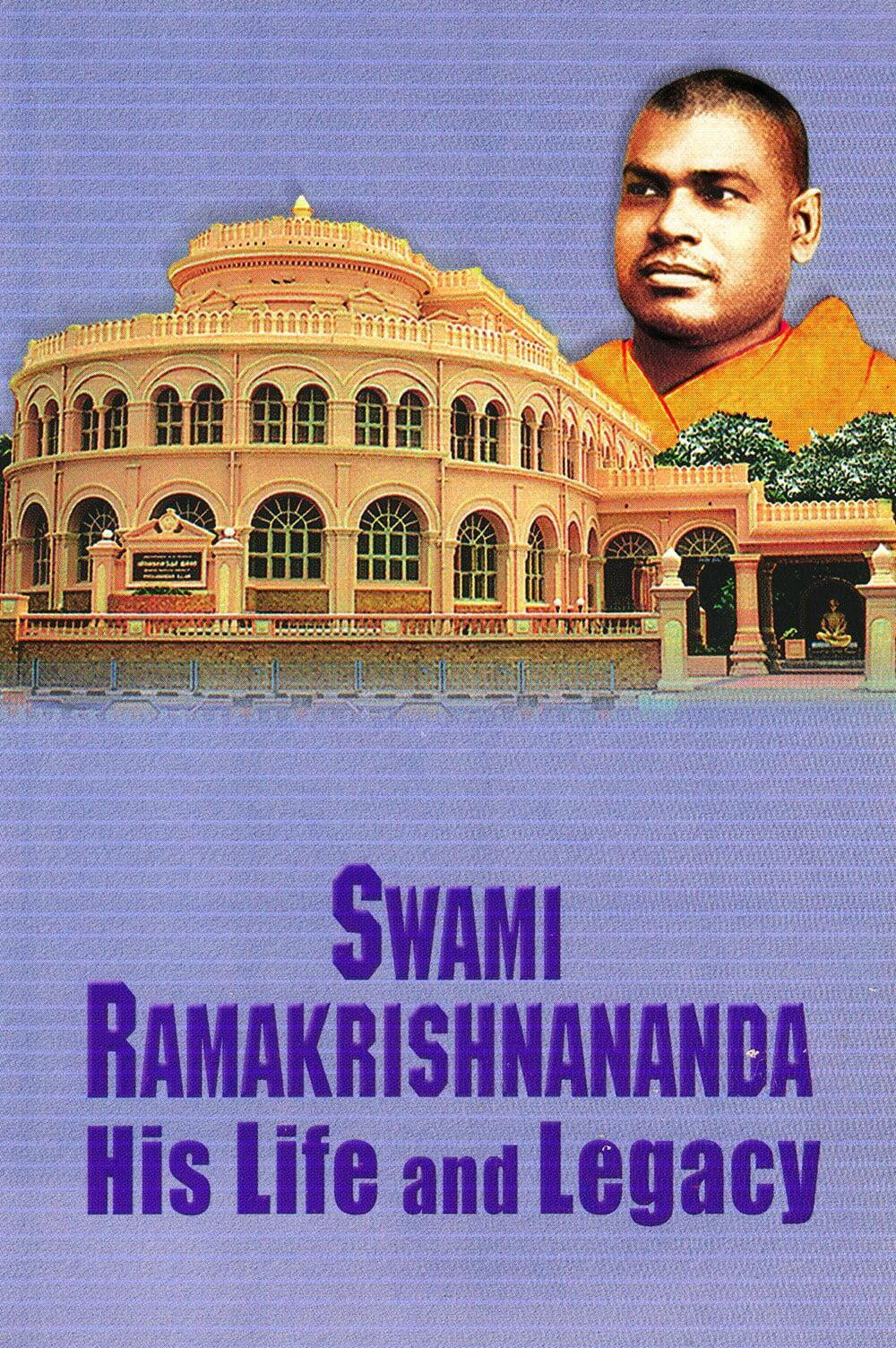
This handy volume presents a concise biographical sketch, carefully chosen reminiscences, and selected teachings of Swami Ramakrishnananda, a direct disciple of Sri Ramakrishna. Ramakrishnananda, popularly known as Shashi Maharaj, worked tirelessly to spread the message of his Master and the ideal of renunciation and service in different parts of the southern India. His unparalleled devotion to his Guru, pure life, saintly personality, and love and concern for others are depicted in this book. The book will benefit the general readers who wish to acquaint themselves with his life and teachings.
Sri Ramakrishna was born in 1836. His arrival was a momentous event in the spiritual history of mankind and is particularly significant for India—the land soaked in spirituality and mysticism. His life was a blazing fire of spirituality that brought fresh light and hope to all seekers of God. What is more, his life of spirituality lit many lamps before disappearing from the physical, mortal plane more than a century ago.
Among the numerous lamps that Sri Ramakrishna ignited in the form of his monastic and householder disciples, Swami Ramakrishnananda was one. Affectionately known as Shashi Maharaj, Swami Ramakrishnananda was a mighty spiritual giant, a deep thinker, a living personification of guru bhakti (devotion to one's guru), and a pioneer in spreading the message of love and God consciousness that Sri Ramakrishna embodied.
Swami Ramakrishnananda was born as Shashibhushan Chakravarty on July 13, 1863, at Ichapur in Bengal.
Shashi was born in a family of worshippers of the Divine Mother. He was the eldest son of Iswar Chandra Chakravarty (1837-1902) who was a great devotee of the Divine Mother and renowned specialist in various forms of Tantric worship and spiritual practices. Later, he played the role of a tantradharak (assistant to the worshipper) in many worships performed in Belur Math, especially during the first Durga Puja held there.
Shashi Maharaj’s mother, Bhavasundari Devi (1846-1925), was an ardent devotee of Divine Mother. Bhavasundari Devi was a guileless, pious woman.
Though not much is recorded of Shashi’s boyhood, he grew up in a spiritually enriching atmosphere. He was a strict vegetarian all through his life. ‘I was a vegetarian from my young boyhood,’ he once later recalled, ‘I read a book by Chaitanya Mahaprabhu and at once I gave up all non-vegetarian food. If I found fish in the curry, I would eat dry rice and go away.’
After finishing his education in the village school, Shashi went to Calcutta for higher English education. He lived with his cousin Sharat (later, Swami Saradananda), who was almost of the same age.
He passed the Calcutta University Entrance examination, and, as he was a brilliant student, won a scholarship. He passed his First Arts examination from Albert College, then entered the Metropolitan College (now Vidyasagar College) for his B.A. His special subjects of study were Sanskrit, English literature, Mathematics and Philosophy.
During their college days, both Shashi and Sharat became members of the well-known reform movement Brahmo Samaj, and were inspired by the lectures of Keshab Chandra Sen, the great Brahmo leader. For a certain period, Shashi privately tutored Keshab’s sons.
Shashi first heard about Sri Ramakrishna from Keshab. Shashi and his friends said to each other, ‘If Keshab Chandra Sen, whom we honour so much, shows such great reverence for this Paramahamsa, there must be something extraordinary in him.’
Shashi’s spiritual yearning was growing and he looked for a guide. One day, in October 1883, Shashi, Sharat, and some of their friends went to Dakshineshwar to visit Sri Ramakrishna. They found the Master seated on his small couch. He received them cordially and asked them to sit on a mat spread on the floor. He then asked their names and where they lived, and was delighted to know that they belonged to Keshab’s Brahmo Samaj.
At the very first sight, Sri Ramakrishna recognized Shashi and Sharat as his own. Sensing their spirit of renunciation, the Master said,
‘Bricks and tiles, if burnt with the trademark on them, retain those marks forever. Similarly, you should enter the world after advancing a little in the path of spirituality. Then you will not sink in the mire of worldliness. But nowadays parents get their boys married while quite young, and thus pave the way to their ruin.’
‘Then, sir, is it wrong to marry? Is it against the will of God?’ asked one of the boys.
The Master asked him to take a certain book down from the shelf and directed him to read a particular passage that quoted Christ’s opinion of marriage,
‘For there are some eunuchs, which were so born from their mother's womb; there are some eunuchs, which were made eunuchs of men; and there be eunuchs, which have made themselves eunuchs for the kingdom of heaven’s sake. He that is able to receive it, let him receive.'
The Master then asked him to read Saint Paul:
‘I say therefore to the unmarried and widows, it is good for them if they abide even as I. But if they cannot contain let them marry: for it is better to marry than to burn.’
Someone interrupted, saying: ‘Do you mean to say, sir, that marriage is against the will of God? And how can His creation go on if people cease to marry?’ Sri Ramakrishna smiled and said: ‘Don't worry about that. Those who wish to marry are at perfect liberty to do so. What I said just now was between us. I speak on what I have got to say; you take as much of it as you like and no more.’
Sri Ramakrishna asked Shashi whether he believed in God with form or without form. Shashi replied frankly, ‘I am not certain about the very existence of God, so I am not able to speak one way or the other!’ This simple and direct reply pleased the Master very much. When the boys took leave of him, the Master said to Shashi, ‘Please come again and alone.’
On the very first day Sri Ramakrishna recognized that Shashi and Sharat belonged to his inner circle. On 23 December 1885 the Master said to M.: ‘When God assumes a human body for the sake of His devotees, many of His devotees accompany Him to this earth. Some of them belong to the inner circle, some to the outer circle, and some become the suppliers of His physical needs. . . . The Divine Mother used to reveal to me the nature of the devotees before their coming. In a vision I saw that Shashi and Sharat had been among the followers of Christ.’ Shashi and Sharat started visiting the Master frequently and performed spiritual disciplines according to his instructions.
Sri Ramakrishna was diagnosed as having a serious throat disease and in 1885, he was moved to Shyampukur Street in Calcutta for undergoing medical treatment. After a month, on the advice of doctors, he was shifted from smoggy Calcutta to a clean, quiet country-house—Cossipore garden house.
Shashi followed the Master like a shadow. He was the very embodiment of service, and firmly believed that service to the guru was the highest form of spiritual practice. He practised no other spiritual discipline, knew no other asceticism, travelled to no holy places. Forgetting his personal comforts, he was always ready to serve the Master. His life was a glowing example of dasya bhakti (devotion with attitude of a servant). Sometimes, Shashi would fan the Master non-stop for hours. At times, the Master had to tell him, ‘Please go and eat. Now I am all right.’ Sri Ramakrishna also equally loved him and despite his illness, took great pains in moulding Shashi’s spiritual life.
Sometime in the middle of January 1886, when the elder Gopal expressed his desire to distribute twelve pieces of ochre cloth and rosaries to some monks, Sri Ramakrishna suggested to him to present these to his young disciples. Gopal offered them to the Master who himself distributed them among his young disciples. Shashi got an ochre cloth, the garb of a monk, from the Master.
Sri Ramakrishna passed away on 16 August 1886. It was hard for Shashi to believe that the Master had left the physical form. With tearful eyes, he sat near the funeral pyre, with a palm-leaf fan in his hand and remained motionless with grief. Later, he collected the ashes and bones of the Master and put them in an urn. He placed the urn on his head and carried it to the garden house where it was kept on the Master’s bed.
Ramchandra Dutta, an eminent householder disciple of Sri Ramakrishna, planned to enshrine the Master’s relics at his garden house. Shashi was shocked and refused to accept the idea. But later, after consulting Naren (later Swami Vivekananda) and other disciples, Shashi, along with Niranjan quietly put a large portion of the relics in another urn which he secretly kept at Balaram Basu’s house; the remaining portion was given to Ram Babu. Ram Babu enshrined the relics at his garden house at Kankurgachi.
Shashi reluctantly returned home, but soon came to the Baranagore Math that was set in motion by Naren and other disciples. The Baranagore Math was located in an abandoned, dilapidated two-storey building infested with snakes and said to be haunted by ghosts.
He set up a shrine in a room upstairs; the Master’s relics were brought from Balaram's house, and a picture of the Master was placed on the altar. The articles that the Master had used at Cossipore were also preserved in the shrine room.
For eleven long years, from 1886 to 1897, Shashi kept a constant vigil over the Master’s relics, seldom visiting any holy place or leaving the Math overnight. He performed the Master’s worship as one serves a living human being. His daily routine was like this:
He would get up at 4:00 a.m. and after washing would enter the shrine to rouse the Master from his bed. He would then offer a twig for a toothbrush and water to rinse his mouth. Next he would offer some sweet made of coconut and a glass of water for breakfast, and tobacco to smoke. Later he would pick flowers, sweep the shrine, wash the vessels used for worship and make the necessary preparations for worship. He would then go to the nearby market to buy the groceries. After returning from the market, he would help the cook cut vegetables, and then he would go to bathe in the Ganges and bring holy water for worship. Afterwards, he would do puja and offer cooked food to the Master. In the evening, he would conduct arati. It was a divine sight to see him conducting the evening arati.
In December 1886, Shashi and some other disciples went to Antpur, the country home of Baburam (later Swami Premananda). Inspired by Narendra, they took informal monastic vows during a nightlong vigil around a sacred fire (dhuni). Later they discovered that their vigil had taken place on Christmas Eve. A month later, they took formal monastic vows by performing the traditional viraja homa in Baranagore Math. Narendra gave the name Swami Ramakrishnananda to Shashi, knowing that Shashi’s devotion to the Master was second to none.
Not only did Shashi Maharaj attend to service of Sri Ramakrishna, he played a pivotal role in the monastic life of the Baranagore Math. While other brother disciples meditated or busied themselves in spiritual practices, Shashi Maharaj looked after their physical needs. Swami Vivekananda paid glowing tribute to Shashi Maharaj’s dedicated service and devotion thus:
‘Shashi was the main pillar of the Math. Without him, life in the monastery would have been impossible. Often, the monks would be lost in prayer and meditation with no thought of food, and Swami Ramakrishnananda would wait with their meals or even drag them out of meditation.’
Possessed by a desire for pilgrimage and austerities, most direct disciples went away from the monastery at different periods of time. Shashi Maharaj was the only person who never stirred out even once. In February 1892, the Math moved to Alambazar in North Calcutta. Shashi Maharaj continued his vigil and worship of Sri Ramakrishna here. Swami Vivekananda had immense faith in Shashi Maharaj’s organising abilities. Shashi Maharaj was his faithful and trusted brother disciple.
Shashi Maharaj was learned and devotional; he was not a gloomy ascetic. After dinner he would dramatically read Mark Twain’s The Innocents at Home and The Innocents Abroad.He would roar with laughter as he read them, and the others would laugh along with him.
He enjoyed solving mathematical problems; sometimes after his noon rest he would work on the mathematics on a slate or piece of paper. He also translated the teachings of Sri Ramakrishna from Bengali into Sanskrit verses and got them serially published in Vidyodaya, a Sanskrit journal. Shashi Maharaj never had an idle moment, as he had a wide range of interests.
In February 1897, Swami Vivekananda returned to Calcutta from the West. At Madras, when devotees requested Swamiji to start a permanent centre, Swamiji had said, ‘I shall send you one who is more orthodox than the most orthodox Brahmins of the South and who is at the same time incomparable in performing worship, scriptural knowledge and meditation on God.’
One day, at Calcutta, Swamiji asked Shashi Maharaj, ‘Shashi, I want to put your love for me to a test. Can you buy for me a piece of English bread from a Muslim shop at the corner of Chitpore Road?’ Despite his orthodox beliefs, Shashi Maharaj obeyed the order of his beloved leader without hesitation. Then in March 1897, before going to Darjeeling, Swamiji called aside Shashi Maharaj and said, ‘I have given word to my friends that I shall very soon send one of my brother disciples there. I have selected you. You are to go to Madras and found a monastery there in the name of our beloved Master.’
Shashi Maharaj neither raised any objection nor pleaded any excuse. Leaving aside his eleven years of vigil over his Master’s remains, he quietly obeyed the leader, and in the month of March itself, along with Swami Sadananda, a disciple of Swamiji, left for Madras by a steamer.
Swami Ramakrishnananda arrived at Madras on 17 March 1897. He came by a steamer (there was no train route available then) and was warmly received by a group of devotees and admirers of Swami Vivekananda at Madras such as Dr. Nanjunda Rao, Alasinga Perumal, and others.
For a short period, Swami Ramakrishnananda was accommodated at Flora Cottage situated on the Ice House Road. Later he was shifted to the Ice House. Also known as Castle Kernan, the Ice house was built to store ice that was transported to Madras. It is a three-storied building, located in the Triplicane area, on the Marina beach. When Shashi Maharaj came to Madras, it was owned by Sri Biligiri Iyengar, a wealthy devotee of Swami Vivekananda. Swamiji stayed at Ice House for nine days on his return from the West in 1897.
Sri Iyengar placed the ground floor of the building at Swami Ramakrishnananda’s disposal. As in Baranagore and Alambazar, Ramakrishnananda set up a shrine at this new residence and installed a small picture of the Master that he had brought with him and started his seva. He could after all conceive of his life only as a series of activities centred around the living presence of the Master.
Besides ‘seva ’in the shrine, his service was extended to preaching of the Master’s message in different parts of the Madras city. His preaching activities consisted of weekly classes on the Gita, the Upanishads, and Bhagavata, at the invitation of different religious organizations in the city, such as Aryan Association (Mint Street), Young Men’s Hindu Association, and the Triplicane Literary Association.
Shashi Maharaj followed this formidable schedule of classes, with minor alterations, for years. He would travel to different places in the city in a Jutka, a narrow, inconvenient horse-drawn carriage which was in vogue those days. He had to travel a mile and a half from Ice House to hire a Jutka. Added to this was the fact that he was his own cook and servant, as there was no one to assist him (Swami Sadananda who had come with him, had to return to Calcutta on account of a dog-bite).
Some of his classes were very well attended, but some were not. It is mentioned in his reminiscences that there were occasions when he was the only person present for the lecture. But least perturbed by it, he would meditate for an hour at the place, and return.
Another activity that he added to his schedule was the annual celebration of Sri Ramakrishna's birthday. This was an elaborate two-day event, consisting of puja, homa, hari-katha, sankirtan, a public meeting, and feeding the poor.
Shashi Maharaj’s life was full of hardships and difficulties. The financial condition of the just founded Math was far from satisfactory. But he would rarely speak of these difficulties to the devotees. He always turned to Sri Ramakrishna who was a living presence for him. Once a group of devotees heard him angrily speak to the portrait of Sri Ramakrishna thus: ‘You have brought me here, old man, and left me helpless. Are you testing my powers of patience and endurance? I will not go and beg hereafter for my sake or even for yours. If anything comes unasked, I will offer to you and share the prasadam. Or, I will bring sea sand for offering to you and I shall live upon that.’ On all such occasions, mysteriously, some devotee would arrive with provisions, and the offering in the shrine to Sri Guru Maharaj would be made as usual.
Sometime in 1899, Shashi Maharaj came to know many details of the life and teachings of Sri Ramanujacharya and thus was conceived a series of articles on Ramanuja’s life that he contributed to the Bengali monthly Udbodhan published from Calcutta. The articles were published from 1899 to 1906. In order to verify the authenticity of the information provided in the articles, he visited Sriperumbudur and Kanchipuram.
These articles, which were later published as a book from the Udbodhan office, provide rich and detailed information about Ramanuja in Bengali. It remains a mystery how Shashi Maharaj, without knowing Tamil, could gather so much information.
Soon after Shashi Maharaj reached Madras he received the following letter (excerpts) from Swami Vivekananda:
Darjeeling, 20th April, 1897.
Dear Shashi,
. . .In Madras the worship should be done in a completely SATTVIC MANNER, without a trace of Rajas in it. I hope Alasinga has by now returned to Madras. Don’t enter into wrangles with anybody—always maintain a calm attitude. For the present let the worship of Sri Ramakrishna be established and continued in the house of Biligiri. But see that the worship does not become very elaborate and long. Time thus saved should be utilized in holding classes and doing some preaching
Early morning, finish daily your worship and other duties briefly, and calling together Biligiri with his family, read before them the Gita and other sacred books. There is not the least necessity for teaching the divine Love of Radha and Krishna. Teach them pure devotion to Sita-Ram and Hara-Parvati. See that no mistake is made in this respect. Remember that the episodes of the divine relationship between Radha and Krishna are quite unsuitable for young minds. Specially Biligiri and other followers of Ramanujacharya are worshippers of Rama; so see to it that their innate attitude of pure devotion is never disturbed.
In the evenings give some spiritual teaching like that to the general public. Thus gradually ‘even the mountain is crossed’. . . .
Suresh, a young man of 17 from Calcutta, wanted to join the Ramakrishna Order of monks. Swami Vivekananda was deeply impressed by his innocence and dedication. Swami Brahmananda, moved by his childlike nature, affectionately renamed him as Vasant. In order to give him good initial training in monastic life, Swami Brahmananda sent him to Shashi Maharaj in May 1901. When he reached, Shashi Maharaj recognised him as the same person whom Sri Ramakrishna showed him in a dream, and warmly welcomed him.
In 1901, when Swamiji wanted Shashi Maharaj to come to Belur Math for giving him definite guidelines for the work at Madras, Shashi Maharaj took Brahmachari Vasanta with him. Swamiji initiated Vasanta into sannyasa in the first week of January 1902 with Shashi Maharaj chanting the sannyasa mantras during the ceremony. Vasanta was named Swami Paramananda. He came back to Madras and was under Shashi Maharaj’s care till 1906 when he was sent to New York to assist in the Vedanta work there.
Before leaving Belur Math, Shashi Maharaj had given four hundred rupees to Swamiji as his contribution to Belur Math. He was deeply devoted to Swamiji. When Swamiji wanted his brother monks to take up the spread of Sri Ramakrishna’s ideas and engage in missionary activities, many of them had reservations about doing it. But Shashi Maharaj never questioned him or opposed him. He faithfully followed whatever he was asked to do.
Such was his devotion to Swamiji that once when he visited a house in Ernakulam as the guest of advocate, Sri Duraiswami Iyer, as soon as he entered the house, he said, ‘I have heard that Swami Vivkeananda stayed in your house in his wandering days. This is a tirtha, a holy place. I wish to see first the exact place where he stayed.’ ‘The place where we are standing is the place where he sat,’ he was told. At once Shashi Maharaj rolled on the ground and kissed it.
On his second visit to the West, Swami Vivekananda arrived at Madras on June 24, 1899 along with Swami Turiyananda and Sister Nivedita.
At Shashi Maharaj’s request, Swamiji had brought Ganga water for use in the Madras Math, in a large porcelain jar. Unfortunately, owing to the plague in Calcutta, Swamiji was not permitted to alight from the ship. Shashi Maharaj thus went in a boat near the ship and placed in a basket sweets and other eatables meant for Swamiji. The basket was drawn up and in the same basket the jar containing Ganga water was sent down. It is said that Swamiji tied the jar with a rope so tightly that Shashi Maharaj could not untie it. Hence Swamiji also sent down a knife to cut it. (The jar is still preserved in the Ramakrishna Math, Chennai and the knife is kept at the Ramakrishna Museum at Belur Math).
Before returning, Shashi Maharaj made the boatman go round the ship three times and said, ‘Let us at least make a pradakshina of the two great souls whose feet we have not been able to touch today.’
Many years later, he composed a Sanskrit hymn in praise of Swami Vivekananda. He is supposed to have chanted the hymn on 29 January 1911, the birthday celebrations of Swamiji. The hymn is a graphic description of how Shashi Maharaj held Swamiji in high esteem and veneration. Here is a well-known verse (with its free translation) of the hymn.
‘Salutation to the sage and seer Vivekananda, the prince among Sannyasins. Salutation to the embodiment of Sat, Chit and Ananda, and the remover of all sorrows.’
Swami Vivekananda passed away on July 4, 1902 in his room at Belur Math. Swamiji left his body at around 9 p.m. At the same time, unaware of these developments, Shashi Maharaj was meditating at the Ice House in Chennai. Shashi Maharaj called Swami Satchidananda, who was staying with him then, and said, ‘I saw Swamiji standing before me and he said to me, “Look here, Shashi, I threw away this body like spitting out spittle,” and he spat twice or thrice.’
Both swamis could not figure out the meaning of that vision, and neither of them got any more sleep that night. The next day, Shashi Maharaj received a cable from Belur Math bringing the sad news of Swamiji’s Mahasamadhi.
A memorial meeting in honour of Swami Vivekananda was held at Pachaiyappa Hall on July 29, 1902. Shashi Maharaj was one of the speakers in the meeting. He said, ‘The world outside needs the light of wisdom of our Rishis quite as much as we do in India, and I am anxious to see an Ananda Mandir (a memorial in Swamiji’s name) rise somewhere in a conspicuous part of the city from where that light may be made to radiate in ever increasing brilliance to all near as well as distant. . .’
As a sequel to his appeal a committee of the Ramakrishna Vivekananda Home was formed which created Swami Vivekananda Memorial Fund ‘to perpetuate his memory in Madras.’
Kalipada Ghosh, a disciple of Sri Ramakrishna, invited Shashi Maharaj in 1903 to Trivandrum. Kalipada Ghosh was employed as the local agent for M/s John Dickinson & Co. Ltd. Shashi Maharaj stayed at his house and took part in the Birthday Celebrations of Sri Ramakrishna which included feeding a large number of poor people. During that occasion he delivered a lecture on the subject ‘Unity in Variety.’
At Trivandrum
Shashi Maharaj stayed in Trivandrum for one month and gave a number of talks at different places. He gave a talk at the Padmavilasam Palace, the town residence of the Dewan of Travancore.
During his stay at Trivandrum he once visited the well-known Ananta Padmanabha Swami Temple. He wanted to offer his worship at the garbha griha (sanctum sanctorum) but was prevented from doing so by the temple priest. The priest asked him whether he was a brahmin. Without paying any attention to the priest’s objections, Shashi Maharaj loudly chanted:
नाहं मनुष्यो न च देव यक्षो न ब्राह्मण क्षत्रिय वैश्य शूद्रः । न ब्रह्मचारी न गृही वनस्थः भिक्षुर्न चाहं निज बोधरूपः ॥
‘I am neither a man nor a deity nor a ghost; I am not a brahmin, kshatriya, vaishya or shudra; Nor am I a celibate, a householder or a forest dweller; Nor can I be said to be a monk; All that can be said is that I am Pure Consciousness.'’
The sonorous sound of Shashi Maharaj’s voice, his serene looks and devotional fervour left the priest awestruck and he quietly stepped aside giving way to Shashi Maharaj to go to the garbha griha.
At Bangalore and Mysore
Swami Ramakrishnananda’s name as an able preacher of the message of Sri Ramakrishna began to spread. Invitations for lectures and visits began to pour in. Vedanta Society of Ulsoor, Bangalore, invited him in 1903. When he reached Bangalore Cantonment Railway Station, in July 1903, at six in the morning, he was accorded a royal reception. He was taken in a procession of some 4000 people, which included 53 bhajan parties, through the principal streets of the cantonment area. The three mile long procession arrived at Clarendon Hall around ten in the morning.
During his twenty days’ stay at Bangalore, Shashi Maharaj gave twelve lectures and gave several private interviews. His lectures were very well attended and he roused great enthusiasm among his listeners. He spoke at various colleges and temples in the city such as Central College, Mallikarjuna Swami Temple (at Malleswaram), Mayo Hall, Anantaswami Math, Sanskrit College, Chamarajpet, Bull Temple, Poornaiah’s Chattram and London (United) Mission School. At Bangalore, Shashi Maharaj had an audience with the Maharaja Krishnarajendra Wadiyar, the well-known ruler of Mysore State.
In October 1903, Swami Ramakrishnananda visited Mysore for three days. He gave a talk in Sanskrit at the Sanskrit College. The learned talk, given before an assembly of Sanskrit scholars, was focussed on ‘Dharma Samanvaya.’ During his visit, Swami Ramakrishnananda gave four lectures at the Rangacharlu Memorial Hall (now the Town Hall of Mysore).
While returning from Mysore to Madras, Swami Ramakrishnananda briefly halted at the temple town of Srirangapatnam near Mysore and addressed a gathering there. Soon after he came back to Madras, he was invited to speak at Sholapur (now in Maharashtra) and he accordingly went there in July 1904. He gave a lecture on ‘Happiness’ at Rippon Hall at Sholapur. More than 300 people attended his talk.
At Machilipatnam
At the invitation of devotees, Shashi Maharaj visited the ancient port town of Machilipatnam (now in east Andhra Pradesh) in August, 1904 and inaugurated Vivekananda Mandira—a temple built in memory of Swami Vivekananda, built under the aegis of Hindu Matha Bala Samajam, an organisation founded in 1890. The Temple continues to be a place of religious and cultural activities.
At Tirunelveli and Alleppey
Shashi Maharaj visited Tirunelveli (in South Tamil Nadu) from 25-31 December 1904. He went at the invitation of Brahmanishta Math, Narasimhanallur, to take part in their third anniversary celebrations. He was accorded a befitting welcome at the Tirunelveli railway station and was taken in a procession to the Math. Later he visited the Tirunelveli town at the request of devotees and spoke at the Nellaiyappar Temple which was attended by more than 3,000 people.
After returning to Madras, in January 1905 he went to Kerala where he inaugurated Sanatana Dharma Vidyalaya (for boys) at Alleppey on January 18,1905. On the same day, in the evening, he spoke on Sanatana Dharma and on Gita the following day. He also spoke at Theosophical Society, Ernakulam and at Maharaja’s College
At Rangoon
Akshaya Kumar Sen, a lay disciple of Sri Ramakrishna and the author of Sri Sri Ramakrishna Punthi, motivated Ramakrishna Seva Samiti at Rangoon (now called as Yangon, the capital of Myanmar) to invite Swami Ramakrishnananda for the birthday celebrations of Sri Ramakrishna. Shashi Maharaj reached Rangoon on 20 March 1905. Besides speaking during the birthday celebrations, he gave four lectures in Rangoon city.
During his short stay in Rangoon, Swami Ramakrishnananda visited some important places of interest, including the Buddhist pagodas. One moonlit night he went to see the Shwedagon Pagoda, which was situated in a suburb of the city, and circumambulated the Pagoda in great devotion.
At Bombay (now Mumbai)
After his five-day stay at Rangoon, Shashi Maharaj sailed for Madras on March 25 and reached Bombay on 29 March 1905. He arrived at Madras in the morning and the same evening left for Bombay for participating in the seventy - second birth anniversary of Sri Ramakrishna. Kalipada Ghosh played host to him.
A group of devotees employed in M/s John Dickinson & Co. Ltd. (of which Kalipada Ghosh was the local agent) had been worshipping Sri Ramakrishna at their place in Topiwala Chawl on Grant Road, Bombay, and were keen to have Swami Ramakrishnananda for the annual celebrations.
The birthday celebrations were held on April 1, 1905 at Famji Cawasjee Hall with Sir Balakrishna in the chair. Besides the address on these occasions Shashi Maharaj delivered three lectures in Bombay, at one of which Balagangadhara Tilak, the great patriot and political leader, presided. Tilak pleaded for starting a permanent centre of the Ramakrishna Mission at Bombay but this materialised only two decades later.
During the early years, Shashi Maharaj had a very hard time in Madras. He had very little assistance. The financial condition of the Math was far from satisfactory. Sometimes he hardly had anything to eat even. But his flaming devotion burnt its way through all difficulties. Once when he had nothing to eat, he stood before the image of Sri Ramakrishna and said, ‘You want to test me! I will eat sand and do Swamiji’s work here! Sirrah! You are testing me, I know. But you should also know my grim resolve. I shall rather die and perish here than budge an inch from this place!’
Just then some soft knocks were heard at the door outside and when someone opened the door, they found Mr. Condiah Chetty, an old student of Shashi Maharaj, had come with some wheat flour, ghee, sugar candy and dried fruits. He placed them before Shashi Maharaj, and also five rupees in coin Shashi Maharaj burst out in childlike glee and a joyous roar, bade the devotees present to bring two stoves and made sweetmeats and other nice preparations for the offering and partook of the food later.
Shashi Maharaj stayed at the Ice house (now called Vivekanandar Illam or Vivekananda House, a sub-centre of Sri Ramakrishna Math, Chennai) till 1906. Four years after Biligiri Iyengar who owned the Ice House passed away in 1906, the Ice House building was put up for an auction. Biligiri was a great support for the upcoming Math and, though before passing away he willed some money to Swami Ramakrishnananda, his loss was irreparable.
It seems a few well-wishers of the Math—notably Dr. M.C. Nanjunda Rao—tried to bid, but when the amount rose beyond their means, they had to withdraw.
It is said that Swami Ramakrishnananda sat at a distance, serene and detached, seeing the auction going on, absolutely unconcerned about the future. He was to say later that anxiety was a sign of lack of faith in God. And faith, burning faith, is what Ramakrishnananda had in ample measure. He knew that it was the Lord’s work that he was doing— and the Lord would take care of it. Indeed, Ramakrishnananda had on an earlier occasion even brushed aside Swamiji’s call to return to Calcutta or shift to Rameshwaram because the going in Madras was getting tough for a while. So this auction was not something that was going to upset him.
When the building changed hands, the Math was temporarily shifted to an outhouse of the Ice House. Fortunately, around this period, sometime in July 1906, a plot of land at Mylapore was donated by a devotee, Sri Akula Condiah Chettiar. Swami Abhedananda, a direct disciple of Sri Ramakrishna, who was on a visit to Madras, laid the foundation of the new Math at Mylapore.
The expenses for the construction of the new Math were from The Swami Vivekananda Memorial Fund which was created after the memorial meeting that was held at Pachaiyappa Hall in 1902, after the passing away of Swami Vivekananda.
The work started towards the end of March 1907 and the one-storey building was completed by the beginning of November of the same year.
To Shashi Maharaj Sri Ramakrishna was a living presence. He felt His presence and his actions revealed it. Soon after the construction, the new Math building developed cracks and began to leak. One night as it began to rain Shashi Maharaj went into the shrine and to his surprise found it leaking right over Master’s portrait. Anyone else would have removed the picture to a safer place and gone to sleep but for Shashi Maharaj the Master was a living presence. To remove the photo thus would mean to disturb the Master’s rest. He spread an umbrella and held it over the Master’s portrait and stood there all night until the rains subsided.
After some time, owing to the poor quality of construction, the Math building became unfit for use. Several years later, a new building for the Math was raised on the adjacent plot of land. Swami Brahmananda, the first President of the Ramakrishna Order, laid its foundation in 1916 and later inaugurated it in 1917. Though Shashi Maharaj was no longer present in his physical form then, the building was dedicated to him—as an affectionate and respectful homage to his untiring zeal and dedication in providing a firm foundation to Sri Ramakrishna Math, Madras.
Starting of the Students’ Home
Swami Ramakrishnananda had a very tender heart which overflowed with compassion for the poor, the lowly and the lost. Once he came across an orphan boy from Mysore whose parents had died of plague. He took him to the Math and fed him. But the Math itself was under financial strain and the strict religious regimen of the Math was not conducive to the boy’s education. As things would have it, Sri Ramaswamy Iyengar, an ardent follower and friend of Swami Ramakrishnananda, offered to arrange for the boy’s board and lodging, by turn, in his friends’ homes. Several months later, Ramu (as Ramaswamy Iyengar was called affectionately) himself came across four boys from Andhra sitting on the roadside. They had come from Guntur, believing they could pursue their studies at Madras, but were harshly disappointed.
Soon after, through Swami Ramakrishnananda’ s initiative, a free hostel for boys (now called Ramakrishna Mission Students’ Home) was started in a small house owned by Dr. M.C. Nanjunda Rao at Kesavaperumal South Mada street in Mylapore. After sometime they shifted the ‘Home’ and Ramu was able to rent a house for Rs.3/ - a month and also engaged a cook for another Rs.3/- a month. He collected vessels from his devout mother and various kind-hearted ladies supplied provisions.
Similarly Ramu, along with Swami Ramakrishnananda, collected money from homes in the neighbourhood. Working unselfishly he was able to persuade most of the elite in the Mylapore and Triplicane areas. Swami Ramakrishnananda was his mentor not only in spiritual affairs, but even in ordinary human relations. If someone was rude when approached for donations he would ask Ramu to keep cool and part from the person with a smile.
As more funds became available the ‘Home’ was shifted to a more spacious premises. In 1916 Sri S.G. Srinivasachar, District Munsif, Nagapattinam, donated 15 grounds of his property and it is on this plot that the present Home stands in the sylvan surroundings of Sullivan Garden Road, Mylapore. Contributions in cash and kind and expert engineering help came from various quarters and the ‘Home’ got its permanent location which was blessed by its inauguration by Swami Brahmananda, the first President of the Ramakrishna Math and Mission, on Akshaya Tritiya day, 10 May 1921.
Since then, the ‘Home’ has become a very respected and much sought after institution, considered as a veritable palace for the orphaned and destitute children. Ramu worked in tandem with his cousin, Ramanujachari who retired as a Deputy Secretary in the Madras Government.
Starting of a Primary School at George Town, Chennai
Sometime in 1906, under the inspiration of Swami Ramakrishnananda, a few residents of George Town, in North Chennai, started a primary school for girls under the name ‘National Girls School'. In order to raise funds for the school maintenance, it is said that Swami Ramakrishnananda would walk through the streets from Chintadripet to George Town, carrying a large wooden box in his hands. Whatever collections he would get was deposited in the school account maintained at the local post office. The wooden box that he used is preserved at the school.
The school, which began with three girl students, was started in a Choultry of the Kannika Parameswari Temple (Krishnappa-naicken Agraharam) at George Town. Sri Ramakrishna Math took over the school in 1921. In 1981, the school was moved to its present own building at Basin Bridge Road, Mint, Chennai. The school is at present called ‘National Primary School’.
The Math at Bangalore
In August 1904 Shashi Maharaj went to Bangalore at the invitation of Vedanta Society, Ulsoor. He delivered three lectures and left Swami Atmananda, who had accompanied him, to organize a permanent centre in the city. Swamis Atmananda, Vimalananda, and Bodhananda carried on the work in succession till 1906, under Swami Ramakrishnananda’s guidance.
In 1906, Swami Ramakrishnananda accompanied Swami Abhedananda on a short visit to Mysore and Bangalore. They stayed at Mysore from 7-12 August. Besides two public talks by Swami Abhedananda, the schedule consisted of a meeting with the Maharaja of Mysore.
Both the monks were invited to the palace and an assembly of Sanskrit scholars and high officials of the State was organized. As a mark of respect for the monks, the Maharaja, Sri Krishna Raja Wadiyar, came down from his royal throne and sat with the monks on the carpet. The assembly lasted for two and a half hours.
On 20 August 1906, as per Shashi Maharaj’s plan, Swami Abhedananda laid the foundation for the Bangalore Math on a two-acre plot donated by the Dewan of Mysore, Sir V. P. Madhav Rao. Owing to certain considerations, the foundation stone was later shifted to a more suitable spot.
Swami Ramakrishnananda played an important role, as in the case of Madras Math, in raising funds for the new Math at Bangalore. He went from house to house, often accompanied by Sister Devamata, to collect the necessary funds. Sister Devamata was an American lady who met Swami Vivekananda in 1899 in New York. She came to India and spent a few years. She records in her book, ‘Days in an Indian Monastery,’ how Swami Ramakrishnananda encountered challenging situations during his fund raising drive:
‘We went a long distance to the house of a high official in the Maharaja’s service and waited for two hours to see him. When he came in, I began my usual explanation of my errand. Suddenly, he cut me short with the abrupt words, “I cannot understand why they make so much of this Ramakrishna.” I was silenced. There seemed nothing more to say. But Swami Ramakrishnananda turned to him with a glowing smile and said, “Let me tell you about him. I was his personal servant.” Then the swami began to speak of his Master with such impelling fervour that he caught the gentleman’s interest. For half an hour he listened with growing attention; then he excused himself and left the veranda. When he returned, he carried a contribution to the new monastery building.’
The construction of the Ashrama building was completed by the end of 1908 and its opening was performed on January 20, 1909 by Swami Brahmananda, the first President of the Ramakrishna Order. As a part of the consecration, an elaborate puja and homa was conducted. During the inaugural function, there were many speakers, and Shashi Maharaj also spoke. The Dewan of the Mysore State presented a welcome address on behalf of the people of Bangalore. Swami Brahmananda gave a short speech on the occasion. A huge and well-decorated pandal, accommodating more than 1200 people was put up for the function. All the tents and decorations were lent by the Maharaja of Mysore.
After the function, the Dewan handed over the keys of the newly constructed building to Swami Brahmananda, who unlocked the door and was the first to enter the building. All those who were in the veranda went around the building and returned to the central room where a temporary shrine had been made. Swami Ramakrishnananda lighted a lamp, offered flowers, and chanted Vedic hymns. The ceremony came to an end with local priests chanting Vedic hymns. At the end of chanting every verse, they offered rose petals at the altar. The fragrant rose petals almost hid the portrait of Sri Ramakrishna.
Some More Glimpses of Swami Ramakrishnananda’s Life and Personality
Swami Ramakrishnananda once took Sister Devamata to Gavi Ganga dhareshwaram Temple located near the Bangalore Ashrama. About this visit she recalled later:
‘At another time I visited a very ancient and holy cave Temple at Bangalore... It was the evening hour. The Temple was still and wrapped in shadow. A few worshippers waited in the garden before the Temple. Arati, the Vesper Service, was late and the door was locked.
‘We sat down in the darkness of the Temple porch. It was not the priest who came to conduct the Service but the priest’s son. When he saw me he demurred, but Swami Ramakrishnananda swept aside his anxiety by a commanding sweep of the arm and the words: ‘God’s child must go to God. Come, Sister,’ so we entered. We assisted at the waving of the lights; made Pradakshinam, going three times round the shrine bending down at times to avoid the low roof of the cave; watched a wedding party that came for blessing; then we walked home in silence under a wonderful starlit deep blue sky.’
Shashi Maharaj was a man of great faith. While at Triplicane, he visited the Parthasarathy temple several times. After the Math was shifted to Mylapore, he used to often visit the Kapaleeshwara temple close by. He also took Holy Mother, Swami Brahmananda, Swami Premananda, and other disciples and devotees to the temple. During the annual Ratha Yathra of the temple, Shashi Maharaj would often join the crowd and himself pull the chariot.
Swami Ramakrishnananda was very catholic in his outlook. Though deeply devoted to his religious and spiritual beliefs, he was open and respectful to other religions too. Once he happen to visit the house of a devotee Saidapet in Chennai and in the evening visited St Thomas Mount. He, along with a devotee, entered the church and to the amazement of everyone, he went straight up to the alter, knelt before it as a Christian would do and pray.
One may also mention here that under the guidance of Swami Ramakrishnananda several groups of devotees were formed under the name ‘Vivekananda Society’ in many places around Madras such as Vaniyambadi, Arasam-patti, Krishnagiri and Dharmapuri.
Swami Ramakrishnananda’s public lectures and weekly talks were quite well received. Subsequently, some of his students took initiative and brought out these lectures and talks in book form.
‘Sri Krishna, the Pastoral,’ was his public talk at Triplicane Literary Society on the occasion of Sri Krishna Jayanti in 1898. He spoke again on ‘Sri Krishna, the King Maker’ at the same place and on the same occasion in 1899. Both these were later combined and published in a book form in 1909 by one of Swami Ramakrishnananda’s students.
Swami Ramakrishnananda’s loving concern and deep spirituality drew many brother disciples and admirers of Sri Ramakrishna to Madras.
Swami Subhodananda visited Madras on his pilgrimage to South India in 1897. Shashi Maharaj warmly welcomed him and even organised his lecture at Young Men’s Hindu Association at George Town. Swami Subodhananda spoke on ‘Sannyasa and Brahmacharya.’
Swami Trigunatitananda, another direct disciple, visited Madras on his way to America in November 1902. Swami Ramakrishnananda took loving care of his brother-disciple and although, the Math was hard pressed for even many basic amenities, Shashi Maharaj looked after him with meticulous attention.
Swami Ramakrishnananda, accompanied by Swami Paramananda, went to Colombo in 1906, to receive Swami Abhedananda, a brother disciple, who had arrived from America. They together visited Kandy, Anuradhapuram and Jaffna before reaching Tuticorin on their way to Madras. Swami Ramakrishnananda accompanied Swami Abhedananda when the latter spoke at the Hindu College in Jaffna.
In 1906, Swami Premananda, a direct disciple of Sri Ramakrishna, came to South India for a pilgrimage with his mother. Swami Ramakrishnananda made all arrangements for them and even travelled with them.
In January 1903, Swami Sadananda, Sister Nivedita and Brahmachari Amulya (later, Swami Shankarananda, the seventh President of the Ramakrishna Order) came to Madras and were deeply impressed by Shashi Maharaj’s preaching activities.
Swami Ramakrishnananda strongly believed that the whole of the South would be sanctified by the touch of the blessed feet of Holy Mother and Swami Brahmananda. He therefore worked hard to arrange for their visits on a grand scale, in spite of insufficient funds.
Swami Ramakrishnananda went to Puri in mid 1908 to escort Swami Brahmananda, who was sojourning at Puri then, to Madras.
While at Puri, Swami Ramakrishnananda went to Jagannath Temple for darshan. After the darshan, he told the brahmachari who accompanied him,
‘Look, after the darshan, one should buy the prasada and partake of it.’
Then Swami Ramakrishnananda held the prasada container in the left hand and partook the prasada from the right hand.
Swami Brahmananda and Swami Ramakrishnananda arrived at Madras by the end of 1908. After staying some days at Madras, Swami Ramakrishnananda accompanied Swami Brahmananda on a pilgrimage. First, they went to Rameshwaram, and stayed three days as the guests of the Raja of Ramnad. Both the brother disciples worshipped Lord Shiva in a ceremonious way, with Ganga water that Swami Brahmananda had brought from Varanasi.
On the way to Madras from Rameshwaram, they halted at Madurai to visit the famous Meenakshi temple, and stayed for three days. Swami Ramakrishnananda wanted to escort Swami Brahmananda to the inner sanctuary of the temple so that he could see the Mother closely. As the entry to the inner sanctuary was restricted, Swami Ramakrishnananda shouted ‘Alwar, Alwar’ (in Tamil, an illumined Vaishnava saint). As a result, the priests did not stop them. In the temple, Swami Brahmananda had a wonderful vision, and realizing that he was in ecstasy, Swami Ramakrishnananda held him up for nearly an hour in the midst of a large crowd. Swami Ramakrishnananda himself chanted the glory of the Divine Mother with tearful eyes. Afterwards, they came out of the shrine.
Here is an interesting incident about these two great souls gracefully resolving the difference in opinion on work which are part of life anyway.
When the Inspired Talks of Swami Vivekananda was first published by Madras Math, Brahmananda took an interest in it and said that a copy should be sent to The Hindu, the daily published from Madras and, after the review appeared in that daily, another copy should be sent to the Bombay Chronicle with a copy of The Hindu review enclosed. Ramakrishnananda, however, differed on this point: He wanted to send copies to both newspapers simultaneously for review.
Brahmananda suddenly withdrew his suggestion and said: ‘Well, you are in charge of this Math, and you are a scholar. It is all your business. I see it was wrong on my part to interfere in this matter.’ Saying this, Swami Brahmananda became indifferent, and sent a letter to a devotee in Puri fixing the date of his departure from Madras.
Ramakrishnananda kept quiet for a couple of days, but he could not bear the indifference of his beloved brother anymore. One morning he knelt before Brahmananda and said with folded hands: ‘Maharaj, I have fallen from your grace. If you do not bestow your blessings upon me, who will? What am I without your grace? Men like me may be created by the hundreds out of dust by your wish. Will you not forgive me?’ Immediately the brothers reconciled and everything went on as usual, as if nothing had happened!
During his stay at Madras, Swami Brahmananda was once invited to a dinner by Dr. M.C. Nanjunda Rao, a close disciple of Swami Vivekananda. Swami Brahmananda, accompanied by Swami Ramakrishnananda went to his house and had their dinner. Sarojini Naidu (the celebrated poetess) and Sister Devamata were also present.
Swami Ramakrishnananda organized the Birthday Celebrations of Sri Ramakrishna, which fell on 22 February 1909. On the following Sunday, a public celebration was held, where about 5000 poor people were fed on stitched leaf plates at Thanneer-thurai market—the vegetable market located about half a kilometre from the Math.
Holy Mother’s Visit
In February 1911, Holy Mother came to Madras and stayed for a month in a two-storied house that Swami Ramakrishnananda had rented opposite the Math.
Swami Ramakrishnananda arranged for Mother’s pilgrimage to Madurai and Rameshwaram and accompanied her and her party. About her visit to Rameshwaram, Holy Mother would say later, ‘Ah! Shashi procured for me 108 bel leaves made of gold to worship Shiva at Rameshwaram.’
Swami Ramakrishnananda arranged for Mother’s visit to Kapaleeshwara temple, Parthasarathy temple, Marina Beach, Aquarium and the Fort in Madras. Mother was also present for Sri Ramakrishna’s birthday celebrations held on March 2,1911 at the Ramakrishna Math. She initiated many devotees on that day.
On their way to Chennai, the party also visited Madurai. Holy Mother visited the Madurai Meenakshi Temple, Mariamman Teppakulam (temple is located on an island in a pond), and the old palace of Nayakas. Swami Ramakrishnananda accompanied Mother to all these places.
With Holy Mother at Bangalore
Holy Mother, along with Shashi Maharaj and other companions, arrived at Bangalore on March 24th, Friday, by train from Madras. Her visit was the result of earnest efforts to bring her to Bangalore by Swami Nirmalananda, the then President of Bangalore Ashrama.
Holy Mother’s arrival at Bangalore was marked by large gatherings of people who came to pay their respects to her on different days. Though she was no public figure, her spiritual eminence and divine presence drew many people to her. The flowers that they brought sometimes formed mountains!
Unlike other places that Mother visited during her travels, Bangalore already had a centre of the Ramakrishna Order. Mother stayed here for three days. (No other centre of the Ramakrishna Order, barring Jairambati, Koalpara, Udbodhan and Belur Math, enjoys this blessed distinction of being sanctified by Mother’s stay. She visited many places/ centres but always had to stay in some building outside the Ashrama precincts. But at Bangalore, she stayed within the Ashrama campus, in the then shrine room which houses her shrine at present.)
A Memorable Incident
It was evening time. After a daylong shower of radiance, the sun was about to set. The sylvan and silent landscape of the Ashrama dotted with flowering trees, shrubs and chirping birds added charm to the atmosphere. Accompanied by two or three of her companions, Mother came out of her room and, in order to have a better view of the setting sun climbed the large, gentle sloping horizontal rock situated behind her room. The sublimity of the atmosphere must have inspired her to sit down for a while on the rock. Indeed it was a great moment.
When Shashi Maharaj learnt of her going to the rock, he said with a surprise: ‘Indeed! Mother has become Parvatavâsini (a dweller of the mountains, an allusion to the Divine Mother Parvati). He, then, hurried towards the place. As he was stout and climbed the low hillock in rapid strides, he began to pant. But undaunted, he went up straight to the Mother, prostrated before her, and chanted the three well-known verses from the Devi Mâhâtmyam (Chandi) which are used as mantras for the salutation of the Divine Mother: And then Shashi Maharaj prayed ‘Kripa! Kripa!’ Holy Mother caressed his head, as though pacifying a pleading son, till he felt himself fully blessed. Swami Nirmalananda, who had come along with Shashi Maharaj, requested Mother to perform Japa, which of course she did, before returning to her room.
Since then, that sacred hillock has come to be known as Holy Mother’s Rock.
Shashi Maharaj’s life was short but eventful. For fourteen years, he worked hard to spread the message of Sri Ramakrishna and Swami Vivekananda in South India.
Soon after Holy Mother’s departure for Calcutta, sometimes in April 1911, he became seriously ill with diabetes and tuberculosis. He said that the cause of this breakdown was that ‘Madras life was too strenuous.’ Due to overwork and lack of proper food, he had literally worked himself to the point of death.
At the request of the devotees, he moved to the Bangalore Ashrama for a change and rest. Unfortunately, the bracing climate of Bangalore did not help him. Hence, Swami Brahmananda and Swami Saradananda asked him to go to Calcutta for better treatment. Swami Ramakrishnananda left Bangalore for Calcutta in June 1911 via Madras.
When Swami Brahmananda, who was then at Puri, learnt of Shashi Maharaj’s coming, he went to the railway junction at Khurda Road near Puri to meet him. At the station, Swami Brahmananda entered the compartment and was shocked on seeing Ramakrishnananda’s emaciated body, and exclaimed, ‘Shashi, what is this? Shake it off!’ Ramakrishnananda prostrated before him, and replied, ‘Raja, that is possible only through your blessings.’ Maharaj asked him to follow the advice of the doctors implicitly. This was their last meeting.
On 10 June 1911, Swami Ramakrishnananda arrived in Calcutta. He was accommodated in the Udbodhan Office and was placed under the treatment of noted physicians. In spite of the best treatment possible and careful nursing, his condition gradually deteriorated.
Sometimes he would forget his suffering and would passionately talk about the Master for a long time. When the attendant would ask him to keep quiet, the swami would reply, ‘When I talk about the Master, I lose body consciousness, and even the death-pain becomes insignificant.’ During his last days he became inspired when he talked about Christ, and he would relate how Sri Ramakrishna had regarded him as Christ's companion in his previous life. He also recalled how the Master received the vision of Christ while he was in samadhi, and the very body of Christ had entered into his own. Even in delirium Ramakrishnananda would utter the divine names: ‘Durga, Durga; Shiva, Shiva; Sri Guru, Sri Guru.’
Towards the end Ramakrishnananda expressed a desire to see Holy Mother, who was then at Jayrambati. Swami Dhirananda was sent to bring her, but she could not come, perhaps for two reasons: first, she knew that it would be unbearable for her to witness Ramakrishnananda’s death; second, there was not enough room in Udbodhan for her to stay. However, the swami was blessed with a vision of Holy Mother on his last night of earthly life. Ramakrishnananda exclaimed, ‘Ah, Mother has come.’
On the morning of his last day, Pulin Mitra, a famous singer and disciple of Swami Brahmananda, came to see him. Swami Ramakrishnananda expressed his vision in a Bengali line, Pohala dukha rajani (the night of misery is over), and asked Pulin to take it to Girish Chandra Ghosh, the great dramatist and disciple of the Master, to compose a song. Girish recalled: ‘By the grace of Sri Ramakrishna, I completed the composition immediately. Pulin Mitra sang it before him. He was greatly moved and was satisfied with the composition.’
Pulin sang this song for a long time and Swami Ramakrishnananda listened with rapt attention. It seemed that the song gave him peace because it tallied with his vision. After this he desired to hear another: A Song of Samadhi composed by Swami Vivekananda. Pulin sang that also.
Swami Ramakrishnananda was in an ecstatic mood that whole morning. Doctor J.N. Kanjilal checked him and found him in better condition. He drank a little sanctified water that had been offered to the Master, and for the last three hours of his life he was in samadhi. At 1:00 p.m. he began to perspire, his face flushed, the hair of his body stood on end, and his gaze was fixed between his eyebrows. Swami Ramakrishnananda left his body while in samadhi at 1:10 p.m. on Monday, 21 August 1911.
The brother disciples and other monks began to chant the name of Sri Ramakrishna, and they observed that the hair on Swami Ramakrishnananda’s body remained erect for a long time. Later his body was brought down from the first floor, and Sister Nivedita bowed down to the departed monk. He was decorated with flowers and garlands and then was carried in a procession. The air was laden with the fragrance of flowers, perfume, and incense. A sankirtan party (a group of singers) led the procession. It first stopped at the Cossipore garden house, then at the Cossipore cremation ground, and crossing the Ganges, at last it reached Belur Math. Swami Ramakrishnananda’s body was cremated on the bank of the Ganges at the southeast corner of the Vivekananda Temple.
When the news of Shashi Maharaj’s death reached Holy Mother, she remarked with tearful eyes: ‘Alas, Shashi is gone. My back is broken.’
After receiving the sad news at Puri, the grief-stricken Swami Brahmananda exclaimed: ‘The guardian angel of the South has passed away. The southern side is, as it were, covered with darkness.’
The Hindu community of Madras convened a memorial meeting and paid their homage to Swami Ramakrishnananda, who had sacrificed his life for their spiritual development. A large gathering was held on 4 September 1911 at Pachaiyappa Hall in north Madras. Eminent citizens of Madras paid glowing tributes to Swami Ramakrishnananda’s committed and selfless service to the cause of religion and education.
Prabuddha Bharata, the monthly journal started by Swami Vivekananda, and published from Advaita Ashrama, Mayavati (Himalayas), brought out a Special Issue, October 1911, on Swami Ramakrishnananda, which contained an elegy on Swami Ramakrishnananda by Frank G. Alexander, an American disciple of Swami Vivekananda and some Sanskrit verses in praise of Swami Ramakrishnananda.
Swami Ramakrishnananda was a perfect combination of the various approaches to God. He was a jnani par excellence but his approach to the Ultimate Reality was full of the nectar of bhakti. His extraordinary life is a living illustration that God-consciousness can be lived in this very life itself. The institutions that he founded are now flourishing centres of learning, religious fervour and service, and he lives on through the inspiring story of his life and personality.
Swami Virajanananda (1873-1951) was a disciple of Holy Mother Sri Sarada Devi. He was one of those four who were initiated into sannyasa by Swami Vivekananda juist on his return to India in 1897.
He was the 6th President of the Ramakrishna Order.
I went to 1891 with some of my friends and classmates, playing truant from college. We there met Swami Ramakrishnananda (Shashi Maharaj).
From that time onwards, I used to visit the Math now and then. Shashi Maharaj would make several enquiries regarding our studies and would try to ascertain whether we were coming to the Math on the pretext of becoming sadhus, or actually because we were evading study. If we failed to answer the questions properly, if we failed to solve correctly the mathematical problems set by him, he would scold us, saying we must not be negligent in our studies. Hence all of us were afraid of him. One day when he interrogated me, I said to him that I was strong in all subjects except mathematics in which I was very weak. Mathematics would by no means enter my head. I was therefore afraid that I might fail in the ensuing F.A. Examination. Shashi Maharaj remarked, ‘The summer vacation is fast approaching. Why don’t you come to the Math and spend this one month and a half here? I shall teach you mathematics so well that you will be able to pass easily.’ With pleasure I communicated this to my father, who said: ‘Very well. Do accordingly.’
As soon as the vacation began, I came to the Math with my text and exercise books, etc. Everybody in the Math gave vent to their great delight and I too felt extremely happy. But there was such joy arising from the service of the Master and the sadhus and from the performance of the household duties, that I would spend the whole day and part of the night in them. The thought of reading for the examination did not come to my mind even once. Shashi Maharaj too did not ever broach the subject of giving me lessons. The books remained bundled up.
In the backyard of Math there was a tank. Close by lay a vegetable garden with some drumstick trees and a few fruit trees like bel, coconut and mango. Very few vegetables grew in the kitchen garden. All that was available were drumsticks, a few pumpkins, cucumbers and plantains. There was an Oriya gardener named Kelo. Owing to the utter lack of vegetables, Shashi Maharaj would be forced now and then to enter the garden. In a moment he would cut with his vegetable knife pumpkin creepers and a few leaves that were within reach and bring them to the Math. At this Kelo, would cry out in his Oriya dialect, ‘Hey, Hey, what are you doing? You must not take away these things!’ He would chase Sashi Maharaj and sometimes hurl abuse and make an uproar. But Sashi Maharaj would go on his way without paying any heed to all this and return upstairs with an unruffled mind. With those vegetables he would make a curry and offer it to the Master along with rice. All would afterwards join in the meal and there would then be much fun and merriment over the episode of Kelo the gardener.
Shashi Maharaj would himself do all the work of the shrine pertaining to the puja and service of the Master. Moreover, he would attend to the marketing, sweeping, cutting vegetables, cleaning the altar vessels, drawing water from the tank for washing hands and feet, trimming the lamp, etc. All these things were done by him almost single-handed, though others would occasionally help him to some extent. After my joining, I used to assist him in all these activities. After the offering, when all had finished their food, he would enter the shrine and fan the picture of the sleeping Master with a big palm-leaf fan till 4 o’clock during the hot season. He kept up this practice without a break even after the Math was shifted to Alambazar.
About the same time that we visited the Math another group of young men also came to it from Ahiritolah in Calcutta.
Kanai and Nanda came first in that group, Nibaran, Chandra, Krishnalal and others followed in their wake. The main occupation and endeavour of the young men that used to come to the Math was to render some household service to the sadhus. That was the practice in vogue then. They would first find out what work was to be done and would immediately set themselves to discharging it. They would spend the whole time in doing something or other. The more a boy would work, the more delighted he would be. In this respect, Shashi Maharaj was their leader and guide. He was a living and practical example for their emulation.
He could not bear the idea of leaving Thakur (Sri Ramakrishna) and his children in the monastery to go to any other place. He had not even been to Calcutta for a few hours during that long stretch of twelve years!
Near the crematorium there was a bel tree which produced a good number of unjoined leaves with four, five, and even seven petals from one stem. These were considered very holy. According to the number of petals the offering would vary in sanctity and merit by a hundred and even a thousand times. Knowing this, I would search and search for such leaves and pluck as many as I could. At the very sight of them Sashi Maharaj would be elated with great joy and would offer them to the Master. After washing them he would again use them for puja on the following day, as this was permitted by the scriptural rules.
At the time of Swamiji’s return from America the Math was in Alambazar. For some years I was away at Brindavan practising tapasya in the holy company of Baburam Maharaj (Swami Premananda). A few days after the arrival of Swamiji, I came down to the Alambazar Monastery with Baburam Maharaj. With his spontaneous, single-minded devotion and unflagging energy Shashi Maharaj was carrying on his self-appointed task—the worship of the Master and the service of the sadhus. He would work like a giant. He was always in a high spiritual mood. Oh, what steadfastness, what absorption, what inebriation, he felt in the worship of the Lord! It is beyond the conception of anyone who has not seen it. He could not brook the least flaw or the slightest delay in the matter of this worship. Everything must be prompt and perfect. That was his demand. I used to work with all my heart and soul putting forth my greatest energy. I would try to discharge all the duties of the shrine as best as I could; and yet not a single day passed when I did not shed tears on account of his scolding. I would turn my face aside and weep, away from his gaze. I would wipe the tears on my cloth and peel fruits with my hands. I tried to finish my task as quickly as I could, almost running hither and thither. But the pity was that I was a little slow. Shashi Maharaj on the other hand was exceptionally quick. In a trice he would do heaps of work. He was great in all respects. He knew how to scold. He knew also how to love. As soon as the offering was over, he would take nice sweets and thrust them into my mouth with one hand, saying, ‘Eat, my dear.’ With the other hand he would gently stroke my face and body with much affection.
My last meeting with Shashi Maharaj was between 1904 and 1905. He came from Madras to Belur Math for a short visit. He extended to me the same warm love and affection that I used to receive at his hands in the good old days. Before his passing away, he came once again to the Math for treatment and stayed at the Holy Mother’s house at Baghbazar. But I was then away in the hills in charge of the Mayavati Advaita Ashrama as its head. So I could not go down leaving aside my multifarious duties and heavy responsibilities and see his physical form before he entered into final sleep, although I wished to very keenly. I may mention here a noble trait of his character. During my editorship of the Prabuddha Bharata he used to send me notes of his class talks and lectures at Madras for publication in the magazine giving me full liberty to edit them as I liked. He would express his hearty approval of the additions and alterations I had made on his writing. This shows his great humility.
How profoundly our revered Swami—Shashi Maharaj—has moulded my life and fashioned my being, can never be told in human language. But for his affectionate love and unstinted help at the cradle of my spiritual life, in the early monastic days, I would not have been what I am. Who knows in what direction the tide of my life might have turned and where it might have led me to in this dreary desert of existence?
Swami Sharvananda (1885-1970) lived for six months with Swami Ramakrishnananda at Chennai and later succeeded him as the President of the Chennai Ramakrishna Math. The Vedanta Kesari and Sri Ramakrishna Vijayam, the English and Tamil monthlies respectively, were started by him.
It was sometime in the latter part of February, 1906, that I first came to Madras from the Belur Math with a letter of introduction from Swami Shivanandaji to Swami Ramakrishnanandaji. Swami Brahmanandaji Maharaj had also written to him about me. So when I reached the Math from the Beach Railway station, I found Shashi Maharaj (Swami Ramakrishnanandaji is called Shashi Maharaj in the Brotherhood, as it was his former name) standing at the portico outside the main building, as if expecting me. The Math at that time was located in the ground floor of the main building of the Ice House, Triplicane. The first impression that I got of Shashi Maharaj, with his huge bulky body and a touch of sternness on his face, was one of awe and deep reverence. There was something in his personality that was really commanding.
It was late in the evening when I arrived at the Math, and after preliminary enquiries, he asked me what I had brought for Sri Guru Maharaj. When I told him that I had no idea that I should bring something for Guru Maharaj, nor had anybody told me anything about it at the Belur Math, he said mildly, but in convincing tones, ‘Whenever you come from outside to the math, you must bring something for Guru Maharaj.’ That was my first lesson from him. I was abashed. He then asked, ‘What is there in your basket?’ I said there were some mangoes and sweets which I had got for the journey and that they were what remained after my use. He was very glad to hear that and burst out, ‘Never mind, bring those mangoes, and offer them to Guru Maharaj.’ When I made a mild objection to his proposal by saying that I had already eaten from the lot, he asserted, ‘That does not matter. Fruits can be washed and offered, even if its agrabhag (first portion) has been used by others.’ So according to his direction those mangoes were offered to Guru Maharaj along with the night offerings.
At that time there were only three inmates in the Math, Shashi Maharaj, Vasanta (Swami Paramananda) and Yogin (Umananda), and I was the fourth. From the very next day of my arrival certain duties were allotted to me, the main portion of which was the cleaning of the Shrine and also preparing the offerings in the Shrine.
At that time the daily routine of the Math was of the wise: All inmates used to get up early at 5 a.m. and, after morning ablutions, each used to go to his own room, for some meditational practices. But Shashi Mahraj would first go to the Shrine Room, make the morning offerings to Sri Guru Maharaj and then close the doors of the Shrine Room. Next, he used to come to his own room and read Chandi and Gita every day. After half an hour or so, I would come out, remove the offerings from Sri Ramakrishna’s Shrine and place them before Sri Swamiji’s picture, which was installed in another room. Subsequently both the Shrine Rooms used to be swept, wiped and cleansed thoroughly. In the meantime Yogin would prepare tea for us. Then we all would sit in the order of seniority on a carpet, for breakfast. First it would be served to Shashi Maharaj and then to others. After tea Shashi Maharaj would sit to cut vegetables and would ask me to read a book. I first started with Patanjali’s Yoga Sutras. I used to read the text and he would explain it after each aphorism. Others would be simply listening to his doscourse. An hour or more would go in this way and then we would go to perform our respective duties or attend to any other business. Punctually at 11 O’clock Shashi Maharaj used to go to the Shrine Room to perform worship and at about half past eleven the noon offering was made to Sri Guru Maharaj. By the time the offerings were brought from the Shrine, it used to be half past twelve, when the Shrine Room was closed and we sat for our lunch. After the meal Shashi Maharaj and the inmates uses to take rest for some time. At about 3 O’clock in the afternoon he would call all of us to him. We all would sit on the floor and Vasanta used to read ‘Chaitanya Charitamrita’. In the course of the reading, Shashi Maharaj used to give us parallels from the life and sayings of Sri Ramakrishna. He would also on such occasions speak of the religious practices that Swamiji and Sri Ramakrishna’s Sannyasin disciples performed in the early part of their monastic life. He would speak of all these with a fire and emotion which was peculiar to him. Punctually at 4 p.m. the doors of the Shrine Rooms were opened and the afternoon offerings were made. Be it noted here that he was extremely keen on observing punctuality in making offerings to Sri Ramakrishna. He would not allow the deviation of even a minute in the matter.
In the evening sometimes he would go out to give religious discourses in different parts of the city. We would attend to our individual work or go to the beach for a short recreation. At dusk we used to assemble in the Shrine Room and attend to the Vesper Service. In his time no regular Aratikam was done. At about 8.30 p.m. the night offerings were given to Sri Ramakrishna and after half an hour the Shrines were closed for the night. Thereafter we used to sit for supper. After meals we would gather round Shashi Maharaj and do some personal service to him, while he would be relating to us some of the incidents of Sri Ramakrishna’s or Sri Swamiji’s life. After a while he would go to sleep and we also used to retire for the night.
Within a few days of my stay in the monastery I found out what Shashi Maharaj wanted of us: he wanted us to be very precise, punctual, regular, quick in action and all attention in our work, particularly in our duties in the Shrine Room and services to Sri Guru Maharaj. On the very second day, while doing some work in he Shrine Room, he told me, pointing to the likeness of Sri Ramakrishna, with a firmness of tone that was peculiarly his own, ‘Look here, my boy, don’t consider that as a mere picture of Sri Ramakrishna. He is actually present here. Try to feel his living presence and do your services accordingly.’ That was my second lesson from the great saint.
Another incident that occurred sometimes about this time is fresh in my memory even now, and I must present it to my readers, as it would give a real glimpse of the inner mind of Shashi Maharaj. It must have been in the latter part of April of that year. On one very sultry evening, after supper, Shashi Maharaj laid himself down on the cot and I was massaging him as usual. It must have been about 11 O’clock in the night and the heat was oppressive. He suddenly got up, tied his cloth round his waist and went into the Shrine Room. He bade me also to follow. He stood with a fan near the cot on which Sri Ramakrishna’s picture was laid for the night’s rest and began to fan him, asking me to fan Sri Swamiji’s picture which was kept on a pedestal. He went on fanning for nearly an hour and then slowly laid down the fan and gently walked out of the Shrine Room. He asked me also to do the same. His whole behaviour could not fail to engender the feeling in my heart that Sri Ramakrishna was actually present there, sleeping there on the cot and we were serving Him! Then he went out of the room and stood in the verandah outside the building. It was all open and we were facing the sea. I brought a chair for him and he sat on it. I started fanning him. Though the night was deep and oppressive, the stillness of the hour, the rhythmic murmur of the breakers of the ocean and the vast expanse of its glistening waters before our eyes, all wove an idyllic charm on our mind. Shashi Maharaj did not speak a word, as if his mind was soaring high to some transcendental region. His attitude indicated it. So naturally I maintained perfect silence and went on fanning. When some time had passed in this wise, he suddenly turned towards me and exclaimed: ‘You see, my mind is soaring in the heights. If I sit now, I can fall into Samadhi immediately.’ I kept quiet and wondered at the sublimity of the situation. Probably more than an hour rolled away in that tense mood and then he relaxed. It must be about 2 a.m., when he got up and said, ‘Now let us go and retire.’ It was a memorable night for me to witness such a sublime spectacl.
Then came the Deepavali day. On that night the Mother Kali is worshipped everywhere in Bengal as well as in all our Maths. Shashi Maharaj kept a fast on that day and asked me and Yogin to do the same. The Puja began at about 10 O’clock in the night. Shashi Maharaj did not go through the whole of the lengthy process of Kali Puja that is usually done on such occasions. He performed it, so to speak, in an abridged style. The sacrificial light was lighted at about midnight and he asked us to sit around it. After performing the preliminaries of the sacrifice, he began to chant Mantrams and the vows that a Brahmacharin should take for being initiated into a Brahmacharin’s life, and asked us to repeat them after him. After chanting such Mantrams and vows, offerings were made on the sacrificial fire to Sri Ramakrishna invoking his blessings and support for our maintaining the vows. Swami Ramakrishnandaji himself had compiled this whole process of initiation into Brahmacharya from ancient scriptures and wanted the Ramakrishna Order to adopt the same for its Brahmacharins, like the usual Vedic ceremony of Sannyasa. It is very different, both in spirit and form, from the Upanayana ceremony. So Yogin and myself were the first to be initiated as regular Brahmacharins after the ancient ceremonial fashion. Before this there was no Brahmacharya ceremony in our Order.
Sri Ramakrishna used to speak often of his spiritual life as a ‘basket of many flowers’, meaning thereby that in him there resided in perfect harmony various religious moods and spiritual attitudes, spoken of in the Hindu scriptures as Bhavanas, just like a beautiful bouquet composed of many flowers of variegated hues, yet producing a charmingly harmonious effect on the eyes. And we find these variegated ‘colours’ of his spiritual life very well represented and fully expressed in his disciples. No two disciples of his were alike; every one had his own unique personality and spiritual mode of living. Yet all of them drew their inspiration of life from the same Master. This was indeed peculiar and remarkable in Sri Ramakrishna’s method of training his disciples. Each of them developed, according to his own innate nature, to the fullest extent, one of the many spiritual moods the Master had developed in his devotional practices. Swami Ramakrishnanandaji was the very embodiment of that devotional spirit portrayed in the life of Hanuman in the Ramayana by the great poet Valmiki. He had the same unflinching selfless devotion to his Master, coupled with a solid puissance that would strike terror in the hearts of his opponents. He had a huge body, a powerful personality, a keen wit and a heart more tender than that of a loving mother, and a face always glowing with spiritual fervour and radiating an atmosphere of tremendous strength and utter resignation. He was essentially a Bhakta, but there was nothing of that weeping type of effeminate emotionalism of the Bhakti school in him. He was all strength. His scholarship in the Hindu scriptures was next only to that of Sri Swamiji in the Brotherhood. Yet he was simple and unostentatious like a child. Indeed his was the rarest type of devotional life, a glorious gift of Sri Ramakrishna to modern India.
Swami Madhavananda (1888-1965) was initiated into mantra-diksha by Holy Mother Sri Sarada Devi. An eminent scholar, he was the 9th President of the Ramakrishna Order.
In the year 1909 I had the good fortune of spending eight blessed days with Srimat Swami Ramakrishnananda, the first President of the Ramakrishna Math, Madras, and one of the pillars of the Ramakrishna Order. I had read Sjt. Ramachandra Dutt’s impassioned eulogy of him in his Life of Sri Ramakrishna, in which he describes young Shashi’s (as the Swami was then called) untiring, selfless service to the Master during his last illness at Cossipore as simply unparalleled. I had also heard much about his singular devotion to the Master both then and since then in the monasteries at Baranagore and Alambazar, from the senior Swamis of the Belur Math—many of them direct disciples of Sri Ramakrishna—and soon made up my mind that my life as a novice of the Order should begin under Swami Ramakrishnananda. And this, despite the fact that some of them, for instance, Srimat Swami Shivananda, had jokingly warned me of the Swami’s sternness which would often express itself in sharp reprimands whenever anything went wrong. Accordingly, under arrangements kindly made by Srimat Swami Saradananda, the Secretary of the Belur Math, I quietly took my seat in the Madras Mail at Howrah, within a couple of hours of my leaving the examination hall.
I arrived at the Madras Central Station on the 22nd April, at about noon. A gentleman set me down from the tram at a point nearest Brodie’s Road, Mylapore, telling me that I was not to go by the street. By a dreadful misreading of the instruction, I followed a cart track a few yards off, leading to a coconut garden, and presently found myself taking a long detour that made me reach the Madras Math after an hour, instead of in a few minutes. I met the venerable Swami Ramakrishnananda, who asked Brahmachari Rudrachaitanya, the only assistant stationed there, to look to my meal. Shortly after, the Swami asked me if I wanted to be a monk, to which I replied that my object was to live in their company and lead a pure life. He said, ‘It is the same thing. In that case you have come to the right place. In this age, whoever takes refuge in the Ramakrishna Incarnation shall undoubtedly realise the goal. But if you want money and fame and all that, better go and read for M.A.’ I said I did not care for them.
The monastery was quite full at the time, for Srimat Swami Brahmananda (or ‘Maharaj’, as he was generally designated), the first President of the Order, was there with his party, having returned some time back from Bangalore after opening the new Ashram building. The main building of the Madras Math was a square one-storeyed house with a hall and four small rooms at the corners. The two eastern rooms were the Shrine Rooms of Sri Ramakrishna and Swami Vivekananda. Diagonally opposite the former was where Swami Ramakrishnananda lived; the other room was occupied by Maharaj. The hall was the office, visitors room, and also the bedroom of the other monastic inmates. Although built only two years ago, the house had heavily cracked, which necessitated its being abandoned in 1914, to be replaced by the present two-storeyed building in 1917—a sad commentary on the business integrity of the contractor. Mosquitoes being in abundance, the problem of fitting up a mosquito-curtain in the center of the hall was ingeniously solved by tying it to a bamboo-strip frame suspended by a central longitudinal rope from a hook in the ceiling. There was no electricity in the house, and Madras is described as a city which is ‘five months hot and seven months hotter!’ Consequently, the martyrdom which the robust Swami Ramakrishnananda, who had also a chronic skin trouble, suffered year after year since 1897, when he first went there at the behest of Swami Vivekananda, can easily be imagined. And such was his steadfastness that he never visited Banares and other holy places in the North up to the last.
In the afternoon I was introduced to Maharaj. Among other things, he read my palms, but passed no judgment. Afterwards I heard that he had predicted my going back then, to join later. The presence of Maharaj, I could notice, was a constant source of blessedness to all. He literally radiated joy, in which even the humblest had a share. And he loved fun like a boy. In his party was a young Oriya cook who would laugh at the slightest provocation. So Maharaj would seek fun with him. I too came in handy for a little joke of his. The day after my arrival, in the presence of all, he showed me a recent photograph of his hanging on the wall and said, ‘Do you know Swami Saradananda, the Secretary of the Math? See if the picture tallies.’ I only smiled. Thereupon he said, ‘He doesn’t know him!’ On coming to know that I had informed those at home of my coming to Madras, he said, ‘What a pity! They will come after you’. When I explained that it was under the instruction of Swami Saradananda, he said, ‘But you should have been circumspect.’ Those joyous days, however, were soon to end, for I learnt that Maharaj would leave for Puri in another three days.
Another day he tested my knowledge of Sanskrit by asking me to explain some easy verses from the Durga Saptashati (Ch. V), at the end of which he said, ‘I see you have got the hang of it.’ In this connection he pointed out the distinction between Sanskrit and Bengali pronunciation, stating that these were two different languages, a fact which Bengalees generally ignored. He illustrated the former by correctly pronouncing the following couplet from the Saptashati (V. 32-34):
‘Ya devi sarva-bhuteshu Shakti-rupena samsthita Namastasyai namastasyai Namastasyai namo namah’
‘Repeated salutations to that Goddess who resides in all beings as power’— which sounded pretty much as the words would sound in English. And by way of showing Bengali pronunciation, he chose a phrase that might be transliterated as, ‘Ogo shakti-swarupini’—‘O Thou Embodiment of Power’—but which sounded as ‘Ogo shokti-shshorapini.' He also remarked that the Divine Mother was displeased if the Saptashati was not correctly recited. He advised me to read the Shanti Parva of the Mahabharata in Sanskrit and note down the unfamiliar words with their meanings. Once he quoted and explained the well-known verse of the Gita (VII. 14) which says that Maya (Cosmic Illusion) can be overcome only through resignation to the Lord. Another time he asked me to read from Swami Vivekananda’s recently published Inspired Talks the following passages, which he himself briefly explained: ‘People who report about sects with which they are not in sympathy are both conscious and unconscious liars. A believer in one sect can rarely see truth in others’, and ‘Until you are ready to change any minute, you can never see the truth; but you must hold fast and be steady in the search for truth.’
During the short time I was with him, the Swami was uniformly kind to me. He even told me in confidence things that were scarcely fit for the ears of a novice, and generally treated me as if I were an old acquaintance. Speaking of his first meeting with Sri Ramakrishna he said, ‘He asked me, “Do you believe in God with form or without form?” I replied, “I am not sure whether God exists at all; so there can be no question of His form or the opposite.” He was pleased with the answer.’ When I referred to the incident of his taking a small quantity of ice for Sri Ramakrishna to Dakshineswar from Calcutta, tying it in a corner of his upper garment, and its not melting, he mentioned that it was from a northern part of Calcutta and added, ‘On receiving it the Master said, “It is quite in keeping with his devotion”.’ He went on to say, ‘Well, Samadhi and all that we have now put on the shelf. Now there is his work to do.’ He said he had been studying Persian in those days, and when Sri Ramakrishna came to know of it, he strongly discouraged it, saying, ‘If you do that, your devotion and all will go. Well, it is K—who revived the craze for study (among the disciples); otherwise they had given it up.’ The Swami added, ‘I had to learn things anew to play the part of a pedagogue!’
I recall a few little incidents that give an insight into the working of his mind. One sultry night he had little sleep. Referring to this on the next morning he said, ‘May be, the mother of this new boy who has come was weeping! So I had no sleep.’ One day two young men saw him, with some books just purchased. He talked affably with them. Glancing at the titles of the books, he came across one that read, Theosophy in Everyday Life. ‘Why not God in Everyday Life?’ he remarked. Once the conversation turned, I think, on the departed souls’ inhabiting other worlds. The Swami asked me if I believed in it. I said, ‘Partly.’ To this he replied, ‘No, when later you will believe these things, you will have to believe them wholly.’ He warned me against sitting on a gunny bag, saying that Sri Ramakrishna had forbidden it on the ground that it tended to produce a grocer’s mentality. (Another warning of the Master had been mentioned by Maharaj in the presence of us all, including Swami Ramakrishnananda, viz., that one must not allow the air wafted by a mat that is being spread, to touch the body).
On two occasions the Swami gently corrected my misconception: once when I showed my preference for white bread to brown, and another time when I made light of the extrapriced feather-weight paper of the Inspired Talks. And how he impressed on me the superiority of the mind to the senses! ‘The senses,’ he said, ‘only touch the surface of things. Take, for instance, this wall. When you look at it, all you see is a coloured surface. The eyes do not tell you what is inside. It is the mind that supplies you further information about its thickness, its being made of bricks, and so on.’ He went on in this strain.
One day he said, ‘When you see a goat suckling her kid, salute, for the Lord is manifesting Himself there.’ Another day, speaking about the need of renunciation, he said, ‘A man can forget almost anything done to him; but if it is an offence done to his wife, even by a word, he can never forget it. Therefore, he who wants to obliterate his ego as a means to God-realisation, should not marry.’ I also remember the telling way in which he emphasized the need of one-pointed yearning for achieving God-realisation by citing the story of the disciple who begged his teacher for a vision of God. The teacher took him to a tank and suddenly held him down under water. After a few moments he released him and asked him what he had wanted most at that time. ‘Just a little breath of air,’ said the disciple. ‘Nothing else?’ ‘No.’ ‘When you will be longing in that intense way for just a little bit of God, and nothing else, then you will realise Him,’ said the teacher.
One day I voiced the popular belief that those who approached God in an inimical spirit realised Him quicker, since they had constantly to think of Him. To this the Swami’s reply was, ‘He whips them into the right attitude!’ Regarding a well-known emotional biography of Sri Chaitanya in Bengali, which I liked much (minus its occasional lapses into bigotry), his laconic remark was, ‘He seems to have written a novel!’
The happy days I was passing in his company were coming to an end. True to the prognostication of Maharaj, one of my old school-teachers, a Brahmin, came to take me home. All arguments with him proving in vain, I saw I had to go, for if I stayed on, my parents might come and trouble the Swami. Just to spare him this, I decided to go and return in a few days after persuading them. The Swami’s forethought even in small matters was manifest when, at meal-time, he told me aside not to eat from the used plate of my teacher—a practice common enough in India. Considering the fact that I was treading the spiritual path, the Swami had his reasons for saying so, as I afterwards discovered. He suggested to me to visit the holy city of Conjeevaram, which was very near. But I said I was soon coming back. (Actually it took me twenty-three years to make this pilgrimage!) The Swami also advised us to halt at Puri on our way to Calcutta (which we would have done anyway to pay our respects to Maharaj as well as to see the Lord Jagannatha), adding significantly to my teacher, ‘You will see a living Jagannatha there,’ meaning Maharaj—another indication of his veneration for the latter.
Swami Vishudhananda (1883-1962) was an initiated disciple of Holy Mother Sri Sarada Devi. He was 8th President of the Ramakrishna Order.
My days with Swami Ramakrishnananda are never to be forgotten. They are still fresh in my memory at this distant date. I consider myself thrice blessed in that I could come in contact with such a great personality in the early days of my monastic life.
I was quite young when I was sent to Madras to work under him. On coming to Madras the first thing that struck me most was the way he was leading his life. It was a life of complete self-surrender and dedication to God. The be-all and end-all of his existence was Sri Ramakrishna. To be guided by such a lofty life is in itself an object lesson of highest spiritual worth. It was indeed a rare privilege for any one to be by his side and to be able to mould and elevate one’s character after such a living example of purity and holiness.
I found in him a happy synthesis of work and worship. ‘Whatever thou doest, O Arjuna, do that as an offering unto Me’, says Sri Krishna in the Gita. This teaching was fully reflected in every action of his. Once I saw him praying before an oil painting of the Swami Vivekananda after his return from a lecturing tour. I overheard his fervent prayers as he bowed down before him: ‘O my beloved brother, thou art verily the accredited representative of Sri Ramakrishna and it is thou who hast sent me over here to propagate His message. I am only carrying out thy commands. I beseech thee to see to it that no pride or self-esteem enters my heart, no thirst for name or fame disturbs my mind. All the burden and the responsibility that thou hast placed upon me are verily thine. Bless me so that I may carry on the work of our Master only as an instrument in His hands and that I may offer all the fruits of work unto Him. Guide me always in the right path’. What a glorious example of self-surrender and dedication to God and His work!
He would often forget himself while conducting the worship of the Master; so great was his love and devotion to Him. How vividly he realized the living presence of Sri Ramakrishna in the photograph before which he worshipped daily! The picture, indeed, was as living and real to him as his own self.
In the Shrine of the Math in Madras he had installed Sri Ramakrishna and the Holy Mother. He used to conduct worship daily in that Shrine with single-minded devotion and utmost regularity. That was before Swami Brahmananda came to Madras. When he had Swami Brahmananda with him in Madras (1908) he was seized with a desire that the latter might, even for once, conduct the worship of Sri Ramakrishna in the Shrine so that the real object of the installation might be fulfilled and that the living presence of the Master might be invoked ‘for the good of the many, for the happiness of the many.’ But he found no opportunity to make that request to Swami Brahmananda. One day while Brahmanandaji was passing by the Shrine just after his bath, he stood in his way with folded hands and beseeched him to enter the Shrine and offer worship to the Master. All the protests that Brahmanandaji could make, namely, that he was not accustomed to conduct ritualistic worship in the orthodox fashion and all that, was of no avail. He had to comply with the request of his beloved brother monk. And when he entered the Shrine, Ramakrishnanandaji quietly closed the door. What passed inside the Shrine was not known to the world outside.
‘He who hath seen the Son hath seen the Father.’ Ramakrishnanandaji verily looked upon Brahmanandaji as the spiritual child of Sri Ramakrishna, and as such he made no distinction between them. During the latter’s stay in Madras (1908-09) every evening after Aratrikam, Ramakrishnanandaji would go and prostrate himself before him. He himself attended to all his personal needs and comforts and often exhorted us to serve him with unswerving faith and devotion. He used to tell us: ‘Remember always that by serving him alone you can truly serve the Master and easily attain the summum bonum of life without any austerities (Tapasya) whatsoever. In him our Master shines forth in all His glory and splendour and through him He is looking after the well-being of our Sangha.’ One day a certain devotee brought some fresh fruits as offerings to the Master, but Ramakrishnanandaji offered them to Brahmanandaji instead, and told the devotee that the Master had accepted his offerings through him. ‘You see, your object has been rightly fulfilled.’
In the company of these two great Swamis I learnt that even a Sannyasin, while in a Math, should follow correct business methods in monetary affairs. I was at that time placed in charge of cash and the cash safe happened to be in Brahmanandaji’s room. I had often to take out money from the safe, and when he saw me doing this often, he observed, ‘I find you taking out cash off and on. Do you keep proper accounts and for that matter obtain receipts for the advances you make?’ I was rather inexperienced then and said, ‘No Maharaj, I simply make advances to Ramakrishnanandaji at his bidding and I don’t keep proper accounts for them.’ ‘That won’t do,’ he said, ‘you should obtain receipts for the advances you make!’ So I went to Ramakrishnanandaji and reported to him what Brahmanandaji had said. He fully agreed and thenceforth I used to obtain a receipt from him on every occasion I made an advance. When it was time for me to leave for Bangalore, I said: ‘Revered Maharaj, here are the keys of the safe. I gave you a total advance of six hundred rupees during the period I was in charge.’ ‘Will it be so much as that?’ he said ‘Oh no! I think it will be two or three hundred at the most. But don’t worry. Whatever there is in the safe, hand it over to Brahmachari Rudra Chaitanya.’ ‘I have,’ I said, ‘receipts for all the advances.’ ‘That is true. Show them to me.’ So I tallied the accounts with the help of those slips to the satisfaction of the Swamiji as well as of mine.
Throughout his stay in Madras (1897-1911) Ramakrishnanandaji worked vigorously to spread the message of the Master. Besides daily worship, he held weekly religious classes in the Math and also in different parts of the town. He had often to go out on lecturing tours on invitations from various societies and organizations in the Presidency. In these lectures he said what he had to say with care and candour, but he was regardless of their effect on the audience. He would not mind if the attendance was poor. Once I had the good fortune to accompany him to one of his class-talks at Triplicane. There were only a few students present and most of them were clerks, quite jaded after the day’s work at the office. While Swamiji was lecturing I observed two or three of them were dozing. On our return to the Math I asked him whether he had noticed that some of his students were dozing. He replied at once, ‘I do not care so much to see whether my students hear me or not. I am always a student myself and I myself listen to my own talks. I feel refreshed and elevated thereby and that is my highest reward.’
We learned from him, towards the end of his life’s journey, that he had two great desires in his life—one to bring the President (Swami Brahmanandaji) to Madras and arrange for his tour upto Rameshwaram so that the people of the Presidency might be blessed by his presence and contact. The second was to bring Sri Sarada Devi, the Holy Mother, also to Madras and to arrange for her pilgrimage to Rameshwaram. By the grace of God both his desires were fulfilled.
A close associate of the Ramakrishna Movement in its early days, C. Ramaswamy Iyengar (1871-1932) knew Swami Ramakrishnananda quite intimately. Later Swami Ramakrishnananda entrusted him the work of Ramakrishna Mission Students'’Home, Mylapore, Chennai, which he carried on commendably (as its secretary) till his passing away.
Swami Ramakrishnananda was shy of appearing in public or making speeches. His method of teaching was conversational. But whenever he did deliver a lecture, it made a profound impression. If I remember right, the very first public lecture he delivered after his arrival was on Sri Ramakrishna and His Mission, under the auspices of the Y.M.I.A., Justice Sir S. Subrahmanya Aiyer presiding. The effects of the address were far-reaching. Swamiji had prepared with great care the manuscript of the address which he handed over to me. I preserved it for nearly ten years, after which it was published by Mr. P.R. Rama Aiyer.
The name of Swami Ramakrishnananda became well known in the city and his work was appreciated on all sides. In 1902, a public meeting was held in the Pachayappa’s Hall to devise measures for giving the Mission a permanent footing in Madras. The meeting was largely attended by the citizens of Madras and they resolved ‘to perpetuate the memory and continue the work of the late Swami Vivekananda by establishing an institution in the city for the study and propagation of Hindu religion and philosophy.’ Then an attempt was made to collect funds and in this Swamiji did not spare himself. He used to say, ‘Begging is a test of egotism and you can measure how much ego you have by how much you mind it.’ He took the lead and accompanied by one or two young men, went from door to door in Triplicane, Mylapore and other parts of the city. It took two years to realise Rs. 1,700.
Then Mr. V. Krishnaswami Aiyer issued a fresh appeal. He wrote: ‘The Order of Sannyasins to which these disciples of Ramakrishna Paramahamsa belong, is the noblest in the world for the work of philanthropy untainted with any consideration for the promotion of selfish ends. It has been resolved to found an institution in this city where men will be trained to preach the Vedanta, not for a salary or other remuneration, but for the love of humanity. Pandits and scholars will be invited to assemblies periodically held for the discussion and elucidation of Vedantic truths. Agencies for the relief of the destitute poor and the instruction of the masses would be organized under the control of this institution. . . Funds will be needed for carrying out this noble undertaking. Shall we lack them in this land of a thousand charities? Devotion to duty, singleness of purpose and a faithful discharge of duty, voluntarily undertaken must convince the people that their contributions will be well and nobly spent. The reproach will be great if the opportunity is neglected. Under the blessing of God and the immortal sages of this ancient land, success shall be ours.’
The appeal had a steady response, though slow. With the collections made, the construction of a building was undertaken in 1906 on a small site on the Brodie’s Road obtained through the kindness of the late Akula Kondiah Chettiar, an ardent admirer of the Swamiji. On an auspicious day, Swami Ramakrishnananda conducted the religious ceremonies. It was his desire to bring Swami Brahmananda to inaugurate the function but it could not be arranged. Some friends requested Swami Abhedananda who happened then to be in our midst after his first visit to the West, formally to lay the foundation.
Mr. A.S. Balasubrahmanya Aiyer took charge of the work. The building was completed in November 1907 and he wrote to the Secretaries of the Memorial Fund, ‘The final bill for the construction and completion of the building comes to Rs. 5,500; the subscriptions hitherto collected amount to Rs. 4,100; so the deficit has to be met by collecting further subscriptions. The Home is ready for occupation, and I understand that the Swamiji moves into it on Sunday, the 17th November, 1907. I await your instructions as to what should be done on that occasion, etc.’
Early on the morning of the day chosen, Mr. A.S. Balasubramanya Aiyer’s carriage waited at the entrance to the Ice House. It was drizzling. Swamiji took the picture of Sri Guru Maharaj. He asked me to hold the umbrella carefully to protect it from the rain till he got into the carriage. We had a quiet drive and soon arrived at the new building.
It was a simple one-storeyed building tinted red. It stood on a high foundation and had a large roof terrace. Inside, there was a spacious hall and four rooms. From the hall, a door led to an open court where was another building containing the kitchen, dining room and bath room.
Swamiji was elated like a child to be inside the new building. He said, ‘This is a fine house for Sri Guru Maharaj to live in. Realising that He occupies it, we must ever keep it very clean and very pure. We should take care not to disfigure the walls by driving in nails or otherwise. Do you see?’
Sri Guru Maharaj was installed in the Shrine and worshipped. Abhishekam and a special offering was made to Sri Kapaleeswara. Swamiji said humorously sometime later on, ‘Till now I was in Triplicane and Parthasarathi subjected me to many trials. But now Kapaleeswara has drawn me to Him. You know He is the Lord of the Bhikshus, as His name means, and He is sure to protect me hereafter.’ Poor people were fed and an assembly of Pandits was called to chant the scriptures and converse on holy subjects. In the evening, a public meeting was held and the Swamiji requested Mr. (now Sir) P.S. Sivaswami Aiyer to address those who had assembled. With Aratrikam and distribution of Prasadam, the day’s function came to a close.
Towards the end of 1908, Swami Brahmananda came to Madras. When he arrived, Swami Ramakrishnananda accommodated him in his own room which had been renovated for the purpose. He would himself stay out all the time in the entrance hall, saying, ‘Guru Maharaj and his son will stay inside; I will stay out here and serve them. What more do I want?’ I have often seen him bow unobserved at the entrance to the room where Swami Brahmananda stayed. Such was his reverence to Maharaj-ji (Swami Brahmananda was so addressed by his brother disciples.)
Soon after Swami Brahmananda’s arrival, Messrs. V. Krishnaswami Aiyer and P.R. Sundaram Aiyer came with presents of fruits and flowers to pay respects to him. Swami Ramakrishnananda introduced them to Maharaj-ji. Before taking leave, Mr. V. Krishnaswami Aiyer said to Swami Ramakrishnananda, ‘Will he deliver a lecture? I shall arrange everything. When will it be convenient to him?’ Swamiji smiled and replied, ‘What is there in lectures? He never gives lectures. Men such as he, can give religion by mere look or touch.’
Sometime later when Swami Brahmananda went on a pilgrimage to Rameshwaram, Mr. V. Krishnaswami Aiyer came forward to arrange for all conveniences. Mr. T.V. Seshagiri Aiyer, (Sir) K. Srinivasa Aiyengar and a few other friends also subscribed for the trip. Maharaj-ji and Swami Ramakrishnananda were accommodated in a first class compartment. Four young Swamis and myself accompanied separately. Mr. V. Krishnaswami Aiyar had specially commissioned me to go with the party to take proper care of the Swamis and look after all their wants.
In Rameshwaram, the palace of the Raja of Ramnad had been arranged for our stay. But before going there, Maharaj-ji and Swamiji went to the temple. They drove in a double bullock coach. When they returned, they still found us busy with the luggage. Maharaj-ji said reprovingly, ‘Cannot these things wait? You came here to worship the Lord and that is what you should attend to first.’
We stayed in Rameshwaram for three days. On the second day, the young Swamis and myself went for a sea bath. For Maharaj-ji and Swamiji we carried the holy water in vessel. Abhishekam was performed to Lord Siva with the Ganges water which had been brought by Maharaj-ji from Benares.
On the way, we had stayed in Madura also for three days. A noteworthy feature of the stay was the deep Samadhi into which Maharaji entered in Sri Minakshi’s temple, seeing the image of the Mother living and moving towards him. There was a large crowd and Swami Ramakrishnananda held him up there for nearly an hour, himself all the while in an ecstatic mood with tears flowing from his eyes, singing Mother’s praise over and over again.
When coming out of the Shrine, in an outer hall, Swami Ramakrishnananda saw the image of Adi Sankara. He was seized with a longing to touch the feet of the image with his head. But the priests would not allow him. Nevertheless, he pushed them aside, saying ‘Who can prevent my worshipping the Great One?’ He went near and had his desire fulfilled.
When he first came to Madras, he had not brought Ganges water with him for worship and he longed to have it at the earliest opportunity. In 1899 when Swami Vivekananda started on his second voyage to the West with Sister Nivedita and Swami Turiyananda, he brought a fairly big earthenware jar full of Ganges water for Swami Ramakrishnananda. When the steamer in which he came reached Madras harbour, quarantine regulations owing to plague in Calcutta at the time prevented the ingress or egress of visitors and passengers. The steamer anchored far from the wharf. Friends and devotees who had gathered in large numbers to meet the Swamiji, went in small boats to the sides of the vessel. The presents they had carried were drawn up in baskets and the jar of Ganges water was got down the same way. I was in the boat in which was Swami Ramakrishnananda along with a few others. He had prepared and taken with him several sweets and nice dishes, which he knew were to the liking of Swamis Vivekananda and Turiyananda. These were also sent up. We saw over us leaning on the parapet of the deck the two Swamis in uniform and Sister Nivedita, full of joy and gladness. Swami Turiyananda expressed himself inclined to land in Madras and stay there. He said to Swami Ramakrishnananda, ‘I am not much enamoured of America and am going on compulsion. If you can go there in my stead, I would prefer to be here.’ When it was time for us to return to the shore, Swami Ramakrishnananda said to me, ‘Please ask the boatman to take us right round the steamer. Let us at least make a Pradakshinam of the two great souls whose feet we have not been able to touch today.’ The boatman grumbled, but Swamiji insisted on our going round saying, ‘Let us pay the man a few annas more if necessary.’
When engaged in writing the Life of Ramanuja, he visited Conjeevaram and Sriperumbudur and collected from several sources interesting stories and incidents relating to the lives of the Vaishnavite saints. When he learnt of the importance attached to Thoothu Valai, a medicinal herb, as a Satvic food and what part it played in leading to the renunciation of Yamunacharya, he took a great liking to it. He planted it in the Math, tended it with care and made it an article of his diet. A Swami, who was in the Math as his assistant, removed it one day, mistaking it for some ordinary weed, and this made Swami Ramakrishnananda very sorry.
Sister Devamata A nun of American nationality, Sister Devamata lived in India between 1901-10 and had the opportunity of coming in close touch with many direct disciples of Sri Ramakrishna. She spent a good deal of her stay in India at Chennai in the company of Swami Ramakrishnananda
Swami Ramakrishnananda stands as a towering figure in my Indian I life. He was an; inherent part of it from the moment when he waited on the station platform to greet me as the incoming train brought me to Madras, until he leaned through the railway carriage window to give a parting word of counsel as the out-going Bombay mail carried me westward. There was always a bigness and a majesty about him that impelled. He had a way of sweeping aside the belittling details of life and leaving large spaces for nobler thought and action.
I recall one afternoon when he sat on my upper verandah for four hours talking to me of God and godly living. His face was alight, his whole being seemed to glow with the exalted joy of his thought. Suddenly he rose, strode down the narrow brick stairway and along the dusty road to the monastery gate. His step was so uplifted, his bearing so lofty that as I watched him approach the gate, quite spontaneously and involuntarily I felt surprised that he was not as tall as the monastery. He looked to me taller.
It was characteristic of Swami Ramakrishnananda that he should have set as one of the last tasks of his life to prove how and where mental space merges into spiritual. Indian philosophical teaching holds that each sphere of activity, physical, mental and spiritual, has its own space with its special dimensional conditions. The Swami believed that if he could open the higher realms of thought by scientific demonstrable steps, he would provide a satisfying religion for all material scientists, who now look upon pure spiritual verities as indemonstrable visions.
He requested the professor of a local college to procure for him all the latest, most authoritative books on astronomy and he began a zealous study of them. It was not difficult for him to understand even the most abstruse among them, as he was an able mathematician and played with logarithms as a boy with marbles. More than once when I went across to the monastery in the early morning I found him sitting on his mat by the open door working out a problem in trigonometry as a pastime.
I had a convincing proof of his Sanskrit scholarship one afternoon when some South Indian Pandits came to the monastery. They knew neither English nor Bengali, Swami Ramakrishnananda’s native tongue, and he had too limited a knowledge of their tongue, Tamil, to carry on a serious conversation in it, so the Pandits proposed that they converse in Sanskrit.
The Swami sat on the rug opposite them rocking slowly back and forth, as he often did, and giving ready answer to their questions or remarks. Suddenly without understanding their words, I realized that the conversation had turned on me and in a moment the Brahmins began intoning the melodious lines of the Sanskrit Scriptures. Swami Ramakrishnananda explained to me that he had requested them to chant that I might hear how they chanted the Vedas in Southern India.
A profound acquaintance with the Vedas by no means gave the full measure of the Swamiji's Scriptural learning. He was an untiring student of all the great Scriptures. He knew the Bible from cover to cover and expounded it in a spirit and with an understanding which are rare even in Christian countries. Every Friday at six he held a class at the Hindu Theological High School. When Good Friday came, he talked on the Crucifixion. The depth of his feeling and the vividness of his description could be possible only to one who ‘had seen’ as Browning makes St. John say in his Death in the Desert.
My whole being was stirred by the living reality of his words and as we drove home I asked how he could make them so real and living. He sat silent for a moment, then he said quietly and simply: ‘My Master used to tell me that in a previous life Saradananda and I were Christ’s disciples.’
One evening a torrential tropical storm swept over Mylapore after Arati, the Indian Vesper Service. Some Mohammedan students who were passing took shelter in the monastery. Swami Ramakrishnananda gave them cordial welcome and then with true spiritual courtesy he began talking to them, not of the Vedas and his own form of faith, but of their religion and the Koran. His exposition of the words of Mohammed was so illuminating that the students returned every evening for a week to hear more of it.
When Sri Ramakrishna passed away Swami Ramakrishnananda made a vow that he would not desert his Master's ashes. His brothers in the nascent religious Order went out to wander as mendicant monks and were not heard from during long periods, but for twelve years he kept unbroken vigil in the Shrine dedicated to his Master. He brought the water from the Ganges for use in the daily worship, he polished the altar vessels, he gathered the flowers, he prepared the food for the offering to the Lord and never wearied of his holy service.
Often for dress he had only a piece of cloth large enough to cover his loins and as he carried the large jar of water on his shoulders, the servants along the river bank joked with him and treated him as one of them. I heard from others that he never indicated by manner or gesture that he belonged to a Brahmin family of high standing in the community.
For many years he conducted the daily worship in the Shrine with unwavering ardor. His fervor of spirit was specially manifest on feast days. There was one particular festival of the Divine Mother which tested his endurance in prayer to the utmost. It comes in the late autumn and calls for continuous worship during twenty-four hours. This long interval is usually divided among several celebrants, but Swami Ramakrishnananda would take his place before the altar at six o’clock on the morning of the festival and remain there until six the next morning without moving from his seat. It was regarded as little short of a miracle even by his Brothers in the Order, some of whom also had great power of spiritual endurance. Several of them spoke to me of it. To Swami Ramakrishnananda it seemed nothing remarkable.
Shortly before I left Madras, as we were driving back from the city one evening, I expressed regret that I was leaving when he had so few to help him. The answer that came was direct and uncompromising:
‘I do not need any one to help me. I am all full of God. What need have I of any one else? If He sends people to help me, I am satisfied. If He does not send, I am satisfied. I know that whatever He sends is for my good and is the best thing for me.’
‘I was a vegetarian from my young boyhood,’ he told me one day when speaking of his early life. ‘I read a book by Lord Gouranga and at once I gave up all animal food. If I found fish in the curry, I would eat plain dry rice and go away. When I came to Gurumaharaj he told me it was very good for me to be a strict vegetarian.’ His Master also advised him to observe the regulations of his caste. To some others of his disciples Sri Ramakrishna gave quite different counsel; but he evidently foresaw that Swami Ramakrishnananda’s work would be in South India where strong emphasis is laid on caste observance.
With all his breadth and loftiness of vision Swami Ramakrishnananda was as humble and simple as a child. There rises before my mind the memory of one morning as he talked with me while I ate my breakfast. He sat on a light folding chair and as he rocked back and forth I was afraid every moment it would break under his heavy weight. The Head of the Order had arrived at the monastery three days before and Swami Ramakrishnananda had come over to request me to go in town and make certain purchases for him. When he had finished enumerating what was needed he asked abruptly: ‘Sister, what do you think of our President?’ My reply was: ‘I think he is very wonderful, but I am a little afraid of him.’ Swami Ramakrishnananda leaned far forward on his chair and whispered, 'So am I.’
It is very difficult to portray spiritual greatness. It is too subtle and evasive to be defined by word or line, but Swami Ramakrishnananda will draw his own portrait as he lives and speaks through these pages. This is but a first sketch. Let his own words give the final brush-stroke to it. They were spoken as the Swami sat under the tall coconut palms outside the monastery door. It was the evening hour. He was silent and abstracted. It was evident that his thought was wholly inward. A question or two passed unanswered. Once he looked up and said: ‘Excuse me Sister, but this is a time I like to be quiet.’
Later the meditative mood passed and he began to talk, referring to certain trying conditions which had arisen. I felt rebellious that such things should come to disturb the tranquil tenor of his life and I expressed my feeling. He lifted his head, his eyes lighted up and there was an undaunted ring in his voice as he replied:
‘My life is eternal. This little life belongs to God. He created it. Let Him do with it what He will.’
In the dualistic method, to taste the bliss of God is the ideal. In the monistic method, freedom is the ideal. By the first the lover gets his Beloved at last, and by the second the slave becomes the master. Both are sublime. One has no need to go from one ideal to the other.
If you want to give up one bad habit you must develop the corresponding good habit, and this requires tremendous Rajas or activity on your part.
It is apparently absurd, but really true, when I say that God is nearer to you than you are to yourself. Where are you at present? Where your mind is there you must be. And where is your mind? Scattered all over the world and attached to it so firmly that you deem it almost impossible to bring it back inside yourself. And where is God? He is always seated in your heart, as we learn from all [the] ancient sages. So God is always within you, and you are always outside yourself, or, in other words, God is nearer to you than you are to yourself.
In this world we find some beautiful, some ugly; some high, some low; some Brahmins, some pariahs; some happy, some miserable; some virtuous, some vicious; some kind, some cruel; some acquiring fame by good deeds, some looked down upon for being scavengers. If one enquires into the root-causes of such diversities, it is found that past-life actions are responsible for them. Our life is moulded by the powers of both divine grace and personal effort. The present life is in part the effect of actions done in past lives. Results of actions done in this life are partly experienced here and partly in the next as fate.
It is true that I am one from head to foot, but one part is called eyes, another is called ears, and yet another is called feet; and although I am one self, that which the feet can do, the eyes cannot do; what the eyes can do, the ears cannot do; what the ears can do, the nose cannot do. Therefore, being one, yet I am many. One self manifests as eyes, nose, feet, or hands. . . Similarly, although God is one, still He manifests Himself in many forms.
Actually very few of us believe in God all the time. How do we know this? Because we allow anxieties and fears to arise in our minds.
The cause of delusion is sensuality. Do not therefore let your senses rule you. The army should not be allowed to lead the commander; then the battle is sure to be lost. It is the commander that should lead the army. Be the commander of your senses... .Make them obey you absolutely. Be their master. Then you will enjoy the treasure of infinite life, bliss, and wisdom.
Blessed is the man who has faith. He is the happiest of all men because he is free from all anxiety.
The more you will be able to minimize your attachment to sensual enjoyments, the more it will be possible for you to concentrate your mind. As it is impossible to fill up a leaky jar with water, even if you keep it under a water pipe for hours and hours together, so it is impossible to control the mind if you allow it to escape every now and then through the openings of your senses. If you allow your mind to drink unduly of the liquor of sensual enjoyments, how can you ever expect to make it calm and sober?
This body is only an instrument, a passive instrument and an instrument really has no existence of its own, for it is wholly dependent on the one who uses it. Suppose a pen were conscious, it could say, ‘I have written hundreds of letters.’ but actually it has done nothing, for the one who holds it has written the letters. So because we are conscious we think we are doing all these things, whereas, in reality we are as much an instrument in the hands of a Higher Power as the pen is in our hands and He makes all things possible.
We must “strike off our fetters.” But no felter is ever struck off by a single blow. Repeated blows are necessary. If you want to break your bondages you must struggle patiently. Nothing sudden has brought about good. When the spirit of renunciation is uppermost in your heart, when all other bonds are too weak to bind you, then will you drop down into the lap of the Lord, even as a fruit, when it is ripe, drops down to the ground.
You want me to advise you how to get rid of the entanglements of this world, in answer to which let me remind you that what has been brought about by myriads of births cannot be done away within a day. Yes. You are right. We should escape the snare of samsara even from this moment. For, who knows when death will snatch us away from the loving embrace of our family; but that does not mean we should make a sudden resolution in the course of our lives. The best way to success is to remain pleased in whatever state Sri Ramakrishna has been pleased to place you, keeping your mind always turned toward Him, as a boy always turns towards his parent for help.
Once an opium eater went to the doctor in Calcutta and said, ‘Doctor, this opium is undermining my constitution and I know it will kill me, yet when I try to give it up, I cannot.’ The physician replied, ‘Do not try to stop it. Go on taking it just the same; but when you weigh out the quantity for the day, use a piece of chalk in the other scale, and each time, before you use it, make a mark with the chalk on the floor.’ The man did this and at the end of six months he found the chalk one half its original size and the amount of opium also diminished by half. At the end of a year the chalk was gone and he had broken himself of the habit of opium eating. In the same way the man who would give up the world learns that he must do it gradually.
Stay peacefully where the Lord has been pleased to keep you. Read and ponder upon the sayings of Sri Ramakrishna.
Do your duty; never grow anxious and do not think of the future. Whenever anxiety arises in you, you become an atheist; you do not believe in God and that He cares for you. If you have real faith, you can never grow anxious.
What makes the mind impure? Desire. Free the mind of all desires, and at once it becomes pure. A man, however, who has no idea of God, can never get rid of desire. The lover of God sees that instead of bringing enjoyment, these desires are the source of all miseries. He understands that in God alone he can find the satisfaction of all desires, for He is infinite bliss, and all other pleasures are finite and perishable.
Now we trust God only partially. We think we can do many things better ourselves. We may say, “God, please write this letter,” but all the time we believe we can write it a little better than He; so we do not entrust it entirely to Him. When, however, we can give up everything to Him, then we shall see how well He will serve us, for He says of such devotees [that] He actually becomes the servant.
Mind is like a big mirror which gives a perfect reflection but which has been so thickly covered with dirt that nothing can be seen in it. The more you can rub off that dirt the more you will be able to see yourself in it. The more you can remove the least speck of dust the more you can get a perfect image of your true Self. What is that dirt that hides the image? Selfish desires.
Few of us believe in God all the time. As long as we have two or three rupees in the pocket, we think we can depend on ourselves. Only when the last anna is gone and we do not know where to get another do we begin to trust in God.
To remove the eye trouble, put on green spectacles instead of painting the whole world with the green paint. So set the mind right and not attempt to right the world.
There is much talk amongst some of our modern educated people against that knowledge which they have named transcendental. . . .They consider it to be unreliable. These people will never care to see for themselves by practically taking trouble to go through the processes which will enable them to realize the power of transcendental light. . . .The blind man who cannot see that there is a big pit before him will be the more blind if he does not believe the man who sees the pit and warns him about it, for by not believing [he] is sure to fall into the pit and break his limbs.
There is no difference between the purified mind and the true Self of man. The mind is pure when it is single, that is, when it is devoted to one object. If you wish to see God, the only way is to get rid of all selfish desires and make the mind single.
It is the highest duty of a man to love God above all things and this love must be incessant and disinterested. . . .What is disinterested love? The little child loves his father. That father may be poor and wretched, yet the child will run and jump in his lap for joy, but not in the lap of the rich man who comes with him. Such should be our love for God; and it must be unceasing. We must never forget Him for a moment. Then only will our higher nature be free to act.
Fill your heart with devotion, and your mind will turn naturally to God. The true devotee never thinks of himself. He is so full of the thought of God that his own self is forgotten. That is the best way to attain salvation.
Steadiness in devotion means that though you may be busy with many things, still your mind is always turned towards God. It should be like the needle of a compass; the needle may swing a little to this side or that, but it always has a tendency to point back to north.
The more we try to fix our mind on God, the more quickly shall we forget ourselves and the more quickly shall we reach freedom. The best way to do this is not to think of ourselves in any way, and try to keep our minds on the presence of God.
To see God everywhere is the highest worship; meditation is the next best; prayer and repetition of the divine names are lower than that, and external worship is the lowest. Ordinary people perform worship either to escape from the displeasure of God or in expectation of fulfilling some desires. All these are low motives. Real worship is not done till devotion overflows the heart and tears roll down from the eyes for a glimpse of God. A true devotee takes God’s name with every breath, is filled with sincere devotion and offers flowers, leaves, and water to God without any selfish motive, saying, ‘O Mother Divine, worship and prayer are nothing but opportune moments to call on You.’
Actually time, space and causation are not separate entities outside; they all exist in me, that is, in my mind. The whole universe is inside the man.
When people sometimes say to me, ‘I find it so difficult to concentrate my mind. It goes to my business, to my household affairs, to amusements, and it is impossible to hold it on any higher point. Why is this?’ I tell them: It is because your mind does not belong to you. You have sold it to your worldly interests. How can you expect to command what is not yours?
Religion belongs almost wholly to the mind. Without donning the ochre robe of a monk one can attain salvation. First the mind is to be prepared. That is primary. The question of garb and other externals is secondary. It is in the mind that man is bound and in the mind he becomes free. If the mind is good, an ochre cloth is helpful; but if the mind is bad, it will only deceive. The ochre robe, the marks on the forehead, pilgrimage, kirtana, japa and austerity are not essentials in religion but are mere externals. These outer forms train the mind to be worthy of the divine grace.
If we pray to God in right earnest with our whole heart He is sure to come to us. The trouble is we pray to so many others besides God. We pray to the doctor to give us health, to the shopkeeper to give us food, to another for something else and in among the rest, we pray to God to give us spiritual light and knowledge. When we look at Him and pray to Him and to no one else, He is sure to answer our prayers, if we make them really intense.
You say that samsara is a place of great temptation. . . that is indeed true! But, do you know that strong adverse winds serve but to confirm the roots of a weak tree? The good moral principles which are now not so strong in you are sure to get firmly rooted by an incessant struggle with temptations. Constant exercise and struggle improve one’s physical health. And our mental health, too, is not above this law. Of course, the ground is too slippery to allow man to walk on without a fall, but he is sure to pass over the ‘slough’ if he pushes on boldly without caring much for any fall in his onward march. He should always look forward and march on boldly, falling and rising but never succumbing, till he is sure of having reached a place where the ground is clear of dirt and where he meets the one thing of his desire— the Divine One for whom he has been labouring so long. Do not care if you slip occasionally. To err is human. Do not lose heart. Walk firmly onward. No man can hope to get through the slimy path of the world unscathed. And it is rank foolishness to sit down in the midst of the mire for fear of falling in the attempt to get across. Do not forget the golden precept, ‘Try, try, try again.’ Remember Bruce of Scotland, who though defeated six times, conquered at last, the seventh time.
Science is the struggle of man in the outer world. Religion is the struggle of man in the inner world. Science makes man struggle for Truth in the outside universe and religion makes him struggle for Truth in the inside universe. Both strugglers are great, no doubt, but one ends in success and the other ends in failure. That is the difference. Religion begins where science ends.
Since the world cannot bring us lasting satisfaction, the only remedy is God. Why should a man give up? Why should he be unselfish? Rather let him be the most selfish man; let him not be satisfied with anything short of infinity. Let him not be content with the little finite things of this world. Let his ambitions be infinite. Let him only give up because he is going to get a great deal more. If anyone throws away one hundred Rupees in the street, we call him a madman; but if he throws away one hundred Rupees to get one hundred thousand, then we think him very sane. So let man give up this world which can bring him only perishable happiness in order to get God who can give him everlasting bliss.
The Complete Works of Swami Vivekananda in 9 volumes, Advaita Ashrama, Calcutta/1997.
Swami Ramakrishnananda, The Apostle of Sri Ramakrishna to the South, Swami Tapasyananda, Sri Ramakrishna Math, Chennai, 1972, reprint 2003.
The Story of a Dedicated Life, Sri Ramakrishna Math, Chennai, 1948.
God Lived With Them, Swami Chetanananda, Advaita Ashrama, Calcutta, 2001.
Days in an Indian Monastery, Sister Devamata, Sri Ramakrishna Math, Chennai.
The Gospel of Holy Mother, Sri Ramakrishna Math, Chennai.
The Early History of Sri Ramakrishna Movement, Swami Prabhananda, Sri Ramakrishna Math, Chennai, 2005.
The Vedanta Kesari, an English Magazine published from Sri Ramakrishna Math, Chennai, cf. 1948, 1949.
Prabuddha Bharata, an English Magazine published from Advaita Ashrama, Kolkata, cf.1911.
Sri Ramakrishna and His Divine Play,Swami Saradananda, (Tr.) Swami Chetanananda, Vedanta Society of St. Louis, USA, 2003.
Sri Ramakrishnar Iyakkamum Tamilnadum (Tamil) (Sri Ramakrishna Movement and Tamilnadu), Pe Su Mani, Poonkodi Padippagam, 14, Chitra Kulam West Street, Mylapore, Chennai - 600 004, 1990.
Mysore and The Ramakrishna-Vivekananda Movement, by Dr. P. Venkatarangam, Bangalore. Published in 1936.
Swami Ramakrishnananda, A Portrait in Pictures, Sri Ramakrishna Math, Chennai.
Strive to Attain God, Swami Virajananda, Advaita Ashrama, Kolkata, pp. 67-85.