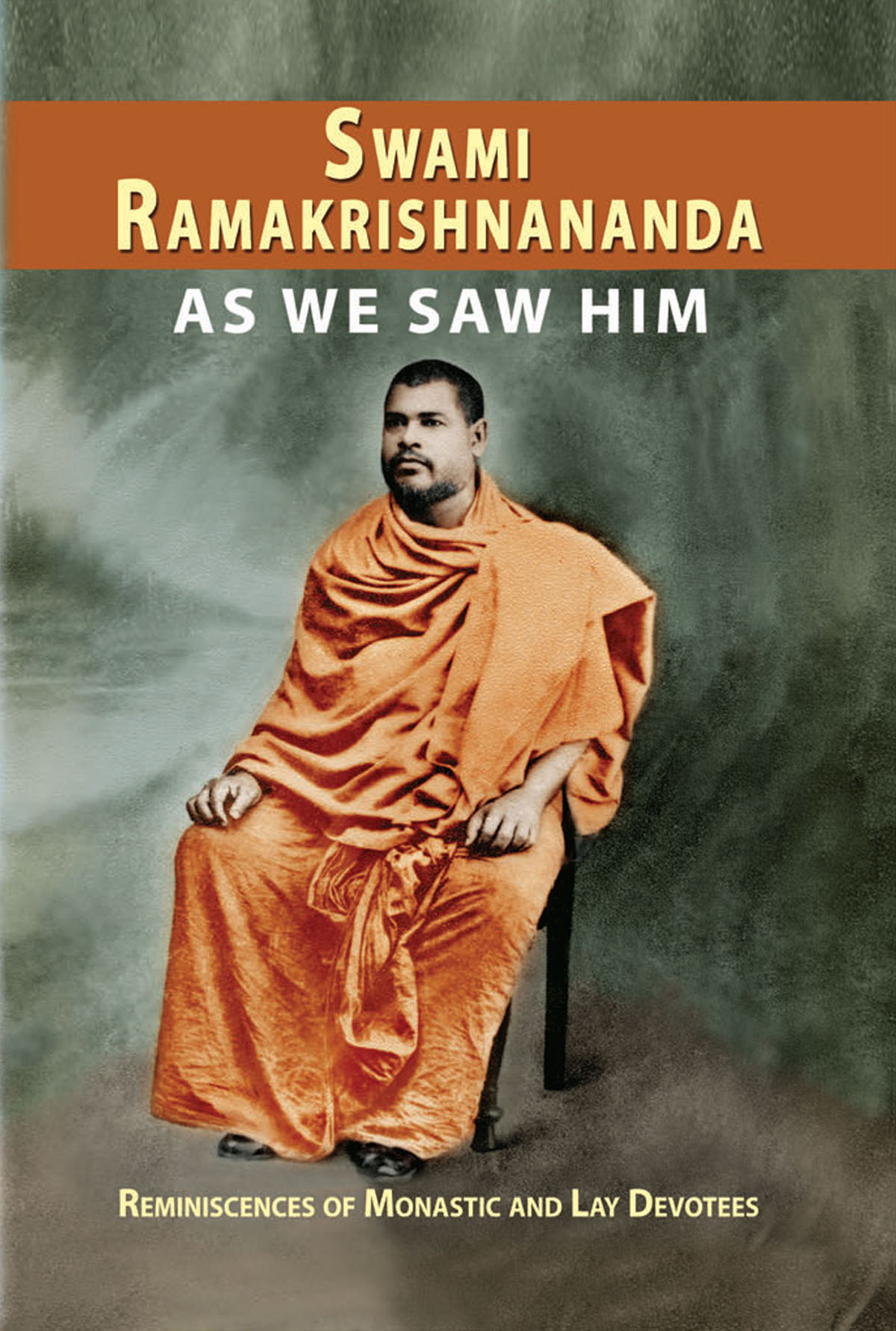
PART - 1(Biography and Glimpses of Swami Ramakrishnananda)
Biography of Swami Ramakrishnananda
[Based on articles published in the September and October, 1941 issues of the Prabuddha Bharata, the book Holy Mother, Swamiji and Direct Disciples at Madras, Sri Ramakrishna Math, Chennai and other miscellaneous sources.]
Birth and Early Years
Even while in the midst of his arduous labours in the West, Swami Vivekananda realized that a more important work was awaiting him in India. The soul of the nation was to be roused to a sense of its own worth. Forgotten values of life were to be brought back to light. Religion was to be made a living force which will strengthen the people and lead them to realize the fullness of life. When the great leader returned to the motherland and made his triumphal tour from Colombo to Almora, it was in the city of Madras (now called Chennai) that he first intimated to eager listeners his plan of campaign. There was great enthusiasm and a genuine desire on the part of the people to learn more of the teachings of Bhagavan Sri Ramakrishna Paramahamsadeva. Some of the citizens approached Swami Vivekananda with the request that he should kindly send one of his brother disciples to stay in Madras and establish a monastery which would become the centre of the religious teaching and philanthropic activities outlined by the Swami in his addresses delivered in India and abroad. By way of reply, Swami Vivekananda said, ‘I shall send you one who is more orthodox than your most orthodox men of the South and who is at the same time unique and unsurpassed in his worship and meditation of God.’ The very next steamer from Calcutta brought to Madras Swami Ramakrishnananda and to assist him in the work, Swami Sadananda, a disciple of Swami Vivekananda.
In a few words, the leader had summarized the personal characteristics of the apostle in relation to the field of work for which he was chosen. South India has been all along the stronghold of orthodox Hinduism. When Buddhism in the days of its decadence upset the ancient religion and made people lose faith in the Eternal Dharma, it was the Alvars, the Nayanmars and the Acharyas of the South who gave new vigour to the religion of the Rishis. Again, when foreign invasions disturbed the practice of the old religion, it was South India that closely guarded the sacred Vedic fire and passed it on to others when the opportune time came. To infuse new life into the ancient religion without breaking the continuity of the tradition, the apostle to the South had to be a person of great intellectual attainments, of unflinching devotion to the ideal and with deep reverence for the forms of worship and religious practices sanctified by the authority of a succession of great teachers. Swami Ramakrishnananda possessed all these and in addition, he had an overflowing kindness, abounding sympathy for all and a childlike nature which exhibited the inner purity of the soul.
Shashibhushan Chakravarti—that was the name by which Swami Ramakrishnananda was known in his pre-monastic days—was born on 13 July 1863 in an orthodox Brahmin family of the Hooghly district, Bengal. His father, a strict observer of religious traditions and a devout worshipper of the Divine Mother, gave the early training that laid the foundation of the lofty character exhibited in the life of his great son. We can form an idea of that early training from the Swami’s own utterances regarding the upbringing of children. We quote the following from his lecture on How to be a Real Master:
‘Since it is our nature to rule, it is always better to give this nature full scope to develop itself, to evolve masters and not slaves out of ourselves. It will be my duty to point out to you, how that can be effected. From our very childhood, we hate restraint. No conventionalism, no formality, no etiquette, no manner can bind a child. The children of the world profess no religion, admit no restrictions and therefore have no caste; they are all of the same caste for their characters are always and everywhere the same. Now the question is, should we leave our children do whatever they like, for by so doing we give them perfect liberty and thus virtually make them masters and not slaves to others?...A human child is the most forlorn and helpless creature on this earth and so if it is allowed to be left alone to itself to do whatever it likes, is there any doubt that it will be kicked out of existence by those enemies, ever on the alert to work woe—enemies such as ignorance, hunger, thirst, cold, heat, physical and mental weakness, diseases and lots of other things. When a child is incessantly under the gaze of all these evil-doers and when it is itself unable to resist them, it is our duty to keep it in a place beyond their reach. When a plant is very young, we put a fence round it to save it from being pulled out by mischievous urchins or by cattle. So, we should limit the liberty of a child, to prevent it from falling a prey to the enemies mentioned above. This is the reason why a boy should be made to go through a course of strict discipline before he is allowed to have any liberty and as he proves stronger gradually, under such discipline, we can give him liberty more and more, little by little. When he is strong enough to resist all evils, to hold his own ground against all temptations and promptings of nature, he should be allowed full liberty.’
Again in his lecture on Religious Education, the Swami observes as follows: ‘Should the children be given undue liberty? A child’s mind is always after play, is always after trifling things; and if you allow him full liberty he will grow up to be a shallow man, in no way different from an animal, merely eating and drinking, playing and sleeping. A human child is intended for higher things than these. We should make a god out of him and not a beast.’ These have been quoted at length from the Swami’s lectures to bring out in bold relief an outstanding characteristic of his life. The traditional wisdom inherited through generations makes the father realize his duties towards his son. The Indian ideal of life based upon the control of the mind and the senses, austerity, purity, forbearance and such other virtues demands that, from young age the child should be made to go through a course of discipline, a discipline that would bring out the god in him and make him achieve self-mastery. The daily bath at the stated hour, the duties in the household and in the worship-room, the restraint in speech and behaviour and other details to be strictly observed by the growing boy, gradually build up his character and give him that mastery over himself which leads him to the attainment of the higher values of life. As already stated above, Shashibhushan was born in an orthodox Brahmin family and his father, a devout worshipper of Divine Mother, was a conservative high-caste Brahmin of the old type—an able scholar, thoroughly grounded in Sanskrit and in knowledge of the Vedas and rigidly careful in observing scriptural custom and injunction. Shashi inherited these and later on perfected his character under the guidance of his Great Master Sri Ramakrishna.
In the Company of Master
As he grew up, Shashibhushan went to school and having successfully completed the school course, entered college. He was a brilliant student at college and his favourite subject was mathematics. He and his cousin, Sharatchandra, came under the influence of the Brahmo Samaj. Shashi became intimately known to the Brahmo leader, Keshab Chandra Sen and was appointed as private tutor to his sons. For a moment, Shashi got enticed with the more radical style of life taught in the Samaj. But regarding his food, he was uncompromising. He never ate fish or meat.
Gradually, Sri Ramakrishna became closely known to many members of the Brahmo Samaj. In order to enjoy the company of the saint, the members resolved to celebrate their Annual Celebrations at Dakshineswar sometime in October 1883. Shashi and Sharat arrived at Dakshineswar and along with a few other boy-companions went to see the Master. They found him seated on the small bedstead in his room. Sri Ramakrishna received them with a smile, asked them their names, inquired where they lived and was pleased to hear that they belonged to Keshab’s Brahmo Samaj. Shashi was then reading in the F. A. class and the others were all preparing for the matriculation. As Shashi was the eldest of the band, the conversation was addressed to him. The Master spoke of early marriage and its attendant evils. He pointed out that the responsibility to maintain a family was thrust upon boys far too early, even before they completed their education. Then, he spoke of the necessity of a strong spiritual foundation for realizing the true end of life. He said, ‘Bricks and tiles, if burnt after the trade mark has been stamped on them, retain these marks for ever. Similarly, you should be stamped with spirituality before entering the world. Then, you will not become attached.’ ‘Then, Sir, is it wrong to marry? Is it against the will of God?’ asked one of the boys. Sri Ramakrishna had a book taken down from the shelf and pointing to two passages asked the boy to read them aloud. The first passage (St. Matthew XIX.12) gave Christ’s opinion on marriage: ‘For there are some eunuchs, which were so born from their mother’s womb; and there are some eunuchs, which were made eunuchs of men; and there be eunuchs, which have made themselves eunuchs for the kingdom of heaven’s sake. He that is able to receive it, let him receive it.’ The second passage was from St. Paul (I Corinthians VII. 8, 9). It read: ‘I say therefore to the unmarried and widows, it is good for them if they abide even as I. But if they cannot contain, let them marry; for it is better to marry than to burn.’
When the passage was read, Sri Ramakrishna remarked that marriage was the root of all bondage. He then asked Shashi whether he believed in God with form or without form. The boy frankly answered that as he was not certain about the very existence of God, he was not able to speak one way or other. The reply pleased the Master very much. Shashi and Sharat were fascinated by the personality of Sri Ramakrishna. They made the Master the pole-star of their life.
Of Shashi and Sharat, Sri Ramakrishna used to say that both of them were the followers of Jesus, the Christ, in a former Incarnation. Subsequent events show that both the cousins, Shashi and Sharat, became the pillars of the Order and the philanthropic organization founded in the name of the Master.
Slowly and silently, Shashi was progressing in the life of the Spirit. His keen intellect, robust physique and steady character were beginning to centre around one grand theme of God-realization. One little incident bears testimony to Shashi’s character as the ideal disciple. One day, it so happened that he was busily engaged in studying some Persian books in order to read the works of Sufi poets in the original. The Master called him thrice before he heard. When he came, Sri Ramakrishna asked him what he had been doing. Shashi told that he was engaged with his books. Sri Ramakrishna quietly remarked, ‘If you forget your duties for the sake of study, you will lose all your devotion.’ Shashi understood. He took the Persian books and threw them into the Ganga.
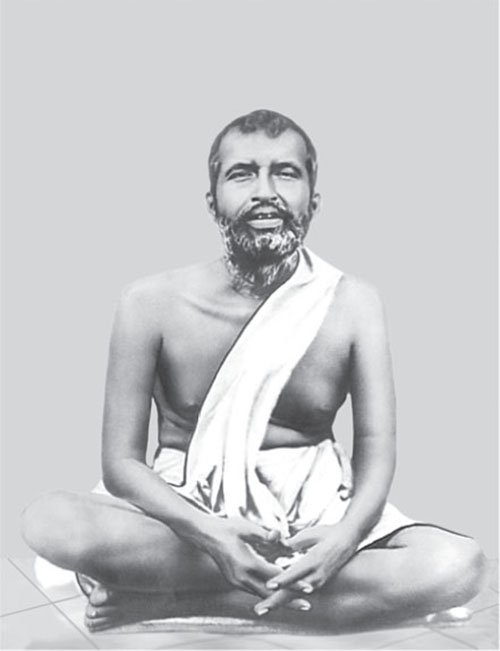
Sri Ramakrishna
Shashi was in the Final B. A. Class and the examinations were fast approaching. But at that very time, Sri Ramakrishna was lying ill at Cossipore Garden. The young disciple had to decide between his studies and the service to the Master. Unhesitatingly, Shashi decided to renounce his prospective career as a man of the world forever and to give his body, mind and soul wholly and unreservedly to the service of the Master. He and the other disciples served the Master day and night. The illness of the Master became the means of bringing the disciples together. In those memorable days, the Master’s conversations and his frequent soaring beyond the world of the senses in Samadhi gave the disciples a closer communion with the personality of the Master which served, as it were, as the means for passing on to the disciples the spiritual realizations of the Master. Hour after hour, the disciples attended the Master. All too suddenly, the day of consummation came. Sri Ramakrishna attained Mahasamadhi on 16th August 1886.
After the Master’s Passing Away
The greatest trial was at the burning ghat. Feelings of a contrasting character visited the soul of Shashi. Now, the joy and bliss the Master had shed over them all at the time of the Mahasamadhi, took over him and he sang the name of the Master in triumphant praise. Then a sense of utter loneliness stole over his joy and made him the victim to most violent grief. When the flames that had made ashes of the body of the Master had died out, amid the silence that prevailed, Shashi gathered the sacred relics.
Then came, the period of supreme depression. The boys, who were children of the Master, gathered together day and night. Their words were reminiscences of their years with the Master; their thoughts were of him; their worship was to him; their lives were lived in his name. Many of them were accustomed to the comparative ease and comfort of well-to-do families. But, their deep devotion to the ideal made them face hardships unflinchingly. Shashi played no small part in holding the young band together and in regulating the routine of life to be followed by them. He would force them to rise from their meditation to partake food. He would send them to repose by force when they continued hour after hour into the night the chanting of the praises of God. He would be the earliest to rise and to call on the others to arise and awake.
The parents of the boys came and attempted to take them back to their homes, but they would not yield. Shashi’s father came, begged and threatened, but to no purpose. The son said, ‘The world and home are to me, like a place infested with tigers.’ The father too felt the deep devotion his son had towards his Master and disturbed him no more. The time came when the boys decided to renounce the world formally by taking the monastic vows and performing their own death ceremonies. They changed their names. Shashi became Ramakrishnananda. The leader of the young band, Swami Vivekananda, wanted to have that name for himself, but thought that Shashi had a better claim to it. While others went on itineraries adopting the wandering life of the monk, Swami Ramakrishnananda stuck to the holy spot where the Master’s relics were then enshrined. Worshipping the Master and keeping the monastery as the centre, to which the wanderers would occasionally return, were the duties which Swami Ramakrishnananda assigned to himself. He had been the servant of the Master while he [Master] lived. He would remain a servant till he [Ramakrishnananda] lived. He would personally attend to all the items of worship; he would bring water from the Ganga, gather flowers and prepare the food to be offered. He would not take any food that was not offered to the Master.
The whole soul of devotion entered into Swami Ramakrishnananda. Others were transported into superhuman joy and into the very vision of God by the enflaming spirit of his enthusiasm. Hours were passed in devotion for days and nights and it was this unparalleled devotion which formed the spirit which has become externally expressed as the Ramakrishna Order. The leader, urged by the Divine Spirit, left the shores of India. On hearing the news, the brother monks deeply felt the separation. Yet, they knew that he had merely obeyed the Divine Command. Then came the news of his brilliant success at the Parliament of Religions and his subsequent preaching work in America. Whenever the leader wrote to his brother monks, he would address the message to Swami Ramakrishnananda, who indeed had become the ‘pillar of the monastery’.
Swami Ramakrishnananda, whose heart was centred in devotion and in the worship of the Master, was commanded by the leader to preach the religion and philosophy of Vedanta in the South. The great heart had to become the mighty intellect. It may be for this very reason that the leader directed him to go to Madras. A combination of deep devotion and keen intellect is something very rare. But verily, this rare type was needed for the work in South India and it was the good fortune of that province to get Swami Ramakrishnananda. The Mission work in the South now stands as a noble edifice admired by all which is giving shelter to the aspirants of the spiritual path, to the students and to all those who seek consolation which religion alone can give. The Mission work in South India is spread over several districts and is carried on by many centres, the genesis of all of them can be traced back to the hands of Swami Ramakrishnananda.
Pioneering Work In Madras
Swami Ramakrishnananda went to Madras in 1897. At first, he was housed in a small building called Flora Cottage located on the same road as the Ice House was. Shortly afterwards, Biligiri Iyengar, a prominent lawyer and the owner of the Ice House, offered the first floor of that castle to Swami Ramakrishnananda to start his work. Swami Ramakrishnananda first set up the shrine in a room and installed a picture of the Master that he had carried from Calcutta. He then began to conduct worship service as he had before. He had almost forgotten his English. Singaravelu Mudaliar helped him regain it. He then started to give classes on the Upanishads, Gita and Bhagavata. At one time, he gave eleven classes a week in different parts of the city, travelling by jutka —a narrow, uncomfortable, horse-drawn carriage. Sometimes, he would return to the monastery after an exhausting day of classes and lectures to find that there was no food for supper.
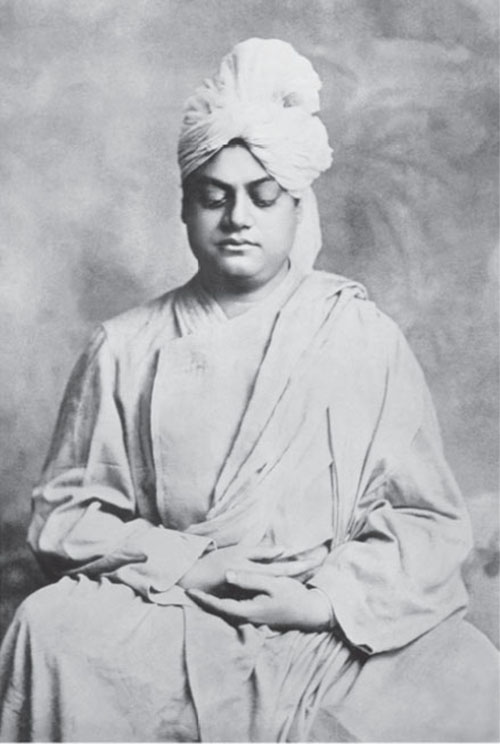
Swami Vivekananda
Pioneering work is always accompanied by many difficulties. Homeless, alone and often without food, the pioneer worker had to toil hard; he had to meet many disappointing and discouraging situations which would try his patience very much. He remained unmoved under all difficulties and never approached anyone for help. The Master was his sole refuge. He would place his difficulties before his heart’s Deity and plead with Him as a child does with the mother. And the protecting hand of the Deity was always there, manifesting itself much more than it did after the work has grown, when men rallied around to cooperate in the work, feeling it an honour to render such help and cooperation.
Uncompromising in his devotion to the life and teachings of his Master, he boldly declared that ‘God and Mammon’ cannot be worshipped simultaneously. A few shallow leaders in the city became nervous, as they were afraid that their boys would shun family life and become monks. They threatened to withdraw financial support, if he did not change the mode of his teaching. On hearing these remarks, he exclaimed, ‘Am I to preach other than what I learned from my Master?’ He was ready to occupy a corner in his student’s house than yield to the threats of these bigwigs.
Driven by debt, Swami Ramakrishnananda went to a publisher of the Upanishads in Madras and offered to translate Upanishads for some money. Realizing his financial difficulties, the publisher arranged for a monthly subscription for the fledgling monastery. The Raja of Ramnad also began to send some money on a regular basis.
On the 5 July 1902, the news had flashed all over India that Swami Vivekananda had passed into Final Realization. It reached Madras and Swami Ramakrishnananda was in the midst of his work. But, he already had infinite solace in this bereavement from the departed leader himself. For, on the very night that Swami Vivekananda passed away, Swami Ramakrishnananda as he was sitting in meditation pondering on the Reality beyond death and beyond life, heard a voice ringing out clearly ‘Shashi! Shashi! I have spat out the body.’ It was the voice of the leader, Swami Vivekananda, who had appeared before him but a little while before he entered the domain of Highest Illumination. That fired the soul of him who heard. Since then, he redoubled his efforts.
Starting of Mylapore Math
Castle Kernan came up for auction after the death of Biligiri Iyengar in 1906. A devotee tried to acquire the house for Swami Ramakrishnananda, but he was outbid by a rich landlord. When the auction was going on, Swami Ramakrishnananda was seated on a bench in a corner of the compound; from time to time a devotee reported the progress to him. He calmly said to the devotee: ‘Why do you worry about it? What do we care who buys or who sells? My wants are few. I need only a small room for Sri Ramakrishna. I can stay anywhere and spend my time in talking of him.’ As anticipated, the Swami had to move out of the main building and temporarily take shelter in the outhouse of the same compound.
Within five years of his arrival in Madras, Swami Ramakrishnananda became well known in the city and his work was appreciated by many. Right from 1898, he began to celebrate the birth anniversary of Sri Ramakrishna on a large scale and many local people attended. He and the devotees deeply felt that a permanent home was needed for the Master. In 1902, they had raised Rs. 4,100 as their building fund; and in 1906, a student of his donated a piece of land on Brodies Road (now Ramakrishna Math Road), in Mylapore. On an auspicious day, Swami Ramakrishnananda conducted the religious ceremonies and Swami Abhedananda, who was visiting Madras from America at that time, laid the foundation stone. The building was constructed at the cost of Rs. 5,500. Swami Ramakrishnananda dedicated it on November 17, 1907 and moved into the new ashrama shortly afterwards. The Math was a simple one-storeyed building consisting of four rooms, a spacious hall, kitchen and outhouses.
Swami Ramakrishnananda was as elated as a child and said to a devotee: ‘This is a fine house for Sri Ramakrishna to live in. Realizing that he occupies it, we must keep it very clean and very pure. We should take care not to disfigure the walls by driving in nails or otherwise.’ Later, Swami Ramakrishnananda humorously said, ‘I was in Triplicane (Castle Kernan) and Parthasarathi [Krishna] subjected me to many trials; but now Kapalishwara [Shiva] has drawn me to him. You know he is the Lord of bhikshus [mendicants] as his name means and he is sure to protect me hereafter.’
Swami Ramakrishnananda’s service to Sri Ramakrishna is now legendary in the Ramakrishna Order. Full of God-consciousness, his mind rested on the solitude of the sage. In daily life, his spirit of devotion manifested a firm faith in the Master, who was to him identical with the Supreme. He kept the Master alive in his mind through his intense love. He felt the living presence of his Master in the photo. His worship, therefore, partook of the nature of loving service to a beloved person in flesh. He was an active, intelligent, independent, dauntless, heroic devotee of the Master. There was no place in his consciousness for anything but the Master. He was dead wholly to himself and alive only to Sri Ramakrishna.
One day, he was resting when all of a sudden he had a desire to feed Sri Ramakrishna with his favourite dish, hot luchis. Immediately Swami Ramakrishnananda got up, made the dough, fried luchis. He placed a plate in front of the Master and carried hot, crispy luchis to him one after another, as if the Master were eating and enjoying his favourite dish.
The first building of the Madras Monastery had cracked in several places within a couple of years of its construction. When it rained, water would drip down through the fissures of the roof. At such times, Swami Ramakrishnananda would go into the shrine to see whether water was leaking through the ceiling. One night, it began to drip inside the shrine right on Sri Ramakrishna’s picture. Swami Ramakrishnananda stood there holding an umbrella till the night passed and the rain stopped! He did not remove the picture to a safer place because that would wake his Master from sleep at an untimely hour.
While dressing vegetables, he would explain the Manu Samhita and other scriptures to his juniors. The codes of conduct and religious rituals prescribed in the scriptures were to him inviolable and full of meaning. His faith in the ancient law givers and the sages who formulated the religious rites was based upon the conviction that as men of God-realization, they had no selfish ends and whatever they gave, was for the good of the world.
Unflinchingly conservative in his mode of worship, he was yet liberal in his religious conviction. Universality and tolerance influenced his very being and he resented any bigotry. When a rich merchant spoke irreverently about Shankara, he flared up and censured him. On another day, when someone slighted Shankara, he walked out saying he had no place where Shankara was not honoured. He found in Ramanuja, the embodiment of his ideal of devotion. Pulsating with deepest veneration, he wrote the biography of Ramanuja for the benefit of his Bengali brethren. His ambition was to reconcile the three great philosophical systems of India. He stood for harmonization. He knew the Bible from cover to cover and expounded it with astounding fervour and understanding. To some Mohammedan students seeking shelter at the monastery during a storm, he was all welcome and with true spiritual earnestness, talked to them on Koran. His exposition of the words of Mohammed was so illuminating that the students returned every evening, for a week to hear more of it.
A Spiritual Giant
Swami Ramakrishnanada was very punctual and would be present for his classes five minutes before the appointed time. The lesson would be conducted with the same earnestness and zeal whether the audience was large or small. He would encourage everyone to cultivate regular habits. If he saw a student shaking his legs, he would gently tell him, ‘Stop shaking your legs, it is not conducive to well-being.’ If he saw another standing and drinking a glass of water, he would ask him to sit and drink. If he saw a student morose, he would suggest that he should cultivate a cheerful attitude. In training the young monastic workers entrusted to his care, he would endeavour to equip them for a life of simplicity and devotion making them models of patience and self-sacrifice.
Swami Ramakrishnananda established the routine in the Madras Monastery. All the monks got up at 5.00 a.m. and practised meditation in their rooms. Swami Ramakrishnananda opened the shrine and performed the morning service and food offering. Then he returned to his room and recited the Chandi [Durga Saptashati], the Gita and the Vishnusahasra-nama. After half an hour, one monk removed the food tray from the shrine, another monk cleaned the shrine vessels and a third monk set the breakfast. After breakfast, Swami Ramakrishnananda and some of the monks cut vegetables; while they worked, one monk read a scripture and the Swami then explained its meaning. Punctually at 11.00 a.m. Swami Ramakrishnananda went to the shrine to perform the daily worship. After the food offering at 12.30 p.m., the shrine was closed. After lunch, the monks rested. At 3.00 p.m., they went to Swami Ramakrishnananda’s room. There, one of the monks read the Chaitanya Charitamrita (Life of Chaitanya) and Swami Ramakrishnananda explained it with parallel examples from the life and teachings of Sri Ramakrishna. Punctually at 4.00 p.m., the shrine was opened. In the evening, there was a vesper service. At 8.30 p.m., food was offered to the Master and at 9.00 p.m., the shrine was closed. After supper, Swami Ramakrishnananda told stories about the Sri Ramakrishna and Swami Vivekananda with his natural enthusiasm.
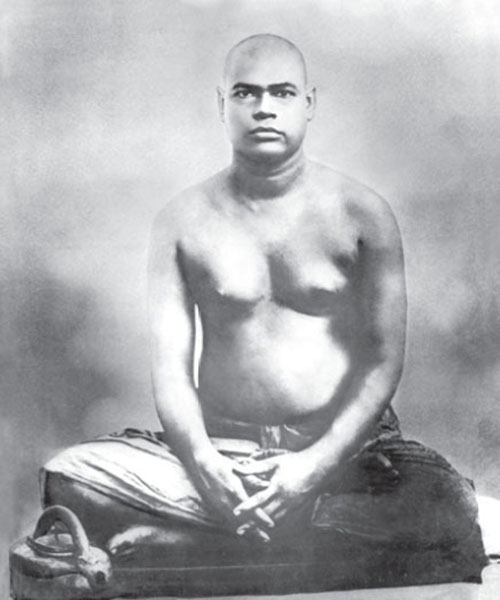
Swami Ramakrishnananda
Swami Ramakrishnananda was as soft as a flower and at times as severe as the thunder. He was a blend of opposing qualities. Possessed with a loving mother’s heart, yet he would not tolerate any kind of mistake or dereliction of duty. Perfection in life is possible only through good and systematic training. Several monks who lived with Swami Ramakrishnananda from 1897 to 1910 were unanimous in their opinion that Swami Ramakrishnananda was a strict disciplinarian and a hard taskmaster. He expected the monks to be precise, prompt in action, punctual and attentive in their habits, or else he would scold them severely. He was well-known for rebuking and correcting the monks.
Once, Swami Ramakrishnananda scolded Swami Sharvananda so severely that he almost broke down because he had never been so severely reprimanded. Seeing him weeping, Swami Ramakrishnananda told him affectionately: ‘Do you know what Sri Ramakrishna used to say? A blacksmith first puts a lump of Iron into the fire; when it becomes red hot, he puts it on the anvil and beats it into shape. That is how an unformed lump of metal is shaped into a useful article! All of you are like that unformed lump and it is for your good that you are put to the forge and beaten into shape on the anvil by such scoldings.’ Indeed, his method was that of the sledgehammer blow of the blacksmith. Many came, but only a few genuine ones withstood his test.
In the matter of diet, Swami Ramakrishnananda was extremely orthodox. The Master had encouraged him in this, knowing that it would be conducive to his spiritual growth. Although he was a Vedantic monk, he was a staunch dualist in his belief in the purifying power of prasada. He always gave a little prasada to everyone who would visit—even in those difficult days at the Baranagore Monastery—even if it were only a bit of sugar candy or some sweets offered to the Master. He firmly believed that whosoever partook of a little prasada of Sri Ramakrishna would be purified of all sins and blessed with faith and devotion. In Madras, he used to offer coconut sweets or sugar candy to every visitor, friend or even coolie and insisted that the monks distribute prasada among the devotees without fail.
Swami Ramakrishnananda was a man of gigantic proportions. His features, however, were plain except when they were lighted by his smile that transfigured them and lent them a rare spiritual beauty. Absolute surrender to the will of God characterized his life and actions. In him, the path of knowledge and the path of devotion met, thereby showing that the loftiest knowledge led to the most intense devotion. To an inquirer who asked him what steadiness in the practice of devotion meant, he replied, ‘Steadiness in devotion means that though you may be busy with many things, still your mind is always turned towards God. It should be like the needle of a compass; the needle may swing a little to this side or that, but it always has a tendency to point back to true north.’
A good mathematician and an erudite scholar, he was gifted with a remarkable mind and possessed intellectual powers of a very high order. His power of original thought was exceptionally high. Thoroughness in all thought-process was in his nature. He never left a problem half-solved. He carried it into his conversation, into his reading, into his meditation; he lived it, until he found a solution for it.
He was such a learned scholar that he could lecture and write in three languages: English, Bengali and Sanskrit. He could also speak Tamil, the local language of Madras. He translated some teachings of Sri Ramakrishna into Sanskrit while he was in the Alambazar Monastery. He composed a beautiful Sanskrit hymn on Swami Vivekananda. Further, he introduced and systematized the ritualistic worship of Sri Ramakrishna, which is now more or less followed by all the centres of the Order. But, he made no display of his learning nor did he allow it to overshadow his spiritual vision.
He rarely discussed worldly affairs. He deplored the secularization of the modern world. The problems of the inner life engaged his attention. He did not read even the newspapers. Lay minds understood him to be lacking in human interest, but in reality he was keenly concerned for his fellow-men. Delving deep into the realms of mind, he reached the solutions to many problems of the inner life. He believed that true interest consisted not in remaining human with them, but in helping them become Divine.
But, he had a different message for V.O. Chidambaram Pillai, the great freedom fighter of southern Tamilnadu. He wanted him to join the Swadeshi Movement. ‘Swadeshi offers several good results. Follow it,’ was his advice. When the freedom fighter protested that it was all ‘maya’ (transient), he corrected him and reoriented him.
Expansion of Work
In July 1903, Swami Ramakrishnananda accepted an invitation from the Vedanta Society of Ulsoor in Bangalore and stayed there from the July 19 to August 9. About four thousand people including fifty-three Bhajan parties received him at the Cantonment railway station and conducted him in a procession to his residence. He delivered about a dozen public lectures and held question-answer sessions both during morning and evening. People thronged to his lectures in thousands. Inspired as he himself was, he raised a strong wave of spirituality in Bangalore. He also visited the Maharaja of Mysore on 27 July 1903. A farewell public function was held on 9 August 1903, which was presided over by the Dewan of Mysore.
In October of that year, the Swami carried the message of Sri Ramakrishna to Mysore and delivered five lectures including an address in Sanskrit defending the views of his Master on the divergent interpretation of the Vedanta. In Bangalore, the interest created by the Swami was kept up by the Vedanta Society. In August 1904, the Swami was invited to open a permanent centre in Bangalore. He delivered a series of lectures, opened some classes and left Swami Atmananda in charge of the work.
In August 1906, the Swami again visited Bangalore and Mysore with Swami Abhedananda, who laid the foundation-stone of the Bangalore Ashrama. After the building was completed, he invited Swami Brahmananda, the President of the Order, to open it. He also visited Trivandrum and spent about a month there which created enthusiasm in the minds of the people.
Swami Ramakrishnananda was a powerful orator, a delightful conversationalist and also serious writer. Although not an eloquent speaker, his sincerity and thorough grasp of spiritual realities made his speeches very impressive. He was always at his best in the conversational method of teaching. His fame as a teacher of Vedanta spread far and wide. He received invitations from such distant places as Burma and Bombay. He visited these places and achieved great success.
Literary and Social Works
He began the publication work of the Madras Math by printing The Gospel of Sri Ramakrishna, The Inspired Talks and some of his own works. His works in English included The Universe and Man, The Soul of Man, God and Divine Incarnations, Sri Krishna: Pastoral and King-maker, For Thinkers on Education, Sri Ramakrishna and His Mission and Search After Happiness. He contributed many articles to magazines—the Udbodhan, the Prabuddha Bharata and the Brahmavadin. His Sri Ramanuj Charit in Bengali is an authoritative biography of Sri Ramanuja, the propounder of the qualified-monistic Vedanta. He also translated some of the writings of Swami Vivekananda from Bengali into English and vice versa.
His great heart melted when he saw the sufferings of the poor. He took charge of a helpless orphan boy whose relatives had all perished of plague at Coimbatore. The plight of some poor students who came to the city of Madras for study moved him to take measures to provide lodging and boarding for them. He inspired his close associate Ramaswamy into this task. This was the beginning of the Ramakrishna Mission Students’ Home of Madras in 1905 which is now well known throughout the length and breadth of the country. On the occasion of inauguration, he gave his benediction and concluded saying: ‘Annadana (gift of food) is said to be the greatest of all gifts. Indians consider it a great act of merit. Greater than that, is Vidyadana, the gift of education. Greater still is Jnanadana, the gift of spiritual knowledge. In this institute, there should be a harmonious blending of these three gifts. May Sri Ramakrishna bless this endeavour.’
Towards the End
Years passed thus. Word spread that he was working so strenuously that grave results were to be feared, should he have a ‘break-down’. But the worker paying no attention to the warnings, gave out his very soul to the work. He felt blessed to have brought Swami Brahmananda to the South. Now, his mind was on having the Holy Mother in the South. Was she not for him verily the divine Shakti incarnate? Lost in ecstasy in her holy presence, he would wait on her for long hours bereft of any thought of food or rest. He mustered all his physical and mental strength to serve her in all possible ways. But, it told on the body of the Swami. Symptoms that the disease was fatal had made themselves evident, but he paid no attention. His whole mind was centred in the Spirit. He had long forgotten that the body existed. Finally, those who were near and loved him most took him to the specialists. The doctors pronounced the disease as fatal. Due to overwork and lack of proper food, he had literally worked himself to the point of death. He himself had remarked that the cause of his breakdown was because ‘Madras life was too strenuous.’
At the request of the devotees, Swami Ramakrishnananda moved to Bangalore Ashram for a change in climate and rest. Unfortunately, the bracing climate of Bangalore failed to improve his health and the local doctors diagnosed his disease as galloping tuberculosis. But, he felt his work was done and longed for the union with his beloved Master.
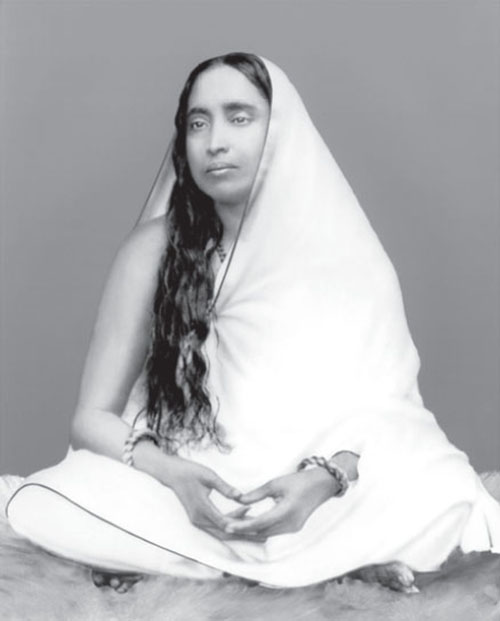
Holy Mother Sri Sarada Devi
Word was sent to Calcutta and his brother monks begged him to pass his last days with them. This he felt was the best. He had thought of it, but not until the command came from the President of the Order did he leave Madras. He was housed at the monastery in Baghbazar and the most noted physicians visited him of their own accord. His condition, however, grew worse.
Most remarkable, however, was the strength of his spirit which burst forth in eloquent discourse concerning the soul and God, even while the body suffered most. One, who loved him dearly, hearing him speak in the distressed state of his body, asked him to desist. ‘Why?’ came the reply, ‘When I speak of the Lord all pain leaves me, I forget the body.’
It is said that when sages are about to pass away, they become most eager to convey unto mankind their spiritual realization. This had been true of Buddha. Of Sri Ramakrishna, it was true. Of Swami Vivekananda, it had also been true. And with Swami Ramakrishnananda, it was again true. His message was: ‘Everything can be achieved soley by the service to the Guru.’ This faith was his distinctive feature. The demonstration of this faith was the significance of his life. None can find him wanting in this regard. Even in delirium, his mind and his voice were given to God. ‘Durga, Durga,’ ‘Shiva, Shiva’ and the name of his Master were ever on his lips. As the days passed and his condition grew worse, the monks knew that the time for Mahasamadhi was close at hand. At last, the end came with wonderful peace. At that moment, the presence of the Lord was felt. The death-chamber had become a tabernacle; it had become the temple of illumination. Swami Ramakrishnananda left his body while in samadhi in the Udbodhan Office in Calcutta at 1.10 p.m. on Monday, August 21, 1911.
News broke to the Holy Mother and she broke down with tearful eyes, ‘Alas, Shashi is gone. My back is broken.’ Grief-stricken at the sad news, Swami Brahmananda exclaimed, ‘The guardian angel of the South has passed away. The southern side is, as it were, covered with darkness.’
The public of Madras felt themselves deeply indebted in gratitude and convened a memorial meeting to pay homage to him who had dissolved his flesh to solidify their spiritual development. Well did his beloved brother-disciple, Swami Saradananda proclaimed, ‘Go to South India and find out from the devotees there how distressed they were by the death of Swamiji and how they shed tears recollecting the love they received from Shashi Maharaj. Today, I can confidently say that if you look around, you will understand what Shashi Maharaj has accomplished all over South India.’
As a flower plant germinates, sprouts and blossoms for the sake of others, this great sage laid his entire life, though pierced with thorns at times, at the ideal of bringing joy, happiness and idealism to all. The flower had withered away, but the fragrance lingers.
The body of Swami Ramakrishnananda has perished, but the spirit of this great soul will remain and linger for eternity.
↑ Contents
Glimpses of Swami Ramakrishnananda
In the following compilation, drawn from various sources, one gets an idea of how Sri Ramakrishna, Holy Mother Sri Sarada Devi, Swami Vivekananda, Swami Brahmananda and other direct disciples of Sri Ramakrishna looked at him (and how he looked at them). It gives an idea about Swami Ramakrishnananda’s personality and actions. One gets a glimpse of Shashi Maharaj’s greatness, his purity of character, dedication to God, service-mindedness and deep concern for others.
Sri Ramakrishna
At the Cossipore garden house during the winter season, one night Shashi Maharaj went out of the room of the Master to clean the commode used by Sri Ramakrishna. He covered the upper part of his body with a portion of his wearing cloth. On his return he saw that the Master, crawling with great difficulty trying to pull a shirt from the clothes-horse with the help of a long stick. Shashi Maharaj felt very sad and regretted, ‘Alas! Perhaps I inadvertently didn’t cover his body. Due to cold he is behaving like that.’ He expostulated, ‘Why didn’t you tell me, Sir?’ The Master replied, ‘I was trying to bring it to cover your body; I don’t feel cold at all. [1]
One day, Sri Ramakrishna was sitting on the small cot in his room. Shashi Maharaj was about to go outside hurriedly on an errand. The Master did not allow him to go and repeated these words three times—’Look, the one who you are looking for is this (pointing to himself), he is this, he is this.[2]
Seeing many of the people coming to Sri Ramakrishna getting ecstasy, Shashi Maharaj, one day importunated the Master for ecstasy. The Master said in reply that if he is absorbed in ecstasy, he would not be able to do the physical service to the Master. Forthwith Shashi Maharaj changed his mind and said, ‘I don’t want that ecstasy under which I become unfit to serve you.[3]
Sri Ramakrishna said once, ‘Ah, I see, you [Shashi] took so much pain. People call one miser who is too close-fisted to let water leak out; but I see that you are not a miser of that nature, rather a donor.
Sri Ramakrishna would say, ‘See, you [Shashi] have tied me down through this service. If you permit, I may once go and see that place (meaning his Divine abode).[4]
Holy Mother Sri Sarada Devi
In the Holy Mother, Shashi Maharaj saw nothing but divine Shakti Incarnate. He started worshipping the Holy Mother even while she was living. He had with him pictures of Sri Ramakrishna and Holy Mother and a jar of Ganga water.
Shashi Maharaj would be lost in ecstasy on visiting the Holy Mother. When she went to the South on pilgrimage, Shashi Maharaj was pleased beyond measure. He mustered up all his strength of mind and body to guard against any trouble or discomfort to the Mother in any way. As long as the Holy Mother was in the South, Shashi Maharaj followed and served her forgetting his own food and sleep. He considered himself immensely blessed to have the golden opportunity of serving her. He firmly believed that the Mother’s visit to the South would be immensely good for the residents of South India.... When Holy Mother was here, in Madras, he would be seated at the gate for eight hours. One had to obtain his permission to go and worship the Mother.
During her sojourn in Southern India, which was entirely planned and managed by him, she went to the Bangalore Ashrama also. While she was staying there, Shashi Maharaj lived in a tent outside and himself attended to all her personal needs and comforts. Every morning, he used to pluck some fragrant flowers from the garden and offer them at her feet. How often he was seen prostrating himself before her and earnestly craving for her blessings! [5]
There is a small hillock behind the Ashrama building and within its own compound. A short while before dark, the Mother climbed the hillock along with one or two others and sat on its top enjoying the beauty of the setting sun. When Shashi Maharaj heard of this, he said in amazement, ‘Indeed! The Mother has become a dweller on the mountains (Parvatavasini) and hurried towards the place. He was stout and began to pant as he climbed that low hillock; but undaunted he went up straight to the Mother, prostrated himself there and laying his head on her feet chanted three well-known verses from the Chandi beginning with Sarvamangala-mangalye which are used as mantras for the salutation of the Divine Mother...And he prayed, ‘Grace! Grace!’ The Mother caressed his head, as though pacifying an importunate son, till Shashi Maharaj felt himself fully blessed.[6]
Shashi Maharaj used to say that the Master and the Holy Mother are non-different, like fire and its burning power. When the Holy Mother went to Madras, he took out all the plates and vessels meant for the Master for Mother’s use. Of course Mother, after taking water from the glass of the Master, had said to Shashi Maharaj, ‘Don’t offer anything to the Master in this glass.’ Shashi Maharaj obeyed her order.[7]
Shashi Maharaj had a wonderful vision of the Holy Mother on his death bed. Based on his description of it, Girish Chandra Ghosh later on composed a hymn beginning with the line ‘Behold my Mother whose smiling face is lit with the crimson glow of wisdom! She, the Giver of Boons, now grants me refuge,’ and the Swami, feeling supremely satisfied to hear that song, closed his eyes forever. When the fateful news reached Jayrambati, the Mother commented with emotion, ‘My Shashi has gone; and my waist has broken.[8]
Swami Vivekananda
In the life of the Baranagore Math, it was Shashi who spent himself in constant service of the Master. Treating Sri Ramakrishna as though he were physically present, he used to offer the purest and the choicest food that could be procured for the few pice which their poverty limited them to.
Recalling those blessed days to a disciple many years later, Swami Vivekananda said: ‘After the passing away of the Master, we underwent a lot of spiritual practices at the Baranagore Math. We used to get up at 3 a.m. and after washing our face etc.—some after bath and others without it—we would sit in the worship-room and become absorbed in japa and meditation. What a strong spirit of dispassion we had in those days! We had no thought even as to whether the world existed or not. Shashi busied himself day and night with the duties pertaining to the Master’s worship and service and occupied the same position in the Math as the mother of the house does in a family. It was he who would procure, mostly by begging, the articles needed for the Master’s worship and our subsistence. There were days when japa and meditation continued from morning till four or five in the afternoon. Shashi waited and waited with our meals ready, till at last he would come and snatch us from our meditation by sheer force. Oh, what a wonderful constancy of devotion we noticed in him![9]
[Swamiji then as Narendranath] wanted to take the name Ramakrishnananda for himself; but seeing Shashi’s devotion to Shri Ramakrishna he gave him that name and, according to Swami Abhedananda, himself took the name Vividishananda, which he seldom used.[10]
One by one all the brother-disciples were to go on pilgrimage, except Swami Ramakrishnananda. About him Narendra used to say in later years: ‘I used to fire them [his brother-monks] to break it up and go about the world begging. But on no account could I make Shashi yield. He would hear of nothing of the kind. You must know him to be the backbone of our Math.’[11]
One day, Swamiji went to the shrine, sat for worship, peeled half of a banana and said to the Master, ‘Take this and eat; we can offer you just as you have provided.’ Shashi Maharaj was enraged to see this. He could stand it no longer and slapped very hard on Swamiji’s back. All the onlookers became terribly angry at this, but Swamiji remained indifferent and said, ‘It is not his fault. He has acted as per his own mood, while I too acted in my own way. Don’t you know, the Master never tampered with anyone’s inherent bent of mind.’ When Swamiji built the Math he said, ‘Let this Math be in the name of Shashi.’[12]
Swamiji once observed,’...Look for instance how Shashi will remain always constant to his spot; his steadfastness is a great foundation-rock.’[13]
He declared on another occasion, ‘Whoever takes the name of Sri Ramakrishna, know him to be your Guru. Everyone can play the role of a master, but it is very difficult to be a servant. Especially you should follow Shashi. Know it for certain that without steady devotion for the Guru and unflinching patience and perseverance, nothing can be achieved.’[14]
In a letter Swamiji wrote to Sister Nivedita,
‘Ramakrishnananda came a few weeks before I came away and the first thing he did was to lay down at my feet Rs. 400 he had collected in so many years of hard work!!! It was the first time such a thing has happened in my life. I can scarcely suppress my tears. Oh, Mother! Mother! There is not all gratitude, all love, all manliness dead!!! And, dear child, one is enough—one seed is enough to reforest the world.
Well, that money is in deposit in the Math. I never mean to touch a penny of that. When I asked Ramakrishnananda to give that money to his people, he replied he did not care a hang to give to anybody except me and was only sorry he could scrape that little in four years! Well, if I pass away, see that 400 Rs. is paid back—every rupee to him. Lord bless you and Ramakrishnananda.
I am quite satisfied with my work. To have left two true souls is beyond the ambition of the greatest. Ever your loving father,
Vivekananda.[15]
[Again he said,] ‘And even if I pass away Nivedita and Shashi [Ramakrishnananda] and others will keep my word. They will do Thakur’s [Shri Ramakrishna’s] work till the end of their life; they won’t waver in any case. My all hopes rest in them.’[16]
[When Swami Vivekananda came back from West, once] while the discussion with the pundits was going on, Swami Ramakrishnananda was seen sitting apart in meditation, counting his beads. He was praying with his whole heart, he said later, so that his beloved brother-disciple might come out victorious.[17]
When Swami Vivekananda set sail for the West for the second time in 1899 along with Swami Turiyananda, Shashi Maharaj kneaded 15 kgs. of flour all by himself, prepared some cookies, tinned them and sent them for Swamiji. This incident testifies how he would jump into the service related to the Master even at the cost of his body. He was so devoid of vanity and so modest that whenever any context of the great workshop in the Presidency of Madras would come up, he would reply, ‘It was all due to the grace of the Master and the command of Swamiji and not in any way due to any quality in me.’[18]
Shashi Maharaj used to say, ‘Swamiji is a world teacher. It behoves him to lecture. If we also imitate that it means just aping; the monkey sometimes picks up the twig thrown away by man after brushing the teeth and rubs his teeth in imitation of him.’[19]
Shashi Maharaj would say, ‘Infinite are the literary works of Swamiji!’ He would also say, ‘After Swamiji’s lectures, none need to speak anything new. His speeches are our only support.’[20]
After offering the food to the Master, Shashi Maharaj would place them before Swamiji for five minutes before taking them out finally.[21]
Swami Brahmananda
Once when Shashi Maharaj came to Belur Math, he found Raja Maharaj meditating. In those days, the Madras Mail used to come to Howrah at about 10 a.m. By the time Shashi Maharaj reached Belur Math, it was 11 o’clock. He found Raja Maharaj still meditating. Shashi Maharaj went inside the room and gave him a good jerk and said, ‘You don’t require any meditation,’and made him get up from his seat! No one would have been able to do it. Only Shashi Maharaj could do it.[22]
Shashi Maharaj had such love and adoration towards Raja Maharaj that once learning of his illness he went to the shrine, caught hold of the photo of the Master and said firmly, ‘If Raja doesn’t recover this time, I’ll throw you into the sea. Cure him as soon as possible.’
Sometime in December 1901, Shashi Maharaj again came to Belur Math bringing with him Basanta (later Swami Paramananda) so that he could be initiated into sannyasa by Swamiji. Swami Brahmananda had sent Basanta to Madras to undergo training under Shashi Maharaj. He had told Shashi Maharaj, ‘Shashi, look after this boy’.
These few words sufficed for Shashi Maharaj. He looked after Basanta with motherly love and watched closely over every detail of his secular and spiritual education. In short, he made him into a man. He had also noticed that this young man had tremendous spiritual potential and would, in the future, carry on Sri Ramakrishna’s work. This made him love Basanta all the more.
At another time, at the invitation of some eminent people from Bombay, Shashi Maharaj agreed to deliver a series of lectures there. Just then, however, Swami Brahmananda ordered Shashi Maharaj to lecture in Rangoon at the earnest request of the local devotees. He did not realize that Shashi Maharaj had already given his word that he would visit Bombay. Upon receiving Swami Brahmananda’s instructions, Shashi Maharaj found himself in a quandary. He was so eager to follow the instructions of Swami Brahmananda, the head of the Order, that he decided to visit Rangoon. He wrote a letter to the devotees in Bombay explaining the whole situation and assuring them that he would visit Bombay after finishing his work in Rangoon.[23]
When someone asked Shashi Maharaj, ‘Does Swamiji [Swami Brahmananda] lecture?’ The reply came from Shashi Maharaj, ‘No. We, who fight under his banner, take one or two words that fall from his lips and spin them into lectures.’
In the evening, after aratrikam, Shashi Maharaj would go to Maharaj to prostrate. Maharaj would rush into his room and bolt the door to avoid Shashi Maharaj touching his feet. But Shashi, undaunted, would lay his head at the threshold outside and carry out his resolve.
Swami Brahmananda used to take regular walks and used to make jokes at Shashi, saying, ‘Your walk is all from bed to backyard and from backyard to bed.’[24]
In Madras, it once happened that a person brought to Shashi Maharaj a variety of sweets on a big plate for offering to Sri Ramakrishna. Shashi Maharaj took that plate to Raja Maharaj and said, ‘Raja, khao (Raja, eat).’ Raja Maharaj said, ‘I am not keeping well. My stomach has been upset. I have been taking sago since yesterday. You know all this and still you ask me to take these rich things.’ Shashi Maharaj said, ‘Raja, it is not you who is eating. Thakur is eating through you. So you can take.’ Then, quietly Raja Maharaj began to take and finished nearly 75 percent of it and nothing happened!
At that time, the book Inspired Talks was published. The book had to be sent for review. Raja Maharaj asked Shashi Maharaj to send a copy to the Bombay Chronicle also. Shashi Maharaj said, ‘What is the use of sending to Bombay Chronicle? Send it to The Hindu, that will be sufficient.’ And actually he did not send it to the Bombay Chronicle.
Raja Maharaj got very upset. He kept quiet. Shashi Maharaj found that Raja Maharaj was rather cold when he went to see him. He would not call him. Even when he made pranams, he did not say anything. He was indifferent to the existence of Shashi Maharaj in the Ashrama! Shashi Maharaj slowly found out that the reason was that he had not sent the copy of the book to the Bombay Chronicle for review.
Such was the great love between the two, that one day Shashi Maharaj said, ‘Well, Raja, I thought you were great and noble, but now I see you are very small-minded! Am I equal to you that you should fight with me and get angry with me? You should fight with your equal and not with me. You can create any number of Shashis by your mere will!’ Raja Maharaj said, ‘No, no, Shashi. Don’t get worried—nothing has happened.’
When he was in South India, Shashi Maharaj took him to various temples, particularly to Madurai temple. In South India, they don’t allow anybody to go inside the Garbha Mandira where the deity is installed. Except the Pujari, nobody goes inside. Now, Shashi Maharaj wanted to take Raja Maharaj inside, but he knew if the Sannyasins came they would question to what caste they belonged. Raja Maharaj was a Kayastha and that was the difficulty.
So Shashi Maharaj took Raja Maharaj with him, saying, ‘Alwar, Alwar, Alwar!’ There are great saints among the Vaishnavas and the Shaivas called Alwars and Nayanmars. Alwars belong to the Vaishnava sect and Nayanmars to the Shaiva sect. So when Shashi Maharaj took Raja Maharaj inside (both of them were bulky figures) he said, ‘Alwar, Alwar’ Nobody protested! Shashi Maharaj took Raja Maharaj right in front of the Divine Mother’s image and made him seated there. In a moment, Raja Maharaj went into a trance before the Mother and seeing all this, the Pujari who was inside stood mute like a stone image looking at Maharaj.[25]
Shashi Maharaj visited Belur Math a few more times. On his last visit, after staying at Belur Math for some days, he visited Puri—on the way to Madras—to meet Swami Brahmananda. Maharaj requested him, ‘Stay here for a few days’. Shashi Maharaj always followed the instructions of Swamiji and Brahmananda to the letter. But in this instance, he acted otherwise and left for Madras ignoring Brahmananda’s words. At this Brahmananda sadly commented, ‘Shashi’s body will not last long - he has never acted willfully like this ignoring my words.’
On receiving this sad news [of Shashi Maharaj’s death], Swami Brahmananda was greatly distressed. But, he was not very surprised because he had come to know that Sashi Maharaj’s body would not last long...
...Swami Brahmananda commented in a mournfully solemn voice, ‘A great custodian is gone! The southern region has become dark as it were.’ He used to speak of Shashi Maharaj at Madras Math, ‘The influence of Shashi Maharaj is scintillating in this part of the country like the world-conqueror Shankara.’[26]
Swami Shivananda
On one occasion Swami Shivananda said:
‘Swami Ramakrishnananda was a living embodiment of love and purity. Rarely one comes across such love and purity. The faith and devotion he had for Sri Ramakrishna, the idol of his heart, were extraordinary and were on par with those of Mahavira [Hanuman] for Sri Rama. His love and deep feeling for the Swamis Vivekananda and Brahmananda and other brothers, whom he considered as inseparable limbs of the Master, bordered on worship. In his dealings with people he made no such distinctions as high and low, rich and poor. He was ever solicitous for everybody’s welfare. He received all with open arms and gave them his unstinted love. To serve the Lord in all and help them realize the Divine within - that was the motto of his life. He practised what he wanted others to follow. He came into this world for Sri Ramakrishna and served him with his whole heart and soul. Shashi Maharaj fully deserves the name Ramakrishnananda that was given to him by Swami Vivekananda...By his own blood Swami Ramakrishnananda laid the foundation of the immense work that is now being done in Sri Ramakrishna’s name in South India. With the passing of days, people will appreciate more and more of his influence and loving service.’[27]
After some rest, he [Swami Shivananda] started talking about Shashi Maharaj again: ‘Shashi Maharaj knew grammar, but he was more at home in mathematics. He had a mathematical brain and spent his leisure solving problems of mathematics. Mahimacharan started a high school at Baranagore, called Kashinath High School. To us he said, “Why don’t you take up a little of the teaching?” Shashi agreed! to teach arithmetic. He got fifty rupees a month for this, some of which he remitted to his poor father and the rest he spent for the Master’s worship. He earned a good name as a teacher, but he did not continue for more than a month or two...’[28]
Swami Premananda
Swami Premananda had great love and reverence for Swami Ramakrishnananda. He would say:
What a tremendous heroic worker Shashi Maharaj is! Why don’t you all take such people as ideal in life? You see this Math, temple, etc. Shashi Maharaj is at the root of all this—not your Rakhal, not even Sharat, Baburam, or even Swamiji.
I can emphatically say that Shashi Maharaj is the only cause of all this. At Alambazar Math, Swamiji and others raised objection to the ritual worship of the Master. Shashi Maharaj was the only one protesting that objection. He used to worship the Master keeping his photo on a torn and rugged mat. One day, as an upshot of a bid to abolish such paraphernalia of worship, Swamiji and others left for Balaram Babu’s house annoyingly. Shashi Maharaj was alone in favour of worship; so he alone remained at Alambazar Math. The next day, Balaram Babu somehow persuaded them to go back.
Ah! In the Madras Presidency, each house sings the glory of Shashi Maharaj and Swamiji. Shashi Maharaj was the guardian angel of that part of the land.
Initially food was not offered to the Master; cooking was done for ourselves only. Later, Swamiji made it a custom to offer everything to the Master. When Shashi Maharaj was there, the worship of the Master was conducted with much more spiritual fervour. Nowadays, worship procedure has been cut short. In those days the twig for tooth cleaning used to be offered only after crushing it as soft as cotton. Nowadays, everything is offered through a mental process.[29]
Shashi Maharaj too loved and adored Baburam Maharaj very much.
Shashi Maharaj used to prostrate before Baburam Maharaj and at times used to send money in his name.[30]
One day [in 1911 when he was ailing at Udbodhan] he seated Baburam Maharaj near him and stroked his hands and feet with great love. As if he was not satisfied with that, Shashi Maharaj expressed his desire to feed him with dry fruits. At his instance, the attendant brought various fruits dressed in a plate and gave Baburam Maharaj to eat it. The latter ate all the fruits and left. Then, Shashi Maharaj brought the defiled plate to him. But, seeing nothing left in it he scolded the attendant for serving very little fruit. He actually wanted to take the remains of what was offered to Baburam Maharaj, the embodiment of purity, one of the inner circle disciples of Sri Ramakrishna. As his purpose was not fulfilled, he wiped the plate with his own hand and rubbed that hand on his body.
Baburam Maharaj used to come from Belur Math to see him almost every second day. Once, not finding him for several days, Shashi Maharaj enquired and came to know that Baburam Maharaj had cut his fingers while chopping the hay for the livestock at Belur Math and therefore he couldn’t come. Shashi Maharaj became extremely sorry on hearing that and scolded the brahmacharins standing nearby saying, ‘The Master loved Baburam so much. You should have served him. But instead you make him do all these menial chores. They are the direct representatives of the Master. You will achieve everything merely by attending to them.’
One day, Baburam Maharaj sat by his bedside, dressed some fruits in a plate and handed the plate to Shashi Maharaj who started crying. Then, Baburam Maharaj took the fruit pieces in his hand and fed him one by one with his own hand. This completely satisfied Shashi Maharaj who said, ‘Yes, I expect exactly that of you. Brother, you should feed in that way only.’[31]
Swami Adbhutananda
‘Shashi’s performance of the vesper service [in the Baranagore Math] was something worth seeing. Everybody could feel the Master’s presence palpably. ‘
Once there was a heated exchange of words between the brother-disciples in connection with the shrine. It began when a householder devotee said, ‘You fellows do nothing but act as priests to the photograph of the Master, burning incense and waving lights before it, just as orthodox priests do before the stone image of Sitala [the name of goddess].’
This remark upset Brother Shashi very much and he said sharply, ‘The money of such a householder should not be touched with a barge pole! It is cursed.’
Brother Loren [Naren] used to be amused when he saw Brother Shashi angry. He told him, ‘All right then, go and beg food for your Master.’
Brother Shashi responded, ‘Very well and I will not touch a bit of your money, either! I will beg in order to feed my Master.’
Still smiling, Loren said, ‘And I suppose you will offer him luchis [an expensive fried bread] that you get by begging?’
Undaunted, Shashi replied, ‘Yes, I will offer him luchis; and moreover, I will serve those offered luchis to you to gulp down afterward.’
Then Loren pretended to be angry, ‘No, by no means will I allow luchis to be offered to him while we have nothing to eat! Such a Master should be thrown out. If you won’t do it, I am going to throw him out myself!’ Saying this, he sprang up and started toward the shrine. Shashi said something in English and ran after him.
When I saw what was happening, I tried to intercede. I told Loren, ‘Brother, why are you opposed to Shashi’s desire to serve the Master luchis? Let him go his own way and you yours.’ Loren returned, ‘Keep quiet, you fool.’ A harsh retort was about to come out of my mouth, when Brother Loren laughed such a laugh that Shashi too began to laugh. A few minutes later, we were all sitting together making arrangements for the Master’s worship.
Another day Brother Shashi asked the old Swami [Swami Satchidananda] to put a fresh twig, stripped of leaves and bark, in the shrine early in the morning to be offered to the Master for use as a toothbrush. The old Swami did not know that one end of the twig was to be gently beaten to soften the fibers and make them brush-like. He brought a whole twig, unbeaten, as most people would use. During the breakfast offering Shashi saw this and he rushed up to the old Swami and scolded him bitterly: ‘You rogue, you have caused the Master’s gum to bleed today, I will teach you a good lesson.’ I cried out to the old Swami: ‘Don’t just stand there looking at him, brother. Run away!’ So he fled and the situation calmed down immediately. Shashi got another twig, properly beaten to soften the fibers and threw away the first one. Just see the extent of Brother Shashi’s attitude of service to the Master!”[32]
‘Master went to Deven Banu’s house at Nimu Goswami Lane, Ahiritola. His throat disease had then just started. At that stage it was found that if he took ice the pain lessened. So he used to take ice often. One day he asked a boy (Shashi) to buy ice for him. The boy was poor, he used to come to Dakshineswar on foot. He went on foot to the town at Shyambazar, purchased ice and covered it so nicely in a towel that he could bring the entire piece intact to Dakshineswar. The Master was very glad and said, “The proverb goes, ‘That fellow is a miser to the marrow between whose fingers water does not run off.’ But I see you are not only not miserly but munificent, although water (melted ice) did not run out of your palm even in this hot sun.”’
A devotee: ‘The Master called Shashi Maharaj “munificent”?’
Latu Maharaj: ‘Tell me who else but he should be called “munificent”? Do you forget that brother Shashi begged for us and fed us when we were absorbed in meditation and prayer? He who can feed so many out of love—would you not call him “munificent”?[33]
‘At Baranagar Math brother Shashi performing aratrika was something worth seeing. Everybody felt the presence of the Master palpably. Shashi, at the end, would cry out, “Victory to the Revered Guru, victory to the Revered Guru” and brother Kali would chant a Sanskrit hymn. Brother Shashi had but one thought, day and night, how the worship could be conducted in the best possible manner and the best things offered to the Master. He himself used to do all the works connected with the puja. He would say to us, “Don’t worry about anything but devote yourselves to meditation and prayer and counting beads. Through the Master’s grace all necessaries shall be supplied to us.”’[34]
‘Many of the brother disciples were, one day, sitting and talking in the Alambazar Math when all on a sudden brother Loren turned to brother Shashi and asked him, “Shashi, how deep is your love for me?” “Very, very deep indeed.” “Can you do whatever I would ask you to?” “Yes, of course.” “Then do one thing. From the crowded junction of the Fowzdari Balakhana at Chitpur purchase a fresh soft loaf of bread for me.”
The Swami wanted to test brother Shashi. Shashi was born in an orthodox Brahmin family and was himself noted for his orthodoxy. Swamiji wanted to see if he suffered from any inhibition. Shashi undoubtedly was a scrupulous follower of scriptural injunctions, but that did not make him look down upon anyone. So brother Shashi, with smiles playing on his lips, went and purchased bread from a Muslim shop at 5 p.m. when there was a record crowd on the streets and handed it over to Swamiji. Brother Vivekananda was highly pleased when he saw Shashi handing over the bread to him. He caressed him a little and the said, “Brother, you will have to go to Madras and establish a centre there.” Without uttering a word Shashi left for Madras—Shashi, a sadhu, who did not even want to pay a visit to the holy city of Benares! So great was his love for brother Loren.’[35]
When Shashi Maharaj was brought to Calcutta from Madras [in 1911], Latu Maharaj used to visit him almost every day. When he could not go personally, he would send somebody to enquire about his health. Talking of him, Latu Maharaj used to get excited very often. One day he could not check himself and blurted out, ‘Anyone who will serve him will get the benefit of serving Master personally.’
On August 21, 1911, when Shashi Maharaj joined Master in his eternal abode, he went on talking quite excitedly about him and said, among other things, ‘Do you know, in the service of Rakhal Maharaj, Shashi never stinted, he would spend money lavishly. I have heard it from Rakhal Maharaj himself that Shashi and the devotees of Madras Math became all attention to pay him the highest honour, to arrange for his greatest comforts. Throughout his travels they reserved a first class compartment for his party. Brother Rakhal would protest against this “unnecessary expenditure” but Shashi would not pay any heed to that and would say, “You are our Raja and you will have to accept royal treatment from us, you will have to.” Shashi’s respect for Rakhal was only next to that for Swamiji.’[36]
Swami Akhandananda
When Swami Akhandananda visited Mahula, a village [in Bengal] in the distance of a mile and half from Ganga, he was very much moved by the famine-stricken people there and decided to stay there until something is done for them. He prayed intensely for those people when one day a response came, ‘Wait and see.’
From Madras, Swami Ramakrishnananda wrote to him: ‘A penniless sannyasin as you are, it is not for you to provide thousands with food. You should rather come back to the Math.’ But, Swami Akhandananda was determined to stay in the village. When Swami Vivekananda came to know of this he encouraged and offered to provide financial support. Swami Akhandananda started relief operations by distributing rice in rations and when rice was becoming more scarce, Swami Akhandananda and a local silk merchant approached one Nityagopal Babu, Secretary of the Relief Committee of the Government for supply of rice at a cheap rate. Nityagopal agreed but Swami Akhandananda had no money and so requested the supply on loan and so the rice was sent to Mahula on time for distribution. A day or two later, unexpectedly an insured letter arrived from a friend in Madras, containing five hundred rupees, enabling Swami Akhandananda to settle the loan.
Behind this unexpected help from Madras, at such a critical time, lay Swami Ramakrishnananda’s thought and efforts. He was regularly publishing Swami Akhandananda’s letters to him in the English journal, Brahmavadin, of Madras; and as a result, the Famine Fund of the Ramakrishna Mission began to grow.
Swami Akhandananda was aware that the distribution of rice rations at Mahula would have to be continued until the next rice crop was ready. Relief needed to be given at two centres and funds were scarce and a direction came from the Math not to take new recipients. In this helpless state, Swami Akhandananda prayed intensely to the Master.
The next day, a letter arrived from Madras, from Swami Ramakrishnananda, saying that a gentleman had remitted one thousand rupees for relief work. The following day, word came that the same gentleman was sending a further five hundred as a second instalment. Meanwhile, the Math Headquarters gave permission to continue the relief operations as usual. These gave Swami Akhandananda gave fresh energy and he began to work with redoubled vigour.[37]
From Miscellaneous Sources
Sadananda while recalling his early days spent in the Baranagore monastery said, ‘Those were busy days; there was not a moment’s rest. Outsiders came and went, pundits argued and discussed. Swamiji was never for one moment idle, never dull. Early in the morning, while it was still dark, he would rise and call the others, singing, ‘Awake! Awake! All ye who would drink of the divine nectar.’ Then all would proceed for meditation, afterwards drifting almost unconsciously into singing and talking, which would last till noon or even later. It might perhaps be one or two o’clock when Swami Ramakrishnananda—the cook, housekeeper and ritualistic of the community—would drive them all with threats to bathe and eat.’[38]
In Madras, Shashi Maharaj would do the worship and other allied services of Sri Ramakrishna all by himself. Seeing his movements and attitudes one always felt that he was only dealing with the living Master. Once there was nothing to offer to the Master in the evening. Shashi Maharaj was resting in the easy chair. Rudra Maharaj came and said, ‘What will happen now?’ Shashi Maharaj said, ‘Well, let us see.’ At last, at about 9 p.m. a student appeared with flour, clarified butter, coconut, sugar etc. The offerings and worship of the Master were done round the clock. He made it a custom to sit for half an hour at noon offering, ten minutes for snacks and twenty minutes during night offering before the Master.[39]
He used to spend almost the whole morning in the worship of the Master. When he sat for worship, one brahmacharin had to be ready to supply anything he wanted at any moment. He would brook no delay. As long as he was in the worshipper’s seat, he used to chant ‘Jai guru’ all the while in order to keep the flow of spiritual fervour uninterrupted. He used to worship with the thought that God is a person. He used to carry hot milk for offering to the Master and felt the heat by touching the milk with finger. When the milk was very hot, his finger was scalded. So he went to the shrine and said with wounded pride, as it were, ‘He must take hot milk!’ One night mosquitoes sneaked into his curtain and he started driving them out. Suddenly he remembered, ‘So many mosquitoes today; well, they must have entered the Master’s curtain too.’ Forthwith he opened the shrine and seemingly cleared the curtain of mosquitoes. The Master was so living to him.[40]
In Madras Math, he used to bathe Sri Ramakrishna just as one bathes a little boy, scolding and cajoling. He would take the milk bowl and press Sri Ramakrishna, ‘Take this milk,’ as if someone was pressing his son to drink milk.[41]
If Shashi Maharaj had to accept anything at somebody’s importunity, he would accept it only after scolding the person; otherwise he never cared to ask for anything, however great the person was. He would accept wheat powder from the students of his class. He never allowed the donor to think that he was making the receiver indebted.[42]
A couple of incidents will exemplify what a great taskmaster Shashi Maharaj was. The Post Office was not far from the Math. Once Rudra Maharaj went there on an errand, but was late to return due to some conversation with the postmaster. Seeing his delay, Shashi Maharaj went straight to the Post Office and scolded Rudra Maharaj in front of the postmaster.
On another occasion, Rudra Maharaj was writing a letter and Shashi Maharaj was dictating the address to him. The letter was bound for Port Blair in the Andaman Islands. Rudra Maharaj put the address correctly except for an inadvertent omission. When he read out the address to Shashi Maharaj, the latter noted the omission and castigated him. That time Shashi Maharaj was sitting in a chair and Rudra Maharaj on a low stool in front of him. The pen in his hand slipped and pricked Shashi Maharaj’s foot causing bleeding. Rudra Maharaj got up and tied a bandage on the injured area. Then Shashi Maharaj said, ‘I knew well that the address you wrote would also carry the letter to the destination. But do as we bid; that will do immense good to you.’
If his supervision was strong, his love and affection were also deep. At lunch, if he tasted a sweet mango, he would transfer the rest of it to the brahmacharin sitting close to him. He loved the inmates as though they were his own sons.
He used to advise the young brahmacharins to wipe out all memories of pre-monastic life. Such memories are impediments to the progress of monastic life. Once, Basanta Maharaj (Swami Paramananda) went home. His father Sri Anandamohan Guha Thakurta lived in Banaripara village of Barishal (now in Bangladesh) district. Basanta Maharaj was then just an adolescent boy. Shashi Maharaj loved him very much and even appointed a private tutor for his academic studies. At home, his parents presented him with a few new clothes and a silk scarf. Basanta Maharaj carried them to Madras Math. Seeing those clothes Shashi Maharaj sent for him and asked him to bring those clothes. When that was done, Shashi Maharaj asked, ‘Who did they give the silk scarf to?’ In fear, Basanta Maharaj said, ‘That’s meant for you.’ Then, Shashi Maharaj accepted the scarf and asked him to throw away the other clothes his parents gave him. After the order was obeyed, Shashi Maharaj said, ‘In order to protect monastic life, all family associations should be wiped out.’[43]
Whenever Shashi Maharaj came to Belur Math, he would prostrate before the Master [i.e., in the shrine] with dusty feet. He had deep love for all the brother-disciples, yet he was literally a devotee of Swamis Brahmananda and Premananda; he would prostrate before these two brother-disciples. It was perhaps because Swami Brahmananda was said to be the spiritual son of the Master—an object of great affection of the Master and because the Master allowed only Swami Premananda to touch his body during ecstasy. Shukul Maharaj [Swami Atmananda] had the privilege of serving Shashi Maharaj, thus enjoying his holy company for a long time in Madras. He said afterwards, ‘Shashi Maharaj was a man of unbroken celibacy and [had] complete control over lust.’
↑ Contents
PART - 2 (Reminiscences by Monastics
Swami Abhedananda
In 1882-83 AD, Pandit Shashadar Tarka-Chudamani attracted the admiration of Hindus by delivering a series of lectures in simple Bengali on the scientific bases of Hinduism in Albert Hall ... I used to go to that Hall regularly to hear [his] lectures. In those lectures, the identity of evolution theory of Sankhya philosophy and the evolution theory of Western science was pointed out...Moreover, in the same Hall, Tarka-Chudamani gave beautiful exposition of the Yoga-Sutra of Patanjali, philosophy and the practice of Yoga. I heard those lectures and became very eager to learn Yoga and to study the Patanjala-darshana.
I met Chudamani and asked him, ‘Sir, I have a desire to study the Yoga aphorisms of Patanjali. If you would kindly explain these aphorisms, then my desire would be fulfilled.’ The Chudamani said, ‘My boy, I am very glad that you have the desire to study Yoga aphorisms at this tender age...[but] I do not have time. If, however, you go to Kalivara Vedanta-Bagish for taking lessons, he will gladly teach you...’ Vedanta-Bagish was glad to hear me and to see my ardour... Everyday between 8 and 9 am, I used to go to him to take lessons of aphorisms of Patanjala-darshana.
When I was studying Patanjala-darshana, I had a strong desire to read other books on Yoga philosophy. I then bought Shiva-Samhita and started reading that... After reading Shiva-Samhita, I resolved to do Yoga-sadhana and to practice Khechari-mudra and to remain merged in jada-samadhi...[But], it had been stated that Yoga had to be learnt from a preceptor who has attained realization through Yoga... Anxious thoughts arose in my mind, as to where I could find a Yogi preceptor. In that anxiety, I even lost sleep and appetite. Yet I could not express my mind to anyone.
I became restless to have a Yogi preceptor and consulted my friend Jagneswar Bhattacharya. Jagneswar said in reply, ‘Yes, I know. A strange Paramahamsa Yogi lives in the Kali temple of Rani Rashmani in Dakshineswar. He has no pretensions. He is really a great Yogi...’ My joy knew no bounds when I heard this from Jagneswar. I at once resolved to go somehow to the Kali temple of Rani Rashmani at Dakshineswar to see the Yogi Paramahamsa. But where was the temple of Rani Rashmani and how to get there? These thoughts made me restless... At last, one day, at the time of morning walk, I set out from my house without informing anyone... I began to walk towards Dakshineswar in despair, asking the wayfarers on the way... After a long detour, I reached the northern gate of the Kali temple... But that day [the Paramahamsa] had gone to Calcutta and his room was locked. It was then about 11 a.m. and I was tired, after having travelled barefooted in hot sun since morning...I sat on the stairs on the northern side of the room in despair, with my head resting on my hand and began to think of how to return to Calcutta. I was hungry and thirsty and exhausted after the journey. I had no money with me... I had no acquaintance at Dakshineswar and I did not have the strength to travel back immediately to Calcutta... I began to cry and wistfully looked around to find out if any benevolent person was visible.
As I looked towards the gate of the garden, a young man with an umbrella in the hand came and asked me, ‘Is the Paramahamsa in?’ I said, ‘No, he has gone to Calcutta.’ The young man was slightly disappointed to hear that. We two then talked and got acquainted with each other. On having seen my plight and hearing about my proposal of returning to Calcutta, the young man consoled me saying, ‘Why should you return to Calcutta just now? You should now bathe in the Ganga, take prasada and you may return to Calcutta later.’ I said, ‘I had not told anyone in the house that I would come here.’ In reply to this, the young man said, ‘I too have come here from Calcutta on foot without telling anyone in the house. What would it matter if the parents were in slight anxiety? Come with me for a bath in the Ganga.’ I said, ‘I have no change of cloth or napkin with me.’ The young man said, ‘One spare cloth may be available here.’ The young man had come to Dakshineswar and had met Paramahamsadeva twice or thrice before and had got acquainted with Ramlaldada and other priests and the employees of the temple. So I had no difficulty regarding bath and food. Having met this young man, I had solace in my restless heart and all my worries disappeared. My heart was immersed in an ocean of joy to think of the boundless mercy of Sri Sri Paramahamsadeva.
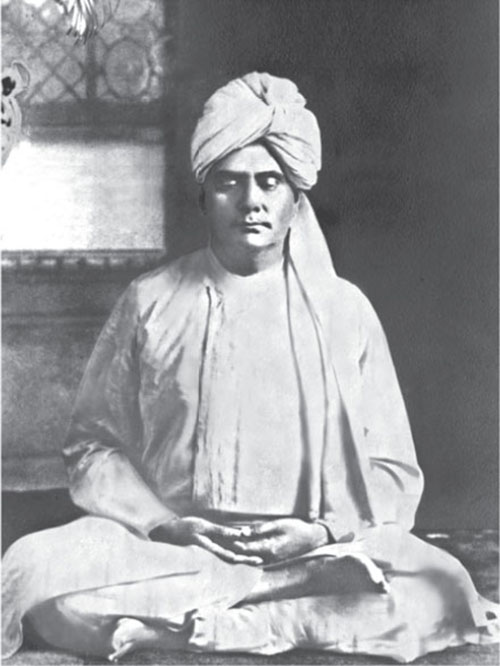
Swami Abhedananda
On enquiry, I came to know that the young man’s name was Shashibhusan Chakravarty and that he was a college student. I was glad to have acquaintance with this young man. This Shashibhusan later came to be known as Swami Ramakrishnananda, a sannyasin who had renounced everything. Since that day, Shashibhusan used to love me as if I was his own brother. I shall never be able to forget his love in my life.
After having taken bath in the Ganga and prasada of the Mother Kali with Shashibhusan, I, nonetheless, felt contented. I made up my mind to return to Calcutta in the afternoon. Shashibhusan then said to me, ‘You should not return home without having seen Paramahamsadeva. Is there any certainty if such an opportunity will come to you again in your life time? When you have come here with so much difficulty to see him, it is better for you to wait.’ ‘Do you mean to say that Paramahamsadeva will come,’ I asked, ‘but if he does not come today?’ Shashibhusan said, ‘He will certainly return from Calcutta after evening. He does not spend the night at anybody’s place in Calcutta.’ I began to think, ‘I should never go anywhere like this without telling my parents. I have come so far without informing them. They must be anxiously searching for me and having failed to trace me, they are perhaps crying. I have spent the whole day here, I should now return home. It would cause a great pain to my mother’s heart if I would have to spend my night here.’ Many such thoughts and imaginations greatly disturbed my mind and I could not come to any firm decision regarding what I should do. It occurred to me that I had come out in search of a Yogi preceptor for learning Yoga and that I would have no peace in my heart if I could not find a Yogi preceptor. So if after having come this far I was to return home without having met the Paramahamsadeva, then perhaps I would have to come again to meet him. However, none can tell when such an opportunity will come again and there may be many obstacles on the way. It has been said in the scriptures that ‘the way to the good is beset with many obstacles’. So what should I do? Should I return home to relieve my parents of anxiety or should I spend the night in the Kali temple in order to see the Paramahamsadeva? Various thoughts like this flickered in my mind.
Having failed to make up my mind, I sank in deep contemplation. My condition was like that of Arjuna in Kurukshetra. In the midst of a great dilemma, I kept on thinking silently—what to do? Shashibhusan, having realised my mental state said, ‘Brother, why should you have worry so much? Look, I too have come without telling my parents. I shall stay here tonight. Your condition is similar to that of mine. Parents will be a little upset and anxious, but afterwards when they will get you in their midst they will be happy again. When you have spent the whole day here, why should you return home without waiting a little longer? You should return home tomorrow morning after having spent the night here. Stay together with me in this holy place tonight.’
At the advice of Shashibhusan, my anxiety regarding my home and parents subsided and I made up my mind not to return home without having met the Yogi Paramahamsa, whatever might befall my fate. Thereafter, I waited in peace in order to see Paramahamsadeva. Gradually the sun set and darkness of the evening enveloped the earth. The bells of the aratrika started ringing in the temples of Gods and Goddesses at Dakshineswar. Shashibhusan took me along with him to see the aratrikam of Bhavatarini in the Kali temple. I felt unprecedented peace and bliss in my mind and heart to see the aratrikam of Mother Kali who was so life-like. After the aratrikam was over, I prostrated before Mother Kali and accompanied Shashibhusan up to the verandah in front of Paramahamsadeva’s room and rested there. Shashibhusan began to discuss various topics with me. After sometime, Ramlaldada, the priest of Mother Kali, gave Shashibhusan and myself two luchis and a little sugar out of the prasada of sitalbhoga and asked us to take it for supper. Having had the prasada, we two lay down in the temple.
Until then, I had seen sannyasins clad in loin cloth and saffron coloured robe with head full of plaited locks of hair, body covered with ash and chimta (tong) in hand. I began to fancy that Paramahamsadeva was perhaps a sadhu like that with plaited hair, loin cloth, chimta in hand and covered with ash. Having a notion like this I had great fear that he might hit me with chimta or scare me away if he was annoyed. Various thoughts and apprehensions began to arise in my mind. At that time, having heard the rattling sound of the wheels of a cab at a distance, Shashibhusan and Ramlaldada said, ‘Now the Paramahamsa is coming in a cab. He never spends the night in any householder’s place at Calcutta.’ All of us then awaited the arrival of Paramahamsadeva. Gradually the cab came and stopped by the side of the staircase on the north-east of Paramahamsadeva’s room. Shashibhusan, Ramlaldada and I stood up. My heart within throbbed. I stood speechless. Paramahamsadeva alighted from the cab, came up the stairs of the verandah and passed through the door that led to the southern verandah uttering Kali, Kali, Kali, three times in a deep voice. Thereafter, he sat on a small bedstead in his room. He was followed into the room by his attendant [Latu Maharaj] who carried his napkin and batua [a holder].
Paramahamsadeva’s nephew, Ramlaldada (priest of Mother Kali) and Shashibhusan entered the room and having done prostration to him, gave him the information about my coming. I was then standing on the verandah in awe and reverence. No question was then arising in my mind though I was thinking of many things. Ramlaldada then came to me and said, ‘Paramahamsadeva is calling you.’ Thereupon I timidly advanced and entered the room and prostrated to Paramahamsadeva putting my head on his feet. All my physical discomforts instantly disappeared and it seemed as though I was filled with a current of ineffable bliss. Paramahamsadeva asked me affectionately to sit on the mat and enquired, ‘Who are you? Where is your home? What is your name? Why have you taken so much pain to come? What do you want?’ etc. With my voice choked with devotion, I said, ‘I have a desire to learn Yoga. Will you teach me how to practise Yoga?’ At this, Paramahamsadeva remained silent for a while and then said, ‘It is a very good sign that you have the desire to learn Yoga at this tender age. In your previous birth you were a great Yogi. A small part of your sadhana remained to be completed. This is your last birth. Yes, I shall teach you Yoga. Take rest tonight and come again tomorrow morning.’ I was consoled to hear this and having done pranam many times at the feet of Paramahamsadeva, I came out to the verandah from his room.
In the meantime, Shashibhusan prostrated to Parama-hamsadeva, came out to the verandah and lay on the mat along with Ramlaldada and myself. The goddess of sleep would by no means descend on my eyes. I spent the night in silence overwhelmed with thoughts of various kinds. Gradually in the morning, everyone woke up with the chirping of birds. After having finished morning oblations, I began to meditate on Paramahamsadeva in the brahma-muhurta and longed for the moment when I would meet him again. A flood of purity and ineffable joy was then flowing through my mind...
[Years later, while on a long pilgrimage, my] days at Kashi were passing quite agreeably through meditation and japa. Then I wished to return to Baranagar in order to take rest for sometime... I heard from Sharat [Swami Saradananda] that Niranjan (Swami Niranjananda), Shashi (Swami Ramakrishnananda), Tarakdada (Swami Shivananda) and others were then living in Barangore Math where they were performing daily worship of Sri Sri Thakur (Sri Ramakrishna) and looking after the articles used by Sri Sri Thakur. After a prolonged separation from Shashi and other spiritual brethren, I longed to see them. So bidding good-bye to Sharat, I started from Kashi for Calcutta on foot. Immediately on reaching Baranagar Math, I met Shashi first. Overwhelmed with joy on seeing me unexpectedly, Shashi embraced me. Both of us were in tears then. For sometime neither of us could speak. After a little, while Shashi enquired, ‘Where were you so long?’ I said, ‘On pilgrimage.’ Shashi said, ‘Brother, I am, however, spending days and nights with Sri Sri Thakur (with worship, aratrikam and service of Sri Sri Thakur).’ I said, ‘Shashi, you are the luckiest of us. Sri Sri Thakur’s grace on you is infinite.’
...The condition of Baranagar Math was not at all sound then. Out of whatever would be received as occasional offerings from the devotees, the worship and bhoga [food offerings] of Sri Sri Thakur and one meal a day for Latu, Shashi, Sarat, Niranjan, Tarakda and one or two more could somehow be managed. Shashi would remain engaged in the service of Sri Sri Thakur day and night forgetful of himself. The daily service of Sri Sri Thakur was the sole object of all his attention, contemplation and dream... My return after a long time put new strength in Shashi and Niranjan. I began to live with them in Barangore Math. When devotees would come in the afternoon or in the evening, I would hold discussions with them. Sometimes, we would read and discuss scriptures. On the whole, our days at Baranagar were passing quite well through meditation, prayer and discussion on scriptures...
[When I entered the Alambazaar Math] I first met Sharat and Shashi. Shashi embraced me being overwhelmed with joy... Shashi eagerly enquired if I had any information regarding Naren, I said that I had met him at Junagadh and at Maha-baleswar.. [Then] Shashi and Sharat took me round the whole premises of Alambazar Math... Shashi used to live in the southernmost of the three rooms on the west. The room on the north of Shashi’s room was allotted for me. I gladly occupied that room.
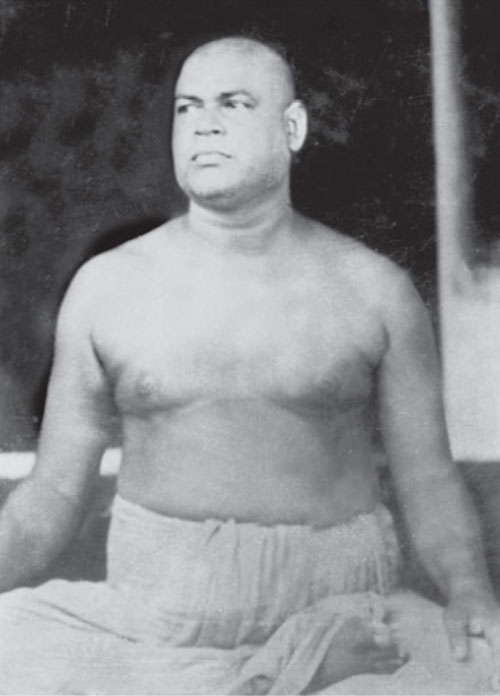
Swami Ramakrishnananda
Tulsi Maharaj (Swami Nirmalananda) had already arrived at the Alambazar Math. He began to assist Shashi in the matters of worship, etc.... Sri Sri Thakur was our sole object of meditation and conscious thinking. This was particularly true of Shashi who completely dedicated himself to the service of Sri Sri Thakur all the time.
Sometime later, a letter of Narendranath [Swami Vivekananda] came from America. The famous Parliament of Religions had been held in the city of Chicago in 1893... His eloquent speech on Hinduism had cast a spell of charm and wonder on his audience... Narendranath’s extraordinary oratory and eloquence and his liberal ideals somehow evoked the jealousy of Pratap Majumdar and also of the Christian missionaries of America who tried to confound the American public and to rouse their passions again him (Narendranath). In a way, they were declaring that Swami Vivekananda was not only without any credential to represent Hinduism, but also that the religion expounded by him was not Hinduism...
Narendranath wrote to us urging us to hold a public meeting in Calcutta approving of his activities in America while mentioning that he was accredited to represent Hinduism. Immediately on receipt of his letter, Sharat, Shashi and I, after discussing among ourselves, decided to arrange a big public meeting in the Town Hall at Calcutta... I made up my mind to stay in Balaram Babu’s house at Baghbazaar to organize the meeting in consultation with prominent citizens and devotees of Calcutta and accordingly I went over to Balaram Babu’s house. Sharat and Shashi would come from Alambazaar to join with me...Either Sharat or Shashi would invariably be with me every day...Sharat, Shashi, Harimohan Babu, myself and a few others collected the money that was required for successfully organizing the meeting by going from door to door.
The public meeting was held in Calcutta Town Hall on the 5th September, 1894. More than four thousand people, including the elite and the representatives of different communities, attended the meeting...The agenda of the meeting, the resolution and the letter of congratulation addressed to Swamiji (Swami Vivekananda), were printed and distributed at the meeting and three sets of good copies were duly sent respectively to Dr. Barrows, Mr. Snell and Swamiji in America on behalf of the Hindu community...Sometime later, we received the acknowledgement of the resolutions and congratulations and a letter from Swamiji. In that letter, Swamiji highly appreciated our work and conveyed his gratitude to the people of India, especially to the public of Calcutta and to us.
[Extracts from My Life-Story by Swami Abhedananda, Ramakrishna-Vedanta Math, Kolkata, translated by Sri J K Roy]
↑ Contents
Swami Shuddhananda
It was perhaps in 1890 that I began visiting the Baranagore Math. Swami Vivekananda had gone out to live alone, away from his brother-disciples, for practising austerities.I met Shashi Maharaj first at Baranagar and then at Alambazar. While at Baranagar Math, Shashi Maharaj had asked me to study Panchadashi as well as Uncle Tom’s Cabin by Mrs. Harriet Beecher Stowe.
One day, Bhavanath Chatterjee visited the Baranagar monastery. He was lamenting before the monastics, ‘Ah, how you have renounced everything and are calling upon God while we are struggling in the water of samsara.’ On this occasion he sang a song,
Why do you drink poison taking it to be nectar?
Why do you forget the consequences losing yourself in apparent happiness? etc.
Shashi Maharaj gave him encouragement through an illustration. He said, ‘The Master’s devotees are like fish. He keeps some of them alive and the others he fries in a pan. We, the renouncing devotees, are being fried in the pan while you, the householder devotees, are being kept alive, but at the proper time he will put you too on the frying pan.’ This pleased Bhavanath.
One day, at the Alambazar Math, he told me, ‘Write a biography of Sri Ramakrishna. Sri Ramakrishna’s biography by Max Mueller was his own version of the Master. Your book will present our viewpoint.’ He criticized breathing exercises and practices for experiencing light and said, ‘At long last you will but see flowers of mustard only.’
One day at Alambazar, Swami Nityananda (Jogan Chatterjee) was severely criticizing Ramchandra Dutta. Shashi Maharaj rebuked him, saying, ‘Do you know how devoted Ram is? Brothers quarrel among themselves. Likewise we sometimes indulge in quarrel. This is something quite different. But how dare you criticize him? Don’t you remember that while fighting against the enemy, the Pandavas said, ‘True, we quarrel with the Kauravas, but now we are one hundred and five brothers united’? You better one day visit Yogodyan at Kankurgachi.’
I joined the monastery at Alambazar in May 1897. By then, Shashi Maharaj had left for Madras at the behest of Swami Vivekananda. He was in Madras for fourteen years (1897-1911) organizing and directing the Ramakrishna Movement in the South. But he visited Calcutta several times during that period and I had occasions to meet him either at Belur Math or at Calcutta.
Swami Ramakrishnananda came to Belur Math first in December 1901 when Swamiji was staying there. His next visit was some days after Swamiji’s passing away, that is, after July 4, 1902. Swami Trigunatitananda had not left for the United States yet. As I was suffering from serious stomach trouble at Belur Math, I was, as advised by the elders, staying at my paternal home in Calcutta for a week. One day, on the invitation from my relatives, all the monastic members of the Order, including Swamis Turiyananda, Trigunatitananda, Adbhutananda and Saradananda, dined with us. Swami Ramakrishnananda had come to Belur Math at that time, but in spite of repeated requests, he did not accept the invitation. During his third visit to Calcutta in 1904, Swami Paramananda accompanied him. His fourth visit took place in 1906 in the company of Swamis Abhedananda and Paramananda. He visited Belur Math for the fifth time when Purnananda was about to join the Order. I was staying at Kothar, Orissa. The Holy Mother too was living at Kothar at that time. It was in the month of January or February.
Shashi Maharaj’s devotion to the service of the Lord deeply impressed me. I remember, he used to keep a timepiece in front of him even while talking with others. He was very particular in performing worship at the scheduled hours. During the evening service, the inmates of the Math used to sing loudly and enthusiastically ‘Hara Hara Vyom’ etc. and participate in dance. When he joined the evening service of the temple he would call on the holy names with great fervour.
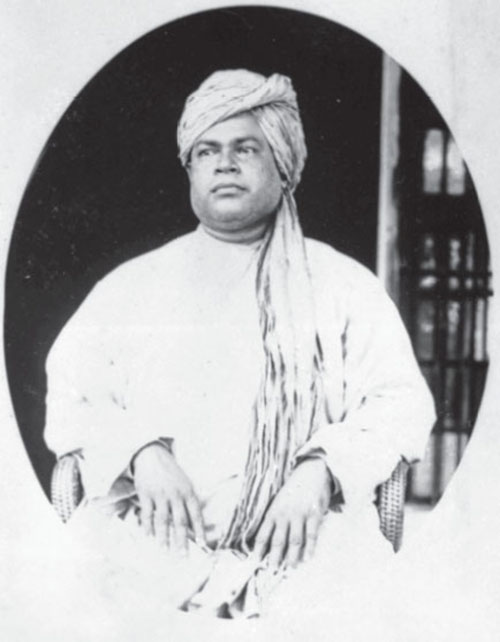
Swami Ramakrishnananda
On the night of a certain birthday of Sri Ramakrishna, Shashi Maharaj served as the priest with Fakir Babu (Jnaneswar Bhattacharya) as his tantradharak. As the worship of Dasha-mahavidya was going on, offerings were made to the Deity with loud chanting of mantras filling the air. During the worship of Mother Kali, Swami Shivananda sang: ‘Why are you Mother Girikumari in the cremation ground?’ While I was watching these with keen interest hours rolled on. As it got quite late, Swami Trigunatitananda persuaded me to go to bed. Early next morning I watched the homa being performed. At that time, the inmates sang the kirtan, ‘Repeat, Brother, Hari Om Ramnam.’
I once served as the tantradharak and on another occasion as the priest. Shashi Maharaj, who graced both these occasions by his presence, advised me to chant the mantras very fast.
The almanac prescribes a particular hour by which the worship of Mother Durga is to be finished on any particular day. One year we literally followed the timing specified by the almanac. On a particular day we got up at 3 a.m. and finished the rituals of worship by 8.30 a.m. As far as I remember, kichudi was cooked and offered to the Deity. Such worship at early hours could not satisfy many of the inmates of the Math and this gave rise to hot discussions. When Shashi Maharaj visited next time, the matter was placed before him for his verdict. He said, ‘It is enough if you begin the worship before the closing time specified by the almanac.’
In 1906, during the Durga puja, I met with an accident while getting off a tram car at Shyambazar and I was confined to bed. At Belur Math, Sri Durga was worshipped in a symbolic pot. Shivananda served as the priest and Ramakrishnananda as the tantradharak. At the auspicious juncture of the eighth and the ninth lunar day, a gourd was offered as a symbolic sacrifice. Holding a watch in front of him, he said, ‘When I say “Victory unto Mother”, you will know that it is the exact time to do the sacrifice.’ At the precise moment he shouted, ‘Victory unto Mother’. He uttered those words with a terrifying uproar.
During one of his visits to Calcutta, I once travelled with him in a carriage. Starting from ‘Udbodhan’ we drove to Salkia via Howrah. On arriving at Suren Bhattacharya’s house, he enquired if there was a Khol. Being told there was none, he observed, ‘The house which does not possess a Khol is like a cremation ground.’ One person rushed immediately to procure a Khol. Soon after, Ashu began singing, ‘Tell the name of Gauranga, worship Gauranga, utter the name of Gauranga etc’, to the accompaniment of the Khol. Shashi Maharaj joined in the kirtan, singing loudly and dancing with others. Being apprehensive, I kept myself away. When the singing was over, Shashi Maharaj performed the worship of Sri Ramakrishna. He was presented with a new cloth, which he put on. Then we all partook of the day’s meal, containing prasada of Sri Ramakrishna.
Once, I had accompanied Shashi Maharaj when he was going to the Math by boat. Dr. Kanjilal, who was in the party, confessed the misdeeds of his past life and his weaknesses. I found Shashi Maharaj giving him profound encouragement as well as some valuable advice.
On another occasion, he had come to Calcutta in the company of Swami Paramananda. We tried to induct Paramananda as a member of the Udbodhan. As I was trying to persuade Paramananda to visit ‘Udbodhan’, Shashi Maharaj prevented me saying that it was the inauspicious hour of a Thursday. In those days, Mother’s house was located at 2, Baghbazar Street.
It was perhaps on another visit that Shashi Maharaj asked me to forcefully massage the legs of Swami Brahmananda, then living at Balaram Bose’s house. Observing that Brahmananda was not being attended to properly and that the servants were not cleaning his room and tidying his bed, he became annoyed. He tried to persuade the servants of the family to do the errands, but failed. He himself then began to do them.
At our request, he began taking a class on scriptures at Belur Math. It used to be held in the visitors’ room, located then in one of the southern rooms on the ground floor. He used to elaborately explain the texts.
He firmly believed in the infallibility of the Holy Scriptures. If anyone pointed out certain anomalies, he would get annoyed. Nonetheless, I once showed him some gross interpolations in some texts and he kept quiet.
Once, both he and I were down with fever. Purnananda, who had joined the Order recently, was attending on us. At the time of taking barley water I shouted ‘Victory unto Guru Maharaj’. At this he remarked, ‘Will such slogan-shouting serve any purpose?’
Shashi Maharaj had a kind of leucoderma for which physicians had asked him not to take Kalai dal. And for its cure, he used the medicated oil of Sashpur. In fact, it was because of this skin-disease that he could not go to the West, although his name was proposed by Swamiji.
He had once come to Belur Math to get some monastic assistants for the Madras Math. He could find none. At that time Surendravijay, a student of first year in the Ripon College, Calcutta, was staying at the Math for spending the summer vacation. He had brought books for his study. Presuming that Surendra Vijay had some fascination for monastic life, Baburam Maharaj pressed him hard to join the Order. This upset the boy who forewent his meal and bitterly wept under the Bilva tree. In the afternoon, some inmates of the Math noticed his swollen eyes and learning that he had not taken his noon meal, showered sympathy on him and gave him prasada to eat. Shashi Maharaj was about to start for Calcutta in a boat for paying a visit to the Holy Mother. He asked Surendravijay to accompany him. Surendravijay opened his heart to him and thereby drew Shashi Maharaj’s sympathy. The latter prayed to the Holy Mother to grant sannyasa to Surendravijay. She consented and asked him to send the boy to her. Before Swami Ramakrishnananda left for Madras he sent the boy to the Holy Mother. Ramakrishnananda was pleased and proudly said, ‘Luckily Mother is here to help us. It is only through her grace that I get one or two monastic hands.’
Before Rudra was sent to Madras, Jogin (later Swami Umananda) came to the Math for getting initiated into sannyasa from Swami Brahmanandaji. He had been with Shashi Maharaj for six years. He originally belonged to the caste of teli [those whose profession is make oil by pressing seeds, etc.]. But others knew his family as sweetmeat makers since their family was engaged in that profession for a long time. He knew how to prepare various dishes. So Shashi Maharaj got many dishes prepared by him to offer to the Master.
Shashi Maharaj had sent him to get sannyasa from Swami Brahmananda without any prior permission from the latter. After sannyasa, Umananda had a desire to go to places like Varanasi, etc., for pilgrimage and austerity. So Shashi Maharaj wrote to the Math repeatedly asking for a Brahmacharin after sending Umananda. At this, Swami Brahmananda was displeased and made me write a letter to the effect of asking why he sent Jogin without informing him beforehand. Shashi Maharaj was offended and stopped writing to Maharaj for quite some time. At long last, Ramu [C. Ramaswami Iyengar] wrote to the Math that the Swami was working so hard and found it difficult to manage. By that time Rudra had just joined the Math. He was sent to Madras after having stayed at the Math for three months.
Among the monastics who worked as his colleagues at the Math, the following deserve mention: (a) Swami Nirbhayananda who stayed for about one year in the first lap of his work at Madras, (b) Swami Sadananda (c) Swami Sankarananda, (d) Swami Paramananda who stayed for a long period (e) Swami Achalananda who stayed for one year (f) Swami Umananda (Jogin) who stayed for six years (g) Swami Yogeswarananda (Suresh, a disciple of Ramchandra Dutta) (h) Swami Dhyanananda (Rudra) who stayed for a long time (i) Brahmachari Prakash (brother of Swami Sarada-nandaji) who stayed for one year, (j) Swami Satchidananda (Budo Baba) who stayed for six months (k) Swami Atmananda, (l) Swami Bodhananda (m) Swami Vimalananda (n) Swami Sarvananda (o) Brahmachari Brajen (who had served Swamiji as one of his attendants) (p) Brahmachari Surendravijay and (q) Swami Satchidananda (Mati).
Shashi Maharaj had written the life of Ramanuja in Bengali in the early days of Udbodhan and it was during the tenure of my editorship that he completed it. He began to work upon another subject, perhaps Stotra Upadesha Ratnamala. As he omitted the translation of some Sanskrit verses, it could not be published. In response to my pleadings, he assured me that he would take up the remaining part of the work, but unfortunately he could not. Later when the Life of Ramanuja was published in book form from Udbodhan, I wrote to him enquiring whether he would reserve its copyright or if Udbodhan would have to pay some royalty to Sri Ramakrishna Math, Madras. He replied that he would inform after due deliberation, but did not happen to write.
In the early part of the book he discussed about the Alvars. He described one of the Alvars as an avatar of conch of Vishnu and remarked, ‘University students of today may heartily laugh at this.’ I edited the language there slightly. Before publishing Swamiji’s Shivastotram in the Udbodhan I sent the manuscript to Shashi Maharaj at Madras for necessary editing. He did it and sent a copy of the corrected manuscript. It seemed he retained the original paper with him. Among the changes he made, it is worth mentioning that he substituted ‘pranapracchedaksham’ by ‘pranavicchedasutkam’. He also translated those Sanskrit verses into Bengali. He translated Swamiji’s Chicago address into Bengali. He wrote a Bengali essay entitled, ‘Sri Sri Ramakrishna Tattvabhas’. In those days Ramdayal Chakraborty and a few others used to organize a festival in memory of Sri Ramakrishna at Dakshineswar on the full moon day of Magha. This programme continued for some years at a stretch. On one such occasion, the essay mentioned above was read out before the devotees under the Panchavati grove. And it was subsequently published in the Udbodhan. Apart from these writings, he wrote a prose piece on the ‘Temples in South India’ which was published in the Udbodhan.
When I published in the Udbodhan some poems on Swamiji, he warned me saying, ‘If you eulogize Swamiji two times, the followers of Ramchandra Dutta will eulogize him four times. This will lead to a sectarian competition.’
We got the Sanskrit verses of Swamiji, later published in Virvani, edited by the great Sanskrit scholar Pramathanath Tarkabhushan. This annoyed Shashi Maharaj, for, according to him, deviation from the grammatical rules, if any, was but an arshaprayoga in the case of Swamiji who was no less than a Rishi.
During his visits to Calcutta, he insisted on my visiting Madras. He even offered the passage money for me. But I could not manage to visit Madras in those days. Even towards the last days of his stay there he invited me once, but said, ‘They (the Belur Math authorities) will pay your fare.’
Around January 1911, I visited the places of pilgrimage in southern India through the arrangements of Shashi Maharaj. I returned to the Math in April and was posted at Varanasi in July. About this time, Shashi Maharaj contracted phthisis and was brought to the new Udbodhan House at Calcutta. There I met him for the last time. He directed me to make a literal translation of Brahmasutra in Bengali.
He later passed away in August when I was in Kashi.
[Extracts from the Vedanta Kesari, August, 1983, pp. 271-277 and Sri Ramakrishna-Parikar Prasanga, Swami Kamaleswarananda, 1st edition, pp.51-65]
↑ Contents
Swami Virajananda —Swami Ramakrishnananda As I Knew Him
I went to the Baranagar Math for the first time one noon, early in 1891, with some of my friends and classmates, after playing truant from college. We met Swami Ramakrishnananda (Shashi Maharaj). He and other Sannyasin disciples of the Master (Sri Ramakrishna) received us cordially and asked us many questions such as: what we were doing, in which class we were studying, where we came from, how we came to know of the Math, etc. At 4’o clock, the worship room was opened. We prostrated ourselves before the Master’s photograph, partook of some prasada and took leave of them that day.
From that time onwards, I used to visit the Math now and then. Shashi Maharaj would make several enquiries regarding our studies and would test us whether we were coming to the Math on the pretext of becoming sadhus while we were actually afraid of study. If we failed to answer the questions properly, if we failed to solve correctly the mathematical problems posed by him, he would scold us, saying we must not be negligent of our studies. Hence all of us were afraid of him. One day when he interrogated me, I said to him that I was strong in all subjects except mathematics in which I was very weak. Mathematics would by no means enter my head. I was therefore afraid that I might fail in the ensuing F.A. Examination. Shashi Maharaj remarked, ‘The summer vacation is fast approaching. Why don’t you come to the Math and spend these one and a half months here? I shall teach you mathematics so well that you will be able to pass easily.’ With pleasure, I communicated this to my father, who said: ‘Very well. Do accordingly.’ As soon as the vacation began, I came to the Math immediately with my texts, exercise books, etc. Everybody in the Math gave vent to their great delight and I too felt extreme happiness at this. But after my arrival, there was such a joy in me, arising from the service of the Master and the sadhus and from the performance of the household duties, that I would spend the whole day and part of the night in them. The thought of reading for the examination did not come to my mind even once. Shashi Maharaj too did not broach the subject of giving me lessons, even for a day! The books remained bundled up, as they were earlier.
The Math was then situated in the Paramanik Ghat Road at Baranagar, next to the temple precincts of the Munshis of Taki. The building was old and dilapidated. Upstairs, in the inner apartments, the rented Math was located. After passing through a door abutting on the road, one had to cross a vacant ground. Ascending a staircase, one would then come to a big hall which was on the south of a pillared verandah with wooden railings. Before my visit, this hall had had tenants. But now, it remained unoccupied. The Math portion which was inside could not be seen from the road. It was quite secluded. Now the whole building has collapsed. Barring the frontage, no photograph is available of the interior portion which was occupied by the Math. Very few vegetables grew in the kitchen garden. All that was available were drumsticks, a few pumpkins, cucumbers and plantains. In the backyard, there was a tank. Close by lay a vegetable garden with some drumstick trees and a few fruit trees like vilva, coconut and mango. There was an Oriya gardener named Kelo. Owing to the utter lack of vegetables, Shashi Maharaj would be forced to enter the garden now and then. In a moment, he would cut with his vegetable knife, pumpkin creepers and a few leaves that could be secured and bring them to the Math. At this, the gardener Kelo would cry out in Oriya dialect, ‘Hey, Hey, what are you doing? You must not take away these things!’ He would chase Shashi Maharaj and sometimes hurl abuses and make an uproar. But Shashi Maharaj would go along his way without paying any heed to all this and return upstairs with an unruffled mind. With those vegetables, he would make a curry and offer it to the Master along with rice. All would afterwards join in the meal and there would then be much fun and merriment over the episode of Kelo, the gardener.
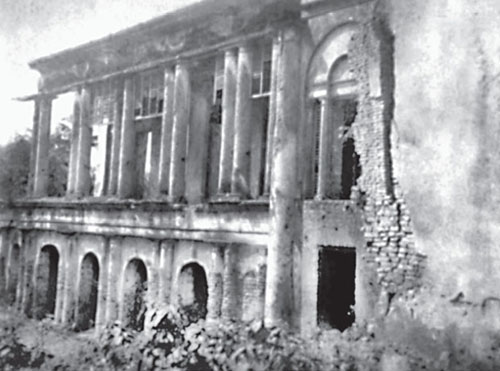
An archival photo of Baranagar Math
In the evening, Shashi Maharaj would burn incense first in the worship-room and then wave it before the pictures of all the Gods and Goddesses in the little hall. With the incense-burner in one hand and the candle lamp in the other, he would move from portrait to portrait, repeating the words ‘Jai Gurudeva, Sri Gurudeva, Jai Gurudeva, Sri Gurudeva!’ Subsequently, he gave me this work to do.
On one side of the hall, one came across a wooden cot. On one portion of it, some books in Sanskrit and Bengali and a few in English were kept piled up in order. On the other, some musical instruments were placed. There was also a Tanpura which could be seen hanging from a nail on the wall dose by. The hall was the sleeping room for the monks. It was also the place for holding conversations with visitors and devotees. In a word, it fulfilled various purposes of the monastery. A mat and a small pillow were all that formed the bedding of each sadhu. The mats would be spread, one after the other. A few extra ones were also available and were intended for visitors or for spreading elsewhere. Sometimes the visitors sat on the floor without using them.
The photograph of Sri Ramakrishna was placed on a bed consisting of a mattress and a quilt covered with a bed-sheet, with a pillow on the top and two on both sides, all arranged on the floor in the centre of the worship-room. At the foot of the bed lay the relics of the Master, locked inside a copper casket and his holy sandals placed on a low wooden pedestal. Shashi Maharaj used to perform the daily worship of the Master sitting before the Puja materials with due solemnity. At the time of arati, the hymn to Viswanath, chanted at Benares during evening service, was being sung:
‘Jai Siva Omkara, Bhaja Shiva Omkara’
Victory to Shiva, the symbol of Omkara
Homage to Shiva, the embodiment of Omkara’
Oh! How wonderful was the arati of Shashi Maharaj! It was indeed a sight for the gods! Enveloped within the smoke of burning incense and drowned in the music of drums and cymbals, he would wave the chowry towards the end of the Arati. Seized with divine fervour, he would repeat, ‘Jai Gurudev, Sri Gurudev,’ with a thundering note of joyous exclamation. As if in a dance of Tandav—Shiva being beside himself with emotion—he would move about with rhythmic steps, from one side of the room to the other. What a thrill of spiritual fervour, what a unique feeling of ecstatic love would surge through the hearts of those like me who saw this, can better be imagined than described! The whole building vibrated as it were with a divine tremor. It appeared as if blood would rush out of worshipper’s face, which was fair and resplendent with a heavenly glow. He looked like the very embodiment of the God of Fire. The cry and the dance knew no cessation. The hands of the drummer would get benumbed and refuse to continue. The spectators would watch everything from the adjoining room and join in the repeated cry: ‘Jai Gurudeva, Sri Gurudeva!’ They too would dance in rapture. Then all would prostrate themselves before Sri Ramakrishna’s photo and recite in unison from the Guru Gita:
Blind-folded by the darkness of the world it was
He who had opened my eyes
With a stick of collyrium of Knowledge:
To him I bow down, my Guru the adorable.
A few other verses would also follow it.
Then, the last portion of the Sanskrit hymn composed by Swami Abhedananda would be chanted:
With our head bent low in reverence,
To Him, the taintless, the eternal and of Universal Form:
But, who, out of compassion, takes a human form;
To that worshipful, highest divinity,
Sri Ramakrishna, an Incarnation of God.
Let our salutations be.
Finally, with the words, ‘Jai Sri Guru Maharajji ki Jai,’ the service would end.
In those days the cook was the only servant in the Math. A water-carrier was engaged for drawing water from the Ganga about two furlongs away for drinking and cooking purposes. He used to bring it at a certain hour in earthen jars held by a pole with slings. Shashi Maharaj would himself do all the work of the shrine pertaining to the puja and service of the Master. Moreover, he would attend to the marketing, sweeping, cutting vegetables, cleaning the altar vessels, drawing water from the tank for washing hand and feet, trimming the lamp etc. All these things were done by him almost single-handed though others would occasionally help him to some extent. After my joining, I used to assist him in all these activities. After the offering, when all had finished their food, he would enter the Shrine and fan the picture of the sleeping Master, with a big palm-leaf fan, till 4 o’clock during the hot season. He kept up this practice, without a break, even after the Math was shifted to Alambazar. In this too, I would relieve him by turns. The members of the Math used to devote a major portion of their time in japam and meditation, in scriptural study and discussion. They would also sing devotional songs, either alone or in congregation. At times, Tarak Maharaj (Swami Shivananda) would sing in his own mood some love song of the Gopis to the accompaniment of the drum and dance in rapture. He had a very tender and sweet voice like that of a woman. People of the locality and men passing in the street would say in whispers ‘Surely, a woman has been brought into the Math!’ The householders in the neighbourhood were opposed to monastic life and would revel in spreading many a baseless scandal and false report. When the sadhus would be going for their bath in the Ganga, mischievous boys would sometimes imitate with their arms the pose of cranes. On other occasions, they would follow them saying: ‘Look! All the swans are going!’ and make a crackling noise mimicking the sounds of those birds.
Oh! What an austere life the sadhus then lived! Sarada Maharaj (Swami Trigunatitanada) lived for several months in a dark, damp, solitary room below in the outer court. Bolting the door from within and observing the vow of silence, he underwent a rigorous type of spiritual sadhana. His food was a single plantain and one or two glasses of water. He could hardly be seen by men, so absorbed was he in japa and meditation.
After some time, a few of the Swamis like Yogin Maharaj (Swami Yogananda), Tulasi Maharaj (Swami Nirmalananda), Kali Maharaj (Swami Abhedananda) and Sharat Maharaj (Swami Saradananda) returned to the Math, one after another, from the holy places after pilgrimage and tapasya. Kali Maharaj stayed a pretty long time at Jhusi on the other side of the Ganga at Allahabad. He used to live on madhukari bhiksha, begging his food from a few chhatras. When he returned, he brought a new aspirant from Allahabad, Vasanta by name. He was seventeen or eighteen years old. He had the idea of becoming a brahmachari. Kali Maharaj would spend a major portion of his time in the pursuit of Sanskrit literature and the study of Vedanta Philosophy. He would remain closeted in a small room outside. Later on, that room was called ‘tapasvi’s cell’; Vasanta too had a great predilection for study. He used to read the Grammar Laghu Kaumudi under the Swami. But Shashi Maharaj did not like all this. A slight omission in the service of the Master would receive from him a sharp rebuke. On this issue, even Kali Maharaj would not be spared. Vasanta being very touchy and sensitive took these remarks to heart, though he would not let anybody know how he felt. He had probably passed three or four months in this manner. All of a sudden, one day, Vasanta disappeared. Thenceforward no news was received of him. Although influential and wealthy relations of his made a thorough search for him, no trace of his whereabouts was found.
About the same time we were visiting the Math, another group of young men also came to it from Ahiritolah, Calcutta.
Kanai and Nanda came first in that group, Nibaran, Chandra, Krishnalal and others followed in their wake. The main occupation and endeavour of the young men that used to come to the Math was to render some household service to the sadhus. That was the practice in vogue then. They would first find out what work was to be done and would immediately set themselves in discharging it. They would spend the whole time in doing something or other. The more one would work, the more delighted he would be. In this respect, Shashi Maharaj was their leader and guide. He was a living and practical example for their emulation. He used to assign duties to them which they would most gladly fulfill. One young man, Nibaran Dutta by name, had some musical talents. He used to compose new songs in the name of Sri Ramakrishna. Whenever he would come to the Math, he would sing them and do kirtanas along with his friends, to the accompaniment of drums and cymbals. Sometimes he would dance and sing with emotion. Shashi Maharaj, too, would often participate.
The Sadhus had very few clothes except the koupins (loincloth) they wore at the Math. Dhotis of 5 cubit length would remain hanging from a line of choir rope and when anyone had to go out, he would use it. They had no need of trunks to keep them in. In winter, a Bhakta would perhaps give a moleskin chaddar to each of them to wrap with. In the storeroom, rice and dal were arranged in big earthen vessels, mud-pots and jars, placed one over the other.
A small sum worth a rupee or two would be kept in the form of change of two anna or four-anna [a unit of Indian erst while currency; one anna is 8 1/4 pice] and some pieces on the floor below a tin box which contained the garments of Sri Ramakrishna. According to need, some of this amount would be taken for marketing. There was no trouble of keeping any accounts. Before my joining, I heard a young man once remained in the Math as a brahmacharin for a few weeks and then bolted away with that little amount!
Two simple regular meals were prepared each day for offering to the Master besides a little sugarcandy after puja in the afternoon. There was no practice of taking tea then. It was subsequently introduced in the Alambazar Math. Some of the members there were getting frequent attacks of malaria and cold and it was they who initiated it as a preventive.
Pilgrimage to holy places would be undertaken periodically by the monks in different batches. Shashi Maharaj was the only exception. He could not bear the idea of leaving Thakur (Sri Ramakrishna) and his children in the monastery to go to any other place. He had not even been to Calcutta for a few hours during that long stretch of twelve years! Only once, for some special reasons, he went away, without informing anybody. It created a great stir and anxiety in the minds of all his gurubhais. With deep concern, they began to search for him. Fortunately, they found him at Dakshineswar the following day and persuaded him to come back to the Math. On another occasion he had to go to Calcutta to attend the public meeting at which an address of welcome was presented to Swamiji on his return from the West. When Swamiji was staying at Sil’s Garden House, Shashi Maharaj would go there every now and then and would return after spending a couple of hours in his delightful company.
The members of the monastery were very ardent about their spiritual practices. Thrice in the day, in the morning, after the noon bath and at dusk they would regularly pass hours in meditation and prayer. Some of them used to perform sadhana even during the night secretly sitting on their bed unknown to others.
A few others would silently retire at dead of night to the Baranagar cremation ground and be steeped in contemplation till the day dawned. Independent study of the Scriptures, with the help of commentaries, was part of the daily routine in the case of some inmates. When a controversial topic arose, they would sometimes enter into hot debates or discussions with others.
Near the crematorium, there was a Bel tree which produced a good number of disjointed leaves with four, five and even up to seven petals from one stem. These were considered very holy. According to the number of petals, the offering would vary in sanctity and merit by a hundred and even a thousand times. Knowing this, I would search and search for such leaves and pluck as many as I could. At the very sight of them, Shashi Maharaj would be elated with great joy. He would offer them to the Master. After washing, he would again use them for puja on the following day, as this was permitted by the scriptural codes.
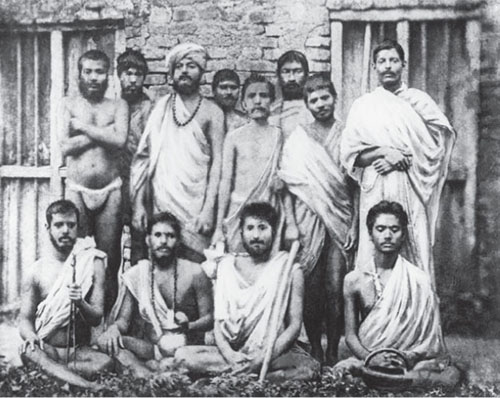
Disciples of Sri Ramakrishna at Baranagar Math
Standing (left to right): Swami Shivananda, Swami Ramakrishnananda,
Swami Vivekananda, the monastery cook, Deven Majumdar,
Mahendranath Gupta (M.), Swami Trigunatitananda, Mustaphi
(maternal uncle of Deven Majumdar)
Sitting (left to right): Swami Niranjanananda, Swami Saradananda,
Hootka Gopal and Swami Abhedananda
At the time of Swamiji’s return from America, the Math was in Alambazar. For some years, I was away at Brindavan practising tapasya in the holy company of Baburam Maharaj (Swami Premananda). A few days after the arrival of Swamiji, I came down to the Alambazar Monastery with Baburam Maharaj. With his spontaneous, single-minded devotion and unflagging energy, Shashi Maharaj was carrying on his self-appointed task—the worship of the Master and the service of the sadhus. He would work like a giant. He was always in a high spiritual mood. Oh! What stead-fastness, what absorption, what inebriation, he felt in the worship of the Lord! It is beyond the conception of anyone who has not seen it. He could not brook the least flaw or the slightest delay in the matter of this worship. Everything must be prompt and perfect. That was his demand. I used to work with all my heart and soul putting forth my greatest energy. I would try to discharge all the duties of the shrine as best as I could; and yet not a single day passed when I did not shed tears on account of his scolding. I would turn my face aside and weep, away from his gaze. I would wipe the tears on my cloth and peel fruits with the hands. I tried to finish my task as quickly as I could, almost running hither and thither. But the pity was that I was a bit slow. Shashi Maharaj on the other hand was exceptionally quick. In a trice, he would do plenty of work. He was great in all respects. He knew how to scold. He knew also how to love. As soon as the offering was over, he would take nice sweet and thrust them into my mouth with one hand, saying ‘Eat, my dear’. With the other hand, he would fondle me, gently stroking my face and body with his affectionate touch.
Swamiji was then staying in the Alambazar Math. He used to hold classes on the Gita and Upanishads at about nine o’ clock in the morning. The place was either the hall or the adjoining verandah, in the outer part of the Math. Sometimes, he would conduct question and answer classes too. Young brahmacharins and sadhus attended as the classes were specially intended for them. Swamiji’s brother-disciples also used to sit and listen. I could not be present, most of the days, as I was unable to finish all my duties pertaining to the shrine. The vigilant eye of Swamiji noticed this and one day in the midst of his class, he enquired: ‘Where is Kalikrishna? Why does he not come? Go and call him,’ One of the disciples came and informed me and immediately I went to meet him. At the sight of me, he got into a fury and in an angry mood remarked: ‘Why do you not come? What are you at? Were you cutting the tips of soaked gram, one by one, for the shrine? Call Shashi.’ No sooner had Shashi Maharaj come than Swamiji burst out excitedly and fired at him saying: ‘What is the matter, Shashi? Have all these boys who have joined, leaving their hearth and home, come here only to dress the tips of oats that you want for your Thakur? Such things cannot be tolerated. All will have to attend to japa, meditation and study at stated hours regularly without any exception. Do you hear?’ Oh, the tongue of Swamiji! How terrible and piercing it was! Once it was released, the words gushed forth in a torrential flow without knowing any end. He went on speaking in this strain many a thing which sounded so hard. Shashi Maharaj stood with head bent down. He listened to all in patience and then went away calmly without a word. Thereafter, he used to share some of my duties in order to facilitate my attending the class in time. I also would make a supreme effort to finish all my work as quickly as possible.
Time rolled on. Some days passed. Then Swamiji thought of sending Shashi Maharaj to Madras. He called him aside one day and said, ‘I have given my word to friends at Madras that I would very soon send one of my brother-disciples there. I have chosen you. You are to go to Madras and found a monastery in the name of our beloved Master.’ Shashi Maharaj pleaded no excuse. He raised no objection. How loyal he was!! For twelve long years, he kept constant vigil before the relics of the Master. It was an unbroken spell of ceaseless service. He had not visited a single place during that crucial period of more than a decade, because he would not leave the shrine of his Guru whom he so devoutly worshipped as a living presence. What a living faith in the Guru he had! Beyond his service to Thakur, he knew nothing. He greeted the request of Swamiji as a command of Thakur. He readily bowed down to that behest and was prepared to start for Madras instantly. How profound and deep was his love and adoration for Swamiji could be easily seen from this. He made no distinction between the call of Swamiji and call of Sri Ramakrishna. Thus he could give his whole-hearted allegiance and unhesitating obedience to Swamiji’s order.
My last meeting with Shashi Maharaj was between 1904 and 1905. He came down from Madras to Belur Math for a short visit. He extended to me the same warm love and affection that I used to receive at his hands in the good old days. Before his passing away, once again, he came to the Math for treatment and stayed at the Holy Mother’s house at Baghbazar. But I was then away in the hills, in charge of the Mayavati Advaita Ashrama as its head. So I could not go down leaving aside my multifarious duties and heavy responsibilities and see his physical form before he entered into final sleep, although I wished it very keenly. I may mention here a noble trait of his character. During my editorship of the Prabuddha Bharata, he used to send notes of his class talks and lectures at Madras for publication in the magazine, giving me full liberty to edit them as I liked. He would express his glad approval of the additions and alterations made by me on his writing. This shows the great humility of his character.
Many a sweet reminiscence has left its ineffable impress on the pages of my mind. They are still green and fragrant in my memory. But as they are too personal, I hesitate to make them public. It is better that they remain unexpressed for their deep significance is beyond words. They are my priceless inheritance. How profoundly our revered Swami—Shashi Maharaj—has moulded my life and fashioned my personality, can never be told in human language. But for his affectionate love and unstinted help at the cradle of my spiritual life, in the early monastic days, I would not have been what I am. Who knows to what direction the tide of my life might have turned and led me to in this dreary desert of existence, had he not been behind me?
[From the Vedanta Kesari, July, 1952, pp. 133-139]
↑ Contents
Swami Vishuddhananda
My days with Swami Ramakrishnananda are never to be forgotten. They are still fresh in my memory at this distant date. I consider myself thrice blessed in that I could come in contact with such a great personality in the early days of my monastic life.
When I joined the Ramakrishna Order at Belur Math as a young man and was subsequently sent to Madras, Revered Swami Ramakrishnananda, the apostle of Sri Ramakrishna, well-known in the whole Order as Shashi Maharaj, was the President of the Madras Math. I had the great good fortune to live in his holy company for several years during that period. Living in his company, I had the opportunity to watch him in various moods for days together. I am struck with wonder today, even after so many years, to have been acquainted with his sublime character.
I was quite young when I was sent to Madras to work under him. On coming to Madras, the first thing that struck me most was the way he was leading his life. It was a life of complete self-surrender and dedication to God. The be-all and end-all of his existence was Sri Ramakrishna. To be guided by such a lofty life is in itself an object lesson of highest spiritual worth. It was indeed a rare privilege for anyone to be by his side and to be able to mould and elevate one’s character following such a living example of purity and holiness.
Revered Shashi Maharaj seemed to be living always in a transcendental spiritual realm. It was as simple as breathing to him. So, even when absorbed in his worldly duties, he would evince deep spirituality. He left a spiritual impression even in insignificant works. People were astonished to see the style of his work. But that was very simple and spontaneous to him. Rather it was a matter of amazement to him that people felt astonished.
What is the essence of the teachings of Sri Krishna in the Gita? It can be stated in one sloka: matkarmakrt matparamo mad-bhaktah sangavarjitah nirvairah sarvabhutesu yah sa mameti pandava. He who is engaged in the work of the Lord, not his own or anybody else’s, forgets himself. We want to worship our ego. How is it possible to forget oneself and work for the Lord? The next word, matparamo, gives the answer. It can be possible if we have Him for our goal. He is to be regarded as the supreme Goal. How can we have Him as our Goal? The answer lies in the subsequent word, madbhaktah. You cannot make Him as your supreme goal unless you are devoted to Him. Therefore, devotion is necessary. How can we have that devotion? We must be completely free from all attachments for things worldly: sense objects and ego. ‘Ye cannot serve God and mammon.’ Light and darkness cannot exist together. Unless you have true devotion you cannot be His bhakta. When we can make Him as our goal, then only we can work for Him. (nirvairah sarva bhutesu) Then we cannot be inimical to any creature. Karma, Bhakti and Jnana all are combined in this sloka. This is the essence of the Gita.
A typical example of this teaching was Swami Ramakrishnananda. He lived and had his being in God. He was doing so much work—taking classes, dressing vegetables for Sri Ramakrishna’s offering, doing puja and the like. With how much love and devotion he used to do all these! One day, it was in May, a very hot day, he was tossing in bed. We were fanning him, yet he was restless. His whole body was burning, as it were. One hour passed in this way. No relief could be given. Suddenly he got up, ran into the shrine, completely forgetting himself in the thought that Sri Ramakrishna too should be suffering from the terrible heat and that he must serve him. For two hours from 2 to 4 p.m., he was fanning Sri Ramakrishna. During my two years of stay with him I learnt from him how to love Sri Ramakrishna.
Throughout his stay in Madras (1897-1911), Swami Ramakrishnananda worked vigorously to spread the message of the Master. Besides daily worship, he held weekly religious classes in the Math and also in different parts of the town. He had to go out often on lecture tours on invitations from various societies and organizations in the Presidency. In these lectures, he said what he had to say with care and candour, but he was unconcerned about their effect on the audience. He would not mind if the attendance was poor. I once went with him to his class at Triplicane. Eight or ten people only were present, most of them clerks, tired and sleepy, probably, after a hard day’s labour in the offices. Four or five of them were dozing. He did not seem to notice it at all. He went on explaining the Gita in the light of the teachings of Sri Ramakrishna. Afterwards, while returning, I said: ‘They are unfortunate not to have listened to the talk.’ He replied, ‘I don’t mind all this. I came to talk of God. I was hearing while I was talking. It is enough for me. I am talking about Sri Ramakrishna to please him only. I am spending my time very usefully.’
I found in him a happy synthesis of work and worship. ‘Whatever thou doest, O Arjuna, do that as an offering unto Me’, says Sri Krishna in the Gita. This teaching was fully reflected in every action of his. He was doing all the work for Sri Ramakrishna.
Once I saw him praying before an oil painting of the Swami Vivekananda after his return from a lecturing tour. I over-heard his fervent prayers as he bowed down before him: ‘O my beloved brother, you are verily the accredited representative of Sri Ramakrishna and it is you who have sent me over here to propagate His message. I am only carrying out your commands. I beseech you to see to it that no pride or self-esteem enters my heart, no thirst for name or fame disturbs my mind. The entire burden and the responsibility that you have placed upon me are verily yours. Bless me so that I may carry on the work of our Master only as an instrument in His hands and that I may offer all the fruits of work unto Him. Guide me always in the right path.’ What a glorious example of self-surrender and dedication to God and His work! What shall we learn by studying books? We directly learned from him about complete self-surrender.
I saw in him an exuberance of devotion to the Guru. Even when Sri Ramakrishna physically passed away he never disappeared from Shashi Maharaj’s heart. Shashi Maharaj would often forget himself while conducting the worship of the Master; so great was his love and devotion to Him. One day while opening the shrine after offering bhog (food offering) he found an insect in the milk. He began to quarrel with Sri Ramakrishna: ‘Is it to trouble me you have done this?’
The Master was forever visible to him like a fruit in the palm. How vividly he realized the living presence of Sri Ramakrishna in the photograph before which he worshipped daily! The picture indeed was as living and real to him as his own self. Though he never said this expressly, this feeling of his was vividly perceivable from the expressions of his countenance and utterances. I myself saw in Madras Math that, when he would sit for worship or any other related work, his appearance would change. During that time, the sight of his peaceful bright face would transform even the rank atheist into a devotee. Seeing him perform worship and arati with deep fervour, even those atheistic onlookers who came to him for the first time without any devotion underwent root-and-branch change in their conceptions about religion and were transformed into believers. They had to change anew their concepts about the spiritual realm.
Though he was a great personality endowed with high spiritual realization, yet he was also noted for his immense dedication to the simple rituals of religion. He struck to them throughout his life. He would not touch even water before chanting the Bhagavad Gita and Sri Vishnu Sahasranama every morning. He would take food only after offering it to Sri Guru Maharaj and finishing the ritual worship and not before that. Whether in the Math or in transit, he followed the same regime.
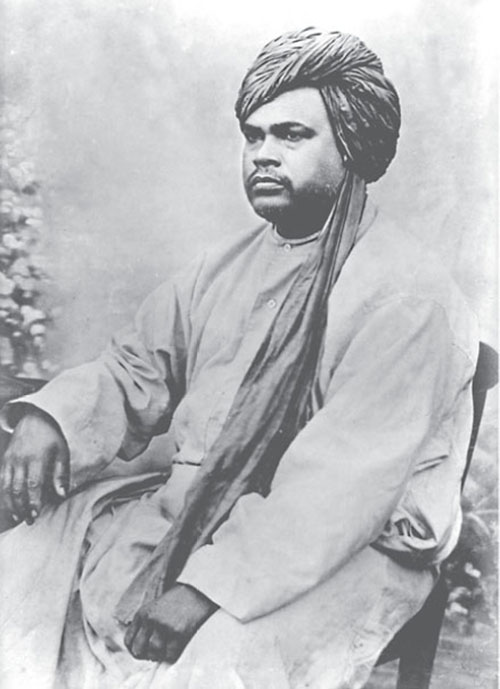
Swami Ramakrishnananda
He was not a devotee in the sense generally interpreted by people—simpleton, emotional, imaginative, devoid of the power of thinking. His personality blended devotion with an extraordinary power of intellect. His understanding was equally illuminated by the oriental and occidental bacons of knowledge. His learning was fathomless. Such a talented, learned and intelligent monk is rarely found. After conversing with him, many vain scholars were silenced. They could not reply befittingly to his impeccable arguments and words based on direct realization. Many Christian ministers were struck dumb on seeing the depth of his knowledge about Christianity. Even some Muslim people, realizing his depth of knowledge in the Islamic religion, offered him the same reverence as they would to a Paigambar (Messaiah of divine wisdom). He had special aptitude for the Sanskrit language. He cherished a desire to write a commentary on the Brahma-sutras that would harmonize the dual, qualified nondual and monistic views. But due to his untimely death, his desire did not get fulfilled. Readers of Sanskrit scriptures would have undoubtedly got an opportunity to read a monumental book.
Like his devotion to his Guru, his love and obedience towards the brother-disciples were legendary. A simple command from Swami Vivekananda was to him a Vedic injunction. At Swamiji’s behest, he went to South India to propagate Vedanta and sacrificed his body in excessive work.
Shashi Maharaj looked upon Swami Brahmananda as Sri Ramakrishna himself, following the Sanskrit dictum ‘guruvat guruputresu’ (meaning, the son of the Guru should be revered at par with the Guru). Again, it has been said, ‘He who hath seen the Son hath seen the Father.’ Swami Ramakrishnananda verily looked upon Swami Brahmananda as the spiritual child of Sri Ramakrishna and as such he made no distinction between them. [When Swami Brahmananda visited Madras in 1908], he arranged for a couple of cots in Mylapore [Math] for Maharaj, just like the room of the Master in Dakshineswar. He did not enter the Shrine when Maharaj and Holy Mother stayed in Madras. He did not think of puja. Usually he would be annoyed and scold us if we did any mistake. But when Maharaj was there he used to talk so slowly lest Maharaj should be disturbed. Every morning and evening he used to prostrate on the ground before Maharaj. I don’t think that anybody else did like that. When he fell flat before Maharaj with overwhelming devotion, it was difficult to say that they were brother-disciples.
In the Shrine of the Madras Math, he had installed Sri Ramakrishna and the Holy Mother. He used to conduct worship daily in that Shrine with single-minded devotion and utmost regularity. When Swami Brahmananda was with him in Madras (in 1908), he was seized with the idea that if Swami Brahmananda could, even for once, conduct the worship of Sri Ramakrishna in the Shrine, the real object of the installation might be fulfilled and that the living presence of the Master might be invoked ‘for the good of the many, for the happiness of the many.’ But he found no opportunity to make that request to Swami Brahmananda. One day while Swami Brahmananda was passing by the Shrine just after his bath, he stood in his way with folded hands and beseeched him to enter the Shrine and offer worship to the Master. All the protests that Swami Brahmananda could make, namely, that he was not accustomed to conduct ritualistic worship in the orthodox fashion and all that, was of no avail. He had to comply with the request of his beloved brother monk. And when he entered the Shrine, Swami Ramakrishnananda quietly closed the door. What passed inside the Shrine was not known to the world outside. Swami Brahmananda came out after twenty minutes. I even now remember the countenance of Maharaj, when he came out of the shrine, serene and beaming with a divine light. Shashi Maharaj fell prostrate at his feet and said: ‘My task is done. This is one of the reasons for bringing you here.’
One day some devotees brought fruits for offering to Sri Ramakrishna. I was attending on Maharaj and there were no fruits for Maharaj. I told Shashi Maharaj about it. He asked me: ‘Are there no fruits for Guru Maharaj? ‘I replied, ‘Yes, some devotees have brought fruits.’ He mildly retorted: ‘How foolish you are; bring them and offer them to Maharaj.’
In Madras Math, Shashi Maharaj would scold at least once a day. To live with him one must do the allotted work faultlessly. Everything must be done very carefully. He never tolerated any irregularity or fault in the service of the Master. However careful we were, there would be some inevitable slip or the other; hence there was no escape from his scoldings.
Once I complained to Swami Brahmanandaji at Madras while he was taking an oil massage before bath, ‘I can no more stay with Shashi Maharaj; at times his abuses crosses tolerable limits. I shall go back with you and shall stay with you henceforth.’ Hearing that, Maharaj said slowly, ‘Look, such words come out of your lips only because you don’t love the Master. How did you harbour the thought of leaving the holy company of such a noble soul as Shashi? You remember only his abuses, but shoddily overlook his lofty life, love, affection etc., don’t you?’ True, Shashi Maharaj did abuse us; but he also loved us beyond measure. There are illustrations galore. He only wanted that our monastic life should develop immaculately. That is why he hurled abuses at us for the slightest slip. At lunch, any dish he relished he would put it in our plates, saying, ‘See, how tasty!’ He would rest satisfied only after feeding us with any dish he had tested and had found it tasty.
Swami Brahmananda, on his way back from Rameswaram to Madras, halted at a certain place in Madurai. The temple of Meenakshi Devi was nearby. Shashi Maharaj had made all prior arrangements. But Maharaj would not pay a visit to the Divine Mother with dusty feet. As he was massaging oil on his body before his bath, his face suddenly became grave and he said, ‘You see, immediately after stepping into this place, I realized that the Divine Mother’s power is present in every molecule and atom of this place.’ He had not gone to temple yet.
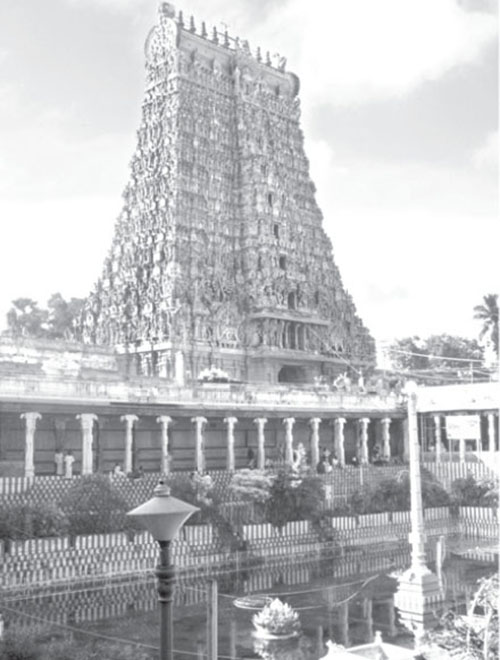
Madurai Meenakshi temple
Next morning we went with him for having darshan of the Divine Mother. A few devotees of Madras also accompanied us. Whenever he visited the shrine of the Divine Mother, he would do japa with his right hand on his chest. Generally people perform japa by covering the hand with a cloth. Maharaj did not use any cover and counted the numbers with his little finger, ring finger and middle finger. That day also, he did it in the same way. As soon as he entered the temple, he was lost in ecstasy and moved with slow pace towards the Divine Mother. When he was about twelve or fourteen cubits from the Goddess, he suddenly stopped. Frequent tears, horripilation and joy appeared on his frame. Even today that scene appears vividly before my mind. Seeing his mood we had felt that he wanted to embrace the Mother and was quite eager to jump into her bosom without any delay. When he stood at that spot it appeared that his intense desire became uncontrollable and his body leaned forward towards the Mother. Shashi Maharaj stood behind him and we stood surrounding him. The floor was tiled with marble stones and any fall could have done him immense injury. After a long time, his ecstasy and leaning were restrained. He then became calm, devoid of outer consciousness and merged in Samadhi. What a resplendent face! As if bliss was overflowing; the body unable to contain it. That divine mood remained for half an hour and we were blessed to watch that mood. Gradually he came down to the normal state and uttered in a low voice, ‘Brother Shashi, won’t you call a cab?’
His ecstatic mood did not leave him even after returning from the temple. At one o’clock he enquired if we had taken our lunch, unmindful of his own bath or lunch. Shashi Maharaj replied, ‘Raja, you too haven’t yet taken food.’ Then Maharaj asked me to smear oil on his body. Even after food his mood did not abate. It was towards the evening that he became his own self. Then Shashi Maharaj said, ‘Well, you may call it a day Raja! You had a beautiful vision of Mother.’ Maharaj replied in a low voice, ‘It’s Mother’s grace! Oh dear brother, how do I express my joy in the lap of the Mother at that time!’ Shashi Maharaj couldn’t hold himself quiet any more. He fell prostrate before Maharaj and said, ‘Raja, please give us the dust of your feet to make our body and mind holy.’ Maharaj tried to protest saying, ‘What are you doing, dear brother?’ But by then Shashi Maharaj shouted, ‘You fellows, all of you come and fall at the feet of Maharaj.’ We were blessed by following his command.
In the company of these two great Swamis I learnt that even a Sannyasin, while in a Math, should follow correct business methods in monetary affairs. I was at that time placed in charge of cash and the cash safe happened to be in Swami Brahmananda’s room. I had often to take out money from the safe and when he saw me doing this often, he observed, ‘I find you taking out cash off and on. Do you keep proper accounts and for that matter, obtain receipts for the advances you make?’ I was rather inexperienced then and said, ‘No Maharaj, I simply make advances to Swami Ramakrishnananda at his bidding and I don’t keep proper accounts for them.’ ‘That won’t do,’ he said, ‘you should obtain receipts for the advances you make!’ So I went to Swami Ramakrishnananda and reported to him what Swami Brahmananda had said. He fully agreed and thenceforth I used to obtain a receipt from him every time I made an advance. When it was time for me to leave for Bangalore, I said: ‘Revered Maharaj, here are the keys of the safe. I gave you a total advance of six hundred rupees during the period I was in charge.’ ‘Will it be as much as that?’ he said, ‘Oh no! I think it will be two or three hundred at the most. But don’t worry. Whatever there is in the safe; hand it over to Brahmachari Rudra Chaitanya.’ ‘I have,’ I said, ‘receipts for all the advances.’ ‘That is true. Show them to me.’ So I tallied the accounts with the help of those slips to the satisfaction of the Swami as well as of mine.
After the Holy Mother’s departure from Madras in 1911, Swami Ramakrishnananda came to Bangalore to recuperate his broken health, not suspecting that he had already contracted tuberculosis. He had been the Holy Mother’s personal attendant during her pilgrimage in Southern India and himself accompanied her to Rameswaram and other places, paying no heed what-so-ever to his health, although he had persistent fever and cough all through. He did not even get himself examined by any doctor so long as the Holy Mother was there, lest the same should cause her any inconvenience or he might be interrupted in his unremitting service to her. It was only when he came to Bangalore after her departure for Calcutta that we got him examined by an eminent specialist and found that the fell disease had far advanced by that time. I was then staying in Bangalore. I had taken him to the doctor. The doctor tested his sputum and showed me the germs in it. He said, ‘What have you done? It could have been cured if he were brought six months before. Now the disease has gone out of control.’ The doctor told us plainly that there was practically no remedy for it and advised us to send him immediately to Calcutta so that he might pass his last days cheerfully amongst his brother-disciples there. This time, while staying in Bangalore, he spoke to us very often of his Master, Sri Ramakrishna and of his unbounded love and grace.
One day, sitting on a wooden cot in the courtyard, he heaved a sigh of relief and told us with great emotion and with much emphasis about the Master’s infinite mercy in that he had fulfilled a long-cherished desire of his. He gave out that his only desire in life had been to bring both the Holy Mother and Swami Brahmananda to the South, to personally serve them and to take them on pilgrimage to Rameswaram and other holy places with the sole object that all the devotees and admirers of Sri Ramakrishna and several others might get the chance of meeting these personages and be blessed by their holy touch. He felt supremely happy that, on the eve of his departure from this world, the Master had granted this prayer of his and that he could then die in peace.
His holy life and its events have become our memory now. But when recollected, this memory brings in its trail a pure and blissful stream. That memory arouses in our minds an intense desire to ascend the lofty planes of the spiritual realm. The more we discuss his holy life, the more we benefit from it.
In conclusion I might very well say that Swami Ramakrishnananda was to his Master as Mahavir Hanuman was to Sri Ramachandra. Dasya Bhakti or the mode of worship in which the devotee looks upon himself as the servant of the Lord, was truly manifested in his noble character.
May he ever guide us in his foot-steps!
[From the Reminiscences by Swami Vishuddhanananda, in the book Swami Ramakrishnananda — The Apostle of Sri Ramakrishna to the South, by Swami Tapasyananda, Sri Ramakrishna Math, Madras, pp. 214-221, the Vedanta Kesari, August, 1962-63, pp. 167-168, Yogakshema, pp. 50, 85-6, 37-8, 52-3, 55-7, 67-9, 72-3, 75-6 and Prelude to the book Swami Ramakrishnananda by Swami Jagadiswarananda]
↑ Contents
Swami Shankarananda —Glimpses of Swami Ramakrishnananda
Since the very foundation of Baranagar Math, Swami Ramakrishnananda devoted himself fully to the service of the Lord. He used to perform puja, offer bhoga after cooking, cleanse puja utensils and the shrine room and also go to the Ganga for bathing and to fetch water. Generally, four of the other Swamis used to go out daily for begging, but they could hardly get sufficient rice even for themselves. While begging, the young sannyasins were targets of the taunt and contempt of the men and women of the locality. Once, during those early days, Swamiji (Swami Vivekananda) sternly remarked, ‘Who will supply you with all this paraphernalia of puja and bhoga everyday?’ Swami Ramakrishnananda could hardly brook such a cruel remark and at once retorted saying, ‘Who is going to seek your help? The Lord will see to His needs.’
During this period, he took up teaching in the Baranagar High School for two hours in the afternoon, the time he used to be free. This he continued for about three months to help the maintenance of the Math.
There was a gymnasium next to this Math and the boys who used to come there knew him as ‘Master Mahashaya’ as he was a teacher in their school. Whenever devotees brought delicacies for offering them to Thakur (Sri Ramakrishna), he used to invite the boys to come to the Math and have some prasada. The boys were very devoted to him and used to help him occasionally.
He never delegated any portion of his service in the shrine room to any other Swami. They were always free to move about as they pleased, to go to Calcutta or even out on a pilgrimage. He kept himself to the Math, steady in the service of the Lord, until Swamiji, on his return from America, sent him in April 1897 from Alambazar Math to Madras.
During the Sannyasa ceremony at the Baranagar Math, he was named Ramakrishnananda by Swamiji with the wholehearted approval of all the other Swamis owing to his unique and unflinching devotion to Sri Ramakrishna.
One day, Babu Balaram Bose came to the Math and saw that the sadhus were having their meals at noon which consisted of rice and a small quantity of green vegetables only. From Swami Ramakrishnananda he learnt that they could not get anything that day and had therefore cooked the leaves of a hedge creeper. Balaram Babu spotted an old cook known to him and asked him to go to his house and get some food without letting any of the Swamis know about it. The cook agreed, expecting some reward. On going home, Balaram Babu asked his wife to serve him only a little of green vegetables with rice and nothing else. His wife thought that perhaps he was not keeping well as he used to suffer very often from acidity, etc. During the meal, the lady asked him, ‘How is it that you will not have anything else today? Are you not keeping well?’ In reply, Balaram Babu said that he had been to the Math and had seen with his own eyes that the sons of the Lord were having rice with a bit of green vegetables only. How then could he take anything else? ‘Did you not arrange for their supplies?’ his wife asked. He said that he had asked the old cook to come and take the provisions to the Math. Such a manifestation of glowing love and fellow-feeling in a householder towards his sannyasin brothers is exceedingly rare and is quite befitting to one whom Sri Ramakrishna labeled as one of his purveyors.
The Swami always offered a little prasada to one and all who would visit the Math, even in those difficult days at the Baranagar Math. It might be a bit of sugar candy or some sweets offered to Thakur. The Swami used to say that even a bit of prasada would, without fail, do a great deal of spiritual good and develop faith and devotion. In Madras also, he used to offer coconut sweets or sugar candy to every visitor and insisted on the inmates’ giving a bit of prasada to every devotee. In December 1901, the Swami came to Belur Math with [Br.] Vasanta for the latter’s sannyasa. Swamiji on this occasion gave sannyasa to Vasanta (Paramananda), one from Ceylon (Satyananda) and Suraj Rau (Nischayananda). Swami Ramakrishnananda helped in the ceremony.
When the Swami returned to Madras, Swamiji sent along with him Yogeshwarananda (to whom he had given sannyasa at the Belur Math), Paramananda and Satyananda. Satyananda went to his native place in Ceylon and was not heard of any more. Yogeshwarananda came back to Belur a few months later, after the passing away of Swamiji and was sent again to Madras.
While at Madras too, Swami Ramakrishnananda always insisted that the inmates must be quick, clean and cautious while engaged in dressing vegetables for offering or any other work. ‘Sadhus and Brahmacharins should perform everything with perfect precision without any waste of time, energy or material. They should be cautious and avoid accidents and injuries. Whatever they do must be perfect.’
While making pranams to Sri Ramakrishna, he would either fall flat with his folded palms outstretched or stand and put his palms together over his heart and would press together his teeth so hard as to clatter and his whole frame would become stiff, his head down to the neck would show a slight tremor. After pranams, one could see his eyes slightly reddened and a heavenly glow suffusing his face with an expression of blessedness.
After bath, he would not look at anything but would run straight to the shrine room, changing his cloth in the meanwhile. The wet cloth had to be picked up daily from different places on the way to the shrine.
The Swami said that Swamiji appeared to him one night in a dream and told him, ‘Look here, Shashi, I threw away this body as I would spittle’ and spat twice or thrice. He felt very sad after this bad dream and on the very next day he got a telegram from Belur Math that said that Swamiji had entered Mahasamadhi.
He was a strict vegetarian all along and had to be so from a young age owing to dry eczematous eruptions on both his legs over the skin. For this, he had to rub some Ayurvedic oil at times and could not expose his feet long to sea breeze, which always caused aggravation.
All through, he scrupulously followed the orthodox customs of Brahmanas known as sadachara, auspicious manners, but nevertheless fully believed in and practised the teachings of Sri Ramakrishna that a devotee of the Lord was beyond all caste restrictions.
A young boy from Bengal came to the Swami one day and told him that he had been with two Vairagi sadhus who had beaten him cruelly and rarely given him sufficient food; so he had come to him for shelter. The Swami took pity on him and kept him in the Math. After a month or so, the boy went away of his own accord but returned after a couple of days feeling very repentant. The Swami excused him and the boy began to help the Swami in the indoor and outdoor works of the Math. He was, however, not allowed to touch cooked food before bhoga or anything while being cooked. Later on, the boy became a sannyasin of the Order, whereupon all such restrictions were removed.
The Swami used to examine every novice who would come to join the Order according to the signs, traits and physical formation as taught by Sri Ramakrishna. He used to say that whoever had taken prasada of the Lord of the Belur Math had become pure. He could see and feel the inner nature of those who came in contact with him and helped them accordingly.
One day, a gentleman came and very devotedly bowed before the Swami touching both the toes of his feet. The Swami did not like the touch and dismissed him asking to meet him in one of his classes some day in the city. After he went out, the Swami asked for Ganga water and took a little sip of it after sprinkling some on his head. He then washed his toes, as he felt a burning sensation from the touch and while washing he said, ‘I feel sorry for the man, but none can do anything unless he repents and earnestly prays unto the Lord.’
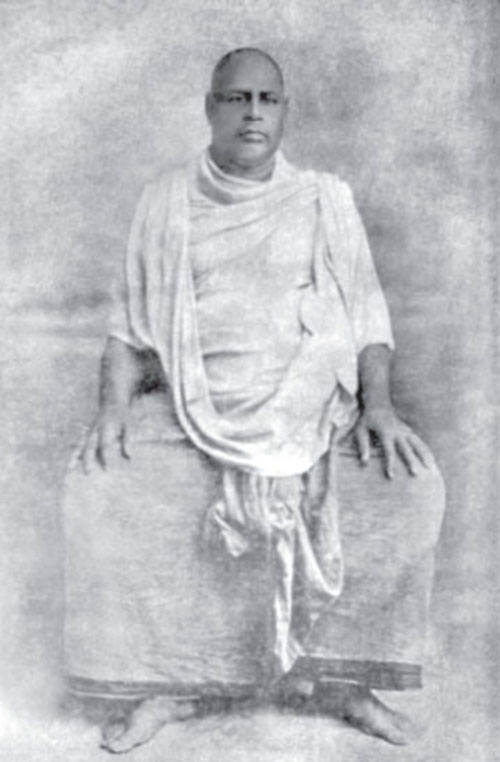
Swami Ramakrishnananda
A Bengali officer holding a big post in the Accountant-General’s office came to see him one afternoon. The officer talked tall about his being a disciple of a Westerner and the esoteric teachings he had learnt from his Guru. The Swami said: ‘We are to learn everything nowadays through Western culture! Of course, what we do not know we should learn from them and adapt them to our best advantage. But it is exceedingly unfortunate that we do not know what jewels we possess; and woes betide us if we are to learn about spirituality too from the West!’
A gentleman from Vaniyambadi [near Madras] came one day to see the Swami. He fell flat before the Swami and began to shed tears of joy. He could not speak in English and the Swami was not conversant with Tamil. So, someone was called in to interpret. The gentleman said that he had seen someone who blessed him so kindly. He was unable to make out whom he had seen until he had come to Madras three months later. In a bookshop in Triplicane, he had seen a picture and had been overwhelmed with joy on recognizing the face therein. On inquiry, he had learnt that the picture was of Sri Ramakrishna and that one of his disciples was living now at the Math at Castle Kernan. So, he had come to pay his respects and to know more about Sri Ramakrishna. After this meeting, the gentleman started an Ashrama in his place and passed his days in retirement, preaching the name of the Lord.
The Swami was very mindful that nothing should be offered to Thakur either too cold or too warm. Especially, this was so with regard to the offering of milk. One day, when all other offerings had been carried to the shrine, the Swami came to take the milk. He cautiously clasped the bowl between his palms and with a grave and attentive face began to move towards the shrine room with steady and measured steps. The bowl was almost full. After he had gone a few steps a little of the milk ran out and fell on the floor. At once clattering his teeth and in a suppressed voice he kept saying, ‘He will have warm milk! He will have warm milk!’ It was difficult to understand what he meant but the figurative use of ‘split milk’ in the sense of misfortune that cannot be mended by lamentation was quite evident. Perhaps, along with it, there was a bit of anger towards himself which he gave vent to by flinging those words.
Swami Ramakrishnananda used to hold classes in different parts of the city, one in the morning and one in the evening and an additional one on Sunday afternoon between 3 and 4 p.m. in which most of the old friends and devotees from Triplicane and Mylapore used to meet. The Swami carried on his work devotedly for several years, but had to curtail some of his classes later on.
One summer morning, the Swami returned from his classes by 10.30 a.m. in a hackney carriage. After entering his room he stripped himself, sat on the edge of his cot and began to fan himself. Seeing him in such a plight owing to the summer heat, the Brahmacharin began to fan him from behind. After a minute or so, the Swami threw away his fan and with clenched fist threw out his arms as if to fight with somebody. He began to say, ‘It is for you that I suffer so much. See what suffering I go through. The next moment, he fell flat on the floor with out-stretched hands and joined palms and began to rub his face on the carpet, saying, ‘No brother, no brother, excuse me, excuse me. What you have done is perfect. It is all right, it is all right.’ He got up with tears flowing from his eyes and with a blissful countenance, he gazed around with a divine look before he sat again. All this was with Swami Vivekananda, who had sent him to Madras to live the life as moulded by Sri Ramakrishna.
One afternoon, it was drizzling and the sky was overcast with clouds. A hackney carriage came in time to take the Swami to his class. The Swami asked the Brahmacharin to accompany him that day. The carriage arrived in a lane in George Town, where the Swami used to hold one of his classes. The room was about 12’ x 15’ and on one side was left a passage, to allow passage into the interior of the house. The room contained a table and a chair with two benches in front and one on the right side along the wall. There was a clock on the wall behind the chair. A servant brought a big table lamp with shade. There was no one else in the room. The Swami waited for about a quarter of an hour but no one turned up. He then opened his Upanishad and began to read and explain with all ardour and amiability. After an hour he stopped, closed his book and said to the Brahmacharin, ‘Well, let us go.’ The Brahmacharin followed him to the carriage which was waiting. On the way he asked the Swami, ‘How is it that you held your class for full one hour though nobody turned up.’ The Swami in reply said, ‘I have not come to teach anybody. I only fulfill the vow I have taken.’ This marvellous and masterly attitude he always maintained with utter selflessness considering himself as the servant of the Lord, while fulfilling the vow he had taken before Swamiji.
During this period (between 1902 and 1903) there was no cook or servant in the Math at Castle Kernan (Ice-House). An old woman, blind of an eye, used to come in the morning and afternoon to cleanse the cooking utensils etc. The monthly income in cash through subscriptions amounted to Rs. 24/- only. With this and with what the Swami begged from the students after his class in the shape of vegetables or flour the Math had to be maintained.
There were only three inmates besides Swami Paramananda, the Brahmacharin (who later became Swami Shankarananda) and Yogin (Swami Umananda). Once it so happened that some sadhus arrived there from the Belur Math on their way to Rameswaram, intending to spend some time with the Swami. So the Swami asked the Brahmacharin to go to Prof. Rangachari in Triplicance for a bag of rice. On the way, the Brahmacharin met Sri Venkatarangam, who asked him where he was going. Having learnt that the Swami needed a bag of rice as some sadhus had come from the Belur Math, he said, ‘I will send you a bag of rice.’ The Brahmacharin went to the Professor, who received him very lovingly and learned the reason of his coming. He at once asked one of his relatives to send a bag of good rice to the Math. The Brahmacharin went with him and got a bag of rice loaded on a hand-cart. On arriving at the Math, the Swami enquired the Brahmacharin the reason for his being late, as the bag of rice had already come. The Brahmacharin said that the bag of rice given by the Professor had come with him and perhaps the bag which had already come was sent by Sri Venkatarangam, whom he had met on the way. Having two bags of rice the Swami was very happy and uttered ‘Victory unto the Lord!’ and said that the rice would suffice for some days.
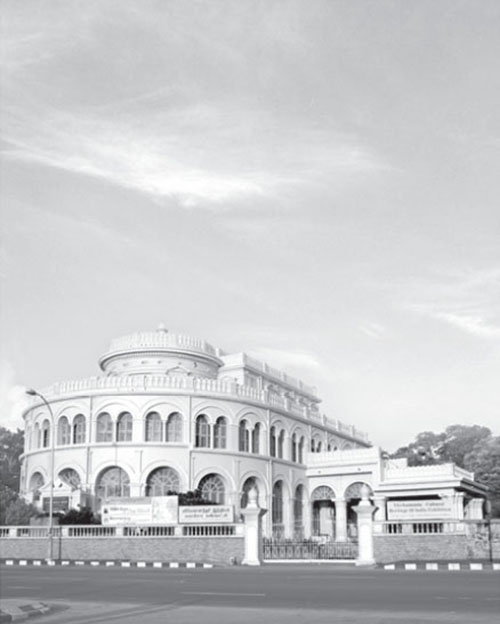
Ice House or Vivekanandar Illam, Chennai
The birthday celebration of Swamiji took place in Madras for the first time in January of 1903 at the Math at Castle Kernan. Apart from other features, many poor people were sumptuously fed in the adjoining coconut grove. During that time, an American named Mr. O. O. Hyat of Ohio, U.S.A., was staying in a room in the outhouse. He had been turned out from the Theosophical Society for having some mental derangement. He was given shelter by the Swami who wrote to Colombo to arrange a passage for him to U.S.A. He would hardly speak or touch food and would practise spinning, resting on one of his heels, by which, he used to say, one could get concentration like the steady spinning of a top. It was found that he liked condensed milk and so half a dozen milk tins were brought and given to him. Next morning, the Brahmacharin found all the tins were gone and Mr. Hyat gave no reply to his inquiries. The empty tins were found thrown out through the window in the coconut grove behind. All were afraid that he would fall ill, but nothing happened as he did not touch any other food that day.
Later, on the day of the celebration, around noon, he came running from the seashore to say that a man had been washed away and was struggling in the water. The Swami sent the Brahmacharin to see what the matter was. Over the scorching sand, the Brahmacharin reached barefooted at the edge of water with great difficulty only to find that a leper was washing his sores in the surging water. With great difficulty, Mr. Hyat was prevented from dragging the leper up. The man was invited for food after he had finished his bath. He turned up in time and Mr. Hyat was pleased to see him. Mr. Hyat was later sent to Colombo when it was learned that his passage to America had been arranged.
During this period, the Swami was writing the life of Sri Ramanuja in Bengali. For this, he took the help of a Sanskrit book printed in Telugu characters. To assist him in this, he asked the Brahmacharin to learn the Telugu script so that he can read the book for him. When it was done, he was much pleased at the progress he could make within his short spare time.
One day, a devotee of Triplicane invited the Swami to take alms at his house. He asked the Brahmacharin also to accompany the Swami. On the appointed day, the Swami and the Brahmacharin went to his house. The door was closed from inside and after knocking and calling, an old lady came out to say that the owner was not at home. The Swami requested the lady to inform him of their arrival if he was anywhere close by. A boy was sent and after a short while the devotee arrived to say with great regret and humility, ‘O Swami, I had completely forgotten!’ The Swami very amiably asked him to get some food from the shop nearby. It was brought and the Swami very heartily took some of it and came away. On a later date, the Swami was again invited and fully entertained.
As instructed by Swami Brahmananda, Swami Yogesh-warananda came to Madras and stayed with Swami Ramakrishnananda. After a stay with the Swami for some time he was sent to Vaniyambadi. There he lived in an Ashrama started by a devotee and had not much to do in the management of the Ashrama. He stayed for a month and suddenly came back of his own accord to Madras. Swami Ramakrishnananda asked him, ‘How is it that you have come all of a sudden? Is it that you are not keeping well?’ In reply, Swami Yogeshwarananda said, ‘It is impossible for me to stay there as there are no people to speak to.’ The Swami somehow tried to keep him in Madras so that he can be of some help to him, but he went away to Banglore and lived there.
It was during this period that Swami Ramakrishnananda was invited for the first time by the devotees in Bangalore. There, he introduced Swami Yogeshwarananda in a public meeting. But a few months later, Swami Yogeshwarananda cut himself off from the Math and Mission and began to live alone.
Every night after food, all the inmates used to assemble near the Swami who would talk to them on various subjects till it was time to retire. Sometimes, he would talk about Thakur’s physical formation, how his soles and palms were soft and had a reddish tinge, so on; and how he was careful about every bit of thing that was in his room at Dakshineswar and how he had taught them (his disciples) to keep things in their proper places after using. He was always carefully watching over them and could know whatever doubts and misgivings arose in their minds. He would correct them in an appropriate way without letting them know; and they would soon feel at ease with their mental struggles gone and tranquility restored. Sometimes the Swami would talk about all funny expressions and gestures Thakur used to make or his mimicry of others at Dakshineswar using even abusive language without any reservation.
Swami Ramakrishnananda had a great liking for mathematics and he used to enjoy solving puzzles and problems. He would sometimes enunciate a problem and ask the inmates to solve it.
One night, the Swami said that it was Sir Walter Raleigh who brought tobacco to England. He (Sir Walter) had many scientist friends who enjoyed smoking big cigars. Once he asked those scientists, ‘Well, you are enjoying the smoke no doubt, but can any of you find out the weight of the smoke?’ The Swami looked around as if seeking the answer. On this occasion, Swami Yogeshwarananda who was an M.A. in Chemistry was present and he began to describe all the intricate arrangements with U-tubes etc., with salts to collect the different gases and aqueous vapour etc., all weighed at the beginning. The smoke had to be blown through a pipe in the apparatus. Finally, the difference of the weight found would be the weight of the smoke. The Brahmacharin said that the smoker would feel exhausted if he were to blow the smoke out each time through a pipe and all the pleasures of smoking would turn into torture and that by simply deducing the weight of the ashes from the weight of the cigar one could get the weight of the smoke. The Swami was very much pleased with this solution and said that Raleigh himself had expected this plain and simple answer but that in many cases, scientists, in order to be precise and accurate, invent such cumbrous and intricate things that in the end they cease to be useful.
Swami Saradananda used to hold religious classes in the Metropolitan Institute, Calcutta every Sunday. Whenever Swami Ramakrishnananda would come to Calcutta (Belur Math) from Madras, he would gladly go there to speak to the students, as he too was once a student there like them.
In 1904, the Swami once came to Belur Math. He spoke to the students at the Metropolitan Institute. After the lecture, he inquired about a Brahmacharin who had lived with him in Madras and whom he did not find at Belur Math. Having learnt that the Brahmacharin was ill, the Swami went to see him in a hackney carriage to a place two miles away. The Brahmacharin was suffering from high fever. The Swami entered the room, sat on the bed side and began to pass his hand over the head and body of the Brahmacharin, saying, ‘Get well, get well soon and come to Madras. I shall send you passage money as soon as I hear from you.’ This love and kindness of the Swami overwhelmed the Brahmacharin, as it was utterly unexpected.
Swami Ramakrishnananda came to Puri with Swami Abhedananda in 1906 and lived together with Swami Brahmananda for a few days at Shashi Niketan.
Swami Ramakrishnananda earnestly invited Swami Brahmananda to pay a visit to Madras and bless the devotees as well as visit the places of pilgrimage in the South. Swami Brahmananda started for Madras from Puri on October 27, 1908.
As long as Swami Brahmananda was in Madras, Swami Ramakrishnananda used to go to him and pay his respects both in the morning and in the evening. He used to fall flat and make pranams with utmost devotion as if he was before Sri Ramakrishna himself. After getting up, he would inquire about his health and whether he intended to go out for a drive or whether he would like to have anything special.
One day, it so happened that Swami Brahmananda sat stiff and gave no response to the inquiries of Swami Ramakrishnananda. After standing for a while, Swami Ramakrishnananda came away bewildered. In the evening after arati, the Swami went to pay his respects and was met with the same stiff indifference and this pained him very much. After coming away with a heavy heart, the Swami asked the young Swami who had accompanied Maharaj about the reason for Maharaj’s indifference. Was he not keeping well? Or was he angry with him? The young Swami did not know exactly. But, he had heard Ramu telling Maharaj about something being kept away from him.
Swami Brahmananda had told Ramu a few days earlier to purchase for him some pictures of dancing girls etc. Ramu had brought those pictures to the Math that day, but Swami Ramakrishnananda had taken them away saying such things should not be presented to Maharaj. Maharaj had wanted to send those pictures to one Sri Aparesh Mukherjee who was writing a new drama, Ramanuja, so that he may give South Indian stage-effects in dress, pose, etc. It was on Swami Brahmananda’s suggestion that Sri Mukherjee had begun the dramatization of the life of Sri Ramanuja though it was staged much later.
Next morning, Swami Ramakrishnananda, after making pranams, handed over the packet of pictures and said, ‘Is it for this, Raja, that you were angry with me? I am but a puerile creature and so you should not be angry with me. Thousands and thousands of Shashis like me can arise from a mere drop of your spittle.’ Hearing this and getting the packet of pictures, Maharaj gave out a laugh and greeted the Swami cordially. The Swami further said that it was he who had taken them away as they were pictures of bad women and had told Ramu not to present these things to Maharaj. Ramu had not told him that Maharaj wanted those pictures. Then, they were again in their natural mood.
Swami Brahmananda went to Khurda Station from Puri to meet the Swami on the latter’s way to Calcutta for treatment in the middle of 1911. This was their last meeting.
Swami Brahmananda, referring to Swami Ramakrishnananda, said to a novice at the Madras Math, ‘Here you will be in the company of a Saint. Serve him and you will attain everything.’
[From the Vedanta Kesari, July 1951, pp. 88-96]
↑ Contents
Swami Madhavananda —At the Feet of the Saints in the Madras Math
In the year 1909, I had the good fortune of spending eight blessed days with Srimat Swami Ramakrishnananda, the first President of the Ramakrishna Math, Madras and one of the pillars of the Ramakrishna Order. I had read Sri Ramachandra Dutt’s impassioned eulogy of him in his Life of Sri Ramakrishna [1] in which he describes young Shashi’s (as the Swami was then called) untiring, selfless service to the Master during his last illness at Cossipore as simply unparalleled. I had also heard much about his singular devotion to the Master, both then and since then, in the monasteries at Baranagar and Alambazar, from the senior Swamis of the Belur Math — many of them direct disciples of Sri Ramakrishna and soon made up my mind that my life as a novice of the Order should begin under Swami Ramakrishnananda. And this, despite the fact that some of them, for instance, Srimat Swami Shivananda, had jokingly warned me of the Swami’s sternness, which would often express itself in sharp reprimands, whenever anything went wrong. Accordingly, by the arrangements kindly made by Srimat Swami Saradananda, the Secretary of the Belur Math, I quietly took my seat in the Madras Mail at Howrah, within a couple of hours of my leaving the examination hall.
I arrived at the Madras Central Station on the 22nd of April, at about noon. A gentleman set me down from the tram at a point nearest Brodies Road, Mylapore, telling me that I was not to go by the street. By a dreadful misreading of the instruction, I followed a cart track, a few yards off, leading to a coconut garden and presently found myself taking a long detour that made me reach the Madras Math after an hour, instead of in a few minutes. I met the venerable Swami Ramakrishnananda, who asked Brahmachari Rudrachaitanya, the only assistant stationed there, to look after my meal. Shortly after, the Swami asked me if I wanted to be a monk, to which I replied that my object was to live in their company and lead a pure life.
He said, ‘It is the same thing. In that case you have come to the right place. In this age, whoever takes refuge in the Ramakrishna Incarnation shall undoubtedly realise the goal. But if you want money and fame and all that, better go and read for M.A.’ I said, I did not care for them.
The monastery was quite full at the time, for Srimat Swami Brahmananda or ‘Maharaj,’ as he was generally designated, the first President of the Order, was there with his party, having returned some time back from Bangalore, after opening the new Ashrama building. The main building of the Madras Math was a square one-storeyed house with a hall and four small rooms at the corners. The two eastern rooms were the shrines of Sri Ramakrishna and Swami Vivekananda. The room diagonally opposite the former was where Swami Ramakrishnananda lived; the other room was occupied by Maharaj. The hall was the office of the Swami, the sitting room for all, including visitors and also the bedroom of the other monastic inmates. Although built only two years ago, the house had heavily cracked, which necessitated its being abandoned in 1914, to be replaced by the present two-storeyed building in 1917—a sad commentary on the business integrity of the contractor. Mosquitoes being in abundance, the problem of fitting up a mosquito-curtain in the centre of the hall was ingeniously solved by tying it to a bamboo strip frame suspended by a central longitudinal rope from a hook in the ceiling. There was no electricity in the house and Madras is described as a city which is ‘five months hot and seven months hotter!’ Consequently, the martyrdom which the robust Swami Ramakrishnananda, who had also a chronic skin trouble, suffered year after year since 1897 since he first went there at the behest of Swami Vivekananda, can easily be imagined. And such was his steadfastness that he never visited Banaras and other holy places in the north up to the last.
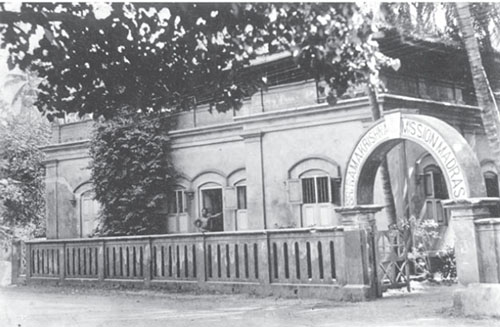
An archival photo of Sri Ramakrishna Math, Mylapore
In the afternoon, I was introduced to Maharaj. Among other things, he read my palms, but passed no judgement. Afterwards, I heard that he had predicted my going back then, to join later. The presence of Maharaj, I could notice, was a constant source of blessedness to all. He literally radiated joy, in which even the humblest had a share. And he loved fun like a boy. In his party was a young Oriya cook who would laugh at the slightest provocation. So Maharaj would seek fun with him. I too came in handy for a little joke of his. The day after my arrival, in the presence of all, he showed me a recent photograph of his hanging on the wall and said, ‘Do you know Swami Saradananda, the Secretary of the Math? See if the picture tallies.’ I only smiled. Thereupon he said, ‘He doesn’t know him!’ On coming to know that I had informed those at home of my coming to Madras, he said, ‘What a pity! They will come after you.’ When I explained that it was under the instruction of Swami Saradananda, he said, ‘But you should have been circumspect.’ Those joyous days, however, were soon to end, for I learnt that Maharaj would leave for Puri in another three days.
Swami Ramakrishnananda had not only deep love for him, but, as the ‘spiritual son’ of Sri Ramakrishna, also a feeling of reverence, in which he seemed even to surpass his brother-disciples. He spoke to me of the occasion when, during the lifetime of the Master, Swami Vivekananda had called his brother-disciples and said, ‘Rakhal [Swami Brahmananda] is our King and you fellows are his subjects.’ How he would strive to make Maharaj feel happy in every respect! And his least displeasure would, as eye-witnesses tell, be an agony to the Swami, who could not rest until he had begged his forgiveness with the utmost humility.
I had read in the Gospel of Sri Ramakrishna about the Master’s calling Rakhal an ‘eternally perfect soul,’ which led me to expect that he would be too absorbed in God to be mindful of external things. Instead, I found him take part in a game of cards! But I kept silent. One day Swami Ramakrishnananda, of his own accord, broached the topic and said to me, ‘That Maharaj plays cards is good for us. He lives at such a high spiritual level that his body would not last long if he continued always at that level. We therefore induce him to play so that his mind may relax a little.’ I understood how thoughtless it was on my part to judge a spiritual giant like him by conventional standards.
On the appointed day, Maharaj left and after seeing him off at the station, Swami Ramakrishnananda said to me, ‘For a Saint of his calibre everything is arranged spontaneously. Maharaj is nervous about travelling with Europeans. But he had a single-berth first class coupe, with a fan and everything. Sri Ramakrishna used to take so much thought for him and gave him privileges that were vouchsafed to none else amongst us. He would even take him on his shoulders. One day he was so struck with a particularly child-like act of Maharaj that he burst into tears saying, “You are so simple! Alas, who will look after you when I am gone!” But you see! The Divine Mother arranges everything for him.’
Before leaving, Maharaj said to me, ‘Here you will be in the company of a Saint. Serve him.’ I therefore, began a little personal service of the Swami, massaging or fanning him at times. But even my best efforts seemed to give him little comfort. So, he would often ask me to call the stalwart Rudra Maharaj. Minor Ashrama duties were also given to me. One of these was to sweep the floor. One day the Swami saw me gently pushing aside a spider. He took the broom from me and killed it, saying, ‘If you do not kill them, they will kill you.’ He wanted to remove my undue softness. Reciprocity is a more practicable principle for the common man or woman than non-resistance, which is fit only for advanced souls.
Another day, he tested my knowledge of Sanskrit by asking me to explain some easy verses from the Durga Saptashati (Chapter V) at the end of which he said, ‘I see you have got the hang of it.’ In this connection, he pointed out the distinction between Sanskrit and Bengali pronunciation, stating that these were two different languages (a fact which Bengalis generally ignored). He illustrated the point by correctly pronouncing the following couplet from the Saptashati (V. 32-34):
Ya devi sarva-bhuteshu shakti-rupena samsthita
Namastasyai namastasyai namastasyai namo namah
‘Repeated salutations to that Goddess who resides in all beings as power’—which sounded pretty much as the words would sound in English. And by way of showing Bengali pronunciation, he chose a phrase that might be transliterated as, ‘Ogo shakti-swarupini’—’O Thou Embodiment of Power’— but which sounded as ‘Ogo shokti-shshorupini’. He also remarked that the Divine Mother was displeased if the Saptashati was not correctly recited. He advised me to read the Shanti Parva of the Mahabharata in Sanskrit and note down the unfamiliar words with their meanings. Once he quoted and explained the well-known verse of the Gita (VII. 14) which says that Maya (Cosmic Illusion) can be overcome only through resignation to the Lord. Another time, he asked me to read from Swami Vivekananda’s then recently published Inspired Talks the following passages, which he himself briefly explained : ‘People who report about sects with which they are not in sympathy are both conscious and unconscious liars. A believer in one sect can rarely see truth in others’ (July 1) and ‘Until you are ready to change any minute, you can never see the truth ; but you must hold fast and be steady in the search for truth’ (July 5).
During the short time I was with him, the Swami was uniformly kind to me. He even told me in confidence things that were scarcely fit for the ears of a novice and generally treated me as if I was an old acquaintance. Speaking of his first meeting with Sri Ramakrishna he said, ‘He asked me, “Do you believe in God with form or without form?” I replied, “I am not sure whether God exists at all; so there can be no question of His form or the opposite.” He was pleased with the answer.’
When I referred to the incident of his taking a small quantity of ice for Sri Ramakrishna to Dakshineswar from Calcutta, tying it in a corner of his upper garment and it not melting, he mentioned that it was from a northern part of Calcutta and added, ‘On receiving it the Master said, “It is quite in keeping with his devotion.” He went on to say, “Well, Samadhi and all that we have now put on the shelf. Now, there is his work to do.”’ He said he had been studying Persian in those days and when Sri Ramakrishna came to know of it, he strongly discouraged it saying, If you do that, your devotion and all will go.’ Well, it is K—who revived the craze for study (among the disciples); otherwise they had given it up,’ the Swami added, ‘I had to learn things anew to play the part of a pedagogue!’
The Swami narrated an interesting episode about one Hariprasanna, who studied Mathematics with him and also visited Sri Ramakrishna at Dakshineswar. The Master told him to meditate in the Kali temple. One day, as he was doing this, he felt as if his two eyes were coalescing so as to form a single eye on the forehead. He got frightened and hurried to Sri Ramakrishna to tell him of what had happened. The Master said to him, ‘You couldn’t stand this much and came away in a fright!’ I did not inquire who exactly the subject of this narrative was.
Himself an embodiment of renunciation, he could ill brook the lack of self-control among worldly people. He cited a typical case (without giving out any name) that had been reported to him. He made fun of a section of our people, saying, ‘They themselves are luxorious and they conceive their gods also as having three wives each.’ Nevertheless, in his general dealings with people, he was kind, considerate and loving. Only once did I see him, on returning from a morning class, scold a cabman for demanding more than the usual fare. All the same, he immediately ordered the amount to be paid, saying with a smile, that it was a waste of time to argue with him. The boys of the local Students’ Home, which he himself had founded out of sympathy for destitute children, did the marketing for the Math by turns. He would issue instructions to them and himself help to dress the vegetables for cooking. But, his favourite self-chosen occupation was the daily worship of his Master, who to him was a living presence. His whole soul would be absorbed in the act, no matter how exacting it was in its details, all sense of physical discomfort being entirely set at naught. Naturally, it was a most enthralling spectacle. In spare moments, he would pace the hall, repeating ‘Sri Guru Maharaj’ or some such sacred words with deep fervor. Usually of a grave mien, he would also easily burst into laughter like a boy. He always dressed plainly and everything about him marked him off as a Saint of rare magnitude.
I recall a few little incidents that give an insight into the working of his mind. One sultry night, he had little sleep. Referring to this on the next morning, he said, ‘May be the mother of this new boy who has come was weeping; so I had no sleep.’ One day two young men saw him, with some books just purchased. He talked affably with them. Glancing at the titles of the books, he came across one that read Theosophy in Everyday Life. ‘Why not God in everyday life?’ he remarked. Once the conversation turned, I think, on the departed souls’ inhabiting other worlds. The Swami asked me if I believed in it. I said, ‘Partly’. To this he replied, ‘No, when later you will believe these things, you will have to believe them wholly.’ He warned me against sitting on a gunny-bag, saying that Sri Ramakrishna had forbidden it on the ground that it tended to produce a grocer’s mentality.’ (Another warning of the Master had been mentioned by Maharaj in the presence of us all, including Swami Ramakrishnananda, viz., that one must not allow the air wafted by a mat that is being spread to touch the body.) On two occasions, the Swami gently corrected my misconception: once when I showed my preference for white bread to brown and another time when I made light of the extra-priced feather-weight paper of the Inspired Talks. And how he impressed on me the superiority of the mind to the senses! ‘The senses,’ he said, ‘only touch the surface of things. Take, for instance, this wall. When you look at it, all you see is a coloured surface. The eyes do not tell you what is inside. It is the mind that supplies you further information about its thickness, its being made of bricks and so on.’ He went on in this strain.
One day he said, ‘When you see a goat suckling her kid, salute, for the Lord is manifesting Himself there.’ Another day, speaking about the need of renunciation, he said, ‘A man can forget almost anything done to him; but if it is an offence done to his wife, even by a word, he can never forget it. Therefore, he who wants to obliterate his ego as a means to God-realization should not marry.’ I also remember the telling way in which he emphasized the need of one-pointed yearning for achieving God-realization by citing the story of the disciple who begged his teacher for a vision of God. The teacher took him to a tank and suddenly held him down under water. After a few moments, he released him and asked him what he had wanted most at that time, ‘Just a little breath of air,’ said the disciple. ‘Nothing else?’ ‘No.’ ‘When you will be longing in that intense way for just a little bit of God and nothing else, then you will realise Him,’ said the teacher. One day, I voiced the popular belief that those who approached God in an inimical spirit realized Him quicker, since they had constantly to think of Him. To this, the Swami’s reply was, ‘He whips them into the right attitude!’ Regarding a well-known emotional biography of Sri Chaitanya in Bengali, which I liked much (minus its occasional lapses into bigotry), his laconic remark was, ‘He seems to have written a novel!’
The happy days I was passing in his company were coming to an end. True to the prognostication of Maharaj, one of my old school-teachers, a Brahmin, came to take me home. All arguments with him proving vain, I saw I had to go, for if I stayed on, my parents might come and trouble the Swami. Just to spare him this, I decided to go and return in a few days after persuading them. The Swami’s forethought even in small matters was manifest when, at meal-time, he told me aside, not to eat from the used plate of my teacher—a practice common enough in India. Considering the fact that I was treading the spiritual path, the Swami had his reasons for saying so, as I afterwards discovered. He suggested to me to visit the holy city of Conjeevaram [Kanchipuram], which was very near. But I said, I was soon coming back. (Actually it took me twenty-three years to make this pilgrimage!) The Swami also advised us to halt at Puri on our way to Calcutta (which we would have done anyway to pay our respects to Maharaj as well as to see the Lord Jagannath), adding significantly to my teacher, ‘You will see a living Jagannatha there’, meaning Maharaj—another indication of his veneration for the latter. Incidentally, the remarks he made during one of these days regarding another brother disciple of his, Srimat Swami Premananda, whom also Sri Ramakrishna classed among the highest spiritual souls, are worth quoting. ‘There is Baburam’ he said, ‘he is a storehouse of infinite power. But he won’t manifest it.’ How potent this power was to uplift all types of people, including non-Hindus, to the spiritual plane, was evidenced a few years later, when the Swami began preaching work in East Bengal and elsewhere. Just then, however, to outside observers, he was like a dormant volcano.
At Puri, we were blessed to meet Maharaj. What his reactions on seeing us were, I knew only the next time I met him there, some four months later. He said to a friend, ‘The boy was mercilessly dragged under a body-warrant, as it were. It pained me so much!’ No wonder that Swami Ramakrishnananda had spoken of him in such superlative terms.
In Calcutta, my teacher, in his anxiety to keep watch on me, tried to alight from a moving tram and hurt his knee. On reaching our destination, while he, on his part, attributed the hurt to his being an instrument to divert an aspirant from the spiritual path, I had to take his place, for a few days, as Mathematics teacher in my old school! Shortly after this, I had a nice letter from Swami Ramakrishnananda, in which, among other things, he referred to a friend of mine who also had gone to the Madras Math to join it, but had been brought back home. ‘Parents of today,’ wrote the Swami, ‘would rather see their sons go astray than allow them to become monks.’
I next saw the Swami in Calcutta, at Balaram Babu’s house, sometime in November, 1909. He was very glad to see me and said, ‘Take initiation from the Holy Mother; then everything will be all right.’ I said I had come for that very purpose. Then he said, ‘And take up for your M.A., a subject that will not entail much labour.’ I replied that I had already done so. When I told him that my guardian might have sought police help in bringing me back from Madras, he said, ‘Oh, no, I could keep you at a place where no police would venture to go. I just wished you would go home.’ The last time I saw him was at the Belur Math, a few weeks later. He had been suffering from a fever. Still, the welcoming smile was there. I was sent to Calcutta to buy some fruits for him. I learnt afterwards that he had been counting upon my joining the Order shortly. I took this as his blessing and felt much encouraged.
Next year, after a few months’ stay at Belur, I was posted to the Advaita Ashrama, Mayavati, in the bosom of the Himalayas. Within a year after that, the alarming news reached us of the Swami’s (Ramakrishnananda’s) coming to the Udbodhan Office, Calcutta, for the treatment of galloping phthisis. How, with his strong constitution, he could have contracted the disease, was an enigma to us. But the reason was plain; he had overworked himself, without taking proper rest or nutrition, which had surreptitiously first brought on diabetes. Not long after, we were shocked to learn that there was no hope of his recovery and that anyone who wished to see him, must make haste. For me, leaving the place so soon was out of the question. Finally, the news of the end came, to throw the whole Ashrama into gloom. The next month Prabuddha Bharata published a special number [October 1911] in his honour.
On the last day, the Swami had suggested the idea for a song to be composed and sung to him, which was done with the help of the great devotee and actor-dramatist, Sri Girish Chandra Ghosh. The song opened with words to the following effect: ‘The night of misery is at an end.’ His body was cremated at the Belur Math, on the bank of the Ganga. No memorial [2] of any kind marks the spot to tell visitors of its sanctity. But his memory is enshrined in the hearts of those who had the privilege of coming into personal contact with him. His contributions to the growth of the Ramakrishna Order and the Neo-Vedanta movement, inaugurated by its illustrious founder, Swami Vivekananda, are unique. The few valuable books he has left, as also his utterances and his glorious life of purity, self-effacement and ceaseless service in the cause of his beloved Master and suffering humanity, as far as these are recorded, will remain as his standing monuments.
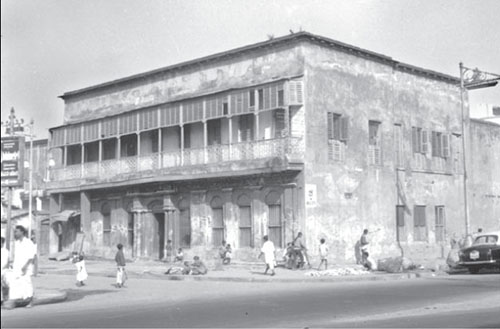
An archival photo of Balaram Bose’s House, Calcutta
[From the Vedanta Kesari, August, 1972, pp.217-222]
ⓘ
[1] In Bengali. Published in 1891.
[2] At present there is an enclosed place with a tablet bearing the names of all the direct disciples of Sri Ramakrishna, including Swami Ramakrishnananda, who were cremated there.
↑ Contents
Swami Satchidananda —Talks About Ramakrishnananda
Alambazar days
I have tried my best to jot down whatever I had observed in Shashi Maharaj, when I lived with him for about two years, before Swamiji’s returned from America for the first time. Just as he had been serving the Master before his passing away, even later on he continued to serve the Master exactly in the same way. Once while sweeping the shrine in the morning, I had some altercation with him. Not knowing the reason for his displeasure, I asked him. He replied, ‘If you don’t sprinkle water before you start sweeping, the dust particles will fly and stick to the Master’s body.’ One day he asked me to crush the end of a Margosa twig for cleaning the Master’s teeth. When I did that, he returned it to me after checking and said, ‘The brush must be very soft or it will bruise the Master’s gums.’ Another day I was scouring the vessels for the worship of the Master and the vessels hit against one another making a noise. He heard it and warned me, ‘Don’t make that noise in front of the Master’s room; he didn’t like such sound.’ He was so keen in his service to the Master that he would go wild at the slightest deviation from any rule he had imposed. It appeared to me as though he was utterly pain-stricken at heart during such times.
One day, he entrusted me with the duty of preparing betel leaves for the Master. He tasted it after offering and said, ‘It contains more lime.’ Even after this, I however continued to prepare the betel leaves. But he said ‘It is not good that you prepare the betel leaves.’ When I narrated the whole thing to Swami Abhedananda, he replied, ‘Well, I’ll prepare it.’ But for Shashi Maharaj, even that contained excess lime. So, he said at last, ‘You will prepare betel leaves for others.’ He made me prepare many betel leaves for two or three months and then one day said to me, ‘From now on, you may prepare betel leaves for the Master.’ That day he also gave me the flower garland, which had been offered to the Master and said, ‘You wear this.’
He gave me the responsibility of putting on the mosquito curtain for the Master at bedtime after duly fanning him. One day, after I finished that duty I went for my supper. He then asked me, ‘Have you dropped the curtain?’ ‘Yes, Maharaj, I have put on the mosquito curtain.’ I replied. Thereafter, he never allowed me to put on the curtain. Perhaps, the reason was that he might have [thought] that I did not fan the Master just as long as he used to do.
Another morning, he went to prepare halwa [a kind of sweet] for the Master and found the pan unclean. In fact, Latu Maharaj had seasoned boiled gram with chilli in that pan. Shashi Maharaj was touched to the quick at this and abused Latu Maharaj severely! The latter, being hurt at this, went to Shashi Maharaj and threatened him, ‘I’ll write to the Holy Mother. Are your parents and mine different?’ Shashi Maharaj felt so hurt at this that it took him a long time to regain his poise. The reason for this was, I understood later, that the offering to Master was delayed and there was, therefore, laxity in the service of the Master. He used to believe in the evil effects of someone seeing the food meant to be offered. He had instructed me not to show the food meant for offering to greedy people and he had even named a few of them.
Very early in the morning, he would accompany me to pluck flowers from the neigbour’s gardens. After returning, he would put the flower basket near the shrine and pray with folded hand: ‘Master, give us a piece of land. I shall plant various kinds of flowers and use them for your worship.’ One day, he found the flowers were insufficient. [He was upset with me.] I slipped away. Then, he started slapping himself until his face became flushed and swollen. I never saw him pained so much before. Another day, he told me, ‘You go to Dakshineswar temple garden and pluck jasmine flowers and I shall make a garland for the Master.’ After a few days, the gardeners, however, forbade me to pluck flowers. Still, I plucked the flowers for one or two days more. I reported to Shashi Maharaj that not only were the gardeners unwilling to give flowers, but they had even prohibited me to pluck them. When I had therefore refused to go to Dakshineswar to pluck flowers, he then requested Mahendranath Gupta (known as ‘M’) to make arrangements through the cashier of Dakshineswar temple for me to pluck flowers without hindrance from the gardeners. Inspite of this, I never went there. So, he would himself go along with me and through the help of the cashier, we would bring flowers without any hindrance.
I had begun to go to another garden, during the small hours of the mornings, for plucking the flowers. The gardener, coming to know of this, forbade me to pluck flowers. I reported this to Shashi Maharaj and he requested Baburam Maharaj to persuade the gardener. The latter presented the man with a piece of new cloth and when the man agreed, he asked me to go and pluck flowers. While I could pluck the flowers thus for a few months, the gardener, however, suddenly left for his native place ever. The new keeper again started creating trouble for me. At this, Yogen Maharaj and others decided to purchase flowers and do the worship, but Shashi Maharaj would not agree. So, we had to go again for another venture and he would worship with whatever flowers we could collect.
Shashi Maharaj used to keep some spices in a small bag near the Master’s bed. He used to dry them and washing them nicely and clean them one by one so that there would not even be any tiny stone particles in them. Whenever I used to do the chore, he would examine my cleaning and ask me not to hurry.
There lived a big spider with some eggs in her bosom in the room in which I slept. I was unwilling to do harm to any creature and would silently watch the eggs being hatched and small spiders spread all over the wall. At that juncture, Sharat Maharaj one day came to the room and watching it all, said to me, ‘If Shashi comes and sees all this, he will give you a bit of his mind.’ I did not reply. Later, someone else came in my absence and killed all the spiders. Two or three days later, Shashi Maharaj brought a little scorpion from outside and killed it in front of me. Swami Shivananda was also present then. My room was by the shrine and so the spiders would go from my room to the shrine and create trouble for the Master; that’s why Sharat Maharaj had forewarned me. Thereafter, Shashi Maharaj would purchase some living fish from the market and ask me to dress them for cooking, himself standing at the corridor to see what I did. I felt great trouble doing that. He would prick me, saying, ‘What! You won’t harm any creature?!’ I would remain silent.
While in Alambazar, he used to bathe the Master daily with fresh Ganga water. Observing that I had told him, ‘It destroys my faith in the Ganga, because her water to me is always pure, whether it is old or fresh.’ But he insisted: ‘We must give a bath to the Master daily with fresh Ganga water. If it is difficult for you, you will not have to do it. I shall fetch the water, when I go for the bath in the Ganga.’
Articles meant to be used for the service of the Master on special occasions were kept in a broken tin trunk. Once, I was in need [of] some marble stone bowls. When I had opened the trunk to get them, I found that some mice had spoiled them. When I told Shashi Maharaj about this, he asked me to clean that bowls and use them. He was, however, very sad. On the very same day, he went to a nearby shop, brought a big trunk and transferred everything into it and locked it.
The early morning offering and the snacks for the Master were purchased from the market. He used to instruct me, ‘Never bring a sandesh [a Bengali sweet] for the Master without tasting it beforehand; the one prepared from stale chaana [cottage cheese] tastes sour. Let there be no negligence regarding this. And always purchase the best quality rice, pulse, greens, vegetables, etc. even if you have to pay more for them.’ Due to this, we earned a bad reputation in the locality. People would say, ‘We don’t get good quality things in the market because of these monks. It seems they have got enormous wealth from somewhere while wandering in the mountains and the forests, and are buying the best market products with that money.’
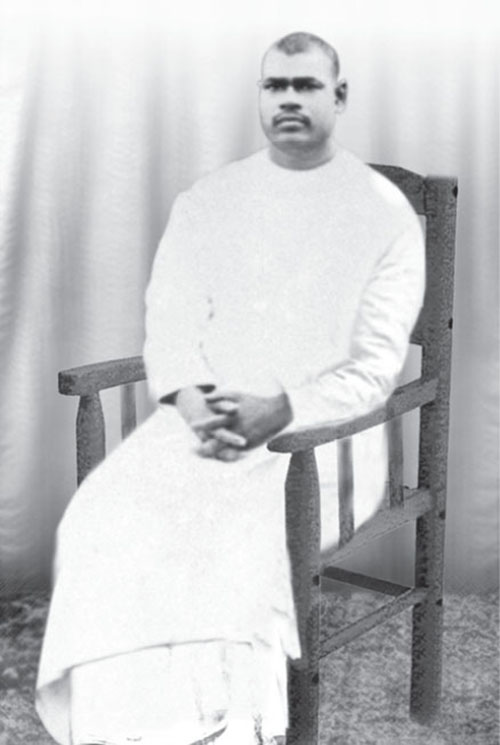 Swami Ramakrishnananda in Calcutta in 1897, a few weeks before
leaving for Madras (digitally relocated and improved photograph)
Once I went to see the chariot festival at Mahesh [1]. I returned late at night by ferry boat. He scolded me so much on that score that I felt hurt. Later, I realized that the reason for the scolding was that I went there leaving aside the service of the Master.
On one winter night, Shashi Maharaj was unable to sleep because he was shivering from cold. Then he felt that, perhaps, by mistake, he did not properly wrap the Master with a quilt. Immediately, he went to the shrine to check and found his apprehension true. He put a quilt on the Master, came back and slept peacefully.
One day, he was reading the chapter Moksha Parva in the Mahabharata in the parlour after lunch and others were talking loudly. I told them, ‘It’s not proper to make noise while the Master is resting.’ ‘You are right,’ said Shashi Maharaj. From then on, he never allowed anyone to make noise there.
Madras Math days
I was in Mayavati [Advaita Ashrama] when Swamiji returned from America for the second time. After Swamiji returned from Mayavati, I too had to come down from the hill to Kankhal due to ill health. I felt that if I had gone to the Math, it would have been impossible to visit the holy places like Dwaraka, Rameswaram, etc. So, I would rather meet Swamiji at Calcutta after visiting those places of pilgrimage. During this period, I had to stay at Madras with Shashi Maharaj for about six months as the railway track to Rameswaram was still under construction. Hence, I had to wait until the track was ready. Whatever attitude I saw in Shashi Maharaj and whatever conversations we had during this period, I shall try to note down here.
I reached Madras in May or June 1902. Shashi Maharaj had gone out of town on some work and returned after some days of my arrival. Basanta (Swami Paramananda) and another brahmacharin were then in Madras Math. Shashi Maharaj asked me, ‘Do you drink milk?’ ‘I can drink if I get,’ was my answer. So, he arranged for a quarter of a litre of milk for me on a daily basis. There I discovered that, unlike in Calcutta, he did not remain absorbed in the service of the Master day and night. There, he would busy himself mostly in preaching and reading. But there too, he liked to worship the Master with more and more flowers. I had to pluck flowers from some faraway garden at dawn. He would cook for the Master himself and offer it; make the Master sleep and then he would take prasada before leaving for the class. Sometimes, he would take me also as an escort and would dress the vegetables himself. He would deliver lectures on the Gita and the Upanishads. On his way back, he would purchase milk sweets for offering to the Master. He used to offer only those sweets and not any other. I felt that though he was not so exacting regarding the offering as he used to be earlier, nevertheless, his belief in the evil effects of someone seeing the food meant to be offered was more intense.
While carrying the food to be offered from the kitchen to the shrine, he was wary that no one should cast a look on it. Even while dressing raw vegetables for offering, he would keep the door closed to avoid others’ glance. One day, as he was dressing vegetables with the door open, a person came. Seeing him, he got a start. His whole body became excited. I was surprised to see this. No one could enter the kitchen. One day, I finished my bath and after making obeisance in the shrine and returned showing my back to the Master. Shashi Maharaj ran into such an angry mood seeing me do that he would have thrashed me if he could have caught me!
He faced acute financial stringency in Madras to such an extent that once he offered the publishers of the Upanishads to translate some of their works in exchange for some payment. Hearing this, they arranged for some monthly subscription for the Math. The Maharaja of Ramanad used to send him regularly some money through Alasinga or G.G. Narasimha-chariar...
He had a spring of overflowing love within him. He and I used to sleep in the same room sharing one wooden cot. Paramananda would sleep on the floor. So he got another cot, but there was only one mosquito curtain; so he tried to get another curtain. But after a long search, the net was found only in one shop in the whole of Madras city. There being no tailor, he himself sewed it with my assistance.
After my return from Rameswaram, he enquired if I had some money left with me, to which I replied in the negative. ‘But you need the railway fare to go to Calcutta,’ said he. I replied that I would collect the money by begging. But, he did not give his assent to that and said he would collect the train fare.
A few days before this incident, one night I was sleeping when Shashi Maharaj called aloud, ‘Dinabandhu, Dinabandhu!’ I replied, ‘Why do you call me, Sir?’ He said, ‘Well, I saw Naren (Swami Vivekananda) standing before me, saying, “Look Shashi, I have spat out my body.”’ I could not understand anything out of it, nor could he. However, that night we could not sleep. I felt dejected. The next evening, Alasinga and some other devotees came with a telegram in hand. It was sent from Belur Math. It contained the news of the Mahasamadhi of Swamiji. I broke into tears on hearing that sad news. Shashi Maharaj consoled me, saying, ‘These are natural events.’ I said, ‘You had enjoyed the company of the Master. [Now] We had Swamiji alone. Well, let the Master’s will be done.’
A few days later, he referred to the Almanac and said to me, ‘Tomorrow is an auspicious day; would you like to leave for Calcutta?’ I replied, ‘As you please, Sir.’ The next day he got up at dawn, offered food to the Master, then prepared a seat for me and asked, ‘Come here.’ When I drew near, he touched my forehead with a finger dipped in curd [2]. Then, he asked me to make obeisance to the Master. When I came back, he asked me to take the prasada. As I was taking it, he stood by the door and wept profusely, as if a mother was sending her daughter to her in-laws. I was struck with wonder.
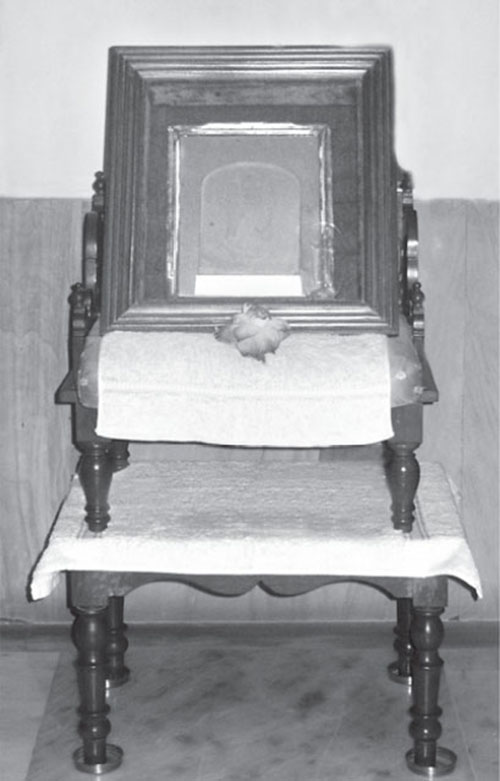
The (now faded) photo-image of Sri Ramakrishna, worshipped by
Swami Ramakrishnananda at Madras. Preserved
at Sri Ramakrishna Math, Chennai
After I finished eating, he hired a vehicle and accompanied me to the railway station, where he purchased a ticket for me. Then he approached the train, boarded a compartment, cleaned a seat with the end of his own cloth, kept the food articles there and spread my bedroll. At last, he tucked the ticket into my palm and said, ‘Come, board the train.’ I got in. He stood by the door and wept; and tears rolled down his cheeks. The train whistled off. I saw him gazing at me without winking. Such a mother-like affection, I had seen in Swamiji alone.
[Source: Swami Kamaleswarananda, Sri Ramakrishna Parikar Prasanga, 1st edn. Phalgun 1384, pp.40-50]
ⓘ
1 A place in Srirampur in Hooghly district of West Bengal.
2 It is a practice followed by mothers in Hindu families in Bengal with a view to removing all obstacles from the path; it is done as an auspicious sign when someone in the family goes out on a new venture.
↑ Contents
Swami Sharvananda
It was sometime in the latter part of February 1906, that I first came to Madras from the Belur Math with a letter of introduction from Swami Shivananda to Swami Ramakrishnananda. Swami Brahmananda Maharaj had also written to him about me. So, when I reached the Math from the Beach Railway station, I found Shashi Maharaj standing at the portico outside the main building, appearing to have been expecting me. The Math at that time, was located in the ground floor of the main building of the Ice House, Triplicane. The first impression that I got of Shashi Maharaj, with his huge bulky body and a touch of sternness on his face, was one of awe and deep reverence. There was something in his personality that was really commanding.
It was late in the evening when I arrived at the Math and after preliminary enquiries, he asked me what I had brought for Sri Guru Maharaj. When I told him that I had no idea that I should bring something for Guru Maharaj nor had anybody told me anything about it at the Belur Math, he said mildly, but in convincing tones, ‘Whenever you come from outside to the Math, you must bring something for Guru Maharaj.’ That was first lesson from him. I was abashed. He then asked, ‘What is there in your basket?’ I said there were some mangoes and sweets which I had got for the journey and that they were what remained after my use. He was very glad to hear that and burst out, ‘Never mind, bring those mangoes and offer them to Guru Maharaj.’ When I made a mild objection to his proposal by saying that I had already eaten from the lot, he asserted, ‘That does not matter. Fruits can be washed and offered, even if its Agrabhag (first portion) has been used by others.’ So, according to his direction those mangoes were offered to Guru Maharaj along with the night offerings.
At that time, there were only three inmates in the Math, Shashi Maharaj, Vasanta (Swami Paramananda) and Yogin (Umananda) and I was the fourth. From the very next day of my arrival certain duties were allotted to me, the main portion of which was the cleaning of the Shrine and also preparing the offerings in the Shrine.
At that time, the daily routine of the Math was like this: All inmates used to get up early at 5 a.m. and after morning ablutions, each used to go to his own room for some meditational practices. But, Shashi Maharaj would first go to the Shrine Room, make the morning offerings to Sri Guru Maharaj and then close the doors of the Shrine Room. Next, he used to come to his own room and read Chandi and Gita every day. After half an hour or so, I would come out, remove the offerings from Sri Ramakrishna’s Shrine and place them before Sri Swamiji’s picture, which was installed in another room. Subsequently, both the Shrine Rooms used to be swept, wiped and cleansed thoroughly. In the meantime, Yogin would prepare tea for us. Then, we all would sit in the order of seniority on a carpet for breakfast. At first, it would be served to Shashi Maharaj and then to others. After tea, Shashi Maharaj would sit to cut vegetables and would ask me to read a book. I first started with Patanjali’s Yoga Sutras. I used to read the text and he would explain it after each aphorism. Others would be simply listening to his discourse. An hour or more would go in this way and then we would go to perform our respective duties or attend to any other business. Punctually at 11 o’clock, Shashi Maharaj used to go to the Shrine Room to perform worship and at about half past eleven, the noon offering was made to Sri Guru Maharaj. By the time the offerings were brought from the Shrine, it used to be half past twelve, when the Shrine Room was closed and we sat for our lunch. After the meal, Shashi Maharaj and the inmates used to take rest for some time. At about 3 o’clock in the afternoon, he would call all of us to him. We all would sit on the floor and Vasanta used to read ‘Chaitanya Charitamrita’. In the course of the reading, Shashi Maharaj used to give us parallels from the life and sayings of Sri Ramakrishna. He would also, on such occasions, speak of the religious practices that Swamiji and Sri Ramakrishna’s sannyasin disciples performed in the early part of their monastic life. He would speak of all these with a fire and emotion which was peculiar to him. Punctually at 4 pm, the doors of the Shrine Rooms were opened and the afternoon offerings were made. Be it noted her that he was extremely keen on observing punctuality in making offerings to Sri Ramakrishna. He would not allow the deviation of even a minute in the matter.
In the evening, sometimes he would go out to give religious discourses in different parts of the city. We would attend to our individual work or go to the beach for a short recreation. At dusk, we used to assemble in the Shrine Room and attend to the Vesper Service. In his time, no regular aratrikam was done. At about 8.30 p.m., the night offerings were given to Sri Ramakrishna and after half an hour, the Shrines were closed for the night. Thereafter, we used to sit for supper. After meals, we would gather round Shashi Maharaj and do some personal service to him, while he would be relating to us some of the incidents of Sri Ramakrishna’s or Sri Swamiji’s life. After a while, he would go to sleep and we also used to retire for the night.
Within a few days of my stay in the monastery, I found out what Shashi Maharaj wanted of us. He wanted us to be very precise, punctual, regular, quick in action and all attention in our work, particularly in our duties in the Shrine Room and services to Sri Guru Maharaj. On the very second day, while doing some work in the Shrine Room, he told me, pointing to the likeness of Sri Ramakrishna, with a firmness of tone that was peculiarly his own, ‘Look here my boy, don’t consider that as a mere picture of Sri Ramakrishna. He is actually present here. Try to feel his living presence and do your services accordingly.’ That was my second lesson from the great Saint.
On the following day, I was somewhat inadvertent in my Shrine Room work and that brought a severe scolding from him. Not being accustomed to that type of scolding and that too for such a trivial fault, I broke down. Seeing me weep, he at once softened and began to say in a very endearing tone, ‘Do you know what Sri Ramakrishna used to say? A blacksmith first puts a lump of iron into the fire and when it becomes red hot, he then puts it on the anvil and beats it into shape. That’s how an unformed lump of metal is shaped into a useful article; you are all like that unformed lump and it is for your good that you are put to forge and beaten to shape on the anvil by such scoldings. It is all for your benefit.’ His relenting voice was somewhat heartening to me. The very next day after this incident, while we were all sitting at our meals, nice Malgova mangoes were served. It was first offered to Shashi Maharaj. As soon as he tasted a little bit of a big one given to him, he exclaimed, ‘Oh, how sweet! It is exceedingly nice. Take it, my boy.’ With these words, melting almost in motherly affection, he put that biggest of fruits on my plate. That single act of affection revealed his inner heart to me and from that moment onwards, none of his scoldings and chastisements did hurt me or wound my pride, in as much as I could always feel that behind those stern words and grim face, reposed a most loving heart and tender affection that even a fond mother could not harbour.
His method of training was certainly violent and even at times harsh. But his whole heart was set upon the central point as to how to unfold the spiritual nature of the disciples or the novitiate. He would not brook any contradiction or questioning, much less a refusal from us. Indeed, his method was that of the sledge-hammer blow of the black-smith. He, who could stand it, would get a form that could stand the stress and strain of all vicissitudes of life and be fit for the realization of the higher ideals. Many came, but few could stand his test. During my stay with him, I found that he did not lay much stress on such spiritual practices as meditation or Japam; his chief care was to see how precise and accurate, neat and devoted we were in our duties to Sri Ramakrishna and to him. Indeed, therein lay the seed of self-control, concentration and devotion that a true spiritual life requires. When one has these disciplines, one can easily progress in devotional practices, if one so chooses. One thing he would constantly harp upon, in season and out of season, was that Sri Ramakrishna was actually present in the Shrine Room, nay, in the whole monastery, that every one of the things of the monastery belonged to him and that all our activities in life should be directed towards him or his services. That is the one Sadhana we should adopt. Whenever he would stand before the picture of the Master and cry out in a sonorous voice, ‘Jai Guru, Jai Guru’, the feeling of the living presence of the Divine would be so deeply stirred up in one’s heart that it has better to be felt than described. If spirituality means the awakening of the consciousness of the spiritual verity that resides not only in the depths of our being, but also outside as the basis of the phenomenal universe, then certainly the method of training of Shashi Maharaj was spiritual par excellence.
He was very orthodox, nay, at times it verged on superstition. But it was all due to his unflinching allegiance to the commandments of the scriptures and the sayings of his Master. But he was no stickler to the letter of the law; he was highly intelligent and scholarly enough to understand the noble spirit of the scriptures and follow it scrupulously. He would not stir out of the Math nor write letters on Thursday afternoons or in Aslesha and Magha Nakshatrams, as his Master had observed those restrictions. At times, he used to say in fun, ‘That old fellow has injected these superstitions into me.’
In teaching scriptures and in philosophical discussions, he used to assume the attitude of a cold logician and there he would not exhibit any of the fanfare of emotionalism of a Bhakta. His basis always used to be the Advaita Vedanta, although for practical life he laid great stress upon the devotional aspect of dualism. He would not encourage us much in argumentation and philosophical discussions. He would repudiate all arguments for argument’s sake. He used to assert that the right attitude of a student should be strictly that of an enquirer, eager to learn from elders, not by mere logical disputations and ratiocinations, but by the devout unfolding of the mind to the light of the truth which the teacher might shed, even as a budding flower receives the rays of the sun and brings itself to full blossom.
In those days, our monastic life in Madras was rather even and stern, quite uneventful, yet full of that calm repose and inner joy which the presence of a truly great spiritual Saint could bestow upon the surroundings. Although across the span of forty years, the very memory of the serenity of that life stirs in us, even today, an emotion that is incomparable.
The days thus glided by for some time, when a great event occurred that arrested my attention and deepened my devotion to him. One day, it so happened that there was nothing edible in the store to offer to Sri Ramakrishna in the afternoon. The financial condition of the Math in those days being very poor, the coffer was quite empty. Generally, the afternoon offering was made punctually at 4 pm and it was at 3 o’clock that the fact was discovered that there was nothing to offer. When the matter was brought to Shashi Maharaj’s notice, it sent him into consternation. He took it as a test the Master was putting him to. Like a true Saint, he knew it positively that nothing could happen in the universe without God’s will; ‘Not even a blade of grass can move without His will.’ And so, if such a dire eventuality could take place, it could not be without His cognizance. What is man, but a piece in His chess-board, as he often said, quoting a saying of Sri Ramakrishna. So, he was neither angry with us nor on any one else for not noticing the fact beforehand; [but] his ire and grievance were solely turned against the Master Himself. He burst out with a terrible growl, ‘You want to test me! I will eat sand and do Swamiji’s work here! Sirrah! You are testing me, I know. But you should also know my grim resolve. I shall rather die and perish here than budge an inch from this place! Do your worst, if you will!’ His face became ruddy and glowed in terrible anguish and fervour, anguish for not being able to offer anything to the Master at the right time and fervour in the belief of the omnipotence and omnipresence of his divine Master. He went on in this way for some time and paced up and down the hall. It was a tense half an hour. We youngsters were entirely dumbfounded, not knowing what to do to mitigate the direness of the situation. Just then some soft knocks were heard at the door outside. Some of us went out and opened the front door. Mr. Kondiah Chetty, an old student of Shashi Maharaj, had come. He was ushered in and was found to have brought with him some wheat flour, ghee, sugar candy and dried fruits. He placed them before Shashi Maharaj and also five rupees in coin. It was so unexpected at that dire psychological moment that we could not but see the hand of Sri Ramakrishna in the whole affair. It was half past three; there was half an hour still to make the afternoon offering. Shashi Maharaj burst out in childlike glee and a joyous roar, bade us to bring two stoves and made sweets meats and other nice preparations for the offering. There was great stir among us all, every hand was engaged to finish the task quickly and so when it was just 4 p.m., several courses were made ready for the offering. The joy of Shashi Maharaj knew no bounds when he himself offered them to his Master.
Another incident that occurred, sometimes about this time, is fresh in my memory even now and I must present it here, as it would give a real glimpse of the inner mind of Shashi Maharaj. It must have been in the latter part of April of that year. On one very sultry evening, after supper, Shashi Maharaj laid himself down on the cot and I was massaging him as usual. It must have been about 11 o’clock in the night and the heat was oppressive. He suddenly got up, tied his cloth round his waist and went into the Shrine Room. He bade me also to follow. He stood with a fan near the cot on which Sri Ramakrishna’s picture was laid for the night’s rest and began to fan him, asking me to fan Sri Swamiji’s picture which was kept on a pedestal. He went on fanning for nearly an hour and then slowly laid down the fan and gently walked out of the Shrine Room. He asked me also to do the same. His whole behaviour could not fail to engender the feeling in my heart that Sri Ramakrishna was actually present there, sleeping there on the cot and we were serving Him! Then, he went out of the room and stood in the verandah outside the building. It was all open and we were facing the sea. I brought a chair for him and he sat on it. I started fanning him. Though the night was deep and oppressive, the stillness of the hour, the rhythmic murmur of the breakers of the ocean and the vast expanse of its glistening waters before our eyes, all wove an idyllic charm on our mind. Shashi Maharaj did not speak a word, as if his mind was soaring high to some transcendental region. His attitude indicated it. So, naturally, I maintained perfect silence and went on fanning. When some time had passed in this way, he suddenly turned towards me and exclaimed: ‘You see, my mind is soaring in the heights. If I sit now, I can fall into Samadhi immediately.’ I kept quiet and wondered at the sublimity of the situation. Probably more than an hour rolled away in that tense mood and then he relaxed. It must be about 2 a.m., when he got up and said, ‘Now let us go and retire.’ It was a memorable night for me to witness such a sublime spectacle.
Smiles has truly said that ‘the little acts of daily life are loopholes of character.’ To understand a great mind, we need not go to their great achievements, but observe their little acts of daily life. It is these that would really reveal their true greatness. The more you live with a great soul, the deeper becomes the revelation of his utter selflessness, non-attachment, purity of mind, resignation and constant consciousness of the Divine presence. The very atmosphere around him is felt to be suffused with the aroma of a bliss that is really supra-mundane and the influence he radiates is felt to be truly uplifting. Those incidents mentioned above and many a daily happening in the monastery drew me closer to Shashi Maharaj and filled my mind with awe and admiration, the like of which I never felt before. Though I had the privilege and the fortune of seeing Swami Vivekananda and some of the most distinguished disciples of Sri Ramakrishna before my coming to Madras and also of knowing many great spiritual Saints outside the pale of the Sri Ramakrishna Brotherhood, that was the first occasion I was blessed with the opportunity of living closely with such a great Saint and of observing all the minute workings of his daily life.
In the beginning of July, I left Madras on a pilgrimage to the South and the Malabar and came back to Madras in September from Bangalore. I found Shashi Maharaj was busily engaged at that time in making plans for collecting the necessary funds for the construction of the new building of the Ramakrishna Math in Mylapore. I found on my return that the life of the Math was going on as usual; only Swami Paramananda had not come back. I heard that Swami Abhedananda intended to take him to America to assist him in his New York work.
Shortly, a small incident happened that perturbed the equilibrium of my mind a great deal. Those were the Bengal partition days and we young men of Bengal took the vow to fast on the 16th of September (that being the actual date when Bengal was partitioned) and to make the necessary demonstration to annul the injustice done to Bengal. The vow was taken before my joining the Mission; so on 16th of September of that year, I wanted to keep up my vow of fasting. When Shashi Maharaj came to know of it, he was full of wrath and chastised me severely for having political leanings even after joining a religious brotherhood. He said that the salvation of India can never come through mere politics, that I would be doing greater service to the country and to humanity at large, if I could build up my life in the spiritual line chalked out by Sri Ramakrishna and Sri Swamiji, that making political demonstrations was Western in spirit and fitted ill with the spiritual ideals of India and so on and so forth. His repugnance for the political activities of the country was very marked; but I could not be convinced by his arguments and I insisted upon my keeping the vow to observe fast on that day. Of course, now I understand the justification of his attitude. He held that when a young brahmacharin comes to the elders for training and guidance, there should be absolute obedience on his part to the behest of the elders. Without absolute self-surrender, discipleship is never complete and nothing good and great can really be transmitted by the Master to his disciple. That is the spirit of the Hindu ideal of discipleship. And, Shashi Maharaj was very strict on that point. But unfortunately, I was too ignorant and full of the revolutionary spirit of modernism to be able to understand him at that time. So, when I heard him say, ‘If you don’t hear me, you have to quit this place; I cannot allow any disobedience here,’—I at once collected the few articles I had and was ready to depart. Just then, Swami Vimalananda called me out and took me to the beach and argued with me for nearly two hours over the matter. He was a very loving soul, exceedingly intelligent as well as sympathetic. He understood my sentiment thoroughly, yet with all sympathy and spiritual insight, he made efforts to enlighten me in the higher principles of the spiritual ideal where human politics has no meaning. Both are incompatible to a great extent. If I had chosen the realization of God, he said, as the goal of my life, I should concern myself solely with that pursuit and should not fritter away my energy in small political activities. His arguments were very convincing and his tender feeling at once assuaged my spirit and soothed my mind. So, I returned to the Math with him and fell at the feet of Shashi Maharaj and begged his pardon for my seeming revolt. Shashi Maharaj was very glad to hear of the change of my mind and began to speak of the different sayings of Sri Ramakrishna about the popular notion of political activities and blessed me to have a true insight into the ideal of life. In passing, I may mention here that it was the practice with Shashi Maharaj, never to allow us to discuss politics and speak on political topics in the Math premises, nor would he allow any newspaper to be brought in. One day somebody brought a newspaper and left it on a bench in the Math verandah. When Shashi Maharaj saw it, he asked me at once to throw it away into the dustbin and sprinkle some water on the place, saying, ‘Ganga, Ganga’, to purify the defilement. He often used to say that Sri Ramakrishna could not bear the sight of a newspaper in his place.
Time rolled on and the sacred Navaratri season arrived. Shashi Maharaj himself performed the Puja in the usual Durga Puja style and the whole ceremony was brought to a close on the ninth day by the performance of Havana. It was all done before the picture of Sri Ramakrishna.
Then came the Deepavali day. On that night, Mother Kali is worshipped everywhere in Bengal as well as in all our Maths. Shashi Maharaj kept a fast on that day and asked me and Yogin to do the same. The Puja began at about 10 o’clock in the night. Shashi Maharaj did not go through the whole of the lengthy process of Kali Puja that is usually done on such occasions. He performed it, so to speak, in an abridged style. The sacrificial light was lighted at about midnight and he asked us to sit around it. After performing the preliminaries of the sacrifice, he began to chant mantras and the vows that a brahmacharin should take for being initiated into a brahma-charin’s life and asked us to repeat them after him. After chanting such mantras and vows, offerings were made on the sacrificial fire to Sri Ramakrishna invoking his blessings and support for our maintaining the vows. Swami Ramakrishnananda himself had compiled this whole process of initiation into brahmacharya from ancient scriptures and wanted the Ramakrishna Order to adopt the same for its brahmacharins, like the usual Vedic ceremony of sannyasa. It is very different, both in spirit and form, from the upanayana ceremony. So, Yogin and myself were the first to be initiated as regular brahmacharins after the ancient ceremonial fashion. Before this, there was no brahmacharya ceremony in our Order.
At about the beginning of November, I was asked to go to Puri where Swami Brahmananda Maharaj was staying at that time. So I had to leave Madras and to bid goodbye to the blessed company of Revered Shashi Maharaj, not knowing at that time that I would have to come back exactly after five years to take upon my young and weak shoulders, the heavy burden of the work that Shashi Maharaj had so nobly and magnificently inaugurated and expanded in the South. Although my actual stay with Shashi Maharaj was hardly for six months, the impression he left upon my youthful mind within that short period was so deep and indelible that even today, after two score years, it appears to me quite fresh and green. He gave a specific mould to my religious life and deepened the spiritual values in my consciousness. So, the debt I owe to him in that respect is inestimable.
Sri Ramakrishna used to speak often of his spiritual life as a ‘basket of many flowers’, meaning thereby that in him, there resided in perfect harmony, various religious moods and spiritual attitudes, spoken of in the Hindu scriptures as bhavanas, just like a beautiful bouquet composed of many flowers of variegated hues, yet producing a charmingly harmonious effect on the eyes. And we find these variegated ‘colours’ of his spiritual life very well represented and fully expressed in his disciples. No two disciples of his were alike; everyone had his own unique personality and spiritual mode of living. Yet, all of them drew their inspiration of life from the same Master. This was indeed peculiar and remarkable in Sri Ramakrishna’s method of training his disciples. Each of them developed, according to his own innate nature, to the fullest extent, one of the many spiritual moods the Master had developed in his devotional practices.
Swami Ramakrishnananda was the very embodiment of that devotional spirit portrayed in the life of Hanuman in the Ramayana by the great poet Valmiki. He had the same unflinching selfless devotion to his Master, coupled with a solid puissance that would strike terror in the hearts of his opponents. He had a huge body, a powerful personality, a keen wit and a heart more tender than that of a loving mother, and a face always glowing with the spiritual fervour and radiating an atmosphere of tremendous strength and utter resignation. He was essentially a Bhakta, but there was nothing of that weeping type of effeminate emotionalism of the Bhakti school in him.
He was all strength. His scholarship in the Hindu scriptures was next only to that of Sri Swamiji in the Brotherhood, yet, he was simple and unostentatious like a child. Indeed his was the rarest type of devotional life, a glorious gift of Sri Ramakrishna to modern India.
[ SwamiRamakrishnananda-The Apostle of Sri Ramakrishna to the South by Swami Tapasyananda Sri Ramakrishna Math Mylapore, Chennai, Pp.222-239 ]
↑ Contents
Swami Abhayananda (Bharat Maharaj)
Bharat Maharaj was deputed by Sri Maharaj to serve Shashi Maharaj during his last illness. One day Shashi Maharaj suddenly spoke out addressing Bharat Maharaj, ‘Oh! look! Don’t you see? Thakur and Swamiji have come! Spread the mat on the floor and put a couple of pillows on it.’ Bharat Maharaj said that he did not see anything. Shashi Maharaj did not allow Prakash Maharaj to come near him for the last few days of his life. So he served from a distance. A few days later, Shashi Maharaj suddenly called him aloud and later accepted his service. One day, addressing Baburam Maharaj, he said, ‘Baburamda, does Mother belong to you alone?’ And he started crying with a desire to see the Holy Mother. Baburam Maharaj went downstairs and requested Sharat Maharaj earnestly to send for Mother from her native place. Krishnalal Maharaj accompanied by Ganen Maharaj, went to bring the Mother; but she did not come. So, they returned disappointed. A few hours later, Shashi Maharaj passed away.
Shashi Maharaj loved Ramakrishnababu (Balaram Bose’s son) very dearly. During his illness, the latter used to come and have a chat with him for two or three hours everyday. Shashi Maharaj specially loved his company and would send for him, if he did not come. Shashi Maharaj also loved his own younger brother who brought fruits for him on his way from the office. But, when his own mother came and waited for hours together, he would say, ‘Let her see me just for two or three minutes and take her away thereafter.’
He hurled abuses addressing the images of Thakur and Mother hanging from the wall. He would say, ‘Whom else shall I abuse if not you?’ He was always very high in a mood.
[As compiled and narrated by Swami Kamaleswarananda in his book, Sri Ramakrishna Parikara Prasanga, Pp. 73]
↑ Contents
Swami Bodhananda
It was on a late summer afternoon of 1890, that I had the privilege of meeting Swami Ramakrishnananda for the first time. He was then living with some other Swamis at the Baranagar Math. The day was very hot. The time was about 3 o’clock in the afternoon. We were five of us in the party; Khagen (later, Swami Vimalananda), Kalikrishna (later, Swami Virajananda), Sudhir (later, Swami Suddhananda), Kunja Lal Sil (a classmate) and myself.
I think it will be interesting to know how this happened.
In the spring of that year, fourteen or fifteen boys of my age (between fourteen and twenty) formed an association of learners seeking the company of sadhus and desiring to practice sadhana under their guidance. We met some [of them] and practised whatever instructions we could get from them. We used to visit shrines like the temple of Kalighat. We read the Gita, the Bhagavatam and the Upanishads; observed fasting on Ekadashi, Ashtami and Shivaratri; almost every day took ablutions in the Ganga and so on.
In the month of July or August of 1890, we attended the anniversary of the founding of the temple at Kankurgachi. During that time, we became acquainted with Ramchandra Dutt, Manomohan Mitra, Girishchandra Ghosh, Kalipada Ghosh, Devendranath Mazumdar, Mahendranath Gupta and many other distinguished grihastha disciples of Sri Ramakrishna.
Mahendranath Gupta was our professor at the Ripon College. We used to have conversations with him, in the off hours in the college corridor and at other times, at his residence. His description of Sri Ramakrishna and his disciples was different from that of Ramchandra Dutt and made a deeper appeal to us. In fact, one day he told us very frankly that if we wanted to know of Sri Ramakrishna we should visit his sannyasin disciples. They were the living exponents of his teachings. He gave us their address. In his own epigrammatic way, he said that the disciples who have left everything to follow the Master were like the grade of mangoes called Fazli and Nangra and the grihastha disciples were like ordinary mangoes, usually sour even when ripe. The sannyasin disciples might not have fully matured yet, but when they were, they would be all sweetness. He urged us to visit them and serve them. To serve them, according to him was to serve the Master himself. After receiving this direction from him, we went to see the Swamis at the Baranagar Math.
The Math was located on the second floor of an old and dilapidated brick-house. Baranagore is about four miles north of Calcutta. We went half way by street-car and walked the other half. When we entered the big room, we saw on the floor four or five asanas with blankets and tiger and deer skins. We first met Swami Ramakrishnananda, a tall and stout clean-shaven man about twenty eight or twenty nine, bowed to him and took the dust of his feet. He inquired about us and the purpose of our visit. We said we were students of Master Mahashaya (Mahendranath Gupta), and that he had asked us to visit the sannyasin disciples of Sri Ramakrishna and hear about him from them. When he learned that we were students, he at once asked us some questions. Most probably, we could not answer them correctly. He thought that we were delinquents and were neglecting our studies. He gave us a mild admonition and advised us never to neglect our studies. He further said that Sri Ramakrishna regarded school education as an excellent means of attaining purification of intellectual faculties (result of education is buddhishuddhi).
Then we saw the other Swamis. They were six or seven of them. At 4 o’clock, there was the usual (baikalika) afternoon service. We were taken to the chapel and saw Sri Ramakrishna’s picture on the bed, his sacred remains (in a cylindrical box below the bed), his hallowed slippers and other valued remnants. Light refreshments were served and we had our share. Before we took leave of the Swamis, we again saluted them and received their blessings. That very day marked the beginning of an interest in the Ramakrishna Sangha, which grew steadily and finally culminated in our becoming members of it.
We often visited the Math on Sundays and holidays; sometimes alone, sometimes with others. With the permission of Swami Ramakrishnananda, sometimes we spent a day or two at the Math. Those days gave us the precious opportunity to know the Swamis at close range and be blessed with their holy association. One morning, during one of those visits, Swami Trigunatita privately asked me if I would not go with him to some nearby villages to collect some bhiksha (alms) for the noonday meal (bhoga) of Sri Ramakrishna. I was delighted and consented to go with him. When we came downstairs to the main floor, Swami Trigunatita gave me a gerua (ochre) cloth and asked me to wear it and put away my own white cloth under some old bricks, which were there in plenty. Then we went out into the street. We passed through the bazaar to some of the villages in the vicinity. We called the attention of the housekeeper by chanting Radha-Krishna at the door and collected some rice, potatoes and some other vegetables in our bhiksha-bags. On our way back to the Math, we visited the temple of goddess Sarvamangala.
When we returned to the Math, it was about eleven o’ clock. I changed from the gerua cloth to my own white cloth on the ground floor and then went upstairs. No other Swami except Swami Trigunatita knew about this. Swami Ramakrishnananda was very happy to see us return from our bhikshatana (begging bouts). The amount of rice we collected was about four pounds. This was cooked for the noonday bhoga (offering). Swami Ramakrishnananda said, ‘Sri Ramakrishna considered bhikshanna (rice got by begging) as very sacred.’
Apart from Sundays, holidays and summer vacation, I used to spend a few days at the Math on other days also. Once, the stay was a little longer than usual; so my father came to the Math to fetch me home. Swami Ramakrishnananda was very kind and cordial to him. In fact, my father was so pleased that he became interested in Swami Ramakrishnananda. It was about eleven o’clock, when he arrived there. That was an Ekadashi and he practised a kind of moderate fasting that day. At about twelve o’clock, he went for his ablutions in the Ganga, which was only a few hundred feet away from the Math. He accompanied Mahendranath Gupta who also was at the Math that day. On the way, they conversed a little. Mahendranath Gupta told my father that the young Swamis were like a flock of (girabaj) pigeons which fly far up and away from their dovecotes to lure other pigeons from their holes. My father repeated this to me afterwards. Most probably, he had the notion that those Swamis at the Math were like the girabaj pigeons to decoy other men from their homes into their own group. He did not insist upon my coming home with him. He returned home alone, receiving from me the promise that I would return home later in the evening. About 3 o’clock, he left the Math. Swami Ramakrishnananda told me that he would return again. I think that he attended the next birthday anniversary of Sri Ramakrishna at Dakshineshwar and died a few months later.
During one of my holiday visits, I stayed much longer than I should have. Swami Ramakrishnananda would enquire about the duration of the holidays and if he discovered that I overstayed them he would scold me. Once or twice, the scolding was so severe that I wept bitterly, before I left for home. From those outbursts, Swami Ramakrishnananda had a settled opinion of me. He thought that I was an extremely sentimental young man. He had a stern exterior, but his heart was full of love and compassion. Although, he was generally serene and serious, he was on many occasions as simple, frank, naive, buoyant and mirthful as a child.
Swami Ramakrishnananda was a permanent resident of the Math. How lovingly he used to take care of the other Swamis, grihastha disciples and visitors! He could cook, nurse, wash, wait, teach, lecture and conduct temple service. He was a model karmayogi. His reverence for his brother Swamis was unique. Indeed, he saw the presence of the Master in them all. On several occasions, I saw him bow to Swami Vivekananda and Swami Brahmananda and lie prostrate before their feet. Although Sri Ramakrishna was his Guru and he was wholeheartedly dedicated and devoted to him, he was not a bigot or a dogmatist. His reverence for all Avataras, founders of faiths, prophets, gods and goddesses of all pantheons, was matchless.
He was a veritable tower of strength and a great developer of self-confidence. He discovered in some of us a sort of passive modesty, either natural or affected, due to lack of self-confidence. One day he explained to us the technique of building self-confidence:
‘If anybody asks you if you can give talks on the Gita, don’t say, “I don’t know the teachings well enough to give talks on them.” Shake off this false timidity and say, “Yes”. That assertion will be honest and truthful. On the contrary, if you hesitate and say, “I know a little”, many people will believe that and that will be wrong. Have courage and confidence in your ability. Make the resolve, “I can do it and I will do it” and through the grace of the Master you will succeed.’
Then, he told us the story of Faraday and his pupil. One day, Faraday asked a young pupil to give a lecture to an audience. The pupil inquired what he should expect the audience to know already. To that Faraday said, ‘Know that the listeners know nothing. You are to give them something new.’
Ramchandra Dutta,who sometimes criticized the Swamis, had a profound admiration for Swami Ramakrishnananda’s devotion to the Master. Indeed, his method of service had its own character. Those who had the privilege of observing the details of his daily service at the chapel can testify to this fact. His making of the bed, putting on the mosquito curtain around its frame after the evening service, his offering of flowers on the sacred remains and the slippers, his aratrikam, his ecstatic dance while chanting the hymns of Shiva and Guru, his waving of the big fan on the bed on hot nights, his cooking the meals for offering, his deftness, neatness, promptness and thoroughness in every detail, left an indelible impression on the mind of the beholder. The whole spectacle was exalting, thrilling and stirring. Even the hardest heart would be moved with his superhuman bhakti.
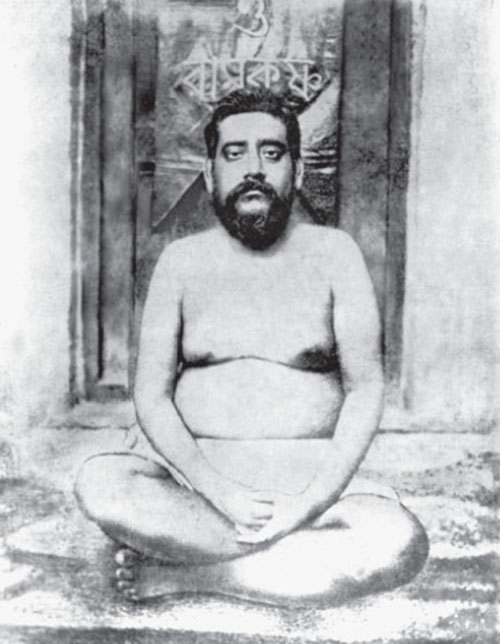
Ramchandra Dutta
On his return to India from the West, Swami Vivekananda sent him to Madras. That was in 1897. He worked there for fourteen long years and the present Madras Math, schools, Students’ Home, Industrial Institute, etc., are the fruits of his devoted and unstinted labour.
In 1904, Brahmachari Amulya (later, Swami Shankarananda) and I went out on a wandering tour in the southwestern part of India. In the course of our journey, we came to Bombay. A householder disciple of Swami Vivekananda, Haripada Mitra was an engineer at Sholapur under the Government. He invited us to visit his camp. We stayed about a week with him. He arranged for us a pilgrimage to Pandarpur. On our return to Sholapur from Pandarpur, I decided to proceed to Madras. Brahmachari Amulya planned to visit the cave temples of Ellora and Ajanta.
Swami Ramakrishnananda was very glad to see me at Madras and very kindly enquired about my health and trip. With him, then, at the Madras Math, were Swami Vimalananda and Swami Achalananda. Swami Atmananda was in Bangalore, where a Math had been established by Swami Ramakrishnananda a year before. His health was not good there and the work was too much for him to carry on alone. Swami Ramakrishnananda first sent Swami Vimalananda to assist him in his work and within a few weeks, he sent me. At that time, Narayana Iyengar (afterwards Swami Srivasananda) came from Bangalore to Madras for a visit. He spent most of his time at the Math. The day he left for Bangalore, Swami Ramakrishnananda asked him to take me with him to Bangalore. Swami Ramakrishnananda had the notion that three of us (Swami Atmananda, Swami Vimalananda and I) would do the work efficiently.
In southern India, people are very fond of long public lectures. Unfortunately, none of us were eloquent lecturers. We used to give classes on the Gita, Upanishads and Pancha-dashi, but very few were interested in them. Although many distinguished men were our friends (such as Dr. Srinivash Rao, Justice Singlachar, Rai Bahadur Narasimachar, Dr. Palpu, Rao Shahib Chenappa, Apanna Iyengar, Venketesha Iyengar and others), few, except Dr. Venkatarangam and Narayana Iyengar, took a genuine interest in our work. But, we were not discouraged. We stuck to our post and fairly overcame all difficulties.
In the month of March 1906, Swami Brahmananda wrote to me that Swami Abhedananda in New York (U.S.A.) needed an assistant and he (Swami Brahmananda) wished me to go there. In my reply, I said I left the matter to his own decision. I put it this way, ‘If he (Swami Brahmananda) wanted me to go, I would. I had no choice in that matter.’ On receiving his positive order, I left Bangalore for Calcutta about the middle of the month (March). On my way, I halted at the Madras Math for a few days. That gave me another opportunity to be with Swami Ramakrishnananda and that was the last. He was very happy that Swami Brahmananda ordered me to go to New York. He gave me his special blessings which I appreciated very deeply.
Swami Ramakrishnananda was an embodiment of Bhakti. He was an active, independent, dauntless and virile devotee. What Rama was to Hanuman; that indeed was Sri Ramakrishna to him. His life and example are an inspiration to us. Indeed, we are most fortunate that we had the privilege to know him and serve him. His father was an advanced Tantrika Sadhaka and was a great admirer of his son’s Gurubhakti.
कुलं पवित्रं जननी कृतार्था वसुन्धरा पुण्यवती च तेन ।
अपारसच्चित् सुखसागरेऽस्मिन् लीनं परे ब्रह्मणि यस्य चेतः ।।
‘He indeed is a blessing to his mother and to his family, a blessing to his country and to the whole world, whose heart is absorbed in the boundless ocean of Parabrahman—Absolute Existence-Knowledge-Bliss.’
This may be very truly said of Swami Ramakrishnananda.
[From the Vedanta Kesari, August, 1950, pp. 127-131]
↑ Contents
Swami Achalananda
The Belur Math was established in 1898. In 1900, Swamiji returned from the West for the second time and began living at the Belur Math. After the Kali Puja in 1901, Shashi Maharaj came to Belur Math to meet Swamiji. I was then staying there and serving Swamiji. It was then that I met Shashi Maharaj for the first time. Also, it was Shashi Maharaj’s first visit to Belur Math, because when he shifted to Madras, the Math was still at Alambazar. As there were no monks or brahmacharins in Madras, he brought the photo of the Master with him while coming to Belur Math. A boy named Yogin was there, but as he was new, Shashi Maharaj did not entrust him with the worship. The fact that he was unable to bring Swamiji to Madras during the latter’s second journey to America still distressed his heart. He therefore came from Madras post haste to meet his dear leader. It was his last meeting with Swamiji.
Other prominent brother disciples like Brahmananda Maharaj, Premananda Maharaj and Saradananda Maharaj were also then present at the Math. They were all greatly pleased to meet Shashi Maharaj after so many years. It is impossible to express in words the wonderful love, affection and respect that existed between the direct disciples. Only those fortunate ones who have seen this special bond directly can experience it in their hearts. After spending some days in the holy company of his brother disciples, Shashi Maharaj returned to Madras. On this visit, I saw he was quite bulky and had a golden complexion. But, I heard that before going to Madras, he was leaner than he should have been.
In 1904 when Swami Paramananda fell ill, Shashi Maharaj brought him to Belur Math. On this visit, he stayed in Belur for some time and delivered a few religious lectures at the Calcutta Vivekananda Society and the Calcutta Vivekananda Boarding. At that time, Brahmananda Maharaj was engaged in severe austerities. He took havishyanna (ghee-rice) once a day, slept on the floor and always remained immersed in God-consciousness. I then used to render some minor service to him. When Shashi Maharaj requested a replacement for Swami Paramananda, Brahmananda Maharaj ordered me to go with him. Accordingly, I accompanied Shashi Maharaj. As Swami Vimalananda (Khagen Maharaj) was unwell, Shashi Maharaj took him along with the intention of arranging his stay at Waltair [Visakapatnam] for a change of climate. His close devotee, the Raja of Kurup, was then staying in Waltair. The king respected Shashi Maharaj as his Guru. So taking us along with him, Shashi Maharaj stayed there as the Raja’s guest for some days. Then, after making arrangements for Swami Vimalananda’s stay in Waltair, he took me to Sholapur at the invitation of Swamiji’s disciple Haripada Mitra. The elite class of that place welcomed him there. He stayed there for nearly three weeks and delivered some memorable lectures. He was a wonderful orator. He would speak fluently for an hour or more in English quoting from the Master and Swamiji and also reciting Sanskrit verses from the scriptures. People appreciated him very much. He also discussed many useful things with the assembled gentlemen and became acquainted with many Maharashtrians. Haripada Mitra too was very hospitable and took all care for our comfortable stay there.
We then proceeded directly to Madras. The Math was then still housed in the Ice House. Atmananda and Brahmachari Yogin (later Swami Umananda) were then staying in the Math. It had been their responsibility to look after the Math and the service of Sri Ramakrishna, while Shashi Maharaj was away in Belur Math.
Shashi Maharaj regularly visited some localities in the city of Madras to deliver discourses. During his visits, he displayed wonderful discipline and sense of time. He never cancelled his classes, not even in adverse circumstances like extreme heat or thunderstorm. Furthermore, he would deliver his talk even when there was nobody in the audience. He would begin right on time and speak continuously until the stipulated time without paying the slightest heed to the empty seats. His method of interpreting the scriptures was wonderful. He could explain intricate topics of scriptures in a simple language using the teachings of the Master and Swamiji. Most of his audience were from the working class. Once, I accompanied Shashi Maharaj to his class. The class began in the evening according to schedule. After a hard day’s labour, the working class had come to listen to his interpretation of the scriptures. That day, the talk was on the constituent parts of elements in Pancadasi. He was deeply immersed in explaining the topic. He made no distracting physical movements and was totally unmindful of the outside world. I too heard him with a concentrated mind. At this moment, I suddenly saw that the audience in the front row was listening with rapt attention, while those at the back were drowsing. After the lecture when we were returning, I asked Shashi Maharaj whether he had noticed this behaviour of the audience. He immediately became grave and replied, ‘But I don’t come to speak to people. I come only to read out to the Master. Therefore, I have not the least awareness of whether anyone listens to me or not.’ These details clearly indicate that he conducted the classes as a service to the Master and with that he felt satisfied. He would ask for anything necessary for the ashrama without hesitation from the devotees or students in the class. He neither felt any hesitation to ask, nor any obligation in such acts. Even if someone forgot to bring the articles despite his asking, he would repeatedly remind him of them. He would say, ‘Whatever anyone gives, it is for the service of the Master. He only will incur merits from that; I have no axe to grind.’
When he went out to conduct a class or for some other reason, Atmananda or I, according to his instructions, would conduct the service of Sri Ramakrishna. When he was in the Math, he usually performed the forenoon worship by himself and we did the remaining chores for the worship. There was no ostentation or meaningless ritual in his worship. But, his worship had a special feature. It was imbued with a deep inner feeling and the affection of a simple heart. It was as if Sri Ramakrishna actually sat there alive, radiant and pulsating with consciousness. Shashi Maharaj literally served the Master just as he had done when he was alive. He would not go to the shrine and meditate or chant the mantras of the worship. He would enter the shrine soaked with the fervour that the Master was really sitting there and that it was time for his ablution. He would bathe the Master, smear him with sandal paste, decorate him with Basil (tulasi) leaves and make offerings etc. in very quick succession. It was difficult to get flowers for daily worship. So, Shashi Maharaj worshipped with tulasi leaves. At the end of the worship, he sometimes chanted hymns with deep concentration or he would pray with great earnestness. The shrine throbbed with a divine mood when he prayed uttering, ‘Jai Guru Maharaj’, ‘Pranavallabh’. His face and chest would become ruddy with emotional fervour and he would come out uttering ‘Jai Guru’, ‘Jai Guru’. It is impossible to describe his expression at that time. The onlooker felt that Sri Ramakrishna was alive and sitting in front of Shashi Maharaj. Whoever saw this would be charmed and look on with transfixed eyes. That heavenly sight is indescribable. Only an onlooker could truly know the divine mood. Even after the completion of such prayer and worship, his face remained flushed and suffused with a divine mood for quite some time. On keenly observing him, I understood that his inner fulfillment would manifest in his external behaviour. He was the same within and without. He remained absorbed in such a deep fervour of servitude that it is impossible for me to describe it.
At the Math, there was no cook. Brahmachari Yogin would do the cooking and either Shashi Maharaj or Atmananada would prepare the offering for Sri Ramakrishna....As the financial condition of the Math was not good, the food offerings were very ordinary. The early morning offering consisted of a few coconut balls and the forenoon offering a little ginger-soaked gram coconut balls and sugar-candy. Just as in Baranagar Math, here too the tips of each soaked gram had to be nipped before offering. In the afternoon, whatever food was cooked in the Math would be served as offering. In the evening, either coconut balls or a Gaja (a sweetmeat) prepared in the Math and kachuri (a pancake made of kneaded flour and pulped pulses) or salted and fried snacks were offered. Finally, at night, pulse curry, flour bread, vegetables, a little milk and a few sweets would be offered. The milk had to be offered very hot. Besides this, if any devotee brought fruits or sweets, they would be offered accordingly. In the afternoon, the food would be offered for a half hour and at night for fifteen minutes. And, this offered food would again be offered to Swamiji for ten minutes in the afternoon and five minutes at night. There would not be any slightest change in the duration of this offering.
Shashi Maharaj cleaned the shrine at the same time every day. If, at that moment, any unexpected visitor engaged him in conversation and thus delayed him even by a minute or two, he would be extremely annoyed. He would then tell us, ‘The fellow is an atheist. Talking continuously, he delayed me in opening the Master’s room.’
He was also very careful about the time for food offering. When Sri Ramakrishna was physically alive, he had his lunch before noon; he would never have it after 12.00 p.m., which he considered as an inauspicious time. For this reason, it was the custom to offer food to the Master before noon. Even on special occasions, this rule was never broken. To prevent any delay in the food offering on festivals and other special occasions, Shashi Maharaj would begin the food preparation right from three in the morning. Witnessing this discipline in routine and time, people of all social classes felt deep reverence for Shashi Maharaj.
While resting after the noon meal, perhaps around 2 o’clock, Shashi Maharaj would sometimes suddenly wish to serve hot salted kachuri to the Master. Immediately, he would leave the bed and tell me to supply from the store necessary items like wheat and ghee. Then he would light the stove and with his own hands prepare fried snacks and kachuri and offer them hot to the Master. Sri Ramakrishna liked to eat salted items and therefore Shashi Maharaj now and then offered these things.
Every evening, he offered incense and a lighted lamp in the shrine and the other rooms of the Math. This was his practice even from the days of the Baranagar Math.
He would scold us severely, if there was even a little shortcoming in the service of the Master. He also did not spare himself, if he committed any mistake. There were instances when he even strongly slapped himself on his cheeks as a punishment. Again, sometimes, filled with a childlike pique, he would use harsh words toward the Master and Swamiji.
In the matter of distributing the prasada of Sri Ramakrishna, he had his own opinion. He never threw away the food offered to the Master nor did he give it to anyone indiscriminately; rather he would keep it for days. He gave it only to close devotees. If the devotees did not eat them, he would himself eat and say, ‘The oblations made in a homa cannot be given to a dog.’ His stomach would get upset by eating stale rice and bread, yet he would not throw them away. I think, later this was the main reason for his health to breakdown.
He favoured the spirit of self-control in food and recreation. His dress and other accessories were plain and befitting of a monk. He regularly shaved his head. He had the energy to do all kinds of work at all times. Right from dressing vegetables, cooking and other menial services, to the discussion of intricate theories or giving lectures, he used to do everything impelled by the conviction that they were all service to the Master. We did not see him much attracted towards meditation and such other practices nor encouraging others along those lines. Seva was his central attitude and he emphasized that alone. I have learnt this particular lesson from him that, under all circumstances and through all works, we are serving the Lord. Whether worshipping Sri Ramakrishna or conducting a class or doing any other work - he did everything with the attitude of service and remained immersed in the thought of Sri Ramakrishna. Nevertheless, he kept a sharp eye on every activity in the Math.
He remained full with the feeling that the Master really exists in the shrine and that it is he who is conducting the monastery and we were just his servants. He would also train me that way. He handled every object in the Math with great care for they belonged to Sri Ramakrishna. Once, out of slight carelessness, one of the inmates dropped a lock and its key. Shashi Maharaj was highly displeased and severely censured that person. Right from the worship of Sri Ramakrishna to the everyday activities of the Math, he performed everything with deep devotion and asked us to follow his instructions strictly as well. If we failed, he strongly scolded us. Such was his method of training. While his scoldings were quite terrible, his love too was very wonderful. Whoever stayed with him or was associated with him, would be loved by him intensely, though at times he would assume a very stern attitude for their welfare. If anybody fell ill, he would be deeply concerned. Monks or brahmacharins, whoever lived with him, were not allowed to write letters or communicate to their family members or friends. He taught them that the Master was their very own. He would take all care to see that they understood it from the depth of their hearts. The only intention behind his discipline was to mould the lives of the brahmacharis and ensure their spiritual growth; there was not an iota of selfishness in it.
As long as he was physically fit, he never received any personal service from anyone. If anyone ventured to serve him, he would immediately prevent him and say, ‘We are servants of the Master; and having come to serve, it is very bad to receive service instead.’ I never saw him sitting idle for a moment. He would always engage himself in some service or the other of the Master.
Speaking about the benefits of monks staying together in an organization, he would say, ‘Just as the thatch in a thatched house stands aloft because the individual straws of hay reinforce each other, so also if the monks stay together they can help and protect each other.’ On the topic of religion, he would say, ‘Religion is not a joke. You have to struggle a lot.’ The spiritual path, he said, is like a mountain path with ups and downs. But even through this rising and falling, a spiritual aspirant continues to progress on the path. He did not keep any kind of contact with his pre-monastic family members. And he specially cautioned the novices and young sadhus, telling them that it was improper to keep contact with those whose company they had already renounced as obstacles to God-realization. Such contact makes the mind unsteady and can ruin monastic life.
The words of Sri Ramakrishna were more sacred to him than those of the Vedas. He could not tolerate anyone questioning the teachings of the Master. He would gravely say, ‘Whatever the Master has said is true, irrespective of whether you find them or not in your Vedas and other scriptures. This is because the Master himself said, “The experiences of this place [pointing to himself] have gone beyond the Vedas and Vedanta.”’ It is because of this immense faith that Shashi Maharaj literally followed every teaching of the Master and also asked us to do the same. Following social custom, Sri Ramakrishna believed in the inauspiciousness of certain stars and some specific time on Thursdays. For this reason, Shashi Maharaj too held these beliefs and acted accordingly. During the inauspicious period of Thursdays and under the stars Magha and Ashlesha, no one—including Shashi Maharaj himself—was allowed to write letters, go shopping or begin any new work. He was even careful to write letters at such a time that they did not reach the recipient under these two inauspicious stars. Of course, in matters of daily work, he did not seriously observe the inauspicious time of Thursdays. Sri Ramakrishna was unable to accept water from anyone who had not cleaned his tongue. Therefore, before offering any service to the Master, Shashi Maharaj thoroughly cleaned his tongue and also repeatedly cautioned us not to commit any mistake in this matter. He would give the same importance to seemingly trivial prohibitions and injunctions of the Master as he would to his apparently important instructions.
When anyone visited the Math, Shashi Maharaj received the guest courteously and spoke endearingly. Drawn by his sincere love and inspired by his words, many young men became attracted to the ideas of Sri Ramakrishna and Swamiji. Inspired by his enthusiasm, two brothers Ramu and Ramanuja started a home for poor students in 1905. Initially, the home was in a nascent state. Eventually, by the grace of Sri Ramakrishna, the unfailing blessings and guidance of Shashi Maharaj and the untiring efforts of the two brothers, this home has blossomed into a great institution.
At this time, Shashi Maharaj translated ‘The Life of Sri Ramanujacarya’ into Bengali. A Telugu lawyer read out the Telugu script of the Sanskrit original and Shashi Maharaj immediately translated it into Bengali. He had such a command of the Sanskrit language. It was initially serialized in the Udbodhan magazine and later published as a book. This is his unique contribution to Bengali literature.
At another time, at the invitation of some eminent people from Bombay, Shashi Maharaj agreed to deliver a series of lectures there. Just then, however, Swami Brahmananda ordered Shashi Maharaj to lecture in Rangoon at the earnest request of the local devotees. He did not realize that Shashi Maharaj had already given his word that he would visit Bombay. Upon receiving Swami Brahmananda’s instructions, Shashi Maharaj found himself in a quandary. He was so eager to follow the instructions of Swami Brahmananda, the head of the Order, that he decided to visit Rangoon. He wrote a letter to the devotees in Bombay explaining the whole situation and assuring them that he would visit Bombay, after finishing his work in Rangoon.
He was then invited to Rajahmundry for giving lectures. In April-May 1905, Shashi Maharaj again received invitations to lecture at places like Srirangam, Trichinapally and Pudukotai. He agreed to go and he took me along on this trip. We set out on the scheduled day.
He first got down at the Trichinapally station. The moment he alighted from the train, the local dignitaries garlanded him with various kinds of flowers and gave him a royal reception. When he sat in the chariot, the devotees unyoked the horses and began to pull it themselves. As per his instructions, I too was seated next to him. We soon reached our destination in this manner. Shashi Maharaj stayed there for a day and delivered a talk at the Ganesh Temple. We then travelled by horse carriage to Srirangam, which was a few miles away. He delivered some lectures there during his stay of 3 or 4 days. From there, he travelled by horse carriage to a state called Pudukotai.
Here too, he gave some discourses and took some classes. By the grace of Sri Ramakrishna, his discourses were brilliant. In each occasion, there was also a question-answer session after the discourse. He charmed the audience by giving simple answers to complex questions. Through his scholarly lectures and discussions, he spread the spirit of the harmony of religions—embodied in the teachings of Sri Ramakrishna and Swami Vivekananda—to the common people of this region. At each place, a scroll of honour was offered to him with great respect. After completing his lectures at these places, he again came to Trichinapally station and returned to Madras by train. At Trichinapally station, he told me, ‘You are so close to Rameshwaram. Go and visit it.’ To save me from any kind of inconvenience, he gave me some letters of introduction to people he knew at some places. He also gave me some money for the train fare and other expenses. In accordance with his instructions, I visited Rameshwaram. On the return journey, I visited places like Ramnad, Paramakuti, Madurai and Kumbhakonam, which have become pilgrim centres as a result of the sanctifying visit of Revered Swamiji. Besides these places, I also visited Bangalore and other nearby places and finally returned to Madras. At all these places, I was astonished to witness the amazing influence of the divine character of Swamiji and Shashi Maharaj. It was due to their influence that I did not face any kind of difficulty on this trip.
Arriving at the Madras Math, I saw that Swami Paramananda had returned from Belur Math after regaining his health. I had already written to Swami Brahmananda requesting permission to visit Belur Math. Understanding that my absence would not affect the activities of the Math since Swami Paramananda had returned to Madras, Swami Brahmananda permitted me to go to Belur Math. Seeing this, Shashi Maharaj too gave his consent. En route to Belur Math, I desired to witness the Jagannath Rath Yatra at Puri. Coming to know of this, Shashi Maharaj wrote a letter of introduction to Sri Ramakrishna Babu, the noble son of Sri Ramakrishna’s great devotee Sri Balaram Basu, to arrange for my food and stay. I stayed at Puri for some days and after witnessing the Rath Yatra, arrived at Belur.
I have heard from a reliable source that besides having a profound reverence for the Master, Holy Mother and Swamiji, Shashi Maharaj also looked upon Swami Brahmananda and Swami Premananada with deep reverence because the Master said that they belonged to a very high order of spiritual merit. I have heard that it was for this reason that he had a hall and four separate rooms constructed in the old Madras Math - one room was for the Master and Holy Mother and the remaining three were assigned to Swamiji, Swami Brahmanandaji and Swami Premananda. No one, including himself, used those rooms. He lived in the hall along with the other inmates. Towards the end of his life, when he was very ill, on the earnest request of everyone there, he used to stay for some days in the room kept for Swami Premananda.
In early 1911, Holy Mother was staying at Sri Balaram Basu’s zamindari house in Orissa. I was then staying with her. At this time, Shashi Maharaj sent a letter humbly requesting Holy Mother to go on a pilgrimage to South India. Holy Mother accepted this earnest invitation of her child and travelled to Madras...
I have heard that two to three days before leaving his body, he often chanted the following verse:
कीटेषू पक्षिषु मृगेषु सरीसृपेषु रक्षः पिशाच मनुजेषु अपि यत्र यत्र ।
जातस्य मे भवतु केशव त्वप्रसादात् त्वय्येव भक्तिरचलाव्यभिचारिणी च ।।
O Lord Keshava! Insect, bird, animal, reptile, goblin, rakshasa or human being—in whichever form I may be born, may I through Your grace have unwavering and unadulterated devotion to You.
[Extracts from Udbodhan, 108th year, 9th number and Swami Kamaleswarananda, Sri Ramakrishna Parikar Prasanga, 1st edition, Phalgun, 1384, pp.66-70]
↑ Contents
Swami Ambananda
I have to admit unreservedly that I am not much of a writer. Nevertheless, as an ardent admirer of a noble and pure soul, I have immense pleasure in jotting down a few of my reminiscences of Srimat Swami Ramakrishnanandaji Maharaj. It is only a sincere attempt to bear testimony to the Swamiji’s [Swami Ramakrishnananda’s] greatness.
If my memory serves me right, it was in November 1899 that I had the singularly good fortune of meeting Srimat Swami Ramakrishnanandaji Maharaj and gaining his acquaintance at Castle Kernan, Madras [now known as Vivekanandar Illam]. The Swami gave me coconut laddu prasada and during the course of the conversation, he said, ‘In your study room, you should have a picture of Bhagavan Sri Ramakrishna Deva. It will be a source of inspiration and blessing to you.’ Accordingly, in almost all the rooms in my abode, I am having His portraits and am reverently worshipping Him. Sri Ramakrishna is everything to me.
Another day, when I saw the Swami, he gave me the Mahaprasadam (offered rice dried in the sun) of Puri Jagannath and said, ‘From very ancient times, Puri is considered a very sacred place. It is Jnana Bhoomi (place of wisdom). In that sacred shrine, there is no difference between man and man. People of all castes, high and low, eat there sitting side by side. Bhagavan Sri Ramakrishna used to give this prasada along with sweets to Swami Vivekananda and say, ‘May this prasada give you Bhakti!’ Sri Ramakrishna used to say that this Prasada should be considered as Parabrahman. Swami Ramakrishnanandaji gave me some more of the prasada to be taken home. For fourteen years, I was keeping it as a coveted treasure and distributing it to all good friends who had faith in Sri Ramakrishna; I used to explain its greatness to them in my own humble way.
In 1914, I had the good fortune to go on a pilgrimage to Puri. I worshipped in the temple [of Lord Jagannatha] and received the Mahaprasadam personally, which I am having even today. Thus, I could give practical expression to my sincerity and regard for the revered Swamiji’s [Swami Ramakrishnanandaji’s] words. One evening, when I went to meet the Swami, I saw another devotee there along with him. The Swami told me that that devotee had been an attendant of Bhagavan Sri Ramakrishna. A freedom-loving, pious soul that he was, he would never stay with others; but that he was staying with the Swami was simply because of his regard and affection for him.
Now, I have the pleasure in recording another incident that took place between us when I went to pay my respects to the Swami in the company of Dr. K. Raman Thampi and Mr. K. Janardanan Pillai of Trivandrum. The Swami asked us, ‘I would very much like to go through the book Imitation of Christ. If any of you is having it, will you kindly spare it for me?’ We were all surprised to hear it for, incidentally, it so happened that all of us had purchased the very same book the previous day for six annas each!
I thought that after reading a few pages more of the book, I would hand it over to the Swami. But Dr. Thampi forestalled me and said that he would gladly give his book to the Swami the very next day itself. The Swami was pleased. But, I was feeling my discomfiture very keenly and regretted in my heart of hearts that I had not had the mind to offer the book to the Swami at once. I also felt how good a soul Dr. Thampi was. In order to atone for my folly, I thought that I should present the Swami with some useful thing for Bhagavan’s (Sri Ramakrishna’s) Puja.
Just after our examinations, we three went to pay our salutations to the Swami before starting for home. The Swami took us to the shrine room and showed us Bhagavan’s pictures. He also told us how puja ought to be conducted. Presently, he accosted me and said, ‘Madhuram, do you see that bit of sandalwood and the stone which we use for preparing the sandal-paste? I have heard that high quality sandal-wood can be had in Travancore. Will you please send me a really good sandal-wood log?’ Extremely elated at the prospect of making such a present, an event for which I had been eagerly longing, I praised the sacred name of Sri Ramakrishna and promised to do it as early as possible. In my heart, I felt that the Swami had done me a singular honour in having asked me to send him such a necessary item for his daily worship. On my arrival at my native place, Mavelikara (Kerala State), I procured a very good piece of sandalwood and sent it to him by post conveying along with it my humble regards. Further, I made it my religious duty for three successive years to send the same kind of offering to the Swami through my friend, the late Mr. M. K. Narayana Pillai (Barrister), during the summer recess. Thus, I was able to carry out the behest of the beloved Swami.
In 1900, one year after my marriage, we three (Dr. K. Raman Thampi, Mr. K. Janardanan Pillai and myself) again went to Madras for offering our respects to the Swami. We had an interesting conversation then. The Swami asked me whether I was married. I replied in the affirmative and my friends in the negative. Then, the Swamiji began to expatiate on the virtues of Brahmacharya (celibacy) and I was feeling a bit dejected that an irresistible and relentless fate had hung a massive grinding stone around my neck! The great Swami, the very embodiment of kindness, turned to me saying, ‘You too are lucky’ and resumed his praise of celibacy. Then I thought, ‘There are two classes of people in this world, brahmacharins (celibates) and grihasthas (householders). Of these, the Swami said at first that the brahmacharins are lucky. Just after that, he says that I, a householder, too am lucky.’ So I concluded that all are lucky. At once, the Swami began to say, ‘It was by Divine Will that you got married. That was why I said, you too were lucky.’ It, at once, brought to my re-collection the meaning of the observation, contained in the article by Mr. B. Rajam Iyer in the Prabuddha Bharata, ‘Oh Lord, not an atom moves without Thy bidding.’ So I felt consoled that everything happens according to the Divine Will. The Lord is the operator and we are the machines.
The Swami’s face beamed with a smile and he observed that I was more fortunate than my friends. Hearing that, I revolved in my mind, ‘The Swami is a great soul and I know his words will never fail. But, I cannot understand the reason why he said so.’ At once, the Swami resumed the conversation, ‘They have to bear their burdens alone. You are lucky in sharing your life’s responsibilities, its thousand and one trials and tribulations, with a partner. That was why I said, you were luckier.’ He further referred to the fable of the bull and the buffalo, both yoked to a cart, the bull pulling it to the right and the buffalo to the left and the hapless cart falling into a deep pit. So, he wanted me to tell my wife about the greatness of Bhagavan Sri Ramakrishna and his edifying life and teachings. He also instructed me that both of us should try to faithfully adhere to those high ideals and lead a simple and unostentatious life which would finally take us to the destined goal! Ever since that memorable conversation, I used to narrate it to all those good householders who had faith in and devotion for Bhagavan Sri Ramakrishna.
But one amazing thing happened soon after. I saw my wife only once after that and the inevitable happened five months later. By divine dispensation, my wife and I got divorced from each other. So, powerfully had the apostle of the Prophet of Dakshineswar blessed me five months earlier (in February 1900).
By the Swami’s extreme grace, I had the privilege of going to Calcutta and getting the darshan of the Holy Mother in 1914. She, with infinite tenderness and affection, blessed me with her charanamritam and initiated me as a humble devotee of Bhagavan Sri Ramakrishna.
I used to listen with rapt attention to the learned discourses of Srimat Shashi Maharaj on Bhagavatam at Chintadripet [in Madras] on Sundays from 6 to 8 p.m. This encouraged me in renouncing gold (kanchana tyaga—’giving up greed’). Usually, the Swami used to arrive at the place when it was about ten minutes to six o’clock in the evening and the discourse generally lasted for two hours. So, we used to go there at least a quarter of an hour earlier after our bath and ablutions.
I was in the habit of wearing my wooden sandals always even in the presence of the Swami. While I was paying my respects, I did not prostrate before him but bowed my head with folded arms. But he, with his characteristic gentleness and nobility, always conversed with us and enlightened us on many points.
The Swami, on account of poor health, was not able to conduct regular discourses for some time. But, he always took delight in inviting doubts from the congregation and clearing them with ease and lucidity. So, through my friend Dr. Raman Thampi, I requested the Swami to speak about the early days of Sri Ramakrishna, Swami Vivekananda and other great souls. For two successive Sundays, we had interesting and illuminating talks from the Swami on those subjects. It should be remembered that at that time there were no published books or gramophone records on those subjects. One day, after the discourse was over, he told us with folded hands that he would request us not to narrate all that matter to non-believers. From this, we could more or less gauge the Swami’s humility and his profound faith in Sri Ramakrishna, Swami Vivekananda and others.
Even though I had not the good fortune to prostrate before such a holy personage then, I am now doing it daily with the earnest prayer that I may kindly be pardoned for not doing so earlier. This way, I am rectifying my past mistake.
At the special invitation of Swami Parananda (then Sri K. Padmanabhan Tampi), the Swami came to Trivandrum. My younger brother, who was at Trivandrum at that time, went to pay his respects to him. The Swami asked him who he was and Sadasivan told him that he was the brother of Madhuram. On hearing my name, his face brightened up and he asked him of my whereabouts. Also, the Swami desired him to inform me that I should meet him immediately. Sadasivan wrote to me and I hurried up to Trivandrum to meet the Swami. Accompanied by the late Mr. Thanu Pillai, an engineer, I went to the Swami’s residence, ‘Ghosh Bhavan’, at Nanthancode. We took with us fruits, sugar candy, etc., for offering. We met him and had some talk with him. At that time, he was preparing the food on the stove, to be offered to Bhagavan. While conversing, he told us that he would have to go to attend to the stove also at intervals.
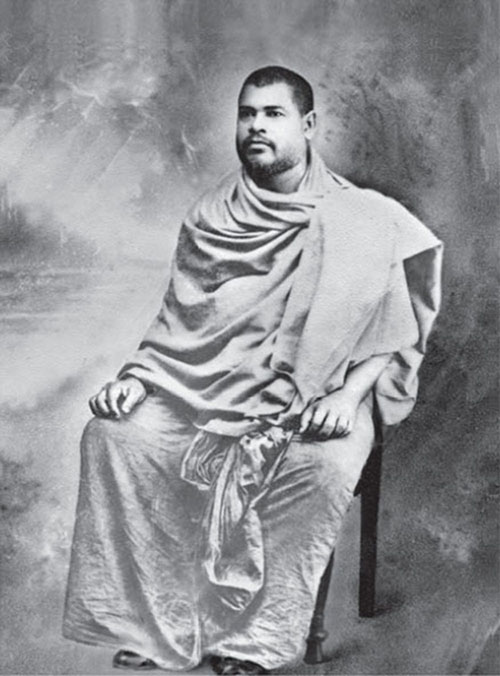
Swami Ramakrishnananda
He would never eat without offering the food to Sri Ramakrishna. He stuck to it even when he travelled by cart or train.
We attended the Gita lectures delivered by him at Trivandrum on two evenings. Words cannot adequately express how we felt elated by them. Great was the mental peace and tranquillity that we got when we listened to the Swami’s discourses.
[From the Vedanta Kesari, August, 1978, pp. 294-296]
↑ Contents
Swami Atmabodhananda
Swami Atmabodhananda [Satyen Maharaj] stayed with Shashi Maharaj for about a month. He heard from Shashi Maharaj that one day Sri Ramakrishna looked at his lips and asked, ‘Do you eat food cooked by anybody?’ At that time, Shashi Maharaj did not discriminate much in eating food prepared by one and all. But after getting that command from the Master, he never ate in his life from anybody, unless the person was of pure and sattvic nature. He himself used to dress vegetables, give classes for the inmates and while at it, he would not engage himself in any out of doors works. Satyen Maharaj was an innocent seventeen-year-old boy at that time. Someone proposed him to go to the zoological garden; but Shashi Maharaj ruled it out, saying, ‘Brahmacharins should not go hither or thither.’ He never liked the monks to move about outdoors except for some special duty. He would say, ‘The mind becomes restless thereby.’ Of course, he would ask the inmates to stroll on the seashore in the afternoon. He himself used to meditate a lot. Sometimes he would chant ‘Rama’ or ‘Siva’ for an hour at a stretch. He would wake up the inmates early by three or four at dawn and asked us to meditate. He loved Swami Paramananda very much.
[As compiled and narrated by Swami Kamaleswarananda in his book, Sri Ramakrishna Parikara Prasanga, Pp. 73]
↑ Contents
Swami Chidghananandendra Saraswati My Master, Sri Ramakrishnananda
Swami Ramakrishnananda was a tall and well-built person. He had a golden complexion; and a broad and serene face. His eyes shone bright with spiritual light.
When Swami Vivekananda visited Madras on his return from the West, the citizens there requested him to send a sannyasi to their city. Accordingly, Swamiji sent Swami Ramakrishnananda to Madras. Till then, the Swami was performing austerities at the Alambazar Math. Swamiji wanted him to start classes in Madras and teach the Gita, Bhagavatam and other philosophical texts.
Swami Ramakrishnananda started his work in Chennai in 1897. For nearly twelve years, starting from mid 1898 to the end of 1910, I attended his classes regularly. Acceding to the requests of the devotees, the Swami visited different parts of the city every day and talked for one and a half to two hours, both in the morning and in the evening. People belonging to different strata of society and of different castes attended his lectures and benefited from them.
The Swami, being a Bengali, did not speak any Southern language; he spoke only English. He spoke simple and lucid English and even those with only a limited knowledge of the language could easily understand him. I was one of those who listened to his talks regularly. I can assert with justifiable pride that those lectures made an indelible impression on my mind and the change in mental outlook thus brought about can never be altered or destroyed.
Never did the Swami utter an unnecessary sentence. Every word of his brought about a perceptible change in the attitude of one or the other among his audience. He would inspire us and immerse us, as it were, in an ocean of bhakti. Every listener noticed a definite change, not only in his own spiritual life, but also, in his day-to-day worldly life.
Swami Ramakrishnananda regularly celebrated the birthday of his Master, Sri Ramakrishna. The Master’s photo would be beautifully decorated and the Swami would perform the worship with great devotion. From morning till night, a steady stream of visitors would come to participate in the celebrations. There would be bhajans and harikathas and everyone would be given prasada. The main job entrusted to me was to distribute the prasad a. Once, one person was in a great hurry to leave and pressed me to give him prasad a. The naivedyam had not yet been offered and the Swami told me to request the gentleman to wait for a few more minutes. Later, the Swami commented, ‘Why do such people come here at all? Do they really want the sanctified food or merely some fruit?’ Everyday, the Swami offered whatever was cooked for his meals to Sri Ramakrishna—rice, chapatis, dal, vegetables, milk and rolled betel leaf. He would then sit alone, as instructed in the Gita and take his meal.
The devotees sometimes invited him to attend sankirtana. I had the privilege of accompanying him on a few such occasions. The singing would hardly start, when the Swami would stand up and dance in ecstasy. It seemed as though the place was flooded by an ocean of bliss. That was really something to be experienced. I have no words to describe it.
In his lectures, the Swami dealt with the great ideals preached by various Saints and sages. He talked with deep insight. He was extremely broad-minded and liberal. His talks were full of love and he preached religious tolerance. The audience would be elevated to great spiritual heights. His love towards the devotees was beyond description. It surpassed all paternal and maternal love. He showered compassion and selfless love on the poor and the miserable. Many a time, I saw him give away his own chapatis to beggars and destitute and remain fasting and yet totally in bliss.
If a visitor or one of his disciples arrived at meal time, the Swami would make the person sit next to him and force him to share his food. It was his habit to feed others before he himself partook of the prasada.
Once a sadhusanga sabha was organized in a town on the banks of the river Tamraparni [in South Tamilnadu]. The Swami was invited by the organizers to speak on that occasion. He asked me to accompany him to translate his English speech into Tamil....
In Tirunelveli, the Swami pushed me onto the dais and encouraged me to speak, so that I might get rid of my stage-fright. Thus he taught me to speak in public. That night, I went to the river to sleep on its bank, under the open sky. I did not inform him of my intention. He came searching for me and said, ‘Come, you may sleep in my room.’ I was very drowsy and said, ‘Swami, please do not disturb me. I am very comfortable here.’ The Swami laughed and remarked, ‘Oh! You are a greater sannyasi than I!’ and went away.
On another occasion, the Swami was invited to speak at the Garudotsava celebrations at Kanchipuram. He again took me along. We were put up at the residence of an advocate. That gentleman pointed at me and asked ‘Is he your disciple?’ ‘No, no,’ said the Swami, ‘Such boys are my teachers. If boys such as this one, with deep interest in Vedanta do not come to me, I would turn an idler. Then, I might be an entirely different person. They constantly remind me of the Lord and His Glory. So, I am eternally beholden to them.’ What a contrast between him and a few other spiritual teachers who consider themselves gods, think they have discovered great philosophical truths and expect their disciples to worship their feet!
There was a Bengali brahmachari at the Math, who served the Swami well. A high official, a disciple of the Swami, enquired if the young man was his cook. ‘God bless you,’ exclaimed the Swami, ‘He is my God, the giver of my food (annapradata).’
The Swami made no distinction between the high and the low nor did he discriminate on grounds of religion, caste or gender. He looked upon all equally. However lowly a person, whatever the profession he practised, the Swami condemned none. This indeed is practical Vedanta.
The Swami had tremendous faith in the Gita and put the teachings into practice. On the eve of Sri Ramakrishna’s birthday, I went to the Math at five in the evening. I said, ‘You have announced that there would be Daridra Narayana Seva (literally, ‘serving the poor as God’—here, feeding the poor) on a large scale tomorrow. You do not have even a single bag of rice. How will you manage?’ The Swami lovingly admonished me, ‘You fool! Have you no faith in Mother Annapurna? She takes care of her children. We should surrender ourselves at Her lotus feet and remain carefree. She is capable of performing miracles.’ We were discussing thus and lo, there arrived at the main gate a couple of bullock carts laden with bags of rice, ghee tins, vegetable baskets and other food items. Both of us were amazed.
In his talks, the Swami emphasized purity of thought, proper attitude of the mind and devotion to the lotus feet of the Lord and said these were more important than external rituals etc. He said, ‘Many of us consider ourselves Shaivites, Vaishnavites and so on. This is an error. Almost all of us are slaves to woman or gold.’ The Swami’s great concern was to develop a spiritual attitude in his devotees. He would say that before retiring to bed in the night, one should at least for a few minutes, reflect thus: ‘Have I striven today to remove anger and lust from my mind or at least tried to reduce their intensity? Have I tried to inculcate any good habit or virtue? Some fool has said that character is seventy-five percent spirituality. I say it is one and a half times spirituality.’ In this way, he attempted to build the moral life of his disciples.
He condemned the practice of sannyasin s and heads of the Maths accepting personal gifts either in cash or in kind. Once a head of one of the Madhva Maths came to Chennai and camped there for two months. He demanded that every Madhva householder should contribute a month’s salary to him. If any householder failed to do so, he would be subjected to some punishment such as a social boycott. One of the Swami’s disciples was a government official. The Swami sympathized with him: ‘You do not have a large income but have a large family to support. You to contribute a month’s salary! I don’t think it would be a sin if that vile man is punished.’
He himself never kept any money offered to him by the devotees. He would take whatever was needed to purchase that day’s provisions and return the rest. I witnessed this on many occasions. He resented the touch of money. When he was invited for lectures, the hosts had to give the carriage fare directly to the coachman. He repeatedly emphasized Sri Ramakrishna’s teaching that it was essential to renounce ‘lust and gold.’ The Swami was, as it were, an embodiment of dispassion and renunciation. Being in his holy company, a householder lived as an ideal householder, a brahmachari as an ideal brahmachari and a monk as an ideal monk.
The Swami fell ill quite often. Any little strain caused by walking or talking would tell on his health; he would remain breathless for quite some time. He had a sort of eczema on his right leg for which he applied some ointment regularly. He suffered often from body-aches and I had the privilege of massaging his body several times. He never excused anyone who committed any mistake. He always emphasized truthfulness, honesty and harmony between thought, word and deed. He said that young people should dress in a simple manner, eat only once a day and cultivate good habits. The Swami totally condemned hypocrisy in spiritual matters; he did not tolerate those who appeared to be virtuous and spiritual but acted like brutes.
The Swami lived for several years in the Ice House belonging to Sri Biligiri Iyengar. When Sri Iyengar passed away, his heirs were reluctant to let the Swami stay there any longer. Swami understood this and decided to leave the place immediately. He said, ‘I am a sannyasin. I think it is better to sit there on the beach and spend my time meditating on God’s beauty.’
[From the Vedanta Kesari, July, 1998, pp. 248-250]
↑ Contents
Sister Devamata
My close association with Swami Ramakrishnananda counts among my most precious Indian memories...[He] stands as a towering figure in my Indian life. He was an inherent part of it from the moment when he waited on the station platform to greet me as the incoming train brought me to Madras, until he leaned through the railway carriage window to give a parting word of counsel as the outgoing Bombay mail carried me westward. Apart from our official relation as superior and member of the rank and file in the Religious Order to which we both belonged, the warmest friendship existed between us - a friendship mellowed on my side by profound reverence and on his side by a mother-like solicitude for my well-being. There was always a bigness and a majesty about him that impelled. He had a way of sweeping aside the belittling details of life and leaving large spaces for nobler thought and action. He shared the riches of his thought and living with me unstintingly and he gave me a most generous confidence. When a turn of circumstances forced me to open a letter bearing his name and I explained the incident to him, his reply was: ‘You are free to open all my letters. I have no secrets from you.’
The journey to India consumed thirty-eight days...We entered the harbor of Bombay...A day of quiet sight-seeing and I was again on my journey. I travelled all night, the following day and the next night. As we were due to arrive in Madras at an unseasonably early hour, I had wired the Madras Monastery not to meet me. Great was my surprise therefore to hear my name spoken outside the window of my compartment before the train had ceased moving; and still more surprised was I when I stepped from the railway carriage and found a group of twelve or fifteen Indian gentlemen waiting to greet me, with the majestic figure of Swami Ramakrishnananda at their head.
There was quite a line of carriages as we left the station, but the others took the shortest way through Mount Road to the monastery; while at Swami Ramakrishnananda’s request our carriage went by the Marina, one of the beautiful park-ways of the world...
The first rays were tipping the top of the high Temple tower as we turned from the Marina and entered the village of Mylapore. The carriage skirted two sides of the Temple tank, a large body of water filled with pink lotuses, passed beside a coconut palm grove and drew up at the monastery gate. Those who had been at the station were already there and others had come to welcome me, so there was a numerous gathering. Their hearty cordiality touched me profoundly.
Swami Ramakrishnananda first led me to the Shrine, then to a large table at the far end of the hall where breakfast for me only had been set out. He was as loving and watchful as a mother with a home-coming child. He kept laying fruit after fruit on my plate, refilling my tea-cup and urging me to eat with such persuasiveness that I was forced to overstep the usual limits of my morning meal.
About nine, I was taken to my own living quarters. They had hired a large house for me obliquely across from the monastery on the edge of the palm grove we had passed; but at the last moment illness had prevented the former tenants from moving out, so in the late evening before my arrival they had made ready in great haste some unused rooms in the Primary School building. The school, which was two squares away from the monastery, stood opposite the Temple and the lotus-covered tank. The Swami himself insisted on going with me and several devotees of the work followed. He carried in his hand a picture of his Master, Sri Ramakrishna, which he had given me and some sticks of incense....
....After we had seen all the rooms, Swami Ramakrishnananda opened the door of a storeroom and pointing to a bushel-basket full of cabbages, cauliflower, egg-plant and less familiar green things, he said: ‘We thought you might like to cook your own food.’ My heart sank. I knew that at a certain stage of the spiritual life the devotee was expected to prepare his own meals; but to cook that pile of vegetables on a one-burner blue-flame kerosene lamp which I did not understand and in such heat, seemed a greater discipline than I could bear. My face must have betrayed my dismay, for the Swami added quickly: ‘We can send you your food from the Math (monastery) if you prefer.’ I acceded eagerly and he motioned to one of the younger men to carry away the bushel basket. With it went a load from my mind.
The incense was lighted, the Swami chanted a few holy texts, then they left me. The Swami returned at three to see if all was well with me. I was forced to keep him waiting a few moments. When I entered the outer room, he was seated on the rug with a quiet smile on his face, apparently unmindful of the intense heat at that hour. I began to apologize for my delay, but the conventional words grew empty and died on my lips when he answered: ‘It did not matter. I have been sitting here thinking of God.’ Then he told me that he was forced to go into town a little later to hold a class, but that a gentleman of Mylapore was sending me his carriage for a cooling drive along the sea front.
On his way home from the class Swami Ramakrishnananda stopped a third time to see whether I was safe and unafraid in the great empty, silent house, doubly silent and empty after the noise and varied sounds of school hours. I was not unprotected, however, as a Brahmin family lived in a bungalow just below my rear window and a peon slept on the verandah across the main entrance. The Swami stood talking in the hall. When I was in the middle of a sentence, with unheralded brusqueness he said: ‘Sister, go and rest,’ and walked down the stairs.
For an instant I was stunned, then I remembered a warning given [to] me that these occasional moments of abruptness might occur. They were not infrequent and sprang, I believe, from a sudden indrawing of the thought. Whenever the Swami wished to cut short a conversation or bring a visit to a close, he always did it with those four brief words, ‘Sister, go and rest.’ The sentence became proverbial.
At six the next morning, a worker was sent from the monastery to see how I had slept and later Swami Ramakrishnananda himself came. I mention these details to show how warm and generous was the welcome accorded to me by the members of the monastery and by every one... I found later that when the letter announcing my coming reached Swami Ramakrishnananda, a number of gentlemen, devoted to him and to the work, had called a meeting to discuss how they could best look after and provide for my needs and comforts...
My house was now ready. The previous tenants had gone, the wood-work had been scrubbed, the walls whitewashed and everything made fresh and clean. The anniversary of Sri Ramakrishna’s birthday was approaching and Swami Ramakrishnananda chose that as an auspicious day for my moving. The morning was spent at the monastery assisting at special religious exercises in honor of the festival. It was noon when I returned to the school and a little later the boys from the Students’ Home, a branch of the work, came and carried off my two steamer trunks and the few household articles that had been purchased for me. Then I was told that I must not leave my apartment until someone called for me.
I understood why, when at three I drove by the house on my way to the monastery. The entire front of the house had been decorated. Green festoons hung between the heavy pillars of the verandah and there were garlands of mango leaves over the entrance. On either side of the steps stood tall banana stalks and over them hung green coconuts. Each branch and leaf and fruit had an auspicious significance.
We formed into a little procession at the monastery gate. Swami Ramakrishnananda carried my holy pictures and bade me walk beside him with lighted incense, next came some devotees of the monastery and last a line of students from the Home. We walked down the sunny road, over a tiny bridge, into a door-court, up the steps, between the banana stalks and under the mango gardens. At the door we paused to stoop and touch the threshold in salutation to the invisible Divine Presence that had gone before us into the dwelling. Then we crossed the hall, mounted the stairs and entered a high-beamed upper chamber. Here we made an altar of my writing table, took our seats on straw mats and for a half hour the students chanted the rhythmic Sanskrit lines of the Upanishads...
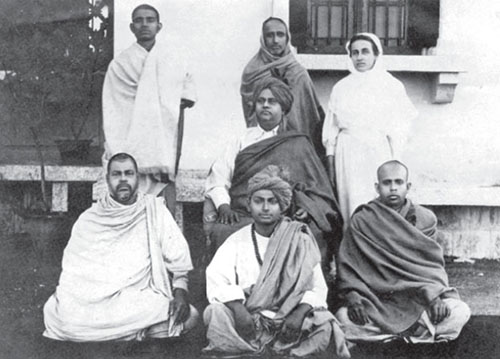
Group Photo at Ramakrishna Math, Bangalore (1909)
Standing: Unidentified, Swami Atmananda and Sister Devamata:
Sitting on chair; Swami Brahmananda:
Sitting on floor (from left): Swami Ramakrishnananda, Swami
Ambikananda, unidentified
.All my social life was lived in the large hall down-stairs...To protect me from too frequent intrusion, Swami Ramakrishnananda made it a rule that every one desiring to see me should go first to the monastery and he determined whether I should be sent for or receive the visitors in my own house or not see them at all...
At the monastery all food was prepared as an offering and that it might be the more carefully made ready, Swami Ramakrishnananda himself prepared and cut all the vegetables for the daily curry. He sometimes spent two hours of the morning on this task. The household was a small one in the beginning of my stay in Madras—the Swami, a Brahmacharin or novice and a Brahmin cook, a Bengali boy of seventeen who had been brought from Orissa. Many fruits and sweets also were offered in the Shrine for visitors. Everyone who came to the monastery was given some blessed food—even the coolie who brought a bundle.
Whenever a vegetable was specially palatable, I would speak of it and Swami Ramakrishnananda would say in unvarying reply: ‘Did you like it, Sister? You shall have it every day.’ The result was a lengthening of my bill-of-fare until I had eight or ten dishes at a meal and to prevent the addition of more I had to give up expressing my appreciation. I did not discover until long after that Swami Ramakrishnananda himself prepared all my food, fearing lest the Brahmin cook would season it too highly for my delicate digestion. It was only one more proof of the unfailingly loving care he always gave me. I write of it in humble gratitude.
One afternoon I was sleeping when I heard the call of ‘Mother, Mother.’ I jumped up and ran to the front door and the back gate. There was no one. I looked again, still no one. Then going out on my verandah, I saw a man in the tree with his cloth full of fresh leaves. In the evening when I went to the monastery I told Swami Ramakrishnananda of the incident and asked him if he knew who had called me. ‘The tree,’ was his answer. And he continued: ‘You were sleeping, your subconscious mind was uppermost, so you were able to hear the appeal of the tree for protection.’ It seemed a matter of course to him. He used to say that ‘plants were conscious animals without the power of locomotion.’ Everything for him was pulsing with life and consciousness.
I saw Swami Ramakrishnananda very seldom during the heated hours of the day; but when the evening coolness began to fall, tempering the sun-scorch of midday, I would go across to the monastery, accomplish the simple duties I was allotted there and assist at Arati. Then I would take my place on the rug near the Swami in the monastery hall and listen—listen so intently that I was able to go home and write down later all that I had heard. Sometimes others were present, sometimes we were alone, but always the Swami talked with the same ardour of feeling.
Once when he had talked long and impressively on a lofty subject, I exclaimed: ‘Swami, you talk to me as if I were an audience of a thousand.’ ‘You are,’ he replied quietly. But whether he spoke from the platform or in conversation, his message was always peculiarly his own. He admitted to me one day that his Master had entrusted to him a certain special message to convey to the world which he did not give even to Swami Vivekananda. ‘Swamiji was given the big, all-round message but a little message was kept for me,’ he said. That he transmitted it faithfully and forcefully, none can doubt. He sought no glory for himself in doing it. He rarely referred to his own experience in his lectures and classes. His Master was the paramount authority cited at all times...
...I recall one afternoon when he sat on my upper verandah for four hours talking to me of God and godly living. His face was alight, his whole being seemed to glow with the exalted joy of his thought. Suddenly he rose, strode down the narrow brick stairway and along the dusty road to the monastery gate. His step was so uplifted, his bearing so lofty that as I watched him approach the gate, quite spontaneously and involuntarily I felt surprise that he was not as tall as the monastery. He looked to me taller.
At Mylapore, he did not always perform puja. Sometimes out of courtesy he would pass the privilege to a visiting Swami, or he would let Rudra take it. Rudra was the Brahmacharin who served him and as the eldest son of a Brahmin widow, he was carefully trained in the rites of worship.
When the Swami himself took it, he would call for his chuddar, throw it around him with a wide gesture and stride into the Shrine, erect and stately as a sovereign. There was, however, no arrogance in his kingliness. It was the natural outcome of his lofty heritage. He was the disciple of a mighty Master, son of the great Mother of the Universe; could there be a more royal tradition to shape life or bearing? ‘Divine Mother does not like us to call ourselves Her servants,’ he said to me more than once. ‘We are children to Her, not servants. Always think of yourself as Her child.’
When the lights were brought in the monastery hall, Swami Ramakrishnananda invariably saluted them with clasped hands as symbols of the light of Divine wisdom or illumination and there was a moment’s quiet for silent prayer. No matter how earnestly he might be absorbed in conversation, he never let this holy moment pass unnoticed. After the lamps were lighted, incense was carried over the house, then came Arati or Vesper Service...
At first we did not have music; but after the Head of the Order had been in Madras for some months and had introduced it into the Service, Swami Ramakrishnananda was reluctant to eliminate it, so we continued the evening chant and hymn. They were in Sanskrit and very beautiful, but Swami Ramakrishnananda had no voice and Rudra and I still less.
Swami Ramakrishnananda would begin each stanza a tone higher than the previous one until we would be singing against the top of our heads. As we went up, the tempo ran down. Once or twice Rudra tried to quicken it a beat or two and Swami Ramakrishnananda stopped short to say: ‘Why are you hurrying? You cannot feel the meaning of the words, if you go so fast.’ Then we began over again more slowly than before. Yet there was nothing ludicrous about it. No one could sit near Swami Ramakrishnananda at a time of worship without feeling a glowing fervor of spirit. Such power of devotion radiated from him that it lifted the thought entirely above the world and material concerns.
The hour or two after Arati was the time when Swami Ramakrishnananda most often gave his teaching and such words as these were spoken: ‘Do your duty, never grow anxious and do not think of the future. Whenever anxiety rises in you, you become an atheist; you do not believe in God and that He cares for you. If you have real faith you can never grow anxious...’
At half past eight or nine this informal instruction ended and the second meal of the day was taken. When it was ready I left the monastery.
My first experience of a public meeting occurred soon after I reached Madras. A delegation from the Vaishya (Merchant’s) Association came to the monastery to welcome me to Madras and invite me to address their association. Swami Ramakrishnananda accepted the invitation for me. The meeting was to be at six o’clock. When the day arrived a friend took Swami Ramakrishnananda and myself to the city in his carriage.
The members of the association lived in a special district, cut by one long street. They met us at the end of this street with a band of musicians and led us in procession to the hall. All the verandahs and roof terraces on both sides were filled with ladies who waved their hands to us in loving greeting. A spirit of cordial friendliness prevailed everywhere.
When we were all seated in the hall a few words of welcome were said, then I rose to speak. With Swami Ramakrishnananda and a prominent gentleman of Madras on the platform it did not seem fitting that I should consume all the time, so after I had spoken for nearly forty minutes I sat down. Swami Ramakrishnananda rose at once and explained that I had been suffering from fever all the day and it had been only with great effort I had come; that I had done so because I had been unwilling to disappoint them. I could not imagine why he was giving these personal details and on the way back to Mylapore, I questioned him about it. ‘I had to offer some reason for the shortness of your lecture,’’ he replied. ‘They expected you to speak for two hours.’ As he and the gentleman with us each spoke for some time, the assembly lost nothing by my mistake; but I learned then that South Indians like lengthy lectures.
Visitors [to the monastery] were many and bi-weekly classes brought still greater numbers. On Wednesday the boys from the Students’ Home came to the monastery for religious instruction and on Friday Swami Ramakrishnananda had a class in the city. He always took me with him, a gentleman of Mylapore gave us his carriage and we started early to go to the Bazar and lay in supplies for the week. There were occasional amusing experiences on these excursions.
One afternoon Swami Ramakrishnananda wished to buy a large copper cooking pot. We stopped in front of an open booth where long lines of copper vessels rose in steps to the ceiling. Swami Ramakrishnananda selected one, but found the price high. His Tamil vocabulary was not ample enough to bargain; so singling out a shrewd-looking Brahmin in the large crowd which always gathered round the carriage wherever we stopped, he called to him: ‘Will you buy that pot for me?’ Every one stands ready to serve a Sannyasin. The Brahmin replied: ‘Is she a Hindu?’
Swami Ramakrishnananda said again: ‘Will you buy that pot for me?’ And again the Brahmin made answer: ‘Is she a Hindu?’ A third time Swami Ramakrishnananda repeated his request and once more the Brahmin asked: ‘Is she a Hindu?’ Then Swami Ramakrishnananda exclaimed with insistence: ‘What difference does it make? Will you buy that cooking pot?’
The Brahmin bought the pot for much less than the merchant had wanted for it and as a reward Swami Ramakrishnananda told him who I was. He was always careful to make plain that I had not changed my form of faith. Almost invariably he introduced me with the words: ‘This is our Christian Sister.’ He believed in the practice of religion, not in conversion.
I had not been at Mylapore very long when a gentleman of Triplicane came to tell us that the main festival of the year was just beginning and he hoped Swami Ramakrishnananda and I would take part in it as his guests. His house stood across from the Temple. That evening was to be the floating festival, so we made a special effort to go. A friend took us in his carriage. When we reached Triplicane at dusk we found it a surging mass of human beings. The steps on three sides round the pool were packed with people, the steps on the fourth side had rows of countless flickering votive lights. The streets were seething with more people, there were thousands upon thousands.
The crowd fell back for us; and when we reached the side of the pool in front of the Temple gate, we found a wide clear space on the steps. As we took our places here, the float turned and poled its way to the foot of the steps where we stood and remained there for ten or fifteen minutes. This gave us a wonderful view of it. It was broad and long. On the outer edge on either side was a line of men holding flaming torches, next to these were a number of Brahmins chanting Vedic texts in Sanskrit. High up on a throne at the back was the Sacred Image covered with votive garlands. Before it stood the priest waving burning camphor and incense. It was profoundly impressive and as we paid our homage to it there rose in my mind the saying of Sri Ramakrishna:—
“Bow down and worship where others kneel, for where so many have been paying the tribute of adoration the kind Lord must manifest Himself, for He is all mercy.”
As we moved away I said to Swami Ramakrishnananda: ‘How fortunate we were to find such a splendid place and to have the float come across the tank (pool) just as we got there.’ He replied in a quiet matter-of-fact tone: ‘It was all done specially for you.’ I was bewildered and amazed. I had not dreamed of such a thing.
Dancing still forms a part of religious worship in India. As a rule it is very restrained and ingenuous. To certain anniversaries at the monastery a large band of cobblers invariably came. When it was their turn to sing the praises of the Lord, they would form in a long line across the monastery hall, with their arms out and their hands resting on one another’s shoulders. The leader stood in front. As the song began, the line of worshippers would start to sway and move slowly towards the altar set up for the day at the opposite end of the hall. The leader clapped his hands in rhythm and the musicians danced like the others, playing all the while on violin or tamboura, tuned drum or a small cymbal which has the sound of a triangle. Their earnestness and sincerity, added to the strongly marked rhythm, made it deeply impressive.
When the swaying line reached the altar, it broke into single swaying figures and the contagion of devout feeling spread until nearly everyone in the large hall was dancing. There was one boy of twelve who danced with special grace and ardor. On more than one occasion Swami Ramakrishnananda joined the dancers. I remember one festival when, swept by his devotion, he took his place at the far end of the hall with his face turned across his shoulder towards the altar, his arm and hand outstretched and pointing to it. The other arm was curved as in fencing.
In beat with the song he swung round and extended the other arm, curving the one that had been extended; thus in slow stately turns he approached the altar; and not once did his eyes leave it or an arm cease to point towards it. The fixity of his concentration could not fail to stir the deeper emotions. Every one fell back and watched him. He had said to me in the morning: ‘Sister, if you see me begin to dance, stop me.’ But I could not have checked him any more than I could have broken in on him at a time of deep meditation. He seemed the embodiment of rhythmic prayer, the spirit of worship incarnate. When he came to a stop before the holy place, a sudden consciousness of many eyes roused him, he left the hall quickly and did not return for an hour or longer.
Swami Ramakrishnananda did not let anyone forget the sanctity of the monastery. More than once when a thoughtless visitor took out his daily paper and began to read, I heard the Swami say to him: ‘Put away your paper. You can read that anywhere. When you come here you should think on God.’ He did not hesitate to administer even more drastic rebuke when he felt it would be beneficial. Once a bombastic Pandit came full of plans for reforming Temples, schools and society in general. Swami Ramakrishnananda listened to him for a long time, then he said quietly: ‘I wonder what God did before you were born.’ The man grew abruptly silent, a really helpful conversation followed and he went away in a more wholesome frame of mind.
Medieval records tell us of a young monk who went to Brother Giles, one of the first followers and closest companions of St. Francis of Assisi and complained that in his day’s schedule there was too much labour and too little prayer. Brother Giles looked at him and replied dryly: ‘If you would beg of the Lord, first work for Him.’ These words might have been spoken by Swami Ramakrishnananda, so perfectly do they express his mood and attitude of mind. He had a strong belief in prayer, but not as a way of escape from work. Once I heard him admonish a devotee to pray every day and to make his prayers reach the Lord by their sincerity and earnestness; but never in my hearing did he offer to pray for anyone, or did others ask him to pray for them. If they had, they might have received the same answer that Brother Giles again gave to someone who came and said with lament in his tone, ‘Pray for me!’ ‘Why don’t you pray for yourself?’ was Brother Giles’ retort.
To find favour in Swami Ramakrishnananda’s eyes one had to be genuine. The Swami showed little patience with the Pharisaical type of spirituality that ‘fasts to be seen of men.’ For a time there was a boy at the Mylapore Math whom I liked very much. He had a pleasant disposition and a friendly manner. Swami Ramakrishnananda was kind to him and seldom rebuked him, but accepted very little service from him. I wondered at it. Only later did I understand. One early morning the boy left the Math and did not return. He was tired of work and wished to meditate. Swami Ramakrishnananda smiled and said: ‘He will not go far in the religious life. He is not sincere. When he claimed to be fasting, he would slip off by himself and eat something; and when after his bath he would sit in meditation, he would lie down on his mat and sleep. He thought I did not know. That way you cannot get anywhere. You must be genuine if you would advance in the spiritual life. You may cheat a man for a time, but you cannot cheat God. Nor can you deceive the world for long. Your face, your tone, your manner will betray you.’
An atmosphere of aloneness enveloped Swami Ramakrishnananda. It was not created by lack of companionship. His intervals of solitude were few, except for those he stole from his sleep at early dawn or in the quiet hours of the night. There was a constant coming and going in the monastery hall where he sat. Members of the household moved back and forth, visitors came and went, servants brought offerings of fruit or vegetables. Rare were the solitary moments in the day, yet the Swami seemed alone. The impression sprang, I believe, from his unconditional detachment. It was so complete that it insulated him. I do not know whether he was conscious of it or not. We never spoke of it specifically, but one day I made a passing reference to it and his decisive reply was: ‘I am full of God; what need have I of anyone else?’
He said no more, but the thought must have lingered in his mind; for a few days later he recurred to it again, saying: ‘Aloneness means singleness. When there are two, there is always fear. We think we need a companion to protect us. If we have to go out on a dark night or if we have to enter an unlighted house, we want another person with us. We say, “Let Gopalan come. I do not like to go alone.” In reality fearlessness exists only when we are alone. When we are alone we can dance or sing or make faces, do whatever we like; but let a friend come and at once we begin to be careful about what we do. There comes a sense of constraint. We grow self-conscious. Fear exists when there is duality, fearlessness exists when there is only One. Since we cannot be happy so long as we fear, we shall not be able to find peace until we can say, “I am alone. I need nothing”.’
These words reveal Swami Ramakrishnananda’s perfect freedom from human dependence. His being was complete in his contact with God. Yet there was no lack of love for mankind in his heart...’If we cannot love others, if we cannot serve others, what are we here for?’ were the frequent words on his lips...
Swami Ramakrishnananda was not a philanthropist, yet his whole life was consecrated to the service of humanity. He did not carry food to the hungry or clothe the naked, yet he gave to men with bountiful hand. His delight was in service and whatever he did, glowed with the warmth of his own fervent spirit. I remember still the light that shone in his face as he moved about supervising the preparations for a festival day at the monastery, during which thousands of poor people were fed... At the first festival held at the Mylapore monastery after my arrival in Madras we fed eight thousand poor and at the next one the number rose to ten thousand...
The food was served in a large market place which was built and presented to Mylapore by a philanthropic resident of the community...The preparation for the feeding was carried forward with great zest...Swami Ramakrishnananda had begged the rice and I remember that that first year five hundred pounds were contributed...By the time everything was in readiness to begin, it was long after midnight. There are special cooks whose trade it is to prepare these mammoth feasts. They arrived about one. A little later Swami Ramakrishnananda who with his fervour had been the impelling spirit in all the preparations, conducted a short religious service, after which the fires in the trench were lighted and the cooking began with the blessing of the Lord upon it.
Yet there was nothing in his manner which indicated that he thought he was ‘doing good’. His attitude towards such forms of practical service was not the usual one. ‘Work for others is self-amelioration,’ was the way he defined it to me one day. Helping others was an opportunity for the giver and laid no weight of obligation on the one who was helped. ‘We need to serve others,’ he claimed, ‘in order to lift ourselves up out of the state of degradation and selfishness into which we have fallen. We should be grateful to the needy for making it possible for us to raise ourselves. That is the only real good that comes out of all that we do for others, we merely better ourselves.’
His heart was large and generous, overflowing with dispassionate love; but he was a Sannyasin, one who had renounced; and that meant he must be even-minded in praise and blame, honour and dishonour, victory and defeat. ‘When a man is vilified, yet shows no resentment or even annoyance,’ he said one day, ‘you may be sure he has conquered his ego and is completely detached.’
His detachment was complete. I saw him meet disappointment, criticism, condemnation, antagonism, waxing and waning of his work, even loss by death, with a smile on his face. He would sit cross-legged on a rug near the north door of the monastery hall in the earlier Math at Mylapore, his powerful body bare to the waist—as was the custom under the burning skies of Madras—one hand holding his foot and rocking gently back and forth with rhythmic regularity. Thus he would sit and tell me quite casually of some blow that had been struck at his calm and his courage.
Swami Ramakrishnananda was peculiarly inexpressive regarding his feeling for outer things. I heard him voice very rarely a personal like or dislike. His judgements were not formed by the reaction a person or object created in him. They were measured by their relation to an ideal or to the universe, by the largest unit of measure. The whole fervour of his being flowed out when he talked of God or his Master; but for lesser things he showed something akin to unconcern. Even the beauties of Nature did not always move him. I recall one evening when I tried to draw his attention to an unusually wonderful sunset. His response was: ‘This is the hour when one should think on God, not on His creation.’
This apparent disregard of outer beauty arose, not from insensibility to Nature, but from intense inwardness. The Swami’s thought was centred in central beauty. That alone was real to him. ‘What are the Himalayas?’ he exclaimed once, ‘just rock piled on rock. Look at all that is outside—the countless solar systems and the galaxies. The earth in the vastness of the heavens is only a minute point. Of what significance is it? The only reality in this universe is God.’
It must not be imagined, however, that Swami Ramakrishnananda possessed a placid personality. He was too powerful, too positive in his reactions, to be placid...[He] too had his moments of righteous indignation. The cause never lay in himself. Any attack or hostility directed against him left him unmoved. It was disloyalty to the Ideal, negligence or carelessness in the Lord’s Service, disrespect toward that which was sacred and holy, hypocrisy, insincerity—these were the things that roused him, as they did the prophets of old.
Swami Ramakrishnananda was at all times indifferent to personal appearance. Once when he had a bald unflattering photograph taken, I said to him: ‘Swami, why did you let yourself be photographed in that way?’ His answer was: ‘How could I help it when I look like that?’ He was always an imposing figure, but his features were plain save when they were lighted by his smile, which transfigured them and lent them a rare spiritual beauty. I had involuntary proof of this. I was standing on my upper verandah one late afternoon watching a carriage come down Brodies Road. A face appeared at the carriage window and I thought quickly, ‘What a marvellous smile,’ then I saw that it was Swami Ramakrishnananda.
It was characteristic of Swami Ramakrishnananda that he should have set as one of the last tasks of his life to prove how and where mental space merges into spiritual. Indian philosophical teaching holds that each sphere of activity, physical, mental and spiritual, has its own space with its special dimensional conditions. The Swami believed that if he could open the higher realms of thought by scientific demonstrable steps, he would provide a satisfying religion for all material scientists, who now look upon pure spiritual verities as undemonstrable visions.
He requested the professor of a local college to procure for him all the latest, most authoritative books on astronomy and he began a zealous study of them. It was not difficult for him to understand even the most abstruse among them, as he was an able mathematician and played with logarithms as a boy with marbles. More than once when I went across to the monastery in the early morning I found him sitting on his mat by the open door working out a problem in trigonometry as a pastime.
There was no deception in his mind however regarding the limitations of this outward method. It might carry him to the farthest reach of vastness, but there would always be space and more unexplored space beyond. He knew that his ultimate course must be inward... The Swami’s researches grew more and more introspective as he proceeded. He spent long hours in profound thought and interior seeking. How far he advanced in his investigations I never learned, as I left Madras while they were in progress and he made no reference to them in his letters. At no time were they allowed to absorb all his effort. He kept ample leisure for other occupations. Often I found him with a worn Sanskrit tome in his hand. He was deeply versed in this language of the ancient Indo-Aryans and believed that it had a quality not shared by any other language.
Swami Ramakrishnananda was one of the best Sanskrit scholars in the Order and could converse in it, when no other medium of communication was available...He always believed that it was his knowledge of Sanskrit which constituted his chief qualification for the South Indian work. ‘It was because I knew a little Sanskrit and was a strict vegetarian that Swamiji sent me to Madras,’ he said to me one day.
I had a convincing proof of his Sanskrit scholarship one afternoon when some South Indian Pandits came to the monastery. They knew neither English nor Bengali, Swami Ramakrishnananda’s native tongue and he had too limited a knowledge of their tongue, Tamil, to carry on a serious conversation in it, so the Pandits proposed that they converse in Sanskrit.
The Swami sat on the rug opposite them rocking slowly back and forth, as he often did and giving ready answer to their questions or remarks. Suddenly without understanding their words, I realized that the conversation had turned on me and in a moment the Brahmins began intoning the melodious lines of the Sanskrit Scriptures. Swami Ramakrishnananda explained to me that he had requested them to chant that I might hear how they chanted the Vedas in Southern India. The Pandits had wonderfully mellow voices and as the swaying words rolled from their lips, marked by a low clapping of hands, it had the rhythmic fundamental sound of a long ocean swell with an occasional breaking wave as accent.
A profound acquaintance with the Vedas by no means gave the full measure of the Swami’s Scriptural learning. He was an untiring student of all the great Scriptures. He knew the Bible from cover to cover and expounded it in a spirit and with an understanding which are rare even in Christian countries. Every Friday at six he held a class at the Hindu Theological High School. When Good Friday came, he talked on the Crucifixion. ‘His depth of his feeling and the vividness of his description could be possible only to one who “had seen” as Browning makes St. John say in his “Death in the Desert.”
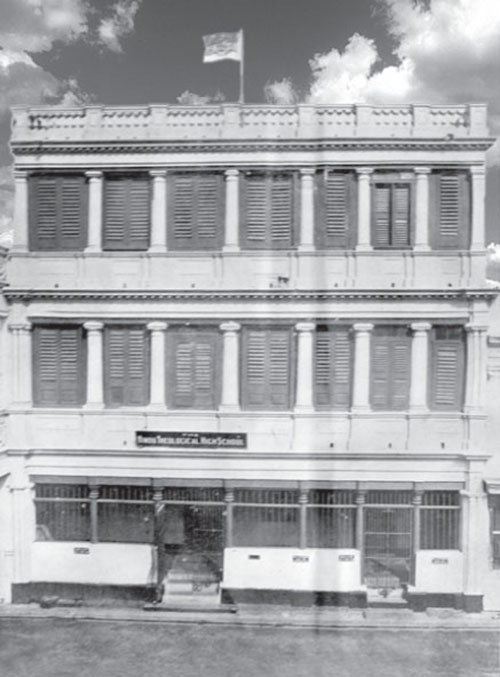
Hindu Theological High School, Chennai
My whole being was stirred by the living reality of his words and as we drove home I asked how he could make them so real and living. He sat silent for a moment, then he said quietly and simply: ‘My Master used to tell me that in a previous life Saradananda and I were Christ’s disciples.’
‘I remember when the Salvation Army first came to India,’ Swami Ramakrishnananda said to me one day. ‘We were all boys and sometimes we used to follow the procession and even join in the singing, not out of fun but because we really liked it and believed their work was good.’
Swami Ramakrishnananda went to the [Dakshineswar] Temple and saw Sri Ramakrishna for the first time about a year or a year and a half after Swami Vivekananda. Swami Brahmananda was the first to join the Master, then Swami Vivekananda and one by one the other disciples followed. Nearly all of them had had some contact with the Brahmo-Samaj and had heard its leader speak of the great sage at the Temple of Dakshineswar. In telling me of this, Swami Ramakrishnananda said: ‘We none of us came to Sri Ramakrishna through Keshab directly; but we all had intense admiration for Keshab, so we thought: “If Keshab Chander Sen whom we regard as so great pays such great reverence to this man, he too must be very great indeed.” So we all went to see him.’
...’I was a vegetarian from my young boyhood,’ he told me one day when speaking of his early life. ‘I read a book by Lord Gouranga and at once I gave up all animal food. If I found fish in the curry, I would eat plain dry rice and go away. When I came to Gurumaharaj he told me it was very good for me to be a strict vegetarian.’ His Master also advised him to observe the regulations of his caste. To some others of his disciples Sri Ramakrishna gave quite different counsel; but he evidently foresaw that Swami Ramakrishnananda’s work would be in South India where strong emphasis is laid on caste observance.
When Sri Ramakrishna passed away Swami Ramakrishnananda made a vow that he would not desert his Master’s ashes. His brothers in the nascent religious Order went out to wander as mendicant monks and were not heard from during long periods, but for twelve years he kept unbroken vigil in the Shrine dedicated to his Master. He brought the water from the Ganga for use in the daily worship, he polished the altar vessels, he gathered the flowers, he prepared the food for the offering to the Lord and never wearied of his holy service.
Often for dress he had had only a piece of cloth large enough to cover his loins and as he carried the large jar of water on his shoulders, the servants along the river bank joked with him and treated him as one of them. I heard from others that he never indicated by manner or gesture that he belonged to a Brahmin family of high standing in the community.
‘We were so full of ardor in those days, we did not care what we had or what we did not have,’ Swami Ramakrishnananda said, in telling me of that time [in the Baranagar Math]. ‘We had no money to buy mats to sleep on, so we slept on the bare floor or ground and when we got up in the morning our bodies would be smeared with dust. There were not Dhotis enough for every one, so some of us had to be content with a loin cloth. When we went to the Ganga to bathe we would wash out our Dhotis, spread them to dry, then take our bath and the first ones out got the Dhotis, the others had only loin cloths, which meant they had to stay at home.
‘Often we had only plain dry rice to eat and that once a day. We had no dishes, not even leaf plates. There was one piece of matting, this we would wash, put the rice on it, sit round and eat from a common pile. But we did not mind. In our hearts was burning a fire of renunciation which the Master had lighted and we were blissful even in our poverty.’
Swami Ramakrishnananda remarked to me one day: ‘In the beginning we had no thought of mission. We believed that all we had to do was to realize the ideal the Master had set before us, which meant living and serving humbly. He never talked to us of special mission or special work. If we had believed we had some special work to do, probably we would have lived very differently. We would not have spent our strength in so many severe austerities.’
For many years he conducted the daily worship in the Shrine with unwavering ardor. His fervour of spirit was specially manifest on feast days. There was one particular Festival of the Divine Mother which tested his endurance in prayer to the utmost. It comes in the late autumn and calls for continuous worship during twenty-four hours. This long interval is usually divided among several celebrants, but Swami Ramakrishnananda would take his place before the altar at six o’clock on the morning of the Festival and remain there until six the next morning without moving from his seat. It was regarded as little short of a miracle even by his Brothers in the Order, some of whom also had great power of spiritual endurance. Several of them spoke to me of it. To Swami Ramakrishnananda it seemed nothing remarkable.
One day I asked him how he was able to do it. He replied modestly: ‘Devotion can accomplish anything.’
There rose in my mind a story he had told me. I give it in his own words:—
‘One day in the forest Rama and Lakshmana stopped by a clear stream to rest. There they saw a crow, apparently parched with thirst, yet each time it would go down to the water, it would turn again and come back without drinking.
‘What a foolish crow this must be,’ said Lakshmana, ‘to be suffering from thirst here on the bank of a stream of cool water and not to drink a single drop.’
‘Do not judge so hastily, my brother,’ Rama replied. ‘This crow is a great devotee of God who is constantly repeating His name. Whenever he goes down to the water to drink, he remembers that in order to drink he must cease to repeat the name of the Lord and he cannot bear to do that, so he goes back without drinking.’ And the Swami added: ‘The true devotee is like that, he never thinks of himself. He is so full of the thought of God that his own self is forgotten. This body is only an instrument, a passive instrument and an instrument really has no existence of its own, for it is wholly dependent on the one who uses it. Suppose a pen were conscious, it could say, “I have written hundreds of letters”, but actually it has done nothing, for the one who holds it has written the letters. So because we are conscious we think we are doing all these things, whereas, in reality we are as much an instrument in the hands of a Higher Power as the pen is in our hands and He makes all things possible.’
Often and often the Swami would repeat a holy name with as tireless zeal as the crow devotee. I was wakened more than once before dawn with his voice sounding in my ears and I knew he was on the roof terrace of the monastery lost in devout thought. The rise and fall of the name in sacred cadence would go on and on without a break. I have known it to continue unremittingly from three o’clock until five with scarcely pause for a breath.
During the time of worship in the Shrine some worshippers ring a little tinkling bell; and Swami Vivekananda, when he was in an iconoclastic ultra-monistic mood, would taunt Swami Ramakrishnananda for his mediveal bell-ringing tendencies. But in reality Swami Ramakrishnananda was not bound to these outer forms and observances, for he said to me one day:—
‘Every devotee must practise discrimination to be a true devotee. All these things—going to Temples, waving burning camphor, making Bhajanam (singing holy songs) are for beginners. They are the first standard. They are meant for people who in the midst of their worldly activities might not otherwise remember God. A man is hurrying by on some matter of business, he looks up and sees the gate tower of the Temple and for a moment he remembers, “there is a God.” That is good, but it is only the initial stage...You must go beyond all external observances and realize God in your heart...’
If Swami Ramakrishnananda was a conservative in his mode of worship, he was essentially a liberal in his religious conviction. Tolerance, universality of outlook, freedom from all prejudice, these formed the keystones of his thought structure. Religion he defined as ‘the struggle of spirit against matter,’ and he gave welcome to whatever helped in the struggle. When someone came with words of condemnation on his lips, I heard him say: ‘Never find fault with any form of religion...The kernel of every religion is God...’
...In April, a Swami of another Order came to the monastery to invite Swami Ramakrishnananda to lecture before a religious congress which he organized each year at Tinnevelly [Tirunelvelli]; he asked me to speak also. Swami Ramakrishnananda accepted for himself but declined very emphatically for me. ‘You would never be able to stand the heat,’ he explained after the Swami had gone. ‘And I do not intend to let them put you on an elephant and parade you in the procession round the streets, as they would be sure to do.’ There is always a procession in connection with the Congress.
Before the Swami set out for Tinnevelly, a devoted follower, who occupied an important office in the Mysore government, paid us a visit. He gave form to our plans by suggesting that he rent a house at Bangalore and that Swami Ramakrishnananda and I become his guests. There were two branches of our work there, a large plot of land had been procured by the Order and Swami Ramakrishnananda had been considering the advisability of our going there to beg the money for building a new monastery. I shrank a little from the idea, but I said nothing, especially after Swami Ramakrishnananda remarked that begging was a test of egotism and we could measure how much ego we had by how much we minded it.
Bangalore is three thousand feet above the sea level and has a much more temperate climate than Madras. It was possible therefore to go and come more comfortably at all hours and as soon as Swami Ramakrishnananda arrived from the South we began our begging. We went out for several hours every day. The Swami gave to me the task of making the appeal and nearly always it met with friendly and generous response, but occasionally we received rebuffs. There rises in my memory one notable instance.
We went a long distance to the house of a high official in the Maharajah’s service and waited for two hours to see him. When he came in, I began my usual explanation of our errand. Suddenly, he cut me short with the abrupt words: ‘I cannot understand why they make so much of this Ramakrishna.’ I was silenced. There seemed nothing more to say; but Swami Ramakrishnananda turned to him with a glowing smile and said: ‘Let me tell you of him. I was his personal servant.’ Then the Swami began to talk of his Master with such impelling fervour that he caught the gentleman’s interest. For half an hour he listened with growing attention, then he excused himself and left the verandah. When he returned, he carried in his hand a contribution to the new monastery building.
The Dewan (Prime Minister) of Mysore showed the keenest interest in our project and was eager to have the new monastery under way. After we had been begging for nearly a month, he sent us a request to meet him at the property the following morning at half past seven. We imagined that he wished merely to go over the grounds and hear more definitely of the plans for construction. Great was our amazement as we approached, to see the road crowded with carriages and on arriving to find the Dewan with his whole staff, many other notable officials and twenty or twenty-five coolies already there. He greeted us cordially and explained that he was impatient to begin the work and he meant to have the ground cleared at once. He had brought with him a state architect.
A corner stone had been laid some time before, but its position was not considered satisfactory, so a new site was chosen, measurements taken, the brush cut and everything made ready. Then the Dewan handed me a wooden mallet and asked me to drive the first stake to mark the foundation. This I did, the space for the building was lined off, Swami Ramakrishnananda chanted some verses from the Scriptures and the morning’s ceremony ended. The begging continued until a sufficient fund had been collected, after which, plans were completed and the building was begun.
Our routine at the Bungalow [where we stayed] went on despite constant interruption. Swami Ramakrishnananda continued to prepare the vegetables for the curry. He gave to me the privilege of caring for the Shrine. Every afternoon without fail he brought from the garden a double handful of jasmine flowers with the request that I string a garland to offer at the Vesper Service. It seemed to give him the keenest joy to pick these fragrant blossoms for the Lord. Visitors came in great numbers. Swami Ramakrishnananda was deeply revered and beloved in Bangalore and many sought him out to have instruction from him. At times the hall was so full, it was like a class.
Our life continued in this groove for a month, then there came a radical change. Our host returned to his official duties, the bungalow was given up and we became guests of the Maharajah of Mysore, moving to the royal guest quarters at the other end of Bangalore, several miles away. The plan was that we should remain here for a short interval, then go to Mysore City, the capital of the province, where the Maharajah was at that time. The Dewan hired a house for us there and made everything ready for our coming.
On our return, it was proposed that I go on a lecture tour in conjunction with a judicial party that was to make their semi-annual circuit of the villages in a certain district of the province. The judge was to hold court during the day and there would be a lecture every evening. These circuits were made in great state. They were away from hotels and railroads, so the journey was by carriage, the nights were spent in royal tents and there was a retinue of servants to make and break camp.
It would have been a unique experience but all our planning was made abortive by an attack of fever which overtook me a few days after we had moved to the royal guest quarters. We believed that it was only malaria. It was the monsoon time and many people were having their customary attack, so it did not seem necessary to give up. Public activities were no longer possible, but the time was not wasted. Swami Ramakrishnananda spent it enlarging my knowledge of the sacred Indian epics and minor Scriptures in the traditional ancient Indian way, by word of mouth.
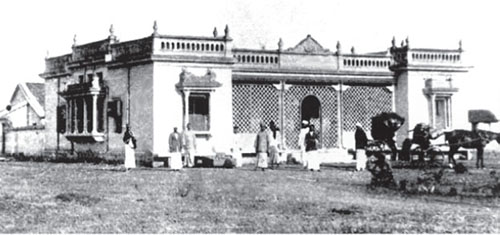
An archival photo of Bangalore Ashrama
One afternoon he was obliged to go out on an important mission and left a friend with me. On his return his first question was ‘What have you been talking about?’ The gentleman replied that he had been relating stories from the epic Ramayana. ‘That is good,’ Swami Ramakrishnananda exclaimed in gratified tones, ‘I meant to tell you not to waste Sister’s time by foolish worldly conversation.’
Another day a member of the Maharajah’s official staff came to see us. He thought to entertain me by retailing some harmless court gossip. While he was speaking Swami Ramakrishnananda shifted his position in his chair again and again and showed such evident discomfort that finally I asked if he did not feel well. ‘I’m all right,’ was his answer, ‘but I do not like your conversation.’ The gentleman took the rebuke without offense and changed the subject...
I visited a very ancient and holy cave Temple at Bangalore. Its grounds and picturesque lake adjoin the property where at present our own monastery stands. At that time however it was not built and we lived in temporary quarters more than a mile away. Swami Ramakrishnananda took me and we walked out with the gentleman whose guests we were. It was the evening hour. The Temple was still and wrapped in shadow. A few worshippers waited in the garden before the Temple. Arati, the Vesper Service, was late and the door was locked.
We sat down in the darkness of the Temple porch. It was not the priest who came to conduct the Service but the priest’s son. When he saw me he demurred, but Swami Ramakrishnananda swept aside his anxiety by a commanding sweep of the arm and the words: ‘God’s child must go to God. Come, Sister,’ so we entered. We assisted at the weaving of the lights; made Pradakshinam, going three times round the Shrine bending down at times to avoid the low roof of the cave; watched a wedding party that came for blessings; then we walked home in silence under a wonderful starlit deep blue sky...
While we were in Bangalore, Swami Ramakrishnananda took me to the marriage of the daughter of a devoted friend of the work. He was reluctant to go, but he wished me to see the fire-lighting ceremony...
One day [at Madras] in early autumn Swami Ramakrishnananda said to me: ‘Swami Brahmananda is coming to Madras for six months. I am going to Puri to bring him.’ A week later he set out on his northward journey. At the station, on leaving, an incident occurred which revealed anew his unvarying habit of thought. Through a misunderstanding no place had been reserved for him in the train and the only thing available was an upper berth in a compartment with two Englishmen.
A person of Swami Ramakrishnananda’s size and weight in a lightly built upper berth meant no little peril for the one who slept beneath and the English travellers did not hesitate to talk of it with rude frankness. Swami Ramakrishnananda paying no heed to their words sat cross-legged on the long seat of the railway carriage, rocking slowly back and forth, a smile of calm unconcern on his face. In reply to an indignant comment from one of the many who had come to see him off, he said quietly: ‘Do not mind. Divine Mother will take care of me.’
The hour for departure arrived but the train did not move. Five, ten, fifteen, twenty minutes passed, still the train remained motionless. Then the station-master came running down the platform calling: ‘Engine derailed! All out! Go to track number five.’ He stopped to say to Swami Ramakrishnananda: ‘I have a place for you. Wait a moment.’ When he returned, he led the Swami to a single first class compartment with washroom attached. As Swami Ramakrishnananda stepped into it he said to me with the same quiet smile: ‘I told you Sister, that Divine Mother would look after me.’
...With all his breadth and loftiness of vision Swami Ramakrishnananda was as humble and simple as a child. There rises before my mind the memory of one morning as he talked with me while I ate my breakfast. He sat on a light foldingchair and as he rocked back and forth I was afraid every moment it would break under his heavy weight. The Head of the Order had arrived at the monastery three days before and Swami Ramakrishnananda had come over to request me to go in town and make certain purchases for him. When he had finished enumerating what was needed he asked abruptly: ‘Sister, what do you think of our President?’ My reply was: ‘I think he is very wonderful, but I am a little afraid of him.’ Swami Ramakrishnananda leaned far forward on his chair and whispered, ‘So am I.’
He confided to me then that the President, Swami Brahmananda, had been scolding him gently for not being more careful about wearing the Sannyasi color. As I looked at him and saw his dress—orange to the waist, a brown chuddar about the shoulders and beneath it a pink and white striped shirt—I could not but feel that the President had some reason for his reproach.
The new monastery building [at Bangalore]...was completed in January. We were all in Madras at the time. The Head of the Order, Swami Brahmananda, had come to the South and accompanied Swami Ramakrishnananda to Bangalore...[On the day of the opening of the new monastery,] the Dewan made the opening speech. Swami Brahmananda followed, reading his address; next Swami Ramakrishnananda spoke; after them came several others and I was the final speaker. The key was handed then to Swami Brahmananda, who unlocked the door of the monastery and entered. All those who were on the verandah made a tour of the building, returning to the central room which had been converted temporarily into a Chapel.
There the real consecration Service conducted by Swami Ramakrishnananda was held...Swami Brahmananda, Swami Ramakrishnananda, Swami Atmananda and several younger Swamis took up immediate residence at the new monastery. Swami Ramakrishnananda opened a class which met every evening after the Vesper Service and life fell into a quieter routine...
The Spanish Carmelite monk and mystic, St. John of the Cross, declares in his Spiritual Maxims: ‘Faith is the greatest shelter of the soul.’ It was in this safe shelter that Swami Ramakrishnananda sought refuge. If storms of doubt ever overtook him, he weathered them in silence and alone. He never made them known to others. His faith seemed impregnable, whatever the stress of circumstance. As a youth, when he was frequenting the Brahmo Samaj, he had been assailed by vague questionings; but the touch of Sri Ramakrishna’s thought had dispelled them, almost without words. Tests he had and severe ones. There were moments in his public life when it seemed as if the Master had abandoned him, leaving him to the mercy of an indifferent multitude, but he did not waver. One occasion I recall, which tried his trust so bitterly that he buried his face in his hands and as he cried aloud for release, great heroic tears trickled through his fingers; yet he never doubted the one on whom he called.
He could say of his Master as truly as did St. Paul of his, ‘The life I now live in the flesh I live by the faith in the Son of God.’ His feeling was shown in these words spoken to me one day: ‘If we are caught in a labyrinth and someone comes and says, “I can show you the way out,” what do we do? Follow him. And the gratitude we feel is what we call worship and devotion. This person is the Guru and we should follow him implicitly, if we want to escape from the labyrinth. Sometimes, however, we think: “Why should I follow him? Let me find my own way.” So we go off by ourselves. But he is always so patient and loving that he waits until we grow weary trying to find the way alone and come back to him.’
Surrender was a favourite theme with the Swami. He recurred to it constantly and whenever he talked on it, his words burned deep into the heart. Spiritual fruition would come, he believed, only to him who had the desire and the power to yield himself up wholly captive. All must be given if all was to be received...
...[Once] the Swami sat under a tall coconut palm outside the monastery door. It was the evening hour. He was silent and abstracted. It was evident that his thought was wholly inward. A question or two passed unanswered. Once he looked up and said: ‘Excuse me Sister, but this is a time I like to be quiet.’
Later the meditative mood passed and he began to talk, referring to certain trying conditions which had arisen. I felt rebellious that such things should come to disturb the tranquil tenor of his life and I expressed my feeling. He lifted his head, his eyes lighted up and there was an undaunted ring in his voice as he replied:
‘My life is eternal. This little life belongs to God. He created it. Let Him do with it what He will.’
Shortly before I left Madras, as we were driving back from the city one evening, I expressed regret that I was leaving when he had so few to help him. The answer that came was direct and uncompromising:—
‘I do not need any one to help me. I am all full of God. What need have I of anyone else? If He sends people to help me, I am satisfied. If He does not send, I am satisfied. I know that whatever he sends is for my good and is the best thing for me.’ □
[Extracts from the book Days in an Indian Monastery, Sister Devamata, published by Sri Ramakrishna Math, Chennai, the Vedanta Kesari, May 1932-33, pp. 17-20; June 1932-33, pp. 59-62; July 1932-33, pp. 105-107; September 1932-33, pp. 176-178, December 1932-33, pp. 296-293; February, 1932-33, pp. 371-373; March 1932-33, pp. 411-413, April 1932-33, pp. 458-460, May 1933-34, pp. 14-15]
↑ Contents
PART - 3 (Reminiscences by Lay Devotees
Ramchandra Dutta Shashi, the Highest Illustration of Dasya Bhakti
The service of Swami Ramakrishnananda to the Master was incomparable as also inimitable. If in the world there is any word called service, Shashi Maharaj alone knew it through and through. If anyone may be called a true servant of God, Shashi’s name can be uttered before all the rest. If someone wants to see the manifestation of devotion without motive, he will find Shashi as an ideal. Shashi was full of virtues alone and no vice. Of course, there goes the saying that man cannot be faultless. Shashi used to serve the Paramahamsa Deva with single-minded devotion without any prejudice, without bias, without argument, without any selfish motive. If that is a fault, Shashi of course had it. We have heard of the servantlike attitude of Hanuman; Shashi has demonstrated the supreme example of that attitude. We have not found among the devotees of Paramahamsa Deva a single character like such a crest-jewel of all devotees. We are not exaggerating facts. Whoever went to Paramahamsa Deva had a selfish purpose in mind, as to how one should be rid of all miseries, how to practise spiritual disciplines, how one can tread the path of yoga and such ideas. But, Shashi had no such desires. He had learnt to serve his Guru as a way of self-surrender and without any desire. That was religion to him and he has fulfilled himself through that practice. Whoever listens to this story of Shashi’s devotion like a servant will also attain devotion undoubtedly.
Blessed are you, dear Shashi! You had learnt real service. The essence of religion, the quintessence of work, is service to the Guru. If there is anything to fix your eyes on, it is the lotus feet of the Guru! If there is anything to do, it is the worship of the feet of the Guru; and if there is anything to hear, it is the praise of His qualities! Oh Shashi, you have done that to the fullness of your heart and soul without any expectation. Sometimes, it seems that you had done penance like Panchatapa [the austerity which is done sitting amidst five fires] in your previous birth or had offered the blood coming out from your split throat to the Lord in order that you might serve him in this birth; hence the Lord assumed the disease and lay like an inert object before you in order to accept your service. O brother, you only understood the true duty of a human body. Hence, you are the object of special favour of the Lord. By His mercy, you are the crest-jewel of all His servants today. Just as we feel proud to call the Lord our Guru, in the same way, we feel proud to call you as His worthy servant. You are unique!
[Source: Sri Sri Ramakrishna Paramahamsadever Jivan-vrttana, Ramchandra Dutta, 8th edn., Ashadha, 1402, Udbodhan, Calcutta, pp.170-71 and Swami Ramakrishnananda, Swami Jagadiswarananda, Ramakrishna Mission Sevashrama, Midnapore, West Bengal, 1355, p.6.]
↑ Contents
‘M’ Encounter of a Father with His Son
Shashi’s father came to the [Baranagore] Math. He wanted to take his son home. During Sri Ramakrishna’s illness Shashi had nursed the Master [Sri Ramakrishna] for nine months with unswerving zeal. He had won a scholarship in the Entrance Examination for his academic ability and had studied up to the B.A., but he had not appeared at the examination. His father, a poor brahmin, was a devout Hindu and spent much of his time in spiritual practice. Shashi was his eldest son. His parents had hoped that, after completing his education, he would earn money and remove the family’s financial difficulties. But Shashi had renounced the world for the realization of God. Whenever he thought of his father and mother he felt great anguish of heart. Many a time he said to his friends, with tears in his eyes: ‘I am at a loss as to my duty. Alas, I could not serve my parents; I could not be of any use to them. What great hope they placed in me! On account of our poverty, my mother did not have any jewelry. I cherished the desire to buy some for her. But now all my hopes are frustrated; it is impossible for me to return home. My Master asked me to renounce ‘woman and gold’. I simply cannot return home.’
After Sri Ramakrishna’s passing away Shashi’s father had hoped that his son would come back to his family. The boy had spent a few days at home, but immediately after the establishment of the new monastery he had begun to frequent it and, after a few days, had decided to remain there as one of the members. Every now and then his father came to the monastery to persuade him to come home; but he had not succeeded.
This day [May 7, 1887], on learning that his father had come, Shashi fled the monastery by another door. He did not want to meet him.
[From The Gospel of Sri Ramakrishna, Mahendranath Gupta, Published by Sri Ramakrishna Math, Madras, subsidized edition, pp. 993-994]
↑ Contents
Vaikunthanath Sannyal Shashibhushan—Ramakrishnananda
Shashibhushan, the living embodiment of devotion to the Guru, was born in the village Mayal in Hooghly district. His father Ishwar Chandra Bhattacharya [Chakarvarty]—often compared to a Bhairava—used to say that he had got Shashi by the grace of the Divine Mother as a result of chanting the Chandi a hundred times. That is why Shashi was endowed with inborn divine qualities. Shashi completed his B.A. degree in Calcutta under the loving care of his uncle (father of Sharat, later Swami Saradananda). He frequented Dakshineswar led by the hunger of his soul. No one knew when the two cousins Sharat and Shashi, though living under the same roof, would visit Sri Ramakrishna.
Sri Ramakrishna used to say that Shashi was a companion of Jesus Christ. One day, on hearing his exposition of the Bible, Sri Ramakrishna commented, ‘O friend! As long as I live, so long do I learn.’ When Shashi visited Sri Ramakrishna on hot summer afternoons, seeing his flushed face, the Master himself fanned him and also asked us to fan him. Was it a precursor to initiating Shashi into the life of service? The latter felt relaxed, untied the corner of his cloth and took out the lump of ice he had purchased from the Baranagar market for the Master. The Master said in delight—’In such heat even man would melt, but Shashi didn’t allow the ice to melt out of his devotion!’
Shortly after paying the fees for his final B.A. examination, Shashi came to know of Sri Ramakrishna’s illness and immediately devoted himself heart and soul in the service of the Master, even at the cost of his career. In the garden house of Cossipore, many noble-minded youth were engaged in serving the Master by turns. Shashibhushan’s attitude was different. Standing by the Master, he would fan him untiringly without any break. He would even finish his own bath and meals in a short time on that score. Observing his companions stealing out for some spiritual practice during the short recess, he would comment, ‘What’s the point in meditating on an invisible God leaving aside the living God?’
Even though Sri Ramakrishna’s body merged in the collective consciousness after giving up the gross part, Shashi kept fanning the Master, taking him to be alive. Even when the pyre flame was ablaze, Shashi, seeing his adored God lying amidst the flame, started fanning him even there out with devotion and steadfastness. Was he crazy then? No. His one-pointed devotion enabled him to see the Master everywhere, like one stricken with jaundice finds everything yellow. Or perhaps the Lord dwelt forever in Shashi’s eyeballs; so he would see Him everywhere.
The Master used to say, ‘O friend, there’s nothing substantial anywhere; vain is thy conch-blow!’ Shashi was found later to do exactly that—ringing the bell while chanting ‘Jai Gurudev’, ‘Jai Gurudev’, he installed the Master. The pot containing the holy relics of the Lord was fetched from Balaram Mandir. The accessories for worship like kosha-kushi were also collected perchance. In fact, unless Shashi would install the Master in the Temple of Harmony, how could the monastic and householder devotees gather around it? Even the existence of Belur Math along with its branches would have been a far cry. Hence, Shashibhushan might as well be called the founder of the Math. Those who had little means to sustain themselves cannot be expected to be lavish in their ritualistic worship. Hence, the daily worship used to be performed with a few flowers and Ganga water. The only difference was in Shashi’s tireless labour in collecting the flowers that the Master was fond of. He would walk a long distance to collect the Nagakeshar Champa [Nagaeswar] or the rose or Gulancha for the sake of the Master, even at the cost of a dog-bite. The offerings were limited within ginger, batasa and gram. On days when the devotees would bring sweetmeats, the Lord would then have some change of taste. Shashi was very mindful and punctual in offering timely food to the Master and his children. He was indeed fond of decorating the Lord with flowers of various colours. But, whenever he found that such careful selection of flowers like hibiscus would waste his time, he would offer all the flowers together at the feet of the Lord with such earnestness and emotional fervor that one would feel the Lord also delightfully accepted his offerings. Those are unforgettable scenes. Again, at the time of vesper service, Shashi would dance so violently with the words ‘Hail Lord, Hail Lord’ on his lips that it appeared as if the floor would crack under his feet. Those too indeed are unforgettable.
This working hero was so busy in such service to the Lord that he had no time left for meditation. But if at all he had, he would merge in trance in no time. Just as one feels the heat of fire by sitting near it, we also felt the quietude of our naturally restless mind in sitting for meditation in his company. He did not have much inclination for scriptural study and would say that by the grace of the Lord, the knowledge of Brahman, the object of realization in the scriptures, would be revealed. He would often say, ‘Why should I roam miserably leaving this direct God?’ This was the reason why he never went for any pilgrimage. This austere Yogin never cherished the desire for being served. ‘Instead,’ he would say, ‘serve the Lord and you will be fulfilled. Even when shivering with high fever, he would deliriously mutter to himself, ‘The fools haven’t yet done the Lord’s arati,’ and so on. If anyone among us has ever become fortunately full of Ramakrishna, it is Shashibhushan alone. Hence, the befitting name Ramakrishnananda was given to him.
He deeply adored Swamiji as a representative of the Lord. Hence, at the latter’s request he sailed for Madras with the intention of disseminating the Lord’s message in the southern India. In that unfamiliar land, he had no wherewithal; yet a Math came into being in a short time by the influence of his steadfast devotion. Due to some structural defect the temple was brought to the ground. When someone expressed grievance for that, he replied, ‘I have come to this land to throw broadcast the glory of the Lord and not to build a temple nor for name and fame. What’s the good of raising an external temple unless His temple is installed in the hearts of the people?’ The people of Madras, for all their ‘don’t touchism’, became his admirers and never hesitated taking sanctified food in the Math sitting in the same row with people of all castes.
Just like the fragrance from a flower in full bloom spreads in all directions, the fragrance of Shashibhushan’s sacrifice, steadfastness and devotion to his Guru, spread throughout the Deccan. Much later, on a three-month-long pilgrimage to the Deccan, I was amazed to observe the love and respect of all educated people towards Swami Ramakrishnananda, right from Vizag (Visakapatnam) to Rameswaram and to Quilon of Malabar (Kerala), not to mention the Madras (Chennai) city.
Thus Shashibhushan, the one who was ever lost in the thought of the Master, succumbed to the terminal disease of consumption, in his bid to destroy the base desires of the multitude and rests in peace at the lotus feet of Sri Ramakrishna.
[ Sri Sri Ramakrishna Leelamrita, Vaikunthanath Sannyal, Publisher Sudhir Sannyal, 20 Bose Para Lane, Calcutta-3; 2nd Edition, pp.322-26]
↑ Contents
Sarat Chandra Chakravarty
It was about thirty years ago. The Math had just been shifted from the dilapidated house at Baranagar to the ‘haunted’ house at Alambazar. Nag Mahashay had returned to his native place after introducing the author to Shashi Maharaj and Yogin Maharaj [Swami Yogananda]. It won’t be out of place to mention here a little of the state of affairs of the Math in those days. I note down here at least what I saw at the beginning. There was no servant or cook in the Math in those days. Shashi Maharaj used to cook the food to be offered to Thakur; Kanai Maharaj used to go to the market and scour the utensils; Yogin Maharaj [Swami Yogananda], Hari Maharaj [Swami Turiyananda], Sushil Maharaj (Swami Prakashananda) and one or two more brahmacharins would sweep the rooms, dress vegetables, grind spices and so on. Whenever I used to visit and stay at the Math, under the instruction of Shashi Maharaj, I too would enter the kitchen and cook the food meant for offering. Thus, Shashi Maharaj would be a bit relieved from the daily cooking duty.
I also used to occasionally go to the market along with Kanai Maharaj and would consider myself blessed by sometimes helping him in scouring the plates left by the monks after their meal. I did not meet Swamiji yet, nor did I know where Swamiji was or how he was. I only heard from other inmates of the Math much later that Swamiji was then moving about incognito throughout India and after some days had gone to America.
One day, Kanai Maharaj was chanting the Shiva-Mahimna-Stotra in the Math. I realized that the reader was not thorough with Sanskrit. But, I was amazed to note the reader’s absorption. Shashi Maharaj had told him earlier that the Lord accepts the sincere heart of the devotee, even if the latter has little or no linguistic knowledge. In that context, Shashi Maharaj narrated the incident of how Sri Ramakrishna went into deep ecstasy on chanting the verse ‘asita-giri-saman syat....’It was Shashi Maharaj who kept ablaze the spirit of the Math during those days. At times, I was amazed to watch his steadfastness, absorption and spirit of service, while at other times I would think that he was absurd. For, it appeared quite weird for me to see Shashi Maharaj preparing a hookah shortly after the lunch of the Master and holding it for half an hour before the picture of the Master. But, after frequenting the Math several times, my ideas got transformed and I realized that the attitude of service and steadfast devotion find consummation in such earnestness. The sight of aratri in the shrine was worth enjoying. Some young boys without any possession, who had taken the vow of life-long celibacy and renunciation, clad with but a rag round the loin and spending days in utter privation and half starvation, making the loud chant of ‘Jai Jai Jai Gurudeva filling all the quarters! I felt within that these were the veritable gods in human form; that one’s mind really moves Godward at their mere sight or in their company; the heart really pangs in love for God. The heart becomes pure just in remembrance of those golden days at the Math. It seems that by virtue of such holy company and grace of monks, I was blessed with the fortune of getting Swamiji, the veritable Sankara, as my preceptor.
I sometimes used to go to Alambazar Math in the company of Suresh Dutta and Haramohan Mitra, the householder disciples of the Master and also with Nag Mahashay when he came to Calcutta. It was a pleasure to accompany Nag Mahashay. He would drop down anywhere in the Math in ecstasy and the monks would carefully make him seated. I am unable to express how much on seeing Nag Mahashay, Shashi Maharaj would overflow with joy. The two souls would sit together calling out ‘Jai Guru Jai Guru’ with moist eyes and choked voice. Both would go mad in discussing the Master. I was unable to understand everything at that time. Much later, I started realizing a little of it.
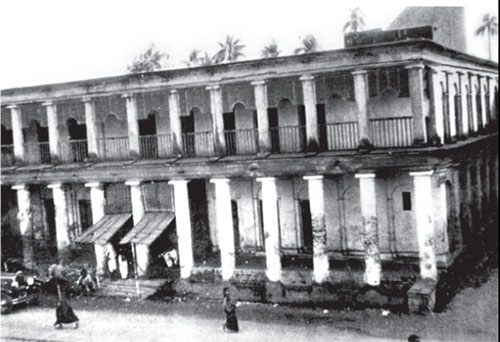
Alambazar Math
Viveka Chudamani was being read every day at the Math. I heard Kali Maharaj [Swami Abhedananda] reading the book. He was quite scholarly. Scriptures were read and discussed in the afternoon. After lunch, everyone used to take a little rest. Spiritual practices were pursued with great enthusiasm, both in the morning and in the evening. Everyone present had to join in that. Among the householder disciples, I could see Girish Babu, Atul Babu, Navagopal Babu, Hutko Gopal, Dr. Nitai, Haramohan and Suresh Babu quite often in the Math. None of them would visit the Math empty-handed. The Math had provisions for rice, lentil and baked bread; whenever available even fish was offered to the Master. Otherwise, it was accordingly to the situation. I used to notice that irrespective of the items; the offered food would be transformed into nectar, as it were, being soaked in the syrup of devotion of the monks. One day, I purchased fish at Sealdah and went to Math. Shashi Maharaj and I together prepared the dish for the offering to the Master. The monks were extremely satisfied to have that prasada. I have not seen such wonderful devotion and love anywhere.
As there was no special arrangement for bathing of the monks, they all used to bathe in the Ganga. Especially the young monks loved very much to take a dip in the Ganga. There was a lot of discussion on the scriptures and on the Master; sometimes a couple of hours would pass in this way. Everyone remained merged in the discussion, forgetting food and sleep. Hari Maharaj one day saw a ghost in the Alambazar Math. After the evening walk, he saw an apparition enter the room below the staircase. He himself narrated this to me. Another day, Nag Mahashay also saw a ghost and told me of it. But, the monks of the Math did not care for that. They would say, ‘We are the demons of Siva; what can ghosts and ghouls do to us?’
[ Udbodhan, 29th Year, 7th issue, Shravana 1334, pp.391-94.]
↑ Contents
Mahendranath Dutta
As in the Baranagar Math, Shashi used to perform the worship of the Master in Alambazar Math also. Being highly diligent and full of vigour, he was the leading figure in all works. In a way, he was like the head of the family whom every member obeyed. He used to perform and direct all works related to the Math. He was equally competent for spiritual practice and study. A few days before his B.A. final examination, he left home and came to Sri Ramakrishna staying at the Cossipore garden house. His past impression for studies was so strong that one day he was jokingly saying, ‘You see, last night I dreamt that only four days were left for my final exam. And I was studying very hard and worrying about how I shall pass the exam. I have left home and hearth for several years now, still the fear for exam is lingering within. That is what I dreamt. This is what is called past impression.’
He was very fond of mathematics. During the Alambazar days, sometimes he used to open a book of maths after 11 o’clock and leisurely work out problems on the slate or the paper. After offering snacks to the Master at 4 o’clock in the afternoon, he would often open the Bhagavatam, read out the anecdote of Rishabhdev and comment to me in an excited mood, ‘Look, this is called a very high state.’ He had read out that very story to the present writer many times.
Once Swami Niranjanananda argued with the present writer about various books. Gradually during the discussion, the topic of Sri Chaitanyadeva rose. The present writer was not at all acquainted with the Vaishnava literature; he only heard of Chaitanyadeva, so he started talking incoherently. Shashi Maharaj was a little away, but he rushed in from there and said, ‘You fellow, have you read the Vaishnava literature?’ On getting the negative answer from the present writer, he said, ‘First read their literature and then argue.’ And he advised me to read the Chaitanya Charitamrita and other Vaishnava literature that were with him. The present writer brought the books and thoroughly studied all of them with bookmarks and then, one day, carried back all the books to Shashi Maharaj, saying that he had finished them all. He wanted to argue with Shashi Maharaj. The latter opened the books and noting that bookmarks had been put, became satisfied and said, ‘You fellow, I am now satisfied!’ and started laughing. The story, though very simple, indicates how ardent Shashi Maharaj was towards study and how he could inspire others into it. Laughingly and teasingly, and through sweet and lovingly words, he could stimulate others into deeper studies.
Once on a hot summer afternoon, the present writer was reading a Christian book and discussing about it with Swami Shivananda. Both of them were seated in the portico of the out-house while discussing. The book contained the biographies of Jesus, Buddha and Mohammad and an account of a comparative study of their characters. The present writer was young, so he did not realize the merits and demerits of the incarnations mentioned therein. Shashi Maharaj was busy attending to the afternoon service in the shrine and was able to hear everything through the window. Suddenly, he appeared before them with an angry air and asked in exasperation, ‘What book are you reading?’ The present writer was about to argue with him. This infuriated him all the more and he raised his right leg, ready to kick, as it were. That terrible figure upset the writer who was completely at a loss to argue. Then Shashi Maharaj became quiet and said, ‘Look, never read those books. To judge those noble souls, world-teachers, the dust of whose feet sanctifies the entire mankind! And a comparative judgement at that! And who’s to judge? One who has never in his life practised an iota of the qualities of those great souls?!’ Hearing that rebuke, the writer realized that one incurs great sin by reviling the great teachers of the world. This is very true indeed. The writer felt ashamed and mentally begged pardon of those great teachers. Since then, neither did he argue in his life about the great souls nor did he allow others to argue with him. If anyone came to argue with him, he would narrate this episode with Shashi Maharaj. A great soul like Shashi Maharaj could communicate a profound message even through his simple actions.
Towards the last days [of] Baranagar Math, Sri Suresh Chandra Mitra contracted the fatal disease of dropsy, probably during the rainy season of 1890, to which he eventually succumbed. All but Shashi Maharaj went to see him [when he was ailing]. Suresh Babu felt a strong desire to see Shashi Maharaj. So, Shashi Maharaj hired a vehicle to call at his home and returned within an hour or so. After that, he did not come to Calcutta.
Shashi Maharaj found it difficult to accept that Sri Ramakrishna had passed away; he believed that Sri Ramakrishna was present in a subtle body. That is why Shashi Maharaj performed all the service to the Master after his death as he would during his lifetime. Such a devotion to the Guru is rarely to be seen. One hot summer night at Alambazar, Shashi Maharaj was fanning himself in his south-western room when he suddenly felt that the Master must also be feeling very hot. Immediately he got up, stood by the bedside of the Master and went on fanning the Master all through the rest of the night. A rare example of service indeed!
Shashi Maharaj cherished no desire for pilgrimage. He considered the service to Sri Ramakrishna as pilgrimage and austerity. He would roar like an excited lion while chanting aloud ‘Jai Gurudev, Sri Gurudev’. For him, all places of pilgrimage merged in the shrine of the Master. He would single-mindedly perform repetition of the holy name (japa). Towards the beginning of Baranagar life, he, then a young boy, had said, ‘I will spend my life in the service of the Master. I have no other wants.’ He has proved the veracity of those words in his own life. He used to perform japa incessantly and advised others also to do that. Japa and service to the Master were his life breath.
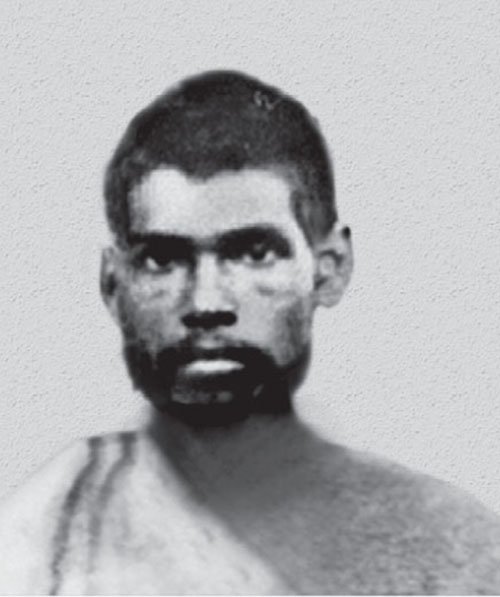
Swami Ramakrishnananda in Baranagore Math
If life in Baranagar Math was full of privations, life in Alambazar Math showed abundance, particularly during the birthday festival of Sri Ramakrishna. Some days, it seemed that mother Annapurna supplied provisions with all her ten hands for the Math.
The devotees started sending the best quality things from Calcutta for the Master. Shashi Maharaj would feed the assembled devotees to their satisfaction and still there would remain many things in excess. He would give away those extra things also to the devotees as prasada; he would not keep anything in stock.
Like a child he would always speak smilingly and would cut jokes at times in a childlike manner. Yet, he evinced a serious mood through his sweet and light talks. None else dared to add jokes to his light-hearted humour. Such a blend of seriousness and childlike simplicity he possessed! He was very fond of chewing puffed rice with bites of green chilli. He would not stop until tears would appear on his eyes. He never liked chapatis or luchis. He liked rice and could consume a large quantity. During his terminal illness at Udbodhan, the doctors kept him under a restricted diet of only a little over one and a half litres of milk. One morning, when the writer went to see him, he complained, ‘See brother, the rascals are drying me up; they give me only one and a half litres of milk. You know quite well of my “Royal Morsel” (he showed with his fingers the size of each morsel he used to eat).’ Shashi Maharaj was a typical blend of fire and water. He demonstrated in his own life how to serve the Guru considering him as alive. He was lean in his early youth and his complexion was dull white, his face had curly beard; but towards the end of life, he became fat.
[Source: Srimad Vivekananda Swamijir Jivaner Ghatanavali, Mahendranath Dutta, Part 2, 6th reprint, Poush 1407, Publisher Sitanath Dutta, The Mahendra Publishing Committee, Calcutta- 6, pp.15-19.]
↑ Contents
C. Ramaswami Iyengar
I have been asked, as one who had the good fortune to come under the direct influence of Swami Ramakrishnananda during the period of his stay at Madras, to detail my experiences with this great saint. But, what am I to say of one ‘the latchet of whose shoes I am not worthy to unloose!’
To me it seems that the Swami was one of those great souls who form the salt of mankind. It is a unique pleasure and privilege on the part of any one to have been under his personal influence for any length of time, however brief. His wonderful devotion to the Lord, his sincerity of heart, his great enthusiasm for work, the sympathy he felt for the ‘lowliest and the lost’—all these form traits in his nature which are never to be forgotten. What supreme control he had over the senses and what a worthy representative he was of the most ancient Order of monks in the world, I cannot adequately describe!
The circumstances that led to the Swami’s arrival at Madras are themselves of great interest. After Swami Vivekananda returned from his successful mission in America, he travelled from Colombo to Almora and preached on his way the great truths of Hinduism to all the common people. To this day, several of us remember the great enthusiasm with which he was welcomed in Madras and the excellent use to which he put it. He was never tired of speaking about the life of Sri Ramakrishna and his greatness and his universality. His lectures and addresses were so impressive that there was a genuine desire on the part of the people here to learn more of the teachings of the Paramahamsa. So, some of the citizens approached him with the request that he should kindly send someone of his brother-disciples to this city to carry on the work of propaganda and to establish a Math for carrying on religious and philanthropic work. Chief among those who took interest in the establishment of such a centre here were the late Mr. V. Krishnaswami Iyer, sometime member of the Madras Executive Council and the late Mr. P. R. Sundara Iyer, Judge of the High Court at Madras.
To meet the wishes of the people, Swamiji replied—the scene is still fresh in my memory, for then he was coming down the staircase in the Ice House where he was accommodated during his stay here—’I shall send you one who is more orthodox than your most orthodox men of the South and who is at the same time unique and unsurpassed in his worship and meditation of God.’
Accordingly, the next steamer from Calcutta—in those days there was no direct railway communication between Calcutta and Madras—brought Swami Ramakrishnananda along with Swami Sadananda to assist him in his work.
Both of them were received kindly by the late Sri Alasinga Perumal and a house was rented in the Ice House Road where arrangements were made for their comfortable living by a few devoted disciples, prominent among whom was Bhaskara Sethupathi, the late Raja of Ramnad.
Sometime later, he moved into an apartment of the Castle Kernan, popularly known as the Ice House, which Swami Vivekananda himself had occupied during his stay in Madras and which therefore carried with it the memory of his holy association.
The Castle belonged originally to Mr. Biligiri Aiyangar [Iyengar], one who had been able to endear himself to Swami Vivekananda. He was one of the supporters of the Math in its early days and he made a provision in his will for the payment of Rs.12 a month to Swami Ramakrishnananda.
As one who came constantly in contact with the Swami for a period of nearly fifteen years, I had many opportunities of observing the daily routine of his life and of noting how complete his self-abnegation was. I can recall many instances of his overflowing kindness, his abounding sympathy and above all his childlike nature.
I first went to see him one evening on my way from college. As I peeped into the room where the Sannyasin was staying, I beheld a figure, sturdy and strong, fair in complexion, with a brow showing depth of intellect and a mind absorbed in the supreme concentration. He was then reading Scott’s Ivanhoe. As I bowed, he asked me to take a seat and made kind enquiries of me and said that he was brushing up his English — as that was the language in which he was to teach and preach to the people of South India. The first few months were occupied in preparation for his great task and in the meanwhile he was picking up friends and gathering round him a circle of devotees. The fact is that his whole life was one of meditation and worship of the Lord at Calcutta Math until he was literally dragged by Swami Vivekananda from his peaceful repose to the scene of his activities at Madras.
Swami Ramakrishnananda was shy of appearing in public or making speeches. His method of teaching was conversational. But whenever he did deliver a lecture, it made a profound impression. If I remember right, the very first public lecture he delivered after his arrival was on Sri Ramakrishna and His Mission, under the auspices of the Y.M.I.A., with Justice Sir S. Subrahmanya Aiyer[Iyer] presiding over. The effects of the address were far-reaching. The Swami had prepared with great care the manuscript of the address which he handed over to me. I preserved it for nearly ten years, after which it was published by Mr. P. R. Rama Aiyer [Iyer].
As days passed by, his following became larger and larger, and his name became a household word in the city. His work was appreciated on all sides. Gradually several study-classes were arranged. At one time, he was holding as many as a dozen of these classes. In Saidapet, in George Town, in Triplicane, in Mylapore—wherever there were men eager to learn about religion and religious truths, he was willing to hold discourses and in his inimitable manner, he was expounding to his eager hearers the deep truths of the Panchadashi, the Gita, the Bhagavatam and other Sacred Books from the treasure-house of Hindu religious lore. And what endeared him to all was his regularity and punctuality in coming to these classes. He would always be five minutes before time in the class room and he would go on with the class even though the attendance was very small. Sometimes, there would be none present except him; even then, he was not disappointed; he would sit through the whole hour in meditation and go home quietly afterwards. The resignation shown by him on such occasions was truly a lesson in patience and forbearance more eloquent than the best preaching of others!
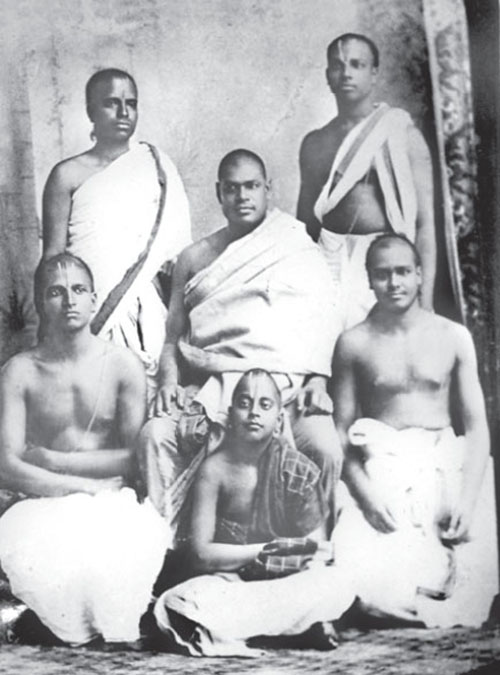
Swami Ramakrishnananda with devotees
On Bilgiri Iyengar’s death, the Castle came up for auction. We felt that if it passed into the hands of a stranger, the Swami was likely to be put to the necessity of looking out for another place to live in and so we were anxious and desired that if possible, some friend of the Math should purchase it. Dr. M. C. Nanjunda Rao became one of the bidders. He had an idea of establishing a hospital and nursing home there.
He offered up to Rs. 16,000 for the house and then gave up. It was knocked down for Rs. 17,000 or so to a Zamindar.
As the auction was proceeding, the Swami sat unconcerned in a far end of the compound, on a long bench, away from the crowd that had gathered. I was watching the bidding and occasionally went up to him to tell him how it was progressing. He looked up and said, ‘Why do you worry about it? What do we care who buys or who sells? My wants are few. I need only a small room for Sri Guru Maharaj. I can stay anywhere and spend my time in talking of him.’
As we had anticipated, the Swami had to subsequently vacate the portion, he had occupied in the main building. He was then lodged in a small out-house in the compound, where he lived, till he moved to Mylapore.
When Swami Brahmananda came to Madras, he heard from us the story about the Ice House. He then remarked, ‘You were not wise in allowing it to pass into other hands. That is a place where Swami Vivekananda had stayed and if you had acquired it for the continuance of his work, it would have been very nice and a fitting memorial to him. If you had only told me, I would have somehow collected the money and would not have let slip the opportunity that presented itself. Shashi is naturally indifferent to such things. You all ought to have done something.’
Though the incident shows two eminent god men seemingly different in their outlook, it reveals unmistakably the greatness of each. Swami Ramakrishnananda was so absorbed in the realm of the Spirit, that he did not care very much for institutions or organisations. But on the other hand, Swami Brahmananda, in spite of his child-like simplicity and the giddy height of spiritual illumination which he had reached, possessed a keen judgement in business matters. This is what enabled him unerringly to pilot the work of the Mission as its first President for over a quarter of a century.
In 1902, a public meeting was held in the Pachayappa’s Hall to devise measures for giving the Mission a permanent footing in Madras. The meeting was largely attended by the citizens of Madras and they resolved ‘to perpetuate the memory and continue the work of the late Swami Vivekananda by establishing an institution in the city for the study and propagation of Hindu religion and philosophy.’ Then an attempt was made to collect funds and in this the Swami did not spare himself. He used to say, ‘Begging is a test of egotism and you can measure how much ego you have by how much you mind it.’ He took the lead and accompanied by one or two young men, went from door to door in Triplicane, Mylapore and other parts of the city. It took two years to collect Rs. 1,700.
Then Mr. V. Krishnaswami Aiyer [Iyer] issued a fresh appeal. He wrote: ‘The Order of Sannyasins to which these disciples of Ramakrishna Paramahamsa belong, is the noblest in the world for the work of philanthropy untainted with any consideration for the promotion of selfish ends. It has been resolved to found an institution in this city where men will be trained to preach the Vedanta, not for a salary or other remuneration, but for the love of humanity. Pandits and scholars will be invited to assemblies periodically held for the discussion and elucidation of Vedantic truths. Agencies for the relief of the destitute poor and the instruction of the masses would be organized under the control of this institution. Funds will be needed for carrying out this noble undertaking. Shall we lack them in this land of a thousand charities? Devotion to duty, singleness of purpose and a faithful discharge of duty voluntarily undertaken must convince the people that their contributions will be well and nobly spent. The reproach will be great, if the opportunity is neglected. Under the blessing of God and the immortal sages of this ancient land, success shall be ours.’
The appeal had a steady response, though slow. With the collections made, the construction of a building was undertaken in 1906 on a small site on the Brodies Road obtained through the kindness of the late Akula Kondiah Chettiar, an ardent admirer of the Swamiji [Swami Vivekananda]. On an auspicious day, Swami Ramakrishnananda conducted the religious ceremonies. It was his desire to bring Swami Brahmananda to inaugurate the function, but it could not be arranged. Some friends requested Swami Abhedananda, who happened then to be in our midst after his first visit to the West, to formally lay the foundation.
Mr. A. S. Balasubrahmanya Aiyer [Iyer] took charge of the work. The building was completed in November 1907 and he wrote to the Secretaries of the Memorial Fund, ‘The final bill for the construction and completion of the building comes to Rs. 5,500; the subscriptions hitherto collected amount to Rs. 4,100; so the deficit has to be met by collecting further subscriptions. The [building] is ready for occupation and I understand Swamiji [Swami Ramakrishnananda] moves into it on Sunday, the 17th November, 1907. I await your instructions as to what should be done on that occasion, etc.’
Early on the morning of the chosen day, Mr. A. S. Bala-subrahmanya Aiyer’s [Iyer’s] carriage waited at the entrance to the Ice House. It was drizzling. The Swami took the picture of Sri Guru Maharaj. He asked me to hold the umbrella carefully, to protect it from the rain, till he got into the carriage. We had a quiet drive and soon arrived at the new building.
It was a simple one-storeyed building tinted red. It stood on a high foundation and had a large roof terrace. Inside, there was a spacious hall and four rooms. From the hall, a door led to an open court where was another building containing the kitchen, dining room and bath room.
The Swami was elated like a child to be inside the new building. He said, ‘This is a fine house for Sri Guru Maharaj to live in. Realising that He occupies it, we must ever keep it very clean and very pure. We should take care not to disfigure the walls by driving in nails or otherwise. Do you see?’
Sri Guru Maharaj was installed in the Shrine and worshipped. Abhishekam and a special offering were made to Sri Kapaleeswara. The Swami said humorously later on, ‘Till now, I was in Triplicane and Parthasarathi subjected me to many trials. But now, Kapaleeswara has drawn me to Him. You know He is the Lord of the Bhikshus, as His name means and He is sure to protect me hereafter.’ Poor people were fed and an assembly of Pandits was called to chant the scriptures and converse on holy subjects. In the evening, a public Meeting was held and the Swami requested Mr. (now Sir) P.S. Siva-swami Aiyer [Iyer] to address those who had assembled. With aratrikam and distribution of prasada, the day’s function came to a close.
When he moved to Mylapore, he had with him a Brahma-charin and a cook. The whole day was one of constant service to God.
As days passed, the visitors at the Math were many. Whenever anyone came in from outside, he had to wash his feet and enter the precincts with great reverence. If a stranger ignorant of the observance happened to come in without doing so, after he left, the Swami would make it a point to have water sprinkled over the place trodden by him and thus purify it. On such occasions, I would remember the words uttered by the Swami about the sanctity of the place on the day he first came into it.
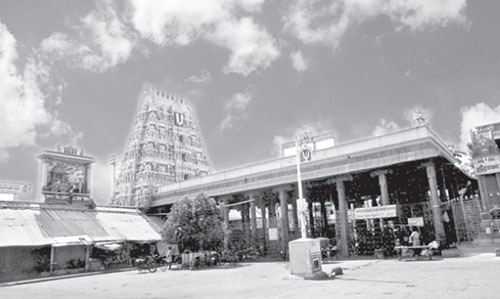
Sri Parthasarathi Temple, Triplicane, Chennai
His method of teaching was unique. It was more or less conversational—instead of being stiff or formal—and it appealed direct to the heart owing to the sincerity with which it was uttered. Time flew past; the minutes grew into hours; but we who were listening to his sublime discourses were enjoying a supreme happiness and felt not how time flew away. Great truths, complicated questions, controversial problems and all the heights and depths of ethics were discussed, but in the simplest manner possible so that even a child might understand them. He had the great knack of disentangling the truth from the unnecessary details in which it remains shrouded and thus of presenting it in all its aspects to the amazement of the audience. For, as he taught us to perceive old truths in a new light, we thought we were under the influence of one who talked not like the Scribes, but like one with authority.
Once, for instance, there was a discussion between him and Mr. Eric Drew, former Principal and Professor of Philosophy in the Pachaiyappa’s College, about religion and politics, during the course of which the Swami summed up the whole by saying that ‘Politics is the freedom of senses while Religion is the freedom from senses.’ For coining such condensed expressions, he had a happy knack which was evinced also in some of his discourses.
On one occasion, for example, comparing the dualistic with the monistic systems of philosophy, he said in words pregnant with meaning: ‘In the dualistic method, enjoyment is the ideal; in the monistic method, freedom is the ideal. By the first, the lover finally gets his beloved and by the second, the slave becomes the master. Both are sublime. One has no need to go from one ideal to the other.’
The various discourses that he delivered on various occasions have now been collected and published in the form of books, the most popular among them being ‘The Universe and Man’ which deals with the message of Sri Ramakrishna and of the deepest truths of Vedanta; ‘Sri Krishna: The Pastor’ and ‘Sri Krishna: The King Maker’ both of them dealing with some of the aspects of the life of Sri Krishna; and ‘The Soul of Man’ which is highly philosophical in its essence. His one great ideal in life was Bhakti or Devotion to God and an embodiment of that ideal he found in Sri Ramanuja. It was his ambition to compose a life of this saint and with this end in view, he visited the various places in which Sri Ramanuja had lived. He conversed with many Vaishnavite scholars and thus gathering material at first hand, published ‘The Life of Ramanuja’ in Bengali for the benefit of his countrymen in North India. His life of Ramanuja written in Bengali is considered a classic work on the subject and it contains ample proof of the veneration in which he held the Vaishnava teachers. Those who have read this book remark that he goes deep into the spirit of Sri Ramanuja and has therefore given a sympathetic account of the great religious reformer.
His respect for Shankara was exceedingly great. When he was in the Castle Kernan, a rich merchant who used to frequent the Math, spoke of Shankara irreverently. The Swami flared up in anger and the gentleman received a rude shaking. Those who stood by, thought that he would withdraw the help he was giving to the Math and later on pointed it out to the Swami. He said, ‘Let him withdraw if he will. Do you think the Lord’s work depends on the mercy of men such as these?’
A similar incident took place on another day in Mylapore. He had been invited to a gathering held for discussing religious topics. In the course of the talk, one of the organisers of the meeting happened to refer to Sankara in a slighting manner, the Swami could not brook the insult offered to the Acharya. He stood up and saying, ‘I have no place where Shankara is not honoured,’ he quickly walked out.
The Swami’s ambition while in South India was to harmonize the philosophical systems of the three great Acharyas in the light of Sri Ramakrishna’s teachings. For this, he was attempting a book in Sanskrit reconciling the three great systems of philosophy propounded by the three Acharyas; but his ill-health caused by over-work made him abandon the idea.
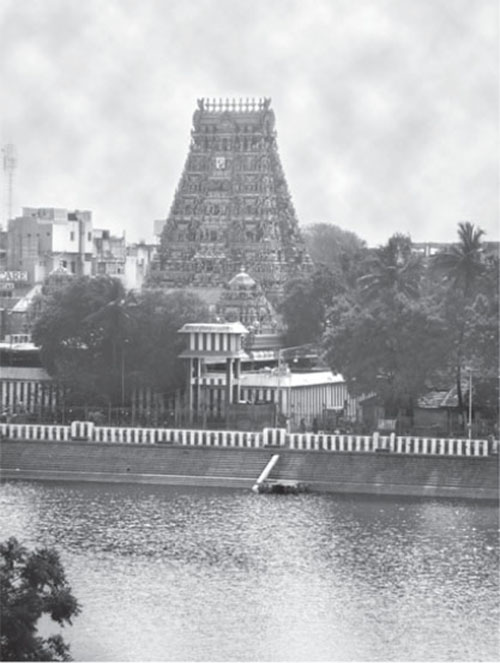
Sri Kapalishwarar Temple, Mylapore, Chennai
Apart from these classes and discourses, the hours in the Math were spent in incessant worship—a worship so deep and so heartfelt that he forgot himself and the world completely. He worshipped his Guru as one who felt his living presence always. It was a sight to see how with tears glistening in his eyes and lips quivering with emotion, he was chanting verses in praise of Sri Ramakrishna.
With what devotion he performed service to the Lord may be gathered from the following incident. One morning, a certain gentleman who was then holding the highest position in Government service, called on at his place to pay his respects to the Swami. It was 10.30 a.m. and after finishing his morning worship, he was fanning the portrait of his Guru, which is still preserved and worshipped in the Madras Math, for a couple of hours and more, uttering along the names of the Lord— Sivaguru, Satguru, Santana Guru, Parama Guru and so on. Our friend was struck with awe and reverence; so he could do nothing but prostrate before him and return home with the idea of seeing him some other day.
During the bhajan, he moved freely with all classes of people. The sudden impulse with which he would begin to chant slokas in praise of the Lord induced all to partake in the dance and completely forget themselves. The only analogy which could probably be compared to this is the famous dances of Sri Chaitanya, the great Vaishnava reformer of Bengal. This was a feature peculiar to him and many that have enjoyed this dance still talk with wonder and admiration of his ecstatic condition of the mind.
His spirit of devotion was contagious and several men who saw him even for a short while caught it, though he accepted none as his disciples. I heard recently from a friend that the Mridangam expert now in the Mysore palace is a great devotee of Sri Ramakrishna. He happened to play on the day Swami Ramakrishnananda opened the National Girls’ School in Madras and the meeting with the Swami on that occasion brought about a change in his life. He remembers that as a blessed day in his life.
Another friend, who is an orthodox Vaishnavite, told me that after his meeting with the Swami, whenever he opened the Tiruvaimozhi for his daily reading and thought of Nammalwar and other saints, there stood before him the figure of Swami Ramakrishnananda. The greatness of the teacher, whom he had seen, helped him to realize the greatness of the saints, whom he had not seen.
He had great regard for Gita, Ganga, Gurubhais [brother disciples] and Guru Maharaj. ‘The Gita and the sacred waters of the Ganges constitute the Hinduism of the Hindus,’ declared Swami Vivekananda. ‘Is it merely patriotism or the impressions of childhood? Who knows? What wonderful relation is this between Mother Ganga and the Hindus? Is it merely superstition? Maybe. They spend their lives with the name of Ganga on their lips, they die immersed in the waters of the Ganga, men from far off places take away Ganga water with them, keep it carefully in copper vessels and sip drops of it on holy festive occasions.’ All this applies word for word to the faith that Swami Ramakrishnananda had in the purifying power of Ganga.
When he first came to Madras, he had not brought Ganga water with him for worship and he longed to have it at the earliest opportunity. In 1899, when Swami Vivekananda started on his second voyage to the West with Sister Nivedita and Swami Turiyananda, he brought a fairly big earthenware jar full of Ganga water for Swami Ramakrishnananda. When the steamer in which he came reached Madras harbour, quarantine regulations owing to plague in Calcutta at the time prevented the ingress or egress of visitors and passengers. The steamer anchored far from the wharf. Friends and devotees, who had gathered in large numbers to meet Swamiji, went in small boats to the sides of the vessel. The presents they had carried were drawn up in baskets and the jar of Ganga water was got down the same way. I was in the boat in which was Swami Ramakrishnananda along with a few others. He had prepared and taken with him several sweets and nice dishes, which he knew were to the liking of Swamis Vivekananda and Turiyananda. These were also sent up. We saw over us the two Swamis and Sister Nivedita, leaning over the parapet of the deck, full of joy and happiness. Swami Turiyananda expressed that he was inclined to land in Madras and stay there. He said to Swami Ramakrishnananda, ‘I am not much enamoured of America and am going on compulsion. If you can go there in my stead, I would prefer to be here.’ When it was time for us to return to the shore, Swami Ramakrishnananda said to me, ‘Please ask the boatman to take us right round the steamer. Let us at least make a Pradakshinam of the two great souls whose feet we have not been able to touch today.’ The boatman grumbled, but Swami insisted on our going round saying, ‘Let us pay the man a few annas more if necessary.’
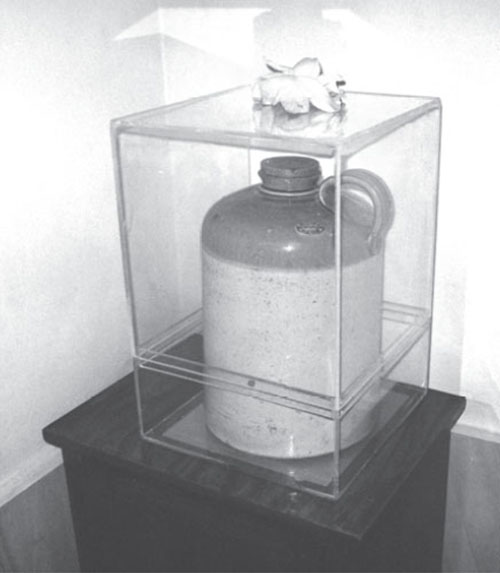
The jar in which Swamiji brought Ganga water from Calcutta
for use in Madras Math in 1899
As for the Gita, the Swami made a point of reading it first regularly every morning; he would never miss it. In his ‘Life of Ramanuja’, what he records as Alavandar’s attitude to the Gita is his own too. ‘Let urgent business remain or not, I have learned that the reading of the Gita is the most meritorious and glorious of all actions. Recitation of the Gita should be attended to first.’ And again he adds, ‘How can he who has enjoyed and understood for a time at least the cardinal truths of the Gita, be attracted by the paltry things of the world? Really to enjoy the sweetness of the Gita, one should possess the force of Bhakti and the untainted wisdom of a pure heart. Nevertheless, even the mere repetition of the holy word that fell from the lips of the Lord cannot be without efficacy; it will surely arouse in the reader an unfailing sense of purity and devotion.’
He would never miss reading the Gita and the Vishnu Sahasranamam early every morning. Once in 1906, when Swami Premanandaji was in Madras, accompanying his mother to Rameswaram, Swami Ramakrishnananda spent a night with them both in the house where Swami Premanandaji’s mother was accommodated. That night, he did not have the Gita and Vishnu Sahasranamam with him. He asked me at a late hour to procure them from a neighbour. He kept them by his side and then only went to bed.
The Swami often used to quote a couplet whose meaning was: ‘How can death frighten one who has read a little of the Bhagavad Gita, drunk a few drops of Ganga water and worshipped God at least once.’
Next is the esteem in which he held his Gurubhais, which almost bordered on worship. He used to consider himself like a true Vaishnavite, ‘the servant of the servant of His servants.’ Once, he was in Ernakulam and was accommodated in the house of a prominent lawyer by name Mr. Duraiswami Aiyar [Iyer]. As soon as Swami Ramakrishnananda went into his house, he said, ‘I have heard that Swami Vivekananda stayed in your house in his Parivrajaka days. This is a tirtham, a holy place. I wish to see first the exact place or room where he stayed.’ Mr. Duraiswami Aiyar [Iyer] replied, ‘He was seated, when he came in, even where we stand now.’ At once, Swami Ramakrishnananda rolled on the floor and kissed the ground, for to him the very dust of the place wherever his leader had trodden was sacred. In Madras and in other places too, wherever he heard that Swami Vivekananda had halted, he used to bow down at the sight of those places as he would at a shrine.
Of his regard for Swami Brahmananda, late President of the Mission, I give here an incident which might be of interest. One day in 1908, when Swami Brahmananda was in Madras, he asked me to procure the photograph of a South Indian dancing girl. I wondered what he wanted it for and when I came to the Math the next evening with the photo, I asked the Swami if he knew anything about it. He was equally in the dark as to the need for this curious requisition and felt that whatever might be his objective, if the visitors to the Math should see it or hear of it, they might misunderstand him. So Swami Ramakrishnananda took the photograph from me, asking me not to mention anything about it to Swami Brahmananda, unless he enquired about it again. Soon after, he did ask me and I had to tell him that the photo had been handed over to Swami Ramakrishnananda. It became evident that he did not approve of my act or the interference of Swami Ramakrishnananda in the matter. Whenever the latter came before him afterwards, Swami Brahmananda would turn away his face and would not talk to him. After a few days, he called for the almanac to choose a day for leaving Madras. Swami Ramakrishnananda could bear this no longer. He rushed into Swami Brahmananda’s room and lay prostrate before him, saying, ‘Pray, be not angry with me. I am an unworthy and insignificant servant. At a mere nod of your head, a hundred Shashis will come forth.’ Immediately, the countenance of Swami Brahmananda was lit up with a smile and the cloud passed away. One cannot help admiring the simplicity and candour of both. Swami Brahmananda was as magnanimous and ready to forgive, as Swami Ramakrishnananda was humble and childlike.
What was Swami Brahmananda’s intention in asking for this photograph, I understood later on. He had desired to send it to a devotee in Bengal who had been somewhat loose in morals. What effect would the receipt of such a picture from his Guru have on him? From then onwards, whenever he looked lustfully at a woman, the all-renouncing Sannyasin would appear in his mind’s eye and melt away the lust. We can remember similar situations in the life of Sri Ramakrishna and how he used to tell some of his householder disciples in lower rungs of the ladder of spiritual life, ‘One may go to the most objectionable place but only let him take the Divine Mother also with him. One may drink wine, only let him offer it to the Divine Mother first and take it and so on.’ Not that, of course, Sri Ramakrishna permitted these things but this was a stage in the process of weaning out weak-minded followers. And Swami Brahmananda like his Great Master, led his disciples in the upward path in new and original ways and even those who moved closely with him could not fully understand at the outset the meaning of many of his actions.
And then, his [Swami Ramakrishananada] devotion to Sri Ramakrishna was complete and could be seen at all times. The Swami’s life was one of continued austerity and privations. He never spoke to any one of his difficulties. At times he would speak out his mind, standing before the picture of Sri Ramakrishna, which he worshipped.
One evening, a few devotees came to the Math to meet the Swami and they understood that he was in the Shrine. Presently they heard him calling out in loud and angry tones, ‘You have brought me here, old man and left me helpless. Are you testing my powers of patience and endurance? I will not go and beg hereafter for my sake or even for yours. If anything comes unasked, I will offer to you and share the prasada. Or, I will bring sea sand for offering it to you and I shall live upon that.’ The devotees who were waiting outside did not quite understand his words and they guessed he was quarrelling with someone. With whom was it? It was with his Master. Such was the intensity with which he felt the abiding presence of his Guru and God.
Another incident comes to my mind. The first building of the Math had cracked in several places soon after its construction and during the rains, water would come down through the fissures in the ceiling. At such times, he would go into the Shrine to make sure that no water entered there. One night it began to drip inside the Shrine too and right on Sri Ramakrishna’s picture. Swamiji stood there holding an umbrella till the night wore out and the rain stopped. Anyone else would have removed the picture to a safer place and gone to sleep but to Swami Ramakrishnananda it appeared that if he did so, he would be awakening his Master from his rest at an untimely hour and that would be wrong.
As regards his meals, he would not take anything unless it was first offered to his Lord. And he would take scrupulous care in seeing that the offerings were all well-prepared. The least carelessness in this respect he would not tolerate. Similarly, it was with greatest care that he performed his puja.
Not only in these, but in all matters of traditional religious observances and beliefs, the Swami was very scrupulous. For example, he would never begin a piece of important work without consulting the almanac; he would never undertake a journey on certain days or Tithis and he seemingly attached great importance to omens and signs and premonitions.
His early training had been of the most orthodox type and when, later on as a Sannyasin, he was free from all social obligations, he still continued in his orthodox habits—like Sri Ramakrishna, he held that these little things, though in themselves not of much intrinsic value, were like the chaff over the grain, which, if removed would take away from the grain its power to sprout. So, these things were necessary to keep the vitality of religion.
When engaged in writing the ‘Life of Ramanuja’, he visited Conjeevaram [Kanchipuram] and Sriperumbudur and collected from several sources interesting stories and incidents relating to the lives of the Vaishnavite saints. When he learnt of the importance attached to Thoothu Valai, a medicinal herb, as a Sattvic food and what part it played in leading to the renunciation of Yamunacharya, he look a great liking to it. He planted it in the Math, tended it with care and included it as part of his daily meal. A Swami, who was in the Math as his assistant, removed it one day, mistaking it for some ordinary weed and this made Swami Ramakrishnananda very sorry.
He reduced the wants in the Math to the barest minimum. He would often say that Bhikshannam is the best for a Sannyasin and ask some of the young boys devoted to him to beg food for him from a few houses nearby. In doing so, he had two objects in view—to keep the ideal of poverty ever before him and also to train the young to feel its glory and be purified by begging. He gave me also ample opportunities of such service.
Whenever he needed some help, he would feel shy of expressing it to anyone. ‘If we cannot get on altogether without help, then why not ask the Lord Himself? Why go to others?’ he would say. Once the birthday of Sri Guru Maharaj was near and no money had been received for the feeding of the poor which was an important item of the celebration. It was midnight and I was sleeping in the Math, when I suddenly woke up, roused by strange sounds in the hall. Looking about, I could see the Swami pacing up and down like a lion in a cage, humming heavily with every breath. I was afraid to see him in that condition, but I understood later that it was his prayer for help to feed the poor. The next morning, money did come. A large donation was received from the Yuvarajah of Mysore, who had begun to admire the Swami, having read a copy of the book, ‘Universe and Man,’ published just then.
He would not allow anyone - visitors, friends or even coolies - to leave the monastery unless they took some prasada and for this purpose, he would always keep some prasada of sweets and coconut laddus.
It was he who started the birthday celebrations of his Guru in Madras; and as Sri Ramakrishna’s delight was in the relief of the poor, he instituted the custom of feeding the poor, which is today attracting thousands every year. The sincerity with which he undertook this task can be understood by the fact that he went to every one of his friends with the request that they should help in making the celebration a success.
His organizing the evening public lectures during the celebrations was not with an idea that people should show off their learning or eloquence, but with an intention that they might thus have an opportunity of studying and learning something of the life of Sri Ramakrishna.
His training of the brahmacharins was so good that those who were with him have proved to be models of patience and self-sacrifice. He made them efface all trace of egoism and equipped them for a life of simplicity and devotion. An American lady—now known as Sister Devamata—came under this great influence and it is due to this that she is doing such good work in the West, preaching the tenets of Eastern Philosophy and its ideals. It was she who recorded every word of what he spoke and took notes of his class lectures; and it is to her that we owe the preservation of his invaluable teachings which are so original and soul-stirring.
Many young men approached the Swami in those days seeking to join the Order. I was acquainted with some of them. One was an intelligent Brahmin youth who had recently returned from Japan. He stayed in the Math for some time and all those who saw him thought he was ardent in his devotion and would stick on to the monastery. But, the Swami was always severe and exacting in his tests for admitting any one into the fold permanently. He would frequently ask the novice to sweep the floor or wash the utensils or do some other menial work. The gentleman referred to above, could not stand it. One day, he remarked, ‘I did not come here to learn all these things.’ And immediately, the Swami asked him to clear out.
Another, was a Vaishnavite Brahmin youth. When the Swami found that he was married and had his old parents to support, he refused to give ear to his request in spite of all his importunities. He strongly advised him to return to where duty called him.
A third, was a keen sportsman who had shot up to eminence in his field. He was a bachelor and possessed strong inclinations to a monastic life. He approached the Swami several times, but he always said, ‘What am I? You should go to our President and ask him if you want to join the Order.’ So he went to Belur. And there the President said, ‘If you are earnest, you must go and serve Swami Ramakrishnananda and come through him.’ When he returned, he was permitted by Swami Ramakrishnananda to stay in the Math. He would always seem meditative and would never share in the ordinary work of the monastery. A truly religious life is not so easily attained. One day, he quietly left the Math and went to live in a wayside hut in Royapettah. Later on, he went and stayed in Tiruvottiyur, where he passed away. He was no doubt a struggling soul, but the Swami did not see him fit yet to wear the orange robe of the Sannyasin.
These are only random instances out of scores of similar ones. And it remains a fact that out of all these, the Swami never admitted even one to sannyasa. The reason is, he held the Ashrama, rightly, far above the reach of ordinary men, conceiving it, as has been declared by the scriptures, ‘sharp as the edge of a razor, hard and difficult to tread.’ It is sometimes said on this account that his stay in Madras was barren of results. But, it must be remembered that he never cared for a following and that he only wanted to take men where he found them and give them a push upward. In the lives of hundreds of men in all stations of life, his influence is flowing silently, still leading them ever on the forward path.
I should like to quote from two letters I have recently received, which bear testimony to the abiding nature of this influence.
One devotee writes: ‘Every big thought brings to my mind our own beloved Shashi Maharaj’s face and his gentle smile. It was a blessed time those days and that makes me proud that we, of all people, had come into contact with that spiritual giant; only we did not know it then.’
Another writes, ‘Those who have taken the dust of the feet of Swami Ramakrishnanandaji have been turned into gold. A mere touch of his has changed sinners into saints. I can myself see well how his touch has affected me and is keeping me up in my spiritual struggle in spite of the many weaknesses and failures in me. But for him, there would not have been a spiritual side to my life at all. We met first at his feet and we shall meet again at his feet.’
He undertook an extensive tour to several parts of this Presidency and it was mainly through his influence that centres were established at Vaniyambadi, Bangalore, Trivandrum, Pudukotai, Dharmapuri and other places. Work and worship were his highest ideals in life and he was always for humble and sincere beginnings.
His love for humanity as a whole was admirable. He found out that, owing to the plague at Coimbatore, a whole family was swept away, leaving only a few helpless children to eke out their livelihood as best as they could. Seeing their pitiable condition he took them under his loving care. This was the humble beginning of what today is known as the Sri Ramakrishna Mission Students’ Home—an Institution which boards and lodges a number of poor boys and at the same time gives them an effective supervision in their conduct of life.
One of his main objectives in life was to take those disciples who were most beloved to the Blessed Lord on a tour to the holy places of South India. It was through his endeavour that Swami Brahmananda Maharaj was made to come here.
Towards the end of 1908, Swami Brahmananda came to Madras. When he arrived, Swami Ramakrishnananda accommodated him in his own room which had been renovated for the purpose. He would himself stay out all the time in the entrance hall, saying, ‘Guru Maharaj and his son will stay inside; I will stay out here and serve them. What more do I want?’ I have often seen him bow unobserved at the entrance to the room where Swami Brahmananda stayed. Such was his reverence to Maharaj[Swami Brahmananda].
Soon after Swami Brahmananda’s arrival, Messrs. V. Krishnaswami Aiyer [Iyer] and P. R. Sundra Aiyer [Iyer] came with presents of fruits and flowers to pay respects to him. Swami Ramakrishnananda introduced them to Maharaj. Before taking leave, Mr. V. Krishnaswami Aiyer [Iyer] said to Swami Ramakrishnananda, ‘Will he deliver a lecture? I shall arrange everything. When will it be convenient to him?’ The Swami smiled and replied, ‘What is there in lectures? He never gives lectures. Men such as he can give religion by mere look or touch.’
Sometime later, Swami Brahmananda went on a pilgrimage to Rameswaram. Mr. V. Krishnaswami Aiyer [Iyer] came forward to arrange for all conveniences.
Mr. T. V. Seshagiri Aiyer [Iyer], (Sir) K. Srinivasa Aiyengar [Iyengar] and a few other friends also subscribed for the trip. Maharaj and Swami Ramakrishnananda were accommodated in a first class compartment. Four young Swamis and I were accompanied in another coach. Mr. V. Krishna-swami Aiyer [Iyer] had specially commissioned me to go with the party to take proper care of the Swamis and look after all their wants.
On the way, when the train stopped at a station, I went to see the Swami. I saw him peeping out of a window with a cigarette in his hand. He took a puff from it, raised it to his head and reverently dropped it down. I was surprised at it for I had never before seen him smoke, though smoking was very common in Bengal. He told me, ‘This is holy prasada.’ He had taken the cigarette end from the hands of Maharaj after he had smoked.
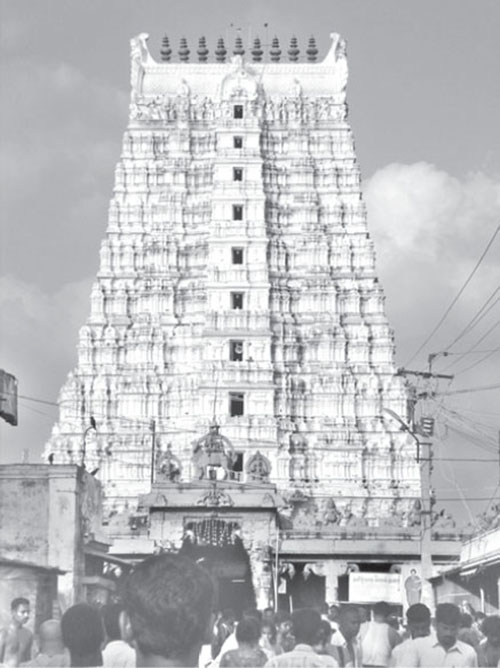
Rameshwaram Temple
In Rameswaram, the palace of the Raja of Ramnad had been arranged for our stay. But before going there, Maharaj and the Swami went to the temple. They drove in a double bullock cart. When they returned, they still found us busy with the luggage. Maharaj said reprovingly, ‘Cannot these things wait? You came here to worship the Lord and that is what you should attend to first.’
We stayed in Rameswaram for three days. On the second day, the young Swamis and I went for a sea bath. For Maharaj and the Swami we carried the holy water in a vessel. Abhishekam was performed to Lord Siva with the Ganga water which had been brought by Maharaj from Benares.
While returning, we had also stayed in Madurai for three days. A noteworthy feature of the stay was the deep Samadhi into which Maharaj entered in Sri Meenakshi’s temple, seeing the image of the Mother living and moving towards him. There was a large crowd and Swami Ramakrishnananda held him up there for nearly an hour, himself all the while in an ecstatic mood with tears flowing from his eyes, singing Mother’s praise over and over again repeating the sloka.
सर्वंमगलमांगल्ये शिवे सर्वार्थसाधिके ।
शरण्ये त्रयंबके गौरि नारायणि नमोस्तु ते ।।
सृष्टिस्थितिविनाशानां शक्तिभूते सनातनि ।
गुणाश्रये गुणमये नारायणि नमोस्तु ते ।।
‘Oh, three-eyed Gouri, the Consort of Narayana, Thou art the embodiment of all good, the bestower of blessedness, the fulfiller of desires and the refuge of all; salutation unto Thee!
‘Oh, Consort of Narayana, the eternal One, Thou art the root of creation, preservation and destruction (of the world); in Thee rest the Gunas, Thyself beyond their pale, salutation unto Thee!’
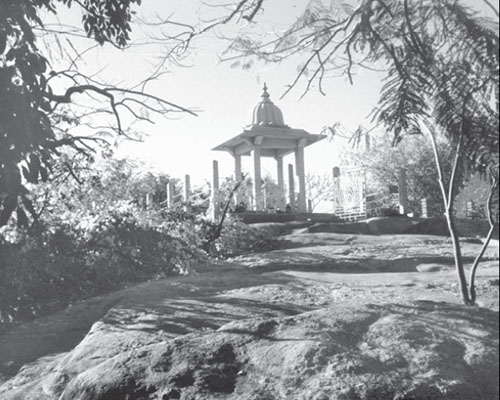
Holy Mother’s Rock, Ramakrishna Math, Bull Temple Road, Bangalore
When coming out of the Shrine, in an outer hall, Swami Ramakrishnananda saw the image of Adi Shankara. He was seized with a longing to touch the feet of the image with his head. But the priests would not allow him. Nevertheless, he pushed them aside, saying, ‘Who can prevent my worshipping the Great One?’ He went near and had his desire fulfilled.
When the Holy Mother came to Madras, he accompanied her in the pilgrimage to Rameswaram. After his return, he proclaimed that he had finished his work in the South.
Diabetes had already taken hold of him. The cough ended in consumption and for the sake of better Ayurvedic treatment, he went to Calcutta. Information reached Madras that his condition was critical and so I had gone there to see him. It was the last occasion that I had the fortune of meeting him in person. He was very gentle and tender to me and made many enquiries of his friends here. On many occasions, he expressed the desire to come back to Madras and die in the birth-place of the great Acharyas. Then he gave me his blessings and bade me farewell.
I can recount many more incidents in his life but want of time forbids me from doing so, suffice it to say that the only other occasion that I touched his feet afterwards was in a dream. I thought I was walking along the Beach when I met him with a disciple of his. At once I prostrated and my open eye-lids touched his feet and lo! The dream was over!
South India has been always famous for its sannyasins, but even here there have been only rare instances of men who, for unselfishness, sincerity in work and devotion to the Lord, can surpass this great BHAKTA.
[From the Vedanta Kesari, May, 1922, pp 91-97, August, 1928-29, pp. 149-157, September, 1930, pp. 178-181]
↑ Contents
C. Ramanujachariar Memoirs of Swami Ramakrishnananda
The life of Swami Ramakrishnananda (familiarly known as Shashi Maharaj), one of the direct disciples of Sri Ramakrishna, is comparatively uneventful and devoid of any appalling developments. It was cast in a mould once and for all, varying only in intensity as and when the occasion arose. What he did in the beginning of his sadhana, he did till the very end. Such a life is easy to narrate, hard to comprehend and almost impossible to practise by others. Swami Ramakrishnananda was one of those giant personalities, who was caught in the whirl of cultural chaos that darkened the country, but who, with the strength of his spiritual prowess and the grace of his Guru, came out successful, to illumine the world and warn it against the dangers awaiting it.
The beginning of 1897 saw Swami Vivekananda’s arrival at Colombo after his epoch making tour in the West. After a triumphal march, he arrived at Madras. I had seen Swamiji (Swami Vivekananda) before he went to America in 1893. We were young boys, hardly eighteen at that time, wondered about the personality and brilliance of this monk. The picture of his walking with majestic pace on the broad Luz Church Road is still vivid in my mind. We have heard him talk at the Triplicane Literary Society and knew also of the most beneficial endeavours of the band of young men, headed by Sri Alasinga Perumal, to send him to America to represent India at the Parliament of Religions held at Chicago.
When Swamiji returned in 1897, a Reception Committee was formed of which my cousin and Brother-in-law, Sri V.C. Seshachariar, was one of the secretaries. I was put in charge of maintenance of accounts of the Reception Committee and I had also to help in making arrangements for the meeting etc. in my own humble way.
Besides this, I was also made a personal volunteer to the Swamiji, doing him some personal service that he wanted. For nine days, I was with him throughout. After the first Reception Meeting, the important members of the Committee met in the evening at the open terrace of the Ice House and had an informal talk about the future of the work in Madras. The opening of a Centre was decided and Swamiji, who had a rare genius for deciding upon action and for choosing the best person for it, immediately said, ‘I would send you a Swami who is more orthodox than the most orthodox people of the South and... who would conduct worship with greater ardour than you could.’ This news was hailed with joy by everybody. As soon as Swamiji reached Calcutta, he commissioned Shashi Maharaj to take charge of the work in Madras and build it up.
Shashi Maharaj was, on arrival, accommodated in a rented building which had stood in front of the present Lady Willingdon Training College on the Ice House Road. With the kindness of Sri Biligiri Iyengar, who had bought the old Ice House where Swamiji had stayed, a flat was given to Shashi Maharaj to stay.
The main supporters of the Math were in Mylapore and consisted of Dr. Nanjunda Rao, my cousin Seshachariar, Sri V. Krishnaswami Aiyar, Sri Sundaram Aiyar and a few others. We used to collect subscriptions from them every month and take the amount to Shashi Maharaj for the maintenance of the Math.
From the very commencement, Shashi Maharaj began to give a series of popular lectures and started Vedanta classes in various suburbs of the city. There were as many as ten classes in a week, scattered over Washermanpet, Saidapet, Chintadripet, Mylapore, Triplicane, George Town, etc. I and my brother belonged to the Mylapore class.
On Ekadashi days, bhajan was conducted in the premises of the Math. The celebration of Sri Ramakrishna’s Birthday every year brought together all the devotees. On these occasions, reports of the activities of the Math during the year were read; and the poor feeding or the service of daridranaryana was conducted in a progressively grand scale every year. In the evenings, as usual, meetings were held. Prominent members of the public took part in them.
Gradually Shashi Maharaj’s following became larger and larger and his name became a household word in the city. He was also invited to other towns for lectures and at each of them, Vedanta classes were regularly organized.
In July 1902, Swami Vivekananda passed away; and at a memorial meeting held in Madras it was decided to establish an ‘Ananda Mandir’ in Madras to perpetuate the memory of the illustrious Swamiji, whom Madras discovered. But no energetic action was taken to implement the decision, though the need for a permanent habitation had become pressing. On the death of Biligiri Iyengar, the property at Ice House Road passed into the hands of the Zamindar of Sher Mohammed Puran; but he kindly permitted the Swami to stay in the outhouse. Shashi Maharaj himself was unconcerned: he used to say, ‘My wants are few. I need only a small room for Sri Guru Maharaj.’ I can stay anywhere and spend my time in propagating His cause. The verandah of a Chatram will do for me’. Vigorous attempt was made to build a small monastery. One of the ardent admirers of the Swami, Akula Kondiah Chettiar, gave a small piece of land on the Brodies Road, Mylapore. House to house collections were made, the Swami himself taking the leading part. The Math was got ready in 1907 and Shashi Maharaj moved into it.
In the early part of his stay in the Ice House, the Swami was his own cook and servant; and the privations and penury he experienced in Bengal for twelve years after the passing away of the Master (Sri Ramakrishna) pursued him even here. On certain days of the week, he had more than one class and he would return to the Math too tired to cook his food. He would be satisfied with a piece of bread. He would not say to others what he needed. And he would not accept easily even the proffered help. His faith in the Master always kept him buoyant and the devout worship of him made up for all the difficulties he had to undergo.
It may be mentioned here that in the dazzling brilliance of Swamiji’s dynamic personality, eloquence and achievements, too few was the glory and greatness of Sri Ramakrishna revealed during the Swamiji’s advent. All talk and all thought was then about Swamiji alone. It was only when Shashi Maharaj started work in a serene and sedate atmosphere that people of Madras began to know of Sri Ramakrishna more fully. The Master is slow to move, but steady to remain. Shashi Maharaj had not much faith in institutions alone. He desired to make men first and he considered them to be the bedrock on which the future edifice of the Mission’s work could be built.
The difficulties in the way of Shashi Maharaj could easily be imagined. Not knowing the language of the masses, in whom alone unsophisticated faith and belief remained, he could not approach them. The faith of the educated people had already been shaken; and the work of converting them had necessarily to be slow. The pioneering work of Shashi Maharaj thus bristled with insurmountable difficulties. In Bombay it was still more difficult. So he never troubled about Bombay for a long time. It was only much later that a monastery at Bombay was thought of.
During Shashi Maharaj’s time in Madras came several young Brahmacharins, nearly a dozen, who later on became prominent members of the Order. They all had their training under him.
Shashi Maharaj’s method of training was somewhat difficult and hard. He was a strict disciplinarian. His whole heart was set upon the spiritual unfoldment of the novitiate. But behind it there was the tender, affectionate and loving disposition towards the young Brahmacharins.
It was during February 1905 that the outstanding charity, the Orphanage—the Ramakrishna Mission Students’ Home, Mylapore, Madras—was started by Shashi Maharaj—eight years after his coming to Madras. Moved by the pitiable condition of two or three orphans who had strayed away from Mysore State, having lost all the other members of the family, by plague which then had been devastating the country, Shashi Maharaj thought that there must be several others in similar predicament, to provide protection for whom was the legitimate duty of a sadhu. The Home (which, under his instruction, was not called an orphanage lest it might often remind the little ones of their orphanhood) was started with seven boys in a small rented house, their food being begged by us from door to door. Blessed by him and subsequently reinforced by the grace of Swami Brahmananda, the first President of the Order, its development has been phenomenal.
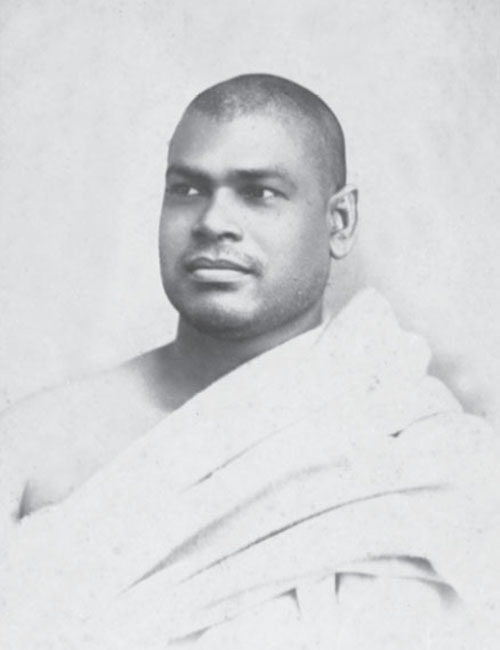
Swami Ramakrishnananda
Shashi Maharaj’s next outstanding achievement was the founding of the monastery in Bangalore and sowing the seeds of the future development of the Mission’s work in the Mysore State. His series of lectures and the force of his personality and teachings roused a strong wave of spirituality among the people there. It was a great advantage that the successive Dewans and prominent officials of the State and His Highness the Maharaja himself were deeply interested in Sri Guru Maharaj’s life and teachings; and Swami Ramakrishnananda, with the help of the State, started a monastery at Bangalore and as often as possible visited it.
He went even so far off as Burma on invitation and did most useful work there. The result of it was the starting and the working of one of largest hospitals in Rangoon. Travancore, Pudukotai and Tinnevelly, all had the benefit of the Swami’s advent; and everywhere the foundation was laid for future work.
Within the Madras Math prevailed the same fervour which characterized his puja and worship in the early days of the Baranagar Math. It was in him that we saw what living faith was and what important place rituals had in worship. Ritualism is a method and mode of worship; and worship is the showing of our reverence and love to one whom we consider as one of us or as the highest object of our love and veneration, or as one who is our refuge and prop. This method is only upacharam codified by practice. It need not be necessarily the same in all cases. What matters is not what we do, but how we do and with what spirit behind. Shashi Maharaj used to say: If we are caught in a labyrinth and someone comes and says, ‘I can show you the way out,’ what should we do? We should follow him and the gratitude we feel is what we call worship and devotion [italics author’s]. This person is the Guru and we should follow him implicitly if we want to escape from the labyrinth. Sometimes, however, we think, ‘Why should I follow him? Let me find out my own way.’ So we go on by ourselves; and He is always so patient and loving that He waits until we go weary trying to find a way alone and come back to Him.’
Rituals are to be conducted in the right spirit surcharged with the prescription given to the world by Sri Guru Maharaj and noble souls like Shashi Maharaj. They had pointed out in their lives how they should be done: ‘Worship is not at all merely an external affair. It is almost wholly internal. Ordinary people perform worship either to escape from the displeasure of God or in expectation of fulfillment of desires. All these are not worthy motives. Real worship is not done till devotion overflows the heart and tears roll down from the eyes through a glimpse of God.
‘Worship, austerity and repetition of the name, performed by the worldly minded, are no sooner done than forgotten. Afterwards they do not remember God in the hurry and scurry of life. A true devotee takes in His name with every breath; he is filled with sincere devotion and offers flowers, leaves and water to God with no selfish motive, saying, ‘O Mother Divine! Worship and prayer are nothing but opportune moments to call on you.’ If one observed Shashi Maharaj worshipping, all doubts about the value and worth of rituals would vanish and one would oneself begin to worship with the same fervour and devotion. On such occasions, Shashi Maharaj would be so inspired that the living presence of the Divine would be felt by all those who would be present during his worship. To see him standing before the Lord either in the shrine or in temples, his whole frame responding to his faith with horripilations and tears, with waves rising up from the navel, was a sight for the gods and would carry conviction to anyone.
Swami Ramakrishnananda was meticulously careful about every detail of worship. Lest there be some neglect, he would himself attend to everything. One day when he found a small stone in the rice that was offered, he felt so vexed that from the next day onwards he took upon himself the duty of cleansing the rice before cooking it.
Shashi Maharaj laid down the rules and procedure for ritual worship and for the initiation of Brahmacharya and Sannyasa Ashramas and compiled suitable Mantras from the scriptures. He had no easy job in instituting the ritual worship, but he was undaunted and carried things through. In addition, he also created a tradition in the matter of the conduct of monasteries by the Mission. The creation of a serene atmosphere in the monasteries compatible with its sanctity was his sedulous endeavour. He would not allow any secular or irreligious talk within the precincts. Women should not handle or touch the garment or the bed of a monk. Sister Devamata, who once in good faith tidied the bed of Shashi Maharai during his absence from Madras and naturally expected an appreciation for it, received a scolding from the Swami.
Personally he would not take anything which was not offered in puja, which he used to call Yavanannam or Rakshasannam. For his diabetic condition, the doctor prescribed that he should take wheat. He refused to offer wheat to Guru Maharaj (Sri Ramakrishna), saying, ‘Why Guru Maharaj should be put on diet for my illness?’ Nor would he do anything which Guru Maharaj did not do. Typical of this attitude was his strong determination not to touch coins. He would rather allow others to tie the money in his cloth when he had to carry them than take them in hand. He did not have the inclination to question why Guru Maharaj did or did not do a particular thing. Unhesitatingly, he adopted the Master’s ways as the rule for his life.
‘Do not consider this as a mere picture (in the shrine) of the Master (Sri Ramakrishna). He is actually present here. Try to feel his living presence and serve him accordingly.’ Such was the injunction he gave to his disciples. This injunction was based on the authoritative pronouncement of the Master who said once, in an ecstatic mood, that he would be present in his spiritual body wherever his disciples would install him. Shashi Maharai considered the Master as God Himself, the living embodiment of all Gods and Goddesses. With this as his strong living faith, we can easily find justification for his unique action in rushing to the shrine and fanning the Master during parts of the day when the heat was unbearable and in holding the umbrella over the bed of the Master to protect him against rains in the dead of night, unwilling to disturb him in his sleep by lifting his cot. All these evidenced his solicitude, love and devotion to the Master. When he was once accosted with the remark that Hindus are idolaters, he sharply replied, ‘If idolatry can make one a Paramahamsa, I should prefer to be one.’
Though monistic realization was easy and possible for a sadhu like Shashi Maharaj, he preferred ‘to taste sugar than be sugar’. He used very often to say that that Bhakti which arises after monistic realization is the highest form and is Para-Bhakti. Man loves himself best; and when he sees himself in others, he would love them most.
Surrender, when it is perfect, merges the devotee in the Lord and leads ultimately to a monistic realization. The Bhakti that subsists after such realization, he always considered as the perfection. Nobody can be entirely monistic or dualistic. These experiences come to the same individual at appropriate moments. The man who says that he is an ‘Advaitin’ is no Advaitin. There is ‘Advaita’ and not ‘Advaitin’. Guru Maharaj used to say, ‘If you close your eyes, it is one; and if you open them, it is two.’ As one begins to speak of Advaita, it ceases to be such. It is a realization; it is an experience; of it no description by word of mouth is possible, nor any expression.
Surrender meant to Shashi Maharaj the culminating triumph of all spiritual efforts. Devotion to Guru was the strength of the Swami’s spiritual life.
His love and reverence for his Gurubhais and co-disciples were unique; and he always believed that the Master actually lived in his disciples.
Swamiji (Swami Vivekananda) had a special affection for Shashi Maharaj. In 1899, when Swamiji went to America for the second time, the steamer called at the Madras harbour, but Swamiji was not allowed to land on account of quarantine restrictions. Shashi Maharaj and myself went to the steamer out in the sea in a boat; and they conversed with each other, Swamiji standing on the deck and Shashi Maharaj down below in the boat. Though the conversation had necessarily to be short, the meeting of the two spiritual brothers and the genuine affection and depth of feeling that flowed from one to the other struck everybody as a remarkable sight.
To the Holy Mother he showed the same veneration and devotion as to the Master. We had observed with what anxiety and concern Shashi Maharaj was attending to all details when Holy Mother came to Madras in 1910. He often observed that the Master and the Holy Mother were identical, like fire and its burning power.
For Swami Brahmananda, the Raja Maharaj of the Order, the spiritual son of Guru Maharaj, a unique place of reverence and devotion was reserved by Shashi Maharaj, who used to tell us: ‘If you see Maharaj (meaning Swami Brahmananda) you will have a glimpse of Sri Guru Maharaj.’ Maharaj had come to Madras thrice. In 1908, when he came first, Shashi Maharaj went to Puri to meet him and welcome him. The elaborate arrangements which he made for his reception and stay, though they were not of great value judged only by the amount of expenditure incurred on them, were superbly noteworthy on account of the attention and concern which Shashi Maharaj bestowed on them. Every detail was thought out by him. He later took him to Bangalore to open the new Ashrama there.
On the evening of his arrival, the leading men of Madras, including Krishnaswami Aiyar [Iyer] and Sundaram Aiyar [Iyer], met him and paid their respects. They asked Shashi Maharaj whether Maharaj could lecture. Promptly and significantly Shashi Maharaj replied: ‘Maharaj does not lecture, but we who fight under his banner take one or two words that fall from his lips and spin them into lectures. Men such as, he can impart religion by a mere look or a touch.’
We used to see a regular chase in the Math immediately after the aratrikam. It was the usual practice for the junior Swamis to prostrate before the senior Swamis; and Shashi Maharaj would try to do it and touch the feet of Maharaj. To avoid Shashi Maharaj touching his feet, Maharaj would go inside his room and would lock himself up. But undaunted, Shashi Maharaj would prostrate before the threshold from outside.
Shashi Maharaj took Maharaj for a pilgrimage to Rameswaram. During that time, a visit to the temple at Madurai and worship of Meenakshi Devi created a great spiritual atmosphere. Maharaj had the vision of the living image of the Goddess moving towards him. Shashi Maharaj had to hold him for nearly an hour.
Maharaj’s regard and love for Shashi Maharaj will be clear from the following words that fell from the lips of Maharaj. To a newcomer, Maharaj said, ‘Here you will be in the company of a saint. Serve him and you will attain everything.’ To another he said: ‘Stay with Swami Ramakrishnananda for three years and everything will be achieved. Your character will be well formed. Nothing more will be necessary.’
By the middle of 1910, shortly after the Holy Mother’s departure from Madras, Shashi Maharaj was taken seriously ill. His robust constitution gave way. Fourteen years of strenuous toil that he had to undergo as the pioneer of the Ramakrishna Order in the South, undermined his constitution. Diabetes had already crept in and galloping phthisis also now caught him. He, with glee, said, ‘My work is over. It was no credit of mine; but the Master’s grace and Swamiji’s command are mainly responsible for the success of the work in the South.’ He had to overwork himself and thereby neglected his health. Absence of physical comforts and strenuous work from the beginning of the advent to Madras made him a victim to these fell diseases. After a short stay at Bangalore for a change, he was taken to Calcutta for treatment. In a message he said: ‘I had dedicated my body, life and mind at the lotus feet of the Master... Lord’s will be done... When I speak of the Lord, all pain leaves me. I forget the body.’ On the last day, for the last three hours, he remained absorbed in the supreme state of Samadhi and he entered Mahasamadhi on the 21 August 1911.
He was a typical sadhu and a monk of the highest order. His realization was profound and perfect and his concept of God was all embracing and catholic. His reconciliation of the various systems of philosophy was a heritage of his Master. His renunciation was undivided and whole-hearted. There was no element of reluctance or sacrifice in it. He was serene and serious, always absorbed with no other thought day and night but that of the Master. He had a light in his vision, but was humble and simple like a child. In Bhakti, his personality would melt like ice and he would say, ‘That is what the spirit craves.’ In thinking of Him, he would find his highest satisfaction here and hereafter. He always felt that the Divine Mother would not call him Her ‘servant’ but Her ‘child’. Devotion reached the deepest roots of his being. Surrender and trust were so complete that he was able to exclaim that ‘I am all full of God and I do not need anybody’s help.’ He worshipped at all shrines and would bow down in reverence at every way side small temple. He was an original thinker and was a great Sanskrit scholar, even capable of holding discussions in Sanskrit with pandits and scholars. He was a good student of the Bible.
When asked as to what was the peculiarity of the Master’s teachings, he said:
‘He (Sri Ramakrishna.) realized and preached the harmony of religions, while the other great world teachers proclaimed that the religion taught by each of them is the only way to salvation. The difference between Sri Ramakrishna and the other Prophets is that he himself preached no new religion, but practised all religions in his life and experienced the universal truth underlying them all. His message could be summed up in the words: ‘As many ways of life, so many paths to God.’ No teacher has laid so much emphasis on the infinity of forms and aspects of the Divine. He was the perfect example of renunciation; and understanding that immortality cannot be obtained without renunciation, he never touched woman or wealth in his life. He looked upon his wife as a living form of the Divine Mother and worshipped her as he would worship the Goddess Kali. Perhaps, he is the only instance of unbroken continence in the conjugal life in the whole world. He had renounced gold so completely from his mind that if be laid his hands even unconsciously on coins, they would become contorted as though stung by scorpion and his breathing would stop. God is realizable; He is truly realizable through all religions. So long as the creation is there, there must be its Creator - there cannot be any doubt about it.’
Shashi Maharaj threw a flood of light on many orthodox practices and revealed the deep meaning and value of holy religious traditions. I may mention here a few:
He would tell us that Shraaddha (death anniversary) is a homage paid to the unselfish love of the parent.
‘Amrita Upastaranam’ and ‘Amrita Apidhanam’—sipping of water before and after meals - signified the encasing of the food by our Upastaranam and Apidhanam of Amrita, so that the whole food thus encased became Amrita.
His explanation of the thirty-three crores of Hindu gods was at once original and helpful—the five karmendriyas, the five jnanendriyas and the mind, making altogether eleven, associated with the three variegated Gunas, becoming thirty-three; and desires of man are classifiable among these thirty-three heads. It is the belief of the Hindu that the fulfillment of each desire is possible only through the propitiation of the presiding deity. Man’s desires are infinite and things beyond count are generally indicated in terms of crores. Crudely, desires are taken to be thirty-three crores and gods to grant them are also taken to be thirty-three crores.
The choice of the Gerua (ochre) colour for the garment of the Sannyasin was due to its being the colour of twilight, which is the blending of day and night. He also mentioned that Gerua cloth was never used to be given to Guru Maharaj, for, if given, he would at once go into Samadhi to fulfill the union of the Soul with the Paramatman, of which the Gerua was an indication.
His teachings to the young men that gathered round him were deep-rooted and broadbased. The first lesson in meditation he gave was to think about the truth, ‘Naked have I come from my mother’s womb and naked will I have to go.’
He used to ask us to think of the exact present and point out its baffling characteristics. For, as you begin to think, it becomes past. It has no real existence. It is like Euclid’s point, without magnitude.
In order to comprehend the glory of the Lord, he would ask us to compare ourselves in height with a hillock and conceive of our getting our size diminished. The more we belittle ourselves, the more will we be able to realize the greatness and glory of the Lord, which remains ever constant.
He would ask us to shake off wrong notions about ‘sacrifice’. He would impress upon us that if one throws away a ten-rupee note in hand in order to have a hundred rupees in its place, throwing away of the ten rupees is no loss or ‘sacrifice’. People are scared by the use of the word ‘sacrifice’ and are made to think that we are to lose something which we possess, while that little that we surrender enables us to get very much more. When one gives up the sense-world, it means one has something better.
‘Ego is what the Westerners call Devil. Bring God within yourselves. Ego will disappear. Selfishness will go and you will be lost in the infinite glory of the Lord.’
‘God’s will is the only will in the whole universe. He is the only Purusha. Devotion to Him can accomplish anything. Realize God in your heart.’
As regards the connection of science and religion, he would say, ‘Science is the struggle of man in the outer world and religion is the struggle of man in the inner world. Religion begins where science ends. Science deals with finite bodies and the methods adopted are observation and experiment based on the sense, while religion deals with the Infinite. A study of astronomy will give you a concept of the farthest reach of Vastness (Akhandam).’
When questioned as to what was the connection between religion and politics, he promptly said: One wants freedom from the senses and the other freedom for the senses, as the watchword of politics is comfort and convenience.
There was no mystery in religion. When a man is physically weak, he takes to cunning. When he is spiritually weak, he takes to mystery.
He used to say that congregational worship is a contradiction a terms.
To a man full of plans for reforming temples, Maths, etc. he would say, ‘I wonder what God did before you were born,’ thereby driving home the lesson that God alone works.
He used to say, ‘Words are mere flowers and deeds are the fruits.’
In religion, he advised us to prefer Bhakti to Jnana. For, while the Jnani had to go about in search of God by his own unaided power, the Bhakta had only to love God and God, conquered by his love, would appear, of His own accord to the Bhakta. ‘Love and serve God’ was his prescription; and profound thought, introspective researches and interior seeking are the ways for real spiritual progress.
‘Do not make too much of this little life between two deaths. This body belongs to God. He created it. Let him do with it as he likes.’
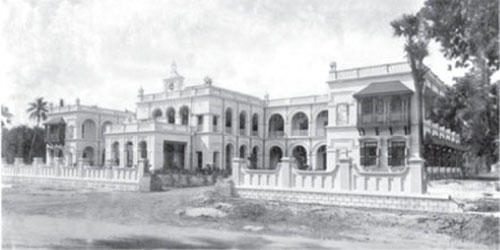
Ramakrishna Mission Students’ Home, Mylapore, Chennai
Swami Brahmananda inaugurated Ramakrishna Mission Students’
Home in 1921 and stayed here for sometime.
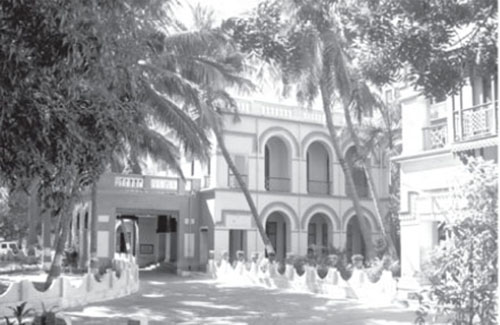
A recent view of the building
The Home now caters to 700 destitute and orphan students.
Reverence to the old, he used to demand. He used to emphasize that all the Puranas are true. The authors are great seers and people of realization. Untruth they will never utter. Only our capacity to comprehend has deteriorated.
Vedic chanting in the South should be preserved. It exists nowhere else.
His lectures, varied as they were and brimming with Vedantic truths, have been preserved to posterity in the form of books. His ‘Life of Ramanuja’, which he wrote in Bengali, was written while he was in the Ramakrishna Mission Students’ Home.
[From the Prabuddha Bharata, July, 1954, pp. 362-365 and Prabuddha Bharata, August, 1954, pp. 404-408]
↑ Contents
P. Manickaswami Mudaliar
Sometime in the year 1897, I heard that an English educated Swami was holding religious classes in Chintadripet [in Madras]. I was told that the Swami, at the end of the class, welcomed questions which elicited answers revealing his vast erudition and religious fervour. I readily availed myself of the opportunity not so much for enlightening myself as to enlighten the Swami, as my youthful conceitedness would have it. For the first one or two years, I was a severe critic of his exposition of the Vedanta Philosophy, of which I had previously a smattering knowledge. I took pleasure in plaguing him with all sorts of questions and quick repartees. In putting questions to him, I was implacable and had had many a tussle with him. Not a few occasions there were when the Swami was cornered and could not, as I thought, find his way out. This attitude of mine towards him was, however, not to be for long.
One day with a strong backing of my agnostic and skeptical friends whom I took with me, I went on putting him question after question, the chief of which was, ‘How could the unperturbed Brahman become ever perturbed.’ The answer given was so unintelligible that I exulted in having made his position untenable and my exultation made the Swami come down on me with the words: ‘What do you know? You simply blabber without in the least knowing what you are talking about.’ There issued forth from his lips thundering words and outpouring of spirit which pierced through and through my heart and made me spell-bound. These words, though uttered in angry tone, proved to be of saving grace to me. I felt they came like a thunderbolt and were just sufficient to bring me to a sense of seriousness. The irreverent attitude disappeared and somehow a feeling of reverence coursed through my body and I instantly reined my tongue and became silent.
A day or two after this incident, I was impelled to run up to the Math which was then located in the Castle Kernan or the Ice House as it was more familiarly known. I expected a very cold reception. But lo! I was struck with the love and cordiality with which the Swami received me. Despite my offensive behavior with him, he was gracious to give me a warm welcome at which I felt contrition in my heart for my past behavior with him. I took courage and resumed the topic about which we had a difference of opinion and in the heart-to-heart talk which ensued, there was such a mutual exchange of views that it had the effect of laying bare the hollowness of my position and the profundity of the Swami’s point of view. With a penitent heart, I sat before him and drank deep the explanations he gave to my difficulties—which were not cleared in his class lectures—and there was such a loving exchange of heart that I ever afterwards became his humble and adherent follower.
From that day onwards, needless to say, I became the Swami’s humble follower and a passive listener ever ready to drink in the nectar-like words which fell from his lips. I got interested in his classes, gradually drawn to him by his sweetness, scholarship and spiritual zeal and had the good fortune of getting a good grounding in the philosophy of Sri Sankaracharya.
I lost no opportunity of coming in close contact with him and the illumination I derived from such contact, being one of feeling, can hardly be described in words. I placed at the disposal of the Swami, all my resources—mental, bodily and financial—which the Swami was gracious enough to utilise whenever needed.
Some of my friends who saw Shashi Maharaj in the Math remarked that he was not a tyagi, but one living in luxury equipped as he was with a few chairs, tables and cots. I was requested by them to ascertain from him whether and if so, what sadhana he was practising. When I put the question to Shashi Maharaj he replied, ‘Tell them that my Guru had done all sadhana for me.’ What a bold and quick repartee! As my acquaintance with him grew closer and closer and I got such an insight into his method of life and thinking that I was able to give a satisfactory explanation to such of my friends as used to remark, ‘What sort of a Sannyasin is he? He lives in a palatial building, sleeps on cushioned cots and lives on rich food!’
I also underwent a thorough change in my outlook of life, for which I am deeply indebted to the Swami. Though, as a result of the Swami’s teaching, few were able to renounce the world and take to the life of sannyasa, it cannot be gainsaid that not a few imbibed a desire for renunciation which unfailingly had its reaction and salutary effect on their daily conduct in life.
Before I touch upon the spiritual stature of Swami Ramakrishnananda, let me try to give you an idea of how he looked externally. He had an attractive personality and looked younger than he was. He appeared as though he was only about twenty five years of age, though he was then actually thirty-four. The smiling and tender face was very winning; his face was long and round with a strong and firm chin. His lips were thick and his eyes, though not large, were beaming with intelligence and sweetness. He had a broad chest and a good round belly. He had strong and stout limbs and his walk was majestic. When going to classes, he would put on a long coat which would come below the knee and a turban with its long end hanging over his shoulders. I have not seen him with shoes on, nor was he in the habit of carrying a stick with him. He was a man, grand to look at.
Swami Ramakrishnananda had come to Madras in 1896 and was accommodated in the house, now situated east of Lady Wellingdon’s Training College for Women, then known as the Ice House. Within a short time of his arrival, Swami Ramakrishnananda started religious classes in different parts of Madras, which attracted a large number of the school and college-going youth and the intelligentsia from the middle and upper classes as well. His classes were scattered in the different parts of the city and to many of these he used to go on foot for a long time. During the time of Shasi Maharaj’s sojourn in this region, there were no buses and tram-cars. There was a peculiar kind of jutka not of the type we have now. It was a sort of small box into which three will have to squeeze themselves; one will have to sit at the entrance and the other two opposite to him, just at the back side of the driver’s seat. The entrance into the jutka was very narrow and the box was fitted in a slanting way so that the passengers had always to learn the lesson of alertness not to slip and knock against one another. It was funny sight to see Shasi Maharaj entering the jutka with his stout and robust body, squeezing himself and bending his head. These jutkas were not available near the Ice House and often the Swami had to walk up to the jutka-stand, a mile off in the Triplicane bazaar. Nor had he the requisite money to hire one. He had therefore to go all the way on foot to Chintadripet which could be reached only through the Mount Road. Mount Road was then a low lying place and was often under water and the Swami had to wade through knee-deep and sometimes hip-deep of water to go to the classes. Through the grace of his Guru whose protecting arm he always felt and on which he fully depended, a jutkawalla who was a Harijan came forward to take the Swami and ever since used to appear at the appointed time, take the Swami to the class and bring him back to the Math.
On certain days of the week, he had to lecture more than twice or thrice and would return to the Math quite tired, exhausted to cook his food even. In the early days there was none to help him in the management of the Math affairs. He was his own cook, his own servant. He was the pujari and the teacher. There were days when he returned to the Math after a day’s hard work to find that there was not a drop of ghee to fry the chapattis. I have known days when a loaf of bread purchased from bakeries was his simple meal for the night; that was because there was little energy left in him for cooking or there were no food-stuffs in the Math. In short, the personal difficulties he had to undergo were many. But he waded through all these with unimaginable fortitude and serenity of mind. In fact, the circumstances were such that he would not have come in for blame if he had shifted the centre of his activities to some other place in the province. But he was a great Karmayogin and had such a great faith in his Guru that he was quite confident that all difficulties were sure to disappear soon and so he stuck to his post of duty assigned to him by his leader, Swami Vivekananda. He would not breathe a word of the difficulties he was contending against and not a second person was thus aware of his plight. It was only a few students of his who happened to frequent the Math that came to know of his bodily wants and volunteered to supply them. The proffered help he would not easily accept. He would advise such students who came forward to help to save the money for themselves so that they can live with a little more comfort. Most of his students were poorly paid and he did not want them to undergo any kind of sacrifice for his sake. So magnanimous and broad-hearted was he! Questioned as to how he was supporting himself, he would with a striking composure reply, ‘God sends me whenever I want anything.’
One day there was not even a drop of ghee to fry chapati in the Math. He was simply pacing up and down the veranda not knowing where the help would come from. Immediately a student of his approached him gently and whispered into his ears his intention to contribute his mite to the Math as he had a hike in his salary and implored him to tell him the form the help should take. The Swami, as was characteristic of him, demurred, but on the student insisting, said, ‘Let me have one viss of ghee,’ which he received regularly every month ever afterwards.
Yes, the difficulties did vanish when the stuff of which he was made had come to be widely known in Madras. Some students came forward with monetary help. One student took him to the optician and purchased a pair of glasses for him. A Brahmachari was sent to assist him in the Math work. Then came Ramu and Ramanuju [C. Ramanujachariar] who shouldered the full responsibility and thereafter the Swami’s life was free from anxiety. My idea in stressing this aspect of the Swami’s life is to impress upon you the ideal of devoted service and strenuous work which the Swami has placed before us by his exemplary life. Shashi Maharaj was a man who had given up everything. He would at the same time strain every nerve of his to carry on the work entrusted to him by Swami Vivekananda, his trusted leader.
Shashi Maharaj was well-versed in Eastern and Western philosophy and his method of teaching was unique. He knew that the students were new to religious subjects and so would scrupulously avoid technical terms. He made it his point to express his thoughts in simple language so that even a beginner can follow him. I remember the Swami devoted many classes to explain fully the implications of the sloka in the Gita, ‘Matrasparsastu kaunteya’. Without some knowledge of psychology, this sloka cannot be fully understood and so the Swami was particular to give it in the class. There was thoroughness in his explanation. And when occasions arose, the Swami did not hesitate to differ from the author or the commentators. I remember how when the Panchadasi was being taught the Swami criticised some points in it and as a consequence two of his students stopped coming.
His theoretical knowledge of the Hindu religion and philosophy was profound. He invariably taught his students Vedanta as expounded by Sankara. He would exhort his students to apply three tests before accepting any truth. It must be supported by (1) scripture (Sruti), (2) reasoning (Yukti) and (3) experience (Anubhava). Of these three tests, he would accord the highest rank to reason. When any truth happens to have the support either of scripture or of experience or of both, but not of reason, he would advise his students to defer their verdict until they could get better and clearer light from scholars more learned, or from men of acknowledged spiritual greatness. He would take his students step by step through rational grounds to the dizzy heights of the monistic conception of Consciousness (Samvid, as he would term it) pure and simple, where there is neither the notion of God as the creator, preserver and destroyer, nor the conception of the knower and the known.
By subtle and elaborate arguments, he would establish that man is not this body, three and a half cubits in length, nor the mind, but that he is infinite in his real nature. He is Reality itself—Reality which is Existence, Knowledge, Bliss Absolute. The Swami would not, however, like to leave the student immersed intellectually in this abstruse thought, but would suddenly turn his attention to the standpoint of a Bhakta who considers himself to be an insignificant entity and surrenders himself to God, who for him is all in all. Such a sudden turn in the view point was beyond the comprehension of students of ordinary calibre who would accuse him of blowing hot and cold in the same breath. Such a sudden change of view was possible for men of Swami Ramakrishnananda’s type only. For, by his close contact with his Guru, Sri Ramakrishna, he had acquired such a clear knowledge of Jnana and Bhakti that he was able easily to jump from the one to the other without losing hold of the common ground. Some would say that he did so because he himself was a Bhakta and would cite the fervour and devotion with which he offered worship to his Guru, in support of their opinion. While it cannot be denied that he had unparalleled devotion for Sri Ramakrishna, his Guru— as every Jnani has to his spiritual teacher—it should also be borne in mind that in the books he has written and published, the monistic idea comes out more prominently and that idea was what he generally taught in his classes also. Once when I approached him for practical instruction for meditation, he told me, ‘Think of the vastness of the universe.’ From these facts, I have been and still am, of opinion that Swami Ramakrishnananda was a monist and Jnani in his heart of hearts and that his love for and worship of, the Guru could not be considered as sufficient ground for putting him under the category of Bhaktas. At best I can take him both as Jnani and a Bhakta—a combination rare to find in one individual.
While discoursing on religion, Swami Ramakrishnananda eschewed all metaphysical and philosophical technicalities and had the power of clothing most abstruse ideas in simple language quite understandable to even ordinary lay minds. His one aim seemed to be to wean the English educated young men from their habitual leaning to the materialistic Western culture and to make them recognize, appreciate and follow the nuggets of golden truths embedded in Hindu Scriptures. He would not tolerate disparaging remarks regarding Manu, Vyasa and such other saints and sages of India, but would hold a brief for all traditions, customs and usages, round which the Hindu civilization has grown.
Shashi Maharaj taught only principles and studiously refrained from referring to either Sri Ramakrishna or Holy Mother who were the embodiments of these principles. He did so lest he would lay himself open to the charge of founding another ‘ism’...The Swami would lose no opportunity to picture to the students the glory that is in Hinduism. In the class, he would often stress on Jnana and Bhakti coupled with vairagyam or renunciation, so much so that the students began to ask him whether to lead a religious life, renunciation of family, home and all was absolutely necessary. It would appear that his preaching of renunciation to youths got him into trouble. One day, when I had gone to the Math to meet the Swami I heard him say with a leonine heart. ‘What do I care for these bigwigs. If I am ousted today from this Castle, I shall very gladly find accommodation in a room of one of my students’ houses. I am a Sannyasi and do not know where my next meal would come from. Am I to teach what I learned from Guru Maharaj or what these big wigs like.’ I could not quite follow the Swami. Later on I learnt that some big wigs threatened to withdraw their financial support if the Swami continued to teach renunciation to the young men and spoil their minds as well as spoil the hopes the parents were building on these young men. The Swami, being a Sannyasi, naturally emphasised in his teachings on renunciation and service, but this did not appeal to the public of Madras who were accustomed to hear Puranic and other stories from Pandits. The public of Madras perhaps wanted that the Swami should give instruction on Yoga and such other sadhanas which could be followed without prejudice to family life. But the Swami used to say, ‘God and Mammon cannot be simultaneously worshipped’. So in the long run, the public of Madras was apparently not satisfied with the Swami’s teachings and hence attendance in the classes began to dwindle. Whenever the students pressed for some practical instruction the Swami would say, ‘next time.’ But that next time was never to come. Was not the Swami aware that the soil was not ripe for the spiritual seedlings?
Whether on account of this or for any other reason, the Swami’s classes grew thinner and thinner and had to be closed ultimately. A few of the students attending these classes began to repair to the Math and benefit by his teachings. Their love and attachment for the Swami grew intensely and they stuck to him through thick and thin. They kept themselves ever ready for service of any kind in all ways possible. Regarding the dwindling of attendance in his classes, the Swami would wittily remark, ‘Religion is like Sakkarapongal’ (a kind of sweet dish), meaning thereby that the mental condition of the people was too weak to take to the study of religion proper, much less to practise spiritual life which needed great control of senses.
When the Komaleswarampet class was closed three of us went to him and pressed him for practical instruction. We went on a day fixed by him when he made Homa and made us take some pledges before the Homa fire. But the Swami did not initiate us in any mantra. Even to those students who were very devoted and useful to him, for instance, the late Rao Saheb Ramaswamy Iyengar and his cousin brother, Rao Bahadur Ramanujachariar, the entering secretary of the Madras Branch of the Mission, he did not give initiation. Apparently the Swami did not want to assume the role of a spiritual guru or perhaps he thought that the ground was not yet ripe.
The Swami’s solicitude for his students, however, was remarkable. He would keep watch and ward over their habits, manners and conduct in life. The Swami wished that his students, most of whom were poor, should live more comfortably and enjoy the ordinary amenities of life. He would rather suffer than put his students to any expenditure which their meager purse could not permit.
He was a strict disciplinarian though he heeded not to external respect and regard. He took so much interest in the spiritual welfare of his students and regulated their habits even! Once a student was found sitting in his class with his chin resting on the palm of his hand. He at once said, ‘Do not sit like that, it is a pensive attitude. You should always cultivate cheerful attitude.’ Another day one student was found gently shaking his legs while sitting on a bench and Swamiji said to him, ‘Stop shaking, it is not good and conducive to well being.’ Whenever any student drank water standing, he would enjoin him to sit and drink.
On one occasion a poor student of his offered a donation of Rs. 15 and when he learned that it was got by joining a lottery, he admonished him severely saying that money got by the sweat of one’s brow alone was helpful for spiritual advancement.
There used to go to the Swami a student whom he loved very much for his simplicity, frankness and being unostentatious. But this student did not know how to serve and show respect to his teacher. With a view to removing this defect in him, he one day called him near and said, ‘Well, you shampoo my leg a little.’ He did as directed with a right attitude of mind, at which the Swami was much pleased. On another day, when the Swamiji was lying down slightly indisposed and a junior Swami was fanning him, he saw the same student entering the Math. At this, the Swami said something to the junior Swami (the student heard only the word ‘Susrusha’, which means service) who stopped fanning and went away. The Swami, as if to bestow grace on the student, asked him to press his body as well as he could. Such was his solicitude, his magnanimity and overflowing kindness.
Shashi Maharaj was a strict disciplinarian and yet he was not slow to forgive and forget when forgiveness would result in good. I know the case of a Bengali young man who somehow fell in the company of wandering Bairagis and could not get away from them. When this group of Bairagis happened to sojourn at Triplicane, this young Bengali having heard of Shashi Maharaj broke loose from them and sought Shashi Maharaj’s protection. His name was Jogen. Shashi Maharaj with his mellow heart granted it and allowed him to stay in the Math. But a few days later, the truant in Jogen made him run away without Shashi Maharaj’s permission. He soon returned to the Math, repenting bitterly for what he had done. Shashi Maharaj forgave him and admitted him in the monastery. Jogen in due course was accepted as a monk of the Ramakrishna Order.
I remember with extreme gratitude the solicitude the Swami used to bestow on me. Especially, I can never forget the way of serving sadhus into which he initiated me. Whenever I used to visit him at the Ice House, I would simply salute him with folded hands with the words, ‘Namaskaram.’ The Swami would return with the words, ‘Narayana’. Perhaps he was observing the manner of my salutation. One day when I had sat down for conversation, he said, ‘Will you shampoo my legs a little?’ I did so very willingly and derived the greatest happiness. I understood him as teaching me how to do service to a sadhu. The Swami was very careful to give instruction to his students in matters of daily habit. Thus he exemplified in his life the great maxim that the spirit and not the letter of the law, is to be followed.
The people of the Madras Presidency have a notion, rightly or wrongly, that a true sannyasi is he who has no property of his own, who should devote all his time in meditation taking little or no interest in mundane activities of any kind and remain in a retired place from which he should come out only for food when pinched by hunger and for water when troubled by thirst. But Swami Ramakrishnananda’s life was entirely different. He considered work as worship and consecrated his life to carrying aloft the message of his Master to the door of the rich and the poor alike. He thought that his salvation consisted in the salvation of humanity and with this end in view, he toiled and moiled to remove the misery of people who had fallen from the high ideal of life enjoined in scriptures. By himself observing the round of all religious festivities in strict accordance with shastras, by keeping fasts, by doing japa and by bathing in the sea on eclipse days, etc. he made people turn their attention from their much vaunted neglect of good old customs, the meaning and genesis of which they began to enquire.
His devotion to his Guru was unique and unparalleled. He reveled and lived in the idea that his Guru was not dead. He had with him a photo of Sri Ramakrishna Paramahamsa which he kept constantly with him. When during the period— which was rather long, extending over two or three years—he had no Brahmachari to help him in the Math work, he received invitation from the other parts of the Presidency for lecturing purposes, he would carry his Master’s photo with him. He felt the living presence of his Master so strongly that he considered himself blasphemed if he did not offer him food and serve him in sundry other ways.
One day I happened to go to the Math after 10 or 11 a.m. and stayed there enjoying his company till about 2 p.m. At about 2 p.m., I wanted to take leave of the Swami when he said, ‘Wait, Guru Maharaj is taking his tiffin. I shall give you a little prasada.’ So saying he sat a little while as if he waited till his Guru had finished taking his tiffin and going to the puja room returned from it presently with a few fruits and sweets which he put into my hand as prasada with a loving grace.
This appeared rather very queer to me and threw me into a derisive mood. But he instanced to me the case of Swami Vivekananda who had no faith in the efficacy of prasada and would refuse to accept anything that was given to him by Guru Maharaj as prasada. Sri Guru Maharaj therefore used to thrust a grain of rice prasada from Puri in a plantain and give it to Swamiji. Prasada, Shashi Maharaj used to say, has got such great efficacy. I have ever since reposed great faith in prasada.
I ventured to pooh pooh him for thinking a dead man as alive, for carrying his photo whenever he left Madras—these being actions which indicated a certain aberration of his mind. Then ensued a hot discussion between us and although in the end I was discomfitted, I was amazed to see the depth and genuineness of his devotion to his Master. ‘Bhaktas’ eyes and mind,’ he went on to say, ‘get very peculiarly transformed and if others had not such eyes and mind it was not their (Bhaktas’) fault. He even went to the length of saying that the images in temples were not simply dull dead inert matter, but were living Gods who could be spoken to. He was found indeed to talk from a high altitude of spirituality which was entirely beyond my comprehension; but the conviction somehow stole on me that what he said could not but be true. Whenever he chanced to see any temple Gopuram he would at once lift his hand in salutation of God. His Bhakti was unfathomable.
He was very orthodox yet his tolerance for other creeds deserves mention. Once he had occasion to go to Saidapet in response to an invitation by his student for dinner. Swami Paramananda and myself accompanied him. After partaking of dinner, towards the evening we went to St. Thomas Mount which was not far off from Saidapet. We ascended the mountain and saw a church at its summit. The pastor of the church, who was informed of the Swami’s desire to see it, was courteous enough to open its gates. We all entered the church and to our amazement, the Swami went straight up to the altar, knelt before it and prayed in right Christian fashion. My impression of the Swami prior to this incident was that he was a very orthodox Hindu, possessing little or no sympathy for Christian missionary propaganda. Swamiji used to say that all what Vyasa, Yagnavalkya and Manu did and wrote were all correct and true, for they were men in whom not a vestige of selfishness could be found. He was a staunch supporter of all that was Hindu and could be found not unfrequently defending even some of its worst superstitions, his chief object apparently being to restore and strengthen our tottering faith in our scriptures and sages. For such a Swami to pray in a Christian church adopting the kneeling posture was to me inexplicable. Perhaps the explanation could be found in his favourite saying, ‘Behave like a bee and not like a dung-hill fly.’
I remember how he accepted my invitation to the wedding of my niece, contrary to the tradition of the Ramakrishna Order. Not that he had little respect for the tradition, but he had a warm corner for the request of a devotee. He exemplified in his life the great maxim that the spirit and not the letter of the law, is to be followed.
In Madras, real devotion was a rare commodity. Owing to missionary propaganda and western education which made its recipients agnostics, sceptics and haters of Hinduism, the Swami’s task here bristled with apparently insurmountable difficulties. He deplored that the people of these parts had no heart, though they were strong in intellect. Whenever opportunity presented itself he deprecated the existence of feuds between Vaishnavites and Saivites and between Thengalai and Vadagalai and preached to the people the Hindu religion in its pristine purity and glory. He did not fail to impress that the chief end of man, nay even of society, should be to know and assimilate the essentials of religion leaving the non-essentials to adjust themselves according to the needs of the time. He had a rocky soil to till and his labours were not rewarded or did not bear fruit as richly as they deserved; but it cannot be denied that he did sow many good seeds which are beginning to bear fruit slowly and gently.
Sometimes, I have heard the charge being placed at his doors for not making sannyasin disciples. Those who had been fortunate to receive his transforming touch, might not have through some reason or other, changed the colour of their clothes, like myself, but are carrying with them the fire of his ideas and working out his ideas in their own humble way.
Shashi Maharaj consecrated his life for the service of the South Indians whose spiritual welfare was his sole and anxious concern. He worked disinterestedly and very hard, content with what providentially came his way for keeping the body and soul together. He had no thought of the morrow and stuck doggedly to his post, preaching without fear or favour. For fourteen years he toiled hard, taking classes, undertaking lecture tours, starting Maths in Bangalore and elsewhere. He dexterously tilled the rocky soil entrusted to him for cultivation, made it alluvial, manured it, leaving the sowing of the seeds to his successors. His neglect of physical necessities and the hard and exacting life he led brought on serious ailment. The doctors diagnosed and declared it as consumption. Inspite of his illness, he did not seek a change until he was pressed by the Belur Math authorities to go over there for treatment. As befitting a true Karmayogin, he obeyed the call and went to Calcutta. Though the best medical aid was summoned he shuffled off his mortal coils in 1911 to enjoy eternal peace and happiness at the feet of his beloved Master. His passing away has created a void in the hearts of his admirers and devotees in Madras—a void which still remains a void and will remain so till the world lasts.
His successors have sown the necessary seed in the ground prepared and kept ready by him and we see before our very eyes the rich harvest they are reaping. All credit to Shashi Maharaj. All Glory unto him.
[From the Vedanta Kesari, July, 1922, pp 97-102, August, 1937-38, pp. 128-132, September, 1946, pp. 169-173]
↑ Contents
P. Ramalinga Sastry
श्रीगुरुं विबुधं रामकृष्णानन्देति कीर्तितम् ।
प्रणमामि दयासिन्धुं विज्ञानानन्दभास्करम् ।।
महापुरुषसंज्ञाय बुद्धायात्मस्वरूपिणे ।
तारकाय शिवानन्दयतीन्द्रगुरवे नमः ।।
If Swami Shivananda initiated me with the holy mantra, Swami Ramakrishnananda imparted to me moral and spiritual instruction. Both were my Gurus and it was my good fortune to have been blessed by two Mahapurushas. I bow down to them.
It was in the year 1900 or so that I first came in contact with Swami Ramakrishnananda. He was holding Gita classes in Royapuram in the house of a devotee, which was not very distant from where I was living. Though a boy of eighteen and only a student, I had already a yearning for Vedanta. I had also heard about the Ramakrishna Mission and the achievements of Swami Vivekananda in America. Having heard that a brother-disciple of Swami Vivekananda was holding religious discourses in the neighbourhood of our locality, I hastened to the Swami with great joy and listened to his teachings with interest.
‘The Aiyars [Iyers] of Madras,’ he said, ‘think that we have brought a new religion from Bengal to preach. It is not so. We preach no new religion. We ask a Hindu to be a good Hindu, a Christian to be a good Christian; a Muhammedan a good Muhammedan and a Buddhist a good Buddhist. We make no converts.’
Swami Ramakrishnananda was equally well-versed in English and Sanskrit. He had a deep knowledge of Vedanta. He had scaled the heights of bhakti (devotion) and was orthodox and traditional in his habits. Swami Vivekananda considered him to be best suited for Madras. He came to this city in 1897. We never considered him a Bengali; he resembled a typical South Indian Brahmin who had become a monk.
One evening he taught us in a lucid manner how this world is not real but only an apparent existence. He explained it thus: ‘The world comes into being as a result of the union between Prakriti and Purusa. When you combine oxygen and hydrogen, water is produced. When you separate them, water disappears. Similarly, in our waking state nature and the Self combine and the world appears. It seems true. In sushupti (deep sleep) they separate and the world disappears. Advaita says that the Atman (Self) exists in all the three states—waking, dream and deep sleep, whereas the world is true only in the waking state.’
In George Town, he was holding religious classes at the Muthialpet High School and the Hindu Theological High School. At Muthialpet, there was a talk about Nature and conquering it. The Headmaster, who was also attending this lecture, shrewdly remarked, ‘How can nature be conquered? Nature is natural.’ To this the Swami at once replied, ‘Nature must be fulfilled.’ I then understood that conquering Nature is only fulfilling it. Once he gave a geometrical definition of God which amused me. He said, ‘God is Euclid’s point. A point is that which has no size or magnitude and which cannot be divided into parts.’
The Swami would never touch money with his hands. He would give a small piece of cloth to his host and tell him to tie the carriage fare in it. When he returned to the Math, he would give the bundle to the cart-man, who would then open it and take his fare.
In the beginning, the Swami had to face many difficulties in Chennai. A proper place could not be found for the Math. Till the building in Mylapore came up, he had to stay in different places for several years. He was the cook, the servant and the priest while in the Math. Outside, he was a speaker. The financial condition was not good and to run the Math, he had to struggle for money in the beginning. In course of time, however, the situation improved and he not only got enough money but also some hands to help him.
Generally, the Swami talked and smiled like an innocent child. He was always calm and in a meditative mood. However, when he came across wicked people, hypocrites and fools, he would get very angry. Patience is not a virtue to be always practised. Saints and great souls exhibit a momentary show of anger to correct erring souls but they do not harbour that anger for long. Sri Shankara says that though a jivanmukta shows a semblance of attachment, hatred, fear etc., his mind is always pure like space.
Being a Brahmajnani, the Swami was totally unattached and preferred solitude. When questioned about this, he replied, ‘The Lord occupies my entire heart. What need is there for any other companion?’ On another occasion, he explained, ‘Solitude is aloneness. Aloneness is purity, it is fearlessness. One can live in freedom when one is alone. Fear arises only when there are two. Where there is fear, there is no happiness. When one knows and says I alone exist, nothing else is needed, then the mind enjoys peace.’
The Swami once told a disciple: ‘My life is eternal. This tiny soul belongs to the Lord. He alone created it. Let Him do what He wills with it. Sweet enduring contentment is the mighty formula (mahamantra) that will save us from all difficulties. God is goodness. He is the Doer. Therefore, whatever He does will only be good. All religions are unanimous in this. Live by this ideal. Then the Ganges of peace will flood your heart and happiness will sprout and grow in your heart.’
Like all the great teachers, he was decidedly for Bhakti. ‘We teach one thing and practise another,’ he said. What he meant was that they taught Vedanta to arouse the listener’s interest and sharpen his intellect. They however believed that bhakti was the right path for liberation and hence practised it; they encouraged others too, to take up that path. One who takes to the path of knowledge may spend his whole life studying Vedantic books, but ultimately surrenders at the feet of bhakti. Nothing can equal the path of devotion comprising pure love, self-surrender, singing hymns, chanting the Divine name, meditation, holy company and serving the holy. This path is glorious, easy to follow and without fear. By the grace of God, a devotee attains that eternal bliss and supreme peace seeking which a yogi controls his mind and meditates on the nature of the Atman. Again, there is a difference of opinion as to the definition of Bhakti. Philosphers or those who adopt jnana-marga tend to say what Sri Sankaracharya had said, that of all the methods of gaining Mukti, Bhakti is the best and that Bhakti is only consciousness of one’s own Self, or spiritual awareness - Svaswarupanusandhanam.
मोक्षसाधनसामग्रयां भक्तिरेव गरीयसी ।
स्वस्वरूपानुसन्धानं भक्तिरित्यभिधीयते ।।
Herein can be found the reconciliation of knowledge and devotion, the meeting place of both the paths.
At the Theological High School, he once said, ‘A devotee can be distinguished by his eyes. God must be realized (by meditation) between the eye-brows. Those who have realized God say that He should be realized at bhrumadhyam.’
Many a time, I noticed that the Swami’s own eyes were extraordinary. He would appear as if he had just woken up from sound sleep. However, that was not like the drowsy look of an ordinary man. It was yoga-nidra, a deep contemplation of God, or union with Him.
His day would be spent in worship in the shrine and in helping others. He was a simple person and had no pride whatsoever. He would rise early in the morning and start his day with the reading and recitation of the Bhagavad Gita and Vishnu Sahasranama Stotra. He ate pure food, as prescribed in the scriptures, only after first offering it to his Master. He performed ritualistic worship with shraddha and great patience. Some of his disciples would tease him about his adherence to rituals, though in truth they appreciated it very much. The Swami was least affected by the comments and concentrated entirely on the worship. He no doubt knew that rituals were not essential and were not very important. However, he believed that these were the means to attaining bhakti and therefore such customs should be retained.
Although the Swami was orthodox, he was not narrow-minded or bigoted. He mixed freely with followers of other religions. Moreover, he respected their religions. He believed that all religions and all scriptures were true.
I happened to be with him on one Shivaratri, when he was living in the outhouse of the Castle Kernan. He asked me, if I liked to stay there that day. ‘If it won’t inconvenience you,’ I said. ‘No inconvenience to me,’ he replied, ‘You may stay, if it won’t inconvenience you.’ I stayed there and fasted during the day. He enquired if I were accustomed to fast, as otherwise it would be injurious to health. I said that I was accustomed to fast and both of us fasted till evening, but could not continue the fast afterwards. After evening service, we took prasada in the night as usual.
To get the Swami’s holy company on that holy day was a blessing to me in more than one way. Late in the afternoon, he was a bit tired and lay down on a bench. He asked me to massage his body and was pleased with my service.
When dusk set in, Sri Alasinga Perumal arrived and the two were engaged in some conversation. There was a vessel containing gram soaked in water. The Swami, while talking, peeled the gram and put them in my hand, as a mother would put in her child’s hand. I happily munched them. The Swami said to Alasinga, in a low tone, ‘Do not hurry. You have children.’ Perhaps Alasinga desired to renounce and the Swami was warning him to be patient. I slept in the Math that night. Before dawn, while I was still in bed, the Swami got up and sitting in front of the lamp started reciting the Bhagavad Gita loudly.
After sometime I got an appointment as a clerk. He advised me that as I was earning, I should contribute something monthly towards the expenses of the classes. And I obeyed.
The more I got acquainted with this great soul, the more I recognized his extraordinary ability to explain great spiritual truths and philosophical matters. I also noticed how adept he was in teaching young people the underlying significance of seemingly small things, which were invariably useful and timely. He was a compassionate teacher, who guided his disciples on the path of righteousness. Yet, he never hesitated to admonish his disciples when circumstances demanded it, but this happened only on rare occasions.
Once in the Math, I saw the childlike Swami falling into very violent temper. Evidently something had gone wrong and he had to correct the young inmate at fault. Though I did not understand Bengali, I wondered within myself how the saint could talk and behave like that. In a minute he was my old, tender, friendly Swami again, dispelling my fear and surprise.
‘How are we to deal with bad people?’ was the question I put to him one day. He said, ‘You must not hate a bad man. You must try to enlighten him. You must treat him as one who has taken poison ignorantly. What will you do, if you find such a one? You will run and fetch a carriage and immediately take him to the Hospital for treatment.’
Perhaps such ministry of an evil-doer or sinner is entirely possible only to highly evolved souls who possess complete mastery over their senses and mind. I am here reminded of the ‘indifference towards the sinful taught by the sage Patanjali and ‘Hiss, but not bite,’ advised by Sri Ramakrishna. In any case, hatred is to be avoided, as all are unanimous on this point. ‘Hatred never ceased by hatred, but it ceased by love’ was a favourite quotation of the Swami.
Swami Ramakrishnananda guided us, his disciples, on the spiritual path in a disciplined manner, neither hurrying us nor allowing us to linger long. He would say, ‘Always strive to reach a higher stage than where you now find yourself to be’—an invaluable exhortation which all spiritual aspirants should always remember.
The Swami did not look down upon householders. Nor was he partial towards the monastics. I expressed my regret for being a householder. He inspired me by replying, ‘The incarnations were all householders.’
Once he remarked, ‘Some are destined to be householders; some are destined to be sannyasins; some are destined to be thieves. It is the ordinance of God.’ How true is this again! A sannyasin himself, he never showed partiality to the class of sannyasins.
He said,
If 30% among the sannyasins are good,
70% are bad. Among the householders
if 30% are bad, 70% are good.’
(I do not exactly remember the figures, but the sense is maintained. A large proportion and a small proportion were meant.)
‘How to get a Guru?’ I asked. It only betrayed my ignorance, I am ashamed, as I did not realise the real greatness of the person before whom I sat. Without the least sign of provocation, he calmly replied, ‘You will get one.’ His words were fulfilled when in course of time, one of his brother-disciples, Swami Shivananda Maharaj, gave me mantra-diksha.
I regarded him only as a friend and an equal. For, that was what he was to me mostly. One day I went to the Math and sat on the President’s chair and was reading a newspaper, spreading it on the table. As he returned to the Math, he mildly admonished me. ‘You should not sit on the President’s chair. Don’t read newspapers for a long time. They contain exciting news. Our Guru Maharaj used to get them removed and have Ganga water sprinkled over the place. You may read for fifteen to twenty minutes.’
I hardly rendered any service to Swami Ramakrishnananda, but he showered his affection on me. Neither my status nor my young age mattered; he looked only at my eagerness. If he chided me at any time, it was only kindness in disguise. It showed that he paid heed and gave importance to a young soul which had come under his care and guidance. One day he told Sister Devamata that I was a good lad and told Sri Alasinga Perumal that I was his student. Sri Alasinga, who was our physics teacher at Pachaiappa High School, replied that I was his student too. The Swami always made me sit next to him whenever we dined together. When I expressed a desire to learn Sanskrit, he offered to teach me Ramayana, as it would serve as both food and medicine. (I, however, regret that I did not avail myself of the opportunity.)
One morning, while cutting vegetables (as he was wont to do to help the kitchen) he dictated to me some beautiful slokas, from the Durga-saptasati which are as follows:
Salutations again and again to the Devi who in all beings is called Vishnumaya;
Salutations again and again to the Devi who abides in all beings in the form of Mother.
Salutations again and again to the Devi who abides in all beings in the form of compassion.
Salutations again and again to the Devi who abides in all beings in the form, of sleep.
Once, prior to my departure to Rameswaram on a pilgrimage, I visited him. He advised me thus: ‘Whatever be the company in which you are placed, be like a jasmine flower.’ You may keep the jasmine anywhere, but it will not lose its fragrance. That ideal, I know, is difficult to attain but I have taken it as a ‘jasmine mantra’ and it will forever continue to flood my heart and mind with its fragrance.
However, it is my pious hope that one day by the grace of Sri Ramakrishna I may grow into the likeness of the flower mentioned by the Swami and become acceptable to Him.
In the course of ten years, it was on two occasions that he found it necessary to chide me. One evening, in 1901, I went to see him at Castle Kernan, walking all the way from the Christian College to Triplicane by the beach. He quickly found out that I did so at the cost of my studies in the college and took me to task for neglecting my immediate duty. He strictly ordered me not to come to him, but to attend to my studies and prepare myself for the examination. For a long time afterwards, I was afraid to approach him. But the attraction was there alive as ever. One day, I determined to see him with mingled feelings of doubt and fear. But when I did meet him, he welcomed me, to my joy and surprise and made no reference to the past incident. Henceforth, my visits to him became free as usual.
Again in 1911, when he returned from Rameswaram with the Holy Mother, I went to see him. After bowing down to the Mother I began to complain to him about the unsatisfactory state of my affairs. I said that I was not improving spiritually, but was even going backward. And then I was not content with my work. It was sva-vritti, unsuited to a Brahmana. I wanted to resign my post and study for medical profession so that I might join the Mission as a Doctor and serve the sadhus and the poor in the Sevashramas. The Swami, attributing my behaviour to bad company, vehemently replied,
‘Who said you are not improving?’ You are not the judge of yourself. Serving as a clerk is not sva-vritti. Many Brahmanas are employed as clerks in Government offices. Nag Mahasaya threw his medicine-chest in the Ganga on hearing from Sri Ramakrishna that medical profession is not suited to a devotee, All that you read in the papers (about the Mission) is froth, thu, thu, (spittle). Ramakrishna Mission is that which has produced a Ramakrishna! God will give you money when you want.’
With these his last words of advice, he blessed me, while I bowed down to him and gave me permission to leave him. Needless to say that I corrected myself forthwith, feeling deeply grateful to him and reaped the fruits of his advice and blessings in due time.
A few months later, suddenly one evening I read in the newspaper with sorrow about his departure from this world.
I went home, bathed and performed japa in aradhana of the Saint and Guru of sacred memory.
Blessed is he, who has a spiritual guide to revere; so also is he who has a fellow traveller to love. ‘The first condition of human goodness,’ it is said, ‘is something to love; the second, something to revere.’ Love and reverence play a very important part in the evolution of man.
We should accept Bhagavan Sri Ramakrishna as our ideal, who rejected the conflicts between various religions, the dry discussions of learned scholars and the doubts of atheists and agnostics. We should practise the religious harmony taught by Sri Ramakrishna and his disciples, which is acceptable to true followers of all religions. Thus we should make our lives blessed and fulfilled.
[From the Vedanta Kesari, August, 1954, pp.85-89, August, 1999, pp. 289-292]
↑ Contents
P.N. Srinivasachari Swami Ramakrishnananda As I Knew Him
Swami Ramakrishnananda was called the main pillar of the Math by Swami Vivekananda on account of his intense devotion to the Guru whom he worshipped as God Himself and to whose service he dedicated his whole life. He was chosen by Swami Vivekananda as a monk specially fit for spreading the Mission in South India on account of his orthodox and dialectic strength. He was conservative only in his conformity to the external duties of his station in life as a sannyasin and monk of the Order, but spiritually he was a revolutionary. The main aim of his life was the dissemination of the life and teachings of the Master as the fulfillment of the spiritual aspiration of the world religions at present and of the future as well.
In 1897, the Swami at first lived in the out-house of the Castle Kernan on the Beach Road, which was sanctified by the stay of Swami Vivekananda. But there he had to undergo many privations on account of its inadequacy of space for the purpose of the Math and the worship of Guru Maharaj [Sri Ramakrishna]. He bore them cheerfully always cherishing the sentiment, ‘Thy will be done.’
The Swami was fond of a raised platform near the road facing the sea. I once happened to be by his side and he said, ‘See the sea beyond the waves; likewise close your eyes and see consciousness without vrittis.’ The Swami came to Mylapore in 1907 and stayed in the newly constructed Math building on the Brodies Road or the Ramakrishna Math Road, as it is now called. He was very happy that at long last, he could have a permanent place for the worship of his Guru and his work. But this Math building afterwards collapsed owing to the neglect of the contractor. At last, after a decade, a new spacious Math building came into existence.
The daily worship of the Guru was soon stabilized and the Mission work was begun with energy and earnestness. Guru Maharaj was installed in a sanctified place of worship as temple and to the Swami, who was Guru-bhakti personified, the image was not a picture or mental projection, but was the living God Satchidananda concretized by bhakti and puja. The image of Guru and God was one and was both personal and impersonal.
On the personal or human side, image was the Guru in flesh and blood with his own rupa or form; and he was daily bathed, duly dressed, fed and laid to rest. On the spiritual side, he was Divinity Himself who transmitted His power to the devotee and made him Divine. The Swami had infinite faith in Guru as God and there is only one Infinite beyond space, time and cause and beyond mind and body. After the puja and distribution of prasada was over, the Swami began his missionary work and he had many classes in different parts and also public lectures. The Swami did not only worship his Guru, he worshipped even the Guru-bhakti of others. Once Dr. Nanjunda Rao had invited him to Tiruvamur [Tiruvanmiyur] to attend a ceremony connected with his Guru, Sachi-ammal. The Swami then said, ‘I came here not to worship your Guru, but to worship your Guru-bhakti.’
He was at his best in the classes as he was a great teacher. He knew the psychology of every disciple and adapted his teachings to suit their spiritual needs. He had mastery in the Socratic Method of teaching and as a Vedantic guru, he could transmit spirituality to the shishya. Some of us in Mylapore, including of course, Ramu and Ramanuju, were benefited by his teachings, practically transmuted. To us, the teacher was more important than the teaching as the teacher was God Himself. The Swami had a unique way of exposition and it was unique because the view presented was universal. It was not the technical method of Purva-Paksha and Siddhanta or the establishment of a truth by excluding other views as false and futile. It was the new way shown by Guru Maharaj which consisted of assimilating the essentials of a sect and rejection of sectarianism leading to fanaticism. The world religions of Christ and Mohammed are true though Hinduism alone believes in all-inclusiveness and harmonization. The Swami was against the offensive method of conversion by coercion which implied the use of force and fraud or the way of persecuting other religions. He accepted Christ but rejected Churchianity.
In his public lectures, he revealed his logical acumen and dialectic skill. He was not an orator or eloquent speaker like Swami Vivekananda who could thrill audiences and magnetize them by his stirring speeches. But the Swami was persuasive and he could drive home his conclusion by sheer argumentation and logical acumen. He was fond of science especially mathematics and in developing his theme he utilized his mathematical knowledge to illustrate the metaphysical truths. His classical conclusions are well known. There are no two infinities and the Infinite is one without a second. Zero and Infinity are the same. All radii lead to the same centre. The world of space, time and cause is limited and perishing. True happiness is within and the sense pleasures are fleeting.
The Swami insisted on the unity of the Yogas. They are not opposed or relative as each of them leads to the same goal independently and not by degrees or stages. Karma and Jnana are not offered as light and darkness and Bhakti is not mere devotion to a personal God. Karma is kainkarya [‘service by hands’] to God and work is worship of the Supreme. Bhakti is not devotion to a God who is finite or Saguna but it is the same as Jnana, as the Absolute of metaphysics or Nirguna Brahman is the same as the personal God of religion. Metaphysics is one with religion and it is not true to say that metaphysics deals with the Impersonal or the Absolute and religion deals with the Personal. Bhakti personalizes the Impersonal just as Jnana turns the Personal into the Impersonal. Vedanta teaches the identity of philosophy and religion as the philosophy of religion in which philosophy provides the rationale of religious experience.
The Swami had a keen and great intellect which was employed in his public lectures and also intense emotional warmth which was manifest in personal life; and the Swami was God-intoxicated. Public lectures leaned towards Advaita and the Swami freely used his knowledge of Kant, Descartes and Berkeley in its exposition. Kant said that space, time and causality were ideas in the mind; Descartes proved the existence of the self by his axiom ‘I think therefore I am’ and Berkeley postulated the idealistic view when he affirmed that esse is percipi. But all these tended towards self-knowledge and the realization of the Knower. Mathematics enabled him to prove the monistic view that the infinite is one without a second. Logically the subject-object relation is real and eternal. But his heart was as emotional as his head was intellectual and his faith in Ramanuja was unbounded. He followed Ramanuja and Chaitanya with all his heart. He was also engaged in outer activity and lost himself in social service especially in feeding the poor. In this way, the Swami was a Jnani, Bhakta and Karma Yogi—all in one as a unity in trinity.
The Swami was thus a blend of qualities apparently contradicting. He was an ascetic activist; he sought hours of solitude for meditation and also often plunged himself in active work especially in his puja work and poor feeding. He was a sannyasin par excellence. And he was convinced that a few alone could become sannyasins. I was once seized with a monastic impulse, left the family, went to Tirukkalikundram [Tirukkazhukundram] and was duly persuaded to return home. The Swami anxiously came to my house and said, ‘What was this craze with you? You should not abandon your young wife. Many aspirants have achieved the goal of their lives as householders.’ Such was his insight and generosity.
I can submit that the direction the Swami gave to my life about half a century ago stood me in good stead in my inner life. As a conservative revolutionary, he combined traditionalism and modernism in the light of the Master’s teaching. As an orthodox man, he attended to external affairs in conformity to tradition; but he was a revolutionary in his mental activities. He was at once a Jnani and a Bhakta; as a Jnani, he had an analytic and logical intellect by which he scanned every kind of knowledge: perceptional, inferential and scriptural and also placed them together. He had a detailed knowledge of ceremonials connected with worship in the Math and was convinced that they influenced the mind and purified it by turning it into Sattva. But it was in Bhakti-Yoga that he was himself and when there was bhajan, his spiritual sentiments would gather momentum and he would suddenly get up and join with the devotees, with tears profusely rolling down the cheeks, tremors all over the body and dance with his huge body. The contagion was irresistible and others would join him and the whole hall would be electrified with his emotional Bhakti centering on Guru Maharaj. Even the stoniest heart used to melt and manifest the same emotion and become God-intoxicated.
On one occasion, when bhajan was held in the first Math building on the Brodies Road, which had to be dismantled, Swami Baba Bharati, a monk who was at that time camping in the city attended the bhajan. He at once began to dance with tears and tremor. Swami Ramakrishnananda could not resist the impulse and began to dance. Sri K. C. Rangaswami, a devotee of the Swami, then began to dance and the whole assembly was inspired by Bhakti and was lost in it for a while.
Ramanuja’s teachings exerted the same potent influence on him and admiration led to incitation and incitation developed into assimilation. His mind was already steeped in Chaitanya; and life and teachings of the three Masters were fused into one single continuous current.
[From the Vedanta Kesari, July 1955, pp. 138-141]
↑ Contents
S. Rajam Iyer
About the year 1904, Swami Ramakrishnananda, the first sannyasin sent by Swami Vivekananda to Madras was holding Gita classes in a room upstairs in Karneeswarar Koil Street, Saidapet, Madras. The house belonged to Mr. Venkatachari, a local pleader, who took very great interest in organising the class. I was then residing about two furlongs off from Mr. Venkatachari’s house.
Swami Ramakrishnananda was put up in ‘Castle Kernan’ in Triplicane. He was coming from there in a jutka [horse carriage] every Wednesday evening to take the Bhagavad-Gita class. The maximum attendance did not go beyond twenty. His practice was to read Sanskrit sloka first and then giving a literal translation in English, he would then go into the implied or esoteric meaning. And to elucidate some difficult points, he would now and then quote Sri Ramakrishna’s sayings. He expressed that after completing the whole Gita, he would give a summary explaining how the three schools of thought, Dvaita, Visishtadvaita and Advaita, differed from each other and how to reconcile them. Unfortunately, having been transferred to Bellary from the Collector’s office at Saidapet, I could not attend his classes.
At the close of every class, questions were allowed to be put and of course his answers were very brief and to the point. He was very regular and punctual in coming to the classes. Though there were times when some of us thought he would either be late or not come at all because of the inclement weather, he would come in right time notwithstanding. He would invariably be accompanied by a devotee who would arrange for his conveyance from Triplicane to Saidapet and back. The expenses for the jutka fare used to be met by us. Once, I had been to Castle Kernan to have Darshan of him, but unfortunately, he had gone elsewere. We had great reverence and admiration for him for his uniform kindness and abiding love for us all.
[From the Vedanta Kesari, August, 1954, pp. 120]
↑ Contents
K. Balasubramania Aiyer Swami Ramakrishnananda Saint and Devotee
I feel it a great privilege and pleasure to give expression to what I have known of Sri Swami Ramakrishnananda. It was during my immature years that I saw Swami Ramakrishnananda, but the remarkable characteristics of the great saint and devotee made an indelible impression on me.
It was well known that when Sri Swami Vivekananda established the Mission here in Madras for the purpose of carrying on his great work, he specially selected Swami Ramakrishnananda, as he felt that Swami Ramakrishnananda’s personality would impress the people of the South. Swami Vivekananda even went to the extent of saying that an orthodox person would be most suitable. Truly did Swami Ramakrishnananda fulfill the expectations of Swami Vivekananda. Madras received him very warmly. One of his best friends was my father, the late Sri V. Krishnaswami Aiyer [Iyer]. As soon as the Swami arrived here, one of the very first persons he saw was my father, who was an ardent admirer of Swami Vivekananda and his great work. He was the Secretary of the Reception Committee which was constituted to celebrate in a grand manner the arrival of Swami Vivekananda from America in his triumphal march from Colombo to Madras. The joy of the citizens of Madras knew no bounds and they gathered in large numbers to give a rousing reception to the Swami. Naturally therefore, Swami Ramakrishnananda, who was guided in his movements from the very beginning by those two self-less devotees Sri Ramu and Ramanuju, called on my father to seek his assistance in carrying on his work in Madras. With his characteristic enthusiasm, my father, the late Sri V. Krishnaswami Aiyer [Iyer], assured him of his whole-hearted support. From that time onwards, throughout his stay in Madras, Swami Ramakrishnananda used to meet V. Krishna-swami Aiyer frequently and discuss with him many details about the manner and method of his work.
Even though there was great enthusiasm in Madras during the visit of Swami Vivekananda, as often happens in these cases, there was a lull after he left. Owing to the impact of western civilization and its thought, the immediate reaction was apathy towards our religion and culture and an admiration for all things Western. Hence, Swami Ramakrishnananda had to fight hard against this indifference. Madras is generally attracted by eloquent speakers in English but Swami Ramakrishnananda was a man of action and not given to eloquent speeches. This was a handicap for him in the beginning.
He lived for many years in a bungalow in the beach which was called Ice House. It was then owned by one Billigiri Iyengar, an Attorney-at-Law who evinced great interest in him. When Swami Vivekananda came to Madras, he stayed there in the Ice House. From Ice House in Triplicane, Swami Ramakrishnananda used to come to Mylapore for his classes. He was also conducting classes in Triplicane. Not a week would pass without Swami Ramakrishnananda coming to our house, ‘Ashrama’, especially on Saturdays and Sundays. As Sri V. Krishnaswami Aiyer was a very busy lawyer and was often engaged with his clients even on Saturdays and Sundays, Swami Ramakrishnananda used to come inside our house and spend some time with us, children, during the period my father was actively engaged with his clients. It was on those occasions I had the privilege of being accosted and blessed by him. Swami Ramakrishnananda was very fond of children. He used to tell us stories about the incidents in the Ramayana and Mahabharata and of Sri Rama and Sri Krishna. We used to listen to those stories with great attention and avidity. It was thus I began to be impressed by his personality, by his radiant and spiritual face.
In those days, conveyance from place to place in Madras was a very difficult affair. We had in those days Madras jutkas [a type of horse-carriage], which was very uncomfortable to sit in, especially with two or three co-passengers. One should see the jutka and then only one would realize the discomfort Swami Ramakrishnananda would experience in going in those jutkas. He was a bulky person and it was with great difficulty that he used to alight from those jutkas and get into them. On the whole, it was very hard time for the Swami. There was very little financial help from the public of Madras. More and more he used to rely on Sri V. Krishnaswami Aiyer for his guidance and assistance. It goes without saying that Sri Ramu and Ramanuju were always by his side and rendered all possible help.
Swami Ramakrishnananda was a man of intense devotion to the Lord and his Guru, Sri Ramakrishna Paramahamsa. He was a person of deep emotion. He was fond of doing bhajan every day and would lose himself entirely in it. I have seen how he would go through all the Paricharyas [services] meticulously, which a shishya ought to do to his Guru. At night, he would gently take the photo of Sri Ramakrishna in his outstretched hands. He would imagine as if he was taking his Guru in his flesh and blood and slowly put him to bed. In the morning, he would wake him up and prostrate before him. All the time he was feeling that he was in the presence of his Guru and doing all those acts of service to him. It was an inspiration for us young people to see him do all these things.
Swami Ramakrishnananda was well-versed in our Sastras [scriptures]. He was able to instill in the minds of his listeners and shishyas the religious spirit and respect for our religion. He was fully alive to the modern trends of thought and to the scientific spirit of the age. He was, therefore, able to dispel many doubts in the minds of his listeners by his rational and scientific explanations. He worked hard and his whole life was one of intense devotion and spirituality. But, alas! His health was being undermined by the dire disease diabetes, which in the beginning of the 20th century, in the absence of insulin and other medicines, claimed many victims from the educated men including my father. It is a curious coincidence, about which I have often reflected, that Swami Ramakrishnananda and my father both passed away in the latter part of 1911. Some months previously, Swami Ramakrishnananda left Madras and went to Calcutta. My father would constantly enquire about his health and I very well remember the touching scene when Ramu had a long conversation with my father before he left for Calcutta to see the Swami there. My father with great emotion sent help and medicine to Swami Ramakrishnananda. He asked Ramu earnestly to stay in Calcutta for sometime and look after the health of the Swami. Sri V. Krishnaswami Aiyer was overwhelmed with grief when he heard of the passing away of Swami Ramakrishnananda in August 1911.
On one occasion, when Baba Bharati came to Madras from America, my father sent me to accompany Baba Bharati during his visit to Swami Ramakrishnananda at the Mission. The meeting of the two was very impressive. They embraced each other and each went into an ecstatic mood. There was a bhajan arranged in the Mission Quarters and Baba Bharati sang songs of Chaitanya. Tears of joy rolled from the eyes of Swami Ramakrishnananda. Though I was a young man and was not able to understand fully the significance of them, I was impressed with the sincerity of the two souls. This was in 1907.
Had it not been for the unselfish and hard work of Swami Ramakrishnananda and the intense devotion which he exhibited to his Guru, Sri Ramakrishna Paramahamsa, the Ramakrishna Mission would not have taken such deep root in Madras as it has done now. All honour and glory to the Swami.
I consider myself truly blessed that I should have had the good fortune of having met the Swami in my young days and the privilege of being patted on my back by his holy hands.
[From the Vedanta Kesari, August, 1957-58, pp. 131-132]
↑ Contents
Kumud Bandhu Sen
It was in the verandah of an upper storey of a big two-storeyed building where the members of the Alambazar Math used to receive visitors and devotees and hold spiritual discussions with them. Some of them used to rest in the afternoons and sleep at nights there. The monthly rent of this big house was rupees ten only because people took it as a haunted house and were afraid of occupying it. Suicides committed by two of the earlier occupants of this house enhanced the spread of such rumours.
One day, under the direction of Srimat Swami Sarada-nandaji, I was going to the Thakurghar (Shrine) of the Math where a photograph of Sri Ramakrishna was installed on a wooden simhasana (sacred stand) and worshipped. Quite ignorant of the rules of the sanctuary, I was crossing the verandah making a clattering noise with my shoes when I heard one grave voice say: ‘Who is there?’ I brought myself to a halt and my heart went pit-a-pat; I was then a mere boy, fourteen years old. I found a Swami advancing towards me. When he saw me, he smiled and said pointing to a place on the verandah, ‘Oh you child! Just remove your shoes and keep them there.’ He then asked me to follow him. He took me to a place where I could wash my face, hands and feet and then allowed me to enter the shrine. I stood alone before the photo for sometime, filled with a new experience, oblivious of my surroundings and prostrated before the hallowed portrait. When I came out, I saw Swamiji waiting for me outside. He called me in an affectionate tone, gave me sweets and a few pieces of fruits as prasada, instructing me about where to take it. He then asked my name and address and enquired me about the class in which I was studying. He then most tenderly asked me to come to the Math every Sunday and on other holidays. He was Swami Ramakrishnananda and it was in the year 1894.
I used to go to the Math frequently on holidays, sometimes alone, sometime with other devotees with whom I came to be gradually acquainted. One day, he told me the story of Sukadeva running just after his birth through forest and hills, his father Vyasa Deva following him with the appeal, ‘Come back, my son, come back!’ The trees through which Sukadeva passed were identified with him by his divine touch and they, as Sukadeva, responded to Vyasadeva’s appeal; but maya could not touch the Brahmachari himself. People would not have been able to form any idea of Sukadeva had they not seen our Master Paramahamsa Deva in the flesh. ‘By his grace and blessings we firmly believe that maya can be conquered even in this life.’ Even now, when I am sixty eight, I vividly remember how Swamiji’s face glowed with the inspiration of faith and sincerity when he uttered these words.
His method of worship was wonderful and charming. Whoever had the privilege of being present then felt that it was not mechanical and sensed the presence of a living personality. During aratrikam, when he used to wave the light high, repeating in a solemn voice, ‘Jai Guru, Jai Guru’, everybody who attended was filled with reverence and awe. Sri G.C.Ghosh, the well-known Bengali dramatist, once remarked before his Gurubhais, ‘Shashi is asana siddha, otherwise it is impossible for anyone else to worship the whole night at one sitting.’
Swami Vivekananda wanted Swami Ramakrishnananda to help him in preaching in the West. Swami Ramakrishnananda at once agreed and made preparations for his departure, ordering for his suits etc. But, as he suffered occasionally from skin eruptions, the doctor’s opinion was that cold climate might be unsuitable for him. The proposed voyage had to be given up.
Swami Vivekananda loved Swami Ramakrishnananda immensely and held him in high esteem. One day, I heard Swamiji say while referring to Swami Ramakrishnananda, ‘Shashi is the guiding spirit of the Math. His unflinching devotion to the Master, his ideal of service and sense of duty, loving heart and firm resolution, made it possible to continue this organization. Like an affectionate mother, he took care of our food and well-being when we had no thought of our bodies and external affairs of the world. All the members of the Math went to different places for the realization of God, but he alone remained unmoved and managed the Math. Thakurghar is to him the greatest tirtha. He is a living embodiment of devotion and service to God.’ Swami Vivekananda used to speak about him with passionate love and esteem.
But as soon as Swami Vivekananda returned to Calcutta from the West, he proposed to send Swami Ramakrishnananda to Madras to start a centre there. Swami Ramakrishnananda at once complied, taking it as a direct order from Sri Ramakrishna.
He was rather strict about maintaining orthodox rules of life and Swami Vivekananda had told his Madras disciples and admirers that he would send one of his Gurubhais, who would be more orthodox than the most orthodox people of the South and at the same time an ideal sadhu, unparalleled in his devotion to God. His saintly character, childlike simplicity, profound learning and intellectual brilliance, his loving heart embracing the whole of the universe, his lofty spiritual thoughts and ideals and above all his sublime teachings based on personal experience and realization inspired those who had the privilege of coming in contact with him and he succeeded in overcoming all obstacles in the matter of establishing a permanent centre at Madras.
The Bombay branch of Messrs. John Dickinson & Co., paper dealers, was started by the late Kalipada Ghosh, an earnest devotee and disciple of Sri Ramakrishna. A flat of Topiwalla Chawl in Grant Road was rented for the staff of the firm. Other Bengali gentlemen too stayed there with the permission of late K. P. Ghosh or his son, late Barendra Krishna Ghosh, who was the salesman and the local head of the firm. Every Wednesday, flowers and sweets were offered to Sri Ramakrishna, whose photo was installed as a deity. I went there in November 1903 and lived up to May 1905. Sometimes, a member of the Ramakrishna Math or a devotee of Sri Ramakrishna visiting Bombay would be entertained there. Swami Bodhananda and Swami Sankarananda (then a Brahmachari) came to Bombay in Decemher 1904 and were received in the flat as guests.
In the course of conversation, Swami Bodhananda suggested to me that Swami Ramakrishnananda can be invited for the next birthday anniversary of Sri Ramakrishna, an annual function the Bengali residents used to hold at Bombay. I consulted some of the old and prominent people among the Bengali community and all of them approved the idea and promised support. Some of them had had the privilege of coming in contact with Swami Vivekananda and Swami Brahmananda and cherished the memories of those occasions. One of them took me to Mr. Setlur, a well-known advocate of Bombay High Court, who also had come in direct contact with Swami Vivekananda. Mr. Setlur, not only approved of the idea, but also induced us to make the necessary arrangements. I wrote to Swami Ramakrishnananda everything in detail and invited him to Bombay. He at once accepted our invitation. With the help of Mr. Setlur, we engaged beforehand Sir Cowasji Hall for that particular day and some donations were raised. But within a week of his acceptance of the invitation, Swami Ramakrishnananda sent us a wire to the effect that under the instructions of Swami Brahmananda, the President of the Ramakrishna Math and Mission, he was starting for Rangoon to deliver lectures on the same day; and he advised us therefore to write to Swami Brahmananda to send somebody to Bombay in his place. Sri Setlur and other prominent members of the Utsava Committee urged me to write to the President as well as Swami Ramakrishnananda that his presence at Bombay was keenly longed for by the people of Bombay. I wrote to Swami Brahmananda explaining everything in detail and informed him that it was the earnest prayer of Sri Setlur, Sir (then Dr.) Balachandra Krishna and other prominent people of Bombay to see and hear Swami Ramakrishnananda whose name and fame had reached them from Madras. Swami Brahmananda wrote to me in reply that it had been a great mistake on our part to have invited Swami Ramakrishnananda and fixed a date and made necessary arrangements, without his knowledge. However, he would accede to our request provided the date was changed. He would then ask Swami Ramakrishnananda to go to Bombay after finishing his Rangoon tour. We agreed and the date was changed as approved both by the President and the Swamiji.
In the meantime, I wrote to Sri Bala Gangadhar Tilak requesting him to preside on the occasion. He replied from Aurangabad that busy as he was over some pressing matter, it would not be possible for him to attend, but he concluded, ‘Both the Master and the Pupil are held in high esteem by me and I wish every success to your movement, which has my full sympathy.’
Swami Ramakrishnananda came to Bombay in March 1905. He had previously informed us by wire the date and hour of his arrival. Sri Setlur, Sri Vaidya and other prominent citizens and most of the Bengali residents of Bombay were present at the Victoria Terminus Station to receive the Swami. He was garlanded on the platform and taken to the Topiwala Chawl and he was put up in the room occupied by Sri B. K. Ghosh who moved to another room in the flat. After he had taken a little rest, he wanted to know if Sri Ramakrishna was daily worshipped there. On being informed that only on Wednesday evenings the Master was worshipped and offered flowers and sweets, he told us that he would, during his stay, offer Bhoga (food offering) daily and personally perform the worship and that we should make the necessary arrangements. We complied and it was a heavenly sight for even a man of little faith to witness with what deep devotion he offered worship. He seemed to be unconscious of his environment and his body glowed in accordance with the change that passed over his mind and soul. Even on the first day in the evening, there were a number of visitors, among them Sir (then Mr.) Narrottamdas Morarji and others with flowers and offerings. Narrottamdas Morarji invited Swamiji and took him next day to see his mills and presented him with bundles of clothes manufactured there.
Bala Gangadhar Tilak presiding over one of the four lectures delivered by Swamiji exhorted him and the people of Bombay to found a Ramakrishna Math there under a Swami of the Ramakrishna Order. He wrote even a leading article in the Kesari [Newspaper] suggesting that like Calcutta and Madras, Bombay should have a centre of the Mission. In the presence of Swami Ramakrishnananda, a committee was formed with Sir Balachandra Krishna as the President and Dr.Vaidya as the Secretary and some of the prominent people as members. Initially, Tilak was requested to be the President, but he refused on the ground that he was a political worker and the inclusion of his name might hamper the organization, rather, he would be able to help the committee better from outside than being a member of it. However, Swami Ramakrishnananda made a stir among people and roused their religious enthusiasm and a short summary of each of his four lectures in different places was reported in all English and vernacular newspapers in Bombay. He even wired to Swami Brahmananda informing him that, by the grace of Sri Ramakrishna, his visit to Bombay had proved a success. Swami Brahmananda wrote to me in a letter thanking all who took part in spreading the spiritual message of the Master. The original letter was taken from me by Swami Visvananda to preserve it in the Bombay Math. There was a continuous stream of visitors to meet Swamiji till 9 p.m. and there were spiritual discussions and relating of anecdotes from the lives of Sri Ramakrishna and Swami Vivekananda, which dispelled doubts and inspired listeners.
I had occasions to see him later when he came to the Belur Math on a short visit. His life was a perennial source of spiritual inspiration and one who happened to come in contact with him could not help being affected by it.
While conversing with us in Bombay, Swami Ramakrishnananda described the birthday anniversary celebrations at Rangoon. He had had found a good number of the devotees of Sri Ramakrishna. And he had had met the poet Nabin Chandra Sen, who happened to be there at that time. He admired him for his liberal and broad outlook of life. The poet in course of the conversation admitted that the age required an Avatar of the Ramakrishna type. He said, ‘Now all the different cultures and religious ideals with different ideologies of the people of the world were being blended together. The world therefore needed a prophet or Avatar in whom they might be expressed in an integrated form and the people of the world might stand united in common brotherhood with mutual love and toleration in spite of outward differences in thought and ideals.’ Swami Ramakrishnananda told Nabin Babu that the Avatar of the age appeared in human form in Sri Ramakrishna Paramahamsa and the people of the world would sit at his feet in peace and harmony. He told us that the poet was greatly impressed and asked his blessings for his son Nirmal Chandra who practised there as a Barrister-at-law.
One day in Bombay, he suddenly asked me whether there was any library in the neighbourhood where Hindu scriptures might be found. I replied in the affirmative and I thought he would like to consult some books for reference before delivering lectures. When he finished offering of bhoga, I asked the names of the books he wanted for reference. He at once got excited and rebuked me, saying, ‘Do you think we are professional preachers? Consulting books to show our scholarship and depth of learning! We are servants of our Master, what message He wants us to spread for the good of humanity, we deliver. We are merely His instruments, His servants, nothing else.’ I was silenced.
On another day he told us that we could not gauge the greatness of Sri Ramakrishna. ‘Do you think that we are preaching his wonderful life and message? Far from it. Sri Ramakrishna himself is preaching his wonderful life and message through mysterious ways. Whenever we go to preach him we find that the field already prepared. Some were blessed in dreams and visions and got spiritual inspiration directly from him, some people feel attracted by his teachings of the highest truth clothed in simple language and parables, some are inspired by seeing Swamiji and hearing his inspiring lectures. It was Sri Ramakrishna who worked miracles through Swamiji and the world was astounded.’
There was a Bengali Sadhu at Ahmedabad. He used to tend the sick with medicines and had earned a reputation and made some income for himself. Whenever he came to Bombay on business, he used to be put up at our flat as a guest. He said that he had been initiated by Swami Brahmananda. He met him in Bombay while he was very young. One day Swami Ramakrishnananda enquired about him. I told him that the people said he was a greedy man. Swamiji replied, ‘That may be, but know for certain that those who have got spiritual initiation from the Holy Mother and Maharaj (Swami Brahmananda) are destined to get freedom from bondage and this is their last birth.’ Strange enough, on the very next day, the Bengali Sadhu came from Ahmedabad to see him. Swamiji received him most tenderly and embraced him. He had a talk with him for hours. Afterwards he told me, ‘Don’t take him as an ordinary man. He has got the blessings of Maharaj. Don’t judge him by his outward behaviour and habits. Inwardly he is sincere and full of devotion and faith.’
In April 1909, a convention of religions was held at Calcutta Town Hall under the auspices of the Vivekananda Society. It was the first of its kind in India. A reception committee was formed, including, among others, the late Sarada Charan Mitra, a judge of the Calcutta High Court as the Chairman. There were sessions for three days and the late Maharaja of Darbhanga, Sir Rameswar Singh presided over the occasion. At my request, Swami Ramakrishnananda arranged for papers on the different schools of philosophy of South India from the distinguished persons of Madras and took keen interest in its success. I still gratefully remember that without his help and active sympathy, the Convention could not have represented the different Schools of thought from the South.
At the earnest request of his Gurubhais, especially at the command of the President of the Math and Mission, Swami Ramakrishnananda came to Calcutta to spend the last days of his life there, as he was then suffering from Tuberculosis. His health had entirely broken down. Swami Ramakrishnananda was accommodated at Udbodhan House, Baghbazar. The Swami was placed under the care of the best physicians of Calcutta and his attendants, mostly members of the Math, nursed him with the utmost care and loving regard.
I went to see Swami Ramakrishnananda at the Udbodhan House when his condition was grave. He smiled when I went to him and gave me his last message. ‘For those who have sincerely taken refuge in Sri Ramakrishna and the Holy Mother, know it for certain that it is their last birth. One who has no other thought, initiative or desires; no hankering for lust and gold, is a true devotee. Such people alone have taken refuge in Him.’
I used to go to the late G. C. Ghosh, the celebrated dramatist of Bengal and a great devotee of Sri Ramakrishna. One day he told me, ‘The condition of Shasi Maharaj is very very grave. He sent me a line beginning with ‘Pohalo dukha Rajani’, meaning the night of misery is over and wanted me to compose a song. By the grace of Sri Ramakrishna, I completed the composition immediately. Pulin Mitra sang it before him. He was greatly moved and was satisfied with the composition.’
Here is the translation of the song composed by Girish Babu:
The night of misery is over
The worst dream of Ego is gone,
No illusions about life and death
Lo, the glow of knowledge dawning in his face
The mother Smiles.
With blessings on one hand
And protection on the other
The mother grants freedom from fear;
Sing Victory in a loud voice,
Proclaim the conquest of death by beating drums
The name of the Mother fills all earth.
The Mother says, ‘Weep no more
Look at the feet of Ramakrishna
No more anxiety, no more pain,
Look at my side,
The Saviour of the world is standing
His eyes full of grace and compassion.
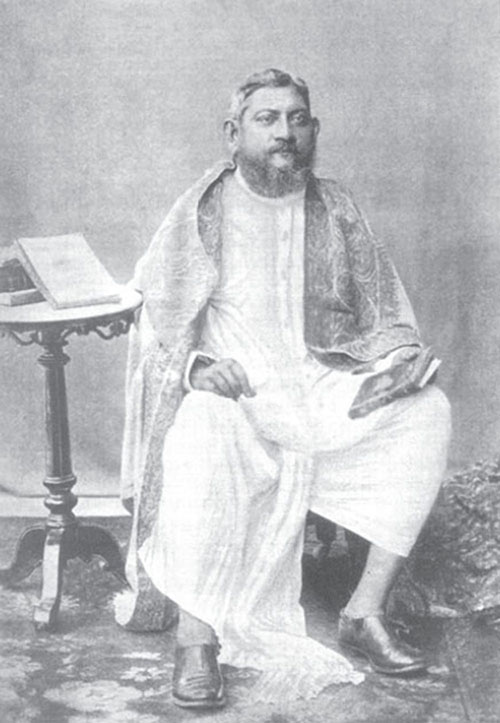
Girish Chandra Ghosh
On the 21 August 1911, he entered Mahasamadhi. During his last days, he used to speak only about God, His infinite mercy and grace. In the midst of extreme suffering and pain, he uttered His name and told his visitors that when he remembered God and His wonderful deeds, he forgot all sufferings of the body. He smiled gently, saying, ‘It is His grace.’
In 1916, when I went to Madras with Swami Brahmananda, he told me one evening, ‘Shashi Maharaj was Vedanta-murti, an embodiment of the highest Vedantic Truth. Though he is no more present in body, his spirit is working all over Madras.’
Swami Ramakrishnananda was a living embodiment of disciplined love for the Divine, strict in his conduct, obedient to the Math of which he was an illustrious member, eager to serve and wholly devoted to the life spiritual, through communion with the idea which Sri Ramakrishna stands for.
[From the Vedanta Kesari, August, 1949, pp. 214-220]
↑ Contents
G.N.A. Ranganadhan Sharma A Half-An-Hour’s Talk with the Swami Ramakrishnananda [1]
At a most critical period in my life, the late Swami Ramakrishnananda helped me to understand myself better than I did. Just after leaving college in 1907 at the age of 23, I was pressed by my parents to look for an opening in life. But my attempts in this direction were very feeble; the religious literature that I largely read at the time, Theosophic, Vedantic and others, led me to lose much attraction for the worldly life and [motivated me] to think of serving humanity. In this state of do-nothingness, I would dream of nursing the sick, distributing food to the hungry and clothes to the unprotected, though I had not a copper that I could call my own. Without any special training, I would think of being a teacher to the [downtrodden] and so on. But—I had been married! ‘Should I forsake my wife and renounce the world so that I might devote my whole life to the work and serve the society and the public?’—was the thought that took so much hold upon me that I wrote at once to Sister Nivedita requesting her to suggest me a course of action best suited to me. According to her wise advice, I went to Swami Ramakrishnananda in Madras, walking four miles from our place and freely opened my mind to him. The Swami did not ridicule me for my ambitious schemes born of in-experience, or upbraid me for my foolish thought of deserting my wife. Buddha-like serenity shone on his forehead, his eye-brows were lifted in contemplation for a time and then his deep, kindly eyes were fixed upon me and his lips parted to give expression to the words of wisdom, of which I give the following imperfect summary:—
‘There is a widespread mistaken notion that the religious life cannot be lived in the family. There is nothing unholy or unspiritual in the family life per se. There is full scope for unselfishness in the matter of working for others who need your protection, even in the householder’s life. The bachelor has, no doubt, comparatively, more freedom of action than a married man. He [the bachelor] has to look to the fulfillment of his duties towards his parents, first of all, before he wishes to breathe a freer atmosphere than that of the home. But the former [the married man] has, besides this, other duties to perform, viz., duties to his wife who has a claim to the spiritual participation in his lot; to society, for, if not the householder, who is to maintain the brahmachari or the sannyasi?—and to posterity through his bringing up children in such a way as to be service-able to society. It is clearly impossible to have any field of service properly attended to if all married people were to break their marital ties and straightway turned into sannyasins!
‘Also you must rightly differentiate between the true soaring spirit to which earthly ties are nothing and the rebellious spirit which is impatient of restraints. If your spirit is of the former kind, do you really feel within you the irresistible and un-mistakable Call? Such a Call comes to very few indeed and they stand in no need of weighing or asking the question if they will incur any sin by breaking the shackles of samsara. They hear the Voice and are not conscious of anything but obeying it. If yours is not such a spirit, then submit yourself to a searching self-analysis of the true motive of your action and find out for yourself if it is not akin to the spirit that fights shy of bearing the necessary burdens of life, the spirit that lacks the heroism to accept life as it is, the spirit that is loath to be useful in humble grooves best suited to itself, because of its false ambition to loom large in the broad daylight of the world for the sake of name and fame. Reflect well over these questions. There is no hurry at all. If need be, come to me again.’
There was no need. The illuminative discourse gave me so much penetration into the obscure workings of the human mind, that I came out of the Swami’s holy presence fully resolved to choose a suitable humble sphere of life and do my duty as best as I could in it. I have every reason to be thankful to the Swami and to congratulate myself on having acted on his valuable advice.
[From the Prabuddha Bharata, October, 1911, pp. 209-210]
ⓘ
1 This is the content of the author’s letter to the Editor, Prabuddha Bharata written on 25 September 1911
↑ Contents
An Unknown Devotee
The lives and teachings of Sri Ramakrishna and his disciples have now become, more or less, world-famous. But when I first met Swami Ramakrishnananda, about sixty years ago, the situation was quite different. Not even one in a hundred among the college students or the educated public had heard about Sri Ramakrishna. A few were acquainted with the name of Swami Vivekananda. I first heard of his name from a boarder in a boarding house, that a sannyasin known as Vivekananda had gone to America and delivered lectures there and had converted some Americans to the Hindu way of thinking. The notion prevalent among us at that period was that the putting on of holy ashes, sandal paste, etc. and the going to temple constituted the essentials of religion and that, if the recitation of the names of God and the japa of a mantra be added to them, nothing more remained to be practised or known in religion.
It took two more years for me to hear the name of Sri Ramakrishna and to read some articles about him as well as Max Muller’s celebrated book on his life and sayings. A little later, I heard that some sannyasins, perhaps disciples of Sri Ramakrishna, were residing at Triplicane, Madras. Next morning, I started for Triplicane. I wandered from place to place in search of the residence of the sannyasins. At long last, someone informed me that some sannyasins were living in a building called Ice House. It was a three-storeyed building on the sea-shore in Triplicane. I proceeded to the House. The threshold was a raised floor. I stood there for sometime and there came up a young man after his bath. He had a wet kashaya [ochre] cloth in one of his hands. I told him, ‘I have come to see the Swami’. He replied, ‘Swamiji has gone to the town. He will return at noon. You can see him if you come here after taking your meal. Accordingly, I went back, took my meal and returned again to the place that very noon. The door was shut. I kept standing on the threshold. A simple man came from inside and opening the door asked me to get in. I descended from the threshold and entered a room which looked like a cellar.
Marina beach, Chennai
It was a fairly large room. There was a chair, a table and a bed-stead in the room. Some pictures hung on the walls. A cloth-like carpet was spread on the floor for visitors to sit on. It was a visitor who had opened the door for me. He closed it again and sat down. I saw an imposing person in kashaya dress lying on the bed-stead. His eyes were closed. There was no one else in the room. I thought that the person was resting after taking his meal and so I stood in the room for sometime, looking at the pictures on the walls. In four or five minutes, I heard him asking something and the visitor replying to it. I turned in that direction and stood in front of him. I do not remember whether I saluted him. It is certain that I did not prostrate before him. He asked me to sit down and inquired about me. I replied to his questions. I was too ignorant and dull-witted to ask him about important religious matters. But I remember having asked him two questions. My first question was whether the Swami had been with Sri Ramakrishna. ‘Yes’ was his reply given very quietly. He seemed to have entered a thought-world and his answer appeared to come from afar. Did he feel that he was even then living with Sri Ramakrishna?
My second question was ‘What is the object of life?’ Straight came the answer, ‘to know a spade as a spade’. I had imagined that he would say that the object of life was the worship of God or the attainment of Moksha. But, his reply was too abstruse for me. Seeing that I had not grasped the true import of his words, he tried to make his meaning clear. Yet, I was not able to understand it properly. My knowledge and power of understanding were very poor. I do not now recollect all that he said then.
But on another occasion, he explained the very same idea, by an illustration. It was somewhat like this: A little girl and her brother were playing together. After a time, the brother went away and came back before her, putting on a frightening mask on his face. The girl felt confounded, got frightened and loudly called out to her brother to come and save her. He was not to be seen. Then she began to weep in grief and terror. The brother immediately removed his mask and revealed himself. Then, they had a hearty laugh over it.
That day, he talked thus for a short time. He then rose, took a coconut laddu from a vessel kept in a niche and gave it to me saying ‘you may eat it’. That sweetmeat was one of the kind relished by Sri Ramakrishna. Though small in size, it was very tasty. Later, he used to give the laddu of that or of some other variety as prasad whenever I took leave of him. I do not remember whether he asked me to come again, as Sri Ramakrishna used to ask some devotees. But I felt that I should meet him again. I had many occasions since then to visit him. But I did not realize even to the slightest extent his towering greatness and could not benefit myself by acquiring valuable lessons from him. Such was the nature of my mind.
I used to go to him as a visitor and not as an earnest seeker of Truth. I felt that he was an extraordinary person, an eminent man. The colour of his body was golden with a ruddy tint. He had a strong physique. His height in stature was in proportion to the breadth of his body. His hands and feet as well as his fingers were tender. His eyes, though small, shone and revealed his keen intellect. He had a sweet voice. His bearing was bold and imperious. I had not seen such a perfect man before. That attracted me and I went to see him again and again. But still, I did not ask him any question on religion. Once a visitor remarked about Sri Ramakrishna, ‘He was a great man’. The Swamiji’s face became a little flushed when he heard the remark. He said with a voice surcharged with emotion ‘A great man! Who are your great men? Mere mud-worshippers, servants of their passions, such are your great men. Ramakrishna never worshipped mud. He worshipped God and God alone. He transcended the universe, came face to face with God and mercifully brought Him down to us, poor mortals. That was Ramakrishna’.
I have heard the Swami often utter the words, mud-worshippers and slaves of passion. His talks and actions brimmed with intense renunciation and contempt for the enjoyments of the world. A visitor was speaking about a fairly distinguished man. Then the Swami burst out, ‘Oh! He wants to be somebody in this cow-dung of a world! No, it is not cow-dung; that is at least useful and considered sacred; it is worse than that and he wants to be a somebody in it’.
Another time, a gentleman said that he was reading the Bhagavata. The Swami asked him to recite some verses from it. He began with the verses: श्रीकृष्ण जिष्णुसख etc., At once, the Swami recited;
सत्यां क्षितौ किं कशिपोः प्रयासै-
र्बाहौ खसिद्धे ह्युपबर्हणैः किम् ।
सत्यञ्जलौ किं पुरुघान्नपात्रया
दिगवल्कलादौ सति किं दुकूलैः ।।
etc., breathing renunciation and sat absorbed in the bliss of the Atman.
He did not care for the so-called pleasures and glamour of life in his habits and dress. He was never habituated to wear a shirt. He never took to daily shave. When he went out, he put on a coat and wore a turban. He would have his head completely shaved twice a month. He was not habituated to drinking tea or coffee. For the greater part of that period, he had no cook. At noon, he used to prepare food, offer it to Sri Ramakrishna and partake of the prasada. He would strictly adhere to the practice of not taking anything which had not been offered to Sri Ramakrishna. Even when there were Brahmacharis or cooks in the Math, the Swami himself used to cut vegetables for the dishes to be prepared for offering.
It was the words, ‘Sri Guru Maharaj’, that he used generally when he wanted to refer to Sri Ramakrishna. He took special care in preparing food relished by Sri Ramakrishna. It was not by looking at the photo that he saw Sri Ramakrishna. He actually saw the person living in flesh and blood.
He was Hanuman himself in Dasya Bhakti. His throat choked with deep emotion when he recited hymns to God. His voice rose to a high pitch and he would be absorbed while he uttered the names of God. There was once bhajan in connection with the birthday celebration of Swami Vivekananda. A large picture of the Swamiji, ornamented with various decorations, was placed in front. Some 25 to 30 persons were singing the kirtan, the Swami was sitting silent in their midst. The kirtan went on for a few minutes. Suddenly the Swami stood up swayed by intense emotion and began to dance. His hands were raised and the head slightly tilted. For 15 to 20 minutes, he danced to the right and left and in a circle, each step being in accordance with the tune. All those who were engaged in the kirtan, also danced along with him.
The Swami had unbounded devotion to Swami Vivekananda. His famous hymn, the Vivekananda Panchakam, testifies this. A visitor once said something and cited Swami Vivekananda as authority in support of his statement. The Swami at once remarked with conviction, ‘The great Swamiji would never have said like that. He was the very embodiment of Truth. Not one word against truth or fundamental principles could ever emerge from his lips.’ The visitor later on realized that he had misunderstood the words of Vivekananda.
While expounding the Advaita realization, the Swami would show its relation with the realization of God with form, pointing out their similarities and differences. He used to observe that practice of Advaita, if it does not proceed through the realization of God with form, would be often attended with undesirable results. Meditation on the form of God should not be given up. That sadhana, properly practised according to the dictates ol the Sastras, will naturally lead to the realization of the formless aspect of God. For a long time, whose beginning cannot be known, the mind of man has been habituated to dwell in duality and to depend on some entity other than himself. So, the ordinary man, endowed with such a mind, will naturally feel much greater pain than that of death when his mind, without any external object to cling to, begins to dissolve in the Infinite. That may lead to very harmful results. Such is the purport of what the Swami said on the subject.
Even in the ordinary mood, the Swami had no body-consciousness. He remained in the consciousness of his true self, the Atman. Once, while Lord Curzon, the then Viceroy, was in Madras on a visit, the Swami asked a person standing near him whether he would be going to meet the Viceroy. On his replying in the negative, the Swami was very glad and said, ‘You are quite right. Why should you meet him? You are greater than him, or, for the matter of that, than even the Emperor Edward. You are not this body of three and a half cubits. You are verily the Atman.’ Once, I heard the Swami explaining the Ashtavarka Gita to the Brahmacharis of the Math. It was the following verse that he expounded:
यदि देहं पृयक् कृत्य चिति विश्रम्य तिष्ठसि
अधुनैव सुखी शान्तो बन्वमुक्तो भविष्यसि ।
Though a Prince of Bhaktas, he imparted the highest Jnana also. Once, he said that a yogi would see the universe as his body. That seems to have been his own experience. He taught Raja Yoga to some aspirants. As an ideal Karma Yogi, he worked incessantly for 14 years in Madras. The widespread propagation of Vedanta in the States of Madras, Mysore and Kerala is largely the result of his assiduous labours. Those, who know the history of the movement from the very beginning, will admit the truth of this statement.
Though I was not able to grasp his manysided greatness and the depth of his spirituality, I saw many instances of his love to the poor and the miserable. The divine compassion he felt for two destitute students and the exertions he made to relieve their distress was the beginning of the well-known Ramakrishna Mission Students’ Home, Madras and its beneficent activities. Sri Ramakrishna Math, Madras, owes its inception and growth to the Swami’s greatness, renunciation and tapas.
As a result of his tremendous physical and mental exertions for a long time without proper food and rest, he fell ill. For treatment, the President Maharaj, Swami Brahmananda, pressed him to go to Calcutta. It was a few days before he went to Calcutta that I met him for the last time. I did not know of his imminent departure. Though his body appeared a little weak, he looked calm and unfathomable like an ocean without waves. He spoke about the transitoriness of the world. I prostrated myself before him and took leave of the Swami for the last time.
[From the Vedanta Kesari, July 1966, pp. 171-174]
↑ Contents
A Devotee
It is now more than half a century since Shashi Maharaj passed away. His name is still a fragrant memory today and the story of his works, an inspiring epic. A loyal generation of followers is now working over the foundations strongly laid down by him and a grateful posterity is reaping the harvest of his pious sowing. But it is not given to all, even to his admires and emulators, to know everything which went about to create his unique personality. For, in his case, every saying, every doing, even a casual remark or commonplace act was so full of the impress of a perfect character and a disciplined upbringing that it was well nigh impossible to know him fully, unless perhaps one was constantly with him. In short, for him, there were no ‘inspired’ or ‘dull’ moments; his spiritual genius was ablaze always.
I am one of those who had a few exhilarating hours with the Swami; and though six decades have gone by, every one of these experiences is fresh in my memory and is as enthralling now as it was at the time of its occurrence.
It was in the year 1906 that I first saw Swami Ramakrishnananda. I was then a student in the Hindu college at Tirunelveli. An elderly gentleman, a retired post master, who knew something of Sri Ramakrishna and his movement, told me one day, quite by chance, that a Swami was to give a talk in the evening at the Vannarpet Literary Club. He invited me to go with him to the meeting and I gladly agreed. We walked to the place at sunset. There was not much of a crowd and we soon found ourselves in a quite gathering of a few lawyers and other interested persons. Then a door opened and two Swamis, clad in the traditional gerua robes, entered. I learned they were Swami Abhedananda and Swami Ramakrishnananda. The former had been assigned by Swami Vivekananda to disseminate the teachings of Vedanta in America. After nearly a decade of missionary work in the West, Swami Abhedananda had returned to India on a visit to his motherland. He had disembarked from his steamer off Tuticorin and came to Tirunelveli. I learned that Ramakrishnananda, who had been working at Madras, had gone to receive his brother-disciple at Colombo. Ramakrishnananda himself made no speech that day.
Abhedananda spoke impressively and even now two ideas which he stressed that day come vividly to my mind. One was in reference to the impersonal character of the Hindu faith. While every other faith, he told us, claimed to have been founded by this or that prophet, Hinduism relied on no founder, however great. When the historicity of the founder of a religion is disproved, he said, then that religion falls or ceases to exist. Hinduism is singularly free from the effect and stands on the firm rock of eternal principles. The second idea he expressed was that while there were faiths which set apart particular days of the week for going to the church, mosque or temple to pray, Hinduism expected a Hindu to pray always and perform every action in his life in the spirit of worship. Thus, the Hindu is expected to bathe in religion, talk in religion, walk in religion, live and die in religion. I could not, unfortunately, meet and converse with the Swamis that evening, but had to be satisfied with looking at them from a distance and listening to the talk.
Two years passed. I had completed doing my undergraduate work at St. Joseph’s College and had gone to Madras at the end of 1908 to take my university examination and practical test in science. I stayed with a relative at Triplicane. Coming to know from a friend that the Ramakrishna Math at Mylapore was quite near, I went there and was shown the monastery. One afternoon, I made bold to enter the ochre-coloured building. Swami Ramakrishnananda was seated in the hall. I had no idea then that the proper way to show respect to a monk when visiting him was to prostrate before him; so with folded palms I respectfully saluted him and then sat in front of him.
‘Where do you come from?’ he asked me.
‘From Triplicane,’ I answered.
‘Do you go the temple of Parthasarathy there?’ He said
‘Yes,’ I told him, ‘I do go there now and then.’
Then, he added, with an emphasis which I feel even now, ‘Remember that Parthasarathy is no mere idol. Great saints have had a vision of the living God in the temple’s inner shrine.’
This remark strongly reminded me of a fact whose significance had earlier escaped me. In the Vaishanvite literature of our land, there is a brief description of the holy shrines, mentioning the names of the place and of the holy waters there, the title of deity, the name of the tree sacred to the area, as well as the name of the worshiper or devotee to whom the deity has granted His vision. Without this last qualification, no temple, however important in other ways, is endowed with the sanctity of a kshetra or holy shrine.
The Swami then told me, ‘There is an American lady here who is very much devoted to Parthasarathy. I shall introduce her to you one day.’ I happened to see this lady at the Math on a subsequent occasion. She was Sister Devamata, the author of the book Days is an Indian Monastery, a pious woman full of reverence for India and all things Indian. Next, the Swami inquired me if I were married.
‘Yes,’ I replied.
‘People in these parts are married even at a tender age,’ he remarked with a smile. Then the Swami gave me the following advice: ‘Look upon your wife as God’s daughter. Treat her with respect, satisfy her wishes and make her happy in every way.’ This instruction entered my very soul and I felt that it contained the quintessence of the householder ideal. Just as a human being’s daughter cannot be anything other than a human being, or animal’s young, other than an animal, so God’s daughter cannot be anything other than God. And if the wife is God, she is therefore to be adored. What higher position is there for a wife and what grander ideal can there be for a husband? Besides, is not this Patnivrata ideal [that the husband should regard his wife as God] the necessary counterpart of the Pativrata pattern of life [that the wife should look upon her husband as God]? Was not this Patnivrata ideal demonstrated for the good of man by the prophet of this age, Sri Ramakrishna himself?
Deeply impressed with everything I saw and heard that day, I took leave of the Swami, who gave me, when I felt, the sweet prasada of a coconut ball. He made the coconut balls very tasty by adding honey to them. I was told that Sri Ramakrishna, child that he was, used to be fond of these coconut balls; therefore, no visitor to the monastery was permitted to depart without receiving one of them. Swami Ramakrishnananda, if questioned about his being so very particular in this seemingly small matter, would say, ‘Hundreds of persons cross by this road in front of the monastery from time to time, but only a few choose to enter it. Such persons that do enter this holy place should receive some prasada.’ How much he respected even a little spiritual bent of mind in man!
I had been reading Swami Vivekananda’s Raja Yoga at the time and Swamiji’s remark that the rousing of the kunda-lini was the one and only way to the attainment of Divine Wisdom had impressed me. One day, I asked Swami Ramakrishnananda if all aspirants must, therefore, practice raja yoga. He told me that Swamiji had also said that the rousing of the kundalini might happen in various ways, through love of God [bhakti yoga], through the mercy [kripa] of perfected sages, or through the path of knowledge [jnana yoga].
On another occasion, when I was visiting the monastery, I heard Swami Ramakrishnananda informing a devotee that he had been feeling awfully thirsty for the last few days. He must have suspected that it was that early symptoms of a fever, for he said, ‘And now, the fever in on.’ Then in a tone expressing the utmost humility and earnestness, one that conveyed a sense of utter dependence on God and a childlike faith in the Master’s grace, he said, ‘However wretched I may be, Sri Guru Maharaja will not desert me.’ Of course, I merely quote his very words here. It is impossible for me to communicate to the readers the intensity and strength contained in those words. They made a profound impression on me. His attitude was that of a distressed child, resigned to his mother’s care, with full faith in her power to save and cure.
Swami Ramakrishnananda was first and foremost a sannyasin. Monkhood was the main brace in his platform. The monastic vein in him was deep rooted and his loyalty to the hard vows of total renunciation admitted no compromise. One day, a young monk in the monastery was not seen in his place at lunch. The Swami made enquiries and sent for him. The monk, who was from Bengal, explained that it was the day marking partition of Bengal, a sad day for the Bengalis. Like a true patriot, he was observing a fast in protest. But the Swami told him that when he became a sannyasin he thereby renounced every former loyalty, every prior affiliation and every old sentiment—with their bonds and attachments. There was then no point, he said, for him to obey some pre-monastic pledge.
But the young monk was unable to agree. He defended his action by saying that the vows were made before he joined the order and he could not, without doing violence to his soul, act contrary to a vow. At that point, Swami Ramakrishnananda replied sternly, ‘If you will not obey me by taking your lunch, leave the monastery.’ Accordingly, the young monk departed immediately. But, he was a sensible young man. Soon he realized that his position was untenable, that sannyasa implied an infinitely greater vow than a political pledge and that the Swami’s call to him was for the assertion of a higher personality than even that of the patriot. So he retraced his steps, prostrated before the Swami and took his meal.
A certain young man who was very fond of arguing about matters of faith and belief was a frequent visitor to the monastery. The patience with which Swami Ramakrishnananda used to listen to the youth’s immature logic and wrong-headed thinking was remarkable. But, at the close of the youth’s remarks, the Swami would, by means of a short comment or a pointed question, prick the bubble of the young man’s cocksureness and force him to see things in their true prospective. The boy later became one of the Swami’s intimate devotees.
One day a devotee reported to the Swami a certain uncharitable remark made by a casual visitor to the Math. The visitor had said that he was surprised to see the luxury of a cot and a mattress in a monk’s dwelling and said derisively, ‘Is this, his tapas?’ The devotee was quite offended by this remark and carried the matter to the Swami’s ears. He was eager to see how the Swami would react. Swami Ramakarishnananda’s reply was: ‘Tell him that Sri Guru Maharaj has done a lot of tapas for us all and that we need not do anything.’ He spoke in the manner of a son who is heir to an enormous inheritance from his father. His deep sense of spiritual sufficiency in just being the disciple of Sri Ramakrishna was evident in his voice and manner of speaking. Of course, the Swami’s whole life was a ceaseless tapas of unbroken intensity, but the way in which he spoke about the blessedness of being the Master’s (Sri Ramakrishna’s) direct disciple revealed a new aspect of his nature to the devotee.
Ramakrishnananda had the eye to detect spirituality. Once, a sadhu arrived to the city. A few persons gathered round him out of curiosity and commenced to talk casually with him. Swami Ramakrishnananda happened to pass that way and see the sadhu. He at once remarked to those standing nearby, ‘He is a realized soul. Make the right use of your rare opportunity.’ The sadhu heard these words and protested to the Swami, ‘Why are you praising me?’ The Swami said to him, ‘I am only finding fault with these people for not discovering what you really are and for not making the fullest use of their contact with a saint.’ Behind the sadhu’s ordinary appearance, which caused many to regard him as only an aimless wanderer, the Swami was able to detect the light of realization.
Ramakrishnananda was quite good at telling instructive stories that illustrated a particular problem. He once told us the following to point out the necessity of ridding ourselves of deep-rooted vices and evil tendencies. A certain man was habituated to taking opium, but knowing the dire consequences of the habit, he longed to free himself from its grip. So he sought the help of his guru. Instead of admonishing his disciple, the guru only desired to know the weight of the opium he took every day. When told, he brought from his room a lump of chalk of the same weight and gave it to his disciple, saying, ‘Do not stop taking your opium. However, take no more than is equal to the weight of this lump of chalk every day and no less. But after taking your opium, use this chalk to draw a short line on the wall. You have nothing more to do.’ The disciple felt much relieved and strictly followed his advice during the subsequent months. Soon, to his astonishment, he found that as the weight of his chalk was decreasing, so also was the quantity of opium diminishing daily, by imperceptible degrees. Ultimately, his habit was cured. His body and mind responded to the treatment without the least reaction. This is the sort of method, said Ramakrishnananda, which a talented guru employs to reform his pupil. No fulminations or denunciations, but rather a gentle and effective correction—until, at the end, the person stands transformed.
The Swami once went to Trivandrum. A woman devotee invited him to a dinner at her home. She had cooked many things, for she was eager to feed the Swami well. A big plantain leaf was spread before him. The Swami asked her to place on the leaf everything she wished he should take. He asked that she not serve him ‘bit by bit.’ Therefore, the devotee covered the leaf with all kinds of dishes. The Swami made sure that everything she wished to serve him was there on the leaf and then sat down, uttered the meal chant and started eating. Suddenly the woman remembered she had forgotten to serve any ghee! Ashamed of her forgetfulness, she came running with the vessel of ghee. But the Swami did not permit her to serve it. He said quietly, ‘Excuse me, mother, but I never eat anything without first offering it to the Lord. Before I started eating the dishes spread over the leaf, I offered all of them to Him. As He has been given a meal without ghee, I cannot take any ghee today. If He in His mercy was pleased to accept the diet without ghee, surely it is not for me to indulge myself today.’ The whole tenor of his remark was that of a servant to whom the Master was his all in all.
The Swami once visited the Padmanabhaswamy temple in Trivandrum. As he was about to enter the inner apartment, a priest asked him if he was a Brahmin. The Swami made no answer, but started reciting in a solemn voice the hymn:
नाहं मनुष्यो न च देव यक्षौ न ब्राह्मण क्षत्रिय वैश्य शूद्रः ।
न ब्रह्मचारी न गृही वनस्थः भिक्षुर्न चाहं निज बोधरूपः ।।
No man am I, no god, no yaksha:
Neither am I brahmin, nor kshatriya, nor vaishya nor sudra.
No brahmachari am I, nor householder, nor forest-dweller, nor mendicant monk.
I am the stuff of true illumination.
The melodious voice and serene look of the Swami thrilled the people gathered in the temple yard and the priest at once admitted him.
Pictures and images of gods were, to the Swami, live entities—not mere paper and stone. On his first arrival at Madras, he took a photograph of Sri Ramakrishna with him. The way in which he held it and carried it was exactly like that of a mother carrying an infant in her arms. The devotees present on the occasion were amazed to see such tenderness and affection for what appeared to them but a photograph.
One day, the Swami asked one of the junior monks to remove some sharp thorns which were scattered on the monastery pathway. Ramakrishnananda used a small towel as the collecting basin and received the plucked thorns in it. As the cleaning went on, he confided to the disciple (who was at a loss as to why the Swami suddenly had decided on this project) that he had a vision of Sri Ramakrishna strolling along the path and had seen the Master’s feet picked by the thorns and bleed. The disciple then understood that to Ramakrishnananda, there were more things under heaven and earth than are dreamt of by ordinary folk. In fact, though the Swami was very human and very much engaged in ordinary things, there was at the same time in him an aloofness, a distance, an atmosphere which was not of this world, a suggestion of more sublime regions to which he had access.
He was an unusual consoler of men. And he always shed new light into the many problems of those who suffered. A young man, who had lost his wife, the mother of two children, was quite naturally in a very sorrowful mood and came to Ramakrishnananda for solace. The Swami at first expressed his deep sympathy for his loss which would impose additional burden on him. Then he changed his tone and said, ‘Consider this fact, God has indeed taken away one soul, but He has given you two instead—through that soul. Be therefore grateful to the Lord.’ This short piece of advice transformed the bereaved young man, who now looked upon himself not as a sorrowing widower, but as a privileged parent to whom God had entrusted the work of bringing up two of his children.
On another occasion, an elderly gentleman came to see the Swami. In the course of their talk, the man pointed out that in entire field of religious literature, women have been depicted as cause of temptation and men warned to beware of their snares. He said this was because the writers were men and that if women had written the same books, they would have pictured men as the agents of the devils. The Swami smiled in agreement and added that it was Sri Ramakrishna’s practice to warn his men devotees of the dangers of kamini-kanchana (woman and gold), but then when he spoke to women, he always cautioned them against purusha-kanchana (man and gold).
A devotee was once surprised to see the Swami with a novel of Sir Walter Scott in his hands. The devotee has always been of the impressions that the Swami was ever meditative and indrawn; therefore, he found it difficult to believe Ramakrishnananda would waste his time on an English novel. The Swami read his thoughts and said, ‘I see the cause of your surprise. It is true I gave up my college studies years ago in response to the pull of Sri Ramakrishna. And ever since then I have been devoted to his worship and sacred service. But now the Master has called me to a new work; that of lecturing. It is in order to do that satisfactorily that I am now brushing up my knowledge of English. A little reading of excellent fiction is helpful in improving my English; hence, this novel.’
[From the Vedanta and the West, March-April, 1968, pp 41-52 (First appeared in the Vedanta Kesari, September, 1967)]
↑ Contents
Dr. Shyamapada Mukherjee
Sri Shashi Maharaj came to Calcutta from Madras for treatment of some severe ailment sometime between 1910 and 1911. He was kept in a room on the first floor in the Holy Mother’s house. Viswaranjan Maharaj was appointed in his service. I had just completed the dissection of anatomy in the first year of my medical study. So I was quite familiar with the muscles on the upper portions of the back. I used to apply vibratory massage on those muscles. That relieved him much of his pain, so he told Viswaranjan Maharaj, ‘Shyamapada knows dissection, that is why when he massages, I feel much relieved of the pain. Therefore allow him to do.’ By the grace of Sri Ramakrishna, I got the rare opportunity of serving this great soul and felt myself blessed to hear the praise of service.
He was very serious by nature; but when he would smile, he looked exactly like a boy of seven or eight years. Without the grace of Sri Ramakrishna and the Holy Mother, I could not have had the holy company of that great soul in my life. Once, a devotee from Bangalore had sent a papaya for him. He cut it lengthwise and gave me one-fourth of that. I never tasted such a sweet papaya before. He was very pleased when I told him that.
[Source: Swami Saradanander Smriti Katha, Swami Chetanananda, Ed. and compiler, Udbodhan, Kolkata, 1st edn. 20 Poush Beng.1812, pp.251-52]
↑ Contents
PART - 4 (Mahasamadhi Reports and Descriptions
Swami Jagadiswarananda Swami Ramakrishnananda’s Final Journey
Swami Ramakrishnananda had been very eager to take Sri Sarada Devi, the Mother of the Ramakrishna Order and Swami Brahmananda, the spiritual son of Sri Ramakrishna, to the Deccan. He hoped that the local devotees would be blessed by meeting them and the Ramakrishna Movement would be well established in South India through their holy visits. Having arranged for their pilgrimages to Rameswaram and other holy places at different times, Swami Ramakrishnananda said, ‘My work is done!’...Shortly after the Holy Mother returned to Calcutta, Shashi Maharaj became bed ridden with illness in Madras. His health broke down and his body fell a prey to diabetes, cough and tuberculosis as a result of overstraining himself in preaching the message of his Master and working for the renaissance of Hinduism for a long period of fourteen years. He was affected by fever and cough. At the advice of the devotees, he went to the Bangalore in the beginning of 1911 for a change of climate. But, he did not recoup there. The doctor diagnosed the disease as incurable tuberculosis. Shashi Maharaj felt that his work had come to an end. He felt the great call of his Master and joyfully bided his time for the auspicious hour of the final union.
Both the President and the Secretary of the Order asked him to come to Calcutta for treatment at the earliest. The President, Swami Brahmananda, was staying in Puri at that time. He received the telegram of Swami Ramakrishnananda’s departure from Madras by Madras Mail and waited for him at the Khurda Road railway station. As the train arrived at the platform, Swami Brahmananda boarded the compartment Shashi Maharaj was travelling in. Swami Ramakrishnananda devoutly made obeisance to his beloved brother-disciple. Seeing his stout body worn and emaciated and his golden complexion tarnished, Maharaj said, ‘Shashi, what is this? Shed it out.’ Swami Ramakrishnananda replied, ‘O Raja, your blessings will make it possible.’ Maharaj repeated the same words and he also replied in the same strain. Maharaj [Swami Brahmananda] advised him to take proper treatment in Calcutta, ‘Do just as the doctor bids you.’ Swami Ramakrishnananda later followed Maharaj’s advice literally. When it was time for the train to whistle off, Maharaj got down to the platform and Swami Ramakrishnananda bowed before him again. This was their last meeting.
Shashi Maharaj came to Calcutta on June 10, 1911. He was housed in the Udbodhan house of Bagbazar for treatment. He lived for only two months and eleven days in Calcutta before entering the supreme absorption (Mahasamadhi) on August 21, 1911. The brother-disciples arranged for his treatment and service to the best of their ability. Swami Saradananda supervised the treatment. Swamis Premananda and Shivananda would regularly visit him from Belur Math. Dr. Bipin Ghosh diagnosed his disease as galloping phthisis and forecasted that his body would last no more than three months. His premonition came true. The famous Ayurvedic physician Durgaprasad Sen also treated him. When Durgaprasad Sen was a young student of Gangaprasad Sen, Sri Ramakrishna had gone to Gangaprasad Sen for treatment. It was the young Durgaprasad who had diagnosed and disclosed to his teacher that the disease of Sri Ramakrishna was borne of yogic practices. Dr. Durgaprasad asked Shashi Maharaj, ‘Do you dream of cremation ground, tulasi grove, etc.?’ Shashi Maharaj said in reply, ‘No, but I see the Master, the Holy Mother, Swamiji, Dakshineswar and the like in the dream.’ When asked the reason for his health breaking down at the age of only 49 years, he said, ‘Madras life was too straining.’
... His body had a preponderance of bile humour. Hence at times he would be affected by dry eczema. Two persons used to fan him with a couple of palm leaf fans. At times they had to fan him over his head also. That was the main duty of the caretakers. He would roll on the bedstead spread on the ground and flutter in pain uttering, ‘Hail Lord! Oh Master!’ Viswaranjan Maharaj (Swami Hariharananda) would give him medicine and look after him. He said, ‘It was a difficult task to serve Shashi Maharaj. One must respond immediately to his call and must carry out the order forthwith. Or he would feel disgusted and scold. This was his nature.’
... A man named Yogin Thakur had a few young followers with whom he used to serve the diseased and the afflicted in the locality. Those young men very often came to serve Shashi Maharaj. Once, a brahmacharin attendant’s towel got torn and he did not even have a mat to sit on. Shashi Maharaj brought a new towel and a nice mat through Yogin Thakur, called the attendant brahmacharin and after handing over those articles to him, asked him to sleep on the mat. The brahmacharin was very tired and drowsy due to night vigil. He fell into a deep slumber shortly after lying on the mat. Swami Ramakrishnananda became very pleased to find the attendant asleep. After some time, he too fell asleep for some time. After he got up, he told the attendant, ‘I too slept well after letting you sleep.’
...That time Girishbabu’s drama, Shankaracharya, had just been published as a book. At Shashi Maharaj’s behest, the first few scenes were read out to him. He used to listen to it after his lunch every day and enjoyed the drama very much. The second canto of the drama mentions the encounter of Shankaracharya with Vyasadeva who came in the guise of a Candala (man of very low caste) with four dogs [representing the four Vedas]. The Acharya was approaching the Manikarnika ghat in Kashi for bathing [in the river] when he met Candala on the way. Shankara asked the untouchable Candala to make way for him. But the latter did not pay any heed to Shankara’s order and went on talking to the four dogs. The man started calling his dogs by their names, ‘Hey Kelo, Bhulo and Dholo, what do you say?’ The wife of the man said, ‘Well, who’s it, my dear?’ Shashi Maharaj burst into laughter on hearing this portion, repeating the last sentence in mockery. About the drama he said, ‘It’s nothing but strokes of the pen.’ He did not hear it afterwards. When he was in cheerful mood he would repeat some meaningless words like a little boy, ‘tak jhinge phul takurh takurh’ to express his joy.
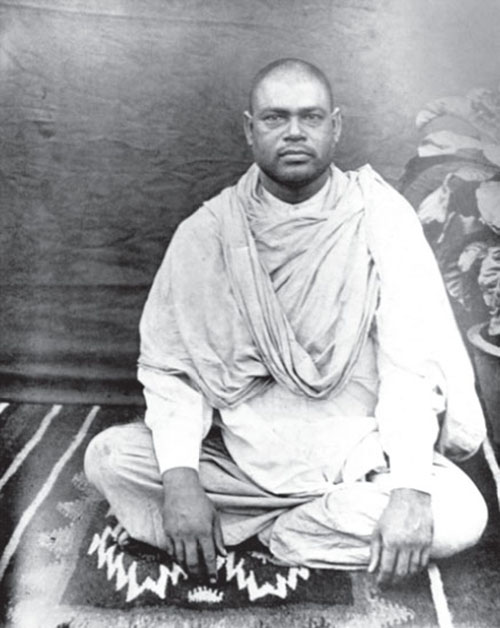
Swami Ramakrishnananda
On the day of the chariot festival, Shashi Maharaj gave the attendant brahmacharin a few coins and said, ‘Go and see the pulling of the chariot somewhere nearby and buy something from the fair.’ As the attendant hesitated to leave him alone, he said, ‘The Master too had asked me to do the same in the Cossipore garden house on a similar day. First, I did not agree to leave him as he was ill. But he insisted and so I went to see the local chariot festival and on my return purchased a pen knife worth two pice to cut lemons for him. He became very pleased with me and said, “These customs should be followed. Poor people open stalls in the fair to earn some money. In order to help them something must be purchased.”’ On hearing this, the attendant went to see the Bagbazar chariot festival and purchased a small hand-fan from the market for Shashi Maharaj who became extremely happy at that behaviour of the attendant...
Shyamadas Kaviraj, the renowned Ayurvedic physician of Calcutta, also served Shashi Maharaj for some time. He administered a medicine which was to be taken with honey. But he did not mention the quantity of honey to be mixed with each pill. The medicine had to be taken at 4 o’clock in the afternoon. As the attendant reminded Shashi Maharaj about the medicine around 3 o’clock, he enquired about the prescribed quantity of honey to be taken. As the attendant regretted his ignorance, Shashi Maharaj sent him to the house of the physician. Seeing the attendant at that untimely hour, the physician got panicky and enquired about the patient’s health. However, after learning about the purpose of the visit, he prescribed 12 to 15 drops of honey to be mixed with each dose. It was to literally follow the instructions of Swami Brahmananda given at Khurda Road Station that Shashi Maharaj acted that way. To him the words of his brother-disciple were as inviolable as the words of the Master.
His younger brother would visit him often. One day Shashi Maharaj reminded him of an old vow of making a goat sacrifice to the local goddess in his native place, when he had been just two to three years old. Later, that vow was altogether forgotten by the family. Swami Ramakrishnananda asked his brother to remind his mother of the unfulfilled vow. The brother went back and on enquiry came to know from the mother that it was true. So they arranged to fulfill the vow, thus satisfying the desire of the departing monk.
One day, Baburam Maharaj [Swami Premananda] sat by his bedside, dressed some fruits in a plate and handed the plate to Shashi Maharaj who began to shed tears. Baburam Maharaj then took the fruit pieces by his hand and fed him one by one with his own hand. This completely satisfied Shashi Maharaj who said, ‘Yes, I expect exactly that of you. Brother, you should feed in this way only.’
Despite the best efforts of expert doctors, the disease aggravated instead of coming under control. Cold and cough became worse. He became so weak that he was unable to get up by himself after sitting in the toilet. Towards the end, his toilet had to be arranged in the room itself. His food intake gradually reduced. He used to take a few cream cracker biscuits soaked in milk at the breakfast. At lunch, Sharat Maharaj would come by his bedside and cajole him to take one or two morsels more than his usual intake. But one day Shashi Maharaj told him, ‘Brother, Mahamaya doesn’t allow me to eat; so my food intake is getting reduced. Please don’t come here when I take food.’
Dr. Kanjilal used to visit him every day. Even the famous Homeopath Dr. Eunan and the renowned doctor Sir Nilratan Sarkar were also consulted. But nothing worked. Satish Chakravarty, the brother of Sharat Maharaj, used to go through the prescriptions made by the doctors. When none of the treatments yielded any results, Satish expressed his desire to have a last try. When Sharat Maharaj communicated this to Shashi Maharaj, the latter abstained from replying anything at that moment. Later he sent word to Sharat Maharaj through the attendant to the effect, ‘I have offered this body and mind at the holy feet of the Master forever. Swamis Brahmananda, Premananda etc. are still there as his representatives. Let the treatment be carried out as per their instructions. Do not do anything whimsically. I have no opinion of my own in this matter.’ On some days, Shashi Maharaj expressed a deep desire to take rice at lunch but was unable to eat when it was brought to him.
One day, his mother Bhavasundari Devi came to see him. He held out his head beseeching her to bless him by touching his head. The mother blessed the dying son by touching his head and back. Ramaswamy, the devotee from Madras, came to see him. Shashi Maharaj was extremely pleased to see him and blessed him from the bottom of his heart saying, ‘Convey my love to all the devotees of Madras. I covet to leave my body in that holy land of Deccan which gave birth to the great Acharyas of our land.’
He would become very happy when Ramakrishnababu[1], Paltu, Master Mahashay or Baburam Maharaj visited him. He intensely expressed his desire to see Swami Paramananda. But, the latter was on his way to India from America via Europe. Before he reached Calcutta, Shashi Maharaj passed away. Shashi Maharaj would often, like an affectionate mother, instruct Yogin Thakur about Swami Paramananda, ‘You should go to the dock to receive him. He is just like an innocent child and doesn’t know anything. He will be unhappy if you don’t go. You must go.’ The elder sister of Girish Chandra Ghosh often paid a visit to Shashi Maharaj on her return from the Ganga after bath. One day, seeing an attendant working hard in serving Shashi Maharaj, she commented, ‘Ah, dear me, how much you are suffering!’ Shashi Maharaj replied to that comment disgustingly, ‘Who else will do all that if they don’t? They have left their home and hearth and have become monks. They would become blessed by serving this way. This is also the Master’s work; it is He who is served through this work.’
In his last days, Shashi Maharaj used to vomit blood and became so weak that he could not leave his bed. After a bout of profuse bleeding and coughing, he would look at the photo of the Master and implore, ‘O Master, please, don’t give me more suffering; this body is unable to bear the pain of it. Give me a little peace.’ When he coughed in a lying position, his hands and feet would throw themselves up with every bout of coughing. One day, after vomiting blood heavily, he ordered the photo of the Master to be brought and holding it in front he said with a wounded pride, ‘I never committed any sin through this body; yet you give me so much trouble. Don’t you have any mercy even after giving me so much pain? What wrong did I commit that you give me so much misery?’ Next moment, he would burst forth into a mood of begging pardon, ‘I have committed hundreds of faults. O Master, forgive me.’ He handed over the photo of the Master to the attendant and said, ‘Replace Pranarama[2] in the proper place.’
At night he seldom slept. He did not like to lie down on the bed day and night, but he was also not able to sit even on his bed. Sometimes he would say, ‘Make me sit with the support of pillows all around.’ On getting no sleep he would say like an impatient boy, ‘Lull me to sleep as a mother would do to her son. Pass your hand on my body like a mother would do.’ Not caring for the pain of the disease, he would often speak of the Master. When the attendant once requested him to refrain from speaking, given the immense pain he suffered, he said, ‘When I speak of the Master I don’t have any sense of my body; so even the pain of death becomes insignificant.’ Even his delirious talks became prayers, uttering the names of Durga, Shiva, Sri Guru, etc. His deathbed transformed into a platform for asceticism. Thus, the knower of the highest knowledge conquered death. During this period he would often speak of Jesus Christ also.
It was two or three days before he passed away. He was lying down with eyes closed at eight or nine in the morning. The attendant[3] was sitting nearby. Suddenly, Shashi Maharaj got up and told the attendant hastily, ‘The Master has come; spread a seat.’ The attendant, unable to comprehend the import of this instruction, stood there bewildered. Then Shashi Maharaj reiterated, ‘Don’t you see, Thakur, Ma and Swamiji have come; spread a mat and three pillows.’ The attendant obeyed the order. Then Shashi Maharaj kept gazing at some invisible entities without even winking and with folded hands bowed thrice before them. After some time he said, ‘They are gone; now you remove the mat and pillows.’
His robust structure was so worn out and emaciated due to the disease that he looked like a small and frail man and his eyes looked blank and winkless. One day, Sri Pulinkrishna Mitra, a householder disciple of Swamiji, came to see him. Shashi Maharaj requested him to sing the song composed by Swamiji beginning with these lines—‘There is no sun nor brilliance nor even the beautiful moon’. While Pulin was singing this song, Shashi Maharaj went into raptures and merged into deep meditation. Having realized that the hour of final departure was drawing near, Swami Ramakrishnananda craved to see the Holy Mother who was then staying in Jayrambati, far away from Calcutta. Swami Dhirananda was sent to bring her, but she refused to come.
Well, though she did not come in her gross form, she did fulfill the desire of her dear son through her divine appearance. Shashi Maharaj seems to have had this supersensuous vision on the eve of his passing away; because it was then he disclosed a little about this vision to Pulin and sent word to the heroic devotee, Girish Chandra, to compose a song beginning with the line, ‘Gone is the night of sorrow’. The great poet complied with his request and completed the song as follows:-
Gone is the night of sorrow
Here ends the nightmare of ‘I’, ‘I’,
No more is delusion of life and death
Behold the sun of knowledge with its beaming face,
as the Mother smiles.
The Mother confers fearlessness,
Sing hail to her in high pitch,
Beat the drums in victory o’er death,
The earth is full with Mother’s name.
The Mother says, ‘Cry not,
Behold the feet of the Lord.
Worry not, the pain will go.’
Look by me float the eyes of compassion
Of the Saviour of the world.
Pulin sang the song for a long time and Shashi Maharaj listened to it with eyes closed and with rapt attention. The song touched him so much that he felt a deep peace in his heart after hearing it.
On the last day, Dr. Kanjilal examined him and declared that he was a bit better... That day, he frequently merged in samadhi since morning. A few hours before his final dissolution (Mahasamadhi) he drank the sanctified water (Caranamrita). For the last three hours, he was in a semi-conscious state. Just before one o’clock in the afternoon, his pulse showed the sign of cessation. At one o’clock, his face became ruddy. His whole body seemed to emit extraordinary effulgence. His hairs stood on their end. The face assumed such a reddish hue that it seemed that the blood from the whole body moved towards the head. A bit of perspiration appeared on the body. Even the hairs on the head became erect. Swami Ramakrishnananda entered Mahasamadhi with his eyes gazing upwards on Monday, 21 August 1911, at 1.10 p.m. Surrounding his body, his brother-disciples chanted the name of the Master. Even long after the physical death, signs of horripilation were visible on his body...
The mortal remains of Shashi Maharaj was anointed with sandal-paste, adorned with flower wreaths and put on a cot. In the courtyard of Udbodhan, Sister Nivedita knelt down and touched her head at the feet of the departed Swami. The final journey began. Monks, brahmacharins and devotees carried the cot on their shoulders. A group of people began to chant God’s name and sing devotional songs during the procession. Fragrance of flowers and incense rented the air. The atmosphere became charged with the cries of the monks and devotees—‘Jai Sri Guru Maharaj ki Jai, Jai Mahamayai ki Jai, Jai Swamiji Maharaj ki Jai, Jai Ganga Mai ki Jai, Jai Ramakrishnananda Maharaj ki Jai,’ etc. Everyone, from children to the aged, came out of their houses and stood in rows on either sides of the street to witness this celestial sight. The mortal remains were kept for some time at the Cossipore garden house, the holy place where the Master had spent his last days of life and the whole of Ramanama sankirtana was sung in chorus. The next halt was at the Cossipore crematorium, where the mortal remains of Sri Ramakrishna had been consigned to flames.
Dusk had set in. Several boats were ready at Kuthighat (Baranagar) to ferry the bereaved across the Ganga to Belur Math. Mother Ganga was silently flowing mourning the loss of her god-like son. Belur Math became quiet and desolate. The gentle breeze that blew could carry away only the physical fatigue of the mourners. By the side of Swamiji’s memorial temple, a sandal wood pyre was arranged and the mortal remains of Shashi Maharaj were consigned to flames. While his heart and soul merged at the lotus feet of his Guru, his mortal remains reduced to ashes in the fire of Sri Ramakrishna.
His holy life dedicated to the lotus feet of his Guru blazed like a sacrificial fire in this world for only 49 years. No memorial stone as yet marks the spot of his cremation[4] to stimulate reverence in a visitor about the greatness of the place. But, his immortal memoirs will be written in golden letters in the annals of the Ramakrishna Order. Just as people got a new lease of life after coming in contact with his holy life, many would continue to get inspiration from his noble life and message to lead a devout life, now and forever...
[Extracts from Udbodhan, 48th year, 12th number.]
ⓘ
1 Son of Balaram Bose
2 The name by which the disciples of Sri Ramakrishna addressed him after his passing away
3 Swami Abhayananda (Bharat Maharaj).
4 Later it was built with a carved memorial stone enlisting the names of seven direct disciples of Sri Ramakrishna.
↑ Contents
Swami Saradananda The Mahasamadhi of Swami Ramakrishnananda
प्रकृतिस्त्वं हि सर्वस्य गुणत्रयविभाविनी । कालरात्रिर्महारात्रिर्मोहरात्रिश्च दारुणा ।
[You are the primordial cause of everything, bringing into force the three qualities. You are the dark night of periodic dissolution. You are the great night of final dissolution and the terrible night of delusion.]
On August 21, 1911, the one who was endowed with unlimited qualities, the one who was one of the veteran preachers of the Ramakrishna Mission, the well-known President of the Ramakrishna Math, Madras, Swami Ramakrishnananda, forever merged his mind in Sri Ramakrishna and has entered peaceful rest in Mahasamadhi in the darkness of Maharatri at ten minutes past one o’clock.
The Swami came to this samsara in 1863 and entered the Abode of Fearlessness in 1911. That is, he moved with us in various ways in this mortal world for just 51 [actually 49] years.
His passionate devotion to his Guru, steadfastness to the ideal, service-oriented attitude, fiery renunciation and devotion to God endeared him to the devotees as an ideal person on one hand and on the other, his learning, intellect, modesty, scriptural knowledge, sympathy and empathy made him an unfailing support of hope and peace to those who were getting burnt in the fire of samsara.
He studied first in Albert College and then in Metropolitan College. Since that period, an eagerness for spiritual life was observed in Swami Ramakrishnananda. From his very childhood, he used to perform worship etc. That later he regularly read scriptures like the Bible, Sri Sri Chaitanya Charita-mrita, etc. and that he attended the religious discourses of the devoted preacher Keshab Chandra Sen and that he occasionally joined the congregational prayer at Brahmo Samaj, it can be inferred to what extent his spiritual thirst became intense during that period.
It was in the month of October, [in the year] 1883, at the juncture of autumn and dewy season, when the Swami came to Dakshineswar to quench his thirst for religion, as mentioned above and to surrender at the feet of Sri Guru, a repository of eternal peace.
Now, his inner life underwent a complete transformation due to this storm of love for God. At first, he frequented to his Guru from his home, then leaving home, he started staying in Cossipore garden house with the Guru. Later, in 1886, at the demise of his Guru, he made service to his Guru’s paduka and the worship of the same as the only support of his life at the Baranagar Math where he unwaveringly stayed for twelve long years.
In the beginning of 1897, Revered Swami Vivekananda returned to the Math for the first time after conquering the West and founded various activities in many parts of India with his brother-disciples for the welfare of people. At the behest of Swamiji, towards the end of that very year, Swami Ramakrishnananda left for Madras to establish a centre of the Ramakrishna Math and Mission. From 1898 till 1911, that is, for about fourteen years, Sri Ramakrishnananda stayed there following the footsteps of Swami Vivekananda and hoisting the victory flag of Sri Ramakrishna’s message of ‘As many faiths so many paths’ in various places of the Deccan infested at that time with sectarianism.
What all great works have been accomplished in Madras and the whole of the Deccan under the tutelage of this hero, Sri Ramakrishnananda, who found refuge in his Guru! O reader! Ask the bereaved residents of Madras and the Deccan about the description of this godlike person’s life and works and you will find them narrating it in a thousand ways with eyes flowing with tears.
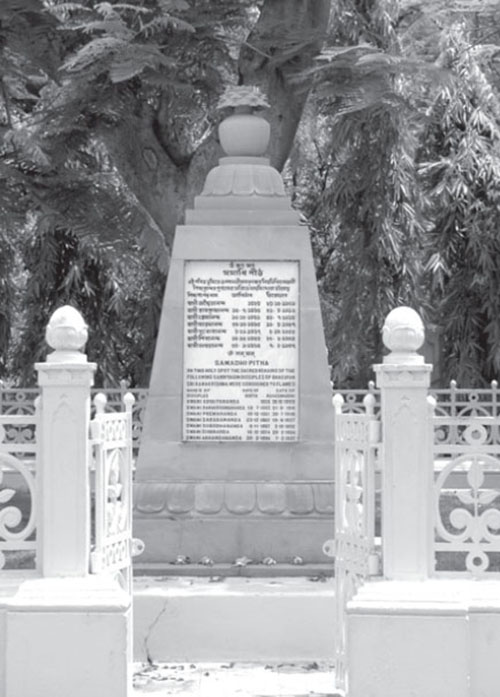 Samadhi Peeth, Belur Math—the place where the mortal remains of
Swami Ramakrishnananda were consigned to flames
Or, if you are habituated to judge the qualities of human life and activities on the basis of selflessness, perseverance and steadfastness to the ideal, then come and join us in shedding tears and say—this type of life is rare in the world. The adorable God of the world has taken him back to Himself within such a short period since this world full of selfishness does not care for such a person.
Coming to know that the disease was incurable, his brother-disciples brought him to Calcutta for his medical treatment. He reached Calcutta on the 10th of June. Right from that day onwards, his treatment was given to the care of renowned doctors and Kavirajas. Two and a half months passed in this way bearing untold sufferings before he succumbed to the disease at 12/13, Gopal Chandra Niyogi Lane of Bagbazar, Calcutta, a branch centre of the Ramakrishna Order. That he left his mortal body in Samadhi became evident to the brother-disciples by seeing the unusual horripilation of his whole body long after his death.
His body was carried from Calcutta to Belur Math and consigned to flames near the cremating spot of Swami Vivekananda.
ॐ पूर्णमदः पूर्णमिदं पूर्णात्पूर्णमुदच्यते ।
पूर्णस्य पूर्णमादाय पूर्णमेवावशिष्यते ।।
[Source: Vividha Prasanga, Swami Saradananda]
↑ Contents
The Passing of His Holiness the Swami Ramakrishnananda
‘For this corruptible must put on incorruption and this mortal must put on immortality.
‘So when this corruptible shall have to put on incorruption and this mortal shall have to put on immortality; then shall be brought to pass the saying, Death is swallowed up in victory.’
Still does the mind linger in that flood of solemnity to which it soared beyond the bounds of earth when the news was heralded from the Math in Baghbazar, Calcutta, that His Holiness, the Swami Ramakrishnananda, had passed from pain into Mahasamadhi on Monday, the twenty-first of August last, shortly after the noon hour. He had been the direct and one of the most chosen of the disciples of Sri Ramakrishna; he had been one of the chief workers in the building up of the Ramakrishna Mission; of the monastery at Belur, just outside the northern boundaries of Calcutta, he had been most deservingly called, the pillar and foundation rock; he was also one of the foremost preachers of the Vedanta philosophy in recent years.
All over India his fame has spread; but far more than his fame, the spirit of his teachings has spread. Madras and Calcutta have vied for the honour of calling him their son. Now that he has passed into realization, India, to which he was known, mourns his loss.
And yet, withal, it is not death, but is victory which has been sensed as uppermost. The gloom of death has already given way to the knowledge of that vast Illumination he has entered. Of him, there now endures eternally, divested of all earthly limitations—the divine reality and bliss. The note that he has merged into realization is ascendant. And India is aware in this case, as of all her sannyasin sons—the spirit has realized its divine eternity, though the body has broken in time.
In life, Swami Ramakrishnananda had struck the flawless note of the Upanishads which resounds, amidst the bondage of the world and its sorrow, the freedom and the bliss of the Divine Self-realized. His whole being had been a concentration in this. Thus, when he passed, the spirit of that consciousness enfolded him forever in its Truth; and for a while, that spirit with its boundless life and bliss descended upon those who knew the departed man; for they sensed that for which he, as the monk, had given up the world.
He had been in Madras, giving forth to the world the message of his Master and of his brother monk, Swami Vivekananda, when the consuming illness which had been afflicting him for some time was declared fatal. It was then that his fellow-monks and the President of the Ramakrishna Order entreated him to renounce his labours and come to Calcutta where he could be surrounded with the love and devoted attention of those who were his friends and well-wishers, who also had sat with him as spiritual children, in those memorable days at the feet of Sri Ramakrishna. Heeding at last their earnest entreaties, he abandoned the field in which he so diligently taught for more than fourteen years. At Calcutta, he was housed at the monastery in Baghbazar, There his cough gradually became worse. Medical attention was of no avail. All hopes were given up and the end came—in wonderful peace.
Most remarkable, however, was the strength of his spirit which burst forth in eloquent discourse concerning the soul and God even whilst the body suffered most. One who loved him dearly, hearing him speak in the distressed state of his body, begged him to desist. ‘Why?’ came the reply, ‘When I speak of the Lord all pain leaves me. I forget the body.’ His great esteem and love for Christ, manifested throughout his life-time, renewed itself constantly in those last days. Speaking of Jesus, he would become eloquent. He would tell of how Sri Ramakrishna had regarded Christ and of how, during Samadhi, when his Master had had the vision of Christ, the very body of the great Founder of Christianity had entered into that of His own.
It is said in India that, when sages are about to pass away, they become most eager to convey unto mankind their spiritual realization. This had been true of Buddha. Of Sri Ramakrishna, it was true. Of the Swami Vivekananda, it had been also true. And with the passing of the Swami Ramakrishnananda, it was again true. At times, when the stress of the body intervened, he would turn to the monks and disciples around him saying: ‘How long shall this endure; it seems the body cannot stand this!’
There came a time when the disease in-flamed the brain. Yet even in delirium, his mind and his voice knew no other thought than those of the Lord. ‘Durga, Durga’ the name of the Mother, ‘Shiva, Shiva,’ the name of the Lord of monks and the name of his Master were ever on his lips.
As the days passed and his condition grew worse, the monks knew the time for Mahasamadhi or supreme realization was at hand. Several days more—then the body lay forsaken by the soul. At that moment, the Presence of the Lord was felt. The death-chamber had become a tabernacle; it had become the temple of illumination.
Then came, in the afternoon, the triumphant procession from the Math, through the lanes, to the river’s winding course. Carried on a cot, the body lay covered with flowers and garlands. The air was laden with the incense of the flowers and the perfume of incense. Ahead, the sankirtan party sang. Following in the rear, were the gathering of the monks in their gerrua and of disciples of Sri Ramakrishna, of students and men, old and young.
Now and again, the air was rent with shouts of triumph, ‘Jai Sri Guru Maharaj ki Jai! Jai Sri Swamiji Maharaj ki Jai! Jai Sri Mahamayai ki Jai! Jai Sri Ramakrishnananda Swami Maharaj ki jai!’ And the winds carried the sound in prolonged and repeated echoes. Men, women and children ran to see what sort of a saint was he who had passed away. North and farther North, along the banks of the Ganga, the long procession went on, while the poor scrambled for the pice which were thrown about as charity and the notes of the sankirtan party, with the shouts of triumph together with the spirit of the occasion, sank deeper and deeper until the inmost soul was touched, until it rebounded upon itself and the world was lost to view in that partaking by each, according to his own consciousness of soul, of the realization into which the saint had entered.
On the opposite side, across the river, some three miles away from Calcutta, is the monastery of the Order, at Belur. The procession had almost reached this point, when a stop was made—for, not far from there stands the burning ghat where the body of Sri Ramakrishna was given up to the flames. Holy, thrice holy, is this place to the Order. Here, the cot on which the extinct form of the sage lay, was lowered to the ground. Reverentially, the monks and the disciples bowed and worshipped; again came the deafening shouts of praise to the Lord. Then the procession moved on to the opposite side of the river where stands the monastery.
A score of boats were ready to convoy the party. By this time, the sun was sinking beneath the horizon. Quiet and hushed with a great peace was the hour, quiet and hushed as the river itself. Slowly and silently, the boats traversed the distance while prayers and songs went with the silence and the quiet ‘unto the ears of God.’
As the ghat of the monastery was reached, again the triumphant chorus rang out, echoed again and again by the monks in the Math.
This was the monastery in which the departed monk had passed many happy days. He had been the co-worker of the Swami Vivekananda in founding the Order which makes the Math at Belur its chief centre. All of us know how during the days subsequent to the passing away of Sri Ramakrishna, he had taken the vow that he would never desert the ashes of his Master. It was that house in which the ashes were kept that became the nucleus and home of the Order.
Here again, he was at the Math under whose roof reposed the ashes and the Presence of the Master. This time, however, he was not to become the chief priest in worship; he, the priest, had become one with the Lord. Through the courtyard in front of the chapel, the procession went, accompanied by the chanting of prayers and sankritan. It crossed the extensive grounds of the monastery to the south-eastern corner.
At this place, the pyre had been erected. Here, the body was to be utterly consumed by flame just as the personality had been burned in the Effulgence of Illumination. The pyre faced the hushed calm of the river Ganga. Nearby rose in view the chapel in which are preserved, beneath an altar, the relics of the Swami Vivekananda, whom the deceased saint had so deeply loved and revered.
Chantings continued to pour upon the evening air. The sun had set; twilight was merging into the deep Indian night. Here and there, a star began to tell of the splendours of God— when one heard amidst the chanting the voices of ascending flames. The cot on which the saint lay, as if in meditation, was wrapped in light intensely white—the flames like unto the soul in purity. Stronger and whiter grew the light in brilliant intensity of rising flames.
After a time, however, the whole flame became wonderfully subdued, dying into deeper shades of fading light—for, by this time, the body had been reduced to ashes. And over the vanished pyre and above the dying embers, through the wide grounds, along the river, within the monastery, within the chapel and within the hearts of those who were present, rested the spirit of Illumination into which had passed from the bondage of life into Eternal Freedom, the soul of His Holiness, the Swami Ramakrishnananda.
[From the Prabuddha Bharata, October, 1911, pp 184-186]
↑ Contents
The Late Swami Ramakrishnananda
Madras has in the death of Swami Ramakrishnananda sustained a severe loss. For nearly fourteen years, in spite of bad health, he worked steadily in Southern India generally and in Madras particularly to spread a correct knowledge of Vedanta and make it better understood. The popularity and influence of the Ramakrishna Mission in Southern India is largely due to his untiring labours and his exemplary life. In the classes that he held and in the lectures that he gave there was nothing of that mysticism—the bane of some recent religious movements which seem more or less to traffick in mystic rituals and forms. This freedom from mysticism is one of the strongest points of orthodox Hinduism. The temptation to lay stress on Tantric forms and their corruptions and on the grosser aspects of yogic practices is very great in the present age when they have a fascination for the materialistic West. We can pay no greater tribute to the memory of the late Swamiji whose blessings we ever sought than that he never countenanced such sickening perversions of Truth and Religion, which corrupt the state. Elsewhere will be found the proceedings of a meeting held in Madras. We subscribe to all that has been said about him there. We revered him when he was alive and his memory we cherish with profound respect and love.
[From the Brahmavadin, October, 1911, pp. 463-464]
↑ Contents
Memorial Meetings In Honour of Swami Ramakrishnananda
At Madras
A LARGE gathering of influential Hindu gentlemen met together at the Pachaiappa’s Hall on 4th of September for the purpose of expressing their deep sorrow at the loss sustained by the death of Sri Ramakrishnananda. Among those present were the Hon’ble Mr. Justice P. R. Sundara Aiyar (in the chair), the Hon’ble Mr. P. S. Sivaswamy Iyer, the Hon’ble Dewan Bahadur L. A. Govinda Raghava Iyer, the Hon’ble Mr. T.V. Seshagiri Iyer, Mr. C. V. Kumarasamy Sastriar, Mr. V. C. Seshachariar, Professor M. Rangachariar, Mr. K. Srinivasa Iyengar, Mr. C. P. Ramaswamy Iyer, Mr. G. A. Natesan, Mr. V. Masilamani Pillay and Mr. A. Kondiah Chettiar.
The Hon’ble Mr. Justice Sundara Iyer in opening the proceedings said, that they were assembled to express their profound sorrow and their sense of the loss they had sustained by the death of the Revered Swami Ramakrishnananda, who was one of the most distinguished and useful members of the Ramakrishna Mission. The Mission, as they were aware, was unique in its character, in its aims and the scope of its work. Its ascetics were not like other ascetics, who were recluses seeking repose and retirement, becoming practically a loss to all except the few who had the good fortune of becoming closely associated with them. On the other hand, the sannyasis of the Ramakrishna Mission, seeking nothing for themselves, consecrated themselves to the service of humanity in all directions, secular, moral, religious and spiritual. Ramakrishna Paramahamsa’s aim was to seek unity in multiplicity, to promote harmony and peace and universal happiness. He was not afraid of other religionists, of other cultures and civilizations. He became successively the disciple of several professors of different religions, though he had faith in the might of his own religion. He was not afraid of seeking fresh light wherever it might be found. Proud of the achievements of his own religion, he had been ready to absorb the best of everything that might be found in other religions. His disciples had boldly ventured into other lands to preach the greatness of the Vedanta. Swami Vivekananda used to say when he went to the West that the time had come for the interchange of ideas between the East and the West.
They knew that in different parts of the world, claims were set up on behalf of the white people to perpetual preeminence and predominance over all those who were not whites. These shibboleths, the late Swami attempted to demolish and said that there was a necessity for showing to the Western peoples that the East had always a great deal to teach the West. Not only had the Swami felt the need for preaching the Vedanta in other countries, but also to preach it to the people of this country and to make his own people see that the West ought not to be divorced from the East, that all religions were true, that all nations had lessons to teach other nations. The followers of the Ramakrishna Mission did not scorn Western culture. While acknowledging that the West had a great deal to teach, they had not hesitated to proclaim the greatness of India’s own teachings in the field of religion and philosophy. By their actions, the disciples of Ramakrishna Paramahamsa showed that they belonged to the world and were not of any particular country. There was an apprehension growing amongst many, even of the most enlightened in this country, that they had too much of Western culture. Some had even begun to suspect the result of Western culture and were afraid that they were getting denationalised. The creed of the Ramakrishna Mission ought to show to all that that apprehension was entirely unfounded. Let them have faith in the greatness of their own teachings, but let them not hesitate to seek the best enlightenment that was to be found in other countries. Let them not go back upon the Western culture that they had been obtaining for over half a century now. Whatever the movement they were engaged in, whether it were the founding of a Hindu University or promoting the spiritual and religious advancement of the community, there was great need to bear in mind the warning that he repeated.
Of those who had devoted themselves to preach the universality of all culture and philosophy, Swami Ramakrishnananda, whose loss they mourned, had been one of the best. The speaker had known him pretty intimately. All night and day he had devoted himself to public work. He had been holding classes for young men in the various parts of the town and several institutions had their origin in his good works. He had written several books of great usefulness. He was one of those who tried to improve things to the end of their time, while broadening their own culture. It was always a matter of surprise to him how a single man could do the amount of work that the late Swami had been doing single-handed. He had consecrated his life to the public and a good man like that never could be said to have died. He was still with them and his spirit would continue to be an inspiration to them.
Several telegrams and letters of sympathy with the object of the meeting were next read having been received from various parts of the country, from leading gentlemen, among whom was the Hon’ble Mr. V. Krishnaswamy Iyer, who paid a glowing tribute to the memory of the late Swami and his noble and enduring work.
The Hon. Mr. P. S. Sivaswami Iyer, Advocate-General, moved the first resolution which ran as follows:—
“That the Hindu community of Madras in this meeting assembled, do place on record, the deep sense of loss sustained by them in consequence of the demise of Sri Swami Ramakrishnananda and also their high and respectful admiration of his pure, noble and absolutely unselfish life spent in labouring incessantly and unostentatiously for the moral and spiritual welfare of the people of South India.”
In so doing, he said that the Resolution drew their attention to all those beautiful traits in the life of the late Swami which had endeared him to them all during his lifetime and had won for him their admiration and reverence. He had been working in their midst for nearly fifteen years and during all that time, he had been labouring amongst all sorts and conditions of men, students and older people and had tried to implant in them the seeds of spiritual and moral culture. He had sacrificed his time and energy to the cause to which he had devoted himself. He had been inspired by nothing but unalloyed zeal for the good of his country.
...The late Swami had been absolutely free from all forms of selfishness. He had cast his lot, not among the fashionable world of New York, London, or other Western places, but in the benighted city of Madras, for he liad felt it as a sacred call to work in the midst of his countrymen. He had laboured without any attempt to win any sort of public recognition. The various religious classes he had been holding in Madras bore ample testimony to the good influences which he had been exercising on them all. A life like the late Swami’s must be regarded as one of the finest products of the Movement which derived its impetus from the life and teachings of Ramakrishna Paramahamsa. The Missionary spirit had never been quite dead amongst them. In the most ancient times, Buddhist monks had gone forth into the world, to Ceylon, Burma, China and Japan, into all parts, spreading the truths of that great religion.
The great Vaishnava saints in the North and South had gone about spreading their faith. In recent times, one could not help feeling that the era of Missionary spirit had perhaps come to a close. The appearance, however, of great preachers amongst them served to show that the Missionary spirit was not dead. So long as the Missionary spirit was alive amongst them, so long as the desire to sacrifice one’s self for the good of his countrymen existed in the land, he did not think they need despair of their religious, spiritual or moral elevation. The Ramakrishna Mission sent forth Missionaries to the various parts of India. Their activity was not confined merely to religious preaching; in far off places like Hardwar, Brindavan, Calcutta and numerous other centres, the Mission had started movements of various charitable kinds. They found their Missionaries in charge of hospitals, relieving the sick and suffering, without distinction of class or creed. The place occupied by the late Swami in their midst was not easy to fill, but he hoped that the influence which had been shed by the life and teachings of Ramakrishna Paramahamsa would continue to inspire other men to go forth with the same zeal, the same enthusiasm and cheerfulness, to work for the good of their country.
The Hon’ble Mr. T. V. Seshagiri Aiyer in seconding the Resolution said that he had the privilege of knowing the Swami intimately and that he had been in himself an object-lesson to those who came into contact with him. The great characteristic of Swami Ramakrishnananda was his absolute selflessness and his love for his fellow-men. He had been kindness personified. So far as he knew, he had not given expression to a single unkind word. He had been sweet and serene and reminded one of the great sages of this land, who blessed even their detractors. He loved his country for what it had been in the past and for its potentialities in the future. The Swami was a Brahmin—they all knew it was no recommendation to be a Brahmin in these days, nothing being counted in a Brahmin’s favour—and he had never advocated his class interests. The late Swami’s sympathies were cosmopolitan. To Madras, he had given the best portion of his life. It was impossible to adequately commemorate his memory, but it was in every one’s power to follow in his footsteps, to practise some little self-sacrifice, to be kind and considerate to their fellow-men and to have a broad-minded patriotism.
Mr. C. V. Kumaraswamy Sastriar, Judge, City Civil Court, supported the Resolution and said that the life of the Swami was a life of self-sacrifice, a life of renunciation, which, however, in his case, was identical with service. Mr. G. A. Natesan, also paid a tribute to the memory of the great Swami and gave instances of the numerous good works that the Swami had done in Madras, the most important of which was the Ramakrishna Students’ Home. The Resolution was put to the meeting and carried amidst solemn silence, the audience rising to their feet.
Rao Bahadur Prof. M. Rangachariar next moved the second Resolution:—”That suitable steps be taken to preserve the memory of his exemplary religious life fresh and green among us and also to advance the object for which he dedicated his life.”
He delivered an eloquent speech and concluded by saying that the life of the Swami was a life of service and sacrifice. Mr. K. Srinivasa Iyengar, in seconding the proposition, said that they could scarcely do better than by making it possible for that good work which the Swami had been doing to continue forever. Mr. C. P. Ramaswamy Iyer supported the Resolution and referred to the numerous good works which the members of the Ramakrishna Mission had taken upon themselves for succouring the helpless in the land, irrespective of caste, creed or colour. What nobler work, he said, could be found for others than to follow and help in the good cause to which Swami Ramakrishnananda had devoted himself? The Resolution was put to the meeting and carried, after being further supported by Mr. A. Kondiah Chettiar.
On the motion of Mr. V. Masilamani Pillay, who commended it to the acceptance of the audience in an eloquent speech, the following Resolution was adopted :—”That a Committee, consisting of the Hon’ble Mr. Justice Sundara Iyer, the Hon’ble Mr. T. V. Seshagiri Iyer, Dr. M. C. Nanjunda Rao, Mr. K. Srinivasa Iyengar, Rao Bahadur Professor M. Rangachariar, Messrs. G. A. Natesan, S. Gopalaswami Iyengar, V. C. Seshachariar, G, Venkatranga Rao, A. S. Balasubramania Iyer, S. Viraraghavachariar, C. Ramaswamy Iyengar, A. Kondiah Chettiar and V. Masilamani Pillay, with Messrs. C. P. Ramaswamy Iyer and C. Ramanujachariar as Secretaries and with power to add to their number, be formed to carry out the objects of the meeting and to determine what form this Memorial is to take.”
On the motion of Mr. V. C. Seshachariar, it was resolved that a copy of the above Resolutions be communicated to the President of the Ramakrishna Mission in Calcutta. The proceedings terminated with a vote of thanks to the Chairman.
At Trichinopoly
In memory of the late Swami Sri Ramakrishnananda, a largely attended mass meeting was held on 29th of August at 6 pm at the Hindoo Secondary School, Trichinopoly. M. R. Ry., M. N. Radhakrishna Iyer, Avl., B. A., B. L., High Court Vakil, presided. Mr. M. S. Natesan, who convened the meeting, delivered an address on the life and work of the late Swami. He also read two poems in Sanskrit especially composed for the occasion, which are printed elsewhere and an Elegy in English. Another gentleman dwelt on the work of the Ramakrishna Mission and read a letter written to an association at Haripad by the mother of Swami Vivekananda, a week before her death. The chairman, in his concluding speech, remarked that sannyasins have got the greatest responsibility on them and the glory of our ideal of sannyasa has been loudly and boldly proclaimed to the modern world by His Holiness Swami Vivekananda and His Holiness Swami Ramakrishnananda. Among other things, he drew the attention of the audience to the famine-relief work and the depressed classes mission work carried on by the Ramakrishna Mission and the Arya Samaj respectively. With the usual vote of thanks to the chair, the meeting terminated.
At Vizagapatanam
Under the auspices of the Hithakarini Samaj, Vizagapatanam, a meeting was held to express a deep sense of sorrow at the recent death in Calcutta of Swami Ramakrishnananda of the Madras Math. The Secretary of the Samaj, Mr. Mahabhashyam Subbarayadu, B. A., expatiated upon the greatness of the Swami as a typical sage of modern India. It was at the instance of this Swami that a Students’ Home and a Poor Students’ Fund were founded, which proved a source of immense help to many poor students of Madras. A great characteristic of the Swami was stated to be his unostentatious public activity which consisted in his successfully inducing others to work, while he always kept himself in the background. He was a great believer in direct personal Communion with God and a moment’s conversation with him was really education of the true type. He was a co-disciple of the Swami Vivekananda and had what he modestly called his rushlight lighted at the holy flame of the Jagadguru Ramakrishna Paramahamsa. In these days of subtle materialism and pseudo—religion, India could ill afford to lose such practical and at the same time genuine rishis as the late Swami of whom the following few lines from Tennyson give a faint, but faithful image :—
He was—
“No Sabbath-drawler of old saws
Distilled from some worm-cankered homily
But spurred at heart with fieriest energy
To embattle and to wall about a cause
With iron-worded proof.”
A resolution was passed to the effect that the proceedings be communicated to the head of the Ramakrishna Mission and to the press. A vote of thanks was then proposed to Mr. M. Veerabhadra Rao B. A., who graciously guided the proceedings of the meeting as its president.
At Vaniyambady
A Spectator writes to us from Vaniyambady as follows:—
A public meeting was convened by the people of Vaniyambady and its suburbs on the 17th of September at the Ramakrishna Math, Swami Vivekananda Sangham, Vaniyambady, to express sympathy and to concert measures to commemorate the memory of the late Swami Ramakrishnananda. Mr. P. Ponnukrishnasamy PilIai, B. A., Chairman of the Tirupatur Municipality, was unanimously voted to the chair. After the introductory speech from him and sympathetic expressions from those that were intimately known to Swamiji, Mr. Venkitasamy Naidu, President of the local Ramakrishna Math, expressed in feeling terms his great regret in recording the irreparable loss sustained by them at the death of the Swamiji and mentioned some instances in which the Swamiji helped him and others in furthering the cause of the Ramakrishna Mission and opening the local Math in 1897. He also announced that in memory of the Swamiji, the people of Pudur where the Math is situated and some of the prominent leaders of Nattarampally, a village six miles from Vaniyambady, had resolved to construct a Chatram (choultry) at Pudur intended for the houseless poor. After the concluding speech from the chair, the meeting terminated.
[From the Prabuddha Bharata, October, 1911, pp 194-197]
↑ Contents
On the Occasion of Swami Ramakrishnananda’s Passing Away By Kiranchandra Datta
Why do wails of sorrow rend the earth?
Why does the earth’s body tremble and quake?
God’s Supreme Devotee has entered the earth—
Who has left us today and where has He gone? (1)
“ Glory to Ramakrishna! Glory to the Lord of the Universe!”
The sound of these words reverberates through the sky.
Within the city and without, and on the banks of the Ganga.
1 ever hear that one Sacred Name. (2)
Anointed with devotion and divine love, bedecked with a passion for spiritual knowledge—
Whose is that giant body of gold?
Who is being carried away on a bed of flowers,
Leaving this earthly abode dark and desolate? (3)
The crown-jewel among renunciates, the supremely virile God-lover,
Spreading the immortal words of his Guru—
As you ascend to the Divine Abode of Sri Ramakrishna in a thrill of ecstasy,
You leave us with nothing but mournful memories. (4)
No one in the world rivals you in your awesome spiritual practice
And in your loving worship of the Guru.
You were the very embodiment of Divine Love’s unceasing stream—
Where will I ever find again such a tidal wave of Love? (5)
Casting off all worldly fetters in the morning of life.
You surrendered your life at the feet of your Guru!
By strength of spiritual practice, you tread Nirvana’s Path
And attained the nectar of immortality. (6)
You carried a piece of ice in the hem of your garment,
Walking for miles with your Blessed Guru by your side—
Who in this mortal world is capable of such a wondrous feat? (7)
Who, like you, is capable of performing the birthday worship of Sri Ramakrishna all day and night?
Sitting in a fixed posture in service to your Guru,
You are renowned as ‘one who has attained perfection in asana.’ (8)
Obeying without hesitation the command of your elder guru-brother Vivekananda.
You moved to a foreign land.
Ramakrishnananda spread the message of the Rama-Krishna-Dharma
In an outpouring of love. (9)
Like the final avatar of Lakshman.
You took a fourteen-year vow of penance.
The last acharya in the land, intent on doing your guru’s work,
You gave your life as a supreme sacrifice, O Sadhu! (10)
The land has become enlightened by your brilliance.
The knower of Brahman sings the glories of Sri Ramakrishna,
“Victory to Ramakrishna! Victory to harmony!”
Everywhere this tune resounds. (11)
Sri Krishna, the Pastoral and The Childhood of Krishna
Sing of your greatness as a writer.
Sri Krishna, the King Maker proclaims your brilliance. (12)
Path to Perfection and The Soul of Man,
The Universe and Man—all works of Vedanta,
Who will read these to us so as to illumine the darkness?
Who else will alleviate the agony of our ignorance? (13)
In The Life of Ramanuja published in Udhodhan,
You sang of the scholar-saint’s greatness.
All are tearfully mourning your absence,
Who am I to sing of your greatness? (14)
Your devotion, faith, and renunciation are unmatched.
Your severe austerities are rarely seen among men.
Those who have understood your incomparable greatness Will
worship you with loving devotion. (15)
Bound to his Guru with an unbreakable bond of love,
Ramakrishnananda, the ideal rishi, has given himself heart and soul to the Guru.
Even your name proclaims your indissoluble bond with your Guru,
Go take your Guru’s side,
Maharshi Shashi! (16)
Go, O Holy One, to that Great Divine Abode
Where Ramakrishna dwells!
Songs of your doings have tilled the earth—
O, bestow your glory’s radiance on the universe! (17)
Mercifully give to the lowliest of your children.
Just one drop of Love, one drop of Knowledge,
Drawn from your infinite stores,
So that he can tread the path you have laid out for him. (18)
↑ Contents
PART - 5 (Letters of Swami VIVEKANANDA to Swami Ramakrishnananda
Letters of Swami Vivekananda to Swami Ramakrishnananda 1
C/o George W. Hale, Esq.,
541 Dearborn Avenue, Chicago,
(Beginning of?) 1894.
My Dear—, [Swami Ramakrishnananda]
Very glad to receive your letter. I am very sorry to hear of Mazoomdar’s doings. One always behaves thus in trying to push oneself before all others. I am not much to blame. M— came here ten years ago and got much reputation and honour; now I am in flying colours. Such is the will of the Guru, what shall I do? It is childishness on M—’s part to be annoyed at this. Never mind, उपेक्षितव्यं तद्वचनं भवत्सद्दशानां महात्मनाम् । अपि कीटदंशनभीरुका वयंरामकृष्ण-तनयास्तद्हृदयरुधिरपोषिताः । ‘‘अलोकसामान्यमचिन्त्यहेतुकं निन्दन्ति मन्दाश्चरितं महात्मनाम्’’ इत्यादीनि संस्मृत्य क्षन्तव्योऽयं जाल्मः ।—Great men like you should pay no heed to what he says. Shall we, children of Shri Ramakrishna, nourished with his heart’s blood, be afraid of worm-bites? “The wicked criticise the conduct of the magnanimous, which is extraordinary and whose motives are difficult to fathom” (Kalidasa’s Kumarasambhavam.)— remember all this and forgive this fool. It is the will of the Lord that people of this land have their power of introspection roused and does it lie in anybody to check His progress? I want no name—I want to be a voice without a form. I do not require anybody to defend me—कोऽहं तत्पादप्रसरं प्रतिरोद्धं समर्थयितुं वा, के वान्ये? तथापि मम हृदयकृतज्ञता तान् प्रति—who am I to check or to help the course of His march? And who are others also? Still, my heartfelt gratitude to them. ‘‘यस्मिंस्थितो न दुःखेन गुरुणापि विचाल्यते’’—नैषः प्राप्तवान् तत्पदवीमिति मत्वा करुणादृष्टया द्रष्टव्योऽयमिति— ‘‘Established in which state a man is not moved even by great misfortune” (Gita)—that state he has not reached; think of this and look upon him with pity. Through the Lord’s will, the desire for name and fame has not yet crept into my heart and I dare say never will. I am an instrument and He is the operator. Through this instrument He is rousing the religious instinct in thousands of hearts in this far-off country. Thousands of men and women here love and revere me... ‘‘मूकं करोति वाचालं पङ्गुं लङ्घयते गिरिम्—He makes the dumb eloquent and makes the lame cross mountains.” I am amazed at His grace. Whichever town I visit, it is in an uproar. They have named me “the cyclonic Hindu”. Remember, it is His will—I am a voice without a form.
The Lord knows whether I shall go to England or any other blessed place. He will arrange everything. Here a cigar costs one rupee. Once you get into a cab, you have to pay three rupees, a coat costs a hundred rupees; the hotel charge is nine rupees a day. The Lord provides everything... The Lord be praised, I know nothing. ‘‘सत्यमेव जयते नानृतम् सत्येन पन्था विततो देवयानः— Truth alone triumphs, not falsehood. Through Truth alone lies the path of Devayana.” You must be fearless. It is the coward who fears and defends himself. Let no one amongst us come forward to defend me. I get all news of Madras and Rajputana from time to time... There are eyes that can see at a distance of fourteen thousand miles. It is quite true. Keep quiet now, everything will see the light in time, as far as He wills it. Not one word of His proves untrue. My brother, do men grieve over the fight of cats and dogs? So the jealousy, envy and elbowing of common men should make no impression on your mind. For the last six months I have been saying, the curtain is going up, the sun is rising. Yes, the curtain is lifting by degrees, slow but sure; you will come to know it in time. He knows. One cannot speak out one’s mind. These are things not for writing... Never let go your hold of the rudder, grasp it firm. We are steering all right, no mistaking that, but landing on the other shore is only a question of time. That’s all. Can a leader be made my brother? A leader is born. Do you understand? And it is a very difficult task to take on the role of a leader.—One must be दासस्य दासः—a servant of servants and must accommodate a thousand minds. There must not be a shade of jealousy or selfishness, then you are a leader. First, by birth and secondly, unselfish—that’s a leader. Everything is going all right, everything will come round. He casts the net all right and winds it up likewise वयमनुसरामः वयमनुसरामः, प्रीतिः परमसाधनम्—ours is but to follow; love is the best instrument. Love conquers in the long run. It won’t do to become impatient—wait, wait—patience is bound to give success...
I tell you brother, let everything go on as it is, only take care that no form becomes necessary—unity in variety—see that universality be not hampered in the least. Everything must be sacrificed, if necessary, for that one sentiment, universality. Whether I live or die, whether I go back to India or not, remember this specially, that universality—perfect acceptance, not tolerance only—we preach and perform. Take care how you trample on the least rights of others. Many a huge ship has foundered in that whirlpool. Remember, perfect devotion minus its bigotry—this is what we have got to show. Through His grace everything will go all right... Everybody wants to be a leader, but it is the failure to grasp that he is born, that causes all this mischief...
Our matrons are all hale and hearty, I hope? Where is Gour-Ma? We want a thousand such Mothers with that noble stirring spirit... We want all. It is not at all necessary that all should have the same faith in our Lord as we have, but we want to unite all the powers of goodness against all the powers of evil... A besetting sin with Sannyasins is the taking pride in their monastic order. That may have its utility during the first stages, but when they are full-grown, they need it no more. One must make no distinction between householders and Sannyasins—then only one is a true Sannyasin...
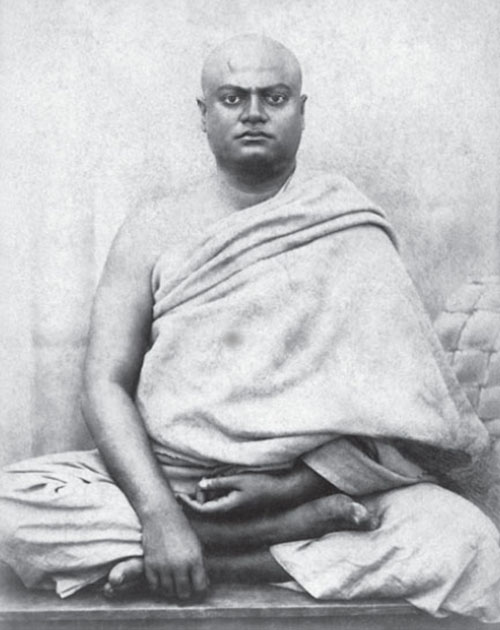
Swami Vivekananda
A movement which half a dozen penniless boys set on foot and which now bids fair to progress in such an accelerated motion—is it a humbug or the Lord’s will? If it is, then let all give up party-spirit and jealousy and unite in action. A universal religion cannot be set up through party faction...
If all understand one day for one minute that one cannot become great by the mere wish, that he only rises whom He raises and he falls whom He brings down then all trouble is at an end. But there is that egotism—hollow in itself and without the power to move a finger: how ludicrous of it to say, “I won’t let anyone rise!” That jealousy, that absence of conjoint action is the very nature of enslaved nations. But we must try to shake it off. The terrible jealousy is characteristic of us... You will be convinced of this if you visit some other countries. Our fellows in this respect are the enfranchised negroes of this country—if but one amongst them rises to greatness, all the others would at once set themselves against him and try to level him down by making a common cause with the whites...
At any cost, any price, any sacrifice, we must never allow that to creep in among ourselves. Whether we be ten or two, do not care, but those few must be perfect characters... “It is not good to ask of one’s father if the Lord keeps His promise (to look after His devotees).” And the Lord will do so, get your minds easy on that score... We must spread his name in Rajputana, Punjab, U.P., Madras and such other provinces — yes, in Raiputana, where still there are people who can say, “Such has ever been the custom with Raghu’s line that they keep their word even at the cost of life.”
A bird, in the course of its flight, reaches a spot whence it looks on the ground below with supreme calmness, Have you reached that spot? He who has not reached there has no right to teach others. Relax your limbs and float with the current and you are sure to reach your destination.
Cold is making itself scarce by degrees and I have been almost through the winter. Here in winter the whole body becomes charged with electricity. In shaking hands one feels a shock, accompanied by a sound. You can light the gas with your finger. And about the cold I have written to you already. I am coursing through the length and breadth of the country, but Chicago is my “Math” (monastery), where I always return after my wanderings. I am now making for the east. He knows where the bark will reach the shore...
Has Dashu the same sort of love for you. Does he see you frequently? How is Bhavanath and what is he doing. Do you visit him and look upon him with an eye of regard? Yes, brother, the distinction between Sannyasin and layman is a fiction. ‘‘मूलं करोति वाचालं’’ etc.—”He makes the dumb fluent,” etc. My friend it is difficult to judge what is in a particular individual. Shri Ramakrishna has spoken highly of him; and he deserves our respect. Fie upon you if you have no faith even after so much experience. Does he love you? Please convey to him my hearty love and esteem. My love to Kalikrishna Babu, he is a very noble soul. How is Ramlal (Nephew of Shri Ramakrishna.)? He has got a little faith and devotion? My love and greetings to him. Sanyal is moving all right with the mill, I suppose? Ask him to have patience and the mill will go on all right.
My heart’s love to all.
Ever yours in love,
Vivekananda.
Salutation to Bhagavan Ramakrishna!
C/o George W. Hale, Esq.,
541 Dearborn Avenue, Chicago,
19th March, 1894.
My dear Shashi,
I have not written to you since coming to this country. But Haridas Bhai’s letter gives me all the news. It is excellent that G. C. Ghosh and all of you have treated him with due consideration.
I have no wants in this country, but mendicancy has no vogue here and I have to labour, that is, lecture in places. It is as cold here as it is hot. The summer is not a bit less hot than in Calcutta. And how to describe the cold in winter! The whole country is covered with snow, three or four feet deep, nay, six or seven feet at places! In the southern parts there is no snow. Snow, however, is a thing of little consideration here. For it snows when the mercury stands at 32° F. In Calcutta it scarcely comes down to 60,° and it rarely approaches zero in England. But here, your mercury sinks to minus 4° or 5°. In Canada, in the north, mercury becomes condensed, when they have to use the alcohol thermometer. When it is too cold, that is, when the mercury stands even below 20°F, it does not snow. I used to think that it must be an exceedingly cold day on which the snow falls. But it is not so, it snows on comparatively warm days. Extreme cold produces a sort of intoxication. No carriages would run; only the sledge, which is without wheels, slides on the ground! Everything is frozen stiff—even an elephant can walk on rivers and canals and lakes. The massive falls of Niagara, of such tremendous velocity, are frozen to marble!! But I am doing nicely. I was a little afraid at first, but necessity makes me travel by rail to the borders of Canada one day and the next day finds me lecturing in south U.S.A.! The carriages are kept quite warm, like your own room, by means of steam pipes and all around are masses of snow, spotlessly white. Oh, the beauty of it!
I was mortally afraid that my nose and ears would fall off, but to this day they are all right. I have to go out, however, dressed in a heap of warm clothing surmounted by a fur-coat, with boots encased in a woollen jacket and so on. No sooner do you breathe out than the breath freezes among the beard and moustache! Notwithstanding all this, the fun of it is that they won’t drink water indoors without putting a lump of ice into it. This is because it is warm indoors. Every room and the staircase are kept warm by steam pipes. They are first and foremost in art and appliances, foremost in enjoyment and luxury, foremost in making money and foremost in spending it. The daily wages of a coolie are six rupees, as also are those of a servant; you cannot hire a cab for less than three rupees, nor get a cigar for less than four annas. A decent pair of shoes costs twenty-four rupees and a suit, five hundred rupees. As they earn, so they spend. A lecture fetches from two hundred up to three thousand rupees. I have got up to five hundred. Of course now I am in the very heyday of fortune. They like me and thousands of people come to hear me speak.
As it pleased the Lord, I met here Mr. Mazoomdar. He was very cordial at first, but when the whole Chicago population began to flock to me in overwhelming numbers, then grew the canker in his mind!... The priests tried their utmost to snub me. But the Guru (Teacher) is with me, what could anybody do? And the whole American nation loves and respects me, pays my expenses and reveres me as a Guru... It was not in the power of your priests to do anything against me. Moreover, they are a nation of scholars. Here it would no longer do to say, “We marry our widows”, “We do not worship idols” and things of that sort. What they want is philosophy, learning; and empty talk will no more do.
Dharmapala is a fine boy. He has not much of learning but is very gentle. He had a good deal of popularity in this country.
Brother, I have been brought to my senses... ‘ये निन्धन्ति निरर्थकं परहितं ते के न जानीमहे—We do not know what sort of people they are who for nothing hinder the welfare of others” (Bhartrihari). Brother, we can get rid of everything, but not of that cursed jealousy... That is a national sin with us, speaking ill of others and burning at heart at the greatness of others. Mine alone is the greatness, none else should rise to it!!
Nowhere in the world are women like those of this country. How pure, independent, self-relying and kindhearted! It is the women who are the life and soul of this country. All learning and culture are centred in them. The saying, ‘‘या श्रीः खयं सुकृतिनां भवनेषु—Who is the Goddess of Fortune Herself in the families of the meritorious” (Chandi)—holds good in this country, while that other,‘‘अलक्षमीः पापात्मनां— The Goddess of ill luck in the homes of the sinful” (ibid.)— applies to ours. Just think on this. Great God! I am struck dumb with wonderment at seeing the women of America. ‘‘त्वं श्रीस्त्वमीश्र्चरी त्वं ह्रीः—Thou art the Goddess of Fortune, Thou art the supreme Goddess, Thou art Modesty” (ibid.), ‘‘या देवी सर्वभूतेषु शक्तिरूपेण संस्थिता—The Goddess who resides in all beings as Power” (ibid.)—all this holds good here. There are thousands of women here whose minds are as pure and white as the snow of this country. And look at our girls, becoming mothers below their teens!! Good Lord! I now see it all. Brother, ‘‘यत्र नार्यस्तु पूज्यन्ते रमन्ते तत्र देवताः—The gods are pleased where the women are held in esteem”—says the old Manu. We are horrible sinners and our degradation is due to our calling women “despicable worms”, “gateways to hell” and so forth. Goodness gracious! There is all the difference between heaven and hell!! ‘‘याथातथ्यतोऽर्थान् ब्यदधात्—He adjudges gifts according to the merits of the case” (Isha [Upa.], 8). Is the Lord to be hoodwinked by idle talk? The Lord has said, ‘‘त्वं स्त्री त्वं पुमानसि त्वं कुमार उत वा कुमारी—Thou art the woman, Thou art the man, Thou art the boy and the girl as well.” (Shvetashvatara Upa.) And we on our part are crying, ‘‘दूरमपसर रे चण्डाल—Be off, thou outcast!” ‘‘केनैषा निर्मिता नारी मोहिनी etc.—Who has made the bewitching woman?” My brother, what experiences I have had in the South, of the upper classes torturing the lower! What Bacchanalian orgies within the temples! Is it a religion that fails to remove the misery of the poor and turn men into gods! Do you think our religion is worth the name? Ours is only Don’t touchism, only “Touch me not”, “Touch me not.” Good heavens! A country, the big leaders of which have for the last two thousand years been only discussing whether to take food with the right hand or the left, whether to take water from the right-hand side or from the left,... if such a country does not go to ruin, what other will? ‘‘कालः सुप्तेषु जागर्ति कालो हि दुरतिक्रमः—Time keeps wide awake when all else sleeps. Time is invincible indeed!” He knows it; who is there to throw dust in His eyes, my friend?
A country where millions of people live on flowers of the Mohua plant and a million or two of Sadhus and a hundred million or so of Brahmins suck the blood out of these poor people, without even the least effort for their amelioration—is that a country or hell? Is that a religion, or the devil’s dance? My brother, here is one thing for you to understand fully—I have travelled all over India and seen this country too—can there be an effect without cause? Can there be punishment without sin?
सर्वशास्त्रपुराणेषु ब्यासस्य वचनं ध्रुवम् ।
परोपकारः पुण्याय पापाय परपीडनम् ।।
—”Amidst all the scriptures and Purânas, know this statement of Vyâsa to be true, that doing good to others conduces to merit and doing harm to them leads to sin.”
Isn’t it true?
My brother, in view of all this, specially of the poverty and ignorance, I had no sleep. At Cape Comorin sitting in Mother Kumari’s temple, sitting on the last bit of Indian rock —I hit upon a plan: We are so many Sannyasins wandering about and teaching the people metaphysics—it is all madness. Did not our Gurudeva use to say, “An empty stomach is no good for religion”? That those poor people are leading the life of brutes is simply due to ignorance. We have for all ages been sucking their blood and trampling them underfoot.
... Suppose some disinterested Sannyasins, bent on doing good to others, go from village to village, disseminating education and seeking in various ways to better the condition of all down to the Chandâla, through oral teaching and by means of maps, cameras, globes and such other accessories — can’t that bring forth good in time? All these plans I cannot write out in this short letter. The long and the short of it is— if the mountain does not come to Mohammed, Mohammed must go to the mountain. The poor are too poor to come to schools and Pathashalas and they will gain nothing by reading poetry and all that sort of thing. We, as a nation, have lost our individuality and that is the cause of all mischief in India. We have to give back to the nation its lost individuality and raise the masses. The Hindu, the Mohammedan, the Christian, all have trampled them underfoot. Again the force to raise them must come from inside, that is, from the orthodox Hindus. In every country the evils exist not with, but against, religion. Religion therefore is not to blame, but men.
To effect this, the first thing we need is men and the next is funds. Through the grace of our Guru I was sure to get from ten to fifteen men in every town. I next travelled in search of funds, but do you think the people of India were going to spend money!... Selfishness personified—are they to spend anything? Therefore I have come to America, to earn money myself and then return to my country and devote the rest of my days to the realisation of this one aim of my life.
As our country is poor in social virtues, so this country is lacking in spirituality. I give them spirituality and they give me money. I do not know how long I shall take to realise my end...These people are not hypocrites and jealousy is altogether absent in them. I depend on no one in Hindusthan. I shall try to earn the wherewithal myself to the best of my might and carry out my plans, or die in the attempt. ‘‘सन्निमित्ते वरं त्यागो विनाशे नियते सति—When death is certain, it is best to sacrifice oneself for a good cause.”
You may perhaps think what Utopian nonsense all this is! You little know what is in me. If any of you help me in my plans, all right, or Gurudeva will show me the way out... We cannot give up jealousy and rally together. That is our national sin!! It is not to be met with in this country and this is what has made them so great.
Nowhere in the world have I come across such “frogs-in-the-well” as we are. Let anything new come from some foreign country and America will be the first to accept it. But we?—oh, there are none like us in the world, we men of Aryan blood!! Where that heredity really expresses itself, I do not see...Yet they are descendants of the Aryans?
Ever yours,
Vivekananda.
Baltimore, U.S.A.,
22nd October, 1894.
Dear,
Glad to receive your letter and go through the contents. I received today a letter of Akshay Kumar Ghosh from London, which also gives me some information...
Now you have come to know your own powers. Strike the iron while it is hot. Idleness won’t do. Throw overboard all idea of jealousy and egotism, once for all. Come on to the practical field with tremendous energy; to work, in the fullness of strength! As to the rest, the Lord will point out the way. The whole world will be deluged by a tidal wave. Work, work, work—let this be your motto. I cannot see anything else. There is no end of work here—I am careering all over the country. Wherever the seed of his power will find its way, there it will fructify—‘‘अद्य वा अब्दशतान्ते वा—be it today, or in a hundred years.” You must work in sympathy with all, then only it will lead to quick results...
Our object is to do good to the world and not the trumpeting of our own names. Why doesn’t Niranjan (Niranjanananda) learn Pali in Ceylon and study Buddhist books? I cannot make out what good will come of aimless rambling. Those that have come under his protection, have virtue, wealth, desires and freedom lying at their feet. माभैः माभैः—Courage! Everything will come about by degrees. From all of you I want this that you must discard for ever self-aggrandisement, faction-mongering and jealousy. You must be all-forbearing, like Mother Earth. If you can achieve this, the world will be at your feet...
Try to give less of material food in the anniversary celebrations and give some food for the brain instead...
Yours affectionately,
Vivekananda.
U.S.A.,
(Beginning of?) 1895.
My dear Shashi,
Yesterday I received a letter from you in which there was a smattering of news, but nothing in detail. I am much better now. Through the grace of the Lord I am proof against the severe cold for this year. Oh, the terrible cold! But these people keep all down through scientific knowledge. Every house has its cellar underground, in which there is a big boiler whence steam is made to course day and night through every room. This keeps all the rooms warm, but it has one defect, that while it is summer indoors, it is 30 to 40 degrees below zero outside! Most of the rich people of this country make for Europe during the winter, which is comparatively warm.
Now, let me give you some instructions. This letter is meant for you. Please go through these instructions once a day and act up to them. I have got Sarada’s letter—he is doing good work—but now we want organization. To him, Brother Tarak and others please give my special love and blessings. The reason why I give you these few instructions is that there is an organising power in you—the Lord has made this known to me—but it is not yet fully developed. Through His blessings it will soon be. That you never lose your centre of gravity is an evidence of this, but it must be both intensive and extensive.
1. All the Shâstras hold that the threefold misery that there is in this world is not natural, hence it is removable.
2. In the Buddha Incarnation the Lord says that the root of the Âdhibhautika misery or, misery arising from other terrestrial beings, is the formation of classes (Jâti); in other words, every form of class-distinction, whether based on birth, or acquirements, or wealth is at the bottom of this misery. In the Atman there is no distinction of sex, or Varna or Ashrama, or anything of the kind and as mud cannot be washed away by mud, it is likewise impossible to bring about oneness by means of separative ideas.
3. In the Krishna Incarnation He says that the root of all sorts of misery is Avidyâ (Nescience) and that selfless work purifies the mind. But ‘‘किं कर्म किमकर्मेति कवयोऽप्यत्र मोहिताः— Even sages are bewildered to decide what is work and what is no-work” (Gita).
4. Only that kind of work which develops our spirituality is work. Whatever fosters materiality is no-work.
5. Therefore work and no-work must be regulated by a person’s aptitude, his country and his age.
6. Works such as sacrifices were suited to the olden times but are not for the modern times.
7. From the date that the Ramakrishna Incarnation was born, has sprung the Satya-Yuga (Golden Age)...
8. In this Incarnation atheistic ideas... will be destroyed by the sword of Jnana (knowledge) and the whole world will be unified by means of Bhakti (devotion) and Prema (Divine Love). Moreover, in this Incarnation, Rajas, or the desire for name and fame etc., is altogether absent. In other words, blessed is he who acts up to His teachings; whether he accepts Him or not, does not matter.
9. The founders of different sects, in the ancient or modern times, have not been in the wrong. They have done well, but they must do better. Well—better—best.
10. Therefore we must take all up where they are, that is, we must lead them on to higher and higher ideals, without upsetting their own chosen attitude. As to social conditions, those that prevail now are good, but they shall be better— best.
11. There is no chance for the welfare of the world unless the condition of women is improved. It is not possible for a bird to fly on only one wing.
12. Hence, in the Ramakrishna Incarnation the acceptance of a woman as the Guru, hence His practicing in the woman’s garb and frame of mind, hence too His preaching the motherhood of women as representations of the Divine Mother.
13. Hence it is that my first endeavour is to start a Math for women. This Math shall be the origin of Gargis and Maitreyis and women of even higher attainments than these...
14. No great work can be achieved by humbug. It is through love, a passion for truth and tremendous energy, that all undertakings are accomplished. तत् कुरु पौरूषम्— Therefore, manifest your manhood.
15. There is no need for quarrel or dispute with anybody. Give your message and leave others to their own thoughts. ‘‘सत्यमेवजयते नानृतम्—Truth alone triumphs, not falsehood.‘‘तदा कि विवादेन—Why then fight?
... Combine seriousness with childlike naivete. Live in harmony with all. Give up all idea of egoism and entertain no sectarian views. Useless wrangling is a great sin.
... From Sarada’s letter I came to know that N—Ghosh has compared me with Jesus Christ and the like. That kind of thing may pass muster in our country, but if you send such comments here in print, there is a chance of my being insulted! I mean, I do not like to hamper anybody’s freedom of thought —am I a missionary? If Kali has not sent those papers to this country, tell him not to do it. Only the Address will do, I do not want the proceedings. Now many respectable ladies and gentlemen of this country hold me in reverence. The missionaries and others of that ilk have tried their utmost to put me down, but finding it useless have now become quiet. Every undertaking must pass through a lot of obstacles. Truth triumphs if only one pursues a peaceful course. I have no need to reply to what a Mr. Hudson has spoken against me. In the first place, it is unnecessary and secondly, I shall be bringing myself down to the level of people of Mr. Hudson’s type. Are you mad? Shall I fight from here with one Mr. Hudson? Through the Lord’s grace, people who are far above Mr. Hudson in rank listen to me with veneration. Please do not send any more papers. Let all that go on in India, it will do no harm. For the Lord’s work at one time there was need for that kind of newspaper blazoning. When that is done, there is no more need for it... It is one of the attendant evils of name and fame that you can’t have anything private... Before you begin any undertaking, pray to Shri Ramakrishna and he will show you the right way. We want a big plot of land to begin with, then building and all will come. Slowly our Math is going to raise itself, don’t worry about it...
Kali and all others have done good work. Give my love and best wishes to all. Work in unison with the people of Madras and let someone or other amongst you go there at intervals. Give up for ever the desire for name and fame and power. While I am on earth, Shri Ramakrishna is working through me. So long as you believe in this there is no danger of any evil for you.
The Ramakrishna Punthi (Life of Shri Ramakrishna in Bengali verse) that Akshaya has sent is very good, but there is no glorification of the Shakti at the opening which is a great defect. Tell him to remedy it in the second edition. Always bear this in mind that we are now standing before the gaze of the world and that people are watching every one of our actions and utterances. Remember this and work.
... Be on the look-out for a site for our Math... If it be at some little distance from Calcutta, no harm. Wherever we shall build our Math, there we shall have a stir made. Very glad to learn about Mahim Chakravarty. The Andes have turned into the holy Gaya, I see! Where is he? Please give him, Sj. Bijoy Goswami and our other friends my cordial greetings... To beat an opponent one needs a sword and buckler, so carefully learn English and Sanskrit. Kali’s English is getting nicer every day, while that of Sarada is deteriorating. Tell Sarada to give up the flowery style. It is extremely difficult to write a flowery style in a foreign tongue. Please convey to him a hundred thousand bravos from me! There’s a hero indeed... Well done, all of you! Bravo, lads! The beginning is excellent. Go on in that way. If the adder of jealousy foes not come in, there is no fear! माभैः—Cheer up!
‘‘मद्भक्तानाञ्च ये भक्तास्ते मे भक्ततमा मताः—Those who serve My devotees are My best devotees.” Have all of you a little grave bearing. I am not writing any book on Hinduism at present. But I am jotting down my thoughts. Every religion is an expression, a language to express the same truth and we must speak to each in his own language. That Sarada has grasped this, is all right. It will be time enough to look to Hinduism later on. Do you think people in this country would be much attracted if I talk of Hinduism?—The very name of narrowness in ideas will scare them away! The real thing is —the Religion taught by Shri Ramakrishna, let the Hindus call it Hinduism— and others call it in their own way. Only you must proceed slowly. ‘‘शनैः पन्थाः— One must make journeys slowly.” Give my blessings to Dinanath, the new recruit. I have very little time to write—always lecture, lecture, lecture. Purity, Patience, Perseverance... You must ask those numerous people who are now paying heed to Shri Ramakrishna’s teachings, to help you pecuniarily to a certain extent. How can the Math be maintained unless they help you? You must not be shy of making this plain to all...
There is no gain in hastening my return from this country. In the first place, a little sound made here will resound there a great deal. Then, the people of this country are immensely rich and are bold enough to pay. While the people of our country have neither money nor the least bit of boldness.
You will know everything by degrees. Was Shri Ramakrishna the Saviour of India merely? It is this narrow idea that has brought about India’s ruin and her welfare is an impossibility so long as this is not rooted out. Had I the money I would send each one of you to travel all over the world. No great idea can have a place in the heart unless one steps out of his little corner. It will be verified in time. Every great achievement is done slowly. Such is the Lord’s will...
Why didn’t any of you write about Daksha and Harish? I shall be glad to know if you watch their whereabouts. That Sanyal is feeling miserable is because his mind is not yet pure like the water of the Ganga. It is not yet selfless, but will be in time. He will have no misery if he can give up the little crookedness and be straightforward. My special loving greetings to Rakhal and Hari. Take great care of them... Never forget that Rakhal was the special object of Shri Ramakrishna’s love. Let nothing daunt you. Who on earth has the power to snub us so long as the Lord favours us? Even if you are at your last breath, be not afraid. Work on with the intrepidity of a lion but, at the same time with the tenderness of a flower. Let this year’s Shri Ramakrishna festival be celebrated in great pomp. Let the feeding be quite ordinary —Prasada being distributed in earthen plates among the devotees standing in rows. There should be readings from Shri Ramakrishna’s Life. Place books like the Vedas and the Vedanta together and perform Arati before them... Avoid issuing invitation cards of the old style.
‘‘आमन्त्रये भवन्तं साशीर्वादं भगवतो रामकृष्णस्य बहुमानपुरःसरञ्च— With Bhagavan Shri Ramakrishna’s blessings and our great esteem we have the pleasure to invite you.” Write some such line and then write that to defray the expenses of Shri Ramakrishna’s Birthday Festival and those of the maintenance of the Math, you want his assistance. That if he likes, he may kindly send the money to such and such, at such and such address and so on. Also add a page in English. The term “Lord Ramakrishna” has no meaning. You must give it up. Write “Bhagavan” in English characters and add a line or two in English:
THE ANNIVERSARY OF BHAGAVAN
SHRI RAMAKRISHNA
Sir, we have great pleasure in inviting you to join us in celebrating the—th anniversary of Bhagavan Ramakrishna Paramahamsa. For the celebration of this great occasion and for the maintenance of the Alambazar Math funds are absolutely necessary. If you think that the cause is worthy of your sympathy, we shall be very grateful to receive your contribution to the great work.
Yours obediently,
(Name)
If you get more than enough money, spend only a little of it and keep the surplus as a reserve fund to defray your expenses. On the plea of offering the food to the Lord, do not make everybody wait till he is sick, to have a stale and unsavoury dinner. Have two filters made and use that filtered water for both cooking and drinking purposes. Boil the water before filtering. If you do this, you will never more hear of malaria. Keep a strict eye on everybody’s health. If you can give up lying on the floor—in other words, if you can get the money to do it, it will be excellent indeed. Dirty clothes are the chief cause of disease... About the food offering, let me tell you that only a little Payasanna (milk-rice with sugar) will do. He used to love that alone. It is true that the worship-room is a help to many, but it is no use indulging in Rajasika and Tamasika food. Let the ceremonials give place to a certain extent to a little study of the Gita or the Upanishads or other sacred books. What I mean is this—let there be as little materialism as possible, with the maximum of spirituality... Did Shri Ramakrishna come for this or that particular individual, or for the world at large? If the latter, then you must present him in such a light that the whole world may understand him... You must not identify yourselves with any life of his written by anybody nor give your sanction to any. There is no danger so long as such books do not come out associated with our name... “Say yea, yea, to all and stick to your own.”
... A thousand thanks to Mahendra Babu for his kindly helping us. He is a very liberal-hearted man... About Sanyal, he will attain the highest good by doing his bit of work attentively, that is, by simply serving Shri Ramakrishna’s children... Brother Tarak is doing very good work. Bravo! Well done! That is what we want. Let me see all of you shoot like so many meteors! What is Gangadhar doing? Some Zemindars in Rajputana respect him. Tell him to get some money from them as Bhiksha; then he is a man...
Just now I read Akshaya’s book. Give him a hundred thousand hearty embraces from me. Through his pen Shri Ramakrishna is manifesting himself. Blessed is Akshaya! Let him recite that Punthi before all. He must recite it before all in the Festival. If the work be too large, let him read extracts of it. Well, I do not find a single irrelevant word in it. I cannot tell in words the joy I have experienced by reading his book. Try all of you to give the book an extensive sale. Then ask Akshaya to go from village to village to preach. Well done Akshaya! He is doing his work. Go from village to village and proclaim to all Shri Ramakrishna’s teachings, can there be a more blessed lot than this? I tell you, Akshaya’s book and Akshaya himself must electrify the masses. Dear, dear, Akshaya, I bless you with all my heart, my dear brother. May the Lord sit in your tongue! Go and spread his teachings from door to door. There is no need whatever of your becoming a Sannyasin... Akshaya is the future apostle for the masses of Bengal. Take great care of Akshaya; his faith and devotion have borne fruit.
Ask Akshaya to write these few points in the third section of his book, “The Propagation of the Faith”.
1. Whatever the Vedas, the Vedanta and all other Incarnations have done in the past, Shri Ramakrishna lived to practice in the course of a single life.
2. One cannot understand the Vedas, the Vedanta, the Incarnations and so forth, without understanding his life. For he was the explanation.
3. From the very date that he was born, has sprung the Satya-Yuga (Golden Age). Henceforth there is an end to all sorts of distinctions and everyone down to the Chandala will be a sharer in the Divine Love. The distinction between man and woman, between the rich and the poor, the literate and illiterate, Brahmins and Chandalas—he lived to root out all. And he was the harbinger of Peace—the separation between Hindus and Mohammedans, between Hindus and Christians, all are now things of the past. That fight about distinctions that there was, belonged to another era. In this Satya-Yuga the tidal wave of Shri Ramakrishna’s Love has unified all.
Tell him to expand these ideas and write them in his own style.
Whoever—man or woman—will worship Shri Ramakrishna, be he or she ever so low, will be then and there converted into the very highest. Another thing, the Motherhood of God is prominent in this Incarnation. He used to dress himself as a woman—he was, as it were, our Mother— and we must likewise look upon all women as the reflections of the Mother. In India there are two great evils. Trampling on the women and grinding the poor through caste restrictions. He was the Saviour of women, Saviour of the masses, Saviour of all, high and low. And let Akshaya introduce his worship in every home—Brahmin or Chandala, man or woman— everyone has the right to worship him. Whoever will worship him only with devotion shall be blessed for ever.
Tell him to write in this strain. Never mind anything— the Lord will be at his side.
Yours affectionately,
Vivekananda.
PS... Ask Sanyal to send me a copy each of the Narada and Shandilya Sutras and one of the Yogavasishtha, that has been translated in Calcutta. I want the English translation of the last, not a Bengali edition...
U.S.A.,
11th April, 1895.
My dear Shashi,
... You write that you have recovered from your illness; but you must henceforth be very careful. Late dinners or unwholesome food, or living in a stinking place may bring on a relapse and make it hard to escape the clutches of malaria. First of all you should hire a small garden-house—you may get one for thirty or forty rupees. Secondly, see that cooking and drinking water be filtered—a bamboo filter of a big size will do. Water is the cause of all sorts of disease. It is not the clearness or dirtiness of water, but its being full of disease germs, that causes disease. Let the water be boiled and filtered. You must all pay attention to your health first. A cook, a servant, clean beds and timely meals—these are absolutely necessary. Please see that all these suggestions be carried out in toto... The success of your undertakings depends wholly upon your mutual love. There is no good in store so long as malice and jealousy and egotism will prevail... Kali’s pamphlet is very well written and has no exaggerations. Know that talking ill of others in private is a sin. You must wholly avoid it. Many things may occur to the mind, but it gradually makes a mountain of a molehill if you try to express them. Everything is ended if you forgive and forget. It is welcome news that Shri Ramakrishna’s festival was celebrated with great éclat. You must try so that there is a muster of a hundred thousand people next year. Put your energies together to start a magazine. Shyness won’t do any more... He who has infinite patience and infinite energy at his back, will alone succeed. You must pay special attention to study. Do you understand? You must not huddle together too many fools. I shall be glad if you bring together a few real men. Why, I don’t hear even a single one opening his lips. You distributed sweets at the festival and there was singing by some parties, mostly idlers. True, but I don’t hear what spiritual food you have given. So long as that nil admirari attitude is not gone, you will not be able to do anything and none of you will have courage. Bullies are always cowards.
Take up everyone with sympathy, whether he believes in Shri Ramakrishna or not. If anybody comes to you for vain dispute, politely withdraw yourselves... You must express your sympathy with people of all sects. When these cardinal virtues will be manifested in you, then only you will be able to work with great energy. Otherwise, mere taking the name of the Guru will not do. However, there is no doubt that this year’s festival has been a great success and you deserve special thanks for it; but you must push forward, do you see? What is Sharat doing? Never shall you be able to know anything if you persist in pleading ignorance... We want something of a higher tone—that will appeal to the intellect of the learned. It won’t do merely to get up musical parties and all that. Not only will this festival be his memorial, but also the central union of an intense propaganda of his doctrines... All will come in good time. But at times I fret and stamp like a leashed hound. Onward and forward, my old watchword. I am doing well. No use going back to India in a hurry. Summon all your energies and set yourselves to work heart and soul; that will really be heroic.
Yours affectionately,
Vivekananda.
Dear Shashi,
... I am quite in agreement with what Sarada is doing, but it is not necessary to preach that Ramakrishna Paramahamsa was an Incarnation and things of that sort. He came to do good to the world; not to trumpet his own name —you must always remember this. Disciples pay their whole attention to the preservation of their master’s name and throw overboard his teachings; and sectarianism etc., are the result. Alasinga writes of Charu; but I do not recollect him. Write all about him and convey him my thanks. Write in detail about all; I have no time to spare for idle gossip... Try to give up ceremonials. They are not meant for Sannyasins; and one must work only so long as one does not attain to illumination... I have nothing to do with sectarianism. Or party-forming and playing the frog-in-the-well, whatever else I may do... It is impossible to preach the catholic ideas of Ramakrishna Paramahamsa and form sects at the same time... Only one kind of work I understand and that is doing good to others; all else is doing evil. I therefore prostrate myself before the Lord Buddha... I am a Vedantist; Sachchidananda—Existence-Knowledge-Bliss Absolute—is my God. I scarcely find any other God than the majestic form of my own Self. By the word “Incarnation” are meant those who have attained that Brahmanhood, in other words, the Jivanmuktas—those who have realised this freedom in this very life. I do not find any speciality in Incarnations: all beings from Brahma down to a clump of grass will attain to liberation-in-life in course of time and our duty lies in helping all to reach that state. This help is called religion; the rest is irreligion. This help is work; the rest is evil-doing—I see nothing else. Other kinds of work, for example, the Vaidika or the Tantrika, may produce results; but resorting to them is simply waste of life, for that purity which is the goal of work is realisable only through doing good to others. Through works such as sacrifices etc., one may get enjoyments, but it is impossible to have the purity of soul... Everything exists already in the Self of all beings. He who asserts he is free, shall be free. He who says he is bound, bound he shall remain. To me, the thought of oneself as low and humble is a sin and ignorance.‘‘नायमात्मा बलहीनेन लभ्यः— This Atman is not to be attained by one who is weak.”
‘‘अस्ति ब्रह्म वदसि चेदस्ति, नास्ति ब्रह्म वदसि चेन्नास्त्येव भविष्यति
—If you say Brahman is, existence will be the result; if you say Brahman is not, non existent It shall verily become.” He who always thinks of himself as weak wild never become strong, but he who knows himself to be a lion, ‘‘निर्गच्छति जागज्जालात् पिंजरादिव केशरी—rushes out from the world’s meshes, as a lion from its cage.” Another point, it was no new truth that Ramakrishna Paramahamsa came to preach, though his advent brought the old truths to light. In other words, he was the embodiment of all the past religious thoughts of India. His life alone made me understand what the Shâstras really meant and the whole plan and scope of the old Shastras.
Missionaries and others could not do much against me in this country. Through the Lord’s grace the people here like me greatly and are not to be tricked by the opinions of any particular class. They appreciate my ideas in a manner my own countrymen cannot do and are not selfish. I mean, when it comes to practical work they will give up jealousy and all those ideas of self-sufficiency. Then all of them agree and act under the direction of a capable man. That is what makes them so great. But then they are a nation of Mammon-worshippers. Money comes before everything. People of our country are very liberal in pecuniary matters, but not so much these people. Every home has a miser. It is almost a religion here. But they fall into the clutches of the priests when they do something bad and then buy their passage to heaven with money. These things are the same in every country— priestcraft. I can say nothing as to whether I shall go back to India and when. There also I shall have to lead a wandering life as I do here; but here thousands of people listen to and understand my lectures and these thousands are benefited. But can you say the same thing about India?... I am perfectly at one with what Sarada is doing. A thousand thanks to him... In Madras and Bombay I have lots of men who are after my heart. They are learned and understand everything. Moreover they are kind-hearted and can therefore appreciate the philanthropic spirit... I have printed neither books nor anything of the kind. I simply go on lecturing tours... When I take a retrospective view of my past life, I feel no remorse. From country to country I have travelled teaching something, however little, to people and in exchange for that have partaken of their slices of bread. If I had found I had done no work, but simply supported myself by imposing upon people, I would have committed suicide today. Why do those who think themselves unfit to teach their fellow-beings, wear the teacher’s garb and earn their bread by cheating them? Is not that a deadly sin?...
Yours etc.,
Vivekananda.
C/o E. T. Sturdy, Esq.,
High View, Caversham, England,
1895.
Dear Shashi,
... I am in receipt of Rakhal’s letter today. I am sorry to hear that—has suffered from gravel. Most probably it was due to indigestion. Gopal’s debts have been cleared; now ask him to join the monastic order. The worldly-wise instinct is most difficult to root out... Let him come and work in the Math. One is apt to imbibe a lot of mischievous ideas by concerning oneself too long in worldly affairs. If he refuses to take the monastic vow, please tell him to clear out. I don’t want amphibious type of men who will be half monks and half householders... Haramohan has coined a Lord Ramakrishna Paramahamsa, I see. What does he mean? English Lord, or Duke? Tell Rakhal, let people say whatever they will —”Men (who wrongly criticise) are to be treated as worms!” as Shri Ramakrishna used to say. Let there be no disparity between what you profess and what you do, also eschew the very name of Jesuitism. Was I ever an orthodox, Pauranika Hindu, an adherent of social usages? I do not pose as one. You will not have to say things that will be pleasant to any section of people. You must not so much as notice what the Bengalis say for or against us... They could not do a pennyworth of service to him whose birth has sanctified their country where the primary laws of health and sanitation are trampled and yet they would talk big! What matters is, my brother, what such men have got to say!... It is for you to go on doing your own work. Why look up to men for approbation, look up to God! I hope Sharat will be able to teach them the Gita and the Upanishads and their commentaries somehow, with the help of the dictionary.—Or, is it an empty Vairagya that you have? The days of such Vairagya are gone! It is not for everyone, my boy, to become Ramakrishna Paramahamsa! I hope Sharat has started by this time. Please send a copy of the Panchadashi, a copy of the Gita (with as many commentaries as possible), a copy each of the Narada and Shandilya Sutras (published in Varanasi), a translation (good, not worthless) of the Panchadashi—if it is available—and the translation by Kalivara Vedantavagisha of Shankara’s Commentary. And if there be any translation, Bengali or English (by Shrish Babu of Allahabad), of Panini’s Sutras, or the Kashika-Vritti, or the Phani-Bhashya, please send a copy of each... Now, just tell your Bengalis to send me a copy of the Vachaspatya Dictionary and that will be a good test for those tall-talking people. In England, religious movements make very slow progress. These people here are either bigots or atheists. And the former again have only a bit of formal religion. They say, “Patriotism is our religion.” That is all.
Send the books to America, c/o Miss Mary Phillips, 19 West 38th Street, New York, U.S.A. That is my American address. By the end of November I shall go to America. So send my books etc., there. If Sharat has started immediately on your receipt of my letter, then only I may meet him, otherwise not. Business is business, no child’s play. Mr. Sturdy will see to him and accommodate him. This time I have come to England just to probe a little. Next summer I shall try to make some stir. The winter after that, I shall go to India... Correspond regularly with those who are interested in us, so as to keep up their interest. Try to open centres in places all over Bengal... This much for the present. In my next I shall give you more details. Mr. Sturdy is a very nice gentleman, a staunch Vedantist and understands a smattering of Sanskrit. It is with a good deal of labour that you can do a little bit of work in these countries; a sheer uphill task, with cold and rain into the bargain. Moreover, here you must support yourself and do your labour of love. Englishmen won’t spend a penny on lectures or things of that sort. If they do come to listen to you, well, thank your stars—as is the case in our country. Besides, the common people here do not even know of me now. In addition to all this, they will give you a wide berth if you preach God and such things to them. They think this must be another clergyman! Well, you just patiently do one thing—set about collecting everything that books, beginning with the Rig-Veda down to the most insignificant of Puranas and Tantras, have got to say about creation and annihilation of the universe, about race, heaven and hell, the soul, consciousness and intellect, etc., the sense-organs, Mukti, transmigration and suchlike things. No child’s play would do, I want real scholarly work. The most important thing is to collect the materials. My love to you all.
Yours affectionately,
Vivekananda.
C/o E. T. Sturdy, Esq.
High View, Caversham, Reading,
May (?) 1896.
Dear Shashi,
... This City of London is a sea of human heads—ten or fifteen Calcuttas put together. One is apt to be lost in the mazes unless he arranges for somebody to meet him on arrival... However, let Kali start at once. If he be late in starting like Sharat, better let no one come. It won’t do to loiter and procrastinate like that. It is a task that requires the height of Rajas (activity)... Our whole country is steeped in Tamas and nothing but that. We want Rajas first and Sattva will come afterwards—a thing far, far removed.
Yours affectionately,
Vivekananda.
63 St. George’s Road,
London S.W.,
24th June, 1896.
Dear Shashi,
Max Muller wants all the sayings of Shri Ramakrishna classified, that is, all on Karma in one place, on Vairagya in another place, so on Bhakti, Jnana, etc., etc. You must undertake to do this forthwith... We must take care to present only the universal aspect of his teachings...
Sharat starts for America tomorrow. The work here is coming to a head. We have already got funds to start a London Centre. Next month I go to Switzerland to pass a month or two there, then I shall return to London. What will be the good of my going home?—This London is the hub of the world. The heart of India is here. How can I leave without laying a sure foundation here? Nonsense! For the present, I shall have Kali here, tell him to be ready...
We want great spirit, tremendous energy and boundless enthusiasm, no womanishness will do. Try to go on exactly as I wrote to you in my last. We want organisation. Organisation is power and the secret of this is obedience.
Yours affectionately,
Vivekananda.
High View,
Caversham, Reading,
3rd July, 1896.
Dear Shashi,
Send Kali to England as soon as you get this letter... He will have to bring some books for me. I have only got Rig-Veda Samhita. Ask him to bring the Yajur-Veda, Sama-Veda, Atharva-Samhita, as many of the Brahmanas as he can get, beginning with the Shatapatha, some of the Sutras and Yaska’s Nirukta...
Let there be no delay as in Sharat’s case, but let Kali come at once. Sharat has gone to America, as he had no work to do here. That is to say, he was late by six months and then when he came, I was here...
Yours affectionately,
Vivekananda.
Lake Lucerne,
Switzerland,
23rd August, 1896.
My dear Shashi,
Today I received a letter from Ramdayal Babu, in which he writes that many public women attend the Ramakrishna anniversary festival at Dakshineswar, which makes many less inclined to go there. Moreover, in his opinion one day should be appointed for men and another for women. My decision on the point is this:
1. If public women are not allowed to go to such a great place of pilgrimage as Dakshineswar, where else shall they go to? It is for the sinful that the Lord manifests Himself specially, not so much for the virtuous.
2. Let distinctions of sex, caste, wealth, learning and the whole host of them, which are so many gateways to hell, be confined to the world alone. If such distinctions persist in holy places of pilgrimage, where then lies the difference between them and hell itself?
3. Ours is a gigantic City of Jagannatha, where those who have sinned and those who have not, the saintly and the vicious, men and women and children irrespective of age, all have equal right. That for one day at least in the year thousand of men and women get rid of the sense of sin and ideas of distinction and sing and hear the name of the Lord, is in itself a supreme good.
4. If even in a place of pilgrimage people’s tendency to evil be not curbed for one day, the fault lies with you, not them. Create such a huge tidal wave of spirituality that whatever people come near will be swept away.
5. Those who, even in a chapel, would think this is a public woman, that man is of a low caste, a third is poor and yet another belongs to the masses—the less be the number of such people (that is, whom you call gentlemen) the better. Will they who look to the caste, sex, or profession of Bhaktas appreciate our Lord? I pray to the Lord that hundreds of public women may come and bow their heads at His feet; it does not matter if not one gentleman comes. Come public women, come drunkards, come thieves and all—His Gate is open to all. “It is easier for a camel to pass through the eye of a needle than for a rich man to enter the Kingdom of God.” Never let such cruel, demoniacal ideas have a place in your mind.
6. But then some social vigilance is needed. How are we to do that? A few men (old men, preferably) should take charge as the warders for the day. They will make circuits round the scene of the festival and in case they find any man or woman showing impropriety of speech or conduct, they will at once expel them from the garden. But so long as they behave like good men and women, they are Bhaktas and are to be respected—be they men or women, honest citizens or unchaste.
I am at present travelling in Switzerland and shall soon go to Germany, to see Professor Deussen. I shall return to England from there about the 23rd or 24th September and the next winter will find me back in my country.
My love to you and all.
Yours etc.,
Vivekananda.
Darjeeling,
20th April, 1897.
Dear Shashi,
All of you have doubtless reached Madras by this time. I should think Biligiri is certainly taking great care of you and that Sadananda serves you as your attendant. In Madras the worship should be done in a completely Sattvic manner, without a trace of Rajas in it. I hope Alasinga has by now returned to Madras. Don’t enter into wrangles with anybody —always maintain a calm attitude. For the present let the worship of Shri Ramakrishna be established and continued in the house of Biligiri. But see that the worship does not become very elaborate and long. Time thus saved should be utilised in holding classes and doing some preaching. It is good to initiate as many as you can. Supervise the work of the two papers and help in whatever way you can. Biligiri has two widowed daughters. Kindly educate them and make special efforts that through them more such widowed women get a thorough grounding in their own religion and learn a little English and Sanskrit. But all this work should be done from a distance. One has to be exceedingly careful before young women. Once you fall, there is no way out and the sin is unpardonable.
I am very sorry to hear that Gupta was bitten by a dog; but I hear that the dog was not a mad one, so there is no cause for alarm. In any case, see that he takes the medicine sent by Gangadhar.
Early morning, finish daily your worship and other duties briefly and calling together Biligiri with his family, read before them the Gita and other sacred books. There is not the least necessity for teaching the divine Love of Radha and Krishna. Teach them pure devotion to Sita-Ram and Hara-Parvati. See that no mistake is made in this respect. Remember that the episodes of the divine relationship between Radha and Krishna are quite unsuitable for young minds. Specially Biligiri and other followers of Ramanujacharya are worshippers of Rama; so see to it that their innate attitude of pure devotion is never disturbed.
In the evenings give some spiritual teaching like that to the general public. Thus gradually “even the mountain is crossed”.
See that an atmosphere of perfect purity is always maintained and that there enters not the slightest trace of Vamachâra. For the rest, the Lord Himself will guide you, there is no fear. Give to Biligiri my respectful salutations and loving greetings and convey my salutations to similar devotees.
My illness is now much less—it may even be cured completely, if the Lord wills. My love, blessings and greetings to you.
Yours affectionately,
Vivekananda.
PS. Please tender my specially affectionate greetings and blessings to Dr. Nanjunda Rao and help him as much as you can. Try your best to particularly encourage the study of Sanskrit among the non-Brahmins.
Almora,
29th July, 1897.
Dear Shashi,
I got information that your work there is going on very well. Get a thorough mastery of the three Bhashyas (commentaries) and also study well European philosophy and allied subjects—see to it without fail. To fight with others one requires sword and shield—this fact should never be forgotten. I hope Sukul has now reached there and is attending on you all right. If Sadananda does not like to stay there, send him to Calcutta. Don’t forget to send to the Math every week a report of the work including income and expenditure and other information.
Alasinga’s sister’s husband borrowed four hundred rupees from Badridas here, promising to send it back as soon as he reached Madras; inquire from Alasinga and tell him to send it quickly. For I am leaving this place the day after tomorrow—whether for Mussoorie Hills or somewhere else I shall decide later.
Yesterday I delivered a lecture in the circle of the local English people and all were highly pleased with it. But I was very much pleased with the lecture in Hindi that I delivered the previous day—I did not know before that I could be oratorical in Hindi.
Are there any new boys joining the Math? If so, then carry on the work in the same manner as it is being done in Calcutta. At present don’t use up your wisdom too much, lest it should become completely exhausted—you can do that later on.
Pay particular attention to your health, but too much coddling of the body will, on the contrary, also spoil the health. If there is not the strength of knowledge, nobody would care twopence for your ringing of the bell—this is certain; and knowing this for certain equip yourself accordingly. My heart’s love and blessings to you and to Goodwin and others.
Yours affectionately,
Vivekananda.
Ambala,
19th August, 1897.
Dear Shashi,
I am very much pained to hear that the work in Madras is not prospering for want of funds. I am glad to learn that the amount borrowed by Alasinga’s brother-in-law (sister’s husband) has been received back in Almora. Goodwin has written to me to inform the Reception Committee to take some money for expenses from the amount that is left as a result of the lecture. It is a very mean thing to spend the money received on the occasion of that lecture for the purpose of the Reception —and I do not like to tell anybody anything about this matter. I have understood quite well what the people of our country are when it comes to money-matters... On my behalf, you personally talk with the friends there and politely make them understand that it is all right if they can find ways and means to bear the expenses; but if they cannot do so, all of you come back to the Math at Calcutta or go to Ramnad and establish the Math there.
I am now going to the hills at Dharamsala. Niranjan, Dinu, Krishnalal, Latu and Achyut will stay at Amritsar. Why did you not, all these days, send Sadananda to the Math? If he is still there, then send him to the Punjab on receipt of a letter from Niranjan from Amritsar. I intend to start work in the Punjab after a few days’ more rest in the Punjab hills. The Punjab and Rajputana are indeed fields for work. I shall write to you again soon after starting work...
My health was very bad recently. Now I am very slowly recovering. It will be all right, if I stay in the hills for some more days. My love to you and to Alasinga, G. G., R. A., Goodwin, Gupta, Sukul and all others.
Yours affectionately,
Vivekananda.
Srinagar, Kashmir,
30th September, 1897
My dear Shashi,
Now I am returning from a visit to places in Kashmir. In a day or two I shall leave for the Punjab. As my health is now much better, I have decided to tour again in the same way as before. Not too much lecturing—one or two lectures, perhaps, in the Punjab, otherwise none. The people of our country have not yet offered me even as much as a pice for my travelling expenses—and to cap it all, to take with you a whole party, well, you can easily understand how troublesome it all is. It is also a matter of shame to have to draw upon only the English disciples. So, as before, I start out “with only a blanket”. In this place there is no need for any person like Goodwin, as you can see.
A monk from Ceylon, P. C. Jinawar Vamar by name, has written to me among other things that he wants to visit India. Perhaps he is the same monk who comes of the Siamese royal family. His address is Wellawatta, Ceylon. If convenient, invite him to Madras. He believes in the Vedanta. It will not be so difficult to send him to other places from Madras. It is also good to have such a person in the Order. My love and blessings to you and all others.
Yours affectionately,
Vivekananda.
PS. The Maharaja of Khetri is reaching Bombay on the 10th October. Don’t forget to present him an address of welcome.
Math, Belur,
Howrah P.O.,
25th February, 1898.
My dear Shashi,
Our congratulations for the successful carrying out of the Mahotsava (Big celebration of Shri Ramakrishna’s birthday.) in Madras. Hope you had a good gathering and plenty of spiritual food. We are all so glad that you have girded yourself to teach more of spirituality to the Madras people than those finger twistings and kling phat (Cryptic Mantras or sound formulae.) you are so fond of. Really your lecture on Shriji (Shri Ramakrishna.) was splendid. I could only catch a report in the Madras Mail in Khandwa and the Math people have not had any. Why don’t you send us over a copy?
I learn that you complain about my silence, is it? I have written you more letters, however, than you ever wrote me, from Europe and America even. You ought to give me all the news you can from Madras every week. Simplest way is to put down a few lines and a few items of news every day on a sheet.
My health has not been all right of late; at present it is much better. Calcutta is unusually cool just now and the American friends who are here are enjoying it ever so much. Today we take possession of the land we have bought and though it is not practicable to have the Mahotsava on it just now, I must have something on it on Sunday. Anyhow, Shriji’s relics must be taken to our place for the day and worshipped. Gangadhar is here and asks me to write to you that though he has succeeded in getting some subscriptions for the Brahmavadin, the delivery being very irregular, he is afraid of losing them also soon. I received your letter of recommendation for the young man with the old story of “having nothing to eat, Your Honour”; only added in the Madras edition: “got a number of children too”, for generating whom no recommendation was needed! I would be very glad to help him, but the fact is, I have no money; every cent I had I have made over to Raja, (Rakhal or Swami Brahmananda.) as they all say I am a spendthrift and are afraid of keeping money with me. I have, however, sent the letter to Rakhal if he can find the way to help your friend, the young man, in having some more children. He writes that the Christians will help him out if he becomes a convert, but he won’t. Perhaps he is afraid that his conversion will make Hindu India lose one of her brightest jewels and Hindu society the benefit of his propagating power to eternal misery!
The boys here are rather seedy owing to the unusual amount of pure and cool air they are made to breathe in and live on the bank of the Ganga in the new Math. Sarada has his malaria brought over from Dinajpur. I made him eat a dose of opium the other day without much benefit to him except his brain which progressed for some hours towards its natural direction, namely, idiocy. Hari also has a touch; I hope it will take off a good bit of their avoirdupois. By the by, we have once more started the dancing business here and it would make your heart glad to see Hari and Sarada and my own good self in a waltz. How we keep balance at all is a wonder to me.
Sharat has come and is hard at work as usual. We have got some good furniture now and a big jump from the old Chatai (mat) in the old Math to nice tables and chairs and three Khats (cots), mind you. We have curtailed the Puja (worship) work a good deal and the amount of pruning your klings and phats and svahas have undergone would make you faint. The puja occupied only the day and they slept soundly all night. How are Tulsi and Khoka? Are they more tractable with you than under Rakhal? You may run in to Calcutta for a few days giving charge to Tulsi, but it is so expensive and then you must go back, as Madras has to be thoroughly worked up. I am going to America again with Mrs. Bull in a few months.
Give my love to Goodwin and tell him that we are going to see him at any rate on our way to Japan. Shivananda is here and I have toned down a bit his great desire to go to the Himalayas for food! Is Tulsi contemplating the same? The bandicoot-hole will be a sufficient cave for him, I suppose.
So the Math here is a fait accompli and I am going over to get more help... Work on with energy. India is a rotten corpse inside and outside. We shall revive it by the blessings of Shri Maharaj. With all love,
Ever yours in the Lord,
Vivekananda.
Math, Belur,
(Howrah),
March, 1898.
My dear Shashi,
I forgot to write you about two things. 1. That Tulsi ought to learn shorthand from Goodwin, at least the beginning. 2. I had to write a letter almost every mail to Madras while I was out of India. I have in vain written for a copy of those letters. Send me all those letters. I want to write out my travels. Do not fail and I shall send them back as soon as they have been used up. The Dawn can manage with 200 subscribers to come out regularly on Rs. 40/- an issue expenditure. This is a great fact to know. The P.B. (Prabuddha Bhârata) seems to be very disorganised; try best to organise it. Poor Alasinga, I am sorry for him. Only thing I can do is to make him entirely free for a year so that he may devote all his energy to the Brahmavadin work. Tell him not to worry; I have him always in mind, poor child; his devotion I can never repay.
I am thinking of going to Kashmir again with Mrs. Bull and Miss MacLeod. (I) return to Calcutta and start for America from here.
Miss Noble is really an acquisition. She will soon surpass Mrs. Besant as a speaker, I am sure.
Do look after Alasinga. I have an idea that he is breaking himself with work. Tell him, the best work is only done by alternate repose and work. Give him all my love. We had two public lectures in Calcutta, one from Miss Noble and the other from our Sharat. Both of them did very well indeed; there was great enthusiasm, which shows that the Calcutta public has not forgotten us. Some of the members of the Math had a touch of influenza. They are all right now. The thing is working nicely. Shri (Holy) Mother is here and the European and American ladies went the other day to see her and what do you think, Mother ate with them even there! Is not that grand? The Lord is watching over us; there is no fear; do not lose your nerves, keep your health and take things easy. It is always good to give a few strong strokes and rest on your oars. Rakhal is living with the new land and buildings. I was not satisfied with the Mahotsava this year. What it should be is a grand mixture of all the different phases here. We shall try it next year—I shall send instructions. With love to all of you there and blessings.
Vivekananda.
Math, Belur,
26th December, 1900.
Dear Shashi,
I got all the news from your letter. If your health is bad, then certainly you should not come here; and also I am going to Mayavati tomorrow. It is absolutely necessary that I should go there once.
If Alasinga comes here, he will have to await my return. I do not know what those here are deciding about Kanai. I shall return shortly from Almora and then I may be able to visit Madras. From Vaniyambadi I have received a letter. Write to the people there conveying my love and blessings and tell them that on my way to Madras I shall surely visit them. Give my love to all. Don’t work too hard. All is well here.
Yours affectionately,
VIVEKANANDA.
Math, Belur
My dear Shashi,
I am going with my mother to Rameswaram, that is all. I don’t know whether I shall go to Madras at all. If I go, it will be strictly private. My body and mind are completely worked out; I cannot stand a single person. I do not want anybody. I have neither the strength nor the money, nor the will to take up anybody with me. Bhaktas (devotees) of Guru Maharaj or not, it does not matter. It was very foolish of you even to ask such a question. Let me tell you again, I am more dead than alive and strictly refuse to see anybody. If you cannot manage this, I don’t go to Madras. I have to become a bit selfish to save my body.
Let Yogin-Ma and others go their own way. I shall not take up any company in my present state of health.
Yours in love,
Vivekananda
Math, Belur,
Dist., Howrah,
3rd June, 1901.
My dear Shashi,
Reading your letter I felt like laughing and also rather sorry. The cause of the laughter is that you had a dream through indigestion and made yourself miserable, taking it to be real. The cause of my sorrow is that it is clear from this that your health is not good and that your nerves require rest very badly.
Never have I laid a curse on you and why should I do so now? All your life you have known my love for you and today are you doubting it? True, my temper was ever bad and nowadays owing to illness it occasionally becomes terrible —but know this for certain that my love can never cease.
My health nowadays is becoming a little better. Have the rains started in Madras? When the rains begin a little in the South, I may go to Madras via Bombay and Poona. With the onset of the rains the terrible heat of the South will perhaps subside.
My great love to you and all others. Yesterday Sharat returned to the Math from Darjeeling—his health is much better than it was before. I have come here after a tour of East Bengal and Assam. All work has its ups and downs, its periods of intensity and slackness. Again it will rise up. What fear?...
Whatever that may be, I say that you stop your work for some time and come straight back to the Math. After you have taken a month’s rest here, you and I together will make a grand tour via Gujarat, Bombay, Poona, Hyderabad, Mysore to Madras. Would not that be grand? If you cannot do this, stop your lectures in Madras for a month. Take a little good food and sleep well. Within two or three months I shall go there. In any case, reply immediately as to what you decide to do.
Yours with blessings,
Vivekananda.
↑ Contents
The Ancestry of Swami Ramakrishnananda Swami Jagadiswarananda
The Family and the Place
A devout brahmin, Kaliprasad Bapuli by name, lived in the village Jayanagar Majilpur of the district 24-Parganas [in West Bengal]. The then Maharaja of Burdwan, donated a plot of land to him in the village Mayal Ichapur of Hooghly district. Since then this village became the native place for his entire lineage. Kaliprasad had three sons—Ramananda, Rajachandra and Thakurdas. Of these, the eldest, Ramananda, shortly after his wife’s death left the native village and started living in another village named Janai. His son Girishchandra was the father of Sarat Chandra, who later became the renowned Swami Saradananda in the Ramakrishna Order. Girishchandra built his own house in Amherst Street, Calcutta, in the year 1862. He was a partner in the medical shop of one Govinda Chandra Dutta, a well-wisher of his. At the instance of his well-wisher Govinda Chandra, he gave up his erstwhile title ‘Bapuli’ and assumed the title ‘Chakravarty’ with the consent of the scholars.
The other two brothers, Rajachandra and Thakurdas, however, continued to stay with their father in their native village. Rajachandra had only one son, named Ishwarchandra, who later became the father of three sons—Shashibhushan, Ramabhushan and Niradbhushan and four daughters— Navakumari, Kusumkumari, Nanibala and Shailabala. Among them, the eldest, Shashibhushan, became Swami Ramakrishnananda in the Ramakrishna Order.
His Father
Ishwarchandra was a notable aspirant in the Tantra discipline. He had a well-built tall and stout body; his broad forehead smeared with red sandal paste, his long lock of hair, with whiskers and beard made his appearance resemble that of a Rishi of yore. He would pass his days in the study of the Tantras and in the practice of the Tantric disciplines. This earned him some fame in the Tantra cult of his time. Ishwarchandra spent most of his days in Ichapur as he learned that the place was conducive to spiritual discipline. On specific nights, he would sit for meditation either on the river bank or under the bowers of banyan, peepul, bilva or margosa trees. The cremation ground named Ghanteswar, not far from his native place, was the place of his spiritual practice. When in Calcutta, he would perform spiritual practice in the Keoratala crematorium near Kalighat.
Legend has it that one night, on his way from the crematorium to the temple of Kalighat, he met an adolescent girl at the turn of the road. She looked hesitant in the dark and desolate street. Ishwarchandra curiously asked her, ‘Who are you, my child, moving about all by yourself?’ The girl, seemingly unconcerned, moved towards the temple. Ishwarchandra followed her like one spell-bound. The main entrance of the temple remains closed at that time in general, but he saw that the door was ajar. The girl disappeared immediately after entering the prayer hall. Amazed at the sight, he sat there and merged in meditation. In the depth of meditation, he realized that his adorable divine Mother had gracefully appeared before him.
Ishwarchandra was the court-scholar of the renowned Raja Indranarayan Sinha of Paikpara, Kolkata. The great Tantric scholar, Jaganmohan Tarkalankar, was Indranarayan’s Guru. Yet, the Raja would extend the same adoration to Ishwarchandra, the chief disciple of his Guru. In the garden behind the palace, the Raja would keep ready all the accessories of Tantra worship like the holy seat of Panchamundi, the sacred altar for Homa, the faggot for the fire ritual, etc. and Ishwarchandra would engage himself at times in the Tantric practice. Whatever thing was needed for his spiritual practice, however scarce, would be collected by the Raja with great care. More often than not, Ishwarchandra would stay in another palace of the Raja at Chowringhee. His brother Girishchandra was also a disciple of the same Jaganmohan. When his son Sharatchandra came into the holy contact of Sri Ramakrishna and resolved to leave home, one day he escorted Jaganmohan to Sri Ramakrishna at Cossipore with an ulterior motive to embarrass the latter with certain difficult questions on Tantric spiritual practice. But, his plan proved a failure. Being spiritually advanced as Jaganmohan was, he realized that Sri Ramakrishna was a blazing fire. He took Girishchandra aside and whispered, ‘I cannot ask Sharat to come away from the great shelter like Sri Ramakrishna.’ It seems Ishwarchandra also visited Sri Ramakrishna.
Shashibhushan
Shashibhushan was the eldest son of Ishwarchandra. His parents expected him to earn for the family after completing his studies so as to reduce the financial crisis at home. But, he joined the Baranagar Math in the year 1886 before even appearing for the B.A. final exams. All the hopes of his parents were blighted. During Sri Ramakrishna’s terminal illness, Shashi left home and went to stay at the Cossipore garden house to serve the Master. That garden house had to be abandoned after Sri Ramakrishna passed away. Shashi and some of the brother-disciples had to return to their homes for some time at the persistence of their parents. When Baranagar Math came into being, Shashi started frequenting it and after a few days continued to stay permanently there. Ishwar-chandra would often go to Baranagar Math and try to persuade his son or even threaten him. Though Shashi would pay no heed to his father’s advice, the thought of financial trouble at home would often assail him. Sometimes, he would confess to his friends with moist eyes, ‘Alas! I am at a loss; I couldn’t be of any service in eradicating the financial crisis of my family! They had great expectations of me. My mother could never wear ornaments for want of money. I had some desire to get her some jewellery. But, now there is no way to fulfill that desire of mine. It is now impossible for me to return home. The Master (Sri Ramakrishna) has advised me to give up lust and gold; hence I won’t go back to my family.’
On April 9, 1887, his father came to the Math once again to persuade him. Hearing that, Shashi ran away through the backdoor. He was loath to meet his father. One day the son said to his father, ‘To me both the world and home are like the wilderness teeming with beasts.’ Another day the father was trying his level best, but being unable to impress the son with his view, became overcome with grief and anger and started vilifying Sri Ramakrishna. Now, the son lost patience on hearing the slander in respect of his Godlike Master. He spoke harsh words to his father. The devout father became pleased to see the devotion of his son to the Guru and gave up all efforts to drag him back home.
Shashi’s father then started conversing with ‘M’ in dismay, in the upper corridor of Baranagar Math. He asked in despair, ‘Who’s the chieftain here? Narendra alone is the source of all this trouble. But for him, the boys had returned home and became attentive in studies.’ Then, addressing ‘M’, he said, ‘You have done right by keeping both the ends—by serving the world as well as God. Why do not they practise religion like you? I ask Shashi to do just that. Let him stay at home and also visit this place from time to time. You don’t know how his mother sheds tears for him.’ Then again, ‘If you want the holy company of saintly men, I know of one such; let Shashi go to him.’ Be that as it may, the father’s mind changed later and he was pleased beyond measure to find the spiritual development of his son. He used to frequent the monasteries at Baranagar, Alambazar and Belur Math and had an attitude of love and affection towards the monks.
Sharatchandra
Sharatchandra (later Swami Saradananda) was initiated by Ishwarchandra into the Tantric disciplines with a view to learning the secrets of its practice. Yogin-Ma, another devoted disciple of Sri Ramakrishna, was also initiated along with him. The Holy Mother Sri Sarada Devi had given her consent for this endeavour. Sharatchandra wrote in his diary—’19 November 1900, 14th day of the dark fortnight of Kartika, invocation. The following night, initiation.’
Ishwarchandra was the most beloved disciple of the great Jaganmohan Tarkalankar. After he passed away, Ishwarchandra became well-known in the Tantric circle of Bengal. Sharatchandra used to take his uncle’s advice in the Tantric discipline. One night in 1899, Sharatchandra joined hands with his uncle and arranged for the worship of the Divine Mother Mangalchandi followed by the Durga Saptashati Homa. In 1901, Durga Puja in image was held in Belur Math for the first time. The ceremony was observed with due solemnity and rituals. Ishwarchandra remained as the tantradharaka. The Holy Mother, along with her entourage of companion, stayed in the garden house of Nilamber Mukherjee during the Puja days. At the behest of the Holy Mother, animal sacrifice[1] was banned in Belur Math. Thereafter, Lakshmi Puja and Kali Puja were also held in the Math under the supervision of Ishwarchandra. Swami Vivekananda and his brother disciples arranged for the worship.
Ishwarchandra was a very steadfast, devout Brahmin and an expert in the procedures of worship. He had learned, by heart, all the mantras relating to worship. When he took a vow for special worship, he would observe control of organs, etc., from the previous day. In order not to leave the seat due to the call of nature, he would consume chilli powder before sitting for the worship. The manual on worship kept in the Math was prepared under due instruction from him.
Shashi’s Parents
Shashi’s parents in their old age stayed for some time in Kashi. Sarat’s father, Girishchandra also lived there and left his body in that holy place on November 11, 1902 (Utthana Ekadasi day), at the age of 73, due to coronary thrombosis. When he passed away, his brother Ishwarchandra was in Ichapur, his native village.
A few weeks earlier, Ishwarchandra had lost his beloved daughter Shailabala. The old father’s health broke down in grief which expressed itself in the form of fever. The news of his brother’s unexpected demise made his grief all the worse. He cried out like a child and said to his younger brother, ‘O Ramesh, our elder brother is no more.’ That evening, he asked his youngest son Kshirodbhushan to take him outside to view the star Arundhati[2]. But when the youngest son took him out under the open sky, he could not view the star. Hence he announced, ‘Get ready all of you; I won’t live more than seven days.’ His prediction proved to be true. On the 13th day of Girishchandra’s passing away, Ishwarchandra also left his body while gazing at the glow of the rising sun. He was 66 at that time.
Shashi Maharaj’s Mother
Swami Ramakrishnananda’s mother Bhavasundari Devi was born in the first week of December, 1846 and passed away in mid July, 1925 at the age of 80. She was very simple, straightforward, innocent and dispassionate woman. She was so bashful that she would veil her face in front of very close relatives, including her eldest son. She was very detached even while doing all her household chores. She was of bright complexion, which her eldest son inherited. Her family deities Narayana, Manasa, Shitala, Simhavahini, etc., were worshipped every day. Besides this, every year Kali Puja was held in her house. Once, her second daughter and youngest son had an attack of blood dysentery with piles. The mother vowed her right hand to goddess Kali if they recovered. After the children recovered, the mother kept her vow by not using the right hand even while eating.
Perhaps in the year 1910, Swami Brahmananda was staying in ‘Shashi Niketan’ in Puri. During that time, Shashi’s mother made a sojourn to Puri as a pilgrim. She was of a tall built and though old, was lean and quite healthy. She charmed everybody with her simple nature and sweet behaviour. She, on the other hand, became very pleased at the hospitality of Swami Brahmananda who took all care for her visit to the Lord Jagannath.
At the time of the terminal illness of Swami Ramakrishnananda, she used to visit her son frequently. As she approached, the son would pray to her sincerely, ‘Mother, please bless me touching my head.’
When her eldest son died, the mother saw in dream a strange vision during her noon siesta. She saw that some ochre-clad monks picked her up and hurled her on the ground. She got up and became overcome with an unknown apprehension of danger. She became eager to know the welfare of her eldest son, the monk. News came in the afternoon that her son had left for the heavenly abode that very noon. Such close tie between the mother and son is indeed indestructible. It is to such pure parents that a son like Shashi was born. At the birth of such a Godlike son, the lineage becomes pure, the parents blessed and the earth virtuous.
[Extracts from Udbodhan, 48th year, 11th issue]
ⓘ
1 A ritual during the Worship of Durga
2 A relatively less bright star near the Vasishtha star. In Hindu scripture it is said that one whose death is near cannot view the Arundhati star.
↑ Contents
Swami Paramananda’s Blessed Moments with Swami Ramakrishnananda
Swami Ramakrishnananda’s Training of Swami Paramananda[1]
Soon after joining the Order, Basanta (Swami Paramnanda) was sent to the Madras branch of the monastery, where Swami Ramakrishnananda welcomed him joyfully. In Madras, he got the opportunity of living with Swami Ramakrishnananda and it was under his influence that the foundation of his future monastic life was laid. However, about six months later, Swami Ramakrishnananda received a letter from Swami Brahmananda with instructions that Basanta should return to Belur. So, he returned to Belur in 1901. While he was in the monastery, news came that the husband of his eldest sister had died. This death had come as a tremendous blow to his father and his health broke down under the shock. Swami Brahmananda at once sent Basanta to be by the side of his grief-stricken father.
Basanta started caring for his father and about a month passed this way and he was now yearning to return to the monastery. It was his intention to go back, when his father had been consoled to some extent. However, he now received a letter from Swami Ramakrishnananda which gave him a good reason for terminating his visit. While Basanta was in Banaripara, Swamiji had summoned Swami Ramakrishnananda to Belur Math to confer with him on some important matters. Shortly after his arrival, Swamiji asked him about Basanta and on learning that he was with his family, he said, ‘What is he doing there so long?’ Ramakrishnananda wrote this to Basanta. After receiving this letter, it became impossible for Basanta to stay at home. He took leave of his father and returned to Belur Math with his blessings.
One day, some time in December 1901, Basanta was sitting alone under the banyan tree behind the monastery. Suddenly Swamiji walked up to him and asked, ‘Would you like to become a sannyasi?’ Basanta was overwhelmed with joy at this proposal. The ceremony took place on the auspicious full moon day of 2 January 1902. Swami Ramakrishnananda chanted the appropriate mantras while Basanta offered oblations to the sacrificial fire. Swamiji then presented the ochre cloth to Basanta and gave him his new name: ‘Paramananda’.
After the ceremony, Swamiji prepared to depart for Varanasi and he wanted to take Basanta with him. However, since the centre at Madras was short of workers, Basanta returned with Swami Ramakrishnananda to Madras. This was his last meeting with Swamiji.
From now on, Swami Ramakrishnananda was Paramananda’s friend, philosopher and guide. His daily schedule included two hours of classes in English, Sanskrit and the Vedanta philosophy under the Swami. Five and a half years of close association with Ramakrishnananda conduced in a great way to his intellectual and spiritual development. His inborn spirit of service and feeling for others also found greater expression now. Paramananda would be found at the bedside of anyone who fell sick in the ashrama. Swami Ramakrishnananda would say, ‘It is as if Paramananda’s holy touch can cure diseases.’ Ramakrishnananda had once presented a woolen wrapper to Paramananda. One chilly, rainy day the Swami noticed Paramananda going about with only a thin shirt on. On being asked where his shawl was, Paramananda tried to evade the question, saying, ‘I am not feeling cold.’ The elder Swami persisted until Paramananda admitted that he had given it away to someone who needed it more. Immediately, Ramakrishnananda wrote to Belur Math asking Swami Premananda to send a woolen shawl for Paramananda. Paramananda accepted this present reverentially and used it for many years.
The hot climate of Madras did not suit Paramananda and so his health started to decline. Ramakrishnananda then arranged to send him to Tanjore for three weeks with a devotee. In Tanjore, Paramananda spent his time in spiritual practices and later he told someone about a divine vision that he had had there.
In 1904, Paramananda came to Belur Math with Ramakrishnananda and after a year returned to Madras. When the two monks were returning by train, the door of the bathroom got stuck with Swami Ramakrishnananda inside. The Swami, in spite of his strong physique, could not open it from inside. Paramananda, trying to help, pushed open the door so hard that its latch broke and the door hit Ramakrishnananda on the chest with great force. Paramananda was extremely upset for hurting the Swami and began to apologize profusely. At this, Ramakrishnananda’s comment, which can also be termed a blessing, is worth mentioning. To Paramananda he said: ‘It is not in your nature to hurt anybody in any way. You have come into this world for the happiness of many and for the good of many.’
In June 1906, Swami Abhedananda returned to India after preaching Vedanta in America for about nine years. Swami Ramakrishnananda and Paramananda met Abhedananda’s boat in Colombo, Sri Lanka and accompanied him to Kolkata. On the way, they stopped at Madras after visiting many other places in Sri Lanka and South India. From Madras, they went to Bangalore and then arrived at Puri. There they were received by Swamis Brahmananda and Shivananda, who accompanied them to the holy shrine of Lord Jagannatha. The party finally reached Kolkata on 8 September. Somewhere along the line, it had been agreed that Paramananda would accompany Abhedananda back to New York as his assistant. Paramananda took final leave of Ramakrishnananda on 5 October, the day he left Kolkata.
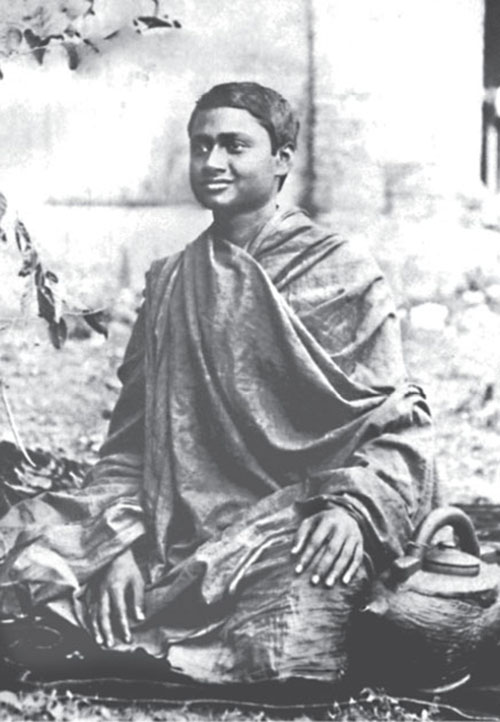
Swami Paramananda
The Swamis arrived in New York in December 1906. Initially, Paramananda assisted Abhedananda in New York, then later moved to Boston. While he was at Stratford, he received the news of Swami Ramakrishnananda’s illness. He immediately left for Genoa and boarded the first ship to India. However, as soon as he landed in India he received the news that Swami Ramakrishnananda had already passed away on 21 August in Kolkata. Paramananda was stunned. It seems, however, that he then had a vision of the shining figure of Swami Ramakrishnananda, smiling radiantly and this greatly consoled the young Swami.
Swami Paramananda didn’t know what fear was. While introducing him to a foreigner, Swami Ramakrishnananda had once said, ‘Here is a boy who is absolutely fearless.’
Swami Ramakrishnananda’s Love for Swami Paramananda[2]
From Swami Ramakrishnananda, I learned more than from anyone. He felt for the Swami [Swami Paramananda] such love as a widowed mother bears on only child. It was one of the deepest, most sacred feelings of his heart; and he was never tired of talking of their life together in Madras. I recall one day, when he stood looking intently at a picture of the Swami for several minutes, then he turned to me and said: ‘Paramananda lived with me for six years and I was never able to find a single fault in him.’ This was a glowing tribute, coming as it did from one who was known to be the strictest disciplinarian of the Order, so uncompromising in his demands on those who had taken up the religious life that many of the Brahmacharins (novices) shrank from his rigid training.
Basanta’s feeling for the elder Swami is shown in these sentences from letters written to me while I was in India: ‘Now that you are in Madras and near a great soul, do as he wants you to do. I am not even worthy to carry the shoes of such great souls. You do not need much of my advice nowadays, being constantly near an illumined soul.’ He gave to Swami Ramakrishnananda a rare love and reverence and was always overjoyed to serve him. When he came to America and could not render him personal service, he sought to be of use to him in other ways. He dedicated all the proceeds of the sale of his first book to Swami Ramakrishnananda and his work; and as his other books came out, he sent them freely in any quantities ordered, with the understanding that no return was to be made for them. There is in my keeping a letter from Swami Ramakrishnananda, in which he tells with loving pride that for sometime the monastery at Madras had been maintained by the sale of the Swami’s books.
‘There was nothing in it when Paramananda came,’ Swami Ramakrishnananda told me one day, as we sat in the hall of the new monastery at Mylapore, a suburb of Madras. ‘But as soon as he arrived, things began to pour in. There is no doubt he is a pet child of Lakshmi (Goddess of Fortune). I had had nothing to tell me the time. The first offering brought was a clock. Then a gentleman gave us some cots, another gentleman some chairs and soon the place was quite well fitted out.’
There was no luxury, scarcely comfort and no idleness. They rose early and their first care was for the Shrine, which Swami Ramakrishnananda had established as soon as he reached Madras. The brass vessels used in worship were scoured with wood ash and tamarind. The vegetables were cut for the daily curry which made up their one real meal. Then when bath, worship and noon meal were over, they would spread their mats, set out a low reading desk, cover it with a freshly washed cloth and for two hours they would chant in the original Sanskrit and translate the Ramayana or the Mahabharata, the great sacred epics of India. Swami Ramakrishnananda was a remarkable Sanskrit scholar and it was this daily study with the tried teacher which gave to the younger student his rare understanding, not merely of the letter, but of the spirit of Sanskrit, so evident in his later translations of the Bhagavad Gita and the Upanishads.
The days passed simply—in worship, meditation, study and work. Often Swami Ramakrishnananda was away for classes and lectures. It was on one of these occasions of absence that the Brahmacharin made his first attempt at cooking. Swami Ramakrishnananda had been relentless in refusing to let the boy do anything in the kitchen, over-heated by an open hearth fire. On this special day, Swami Ramakrishnananda was very late in returning; nothing was ready for the noon offering to the Lord, so the Brahmacharin lighted the fire and began the noon meal. The dishes cooked were so delicate and savory, with so sweet a flavor of joy and devotion in them, that Swami Ramakrishnananda declared he had not tasted such food since he had left Bengal.
This gave great encouragement to Basanta, who was trembling with anxiety lest his cooking might not be palatable or even edible. After that, Swami Ramakrishnananda grew more lenient and from time to time allowed Basanta to prepare the food offered in the Shrine; for everything was cooked for the Lord in their humble loving service. What they ate was to them literally the ‘remnant of the sacrifice,’ to use the words of the Bhagavad-Gita.
Although the kitchen was now open to Basanta, there was still continual contention between the older companion and the younger regarding the division of labor. Swami Ramakrishnananda insisted on keeping all the roughest tasks for himself and he was unwilling to have Basanta practise the least austerity. He would say to him: ‘You do not need it. Leave that for boys of coarser fiber.’ One day, soon after Basanta arrived, he noticed some unusual red lines on the boy’s arm. He inquired what had caused them and when he found they were the marks of the coarse straw mat which Basanta spread on the floor for his bed, he hurried to the bazaar and came back with a cot, a quilt and some soft pillows. That night Basanta lay down on his bed sad at heart that so many comforts were being forced upon him.
He longed for opportunities to deny himself. Swami Ramakrishnananda was equally intent on seizing every opportunity to indulge him. It was a constant unspoken conflict between them. To escape from it, Basanta planned secretly to run away to the wilderness somewhere, in order to gain the privilege of real renunciation; but not long after he conceived the idea, he was wakened in the middle of the night by the quick touch of Swami Ramakrishnananda’s hand on his face, his arm, his body. ‘You are still here,’ Swami Ramakrishnananda said in anxious tones. ‘I just dreamed that you had gone. Promise me that you will never go away without telling me.’ Basanta promised.
Swami Ramakrishnananda talked to him until nearly dawn of the benefits and disadvantages of practising austerities, showing that it could harm as well as help, by putting undue strain on a delicate body. ‘Your body was not meant for such things,’ he said to Basanta as he left him.
Swami Ramakrishnananda’s devotion for the boy was shared, perhaps in lesser degree, by many. The members of the large family in the great house overhead showed him warm affection. The elder ladies especially brought him frequent offerings of sweetmeats and dainty dishes, which made him feel very shy and uncomfortable.
Basanta still gave great joy by his singing, as he had done in his childhood. Swami Ramakrishnananda took keen pride in it and often invited a number of friends to hear him. There was also a group of Bengali gentlemen resident at Madras, representing large English paper manufacturers, who invited him frequently to their house for an evening of music. Sometimes, he paid more distant visits. One of these was to Vayambadi, a few hours journey from Madras. A great devotee of Sri Ramakrishna and Swami Vivekananda lived there. This person had never seen these Great Souls, but he had learned to reverence them profoundly through hearing about them from Swami Ramakrishnananda; and he longed to dedicate his life to their service. Outer conditions made it impossible for him to join the Order, so he built a little Temple, where every Sunday he preached to a large gathering, giving as best he could Sri Ramakrishna’s teaching of tolerance, unity and all-embracing love.
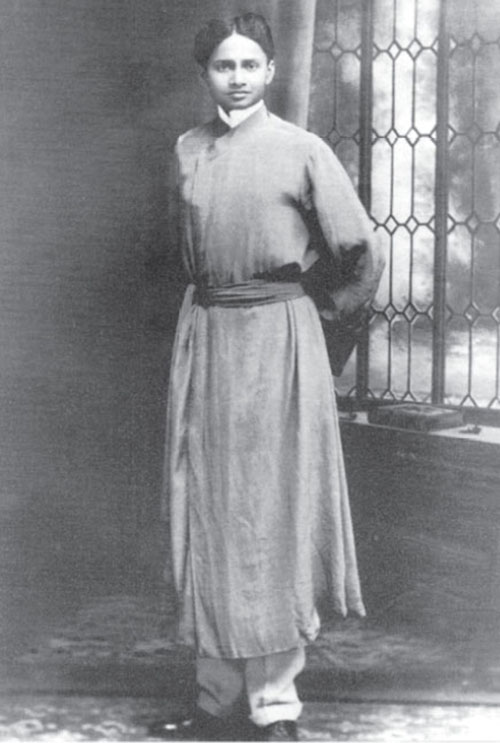
Swami Paramananda
Once more in the familiar lower rooms of the Ice-House which still served as Monastery, the two Swamis resumed their old routine. They rose before sunrise, opened the Shrine and carried the first offering of the day to the Lord. Often they were up at four, to spend the quiet hours before dawn in meditation or chanting; and the clear sweet voice of the young Swami was heard frequently in sacred song. There was one morning hymn which Swami Ramakrishnananda cared for so much that he requested him to sing it every morning at waking. When Swami Ramakrishnananda was nearing his end, he asked if anyone knew the song. Finding no one who did, he himself wrote out the words remembered through constant hearing. Girish Ghosh, the great dramatist, set them to music and Swami Ramakrishnananda had them sung as he was passing. Who knows what tender memories arose in his mind of the one who had sung them to him so often at the dawning of the day!
To establish a Shrine in India implies unremitting service of a living Presence. This Presence naturally assumes some more definite and personal aspect of Divinity. The belief is that, so long as our outer life is so intensely personal, in our approach to God we must have the element of personality to create a point of contact. If we serve an indefinite abstraction of Deity, our worship grows cold and alien to our daily living. We find all nations and races spontaneously seeking to establish a concrete relation with the Supreme by attributing to Him some human kinship, such as Father or Mother or Child or by trying to reach Him through some divine Incarnation. The Indo-Aryans are careful in their religious observances not to suppress or destroy this natural tendency. God in each household has His appointed place which becomes the centre round which the family life revolves.
No one leaves the house without going to bow down at the Shrine and invoke divine protection and guidance. No one returns without going first of all to greet the Lord. All food is cooked for Him and offered in the Shrine before any one partakes of it. He is tended as the most revered and beloved member of the family. A miniature bath is prepared for him; flowers are grown especially for him and are daily laid at His Feet in worship. Every service that might be rendered [to] a very dear mother or father is given Him and no act of the day’s routine is left unrelated to Him. To the more rational matter-of-fact Occidental mind this may seem like ‘playing pretend’ with toys. The result achieved, however, is conclusive answer to all scoffing, for the Divine Presence becomes so vivid a reality in India that even the most critical are silenced and awed by it.
Thus, did the daily activities of the two Swamis turn round the Sanctuary. Every thought, every word, every deed had the Lord’s service for motive. Not even a glass of water was taken without a moment’s pause for a prayer of oblation. Their whole life was one continuous act of worship. Leisure moments were few. There were numerous visitors. They began coming at six in the morning. Many gentlemen of Madras chose the hours between six and eight for their visits. Troubles or doubts or questions brought them; or simple devotion and friendliness for the Swamis. Some came to see the new Swami, for Swami Ramakrishnananda talked of him to everyone and great was their surprise to find the youthful face and figure when from Swami Ramakrishnananda’s words they had been led to expect a Sadhu of mature years.
Then, there were the vegetables to cut for the curry, the noon meal to prepare and the vessels used in the Shrine to wash and polish. When Swami Ramakrishnananda was absent for an outside class or lecture, as often happened, all these tasks fell to the younger Swami who was overjoyed to take them. The sweeper woman too came morning and evening to sweep up the heavy dust which gathers quickly in a place like Madras without rain nine months of the year and not over-plentifully supplied with water; and the rooms had to be made tidy after she had finished.
Whatever service he renders, he gives of himself with unstinted generosity. Another’s need is reason enough to offer whatever he may have to meet it. One of the articles I carried back to India was a lovely flame-colored chuddar or shawl. When Swami Ramakrishnananda saw it his face lighted up and he asked, ‘Do you know the story of that chuddar?’ I answered that I did not and he continued:—
‘One chilly, rainy day I noticed that Paramananda was going about with nothing but a thin shirt over the upper part of his body. I had given him a piece of woolen cloth to keep him warm and I asked him where it was. He replied evasively, “I am not [feeling] cold.” A little later, a boy from the Students’ Home came in with the cloth on. I thought he had taken it heedlessly and I began to scold him, but he told me that Paramananda had given it to him saying he did not need it. I called Paramananda and asked him why he had done this. His answer was, “He came in shivering, he had no shawl, so I gave him that one. At once, I wrote to Swami Premananda to send me the best chuddar that he could find in Calcutta and this is what he sent.”’
Swami Ramakrishnananda, however, sustained him by frequent letters, full of unceasing confidence and deep affection. Other letters such as these also brought him cheer and courage:—
‘I only wish it were possible for me to attend all the lectures at the Vedanta Centre, for I found them wonderfully satisfying and all of my associations there helpful and inspiring. Often in the midst of the rush and confusion of these unsettled days, the memory of the quiet hours spent with you at the Centre comes like a benediction.’ ‘What an achievement it has all been! The creation of the Vedanta Centre in Boston, whence the love and reverence for Truth and Service are winning through! Bless you for all your courage, faith and initiative!!’
‘I think of the life at the Centre many times in the day and hope to live and practise what you taught us. My visit is one of the most, if not the most precious experience of my life. I would not have missed it for anything that could be offered to me. Aside from feeling so refreshed in spirit, my cough is gone and the neuritis also. So that as the Episcopal service has it, I am better in “mind, body and estate.” Thank you so very, very many times!’
In June of 1911, the Swami suddenly decided to return to India for a few months. The news received about Swami Ramakrishnananda’s health was disquieting and the Swami longed for the refreshment of a new contact with old associations and surroundings.
Just after he had sailed from Boston, word was received that Swami Ramakrishnananda was seriously ill and they were taking him to Calcutta. We tried vainly to inform the Swami both by cable and by letter. The news reached him at Stratford. A cable was sent at once to inquire of Swami Ramakrishnananda’s condition. There came back the brief ominous message, ‘Condition desperate.’ It was like the swift falling of night in tropical lands. All brightness died out of immediate surroundings and one thought alone remained in the Swami’s mind— to travel to India as rapidly as possible.
He sailed from Geneva on the fifteenth of August. On the twenty-first, when he was not far from Aden, Swami Ramakrishnananda passed away. The Swami could not know of it, but he caught the reflex of it in a vague premonition which translated itself into an acute bodily disturbance. Swami Brahmananda, understanding what a bitter loss it would be to the Swami, wired the friend at Colombo who was to meet him, requesting him to say nothing of Swami Ramakrishnananda’s passing, but to let him hear of it later from a member of the Order. No news meant fresh hope to the Swami and he wrote from Colombo more cheerfully on the thirty-first:—
‘I am safely here and I am sitting now at the office of Mr. Sockonathan, Madras Bank. He tried his best to find out by what boat I was coming, but did not succeed. I landed about noon, ahead of time. As I was walking along the street a man came and asked my name and then told me that Mr. Sockonathan had been looking for me the last few days. He detains me here until tomorrow evening, then I start for Madras and will arrive there Sunday morning. I hope that I shall find everything all right there.’
The news of Swami Ramakrishnananda’s passing was given to him at Tuticorin with abrupt and brutal baldness. A customs officer in examining: his luggage observed his name and said, ‘A big Swami died the other day.’ ‘What was his name?’ the Swami asked. ‘Swami Ramakrishnananda.’ The blow deadened him. He crept into a corner of the railway carnage and sat there for hours dazed and numb. Then out of the grayness and numbness, there rose before his closed eyes the shining figure of Swami Ramakrishnananda with the radiant smile on his face which lent to it always a transfigured beauty. The vision brought with it such a sense of glowing joy that it drew the poignant sting out of the Swami’s pain and there fell on his heart a great quiet. Peace had come within, but the body did not rebound so easily from the shock.
He writes from Puri:—
‘I suffered from fever while in Madras. I received the most sad and shocking news upon my arrival at Tuticorin, as the Colombo friends were instructed not to inform me. I suffered much, but consolation came from the realization that he was free from all pain and physical suffering and was resting in the abode of peace. The vision of that smiling face brought me consolation. Of course, Madras seemed empty without him. But, Rudra was happy to have me there. He is a dear boy. Maharaj (Swami Brahmananda) wrote me a very sweet letter as soon as he received the news of my arrival. I arrived here early in the morning of 15th of September. I cannot tell you about my plans yet. Be brave and stand by your post faithfully. The Lord will bless you and give you strength. Swami Saradananda and Swami Turiyanandaji are here and several of the young Swamis. There is some suggestion of my taking Swami Ramakrishnananda’s place in Madras. But, I do not feel equal to it in this state of health. I feel very much honoured by it.’
[From Monastic Disciples of Swami Vivekananda by Swami Abjajananda, Advaita Ashrama, p.324-331 and Extracts from Swami Paramananda and His Work, Sister Devamata, Ananda Ashrama, La Crescenta, CA, USA, pp. 34-43, 56-61, 151-152, 155 and 165-168.]
ⓘ
[1] As narrated by Swami Abjajananda
[2] As recorded by Sister Devamata
↑ Contents
Swami Ramakrishnananda in Pudukotai
The following account of Swami Ramakrishnananda’s visit to this place [Pudukotai in Tamilnadu] and the work done by him during his stay (from the 24th to the 28th April) may be of interest to many.
The Swami was lodged, during these five days, in a quiet and congenial retreat in a corner of the town facing a tank. People of all sorts came to him; to pay him the homage due to a sannyasin and to hear him discourse on subjects of profound importance. Orthodox Pandits came to him frequently and felt blessed to have seen him. The Swami had many earnest students who went to him to have their doubts cleared and with uniform kindness he cleared them all.
A few of his utterances in conversation may well find a place here. He said, ‘Words are but flowers but deeds are fruits,’ and he often drew attention to the fact that religion is nothing if not practised. He cautioned us against presuming to know the highest secrets of religion for the mere satisfaction of intellectual curiosity, without a real yearning for light. ‘Only he who has realized that this worldly life of ours is darkness and misery can have such a real yearning. Hence the importance of the sadhana chatushtayam, the four preparations [such as control of mind and senses] of which the chief is mumuksha, the desire for liberation. One who has the least desire to remain in the world cannot be eager for liberation and so if such a one has a hankering for the secret wisdom, it is a mere intellectual curiosity and he will not wish to practice Vedanta immediately on learning it, nor will he have a real enlightenment until he renounces all desires. It will result in mere glib talk. He will delude himself that he with all his sins is Brahman and neglect his duty and commit atrocious crimes, as we daily see around us. So, it is better to be modest in our pretension of the study of Vedanta. Man minus sins may be Brahman, but not with his sins. In my opinion, this is why the Vedanta is odious in the eyes of Christian missionaries.’
At the same time, the Swami referred to the necessity of keeping Vedanta a secret from the unqualified and justified the law of discipleship. The Swami showed in various other instances how the sacred law of the ancient sages is founded on reason and the facts of human nature. He dissuaded us from unnecessarily and blindly imitating European customs, for he said, ‘Imitation is death.’ In religion, he advised us to prefer Bhakti to Jnana, for while the Jnani has to go about in search of God by his own unaided power, the Bhakta has only to love God and God, conquered by his love, comes of his own accord to the Bhakta. Generally, he exhorted us to work rather than to know.
The Swami delivered [in Pudukotai] seven lectures in all. On the necessity of Religion, he showed how man, in his search for happiness, first adopts the moral law out of mere prudence, since, each man being the mirror of all the others, evil done to one inevitably recoils back on the doer and how after a time he finds that even this moral law is insufficient. At last, the problem of death and of the vanity of earthly joys forces itself upon him and he realizes his utter inability to find true happiness in the world of senses. Then religion begins in man and leads him to the analysis of Nature and of Self for finding perfect happiness. He tries to transcend the senses either by knowledge of the Self or by intense longing towards God and thus he finds the substratum, the Life of all life.
In his second lecture, the Swami showed that man, naturally impelled to work, soon learns first that there is a higher power moulding his destiny and giving him good and evil according to his deserts and to deserve well of that power, he worships it in various forms, for obtaining worldly good. Even then, perfect happiness is not to be had and finally man realizes the vanity of earthly joys and the necessity of finding the eternal principle of Bliss. The way thereto, he said, was to retrace our steps: desire for finite good is the cause of activity and of the habit of work and activity will cease to produce bondage only if not prompted by desire but by unselfishness. Hence do your duty for God’s sake; know that all belongs to God and you will reach freedom and wisdom in time. This is Karma Yoga.
In the third lecture, the Swami explained the scientific mode of rising from the false self to the Infinite Being, the Source of all. But first conquer the mind, for other-wise, Raja Yoga is extremely dangerous. One who has divested himself of all impurity and all selfishness can in a month, by the practice of suspended breath—the sort of breath that invariably attends a quiescent mind—concentrate the energies of his intellect in Samadhi and realize the Infinite Bliss, in any form he pleases, whereafter the bounds of life and death, pleasure and pain fall off, doubts vanish and the consciousness retains forever the bliss that came to it in Samadhi.
In his fourth lecture, the Swami advised students to study not for money but for wisdom and for that purpose, to place implicit faith in the teacher, to become, as it were, an instrument in his hands, so that whatever the teacher wants the pupil to know he will know at once by the power of love. Bad books encouraging filthy ideas are to be avoided. Books such as the Ramayana and the Mahabharata are really useful. The body is to be cared for, not by sumptuous meals, but by exercise and homely food. He said ‘Eat to live.’ Shariramadyam khalu dharma-sadhanam; the body is the first tool for the practice of virtue. Religious rites, according to the custom of the caste, should not be neglected on the plea of ‘No time to spare from studies.’ For, out of religious practice comes steadiness and purity of mind which best conduces to successful study. He exhorted the Brahmin students to study the Veda with the proper chant and to study Sanskrit, their mother tongue.
In his fifth lecture he explained Shankara’s Advaita philosophy. ‘The Universe, apparently objective, is really subjective and as such does not exist. What exists is One and Infinite. Eliminate the apparent entities, sense objects, the body, the mind and even the intellect what remains is the One and by that elimination you lose all fear and misery and become that One. This elimination is possible only by strong will. The will must be exerted to compel the mind to stop its illusory creations of phenomena and to allow the Real to manifest itself.’
In his sixth, the Swami gave a short account of his master, Sri Ramakrishna Paramahamsa. Not satisfied with the intellectual feast of philosophy, he refused to study the Vedanta and said he would learn nothing that cannot directly show him God. When he was a worshipper at the temple of Kali, he became more absorbed in his passion for the vision of his Mother that he would sometimes weep piteously and often fast. At length, his earnestness succeeded and he had a vision of Her and thereafter She was present to him always and in the humblest beggar he saw but Her. He now was filled with the idea of Her love and this led him to think that religions other than his own cannot be false, for then the goodness of the Divine Mother must be finite which it cannot be. So he worked out the realization of God according to the cults of the Vaishnava, the Buddha, the Christian and the Mohammedan and reached the same goal by all of them. He realized God by the practice of Raja Yoga too. With a practical earnestness, he disciplined himself until he conquered covetousness, sexual lust, pride of caste and other weaknesses. Thousands resorted to him and found in him a practical demonstration of religion. Even when he was disabled by disease he would still go on, teaching and at last he lapsed peacefully into the arms of his Loving Mother.
The Seventh was devoted to Bhakti. The Bhakta starts with the idea that he is weak, finite and as compared to God, a Zero and that God is infinitely powerful. God must then be able to save His Bhakta. The means to approach God is Love. Absolute surrender of self to God is his ideal. All his emotions, he directs Godward. As his Master had said, the object of the Bhakta’s love is the Infinite Beauty of God; he is angry with himself for being lazy and indifferent to the Loveliness of God and hates himself for his vices and frailties; he eagerly covets the wealth of love to God; he is infatuated after the bliss of the Divine Presence; he prides himself on being the child of God; and he envies the fortunate sages who have already been favoured by Him with His holy vision. Thus earnestly seeking God and God alone he divests himself of the ideas of “I” which like a stick in a current causes a distinction between the soul and God and finally he merges into the Blissful Being.
[From Brahmavadin, 1905, March, Pp.288-93 ]
↑ Contents
Swami Ramakrishnananda in Mysore M. A. Narayana Iyengar, M. A.
One of the most important chapters in the life of Swami Ramakrishnananda relates to his work in the Mysore State. Swami Vivekananda had visited Mysore in 1892 before proceeding to America to represent Hinduism at the Chicago Parliament of Religions and was the guest of its famous minister, Sir K. Sheshadri Iyer, for about a month. He had met late His Highness Chamaraj Wodeyar and created a profound impression about the value of religion wherever he went. When he brought glory to Hinduism in America by his wonderful presentation of Indian thought, a public meeting was held in September 1894 in Bangalore in the Swami’s honour which congratulated him on his splendid work. But for the next nine years, there was hardly any activity in Mysore in the direction of understanding the leaven of thought introduced into the modern world by Sri Ramakrishnadeva.
But in July 1903, Swami Ramakrishnananda accepted an invitation from the Vedanta Society of Ulsoor in Bangalore and stayed there from the 19th of July to 9th of August. About four thousand people, including 53 Bhajan (Sankirtan) parties received him at the Cantonment Railway Station and took him in a procession for three miles upto his residence. During this period, he delivered about a dozen public lectures and held question-answers sessions in the morning and evening.
His lectures were attended by crowded and eager audiences of not less than a thousand people and his classes were attended by scores and sometimes by hundreds. His lectures included the following subjects:- ‘Message of Sri Ramakrishna to the World’, ‘What is Yoga?’ and ‘Vedanta’ and were presided over by the highest officers of the State, who appeared to vie with each other for the honour. The Swami appeared so inspired during the whole period that he actually electrified his audiences into a newer and more forceful appreciation of the grand truths of the Religion Eternal. A strong wave of spirituality was raised by the force of the Swami’s personality and teachings, which left an impress over the place and established the Dharma once again on broad and non-sectarian, yet deep and abiding basis.
In October of that year, the Swami carried the message of Sri Ramakrishna to Mysore and delivered five lectures. A noticeable address was his Sanskrit speech to the local Pundits assembled in the Sanskrit College defending the views of his Master, Sri Ramakrishna, on the divergent interpretations of the Vedanta and the Prasthanatraya [Three Pillars of Hindu Philosophy—Upanishads, Brahmsutras and Gita] as expounded by the Bhashyakaras [Commentators]. The address was a scholarly production and evoked a mild surprise, but the Pundits, champions of orthodoxy though they were, hardly realized its earnest import and courteously refrained from seriously contesting his conclusion. The interest thus created in Bangalore in the teachings of the Swami was kept alive by the Vedanta Society.
In August 1904, the Swami was again invited to found a permanent centre and this time he went there with Swami Atmananda. He delivered a series of lectures again, opened some classes and left Swami Atmananda in charge of them to continue the work and went back to Madras. Swami Atmananda and in his absence, Swamis Vimalananda and Bodhananda continued this work till 1906 under the guidance of the Swami.
In August 1906, the Swami again visited Bangalore and Mysore with Swami Abhedananda, who had recently returned from America after preaching Vedanta there for ten years. The two Swamis together delivered several lectures and consolidated their Vedanta work in Mysore. The appearance of Swami Abhedananda gave a fresh impetus and the elite of Bangalore wished to commemorate his arrival by the opening of a permanent centre of the Mission with a suitable habitation of its own. The Dewan Mr. V. P. Madhava Rao gave the Mission about two acres of land in Basavangudi, Bangalore town and Swami Abhedananda laid the foundation stone of the present Ashrama.
Swami Ramakrishnananda got a building erected there and invited His Holiness Swami Brahmanandaji, the President of the Mission, to open it. In August 1908, the public of Bangalore gave Swami Brahmanandaji a grand reception who then opened the Ashrama at the instance of Swami Ramakrishnananda. The Swami went to Bangalore as often as he could and actively managed the Ashrama and the Mission work in Bangalore and Mysore, as long as he stayed in Madras, chiefly with Swami Atmananda in charge of the Branch. Bangalore is thus associated with the Swamiji’s work for about eight years. During this period, he may be said to have fully established the beginnings of Ramakrishna Mission in Mysore, overcoming many difficulties that come up initially like in all pioneer undertakings.
The Swami’s great bhakti for Guru Maharaj, his love of God, his love and regard for Swami Vivekananda and Swami Brahmananda, his love and feeling for devotees and the poor, his vast Sanskrit and philosophic learning, his scrupulous purity, brahmacharya, simplicity, forgiving nature, his caution and care in worldly affairs, his higher realizations evident in every utterance and act of his, are all topics on which my pen is too feeble to express anything adequately.
[From The Vedanta Kesari, July 1922-23, pp. 102-104]
↑ Contents
Swami Ramakrishnananda: The Movement in Travancore K. Padmanabha Thampi, B.A., B.L.
It is almost twenty years ago [1] since Swami Ramakrishnanandaji visited Trivandrum as the guest of the late Mr. Kalipada Ghosh, one of the well-known householder devotees of Bhagavan Sri Ramakrishna. Kali Babu was a well-known personage in Travancore. Sometime at the end of 1886, he had visited Travancore for the first time as a tourist and had created a favourable impression. A few years after he came to Trivandrum as the local agent of Messrs. John Dickinson & Co. who had taken up the contract for the supply of stationery and other sundry articles to the Travancore Durbar. We met several times in those days and I remember a conversation we had at the Trivandrum Beach. The talk turned on Keshab Chander Sen and his lectures. Kali Babu then told us that Keshab was nothing compared to a great Hindu saint, at whose feet Keshab had sat and imbibed his lessons in spirituality.
This was the first time I heard the blessed name of Bhagavan Sri Ramakrishna, a name quite unknown at that time in Southern India. The devotee was naturally unwilling to go into details with casual acquaintances at a casual meeting. As I had taken a keen interest in the Brahmo Samaj movement since my college days and was familiar with a good deal of the Brahmo literature, I was naturally anxious to know more about the personality behind the great Brahmo leader. But my curiosity had to remain unsatisfied for years.
I was unfortunately away from Trivandrum in December 1892, when Swami Vivekananda, wandering as an unknown sannyasin, visited the place and stayed a few days with Professor Sundaram Iyer and left a profound and lasting impression on all persons who met him. When the news of Swamiji’s reception at the Parliament of Religions was published in the papers, Professor Sundaram Iyer said he was sure the Swami Vivekananda was the unknown sannyasin who had stayed with him. Sometime later, I heard an educated sannyasin, Swami Niranjanananda, had passed through Trivandrum on his way to Cape Comorin and had spent some days in a well-known hill retreat in South Travancore. The return of Swamiji from America fixed public attention on the movement and the reading of his Madras speeches, followed soon after by a study of his Raja Yoga whetted the spiritual appetite and a perusal of ‘Colombo to Almora’ led to a keen desire for spiritual instruction direct from a man of realization. The desire soon became very intense and I had almost stumbled into practices of a dangerous character, when I read the announcement in the local papers that Swami Ramakrishnanandaji was coming over to Trivandrum and would be staying with Kalipada Ghosh as his guest.
I at once wrote for an interview and getting a prompt reply, went to Trivandrum and met the Swami [Swami Ramakrishnananda] one afternoon in a small bunglow, west of the public gardens where Kali was living at the time. The Swami was then in the full bloom of health, his benign countenance beaming with love and tenderness. He received me kindly, asked me whether I had read Swami Vivekananda’s books and after some conversation, was gracious enough to give me spiritual instruction. After a long discussion on religious subjects and religious practices, I took leave of the Swami. For several weeks, my mind was in a state of blessedness and the heart was roused to intense sympathy, rising at times almost to pain at the sight of distress.
The Swami was holding regular classes on the Gita in a small building in the heart of the city, but I was stationed at a place a dozen miles from Trivandrum and could not leave my jurisdiction without special permission and hence was unable to attend any of these classes.
Next time, I met the Swami was on one morning about a week later. The Swami read to me a portion of the Bhagavatam (Dwaraka Skandha) and explained the meaning. A week or two later, I was again called to Trivandrum on urgent business and I took hold of the opportunity to visit the Swami in the afternoon. We had a long discussion and I drove with the Swami to the Town Hall where he delivered a lecture on Bhakti. My business prevented me from attending the lecture. A week later, the Swami went to Cape Comorin [Kanyakumari] for worshipping the Goddess and on his way, he was kind enough to accept my hospitality. I had made orthodox arrangements for his food; on hearing of this, the Swami said, ‘You will have the honour of having Guru Maharaj as your guest.’ The Swami offered the cooked food to Guru Maharaj and then partook of the prasada. Swamiji declined to take ghee as it was not included in the offering. Later on, I also partook of the prasada. The Swami left soon after, travelling in a bullock cart. I used the place rendered holy by his offering as a place of meditation next morning and found the mind rose with ease to a state of intense calmness.
On his way back from the Cape, the Swami again halted for a few hours and there was a long discussion on religious matters. Some of my friends who took interest in religion were also present. One of those had brought a few slokas of Shankaracharya (from Soundarya Lahari) for explanation; the Swami after looking at the slokas referred him to a pundit. The Swami stayed at Trivandrum for a month and besides the Gita classes, he delivered four public lectures. The last lecture was given in the Padmavilasan Palace in the Fort (the town residence of the Dewan) and was presided over by the Dewan Mr. Krishnaswami Rao.
The Swami during his stay made acquaintance with the leading Hindu officers and a large number of persons interested in religion visited the Swami who had long discussions with them on these subjects. Among them, the old judge, Mr. Vedadrisadara Mudaliar, was a frequent visitor. Hearing the Swami was leaving Trivandrum, I came over to pay my respects a few hours before his actual departure. I reached Mr. Ghosh’s Bunglow at about 8 p.m. and we again had a long discussion. The Swami was anxious to open a permanent centre of work at once and promised to send a sannyasin to take up the work.
A few months after his return to Madras, the Swami went to Bangalore. No centre was opened at Trivandrum, as the Swami probably thought that the number of persons who took real interest in the movement was too few to justify a sannyasin being spared for the work. As a result of the Gita classes, a small Vedanta Society was started in Trivandrum soon after to keep up the spirits of the few who took interest in Vedantic culture and things went on like this until January 1912 when Swami Nirmalanandaji of the Bangalore Math came to Haripad, a village in central Travancore, where I was stationed at the time, on the invitation of the local Vedanta Society and began the work which is now making such steady progress throughout the length and breadth of the remote hill and sea-girt land of Kerala.
[From The Vedanta Kesari, July 1922-23, pp. 105-107]
ⓘ
[1] Written in 1922
↑ Contents
Swami Ramakrishnananda in Burma Swami Jagadiswarananda
Sri Akshay Kumar Sen, a lay disciple of Sri Ramakrishna and the author of the renowned book Sri Sri Ramakrishna Punthi, was living in Rangoon in the year 1900. At that time, an association named Sri Ramakrishna Sevaka Samity was founded with his inspiration and under the auspices of the local Bengali devotees. The said association observed the birthday celebration of Sri Ramakrishna every year. In 1905, the association invited Swami Ramakrishnananda for delivering lectures during the festival. Accordingly, the Swami left Madras by ship on 16th of March and reached Rangoon on 20th of March. He stayed there as a guest of the engineer of the Rangoon Government House, Sri Nibaran Chandra Banerjee, for five days. He was the first preacher in Burma from the Ramakrishna Order. The Ramakrishna Sevak Samiti conferred on him the following address of felicitation [1]:-
TO
THE MOST REVERED
SWAMY RAMAKRISHNANANDA
HEAD OF THE RAMAKRISHNA MISSION IN
SOUTHERN INDIA
SIR,
We the Members of the “Ramakrishna Sevaka Samity” of Rangoon, beg to accord you a most hearty and respectful welcome on this occasion of your visit to this city.
The close connection—spiritual and otherwise—Sir, between India and Burma, now an outlying province of the great British Indian Empire, dates back from the remote past. It was our ancestors who brought the pure light of Buddhism across the seas to this country and it is a matter of legitimate pride and much gratification to us that even in these days of our national degeneration, one of our own countrymen should again, after the lapse of so many centuries, come to this beautiful land of the Pagodas, on a religious mission such as yours.
Sir, we are proud today to feel that you are one whom we can call our own. For, in you we find the ancient Hindu ideal of Renunciation of everything pertaining to self on the one hand and on the other a life of strenuous work for the welfare of fellowmen, revived and typified; and in your work, Sir, we catch a faint glimpse of the distant future which will see the realisation of the glorious work which your illustrious co-adjutor, the late lamented Swami Vivekananda began on that genuine Hinduism which has just begun to be appreciated all over the world - thanks to the zeal and ability of preachers like Vivekananda, yourself and others - and embracing within its capacious bosom the whole Hindu race, such as that perhaps which the great Sankaracharya himself conceived, attempted and nearly accomplished about twelve centuries ago.
Sir, your name, your fame, your life and your work serve to keep green in our minds the fragrant memory of that Holy Saint and Seer the great Ramakrishna Paramahamsa and of his life and teachings and we fervently pray that you may long live to continue the sacred and noble mission of your pious life.
We beg to subscribe ourselves, Sir, Your admiring followers,
The Members of the Ramakrishna Sevaka Samity, Rangoon
From the reports published in the April 1905 issue of the Prabuddha Bharata and March 1905 of the Brahmavadin, it is learnt that Swami Ramakrishnananda, during his stay in Rangoon, used to daily have discussions on various spiritual topics with the group of people who would assemble there. Apart from the lecture during the celebration, he gave four more lectures [2] as well. The lecture entitled Veda and Vedanta was delivered in the Victoria Hall, Suley Pagoda Road, under the chairmanship of Mr. V. N. Shivaya, M.A., B.L. The lecture on Bhakti delivered in the Hindu Social Club, had as its chairperson, Mr. S. C. Dutta, M.A., B.L. He delivered another lecture on Comparative Religions at the Theosophical Society. The famous Barrister of Rangoon, Mr. B. Kawasji, presided over that meeting. Unfortunately, no records of these lectures have been found so far.
Swami Ramakrishnananda stayed in a spacious house near the Rangoon High Court. The celebration pandal with a canopy was built on an open ground just in front of the house. Beautiful creepers and flower plants were fetched from the Government House forming a beautiful flower orchard inside, with the images of Sri Ramakrishna, Swami Vivekananda and the Holy Mother Sarada Devi kept on an ornate throne. Feeding of the poor people was one of the main components of the festival. Seeing the rice, pulse, etc. collected for this purpose, a young man passed an objectionable remark about the poor people. He said that most of the so-called poor people were unfit to accept this charity and had taken to begging as one of the means of earning money. Hearing such a comment, Swami Ramakrishnananda said smilingly, ‘Call the beggars and the afflicted poor people as daridra-narayana since Swami Vivekananda has coined that name. Don’t ever harbour any sectarian distinction like Hindu, Muslim, Buddhist, etc. among the daridra-narayanas. Look upon them with the same love and serve them as children of God. Feel yourself blessed for getting the opportunity to serve them. Do not hate the beggars; because we are no less beggars than they are. They are rather satisfied with so little.’ That day about three hundred daridra-narayanas were fed to their satisfaction.
On the festival day, the workers of the Association got up at dawn at Swami Ramakrishnananda’s bidding, finished their ablution and got engaged in the shrine work. Swami Ramakrishnananda himself went to pluck Nageswar Champa flowers from the garden of Bahadur Ramdas Bhattacharya along with Nibaran Chandra Banerjee and Girindra Nath Sarkar. Since Sri Ramakrishna was very fond of that flower, Swami Ramakrishnananda volunteered to walk three to four miles on foot with his bulky body just to collect that flower. On the way, they met the renowned novelist Sharat Chandra Chatterjee, then an unfamiliar young man. Hearing that the Swami was taking so much pain just to collect a particular flower, Sharat Chandra asked him by the way, ‘Why do you perform so much worship?’
Swami—‘I just feel great joy by doing that.’
Sharat—‘Is worship the greatest spiritual practice?’
Swami—‘Seeing God everywhere is the greatest spiritual practice. Meditation is of mediocre class; japa and chanting hymns is inferior!’
Sharat—‘Then why do people perform worship with so much pomp?’
Swami—‘Worship is internal rather than external. People in general perform worship of some deity to propitiate him out of fear; or they offer something to the deity to fulfill their worldly desires. These are all too despicable. Until one feels love for God, unless one sheds tears for His vision, worship cannot be performed. The worship, penance and counting of beads of the worldly people are momentary. They do not remember anything after that. But the true devotees call on Him with each breath and worship God with flowers, leaves, water, fruits etc. devoid of worldly desires, saying—‘Worship and ritual are all a hoax, just a pretext to call you, O Love!’
Everyone [who went to pluck flowers] reached the garden of Ram. There were countless Nageswar Champa flowers blossomed on a tree. Their fragrance and beauty converted the whole place into a celestial garden, as it were. The flowers were like white roses. The Burmese gardener climbed the tree and broke a few twigs full of flowers. But the Swami was not satisfied with that. He plucked a few flowers with the help of a long bamboo stick. In that far off land, he was beside himself in joy by plucking the flowers loved by his dearest God. He happily gave a little tip to the gardener and learnt on enquiry that the Burmese name of that flower was Gad. Legend has it that Lord Buddha too was very fond of that flower.
On his return to the festival pandal, the Swami saw that the gardener of the Government Palace had also brought a basket of beautiful roses. He cried out in joy, having got so many flowers, ‘Oh! Ramakrishna!’ Then he himself decorated the Master with various flowers and flower-wreaths. A musical choir came and started singing devotional songs. At the end of the group singing, offerings were made and a lamp was waved as arati which was performed with the accompaniment of music and instruments like Khol, Kartal, Kasar, Ghanta and a Burmese instrument. A current of joy flowed in the festival pandal with all the devotees uttering and echoing the words, ‘Jai Ramakrishna!’ Many devotees from faraway places had come to join in the festival. The Swami took khichdi prasad along with about a hundred devotees at noon. At the end of the celebration the devotees hailed, ‘Jai Bhagavan Ramakrishna Dev Ki Jai’, ‘Swami Ramakrishnananda Maharaj Ki Jai,’ and joyfully wended their way home.
The Swami visited at leisure the main places of interest in Rangoon. One evening he went to see the Swedagon Pagoda situated at one corner of the city. This Pagoda was the best of all Pagodas in the Buddhist world. No other Buddhist country contains such a huge, beautiful and gold-studded Pagoda. It is a most holy place of pilgrimage for the Buddhists as it is home of holy bones and hair of Buddha. It is situated on a hillock and one has to reach it after climbing more than a hundred stone steps. The main spire of it is 370 ft. high. The maintenance of this Pagoda costs more than two lakhs rupees. Since the dome of the temple is gold-plated, it is called Swedagon (Swe=Gold, Dagon=Head). About 50,000 people can sit together in its spacious courtyard. The Swami circumambulated the Pagoda and was charmed to see the beauty around it. He prostrated before an image of the meditating Buddha and then sat in the Padmasana posture for meditation. His calm and sober face attracted the attention of many pilgrims. Seeing his resplendent face, the Burmese ladies offered him some of the flowers they brought to offer to the Buddha. After meditation, when the Swami saw the flowers and asked the old manager the reason, the latter explained the whole incident to him. Impressed by the personality of the Swami, the old manager showed him the world’s second largest bell [3] situated on the eastern side of the Pagoda. It was 14 feet high and weighed about 94,682 pounds. Six people can stand side by side inside it. The highest peak of the Pagoda contained a ruby worth three lakhs rupees. It shines like a star in the dark night. The independent king of Burma, Mindon Minn, collected this ruby from the world-renowned ruby mine Mogak and kept it on the peak.
In the Pagoda campus, the Swami met with an Irish monk. He was a learned Christian of Ireland. Attracted by Buddhism, he had left his native land and religion to embrace Buddhism in Burma. This shaven-head, bare-footed, bright complexioned, ochre-robed monk preached Buddhism all over Burma. He lived near the Swedagon Pagoda in a Buddhist monastery. He invited Swami Ramakrishnananda to his monastery. The Swami lovingly accepted his invitation and in turn invited him to his lecture in the Victoria Hall next day. Accordingly the monk presented himself at the lecture of the Swami and was charmed to hear his touching lecture. At the end of the session, the monk came and said to the Swami, ‘Your scholarly lecture has charmed me.’ The childlike Swami took the garland from his neck and put it round the monk’s neck; he then promised to go to the monastery the next day along with him. Thereafter, the devotees took the Swami to the famous Royal Lake, Rangoon. The monk and Sharat Chandra Chatterjee went with the Swami. After reaching the lake, the Swami rested a while and enjoyed the enthralling beauty of the lake. In the evening, the lake assumed an exquisite beauty with full of lighted lamps floating on it. The Swami was delighted to see that wonderful scence. On the next day, he went to the monastery as promised. The conversation that took place in English between him and the Irish monk is given below [4]:
Irish monk—I have accepted Buddhism after realizing its universality and the unsubstantial nature of other religions. This religion is controlling the lives of almost half the population of the globe.
Swami—We adore all the existing religions of the world. All religions are equally true and the goal of all is the same.
Monk—Who is the founder of this faith?
Swami—The Incarnation of this age, Bhagavan Sri Ramakrishna Deva.
Monk—What is the speciality of the religion founded by him?
Swami—The harmony of all religions. Incarnations like Lord Buddha, Jesus Christ, Mohammad etc. have proclaimed the paths propounded by them as the only way to salvation. Sri Ramakrishna’s distinctness from them lies in the fact that he did not preach any particular religion. He realized through his own spiritual austerity the quintessence of all religions and preached the message, ‘As many faiths, so many paths.’ None could preach the infinite forms and ideas of God like Sri Ramakrishna Deva. One cannot become fit for immortality without renouncing everything. Recognizing this truth, this great soul, best among all renouncers, never touched money in his life. He worshipped his wife looking upon her as the blissful form of the Divine Mother. Nowhere in the world is found such blazing example of unbroken celibacy in married life.
Monk—Lord Buddha has only spoken of Nirvana. He said that Nirvana is attained only after the exhaustion of desires. He did not accept theism.
Swami—In India, atheism cannot stand in the religious arena. Those who call the Lord Buddha an atheist and not a Brahmanist or an Atmanist are deluded. Lord Buddha was a philosophical theist. The religion of Gautama Buddha is the holy Aryan religion. His austerity was verily to attain God. We worship him as an Incarnation of God.
Then the Swami expressed his views about Indian culture and Hinduism and said, ‘The soul is in essence nothing but Brahman. The satisfactory solution to the mystery of this world is found in the Vedas. The Buddhists had accepted the Vedas; there are many proofs in support of this statement. Buddhism came after the Vedic religion, not the other way round.’
The Irish monk said in disappointment, ‘The Supreme object is unknown and unknowable.’ The Swami said, ‘God is perceived only by the pure mind. The heart of the devotee is the parlour (i.e. seat) of God. He is One while meditating, but Many while reasoning.’ After some time, the Swami said to the Irish monk, ‘God can be attained through all paths. You could have got liberation by following your own religion. You have made a blunder by giving up your own religion and accepting another. The Hindu scripture says, ‘It is better to die in one’s own religion; the religion of others is fraught with danger.’ [5]
When Swami Ramakrishnananda went to Rangoon, the son of Bengali poet Nabin Chandra Sen was a barrister in Rangoon and Nabin Chandra was also staying with his son at that time. The poet came to meet the Swami and in his conversations, admitted that the present age very badly needed an incarnation harmonizing all religions. The Swami told him, ‘The world will find peace by receiving the message of harmony of Sri Ramakrishna.’ The poet was very pleased to meet and hear the religious topics discussed by the Swami and he requested the Swami to shower his blessings on his son.
Sharat Chandra Chatterjee, after reading the works of Darwin, Tyndall, Mill, etc, had introduced himself as an atheist to Swami Ramakrishnananda. The Swami said in reply, ‘Those who call themselves atheist are all the more believers in God; for it is the atheists who are searching for God all the while. How can those who always look for God be atheists? To know God, one should intently watch the strange skill of creation of the Creator. The existence of God can easily be derived by means of the cause-effect relationship. There can be no work without the doer. So when the world (the created, the work) is perceived, there is no doubt about the existence of its Creator.’ [6]
Sharat—If I call one’s nature as the cause of the world?
Swami—Then you may call the cause behind the creation of one’s nature as God.
Sharat—If the cause of one’s nature be God, then who is the cause of God?
Swami—God’s will power is the cause of nature and the cause of will-power is God Himself. Without the knowledge of Brahman, man cannot find the root cause of God. He is self-created, without beginning, without a second. In order to call on Him, one should dive deep into the ocean of austerity with a pure mind enriched by intense faith in the scriptures and in the words of the Guru. It won’t do to float superficially.’
Sharat—Reason and scholarship can take one to some distance, but everything beyond that looks dark.
Swami—Who says it is dark? Search Him with a yearning and you will certainly find Him. Beyond the knots of doubt there is indescribable Light and an endless ocean of bliss. Many people with intense yearning have become blessed by His vision. The history of the world religions bears testimony to this fact. The worldly people listen to everything but never believe them.
Sharat—Why does doubt sneak in, Sir?
Swami—This doubt is an obstruction. Nay, it is a chronic disease. The impressions of the previous lives must be exhausted. One endowed with faith is really fortunate. He does not lack anything. Faith is a rare wealth. Our disease is the desire and discrimination is its remedy. God, in the form of discrimination, moves about with us every moment. The moment one forgets him everything is spoiled.
Sharat—Well, you have been worshipping your Sri Ramakrishna for a long time. Have you gained anything out of it?
Swami—Sri Ramakrishna does not belong to us alone. He came for the well-being of the world. The Lord, true to his proclamation, ‘I take birth from time to time’, incarnates in all ages in order to establish religion and abolish irreligion, to release the holy from misery and to show the path of liberation to the sinners and the afflicted. He has performed many divine plays through his incarnating as Krishna, Christ, Mohammad, Buddha, Shankara, Gauranga, etc. It is He who has again incarnated in the present age as Sri Ramakrishna, the prophet of harmony of all religions. He has reflected in his life the message of the Gita. His renunciation of lust and lucre was an example unheard of before; his intense austerity for twelve years was a lesson to the world; and his proclamation ‘As many faiths, so many paths’ was epochal in the religious world. His ‘Gospel’ has showered peace on parching hearts all over the world. He has said, ‘Because of God, the soul, the world, all the twenty-four elements are there; without Him, none of them can exist. If you go on adding zeros after one, the numbers keep increasing; but remove the digit one, then nothing remains. The phenomena called birth, death etc. are like magic, appearing or disappearing in a twinkle. Can there be religion in exhausting the life after food, sleep, desires and enjoyment? The goal of life is God-realization.’
Sharat—Why do we not see Him?
Swami—The Master used to say, ‘There are gems in the depths of the ocean; effort is needed to fetch them. Likewise, God is verily present in this world; one needs spiritual discipline to have His vision.’ He also said, ‘You are standing in front of a pool covered by scum and are saying there is no water. If you want to see water, remove the scum. God cannot be seen with the eyes covered with maya; if you want to see God, you must remove maya.
Sharat—What is this thing called maya?
Swami—The power of Brahman by which this world has been created is called maya. Maya has deluded all the souls of the universe. Our extroverted mind covered by maya remains charmed with wife, children, name, fame etc. and takes these unsubstantial, impermanent things for essential, eternal. Without God’s grace, no one can escape this maya. But on whom His grace descends? He is all the while thinking of the welfare of the souls. But do the souls hanker for His grace? The only way to win His grace is through tears. One should take refuge in Him alone and tearfully ask for His grace. It is only when He feels that someone really loves Him alone and does not care for lust and lucre that His grace descends. One completely infatuated by worldly things can ill-afford to move the heart of God merely by asking for His grace or vision. He will have mercy only when this hypocrisy will go, the heart becomes simple and the mind becomes pure.
Sharat—If God forever thinks of the well-being of all, why do they suffer from so much misery?
Swami—He is not merely benevolent but all-benevolent and all-powerful. Whatever God does, is for the good of all. The parents too desire good for their children, but they are not omnipotent. If God, in spite of being possessed of these two powers, confers misery on the beings, then know it for certain that His compassion works in and through such misery. What we call misery is not in fact misery—it is rather learning. We forget God tempted by momentary happiness. That is why He gracefully inducts us into misery, thus reminding Him forever. His grace is to be felt in two ways—propitious and adverse. Sometimes he decorates the toy-house of the beings with wealth, people, children, family, position, prosperity, etc.; that is known as propitious grace. Again, sometimes he snatches them away one by one, filling the devotee with a flood of tears and pulls him towards Him. That is called adverse type of grace.
Sharat—I don’t clearly understand the terms like fate, destiny, self-effort etc.
Swami—In this world, some are born beautiful, some ugly, some are kings, while others are subjects, some are Brahmins, others of low-caste, some happy, some sad, some sinners, some virtuous, some cruel, some compassionate, some have earned fame through service of God, while others are hated by cleaning filth. But on enquiring the cause of all such disparity, one cannot but accept the fate or results of works done in previous lives. Both destiny and self-effort direct our lives. Through destiny, man gets the result of his deeds performed in earlier lives in this very life. The result of the works done in the present life is enjoyed only partially in this life. That becomes the cause of happiness or misery as destiny in the next life. Even self-effort is nothing but divine power. Without His grace, the word ‘self-effort’ is meaningless. Self-effort is necessary to get grace of God; and to practise self-effort, God’s grace is needed.
Sharat—Can fate be undone?
Swami—The worldly people are infatuated with ego. But when they become drenched in sorrow, disease, misery, poverty and disappointment; when no endeavour, self-effort, or labour becomes effective; then only he thinks of fate and says that fate is inexorable.
Sharat—If my fate, born as a result of action, be inevitable, then what is the use of worshipping God or following religious dictates?
Swami—I firmly believe in fate, but I don’t believe that fate cannot be undone. I don’t believe that whatever is accumulated as good, bad, virtue, vice, happiness, misery in the chamber of fate, by way of results of past action, is unchangeable. Apart from One Supreme Brahman which cannot be burnt, divided, dried, cut or changed, there can be nothing in this world. Wherever there is malady, there is remedy too; wherever there is darkness, there is light too; wherever there is tyranny, there is liberation too. Wherever there is the decadence of religion, there is establishment of religion too. This is the eternal law of the world. If the same law holds with every matter, why should there be exception in the case of fate? Unless there is some way to reduce misery, why would people try to accumulate so much virtue? What is the utility of so much philanthropy, charity, austerity, pilgrimage, scriptural study and worship? If there is no way to eradicate fate or vice, then what is the need of an Incarnation? What is the justification for the name Saviour of Jesus Christ, or Rasul of Prophet Mohammad, or Kapala-mochana of Sri Ramakrishna? Lord Krishnaa himself has said, ‘Take refuge in Me alone; I shall liberate you from all sins.’ The Incarnation of this age, Sri Ramakrishna, has said, ‘Tears wash out the sins of previous lives.’ The world teacher Swami Vivekananda has said, ‘Another name for God is kapala-mochana.’ [literally, ‘one can remove what is written on one’s forehead or destiny]. By His grace, man’s fate can be wiped out in a trice. Pray to God tearfully, ‘O compassionate God! I am helpless and weak. Kindly forgive all the sins I have accumulated in this or the previous births. O Lord! Destroy the fruits of my past actions.’ If one prays with an attitude of repentance and yearning, He must have mercy on such a soul. The mother is moved when the son cries.
Sharat—Can all cry?
Swami—Your problem is that you are too intelligent. Remove the crooked element of your intellect and the path becomes easy. Nobody has attained God through smiles. Whoever has realized Him, has got Him through tears alone.
Sharat—Can one become a monk without wearing the ochre robe?
Swami—Religion is in the mind. One can become free even without ochre cloth. Man is bound through the mind and also free through the mind. First, yearning is required and then comes external help. If the mind is trained, the ochre cloth also helps a bit in external matters. On the other hand, the impure mind paves for hypocrisy through the ochre cloth. Wearing ochre cloth, smearing marks on the forehead, going to pilgrimage, singing devotional songs, counting beads, performing austerity etc. are not religion. They are the external coverings of religion. These only help the human mind to become eligible for God’s grace.
Sharat—Then what leads to liberation?
Swami—Unless the individual soul becomes forgetful of itself for the sake of the Supreme Self, the way to liberation cannot be found.
Sharat—What are the rules laid down for the would-be monks at your monastery?
Swami—To be a monk in the monastery, one has to remain a novitiate for three years. The next three years he has to observe the vow of celibacy. After these six [7] years, the head of the monastery will consider your eligibility for sannyasa before ordaining you into the lifelong vow. The monks of this Math will have to be ideal renunciates, ideal servants, ideal yogins and ideal devotees.
Sharat—What should one learn during those six years?
Swami—The motto of the Mission is ‘Renunciation and Service’- giving up attachment for the world, seeing God in all beings and serving all beings as the representations of Shiva.
Sharat—The work of serving others can best be learned from the ladies of the household. Can there be any higher ideal than the way a Hindu woman serves her husband and her child?
Swami—There is a tinge of selfishness even in the service of the chaste wife for her husband. But the monks and brahmacharins of the Math pick up helpless patients from the roadside and serve them unselfishly as Narayana [God].
Sharat—The rules of the Math are very tough—six years of a novitiate life. One becomes a doctor by studying in the Medical College for six years.
Swami— By becoming a doctor, one may treat the physical ailments, but if one can become a monk, he can get rid of the disease called worldliness.
Sharat—Every year, millions of monks assemble in the Kumbha Mela festival. Will they all be rid of the worldliness?
Swami—Among them, many wear the monk’s robe for filling their bellies, for name and fame, for earning money in lieu of medicines and in order to avoid punishment from the king; but there are very few monks who are all-renouncing, discriminating and detached, just for the sake of God. One becomes an all-renouncing monk as a result of austerity through several lives which detaches one from lust and lucre. Without the intense desire for liberation, one cannot become a monk.
In the holy company of Swami Ramakrishnananda - an associate in Sri Ramakrishna’s Divine Play, a blazing exemplar of renunciation of lust and lucre and the living embodiment of devotion to Guru—the atheist Sharat Chandra was transformed into a believer of God. When the Swami was about to take leave, many Bengali and South Indian devotees paid their obeisance and left. Seeing their eyes heavy with tears, Sharat Chandra too was moved.
Everybody’s hearts were filled with a deep spiritual fervour. By his holy touch, the spiritual moods of many people were aroused. He boarded the ship on Saturday, 25th of March at Rangoon and reached Madras on 29th morning. That very evening, he left for Bombay to speak on the occasion of the birthday celebration of Sri Ramakrishna. The seed that he sowed in Rangoon in 1905 turned into a huge tree in the course of time. About twenty years later, a large charitable hospital and dispensary along with library and reading room were established there by the Ramakrishna Mission.
[From Udbodhan, 49th year, 8th issue]
ⓘ
1 This address was published in the Brahmavadin, March 1905.
2 The four lectures were: What is a Soul, The Vedas and the Vedanta, Bhakti (or Divine Love) and Comparative Study of Religions.
3 The world’s largest bell is in Moscow.
4 The conversation was recorded by Girindranath Sarkar in the book Brahmadeshe Sharatchandra, p 30-32.
5 Bhagavad Gita, 3:35.
6 The conversation was recorded by Girindranath Sarkar in the book Brahmadeshe Sharatchandra, p 35-46.
7 At present it is nine years.
↑ Contents
Swami Ramakrishnananda’s Living Touch- The Students’ Home
C. Ramaswami Iyengar
A quarter of a century ago I was yet in my twenties and a petty clerk in the Public Works and Labour Secretariat, Madras.
One evening, as I was returning home from my office in Chepauk, I entered the ‘Ice House’ situated on the Beach Road. The place was full of holy associations and was a centre of attraction to many young men like me. The great Swami Vivekananda had stayed there a few years previously, when he returned to Madras from the West laden with glory. In a corner of the premises was living a brother disciple of his, whom he had sent to Madras to carry on the work he had inaugurated. It was the Swami Ramakrishananda, known to his brothers as ‘Shashi’.
He was the very embodiment of love and service. His main sadhana of life was increasing service to his Guru, first in the form of tending to his personal comforts and conveniences while he was in flesh and blood and after he attained the Mahasamadhi, in the shape of worship to him. His service to his gurubhais, an offspring of his devotion to his Guru, was equally unique. This earned for him the name of ‘the mother of the Math’. It was this ardour of devotion which won for him his master’s name. Referring to his name, Swami Vivekananda once said. ‘I would like to have taken it myself, but I thought Shashi deserved it more’, such was the Swami whom I went to see. I had known him ever since he came to Madras.
He loved me greatly. He received me with a face beaming with smiles and gave me prasadam which he insisted on my taking in his presence. Then he asked me to sit by his side and plied me with several questions. I had not seen him for a week or ten days. He said, ‘I have been longing to see you. Why did you not come all these days?’ Then for some time I read with him a few verses from the Gita as usual at such meetings.
When I was about to leave, our talk turned to the lot of the poor students who were usually seen wandering about the streets of the city. The Swami’s heart bled at the sight of the suffering poor. He said, ‘My dear Ramu, several boys come to me appealing for help. If our Math were as rich as some of the other Maths in the country, I would throw open our doors to these boys. With the poor means at my command, I have already given refuge to one boy here and even that, I find difficult.’
The boy who had found shelter with the Swami was an orphan from Mysore. His father and mother had died of plague and he had none to help him. He had come to Madras trusting to Providence and in the rich and vast city he found none to give him a helping hand so readily as the Swami.
The Swami continued: ‘By staying with me the boy is put to much inconvenience. He cannot study properly. I am not able to provide him with meals in time for his college. What can I do? Will it be possible to find some gentleman who will feed him?’I said, ‘Swamiji [Swami Ramakrishnanada], many boys of his type are taking meals in the houses of charitably minded gentlemen by weekly rotation. I shall see if see if he can also be provided for, that way.’
The Swami said, ‘Yes, try.’ After a few minutes, I took leave of him, promising to call in again the next evening.
As soon as I reached home, I mentioned the subject of my talk with the Swami to my mother who readily consented to give the boy meals one day in the week; likewise I arranged with my sister for another day in her house. The next morning, I also saw a few friends and they gladly acceded to my request.
In the evening, I went to the Swami and told him of what had been done. He called the boy, explained to him the situation and said. ‘It will be more convenient for you to live in Mylapore. And you can always come to me, if you have any difficulty.’
Soon after, the boy shifted to Mylapore. I found him accommodation temporarily in the outer apartments of ‘Vasanta Vilas’, the spacious house of my sister, where I had stayed from my boyhood.
Afterwards, whenever I went out, the sight of poor boys wandering about for help invariably attracted my attention... Every time I saw these boys, I was reminded of our helpless condition to do anything organized for them. This feeling grew day by day as a heavy load on my heart.
Several months went by, after my interest, had been awakened in this direction without anything being done. One hot day early in February 1905, as I passed the big Aswattha tree on the Brodies Road beside the tank, I saw a group of four Andhra boys seated on the platform below the tree. They looked hungry and miserable; I approached them and asked them why they sat there and what ailed them. One of them said, ‘We came from Guntur, Sir, two days back. We are very poor students. We heard that in the Kanyaka Parameswari Devasthanam Charities in Madras, they gave free boarding to poor students and helped them to prosecute their studies. But after coming here, we learn that we cannot get any help there. We have no money now even to get back to our native place. We have not had our meal yet for the day.’ It was impossible not to be moved by this harrowing sight. I asked them to follow me and arranged in my house and in my friends’ for their day’s meal. Then I told them, ‘I shall arrange now temporarily for your boarding with a few friends and I shall see if something can be done to help you to prosecute your studies. Do not lose heart. God helps those who help themselves.’
That evening, I went to Swami Ramakrishnananda. He was seated on a long bench and was rocking slowly backwards and forwards as he often did. I stood by his side and told him the story of the Andhra boys I had met that noon. I said, ‘Swamiji, can we not start a boarding house on a small scale to help these boys?’
The Swami smiled and spoke nothing. Then he leaned forward, poised his heavy body on his two arms placed firmly in front of him and remained thoughtful. This vision is still very vivid before me. After a few minutes he lifted his right hand, looked straight into my eyes and said, ‘Ramu, do you really believe you can undertake such a task? Think well. You ran a school for Panchama children for seven years and at last you had to give it up. Once you take up a work, you must stick to it. What you propose now is a very difficult thing.’
I said, ‘Swamiji, if I have your blessings and if you put me in the way, I am confident the undertaking will succeed.’
He exclaimed, ‘Then, Ramu, it is all right. If you have faith, it will work miracles.’
That was enough for me. I felt the load on my heart already lifted. From that day to this, I have never doubted, I have never calculated and I have never been anxious about the future. He made everything easy.
The idea took shape rapidly. I could not rest till it had concretized. I went about to canvass the sympathy and cooperation of as many friends as possible... Then, I began to think of how to secure the necessary vessels and provisions. To start with, my mother gave a brass cooking vessel and afterwards a few ladies of the neighbourhood to whose motherly heart the idea appealed, made presents of some more utensils.
One petty provision merchant who was popularly called ‘Olakkan’ was persuaded to supply provisions on credit initially. Various articles of consumption were also gathered from several houses.
An appeal was also issued for pecuniary help and I went round to see several gentle-men...
All this preliminary work was done within an incredibly short space of seven or eight days after the idea had received the sanction of the Swami. I felt an impelling power behind me. I expressed to him my eagerness to have a formal dedication ceremony conducted by him. He fetched his panchangam and after consulting it, he fixed the evening, the time of cowdust [1] on Tuesday the 17 February 1905, as the auspicious hour.
I arranged to have the walls of the house we proposed to occupy white washed. The wood work was also scrubbed and the cobwebs removed. The floor was swept and cleaned with cowdung. The front of the house was decorated with garlands of mango leaves.
I had a picture of Sri Ramakrishna, which the Swami had presented to me a few days after our first meeting. I used always to keep it with me and carry it with me, even when I went out of Madras to Ootacamund or other places.
At the appointed hour Swami Ramakrishnananda arrived. The seven boys who were to be the first inmates were there. There were also a few friends and sympathizers.
Then the Swami stepped in. The holy picture was placed on a dais. He sat in front of it and after conducting the worship, he meditated for a while. Then he spoke a few words to the following effect.
‘Annadanam is spoken of as a Mahadanam and is considered very sacred in our country. And Vidyadanam is greater. But the greatest is the conferring of spiritual knowledge. The harmonising of all the three should be the aim of this Institution. May Sri Ramakrishna bless the undertaking with success.’
Arati was performed and prasadam distributed.
The hearth was lit and the boys had their first meal in what became from that hour their own HOME...
In the Home one sees now scores of visitors daily, but in those days when it was located in little unpretentious houses in lanes and corners, it attracted the notice of very few people. However, among them were great ones who realised its potentiality, whose appreciation assured the management that the work was progressing in the right direction and whose suggestions and advice helped largely in shaping its activities.
Swami Premananda came to South India by the end of 1906, accompanying his mother on a pilgrimage to Rameswaram. He stayed in Madras till the celebration of the birthday of Sri Ramakrishna, a few weeks after his arrival. One day, he came to the Home with Swami Ramakrishnananda and was delighted to see it. He sat down and meditated for a while. Before he left, he untied from a comer of his cloth a ten rupee note and slipped it into my hand saying, ‘This is from my mother, for your Home,’ That expression of loving smile which played on his lips, as he gave it, is indescribable. That was characteristic of him. One should have seen him to know really in what attitude one ought to make gifts.
Whenever he walked out into the street, he would tie up a few pice in a corner of his cloth, expecting to meet beggars; and when he saw them, he would walk over to them, silently slip the pice into their hands and move on. Once when I accompanied him, I offered to take the pice and give it to the beggars, but he did not allow me; he insisted on giving it himself. Such was one of the first visitors who came to give us a silent message.
Swami Brahmananda visited the Home for the first time in the year 1908, though he had been, as the President of the Mission, closely watching all our activities from the very beginning. As Swami Ramakrishnananda used to say, whatever Swami Brahmananda touched not only became pure but also got the purifying power. It is not possible for us therefore to estimate what the Home owes to him.
One morning in January 1909, when I consulted Swami Ramakrishnananda about the admission of some boys into the Home, he said, ‘Bring them before Maharaj.’ Accordingly, I took the boys to the Math and asked them to offer their salutations to Maharaj. He looked up and said, ‘They are all good looking boys.’ The Swami then said to me, ‘Ramu, Maharaj has approved, the boys have his blessings. What need is there of anything else? Take them.’ And all those boys proved really good. In the subsequent history of the Home, we have many occasions to speak of this towering personality. For, from this time onwards, the life giving impulse to carry the institution in its onward march came unfailingly from him at every step...
Around this time, Mrs. Besant paid a visit to the Home. She first arrived at the Math on the Brodies Road, mistaking it for the Home. The Swami usually got nervous whenever he had to meet a lady. He was ordinarily very indifferent to his personal appearance. But, when he had to appear before a lady, he would put on a jibba and carefully cover his body with a chadder. He did so then and accompanied her to the Home. He alighted from the carriage first and led her in, holding the umbrella to protect her from the sun. Mrs. Besant spent half an hour in the Home. The Swami asked the boys to chant a portion of the Taittiriya Upanishad and after it was over, he asked her, ‘Do you follow the meaning?’ She replied, ‘Yes, I do,’ and added, ‘I much admire the way in which these boys are brought up. I shall help the cause in my own humble way.’ Since then, she has been one of the regular subscribers...
All these activities apart, it is the living touch with Swami Ramakrishnananda that really moulded the life and ideals of the Home.
During the years 1905 and 1906, Swami Ramakrishnananda continued in the Ice House in Triplicane and he was then attending to all the work in the Math by himself, cooking food, conducting the worship, answering visitors and holding classes in several parts of the city. With all this, he undertook to go to the Students’ Home almost every week, to give religious instruction to the boys. After the Math moved in November 1907 to the new building in Mylapore on the Brodies Road, the boys went to the Math every Wednesday. The Swami used to tell them stories from the Bhagavata and talk to them on divine incarnations, on the lives of saints and sages and such other topics and always ended by earnestly exhorting them to put the teachings into practice. One of the points on which he laid emphasis, as an essential of practical religion, was the understanding of the dignity of labour. He was a living example of that ideal. To him nothing was small, no work was mean. Whenever a novice came for spiritual instruction and wanted to stay in the Math, he would test his fitness by asking him to sweep the floor or do something seemingly insignificant. He would say, ‘One who can sweep the floor well can also meditate well.’ Herein lies the great value of his teaching and this ideal of work. It has been our effort, all along to realise it in the actual life of the Home.
The Swami’s instruction was supplemented by a course of Vedic chanting taught by a Pandit. The Swami would often tell me, ‘This mode of chanting with the correct intonation is fast dying out from the land. How grand it is! Nowadays, it is difficult to come across such beautiful and rhythmic chanting in other parts of India. It was Swami Vivekananda’s idea to establish a school of Vedic learning in the North and to take pundits over from the South to serve as teachers. So, you must always regard this as an important item of the culture imparted in our Home.’
The Swami’s early training had been of the most orthodox type; so at all times he was careful in observing scriptural customs and injunctions. He would never begin any piece of important work without consulting the almanac. He would never commence a journey on certain thithis and on certain days of the week. He looked out for signs and omens when he began a new work. Though his mind was soaring high above these things and he himself was not bound by these prognostications, he observed the traditional ways, just to show the great regard in which he held them.
In 1910, before the Home was shifted to the building in Palatope, the Swami once came to inspect it and I went with him. After we had gone round the place, the Swami came to the side of the well situated in the compound and placing both his hands on the parapet wall, looked about. His eyes fell on a gajjika plant that grew nearby and he exclaimed, ‘Ramu, look here! This plant is a bad sign, its presence forebodes quarrel.’ At that time I did not think seriously of it, though I had it pulled out by the root some weeks later. We occupied the house. Not long after, there did arise a quarrel over the property and the owner locked up the mantapam that was in our use and created a lot of trouble. Then I sought the advice of Mr. Justice V. Krishnaswami Iyer, who was ever ready to give us a helping hand. He was a most generous soul and he would even compromise with his position or go out of the way to help a good cause out of a difficult situation. He said, ‘Don’t you worry. Take a vakil with you, go and open the mantapam and use it as you have been doing till now. No wrong can come out of it.’ Then everything was settled. I mention the incident only to show how the Swami’s prediction was but too true.
The Swami, like his great Master, had an overflowing love for the poor and worshipped them like veritable gods. When I presented to him the draft of the first annual report of the Home, he added in his own words, ‘It has been named the Ramakrishna Students’ Home in honour of the revered saint Sri Ramakrishna Paramahamsa, of whose intense love for the poor this institution is intended to be an humble memorial.’
As conceived by him, therefore, the Home stands not only to help poor boys to better positions in life, but so to train them, that in their turn every one of them might extend the same help to others in need and spread the message of sympathy and service for the poor, the afflicted and the downtrodden.
Among the many opportunities given to the inmates of the Home for putting into practice this ideal, the Birthday festivals of Sri Ramakrishna and Swami Vivekananda have always been two of the most important and have served as glorious object lessons. Swami Ramakrishnananda attached the greatest importance to the feeding of the poor on these occasions and those who have seen him can never forget the frenzy of love and enthusiasm in which he lost himself. He took the leading part in serving the poor and his enthusiasm was contagious, so that all those who came into contact with him were easily drawn in the current. Even now, long after his passing away, I feel it coming upon me with irresistible force, whenever the festival approaches. Last year and the year before that, I was not able to move out, on account of ill-health; and yet, I could not rest in peace, till I drove to the market place and had a peep inside, when the feeding of the poor was in progress...
In the morning of the festival, the Swami used to be in the midst of a large gathering of devotees of all sects and creeds and all classes of society. In his ardour of devotion, he would rise up and dance wildly absorbed in God, like a young boy, clapping his hands and singing hymns in praise of the Lord. He would continue like this for hours together, oblivious of all fatigue, until sweat poured in torrents from his massive frame. There was a divine radiance in his face and a rosy nimbus of glory about his person.
But when all is said, there was still something in him which no words can adequately describe. If that also is grasped by the mind, the incidents mentioned above will help the reader to have a dim glimpse of the magnetic personality who has been, from the beginning, the soul of the Home...
Several gentlemen who realised the great advantages that the Home offered for the education of the young on right lines and for character building, desired that its benefits should be extended also to well-to-do boys.
At first we hesitated. Before we had built up a strong tradition, the introduction of a novel feature, we were afraid, might prove detrimental to the work. The institution might probably lose its individuality and become an ordinary boarding house. The idea might gain ground that the inmates paid and so the Home did not stand in need of public support, which would be ruinous. Again people, when they pay, naturally wish to dictate and unless we have gathered strength enough to pursue our own methods, we should find ourselves in an awkward position. The paying boys might bring luxurious ways of living that might not be in consonance with our ideals of simplicity and might disturb the moral tone of the place by leading to distinctions between the rich and the poor boys. All these and other difficulties had to be considered. But, the demand to take in paying boys became rather insistent... It was decided at last to have them as an experimental measure, accommodated in a separate place under our direct supervision. A house was engaged next door to the Math and about 30 boys were admitted. A committee was constituted with the Swami as President, the other members being M/s.C.Ramanujachariar, P.N.Srinivasachariar and P.S.Krishnaswami Aiyar; and I was chosen as Secretary to look after its management. Mr. V.Sama Rao of the P.S.High School was made the Superintendent. It was to be like other hostels in the city, paying its way, but with this difference that the boys would receive greater attention in the matter of their religious life, would live in contact with men imbued with the ideals of service and sacrifice and would be led to realise the dignity of labour and self-help.
For some time, everything went off well. Afterwards, the boys showed signs of fretting. They would not stoop to do their own work like the poor boys; they wanted servants. They seemed to think that because they paid, they had a right to get what they wanted. Many of the parents too, being indulgent, were disposed to agree with their boys. The Swami was altogether displeased with the affair very soon. One evening the boys were due at a religion class and they did not turn up; they had gone to the beach. The Swami decided that this should not be allowed to continue. He said. ‘If this is what the boys and their parents want, they might go elsewhere. When they come here, they must be prepared for a life of stem discipline. When that is not realised, there is no use in wasting our efforts.’ So, this institution was closed after the brief space of a little over a year...
In the upbringing of hundreds of children of different communities under the same roof, there are very many practical problems which require the most careful handling and boarding arrangements are not the least of them.
I should not fail in this connection to clarify certain points in our own outlook, though these are questions where there is bound to be difference of opinion. The object of the organisers of the Home, whilst attempting to do their best to promote a genuine feeling of brotherhood between various communities was at no time to make the institution a place for experimenting in social reforms, however desirable it might be.
In accordance with the general tenets of the Ramakrishna Mission, all controversial social questions had to be eschewed. Swami Ramakrishnananda had frequently pointed out the dangers of embarking on social experiments in educational work of the kind we had undertaken and insisted upon the safeguarding of those traditional conventions which are regarded by others as more important than we ourselves might be disposed to regard them...
The end of the great Swami Ramakrishnananda came in 1911, when we least expected it. Diabetes took hold of him and consumption followed. He was taken to Calcutta for Kaviraj treatment. But, this was of no use and he passed away in August the same year. In his last days, I went to Calcutta to spend some time with him. He was very kind and tender to me and his parting words were: ‘Devote yourself wholeheartedly to the cause you have undertaken and success will be yours by His grace. You will have to deal with men in various walks of life and seek their help and cooperation; in all your dealings my advice to you is “Be sweet”.’ These words are still ringing in my ears. As the years passed by, I realised the force of his message more and more fully and constantly reflected how he had practiced it himself.
He wanted nothing; he was a prince of Sannyasins. At the same time, he was a prince of beggars too. For he was ever ready to take the begging bowl and go into the street, if need there was, for the sake of others and for a good cause. He used to go from door to door, raise funds for building the monastery and later on, year after year before the birthdays of Sri Ramakrishna and Vivekananda, to collect rice and money for feeding the poor; and he took me frequently with him during these sojourns.
Once, I remember we went to a very wealthy gentleman of the city for help for the monastery. He promised to do something and in expectation of its fulfillment, we visited him on several occasions afterwards. Everytime, he put us off with some excuse and I used to get annoyed. But, the Swami was always unruffled and would quietly say, ‘We have done our duty.’ During our last visit to the gentleman, he curtly said, ‘Swamiji, you need not come here anymore. If it is possible for me to do anything, I shall do it myself.’ I was visibly perturbed at what I considered an insult to the Swami. But the Swami laid his hands on my shoulders as we quietly withdrew and said, ‘Even silently, we should not bear any ill will towards him, because of his not having helped us.’ This is how he breathed, a spirit of true humility and blessedness wherever he went.
[Extracts from Home Day Souvenir, 1996, pp. 3-29]
ⓘ
1 This is known as the Go-dhuli-lagna, in Sanskrit meaning the time when the cows return from pasture at night fall.
↑ Contents
Illumination
In Memoriam Swami Ramakrishnananda
Realisation, Infinite, Supreme
Above the world, Whose Region is the Soul,
Where lives Eternal Truth Supreme
As Boundless Freedom, like a shoreless sea,
That hath this sage become.
With the passing of the body unto death
His soul on purest thought did rise
To that height where thought is dead
And sages’ Wisdom doth alone endure.
It rose, emancipated from the form,
On Argent Wings of Great Celestial Peace
Into that vastness of the Everlasting Self
Whose Form is Radiance Eternal,
Whose Soul, Realisation Infinite;
It rose above the world to God.
Scattered are the many earthly bonds
Which made the personality of him—
Now stands he, Self revealed, as God.
In life he taught “Tat Tvam Asi”
Whose Consciousness is Everlasting Life
Now—the Truth, “Tat Tvam Asi”
With him “Aham Brahmasmi “ is verily become.
He, the Bhakta, in Bhakti hath been merged.
The Bhakta and the Lord are now made One
In the Light which is Nirvana’s Height
Above the ignorance and darkness of the world.
—Frank J ALEXANDER
[From Prabuddha Bharata, October 1911]
↑ Contents
Contributors Part - 2
Chapter - 1
Swami Abhedananda (1866-1939) was one of the direct disciples of Sri Ramakrishna. Known as Kaliprasad Chandra in his pre-monastic days, he was inclined towards the study of Sanskrit even from his boyhood days. As he grew up, he was drawn to the study of philosophical works, both eastern and western. His desire to become a yogi brought him to Sri Ramakrishna who immediately recognized him as a disciple of his inner circle. He was a rare combination of several talents like intellectual acumen, devotional fervor and yogic introspection. He was a good speaker and a prolific writer and authored several exquisite Sanskrit hymns on Sri Ramakrishna and Sri Sarada Devi. He preached Vedanta in the West for more than two decades.
Chapter - 2
Swami Shuddhananda (1872-1938) was the fifth President of the Ramakrishna Order. He was initiated into spiritual life by Swami Vivekananda in 1897 and was ordained into sannyasa in 1898 by Swami Niranjanananda, a direct disciple of Sri Ramakrishna. Drawn towards spiritual life even in boyhood, he was so inspired seeing and hearing Swamiji in 1897 that within a couple of months, he joined the Alambazar Math. He translated ‘The Complete Works of Swami Vivekananda’ into Bengali. Using his powerful memory, he could write down much later and subsequently publish, the entire talk given by Swamiji on Bhagavad Gita at Belur Math. He is considered to the best exponent of Swami Vivekananda’s thoughts and ideals. He had the opportunity to be in close contact with many of the direct disciples of Sri Ramakrishna, including Swami Ramakrishnananda.
SOME OF THE REMINISCERS
WHOSE REMINICENSES ARE INCLUDED IN THIS BOOK
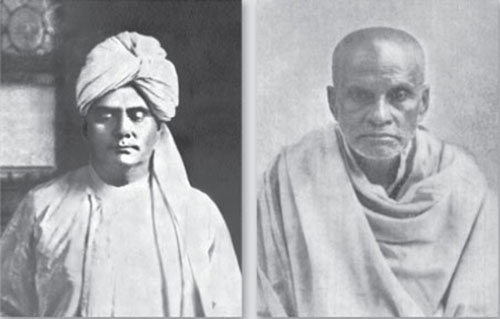
Swami Abhedananda Swami Shuddhananda
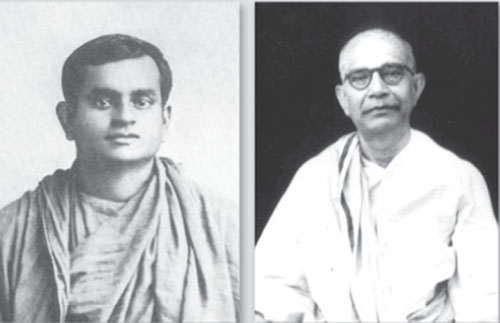
Swami Virajananda Swami Vishuddhananda
Chapter - 3
Swami Virajananda (1873-1951) was the sixth President of the Ramakrishna Order. He was initiated into spiritual life by Holy Mother Sri Sarada Devi in 1893 and was ordained into sannyasa by Swami Vivekananda in 1897. He was one of those fortunate few who had the blessed company of several direct disciples of Sri Ramakrishna right from the days of Baranagore Math. He had edited and published the ‘Life of Swami Vivekananda by Eastern and Western disciples’ and ‘The Complete Works’. He led the Order in trying times without ever losing his composure. His encouragement and inspiration effected the establishment of a monastery for women—Sri Sarada Math.
Chapter - 4
Swami Vishuddhananda (1882-1962) was the eighth President of the Ramakrishna Order. He was initiated into spiritual life by Holy Mother Sri Sarada Devi in 1906. He joined the Ramakrishna Order in 1907 and received the ochre cloth and the monastic vows from Holy Mother Sri Sarada Devi. His sannyasa name was given by Swami Shivananda and was formally ordained into sannyasa by Swami Brahmananda. He had stayed in Madras in 1908 with Swami Ramakrishnananda. Later, he lived several years at Bangalore and Madras. He became the President of Ramakrishna Order 1962 and passed away in the same year.
Chapter - 5
Swami Shankarananda (1880-1962) was the seventh President of the Ramakrishna Order. He was initiated into spiritual life and subsequently into sannyasa by Swami Brahmananda. He accompanied Swami Sadananda to Madras in December 1902 to assist Sister Nivedita in her lecture tour of South India and had the privilege to live in Madras under the personal care of Swami Ramakrishnananda.
Chapter - 6
Swami Madhavananda (1888-1965) was the ninth President of the Ramakrishna Order. He was initiated into spiritual life by Holy Mother Sri Sarada Devi in 1909. He joined the Ramakrishna Order in 1910 and was ordained into sannyasa by Swami Brahmananda in 1916. He served the Ramakrishna Order in various capacities including as its General Secretary. An erudite scholar, he had several important translations to his credit such as the Brihadaranyaka Upanishad, Uddhava Gita, Minor Upanishads, among others.
SOME OF THE REMINISCERS
WHOSE REMINICENSES ARE INCLUDED IN THIS BOOK
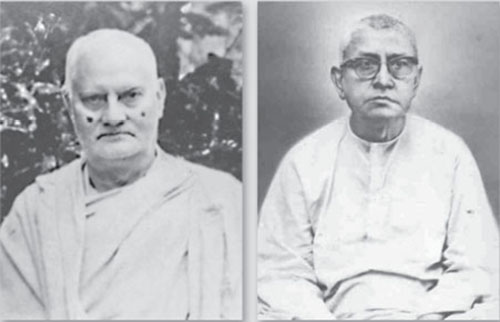
Swami Shankarananda Swami Madhavananda
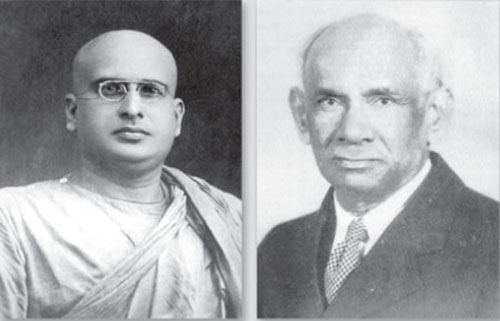 Swami Sharvananda Swami Bodhananda
Chapter - 7
Swami Satchidananda (1840-1926) was initiated by Swami Saradananda at Varanasi, perhaps in 1891. Next to Swami Advaitananda, he was the oldest monk in the Order at that time.
Chapter - 8
Swami Sharvananda (1885-1970) joined the Ramakrishna Order in 1905. He was initiated into spiritual life by Holy Mother and was ordained into sannyasa by Swami Brahmananda in 1910. He lived with Swami Ramakrishnananda at Madras for about six months in 1906. Some five years later, immediately after Swami Ramakrishnananda left Madras due to illness, he was appointed as the Head of the Madras Math in 1911 and continued in that position till about 1927. He built the present main building of the Madras Math and its Shrine, and extended its publication and preaching activities. The English magazine, the Vedanta Kesari, and the Tamil magazine, Sri Ramakrishna Vijayam, were started by him. An eloquent speaker and a sound scholar, he was a noted figure in the field of religion in South India. He has left behind many valuable works like English translation and notes of the Upanishads. He played a leading part in the starting of the Mission Centres in Bombay, Delhi, Karachi, Nagpur and Sri Lanka.
Chapter - 9
Swami Abhayananda (1890-1989) was the personal attendant of Swami Ramakrishnananda in 1911. He was initiated into spiritual life by Holy Mother in 1912 at the Baghbazar Math. He was ordained into sannyasa by Swami Brahmananda at the Bhubaneswar Math in 1920. He was the joint manager of Belur Math for a long period and later its sole manager. Having had the opportunity of serving the Order in various capacities, he had the blessed company of twelve Presidents during his prolonged monastic life.
Chapter - 10
Swami Bodhananda (1870-1950) was initiated by the Holy Mother at Jayarambati. He had met Swami Vivekananda in February 1894 and was received warmly by him. He joined the Order towards the end of 1898 and was ordained into sannyasa by Swami Vivekananda in 1898. He used to immerse himself heart and soul in the service of Swami Vivekananda. He also rendered personal service to Swami Brahmananda when he had a severe attack of typhoid in 1905. He was the President of the Bangalore Ramakrishna Math for a brief period. He was sent by Swami Brahmananda to New York to assist Swami Abhedananda. He held a special place in the history of Vedanta Movement in America by leading the austere life of a traditional monk.
Chapter - 11
Swami Achalananda (1876-1947) was an idealist young man in Varanasi who, with his friend Charuchandra Das (later Swami Shubhananda), read or discussed religious and philosophical books. Having met Swami Niranjananda, who was then in Varanasi, he and his friends developed a strong distaste for worldly pleasures and decided to dedicate themselves to serving the poor and the needy. After spending two month with the Holy Mother at Jayarambati, he later went to Belur Math in 1901 to meet Swami Vivekananda and overpowered by the attraction of his personality, stayed there for nine months. He was ordained into sannyasa by Swamiji on the birthday of Lord Buddha in 1902. Swamiji one day told him that he would not have to do any spiritual practice; he would attain spiritual realization without any effort. He later assisted Swami Shivananda in setting up an Ashrama in Varanasi. He also assisted Swami Ramakrishnananda at the Madras Math in 1904.
Chapter - 12
Swami Ambananda (1874-1951), known in his early life as Madhuranayakam Pillai, was one of the pioneer devotees of the Ramakrishna-Vivekananda movement in the erstwhile Travancore State. He took initiation from the Holy Mother. Later, he took Sannyasa from Swami Nirmalananda. He had the good fortune of seeing Swami Vivekananda and more than five direct disciples of Sri Ramakrishna. His later life was spent mostly in Sri Vivekananda Ashram of his own at Vellimalai near Nagercoil in Kanyakumari District of Tamilnadu. His highly inspiring reminiscences of Holy Mother and Swami Ramakrishnananda were published in the Vedanta Kesari, Dec 1953-54 and August 1978 respectively. The Ashrama, which he started, continues to carry on service activities in the line of the Holy Trio.
Chapter - 13
Swami Atmabodhananda (1891-1959) was initiated into spiritual life by Swami Brahmananda. He joined the Ramakrishna Order at Varanasi Advaita Ashrama and was later ordained into sannyasa by Swami Brahmananda in 1920. He served the Order in various capacities. His elder brother Nagendra Chandra was a disciple of Holy Mother and youngest brother, Swami Vividishananda was Founder President of Ramakrishna Vedanta Society at Seattle in America.
Chapter - 14
Swami Chidghananandendra Saraswathi had been associated with Swami Ramakrishnananda for twelve years. He later took to sannyasa and inspired by the ideal of Swami Ramakrishnananda, would not touch money. He led an austere and dedicated life. He was a Telugu scholar who also knew Tamil, Sanskrit and English.
Chapter - 15
Sister Devamata (Ms. Laura Glenn) was a nun of American nationality. She lived in India during 1908 to 1910 and much of her time in India was spent in Madras in close contact with Swami Ramakrishnanada. She had the opportunity of having close contact with many other direct disciples of Sri Ramakrishna. She was attached to the Vedanta Centre called Ananda Ashrama conducted by Swami Paramananda in La Crescenta, California, United States. She has left behind two excellent works: ‘Days in an Indian Monastery’ and ‘Sri Ramakrishna and his Disciples.’
SOME OF THE REMINISCERS
WHOSE REMINICENSES ARE INCLUDED IN THIS BOOK
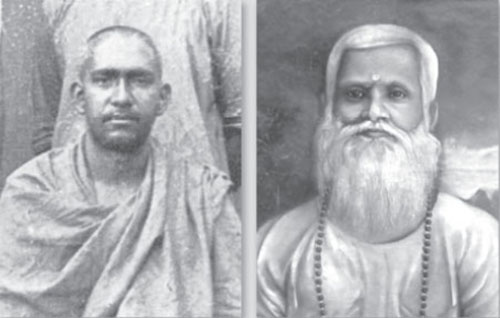
Swami Achalananda Swami Ambananda
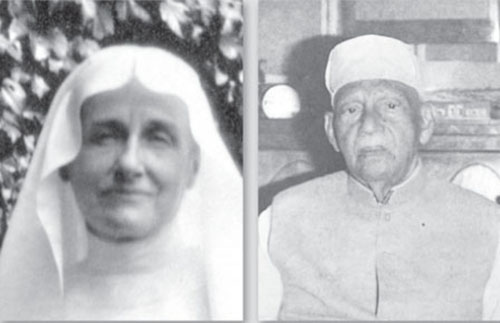
Sister Devamata Swami Abhayananda
Part - 3
Chapter - 1
Ramachandra Dutta (1851-1899) was an eminent lay disciple of Sri Ramakrishna. Though he was an atheist and hardened rationalist in his youth, he was transformed into an ardent devotee after the first visit to Sri Ramakrishna in 1874. He often took Sri Ramakrishna to his house where his presence was celebrated with due festivity. Numerous devotees would congregate there on such occasions. He was in close association with almost all the monastic and lay disciples of Sri Ramakrishna. He wrote two books based on Sri Ramakrishna’s life and teachings, publishing them during lifetime of the Master.
Chapter - 2
Mahendranath Gupta (1854-1932) was the perhaps the foremost lay disciple of Sri Ramakrishna. A brilliant student and yet spiritually inclined from childhood, he was earlier associated with the Brahmo Samaj. When he was contemplating ending his life due to some domestic turmoil, he met Sri Ramakrishna at Dakshineswar and in no time became very close to him and received special blessings. He was the celebrated author of The Gospel of Sri Ramakrishna. His childhood habits of maintaining a diary, sharp memory, keen insight, adherence to truth, complete efface-ment of self, poetic nature and accurate documentation of time, place, persons and circumstances made the book a rare masterpiece in religious literature. The footfalls of Sri Ramakrishna, Holy Mother and monastic disciples of Sri Ramakrishna have blessed his residence in Calcutta.
SOME OF THE REMINISCERS
WHOSE REMINICENSES ARE INCLUDED IN THIS BOOK
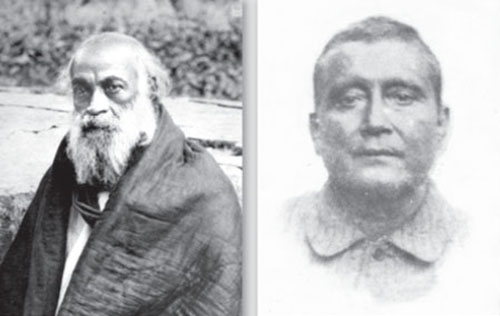
Mahendranath Gupta Sarat Chandra Chakraborty
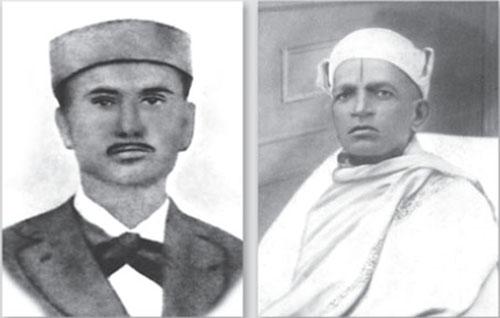
Mahendranath Dutta C. Ramaswamy Aiyangar
Chapter - 3
Vaikuntha Nath Sanyal (1857-1937) was an intimate lay disciple of Sri Ramakrishna. He was an ardent devotee of the Master and sought his blessed company at Dakshineswar and at residences of devotees in Calcutta. Engaged in sadhana, he prayed from time to time to the Master for vision of his chosen ideal and the Master promised that he would do everything for him. After Sri Ramakrishna’s demise, he maintained close connections with the monastic disciples of the Master. He took monastic vows and was known as Swami Kripananda. He accompanied Swami Saradananda on his pilgrimages and practised spiritual austerities. But later, he was prevailed upon to return to domestic life. He, however, maintained lifelong close relations with the Ramakrishna Order.
Chapter - 4
Sarat Chandra Chakravarty (1862-1942) was a householder disciple of Swami Vivekananda who had the rare opportunity of serving him. His conversations with Swamiji are part of ‘The Complete Works of Swami Vivekananada’. He was well-versed in the Hindu scriptures and had written quite a few important books, Sanskrit hymns, songs and poems.
Chapter - 5
Mahendranath Dutta (1869-1956) was a younger brother of Swami Vivekananda. A bachelor, sagacious, travel-loving and a prolific writer, he was blessed by meeting Sri Ramakrishna. He was well-known among the devotees as ‘Mahim Babu’, and travelled in Europe, Africa, and the Middle East. He authored many books in English and Bengali.
Chapter - 6
Rao Bahadur Ramaswamy Iyengar (as known as Ramu) (1871-1932) was a lay devotee who, together with his cousin C.Ramanujachari, played a pivotal role in the development of the Ramakrishna Mission Student’s Home, Mylapore and Ramakrishna Movement in Madras in general. He had met Swami Vivekananda when he visited Madras as a wandering monk and later when he returned to India from his triumphal visit of the West. After Swami Ramakrishnananda came to Madras to start a centre of the Ramakrishna Math, Ramaswamy lived in daily contact with him and he, along with his cousin, formed the Swami’s right hand, as it were, in all the works in the City. Professionally, he was the Manager of the Office of the Senior Government Inspector of Railways at Madras. But, his close association with Swami Ramakrishnananda kindled the best elements in him and he became one of the most noted philanthropic workers in Madras. Swami Ramakrishnananda entrusted to him the work of the Students’ Home right from its inception and he took special care of it, as its Secretary, till end of his life. Several other educational institutions were started in the city by his inspiration and guidance.
Chapter - 7
Ramanujachari C. (1875-1956) was a cousin of Ramaswamy Iyengar. Ramanuja (also called Ramanujachariar or Ramanuju), along with Ramaswamy, was one of the pillars of Ramakrishna mission Student’s Home, Mylapore, Madras. He played a key role in shaping the activities of the Home during its initial years through his keen administrative skills, dedications, and farsightedness. His enthusiasm for service resulted in his starting many service programmes in Madras and surrounding areas.
Chapter - 8
Manickaswamy Mudaliar (1869-1960) was an officer in the Military Accounts Department. He was in Madras for long periods both before and after he joined the service. It was during such times that he came in contact with Swami Ramakrishnanada. His association with the Swami was very intimate. Sri Mudaliar was a confirmed Advaitin and he was also very dogged and unyielding in philosophical disputation—a trait of character which he displayed even while interacting with Swami Ramakrishnananda. Though he was not very highly placed in life, he was a man of great integrity and courage. After retirement from Government service, Sri Mudaliar lived as a lay inmate in Sri Ramakrishna Math, Madras for a long time.
SOME OF THE REMINISCERS
WHOSE REMINICENSES ARE INCLUDED IN THIS BOOK
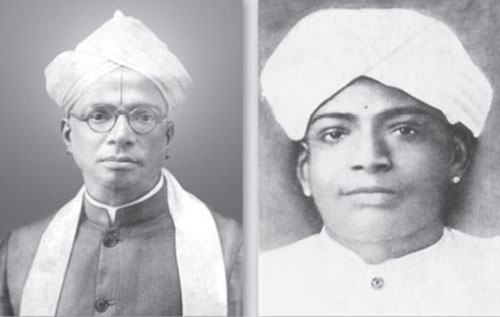
C. Ramanujachari Rajam Iyer
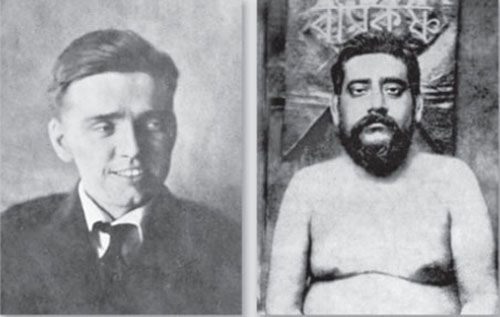
F.J. Alexander Ramchandra Dutta
Chapter - 9
Ramalinga Sastry was the son of Prof K. Sundararama Iyer. When Swami Vivekananda was their guest in Trivandrum in 1892, he was a student of Maharaja’s College at Trivandrum, after having passed the Entrance Examination at just twelve years of age. He was deeply influenced by the saintly and inspiring personality of Swami Vivekananda who often talked with him. When Swamiji was in Madras after his return from the West, he was studying law at Madras and therefore had an opportunity to meet Swami Vivekananda frequently.
Chapter - 10
Prof P N Srinivasachari was one of the distinguished philosophers of India. He was an unusual man in the sense that unlike many contemporary scholars of philosophy, he was fortunate enough to have blessed contacts with a number of enlightened souls. He had the wisdom to value those contacts and take light from those lives into his philosophy and life. Prof PNS, as he was affectionately called in the Madras Math, had had intimate interactions with Swami Ramakrishnananda.
Chapter - 11
Rajam Iyer (- 1898) was the first editor of the Prabuddha Bharata which was then being published from Madras. Born in Batlagundu village of Madurai district in Tamil Nadu, he was the eldest son of his parents. He graduated from Madras Christian College and studied law for some time. A true Vedantist and ardent admirer of Swami Vivekananda, he unfortunately died at a young age of twenty-six. He was a gifted writer, his editorials in the Prabuddha Bharata were much appreciated for their depth of thinking and clarity of expression.
Chapter - 12
Balasubramania Iyer was the lawyer and a Member of Legis-lature Council who had the unique opportunity of interacting closely with Swami Ramakrishnananda.
Chapter - 13
Kumud Bandhu Sen was a prolific writer. He came in close contact with Holy Mother, disciples of Sri Ramakrishna and the monastic disciples of Sri Ramakrishna in Alambazar Math. He was a regular contributor of articles to the Udbodhan. In 1934, he gave a series of lectures on Girish Chandra Ghose at the Calcutta University which were later published as a book in Bengali titled ‘Girish Chandra O Natya Sahitya’
Chapter - 17
Shyamapada Mukherjee was a medical student when he met Swami Ramakrishnananda in Calcutta when the latter had come to Calcutta from Madras for his treatment of galloping tuberculosis. He used to do some massaging for Swami Ramakrishnananda which gave him some relief. He later did his M.D.
Part - 4
Chapter - 1
Swami Jagadiswarananda (1902-1978) was initiated into spiritual life by Swami Shivananda. He joined the Order at Belur Math in 1925 and was initiated into sannyasa by Swami Shivananda in 1930. On eve of his departure to Colombo, he was blessed by his Guru, ‘By the grace of the Master, your mouth and hands will be the seat of Saraswati. Success will be yours in everything.’ He had to leave the Order in 1952. He founded ‘Sri Ramakrishna Dharma-chakra’ at Belur and lived there. His most celebrated and widely read books are his translations and editions of the Gita and the Chandi.
Appendices
Appendix - D
Narayana Iyengar (1868-1943), later known as Swami Srivasananda, was a high officer in Mysore State service. He had come in contact with Swami Vivekananda in 1897 and was ever since an ardent follower of the Ramakrishna-Vivekananda movement. He started the Vedanta Society of Bangalore in 1901 and invited Swami Ramakrishnanda to lecture under its auspices. During his official career, he took a leading part in establishing the permanent centres at Bangalore and later on at Mysore. In 1911, he took initiation from the Holy Mother at Bangalore. He retired from Government service in 1924 and took sannyasa from Swami Shivananda, the then President, in the same year. Out of his own resources, he formed the Holy Mother Trust with the income of which he conducted a Vedanta College which gave religious instruction to educated young men, besides free boarding and lodging, in the institution with a Gurukula setting.
Appendix - E
Padmanabhan Thampi (1867-1940), later known as Swami Parananda, came from an aristocratic family of the erstwhile Travancore State (now part of Kerala). Starting his life as a Government Pleader, he retired as the Commissioner of Police of the Travancore State. From his early life, he was connected with the Ramakrishna Movement, for the spread of which in Kerala, he, along with his brother Dr. K. Raman Tampi, had done yeoman service. He was a disciple of Swami Brahmananda, and about twelve years after his retirement from Government service, he took Sannyasa from Swami Nirmalananda under the monastic name of Swami Parananda.
Appendix - G
F.J. Alexander spent his early years in the nunnery of Omaha in Nebraska, U.S.A., where he received his first education. He began life as a bell-boy at a hotel in an American city and after various turns of fortune entered a newspaper office, where he showed himself as a good and impressive writer. But all along F.J. Alexander had been seized with a great spiritual unrest, which knew no quietude, till he came across, by chance, some writings of the Swami Vivekananda. Drawn by a strong spiritual urge, he sailed towards India and reached Belur Math in 1911, and then joined the Advaita Ashrama at Mayavati. He considerably helped in the preparation of Life of the Swami Vivekananda by His Eastern and Western Disciples (published by Advaita Ashrama) as also assisted in the editorial work of the Prabuddha Bharata. From Mayavati he went to Almora to live a more intense spiritual life. After two years of stay there, he went back to America to recuperate his failing health and there succumbed to tuberculosis in 1917.
↑ Contents
Sources and References All references to the articles published in this book are from the following sources.
Part 1
Biography and Glimpses of Swami Ramakrishnananda
Chapter - 1
Swami Ramakrishnananda—a Biographical Sketch
Based on articles published in the September and October, 1941 issues of the Prabuddha Bharata, the book Holy Mother Swamiji and Direct Disciples at Madras, Sri Ramakrishna Math, Chennai, and other miscellaneous sources
Chapter - 2
Glimpses of Swami Ramakrishnananda
1. ‘A Collection of Reminiscences’ (in Bengali) by Swami Jagadeeswarananda, Udbodhan, 49th year, 11th issue [hereafter, A Collection]
2. ‘A Collection of Reminiscences’ (in Bengali) by Swami Jagadeeswarananda, Udbodhan, 49th year, 11th issue [hereafter, A Collection]
3. Swami Kamaleswarananda, Sri Ramakrishna-Parikar Prasanga (in Bengali), 1st edition, Sri Ramakrishna Sevashrama, Medinapur, West Bengal [hereafter, Parikar Prasanga]
4. cf. Life of Holy Mother Sri Sarada Devi, Swami Gambhirananda, Sri Ramakrishna Math, Chennai, Pp. 254-255
5. cf. Reminiscences of Swami Visuddhananda, see chapter 4
6. cf. Holy Mother Sri Sarada Devi, Swami Gambiranannda, Sri Ramakrishna Math, Chennai, p.248-249
7. cf. A Collection
8. cf. Holy Mother Sri Sarada Devi, Swami Gambiranannda, Sri Ramakrishna Math, Chennai
9. Life of Swami Vivekananda by His Eastern and Western Disciples, Advaita Ashrama, Kolkata, 1.201 [hereafter, Life]
10. Life, 1.199
11. Life, 1.211
12.cf. Parikar Prasanga
13. The Complete Works of Swami Vivekananda, in 9 volumes, Advaita Ashrama, Kolkata, 6.323 [hereafter CW]
14. Monastic Disciples of Swami Vivekananda, by Swami Abjajananda, Advaita Ashrama, Kolkata, p.211 [hereafter, Monastic Disciples]
15. CW, 9. p.180-181
16. Life, 2.628
17. Life, 1.233
18. cf. Udbodhan, 108th year, 9th number
19. cf. Udbodhan, 108th year, 9th number
20. cf. Parikar Prasanga and also Sri Sri Ramakrishna Bhakta-Malika, Swami Gambhirananda, Part I. cf. Udbodhan, Kolkata, 4th ed., Chaitra 1379, pp.350-52
21. cf. Parikar Prasanga
22. Swami Brahmanananda as We saw Him, Sri Ramakrishna Math, Chennai, pp. 123.-124 [hereafter, SB As We Saw Him]
23. cf. Udbodhan, 108th year, 9th number
24. SB As We Saw Him, Pp.449-451
25. SB As We Saw Him, Pp.128-129
26. Swami Ramakrishnananda (in Bengali) by Swami Jagadiswarananda, Ramakrishna Mission Sevashrama, Midna-pore, 1355, p.4. [hereafter, Swami Ramakrishnananda]
27. A Man of God, Swami Vividishananda, Sri Ramakrishna Math, pp. 86-88
28. Prabuddha Bharata, 1960, November, p.442
29. Swami Ramakrishnananda, pp.6-7. Also in the same author’s book Swami Premananda (in Bengali), p.78
30. cf. Parikar Prasanga
31. cf. Udbodhan, 48th year 12 number
32. Swami Adbhutananda—Teachings and Reminiscences by Swami Chetanananda, Advaita Ashrama, Kolkata, p.65-66
33. Swami Adbhutananda as We Saw Him, Chandarshekhar Chattopadhyay, translated by Swami Satswarupananda, p.147
34. Ibid. p.250
35. Ibid. p.277-78
36. Ibid. p.387-388
37. Swami Akhandananda, by Swami Annadananda, Advaita Ashrama, Kolkata, p.134-135,137-138, 144-145
38. Monastic Disciples, p.210
39. cf. A Collection
40. cf. Parikar Prasanga
41. Ibid.
42. cf. A Collection
43. Ibid.
44. Ibid.
Part - 2
Reminisences by Monastics
Chapter -1
Swami Abhedananda
Extracts from My Life-Story by Swami Abhedananda, Ramakrishna-Vedanta Math, Kolkata, translated by Sri J.K. Roy
Chapter - 2
Swami Shuddhananda
Extracts from the Vedanta Kesari, August, 1983, pp. 271-277 and Sri Ramakrishna-Parikar Prasanga, Swami Kamaleswarananda, 1st edition, pp.51-65
Chapter - 3
Swami Virajananda
The Vedanta Kesari, July, 1952, pp. 133-139
Chapter - 4
Swami Vishuddhananda
Swami Ramakrishnananda—The Apostle of Sri Ramakrishna to the South, by Swami Tapasyananda, Sri Ramakrishna Math, Madras, pp. 214-221. The Vedanta Kesari, August, 1962-63, pp. 167-168, Yogakshema, pp. 50, 85-6, 37-8, 52-3, 55-7, 67-9, 72-3, 75-6, and Prelude to the book Swami Ramakrishnananda [Bengali] by Swami Jagadiswarananda
Chapter - 5
Swami Shankarananda
The Vedanta Kesari, July 1951, pp. 88-96
Chapter - 6
Swami Madhavananda
The Vedanta Kesari, August, 1972, pp.217-222
Chapter - 7
Swami Satchidananda
Parikar Prasanga, pp.40-50
Chapter - 8
Swami Sharvananda
Swami Ramakrishnananda—The Apostle of Sri Ramakrishna to the South by Swami Tapasyananda, Sri Ramakrishna Math, Mylapore, Chennai, Pp.222-239
Chapter - 9
Swami Abhayananda
Parikar Prasanga, pp. 73
Chapter -10
Swami Bodhananda
The Vedanta Kesari, August, 1950, pp. 127-131
Chapter - 11
Swami Achalananda
Extracts from Udbodhan, 108th year, 9th number and Parikar Prasanga, pp.66-70
Chapter -12
Swami Ambananda
The Vedanta Kesari, August, 1978, pp. 294-296
Chapter -13
Swami Atmabodhananda
Parikar Prasanga, pp. 73
Chapter -14
Swami Chidghananandendra Saraswati
The Vedanta Kesari, July, 1998, pp. 248-250
Chapter -15
Sister Devamata
Extracts from the book Days in an Indian Monastery, Sister Devamata, published by Sri Ramakrishna Math, Chennai, the Vedanta Kesari, May 1932-33, pp. 17-20; June 1932-33, pp. 59-62; July 1932-33, pp. 105-107; September 1932-33, pp. 176-178, December 1932-33, pp. 296-293; February, 1932-33, pp. 371-373; March 1932-33, pp. 411-413, April 1932-33, pp. 458-460, May 1933-34, pp. 14-15
Part - 3
Reminiscences by Lay Devotees
Chapter - 1
Ramachandra Dutta
Sri Sri Ramakrishna Paramahamsadever Jivanavrittanta, Ramachandra Dutta, 8th edn., Ashadha, 1402, Udbodhan, Calcutta, pp.170-71.
Also Swami Ramakrishnananda, 1355, p.6
Chapter - 2
‘M’
The Gospel of Sri Ramakrishna, Mahendranath Gupta, Published by Sri Ramakrishna Math, Madras, subsidized edition, pp. 993-994
Chapter - 3
Vaikunthanath Sannyal
Sri Sri Ramakrishna Leelamrita, Vaikunthanath Sannyal, Publisher Sudhir Sannyal, 20 Bose Para Lane, Calcutta-3; 2nd Edition, pp.322-26
Chapter - 4
Sarat Chandra Chakravarty
Udbodhan, 29th Year, 7th issue, Shravana, 1334, pp.391-94.
Chapter - 5
Mahendranath Dutta
Srimad Vivekananda Swamijir Jivaner Ghatanavali, Mahendranath Dutta, Part 2, 6th reprint, Poush 1407, Publisher Sitanath Dutta, The Mahendra Publishing Committee, Calcutta-6, pp.15-19.
Chapter - 6
C. Ramaswami Iyengar
From the Vedanta Kesari, May, 1922, pp 91-97, August, 1928-29, pp. 149-157, September, 1930, pp. 178-181
Chapter - 7
C. Ramanujachariar
From the Prabuddha Bharata, July, 1954, pp. 362-365, and Prabuddha Bharata, August, 1954, pp. 404-408
Chapter - 8
P. Manickaswami Mudaliar
The Vedanta Kesari, July, 1922, pp 97-102, August, 1937-38, pp. 128-132, September, 1946, pp. 169-173
Chapter - 9
P.Ramalinga Sastry
The Vedanta Kesari, August, 1954, pp.85-89, August, 1999, pp. 289-292
Chapter - 10
P.N. Srinivasachari
The Vedanta Kesari, July 1955, pp. 138-141
Chapter - 11
S. Rajam Iyer
The Vedanta Kesari, August, 1954, pp. 120
Chapter - 12
K. Balasubramania Aiyer
The Vedanta Kesari, August, 1957-58, pp. 131-132
Chapter - 13
Kumud Bandhu Sen
The Vedanta Kesari, August, 1949, pp. 214-220
Chapter - 14
G.N.A. Ranganadhan Sharma
Prabuddha Bharata, October, 1911, pp. 209-210
Chapter - 15
An Unknown Devotee
The Vedanta Kesari, July 1966, pp. 171-174
Chapter - 16
A Devotee
Vedanta and the West, March-April, 1968, pp 41-52 (First appeared in the Vedanta Kesari, September, 1967)
Chapter - 17
Dr. Shyamapada Mukherjee
Swami Saradanander Smriti Katha, Swami Chetanananda Udbodhan, Kolkata, 1st edn. 20 Poush Beng.1812, pp.251-52
Part - 4
Mahasamadhi—Reports and Descriptions
Chapter - 1
Swami Jagadiswarananda
Extracts from Udbodhan, 48th year, 12th number
Chapter - 2
Swami Saradananda
Vividha Prasanga, Swami Saradananda
Chapter - 3
The Passing of His Holiness the Swami Ramakrishnananda
Prabuddha Bharata, October, 1911, pp 184-186
Chapter - 4
The Late Swami Ramakrishnananda
Brahmavadin, October, 1911, pp. 463-464
Chapter - 5
Memorial Meetings In Honour of Swami Ramakrishnananda
Prabuddha Bharata, October, 1911, pp 194-197
Part - 5
Letters of Swami Vivekananda to
Swami Ramakrishnananda
Letter 1. CW, 6:282-287
Letter 2. CW, 6:250-256
Letter 3. CW, 6:278-279
Letter 4. CW, 6:326-336
Letter 5. CW, 6:304-306
Letter 6. CW, 6:310-313
Letter 7. CW, 6:337-340
Letter 8. CW, 7:499-500
Letter 9. CW, 6:364
Letter 10. CW, 6:364-365
Letter 11. CW, 6:369-370
Letter 12. CW, 8:397-398
Letter 13. CW, 8:416-417
Letter 14. CW, 8:417-418
Letter 15. CW, 8:426-427
Letter 16. CW, 8:442-444
Letter 17. CW, 8:447-448
Letter 18. CW, 5:150-151
Letter 19. CW, 5:155
Letter 20. CW, 5:160-161
Appendices
Appendix - A
The Ancestry of Swami Ramakrishnananda by Swami Jagadiswarananda
Udbodhan, 48th year, 11th issue
Appendix - B
Swami Paramananda’s Blessed Moments with Swami Ramakrishnananda
From Monastic Disciples of Swami Vivekananda by Swami Abjajananda, Advaita Ashrama, p.324-331 and Extracts from Swami Paramananda and His Work, Sister Devamata, Ananda Ashrama, La Crescenta, CA, USA, pp. 34-43, 56-61, 151-152, 155 and 165-168.
Appendix - C
Swami Ramakrishnananda in Pudukotai
Brahmavadin, 1905, March, Pp.288-93
Appendix - D
Swami Ramakrishnananda in Mysore M. A. Narayana Iyengar, M. A
The Vedanta Kesari, July 1922-23, pp. 102-104
Appendix - E
Swami Ramakrishnananda: The Movement in Travancore by K. Padmanabha Thampi, B.A., B.L.
The Vedanta Kesari, July 1922-23, pp. 105-107
Appendix - F
From Udbodhan, 49th year, 8th issue
Appendix - G
Illumination by Frank J Alexander,
Prabuddha Bharata, October 1911
↑ Contents
Glossary of the some of the words used in this book
| | Ritual bathing of an idol or symbol of God such as Shiva Linga. |
| | Literally, ‘one who follows what he preaches’; the term is generally used to refer to great Hindu teachers such as Shankara, Ramanuja, Madhva and other Acharyas. |
| | |
| | |
| | |
| | the ritual in the Hindu temples where oillamps, flowers, and other items are waved before the image of God as part of puja. |
| | The use of a term or rule in Sanskrit grammar by a Rishi or spiritually illumined person. It may not be according to rules but is acceptable because it is used by a Rishi. |
| | Carpet for seat, made of woollen or cloth and dry grass, used for meditation. Also, a posture in the Yoga. |
| | One who has mastered a posture or asana and can sit for a long time without changing his position. |
| | A Vedanta text by the Rishi Ashtavakra. |
| | The eighth day of a month according to Hindu Calendar, considered sacred. During the navarati celebrations, it is considered especially auspicious to worship the Divine Mother on this day. |
| | the Self or Divine Core of Personality, essentially one with the Brahman or Ultimate Reality or God. |
| | Or Vairagi, a person endowed with dispassion (vairagya); usually used to refer to a sect of Hindu monks. |
| | A bag containing cardamom and other spices; a wallet. |
| | Literally ‘one endowed with the six attributes’, viz. infinite wealth, strength, glory, splendour, knowledge, and renunciation. An epithet of the Godhead; also the Personal God of the devotees. |
| | Also referred to as Gita, it is a 700-verse Hindu scripture that is part of the Mahabharata. It is taken to represent the essence of the Upanishadic teachings. the Gita is a conversation between Krishna and the Pandava prince Arjuna. Lord Krishna explains to Arjuna his duties as a warrior and prince, and elaborates on yoga, Samkhya, reincarnation, moksha, Karma yoga and Jnana yoga among other topics. |
| | Also known as the Bhagavata Puran or Bhagavata or Srimad Bhagavatam, it is one of the Puranic texts of Hindu literature, with its primary focus on bhakti (devotion) to the incarnations of Vishnu, particularly Krishna. |
| | One of the names of Lord Shiva; especially denoting one of His eight frightful forms. |
| | Or Sankirtan, Religious song or singing of a religious song, individually or collectively. |
| | A devotee; one who follows the path of Bhakti, divine love; a worshipper of the Personal. |
| | Love of God; single-minded devotion to one’s chosen ideal. |
| | The path of Bhakti or seeking God through devotion. |
| | India, or Bharata, the younger brother of Lord Rama, or the King Bharata of ancient India. |
| |
One who writes a scholarly commentary on Hindu scriptures.
|
| | Alms, or the food a monk gets by begging. |
| | Food obtained by religious begging. |
| | Literally ‘enjoyment’. It also means food for offering to the Lord in a temple or shrine. An-other term used in the same sense, naivedyam. |
| | A tree whose leaves are sacred to Lord Shiva; also the fruit of the same tree. |
| | A religious student devoted to the practice of spiritual discipline; a celibate belonging to the first stage of life; in the Ramakrishna Order, a monastic novice who has joined the Order and will be ordained into sannyasa after his novitiate period is over. |
| | The first of the four stages of life: the life of an unmarried student. It may also refer to the first formal vows by which a celibate religious aspirant is initiated into the first stage of life. |
| | The Knowledge of Brahman or Highest Knowledge. |
| | The Knower of Brahman.Brahmajnani |
| | The time of two hours before sunrise, considered auspicious and suitable for meditation and spiritual practices. |
| | Or Brahmin, is the name used to designate a member of one of the four varnas (caste) in the traditional Hindu society. |
| | A Vedantic text composed by sage Vyasa, describing and classifying the Vedantic concepts. |
| | |
| | Sanskrit word for someone who deal with the disposal of corpses and is a Hindu lower caste, formerly considered untouchables. |
| | Or Tirtham, Literally ‘the nectar from the feet’, it refers to the sacred water left over puja. |
| | |
| | Another name of the Devi Mahatmaym or Durga Saptashati, a 700-versed composition of the exploits of the Divine Mother. Considered to bring spiritual benefit by chanting. |
| | Or luchis, A bread made of wheat-powder kneaded with water and rolled into a round shape, then baked over a hot plate or on oven-flame on a metal grill. |
| | A place from where food is distributed to the itinerant monks and devotees. |
| | A fly-whisk made of animal hair, used to fan a deity in the temple as part of rituals. |
| | Preparation of a variety of pulses or lentil. |
| | Serving the God in poor by offering food, clothing, etc. |
| | Sight of God or a God-Man or God-Woman. Darshan also means a school of philosophy in the Indian scriptural tradition. |
| | Ten Great Forms of Divine Mother. |
| | An Indian wear for men to cover loins and legs. |
| | Or Mantra Diksha is initiation into spiritual life by conferring a mantra for repetition by a spiritual aspirant. |
| | The eleventh day after the full or new moon, which a devotee spends in full or partial fasting, prayer and worship. |
| | Ochre colour; clothe coloured in ochre; monk’s attire. The term kashaya, also means the same. |
| | Bathing place on the bank of a lake or river. |
| | the tower above the entrance of a Hindu temple, often decorated with images of tales from Puranas. |
| | Householder, the second stage (ashrama) of life as per the Hindu view. |
| | |
| | Disciples of the same guru. |
| | |
| | A traditional presentation of a Puranic tale with narration and singing. |
| | Literally, ‘ghee with rice’; refers to the bland food a person following a religious vow takes. |
| | |
| | |
| | A type of meditative state. |
| | |
| | Repetition of the God’s Name or a mantra received from the guru; often Japa means repeating the Name of God or mantra a fixed number of times. |
| | A person who has attained spiritual illumination while he is still alive. |
| | Knowledge of God or Ultimate Truth; the path leading to It. |
| | |
Jnana yoga or Jnana-marga | The path of seeking the Ultimate Truth (Jnana) through reasoning and discrimination. |
| | A man of spiritual illumination. |
| | The term used for a horse carriage in South India. |
| | The person who drives a Jutka |
| | A kind of deep-fried preparation. |
| | A term in Vaishnavism to mean service to God. |
| | |
| | Literally ‘woman and gold’, refers to lust and greed. |
| | Literally, ‘one who removes what is written in one’s kapala or forehead’; one who can wipe off someone’s past karmas. |
| | One who tries to realise God through selfless work. |
| | An Ayuervdic practitioner; the term mainly used in Bengal. |
| | A kind of preparation consisting of rice, lentils and vegetables. |
Khol, Kartal, Kasar, Ghanta | Musical instruments mainly used while singing Sankirtan or doing arati. |
| | Devotional music, individually or collectively; at times accompanied by dancing. |
| | Kosha is the fish-shaped copper vessel used as a container of holy water for worship; Kushi or Koshika is another smaller version of the same pot meant for use as a spoon. |
| | |
| | |
| | |
| | |
| | Leavened flour rolled and fried in clarified butter. Or small puri, a kind of deep-fried bread. |
| | A practice among Hindu monks of collecting their daily meals by begging at different homes, like collecting of honey by the honey bees. |
| | Literally a great person; refers to a person with spiritual and moral eminence. |
| | Lit., the highest state of God-consciousness; a term used to denote the passing away of a holy man, leaving his body in deep meditation. |
| | Holy Sanskrit text; also the sacred formula used in Japa; the sacred word by which the spiritual teacher initiates his disciples. |
| | The Great Illusionist, the veiling power of Brahman; also a name of Kali, the Divine Mother. |
| | Liberation or final emancipation. One of the four ends of human life. |
| | |
| | One desirous of liberation. |
| | A kind of flower, mesua ferra, also known as Ironwood flower. |
| | The Hindu way of greeting others. |
| | God without any qualities. |
| | Literally, ‘blowing out’; spiritual liberation. |
| | A Vedantic text with fifteen chapters, by the 13th century sage Vidyaranya. |
| | A seat supported by five skulls of five animals including the human skull, used in the practice of Tantra discipline. |
| | One belonging to the highest order of Sannyasins. |
| | Ritual going around of an image or a temple. |
| | Obeisance done to an elder or guru by touching his feet. |
| | Food or drink that has been offered to the Deity; also the leavings of a spiritual teacher’s meal and is partaken by the disciple. |
| | Ritualistic worship done in a temple or in a private shrine. |
| | |
| | The merit one accrues by good actions and thoughts. |
| | In traditional Sanskrit polemics, ‘the opposite view’. |
| | 108 Sanskrit Names of Lord Rama, often sung on Ekadashi in most centres of the Ramakrishna Order. |
| | Literary, ‘the Seer of Truth’; the name is also applied to the pure souls to whom were revealed the words of the Vedas. |
| | |
| | A epithet for Ultimate Reality; literally, ‘Existence-Knowledge-Bliss Absolute |
| | |
| | Spiritual discipline or struggle. |
| | A Hindu monk or any holy man. |
| | Holy company or association with monks. |
| | |
| | A sweet preparation popular in South India. |
| | Ecstasy, trance, communion with God; a state of great joy. |
| | Literally, ‘that which moves’, the term used to denote the mundane world. |
| | A Bengali sweetmeat made of cheese and sugar. |
| | Order, generally of monks. |
| | The monastic life; the act of formal renunciation done according to scriptures; the last of the four stages of life. |
| | |
| | Service or serving God as a spiritual practice. |
| | The Great 8th century Teacher of Advaita; composer of several books and commentaries on Upanishads and Vedanta in general. |
| | Literally, ‘that which saves by guiding’. The term used for Hindu scriptures in general. |
| | A term used to denote a state or attitude of mind having faith, courage and humility. |
| | Disciple, who is willing undergo hardships to follow the instructions given by his teacher. |
| | A night dedicated to the Lord Shiva. It is observed on the eve of new moon day (chaturdashi, 14th day) falling in the middle of Magh and Phalgun (February or March). The night is spent in penance and fasting, and in worship of Lord Shiva. |
| | |
| | |
| | A person who guides the Pujari in carrying out various rituals in various ways. |
| | Literally, ‘that which burns’, austerities such a fasting, frugal living, Japa, meditation and so on. |
| | |
| | |
| | Basil plant or leaves, held sacred by all Hindus. |
| | |
| | |
| | The end or essence of Vedas; the Upanishads. |
| | Literally, ‘thousand names of Lord Vishnu’; a spiritual text from the Shanti Parva of Mahabharata; widely chanted by devotees as a spiritual practice. |
| | ‘The Crest-jewel of Discrimination’, an Advaitic text by Adi Shankara. |
↑ Contents