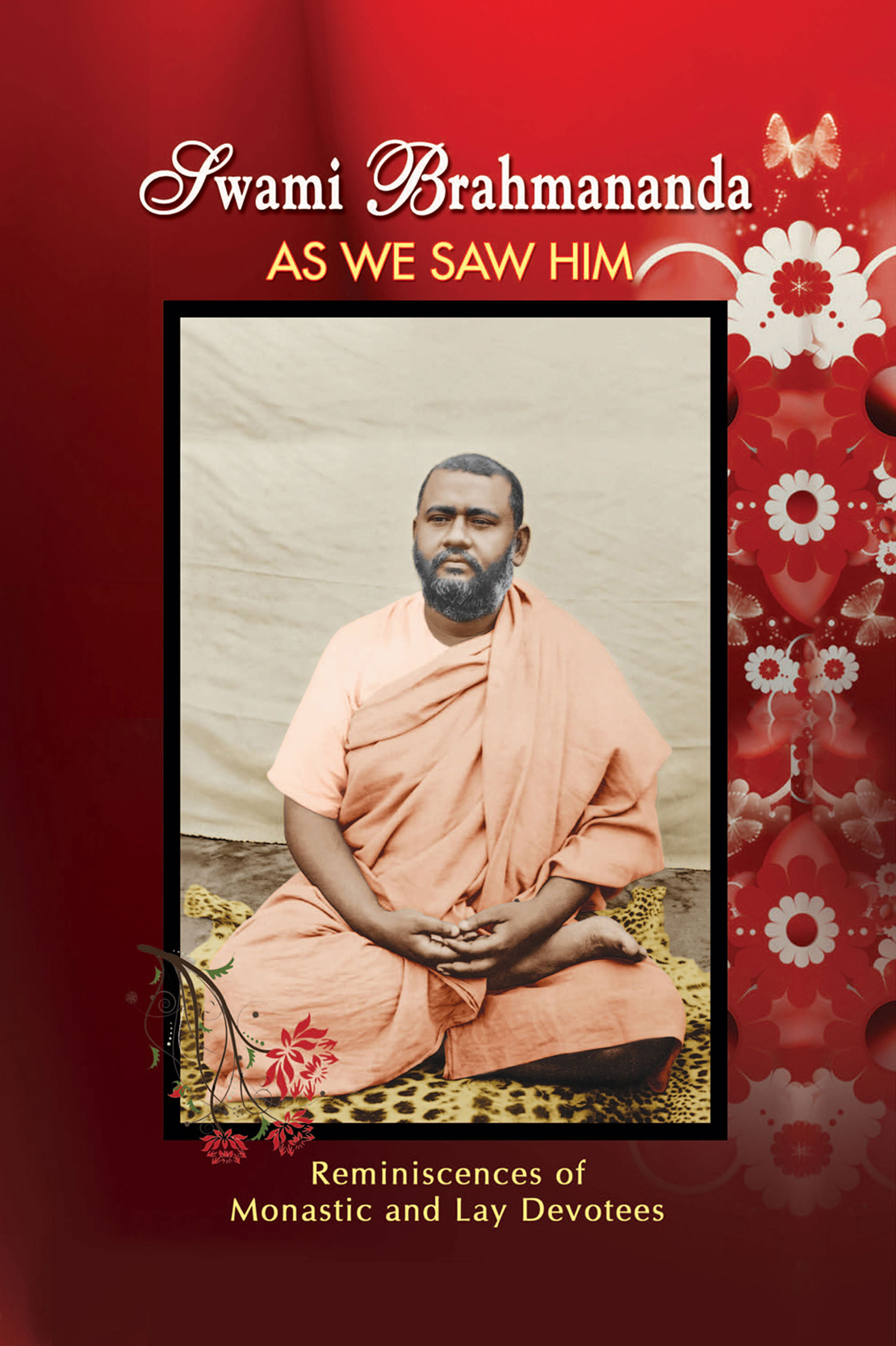
Swami Brahmananda, regarded as the spiritual son by Sri Ramakrishna, was a direct disciple of Sri Ramakrishna and the first president of the Ramakrishna Order. This book is a compilation of the personal accounts of monastic and lay members who intimately knew Swami Brahmananda and had many occasions to closely observe his daily life and day-to-day dealings. These reminiscences record the charm of his unassuming personality, the silent influence of his deep spirituality, his practical hints for living a spiritual life, and his keen sense of humour and insights into human mind. An unpublished letter and a couple of speeches of Swami Brahmananda and some remarkable articles on his life and precepts are included in this book. The impressive volume is interspersed with valuable illustrations. This book will be of immense help and inspiration to all spiritual seekers.
Anyone coming into the orbit of Swamiji [Swami Vivekananda] and Maharaj [Swami Brahmananda] could feel a special spiritual atmosphere. Whosoever entered into that orbit could feel at once a power permeating him.
Swamiji loved us, his brother disciples, intensely. It was like a mother’s love for her child, and so he could not brook faults or defects in any of us. He wanted his brothers to be as great as he himself was—no, even greater than he. There is no love equal to his love for us. But he had a very special love for Maharaj, and respect for him. There is a saying: ‘The guru’s son is to be respected as the guru himself.’ That was Swamiji’s attitude toward Maharaj. I lived in the shade of Maharaj’s protection and so I did not receive much of Swamiji’s scolding. Maharaj and Swami Premananda chose to bear most of the burden of it.
One time I did not get the meaning of something Swamiji said and contradicted him: ‘No, holy sir, you have not understood the ancient sages and seers.’ I saw Swamiji’s face turning red. Maharaj was walking back and forth near us. Swamiji told him: ‘Raja, look here. This fellow says I don’t understand anything.’ Maharaj replied: ‘Brother, you should not take seriously what he says. He is just a young boy. What does he know?’ Swamiji immediately calmed down. He accepted Maharaj’s words as if he himself were a child. And Swamiji and I were reconciled.
Because Swamiji loved Maharaj with such intensity, he once scolded him so vehemently that Maharaj went to his room and wept copiously. I must mention that the fault was mine. In order to shield me Maharaj took the blame upon himself. When Swamiji learned that Maharaj was weeping, he became so upset that he rushed into Maharaj’s room and after embracing him began to weep too, and said: ‘Raja, Raja, please, brother, forgive me. How wrong I was to have scolded you!’ Seeing Swamiji weep like this, Maharaj was struck with wonder and said: ‘Well, you have scolded me. What of it? You scolded me because you love me.’ Swamiji again embraced Maharaj and repeated over and over again: ‘Brother, please forgive me. Our Master loved you so much. He never spoke a harsh word to you. And over a trifling matter I scolded you.’ He spoke in this way for a long time, and then they both became calm.
I will never forget that experience. I have seen with my own eyes what powerful attraction these two great souls, Maharaj and Swamiji, had for spiritual aspirants. People could not help but be drawn to them.
[From: The Eternal Companion, Life and Spiritual Teachings of Swami Brahmananda, by Swami Yatiswarananda, Swami Prabhavananda and others, (Sri Ramakrishna Math, Mylapore, Madras) VI Edition, 1978, reprinted in 1990, pp. 168–170]
Before I begin my story, it is important for the general reader to know something about the life of my master [Swami Brahmananda]. And I could do no better than quote a few paragraphs from the short biography of Swami Brahmananda written by my friend, Mr. Christopher Isherwood:
Rakhal Chandra Ghosh—to be known in later life as Swami Brahmananda, Sri Ramakrishna’s great disciple—was born on January 21, 1863, at Sikra Kulingram, a village near Calcutta.
Some time before Rakhal’s first visit to Dakshineswar, Ramakrishna had prayed to the Divine Mother Kali: ‘Mother, I want someone like myself to be my constant companion. Bring me a boy who is pure-hearted and intensely devoted to you.’ A few days later he saw in a vision a boy standing under a banyan tree in the temple grounds. Later, in a second vision, the Divine Mother placed a boy, recognizably the same but much younger, on his lap and told him, ‘This is your son.’ Ramakrishna was dismayed at first, supposing that he would have to beget this son, but the Mother reassured him that this would be his spiritual, not his physical child. Then, on the day that Rakhal and his brother-in-law were coming to Dakshineswar, Ramakrishna had a third vision. He saw a lotus blooming on the surface of the Ganges and two boys dancing upon it. One of them was Krishna, the other was this same boy.
When Ramakrishna first set his eyes on Rakhal, he recognized him as the boy of his visions. He therefore began to regard Rakhal as his spiritual son, and Rakhal entered into the spirit of this relationship so completely that he could not bear to be separated from Ramakrishna. His visits became more and more frequent, and then extended themselves into long periods of living at the Dakshineswar Temple as Ramakrishna’s personal attendant.
And now, by twos and threes, other young men and youths began arriving at Dakshineswar, to become Ramakrishna’s disciples and, in due course, monks of the Ramakrishna Order. By word and by example, Ramakrishna trained them for the work to which the rest of their lives would be dedicated. He was not training mere preachers, however, but exemplars of his message whose lives would carry far more conviction of truth to those who met them than any sermon or book.
In many respects, Naren was the natural and accepted leader of this group of young disciples. Yet it was Naren who knew best how to value the unfolding spiritual power of Rakhal, his beloved friend. One day, Ramakrishna said to Naren, ‘Rakhal has the keen intelligence of a king. If he chose, he could rule a kingdom.’ Naren understood that Ramakrishna wanted Rakhal to be their leader. So, when next the disciples were all together, Naren spoke to them about Rakhal’s greatness and declared, ‘Henceforth, we shall call Rakhal our king.’ The others gladly agreed and Ramakrishna himself approved, so Rakhal became known as Raja (king) from that day onward. In later years, both the disciples and his own devotees began to call him Maharaj. Ramakrishna used to say that Rakhal, Naren, and four of his other disciples were actually Ishvarakotis, that is, eternally free and perfect souls who are reborn on earth not because of the compulsion of past karmas but for the good of mankind.
Brahmananda was a great administrator of the Mission’s activities, but he never ceased to impress upon his disciples that spirituality comes first, social service only second. ‘The one purpose of life is to know God,’ he would say. ‘Attain knowledge and devotion; then serve God in mankind. Work is not the end of life. Disinterested work is a means of attaining devotion. Keep at least three-fourths of your mind in God. It is enough if you give one-fourth to service.’
Brahmananda was more interested in the spiritual growth of the disciples than in their practical efficiency. He once reprimanded a senior disciple who had been put in charge of a younger brother, saying, ‘Did I send this young boy to you to make a good clerk out of him?’ Again and again, he pointed out that the success of a religious order depends on the inner life of each of its members, and not on its achievements in social service, its size, its buildings or its funds.
Brahmananda had the power to make the atmosphere of a place vibrate with his spirituality. By a glance or a touch or his mere presence he could raise the minds of others to a high level and change their very lives. He spent most of his later life in a state of high spiritual consciousness, coming down from it only in order to teach and help others.
On April 10, 1922, he passed into the final Samadhi and life left the body. His last words to his disciples were, ‘Do not grieve, I shall be with you always.’
Swami Ramakrishnananda, another direct disciple of Ramakrishna, paid this tremendous tribute to Brahmananda, while he was still alive; ‘Maharaj’s mind has become one with Ramakrishna’s mind.’ And Swami Shivananda, speaking to a disciple of Brahmananda who was leaving to take up his duties as a resident swami at one of the Centres in the United States, expressed himself even more strongly: ‘Never forget that you have seen the Son of God. You have seen God.’
Now I wish to confine myself to write only of him as I knew him, what I felt about him, and what I received in his presence. Naturally, it will also be a sort of autobiography; but please forgive me if I use the pronoun ‘I’ many times. Remember that this ‘I’ is not apart, not separate from my Master. This ‘I’ is always, or at least tries to be always, at his feet.
Once a disciple asked Maharaj, ‘Will you tell us something about Sri Ramakrishna?’ Maharaj answered, ‘What can I tell you about him? Unless he reveals himself to you, it is not possible to understand him.’ And this is true of all illumined souls, all men of God. Take, for instance, Jesus. How many recognized his holiness when he lived and moved on earth? And what did Jesus say? ‘Ye have not chosen me, but I have chosen you.’ That was true of my Master also. He was an ever-free soul, the son of God, a knower of Brahman, and as such one with Brahman. When we approached him, we did not always have a sense or consciousness that he was God. Occasionally this thought would arise in us; but then he would create some fun, tell us some joke, and make us forget.
Somebody once commented that he wished he knew the type of fun Jesus had with his disciples. Unfortunately, it is not recorded. But I can tell you this: all illumined souls, all great ones who have reached union with God, are full of fun. We experienced this with Maharaj. Wherever he was, there would be a festivity of joy—within a limited circle, of course. But whoever would enter into that circle, even strangers, would feel something of this gaiety; not gaiety in the ordinary sense, but a great joy. And this we would feel even when Maharaj would be disciplining us, vehemently scolding us. The nature of a holy man is described by a great poet as being hard like thunder and soft like the petals of a flower. Why is he hard like thunder? To wipe out our karmas! Even when Maharaj was like thunder, I would feel a current of joy. I would be sitting at his feet and weeping, and still I would feel that current of joy. How can I fully describe this?
There is very little to say about the teachings he gave me, except that much of his instruction was imparted through silence. He could transform your life through silence. I have seen this: He would be sitting in a room and there would be a crowd of people; each one of them had come to him with a problem, or they were depressed. Maharaj would not even be talking about God or religion—rather about architecture or gardens and flowers. But when those people walked out of there, they would find their problems solved. This is the strange phenomenon that I witnessed from day to day.
Now permit me to relate some early history. When I was fourteen years old I was introduced to The Gospel of Sri Ramakrishna. I don’t know what I understood of it at that time, and I can’t claim that I understand it even today. But when I first read it, two names, Naren and Rakhal, attracted me very much. I would read over the passages where Naren and Rakhal were mentioned. I knew that Naren (Swami Vivekananda) had passed away, so naturally it was Rakhal (Swami Brahmananda) who became my only love—without seeing him, just in reading about him. Then when I was fifteen, I had the opportunity to go to Belur Math; but Swami Brahmananda was not there at the time, and I met another disciple of Sri Ramakrishna: Swami Advaitananda. He was a very old man and he came out unshaven, with a white beard, white hair, leaning on a stick. Being just a lad, I was a little afraid of him.
Later, at sixteen, when I had graduated from high school, I went to Calcutta to attend college. One year passed. I then learned that Maharaj had come to Calcutta and was residing at Balaram Babu’s house. So I went to visit him there. But when I saw a big crowd, I went away. I waited for him to go to Belur Math, and went to see him on a weekday. No crowd was there. I watched Maharaj sitting on the verandah upstairs. It was in the morning, about ten o’clock; he was alone and was facing the room where Swami Vivekananda had lived. That room of Swamiji’s is still kept intact. I had not the courage to go directly to Maharaj, but I thought to myself, ‘Well, I can stand in the corner and watch Swamiji’s room; nobody can say anything about that.’ So I stood there and pretended to look at Swamiji’s room, but I was really looking at Maharaj. Then he called to me: ‘Come here.’ That was the first thing he said to me. I remember that it was winter and he had maroon-coloured socks on. He said, ‘Could you take these off my feet and put them in the sun?’ I wanted to touch his feet, and he was giving me that opportunity. Then he said, ‘Haven’t I seen you before?’ I answered, ‘No, Maharaj.’ And my feeling at the time was something I had never felt before in my life: a complete fulfilment in his presence. I cannot express it any other way—just a complete fulfilment. He asked me if I knew how to massage. When I said, ‘Yes,’ he allowed me to massage his feet. This was my first encounter with him.
After that I used to go to see him often. I would never talk to him or ask him about religion or spiritual life. He would be resting in his room after lunch, and I would slowly open the door and go in and begin to massage his feet.
Then an older friend of mine, Sarat Sen, who was my school teacher, knew that I was acquainted with Maharaj; so he asked me if I would introduce him. We both went to see him and were together at his feet when my friend asked Maharaj to give him spiritual instructions. Maharaj readily agreed. I was present during that time and listened to all that Maharaj told my friend. Then Maharaj turned to me and said, ‘Don’t you want some instructions?’
I said, ‘No.’ You see, I was feeling, ‘What instructions do I need? Here I have found fulfilment.’ But as we were returning on the boat, my friend scolded me and said, ‘He wanted you to get instructions. Why didn’t you take them?’
‘I don’t know why.’ I said. ‘All right, I’ll go back tomorrow.’
So both of us returned the next day and the first thing Maharaj said was, ‘Oh, hello! You are here again!’
I said, ‘Yes, Maharaj. I want instructions.’ Then he asked my friend to leave before he gave me my instructions.
I used to go and visit him as long as he was at Belur Math, every week on Saturdays and Sundays. At that time, I was studying and living in a hostel of a Brahmo college. You know Brahmos are somewhat puritanical, and on Saturdays and Sundays especially, nobody was allowed to go out in the evening, mostly because theatres were open on those evenings, and we were not permitted to attend theatres. One time Maharaj told me, ‘Now you come on a Saturday and stay overnight.’
‘But our principal is so very strict.’ I replied. ‘He doesn’t allow anybody to stay out on Saturday nights.’
Maharaj said, ‘You ask him anyway; he will allow it.’ So I wrote an application, saying that I would like to go to visit Belur Math and would he please allow me to stay overnight. First I had to go through the superintendent, and the superintendent recommended it; then I went to the principal. I was a boy about seventeen and, of course, I was shaking while the principal read the letter. He said, ‘Take this letter back and write your English correctly.’ So I read and re-read that letter, but I could not find any mistake. 1 went to our professor of English literature and he looked at the letter. Then he said, ‘Put a comma here.’ I did so, returned to the principal, and he granted permission. In that way every week I was allowed to go to Belur Math.
After some months Maharaj went away to Kankhal near Hardwar. It was during the Durga puja vacation, which lasted for a month. But I was not thinking about the vacation; I was thinking about the money that my father had sent me to pay my college fees and boarding expenses. I took this money and wrote to my father that I was running away, that I still had a number of debts, but would he please ask my brother to come to the hostel to collect my books and other things and settle my affairs. Then I left for Hardwar. Banaras was on the way, and as we had to change trains, I visited the Advaita Ashrama there. When the abbot of the Ashrama saw me, he said, ‘Have you any letter?’
‘No,’ I told him.
‘Did you write to Maharaj that you are going to Kankhal?’
‘No.’
‘Maharaj would not allow anybody to go that way; he doesn’t like it’
I said, ‘I have no time to write, and I’m going.’
‘But you can’t stay here,’ he said. ‘I don’t know you; nobody knows you here.’ (You see, they were afraid of revolutionaries at that time.) But another swami came to me and said, ‘Now, never mind, don’t listen to him. You stay here.’ And he went to the first swami and said, ‘I take the responsibility for this young boy; he’s not a revolutionary.’ And so I stayed there one or two nights.
When I arrived at the Hardwar station it was three o’clock in the morning, and I hired a jhatka or a horse carriage from there. It was four o’clock in the morning, and still dark when I entered the monastery grounds and found myself surrounded by several bungalows, in one of which, I might expect to find Maharaj. But which one? I went straight to the verandah of one of them, meaning to wait beside a door, but before I could sit down Maharaj himself came out by this same door, and Swami Shankaranandaji, his secretary, by another, next to it. Seeing me, Maharaj said affectionately, ‘Hello, you are here,’ and turning to Swami Shankaranandaji, ‘Make room for this new brahmachari.’
I was then taken to the new building intended for T.B. patients, but still unoccupied by them. I was given room in a corner of a large hall. Three other monastics were occupying the other three corners: Nirmal Maharaj (who was then a brahmachari; later known as Swami Madhavananda, who became the President of the Order), Brajen, and Dr. Maharaj (Purnananda). One day Maharaj came into this hall and seeing me there, he remarked, ‘Ah, I see it is crowded here. Four of you have to stay in one room.’ Then he said, ‘You know, fifty sadhus can live under one blanket, but two kings cannot dwell in one kingdom.’
Maharaj and Mahapurush Maharaj occupied the large hall in the old building; Swami Shankaranandaji was in the room next to it, Swami Turiyanandaji, in the next, and Swami Shuddhanandaji, in the next. The shrine room was the last room in the building. I received the grace of Maharaj in this shrine.
During this period, as far as my memory goes, besides these guest swamis, there were Swami Kalyananandaji, the head of the Sevashrama, his assistant, Swami Nishchayanandaji, Swami Achalanandaji, Lakshman Maharaj, Maharaj’s personal attendant, and the following brahmacharis—the sevakas at the Sevashrama: Jivan, Nagen (Maharaj used to call him Login), Abinash—who else was there, I cannot remember. Bulbul was there as the servant boy of Maharaj.
I remember four buildings being there at the time—the one in which Maharaj and the rest lived, the T.B. ward, newly built, the house where the sevakas of the Ashrama lived, and the kitchen. Besides these houses, there must have been a dispensary building and a hospital for in-door patients. I did not visit these.
Durga Puja was held at Kankhal Sevashrama for the first time that year, as Maharaj wished. The image of Mother Durga arrived from Calcutta, brought by the devotees of Salkia (Howrah).
Lakshman Maharaj, Maharaj’s personal attendant, performed the Puja and Swami Shuddhanandaji was the tantradharak [assistant to the worshipper]. Lakshman Maharaj had to learn the ritual of the puja and so he had to be released for nearly a month from serving Maharaj. Maharaj, to show his grace towards me, asked me to take over Lakshman’s duties, which I did gladly, though very inadequately. But Maharaj overlooked all my failings.
During the puja, monks from different Orders living at Kankhal were invited to partake of prasada on one of the days. There was a large crowd of sannyasins.
The chair, which used to be occupied by Maharaj, was placed by me on the large lawn, upside down. Suddenly I looked and saw that an elderly monk had set the chair on its feet and was sitting on it. I ran immediately to him and said, ‘Holy Sir, you cannot sit in this chair.’
He replied, ‘Why not?’
I said, ‘This is Maharaj’s chair.’
‘Oh! but Maharaj won’t mind my sitting in his chair.’
‘But I mind it, Sir.’
Then as he would not get up willingly, I took his hand, intending to pull him up. But the Swami smiled at me and got up of his own accord.
Later as I was placing Maharaj’s special asana for him to sit and partake of the prasada, he noticed me and said, ‘Oh no, no special seat for me. There are four men of God here.’ Then what did I find? Maharaj was seated in the middle, and the elderly swami, whom I had confronted because he was occupying Maharaj’s chair, was seated on his right. I was (at the time) standing in front of Maharaj. Maharaj and this holy man were conversing, while looking at me, and they were having a hearty laugh—I felt it was at my expense. Maharaj never mentioned the matter to me, however.
Then on the day of the immersion of the image of Mother Durga, Maharaj and all the swamis and brahmacharis went to the bank of the Ganga. Two boats had been hired. The image was placed in one of the boats, accompanied by swamis. All the swamis and the brahmacharis got into the boats and left for the immersion, which was to be near some special ghat (I can’t remember the name). Maharaj did not go. He was still standing on the bank of the Ganga. I was standing near him. He said, ‘You did not go!’
‘No, Maharaj.’
It was the hour of sunset. As was his custom at that hour, he folded his palms and saluted the Lord for a few minutes. He asked me to sprinkle some Ganga water on him, which I did. Then as usual when he was saluting the Lord while standing on the bank of the Ganga, I took the opportunity of prostrating at his feet. This blessed moment of my life stands out in my memory vividly.
After the immersion of the image, Vijaya was observed. We all sat together in rows. I was behind Maharaj and Swami Turiyanandaji. Maharaj asked us all to chant ‘Jaya Sri Durga.’ Then each one was served with siddhi in a small earthen cup. (Once a year it is the custom during this Vijaya Day to take a sip of siddhi as a sacrament. Siddhi produces psychedelic effects, but only when taken in large amounts). Maharaj touched his lips to the drink and saw me seated behind him. He offered me the cup, and I drank. Swami Turiyanandaji touched the drink with his lips the same way and then turning back offered me the cup. I drank again. This was the first time in my life that I had ever drunk siddhi. Later as Swami Turiyanandaji was seated on the verandah in a chair and some of us were standing before him, listening to him, I was suddenly seized with a fit of laughter. Turiyanandaji looked at me and said, ‘Abani, go to bed.’ So I went to bed and slept soundly. The drink did not have any bad effect on me.
While I was an attendant of Maharaj, he said to me one morning, seated in his chair, on the verandah, ‘Abani, you must be missing the sweets of Bengal. But you know, if you make Japam and wish for anything, it will come to you.’ Thus saying, he closed his eyes for a few moments and made Japam counting on his fingers.
Within an hour or so three Bengali women devotees arrived at the Ashrama, from Meerut. They had prepared some sweets of various kinds and had brought them with them; these were offered to the Lord and we all partook of the prasada.
I was a ‘doubting Thomas.’ I thought Maharaj had received news that these Bengali devotees were coming that morning, and had therefore played a joke on me. In order to be sure that I was right in guessing this, I approached these devotees and asked, ‘Mothers, did you write to Maharaj that you were coming here this morning?’ They replied, ‘No, we wanted to surprise Maharaj, and did not let him know that we were coming.’ Then I asked them, ‘But tell me, do you bring sweets every time you come to visit Maharaj?’ They replied, ‘Oh, no, this is the first time we have brought sweets.’ So I knew my guess was wrong.
I have already mentioned that I had introduced Sarat Sen, a schoolteacher of mine, to Maharaj, who gave him some spiritual instruction. Sarat Sen later renounced the world and requested Maharaj’s permission to wear gerua cloth, which was granted. He did not join our Order, however. He then left for Kankhal, where he stayed for a few days; after that he went to Hrishikesh to practise austerities and meditation. After a few months he wrote to me that he had attained samadhi. This letter I received just before I left for Kankhal. One day I told Maharaj what Sarat Sen had written to me. Maharaj said, ‘Why, he was here about ten days ago and I looked into his eyes. He has not attained samadhi, I know that from looking at his eyes. He must have had some vision of light, which he mistook for samadhi. Is it so easy to attain samadhi? When one is blessed with the vision of God, the knot of ignorance in the heart is loosed, all doubts are dissolved, all evil effects of deeds are destroyed[1].
We saw Swamiji go into samadhi three times in his life and Thakur used to go into samadhi many times every day. Rare indeed are such souls who attain that highest samadhi.’
Then Maharaj looked at Mahapurush Maharaj and said, ‘Isn’t that so, Tarak dada?’ Mahapurush Maharaj smiled and remained silent.
There came to Kankhal a young boy of my age, who was the son of a disciple of Maharaj. After the Durga puja, when Lakshman Maharaj could look after Maharaj, this young boy and I went to visit Hrishikesh and Swargashram. We hired a jhatka [horse carriage] and went to Hrishikesh. From Hrishikesh we crossed the bridge over the Ganga and went to Swargashram. It was at that time a very lonely place, with a few cottages scattered here and there for the sadhus to live and practise meditation. We entered one cottage and there we found a very young sadhu suffering from fever. What money I had, I left in the cottage, hoping that it might help him in some way. Then we came back to Hrishikesh. We were hungry. I had spent all the money I had with me, expecting that the other boy had some money with him. But he had none. So both of us sat in an inn and did not know what to do or how to go back to Kankhal. We could not walk back. While we were thus seated, a little worried, there came the devotees of Salkia, who had brought the image of Mother Durga. When they saw us, they asked us if we had had anything to eat. We said, no. Then they invited us to partake of the food which they quickly prepared. They had room in their jhatka for us, so we could get back safely, without any trouble.
When Maharaj saw me, he exclaimed, ‘Why, you look so tired and emaciated!’ Mahapurush Maharaj was there. He remarked, ‘He must have practised some austerity at Hrishikesh.’ Maharaj said, ‘Austerity! Nonsense! He had to undergo some hardship for some reason.’ I remained silent. Later, when I was alone, I wept thinking of Maharaj’s affection for me.
I shall mention another episode while I was at Kankhal with Maharaj. I was acquainted intimately with a swami of our Order, and one afternoon while I was walking I met this swami. He recognized me and invited me to his place, where I found there were some boys studying. The swami offered me something to eat and treated me affectionately as before. Then when I returned to the Ashrama, I found that the brahmacharis whom I met turned their faces away from me and would not speak to me. I went straight to Maharaj, knowing no reason why I was treated that way. When I entered, Maharaj affectionately asked me to sit by him. Swami Kalyananandaji was also in the room. Maharaj asked me, ‘Did you meet—?’
‘Yes,’ I replied, and told him how I went with him to his residence and how he fed me.
He asked me, ‘Did you know him before?’
I said, ‘Yes, I knew him intimately, I used to visit him often in Calcutta.’
Then Maharaj said, ‘He has left the Order and has gone astray. Don’t go to him any more.’
Later, one afternoon, while Maharaj, Mahapurush Maharaj, Turiyanandaji and others were walking on the main street of Kankhal, and I accompanying them, we all noticed this swami, seated outside a shop, on the street, smoking a hubble-bubble. Though he saw Maharaj and the party, he went on smoking nonchalantly and did not rise to show them respect. As we passed him Maharaj stopped and enquired, ‘Isn’t that—?’
‘Yes, Maharaj,’ one of us replied.
Maharaj remarked, ‘Ah! He has degraded himself that much!’
Also I remember that Mr. Kripalani[2], who is now a prominent member of Parliament of India, and who was then a young man, came to visit the Ashrama at Kankhal with a long walking stick in his hand. He had become attracted to Maharaj, and Swami Turiyanandaji. Maharaj admired his stick, so he gave the stick to Maharaj and went to Hrishikesh to practise austerities. Maharaj blessed him.
During this period I wanted to join the monastery and serve Maharaj. When I expressed my desire to Maharaj, he asked, ‘No, not yet. You must finish your education at the university.’
‘But Maharaj,’ I said, ‘if my parents force me to marry, what shall I do?’
He replied, ‘Then run away to me.’
Then as I left for home, Maharaj wanted me to visit Swami Vijnanananda at Allahabad and also the Ashrama at Brindavan. He gave me letters of introduction to Swami Vijnanananda at Allahabad and Nandu Maharaj at Brindavan. But he warned me not to bathe in the river Yamuna, as the huge tortoises there may bite away a chunk of flesh from a bather. Then he told me of an incident which he had witnessed. He saw a holy man standing in the water of the Yamuna waist-deep, performing japam. He suddenly gave a cry and ran to the bank of the river. Maharaj saw that his thigh was bleeding, bitten into by a tortoise.
When I returned to college, I gradually became entangled in the revolutionary movement in India. Not that I lost interest in Maharaj, or in religion, but I thought, ‘This is Swamiji’s work—to free India!’ And I made up my mind that I would remain unmarried and devote my life to the freedom of India. But I kept in touch with Maharaj always.
I went on a visit to Banaras, where Maharaj was living at the time. Swami Turiyananda was there, and Swami Premananda also. I took with me two bottles of Welch’s grape juice for Maharaj, and as soon as he saw those two bottles of grape juice he said, ‘Get a glass.’ So I got a glass. Then he poured it, and he said, ‘Take this glass to Swami Premananda, in the Advaita Ashrama where he is staying, and tell him that this is the finest wine you could find in Calcutta.’ And so I went and placed it before Swami Premananda and told him what Maharaj had instructed me. He said, ‘Take it away! Get away from here!’ But I would not leave him alone. (You see, Maharaj used to tease him through me). Swami Premananda got so mad that he got up from his chair; but still I would not leave him alone. As he went out, I followed him with the glass, holding it close to his lips. And he went to the end of the wall in the garden; I still followed. Then Maharaj arrived. (He always walked very softly, and often we never knew when he had arrived on the scene). Maharaj said, ‘Brother, why don’t you drink that? That’s only some grape juice he has brought for you!’
And Swami Premananda said, ‘Why didn’t the rascal tell me that?’
Swami Premananda used to bathe in the river Ganga and then offer worship in the Shiva Temple and in Mother’s Temple. Maharaj asked Swami Premananda to let me go with him and attend on him. So I used to go with him every day. In the crowd, Swami Premananda would hold my hand, and when he did that I would receive a thrill. One day, after we finished worship in the temple of Annapurna, the Divine Mother, the head priest placed a garland of marigolds around Swami Premananda’s neck. When the Swami was about to take the garland off to give it to me, I placed my palms together, bowed before him and said: ‘No, holy sir, please keep the garland yourself. You look so beautiful!’ The word ‘beautiful’ reminded the Swami of God’s beauty, and he went into ecstasy. His face flushed, and then a light began to emanate from his whole body. Walking slowly, he left the temple, and I followed him. The temple lane was crowded as usual, but on either side of us people stared at the Swami and made way. It was quite evident that everyone present saw him illumined. We continued to walk through the streets of Banaras while crowds stood still, silently watching Swami Premananda. He was completely absorbed in the thought of God and oblivious of his surroundings. As we approached the outer gate of our monastery, Swami Nirbharananda, the abbot, saw us from the verandah. He immediately ordered the monks to prepare a special welcome for Swami Premananda.
We entered the monastery grounds to the sound of gongs and conch shells, and the ringing of bells. Then, when we arrived at the verandah, Swami Premananda took the garland off and placed it around the neck of the abbot. Gradually the ecstasy abated, and the divine light disappeared.
During Christmas vacation I visited Belur Math because Maharaj was there. Among the disciples of Swami Vivekananda was a great scholar, Swami Shuddhananda, under whom I studied the Vedanta Aphorisms with Shankara’s commentary. As we studied, he would argue with me, wanting me to join the monastery. And I would argue back that the monks were lazy people because they were not doing Swamiji’s work, and we student revolutionaries were the ones who followed Swamiji, because Swamiji wanted India to be free. He could not convince me otherwise. There was an old man who used to listen to all of this. It was customary for us every morning to go and prostrate before Maharaj. One day this old man followed me when I went to prostrate, and he said to Maharaj: ‘Maharaj, when is this boy going to be a monk?’
Maharaj kept silent for a moment. Then looking at me from head to foot, he said:
‘When the Lord wills.’ And then suddenly a transformation took place in me. My whole idea of revolution and all it entailed changed in an instant. I did not say anything to Maharaj, but went down and told Swami Shuddhananda, ‘I have joined the monastery.’
‘What!’ he said.
‘Yes.’
‘What happened?’
‘Nothing,’ I replied, ‘I just decided to join the monastery!’
After about a month, during Swami Vivekananda’s birthday anniversary, two dozen boys were to be given brahmacharya—their first [monastic] vows. Maharaj wanted all those who were to be given brahmacharya to receive permission from and be recommended by Swami Premananda. I had come with Paresh (later known as Swami Amriteswarananda), a friend of mine (I dragged him from the college) and we were seated with Maharaj. He looked at us and said, ‘You two don’t need any recommendation.’ And so we were given brahmacharya. My parents were quite upset, and they wanted me to come back home, at least for a few days. After many entreaties I had to agree. Maharaj was then at Balaram Mandir in Calcutta. I went there and told him my parents’ wish. He said, ‘Yes, you go.’
At the same time an interesting episode occurred. I had my hair shaved completely. Maharaj was introducing me to the son of Balaram, who was older than I, and as he did so he put his hand on my head and rubbed it while he introduced me. He bestowed something with that touch. You see, that is how he gave religion—not by talks or teachings. Then this gentleman, Balaram’s son, wanted to prostrate before me; but I, in turn, wished to prostrate before him, so it became quite a contest!
It was very difficult to leave Maharaj, and while there with my parents I thought only of him. So one morning early I simply left the house, went to the railway station, and bought a ticket. I was about to get into the train when my older brother arrived and dragged me away, saying, ‘Mother is weeping.’ So I returned.
My mother told me, ‘All right, you can go; but you should not go in this way.’ Within a week they gave me the money to leave.
When a month had passed and I had not written to my friend Paresh, he thought, ‘Now he is lost to the world.’
One day Maharaj asked him, ’Say, when is your friend coming back?’
‘Oh, Maharaj, I have not heard from him. I don’t think he’ll come back at all.’
But Maharaj answered, ‘He’s coming back this morning.’ And sure enough, I arrived. My friend then told me that Maharaj already knew about my coming, though I had not written to him.
While I was staying with Maharaj at Belur Monastery, Swami Premananda asked me one day to accompany him to a meeting at Salkia, a village near the monastery where the devotees were celebrating the birthday anniversary of Swamiji. Swami Premananda was to preside. Of course, I agreed and was seated on the platform with him. There was also a number of other speakers present, and while Swami Premananda was introducing them I had a premonition that he would ask me to speak. So I silently prayed very hard that he would not ask me. And I was not asked. While returning with the Swami in the carriage, he told me that he was about to ask me to say something, but decided against doing so. Then I said to him: ‘Yes, Maharaj, I thought you might ask me, so I prayed hard that you would not. And the Lord listened to my prayer.’ He simply smiled.
Maharaj decided to send me to the Advaita Ashrama at Mayavati in the Himalayas. Before sending me to Mayavati, he said, ‘Keep your mind tuned high, as high as the Himalayas.’ I remained there two years. But I was feeling very lonely for Maharaj, so I told the abbot there that I wanted to return to him. I wrote to him about my feelings, and he replied: ‘All right, you come.’ I went directly to Puri where Maharaj was staying at the time. When I was there with Maharaj, those were again wonderful days.
During my stay at Puri with Maharaj, the festival of Ratha Yatra of Jagannath was held. It is celebrated by drawing the image of Jagannath, Lord of the Universe, in a chariot through the streets. Maharaj, Swami Turiyananda, and all of us went to take part in the festival. It was a hot summer day. We took shelter under the huge gate of a house near the temple. As the time approached to draw the car of Jagannath, Maharaj, who had been joking with us, became very serious. It seemed that he actually saw the Lord seated in the chariot. His face flushed with ecstasy. With a noble humility, he removed his upper garment, braced his muscles, and stood ready to carry the burden of the Lord. Swami Turiyananda took the rope next to him. The rest of us followed their example and joined the crowd in drawing the car for some distance.
One incident will describe how my disciplining began. Swami Shankarananda, who was Maharaj’s private secretary, gave me a slip of paper one morning—a receipt for something—and said, ‘Go to the station and give this to the station master.’ And without inquiring about the details, I went with the receipt. On the way I met the young brahmachari who was used to handling this particular job. ‘Say, what am I to do after I give this receipt to the station master?’ I asked him.
He answered, ‘Oh, you don’t have to do anything. You just give it to the station master, and when the package comes he will send it.’
So I did just that, and left. They were all waiting for me when I returned to the monastery. ‘Where is the basket of fish?’ they asked.
‘Fish?’ I said. Nobody had told me that the main reason for the errand was to bring back a package which had arrived from Calcutta with some fresh fish for Maharaj. So Swami Shankarananda immediately took a horse carriage to get the package. That whole day Maharaj ‘pounded’ me. Of course, I considered myself completely innocent!
During the evening, when Maharaj and Swami Turiyananda were having their meal, I sat nearby, fanning the insects away. Maharaj was still reprimanding me. Swami Turiyananda asked me, ‘Do you understand why Maharaj is scolding you?’
‘Honestly, no, I don’t,’ I said.
‘You see,’ said Swami Turiyananda, ‘there are three classes of disciples: the guru tells one kind to do something, and he does it. That is the third-class disciple. The second-class disciple can read the mind of the guru and does the job before the guru gives the order. But the first-class disciple is he who does what the guru wishes, even before the thought has arisen in the guru’s mind. Maharaj wants you to be a first-class disciple.’
Then Maharaj made this remark: ‘Yes, brother, I have become old, so they do not listen to me. Now you pour some intelligence into the brain of this boy!’
While I was living in Puri, I received a letter from my mother telling me that my father had died. I read the letter to Maharaj. He said, ‘Well, you do not need to observe anything, because you are a brahmachari.’ (Traditionally, Hindus are expected to observe certain customs on such occasions—various rules concerning food and so forth. One is supposed to sleep on the ground, eat food cooked by our mothers, our sisters, or by ourselves. One can only eat once a day for a certain number of days. But Maharaj said I did not have to observe these rules). After a while he told me, ‘Take prasad from the temple.’ Later he said that I could take his own prasad. One other thing should be mentioned. The day before I received notification of my father’s death, Maharaj had been looking at me in a very compassionate way; at the time I did not know why. Later I came to believe that it was the hour my father died, and Maharaj was giving him liberation.
I continued my stay with Maharaj. Then, after two or three days, he suddenly looked at me and said, ‘Why, you are still here! You must go and see your mother!’ And so he arranged it. He had his secretary procure some prasad from the temple and buy a ticket for me, as if I were just a little child and did not know anything. His secretary had even put me on the train. But after arriving home, I realized the purpose of my being sent. My mother said that when I came, their grief disappeared, and that my brothers, my sisters, my mother—all felt a current of joy. Maharaj had sent something for them—through me.
From my home I went to Calcutta, and there I met Swami Premananda. He said, ‘I’m glad you have come here. Now I want you to stay with Swami Saradananda, as his assistant.’ I agreed to do that. Swami Saradananda was a disciple of Sri Ramakrishna, and was then the General Secretary of the Ramakrishna Mission. Swami Premananda said, ‘We are getting old, and you people—you boys—will have to conduct the work, so you must learn.’ Then from Calcutta I went to Belur Math. There I got a letter from Maharaj which said, ‘As soon as you receive this letter, come to Puri.’ So I returned to Calcutta and read the letter to Swami Premananda. Swami Premananda said, ‘You write to him that you won’t go.’
‘But how can I?’ I said.
‘What, you won’t obey me?’ he said.
‘When it comes to obeying Maharaj or obeying you, I must obey Maharaj,’ I replied.
Then Swami Premananda said, ‘What! You disobey me? Get out of my sight, I can’t look at you!’ (He wanted me to obey him because of his great affection for me).
Then I went to town to do some shopping. When I returned, some of the boys told me: ‘You had better go upstairs. Swami Premananda is waiting for you.’ So I went to him, and he had some sweets for me and drinking water. He asked me to eat and drink, and then he said, ‘Are you mad at me?’
‘Why should I be mad at you?’
‘Well, I scolded you.’
‘Your scolding is a blessing,’ I said. That was how I really felt.
Then he said, ‘Yes, you go to Maharaj. We had some plans for you, but now I see Maharaj has other plans for you. But this is the last time you see me.’ (He entered Mahasamadhi while I was away). He asked me to send him some holy water from the temple at Puri.
The morning I arrived at Puri I sat at the feet of Maharaj, and he asked me, ‘How is Swami Premananda?’
I told him that he was still very sick. Then Maharaj spoke about how foolish Swami Premananda was to have eaten unclean food from a person—that Sri Ramakrishna had not wanted him to eat any impure food because he was so pure—but he disobeyed. Maharaj went on about this for nearly an hour. Then he asked me: ‘Did he ask for anything?’
‘Yes,’ I said, ‘he wanted me to send him some holy water from the temple here.’
Then the thunder fell! ‘What! And you kept quiet so long? Such a holy man asked you for so little a thing, and you kept quiet? Do you know how great he is? If he looks in one direction, everything and every being in that direction is purified!’ Maharaj then asked his secretary to fetch some holy water from the temple and send it to Swami Premananda immediately. After my staying with Maharaj for some time, he sent me to Madras.
Maharaj always thought I was just helpless in a way—that I couldn’t take care of myself. And so he asked his private secretary, ‘Send a telegram to Keshab Murti (a devotee) in Kakinada and say that this boy must rest there because he cannot travel all the way from here to Madras at a stretch.’ The secretary said, ‘But he has come all the way from Mayavati to here alone.’
‘Oh, you don’t understand!’ Maharaj replied. And so a telegram was sent. This gentleman arranged for me to stay with him for three days. Then he put me on the train to Madras. But the truth is that the Madras mail train did not normally stop at that particular station. But the brother of this householder devotee of Maharaj, Surya Narayan, was a very prominent man in the Legislative Council. Through him a telegram was sent direct to the Governor, and the Governor sent a telegram to the superintendent of the railway, and the superintendent of the railway, in turn, arranged to have the Madras Mail deposit me in Kakinada on a particular day and, again, stop to take me to Madras! This is how Maharaj treated me—like a little child.
[From: The Vedanta Kesari, February 1970, pp. 411–422]
My Memories of Maharaj In Samadhi
As told by Swami Prabhavananda;edited by Christopher Isherwood
There was an old saint from Maharashtra. He had about twenty-four young nuns under him. They invited Maharaj to visit them. This was in Madras.
So Maharaj was seated in front, on a chair. On his right sat Mahapurush Maharaj and on his left sat Ramlaldada. I was seated on the ground, in front of them. The nuns were about to dance.
Maharaj used to make fun of Ramlaldada. He whispered to him in Bengali, ‘Which one would you prefer?’
Before they danced, their chief nun came with a vessel of scented water. She dipped Maharaj’s feet in the water. Then she took away the vessel and wiped his feet with her hair.
And then they began to dance, with sticks in their hands, beating time to the music. This is the song they sang:
Drink this milk, my Lord Gopala,
Drink this milk, O Son of Nanda,
This I, Namadeva, bring you.
Milked with my own hands,
this sweet milk from my red cow with the black calf,
In this golden bowl, full-brimming…
Drink it, drink, O my beloved!
Namadeva bows and offers,
Bows and weeps before the image,
Weeps before the silent image,
That stone image unresponding…
Till, at last, by such devotion
God Himself is moved. Lord Krishna
Drinks the milk from Namadeva.[3]
While they were singing, Maharaj went into deep samadhi.
And then, four at a time, the nuns came to him, while the rest of them were dancing and singing, and each nun wiped his feet with her hair and gave him milk to drink. As she gave him the milk, she sang to him, ‘ Drink this milk, my Lord Gopala, Drink this milk, O Son of Nanda.’ The milk ran down his chin, because he was in deep samadhi; so she wiped his chin with a handkerchief. All of the nuns did that, so it took quite a long time, about an hour.
That was the first time that I saw him in samadhi.
The second time I saw Maharaj in samadhi, that was also in Madras, at the monastery. They were going to photograph Maharaj. They didn’t have a flash-camera—just an ordinary old-fashioned camera. The photographer had to put his head under the cloth and focus the picture, so it had to be outdoors. They had brought out a cot for Maharaj to sit on. The abbot of the monastery, Swami Sharvananda, was fussing about how Maharaj should sit. I was standing beside Maharaj, and he said, ‘You make me sit the way you would like.’ So I took his legs and crossed them. And, as soon as I had put him into that posture, he went into samadhi.
[From:The Vedanta Kesari, February 1975, pp. 360]
When I met Maharaj, he was living, moving, and having his being in God continuously. The state of samadhi was natural to him, and he had to struggle at times to bring his mind down to the work of teaching and presiding over the Order. The following incident, originally told by Swami Ambikananda, may serve as an illustration.
A legal document required Maharaj’s signature. Three days passed, and Maharaj had not yet signed it. When the secretary came to get the document, he found Maharaj looking at it, pen in hand. An attendant said, ‘Please Maharaj, won’t you sign?’ And Maharaj answered, ‘I know, I know, I am trying. But you see, I have forgotten how to write my name.’
There are certain preliminary signs manifested in a holy man before he plunges into the transcendental consciousness. Many times I have witnessed how Maharaj would try to control his samadhi by getting up and walking out of the room when such expressions were visible in him. Once I was accusing him of not correcting us—he did plenty of that later!—and he answered, ‘How can I teach all the time? When I see how God is playing in everyone of you, in so many forms, how can I teach?’
Although Maharaj would behave in the most normal and natural way, sometimes it was impossible for him to hide his ecstatic moods. Holy Mother was living in Banaras at one time. With her was Aunt Bhanu, a devotee from Mother’s native village, who had been present at her wedding ceremony. Aunt Bhanu had a beautiful voice and often entertained Sri Ramakrishna with her songs. One day, after prostrating before Holy Mother, Maharaj saw Aunt Bhanu and began to joke with her. After a while she started to sing a song about Krishna which moved Maharaj so deeply that he went into ecstasy. Holy Mother watched the whole scene. After Maharaj had gone she said to Aunt Bhanu, ‘You are not ordinary person, Bhanu, because you could agitate Rakhal who is like an ocean.’
Maharaj used to observe Christmas every year by offering special worship to Jesus. On one such occasion he and his brother-disciple Swami Shivananda were absorbed in meditation. Swami Shuddhananda was performing the ritual worship. Both Maharaj and Swami Shivananda had the vision of Christ. Swami Shuddhananda did not have any vision, but his consciousness too was elevated and he experienced great joy.
It is not easy to recognize a holy man. Swami Nirvanananda, later manager of Belur Math, told me the following incident, which he himself witnessed as Maharaj’s personal attendant mentioned in the story.
A professor from Calcutta University had read about Maharaj in the Gospel of Sri Ramakrishna. Having learned what a great soul he was, he decided to visit him. At that time Maharaj was staying in Balaram Bose’s house. Balaram’s son, who was a great devotee, had a room especially furnished for Maharaj and had presented him with a beautiful silk robe. One day, while Maharaj’s personal attendant happened to be away, the professor entered Maharaj’s room unannounced. Seeing Maharaj smoking a hookah, surrounded by luxury, was a tremendous shock to him. This was Ramakrishna’s spiritual son, whom he had imagined as so austere! Without introducing himself to Maharaj, he left the room.
But he did not go away; he sat outside on the veranda and thought about the experience he just had had. When the attendant returned, he saw the professor seated on a bench on the veranda. Unaware that the visitor had already been to Maharaj’s room, he approached him and asked, ‘Would you like to see Maharaj?’ The professor thought for a moment and said, ‘Yes, I would.’ So he was ushered in, and Maharaj welcomed him. When the professor came out of Maharaj’s room about an hour later, he told the attendant, ‘I almost made the greatest mistake of my life. I was going to judge Maharaj by externals, with my own idea of spirituality… Now the deepest problem of my life has been solved.’ Later he became a disciple of Maharaj.
Maharaj was very difficult to understand. Unless he revealed himself, it was impossible. Swami Ramakrishnananda, a brother-disciple, at one time sent a letter to Girish Ghosh, the famous dramatist-disciple of Ramakrishna, saying that nobody understood Rakhal (as Maharaj was called as a young boy). Girish Ghosh, himself an illumined soul, wrote back, ‘Very true, very few people understand Rakhal. Anybody who understands and loves Rakhal is immediately liberated. To love Rakhal is to love God.’
Day after day I witnessed a peculiar phenomenon in Maharaj’s presence. We disciples would be seated by him in silence. Perhaps we had come to him with problems or worries. No words were spoken, but by the time we left Maharaj’s room our minds were uplifted and we felt that all our impurities had been washed away. Doubts and disbelief vanished before Maharaj. He did not have to discuss religion. We did not learn any dogmas or theories about God from him. Maharaj taught us that God is and that he can be realized; and in his presence, in silence, he would reveal this truth to us.
Of course Maharaj was not silent all the time. In one mood he would be playful, like a little boy. He used to tell jokes and funny stories, and make us roar with laughter. He taught us that religion is fun. In another state of mind he would be grave and serene; the whole monastery would vibrate with the spiritual atmosphere he created, and we would be afraid to approach, lest we disturb him.
Wherever Maharaj went, there was a constant air of festivity. Even strangers coming within this radius were aware of it. We used to feel it even while Maharaj was chastising us. Sometimes he would rebuke us severely when we felt completely innocent, or he would scold us for what seemed like very insignificant reasons. Of course, we never argued with Maharaj, because he would make us understand that there were deeper reasons for his discipline than the apparent grounds on which he was reproaching us. But there was always that undercurrent of joy. Once he said to me, ‘The Mother holds the baby and spanks him, and the baby cries, “Mother, mother!”’
A unique characteristic of Maharaj’s love was that each of his disciples felt, and still feels, that Maharaj loved him the most. And what kind of love could that be except the manifested love of God?
In his teachings Maharaj placed special importance on what he called sahaja yoga, which means the easy way to attain the knowledge of God. And that is constant recollectedness. He used to say, ‘Make japam. Repeat the name of the Lord. Whatever you do, let the name of God flow like a current within you.’
Maharaj asked me to pray only for two things: for pure devotion and pure knowledge. He would tell us to combine meditation and selfless service, seeing God in every being. He used to say, ‘Work is worship. Work and worship.’
In his ethical teachings Maharaj emphasized chastity and truthfulness, above all truthfulness. He said, ‘A man can be forgiven anything, but if he is untruthful, there is no forgiving.’
Sometimes I wondered: is Maharaj a Hindu, a Christian, or a Buddhist? One could not label him. He belonged to no one sect. He was simply a man of God.
We cannot know God by studying scriptures or philosophy. It is only when we see God-men, who are the living examples of the scriptures, that we begin to understand the meaning of religion. The vibrations of light exist everywhere, even in darkness, We can see the light through an electric bulb that is connected with the current. Similarly, through those who have realized their union with God, the truth of religion is revealed to us.
Who was Maharaj? He was Ramakrishna’s spiritual son; he was a man of God; he was an inspired spiritual teacher; he was the head of a religious order. But what does he say himself?
We find throughout the history of religion that the great teachers of mankind in rare moments reveal themselves to their intimate disciples. Thus Buddha said, ‘I am the Awakened One.’ Christ said, ‘I am the way, the truth, and the life: no man cometh unto the Father, but by me.’ One time, when Maharaj was in the border state between the ordinary and the transcendental consciousness, he said, ‘I am the bridge that spans the chasm between the known and the unknown, between man and God.’ The truth of his words is proved by the fact that the divine power which was manifest in Maharaj continues to work through those whose lives he transformed and blessed.
[From: the Publication Archives of Sri Ramakrishna Math, Madras, ‘Reminiscences of Raja Maharaj’, pp.57–64]
ⓘ [1] Mundaka Upanishad, II.ii.8 [2] Jivatram Kripalani (also called Acharya Kripalani)—a freedom fighter and Gandhian leader. [3]When Namadeva was a young boy, his mother asked him to offer ghee-sugar to the image of Vitthala. He went into the temple and made the offering, but Vitthala did not accept it. So Namadeva threatened Vitthala, saying that, unless Vitthala accepted it, he would not go home. Finally Vitthala ate the offering and Namadeva returned home in great joy.
In 1906, while reading in the F.A. class, in Calcutta, I had my first acquaintance with the life and thought of Sri Ramakrishna and Swami Vivekananda. Sri Ramakrishna’s Gospel and Swamiji’s Raja-yoga came to my hands almost simultaneously. By studying these and other similar books I entered into a new realm of thought. At this time I resolved to take initiation from Swami Brahmananda and lead a religious life, but its materialization took some time.
After appearing for the F.A. examination in 1907, I went to Rajsahi to join the B.A. class there. After two years’ stay there, I came again to Calcutta towards the end of the summer of 1909. Swami Brahmananda, having returned from Madras, was staying in Orissa at that time. It was in 1910 that I saw him for the first time during the birthday celebrations of Sri Ramakrishna. After the celebrations he left for Puri. At this time I went to Belur Math with my friend Sitapati (later Swami Raghavananda) and met the monks there. Since then, I started staying at Belur Math on Saturdays and Sundays. Swami Premananda, Swami Shivananda and other Swamis, by their love and affection, endeared me to themselves. Towards the end of 1910, when Sri Maharaj (Swami Brahmananda) came to Calcutta before the birth anniversary of Swami Vivekananda, Swami Shivananda introduced me to him. I felt as if I had a special relationship with Sri Maharaj and I was overwhelmed with love and devotion towards him. It was not so with regard to other Swamis. In Calcutta and at the Belur Math I visited Sri Maharaj frequently and sometimes got the opportunity of doing a little bit of service to him. One day there was some celebration at Binod Babu’s house. Many monks and devotees were present there. I was fanning Sri Maharaj with a big hand-fan. Suddenly he told me: ‘Look, if the body and the mind are given to the world, the world destroys everything; but, if given to God, He keeps everything—body and mind—in good condition.’ I had a great desire to become a monk and Sri Maharaj made this ideal shine brighter before me. One day I and a friend of mine went to Belur Math to meet Sri Maharaj when we heard that with Swami Premananda he had gone to Balaram Mandir (Balaram Bose’s house in Calcutta). We therefore went to Balaram Mandir. Sri Maharaj asked my friend to show his palm to him. Having looked at it he said: ‘Lust will be of some hindrance to you, but if Sri Ramakrishna wills, it will disappear.’ Swami Premananda loved me. He requested Sri Maharaj to look at my palm also, but he did not do so. At this I felt sad at heart and thought that my friend had some possibility of monastic life while, perhaps, I didn’t have even that.
A few days after this incident, as I was entering the Belur Math, Sri Maharaj’s attendant saw me and said: ‘Well, Sri Maharaj was telling us that you would become a monk.’ This gave me a lot of mental strength and, in due course, I became a monk. My friend, however, had to enter householder’s life. He became a high-ranked official, but remained a great devotee of the Master and disciple of the Holy Mother.
One day Sri Maharaj went to Dakshineswar with a big party in two boats. I also went with him. He was in wonderful spirits. He said, ‘It is a great fortune to live at Dakshineswar even as a dog.’
When we sat with Sri Maharaj we felt as if there was a charmed circle around him and we had come within it. One day he revealed himself in a novel way to me. As he was strolling on the Math grounds, I felt as if he was a superhuman or divine personality.
Sri Maharaj blessed me with initiation in 1911. A few days afterwards he went to Puri when I wrote to him that I wanted to become a monk. He asked Swami Shankarananda to write to me that if I had enough mental strength why I should not go over there. I therefore went to Sri Maharaj at Puri in October that year and joined the holy Order. During this time Sri Maharaj got the worship of Devi Jagaddhatri performed by me at the house of Atal Babu. Swami Turiyananda was the officiating priest and Swami Ambikananda was his assistant.
Kumari Puja (worship of a virgin as the goddess) was also performed. Thus he helped bring into my life a deep spiritual fervour shortly after I became a monk. Sometime later, Sri Maharaj asked me to go to Madras with Swami Sharvananda. Before going I requested him to impart some spiritual instructions. With great solemnity and intense compassion he said: ‘Struggle! Struggle! Struggle.’ This has been the keynote of my life—I feel as if his words are still ringing in my ears.
I am reminded of a few incidents that occurred during our stay at Puri. One day Atal Babu told Swami Sharvananda: ‘What kind of monks you are! You have no occult powers.’ Hearing this Sri Maharaj said: ‘It is easy to get occult powers, but difficult to acquire purity of mind. It is this purity of mind that matters really.’ Another day Sri Maharaj was ill—he had pain in the waist. On that day there was a special celebration at the Puri temple. Almost all of us thought that Sri Maharaj’s attendant alone would do for looking after him and went to the temple. And after passing a good deal of time there when we returned after dusk, Sri Maharaj rebuked us rather sharply for our selfishness and said in the end: ‘I do not expect anything from you. Only I wish you well, and whatever I tell you is for your welfare alone.’ After that I took upon myself the work of attending on Sri Maharaj at night. One night he felt very hot and asked me to open the shutters. I was new to this work of personal service and was lacking in understanding too. So I could not think that it was necessary to close the shutters after a time. The next day Sri Maharaj felt feverish. At this I became very sad at heart. But Sri Maharaj not only didn’t rebuke me himself, but also told others that I was a mere boy and did not know things well. None therefore told me anything about it, but I had my lesson all right.
I went to Madras towards the close of 1911 and was there for five years. I saw Sri Maharaj there again in 1916. I had to work hard as the manager of the Madras Math. Seeing me sitting on the manager’s chair for hours together, he said one day: ‘Have I sent you here to do this clerk’s job?’ He scolded me much and took Swami Sharvananda also to task, saying, ‘Without giving this boy any opportunity for study, etc., you are making him do the work of a clerk.’
Swami Hariharananda was Sri Maharaj’s personal attendant. He used to ask me to get for Sri Maharaj good gingili oil [sesame] from the market and I used to make enquiries and get the best oil available. Pointing to this, one day, Sri Maharaj said: ‘Have I sent you here to enquire and find out where good gingili oil is available?’ Taking all rebukes as expressions of his love and grace, and feeling in the heart of hearts that he was mine and I was his, I used to feel happy at all this.
During this time Sri Maharaj ordered me to pay special attention to study and contemplation and asked me to recite daily Vishnusahasranama. By his grace the mind used to be in a very good state and the heart felt a sort of union with him and was filled with great elation.
Sri Maharaj was kind enough to take me to Kanya Kumari along with his party. I had never read the Candi (Durgasaptasati) ceremoniously before. I didn’t like the fighting and killing mentioned therein. I used to recite only the prayer hymns. Coming to know all this, Sri Maharaj scolded me and asked me to recite the entire Candi ceremoniously at least once a fortnight. He asked me to recite the Visnusahasranama and the Candi for three years. I did so for more than that time.
So as to avoid becoming conceited, I did not write articles or deliver lectures, and refrained from religious discussions, etc. One day, at the Haripad Ashrama in Travancore, Sri Maharaj commandingly said: ‘Tell others what you hear and learn from us.’ Again, one day at Madras, he said: ‘The habit of study must be made such that you will feel ill if you miss it any day. If the mind does not remain on a high spiritual plane, at least it would remain absorbed in studies—it won’t come lower.’ On another occasion he said: ‘Why not write one article each week?’ To this I said: ‘What shall I write? No ideas come.’ He then said: ‘Learn to think deeply and you will find that it would be difficult to cope with the onrush of ideas.’ Afterwards, by the grace of my guru, I never suffered from want of ideas. One morning, while we were at the Bangalore Ashrama, he showed me a few physical exercises and asked me to do them daily. I was already doing some indoor exercises and to them I added those shown by Sri Maharaj. He had told me more than once: ‘Physical, intellectual, moral and spiritual progresses have to go hand in hand.’ After coming to Madras, Sri Maharaj himself suggested many a time that he would ordain me into sannyasa. Other monks, however, advised me to go to him in advance and pray for sannyasa. I went to him and like a fool, said: ‘Maharaj, if you consider me fit, please be kind to initiate me into sannyasa.’ To this he affectionately said: ‘None can be considered fit for sannyasa, but I would initiate you into it.’
On the day of my sannyasa, I felt that Sri Maharaj was vibrating with a wonderful spiritual fervour. After the homa, etc., when I paid my obeisance to him, he put his hand on my head and I immediately had the experience of a vast Presence—as if he, the world and myself were merged in an infinite existence. He graciously gave me an idea of what a guru really was. Then I realized the truth of the hymn:
Salutations to the guru who has made it possible to realize Him by whom this entire universe of movable and immovable objects is pervaded.[1]
That day, after nightfall, many of us sat round Sri Maharaj. Swami Sharvananda was also there. Sri Maharaj’s mind was tuned very high spiritually. I thought that he would speak about spiritual practices and contemplation, but without doing so, pointing to me, he said: ‘What spiritual practice will you do! Go from door to door and let people listen to the holy name of God. That in itself is a great sadhana.’ Calling Swami Shivananda by name, he said: ‘Sharvananda, these days I very much appreciate the attitude of Sri Ramanujacarya—helping everybody hear the name of God.’ That day Sri Maharaj brought into me a new inspiration and directed my thoughts into a new channel. That direction is still there. On account of this new inspiration received at Madras I began laying stress on study, meditation, etc. and started taking classes and speaking at meetings. It was later that I took to writing articles earnestly.
The construction of the new building of the Madras Math also reveals Sri Maharaj’s divine Power. The old Math building having been damaged, the monastery had to be shifted to a rented house. Swami Sharvananda and ourselves could not make out at all how we would build the new house for the Math. Land, of course, had been bought earlier. Coming to Madras, Sri Maharaj said that he would lay the foundation of the new building and asked Swami Sharvananda to collect money, even to take some loan for the purpose. Help, however, came unexpectedly, and within eight months the entire building except the front hall was made ready for use. Sri Maharaj, after his return from Bangalore, and shortly after our initiation into sannyasa, consecrated the new Math building.
On that day—the day of dedication of the new Math—I was performing the evening arati of Sri Ramakrishna. Sri Maharaj was standing a little behind me. While performing the arati I felt as if everything was filled by a great Presence. I perceived that great Presence in all the pictures and in Sri Maharaj as well as in everyone present as I was doing the arati. Even now, when I try to perform arati I get that feeling. This is a special blessing of Sri Maharaj. That same evening, we were sitting in front of Sri Maharaj on the terrace of the rented building. Sri Maharaj said: ‘I fervently told Sri Ramakrishna: “They are just boys. How would they build a new house? Thou shouldst kindly make everything possible.” And so, you see, by His grace, the new building has come up.’
At Madras I used to be preoccupied with various activities. I used to get very little time for studies or meditation. As soon as Sri Maharaj arrived at Madras, he understood that I needed a change. He wished that I should leave Madras and go to Bangalore. But I had no desire to go to Bangalore. But Maharaj knew that that was good for me. So he said one day: ‘Fool! You don’t understand your own interest! There is no need for you to stay at Madras any more—proceed to Bangalore.’
Earlier, Swami Nirmalananda had requested Sri Maharaj to send me to Bangalore. I had heard that Maharaj had also more or less agreed to it. In early summer of 1917 Sri Maharaj left for Puri. A few days later, I too left for Bangalore in obedience to Sri Maharaj’s wish. While there, I was given too much spiritual practices and religious studies. At the Bangalore Ashrama I used to conduct the Sunday classes too. In late summer of the same year, I had enteric fever and had a severe burning sensation all over the body. I was admitted into a hospital. During this time an influenza epidemic was on. One morning an old man was brought in and placed in a bed next to mine. He had double pneumonia and was in a serious condition; by evening all was over with him.
I was experiencing great pain. But my mind was very clear then. There was no fear of death. But I did feel that it would be difficult to bear any increase in suffering. Death would have been more welcome. When such a thought arose in my mind, I had a vision of Sri Maharaj. He said: ‘How can you die? You have yet to do Sri Ramakrishna’s work!’ Saying so, he disappeared. My mind was filled with a new fervour. Tears began to roll down my eyes profusely. There was no question of any fear of death; on the other hand, a wonderful peace and a sense of resignation came over me. And the disease too, took a turn for the better.
After spending more than a year at Bangalore and another year of spiritual practices at various places in the Madras Presidency, I went to Bhuvaneshwar to meet Sri Maharaj at the end of December 1919. There I got the rare privilege of spending a few days in his holy company. The construction of the Bhuvaneshwar Math was nearing completion at that time. It was during this period that, one evening, Sri Atal Maitra of Puri arrived with his first wife. The old man was very much downcast, filled with sorrow. Sri Maharaj asked Swami Varadananda to sing. Varadananda sang the song beginning:
O mind, make thy refuge the feet of the Divine Mother who dispels all fears.
Hearing the song, and more than that by having the darshan of Sri Maharaj and hearing his words, the old man’s face brightened and he was filled with joy. We all felt very happy at this transformation.
After a few days’ stay at Bhuvaneshwar, Sri Maharaj sent me to Calcutta with Swami Gokulananda who was sick. From Calcutta I went to Belur Math where I spent a few months. During this time, in 1920, before Swamiji’s birth anniversary, Sri Maharaj arrived at Belur. We all used to go and sit in his room and meditate, and chant various hymns.
My last darsan of Sri Maharaj was at Varanasi in the year 1921, a few days before Swami Vivekananda’s birth anniversary. Then I was staying with Swami Turiyananda. Sri Maharaj brought about a new spiritual current in the Varanasi Sevashrama and Advaita Ashrama. At this time, he gave me, too, much spiritual inspiration. One day he enquired about my spiritual practices. I said: ‘I feel as if there is no inner awakening. So I am not getting peace of mind. We have been born with some bad samskaras (mental impressions) and they prove to be hurdles to spiritual growth.’ Maharaj replied: ‘Don’t think that way. Practise japa at the dead of night. Do purashcarana (a ritual involving a particular number of japa). Inner awakening will come of its own accord.’
Another day I went to him, feeling restless in mind. Seeing me approaching, he got up and came towards me and gave me many instructions within a short time. He said: ‘Your mind becomes restless only because you don’t want to do what I tell you to do.’ Placing his palm on my head, he blessed me and filled my heart with peace.
It was Sri Maharaj’s desire that I should go to Mayavati and take charge of Prabuddha Bharata. But he did not tell me anything himself. It was Swami Shuddhananda and Swami Madhavananda who told me several times about my going to Mayavati. But I was not agreeable to this.
One morning, while I was with Swami Turiyananda, busy attending on him, I felt as if something was breaking down within me and a wail coming up from the depth of my mind. Tears also poured down the eyes. The more I wiped, the more the tears came. Along with it I noticed an attitude of self-surrender coming over me. I understood that it was the play of Sri Maharaj. He was graciously removing the obstinacy and the obstacles of my mind. By evening my mind settled down.
After this, one morning, as I went to pay my obeisance to him, he said: ‘Look, they all wish that you should go to Mayavati and take charge of Prabuddha Bharata.’ He had already broken my stiffness. I therefore, without any hesitation, said: ‘Maharaj, if you order, I would surely go.’ Sri Maharaj was much pleased with my reply and blessed me. After this it was settled that I would go to Mayavati. One morning, after prostrating before him, I along with Swami Shuddhananda, Swami Madhavananda and other monks sat near him. Sri Maharaj asked me at the very outset: ‘How are your spiritual practices going on?’ In reply, I said: ‘There is much work to do. I do not get enough time.’ To this he said: ‘It’s wrong to think there is no time because of work. It is due to the restlessness of the mind that one feels like that.’ And this opened the flood-gates of Sri Maharaj’s speech. With great feeling he said: ‘One should prepare the mind by doing work and worship together.’ These instructions are there in the ‘Work and Worship’ chapter of The Eternal Companion. These were addressed particularly to me. On that day he established a special relationship of love between myself, Swami Madhavananda and other brother monks. He said: ‘Just as Madhavananda is dear to me so are you and others too.’ When I think that all are dear to Sri Maharaj, then I also feel that all are dear to me as well. Sri Maharaj regarded his own disciples and those of the Holy Mother equally dear to him. He used to say that all had come to do Sri Ramakrishna’s and Swami Vivekananda’s work. One day, pointing specially to me, he said: ‘By doing their work in this spirit, bondage can never come. Rather through it will come all progress—spiritual, moral, intellectual and physical. Surrender yourself at their feet; offer your body and mind to them; be as a slave unto them.’ This and other instructions of Sri Maharaj have become the stay of my life.
I had a desire to talk some day to Sri Maharaj with a very open heart. I was nursing a bit of wounded feeling against him. When he had gone to Madras he told me that he would take me with him to Bengal on his return, but instead he sent me to Bangalore. Again, towards the end of 1919, when I went to Bhuvaneshwar, he did not allow me to stay with him for long and sent me to Bengal. For all these I had a complaining heart and was feeling unquiet within. I was seeking an opportunity for speaking out my mind to him, and one day it came. On Sri Maharaj’s auspicious birthday in 1921 Kali Puja was performed. I planned that I would see him the next evening when others would go to the bank of the Ganga for the immersion of the image. I did not, however, tell him about it. That evening I went to his room. Swami Vishuddhananda was sitting near him. Peta Puri was also there. As soon as Sri Maharaj saw me, he, like a child, exclaimed to Peta Puri: ‘Look, what a yogi I am!’ I learnt that a little while ago he had asked Peta Puri to see if I had come; he knew that I would.
That day we had a lot of talk. Sri Maharaj said that he knew that I had a desire to move and visit places when I went to Bhuvaneshwar and, therefore, sent me to Bengal. He also knew that this tendency in me would soon disappear. In order, therefore, to get this done earlier, he had sent me away hurriedly. I felt ashamed when I found how deep his concern was in all that he did for me. He removed all my mental depressions and made my mind clean. As a result of it a new bond of inner relationship was created between him and myself. Shortly after this Sri Maharaj went away to Belur, leaving behind within my mind his divine image firmly established. The spiritual fervour he instilled in me and the ideas of piety and service he showed me while at Madras and Varanasi still continue to inspire me. He is even now, through his grace, bringing to me in a subtle way new light and fresh inspiration. As days are passing, I am understanding the significance of Sri Ramakrishna’s words that it is God Himself who comes in the form of a guru.
[From Meditation and Spiritual Life, Swami Yatiswarananda, Published by Ramakrishna Math, Bangalore, Fifth Edition, 1998, pp.xvii-xxvi]
Swami Brahmananda, as I am sure all of you know, was one of the great disciples of Sri Ramakrishna. The most prominent of these disciples (without taking into account Sri Sarada Devi) was Swami Vivekananda, and Swami Brahmananda was next.
Yet in one respect Swami Brahmananda was closest to the great Master. He was, as they say in India, Sri Ramakrishna’s manasa-putra. Sometimes manasa-putra is translated as ‘spiritual son’; but in English the term spiritual son means disciple—no more than that. The Bengali word means much more: what is meant is that Swami Brahmananda was the son of Sri Ramakrishna in the spiritual, not the physical, sense. You see, shortly before Swami Brahmananda came to him, Sri Ramakrishna had wished for the company of a pure-hearted boy with a devotional temperament like his own, and in answer to his wish, the Divine Mother appeared to him in a vision, bringing him a child whom She called his son. He was startled and asked, ‘Mother, how can I have a son?’ And the Mother said, ‘He is not your son in the ordinary sense; he is your manasa-putra’—literally, the ‘child of your own mind.’
When Sri Ramakrishna first saw Swami Brahmananda, he at once recognised him as the boy of that vision, and thenceforth he showered upon him a most exquisite and tender affection, shared by none else. Because of Swami Brahmananda’s closeness to the Master, all the other disciples treated him with a special respect and love, and we too, although removed by a generation, feel a reverential love in our hearts for him such as we do not feel for any other.
I am not a disciple of Swami Brahmananda as the word is usually understood, but it was he who admitted me into the Ramakrishna Order of monks and gave me the first monastic vows. I may say that I was not without close contact with him, and never can I forget the great kindness and loving guidance I received from him. On the contrary, my impressions of him have grown deeper with the passing of time, and in the course of trying to tell you of his life and character I shall try also to recount a few of my personal memories.
In speaking of Swami Brahmananda before he became a monk, I shall call him by his given name, Rakhal. Rakhal Chandra Ghosh was born in a very aristocratic and wealthy family in an ancient village not far from Calcutta on Tuesday, January 21, 1863—nine days after Swami Vivekananda. As a boy he was physically strong and skilled in wrestling, but his nature was very gentle and peace-loving. Even from early childhood he felt great devotion for the Divine Mother, and whenever he had an opportunity he would go to a secluded place, alone or with companions, to sing devotional songs to Her. Sometimes he would make an image of the Goddess and along with his friends would worship Her. On special festivals, such as the autumn puja of the Mother, he would sit close to the priest during the long worship and become so absorbed as to appear immersed in deep meditation—as if the future man were already finding expression in the boy.
When he was twelve years old, he was sent to live with his stepmother’s family in Calcutta in order to attend a school where he could learn English. There he became acquainted with Swami Vivekananda, whose premonastic name was Narendra Nath Datta. The two boys lived in the same quarter of the city and belonged to the same gymnasium. Very soon they became fast friends and spent a great deal of time together—and that, too, seems to have been a foreshadowing of things to come. As they grew older, Narendra and Rakhal joined the Brahmo Samaj, a reform society in Hinduism whose members, though dualists, did not believe in God with form; nor did they believe in such things as the worship of images, the doctrine of Divine Incarnation, the need for a guru. In accordance with the tenets of the Samaj, the boys signed a pledge that they would not engage in image worship or other such practices of orthodox Hinduism.
Rakhal’s preoccupation with religion worried his father; so he arranged a marriage for him when he was eighteen. But instead of drawing Rakhal into worldly life, this marriage actually opened the way to his eventual renunciation of the world. As it happened, his wife was the sister of one of Sri Ramakrishna’s earliest disciples, Manomohan Mitra, and it was Manomohan who took him, in the summer of 1881, to the Kali temple at Dakshineswar where Sri Ramakrishna lived.
Rakhal at once felt deeply attracted to the Master; and of course Sri Ramakrishna received him as his own, for, as I said, he recognized him as the boy of his vision. He knew also, from other visions, that Rakhal was a nitya-siddha, or ever-free, ever-perfect soul born for the good of others, that he was an Ishvarakoti, or Godlike being, and, above all, that he was an eternal companion of Sri Krishna. Further, he foresaw that this disciple would one day play an important part in his work, for the Divine Mother had revealed to him that She had given Rakhal a portion (one-sixteenth) of Her power for that purpose.
Rakhal visited the Master as often as he could after that first meeting and sometimes stayed with him for several days at a time. In Sri Ramakrishna’s company he would be in a joyous, childlike mood and would not leave his side for a moment. Good-bye to books and lessons, good-bye to family! Naturally his father, a worldly man, was much concerned and came one day to the temple. Sri Ramakrishna talked with him, showed him great affection and respect, and praised his son highly; then, having completely charmed him, he asked, ‘Do you have any objection to your son’s living here?’ And his father replied, ‘Oh, no, no, sir. He is a very fortunate boy that you allow him to live with you.’ So that was settled. Rakhal remained with the Master and served him as his personal attendant. From time to time, however, the Master would ask him to go home for a day or two to please his father, and occasionally the father would go to Dakshineswar.
What kind of life did Rakhal live with the Master? In the first period of their association, he behaved just like a little boy. Looking back on those early days, Sri Ramakrishna used to say, ‘I would play with Rakhal and feed him as if he were a child of three or four.’ You see, when these great ones come down to the earthly plane, they establish between themselves and some of their disciples a close human relationship through which the disciples thrive. If you look upon someone as your very own, as close to you as your father or mother, then you feel free with him. And if that person is an illumined soul, think how easy it will be for you to approach him and ask his blessing and instructions. Sri Ramakrishna had this human relationship of father or mother, or of friend with many of his disciples; but he looked upon Rakhal, particularly, as a child. One day when someone criticized Rakhal, the Master said, ‘Don’t find fault with him. He is only a little boy! If you squeeze his throat his mother’s milk will come out of his mouth.’ It was a strange thing, this childlike nature of the boy Rakhal. It persisted even after he had become Swami Brahmananda; in fact, it persisted all his life.
After he had been with the Master for some time, he evidently received instruction in religious practices from him. We have few records of him in those days, but we know that Sri Ramakrishna gave him a mantra and an Ishta (the form in which he thought of God), and although we nowhere find his Ishta identified, there is some indication that he meditated on the Divine Mother. Yet even though Rakhal undertook various spiritual practices, it is certain that he did not have to achieve spiritual knowledge through his own efforts alone. One incident in this connection was related by Swami Brahmananda himself in later years: An unwanted thought had come into his mind while he was meditating, and in disgust he got up to leave the temple. Sri Ramakrishna met him and said, ‘I see an obstacle on your path.’ He told him to put out his tongue, and he scribbled something on it with his finger. At once the disciple was free of that disturbing thought.
Another time Rakhal came to Sri Ramakrishna and said, ‘Sir, I meditate, but I don’t get anywhere.’ The Master said, ‘Why not? I shall show you. Go to the temple.’ So Rakhal sat for meditation facing the entrance to the temple of Kali. Soon he saw a great light coming from the image of the Divine Mother and almost engulfing him. He was so frightened that he got up and ran to Sri Ramakrishna’s room. ‘There now,’ the Master said, ‘you tell me you don’t get anything out of meditation, but when you do get something, you run away!’
Well, by and by he began to have higher and higher experiences, and soon he became accustomed to those things. He made quick progress. I have heard from other disciples of Sri Ramakrishna that even during the lifetime of the Master he attained a very high degree of spiritual realisation. Even at the outset, soon after his coming to Dakshineswar, he began to experience the exalted state of the soul known as bhava or ecstasy. Actually, bhava is a kind of samadhi in which there is so much emotion, so much joy and love, that those who experience it cannot contain themselves. In less than a year after coming to the Master, Rakhal experienced bhava at least twice. One day in Sri Ramakrishna’s room at Dakshineswar while he was massaging the Master’s feet and listening to a scholar expounding the Srimad Bhagavatam, he lost external consciousness. Later Sri Ramakrishna used to point out the spot where his beloved disciple had been sitting. He would say, ‘Here Rakhal first experienced ecstasy.’ The second such experience came in the Calcutta house of the great devotee Balaram Bose, whom the Master often visited. It was a festive occasion, and everyone had been inspired with divine fervour by the Master’s joyous singing and dancing. Rakhal could not remain sitting upright but, forgetting everything, lay stretched on the floor in bhava. The Master, as was his custom, placed his hand on Rakhal’s chest, saying, ‘Peace! Be still!’ and restored him to outer consciousness.
Another indication of the high state of spirituality Rakhal attained is the statement in The Gospel of Sri Ramakrishna that often on seeing him the Master would enter into samadhi. Further, we find that by the middle of 1884 Sri Ramakrishna needed another attendant because Rakhal and another young disciple, Latu, who also looked after Sri Ramakrishna’s physical needs, were now both too spiritually absorbed to be of much help. The Master said, ‘Rakhal is getting into such a spiritual mood that he can’t do anything even for himself.’ It was at this time that Baburam, the future Swami Premananda, began to live with Sri Ramakrishna and serve him.
It was also around this time that Rakhal was having repeated attacks of fever, and so in September, when Balaram Bose proposed to visit the holy city of Vrindavan, Rakhal was sent with him in the hope that his health would improve. He had a recurrence of the fever there, but after a stay of three months he returned to Calcutta in good health.
The Master told him that now he should go home and live with his wife, coming once in a while to spend a day or two at Dakshineswar. Sri Ramakrishna said this would remove the little obstruction that still lingered in his mind. He lived at home for about a year, and during this period a son was born to him. Sri Ramakrishna joked that Rakhal was enjoying his ‘pension,’ staying at home; but he also pointed out that the disciple did not like the company of worldly people. Moreover, he had seen Rakhal’s wife and knew she would not be an obstacle in his spiritual path.
In the fall of 1885 the Master became seriously ill with cancer of the throat, and in October a house was rented in Calcutta where he could be nursed by the young unmarried disciples. This place soon proved unsatisfactory, and on December 11 they moved to a garden-house in Cossipore, a suburb of the city. Rakhal now joined the others in serving the Master, and although he at first went home occasionally, he very soon stopped going altogether; his renunciation of home and family was complete. In this respect he reminds us of Buddha, who also was married and who also left the world after the birth of a son. Buddha’s son afterward became a member of his monastic order, and it is interesting that Swami Vivekananda and others wanted Rakhal’s son to become a member of the Ramakrishna Order. But this was not to be, for the boy died at an early age.
In the Cossipore house the future monastics, led by Narendra, attended upon Sri Ramakrishna day and night, and here in January a very significant event took place. The oldest among them, Gopal Senior (afterward Swami Advaitananda), brought a dozen gerua [ochre] cloths such as are worn by Hindu monks and as many rosaries for Sri Ramakrishna to bless. He intended to distribute them to some sannyasins as an act of merit. Sri Ramakrishna told him, ‘You won’t find anywhere better monks than these boys; so distribute the cloths and rosaries among them.’ He blessed the cloths and rosaries and gave them to the eleven disciples present, reserving one set for the great lay devotee Girish Chandra Ghosh. Then Sri Ramakrishna made the disciples go through a simple, informal ceremony of renunciation. According to one version, Swami Brahmananda was not present that day and received the gerua cloth later on; but in any case, he was among the first eleven members of the monastic order founded by Sri Ramakrishna. Perhaps at the time not all the disciples understood the full significance of what Sri Ramakrishna was doing; still, this event can rightly be considered the beginning of the Ramakrishna Order.
After the Master’s death in August of 1886, some of the disciples, including Rakhal, decided to live together as monks with Swami Vivekananda as their leader, as the Master had wished. An old, dilapidated house in Baranagore, near Cossipore, was rented for the purpose, and in January of 1887, in the presence of one another, the young monks took formal monastic vows and assumed the names by which they were thenceforth known.
Rakhal, now Swami Brahmananda, was so eager for spiritual practice that he longed to leave the monastery to wander alone over the face of India. At first Swami Vivekananda would not permit him to undertake so hard a life—travelling by foot, begging his food, sometimes getting it, sometimes not. The disciples always remembered Sri Ramakrishna’s great care of and affection for Rakhal and could not bear to see him suffer, even a little. However, late in 1889 Swami Vivekananda yielded to his wish and assigned Swami Subodhananda to accompany him and look after his needs. Together the two Swamis wandered over northern India, beginning with Benares and stopping to meditate in different places of pilgrimage. They lived as austerely as possible. Swami Subodhananda would beg food for both of them, but Swami Brahmananda would never allow him to accept more than they needed for their one meal of the day. ‘As long as you possess anything,’ he said, ‘you cannot have Him.’ Sometimes he was so absorbed in contemplation that he didn’t even touch the food Swami Subodhananda had prepared for him. Oblivious of heat or cold, he passed long hours of the day and night in meditation or japa.
One may ask why he, the spiritual son of Sri Ramakrishna, undertook such hard spiritual practice. Swami Subodhananda himself wondered about it, and one day said to him, ‘The Master looked upon you as his son. You are the veritable son of the Lord. It does not become you to sit like a beggar seeking His grace.’
Swami Brahmananda replied, ‘What you say, brother, is true. The Master loved us so dearly that he gave us everything he had to give. But let me tell you: you may receive these things, but unless you realize them through your own effort, you cannot attain peace.’
During his five years’ absence from the monastery, Swami Brahmananda wandered not only with Swami Subodhananda, but also alone and after 1890 mainly with Swami Turiyananda. He visited many places of northern India: Bombay, Gujarat, Sind, the Punjab, the Himalayas, and parts of Uttar Pradesh. Most often he would travel on foot, or if someone, recognizing his spiritual greatness, insisted on paying for his transportation, he would choose the cheapest conveyance. Possessing nothing, he passed his days in utter dependence on God, his mind always on Him. We know very little of those years, but from what we are able to gather he liked particularly Benares, Omkarnath, Nasik, Kankhal, and Vrindavan. At Omkarnath on the sacred Narmada River, where many saints and sages had dwelt in ages past, he attained an exalted state of spiritual consciousness that lasted continuously for six days. But his favourite holy place was Vrindavan, the scene of Sri Krishna’s boyhood. It was there that he performed his hardest austerities and there also, no doubt, that he had some of his most profound experiences.
Early in 1894, when Swami Brahmananda was in Vrindavan, Swami Vivekananda wrote from America urging his fellow monks, most of whom were scattered throughout India, to return to the monastery. In August Swami Turiyananda, who was then with Swami Brahmananda, complied with Swamiji’s wish, but Swami Brahmananda stayed awhile longer in Vrindavan. It is said that one day while he was there a deep flood of divine joy welled up in his heart; an infinite peace filled his mind and soul, and the whole universe seemed to vibrate with joy. For some days he remained in that state.
At the end of the year he returned to the monastery, now transferred to a somewhat better house in Alambazar, midway between Baranagore and Dakshineswar. But he did not remain there long; rather, until Swami Vivekananda returned from the West in 1897 he lived most of the time in Calcutta, either in the rented house where Holy Mother was staying or in the house of Balaram Bose. His five years of wandering had been years of great spiritual growth, and on his return to Calcutta everybody was amazed to see his shining face, just beaming with indescribable joy. He had become also very calm and grave. Yes, the boyish youth who had gone out travelling in 1889 had returned a mature man, vitally changed. He was steadfast, stalwart, enduring, self-reliant, master of innumerable spiritual experiences. He was now well established within himself; but he was not yet ready to plunge into his mission. Ahead lay still another period of trial and training in the company of his brother, friend, and leader, Swami Vivekananda.
II
From his brother monks who had received letters from Swami Vivekananda, Swami Brahmananda had no doubt learned of the ideas and instructions Swamiji had been writing from America, and now that he had come back from his wandering, many letters came to him directly. In one of these, written from London on April 27, 1896, Swamiji gave for the first time an organisational plan for the monastery. He recommended that a president, a secretary, a treasurer, and other officers be elected every year by a majority vote of the members, and that Swami Brahmananda be elected president for the first year (1896). We have no record of whether or not this plan was carried out, but very likely it was put at least partly into effect.
The relationship between Swami Vivekananda and Swami Brahmananda should be explained a little here. You will remember I told you that when Rakhal came to Calcutta to study in an English school he and Narendra became close friends; but each found his way to Sri Ramakrishna independently of the other. Indeed, Narendra, coming to Dakshineswar a few months after Rakhal, was surprised to find him there. He was also surprised—and pained—to see Rakhal going into the Kali temple and worshiping the Divine Mother in an image, and he upbraided him for breaking his pledge to the Brahmo Samaj. The fact was that the religious attitude of the two friends was not the same. Sri Ramakrishna once said, ‘Rakhal belongs to the realm of the Personal God’; and of Narendra he said, ‘[He belongs] to the realm of the formless Reality.’ Narendra at first tried to influence Rakhal. He not only criticized him for his worship of Kali but, being a sceptic in those days, told him that Sri Ramakrishna’s spiritual visions and ecstasies were nothing but the effect of excessive emotionalism. Rakhal was finding devotion to the Personal God exceedingly satisfying, and he was convinced that Sri Ramakrishna’s experiences were genuine; so he was naturally disturbed by Narendra’s attitude. Too gentle to argue with his friend, he began to avoid him. Soon, however, Sri Ramakrishna intervened and told Narendra not to interfere with Rakhal’s religious views. And there the matter ended.
During the next few years the two friends became more and more attached to each other, and we know on the authority of Swamiji’s brother Mahendra Nath that Rakhal used to visit Narendra in his home, sometimes for days at a time, and became like a member of the family.
After the Master’s passing, Swami Brahmananda found great satisfaction in being with Swamiji. As we learn from the ‘Conversations of Swami Turiyananda,’ he dissuaded Swami Trigunatita from leaving the monastery by saying: ‘Why should you go? Where will you go leaving Narendra? Have you found anywhere else the kind of love that you get from him? I could go home and live there if I wanted. It is solely the love of Narendra that has kept me here.’ But, as I have told you, Swami Brahmananda also longed to go out as a wandering monk and at last persuaded Swami Vivekananda to let him follow that austere life. Swami Vivekananda, too, wandered over India, and on several occasions they happened to meet; but it was only after Swamiji’s return from the West that they were again in intimate contact.
On Swamiji’s arrival in Calcutta in January 1897, we find Swami Brahmananda coming to meet him and placing a garland around his neck. (We are not told of his saluting Swamiji, but he must have done so, for such is the usual courtesy in India.) Swami Vivekananda then touched Swami Brahmananda’s feet, saying, ‘The son of the guru should be treated as the guru himself.’ And Swami Brahmananda touched his feet, saying, ‘The elder brother is like one’s father.’ It was clearly a greeting between two loving friends, each trying to outdo the other in expressing affection and respect. Indeed, the friendship between the two can scarcely be described. It was so intimate, so deep, so true that it appears to have been divinely conceived and sustained in order that the mission for which Sri Ramakrishna was born might be fulfilled.
A new chapter began in the life of the monastery with Swami Vivekananda’s arrival. He had to train the monks in many ways for an unprecedented kind of monasticism. Two views are traditional in India about the status of a monk. One is that a monk should never work. Work, you see, is motivated by a desire for certain ends; but the mind of a sannyasin should have become so changed that no desire arises—not even for sleep or rest, not even for food or protection from heat and cold. He has nothing to attain; therefore he feels no incentive for work; no pressure from within compels him. Not all monks, of course, have realized that state; but all constantly try to attain it. Thus one idea that has come down from very ancient times is that a monk should be contemplative only. The second idea is that a monk can do work for the benefit of others, but it should be essentially religious work—establishing temples, giving spiritual discourses, and so on.
Swami Vivekananda, however, initiated a new kind of monasticism. His idea was that a monk should not only meditate but also serve all men in all ways, recognizing that men are not men at all but God Himself. From one point of view, such work would be spiritual practice; from another, it would be the purest, most wholehearted service conceivable. If I recognize that you are divine, anything I do for you will be done to the best of my ability, with the utmost sincerity and devotion. Just imagine what kind of service that would be! And that is what Swami Vivekananda wanted. Undertaken in such a spirit, any kind of work would be right for monks—from spiritual teaching to showing farmers how to raise better crops. When Swamiji was asked by Swami Turiyananda if the monks of the future would take part in government, he said, ‘Yes, brother. Just wait, and you will see gerua-clad monks sitting in legislatures.’ Every kind of work will become pure service to God. The world will not be the world at all; the world will be the house of God, where God alone dwells. That was Swami Vivekananda’s idea.
This period which marked the conversion of the monastery from the old orthodox ways to the new type of monasticism was one of prodigious activity. To systematise and implement the work, Swami Vivekananda established in May 1897 the Ramakrishna Mission for the service of God in man. He was elected the general president of the Mission, and Swami Brahmananda became the president of the Calcutta branch. Famine, plague, flood, and other disasters struck north India that year, and the Mission was plunged almost at once into relief work.
Another type of work that Swami Vivekananda inaugurated was the publication of periodicals. In addition to the English-language Brahmavadin which some of his disciples were bringing out in Madras, he revived the English monthly Prabuddha Bharata and started the Bengali fortnightly Udbodhan. These magazines were written, printed, and distributed by the monks and devotees. Then he sent out a call for more monks, and soon young men were joining the monastery. In 1897 he acquired land for a permanent monastery at Belur, near Calcutta, and all kinds of work were carried on there—clearing and levelling the ground, planning the buildings, constructing them. And all the while the Math and the Mission themselves had to be run smoothly. In all these activities Swarni Brahmananda took a very important part.
If we study the last years of Swami Vivekananda’s life closely, we shall find that aside from his other preoccupations he was anxious to advance Swami Brahmananda in the estimation of others, not only of people outside the monastery but of the monks as well—including Swami Brahmananda himself, for he was rather shy and certainly self-effacing. Sometimes Swamiji would tell the monks that Swami Brahmananda had more spirituality than he, although this estimate, as we know, contradicted Sri Ramakrishna’s; sometimes he would speak of him as their leader; sometimes he would send spiritual aspirants to him to receive instruction. In every way possible he built up Swami Brahmananda’s self-confidence.
What lay behind this? Was it only Swamiji’s love and reverence for Swami Brahmananda? I think it was more. Swami Vivekananda knew that he himself would not live long, and he knew that the work had to be established quickly and with a deep foundation. How he knew that he would die soon, we do not know. Perhaps Sri Ramakrishna had told him. And perhaps Sri Ramakrishna had also told him who should be his successor. We know that the Master had once said: ‘Rakhal has royal intelligence; he can administer a large kingdom.’ Narendra had taken this assessment to heart. He suggested to his fellow disciples that they call Rakhal Raja, ‘king,’ and in after years Swami Brahmananda came to be called by everyone Maharaj—‘great king.’ However that may be, throughout Swami Vivekananda’s wandering days and his days of activity in the West the knowledge that Rakhal would soon succeed him seems to have been in his mind. He now put a great deal of responsibility on his brother’s shoulders and trained him in all possible ways for taking eventual charge of the whole work.
One must not form the idea that Swami Vivekananda was always tender with Swami Brahmananda while he was training him in the practical work of the Order. Although, as I have said, he would speak highly of him and show him unusual respect, this did not prevent him from scolding him. As Swami Vijnanananda, an eyewitness, tells us, both Swami Brahmananda and Swami Premananda (who was to be in charge of the Belur Math), had to bear a great deal of criticism and rebuke from him, as did Swami Saradananda. Swami Vijnanananda assures us that there was always a good reason for these scoldings, but one must admit it was not pleasant for those who were scolded; nor were Swamiji’s scoldings always in proportion to their cause. Swami Brahmananda usually remained calm under this severe treatment; he knew that Swamiji loved him deeply. ‘I am very sorry I use harsh language to my boys,’ Swamiji once wrote during this period, ‘but they also know I love them more than anybody else on earth.’ Yes, Swami Brahmananda certainly knew that.
In those years when the Ramakrishna Math and Mission were being founded, Maharaj bore unimaginable hardships for the sake of the work. He gave himself wholly to carrying out the Master’s mission as Swami Vivekananda interpreted it and was soon engaged in all kinds of projects. There was little sleep; sometimes work began in the middle of the night. The new monastery was located on the Ganga, and brick steps had to be built from the bottom of the river. The labourers could work only when the tide was out, and the Swami and the engineer had to be ready to direct them. One of his most uncongenial duties was conducting a lawsuit that the Math brought against the municipality of Belur. As a religious institution, the Math should have been exempt from taxes, but because it was an unorthodox institution the local municipality regarded the property as a garden-house, not a monastery, and therefore taxable. The suit, which was finally settled in favour of the Math dragged on for over a year and was contested up to the Calcutta High Court.
You should bear in mind that a spiritual giant of the stature of Swami Brahmananda was not, according to any tradition, the person to engage in this kind of labour—supervising construction, conducting a lawsuit, keeping accounts, and so on. But he stood by Swamiji in every respect. In fact, one of the very great things about Swami Brahmananda was that he did not hesitate to surrender his own will to the will of his brother monk. As long as Swamiji lived he would do nothing without his approval. He did not argue with him, he did not oppose him, he did not object to his methods or his ideals; on the contrary, he made himself completely one with them. Not for a single moment did he differ from Swamiji, and Swamiji knew that even if all the others were to forsake him, Swami Brahmananda would stand by him with the utmost faith and loyalty—and on that faith and loyalty of his the stability of the Ramakrishna Order was based.
Mind you, although some of the other monastic disciples of Sri Ramakrishna did not always agree with Swami Vivekananda, they, also, were loyal and obedient to him. In religious history one rarely finds the disciples of the world’s great prophets and Incarnations working together and obeying one of their own number; rather, because of their distinctive personalities and innate power they have lived separately, each working in his own way. But not in Sri Ramakrishna’s case. Powerful and unique though every one of his disciples was, they held together, and they bowed their heads before Swami Vivekananda—not only because Sri Ramakrishna had asked it, but because they loved him and recognised in him a superior power and knowledge and a superior ability.
Very soon Swami Brahmananda became so efficient in directing the work that Swami Vivekananda could leave everything in his hands and go travelling in northern India. Once when Swamiji returned after an absence of several months he was so pleased at the way Swami Brahmananda had conducted the affairs of the monastery that he remarked to a devotee of Sri Ramakrishna, ‘Do you see what a wonderful director he has been?’ And the devotee replied, ‘Yes. After all, he is the son of his father.’ How true! Why shouldn’t the spiritual son of Sri Ramakrishna be capable? Despite all this work, Swami Brahmananda continued his spiritual practices as before, meditating for hours and hours every day. How was it possible? He himself explained later in the course of a conversation: ‘Look, if a person practices chastity properly, he can do the work of twenty-five men. Work never tires him out. He no longer requires so much sleep; four or five hours are plenty—more sleep is a disease.’ His own life demonstrated the truth of this; and we found it to be true also of other monks.
After the monastery at Belur had been finished and the work had taken a definite shape, Swami Brahmananda urged Swami Vivekananda to go a second time to the West. He was exceedingly concerned about Swamiji’s health; in fact, with all his responsibilities he had found time to nurse Swamiji whenever it was necessary. He hoped now that a long sea voyage and a stay in the West would benefit him.
Of course while he was away, Swamiji again wrote admonishing and inspiring letters to Swami Brahmananda. I remember reading a long letter full of scolding. (This letter has not been published. I was once given the privilege of reading all Swamiji’s unpublished letters that were kept at Belur Math.) Toward the end of the letter, in contrition, Swamiji blessed him, saying that he would realise Brahman. Here he was possibly referring to a request Swami Brahmananda had made shortly after Swamiji’s first return from the West. According to a diary published some years ago in the Udbodhan, Swami Brahmananda had asked Swami Vivekananda to grant him the immediate realisation of Brahman, and Swamiji had replied that because of working so hard in the West he had temporarily lost the power to do so.
In another letter Swamiji sent his blessings to all the monks: ‘May the Mother dance in your hearts, and bring infinite strength to your arms…. at the tread of each one of you the earth will tremble.’ But clearly not all his letters were so encouraging; the next day he wrote to Swami Brahmananda as if to hearten him after a series of severe criticisms: ‘Never mind what I have said in previous harsh letters. They would do you good. Firstly, they will make you businesslike in the future to keep regular and clear accounts…. Secondly, if these scoldings don’t make you brave, I shall have no more hopes of you. I want to see you die even, but you must make a fight. Die in obeying commands like a soldier, and go to Nirvana, but no cowardice…. All blessings follow you. Never mind my harshness. You know the heart always, whatever the lips say.’
While he was in the West, Swami Vivekananda felt that the time had come to turn over to others the responsibility of the Ramakrishna Math and Mission and to resign the presidency. Because of legal delays, however, he could not resign until February 12, 1901, at which time Swami Brahmananda was elected president—an office he was to hold for the rest of his life. Yet as long as Swamiji lived it was he who supervised the affairs of the Order and in every respect looked after the training of the monks. Though formally president of the Ramakrishna Math and Mission, Swami Brahmananda deferred to the leadership of his beloved ‘elder brother’ until the last.
Swami Brahmananda was not in the Math on the evening of July 4, 1902, when Swami Vivekananda suddenly died. He had gone to Calcutta with Swami Saradananda on business, and they received the word there. When they reached Belur late that night, Swami Brahmananda was so paralyzed by grief that he had a hard time getting off the boat; even to walk he had to be supported. He went upstairs to Swamiji’s room, and there he began to cry. He could not be consoled. He just fell on Swamiji, and afterward, when they lifted him up, he said, ‘It is as if the whole Himalaya Mountains have disappeared from before my eyes!’
The next morning before Swamiji’s body was cremated, the monks all came, as is the custom, and offered flowers at his feet. As Swami Brahmananda worshiped him, he put his head on Swamiji’s feet and again wept inconsolably. This was a bitter moment in his life. Swamiji was so young—only thirty-nine—and suddenly gone.
Swami Brahmananda was always reluctant to give expression to what was deep in his heart; and in the years that followed he only rarely spoke about Swamiji. Once he remarked to some devotees, ‘You are so happy to see me—how much happier you would have been if you had seen Swamiji!’ Another day he told a devotee, ‘Everything about Swamiji was unusual and strange. He was the embodiment of transcendental consciousness, and it was not always easy to go near him. At other times he would become the nearest of the near. We could never measure the depth of his love…. Everything he did, he did impelled by love. We are trying to play the music which he composed, but that also not rightly.’
The monks had never dreamed that Swamiji would pass away when the work was just beginning, and it took a long time for them to adjust to being without him. I have heard from a monk who joined the Order in 1909 that even then there were signs of the storm of grief that had passed over the monastery at the death of Swami Vivekananda. Nevertheless, Swami Brahmananda gave himself at once to the work that Swami Vivekananda had left him and assumed the responsibility of leader. In his short lifetime, Swamiji had started a number of centres and, as I have said, initiated various kinds of work. Swami Brahmananda now took on the task of evolving, stabilizing, and expanding these centres and activities in accord with Swami Vivekananda’s plans. His grave, deeply spiritual personality assumed its natural proportions, and the Master’s words about his ‘royal intelligence’ were now indeed to be proved true.
III
During the year after Swami Vivekananda’s death, Swami Brahmananda was fully occupied at the Belur Math, the headquarters of the Ramakrishna Order, but by July 1903 he was able to visit some of the centres started by Swami Vivekananda and to go on a sort of pilgrimage as well. You see, having lost Swamiji, he wanted to plunge deep into spiritual practice. You can well understand why that should be. If a Godlike man goes away, you will find your consolation only where God Himself dwells. I myself remember that when the telegram bearing the news of Swami Brahmananda’s passing was received in the Madras monastery, where I was then living, I felt at once as if the bridge to the Eternal Being had suddenly broken down. While he was living on this earth, easily accessible, I felt that I was in communion with God always, easy communion. And when he died, it seemed as though that bridge of communion had collapsed. Yes, that is what happens. If we have lost some one who was a Godlike man, great grief will seize our soul, and the only consolation we will find is by going deep into meditation.
So Swami Brahmananda once again left the Math. He first visited Benares where a monastery had been started at the instance of Swamiji and where, also, some young men had started a center of service called Poor Men’s Relief Association. Swamiji had commended and encouraged these young men for the selfless work they were doing, and now Swami Brahmananda affiliated their institution with the Ramakrishna Mission, naming it the Ramakrishna Home of Service. Next he visited the Kankhal centre, where medical help was given to monks who fell ill at Hardwar and nearby places.
Here he stayed nearly two months, practicing meditation for long hours every day. He then joined Swami Turiyananda in Vrindavan, and after another period of spiritual practice, he went by way of Allahabad to Vindhyachal, a place on a mountain consecrated to the Divine Mother. Here he had with him a boy, the son of some devotees of Sri Ramakrishna, who could sing devotional songs beautifully.
The first night at Vindhyachal the Swami awakened the boy, told him to dress warmly, and led him through the starlit night to a temple of Kali where a midnight worship was being prepared. The temple compound was crowded with worshipers, but when the priests opened the door and the pilgrims moved forward to enter the temple, Swami Brahmananda, holding the boy’s hand, was allowed to go in first. Something in his face and bearing had impressed the priests and the people. He stood before the altar in a God-intoxicated state while all gazed upon him in silence. Then he asked the boy to sing, and while he listened to his song about the Divine Mother, tears of joy trickled down his cheeks. On another day the boy went with Swami Brahmananda into a cave-temple of the Divine Mother, and here again while he sang the Swami went into ecstasy—a state that deepened into samadhi.
There is no doubt that the profound spiritual experiences Swami Brahmananda had during his tour helped greatly to overcome his grief. At the same time, his presence at the centres of the Order gave a strong impetus to the work, and reassurance to the monks and devotees, who also keenly felt the loss of Swamiji. To judge from his early photographs, his very appearance must have been inspiring. Serenity and benevolence shone in his face. He was tall, solidly built, and moved with a kingly dignity; yet he was the very personification of gentleness.
Back at the Belur Math, he again worked hard, attending to many details, until, in the rainy season of 1905, he fell ill with typhoid fever. For three months his life was in danger, and for a whole year thereafter he was so weak that he had to be constantly tended and watched over like a child. We heard that this severe attack came as a result of his initiating a man whose life had been very impure. It is believed in India that a great teacher assumes a disciple’s karma to free him of all obstacles to spiritual progress, and if the karma is bad the teacher must suffer. In this case, the poison of that man’s impurity just went into Swami Brahmananda’s body, and he suffered so excruciatingly that he became reluctant to initiate anyone else. Even when he had recovered, the horror of receiving the sins of others made him cautious.
It was in 1916, I think, that he began to overcome this reluctance. This came about as a result of his seeing a play about Ramanuja, the great saint and philosopher of the qualified-monistic school of Vedanta. In one scene Ramanuja is shown receiving initiation. His teacher gives him a mantra and says that whoever repeats it will be saved, but he warns him not to tell it to anybody. Ramanuja asks what would happen if he should tell it, and his teacher says he would go to hell. Thereupon, he quickly goes out, gathers a crowd around himself, and announces, ‘I have just received a mantra from my teacher. He says that whoever repeats this mantra will attain salvation. Here it is, take it!’ Swami Brahmananda was shaken by this episode. ‘Whatever may happen to me,’ he said, ‘I shall give initiation.’
Nevertheless, until the last year or two of his life he remained cautious about accepting disciples. When people came seeking initiation from him, he would not refuse them outright; he would just say, ‘Wait a little.’ Many had to come again and again for years before he would initiate them. One reason he could be so strict was that Holy Mother, the wife of Sri Ramakrishna and a great spiritual luminary in her own right, was living at that time. She never refused anyone, no matter how impure he might be. Because of it she used to suffer a great deal, but to everyone who asked she gave initiation. If you say, ‘That’s a very nice gesture, but what happened?’ What happened! In a few months a sinner would become a saint; a whole life would be changed. I have known several instances like this. People who, it seemed, could not even become interested in spiritual things were completely transformed by Holy Mother’s grace. The disciples of Sri Ramakrishna used to send all kinds of people to her—people whom they themselves were reluctant to initiate. So this, you see, gave Swami Brahmananda an opportunity to be strict. But, my friends, anyone who did receive initiation from him had nothing more to worry about—he was spiritually made. The Swami was equally careful about granting admission into the Order. Usually candidates were made to wait a long period while he tested their earnestness and their fitness for the life of renunciation—though of course he made exceptions to this rule according to his wisdom and insight.
After his siege of typhoid, he spent a long convalescence in Puri, a city sacred to Jagannatha, the Lord of the Universe. The wholesome climate of this city on the Bay of Bengal and its religious atmosphere made it very congenial to him, and he would often return to it for long stays. His health improved here, but he was never again able to work as he had during the first years of his presidency. It now became necessary for him to rely on the other officers of the Math to attend to administrative details.
Swami Saradananda, chosen as secretary of the Order from the first by Swami Vivekananda, became in fact the actual executive. Nevertheless, the ultimate responsibility for the work was Swami Brahmananda’s. His word was final, and no one would undertake a new work or the extension of an existing work without first asking his approval—or as we said, his blessings. Everyone, without exception, looked to him for guidance. Swami Saradananda himself one day said to some of our monks, ‘You may ask my advice or the advice of other disciples of Sri Ramakrishna, still we may make mistakes. But if you ask the advice of Swami Brahmananda and if he gives it, there would not be the slightest mistake. Follow it; everything will be just right.’
It was difficult to get Swami Brahmananda to attend the meetings of the governing body of the Order. Perhaps he would not be at the headquarters at Belur, or, if he were there, he might be very reluctant to come. He would say, as a sort of formula, ‘You see, I just don’t feel well.’ But if they could somehow manage to bring him to a meeting, he would pay full attention; he would always give the correct solution to any problem that arose. One day a trustee of the Order, a disciple of Swami Vivekananda, asked him, ‘Sir, why do you make such difficulty about attending the meetings?’ Swami Brahmananda loved this disciple of Swamiji’s very much, and he said, ‘Look, the whole world appears shadowlike to me. It is very difficult for me to come and attend to all these details.’ There he spoke plainly. You see, when your consciousness is filled with the reality of God, when your whole soul has become lost in God, with what will you perceive this world of matter? Even if you perceive a little of it, it appears shadowlike, literally shadowlike. That was Swami Brahmananda’s constant state. Nevertheless, he was very alert about what was going on in the Order. How he knew all the things that were taking place nobody could find out; but he knew. And sometimes he could be very embarrassing. Say you had just come to him from another centre; he would ask you, ‘Well, how is the cow doing? How is the calf? Was there a good harvest in the vegetable garden? How is the orchard? How many mangoes were there this season?’ I remember he once asked me about a cow and a calf. I felt so embarrassed because I could not give him a right answer at all. He knew everything, kept watch over everything—not only the details of the external work, but the spiritual condition of the monks as well. He would guide them, and he would give those who were earnest as much help as they wanted.
In fact, he helped everyone; I should not give you the impression that he took care of the monks alone. He was a great teacher, of the dimensions of a world teacher, and therefore many people used to come to him. It was not easy to catch him, however; he would not talk to a person about spiritual things just because that person had come to see him. No. Ordinarily, he would talk of all kinds of inconsequential things—about what wonderful mangoes grow in such and such a part of the country, and of how he had travelled here and there and had seen so-and-so. I once met a man who didn’t have a good opinion of Swami Brahmananda at all. He said, ‘You know, I went to see him, and all he talked to me about was food.’ Yes, that was his way: one glance was enough for him to know what state a person was in, and he spoke of spiritual things only to those who were in a condition to receive what he was giving.
You may think his talking a little about God wouldn’t be giving much. But what do you know about the conversation of the great ones? They might seem like ordinary people, but their words will be indelibly impressed upon your mind; you will never forget them, never. There is the feeling all over India that it is a piece of great good fortune to come across a knower of God, and if he should be gracious enough to talk to you about God, about how to realize Him, that would be the greatest of blessings. When such a person speaks, wherefrom do you think his words arise? Our words may arise from the vocal cords, or from the lips, or from the superficial part of the mind. Theirs arise from the very source of their being—God.
Rarely did those who were earnest, even the least of them, talk with Swami Brahmananda without receiving something extraordinary in the form of either instruction or experience. Also, we have heard that through his supernatural insight he was able to tell many people of their past and future, and oftentimes he gave counsel that changed the course of a life. It was clear, from the demeanour of those who had gone to him, that their problems had been solved; and it was clear also that no one, whatever his religious temperament, came to him whom he was not able to guide properly. Because such matters were of a personal nature, people didn’t talk about them very often, and so the details are mostly unknown; but if these things could be gathered together, they would undoubtedly reveal Maharaj as a saint of the highest order.
And so compassionate he was. Although he looked calm and quiet, as if he were never disturbed, he cared deeply for the sufferings of all people. Once during the rainy season at Belur Math there was a heavy storm. Suddenly Maharaj came down from his room, madlike, and told the monks that a boat had overturned in the Ganges, that men were clinging to it and would be drowned. The monks rushed to the river bank; they overtook the boat and ran some distance beyond it. Then they swam out and rescued the people. Swami Brahmananda was much relieved.
Another time, when he was staying at the Benares Home of Service, he heard in the night a plaintive cry. A blind man had gone out of his ward and was unable to find his way back. Maharaj shouted to the monks, ‘Get up! Get up!’ But without waiting, he himself went to the man and guided him back.
But let me return to telling you of his presidentship. With the administrative details taken care of by others, he was free to devote himself to the overall development of the Ramakrishna Math and Mission. Aside from giving counsel as head of the Order, he guided and sustained the monks, initiated people into spiritual life, and gave monastic vows. These duties required him to spend a good deal of time visiting one centre or another, and it was fortunate that it was so. There is a belief in India that a great soul should visit different places, because his proximity will confer blessings on many people whether they know it or not.
Sometimes he was asked to visit a centre for the specific purpose of clearing up a misunderstanding or settling a dispute. Such problems were brought to his attention, of course, only when the swami in charge of the centre or Swami Saradananda had not succeeded in solving them. Swami Brahmananda’s method of bringing peace was unique and effective. He would say nothing at all about the difficulty, but a few days of his presence would work wonders. The monks would incline more and more toward spiritual practice, and consequently their minds would be straightened out, tensions would just melt away, and any misunderstanding would lose its vitality. Then a few words of counsel from Maharaj would settle the matter.
The high state of consciousness in which he always dwelt attracted spiritual aspirants from all around, and there would be great jubilation. A verse from the Srimad Bhagavatam reads: ‘When the Lord, who is the abode of all good, is manifested in the heart of anyone, then around him there is perpetual festivity, everlasting beauty and prosperity, and eternal good.’ This was literally true of Swami Brahmananda. Wherever he went it would seem as though a festival were taking place. You wouldn’t have to ask if he was present in a monastery—the very atmosphere would pulsate with a new kind of joy. Whether he spoke of spiritual things or of the plants in the monastery garden, it didn’t matter; he would just fill the centre—why the centre only? the whole neighbourhood—with his joyous presence. Everyone would experience the divine in at least some degree, so that even after he had gone the lure of that bliss would draw them closer to God.
You should not think, however, that Swami Brahmananda was a public man in the generally accepted sense of the word. He did not lecture in public, nor did he write books. Seeing him, one could not know how very great he was. As Sri Ramakrishna said, he was like the kind of mango that looks green even when ripe. He was generally shy, and it was partly because of this natural shyness and partly because he lived in a rarefied atmosphere of his own that he did not find it easy to adjust himself to any and every kind of visitor.
Yet everything he did used to touch people’s hearts at the deepest. Once a gentleman who came to visit him was asked to wait a few minutes, the Swami would come. The few minutes ran into half an hour, and when Maharaj finally came, he said to the man in a rather embarrassed way, ‘You see, I was playing cards; I couldn’t break away. Please don’t mind.’ He said it with such simplicity that he stole the heart of that man. That was Maharaj; he did not have to think, ‘Oh, I must not play cards; I must not do this; I must not do that.’ Everything was childlike about him.
And his childlike moods were delightful. I remember seeing him once at a distance with a young brahmachari attendant. He was dancing playfully about like a little boy and making gestures in imitation of a striking cobra. You would think a stalwart, middle-aged man would look very odd playing like that. But I can tell you it was the most beautiful thing to see. Why? Because this childlikeness was natural with him. In fact, he used to live a little in the childlike state of the paramahamsa—not to the same extent as his Master, but there was something of that in his nature.
He was always fond of children; he liked to play with them, and they responded to his affection. One day when he was visiting Balaram Bose’s family he dressed himself in a bearskin that covered him from head to foot and thus disguised, appeared before Balaram’s grandchildren to scare them. They screamed with genuine alarm, but after the first cry one little boy said through his tears, ‘I know it’s you, Maharaj. You can’t frighten me! But why did you do it?’ Then Swami Brahmananda laid aside the bearskin and took the little boy on his lap.
Maharaj’s playfulness remained with him till the end. He liked to play pranks not only on children but on his monastic brothers as well, and both he and his victims would laugh like little boys. But more often he was grave and withdrawn, as if he were living in the very depths of his being.
IV
How expanded, how profound Swami Brahmananda’s personality became as years went on one cannot calculate; but its impact on every sincere aspirant was an indication of his vastness. He had a way of becoming a part of you—not from the outside, not by imposing himself on you, but by penetrating your own being as the inmost part of yourself; and he met the requirements of so many people—people of such varying types and stages of spiritual growth—that his wisdom must have been prodigious. One wonders when and how he acquired it. We know very little of what spiritual experiences he had at what times, for he was extremely reticent in this respect. But it is significant that he often said that spiritual life begins after one has attained to nirvikalpa samadhi (the complete identification of the soul with God). One can conclude from this that he himself had samadhis of an extremely high order, though whether or not they were nirvikalpa samadhi as the term is generally understood, we cannot say. As a rule, great lovers of God, such as he, do not experience nirvikalpa samadhi. They always want to maintain a little distinction between themselves and God in order to enjoy Him. Indeed, once in Madras when he was asked if the mind remains during nirvikalpa samadhi, his answer suggested that his definition of nirvikalpa samadhi was not the orthodox one. ‘Part of the mind must remain,’ he said, ‘otherwise how could one experience joy?’
But however that may be, it was clear that he did not live on the so-called normal plane. When you live at a very deep level, that depth appears in your face, and it was always manifest in the face of Swami Brahmananda. His natural habitat was not this world of ours but a far more subtle and interior world—a world we could guess at, but which we had very little idea of. No wonder whatever he said acted like a charm on those who came to him; no wonder it seemed that God Himself had spoken! As a matter of fact, in time it became clear to the senior members of the Order that Maharaj was an actual representation of Sri Ramakrishna. One day this was revealed to Swami Turiyananda. He was walking toward Maharaj, who was seated in a chair, and found him to be Sri Ramakrishna himself. As he came nearer he continued to see Maharaj as the Master, and then he prostrated before him.
Although Swami Brahmananda never wrote about his own realisations, there is one small book by him that I am sure will become a religious classic—his Bengali compilation of some basic sayings of Sri Ramakrishna, which has been translated into English as Words of the Master. It is a beautifully written, authentic record. While he was working on it, Sri Ramakrishna appeared before him at least once, to correct something he had quoted wrongly. I had proof of the value of this book one day in a village in Bengal. I came upon an elderly man whom I had formerly known as very worldly; to my surprise he brought from his pocket a tattered volume—the Bengali edition of Words of the Master. He exclaimed, ‘I have never come across such a wonderfully stimulating book as this! I read it out to everyone I meet, even Muslims, and they all appreciate it.’ Here, I am sure, is a foretaste of what is going to happen. The whole world, as it were, will carry this book in its pocket.
From what I have said about Swami Brahmananda’s great spirituality and love of spiritual practice, you may have come to the conclusion, as some have, that he emphasized the spiritual practice side of monastic life in contrast to Swami Vivekananda who, it is sometimes said, emphasized the work side. Nothing could be more false. Yes, it is true that during the later years of his presidentship, Swami Brahmananda found that some of the monks were giving so much time and energy to the work of the Order that they were neglecting their meditation; so to maintain the proper balance, he stressed the importance of spiritual practice. For example, when he returned to Belur Math near the end of 1915 and saw that the monks were not meditating enough, he required them to rise at four o’clock, meditate about two and a half hours, and then assemble in his room for devotional singing, after which he would answer questions and speak of spiritual matters. Nevertheless, he was always vigilant about the work of the Order and saw to it that it was carried on faithfully in every centre. Whenever he noticed laxness he would reprove the person in charge. He used to say to the monks, ‘You don’t see me working now, but I, too, have worked and have been much benefited by that work; I found no contradiction between work and spiritual practice.’ The last time he was in Benares, he said to one of his disciples who had been appointed editor of Prabuddha Bharata, ‘If you work for Swamiji you will soar in the spiritual firmament like a rocket.’ Even today, some of the great workers of our Order are the disciples of Swami Brahmananda.
As for the idea that Swami Vivekananda emphasized only work—read the rules he left for the guidance of the Order, and you will find it would be the height of folly to characterise him as one who encouraged work at the expense of spiritual practice. It is true that in training the disciples of Sri Ramakrishna to carry out his ideas he talked about work a great deal; but he laid far greater emphasis on meditation and on the study of the scriptures and philosophy. Indeed none of Sri Ramakrishna’s other disciples were ever to equal Swami Vivekananda in giving purely spiritual teaching and training. He was just full of meditation. It is well known that in America while he was holding a class he would often plunge into meditation instead of speaking on his subject. If such a person did not emphasize meditation, I don’t know who would.
Furthermore, Swami Vivekananda not only wanted the monks of the Ramakrishna Order to serve man as God, he wanted them to attain the highest degree of spiritual growth.
True, he said that when a monk works for the good of others he is doing something superior to seeking his own salvation, indeed, to seek only for one’s own salvation would, according to Swamiji, result in self-ruin. But the conditions he laid down for service were stringent: one was that the worker must have a great spirit of renunciation and dispassion (vairagyam) another was that he must have the consciousness that man is God Himself. Without continuous and regular practice of meditation, neither of these conditions is possible to sustain. Therefore, if the purpose of the Order was to be fulfilled, the monks, no matter how hard they worked, had to keep up their spiritual practices; there was no other way.
Swami Brahmananda, who had taken the responsibility of seeing that the Order grew as Swami Vivekananda wanted it to grow, never introduced any ideas different from those given by Swami Vivekananda. On the contrary, if anybody acted counter to Swamiji’s intentions, Maharaj didn’t hesitate to say, ‘This is Swamiji’s Math. If you cannot live according to his wish, leave the monastery!’ He told the monks, ‘Swamiji gave his very life to build up this organisation and to give you everything to facilitate your spiritual practice and growth. Try to realise the infinite love he bore you.’ Yes, to the fraction of an inch, Swami Brahmananda was forever faithful to Swamiji.
Maharaj’s last important work was undertaken for the benefit of the monastic workers. He saw the need of a retreat where they could rest and spend their time in spiritual contemplation. In 1916 he made a ten months’ stay in south India and then left for Puri. While he was there, he visited Bhubaneshwar, a small inland town some forty miles to the north, now the capital of Orissa. Here he recognised an environment helpful to meditation and so purchased some land for the retreat he had in mind. Pointing to an adjoining piece, he said, ‘There, in olden times, stood a large Buddhist monastery, where thousands of monks attained to nirvana.’ He further said that the afternoons at Bhubaneshwar were very propitious for spiritual practice. Clearly, he liked this place very much.
So the monastery building was started at once and was constructed under his supervision and dedicated on October 31, 1919. He saw to it, as he had often done in other centres, that the grounds were planted with flowers, vegetables, and fruit trees. This Math, planned for peaceful meditation, served its purpose well. Nevertheless, Maharaj could not be indifferent to the needs of the neighbouring people, and at his instance a charitable dispensary was added the following year. During that second winter, also, he had the monks engage in relief work. Thus here, too, service became a part of monastic life. Maharaj stayed at Bhubaneshwar through 1920, except for a brief summer visit to Belur, and it was in this retreat, in April of that year, that I paid him a visit, fateful in my life, which I shall describe to you.
V
But before giving you an account of my visit to Bhubaneshwar, I should mention my earlier meetings with Swami Brahmananda. I saw him first in 1912 when I was a high school boy. A teacher of the school where I studied had been kind enough to take me to the Belur Math for my first visit there. It was the actual birthday of Sri Ramakrishna (not the public celebration), and that morning the Swamis had come down to the courtyard of the monastery to hear some musicians sing devotional songs. Until I saw the disciples of Sri Ramakrishna that day, I never thought there could be such resplendent human beings. So free, so fearless, so peaceful, so joyful, so pure they were—as if there was nothing to compel them in the whole universe! I noticed Swami Brahmananda especially; he seemed a person apart from all the others. I can still see him as he listened to the devotional music. His eyes looked upward, and you could see that a good part of his mind was within.
I saw him again from time to time while I was studying in a Calcutta college from 1915 to 1917, but for the most part all it amounted to was saluting him and touching his feet. I remember one afternoon at Belur Math I went upstairs and stood in a corner of the upper porch. Maharaj was seated at the other end of the porch, and a young man, whom I knew, was doing some personal service for him. Evidently, stranger that I was, Maharaj did not like me to be there at that time to disturb his privacy; so he asked me to leave.
But I went to the monastery another afternoon during the same period and had an experience with him of a rather unusual nature. He was seated on a large bench on the lower porch, facing the Ganga, and I joined several young men who were sitting at his feet. We used to be awed by his presence, he was so grave, and we sat silent awhile. Then Maharaj expressed displeasure at our not asking him any questions. After some time, I saluted him and started toward the main gate on my way back to Calcutta. The pathway to the gate led across a large lawn dotted here and there with trees. Near the eastern side of the gate was a small unkempt piece of grass, and when I approached the gate there was Swami Brahmananda pacing back and forth on that grass! How he had passed me and reached the gate first is still a matter of wonder to me, for I had not stopped on the way and had walked with normal speed. But there he was. We had a short conversation, and then he left. It seemed he had been waiting for me at the gate, and it was not at all unlikely that he had come there to intercept me. You see, he could quite easily understand the minds of others, and I had gone that day to Belur Math with a very urgent question in my heart that I had not asked. But how did he arrive at the gate before me? I shall never know.
The Swami whom I knew most intimately among Sri Ramakrishna’s disciples was Swami Premananda, and it was understood between us that I would enter the monastery as soon as I had graduated from the University of Calcutta in 1917. But when I graduated my health was very poor, and I hesitated to enter in that condition. Swami Premananda had gone to East Bengal, and I could not talk with him; so I wrote to him, asking him what to do. He answered that he did not know when he would return to Belur and that I should talk to a wonderful and learned Swami then staying at the Math, Swami Turiyananda. I went to see Swami Turiyananda, but I did not speak with him about my problem, for I hoped to see Swami Premananda soon. As things happened, however, I was never to see him again. He fell ill in East Bengal, and on July 30, 1918, he passed away[1].
For some time, uncertain what I should do, I wholeheartedly undertook a work of service in a village of outcastes. Then a friend who came to visit me urged me to renounce the world. I knew he was right, but since I could not leave the work I was then doing, I asked him to see Maharaj in Calcutta and inquire if he would accept me into the Order. Just imagine the audacity of it! Such requests are made with great humility and by personally approaching the teacher. When I think of it now, I tremble. But my friend went to Balaram Bose’s house where Maharaj was staying and told him of my desire.
Maharaj asked him two or three questions about me, and then he graciously said, ‘Write to him to come at once. I shall send him to the Belur Monastery.’ Then he added, ‘No, no! It will be malarial there now. Ask him to come a little later. No, no! Ask him to come at once. I shall send him to another centre.’ That was the conversation my friend reported to me.
Unfortunately, some eight months elapsed before I could see Swami Brahmananda. By the end of that period I had become possessed of a calm but strong conviction that the world was no longer for me. I said to myself, ‘If he accepts me, fine; if he does not, I shall still live as a monk.’
I was in Poona [Pune] then, and he was in Bhubaneshwar. Knowing that he was fond of fruit, I bought a large basket of different kinds of fruit, for which the city of Poona is famous, and took the train for Bhubaneshwar. After a hot, arduous journey, I arrived at the little town fairly early in the morning. There was a nice stone-built hotel, where I took a room, and after bathing and changing my clothes I set out with the basket of fruit for the monastery, which was not far from the hotel. I had not written to tell Maharaj I was coming. I felt that if he looked at me he would be able to judge whether or not I was a fit candidate for the monastic life, and so I thought, ‘I shall just present myself before him, the President of the Ramakrishna Order.’
When I reached the wide veranda of the main monastery building, I heard Swami Brahmananda from inside ask his attendant to say to the visitor (myself) that he was not well, to come back in the late afternoon. I gave the attendant the basket of fruit and sat on the porch a little while; then I returned to the hotel. Late in the afternoon when I went again to the monastery, I found Maharaj just starting out for an evening walk, well dressed, in perfect health, and twirling a walking stick. I followed him, and he asked me what I wanted. I said I wanted to stay in the monastery.
‘Which monastery—Belur?’ was the question. ‘No, sir, wherever you are pleased to place me.’ We continued talking, and he inquired about my spiritual practice. When I mentioned what I did, he was not quite satisfied, as I had not made myself clear. I said that I meditated on Swami Vivekananda and repeated the name of Sri Ramakrishna. He thought I meant that I did both at the same time, and I didn’t explain. Nevertheless, he told me something in that connection that proved spiritually profitable. He said, ‘What you are practising is all right, because the devotee is the same as the Deity.’ Finally, he asked me to come again in the morning. I asked him at what time, and he said, ‘At eight o’clock. I shall have finished reading my mail by then.’
The next morning at eight I found him alone in the sitting room. After reading his letters, he took one sheet of the daily paper in his hand and asked me to arrange the others. I arranged the sheets conveniently for him and gave them to him when, a little later, he extended his hand. He read for a while; then he closed his eyes and remained very quiet for some time. I felt quite a noticeable tug at my mind. Was he trying to find what was in my mind, or in my nature? He opened his eyes, and I saw they had become bloodshot. He asked me just two or three questions about my education and whether I was married or not.
Then he said, ‘You are going to be at Bhubaneshwar a few days more? I shall have to write to several places to find a monastery where a worker is needed.’ Thus Maharaj readily accepted me into the Order. He raised no objection, nor did he put me off, though I was virtually a stranger to him. He soon wrote to Mayavati in the Himalayas and to the monastery at Madras. Of all our centres he liked these two best for training novices.
Before the answer from Mayavati came, there was a telegram from Madras asking him to send me at once. So one morning when I went to him from my hotel he gave me the good news. The swami in charge of that monastery, Swami Sharvananda, was a disciple of his of whom he was exceedingly fond. Swami Brahmananda said with a smile, ‘He always needs workers—as many as can be supplied.’ He continued half in English and half in Bengali, ‘You are very fortunate to have found such a monastery at the very first. Live there five years, and your training will be over. Do a little work for the Brahmavadin.’ He was referring to the Vedanta Kesari, the monthly magazine that was in a sense the successor to the Brahmavadin. He also asked me to meditate there on the beach, which, as he told me, was about half a mile from the monastery. Then he said, ‘I shall have to consult the almanac to find an auspicious day for you to leave for Madras.’
Through the days I remained in Bhubaneshwar, Maharaj was uniformly kind, gracious, and affectionate. I did not live in the monastery, although I was accepted, lest I cause botheration to the monastic household. The hotel was good, so I stayed there; but I always visited the monastery once, if not twice, a day. I should mention my morning visits, because these were so extraordinarily memorable to me. Maharaj used to recline in his easy chair, with a hubble-bubble beside him and the pipe in or near his mouth, but he paid little attention to smoking. I would sit on the floor not far from him and watch him. Nobody else was there at that time of day. His eyes were so serene that, without any effort of imagination, I saw the Infinite in them, as if the infinite God within had revealed Himself there. From time to time he would get up and pace the veranda, then again he would sit in his chair and become absorbed. Sometimes while pacing he would look at me kindly and smile.
One morning while I was sitting at his feet in the inner veranda, he asked me whether he had known me before. I could not give a very straight answer. I just told him, ‘Sir, I have saluted you on various occasions.’ How could I bring myself to tell him that I had asked a friend to seek for my admission into the monastery? That now seemed so audacious that I didn’t speak of it. Quite possibly, since he had seen me saluting him a few times and, as I have told you, had spoken to me at the Math gate, the memory of my face had remained in his mind.
Another morning I went for a solitary walk outside the town to a deserted Shiva temple. Everywhere in Bhubaneshwar are beautiful stone temples, evidently dedicated in medieval times to Shiva and His Divine Consort Parvati. They are now in disuse, except for a group dominated by the towering temple of Lingaraja (Shiva). I had visited one of the deserted buildings several times and had once seen a big cobra wriggling out of its stones. On the morning I am speaking of, I noticed Swami Brahmananda and a companion walking in the area. When I approached and saluted him, he asked me what I thought of this place as a site for a monastery. I was somewhat taken aback; a monastery had just been built at Bhubaneshwar. I said, ‘Sir, it will make a good site,’ because the place was all green and very quiet, and in three directions there were limitless rice fields. I don’t know if he actually thought of acquiring that property and having additional buildings there for solitary meditation, but in any case nothing came of it.
Another incident I remember: Swami Sharvananda had sent him a ricksha from Madras; it was uncrated, and a morning was fixed for Maharaj to ride in it to visit the great Lingaraja temple. It was not far from the monastery, and many of us followed on foot. When the party entered the huge temple, almost all went close to the Holy of Holies, but Maharaj stopped some distance away from the Deity. I stayed near him. He seemed deeply absorbed, standing there. Then, because the monk who was the treasurer of the monastery had not brought money for offering, he spoke of him as being ‘deaf to rhythm’—of course he used the Bengali term[2]. I was impressed by this expression, because its implication is so true—to be unrhythmical is to make all kinds of mistakes.
On our way back, outside the temple, we came upon a middle-aged nun. Maharaj talked to her and urged her to pay more attention to spiritual practice. She seemed to be stranger or semistranger; but advanced monks consider it their duty to admonish other monastics if such admonition is necessary.
Very soon a day was chosen for me to leave for Madras. I asked Maharaj how I should dress in the monastery there. He thought for a moment and said, ‘Buy new white clothes, new loincloths, and on an auspicious day offer them to the Master and then put them on.’ I did not realize that this could properly be considered as the ceremony of brahmacharya since these instructions came from no less than Swami Brahmananda. My missing the significance of his words would afterward cause me to lose a great opportunity.
On my last day in Bhubaneshwar, I took my dinner at the monastery and waited there to leave for the train, which was to depart after midnight from a station about three miles distant. Swami Brahmananda sat in his easy chair in the dark, and I sat near him. It did not occur to me that he was staying up just to see me off until he said, ‘If you don’t mind, I shall go to bed now; I am tired.’ I was embarrassed and also deeply touched by his consideration.
When I reached Madras, about noon on a hot day, it was Swami Akhilananda, then a novice, who met me at the railroad station. Later we became fast friends. Swami Brahmananda had spoken of him and had asked me to make friends with him, and it happened just as he had wanted. His words about my staying in Madras for five years to complete my training also turned out to be exactly true. I went there in May 1920 and left in May 1925, after which my real work began.
VI
Not long after my departure from Bhubaneshwar, Swami Brahmananda paid the brief summer visit to Belur that I mentioned earlier and attended the annual general meeting of the Ramakrishna Mission, returning to Bhubaneshwar to remain there until the end of 1920. Then he made his last visit to Benares. On Swamiji’s birthday he gave sannyasa to many brahmacharins and novitiate (brahmacharya) vows to many probationers. He returned to Belur Math for the celebration of Sri Ramakrishna’s birthday and afterward set out on his third trip to Madras. (The first had been in 1908, the second in the summer of 1916.) He was accompanied by Swami Shivananda, who was then in charge of the Belur Math, and by a number of monks, including Swami Sharvananda. A students’ home had been constructed in Madras and was ready to be opened; so Swami Sharvananda had gone north to bring Swami Brahmananda back for the dedication.
The party arrived in Madras on the twenty-fifth of April, 1921, and the Ramakrishna Students’ Home was dedicated and opened on the eleventh of May. Swami Brahmananda lived in it until June 13, and then went with Swami Shivananda to Bangalore for the summer. In September, after they had returned to the Madras monastery, a decorated clay image of the Goddess Durga was brought down from Calcutta at Maharaj’s request, and for four days the worship of the Divine Mother was performed according to the Bengali tradition. Both Swami Brahmananda and Swami Shivananda took part in the celebration, and the very air of the Math became just charged with spiritual power. Three weeks later Maharaj also had the worship of Kali elaborately celebrated.
I had been living in the Madras monastery for a year when Swami Brahmananda came to visit, and now I had an opportunity of serving him occasionally, having conversation with him, and receiving instruction from him. Truly speaking, this was when I came to know him intimately.
As you know, he was looked upon in the Order as the actual representative of Sri Ramakrishna, and they say that seen from the back he even looked like Sri Ramakrishna. I was always fascinated to see him that way. There was such a kindliness about that view of him, such a fatherly attitude, as if your own elderly father were walking ahead of you. I possess a photograph of Maharaj taken from behind. The upper part of the body is bare. I look at this photograph from time to time and am reminded of his deep fatherly affection for us all—the monks of the Order as well as his many lay devotees. His ways and manners, movements, talk, behaviour, everything reminded me of a father in the Hindu household—grave, thoughtful, considerate, a disciplinarian if necessary, and at the same time full of love, affection, and protectiveness for his children. Though he rarely gave it outward expression, there was no question of his infinite love. In the kind of love that people ordinarily feel for one another there is a great deal of attachment, which spoils it. But there is a love so unselfish and so pure that once you taste it—and it is something very distinct—you cannot doubt it, and you will never forget it.
While Swami Brahmananda was in Madras I began to feel that love more and more tangibly, and at the same time I used to have an extraordinary experience of him. I naturally saw his form; yet I could never see the clear outline of his body. Just as anything written on paper with ink and exposed to the rain loses its clarity of outline, so his form appeared to me diffused at the edges, as if it were melting into formlessness. It could not have been due to a defect of vision, because I could see everything else normally and clearly; only in his case was there this diffusion of bodily outline. And why should it not have been so? He lived perpetually absorbed in Brahman.
Nor should one wonder that although we felt his love, we were in awe of him—not so much with a sense of fear as with the sense of his majesty, of his greatness, his sureness, the rightness of him; we could not for a moment think of disobeying him. Yet we had no fear of his rebukes; none of us, not even the least or the youngest, ever felt that he would say anything out of anger toward us or in contempt of us. His rebukes, rather, were blessings. Isn’t it a great blessing that such a soul should give attention to you and try to correct something wrong with you? When a person of such gigantic stature looks at you and finds fault with you and scolds you, consider how much attention he has given to you. It is a great, great blessing to have drawn the attention of such a soul. So being scolded by Swami Brahmananda was of no regret to us, nor was it cause for resentment. Yes, such was he. There was just blessing and blessing and only blessing from him.
The custom of the monks was to salute him every morning and evening and to sit near him for a while. He used to sit in his room in a reclining chair; he would lean back, his eyes half closed, rubbing his fingers together slowly, his mind obviously on the verge of the infinite; and then he would get up and pace back and forth. Sometimes he would talk to us; sometimes he would just remain silent, absorbed in his own mood. If you had any worry or problem, you might have a little struggle with your mind for one or two minutes, but then you would become serene, calm. His very presence did that. On the very day he arrived I had cause for being unhappy. When I went to salute him the next morning, he called me by name, and all my sorrow immediately vanished. And that was not a solitary instance. The same thing happened to me on several occasions; he would just say a word or two, and my sadness would be dispelled. As I have mentioned before, I received only the very kindest—I must say, rather, the most affectionate—treatment from him.
When he first arrived at Madras he was not pleased with the spiritual condition of the members of the monastery. After the dedication of the Students’ Home had taken place, he expressed a certain amount of displeasure with us. He felt we were not meditating enough. Some he scolded individually, and to all he stressed the importance of longer hours of meditation. The head of the monastery particularly came in for his rebuke; and another monk, against whom the local devotees had complained for his rude behaviour to them, received a great deal of scolding from him. All his rebukes were exceedingly instructive to every one of us. One evening several of us, including that monk, went to visit Maharaj in the Students’ Home, and he gave us a long discourse on how a monk should behave. I still remember his noble words.
Another occasion I remember was an afternoon when he spoke to us about the importance of spiritual practice. I cannot repeat to you what he told us; the talk was too intimate. But it was most uplifting, and it would have continued longer had it not been for the sudden intrusion of a lay devotee. Swami Brahmananda evidently followed the way of Sri Ramakrishna in this respect—words spoken inspiringly to those who had renounced the world were not to be heard by a householder, lest his life become disturbed. But that wonderful talk had gone on a long time before it was interrupted, and the day I had the good fortune to hear it was certainly one of the important days of my life.
Apart from setting the monks right and dedicating the Students’ Home, Maharaj did not have what you might call business in Madras; so days passed in unalloyed spiritual joy. He loved music, and it was his practice always to have some musicians with him. Listening to them, he would become rapt in ecstasy. And it was not devotional music alone that had this effect; he was a great connoisseur of music in general. Expert musicians would play and sing for him and valued his appreciation. But most of his time was given to the monks. After we had saluted him in the morning and had sat at his feet while he made inquiries and spoke to us, we would go about our several duties. He would then often become busy dictating letters, but we were free to ask him questions whenever there was an opportunity, and we would step into his room whenever we felt like it.
Many times when I was alone with him, he told me of his own accord certain things which at the time didn’t seem relevant. Now I find his words had great meaning. They have oftentimes directed my life and are a source of strength and support to me. As I said earlier, the words of so great a soul arise from a deep source, a divine source. Once I managed to ask him a certain question very early in the morning. You see, at that time of day he would give you a straight answer; at other times—not to be unpleasant, because he was very tenderhearted—he would just joke or make fun to put you off. He told me plainly on that occasion, ‘You know, I cannot do anything without the command of God.’ Yes, he was so close to God that we believed, and with good reason, that he was always in contact with Him. I have heard that he often saw God in the form of Sri Ramakrishna and in other forms as well.
One morning I went to the Students’ Home and found him alone. He himself began to speak about my spiritual practice. I told him what I did. He approved and added here and there, advising me to continue with this amended practice. He laid great emphasis on japa. If I remember rightly, it was on this occasion that he asked me how regularly I meditated. When I told him I meditated regularly except when I was ill, he solemnly said in English, ‘You are a monk. You have no right to think of the body.’ When he gave me these instructions, he also asked me to meditate at midnight and to fast once every fortnight for one year. He helped me where help was necessary. I mentioned my mantra, and he told me in detail how to think of the Ishta. I did not, therefore, lack anything for my spiritual guidance. Yet, as I told you at the start, I did not receive initiation from Swami Brahmananda. The fact is, many years earlier I had received initiation from Swami Vivekananda. It had come to me during a waking hour—an hour of meditation—in a supernatural way. That initiation was verified by Swami Brahmananda. (Swami Premananda, Swami Turiyananda, and Swami Shivananda also endorsed it—but that is another story.)
During the latter part of Swami Brahmananda’s stay in Madras, after the two worships of the Divine Mother were over, several novices asked him for sannyasa initiation and he consented. On the morning before the ceremony I went to salute him, and he said, ‘You are also going to have sannyasa, are you not?’
Foolishly, I replied, ‘Sir, I shall receive only the novitiate vows.’ The fact is, I was afraid that objections might be raised to my receiving sannyasa so soon after being admitted into the Order, particularly as I had not received the formal brahmacharya vows. The general rule is that one is not eligible for sannyasa until five years after receiving brahmacharya. But Swami Brahmananda could, of course, bestow sannyasa upon whomever he wished, whenever he wished. I was told later by his attendant that he had wanted to give me sannyasa that day, and that I ought to have said, ‘Sir, since you say so, of course I shall.’ But I didn’t have enough wisdom. Nor did I remember that I had actually gone through a sort of brahmacharya ceremony when I had come to Madras and had assumed the habit of a novice according to his instructions. So that night I received the brahmacharya vow, and within a few months Swami Brahmananda passed away. Of course I was fortunate enough to receive sannyasa the following year from Swami Shivananda, and so there is really no reason to regret that lost opportunity.
But it is difficult for me not to feel sorrowful for another reason. Some days before leaving Madras, Maharaj told me, ‘Shivananda Swami is urging me to go to Belur, but as soon as I come back to Bhubaneshwar you will go there and live with me.’ Alas, that was not to be; he was never to return to Bhubaneshwar from Calcutta. It did not occur to me then, or to anyone else, that Maharaj would die so soon. We expected him to live for years; his health was good, his body firm, and he was not yet sixty.
Accompanied by Swami Shivananda, Swami Brahmananda left Madras on the nineteenth of November for Bhubaneshwar. Here he was detained for some days by heavy rain but finally was able to proceed to Belur Math, where he lived for over two months. Everyone noticed that he was particularly joyful during those days, but nobody thought of the inner significance of it. On the last day of his stay, he reminded the monks that there was one thing that had not yet been accomplished, and that was the building of Sri Ramakrishna’s temple, which had been planned by Swami Vivekananda with the help of Swami Vijnanananda, who was a trained engineer. Maharaj called for the drawing they had prepared and said the temple should be built. That, too, was a kind of giveaway of the shortness of his days; but only in retrospect did it become clear why he was giving importance to this one unfinished project. It was also remembered after his passing that he had spoken during his last few months of how he would like to be free of the presidentship.
On March 22 he went to Balaram Bose’s house in Calcutta where he often stayed, and on March 24 he had an attack of cholera. Every day a telegram came to us in the Madras Math telling how he was, and when after five or six days we heard he was recovering, we were all overjoyed and became confident that he would soon be well. But in 1918 he had suffered from diabetes, and now the cholera revived that disease in a virulent form. The best doctors of both Western and Indian schools treated him, but he steadily declined.
Swami Shivananda, who had been visiting the monastery in Dacca [Dhaka], became alarmed and hurried to Calcutta to see him. Swami Brahmananda’s words to him were, ‘Brother, you don’t have to worry. The boys are all trained.’ You see, he knew that during his time he had prepared the younger monks for the future administration of the Order. As a matter of fact, everything had flourished under his leadership. All the various activities started by Swami Vivekananda had taken root and grown, and some fifteen monasteries throughout India had been added to those existing when, twenty years earlier, he had taken up the responsibilities of president. The spirit of the Order had become established, and its patterns were set. Now he was ready to take his leave.
Maharaj’s attendant noticed that whereas he had formerly been inclined to show childlike impatience during illness, he was now sweet and uncomplaining and talked of nothing but God. Although he was suffering extreme discomfort and weakness, he could say, ‘I am floating on the banyan leaf of faith in the ocean of Brahman.’ He had also been wont to suppress his feelings, rarely giving much outward expression to them, but three days before he died, when a great number of his disciples and other monks of the Order were gathered round him in the large hall where he lay, his love and affection welled forth uninhibited.
‘My children,’ he said, ‘wherever you are, do not fear. Everything will be all right. I bless you.’ To each of the disciples present he gave his blessing individually, and to the one who had served him day and night for the last four years he said, ‘I bless you from the very bottom of my heart—you have served me so faithfully and well. I am a mendicant—what have I to give you? But I bless you that you may realise Brahman.’
He called Swami Shivananda to his side, and as if in a state of ecstasy began to speak of those who had gone before and whom he was evidently seeing. First he addressed Swami Vivekananda: ‘Narendra Dada, Vivekananda, my elder brother!’ Then he called out the names of Swami Premananda and Swami Yogananda, and last of all, seeing Sri Ramakrishna, he exclaimed, ‘Ah, here is the full moon, Ramakrishna!’ Then he addressed Sri Ramakrishna, saying, ‘I want the Krishna of Ramakrishna. I want to dance with him.’ And he began to talk as if he were dancing with Gopala, the boy Krishna. ‘Ah! See, he is stroking my body and asking me to go away with him. Don’t you see him? He is so beautiful, so wonderful! Oh, how unfortunate you are that you cannot see him!’ This mood continued throughout the night, while round him the monks watched. He now knew what his Master had told others about him years before: he was an eternal playmate of Sri Krishna, an eternal companion of the Lord. That is why one of his disciples, writing a short biography of him, entitled the book The Eternal Companion—a very suggestive, a very beautiful name. Yes, he was an eternal companion of the Lord in the form of Sri Krishna—full of play, full of seriousness, full of love, the most exquisite love, immersed forever in the consciousness of the Infinite.
The next morning, Sunday, more disciples arrived, and again the mood of blessing came upon him. After he blessed them, his condition became so grave that he could no longer talk. The doctors expected him to fall into a coma, but he remained fully conscious that day and the next, and it was quite clear, after he became silent that he was entering into a higher and higher and yet higher state. There were about two hundred people in the hall with him when on Monday, April 10, 1922, at 8:45, a little after the sun had set, he died. His last words were, ‘Now the play is over for this time.’
He had lived amongst us as a father amongst his children, admonishing us, training us, disciplining us, consoling and comforting us, and silently showering his affection upon us. We look upon him as our comforter, our guide, our protector; though he has left the body, we feel he is forever with us, looking after us just as he did while he lived on earth.
[Swami Brahmananda, by Swami Ashokananda, Vedanta Society of Northern California, U.S.A.]
ⓘ [1] Swami Premananda passed away in Balaram Bose’s house in Calcutta. [2] In Bengali, talkana
Once, Sri Ramakrishna’s birthday festival was celebrated when Maharaj was in Madras. As the Math building was very small and many people were expected to attend the festival, another house, opposite the Math, was engaged for Maharaj’s stay. He was seated on the verandah. People were pouring into the Math, to attend the utsav [celebrations]. I was inside the room. Suddenly Maharaj said something. As I could not understand, I asked him whether he wanted anything. Swami Brahmananda looked at me and said, ‘No, I do not want anything. Seeing the crowd I am reminded of an incident which happened just two or three days before Thakur’s (Sri Ramakrishna’s) passing away. Thakur was lying on the cot almost worn out. I was by his side. He asked for his photograph, which was hanging in his room. I got it. He took it and placing it on his chest remained with his eyes closed for five or ten minutes. Then he asked me to get some flowers. With his eyes still closed he placed those flowers on the photo, and then said, ‘Keep the photo there. You will see, it will be worshipped in every house.’ I did not believe it in the beginning. But after 22 years (1908) when I see the huge crowd attending the utsav, I am reminded of that incident. I didn’t dream of all this at that time.’
From Madras Maharaj went to the South. When Maharaj went to Madura, Swami Ambikananda, myself and some others went with him. We had just then arrived. We had not yet had darshan of Mother Meenakshi. Maharaj remarked: ‘I smell the presence of the Mother even here.’ At the shrine of the Mother he had to stand some ten feet away from the deity. Maharaj looked at the Mother and closed his eyes. His whole frame began to shiver. He was about to run to the Mother, into the sanctum sanctorum. Shashi Maharaj said to us, ‘Be careful; he may fall down.’ Soon Maharaj became unconscious of the outside world. There was no movement, no breathing. He was in that state for nearly half an hour. Slowly we took him out. That night he did not take anything. He did not talk also. He stayed in Madura for three days. Throughout his stay he was found to be always indrawn.
[From the Publication Archives of Sri Ramakrishna Math, Madras, ‘Reminiscences of Raja Maharaj’, p.1–2]
I was with Maharaj in Banaras. One day we went to the temple of Vishwanath. There were many other persons in the party. As he entered the temple, Maharaj saw a sweeper cleaning the compound. Maharaj took the broomstick from the man’s hand and began to sweep the place himself. We felt he was showing us that if one goes to a temple to see the deity one must have this attitude of humility. Seeing Maharaj’s example, one of the devotees also began to sweep, but it seemed artificial. What Maharaj did was natural; it looked so beautiful and was so inspiring!
In the house of the devotee Balaram Bose, Maharaj said, as if from his own experience, ‘You practice meditation and japam; you progress a little, then comes a period of dryness, it seems that the doors are entirely closed. At that time it is necessary that you stick to your spiritual practices with infinite patience; by so doing you will find one day that all of a sudden the doors are opened. What a great joy it is then! In spiritual life many such thresholds have to be crossed.’
Once, Maharaj said to a devotee, ‘When you meditate, you should imagine that God is standing before you like the mythical wish-fulfilling tree.’ Another day he said to the same devotee, ‘At the time of meditation you should imagine that you are in mid-ocean, on all sides there are mountain high waves, and God is standing before you ready to help you.’
In Madras, while I accompanied him on a walk, Maharaj said to me, ‘Just do one thing: always try to remember God. I also do that.’
In Banaras Maharaj once severely scolded a senior member of the Sevashrama there for committing a blunder. Afterwards I asked Maharaj, ‘If you become so displeased with us for our faults, what shall we do? You know we are weak and as such are liable to commit blunders.’ At this, Maharaj bit his lip and said, ‘All these things—like my becoming angry—are from the lips’ (touching his lips), ‘and not from within’ (touching his heart).
Once I was massaging Maharaj for a long time. I was tired and felt I could continue no longer. Still I did not dare say I was tired. All of a sudden it occurred to me: Had I been in the world I would have had to work so hard, and instead I have the opportunity and privilege to serve Maharaj and I feel tired! As soon as this thought came to my mind, all fatigue vanished. I felt great strength within. I began to massage Maharaj with doubled enthusiasm. Just at that moment a strange thing happened. Maharaj said to me, ‘All right, that’s enough. You need not massage me any longer.’ Maharaj could read the hearts of people. He had been testing me.
[From the Publication Archives of Sri Ramakrishna Math, Madras, ‘Reminiscences of Raja Maharaj’, p.51–55]
IN the year 1909 I had the good fortune of spending eight blessed days with Srimat Swami Ramakrishnananda, the first President of the Ramakrishna Math, Madras, and one of the pillars of the Ramakrishna Order. I had read Sj. Ramachandra Dutt’s[1] impassioned eulogy of him in his Life of Sri Ramakrishna[2],in which he describes young Shashi’s (as the Swami was then called) untiring, selfless service to the Master during his last illness at Cossipore as simply unparalleled. I had also heard much about his singular devotion to the Master both then and since, in the monasteries at Baranagore and Alambazar, from the senior Swamis of the Belur Math—many of them direct disciples of Sri Ramakrishna, and soon made up my mind that my life as a novice of the Order should begin under Swami Ramakrishnananda. And this, despite the fact that some of them, for instance, Srimat Swami Shivananda[3],had jokingly warned me of the Swami’s sternness, which would often express itself in sharp reprimands whenever anything went wrong. Accordingly, under arrangements kindly made by Srimat Swami Saradananda, the Secretary of the Belur Math, I quietly took my seat in the Madras Mail at Howrah, within a couple of hours of my leaving the examination hall.
I arrived at the Madras Central Station on the 22nd April, at about noon. A gentleman set me down from the tram at a point nearest Brodies Road, Mylapore, telling me that I was not to go by the street. By a dreadful misreading of the instruction, I followed a cart track, a few yards off, leading to a coconut garden, and presently found myself taking a long detour that made me reach the Madras Math after an hour, instead of in a few minutes. I met the venerable Swami Ramakrishnananda, who asked Brahmachari Rudrachaitanya, the only assistant stationed there, to look to my meal. Shortly after, the Swami asked me if I wanted to be a monk, to which I replied that my object was to live in their company and lead a pure life. He said, ‘It is the same thing. In that case you have come to the right place. In this age, whoever takes refuge in the Ramakrishna Incarnation shall undoubtedly realise the goal. But if you want money and fame and all that, better go and read for M.A.’ I said, I did not care for them.
The monastery was quite full at the time, for Srimat Swami Brahmananda (or ‘Maharaj,’ as he was generally designated), the first President of the Order, was there with his party, having returned some time back from Bangalore after opening the new Ashrama building. The main building of the Madras Math was a square one-storeyed house with a hall and four small rooms at the corners. The two eastern rooms were the shrines of Sri Ramakrishna and Swami Vivekananda. The room diagonally opposite the former was where Swami Ramakrishnananda lived; the other room was occupied by Maharaj. The hall was the office of the Swami, the sitting room for all, including visitors, and also the bedroom of the other monastic inmates. Although built only two years ago, the house had heavily cracked, which necessitated its being abandoned in 1914, to be replaced by the present two-storeyed building in 1917—a sad commentary on the business integrity of the contractor. Mosquitoes being in abundance, the problem of fitting up a mosquito-curtain in the centre of the hall were ingeniously solved by tying it to a bamboostrip frame suspended by a central longitudinal rope from a hook in the ceiling. There was no electricity in the house, and Madras is described as a city which is ‘five months hot and seven months hotter!’ Consequently, the martyrdom which the robust Swami Ramakrishnananda, who had also a chronic skin trouble, suffered year after year since 1897, when he first went there at the behest of Swami Vivekananda, can easily be imagined. And such was his steadfastness that he never visited Banaras and other holy places in the north up to the last.
In the afternoon I was introduced to Maharaj. Among other things, he read my palms, but passed no judgement. Afterwards I heard that he had predicted my going back then, to join later. The presence of Maharaj, I could notice, was a constant source of blessedness to all. He literally radiated joy, in which even the humblest had a share. And he loved fun like a boy. In his party was a young Oriya cook who would laugh at the slightest provocation. So Maharaj would seek fun with him. I too came in handy for a little joke of his. The day after my arrival, in the presence of all, he showed me a recent photograph of his hanging on the wall and said, ‘Do you know Swami Saradananda, the Secretary of the Math? See if the picture tallies.’ I only smiled. Thereupon he said, ‘He doesn’t know him!’ On coming to know that I had informed those at home of my coming to Madras, he said, ‘What a pity! They will come after you.’ When I explained that it was under the instruction of Swami Saradananda, he said, ‘But you should have been circumspect.’ Those joyous days, however, were soon to end, for I learnt that Maharaj would leave for Puri in another three days.
Swami Ramakrishnananda had not only deep love for him, but, as the ‘spiritual son’ of Sri Ramakrishna, also a feeling of reverence, in which he seemed even to surpass his brother-disciples. He spoke to me of the occasion when, during the lifetime of the Master, Swami Vivekananda had called his brother-disciples and said, ‘Rakhal is our King, and you fellows are his subjects.’ How he would strive to make Maharaj feel happy in every respect! And his least displeasure would, as eye-witnesses tell, be an agony to the Swami, who could not rest until he had begged his forgiveness with the utmost humility.
I had read in the Gospel of Sri Ramakrishna about the Master’s calling Rakhal an ‘eternally perfect soul,’ which led me to expect that he would be too absorbed in God to be mindful of external things. Instead, I found him take part in a game of cards! But I kept silent. One day Swami Ramakrishnananda, of his own accord, broached the topic and said to me, ‘That Maharaj plays cards is good for us. He lives at such a high spiritual level that his body would not last long if he continued always at that level. We therefore induce him to play so that his mind may relax a little.’ I understood how thoughtless it was on my part to judge a spiritual giant like him by conventional standards..
On the appointed day, Maharaj left, and after seeing him off at the station, Swami Ramakrishnananda said to me, ‘For a saint of his calibre everything is arranged spontaneously. Maharaj is nervous about travelling with Europeans. But he had a single-berth first class coupe, with a fan and everything. Sri Ramakrishna used to take so much thought for him, and gave him privileges that were vouchsafed to none else amongst us. He would even take him on his shoulders. One day he was so struck with a particularly childlike act of Maharaj that he burst into tears saying, “You are so simple! Alas, who will look after you when I am gone!” But you see, the Divine Mother arranges everything for him.’
Before leaving, Maharaj said to me, ‘Here you will be in the company of a saint. Serve him.’ I therefore began a little personal service of the Swami, massaging or fanning him at times. But even my best efforts seemed to give him little comfort. So he would often ask me to call the stalwart Rudra Maharaj. Minor Ashrama duties were also given to me. One of these was to sweep the floor. One day the Swami saw me gently pushing aside a spider. He took the broom from me and killed it, saying, ‘If you do not kill them, they will kill you.’ He wanted to remove my undue softness. Reciprocity is a more practicable principle for the common man or woman than non-resistance, which is fit only for advanced souls.
Another day he tested my knowledge of Sanskrit by asking me to explain some easy verses from the Durga Saptashati (Ch. V) at the end of which he said, ‘ I see you have got the hang of it.’ In this connection he pointed out the distinction between Sanskrit, and Bengali pronunciation, stating that these were two different languages (a fact which Bengalees generally ignored). He illustrated the point by correctly pronouncing the following couplet from the Saptashati (v. 32–34):
Ya devi sarva-bhuteshu shakti-rupena samsthita
Namastasyai namastasyai namastasyai namo namah
‘Repeated salutations to that Goddess who resides in all beings as power’—which sounded pretty much as the words would sound in English. And by way of showing Bengali pronunciation, he chose a phrase that might be transliterated as, ‘Ogo shakti-swarupini’—‘O Thou Embodiment of Power’—but which sounded as ‘Ogo shokti-shshorupini’. He also remarked that the Divine Mother was displeased if the Saptashati was not correctly recited. He advised me to read the Shanti Parva of the Mahabharata in Sanskrit and note down the unfamiliar words with their meanings…
The happy days I was passing in his company were coming to an end. True to the prognostication of Maharaj, one of my old school-teachers, a Brahmin, came to take me home. All arguments with him proving vain, I saw I had to go, for if I stayed on, my parents might come and trouble the Swami. Just to spare him this, I decided to go and return in a few days after persuading them. The Swami’s forethought even in small matters was manifest when, at meal-time, he told me aside not to eat from the used plate of my teacher—a practice common enough in India. Considering the fact that I was treading the spiritual path, the Swami had his reasons for saying so, as I afterwards discovered. He suggested to me to visit the holy city of Conjeevaram [Kanchipuram], which was very near. But I said I was soon coming back. (Actually it took me twenty-three years to make this pilgrimage!) The Swami also advised us to halt at Puri on our way to Calcutta (which we would have done anyway to pay our respects to Maharaj as well as to see the Lord Jagannatha), adding significantly to my teacher, ‘You will see a living Jagannatha there,’ meaning Maharaj—another indication of his veneration for the latter…
At Puri, we were blessed to meet Maharaj. What his reactions on seeing us were, I knew the next time I met him there, some four months later. He said to a friend, ‘The boy was mercilessly dragged under a body-warrant, as it were. It pained me so much!’ No wonder that Swami Ramakrishnananda had spoken of him in such superlative terms.
In Calcutta, my teacher, in his anxiety to keep watch on me, tried to alight from a moving tram and hurt his knee. On reaching our destination, while he on his part attributed the hurt to his being an instrument to divert an aspirant from the spiritual path, I had to take his place for a few days as Mathematics teacher in my old school!
Shortly after this, I had a nice letter from Swami Ramakrishnananda, in which, among other things, he referred to a friend of mine who also had gone to the Madras Math to join it, but had been brought back home. ‘Parents of today,’ wrote the Swami, ‘would rather see their sons go astray than allow them to become monks.’
I next saw the Swami [Ramakrishnananda] in Calcutta, at Balaram Babu’s house, about November, 1909. He was very glad to see me and said, ‘Take initiation from the Holy Mother; then everything will be all right.’ I said I had come for that very purpose. Then he said, ‘And take up for your M.A., a subject that will not entail much labour.’ I replied that I had already done so. When I told him that my guardian might have sought police help in bringing me back from Madras, he said, ‘Oh, no, I could keep you at a place where no police would venture to go. I just wished, you would go home.’ The last time I saw him was at the Belur Math, a few weeks later. He had been suffering from a fever. Still the welcoming smile was there. I was sent to Calcutta to buy some fruit for him. I learnt afterwards that he had been counting upon my joining the Order shortly. I took this as his blessing, and felt much encouraged…
[From the Vedanta Kesari, August 1972, pp.217–222]
[1] A foremost householder disciple of Sri Ramakrishna and an elderly cousin of Swami Vivekananda. [2] In Bengali. Published in 1891. [3] The second President of the Ramakrishna Order.
I am not giving a well-organized speech. But I will say something about his life, whatever I remember. All these incidents had taken place some 60 years ago1or even more. I shall just tell you a few incidents.
Raja Maharaj was a ‘pocket edition’ of the ‘Library edition’ of Sri Ramakrishna. He was, as it were, in many respects like Sri Ramakrishna though on a smaller scale. When one looked at him from behind, one would mistake him for Sri Ramakrishna. So much was the likeness.
The main quality of Raja Maharaj was that most of the time his mind was away from this world. It was lost in some other world. He was hardly conscious of the external world. He was in the highest state, most of the time. Sometimes he would call his attendant to give him a smoke (hukkah, hubble-bubble). The attendant would promptly give it, but after some time, Maharaj would call the attendant and ask him, ‘Why have you not given me the tobacco?’ He was not at all conscious of the external world. The tobacco would be brought; but for a long time he would be just lost in himself and the tobacco would be burnt up. Thus we see that his mind was least concerned about the environment.
He had good knowledge about many subjects. Though he was not a university student and had not studied in a college, his knowledge of varied subjects was very fascinating. I remember, when he was in Madras, he would sit after arati and talk to the devotees on the open terrace of the Vani Vilas which was the house occupied by the Math at that time. Many devotees used to come and sit near him, and he would talk on various subjects, but very rarely on any spiritual matter. Still it was interesting to sit near him and nobody liked to leave the place!
At that time, the First World War was going on. There was one Sivaram Iyer (later known as Swami Avinashananda). He was one of the Assistant Editors of The Hindu, one of the best newspapers in South India. He used to come often after his work at 7 o’clock or 8 o’clock in the night; and as soon as he came, Maharaj would ask, ‘What is the news about the War? Where are the Germans today? Yesterday they were so many miles from the British line; today where are they?’ He remembered all the movements of the German Army and the British Army, and questioned him minutely and elicited information.
Then there was a gentleman who was the Manager of a Co-operative Bank. Raja Maharaj often talked to him and put to him many questions which elucidated much information about banking and co-operative systems. There was another gentleman who used to come daily. He was connected with the agricultural department of the Government. He would talk with Maharaj about different varieties of flowers, fruits, etc. and also about manure for such plants. Maharaj too in return would give to the gentleman some ideas about plants, manures, etc. Maharaj was also a very good connoisseur of music though he himself was not a musician. He could appreciate and understand the musical tunes and timings. He thus collected vast knowledge about various things not from books, but from persons through conversation.
He was very particular about the service of Sri Ramakrishna. One day he saw a Brahmachari plucking all the beautiful flowers from the garden for the Puja. Maharaj said to him, ‘What are you doing? Are you going to keep the plants all barren without any flowers? You think Sri Ramakrishna is only sitting in that room and does not come down for a walk in the garden! Never do that. Take a few flowers for the Puja and leave the rest in the garden.’
He took special interest in various departments of the Math, particularly the flower garden, fruit trees, vegetable garden, cows, etc. For the cows he prescribed the kind of food that was to be given. Not only that, he expected everyone to take the same interest. Whenever anyone went from Madras to Belur, he would ask him all details about the flower plants fruit trees, cows etc. He would ask, for instance, ‘How many calves has that cow given which I bought for Guru Maharaj? What quantity of milk does it give? The flower plant which I planted—is it giving good flowers?’ He had planted a Bael tree from Banaras. He would ask, ‘How big is the Bael now?’
He had also planted four Amalaki plants and he would ask everyone how these plants were thriving, whether they were yielding good fruits or not. When these plants were first planted by him near the compound wall of the garden, he would stand by it and say, ‘By merely selling Amalakis from these trees, you will get 100 rupees,’ and everybody would laugh! Anyone who failed to give proper information was dubbed a useless fellow.
He also freely exchanged things from one part of the country to another. He would bring plants from Bangalore and other places and plant them at the Belur Math for Guru Maharaj’s Seva. Thus he planted the Naglingam plant from South India [in Belur Math] which has now grown into a big tree yielding fragrant flowers profusely. In this way he used to get good things from other parts, and also take good things of Bengal to those parts. He liked some South Indian dishes. He would arrange for their preparation at the Belur Math and have them offered to Guru Maharaj. He was particularly fond of Rasam prepared with Neem flowers.
He introduced at the Belur Math the Ramnam Sankirtan which was very popular in South India. To it he added a few couplets from Tulasidas and asked the monks to sing this Sankirtan on every Ekadasi and also on Ramnavami day. This is sung even now on Ekadasi days, not only at the Belur Math, but in all the Ashramas of the Ramakrishna Order. Thus wherever he used to go on tour, be it to South India or North India, he would try to exchange ideas to make the North and the South familiar to each other. He performed Durga Puja at Hardwar and once at Madras. In this way he tried to mix up all the best things from different parts and spread them all over the country.
I will tell you now a few things about his personality. Once he was in Madras. Swami Vishuddhanandaji was also in Madras at that time, assisting Swami Ramakrishnanandaji. Raja Maharaj saw Swami Ramakrishnanandaji taking money for some expenses from Swami Vishuddhanandaji who was the cashier. Raja Maharaj told him, ‘Take a receipt from Shashi. Don’t give money without taking a receipt from him!’
So, when Shashi Maharaj next asked him for money, Vishuddhanandaji demanded a receipt saying, ‘Raja Maharaj has asked me to take a receipt from you.’
‘Oh! Accha, all right. I will give,’ said Shashi Maharaj.
Because Raja Maharaj was there, Shashi Maharaj went on spending money. He did not know how much he was spending. After Raja Maharaj left Madras, he asked Vishuddhanandaji, ‘What is the amount that you have given me?’
Vishuddhanandaji replied, ‘Some 2,000 rupees.’
‘What! 2,000 rupees you have given me! It cannot be so much!’ remarked Shashi Maharaj.
Then Vishuddhanandaji brought out all the receipts! Shashi Maharaj laughingly replied, ‘So Raja Maharaj has saved you! He asked you to take receipts from me. Otherwise you would have been in a difficult position today. See how Raja Maharaj saved you!’
At that time, the book Inspired Talks was published. The book had to be sent for review. Raja Maharaj asked Shashi Maharaj to send a copy to the Bombay Chronicle also. Shashi Maharaj said, ‘What is the use of sending to Bombay Chronicle? Send it to The Hindu, that will be sufficient.’ And actually he did not send it to the Bombay Chronicle.
Raja Maharaj got very upset. He kept quiet. Shashi Maharaj found that Raja Maharaj was rather cold when he went to see him. He would not call him. Even when he made Pranams, he did not say anything. He was indifferent to the existence of Shashi Maharaj in the Ashrama! Shashi Maharaj slowly found out that the reason was that he had not sent the copy of the book to the Bombay Chronicle for review.
Such was the great love between the two, that one day Shashi Maharaj said, ‘Well, Raja, I thought you were great and noble, but now I see you are very small-minded! Am I equal to you that you should fight with me and get angry with me? You should fight with your equal, and not with me. You can create any number of Shashis by your mere will!’ Raja Maharaj said, ‘No, no, Shashi. Don’t get worried—nothing has happened.’
Once when Shashi Maharaj came to Belur Math, he found Raja Maharaj meditating. At that time the Madras Mail used to come to Howrah at about 10 a.m. By the time Shashi Maharaj came to Belur Math, it was 11 o’clock. He found Raja Maharaj still meditating. Shashi Maharaj went inside the room and gave him a good jerk, and said, ‘You don’t require any meditation,’ and made him get up from his seat! No one would have been able to do it. Only Shashi Maharaj could do it.
Raja Maharaj used to sit for meditation at 4 o’clock every morning after the Mangal arati. He would come and sit in the upstairs verandah facing the Ganga. All the others would meditate in front of him. After meditation the talks etc. would last up to 7 o’clock and Baburam Maharaj would find no one to dress vegetables! All would be upstairs. Then he would call out from below to Raja Maharaj, ‘Well Raja, is there going to be any Bhog [food offering] to Thakur or not?’ Maharaj would say, ‘Baburam is getting angry; go, go!’
Raja Maharaj did not like particular persons. He seemed to be allergic to some persons. When he was in Madras, one person wanted to see him, but he would always avoid him. A friend of this person was a devotee of our Mission and also a great friend of the Secretary [of Ramakrishna Mission Students’ Home], Ramaswamy Aiyengar. Whenever this devotee used to come with Ramaswamy Aiyengar to the Math, Maharaj used to receive him cordially.
But one day when he came in the morning, Raja Maharaj refused to see him and asked him to come some other day. Ramaswamy Aiyengar went and told Maharaj that his friend had come. Maharaj replied, ‘Today I am feeling rather indisposed. Please ask him to come some other day.’ So Ramaswamy Aiyengar went and told his friend that Maharaj was feeling indisposed and asked him to come on another day.
Immediately after he left, another car came in and the person, inside the car was the one whom Raja Maharaj always avoided. The person inquired. ‘Is Mr. so and so here?’ Ramaswamy Aiyengar replied, ‘He had come, but has just left.’ The person returned disappointed.
Perhaps it was the arrangement between the two that both of them would arrive at the same time at the Math and the devotee who was free with Raja Maharaj would take the other person also with him inside so that Raja Maharaj would not be able to avoid that person! Raja Maharaj seemed to have a premonition of this arrangement and so he cut it at the very root by refusing to see the devotee, who was always received cordially except on that day!
Maharaj was once staying at an Ashrama in the North. One day he saw from a distance a certain person coming towards the Ashrama. Now Maharaj did not like him. So he went inside his room, laid himself down in his bed and said to his attendant, ‘I am shivering with fever; put blankets on me and press me!’ His attendant covered him with blankets, but still he was shivering! It was like malarial fever and his whole body was shaking. The attendant came out and said to the person who had come to see Maharaj, ‘You cannot see him today. He is ill.’ So the person had to go back.
After he had gone, Maharaj enquired, ‘Has the devotee left?’ When he heard that the devotee had gone, the fever disappeared! Maharaj sat up and asked for a smoke! The wonder was that he was really having fever and his whole body was shaking even after being covered with two blankets. How he got suddenly ill and how he recovered is a mystery. But it is a fact that the person’s arrival was the cause of his fever and his departure cured him instantaneously.
When he was at Banaras, there happened to be a Bhandara [feast for monks] in another Ashrama. One Swamiji visited the different Ashramas in the city issuing invitations for the Samashti Bhandara [feast where all monks are invited] to which all Sadhus in every Ashrama were invited. When he came to our Ramakrishna Advaita Ashrama, he asked the local Head, ‘Swamiji, how many tickets are needed?’ Normally they would ask for seven or eight. But on this occasion, as Raja Maharaj was there, there were many Sadhus present. So the Head asked for 50 tickets which took the other Swami by surprise. So much so, he asked the Head, ‘Are there so many Sadhus?’ Our Head replied, ‘Of course!’ The Swami gave 50 tickets and went away.
On the Bhandara day, the local Head asked all the Sadhus to attend the Bhandara. But most of them refused to go. Because Maharaj was there, they all wanted to be with him and did not like to be away at the Bhandara. This put the Head in an embarrassing position. So he told Maharaj, ‘I took 50 cards for the Bhandara because so many Sadhus are here. But now everybody refuses to go. I am not able to send even one. So what is my position?’ Maharaj said, ‘All right. Ring the bell.’ The bell used to be rung whenever Maharaj wanted all the Sadhus of both the Ashramas (i.e. Ramakrishna Advaita Ashrama, and the adjacent Ramakrishna Mission Home of Service or Sevashrama) to be present before him.
So the bell was rung and everybody assembled in the courtyard below Maharaj’s room. Maharaj said, ‘Fall in a line, fall in a line!’ When all stood in a line, he told them, ‘Count one, two, three…’ Then one by one, the Sadhus began counting ‘one, two, three…’
When it came upto 50, he said, ‘Stop! Right about turn and March! Go to the Bhandara!’ So all the 50 people went to the Bhandara. Such was his sense of humour!
Once on his birthday, he was decorated very nicely with flower-garlands, flower-crown, etc. Next day, he asked all of us to take all these things and put them on Swami Shuddhanandaji, and sing Kirtan around him. As Swami Shuddhanandaji was sitting in the courtyard, we put all those things on him and decorated him with those flower garlands etc. Then with Khol and Kartal, we began to sing Kirtan and dance around him. Then Maharaj came down slowly and saw what was happening and passed by smiling. Such was the kind of jokes he used to play.
In Madras it once happened that a person brought to Shashi Maharaj a variety of sweets on a big plate for offering to Sri Ramakrishna. Shashi Maharaj took that plate to Raja Maharaj and said, ‘Raja, khao [Raja, eat].’ Raja Maharaj said, ‘I am not keeping well. My stomach has been upset. I have been taking sago since yesterday. You know all this, and still you ask me to take these rich things.’ Shashi Maharaj said, ‘Raja, it is not you who is eating. Thakur is eating through you. So you can take.’ Then quietly Raja Maharaj began to take and finished nearly 75 percent of it and nothing happened!
When he was in South India, Shashi Maharaj took him to various temples, particularly to Madurai temple. In South India, they don’t allow anybody to go inside the Garbha Mandira where the deity is installed. Except the Pujari, nobody goes inside. Now, Shashi Maharaj wanted to take Raja Maharaj inside, but he knew if the Sannyasins came they would question to what caste they belonged. Raja Maharaj was a Kayastha, and that was the difficulty.
So Shashi Maharaj took Raja Maharaj with him, saying, ‘Alwar, Alwar!’ There are great saints among the Vaishnavas and the Shaivas called Alwars and Nayanmars. Alwars belong to the Vaishnava sect and Nayanmars to the Shaiva sect. So when Shashi Maharaj took Raja Maharaj inside (both of them were bulky figures) he said, ‘Alwar, Alwar!’ Nobody protested! Shashi Maharaj took Raja Maharaj right in front of the Divine Mother’s image and made him seated there. In a moment Raja Maharaj went into a trance before the Mother and seeing all this, the Pujari who was inside stood mute like a stone image looking at Maharaj.
I think it was at Banaras that Raja Maharaj found an old man coming and taking his seat before anybody else came for the Ramnam, and when it was over, he was the last person to leave the place. Maharaj came to understand that the old man was none else but Mahavir-Hanuman. From that day onwards he arranged for another asana (seat) to be placed for the guest Mahavir, at the time of Ramnam.
At the Tirupati Temple, Raja Maharaj went inside and had Darsan. Ramu was with him. He inquired of Ramu, ‘What temple is this?’ Ramu replied, ‘It is a Vishnu temple started by Sri Ramanuja.’ Raja Maharaj said, ‘I don’t understand. I had a vision of Mother, and not of Vishnu. So what is the matter? How has this happened?’ Then Ramu made enquiries, and found that Tirupati was originally a Mother’s Temple! The Puja conducted there also shows that the original deity was the Mother. Even the Pujari accepted this and told the gentleman, ‘Yes, this was a Mother’s temple. It was converted into a Vishnu temple by Ramanuja.’
This is how the history goes. In India the temples are fortresses, as it were, and they change the deities when the temple changes hands from one sect to another. This is the history of our cultural evolution. Only Raja Maharaj could understand by his vision that it was the Mother’s temple.
After Swamiji’s passing away, the Holy Mother did not come to the Belur Math for many years. So Raja Maharaj one day requested her to visit the Math.
I am not sure, but some say, it was during the Durga Puja that Maharaj made elaborate arrangements to receive the Holy Mother from the southern gate to the shrine. At that time, that was the main entrance. He gave a red carpet reception to the Mother. From there she went to the shrine upstairs and then to Mahapurush Maharaj’s room. Many of you have been to Belur and you must be knowing in which room Mahapurush Maharaj was staying. Near the big window of that room, there is a small verandah. It was not there previously. It was added afterwards for the convenience of Mahapurush Maharaj.
Mother sat near the window which was as large as the door, and she was watching the courtyard where the Kirtan was going on. After some time, there was dancing in the courtyard. Maharaj also was dancing. He was losing his balance as he was in a trance and was about to fall. Baburam Maharaj caught hold of him brought him inside the room on the ground floor, which is below the room on the western side of Swamiji’s room. He was made to lie down. He did not regain consciousness for a long time. Someone went and told the Mother.
Then the Mother came and touched his chest. On her touching he regained consciousness. Some say, of course, that she gave Prasad to him and slowly he regained consciousness. Anyway, the Mother said, ‘There is no wonder that Rakhal went into a trance while dancing, for I saw Thakur dancing behind him.’
There was one Swami who was in Buenos Aires [Argentina] for a long time. He has passed away. He was at Banaras when Maharaj was there. His name was Pashupati. One day Maharaj asked, ‘Pashupati, have you seen Tilabhandeshwar?’ He was not able to understand the joke at first. Tilabhandeshwar Siva is a very big Lingam and this person was very fat. So Maharaj asked, ‘Have you seen Tilabhandeswar?’ There was a roar of laughter. Pashupati at last understood and he too laughed. Maharaj remarked, ‘Late understanding!’
[From the Vedanta Kesari, February 1984, pp.50–55]
I met Swami Brahmanandaji much before I joined the Order formally in 1923. I used to meet him now and then as a young devotee. I was staying in an Ashrama which was not formally affiliated to the Order, but swamis of the Order, including many direct disciples, used to come to that Ashrama very often. There I got opportunities to meet Swamis Abhedanandaji, Turiyanandaji, Subodhanandaji, Premanandaji, and Adbhutanandaji. The memory of the last two swamis is too faint because my contact with them was very short. Even in the case of others the contact was of short duration, and I do not clearly remember much of what happened when I met them.
When I met Swami Brahmanandaji I was a school student. I first visited Belur Math in the year 1917. That means I could meet Maharaj off and on for five years until his passing away in 1922. At that time, because of my immaturity, I did not have sufficient courage to ask him questions. He appeared to me to be too big a personality to be approached on intimate terms. He was, of course, kind to all of us and particularly to the youngsters. We seldom saw him engaged in abstract religious discussions. He used to mix with us youngsters like one of us. He would joke and make everyone laugh. We were always aware that this simple, fun-loving swami who was making himself so easily accessible to us, was no ordinary person. We knew it was a rare privilege to be able to sit at his feet and listen to whatever he said. He was very fond of talking in a light vein most of the time and this appeared somewhat strange to newcomers. I shall give one example.
One day Atul Babu (Girish Chandra Ghosh’s brother) brought a friend with him to meet Swami Brahmanandaji. The friend had heard a lot about the spiritual greatness of Maharaj. Unfortunately, throughout the period Atul Babu and his friend were near Maharaj, he was speaking on light, humorous subjects. Atul Babu felt a bit embarrassed and also anxious, wondering what impression his friend would carry home. Anyway, when they were leaving, Maharaj casually mentioned to Atul Babu’s friend, ‘You see, occasionally we speak about religion also.’ His friend later told Atul Babu, ‘Today for the first time in my life I met a person who is filled with pure joy.’ Maharaj carried that atmosphere with him wherever he was. This was his way. One could never know what his approach would be toward a newcomer.
Swami Brahmanandaji had great attraction for Bhubaneswar, a place he considered highly conducive to spiritual practice. So he started a monastery there. In those early days, Maharaj spent most of his time in deep meditation. I will tell you an incident I heard from Maharaj’s attendant.
There was a hotel nearby where pilgrims from different parts of the country stayed when they visited Bhubaneswar. Not everyone came for pilgrimage, of course. Many came for just sightseeing or to experience the quiet of a little town, away from the din and bustle of city-life. It seems three young men from Calcutta were staying at the hotel and they asked the manager about the places worth visiting. He mentioned the names of the prominent temples there and told the young men that they could also visit in the town a branch of the Ramakrishna Order. Then he shared with them the local gossip. He said, ‘The head of the monastery (meaning Maharaj) lives in a princely style. His hukkah is made of gold. The monastery has a big campus.’ The young men said, ‘It’s outrageous that a monk should live in such a luxurious way. Why don’t you people teach him a lesson?’
The hotel manager said, ‘Oh my God! That’s unthinkable. A lot of big guns visit the place and I don’t have the courage to say anything against the swami.’ ‘All right, then,’ the young men said. ‘We are not afraid of anybody. We shall go and teach him a lesson.’
At the monastery Swami Brahmanandaji was sitting in the parlour with his attendants. It looked like he was expecting somebody. He told his attendants not to disturb him when the visitors came. Indeed, after a few minutes the three young men arrived. They were taken to Maharaj’s room, offered seats, and the attendants came away closing the door behind them.
What exactly happened inside the room the attendants didn’t know. They only heard peals of laughter. After sometime the young men took leave of Maharaj and returned to the hotel. The manager asked them how they had found the princely swami. The young men replied, ‘For the first time in our lives we have seen a really great man. He exudes love, sympathy, and understanding. It was an experience of a lifetime.’
This was typical of Swami Brahmanandaji. He sometimes impressed people by his mere silence, sometimes through amusing talks and, when he chose to do so, through his spiritual teachings. Whatever might be the contents of Maharaj’s talk, all who met him carried a deep impression of his spiritual personality. So when we went to him as boys, we did not have the courage to ask him questions. Just seeing him was enough. That gave us enough fulfilment and joy. It was enough to fill our minds with love and respect for him—and these have remained with us undiminished all through life.
Swami Brahmanandaji was also very mischievous. When he and his brother disciples were once staying at Balaram Babu’s house, Maharaj refused to go for bath in the nearby Ganga. He told his brother disciples, ‘Today I am not feeling well. My stomach is upset. So I won’t go to the Ganga for bath.’ So the others went for bath. After they returned they waited, as usual, for breakfast which the ladies of the house were preparing. When it seemed to be getting late, one of the members of the family went to the kitchen to enquire the reason for the delay. The ladies were aghast. They said, ‘We sent the breakfast long ago.’ A young girl came to Maharaj and asked him, ‘Didn’t you see, Maharaj that we brought the breakfast in this big plate here?’ (They used to bring it on a large plate, with portions separated on the plate itself.) Maharaj said, ‘Yes, you did bring the breakfast. But I was so hungry that I managed to finish the whole thing.’ Hearing this everyone had a good laugh and the ladies rushed inside to get ready a second round of breakfast!
[From the Vedanta Kesari, November 1997, pp.413–415]
I met Maharaj for the first time in the Ramakrishna Mission Sevashrama of Banaras, which is a hospital for the suffering and destitute. The monks and novices of the Ashrama serve the patients with devotion as manifestations of God. Inspired by this noble ideal of the Ramakrishna Order, I joined the Ashrama with an ardent desire to become a monk. I had corresponded with Maharaj before our first meeting, and I had read about him in the Gospel of Sri Ramakrishna. Besides Maharaj, I saw two other disciples of Sri Ramakrishna in Banaras, namely Swami Turiyananda and Swami Shivananda. They impressed me as being the very guardians of spirituality.
In the midst of the busy programme of the Sevashrama, the thought would linger in my mind, ‘When shall I go and see Maharaj?’ His eyes always revealed his sympathy and other-worldliness. Sri Ramakrishna had said about him that he had ‘the vacant look of a hen hatching her eggs’. His radiant smiling face and the sweetness of his childlike simplicity attracted me to him more and more.
At the end of my daily routine, whenever an opportunity presented itself I never failed to be of some personal service. Graciously, he at times bade me prepare food for him or massage his body. I was indeed blessed, although the opportunities were but for very short spans of time. Through such service, sometimes I felt flashes of joy within myself. I was firmly convinced that it was essential for me to have the company of this blessed soul, without whose light I felt there was no way for me to understand or conceive Brahman, Atman, God, and other entities that exist beyond sense-perception. When Maharaj went elsewhere after having stayed at the Banaras Ashrama for some time, I had a strong desire to be with him. The prayers of the heart are always answered by God, and so it was with me.
Sri Ramakrishna, pointing out the young Rakhal, had once said to the devotees: ‘These boys belong to the class of the ever-perfect; they are born with the knowledge of God.’ Truly so, Maharaj always wandered in the heavenly world of spiritual moods. When he was a young boy, the Master had said to him one day: ‘Look, I am not a human being. I am the Divine Mother.’ And Rakhal saw and went into his first samadhi. Later, Sri Ramakrishna frequently pointed out this spot where Rakhal experienced transcendental consciousness for the first time.
After many years Maharaj was asked to look at a statue someone had made of Sri Ramakrishna to see whether it was a good likeness. Maharaj asked: ‘In what form of him has the sculptor made it?’ The meaning of his question becomes clear if we keep in mind that the Master appeared to him in many aspects of divinity.
According to Sri Ramakrishna’s direction, Swami Vivekananda had delivered the charge of the [Ramakrishna] Order to Maharaj who, on Swamiji’s passing away, set himself heart and soul to the great responsibility given to him. Through his uncommon personality and spiritual power the Order progressed day by day. From Maharaj’s countenance, no one could guess his leadership and potentiality. He was totally free from any attachment to the fruits of work, such as hope, signs of dejection, pride of prestige, and efforts to exhibit one’s power.
Maharaj had the power to change the atmosphere of a place and to make it vibrate with his spirituality. In his company he could make everybody roll with laughter, and then suddenly, when he became silent, the place would be surcharged with a divine presence. Swami Turiyananda once remarked that Maharaj used to create such an atmosphere around himself that everyone present would be filled with some of his spiritual mood. Many people used to come to Maharaj for the purpose of seeking advice about their problems. But once they were near him they felt no necessity to ask for any solution. Problems solved themselves in his presence, and people would forget themselves, their egoism, temporal pleasure and pain, and be filled with intense divine bliss.
Whether in the forest or in the city, Maharaj led a very simple life. Wherever he stayed, monks and devotees flocked around him. Those who came to see him went back overwhelmed by his piety and his pure and unselfish love toward all. By a glance or a touch or his mere presence, he could raise the minds of others to a high level and change their very lives. This will be apparent from some of the incidents in his life which we will mention here.
Devendranath Bose (called Deven Babu1) was a devotee of Sri Ramakrishna and friendly with all his direct disciples, particularly with Swami Akhandananda. After the passing away of the Master, Deven Babu became the estate manager of the maharaj of Kashim Bazar, and for many years he did not come to see the monks.
One day, Swami Akhandananda met Deven Babu by chance and brought him to the Belur Math. Maharaj was at the monastery at the time. On seeing Deven Babu after such a long interval, he was particularly gracious to him. Afterwards, Maharaj said to Swami Akhandananda: ‘Well, Gangadhar, what has happened to your Deven? He has changed very much in movements, manners, everything. His face has a worldly expression, and he dresses like a dandy. Has he forgotten the Master and all of us?’
Swami Akhandananda did not know what to say. But the next time he saw Deven Babu, he told him in the course of conversation what Maharaj had said about him.
‘I don’t know what has happened to me. I am not happy,’ said Deven Babu.
After a few days, Devan Babu came to see Maharaj. I was sitting in front of Maharaj’s room. Deven Babu asked me: ‘Where is Maharaj?’
I said to him: ‘Please take a seat. Maharaj is in his room. I shall inform him of your arrival.’
Deven Babu’s great restlessness was clearly visible, and he was unable to sit still. He was so anxious to see Maharaj that he would not wait for him to come out of his room. He rushed in, just as Maharaj was preparing to meet him. Seeing Deven Babu, Maharaj silently went to him. He placed his hand on Deven Babu’s chest, stroked it several times, and said: ‘What has happened, Deven Babu? Everything will be all right. Think of the Master!’
Immediately there was a complete change in Deven Babu. He bowed down before Maharaj and said: ‘Maharaj, all my worldliness is wiped out. How far I had fallen! But your grace and blessings have lifted me up. Now I have no more sorrows or troubles.’
Maharaj came out to the portico with Deven Babu and asked me to give him prasad. From that day on Deven Babu used to come quite often to see Maharaj. The experience he had on that occasion left a lasting effect on him.
Long after the passing away of Maharaj I requested Deven Babu to write an introduction to the original Bengali edition of The Spiritual Teachings of Swami Brahmananda. The following portion of what he wrote is especially significant:
‘Those who came in close contact with the spiritual son of the Master say that Maharaj was endowed with immeasurable spiritual splendour and that his spiritual energy flowed like torrents of rain in a hundred directions. But nobody knew how so much power, so much energy, could remain so quietly in this mortal frame.
‘The latent power of an electric wire is known only on touching it. We hear that the body of a realized soul is not made of matter but of spirit. But that truth could not be understood even while coming in touch with this divine man. With what heavenly love he kept us deluded!’
Deven Babu said to me: ‘Do you remember the occasion when I went to see Maharaj? When he touched my chest with his hand, I felt a sudden shock. Immediately I remembered my past; love for God and yearning for realization filled me, and all the memories of the Master came alive again in my mind. As a result, the course of my life was altogether changed.’
In Banaras in 1921, during Sri Ramakrishna’s birthday celebration, the old photograph of the Master was to be exchanged for a new one. Swami Saradananda, Swami Turiyananda, and Swami Subodhananda were present.
After the special worship was finished, there was music and chanting. Maharaj asked someone to sing a certain song about Sri Ramakrishna: ‘Esheche nutan manush [A new man has come; come and see him].’ Suddenly, Maharaj got up and began to dance in ecstasy. Swami Turiyananda and Swami Saradananda joined him, and then all the monks and the devotees—even little children—took part in the dancing. Great joy was felt by all present. For the time being everyone forgot the world.
While they were all in that spiritual mood, a devotee came and whispered to Maharaj and Swami Turiyananda that it was time for dinner. Swami Turiyananda sent the man away and later remarked: ‘What a fool this man is! Blessed and rare is such an occasion, and he thought that eating was more important!’ Then he continued: ‘Maharaj keeps his spiritual moods and powers hidden most of the time, but today they became manifest. He lifted our consciousness high.’
The following incident illustrates how Maharaj disciplined those in his charge.
Three young brahmacharis were at one time connected with the revolutionary movement. After joining the monastery they were still under the surveillance of the police. Every third day, the police would come to the Math to check that they were there.
On one occasion these boys went to a place of pilgrimage and did not return to the Math on time, which caused much embarrassment to Maharaj. When they finally arrived, Maharaj took them to task and then expelled them from the monastery. As the brahmacharis were leaving, they met Swami Premananda at the gate. They told him the whole story. Swami Premananda advised them not to leave the compound, but to hide under a tree and to pray. This they did.
While Maharaj was having lunch he asked me to order some delicacies from Calcutta, which I received within a couple of hours. After Maharaj got up from his noonday rest, he inquired whether the special food he had asked for had arrived. I had no idea what it was all about, but I answered: ‘Yes, Maharaj, I have everything ready.’
Then he asked: ‘Do you know where those three brahmacharis are?’
I replied: ‘No, Maharaj, I haven’t seen them.’
Maharaj said: ‘Go and find them!’
I went into the garden, and in a short time I found the three boys under a tree and asked them to go and see Maharaj. When they came to his room, Maharaj told them to forget all about the episode. Then he added: ‘We are holy men, and our anger is just like a mark on water…… Now eat this food!’
An example of Maharaj’s childlike simplicity and his sense of humour is given in the following story.
At Belur Math one day, Maharaj had a little indigestion, so he told me that he would not eat anything that evening. I reported this to Swami Premananda when he asked about Maharaj’s dinner.
Maharaj went to bed. There was a cooler in the room next to his, and many kinds of Bengali sweets were stored in it. At four o’clock in the morning Maharaj felt hungry, went to the cooler, and ate all the sweets. It was quite a quantity.
Later in the morning, as usual, Swami Premananda came to pay his respects to Maharaj. He inquired about his health, and Maharaj complained like a little boy: ‘Oh, I am hungry, and they haven’t given me anything to eat yet!’ Hearing this, I ran to the cooler to find something for him to eat—but it was empty.
Swami Premananda asked me: ‘What happened? Did you leave the cooler open so that a cat may have gotten in and eaten all the food? Were you so careless?’
I answered: ‘I can’t understand it! When I looked just now, the cooler was still closed, and yet the food has been taken; so I can’t see how a cat could have entered.’
Then Maharaj smiled and said to Swami Premananda: ‘Yes, Brother Baburam, a big cat came and entered the cooler; in fact it was so big that it was able to open and close it!’ And he pointed himself out as the ‘big cat.’
Sri Ramakrishna used to say: ‘Rakhal is my son—my spiritual son.’ The fact that this relationship remained intact even after the Master’s passing away may be understood from the following incident.
It was in the year 1918. Maharaj was then staying at Balaram Bose’s house in the Baghbazar section of Calcutta. I was with him, being his attendant at the time. On this particular day Maharaj had just finished his lunch. Generally he took a rest about this time.
I was sitting on a bench outside his room when a young girl and her brother arrived. The girl asked permission to see Maharaj. I told her that it would not be convenient for him to see her now since he was about to take his rest. On hearing this, the girl became very sad. So I went to Maharaj and told him about her. He said affectionately: ‘Well, in my old age I can’t talk after taking food. Ask her to come in a couple of hours or so.’
When I conveyed this message to the girl she began to cry. She mentioned that Swami Saradananda had asked her to come. Then she said pitiably: ‘Look, I shall only prostrate before him and then go. Please arrange it for me!’
Moved by her plight, I again went to Maharaj. I told him: ‘Sarat Maharaj has sent this girl. She only wants to bow down and then she will go.’ After I mentioned Swami Saradananda’s name Maharaj did not object any more.
The girl joyfully went to see Maharaj and prostrated before him. I stayed on the veranda while Maharaj talked with her. Later I learned that while prostrating, the girl began to sob, overwhelmed with emotion. Maharaj suddenly went into an ecstatic mood and became silent and motionless. After a while he looked at the girl and said: ‘Get up, my child; tell me what has happened.’ But the girl was still weeping. She stood up but was not able to speak for sometime. Then, pointing to a picture of Sri Ramakrishna which Maharaj had in his room, she said: ‘He has asked me to come to you.’ Maharaj said again: ‘Tell me what has happened, my child.’
Then she told her story. She was married at the age of fourteen. Only two weeks after their marriage her husband died. (In India of those days this was a disastrous situation because a Hindu widow could not remarry nor work to support herself, and had to depend mostly on her parents or other near relatives to care for her.) Her future looked very dark, and in her despair she wept bitterly and incessantly prayed to God: ‘O Lord, what will become of me? I am so lonely and helpless. What shall I do? Please show me the way!’ After year or so, one night Sri Ramakrishna appeared to her in dream and said: ‘Don’t weep. My son Rakhal is living in Baghbazar. Go to him. He will help you.’ She did not know anything about Sri Ramakrishna or Rakhal, and she wondered how she could get to Baghbazar which was in another section of Calcutta, far from where she lived. She did not mention her dream to anybody in her father-in-law’s house. Her mother was at Tollyganj. She took permission from her father-in law’s household, went to her mother, and told her everything. Her mother knew about Sri Ramakrishna. On learning about him from her, the girl went to Baghbazar with her brother. There she inquired if a holy man lived nearby. She was told that several holy men were living at the Udbodhan publication house of the Ramakrishna Order. Swami Saradananda and several other monks of the Order were staying there at the time. She told him about her vision of Sri Ramakrishna, and the Swami sent her to Balaram Mandir to see Maharaj.
The girl was with Maharaj for more than two hours. Finally he called me. As I entered the room, I noticed that the girl had received initiation. Maharaj asked me to get some food for her and her brother. After this meeting, the girl came often to see Maharaj. And I saw her once or twice at the monastery after Maharaj’s passing away in 1922.
In 1942, a nun in ochre-coloured robes came to see me at Belur Math. She was accompanied by a young girl disciple. I did not recognize the nun at first; but when she reminded me of her visit with Maharaj at Balaram Mandir twenty-four years before, I at once recalled the incident and asked her where she had been all these years. She answered that, following Maharaj’s instructions, she had spent her time in spiritual practices in such places of pilgrimage as Banares, Brindaban, and Hardwar. Now she was living in Calcutta near Kalighat with a few disciples. Her appearance showed a definite spiritual attainment.
About three years later, the same girl disciple who had accompanied the nun to the Belur Math came to see me. When I inquired about her teacher I was told that she had passed away two years before. During her last days she was ill. One morning she asked for an almanac to find the nearest auspicious day. On that day she asked her disciples to devote their time to prayer and meditation. She herself repeated the names of Sri Ramakrishna, Holy Mother, and Maharaj. While doing so, in full consciousness, she left the body.
[From Memories of Maharaj, New Reminiscences by Disciples and Devotees, Vedanta Press, USA, 1960, pp.32–42]
Maharaj used to sleep in Thakur’s room when he visited Dakshineshwar. At night whenever Maharaj woke up he would find Thakur either completely absorbed in meditation or pacing up and down uttering ‘Mother, Mother’ in ecstasy. In that state Thakur was so utterly oblivious of his surroundings that he was unaware of the falling off of his garments at times. Such complete forgetfulness of social norms was in stark contrast to his behaviour while in outward consciousness. His mind would then register the minutest details including the whereabouts of his betel box.
Maharaj told us of an incident: ‘At about 2 o’clock in the morning I woke up to find Thakur arranging vegetables, spices, etc. In those days, Thakur used to suffer from stomach trouble and used to take only bland food. Lest the cook make the food too spicy, or prepare too much of it, Thakur was arranging the ingredients beforehand. Seeing this, Thakur’s nephew Hriday exclaimed,
‘Uncle, what on earth are you doing?’
‘I am arranging the articles for tomorrow’s lunch,’ answered Thakur.
‘For tomorrow’s lunch!’ Hriday expostulated.
Thakur replied, ‘Who knows in what state I will be tomorrow; so I am keeping all these things ready.’
Only a deep contemplation of the above incident may reveal some of its significance.
Maharaj used to say, ‘When an incarnation of God appears on earth, a mighty spiritual power is released. Thakur is the incarnation of the age. A power has been awakened by Him. Make use of this opportunity. If you fail to do so in this birth, you will require many more. So be up and doing. This birth itself will suffice.’
On a different occasion, Maharaj told us of another message of hope. Maharaj was residing at Balaram Mandir. Master Mahasaya, the author of the Gospel, had also come. The two were discussing different facets of Sri Ramakrishna’s personality. Maharaj, as usual, was deeply indrawn, his eyes glazed, mind soaring beyond the senses. Suddenly he said, ‘Look Master Mahasaya, this time Thakur has constructed a bridge between Jivaloka [the world of mortal beings] and Shivaloka (the world of the immortal Lord), between Nara-loka [the world of human beings] and Devaloka [the world of gods] so that human beings may easily attain to God.’
When Thakur gradually came down from the absolute to the relative plane, he would try to speak from the various spiritual levels he was passing through. He could utter ‘Om! Om!’ only when His mind was significantly externalized. Maharaj used to say, ‘In the process of coming out of absorption, Thakur would mutter and mumble incomprehensibly. His words would become clear much later.’
Thakur used to remain in ecstasy almost always. Maharaj used to say, ‘While coming out of ecstasy, Thakur would move His hand from His mouth to His chest and try to speak. He would say, “I want to tell you so many things; but Mother does not allow me.”’
There is Kalyaneshwara Shiva temple at Bali [near Belur Math]. Thakur once visited the temple with Maharaj. Maharaj told us, ‘Upon seeing the deity, Thakur plunged into a state of deep absorption. I had never seen anything like this. The whole temple became effulgent. Thakur and Kalyaneshwara Shiva became one. This deity is swayambhu [‘self-originated’] and highly awakened.’ Maharaj used to visit the temple often. Even now on every Monday, offerings are sent there from the Math.
On some days I am struck by some particular utterance from the Gospel. I keep thinking on it. Gradually, more and more significance is revealed, though all of it might not be correct. To understand Thakur’s teachings fully, one has to purify oneself thoroughly with the help of spiritual disciplines. By such purification, we have to rise to the plane from where he spoke. Then only will we comprehend their significance.
Maharaj narrated an incident once. One day, at Dakshineshwar, Thakur asked Maharaj to massage His feet. While he was thus occupied, Maharaj saw a dark-complexioned girl emerging from the Bhavatarini temple, approaching the Master and merging into Him. Maharaj was wondering if it was an illusion. Thakur, the indweller, at once said, ‘So have you got the immediate fruit of your service?’
Everybody wants me to talk about Maharaj. But is it an easy task! To understand him, the minds of both—the speaker and the listener—must rise far above the worldly plane. One must possess a pure mind and have full faith and belief in him. Thakur used to say, ‘Rakhal is my son. Our relation is eternal. Rakhal is a part of Him from whom the Vedas originate.’ Thakur saw many visions about Raja Maharaj. ‘He is the cowherd of the Brajamandal [Vrindavan]’, he would say.
While approaching Maharaj, everybody had a sense of awe mixed with reverence. This was because he had a spiritual halo around him. Whosoever went to him was invariably spiritually uplifted. His presence greatly influenced those around him. People were compelled to do as he wished and listen to him unquestioningly.
It was the month of July in 1893. Both Maharaj and Hari Maharaj arrived in Vrindavan from Mount Abu, walking all the way. The time for getting alms was over. Hari Maharaj said, ‘Let us see what Radharani has in store for us. We shall not go out to beg.’ In the morning, a businessman brought food for them and they accepted only what was required.
Some monks wanted to go for solitary meditation and asked Maharaj’s permission. He said, ‘Your bodies and minds are not meant for austerities. Do work as worship. That will suffice.’
In the beginning of 1895, Maharaj came to Alambazar Math from Vrindavan. He walked all the way from Vrindavan to the Math and it took a few months to reach there. By that time, Hari Maharaj had also reached there. Maharaj stayed in the Math itself. They were trying to do work according to Swamiji’s plan. Once there was a severe outbreak of malaria. The monks had no means to buy food, what to speak of medicine. Sarat Maharaj (Swami Saradananda), Sharada Maharaj (Swami Trigunatitananda), Gangadhar Maharaj (Swami Akhandananda) had all returned from their wanderings. The Math was facing an acute financial crisis. One day, Maharaj was lying in Balaram Mandir with a temperature of 103 or 104 degrees. In the afternoon a gentleman asked him, ‘Maharaj, will you eat something?’ ‘Yes’, Maharaj replied. ‘What will you eat?’ ‘Whatever is available.’ Once Maharaj had fever and asked for biscuits and an attendant. He was given both. Next day he said, ‘It would be good to have pomegranates.’ It was in this context that Maharaj narrated the above incident from his own life. He said, ‘This shows that you people have no faith in God and are always eager to satisfy your own needs.’
Maharaj did not touch money after the passing away of Thakur. Once a lady wanted to present him with something. He said, ‘We have renounced everything. I don’t want anything.’ But because of her persistence Maharaj said, ‘If you really want to give me something, then give me a small shirt.’ What renunciation!
Maharaj used to say, ‘Thakur is God Himself who has incarnated Himself. With His grace, everything will come here (the Math). But if you don’t practise spirituality and renunciation properly, you will be swept away.’
Maharaj used to say, ‘If you eat the food of householders, you will get their nature. You must have such renunciation and austerities that you can sever yourself off from anything. Otherwise you will develop the mental attitudes of householders.’
All the disciples of Thakur were much against the idea of wastage. Once, Yogen Maharaj (Swami Yogananda) was rebuked by Maharaj for cutting three lemons in place of one. If even a grain of rice fell on the ground while serving, Baburam Maharaj would give us a scolding. Firstly, because Thakur’s food was being wasted. Secondly, the server would become careless. The server must have respect for the served. It is by observing one’s work that one understands which way one’s mind is going. If one has reverence for the served, one’s work will be perfect. Maharaj used to often supervise the work of cleaning rooms, sweeping the floor, etc. Some times he used to inspect the guest house to see if it had been swept. Maharaj used to say, ‘Whoever does all his work with concentration and dedication will have good meditation.’ One day Maharaj asked us to peel some potatoes and bring them to him. Looking at some of the peeled potatoes, he commented, ‘The person who has peeled these potatoes meditates properly.’ Those potatoes had been peeled by Sudhir Maharaj (Swami Shuddhananda).
One night Makhan Maharaj (Swami Prajnanananda) sat down to meditate at Swamiji’s temple beneath the Bael tree. He tied himself to the tree lest he fall asleep. Hearing this, Maharaj remarked, ‘If the mind is not God-oriented, can such measures work? Practise spiritual disciplines gradually.’
It was the month of January in 1915. Swami Trigunatitananda was in America. In Belur Math Maharaj had a vision of Trigunatitananda standing before him. Suddenly the figure vanished. Maharaj was worried and asked for a telegram to be sent to America immediately. A telegram was sent. Before the telegram could reach its destination, a message was received that Swami Trigunatitananda had been severely wounded by a bomb thrown by an insane youth and that he had been admitted to a hospital. Sharada Maharaj breathed his last after suffering for about fifteen days. Before this message reached us Maharaj had told us about his vision.
Once Maharaj was in Bhubaneshwar. There was a sweeper woman there. Seeing everybody going to the temple, she was very keen to to go inside the temple and pay obeisance to Thakur. She went and asked Maharaj, ‘Oh Father, I want to pay obeisance to Thakur in the temple. Will you please allow me to enter the temple? Do I have any right to go there?’ Hearing this, Maharaj was very pleased and replied, ‘Why not? Take this soap. Have a good bath, wash your clothes and go inside the temple.’ The sweeper woman did that. Hearing this, members of her society criticised her. They started saying, ‘What have you done? Why did you go to the temple? Some harm might come to you.’ She told Maharaj all about this. Maharaj consoled her saying, ‘Do not be afraid. Thakur never does any harm to anybody. He does good to all.’
Bhubaneshwar Math was Maharaj’s own place. He wanted it to be a place for meditation and other spiritual practices for monks. He said, ‘Don’t waste time sleeping. More than four hours of sleep is a disease.’ He wanted that there should be several varieties of trees, as also cows and meditation huts there. Maharaj was fond of custard apple. There were many custard apple trees all around Bhubaneshwar Math.
Maharaj had heard the South Indian Ramanama Sankirtan. The tune was different. The present melodious tune was set by him. It was different when he first prepared it. Under his direction, Hari Maharaj (Swami Turiyananda) added some stanzas before and after the standard one hundred and eight recitations of the name of Rama. When Vishnu-digambar sang Kanakambara the listeners were spellbound. This bhajan was set to music in raga Yaman Kalyan.
Other disciples of Thakur used to say that Maharaj looked exactly like Thakur from behind. One day Hari Maharaj mistook him for Thakur taking a walk. Approaching, he found it was Maharaj. Raja Maharaj was tall and well-built; yet, Thakur could lift him up bodily and put him on his shoulder effortlessly.
One day Maharaj and Vijnan Maharaj (Swami Vijnanananda) were discussing the construction of a ghat near Swamiji’s room. Lime for construction was to come by boat. Maharaj said, ‘There will be a problem if it rains.’ Vijnan Maharaj said, ‘No, it will not rain.’ Maharaj said, ‘Yes, it will.’ Vijnan Maharaj said, ‘There are no clouds anywhere. It will not rain.’ They decided to keep a bet of ten rupees. When the boat carrying lime reached near the bank, there was a sudden short drizzle though the sky was clear. Then Maharaj laughingly asked for the money. Such was their child-like friendship.
Hari Maharaj told us one day, ‘For Maharaj, meditation is spontaneous. His mind is extremely indrawn. He would sit for meditation at 7 o’clock in the evening and get up at 8 o’clock in the morning.’
Once Shukul Maharaj (Swami Atmananda) put some questions to Maharaj. Maharaj had to be given a hubble-bubble to smoke. When I reached, much of the discussion was over. I could hear only a few words of Maharaj, ‘I can see a very fine curtain of glass hanging between the Absolute and the Relative. Sometimes I feel like breaking it and merging in the Absolute, but Thakur is preventing me.’
Baburam Maharaj told the devotees, ‘Maharaj is indeed the cowherd of Vrindavan; a very intimate and close disciple of Thakur. His appearance on earth is to take part in the divine drama of Thakur. Victory to Sri Ramakrishna.’ It is only through great austerities of many births that one gains the grace of a great soul like Maharaj. Swamiji used to say, ‘In spirituality, Raja is the greatest amongst us.’
Once Maharaj happened to be at Bhubaneshwar Math. One day while he was standing in the courtyard talking to a gentleman, some coloured water fell near his feet. We searched the terrace and the surrounding areas, but no one was found. All of us were surprised. Where did the coloured water come from? Who threw it? Maharaj then asked, ‘Is it Holi today?’ The almanac was consulted. Sure enough, it was the day of Holi.
During that time Bhubaneshwar was virtually a jungle. The Math was surrounded by uninhabited forests. Visitors were rare. We did not bother ourselves with days and dates either. But God informed His spiritual son, the shepherd boy of Vrindavan, on the day of Holi. Maharaj asked us to buy some colours, offer it to Thakur and play Holi. We went and brought some colours from a shop near the Lingaraj temple. We offered some of it to Thakur first and then offered the remaining powder at Maharaj’s feet. ‘Is this the way to play Holi?’ he asked and smeared our faces and foreheads with colour. Maharaj was full of joy and bliss that day. At his behest, we started singing Nandalal’s bhajans in the temple. While residing at Belur Math, Maharaj used to play Holi with Mahapurush Maharaj and with Gangadhar Maharaj too, if the latter was there. In childlike joy, Shivanandaji would say, ‘Wonderful! Wonderful! Very nice! Very nice!’
Today there is an abundance of wealth in the Math. When we joined the Math, we lived in abject poverty. But we never gave it a thought. Creature comforts were secondary; our main concern was to serve Thakur and live in the proximity of Maharaj and other direct disciples of Thakur. The company of the direct disciples kept our minds above worldly problems. Our hearts were full of joy. Such is the influence of the great ones. At that time, we used to get one glass of black tea, some parched rice (muri) and occasionally one or two pieces of sanctified sugar candies (batasha) for breakfast. But those who came late missed even that parched rice. For lunch we had rice, some watery lentil soup and a bit of cooked greens (taken from the garden). Occasionally, there would be a sweet-sour curry. Dinner consisted of hand-made bread, pulses and pumpkin curry. Everything spoke of poverty. The various activities of the Math were under the supervision of Baburam Maharaj. In all probability, Mahapurush Maharaj was in Varanasi at that time.
Shri Mahesh Bhattacharya, the pioneer of homeopathy in Bengal was staying in the Math as a guest. He had lost his wife and was passing through a difficult period. To get some peace of mind, he was living in the company of monks in the Math. He was practising spiritual disciplines and paying daily obeisance to Maharaj. Moved by the love and affection of Baburam Maharaj, he wanted to donate all his property and wealth for Thakur’s work. Baburam Maharaj conveyed Maheshbabu’s desire to Maharaj. Hearing this, Maharaj became solemn. Then he said slowly, ‘Baburamda, a householder, living in the company of monks is becoming dispassionate and wants to renounce everything he has acquired by hard work, whereas we—monks with renunciation as their ideal—tempted by a householder’s wealth are about to forget our goal. Why don’t you decide for yourself, Baburamda, which is correct?’ Baburam Maharaj penitently replied, ‘Oh! I understand. Let things remain as they are. Then Maheshbabu’s dispassion will increase. He will gradually realise that God alone is real, all else unreal. Our capacity for endurance will also increase.’
At a certain point of time, Nivedita’s work was creating much unrest in the Math. Swamiji had given up his body. Because of Sister Nivedita’s association with the revolutionary movement, the British Government kept a keen eye on the activities of the Math. There was a rumour that the Math might be disbanded. Later, Sarat Maharaj had to give it in writing that no seditious activity went on in the Math; that it was the place for spiritual practices, serving the sick and the needy and so on.
On the one hand, Swamiji had inspired the revolutionaries to be fearless; to sacrifice their lives for the freedom of their Motherland. On the other hand, he repeatedly cautioned his brother disciples, ‘Your lives are meant “For the welfare of many, for the happiness of many”. Armed with perseverance, endurance, forgiveness and magnanimity, and taking as your motto, “For one’s own liberation and for the good of all”, you must resolve to sacrifice your lives for the search of God in man.’ Again, inspired by Swamiji’s teachings, Nivedita, in spite of being a member of the monastic Order, had resolved to sacrifice herself to the cause of the freedom of Mother India. Hearing everything, Maharaj called her to the Math.
Maharaj was sitting solemnly, facing the Ganga, on an easy-chair in the verandah. She cast a questioning glance at Maharaj. Maharaj said in a soothing voice, ‘Margot, you are established in the ideal of renunciation. You are a member of a monastic Order. Aren’t you involving yourself in politics and revolutionary activity?’
Looking at Maharaj’s feet, Nivedita calmly replied, ‘Maharaj, this is how Swamiji has dedicated me to the service of Mother India.’
Maharaj said quietly, but firmly, ‘But several times, in several letters, Swamiji has repeatedly cautioned us not to associate ourselves directly with the revolutionary work. Our job is to serve mankind thinking that the Lord is present in every living being.’
Both remained silent for a long time, Nivedita with face downcast and eyes moist. Then she got up, saluted Maharaj and went away. The next day, there was a statement from Sister Nivedita in the newspapers, ‘The Ramakrishna Mission is not responsible for my action. I have no connection with the Mission.’ In this way Nivedita severed all official connections with the Math, but remained a favourite of Maharaj and other monks till the end. She had the greatest reverence for Thakur’s disciples. They, in turn, were very fond of her. She was a favourite child of the Holy Mother. Sarat Maharaj asked her to write the introduction to the Complete Works of Swamiji. This shows how much faith and affection they had for Sister Nivedita.
One day Maharaj asked me, ‘Surya,2how long is it for evening arati?’ ‘About twenty minutes’, I replied. He said, ‘I am feeling hungry. Can you manage some hot luchis for me?’ Though I knew it to be an impossible task, I replied, ‘Yes, Maharaj,’ and ran downstairs. There was a stove near the kitchen. I brought it out after telling the store-manager. Below the staircase we used to keep small articles for Maharaj’s cooking. I lighted the stove and put a vessel with water on it; sliced some potatoes into thin strips and put them in the vessel to boil. In the meantime I made four small balls of flour dough for luchis. On another stove I fried the luchis in ghee. In the same ghee I put some spices and fried the boiled potatoes. Then arranging the luchis, fried potatoes, a bit of pickle and some sugar on a plate, I took it along with a glass of water to Maharaj. Looking at the wall-clock, I found there were still a few minutes left for arati. When I arranged the food in front of Maharaj on a table, he was delighted, and embracing me, said, ‘Surya, my son, today you have demonstrated the highest devotion to your guru. If enlightenment can come through selfless devotion and sincerity, then may you be the first to attain to it.’
Dr. Gyanendranath Kanjilal was an ardent devotee of the Math and Mission. Whenever he was called to examine the monks he would come. He also treated the Holy Mother. He was one of the few devotees to own a car in those days. Many a time he had taken Maharaj for a ride in his car. Constant companionship, love and affection of the holy men attracted him towards monasticism. When this feeling grew strong in his mind, he asked Maharaj whether one could take monastic vows while living in the world. Maharaj smiled gently and replied, ‘Yes, it can be done. It is called Kaula Sannyasa and is enjoined by the Tantras. One can take the vows while living in the world or in a monastery. But, do you know, unless one can give up completely the temptations for name and fame, lust and gold, anger and attachment, it is not advisable to take these vows. Can everybody be a King Janaka?’
The doctor remained quiet on that day but later on became obsessed with the idea of Kaula Sannyasa. He would say, ‘Maharaj, I will take Kaula Sannyasa.’ Maharaj would laugh it off. But the doctor was persistent. Finally after much pleading, Maharaj asked Vishwaranjan Maharaj (Swami Hariharananda) to make the necessary arrangements on the bank of the Ganga.
The ceremony took place behind the place where Swamiji’s temple is presently located. The place was cleansed and purified with cowdung; all the arrangements for tantrik rites were made. Dr. Kanjilal sat there after his bath. The ceremony started at about 9 o’clock at night. By about midnight, the puja was nearly over and Shivabali was performed. The priest was meditating. Suddenly there was an agonised cry from the doctor. To his horror, Vishwaranjan Maharaj saw two jackals, the size of rams, dragging the Shivabali with their hind feet and throwing it into the Ganga. The whole ceremony was abandoned. Hearing this, Maharaj commented, ‘Doctor, I knew it was not to be; but you needed to see for yourself. Remember doctor, mental renunciation is true renunciation. Truthfulness is the worship of the age—this is the message of Thakur. Why are you so keen on the outward signs of a monk? If I put your stethoscope around my neck will it suit me?’
After that incident the doctor never spoke of taking monastic vows, as long as Maharaj was alive. But after Maharaj’s passing away, he started pestering Sarat Maharaj at Udbodhan. Sarat Maharaj tried to dissuade him, too. At last, after much pleading, Sarat Maharaj got the doctor initiated at Panchavati in Dakshineshwar by a monk. Even there, numerous interruptions occurred; but ultimately the doctor was initiated into Kaula Sannyasa. But we know that the doctor’s later life was not happy and peaceful. He had to pass through a lot of difficulties and illnesses. That is why Maharaj was opposed to doing anything by force. He even dissuaded his disciples from doing excessive japa and meditation. We know from one or two incidents that those who disobeyed Maharaj’s instructions and performed excessive meditation and pranayama lost their mental balance or faced other problems. Those who disobeyed the other disciples of Thakur also came to grief.
The construction of the huge gate at the Bhubaneshwar Math was going on. Maharaj used to watch it from the street. Once a devotee asked him, ‘Maharaj, why are you constructing such a huge gate in the jungle?’ At that time, apart from the area around the Lingaraj temple, the math was surrounded by a dense forest of mahua, nuxvomica, teak and other trees. Maharaj smiled and replied, ‘In future, this place will awaken. Bhubaneshwar will be the centre of activity in Orissa.’ He made this statement in 1918–19. By the 1940’s his predictions started coming true. In the 1960’s Bhubaneshwar was developing into a town. In the 1980’s Bhubaneshwar became a full-fledged congested city, replacing the forests of earlier times. Even in the 30’s the area surrounding Bhubaneshwar was a jungle and tigers used to be seen there frequently. The road from the station was lined by dense forests on both sides. While coming from the station, we would get an eerie feeling. Once a bear fell into the larger well in the Math. It was taken out of the well with the help of iron chains pulled by many people. As soon as the bear got out of the well, it ran off into the jungle. Once a hunter, who was known to us, came to the math with a gun and asked for the blessings of Maharaj. He said, ‘Maharaj, please bless me that I may be successful in my mission. I am going to kill a tiger which is playing havoc with the lives of the people here.’ Maharaj replied gravely, ‘I cannot bless you to take a life. But I will pray to Thakur for your safety.’ We have noticed that in all matters, Maharaj had a positive attitude. There was never any confusion—it was one of his characteristics.
Just as Maharaj was child-like, so also could he be grave and solemn, and again, loving and affectionate. One night I was sleeping in the verandah next to Maharaj’s room. It was winter and drizzling. The verandah facing the Ganga was covered with a tarpaulin. At that time we had only two cotton blankets, but no proper bedding. One served as a mattress and the other as a covering. I was having a slight fever and probably groaned in sleep due to fever. Maharaj must have heard my cry from the room. He came out and covered me with his own quilt without my knowing it. What’s more, I slept soundly, thanks to the warmth of the quilt. Next morning when I woke up, I found Maharaj’s quilt over me. Quickly, I got up, folded the quilt, touched it to my forehead and entered Maharaj’s room. He was meditating with a chaddar [cotton sheets used for wrapping the body] around him. Sensing my presence, he asked, ‘My son, has your fever gone down a bit?’ I humbly replied, ‘Maharaj, why did you give your quilt to me? It is sinful for me.’ Maharaj said gently, ‘You stupid fellow, you didn’t take it yourself. I myself gave it. Your illness gives me pain. Take some medicine from the dispensary today.’ There are many such small incidents which show his love and affection for others. The love of the direct disciples was pure and boundless; what is one’s parents’ love in comparison!
When Maharaj cracked jokes, we would laugh till our sides ached. So pure was his mind. He used to have a lot of fun with Gangadhar Maharaj and sometimes with Mahapurush Maharaj, Baburam Maharaj and others. Here I will mention one incident. Maharaj could not only eat a lot of food, but could also keep a strict fast when he wanted. He would fast for an entire day and night and take food the next day. Once he fasted a whole day and night. Some sweets were kept in the almirah for his breakfast. Early in the morning, I found the boxes of sweets empty. Who would dare to do this! I did not know what to do. Maharaj would have to be served soon. Going to Maharaj’s room, I saw him meditating with a chaddar around him. I hurried to Baburam Maharaj and said, ‘Someone will have to be sent to Bali immediately for sweets.’ Hearing what had happened, Baburam Maharaj started scolding me. He said he wanted to see it for himself. While ascending the stairs to Maharaj’s room, he kept scolding me severely, saying, ‘You fellows are worthless. Couldn’t you keep the almirah locked? You know that there is a tomcat around and that it has been creating mischief for a long time.’ Before I could say anything, Maharaj said, ‘Yes, Baburamda, I saw a huge cat (pointing to himself) coming here and gobbling up the sweets. It was so clever that it opened the almirah, ate the sweets and then closed the almirah too.’ Baburam Maharaj roared with laughter. Realizing what had happened, I came out. Maharaj had felt hungry during the night and had eaten the sweets; but had kept the boxes to surprise us.
There was another incident in the month of April. It was about 3 o’clock in the afternoon. After his afternoon nap, Maharaj had gone to the terrace to wash his face and I was pouring water on his hands. Suddenly he looked at the temple of Dakshineshwar and became quite still. The water ran through his fingers. His eyes were transfixed. The hot terrace was scorching his feet, the sun was on his head. It was impossible for me to stand there for long. But Maharaj remained like this for a long time. Gradually he returned to outward consciousness and washed his face. Their whole lives, their spirituality, their joys, their meditation were centred on Thakur.
Maharaj appeared to be an ordinary person; but whenever there was a conversation about Thakur, the Holy Mother, Swamiji or Gods and Goddesses, he would immediately plunge into ecstasy. This was his real nature. At night, Maharaj used to remain in a unique trance. He was in the habit of doing japa at midnight. Even if he slept after two, he used to get up at four in the morning to go to the bathroom. He used to put on a shirt from a shelf on the terrace on his way. The shirt used to be kept at a particular place. While going and coming from the bathroom and sitting for meditation, he would never open his eyes, nor speak a word. One day by mistake I kept his shirt in a different place. Not finding it in its usual place, he was naturally annoyed and gravely called me, ‘Surya, what has happened to my shirt?’ I was meditating and hearing Maharaj’s voice, I came running to the verandah and gave him his shirt. He said with annoyance, ‘There is no need for you to look after me like this.’ Saying this, he gave me such a push that I landed in the verandah. I never knew Maharaj had such strength. Seeing me fall, he said lovingly, ‘You see my boy, I am growing old and depend on you. If you are careless, how can I carry on? See, now the morning is spoilt.’ He meant that on account of opening his eyes, speaking and so on, his meditation would not be as he wanted that morning. I was struck with remorse. I realised my mistake and asked his forgiveness. Maharaj comforted me.
Maharaj was by nature affectionate; but could be strict and stern if necessary. At such times, the whole Math used to remain tense. Once a person joined as a brahmacharin and immediately after joining, he started criticising the various activities of other brahmacharins. According to him, cutting vegetables, washing utensils, etc., were women’s works and a waste of time. He also criticised the nature of meditation and discussions. Maharaj observed him for a few days. Then one day, he called the man and said, ‘Look, you have a lot of power and you will do a lot of work; but you don’t belong here. It is best that you go somewhere else where you may be happy.’ The brahmacharin realised his mistake, asked his forgiveness and requested another chance. Maharaj replied with great firmness and seriousness, ‘One can’t get many opportunities to live this kind of a life. You got a chance but neglected it. You are spoiling others, too. You don’t belong to this place; it would be better if you leave.’ Later, this brahmacharin became a monk at another place and built an organisation for service.
Maharaj was very soft-hearted. The dancer Tarasundari was blessed by him. She used to come to Maharaj for mental peace. Later on, she built a room at Bhuvaneshwar. In that room, she kept a photograph of Thakur. She would decorate the photo with flowers and garlands and used to sing and dance before it as if Thakur Himself was seeing and listening. This was her way of showing devotion and reverence to Thakur.
One day, Maharaj went to a theatre at her request. I don’t clearly remember whether it was the Star theatre or some other theatre house, nor do I remember the name of the drama; but I distinctly remember one scene. Maharaj was sitting in the box while we, who were accompanying him, were sitting around him. The drama was based on some devotional theme. Tarasundari gave a soul-stirring performance. In the middle of the drama, there was a tragic scene which was so touching that Maharaj started sobbing. I started fanning him and Ishwar Maharaj (Swami Mukteshwarananda) stroked his feet. After quite some time, Maharaj calmed down and left the theatre without seeing the whole drama. Reaching Balaram Mandir, he straightaway went to his room and lay down on his bed without taking any food. Whenever Maharaj was in such a sombre mood, we remained tense and alert. He remained in this mood all of the next day. Then Ramlaldada was brought from Dakshineshwar to cheer him up. He had a lot of fun with Maharaj, imitating the gestures of some actress of those days. Seeing this, Maharaj started laughing like a child. His earlier mood passed.
Maharaj had endurance and patience inborn in him. Whenever anything happened against his wishes, he would become grave, but with no outward sign of annoyance. He once told me, ‘You fellows have received very little scolding from me. You haven’t got a fraction of the rebukes I got from Swamiji. But seeing me upset, Swamiji would embrace me the next moment and say, “Raja, who else should I scold but you? I have nobody but you. If you feel offended, where will I go? You and I don’t need this Math or these worldly activities; but what will happen to those who are coming to Him? So swallow my rebukes; you have been pampered much by Thakur.”’ And they would laugh together. After Swamiji made Maharaj the President of the Math, he said, ‘Raja, I have made you the king today. From now on take all the responsibilities of a king. It is for you to decide how to do this.’ Latu Maharaj would jokingly say, ‘You are king of only seventeen bighas of land, but Narenbhai is the king of the whole world.’
Every morning, Maharaj used to take round of the Math precints and would take a look at farming, gardening, worship, the kitchen work and the ghat. He used to say, ‘Thakur Himself is bound here. He had told His beloved Naren “Wherever you take me, I will stay there.” Swamiji, with tears in his eyes, had carried the sacred urn containing the ashes and placed it under this neem tree. (Behind the place where we construct pandals for celebrations today, there is a rose-garden. The neem tree used to be near the place where today’s rose-garden stands. A canal passed by it and joined the Ganga.) Then he offered rice pudding. He was overcome by emotion and wept for a long time, saying “From here you will bless all those who come here through eternity.” How Swamiji wept that day!’
Thakur taught Maharaj how to be magnanimous. In Kerala we saw that Maharaj accepted the food habits, culture and customs of the local people whole-heartedly and with due respect. He sent me to an old woman to learn how to make rasam, aviyal, oopumma, kozhambu and other such dishes. He used to relish these. While in Karnataka, he asked me to learn Carnatic music. He advised me to learn the stanzas of the Ramanama Sankirtanam starting with Kanakambara thoroughly. In the Math, too, when Kali Kirtana was practised in the visitor’s room he would listen keenly, sitting in the verandah. If there was any mistake in the singing, he would poke his head through the door and say, ‘Why are you singing like this? Are you drunk!’ But when the music was good, he used to enjoy it with closed eyes and keep time with his hands.
Maharaj went to a devotee’s house in Madras at his request. Those devotees were followers of Ramanuja. They made Maharaj sit on a stool and performed arati. They fed him with thickened milk and cream, and sang and danced around him for a long time. Maharaj also accepted their worship and offerings with grace and compassion. He answered their questions in a simple manner to clear their doubts. Most of the women were asking him in Tamil; a devotee was translating the questions into English and Maharaj was replying in English. One particular translation of a question did not satisfy Maharaj. He pointed it out to the translator, ‘No, that is not what is meant. This is what it should be.’ Those women who knew English exclaimed unanimously, ‘Yes, yes, Maharaj is right.’ Maharaj could understand the inner feelings of a devotee and language was no barrier.
While staying at Madras Math, Maharaj would often tell his attendants, ‘Study the scriptures well; otherwise you will not get a clear and correct idea of spiritual life. We did not have to go through this book-learning due to the grace of Thakur. He was the embodiment of the scriptures and taught us at every step of life. There is a saying that it is better to hear than to read and better to see than to hear. We have seen Him, heard from Him and later on compared it with the scriptures. How amazing! You won’t be able to grasp all that. So I say, it is very important to study the scriptures. There are many scholars in this part of the country who know English. Study under them. Even if you don’t understand all of it, it will be beneficial to you (shravana-mangalam). Later, they will ‘break the bonds of the heart’, as the scriptures [Mundaka Upanishad, II.ii.8] say—bhidyate hridayagranthih chhidyante sarvasanshayah. One of us said, ‘Why Maharaj, we are seeing you, hearing you. I believe that will be enough for us.’ Maharaj became grave and replied, ‘Well, if you have that much faith it is good. But this ‘faith’ is very fragile. That is why I say all this. If you follow whatever we say unquestioningly and whole-heartedly, then only good will accrue to you. Always remember this.’ Maharaj became solemn. We started doing japa and meditation silently sitting at his feet.
While Maharaj was in Madras, we studied the Upanishads under the guidance of a scholar. Maharaj repeatedly said, ‘It is essential to study scriptures.’ Swamiji used to say, ‘Without the pursuit of learning and scriptural study, the Math will decline.’ The tradition of scriptural study in the Math has been inspired by Swamiji, Maharaj and other disciples of Thakur. Not only scriptural study, all old traditions were started by them. All the rules of the Math have some sound reason behind them. So, we feel hurt when old traditions of the Math are broken. Maharaj and other monks used to get annoyed if there was any lapse in the service of Thakur. They told us, ‘Your work, including worship and meditation will be fruitful if there is sincerity and devotion. Without it, whatever you do will be a futile exercise. Devotion and sincerity will take you towards nobility and godliness. Otherwise, you will end where you started.’
At Bhuvaneshwar Math, while walking in the forest of teak, sal, mango, jackfruit and other trees, Maharaj used to say, ‘Many birds will come here during winter.’ He would point out various birds to us, ‘That one is a wood-pecker, that’s a dove, that’s a drongo’, and so on. When I was residing at Bhubaneshwar Math as its minister-in-charge, I used to remember those words of Maharaj. In the afternoon when everything was quiet, one could hear the chirping of the birds. I used to feel an emptiness within myself. Everything in this world, including this Ashrama, is transitory. At times, I felt like leaving everything and starting the life of a wandering monk. Then again, I would think of Maharaj’s untiring efforts in building the Math. Monks and devotees would come here to chant Thakur’s name. His words would spread all over the world. Seekers of Truth would gain salvation. One’s own happiness, one’s own salvation is not what Thakur, Holy Mother, Swamiji and Maharaj intended. That is why Swamiji gave us this great ideal, ‘For one’s own liberation and for the good of all.’ and ‘For the benefit of many, for the welfare of many.’
The deep love amongst the spiritual sons of Thakur is unforgettable. Let me tell an amusing incident. It was Swamiji’s birthday. In the morning, both Mahapurush Maharaj and Baburam Maharaj were sitting on a bench in the verandah on the ground floor of Swamiji’s building, facing the Ganga and chatting. Suddenly, Maharaj came there and said to Mahapurush Maharaj, ‘Tarakda, let us have some fun today.’ Mahapurush Maharaj asked, ‘What fun?’ Maharaj said, ‘Within a short time, many devotees will come here. You should wear a fine dhoti and kurta (a loose shirt), take a nice walking stick and walk up to Swamiji’s temple slowly, wielding the stick like an aristocrat and come back. It will be good fun.’ Though amusing, it was a difficult feat to perform; but Maharaj’s brother disciples always tried to please him. Mahapurush Maharaj was a reserved person and had an imposing personality; but he joyfully agreed to the difficult request just to please Maharaj. Under Maharaj’s instructions, everything had been kept ready—a fine dhoti and kurta, a pocket watch, gold buttons for the kurta and a walking stick. Mahapurush Maharaj, dressed elegantly in those things, walked majestically flourishing the stick to Swamiji’s temple and came back. He reported to Maharaj, ‘Nobody could recognize me. One gentleman (who was a long-time devotee) looked at me, but immediately looked away.’ He narrated the incident in such a manner that everyone including Maharaj roared with laughter.
Vijnan Maharaj (Swami Vijnanananda) was looking after the construction of Swamiji’s temple in the Math. Swami Abhedananda was also in the Math. It was a winter morning. Maharaj was sitting in an easy-chair in the verandah on the first floor of the Math building. A woollen kurta had been brought from Calcutta for Vijnan Maharaj. Seeing the kurta, Maharaj was very happy and told me, ‘Surya, we will have some fun with Peshon (short for ‘Hari Prasanna’—Vijnan Maharaj’s pre-monastic name) today. Keep a vessel of Ganga water ready. We will give away the kurta to Peshon ceremonially.’ Just then, we saw Ramlaldada alighting from the boat at the ghat. Maharaj was delighted on seeing Ramlaldada. He said, ‘Good! Good! Now Ramlaldada will perform the ceremony.’ Ramlaldada came upstairs. After the exchange of greetings, Maharaj explained the ceremony of giving away the kurta to him. In the meantime, Vijnan Maharaj had also come there. He found Maharaj whispering something to Ramlaldada. He knew Maharaj’s sense of humour very well. Moreover, he knew of Maharaj’s cordial relationship with Ramlaldada too. He suspected that they were planning some mischief at his cost. He right away asked Maharaj, ‘What are you planning about me?’ Maharaj replied innocently, ‘Its very simple. We have brought a kurta for you and want to give it to you. Nothing else.’ Vijnan Maharaj did not want to take the kurta, but Maharaj was adamant. Vijnan Maharaj suspected some prank behind the kurta. At last, after repeated assurance from Maharaj, Vijnan Maharaj agreed. He took off his cap and coat to wear the kurta. Winking at Ramlaldada, Maharaj said, ‘Now Dada, start.’ Immediately, Ramlaldada sprinkled some Ganga water on Vijnan Maharaj and started chanting some weird mantras concocted by Maharaj. To avoid it, an embarassed Vijnan Maharaj started running. Maharaj got up from the chair and started chasing him. From the opposite side, Swami Abhedananda came there. Caught between the two, Vijnan Maharaj started throwing his arms and feet like a child. Those present had a hearty laugh.
Maharaj used to have considerable fun with Gangadhar Maharaj (Swami Akhandananda). Once, at Maharaj’s insistance, Gangadhar Maharaj had come to Balaram Mandir from Sargachhi. He was not well and was brought to Calcutta by Maharaj for treatment. After a few months, when he recovered, he was eager to return to Sargachhi. Whenever he fixed a date for his departure, Maharaj would use some ploy to get it postponed. One day as Gangadhar Maharaj came out of the house to leave, he saw a boy standing near the stairs, looking at him with one eye closed. He postponed the journey. Another day, just as he was about to leave, someone held up a picture of a crab before him. These are regarded as inauspicious and Gangadhar Maharaj firmly believed them. Maharaj knew this and came up with all these pranks.
But the funniest trick played on Gangadhar Maharaj was on another occasion. Maharaj was residing at Kothar, Orissa, in the parental home of Balaram Babu. At his invitation, Gangadhar Maharaj had come to stay there for a few days. On the day before he wanted to leave, Gangadhar Maharaj told Maharaj of his impending departure. Maharaj was happy in the company of his brother monk and repeatedly requested him to stay longer; but Gangadhar Maharaj was determined to leave. On the appointed date, Gangadhar Maharaj took leave from Maharaj and sat inside the palanquin. It was night. The railway station at Bhadrak was several miles away from Kothar. The bearers of the palanquin set out. After some time Gangadhar Maharaj fell asleep. Maharaj had told the bearers beforehand to come back with the palanquin to the house in Kothar once Gangadhar Maharaj fell asleep. Accordingly, they came back. When the palanquin stopped, Gangadhar Maharaj thought they had reached the station. As he was getting out of the palanquin, he saw Maharaj standing there. With utter astonishment on his face, Maharaj asked, ‘Why have you returned, brother?’ Gangadhar Maharaj realised that it was Maharaj’s ploy to keep him from going on that day. There are many such incidents.
In fact, Rakhal Maharaj was full of fun and joy. This joy would find expression, on the one hand through fun, jokes and pranks, and on the other, through his deep spirituality. Like Thakur, his mind, too, would forever soar into high spiritual realms. He would bring his mind down to our plane through these jokes and pranks. Not only Maharaj, all the other disciples of Thakur were similar. Taking the joys of the world in one hand and the joys of the Spirit in the other, they have shown the way to convert this desolate emptiness of the world into a mart of joy.
One could not fully understand the spirituality of the direct disciples from their outward behaviour. But their entire lives were saturated with spiritual realisation. It reminds me of an incident. Maharaj was residing at Balaram Mandir. There were two cots in the hall of Balaram Mandir—one big and one small—as in Thakur’s room in Dakshineshwar. One night, Maharaj was sleeping on the big cot and I was sleeping on the floor. Suddenly, I woke up. I did not know the time, but saw Maharaj sitting quietly on the small cot. I didn’t understand what was the matter. After a while, I approached him. But he remained silent. A bit later, I asked him if he wanted a smoke. But Maharaj did not reply. After some time, he himself said, ‘I don’t know what has happened. Suddenly, I woke up and saw clearly Thakur standing near the small cot. Thakur was very grave and did not say anything to me. Then he went away. Ever since, I have been thinking, what is this that has happened. Thakur came and went back without a word. This has never happened before.’ Saying this Maharaj relapsed into silence. I thought to myself, ‘Though I didn’t see Thakur, the atmosphere around Him must have touched me when He came and stood in the room.’
Maharaj was in Bhubaneshwar when Holy Mother passed away (21st July, 1920, 1:30 a.m.). But Maharaj had sensed it. That night, at about midnight, Maharaj got up and sat on the armchair. I asked, ‘Why are you sitting like this Maharaj? Are you all right?’ He did not reply and only sat there with a grave countenance. He heaved a sigh and asked, ‘What time is it? I am very anxious about Holy Mother. Who knows how she is!’ We used to feel scared when we saw Maharaj grave. Nevertheless, I asked him if he wanted to smoke. He did not reply. I did not have the courage to ask him anything more. Slowly, I came out of his room. Throughout the night, Maharaj remained sitting like this in his armchair. Maharaj used to go for an early morning walk, irrespective of the season. On that morning, he did not go for a walk. Later in the day, we received a telegram from Sarat Maharaj conveying the news of Holy Mother’s passing away. Maharaj became even more grave. His face was filled with grief. Then he said, ‘I will have only havishyanna.’3Maharaj did not speak for three days; did not wear shoes and ate only boiled rice and ghee for twelve days. One day, he commented, ‘Till now, I was under the shelter of a huge mountain.’
Thakur used to say, ‘With every incarnation of God, Rakhal has come as His Companion. He is eternally perfect. He is the Eternal Companion of God. The Divine Mother has shown me many things about him; but I am not allowed to speak about them.’
Once a devotee asked Thakur about the spiritual progress of His disciples. Thakur was sitting in the Panchavati. He drew a line and said, ‘This is this one’s state (pointing to Himself).’ Then He drew another line, a bit smaller than the first and said, ‘This is Narendra’s state.’ In this way, He drew many lines, drawing them progressively smaller and showed which line indicated whose progress—Baburam’s, Tarak’s, Latu’s, Sharat’s, Shashi’s and so on. But He did not draw a line for Maharaj. The devotee asked, ‘How about Rakhal?’ Thakur smiled and drew a line which was longer than all the rest, including the first one. He said, ‘This is Rakhal’s.’ In later years, this devotee narrated it to the Holy Mother. Hearing this, Holy Mother commented, ‘But of course! Rakhal is His son.’ Swamiji used to say, ‘In spirituality, Rakhal is the greatest amongst us.’ They alone know what they meant; how are we to understand?
Belur Math, Bhuvaneshwar Math, Varanasi Advaita Ashrama, Sevashrama, Kankhal Sevashrama, Madras Math, Balaram Mandir—each one of these is a place of pilgrimage today. Why should it not be? There, the spiritual son of God has walked, lived, participated in the divine drama. And Belur Math! It is sanctified by the dust of the feet of the direct disciples, including Swamiji—Shiva incarnate, by the dust of the feet of Holy Mother, the Divine Mother of the universe. Where can one find a greater place of pilgrimage? It is indeed paradise on earth!
[From the Vedanta Kesari, April 1999, pp.127–131, May 1999, pp.169–172, June 1999, pp. 207–213]
Swami Brahmananda had a gift of creating around himself an intense and tangible spiritual atmosphere so that whoever came near him could not but imbibe spirituality and be lifted up. Thus the monks of the Order, whose number was steadily growing, learned to attune their minds to a high level of spiritual consciousness; and the Swami trained them so to do their work that, as he said, even with seventy-five per cent of their minds on God, they could accomplish such results with the remaining twenty-five per cent as would flood the world with good. All who came within the scope of his influence, whether monk or lay devotee, gained peace, devotion and the spirit of selflessness; and each was enabled to proceed along his chosen spiritual path.
An episode that occurred during a celebration of Sri Ramakrishna’s birthday at Banares in my presence, may be cited as indicative of Swami Brahmananda’s great spiritual power. When, after the evening worship, many monks were gathered with Swami Brahmananda, singing religious songs, he requested them to sing a particular song, and as soon as they began, his mind rose to a high state of ecstasy. He stood up and began to dance, the monks joined him, and the whole assemblage became so uplifted that for a time all forgot that they were on earth at all, seeming to be transported to a heaven of joy.
The passing away of Swami Brahmananda, occurred on April 10, 1922. In March of that year he went to stay in the house of one of Sri Ramakrishna’s great lay devotees, Balaram Bose, in Calcutta, where he often liked to visit. Evidently at this time the Swami had a premonition of the end. Through the years, he had been seeing to the building up of the Math and Mission organisation as Swami Vivekananda had wished. Before passing away in 1902, Swami Vivekananda had placed in the hands of his great brother disciple the responsibility of carrying on and expanding the spiritual work of their Master, the foundation for which Swami Vivekananda had laid; this trust Swami Brahmananda carried out, and now he wanted to complete all the work for which he felt responsible. An important part of this work was the temple to Sri Ramakrishna at Belur, which the Order had not yet been able to erect. Before leaving the Math for Calcutta, he asked for the temple plans that had been prepared by Swami Vivekananda, and in the presence of many of the disciples of Sri Ramakrishna said that Swami Vivekananda had wanted this temple to be built, and his wish should not remain unfulfilled. Afterward, they realised that Swami Brahmananda, knowing that this was the last thing remaining to be done and that he could not accomplish it in his lifetime, had left it as the responsibility of the Order to do so.
Then he went to Calcutta, where he became seriously ill. But just before his last illness he had a strange experience. Once in the middle of the night Swami Brahmananda suddenly sat up in bed and sat very still. I found Swami Brahmananda sitting on the bed with a very serious appearance, and when I asked why the Swami was not asleep I received no answer. I went again and asked, but still Swami Brahmananda remained silent. Early in the morning Swami Brahmananda left the bed and stood motionless. Then he told me, ‘Sri Ramakrishna came last night, but he did not speak to me, which was very unusual.’ It was because Swami Brahmananda often used to see Sri Ramakrishna, and the Master would speak to him; but when this time Sri Ramakrishna stood there without speaking and vanished, Swami Brahmananda felt disturbed. Then he said to me, ‘Well, let it be as it is to be. It is quite all right with me. I have no wish of my own. I do not desire to enjoy anything, to practice any kind of austerity or even to see God. I have a desire to be just as he wishes. I have taken refuge in him.’ Two or three days after this vision he fell ill, and after eighteen days passed away.
Although Swami Brahmananda ordinarily held his emotions firmly under control, during these last days, he seemed to open wide the gates of his deep love for the monks and devotees; and he showered his blessings upon all with the most touching affection. Before he had met Sri Ramakrishna, the latter had seen a vision of him as the companion of Sri Krishna, dancing in the heart of a lotus and had foretold that when he came to know his real nature he would depart from this world. In his last days, the same vision came to Swami Brahmananda, and when he mentioned it, his brother disciples knew that he would leave them. Many other visions came to him at that time, and Swami Brahmananda, his accustomed reserve thrown off, described them in moving terms.
[From the Vedanta Kesari, December 1956, pp.366–367]
It is a very difficult task to render service to Thakur, to one’s Guru and holy men. One can’t serve one’s master or Guru if one is egotistic. The less one’s ego, the truer one’s service. During service to one’s Guru, any trace of pride or ego causes problems. We have not seen Thakur; but we have seen and observed His spiritual children. We heard from them that they developed a sixth sense by continuously serving Thakur whole-heartedly. They had the capacity to understand Thakur’s needs before He could even ask for it. Hari Maharaj used to say, ‘If one has to tell the attendant every time about one’s needs, I call him an attendant of the lowest type. If he understands one’s needs without being told, he is the best kind of an attendant.’ Maharaj used to say, ‘There are three kinds of attendants. The worst attendant is the one who has to be constantly reminded of his master’s needs. The attendant who looks after the needs of the master on his own is the medium kind of an attendant. The best attendant is he who not only performs his duty towards the master, but can understand the needs of his Guru without being told….’
I am reminded of an incident. I had served food consisting of rice and vegetables to Maharaj. He sat down to eat but just before partaking of food, he found the head of a matchstick in the rice. He withdrew his hand from the food and told me gravely, ‘Take it away. I will not eat it. Don’t come near me again.’ Saying this, he got up without eating. I was completely heart-broken. Other attendants started looking after him for a few days. Abiding by my preceptor’s words, I did not go near him. I performed my duties unobtrusively. My mind was filled with despair. A deep sense of guilt overcame me. I was not able to come to terms with myself for this piece of carelessness. I lost appetite and sleep. My body started withering away. This continued for some days. Mahapurush Maharaj’s room was next to Maharaj’s. He was very fond of me. Seeing me like this, he felt sorry for me. One day he told Maharaj, ‘Look, Surya is innocent. He serves you whole-heartedly. He committed his mistake quite unknowingly. Allow him to come near you. Give him the chance to serve you again. The boy has lost his health.’ Maharaj heard it without comment. Mahapurush Maharaj talked to him regarding this matter for three days in succession. At last, Maharaj relented. He called me and put his hand on my head affectionately, saying, ‘Surya, my son, from now on, you will do my work as before.’
This shows that it was not my merit, but the mercy of Maharaj that helped me become his attendant.
The direct disciples of Thakur never showed us any disdain for our shortcomings. By rectifying our failings and errors, they moulded our lives. One day again, I committed a mistake. Maharaj had ordered me to do a particular job but it got delayed as I was busy with some other work. For that, Maharaj reprimanded me severely. He not only scolded me but even slapped me. Baburam Maharaj was cutting vegetables for Thakur’s curry at a distance. Seeing me, he came running and, freeing me from Maharaj’s grasp, he said, ‘Go, run away immediately.’ But, intead of running away, I stood still next to the wall. ‘Run away immediately,’ Baburam Maharaj repeated. I replied, ‘Where will I go? I ran away from home to come here. Where shall I go now?’ Both Baburam Maharaj and Maharaj listened to me in silence. Who knows what they understood? After some time, Maharaj called me and very affectionately told me, ‘Don’t be angry son. I am getting old now.’ I fell at his feet and cried, ‘No, Maharaj, you were right. If you don’t discipline me in this way, how can I rectify my mistakes?’ Indeed, even in their strict disciplining, we found abundant love and affection. What more can I say of Maharaj’s grace?
Once Maharaj was staying at Bhubaneshwar Math. It was the night of the lunar eclipse. Maharaj was sitting like a God in an armchair on the verandah. He was deeply immersed in meditation. I was sitting on the step near him, doing japa with closed eyes. The eclipse was drawing to a close. Suddenly, I felt something cold on my feet. Without opening my eyes, I pushed it aside. But after a few minutes again, I got that cold feeling. When I opened my eyes, I first thought it was a frog. When I started to move it off my feet, I found it to be a snake. In the moonlight, I could see it was a cobra. It was coiled and sitting on my feet. At that time, Bhubaneshwar was known for its highly poisonous snakes. Alarmed, I cried out, ‘Snake!’ Maharaj also got up from meditation. In the moonlight, I saw the snake slowly gliding away. Maharaj said, ‘Don’t move. Keep still.’ When the snake had gone, Maharaj remarked, ‘By the Guru’s grace, your life is saved today.’
I wondered if the snake incident was my Guru’s way of instilling complete faith in Him.
[From the Vedanta Kesari, July 1999, p.248–251]
[1] Babu, the Bengali word for mister
[2] Surji or Surya, the pre-monastic name of Swami Nirvanananda.
[3] Literally, havish means ghee or clarified butter, anna is cooked rice. Havishyanna is the typical bland food taken to observe Hindu mourning period or while doing ritualistic worship such as Durga Puja.
It was the evening of March 14, 1916, the day following the public celebration of Sri Ramakrishna’s birthday. Swami Premananda and Swami Akhandananda were seated on a bench on the eastern veranda of the Belur Monastery, overlooking the Ganges. Several other Swamis and young brahmacharis were seated on a bench nearby. Presently Swami Achalananda, who was one of the group, addressed Swami Premananda:
‘Revered Sir, Please tell us something about Sri Ramakrishna. To hear of him directly from you is far more inspiring and uplifting than to read of him and his teaching in the Gospel.’
‘Very little of the Master’s teachings is recorded in the Gospel,’ replied the Swami. ‘There is too much repetition. M. used to visit the Master occasionally and would note down his teachings as he heard them. But Sri Ramakrishna taught his disciples differently, according to their different temperaments and their capacity of understanding. His teachings to the monastic disciples were given in private. As soon as the householder disciples would leave the room he would get up and lock the door and then speak to us living words of renunciation. He would try to impress upon our young minds the emptiness and vanity of worldly enjoyments. In his great mercy he would point out to us how dry and hot the world is like a desert; and how, like a mirage, it burns the heart but never slakes the thirst. He taught us how to discriminate and analyse the body of man, made up as it is of flesh, blood and bones, etc., so that our minds would not run after the enjoyments of the flesh. He would tell us of the great power of the all-bewitching maya, and how man, forgetting his divine heritage, falls ever and again into her clutches. Deep down within his heart man knows full well that there is no lasting happiness to be found in the mad pursuit of worldly enjoyments, and yet, like the camel who chews thorny bushes even while his mouth bleeds, so man still stirs up his lust for enjoyment even while he suffers. To satisfy his lust man needs gold. Lust and gold! These are the chains that drag a man down to the pit of worldliness. He alone soars high who shakes himself free of these chains. He who renounces sexual appetites—not in conduct only, but also in thought—he it is who has renounced all worldly pleasures. He alone is a man of true renunciation. Renunciation is not in the garb of a monk, nor is it in the renunciation of fish and meat.
‘Spiritual aspirants of many different sects would come to visit Sri Ramakrishna at Dakshineswar, and all of them found great satisfaction in talking to him. To each he was able to show the way to further progress along his own particular path, so that each thought that the Master was a perfected soul of his own particular sect. They could not know that Sri Ramakrishna was as broad as the sky and as deep as the ocean, and thoroughly acquainted with all the different sects and paths. For he had followed them each in turn, and by each path he had reached the same goal.
‘Never forget that the ideal of life is to realise God, to see God. You have renounced the world to reach that goal. Struggle hard to grow in love for Him. Attain Him. He is the very life of our life, the soul of our soul. He is the Lord of our heart, he is our very own. Yearn for Him with a longing heart. How blessed you are that you have the privilege of serving and associating with such ever-free souls as Swami Brahmananda and others who are the associates of God incarnate! Do not neglect this opportunity. You are men! Be gods! Teach others by the example of your own lives.’
Swami Premananda remained silent for a while, then continued:
‘I see very clearly that, after we are gone, multitudes will come to learn from you young men.’
A young Swami: ‘But, revered Sir, how can that be? If multitudes are to come, they should come while you are still living.’
Swami Premananda replied: ‘Do not think that you are any less great than we! You have received the grace of the Holy Mother. Do you think we have become great just because people have come to take the dust of our feet? No! We first saw Sri Ramakrishna and then renounced the world; you are great indeed because you have renounced the world without seeing him!’
Young Swami: ‘But, revered Sir, Sri Ramakrishna made you great.’
Swami Premananda: ‘No! Sri Ramakrishna did not make us great; he made us “nobodies.” You also have to become “nobodies.” Wipe out all vanity and all sense of ego. Sri Ramakrishna used to say, “When the ego dies, all troubles cease.” ‘Not I, not I, but thou, O Lord.’ Look at the life of Nag Mahasaya! There was not the least trace of ego in him. G.C. Ghosh used to say, “Maya tried to bind Nag Mahasaya and Vivekananda in her net, but Nag Mahasaya became smaller than the smallest, so that maya’s net could not hold him, and Vivekananda grew bigger and bigger; he became one with the infinite, and the net was too small to bind him.”
‘Do you know of what this net of maya is comprised? Sense objects, lust, gold, name, fame, ego, vanity, selfishness, and so on. With all these, maya binds the mind of man. Come out of this net, and the mind will run straight to God. All bondage is in the mind. All freedom is in the mind.
‘The worldly man is drunk with the objects of sense, with name, with fame, with lust, with gold. Be you also drunk, but be drunk with selfless works, with love of God, with ecstasy, with samadhi!’
Swami Brahmananda now came and sat silently beside Swami Premananda. Swami Shivananda followed and sat on a bench facing them. Many young Swamis and brahmacharis—about sixty altogether, came and sat around the Swamis. In the presence of Swami Brahmananda, the spiritual son and most beloved disciple of Sri Ramakrishna, the minds of all were filled with joy; they became lost in contemplation. Stillness reigned within their hearts; all nature seemed to stand still, while the Ganges flowed silently by.
Some time passed in that great silence, until, after a while, it was broken by a remark about the well known Shankara Monastery at Puri and the abbots connected with it. Then, as the conversation drifted from one subject to another, Swami Brahmananda said: ‘Once when I was at Puri I met a holy man whose name was Ranga Swami. He was about ninety-five years old, and a man of great renunciation. He was always drunk with the love of God. He would eat only that which had fist been offered in the temple. At one time he was very ill, and I wanted to give him some medicine, but he refused to take it. Knowing his habit I arranged with the priest of the temple to offer some milk to the deity, and with that I mixed the medicine which the Swami took as sacramental food.’
In the course of conversation a well known writer and preacher was mentioned.
Swami Shivananda: ‘But what can he know about religion? He is steeped in worldliness. He who does not live the life of renunciation cannot be a teacher. Dispassion is the first principle of spiritual life. A man of learning may write books or give lectures, but if he has no dispassion in his heart and if he does not practise what he teaches, his words cannot be effective for they have no power behind them. They merely create a momentary sensation.
‘The other day I learned that a certain teacher of the Brahmo Samaj was complaining that more people were coming to the Belur Math and fewer to the Brahmo Samaj, and that someone had suggested that they introduce a girls’ choir to attract the people. When the revered Shivanath Shastri heard this he remarked that if the Brahmos would incorporate into their lives more of the dispassion and renunciation of the monks of Belur Math they too would attract people.’
Swami Brahmananda: ‘Shivanath Shastri is a sincere soul and has a great regard for truth. He is earnest in his desire to realize God. He is living now at Bhubaneswar and is practicing spiritual disciplines. He already has some inner awakening. After all, he had the blessed good fortune to associate with our master. Bijoy Goswami was another great spiritual leader in the Brahmo Samaj, and it was a great loss to the Samaj when he left it.’
Swami Shivananda: ‘One day Swamiji, Swami Akhandananda, and I were traveling on the river Ganges. Swamiji was speaking very highly of Devendranath Tagore, when all at once we noticed the Maharshi’s yacht at some distance from us. We approached nearer to pay our respects to the Maharshi who, when he learned that we were disciples of Sri Ramakrishna, seemed very happy to meet us and repeatedly remarked: “Ah! How great is the love of Sri Ramakrishna! How great is his devotion!” The Maharshi then asked Swamiji to recite some passage from the Upanishads, which he did. After listening for some time he said, “I understand and appreciate the devotional passages in the Upanishads; I do not care for the non-dualistic ideas.”’
After listening to the discussions for some time, Swami Premananda remarked: ‘When Shivanath Shastri or some other of the learned members of the Brahmo Samaj would visit Sri Ramakrishna, he would sometimes become just like a child and ask them: “Is my condition really like that of one who is mad? Tell me, have I gone crazy thinking of God?” And indeed, there were some who really did think that our Master was a mad man!’
Swami Brahmananda: ‘Only a jeweller can know the value of a jewel. There was once a poor man who found a diamond. He had no idea of its value, so he took it to the vegetable market to have it appraised. The vegetable man looked at it and then offered him five cents worth of vegetables for it, but the poor man thought it was worth twenty cents. Upon being refused, he took it to a rice merchant who offered him one bag of rice, but he wanted four bags. Next he went to a goldsmith, and he was offered a hundred rupees. This offer aroused the greed in the man, and he began to realize that the diamond was really valuable, so he took it to a jeweller who offered him twenty thousand rupees. Even this did not satisfy him, so he took it to the finest jeweller in the city. As soon as the jeweller saw it he realized its real worth and immediately offered him a million rupees. And that is how it goes. A holy man is judged according to the worth and capacity of the appraiser. By some Sri Ramakrishna was regarded as a holy man, by others as a mad man. But those who knew saw in him the manifest incarnation of God.’
[From The Eternal Companion, 1971, 5th Edition, pp.155–162]
‘Do men gather grapes of thorns or figs of thistles?’
People wondered: who might be this stately young man in saffron standing at the palace gate with a garland in his hands ? Presently there arose tumultuous uproar: ‘Victory to Sri Ramakrishna! ; Victory to Swami Vivekananda!’ With green laurels on his forehead the victor had just returned to his home-city Calcutta. The seething crowd ran mad in trying to snatch a glimpse of that wonderful man, Vivekananda. The decorated coach stopped at the gate. Extricating himself somehow from the heap of flowers and garlands under which he was almost buried, Swami Vivekananda alighted from the coach. The first thing he did after being garlanded by the young man at the gate was to prostrate himself at his feet with the words: ‘Unto the son of the Guru as to the Guru!’ In his turn the young man prostrated himself at the feet of Vivekananda with the words: ‘Unto the elder brother as to the Father!’ People wondered the more: who could be this young man at whose feet great Swami Vivekananda, at whose feet millions bow wherever he goes, prostrates? This was Swami Brahmananda, popularly known as ‘Maharaj’ in the Ramakrishna Order.
We shall understand the profound significance of this piece of Swami Vivekananda’s behaviour, as we go back to the idyllic days of Sri Ramakrishna’s spiritual ministrations at Dakshineswar. ‘…no man knoweth the Son but the Father; neither knoweth any man the Father save the Son and he to whom the Son will reveal him.’[1]
Sri Ramakrishna had finished the sadhana period of his life. The Divine Mother had asked him to remain in Bhavamukha, on the border line of the Absolute and the Relative with free access to both, for the good of the world. But how was he to do that? The mind had become so vertical in its tendency! There was nothing on the earthly plane of this earth on which his mind, so rarefied that it had become, could rivet. He felt a tremendous loneliness, a loneliness which the Absolute alone perhaps feels! Not that people did not come to him. They came. They came in numbers. But mostly of the sort stinking in gross worldliness. In that state of his being so ethereal in texture, it was an acute suffering for him to bring himself to mix and talk with people, antipodal in disposition. So he supplicated to the Divine Mother: ‘Mother my tongue is burnt because of talking to worldly people.’ ‘Be not afraid, my child, devotees of pure heart and full of the spirit of renunciation will be soon coming’, assured the Mother. But Sri Ramakrishna was impatient. He importuned again: ‘Mother, get me a companion—like unto me.’ ‘ Mother, I have not to have a son but I wish I had a pure-souled devoted boy always with me as a companion. Get me a son like this.’
Coming of the Scion of the Divine
Shortly after this Sri Ramakrishna saw in a trance a little boy standing under the banyan tree. He wondered: what might be the significance of it? Again, to quote Sri Ramakrishna’s own words: ‘A few days before Rakhal came to me, Mother placed a little boy on my lap and said, “This is your son.” At first I was startled. “My son!” Mother smiled at this and made me understand that I was not to have a son in the ordinary sense, but that this boy would be my spiritual son who would live up to the highest ideals of renunciation. While eagerly awaiting the advent of his spiritual son, one day Sri Ramakrishna had another wonderful vision. Suddenly he saw a hundred-petalled lotus blossoming on the waters of the Ganga, each of the petals of the lotus shining in exquisite loveliness. On the lotus two boys were dancing with tinkling anklets tied to their feet. One of them was the ever young Sri Krishna himself; the other was the same boy[2]whom he has seen in his previous visions. This divine dance of theirs was indescribably beautiful; every movement they made seemed to splash foam, as it were, in the ocean of sweetness. As one can only expect, Sri Ramakrishna was lost in ecstasy. Just at that moment a boat anchored on the bank of the Ganga and from therein emerged Rakhal—Sri Ramakrishna’s spiritual son. This was the coming of the Scion of the Divine by the currents of the Holy Waters to join the Father at the Divine play which he had convoked on the threshold of humanity.
With the coming of Rakhal one of the sweetest chapters of Sri Ramakrishna’s life opened. Rakhal did not come to Sri Ramakrishna as a disciple comes to his Guru, (samitpani), but as a long-awaited only little child to its mother. Viewing Rakhal with eyes soaked with affection, Sri Ramakrishna would be transported into the disposition of Mother Yasoda. He would feed him, fondle him and play with him just as parents do to their children. Sometimes holding him on his shoulders Sri Ramakrishna would dance. Rakhal too reciprocated the exact feelings of a little baby. He would sometimes come running and jump into the lap of Sri Ramakrishna.
It is very difficult to explain what made Sri Ramakrishna who was established in the highest Advaitic realisations and would times without number pass into samadhi, become so motherly in his disposition to Rakhal, who again, in his turn would become so baby-like though by the time he came to Sri Ramakrishna he was a muscular young athlete and a married man withal. But the truth of this relationship made Rakhal one of the sweetest personalities that ever walked on the surface of this earth. He is the sweetest facet of Ramakrishna incarnation. Through him Sri Ramakrishna touches the feverish forehead of humanity like the fragrance of a flower in benign gentleness, and soothing sweetness. This sweetness in its fullness found expression in his character in the form of deep silence and perfect calmness.
‘The one characteristic of Indian thought said Swami Vivekananda, ‘is its silence, its calmness. At the same time the tremendous power that is behind it is never expressed by violence. It is always the silent mesmerism of Indian thought… And whoever had dared to touch our literature had felt the bondage, and is there bound for ever.
‘Like the gentle dew that falls unseen and unheard, and yet brings into blossom the fairest of roses, has been the contribution of India to the thought of the world. Silent, unperceived, yet omnipotent in its effect, it has revolutionised the thought of the world, yet nobody knows when it did so.’
Swami Brahmananda was the very personification of this characteristic of Indian thought, so much so, that he is very little known even in India, outside the orbit of the influence of Ramakrishna Mission. Perhaps his name will not be mentioned in the official annals of Indian History as one of the greatest men that India ever produced. But all the same the services of the ‘gentle dew’ is there, one knows it or not, behind the proud magnificence of ‘the fairest of the roses.’
Flames that made him Golden
As far as spiritual practices were concerned, Sri Ramakrishna was always the hardest possible task-master. It was but natural that the father should have been only anxious to hand down all the secrets of his pursuit and the techniques of his art to one who was destined to go forth in the world, largely written on his forehead—Spiritual Son of Sri Rama-krishna. The result was that Rakhal had to practise various modes of sadhana under the watchful eyes of Sri Ramakrishna. The realizations that were to be achieved through spiritual practices cum God’s grace all came to him as naturally, providentially and lawfully as a patrimony descends to a son. But as a cautious son that he was and fully loyal son too, the severely austere sadhanas that he practised during the years 1886 to 1897 after the passing away of Sri Ramakrishna in different parts of India staggers a listener. One of his brother disciples actually asked him: ‘Why do you live so strictly? You are the spiritual son of God Incarnate. He has already done everything for you. Through his grace you have attained samadhi. Then why do you still have to sit like a beggar, begging for Lord’s grace?’
‘What you say is true,’ Maharaj answered. ‘The Master did do everything for us. But still I find a lack within. This proves that we need repeated practice in order to make the state of samadhi natural and habitual to us. You know Uddhava was a devoted disciple and friend of Sri Krishna; through His grace he realised God. And yet Sri Krishna sent him to the Himalayas to live in solitude and contemplation.’
Vijay Krishna Goswami, the well-known saint, also asked Maharaj the same question. He replied simply: ‘I am only trying to become established in that vision of God which I received through my Master’s grace.’ And he did become established in the vision of God so much so that in his afterlife volleyed by the biting questions of a doubting disciple he could say: ‘I do not move or do anything until I know the will of the Lord… Yes, I wait until I know His will directly and He tells me what I should do… Yes, for everything I do have the direct guidance of God.’
‘Raja is the greatest treasure-house of spirituality,’ said Swami Vivekananda. Once a European devotee came to visit him in the monastery, wishing to have his spiritual problems solved. Swamiji sent him to Maharaj, saying: ‘There you will find a dynamo working and we are all under him.’ This reveals Swamiji’s own greatness but none the less it shows Maharaj also in true perspective.
Aunt Bhanu was a devotee of Sri Ramakrishna and a highly advanced sadhika. Her’s was the attitude of the Gopi. Once she sang a song regarding Sri Krishna before Maharaj which moved him so much that he went into ecstasy. Torrents of tears soaked his garments absolutely. At this the Holy Mother remarked, ‘Bhani, one must admit that you are not an ordinary being—you have been successful in ruffling even Rakhal; who is nothing if not a mighty ocean.’
The Triple Strands
In the three visions which Sri Ramakrishna had seen concerning Rakhal before his coming are embedded the three main strands which formed the mystic texture of the sweet, lofty, vast and possessing personality that was Swami Brahmananda’s. Even India, which is so prolific in producing sages, has rarely produced a sage of this type. As we explore deeper into the character of Maharaj, we shall find that it was mostly the sovereign blend of these three golden strands that gave the uniqueness of this magnificent personality.
The first was the childlikeness of his disposition. ‘Except ye be converted and become as little children, ye shall not enter into the Kingdom of Heaven.’ The ‘conversion’ of Maharaj was absolute in this sense and so he was truly heavenly. This was the secret how he was able to enter the very sanctuary of Sri Ramakrishna’s heart so playfully and could enthrone himself there as his beloved darling.
His naive simplicity was so surprisingly consequential that one day Sri Ramakrishna wept bitterly saying, ‘Ah me! you are so simple. Who will look after you when I am gone!’ By allowing ourselves to be en rapport with the profound pathos of these tearful words of Sri Ramakrishna, we may aspire to have a glimpse of the nature of that simplicity which was the very breath of Rakhal’s personality. Even when he grew grey, had disciples and devotees by the legion, was the venerated President of the Ramakrishna Order, he retained the same fresh elemental child-likeness in him. His body suffered change. But he did not change. For he was one of those who are not fashioned by the world but fashion the world. When he would be in the presence of the Holy Mother, he would even at the age of fifty sometimes dance innocently while clapping his hands just like any unreasonable little baby. It is however to be remembered that behind this simplicity was always awake that supreme intelligence about which Sri Ramakrishna remarked: ‘Rakhal possesses kingly intelligence and he can rule an empire.’
The second and the most important strand of Rakhal’s personality was his Sonship of the Divine. The Divine Mother had told Sri Ramakrishna that Rakhal was his spiritual son who would live upto the highest ideals of renunciation. Sri Ramakrishna himself not only accepted Rakhal as his spiritual son but also gave him to the world with the same designation appended to him. We do not pretend to say that we understand all what this Son-ship of the Divine means. There is perhaps only another example in the religious history of the world where Sonship of the Divine is presented before man. Jesus claimed Sonship of God-head and assured that, ‘I and my Father are one’. Whatever may be the metaphysical explanations and implications of this, for all practical purposes we find that through the instrument of this Sonship the Divine descends to man in large sweetness and effective intimacy and becomes a connecting link, as it were, with all that is furthest removed from the Divine. Jesus asserted that he was the representative of the Most High and so had the power-of-attorney to administer His Father’s wishes unto humanity and to mediate and supplicate before the Father on behalf of humanity. The son is only the modification of the Father, a projection of the same entity.
This Sonship of the Divine gave Swami Brahmananda a unique prestige and privilege among his brother disciples. In this one respect he stands always on a higher level (not to be confused with any misunderstood hierarchy) than all his brother-disciples not excluding even Swami Vivekananda. All of them cherished the profoundest reverence for him. Everyone of them knew that Sonship of the Divine, unlike earthly sonship, is always more and greater than the discipleship of the Divine. ‘I and my Father are one’, but not the disciple and his Guru.
How his brother-disciples used to look upon their Raja is patent in the following incidents. ‘I am astonished seeing the work of Raja’, said Swamiji once to Girish Ghosh. ‘How beautifully he is guiding the work of the Math and Mission! One has to admire the royal intelligence of Raja. The Master used to say: “Rakhal possesses kingly intelligence and he can rule an empire.” Exactly so.’ ‘Why not? The Son that he is of His!’ replied Girish. Hearing this, almost melting in joy, said Swamiji, ‘Immeasurable is Raja’s spirituality. Could anyone be comparable to him whom the Master used to take on his lap as his son, used to feed in great fondness and lull him to sleep on his own bed. He is incomparable. Raja is the very life of our Math—he is our King!’
After the consecration of the Belur Math on 2nd January, 1899, one day Swamiji ceremonially fed Maharaj with sodasopachara (sixteen items) and then standing before him with folded hands said: ‘Raja! it is only he (meaning the Master) who knew your value—what do we know that we could value you?’
When Swami Prabhavananda, one of the disciples of Maharaj, was about to leave India for taking up his duty in USA, Swami Shivananda blessed him with the words: ‘Never forget that you have seen the Son of God. You have seen God.’
The Holy Mother once presented clothes to her renouncing children (the direct disciples of Sri Ramakrishna). Every one was presented with a cotton-cloth whereas Maharaj was given a silken one. One, whose sense of democracy was perhaps a little disturbed by this discrimination of the Holy Mother, ventured the question: ‘Mother, every one is your child, then why this silken cloth to Rakhal Maharaj?’ Replied the Mother instantly: ‘Don’t you know, Rakhal is the Son?’ The Holy Mother was the affectionate mother of all the disciples of Sri Ramakrishna. Yet this little discrimination she kept up regarding the ‘spiritual son’.
With this Sonship of the Divine was associated the idea ‘who would live up to the highest ideals of renunciation’ as we have seen in the second vision of Sri Ramakrishna regarding Rakhal. In point of renunciation Maharaj very naturally reminds one of the Prince of Kapilavastu. Like the latter the former too was to be the inheritor of the vast properties of his father, had a youthful wife and a child. When the call of the Divine came he renounced them as easily as the Sakya Prince did. When Sri Ramakrishna said, ‘Rakhal was born with very intense love for God’, he revealed the depth of Rakhal’s spirit of renunciation, for, such love for God could be only the resultant of such a spirit.
About the sweetness of his deportment, as deduced from the third vision which forms the third strand of his personality, we have referred to previously. This made him a centre of tremendous attraction. Wherever he went he brought with him peace, music, joy, solace and silent inspiration. In his presence life received a fresh cadence, God became the only reality of life and the daily problems most unreal phantoms. One of his disciples vouches that even his hands and feet had a peculiar charm and attraction about them, perhaps because one who would fall at those feet was sure to be saved, and one who was to be touched by those hands was sure to conquer. It is perhaps not even a half-truth to say that ‘Our sweetest songs are those that tell us of saddest thoughts.’ Why, there was no sadness about Maharaj’s sweetness? It was only joy become humble, anandam become inoffensive and mellow. It was the life-expression of the Incomprehensible. God is nothing if not also sweet-(rasovai saha).’ True, we have also our God, the terrible, Kali, the Mother. But have we not at another point our Krishna, the sweet, the beautiful? Maharaj’s sweetness gave all a profound sense of security in life and death. It is impossible to remember Maharaj and to be afraid of anything.
These three main strands of character as seen above nourished under the ever-watchful care of Sri Ramakrishna, formed the basis of Maharaj’s lofty personality. After the passing away of Sri Ramakrishna, specially during the time when Swami Vivekananda was delivering his message in the West, Maharaj was constantly engaged in very severe sadhanas in various parts of India. Burnt in the flames of these tremendous austerities, rich with the highest treasures of spirituality, Swami Brahmananda had emerged like the Golden Purusha at the threshold of humanity by the time Swami Vivekananda returned from the West. Before he came to take up active work as the Head of the Ramakrishna Order at the behest of Swami Vivekananda, he could say: ‘The spiritual life begins after the attainment of Nirvikalpa Samadhi.’
So widely unlike: so intensely akin
The personality of Brahmananda is best revealed when seen against the personality of Vivekananda. The natures of the two brother-disciples were widely dissimilar, and yet, in a sense, complementary. In the words of Sri Ramakrishna: ‘Naren dwells in the realm of the absolute, the impersonal. He is like a sharp drawn sword of discrimination. Rakhal dwells in the realm of God, the Sweet One, the repository of all blessed qualities. He is like a child on the lap of his mother, completely surrendering himself to her in every way.’
Swamiji was inflamed like an animated lion, boundless and fathomless like an ocean, a vast reservoir of jnana, vairagya, vidya and buddhi [dispassion, wisdom and intelligence], ever-wavy with stormy upsurge of deluging youth-force. Maharaj was like the immeasurable sky, serene, tranquil, imperturbable, infinitely ecstatic, mellow and sweet with childlike softness. One was the burning mid-day sun of terrific spiritual energy, the other was the limpid and cool effulgence, of the light within. The message of one is but galvanizing electricity, of the other a subterranean flow of ambrosial Mandakini [river]. One was ‘an Orator by Divine right’; the other was a man of supreme silence by Divine right. Vivekananda almost cruelly tears you away from the moorings of your degrading complacence and giving you a portion of his own dynamism sets you alone on the rough road of perpetual quest to find the truth all by your own toil; whereas Brahmananda weans you out for almost a pleasant walk, himself eager to walk with you the entire path tirelessly, sometimes giving you a joke to cope with and at other times pointing out a pitfall on the way and always inspiring you to go ahead. One was to work-out the world-mission from many to one, the other the same mission from one to many. The one was, so to say, the centripetal force, the other was the centrifugal force, as it were. So the path of the one, one might say, lay across the path of the other on which they met at every immediate point throughout the whole distance and revealed each other against themselves—for while the circumference is the consummation of the life-principle of the centre, the centre is the self-realisation of the circumference.
These two vast men so different outwardly were at heart but one. They were like two flowers of different hue and odour on the same petiole. They used to hold each other in invulnerable faith, boundless love and fathomless shraddha. Sri Ramakrishna and his mission were their life and soul and all.
Uttara-Sadhaka: The Divine Mason
Swami Brahmananda is the first among those who understood Vivekananda with all his revolutionary ideas through and through and never for a moment doubted or questioned his mission. He could very easily traverse the vast sweep of Vivekananda’s epic imagination and was always at home with any of his new ideas. The points of stresses and the programme of work which Vivekananda brought with him received unanimous assent and support from Brahmananda. He could at once see the infallibility of Swamiji’s approach and always stood behind him as a silent Himalayas of strength.
Just after his return to Calcutta Swamiji placed in Maharaj’s hand all the money which the American devotees had subscribed towards the Indian Mission. ‘All this time,’ he said, ‘I have been acting as a trustee. It is a relief to give this back to its real owner—our Raja.’ After delivering his message and handing over the funds Vivekananda felt himself free, for he knew that it was now Raja’s part to play. The plan once given, this divine mason began his work silently and with unerring precision, and even before the passing away of Vivekananda in 1902 gave him the supreme and perfect satisfaction of understanding that his work had fallen on the shoulders of an equal uttara-sadhaka.
Brahmananda did his great work in profound silence and with perfect ease. He made gold out of dust and angels out of worms. He did not deliver lectures. He simply lived ‘gazing in the Infinite’, as a conduit of the Divine. When tempests of work, cyclones of service stormed the seats of meditation with silent power he held all fast to the feet of the Lord. The destination was always before his open eyes. He held the helm always firmly and was never daunted by any bad weather. Forsooth, during the fiercest of storms he sang most sweetly for on that plea the Lord came the nearest to him even though He was always nearer than the nearest.
As the Head of the Order he impressed indelibly upon the minds of the inmates the truth: ‘The success of a religious body depends, not on its external achievements, its efficient organisation, its buildings, the size of its membership or its philanthropic activities—but upon the inner life of each of its members and measure of their progress towards devotion and knowledge of God.’
The portrait we have essayed to reveal here is of the very heart of the Ramakrishna Order. The heart can never be fully revealed, for it is the very seat of the Inscrutable. Therefore, we could have but given an imperfect glimpse alone.
[From the Vedanta Kesari, February 1949, pp. 369–376]
[1] Matthew, 11: 27
[2] This vision led the Master to identify Rakhal as one of those pure souls who had been incarnated as playmates of Sri Krishna.
My parents were devotees of Sri Ramakrishna and often visited him at Dakshineswar. During her pregnancy my mother decided that if a son was born to her she would dedicate him to the service of Sri Ramakrishna. Through the grace of the Lord I was the son born to her. She resolved to keep her promise. One day, when I was a few weeks old, my mother carried me snugly bundled up in a sheet to Dakshineswar. My father accompanied us. Sri Ramakrishna, in an ecstatic mood, was standing alone. As soon as he saw my parents, he said to my mother, ‘Hello, what have you brought for me?’ Mother placed me at the feet of the Master and replied, ‘I have brought you this offering.’ Sri Ramakrishna looked at me for a few moments and remarked, ‘Ah! What a nice child! You offer it to me? Good!’ He took me on his lap, put his right palm on my head as a blessing, and them placed me back in my mother’s arms, saying, ‘Take care of this child now, but know that he belongs to me. In due time I will take him back.’ Years later, when I joined the Ramakrishna Monastery, my mother was the happiest of all, for she felt that Sri Ramakrishna had accepted me. [Sri Ramakrishna had then passed away.]
As a young boy I used to visit the monastery at Alambazar with my parents. The Belur Math was not yet founded. Swamis Brahmananda, Ramakrishnananda, Shivananda, Turiyananda, and Advaitananda were living there at the time. Sometimes I would stay at the monastery for several days. Regarding Maharaj as very stern and serious, I would carefully avoid him. Swami Turiyananda was affectionate toward me, and I felt free with him. The nights I passed in the monastery I used to sleep in the same room with Swami Turiyananda. He used to wake up at midnight and would wake me also at that hour to meditate.
After Swami Vivekananda passed away, Maharaj and Swami Turiyananda went to Brindavan and practised austerities. A short time thereafter, my father and I went there also. Whenever my father visited the swamis I would accompany him. As I knew Swami Turiyananda intimately, I would pass most of my time in his company. Maharaj lived in a room adjoining his. Every time I called on Swami Turiyananda, I would prostrate before him, then slowly open the door to Maharaj’s room and bow down to Maharaj from the door. I was nervous in his presence and so would not go inside the room to prostrate or touch his feet. Watching my behaviour one day, Swami Turiyananda remarked, ‘What is this? Go in, prostrate before Maharaj, and touch his blessed feet.’ With trepidation in my heart I entered the room, did as I was told, and then stood silently by Maharaj. He looked at me graciously and said in an affectionate tone, ‘Child, massage my feet.’ With these words he lay down. I began to massage him, though still nervous. He sensed it immediately and said, ‘Don’t be nervous, my son.’ He touched my back, and with his touch there came a complete transformation in me. I seemed to lose all strength of body and helplessly lay down at his feet. After a while Maharaj said facetiously, ‘Ah, you are making a pillow of my feet instead of massaging them!’ My heart was filled with an unspeakable joy. I sat up and said, ‘You have done something to me.’ Then I began to laugh, being unable to hold the joy within. All my fear was gone, and for the first time I had a taste of God’s love emanating from Maharaj.
From that day on I felt such an attraction for Maharaj that I did not like to leave him. Whenever I went home with my father, I used to think constantly how soon I would be able to see him again. The procedure was reversed now. On my visits to the monastery I would prostrate before Swami Turiyananda and immediately go and sit by Maharaj as long as I could. Observing my behaviour, Maharaj jokingly said to Swami Turiyananda, ‘Brother, you are losing your disciple to me.’ The Swami laughed heartily and said, ‘That’s what I have been praying for.’
One day in Brindavan I accompanied Maharaj to the temple of Radharaman. Expert musicians gather there every day in the prayer hall and worship the deity with devotional songs. Maharaj introduced me to the musicians and said, ‘This boy likes to sing the praises of the Lord.’ This pleased them. They let me sing and accompanied me with drums and cymbals. Everyone liked my singing, and one of the priests brought a basket of sweets for Maharaj and said to him, ‘I shall send this basket to your cottage.’ Maharaj looked at me, pleased, and remarked, ‘See what nice presents I get for your singing!’
At the earnest request of Swami Premananda, Maharaj left for Belur Math. Father and I accompanied him. On our way to Belur, Maharaj wanted to stop in Allahabad for a day to visit Swami Vijnanananda [his brother-disciple] before continuing the journey. But when we reached Allahabad, Maharaj expressed the desire to visit the Divine Mother’s temple at Vindhyachala Mountains. A letter was written to Yogindra Sen, a devotee who lived at Vindhyachala, to inquire if we could conveniently stay there for three days. In reply, Yogindra Sen cordially invited us to be his guests. We arrived there one morning, Maharaj was then living an austere life and did not join us at dinner. He took only rice and milk for the whole day.
The first night Maharaj, my father, our host, and I slept in the same room. It was nearing midnight when I felt a gentle touch. I woke up. I saw Maharaj dressed and covered with a heavy blanket. He said to me, ‘Get up and dress yourself in warm clothing. I want you to come with me.’ Without any hesitation I did as I was told, though it did not occur to me at the time to inquire where we were going. Maharaj took a lantern in one hand and a stick in the other, and asked me to follow him. We went outside. It was the night of the new moon and pitch-dark. The path was uneven. Realizing that I was stumbling, Maharaj gave me the lantern to carry and held me by the hand. I asked him then, ‘Where are we going?’ He replied, ‘To see the Divine Mother.’
When we entered the temple compound we found the place crowded with worshippers. Some were counting beads and others were chanting the praises of the Divine Mother. There was an intense spiritual atmosphere. The door of the temple was still closed. The priests were decorating Mother’s image for the special occasion. When the doors opened, the pilgrims stood up and moved forward slowly to have the darshan of Mother. In the meantime the priests caught sight of Maharaj. Seeing his benign face and impressed by his personality, they stopped the pilgrims from proceeding and let Maharaj enter first. He was still holding my hand, and I was following him. When Maharaj stood before the image of Divine Mother, he exclaimed, ‘Ah! How beautiful, how beautiful!’ The next moment he was in ecstasy. There was perfect silence in the temple. The priests and pilgrims watched Maharaj’s God-intoxicated state in amazement. After a while, still in an ecstatic mood, Maharaj asked me to sing a song to Divine Mother. While I was singing, tears of joy fell from the outer corners of his eyes. It was a divine sight to behold. Maharaj asked me to sing another song, after which we prostrated before the Mother and came out into the courtyard. Maharaj sat down in one corner to perform japam and asked me to sit also. I said, ‘What shall I do?’ Maharaj replied. ‘Think of the presence of Divine Mother. Later I shall instruct you.’ We stayed for a while and returned to Yogindra Sen’s before day break.
At the foot of a mountain near Vindhyachala there is a cave temple. One day we went with some other devotees to a picnic nearby. While the devotees were busy preparing vegetables and getting ready to cook, Maharaj asked me to follow him. We began to climb the mountain and reached the door of the cave temple. It was pitch-dark inside. We entered the cave and proceeded slowly until we came near the deity. It was very quiet, not even the noise of a bird could be heard. Maharaj sat by the image of Divine Mother, and I sat near him. After some time he asked me to sing the praises of Mother. While listening to the song, Maharaj went into ecstasy, as he had done in the other temple. First his body shook a little, the hair of the body stood on end, and tears of joy ran down his cheeks. Then he became perfectly still. He was completely unconscious. I was not worried, because I had heard of Sri Ramakrishna going into samadhi in this way. But I felt very lonely in that cave. Furthermore, I was afraid of spooks in the dark. After some time Maharaj slowly regained his normal consciousness, and we came out of the cave. I thought that we would now return to the picnic grounds, but instead Maharaj began to climb higher up the mountain. I followed him. We reached the summit. Maharaj seated himself on a rock in yoga posture and asked me to do the same. While sitting, I thought to myself, ‘Well, Maharaj has asked me to sit here, but he has not yet instructed me what I should be doing.’ I approached him to inquire on what and how I should meditate. His answer was, ‘Meditate on any aspect of God that appeals to you.’
Then I asked him, ‘Could I meditate upon—?’
He said, ‘Yes, do that.’
Pleased with myself, I sat on a rock and began to meditate. But being a mere boy, I became restless in five minutes. There was a small stream close to the rock where I was sitting. I got up and began to gather the beautiful flowers that were blooming on the hill. They had a peculiar perfume, a mixture of incense and sandal paste. I was enjoying their pleasant fragrance when Maharaj noticed me from his seat and cried out, ‘Don’t smell them. They are wild flowers, and you may be allergic to them.’ I took a few flowers to Maharaj and asked him to smell them. He did and was pleased. Then he said, ‘Gather some of these flowers for the worship of Divine Mother.’ I picked some more, and then we went down to the picnic grounds. The food was all prepared, and we were ready to eat. Maharaj asked me to sing a couple of songs, after which we had our feast.
Another day we climbed the mountain from a different side. When we reached the summit, the sun was setting Maharaj asked me to sing the following song:
Day is gone, O my mind,
What preparations have you made to cross this
ocean of worldliness?
The sun of life is about to set.
Though you see it setting, you pay no heed to it.
Deluded by the maya of this ephemeral world,
you lose the treasure eternal.
While listening, Maharaj became absorbed in meditation. After the song he remained in that state for a while. It was getting dark, and we went home.
Thus, instead of the three days that Maharaj had originally intended to stay at Vindhyachala, we spent twenty-one days there before Maharaj returned to Belur Math.
[FromThe Eternal Companion VI Edition Sri Ramakrishna Math, Madras, pp.113–119]
Eight or ten days after my first visit to Swami Brahmananda, I went to the Belur Math about four o’clock in the afternoon. Ever since I met him I had been longing to see him again.
As soon as I arrived at the monastery I went to the shrine room. When I came downstairs, I saw Swami Premananda talking with several devotees on the bank of the Ganges. My friend was not able to accompany me this time because he had to attend to some business, so I came to the monastery alone.
When Swami Premananda saw me he said: ‘Hello, you are alone today? Couldn’t your friend come?’
I prostrated before him and explained the reason for my friend’s absence.
After inquiring about our health, the Swami asked: Have you seen Maharaj? Go and see him! He is the spiritual son of Sri Ramakrishna and his living embodiment. When you receive the grace and blessings of Maharaj, know that these come directly from the Master. Have firm faith in this. With folded hands Swami Premananda bowed down, saying: ‘Hail Maharaj, hail Maharaj!’
With Swami Premananda’s permission, the other devotees and I went upstairs into the monastery. We found Maharaj seated on an easy chair near Swami Vivekananda’s room, on the veranda facing the Ganges. In front of him, a hubble-bubble stood on a little stool, and occasionally Maharaj took a few puffs. Once in a while he talked to us.
Now many devotees began to gather around him, including Pulin Mitra, a well-known musician and a disciple of Swami Vivekananda. Maharaj said: ‘Pulin, I have not heard you sing for a long time. Sing something!’ A tanpura, a harmonium, and drums were brought from the visitors’ room. Swami Chidananda tuned the drums. Pulin tuned the tanpura and began to sing: ‘Mother, in dense darkness Thy beautiful form flashes; therefore the yogis meditate on Thee in the mountain cave…’ Then he sang: ‘There the sun shines not, nor the lightning, nor the beautiful moon…’ Another song followed: ‘The abode of bliss, wondrously beautiful, lights the shore beyond the ocean of worldliness…’
While listening to the songs Maharaj became deeply absorbed in the thought of God. After the music there was silence, and the devotees quietly watched the meditative figure of Maharaj. The sun was setting. Gradually, Maharaj returned to normal consciousness. We prostrated before him and took our leave. Some devotees went home; others attended the vesper service at the Math. A few of us were still repeating to ourselves the words: ‘The abode of bliss, wondrously beautiful, lights the shore beyond the ocean of worldliness.’ An indelible impression was made on the minds of all who had been present by the blissful meditative figure of Maharaj and that divine abode.
Sunday. Two of us went to the Math in the afternoon. First we visited the shrine room and prostrated before the Lord. When we came downstairs, we saw Swami Premananda seated on a bench on the veranda facing the Ganges. Many young schoolboys and college students were gathered around him, and he was talking with them. We took the dust of his feet, and he said: ‘Oh, you have come! I have been thinking of you. How are you, my children?’
Swami Premananda continued his conversation with the devotees: ‘The human birth is a blessed birth, and thrice blessed are those who realize the purpose of this human birth.’ He began to sing: ‘O my mind, you have not learnt how to farm. Neglected is the field of your life. Had you cultivated your field, you would have found a golden treasure.’ He said to us: ‘Children, cultivate the field of your life and gain the treasure! This time the Lord of the Gita came for our sake to Dakshineswar as Ramakrishna, bringing with him Swami Vivekananda, the embodiment of the karma yoga of the Gita. Such an example of egolessness as the Master the world has never seen before and may not see again. Ah, at Dakshineswar some people treated him like an ordinary gatekeeper. They humbled him in many ways, and he bore it all patiently. He never blamed others. He endured everything; he smiled and never complained.
‘These are lessons for us. Many people on the outside make remarks against us, but why should we care? Look at Nag Mahashay of Deobhog![1] He also was an embodiment of humility.
‘Work, service—these mean nothing if we cannot transform our lives through them. Work, philanthropy—all these are nonsense! Who can do good to another? But by performing such service one does good to oneself. The heart becomes purified; patience and forbearance grow. Aren’t these the greatest gains?
‘Think of Him again and again. Thus keeping recollected ness of God, be his own. Then only will your life become fruitful. The Lord has chosen you all; that is why you come to this place.
‘Maharaj is here. His holy company will make you blessed and pure. Come, let us go and have his darshan!’
Swami Premananda got up, saying, ‘Hail Maharaj, hail Maharaj!’ and took us all to his brother-disciple.
Maharaj was seated upstairs on the veranda facing the Ganges. Several devotees were with him. Swami Premananda prostrated before Maharaj and said: ‘These boys have come for your darshan. Bless them! Extend your grace to them!’
Maharaj smiled and said to Swami Premananda: ‘Brother Baburam, as long as they have received your affection and blessings, they have received the grace and blessings of the Master.’
Swami Premananda: ‘No, Maharaj! You must bless these boys.’
One by one we prostrated before Maharaj. He placed his hand on each one of us and blessed us. Swami Premananda asked us to sit by Maharaj; then he went downstairs.
Maharaj was seated on an easy chair. His mind was indrawn, but he forced himself to talk with us occasionally.
Maharaj: ‘His grace and His blessings are not lacking. But how many are there who set their sail to catch His breeze of grace? How many bend their heads to receive His blessings? People’s minds are busy with trivial things; who wants the real treasure? They talk big, but they don’t strive to earn anything. They want to get everything without effort. People can manage to do all kinds of worldly work, but when it comes to keeping recollectedness of God they say, “But where is the time to do it?”
‘Sri Ramakrishna used to say: “Gurus can be had by the thousands, but rare is a disciple.” There are plenty of people to give advice, but how many are there to listen it? If a man has faith in the words of his guru and follows them, then all his doubts and troubles vanish. If a man has faith in the words of his guru, God will meet all his wants. Holding him by the hand, He will lead him on the right path. What worries are there if one has received His grace? From the Lord’s infinite storehouse of knowledge will come a continuous supply. He in whom a longing for God has awakened, let him rise and struggle. While sitting, or lying down, or eating, let him pray piteously to His blessed feet: “O Lord, have mercy on me! Allow me to understand your grace!”
‘He is gracious. He reveals His grace to him who seeks it with a sincere heart. As we pray to Him, He gives us dispassion, longing for Him, and right understanding. Out of thousands, perchance one desires for God.
‘The Master used to tell a parable about the maid servant in a rich man’s house. She talks of her master’s home and possessions as hers and she brings up his children as if they were her own, but in her heart of hearts she knows that none of these belong to her. In the same way, we have to live in this world and do our duties; but in our heart of hearts we must realize that nothing belongs to us, nobody belongs to us. Our only true abode is at the lotus feet of the Lord, and that is where we must go. Shunning all forms of pride and ego, we must take shelter at His feet.
‘But how many wish to take refuge in the truth and in the Lord? Everybody thinks that he is infallible. Deluded by egoism, man regards himself as very important. He does not even want to believe in the existence of God. He never seriously considers how little he can understand with his intellect. Mahamaya [the Divine Mother] alone knows in how many ways She has kept man deluded.
‘We [the direct disciples of Sri Ramakrishna] only know this much: never try to limit God. Infinite are his moods and aspects. He is beyond the reach of mind and intellect. And yet—if one earnestly prays to him—he becomes attainable to the pure mind.
‘Nothing can be achieved without His grace. Take refuge in Him, and He will open the gate of infinite knowledge. Do your duties in the world while taking refuge in the Lord. The Master used to say: “Children hold on to the pillar and then swing round and round. Do you know where their attention is fixed? It is on the pillar. They know that they will fall if they let go of their hold on it.” Now then, hold fast to the pillar of God and then swing round it as much as you like.
‘First know Him. After God-realization you may live in the world and your feet will not tread the wrong path. The world’s maya will not be able to bind you. Then, no matter which way you follow—whether the way of knowledge, or the way of devotion, or the way of work—you and others will benefit immensely, and your human birth will be blessed.’
Speechlessly all were listening to the words of Maharaj: their minds were, so to speak, in another realm. All sense of time was lost. In Maharaj’s holy company they were filled with an extraordinary spiritual mood.
It was nearly vesper time. All prostrated before Maharaj and went downstairs to wash themselves in the river before attending the vesper service in the shrine room. A few, as they returned to their homes, were still thinking of the teachings of Maharaj and of his blissful face.
We visited the Belur Math in the afternoon. First we went to the shrine room. When we came downstairs we found Swami Premananda conversing with several devotees under a mango tree. We prostrated before him, and he remarked: ‘You have come! Very good! How are you?’
‘We are well, holy sir.’
Swami Premananda: ‘The Master used to say: “Once a man fed an opium pill to a peacock. Every day thereafter the peacock would return for his dose of the drug.” So the Master has given opium to these boys. Therefore they can’t stay home. They take every opportunity to come here. Blessed indeed are those whom he has attracted! “Whom the Lord chooses, by him is He attained.” Only through His grace are loosened the bondages and delusions caused by maya.’
The Swami sang to himself a couple of lines from a song: ‘What a great spell Mahamaya has cast! Even Brahma and Vishnu are deluded.’
‘Grace, grace, grace! Nothing can be achieved without grace. This body and its pleasures and enjoyments will not last long. Blessed is he who, renouncing all these, takes refuge in Him.’ Again Swami Premananda sang several lines from a song: ‘Blissful alone is he who knows the Blissful Mother. Pilgrimages do not attract him. He cares for nothing but the name of Mother Kali.’
The Swami Kept silent for a while. Then he asked: ‘Have you seen Maharaj yet?’
We replied: ‘No, sir, we have just come down from the shrine room. After our visit with you we will see Maharaj.’
This time again we found Maharaj seated in an easy chair on the upstairs veranda. A few devotees sat on the floor in front of him. One by one we took the dust of his feet and joined the group.
A devotee said: ‘Maharaj, I cannot control my mind. Many distracting thoughts arise. What shall I do? Will I be able to practice any spiritual disciplines? How can I worship and meditate?’
Maharaj: ‘Pray to the Lord. Practice with regularity. Gradually, the mind will become inclined to worship and meditate. In the beginning the mind will refuse to come under control, but force it, urge it, entreat it in order to fix it on meditation. Faith and regularity are very important; nobody can succeed in anything without them.
‘You have to practice spiritual disciplines in such a way that no matter what your circumstances may be you will follow your regular routine. Once the mind tastes sweetness in the thought of God there is nothing to fear. Seek the association of the holy so that you may acquire that taste. In order to make devotees chant the name of Hari [the Lord], Nityananda tempted them: “Repeat the name of Hari, and you shall eat fish soup and enjoy the embrace of a young girl[2].”He [Nityananda] knew that if the devotees once found sweetness in the Lord’s name, they could not refrain from repeating it. If anybody has tasted the nectar of God’s name, is it possible for him to give up chanting it? The power of his name is such that the effect is realized whether one repeats it with feeling or mechanically. The Master used to say: “Suppose a man is walking on the bank of the Ganges. He can bathe in the river willingly, or he may accidentally fall into it, or somebody may push him in. He will have a bath in the Ganges anyway.”
‘The power of the Lord’s name is great indeed. Ajamil, who was dying, was thirsty, and called his son Narayan to bring him water. Thus he attained liberation at the moment of death[3].
‘Man’s mind is forever restless. It remains distracted for many reasons. Association with the holy will bring it under control. Live in the society of holy people and follow their advice. If you do, you will be saved from much grief and trouble. If your mind does not become absorbed in God, it will be impossible for you to protect yourself from the many temptations of the world. By His grace, may your mind be directed toward the Reality. Unless one is strong in His strength, one cannot save oneself from the network of maya. Be strong in His strength!
‘Life is flowing by like a river. The day that is done does not return. Blessed is he who uses his time fruitfully. Through many good deeds in many past lives you have been born as a human being. Make this human birth blessed by worshiping the Lord, by meditating on him. Shankaracharya said: “Human birth, desire for liberation, and association with the holy—only through God’s grace may we obtain these three rarest advantages!”[4]Through the Master’s grace you have all these three. Struggle to attain the Lord, and make this human birth blessed! Life is impermanent. No one knows when it will end. Exert yourself to secure that treasure which will give you immortal life. While you are young you can struggle to find God. One must strive hard to realize him. There is no danger of falling if one holds fast to the pillar while whirling round it.
‘Sri Ramakrishna used to say: “When you go to a temple in order to visit the deity, you will never see it if you spend your time doling out alms to the beggars. You must push through the crowd, enter the temple, worship the deity, and then you may do whatever you please.”’
There was perfect silence. It was vesper time. We all prostrated before Maharaj and went downstairs.
After about two weeks we went to the monastery in the afternoon. We visited the shrine room, and when we came downstairs we saw Swami Premananda standing in the rose garden while a couple of brahmacharis were pulling out weeds. We prostrated before him, and he inquired about our health.
Ramlal Dada was at the Belur Math that day; he was visiting with Maharaj. Swami Premananda said to us: ‘Ramlal Dada is the Master’s nephew. Have you met him?’
We had never seen Ramlal Dada, so we answered: ‘No, sir, we have not met him yet.’
Swami Premananda said: ‘Go and have darshan of him.’
We took leave of the Swami. As we went upstairs to the veranda facing the Ganges we saw Maharaj, and Sri Ramakrishna’s nephew was seated next to him. Many devotees sat on the floor facing them. They were eagerly waiting for Maharaj and Ramlal Dada to talk. I cannot recall the conversations which took place that day, but an indelible impression was made on my mind by one scene.
Maharaj said to Ramlal Dada: ‘I haven’t heard you sing for a long time. Please sing for us!’ Ramlal Dada sang a song about Sri Krishna. Suddenly he stood up and went into an ecstatic mood. Assuming the attitude of a shepherdess, he sang and danced before Maharaj. Maharaj listened, silently absorbed.
The next time we went to the monastery, Swami Premananda said: ‘Maharaj has gone to live at Balaram Mandir. While he was at the Math his radiant presence gave light to us all. Now that he is gone it seems dark. You should go to Balaram Mandir and visit him.
‘Maharaj is the shepherd boy of Brindaban, a close associate of Sri Ramakrishna. He has come to earth to perform his part in the Master’s divine play. Hail Sri Ramakrishna! Hail Maharaj! As the result of much austerity in many births one receives the grace of such a great soul as Maharaj. You boys are blessed!’
Today Swami Premananda seemed to be especially absorbed in the thought of Maharaj. He made us aware more than ever of Maharaj’s great purity and love. We also felt that the Math was empty without him, so after talking with Swami Premananda for a few minutes we returned home.
After a couple of days we went to visit Maharaj at Balaram Mandir in Baghbazar. It had the appearance of a private home, and we hesitated to enter. As we looked up, we saw Maharaj walking on the little veranda facing the street. He asked us to come in. We went upstairs and prostrated before him. He received us affectionately. First he inquired about our health. Then he asked: ‘How did you know that I am staying here?’
I answered: ‘We went to the [Belur] monastery and could not see you there. Swami Premananda said that you were at Balaram Mandir and told us to visit you here.’
Maharaj smiled a little and said: ‘Ah, I understand, Brother Baburam throws your burden on me!’
Suddenly, Maharaj noticed that Ramlal Dada was approaching the house. He told a brahmachari: ‘Run and get a pound of sweetmeats before Dada arrives. Hurry!’
Ramlal Dada entered the house. He had just begun to talk with Maharaj when the brahmachari returned. Maharaj said to the young monk: ‘Hello, what have you got there?’
‘Sweets, Maharaj.’
Maharaj took the box of sweetmeats, opened it and said ‘Ah, Dada, how nice! These sweets look so fresh! Please have some right away!’
In order to please Maharaj, Dada began to eat the sweets. As soon as he stopped eating, Maharaj urged him to eat some more. And so Ramlal Dada ended up having to eat all the sweets.
Maharaj seemed very happy to have Dada with him. He took him into the drawing room, offered him a seat, and sat down beside him. Gradually devotees gathered, each prostrating before Ramlal Dada and Maharaj as they arrived. Whenever someone prostrated before Maharaj first he would object: ‘Oh no, first bow down to Dada! He belongs to the family of our guru, and guru and God are one. In Dada’s veins flows the blood of the family into which our Lord was born.’
I am sure Maharaj said these words in order to inspire the devotees with greater faith in Sri Ramakrishna and his family. (During some of Ramlal Dada’s visits to Maharaj we have also observed that the latter would stand with folded hands and offer Dada a seat before he himself would sit down.) Today Maharaj seemed to be in a particularly exalted mood because Ramlal Dada’s presence reminded him of the old days at Dakshineswar.
Dr. Kanjilal, Boshi Sen, Pulin Mitra, and other devotees were seated silently in front of Maharaj and Ramlal Dada. Maharaj Said: ‘Dada, please tell us something about our Master.’
Ramlal Dada: ‘Well, brother, in those days I for one did not recognize his greatness. I used to think: “He is our uncle. He has received the Divine Mother’s special grace, and that is why many people come to him.”’
Then, pointing to Maharaj, Ramlal Dada continued: ‘Really, brother, it is you who truly recognized that supreme person. Inspired by his ideal of renunciation you gave up wife, family, and everything. That is why, having touched the philosopher’s stone through his grace, you have become an heir to eternal life. And now, with both hands you are distributing to others the bliss of immortality.
‘Although we are his blood relatives, we did not realize who he was. But through his grace I have this much faith, that as long as we have been born into his family we have found refuge at his lotus feet. From his lips I have heard that when a man attains illumination, seven generations of his family before and after him become liberated. And the Lord himself was born into our family as a human being! Through his grace and in his holy company we also had many visions and spiritual experiences. Thus he gave us faith and devotion to him.
‘In the garden house at Cossipore on that memorable day he touched me as well as others[5].I feel a thrill whenever I recall the wonderful experience I had as a result of his touch. [About this experience, Swami Prabhavananda later heard Ramlal Dada say: ‘That day, by his touch, he gave me a clear vision of my chosen Ideal.’] And the absorption he gave me when I would sing kirtan [devotional music] with him is beyond expression. He who knows, knows. The Master used to say [referring to himself and his intimate disciples]: “The party of minstrels came and went; nobody recognized them.”
‘There was a flood of joy and love when he used to sing and dance in the company of Keshab Sen and his party or of Vijay Krishna and others! Well, brother, you monastic disciples alone truly tasted that bliss, and that is why you have been able to renounce everything.’
Maharaj was listening to Ramlal Dada with rapt attention. The latter continued: ‘Ah, what an embodiment of humility Sri Ramakrishna was! We were always ready to carry on his least command, but would he order us? When he wanted me to go to Calcutta on some errand, he would approach me and ask: “Hello, Ramlal, do you have any business in Calcutta? Do you have any wish to go there?” I used to answer: “I can go if you would like me to.” Then he would say: “Go and find out how Naren [Swami Vivekananda] is. I have some sweets. Please take them to him. There is money in that niche; take some to pay your share for a carriage ride to Calcutta.”
‘He was a rare soul. He exemplified the virtue of giving honour to all. Whenever he asked us to do the smallest thing, out of consideration he would ask with great hesitancy.’
Maharaj: ‘Well, brother, at the beginning we did not understand the Master either. Often we were disrespectful to him. But he is the ocean of unconditional grace. He has forgiven our many faults and has made us his own by his love and affection.
‘One day he asked me to massage him with oil. While I was doing it he said something which made me angry. I threw the bottle of oil on the ground. I decided to run away and went as far as the gate of the temple—but no farther. I could not cross the gate. I felt as if someone were forcibly holding me back. I sat down, unable to move another step. After a while the Master sent for me, and when I returned to his presence, he said: “Well, could you run away? The Mother has drawn a circle around this place, and you could not go outside that circle.”
‘In those days I was very proud and used to lose my temper over trifling things. The Master said to me: “Anger is demonic. Pride and anger are great obstacles on the spiritual path. You have come here to live a holy life. Give up anger and envy!”
‘In him alone we found our mother, our father, our brother, our friend, our everything.’ Maharaj folded his hands and chanted the verse: ‘Thou art my mother and father. Thou art my friend and constant companion. Thou art my wisdom and my wealth. Thou art all-in-all, my God of gods.’[6]
Maharaj closed his eyes. After a while he said: ‘There has never come to earth another who was such an ocean of boundless grace. Those who have understood this truth, and those whom he made understand through his grace, they alone can know and understand him. Blessed are they! [He quoted Hanuman’s words to Rama’s sons:] “O Kusha and Lava, why are you proud? If I did not let myself be caught, could you ever catch me?”
‘Sri Ramakrishna is attached to his devotees. The breeze of his grace is blowing. Take a little trouble to set your sail. Then the touch of that breeze of grace will make your boat of life land at his feet.
‘The Master spoke frequently about self-effort and earnestness. Without enthusiasm and self-effort nothing can be achieved in spiritual life. He would say: “I have cooked and placed the food before you. Now you must use your hand to put the food into your mouth.” This much exertion is needed.
‘Pray to the Lord with all your heart! Then alone you will long for him. When one is hungry one enjoys food. When one has no appetite one doesn’t care even for delicacies. And that is why people don’t taste the nectar of his name.
‘Now that a little of your mind goes toward the Lord apply your mind and practice. As you practice, you will receive help. The Master used to say: “The Mother supplies from her storehouse of knowledge.” If you want to feel the heat of a fire, it won’t do to stay too far away. You have to get close to the fire in order to feel the heat.
‘Keep association with the holy. Go to one who knows the path, learn about the path, and walk on the path. Then alone you will reach your destination some day. Then alone will arise faith and devotion.’
Ramlal Dada said goodbye; he was about to return to Dakshineswar. We prostrated before Maharaj and Ramlal Dada, and meditating on their entrancing words and on the boundless grace of Sri Ramakrishna we left Balaram Mandir. There was one thought in our minds: Although we are weak, if we receive but a grain of grace from Maharaj we shall find eternal peace.
I went to Balaram Mandir to visit Maharaj. As I entered the house I saw Swami Turiyananda seated in the room to the right. I had met him before, in Banares, so I recognized him immediately. I bowed down and inquired where I could find Maharaj. The Swami told me to go upstairs. Maharaj was seated in the drawing room, surrounded by many devotees. A few swamis and brahmacharis from the Math also were present. I prostrated before Maharaj, and he said: ‘Hello, I have not seen you for a long time.’ I explained the reason for my absence and sat down in a corner.
In the course of conversation the subject of our Mission work came up. Maharaj said: ‘If one works unselfishly, without desiring the fruits of action, work does not create any bondage. Swamiji used to say: “Work is worship.” Is it possible for everybody to meditate all the time? That is why Swamiji taught selfless service in order to make it easy for people to reach union with God. Know that all work is the Lord’s work. Learn to forget yourself while working. The aim of all spiritual practice is to destroy the sense of ego. Sri Ramakrishna used to say: “When the ego dies all troubles cease.” As long as we are egotistic, so long is He at a distance. The Master used to give this illustration: “As long as the manager is in the storeroom, the head of the house does not go there. If anybody asks something of him, he directs that person to the manager.”
‘The fact is that very few people really want Him. Most of them are forgetful of God, attracted by the many worldly objects with which Mahamaya tempts them. It is like the case of a mother who gives a pacifier to her baby to keep him quiet while she busies herself with her household tasks. But when the baby throws the sucker away and begins to cry for her then the mother gives up her work, runs to the baby and takes him on her lap.
‘Work, devotion, discrimination—each one is a path to reach union with God. With the same wholesouled devotion with which a devotee worships the Lord in the shrine he must serve the Lord in the poor, in the sick, in the lowly. Who are you to help another? It is only when the Lord gives you the power that you can really serve.
‘True it is that in all creatures He dwells, but His greater manifestation is in man. That is why Swamiji encouraged us to serve mankind. One must have faith that one Brahman is in man, woman, in all creatures; and with that faith one must learn to serve Shiva [God] in the form of Jiva [man]. As you practice this, suddenly one day the veil will be lifted and you will see that it is He who has become everything—man and universe. It is He who pervades the universe in so many forms. You are that all-pervading Shiva; and thus can serve Shiva in the form of Jiva.
‘Once the Master asked Mani Mallik’s daughter: “Whom do you love the most?” She replied: “I have a nephew; I love him the most.” The Master told her: “Very good! Serve your nephew, bathe him and feed him as Baby Krishna.” She followed the Master’s advice and in course of time she had the vision of Baby Krishna in the nephew.
‘Practice any spiritual discipline with faith and devotion; in the end it will lead you to the same goal.’
It was evening. More devotees came to visit Maharaj. I prostrated before him and left.
After about a week I went to the Udbodhan and prostrated before Swami Saradananda. A young Swami was asking his advice about some work. Swami Saradananda gave his opinion and then said; ‘Go to Balaram Mandir and ask Maharaj about it. Maharaj’s word is the Master’s word. Whatever Maharaj says to us we consider as coming directly from Sri Ramakrishna. The Master and his spiritual son are one and the same.’
We went to Balaram Mandir. Maharaj was seated in the living room surrounded by many devotees. His eyes were half-closed. After some time Maharaj said: ‘What is the aim of spiritual practice? To know Him, to attain union with Him. Through His grace “the knot of the heart which is ignorance is loosened, all doubts are dissolved, all evil effects of deeds are destroyed, when He who is both personal and impersonal is realized.” Take refuge in Him and earnestly pray for His grace. Why did you come here, renouncing hearth and home? While eating, while lying down, while standing, while sitting, pray to Him: “Lord, give me the power to feel and understand your grace!”
‘We are only travellers in this world. Our eternal abode is at the lotus feet of God. Sri Krishna said in the Gita: “I am the end of the path, the witness, the Lord, the sustainer. I am the place of abode, the beginning, the friend and the refuge. I am the breaking-apart, and the storehouse of life’s dissolution. I lie under the seen, of all creatures, the seed that is changeless.”
‘Unfortunate is he who, instead of taking refuge in God gets entangled in the world. The blessed feet of the Lord are our eternal home. We must reach them somehow. He alone is the truth. That truth is to be attained. Let not your life pass by in vain. Almost everyone thinks that what he understands is the truth and the way for everybody. Sometimes man becomes so egotistic and thinks himself so important that he does not even accept the existence of God. It is this ego that binds a man in maya. There is no escape until you begin to feel, “Not I not I, but thou, my Lord!”
‘Swamiji used to sing this song:
Thou art my Lord,
Thou art my Master,
I am Thy servant,
I am Thy slave.
‘Again he would sing: “All that exists art Thou.” God is love itself, beyond the ken of mind and intellect. Only he knows God on whom His grace descends. Never forget that the ideal is to know Him. Know Him, and the door to infinite wisdom opens. Then is it that one really feels: “God is my own; I belong to him.”
‘The Master often said, “God can be attained if one loves him with the combined force of these three attractions: the chaste wife’s love for her husband, the mother’s love for her child, and the worldly man’s love for worldly possessions.” What does it mean? It means that when all cravings are renounced and there is an intense longing to attain Him, then alone one’s life is blessed with God-vision by divine grace. Sri Krishna said in the Gita: “Lay down all duties in Me, your refuge. Fear no longer, for I will save you from sin and from bondage.” This is His promise. “Give Me your whole heart, Love and adore Me. Worship Me always. Bow to Me only, and you shall find Me!”
‘The Master repeatedly prayed: “Thou art my refuge, O Lord. I seek no physical pleasures. I do not want worldly happiness. Give me faith, and give me pure love for Thy lotus feet. Destroy my sense of ego and make me Thine.”
‘In this age there is no way other than that of taking shelter at His feet. In the Iron Age, man’s span of life is short. And within this short span of life one has to attain Him. There is no time for severe austerities as in olden days. The mind is weak. That is why man is more attached to worldly pleasures.
‘In spite of all weakness, the easiest way to attain God is to take refuge in him. What does this mean? Shall we not do anything? Shall we remain passive? No! We must pray; we must cry unto God that he may awaken in us longing for him and that our cravings for enjoyment may be wiped out. Pray: “O Lord of the Universe, reveal your grace to me! I am helpless. I have no shelter but you. You are the only refuge of the weak. Give me strength to remember you always.” If one can really surrender oneself to God, then everything becomes easy; but it is not so easy to do this. Without divine grace it is not possible to take refuge in God. And in order to feel this grace one must associate with holy men, read sacred books, and pray earnestly.
‘The mind deludes us in many ways. We must control it and direct it along the right path. What is austerity? It is to direct the mind toward God in order to taste divine bliss. In this age it is not necessary to practice physical austerities, such as standing on your head. The path in this age is to create the desire to chant the Lord’s name, to be compassionate toward all beings, and to serve holy men. The sage Narada attained devotion and knowledge of Brahman by serving holy men. Ego is destroyed through service.
‘Sri Ramakrishna’s message in this age is renunciation of lust and gold. You have joined the monastery in order to become holy men. Renunciation of lust and gold is the ornament of a holy man, and it is the only means of attaining God. As one progresses on the path of spirituality, one is confronted by many kinds of temptations. Cravings—such as for woman and gold, for name and fame—arise again and may lead one farther away from God. Unless you beware of this thief in the form of cravings he will steal all the goodness in you, and you will drown in the bottomless ocean of worldliness. But, on the other hand, there is the ocean of divine grace—if anyone will sincerely call on Him but once. The Master used to say: “If you move one step toward Him, He comes down ten steps toward you.”
‘God is the wish-yielding tree. He fulfils the heart’s desire of his devotee. Be sincere; make your mind and lips the same. There is no injustice in God’s kingdom. The Master told us, “I have done one hundred percent. You do one percent.” What hard austerities the Master practiced in order that our path might be easy! Make him your refuge. Be an heir to immortal bliss in this very life. Make your human birth blessed!’
Belur Math. Today is the anniversary of Sri Ramakrishna’s birthday. About eleven o’clock in the morning, worship began in the shrine. In the courtyard below, under the mango tree, Kali kirtan was sung. Maharaj meditated in the shrine room for a while and then came to the veranda and sat down. Swami Saradananda was with him. Both listened, absorbed to the praises of Mother Kali. The courtyard was crowded with devotees. The following lines of a kirtan were sung: “O my mind, why wander about in this world any longer? Let us go to that city where day and night the full moon shines blissfully.” Suddenly Maharaj got up and joined the party of singers. They all stood up and surrounded him. Maharaj danced in ecstasy, and the singers also danced to the refrain: “Let us go to that city.” Swami Saradananda remained by Maharaj’s side to protect him from falling down in ecstasy. A current of joy was flowing, and everyone present felt it. After the kirtan was over, Maharaj was still in an exalted mood. Swami Saradananda and Swami Dhirananda led him to his chair. It took Maharaj a long time to return to normal consciousness.
Another day, Maharaj asked Baradananda to sing several songs. After the music, Maharaj said: ‘Blessed is he in whose heart a current of joy flows continually while he chants the name and sings the praises of the Lord. Keep recollectedness of God and make your life blessed: otherwise, vain is this human birth. “O Lord, your children are almost dead-deluded by your maya. Give them your life-giving medicine, and make them immortal.” You have left hearth and home. Now forget physical comforts, and pray: “Lord, thou art my all in all, my support and my only treasure.”’
[From Memories of Maharaj, New Reminiscences by Disciples and Devotees, Vedanta Press, USA, 1960, pp.9–31]
ⓘ [1] Now in Bangladesh. [2] Nityananda was Sri Chaitanya’s disciple and associate. In the Gospel of Sri Ramakrishna, the Master explained Nityananda’s promise: ‘Many people, attracted by the fish and the woman, would chant the name of God. After tasting a little of the nectar of God’s hallowed name, they would soon realize that the “fish soup” really meant the tears they shed for love of God, while the “young woman” signified the earth. The embrace of the woman meant rolling on the ground in the rapture of divine love.’ [3] Narayan is a name of God. It is a Hindu belief that if a man utters the Lord’s name at the last moment, he achieves salvation. [4] दुर्लभं त्रयमेवैतद्देवानुग्रहहेतुकम्। मनुष्यत्वं मुमुक्षुत्वं महापुरुषसंश्रयः॥ —Vivekachudamani, 3 [5] This was January 1, 1886, the well-known occasion when Sri Ramakrishna gave unusual spiritual graces to all present. [6] त्वमेव माता च पिता त्वमेव त्वमेव बन्धुश्च सखा त्वमेव। त्वमेव विद्या द्रविणं त्वमेव त्वमेव सर्वं मम देवदेव॥ —Prapanna Gita, 28
It was in February 1910, as far as I remember, that I saw Maharaj for the first time. Having been associated with the ideals and activities of the Ramakrishna Order from my boyhood, I had long cherished a desire to visit at the earliest opportunity Dakshineswar, Belur Math, and such personalities as the Holy Mother, Maharaj, and M., the recorder of the Gospel of Sri Ramakrishna. With this object in view I came to Calcutta from my home town. I had already visited the Holy Mother and M. a day or two before. It was on the day of the Saraswati Puja, the worship of the goddess of knowledge, that I crossed the Ganges and went to Belur Math on a ferry boat. As I walked along the grassy lawn toward the old residential building of the monastery, I noticed that Maharaj was seated on the open terrace, facing the gate. Thus he was the first person I saw on my first visit to the monastery. I would have considered it a coincidence had I not been told in later years that Swami Prabhavananda and Swami Akhilananda had similar experiences.
I bowed to Maharaj and took the dust of his feet. He very affectionately asked me in a sweet voice where I had come from and where I lived. I told him I lived very close to the house where Swami Vivekananda had stayed when he visited our home town. I was going to describe the neighbour hood, presuming that Maharaj had accompanied Swamiji and had some knowledge of the place. Then Maharaj interrupted, ‘No, I have not been to Dacca.’
‘You have not been there?’
‘No. Will you take me?’
‘Yes,’ I said.
Then he inquired, ‘How?’
I told him that I would ask the gentleman who had been Swamiji’s host. ‘He will make all arrangements for your trip.’
Maharaj smiled: ‘So this is how you will take me!’
Then he told me to visit the shrine and be sure to meet Swami Premananda. I went upstairs to the shrine. As I came down to the courtyard I was given some prasad. I went to the Ganges to wash my hands. As I came up the landing steps I saw a very venerable man coming down. I bowed at his feet and inquired of him, ‘Where is Swami Premananda?’ He pointed to himself saying, ‘Here.’ Then I went back to Maharaj to take leave of him, because I intended to visit Dakshineswar the same afternoon. Maharaj told me how to go to the nearest ferry ghat by the back door and asked somebody to show me the way. But I could not find any ferry boat at the proper time, so when I crossed the river it was too dark to go to Dakshineswar.
The second time I saw Maharaj was in December 1911. He was seated on a large bench on the ground-floor veranda of the monastery building, facing the Ganges, I sat on another bench just in front of him. It was about eleven o’clock in the morning. A gentleman arrived. Maharaj got up and bowed to him. I was wondering who he might be.
Maharaj asked me, ‘Do you know him?’
‘Yes, I saw him worshipping the Divine Mother at Dakshineswar.’
Then Maharaj said, ‘You are right. He is our Ramlal Dada, Sri Ramakrishna’s nephew.’
Although I had been closely associated with the Ramakrishna Order and had great admiration for the monastic life, I did not yet know if I could ever be a monk. Each time I came to Maharaj he made some remark which confirmed my belief that he already knew the future course of my life. He told me, ‘You should come here as often as you can. You will not be the loser.’
For several years I could not see Maharaj, because whenever I came to Belur Math he was away. Meanwhile I became well acquainted with Swami Premananda. One day at Dacca Swami Premananda introduced me to Maharaj, saying, ‘This boy has been trying to secure a plot of land for our Order.’
Maharaj remarked, ‘I know him.’
Swami Premananda said, ‘How? You were not at the monastery when he came.’
Then I said, ‘I met Maharaj some years ago.’
Maharaj turned to me and asked, ‘Can you find a place for us?’ I did not understand what he meant. He repeated the question. I told him, ‘It is all for you, Maharaj.’ He simply smiled. I did not know then that he was asking me whether I had a place for him in my heart. This is one example of how even in ordinary conversation his words had much deeper significance than we realised at the time.
On one occasion Maharaj said, ‘Continue your spiritual practice in the way you are doing.’ From my early youth I used to sit regularly every day for meditation. I did not know whether I was gaining anything from it or whether I was proceeding correctly. I had not told Maharaj anything about it. Therefore his remark made a tremendous impression on me. How had he known? I had not even asked him for spiritual instruction. Several times he told me, ‘Do not be impatient.’ I wondered what he meant because it did not seem to me that I was. Later, when I asked him for spiritual advice, he gave me preliminary instructions, saying, ‘You will have a new life.’ Actually, I felt that a light was kindled within me which has burned ever since. Gradually it seemed that the spiritual treasure house was unlocked and the entire spiritual realm became an open book.
It was not until 1916 that I made the decision to enter the monastic life. I asked Maharaj for approval. He said, ‘As long as your mother is alive you should not leave her. She has no one else to look after her. You should serve her. Just practice truthfulness and continence.’ He did not prescribe any further rules or regulations for me.
When Maharaj initiated me I asked him, ‘What relationship shall I maintain with my Chosen Ideal?’ He said, ‘This will develop within you as you follow the spiritual course… He is your all in all.’ Then I asked him the meaning of the mantram. He said, ‘There is no difference in meaning between the mantram and the Chosen Ideal [ishta devata]. They mean the same thing. He is your all in all.’ The one thing that Maharaj urged was the steady and persistent practice of the instruction he gave me. Twice he prescribed for me purascharan [special modes of Japam and meditation].
Maharaj hardly spoke about himself or Sri Ramakrishna. One day at Balaram Bose’s house a lay devotee, Lalit Babu pointed to a wall painting of Sri Ramakrishna and asked Maharaj, ‘Was the Master like this?’ Maharaj looked at the picture and became very grave, as if his thoughts were too deep for words.
I had also the blessed privilege of visiting Dakshineswar with Maharaj. It came about this way. One day at the Udbodhan Office I heard Maharaj telling a devotee that he wanted to see the Divine Mother at Dakshineswar, and he should bring his motor car for the trip. As soon as I heard this, I lost no time in going to Dakshineswar, because it was a unique opportunity to be there with Maharaj. I arrived approximately at three o’clock and was waiting near the gate for his arrival. When Maharaj got out of the car he saw me and asked how I had come there. I replied that I had come by ferry boat. He said, ‘A big steam launch is bringing the sadhus from the monastery. It can carry one hundred passengers. When you go back, be sure to return by the steam launch.’ Then, one after another, several motor cars came bringing Swami Saradananda, Swami Akhandananda, and a retinue of devotees. Later the steam launch arrived with a large number of monks from the Belur Math. There was a throng of about one hundred persons. It was beyond my expectation because I thought Maharaj was planning the visit only for himself. The devotees carried many baskets of confections and flowers for offerings. It was a very festive occasion. Swami Akhandananda sat in front of the Kali temple and chanted hymns. His face was glowing with devotion. Then the whole party walked all over the temple grounds. But nobody said a word. Maharaj also kept quiet. We expected to hear many stories about his early experiences at Dakshinewar, but it seemed his heart was too full. The party moved as a silent pageant all around the place. From time to time prasad was distributed among the crowd. In the evening I returned to the Belur Math in the steam launch with the sadhus.
Holy places had a special attraction for Maharaj. I spent most memorable days with him in the Advaita Ashrama in Banares. Maharaj seemed to be in the happiest mood there. From time to time he spoke highly of the spiritual atmosphere of the place. There were continuous festivity, worship, and devotional singing and dancing. He took great delight in feeding others with delicacies.
Every morning we used to assemble in Maharaj’s room for meditation. In the evenings all the swamis met there and asked questions. Maharaj would answer them. There were lively discussions. One day I was late in arriving. The whole room was full. I tried to secure a seat among the swamis. As I turned from one to another, Maharaj jokingly remarked, ‘First trace, then you can write. You have to go through preliminary exercises to enter the fold.’ All laughed.
One day in Banares I asked Maharaj, ‘I do not feel any love for God, nor do I feel any attachment to the world. Does this mean that I have bad tendencies within me?’ Maharaj said, ‘You don’t have to worry about that.’
Wherever I saw Maharaj after sunset, I found he asked the attendant swami for some Ganges water with which he rubbed his hands, and then sat quietly absorbed in meditation with folded hands for a while.
Maharaj always treated me very affectionately. Once Lalit Babu wanted me to collect funds for the temple at the Holy Mother’s birth place. But Maharaj did not approve of it. He thought it would be too hard a task for me. It was not often that I brought any present to Maharaj. But whenever I took any offering to him, he accepted it very graciously with deep appreciation. Even when I made blunders he was unperturbed. On one occasion I made a bad mistake which would have offended any other spiritual teacher. But Maharaj was exceedingly gracious. In Maharaj I found for the first time a person who could love others, not in spite of, but with all their faults. His love drew me, and I could not get away. He could hardly brook any criticism of his disciples by others. One day I came to see Maharaj at Balaram Bose’s house and found him seated in the living room after the noontime siesta. Just then Golap Ma, a disciple of Sri Ramakrishna and companion of the Holy Mother, came to the room. She was relating how a lay devotee had held a special worship in his home to which he had invited some of the swamis and had given presents to them. Then she remarked, ‘Although he is serving the swamis with great devotion, his character is not changing.’ Maharaj became very grave and said, ‘Golap Ma, you don’t understand.’
Sometimes Maharaj made fun at the expense of Swami Akhandananda and other brother disciples and asked me to assist him. But his eyes and face always bore an expression of inner serenity and profundity.
His brother disciples held Maharaj in great reverence. One day Swami Saradananda came to Maharaj’s room at the Udbodhan Office to report on Swami Turiyananda, who was ill at the time and staying upstairs. Swami Saradananda was standing beside the cot on which Maharaj was seated. Maharaj asked him to sit by him, but Swami Saradananda kept standing. When Maharaj repeated the request, Swami Saradananda, as if in obedience to his wish, picked up the corner of the mattress and sat on the bare cot. He did not think himself worthy of sitting on the same mattress as Maharaj.
One morning at Belur Math, Maharaj was standing near the fence of the lawn on which the cows were grazing at some distance. One of the cows, called Lakshmi, was very fond of him. At the sight of Maharaj, the cow ran to him. He patted her. I was standing close by. Maharaj told me, ‘She likes bananas.’
I asked, ‘Shall I get some bananas?’
‘That would be fine.’
At once I ran to the market which was nearly three miles away. When I came back with about a dozen bananas, Maharaj was still standing there, and the cow was waiting beside him.
Maharaj was very fond of devotional music. He introduced in the monastery the regular chanting of Kali kirtan and Ramnam Sankitran, choral songs in praise of Kali and Rama. Many a time I saw him listening in a rapturous mood to these choral songs sung by the monks. He seemed to be in ecstasy. One afternoon I was going out on an errand. When I came to Maharaj to take leave of him, he said, ‘There will be Kali kirtan in the evening. You should not miss it.’ While staying in Banares he arranged for these choral devotional songs in different temples. He also had great appreciation for classical music.
One day Swami Dhirananda told Maharaj about me, ‘He has some questions to ask.’ Maharaj turned to me and said, ‘You have seen a holy man, you have bowed to him, you have touched his feet. What more questions can there be?’
I used to read the Bhagavad Gita and the Upanishads before I came to Maharaj. But it was only after I received his grace that I could absorb the true spirit of the scriptures. Though I studied hard before, I had not understood the real significance of the words. But later, everything became clear to me, and I felt that it was all through the grace of Maharaj. He did not talk much on religion but transmitted spirituality in silence. He was the very embodiment of love and compassion. His unconditional grace is my only resource.
[From the Publication Archives of Sri Ramakrishna Math, Madras, ‘Reminiscences of Raja Maharaj’, pp.24–32]
‘I am going to introduce you to a holy man; he does not speak about holiness… he lives holiness.’ That is what my friend, Nirode, later Swami Akhilananda, said to me one day in 1917 when we were students at St. Paul’s Cathedral Mission College in Calcutta.
At that time, as I was enamoured of Western civilization, I did not go to a Hindu college, as did Swamis Prabhavananda and Vividishananda; they went to the Brahmo Samaj college. St. Paul’s—the college I preferred—was a residential college, and I am grateful to those Fathers who taught there. We students would play together and were free with our teachers; even so, there was also strict discipline. When I was at college, initially, I thought of having a career; again I was fond of playing cricket and tennis; then there was football and hockey. So certainly I had no plan of going to meet a swami—but then Akhilananda one day proposed it. I said that I was playing tennis but that the game would not take long. So Akhilananda waited patiently for me.
After the match I went with Swami Akhilananda to Balaram Bose’s house. There I met Swami Brahmananda and thus, meeting such a great soul, I was drawn to a life of renunciation! Swami Brahmananda inspired me to lead such a life for the sake of realizing God.
Oh, those beautiful days! I will never forget when Maharaj allowed me to meditate with him in his room at Balaram Bose’s house. There was a big hall adjacent to it where Ramnam was sung and which is blessed on account of Sri Ramakrishna’s presence there when he met the devotees of Calcutta. Ordinarily, I could not approach Maharaj because I was not an attendant. Meditation with Maharaj was therefore possible only for those people who attended on him, that is, those who were doing personal service. Surjji Maharaj (Swami Nirvanananda) was an attendant, as were Ishwar Maharaj, Bhavani Maharaj and Goshain Maharaj, who lived at Balaram Bose’s house. I asked Kistalal Maharaj (Swami Dhirananda), whom I liked very much and who was also fond of me, if it were possible for me to meditate with Maharaj. He said, ‘You may come, but you have to come very early in the morning.’ I do not remember exactly what the time was—something like 5 or 5.30. When I arrived, there was Maharaj in his room meditating!
Just to see Maharaj was a privilege—rather like seeing Shiva absorbed in divine contemplation for the good of the world. One became holy immediately just by seeing Maharaj—a living presence of God. Maharaj would be walking on the veranda; he would not look at us, Akhilananda and myself, for he was in another state, another world, as it were. Akhilananda was a disciple of Maharaj. All of a sudden, therefore, Maharaj would look and exclaim: ‘Oh, when did you come?’ Maharaj used to say that I was the chhaya or shadow of Nirode, meaning that I would follow Swami Akhilananda for getting darshan, that is his blessing to the devotees by his spiritual presence.
Maharaj was very fond of Akhilananda—as the following story will illustrate. Both Akhilananda and myself belonged to Brahmin families, and, among other things, we never ate chicken eggs. But in our hostel Akhilananda used to take an egg. I would say, ‘You are a Hindu, a Brahmin. It is not permissible, according to Hindu orthodoxy, for you to take chicken eggs. You have become westernized!’ But Akhilananda replied that Maharaj had so ordered him. He said that Maharaj had told him: ‘Your health is not good; you need protein. You can eat fish, but in the morning nobody will eat fish for breakfast, so you eat a (chicken) egg.’ Then I said, ‘Oh, it is because Maharaj told you so!’—I could not say any more.
At one time there was Ramnam in Balaram Bose’s house; Swamis Akhilananda, Vividishananda and myself were there; we were still students and the prasad there was very good. I liked prasad; I was strong and I could eat well also! Beautiful things were there. That day Maharaj came—something he did not always do. Several swamis sang in chorus and we joined them. Maharaj would say to us enthusiastically: ‘Continue! Continue!’ But soon Swami Nirvanananda found that Maharaj was in a realm of his own; he was not conscious of the external world, so Nirvanananda took Maharaj to the next room, to Maharaj’s own room, where he remained for forty-five minutes in an ecstatic state. Afterwards—although I did not see it because I had to return to my hostel—I heard from the swamis that Maharaj said about the Ramnam, ‘It has lifted our consciousness to an exalted plane!’
Being in the company of Maharaj, I naturally became very fond of him; eventually I approached him and said, ‘I need some instruction.’ He replied, ‘Then come one day.’ When I went Maharaj said, ‘I am not feeling well; come another day.’ This happened a few times. At last Maharaj fixed a day and told me to come early in the morning: I had to be there at 5 am. On that occasion he said to me. ‘Practice satya (truthfulness) and brahmacharya (self-control) then your inner life will be strong. Your life will be dedicated to the realization of God.’
In 1922 I was with Swami Saradananda as his personal attendant and private secretary. It was Swami Saradananda who said to me, ‘Why don’t you approach Maharaj to bless you with the vow of Brahmacharya?’ I replied: ‘Sir, I only joined the Order in 1921; Sudhir Maharaj, Swami Shuddhananda, who was at that time the assistant secretary, wants probationers to wait for three years before they approach Maharaj, so how can I do that?’ Swami Saradananda replied, ‘No! No! No! Shuddhananda may want to make rules like that, but Maharaj is everything to us. If Maharaj wants, he can give you Brahmacharya. That is why we have not made any kind of rules. Only one thing is required … the grace of Maharaj. You have to approach Maharaj.’
I have mentioned elsewhere that when I went to Maharaj and asked for Brahmacharya he said in fun, ‘Give me 108 rupees.’ But I did not have to pay; Swami Saradananda came and solved the problem.[1]
One day Maharaj called the candidates for Brahmacharya to Belur Math. Swami Shuddhananda, who eventually became President of our Order, was our Acharya or preceptor. Shortly before the ceremony, Maharaj asked the candidates to go to Swami Shuddhananda and learn the meaning of the mantras we would be repeating as vows, saying: ‘Oh, these mantras. You repeat them, but you don’t practise. You should know the meaning of all the twelve vows that you take.’
A few days before the ceremony was held, Maharaj called all the candidates together and asked one boy from Sylhet, a musician, to sing a song. He sang ‘Arupa sagare lila lahari’, the song, that is about the advent of Sri Ramakrishna as an avatar from the realm of the Absolute. Maharaj liked the song very much. Then came the turn of a person called Govinda who was there also. Maharaj said, ‘I will give you Brahmacharya if you can dance and sing an Oriya song according to the customs of the musicians of Orissa.’ Now, singing and dancing are not to be blended in classical style, yet you see it in Bengal. A classical singer should not dance, and a classical dancer should not sing. Anyway, Govinda, I remember, did it; it was nothing peculiar—but he did it well. Maharaj was full of fun; he was smiling. At other times Maharaj would be grave and absorbed in the higher things of life.
Swami Saradananda once said to Swami Nirvedananda, who was the founder of a Students’ Home, which is now called Belgharia Students’ Home. ‘If I say something, try it. and if necessary, change. But if Maharaj says something, don’t change it at all! He is infallible! I speak from the rational plane—but Maharaj speaks from the super-rational plane; he is a samadhivan purusha—a man of God who always dwells in the transcendental state of consciousness. What Maharaj says comes from the plane of Samadhi.’ All the direct disciples of the Master had such great reverence for Maharaj that anything he said, as it were, was the word of Thakur, Sri Ramakrishna himself.
Maharaj was so kind to me. I remember that one day at Balaram Bose’s house he allowed me to massage his feet. All of a sudden he said: ‘Do you know how to massage?’ So I began to massage him. He said after a little while. ‘Give more pressure! Give more pressure!’ At that time I was very strong and I could have given it. But I thought that if I gave more pressure then his body, which was so soft, might get hurt. I might twist a bone which would give him pain so I was deeply concerned. At the same time I felt very close to him; it was out of grace that he had allowed me to touch him, to massage his feet, for I was not an expert. That touch gave me something which I cannot describe; it purified and strengthened my mind, so that I could live this life of renunciation with unfailing love and unflinching dedication.
After Maharaj had given us Brahmacharya, he came to Balaram Bose’s house in Calcutta. Then, in the month of April he developed cholera and after that diabetes. Swami Saradananda would go to see him every day and several times a day too! The treatment was changed from Western medicine to homeopathic medicine, then to Ayurvedic medicine. Maharaj, in jest, said once, ‘Why have you not tried Hakimi !’ ‘Hakimi’ is a type of Arabic medicine. Eventually he was taken from his room to the big hall. Several swamis had to carry him. Maharaj observed, ‘Even an elephant when he dies is worth one million dollars.’ He jokingly used the words mara hathi lakh taka, meaning—his size and weight remained unimpaired and so it was not easy to carry him. I interpreted this to mean that the influence of an illumined soul remains effective for centuries even after his death.
During the period of illness his physical condition grew worse, but his spirit was very strong. Always Maharaj was in an ecstatic mood and he would often repeat the words Kamale Krishna—the eternal playmate of Krishna. The history behind those words is this: Swami Saradananda once heard Sri Ramakrishna remark that Rakhal was the playmate of Krishna. Kamale Krishna. Later, in his book, Sri Ramakrishna, The Great Master, Saradananda wanted to mention this when writing about Maharaj. But Swami Premananda said to Swami Saradananda, ‘Although Thakur has said that Maharaj is Kamale Krishna, you must not mention it. If Maharaj reads it he may give up his body!’ So Swami Saradananda did not publish it in his book. Jogin Ma said to Swami Saradananda, ‘Once Maharaj has realized his own swarupa—his identity—you will not be able to keep him.’
For the same reason Maharaj would not go to Gaya. Even Sri Ramakrishna would not go to either Gaya or Puri although both he and Swami Brahmananda would visit Benares. If they went to Gaya or Puri it would have reminded them of their old association with Krishna and they would have given up their physical bodies. They live with us here only for our well-being.
During this illness of Maharaj I could not go very close to him because his attendants would not allow it. Balaram Bose’s daughter-in-law was there; she was crying and Maharaj consoled her.
In the evening Maharaj exclaimed, ‘I want to see Sarat’. Somebody was sent and Swami Saradananda came. Maharaj said to him: ‘You are trying your best to keep me here because you love me, but Sri Ramakrishna wants me to return to his abode and I must obey his command.’ Once in the past, when Maharaj had typhoid, he used similar words. But Swami Saradananda cared for him as a mother cares for a child and in due course the typhoid left him. It was then, however, that Maharaj first said to Sarat Maharaj, ‘You are trying to keep me. but if Thakur wants I am ready to go.’ By repeating the same remark this time, Maharaj meant that he was deeply grateful to Swami Saradananda who was again doing the same thing, trying to keep him. In fact Maharaj was hinting, this time the call has come and no one would be able to keep him. In a sense you can say that Swami Brahmananda had absolute confidence in Swami Saradananda, but the divine call had come and he had to obey.
Towards the end of this fatal illness Swami Saradananda said to Maharaj, ‘Everything is all right: you are a brahmajnani’. Then several swamis were called, Amulya Maharaj (Swami Shankarananda) who later became our President, came very close to Maharaj and bowed down. There had been a little misunderstanding between them, but Maharaj put his hand on Shankarananda’s head and blessed him. All the agonies in the heart of Swami Shankarananda disappeared, like a fog before the rising sun.
Sometimes the guru remains very stiff and austere, because his nature is ‘harder than a thunderbolt, softer than a flower.’ This implies that the guru has two contradictory aspects. The aspect of Rudra and the aspect of Shiva—terrific and charming. In the Shiva aspect the guru represents calmness and compassion: in the Rudra aspect he expresses sternness and a cold austere indifference. The Christian theologians say Moses gave the law but Christ gave love. Yet even the loving Christ has said, ‘I have come not to bring peace, but a sword.’ Even Sri Ramakrishna. for days and weeks, did not speak to Naren. He was testing him, you see. But still Naren kept coming. Sri Ramakrishna finally said: ‘I do not speak to you, but still you come! Why?’ Naren’s response was: ‘I love you, therefore I come! Whether you speak to me or not makes no difference.’ Love is expressed in the form of compassion, in the form of sweetness, in the form of joy and finally in the form of fidelity, which is lasting.
If you really love, you are free—and the object of love will also be free. When I was in Madras I was very sick and Mahapurush Maharaj, Swami Shivananda, I remember, wrote me a letter. He referred to me as ‘paharawala’ or the ‘bodyguard’ of Sarat Maharaj and also as the ‘watchman’ in Holy Mother’s House. He said, ‘You are my “nati” or grandson’. And his letter continued: ‘You will be alright; I assure you that you will be alright.’ That letter gave me tremendous strength because I knew that if these illumined souls say something, it must happen. It was actually the case. In a few days I regained my health.
During his last days Maharaj blessed many different devotees. To Swami Nirvanananda he said: ‘Gold and silver I have none; I am a monk! I have no worldly possessions. But I am pleased with your service. May you attain brahmajnana, may you attain nirvana.’
Sometime earlier Maharaj had also said to us: ‘Boys! Thakur is real! Sri Ramakrishna is real! Cling to him and your life will be filled with great happiness.’
I was not present at the time when Maharaj entered mahasamadhi—final illumination. The body was taken to Belur Math from Balaram Bose’s house by boat. Swami Saradananda, Swami Shivananda and Vaikuntha Nath Sanyal, a householder devotee of Sri Ramakrishna, had hired a carriage. Swami Shivananda saw me walking and said: ‘There is Kiran.’ He asked me to come. With some hesitation I went with them in the carriage to Baranagore and then by boat to Belur Math.
At the cremation ceremony, I felt sad that Maharaj was gone: that I would never be able to see and talk to him again. He was the guru of my Brahmacharya vows and I thought: ‘What will happen to me? What will happen to our Order?’
But just as Christ said to his disciples: ‘I will be with you always’, similarly, these great souls disappear from the external scene, but they manifest in the depth of meditation. If you meditate you can realize their presence in your heart. It is necessary to practice japa and meditation in order to create a fondness for God. This, in turn, will usher in extreme longing for the vision of God. Maharaj would say, ‘Repeat the Name and meditate on your Ishtam in the lotus of the heart.’ Very often he used to tell us: ‘Japa dhyankorbi, japa dhyankorbi.’
Japa means repeating the name of God and then visualizing the form of the Ishtam, of Sri Ramakrishna. For what reason? To create vyakulata. Vyakulata means intense longing for the vision of God. This is the reason why Maharaj introduced Ramnam into our Order. Why did he bring before us Mahavir and Hanuman? Because Mahavir is the embodiment of brahmacharya or self-control. Through the practice of brahmacharya one is able to meditate with a pure heart. This is the condition necessary for feeling restless for God—a burning desire for His vision. The pure heart is like the rosy dawn heralding the rising of the sun of true knowledge.
Maharaj was a symbol of Nityotsava—an embodiment of perpetual festivity; wherever he would go he would create a festive occasion and meditation would be good for all! Fine food would also come! At Belur Math our food was somehow enough to keep body and soul together: Udbodhan food was good and the working centres had good food—but not in Belur Math. However, when Maharaj would come, good things would also come.
Maharaj used to tell us. ‘Boys, you have not come here to be lecturers, not to become writers—you have come to realize God! So bend all your efforts.’
Although Maharaj cannot be compared I would like to compare him to John, Christ’s youngest and most beloved disciple. Swami Vivekananda also comes to mind; in a sense he was like Peter, the rock of whom Christ said: ‘On this rock I will build my church!’
One senior Swami mentioned to me that Sri Ramakrishna brought Swamiji for the whole world—for preaching Advaita—because Advaita is necessary. But Sri Ramakrishna brought Maharaj for himself and his main teaching, which was devotion to God.
What, then, have I learned from Maharaj? If I am to say, then I will say guru bhakti, guru bhakti. I have seen what devotion Swami Prabhavananda and Swami Vividishananda had for Maharaj. At one time Swami Vividishananda was ill and was coming to Portland on the train. Maharaj appeared before him at that time and said: ‘Don’t be afraid; don’t be afraid. Thakur is the greatest physician! Our physician is Thakur.’ I took him to the doctor who said that an operation would be necessary—there was a growth that should be removed. Swami Vividishananda told me he was very much afraid, but then Maharaj had appeared before him and said, ‘Don’t be afraid; Thakur is our great physician, and Thakur will protect you. You have come to do Thakur’s work, and he will hold your hand and guide you. He is the source of your strength, the fountainhead of your joy, and the eternal companion of your life.’ Swami Vividishananda added that from that moment fear left him. He was filled with immense strength and joy, and mentally bowed down to the feet of Maharaj for bringing light in the midst of darkness.
Now, with regard to myself, whenever I think of guru bhakti, or devotion to the spiritual teacher, Holy Mother comes to my mind, but it was Maharaj who, as it were, led me to the Holy Mother and Swami Saradananda who opened my eyes to her divinity. I did not at first understand Holy Mother—I saw only her human side, an uneducated village woman. I regarded the M.A., or the doctorate degree as an important achievement, but Holy Mother had no school education. Also, I was very fond of Swamiji—his inspiring talks, powerful letters and his brilliant conversations. I joined the Order on Swamiji’s birthday. On the last birthday of Swamiji, in January 1985, seeing the picture of him in our hallway, I said to him, ‘Revered Swamiji, although I have not seen you, I always admired you as the hero of youth on account of your burning patriotism. I came to your Belur Math in 1921 as a guest and a volunteer to serve daridra-narayana or God in the poor. You made me stay there permanently as a monk of your Order on account of your magnetic power. Now, please bless me, so that I may serve the people of the West in a way which will please you, because your blessings are the sheet anchor of my life here in America.’
Another incident regarding Holy Mother and Maharaj that I have not mentioned elsewhere is the following; at one time Holy Mother wanted some puffed rice and fried eggplant, but Swami Saradananda did not allow her to take those things. She had kalaazar, black fever, and to have eaten these things would have been very harmful to her. Her nurse, Sarala Devi, who later became Pravrajika Bharatiprana, reported to Swami Saradananda that Mother, like a little child, had hidden those things. Swami Saradananda, out of a sense of responsibility, had to ask Mother not to eat those things. He came to the Shrine and with folded hands requested Mother: ‘I would be pleased if you would give me that which you have kept behind.’ Then Mother gave them to him and Swami Saradananda thought that he would be able to give them back to her when she recovered. Alas! This never happened.
After Mother’s mahasamadhi, or passing away, Swami Saradananda felt that if Maharaj would come to the Udbodhan and take those things which had been denied to the Mother, he (Swami Saradananda) would be pleased feeling the presence of the Mother in Maharaj. So, one day, he called Maharaj and invited him to come to the Udbodhan. Maharaj came and Swami Saradananda went upstairs and prostrated before the image of the Mother in the Shrine and asked the Swami who was the officiating priest, to offer these items he had not allowed the Mother to eat, puffed rice and the fried eggplant. Afterwards he offered them to Maharaj as prasad. Maharaj sat there in a chair downstairs, I think, and ate them, little by little, and in fun said: ‘Oh, very delicious, very delicious… amrita, amrita.’ Everybody then took prasad. When Maharaj ate, Swami Saradananda felt that Holy Mother had eaten prasad through Maharaj! There was so much reverence for Maharaj in the heart of Swami Saradananda which no words of mine can describe.
I have forgotten to mention that once, in Benares, Holy Mother gave a piece of cotton cloth to Swami Turiyananda and Swami Saradananda and gave silk cloth to Maharaj. Rasbehari Maharaj (Swami Arupananda) asked why something special was given for Maharaj. Mother said, ‘Cheleje, cheleje… he is the son!’ Rakhal is the son, so you must give something special. There is a world of difference between a disciple and a son. A disciple is taken good care of no doubt, but on the son you have to shower your special affection out of fondness and love.
Now about the Mother. After coming to the West I have changed profoundly. I have realized that my guru, the Holy Mother, is protecting and shielding me from all difficulties and dangers and leading me kindly, through her unbounded grace, to my cherished goal. I will be eternally grateful to her if she places her divine hand on my head and blesses me with unwavering faith and unfailing confidence. I seek only one thing. May I never forget her but remember her during my prayers and meditation as my guru, as my Istham, as my all in all. This is my prayer to her with all the longing of my heart.
Swami Brahmananda was an Advaitin, but he was very fond of Sri Ramakrishna. When Swami Brahmananda says religion begins with the Nirvikalpa Samadhi, he speaks from his personal experience. That is why I say Swami Brahmananda was an advaitin par excellence. But to reach that state of consciousness he emphasized the need of bhakti, devotion to a Chosen Ideal. When devotion matures, religion reaches its acme which is realization. It is only through the grace of Sri Ramakrishna as the Chosen Ideal that one will win His grace and ultimately reach the topmost height of realization, which is supreme identity between the jivatman and paramatman, the embodied soul and the Universal Soul.
When Baburam Maharaj was about to enter mahasamadhi, Maharaj asked him, ‘Is Thakur real, brother? Is Thakur real? Do you see him?’
Now Baburam Maharaj refused to take any medicine, ‘I will take charanamrita, Thakur’s charanamrita.’ [ Charanamrita is holy water]. Maharaj solved the problem. When the attendant told Maharaj that Baburam Maharaj would not take any medicine. Maharaj came and said, ‘The body does not belong to you; it belongs to Thakur.’ Then Baburam Maharaj said, ‘You are Thakur’s representative; tell me what I should do.’ Maharaj then told him, ‘Take the charanamrita first and then take the medicine afterwards.’ Baburam Maharaj agreed but added: ‘My first preference is for charanamrita.’ Maharaj then said to Baburam maharaj: ‘We will have faith in Thakur.’ To teach us he said that Sri Ramakrishna is real. He is with us; he is guiding us; he is inspiring us and leading us by his divine hand. Baburam Maharaj meditated a little, opened his eyes and, with a smile on his face, said: ‘I see Him! I see Him very intensely!’ Very intensely, you see. Then after a short while Baburam Maharaj entered mahasamadhi and like a child Maharaj wept bitterly. Such an illumined soul, such great power—like a Himalayan mountain—yet he wept because of his love for his brother gurubai, a love created by Sri Ramakrishna. All the disciples of the Master blended in such a harmonious way they all formed one soul, one body—a mystical body that preaches the Gospel of Universal Love for the good of mankind.
(FromVedanta for East and West, 206 November – December 1985, p.20–37)
The year 1922 is a memorable year in my life. On Sri Ramakrishna’s birthday that year I was initiated into brahamacharya by Maharaj. I was then staying at the Udbodhan office, also known as Holy Mother’s house, in Calcutta, as the attendant of Swami Saradananda, Maharaj’s brother-disciple. With Swami Saradananda’s permission I went to stay at Belur Math for several days. When I approached Maharaj for brahmacharya, he said, ‘Swami Saradananda is very rich. You are his attendant. You must pay me one hundred and eight rupees as my fee. Otherwise I can’t initiate you.’
In reply I said, ‘Maharaj, I have no money. It is impossible for me to pay such a large amount. If you don’t bless me, I am lost.’
Then Maharaj said, ‘I have a suggestion that will solve your problem. Go to Swami Saradananda and ask him to pay that amount for you.’
I gave the message to Swami Saradananda. He, in turn, dictated a letter which he signed and asked me to take it to Maharaj. The letter read: ‘Revered Maharaj, I am yours and everything in Udbodhan belongs to you. Whatever you ask for will be given immediately.’
I had my brahmacharya initiation, and no money was paid. It was all in fun. A man who is established in samadhi likes to play. He imitates the Lord in his divine sport, He enjoys the fun because he is desireless, whereas we take everything seriously and suffer because we are involved in maya.
This incident was very meaningful to me; it brought me closer to Maharaj. Previously I had gone to him and bowed down with reverence, but there had been a feeling of awe and hesitance. Maharaj, as a great teacher, knew that the sense of awe and aloofness is an obstacle to spiritual growth. It is through nearness and love that barriers are annihilated and intimate relationships established. Since that day I felt free with Maharaj and went to his room for my morning meditations. It was a delight to watch Maharaj’s face. There would be perfect silence, and Maharaj would be completely absorbed. In his presence the mind automatically calmed down and an inner tranquillity filled the heart. I remembered the words of Sri Ramakrishna and felt how true they were: ‘If you sit by a fire, you are bound to get warmth. Similarly, if you associate with an illumined soul, you are sure to get spiritual upliftment and joy.’
After meditation Maharaj used to come to the veranda overlooking the Ganges and sit in an easy chair. Sometimes there would be songs, at other times talks on various subjects. I don’t remember them all. Once Maharaj said, ‘Pray to the Lord with a yearning heart. Tell him freely that you desire him alone. Do not doubt that he exists. Those who are meek and lowly are soon blessed with his vision. If you approach him with devotion, he will surely reveal himself. Do not feel shy because you have made mistakes or have not called on him for a long time. He is the very embodiment of compassion. He does not care about your faults. Go to him with the simplicity of a child, and he will receive you. Be simple and guileless. Without simplicity and childlike faith nobody can realize him.’
Another day Maharaj placed special emphasis on work. He said, ‘Always remember that through work you are serving the Lord. One can see him with the eye of devotion. If you work with the idea of pleasing men, you will be disappointed. You will find peace and happiness only if you can remember the Lord. If he is pleased, the world is pleased. In favourable or in adverse circumstances, feel that you have none but him, and you are serving him through the faithful discharge of your allotted duties.’
Maharaj had the simplicity of a child and the wisdom of a knower of Brahman. One day he put on the mask of a tiger to frighten the grandchildren of Balaram Bose. After the first cry of fear one of the children said, ‘Oh, it is Maharaj. You can’t frighten me!’ Then Maharaj removed the mask and took the children on his lap. He gave them some candies which he had asked me to bring. (It seems that when we can recognize the Reality behind the veil of maya, the terror of the world disappears.) The next moment Maharaj was so absorbed in contemplation that I could not ask him a question for which I had come. He was so grave that I did not dare speak. I sat in silence, prostrated mentally, and left.
We have not even glimpsed the hundredth part of Maharaj’s greatness. Only his brother-disciples understood him. Swami Saradananda used to say, ‘There is no difference between Maharaj and Sri Ramakrishna.’ Maharaj ruled us all, not by the authority of his position as the president of the Order, but through the compelling power of his love.
[From the Publication Archives of Sri Ramakrishna Math, Madras, ‘Reminiscences of Raja Maharaj’, pp.51–54]
ⓘ [1] See the second section of these reminisences.
I had the blessing to meet Maharaj in November 1916. I was a student at the time. One day I read that he had come to Madras. Krishna Menon [later, Swami Tyagishananda] and I decided to pay our respect to him, knowing that he was a favourite disciple of Sri Ramakrishna and President of the Ramakrishna Order. We had to wait for a Saturday to go to Mylapore, a suburb of Madras, as we were living at a distance.
I had a glimpse of Maharaj the day before I actually met him. On a beach I saw a horse carriage moving south. Its occupants were dressed in gerua. Suspecting Maharaj to be one of them, I ran behind the carriage as long as I could. The next day I recognised Maharaj as one of the persons I had seen in the carriage.
The following day Krishna Menon and I went to Mylapore to visit Maharaj. We were told that he would soon come to the veranda. We waited for an hour. Meanwhile a car arrived and parked in front. A swami of majestic bearing came out of the house, accompanied by several attendants. They got into the car. Presuming that the elder swami was none other than Maharaj, I approached him and said, ‘Maharaj, we are students, and have come especially to see you.’
He replied in a gentle voice, ‘You came to see me? In that case come again.’
We asked, ‘Shall we come next Saturday?’ He consented.
The following Saturday Krishna Menon and I went to Mylapore again. We had to wait for a long time to see Maharaj because other visitors were with him. Finally we were shown in. A mat was placed on the floor for us to sit on.
We were very much attracted by Maharaj’s charming personality. For some time we sat without speaking. Maharaj was smoking a hookah. After a while he asked us, ‘What do you want?’ ‘We would like to have some spiritual advice.’ Maharaj was in such a meditative and indrawn mood that we felt we might be disturbing him. He said, ‘Always speak the truth and observe continence.’ We were at that time interested in the lectures of the great athlete Ramamurty and were following some of his instructions on breathing exercises. So I said, ‘We have been practising breathing exercises. Shall we continue them, Maharaj?’
‘No, they are very dangerous. You must stop them at once. When I was in Mooltan I saw a man who had practiced such exercises. As a result he became very ill. You don’t need breathing exercises; it is enough if you repeat the name of the Lord. You can achieve suspension of the breath, which is the purpose of breathing exercises, by Japam and meditation. When the mind becomes concentrated, your breathing will become finer and finer, and suspension of the breath will come naturally.’
Then he said, ‘Come some day before dawn, and I shall give you a mantram.’
‘Which day shall we come?’
Maharaj thought for a while and called Ishwar. A young brahmachari came, and Maharaj said something to him in Bengali. The brahmachari brought a book which seemed to be an almanac. Maharaj set a date for us to come again. We were surprised, for we had not expected such formalities in connection with receiving a mantram.
Afterwards one of the swamis spoke very kindly to us. I later knew him to be Swami Shankarananda [later the 7th President of the Ramakrishna Order]. We met another brahmachari [later, Swami Amriteshwarananda], from whom we heard for the first time the word ‘initiation.’ He said that Maharaj would initiate us. In Malabar we had known nothing of initiation; we were not brahmins and had not previously any contact with monks of the Ramakrishna Order. We were also told what a high place Maharaj occupied among the disciples of Sri Ramakrishna. The brahmachari mentioned that before Maharaj came to Sri Ramakrishna as a young boy, the Master had a vision in which the Divine Mother pointed Maharaj out to him as his spiritual son. All this made us eager to seek the promised aid. But on the appointed day the ceremony did not take place. We went through great mental anguish because of the delay. Our examinations were approaching, and Maharaj was soon to leave Madras.
Finally, on the day of Sri Ramakrishna’s birthday in 1917, I was blessed to receive initiation. From that day on I began to visit the monastery regularly. At the time I was finishing my studies at the university. I became intimate with Abani Maharaj [later, Swami Prabhavananda]. He would occasionally ask me what I planned to do in life, and I promised I would join the monastery.
Early in 1920 I received a letter that Maharaj was soon to come to the south. Within a short time Swami Prabhavananda wrote to me, ‘Two young men of your age from Calcutta have renounced the world and are at our monastery now. But what about you?’ That did it. I made my decision, left home, and joined the monastery on April 19, 1920. My main reason for leaving home was to meet Maharaj in Madras. But I had to wait for more than a year to see him. If I remember correctly, he came to Madras in the month of May. I now understood Bengali well and could follow the conversation and profit from it.
The spiritual atmosphere created by Maharaj cannot be described. Without saying a word on religious topics he could transform any surroundings by his very presence. He was a veritable powerhouse of spirituality. Discussion of spiritual matters was for him only a departure from his usual indrawn mood. But when he spoke, he spoke with authority. I witnessed one such occasion. Maharaj talked for over two hours that time. He was giving advice to a disciple regarding work and meditation. Thereby instilling into him altogether a new attitude toward life.
Maharaj’s method of training was unique. A disciple would be reproved, sometimes harshly, on grounds that might seem to him unjust, or for quite insignificant reasons. For several months Maharaj had been disciplining a particular young monk in this way. This disciple’s feeling was that for his own reason Maharaj was looking deeper into his soul. He wanted to be receptive, but could not help being depressed. Finally, dejected by repeated rebukes, the disciple proposed to Maharaj that he retire to some holy place in southern India and practice austerities. Maharaj appeared to be very interested in this plan and suggested various suitable places to the disciple. After two or three weeks a place was chosen and Maharaj himself selected an auspicious day for the departure.
It was nearly three o’clock. Maharaj was seated in an easy chair. The disciple had packed his bedding and other necessities for the journey, and came to take leave of Maharaj. I was to accompany him to the station. When the disciple prostrated at his feet, Maharaj said very affectionately. ‘Where are you going?… Bring Swami Shivananda here.’ The Swami came and took a seat near Maharaj. The disciple was standing near the door. The whole scene passes before my mind’s eye as if it had been yesterday.
Addressing Swami Shivananda, Maharaj said, ‘Look here, Brother, this boy wants to go away and practice austerities. I can’t understand why our boys’ minds work in this way. This monastery has been made holy by Swami Ramakrishnananda’s exemplary life, and these boys won’t take advantage of this blessing. Where will they find such a spiritual atmosphere as in this monastery? The fact is that they are unable to understand their own minds.’
Then Maharaj said to the disciple, ‘As long as you think the Lord is there, you will be restless. When you feel that he is here’ (pointing to his heart) ‘then only will you find peace. What is the use of wandering from place to place? Haven’t you seen hundreds of wandering monks? Do you want to become like one of them? Swami Vivekananda founded this Order for a great end. Consider that and try to mould your character accordingly. Where will you find a better place than this? The spiritual practices of one single man are enough to make a monastery vibrate with holiness.
‘Oh, what a wonderful spiritual atmosphere was there in Dakshineswar when Sri Ramakrishna was living there! The moment our boat would land at the ghat we would feel as if we had reached heaven itself! What love there was between us brother-disciples! You do not have such love between you here. A holy man should have a sweet nature and should never use harsh words. Ah! I remember a holy man I once met in Brindaban. He used to visit the temple regularly. For a few days he did not come, and I missed him. When he returned, I asked him the reason for his absence. He replied, “I had a sore leg. One day in a crowd the foot of another devotee touched the wound, and I was temporarily disabled.” I was moved by the way in which the holy man explained the incident. He did not complain that he was trampled upon. To him every foot was the Lord’s foot, and the Lord had placed his foot on him.
‘If only you could all be sweet-tempered and have love in your hearts, there would be harmony. You must make the Lord the centre of your affections. You cannot always meditate. In this monastery you have so many opportunities to do Swami Vivekananda’s work. You should perform such work with great joy. Instead you are quarrelling among yourselves. In Calcutta Satyen is doing the same work as you are, but he has the right attitude. Why don’t you all try to be like him? This is the time for you to practice spiritual disciplines. What can you accomplish when you are old? Develop love in your hearts, and you will achieve everything. Why have you all become so dry? Where is the enthusiasm you had when you first joined the monastery? You all want to be satisfied with your present state of growth; but I tell you, do not be satisfied with yourselves as you are now. Try to move onward in your search. Don’t you remember the story of the man who went to find a sandalwood forest? Do not stop there. Move forward until you reach the diamond mine. You have taken refuge in the Lord. You are young and pure. What infinite possibilities you have before you! Why don’t you follow our advice and learn to love and do the things we ask you to do? Swami Vivekananda has established this Order for a definite purpose. His ideal was “liberation for one’s self and service to God in man.” Don’t you see how different we are from the wandering monks? If you leave this monastery, how much time will you have to spend in search of food and other necessities!’
In the course of his talk Maharaj quoted Sri Ramakrishna’s saying, ‘Make the heart and the lips the same.’ The disciple said, ‘Maharaj, you are asking us to do all this, but why don’t you help us? Sri Ramakrishna did everything for you… We are weak.’ Maharaj replied with feeling, ‘Do you think we are not helping you? Do you make use of the help that is given? How many times a day do you make japam and meditate? Do you keep your mind in the recollectedness of God? Remember Sri Ramakrishna’s words, “With one hand hold on to the feet of the Lord and with the other do His work.” Work done as worship will purify you.’
No words can ever reproduce even a particle of the spiritual atmosphere created as Maharaj spoke. And it is this atmosphere which made a lasting impression, not only on the disciple to whom these words were addressed, but on all who were in the monastery at the time.
[From the Publication Archives of Sri Ramakrishna Math, Madras, ‘Reminiscences of Raja Maharaj’, pp.43–45]
It was the year 1914. Sometime in November, Maharaj returned to Belur Math from Banares. One day Swami Premananda said to him, ‘Maharaj, please see that the boys practice Japam and meditation regularly here.’ Maharaj made the rule that a bell was to ring at four in the morning. Everyone had to come to his room at that hour to practice meditation. Almost all the boys would gather in Maharaj’s room at the appointed time, and after meditation one of us would chant the praises of the Divine Mother, or Krishna, or any aspect of God which Maharaj would indicate for the morning. Afterwards there would be singing. Swami Hariharananda was the leader, and we would all join in. Then we used to prostrate before Maharaj and disperse to attend to our scheduled work.
On one occasion Maharaj said, ‘You are all sadhus. Plunge into japam and meditation. You must struggle to realize God in this very life. When you meditate, hold your mind steadily at the feet of the Lord. Then make japam. Utter the mantram clearly. Try to make japam and at the same time meditate. If you feel sleepy while chanting the name of God, keep your eyes open, and if even that does not help stand up and practice japam.’
One day Maharaj asked one of the brahmacharis, ‘Why don’t I see you meditate in my room in the mornings? Are you regular in your meditations?’
The boy replied, ‘Yes, Maharaj.’
Then Maharaj inquired, ‘Where do you meditate?’ ‘I go to the shrineroom.’
Maharaj shook his head. ‘That won’t do. You must come to my room regularly from tomorrow morning on.’
Then Maharaj turned to another brahmachari, ‘I don’t see you either in my room. Where do you meditate?’
‘Maharaj, I meditate in Swamiji’s room.’
‘Well, well, so you two go directly to the high court! One meditates in the shrineroom, the other in Swamiji’s room, and we are completely neglected. It is quite comfortable in those other rooms. You can stay for five or ten minutes, and nobody knows what you are doing. No, that won’t do. From now on everyone must come regularly to my room and meditate there. And if any of you don’t come, you will not get your food in the monastery that day. You will have to go and gather your food by alms…’
It was the malarial season, and Maharaj had a slight fever. I had the privilege of nursing him at that time. Whenever Maharaj was ill, one could hear from his lips many wonderful spiritual truths.
One day Maharaj said, ‘Two birds are perched on the selfsame tree. One of them is completely absorbed in bliss and is quietly seated as a witness. The other bird is experiencing happiness and misery.’
Then, pointing to me, he asked, ‘Do you understand what this means?’
I replied, ‘Yes, Maharaj, we find this simile in the Upanishads.’
Maharaj nodded, ‘You are right.’
At that moment it flashed through my mind that Maharaj was referring to his own condition at that time.
[From the Publication Archives of Sri Ramakrishna Math, Madras, ‘Reminiscences of Raja Maharaj’, pp.49–51]
One day Ramnam was sung in Maharaj’s small room at the Udbodhan office where he was staying while Holy Mother was visiting her native village. There were only half a dozen people present. I understood that day what bhava samadhi was. Maharaj was repeatedly in ecstasy. Sometimes his body shook, sometimes it was stiff. He uttered a few syllables expressing great joy. The place became surcharged with spiritual vibrations. I felt I was transported to another realm. When the singing was over, an attendant of Swami Premananda saluted Maharaj before talking his leave. As he bowed down to him, Maharaj exclaimed, ‘Fool, where will you go now? What happened here was more than meditation!’ The implication was clear. Why should that brahmachari leave the spot where God-consciousness was so tangible?
In Maharaj’s presence we understood the meaning of these words, ‘The guru expounds the texts of the scriptures in silence. The doubts of the disciples are dispelled.’ [1]
[From the Publication Archives of Sri Ramakrishna Math, Madras, ‘Reminiscences of Raja Maharaj’, pp.54–55]
ⓘ [1] चित्रं वटतरोर्मूले वृद्धाः शिष्या गुरुर्युवा। गुरोस्तु मौनं व्याख्यानं शिष्यास्तु छिन्नसंशयाः ॥ Strange, the disciples under the tree were all aged people and the Guru was young; he taught them by keeping silence and the doubts of the disciples were all cleared up—Dakshinamurty Stotra, 12
[When I was student some 14 years old I heard the name of Sri Ramakrishna from the lips of the headmaster of our school. From that moment I began to have a liking and devotion towards Sri Ramakrishna. I began to subscribe to the Prabuddha Bharata. In 1910 or so I happended to meet Tulsi Maharaj who was invited to Haripad. He took me into his fold and named me Bhakta Nilakanth. He also asked me to work and train some boys some of whom are now the heads of some Ashramas here and there.
We had a society at Tiruvalla. M.R. Narayan Pillai then a munsif [Civil Judge] at Tiruvalla was a great devotee of Sri Ramakrishna and at the direction of Swami Nirmalananda we began to build an Ashrama the foundation stone of which was laid in 1911 by Swami Nirmalanandaji himself who was invited to Tiruvalla. In 1913 that Ashrama was opened by him. In the same year the Ashrama at Haripad was also opened. I was given the charge of the Ashrama at Tiruvalla and Dr. Chellappa [later Swami Chitsukhananda] at Haripad.
The Swami [Nirmalananda] was in regular correspondence with me. In one of his letters he had written, ‘I intend to accompany the President Maharaj to Cape Commorin. Make arrangements to entertain him. I will inform you of the exact date of arrival later.’ This letter gave me great happiness, but also made me anxious. The finances of Thiruvalla [Ashrama] were in narrow straits. The Ashrama was struggling to make both the ends meet. I was unwilling to raise a corpus fund for the day-to-day running of the institution, because money brings misfortunes in its wake. However I was able to contribute my mite towards Maharaj’s travel expenses. The letter announcing the impending arrival of Maharaj and his party at Aluva [Alwaye, a place in Kerala] reached me shortly after. I went to Aluva. It must be in 1916. Sri Padmanabhan Thampi and a few others had already gone there and arranged a house by the river for his stay.
I was also at the railway station, with others, waiting for Maharaj. Our enthusiasm knew no bounds. The train arrived about four in the afternoon. Swami Nirmalananda was the first to get down from the train. Maharaj followed him slowly. Everyone prostrated before him. What I was granted was a magnificent vision, here stood divine peace personified. Maharaj was accompanied by three or four Brahmacharis and a cook. On the way, at the instance of Nirmalananda, Kunhirama Menon, Appu Menon, Narayanan Nair and other devotees had joined the party.
Everybody went to the house arranged for their stay. Nirmalananda said to me, ‘Look, it’s your God that has come. You will get your mantra now.’ Though I had been with the Swami for four or five years, not a word about meditation or japa had issued from his lips. I for my part was so happy, and remained dedicated to Maharaj’s service.
I was also trying hard to give satisfaction to the other swamis who were with Maharaj. Everybody had refreshments and was resting. Apart from Nirmalananda there were Swamis Shankarananda, Durgananda, Bhumananda, Yatiswarananda and Brahamachari Gopal. Swami Shankarananda is the present president and Yatiswarananda is at Bangalore Ashrama.
Maharaj is now staying comfortably at Aluva. He is reclining in an easy chair facing the river. Many devotees are coming to see him. He is always in Samadhi, does not speak much. But at the request of the devotees he spoke briefly in a gentle voice about the glory of Vrindavan and other holy places and temples. His very sight that gladdens every heart, is enough to give peace; in addition to that if one is fortunate to hear his ambrosial words is there anything more to be wished for? Once the eyes settle on Bhagavan’s [the author means Raja Maharaj] beautiful person, it is difficult to take them back. Once when I was gazing upon him without respite, he asked me, ‘What do you want? What do you want?’ It occurred to me only to ask for his footwear. He said kindly, ‘These are leather shoes. Once I am back in Calcutta I shall send you the wooden sandals I have been using.’ At once he instructed his private secretary Swami Shankarananda to do so. They are still preserved in Sri Ramakrishna Ashrama at Thiruvalla.
Maharaj stayed in comfort at Aluva for three days, though it had been raining, and then left for Kottayam by special steam boat. The boat was rocking in the wind and the rain. Maharaj calmed everyone. By dawn the party reached Kottayam without any untoward incident. Sri Padmanabhan Thampi had arranged a bungalow for their stay. After a couple of days Maharaj left for Haripad by car, with Swami Shankarananda and Padmanabhan Thampi. I went by boat to Haripad with some others. On the way at various places, people had gathered to welcome and entertain Maharaj.
About four in the afternoon Maharaj reached Haripad. Grand arrangements had been made in advance to receive and escort him to the Ashrama. They had planned to carry Maharaj in a palanquin with Vedic chanting, Purnakumbha, Nadaswara, and Kirtan.
But Maharaj did not agree. ‘What! Where is the necessity for all this celebration? Am I being carried to my wedding?’ He rested at Haripad Ashrama. [From Kottayam I went to Haripad by steam-boat with Swami Durganandaji, Bhumanandaji, Yatiswaranandaji, Brahmachari Gopal and others. We reached the Ashrama late at night. Maharaj was talking rest. I went and prostrated myself before him and came away slowly. Subbarama Iyer, the Manager, had made all the arrangements according to the directions of Tulsi Maharaj, and Maharaj had a quiet time at the Ashrama. He liked the place very much.]
Maharaj was very comfortable at Haripad Ashrama. Nirmalananda was always at his service. Only one who has seen it can appreciate the devotion with which he served Maharaj. He found comfortable places for everybody in Maharaj’s party to sleep and made his bed in a corner of the front verandah. Devotees came from nearby places for Maharaj’s darshan. Swami Nirmalananda said to me, ‘Look, Maharaj will give you initiation tomorrow. You must get ready. It is better to go without the evening meal. Tomorrow also you should not even take water till after initiation. Take your bath in the morning and be ready. You must take fruit and flowers. If you have no money, I shall give you.’ I was very happy. I had some money with me. Swami gave similar instructions to some others. They also prepared themselves. I bought flowers and fruit from the market. I took bath in the morning and took my place near the shrine. Sri Maharaj was already present in the shrine. Srimat Shankaranandaji was standing at the door. Our Swamiji [Nirmalananda] was also there. He called me first. I bowed to him and Swami Shankarananda and entered the shrine. Inside it was a beautiful sight. Sri Dakshinamurthy himself was seated there in meditation. I prostrated before Bhagawan [meaning Raja Maharaj]. At his instance I took my seat. After the usual rites I was given the mantra. I was all happiness. Thereafter I placed the offerings at Bhagawan’s feet, prostrated before him and came out in joy and sat in meditation for a long time in Maharaj’s bedroom.
[Maharaj was quite happy at the Ashrama. Brahmachari Chellappa wanted to make Maharaj stay longer at the Ashrama but he could not. After three or four days Maharaj and his party had to leave Haripad for Quilon at the request of Dr. Thampi who was then practising as a doctor there and had taken initiation from Sri Maharaj several years back.
Again we went by steam boat. Maharaj was there to make all of us quite happy and cheerful. A palatial building was taken for Maharaj’s stay. Lots of people used to collect there but Maharaj wanted to avoid the crowd. Dr. Thampi was all devotion to Maharaj. Without giving previous information Maharaj himself visited the doctor’s house one morning. The doctor and his family were greatly surprised and did not know what to do at that moment. But their home was purified.
From Quilon we went to Trivandrum. A set of devotees had gone ahead to see to the arrangements of Maharaj’s stay at Trivandrum. There was a Vedanta Society there and one Padmanabha Pillai who had returned from Germany took much interest in it. Maharaj with the private secretary, and Tulsi Maharaj left Quilon earlier and we followed later. There was a grand reception at Trivandrum which I missed. The house was illuminated.]
Four or five miles from the town there is a place called Vattiyoorkavu. There is a lovely hill there. Maharaj had a great desire to build an Ashrama on its top. Mr. Banerjee, a state engineer, and Mr. Ghosh, a government contractor per-suaded the owner of the property to gift a large portion to the Ashrama. Mr. Warrier of Peroorkada and Dr. Thampi were all enthusiastic participants in the enterprise. The morning of the second day after Maharaj’s arrival in the city had been chosen as the auspicious time for the foundation ceremony. The previous night Swami Nirmalananda came to the spot and performed puja and homa. Maharaj came early in the morning by car. Others including me came on foot and some others by horse drawn carriages. Many people had gathered there. Maharaj was given addresses of honour (Mangalapatra) in English and Sanskrit. At Maharaj’s behest Swami Yatiswarananda performed puja, after which Maharaj laid the foundation stone with his holy hands. Prasad was distributed to everybody. A photograph was taken. It can be seen in many Ashramas.
The gathering dwindled one by one. President Maharaj was seated in a chair. The place had become very dear to him. I was standing beside him. He said, ‘Bhaktan, how beautiful this place is! Most suited for sadhana. You must live here and make Brahmacharis of many young men.’
The chief purpose of Maharaj’s visit to Kerala was to have darshan of Kanyakumari. That very day after lunch he left for the cape by car. He reached there by evening. We reached after him. A good building was chosen for his stay. His party also stayed there. We stayed in the nearby government choultry.
That very day at sunset Maharaj went on foot to the temple to watch the evening worship. Everyone followed him singing kirtans. Maharaj was completely silent. Swami Nirmalananda was keeping close to him. Maharaj entered the temple and approached the innermost shrine. The very instance his eyes fell on the Devi, the enchantress and redeemer of the world, bedecked in all her finery, Maharaj forgot everything else and stood motionless, his posture unchanged. Pure joy! All felt gratified.
Maharaj returned after receiving Prasad. When he was about to walk back, many Kumaris [virgins] approached him with stretched hands. Swami Nirmalananda was standing ready near Maharaj with a pouch. He was placing money in Maharaj’s hands and Maharaj was going on distributing. This army of children followed him to his residence and returned. This was repeated every day. At day time also small children came to the house. Sometimes Maharaj himself gave them eatables. He would make funny faces and join their laughter. Everybody was charmed with the way Maharaj was playing and laughing and making merry in their company like a child.
One day Kumari puja was performed. They were all given delicious food and fine clothes and were made happy and contented. They sang and danced and went back to their homes. There is much truth in the saying that God is pleased if children are fed.
Maharaj and devotees stayed in Kanyakumari one full week. Whenever there was an opportunity I sought the company of Maharaj. Once Maharaj said, ‘What a lovely place! I have no desire to return. If a small cottage is built here I could spend the rest of my life here.’
Watch the workings of a great soul’s mind—they live as a lotus leaf floats in water. Worldly objects do not touch their mind. Can worldly pleasure ever stain those holy and blessed ones, who also enjoy to their heart’s content the bliss of Brahman?
Swami Nirmalananda had only one thought in his mind—to please Maharaj and his companions in every possible way … Once when everybody was sitting near him he started reading our palms. He glanced into mine and said, ‘Bhakta will go into a cave and go on meditating and meditating.’
The visit to Kanyakumari was drawing towards its end. Before he left the place he gave initiation to some devotees. One Padmanabha Pillai who had returned from Germany and Sukhanandaji Maharaj were some of them. At that time Sri Thanu Pillai who was engineer at Nagercoil took Maharaj to Nagercoil. He was a great devotee. I also went. A grand feast was arranged there. We stayed the night there and left for Thiruvananthapuram the next morning.
This time Maharaj stayed at Kollam for four or five days. Dr. Thampi had already been initiated by Maharaj. He was keen to do his will. Swami Agamananda and some others received initiation here. There was also an engineer.
Brahmachari Chellappa and Subbarayer came from Haripad to Kollam. They came with the great hope of taking Maharaj once more to Haripad. Maharaj was also happy to go but he could not yield to their affectionate persuasion because he had to be back at Calcutta soon. Maharaj went to Ernakulam by special steamboat. I had no respite. The body had become weak. But the great strength and vigour the mind had gained was extraordinary…
I was engaged in Maharaj’s service day and night with the devotion one feels for God himself. I felt the same regard even for Maharaj’s cook. Once, when we were at the Kanyakumari, I saw the cook’s clothes lying on the bank of the bathing pond. I soaked them in water and was about to beat them on the laundering stone when Yatiswaranandaji stopped me. He was under the mistaken notion that I was doing all this at the cook’s bidding. He said to me, ‘What are you doing? He is taking advantage of your good nature.’ Scolding the cook, he snatched the clothes from me and threw them away.
My everyday role was that of a character who is essential to every scene. It was only after serving everybody that I sat for a meal. Sometimes there appeared more visitors than expected and there were occasions, though rare, when there were no leftovers. I would then run to a nearby restaurant to eat a quick meal. Maharaj was easy to please, but it was difficult to satisfy some of the young monks with him. This happened at Kollam. I was alone and serving some fifteen persons. Swami Bhumananda asked for some salt. By mistake I gave him sugar. It was not that he did not love me. But on this occasion he began to scold me sternly. ‘I asked for salt, but he gives me sugar.’ Swami Nirmalananda was also seated nearby. When he heard this unwarranted scolding he cried, ‘Have you no eyes to see? Working and working, he is reduced to a skeleton. He might have made a mistake. But this is not the way to treat him.’ Like wild animals falling silent at the ferocious roar of a lion, all kept their peace, quietly finished their meals and returned to their places.
I have cited this instance as an example of Swami Nirmalananda’s love for those who depend on him. It is the picture of Krishna who forgot his plighted word and carrying the deadly discus, leaping out of the chariot and rushing towards Bhishma that comes to my mind.
Maharaj was to leave for Ernakulam the following day. I had a great desire to go to Kolkatta with him. I was certain he would grant my wish. But how could I go without the approval of Swami Nirmalananda? The moment I voiced my desire, he chided me, ‘If you go away, who would look after my work, the ahsrama, etc?’ I remained silent.
Early in the morning, as I was making the coffee, the Swami left for the jetty. I was puzzled. I left the coffee on the stove, ran after him and boarded the boat. When Swami asked me about the coffee, I ran back, got it and served it to everyone. The Swami was very happy. The boat set sail and reached Trikkunnapuzha by twelve noon. Sri Subbaraya Iyer and Brother Chellapa were waiting there. They had brought packed lunch for all. The time had come for me to part from Maharaj and his companions. I left the boat and was out of its sight in ten minutes. What was my condition? It was like being transported from bright sunlight into dense dark woods. I forced myself to eat a little and with Chellappa accompanying me, went to Haripad and stayed there that night.
Various emotions arise in my heart as I ruminate on the nectarine words of Maharaj. When will there be another occasion to hear his sweet words and another sanctifying glimpse of him! Once a Swami was massaging him. I too had a desire to do the same service. So I started gently applying oil to his back. Maharaj asked laughingly, ‘What is Bhaktan doing? Painting?’ I did not know massaging required strong rubbing and vigorous patting.
Maharaj is always in a state of spontaneous Samadhi. Whenever I approached him he would say ‘Meditate, meditate, no time to lose.’ No sooner does Maharaj come near, the mind becomes calm. So great a presence was felt! I sought his proximity frequently. Maharaj was resting on a cot in a room in Haripad Ashrama. The picture is still fresh in my memory. Here the author quotes a verse from Mukundashtakam describing the baby form of Krishna lying sucking his big toe as babies do, on a banyan leaf showing above the flood waters of final dissolution and a Malayalam song exhorting man to seek the guru to fulfill the human birth so rare and a result of merits accrued over millions of past lives.
(Translation of extracts from Iswara Karunyam (Malayalam), autobiography of Swami Purushottamananda of Vasishta Guha, near Rishikesh, Uttaranchal. The extracts herein are from chapters 4 to 7, from page 41 to 52.)
[The text in square brackets is from Publication Archives pp.160–170]
It was probably in 1918 I first met Maharaj at Belur Math. I was then a student and after suffering political detention for a year or so, I came back to Calcutta to continue my studies as well as to recover my lost health. At that time I used to visit my sister’s house at Baranagore just opposite Belur Math. I occasionally crossed the Ganges and came to the Math to pay my respects to the senior swamis. On one such occasion I was fortunate to meet Maharaj. He was then sitting on a bench along with Mahapurush Maharaj on the eastern verandah of the old monastery facing the Ganges. Nearby were some other junior swamis.
I approached with a friend and bowed down to Maharaj, offering some fruit at his holy feet. To my surprise he at once told a junior swami, probably his attendant, to take them to the shrine room and offer them to Sri Ramakrishna. I had not found any such practice with the other senior monks of that place, who, with such offers, invariably asked whether these were meant for them or for the Master. If for themselves, they were particular to keep them separate and not to send any of them to be offered in the shrine room. At that time I could not account for this action. Now I think the reason was that as the spiritual son of Sri Ramakrishna he felt the father and son were one. He saw no line of difference.
Another thing that struck me most peculiar was that Maharaj asked a great deal of particulars about my companion—his name, residence and other whereabouts—but did not ask me anything of that nature. He only looked at me and said, ‘Well, I knew you from before.’ I was quite surprised at this, as this was our first meeting. I thought most probably he had taken me for another boy, but later I came to learn that he had addressed in the same way a few other fortunate ones who were lucky afterwards to have his blessings.
After some months, I went to Benares to recoup my lost health. There, quite accidentally, I met two of my old friends (who afterwards joined the Order) who took me to Hari Maharaj [Swami Turiyananda], despite my lack of enthusiasm. At that time, I was nearly an agnostic. As a student of philosophy, I had assiduously read Western thought in my classes with the hope that it would awaken in me some understanding about the existence of God; however, the more I read, the more disappointed I became. Nowhere did I find proof of God; rather I met with confusing and conflicting ideas, one proving the existence of God with elaborate argument, another refuting it with equal brilliance. At this stage, I was fortunate in meeting Swami Turiyananda. His spiritual influence and disinterested parental love drew me towards him more and more. I no longer felt that God was subject only for argument, but came to believe that he could be seen and felt if one sincerely yearned for him. Gradually, I became anxious for the help of a spiritual teacher who could guide me in my path and lead me to the highest goal. At that time I found no one more competent than Swami Turiyananda, who had done so much for me. So, one day I approached him with that prayer and requested him to grace me with initiation; but to my surprise and dismay he mildly refused it. When I entreated him again and again he told me in a soft voice, ‘My boy, I do not initiate. However, I shall send you to one who is much superior to me and my colleagues.’
Within a few months I returned to Calcutta to finish my studies, and then, as directed by Swami Turiyananda, I met Maharaj one morning at Balaram Bose’s house at Baghbazar in Calcutta. There, in a small room, I found him sitting on a narrow cot. Some devotees were sitting on the floor before him. At that time the First World War was going on. To my shock and disappointment I found two of these devotees hotly discussing its progress before Maharaj, one taking the side of the Central Powers and the other that of the Allies. Maharaj was smiling, and seemed to enjoy the discussion. Occasionally he would put a question to one party and then to the other.
Half an hour passed in this way, and the discussion continued in all force and fury. I was feeling quite uncomfortable, and was thinking to myself, ‘Is this the person I have been sent to by Swami Turiyananda for spiritual help? How can he be superior to him or to his other colleagues in spirituality?’ But suddenly the atmosphere changed. Maharaj became somewhat grave. The devotees who had formerly been so strongly engaged in conversation bowed down to him and went away. Maharaj came out of the room and began to stroll along the narrow verandah. He was no longer the same person who had earlier been enjoying the topic of the day. He was now uncommonly solemn and serious. I considered approaching him, but I was overcome with awe and could not do so. At last, I somehow took courage, and bowing down to him, said, ‘Maharajji! Maharajji! Revered Hari Maharaj has sent me to you.’ I could say no more. The words stopped in my throat. Maharaj looked at me benignly and said, ‘Child, God alone is real, and all other things are transitory.’ I do not know how far I understood his words at that time; however, I returned satisfied.
After some time I joined the Order, and Swami Shivananda was kind enough to give me shelter at the Belur Math. There, along with some other novices I lived most happily under the paternal care of the Swami. Swami Saradananda, then General Secretary of the Ramakrishna Math and Mission, another eminent disciple of Sri Ramakrishna, also used to visit the Math now and then. Swami Abhedananda had just returned from America and was residing at the Math. In addition, there were several other senior swamis in residence. We were all strongly impressed with the great spirituality of these swamis and vainly attempted to imitate some of their spiritual practices. One day we heard that Maharaj was coming soon from Bhubaneswar. A senior swami whispered, ‘Now you will see the brightest luminary of the Order.’
In a short time Maharaj arrived. What a change we felt in the whole atmosphere of the Math! It had been spiritual before; but it was now divine. There was celestial joy everywhere. Sadhus and devotees came from different parts of the country to have a little darshan of Maharaj and listen to his spiritual conversations. There was no other talk at the Math at that time but on Maharaj and how to advance in our spiritual practices.
What was it that we found in Maharaj? A man of this earth, yet not of this earth; completely absorbed in meditation wherever he might be. When he was seated, his abstracted look told us his mind was on a different plane. He used to smoke frequently. His hubble-bubble was always kept ready for him when he sat in his chair. But would he smoke? A puff now and another puff after a few minutes; then the tobacco would burn itself out. Another preparation was made and that too met the same fate. His mind, attached to the tobacco for a few minutes, was soaring in another region. When he walked, his feet, as it were, touched not the earth but glided over the ground. When he spoke—and he seldom did that—it seemed that his words were coming from another sphere; it was sweetness all over and blessings to all who chanced to be nearby.
Among the visitors to the Math were not only devotees, but also doctors, businessmen, dramatists, lawyers, engineers and others. They came not only to enjoy his spiritual conversation, but to disclose their own particular problems to Maharaj and seek his advice. With a few words Maharaj solved each of their problems, and they went away satisfied. We wondered how a spiritual man like him could do all this, and why these men sought his help. Later we came to learn that to a pure mind, a mind which has attained perfection, everything appears as in a clear mirror. It can decipher anything and everything if it chooses to do so. In our scriptures they are described as sarvavid and sarvajna, (i.e., knowers of everything in general and in particular). One day Swami Vijnanananda, in a half-serious mood, asked Maharaj how he could answer such a variety of questions. Maharaj smiled and replied, ‘By the grace of the guru, everything comes spontaneously.’
During his visits, so far as I remember, Maharaj used to get up very early, come to the eastern verandah of the upper story of the old monastery facing the Ganges, and take his seat in an armchair. We novices arrived a little earlier, took our seats on the floor, and tried to meditate before him sitting in two rows. Maharaj generally remained absorbed in meditation; but sometimes he walked between our rows repeating silently the name of the Lord and thereby giving impetus and strength to our puerile attempts at meditation. When the sun rose and the bell for work rang we generally got up, and saluting his noble feet, went to do our respective duties. When Maharaj turned his benign eyes on any one of us in particular, as one of my fellow brothers has described, the fortunate one was sure to feel a divine joy that would last at least a day. If any of us were lucky enough to have a touch from him, he was certain to have the joy last at least three days. I too had the good fortune to feel his touch.
At that time, Maharaj sometimes used to have fun with us; and what a divine fun it was! We all enjoyed it to our heart’s content and returned to our allotted duties with our heart full of unspeakable joy and bliss.
In the evening, when the services at the temple were over, we again assembled before Maharaj. But this time we were not alone. Joining us were Swamis Shivananda, Abhedananda, Vijnanananda and sometimes Saradananda, as well as others such as Atmananda and Shuddhananda (both disciples of Swami Vivekananda). Some of them took their seats on chairs, while others sat on the floor with us. They all came to enjoy the divine company of Maharaj and to listen to his conversation. Maharaj sat silent for sometime and then asked us to put some questions to the swamis present to remove any doubts we might have. As we often felt shy to do so, Maharaj himself framed some questions on our behalf and told us to put them first to Swami Vijnanananda. We remember how, with much hesitation and reverence, the Swami tried to answer them.
Then Maharaj asked us to put the same question to the other swamis present. In this way, the question travelled from one swami to another until it came to Maharaj, who expressed the final opinion. It was as if we were getting only glimpses of the truth until then; and now we were to receive the complete truth.
On one such occasion, Maharaj told us to ask what would be the state of a mind after it had realized God. All the senior monks answered the question in a different way and each of their answers was illuminating. Maharaj at last told us, ‘Why don’t you cite the verse of the Upanishad, where it is stated: “When one sees Him who is both far and near all the knots of his mind will be cut asunder, all his doubts will vanish an all his karmas [actions]—past, present and future—will no longer have any effect on him.”’ This we thought was the fullest answer.
Because of our enthusiasm, some of us became a little negligent in our allotted duties and passed more and more of our time near Maharaj. This was reported to Swami Shuddhananda, the assistant secretary of the Math and Mission. His nature was one of sweetness and helpfulness, but when this was reported to him he became somewhat irritated. One evening, when we all were sitting before Maharaj and enjoying his sweet conversation, he hurried over to us. ‘Maharaj,’ he said, ‘these novices often come to you and pass a great deal of time in your holy association; but because of this, the work of the Math is suffering. If things go on in this way, it will be difficult for us to carry on the regular work of the monastery. Kindly permit us to expel those boys whom we find to be negligent.’ After a pause he added, ‘Also, Maharaj, please do not give them your protection.’ Maharaj was much moved at these last words. He said, ‘What are you saying, Sudhir? These boys have left their hearths and homes to realize God. Do you ever inquire how far they are progressing towards that? Have you inquired at any time how long they sit each day for their meditation or japa? You talk of work and work alone. How will they be able to make any progress if you speak of work only and do not help them towards their goal with you own experience?’
At this, one of the more senior monks said rather lightly that the boys were far too wise to require any guidance from them.
Maharaj grew somewhat heated and said: ‘Brother! How little they know! They have come fresh from their homes. They have practically no knowledge of what japa or meditation means. I am noticing that many of them do not sit at all for it, and only a few attend the evening services. Is that enough? Brother, if we want to receive anything from them, we must give them something in return; otherwise why have they come to us? Just see how the boys are running to Benares to wait on Turiyananda [who was suffering from illness at the time]. It is because they expect to get something there. Here they get almost nothing.’ Then turning to Shuddhananda, Maharaj said: ‘Well, Sudhir! You ask permission from me for driving these boys away. That you may do. But my doors will always be open to them; I shall not be able to turn any of them away. You speak of work alone; but I see that we need some boys at least who will solely devote themselves to tapasya.’
We all were struck with awe and reverence when we heard these words from Maharaj and were overwhelmed by the deep and unselfish love he cherished for us all.
[Many years after this, we had gone to Kankhal (Hardwar). There, the founder of the Ashrama, the revered Kalyan Maharaj, asked those of us, who had seen Sri Sri Maharaj, to speak something about him on the day of his birthday anniversary. In the course of conversation when the topic of Varanasi and others was raised, I had said laughingly ‘Maharaj was very clever’. At this Kalyan Maharaj was very much aggrieved and said, ‘How much of him have you understood, my young man? Did you say he was clever? Swamiji was like the very Sun. None of us could get near him. And Maharaj was like the moon. All of us would feel satisfied by his cooling light. We used to obey him, not only because he was the President, but because each one of us knew that whatever he was asking of us, was really for our good. That was why we used to obey him without a murmur—not because he was intelligent or clever.’ Hearing these words of his, we were charmed to the very core of our hearts. We understood that this was the real estimate of Sri Sri Maharaj.]
Despite our earnest requests, Maharaj refused initiation to some of us. When we approached him for it, he said: ‘Clear your minds first, and then you will be granted it. What good would it be for me to sow seeds in a jungle? Clear your minds first. Then you will be able to reap the fruit of initiation.’ But he was kind enough to ordain us into brahmacharya.
The next time we saw Maharaj—it was probably the beginning of 1921—he stopped at the Math for a few days on his way to Benares. We were told some serious trouble was going on at the two of our Ashramas there and Swami Saradananda, the General Secretary, could not handle it alone; hence, he had persuaded Maharaj to go there at once. Maharaj somewhat reluctantly conceded to the request of his brother. But during his short stay there he solved problems of the Ashramas—and entirely in his own way. He did not speak about the problems to the monks there nor did he suggest any solution. Instead, drawing them to him with his spiritual magnetism, he reminded them, through his presence, of the highest ideal of their lives, the ideal for which they had forsaken their hearths and homes and were leading the lives of sannyasins.
There also we would assemble before Maharaj, both in the morning and in the evening, to come in direct contact with his spiritual presence and listen to his rare and divine conversation. The whole atmosphere was charged; not only our Ashrama but even Benares itself seemed steeped in celestial joy and bliss. One of the swamis there wrote a letter to his brother monk who chanced to be at Belur Math at that time, who brought the letter to Mahapurush and read its contents. I had the fortune to be present at that time and recall how Mahapurush saluted that letter again and again and said with emotion, ‘It is nothing strange, nothing strange! A glimpse of him makes us full of joy; how much more intense his joy would be whose mind is absorbed in him always. Write to the sadhus there not to miss Maharaj’s company but to keep it more and more.’ We were struck by this reverence of Mahapurush, who was not only a brother-disciple of Maharaj but senior to him by more than ten years.
[In due course Sri Sri Maharaj returned to the Math after filling Varanasi to the brim with bliss. This time he was very magnanimous. He called out to Sri Sri Mahapurush Maharaj ‘Tarakda, this time I have decided to give these (showing us) initiation. But I shall not do so free of charge this time. Every one of them has to offer a dakshina of Rs. 101. What do you say?’ Mahapurush Maharaj understood the joke of Sri Sri Maharaj. So he also said shaking his head, ‘That is all right, why should you give it to them free? Let them each collect Rs. 101.’ It was known to both of them as well as to us, that it was impossible for any of us to collect this amount.
In the fullness of time, we got our initiation. At the end of the diksha [here, sannyasa vows] we made pranam to Sri Sri Maharaj, not with an offering of Rs. 101, but with some fruits and flowers, which he had himself put in our hands. We were filled with ‘Anandam’. By his affectionate look and divine touch, our hearts were filled to the brim with bliss. It never crossed our minds then, that this joy was the fore-runner of future sorrow. Sri Sri Maharaj was now ‘breaking the pot publicly in the market place’. Without the least hesitation, he was making our lives blessed, by giving to us the last drop of his affection.]
About this time, Swami Abhedananda had just returned from America after a stay of more than twenty-five years. He, along with his brother-disciples, had practiced severe austerities during the time of their tapasya at the Baranagore Math and at Alambazar. He wished that we too should lead such lives, during our brahmacharya at least. So he strongly suggested that we live by begging for three days. He was not then aware of the local changes which had occurred during his stay in America; nor was he conscious of our shortcomings. So, when the ceremony of our brahmacharya was over, he approached Maharaj and requested him to see that we lived on alms for at least three days, Maharaj reluctantly agreed to it. He told us, ‘Well boys, Kali [Abhedananda] has told you to live on alms for three days after you receive sannyas. This is not a bad idea.’ We understood what it meant and gladly agreed to it. But when we were just about to go out for our alms, Maharaj called us back and said, ‘Surya [Swami Nirvanananda, who was his attendant at that time] will give you five rupees for your bhiksha [alms] for today. Try to maintain yourself with it.’ As I recall, our bhiksha[alms] came in that way for the subsequent two days, also. That was the heart of Maharaj, full of motherly compassion. He knew the limit of our strength and capacity to bear strain.
It was only a fortnight or so later that Maharaj was attacked by cholera. When this subsided, it was followed by a strong attack of diabetes, which stubbornly refused to be cured despite the best nursing and medicines available at the time. Unfortunately, I had been absent from the Math for a few days, having gone to my native place to attend to some private business. Then one day, Maharaj’s beloved face suddenly flashed before my eyes. I at once felt that there was no one more dear or more beloved to me than he, my preceptor and my guide. A day later I received a letter from one of my friends at Belur Math informing me of Maharaj’s serious illness. I immediately returned there to be with my guru during his final few days. He passed away on April 10, 1922. I later learned that the day before he had blessed many of the senior sadhus and stated to them in a half-ecstatic mood that he was the same Rakhal who in his previous birth was the playmate of Sri Krishna at Brindaban; thus testifying to the vision of Sri Ramakrishna. (When Swami Brahmananda first came to Sri Ramakrishna, the Master, he exclaimed, ‘Oh, you are the Rakhal of Brindaban whom I saw in my vision.’)
A few days after his passing away some of us were seated on a bench at the Math and were talking about Maharaj. One of us remarked, ‘You know, brother, I always felt that Maharaj loved me the most.’ Then another of us said, ‘I too felt the same.’ Another Swami spoke in the same way. As last one of us said, ‘We did not know what Maharaj was. He was an ocean of love; and though he only sprinkled a few drops from this ocean on us, we felt we had received the whole ocean. But the ocean was continually full.’ This was the real picture of Maharaj which we all carried in our hearts.
My reminiscences would not be complete unless I cite some instances of Maharaj’s humour. For instance, he used to call many devotees by a variety of nicknames. One old man he called ‘Abdul,’ a Muslim name, though the gentleman was an out and out Hindu, only because he wore a long white beard. Another gentlemen, with a big moustache was called ‘Kaiser’. He referred to another, a pot-bellied, short man, as Latpat Jawan, which means a wrestler—though he knew nothing of wrestling. This last gentleman was much favoured by Maharaj. By profession he was a tailor, and had little academic education. But because of his simplicity, Maharaj loved him. And when he came to the Math, Maharaj would often have fun with him. On one occasion Maharaj encouraged him to imitate a drum with his mouth. Latpat at once obliged, and his antics soon had Maharaj and the rest of us laughing. Another time Maharaj told Latpat to roll on the lawn in front of the monastery until he reached the Ganges. Without a moment’s hesitation, Latpat began rolling. At last Maharaj stopped him lest he should fall down into the river. Latpat, however, was quite unperturbed. We all enjoyed the fun, but in ignorance of the spirit which prompted him. One day one of us said to him: ‘Latpat, you must come here to receive benefit from Maharaj’s spiritual presence and advice. Why do you simply make a buffoon of yourself before him in that way?’ Latpat was almost in tears. He replied, ‘Brothers, I cannot follow all you say. I know I am a poor, illiterate man, yet Maharaj loves me. I can give nothing to Maharaj; but I feel myself blessed if Maharaj receives a little pleasure from my childish behaviour.’
A prominent doctor of Calcutta also spoke in the same strain. He used to read to Maharaj the current topics of the day; for this he frequently went through a great number of newspapers each day. It was natural that his practice suffered. One of his friends asked him one day why he did so. ‘Do you really think that Maharaj pays any attention to the news which you so diligently read him?’ he said.
The doctor replied, ‘I do it according to the bidding of Maharaj. I always consider it a privilege and a blessing to have served him. Maharaj may or may not know what I say, but I have followed his bidding, and that will be the solace of my life.’
[From the Publication Archives of Sri Ramakrishna Math, Madras, ‘Reminiscences of Raja Maharaj’, pp.136–148]
[The text in the brackets is from the Vedanta Kesari, February 1978, pp.72–75, March 1978, pp.115–118]
In February 1911, I went with Swami Atmabodhananda to the home of Balaram Bose in Calcutta to see Swami Premananda who was then staying there. As we approached the house, Swami Premananda was just going out to make the necessary arrangements for Sri Ramakrishna’s birthday celebration. As we saluted him, he looked at us with a great deal of affection and went back to the house to talk with us. He said, ‘Come to the Math. Maharaj is there.’
Two or three days later, on the birthday of Sri Ramakrishna, we went with another young man to Dakshineswar and stayed at the temple and in Sri Ramakrishna’s room for several hours. Then with some devotees we went to the [Belur] Math in a rowboat. As soon as we landed we met Swami Turiyananda. He told us, ‘Maharaj is there. Go and see him.’
As we approached the main building of the monastery, we learned that Maharaj was in the shrine-room, so we went inside. It was indeed an unforgettable sight. Swami Brahmananda was fanning the Deity as the worship was being completed. His eyes were sparkling with divine bliss. We were enchanted. After a little while he came down to the compound and we followed him and saluted him. He blessed everyone present. Then we all had dinner with him. Swami Premananda, Swami Turiyananda, and other Swamis sat by him.
After a few days the public celebration of Sri Ramakrishna’s birthday took place. I went to see Swami Brahmananda very early in the morning. It was almost impossible for me to stay away from him that day. When I met him and saluted him, he said a few kind words. As I now recall our meeting, I myself am amused at my behaviour that day. Every time a new group of people would arrive, I went with them to salute Maharaj. He would smile at me very graciously everytime I came. This went on for hours. Finally, some expert musicians arrived to play and sing devotional songs. Everyone sat around Maharaj. He was in a God-intoxicated mood.
A serious illness made it necessary for me to be away for more than a year. Before leaving for Allahabad for special treatment, I visited Maharaj in Balaram Bose’s house in Calcutta. He talked with me for some time and asked me to go and visit Swami Vijnanananda while I was in Allahabad. Then he arranged for my journey, asking one of the older Swamis to send me home.
After I had recovered a little, I used to visit Swami Vijnanananda almost every day as long as I stayed in Allahabad. When I was about to return to Calcutta, Swami Vijnanananda told me to ask Swami Brahmananda to awaken the spiritual power within me. I asked him, ‘Why don’t you do that for me?’ He laughed and said, ‘No. You go to Maharaj. He is a powerhouse of spirituality. There is no limit to his realizations.’
As soon as I returned to Calcutta, I went to the monastery. Again I met Swami Premananda first and I requested his permission to stay overnight. He took me at once to Swami Brahmananda, who was sitting alone facing the Ganges. As I saluted Maharaj, Swami Premananda told him that I wished to remain at the monastery that night. Swami Brahmananda at once gave permission. Like a mother, Swami Premananda made all the arrangements for my stay. I was allowed to remain in the same room with the older Swamis.
The next day was a memorable one in my life. In the morning, when I reported my last conversation with Swami Vijnanananda to him, Maharaj said, ‘Why did you not ask Swami Vijnanananda to do this awakening for you?’
I replied,‘I asked him.’
Then I repeated what Swami Vijnanananda had told me about him. Maharaj became very grave and remained silent for a little while. Finally he said, ‘For this awakening one needs some preparation. My child, you have to be initiated.’
I immediately said, ‘Please do for me what is needed.’ He was extremely kind, gave me the necessary instructions, and asked me to come for further instructions after a few months.
When the time had passed, Maharaj was in Banares, so I went to see him there. I arrived at the monastery a little after four in the morning. As I approached his room, I was surprised to see that Swami Brahmananda and Swami Sankarananda, then secretary to Maharaj, almost simultaneously opened their doors. Maharaj was very kind. He gave me further instructions and great assurance and encouragement during that period.
One day Maharaj talked about the spiritual atmosphere of Banares, and pointed out that Sri Ramakrishna had told his disciples that people who die there are liberated at the time of death. On another occasion he said that if anyone practises meditation even a little, he can easily have high spiritual experiences in Banares due to the tremendous spiritual atmosphere of the place. At another time he said that a spiritual current is felt in different holy places at different times of the day. If one understands this and practises spiritual exercises at the time the current is flowing, he can easily become absorbed.
Within a few months I went again to visit Maharaj in Banares. It was at the time of the worship of the Divine Mother. He expressed unforgettable motherly love and I felt inspired by his great encouragement.
After I returned to Calcutta a few months later, just before my college entrance examinations, I used to go to see Maharaj at the monastery early in the afternoon so that certain persons would not find out about my visits and create difficulties for me. One day Swami Brahmananda asked me to come the next day for some private instructions. I hesitated a minute. He smiled and said, ‘Come. Everything will be all right.’ I too smiled. I fully realized that he was aware I was being secretive. Evidently, he knew the whole story. The amazing thing was that the whole trouble ceased after that day. In an unexplainable way Maharaj removed all obstacles from my path.
I used to see Maharaj frequently before my initiation. One day he was sitting quietly on the veranda of the monastery. Swami Premananda appeared and said to him, ‘Maharaj, why do you make this boy come here so frequently?’ Maharaj looked at me, then at him, and smiled. ‘What do you mean that I make him visit this monastery? He can come or go as he pleases. This is his place.’ Both of them laughed in an enchanting way. I was very happy.
Another day Maharaj told me that I could join the Order after I finished my college studies.
Finally, Maharaj fixed a day for my initiation. It was to be on the birthday of Sri Ramakrishna. I went to the monastery from the college dormitory early in the morning with flowers and other things, which I left in his room. He asked me to take a bath in the Ganges and then go to the shrine-room. I went to take the bath, but he soon sent a young Swami for me as he had already gone to the main temple. I came running. When my eyes fell on Maharaj he seemed to have the same majestic appearance as the first time I had seen him. He was walking on the veranda of the main shrine, waiting for me. ‘Come, my child,’ he said. I was beside myself with joy and followed him. The door was closed behind us and we were alone together. Foolish boy that I was, I did not know that I was supposed to make an offering to him after the initiation. Maharaj gave me a small flower to lay at his feet as I came out of the room.
After the special worship, Maharaj, Swami Premananda, and other senior Swamis had dinner with the rest of us. A few hundred people were assembled. Maharaj told me later in the afternoon to go back to the dormitory lest I get too tired.
From 1916 to 1919, Maharaj stayed a great deal in Belur Math and Calcutta. A number of young boys of my age began to flock to him and visit him frequently. A group was formed, and we all became intimate friends. As time went on, whenever Maharaj was in Calcutta I would go to see him almost every day in the afternoons and early evenings.
One holy day I went to the monastery and served Maharaj while he was eating dinner with the other Swamis and devotees. I was fanning him and did not eat. He did not say anything in the presence of others; but while he was washing his hands, he asked in a motherly way, ‘Why didn’t you eat? That’s your trouble!’ I can never forget his loving and yet pained expression. He was very much concerned about my health. Once he told me, ‘Eat everything according to the doctor’s advice. You come from an orthodox family; but you can take a little holy water and eat everything.’ Maharaj would often request me to buy the best butter and cheese for myself while I was living in the dormitory. He was constantly thinking of my welfare. One can easily understand how deeply I felt his love.
Early in the evenings after meditation, the young Swamis and the devotees would assemble in Maharaj’s presence. Sometimes there would be devotional music, sometimes deep silence. Then we would all sit together and meditate. It was indeed an unforgettable period. Very rarely would Maharaj talk unless someone asked questions. If we needed spiritual instructions we had to go and see him early in the morning or afternoon. We all felt a peculiar attraction for him, as if our whole being was drawn to something high and glorious.
When I would come to see Maharaj after I had visited him for a day or two, he used to say, ‘You are not to be seen nowadays!’ If I answered, ‘Maharaj, I came only day before yesterday,’ he would say, ‘Oh, you and your day before yesterday!’
One day Maharaj was visiting a devotee’s house—Swami Ambikananda’s parental home. I and two other disciples of Maharaj—who later became Swami Vividishananda and Swami Tejasananda—I went to see him there. While we were sitting in his presence, one of the younger Swamis came and asked me about a devotee who was creating some disturbance in our college dormitory. I happened to have been instrumental in getting this hostel started with the help of the university.
Maharaj asked, ‘What is the matter? What happened?’ I briefly narrated the situation.
He said, ‘Why did you not ask me before organising this dormitory with this other man?’
I replied, ‘Maharaj, I thought he was a devotee, so there would be no problems.’
But Maharaj exclaimed, ‘Listen to me. I have seen many devotees of his kind.’
Then Maharaj talked for an hour about human relationships and activities. He said, ‘My child, you can do everything for the good of an individual, but if you do one thing that does not suit him he will remember that and forget all your good deeds. He will criticise you. The world is like that. Vidyasagar Mahasaya (A great scholar and extremely noble-hearted person who lived in Calcutta at the end of the 19th century) used to do good to everyone without any calculation or discrimination. But, invariably, the people who received service and kindness from him would criticise him. Even then he would help the same persons again. Toward the end of his life, if anyone went and told him that someone had spoken ill of him, he would ponder a moment and say, ‘Have I done him a kindness that he does me this harm?’ From this you can understand the nature of ordinary people. But a holy man must never change his nature.’ Then Maharaj told me a story:
A holy man was sitting and meditating on the bank of a river. Suddenly he saw a scorpion being carried away by the current and struggling for its life in the water. The holy man picked it up and brought it to the shore. The scorpion stung him. After a few minutes the same scorpion fell again into the river. He picked it up and was stung a second time. The holy man suffered great pain. A short while later he saw the scorpion about to drown for the third time. He wondered what to do. Then he thought to himself, ‘It is the nature of the scorpion to sting and it is nature of a holy man to render service to any suffering being.’ So he picked the scorpion up and was stung again; but this time he carried it far away from the river so that it would not get back into the water again.
By this story Maharaj impressed on me for life what the real nature and spirit of a holy man must be. He was teaching me for the future how to meet situations involving personalities.
While I was doing my graduate work, Maharaj decided that I should go to Madras after joining the Order. He said, ‘Do not disclose this decision to anyone just now.’ Then he added, ‘I am sending you because there are some young boys of your age—Abani [Swami Prabhavananda] and others. You will be good friends.’
When I came to Bhubaneswar to live with Maharaj after joining the Order, Maharaj was extremely kind and generous, and took me along on walks in the mornings and evenings. Often there would be no conversation. I would only follow him. One day he related to me how the Banares Home of Service was established with a few pennies and developed into a gigantic institution for the service of the sick, destitute, and aged. On that occasion Maharaj deeply impressed on me how the Lord’s work expands.
While I was in Bhubaneswar, I sometimes had to cook for Maharaj. In a joking way he would say, ‘Stay here and cook.’ But he always had in mind that he would send me to Madras. One day, as I was standing on the piazza [verandah] in the presence of Maharaj, he said to an older devotee, ‘I am sending this boy to Madras so that he will learn to speak English.’ Of course I never dreamt I was meant for work in America. Then a letter came from Calcutta, written by one of our young Swamis, saying that Swami Saradananda, Secretary of the Order, wanted me to go to Calcutta to establish an educational institution there. A wealthy man had offered a fund, and I had been connected with this offer at the time I was about to leave the university and join the Order. When this proposal came, Maharaj decided to send me to Madras that very night. Of course, I wanted to stay with him and serve him. But he said, ‘Do you think that the boys who are away from me and who are doing the Lord’s work are not serving me?’ I was at once silenced by his words.
Ram Babu, the son of Balaram Bose and a great devotee, went to Maharaj and requested him to keep me for a few days so that I could accompany Maharaj and his party to Puri. Maharaj said, ‘No, Ram. I want him to go immediately to Madras.’ Before leaving, I asked Maharaj if he would soon come to Madras. He said he would. I also asked him whether dreams about incarnations and holy men were real. He told me, ‘Yes, such experiences are really true.’ Then I left for Madras.
One day in Madras, Maharaj asked me to go for a walk with him. Along the way we stopped under a tree and he talked with me for about two hours. He told me how to deal with people even though they may be unwise and may try to do harm.
Some of the senior Swamis had advised Maharaj to expel certain boys who had created disturbance in one of the monasteries. He had been told that these boys, because of their temperaments and tendencies, were not suited for spiritual life. But Maharaj remarked, ‘Anyone can live with saints, but it takes a special quality to feel for and sympathize with human frailties and help ordinary people.’ I happen to know what forgiveness and love were shown by him to those boys who had caused trouble, and how he transformed their lives. He said, ‘If I begin to pick wool from a blanket, nothing will be left.’
In retrospect, it seems that Maharaj saw the whole of my future and gave me instructions on how to handle problems and personalities. In that connection he told me, ‘Sri Ramakrishna used to say, “Bear, bear, bear. The man who forbears survives. He who does not, is lost.”’ He also said, ‘Tell the truth; but always tell a beneficial truth, never a harsh truth.’ These two particular instructions helped me on many trying occasions and smoothed out many problems in my humble life in India as well as America.
One day I went to Maharaj’s room and sat in his presence very near to him. He began to talk to me about my first intimate visit to him in Calcutta during my sickness. I was amazed to note that he remembered even what little offerings I took to him that day.
One of the greatest incidents in my life was the Sannyasa ceremony which took place in 1921 in Madras. One morning after I had entered his room and was sitting quietly, he inquired, ‘My child, haven’t you had your Sannyasa initiation?’
I smiled and said, ‘No Maharaj.’
Then Maharaj told me, ‘All right, make all arrangements and tell Swami Shivananda and Swami Sharvananda.’
I was beside myself with joy. All the preliminary preparations and ceremonies were performed during the day, and Swami Prabhavananda and I were initiated into Sannyasa very early the following morning.
Another memorable event occurred on the day when the Students’ Home of the Ramakrishna Mission in Madras was dedicated by Maharaj. Very graciously and lovingly he sent me to make the necessary preparation for the worship. Later on, Maharaj went with other Swamis and devotees in a procession from the monastery to the new educational institution. About four or five hundred people were present. As the procession moved toward the building, I went forward a few hundred yards to meet them. I had an unexplainable experience just as I approached Maharaj. The amazing thing was that everyone present felt something very unusual, as if absorbed and lifted to a higher plane. The next morning as I saluted Swami Shivananda and talked to him about it, he said, ‘Maharaj has the power to raise a number of persons simultaneously to a higher plane.’
A similar type of experience was also felt while the Divine Mother was worshipped in the monastery in Madras in the presence of Maharaj. Those few days can never be forgotten. On the final day, all who were present felt unspeakable joy and upliftment.
One English lady came to Madras while I was there. She was in a disturbed mental state. I asked her to go to Calcutta to see Maharaj, which she did. Later, when she returned to Madras on her way to Ceylon, she related to me her experiences during her visit to him. She said that as she approached Maharaj with her heartaches and knelt before him, he blessed her. At that time she had an exalted spiritual realisation which completely removed her troubles and gave her positive joy and peace. Her whole life was transformed.
I met Maharaj for the first time in Benares, I think it was in the year 1913. I had read about him in the life of Sri Ramakrishna and was very eager to meet him. My elder brother—Swami Atmabodhananda—who knew him well, took me one day to the Sevashrama to introduce me to him.
We found Maharaj seated in the courtyard of the Benares Home of Service. I greeted him. He smiled and asked me, ‘How are you?’ He was very kind. He treated me like a child although I was about twenty years old. I had the desire to give him some personal service. He asked me: ‘Are you strong enough?’ He had been an athlete in his youth. Although nothing extraordinary apparently happened at this meeting, it made a deep impression on my mind.
We were in Benares for about a month and tried to see as much of Maharaj as we could. We had no spiritual conversations, but we felt a divine presence in him. He was like a magnet. We would think and dream about him; it was as if he were haunting us. What he said to us became our meditation.
About a year later, Maharaj returned to the Belur Math. I was then studying in a college in Calcutta. We were a group of students who would meet and discuss spiritual topics—including Swamis Omkarananda, Akhilananda, Vishwananda, and later Pavitrananda and Tejasananda. We didn’t do much studying for our college courses; we talked about Swami Vivekananda instead. We seldom missed an opportunity to go to the Belur Math. Sometimes we spent nights there. Swami Premananda was very kind to us. I felt that he was not of this world, that he was made of a different stuff. Such love and purity one does not find in a human being.
One day Swami Premananda said to me: ‘Do you know that Maharaj is here? Go and pay your respects to him!’ Maharaj was walking up and down on the front veranda of the monastery building. I bowed before him. He looked at me and said: ‘Haven’t I seen you before? Aren’t you Satyen’s brother?’ I was very much surprised that he remembered me. He was a keen observer. Once he had seen a face he would never forget it. He always called me ‘Satyen’s brother.’
We boys also met Maharaj at Balaram Bose’s house in Calcutta, at the Udbodhan where the Holy Mother was staying, and in many other places. We had read the Gospel of Sri Ramakrishna, the Gita, and Swamiji’s Works, and we were fired with the ideal of renunciation. We did not have a clear idea of God, but we felt drawn to Maharaj.
Wherever Maharaj went, there we would be. Sometimes we went and prostrated to him repeatedly. One day he smiled at me and asked: ‘How many times have you prostrated today.’ At other times we just sat quietly and watched him. It was characteristic of Maharaj to be in an abstracted mood, with his eyes closed. There might be many people seated on the floor around him, yet a half hour might pass and nobody would say a word.
Maharaj loved music. His presence would inspire musicians. One day Ramnam was sung at Balaram Bose’s house. About eighty or ninety monks and devotees were present. Maharaj was seated on a special carpet. I sat near him. There was a tremendous spiritual atmosphere. Maharaj’s eyes were closed. I noticed that his body was trembling. After a while he left the room. Later he said: ‘Today we had something, a hundred times greater than meditation.’
Whenever Maharaj visited a monastery there would be a special air of festivity. One felt uplifted. We have read the same about Sri Ramakrishna; wherever he was there would be great joy.
Although we were supposed to be going to college, we hardly attended our classes. We seemed to be living in a different world. We felt that Maharaj was our father; wherever he was, that place was our home. We had the idea that if he just touched us we would go into Samadhi.
Once I said to Maharaj: ‘Please do something for me!’ He remained silent at first. Then he said:’ You have to work—you have to do something. If you spend half the time and energy on meditation that you spend on university studies, you will achieve something.’
I thought of Maharaj as my guru, my teacher, and hoped to be initiated by him. But it was not easy to receive initiation from Maharaj. Sometimes he made one wait for years. One day he was walking up and down in the monastery grounds. I made bold to approach him and asked: ‘Will you take my spiritual responsibility?’ He said: ‘Come and see me some other time.’
The afternoon was the best time to see Maharaj. About two o’clock, after his rest, he would have a smoke. On one occasion I was very eager to see him. I remember, it was in the year 1914, on a very stormy day. I had walked five or six miles in heavy rain to see Maharaj and I was drenched. All morning there was no opportunity to see him. In the early afternoon I went to his room. If one wanted to ask him about a spiritual problem he would see one privately. He asked me to sit down. With great concern he said: ‘You came on such a day!’ He did not speak much; he was in an abstracted mood. But I felt something—something like an electric shock. He opened his eyes and said: ‘My child, come some other time. Come again! I don’t feel very well today.’ He gave me a rosary and asked me to dip it in the Ganges to purify it. He blessed it. He said he would accept me as his disciple.
I waited two years for initiation. No date had been fixed. Sometimes Maharaj would choose an auspicious day and ask one to bathe before initiation. At other times he would be very informal; while conversing he would give the holy Name of God.
One day, when several boys were to be initiated, I came to the Math with fruit and flowers. I had bathed in the Ganges. I saw Maharaj in his room but did not have the courage to ask for permission to be initiated. He was very kind, but he had a majestic bearing which forbade questioning. He had had his bath and wore fresh clothing. I could not speak. I went to the Shrine. In the meantime Maharaj was walking up and down… I approached him then and burst out: ‘Maharaj, I would like be to be initiated!’ He answered: ‘Go and sit down! I will call you.’ He was so kind! One by one we were called; Maharaj bolted the door, did some worship, and then initiated us.
I asked Maharaj one day if we should observe any restrictions about food. He answered: ‘There is no harm if you eat fish or meat. Only one thing—don’t eat any food connected with weddings or memorial services.’
Once I told Swami Premananda: ‘I want to join the Order.’ He said: ‘You know, fools cannot appreciate Vedanta. Finish your education!’
These great disciples of Sri Ramakrishna treated us as if we were their children. Swami Premananda was so kind to students coming as devotees from outside. But he was severe with the monastics he was training. One night when I was staying at the Math and was almost asleep, he came and inquired: ‘Are you comfortable? Is everything all right?’
We never thought of marriage. We felt that the sooner we could join the monastery the better. I was preparing for my M.A. examination, but did not feel like finishing my studies.
One day, at Balaram Bose’s house, I prostrated before Maharaj and Swami Premananda and asked if I can join the Order. Swami Premananda said: ‘Not now. Finish your studies.’ I persisted and argued. Then Swami Premananda became furious: ‘What? You can’t wait another year? You have so much dispassion that you must join right away?’ It was like a bolt from the blue. I was almost in tears. I felt so badly afterwards that I could neither study nor eat. The next time I went to see Swami Premananda he was all love and affection. He asked me: ‘Did you mind that I scolded you? It was all for your good.’
Maharaj too was sorry for me. He told Swami Akhilananda: ‘Baburamda scolded that boy very much. Explain to him; I will have no objection…’ From then on, whenever I visited Maharaj, after some time had passed he would say: ‘Get up, get up! Go home and attend to your studies.’
Once I went to see Maharaj downstairs at the Udbodhan Office. He was in a very exalted mood. He asked me: ‘Do you want to join the Order? I will send you to an ideal spot. (He meant the Himalayas.) You should renounce the world when you are filled with the spirit of renunciation. You will be a monk when you are desireless. You boys don’t have any self-reliance, any experience. You ought to go and visit the holy places.’ He spoke for nearly an hour that day.
(In 1949 I went to many places of pilgrimage in South India, and I felt that his wish had been fulfilled.)
When I joined the Order, in December 1919, Maharaj sent me to the Himalayas—Mayavati. He said that it was an ideal spot for meditation. My elder brother was already a monk in the Ramakrishna Order, and my family was very much against my joining as well. So Maharaj asked me to go home to serve my father. I was very upset. I wrote to Swami Turiyananda, who answered with a beautiful letter in which he said: ‘There are external difficulties. Later on you will face subtle problems. Stick to your post! Maharaj could not have meant that you have to leave the Order.’ But I felt that I could not act without consulting Maharaj. So I wrote to him: ‘Please don’t ask me to go home! If I go, they will want me to marry.’ He sent the reply: ‘Do what you think best.’
After I received my final vows I went to see my father. When he met me at the railway station and saw me in ochre robes, he fainted. Later, he not only became reconciled to my being a monk but was proud of it.
Swami Saradananda once said to Swami Nirvedananda: ‘With us you can reason and argue; but whatever comes from Maharaj comes directly from God.’ Maharaj would not give orders: ‘Do this, do that.’ He ruled the Order by love. But whenever he made a suggestion you would try your very best to carry it out.
There is a special manifestation of the Divine in a holy man. When we were saluting Maharaj we felt we were saluting God. We did some personal service for him: we fanned him. We considered these privileges something very great.
After Maharaj’s death, Swami Shivananda wrote me a beautiful letter in which he said: ‘He is not gone; he still lives in his spiritual body.’ Maharaj came for the whole world. I feel that he thinks more of us now even than when he was in the physical body. He thinks about us, he guides us, and he protects us always.
[FromVedanta for East and West, 210 July-August 1986, p.13–20]
Saluting my great Guru, spiritual son of the Divine Incarnation, Sri Ramakrishna, I will narrate to my brothers some of the facts which became imprinted in my memory.
I saw Swami Brahmananda for the first time in the year 1916. It was afternoon. Various Swamis were walking on the green area in front of the Ganga river in Belur Math. I was a young University student, full of romantic patriotism and other ideas, which were not very clear, to help my country. Swami Vivekananda was our national hero.
At that time I didn’t have any idea about the spiritual life and I didn’t feel any attraction for it. I professed some kind of arrogant agnosticism, very common in the young proud students. Nevertheless I had gone to the headquarters of the Ramakrishna Mission because this Organisation, without mixing itself in politics, guided the Indian youth to dedicate themselves to the service of their needy compatriots, to the service of the sick, the poor, the unlettered.
I remember very well, that at that time the existence or non-existence of God was not a problem for me. Besides my studies and sports, what I was most eager to know, and that also intellectually, was when we would be politically free from British domination.
With that idea and with a certain reverence and admiration towards the Swamis of the Ramakrishna Mission, I had gone that afternoon to Belur Math.
The Swamis were strolling around. Soon I came to know that they were all disciples of Sri Ramakrishna: Brahmananda, Turiyananda, Premananda, Shivananda and Subodhananda. I was looking at them from a distance. My attention was drawn by the way they walked. Each Swami had a peculiar way of walking. But all of them walked with such a light step as I had never seen before. Above all, the way Swami Brahmananda walked became forever imprinted in my mind. The Swami was tall, with a regal bearing and from about 100 metres distance it seemed to me that his feet touched and at the same time didn’t touch the grass.
It is very difficult to describe this way of walking. Until today I have never seen anybody walking like this again. At that time in my first romantic period, when everything that is charming attracts a young man, when the beautiful is not limited by terms of value and utility, Swami Brahmananda attracted me only because of his majestic way of walking. On that occasion, I didn’t feel any need to approach him, neither did I talk to him.
The next time I saw him, was also in Belur Math and very much closer. I had already joined the Order and taken the vows of Brahmacharya and was practising concentration and meditation, together with the study of the scriptures. At that time I didn’t know what spirituality meant, but I could feel without any doubt that there was pure love in that place. Swami Shivananda, who was then the Vice-President of the Organisation, had the post of abbot of Belur Math. Swami Brahmananda, the President lived in the Bhubaneswar centre and he would travel visiting the different centres of the Order.
One day we received the great news that Swami Brahmananda was soon coming to visit Belur Math. From the day before his arrival the centre became transformed. A platform was built above the main gate, so that musicians could give him their welcome. There were garlands of different varieties of flowers, coloured flags, plantain trees at the wayside, new earthen pots filled with water, and above them green coconut and mango tree leaves. The Swamis and Brahmacharis were all wearing their dhotis and chaddars. Their faces radiated happiness and they showed an expression of loving anxiety. The whole Math was expecting its King, a Maharaja. When they heard the horn of the car, many ran to give their welcome. Immediately the Math was filled with shouts of: Jai Sri Guru Maharaj ji ki jai!
Swami Brahmananda and Swami Shivananda got down from the big car of the Maharaja of Coochbehar and they went to sit on a bench specially prepared for them. This was the first time I saw my Guru, my spiritual Master, closely.
What calmness, what goodness! What a sweetness emanated from his face! One after the other would prostrate at his feet. All had seen him before. Behind them I trembled, shaken by an indescribable sensation, a mixture of happiness, fear, reverence and maybe the beginning of a feeling of love I had never felt before. When my turn for prostrating came, I heard Swami Shivananda telling him: ‘Raja, this is the boy I wrote you about. He loves us all and he told me that he saw you before.’ When I touched his holy feet, Maharaj said to me: ‘Surely you were fatter when you saw me.’ These words dissipated all the fear I was feeling and naturally as though I had known him all my life, I answered: ‘No Maharaj, on the contrary, you were looking fatter.’ Maharaj and the others laughed and so my introduction to my Guru ended and my life of surrender, faith, struggle, comprehension and feeling in the spiritual field began.
I had already heard that Swami Brahmananda was the spiritual son of Sri Ramakrishna and that Swami Vivekananda used to say that the realisations of Swami Brahmananda were very deep, immeasurable, and that he lived always in ‘Ananda Samadhi’, a state of uninterrupted bliss. I saw with how much love and respect he was regarded by the great Swamis like Shivananda, Saradananda and others; but at that time I didn’t know the meaning of spiritual realisation, neither did I like him or judge him for his divine qualities. I only felt that my love for him increased, and also that the Swami loved me. I could not find any reason for this extraordinary feeling, neither did I try to do so. I noticed something extraordinary: all who lived in the monastery felt an uncommon joy.
While Swami Brahmananda stayed at Belur Math, every morning, very early, at 4.30 am, many Swamis and Brahmacharis would go and meditate in his room and as there wasn’t enough space for all inside, some would sit on the verandah. This silent meeting would last for about three hours. Then, for 45 minutes there would be devotional songs. As I was very junior, I did not dare to enter his room and would sit somewhere near the door. I did not know how to meditate. My curious mind didn’t want to be calm. Nevertheless I remember very well that in spite of myself my mind would feel a peace that I had never experienced before, and with my mind in peace, I would also feel happiness. But instead of enjoying every day that blissful state, my curiosity to know the reason for this rare tranquillity and the vanity of not submitting myself to any outside influence, made the following idea come to my mind: ‘I want to see what will happen if I voluntarily raise perturbing thoughts during this period of collective prayer and meditation.’ As a result, two things happened. A creeping sensation was felt in my legs and it became so strong that after some time I had to abandon my seat and leave the place, or, in spite of all my efforts, my mind would not continue to play. A force or a strange pressure made it become quiet.
To the all-knowing Swami Brahmananda this play could not remain hidden. After three days of these experiments, I was called to his room. With much sweetness he told me: ‘Look here, my son, if you want to do your experiments with me, do them when I am alone, but I request you not to make them at these early hours, when all are meditating. If they come to know that you are producing a current of opposing thoughts, they may become angry and scold you.’ Hearing him, I felt very much ashamed and I realised that the Swami knew everything that happened inside me and that it was the constant flow of his compassion that calmed our minds and filled our hearts with ineffable bliss.
During the afternoon outside people would come. They were from all social strata. Farmers, scientists, doctors, lawyers, writers, novelists, artists, young university students, employees, servants. All kinds of people, without distinction would gather around him and the conversations between the Swami and these people were conducted in a climate of joy. The subjects varied, according to the life, occupation and vocation of the speakers. For example, one day the Swami asked the great scientist Jagadish Chandra Bose: ‘Sir, how long will you continue to observe the different manifestations of life in the vegetable kingdom? Don’t you see that minerals are waiting for you? They want you to show to the world that they also have the same divine life. Everything is a manifestation of that living Divinity!’ The professor was very pleased with this extraordinary recognition of his work and humbly said: ‘If you bless me, some day I shall be able to do it.’
To a famous dancer he said: ‘What a wonderful dance you showed me, interpreting the young Sri Krishna! But, if you allow me, I would suggest something; while dancing, as well as in any other of his acts, Sri Krishna never forgot that he was a Divine Incarnation. So, when you represent Krishna don’t forget this.’ The dancer answered: ‘Maharaj, this is impossible! How will I be able to raise myself to that divine height?’ Maharaj told him: ‘Before beginning your dance, meditate for a while on Sri Krishna and you will see that Sri Krishna himself will take possession of your body and your dance will be different.’
And so the talk would go on. Maharaj told a lady: ‘Mother of so and so (it was the custom to address ladies in this way in Bengal), what a delicious dish you prepared last week! But if you add this spice (and Maharaj said the name) and then offer it to the deity at your home, you will see how much happiness you will find in your heart. You have always cooked for your family, from now on cook for God. And your sons, by eating sanctified food, will also feel better.’
From a place on the big verandah I would observe these extraordinary meetings and would notice that all felt great joy. When the meeting was finished, and all were going down the stairs they would say: ‘Maharaj loves me more than anybody else!’ I would think to myself: ‘These people are crazy. Since Maharaj is a human being he must have more liking for somebody. How can it be that everyone is his dearest? Besides’, I would think with my egoistic and wrong approach to spirituality, ‘What kind of meeting is this? There was no advice on prayer or detachment or how to meditate. Maharaj didn’t tell anybody that he should practice austerity or do any spiritual practice. And here all say that he is an ocean of spirituality. I don’t understand anything.’ But my love for him was always increasing. I could feel how his love would lift me up and make me forget all about the past.
Without making any effort, I could feel more and more that I belonged completely to the Math and that Maharaj and the others were my intimate friends, my family.
One day at 2.00 p.m. I was called to his room, and there for the first time I learned about one aspect of true spirituality. Maharaj had already given me a nickname, which he would use when alone with me. It was a Western nickname. Smiling, and somewhat jokingly he said: ‘My son, I also observe you when you are observing me. Do you know something? People don’t know what true spirituality is. In this world, most of them don’t know what pure love is, they don’t know how to love. Nevertheless, all expect to be loved by others. They come to see me, expecting that I will solve their problems. I tell them that they should tell everything to God and He will remove their pain. All suffer, but all have something good. Maybe they don’t know it. I encourage them to develop this good aspect that they have and so they get faith in themselves. They feel my love and their hearts melt and so they continue to love me and get ready for the spiritual life by nourishing that faith in themselves and their love for me. Later on, when by God’s mercy a desire for purification and permanent happiness wells up in them, I will tell them, “You do this”, then, in a clean and cultivated soil, the seed of spirituality will germinate. But if from the very beginning I would have started giving them spiritual advice, in general they would say: “What is new in this? All that Swami is telling us we already know, it is written in the books.” Besides, I shall tell you a secret: This world is made up of good things and bad things. They vary only in degree. Covered by egoistic ideas, people don’t feel the presence of real love. When this egoism increases too much, the great seekers of Pure Love pray to the Divine to come and save suffering humanity. Hearing their prayers, Pure Love, or God, incarnates. This is the secret of the Divine Incarnation. People have everything, but lost in ignorance, vanity and egoism, they forget the necessity of feeling the presence of God. Pure Love is the remedy for all ailments. With sincere and pure love you can help others. All spiritual practice without this divine love is of no value. Only love without egoism cleans all mortal impurities. Do you understand, my son? Try to practise it.’
On that day I didn’t understand the depth of this teaching, but I felt myself renewed, full of strength. It appeared to me that I had received my true spiritual baptism.
My Guru and Myself
For a Hindu the relation between the Guru—the spiritual Master—and the disciple is eternal. That is why the Hindu considers his Guru as his eternal companion. The relation between the Guru and the disciple is based on mutual respect and love. The disciple considers his Guru not only as his spiritual instructor, but also as his best friend, father and representation of his Ideal. And the Guru considers his disciple as his son, friend and heir of his spiritual realisations. As the mentality of each human being is the result of the impressions recorded in past times, the concepts about spiritual life are very particular. The mental and moral inclinations form his character and this character gives the tone to his capacity of judgement. The enormous variety of human characters is the reason for the existence of innumerable paths to reach God, the Supreme, the Beloved of the devotees, the Principle of Pure Intelligence. No mechanical process, no dogma, no rule improperly understood can help the disciple in his spiritual progress. It is true that the disciple should obey, should put into practice all the Guru tells him, should surrender himself to the prescribed, not imposed, rules given by his Guru, should abandon all selfish love, all vanity and should try to understand this new life, the spiritual life. But it is also true, and may be even more true, that the Guru, through his unlimited love for his disciple, should help him to have more faith in his own capacity, in the clear understanding of the values of this new moral life of selflessness and dedication, to prepare the soil which will receive the powerful seed of true spirituality. That is the reason why the disciple receives from his Guru a special teaching in accordance with his point of view, and this is something very important. Each Hindu seeker has his Ishtam, a particular aspect of the Divinity, who is his Ideal and is selected by him or in consultation with his Guru.
At that time I didn’t have any Ishtam, because I still had not been initiated. My concept of God was purely intellectual, formed through the opinions of others, through reading and through the opinion of elders whom I considered knew much about this issue. My religious beliefs were very superficial. I accepted them, but not as the result of my own conviction nor the result of a direct perception, of an uninterrupted and unfailing feeling.
Before the arrival of Swami Brahmananda at Belur Math, following the guidance of Swami Shivananda, another great spiritual son of Sri Ramakrishna, I was practising the following formula: ‘Oh God! Many say that you exist, others say that you don’t exist. Many say that you are Personal, again others say that you are Impersonal. I don’t know anything. What you are, only you know. Please reveal yourself in my heart and make me feel your presence.’ Through the repetition of this formula, which I considered very reasonable and logical, and with the correct thought helped and led by my anxiety to feel something, even if only objectively, I had certain results, some feeling of the Divine Presence. But my mind vacillated, not so much because of doubts, but because what I felt was not lasting. It seemed to me that all my spiritual feelings were the result of my own suggestion and I didn’t like this idea at all. The former student of chemistry which was inside me wanted to have an infallible and above all a demonstrative proof. At that time I thought that God was an object, who had the duty of proving its own existence, so that we could see that he was not a myth or some spook. I did not know that He is the Eternal Subject, Unchangeable, the Real, the Supreme Truth, the Supreme Love. The object who would change, get transformed, get better or worse, would be only myself, a combination of ego, intellect, mind and body, creating a dense covering of ignorance, which would hide the Reality, God, my Beloved, my All, the Reason for my life, my Conscience, and my Ishtam. To give the reader a graphic idea of my mental condition and the care my Master gave me, I will narrate one experience of those days.
As I still had not asked for spiritual initiation, my practices were various: I would observe the Swamis and Brahmacharis when they were meditating or repeating mentally the ‘holy name of God’ which corresponded to their Ishtam, their chosen Ideal. This holy name is given to each one by the Guru and is called a Mantram; this spiritual formula should never be disclosed to anyone by the disciple. For the Hindu, religion is not a question of community, but it is rather something very intimate and personal. All adore the One God, but each chooses a particular aspect of God. A Hindu knows that his spiritual progress depends on himself, the chosen path and the blessings of his Guru. The environment, the sect to which he belongs have little or no importance to his receiving the grace of God, which is the only way to destroy his egoism, his ignorance, liberating him from all sufferings.
I was passing through a phase of experiments. As I said before, I wanted that God or His Incarnation, Sri Ramakrishna, as others said, to give me a definite proof of His existence. I had heard from various monks that Swami Vivekananda had said that Sri Ramakrishna would still appear in his human form to sincere devotees. This I could not believe. I thought that the monks, although they were very good persons, loving and not egoistic, were victims of their imagination. How could it be possible that Sri Ramakrishna, whose urn I had seen with my own eyes, would appear in His human form? But my reasoning was not so strong as to give me enough strength to refute what the monks were telling me. One morning, instead of going to Swami Brahmananda’s room, I went to the temple. Sitting there in the middle among others, I thought quite intensely: ‘If all that the Swamis say about the apparition of Sri Ramakrishna is true, then let Him make me hear the jingling sound of the bangles of Sri Krishna’s feet.’ Surprisingly, I immediately heard this sound. Ashamed, I got up and left the temple. But after one moment I began reasoning and decided that the sound I had heard was the result of my powerful auto-suggestion. So I passed two days doubting and vacillating. On the third day I went to the shrine with the idea of asking Sri Ramakrishna to prove to me His Living Existence with something objective, which others could also notice. I thought it out in this way: “If at this early hour, a fisherwoman comes and shouts the name of this variety of fish, I will believe that you really exist.” As soon as I finished asking, we heard the voice of the fisherwoman. The Swami who was in charge of the food, got angry and went down to scold the poor lady, who according to him had disturbed the morning silence, which was the time for meditation. I felt so ashamed that I cried and with great effort I was coming down the stairs when I saw Swami Brahmananda standing there with an angry face. When I was going to salute him he scolded me severely: ‘Enough of these tests, have you understood? Never do it again, never.’ In tears I answered: ‘I will not do it again.’ And there ended my search for an objective God. But I still didn’t know the meaning of subjective knowledge, that God exists always in all beings, that His Incarnation is supreme goodness and that the Incarnations are the destroyers of all our bonds which keep us bound to everything which is relative and apparent. Still for me, the real was based on the senses, something mental, but always perceptible to the individual being.
Few people notice how much damage there is in our prejudice, in forming ideas, in limited moral concepts, and above all in that vanity which closes to us all doors of superior or direct knowledge. I had all these defects, and especially I gave much importance to my moral values. Now I will tell you how by the grace of my Guru, one of these values was uprooted.
One afternoon in front of a tree where the temple of the Holy Mother now stands, I saw the best theatre actress in Calcutta. I very much appreciated her extraordinary artistic qualities. Any character represented by her was so perfect that the public would always applaud her. At that time she appeared very little in the theatre since she had retired. Seeing her at Belur Math I was a little surprised, because I had some preconceived ideas which in reality were groundless. I thought the people who worked in the theatre were immoral. Even after having applauded her many times and having felt deep emotions through her interpretations, the moralist in me did not allow me to greet her personally as I would greet any other woman. But the divine grace was working in its mysterious and inexplicable way. The artist greeted me and asked me if she could see Maharaj. Immediately I forgot the artiste and saw in her place a woman of bad ways, even though she was dressed normally. Covering up my feelings, I answered: ‘Maharaj will not be able to receive you now, since at this time he is having his rest,’ and I began to move away. But she, with a sweetness that only great souls possess, asked me again: ‘Couldn’t you please see if Maharaj has already come out and ask him if I could go and see him?’ Unwillingly I went.
When I arrived at the verandah in front of his room, I saw Maharaj standing, as if waiting for somebody. He asked me: ‘What is it my son?’ I told him that the actress wanted to see him. Maharaj said, ‘Go, run, and bring her here.’ I went down the stairs thinking, ‘How strange that Maharaj is so eager to meet this woman!’ But I kept my opinion to myself and accompanied her to Maharaj who was standing waiting for her. The actress prostrated herself at his feet and Maharaj said: ‘Come, mother, come, sit down here.’ Then he told me: ‘Prepare some good tea and toast immediately and bring some of the fruits and sweets offered at the shrine.’ With even greater surprise I went to do it. When I came back, carrying the tray, I saw something that became imprinted in my mind forever. The actress was prostrated with her head on the Swami’s feet, bathing them with her tears. He was standing in his majestic way and she was saying: ‘Father, you know all my life, nothing is a secret to you. Tell me, is there any hope of salvation for me?’ Maharaj answered: ‘You have called me father, so from today on, live in this world as my daughter, the daughter of Swami Brahmananda. And now, get… my daughter, you must be hungry, take something and drink this tea. It must be well prepared.’ The actress dried Maharaj’s blessed feet with her long hair and, looking at me with a smile, took the tray from my hands. Shaking with a feeling I could not express and with tears of happiness in my eyes I went down the stairs. Later, after the passing away of our great Guru, on the day of the inauguration of his temple, I saw Mrs. Tara, the great actress, completely transformed. She came to me and said: ‘Little brother, today we have to see our father in our hearts, isn’t it so?’ Controlling my tears I could only say, ‘Yes’.
From that meeting between Tara and Maharaj I learned and felt many things. On that afternoon the moralist in me received a strong and demanding blow. Through Maharaj’s grace, today I know that all bad actions only cover that eternally Pure Being. They can never destroy Him. And one look only, one compassionate sentence, can completely clean the heart of those who sincerely and totally surrender themselves to God.
The second blow to my vanity came in a direct way. Before joining the monastery, I had developed an extraordinary faculty as a chemist. By only smelling it, I could tell with all certainty the composition of any unknown solution, and I was very proud of this ability. One day a young Swami brought me a flask, and told me that Maharaj wanted to know what it contained. Removing the cover, I smelled the liquid. Then I noted down on a paper its composition and the proportion of each component of the solution. The young Swami went away with the paper. Two days after that, the same Swami brought me another flask and I repeated the same process, without thinking why Maharaj would like to know the chemical composition of a perfume, even of a very good one. But, when for the third time Maharaj sent another flask of perfume to me, when I finished noting down its composition it came to my mind that maybe Maharaj was trying my vanity. Then I personally took the flask and asked him: ‘Are you bursting the bubble of my vanity as a chemist?’ With a smile he answered me in English: ‘You are slow of understanding, my son.’ Benumbed I left him and from that day I made a tremendous effort, during more than six months, not to cultivate this faculty, which I later lost.
To teach me about the idea of possessions and how it works in me, one day Maharaj took me for a stroll in the rose garden along the large area in front of the old shrine of Sri Ramakrishna. Showing me different varieties of roses and teaching me to take care of them, he stopped in front of a plant full of wonderful roses, some open, some in bud. He then said: ‘Now you tell me without any reservation all that you feel when looking at this rose.’ I started saying: ‘What a beautiful flower! What form! What a wonderful perfume! I would like to take it in my hands and smell its perfume under my nose!’ Immediately Maharaj told me: ‘Don’t do that, since the gardener will scold you. This flower is for Thakur. You have the gift of appreciating beauty, you have good eyes (and then he gave stress to what he said next) and such a good smelling capacity, that you can perfectly well enjoy the beauty and perfume of the flower from a distance. Why should you desire to possess it and suffer the consequences of being scolded by the gardener? He who knows that everything belongs to Thakur enjoys his manifestation in a better way and doesn’t suffer the consequences of attachment and possession. Do you understand?’ I answered: ‘I will try to act in this way!’ How deep was his teaching! And how graphic and perfect!
One day, Maharaj told me: ‘You who studied botany (I had never told him) must be knowing that the best hours to water the plants are just before the sun is coming up and after it sets. Do you see this little magnolia plant? I want you to water it twice a day with two buckets of water.’ I followed the order, but one day I had to go to Calcutta on some work. When I came back at night I remembered that I had to water the magnolia and gave it two buckets of water. On the next day, while Maharaj was walking, he noticed, I don’t know how, that the little magnolia plant had not received its water at the recommended time. He looked at me severely and asked: ‘Did you water the plant yesterday afternoon?’ ‘No Maharaj’, I answered, ‘because I returned at night; but as soon as I arrived I gave it the two buckets of water’. ‘Why didn’t you ask some other boy to do it for you? I, your Guru, have asked you to do only one thing and you didn’t pay attention to it! Where is your Brahmacharya now? You have lost it! Not to pay attention to what the Guru asks is a great mistake! I am very sorry! I didn’t think you were so thoughtless!’ It was the first scolding I received from him, but for me it was very hard. Crying I begged him to forgive me. Maharaj only said: ‘Very well, remember it, and don’t do it again. You know how much I love you. If you don’t pay attention to what I ask you, you will be drowned in stupidity! A Brahmachari should be always alert!’
One of the characteristics of Maharaj’s way of teaching was that he would give me strength even when scolding me severely. I never felt depressed. I never thought I was a worthless person. He was very much my own, so it was never difficult for me to obey him. For me, his words always came as an expression of love. In the organisation his words were respected and obeyed. But as I said before, since the very first meeting, all feeling of fear towards him as head of the Order had vanished from me. I felt I belonged to him. Sometimes, very rarely, I had some discussion with him about some issue, but I always asked him to explain it to me a little further, so that I could understand the meaning of the teaching or of his order. Without any fear, once or twice, I refused to obey in the beginning, but he soon made the point clear to me and gave me the necessary strength to carry out the task.
One afternoon in March 1920, after a meeting of the senior Swamis, Swami Shivananda, coming out of the room, told me: ‘You have to go to this city and give a lecture on Thakur.’ As I had no desire to be away from him and Maharaj, I answered: ‘I will not go and besides I don’t know how to give a lecture on Sri Ramakrishna.’ With a smile Swami Shivananda told me: ‘You should never deny an order coming from Maharaj; nobody, not even we, disobeys him. And you think we are so foolish as to think that you know everything about Thakur? We are sending you so that you may tell the people you don’t know anything.’ Perplexed, I wanted to protest: ‘Then why are you sending me?’ But at this moment I saw Maharaj coming out of the room and he said to me: ‘Look here my son, to deliver this lecture will be very easy for you.’ But I answered: ‘Maharaj, I sincerely don’t know anything about Thakur, besides I beg you not to send me away from you.’ Maharaj answered: ‘Come with me, I will teach you how you have to deliver this lecture. When the president of the meeting calls on you to give the lecture, you will rise from your seat and first you will greet him, then the public, and considering them all as manifestations of Thakur, you will concentrate on Him for a moment. You will see how Thakur will speak through your mouth. It is not at all difficult. I’m sure that everything will go very well’.
I couldn’t say anything. I felt that it would just happen like that and on the next day, greeting him and receiving his blessings, those of Swami Shivananda and the other senior Swamis, I left the monastery, and went to that city. The main lecture and two or three other lectures I delivered on that occasion were very much appreciated, but I made a great mistake: I didn’t tell Maharaj about my arrival, neither did I send him any news about the lecture. Like a thoughtless youth I forgot everything, and then I fell sick. Days passed and I did not write to him. When I returned to the monastery, Maharaj had left to go to a distant centre. Swami Shivananda told me that Maharaj had been very anxious during some days because he didn’t receive any news about me and that he had become angry with me. Hearing this, I suffered very much and I suffered even more when I had to wait two or three months to be forgiven. His letter said: ‘Don’t make me suffer again, waiting for news.’ Will it be difficult for my readers to understand that my surrender at the feet of my Guru was not strenuous work?
In 1920 I was sent with three others to our centre at Benares. There I was given the work of librarian. Here we have a hospital and other things. As soon as we arrived, there arose a problem with the older workers in the place, who, in spite of being good persons, didn’t appreciate the importance of monastic life. The misunderstanding between the senior monks and the youngsters who had been sent from Belur Math became so strong that Maharaj and Swami Saradananda (the Secretary of the organisation) had to come to settle the matter. During this period, Maharaj taught me many things and my love and surrender became more established. One morning he called me aside and told me: ‘So, you are from the imperial service?’ I answered: ‘Who told you this?’ (When the old workers tried to send me away from the centre I had told them: ‘You cannot do this to me; I am from the “imperial service”; without Maharaj’s express order I will not move from here’.) With a smile; Maharaj told me: ‘All news comes to my ears, don’t be ashamed. I will put my stamp on you. But there is something you must feel. The prince should know the extent of his father’s kingdom. Otherwise just saying: “I am the prince”, will bring neither satisfaction nor authority. So my son, ride on the horse of spirituality and see your father’s kingdom’.
With this new idea about my duties, about my practices, the clouds of my limited concepts were momentarily dissipated and I saw a new light. I felt that he had accepted me and that it was my duty to make my life worthy of him. I asked him for formal initiation and he told me: ‘Haven’t I told you to repeat the Holy Name of Thakur?’ As this didn’t seem to be enough for me, since there had been no previous ceremony, etc., I said: ‘But this isn’t any Mantram!’ Maharaj became very serious and only said: ‘You continue to practise what I told you.’ Walking in the park he suddenly said: ‘You know something? Limited or conditional patience is intolerance; patience shouldn’t have any limitation. He who practises patience, eliminates his egoism. And while there is egoism, God does not reveal Himself in the heart. Practise, my son, practise strongly until you have the conviction that everything that I tell you is for your own good.’ With great enthusiasm I replied: ‘About this I don’t have any doubt.’ Maharaj, with great sweetness, looked deeply into my eyes and smiled, without saying anything.
My faith and love for him grew, and when I heard that on the early morning of Thakur’s birthday he would initiate some into Sannyasa, I asked him to give me that mark of total renunciation as well. He answered: ‘My son, for that you have to follow certain rules of the Order and Sudhir (Swami Shuddhananda) is in charge of everything. If he allows it, I will initiate you.’ I went running to Swami Shuddhananda and when I told him what Maharaj had said he answered me: ‘No, with great difficulty you have passed one year of Brahmacharya, and you are asking for Sannyasa! You will have to wait for two more years.’ When very sadly I told the news to Maharaj, with great sweetness he said: ‘Don’t be so sad. We have to obey the rules. But I will give you the gerua. The formal ceremony will be performed later.’ So I received from his blessed hands the habits of a monk and some days later he asked me to go to Belur Math and to wait for him there. When I went to take leave of him he said: ‘Before we give you another posting, dedicate yourself more and more to the practice of surrender.’
Some days before the official celebration of Thakur’s birthday, Maharaj came back to Belur Math. This time I approached him with more confidence, without any fear and with much happiness. When I prostrated myself at his feet, with his divine smile he asked me: ‘Are you all right my son? Is everything going on well?’ I said: ‘Yes Maharaj.’ And how would it not go well? Now I frequently felt his presence inside myself and I would feel it inside and outside. I felt very deeply that a great wave of happiness had come over me.
The great day for the devotees and admirers of Thakur finally came. The monastery was full of people. At four o’clock there were approximately 30,000 persons. On that day I was posted as guardian of the main house. My duty was to allow only those persons known to me who wanted to visit the great Swamis, and specially Swami Brahmananda, to go up to the first floor. I had to forbid entrance to many persons; others, whom I didn’t know but who were well known to Maharaj, didn’t pay any attention to me and went up in spite of my protests. It was more or less five in the afternoon. One elderly lady, followed by others told me: ‘My son, please go and tell Rakhal, that “the mother of so and so wants to see him.”’ Hearing her call him by this name I thought that she must know him very well and I told her ‘Please come mother’.
My curiosity made me follow her. When she arrived at the verandah where Maharaj was seated on his big chair, she said to him, ‘How are you, Rakhal?’ Maharaj, without answering, asked her: ‘Have you brought it?’ and hurriedly like a child, he came towards her and without giving her any time he untied from one extreme of her Saree a packet which was hanging over her shoulder. Opening the packet he took out some sweets made of coconut and sugarcane syrup and began eating them as if they were a heavenly dish. I was stupefied. I didn’t see the great Swami; in his place I saw a child. Later, I came to know that this lady was a great devotee of Thakur and that during His lifetime she would take Him those sweets. He had appeared to her in a vision and told her to take these sweets to Maharaj and that giving them to him would be the same as to give them to Himself. From this occasion all doubts about what I had heard on the vision of Thakur to His sincere devotees was removed from my mind. I still remember another event; while Maharaj was eating the sweets, Swami Shivananda came out of the room and told him: ‘Raja, Raja, leave something for me also.’ There are things, the reason for which is only known to the blessed ones. Our explanations, positive or negative, have little or no importance at all.
I mentioned before that Maharaj had given me a Western name. Many times in private he would call me by that name, and telling me that as I was a Westerner he would speak to me in English, said: ‘Do you know that Westerners give much importance to the concept of tolerance? According to them tolerance is a great virtue. There is no doubt about it. But I ask you to go above it. In your dealings with people who will come to seek advice from you, there should be a spirit of sympathy, not of tolerance. You see, the idea of tolerance brings together that of sorrow and to a certain extent a sense of superiority. With these concepts in your heart you will never be able to touch the hearts of others. Only with sympathy can we serve and help people. Besides, many don’t know one very important thing, which I am going to tell you now. Those who practise only tolerance, unconsciously, continue to increase their vanity; in reality they cannot help anybody and soon all begin to leave them, because nobody likes to feel continuously that he is an ignorant, wrong and useless sinner. On the other hand, through sympathy you put yourself side by side with the person whom you want to help, and give him strength. You raise him without hurting his feelings and you never make him feel that he is lowly. No true help is possible if we keep ourselves away, something that happens frequently when we practise tolerance. Above all, remember one thing, my son, your position as a monk is to serve and not to do charity.’
This wonderful advice removed many of my veils of ignorance and it is still working on me.
While reading the life of the Divine Incarnation Sri Chaitanya, who lived in India between the sixteenth and seventeenth centuries, the following sentence became imprinted in my mind: ‘The Lord, practising religion himself, teaches the jivas, or individual beings’. I had heard, as everybody else, about the liberating power which is developed in those who lead a selfless life. In spite of my great appreciation of the doctrine of Karma Yoga (rightful and selfless action), since as any young man I was dynamic and so the contemplative life seemed to be inadequate for me, and as a patriot I wanted to help Hindus reach their freedom, the selfless life attracted me. But before I met the great Swamis, I had never before seen in anybody the total embodiment of selflessness. All the great personalities of that time, dedicated to the great work of liberating India, had something of egoism, even if it didn’t cause any conflict or hurt anybody. So I was on the point of coming to the conclusion that complete selflessness is a very high ideal, but in a way, Utopian and impossible.
Nevertheless, divine grace showed me otherwise. With critical eyes I saw that Maharaj and Swamis Shivananda, Saradananda and Turiyananda led a life of absolute selflessness. All their acts, including personal ones like eating, dressing etc., were done for us, to give us a living example of how the senses can be controlled and absolute calmness reached. By closely observing Maharaj, I corroborated Sri Krishna’s teaching, ‘He who lives unattached, who abandons all desires and who has no idea of “I” and “mine”, attains peace.’[1]
Maharaj lived completely unattached. I can say, without any doubt, that his life, established in the Supreme, enjoying constantly the bliss of ‘ananda samadhi’ (total absorption in the supreme joy), manifested itself externally only for our continuous good without any restriction. I mean to say that his compassionate acts were never limited only to the members and devotees of the Ramakrishna Order. He who came to him, from any part of the world, from any social category or vocation, would return encouraged, comforted, reassured and with his will power well activated to dedicate himself to the supreme ideal of life. Besides, Maharaj was the personification of Supreme Bliss. He would emanate this bliss which would destroy all pain. In his surroundings sadness could not penetrate. That was not only my simple imagination, all felt it. Knowing a little, I realised that only a super-man like him, established in selflessness, transforms himself into a dynamo, from which the powers of goodness come out. One day, while walking with him I said: ‘I want to do that.’ Maharaj answered: ‘My son, during many lives you ran after your personal welfare. Dedicate this one to the good of others. Get ready for dedicating your life to the practice of self-control, love and selflessness. Serve all with love, be great, my son.’ Had I not seen this teaching personified in him, his advice could never have removed my doubts about perfect selflessness.
In spite of supernatural powers having little importance in true spiritual life, I, like many, was curious about them, so I will narrate here some manifestations of such powers in Maharaj. I narrate them only to show that they really exist and that the persons who have controlled the microcosm, that is, their physical and mental personality, can, when they want, control, interpret and foresee macrocosmic or ultracosmic facts.
Swami Vijnanananda, also a direct disciple of Sri Ramakrishna, was well-known in the Order as a great psychic. It was said that he frequently saw supernatural things. But the Swami was very modest about this. On the contrary he would try publicly to deny these phenomena. When we asked him to explain to us something about what he saw, he would tell us that we had misheard about the matter or that we shouldn’t give any importance to it, or if we would press him more, that these events are impossible to explain.
One morning he was sitting in an indrawn mood and Maharaj, worshipping the Ganga, was saying: ‘O Mother! Your waters purify us, I bow down to you, O Mother, I bow down to you!’ Then turning to Swami Vijnanananda he said: ‘Pesan (in this way he used to call him) do you believe in the sanctity of the Ganga?’ Swami Vijnanananda appearing to be serious, answered: ‘No. What I see is that your Mother Ganga is the greatest and longest sewer in India.’ On hearing this, Maharaj seemed to be very impressed and said: ‘But surely you must remember what Thakur’s opinion was on the Ganga.’ Swami Vijnanananda answered: ‘Please, we are discussing a purely objective issue. So, don’t mix Thakur in it. Don’t you see for yourself how many factories have their drains into the river? And think on how many more there are on both banks, from Hardwar (at the feet of the Himalayas) to the sea!’ Maharaj said: ‘Then, you don’t believe in supernatural powers?’ Swami Vijnanananda said: ‘As long as I don’t see them with my own eyes, I cannot believe in them.’ Maharaj stood up and looking at the sky said: ‘Well I bet ten rupees that today at one p.m. it will rain heavily’. Swami Vijnanananda also stood up, looked at the sky and said: ‘It will not rain. I accept your challenge.’ And he left to direct the construction work of Swami Vivekananda’s temple.
It was approximately 11 a.m. The sky was completely blue. There wasn’t one single cloud anywhere to be seen. Maharaj told me: ‘Go and tell the boatmen to cover the drums where they have kept lime.’ I did so. When it was fifteen minutes to one, Maharaj left his room to go to the bathroom. One minute before there were no clouds. Suddenly I saw that masses of clouds of dark grey colour, in the form of waves started covering the sky. Maharaj told me: ‘Look, look, this is the colour of Sri Krishna!’, and he went to watch himself. Soon the sky was completely covered by the clouds, and at exactly one o’clock when we heard the cannon of Calcutta which announced the time, it started to rain heavily. Swami Vijnanananda stood up, and without saying a word went to his room. I myself and another monk saw this manifestation of power in Maharaj’s words.
The Ramakrishna Order celebrates Christmas Day in almost all its centres. In Belur Math, the headquarters of the Order, it is done on the eve of the day. When I was in Belur Math, every year on that sacred day a big altar was erected in the visitors’ room where pictures of Jesus and Mary could be seen, adorned with garlands of flowers, and vases of different sizes full of flowers would adorn the altar. After the vesper service in the main temple, another worship would be done to Jesus, as a Divine Incarnation, with lights, incense, flowers, cake and other sweets. Besides the lights in the room, there were many candles on the altar. Then the Gospel would be read, the passages telling of His birth and the Sermon on the Mount. When the reading was over, all would meditate for twenty minutes or half an hour, and then the Swamis would sing many devotional hymns and songs which would tell about the arrival of God on the earth and the manifestation of Divine Mercy.
That year, Maharaj was staying at Belur Math and he attended the Christmas vesper service. Due to his presence in the room, we all felt a special peace. During the period of meditation we could easily direct our minds to Jesus. Swami Ambikananda, a great musician of the Order, was singing: ‘In spite of your being of poor origin, your glory has extended far; the people come to adore you.’ Swami Shivananda, in spite of his advanced age, was playing the drums in accompaniment to the musicians and some of the younger Swamis were singing together. When the songs were over, there was an ineffable peace in the room. All were in absolute silence, nobody even moved, one could not even hear their breathing. I looked at Maharaj’s face. He was completely absorbed. Swami Shivananda who had removed his hands from the drums was also absorbed. I looked at everybody. Their eyes were closed. Then, I also closed my eyes, to enter that current of extraordinary peace and I felt a certain joy. Then, maybe after ten minutes, Maharaj bowed down before the altar and stood up. Swami Shivananda followed him and the others after bowing down also got up. While coming out, Maharaj asked Swami Shivananda: ‘Tarak Da (so he used to call him), did you see?’ The Swami answered: ‘Yes’. Maharaj added: ‘Jesus was clad in a blue tunic.’
When Swami Shuddhananda, the great disciple of Swami Vivekananda, who had been reading from the Gospel, came closer to him, Maharaj asked: ‘Sudhir, did you see anything?’ The Swami answered: ‘No, I didn’t see anything, but I felt peace and bliss very intimately.’ For the first time I perceived that the presence of God and His mercy are felt according to our degree of purity. The Divinity manifests itself on special days in the hearts of His devotees, in different ways, having form, or as peace or bliss. I remember that on this occasion three Catholic Fathers from the Saint Xavier School had come by themselves. In spite of our invitation, they did not enter the room and when everything was over, when we were coming out, one of them told me: ‘You have no right to worship our Lord Jesus Christ in this way. What you have done is blasphemy!’ In spite of feeling shocked by this opinion, I kept quiet and thought: ‘How sad that they could not participate in our great joy this evening!’
The Upanishads—the non-ritualistic and the philosophical part of the Vedas—say: ‘The knower of Brahman becomes Brahman.’ Like our breathing is a continuous and involuntary act, so also the superior beings who live in constant communion with God radiate spirituality, or divinity, constantly. This I could experience with Maharaj on hundreds of occasions. In the evening when the vesper service was conducted in the shrine, Maharaj would sit on a bench, on the verandah of the ground floor of the monastery, which overlooked the Ganga. Invariably after some minutes a blessed peace would reign there. I would sit on the floor at the side of a pillar, and enjoy that atmosphere. No one would pass through the verandah. Sometimes it seemed to me that this tranquillity, this atmosphere of silence, could not possibly be disturbed physically. The only thing that I can tell is that while Maharaj didn’t move I also could not move from my place. On two occasions Maharaj asked me: ‘My son, how do you feel now?’ I answered: ‘Very well, Maharaj.’
On the night of his birthday, he went to the chapel of Sri Ramakrishna’s temple, where a large and elaborate worship was being conducted. There were many offerings and it took the whole night. Sometimes, seated on the verandah of the chapel, I would sing certain hymns, selecting them according to my taste. This night I was singing. Bowing down to Thakur, Maharaj sat on one side. Immediately it seemed to me that a living presence of the divinity was there and I stopped singing. From inside of the shrine Maharaj told me: ‘Continue with the hymn, my son.’
After one hour, he stood up and went to his room. Swami Vasudevananda came in to greet him and he asked: ‘Harihar, who is that Devi who rides on a bird?’ The Swami quoted a verse and gave the name of the deity. Maharaj said quite naturally: ‘Yes, she was present. How beautiful is Mother’s form!’ I was stupefied. I had not seen anything, but because of my great love for Maharaj I felt that everything that he said was true.
Besides, as I had seen his absolute truthfulness in ordinary matters, I didn’t see why I should doubt his words on supernatural matters. On this issue, my attitude during that time was to accept the facts intellectually with a desire of being able to feel them personally. Extraordinary events and powers never drew my attention, even when I sometimes experienced them myself.
On one occasion, shattered by the deep sorrow of the parents of a young woman, of whom the doctors had given up all hope, it seemed as though my prayers had saved her and when I returned to Belur Math, in spite of not having said anything about what had happened, I received a severe scolding from Maharaj forbidding me to look for or to use that power. He told me: ‘Don’t do it anymore. If you continue with this psychic phenomenon you will slip from the path and lose everything. Promise me now that you will never do it in the future.’ I promised: ‘Yes, Maharaj.’ On this occasion he added: ‘The psychic faculties are great traps into which many sincere spiritual aspirants have fallen. Without divine grace it is impossible to come out of this abyss.’ How many people think that psychicism is identical with spiritual life! From my personal knowledge I can say that most of the persons who separate themselves from their religion, admire and practise psychic powers as something spiritual, and so incur even greater errors than those who use them for curing physical ailments. Through my own experience and in the name of my great Guru, I advise my brothers to keep away from psychicism, because it is not a spiritual path. There is no doubt that in certain temperaments psychic powers develop easily but the infallible signs of spirituality are truthfulness, selflessness and unshakable faith in the Divine. If the wrong presentation of Jesus Christ’s doctrine causes any harm to humanity, the various doctrines dealing with material worship and the acquisition of occult powers are doing even worse, deviating people from God, who is the Supreme Truth, Pure Love and Existence, beyond the concepts of time, space and causation. The existence of God has to be felt intimately and never through external proofs.
About the daily practices at fixed hours, Maharaj told me once: ‘By a very long habit of many lives, your mind has become so attached to the body, to the objective world and to alien opinions, that it has forgotten that it can remain aloof, free from the gross body and that it may reason independently, without the necessity or pressure of the opinion of others. Commonly the mind behaves through the impulse of the desires, and the majority of them are on sensual pleasures, limited by time and space. The common mind cannot think of something outside the kingdom of “name and form”, it cannot conceive of something eternal. It wakes up in the body and remains attached to the body throughout the day. That is why by only saying that “God exists”, that “He is all merciful”, we will not change our attachments at all. Young men like you have with great difficulty some intellectual idea about the Supreme Reality, about God. Therefore, it is absolutely necessary that you change your mentality, submitting it to a severe daily discipline at the same time. In a short time, in a year or may be within six months, you will see how the mind will slowly learn the new lesson and will work directed towards God and helped by the remembrance of the Ideal; during the day, in all actions, the mind will gradually accept the new change. Now it sees and believes that outside the transitory world of the senses, nothing else exists, but through the force of constant practise it will feel that its only duty is to direct itself towards God. Practise something, practise with determination (and looking at me), practise with the spirit of the true researcher, and you will see that everything that I have said is true. The needle of your mind (like that of a compass) should always be directed towards God. Reason like a Jnani, act like a Karmayogin and feel like a Bhakta. Reason, discover without preconceived ideas and you will see that the world is losing its identity. When you do anything, think more of others. You have to work always in a spirit of selflessness, without attachment, without seeking your own satisfaction and you will see that your mind will enjoy a happiness never felt before and it will remain peaceful for the greater part of the day. Try to feel now, like a true devotee of God, that the Antaryamin (the internal knower) is in you. The mind has to feel it through all its movements. Of course, first the mind has to idealise all this, and then, through dedicated practice it will become completely transformed. All the windows through which the mind goes out to experience sensual perceptions should be hermetically closed. This is Yama and Niyama (internal and external control). A pure mind means an unattached mind. Dedicate yourself, my son, dedicate yourself completely to God and your life will become glorified. All ideas of “I will do it tomorrow” must be eliminated. If you don’t control Tamas (indolence) how will you be able afterwards to control the tremendous Rajas (activity) that will make you dance ceaselessly? Only with the development of Sattwa (tranquillity, serenity), comes the true understanding of the Reality; then an intimate feeling will come, the direct knowledge, which does not need any further proof. Then you will know and enjoy true independence, and the purpose of life will be fulfilled. Do you understand? Now, do your work, my son.’
Some days after giving this wonderful advice, Maharaj and Swami Shivananda left to go to the South of India. Before leaving he called me and said: ‘Stay here. Practise with dedication. Thakur is here. Swamiji has installed Him here. This is the Mukti-Kshetra (the place where one gets final liberation). Serve all with love. Don’t force your opinion on anybody. You should respect others’ opinions, as you respect your own. All misunderstandings happen when, instead of treading our own path, we start finding fault with others. Don’t forget that you should treat others with respect and sympathy. One thing more: don’t trust in the person who does not laugh when there is reason for it and who does not cry when there is a motive for crying. I will return soon and then I will tell you more beautiful things.’
This announcement of his leaving brought tears in my eyes. To console me he said: ‘Continue steadily with your “imperial service”. Help so and so in the office, you are friends. I will be at peace, because in your hands everything will run well. Something else: like all sincere devotees who don’t completely feel the Divine Presence, you will also ask something of God, but be careful not to guide His will. Don’t condition the divine mercy. Don’t ask of Him anything with the idea of possession or attachment. This is very important. Believe me that God knows what you need to reach Him. Your work is to get purified, through your dedication.’
On another occasion, during those days preceding his departure, Maharaj called me. This time he was not alone. Swami Saradananda, Swami Shivananda and Swami Abhedananda were with him. Addressing them, Maharaj said smilingly: ‘Do you know? He says that we are members of a “mutual admiration society.”’ Looking at me he asked: ‘Is it true?’ Very ashamed, I answered: ‘Yes, I said this, because any of you when talking about the other will say: “Oh, he is very great.” As I conceive that, being human beings there must be difference, even in the spiritual field, one must be greater than the other.’ Hearing me, Maharaj started laughing and said: ‘You are right, but you know, we are all Thakur’s sons, His servants. From this standpoint we are all the same, and for you, we are figures you respect and love. So, don’t make any difference when any one of us asks you something. Whatever is asked of you, coming from the lips of any one of us, you should pay equal attention to it. Do you understand, my son?’ I answered, ‘Yes Maharaj, I will obey your orders without faltering, but it is difficult for me to erase the idea of preference. I cannot judge your spiritual realisation since I have not realised anything, but the idea of comparison comes by itself; it must have some unknown cause.’
Then Maharaj told me: ‘In a sense all have it, but you should not cultivate it. Isn’t it true that you love us all?’
‘Yes’, I answered.
Maharaj: ‘Then go and prostrate before all and ask for their blessings.’ When I did so, he added: ‘You are a good boy, may Thakur bless you; now you may go.’
Today, thirty-five years later, I understand that for me, who am a Jiva, a common individual being, they were all great, very great. I was then and am still now unable to make any judgement about the depth of the realisation of any of them, and through that experience I can advise my readers that even when any Divine Incarnation or great spiritual being naturally attracts us, we should never compare them. All are representatives of the Divinity who is always One. Preference may come through personal feelings or by our association with a particular teaching, but by comparing them we waste our time and don’t get anything. When, by following one of them, we reach our individual goal, God, we see that all manifest Him, the difference remains only in the surrounding environment according to the necessity of the time and the people who surround them. Strictly speaking, no Incarnation is greater than another.
During Maharaj’s absence, I dedicated myself to practices as he had instructed. Once, through his grace, I felt a very deep peace, but at the same time a strong emotion arose in me accompanied by an acute pain near the heart, which made me fall unconscious. Any time that I would try through my own efforts to attain to that blessed state of peace, that inexplicable emotion and pain would come. I became a little alarmed. In consultation with a friend and with other Swamis who noticed my physical deterioration, I reduced some of the hours of practice.
Maharaj came back from his trip. Again, the monastery was full of joy. When I prostrated myself at his feet, he told me: ‘What happened? Why are you looking so pale?’ I told him what was happening mentally and physically. Noticing that I was alarmed and that every day I felt the pain, and that sometimes I could not sleep, Maharaj asked: ‘Do you think that you are going to die? Nothing will happen to you. You had your first spiritual experience and it shook you a lot. This afternoon the doctor will come and you will see that you don’t have anything serious’. The doctor didn’t find anything in the heart, and his opinion was that it was a spasm and he prescribed rest. Every day Maharaj would come to see me.
One day I heard that some boys were talking about asking for spiritual initiation from Maharaj. Feeling myself a little better, I went to greet him and I asked him to initiate me. He told me that as I was a ‘Westerner,’ if I liked, he would give me the Mantram of Jesus, and he repeated it. Seeing that I didn’t approve, he said: ‘Try to remember it’ and gave another Mantram. Then I told him: ‘You are joking with me. You don’t want to initiate me.’
Maharaj: ‘You prefer Tarak Da, ask him to initiate you, he will surely agree.’
Then with certain strength I told him: ‘I have chosen you as my Guru. I don’t know whom I like more. If you don’t initiate me, then in this life I will remain without initiation.’ And tears fell from my eyes. Maharaj became serious. Without saying anything else, I went away.
One hour later my friend Swami Omkarananda brought me the good news that Maharaj was calling me. I went to see him. With all sweetness he told me: ‘Tomorrow I shall initiate you. Ask so and so how you have to prepare yourself.’ On the next day Maharaj gave me the initiation. When I prostrated myself before him, putting his blessed hands on my head, he told me: ‘From now on this head has become offered at the blessed feet of God. Don’t take it away from there.’ In that way, my life became sanctified.
One hour later, when I went to greet him, he asked: ‘How do you feel now?’
‘Very happy’ I answered.
‘Don’t you want anything else?’
‘No. I feel that absolute happiness’ I answered.
He asked me twice more if I didn’t want anything else. Then, from my inside, came these words: ‘Bless me, so that I may be able to love everybody, without exception.’ Maharaj stood up from his chair and with special tenderness put his hands on my head saying: ‘My son, you have chosen the path of tears. I bless you with the love of Thakur, so that before you leave this body, you may realise your aspiration.’
His blessing is slowly demolishing the building of my concepts of difference, separation, individuality.
May God, who is Pure Love, reveal Himself to me! May He make me feel Him and love Him in all His manifestations! May we all forget and liberate ourselves from the differences caused by the ignorance of His loving presence!
When I was about eight or nine years old, a relation of mine gave me a short life of Sri Ramakrishna. Though there were many passages in it which I did not understand, the book made a great impression on my mind. Later, I read in the Gospel of Sri Ramakrishna that the Master repeatedly referred to Naren, Rakhal, and a few others as ‘eternally free souls.’ I did not know what those words meant, but I realized that the young disciples referred to were highly gifted spiritually, belonging to a class all their own.
As I grew up, I read whatever I could about Sri Ramakrishna and Swami Vivekananda, and when I came to Calcutta for my college studies I took the earliest opportunity to visit the Udbodhan and the Belur Math. At that time it was difficult to go from Calcutta to Belur. So I went more frequently to the Udbodhan. There I became acquainted with a monk who was gracious enough to take me to Swami Turiyananda, the first disciple of Sri Ramakrishna I met.
I told Swami Turiyananda that I wished to join the Ramakrishna Order, but he said, ‘No, not yet. Finish your studies first. When you have begun some work, you must finish it.’ This was the starting point of many animated arguments for several days.
I used to see Swami Turiyananda almost everyday, sometimes both mornings and evenings. I knew that he was a great soul, but I did not then realize that merely to sit at his feet and listen to him was itself a rare privilege. So in my foolishness I argued very freely with him, for which I now feel extremely ashamed. Or would it be that he deliberately gave me the freedom to argue? If he so wished he could have silenced me at once.
These discussions with Swami Turiyananda had this benefit—I became very much drawn to him. Has it not been said in the scriptures that even a momentary contact with a holy personality produces immense spiritual gain? One day, while I was arguing, the Swami told me, ‘Why don’t you go to Maharaj [Swami Brahmananda]? But with him such arguing won’t do.’ By this time I had come to know Swami Turiyananda very closely. I thought that was enough for me, so I was not very much in a mood to go to anyone else. Once he told me, ‘There was a time when I could see the inside of a person as clearly as things in a glass case.’ For the first time I heard such a statement from someone whom I could not disbelieve.
At the beginning of the next college session, circumstances forced me to take up residence in a hostel where two students lived who were disciples of Maharaj. Several of their friends were also his disciples, and a few others had been initiated by the Holy Mother. So we were a group of students with kinship of ideals, and we met quite often. We would go to visit Maharaj—sometimes at Belur Math, but mostly in Calcutta at Balaram Mandir, and in this way I became personally acquainted with him.
Wherever Maharaj was staying, there would be a crowd to see him, and we would wait patiently for a long time just to prostrate before him once. There were senior monks, junior monks, old devotees, new devotees, and so on. As we were mere boys we had to wait till all the others had had their turn. But once we came into Maharaj’s presence, we felt more than rewarded for the long period of waiting.
Slowly the idea arose in my mind to get initiation from Maharaj. I had been told that he did not give it easily. There were instances of people who had to wait many years for initiation, and some never got it at all. Nevertheless, I knew I must have it from him. Since it was difficult to see Maharaj alone in order to make the request, I decided upon a plan. It was summer, and people would be likely to visit Maharaj only in the evening when it was comparatively cool. It was improbable that anyone would come to see him in the early afternoon. So one day, when the sun was blazing hot, I started out for Balaram Mandir. The walk from the bus stop to the house was quite arduous. When I reached the place I sat down on a bench, prepared to wait a long time. But within a few minutes Maharaj’s door opened, and he came out. He seemed visibly surprised to see me. ‘Hello, you are here? What is it you want?’
Timidly I replied: ‘Maharaj, I would like to talk to you.’ He asked me to wait. Soon he came to the large hall, a historical spot where during Sri Ramakrishna’s time many spiritual incidents had taken place. Maharaj was pacing up and down, and I walked with him. With a palpitating heart I told him of my desire to be initiated by him. What a surprise it was to me when he readily complied with my prayer! This was the first time I discussed a personal matter with him, and he made me feel extremely free. And how affectionate he was! All fear and awe left me. It seemed as if I had known him for a very long time.
A similar thing happened when I met him in the same hall several weeks later, and we were again pacing up and down. From his Himalayan heights Maharaj came down to my level as it were, and he made me feel that there was nothing I could not talk to him about.
It was on the second occasion that he said to me, ‘Look, A—has asked me to go to the registration office (on some business of the Mission). These people will not even let me do my Japa and meditation.’ I wondered why Maharaj told me this. No one even remotely believed that he needed spiritual practice. Yet he talked about this matter so naturally, seeming to take me into his confidence. And I was so young and new!
Perhaps it was during the first interview that he said very touchingly, as if to unburden his sorrow to me, ‘My child, many people come, they request and take initiation from me, and then they do nothing and thereby cause me suffering.’ Hearing these words I promised myself never to become a source of trouble to Maharaj. (This was many years ago. Now when I remember the incident, I wonder, can I be sure that I have been able to keep my promise?)
Maharaj agreed to initiate me, but he said, ‘This is not a good season. Come sometime in October, and I shall fix an auspicious date for your initiation.’
There lay the whole trouble. October came and I wanted to see Maharaj privately but there were obstacles. Either someone was with him or he would say, ‘I am not feeling well today,’ and so no serious talk was possible.
Each passing day increased my anxiety to receive initiation. Should Maharaj leave Bengal for some reason or other, it would be a long time before his return. Or if he returned while I was away from Calcutta, I might lose my chance altogether. As before, we went to Maharaj in a group, but I had no opportunity to talk with him alone so that I could remind him to fix a day for the initiation. Inwardly, I sometimes became impatient. A friend cautioned me, ‘Don’t feel like that or you may have to wait for a longer period. B—became impatient and he had to wait for twelve years!’
I think Maharaj knew my mental agony, because he indicated this even in trifling incidents. One day at Belur Math, some of us students were drawing buckets of water from the Ganga to fill a cistern on the other side of the main monastery building. Maharaj stood on the veranda of his room on the first floor, watching the view of the Ganga. His eyes fell on us. I was carrying a bucket of water. Usually he would not talk to anyone on the lawn from the veranda above. But he called out to me though I was at a great distance, ‘Well, what’s the matter? Haven’t you had your breakfast?’ The inquiry as such was not important, but its effect was to calm me immediately. And I felt that it had a far deeper purpose than the words in themselves implied.
During the early period of my contact with Maharaj, one evening in a very disturbed state of mind I went to see him. He was seated on his bedstead in meditation. Several monks and devotees were also meditating, crowded together on the floor of his small room. I managed to get a seat. After a while, one by one they all left.
Maharaj asked me, ‘What is it you want?’ I said, ‘When persons like you talk of God, it is hard not to believe in Him. But why don’t we get spontaneous devotion to God? What should I do about that?’ I thought my question might annoy Maharaj, but no, he looked at me with such affection and sympathy. That in itself solved half of my problem. Then he said, ‘Religion is a most practical thing. It doesn’t matter whether one believes or not. Religion is most practical. It is like science. If one performs spiritual disciplines, the result is bound to come. Although one may be practising mechanically—if one persists, in time one will get everything.’
I was silenced at once. My mind became calm. I remembered Swami Turiyananda telling me that with Maharaj arguments would not do. Swami Turiyananda was right. I found that with Maharaj no arguments were necessary.
Thus Maharaj first made me realise that spiritual practice is most necessary. Then he continued, ‘And if you go one step toward God, God will come a hundred thousand steps toward you.’ This was a great surprise to me. In a flash I calculated, God will take a hundred thousand steps to my one! Even if he came only one step toward me while I took one step toward him, that would be a great thing. And God will come a hundred thousand steps! It is like the case of a pauper who suddenly becomes a millionaire. My joy was beyond measure.
Maharaj asked me to go home as it was getting late. Before I took leave of him he assured me that he would give me directions for spiritual practice, and he asked me to see him on a suitable day.
So one day I went to Maharaj very early in the morning, when normally no devotee would visit him. The door of his room was open. As before, he was seated on his bedstead in meditation, and some monks were meditating with him. I entered and quietly took a seat. After the others left, Maharaj asked me why I had come. I said I was there according to his direction. He continued his meditation for a while and afterwards went to the veranda, asking me to wait. I waited for a long time, till I could wait no longer unless I was prepared to miss my class at the college. But since Maharaj had asked me to stay, I was reluctant to leave. After a great deal of hesitation I got up and peeped into the next room, and I saw Maharaj sitting there reading a newspaper. His eyes fell on me, and he said that he would be coming soon. I mention this because I have often regretted that I got up and went in search of Maharaj when he had asked me to stay. He might have had a reason for keeping me waiting.
When Maharaj came I told him that I sought his guidance because I had no spontaneous belief in and devotion to God. He gave me some preliminary spiritual instructions and asked me to follow them for some days. On this occasion he told me that if one performed spiritual disciplines for two, three, five, or at the most twelve years, one was sure to get results.
I took leave of him. Whenever I did so, Maharaj would invariably say, ‘Come as often as you can,’ or ‘Come now and then at your convenience.’
Maharaj had given me preliminary directions for meditation, but I still had to wait for the formal and real initiation. So there was continued anxiety within me.
I was alone in my room at the hostel, convalescing from an illness, when two friends came to see me. One of them was to receive initiation from Maharaj the following day. Did I have any chance? Was I going to miss this opportunity? Though still weak, I got up and went with them to Belur Math, but I could not see Maharaj that evening.
The next morning I went to the Math again. Maharaj was on the veranda. I sat down and waited for a chance to talk with him. After a while he noticed me and said, ‘Why are you waiting here? Go and take your bath in the Ganga.’ Was this an indication that he would give me initiation that morning? It seemed so. But one could not be sure. I fell in line with three others who had received definite permission to be initiated. Till the last moment I was in suspense. Then, at last, Maharaj graciously gave me what I was seeking.
From the time Maharaj so readily agreed to give me initiation until the day I actually received it, it seemed to me almost a year—so great was the mental agony and suspense I passed through. But in fact it was only a period of sixty days! Did Maharaj make me go through this terrible strain deliberately—as a form of discipline, to intensify my yearning or to test my earnestness? My feeling, corroborated by the experience of my friends, is that each word and action of Maharaj had far deeper meaning and purpose than surface appearance indicated.
While Maharaj was staying at Belur Math, I attended the Durga Puja at the monastery. One evening during the three days of worship I saw him attend the Arati, which begins with the waving of lights before the Deity. Many monks and devotees were present, all standing silently during the ritual. At the end of the worship the image is fanned. Maharaj himself did the fanning for a long time in deep silence and devotion. It was a sight for the gods! One such incident sufficed to give one a new insight into image worship.
Maharaj went to South India, and toward the end of 1921 he returned to Bhubaneswar, where a monastery had been built under his personal supervision. In the middle of December I came to Calcutta on my way to Bhubaneswar, where I hoped to stay with Maharaj during the Christmas week. A senior Swami in Calcutta asked me: ‘Did you get permission from Maharaj? He does not like anyone to come to Bhubaneswar without advance notice.’ I had not written to Maharaj for permission, but I was bent upon seeing him. I thought I would stay outside the Ashrama if necessary, but I simply had to go. When I arrived at Bhubaneswar, Maharaj did not show the least sign of disapproval at my coming unannounced. I stayed with him four or five days and had a very happy time. There were several guests and devotees from Cuttack. Maharaj took a personal interest in the comfort of all. I used to accompany him on his morning and evening walks in the vast, open fields which surround the monastery compound. At other times, especially when Maharaj was silent, it was difficult to approach him without some degree of awe. But during these walks he was very relaxed and he talked freely. Two or three devotees also used to accompany him.
Very early one morning—almost before daybreak—I went to Maharaj’s room. He was alone. I was afraid I might disturb him, but he gave no such indication. He was very kind. I asked one or two questions. Then I said, ‘I hear you told some of our monks in Benaras that if one does spiritual practice for three years one is sure to get some result. I am trying to follow your instructions as best I can. I wonder if I am getting anywhere. Of course, I can follow the directions only mechanically. All I can do is try, but if I do not have the necessary concentration, what can I do?’ Maharaj did not show the least annoyance, and gave me an answer which silenced my heart and was very valuable for future guidance.
During my stay in Bhubaneswar, Christmas Eve was celebrated in the monastery with a worship of Christ, reading from the Bible, and devotional songs. Maharaj witnessed the function. His very presence on such an occasion created an unforgettable atmosphere, which would uplift all who attended the ceremony.
I had gone to Bhubaneswar particularly to consult Maharaj about my intention of joining the monastic order. One day I told him this. He listened and made a suggestion. I frankly told him why I could not follow it. He said: ‘All right, I will be in Calcutta in April. Come and see me there.’
I had told others that I would leave Bhubaneswar on a certain day but I had not informed Maharaj beforehand, not wanting to disturb him simply to say this. I was going to Calcutta via Puri. On the day of my departure, I went to take leave of Maharaj and at that time mentioned to him my plan of going to Puri. But. instead of encouraging me to visit the sacred place, Maharaj said to himself in an undertone, ‘He is going to Puri!’ It seemed he did not like my going away or my going on that particular day. I was surprised. Even now I cannot explain his words. My programme was fixed, I could not change it at the last moment. I touched Maharaj’s feet and took leave of him. This was the last time I saw him. He passed away in Calcutta in the month of April 1922. In July I went to Belur Math and joined the Order.
As time goes by, Maharaj looms larger. Now I feel that the very ground on which he stood is sacred.
[FromThe Vedanta Kesari, February 1990, pp.47–51; Memories of Maharaj, p. 60–69]
In 1921 I was admitted as a student at the Ramakrishna Mission Students’ Home in Madras, where I met Swami Anantananda. He became very fond of me and told me many stories about Sri Ramakrishna and Swami Vivekananda. At that time I knew very little about Sri Ramakrishna. In 1912, when I was a young student at our village school, I was once cleaning the headmaster’s room at the school and I found some pictures in a small box. When I asked the headmaster about them he said: ‘This is Sri Ramakrishna’s picture and that is Swami Vivekananda’s. Swami Vivekananda was a disciple of Sri Ramakrishna and he carried the message of Hinduism to America.’ This was all I had previously heard about Ramakrishna and Vivekananda.
One day Ramaswamy Iyenger, the secretary of the Students’ Home, asked me to take some vegetables to Swami Brahmananda, who was then staying at the Madras Math. I was just a simple village boy. He placed some long snake-gourds into my outstretched hands, and I took them and held them against my chest. He instructed me to place them at Swami Brahmananda’s feet and bow down to him. I carried those vegetables to Raja Maharaj, not so much out of respect for him, but out of fear of the secretary.
On the way to the Math, which is a mile away, I saw Swami Brahmananda and Swami Sharvananda at the corner of a street. They were on their way to the Students’ Home. At that time there were few cars and buses in the street, but there were many bicycles, bullock-carts, and people. I did not know what to do. I was too afraid to disregard Ramaswamy Iyengar’s instructions; so right there on the street I bowed down, touching Raja Maharaj’s feet with my head. But how was I to get up? Both my arms were full with snake-gourds. Just then Maharaj lifted me up. How fortunate I am! I still feel that Maharaj, without my realising it, lifted me up once and for all. It was because of his greatness and not my devotion that I was blessed by the spiritual son of Sri Ramakrishna. He then told me to take the vegetables to the monastery and return to the Students’ Home. I have had many experiences in my life, but this incident is as vivid to me as if it had happened recently.
That year Raja Maharaj arranged for the celebration of Durga Puja at Madras Math. An image of Mother Durga was brought from Calcutta. It cost five hundred rupees, which was a large amount in those days. I was asked to work in the shrine to assist in cutting fruits, picking flowers, and chopping vegetables. It was a great festival. Swami Shivananda and Ramlal Dada [Sri Ramakrishna’s nephew] were present. On Vijaya Dasami I attended a theatrical performance at the Students’ Home. The person who acted in the role of Krishna was wonderful. He wore a yellow robe and a peacock-feather crown and carried a flute in his hand.
After the performance, a devotee who was a relative of Ramaswamy Iyengar brought the actor to the Madras Math to see Raja Maharaj. They came on a motorbike. The actor was seated on the sidecar, covered from head to foot with a white cloth. When they arrived, the devotee went into the Math through a side entrance to inform Raja Maharaj of their arrival. But before the devotee could find him, Maharaj himself came to the hall. Meanwhile the actor entered the hall through the central arch. Maharaj saw him and immediately fell flat at his feet and made sashtanga pranam to him. I was the only person who saw that divine sight. It occured to me that I would not have shown that much respect even if the real Krishna had come! I could hardly believe that Maharaj would bow down to this ordinary actor. But Maharaj saw in him the real Krishna. This incident made a lasting impression on my mind.
Every evening the monks and the devotees sang bhajans, Mahapurush Maharaj played tabla, and Raja Maharaj and Ramlal Dada danced in a circle, facing each other. Other devotees joined them. I saw that Maharaj’s eyes used to be half-closed and he used to clap his hands. He appeared to be intoxicated. Though I did not know it at the time, later, after reading The Gospel of Sri Ramakrishna, I realized that he then would be in Bhava Samadhi.
I knew a devotee named Narayanaswamy Iyer, who lived about 75 miles away from Madras. He subscribed to the Brahmavadin and knew much about Sri Ramakrishna, Swami Vivekananda, and the direct disciples of the Master. He was a bachelor and looked after his mother and worked in a garden for eight rupees a month. He had a great desire to touch a person who had touched Sri Ramakrishna’s body. When he heard that Holy Mother was coming to Madras [in 1910], he made arrangements to visit her. Unfortunately someone in his family died, and he was unable to make the trip.
Then, in 1921, when Swami Brahmananda was in Madras, Narayanaswamy was again hopeful of fulfilling his desire. He went to see Maharaj at the Madras Math. But finding that Maharaj was at the Students’ Home, Narayanaswamy went there. While staying at the Ramakrishna Mission Students’ Home, Maharaj had felt the presence of an evil spirit, so he had arranged Ramanam Sankirtan there every day. Narayanaswamy, who was the embodiment of humility, arrived at 1:30 in the afternoon. Maharaj usually rested then after lunch and his attendant scolded Narayanaswamy for coming to visit at that hour. But Maharaj overheard the conversation and told the attendant to send the devotee to his room.
I later asked Narayanaswamy about his meeting with Maharaj. He said: ‘I went inside the room and put flowers and fruits near his feet. Then, holding his feet, I touched them with my head. Tears were flowing from my eyes. I don’t know how long I was there. I was overwhelmed with joy. I felt that my desire had been fulfilled; I had touched Maharaj, who had been touched by Sri Ramakrishna. Maharaj put his hand on my head and blessed me and then asked me to stand up. I saw his serene face. Then, facing him, I walked backward out of the room, as a sign of respect. Meeting the spiritual son of Sri Ramakrishna was the greatest moment of my life.’
Now, towards the end of my life, I feel thrilled when I recall these holy memories of the olden days. Narayanaswamy touched the feet of Maharaj out of devotion while I touched them out of fear. But I believe the result is the same. As Sri Ramakrishna said, ‘Your tongue will burn irrespective of whether you have eaten chilli knowingly or unknowingly.’
[From the Vedanta Kesari, October 1990, pp.372–374]
I had the blessed privilege of meeting Raja Maharaj the first time I went to the Ramakrishna Math in the month of Falgun of the (Bengali) year 1319 (1912), on the birth anniversary of Sri Sri Thakur. Although I had read about him in the Kathamrita and had heard about him from other devotees, I did not have till then the privilege of meeting him. My admiration was mixed with fear and awe, so that I did not have the courage to go too close to him. I was barely twenty years of age and hailed from a village and hence was afraid. Later, when I had the opportunity of closer acquaintance and of talking to him, I realised that his grave Himalayan exterior hid a river of sweetness running through it, a quality that fascinated and attracted me.
But all too soon after that nectar came within my reach, it went beyond the sight of mortal human beings depriving me from drinking it, a fact which I regret to this day.
Now I will tell you why I was scared and the reasons for my awe of Raja Maharaj. I had heard from my friend about his sense of humour, and that it was very difficult to predict who would be the target of that humour. I was indrawn by nature and avoided people. I felt shy especially in front of the famous and the respected. Whenever Raja Maharaj was present, either in the Math, or at public functions, or at Balaram Mandir, whenever I had the good fortune of seeing him, he was always surrounded by my seniors. When he spoke, I would listen from a room at the back and slip away unnoticed.
Our friend, Dr. Binod Bandhu Gupta, a homeopath, and an initiated disciple of Sri Ma Sarada Devi, once related this story which happened in 1915 or 1916, when he was a medical student in Calcutta. He had gone to the Math on Sri Sri Thakur’s birthday. It was early morning and there was no crowd. He paid his respects to Raja Maharaj, who pointed to a gentleman sitting a short distance away and told Binod Babu, ‘Go and ask that man where Mahapurush Maharaj (Swami Shivananda) is presently staying.’
As instructed by Raja Maharaj, Binod Babu went and repeated the question to the gentleman who replied, ‘God knows where he is staying now. Go and tell Raja Maharaj that I do not know.’ Everyone present there started laughing. Binod Babu had seen Mahapurush Maharaj earlier. Hearing the gentleman’s voice and looking at him, he wondered whether the gentleman himself was Swami Shivananda. However, he went to Raja Maharaj and gave him his answer, much to the amusement of all present. It was only later that Binod Babu came to know that it was none other than Raja Maharaj who had persuaded Mahapurush Maharaj to disguise himself like a gentleman in dhoti and chudder just to entertain all. This incident was related by Binod Babu himself.
I can relate yet another incident. One of my friends, Jyotindranath Datta, an initiated disciple of Sri Sri Ma [Holy Mother Sri Sarada Devi] had gone with one of his friends to see Raja Maharaj at Balaram Mandir. Raja Maharaj was sitting in the drawing room, surrounded by devotees. Maharaj enquired where they came from and discovered that they hailed from Sri Hatta, East Bengal. At this Maharaj requested them to converse in their own dialect and they could not ignore his repeated requests. With much hesitation, they complied. Their incomprehensible language and peculiar accent surprised and baffled everyone present, except Raja Maharaj who was highly amused. The natives of Sri Hatta were embarrassed!
I also once faced a similar embarrassing situation. One day, after returning from Jayrambati, I went to Udbodhan office. Maharaj was on the ground floor and Sri Sri Ma was upstairs. In the presence of Sri Sri Ma, her child Raja Maharaj’s heart was full of joy and ready to make fun. I was unaware of Raja Maharaj’s childlike affection and joy. When I went to see him in his room, he was wearing a short dhoti and a short loose shirt and was pacing up and down the room like a joyous, playful child and was making fun with the attendants. I stood at the door, dumbstruck and amazed at this sight. Some acquaintance introduced me to Maharaj and told him of my recent visit to Jayrambati.
On hearing this, he looked at me. I went over and after prostrating, humbly stood before him. Then Maharaj, bringing his face close to mine, asked me laughingly, ‘Why did you go there? Did you want to become a devotee [bhakta]?’ pronouncing ‘bha’ of the word bhakta as a short ‘b’. When he imitated my East-Bengali accent, it sounded very peculiar and all laughed aloud. I somehow managed to leave the place. After this, I spent a few days at Udbodhan but kept out of Maharaj’s sight as far as possible so that I might not land into fresh trouble. Now I regret to this day the lost opportunity. Later, I learnt from senior eye-witness monks that in the presence of the most revered Holy Mother, her beloved son’s heart used to remain filled with indescribable bliss. At Udbodhan, at the time of paying respects to Sri Ma, his blissful and joyful behaviour, speech, way of looking etc. used to resemble the pranks of the Child Krishna in the presence of Mother Yashoda. And the Holy Mother too would chuck his chin out of maternal love and affection. Most affectionately she would ask him ‘How are you, my son?’ Much earlier, once Raja Maharaj had gone to Jayrambati to see Sri Sri Ma. With his heart full of bliss, he had danced in the drawing room of elder uncle’s house like the Child Krishna. That room was shown to us. We had the good fortune of staying in that room and the holy memory of that event used to fill our hearts with joy. When the present owner later demolished it, many devotees felt very sorry.
Sri Ramakrishna had, at Cossipore, handed over the tiny seed of the great tree of the Ramakrishna Order to Narendranath (Swami Vivekananda). In turn, Swamiji handed over the sapling to the spiritual son of Sri Guru Maharaj, Rakhal, before he disappeared from their midst. Maharaj in his turn, with other brother disciples, devotees and admirers, nurtured and activated the tiny sapling into a huge tree with his superhuman hard work, patience, tolerance, uncommon intelligence and insight, keeping everyone united. Only a little of all this is known to people. We used to get wonderstruck at occasionally listening about some events of those days. For, when we met Raja Maharaj he had groomed others and had handed over the mantle to them. It appeared to us that he was then living like a witness, giving pertinent, sound advice when necessary, and was concerned mainly with the spiritual wellbeing of all. I did not have the good luck to see his amazing practical skills. I had only heard about them, some of which I shall narrate here.
When Swami Vivekananda was anxiously searching for a piece of land to build a permanent Math, he handed over the responsibility to Raja Maharaj. However, in his anxiety, Swamiji would himself find and suggest some locations, which Raja Maharaj did not approve of. Often it became difficult for him to appease Swamiji and at the same time find out a suitable and extensive plot on the bank of the Ganges. It was with much patience and diligence that Maharaj finally found and acquired the present beautiful site of the Belur Math. Originally there was a lot of confusion regarding its ownership and Maharaj had to work very hard to iron out these initial difficulties for which he had to consult many lawyers and other learned people. When it was finally accomplished, Swamiji and the other brother disciples were very happy. In this connection, one sadhu, describing the forbearance and perseverance of Raja Maharaj, told us that Raja Maharaj would rise early, bathe, eat some puffed rice soaked in water, collect all the documents regarding the deal in a bag and leave. The whole day he would call upon the advisers and the lawyers at their houses or courts and return, some day in the evening, another day in the afternoon, exhausted. Sometimes he would take his lunch at a devotee’s house; on other days he wouldn’t. Sometimes he would return to the Math in the evening for a frugal meal, sometimes would remain hungry till night. But there was never an expression or feeling of frustration or despair.
Yet another account of Raja Maharaj’s ability and indefatigable capacity for hard work was given to us by another sadhu. He described to us the enthusiasm, and the expertise with which he organised the work during the construction of the present ghat on the bank of the Ganges. Whoever has seen that ghat has praised its architectural beauty. On a full moon night, if one sits on its steps, it looks almost celestial in its beauty, like an island in heaven. Time has defaced the beauty of the decorated, wide-stepped ghat but the work of Raja Maharaj lives on forever in our minds. Raja Maharaj had himself drawn up the plan of the ghat and in its execution and building, he took the help of Dinu Maharaj (Swami Satchidananda). Due to the lack of funds, it was decided to spend only on the purchase of the construction materials and the sadhus and brahmacharins would do the labour themselves. It was a very tough task, made all the more difficult because work had to be carried out only at low tide [of the Ganga]. Besides it was difficult for a raw person not conversant with the work, to execute it.
Raja Maharaj used to assemble all the sannyasins and brahmacharins, allot specific work to each of them, tell everyone at what time he should be present, and how long each would have to work. Every detail was overseen by him with the help of Dinu Maharaj.
During the actual construction period, rehearsals used to take place in which, baskets and spades in hand, workers would stand at the exact spot where they would be required to stand and work. They would be fully instructed about the exact work they had to do. This was done to avoid disruptions at the site of work so that every minute could be utilised. Work could only progress at low tide which might come at any hour—morning, noon, afternoon, evening, sometimes even at midnight. So, the workers were given instructions every day about rest and food in accordance with tide timings.
All the essential implements would be collected and arranged near the embankment so that at the stroke of the bell, everybody would appear at his post and start the work. The work would be carried out under Dinu Maharaj’s supervision. Raja Maharaj also would himself be present to provide encouragement to all. In this way, disciplined work was ensured with least possible expenditure and the beautiful ghat was successfully constructed, which filled everybody’s heart with joy.
As long as Raja Maharaj was alive, he kept himself fully informed about all the various Ashramas—private as well as the centres started by the Belur Math in the name of Sri Sri Thakur. His advice was always available for the betterment of these Ashramas and their further development, according to their need. Many instances of Raja Maharaj’s great affection for the monastic members and devotees can be narrated. I will tell you one such incident.
It was dusk and Raja Maharaj was sitting, facing the Ganges. Many sadhus and devotees were present, and Raja Maharaj was conversing with a very intimate devotee—Sri Narayan Iyengar of Bangalore—about Raja Maharaj’s proposed visit to the Bhubaneshwar Ashrama. He expressed a desire to visit the newly established Ashrama at Jamtara before he went on to Bhubaneshwar. However, summer had set in, and the days were scorchingly hot. Even getting out was difficult, especially in a place like Jamtara which was bereft of trees and plants and therefore difficult to live in. Besides, Bhubaneshwar was in the direction opposite to Jamtara—a great handicap when travelling by train; [moreover it] was time consuming and difficult. Narayan Iyengar was a particularly favourite devotee of Raja Maharaj. He was a very senior devotee and extremely loyal to the Ramakrishna Order and had helped it in many ways. Moreover, he was a very highly placed Government official, and generally very well respected.
When he heard of Maharaj’s uncommon proposal of going to Bhubaneshwar via Jamtara, he very respectfully suggested to Raja Maharaj that the journey would be very tiresome and it would be expedient to postpone the trip to Jamtara. Raja Maharaj heard his reasonable suggestion patiently, but replied in a grave and serious tone, ‘I must go there, whatever my personal difficulties or inconveniences. When I sent the boy (Bhav Maharaj, Swami Rameshwarananda) there, he obeyed me without any question, made no excuses, and left immediately. The place is new to him and I want to see with my own eyes how he is, what he eats, and how he is managing. What work should be taken up in the future, has also to be explained to him after studying the situation. I have to explain all this to him as well as arrange for funds. I have to go and see things myself!’ All of us, who were present there, were charmed by Raja Maharaj’s large heartedness and his concern for the workers and the Ashrama.
The work of the construction of Swamiji’s temple was being supervised by revered Vijnan Maharaj. He had a habit, just before being relieved from his work in the evening, of sitting on a stool near the railings on the verandah near Raja Maharaj’s room and quietly looking across the Ganges. It was hard to say whether he was merely enjoying the sight of the Ganges, or gazing at the Dakshineswar Temple, reliving his old memories. People would come there then to pay their respects to him but there would be no exchange of words. I, too, have paid my respects to him there. Then, I would stand near the door of Swami Vivekananda’s room. Sometimes he would speak a few words, at others he would remain silent. On one such occasion, I was standing there as usual. He was looking very tired—perhaps it was the month of Chaitra (April), and the heat was intense. An attendant of Raja Maharaj came out of Raja Maharaj’s room and asked him, ‘Raja Maharaj wants to know whether you want…’ (and he gave the strange sounding name of a fruit). Vijnan Maharaj laughed aloud and replied, ‘My boy, in spite of my advanced years, I have never heard of this fruit before.’ ‘But’, he said, ‘you can go and tell Raja Maharaj that I will eat whatever he gives me.’ The attendant went inside and brought an orange held upside down and handed it over to Vijnan Maharaj, who accepted it with a smile and ate it with relish. In this way, Raja Maharaj would concoct strange sounding names for summer fruits and would make sure that tired Vijnan Maharaj ate them!
This reminds me of another incident. One evening, we were all assembled and there was a humorous discussion going on. Only Vijnan Maharaj was sitting silently, as if all this conversation was not touching his heart. Suddenly, Raja Maharaj exclaimed, ‘Do you know why Vijnan Maharaj is sitting in this serious manner? He’s thinking of the Fourth Dimension!’ At this all, including Vijnan Maharaj, burst into laughter. At the time, Einstein’s discoveries and researches were the subject of discussion among the intellectuals and it was not surprising that Vijnan Maharaj, with his knowledge of, and interest in, higher Maths and science, would have knowledge of this. But it came as a surprise to learn that Raja Maharaj also kept himself informed of the latest developments in science. Through our association with him, both those who had known him for a long time as well as we, who knew him less intimately, were aware that Raja Maharaj, although spending most of his time on spiritual matters, was very much aware of the mundane reality and everything that went on around him. Nothing escaped his notice—whether the affairs were political, economic, scientific, social, national or international. All—the members of the Ramakrishna Order, the Ashrama inmates, and the lay devotees—could benefit from his advice and guidance, which would be given according to the seeker’s capacity and needs. At that time, when fanaticism and fundamentalism were the order of the day, he actually accepted a converted Christian young man into the Ashrama, after reconverting him into Hinduism. This was amazing and even more so was the fact that, that sadhu became the first head of the Lucknow Ashrama.
It was an era of the Swadeshi and Revolutionary Movements. In the prevalent temper of Non-cooperation Movement, how skilfully he guided the Math and Mission through the turbulent times and kept up the morale, was a truly astonishing feat. Moreover he sheltered many revolutionaries who wanted his protection and guided them to a new life. Many young men were then labelled by the British Government as terrorists and traitors, and were marked as extremists. Such all-renouncing young men were won over by his love and sympathy, and were converted into hardworking, enthusiastic and disciplined monks of the Ramakrishna Order.
In this connection, another incident may be related. Swami Chinmayananda (Sachin Sen, convicted in the Maniktala Bomb case) joined the Math and won the hearts of everyone, and was praised by all, for he served all with great dedication and enthusiasm. On one occasion he told us, ‘Everybody praised my work efficiency in the Math except Raja Maharaj. He did not specially encourage this type of practicality in secular matters. He paid special attention to our spiritual growth and development of devotion to Thakur, and steadiness in sadhana. Raja Maharaj would encourage renunciation and austerities among his disciples. Sometimes his directives to his sincere disciples on the path of spirituality would appear, at first sight, cruel, but later the penance thus imposed would fill their hearts with joy.’
Viswaranjan Maharaj narrated this incident to us: As a brahmachari he was sent to the Kashi Sevashrama to serve Raja Maharaj. He would serve him and take food at the Sevashrama. After three days, Raja Maharaj sent for him and told him that the food in the Sevashrama was meant for the poor. He, Viswaranjan Maharaj, should go to the Advaita Ashrama and eat Thakur’s prasad there; but even then only after doing some work. He instructed him to collect flowers for Thakur’s worship. Later, when Viswaranjan Maharaj went to Kanchi and lived on temple prasada, he met Kalikrishna Maharaj who had gone there on a pilgrimage. Kalikrishna Maharaj also told him that partaking of the offerings at the temple entails obligation and the sins of the donors affect the eater. Accordingly Viswaranjan Maharaj used to string garlands of flowers before partaking of the prasada. We have noticed in the Dhaka Math how deeply Viswaranjan Maharaj was inspired to lead a noble and dedicated life by Raja Maharaj’s and other sadhus’ instructions.
We have heard from old members of various Ashramas how each new Ashrama, when founded, became Raja Maharaj’s sole and supreme concern. Raja Maharaj made detailed enquiries about the land, the houses, the activities of the Ashrama and directed them on the right path. He also helped financially and provided workers. As a result of his special attention every Ashrama was built on vast and beautiful locations, with very good, extensive gardens. He would encourage the local devotees to help in every way they could. Older members of the Kashi Sevashrama have told us how, when the land for the Sevashrama was acquired, he wanted to acquire more land. But the then Trustees did not have the courage. However, some portions of the land as desired by Raja Maharaj were later acquired. In Kankhal, the establishment of Sevashrama was made on very organized lines due to Maharaj’s enthusiasm and active cooperation. Because Kankhal and Kashi are the two important centres for the Hindu monks, sadhus of every Order come there. Raja Maharaj lived at both the places and made the Ashramas of both these places links between the monks of the Ramakrishna Order and other age-old Orders, and brought the Rama-krishna Order within the fold of traditional monastic orders.
I will now recount an interesting incident about Raja Maharaj, which I have heard from Swami Kalyanananda and which had happened at Kankhal. I will narrate it exactly as I have heard it:
Revered Raja Maharaj was staying at the newly started Kankhal Sevashrama. The land had been bought for the Sevashrama from the Nirvani Akhada according to the instructions of Raja Maharaj. One hut on the northern side of the present library was the only residence for the sadhus. On one side of this room within the hut a cot had been placed for Maharaj to sleep on. On the other side were stacked, one above the other, boxes filled with medicines for the dispensary. In the passage in the middle, we would sleep on mats. At a little distance from this room, slightly on the North-Eastern side, was a small room, fenced with Kusha grass, which served as our kitchen as well as the living quarters of the cook, who, in turn, would officiate as the cook and when required, as a gardener and even as a compounder in the dispensary. One astonishing quality of Raja Maharaj was that whether food was well-cooked or ill, he would always eat it with relish. The cook would sometimes make very thick rotis and sometimes in winter only radish would be the accompanying vegetable. Raja Maharaj would enjoy even this without a grumble. At that time, good vegetables were not available and there was not much choice in vegetables.
One winter day, the sky was overcast and it was dark even in the day. There was fog all around and not many people were on the streets. In the biting winter cold, people did not even come to collect medicines. We had an early lunch and were all having a nap. The cook had gone perhaps to have the wheat ground into atta [flour]. Raja Maharaj could do with very little sleep, whether at night or by the day. He would lie down for a short while and then, after getting up, would sit on the cot. The cook had planted some mustard greens on a plot of land near the kitchen and that afternoon when Raja Maharaj looked out of the window, he saw a large wild elephant with big tusks eating the greens! He quietly roused us and directed our attention to the elephant. Knowing that wild elephants were ferocious and easily excitable, we were quite afraid especially at the possibility of our hut being pulled down! Raja Maharaj advised us to keep calm, shut all the windows and doors and stay indoors in absolute silence so that the elephant would not get wind of our presence.
At his instruction we were sitting inside like wooden dolls but our hearts were beating hard and fast with fear, while Raja Maharaj kept an eye on that elephant through the kusa fence. After a short while, the elephant raised his head, looked around and to our great relief, left the place through the back door! We then came out of the room.
At its inception, there were not many fruit trees in the garden of the Kankhal Sevashrama. It was Raja Maharaj’s encouragement that saw the growth of the garden. We planted mangoes, leechi, Bael, and other fruit and flower trees. Later, hybrid varieties of mangoes were brought from various parts of India to be planted there and Kalyan Maharaj took keen interest in the garden. At Kankhal, we have seen a big mango tree entwined by a creeper bearing red flowers, as if it were a decoration. One bush bore innumerable small very fragrant white flowers which would enchant the viewer. Raja Maharaj would bring plants from the South to the North and vice versa.
A senior devotee from Dhaka, Jatindra Mohan Das (who was foremost among the devotees who arranged to take Swami Vivekananda to East Bengal) showed some letters written to him by both Swamiji and Raja Maharaj. In one of these, Raja Maharaj had requested him to bring some seeds of a particularly rare species of jackfruit called padmakosh, available at that time only in the garden of the Nawab of Dhaka. Jatindra Babu had sent those seeds. We have seen the plant. It was planted in Belur Math, very close to the place where the Holy Mother’s Temple was later erected, and the tree bore in abundance small round jackfruits.
We have also heard of Raja Maharaj’s efforts and interest in planning the garden of the Kashi Sevashrama. Regarding this, a monk once told us this incident. Once the caretaker complained to Raja Maharaj in the Kashi Sevashrama that the soil was not suitable for fruits and flowers to grow and blossom. Raja Maharaj immediately asked him to place two empty bins near the kitchen and instructed that all the waste peeling of the vegetables, etc., from the kitchen were to be put into those bins. After a few days, the bins were full and were stinking. They were covered and kept near the garden. When fermentation was complete, Raja Maharaj told him to use this compost as manure. That year beautiful flowers of Chrysanthemums, Dahlias, etc., grew in the garden in abundance.
No one who has seen the beautiful garden of the Bhubaneshwar Math with its fruit trees and flowers, would ever imagine that it was once a desert. Bhubaneshwar Math is the real, tangible proof of Raja Maharaj’s vision, administrative ability and spiritual powers. At that time, many people did not have a very optimistic opinion of his efforts to acquire land and spend money and energy at converting a secluded ruin in the middle of a wilderness into a Math. Nobody ever imagined that it would one day become the capital of Orissa.
Raja Maharaj, whether staying at Kashi, Brindavan or Kankhal, always used to remain in an elevated spiritual state. But even in this state, none of the worldly details of life escaped his eagle eye. Many stories abound regarding this and how Raja Maharaj’s desires have been fulfilled. I have heard that when he was doing austerities near Kusum Sarovar at Brajbhumi [the land of Brij, Vrindavan], his heart would be filled with compassion at the site of many begging ascetics there. He thought of building a free-meal centre there and his noble wish bore fruit immediately after his departure. The brother of the Maharaja of Gwalior built a big choultry between Kusum Sarovar and Radha Kund and a Trust was created, from the earnings of which many ascetics were helped. Again, it was through Raja Maharaj’s efforts that the Ramakrishna Mission Sevashrama was established in Brindavan and helpless, homeless sadhus received succour and support.
I am reminded of an incident regarding Maharaj’s interest in and enthusiasm for kitchen gardens. Once, after a visit to Kamarpukur, I brought some mangoes from a tree planted by Sri Sri Thakur (Sri Ramakrishna) himself. As far as I can recall, it was either the end of Baisakh (April-May) or the beginning of Jyeshta (May-June). Sri Sri Ma Sarada Devi was residing at Udbodhan then and it was for her that the mangoes had been brought. The mangoes had not fully ripened—some mangoes at the top of the tree looked ripe-coloured and I climbed the tree and plucked those. On my way, the President of the Koalpara Ashram, Swami Keshavananda gave me some patals (a kind of vegetable), which he had grown himself, for Sri Sri Ma. On reaching Udbodhan and paying my respects to Sri Sri Ma, I offered her the mangoes and patals. She was very happy to hear of the well-being of all the others. Next afternoon, Golap Ma gave me some of the mangoes and patals (which I had brought), and we went to see Maharaj, who, at that time, was staying at Balaram Mandir. Mother herself had instructed us to do so. In the afternoon, there was a crowd waiting to see Maharaj in the drawing room. The conversation between Maharaj and Golap Ma took place at the southwest corner of the Verandah where Maharaj was standing. I bowed low before him. Then Maharaj enquired from Golap Ma about Sri Sri Ma, Sarat Maharaj, Radhu and other inmates of Udbodhan. I was silently standing, quietly enjoying their affectionate exchange. Then Golap Ma introduced me to Maharaj, saying ‘This boy has brought some mangoes from the tree planted by Thakur from Kamarpukur and patals from Koalpara Ashram, cultivated by the inmates. Mother has sent some for you.’ I opened the bag and showed the contents to Maharaj. He picked them out and looked at them keenly and, calling the cook, asked him to make chutney out of the mangoes, because the mangoes being still unripe would be sour. Looking curiously at the patals he said, ‘They have grown nice patals in the Ashrama.’ I replied, ‘These were picked in my presence and are very fresh, although they are not fully grown, which is why they could not give me more.’ Even the tiny, undergrown or stunted patals were acceptable to him. Although very good patals could have been bought in Calcutta, he found these patals good because they were grown by the Koalpara Ashram inmates. He blessed the monks of the Ashram and was all praise for their effort and hardwork.
There is yet another incident, related by the President of the Koalpara Ashram, illustrating Maharaj’s compassion. The ancient kingdom of Vishnupur, the cultural centre of Bengal, was specially famous for a certain variety of rich, aromatic tobacco called ‘nectar tobacco.’ Wealthy smokers from far off places bought it, resulting in a flourishing tobacco trade for Vishnupur. When the kingdom fell, all the industries and the economy too collapsed. With the import of foreign cigarettes, the tobacco trade completely vanished. However, knowing that Maharaj took tobacco, Swami Keshavananda made enquiries about the famed tobacco and went to great lengths to obtain the recipe for the mixture and, buying all the ingredients, took some prepared tobacco to Maharaj at the Math. At this time a lad of Koalpara called Debu often used to visit the Ashrama and help in various activities of the ashram. Debu was illiterate but in the holy company of monks, he had heard about Sri Thakur and had developed devotion for Him and longed to see Maharaj and the Belur Math. Maharaj was then at the Math. On hearing that Swami Keshavananda was going to see Maharaj, Debu, earnestly requested that he might be allowed to accompany him. Being poor, what could he offer Maharaj? He tied a 25 paise coin in a corner of his dhoti. They reached Belur Math and offered their respects to Raja Maharaj who started talking with them very affectionately. He was very happy to get the famous tobacco of Vishnupur. Debu paid his respects to Maharaj and sitting in a corner, listened to their talks with concentration and devotion. He became afraid and nervous at the grandeur of the Math and its environs and could not offer the coin to Maharaj. He was wondering what to do with the coin, when he caught the attention of Maharaj. After exchanging greetings, Maharaj asked him what he had tied in his dhoti. With tears in his eyes, and with trembling hands, he untied the coin and offering it at Maharaj’s feet, said, ‘I am a poor man. I wanted to offer this as a pranami to you.’ This pleased Maharaj very much and he blessed Debu. Debu’s happiness knew no bounds at the unconditional grace of Maharaj on a humble and poor devotee like him and all his life, he would tell others of Maharaj’s generosity and compassion.
Raja Maharaj would inspire the monks and brahmacharis to do one-pointed spiritual practice and austerities in solitude. But the instructions were different for different members, according to their temperament and capacity. I heard the following incident regarding this from his attendant, Viswaranjan Maharaj. At that time, there were very few sadhus and brahmacharis residing at Belur Math. Raja Maharaj was constantly watchful about their spiritual welfare and progress and would give advice and instructions individually whenever necessary.
During this time he noticed some abnormality in the behaviour of a certain brahmachari. The brahmachari was devoted, given to regular spiritual practices, had a good character and his work too was perfect. It was customary at the time, for all the members of the Math to gather in Raja Maharaj’s room in the evening. The time would be utilised in listening to the details of everybody’s work and daily activity and there would be spiritual discussions also. Maharaj would offer advice and suggestions. Noticing that young brahmachari’s absence for a few days, one day Maharaj called him to his room. The brahmachari was doing japa and meditation in a lonely spot in his own way. He appeared before Raja Maharaj, and made pranams to him. Maharaj asked him, ‘Why don’t you come here in the evenings?’ The brahmachari respectfully answered, ‘If I come here, a lot of time is wasted in chit-chat, that is why I do not come. I meditate in solitude.’ While praising his devotion and dedication, Maharaj said in a sweet voice, ‘It does not matter if a little time is wasted. You must be present here every day and talk to us. It will do you good. A lot of your mental worries and difficulties will vanish and depression will go away. But if you remain alone, your mind will be filled with all kinds of undesirable and disturbing thoughts. If you spend some time with others and talk with them, this will not happen. You will feel happy as a result of which your religious practices will also improve.’
The next morning, the brahmachari was not found anywhere in the Math. Everyone searched in great consternation, but he was nowhere to be found. Everybody was very sad and anxious. He was searched for in Calcutta and even beyond. Some days later, news arrived from the house of a devotee in Chandernagar, Bhushanpal, that the brahmachari was in his house but had become mentally deranged. He had retired to a room by himself and was uninterruptedly immersed in religious practices. One day he became stark naked and smeared his body with faeces.
When Maharaj heard all this, he said gravely and in an anxious tone, ‘I had expected this. I was worried about his mental derangement. That was why I told him to be present everyday in my room, like all the others. But he did not understand!’ Maharaj immediately sent someone to Chandernagar to bring the brahmachari back to the Math and arranged for appropriate treatment, medicine, etc. He also made arrangements for his constant care and with his own good advice and sympathy cured him of his derangement. Maharaj’s loving and compassionate behaviour charmed him and brought him round from his fevered religious practices and taught him a more balanced approach towards religion. In later years, he earned from those around him the reputation of being a very good monk.
Several ladies, who were considered fallen by the society, but had the good fortune of coming under the benign grace of Sri Thakur, Holy Mother, Swamiji and Raja Maharaj, had also obtained devotion to God and led a better life. While at Dhaka, we had an opportunity of meeting one such fortunate lady who had the good luck to come under Maharaj’s sublime influence. She had come for the darshan of Raja Maharaj on one of his visits to Dhaka. She felt a tremendous attraction for him even on the very first visit and subsequently came everyday to meet him. Before meeting him, she was strongly inclined towards sense enjoyments and there was no trace of devotion in her.
By the grace of Maharaj, devotion to God sprouted in her and went on increasing day by day and gradually her earlier temperament and life style changed. The spirit of renunciation and austerity grew in her, until the desire for God realization overshadowed all other desires and she took to the life of a humble ascetic who had renounced all. When we saw her, she had grown old and was thin and emaciated.
On festival days, she would come to the shrine, prostrate before Sri Thakur and sit alone in one corner of the Natmandir [prayer hall], gazing attentively at Thakur like a humble poor lady. At the stroke of the bell for prasad, she would sit with the other ladies and humbly partake of the prasad. That over, she would respectfully salute the monks and leave unnoticed by any one. If any of the earlier acquaintances asked her about herself, she would answer briefly. She would not enter into lengthy conversations.
An old devotee had told me her story. I was, at that time, a sevak in the shrine of Sri Thakur at the Dhaka Ashrama. During her last days she left Dhaka for Calcutta and took up humble lodgings near Dakshineshwar Temple. Eating only once a day, her daily routine consisted of bath in the Ganges, prayer, meditation and remembrance of Sri Sri Thakur. That was how she passed her days, as if she were an ascetic of the ancient days. Her name was Radharani and in her youth she had been a great beauty. As the mistress of a wealthy zamindar of Dhaka, she had earned untold wealth and lived in luxury. Her complete change over later to a life of religious discipline and rigorous austerities surprised everybody. At the root of this unusual and extraordinary change lay the magic of Raja Maharaj’s compassion, advice and holy company.
Raja Maharaj kept a watchful eye on the invitations issued by the devotees to the monks for visits to their houses and had laid down a certain code of conduct for them to follow. On one occasion, Nandini, the widowed daughter of a very close devotee of Sri Sri Thakur—Manilal Mallik—invited Raja Maharaj, together with all the sadhus and brahmacharis of the Math for lunch to her house. Maharaj received the people who had come on her behalf with the invitation, with utmost cordiality and told them that while he could not accept any outside invitations in view of his advancing age, all the sadhus of the Math would go. The next morning, he learnt that many were unwilling to go. At that time some preparations were being made in the Math for a festival and a feast. Maharaj issued an order that, except for those who were either too sick or too old or disabled, or had specific work in the Math that prevented them from accepting the invitation, everybody else must go. After that there was no alternative, and all of us went in a boat to honour the invitation.
I recall that the garden house was some distance away from the river Ganges. On reaching there, we were immensely happy to see that great devoted old lady. She herself supervised the lunch arrangements and saw to all our comforts. Although she was quite old, her face held the joy of a young girl. She was fair and robust. The memory of that day remains still with me. The satisfaction of feeding the sadhus filled her with joy and enthusiasm which was reflected on her face. On our return to the Math, Raja Maharaj, too, was immensely pleased on hearing the account of the day.
Raja Maharaj was an expert in all matters. Because of his extraordinary practical insight, many devotees would seek his advice even in worldly matters. A certain young devotee who, after qualifying as a doctor, could not decide whether to work for a salaried job or set up private practice himself, came to Raja Maharaj. After paying his respects, he sat at Maharaj’s feet, and requested him to give him his opinion as to what he should do. At first, Maharaj did not want to say anything, but the youth would not leave him and persistently requested him, over and over again. Finally, Maharaj acceded to his request. Unfortunately, what he said to the young doctor, I did not have the good fortune to hear because I had to leave the place on some other work. However, I heard later that on Maharaj’s advice, he set up private practice and attained great fame and popularity. Along with this, he also remained a great devotee of Thakur and the Math and had the great good fortune of serving diligently both the sadhus and other devotees of the Math.
We used to hear from senior monks and devotees about Raja Maharaj’s interest in the smallest details, and his knowledge about many matters. Those who had the good fortune of his blessed company, got the benefit of learning those things as well.
Some of the letters written by Raja Maharaj have come into print. From them we get some idea about his work-efficiency during the early phase of the organization. When we came to know him, he had to spend a lot of time away from Belur Math, but I had a number of opportunities to learn about his constant efforts for the welfare of the sadhus and brahmacharis of the Math. We used to hear of the efforts he made to install taps in the Math so that protected water could become available, to extend the kitchen and dining rooms, to build guest rooms, to buy land for the Math, to do relief work, to take care of every aspect of the Ashramas as well as the welfare of the inmates. All these things occupied his thoughts. Raja Maharaj’s attention was focused on quite a number of pilgrimage centres, where new Ashramas could be established. Maharaj had had special spiritual experiences and ecstatic moods at these places. He, therefore, wanted to establish these Ashramas, so that both monks as well as devotees could find a place for spiritual practices in these highly spiritually charged holy places.
I would like to relate an incident which not many people know. Maharaj had a highly ecstatic darshan of the Lord in Ayodhya and wanted to establish an Ashrama there. Knowing this, Swami Jagadananda and Swami Sampurnananda of the Kashi Advaita Ashrama went there to establish an Ashrama. A zamindar of Garbeta had a house on the banks of the river Sarayu. He wanted to donate this house to the Math for the purpose of establishing an Ashrama there. Swami Jagadananda and Swami Sampurnananda arrived in Ayodhya but almost immediately Swami Sampurnananda fell very ill due to dysentery. Even after one week, he did not improve. So Swami Jagadananda brought the patient back to Kashi. To the best of my knowledge, no further attempts were made in this direction.
A very close disciple and his sevak on his trip to Kerala, Swami Purushottamananda, said this of Maharaj’s trip to Kanyakumari: ‘Raja Maharaj was so thrilled by the natural beauty of Kanyakumari that he did not want to come away from there. It required much persuasion to bring him back from there. He would say, ‘Build a small cottage in this peaceful spot. I would like to come and spend my last days here in this peaceful place, in spiritual ecstasy.’ In later years, a swami from Kerala, close to Swami Purushottamananda, built a small Ashrama near Kanyakumari and it was named ‘Shanti Kutir’ (cottage of peace) in memory of Raja Maharaj’s wish.
I have heard a number of stories from devotees about Maharaj’s visits to the pilgrim centres of the South and his spiritual experiences there. I will try to condense a few.
In early 1924, I went to Tirupati from Madras. After the darshan, I came down the hill and had my midday prasad in a Lakshminarayana Temple. In the afternoon I wanted a postcard. On the road, I met a certain gentleman and I asked him where the post office was. He had noticed me from afar and was standing there. He replied with a pleasant smile, ‘The post office is closed now. What do you want?’ I replied, ‘I want a postcard.’ He then made friends with me and upon knowing the details, showed me his house located nearby. Pointing to it, he said, ‘Come with me. I shall give you a postcard.’ Because of my urgent need of a postcard, I went along with him. With the greatest respect he beckoned me into his drawing room, gave me a postcard, and in a voice overflowing with devotion said: ‘I have had the great good fortune of having the darshan of your Ex-president, Swami Brahmananda Maharaj. When he came to Tirupati for darshan, I was the doctor there. I was sent for, since he took ill. After examining him, I made arrangements for his treatment. He took those medicines and became well and stayed on for a few days and had darshan etc. with great joy. I would go to see him every day. He too was very fond of me. When he had the darshan in the temple at Tirupati, he attained such ecstasy that he lost external consciousness. On seeing this divine blissful form in that state, I was charmed and immediately did pranams to him. From then on, there has been a great change in my life. I have become more interested in sadhana and spiritual matters. I have also got some spiritual experiences. I take all this to be the fruit of his love and grace. The most astounding fact is that we were staunch Vaishnavites, with faith and devotion only for Narayana and no other deity. But now, I have developed a desire to do Shakti sadhana. I am reading books of Sir John Woodroff and this idea is becoming strong in my mind.’
I have heard from an old devotee in Madras about Maharaj’s trip to the Meenakshi temple at Madurai. ‘As soon as Maharaj went to the outer corridor (Natmandir) he lost outer consciousness and just as a child runs to his mother, on entering the sanctum sanctorum, he ran towards the Devi.
Revered Shashi Maharaj, who was accompanying him, was already alert and held him in front of the entrance. In a profound state of ecstasy, Maharaj stood still. In this state, his face glowed with spiritual effulgence and his beauty shone with greater brilliance. Thrilled at the sight, the onlookers crowded all around. The same thing happened in a temple at Yadav Giri at Melkote, near Mysore. Maharaj was so charmed by the beauty, serenity and spiritual atmosphere of the place that he did not want to leave it.
I have heard one more incident from the older devotees of the Bangalore Math. At the time of the foundation laying of the present Math at Bangalore, Maharaj was present there. Swami Abhedananda, who had just returned from America, had also come there. At the request of Maharaj, Swami Abhedananda laid the foundation. On that occasion a large public meeting was organized and distinguished citizens were present. Raja Maharaj gave a speech to introduce Swami Abhedananda. We had not heard that he ever delivered a speech. So, very inquisitively, we made earnest enquiries and came to know that he had spoken for nearly 20 minutes in English. His speech made the audience understand very clearly, in beautiful English, the teachings of Sri Thakur and Swami Vivekananda, the dissemination of Vedanta and its teachings in America and Swami Abhedananda’s success in popularizing it. The audience was illuminated by his speech. About Raja Maharaj’s trip to Kanyakumari, Swami Turiyananda told us, ‘If one has the good luck to go to a temple in a holy place with an illumined soul, one gets the full understanding of the greatness and glory of the holy place. When monks went to Kanyakumari with Raja Maharaj, they actually felt as if the young Devi—the girl with a beautiful smile—was standing, filling their hearts with joy. When they went at other times, without Maharaj, they did not have the same spiritual experience.’
From the senior monks of Madras Math, we have heard that after having the darshan of Lord Nataraja and becoming thrilled and absorbed in Him, Raja Maharaj had said, ‘When Sri Sri Thakur danced in ecstasy, his feet would assume the same posture as Lord Nataraja’s.’[1]
Once, a Madras devotee showed me a spot in Kapalishwara temple where Raja Maharaj had come after seeing the main temple. He did darshan at the other shrines and after the pradakshina (circumambulation), came in the end, to the shrine of Chandiswar. Sitting under a vilva tree there, he did his japa, but finding it dirty, expressed his disapproval at this state, and said that these special places of worship and the vilva tree should be enclosed and kept clean so that devotees could come and comfortably do worship and japa. When the temple authorities came to know of this, they cleaned the spot and enclosed the vilva tree as desired by him.
I shall now relate what Doctor Maharaj of Udbodhan, Swami Purnananda, told me. At one time he had the good fortune of staying with Raja Maharaj at Sashiniketan at Puri. He told me that at that time Raja Maharaj was always in an elevated spiritual state. This is his account of one night:
‘It was a clear full moon night and it was as if the very elements were full of the light of the moon. Raja Maharaj’s bed was placed in the courtyard as desired by him, and he was conversing with us, lying down on his bed. All of us were listening to him. Listening to his sublime speech, it became quite late in the night and we all became sleepy. Suddenly, in the mind of Raja Maharaj, there arose the thought of Sri Chaitanya and his stay at Nilachal. In a very sweet and fervent voice he said, “Chaitanya Mahaprabhu could not sleep on such beautiful full moon nights as this. He would be restless with the pang of separation from the Lord and would spend the nights tossing in agony. He would pass the whole night in his grief of not seeing his beloved Sri Krishna and the day would break but he would not have slept.” While talking thus about Chaitanya Dev, Raja Maharaj himself started tossing in his bed in agony of separation and continued to say: “He (Chaitanya Mahaprabhu) could not sleep on such beauteous nights, thinking and talking only of Lord Krishna. Should we waste the night in sleep? Fie on us.” As he was saying this, tears rolled down his cheeks.’ Recounting this unusual spiritual mood of Raja Maharaj, Swami Purnananda spoke with a voice filled with devotion, ‘Seeing his intensely spiritual and ecstatic mood, we also could not sleep. Amazed, and marvelling at his mood, we spent a sleepless night by his side.’
Recalling Raja Maharaj’s great love for and kindness towards him, Doctor Maharaj told us more about him with a grateful heart: ‘I was then a medical student. But deep in my heart, I had the intense desire to take refuge under Sri Sri Thakur. Whenever I got the news of Raja Maharaj’s visits to Balaram Mandir, I would go for darshan and tell him my innermost thoughts. He, too, would make me sit next to him very compassionately and question me very kindly about my well-being. But after making these preliminary enquiries, he would sit there with his customary gravity, hukkah in hand, sometimes taking a pull, sometimes not. Then again, he would take a stroll in the verandah, while I would be sitting in the room. Sometimes, he would talk to a visitor. If I felt like getting up, he would tell me to be seated. I would think, perhaps he will give me some instructions. But on no occasion did he say anything. If I became impatient for instruction, he would say, “Not now, we will talk some other time.” In this manner, the evening would pass away and I would return disappointed. I would make up my mind never to go again and unnecessarily waste my time—but I was not able to stay away either! Many days, I have spent even two hours silently in this way. It was as if time stood still. If Maharaj was in the room, I would gaze at him; sometimes if there was a book lying there, I would read a single page over and over again. In this way, my mind would be thrown into utter confusion. But when at the end Maharaj said, in his sweet tones, “Come again,” my mind would be filled with joy. What is my duty?—to know the answer to this question, I was so eager. But it was always “Leave it today. I will tell you another time.”
‘Some two years passed in all these comings and goings before Raja Maharaj deigned to finally bless me, with initiation and my innermost wish was fulfilled.’
The Doctor Maharaj would recall with great humility and gratitude Raja Maharaj’s kindness and compassion and say, ‘I am able to understand now, what great pains Raja Maharaj took without our knowledge to still our restless minds and to increase our patience and perseverance.’ About his initiation (mantra diksha) by Raja Maharaj, Doctor Maharaj told us that Raja Maharaj had told him that he must, everyday, repeat the mantra ten thousand times and if he made even one mistake, he must begin all over again or the fruit of his japa would be eaten by a demon [Rakshasa].
In compliance with Raja Maharaj’s instruction, Doctor Maharaj would repeat the mantra with full faith, determination and onepointedness. But once in a way he would make a mistake, and he would have to begin all over again. Occasionally it so happened that the mistake occurred when he was nearing the end of his japa, even then he would start over again. When this happened, it would be too late for him to have his dinner and when this happened for a number of days at a stretch, all became annoyed. At this time, Sri Ma (Holy Mother) was staying at Udbodhan and one day she lovingly asked him, ‘Why are you sometimes late for dinner, my child?’ On hearing the mother’s affectionate words, Doctor Maharaj’s heart melted and he started weeping. On being consoled by the Holy Mother, he controlled himself a little and told Sri Ma of Raja Maharaj’s frightening injunction of the Rakshasa eating the fruit of his japa if he did not repeat the mantra ten thousand times properly. Listening to all this, Sri Ma laughed and said, ‘Oh, Rakhal said that the fruit of your japa would be eaten by a rakshasa?’ She then assured him and said, ‘Rakhal has said this only with the aim of stilling your turbulent mind. I am now assuring you that you need no longer fear on this account. Come for your food as soon as you hear the bell; no harm will come to you.’ On hearing Sri Ma’s heartening words, Doctor Maharaj became comforted and did as he was told. All his difficulties vanished and his confusion was cleared.
I have heard from a senior monk of the Belur Math that from the time of Maharaj’s tour of the South, the expansion of the activities of the organisation and the beginning of his giving initiation, his spiritual power started emanating tangibly and attracted many towards him. But before this phase, he used to remain so concealed that people failed to realize his greatness and glory.
It was not my good fortune to actually experience or witness Raja Maharaj’s heightened spiritual states. But certain images of Raja Maharaj have imprinted themselves on my mind and are still fresh in my memory, which I will try to relate.
Even in the course of the same day, I have seen Maharaj in various moods—as if he were adopting different aspects. These were displayed sometimes in his eyes, on his face, in his voice, and his speech, even in the colour of his feet, which seemed to take on the hue of the radiance that emanated from him. Only now am I able to understand that these changes used to occur due to various manifestations of his inner being and his mental state. After all, we too must be given the grace to be able to understand the meaning of the greatness of a great man!
One morning Maharaj was taking a stroll on the banks of the Ganges at about 8 or 9 in the morning. He came down from the first floor and was walking towards Swamiji’s Temple and with him were two or three of his sevaks. After a few steps, he looked across at the river Ganges with a smile on his face while one of his sevaks held a beautifully coloured Rangoon umbrella over his head. Raja Maharaj was wearing a bright gerua (ochre) apparel, while over his shoulders was a chaddar of the same colour. I was coming the opposite way—from Swamiji’s Temple, towards the monastery. My eyes fell on the marvellously charming figure of Raja Maharaj from a distance and I gazed at his figure in amazement. He looked almost other-worldly, as if his inner radiance was bursting out of his bright ochre clothes, radiating an even greater brilliance. His face seemed to have a living divine sweetness, a tenderness—a radiant smiling ecstasy. The exquisite beauty of that divinity is still fresh in my memory.
On another occasion, Raja Maharaj was staying at the Balaram Mandir, where, in the evenings, reading of the Srimad Bhagavatam used to take place. We reached the Mandir one evening, just at this time. The reading used to take place in the upper hall. It was being done by Harihar Maharaj (Swami Vasudevananda), who sat facing the Holy Book and read loudly from it. The hall was full of people. In the verandah outside the hall, Raja Maharaj was all alone, pacing the entire length from one end to the other. Looking at him, it was evident that his mind was not in this world, but was in another sphere of spirituality. Seeing this aspect of his, I was dumbfounded with amazement. Was this the pacing all alone, rejoicing in the Self, as that of a lion who lives and roams all alone in the forest? Many of the audience also saw him thus, but he had eyes for nobody.
On many days, I have seen him, sitting in the verandah outside his room, on an easy chair, his eyes ostensibly on the Ganges, looking across, as if contemplating on her. But on closer look it was apparent that his concentration was within, not without. That look was enchanting. Was this the look that Sri Ramakrishna had spoken about, when he described the bird which sits on its eggs waiting for them to hatch?
His speech on certain occasions, had such sweetness and there was such love expressed in his voice, that the heart of the devotees would get filled with peace and love. The words of the Srimad Bhagavatam tava kathamritam tapta jivanam i.e., ‘The nectar of Thy excellences revives the scorched spirit of man…’ were never truer to his listeners than at such moments.
There was a certain Brahmin of Bhowanipur, a lawyer by profession, who was much loved by Raja Maharaj. He would come often to the Math especially during a holiday and according to his convenience, even sometimes stay a day or two. He was a very staunch devotee and, on his visits, would spend a lot of time in prayer and meditation and would have deep discussions with Raja Maharaj and Mahapurush Maharaj on matters related to meditation and prayer. One day, sitting at the feet of Raja Maharaj in the verandah upstairs, he was deep in conversation with Raja Maharaj about his spiritual practices. I had to go there on some important errand and I remember overhearing only a part of their conversation. The gentleman was recounting his joyous experiences resulting from his religious practices. Raja Maharaj, encouraging him to proceed further and be even more regular in his sadhana, said, ‘Even this joy is of a lower order. If you proceed further into the realm of spiritual practice, you may find a joy which is indescribable and which cannot be put into words!’
On another occasion, Revered Raja Maharaj was going to Balaram Mandir from Belur Math and a car was waiting in the courtyard to take him there. He came downstairs to get into the car. Under the mango tree just outside the stairs near Thakur’s shrine were standing some monks and brahmacharis. On seeing him, they came to make pranams. After this, Raja Maharaj smilingly looked at Thakur’s shrine and folded his hands and was just about to get into the car when Khoka Maharaj [Swami Subhodhananda] hurriedly came. With his head touching Raja Maharaj’s feet in obeisance he said smilingly, ‘Please come back as quickly as you can.’ Maharaj gave no answer. He merely looked affectionately at Khoka Maharaj’s face and got into the car.
The car drove off. The sadhus present there gazed after the departing carriage with regret and sadness, for the Math was a place resounding with a special joy which departed with Raja Maharaj’s departure. In a few days, the unhappiness of the Math’s inmates grew even more profound, for news arrived that Raja Maharaj had become very ill—he had contracted cholera. There was a lot of coming and going between Calcutta and Belur Math. Sometimes the news was good and hopes will be raised. At other times, the news was bad and we were plunged into despair. That haven of happiness—Belur Math—was divested of all its joy, the darkness of misery seemed to have fallen over it. Special worship, rites and rituals were performed for Raja Maharaj’s recovery. Special arrangements were made for his care and treatment. Both his monastic as well as lay disciples were doing their utmost to bring him back to health. Despite his dreadful, debilitating illness, his extraordinary high divine and spiritual states used to amaze all, and all were wonderstruck by that. His words were so marvellous that hearing them, everyone’s hair stood on end. One day, the Lord of Braja, the incomparable Sri Krishna, the Eternal Companion came and holding him gently by the hand, took him away with Him, to His own kingdom.
His pure body was brought to the Math by devotees and was placed on a raised platform facing Sri Thakur’s shrine. Arati was performed and flowers were offered. The body was aglow with the light of the lamp that had been lit by the touch of the Beloved, when He had come to escort him on that eternal journey to the glorious abode. It seemed still to be shedding an effulgent radiance. When the news of his passing away spread, devotees thronged the Math. Their grief was diminished at the sight of Raja Maharaj’s radiant face.
My memory is now weak. Many things have slipped away from it. But even now when I recall that embodiment of love and compassion—Raja Maharaj—my mind is filled with happiness and joy. Thrilled, it is flooded with many memories, happenings of days long gone by and of many blessed moments. My pen continues to scribble. I do not know how far it has been able to capture the divinity of this embodiment of love and spirituality or whether it has been successful in capturing his unparalleled greatness. On the other hand, if it has conveyed, even a bit of the grandeur of Sri Sri Maharaj, I will consider my efforts more than amply rewarded.
Salutations to Thee, the ideal guru, the great guide of the world, Brahmananda, who sports with Madhava on a blooming lotus on the waters of the river Yamuna.
[From the Vedanta Kesari, March, 1998, pp.93–96, April, 1998, pp.129–132, May 1998, pp.169–172, June 1998, pp.208–210, August, 1998, pp.292–295]
ⓘ [1] In the photograph of Sri Ramakrishna taken at Keshav Chandra Sen’s house, we see him standing in ecstasy with a gesture of the two hands called varàbhìti. It reminds us of the mrigamudrà—the gesture of the deer by the hands of Shiva (mrigavaràbhìtihastam prasannam in Meditation on Shiva.) In the vesper hymn of Sri Ramakrishna, he is addressed as ‘Hara Hara, Shiva Shiva.’ ‘Dhe dhe dhe langa ranga bhanga’ in that hymn reminds us of the tàndava nrityam or the dance of destruction of Shiva.
Revered Baburam Maharaj and Mahapurush Maharaj appeared to me to be somewhat emotional by nature, but revered Turiyananda Maharaj, Swami Saradananda and Sri Sri Raja Maharaj were just the opposite. They, I felt, were not easily swayed by emotions. However, Maharaj’s emotions used to find expression at times. Though he would try to restrain them, they used to come out occasionally.
Raja Maharaj used to be in one of three moods. At times his face was like that of a child, eyes twinkling with mischief. His usual countenance was that of a jolly companion who would enchant a group. But nobody dared to look at his eyes after his post lunch siesta. Then, his face would be sombre and eyes red.
Sarat Maharaj would never barge into Raja Maharaj’s room. He would check on his mood before entering. Perhaps he would ask the attendant Bhavani Maharaj (Swami Varadananda), ‘Go and see what Maharaj is doing.’ We too learnt to do likewise. If his mood looked favourable we would enter his room. When his mood permitted, I would massage his legs and arms as he lay in his room. He would say, ‘Why did you not come for so long? Are you angry with me?’ Occasionally he would say, ‘My boy, this Math is yours.’ Once or twice he told me, ‘If my beloved comes to know that I love him, that would not be true love.’ Such enigmatic words were too deep for me to fathom.
He had boundless love and sympathy for the monastic members. This affectionate attitude was the basis of his management of the Math and the Mission. Once there was a shortage of workers in Kashi Sevashrama. He called his own initiated disciple (Swami Mangalananda) and said, ‘Listen, there is an urgent need for a worker in Kashi Sevashrama. Will you go there? It would be good if you go.’
A sannyasin of the Order came to Bhubaneswar Math after a sojourn in Punjab. It was November 1921. Maharaj, Mahapurush Maharaj and possibly Ramlal Dada were at Bhubaneswar Math. At that time the shrine room of the Math was located on the groundfloor. That evening Maharaj was seated in the central hall, surrounded by monks and devotees. He was trying to persuade the monk with great care and affection that he should not leave and that he should remain in Bhubaneswar Math. He all but prostrated before the monk in his attempt to coax him to stay. But the sadhu did not listen. At last he told the sadhu, ‘What do you want? Do you want to worship and meditate in a secluded place? All right. I shall arrange for a separate cottage for you and send you food there. But I beseech you, please do not leave this place.’
All those present there were much moved by his sincere pleadings, but the monk did not heed his pleas. After half an hour of such pleadings, the monk still insisted that he would go away. Then Maharaj said, ‘Listen son, a human being is helpless. Can he accomplish everything that he wishes for or live a pure life? There are so many evil propensities.’ Saying this, he became grave and silent.
Mahapurush Maharaj, who was listening to all this, told the sadhu, ‘You did not heed Maharaj’s advice; you will soon realise your folly.’ Very soon after his departure from Bhubaneswar Math, the monk committed a grave offence. He fell from the moral ideal and was expelled from the Order.
Once the management of the Belur Math decided to expel a monk from the Math because of some serious lapse. Maharaj was the President of the Math. He presided over the meeting in which the decision was taken. But he remained silent during the meeting. However, the very next day he collected his dhoti and towel from Balaram Mandir where he was staying, and reached Mother’s House (Udbodhan Office). Saradanandaji was amazed to see Maharaj in such an outfit. ‘Why have you arrived so early in the morning? What is the matter?’ asked Sarat Maharaj. Maharaj quipped, ‘Look, brother, yesterday you resolved to expel that fellow, but I cannot live without him. Again, I cannot disobey the decisions of the Mission as its President. So I have decided to resign from the post. I shall rent a small room for three or four rupees on the banks of the Ganges and live there with that fellow. That is what I have come to tell you.’
It was a bolt from the blue. Saradanandaji was flabbergasted. Immediately he said, ‘What are you saying, Maharaj? It is all right. I shall see what can be done in this regard. Please calm down.’ Thus Sarat Maharaj appeased him. The same monk, a disciple of the Holy Mother, continued to remain under the protective care of these two great souls as long as Maharaj lived.
I remember a similar incident. This was after the passing away of Maharaj. The trustees of the Math resolved to expel another sadhu from the Math, for some grave offence committed by him. Mahapurush Maharaj, the President of the Order, was in the chair. When the Trustees asked his permission to carry out the resolution, he said, ‘Look, Maharaj had instructed me to look after these boys. He did not ask me to expel anybody.’ Because of his abundant compassion, that sadhu did not have to leave the Order.
Maharaj was once in Antpur on Shivaratri. Ramlal Dada was with him. In the morning Maharaj greeted Ramlal Dada saying, ‘Good Morning Dada,’ and enquired about his health. Then he said, ‘Today being Shivaratri, we must fast, shouldn’t we?’
Ramlal Dada answered, ‘Yes, that’s true.’
Maharaj: ‘Dada, can eating of boiled vegetables with rice [havishyanna] be called fasting?’
Ramlal Dada: ‘Yes I am sure it can.’
Maharaj: ‘In that case, we shall observe Shivaratri by eating boiled rice and vegetables.’ Ramlal Dada also agreed. He called Baburam Maharaj’s younger brother, Shantiram, and told him, ‘Shantiram, today is Shivaratri. We shall observe Shivaratri by eating just some boiled vegetables with rice. Please make the necessary arrangements.’
Shantirambabu organized the ‘fasting’ by cooking rice with fifteen to twenty vegetables and topped these with pure ghee. It was like the ‘fasting’ by Vyasa!
One summer afternoon I went to Balaram Mandir. Maharaj was not in his room. After enquiring, I learnt that he was on the terrace. I went up and found Maharaj flying a kite. Bhavani Maharaj, Ishwar Maharaj (Swami Mukteswarananda) and a few others were there with him. I made pranams to Maharaj. He asked me, ‘Can you fly a kite?’
I answered, ‘Yes, a little.’
He then asked me, ‘Do you know the trick of entangling the string of another kite with yours?’
I answered, ‘Yes, to some extent.’
Then he gave me the string of the kite he was flying. Another kite floated near mine to play the entangling game. I do not quite remember which finally got cut, my kite or the other one.
The following event took place much later. It was the last time Maharaj visited Bhubaneswar. I too went to Bhubaneswar and stayed in a friend’s rented house. But I used to spend most of the time at the Math, particularly the mornings. When Maharaj would go for his morning walk, I would be his regular umbrella bearer. Sometimes Ramlal Dada too accompanied him. One morning I was alone with Maharaj. He came out through the main gate, leaving the Shiva temple on his left, crossed the field and the railway line, and reached the bushy meadows of Udaigiri-Khandagiri. He used to go often for a stroll in those lonely fields surrounded by forests. While walking through the lonely meadows, he suddenly asked me, ‘How about flying kites here?’
‘That would be excellent’, I said.
He told me, ‘Listen; this time when you go to Calcutta, send me some good kites from there.’
Since the kites were to be for Maharaj, I thought I should get them from Lucknow, as the best were available there. After my return to Calcutta, I told a devotee (his brothers were in Lucknow) to get some kites for Maharaj. He gladly agreed.
Maharaj came back to Calcutta and stayed at Balaram Mandir. When I went to meet him there, I found that he had not forgotten. Immediately he asked me, ‘What about the kites?’
I replied, ‘Maharaj, I have arranged to get the kites from Lucknow.’
He said, ‘No, no. No need to get them from Lucknow. You better bring the kites from Calcutta.’
A few days after this conversation, Maharaj went to Antpur. He took Indu (Swami Devatmananda), Phani and myself along with him after getting permission from Shantirambabu. We returned after spending some days in his holy company. Soon after this, Maharaj fell ill. We too were laid up with malaria. About a month and a half later, he passed away. Immediately after that, the kites arrived from Lucknow. I could not touch them. I was passionately addicted to kite flying. Thus Maharaj cured me of my inordinate attachment to kites.
The Star Theatre once organized a charity show in aid of the Bhubaneswar Math. Maharaj asked me to sell some tickets according to my ability. Then Maharaj was seized with a thought. What if those people to whom I sell tickets ignore me because of my young age and do not pay the price of the tickets? He kept on briefing me, ‘Don’t give them the tickets first. Only when they hand you the cash, should you hand over the tickets.’ I was quite amused at his concern.
Two dramas, Kinnori and Ramanuja, were staged for the charity performance.
After Bhubaneswar Math was built, Narayan Iyengar used to come from Bangalore to spend some time with Maharaj. I too was at Bhubaneswar for a vacation and used to spend most of my time with Maharaj. Maharaj’s devotee Binodbabu used to send vegetables and other necessary articles by parcel. Once such a parcel had arrived when Narayan Iyengar was with Maharaj at Bhubaneswar. The parcel, which was opened before Maharaj, contained a box of Dentone tooth powder of Bengal Chemicals. Possibly it was meant for Sri Iyengar. It was about 8:30 in the morning and Mr. Iyengar was in the shrine for his daily worship and meditation. On seeing the box of tooth powder, Maharaj told Bhavani Maharaj, ‘Now look; Iyengar is meditating in the shrine. Go very quietly and place this tin in front of him. He should not notice you. Come back on tip-toe and wait in front of the shrine and watch him. Just when he finishes his meditation and gets up, go and say, “Your meditation has brought you this.”’ Bhavani Maharaj did exactly as he was instructed.
Another of his initiated disciples, Swami Mangalananda, told me once, ‘One morning I was meditating in the southern verandah of the old shrine at Belur Math. Maharaj would very rarely go to the shrine. But on that particular day he went to the shrine. He passed in front of me very softly and entered the shrine. However, the verandah was quite narrow and I opened my eyes and saw him right in front. He was extremely apologetic and spoke to me as though he had committed a grave offence, ‘Sorry; you were meditating and I disturbed you. Please excuse me.’ Such was his courtesy.
Maharaj once told Mangalananda, ‘Wherever you go or live, never do anything by which people could develop even the slightest disrespect for Sri Sri Thakur or Swamiji.’ Again, ‘If somebody younger than you had joined the Math before you, you must pay him a senior’s respect.’
One winter afternoon, Maharaj and I stood facing each other. Since Maharaj faced East, I faced West. Before sunset, the whole sky had turned crimson and the rays touched my face. Immediately Maharaj told me, ‘Son, don’t stand with the setting sun on your face.’ A small gesture, but the affection that was packed in it is unforgettable.
It was winter. Maharaj was staying in Bhubaneswar. Every morning he used to go for a walk. Often Ramlal Dada, Bepin and two or three others would accompany him. Some-times he would go alone. I would also try to accompany him. Mostly, I would carry his umbrella. He would leave through the main gate of Bhubaneswar Math, cross the paddy fields on his left, pass the railway line and proceed towards Udaigiri-Khandagiri. Some days, he would go to the station and come back through the wooded road, instead of the main road.
One morning he started for his walk. He was alone with me that day. I was carrying his umbrella. He went upto the station and started returning along the road through the jungle. It was 9:00 or 9:30 in the morning. In another eight to ten minutes we would have reached the back door of the Math. Suddenly we heard an animal roaring. Maharaj was scared and asked me, ‘What is that roaring? Hope it is not a tiger.’ I was not very familiar with animal sounds. So I did not answer. But Maharaj was getting nervous and I felt quite nonplussed.
I had only an umbrella as my weapon of defence. Both of us walked on nervously. At that time four or five local men passed by us. They emerged from the direction of the Lingaraj temple and were going to Baragera village. Maharaj asked them in an agitated tone, ‘What is that roaring?’ They told us that it was the bellowing of buffaloes and went on their way. Maharaj became even more frightened and quite shaken. He told me, ‘That is even worse. Hurry, please keep the umbrella ready.’
He hitched up his dhoti to run. Some of the way he ran; part of the way he tried to hide behind short thorny bushes or big trees. I was his only companion. Had we photographed his postures and expressions, we would have had an idea of the intensity of his fear. Anyway, by the grace of Sri Sri Thakur, taking cover behind bushes, we entered the safety of the Math through the back door. Only then did we feel completely relieved.
(On one occasion at Bhubaneswar, Maharaj had fearlessly faced a leopard; and on yet another occasion, a charging bull.)
While at Balaram Mandir in Calcutta, I had several opportunities to accompany him during his morning and evening walks. During those walks he would stop before all the temples and images of gods and goddesses and salute them devoutly. Sometimes he would tell me, ‘Do you have one or two paise with you? If so, offer them to these deities and salute them.’ I was too shy to openly salute those deities then. But I had to follow his example.
He used to tell me, ‘Listen, when your relatives or friends come home, you should, entertain them with great care. Likewise, if you invoke any gods or goddesses, you must entertain them with similar care and treat them like your near and dear ones.’
I would usually not bring any gifts for him, but he would somehow extract something from me. Once he asked, ‘Do you get nice fresh figs in your local market of Bowbazar?’
‘Yes, they are available’, I replied.
He said, ‘All right, then bring me some good figs for a paise or two.’
Some days he would ask, ‘Do you get good green gram in your market?’
‘Yes’, I would tell him.
He would say, ‘Good! Then get me a quarter pound of that dal [lentils].’ Nothing very costly, but he would make me give him something. I should say he forced me into giving him something cheap, and by his acceptance of it, he made it invaluable.
It was possibly 1920. Indu of Calcutta Student’s Home (later Swami Devatmananda), Phani and I planned to give up our studies and to take up agriculture as our vocation. But before taking the final plunge, one morning, Indu and I went to Balaram Mandir to apprise Raja Maharaj of our decision. During an opportune moment we told him, ‘We are going to discontinue our studies.’ Immediately he said, ‘Then why don’t you come here?’
He was pretty reserved in such matters and would very rarely make such statements. But if once any such oracle emerged from his mouth, it would inevitably bear fruit. Never could it fail. After listening to him, we said, ‘No, Maharaj, we have planned to do farming instead of studying.’ Then, for half an hour, he gave us several suggestions and advice regarding agriculture and farming. But in conclusion he said, ‘Oh my mind! You do not know the art of cultivation. Such a human life remains fallow; it would have yielded a rich harvest had you properly cultivated it.’
A few days prior to Durga Puja, one morning (I do not remember the year), Indu and I went to Balaram Mandir to have a darshan of Maharaj. After sometime he told us, ‘Puja is imminent. Both of you come to the Math and give your help and services… The Math is yours.’ During that particular Durga Puja we stayed in the Math. Maharaj, Mahapurush Maharaj, Swami Saradananda Maharaj and a few other direct disciples of Thakur were also there. We became closely acquainted with Debenda, the main supplier and supervisor of Durga puja store, and Bhava Maharaj. They accepted us as their own and loved us dearly. Gradually we started feeling that the Math was our own just as Maharaj had advised us. Debenda and Bhava Maharaj instructed us, ‘Whenever you would like to eat anything, you need not ask us but can come directly to the prasad store room. Eat whatever you like.’
On Mahanavami day, after finishing our work, Indu and I, accompanied by Jnan Maharaj, went to see the puja at Khurut Road, Howrah. After we came back in the evening, we went to prostrate before Maharaj. He was seated in the verandah of Swamiji’s room. As I stood up after prostration, he asked, ‘Did you perform your meditations in the morning?’ Hesistantly, I replied, ‘Yes, somewhat.’ Next, he asked Indu, ‘Did you meditate?’ He kept quiet.
At that, Maharaj became extremely annoyed and scolded us vehemently. I (emphasizing 'I') commanded you to do meditation every day. But you are wasting your time by just loafing around without meditating! Even if the whole world is destroyed, you should do your meditation first. Then alone you may indulge in any other activity.’
He used to say, ‘You must think of your Ishta as smiling and blissful. Otherwise meditation becomes dry. Before meditation, I occasionally think of something interesting and funny. Then I meditate.’
Several times, he told us smilingly, ‘We are offsprings of venomous snakes. If we once bite, if the victim does not die immediately, he would perish eventually when he reaches his home.’ Whenever he found Indu and myself alone, he asked us, ‘Did you do what I asked you to do? You must follow it rigorously. I shall give you some other instructions later.’
After that, we did meditation and Japa as per his advice intensely for one to one and half years. One of these days, we went to salute him at Balaram Mandir. Seeing that he was alone, we prostrated before him. Indu was in front of me and as he prostrated first, Maharaj asked him as on earlier occasion, ‘Hello, how are you benefiting from your meditation?’ But he replied, ‘No, Maharaj I do not enjoy prolonged meditation.’ When I saluted him, he asked me the same question.
I replied, ‘My condition is the same as his, if not worse.’ Our reply made him thoughtful and then he asked, ‘Why do you think it is happening so?’ What replies could we give? We both kept quiet. Then he started saying, ‘Listen, every action has a reaction. But don’t leave it. You must persevere and that will bring success.’ He continued, ‘You must meditate very ardently and must earnestly pray to God and seek His grace with utmost pining.’ He gave another valuable advice to us, ‘What I have asked you to do, go on doing it with greatest devotion and regularity. Do not seek for result.’ With these words, he assured us and saved us from disappointment in trying to assess the profit and loss of meditation. He thus directed us to trust his words implicitly and persistently. All these were for our own good and welfare.
Before his demise, he was often heard saying, ‘This body is a great hindrance. There are so many lovely, blissful and noble ideas. This corporal body prevents one from experiencing them. When this (body) goes, what joy, what bliss-may be experienced about those abstract, fine moods and experiences!’
He used to say, ‘Even slang words of Thakur gave us glimpses of Brahmajnana.’ At what high spiritual level his mind must have been to get such glimpses! It is very difficult to understand by pleasure – seeking creatures like us.
What an extraordinary devotion he cherished for mahaprasad of Sri Sri Jagannath Dev! Once I informed him that I would be going to Puri from Bhubaneswar. He told me, ‘Good. Please bring me some mahaprasad.’ In due course I brought him mahaprasad. How happy he was! Later, his attendants told me, ‘When your train was to arrive, he became very anxious and kept on looking at the railway line and fidgeted about. He was waiting for the arrival of the train and the mahaprasad.’
He used to be very upset if somebody disturbed his aesthetic appreciation. One evening, some famous singers of Calcutta were singing at the Math. I was sitting near Maharaj on the upper verandah. Vijnanananda Maharaj, who lived in Baburam Maharaj’s room, asked Maharaj, ‘Maharaj, in what raga is this song being sung?’ He replied, ‘Sohini’ or ‘Sahana’—which of the two I do not remember now. He said the name of a specific raga. But he signalled me to go down, ‘Go, find out what that raga was.’
I went downstairs. After the completion of the song, I asked Swami Ambikananda (Nirod Maharaj), ‘What raga was sung?’
In reply Swami Ambikananda named the same raga which Maharaj had named. Immediately he asked, ‘Who asked for this?’ I told, ‘Maharaj.’
I went with a happy mind to Maharaj and said, ‘Maharaj, the raga that was sung is exactly the same as you said.’
Maharaj: ‘Whom did you ask about it?’
I: I asked Nirod Maharaj.’
Maharaj: ‘Did he say anything else?’
I: ‘Yes, Maharaj.’
Maharaj: ‘What did he say?’
I: He asked, ‘Who has enquired?'
Then Maharaj intently and eagerly looked at me and asked, ‘What did you say?’
‘It is Maharaj himself who has enquired’, I replied.
Maharaj was extremely annoyed at my reply and said, ‘You stupid, idiot! Fool as you are; you ought to have told that Vijnanananda had enquired about it.’
Maharaj was perfectly justified, because, actually Vijnanananda Maharaj had asked Maharaj about the name of the raga, which he did not know. And, I thought that Maharaj got angry with me because of my inability to give a proper reply. I did not know then that there had been a child-like affectionate competition going on between Maharaj and Vijnanananda; and Maharaj would feel elated like a child whenever he could defeat his competitor. Thus, it was only out of sheer ignorance that I did not report properly. Otherwise, I could have helped him in winning this competition, by mentioning the name of Vijnanananda and thereby let Nirod Maharaj know that it was Vijnanananda who did not know the name of the raga. Thus I spoilt the sport unknowingly, and brought about Maharaj’s defeat in that child’s play. He got annoyed since his play was spoilt and as a result I had a scolding from him.
Maharaj used to feel very happy to carry on various discussions, and would cut jokes with all sorts of people sitting around him, including visitors, devotees and others, irrespective of a large or a small gathering. Usually, there would be no religious discussion during these hours. At such times, he would enjoy his hubble-bubble in between. There was no fixed hour for this type of congregation. It mainly depended on the influx of devotees, etc.
Sometimes, similar sessions would take place twice or thrice a day, and all would enjoy them immensely, even though there would be no religious discussion. Consequently, even if a grief-stricken person with worries and anxieties were there, he would soon get over this sorrowful state, and enjoy a permanent state of pure bliss and happiness. All his sorrows and sufferings would disappear as at the touch of a magic wand. So intense was the influence of Maharaj’s spiritual power! Even at the time when he would be fully engaged in this sort of fun and frolic, his eyes would flash like lightning every ten or fifteen minutes; and immediately after, he would shut his eyes, and his whole body would become still and motionless. The pipe through which he would be enjoying his hubble-bubble would slip off whenever he would enter such a state. We may have an idea of this state from one of his photographs taken in such a state. This ecstatic state of Maharaj reminded us of the state of samadhi of Sri Ramakrishna, which used to come about in quick successions, as described in The Gospel of Sri Ramakrishna.
Maharaj used to enliven two more such gatherings, of which one used to be held in his own room. Wherever he stayed, in the early morning, there used to be prolonged meditation and continuous japa and chanting of religious hymns and prayers in the company of other sadhus and brahmacharins. If necessary, he would give valuable and practical advice about spiritual practice in a very simple manner to all present there at the time. Then the all-pervasive influence of his spiritual power would penetrate deep into the heart of all and thus an atmosphere of peace and harmony would spread. The second gathering of the sadhus and others would also be held in his room only, after the evening arati. It mainly consisted of devotional songs, and he himself would often suggest the songs to be sung. This sort of congregation in the evening would also become replete with spiritual fervour, and everybody would enjoy that heavenly bliss.
Maharaj wanted us to remain by his side constantly. After I became a little intimate with him, if I did not go to him for some days, afterwards when I went to him again, he would ask, ‘Hey, what happened to you? Why didn’t you come so long? Got angry with me, or what?’ (How affectionate!)
I have already said that I had been to Bhubaneswar at the time when Maharaj was there. After he returned to Calcutta, Indu and I went to see him. Pointing at me, he told Indu, ‘See, how he enjoyed a trip to Bhubaneswar; and you are always staying back at home only.’
Once Indu and I had accompanied him to Antpur and spent ten to twelve days there. That year, we went to the Math on the occasion of the Birthday Celebration of Sri Ramakrishna, when all the devotees came to pay their respects to him. We were volunteers, and we too enjoyed the fireworks in the evening along with Maharaj. After it was over, he went to the veranda in front of his room in the first floor and sat on an easy chair. We were planning to return home, and did pranams to him. No sooner had we done our pranams, he said, ‘Why? Are you going now?’ By that time, I could make some guesses from the manner of his speaking. So I asked him in that half sitting posture itself, ‘Are you going to tell me something, Maharaj?’ He immediately said, ‘Yes, just a minute. I have a thought in my mind, let me develop it.’ Indu was standing just beside me. Maharaj asked him to call Surya Maharaj (Swami Nirvanananda). When Surya Maharaj came, he told him, ‘Give them some money. All of you of the Math, as well as these boys have, worked very hard throughout the day. So, we will offer some delicious food to Sri Ramakrishna tomorrow, and then let all of you have a grand feast.’ Then he asked us to come to the Math the next day and have prasad there. We all enjoyed the grand feast, and he too was extremely happy to see us enjoying all the delicacies.
That year, on the Dol Purnima day [the Holi festival], Indu, Phani and I went to the Math for the holy festival. After enjoying the colour festival to the fullest extent, we had a bath in the Ganges. Immediately after, all of us had an attack of high fever, along with rigour; so we had a quick lunch and returned to our destination by a Port Commissioner’s steamer, from the Barabazar ghat. (In those days, Port Commissioner’s steamer used to go to the Belur Math.) Afterwards, all three of us suffered from malaria for about a month. In the meantime, we came to know that Maharaj was ill; he was having some problem with the stomach. After that, we could not get any information about his ailment for some time. Later, we heard that he was very ill—he was suffering from diabetes. He didn’t see us for quite a long time. In spite of the tremendous suffering he was undergoing, he enquired about us from Swami Nirvanananda, ‘What has happened to those boys? Why are they not coming? They could have watered the Khaskhas [poppy seeds] now.’ This shows his love for us; he remembered us even when seriously ill.
In the beginning, when I started going to the Math, for a year or two, very seldom did I meet Maharaj. I only used to do pranams to him, but I had almost no conversation with him. I always thought that he didn’t know me personally, as I really possessed no special virtue to attract his attention. One day, in the month of March or February, I was proceeding from Hatibagan to Bowbazar, at about 3:30 pm. The road was not that crowded; I could see only a few men walking on the road, and occasional trams or hackney carriages. Now, just when I reached Thanthania Kalibari, I saw a hackney carriage coming from the opposite direction, i.e., from Bowbazar. A sudden thought crossed my mind, I will be very happy if I see Maharaj in this car.’ And lo and behold! Maharaj was there and he looked out of the car and smiled at me as soon as I caught sight of him. I tried to run after the car, but he forbade me, waving his hand. This shows his basic benevolent nature. How could he remember an insignificant person like me! I was overwhelmed with joy and my heart was filled with pride. I felt deep love, gratitude and respect for him.
It was a winter afternoon of 1920–21. Indu and I went from the Students’ Home to see Maharaj at the Balaram Mandir. A little before evening, Maharaj called us and said, ’You boys, will you be able to carry some cauliflowers to the Math?’ We felt very happy and readily agreed to his proposal. He gave us some money also for the porter and the boat fare. Then he pointed at a big basket of cauliflowers and said, ‘Go, give it to Mahapurush Maharaj, and tell him: “Maharaj has sent you these few cauliflowers. He had a mind to send you a boatful of cauliflowers, but it was not possible; please don’t mind and accept it. You are a saint and can see an ocean in a drop. That is why he has ventured to send you a few of them.” And tell him exactly in these very words and in the same vein as I am saying now, right?’ We gave those cauliflowers to Mahapurush Maharaj and told him exactly all that Maharaj had asked us to convey. Mahapurush Maharaj started laughing wholeheartedly like a child and enquired about the well-being of Maharaj. He asked us to take prasad before going. This shows what sweet relationship existed between Maharaj and his brother disciples.
[From the Vedanta Kesari, March, 2000, pp.92–96, April 2000, pp.136–139]
In The Eternal Companion it is said that after Sri Ramakrishna’s death Maharaj practised severe spiritual disciplines. Although he had received the highest samadhi through his master’s grace, he wanted to make this state a permanent possession through his own efforts. But Maharaj once told me another reason why he underwent such hard austerities.
Having heard about this period in the life of Maharaj and his brother disciples, and inspired by their example I thought at one time that I also wanted to practice austerities. When I asked Maharaj for permission to live on alms, he became terribly upset, just like a loving mother who does not approve of something her child wants to do. He said: ‘Why do you have to practice austerities? We have done all that for you!’
Maharaj rarely dwelt on spiritual topics. He was religion itself. Just by massaging his feet you got religion.
When spiritual aspirants touched Maharaj’s feet he would relax. When worldly people touched him he winced; but this did not mean that he rejected them. It was a purely instinctive reaction. He accepted many such persons and in so doing transformed them into devotees.
Among Maharaj’s favourite teachings was the following, which he repeated many times: ‘Keep recollectedness of God! While you are standing, while you are sitting, while you are walking—keep that recollectedness!’
I have heard Maharaj say: ‘You cannot buy God. His vision comes only through His grace. Does this mean that you should not practice spiritual disciplines? Certainly you must practice, otherwise passions will create havoc in you.’
Once he told me: ‘Contentment with the external conditions—yes, but never be contented with your state of spiritual growth.’
Maharaj said one day: ‘If you can’t make a bad man good, why did you become a sadhu?’
On another occasion Maharaj asked a disciple: ‘Why did God create us?’ He answered the question himself: ‘So that we may love Him.’
Maharaj loved music. He always had a band of musicians or a singer with him. I remember that the day he arrived in Madras, Varadananda, one of his attendants, sang: ‘Receiving your darshan today, all our sorrow has dissolved in joy.’ That song expressed our feelings perfectly.
I did not hear Maharaj sing much—just occasionally a line or so. But every morning he would chant the various names of the Lord in his sweet voice. Once, while Varadananda was singing, Maharaj asked for drums and played them while his attendant sang.
One day a fine musician was playing musical scales. Maharaj went into a spiritual mood. A devotee complained that no devotional songs were being played. This jarred Maharaj. He turned to the devotee and said: ‘Don’t you realise that sound is Brahman?’
Shortly after I had joined the monastery, I followed Maharaj around for a whole day. Finally he went to his room. He lay down and I massaged his feet. I said:
‘Please, Maharaj, give me samadhi!’
Maharaj kept silent.
I persisted: ‘Maharaj, please give me that touch!’
Then he said: ‘Ah, you are so impatient!’
I remember an incident which illustrates Maharaj’s great sense of humour.
One day a devotee brought a tin of fifty English cigarettes for Maharaj. He generally didn’t smoke cigarettes, and we boys finished them up—which Maharaj didn’t know. Then Ramlal Dada came to see Maharaj, and Maharaj asked me to bring some of the English cigarettes for Dada. Of course this was impossible. Moreover, there was not enough time to go and buy any. I was very embarrassed and didn’t know what to do. Maharaj quickly guessed what had happened and said, smiling: ‘Usually the expectant mother gets good things to eat in the name of her baby; but here my babies get all kinds of good things in the name of the Mother!’
Once I told Maharaj about a Swami who had been stung by a scorpion and seemed to be miraculously cured by the power of a mantram. Maharaj laughed and said: ‘Come along!’ He took me to the garden, pointed to a plant, and told me: ‘Look, the juice of this plant cures scorpion sting!’
Maharaj did not want his disciples to be credulous or superstitious. By his attitude he taught me to rely upon natural explanations rather than look for supernatural phenomena.
For three months in Madras, Maharaj was disciplining me continually. All day long he would scold me.
Once I was supposed to have some stationery designed for Maharaj. I got several ornamental fonts for him to choose from, which he did. I read the proofs of the letterheads carefully. When the stationery was printed, one of my brother-disciples picked it up, took it to Maharaj, and then came back trembling: ‘Maharaj says that the S is broken!’ I went to Maharaj, and he scolded me vehemently. I opened the stylebook and showed him that the space in the latter 'S' to which he was objecting was really a part of the design. He took the book from my hands but did not even look at it; he threw it on the floor and went on scolding me. Although he did not mention the real reason for his scolding, he somehow gave me to understand that it had nothing to do with the letterheads—the apparent cause of his rebuke. He was removing [my] karmas.
When Maharaj disciplined us, he gave us the power to bear it. We never reacted with resentment. We knew that whatever he did was for our own good.
About a week before Maharaj left Madras I was arranging flowers in his room. I did not notice that he had come in. Suddenly he whispered into my ear: ‘Lovest thou me?’ A thrill passed through my whole being. When I turned around, he was already leaving the room.
He was our father, mother, and everything. After his passing away I felt no void. As long as Maharaj was in the physical body there was a barrier. Afterwards the barrier was gone. I know that Maharaj is still living—and helping all of us.
[FromMemories of Maharaj, New Reminiscences by Disciples and Devotees, Vedanta Press, USA, 1960, pp.71–75]
Through the grace of God I was able to sit at the feet of Rakhal Maharaj—Swami Brahmananda. My personal association with this son of Sri Ramakrishna covered only a short period of time; but the effect of my meeting with him has lasted and grown stronger in the more than forty years since it took place. Indeed, I cannot but feel that my whole life has been an unusually happy one, due to my coming in contact with and receiving the blessings of this extraordinary personality.
In 1921 Maharaj made a trip to southern India, to Madras. There he dedicated the recently built Students’ Home and its new shrine room at Mylapore. Swami Nirmalananda at that time was in charge of the Bangalore centre. He requested Maharaj to journey the two hundred miles from Madras to Bangalore and stay at Bangalore for a while. Maharaj did so, remaining in Bangalore approximately three months—July, August, and September, as I remember it.
I joined the Ramakrishna Order in 1920, at Bangalore. Hence I was present at the Ashrama as a probationer when Maharaj came. I am grateful for those three months; this was my first and last meeting with Maharaj. Maharaj passed away in 1922.
Maharaj travelled with a large retinue. With him when he came to Bangalore in 1921 was a brother disciple, Swami Shivananda; also Swamis Varadananda and Anantananda, the latter long since dead; and one or two others, including a present senior monk of the Order, Swami Nirvanananda—usually known as Surji Maharaj—and a brahmachari and a cook.
In anticipation of the coming to Bangalore of Maharaj and party we had to make many advance preparations. Much of the work fell to me and to another brahmachari of some six years’ standing, who is now Swami Sukhananda of Kanchipuram. We had to clean the rooms the guests were to occupy; and to provide furnishings needed for the comfort of Maharaj and the other visitors. We were very busy and very excited.
I shall never forget Maharaj’s arrival and my first impression of him. I could only think, as he alighted from the carriage that brought him from the railroad station: ‘There is a prince in our portico.’ Swami Nirmalananda introduced me to Maharaj: ‘This is a new novice.’ As Maharaj looked at me I could even then sense the affection with which he regarded everyone.
I was to enjoy that affection in great measure in the weeks that followed. For each morning when I went into his room to bow before Maharaj I was the recipient of such love as I had previously received only from my mother. He often spoke to me as if I was his very own child. Sometimes he would give me little tasks to do for him. In a very appealing manner he might say, ‘Would you please close the window?’ I would be very much touched. Why should such a being be so nice to me? I would reply, my heart melting toward him, ‘O, Maharaj, why do you say “please” to me?’ He expressed appreciation of the smallest act of service I might do for Maharaj; as though it was involuntary. Love just poured out of him, and if you came near Maharaj you couldn’t help but be showered with his love. Each associate of Maharaj felt he was loved the most. Each felt that he was on particularly intimate terms with Maharaj.
Animals, equally, responded to Maharaj’s love. At the Ashrama there was a beautiful and pleasing dog named Jockey. Maharaj loved Jockey and at the end of his meal would give him morsels of food. Calling “Jockey, Jockey, Jockey,” Maharaj would feed the dog. It was difficult at these times to tell which of them was the happier. Maharaj’s affection for Jockey, and Jockey’s regard for Maharaj, was a sight to see. We had a few good cows in the Ashrama. Maharaj liked to go where they were kept and watch them being fed.
As soon as Maharaj had settled in, he went outside to visit the gardens. He did this practically every day when he was in Bangalore. He knew and loved all the plants and trees; he was, in fact, a genuine expert in gardening matters.
After a few days I was given the privilege of serving Maharaj in certain ways. I went daily to fetch from the home of a devotee a portion of a sour soup called rasam. Devotees vied with each other to feed Maharaj with little things they considered delicious. He would accept them and eat them as Krishna accepted delicacies from his devotee, Sudama. I went to the vegetable market to shop and bring to the Ashrama several kinds of spinach and other greens Maharaj fancied; and I was responsible for bringing the mail—much of it addressed to Maharaj—from the post office daily.
One occurrence has impressed me all my life. Maharaj was seated in his room in an easy-chair. I had brought some letters from the post office. After I handed them to Maharaj, [he asked me to bring his glasses]. Picking up the glasses, I looked through them to see if they needed cleaning. ‘Yes, please clean the glasses,’ said Maharaj. I reached for his woollen chadar on the rack, to use a corner of this as a cloth. ‘Oh no,’ reprimanded Maharaj. ‘There is a chamois [a soft cotton cloth] on the table. Dirt from spectacles should be taken off on a chamois, not on a shawl.’ This incident, though small, illustrates Maharaj’s orderliness and particularly his regard for absolute purity and cleanliness; to use a piece of wearing apparel as a cleaning cloth—even of his own eyeglasses—appeared to Maharaj to be quite a wrong thing to do.
A second incident occurred, whose effect remains with me to this day. I was supposed, when bringing mail from the post office, to sort it en route, so that the letters could be distributed to the guests and inmates individually, immediately I reached the Ashrama. On one occasion the mail contained two or three letters addressed to me. These I read as I walked home from the post office. I was so occupied with my personal mail that I reached the door of the math without having done the usual sorting. As luck would have it, Maharaj was seated on the veranda, talking to Swami Shivananda. Maharaj at once reached out for his letters. I was taken aback and began to fumble through the envelopes in an effort to organize them according to addressee. Maharaj’s patience quickly came to an end. He practically snatched the letters from my hand, to do the sorting himself. How ashamed and sad I felt! For having failed in my service I worried all that day and night—and the memory of my poor showing brings me regret even to this day. But there was a purpose in this happening, for it taught me the important lesson that in life we must think ahead, anticipating what may be required of us and preparing ourselves well for eventualities. This has [become a practice] with me helping me to work with steadiness.
Maharaj studied the brahmacharis and swamis who associated with him. His perception was very subtle, so that he often saw and corrected a fault before it became ingrained and did harm to an individual. Maharaj was especially aware of evidence of egoism in his children, and rooted it out quickly and forcefully. For example, Swami Varadananda, in conveying messages to devotees by letter, apparently placed below his signature the title: ‘Secretary to the President of the Ramakrishna Mission.’ A letter bearing this title found its way into Maharaj’s hands. Maharaj hit quickly and hard. ‘Look at this fellow,’ he remarked, for others to hear. ‘He has become Secretary to the President. Who made him the Secretary to the President?’ The scolding Maharaj gave Swami Varadananda was severe and went on without let-up for some time.
The room that I occupied during Maharaj’s stay in Bangalore was right next to his. I would hear him get up in the morning about 4:00 and go into the bathroom. He usually hummed some religious song. The sound would hardly be audible, but the songs were intoned in such a devotional way as to send a thrill over anyone who chanced to hear.
Because of certain things Maharaj did, one could not help but feel that he was frequently in communion with something or someone divine. For example, he often took his walks in the garden alone. If one watched, one would see Maharaj sometimes stop and with folded hands make a salutation, as if a deity had appeared before him.
The sharpness of Maharaj’s senses was phenomenal. Knowing that he was at the Ashrama, as said before, devotees in Bangalore outdid themselves to send dishes which Maharaj might especially relish. At a meal there would often be, therefore, several curries or other foods from outside in addition [to what was prepared at the Ashrama]. [He would taste] a little of everything to please the devotees. He could tell whether the seasoning was just right and whether the ingredients had been selected and prepared properly; and when he saw a devotee who had provided a particular dish he would remember and discuss in detail the merits of the offering. One day Surji Maharaj prepared some rasam for Maharaj. It was known that Maharaj did not like rasam to have any onion in it; so Surji Maharaj carefully omitted this ingredient. But upon tasting the rasam on this particular day Maharaj insisted that onion had been added. Surji Maharaj denied there was any onion. Maharaj insisted that there was. Upset, Surji Maharaj retraced his steps in the preparation of the rasam. Had the Ashrama cook taken it upon himself to add onion? No. Had the melted butter the vegetables had been fried in come in contact with onions? No. Finally Surji Maharaj examined the knife that he had used when chopping the coriander leaves which went into the preparation. Yes, this knife had been used, just before Surji Maharaj had taken it up, for slicing onions.
In Maharaj I too saw a quality which Swami Prabhavananda describes in The Eternal Companion—Maharaj’s love for humour and practical jokes. All day long he had us roaring with laughter.
There was a ‘strong man’ who advertised in the paper. The advertisement showed a picture of this man, fearfully muscular, with the caption: ‘If you want to become like me…’ Maharaj would ask his cook or brahmachari attendant to take a stance like that of the muscle-man, and call out: ‘If you want to become like me…’
Maharaj liked to play word games with Swami Varadananda [in which one has to give a word] for which the opponent cannot find a rhyming word. For example, Maharaj might call out ‘cricket.’ If Swami Varadananda could think of no rhyming word he would lose that round. But if he replied, for example, ‘wicket,’ then Maharaj lost, unless he in turn would think of a third rhyming word. One evening Maharaj kept Swami Varadananda playing the game for an hour and a half. Swami Varadananda was in the kitchen and Maharaj was on the veranda. I was the go-between, carrying the words back and forth. Swami Varadananda finally got bored with the game and sent me to Maharaj with the message: ‘It is late at night.’ Quickly Maharaj sent back his response, keeping intact his record for rarely being defeated, ‘Tell him “good night.”’
The fun would last practically the entire day. It was as though we were suspended, during the time Maharaj was with us, from all care. The three months passed as a happy day. But when it was time for the evening meditation hour, after arati, everything would change. Maharaj would be quite different. In his room the lamp would be turned down low. He would sit for meditation cross-legged and straight. A solemn, serene silence pervaded the Ashrama. Anyone passing by his room, or entering it, at that time would be utterly respectful. Even Swami Nirmalananda, who was a ‘big’ swami in South India, an organizer of many centres and a powerful preacher, was like a little boy in Maharaj’s benign presence. Then after the meditation period had passed, the hilarity would resume as before. Many a day bhajan was held following arati, with Swami Shivananda, as well as Maharaj, listening to the devotional singing.
As I have said, Maharaj was fond of flowers and knowledgeable concerning them. He had the idea of developing a fine [garden of flowering plants in the Ashrama. He would] obtain seeds of all kinds from the nurserymen at Bangalore and send them to the swami-in-charge of the Bhubaneswar Math, to be planted there. I had studied botany and could mention the Latin names of many flowers and trees. A flowering shade tree Maharaj especially liked, popular in Bangalore, was the Cythraxylon Subserratum.1He liked its name but could not seem to remember it; so I was often called upon to utter this impressive combination of sounds in Maharaj’s presence.
Maharaj was fond of spinach and other greens. Once he asked me how many varieties of greens I thought there might be at the Bangalore vegetable market. I said I didn’t know, but there should be many. ‘Good,’ said Maharaj. ‘You must take me there some day and we shall purchase as many varieties as we can.’ A few days later Maharaj called me and said, ‘Today we shall buy the greens.’ Swami Varadananda was not to come. I was to have the honour of conducting Maharaj to the market place all by myself. Oh, what a privilege it was! We walked to the market, about two miles away. He walked ahead and I behind, like his child. At various stalls we found a total of eight or ten varieties of greens. Maharaj asked me to buy some of each. While I was doing so he moved here and there. By the time my purchasing was done I could not see Maharaj anywhere. I felt very worried, like a boy missing his father in a crowd, and began to rush about looking everywhere. A coolie told me that he had seen Maharaj leave the market some time before and head for the Ashrama. Feeling hurt and at the same time fearing that I had failed in my duty as a guide, I hurried back to the Ashrama and went straight into Maharaj’s room. There he sat. I told him how I had found him missing and had searched high and low for him. Maharaj smiled and simply said, ‘I thought [I thought so]’.
Although I saw Maharaj often and was eager to be initiated by him, I was hesitant about asking him to make me his disciple. It was my idea that a guru, if he thinks a person fit, will himself take the initiative. With me this actually proved to be the case. Surji Maharaj told me one day that Maharaj wanted to see me. I went into his room. No one else was present. I took my place at Maharaj’s feet. He initiated me and gave me a rosary. Maharaj himself did japa on those new beads for a few minutes before handing them over to me.
Overwhelmed with gratitude to Maharaj for initiating me, as I rose to leave I bowed down before Maharaj, to touch his feet. The string of mala was in my hand. ‘No, no,’ cautioned Maharaj. ‘The rosary has been charged with the mantra and holiness. The mala must not touch the feet.’
Incidentally I may refer here to the reverence Maharaj showed for his own mala. I was told by a senior swami who saw Maharaj do so, that when Maharaj took up his mala he would first wash his hands and then remove them from the case, with great reverence.
Later on, a day was fixed when the other brahmachari was given sannyasa (final monastic vows) by Maharaj; and I was given formal brahmacharya (the first monastic vows), even though I was only a novice of ten or eleven months’ standing. The Kaupinam—the loin cloth which is the symbol of a monk’s renunciation—was given to me by Maharaj with his own hands.
And in a few days Maharaj and his party left Bangalore. The Durga Puja was to be performed in Madras, where Maharaj’s presence made it a great event. It was an austere moment when the time for departure came. Both Maharaj and Swami [Shivananda blessed the inmates of the Ashrama.] [Then both of them went to the shrine and offered their respects to Sri Ramakrishna by] prostrating themselves in the sashtanga pranam at full length. When they got up and walked out they wore a serene look.
Maharaj passed away on April 10, 1922. It is said that during his last moments he saw a vision of Sri Krishna playing the flute in the midst of an ocean of bliss. Maharaj, seeing himself as Sri Krishna’s eternal companion, called for his jingling anklets that he might go and dance with Krishna.
I have studied a little of formal philosophy and read the religious classics. But I come back always to the living example of Maharaj. Whenever I take up my spectacles, or clean them before putting them on, I remember his teachings. Flowers and trees are messengers from him. My rosary remains with me as a tangible representative of his and his master’s, power. Only a great personality can impress and change lives. These contacts with Maharaj’s extraordinary personality have sustained me as nothing else could do.
It is said that when ordinary men die the impressions they leave behind wear away; but when saints die, the longer the lapse of time the more powerful is their influence. Forty-four years [written in 1965] have passed since my stay with Maharaj; more and more powerfully the impression of his extraordinary love is flowing back to me like a tide of bliss.
[From the Publication Archives of Sri Ramakrishna Math, Madras, ‘Reminiscences of Raja Maharaj’, pp.150]
I was practically brought up in the theatre. Ever since I was a little girl I worked on the stage with Girish Chandra Ghosh and heard from him about Sri Ramakrishna. There was a photograph of Sri Ramakrishna in every theatre with which Girish Babu was connected, and the actors and actresses used to bow down to the Master’s photograph before they appeared on the stage. I think this has now become a custom in every Bengali Theatre.
Many a time I wanted to visit the Belur Math. Once I asked Girish Babu if he would let me attend a particular celebration. I recall his answer perfectly. He said: ‘Not yet. When the Lord wills, you will go.’ And so, in spite of my wish, I did not then visit the monastery.
My first visit to the Belur Math took place many years later—about six years ago [1916]. I was then depressed and restless; life seemed unbearable to me. I began to seek out places of pilgrimage. In this unhappy state of mind I finally went to the Belur Math. Binodini, the finest actress of Bengal at the time, was with me. When I was seven years old she introduced me to the theatre and again it was she who introduced me to the monastery.
It was past noon when we came to the Math. Maharaj had finished his midday meal and was about to go to his room to rest. At that moment we arrived and prostrated before him.
Maharaj said: ‘Hello Binode! Hello Tara! So you have come! You are too late; we have already finished our lunch. You should have let us know that you were coming.’
We could see how worried he was about us. He immediately ordered fruit prasad. And arrangements were made to fry luchis [thin unleavened dough fried in butter] for us. We went first to the shrine, then had our prasad, and afterwards were shown around the Math by a swami. Maharaj did not have his rest that day.
We were brought up to revere holy men. But along with respect and faith I felt much fear of them. I was impure—a fallen woman. And so when I touched the holy feet of Maharaj I did it with great hesitancy, afraid to offend him. But his sweet words, his solicitude and love dispelled all my fear.
Maharaj asked me, ‘Why don’t you come here often?’ I replied: ‘I was afraid to come to the Math.’
Maharaj said with great earnestness: ‘Fear? You are coming to Sri Ramakrishna. What fear can there be? We all of us are his children. Don’t be afraid! Whenever you wish come here. Daughter, the Lord does not care about externals: he sees our inmost heart. There should be no fear in approaching him.’
Swami Premananda was there at the time. He also was very gracious to us. He remarked: ‘The Lord welcomes everybody.’
I had tea at the monastery in the afternoon and then returned home. When I said good-by to Maharaj he told me: ‘Come here often. You were inconvenienced today. Come another time and take the regular prasad.’
This was my first visit to Maharaj—and this was the first time in my life that I received genuine love.
A few days later, Maharaj went to the theatre to see the play Ramanuja. (Tara took the part of Ramanuja, the famous philosopher, as a young boy.) After the performance I took the dust of Maharaj’s feet. Maharaj blessed me and said, ‘Very good! May you grow in devotion!’
The days passed. I was restless as before—burning within. I could find no refuge, no peace anywhere. Everything seemed empty, empty! I started on a pilgrimage to Puri, longing to see Lord Jagannath [the image of the Lord of the Universe]. On my way I stopped at an inn at Bhubaneswar. There I learned that Maharaj was then staying at the Bhubaneswar Monastery. So I went to visit him.
He welcomed me with the same solicitude and affection as before. He said: ‘Oh, you look so tired. Why did you come in this hot sun? Where do you take your meals? From tomorrow on come to the Math for prasad every day. What do you like to eat? Well, daughter, of course you realize that we are monks and can’t provide a feast, and delicacies can’t be had in this little town.’
In this vein Maharaj spoke to me. I was surprised. What kind of a holy man was this? A worldly man would not feel such concern for his sons and daughters. Who was I? Where was my place in society? Down—down below! I had nothing to expect from the world but hatred and indifference. I had no friend, no relative. This big world seemed to me like a stranger’s house. Nobody talked to me without a selfish motive; nobody looked at me without a selfish desire. There was none in this world whom I could call my own. Until today!
Swami Brahmananda, the spiritual son of Sri Ramakrishna, the all-renouncing sannyasin, revered and respected by all—that is Maharaj. And with what undeserved care and affection he made me his own! I never saw my father; he died before I was born. I thought to myself: ‘Is this what a father’s affection is like? Or is this something greater?’
I could not hold back my tears. My lifelong sorrow melted as the tears fell from my eyes, and I realized: Here is my refuge. Here is someone to whom I am not a sinner, I am not an outcast.
I am the daughter of Maharaj. He who has none is Maharaj’s own. He is my Maharaj—my father, my heaven, my peace, my God.
What peace I found! Maharaj said many things—I can’t remember them all. But what I remember is my treasure in this life. He said, ‘Daughter, you know what suffering there is in this world. Don’t think that we have not experienced any suffering. When I came to Sri Ramakrishna I was a young boy. I was practising spiritual disciplines, but my mind was not always tranquil. I was restless, and there was the attraction of the world. At times I thought that my life was in vain, for I found no peace.
‘One day I was thinking along these lines. I decided that I would run away and not even say good-by to the Master—when suddenly I found him standing before me. He said: “What are you worrying about?” He placed his hand on my head and blessed me. Where was suffering now? What bliss, what bliss!’
I burst out: ‘Father, my suffering is great! I cannot bear any more! I run restlessly here and there. Take away this suffering of mine as Sri Ramakrishna took away yours!’
In a tender, affectionate voice Maharaj said: ‘Call on Sri Ramakrishna. He was born for this purpose. You have nothing to fear. Chant his name. For a few days it will be difficult then he will do everything for you. Have no more fear. You will realize great bliss. You will know what fun life can be.’
We had read in books how Sri Chaitanya and Nityananda came to earth to save the fallen ones. Today I have had such an experience for myself—the infinite grace of Maharaj—as if Maharaj had come for sinners like me.
‘There is nothing to fear, daughter. What fear can there be for the Lord’s children?’ What words of hope! What consolation! Maharaj seems to be extending his arms to us saying: ‘Come all ye fallen ones! Come all ye who are suffering! Take refuge in the Lord! He is! Have no fear!’
May it please the Lord that I will never forget, not even in death, these words of consolation!
[FromMemories of Maharaj, New Reminiscences by Disciples and Devotees, Vedanta Press, USA, 1960, pp.43–48]
More than fifty years ago I saw Maharaj at the Howrah Railway Station, Calcutta, for the first time. He was returning from Madras with Swami Abhedananda. We students insisted on releasing the horses from his carriage and ourselves pulled it through the streets to its destination. I can still feel his blessing hand on my head as I took the dust of his feet.
The next time I saw Maharaj was in 1910. He had come to visit my guru, Swami Sadananda at the house in Bosepara Lane rented for the latter by Sister Nivedita so that Bibhuti Ghosh, my brother Tabu, and I could nurse Swami Sadananda during what proved to be his last illness. ‘I have bought some land for a Math at Bhubaneswar,’ Maharaj announced. When Swami Sadananda, with folded hands, replied, ‘Maharaj, I want to be the gate-keeper of that Math!’ Maharaj said gently, ‘First get well, my child.’ Those five little words were so filled with sweetness, tenderness, and love that we almost melted when we heard them.
We three used to be called the ‘Dogs of Sadananda,’ and the ‘Dogs’ were given unusual privileges by the older Swamis of the Ramakrishna Order. After Swami Sadananda gave up his body in February, 1911, I saw Maharaj often particularly when he came to Calcutta from Belur. He used to stay either at Balaram Mandir or at the Holy Mother’s house, both quite close to 8 Bosepara Lane. Nevertheless, as I was then working with Dr. J.C.Bose, the world-renowned scientist, I was not always free to go to him whenever I liked, and for this reason Maharaj gave me the nickname of ‘season flower.’
Any little service, however insignificant, done with real devotion never escaped his recognition. Once I was asked to prepare a chillum of tobacco for him. Three different attendants in turn came to ‘hustle’ me, but I refused to take the chillum to Maharaj until I was satisfied that it was just right. When Maharaj drew his first puff, he gave me and affectionate blow on the back. ‘One more chillum like this and I will give you sannyasa [the monastic vows]!’ he said.
On another occasion I had brought a big fish from my home town of Vishnupur for Maharaj. But the train was very late and when I reached Balaram Mandir one of his attendants, seeing my fish, contemptuously ordered, ‘Take that fish away! A devotee has sent so much fish today that we have already given away about twenty pounds.’ Crestfallen, I went up to Maharaj. His first words were, ‘Boshi, what have you brought for me from Vishnupur?’ Very lamely I replied, ‘I brought a fish, Maharaj, but they tell me you will not have any use for it because you have already had to give away a lot of fish today.’ ‘Vishnupur fish is very good,’ he said at once, and called out, ‘See that Boshi’s fish is properly cleaned and cooked, and don’t let anyone steal any of it!’ Of course I went home walking on air.
And there was the incident of the umbrella and the slippers. Dr. Kanjilal was to receive initiation from Maharaj and asked me to buy an umbrella and a pair of slippers for him to offer as his guru dakshina [the disciple’s gift or ‘fee’ for the spiritual teacher at the time of initiation]. I bought the best umbrella I could find in the whole of Calcutta, and the proprietor of the National Tannery, Sir Nilratan Sircar, agreed to have the slippers made to order from the finest leather obtainable in his factory. After Maharaj had given the initiation, he came to the upper veranda facing the Ganges at Belur Math, where we were all waiting for him. ‘Twenty-five rupees,’ he exclaimed. ‘What! One could buy a piece of jewelry for that amount!’ As for Kanjilal’s second gift, he liked the slippers very much and from this time on always used them in preference to any others, repeatedly remarking, ‘Boshi, your shoes are very comfortable!’
One day he asked me whether I would be able to shave him. ‘If you help me, Maharaj, I can,’ I answered, as it flashed through my mind how I should feel if by accident I ever cut him. So it became my privilege to go to shave him on my way to the Bose Institute. But usually on cloudy days he did not wish to be shaved. One morning when it was drizzling, I went straight to my work, quite certain that Maharaj would not require my services that day. When I saw him at night, however, he rubbed his chin significantly and uttered an exclamation that sounded something like ‘Ouff!’ I learnt my lesson. It was not for me to take any decision upon myself concerning Maharaj. One of the little girls at Balaram’s house asked Swami Sankarananda, ‘Where does Maharaj’s barber get such good clothes?’ ‘Why, because he is Big Maharaj’s barber,’ Swami Sankarananda told her. I now acquired another nickname, that of ‘Big Maharaj’s barber.’
It was another frequent privilege of mine to massage him. He liked a vigorous massage, and of those who were too gentle he would say, ‘They massage me as if they were stroking their pet cat.’ He had a way of pressing my thumb down under his, in a sort of mock trial of strength. One day it suddenly dawned on me what a fool I was to try to pull my hand away when Maharaj was holding it. I instantly ceased the struggle, and he gave me a wonderful smile of understanding. After that he always continued to give that particular pressure whenever I rubbed his palm.
One day he was talking about sadhana as I was in the act of massaging him. ‘Do you think that there is any fixed catalogued price of so much austerity, so much japam, so much charity, etc., for God-realization? None can force realization out of Him!’ This remark suited me to a T, for I was not practicing any sustained spiritual disciplines at the time. Then he went on, ‘But,… ’ (‘Why this inconvenient “but”’? I asked myself.) ‘But, if you don’t keep up a regular spiritual struggle, you will not be able to hold it, when it comes.’
Once he expressed a desire to see some of Bose’s famous experiments showing the sensitivity of plants to external stimuli. When he visited the Institute, he watched the experiments we demonstrated for him with great interest. That evening he was still preoccupied with what he had seen in the laboratory. ‘There was a time,’ he told me, ‘when Thakur could not step on the grass but would jump from one bare spot to another to avoid hurting the grass. At that time we simply didn’t believe that grass could be sensitive. From what I saw today, I realize how infallibly true his perceptions were.’ A little later, he added, ‘Don’t give up your science. You will get everything through this.’
In April, 1922, the terrible news came that Maharaj had cholera. I hurried over to Balaram’s house to find out if it was true. I just peeped into his room, and though his back was turned, he immediately asked, ‘Who is it?’ I asked whether I could fan him. ‘Yes, do,’ he said…. With his permission, I was allowed to join the group who nursed him.
Two days before he gave up his body, he was in a wonderfully ecstatic mood, showering unending blessings on all in the room. For the first time we heard from his own lips who and what he was. This unforgettable scene has been described by his biographers and need not be repeated by me. The blessedness we all felt at the time has not diminished in intensity through all these years. He filled each of us to the utmost limit of our capacity.
An hour before he gave up his body, he ceased speaking and seemed to have withdrawn to some distant realm beyond the reach of any of us. I was very gently stroking his palm and wondering whether he still remembered that old playful pressure of his thumb. At the same instant I felt it, light but unmistakable, Maharaj’s last bequest to me.
[FromMemories of Maharaj, New Reminiscences by Disciples and Devotees, Vedanta Press, USA, 1960, pp.75–80]
Mymensigh [Bangladesh], Saturday, January 22, 1916. When I came to the office today I learned that Revered Maharaj had arrived and was staying at the home of Jiten Dutta. I went immediately to visit Maharaj, as I was very anxious to have the blessings of his holy association. I waited for him in the reception room but learned that he was in the private living quarters. I went there and found Maharaj seated on a bed. Revered Swami Premananda was sitting in an easy chair. I prostrated before them and remained standing. Then I asked Maharaj: ‘Where is Holy Mother now?’
Maharaj: ‘She is in Jayarambati.’
Myself: ‘When will she be coming to Calcutta?’
Maharaj: ‘She may come by the end of February. Have you met Holy Mother?’
‘No, sir.’
Maharaj: ‘Are you initiated?’
‘No, sir’ Then I asked him: ‘When will you be going to the monastery at Dacca?’
Maharaj: ‘I don’t know exactly. These people know. May be Monday by the eleven O’clock train. Have you seen the Dacca Ashrama? How is it?’
‘Yes, sir, I have seen the Ashrama. It is situated in a beautiful spot—very quiet. But people say that the house is haunted.’ The Ashrama was then located in North Masundi.
Maharaj smiled at Swami Premananda. Swami Premananda said: ‘Yes, Maharaj, I know.’
Then Maharaj looked at me and said: ‘I hope we won’t be bothered by the spooks!’
‘No, sir, what can spooks do to you?… Charu Maharaj is living at the Dacca Ashrama.’
Maharaj: ‘Have you met him?’
‘Yes, sir, he often comes to Narayangunj.’
Maharaj: ‘Isn’t Charu Maharaj afraid of ghosts?’
‘No, sir.’
Maharaj: ‘What does he teach you?’
‘He insists that we visit the Ashrama regularly. He believes that this habit will be of great benefit to us.’
Maharaj asked me to look at the railway timetable to find out at what times trains left from Mymensingh for Dacca. I gave him the information. Then he told me to go to the reception room. I prostrated and left.
In the meantime Swami Premananda had come to the reception room. He was seated before a crowd of devotees and was talking about spiritual matters. Among other things he discussed Swamiji’s ideal of selfless service.
Maharaj came out of his room to go for a stroll. Swami Premananda met him and they began to walk along the bank of the river. Many devotees accompanied them, to which Mr. Dutta objected.
Swami Premananda rebuked Mr. Dutta: ‘Why do you object? These people want the association of holy men. That is the greatest thing in life. Only he who has good karmas can have the association of sadhus. Holy company is very important. You must not stop these devotees!’
Maharaj to Swami Premananda: ‘Look, Brother! How beautiful is this open field! How beautiful is the river! How gently the breeze is blowing! This is a grand place! All this is kindling my spiritual consciousness.’
Swami Premananda: ‘Yes, Maharaj, that is natural.’
Maharaj: ‘This is a beautiful spot. Sri Ramakrishna used to say, “There is an open field near Hriday’s house. That is why I love to stay there.” An open field reminds one of God. Hail Guru, Sri Guru!’
Swami Premananda: ‘Hari bol. Hari bol!’
Maharaj, addressing his attendant: ‘Viswa, sing a song to the Lord!’ Viswa was hesitating. Maharaj said: ‘How long do we have to wait?’ He asked another brahmachari to sing. The brahmachari chanted a prayer.
Maharaj: ‘Which direction am I facing?’
The answer came from the crowd: ‘Northeast.’
Maharaj folded his hands and bowed down. Another brahmachari chanted a prayer.
Maharaj: ‘It is good to meditate morning and evenings in places like this. The mind becomes purified. The Lord’s name is the only truth; everything else is unreal.’ In a state of ecstasy he continued: ‘To have faith in Him, to be devoted to Him, to praise His glories—these are the only duties in life.’
Now the devotees began to prostrate before Maharaj, but he asked them to stop. Swami Premananda intervened and said humbly: ‘Maharaj, you are in this wonderful mood. Allow them to prostrate before you and thus make their lives blessed. Please stand still!’ Then Swami Premananda addressed the crowd: ‘Come and prostrate one by one.’ After they had finished, Maharaj blessed them all and remarked: ‘I can see that in the course of time these boys will become men of God.’
The devotees now prostrated before Swami Premananda. Afterwards, in an inspired mood, Swami Premananda talked about Swamiji’s heroic devotion and his selfless service. Then we all returned to Mr. Dutta’s house. It was seven o’clock in the evening.
Sunday, January 23, 1916. At half past seven in the morning I arrived at the home of Mr. Dutta with Ram, Shyam, and Kiran. Maharaj saw us and said: ‘Come in!’ We prostrated and sat down. The Maharaja of Susunga was present.
Ram offered Maharaj an orange.
Maharaj: ‘How nice! I see these boys know that one should not come empty-handed when one visits a sadhu.’ Then, pointing to me, Maharaj said: ‘I think I have seen you in a monastery somewhere.’
Myself: ‘Yes, Maharaj. It was in 1914 at the Banares Home of Service.’
In the course of conversation Maharaj said to the Maharaja of Susunga: ‘You see, you love music and singing. You must remember that God can also be approached through music. Music is ‘sound-Brahman’ [naada brahman]. This truth is experienced if one meditates.’ He said these words with such conviction that they created a deep impression in the minds of everyone present.
I said: ‘Maharaj, my mind is very restless. It becomes difficult to practice japam and meditation. Please tell me how can I be helped?’
Maharaj: ‘Wake up early in the morning. Wash yourself and choose a firm seat. Command your mind in this way: ‘Mind, keep still. Let no distractions enter!’ With the strength of the intelligent will, keep the mind under control. Soon it will become concentrated. Then no distractions will arise. A man can train horses and elephants and bring them under control; can’t he learn to train his own mind?
‘There is no need of many teachings. Now meditate on the words I have spoken to you. Sri Ramakrishna used to say, “One must ruminate after one hears the teachings.”’
Some arrangements for music were made. All prostrated before Maharaj and went to the drawing room to listen to the programme. Revered Swami Premananda had been meditating in a room nearby. He came out of the room and asked Biren: ‘Whom was Maharaj instructing?’ Biren pointed to me. Swami Premananda looked at me and said: ‘Oh, you lucky fellow! Blessed you are! Maharaj rarely instructs people. You will understand later…’ I prostrated before him and he blessed me.
Biren told Swami Premananda: ‘Maharaj loves this boy.’
Swami Premananda said: ‘Yes, I know.’
I returned home remembering Maharaj’s blessings.
The same day, in the afternoon, at four o’clock I went again to Mr. Dutta’s house to see Maharaj. I prostrated before him and sat down. Within a few minutes he went out for a walk accompanied by several of us devotees.
The palace of the Maharaja Sashikanta of Mymensingh was nearby. As we were walking past it, the Manager approached Maharaj and begged him to enter the palace with the devotees: ‘Holy sir, please be kind enough to bless the place with the dust of your feet. The blessing of someone like you is very rare.’
Maharaj: ‘All right let us go.’
Maharaj was very fond of flowers. After passing through the gate he went into the flower garden. The manager of the palace followed him. The gardener, a European, showed Maharaj many flower beds. The flowers in season were blooming profusely. Maharaj told the gardener the names of all the flowers and described their characteristics in detail. We were all surprised. The gardener also was surprised because he himself did not know the history of the flowers in such detail. We walked in the garden for nearly an hour. The Manager was very eager to take Maharaj into the palace, but Maharaj did not wish to go.
Next we went to the new Sri Ramakrishna Ashrama located on Station Road. A large crowd was waiting there because Maharaj was to dedicate the Ashrama. At seven in the evening amidst shouts of ‘Hail Sri Ramakrishna.’ Maharaj and Swami Premananda entered the Ashrama shrine room. Maharaj himself performed the vesper service and thereby made the devotees very happy.
Afterwards he told Swami Premananda: ‘Brother Baburam, say a few words.’
Swami Premananda, with folded hands: ‘Maharaj, with you here, what am I to say?’
Maharaj: ‘No, no, say something!’
Swami Premananda: ‘All right, I will obey you.’
He gave a beautiful lecture on Swamiji’s teaching of karma yoga, the performance of work as worship. Then there was singing. After the distribution of prasad we returned home filled with joy.
After two or three days Maharaj was to leave for Dacca by the eight-o’clock evening train. I went to see him in the afternoon. When the time of departure approached, he blessed everyone and got into a carriage. Swami Premananda and Swami Shankarananda went with him. Maharaj and Swami Premananda sat on one side and Swami Shankarananda on the opposite side of the carriage.
Maharaj saw me standing nearby and said to me: ‘Come with us!’
‘Yes, sir,’ I answered, ‘I am walking to the railway station.’
Maharaj: ‘No, no! Come in our carriage!’
I was hesitating. Swami Premananda said: ‘When Maharaj asks you to come, you must obey him. Don’t hesitate!
So I got into the carriage and sat with Swami Shankarananda. I felt nervous lest my feet touch Maharaj’s and at the same time I felt blessed and thought to myself: ‘How many austerities must I have performed in past lives that I may ride in the same carriage with Maharaj! No, no, it is not my austerities; it is Maharaj’s infinite grace.’
We reached the station. Maharaj and Swami Premananda went into the first-class waiting room. The time for the train’s arrival approached. As arranged, my sister came to prostrate before Maharaj.
He said to her, ‘Daughter, the train is coming. I don’t have much time, but I will give you knowledge in one sentence: Read the Gospel of Sri Ramakrishna regularly every day. That is enough. You will find in this book the truth of all religions.’ My sister felt blessed.
The train came. One by one we prostrated before Maharaj and Swami Premananda. Maharaj blessed us all that we might attain pure devotion and pure knowledge.
[FromMemories of Maharaj, New Reminiscences by Disciples and Devotees, Vedanta Press, USA, 1960, pp. 53–59]
Towards the end of 1908, Swami Brahmananda came to Madras. When he arrived, Swami Ramakrishnananda accommodated him in his own room which had been renovated for the purpose. He would himself stay out all the time in the entrance hall, saying, ‘Guru Maharaj and his son will stay inside; I will stay out here and serve them. What more do I want?’ I have often seen him bow unobserved at the entrance to the room where Swami Brahmananda stayed. Such was his reverence to Maharajji.
Soon after Swami Brahmananda’s arrival, Messrs. V. Krishnaswami Aiyer and P. R. Sundara Aiyer came with presents of fruits and flowers to pay their respects to him. Swami Ramakrishnananda introduced them to Maharajji. Before taking leave, Mr. V. Krishnaswami Aiyer said to Swami Ramakrishnananda: ‘Will he deliver a lecture? I shall arrange everything. When will it be convenient to him?’ Swamiji smiled and replied: ‘What is there in lectures? He never gives lectures. Men such as he can give religion by mere look or a touch.’
Sometime later when Swami Brahmananda went on a pilgrimage to Rameswaram, Mr.V. Krishnaswami Aiyer came forward to arrange for all conveniences. Mr. T. V. Seshagiri Aiyer, (Sir) K. Srinivasa Aiyanger and a few other friends also subscribed for the trip. Maharajji and Swami Ramakrishnananda were accommodated in a first class compartment. Four young Swamis and myself accompanied separately. Mr. V. Krishnaswami Aiyer had specially commissioned me to go with the party to take proper care of the Swamis and look after all their wants.
On the way, when the train stopped at a station, I went to see Swamiji [Swami Ramakrishnananda]. I saw him peeping out of a window with a cigarette end in his hand. He took a puff from it, raised it to his head and reverently dropped it down. I was surprised at it for; I had never before seen him smoke, though smoking is very common in Bengal. He told me, ‘This is holy prasadam.’ He had taken the cigarette end from the hands of Maharajji after he had smoked.
In Rameswaram, the palace of the Raja of Ramnad had been arranged for our stay. But before going there, Maharajji and Swamiji went to the temple. They drove in a double bullock coach. When they returned, they still found us busy with the luggage. Maharajji said reprovingly, ‘Cannot these things wait? You came here to worship the Lord and that is what you should attend to first.’
We stayed in Rameswaram for three days. On the second day, the young Swamis and myself went for a sea bath. For Maharajji and Swamiji we carried the holy water in a vessel. Abhishekam was performed to Lord Siva with the Ganges water which had been brought by Maharajji from Benares.
On the way, we had stayed in Madura also for three days. A noteworthy feature of the stay was the deep Samadhi into which Maharajji entered in Sri Minakshi’s temple, seeing the image of the Mother living and moving towards him. There was a large crowd and Swami Ramakrishnananda held him up there for nearly an hour, himself all the while in an ecstatic mood with tears flowing from his eyes, singing Mother’s praise over and over again repeating the sloka,[1]
‘Oh three-eyed Gouri, the Consort of Narayana, Thou art the embodiment of all good, the bestower of blessedness, the fulfiller of desires and the refuge of all; salutation unto Thee!
‘Oh Consort of Narayana, the eternal One, Thou art the root of creation, preservation and destruction (of the world); in Thee rest the Gunas, Thyself beyond their pale, salutation unto Thee!’
[From the Vedanta Kesari, August 1928, pp.156–157]
Of his [Swami Ramakrishnananda’s] regard for Swami Brahmananda, late President of the Mission, I have given several instances elsewhere. Here is another which might be of interest.
One day in 1908 when he was in Madras he asked me to procure the photograph of a South Indian dancing girl. I wondered what he could want it for and when I came to the Math the next evening with the photo, I asked Swami Ramakrishnananda if he knew anything about it. He was equally in the dark as to the need for this curious requisition and felt that whatever might be his object, if the visitors to the Mutt should see it or hear of it, they might misunderstand him. So Swami Ramakrishnananda took the photograph from me asking me not to mention anything about it to Swami Brahmananda unless he enquired about it again.
Soon after he did ask me, and I had to tell him that the photo had been handed over to Swami Ramakrishnananda. It became evident that he did not approve of my act or the interference of Swami Ramakrishnananda in the matter. Whenever the latter came before him afterwards, Swami Brahmananda would turn away his face and would not talk to him. After a few days, he called for the almanac to choose a day for leaving Madras. Swami Ramakrishnananda could bear this no longer. He rushed into Swami Brahmananda’s room and lay prostrate before him, saying, ‘Pray, be not angry with me, I am an unworthy and insignificant servant; at a mere nod of your head, a hundred Shashis will come forth.’ (Shashi was the name by which Swami Ramakrishnananda was known to his intimate friends,) Immediately the countenance of Swami Brahmananda was lit up with a smile and the cloud passed away. One cannot help admiring the simplicity and candour of both.
Swami Brahmananda was as magnanimous and ready to forgive as Swami Ramakrishnananda was humble and childlike.
What Swami Brahmananda’s intention in asking for this photograph was, I understood later on. He had desired to send it to a devotee in Bengal who had been somewhat loose in morals. What effect would the receipt of such a picture from his Guru have on him? Every time he looked lustfully afterwards on a woman, the all-renouncing Sannyasin would appear in his mind’s eye and melt away the lust.
We can remember similar situations in the life of Sri Ramakrishna and how he used to tell some of his householder disciples in the lower rungs of the ladder of spiritual life, ‘One may go to the most objectionable place but only let him take the Divine Mother also with him. One may drink wine, only let him offer it to the Divine Mother and take it and so on.’ Not of course that Sri Ramakrishna permitted these things but this was a stage in the process of weaning out weak-minded followers. And Swami Brahmananda like his Great Master, led his disciples in the upward path in new and original ways and even those who moved closely with him could not fully understand at the outset the meaning of many of his actions.
[From the Vedanta Kesari, September 1930, pp.179–180]
Swami Brahmananda at the Mylapore Students’ Home
BY the year 1921, the main portion of the new buildings of the Ramakrishna Mission Students’ Home, at Mylapore, Madras, was complete as also the kitchen block, and arrangements were in contemplation for the opening ceremony at an early date. Swami Brahmanandaji had laid the foundation for the buildings three years back and it was our cherished desire to have the opening also done by him. He was then in the Headquarters at Belur and Swami Sharvanandaji proceeded there to obtain his consent. I was overjoyed to receive the telegram conveying the news of his acceptance. Swami Brahmanandaji and Swami Shivanandaji left Calcutta in the middle of April and after about a week’s stay in Waltair, arrived at Madras on the 25th April, 1921.
The day after his arrival, Swami Brahmanandaji came to see the new building, but he preferred to remain outside saying that he would enter the premises only at the auspicious hour to be fixed for the opening. Returning to the Sri Ramakrishna Math at Mylapore, he called for an almanac and chose the ensuing Akshaya Tritiya[2]for the Inauguration, as any work begun that day would flourish well and grow from more to more, as the very word Akshaya signified.
Regarding the preparations for the opening, he mentioned that we should not forget to have a milch cow, and a Salagrama Sila. I wrote to my cousin M. Rangaswami Ayyangar of Bangalore who arranged, through a friend, to send a Sri Murti in due time. Several friends helped with consignments of fruits, flowers and vegetables in large quantities and everything was soon ready for the opening.
At 8 o’clock on the morning of the day chosen, (Tuesday, the 10th May, 1921), a procession consisting of the inmates and friends of the Home, started from No. 25, Kutchery Road, the old residence.
The portrait of Sri Ramakrishna and the Salagrama Sila were carried round the four main streets of Mylapore with Purna Kumbham. There was the Nadaswaram playing in front and it was followed by rows of Brahmanas chanting the sacred Vedas. It was nearly 9 when we arrived at the new buildings. Swami Brahmanandaji stood meditating for a while to invoke the blessings of Sri Ramakrishna, and then as he set his right foot first and crossed the threshold, flowers were showered on him and all around. Then the students entered and others followed. The Salagrama and the portrait of Ramakrishna were placed on the altar, and Swami Brahmanandaji performed the Abhishekam and initiated the worship. He then went into Samadhi and remained so for a long time, while Swami Sharvanandaji continued the Puja and performed the Homa. The chanting of the Vedas by the Pandits, who had been specially invited for the occasion, went on till midday. They were given suitable presents of pieces of cloth and Dakshina and sumptuously fed. Meanwhile Abhishekams, offerings and distribution of Prasada had also been arranged in all the temples at Triplicane and Mylapore.
In the evening there was Ramnam Bhajan followed by vocal music by Sangeeta Vidwan Nallur Viswanatha Iyer. Pansupari, fruits and coconuts were distributed to the guests. Among those present were the Maharaja of Pithapuram, the Kumara Raja of Venkatagiri, Dr. Besant, Messrs. Statham and Callaghan, Justice and Lady Sadasiva Ayyar, Sir C. P. Ramaswami Ayyar, Dewan Bahadur Alladi Krishnaswami Ayyar, Raja Sir Annamalai Chettiar, Dewan Bahadur T. Rangacharya, Dewan Bahadur A.V. Ramalinga Ayyar, V. C. Seshachariyar, Rao Bahadur S. Bhaskara Ayyar and several others. At 8.30 p.m. there was a grand dinner in which hundreds of friends participated. It was a rich feast and came as a fitting conclusion to the day’s programme.
After the opening ceremony, Swami Brahmanandaji returned to the Ramakrishna Math, Mylapore. I had expressed to him my desire that he should spend some time in the Students’ Home. He was silent for the time being, but in one of his evening walks when he came to the Home some days later, he said, ‘I have come to stay here with you.’ It was a most pleasant surprise, and I was exceedingly glad. The southern hall on the first floor of the Home was at once made ready for his occupation and a few Sadhus and Brahmacharis from the Math also came to stay with him and serve him. The presence of Sri Raja Maharaj gave me and the workers and the boys who remained in the institution during the holidays, the rare privilege of spending long hours with him and listening to his words of advice.
While here, he arranged that Ramnam Bhajan should be held four times a month regularly and asked the boys of the Home to go to the Math on Ekadasi days; and the Sadhus were to come to the Home for the Bhajan on the Full Moon and New Moon days. This gave an opportunity for every boy of the Home to come in contact with the Sadhus and to benefit by their company. The worship of Sri Mahavira Hanuman was to be a special feature on those four days, for as Swamiji said, ‘Mahavira is the ideal for Brahmacharins.’
In his daily rounds, Sri Raja Maharaj never forgot to visit the cow and the calf or to caress and feed them with his own hands. He took almost a human interest in plants and animals and he never failed to impart it to those who came in contact with him. He told me of the uses of several simple weeds for medicinal purposes and said that in a Home for the poor those in charge should have knowledge of these things. The Home garden was enriched by several beautiful creepers and flowering plants at his instance and he procured the bottle palms for us specially when he next went to Bangalore. When I stroll in the garden and look at the plants he loved, I am at once reminded of him; and when one of them happened to wither away, I felt almost like weeping over it. The workmen and the poor people of the neighbourhood too received Raja Maharaj’s special attention. He loved to talk to them, but as he little understood their language, he would make signs and grimaces and go into peals of laughter like a child. He asked me frequently to arrange for their clothing and feeding.
He stayed for over a month in the Home and during that period hundreds of devotees kept perpetually thronging to see him. He created in the Home an atmosphere of love, gentleness, peace and spiritual fervour which one palpably feels even to-day. Thus began the life in the new premises under the immediate presence and benediction of a spiritual giant, a nitya-siddha [ever-free] as Sri Ramakrishna declared him to be.
Before he left, I requested him to send a Sadhu to live in the Institution to guide the life of the inmates. He replied: ‘I cannot send one off-hand, for work of this kind requires properly trained men. I shall choose and train a worker after I return to Belur, keeping him with me for some time and then send him here.’ Alas! He was taken seriously ill soon after his return to the Belur Math and we were denied the privilege of having the worker trained by him. His parting words to me were: ‘Through the grace of Sri Guru Maharaj a place has been built for the poor, and great is your responsibility now. You must ever be on your guard lest luxury or ease or a sense of self-sufficiency should creep into it, for these will tarnish the ideals for which the Home stands.’
[From the Vedanta Kesari, May 1984, pp.178–179]
ⓘ [1] सर्वमङ्गलमाङ्गल्ये शिवे सर्वार्थसाधिके। शरण्ये त्र्यम्बके गौरि नारायणि नमोऽस्तु ते॥ सृष्टिस्थितिविनाशानां शक्तिभूते सनातनि। गुणाश्रये गुणमये नारायणि नमोऽस्तु ते॥—Devimahatmya, XI, 10–11 [2] Akshaya Tritiya, also known as Akha Teej is a Hindu holy day, that falls on the third Tithi (lunar day) of Bright Half (Shukla Paksha) of Hindu month of Vaishakha. According to Hindu mythology, on this day the Treta Yuga began and the river Ganges descended to the earth from the heaven. As akshaya means the ‘never-diminishing’ the day is particularly considered auspicious and for starting a new venture.
I have been asked to write my reminiscences of His Holiness Swami Brahmananda. This is unquestionably a difficult task. Maharaj fairly created incidents, very sparingly spoke, remained always indrawn and administered a big organization for two decades, chiefly by quiet appeal than by insistent methods. His mere presence created such a great power of spiritual enthusiasm that all problems got automatically solved.
He was in Madras on three occasions, and I went up to Belur [Math] once. These were the four occasions when I had contact with him. Though the number of days of meeting him, sitting at his feet were many, the words that passed between us were very few. The reminiscences must, therefore, be scrappy and disjointed.
In 1908, at the earnest request of Swami Ramakrishnananda—Swami Brahmananda’s illustrious Gurubhai (brother disciple) and the then President of the Madras Centre—he came down to Madras, for the first time. Madras had not known him, nor much heard of him. When the great Swami Vivekananda returned triumphantly, after his marvellous work in the West, in January 1897, the public were dazzled by his brilliance and had their attention riveted on him. Little was known, at Madras, about his Great Master, and much less about his worthy disciples. It was not until Swami Ramakrishnananda was able to establish the Math here, and give it a habitation—eleven years after his first advent—that he thought of inviting his Gurubhais to visit Madras. The first to be requested was the chief of them, the spiritual son of Sri Ramakrishna. Swami Ramakrishnananda had a loving veneration and profound reverence for Swami Brahmananda, surpassed only by his supreme devotion to Sri Ramakrishna. The stir that was created in the small monastery at Mylapore, the serious concern and thought that were spent upon the arrangements for his reception and provision for his comforts and conveniences, and the personal and meticulous attention paid by Shashi Maharaj, led us into an insight, beforehand, of the great personality and of the high esteem which the Head of the Madras Math had for this august personage. Every little detail was given the best attention—where he would sit, where he would meditate, where he would sleep, where he would have his retiring place, the water to drink, the meals he should have, etc.
When Maharaj arrived, it was a day of quiet, joyous festivity in the small Math. When we met him at the railway station and at the Math, we felt, we met a majestic prince among monks and had the benediction of his loving presence. Shashi Maharaj had already told us that to see Maharaj was to have a glimpse of the Paramahamsa Himself. He settled down in his new place quietly, as if in a routine surrounding.
On the evening, distinguished men of Madras dropped in one by one to see the Swami, as Maharaj would not care to face any public meeting. Prominent among those, were the late Hon’ble V. Krishnaswamy Iyer and Justice T. R. Sundaram Iyer. These two, who had their contact with Swami Vivekananda himself, had been evincing considerable interest in the Movement. When these gentlemen were introduced by Shashi Maharaj to Maharaj, the former, with his characteristic forwardness asked Shashi Maharaj, ‘Does Swamiji [Swami Brahmananda] lecture? The reply came from Shashai Maharaj. ‘No.’ We, who fight under his banner, take one or two words that fall from his lips and spin them into lectures.’ Anybody who wanted doubts to be cleared in spiritual matters was promptly referred to Shashi Maharaj, as he was a scholar and a great Sadhu.
In the evening, after aratrikam, Shashi Maharaj would go to Maharaj to prostrate. Maharaj would rush into his room and bolt the door to avoid Shashi Maharaj touching his feet. But Shashi, undaunted, would lay his head at the threshold outside and carry out his resolve. He used to take regular walks and used to make jokes at Shashi, saying, ‘Your walk is all from bed to backyard, and from backyard to bed.’ Once, when he was observing a prominent adherent of the Math coming along Brodies Road slovenly jogging on, he remarked that ‘a Sadhu need not be a fool.’
During the first Christmas, after his advent, Sister Devamata set up a shrine in her house—opposite—and invited Maharaj to join in the celebration; and his participating in the function produced a thrilling atmosphere which was most impressive.
The Home had been then in existence only for four years, with only sixteen boarders and was in a small rented house in Kesava Perumal Sannidhi Street. We invited Maharaj to visit it and bless it. Himself and Shashi Maharaj graciously condescended to do so. After visiting it, he very kindly stepped into my house which was opposite to the Home, and accepted the reception offered to him in the Sastraic [according to Hindu scriptural injunctions] manner.
It was well known that when he went on a pilgrimage to Rameswaram, he had the wonderful vision of Sri Minakshi at Madura, and lost himself in ecstasy for more than an hour. At Rameswaram, he desired, to go straight to the temple from the Station without getting into the quarters arranged for him. He said, ‘We have come for worship. We must do that first, before attending to our comforts.’ He was then slightly indisposed and it was evening time. He could not therefore have his bath in the sea. He took a little water in his fingers and sprinkled it over his tongue, with closed eyes and indrawn mind, as the substitute for the bath.
In July, 1916, Maharaj came for the second time to Madras. This time, he had not Shashi Maharaj, in Madras, but Swami Sharvananda, who was the then President of the Centre. This time he laid the foundation stone for the new Math on the new land purchased from the Kapali temple. The plan for this was prepared under Maharaj’s instructions at Calcutta. But with the execution of the work he was not satisfied. He told me several times that the portion of the building just below the shrine was wasted. It should have been used as a very nice living place, cool and airy as it was, and not wasted as a passage.
The land in front of the Math was still owned by a cantankerous gentleman, who wanted to exploit the situation and make money. He even offered to sell it to a Christian Missionary for a fabulous price. I felt very much worried over it. Maharaj seeing my concern consoled me saying, ‘Don’t worry, Ramanuja! The man himself will offer it to us. Guru Maharaj will surely have it.’ Strange to say, within a short time, the man died, his sons became bankrupt and offered the land to us at a very low price. I arranged for the purchase through the proceeds of a benefit drama.
He went on a pilgrimage to selected places. He came with a plan to visit all places, connected with Sri Ramanuja. He never divulged it to anybody. He went to Sriperumpudur, then to Kancheepuram. At the latter place, he felt sorry for the neglected condition in which holy places connected with Ramanuja’s spiritual life were kept, and instructed the Trustees to restore them to their sanctified state. He even offered a contribution to enclose those places in the temple, to prevent being trod upon. He went to Melkot, Srirangam and Thirukoshtiyur, from where Sri Ramanuja broadcasted, out of love for humanity, the sacred Mantram he had received from his Acharya, under promise of secrecy. During this period Maharaj was full of Ramanuja and would be delighted to hear everything available about him. It is understood that as a result of his admiration of the great life, he got the life of Ramanuja written by Shashi Maharaj in Bengali, dramatized and acted in Calcutta.
One of these days, when I accompanied him to Kapali Temple, Mylapore, for worship, after darshan of the Lingam, he inquired of me where he could find a Bilva tree under which he could sit for some time and meditate. No doubt, there was a tree behind a small shrine of ‘Vayila Nayanar’ but it was in a neglected condition, the ground around being kept in a filthy condition. He was very sorry that provision for meditation by the worshippers has not been made in temples. He said that people who go to temple to worship, after darshan of the Murti should sit down in the premises of the temple itself and meditate upon the form, they had the darshan of. I was then reminded of the habit which is even now kept alive by some ladies, of sitting on the threshold of the temple for a few seconds on their return from the temple after darshan. Until Maharaj told me of the sacred tradition, I was not aware of the purpose, why the ladies sit on the threshold, when returning from the temple. The sitting on the threshold is a miserable relic of the sacred purpose of sitting down for Dhyanam.
Tirupati was also included in the pilgrimage. Arrangements were made for the stay of Maharaj and party for two days on the hills. When Maharaj went over there, he was in such an ecstatic mood that nobody dared to remind him of the scheduled programme of starting on the third day. He stayed there for eight days. When he came down, he told me at Mylapore that left to himself, he would have stayed there for even two months, for he found that of all places, Tirupati temple was the only place where ‘Chaitanyam’ remained unbroken. These great souls are like water diviners to find out which place is surcharged with spiritual atmosphere and is conducive to spiritual sadhana. It is said that Sri Ramakrishna discovered similarly the actual birthplace of Sri Chaitanya, in the middle of the river, which was verified as correct by referring to the diversion of the river at that spot, years ago.
On 6th May, 1917, Maharaj laid the foundation stone of the Ramakrishna Mission Students’ Home, in the new land gifted to it for the purpose. It was an unpretentious private function, when he sat on the spot, meditated and blessed the project. He returned to Bengal thereafter.
Though we had been closely moving with Shashi Maharaj and other members of the Order, what practical steps should be taken towards spiritual sadhana, did not occur to us. It was only Swami Srivasananda that put the idea of getting initiated into me. For some time, it was soaking in my mind.
A sudden urge rose in me to go to Belur and seek the refuge of Sri Maharaj. With the permission of my mother, I immediately proceeded alone to Belur, promising her that I would myself cook my special diet of wheat in the Math. When I went there, Maharaj was away to Dacca. I had to wait at the Math for his return. After nearly ten days, Maharaj returned to Calcutta. All the important members of the Math went over to Calcutta to Balaram Babu’s house to receive him. I also went with them. When I prostrated before him he recognised me and obviously my purpose also, and patted me on my back, I felt most happy. There was a fortnight still for Sri Ramakrishna’s Tithi Puja. Giving of Sannyasa and Brahmacharya Ashrama and initiation, were to be done on that day. The intervening time was the most momentous period in my life. The only thought and concern that was eating me up, was whether Maharaj would graciously accept me. How to communicate my purpose to him was the only thought. I had mentioned it casually to Sri Amulya Maharaj, (Swami Shankarananda). But yet, I thought, I must myself supplicate Sri Maharaj.
How to get at him? He was always surrounded by devotees. Rising very early in the morning, he sits up in the room in meditation, and the room gets filled up before daybreak with devotees trying to avail themselves of the rare opportunity of the atmosphere of meditating in his presence. In perfect stillness, more than fifty people sit in deep meditation; waiting for Sri Maharaj’s coming down. Often, when he opens his eyes, he will start Nama Sankirtana beginning with ‘Hariharaya Namo Krishna, Madhavaya Namo, Keshavaya Madhavaya.’ The whole audience will keep singing and he will be in perfect communion, enjoying the Sankirtana.
When he goes out in the compound for a stroll, he will always be followed by a number of Brahmacharis and others. My only concern was to find out what Maharaj was doing at each time. I kept a vigil always. Suddenly one day, in the evening when he was walking on the ground with only two Brahmacharis following, I was watching whether these two would leave Maharaj alone. Fortunately for me, Maharaj sent one on some errand. There was another. I desired very much that he also must leave Maharaj. As my good luck would have it, he also went out. Maharaj was alone, standing in the compound. I rushed from the room, ran up to him and clasped his feet. My joy was so great that words would not come out. By signs and low words, I begged of Maharaj to take me under his shelter. He benignly nodded. That was all that I wanted and I considered it the happiest day of my life. Sri Amulya Maharaj put me then in the way of getting prepared for the event; and I had the blessings of Sri Maharaj.
During my stay at the Math, on this occasion, Maharaj used to take special care of me and of my food. I was along with the congregation in the dining hall, giving up my attempt to cook for myself. Maharaj would affectionately come to my place and ask curds to be served to me, for we, Dakshinis [South Indians], were used to it.
It is very rarely that one could hear the voice of Maharaj at the Math. One day, he gathered all the Brahmacharis and members and delivered a very forceful talk. It was all in Bengali and we never heard Maharaj talk so vehemently. It was to impress upon his audience the supreme importance of ‘service‘, and of the subordination of the place for lonely tapasya without service.
For the third time, Maharaj came to Madras in 1920. He opened the new building of the Ramakrishna Mission Students’ Home on 10th May, 1921. He performed the dedication ceremony of the new building of the Home, the foundation stone of which he had laid. It was a very imposing function. From the last rented house in the Kutchery Road, a grand procession started with Maharaj, Swami Shivananda, Swami Nirmalananda and other Swamis at the head. Maharaj said, ‘For a Griha-pravesham[1], three things are essential: a white cow, Salagramam, and Tulasi plant.’ These came in as gifts and with all the temple paraphernalia, music and chanting, the procession came to the new premises and the dedication ceremony was completed with great enthusiasm.
On the opening day, Maharaj had Ramanam Bhajan, conducted in one of the halls of the new Home. Later on, Maharaj condescended to stay in that particular hall for a month and thus sanctified it.
At the end of the period, he started the Puja at the Home shrine. It was 11 o’ clock in the morning. After this Puja, he asked me to drive him to the beach. For about half an hour, he was gazing with fixed attention at the vast sea; and I was informed later that this was Akhanda Swarupa Dhyanam [meditation on Undifferentiated Form].
Madras was getting hotter and I enquired of the Maharaj whether he would like to stay at the hill station, Ootacamund and if so, I would arrange for it. He at once asked me whether Ootacamund was a Kshetram or a Teertham[2].Unless the place was so, he wouldn’t care to go there. He then said that one had to be very careful about the food one took, especially, when one was making spiritual practice. Clean food and water were the most essential things. He mentioned to me that when he was practising Yoga in Benares, a Bhakta insisted on his taking bhiksha [alms] in his house. Reluctantly though, he complied and the result was, owing to some impurity in the food, he suffered from fever for over a fortnight. While doing spiritual practices, he said that nerves become exceedingly sensitive and even a little impurity affects the person and that was why Yogis run over to forests for pure air, clean food and for uncontaminated water from fresh wells.
Taking advantage of Maharaj’s presence, Durga Puja on the scale adopted in Bengal was performed at the Madras Math for the first time. Maharaj took keen interest in it and directed all the details. My little daughter Padma was worshipped as Kumari. From that day onwards, Maharaj used to call her, ‘Ma! Ma!’ and very often he used to go to my house and give her sweets. On the last day of the Puja, Maharaj with Ramlal Dada (nephew of Sri Ramakrishna) danced in the Math Hall. It was a wonderful sight to see.
In November 1921, Maharaj attended a drama Mira Bai of the Madras Secretariat Party, at the Victoria Public Hall and sat out fully. I took the part of the Rana. He appreciated the performance and suggested to me that I might take up for acting Girish Babu’s Bilvamangal. I took up the suggestion earnestly, got the drama translated in Tamil and began to act it. But I was not fortunate to do it in the presence of Maharaj, for before it could be brought out, he passed away.
Though we had contacts with Maharaj for a number of days, the words that passed between us must have been very few. I remember one evening, sitting before him for one hour and a half, only three words were passed by him to me, enquiring about my Japam. We were all in his thoughts, though rarely expressions were given to them. I have heard that in his last days, he gave all his disciples assurance that whenever they want his help, he will always make himself available to them. Even in his last painful days he is reported to have said, with cheer, ‘I am floating on a leaf of faith on the Ocean of Brahman.’
A look of Swamiji turned a Station Master into Swami Sadananda. A touch of Swamiji turned ‘Kidi’[3]into a recluse. Innumerable were the lives that were changed by the touch of Maharaj.
From the Spiritual magazines which were kindly made available to me, by Providence, I have been able to take only such little as could make me what I am.
[From the Vedanta Kesari, June 1953, pp.96–101]
ⓘ [1] Rituals involving ceremonial entry into a newly constructed house or building. [2]Kshetram refers to a temple, and Teertham to a traditional place of pilgrimage. [3]A reference to the transformation which Swami Vivekananda brought about in the lives and personalities of Sharatchandra Gupta (later, Swami Sadananda), who worked as an assistant station master in Hathras (in Uttar Pradesh), and Singarvaleu Mudaliar (whom Swamiji affectionately called as ‘Kidi’), an assistant professor of science in the Christian College, Madras. For complete details, please see Life of Swami Vivekananda by His Eastern and Western Disciples, Advaita Ashrama, Kolkata, 1: 220 and 1: 367
In 1913, just as I had matriculated, my father died leaving me a large income. My maternal grandfather, who was a millionaire, took me under his wings when I had just turned sixteen. I graduated in 1918 and decided to go to England for higher studies. I had by this time acquired a fair mastery of the intricate technique of our Classical music which I came to love passionately, to the dismay of my sedate and Victorian guardian who held that music was disturbing if not dangerous. But I ignored him and went on singing everywhere till I became almost famous, while still in my teens. Because of this, many a father with a nubile daughter began besieging my grandparents who pressed me to get married before sailing for Europe. Meanwhile I had taken a secret vow to stay a celibate all my life though very few even among my friends knew of it. One of my confidants was Sri Subhash Chandra Bose with whom I shared my spiritual aspiration, the more, as he had taken a similar vow though from a different urge. He aspired to be a patriot while I was anxious to become a devotee of the type of Sri Ma [Mahendranath Gupta, ‘M.’]. But my grandfather who knew nothing of it all pressed me to marry a rich heiress. What he dreaded, as a conservative Hindu, was lest I should fall for a European girl. As however, I persisted in negativing every proposal that arrived, he asked me to accompany him on a visit he had decided to pay to Swami Brahmananda in order to get the protection of his blessing. Besides, as he had treated Sri Ramakrishna, as a physician, when he was suffering from cancer, he knew something of the power of Yogis. He knew personally a good many of the direct disciples of the great Messiah and notably Swami Brahmananda, whom he venerated as a great saint.
I was overjoyed as I had read up all that there was to be read about Swami Brahmananda whom Sri Ramakrishna used to style his manasa putra—that is, spiritual son. I knew that as a disciple he had been tenderly loved by the great Master who would, sometimes, even feed him with his own hands, like a mother. But my grandfather, never having been my confidant, did not know that since my boyhood I had been an ardent admirer of the great disciple of the great God-lover.
But my joy gave place to a palpitation of awe as we entered the house of the late Balaram Bose (another disciple of Sri Ramakrishna) where Swami Brahmananda was staying at the time. As we mounted the steps, the fragrant scent of incense burning filled me with an exaltation which I attributed to the presence of one of the greatest Yogis of modern India, a Yogi whom Sri Ramakrishna used to describe by the term nitya-siddha (born emancipated). I recalled his apt simile of the legendary Eagle [Homa bird] which laid its egg in the sky; out of this egg, the young bird is hatched while still falling down from on high, and, conscious from birth that the blue is its home, soars back to it before it can crash down on to the earth. I recalled, thrilled, how Sri Ma had picturesquely described the deep human divine intimacy which existed between his mighty Master and this ideal disciple. I recalled the former’s prophecy: ‘Rakhal will never degenerate into a mere worldling: he is a born Yogi.’ He was at the time the head of the Ramakrishna Mission and was worshipped by thousands of devotees as a shining example of how a Yogi should comport himself in life, dominating it like a king and yet not bound by his kingdom. Such was the man I was now going to meet! ‘Blessed, blessed am I,’ sang my young soul. It was with difficulty I restrained my tears of emotion.
As we entered the living room of Swami Brahmananda, which was on the first floor, the great Yogi, in ochre-coloured robe, turned and greeted us with a simple smile.
‘O Pratap Babu!’ he acclaimed. ‘This is, indeed, delightful!’
The two old friends talked for a while in great joy, after which I was duly presented. I was aquiver with ecstasy. But then, alas, began my trial, for my grandfather at once began complaining of me and went on volubly for some few minutes. I will recount it briefly. The scene is graven on my memory! After having given Swamiji all the enlightenment he needed about my character and antecedents, my grandfather may have felt that he had overdone it in his zeal.
‘He is not a bad boy though,’ he extenuated. ‘And I will say this for him that he is rather good in his studies—has passed this year with first class honours in mathematics. But I am worried, Swamiji. You see, his father has left him a fairly large fortune. And then he is already a major, so there is no holding him—if you know what I mean. Besides—he is, as you can see for yourself—a handsome boy. But the trouble is, Swamiji, he is too downright by nature… and temperamental… and impulsive… and modern—that is the worst of it—modern. So he refuses to marry… God knows why… though several beautiful brides are in the offing—one of whom with a considerable dowry into the bargain. But alas! He shook his head dolefully, ‘he is obstinate as a mule and simply refuses to marry!’
An amused smile edged his interlocutor’s lips.
‘Indeed!’ he said. Then he looked appraisingly at me for a space.
I felt the hot blood mounting to my temples when he turned towards my crestfallen guardian.
‘I quite understand, Pratap Babu,’ he said. ‘But what is it that you expect me to do about it? Surely you don’t expect me to coax him into marrying—I being what I happen to be? But then,’ he added, mollifyingly, ‘why not leave it to him?’
‘I would, willingly, Swamiji,’ explained the other. ‘Only the trouble is—he insists on proceeding at once to England. And I am—well, afraid for him, don’t you see! He is a rather impetuous fellow and has plenty of money, and you know—perhaps you don’t but I know—how quickly things come to a head there: He will march straight into the snare and will come back with an English minx—all painted and rouged! And that will be the end of everything—sheer ruin, I predict. So I told him: ‘since you are so pigheaded, at least come with me to a great saint: let us at least have his blessings by way of protection and so make the best of a bad bargain. And, oh yes, I forgot to tell you,’ he added ruefully, ‘he happens to be a musician—simply sings and sings away—and you know how dangerous that is—-when young girls are about—’
But he was cut short by Swamiji who addressed me eagerly.
‘You sing, my boy? Why, that is very nice! Won’t you sing something to us? A song about the Mother, I mean. Do you know any?’
I was overjoyed and complied readily. I chose a song, a famous Kali-kirtan, of the great devotee Kamalakanta—a song Sri Ramakrishna used to love, which I had set to music in the Raga Bhairavi. I give below the translation:
My soul’s a honey-bee of love
The Mother’s lotus feet invite: And intoxicate, I fly to lose
My world and all in Her delight!
Earth’s lesser loves have lost their savour:
Pledged am I to Her alone And, thrilling in Her marvel Grace,
All other graces will disown The twin blooms are dark and dark’s my soul: The pilgrim has attained the Goal! Lo, barriers are over passed,
Desire’s snares have alien grown: For, basking in Her marvel Grace, All other graces I disown. Kamalakanta’s dream’s fulfilled At last—when She to him’s revealed!
Beyond Time’s pleasures and pains he harks
To Her blissful Timeless monotone: So, thrilling in Her marvel Grace All other Graces he will disown.
As I sang his face became transfigured, almost self-luminous. Then he lost consciousness altogether and passed into a samadhi. I went on singing, my eyes fastened on his trance-still face, till I could see no more, through my unshed tears. When I paused at the end of my song, peace had descended into me—a deep peace which seemed to fill the interstices of my being. And I felt, with a vividness, I do not know how to describe, that he had blest me while I was singing.
My grandfather, too, was moved—for once. Perhaps he had felt for the first time in his life that music might, on occasion, avert danger instead of inviting it. Anyhow the expression on his face had changed and he looked approvingly at me as my eyes met his. And all the time the great Yogi sat, a statuesque figure, hardly breathing, a beatific smile on his face. Holiness was there and purity and, for me, romance! A stray line I had read somewhere recurred to me: ‘Eternity in an hour!’ And it gave me not a mere feeling, far less a sentimental emotion, but a strange experience as of a glimpse—just a glimpse—but of what I could not define. Only one thing I knew, though I can neither prove it, nor wish to, namely, that I had received something from him which had purified me in an unaccountable way that was something that belonged to me though it seemed to flow into me from him. But much as I would have liked to paint it more graphically, if not convincingly, I will say no more because what convinced me, being an experience, could never be convincing to another who has never had it: namely, the vivid touch of a saint’s blessing.
We waited in silence till he came back to normal consciousness. Then he looked intently at me without speaking a word. I lowered my eyes, soothed and withal, slightly embarrassed under his steadfast scrutiny. Then suddenly he turned towards my grandfather and said with a beautiful smile: ‘Pratap Babu! Have no misgivings: he will come to no harm abroad. ‘
My grandfather stared at him uncomprehendingly. Swamiji smiled again: ‘Do you know what I saw while he was singing? I saw an aura of protection around him…. Thakur’s aura, which is an armour, I tell you and I know what I am speaking about. So let him go where he will—he will come back unscathed. He may, indeed, stumble sometimes—but I tell you he will not fall. ‘Then turning his face towards me: ‘Come, my boy,—come nearer.’
I could hold myself in no more and rested my brow on his feet as tears of joy and gratitude found an outlet at last.
He stroked my head and neck gently; the touch of his palm soothed my entire being as a cool current of deep peace coursed down my body from the crown of my head till it touched my navel… When I lifted my eyes to his he was still gazing at me tenderly.
‘Won’t you—won’t you give me some—some advice?’ I faltered out wistfully.
He held my eyes for a few seconds till a gentle smile trembled on his lips.
‘Only one thing.’ He said, his voice hardly above a whisper. ‘Remember—always.’
‘Remember?’
He nodded. ‘Yes, that is what Thakur used to tell us so often smaran manan—to remember constantly—that is the essence of Yoga. And—remember His Grace—Thakur’s—and keep reminding yourself. Say: “I have received His Grace: I must be worthy of it.” And then—all will be well.’
These were the only words of advice he gave me and they were etched for ever on the tablet of my heart.
[From the Vedanta Kesari, November 1954, pp.210–212]
Rakhal Maharaj (A Poem on Swami Brahmananda)
O Prince among men, who camest to reveal to us the recondite
Mystery of the Mother’s Grace and how the true saint sheds Her light
On those who in the night of the soul appeal to Her to lead them all
Back to Her harbour of bliss and beauty’s ever-renewed festival.
‘The Bird of Fire lays her egg in the sky,’ proclaimed our nonpareil
Messiah of the mythic lore, ‘and lets it fall beyond its hail,
Until, midway, it gives birth to the guest of the heights no earth can woo,
And the blue-born child, about to crash, wings back to its infinite home, the blue.’
‘And so art thou,’ said Ramakrishna, ‘an Illuminate, a Yogi born,
A messenger of the radiant Mother, a herald of her Elysian morn,
Endowed by Her in person with the halo of Her love divine.’
So, crowned with a King’s authority, still chant thou must: ‘Oh naught is mine.’
‘For ’tis my Mother on whom I lean—’tis She commands and I obey,
All, all my talents are but Her gifts, in her rapturous deep a bubble I play,
Our lives are Her lyres, ’tis Her unseen hands emit the melody:
But whenever my self-will creeps in—it all ends in dire disharmony.’
Thou taughtest us how to offer all we strive or achieve at the Mother’s feet:
‘Beware of expecting for your deeds rewards or praises, however sweet,
And say on the heart’s own rosary: “Whatever we do must be done well,”
And, aspiring for perfection, sing, sing: “Work is love made visible”.’
O spiritual son of the Seer of seers who was sent to us to set aflame
Our earth-born hearts with Her love divine which only can our flesh reclaim,
Transforming all that is marred and dark: O human saint, hail, hail to thee,
Who smiledst on us like the Star, to lead our storm-tossed souls to eternity.
A note by Dilip Kumar Roy
Sri Ramakrishna was wont to assimilate his manas-putra Rakhal to the legendary Bird whose nest is in the sky and which lays its egg there: this egg, while falling down, gives birth to the celestial chick which, seeing the earth below, wings back to the blue. Such beings he named: nitya-siddhas, that is, born Yogis who are sent to earth only to assure earthlings of the deep reality of the sky, symbolising the inviolate Grace divine. The beautiful phrase ‘Work is love made visible’ I have borrowed from a poem of a great mystic poet.
It was from my father who used to subscribe for the Prabuddha Bharata that I first came to know of the great Swamiji (Vivekananda) and his Divine Master, Sri Ramakrishna. Later, the Ramakrishna Kathamrita, Ramakrishna Punthi, Ramakrishna Lila Prasanga and other works gave me some details about the other disciples of the Master, especially of Swami Brahmananda, well known among the devotees as Maharaj, the Spiritual Son and eternal companion of the Lord.
The first person who told me of his meeting Maharaj was Sri Padmanabhan Thampi who had served in various capacities under the Government of Travancore and was respected for his honest and efficient discharge of duties, exemplary conduct and excellent character. He had the good fortune to be blessed by Swami Ramakrishnananda during his stay at Trivandrum [now Thiruvananthapuram] in 1904. Sri Thampi invited the Swami to take Bhiksha in his house and the Swami replied, ‘You will have the privilege of having Sri Guru Maharaj as your guest.’ On the appointed day the Swami went to Sri Thampi’s house and performed the Puja of Sri Ramakrishna before he sat for his meal. By an oversight, ghee had not been placed among the offerings for the Puja. Hence the Swami refused to take ghee when it was served. He said that he never took any food which had not been offered to the Lord.
The effect of the Swami’s touch when he blessed Sri Thampi lasted, according to his own testimony, for a period of six months. Gradually, Sri Thampi was filled with an intense desire to get initiation from the Swami. So, he went to Madras and earnestly requested Swami Ramakrishnananda to give him Mantropadesha [mantra diksha]. The Swami said, ‘We have a Nitya Mukta, an eternally free Mahapurusha amongst us. It is best that you be initiated by him. He is none other than our President Maharaj, Swami Brahmananda. You can go to Puri as he is now there and pay your respects to him. I shall give you an introduction letter.’ Accordingly, Sri Thampi went to Puri along with a friend, who was also a devotee of Sri Ramakrishna. Maharaj received them very kindly. An auspicious day was fixed for the initiation and Sri Thampi was duly blessed.
He used to say that he felt the blessing of Maharaj tangibly working in him all his life from that moment. Sri Thampi took Sannyasa later on receiving the name of Swami Parananda and passed away at a ripe old age with the name of Sri Ramakrishna on his lips even at the last moment of his life. He has enriched the Ramakrishna literature in Malayalam by his translation of Sri Ramakrishna Upadesh, Ramakrishna Kathamrita and other works from the original Bengali.
It may be noted in passing that Maharaj put this question to Sri Thampi and his companion, ‘Why did God create us?’ They could not offer any satisfactory answer. Then Maharaj himself gave the solution: ‘To love Him’.
Sri Thampi used to write to Maharaj often and he treasured the letters graciously sent to him by Maharaj in reply. In one of the letters which I was privileged to read, Maharaj wrote to the following effect: ‘Do not adopt any artificiality or aloofness in your meditation. Think of your Ishta (chosen Deity) as a nice charming child’ and behave as you would naturally do to such a one. This is the method best suited to you and you will make progress thereby.’ Sri Thampi used to perform regular Puja and it was in his Shrine that I first saw the photo of Maharaj along with Swami Ramakrishnananda taken in Madras.
Once Sri Thampi went to Belur Math accompanied by a Brahmachari of the Ramakrishna Ashrama at Haripad to pay his respects to Maharaj. The Brahmachari was all eagerness to be initiated by Maharaj and made his humble request for that purpose. Maharaj asked him to go to him next day. When the Brahmachari did so, Maharaj said that he was not well and so told him to wait till the next morning. On that day also, the Brahmachari had to return disappointed. The mother-heart of Swami Premananda could not bear this. He interceded with Maharaj, telling him that it was very hard that Maharaj did not show compassion to a man coming from such a long distance, the southernmost corner of India. Maharaj replied thus: ‘If your heart feels so much of compassion why can you not yourself give him initiation?’ Swami Premananda rose to the occasion and said: ‘He did not come to me for initiation. Had he done so, I would have initiated him then and there. He has taken refuge in you and you may bless him.’ Then Maharaj softly replied: ’Brother, I was not well. What could I do? I shall certainly give him initiation tomorrow. The next day, the Brahmachari was duly initiated. His devotion to Maharaj knows no bounds. He would often say how much he used to feel blessed in the presence of Maharaj during the morning Bhajan at Belur Math. He took Sannyasa after some years.
Another person who met Maharaj at Puri told me of his experience. He had gone on pilgrimage with his mother and some other female relations. Learning that Maharaj was at Puri, he hastened to Shashi Niketan, his residence, without informing the other members of his party. As soon as he prostrated, Maharaj asked him about his whereabouts. When he learnt that the devotee was from Travancore, Maharaj specially enquired of Sri Thampi and asked an attendant to note his address. Afterwards, Maharaj said to him: ‘I think you had been to the temple of Jagannath, but did not get the sacred Prasad. Take Prasad here.’ That remark of Maharaj astonished the newcomer, for that was the fact: How could Maharaj have known it? He took Prasad and Maharaj was watching him all the time. As soon as the devotee had washed after partaking of the Prasad, Maharaj suddenly told him: ‘Go at once; your people are anxious about you and they are seeking you here and there.’ He took leave of Maharaj and started. On the way, he met his mother and others who were worried as they did not know where he had gone.
Some years later, this devotee was among those who received Maharaj at Haripad. As soon as he saw him Maharaj remarked: ‘A known face.’ He was blessed by Maharaj with initiation and his face glows with enthusiasm when he talks of his Guru.
Another friend who met Maharaj at Belur Math was a member of an aristocratic family in Travancore. He was a Tahsildar Magistrate at that time. He took a few months’ leave and started on pilgrimage to North India. He proceeded to Bangalore in the first instance, and Swami Nirmalananda, the then President of the Sri Ramakrishna Ashrama there, advised him to go to Belur Math and pay his respects to Maharaj and the other disciples of Sri Ramakrishna. When he reached the landing place of the Math, he thought of taking his bath in the Ganges before entering the sacred place. After the bath, he went to the Guest House and was drying his clothes in the sun. Suddenly he remembered that he had forgotten to take the cover containing fifteen ten-rupee notes which he had placed on the bank before he took his bath. He ran to the ghat.
Meanwhile, an incident had taken place. Maharaj who was in his room upstairs called his attendant and said: ‘Something wrong is happening at the ghat. Ask the Swami who is downstairs to watch there carefully.’ The attendant told the Swami. At once the Swami proceeded to the place. From a distance, he saw that a boat touched the landing place, the boatman got down and hurriedly took something from there, returned to the boat and was rowing rapidly. It was at that time the gentleman came to fetch his cover. He was non-pulsed to see the cover missing. On being questioned by the Swami, the gentleman told everything. At once the Swami shouted to the boatman to return to the landing place. He obeyed and told the truth when he was threatened. The Swami took the cover and reprimanded the boatman for his misdeed. Then he turned to the devotee and asked him the details of the notes he had kept in the cover. The devotee told the details and also said that, as advised by Swami Nirmalananda, he had noted as memorandum on the cover, the words, ‘Offering to the Belur Math’. He got back the cover and was relieved.
Soon after, he was called to pay his respects to Maharaj. While he was prostrating himself before him, Maharaj said: ‘I have become a Grihastha [householder]; I have become a Grihastha’. The devotee could not understand the drift of these strange words and stood bewildered. Then Maharaj himself explained the sense thus: ‘People come here who do not take care of their own things, and I have to do it for them. So I have no time to think of God. I have become a Grihastha.’ The rebuke went home and the devotee realised his folly. He profoundly apologised and assured Maharaj that he would be very careful in future.
That evening, the gentleman wanted to go to Dakshineshwar for worship. The Brahmachari who had been deputed to look after his needs told him that he could not do so without the permission of Maharaj. It was tea time and Maharaj and Mahapurushji (Swami Shivananda) were pacing up and down the lawn talking all the while. They would sip the tea and walk to the other end. The gentleman would think of asking Maharaj for permission when they were near the tea-table, but before he could open his mouth, they would proceed on their walk. This happened time and again. Then Mahapurushji told Maharaj: ‘Why not grant this man’s request?’ Maharaj at once turned to the gentleman and said: ‘You want to go to Dakshineswar? Yes, you may do so.’ Maharaj immediately had the necessary arrangements made and sent a competent guide to accompany him. The devotee used to speak with wonder as to how Mahapurushji and Maharaj could understand his heart’s desire without even a hint being conveyed to them. To the last breath of his life, the gentleman would recount these incidents and he was all devotion to Maharaj.
A friend who met Maharaj at the Madras Math told me of a talk he personally heard on that occasion. Maharaj, Mahapurushji and others were seated in a room of the Math. A great devotee who later joined the order as Swami Srivasananda said to Maharaj: ‘I have a prayer. An authoritative life of Sri Ramakrishna is a great desideratum. Maharaj, you have been most beloved of him and you have lived with him most intimately. None else is fitted to write the life. Be gracious to give this rare gift to the world’. Maharaj answered: ‘We, the co-disciples of Sri Swami Vivekananda, approached him once with this very request, as we thought him the most competent to compile such a biography. He said in reply: “Brothers, if I have found anything impossible, it is to write a life of Sri Guru Maharaj. I am afraid that that perfect life will be rendered imperfect by my imperfections. This is the only work which I feel impossible to do. So I shall not attempt the impossible.” When Sri Swamiji himself has said thus, how can we venture to undertake such a work?’ After saying this Maharaj left the room. Then Mahapurushji told the devotee: ‘Why do you make such a request to Maharaj? His mind is always in a very high plane. It is lifted up in Samadhi in a trice. How can he bring down his mind to remember and record facts and dates?’
On another occasion during his stay at Quilon, Maharaj was seated in his room. A person came, sat in the outer hall and began to argue vehemently with Swami Nirmalananda. He was an agnostic and would not be convinced even though the Swami patiently met the arguments advanced by him. The discussion became protracted. Suddenly Maharaj, who was in a distant part of the building, rose from his seat, came out and said a few simple words with such compelling force that the man fell at his feet, prayed for pardon and left the place after confessing that he was now fully convinced of the folly of his position. Sri Maharaj spoke to the following effect: ‘Don’t argue. God exists. I assure you. This is the only Truth, the truth of truths.’
Maharaj stayed for a week at Kanyakumari. He used to go to the Shrine both in the morning and evening. He would stand before the image and softly address the Deity as ‘Mother, Mother, Brahmamayi’, and hold converse with Her. It seemed from the expression of his face that he actually saw the living Divine Mother and not an image. His face would be suffused with joy and bliss. Sometimes he would ask some of the members of his party to sing hymns to the Mother and he would be in an ecstatic mood all the time.
One day, he performed Kumari Puja. A few virgin girls were sumptuously fed and presented with clothes and other gifts. It was a veritable worship and Maharaj prostrated before them in the end, seeing in them the Divine Mother.
[From the Vedanta Kesari, May 1957, pp.6–9]
It was on 18th of December 1916 at Trivandrum that I had the quite unexpected and inestimable privilege of the darshan of Maharaj. We were eagerly awaiting his coming. We stood on the road to the north of the two-storied, beautiful building arranged for his stay. The house was just south of the southwest door of the then Maharaja’s College (the present College of Science).
Sri Maharaj came in a motor car from Quilon. He was accompanied by Swamis Nirmalananda, Shankarananda and others, as well as by some brahmacharis, among whom was Nityachaitanya (later Swami Yatiswarananda), and numerous devotees and admirers. [The face of Maharaj was solemn and serene, unlike any that I have seen upto now. I feel that it could be compared only with the cloudless sky.] Maharaj looked neither this side nor that, but went upstairs to the room set apart for him. He did not speak a word. Such withdrawal from the external world and total absorption in the internal I have never been seen in anyone, and many gazed in wonder.
Sometime later, Swami Nirmalananda asked me whether I had paid my respects to Maharaj. On my replying in the negative, he took me and two other friends to Sri Maharaj. He introduced me, saying in Bengali that I belonged to Haripad. Maharaj remarked in Bengali that one from Haripad (lit. ‘the feet of Hari the Lord’) is a bhakta.
Swami Nirmalananda said that the people of Trivandrum wanted to present Maharaj with an address, to which he replied that he was too old to take to the new fashion. The swami added that the people wished Maharaj to deliver a reply to the address. At once Maharaj said that he had no intellectual equipment for the purpose and that what he had was only the grace of Sri Guru Maharaj.
It may be mentioned that a sentence of the address, as first drafted, would suggest that Maharaj was visiting Trivandrum just to lay the foundation stone of the Ashrama there. Swami Nirmalananda had strongly objected to this and said, ‘Maharaj’s purpose is only to worship the Divine Mother at Kanyakumari. You can, however, avail yourselves of that opportunity by requesting Maharaj to lay the foundation stone of the Ashrama.’ The swami had insisted that the necessary changes should be made and the address reprinted. It was done accordingly.
Next morning I went to Maharaj. His face was beaming with joy. As soon as he saw me, he asked, ‘Doing well?’ When I answered, ‘Yes, Maharaj,’ he said, ‘All right.’ Maharaj’s ‘well’ and ‘all right’ were spoken with such deep affection that I really felt I was well.
That day I was asked to request Swami Nirmalananda to tell us about the things needed for the foundation stone ceremony. So I went to him and asked about it. He said, ‘Let us ask Maharaj,’ and both of us went to him. When the swami brought up the subject, Maharaj at once said, ‘Tulsi, do you not remember what Swamiji did at the [Belur] Math on a similar occasion? He took a little Ganga water and a few tulsi leaves, and invoked Sri Guru Maharaj. Let us do likewise. Nothing else is required.’
Next morning many officers, advocates, and others flocked to the site of the Ashrama donated by Sri Arunachalam Pillai, a retired Telegraph Master and devotee. Maharaj did as he had said on the previous day. He took Ganga water and tulsi leaves and solemnly invoked the presence of Sri Ramakrishna. The solemnity of Maharaj’s face is beyond description. Everyone was impressed with the ceremony.
Soon after, there was a meeting. Maharaj alone sat in a chair, while all others stood with reverence. An English address was read and two Sanskrit addresses were merely presented. Maharaj ‘s face was serene like the cloudless sky and showed no emotion, though the address read was all in praise of him. He did not give any reply. Then Swami Nirmalananda, a veteran forceful speaker, standing behind Maharaj, could only utter these words, ‘I am commanded by His Holiness Swami Brahmanandaji to covey his blessings to you all.’ The meeting having thus ended, Maharaj went back in the car to Trivandrum. I accompanied him. Later, Nityachaitanya did the ceremonial homa, puja, etc., as directed by Swami Nirmalananda.
[The Ashrama was an exquisite work of art, planned by Mr Hrishikesha Banerjee, then an Engineer in the Travancore State Service. Maharaj appreciated the site, and the surroundings. He said that it was like the Advaita Ashrama at Almora. The then President of the Madras Math told me that during his return journey, Maharaj had halted at Madras, and then he spoke highly of the Trivandrum Ashrama site and advised him to go over and spend some time there since he would thereby get peace (Shanti).
Mr Arunachalam Pillai, the donor of the site, was a devotee. On account of rheumatism, he had partial paralysis in the legs and was therefore not in a position to go upstairs and pay his obeisance to Maharaj. On hearing of it, Maharaj himself came downstairs and spoke graciously to him telling him that he was doing very good work. He also had Prasad brought and given to the devotee. Mr Arunachalam Pillai’s face beamed with joy and he used always to remember with gratitude the blessing of Maharaj. His family members still treasure those memories and they have been ever ready to serve the Sri Ramakrishna Mission.]
Next day was the prize distribution day of the St. Joseph School, where I was then a teacher. All the days of Maharaj’s stay at Trivandrum were holidays for the school. On the morning of the day of Maharaj’s coming to Trivandrum I had gone to the Headmaster to request him to grant me leave for a week, so that I might accompany Maharaj and his party to Kanyakumari. As soon as he saw me, the Headmaster said, ‘I wanted to send for you. Usually I deliver the thanksgiving speech every year. So the same sentiments and language are repeated. So I want you to give the thanksgiving speech this time.’ I assented and then made my request, which was readily granted, but afterwards I felt worried about it. I had to go in the afternoon. The vote of thanks was the last item in the programme. It would be late in the night when I would return. Thus for half a day I would be deprived of being with Maharaj during his short stay at Trivandrum. I felt rather vexed.
On the prize distribution day I went in the morning to Maharaj, who asked the usual question, ‘Doing well?’ and ended with the remark, ‘All right.’ Afterwards I went back to my lodging and around noon I returned. I stepped into the residence of Maharaj on my way to the Jubilee Town Hall, where the prize distribution day was celebrated. When I took leave of Maharaj he said, ‘Go and hear what Swami Nirmalananda says. That will do you good.’ Accordingly I went and sat near the swami, listening to his inspiring words. When I took leave of him, he asked, ‘Why so soon?’ I said that it was the prize distribution day in our school. When I went to the Headmaster, he said, ‘I am sorry. I troubled you unnecessarily. Mr. Justice Muthunayakam (a retired Judge of the High Court) insisted that he would deliver the thanksgiving speech.’ I was relieved. I felt then, as I feel now, that it was all due to the grace of Sri Guru Maharaj. After a few minutes I went back again joyously to Maharaj’s residence.
The next afternoon was the day when Maharaj and his party were to leave for Kanyakumari. In the forenoon I was seated with others near Tulsi Maharaj, when he suddenly asked me, ‘When does your school close for the Christmas vacation?’ I said, ‘After a week.’ Then the swami told me, ‘Don’t go to Haripad after that. Wait at Quilon. We will be coming there from Kanyakumari.’ That meant that I need not go with them to Kanyakumari.
[A friend employed at that time in the Secretariat was having a miserable time since his wife was crazy. One day, he prostrated before Maharaj and wept in sorrow, unable to contain his grief. Maharaj asked that devotee to follow him to Kanya Kumari. He did so and was blessed with initiation by Maharaj. His spirit of renunciation grew day by day and he finally gave up his job and stayed as an inmate of the Trivandrum Ashrama. He was untiring in his work and his devotion was unbounded. He passed away some years later, meditating on Sri Ramakrishna to the last.]
I reached Quilon one morning. Maharaj and party came there in the afternoon. Maharaj entrusted me with the taking of the vessel containing Ganga water to his room and I felt blessed. The residence was in a big, nice bungalow in one of the suburbs of Quilon. Maharaj rested there comfortably for about a fortnight. Dr. Raman Thampi, who had been initiated by Maharaj some years before at Belur Math, spared no pains to make his stay very comfortable.
The usual question, ‘Doing well?’ and remark, ‘All right,’ continued both in the morning and in the evening. One evening, Maharaj was not seated outside as usual when I went to his place and so I could not pay my respects to him. Swami Nirmalananda was answering the questions put by the audience and I sat listening. Suddenly he turned to me and said, ‘Did you pay your respects to Maharaj this evening?’ I had to reply in the negative, having missed it that day only. Then the swami said, ‘Do so at once.’
I went inside the room where Maharaj was and prostrated before him. He motioned to me to sit down near him. After sitting down I looked at his face. It was like looking at the blazing midday sun. Ordinarily it used to be like the cloudless sky, without any sign of emotion. But that day one could not gaze at it for long. So I prostrated again and he nodded assent for me to leave.
Another morning I was returning from my bath, and he asked from a distance, on seeing me, ‘You have bathed?’ I said yes. He said, ‘In the river?’ I said, ‘In the tank.’ He said, ‘In the tank adjoining this compound?’ I said, ‘In the tank near the temple of Sri Krishna.’ Maharaj then advised me, ‘Bathe early in the morning. Do some puja and japa. That will do you good.’
Swami Nirmalananda used to answer the questions of the numerous persons who came in the forenoon and afternoon. Maharaj would not come there, but would go by the back way if he wanted to have his evening walk. One day he came outside to the place where Swami Nirmalananda was giving his question-answer class. All stood up in reverence. Maharaj sat on a chair and said that the class might continue. But who could do so when Maharaj was there? Then some wanted to hear Maharaj’s talk. At once Swami Nirmalananda said, ‘This is mere idle curiosity. A new face has come and you want to hear the voice that emanates from that mouth. Maharaj has not come to satisfy such an idle curiosity. He is one like our ancient rishis to whom you should go with Bhakti and Shraddha. To such earnest souls he is infinite patience, all readiness to help them. Well, let me see. Stand, those who are ready to do what Maharaj would ask them to do. I shall introduce them to Maharaj and I am sure Maharaj will do all that is necessary. Stand, those who are interested.’ Not one stood up. Then the swami said with telling effect, ‘This is your sincerity! So you should remain content with anglicized sannyasins like me.’ All the time Maharaj sat perfectly unconcerned. After a while he went back to his room.
Another day a gentleman was hotly arguing with Swami Nirmalananda. He was a professed atheist and would not assent to anything the swami said. This continued for sometime. All of a sudden Maharaj came to the place from his room and said in a tone of authority, ‘God is. Nothing is more real than God. Believe in Him.’ At once the man fell prostrate before Maharaj, perfectly convinced of what he had heard, and returned fully chastened.
In this connection another incident may be told. On the previous occasion of Maharaj’s stay at Quilon, many had flocked to pay their respects to Maharaj. Among them was a prominent lawyer, who considered himself an atheist. When he prostrated, Maharaj said to him gravely three times, ‘God exists.’ All present there were amazed that Maharaj had understood the mental attitude of that person.
A gentleman came one day with a letter from the president of the Ramakrishna Math, Madras, requesting Maharaj to initiate him. Maharaj asked him to request Swami Nirmalananda to do so. Accordingly, the person approached the swami, who said that he had not initiated anyone till then. When the gentleman told this to Maharaj, he said that the swami had the power and told the gentleman to request the swami once again. On the gentleman doing so, the swami said that he was only a gramophone repeating great men’s ideas. The gentleman returned to Maharaj and told him of what the swami had said. Maharaj insisted on his requesting Swami Nirmalananda once more. When the gentleman came to the swami again with the same request, he said, ‘Don’t you see Maharaj is fooling you? Be not a fool. Cling to Maharaj.’ Then the gentleman returned to Maharaj, who asked him to come on a certain day.
[One evening, I approached Maharaj to make my usual prostration when he asked me, ‘Where are you coming from ?’ I replied that I was coming from the Hotel. He then asked me why I had gone to the Hotel. I answered that I had been there to take my meal. He asked me whether I got milk from there. I told him that they did not serve milk in the Hotel. He questioned further whether they gave ghee. I said that we were served ghee. He then asked me to sit down. I felt embarrassed to sit before him and so I left the veranda where Maharaj was sitting and went to the hall. Maharaj followed me and asked, ‘And what else do you get in the Hotel?’ I gave the details. Seeing Maharaj graciously conversing with me, Swami Nirmalananda came near and spoke of me once again, saying that I knew Bengali. Then Maharaj put me a question in that language. I looked at Swami Nirmalananda and he asked me whether I did not understand what Maharaj said. He further required me to translate that question into English. I did so and then the Swami asked me to reply Maharaj in Bengali. I obeyed and Maharaj talked with me for a few moments in Bengali. Then he went back to his seat and told Swami Nirmalananda, ‘The boy looks weak. Why do you send him to the Hotel? He does not get even milk from there. Why can you not provide for his meals here?’ The Swami replied that I was orthodox and would not take meals there. However, as a result, the Swami arranged for my meals there itself from next morning and said that I might be served food first in the kitchen itself by the Brahman cook and that he would take his meal only after I had been served.]
All these days I had no sleep at night. Maharaj had initiated some bhaktas at the Ramakrishna Ashrama, Haripad, and some others at Kanyakumari. There was no talk of initiation after he had come to Quilon. Maharaj used to pace up and down the compound in the dead of night when all others were asleep. I gazed at that serene figure and I felt that I had not yet got the grace of Maharaj though I was so near him. I used to weep bitterly in anguish.
[Though Maharaj seemed ordinarily very grave and serious, it was quite otherwise when he was in the company of children. He would play with them, tell them fine stories like that of Viswamitra attaining to Brahmanhood by the power of his hard austerities (which he narrated so graphically to some boys at Quilon) and put them at ease in every way. They also felt themselves quite at home in his presence. I had read in the saying of Sri Ramakrishna that Paramahamsas would be like children and they liked to keep children with them on account of their utter simplicity; guilelessness and unconventionality. In Maharaj, I found that saying realised in toto.]
One evening Swami Nirmalananda engaged others present in a discussion as to how to improve the usefulness of Prabuddha Keralam, the Malayalam monthly of the Ramakrishna Mission. All were busy thinking and talking about it. In the meantime the swami asked me to come outside. He took me to a solitary corner and asked most seriously, ‘Do you want initiation from Maharaj?’ I said, nothing. He again asked, ‘Do you want initiation?’ I blurted out, ‘If you think me fit.’ The swami said, ‘These things cannot be given without asking. Why did you not ask Maharaj?’ He took me to Maharaj and then had a little talk. Afterwards the swami took me aside and said, ‘Maharaj is not well. He has promised to give you initiation if he is well. So do not take coffee or anything else in the morning. Bathe and bring some fruits and flowers. You should not be disappointed if you do not get initiation.’
I was tormented with mixed feelings at that time. The prospect of my long cherished desire being fulfilled gave me great joy, but I had only a rupee with me. I was in a dilemma. Just then Sri Krishnan Nambuthiri—an erudite scholar in Sanskrit who later became Swami Agamananda, famous for the propagation of the ideals of the Ramakrishna Mission in Kerala and who founded the Advaita Ashrama at Kaladi (the holy birthplace of Sri Shankaracharya)—came to me and said that he was to be given initiation next day. Swami Nirmalananda had asked him to give a rupee as Guru Dakshina. So he was going to his native place, Chavara, some eight miles from Quilon, that very night to get money. As he was a loving friend, I requested him to get Rs. 5 for me.
He returned in the morning from Chavara and informed me that he could not get the money I had asked for. I was in a fix.
Sri Nambuthiri’s opportunity to be initiated by Maharaj came about this way. He had met Maharaj that very morning and asked him how to get bhakti. Maharaj said, ‘Come at 3:00 p.m.’ Long before the time, Sri Nambuthiri told the brahmachari attendant of Maharaj about it. The attendant said that without the permission of Swami Nirmalananda or Swami Shankarananda no one could be admitted to the presence of Maharaj. Sri Nambuthiri was hesitant to tell either of the swamis. But Maharaj remembered and asked the attendant to fetch the person he had asked to meet him at 3:00 p.m. So the attendant came and took Sri Nambuthiri to Maharaj. Nambuthiri told me that Maharaj was in deep samadhi for about half an hour and then asked him to put his questions. Maharaj quoted the verse from the Vivekachudamani which says, ‘These three things are difficult to get and come only by the grace of God—a human birth, the desire for moksha, and the company of a Mahapurusha.’ Sri Nambuthiri told me that Maharaj had given him all directions about initiation except the mantra. Swami Nirmalananda saw him coming out of Maharaj’s room, questioned him about the details of Maharaj’s talk with him, and then arranged for his initiation.
I bathed in the temple tank early in the morning, worshipped at the temple, and went back to Maharaj’s residence. There I found Swami Nirmalananda sitting alone. I asked him whether I should buy any cloth. He said, ‘Why?’ I explained that some friends at Haripad had told me that they had given a cloth as Guru Dakshina to Maharaj. The swami at once said, ‘In your case nothing is necessary. Maharaj will ask for only fruits from you.’ I wondered and thought whether I alone was to get initiation without Dakshina. Immediately came the answer from the swami to my thought, ‘If you are so particular, give a rupee.’ I had only a rupee with me and I was naturally surprised.
A good and unselfish friend—who became a sannyasin later, and was known as Swami Shekharananda—was so happy at my initiation that he brought for me all the necessary fruits and flowers. Nityachaitanya gave me Rs. 2 to get fruits and flowers for the gentleman who had brought a letter from the president of the Ramakrishna Math, Madras, and who was asked by Maharaj to see him that very day. Some time later Nityachaitanya told me that he did not know why Maharaj had asked the gentleman to come that day. The gentleman saw Maharaj and left a message for me saying that he was perfectly satisfied with what Maharaj had told him and that I might use for my Dakshina, the fruits and flowers got for him. Thus by God’s grace I had plenty of fruits and flowers.
Swami Nirmalananda asked Sri Nambuthiri and me to arrange the fruits and flowers for puja in the room set apart for the purpose, and we did so. Then Swami Shankarananda came and told Swami Nirmalananda that Maharaj would not be initiating anyone that day as he was not well. Swami Nirmalananda’s face flushed, and saying, ‘It is only the question of initiating one or two sincere boys and Maharaj shows such reluctance!’ He went to Maharaj. We do not know what they talked, but the result was that Maharaj followed the swami to the room set apart for the purpose.
The first to be called was Sri Chandrasekharan Pillai, who was then an Assistant Engineer in the Travancore Government service. The next person was I. Maharaj was seated facing north and I was beckoned to sit facing east, on a seat placed near. I prostrated and sat. My heart was beating fast. I waited to look at Maharaj’s face all the time. But it was blazing with splendour like the midday sun. I had perforce to turn my eyes away. Maharaj asked me my name, but before I told him he was absorbed in deep meditation. When he came to normal consciousness, he again asked me my name, but before I could reply he was again absorbed in meditation. This happened several times. Finally, he asked me to have my left hand over the right, and showed me how to do it. But as it was to receive Ganga water, I placed my right hand over the left. ‘Not that way,’ he said and showed me, putting his left hand over the right. I obeyed. Many years later I read in a Tantrik book that this should be followed when there was no other vessel. The right hand being under the left, there is no harm in receiving Ganga water in the left hand. Then Maharaj asked me to pour a little water from the left hand into the right and sprinkle the water on my head and other parts of the body, reciting ‘Om Vishnu,’ etc.
Maharaj said, ‘Think of a lotus in your heart, all petals fully blossomed. There is light both inside and outside the lotus.’ Then Maharaj vividly described the Devata, the form, the dress, the colour of the dress, etc. Afterwards he repeated the mantra thrice, and I repeated it after him. When I heard the mantra I was struck with wonder, as it was the very mantra given to me by my father after my Upanayana. The mantra was given to my father by my grandfather. In fact, it was our family mantra. Maharaj asked me to repeat it 1008 times both in the morning and in the evening, and meditate on the Devata along with the repetition of the mantra.
I asked whether it should be done before or after Sandhyavandana. Maharaj said, ‘As soon as you wake up early in the morning, wash your legs, hands and face, change your clothes and do japa. You can do it once again after bath and Sandhya. In the evening, do it after Sandhya. You can do the mental repetition at all times, while walking, standing, sitting, lying.’ Afterwards he said, ‘Give me one of the fruits that are there.’ I gave a fruit and placed the only rupee I had at his feet. None of my friends who had been initiated by Maharaj were asked to give fruits. He then asked me to call Swami Shankarananda. I did so. Sri Nambuthiri was the last person to be initiated that day. He told me that he got a mantra he had been given by someone previously.
After some time I was walking with Swami Nirmalananda and conversing with him. Maharaj saw us and told the swami, ‘I forgot to tell him to do japa with Rudraksha beads. Send him a rosary.’ The swami turned to me and said, ‘I had sent your father two rosaries of Rudraksha beads. Use one of those.’ That noon Sri Nambuthiri and I were given Maharaj’s prasad.
In the afternoon Swami Nirmalananda was talking to visitors. Suddenly he turned to me and said, ‘You need not spend money unnecessarily. We have engaged a special boat to go to Ernakulam. Come along with us and we will drop you at Trikkunnapuzhai (the nearest jetty to Haripad, about five miles away).’
In the evening I was lovingly served with a few delicacies by the benevolent bhakta Nilakantha, the first to be initiated by Maharaj in Kerala. He was later on given sannyasa and the name Purushottamananda by Sri Mahapurush Maharaj.
The next day was the day of departure. Early in the morning I went and prostrated before Maharaj. He said, ‘You are coming along with me?’ I said yes. Some time later Swami Nirmalananda prostrated, taking the dust of Maharaj’s feet. The swami did this both in the morning and evening. He had unbounded devotion to Maharaj. He might be thundering elsewhere, but when he approached Maharaj, he was all humility and sweet devotion. Even the smallest wish of Maharaj was a command to him. He told us, ‘You do not know at what great sacrifice I was able to persuade the seniors at Belur Math, especially Swami Premanandaji, to allow me to take Maharaj this side. I guaranteed that I would personally look after his comfort and convenience, and bring him back to Belur Math safe and sound. Many bhaktas here have not the means to go to Belur Math and get Maharaj’s blessings. So I wanted to bring him here. He is Sri Guru Maharaj. To have seen him is to have seen Sri Guru Maharaj. We feel they are one.’
Maharaj asked the swami, ‘Tulsi, when do we start?’ The swami replied, ‘Just now.’ Maharaj took the answer literally and began at once to walk toward the jetty. So others had to hurry and follow. While in the boat, I was constantly looking at Maharaj’s face. It was like the calm and clear sky, and showed no emotion.
At Trikunnapuzhai, I prostrated before Maharaj. He remarked, ‘You said, you were coming along with us. You are breaking journey in the middle. That is not good.’ I said that I had to go to my native place, Haripad. Maharaj asked me how far Haripad was from there. I said it was about five miles away. He said, ‘When I see you, I also think of going to Haripad. Well, write to me constantly. Wherever I may be, address my letters to Belur Math. I will get them.’
When the party reached Madras, Maharaj asked Swami Shankarananda to write to me conveying his blessings and kindly enquiring about all of us.
[From the Vedanta Kesari, January 1996, pp.29–34]
[The text in the square brackets from the Vedanta Kesari, October 1957, pp.259–265]
One day in early autumn Swami Ramakrishnananda said to me: ‘Swami Brahmananda is coming to Madras for six months. I am going to Puri to bring him.’ A week later he set out on his northward journey.
Before leaving, he had charged Rudra and me to prepare for Swami Brahmananda’s coming as for the Master himself. ‘Remember,’ he reiterated,
Swami Brahmananda was like his own son and when you see him, you have a glimpse of what Sri Ramakrishna was. The self in Swami Brahmananda is entirely annihilated. Whatever he says or does comes directly from the Divine Source. Swami Brahmananda lived with Sri Ramakrishna for five or six years before his passing away. We all regarded him as Sri Ramakrishna’s son and he treated him exactly like an own child. Rakhal (Swami Brahmananda) always slept in the same room with him; sometimes under the same mosquito curtain. If the Master saw him with a torn cloth, he would weep, crying, “Is there none to give Rakhal a new cloth?” Often when people brought him food he would say: “Give it to Rakhal. I eat through his mouth. Feeding him is the same as feeding me.” Once at night the Master was thirsty, so he asked Rakhal to bring him water; but Rakhal had already gone to bed and was sleepy, so he merely gave a little grunt of refusal, turned over on his mat and went to sleep. Gurumaharaj (Sri Ramakrishna) was overjoyed: “Now I see he feels I am really his father,” he declared; and all the next day he kept telling the incident to everyone with the greatest satisfaction.’
We prepared the monastery with joyous expectancy. It was swept, dusted, scoured and polished until it shone with cleanliness. Swami Ramakrishnananda’s room had been thoroughly renovated not long before. We had done it for his use, but when he looked at it in all its freshness he said: ‘Very nice. Now we will shut it up and keep it for the President. I will sleep in that other room.’ The room he indicated served partially for storage. At that time no word had been spoken of Swami Brahmananda’s coming to Madras; but the room was left unoccupied until it was made ready for the Head of the Order.
When the cleaning was done we hung garlands everywhere, over the doors, along the parapet of the roof terrace, at the gate. Rudra sat up the whole of the last night to make a mammoth ‘Welcome’ in green leaves to stretch across the roof. A drenching rain in the early morning reduced it to a pulpy mass and left our garlands torn and dripping. We went to the station in a downpour; but all the carriages of the neighbourhood were offered for the occasion, so we were protected.
When the train pulled into the station, the dense crowd that had gathered on the platform surged towards the railway compartment where Swami Brahmananda and Swami Ramakrishnananda were seated. To each one Swami Brahmananda gave a gentle, smiling greeting. I was already prepared for his great loving-kindness by the welcome he had sent me through Swami Ramakrishnananda on my arrival in India. It read: ‘I come to learn from your letter to Ram that Sister Devamata arrived at Madras safely. Please convey our best wishes and greetings to her. I hope our Lord has brought her here for great works and may our Lord fulfil our hopes and grant her peace of mind and heavenly happiness.’
Three young Swamis had accompanied the President to Madras and the enlarged household made me feel less free to go to the monastery. For three days I remained at home in isolated solitude, then Swami Brahmananda sent for me. He made me sit beside him during the evening service, told me I must come to it every day and questioned me at length about the work in America. He showed special eagerness to learn what Swami Paramananda was doing. He expressed deep love for him and later whenever the weekly post from Europe went by without bringing news of the Swami, he manifested the gravest concern.
Swami Brahmananda was very reticent. His face was always lighted by a childlike smile, but he talked little. At Madras whenever anyone came to him with a question or perplexity, he would say: ‘Go to Swami Ramakrishnananda. He is wise and learned. I know nothing.’ He would neither preach nor teach, except as he did it unconsciously by the nobility and holiness of his daily living. He seemed to shrink from everything that savoured of public life and it was with difficulty that Swami Ramakrishnananda persuaded him to conduct the Vesper Service one evening. He did it almost shyly, declaring he was not suited to priestly tasks.
If, however, he spoke little, the few words he uttered had in them the quality of gentle benediction. Often when I went over to the monastery at nightfall I would find him walking up and down the hall, lifting and dropping his arms at intervals like a little boy. As soon as he saw me, he would say with kindly inflection: ‘Come in, Sister; are you doing well?’ That would be all, yet that brief sentence never failed to bring me a vivid sense of well-being and blessing.
The renewing, exalting power of his words and his touch is told in this extract from a letter written to me by the daughter of an Oxford Professor:
I had a great longing to see Swami Brahmananda, the Head of the Order, and at last I accomplished it at his home in Calcutta. Kind Swami Shivananda took me himself in a boat. He knew I had a great longing to see him and was determined I should not be disappointed. Oh, Sister, it was far more wonderful than I had hoped. Only five minutes, but he said something so wonderful to me and so encouraging and he took my hand in his two hands and something definite happened. I went out of that room feeling twenty years younger, full of hope to struggle on and with a new faith that it was all true.
It was a wonderful day for me. I have felt so much more content and peaceful ever since and so full of gratitude to him and to them all for helping it to happen. Now that I have got even an inkling of this peace, all the tension and unhappiness seem gone and I do not think, whatever reactions come, it could ever be as it was before. I know now that these things are all true and I am going to be allowed some day to realize them myself. I feel I must go on struggling for them, but the relief is more than I can describe. I have come back quite contented to do my work here and I shall do it better and more cheerfully, now that I feel I have the strong link with those blessed people at the monastery. It is like a rock to me.
Swami Brahmananda’s silence was always genial, never solemn or sanctimonious. It sprang, I believe, from the habit of long hours of meditation, and also from the fact that his mode of thought sought subtler avenues of expression. I remember one early morning when he sent for me to request me to write a preface for Swami Vivekananda’s Inspired Talks, the manuscript of which I had prepared for publication. I brought the finished preface to the monastery in the evening and read it to him. He made no comment but got up and walked into his room. I thought he did not like what I had written and determined to try again on the morrow. In a moment Nerode, one of the young Swamis who had accompanied the President, came from Swami Brahmananda’s room with a small bottle in his hand. ‘Swami Brahmananda,’ he said, ‘has asked me to give you some of this sweet perfume,’ and he sprinkled over my head nearly all the contents of the bottle. For days it lingered in my veil and hair, conveying to me a fragrant sanction.
Sometimes Swami Brahmananda’s approval was wholly dumb and unspoken. One day he laid in my hands a folded pongee Chuddar (shawl) with the words: ‘Sister, can you mend this for me? Some insect has eaten little holes all through it. I prize it because it was given me by Ram Babu.’ I took it home, tinted some sewing silk the exact shade and darned each little hole with meticulous care. It consumed the whole day and in the evening I sent the Chuddar back. Swami Brahmananda was delighted with it and showed it to every one explaining that I had done it, but he never mentioned it to me. He did not wish to cheapen a loving service by an ordinary expression of thanks. Once only did I hear him give direct commendation and then it was for a service rendered to Swami Ramakrishnananda. I did not think he had noticed it, but unexpectedly he looked up and said: ‘Sister, I am very much pleased with you,’ and immediately withdrew his thought.
He rarely talked of himself and never mentioned the unceasing honours and attentions showered upon him. Wherever he went, people came in large numbers to bow at his feet and beg his blessing; but it seemed to reach his consciousness only impersonally, as if he had merely a casual acquaintance with the one who was being honoured. I recall a pilgrimage he made to the holy Temple of Conjeeveram. A gentleman living near the Temple had given him the use of his house and servants, another had provided a carriage for him, the whole population had come out to welcome him and while he was there had sought to serve him. His only comment when he returned to the monastery at Mylapore was: ‘Sister, the image in the Temple was so beautiful. I wish you might have seen it.’
There was a lofty dignity about him that called forth willing reverence. It led his fellow-disciples to give him the name ‘Maharaj.’ Swami Ramakrishnananda related to me that when they were still boys together at the Temple of Dakshineswar, Swami Vivekananda exclaimed one day: ‘Let us call Rakhal ‘Maharaj.’ They told Sri Ramakrishna. He was very much pleased, so from that time Swami Brahmananda was called Maharaj. Yet he never commanded, he always requested and left the person free to choose his own course of action. Every one was so eager to please him, however, that his gentlest request had the carrying force of a command.
A silent reserve marked his manner at all times and made many fear him, but this reserve sprang less from with-drawing than from in-drawing. He had a natural inward habit of thought and life which detached him from outward things. Occasionally it overpowered him completely and broke all connections with the external world.
One evening while he was at Madras he went into Samadhi (the super-conscious state) during arati. He sat on the rug at the far end of the hall, his body motionless, his eyes closed, a smile of ecstasy playing about his lips. Swami Ramakrishnananda was the first to observe that he did not move when the Service was over. Realizing what had occurred, he motioned to one of the Swamis to fan his head. In deep meditation the brain becomes very much heated. For half an hour no one stirred—a boy who was crossing the hall did not even draw back his foot. Perfect stillness pervaded the monastery—a radiant, pulsing stillness. Then Swami Brahmananda opened his eyes, looked round in dazed embarrassment, got up from his seat, went silently to his room and was not seen again that evening.
The same complete abstraction of thought overtook him again in the Temple at Madura which he had stopped to see on his way to the sacred Shrine of Rameswaram. In the morning he had said to Swami Ramakrishnananda that he had a strange feeling, as if something might happen. Afterwards he explained that as he entered the Temple, the image of the Divine Mother in the Sanctuary suddenly became living and moved towards him. At once all outer consciousness dropped from him and he entered into deep communion with the all-encompassing Mother of the universe. For a long time he stood, supported by Swami Ramakrishnananda, there where the vision had come; and people perceiving him thus lost in inner seeing, prostrated at his feet in devout reverence.
Yogin, the young Swami who served Swami Brahmananda, told us at Madras that often when he went to Swami Brahmananda’s room at night, he found him seated on his bed in Samadhi and he would remain in that state until daybreak, without a throb of the pulse or a breath to indicate that he was living. In deepest meditation outer breathing and outer pulse cease.
Sri Ramakrishna at one period of his life spent so much time in meditation that his lungs lost the habit of motion and in his ordinary consciousness he would forget to breathe. He often said to his disciples: ‘If you see I have stopped breathing, remind me.’
With all his power of spiritual vision, Swami Brahmananda was exceptionally practical and possessed remarkable judgment in business matters. He followed in detail every branch of the extensive work at the head of which he stood; yet here again he never interfered, he merely made suggestions; but his suggestions were invariably so wise that they were always accepted. I had personal experience of his practical ability. We published several books while he was at the Mylapore monastery. Having been in charge of the publication department of a leading Centre of the Order for a number of years, I had had long training in book-making, but a difference of opinion never rose between us that I did not find that he was right and I was wrong. A light burned within him that illumined whatever it shone upon. He had developed his basic instrument of knowledge and it gave him universal power of knowing.
A notable instance rises in my memory. On a very rainy afternoon in January Swami Brahmananda sent over to me a request to go in town to an English shop and buy him a word game. I got it at once, wondering what was to be done with it. When I went to the monastery later, I found the entire household playing the new game and I understood its purpose—it was to enlarge the English vocabulary of the younger men. Swami Brahmananda himself never played, but he always watched and gave help to all the players impartially. Occasionally he suggested some impossible combination of letters and we would exclaim: ‘But, Swamiji, there is no such word in the English language.’ ‘Oh yes there is,’ he would reply quietly. ‘Get the dictionary and you will see.’ Some one would look in the dictionary and unfailingly the word was there.
A rarely keen sense of humour hovered near the surface of his thought, ready to bubble up into fun and laughter at any moment. Like a boy himself he would tease the young boy who brought the cow and milked it night and morning at the monastery gate, and among those who knew him well he was constantly finding new and unexpected ways of giving expression to the childlike gaiety inherent in his nature.
One day he discovered a box of toy stationery at the monastery. Some one had presented it in jest to Swami Paramananda when he was there. Swami Brahmananda gave me a sheet of it and had me typewrite a business letter regarding the management of the main monastery to Swami Premananda, at that time in charge of the Head House of the Order. As there was room for three words only on a line, the letter could not be long. To see those solemn typewritten instructions on a minute pink sheet with a crude little flower printed at the top could not but draw forth a hearty laugh. The letter was mailed in a tiny pink envelope so covered with titles of honour and reverence that the stamp had to go on the back.
The Swami possessed an ardent love of flowers and knew them all by their botanical names. Under his supervision a charming garden was created at the monastery near Calcutta and every little flower in it became his special charge. He grieved that there was no garden at the Madras monastery. He missed the companionship of small growing things. Finally he ordered a number of huge jars, had them filled with good soil and planted a variety of choice seeds. He asked me to write to America for some of them. When I went to the monastery in the evening he would hand me now and then a flower with the words: ‘I picked this for you, Sister. I do not think you have ever seen it. Smell it, it has a special perfume.’ Or he would send over to my house by one of the young Swamis a rare blossom, wishing me to see and enjoy it while it was fresh and fragrant. As I was something of a gardener myself, he knew I would understand his interest.
When December came, he said to me: ‘Sister, you are the Christian member of the Math you should give us a Christmas party.’ ‘What kind of party do you wish, Swamiji?’ I asked. ‘As much like a Western Christmas party as you can make it,’ was his reply. A Christmas tree was out of the question, but I went to the English shops and ordered plum cake, glace fruits and whatever savoured peculiarly of Christmastide. When Christmas day arrived, the boys brought green branches from the jungle and bound them to the pillars in the hall, then they made long garlands of mango leaves to hang between the pillars and over the doors.
The Indian tradesman is quick to sense when his wares are needed and while we were trimming the house, a vendor appeared at the door with a basket full of jasmine garlands. We made curtains of them on the supporting beam of the smaller alcove in the large hall and draped them back, forming an arch with the Christmas altar in deep perspective behind the fragrant hangings. Swami Ramakrishnananda had charged me to be sure to place beside the altar some bread and wine as a symbol of the Christian Eucharist. A table in the larger alcove, almost a separate room, was piled high with fruit, sweetmeats and plum cake.
At four o’clock Swami Brahmananda, Swami Ramakrishnananda and the Christmas party arrived. Swami Brahmananda took his seat at the far end of the hall opposite the altar with Swami Ramakrishnananda beside him. The others, most of them orthodox Brahmins, sat in a long row down either side. Swami Brahmananda asked me to read the story of Christ’s birth and I chose the account of St. Luke. When I had finished reading, the intense stillness in the air led me to look towards Swami Brahmananda. His eyes were open and fixed on the altar, there was a smile on his lips, but it was evident that his consciousness had gone to a higher plane. No one moved or spoke. At the end of twenty minutes or more the look of immediate seeing returned to his eyes and he motioned to us to continue the Service. Lights, incense and burning camphor were waved before the altar, the evening chant and hymn were sung, all those present bowed in silent prayer and the Christmas Service was ended.
Swami Brahmananda then asked to visit the other rooms of the house, after which he told us to bring the refreshments. He explained with emphasis that the house was like a Temple, the food was blessed food and every one could partake of it freely. All obeyed him and ate heartily and without compunction of what I had provided. When Swami Brahmananda thought they had had enough, he said to them with unexpected abruptness: ‘You would all better go home now. Swami Ramakrishnananda and I will stay a little longer.’ The company took their dismissal good-naturedly and left. After they were gone he said: ‘Now, Sister, bring your bread and butter, your English plum cake, your French chestnuts and your German prunes and we’ll have a real Western party.’ He took a little of each thing and had me give it to him. I soon found, however, that I was not to lay it in his hand, but drop it into the hand from a short height. He enjoyed especially the bread and butter. He did not care so much for the fruit cake, it was too rich.
As he was eating he remarked to me: ‘I have been very much blessed in coming to your house to-day, Sister.’ I answered quickly: ‘Swamiji, it is I who have been blessed in having you come.’ ‘You do not understand,’ he replied, ‘I have had a great blessing here this afternoon. As you were reading the Bible, Christ suddenly stood before the altar dressed in a long blue cloak. He talked to me for some time. It was a very blessed moment.’ There was no more thought of food. I poured water over his hands, then some sweet perfume, and with Swami Ramakrishnananda he went back to the monastery radiant with the joy of the vision.
The Swami visited my house several times after that. He disliked the noise and confusion of festival days. At such times I would empty my large upper room, put in his furniture and give the house over wholly to his use, reserving for myself a room which could be reached without going beyond the vestibule. Away from the singing and playing and lecturing at the monastery he would receive a few special friends and pass his day in comparative quiet. I suspected always that he wished to escape from the ovation his presence would call forth, should he mingle with the large assembly, taking part in the celebration.
Swami Brahmananda left Madras in the Spring and I never again had the privilege of personal association with him, but he sent me occasional letters.
[FromDays in an Indian Monastery, Sister Devamata, Sri Ramakrishna Math, Chennai, 2003, pp.143–163]
I did not have the good fortune to see Sri Ramakrishna during his life on earth, nor did I meet Vivekananda. Whatever I have learned of Sri Ramakrishna is what I heard from Girish Chandra and felt in the atmosphere created by his life and association with the Master.
Whenever I listened to Girish tell of Sri Ramakrishna’s wonderful grace and love, I used to feel that my life had been wasted. Although I could have seen the Lord on earth, I lost that opportunity through my own ignorance. I used to tell Girish how much I regretted this, and he would say: ‘Look here! You are more blessed than we. Do you know why? You have become a devotee of the Master just by hearing his name. Don’t you remember what Jesus said: “Blessed is he that cometh in the name of the Lord”’ For the moment I would find consolation in such words, but some regret continued to lie hidden in a corner of my heart.
Although there is no direct relationship between what I have just said and my memory of the great soul who is the subject of this article, there is an indirect relationship which will become apparent.
My first introduction to Swami Brahmananda was at the house of Girish Chandra. Although I had seen Maharaj before at Belur Math, at Dakshineswar, and at Balaram Mandir, there was no opportunity for closer acquaintance until that day at Girish’s home.
As far as I can remember, that afternoon Maharaj and Girish Chandra were talking about Sri Ramakrishna. A number of devotees were present. I arrived with a basket of sweets. Girish remarked: ‘See how the Lord provides for his own?’ He asked me to offer the sweets to Maharaj. I prostrated and placed the basket before him.
Maharaj wanted to know who I was. Girish introduced me and asked a servant to bring a glass of water. Maharaj closed his eyes, offered the sweets and the water to the Master, and then accepted one or two candies. He said; ‘Oh, these sweets are wonderful! Distribute them to everybody.’ They were passed to the devotees. Girish said to me: ‘Blessed you are!’ There was some conversation afterwards. It turned dark, and Maharaj left for Balaram Mandir.
After Maharaj had gone, I asked Girish: ‘Why do I feel so blessed? Why did I receive his grace even before I asked for it?’
Girish replied: ‘You see, you cannot explain these things. Sri Ramakrishna attracts a devotee and leads him to the right teacher.’
Atul, Girish’s brother, was present. He remarked: ‘Sri Ramakrishna said that Rakhal was his spiritual son. Even a son who is no good inherits some of his father’s qualities. And in Rakhal many of Sri Ramakrishna’ qualities are manifest. You have not seen the Master, but you can get some idea of him by seeing his son.’
Girish added: ‘Sri Ramakrishna used to say, “You will achieve everything if you come here.” Do you understand what he meant by “here”? It means come to him and to his intimate disciples.’
Whether I understood everything or not, this I know: When I went home that night, my heart was filled with bliss and with a peace not previously experienced.
A few days later I visited Maharaj for the second time—at Belur Math. Although it was a Sunday, the Math was not crowded. Almost all the monks and devotees, except Maharaj and few of his attendants, were at a celebration at Salikha. We also watched the celebration, and after prasad was distributed we went by boat to the monastery in the company of Dr. Kanjilal and a few other devotees.
It was afternoon. Maharaj was seated by the tea table on the veranda facing the shrine. As soon as he saw us he welcomed us affectionately. We prostrated and then seated ourselves on a bench facing him. There was some talk about the celebration at Salikha. Maharaj said: ‘I did not feel very well, so I couldn’t go.’ He began to joke with Pulin Mitra, Dr. Kanjilal and others.
Within half an hour or so I noticed two Madrasi devotees with flowers in their hands going upstairs to the shrine room. To my surprise I saw that after a few moments they came downstairs still holding the flowers. I thought to myself: ‘How strange! The shrine is the Lord’s place, and without offering the flowers to him they bring them downstairs again!’ The two devotees walked straight toward Maharaj, who glanced at them and suddenly closed his eyes. The next moment he was in samadhi. He looked like the photograph of Sri Ramakrishna. He was motionless, without breath.
Those of us who were present had never seen Maharaj like this before. We did not realize that he was in divine communion and became very worried, thinking he must have fallen ill. Dr. Kanjilal was seated near Maharaj and tried to feel his pulse, but he could not find it. Somebody ran to get water. But the devotees from Madras showed no anxiety. Slowly they approached Maharaj and offered the flowers at his blessed feet.
Within a few minutes Maharaj returned to normal consciousness. In our ignorance we asked him what made him go into that peculiar state. I don’t remember that he said anything except: ‘The Master only knows.’ We gathered the flowers from his feet and took leave of him.
On the way home, in the boat, some of my companions were conversing. But I could not join them. My foolish heart was suddenly filled with the realization: ‘There is no difference between Sri Ramakrishna and his spiritual son, Rakhal, his living image.’
Once in a mood of wounded vanity Girish had told Holy Mother, who did not associate freely with Sri Ramakrishna’s older disciples: ‘The Master has become a photograph, and you have become a shy daughter-in-law!’ Perhaps I would have felt the way Girish did then if I had not met Swami Brahmananda.
I cannot make public the most sacred teaching that Maharaj gave me. Neither do I have the ability to understand him nor to write much about him. Only one thing I can say: What I have received from him I have received not because I was deserving, but solely because his grace is unconditional.
[FromMemories of Maharaj, New Reminiscences by Disciples and Devotees, Vedanta Press, Hollywood, 1960, pp.49–52]
One morning, Swami Gnaneshwarananda hurried out of his room leaving behind an unmade bed and general confusion. He met Maharaj on the Maidan [a large, open field] near his room. After paying his respects, he was startled to hear Maharaj say: ‘Take me to your room; I wish to see the place where you sleep.’
Swami Gnaneshwarananda, feeling ashamed, replied: ‘Maharaj, can you not come a little later? I was not expecting you and the room is not fit to receive you.’
Maharaj said: ‘My boy, you must always be expecting me.’
Swami Gnaneshwarananda understood the deep meaning of the incident and words of Maharaj, that one must always be prepared to receive the Lord, the most honoured guest. Swami Gnaneshwarananda told his students that one of the most severe scoldings he ever received from Maharaj occurred over what at the time seemed a trifle.
Maharaj was sitting in the shrine during the worship which Swami Gnaneshwarananda was performing. At one point during the ritual, lights and incense were lighted. Swami Gnaneshwarananda used two or three matches for this purpose. After the worship was over, Maharaj upbraided Swami Gnaneshwarananda again and again for his lack of concentration by his use of two or three matches instead of one.
[ FromMemories of Maharaj, New Reminiscences by Disciples and Devotees, Vedanta Press, USA, 1960, pp.70–71]
Swami Brahmananda was one of Sri Ramakrishna’s foremost disciples who occupied a place among them second only to Swami Vivekananda. The latter was a man of immense energy and dynamism; the former was very nearly his opposite—quiet, indrawn, and contemplative. If Vivekananda had the talent to establish branches of the Ramakrishna Mission in various parts of India and surrounding countries, Brahmananda had the equally commendable ability to strengthen and sustain those branches with his discipline and spirituality. Swami Brahmananda did not possess his brother-disciple’s oratorical power—he spoke few words—but to be in his presence was itself an experience more valuable than the reading of a hundred books on religion.
In the spring of 1921, Swami Brahmananda, who was then the President of the Ramakrishna Math and Mission, was invited to come to Madras to formally dedicate the new Students’ Home there, whose foundation had been laid by him in 1918. He was accompanied on his trip by Swami Shivananda and several other swamis of the Mission. At that time I knew very little of Swami Brahmananda. In fact, I was not too well acquainted with the Ramakrishna Mission, although I was living at the Ramakrishna Mission Students’ Home. I had, however, heard of Sri Ramakrishna and Swami Vivekananda as being two great personalities born on Indian soil. And I knew about Vivekananda’s visit to the Parliament of Religions in Chicago in 1893, and the great fame he had won for himself and his motherland. During this period I was visiting the Ramakrishna Monastery at Mylapore, Madras on Sunday evenings to attend classes on Vivekananda’s Karma Yoga conducted by a brahmachari known as Abani Maharaj, later known as Swami Prabhavananda. I would also attend the various pujas held at the monastery and take part in various activities such as cutting vegetables and so forth, in helping to feed the poor.
When I heard that Swami Brahmananda had arrived at the monastery, something inside urged me to go and see him. I went to the monastery and found the Swami seated in an easy chair next to Swami Shivananda. I prostrated before him. Although he did not speak a single word to me, it seemed that some power, like a magnet, was drawing me to him. I felt that I was in the presence of a great personality to whom, I, a small boy, had no words to say. I sat before him for a few minutes and then returned to the Students’ Home. But the urge to see him continued, and I began to visit him regularly every day, sometimes more than once. His presence became more and more familiar to me, though I still did not dare to speak to him; nor, for that matter, did I know what to speak to him. But at no time was there any bar to seeing him.
I should mention here my initial impression of Swami Brahmananda. The first thing I noticed in him was that he was most nearly always in a meditative mood and would sit with his head turned slightly upwards. I felt him to be an embodiment of spirituality. There was absolute calm and peace in his presence. It was decided to perform the opening ceremony for the new Students’ Home. We formed a procession, carrying pictures of Sri Ramakrishna and Swami Vivekananda, a tulasi plant, a pot full of water, rice, milk, and other items, all the while singing Vedic hymns. No sooner had we arrived at the new site, than Swami Brahmananda drove up in a car. I remember that he immediately took a seat on the floor of the new Library hall and closed his eyes in meditation as the priests and others in the assembly repeated Vedic hymns and conducted the opening ceremony.
After the dedication, and at the invitation of the Secretary of the Home, Swami Brahmananda decided to live at the Home for a few months. It was during this period that I came into close contact with this great Swami. The time was summer, so most of the students had left for their homes and very few of us remained behind. Therefore, I had an excellent opportunity to live closely with Swami Brahmananda. As often as possible I would sit in his presence, and sometimes he would ask the other swamis there to give me some fruit. In course of time, I began to do small errands for the other swamis who had accompanied Swami Brahmananda. I was also asked to bring flowers to the Swami every morning. I did not know then that he had a particular liking for lotus flowers, but I had a feeling that he would be pleased with them. So I used to collect the flowers from a pond in Mylapore. He would always receive the flowers with great pleasure, after which I would prostrate before him. He would take the flower in both hands and himself adorn the pictures of Sri Ramakrishna, Swami Vivekananda, and Holy Mother which hung in his room. This increased my enthusiasm for collecting lotus flowers, and I considered it my first duty in the morning to bring the flowers to him regularly.
One day as I was about to enter the water to pluck some lotus flowers, I saw a snake, nearly three feet long, lying at the edge of the bank. I ran back in fear and my first tendency was to leave without taking any flowers. But the thought of disappointing Swami Brahmananda came to me, and I did not have the courage to use this as an excuse for my failure. Finally, I picked up my courage and collected the flowers as usual. I do not think that as long as the Swami remained in the Home, did I ever fail to bring lotus flowers to him.
It was usual for the disciples of Swami Brahmananda to sit around him in the morning and evening for an hour or so and meditate. During these times, he would sometimes speak a word or two, but usually he remained silent. Often Swami Shivananda would talk to those of us who had gathered together, usually relating some anecdotes about himself and the other disciples and their life with Sri Ramakrishna, the beginnings of the Ramakrishna Mission, and the difficulties they underwent. As the days passed, both Swami Brahmananda and Swami Shivananda took an interest in me and would speak a few words to me now and then. But being Bengalis, they had difficulty in pronouncing my name properly. Swami Brahmananda would call me ‘Bhenkatam,’ and the other swamis also began to call me by that name.
I always felt a great pleasure in the company of Swami Brahmananda and would try to be with him as much as possible; shortly I found myself able to approach him whenever I wished, whether he was sleeping, eating, meditating, or at any other time. The other swamis told me that this was, indeed, a rare privilege—few were able to have this freedom with him. In fact, many had been waiting months to see the Swami. Even the sannyasins did not have the freedom which I had. I would accompany the Swami during his walks, often acting as an interpreter during his conversations with the labourers constructing the new Students’ Home. Occasionally he would joke with them and give them a few small coins.
While he was staying at the Students’ Home, he asked both the students and the swamis of the monastery to chant Ram Nam on every ekadashi day and days of the new and full moon, alternately in the home and the monastery. This practice is still going on.
Swami Brahmananda had a great liking for a South Indian dish known as rasam. I was asked to take rasam to him every day at 11 a.m. during his stay. I considered myself the recipient of a great honour. After taking rasam to him, I would stay until he had finished it and find out whether he liked the rasam that particular day. On one occasion, I forgot to take it to him at the appointed time. No one came from the monastery to remind me of my negligence. Suddenly, about 1:30 p.m., I thought of it and felt quite ashamed over my carelessness. I fixed the rasam and left for the Monastery. To my great surprise, I found that the Swami had not taken his food, so sure was he that I would bring the rasam. When I confessed my forgetfulness to him, he simply laughed and said, ‘But I knew that you would bring it.’
Despite his often serious nature and great spirituality, Swami Brahmananda had a childlike simplicity. In the afternoons, he would often send for his cook, playfully joke with him, and then perhaps dictate humorous letters to be sent to the cook at Belur Monastery—signing them with his own cook’s name. He loved both of the men very much and they enjoyed the Swami’s humour. They, in turn, would reply to his letters and thus a regular exchange of correspondence would begin. As the letters were in Bengali, I could not learn their contents, but I was told that mixed with the humour were many spiritual and thought-provoking words.
Also in the afternoons, the Swami would walk up and down the hall of the monastery and I would accompany him. He would discuss a variety of subjects. On occasions, he would suddenly grow quite serious and close his eyes. This would fill me with a feeling of awe and reverence, and I would not say, another word to him until he spoke again. In the mornings and evenings he would take walks between the home and the monastery, and I would go with him. On such occasions he would take some small coins with him. One morning we went to the vegetable market at Mylapore. He asked the vendor the cost of a huge basket of eggplant. Thinking he was only curious, the man did not reply. The Swami went to the next vendor and asked the same question. The man said that altogether they would cost between twenty and thirty rupees. Then Swami Brahmananda gave the vendor one pie [one-twelfth of an anna] and received one eggplant. He did the same thing with a vendor selling spinach. After leaving the marketplace, he told me to give these two vegetables to the cook and have them served him that day. When I told this story to the other swamis, they only laughed. But later on I learned that within a few minutes after Swami Brahmananda had purchased the two vegetables, those two lots were sold away. The next time that the Swami visited the marketplace, every vendor asked the Swami to purchase a vegetable from him. But he ignored them.
It was Swami Brahmananda’s habit to walk among the workmen and distribute copper coins. He would often keep giving them the coins until they said they were satisfied. One day, while he was walking among the workmen, he suddenly became greatly attracted to a young masonry helper, a girl about nine or ten years of age. He asked me to tell her to go to the monastery early the next morning for a bath and have some food, and told me to be sure that she was not late. He also invited me for a meal at the same time. When I arrived at the monastery the next morning I found that great preparations were being made to receive the girl. When the girl arrived, she was asked to have an oil bath and wear a new sari which the Swami had specially purchased for her. After she ate her meal, Swami gave her some flowers and coins, and sent her home content and happy.
During Swami Brahmananda’s stay at the Ramakrishna Monastery, he arranged to have the Durga puja performed in accordance with Bengali customs. The huge image of Durga was delivered in a special wagon from Calcutta, accompanied by Ramlal Dada, the nephew of Sri Ramakrishna who had succeeded him as priest of the Kali temple at Dakshineswar. Swami Nirmalananda, the President of the Ramakrishna Mission at Bangalore, also came for the function. Swami Brahmananda showed great interest in the puja, which continued for several days.
Also while staying at the monastery, Swami Brahmananda gave sannyas to a number of brahmacharis, and initiated several others. Others also urged me to take initiation from Swami Brahmananda. At that time I did not really understand the significance of initiation and was unsure of how to approach him. But one day I told Swami that I wanted to be initiated. ‘You want initiation?’ he said. ‘Why?’ When I insisted, he told me to come to him at noon the following day after my bath.
When I arrived for initiation, he went to the shrine room and began to meditate in front of Sri Ramakrishna’s picture. Then he initiated me. Immediately afterwards, I felt supremely happy, as though I now possessed the greatest thing imaginable. Before his departure from Madras, he presented me with a string of rudraksha beads to be used for japa.
[FromVedanta for the West, No.196, March-April 1969]
Some important questions about the role of Guru in spiritual life are answered in the following article by Swami Brahmanandaji Maharaj, himself a brilliantly shining link in the unbroken chain of spiritual teachers of India. This is a translation of the article which originally appeared in the March 1902 issue of the Udbodhan, the Bengali journal of the Ramakrishna Order, published from Calcutta.
Nowadays religious movements are noticeable to some extent almost everywhere. Even the educated people in particular are associating themselves with these religious movements in some form or other, instead of resorting to atheism. Among those who practise religion, men of different temperaments are found. Some of them say: ‘We hold to our tradition. Receive initiation from the Kulaguru, practise Japa and austerity as people do. This itself will give God-realization. The Kulaguru should not be given up; it would be a great sin. So whatever be the character of the Kulaguru, receive the mantra from him without bothering about his character, and perform Japa and austerities as much as possible.’ And such people themselves too follow this practice. Now and then they read or hear the Mahabharata, the Puranas and other religious texts. Some of them study the Tantras also.
There are some people who study a few scriptures with their own effort. Nowadays the translations of the Gita, Puranas, Upanishads, Vedanta, Yoga and other scriptures have been published. With the help of all these translations, or with the help of a Pandit, some people try, according to their capacity, to discover the essence of the scriptures. They also perform spiritual practice after selecting a method of Upasana of their choice from the scriptures. These people do not accept the necessity of having a Guru; or, even if they do, they do not think that he is indispensable. And some others do not give much thought to this matter at all. Among these, again, there are some who say, ‘If one cannot get an illumined Guru, having or not having a Guru is just the same. So when I find an illumined Guru, I shall accept him.’ Among these some live in the company of holy men, while some do nothing in particular.
‘God is antaryamin, the Inner Controller. If we pray to Him, he will respond. He will provide whatever is necessary. What is the need of an external Guru?’—this is the opinion of some people. Again, those that oppose this idea say, ‘Nothing is achieved without a Guru. Moreover, nothing is achieved with the help of an ordinary Guru. An illumined Guru is essential.’ When those who are practising spiritual disciplines according to the traditional method under a Kulaguru are questioned, they reply: ‘I am practising as instructed by my Guru. But I do not know whether any progress is being made.’ ‘Has peacelessness of mind gone?’ They reply: ‘Indeed! Even that has not gone.’ And we see that their love for God is not really increasing day by day. We don’t see in them the love for God, not even as much as a small particle of the love they have towards ‘sex and wealth’ in this world.
Seeing all these different views, a question arises: ‘Is there any necessity of a Guru for attaining mukti, or for leading a spiritual life?’ If you say ‘yes’, then is this necessity indispensable? That is, without a Guru, is the attainment of mukti through some other means impossible? What, again, are the qualities essential in a Guru?
To answer these questions three factors have to be relied on: yukti (reason), shastra (scripture), and the words of an illumined soul.
Let us see first of all what reason has to say about this. Only those who think a little will understand that, though meditation on God or spiritual practice is a matter of individual effort, such a man is not seen who, immediately after birth, resorts to some lonely spot for contemplation on God and sits there until he is illumined. Many people understand this. No one is so ignorant as to deny that his belief about God and religion has been produced as a result of studying the scriptures or other books, and hearing different things from different people. Those who doubt the necessity of a Guru have probably not the intelligence to understand that by holy company—staying near a holy man for a long time—one progresses very much by seeing his example; seeing good qualities like his love for meditation on God, his devotion to the vow of serving others, we too feel like being endowed with all those virtues. Perhaps this is their fear: ‘A particular person has to be always adored, his teachings have to be always followed—is it practical?’
It may be said in reply: Let men learn any science—in some form or other the necessity of teacher is felt. It is not that learning is not possible if one sets out to learn without any sort of help from others. But it involves a lot of delay, much pain and plenty of suffering. The rule for learning all sciences is this: Having mastered as much as one’s ancestors knew, one should try to study on one’s own something beyond that. This learning from others should not be a mere rumination of a few subjects like an automaton. In it great effort is necessary. Learning from others means to make knowledge one’s own. All these things hold true even regarding Guru, the spiritual teacher. If one enters into a spiritual relationship with some highly advanced, great soul, it becomes convenient to easily absorb in one’s life the truths realised by him.
Moreover, a really advanced Guru possesses a special power. He can understand the spiritual nature of his disciple very clearly. Having known that, he tells his disciple the path by which, if he is guided on it, there is a possibility of his attaining Moksha or God-realisation easily. And, if the disciple has the opportunity to meet his Guru always, the Guru can help him till the end by telling him the means of dispelling the obstructions whenever different spiritual problems crop up during sadhana and by giving him progressively higher teachings as he advances in his sadhana. Those who have been blessed with a Sadguru, a true spiritual teacher, feel that there is a clear difference between the imparting of the mantra by a Sadguru, and an ordinary Kulaguru. At the time of giving the mantra the Sadgurus infuse it with a special spiritual power and the mantra imparted is specially suited to the nature of the aspirant. By that the aspirant attains fulfilment with relatively less effort and practice.
The real Gurus help the disciples in one more way. They actually accept the burden of the disciples; that is, even if the disciple goes astray, they adopt different means, natural and supernatural, to bring him back to the right path. If it so happens that a disciple, having realised all the truths taught by his Guru, becomes a seeker of yet higher truths, then he may accept another advanced Guru. But if the disciple is not much advanced, it is better to have devotion to one Guru for the whole life. Otherwise, he would not be able to keep true to his spiritual ideal. About the injunction of obeying the orders of the Guru, it can be said that a Sadguru never gives any unreasonable orders. Before accepting anyone as a Sadguru, he should be tested for many days. It is not advisable to fix anyone all on a sudden as a Sadguru. One who wishes to have a Sadguru should stay with the Guru day and night and study his character until one has the conviction and faith that he is truly a holy man.
Some people argue: ‘If I am really able to judge a Guru, then I myself have become a Guru!’ To this we reply that this is only a deceptive argument. Don’t you really distinguish between good and bad every moment? If you have no capacity to discriminate between good and bad, why do you call some people good and some people bad? Seeing the character of a person, if you have no capacity to know him as one who has conquered lust, or one who has conquered anger, or as a great devotee, or a great Jnani, or as one without greed, and so on, then you ought to sit in solitude and pray to God with folded hands: ‘O Lord, give me the power to understand what is good and what is evil.’ The reason why many are deceived is that they accept a teacher as a Sadguru without examining him as much as possible. Once you accept him as Guru, why should you avoid obeying his orders in all ways? Would he ever take you on an evil path? It is now quite clear that those who do not find any benefit by taking mantra from the Kulaguru can, if they are really anxious for God-realisation, get a Sadguru without difficulty. After accepting a Sadguru if anyone does not get his company due to his passing away or staying in a far off place or other reasons, then, without giving up the method of sadhana taught by the Guru, he can if necessary easily receive instructions from some other great soul. It is said that the Avadhuta had accepted twenty-four Upagurus, subsidiary teachers.
Now let us see what the scriptures say on this subject. It is impossible in this small article to discuss at length the subject of Guru in the light of scriptures …’ We shall quote two or three passages from the Shruti, which is fundamental among all pramanas(methods of acquiring knowledge).
The Shruti says:
To know Him, approach the Guru who is a knower of the Vedas and is established in the knowledge of Brahman, with samit, that is, faggots for sacrifice[1]
Only he who has a Guru can acquire knowledge.[2]
He who imparts the truth of the Supreme Self and he who acquires it—both of them should possess extraordinary qualities.[3]
If imparted by an inferior teacher, this (Truth) cannot be grasped properly even after deep thought.[4]
He who has deep devotion to the Supreme Self, and similar devotion to Guru, in the heart of such a great soul do spiritual truths reveal themselves.[5]
There are many such passages in the Shruti.
Almost everyone knows that innumerable passages exist even in the Tantras about the Sadguru. In the Tantric scriptures there is an enlightening discussion on matters like the characteristics of a true Guru and a false Guru. We shall not make this article lengthy by quoting all those passages. The essential purport of all those scriptures is that perfection can be achieved only by resorting to a Sadguru.
In one or two places we do see injunctions like: ‘Whatever be the nature of the Kulaguru, receive diksha from him.’ But there can be no doubt that these are interpolations done in the scriptures by a group of selfish teachers, after the passing away of the genuine Gurus. Religion is not a social concern; that is, there is no compulsion or prohibition about it. The Kulaguru, that is, one who is the Guru of your father, may command your respect in society; if possible you may even help him financially according to your capacity. But when in your heart grows an intense desire: ‘O God! How can I realize You?’, where will you go except to a place where this desire would be fulfilled? From whom will you seek water except from one who can satisfy your thirst?
When we approach great souls, they too tell us that they attained illumination through training in and practice of the spiritual disciplines taught to them by their Gurus who were knowers of Brahman. They received instructions from their Gurus at every step and were inspired every moment by the light of Truth which their Gurus had realized in their lives. If you earnestly wish to make genuine progress, you too must follow those disciplines. Sadguru pave bheda batave, ‘Approach a Sadguru, and he will impart to you the Supreme Truth’—this is what all great souls say. We see that wherever any unique spiritual movement has been set into motion, there has been behind it some great soul as its Guru. In common parlance people say that so-and-so is endowed with the Guru-strength (Guru-bala). We read in scriptures: God exists. People tell us: God exists. But the Sadguru says, ‘I have realised Him.’ And he shows the disciple the path of God-realisation and leads him gradually on that path. The very sight of a true Guru produces spontaneous shraddha towards him. Seeing him we feel that, having tasted supernal bliss, he is immersed in it, and day by day is getting more and more immersed in it. No sooner we go near him than we find that the sufferings and pains of this samsara are alleviated and there is not a trace of worldly tendencies in our mind. When the latent spiritual power within is roused by the Guru’s sacred touch, the seeker of Truth sees everywhere an ocean of bliss.
What will the disciple not do for such a Guru? Isn’t it natural for the disciple to be grateful to him? Scriptures ordain that the Guru should be looked upon as God Himself. Is it possible to do this in the case of those who make Guruhood a profession? But this feeling comes naturally when the Guru is a knower of Brahman. Some imagine an insurmountable difference between the Creator and His creation and are reluctant to look upon the Guru as God. They put forward a childish argument, saying, ‘It is not proper to look upon any man as God. It is verily an insult to God.’ To such people we advise that they understand carefully the principles of Advaita Vedanta and become engaged in spiritual practices.
Is the Guru a Brahmin or a Shudra, a Hindu or a Muslim or a Christian, is he a monk or a householder?—none of these questions can arise. He who is a knower of Brahman is a Guru; his status as a Brahmin, etc., are merely superficial attributes.
What more shall I say? I have seen many teachers in this world and have even received spiritual instructions from them. But there was no effect, because they did not have any qualities of a knower of Brahman. They had not rid themselves of worldly attachments. I did not see in them the power of discrimination and dispassion. Seeking spiritual instructions from ordinary teachers is as useless as seeking guidance about the road from a blind man. Their spiritual teachings are not animated by spiritual power. I have heard and also believe that a Guru who is knower of Brahman infuses such a power with the mantra that the disciple verily experiences a new birth. From that very day the disciple begins a new life, surcharged with a new faith. How many instructions I have received from ordinary teachers! But none of them could touch my heart. I have heard one story about this from a great soul. It runs as follows :
A certain king once developed dispassion for the world. He had heard that King Parikshit had attained Supreme Knowledge after hearing the Bhagavata for seven days. He sent for a renowned scholar who lived close by and began listening from him to the recital of the Bhagavata. Even after hearing the Bhagavata regularly for two months, he did not attain to any knowledge whatsoever. He said to the Pandit: ‘Parikshit attained Supreme Knowledge after hearing the Bhagavata for only seven days. And even after hearing it for two months, how is it that I have not realized anything? If you do not answer this question by tomorrow, you will not get any money or other remunerations.’ Worried at the profound displeasure expressed by the king, the Pandit returned home with a heavy heart. He could not arrive at any definite answer to the question even after hard thinking. He became much distressed and started worrying with numberless puzzling thoughts crowding in his mind. He had an intelligent daughter who was very much devoted to him. She saw her father in that distressed condition and asked him again and again the cause of it. Pressed by the love for his child, he was forced to tell her the cause of his sorrow. The daughter smilingly told him, ‘Father, you need not worry at all. I shall answer the king tomorrow.’
Accompanied by his daughter, the Pandit presented himself at the king’s court the next day and said, ‘My daughter will answer your question.’ The daughter began by saying, ‘If you want an answer to the question, you must abide by whatever I say.’ When the king nodded assent, the Pandit’s daughter told the palace guards: ‘Bind me to one pillar and the king to another.’ At the king’s command, the guards did as told. Then the little girl said to the king, ‘O king! Please release me quickly from this bondage.’ The king said, ‘You are asking for the impossible! I am myself bound, how can I remove your bondage?’ The girl smiled and said, ‘O king, this is the answer to your question. King Parikshit was a seeker of Moksha, and his teacher was Sri Shukadeva himself, the all-renouncing, great knower of Brahman. King Parikshit attained to Supreme Knowledge as a result of hearing the Bhagavata from Sri Shukadeva. On the other hand, my father is himself attached to the world and is expounding the scripture to you with the hope of getting money in return. How can you attain Knowledge after hearing him?’
This meaningful story makes it clear that without the instructions of a Sadguru, there is no possibility of release from bondage.
In this context, two more opinions are usually voiced. Some say that irrespective of how a disciple is, if he gets a Sadguru his mukti is assured. Some others say that irrespective of how a Guru is, if the disciple has devotion and faith, he becomes liberated. We cannot reject outright either of these opinions. But in reality such situations occur very rarely. Normally speaking, both Guru and disciple should be competent. It is seen that there exist some distinctions even among the disciples of one great soul. This is due to the varying degrees of competence of the disciples. If the disciple is endowed with faith, and is humble and studious, he is very easily able to grasp the truths taught by the Guru. It is quite evident from the relationship between the Guru and disciple described in our scriptures, that the different duties enjoined on the disciple make his body and mind disciplined in such a way that he develops into a man in the true sense of the term.
That type of devotion to Guru can be said to have almost vanished from our country. Again, many seem to have firmly resolved to root out this system of accepting a Guru. If the devotion to Guru vanishes from our country, noble virtues like devotion, faith, trust would become extinct. Licence would rule the society in the name of freedom. You may examine a Guru before accepting him, but once you accept him you must develop your mind in such a way that you are able to sacrifice even your life at his behest. Many people imagine that if we depend on the Guru in this way, our mind would lose all freedom and we would gradually be transformed into a lifeless mass. Really speaking, a Sadguru never takes away anybody’s freedom of the mind. On the other hand, he teaches the disciple how to attain mental freedom and live free like a bird after cutting asunder the bondage of the senses, the mind, family and society. People become very grateful to others when they get from them some financial or material benefits. Then why should you consider as improper a small expression of gratitude towards one from whom you have learnt the essence of life, known about the quest for the realization of the Highest, and received help on your spiritual path?
There is no race as grateful as the Hindu. When the Hindu lets go of his devotion to the Guru, he would cease to be a Hindu. Recall to your mind the Mahabharata story of Upamanyu who was devoted to his Guru. That devotion to the Guru, that immovable faith, that infinite faith in the words of the Guru had once established India on the highest pedestal. If India has to prosper again, it would do so only with the help of this devotion to the Guru, knowing him to be God—not as an imagination, but God in reality. When we are ready to lay down even our lives at his feet, we would become capable of performing great deeds. Not only shall we be successful in carrying on our spiritual practices to attain mukti, but we shall also be able to do something for our country and race.
This letter of Swami Brahmananda addressed to Dr. P. Venkata Rangam of Bangalore was made available by Sri Sankari Prasad Basu who got it from the Doctor’s son, Sri P.B. Ramakrishna.
Transcription of the Letter
THE MATH, BELUR P.O.
District Howrah.
May 8th, 1902.
Dear Sir,
We acknowledge receipt of the prospectus for the Vedanta teaching, which you intend to start shortly at Banglore along the line laid out by our respected Swami Vivekananda and a copy of the petition forwarded to the Maharani of Mysore by yourself and friends for help and patronage in the work and in the erection of a hall, to be named the Vivekananda Hall. We thank you heartily for them both and wish you all success in your noble object.
The Swami Vivekananda has heard of your work with satisfaction and sends his blessings on it and to you all.
The real and permanent good which one can do to India, lies in raising the social status of her people by opening their eyes to the great inheritance which their forefathers have left in their Sacred Upanishads and the philosophy founded on them all. Time there was when the different Bhashyas of the same texts used to puzzle and bewilder us; but the great Acharya has come to show the ground of their reconciliation and harmony as a whole and has made our revered Swami Vivekananda the mouthpiece to proclaim the sublime truth, which he showed practically in His every day’s life. What we are required to do now is to remove all hindrances so that the truth may reach all, the high as well as the low, that each might carry the same to the different strata of the society with the truth, let each feel its own divinity, innate freedom and direct connection with the fountain of all knowledge and strength and can any one doubt that the hydra headed mass will wake, rise and do wonders yet in the social, political, moral and the religious field? All honour to the workers even to the very least who are trying what little they can consciously or unconsciously to further this great end and may Siva bless them all. Santi, Santi, Santi.
Swami Brahmananda, along with Swami Ramakrishnananda, Sister Devamata and others, came to Bangalore in 1909 and inaugurated the newly constructed building of the Bangalore Ashrama. Swami Brahmananda gave a brief address at the public meeting held on this occasion. Swami Brahmananda spoke as follows in reply to the addresses presented:
Dewan Sahib, Ladies and Gentlemen,
India has always been the land of spirituality. India’s wealth is God. That is why an Indian says, “My greatest treasure is Thy feet,” and what a treasure! Can there by anything better? No.
The Lord is in everything and there is nothing so true as He. He is, all else is nought. This great and stupendous fact people forget. They have to be again and again told that they are Atman, the Atman is everything, and the world is nought.
My Master Sri Ramakrishna Paramahamsa Deva came here to teach this. He has started His mighty work. The world will be spiritualized. The world is thirsting for the highest truths, the verities of life. He came, saw truth in every religion and lived the life of universal love. His advent has purified the world’s atmosphere once again; through His grace every land will be blessed.
I am very glad to find that Bangalore has been one amongst the foremost places to appreciate His advent. You are extremely fortunate in thus understanding His Message. And what wonder that you should so understand and appreciate! Yours is the land of Acharyas! So to this day you keep up the Vedic studies, in their pristine purity! In your Maharaja here you have the greatest and most pious Hindu prince of the day.
So I expect very great work from this centre. May Sri Ramakrishna Deva bless you to take full advantage of this spiritual upheaval of the world!
I now call upon my beloved brother, Swami Ramakrishnananda, to explain to you more fully the objects of this Mission.
[ FromA Spiritual Centre Blossoms, Ramakrishna Math Bangalore, p.42]
Rakhal Chandra Ghosh, for that was the name by which Swami Brahmananda was known before he embraced the monastic life, was born in 1862 in an ancient village near Calcutta. He lost his mother at the age of five. His father who was a rich land-lord, and married a second time, made good arrangements for his education. Young Rakhal was attentive to his studies and took part in many games excelling his play-fellows in physical strength.
His charming face, strong, healthy body, and winsome manners endeared him to all. Even in his boyhood he showed signs of uncommon spiritual predilections which grew with the advance of years.
He was married in his teens to a sister of a prominent devotee of Sri Ramakrishna, through whom he first came to his beloved Master.
Meeting with the Master
Just a few days before Rakhal’s first visit to Sri Ramakrishna in 1881, the Master had a vision in which he saw the Divine Mother of the universe placing a good-looking boy in his lap, saying: ‘This is your son’. Sri Ramakrishna came to understand that the boy would be to him a son only in the spiritual sense, and was destined to help him in fulfilling his Divine Mission for the good of mankind. At the very first meeting the Master recognised the boy.
He saw other visions about him also and was convinced of his unique spiritual nature. He used to speak of his disciple as one of the rare ever-free souls born for promoting the welfare of the world.
Training at Sri Ramakrishna’s Feet
Very intimate was the relationship between the Master, and the disciple.
Rakhal used to come as often as possible to the temple at Dakshineswar, near Calcutta, to meet the Master. Sri Ramakrishna was ever mindful of the spiritual growth of the disciple and never hesitated to admonish him whenever he thought it necessary. He took Rakhal step by step along the spiritual path and helped him to grow in spirit along with the other disciples.
We get a glimpse of the Master’s training from the words of the Swami himself: ‘Sri Ramakrishna never used to spend the night in sleep, nor would he allow the young devotees who stayed with him to sleep long. When others had gone to bed, he would wake up his disciples, give them definite instructions and send them… for meditation. They would spend the whole night in Sadhana as directed, and take rest during the day.’[1]
Of all the fellow-disciples Rakhal lived most closely with the Master. During his stay with him at Dakshineswar he used to look after the personal comfort of Sri Ramakrishna and would also accompany him to the houses of devotees. But sometimes he would remain in such a highly abstracted spiritual mood that in place of his attending on the Master, the latter had to look after him.
The divine touch of the Master awakened the dormant spiritual consciousness of the disciple. It freed his mind from desires and passions and gave him most glorious visions of God.
While sitting in the presence of Sri Ramakrishna along with other disciples, he could be seen repeating the name of God silently and meditating on Him with a great intensity of the soul.
As early as 1882, the young disciple was seen to enter into spiritual ecstasy, forgetful of the outside world altogether. Once remarking about him, the Master said (in 1884), ‘He has now attained true discrimination between the Real and the unreal. He will no longer be attracted by the world. He may live at Dakshineswar or at home or wherever he pleases.’
Rakhal and the Brother Disciples
A few months after Rakhal’s meeting with the Master, came Narendranath who later on took the monastic name of Swami Vivekananda. Other disciples followed them and about the middle of 1885, the chosen group was almost complete. Narendra—the greatest of them all—became the natural leader. Common allegiance to the wonderful personality of the Master, community of spiritual ideals, and mutual love and regard slowly brought the disciples together, unconsciously forming them into a spiritual brotherhood. And one day Narendranath said to his fellow-disciples: ‘Let us hereafter call Rakhal our Rajah (King).’
They accepted the leader’s decision. Narendranath then went to the Master and told him what they had done. At this Sri Ramakrishna was greatly pleased. Rakhal—the ‘spiritual son’ of the Master—was destined to be the spiritual Head of the Order that was then in the making.
The Master and His Disciples
In April 1885 Sri Ramakrishna came to get what is known as ‘clergyman’s sore throat’ which later on developed into cancer. Many of the young disciples headed by Narendranath began to stay with the Master, devoting their time in the service of him and in spiritual practice and philosophical discussions. The disease of the Master aggravated but he watched the disciples more keenly than ever, gave them the necessary instructions in spiritual practice and urged them to lead the life of perfect self-control and Divine Realisation. One day he gave Narendranath, Rakhal, and others the ochre cloths of the monks. On another day he asked them to take the begging bowl and beg their food from door to door. The Master trained the disciples for the monastic life and himself laid the foundations of what later on came to be known as the Ramakrishna Order, destined to perpetuate and carry on the great mission for which he was born.
The ideal he placed before them was not one of pain-hugging, morose, and ‘dry’ asceticism. Sri Ramakrishna—the God-intoxicated man—was full of wit and humour also. At times he would have most lively jokes and fun with his young disciples and would make them rock with laughter. And probably the next moment he would take up some spiritual topics and transcend the world of senses, losing himself in the height of ecstasy and blessedness. Really speaking, to the Master, spiritual life did not imply tension and strain, but was one of natural and spontaneous joy and beatitude—a fact remarkably manifest in the greatest of his disciples, including Narendranath and Rakhal.
Besides, the Master’s ideal of a true spiritual life was not a self-centred one; but was one of fellowship and brotherhood, of spiritual realisation and selfless service, an ideal which he installed in the minds of the disciples. He gave them, further, a deep insight into the intricacies of human nature in which Rakhal excelled all the others. The Master taught them also how to be practical in their everyday life, and prepared them for the great task they were to perform in later life. He specially trained Narendranath to be the leader. And having transmitted to him his unique spiritual powers and given him the charge of the disciples, he passed away in an ecstatic state in August 1886.
After the Master’s Passing Away
An intense spirit of renunciation and God-realisation now seized the souls of the disciples. The first Monastery of the Order of Sri Ramakrishna was soon started by Narendranath and others with the loving help of a prominent householder disciple of the Master.
Rakhal who had gone to northern India for the practice of penance and meditation, joined the monastery giving up his wealth and family for serving God and Man. Under the leadership of Narendranath, the young monks formally performed the ceremony of initiation into the monastic life and took appropriate monastic names.
Rakhal became Swami Brahmananda (Bliss of Brahman—the Infinite, All-Pervading Spirit). In the company of Narendranath, their chief, the young monks practised great austerities and strenuous spiritual disciplines along with intense study. A tremendous yearning for Self-realisation possessed their souls. Living on the plainest of foods they spent hours in devotional songs, prayers, and meditations. With his gigantic intellect Swami Vivekananda discussed with his fellow-disciples many and various topics of religion and philosophy, history and science, thereby widening their mental horizon and intensifying their spiritual life.
After some time the ideal of the wandering monk dominated their hearts, and one by one almost all of them, except the devoted Ramakrishnananda who took charge of the Master’s relics, left the monastery, wandered from one place to another, begging their food from door to door and spending many hours in unbroken spiritual culture.
At the end of his wandering life, Swami Brahmananda returned to the monastery which was removed to a new place near Calcutta, and continued his spiritual practices with unabated vigour. As its result he came to be charged with a wonderful charm and power. His serene countenance, indrawn look, exalted mood, and nobility of character spoke of the depth of his soul. His heart overflowed with unbounded love and sympathy for all. The ‘spiritual son’ of Sri Ramakrishna was fast becoming a fountain-head of inspiration, a powerful instrument for the realisation of the great Mission of his Divine Master and the purpose for which they were born.
The Founding of the Ramakrishna Mission
In the course of his wanderings, the Swami’s greatest brother-disciple, Swami Vivekananda, sailed for America and represented Hinduism and its spiritual ideals and culture at the World’s Parliament of Religions held in 1893 at Chicago in the United States of America. From that distant land, the Swami used to urge his fellow-disciples to organize themselves and carry on different forms of service for the welfare of others. One by one most of them returned to the monastery from the life of seclusion and wandering. And from now began the life of spiritual ministration and service which along with spiritual striving have become so characteristic of the members of the Ramakrishna Order.
After his triumphal return from the West in 1897, Swami Vivekananda organized the Movement known as the Ramakrishna Mission, and made Swami Brahmananda the President of the Calcutta Centre.
Swami Brahmananda stood by his chief and took up his duties with unfailing devotion and enthusiasm. Referring to these days Swami Brahmananda used to say: ‘We led a wandering life for five or six years and then set ourselves to work. Swamiji called me aside one day and said: “There is nothing in a wandering life. Work for the sake of the Lord.” We did various kinds of work, but I do not think it did us any harm. Rather, it did us great good. But we had strong faith in Swamiji’s words.’[2]
Head of the Ramakrishna Order
Early in 1898 Swami Vivekananda acquired the permanent home of the Order at Belur on the banks of the Ganges opposite Calcutta, and made it the headquarters of the movement bearing the name of his Master. Swami Brahmananda became the first abbot of the monastery, an office he held till his passing away in 1922.
Heavy was the burden that fell on the shoulders of the Swami after the passing away of his great Chief, Swami Vivekananda, in 1902. He had to work hard for organizing the monastery and its internal and public activities with the invaluable help, particularly of his brother-disciple Swami Saradananda who with remarkable ability performed the duties of the Secretary of the Mission till his demise in 1927. With the vision of a seer that he was, Swami Brahmananda knew that the best way to intensify the life of service was to stimulate the inner life of the workers and develop in them a truly selfless attitude towards work, through steady spiritual practice.
In 1903 he retired from active life for some months, devoted himself exclusively to intense spiritual disciplines, and returned to the monastery with increased illumination and power.
The Spiritual Teacher
The Swami exercised the greatest discrimination in imparting spiritual teachings. As a rule, he avoided the lazy and the inquisitive who wish to attain spiritual experience without striving for it. ‘What is the use’ he said, ‘of tiring myself for nothing in speaking of spiritual practice to people who won’t follow them? I speak of higher matters only to a very few, who I think would take my word and act up to it.’ He was ever ready to help the struggling soul and the sincere seeker after Truth and undergo all forms of troubles for their sake, as many of us know from what we experienced in our own lives as well as saw in those of others.
He had, however, no consciousness of the teacher. ‘At times,’ he told a disciple, ‘the mind is in such a state that I feel I could entreat you all one by one, even touching your feet, saying, “Do this, my son, do this. I implore you.” But again I think, who am I to instruct you in all this? The Lord is there: and as He makes us do, so it is done… Why should people take my words even though they ask me. But then you know, my boy, when inspiration comes from within, then people do take them and follow them. Strive on, my son, strive on and on.’[3]
During the long period of his ministration as the guiding spirit of the Movement, Swami Brahmananda was ever alive to the all-round welfare of his disciples and followers and to the necessity of maintaining the spiritual fire in the servants of God and humanity.
‘If you desire to do work in the right spirit,’ says he, ‘you must hold these two great principles in view. In the first place, you must possess a profound regard for the work undertaken, and secondly you must be quite indifferent to the fruits thereof. Then alone can you do work in the proper way. This is called the secret of Karma Yoga. And you can avert all disinclination for work if you only consider it as belonging to God. It is when you forget this secret that you become disturbed in mind; with a disturbed mind, you will not succeed either in advancing spiritually or in doing secular work.’[4]
He says again: ‘A Karma Yogi must welcome any work that may fall to his share and gradually adjust himself to all requirements. Simply carrying on some work is not sufficient; it must be done disinterestedly—in the holy name of the Lord. A Karma Yogi must keep three-fourths of his mind in God and with the remaining one-fourth he should do whatever he has to do. Follow this rule, then alone can you do your work in the proper manner; your mind too will become expanded and you will feel great joy in you… Never forget God.
‘To maintain this attitude, you must stick to your spiritual practice by all means.’[5]
The Swami had a very strong constitution. During the early years of his life he practised great austerities along with deep meditation and other spiritual disciplines, keeping awake long hours at night and having wonderful spiritual visions and realisations. Owing to a severe attack of typhoid in 1905, his health was greatly impaired. He partly got over the effects of his illness, but had to give from now some special consideration to his impaired health. However, if the body became delicate, the Spirit in him shone with greater radiance than ever. He came to possess extraordinary spiritual powers and became a veritable awakener of the souls turning to him for light and guidance.
His Ideal of an All-Round Growth
As the activities of the Movement spread far and wide and new centres came to be established, the Swami had to move from one centre to another and to give a fresh impulse to the work and the workers.
Being always in tune with the Infinite and feeling himself to be a special instrument for the manifestation of Divine Will and Glory, he could create a wonderfully vibrant and elevating atmosphere wherever he went and bring a new inspiration and illumination to all spiritual souls who came in contact with him. At every place he visited he held the ideal of building up one’s character above everything else before the members of the Order and lay devotees alike.
‘I do not know’ he used to say, ‘how far it is possible to serve others and the country before one’s character is well formed. My belief is that the man who cannot solve his own problem will not be able to be of much use to others.’
The Swami always placed before his followers the ideal of an all-round growth, physical, intellectual, moral, and spiritual. He himself used to take regular physical exercise and also urged others to do so. He also encouraged them to develop their intellect through systematic studies which increase their power of understanding and kept them away from ‘idle gossip’ and other harmful habits.
He was pre-eminently a spiritual teacher and his instructions differed with individuals. To one becoming engrossed in work, he spoke of one-pointed spiritual practice for some time; to another who needed a life of balance, he said, ‘Fix your mind firmly on God and perform your worldly duties.’ To a third, who wanted to avoid the path of active service and lead a more or less aimless wandering life, he advised, ‘Do not lead an easy-going life any more. If you do, you will not be able to practise spiritual exercises properly. Any work that you take up, do with your whole heart. This is the secret of work.’
With his deep insight into human nature, he always recognized the value and necessity of passing through the discipline of work which he wanted to be combined with spiritual practice. And so his general advice to the workers of the Order was: ‘Work and worship must go hand in hand. As the Gita says, “Without performing work, none can reach worklessness.” One can attain knowledge merely through the discipline of work… Instead of working for yourself, work for the sake of the Lord… If you can work with this idea, your work will not bind you. On the other hand, it will improve you in every way.
‘The mind gets good training if one takes up some regular work at the beginning of the spiritual life. Then the trained mind can be applied to meditation and other spiritual practices.’[6]
A Versatile Spiritual Genius
In Swami Brahmananda one could see an extraordinarily balanced personality in whom the highest knowledge, deepest devotion, absolutely selfless spirit of service, and intensest concentration were wonderfully blended. He possessed great psychic powers which he rarely used except for the good of others. Those who knew him intimately marvelled to witness his highly developed aesthetic taste, his remarkable love of music, his great interest in gardening, his loving care of animals, his keen knowledge of law, finance, and engineering, his extreme strictness in the management of public funds, his unique resourcefulness and practicality, his uncommon commonsense, all of which were the different manifestations of his versatile genius.
He was no scholar in the ordinary sense of the term; but he was endowed with a natural and unfailing intuition that brought him directly in touch with the very nature of things and revealed their secrets to a mind always open to truth, wherever it may be found.
Sri Ramakrishna spoke of his ‘spiritual son’ as one possessing the genius of a real king. The Swami’s extraordinary spiritual attainments were combined with the royal dignity and the naturalness of a child. The impersonal and self-forgetful nature of his unique personality cast an indescribable spell and drew the admiration and veneration of all—his brother-disciples and followers, devotees and strangers, alike.
The Illuminator of Souls
The Swami’s ever-free Spirit manifested Its transcendental consciousness as much through wit and humour in which he indulged with the lightheadedness of a child approachable by all, as through the mystical gravity and serenity of his indrawn mood, which even his brother-disciples did not dare to disturb.
Those of who had the rare privilege of sitting at his feet saw with a sense of astonishment how he taught and guided others without making them feel the weight of his personality.
He was averse to giving formal talks on spiritual matters and never delivered a lecture in public except once when he spoke on matters spiritual. He then did so in a natural and inspired mood and brought a new light to those who listened to him. Through kind and sweet persuasion, or loving but strong admonition, or even through apparently lighthearted jokes and funs he usually gave the most serious of instructions.
There were occasions when by his magnetic touch the Swami could throw a fortunate soul into a high spiritual mood in which the aspirant got a glimpse of the Goal he had to strive for and attain. And even when such a phenomenon did not take place, one could often see how the Swami quickened the spirit of the spiritual seekers, brought fresh holiness and strength to the struggling soul, gave comfort and consolation to the weary and distressed, and transformed the lives of the perverted and the fallen.
Whoever came within the influence of the charmed circle, which the Swami created around himself, and got a touch of the infinite love that spontaneously flowed from his mighty heart, got also a God-ward turn and a taste of Divine Peace and Blessedness. This is what many of us experienced and verified time and again.
Swami Brahmananda was one of those rare souls who manifest from time to time—the Illuminating Power of the Divine, the real Guru, the Enlightener, who, dwelling in every heart, brings spiritual awakening to mankind groping in the darkness of ignorance but yearning for the Light of Knowledge Divine.
‘I bow to the true Guru Who is the embodiment of the Bliss of Brahman, the Absolute, the giver of the greatest beatitude, the personification of the Highest Knowledge; Who is beyond the pairs of opposites and is untouched by evil, like the sky; the One without a second, the Eternal, the Pure, the Immovable, the Witness of all mental modifications, abiding ever beyond all thoughts and attributes.’
[From the Vedanta Kesari, October 1941, p.201–208]
ⓘ [1] Spiritual Teachings by Swami Brahmananda, p. 73 [2] Spiritual Teachings by Swami Brahmananda, p. 25 [3] Spiritual Teachings by Swami Brahmananda, pp. 191 & 192 [4] Spiritual Teachings by Swami Brahmananda, pp. 166 & 167 [5] Spiritual Teachings by Swami Brahmananda, p. 168 [6] Spiritual Teachings by Swami Brahmananda, pp. 21, 22 & 26
The following letter written by ‘Gopal’ in 1922 to his father, who was then the third prince of Cochin and later became the Maharaja, gives a clear and vivid account of the mahasamadhi of Swami Brahmananda. ‘Gopal’, who joined the monastery at Madras in 1920, was given sannyasa by Swami Shivananda in 1923 and became Swami Siddheswarananda. He worked in Mysore (1925–37) and later in France (1937–57) till his death. He has several books in French to his credit. He was also editor of Vedanta, a periodical of Centre Vedantique Ramakrichna at Gretz, France.
This letter was provided by Shri P. Seshadri, B.A.. M.L., retired Registrar of the Travancore University.
Shri Ramakrishna Math
Mylapore. Madras.
18.4.1922
My dear father
Swami Sharvanandaji and I returned here safe and sound on the 15th instant. At last the quite unexpected happened. Shri Shri Maharaj entered into mahasamadhi on the 10th night at 6 minutes to 9 (?). You know he completely got over the cholera and he was fast recovering his health. At that stage his old complaint, diabetes, began to work. He began to sink fast. He could take only very little food, and the wastage was double or triple the quantity consumed.
The passing away of Shri Maharaj was a unique event and could be expected only of this spiritual son of Shri Ramakrishna. Some five or six days before the mahasamadhi, he said he was not going to retain the body. He told Swami Abhedananda that he was going to give up his body. Swami Abhedananda replied that he must keep the body for some years more. ‘Can you forcibly retain me?’ Maharaj asked. ‘It is your wish. If you wish a little you can do so. Will you wish Maharaj?’ Swami Abhedananda asked, at which Maharaj only smiled. Maharaj told his sevaks also that he was going to give up the body, and anyone wishing to do seva to him could finish it then. Such an attitude on the part of Maharaj frightened us. At that time the allopathic doctors were full of hope. At last they also became desperate. Ayurvedic treatment was begun. Maharaj was suffering terribly. Yet he was exceptionally calm, and when the doctor asked him about this, he only replied by quoting the verse, sahanam sarvaduhkhanam [‘quiet endurance of all afflictions’—Viveka Chudamani], and Swami Saradananda also tried to bring his mind to the body and was telling him that they would all go together to Bhuvaneswar after his cure was over, but Maharaj only replied, ‘All that lila of mine is over.’
Then occurred an event unparalleled in the biography of the great ones since the time of Shri Ramakrishna. It was the eighth night of Maharaj’s illness. Though suffering terribly from a burning sensation and pain, he was exceptionally calm. It was 8 p.m. Maharaj called his disciple and attendant who had been doing untiring service to him for six years, and addressing him in the most affectionate terms blessed him saying, ‘My son, my child, you have been doing seva to a teacher, what shall I tell you? By my blessing, you will get Brahmajnana. You will realise Brahman. Don’t be afraid, my boy.’ Then he began to call, one by one, his disciples who were there, and blessed them all, consoling them in the most endearing terms, giving them abhayam, asking them to immerse themselves in the thought of God. Meanwhile his mind was climbing up and up into the regions of bhava-samadhi. He was seeing Shri Ramakrishna’s luminous form, always by him, and Maharaj in the most endearing words was asking him, ‘Where is my Vivek, my Vivekananda?’ and Shri Ramakrishna showed him his beloved brother. Seeing the vision of Swamiji. Maharaj said, ‘Oh, I recognize you’. He called for all of his brothers who were with Shri Ramakrishna, and he showed him all. Then away from the region of forms and visions, he entered into the region of Pure Intelligence—Brahman. Coming down from that state he turned to his children, and feeling sorry for them he told those around him, ‘My boys, ah, you are not able to cut through and get away from Maya, so you are not seeing the visions I am seeing.’ He then called for Krishnalal (Swami Dhirananda, one of the old disciples of Swami Vivekananda, whom Maharaj loved much). The very name Krishna threw his mind off from the physical plane and he found himself standing before the most lovely form of Lord Krishna and so Maharaj wept with joy. You know that Shri Ramakrishna had said that Shri Maharaj was the real Rakhal of Brindaban, the eternal playmate of Shri Krishna. So with all the flush of joy on seeing his divine playmate, in bhava Maharaj said, ‘Oh, where are my anklets? Let me go and dance with Krishna.’ Swami Shivananda, who was then seeing the way in which Maharaj was addressing Krishna in the most sweet words, pointed out that since the time of Shri Ramakrishna, whom he and his fellow-disciples had seen in similar bhava addressing the Lord, they had almost forgotten Shri Ramakrishna’s bhavas, and only now, after thirty-six years, in these moments of Shri Maharaj’s spiritual mood, they could remember in full what Shri Ramakrishna was. Swami Shivananda and Swami Saradananda said that Maharaj was then exactly like Shri Ramakrishna, and it is said they even found the body of Maharaj like his. Maharaj remained in this mood for a long time. Coming down from this mood he turned to the disciples and said, ‘My Krishna is not the Kathor Krishna, my Krishna is not the hard Tapasvi Krishna, my Krishna is the Gopi Krishna.’ In these words he gave the key to his whole life. Whoever had seen Maharaj and studied him could not but be struck by his boyish, childlike nature: his whole attitude towards life was that he was playing with it.
After this he was continually seeing Shri Krishna and Shri Ramakrishna, now and then speaking about those beautiful eyes of Lord Krishna, his ‘lotus face’ and his blue colour. He was seeing the boy Krishna holding him as a chum on his shoulder, and telling him ‘Come away, come away’. As he descended from those spiritual trances, he began to speak to those around him about the highest Brahmajnana, repeating now and then, ‘Om Brahmatmane namah, Om Paramatmane namah, etc.’ I already told you how he blessed the group of people around him. His heart expanded further and blessed all those who had at any time served him. Calling Shri Ramakrishna, he was praying for the welfare of all his spiritual children. Then his heart expanded and blessed all the devotees of the Lord and all the world. You can understand how a Buddha can bless the whole world only by seeing this. This began from 8 p.m. and till 7 a.m. next day. He was in bhavasamadhi all through. Sharvananda Swami got a good share of the blessings. Maharaj was telling him that he was always with him and that he need not have any fear. Some he asked to love him, some he asked not to forget him. In the same spiritual mood he called Swami Shivanandaji and addressing him respectfully, as he was elder to Maharaj, asked him to remain at Belur Math and look after the members, thus handing over charge, in a way, to Mahapurush. Mahapurush was asking him now and then, ‘What do you want, Maharaj?’ to which he replied. ‘Amritam, the sweet nectar of the Lord’s name and nothing more.’
Next day when the doctor came (the doctor is a good friend of Maharaj, and one who had seen Shri Guru Maharaj), he told him, ‘I am going to Shivaloka.’ The whole of the 9th instant he was exceptionally calm though suffering terribly. I went to see him on the 9th. It was heart-rending to see him greatly reduced. On the 9th night he vomited three or four times. This depressed the heart very much and we were awaiting the end soon. I was very fortunate to be with him during the last moment. Just a few moments before the end I managed to get a seat near his feet and touch them. With two hundred devotees around him, and with all his brothers such as Swami Shivananda, Swami Saradananda, Master Mahashay and others, with all of us repeating the name of Shri Ramakrishna by his side, Maharaj entered the final illumination. There was a complete calmness on the face. Generally his eyes were very powerful as if fathoming the depths of everything. During the last moment they became a thousand times more brilliant than in normal times and concentrated as on some distant object. His face expressed his deep meditation. He brought his hands to his breast in salutation, and silently breathing, entered into mahasamadhi.
It is with great difficulty that I have managed to write these details to you. My heart is full. The stunning effect of grief and the agony of despair are only thickening every minute. Our only consolation is the blessing he has poured on all of us, and the assurance of safety he has given us. He has said, ‘If there is a necessity to take up a body, I shall come again.’ His last advice to everyone was to be immersed in the thought of God. So we are all deeply intent on following his advice, and praying that his divine spirit, though freed from the body, may always help us in the many difficulties of our life.
I remain
Yours affectionately
(Sd.) Gopal
[FromVedanta for East and West, 105 January-February 1969, p.2–5]
The first stage of a spiritual life is faith in God or the intense desire to know one’s real nature. The primary step in Sadhana is to devote one’s heart and soul to the task of finding out the basic principle underlying this universe. Whence came this universe? What is its cause? Human birth is for the purpose of solving this problem. Having got a human birth, he who does not strive for Self-knowledge, being immersed in transient pleasures, is born in vain. He alone has realised the purpose of human birth who ;knows his true nature, by conquering the animal tendencies.
The majority of mankind remains immersed in the mad pursuit of sensual pleasures. Only a very few care to know about God. It would be enough if there be at least one such in a million. Many indeed make a display of religion by conducting elaborate Pujas and going round to various places of pilgrimage. But there is hardly one among them who earnestly desires to know anything of true spirituality. Only that man who feels an inner urge to know the truths of religion and eagerly hankers after Self-knowledge has set his foot on the path of Sadhana. The rest only talk of religion. The real desire for spirituality has not yet dawned on their minds. Their religious observances are a mere show, an outward cloak.
It is very difficult to get true faith in God. How few are those who have such a faith! We cannot have true faith in God by hearing from others or reading the Scriptures. It is the pure heart that can get true faith in God. It is a matter of direct realisation and cannot come about by mere intellectual reasoning or discussion. We must at least feel in our soul the existence of God; then only can real faith in God dawn. Faith and devotion are internal matters. No one can put faith into you unless your mind and heart are pure. Unless you are born with good Samskaras, you cannot get true faith and devotion.
What is the use of crying aloud, ‘O Hari, O Hari, O God, O God’ and making a fuss? You should feel God in your heart of hearts and then only you will get true faith in His existence. Unless the mind becomes pure, real faith in God will not dawn. Outward show and paraphernalia such as rosaries, etc., are of no avail. Ego, vanity, desire for sensual pleasures and such dirt and refuse are piled up in the mind. Then, how can it turn Godward? You cannot realise God through hypocrisy. The observance of popular customs and manners is of no avail in the matter of realisation of God. Try your utmost so that your mind may incessantly think of God. The essential thing in sadhana is to be immersed in the love, thought and contemplation of God. Instead of doing so, if you merely confine yourself to the observance of certain meaningless customs, you can never realise God or advance in the path of spirituality.
Real faith and devotion will dawn only when man realises that God alone is true. Get the actual vision of God, and then only will you have the conviction that He is. Unless you have the direct experience, faith and devotion will not be lasting and permanent. To believe in God because sages and saints have said so is one thing, and to believe in Him after direct perception as a result of your Sadhana is quite another thing. There is the difference between the sky and the earth as regards these two beliefs. So many are performing Japa and Sandhya etc. But are they really serious? They have not the least sincerity to realise God. Blind impulse or momentary emotion cannot make for self-restraint or faith in God.
In the beginning, the mind will not remain steady in the contemplation of the Ishta Devata (Chosen Deity). Various idle thoughts will make the mind stray from that contemplation. You need not be worried about it. However unsteady the mind may be, do not give up your meditation. Try to fix the mind in the Ishta Devata, force it to return and stay in that contemplation. By such continuous and repeated struggles, you will find at least that the mind has become steady. You have to continue the practice for days and months. If you are sincere and up and doing in your practice, it will not take long to make the mind steadfast in the contemplation of the Ishta Devata.
If in the early stages of Japa, the mind does not remain steady, open your eyes and do the Japa looking at the Ishta Devata in front of you. Fix your eyes on that picture and pour forth your prayers and hymns. In this way, your mind will slowly become steady. Then, begin your Japa. If you perform Japa in this manner, you will find that the mind does not remain so unsteady as before. After that you can try to practise Japa closing your eyes. In that case, you will not find it so difficult. If you continue thus for five or six months, you will realise that Japa has more or less become natural.
Do not perform Japa and Dhyana in the company of any and every man. If you do them along with those whose minds are impure and unsteady, your Sadhana will suffer, because the impure waves arising from their minds will stand in the way of your concentration. It is very difficult to get a real companion after your heart in the path of Sadhana. If you do Japa and Dhyana with persons who have only vain and idle thoughts, your mind will not get the least concentration; also, various kinds of evil thoughts will force themselves on your mind. Hence, it is best to go to a retired place and do your Sadhana in solitude.
You should daily devote some time in the morning and in the evening for your Sadhana. Then only can you have any real progress. Regular practice will fructify in due time. If you get up two hours before daybreak and perform your Japa, there will be little difficulty in concentrating the mind. A pure breeze of purity is blowing at that time. Devote two hours both in the morning and in the evening for Japa. If you cannot do so at this period of your youth, when will you be able to do it? After the age of thirty, one’s power to do Sadhana will decline. Do everything you want to accomplish before that. Otherwise, you will have to return empty-handed.
At the time of Japa, you have first to get a perfect mental picture of your Ishta Devata. If you are not able to get the image in your mind, look steadily and steadfastly at the external picture or representation of your Ishta Devata and pour forth your prayers, hymns and Stotras. It would not do to merely repeat the Mantra. You should meditate on the meaning and also fix your mind on the Ishta Devata. In the beginning, the mind would not remain steady in the contemplation of the Ishta Devata; so some easy means should be taken up to steady the mind. For example, you may think that the Ishta Devata, all-luminous, is graciously looking at you and hearing your prayers. Think that the Ishta Devata is very close to you. Always think that the Ishta Devata is with you at all times and is listening to all that you say. If such a thought is strongly cultivated, you will not find it very difficult to make the mind steady and concentrated. Whenever you get any spare time during the day, devote it to the thought of your Ishta Devata. It is quite essential to remember and think of the Ishta Devata constantly. That will help very much to steady the mind during Japa and Dhyana.
You must meditate on the Ishta Devata in your heart. Think always that the all-luminous Ishta Devata is seated in the lotus of your heart. If it is difficult to think of the whole form, try at first to see the face. Those who find it difficult to do even this much can think of some divine Lila of the Lord and in time, their minds will become steady by this means. By thinking of the Lilas of one’s Ishta Devata, the mind can be steadied at the time of Japa. For instance, if Sri Krishna is the Ishta Devata, you can think of His slaying of Kamsa or His imparting the Gita to Arjuna. If you do so, you will find that in a short time, the mind becomes steady and concentrated and quiet.
Be careful so that idle thoughts may not disturb the mind at any time and lead it away from the Ishta Devata. Whenever any such thought arises, think at once of the form of your Ishta Devata and remember Him. Thus drive out the bad thoughts then and there. By such regular practice, a good habit will be formed and established. Then, even a little effort will make the mind concentrated on the Ishta Devata. If one has real yearning and earnestness, such a good ‘Samskara’ (tendency) can be formed in the course of four or five years. If this tendency is made a little deeper, you will get ‘Nishtha‘ (steadfastness) in the Ishta Devata.
If you wish to do regulated sadhana, you must take to Yoga. How few, however, are those who are really competent to perform Yoga! The body and the mind of the man who is competent for that will be of a different mould altogether. To get such a body and mind is the effect of the merits done in many lives. Can all and sundry stand the strain of meditating in the same posture for eight or ten hours continuously? That will cause a tremendous strain to all the nerves and the brain. Is it a joke to steady the mind perfectly? The person fit for Yoga practice should have no craving for sensual pleasures, must be able to bear heat and cold, must have his brain cool, clear and calm, should have a strong, wiry body, and must observe restraint in his food, sleep and talk. It is not proper for weak-nerved, emotional and unbalanced people to practise Raja Yoga. It is very dangerous for weaklings to take to the practice of Raja Yoga. They will become mad or they will fall victims to some fatal disease by which they may suffer a premature death. So, I do not ordinarily speak to any one about the practice of Raja Yoga. Generally I teach the process of Japa, prayers, and Dhyana.
First, let the mind be steadied; then, you can do Dhyana. Can the mind become steady by a few month’s practice? Be up and doing for several years and then you will be able to control the mind. There should be strict restraint in eating, sleeping and talking. Without cultivating discrimination and restraint, the mind will not become pure. Without getting purity of mind, how can one meditate? The evil tendencies of many births are stored up in the mind. So, the mind is unsteady and restless. By being habituated to constant discrimination and patient reflection, the mind attains purity. If the whole day is spent in idle gossip and aimless roaming about, how can the mind become steady? At the time of meditation, the impressions of these idle thoughts will disturb the mind. The mind is restless, to start with. If you waste your time in idle gossip, the mind will become all the more restless and unsteady; unless you cultivate the practice of being in solitude, your meditation will be useless like pouring ghee in ashes.
It is not proper for any and every one to practise Pranayama. It can be practised only by one of strong body, controlled mind and very strong heart. Even though all these conditions be fulfilled, it is not good to practise Pranayama by oneself. One should practise Raja Yoga after receiving initiation from a perfected Guru and under his guidance, following his injunctions strictly. It would be good to do Pranayama in the presence of the Guru, since he can set right if there be any mistake or defect. The meaning of Pranayama is to bring under one’s control the prana. Many come to grief by the practice of Pranayama by themselves without the proper Guru’s instructions and guidance. They are very dangerous practices. Only those who are very advanced can practise Pranayama properly. Moreover, it should be practised in a place where the climate is very healthy. Also, one should take nutritious food like milk, butter, fruits, etc. This is not practicable for many in this poverty-stricken country. To practise Raja Yoga living on rice and vegetables injures the lungs. One easily falls a prey to asthma and even pthysis. Do not practise in a stinking place. There is a spiritual atmosphere in Kashi, Hardwar, Puri, Bhuvaneshwar and other places. Also, there are many solitary spots there, fit for the practice of Sadhana. If you practise in such spots, the mind will become steady and you will feel greater joy in performing Sadhana.
The object is to steady the mind in any manner whatsoever. It is not necessary for that to practise Pranayama. If there be real yearning and the mind be pure, there is nothing else necessary to get to the state of meditation. Pranayama is not your goal; it is only one among the many means of Sadhana. The only thing needed is to fix the mind in the contemplation of the Ishta Devata. If you have sincerity and inner purity, the mind will become concentrated.
In the beginning of sadhana, the mind will be restless. Why should you become disheartened on that account? What is there that cannot be accomplished by exertion? That mind which is now unsteady and restless will by regular practice become eager to meditate. Why should you be afraid on account of the mind being restless now? Have faith in yourself. Open your heart to the Lord and pray to Him. Collect all the powers of your mind and exert your very best. If there be real desire to realise God, all those obstructions will disappear. The Lord himself will certainly provide a means to one who earnestly calls on Him. If you have real yearning for the Lord, all such obstructions will leave you for good. Merely exert yourself to place your whole mind in God.
Take care that there be no idle talk in the place where you practise your Sadhana. The atmosphere of that place where there is vain talk, idle criticism and abuse of others, becomes contaminated. All sorts of evil thoughts will float in that atmosphere. It is best to do sadhana in solitude. It would be very good to have a room set apart for Sadhana. It is not proper to keep the bedding, clothes, furniture etc., in that room. Keep only the Asana, religious books, Prayer books, etc., there. Fill the room with fragrance by lighting incense both in the morning and the evening. Whenever you enter the room, meditate on the Ishta Devata, repeat uplifting hymns, etc. Have no other thoughts. Do not allow any one to enter that place. If you maintain like this for a year, the atmosphere of the place will be totally changed. Then, the thought of God will arise in your mind and you will have a natural tendency to meditate by merely entering that room. If worship, sacred recitations, meditation, singing of hymns, etc., are continuously done in one and the same place for many years, holy thoughts will fill there. Such a sacred atmosphere will be all the more tangible and permanent in a spot where saints have spent their lives. Why is it that we naturally feel spiritual exaltation in places of pilgrimage? Because many holy saints, sages and yogis have dwelt there. The power of their spiritual austerities will pervade the place and keep it pure.
Can anything be accomplished in a day? After practising for a few months, you want to know why you have not made any progress. Many impressions are lying in your mind. If good thoughts prevail, the pull of the evil impressions will decrease gradually. You are now in despair because the mind is so restless. After a time, good thoughts would grow so much that the mind would not like to hold to anything other than meditation. Be up and doing now. In time, you will find that everything becomes clear from the inside. If you exert properly for four or five years, you will get God-realisation. Everything depends on the intensity and sincerity of your spiritual feelings. The competent and worthy adhikari [qualified aspirant] will get Samadhi as soon as he is initiated by the siddha guru [perfected guru]. This is no fancy. I speak from actual experience.
He who has really tasted the bliss of meditation will not hanker after name and fame. It is because they have not experienced the inner bliss that many Sadhus run after money, name and fame. One who has tasted the bliss of God will not desire anything else. Would anyone who has experienced Divine Bliss, getting which nothing else remains to be got, besides which all is vanity of vanities, find any pleasure in, mere rubbish? If you once get to the state of meditation, you will not at all like to mix with all and sundry. Will the fish of the sea turn its attention to the slimy pool abounding in weeds?
At the time of meditation, all other thoughts except one will vanish from the mind. The thought that persists will be the thought of God, the thought of one’s real nature. At the time of proper meditation, one would forget the external world. He will have no thought of himself. He will forget where his body is. Only the thought of God will prevail. Then there will be only the experience of infinite bliss. Even an infinitesimal part of that bliss cannot be found in this world. That state cannot be expressed in words. He alone can understand who has reached that state. Others cannot understand it. If you attain to it, the habit of God-intoxication would grow in you. You would desire to abide in that state at all times.
By being immersed in that state, the mind will go beyond the realm of the senses. Then this mind will no longer remain as it is now. All its normal functions will stop. It will become wholly pure. Only one single thought will prevail therein, the thought of God, one’s real nature. Then the internal realm will reveal itself. In this state, there will be vision, and when that becomes deep, God is seen face to face. The Jiva merges in the Ishwara and Samadhi is experienced. There is a state higher even than this. In that state, there is no seeing or knowing. There will then be no difference between the Jiva and Brahman. The Sadhaka realises the One without a second. Nothing else exists. That is the real Samadhi when the Jiva experiences unity with Brahman. This is called the Realisation of the Self.
[From the Vedanta Kesari, February 1959. pp.405–409]
Swami Vijnanananda (1868–1938) was a direct disciple of Sri Ramakrishna. He joined the Ramakrishna Order at Alambazar in 1896. Later he established a monastery at Allahabad (Uttar Pradesh) and practised intense spiritual disciplines there. He was an erudite Sanskrit scholar and austere in his habits. Once Swami Brahmananda remarked about him thus: ‘He is a knower of Brahman; and having attained the supreme state of beatitude, he is calm and silent.’ He was the 4th President of the Ramakrishna Order.
Chapter – 2
Swami Prabhavananda (1893–1976) was one of the pioneer Swamis sent to America by the direct disciples of Ramakrishna to build on the work started by Swami Vivekananda at the turn of the century. After graduating from Calcutta University, he joined the Ramakrishna Order of India and was initiated by Swami Brahmananda. He came to United States in 1923 and in 1930 founded the Vedanta Society of Southern California, Hollywood. The Swami was a prolific writer and was assisted on several of the projects by Christopher Isherwood or Frederick Manchester. His publications include the Bhagavad-Gita, The Yoga Aphorisms of Patanjali, The Spiritual Heritage of India and many others. He was the co-author of The Eternal Companion, the book that contains teachings of Swami Brahmananda.
Chapter – 3
Swami Yatiswarananda (1889–1966) was an eminent monastic disciple of Swami Brahmananda. A deep thinker and a pioneer in spreading the message of Ramakrishna-Vivekananda and Vedanta in the West and India, Swami Yatiswarananda was Vice-president of the Ramakrishna Order. He spent years in the West preaching Vedanta. He was a highly capable spiritual director, a most affable and gentle personality endowed with a deep understanding of human problems and great love and sympathy for all people.
Chapter – 4
Swami Ashokananda (1893–1969) was ordained into sannyasa by Swami Shivananda, the second President of the Ramakrishna Order. A former editor of Prabuddha Bharata (the English monthly brought out from Advaita Ashrama, Mayavati, Uttarakhand), the Swami was an outstanding writer and speaker. He was the leader of the Vedanta Society of Northern California (San Francisco) from 1931 until his passing away in 1969. While in USA, he started Vedanta Societies of Berkeley and Seattle, besides a large countryside retreat at Olema.
Chapter – 5
Swami Vishuddhananda (1882–1962) was the 8th President of the Ramakrishna Order. He was initiated into spiritual life by Holy Mother Sri Sarada Devi in 1906, and was ordained into sannyasa by Swami Shivananda, the second President of the Ramakrishna Order.
Chapter – 6
Swami Madhavananda (1888–1965) was initiated by Holy Mother Sri Sarada Devi in 1909. Ordained into sannyasa by Swami Brahmananda in 1916, he was an erudite scholar, having several important translations to his credit such as the Brihadaranyaka Upanishad, Uddhava Gita, Minor Upanishads, among others. He was the General Secretary of the Ramakrishna Math and Mission from 1927 to 1962. He was the 9th President of the Ramakrishna Order.
Chapter – 7
Swami Vireswarananda (1892–1985) was the 10th President of the Ramakrishna Order. A disciple of Holy Mother Sri Sarada Devi, he had the opportunity of living with many direct disciples of Sri Ramakrishna.
Chapter – 8
Swami Bhuteshananda (1901–1998) was initiated into spiritual life by Swami Saradananda in 1921 and was ordained into sannyasa by Swami Shivananda in 1928. He was the 12th President of the Ramakrishna Order. His reminiscences included in this book are based on the talks given at Sarada Convent, Santa Barbara, on 19 August 1988 and at the Vedanta Society, San Diego, on 23 August 1988.
Chapter – 9
Swami Nirvanananda (1890–1984), a disciple of Maharaj, was the Vice-president of the Ramakrishna Order. He was ordained into sannyasa in 1916 by Swami Brahmananda. He served Maharaj as personal attendant between 1917 and 1922. Pleased with his spirit of service, Swami Brahmananda once blessed him saying, ‘You will attain Brahmajnana.’
Chapter – 10
Swami Omkareswarananda was a monk of the Ramakrishna Order.
Chapter – 11
Swami Kailashananda (1893–1978) was a disciple of Swami Shivananda and was also ordained into sannyasa by him in 1930. He was the head of Ramakrishna Math, Myalpore, Madras, from 1944 to 1978. He was Vice-president of the Ramakrishna Order from 1975 till his passing away.
Chapter – 12
Swami Ambikananda was blessed by Sri Ramakrishna as a baby and later became Maharaj’s disciple. He was a gifted musician and very devoted to rituals. Once, while he was performing worship, Maharaj, who was seated beside him, went into samadhi.
Chapter – 13
Swami Aparnananda was a disciple of the Holy Mother Sri Sarada Devi. He was a young student in 1913, the year he began to visit Belur Math and met Swami Brahmananda and Swami Premananda. It was particularly through the holy association of these two disciples of Sri Ramakrishna that the future Swami Aparnananda was inspired to devote himself to a life of renunciation. He received his final monastic vows from Swami Brahmananda.
Chapter – 14
Swami Satprakashananda (1888–1978) was initiated into spiritual life by Swami Brahmananda. He was the founder-Minister of the Vedanta Society of St. Louis, USA. His books such as Methods of Knowledge, Vedanta for All are well known for their scholarship and clarity of expression.
Chapter – 15
Swami Aseshananda was initiated by Holy Mother, Sri Sarada Devi, in 1917. He joined the Ramakrishna Order in 1921 and was initiated into brahmacharya by Swami Brahmananda in 1922. Subsequently he took his final vow of sannyasa from Swami Saradananda in 1923. He had the good fortune of serving Swami Saradananda as his private secretary from 1921 to 1927 in Udbodhan, also known as ‘Holy Mother’s House’ in Calcutta. In 1955, he became the head of Vedanta Society of Portland, Oregon, USA. He passed away in 1996.
Chapter – 16
Swami Siddheswarananda (1897–1957) was initiated into spiritual life by Swami Brahmananda. In 1947, he founded the Centre Vedantique Ramakrichna (Ramakrishna Vedanta Centre) in Gretz near Paris, and was its Head until his passing away in 1957. He was well known for his insightful lectures and writings in French and English on Vedanta.
Chapter – 17
Swami Achyutananda, a disciple of the Holy Mother and initiated into brahmacharya and sannyasa by Swami Brahmananda.
Chapter – 18
Swami Vishwananda, a disciple of Swami Brahmananda, was the leader of the Vedanta Society of Chicago.
Chapter – 19
Swami Purushottamananda, hailing from Kerala, was initiated into spiritual life by Swami Brahmananda and into sannyasa by Swami Shivananda. Contemplative by nature, he spent most of his life at Vasishta Guha, a cave near Rishikesh, Uttarakhand.
Chapter – 20
Swami Jnanatmananda (Sudhir Maharaj) was initiated into spiritual life by Swami Brahmananda. He joined at Belur Math in 1920, and had Sannyasa from Swami Shivananda in 1927. He came in contact with most of the Direct Disciples of Sri Ramakrishna. He passed away in April 1983.
Chapter – 21
Swami Akhilananda (1894–1962) was a disciple of Swami Brahmananda. He came in close contact with many direct disciples of Sri Ramakrishna. In 1926 he was deputed for the Vedanta work in America. There he founded the Ramakrishna Vedanta Society of Boston, and the Vedanta Society of Providence. At the memorial service held after Swami Akhilananda’s passing, Swami Ashokananda said of him: ‘… Of all the disciples of Swami Brahmananda who are working in this country [USA], he was the most beloved of him. I have known certain things about him, which makes me very sure that he was the closest to Swami Brahmananda.’
Chapter – 22
Swami Vividishananda (Dwijen Maharaj) was an initiated disciple of Swami Brahmananda. He joined at the Ramakrishna Order at its Bhubaneswar centre in 1919, and had sannyasa from Swami Shivananda in 1923. He served at Advaita Ashrama, Mayavati, as the editor of the Prabuddha Bharata. He was the founder head of Vedanta Society of Western Washington in Seattle until his passing away in 1980. The Swami was the author of a few books. He visited Honolulu in Hawaii and inspired many Vedanta devotees there.
Chapter – 23
Swami Vijayananda (Pashupati Maharaj) was initiated by Swami Brahmananda. He joined the Order at Belur Math in 1919 and had sannyasa by Swami Shivananda in 1923. In 1932 he was sent to Buenos Aires where the Ramakrishna Ashrama was started by him in March 1933. He did pioneering work in spreading the message of Sri Ramakrishna in Latin America and authored several books in Spanish. He passed away in 1973 in Buenos Aires at the age of 75.
Chapter – 24
Swami Tejasananda came in contact with the Belur Math during his student life and had his initiation from Swami Brahmananda in 1917. He joined the Order in 1927 and was ordained into sannyasa in 1931 from Swami Shivananda. He was the editor of the Vedanta Kesari and the Prabuddha Bharata, the head of the Patna Ashrama and the Principal of the Vidyamandira for 23 long years. He was appointed a Trustee and a member of the Governing Body in 1961 and was Treasurer from 1967 till his passing away in 1971.
Chapter – 25
Swami Sarvajnananda (1902–1988) was a disciple of Swami Shivananda. He worked hard for the uplift of the poor and backward people in and around Nattarampalli, a village in Tamil Nadu. He was widely admired and respected for his pioneering efforts in propagating among the rural people the lives and teachings of the Holy Trio with the aid of audio-visual equipments.
Chapter – 26
Swami Saradeshananda (1894–1988) was a disciple of the Holy Mother Sri Sarada Devi. He is the author of Sri Chaitanya Dev and Sri Sri Mayer Smriti Katha in Bengali and The Mother As I Saw Her in English.
Chapter – 27
Swami Kashishwarananda (Balai Maharaj) was initiated into spiritual life by Swami Brahmananda. He joined the Ramakrishna Order at Deoghar Vidyapith in 1922 and received sannyasa from Swami Shivananda in 1928. He breathed his last on the 29th October 1992, at the ripe age of 95.
Chapter – 28
A monastic disciple of Maharaj.
Chapter – 29
Swami Shambhavananda (1894–1972) was initiated into spiritual life by Swami Brahmananda, and in 1924 ordained into sannyasa by Swami Shivananda. Hailing from Kodagu in Karnataka, he joined the Ramakrishna Order at its Bangalore centre in 1917. He was the first President of the Ramakrishna Saradashrama in Ponnampet, and pioneered modern beekeeping in Kodagu in 1928. From 1941 until his passing away in 1972, he was the President of Ramakrishna Ashrama, Mysore, where he started Sri Ramakrishna Vidyashala, a renowned residential school for boys, and also established Ramakrishna Institute of Moral and Spiritual Education.
Chapter – 30
Tara Sundari was one of the greatest actresses of Bengal during the first quarter of 20th century. Holy Mother Sri Sarada Devi, watching Tara play the title role in The Life of Ramanuja, went into samadhi; and when the performance was over and Tara came to pay her respects to the Holy Mother, she embraced and blessed the actress.
Chapter – 31
Boshi Sen, a disciple of Swami Sadananda (who was Swami Vivekananda’s first disciple), was the founder of the Vivekananda Laboratory of Almora in the Himalayas, where he was engaged in agricultural research. During the period of his association with Maharaj and other disciples of Sri Ramakrishna, he worked with the famous Dr. J.C. Bose, whose experiments with plants and minerals were the first to demonstrate the fact that ‘inanimate’ nature responds to external stimuli and that ‘matter’ is therefore alive and conscious.
Chapter – 32
A Devotee: Years ago when Swami Prabhavananda was writing The Eternal Companion, he asked for reminiscences of Swami Brahmananda from many who had known his guru. Later, in response to his request, he received some memories written anonymously by a devotee whose home was in Dhaka. In 1916, this devotee was working as an office clerk in Mymensingh (Bangladesh). There he met Swami Brahmananda, who was making a tour of East Bengal with a party including Swami Premananda, Swami Shankarananda (7th President of the Ramakrishna Order), and Swami Madhavananda (the 9th President of the Ramakrishna Order). No details about the devotee are known.
Chapter – 33
Rao Bahadur Ramaswamy Aiyangar (also spelt as Iyengar) was a lay devotee, who together with his cousin C Ramanujachari, played a pivotal role in the development of the Ramakrishna Mission Students’ Home, Mylapore and Ramakrishna Movement in Madras in general. He met Swami Vivekananda when he visited Madras as a wandering monk and later when he returned to India from his triumphal visit to the West. After Swami Ramakrishnananda came to Madras to start a centre of the Ramakrishna Math, Ramaswamy lived in daily contact with him.
Chapter – 34
C Ramanuja (1875–1956) was a cousin of Ramaswamy Aiyangar. Ramanuja (also called Ramanujachariar or Ramanuju), along with Ramaswamy, was one of the pillars of Ramakrishna Mission Students’ Home, Mylapore, Madras. He played a key role in shaping the activities of the Home in its initial years through his keen administrative skills, dedication, and farsightedness. His enthusiasm for service resulted in his starting many service programmes in Madras and surrounding areas.
Chapter – 35
Dilip Kumar Roy (1897–1980) was a Bengali poet, musician, musicologist, novelist, poet and essayist of a vast culture, endowed as much with intellectual gifts as with an innate devotion. He travelled widely including Europe and various parts of India but spent most of the last part of his life in Pune.
Chapter – 36
P. Seshadri Aiyar was a devotee from Kerala. A retired Registrar of the Travancore University, Sri Aiyar was a linguist and he helped a great deal in translating into Malayalam much of the Ramakrishna-Vivekananda literature in Bengali.
Chapter – 37
Sister Devamata (Laura Glenn) was a nun of American nationality. She lived in India between 1909–10 and had the opportunity of coming in close touch with many direct disciples of Sri Ramakrishna. She was attached to the Vedanta Centre called Ananda Ashrama conducted by Swami Paramananda at La Crescenta, California in the United States.
Chapter – 38
Srish Chandra Matilal was introduced by Girish Babu to Swami Brahmananda at his own home.
Chapter – 39
Shraddha Louis, a devotee who lived in India many years, heard the incidents recorded here directly from Swami Gnaneshwarananda, who was a disciple of Swami Brahmananda and the founder of the Vedanta centre in Chicago.
All references to the articles published in this book are from the following sources:
1. The Eternal Companion, Life and Spiritual Teachings of Swami Brahmananda, VI Edition, 1981 (hereafter The Eternal Companion VI Edition).
2. From The Vedanta Kesari Archives (hereafter VK).
3. Vedanta for East and West Archives.
4. From the Publication Archives of Sri Ramakrishna Math, Madras, ‘Reminiscences of Raja Maharaj’ (hereafter Publication Archives).
5. Meditation and Spiritual Life, Swami Yatiswarananda, Published by Ramakrishna Math, Bangalore.
6. Swami Brahmananda, Swami Ashokananda, Vedanta Society of Northern California, San Francisco, USA, 1970 (revised and enlarged the transcript of this lecture).
7. Memories of Maharaj, New Reminiscences by Disciples and Devotees, Vedanta Press, Hollywood, 1960 (hereafter Memories of Maharaj).
8. The Eternal Companion, Life and Spiritual Teachings of Swami Brahmananda, Sri Ramakrishna Math, Madras. Tenth Impression, 1990 (hereafter The Eternal Companion, Tenth Impression).
9. The Eternal Companion, Spiritual Teachings of Swami Brahmananda, Sri Ramakrishna Math, Madras. 1971, 5th Edition (hereafter The Eternal Companion, 5th Edition).
10. Days in an Indian Monastery, Sister Devamata, Sri Ramakrishna Math, Mylapore, Chennai. First Indian Edition, 2003.
11. A Spiritual Centre Blossoms, Ramakrishna Math, Bull Temple Road, Bangalore – 560019
12. Vedanta, earlier called Vedanta for East and West, a bimonthly magazine from Ramakrishna Vedanta Centre, Bourne End, Buckinghamshire SL8 5LF, United Kingdom.
Chapter – 1
Swami Vijnanananda
The Eternal Companion, Life and Spiritual Teachings of Swami Brahmananda, by Swami Yatiswarananda, Swami Prabhavananda and others, (Sri Ramakrishna Math, Mylapore, Madras) VI Edition, 1978, reprinted in 1990, pp.168–170]
Chapter – 2
Swami Prabhavananda
a. VK, February 1970, pp. 411–422
b. VK, February 1975, pp. 360
c. Publication Archives, pp.57–64
Chapter – 3
Swami Yatiswarananda
Meditation and Spiritual Life, Swami Yatiswarananda, Published by Ramakrishna Math, Bangalore, Fifth Edition 1998, pp.xvii-xxvi
Chapter – 4
Swami Ashokananda
Based on a recorded lecture delivered by Swami Ashokananda on 27 January 1963 at the Vedanta Society of Northern California on the occasion of the public celebration of Swami Brahmananda birth centenary. During the next two or three years, Swami Ashokananda revised and enlarged the transcript of this lecture with the help of a student. This was later published as a booklet and is being reproduced here with permission from the Vedanta Society of Northern California, USA.
Chapter – 5
Swami Vishuddhananda
Publication Archives p.1–2
Publication Archives p.51–53
[These reminiscences were provided by Swami Pavitrananda, Head of Vedanta Society of New York.]
Chapter – 6
Swami Madhavananda
VK – August 1972, pp.217–222
Chapter – 7
Swami Vireswarananda
VK – February 1984, pp.50–55
[Based on the talk given at the Ramakrishna Math, Bombay, on the occasion of Swami Brahmananda’s Birthday on February 10, 1978]
Chapter – 8
Swami Bhuteshananda
VK – November 1997, pp.413–415
[Based on the talks given at Sarada Convent, Santa Barbara, USA, on 19 August 1988, and at the Vedanta Society, San Diego, USA, on 23 August 1988]
Chapter – 9
Swami Nirvanananda
a. Memories of Maharaj, pp.32–42
[A note about the first section of these reminiscences (a): In 1956, the Swami and Swami Madhavananda came to America for the dedication of the new temple of the Vedanta Society of Southern California at Santa Barbara. On this trip, the two Swamis visited various Vedanta centers in the West. In Hollywood and St. Louis, Swami Nirvanananda told his reminiscences in Bengali. These were translated into English partly by Swami Vandanananda, and partly by Swami Satprakashananda. Some memories of Maharaj have been added from an article by Swami Nirvanananda, published in the January 1958 issue of the Vedanta Kesari.]
b. VK – April 1999, pp.127–131, May 1999, pp.169–172, June 1999, pp. 207–213
c. VK-December 1956, pp.366–367
[based on a speech given by Swami Nirvanananda at Vedanta Society of Northern California]
d. VK July 1999, p.248–251
[b. and d. sections were published in Udbodhan and were translated from Bengali by Mrs. Indira Mukherjee of Bhopal]
Chapter – 10
Swami Omkareswarananda
The Eternal Companion, pp.155–162
Vedanta, 201 January – February 2000, p.12
Chapter – 11
Swami Kailashananda
VK – February 1949, pp. 369–376
Chapter – 12
Swami Ambikananda
The Eternal Companion, pp.113–119
[These memories were dictated by Swami Ambikananda shortly before his death in January 1954]
Also in Publication Archives, pp.13–20
Chapter – 13
Swami Aparnananda
Memories of Maharaj, pp.9–31
[His notes on Maharaj were recorded in Bengali and translated into English by Swami Prabhavananda, a disciple of Maharaj and the leader of the Vedanta Society of Southern California]
Chapter – 14
Swami Satprakashananda
Publication Archives, pp.24–32
Also in The Eternal Companion, pp.148–162
Chapter – 15
Swami Aseshananda
Vedanta for East and West, 206 November – December 1985, p.20–37
Publication Archives, pp.51–54
Chapter – 16
Swami Siddheswarananda
Publication Archives, pp.43–45
Chapter – 17
Swami Achyutananda
Publication Archives, pp.49–51
[He wrote these reminiscences in a letter to Swami Prabhavananda]
Chapter – 18
Swami Vishwananda
Publication Archives, pp.54–55
Chapter – 19
Swami Purushottamananda
Translation of extracts from Iswara Karunyam (Malayalam), autobiography of Swami Purushottamananda of Vasishta Guha, near Rishikesh, Uttaranchal. First published in 1956, the book was reprinted in 2007 by Swami Santhananda Puri, Sadguru Bhakta Samiti, Thiruvananthapuram, Kerala. The extracts have been done from chapters 4 to 7, from page 41 to 52. The English translation has been rendered by MC Ramanarayanan, Thiruvalla, Kerala.
Throughout the text the author does not use the first personal pronoun (‘I’) and instead refers to himself as ivan, which means in Malayalam ‘this person’. For easy comprehension, ‘this person’ has been replaced by ‘I’.
[The text in square brackets is from Publication Archives, pp.160–170]
Chapter – 20
Swami Jnanatmananda
Publication Archives, pp.136–148 The text in the brackets from VK – February 1978, pp.72–75, March 1978, pp.115–118
[Extract from his reminiscences in Bengali titled Punya Smriti, and translated into English by Professor J.N. Dey]
Chapter – 21
Swami Akhilananda
VK – July 1989, pp. 245–250
Chapter – 22
Swami Vividishananda
Vedanta for East and West, 210 July-August 1986, p.13–20
These reminiscences were taken from notes of a talk given at the Vedanta Society of Southern California, Hollywood in 1958, and were made available by Pravrajika Anandaprana.
Chapter – 23
Swami Vijayananda
Vedanta, 268 March-April 1996, p.89–68
Written as an introduction to the Spanish edition of The Eternal Companion, a classic of the Ramakrishna Order, the author was, for many years, in charge of the Centre—which he also started—in Buenos Aires. This was translated by Swami Arunananda.
Chapter – 24
Swami Tejasananda
Memories of Maharaj, p. 60–69
Chapter – 25
Swami Sarvajnananda
VK – October 1990, pp.372–374
[These reminiscences were tape-recorded on 1 September 1986 at Rameshwaram and on 19 October 1986 at Belur Math, by Swami Chetanananda, who subsequently transcribed and edited them for the Vedanta Kesari. Swami Chetanananda is head of the Vedanta Society of St. Louis, Missouri, USA.]
Chapter – 26
Swami Saradeshananda
VK – March, 1998, pp.93–96, April, 1998, pp.129–132, May 1998, pp.169–172, June 1998, pp.208–210, August, 1998, pp.292–295
[These reminiscences originally appeared serially in Udbodhan, Vol.93 (1991) and were rendered into English by a devotee]
Chapter – 27
Swami Kashishwarananda
VK – March, 2000, pp.92–96, April 2000, pp.136–139
[Translated from the original Bengali (from Udbodhan) by Sunanda Ghosh of Chennai]
Chapter – 28
An anonymous monastic disciple of Maharaj
Memories of Maharaj, pp.71–75
Chapter – 29
Swami Shambhavananda
Publication Archives, pp.150
Chapter – 30
Tara Sundari
Memories of Maharaj, pp.43–48
The Eternal Companion, pp.162–168
[In order to understand Tara’s memories of Maharaj, we should remember that in the Bengal of her time actresses were not accepted socially by ‘respectable people.’ They were considered as being necessarily immoral women. Tara was trained for the stage by Girish Chandra Ghosh, who was one of Sri Ramakrishna’s foremost householder disciples and a great dramatist. Tara, who acknowledged Girish’s influence on her life in both religious and theatrical matters, wrote her reminiscences of Maharaj for the May-June 1923 issue (No.1329) of the Udbodhan, a Bengali magazine founded by Swami Vivekananda. Her article has been translated into English by Swami Prabhavananda.]
Chapter – 31
Boshi Sen
Memories of Maharaj, 1960, pp.75–80
[These memories were reprinted on page 124 of Vedanta and the West from an essay by Aldous Huxley previously published in his book Jesting Pilate.]
The Eternal Companion, pp.175–178
Chapter – 32
A Devotee
Memories of Maharaj, pp. 53–59
The Eternal Companion, pp.178–182
Chapter – 33
Rao Bahadur Ramaswamy Aiyangar
a. VK – August 1928, pp.156–157
b. VK – September 1930, pp.179–180
c. VK – May 1984, pp.178–179
Chapter – 34
C Ramanuja
VK – June 1953, pp.96–101
Chapter – 35
Dilip Kumar Roy
a. VK – November 1954, pp.210–212
[These reminiscences appear in Pilgrims of the Stars—Autobiography of Two Yogis, by Dilip Kumar Roy and Indira Devi, published by Macmillan Publishing Company, Inc. New York, and also by Timeless Books, P.O. Box 160, Porthill, IDAHO 83853, USA pp. 51–57]
b. VK – May 1972, p.66
Chapter – 36
P. Seshadri Aiyar
a. VK – May 1957, pp.6–9
b. VK – January 1996, pp.29–34
[The text in the square brackets from VK – October 1957, pp.259–265]
[These reminiscences were found among the papers of the late Sri P Seshadri Aiyar. The reminiscences here have been made available to The Vedanta Kesari by courtesy of Swami Swahananda, head of the Vedanta Society of Southern California, USA.]
Chapter – 37
Sister Devamata (Laura Glenn)
The Days in an Indian Monastery (p.143–163), published by Sri Ramakrishna Math, Chennai, 2003. Reprinted in VK – January 2007, p.33–36 and February 2007, p.62–64
Chapter – 38
Srish Chandra Matilal
Memories of Maharaj, pp.49–52
[Originally published in Udbodhan (May-June 1923, #1329), and were translated into English by Swami Prabhavananda]
Chapter – 39
Shraddha Louis
Memories of Maharaj, pp.70–71
Chapter – 40
S. Venkateshwaran
Vedanta for the West, 196 March – April 1969
Appendices
A. VK, July 1987, p.273–278 [This is a translation of the article which originally appeared in the March 1902 issue of the Udbodhan, the Bengali journal of the Ramakrishna Order, published from Calcuta.]
B. VK, October 1941, p.201–208
C. Vedanta for East and West, 105 January-February 1969, p.2–5
D. VK, February 1959, pp.405–409
E. VK, March 1974, p.434
F. A Spiritual Centre Blossoms, Ramakrishna Math, Bangalore, p.42
GLOSSARY OF THE SOME OF THE WORDS USED IN THIS BOOK
Amalaka
Myrobalan fruit—also called amala; a dried plum like fruit, usually used in India as for preparing a curry or pickle and for medicinal purposes.
Arati
Vesper service; worship of the Deity accompanied by the waving of lights and sounding of bell. Most Hindu temples have arati in the mornings and evenings.
Asana
A carpet for seat made of woollen or cloth and dry grass; used for meditation.
Ashrama
Hermitage or a monastery; also any one of the four stages of life in the Hindu scheme of life: the celibate student stage (brahmachari), the married householder stage (grihastha), the stage of retirement (vanaprastha) and contemplation, and the stage of religious mendicancy (sannyasa).
Bhairava
One of the names of Lord Shiva; especially denoting one of His eight frightful forms.
Bhajan
Religious song or singing of a religious song.
Bhakta
A devotee; one who follows the path of bhakti, divine love; a worshipper of the Personal God.
Bhava
Mood of state of mind
Bhavasamadhi
Ecstasy in which the devotee retains his ego and enjoys communion with the Personal God.
Bhog
Literally enjoyment. It also means food for offering to the Lord in a temple or shrine.
Bilva
A tree whose leaves are sacred to Lord Shiva; also the fruit of the same tree.
Brahmacharin
A religious student devoted to the practice of spiritual discipline; a celibate belonging to the first stage of life; in the Ramakrishna Order, a monastic novice who has joined the Order and will be ordained into sannayasa after his novitiate period is over.
Brahmacharya
The first of the four stages of life: the life of an unmarried student. It may also refer to the first formal vows by which a celibate religious aspirant is initiated into the first stage of life.
Chaddar
A wrapper used as an upper garment.
Chillum
The part of a hubble-bubble that holds the tobacco.
Darshan
Sight of God or a God-Man or God-Woman. Darshan also means a school of philosophy in the Indian scriptural tradition.
Direct Disciples of Sri Ramakrishna
The monastic disciples of Sri Ramakrishna (some of the names that appear in this book (their pre-monastic or other names—suffixed by ‘Maharaj’—by which they were affectionately addressed are given in brackets): Swami Vivekananda (Swamiji), Swami Shivananda (Mahapurush), Swami Turiyananda (Hari), Swami Ramakrishnananda (Shashi), Swami Saradananda (Sharat), Swami Adbutananda (Latu) and others.
Dhyana/Dhyanam
Meditation; the seventh step in Patanjali’s eight-step yoga (ashtanga-yoga); the act of meditation.
Dhyana yogi
One who follows the path of meditation to attain the spiritual goal.
Diksha
Initiation into spiritual life by conferring a cryptic syllable—which is name of God—for repetition by a spiritual aspirant.
Ekadashi
Eleventh day after the full or new moon, which a devotee spends in full or partial fasting, prayer and worship.
Ghat
Bathing place on the bank of a lake or river.
Guru
Spiritual teacher.
Guru dakshina
Offering to the guru as a mark of gratitude and respect.
Holy Mother
Sri Sarada Devi, the consort of Sri Ramakrishna.
Ishta devata
The chosen Deity or form of God that a devotee worships and meditates on.
Japa/Japam
Repetition of the God’s Name or a mantra received from the guru; often japa means repeating the Name of God or mantra a fixed number of times.
Japamala
Rosary; it can be made of rudraksha, sandalwood or any other material considered sacred.
Jnana
Knowledge of God or the Ultimate Truth arrived at through reasoning and discrimination; also denotes the process of reasoning by which the Ultimate Truth is attained. The word is generally used to denote the knowledge by which one is aware of one’s identity with Brahman.
Karma
Any action in general; duty; ritualistic worship.
Kirtan
Devotional music, individually or collectively; at times accompanied by dancing.
Mahamaya
Or Maya, the Great Illusionist, the veiling power of Brahman; also a name of Kali, the Divine Mother.
Mantra
Holy Sanskrit text; also the sacred formula used in japa; the sacred word by which the spiritual teacher initiates his disciples.
Nirvikalpa Samadhi
The highest state of Samadhi in which the aspirant realizes his oneness with Brahman.
Patal
A kind of vegetable.
Pranam
Obeisance done to an elder or guru by touching his feet.
Prasada
Food or drink that has been offered to the Deity; also the leavings of a spiritual teacher’s meal and is partaken by the disciple.
Puja
Ritualistic worship done in a temple or in a private shrine.
Rajasika
Having rajas, one of the three qualities (guna) of which Prakriti or Nature is constituted; Rajas means activity and restlessness.
Ramanam Sankirtan
108 Sanskrit Names of Lord Rama, often sung on Ekadashis in most centres of the Ramakrishna Order.
Raga
A musical note in Indian classical music.
Rasam
A sour soup, widely used item for lunch and dinner in south India.
Sadhaka
An aspirant devoted to the practice of spiritual discipline.
Sadhana
Spiritual discipline or struggle.
Sadhu
Holy man, a term generally used with reference to a Hindu monk.
Samadhi
Ecstasy, trance, communion with God; a state of great joy.
Samsari
Lit., one who keeps on transmigrating from birth to birth; a worldly man.
Sannyasa
The monastic life; the act of formal renunciation done according to scriptures; the last of the four stages of life.
Sannyasa ashrama
The fourth stage of life; complete renunciation.
Sattvika
Pertaining to, or possessed of sattva. Sattva is one of the constituents of Prakriti responsible for the state of equilibrium, balance or wisdom. Our actions are said to be sattvika when done with a calm and balanced mind.
Shivaratri
Shivaratri is observed on the eve of new moon day (chaturdashi, 14th day) falling in the middle of Magh and Phalgun (February/March). The night is spent in penance and fasting, and in worship of Lord Shiva.
Tamasika
Pertaining to, or possessed of tamas. Tamas is one of the constituents of Prakriti responsible for inertia or dullness.
Tapasya
Literally, ‘to burn’ religious austerity.
Tirtha
Holy place of pilgrimage.
Tirtha-yatra
a journey undertaken to visit a place of pilgrimage.
Tulasi
Tulasi (Ocimum tenuiflorum) is an aromatic plant with strongly scented leaves. There are two main morphotypes cultivated in India—green-leaved (Sri or Lakshmi tulsi) and purple-leaved (Krishna tulsi). Tulasi is cultivated for religious and medicinal purposes. Tulasi plant occupies an important role within the Vaishnavite tradition of Hinduism, in which devotees perform worship involving Tulasi plants or leaves.
Vijaya dashami
The tenth day of the lunar fortnight on which the image of Durga is immersed in water; the last day of nine-day festival of Durga puja.